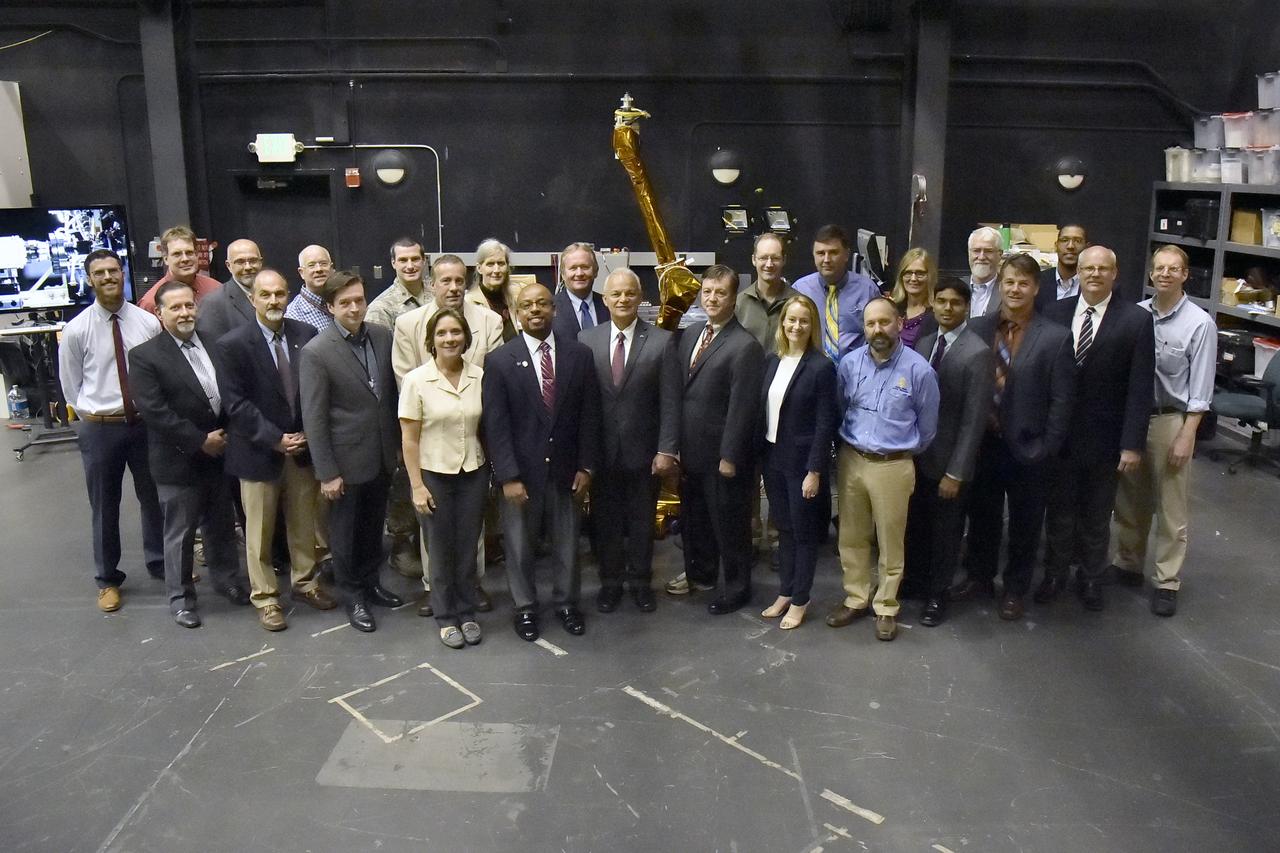
WASHINGTON, D.C.---S&T Partnership Forum In-Space Assembly Technical Interchange Meeting-On September 6th 2017, many of the United States government experts on In-Space Assembly met at the U.S. Naval Research Lab to discuss both technology development and in-space applications that would advance national capabilities in this area. Expertise from NASA, USAF, NRO, DARPA and NRL met in this meeting which was coordinated by the NASA Headquarters, Office of the Chief Technologist. This technical interchange meeting was the second meeting of the members of this Science and Technology Partnership Forum.
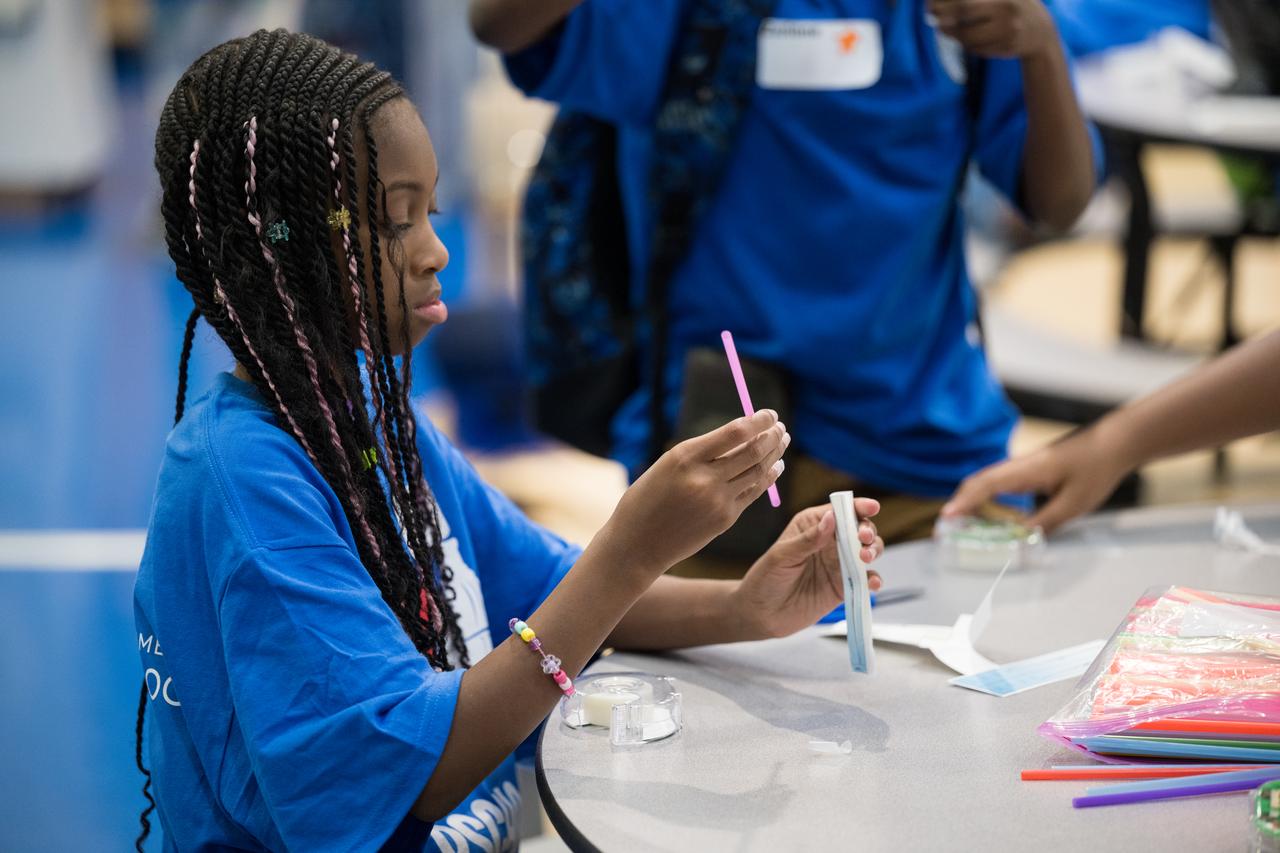
Students at Wheatley Education Campus participate in an activity to build their own rocket launcher during a kickoff event for the 21st Century Community Learning Centers NASA and Department of Education partnership, Monday, Sept. 23, 2024 at Wheatley Education Campus in Washington. Photo Credit: (NASA/Aubrey Gemignani)
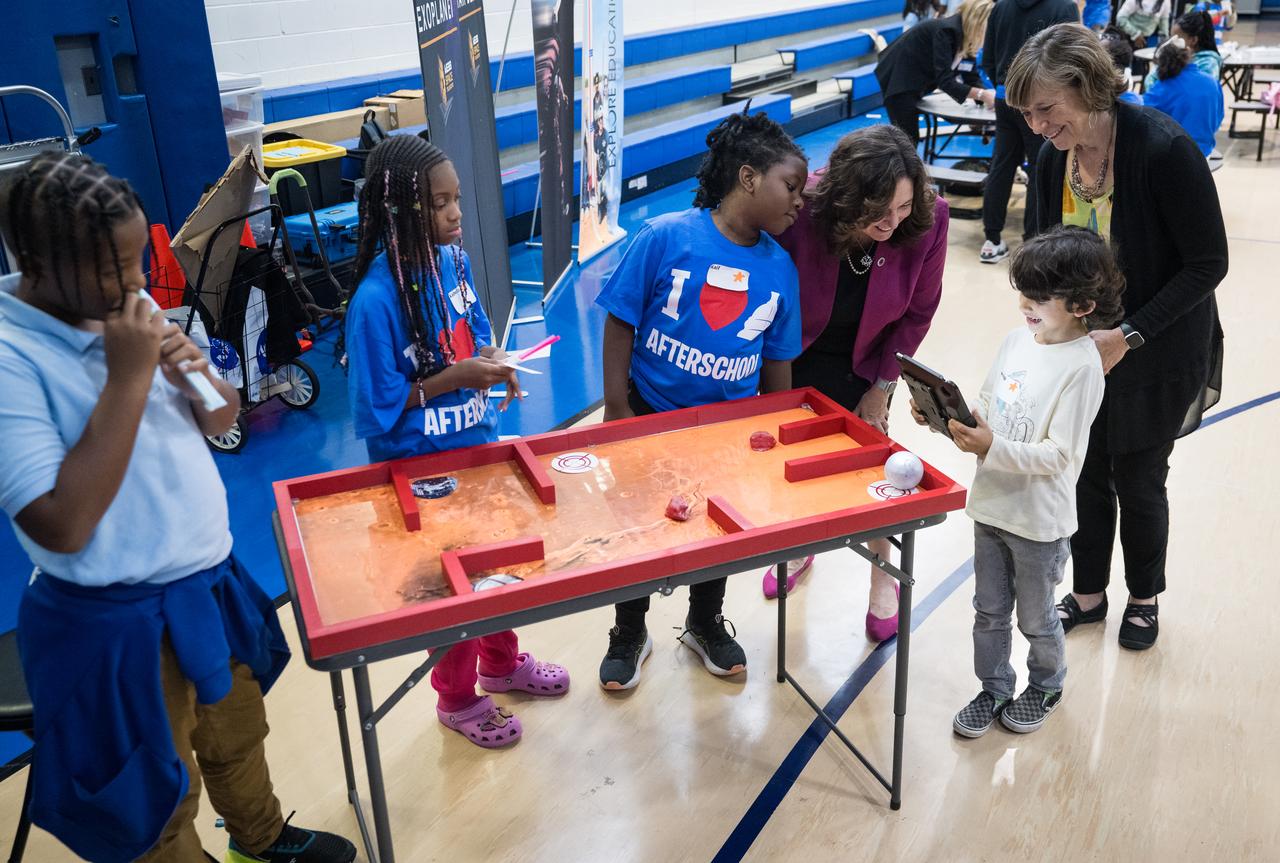
Students at Wheatley Education Campus participate in a Mars rolling rover activity with a robot, during a kickoff event for the 21st Century Community Learning Centers NASA and Department of Education partnership, Monday, Sept. 23, 2024 at Wheatley Education Campus in Washington. Photo Credit: (NASA/Aubrey Gemignani)
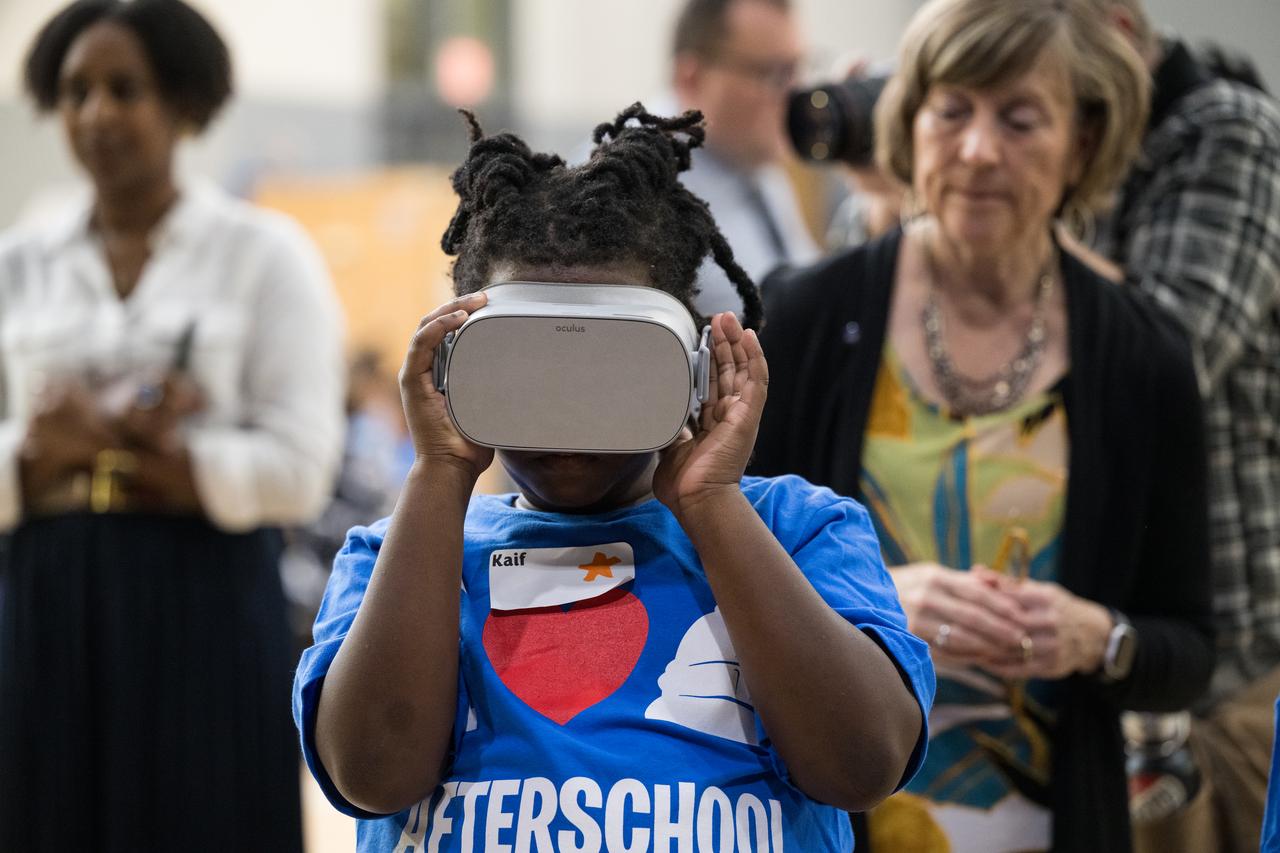
Students at Wheatley Education Campus participate in a virtual reality tour of NASA’s Neutral Buoyancy Lab during a kickoff event for the 21st Century Community Learning Centers NASA and Department of Education partnership, Monday, Sept. 23, 2024 at Wheatley Education Campus in Washington. Photo Credit: (NASA/Aubrey Gemignani)
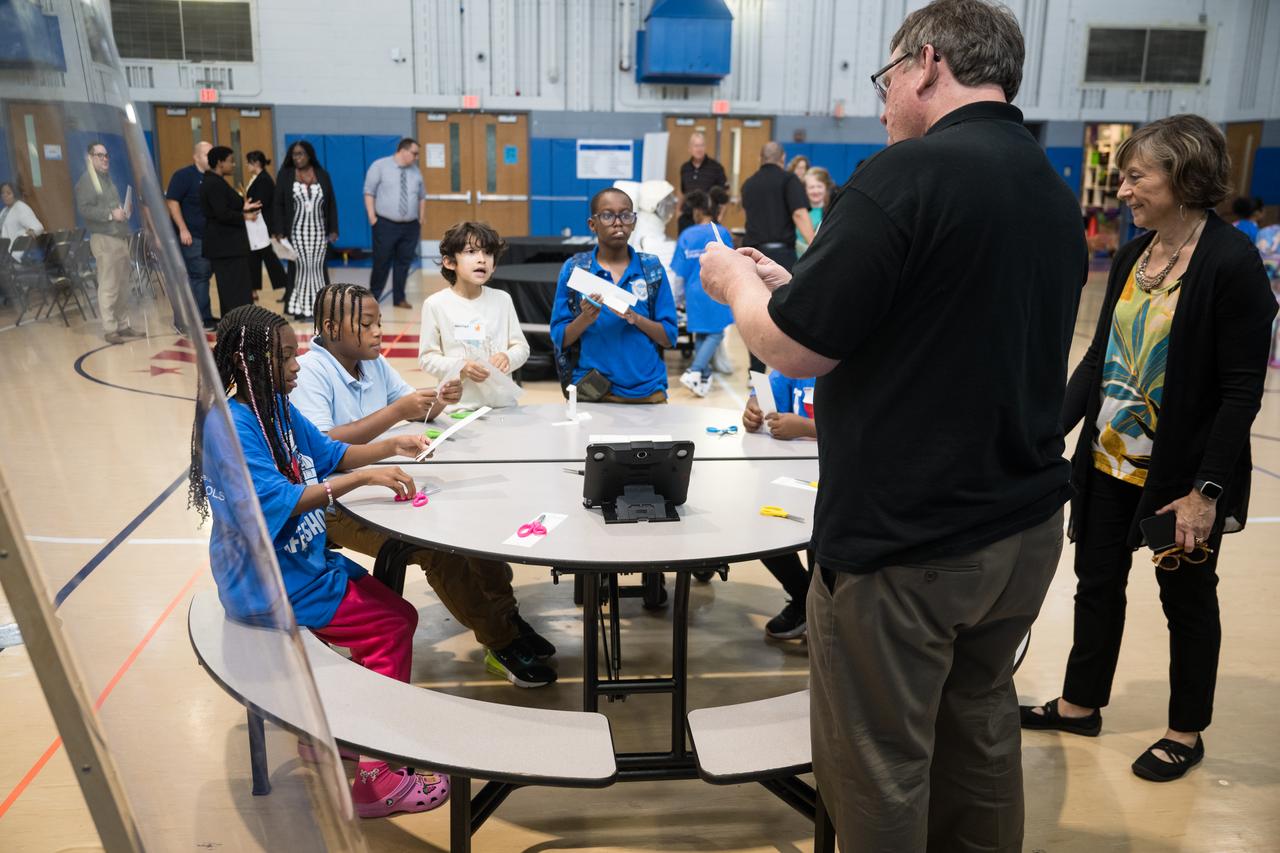
Students at Wheatley Education Campus participate in a rotor motor and wind tunnel activity during a kickoff event for the 21st Century Community Learning Centers NASA and Department of Education partnership, Monday, Sept. 23, 2024 at Wheatley Education Campus in Washington. Photo Credit: (NASA/Aubrey Gemignani)
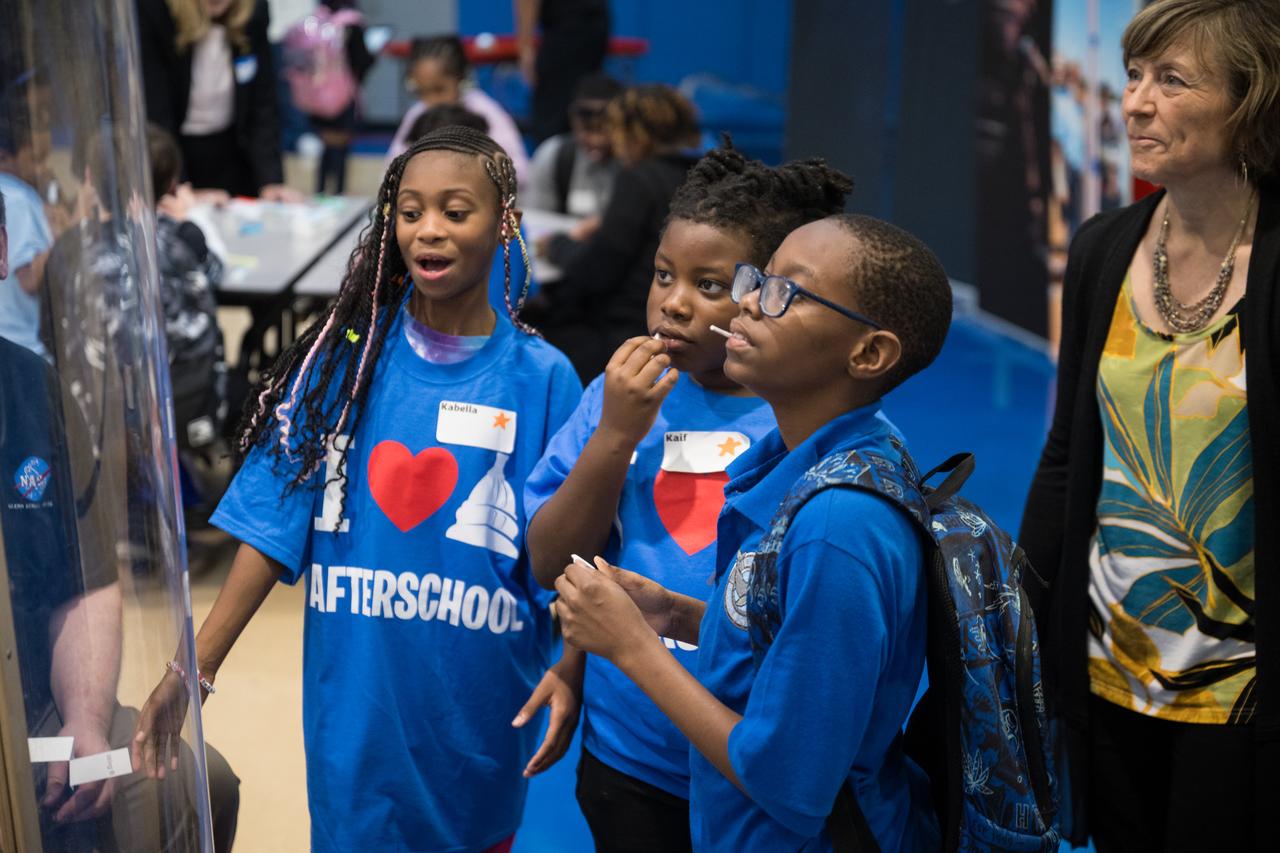
Students at Wheatley Education Campus participate in a rotor motor and wind tunnel activity during a kickoff event for the 21st Century Community Learning Centers NASA and Department of Education partnership, Monday, Sept. 23, 2024 at Wheatley Education Campus in Washington. Photo Credit: (NASA/Aubrey Gemignani)
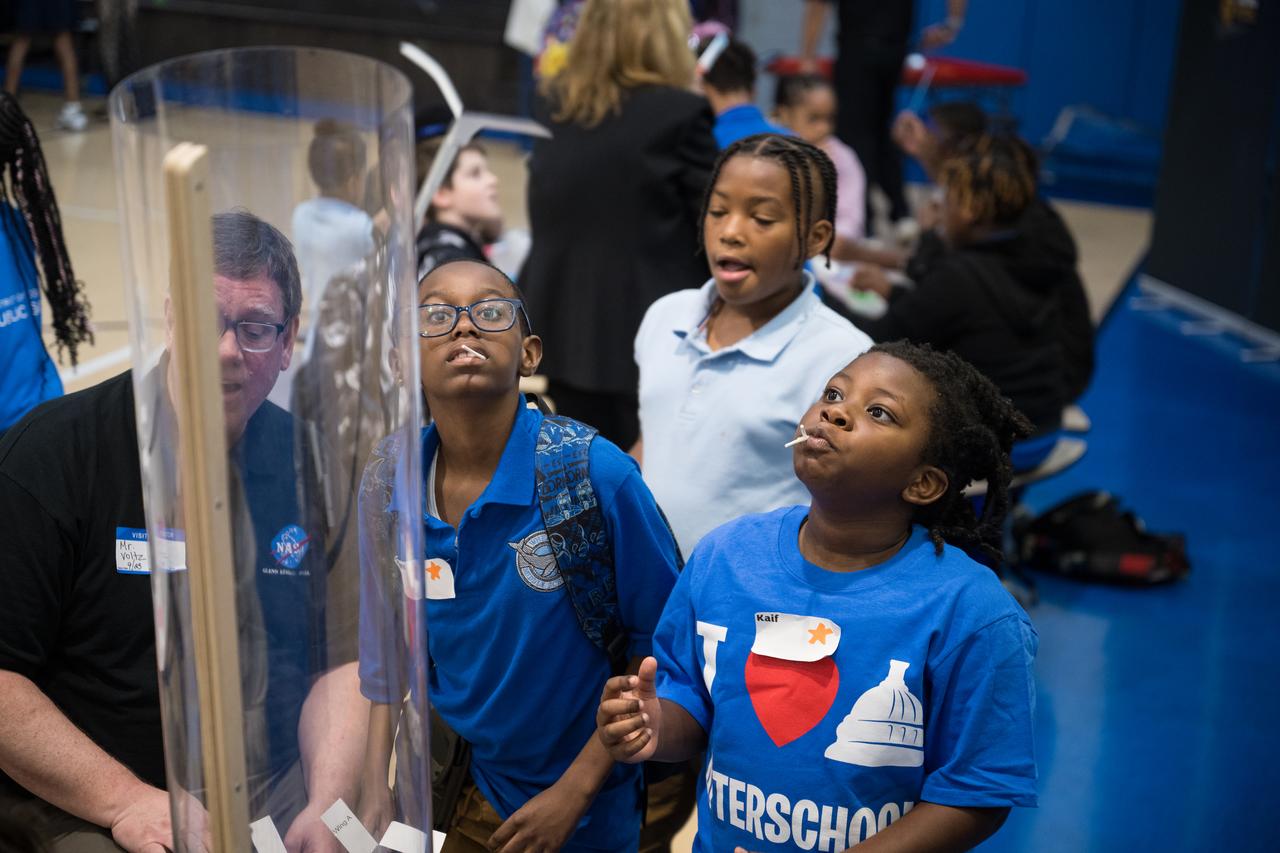
Students at Wheatley Education Campus participate in a rotor motor and wind tunnel activity during a kickoff event for the 21st Century Community Learning Centers NASA and Department of Education partnership, Monday, Sept. 23, 2024 at Wheatley Education Campus in Washington. Photo Credit: (NASA/Aubrey Gemignani)
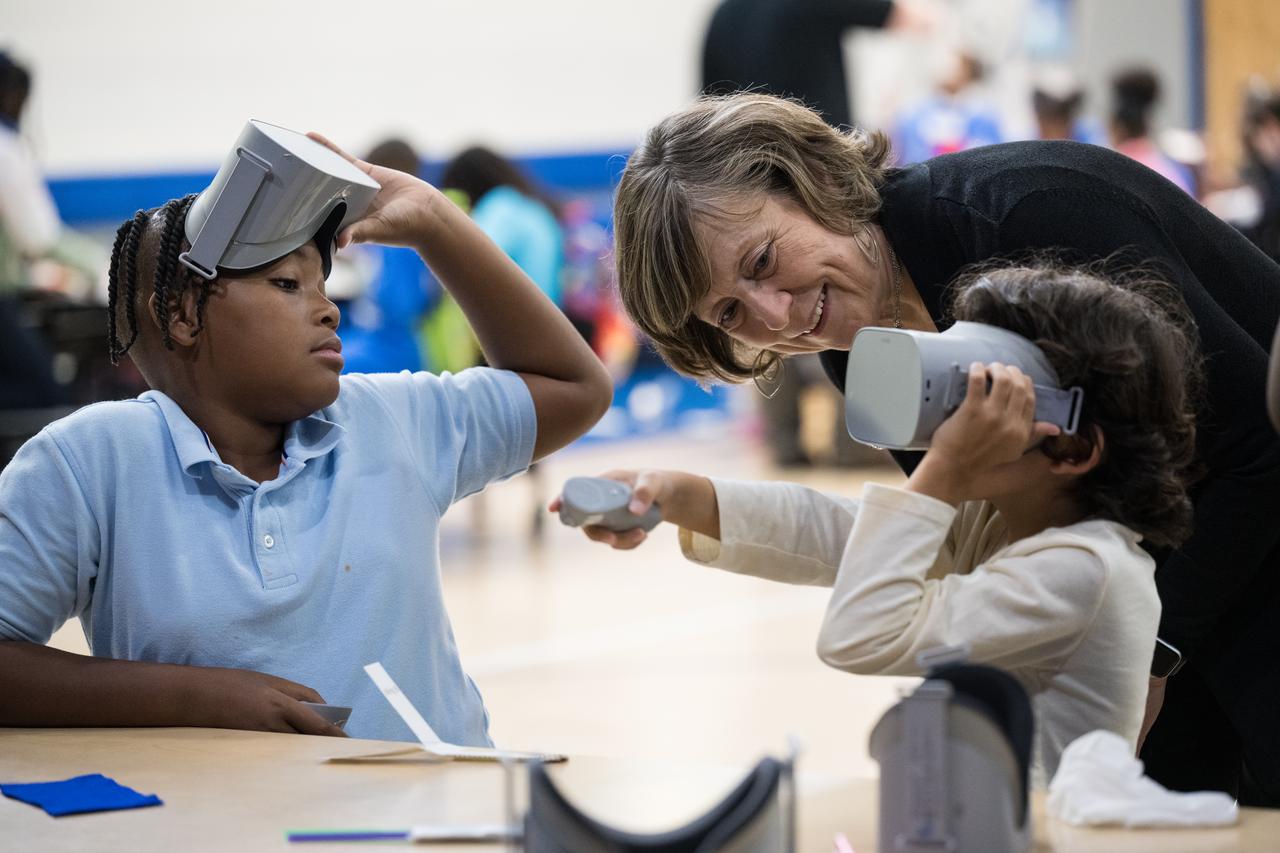
Students at Wheatley Education Campus participate in a virtual reality tour of NASA’s Neutral Buoyancy Lab during a kickoff event for the 21st Century Community Learning Centers NASA and Department of Education partnership, Monday, Sept. 23, 2024 at Wheatley Education Campus in Washington. Photo Credit: (NASA/Aubrey Gemignani)

Students at Wheatley Education Campus participate in an activity to build their own rocket launcher during a kickoff event for the 21st Century Community Learning Centers NASA and Department of Education partnership, Monday, Sept. 23, 2024 at Wheatley Education Campus in Washington. Photo Credit: (NASA/Aubrey Gemignani)
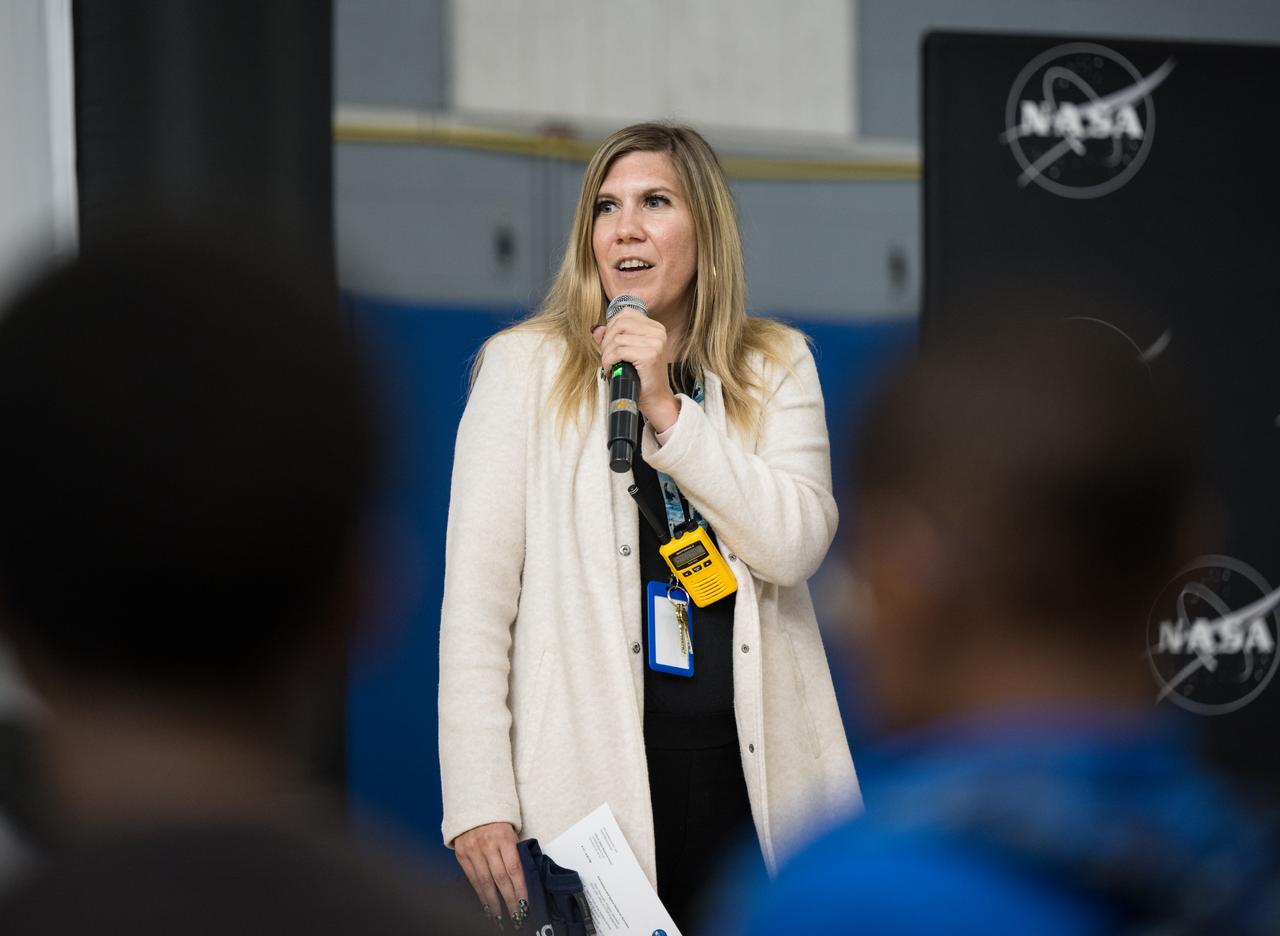
Principle of Wheatley Education Campus, Amanda Schmitt, provides remarks at a kickoff event for the 21st Century Community Learning Centers NASA and Department of Education partnership, Monday, Sept. 23, 2024 at Wheatley Education Campus in Washington. Students engaged in NASA hands-on activities and an engineering design challenge. Photo Credit: (NASA/Aubrey Gemignani)
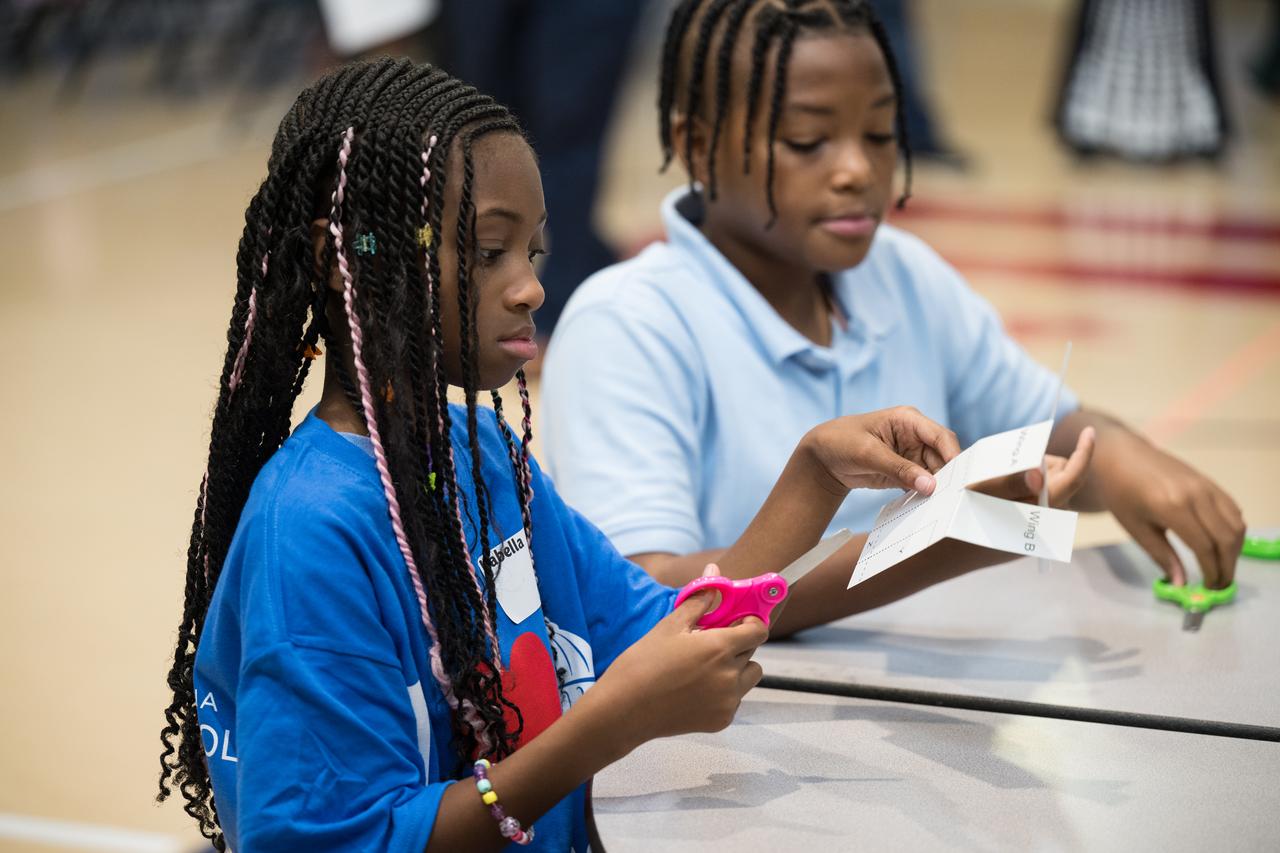
Students at Wheatley Education Campus participate in a rotor motor and wind tunnel activity during a kickoff event for the 21st Century Community Learning Centers NASA and Department of Education partnership, Monday, Sept. 23, 2024 at Wheatley Education Campus in Washington. Photo Credit: (NASA/Aubrey Gemignani)
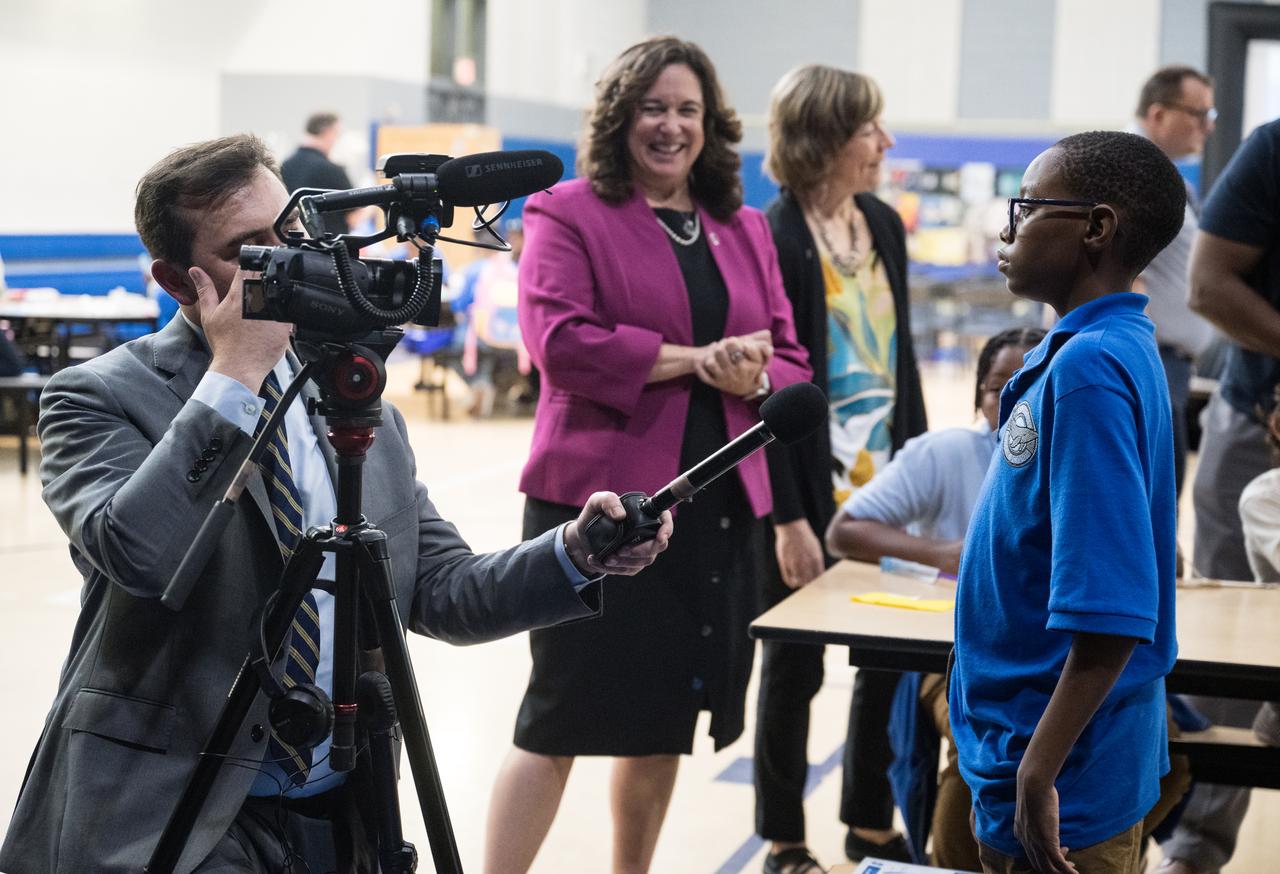
A student at Wheatley Education Campus is interviewed by media during a kickoff event for the 21st Century Community Learning Centers NASA and Department of Education partnership, Monday, Sept. 23, 2024 at Wheatley Education Campus in Washington. Photo Credit: (NASA/Aubrey Gemignani)
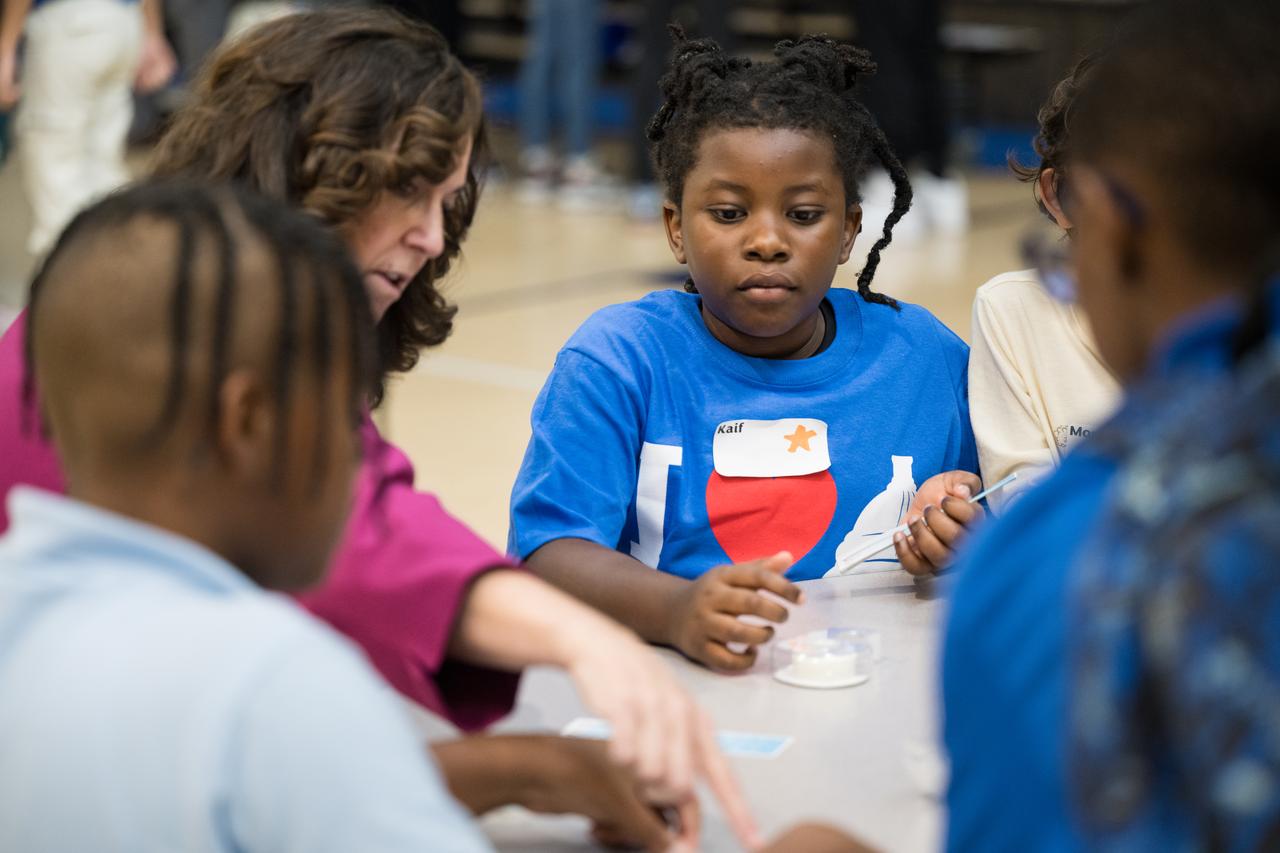
Students at Wheatley Education Campus participate in an activity to build their own rocket launcher during a kickoff event for the 21st Century Community Learning Centers NASA and Department of Education partnership, Monday, Sept. 23, 2024 at Wheatley Education Campus in Washington. Photo Credit: (NASA/Aubrey Gemignani)
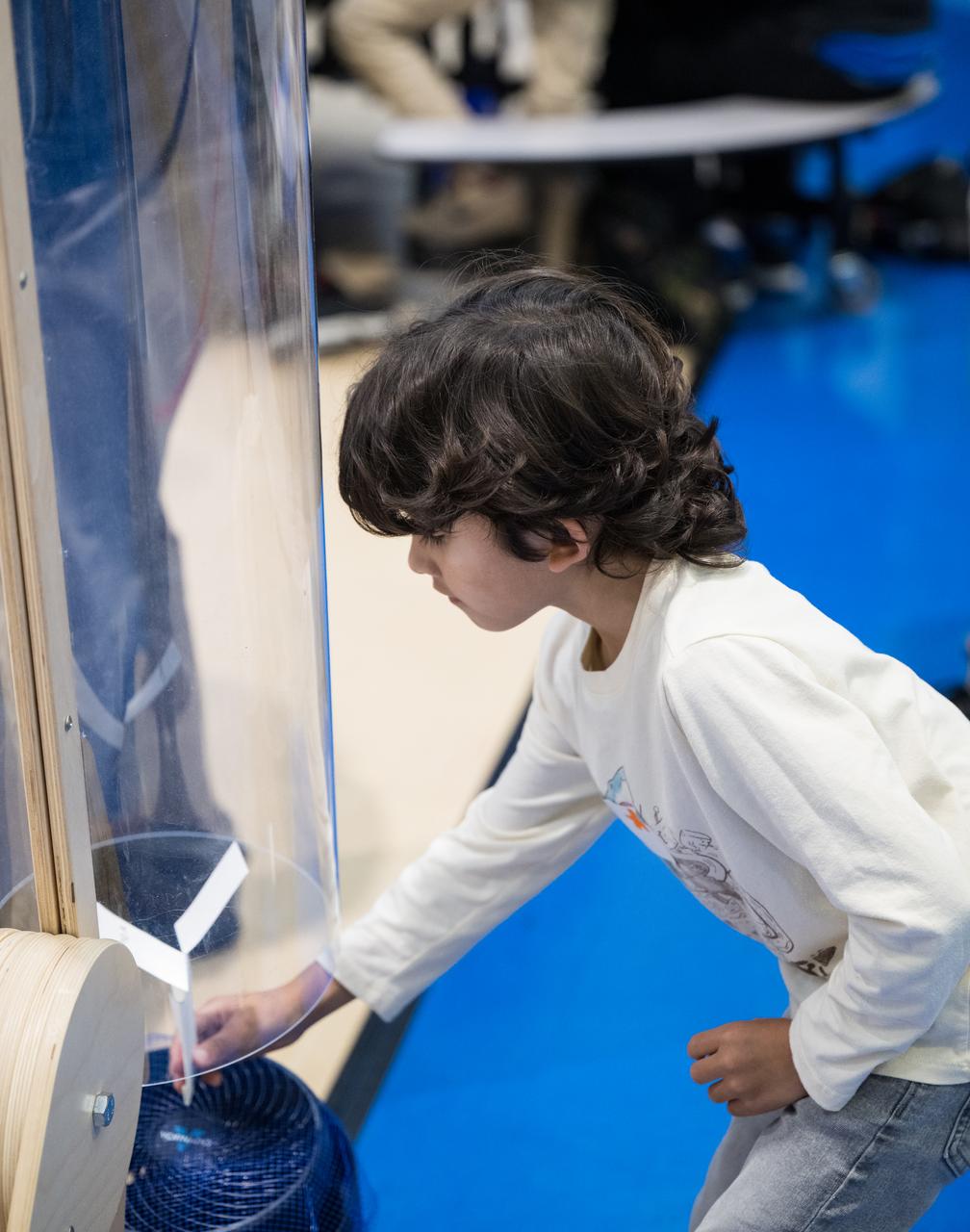
Students at Wheatley Education Campus participate in a rotor motor and wind tunnel activity during a kickoff event for the 21st Century Community Learning Centers NASA and Department of Education partnership, Monday, Sept. 23, 2024 at Wheatley Education Campus in Washington. Photo Credit: (NASA/Aubrey Gemignani)

CAPE CANAVERAL, Fla. -- Space shuttle and rover models built of LEGO bricks are on display at NASA's Kennedy Space Center in Florida, marking a new partnership between the U.S. space agency and The LEGO Group. The three-year Space Act Agreement is meant to spark the interest of children in science, technology, engineering and mathematics (STEM) with the future release of four NASA-inspired products in the toy company's LEGO CITY line. To commemorate the beginning of the partnership, two small LEGO space shuttles will launch aboard space shuttle Discovery's STS-133 mission to the International Space Station. A 40- by 70-foot activity tent will be set up at Kennedy on Nov. 3 for children of all ages to build their vision of the future with LEGO bricks. LEGO sets also will fly to the space station aboard Endeavour's STS-134 mission, and will be put together on orbit to demonstrate the challenges faced while building things in microgravity. Photo credit: NASA/Jack Pfaller
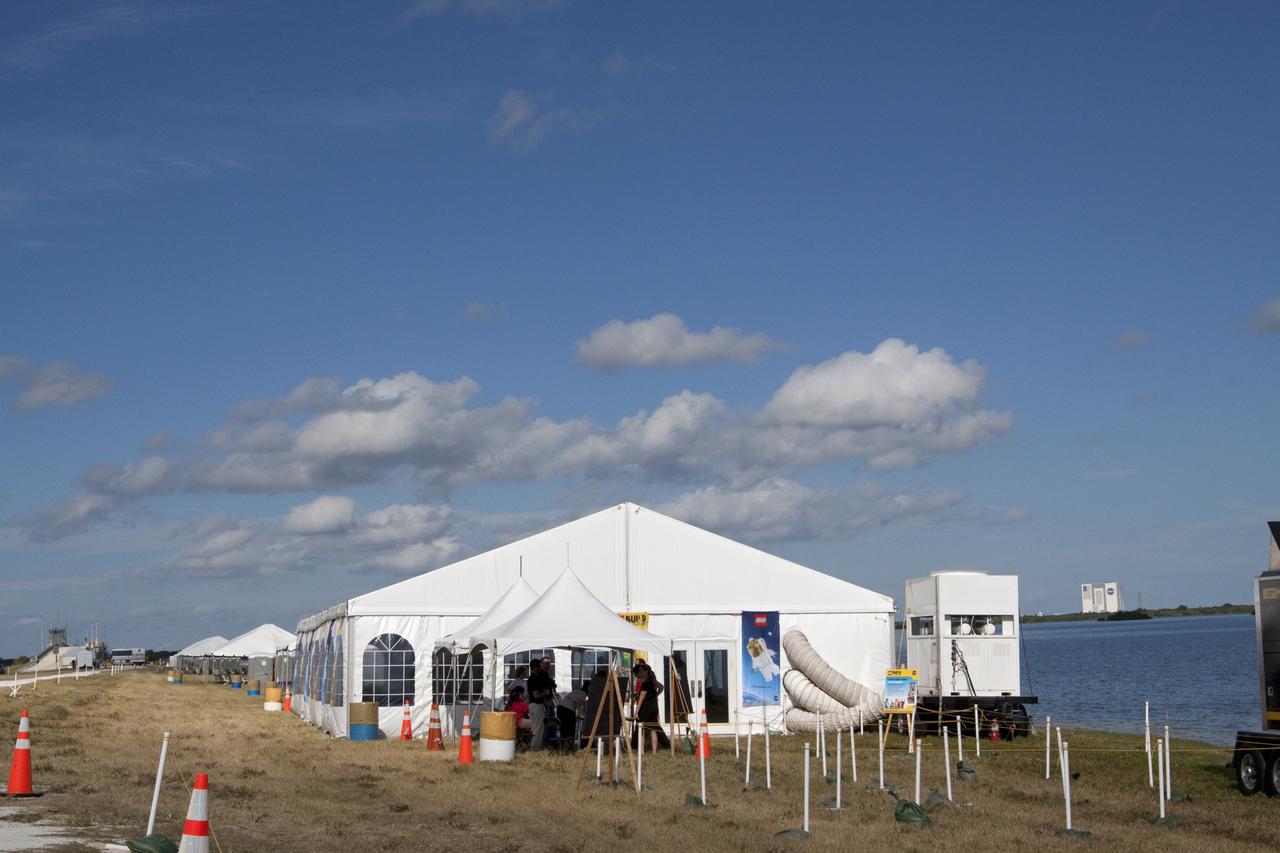
CAPE CANAVERAL, Fla. -- A 40- by 70-foot activity tent chock full of LEGO bricks is set up on the NASA Causeway at Kennedy Space Center in Florida. Inside, children of all ages will have the opportunity to build their vision of the future with LEGO bricks, marking the beginning of a three-year Space Act Agreement between NASA and The LEGO Group. The partnership is meant to spark the interest of children in science, technology, engineering and mathematics (STEM). To commemorate the partnership, two small LEGO space shuttles will launch aboard space shuttle Discovery's STS-133 mission to the International Space Station and the company will release four NASA-inspired products in its LEGO CITY line next year. LEGO sets also will fly to the space station aboard Endeavour's STS-134 mission, and will be put together on orbit to demonstrate the challenges faced while building things in microgravity. Photo credit: NASA/Jack Pfaller
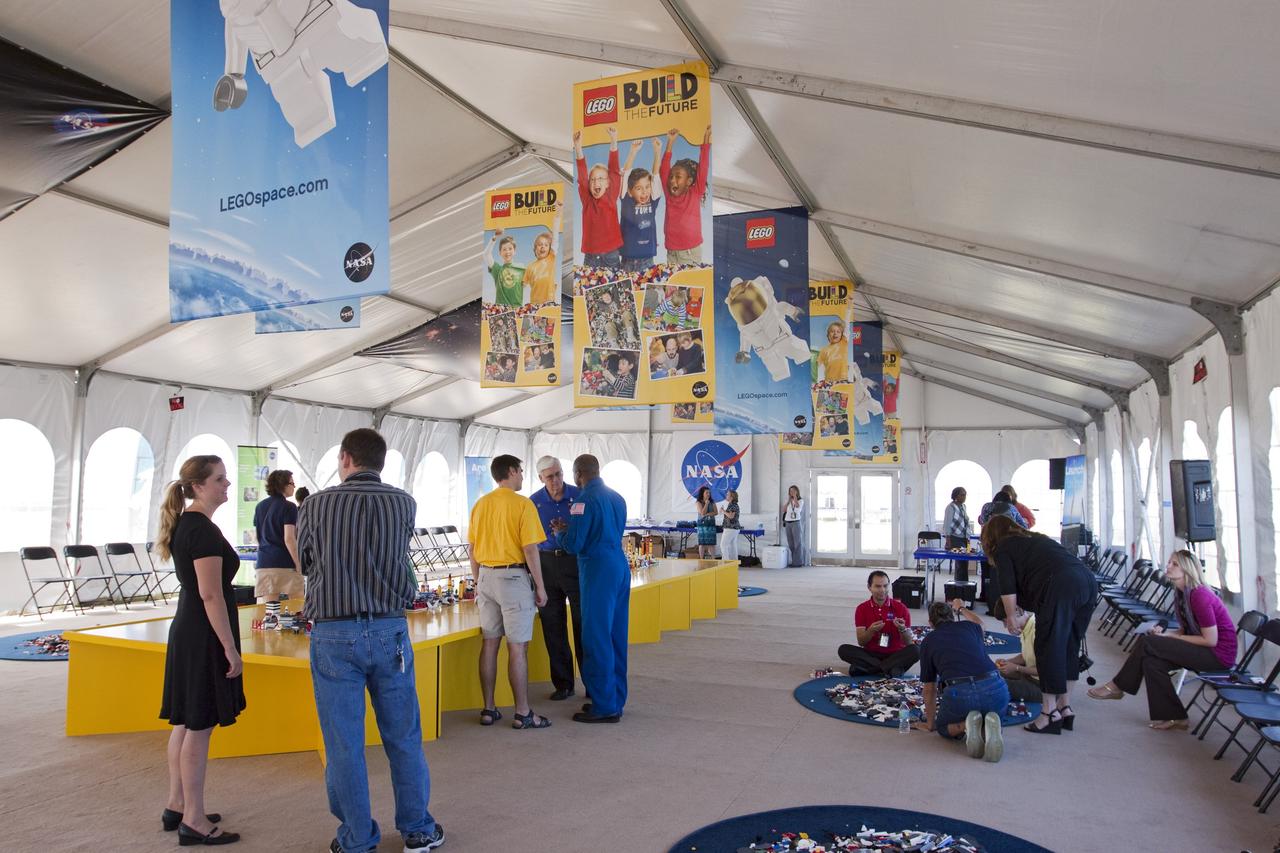
CAPE CANAVERAL, Fla. -- On the NASA Causeway at Kennedy Space Center in Florida, a 40- by 70-foot activity tent chock full of LEGO bricks is ready to welcome children of all ages. There, they will have the opportunity to build their vision of the future with LEGO bricks, marking the beginning of a three-year Space Act Agreement between NASA and The LEGO Group. The partnership is meant to spark the interest of children in science, technology, engineering and mathematics (STEM). To commemorate the partnership, two small LEGO space shuttles will launch aboard space shuttle Discovery's STS-133 mission to the International Space Station and the company will release four NASA-inspired products in its LEGO CITY line next year. LEGO sets also will fly to the space station aboard Endeavour's STS-134 mission, and will be put together on orbit to demonstrate the challenges faced while building things in microgravity. Photo credit: NASA/Jack Pfaller
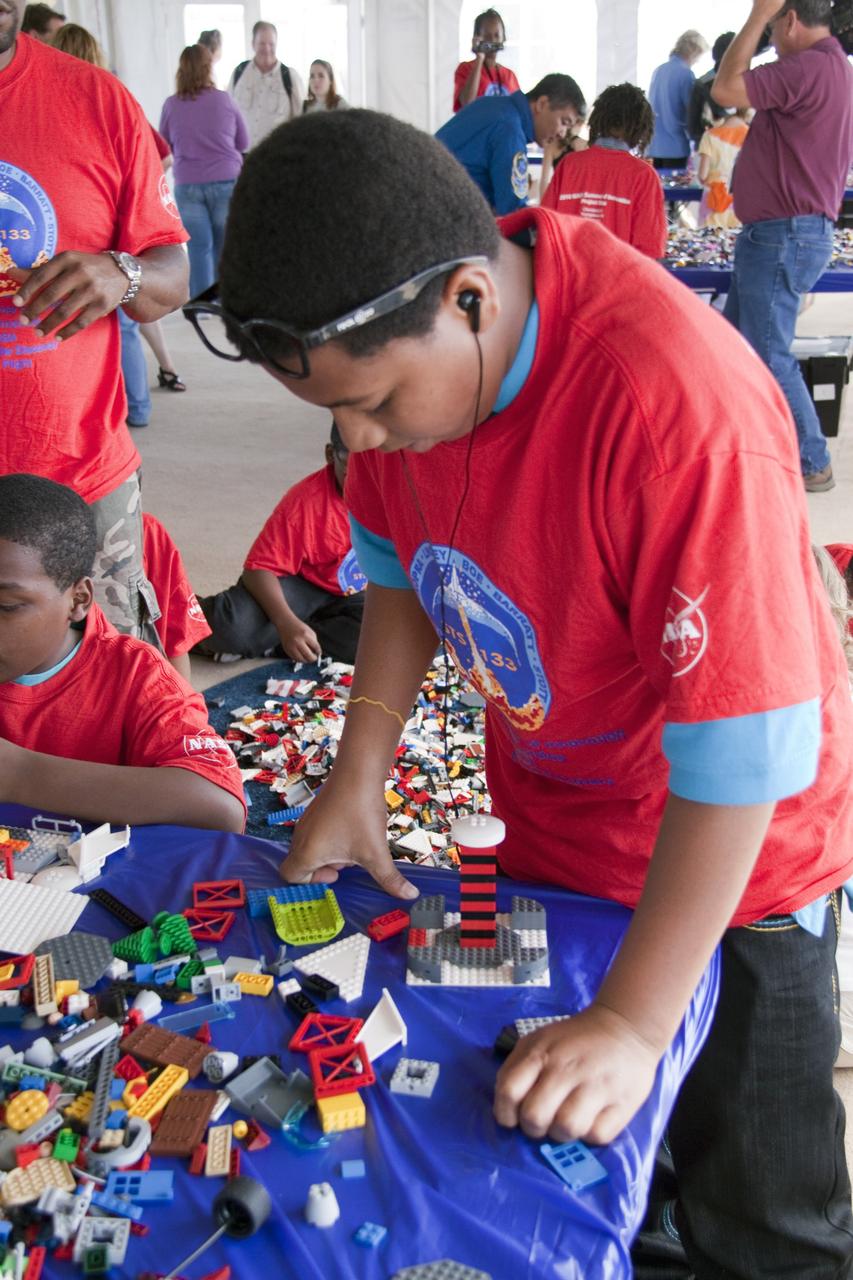
CAPE CANAVERAL, Fla. -- On the NASA Causeway at Kennedy Space Center in Florida, school children build LEGO space vehicles inside a 40- by 70-foot activity tent. There, children of all ages are building their vision of the future with LEGO bricks, marking the beginning of a three-year Space Act Agreement between NASA and The LEGO Group. The partnership is meant to spark the interest of children in science, technology, engineering and mathematics (STEM). To commemorate the partnership, two small LEGO space shuttles will launch aboard space shuttle Discovery's STS-133 mission to the International Space Station and the company will release four NASA-inspired products in its LEGO CITY line next year. LEGO sets also will fly to the space station aboard Endeavour's STS-134 mission, and will be put together on orbit to demonstrate the challenges faced while building things in microgravity. Photo credit: NASA/Jack Pfaller
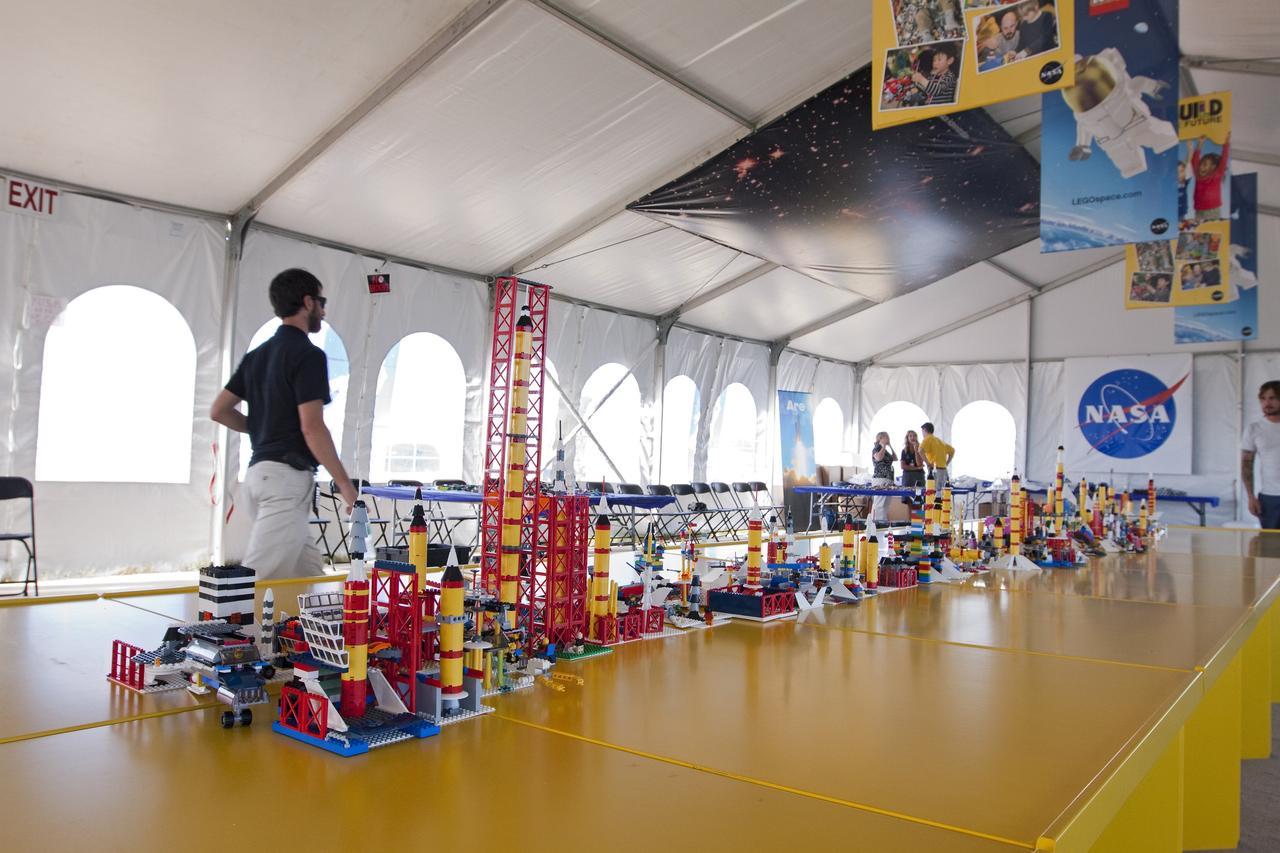
CAPE CANAVERAL, Fla. -- On the NASA Causeway at Kennedy Space Center in Florida, a 40- by 70-foot activity tent chock full of LEGO bricks is ready to welcome children of all ages. There, they will have the opportunity to build their vision of the future with LEGO bricks, marking the beginning of a three-year Space Act Agreement between NASA and The LEGO Group. The partnership is meant to spark the interest of children in science, technology, engineering and mathematics (STEM). To commemorate the partnership, two small LEGO space shuttles will launch aboard space shuttle Discovery's STS-133 mission to the International Space Station and the company will release four NASA-inspired products in its LEGO CITY line next year. LEGO sets also will fly to the space station aboard Endeavour's STS-134 mission, and will be put together on orbit to demonstrate the challenges faced while building things in microgravity. Photo credit: NASA/Jack Pfaller
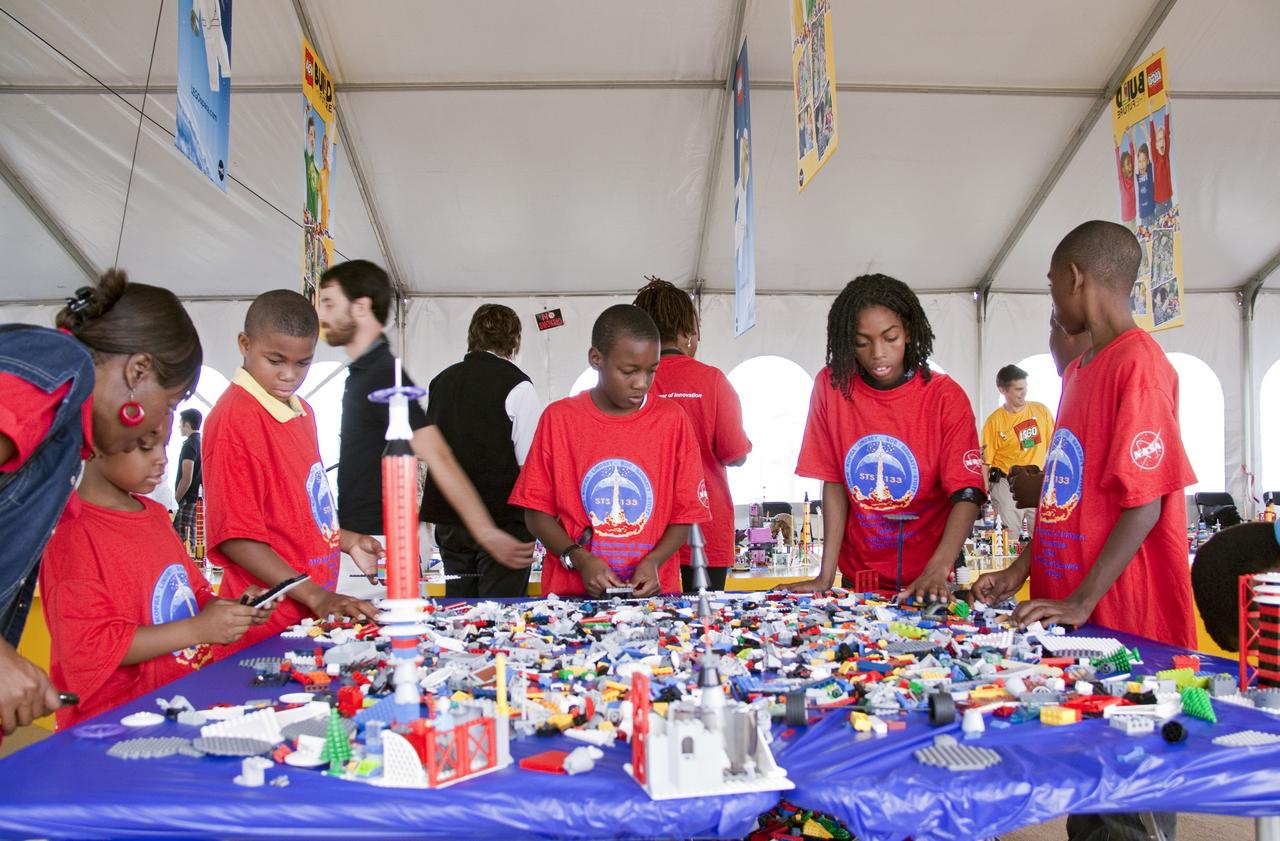
CAPE CANAVERAL, Fla. -- On the NASA Causeway at Kennedy Space Center in Florida, school children build LEGO space vehicles inside a 40- by 70-foot activity tent. There, children of all ages are building their vision of the future with LEGO bricks, marking the beginning of a three-year Space Act Agreement between NASA and The LEGO Group. The partnership is meant to spark the interest of children in science, technology, engineering and mathematics (STEM). To commemorate the partnership, two small LEGO space shuttles will launch aboard space shuttle Discovery's STS-133 mission to the International Space Station and the company will release four NASA-inspired products in its LEGO CITY line next year. LEGO sets also will fly to the space station aboard Endeavour's STS-134 mission, and will be put together on orbit to demonstrate the challenges faced while building things in microgravity. Photo credit: NASA/Jack Pfaller
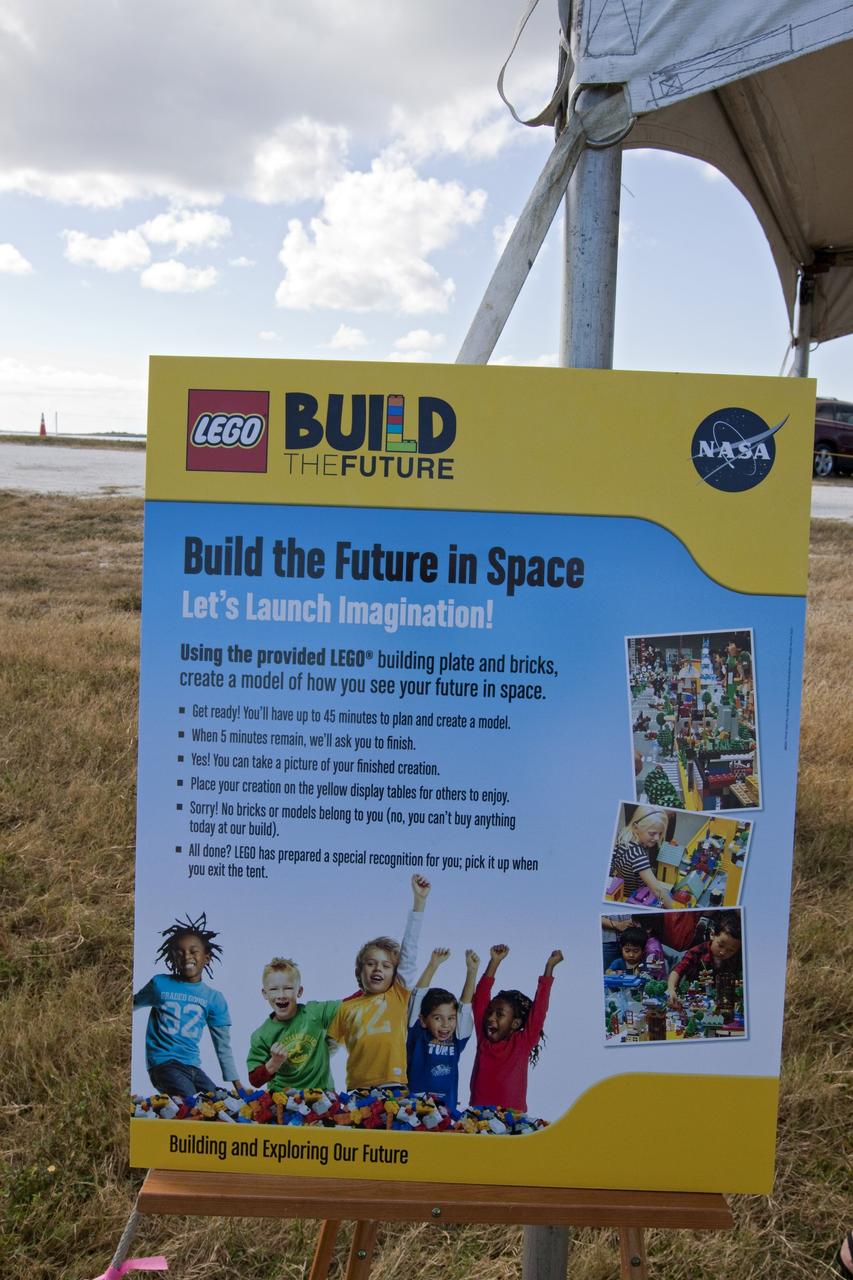
CAPE CANAVERAL, Fla. -- A sign welcomes children of all ages to a 40- by 70-foot activity tent chock full of LEGO bricks on the NASA Causeway at Kennedy Space Center in Florida. Inside the tent, they will have the opportunity to build their vision of the future with LEGO bricks, marking the beginning of a three-year Space Act Agreement between NASA and The LEGO Group. The partnership is meant to spark the interest of children in science, technology, engineering and mathematics (STEM). To commemorate the partnership, two small LEGO space shuttles will launch aboard space shuttle Discovery's STS-133 mission to the International Space Station and the company will release four NASA-inspired products in its LEGO CITY line next year. LEGO sets also will fly to the space station aboard Endeavour's STS-134 mission, and will be put together on orbit to demonstrate the challenges faced while building things in microgravity. Photo credit: NASA/Jack Pfaller
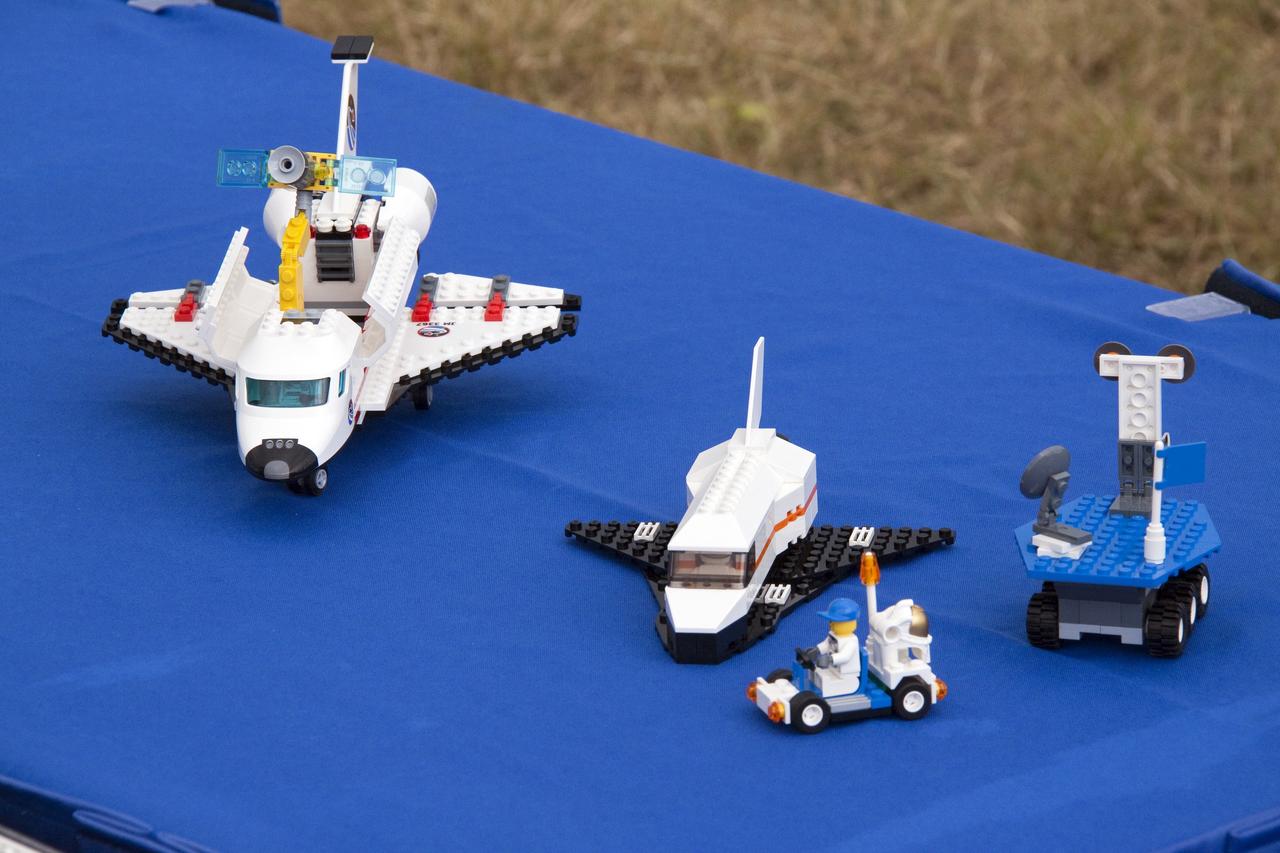
CAPE CANAVERAL, Fla. -- Space shuttle and rover models built of LEGO bricks are on display at NASA's Kennedy Space Center in Florida, marking a new partnership between the U.S. space agency and The LEGO Group. The three-year Space Act Agreement is meant to spark the interest of children in science, technology, engineering and mathematics (STEM) with the future release of four NASA-inspired products in the toy company's LEGO CITY line. To commemorate the beginning of the partnership, two small LEGO space shuttles will launch aboard space shuttle Discovery's STS-133 mission to the International Space Station. A 40- by 70-foot activity tent will be set up at Kennedy on Nov. 3 for children of all ages to build their vision of the future with LEGO bricks. LEGO sets also will fly to the space station aboard Endeavour's STS-134 mission, and will be put together on orbit to demonstrate the challenges faced while building things in microgravity. Photo credit: NASA/Jack Pfaller
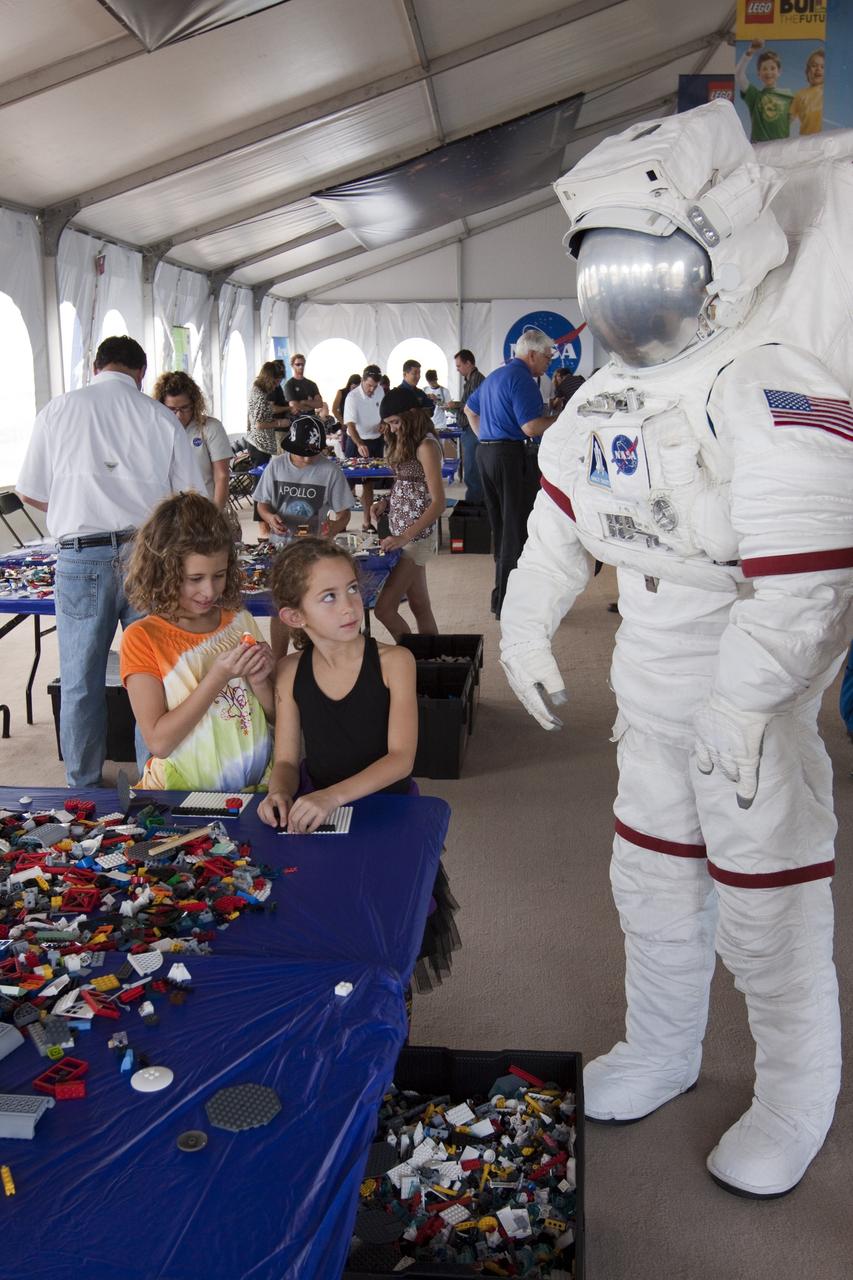
CAPE CANAVERAL, Fla. -- On the NASA Causeway at Kennedy Space Center in Florida, a 40- by 70-foot activity tent chock full of LEGO bricks hosts children, adults and a space person. There, they are building their vision of the future with LEGO bricks, marking the beginning of a three-year Space Act Agreement between NASA and The LEGO Group. The partnership is meant to spark the interest of children in science, technology, engineering and mathematics (STEM). To commemorate the partnership, two small LEGO space shuttles will launch aboard space shuttle Discovery's STS-133 mission to the International Space Station and the company will release four NASA-inspired products in its LEGO CITY line next year. LEGO sets also will fly to the space station aboard Endeavour's STS-134 mission, and will be put together on orbit to demonstrate the challenges faced while building things in microgravity. Photo credit: NASA/Jack Pfaller

CAPE CANAVERAL, Fla. -- On the NASA Causeway at Kennedy Space Center in Florida, a 40- by 70-foot activity tent chock full of LEGO bricks hosts children, adults and a space person. There, they are building their vision of the future with LEGO bricks, marking the beginning of a three-year Space Act Agreement between NASA and The LEGO Group. The partnership is meant to spark the interest of children in science, technology, engineering and mathematics (STEM). To commemorate the partnership, two small LEGO space shuttles will launch aboard space shuttle Discovery's STS-133 mission to the International Space Station and the company will release four NASA-inspired products in its LEGO CITY line next year. LEGO sets also will fly to the space station aboard Endeavour's STS-134 mission, and will be put together on orbit to demonstrate the challenges faced while building things in microgravity. Photo credit: NASA/Jack Pfaller
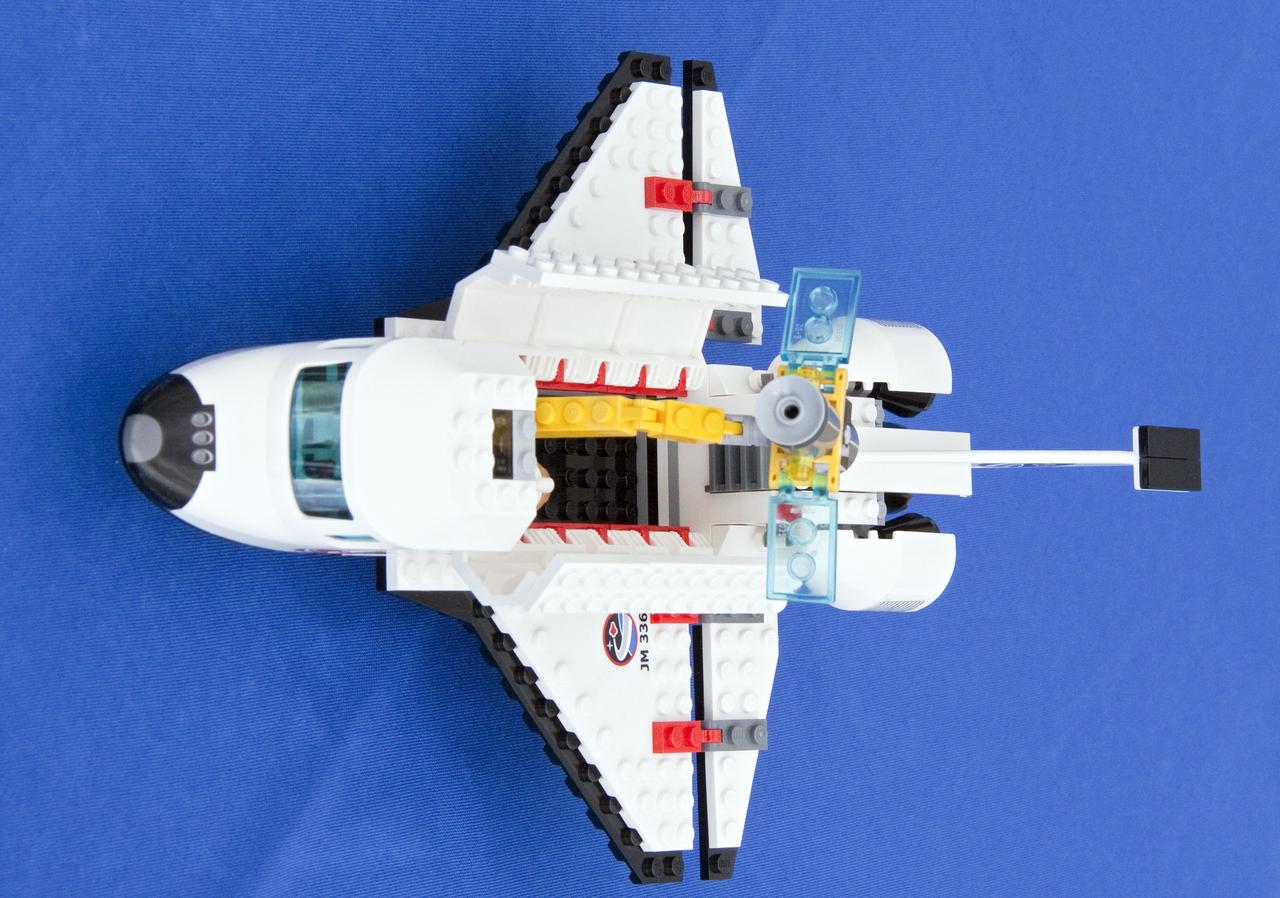
CAPE CANAVERAL, Fla. -- A space shuttle model built of LEGO bricks is on display at NASA's Kennedy Space Center in Florida, marking a new partnership between the U.S. space agency and The LEGO Group. The three-year Space Act Agreement is meant to spark the interest of children in science, technology, engineering and mathematics (STEM) with the future release of four NASA-inspired products in the toy company's LEGO CITY line. To commemorate the beginning of the partnership, two small LEGO space shuttles will launch aboard space shuttle Discovery's STS-133 mission to the International Space Station. A 40- by 70-foot activity tent will be set up at Kennedy on Nov. 3 for children of all ages to build their vision of the future with LEGO bricks. LEGO sets also will fly to the space station aboard Endeavour's STS-134 mission, and will be put together on orbit to demonstrate the challenges faced while building things in microgravity. Photo credit: NASA/Jack Pfaller
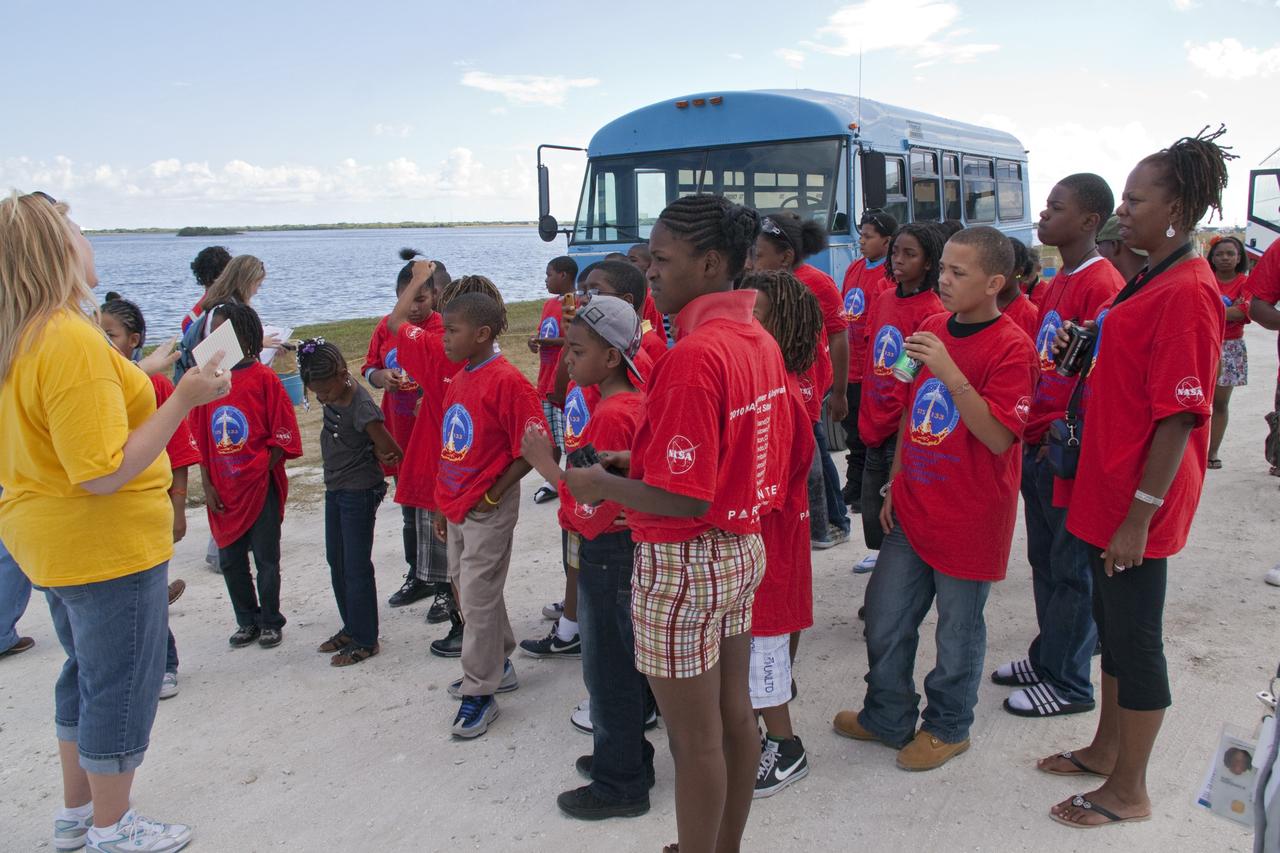
CAPE CANAVERAL, Fla. -- On the NASA Causeway at Kennedy Space Center in Florida, school children arrive at a 40- by 70-foot activity tent chock full of LEGO bricks. There, they will build their vision of the future with LEGO bricks, marking the beginning of a three-year Space Act Agreement between NASA and The LEGO Group. The partnership is meant to spark the interest of children in science, technology, engineering and mathematics (STEM). To commemorate the partnership, two small LEGO space shuttles will launch aboard space shuttle Discovery's STS-133 mission to the International Space Station and the company will release four NASA-inspired products in its LEGO CITY line next year. LEGO sets also will fly to the space station aboard Endeavour's STS-134 mission, and will be put together on orbit to demonstrate the challenges faced while building things in microgravity. Photo credit: NASA/Jack Pfaller

CAPE CANAVERAL, Fla. -- A space shuttle model built of LEGO bricks is on display at NASA's Kennedy Space Center in Florida, marking a new partnership between the U.S. space agency and The LEGO Group. The three-year Space Act Agreement is meant to spark the interest of children in science, technology, engineering and mathematics (STEM) with the future release of four NASA-inspired products in the toy company's LEGO CITY line. To commemorate the beginning of the partnership, two small LEGO space shuttles will launch aboard space shuttle Discovery's STS-133 mission to the International Space Station. A 40- by 70-foot activity tent will be set up at Kennedy on Nov. 3 for children of all ages to build their vision of the future with LEGO bricks. LEGO sets also will fly to the space station aboard Endeavour's STS-134 mission, and will be put together on orbit to demonstrate the challenges faced while building things in microgravity. Photo credit: NASA/Jack Pfaller
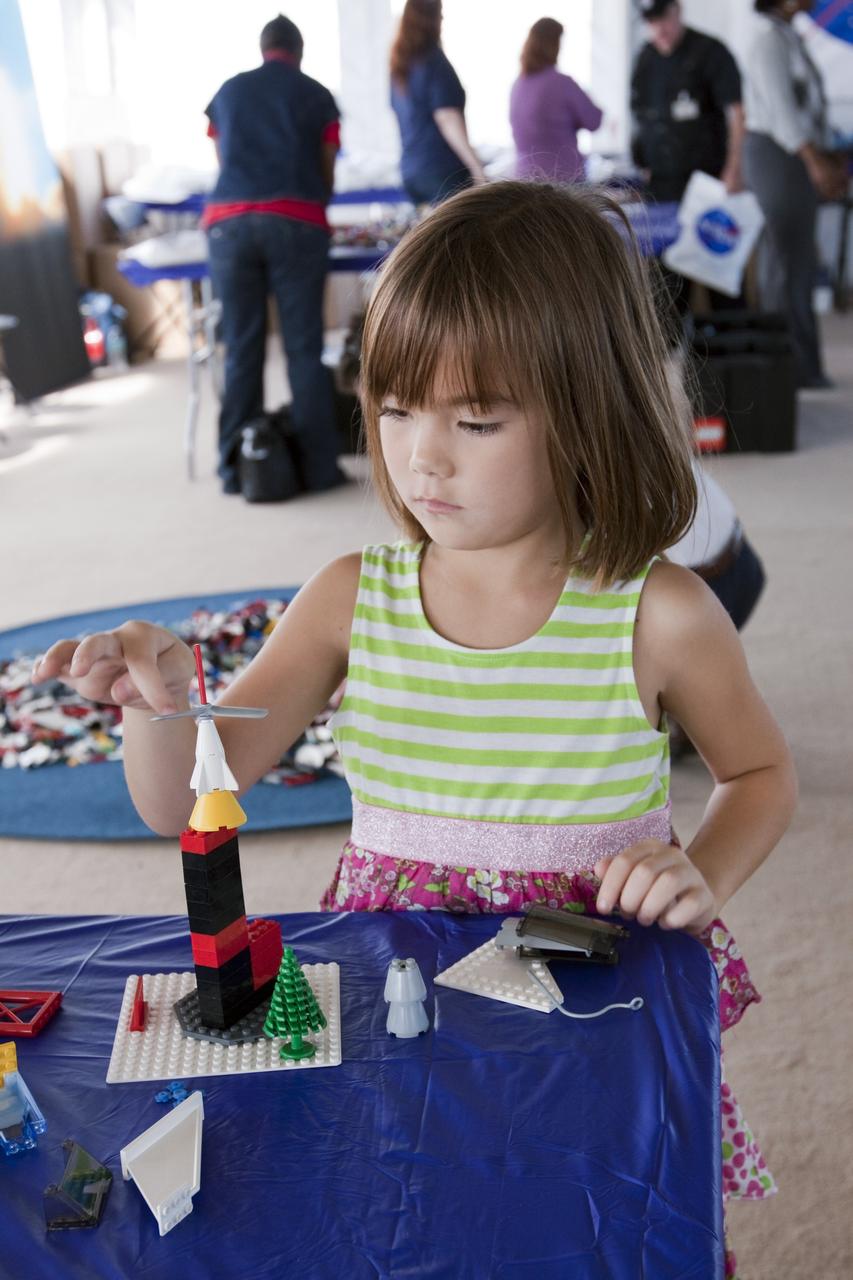
CAPE CANAVERAL, Fla. -- On the NASA Causeway at Kennedy Space Center in Florida, a 40- by 70-foot activity tent chock full of LEGO bricks hosts children and adults. There, they are building their vision of the future with LEGO bricks, marking the beginning of a three-year Space Act Agreement between NASA and The LEGO Group. The partnership is meant to spark the interest of children in science, technology, engineering and mathematics (STEM). To commemorate the partnership, two small LEGO space shuttles will launch aboard space shuttle Discovery's STS-133 mission to the International Space Station and the company will release four NASA-inspired products in its LEGO CITY line next year. LEGO sets also will fly to the space station aboard Endeavour's STS-134 mission, and will be put together on orbit to demonstrate the challenges faced while building things in microgravity. Photo credit: NASA/Jack Pfaller
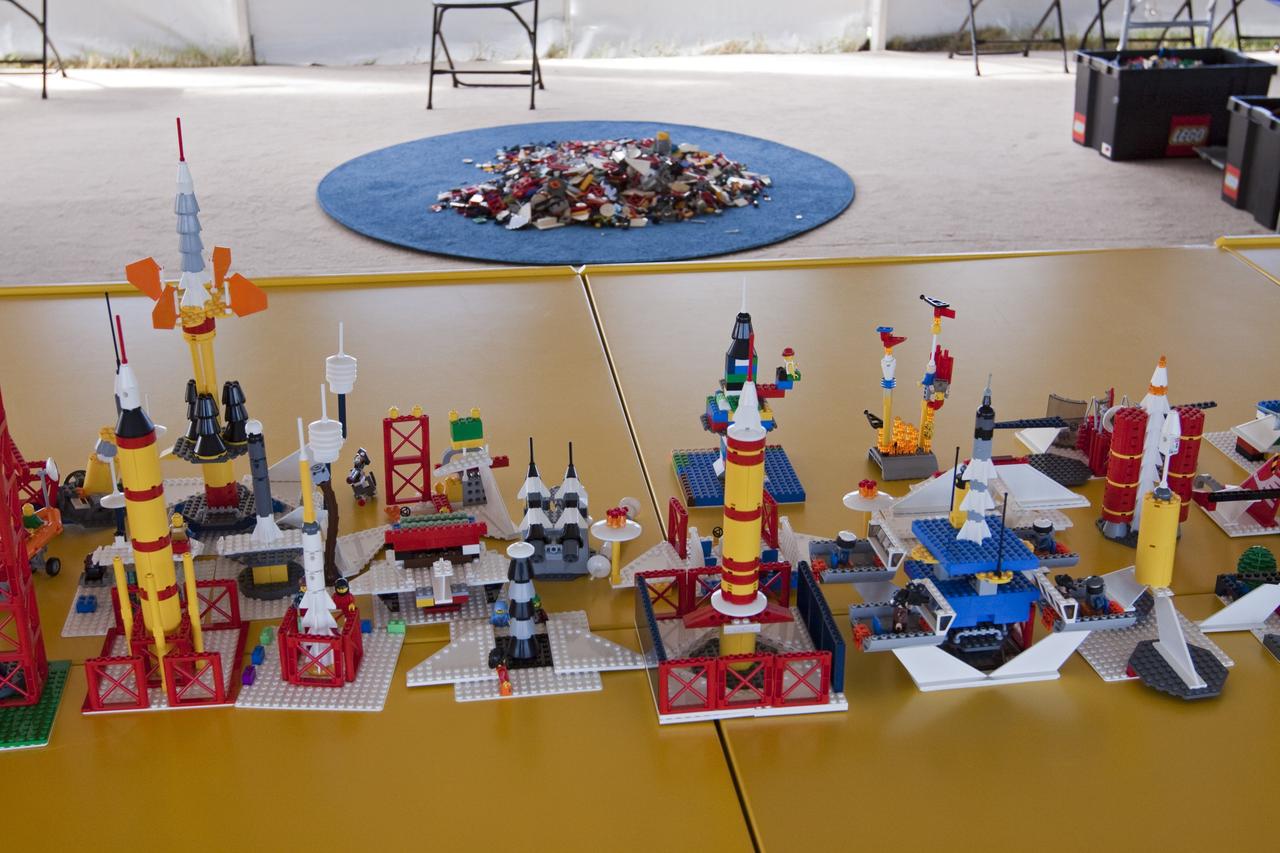
CAPE CANAVERAL, Fla. -- On the NASA Causeway at Kennedy Space Center in Florida, a 40- by 70-foot activity tent chock full of LEGO bricks is ready to welcome children of all ages. There, they will have the opportunity to build their vision of the future with LEGO bricks, marking the beginning of a three-year Space Act Agreement between NASA and The LEGO Group. The partnership is meant to spark the interest of children in science, technology, engineering and mathematics (STEM). To commemorate the partnership, two small LEGO space shuttles will launch aboard space shuttle Discovery's STS-133 mission to the International Space Station and the company will release four NASA-inspired products in its LEGO CITY line next year. LEGO sets also will fly to the space station aboard Endeavour's STS-134 mission, and will be put together on orbit to demonstrate the challenges faced while building things in microgravity. Photo credit: NASA/Jack Pfaller
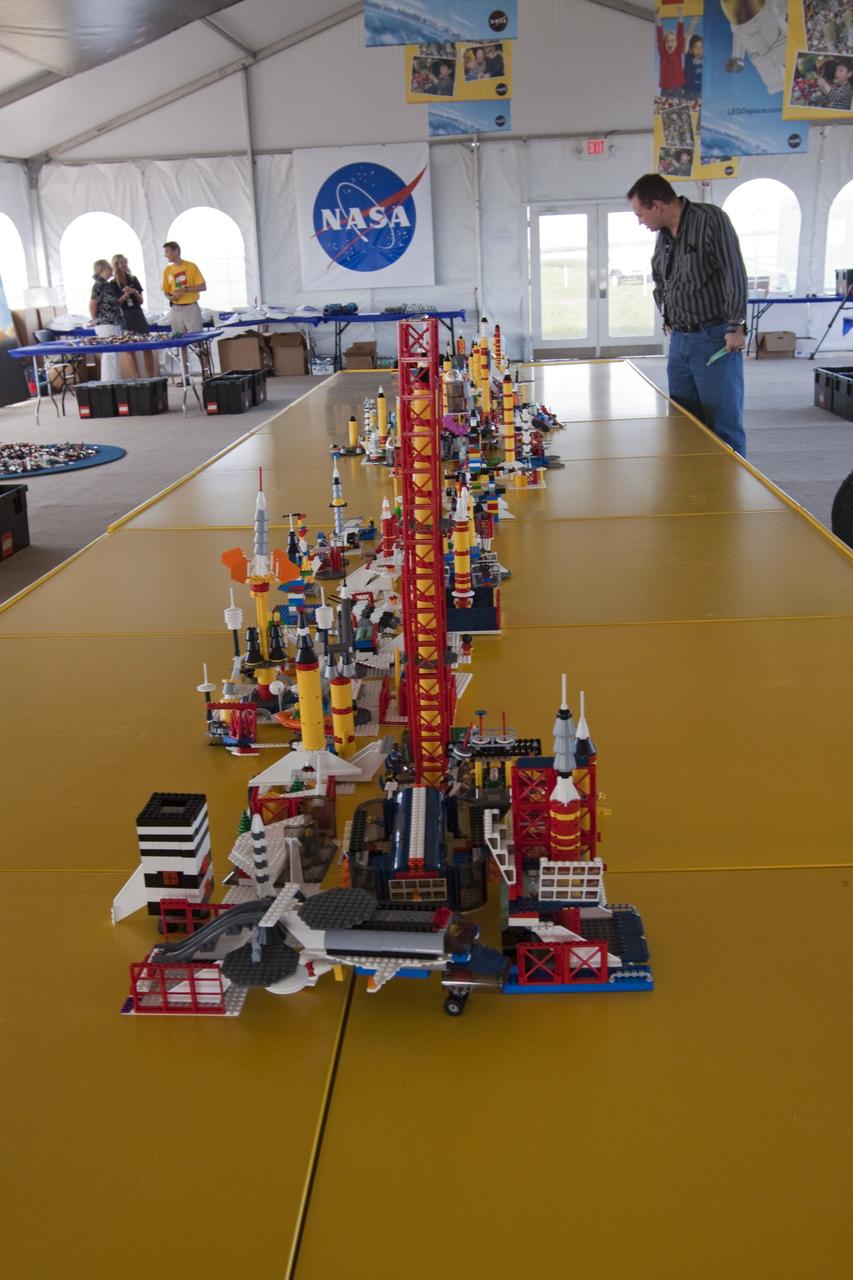
CAPE CANAVERAL, Fla. -- On the NASA Causeway at Kennedy Space Center in Florida, a 40- by 70-foot activity tent chock full of LEGO bricks is ready to welcome children of all ages. There, they will have the opportunity to build their vision of the future with LEGO bricks, marking the beginning of a three-year Space Act Agreement between NASA and The LEGO Group. The partnership is meant to spark the interest of children in science, technology, engineering and mathematics (STEM). To commemorate the partnership, two small LEGO space shuttles will launch aboard space shuttle Discovery's STS-133 mission to the International Space Station and the company will release four NASA-inspired products in its LEGO CITY line next year. LEGO sets also will fly to the space station aboard Endeavour's STS-134 mission, and will be put together on orbit to demonstrate the challenges faced while building things in microgravity. Photo credit: NASA/Jack Pfaller
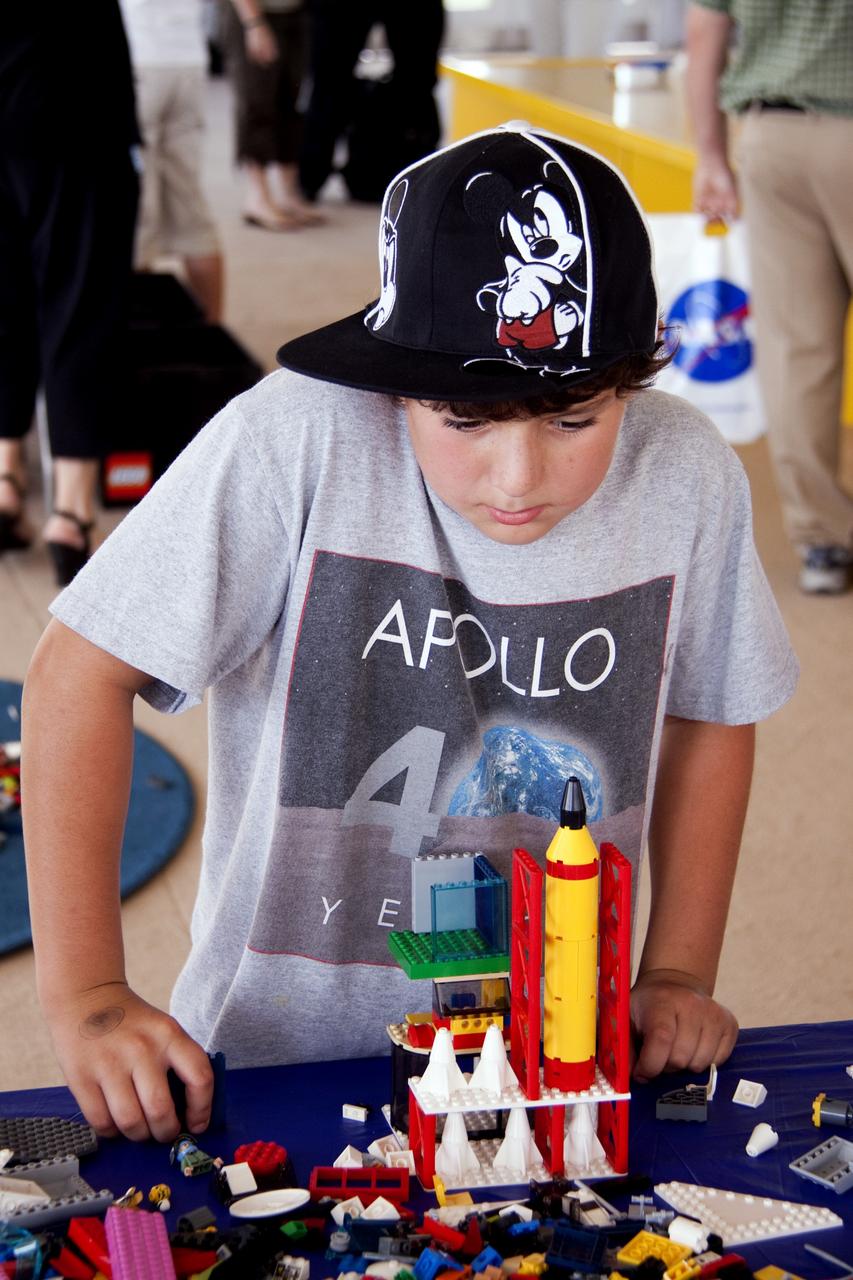
CAPE CANAVERAL, Fla. -- On the NASA Causeway at Kennedy Space Center in Florida, a 40- by 70-foot activity tent chock full of LEGO bricks hosts children and adults. There, they are building their vision of the future with LEGO bricks, marking the beginning of a three-year Space Act Agreement between NASA and The LEGO Group. The partnership is meant to spark the interest of children in science, technology, engineering and mathematics (STEM). To commemorate the partnership, two small LEGO space shuttles will launch aboard space shuttle Discovery's STS-133 mission to the International Space Station and the company will release four NASA-inspired products in its LEGO CITY line next year. LEGO sets also will fly to the space station aboard Endeavour's STS-134 mission, and will be put together on orbit to demonstrate the challenges faced while building things in microgravity. Photo credit: NASA/Jack Pfaller

CAPE CANAVERAL, Fla. -- On the NASA Causeway at Kennedy Space Center in Florida, a 40- by 70-foot activity tent chock full of LEGO bricks hosts children and adults. There, they are building their vision of the future with LEGO bricks, marking the beginning of a three-year Space Act Agreement between NASA and The LEGO Group. The partnership is meant to spark the interest of children in science, technology, engineering and mathematics (STEM). To commemorate the partnership, two small LEGO space shuttles will launch aboard space shuttle Discovery's STS-133 mission to the International Space Station and the company will release four NASA-inspired products in its LEGO CITY line next year. LEGO sets also will fly to the space station aboard Endeavour's STS-134 mission, and will be put together on orbit to demonstrate the challenges faced while building things in microgravity. Photo credit: NASA/Jack Pfaller
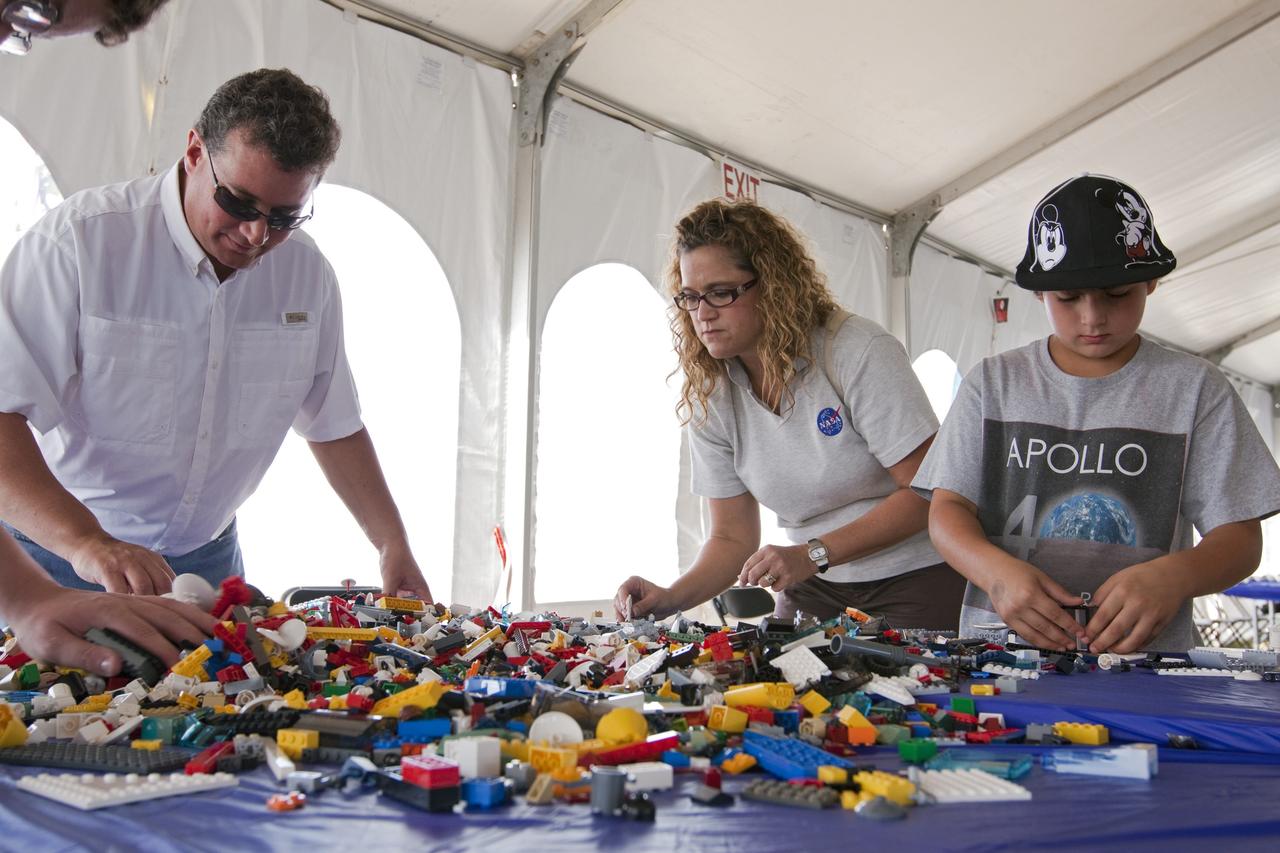
CAPE CANAVERAL, Fla. -- On the NASA Causeway at Kennedy Space Center in Florida, a 40- by 70-foot activity tent chock full of LEGO bricks hosts children and adults. There, they are building their vision of the future with LEGO bricks, marking the beginning of a three-year Space Act Agreement between NASA and The LEGO Group. The partnership is meant to spark the interest of children in science, technology, engineering and mathematics (STEM). To commemorate the partnership, two small LEGO space shuttles will launch aboard space shuttle Discovery's STS-133 mission to the International Space Station and the company will release four NASA-inspired products in its LEGO CITY line next year. LEGO sets also will fly to the space station aboard Endeavour's STS-134 mission, and will be put together on orbit to demonstrate the challenges faced while building things in microgravity. Photo credit: NASA/Jack Pfaller
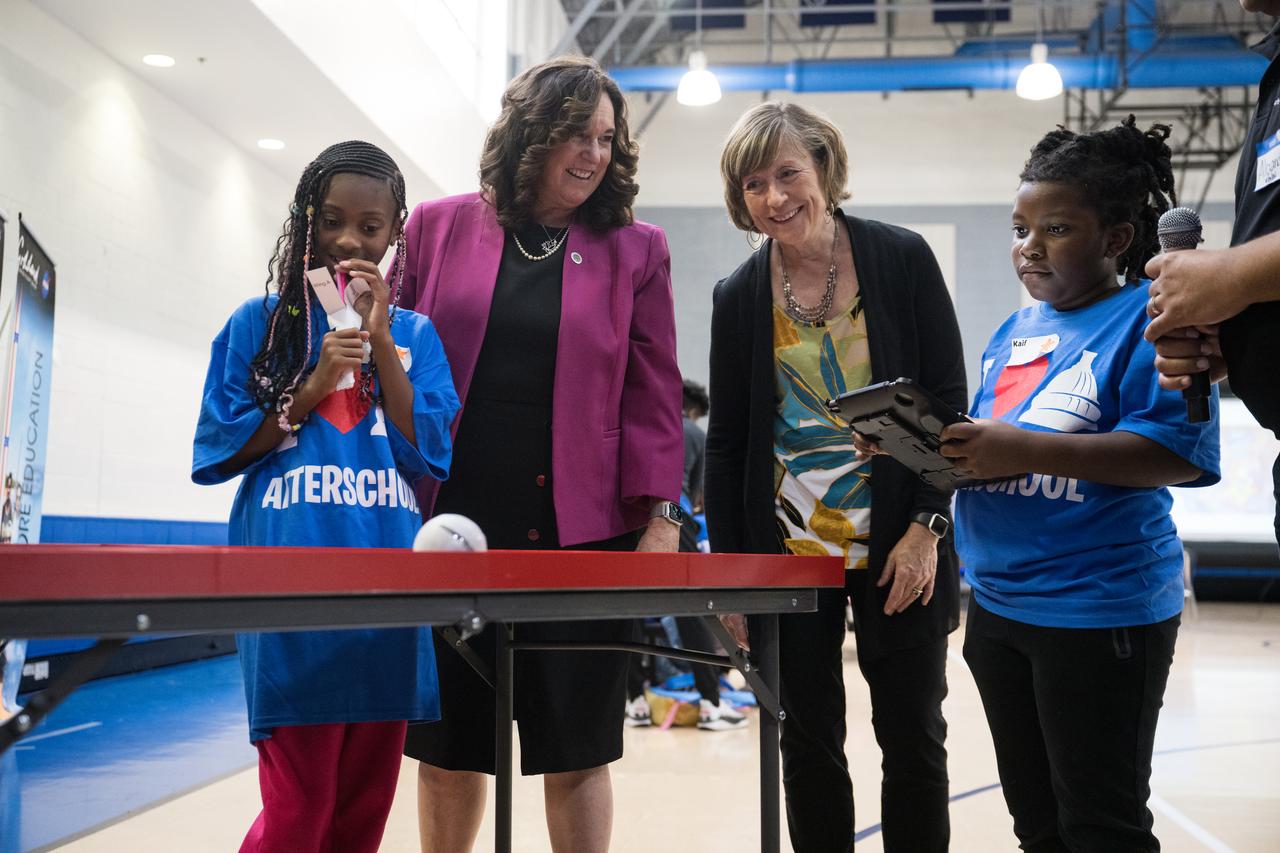
NASA Deputy Associate Administrator for NASA’s Office of STEM Engagement, Kris Brown, second from right, and U.S. Department of Education Deputy Secretary Cindy Marten, second from left, watch as a student operates a robot during a STEM event to kickoff the 21st Century Community Learning Centers NASA and U.S. Department of Education partnership, Monday, Sept. 23, 2024 at Wheatley Education Campus (EC) in Washington. Students engaged in NASA hands-on activities and an engineering design challenge. Photo Credit: (NASA/Aubrey Gemignani)
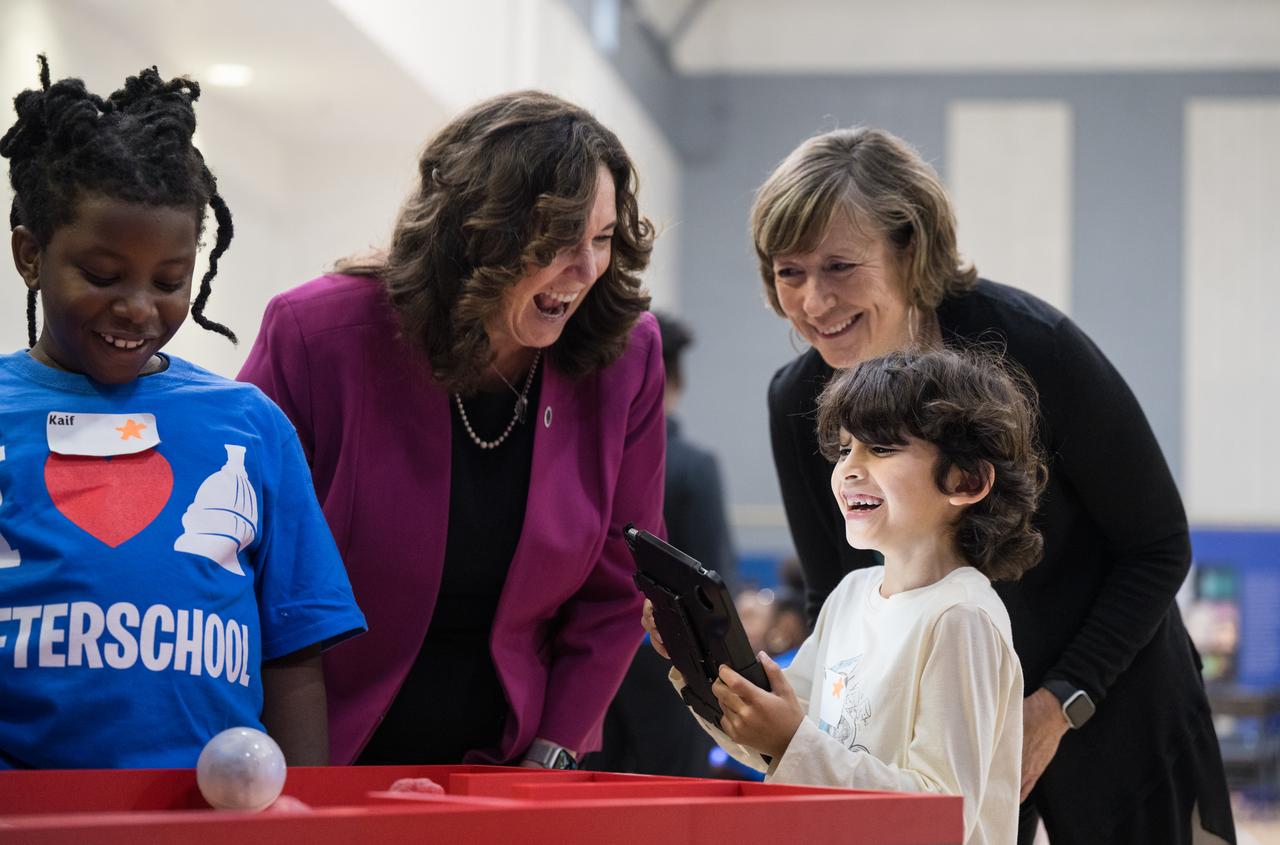
NASA Deputy Associate Administrator for NASA’s Office of STEM Engagement, Kris Brown, right, and U.S. Department of Education Deputy Secretary Cindy Marten, left, watch as a student operates a robot during a STEM event to kickoff the 21st Century Community Learning Centers NASA and U.S. Department of Education partnership, Monday, Sept. 23, 2024 at Wheatley Education Campus (EC) in Washington. Students engaged in NASA hands-on activities and an engineering design challenge. Photo Credit: (NASA/Aubrey Gemignani)

NASA Deputy Associate Administrator for NASA’s Office of STEM Engagement, Kris Brown, provides remarks at a kickoff event for the 21st Century Community Learning Centers NASA and Department of Education partnership, Monday, Sept. 23, 2024 at Wheatley Education Campus in Washington. Students engaged in NASA hands-on activities and an engineering design challenge. Photo Credit: (NASA/Aubrey Gemignani)
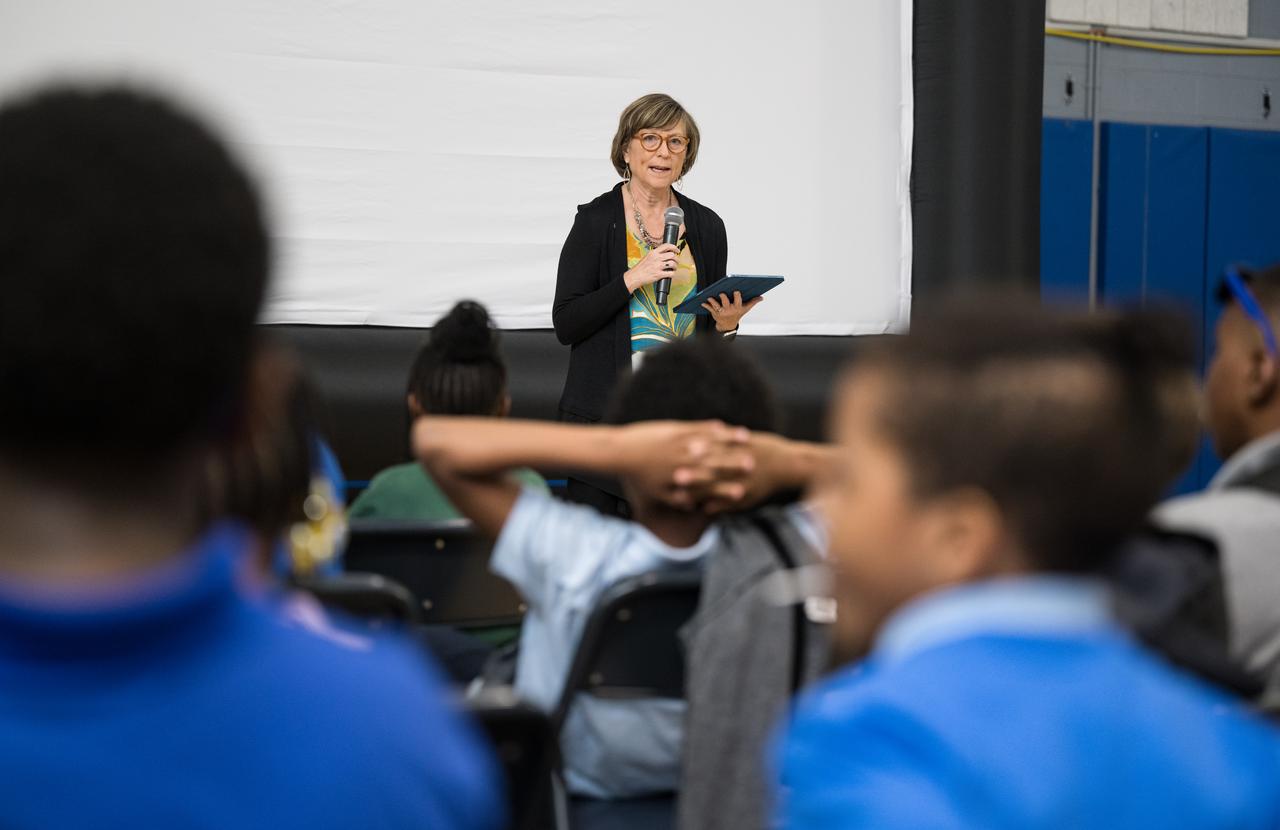
NASA Deputy Associate Administrator for NASA’s Office of STEM Engagement, Kris Brown, provides remarks at a kickoff event for the 21st Century Community Learning Centers NASA and Department of Education partnership, Monday, Sept. 23, 2024 at Wheatley Education Campus in Washington. Students engaged in NASA hands-on activities and an engineering design challenge. Photo Credit: (NASA/Aubrey Gemignani)
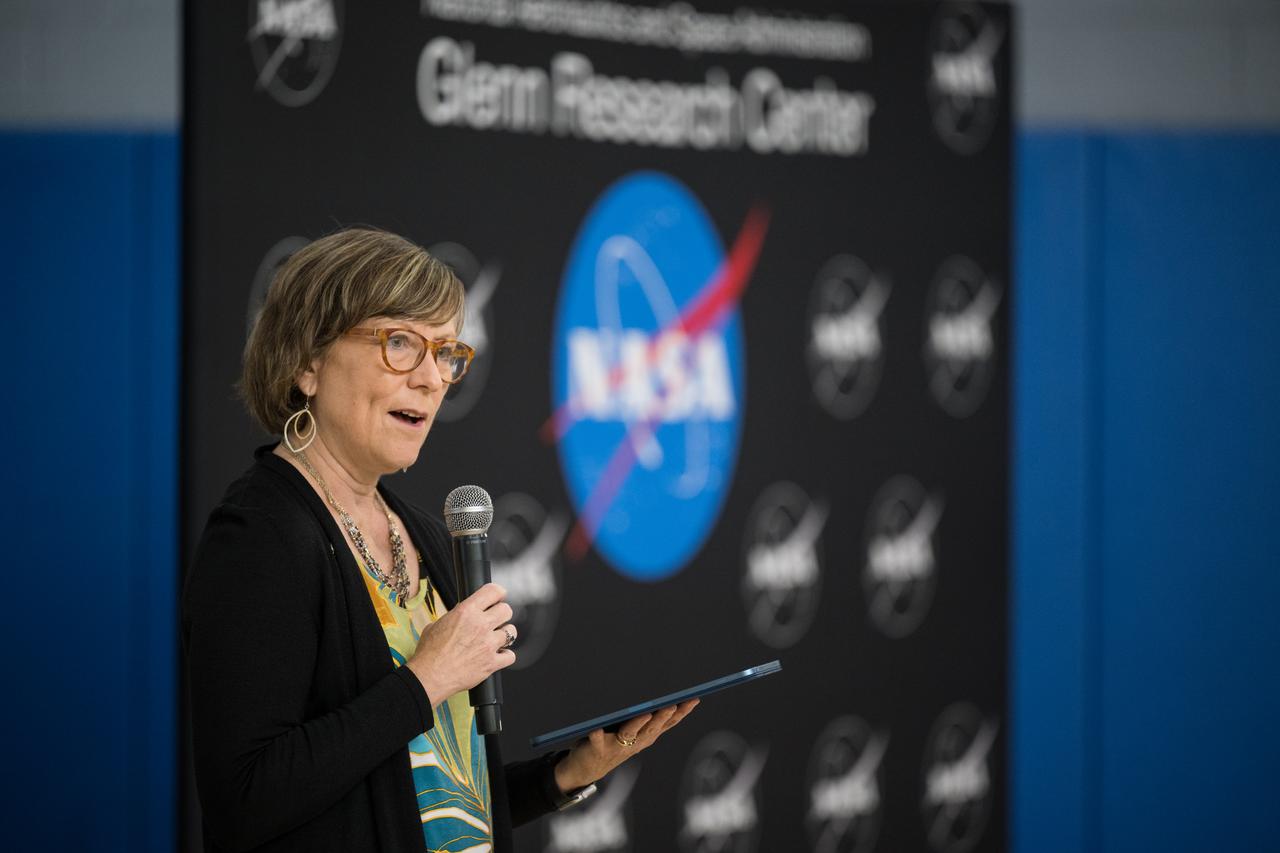
NASA Deputy Associate Administrator for NASA’s Office of STEM Engagement, Kris Brown, provides remarks at a kickoff event for the 21st Century Community Learning Centers NASA and Department of Education partnership, Monday, Sept. 23, 2024 at Wheatley Education Campus in Washington. Students engaged in NASA hands-on activities and an engineering design challenge. Photo Credit: (NASA/Aubrey Gemignani)
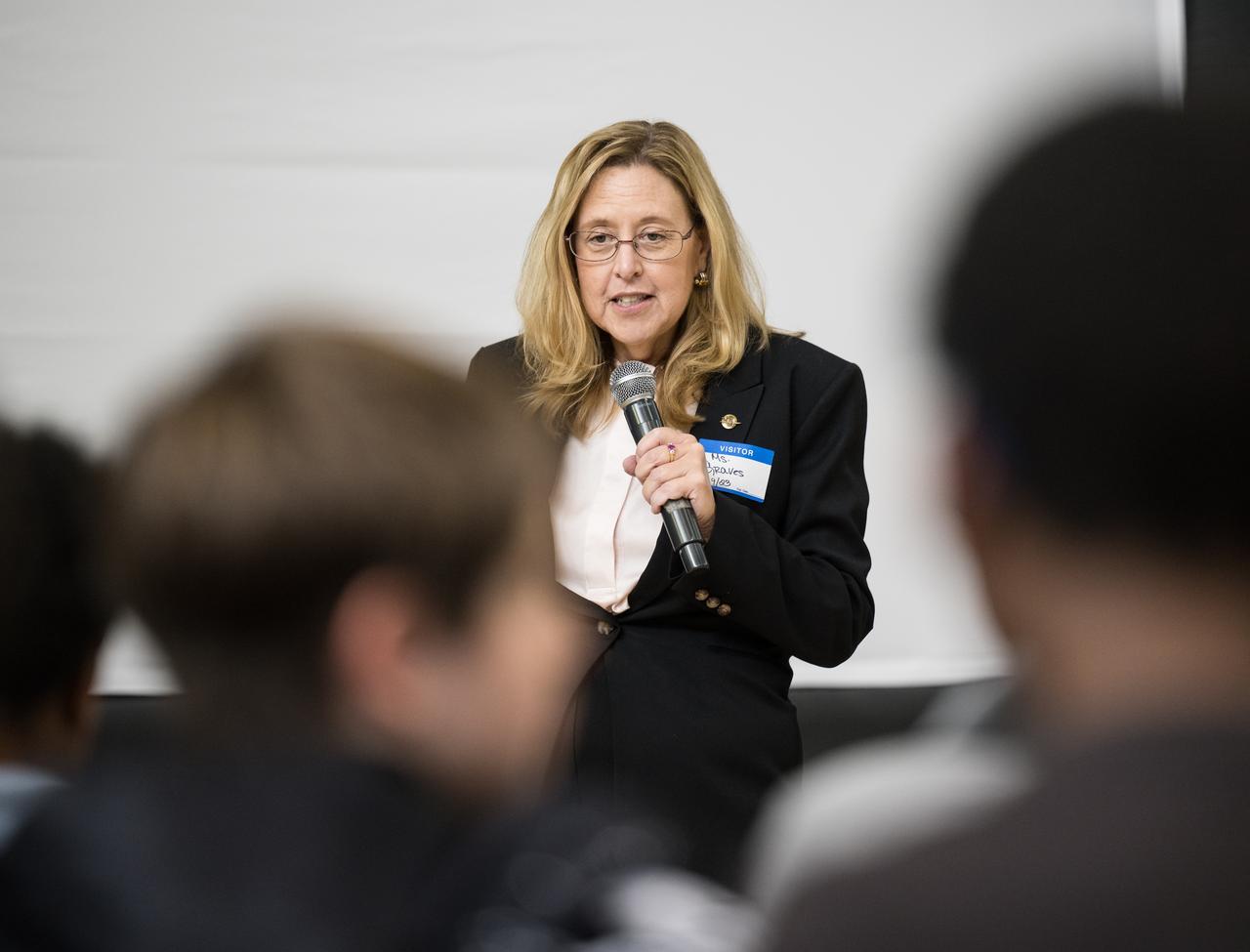
STEM Integration Manager at NASA’s Glenn Research Center (GRC) Office of STEM Engagement, Catherine Graves, provides welcome remarks at a kickoff event for the 21st Century Community Learning Centers NASA and Department of Education partnership, Monday, Sept. 23, 2024 at Wheatley Education Campus in Washington. Students engaged in NASA hands-on activities and an engineering design challenge. Photo Credit: (NASA/Aubrey Gemignani)
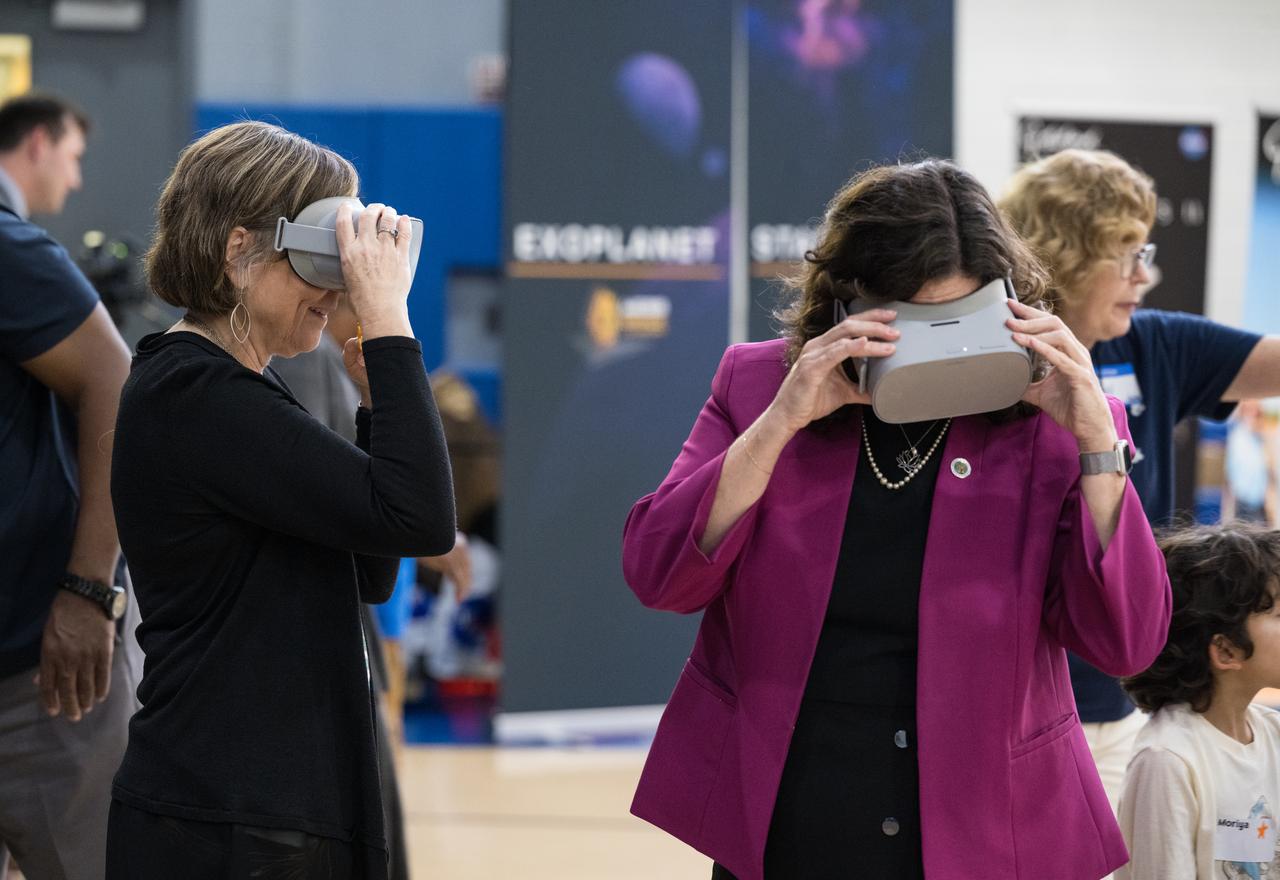
NASA Deputy Associate Administrator for NASA’s Office of STEM Engagement, Kris Brown, left, and U.S. Department of Education Deputy Secretary Cindy Marten, right, participate in a virtual reality tour of NASA’s Neutral Buoyancy Lab during a kickoff event for the 21st Century Community Learning Centers NASA and Department of Education partnership, Monday, Sept. 23, 2024 at Wheatley Education Campus in Washington. Photo Credit: (NASA/Aubrey Gemignani)

Deputy Secretary of the U.S. Department of Education, Cindy Marten, provides remarks at a kickoff event for the 21st Century Community Learning Centers NASA and Department of Education partnership, Monday, Sept. 23, 2024 at Wheatley Education Campus in Washington. Students engaged in NASA hands-on activities and an engineering design challenge. Photo Credit: (NASA/Aubrey Gemignani)
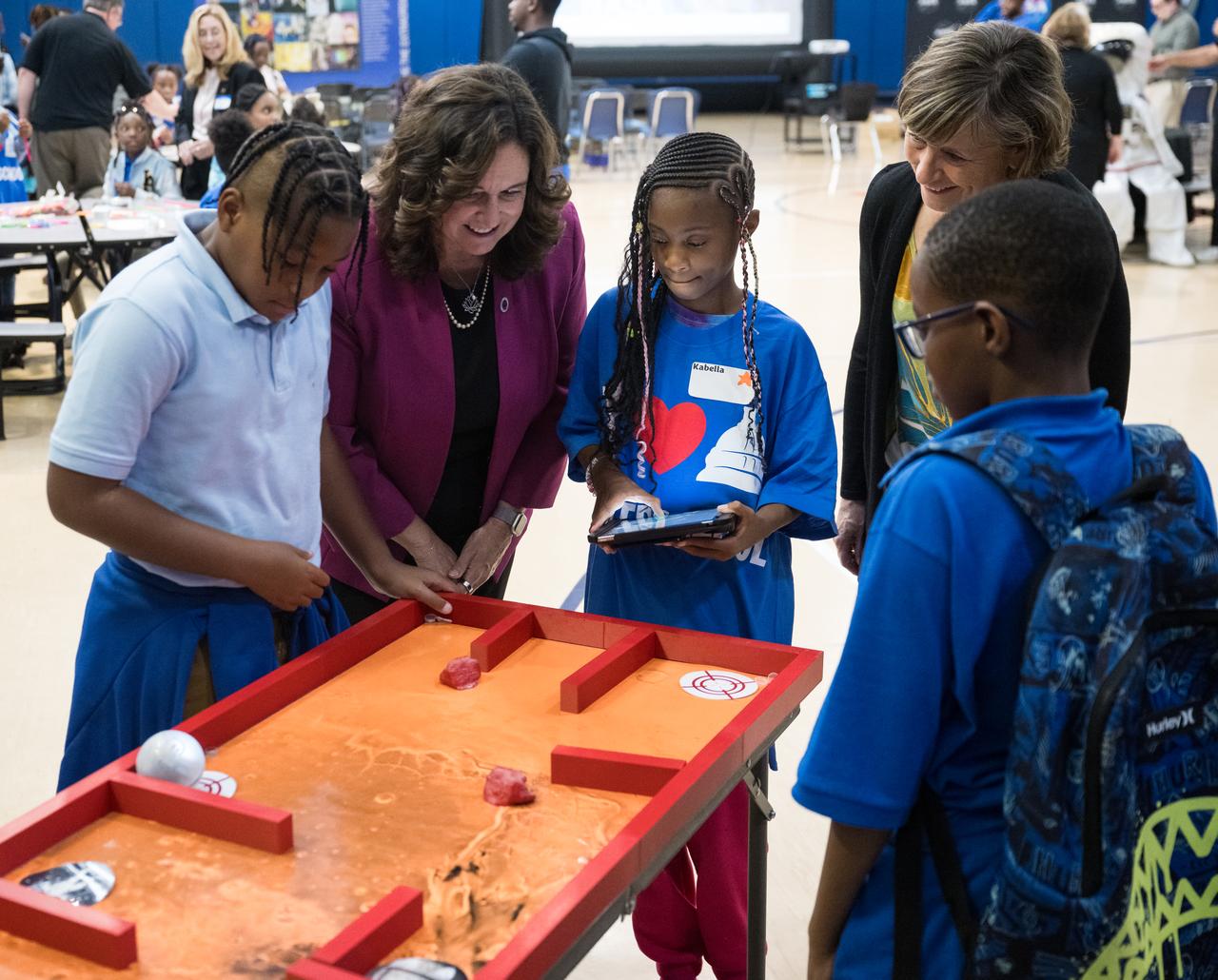
NASA Deputy Associate Administrator for NASA’s Office of STEM Engagement, Kris Brown, second from right, and U.S. Department of Education Deputy Secretary Cindy Marten, second from left, watch as a student operates a robot during a STEM event to kickoff the 21st Century Community Learning Centers NASA and U.S. Department of Education partnership, Monday, Sept. 23, 2024 at Wheatley Education Campus (EC) in Washington. Students engaged in NASA hands-on activities and an engineering design challenge. Photo Credit: (NASA/Aubrey Gemignani)
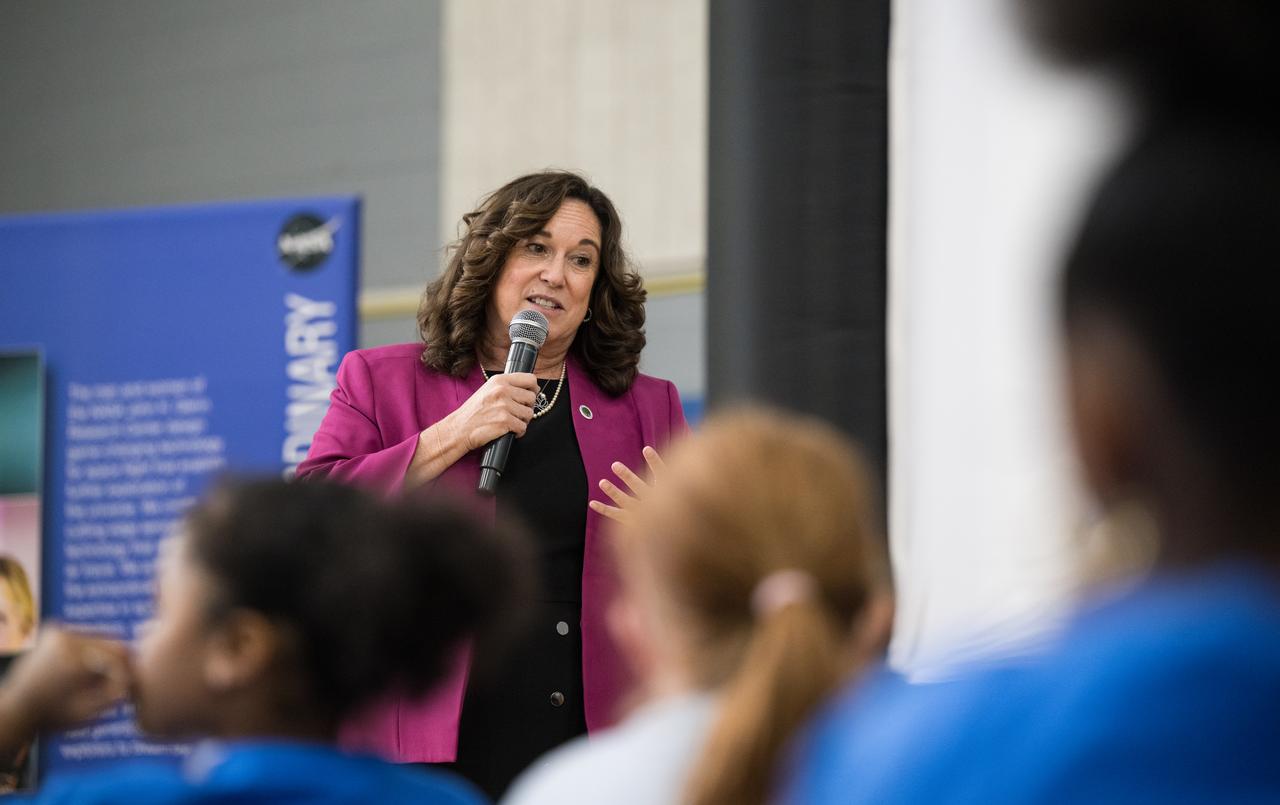
Deputy Secretary of the U.S. Department of Education, Cindy Marten, provides remarks at a kickoff event for the 21st Century Community Learning Centers NASA and Department of Education partnership, Monday, Sept. 23, 2024 at Wheatley Education Campus in Washington. Students engaged in NASA hands-on activities and an engineering design challenge. Photo Credit: (NASA/Aubrey Gemignani)
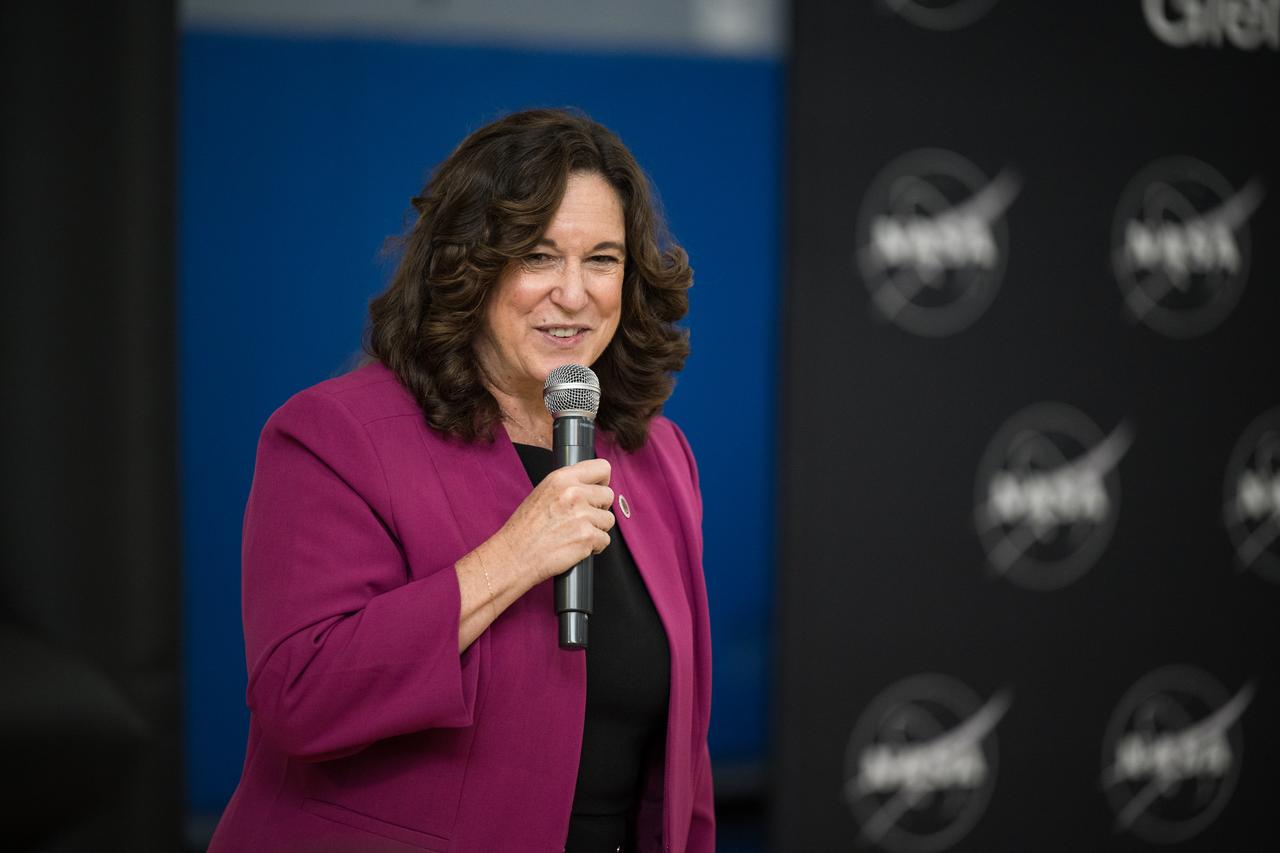
Deputy Secretary of the U.S. Department of Education, Cindy Marten, provides remarks at a kickoff event for the 21st Century Community Learning Centers NASA and Department of Education partnership, Monday, Sept. 23, 2024 at Wheatley Education Campus in Washington. Students engaged in NASA hands-on activities and an engineering design challenge. Photo Credit: (NASA/Aubrey Gemignani)
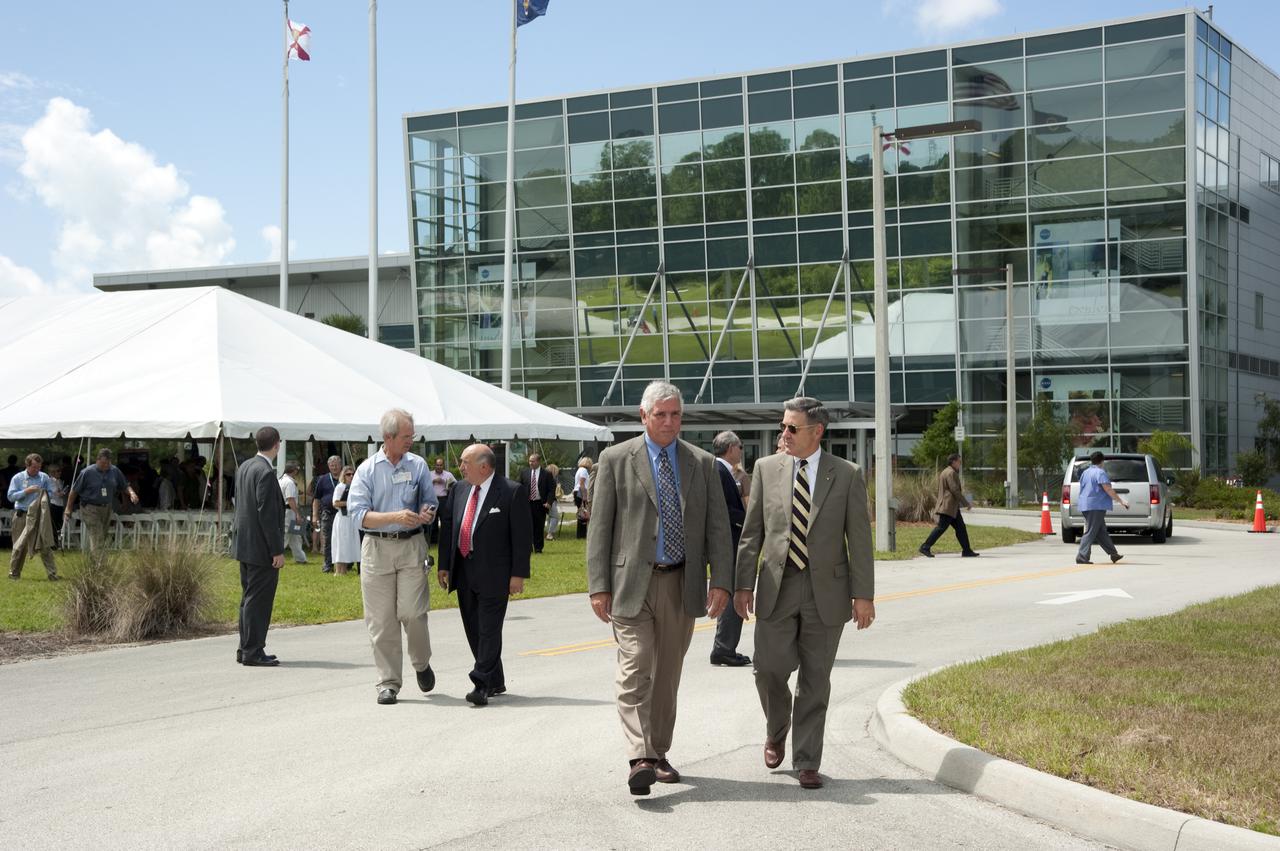
CAPE CANAVERAL, Fla. – At NASA's Kennedy Space Center in Florida, Kennedy Center Director Bob Cabana, right, walks with Program Manager for Strategic Partnerships at Kennedy Jim Ball to the ground breaking site of Exploration Park outside of the Space Life Sciences Laboratory, or SLSL. To their left, are The Pizzuti Companies Chairman and CEO Ron Pizzuti and Patrick Peterson, a space reporter with Florida Today. Exploration Park is designed to be a strategically located complex, adjacent to the SLSL, for servicing diverse tenants and uses that will engage in activities to support space-related activities of NASA, other government agencies and the U.S. commercial space industry, as well as bring new aerospace work to the Space Coast. The SLSL will be the anchor facility for the park, which is expected to open its first new facility in early 2012. Photo Credit: NASA_Kim Shiflett
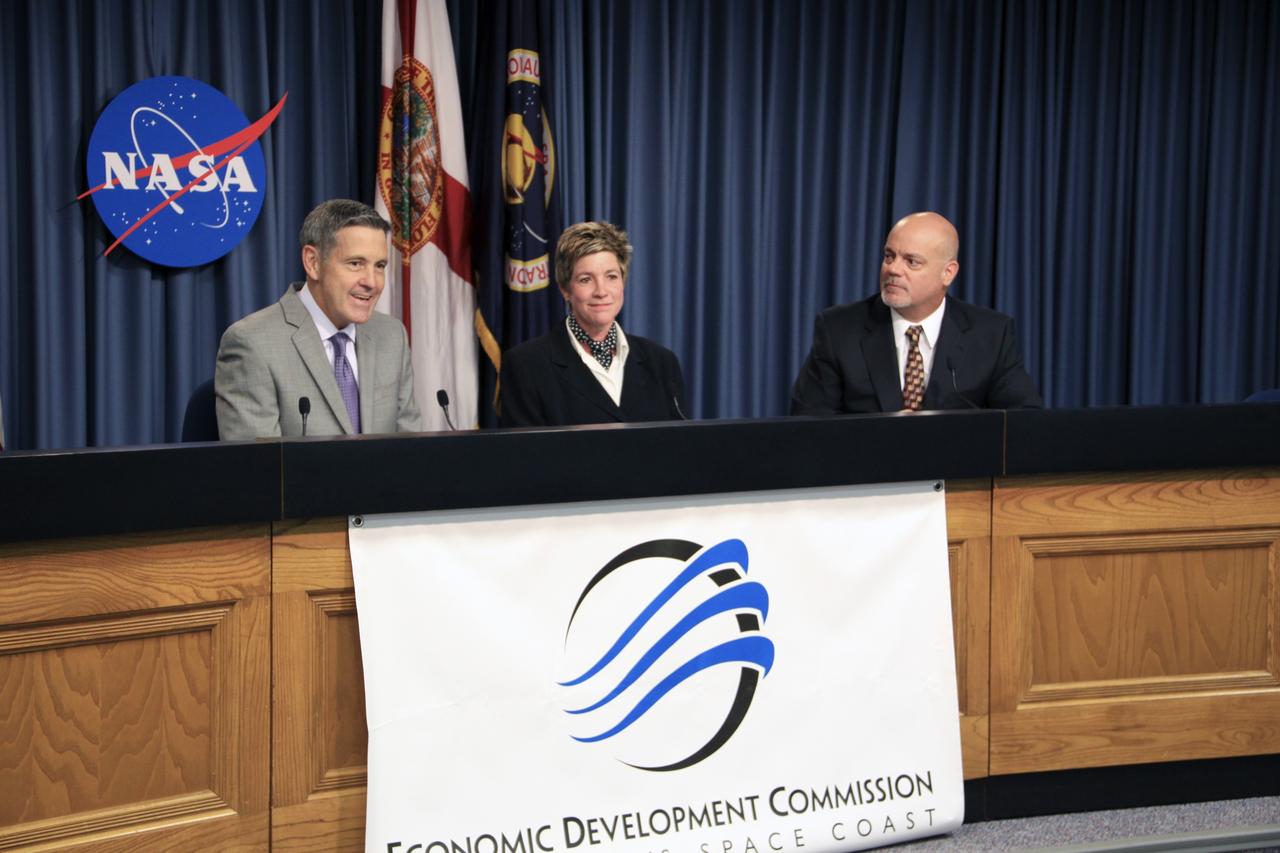
CAPE CANAVERAL, Fla. -- In the Press Site auditorium at NASA's Kennedy Space Center in Florida, managers from NASA and the Economic Development Commission (EDC) of Florida’s Space Coast discuss a new five-year Space Act Agreement reaffirming the partnership of the two organizations. From left are Kennedy Space Center Director Robert Cabana, EDC President and CEO Lynda Weatherman, and Chairman of the Board of the EDC Bob Whelen. The agreement calls for NASA and EDC senior leadership to meet regularly to discuss economic development matters of mutual interest. Managers from Kennedy’s Center Planning and Development Office will work with the EDC on potential business partnerships and meet with business leaders and committees to address space-related and high-tech economic development. EDC officials will assist NASA with disseminating information about potential partnership opportunities, as well as space-related and high-tech economic development, and increase awareness of Kennedy’s Engineering and Technology Directorate collaboration initiatives. They also will promote the commercial use of underutilized facilities at Kennedy. NASA and the EDC entered into their first economic cooperation agreement in 2005. For more information about the Economic Development Commission (EDC) of Florida’s Space Coast, visit http://www.spacecoastedc.org/. Photo credit: NASA/Jim Grossmann
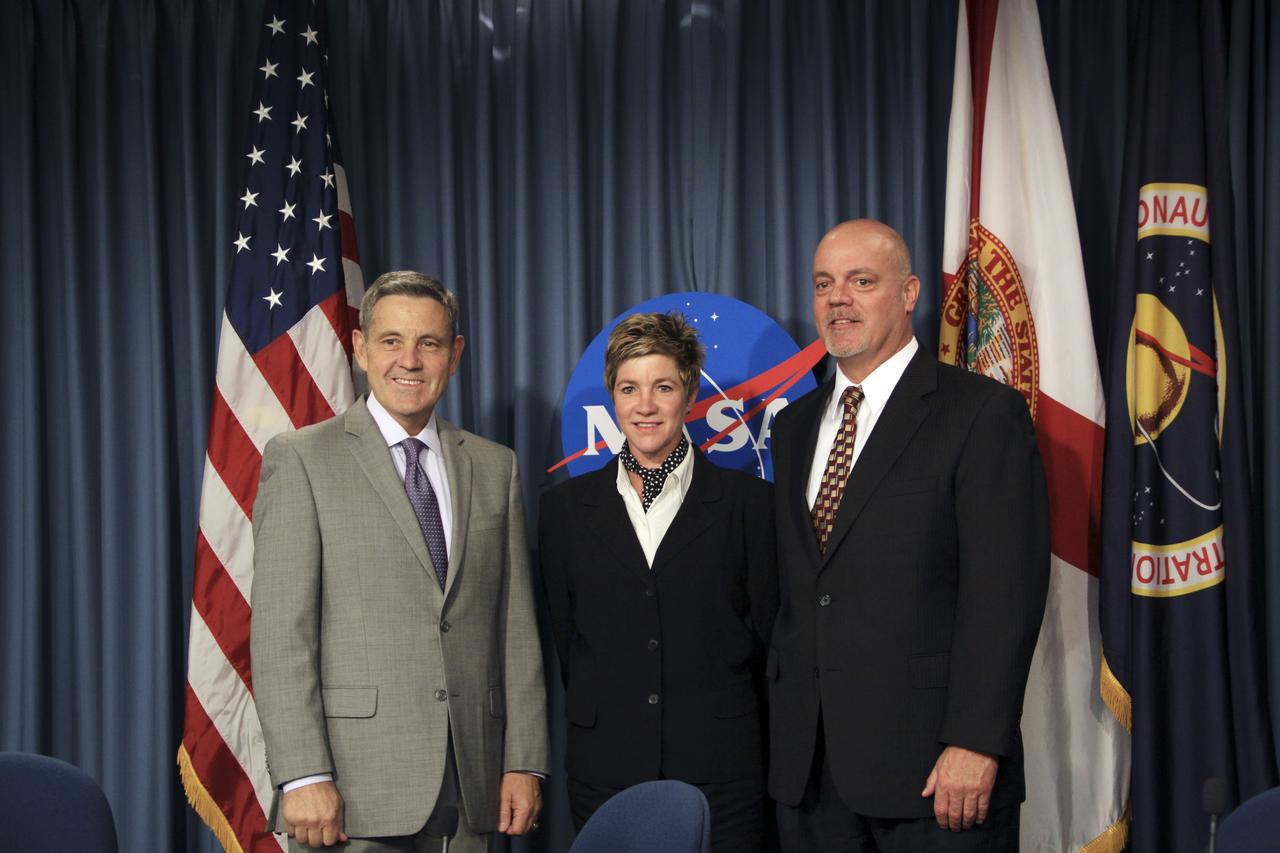
CAPE CANAVERAL, Fla. -- In the Press Site auditorium at NASA's Kennedy Space Center in Florida, managers from NASA and the Economic Development Commission (EDC) of Florida’s Space Coast pose for a portrait following the signing of a new five-year Space Act Agreement reaffirming the partnership of the two organizations. From left are Kennedy Space Center Director Robert Cabana, EDC President and CEO Lynda Weatherman, and Chairman of the Board of the EDC Bob Whelen. The agreement calls for NASA and EDC senior leadership to meet regularly to discuss economic development matters of mutual interest. Managers from Kennedy’s Center Planning and Development Office will work with the EDC on potential business partnerships and meet with business leaders and committees to address space-related and high-tech economic development. EDC officials will assist NASA with disseminating information about potential partnership opportunities, as well as space-related and high-tech economic development, and increase awareness of Kennedy’s Engineering and Technology Directorate collaboration initiatives. They also will promote the commercial use of underutilized facilities at Kennedy. NASA and the EDC entered into their first economic cooperation agreement in 2005. For more information about the Economic Development Commission (EDC) of Florida’s Space Coast, visit http://www.spacecoastedc.org/. Photo credit: NASA/Jim Grossmann
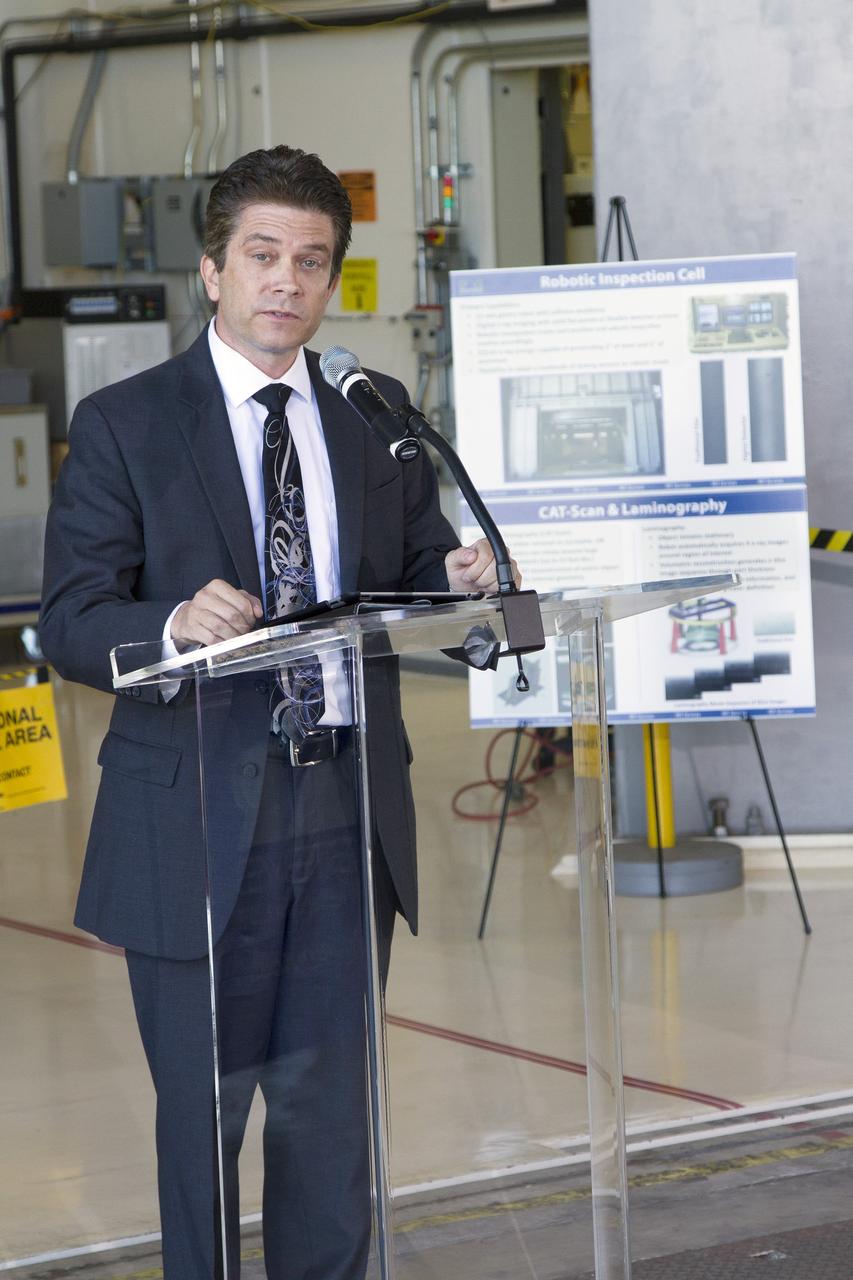
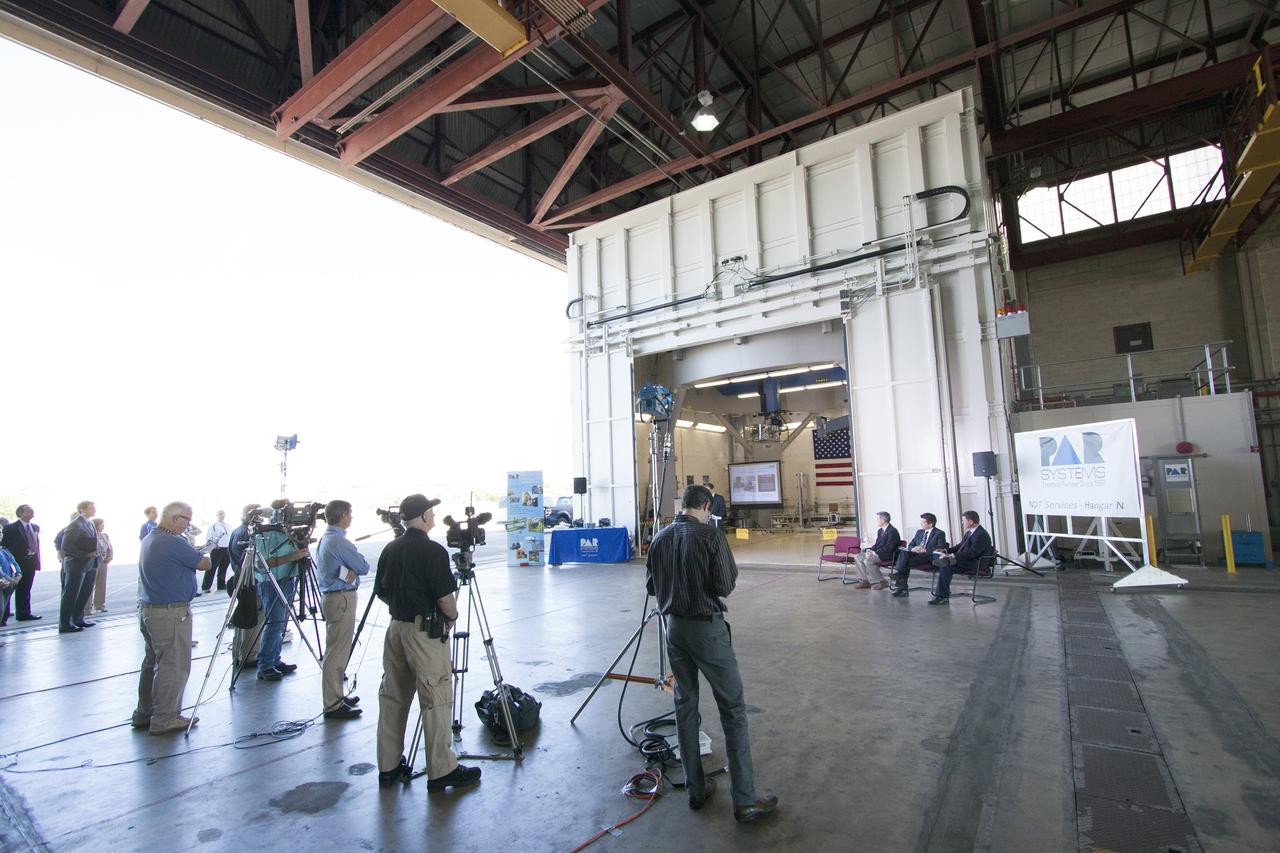
CAPE CANAVERAL, Fla. – Robert Salonen, business development director with the Economic Development Commission of Florida's Space Coast, speaks during an Open House event at Hangar N at Cape Canaveral Air Force Station in Florida, to celebrate the one-year anniversary of PaR Systems' partnership with Kennedy Space Center. Under a 15-year lease agreement, PaR Systems is utilizing Hangar N and its unique nondestructive testing equipment. The partnership agreement was established by Kennedy's Center Planning and Development Directorate. The agreement is just one example of the types of partnerships that Kennedy is seeking to create a multi-user spaceport. Photo credit: NASA/Cory Huston
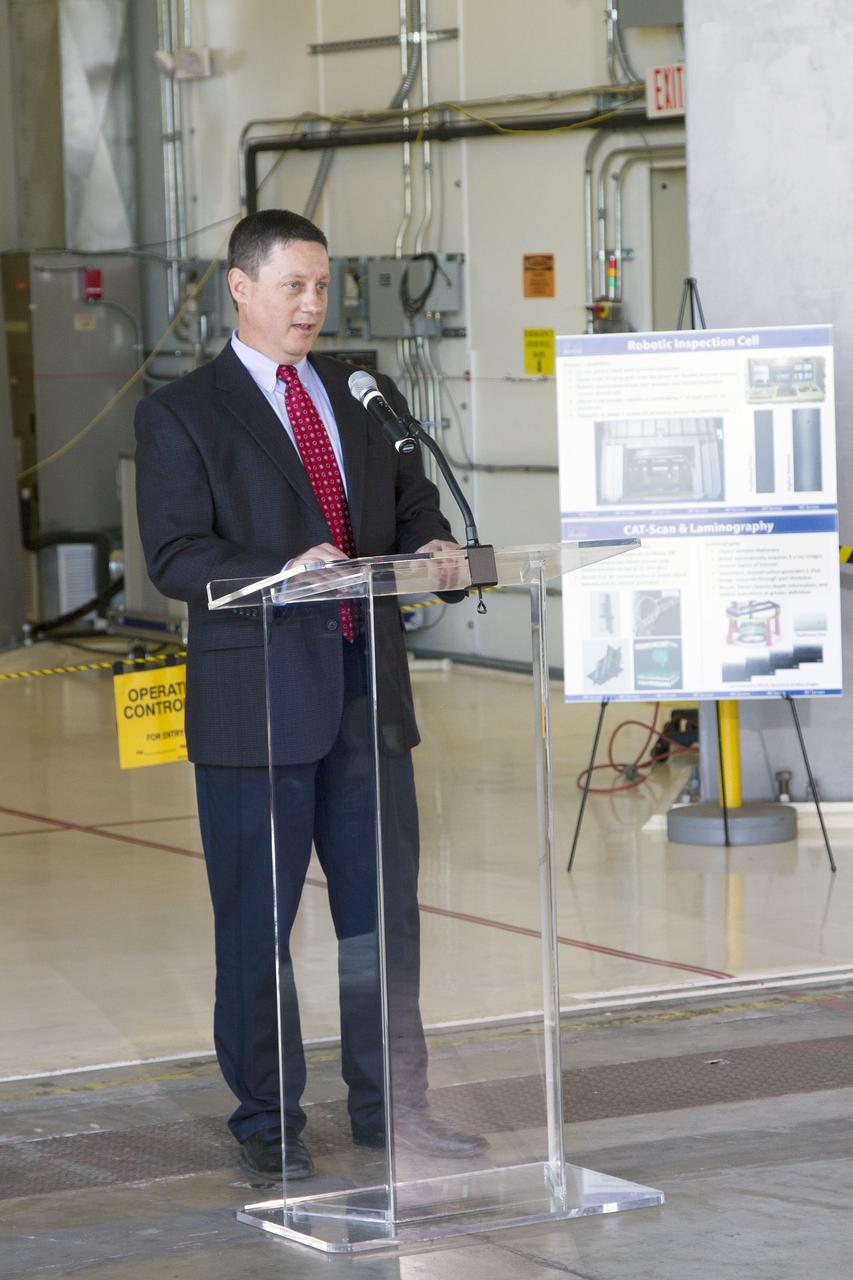
CAPE CANAVERAL, Fla. – Tony Corak, manager of nondestructive testing services for PaR Systems Inc., speaks during an Open House event at Hangar N at Cape Canaveral Air Force Station in Florida, to celebrate the one-year anniversary of a partnership with NASA Kennedy Space Center. Under a 15-year lease agreement, PaR Systems is utilizing Hangar N and its unique nondestructive testing equipment. The partnership agreement was established by Kennedy's Center Planning and Development Directorate. The agreement is just one example of the types of partnerships that Kennedy is seeking to create a multi-user spaceport. Photo credit: NASA/Cory Huston
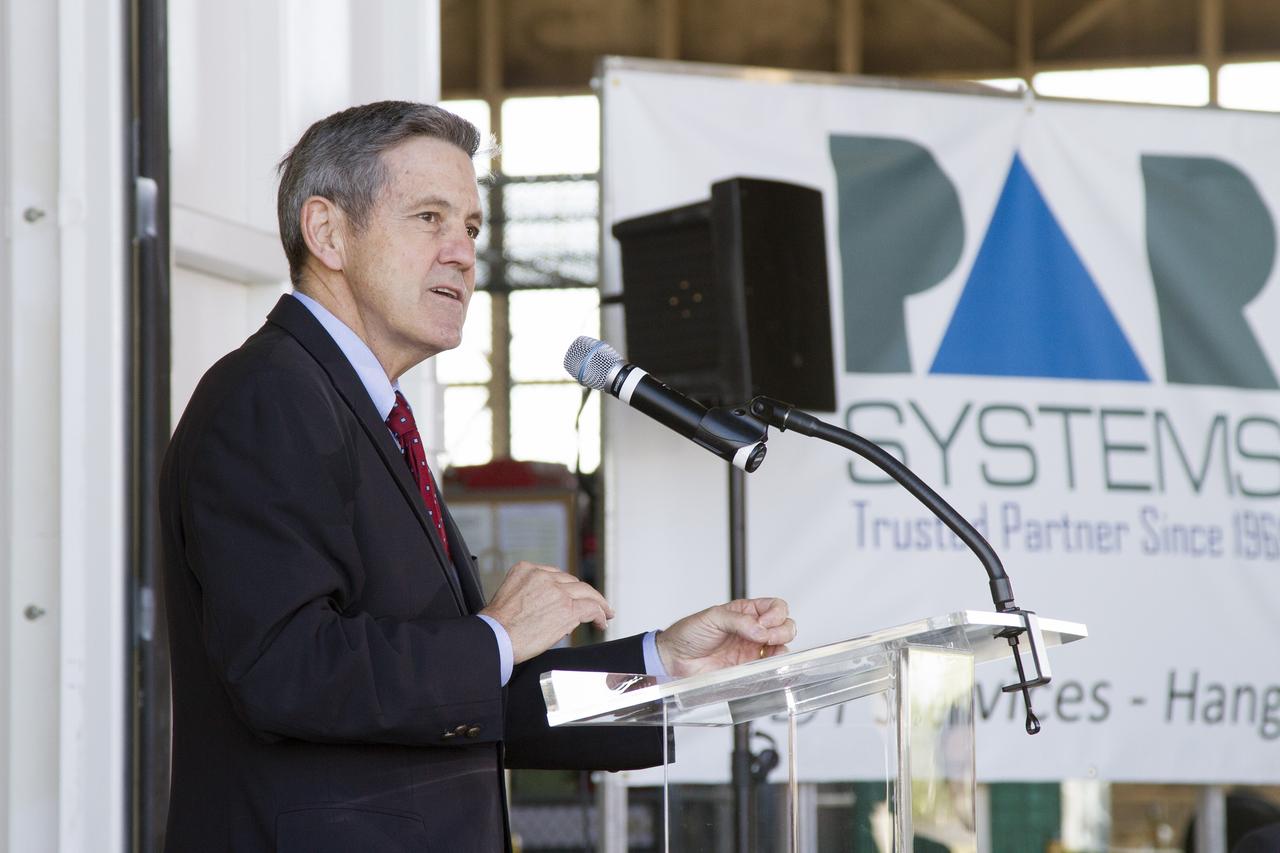
CAPE CANAVERAL, Fla. – Kennedy Space Center Director Bob Cabana speaks during an Open House event at Hangar N at Cape Canaveral Air Force Station in Florida, to celebrate the one-year anniversary of PaR Systems' partnership with Kennedy. Under a 15-year lease agreement, PaR Systems is utilizing Hangar N and its unique nondestructive testing equipment. The partnership agreement was established by Kennedy's Center Planning and Development Directorate. The agreement is just one example of the types of partnerships that Kennedy is seeking to create a multi-user spaceport. Photo credit: NASA/Cory Huston
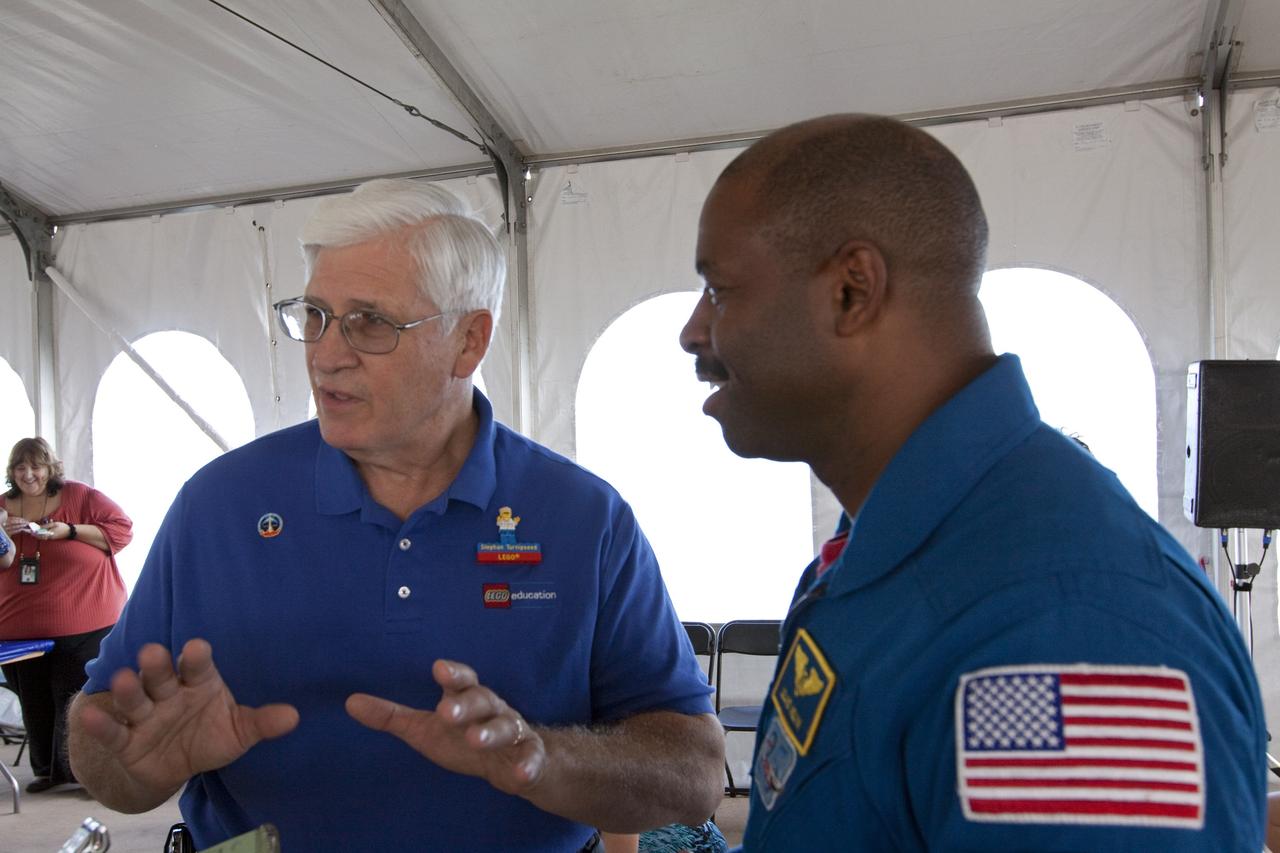
CAPE CANAVERAL, Fla. -- Stephan Turnipseed, president of LEGO Education North America, left, and Leland Melvin, NASA's associate administrator for Education, discuss the new partnership between the U.S. space agency and the toy company inside a 40- by 70-foot activity tent chock full of LEGO bricks on the NASA Causeway at Kennedy Space Center in Florida. There, children of all ages are building their vision of the future with LEGO bricks, marking the beginning of a three-year Space Act Agreement meant to spark the interest of children in science, technology, engineering and mathematics (STEM). To commemorate the partnership, two small LEGO space shuttles will launch aboard space shuttle Discovery's STS-133 mission to the International Space Station and the company will release four NASA-inspired products in its LEGO CITY line next year. LEGO sets also will fly to the space station aboard Endeavour's STS-134 mission, and will be put together on orbit to demonstrate the challenges faced while building things in microgravity. Photo credit: NASA/Jack Pfaller

Reggie Alexander, manager of the Marshall Space Flight Center’s Partnerships and Formulation Office, is interviewed by a member of the MSFC Public Affairs Office. The Partnerships Formulation Office supports commercial development of future human landing systems
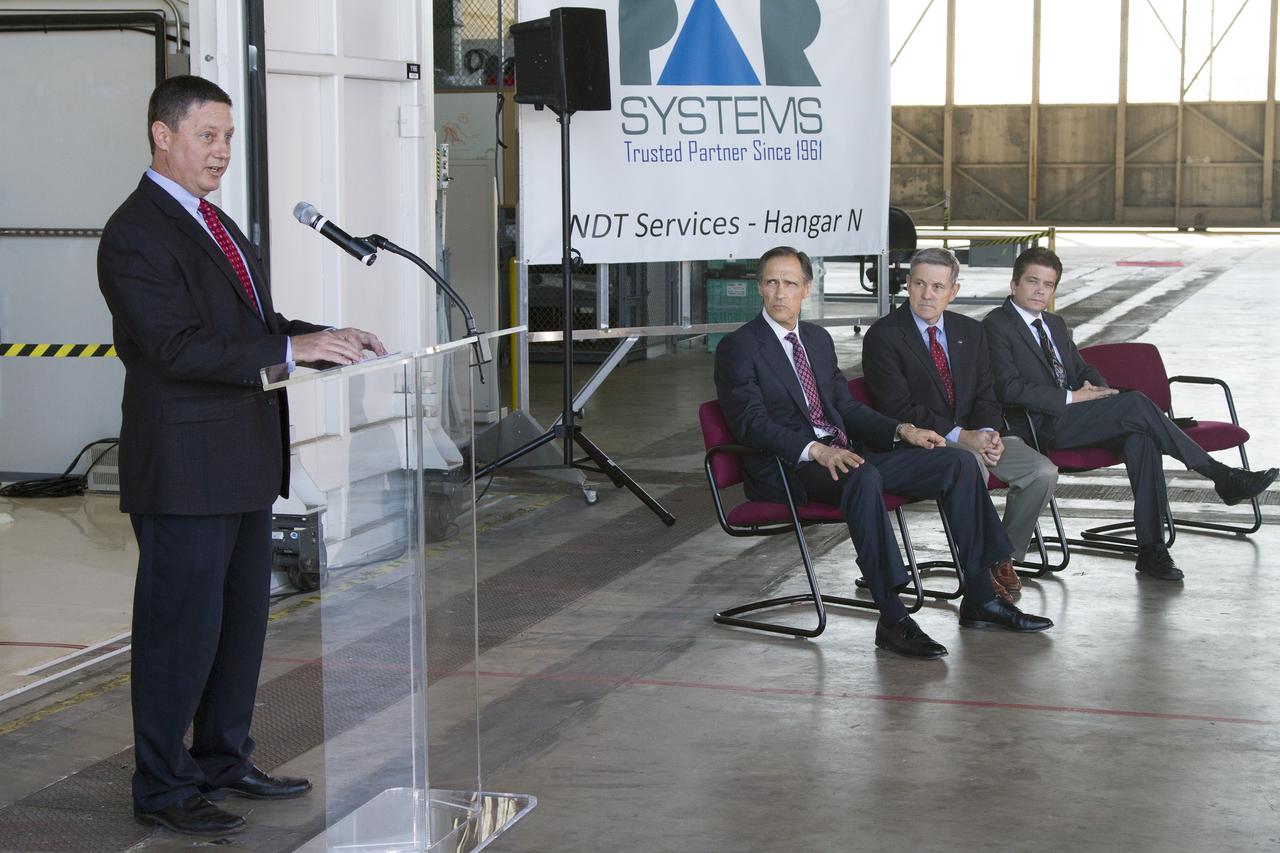
CAPE CANAVERAL, Fla. – Tony Corak, manager of nondestructive testing services for PaR Systems Inc., speaks during an Open House event at Hangar N at Cape Canaveral Air Force Station in Florida, to celebrate the one-year anniversary of a partnership with NASA Kennedy Space Center. Under a 15-year lease agreement, PaR Systems is utilizing Hangar N and its unique nondestructive testing equipment. To Corak's right is Brian Behm, president, aerospace robotics, PaR Systems Inc., Kennedy Center Director Bob Cabana, and Robert Salonen, business development director with the Economic Development Commission of Florida's Space Coast. The partnership agreement was established by Kennedy's Center Planning and Development Directorate. The agreement is just one example of the types of partnerships that Kennedy is seeking to create a multi-user spaceport. Photo credit: NASA/Cory Huston
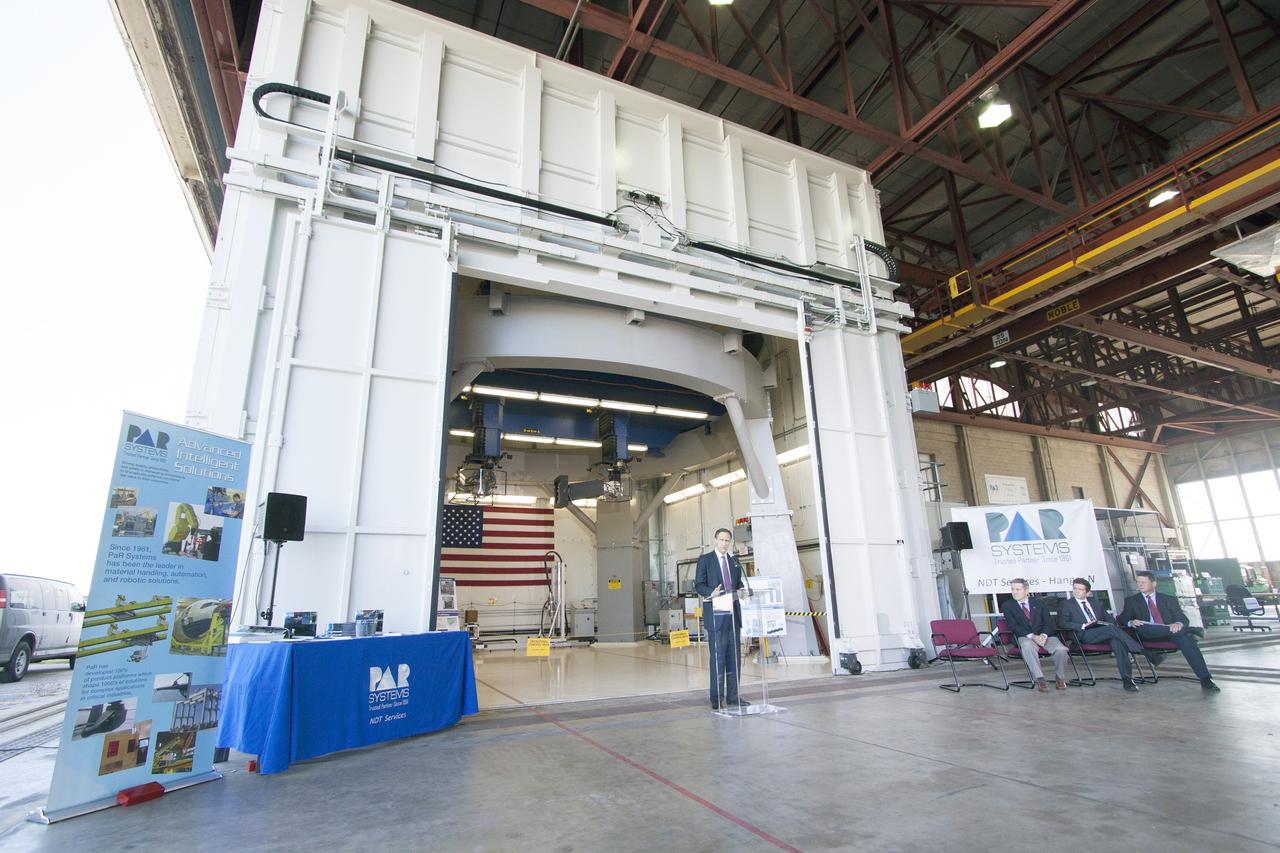
CAPE CANAVERAL, Fla. – Brian Behm, president, aerospace robotics, PaR Systems Inc., speaks during an Open House event at Hangar N at Cape Canaveral Air Force Station in Florida, to celebrate the one-year anniversary of a partnership with NASA Kennedy Space Center. Under a 15-year lease agreement, PaR Systems is utilizing Hangar N and its unique nondestructive testing equipment. Behind Behm is the robotic inspection cell that contains an automated X-ray system once used to scan the aft skirts of the solid rocket boosters for the space shuttle. The partnership agreement was established by Kennedy's Center Planning and Development Directorate. The agreement is just one example of the types of partnerships that Kennedy is seeking to create a multi-user spaceport. Photo credit: NASA/Cory Huston
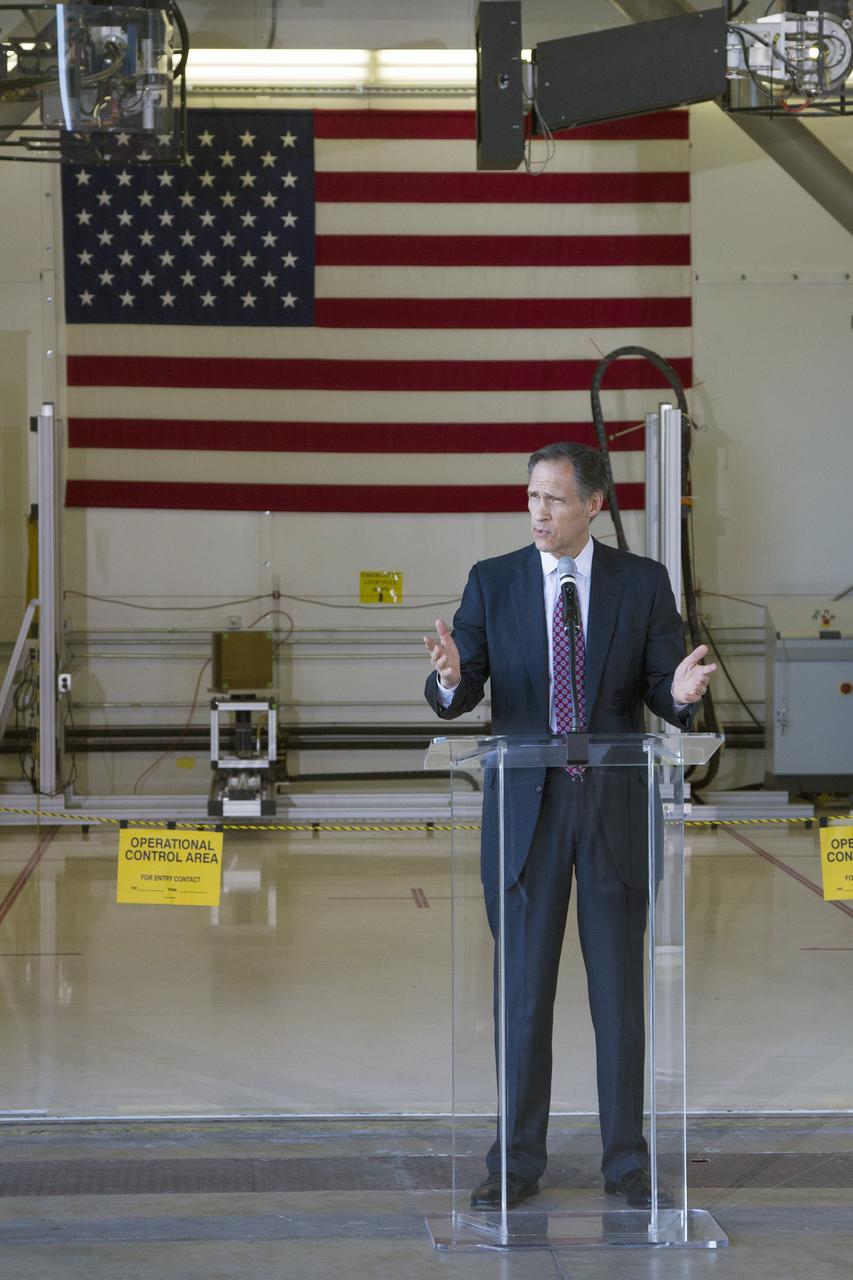
CAPE CANAVERAL, Fla. – Brian Behm, president, aerospace robotics, PaR Systems Inc., speaks during an Open House event at Hangar N at Cape Canaveral Air Force Station in Florida, to celebrate the one-year anniversary of a partnership with NASA Kennedy Space Center. Under a 15-year lease, PaR Systems is utilizing Hangar N and its unique nondestructive testing equipment. Behind Behm is the robotic inspection cell that contains an automated X-ray system once used to scan the aft skirts of the solid rocket boosters for the space shuttle. The partnership agreement was established by Kennedy's Center Planning and Development Directorate. The agreement is just one example of the types of partnerships that Kennedy is seeking to create a multi-user spaceport. Photo credit: NASA/Cory Huston
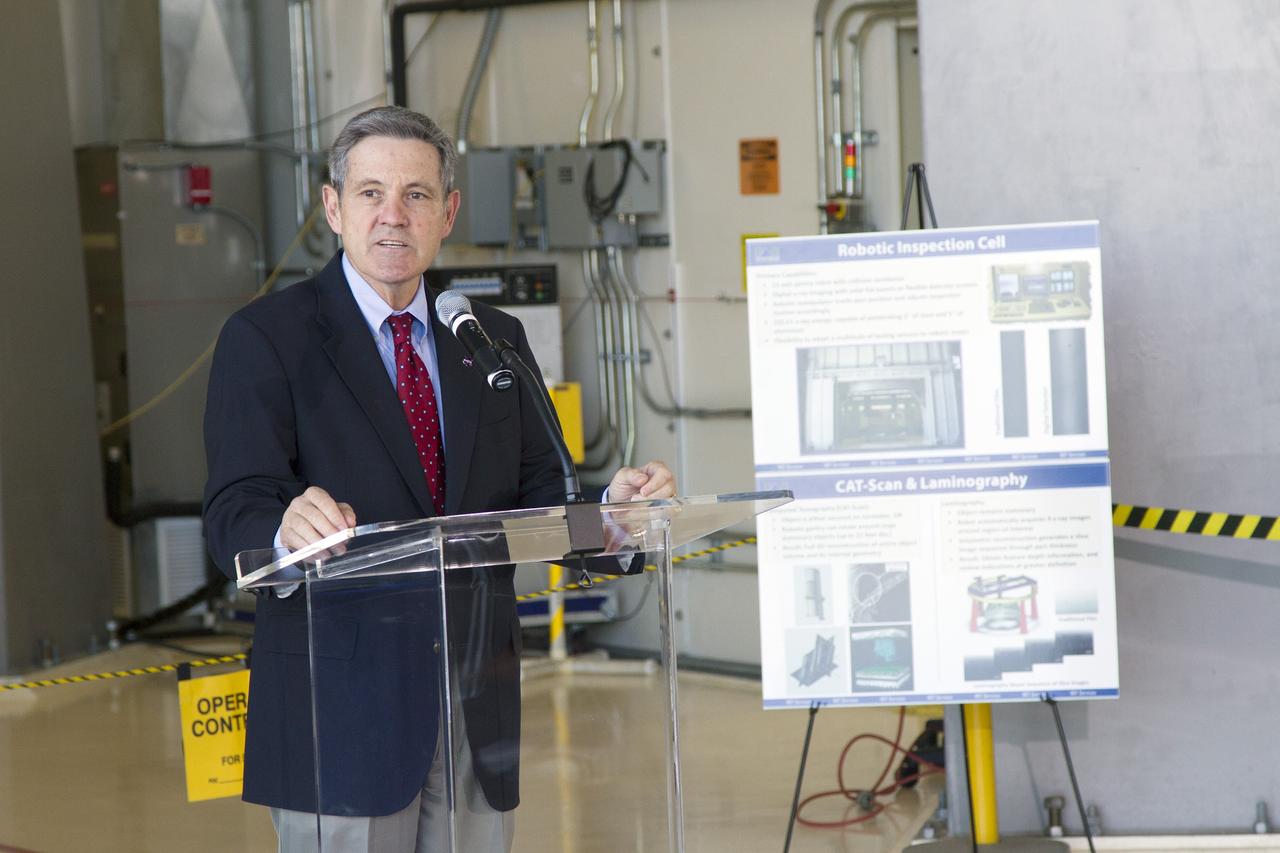
CAPE CANAVERAL, Fla. – Kennedy Space Center Director Bob Cabana speaks during an Open House event at Hangar N at Cape Canaveral Air Force Station in Florida, to celebrate the one-year anniversary of PaR Systems' partnership with Kennedy. Under a 15-year lease agreement, PaR Systems is utilizing Hangar N and its unique nondestructive testing equipment. Behind Cabana is the robotic inspection cell that contains an automated X-ray system once used to scan the aft skirts of the solid rocket boosters for the space shuttle. The partnership agreement was established by Kennedy's Center Planning and Development Directorate. The agreement is just one example of the types of partnerships that Kennedy is seeking to create a multi-user spaceport. Photo credit: NASA/Cory Huston
CAPE CANAVERAL, Fla. – Brian Behm partially hidden, president, aerospace robotics, PaR Systems Inc., speaks during an Open House event at Hangar N at Cape Canaveral Air Force Station in Florida, to celebrate the one-year anniversary of a partnership with NASA Kennedy Space Center. Under a 15-year lease agreement, PaR Systems is utilizing Hangar N and its unique nondestructive testing equipment. Behind Behm is the robotic inspection cell that contains an automated X-ray system once used to scan the aft skirts of the solid rocket boosters for the space shuttle. The partnership agreement was established by Kennedy's Center Planning and Development Directorate. The agreement is just one example of the types of partnerships that Kennedy is seeking to create a multi-user spaceport. Photo credit: NASA/Cory Huston
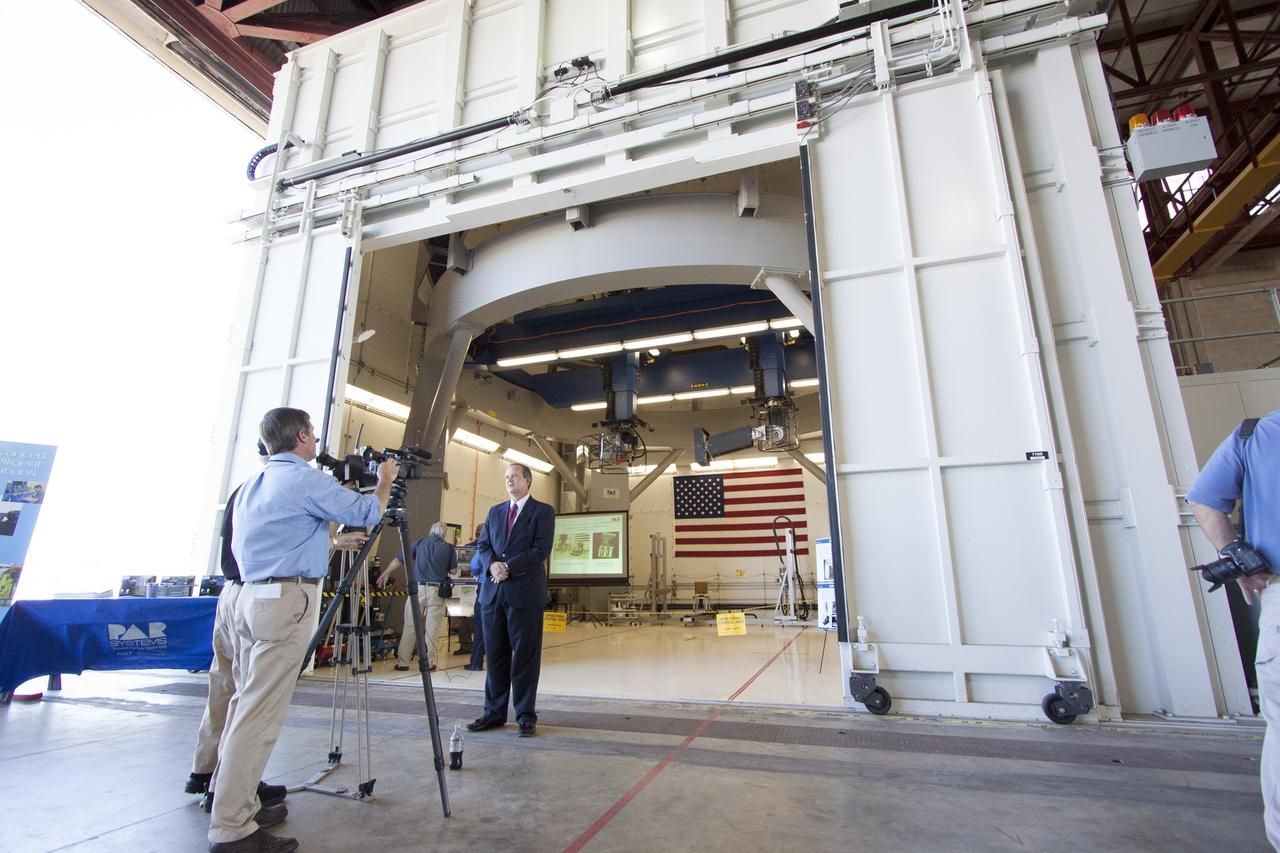
CAPE CANAVERAL, Fla. – Tom Engler, deputy director of the Center Planning and Development Directorate at Kennedy Space Center, speaks to members of the media during an Open House event at Hangar N at Cape Canaveral Air Force Station in Florida, to celebrate the one-year anniversary of PaR Systems' partnership with Kennedy. Under a 15-year lease agreement, PaR Systems is utilizing Hangar N and its unique nondestructive testing equipment. Behind Engler is the robotic inspection cell that contains an automated X-ray system once used to scan the aft skirts of the solid rocket boosters for the space shuttle. The partnership agreement was established by Kennedy's Center Planning and Development Directorate. The agreement is just one example of the types of partnerships that Kennedy is seeking to create a multi-user spaceport. Photo credit: NASA/Cory Huston
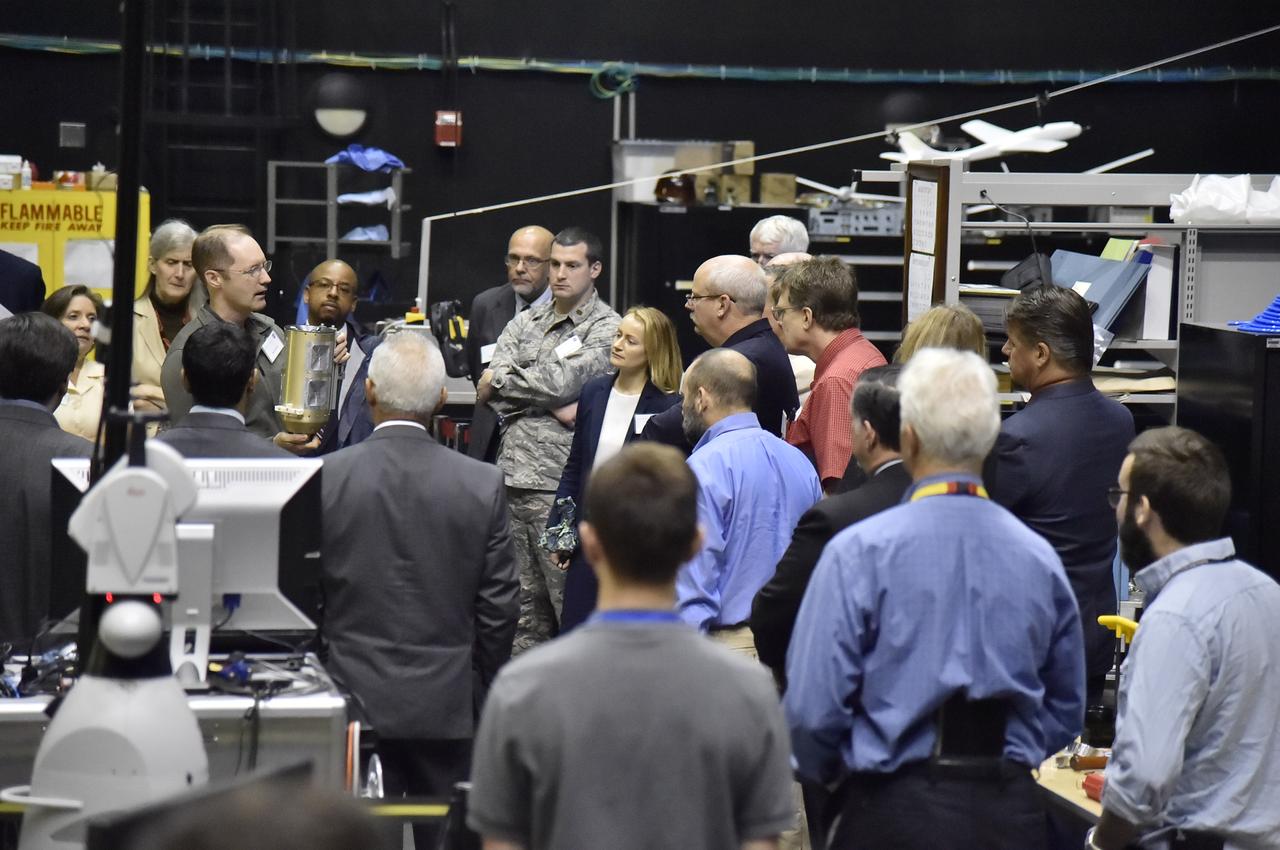
WASHINGTON, D.C.---S&T Partnership Forum In-Space Assembly Technical Interchange Meeting-On September 6th 2017, many of the United States government experts on In-Space Assembly met at the U.S. Naval Research Lab to discuss both technology development and in-space applications that would advance national capabilities in this area. Expertise from NASA, USAF, NRO, DARPA and NRL met in this meeting which was coordinated by the NASA Headquarters, Office of the Chief Technologist. This technical interchange meeting was the second meeting of the members of this Science and Technology Partnership Forum. Glen Henshaw of Code 8231 talks to the group in the Space Robotics Lab.
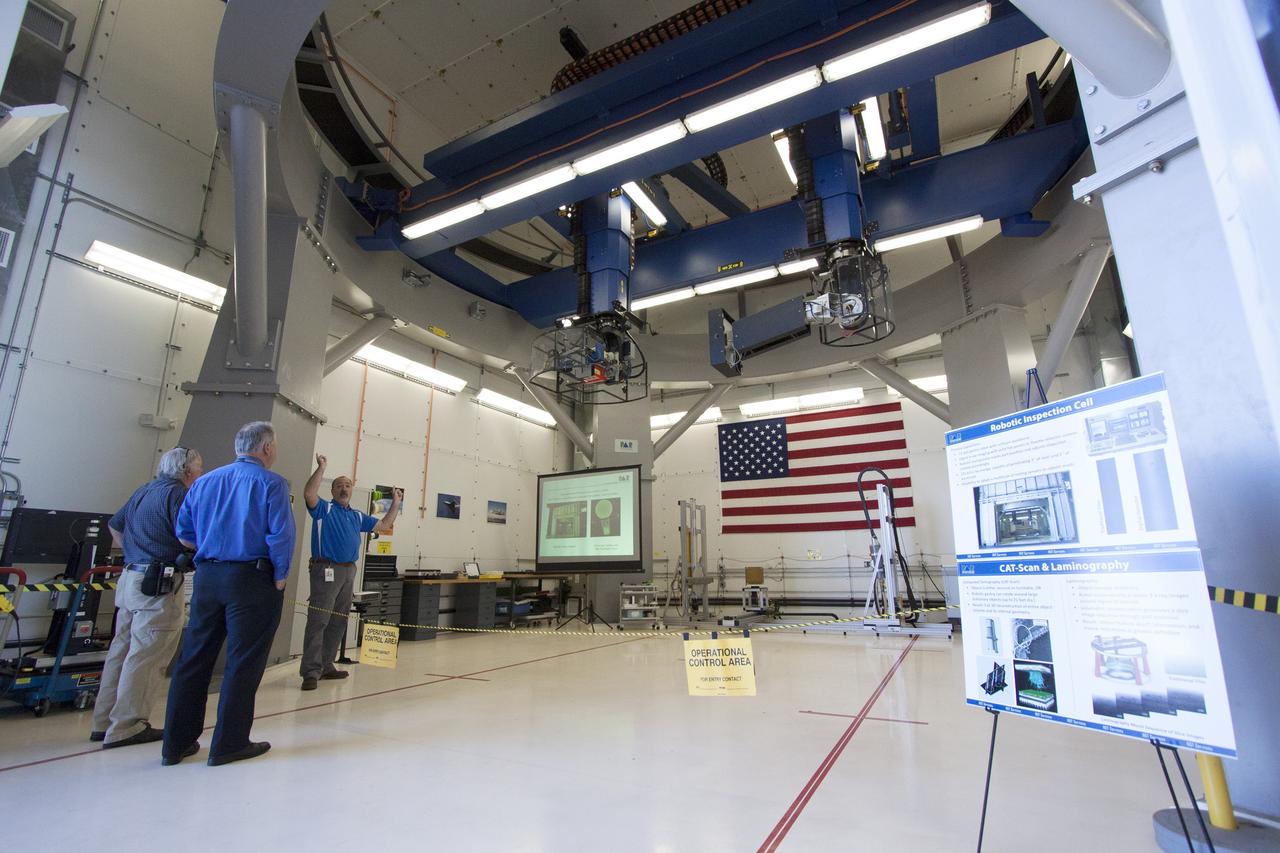
CAPE CANAVERAL, Fla. – Paul Vona, operations engineer, NDT Services, with PaR Systems Inc., demonstrates the automated X-ray system in the robotic inspection cell for members of the media at Hangar N at Cape Canaveral Air Force Station in Florida. PaR Systems held an Open House to celebrate the one-year anniversary of a lease agreement with Kennedy. Under a 15-year lease, PaR Systems is utilizing Hangar N and its unique nondestructive testing equipment. The partnership agreement was established by Kennedy's Center Planning and Development Directorate. The agreement is just one example of the types of partnerships that Kennedy is seeking to create a multi-user spaceport. Photo credit: NASA/Cory Huston
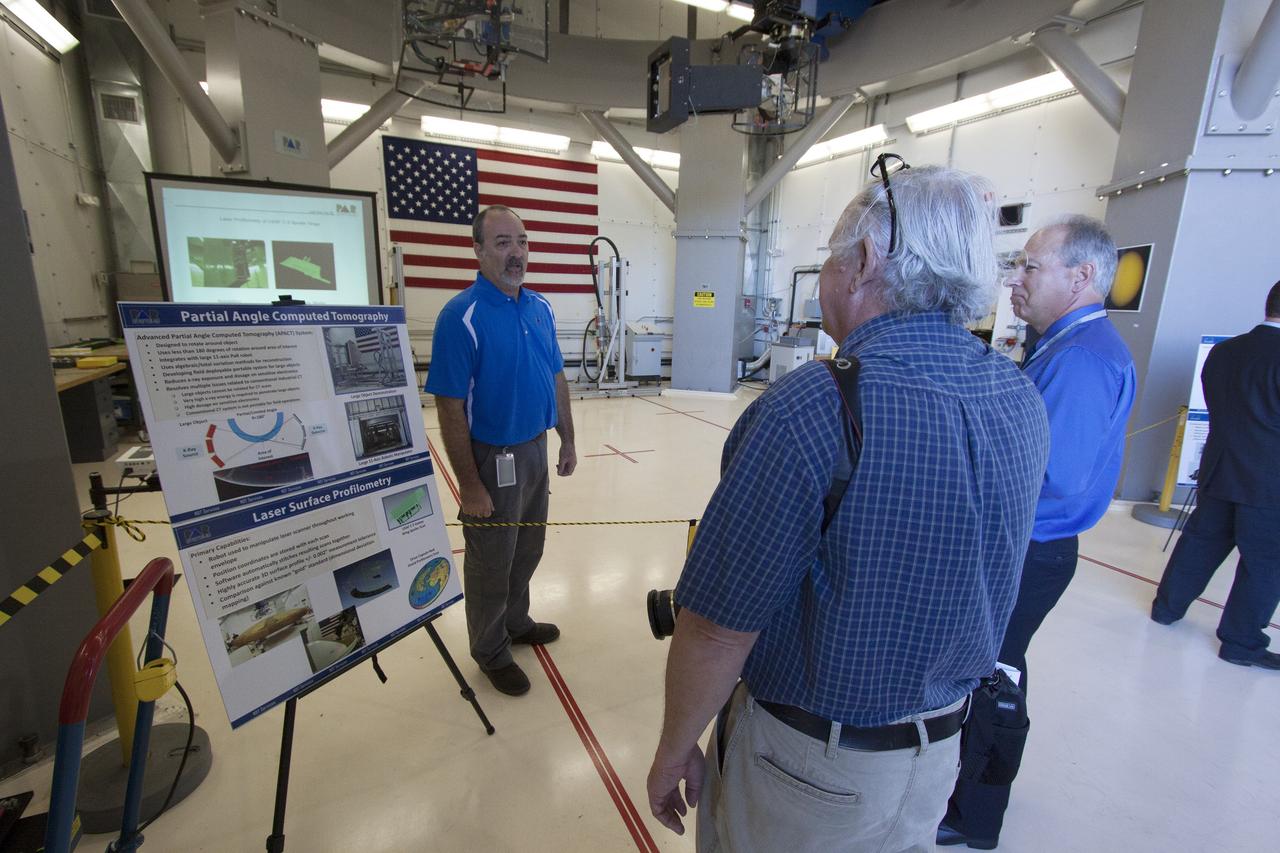
CAPE CANAVERAL, Fla. – Paul Vona, operations engineer, NDT Services, with PaR Systems Inc., talks with members of the media about the automated X-ray system in the robotic inspection cell at Hangar N at Cape Canaveral Air Force Station in Florida. PaR Systems held an Open House to celebrate the one-year anniversary of a lease agreement with Kennedy. Under a 15-year lease, PaR Systems is utilizing Hangar N and its unique nondestructive testing equipment. The partnership agreement was established by Kennedy's Center Planning and Development Directorate. The agreement is just one example of the types of partnerships that Kennedy is seeking to create a multi-user spaceport. Photo credit: NASA/Cory Huston
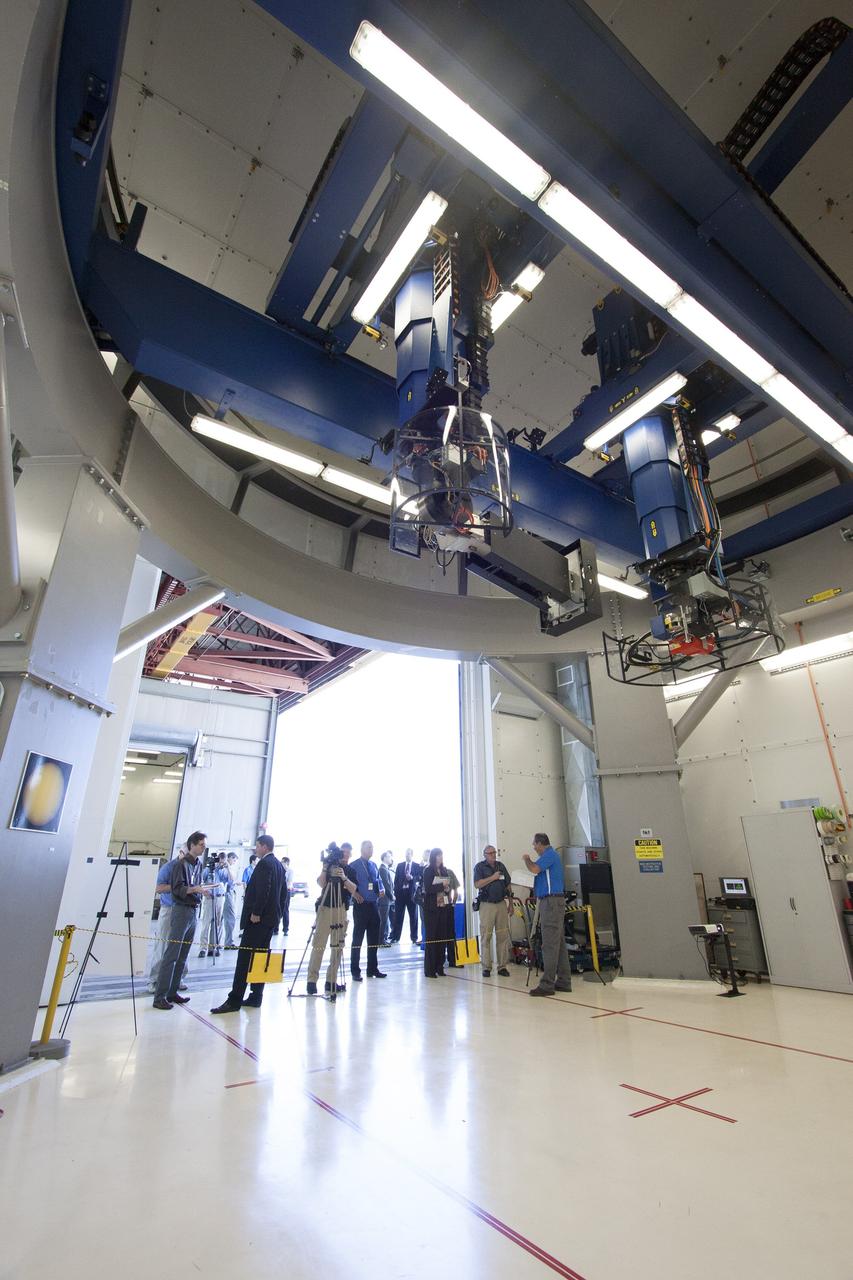
CAPE CANAVERAL, Fla. – Paul Vona, operations engineer, NDT Services, with PaR Systems Inc., demonstrates the automated X-ray system in the robotic inspection cell for members of the media at Hangar N at Cape Canaveral Air Force Station in Florida. PaR Systems held an Open House to celebrate the one-year anniversary of a lease agreement with Kennedy. Under a 15-year lease, PaR Systems is utilizing Hangar N and its unique nondestructive testing equipment. The partnership agreement was established by Kennedy's Center Planning and Development Directorate. The agreement is just one example of the types of partnerships that Kennedy is seeking to create a multi-user spaceport. Photo credit: NASA/Cory Huston
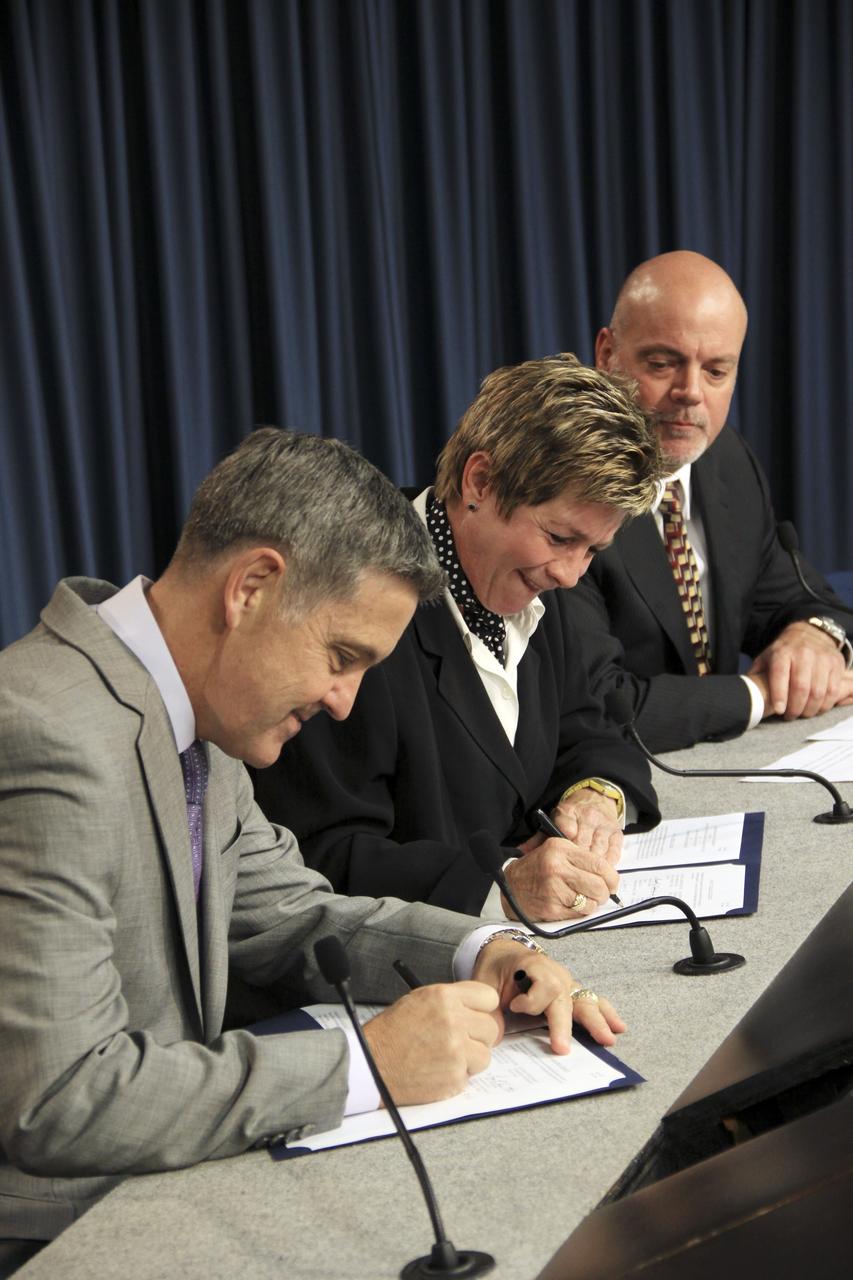
CAPE CANAVERAL, Fla. -- In the Press Site auditorium at NASA's Kennedy Space Center in Florida, Lynda Weatherman (center), Economic Development Commission (EDC) of Florida’s Space Coast president and CEO, shows her enthusiasm for the new five-year Space Act Agreement she is signing. Also signing the agreement, at left, is Kennedy Space Center Director Robert Cabana. Bob Whelen, chairman of the board of the EDC, looks on at right. The agreement calls for NASA and EDC senior leadership to meet regularly to discuss economic development matters of mutual interest. Managers from Kennedy’s Center Planning and Development Office will work with the EDC on potential business partnerships and meet with business leaders and committees to address space-related and high-tech economic development. EDC officials will assist NASA with disseminating information about potential partnership opportunities, as well as space-related and high-tech economic development, and increase awareness of Kennedy’s Engineering and Technology Directorate collaboration initiatives. They also will promote the commercial use of underutilized facilities at Kennedy. NASA and the EDC entered into their first economic cooperation agreement in 2005. For more information about the Economic Development Commission (EDC) of Florida’s Space Coast, visit http://www.spacecoastedc.org/. Photo credit: NASA/Jim Grossmann
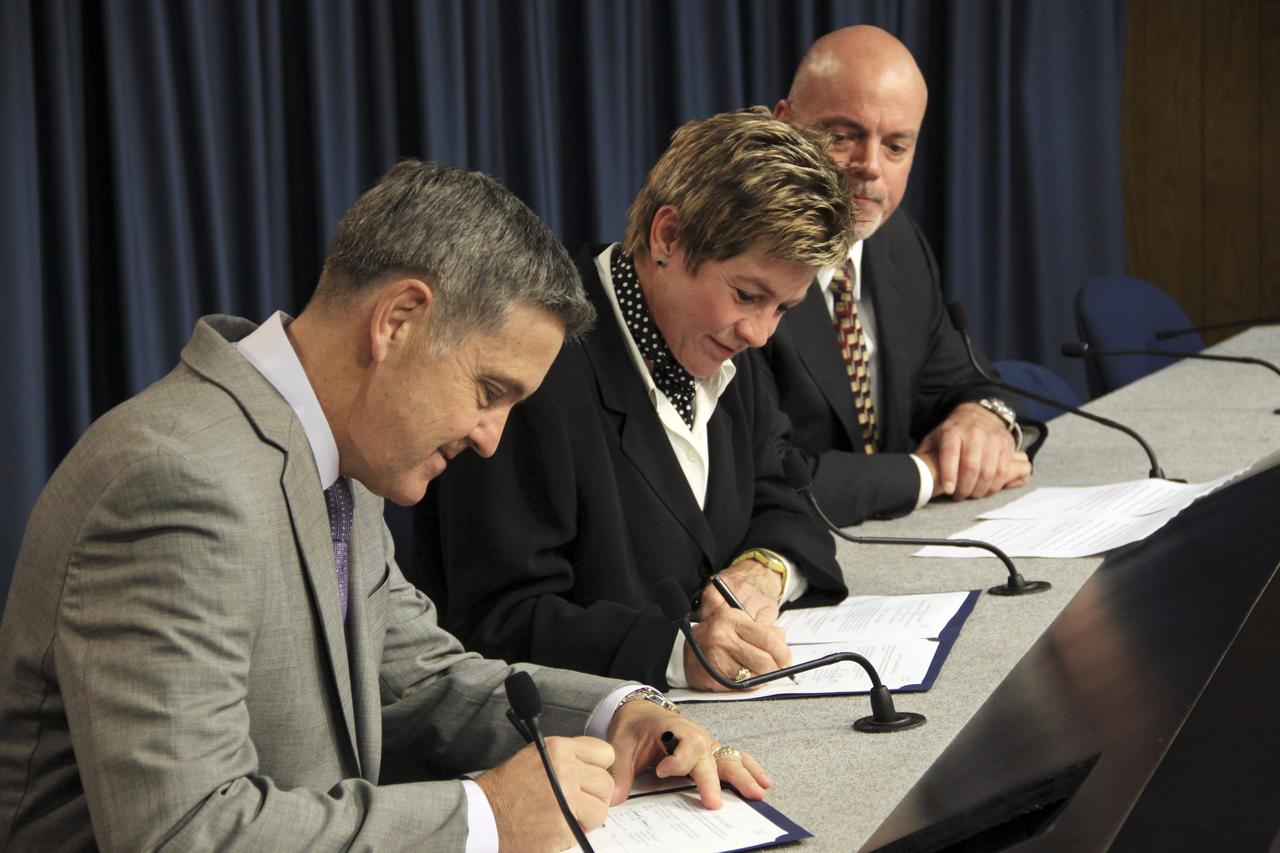
CAPE CANAVERAL, Fla. -- In the Press Site auditorium at NASA's Kennedy Space Center in Florida, representatives of NASA and the Economic Development Commission (EDC) of Florida’s Space Coast sign a new five-year Space Act Agreement. From left are Kennedy Space Center Director Director Robert Cabana and EDC President and CEO Lynda Weatherman, with Chairman of the Board of the EDC Bob Whelen looking on. The agreement calls for NASA and EDC senior leadership to meet regularly to discuss economic development matters of mutual interest. Managers from Kennedy’s Center Planning and Development Office will work with the EDC on potential business partnerships and meet with business leaders and committees to address space-related and high-tech economic development. EDC officials will assist NASA with disseminating information about potential partnership opportunities, as well as space-related and high-tech economic development, and increase awareness of Kennedy’s Engineering and Technology Directorate collaboration initiatives. They also will promote the commercial use of underutilized facilities at Kennedy. NASA and the EDC entered into their first economic cooperation agreement in 2005. For more information about the Economic Development Commission (EDC) of Florida’s Space Coast, visit http://www.spacecoastedc.org/. Photo credit: NASA/Jim Grossmann
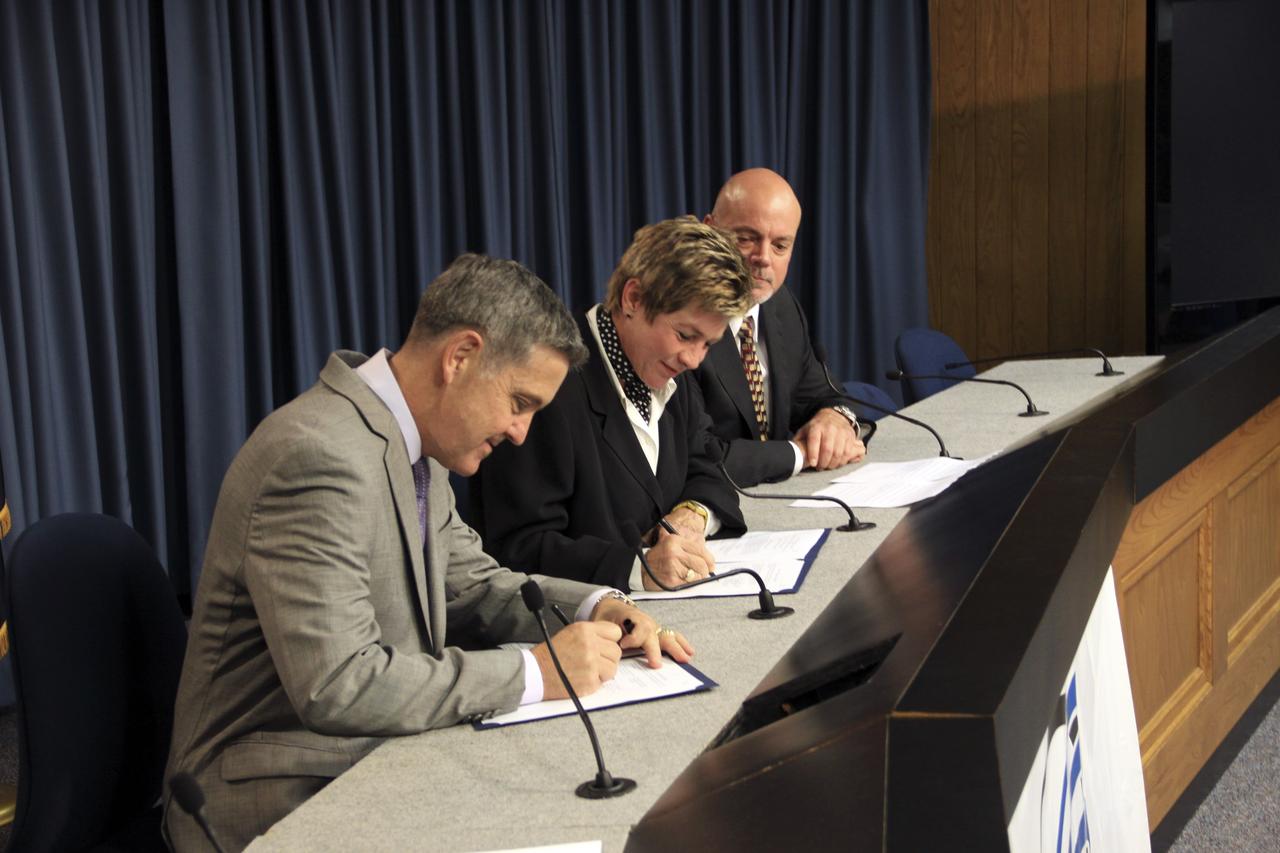
CAPE CANAVERAL, Fla. -- In the Press Site auditorium at NASA's Kennedy Space Center in Florida, representatives of NASA and the Economic Development Commission (EDC) of Florida’s Space Coast sign a new five-year Space Act Agreement. From left are Kennedy Space Center Director Robert Cabana and EDC President and CEO Lynda Weatherman, with Chairman of the Board of the EDC Bob Whelen looking on. The agreement calls for NASA and EDC senior leadership to meet regularly to discuss economic development matters of mutual interest. Managers from Kennedy’s Center Planning and Development Office will work with the EDC on potential business partnerships and meet with business leaders and committees to address space-related and high-tech economic development. EDC officials will assist NASA with disseminating information about potential partnership opportunities, as well as space-related and high-tech economic development, and increase awareness of Kennedy’s Engineering and Technology Directorate collaboration initiatives. They also will promote the commercial use of underutilized facilities at Kennedy. NASA and the EDC entered into their first economic cooperation agreement in 2005. For more information about the Economic Development Commission (EDC) of Florida’s Space Coast, visit http://www.spacecoastedc.org/. Photo credit: NASA/Jim Grossmann
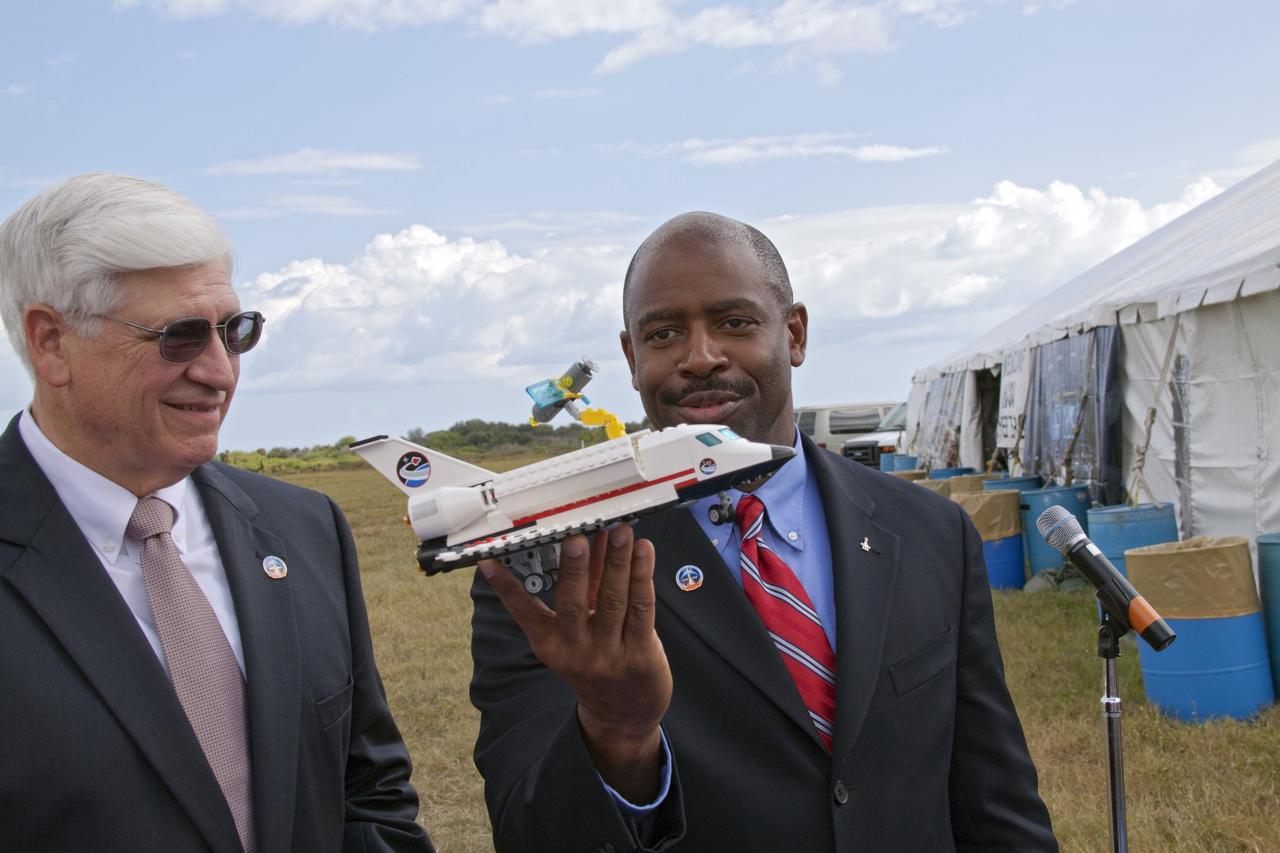
CAPE CANAVERAL, Fla. -- NASA and The LEGO Group announce a three-year Space Act Agreement meant to spark the interest of children in science, technology, engineering and mathematics (STEM) with the future release of four NASA-inspired products in the toy company's LEGO CITY line. From left, are Stephan Turnipseed, president of LEGO Education North America, and Leland Melvin, NASA's associate administrator for Education. To commemorate the beginning of the partnership, two small LEGO space shuttles will launch aboard space shuttle Discovery's STS-133 mission to the International Space Station. A 40- by 70-foot activity tent will be set up at Kennedy on Nov. 3 for children of all ages to build their vision of the future with LEGO bricks. LEGO sets also will fly to the space station aboard Endeavour's STS-134 mission, and will be put together on orbit to demonstrate the challenges faced while building things in microgravity. Photo credit: NASA/Jack Pfaller
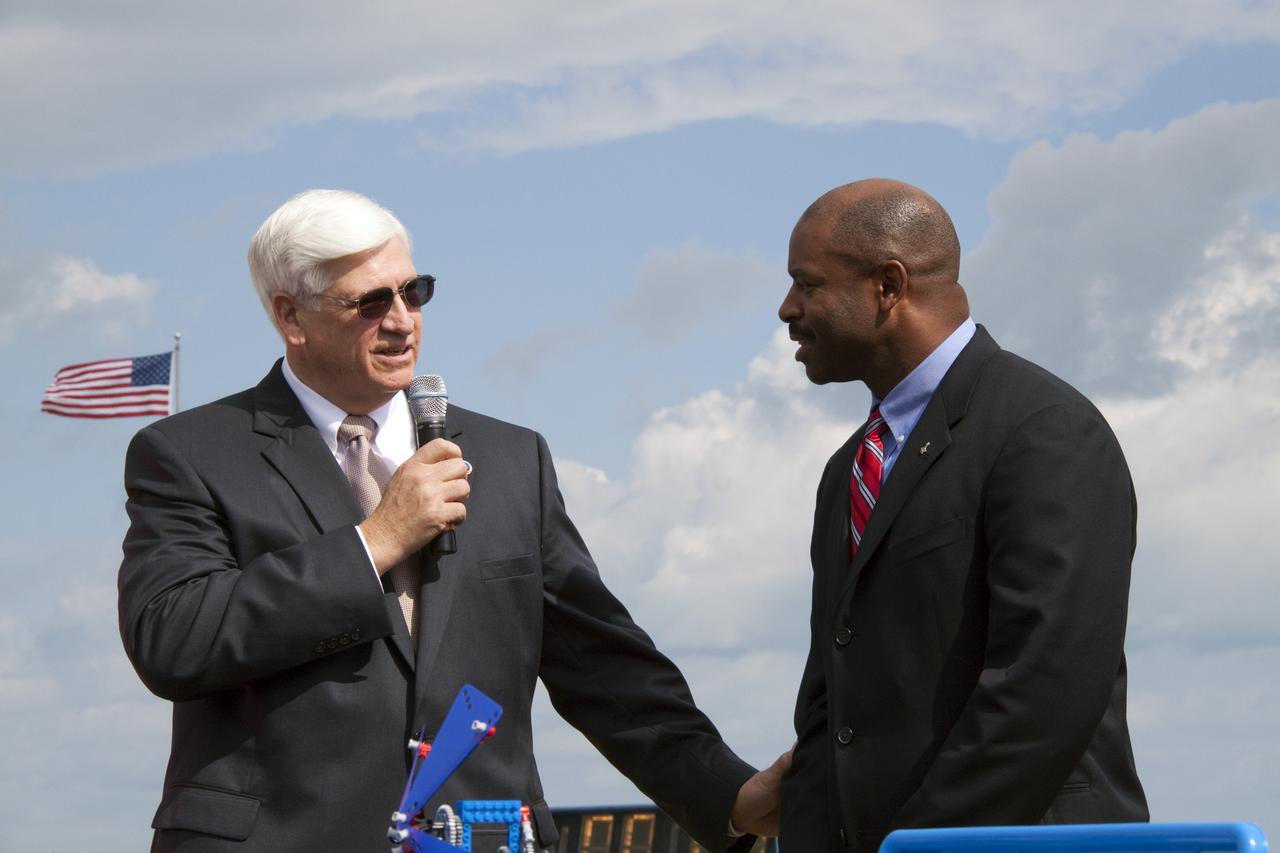
CAPE CANAVERAL, Fla. -- NASA and The LEGO Group announce a three-year Space Act Agreement meant to spark the interest of children in science, technology, engineering and mathematics (STEM) with the future release of four NASA-inspired products in the toy company's LEGO CITY line. From left, are Stephan Turnipseed, president of LEGO Education North America, and Leland Melvin, NASA's associate administrator for Education. To commemorate the beginning of the partnership, two small LEGO space shuttles will launch aboard space shuttle Discovery's STS-133 mission to the International Space Station. A 40- by 70-foot activity tent will be set up at Kennedy on Nov. 3 for children of all ages to build their vision of the future with LEGO bricks. LEGO sets also will fly to the space station aboard Endeavour's STS-134 mission, and will be put together on orbit to demonstrate the challenges faced while building things in microgravity. Photo credit: NASA/Jack Pfaller
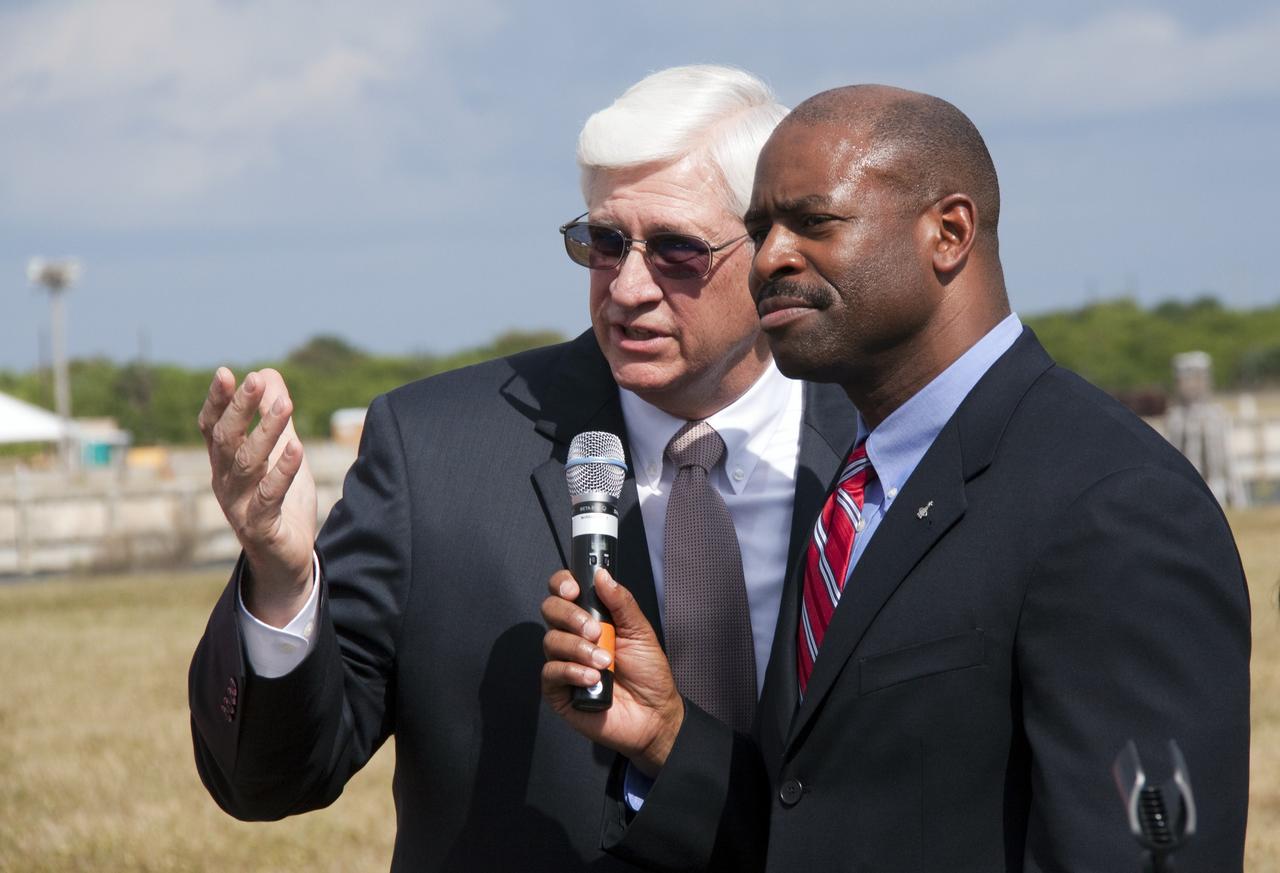
CAPE CANAVERAL, Fla. -- NASA and The LEGO Group announce a three-year Space Act Agreement meant to spark the interest of children in science, technology, engineering and mathematics (STEM) with the future release of four NASA-inspired products in the toy company's LEGO CITY line. From left, are Stephan Turnipseed, president of LEGO Education North America, and Leland Melvin, NASA's associate administrator for Education. To commemorate the beginning of the partnership, two small LEGO space shuttles will launch aboard space shuttle Discovery's STS-133 mission to the International Space Station. A 40- by 70-foot activity tent will be set up at Kennedy on Nov. 3 for children of all ages to build their vision of the future with LEGO bricks. LEGO sets also will fly to the space station aboard Endeavour's STS-134 mission, and will be put together on orbit to demonstrate the challenges faced while building things in microgravity. Photo credit: NASA/Jack Pfaller
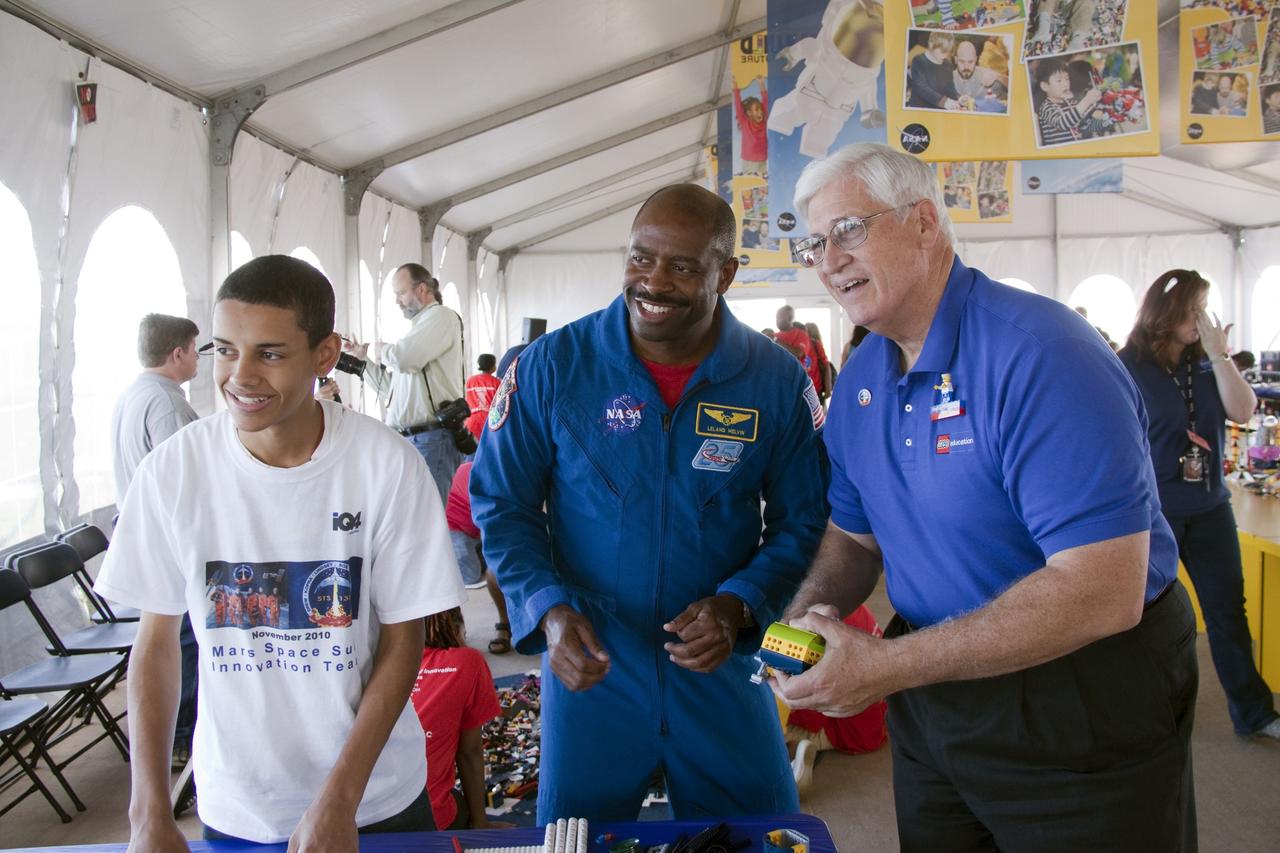
CAPE CANAVERAL, Fla. -- On the NASA Causeway at Kennedy Space Center in Florida, Leland Melvin, NASA's associate administrator for Education, center, and Stephan Turnipseed, president of LEGO Education North America, right, help a student build LEGO space vehicles inside a 40- by 70-foot activity tent. There, children of all ages are building their vision of the future with LEGO bricks, marking the beginning of a three-year Space Act Agreement meant to spark the interest of children in science, technology, engineering and mathematics (STEM). To commemorate the partnership, two small LEGO space shuttles will launch aboard space shuttle Discovery's STS-133 mission to the International Space Station and the company will release four NASA-inspired products in its LEGO CITY line next year. LEGO sets also will fly to the space station aboard Endeavour's STS-134 mission, and will be put together on orbit to demonstrate the challenges faced while building things in microgravity. Photo credit: NASA/Jack Pfaller
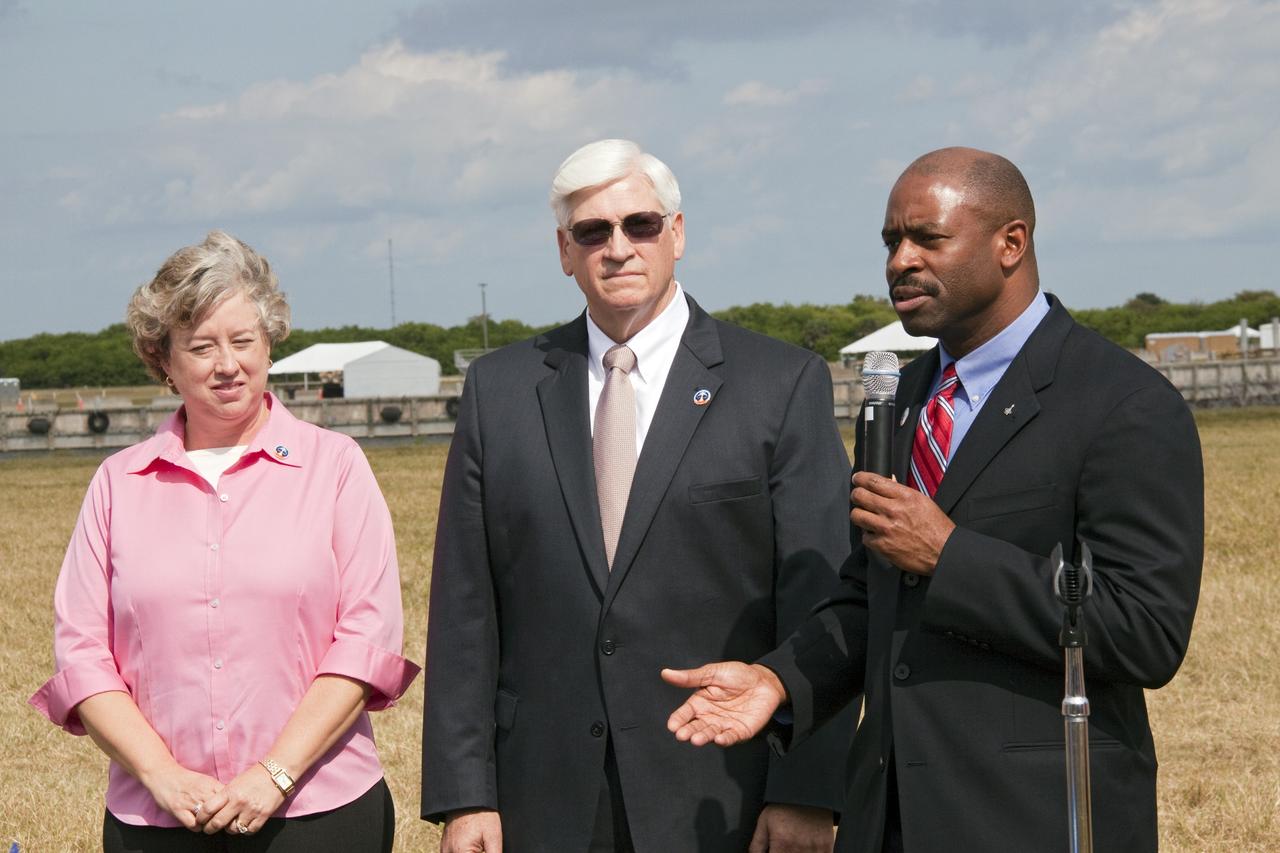
CAPE CANAVERAL, Fla. -- NASA and The LEGO Group announce a three-year Space Act Agreement meant to spark the interest of children in science, technology, engineering and mathematics (STEM) with the future release of four NASA-inspired products in the toy company's LEGO CITY line. From left, are Debbie Biggs, education specialist for International Space Station National Lab Education Projects, Stephan Turnipseed, president of LEGO Education North America, and Leland Melvin, NASA's associate administrator for Education. To commemorate the beginning of the partnership, two small LEGO space shuttles will launch aboard space shuttle Discovery's STS-133 mission to the International Space Station. A 40- by 70-foot activity tent will be set up at Kennedy on Nov. 3 for children of all ages to build their vision of the future with LEGO bricks. LEGO sets also will fly to the space station aboard Endeavour's STS-134 mission, and will be put together on orbit to demonstrate the challenges faced while building things in microgravity. Photo credit: NASA/Jack Pfaller
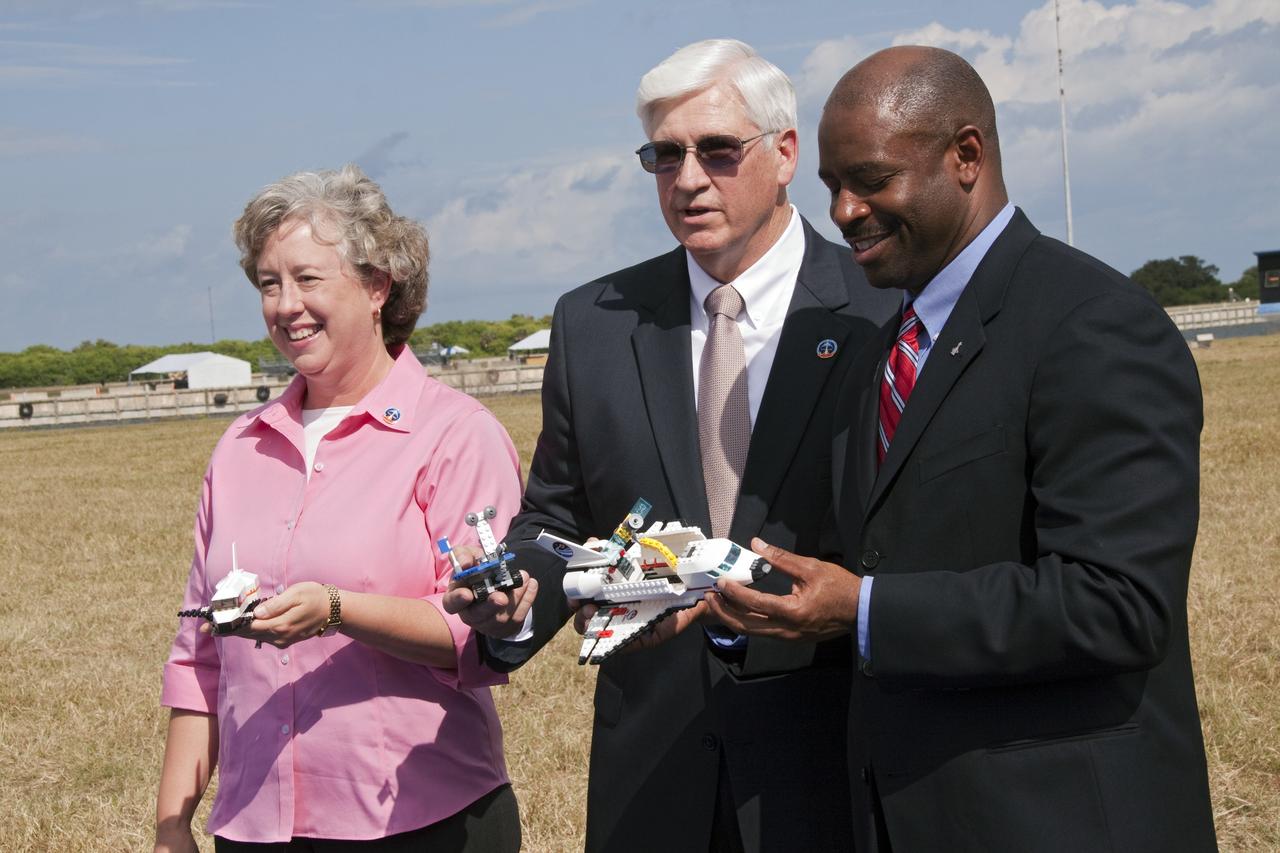
CAPE CANAVERAL, Fla. -- NASA and The LEGO Group announce a three-year Space Act Agreement meant to spark the interest of children in science, technology, engineering and mathematics (STEM) with the future release of four NASA-inspired products in the toy company's LEGO CITY line. From left, are Debbie Biggs, education specialist for International Space Station National Lab Education Projects, Stephan Turnipseed, president of LEGO Education North America, and Leland Melvin, NASA's associate administrator for Education. To commemorate the beginning of the partnership, two small LEGO space shuttles will launch aboard space shuttle Discovery's STS-133 mission to the International Space Station. A 40- by 70-foot activity tent will be set up at Kennedy on Nov. 3 for children of all ages to build their vision of the future with LEGO bricks. LEGO sets also will fly to the space station aboard Endeavour's STS-134 mission, and will be put together on orbit to demonstrate the challenges faced while building things in microgravity. Photo credit: NASA/Jack Pfaller

CAPE CANAVERAL, Fla. -- NASA and The LEGO Group announce a three-year Space Act Agreement meant to spark the interest of children in science, technology, engineering and mathematics (STEM) with the future release of four NASA-inspired products in the toy company's LEGO CITY line. From left, are Debbie Biggs, education specialist for International Space Station National Lab Education Projects, Stephan Turnipseed, president of LEGO Education North America, Leland Melvin, NASA's associate administrator for Education, and Ann Marie Trotta, NASA Public Affairs officer. To commemorate the beginning of the partnership, two small LEGO space shuttles will launch aboard space shuttle Discovery's STS-133 mission to the International Space Station. A 40- by 70-foot activity tent will be set up at Kennedy on Nov. 3 for children of all ages to build their vision of the future with LEGO bricks. LEGO sets also will fly to the space station aboard Endeavour's STS-134 mission, and will be put together on orbit to demonstrate the challenges faced while building things in microgravity. Photo credit: NASA/Jack Pfaller
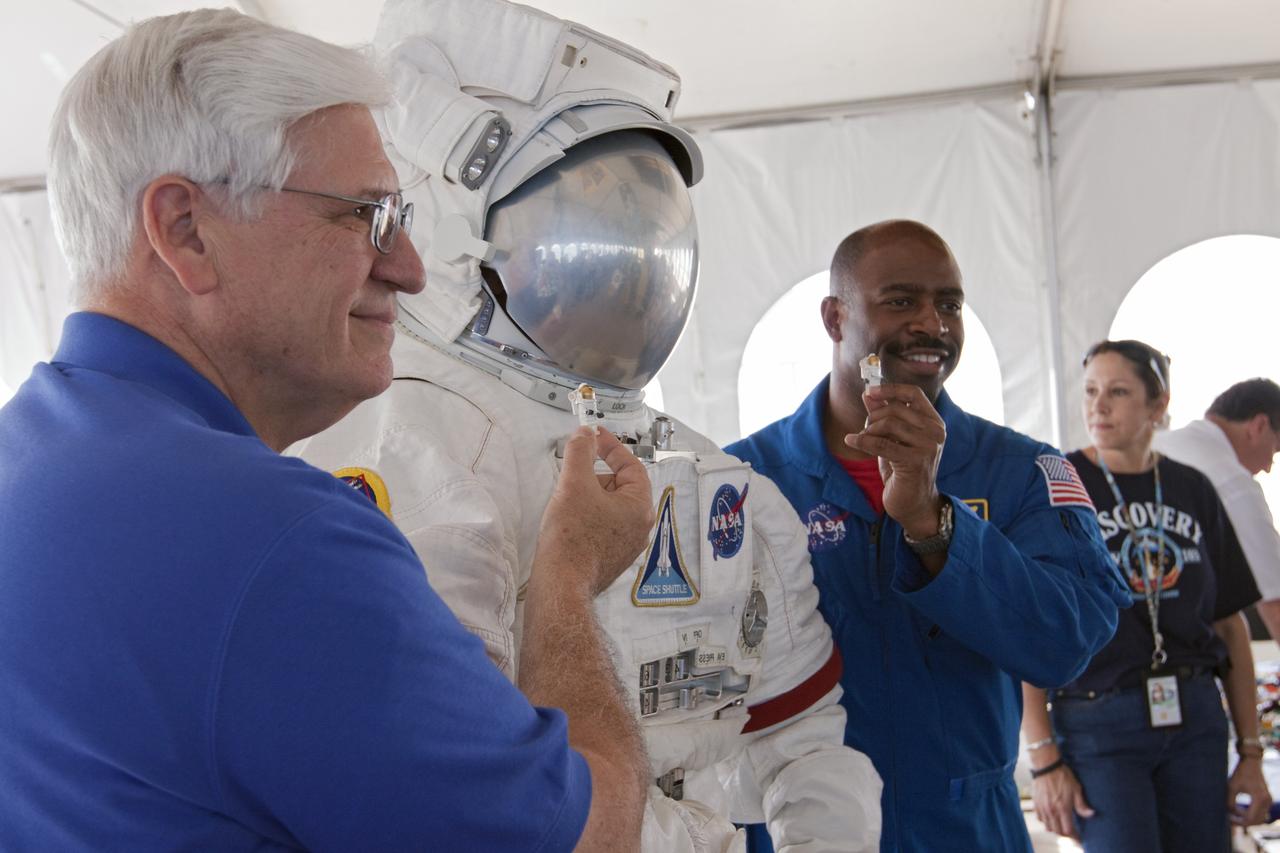
CAPE CANAVERAL, Fla. -- Stephan Turnipseed, president of LEGO Education North America, left, a space person, and Leland Melvin, NASA's associate administrator for Education, show off toy space people inside a 40- by 70-foot activity tent chock full of LEGO bricks on the NASA Causeway at Kennedy Space Center in Florida. There, children of all ages are building their vision of the future with LEGO bricks, marking the beginning of a three-year Space Act Agreement meant to spark the interest of children in science, technology, engineering and mathematics (STEM). To commemorate the partnership, two small LEGO space shuttles will launch aboard space shuttle Discovery's STS-133 mission to the International Space Station and the company will release four NASA-inspired products in its LEGO CITY line next year. LEGO sets also will fly to the space station aboard Endeavour's STS-134 mission, and will be put together on orbit to demonstrate the challenges faced while building things in microgravity. Photo credit: NASA/Jack Pfaller
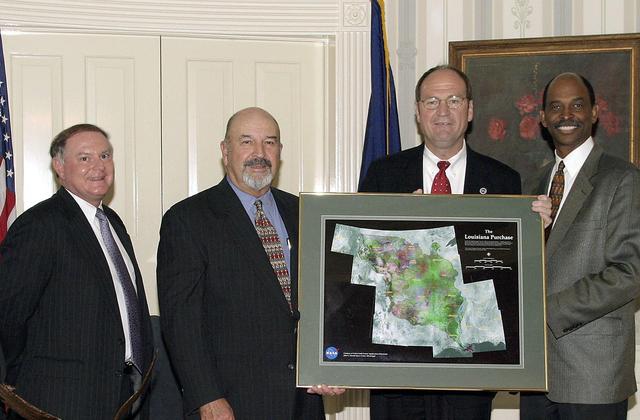
NASA Stennis Space Center (SSC) Interim Center Director Michael Rudolphi (second from right) presents Louisiana Gov. Mike Foster (second from left) an image from space of the area that comprised the Louisiana Purchase. Gov. Foster and Rudolphi signed a Memorandum of Understanding (MOU) between SSC and the state of Louisiana to promote technology transfer partnerships. Also pictured are Charles D'Agostino (left), executive director of the Louisiana Business and Technology Center, and Don Hutchison, secretary of the Louisiana Department of Economic Development.
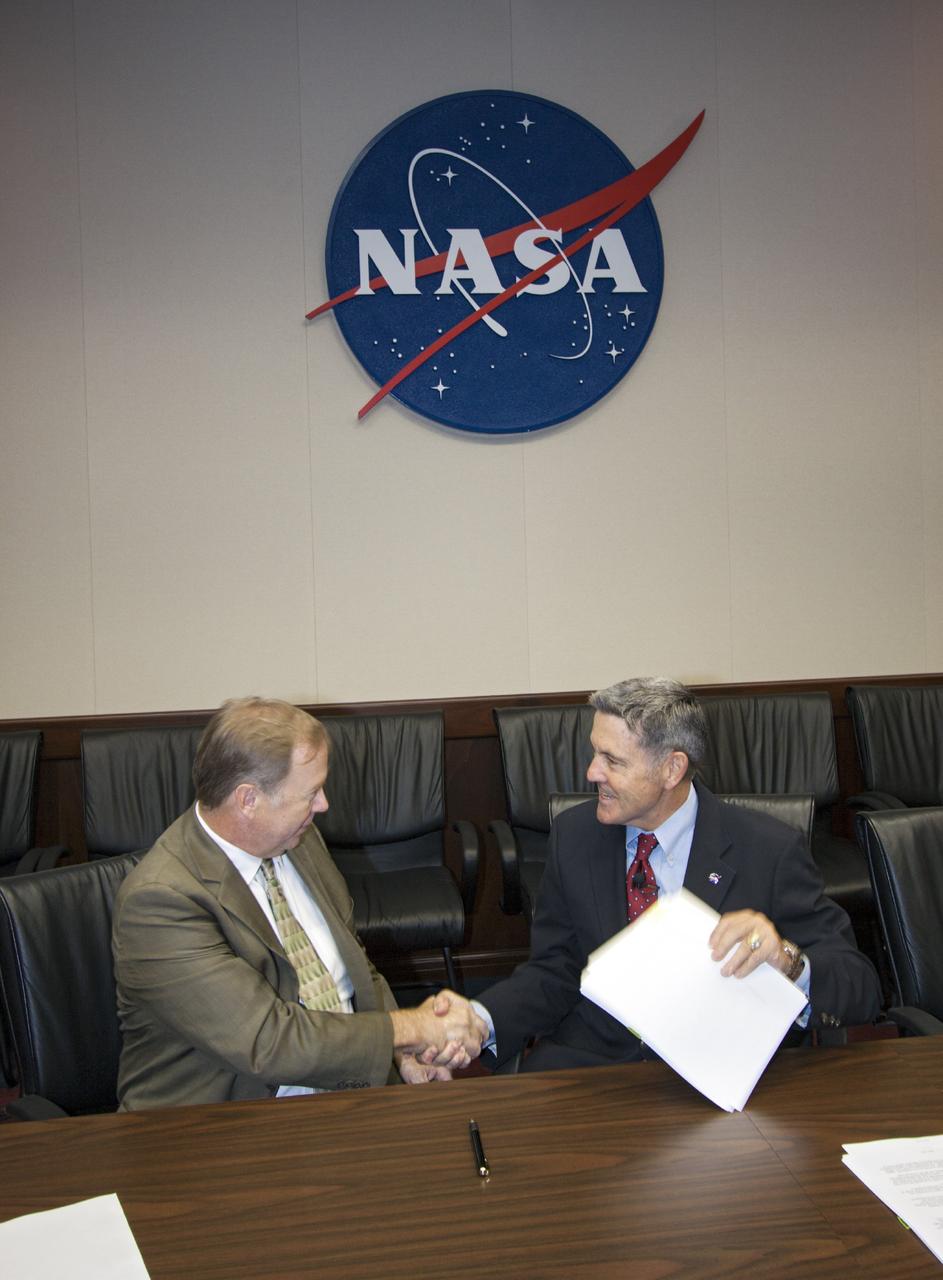
CAPE CANAVERAL, Fla. – At NASA’s Kennedy Space Center in Florida, Director Bob Cabana, at right, shakes hands with Larry Williams, president and CEO of Ballistic Recovery Systems Inc., or BRS Aerospace of Miami, Fla., after signing a new partnership agreement for use of the Parachute Refurbishment Facility, or PRF. Under a 10-year lease agreement, BRS Aerospace will operate and maintain the facility. The PRF previously was used during NASA’s Space Shuttle Program to manufacture and refurbish the solid rocket booster parachutes. Because of NASA’s transition from the shuttle to future commercial and government mission activities, the agreement allows NASA to preserve the unique facility capabilities for future spaceflight projects. Kennedy’s Center Planning and Development team and the Economic Development Commission of Florida’s Space Coast worked with BRS Aerospace to establish the agreement. For more information about BRS Aerospace, visit http://www.brsparachutes.com. Photo credit: NASA/Jim Grossmann
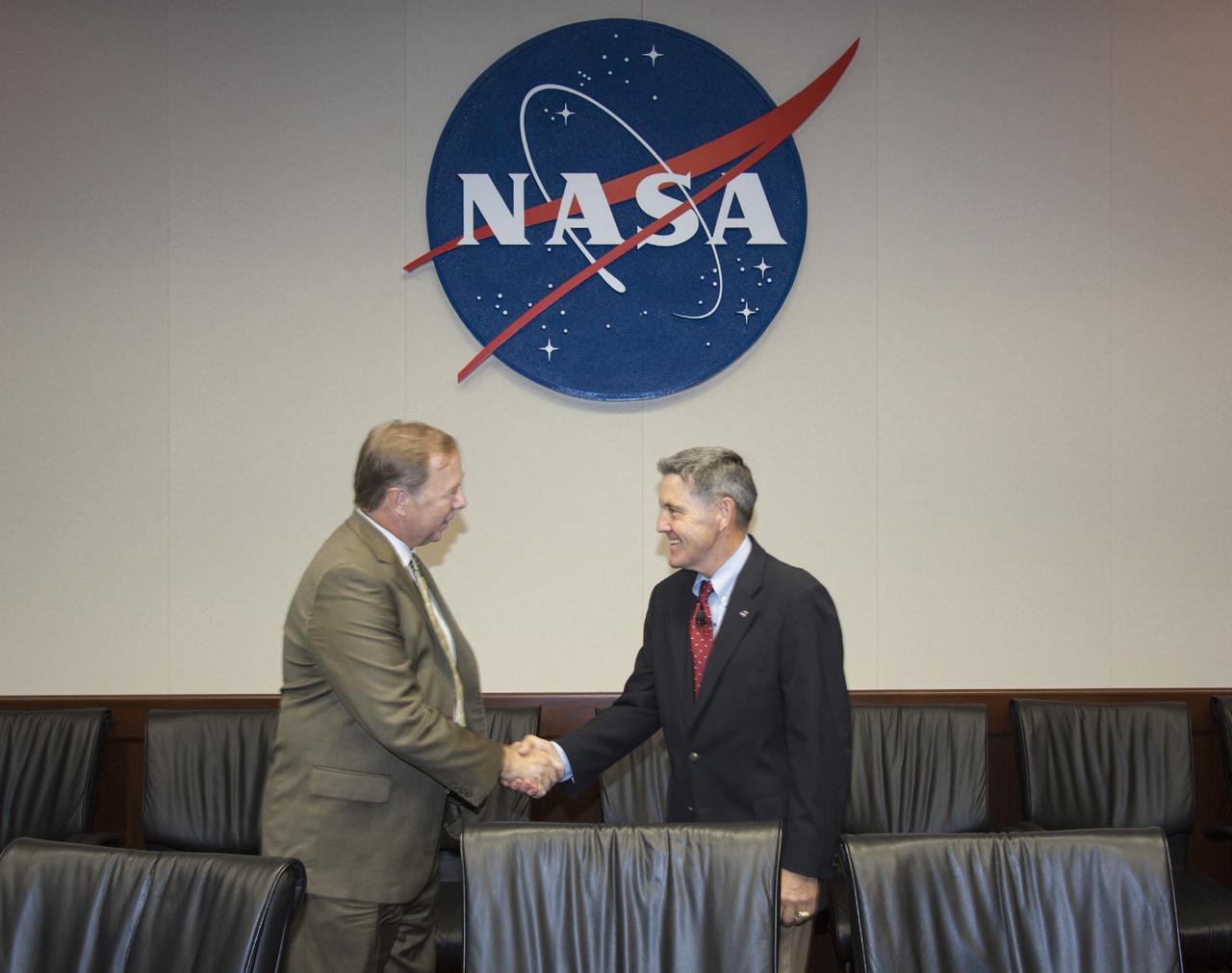
CAPE CANAVERAL, Fla. – At NASA’s Kennedy Space Center in Florida, Director Bob Cabana, at right, shakes hands with Larry Williams, president and CEO of Ballistic Recovery Systems Inc., or BRS Aerospace of Miami, Fla., after signing a new partnership agreement for use of the Parachute Refurbishment Facility, or PRF. Under a 10-year lease agreement, BRS Aerospace will operate and maintain the facility. The PRF previously was used during NASA’s Space Shuttle Program to manufacture and refurbish the solid rocket booster parachutes. Because of NASA’s transition from the shuttle to future commercial and government mission activities, the agreement allows NASA to preserve the unique facility capabilities for future spaceflight projects. Kennedy’s Center Planning and Development team and the Economic Development Commission of Florida’s Space Coast worked with BRS Aerospace to establish the agreement. For more information about BRS Aerospace, visit http://www.brsparachutes.com. Photo credit: NASA/Jim Grossmann
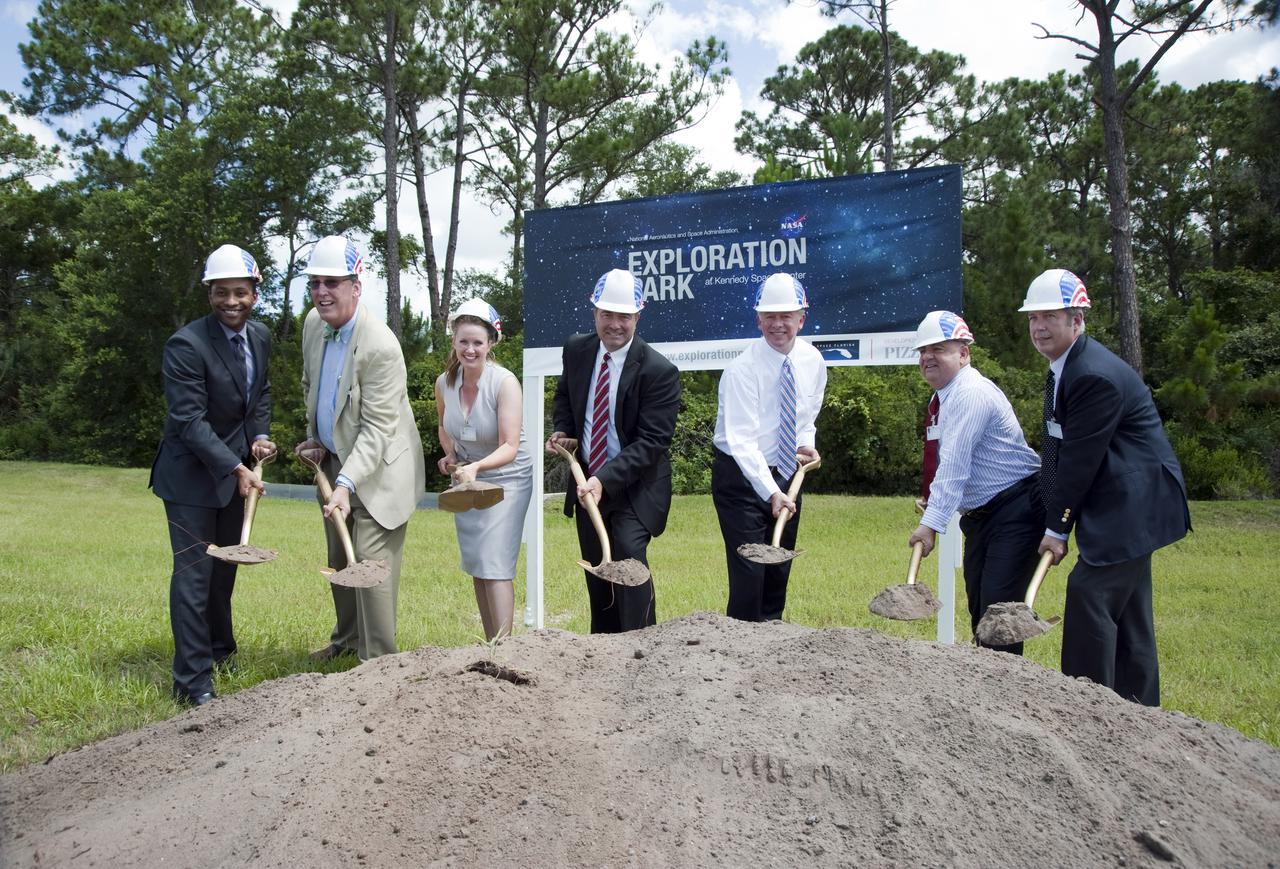
CAPE CANAVERAL, Fla. – At NASA's Kennedy Space Center in Florida, The Pizzuti Companies Naeem Coleman, left, Mike Bird, Stephanie Moreton and Tom Harmer, Florida Lt. Gov. Jeff Kottkamp, and The Pizzuti Companies Ron Pizzuti and Jim Russell break ground on Exploration Park outside of the Space Life Sciences Laboratory, or SLSL. Exploration Park is designed to be a strategically located complex, adjacent to the SLSL, for servicing diverse tenants and uses that will engage in activities to support space-related activities of NASA, other government agencies and the U.S. commercial space industry, as well as bring new aerospace work to the Space Coast. The SLSL will be the anchor facility for the park, which is expected to open its first new facility in early 2012. Photo Credit: NASA_Kim Shiflett
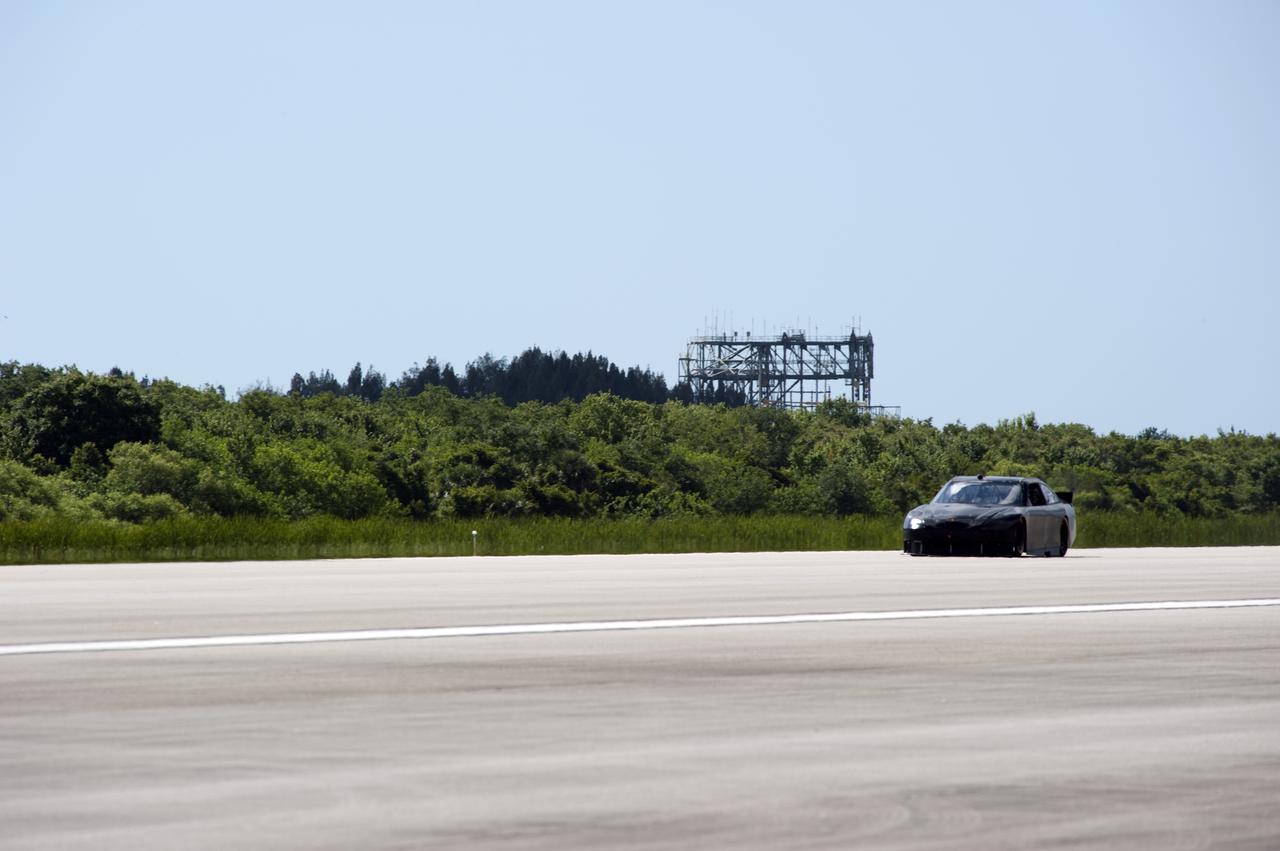
CAPE CANAVERAL, Fla. – At NASA's Kennedy Space Center in Florida, NASCAR racer Matt DiBenedetto drives an instrument-laden Toyota down the three-mile-long Shuttle Landing Facility runway. The operation was part Joe Gibbs Racing's program to test aerodynamic and real-world capabilities on one of the flattest surfaces in the world. Behind the car is the space shuttle's Mate-Demate Device. Racing teams have been using the runway for testing since 2008. Joe Gibbs Racing signed a Space Act Agreement with NASA in May to use the facility's runway. Photo Credit: NASA_Kim Shiflett
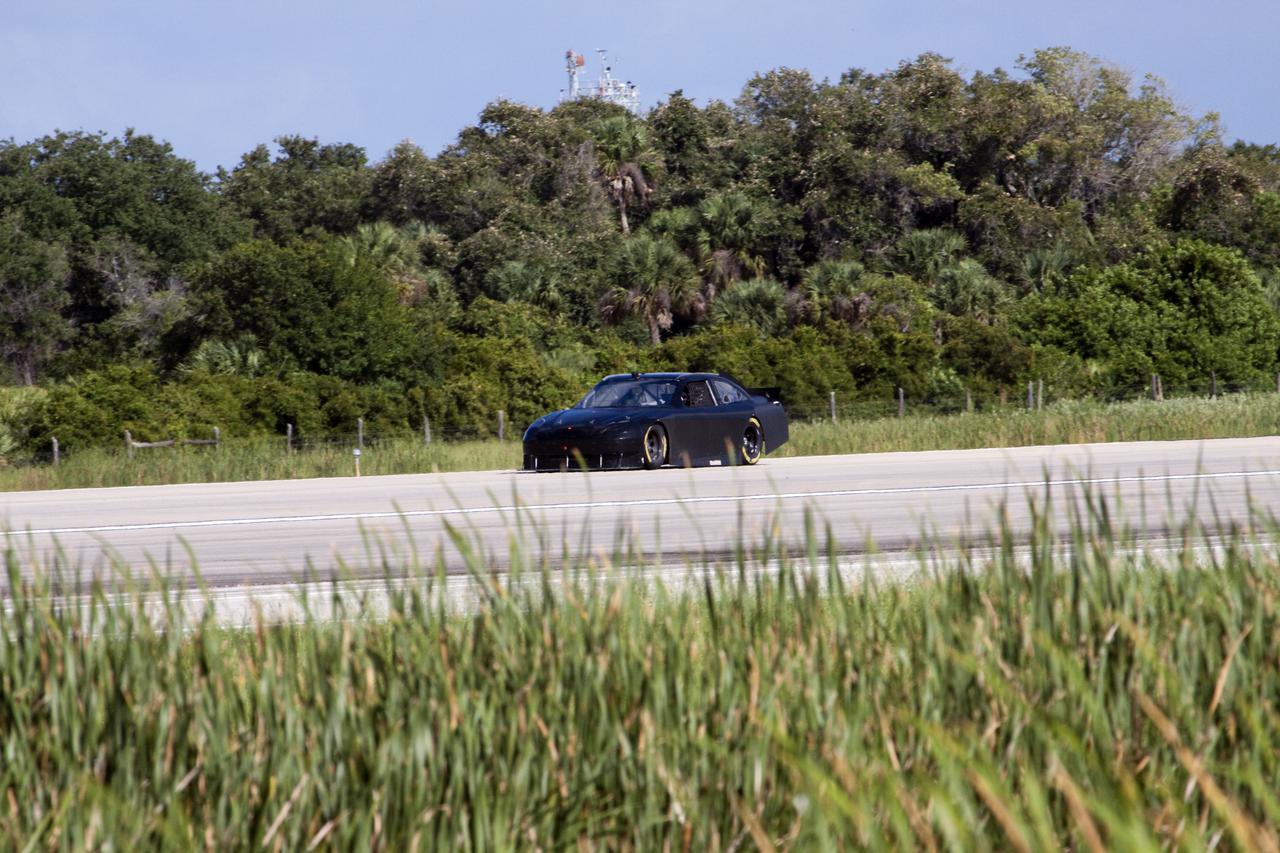
CAPE CANAVERAL, Fla. – At NASA's Kennedy Space Center in Florida, NASCAR racer Matt DiBenedetto drives an instrument-laden Toyota down the three-mile-long Shuttle Landing Facility runway. The operation was part Joe Gibbs Racing's program to test aerodynamic and real-world capabilities on one of the flattest surfaces in the world. Racing teams have been using the runway for testing since 2008. Joe Gibbs Racing signed a Space Act Agreement with NASA in May to use the facility's runway. Photo Credit: NASA_Jack Pfaller
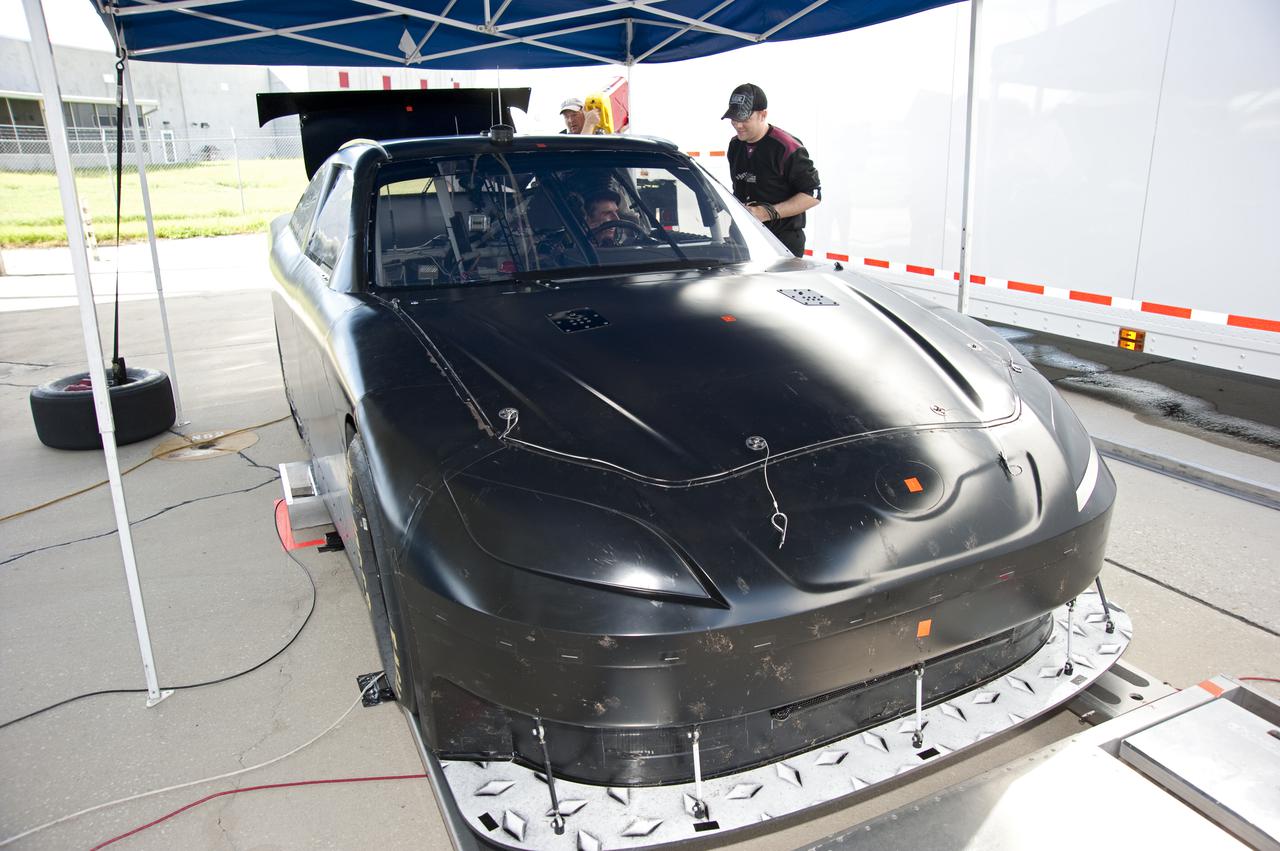
CAPE CANAVERAL, Fla. – At NASA's Kennedy Space Center in Florida, a mechanic talks to NASCAR racer Matt DiBenedetto before he drives an instrument-laden Toyota down the three-mile-long Shuttle Landing Facility runway. The operation was part Joe Gibbs Racing's program to test aerodynamic and real-world capabilities on one of the flattest surfaces in the world. Racing teams have been using the runway for testing since 2008. Joe Gibbs Racing signed a Space Act Agreement with NASA in May to use the facility's runway. Photo Credit: NASA_Kim Shiflett
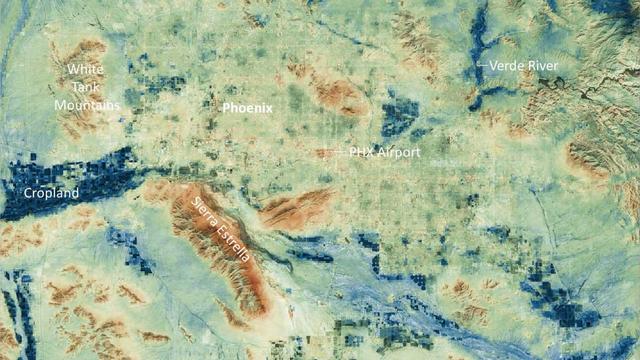
Researchers at NASA's Jet Propulsion Laboratory have created a series of maps showing land-surface temperatures in the Phoenix area in July 2023, when the city experienced a record-breaking run of hot weather. The images reveal the cumulative effect – overnight and across the month – of relentless daytime heating. The data was captured during overnight hours (around 2 a.m.) on several days in July by an instrument called the Visible Infrared Imaging Radiometer Suite (VIIRS) aboard the NOAA-NASA Suomi National Polar-orbiting Partnership (Suomi NPP) satellite managed by the National Oceanic and Atmospheric Administration and NASA. The images show how built surfaces – roads, buildings, airport runways, and the like – retain heat, sometimes hovering around 100 degrees Fahrenheit (38 degrees Celsius) for hours after sunset. From July 1 to July 19, the built surfaces in the maps grew progressively hotter, likely the combined effect of the heat wave intensifying and the cumulative heating of those human-made structures. Due to their high heat capacity, these surfaces didn't fully cool overnight before the onset of the next day's heat. At the center of the images is Phoenix's Sky Harbor International Airport, where VIIRS measured the hottest land-surface temperature within the city. The airport is also where Phoenix takes its official air temperature. By those measurements, the city experienced the hottest month on record in July, including a record 31 consecutive days in which the temperature exceeded 110 degrees Fahrenheit (43.3 degrees Celsius). The previous record was 18 days. Land-surface temperatures in cities are usually warmer than in rural and undeveloped areas because of human activities and the materials used for building. Streets – seen in these maps as a grid pattern – are often the hottest part of the built environment due to dark asphalt paving that absorbs more sunlight than lighter-colored surfaces; asphalt absorbs up to 95% of solar radiation. In the images, the mountains near Phoenix are also notably hot due to their angle to the Sun and greater soil exposure from lack of vegetation. The hot surfaces in and around the city stand in contrast to nearby irrigated surfaces such as agricultural fields, golf courses, and parks, which fell as low as 68 degrees Fahrenheit (18.9 degrees Celsius) during the night. The Verde River and other nearby waterways also were significantly cooler. VIIRS is one of five instruments aboard the NOAA-NASA Suomi NPP satellite. Short for Suomi National Polar-orbiting Partnership, the spacecraft is one of several in the Joint Polar Satellite System. The images were produced from the VNP21IMG Land Surface Temperature product, which is available at NASA's Land, Atmosphere Near-real-time Capability for EOS (LANCE). Animation available at https://photojournal.jpl.nasa.gov/catalog/PIA25868
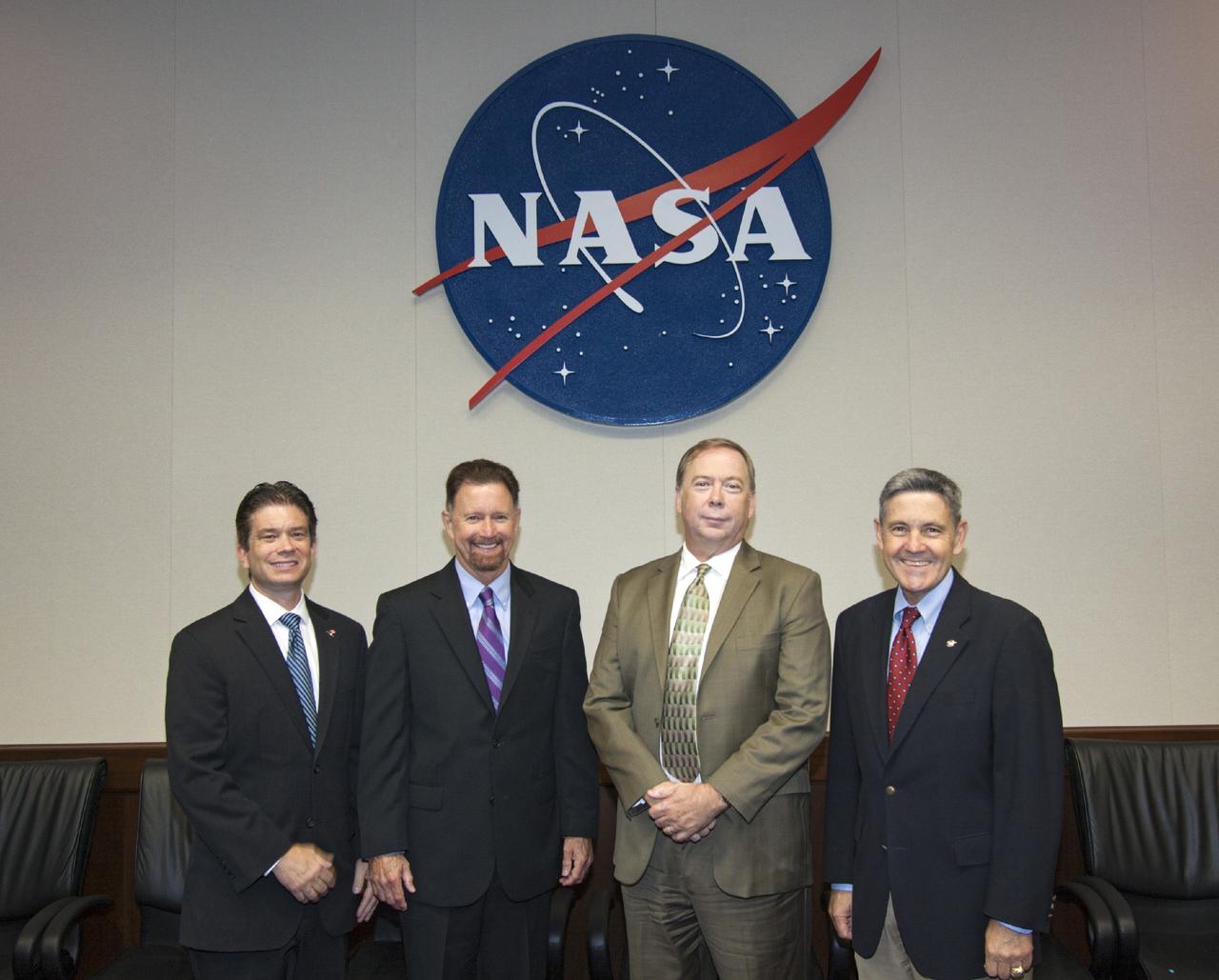
CAPE CANAVERAL, Fla. – NASA’s Kennedy Space Center in Florida has signed a new partnership agreement with Ballistic Recovery Systems Inc., or BRS Aerospace of Miami, Fla., for use of the Parachute Refurbishment Facility, or PRF. From left, are Rob Salonen, director of Business Development with the Economic Development Commission, EDC, of Florida’s Space Coast Jim Barfield, EDC treasurer Larry Williams, president and CEO of BRS Aerospace and Center Director Bob Cabana. The PRF previously was used during NASA’s Space Shuttle Program to manufacture and refurbish the solid rocket booster parachutes. Because of NASA’s transition from the shuttle to future commercial and government mission activities, the agreement allows NASA to preserve the unique facility capabilities for future spaceflight projects. Kennedy’s Center Planning and Development team and the Economic Development Commission of Florida’s Space Coast worked with BRS Aerospace to establish the agreement. For more information about BRS Aerospace, visit http://www.brsparachutes.com. Photo credit: NASA/Jim Grossmann
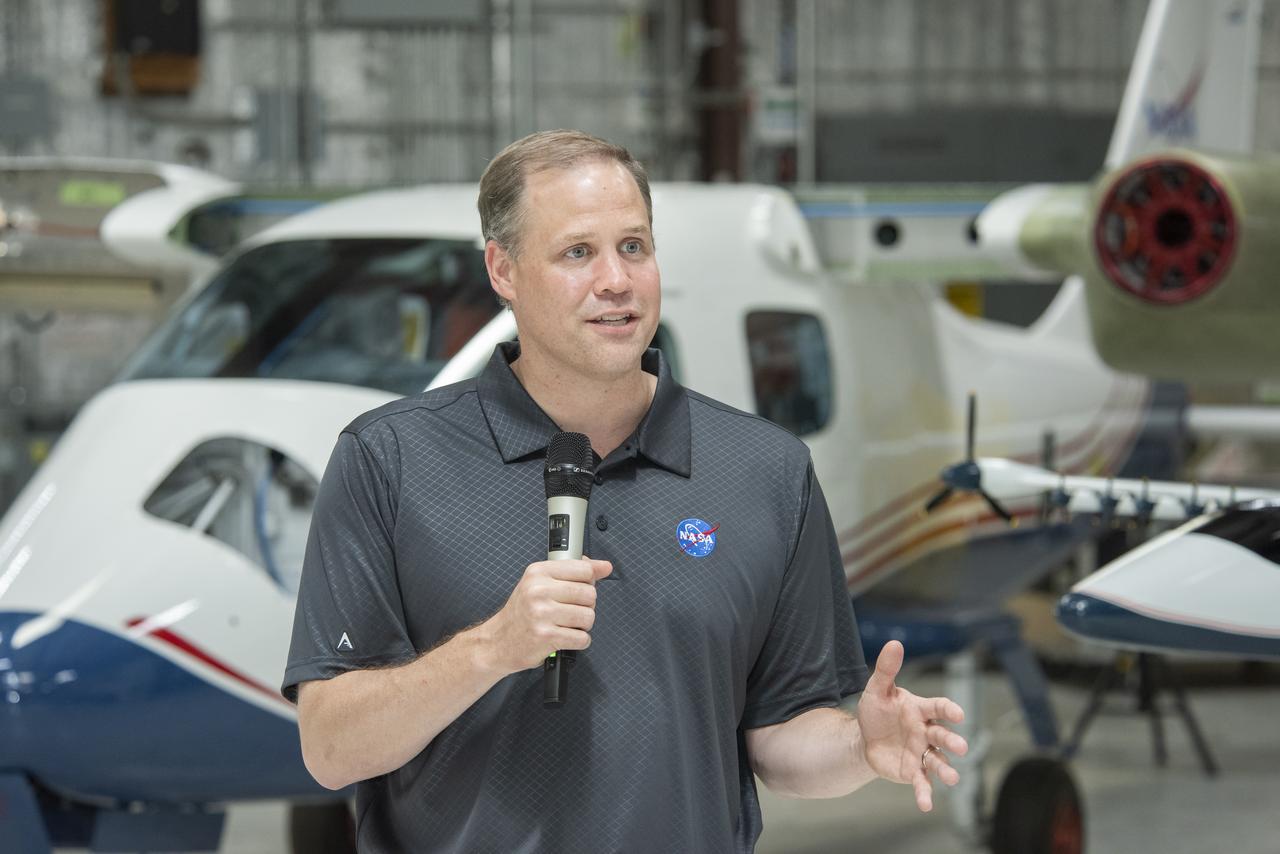
NASA Administrator Bridenstine talks to press at Scaled Composites hangar at Mojave Air & Space Port in California. He talks about X-planes and their future and the Flight Opportunities program as well as commercial space partnerships with the agency.
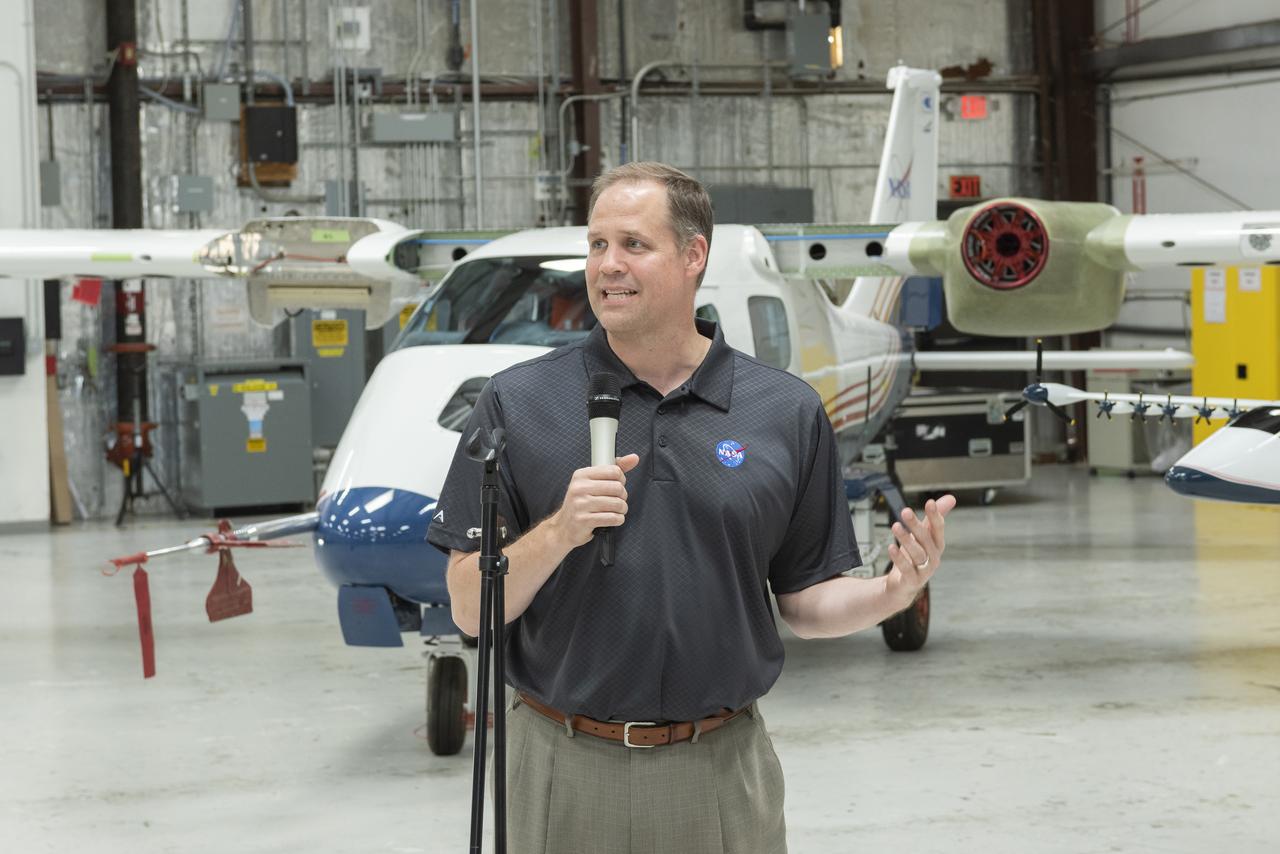
NASA Administrator Bridenstine talks to press at Scaled Composites hangar at Mojave Air & Space Port in California. He talks about X-planes and their future and the Flight Opportunities program as well as commercial space partnerships with the agency.
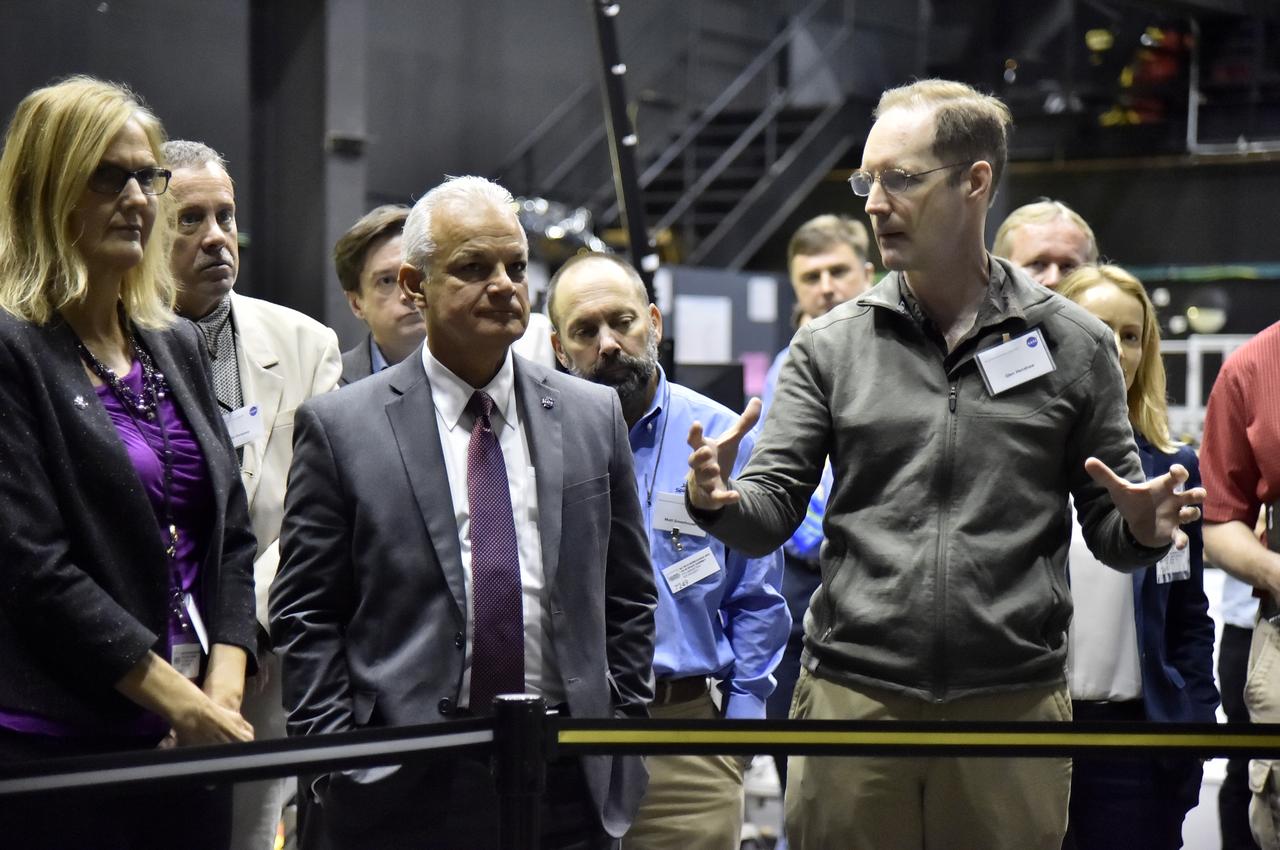
WASHINGTON, D.C.---S&T Partnership Forum In-Space Assembly Technical Interchange Meeting-On September 6th 2017, many of the United States government experts on In-Space Assembly met at the U.S. Naval Research Lab to discuss both technology development and in-space applications that would advance national capabilities in this area. Expertise from NASA, USAF, NRO, DARPA and NRL met in this meeting which was coordinated by the NASA Headquarters, Office of the Chief Technologist. This technical interchange meeting was the second meeting of the members of this Science and Technology Partnership Forum. Glen Henshaw of Code 8231 talks to the group in the Space Robotics Lab.
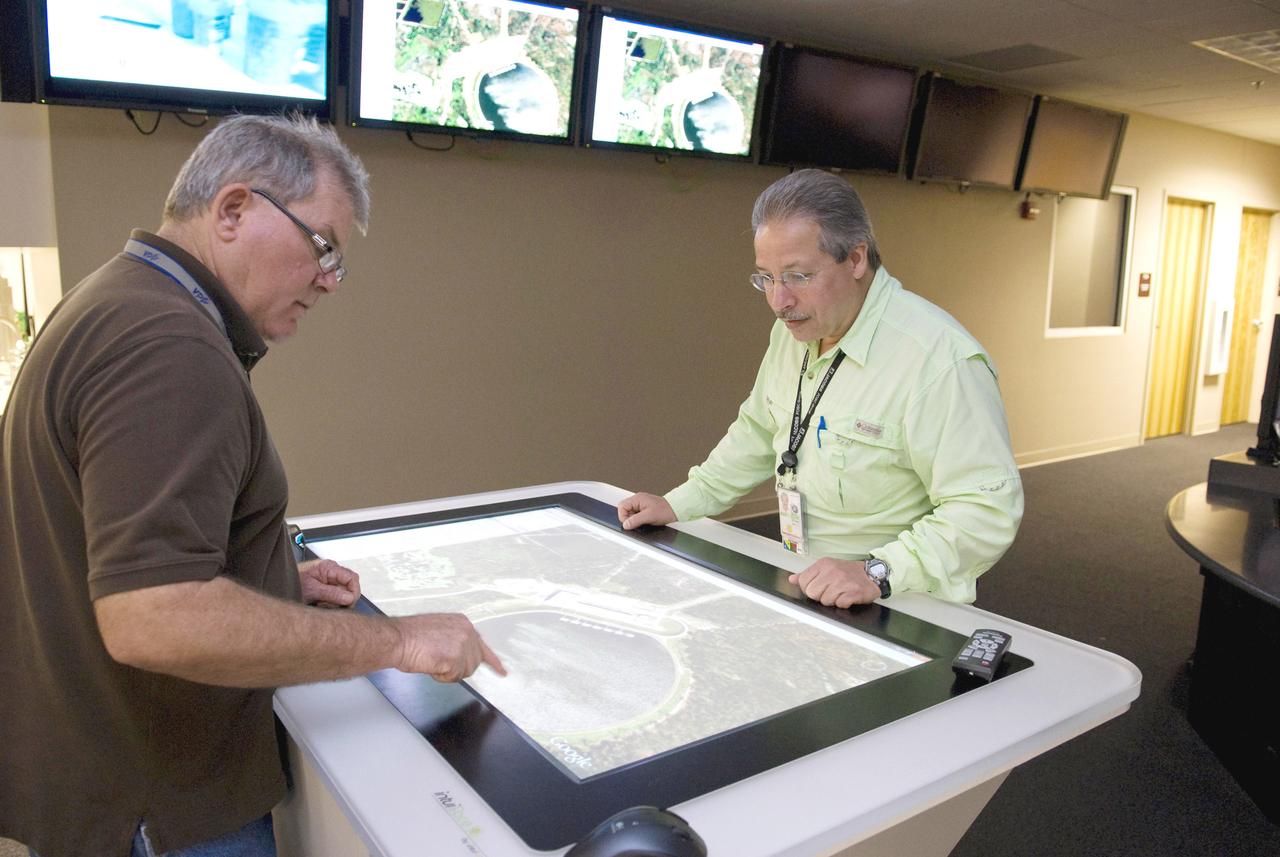
Stennis Space Center employees Mike McKinion (left), with Erica Lane Enterprises, and Luke Scianna, with the Jacobs Facility Operating Services Contract, monitor the facility and surrounding area on the 'all-hazards network' known as HazNet. The HazNet system at Stennis was developed by a local Mississippi company to help facilitate coordinated response during emergency and disaster situations. The system was installed in the new Emergency Operations Center built at Stennis before being implemented throughout NASA. HazNet was designed by NVision Solutions Inc. of Bay St. Louis, Miss., through NASA's Innovative Partnerships Program. In addition to being used at Stennis, it has been installed at other Gulf Coast communities to help coordinate response during emergencies and such natural disasters as hurricanes.
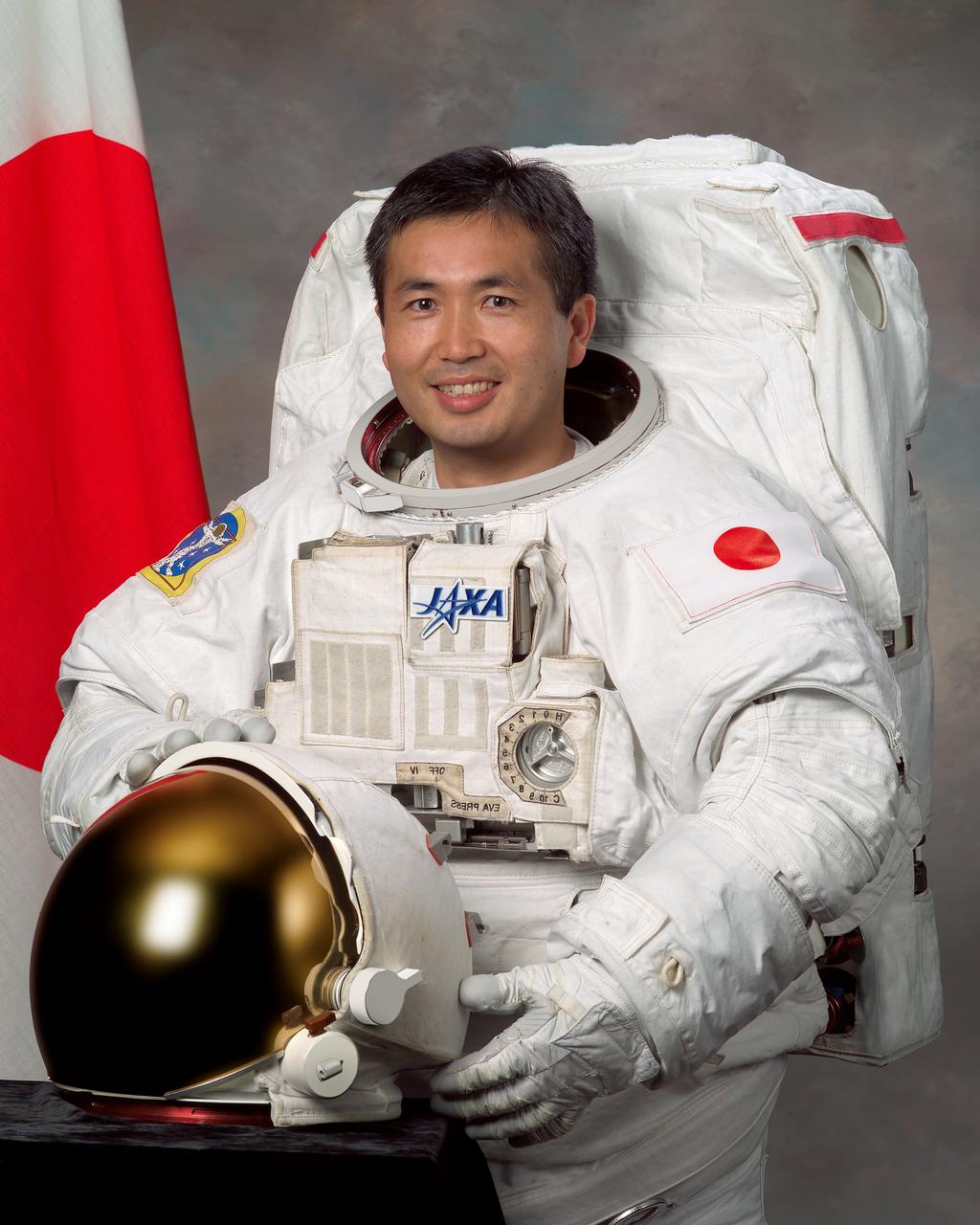
JSC2007-E-19403 (19 March 2007) --- Japan Aerospace Exploration Agency (JAXA) astronaut Koichi Wakata, flight engineer
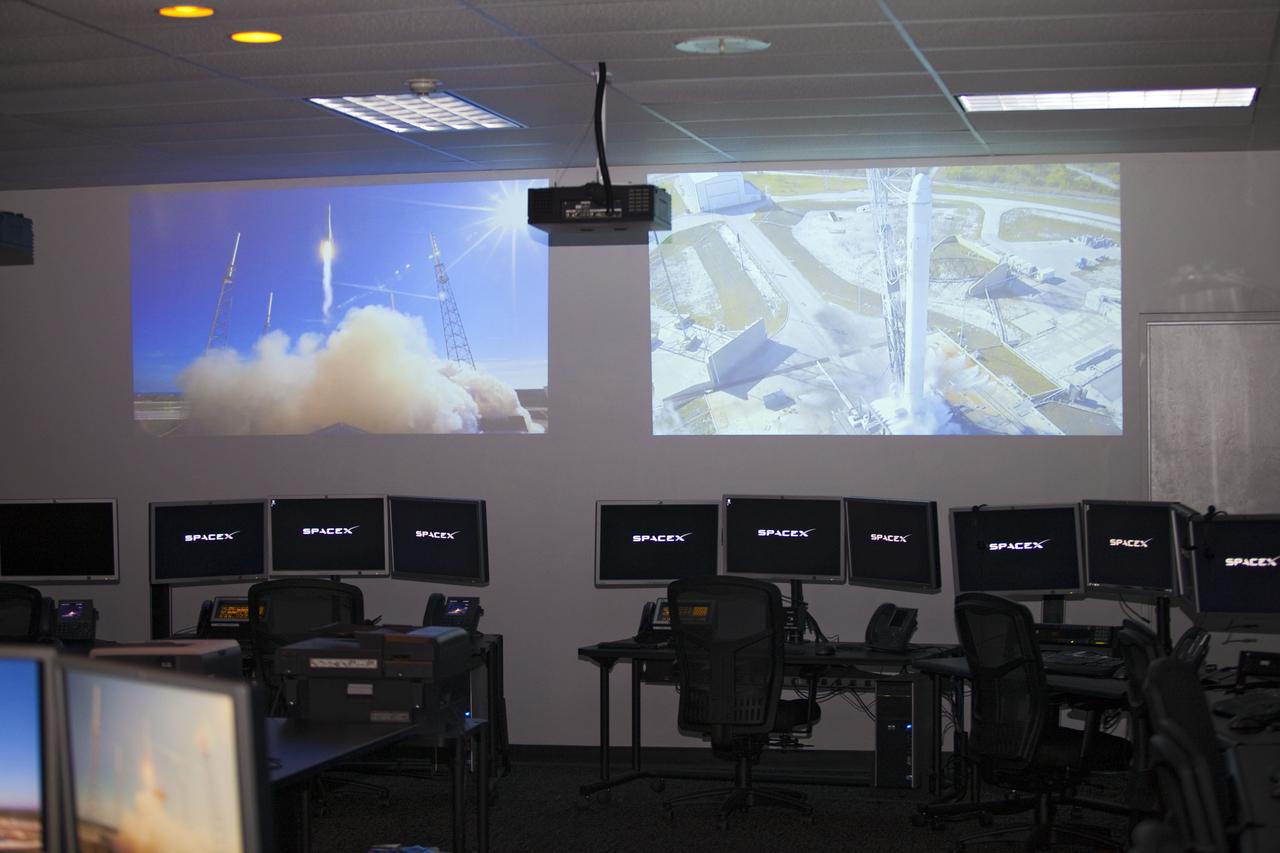
CAPE CANAVERAL, Fla. -- Space Exploration Technologies Corp., or SpaceX, shows off its Launch Control Center during a media tour at Cape Canaveral Air Force Station, or CCAFS, in Florida. In December 2010, SpaceX launched its Falcon 9 rocket and Dragon spacecraft from CCAFS's Launch Complex 40. The Dragon capsule went through several maneuvers before it re-entered the atmosphere and splashed down in the Pacific Ocean about 500 miles west of the coast of Mexico. That was the first demonstration flight for NASA's Commercial Orbital Transportation Services (COTS) program, which will provide cargo flights to the International Space Station in the future. The company is preparing for another launch in late 2011, in which the Dragon spacecraft and trunk will fly close to the space station so the station’s robotic arm can grab the spacecraft and bring it in for a docking. Photo credit: NASA/Frankie Martin
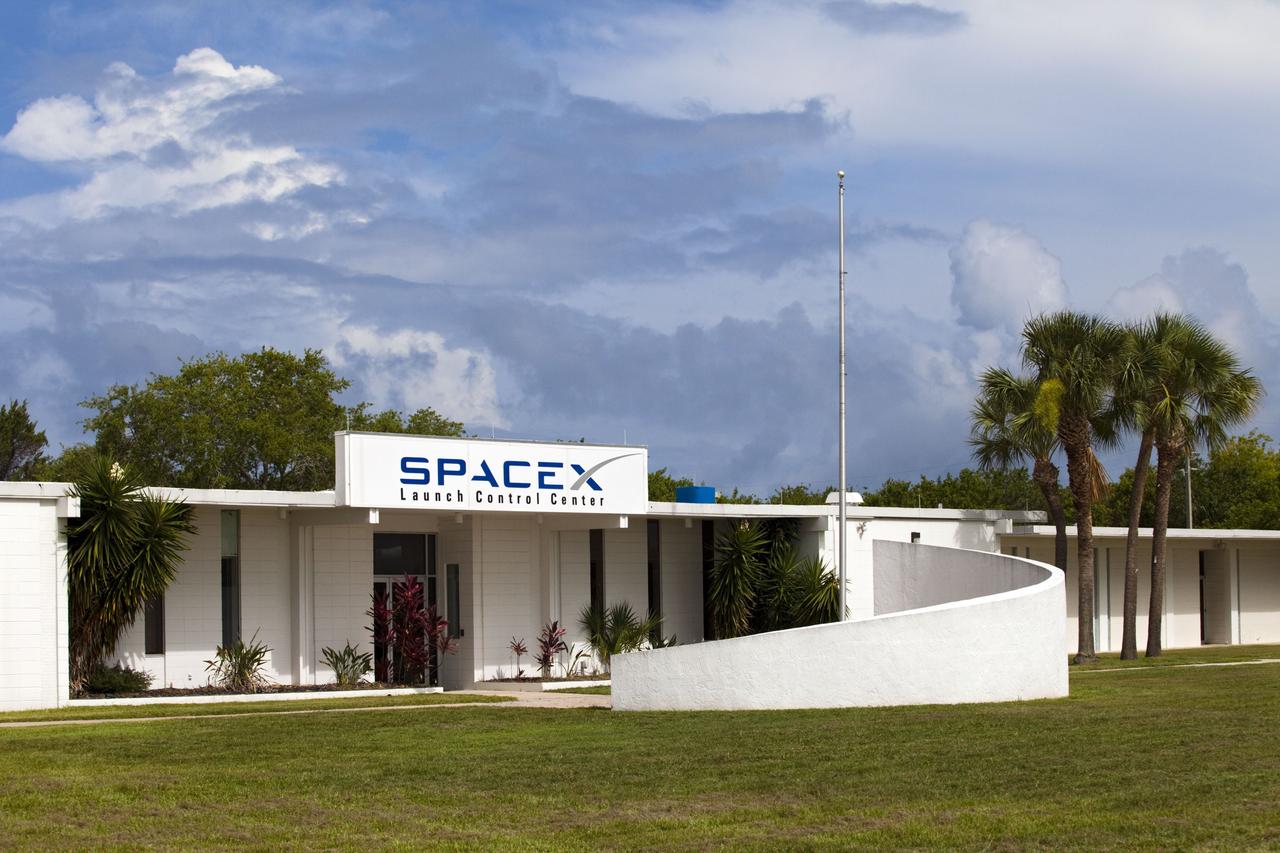
CAPE CANAVERAL, Fla. -- Space Exploration Technologies Corp., or SpaceX, opens its doors for a media tour of its Launch Control Center at Cape Canaveral Air Force Station, or CCAFS, in Florida. In December 2010, SpaceX launched its Falcon 9 rocket and Dragon spacecraft from CCAFS's Launch Complex 40. The Dragon capsule went through several maneuvers before it re-entered the atmosphere and splashed down in the Pacific Ocean about 500 miles west of the coast of Mexico. That was the first demonstration flight for NASA's Commercial Orbital Transportation Services (COTS) program, which will provide cargo flights to the International Space Station in the future. The company is preparing for another launch in late 2011, in which the Dragon spacecraft and trunk will fly close to the space station so the station’s robotic arm can grab the spacecraft and bring it in for a docking. Photo credit: NASA/Frankie Martin
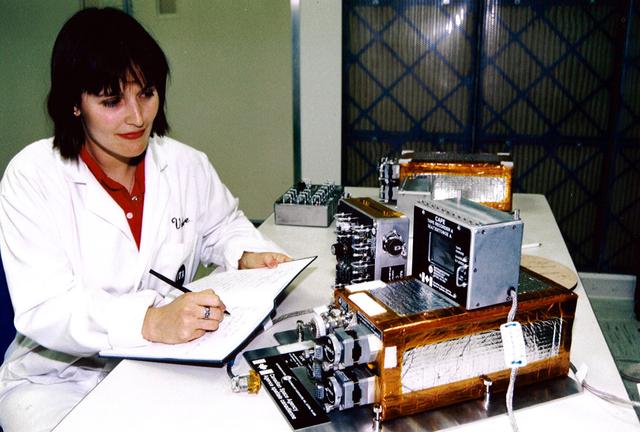
Experiments to seek solutions for a range of biomedical issues are at the heart of several investigations that will be hosted by the Commercial Instrumentation Technology Associates (ITA), Inc. Biomedical Experiments (CIBX-2) payload. CIBX-2 is unique, encompassing more than 20 separate experiments including cancer research, commercial experiments, and student hands-on experiments from 10 schools as part of ITA's ongoing University Among the Stars program. Valerie Cassanto of ITA checks the Canadian Protein Crystallization Experiment (CAPE) carried by STS-86 to Mir in 1997. The experiments are sponsored by NASA's Space Product Development Program (SPD).
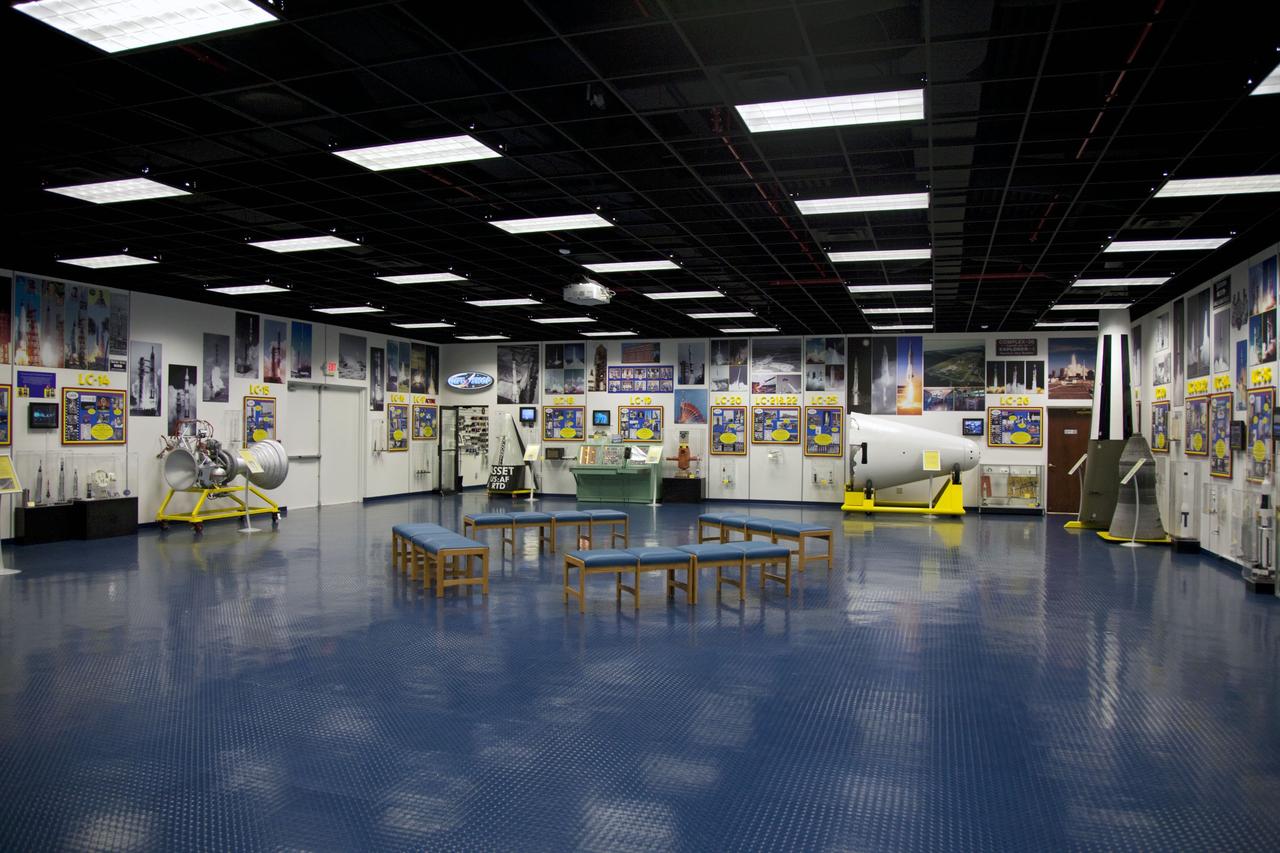
CAPE CANAVERAL, Fla. -- This is an inside view of the Air Force Space and Missile Museum's History Center, which is located outside the south gate of Cape Canaveral Air Force Station (CCAFS) in Florida. It contains historic information and displays for each launch complex at CCAFS. Since opening to the public in 1966, the museum has introduced millions of visitors to the history of rocketry and spaceflight. Its primary mission is to collect, restore and exhibit items of historical significance that relate to the development and heritage of U.S. Air Force space launch activities. Photo credit: NASA/Frankie Martin
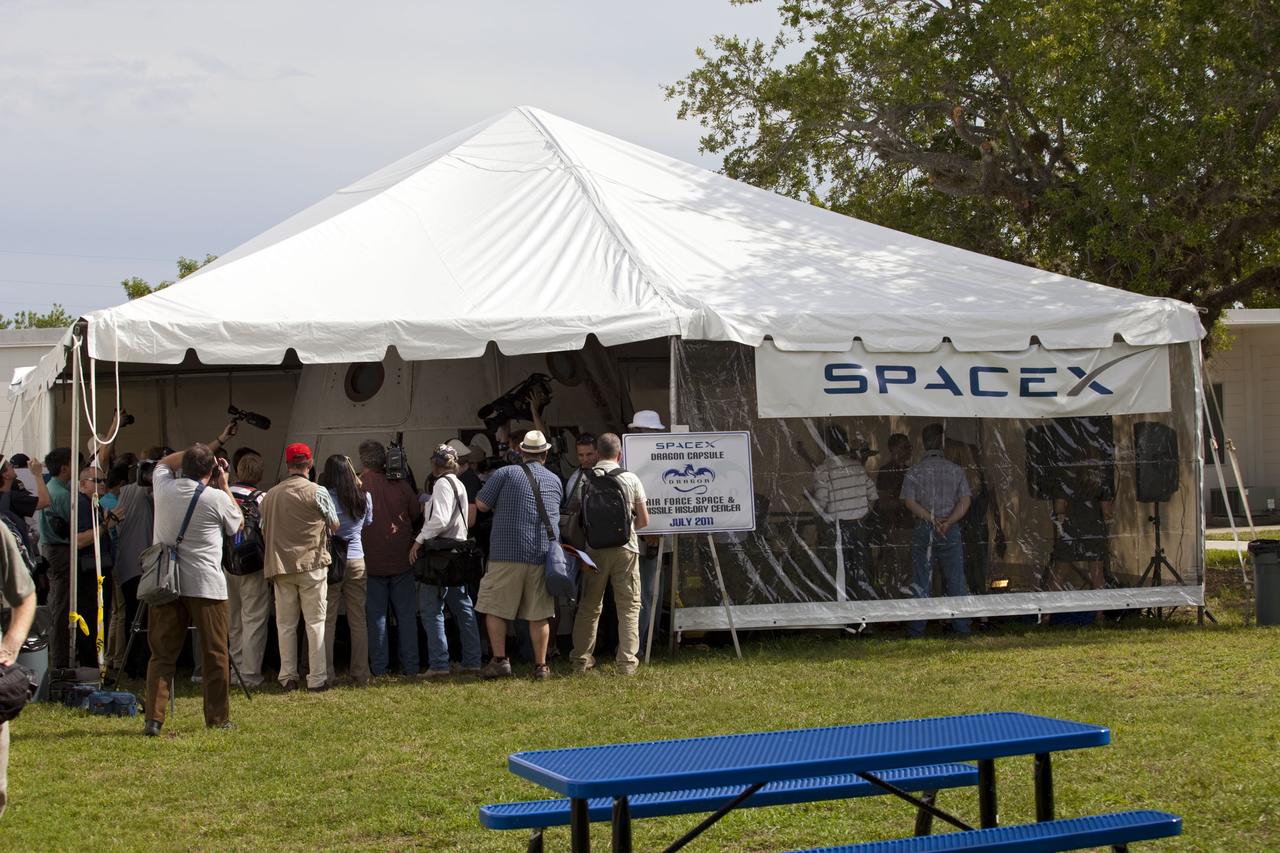
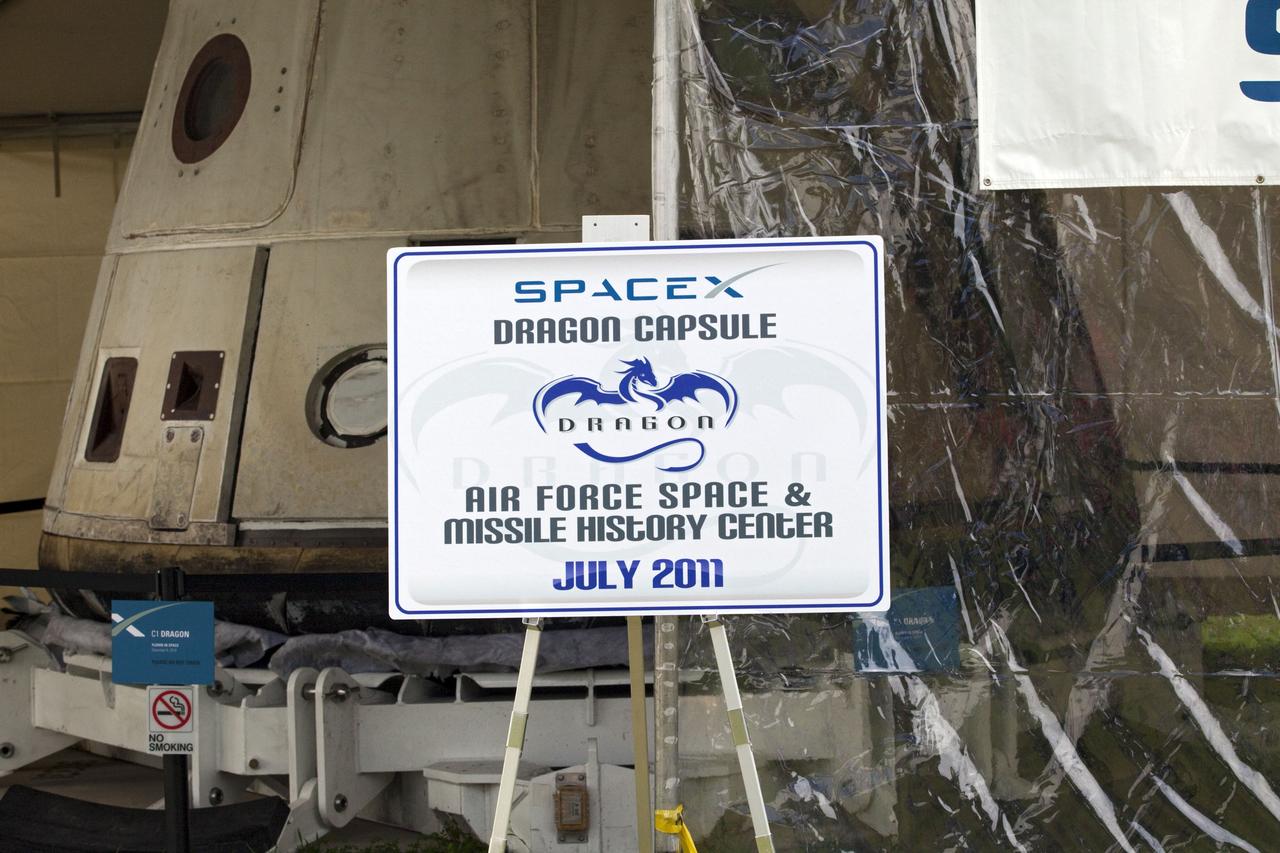
CAPE CANAVERAL, Fla. -- Space Exploration Technologies Corp., or SpaceX, displays a mock-up of its Dragon capsule during a media tour at Cape Canaveral Air Force Station, or CCAFS, in Florida. In December 2010, SpaceX launched its Falcon 9 rocket and Dragon spacecraft from CCAFS's Launch Complex 40. The Dragon capsule went through several maneuvers before it re-entered the atmosphere and splashed down in the Pacific Ocean about 500 miles west of the coast of Mexico. That was the first demonstration flight for NASA's Commercial Orbital Transportation Services (COTS) program, which will provide cargo flights to the International Space Station in the future. The company is preparing for another launch in late 2011, in which the Dragon spacecraft and trunk will fly close to the space station so the station’s robotic arm can grab the spacecraft and bring it in for a docking. Photo credit: NASA/Frankie Martin
CAPE CANAVERAL, Fla. -- Space Exploration Technologies Corp., or SpaceX, displays a mock-up of its Dragon capsule during a media tour at Cape Canaveral Air Force Station, or CCAFS, in Florida. In December 2010, SpaceX launched its Falcon 9 rocket and Dragon spacecraft from CCAFS's Launch Complex 40. The Dragon capsule went through several maneuvers before it re-entered the atmosphere and splashed down in the Pacific Ocean about 500 miles west of the coast of Mexico. That was the first demonstration flight for NASA's Commercial Orbital Transportation Services (COTS) program, which will provide cargo flights to the International Space Station in the future. The company is preparing for another launch in late 2011, in which the Dragon spacecraft and trunk will fly close to the space station so the station’s robotic arm can grab the spacecraft and bring it in for a docking. Photo credit: NASA/Frankie Martin
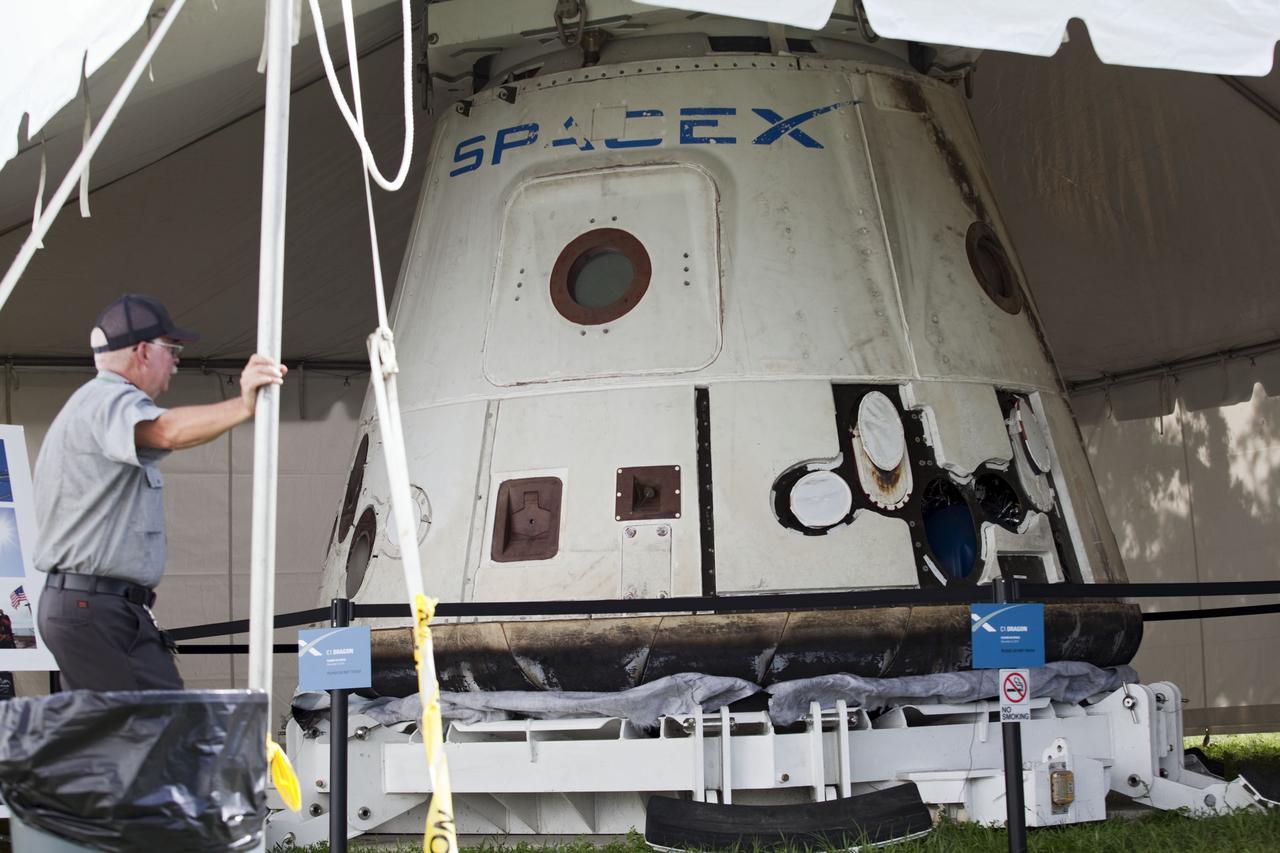
CAPE CANAVERAL, Fla. -- Space Exploration Technologies Corp., or SpaceX, displays a mock-up of its Dragon capsule during a media tour at Cape Canaveral Air Force Station, or CCAFS, in Florida. In December 2010, SpaceX launched its Falcon 9 rocket and Dragon spacecraft from CCAFS's Launch Complex 40. The Dragon capsule went through several maneuvers before it re-entered the atmosphere and splashed down in the Pacific Ocean about 500 miles west of the coast of Mexico. That was the first demonstration flight for NASA's Commercial Orbital Transportation Services (COTS) program, which will provide cargo flights to the International Space Station in the future. The company is preparing for another launch in late 2011, in which the Dragon spacecraft and trunk will fly close to the space station so the station’s robotic arm can grab the spacecraft and bring it in for a docking. Photo credit: NASA/Frankie Martin
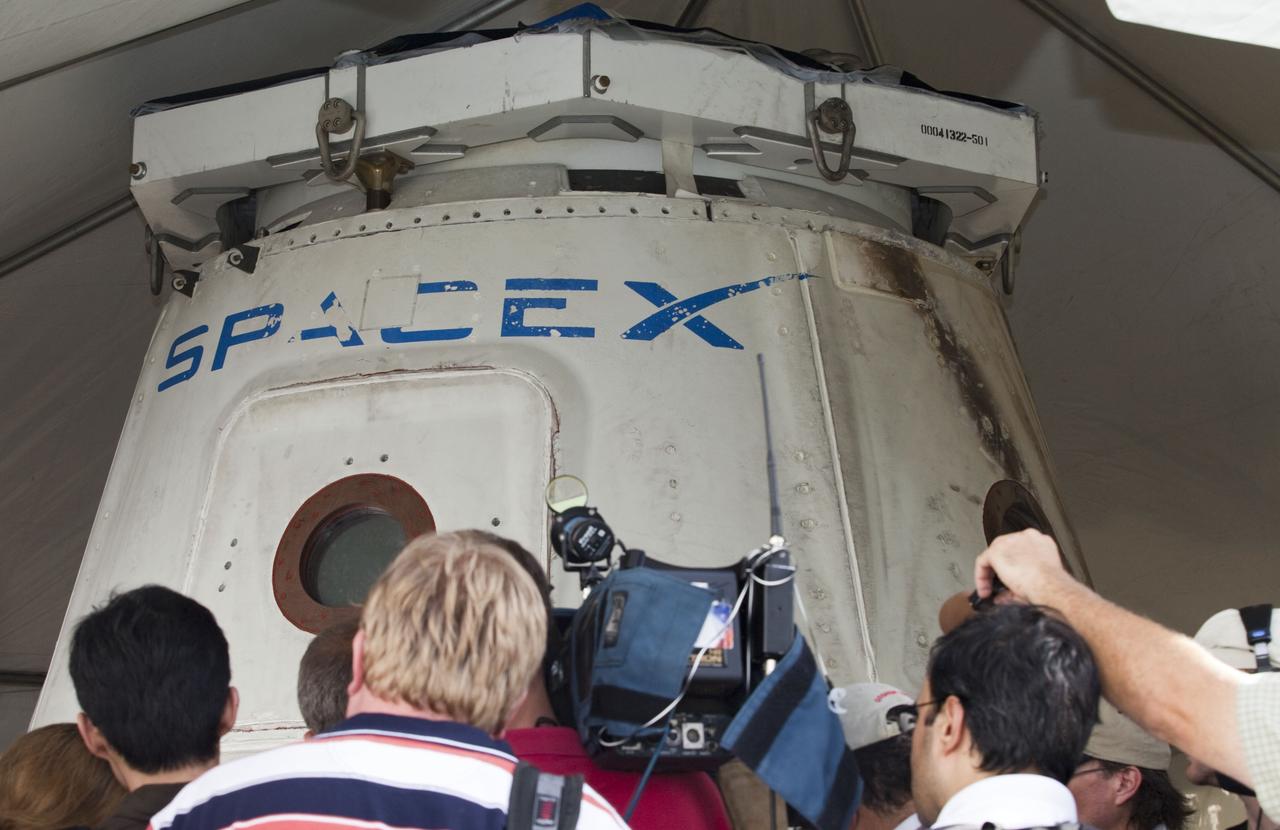
CAPE CANAVERAL, Fla. -- Space Exploration Technologies Corp., or SpaceX, displays a mock-up of its Dragon capsule during a media tour at Cape Canaveral Air Force Station, or CCAFS, in Florida. In December 2010, SpaceX launched its Falcon 9 rocket and Dragon spacecraft from CCAFS's Launch Complex 40. The Dragon capsule went through several maneuvers before it re-entered the atmosphere and splashed down in the Pacific Ocean about 500 miles west of the coast of Mexico. That was the first demonstration flight for NASA's Commercial Orbital Transportation Services (COTS) program, which will provide cargo flights to the International Space Station in the future. The company is preparing for another launch in late 2011, in which the Dragon spacecraft and trunk will fly close to the space station so the station’s robotic arm can grab the spacecraft and bring it in for a docking. Photo credit: NASA/Frankie Martin
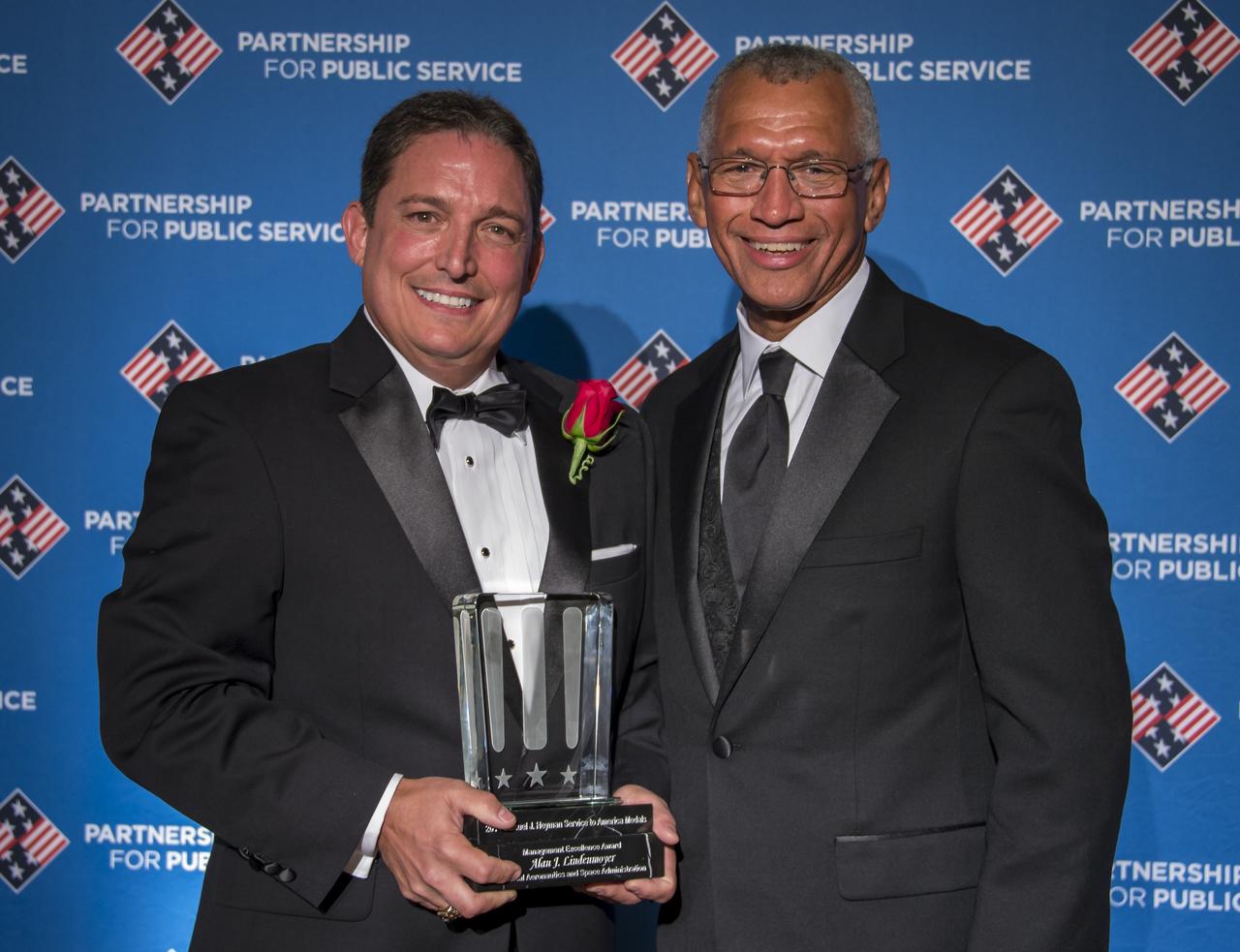
Alan J. Lindenmoyer, program manager, Commercial Crew and Cargo Program NASA, Johnson Space Center, Houston, Texas, left, poses for a photograph with Charles Bolden, NASA Administrator, shortly after Bolden presented Lindenmoyer the 2014 Samuel J. Heyman Service to America Medal by the Partnership for Public Service, Monday, Sept. 22, 2014 at the Andrew Mellon Auditorium in Washington. Lindenmoyer was recognized for transforming NASA’s space travel programs, helping the U.S. continue important space research while reducing taxpayer costs and stimulating the commercial space industry. Photo Credit: (NASA/Bill Ingalls)
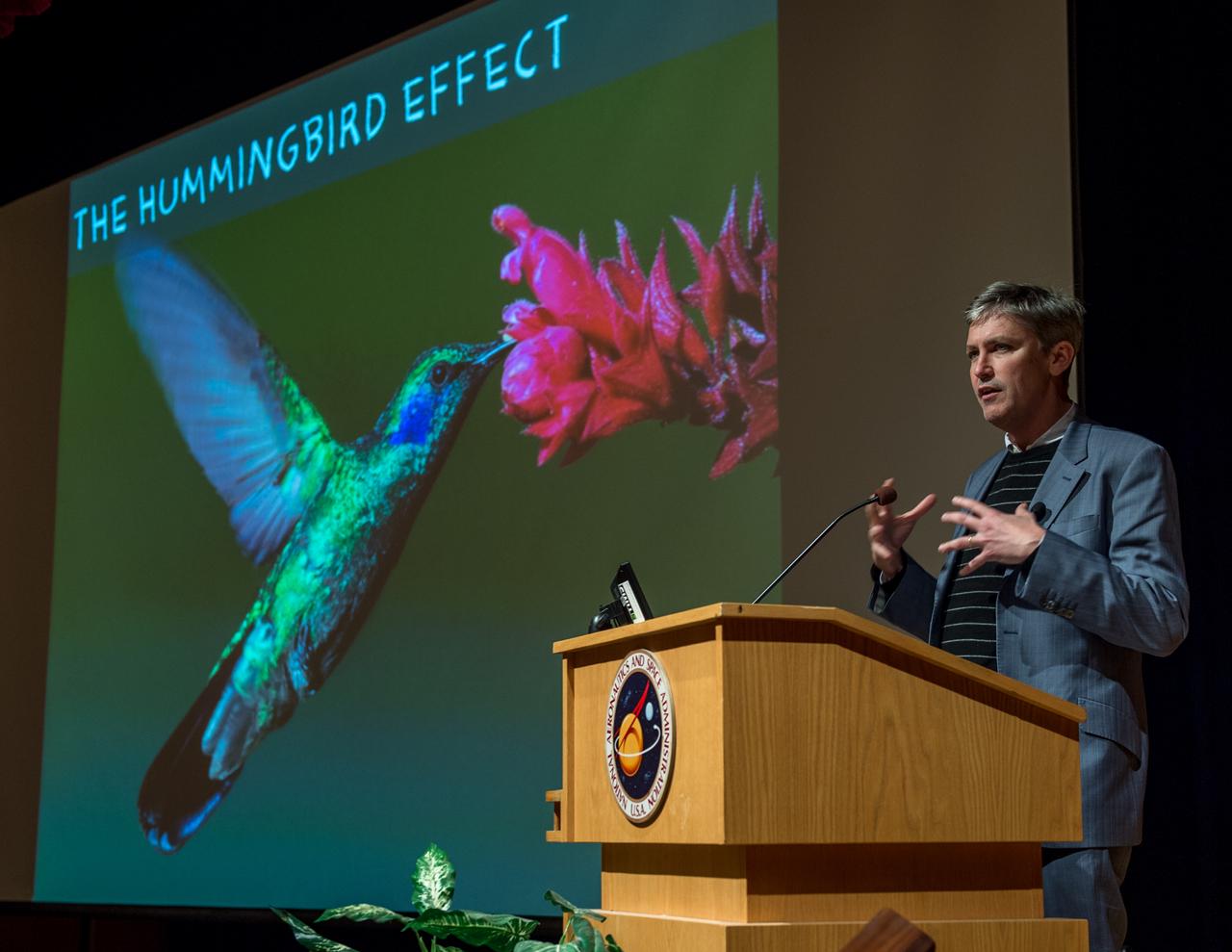
NASA's Goddard Space Flight Center welcomed Steven Johnson, author of How We Got to Now: Six Innovations That Made the Modern World, to the Innovative Initiatives workshop on Thursday, November 13, 2014 Credit: NASA/Goddard/Bill Hrybyk <b><a href="http://www.nasa.gov/audience/formedia/features/MP_Photo_Guidelines.html" rel="nofollow">NASA image use policy.</a></b> <b><a href="http://www.nasa.gov/centers/goddard/home/index.html" rel="nofollow">NASA Goddard Space Flight Center</a></b> enables NASA’s mission through four scientific endeavors: Earth Science, Heliophysics, Solar System Exploration, and Astrophysics. Goddard plays a leading role in NASA’s accomplishments by contributing compelling scientific knowledge to advance the Agency’s mission. <b>Follow us on <a href="http://twitter.com/NASAGoddardPix" rel="nofollow">Twitter</a></b> <b>Like us on <a href="http://www.facebook.com/pages/Greenbelt-MD/NASA-Goddard/395013845897?ref=tsd" rel="nofollow">Facebook</a></b> <b>Find us on <a href="http://instagram.com/nasagoddard?vm=grid" rel="nofollow">Instagram</a></b>
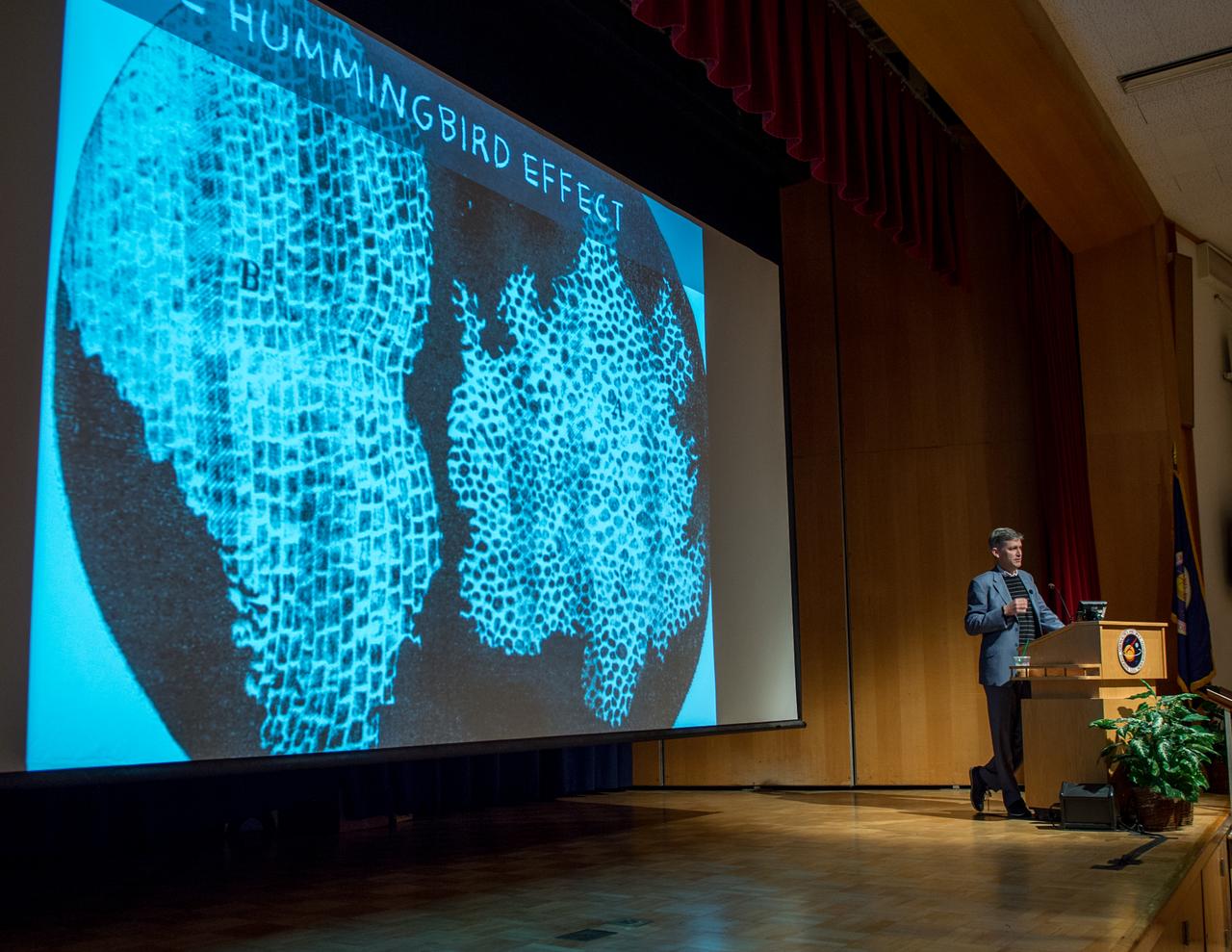
NASA's Goddard Space Flight Center welcomed Steven Johnson, author of How We Got to Now: Six Innovations That Made the Modern World, to the Innovative Initiatives workshop on Thursday, November 13, 2014 Credit: NASA/Goddard/Bill Hrybyk <b><a href="http://www.nasa.gov/audience/formedia/features/MP_Photo_Guidelines.html" rel="nofollow">NASA image use policy.</a></b> <b><a href="http://www.nasa.gov/centers/goddard/home/index.html" rel="nofollow">NASA Goddard Space Flight Center</a></b> enables NASA’s mission through four scientific endeavors: Earth Science, Heliophysics, Solar System Exploration, and Astrophysics. Goddard plays a leading role in NASA’s accomplishments by contributing compelling scientific knowledge to advance the Agency’s mission. <b>Follow us on <a href="http://twitter.com/NASAGoddardPix" rel="nofollow">Twitter</a></b> <b>Like us on <a href="http://www.facebook.com/pages/Greenbelt-MD/NASA-Goddard/395013845897?ref=tsd" rel="nofollow">Facebook</a></b> <b>Find us on <a href="http://instagram.com/nasagoddard?vm=grid" rel="nofollow">Instagram</a></b>
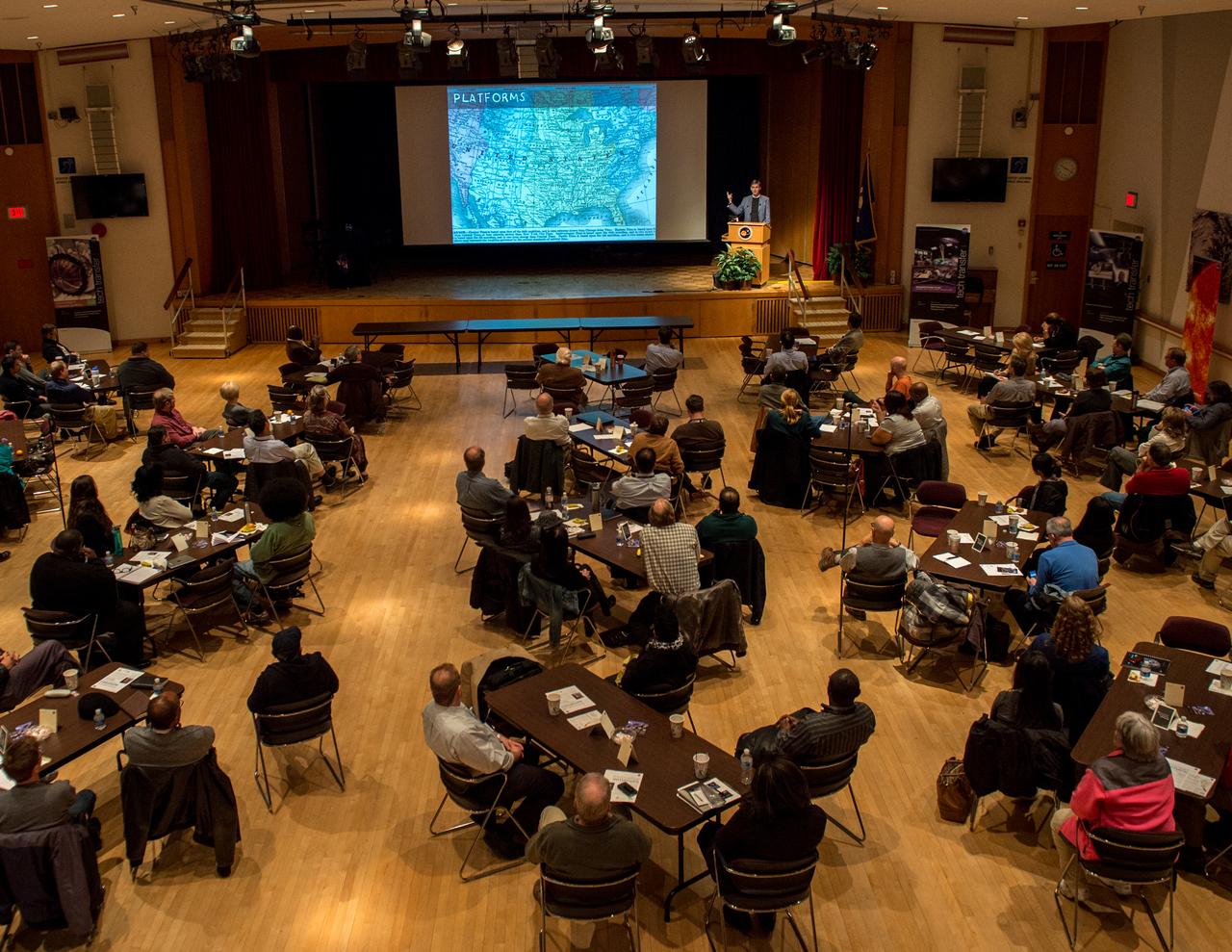
NASA's Goddard Space Flight Center welcomed Steven Johnson, author of How We Got to Now: Six Innovations That Made the Modern World, to the Innovative Initiatives workshop on Thursday, November 13, 2014 Credit: NASA/Goddard/Bill Hrybyk <b><a href="http://www.nasa.gov/audience/formedia/features/MP_Photo_Guidelines.html" rel="nofollow">NASA image use policy.</a></b> <b><a href="http://www.nasa.gov/centers/goddard/home/index.html" rel="nofollow">NASA Goddard Space Flight Center</a></b> enables NASA’s mission through four scientific endeavors: Earth Science, Heliophysics, Solar System Exploration, and Astrophysics. Goddard plays a leading role in NASA’s accomplishments by contributing compelling scientific knowledge to advance the Agency’s mission. <b>Follow us on <a href="http://twitter.com/NASAGoddardPix" rel="nofollow">Twitter</a></b> <b>Like us on <a href="http://www.facebook.com/pages/Greenbelt-MD/NASA-Goddard/395013845897?ref=tsd" rel="nofollow">Facebook</a></b> <b>Find us on <a href="http://instagram.com/nasagoddard?vm=grid" rel="nofollow">Instagram</a></b>
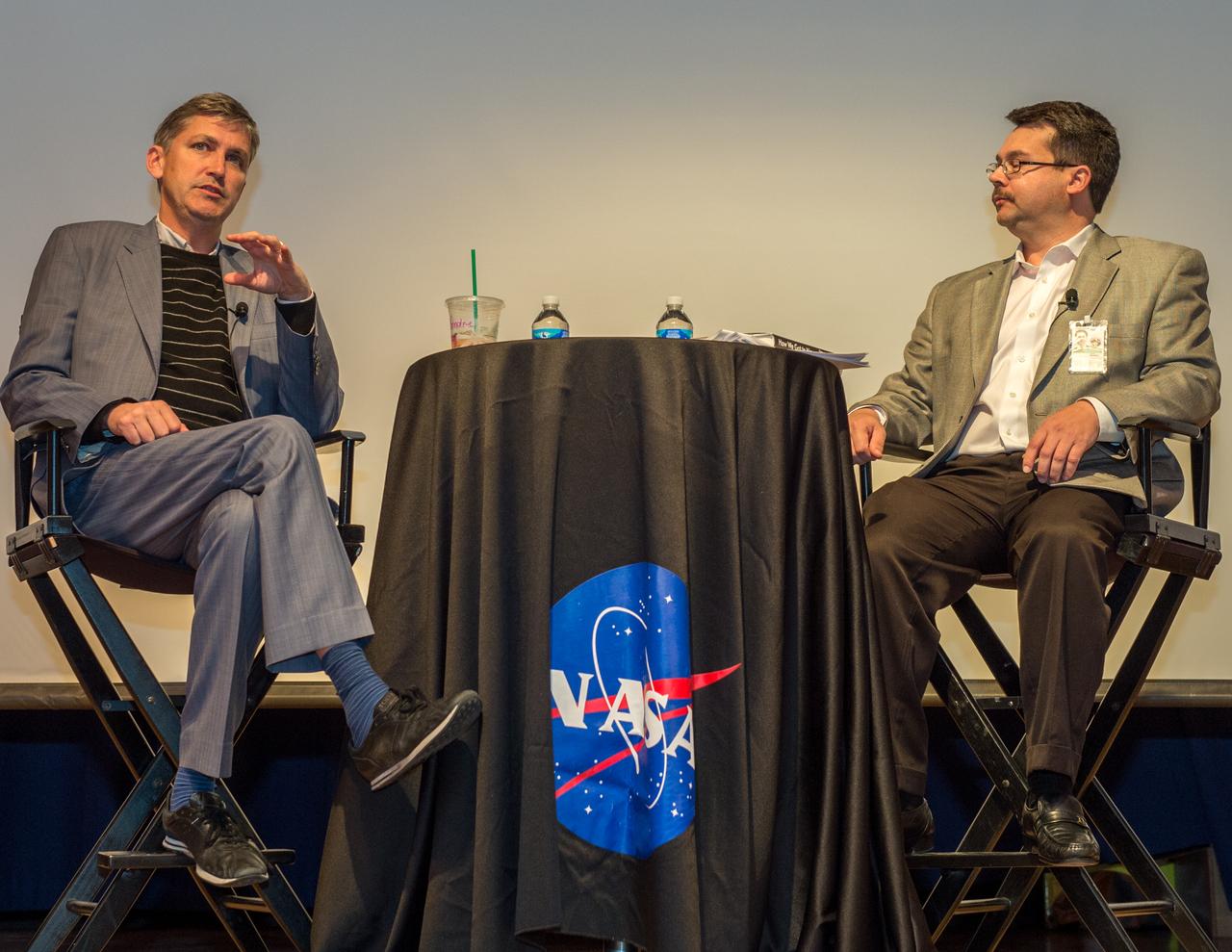
NASA's Goddard Space Flight Center welcomed Steven Johnson, author of How We Got to Now: Six Innovations That Made the Modern World, to the Innovative Initiatives workshop on Thursday, November 13, 2014 Credit: NASA/Goddard/Bill Hrybyk <b><a href="http://www.nasa.gov/audience/formedia/features/MP_Photo_Guidelines.html" rel="nofollow">NASA image use policy.</a></b> <b><a href="http://www.nasa.gov/centers/goddard/home/index.html" rel="nofollow">NASA Goddard Space Flight Center</a></b> enables NASA’s mission through four scientific endeavors: Earth Science, Heliophysics, Solar System Exploration, and Astrophysics. Goddard plays a leading role in NASA’s accomplishments by contributing compelling scientific knowledge to advance the Agency’s mission. <b>Follow us on <a href="http://twitter.com/NASAGoddardPix" rel="nofollow">Twitter</a></b> <b>Like us on <a href="http://www.facebook.com/pages/Greenbelt-MD/NASA-Goddard/395013845897?ref=tsd" rel="nofollow">Facebook</a></b> <b>Find us on <a href="http://instagram.com/nasagoddard?vm=grid" rel="nofollow">Instagram</a></b>