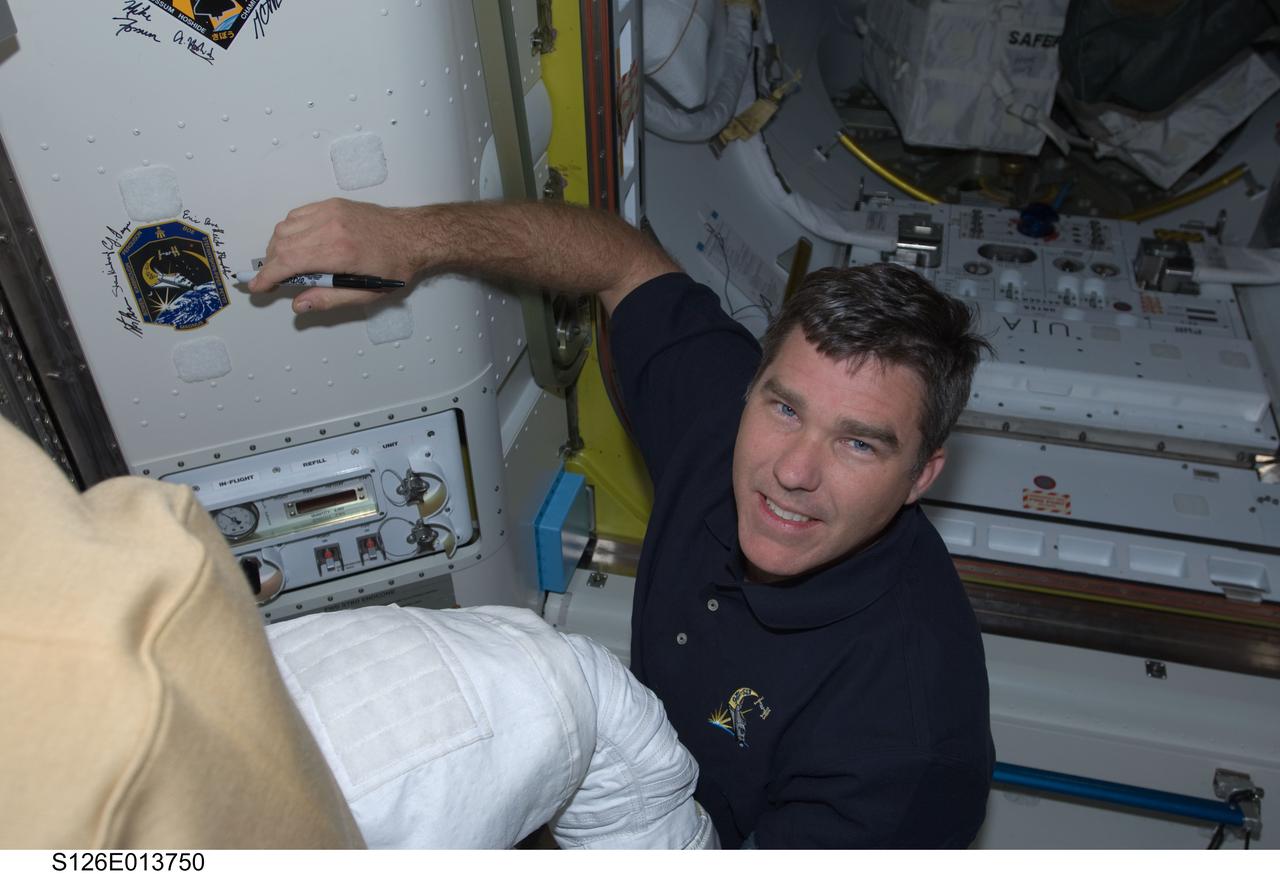
S126-E-013750 (27 Nov. 2008) --- Astronaut Steve Bowen, STS-126 mission specialist, signs Endeavour's crew patch in the Quest Airlock of the International Space Station on Thanksgiving Day. One more day remains for the Space Shuttle Endeavour to be docked with the station.
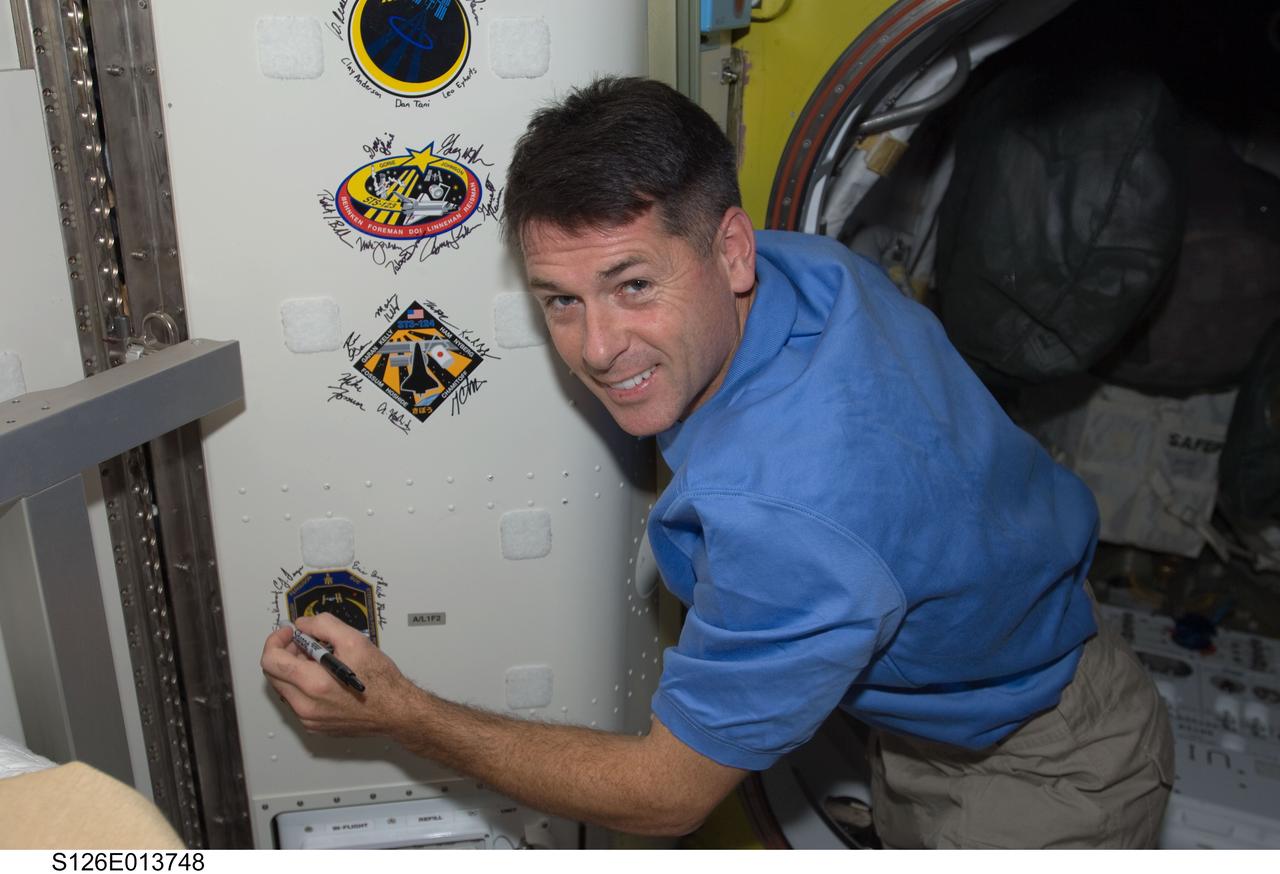
S126-E-013748 (27 Nov. 2008) --- Astronaut Shane Kimbrough, STS-126 mission specialist, signs Endeavour's crew patch in the Quest Airlock of the International Space Station on Thanksgiving Day. One more day remains for the Space Shuttle Endeavour to be docked with the station.
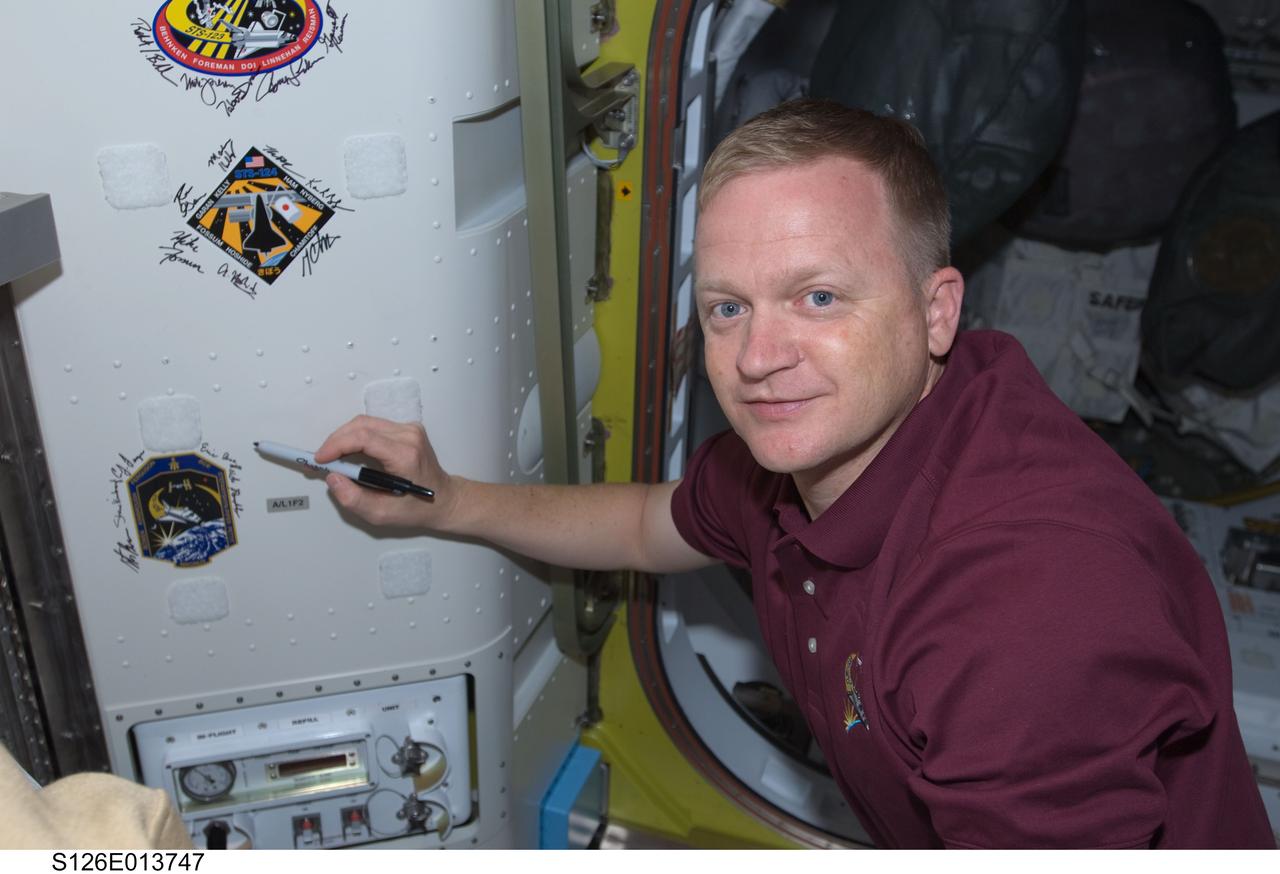
S126-E-013747 (27 Nov. 2008) --- Astronaut Eric Boe, STS-126 pilot, signs Endeavour's crew patch in the Quest Airlock of the International Space Station on Thanksgiving Day. One more day remains for the Space Shuttle Endeavour to be docked with the station.
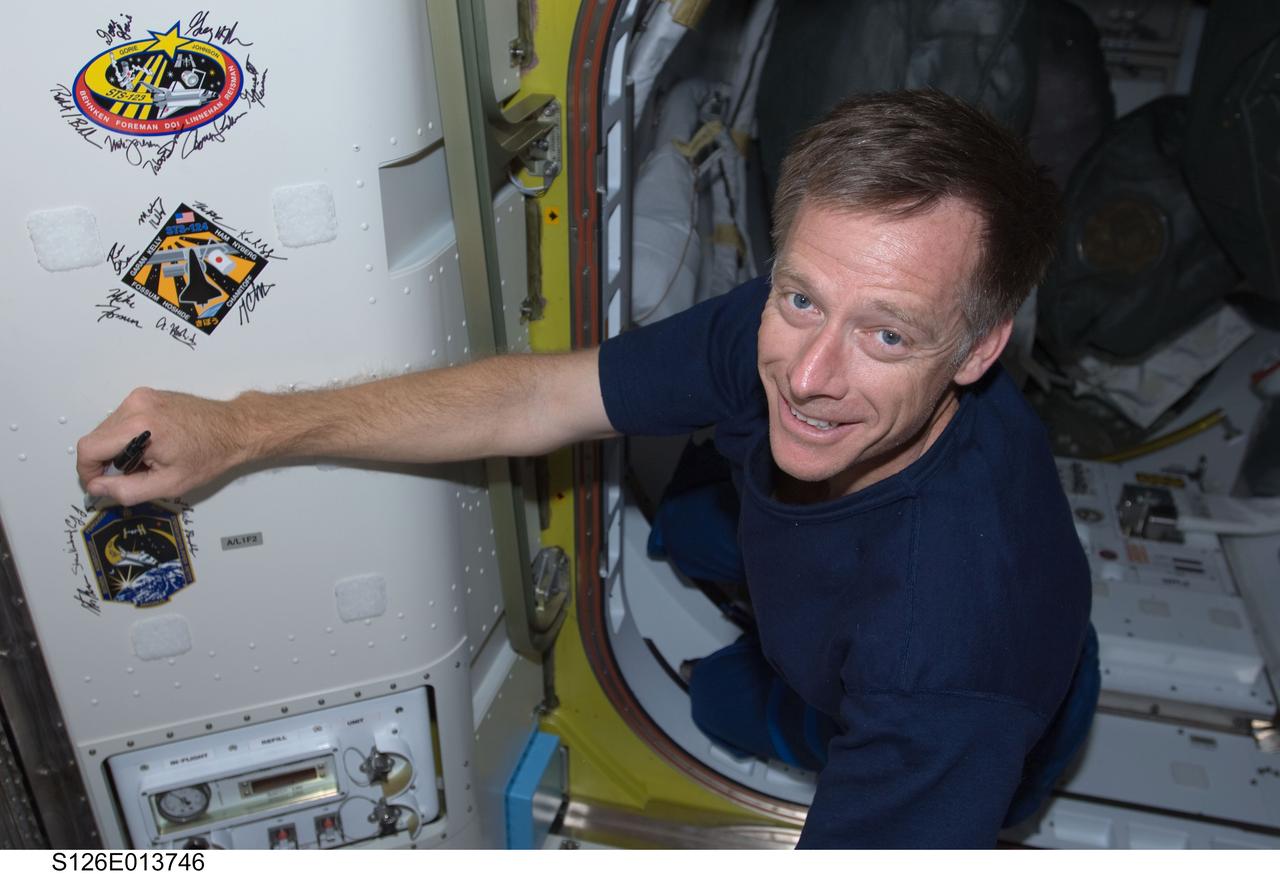
S126-E-013746 (27 Nov. 2008) --- Astronaut Chris Ferguson, STS-126 commander, signs Endeavour's crew patch in the Quest Airlock of the International Space Station on Thanksgiving Day. One more day remains for the Space Shuttle Endeavour to be docked with the station.
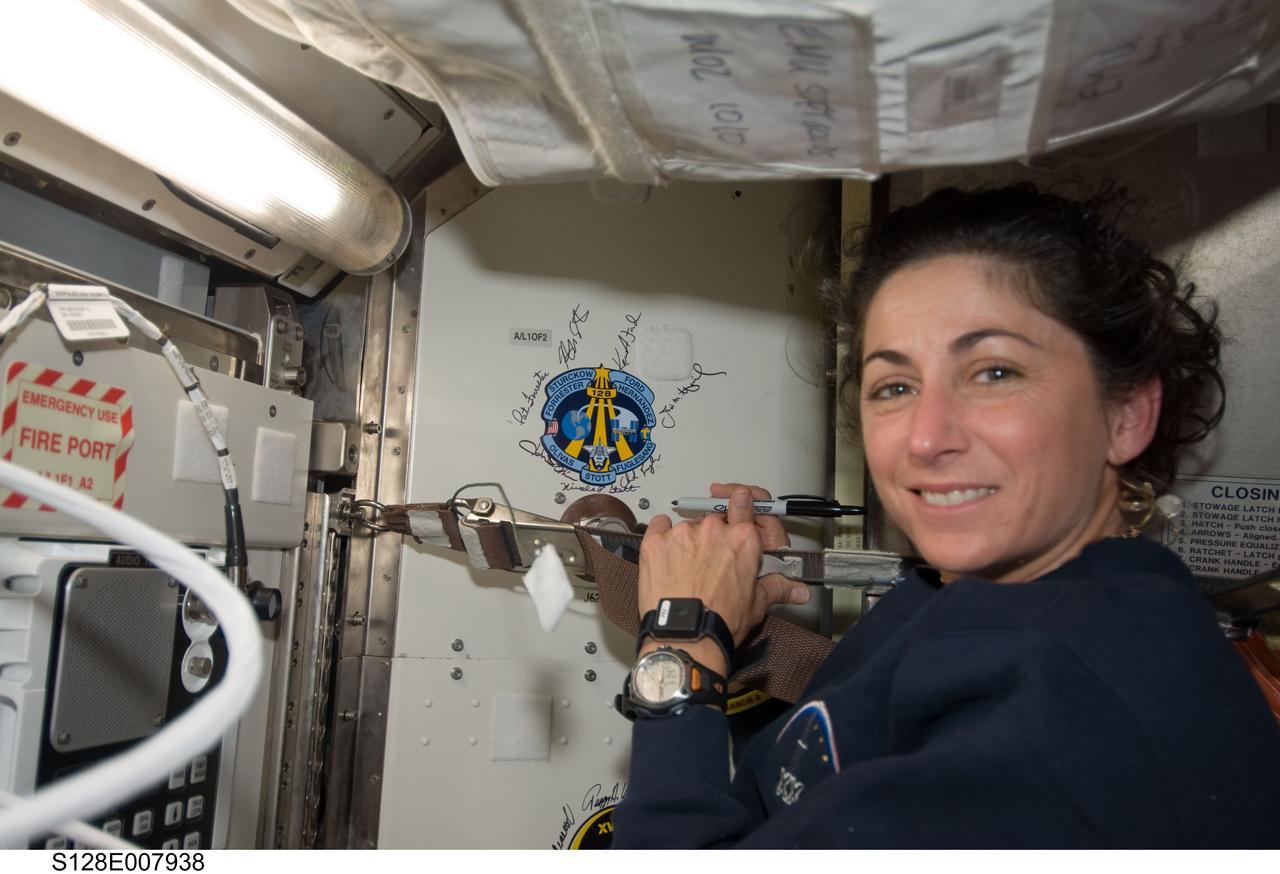
S128-E-007938 (7 Sept. 2009) --- NASA astronaut Nicole Stott, Expedition 20 flight engineer, poses for a photo after signing the STS-128 patch, which was added to the growing collection of insignias representing crews who performed spacewalks from the Quest airlock of the International Space Station.
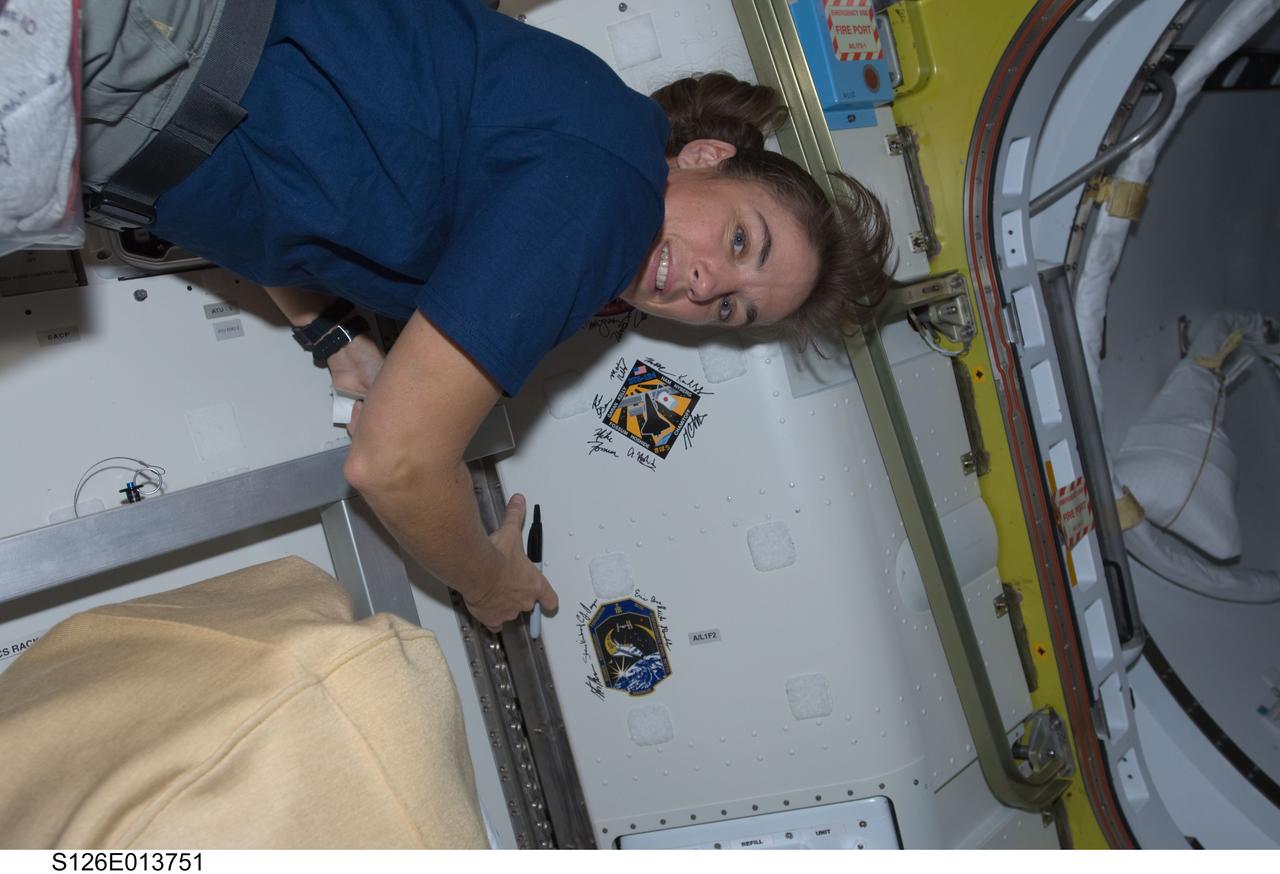
S126-E-013751 (27 Nov. 2008) --- Astronaut Heidemarie Stefanyshyn-Piper, STS-126 mission specialist, signs Endeavour's crew patch in the Quest Airlock of the International Space Station on Thanksgiving Day. One more day remains for the Space Shuttle Endeavour to be docked with the station.
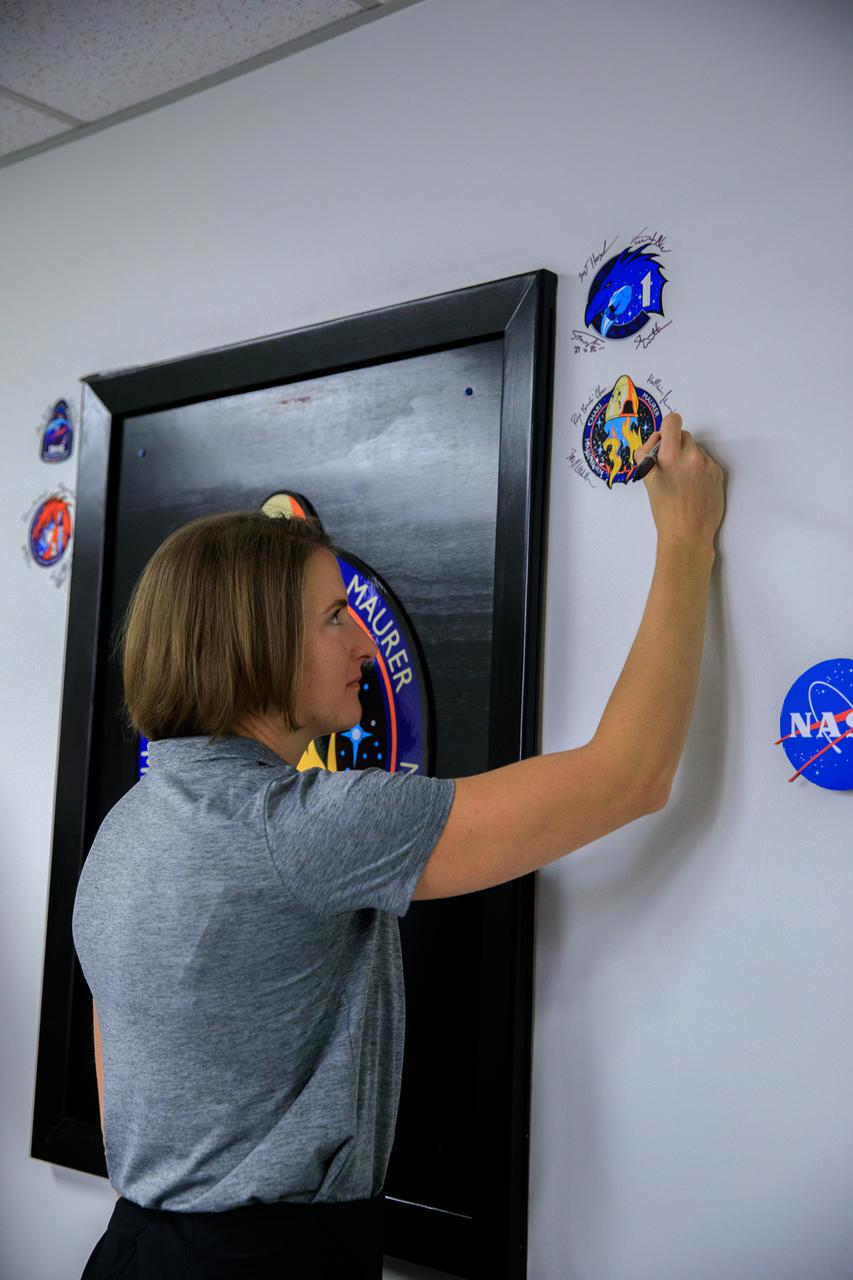
Kayla Barron, NASA astronaut and mission specialist for the SpaceX Crew-3 mission, signs the mission patch on the wall in the Astronaut Crew Quarters inside the Neil Armstrong Operations and Checkout Building at NASA’s Kennedy Space Center in Florida on Nov. 10, 2021. The Falcon 9 rocket with Crew Dragon Endurance will launch the four-person crew to the International Space Station for NASA’s Commercial Crew Program. Crew-3 is scheduled to launch Nov. 10 at 9:03 p.m. EST from Launch Complex 39A at Kennedy.
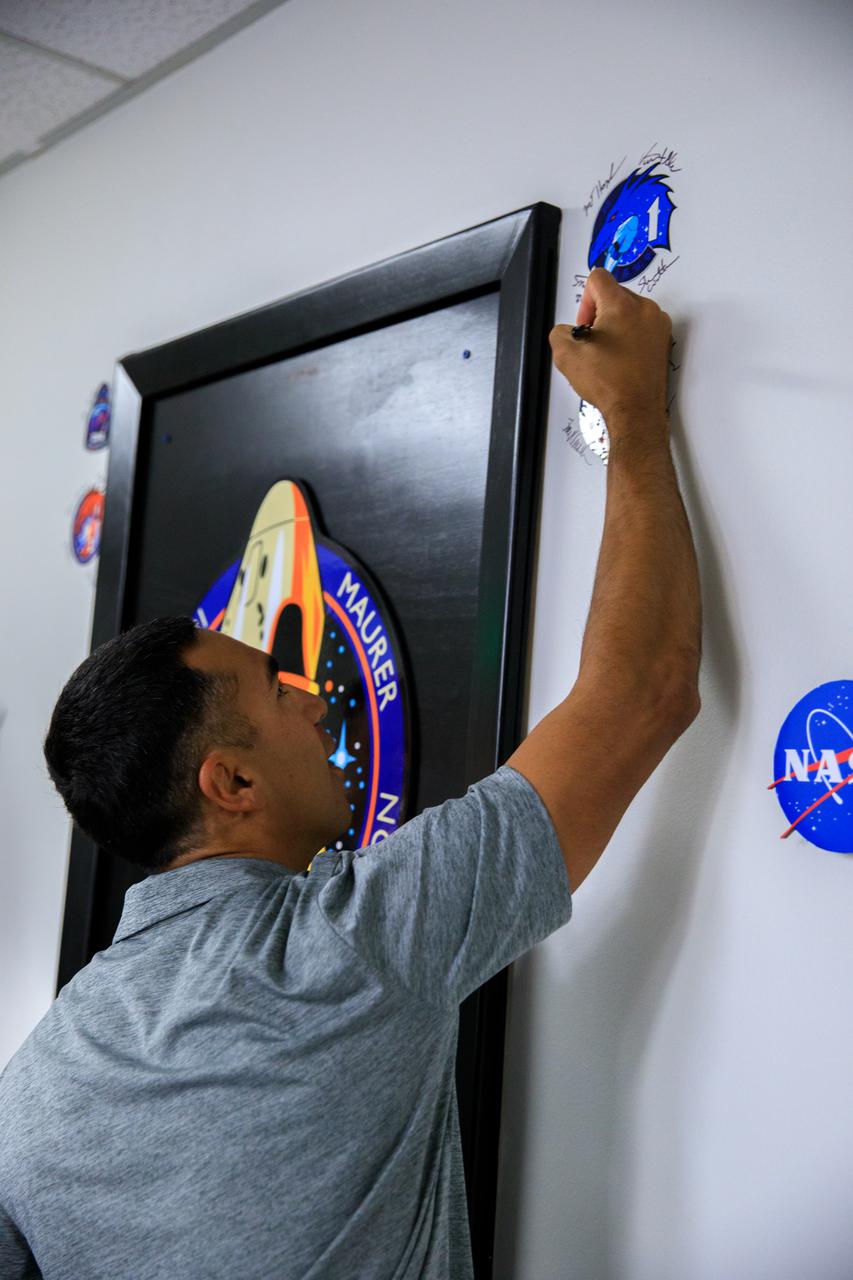
Raja Chari, NASA astronaut and commander for the SpaceX Crew-3 mission, signs the mission patch on the wall in the Astronaut Crew Quarters inside the Neil Armstrong Operations and Checkout Building at NASA’s Kennedy Space Center in Florida on Nov. 10, 2021. The Falcon 9 rocket with Crew Dragon Endurance will launch the four-person crew to the International Space Station for NASA’s Commercial Crew Program. Crew-3 is scheduled to launch Nov. 10 at 9:03 p.m. EST from Launch Complex 39A at Kennedy.
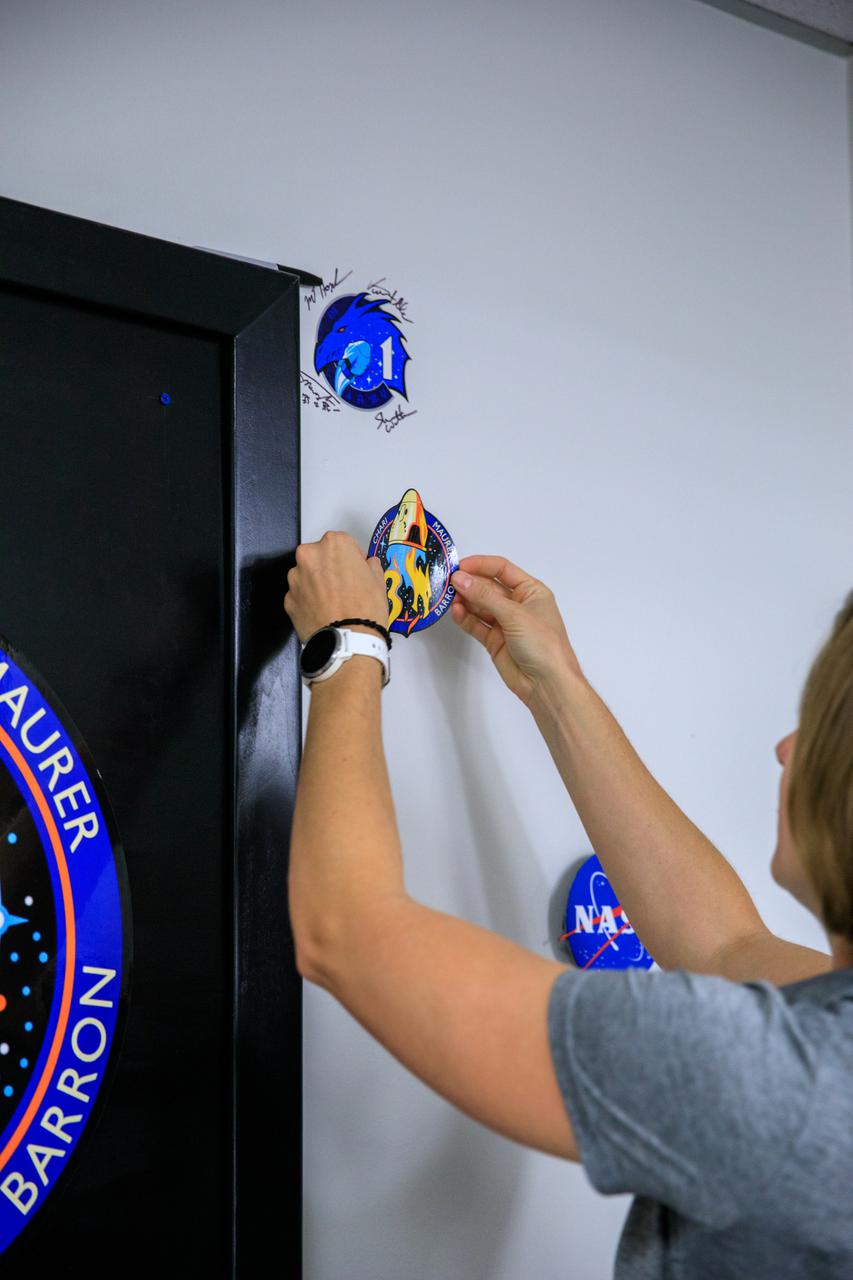
Kayla Barron, NASA astronaut and mission specialist for the SpaceX Crew-3 mission, signs the mission patch on the wall in the Astronaut Crew Quarters inside the Neil Armstrong Operations and Checkout Building at NASA’s Kennedy Space Center in Florida on Nov. 10, 2021. The Falcon 9 rocket with Crew Dragon Endurance will launch the four-person crew to the International Space Station for NASA’s Commercial Crew Program. Crew-3 is scheduled to launch Nov. 10 at 9:03 p.m. EST from Launch Complex 39A at Kennedy.
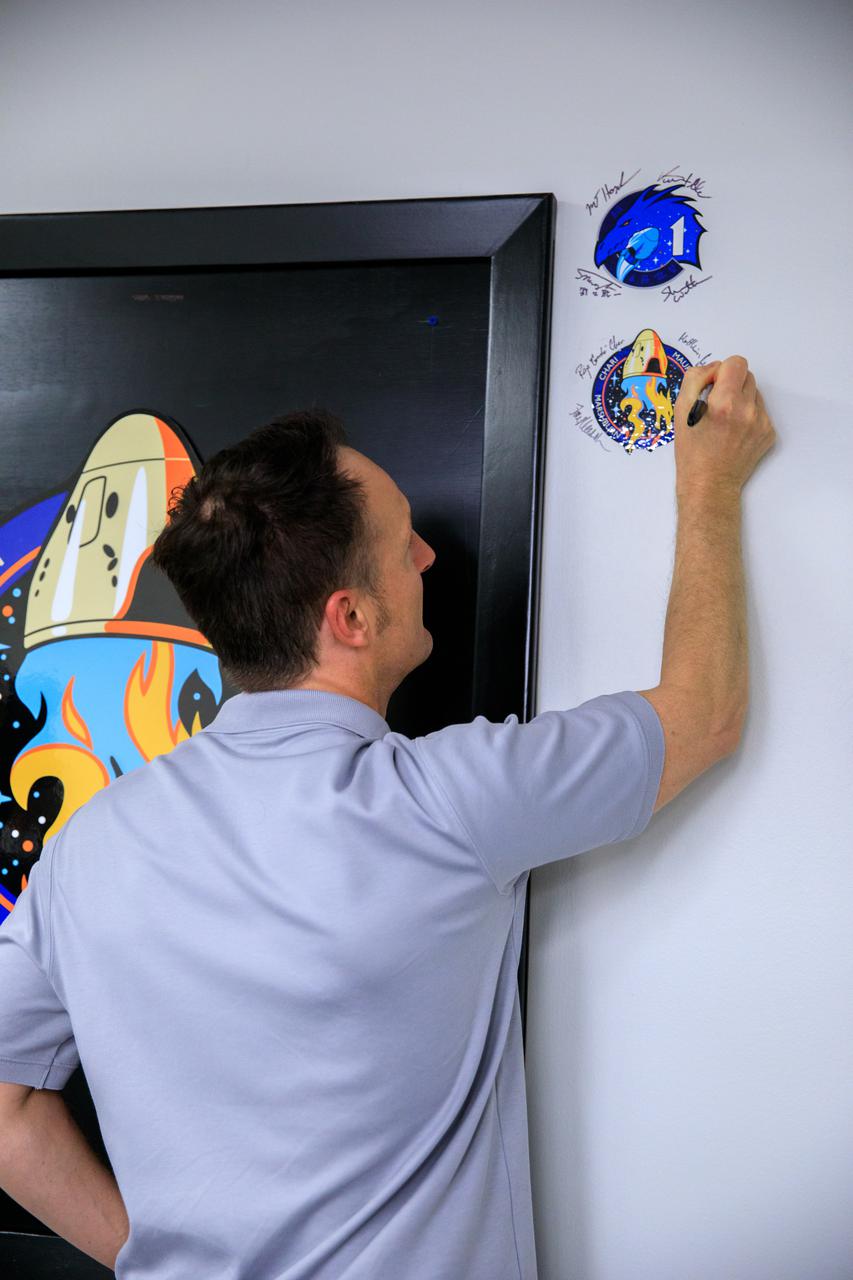
Tom Marshburn, NASA astronaut and pilot for the SpaceX Crew-3 mission, signs the mission patch on the wall in the Astronaut Crew Quarters inside the Neil Armstrong Operations and Checkout Building at NASA’s Kennedy Space Center in Florida on Nov. 10, 2021. The Falcon 9 rocket with Crew Dragon Endurance will launch the four-person crew to the International Space Station for NASA’s Commercial Crew Program. Crew-3 is scheduled to launch Nov. 10 at 9:03 p.m. EST from Launch Complex 39A at Kennedy.
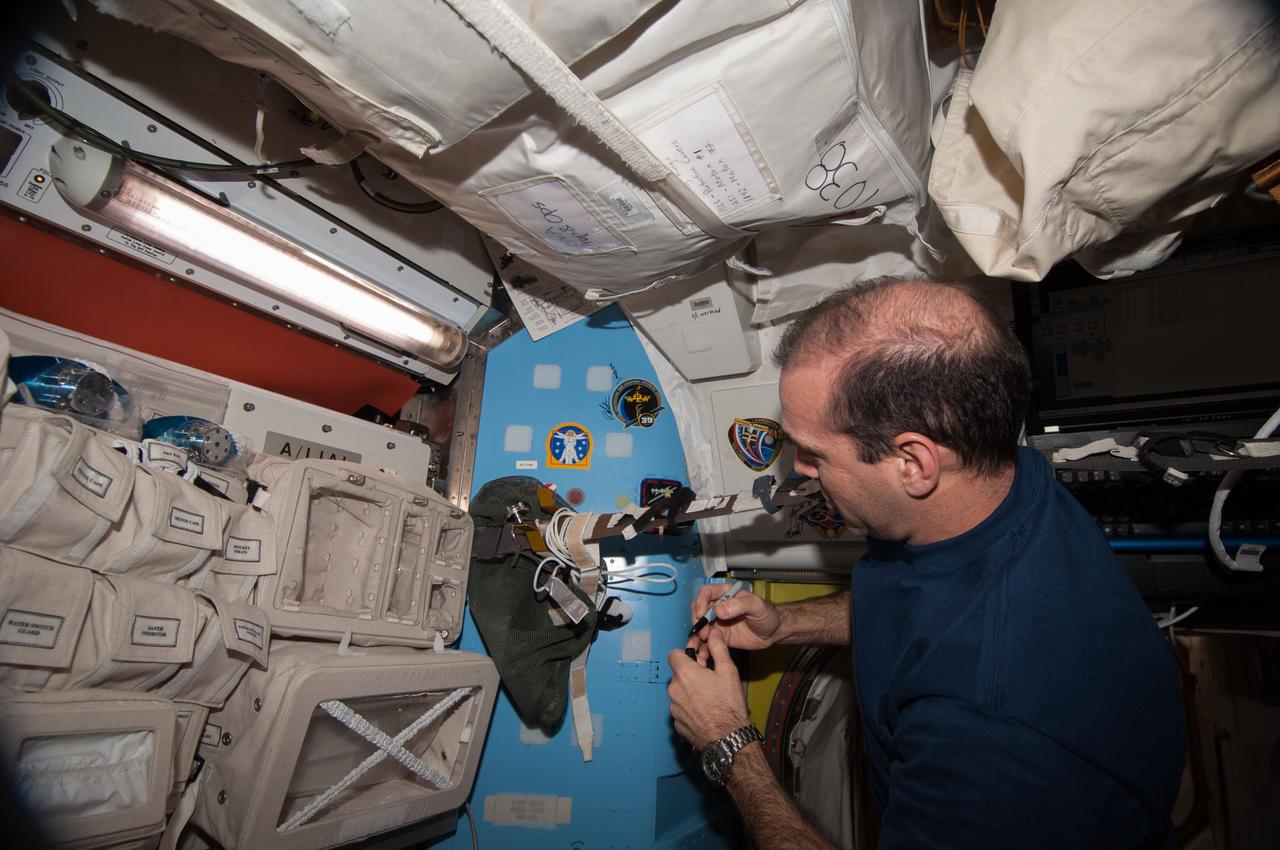
ISS039-E-020704 (13 May 2014) --- NASA astronaut Rick Mastracchio, Expedition 39 flight engineer, signs a wall in the Quest airlock of the Earth-orbiting International Space Station after mounting his crew patch, continuing a Quest-based tradition of station crew members who have participated in space walks on their respective flights. A short time later, Mastracchio joined Expedition 39 Commander Koichi Wakata of the Japan Aerospace Exploration Agency and Flight Engineer Mikhail Tyurin of Roscosmos as they departed the orbital outpost in a Soyuz vehicle.
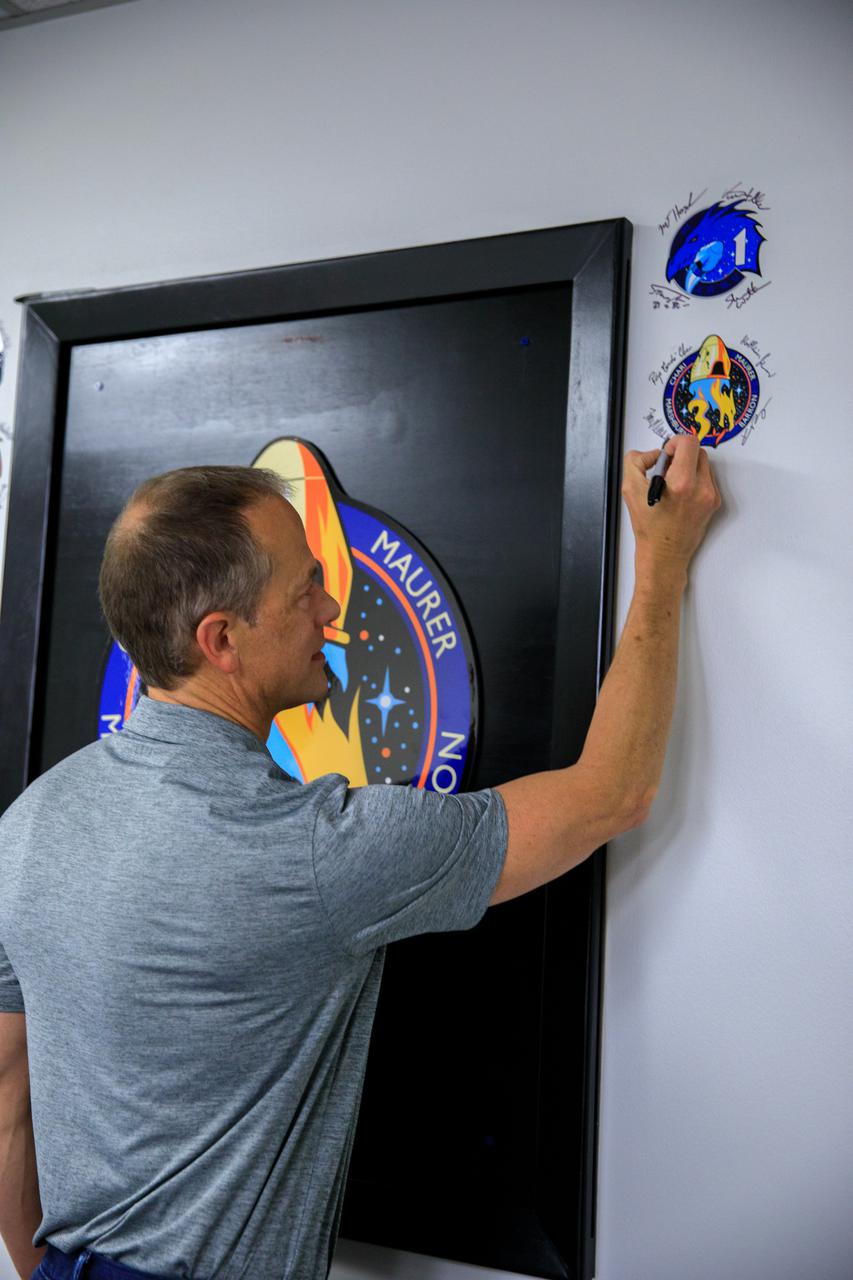
Matthias Maurer, ESA (European Space Agency) astronaut and mission specialist for the SpaceX Crew-3 mission, signs the mission patch on the wall in the Astronaut Crew Quarters inside the Neil Armstrong Operations and Checkout Building at NASA’s Kennedy Space Center in Florida on Nov. 10, 2021. The Falcon 9 rocket with Crew Dragon Endurance will launch the four-person crew to the International Space Station for NASA’s Commercial Crew Program. Crew-3 is scheduled to launch Nov. 10 at 9:03 p.m. EST from Launch Complex 39A at Kennedy.
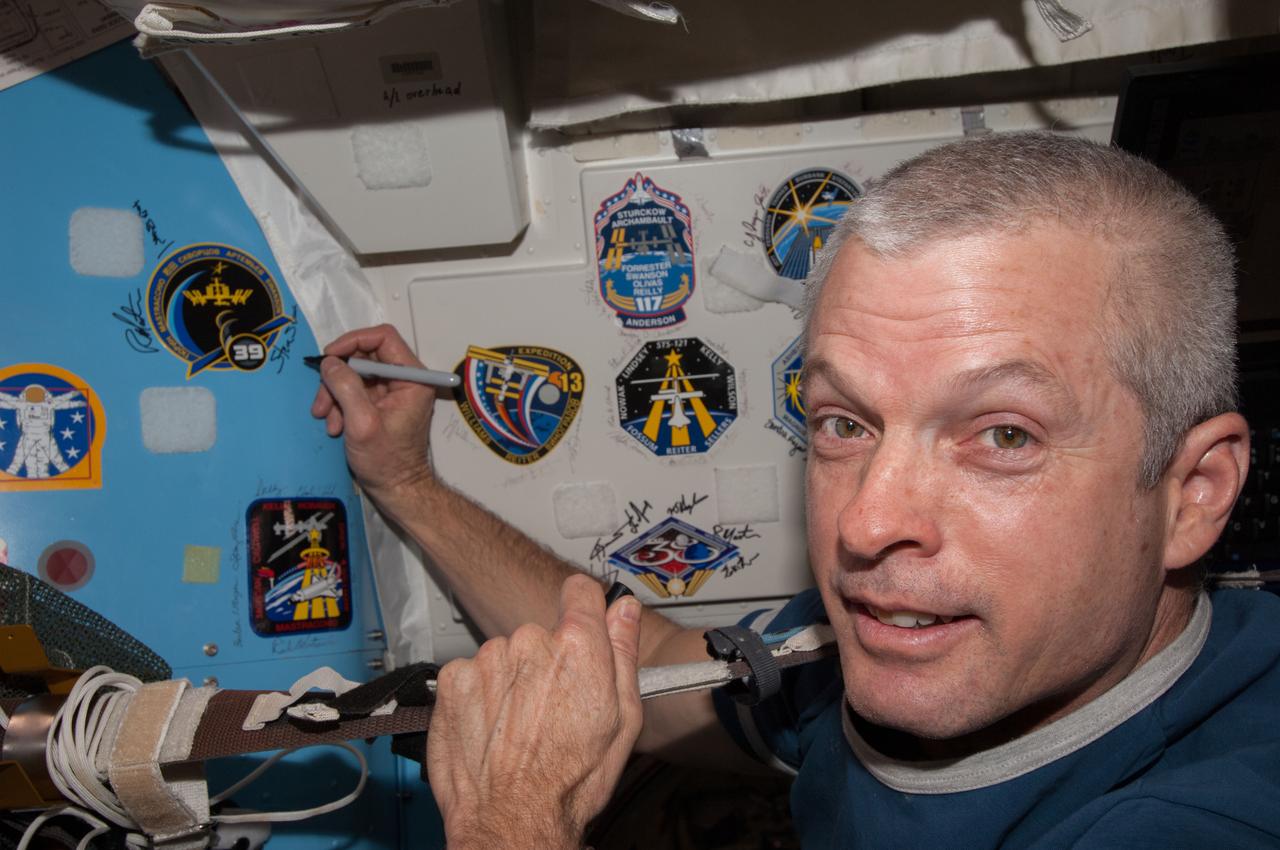
ISS039-E-020710 (13 May 2014) --- NASA astronaut Steve Swanson, Expedition 39 flight engineer about to become Expedition 40 commander, signs a wall in the Quest airlock of the International Space Station after mounting his crew patch, continuing a tradition of station crew members who have participated in space walks on their respective flights. A short time later, Swanson took over command of the orbital outpost upon the departure of Expedition 39 Commander Koichi Wakata of the Japan Aerospace Exploration Agency (JAXA) and Flight Engineers Mikhail Tyurin of Roscosmos and Rick Mastracchio of NASA.
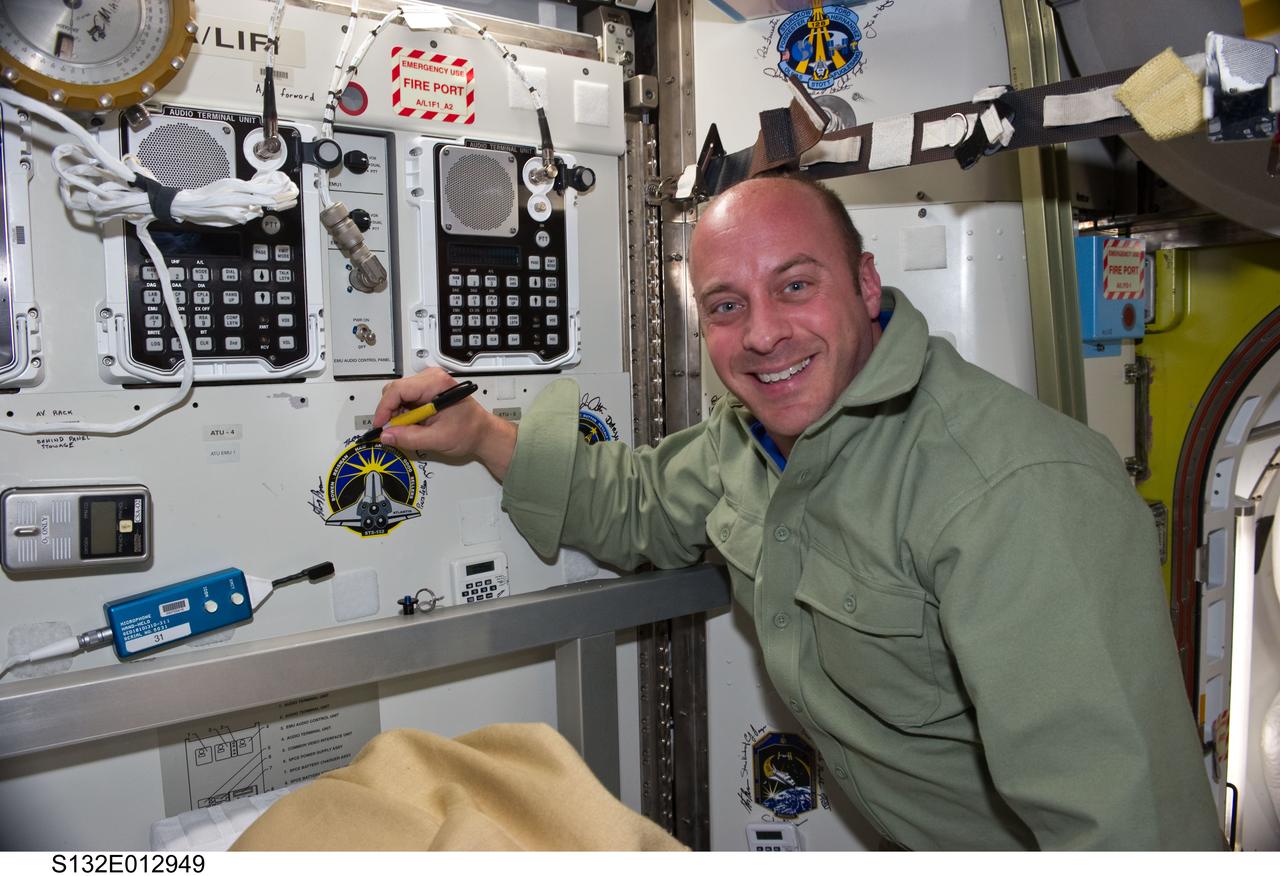
S132-E-012949 (22 May 2010) --- NASA astronaut Garrett Reisman, STS-132 mission specialist, poses for a photo while signing the STS-132 patch, which was added to the growing collection of insignias representing crews who performed spacewalks from the Quest airlock of the International Space Station.
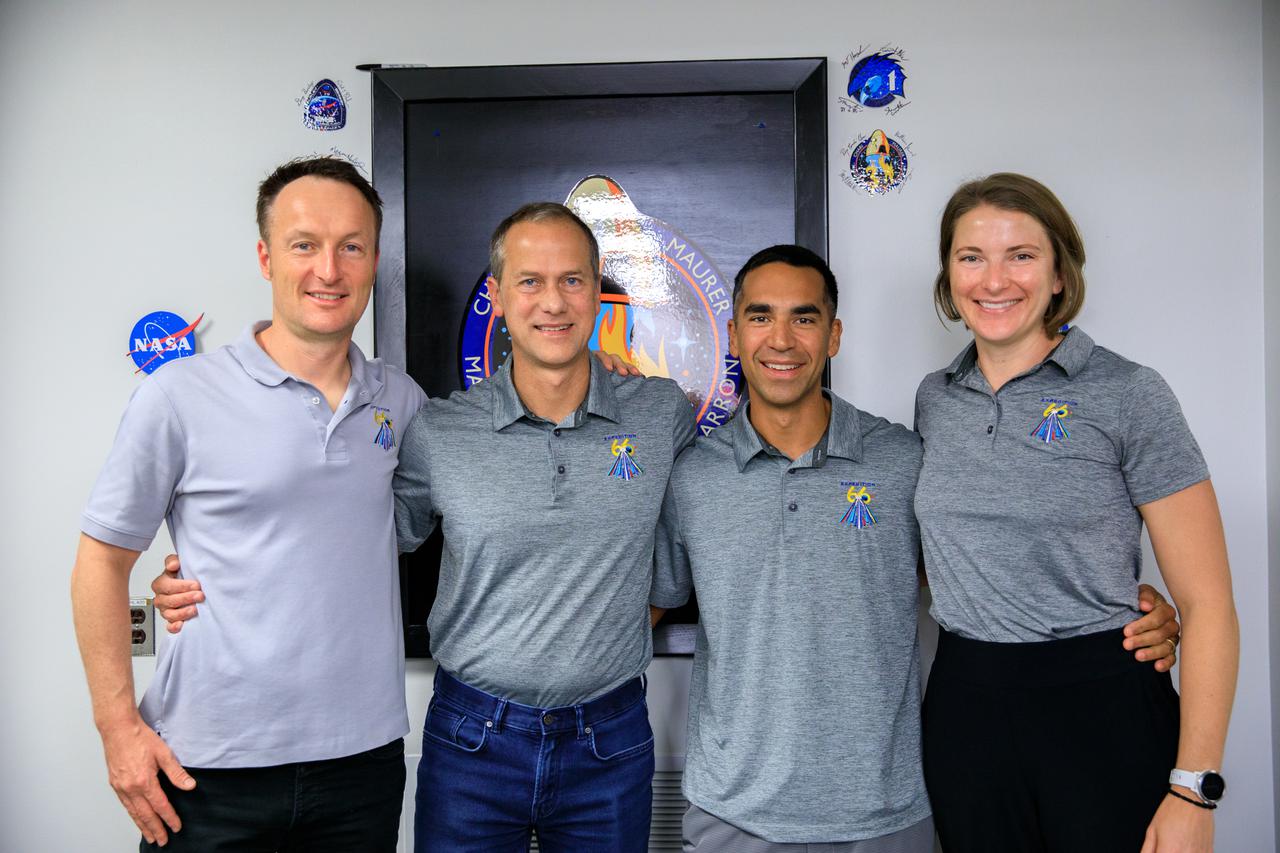
The SpaceX Crew-3 astronauts stand together in the hallway of the Astronaut Crew Quarters inside the Neil Armstrong Operations and Checkout Building at NASA’s Kennedy Space Center in Florida on Nov. 10, 2021. They have just signed the Crew-3 mission patch on the wall behind them. From left are Matthias Maurer, ESA (European Space Agency) astronaut and mission specialist; and NASA astronauts Tom Marshburn, pilot; Raja Chari, commander; and Kayla Barron, mission specialist. The Falcon 9 rocket with Crew Dragon Endurance will launch the four-person crew to the International Space Station for NASA’s Commercial Crew Program. Crew-3 is scheduled to launch Nov. 10 at 9:03 p.m. EST from Launch Complex 39A at Kennedy.

iss050e054558 (03/05/2017) --- NASA astronaut Peggy Whitson signs a bulkhead on the International Space Station next to the Expedition 50 crew patch.
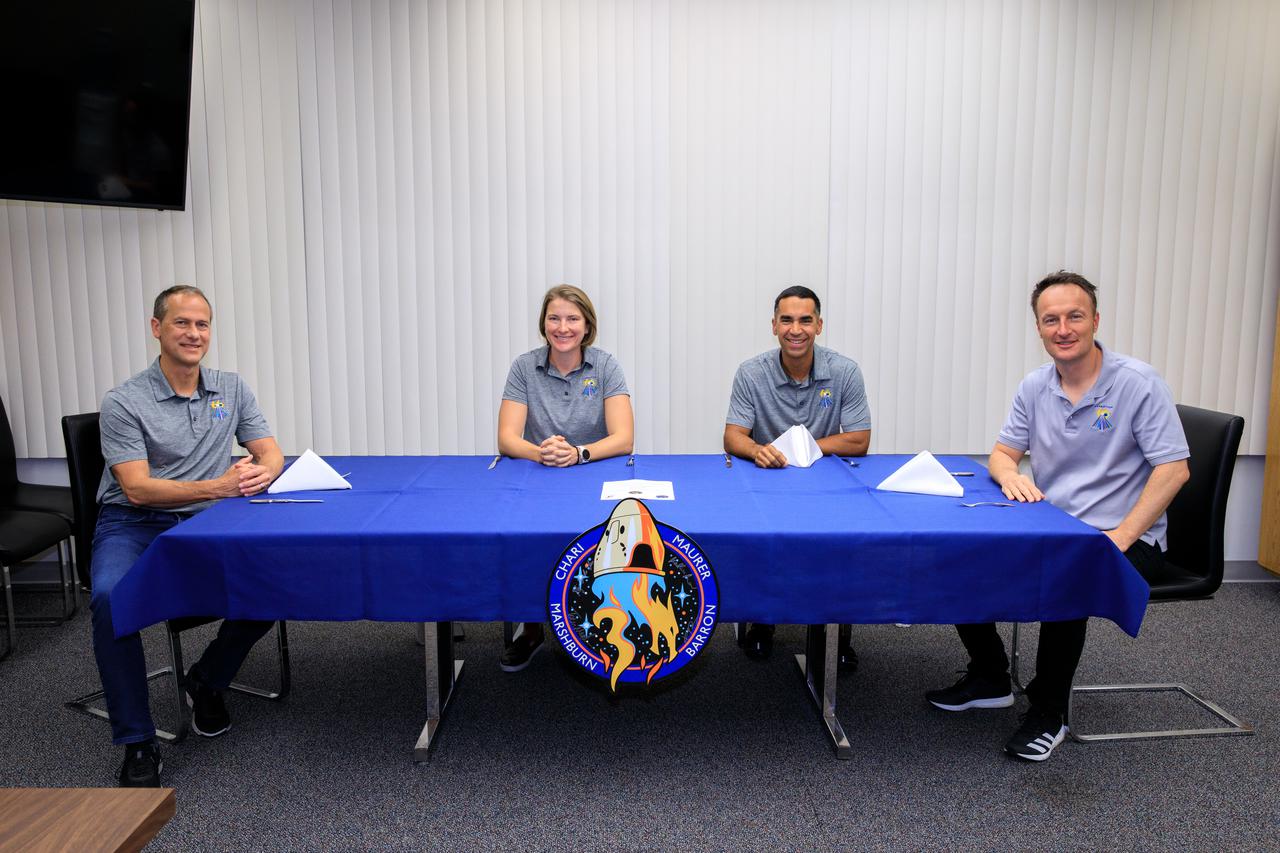
On launch day, Nov. 10, 2021, the SpaceX Crew-3 astronauts are ready for breakfast in the dining room of the Astronaut Crew Quarters inside the Neil Armstrong Operations and Checkout Building at NASA’s Kennedy Space Center in Florida. From left are NASA astronauts Tom Marshburn, pilot; Kayla Barron, mission specialist; Raja Chari, commander; and Matthias Maurer, ESA (European Space Agency) astronaut and mission specialist. The Falcon 9 rocket with Crew Dragon Endurance will launch the four-person crew to the International Space Station for NASA’s Commercial Crew Program. Crew-3 is scheduled to launch Nov. 10 at 9:03 p.m. EST from Launch Complex 39A at Kennedy.

ISS039-E-020702 (13 May 2014) --- NASA astronaut Rick Mastracchio, Expedition 39 flight engineer, places his crew patch on the wall in the Quest airlock of the Earth-orbiting International Space Station, continuing a Quest-based tradition of station crew members who have participated in space walks on their current flights. A short time later, Mastracchio joined Expedition 39 Commander Koichi Wakata of the Japan Aerospace Exploration Agency and Flight Engineer Mikhail Tyurin of Roscosmos as they departed the orbital outpost in a Soyuz vehicle.
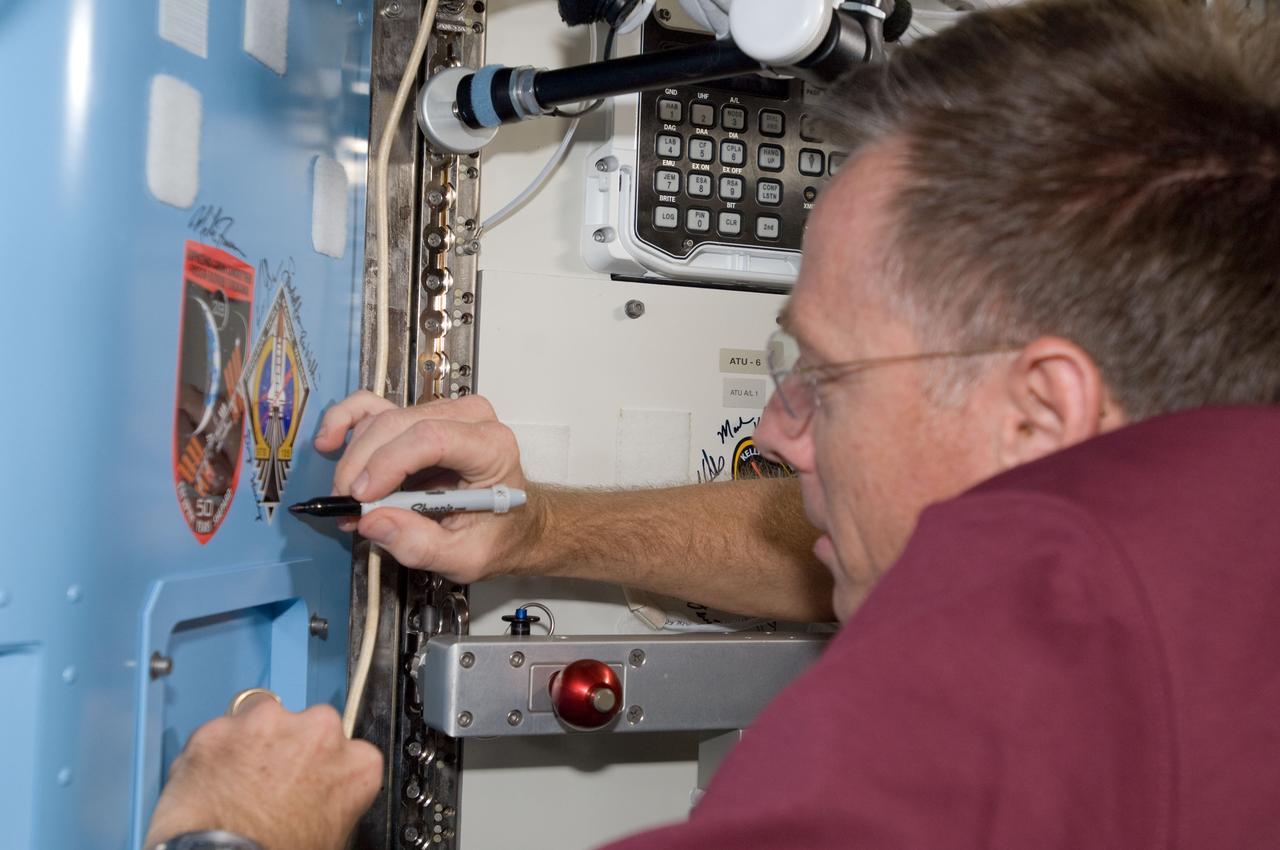
S135-E-009493 (18 July 2011) --- NASA astronaut Chris Ferguson, STS-135 commander, signs an insignia decal for his mission in the Quest airlock of the International Space Station. The shuttle insignia is mounted next to that of the Expedition 28. Having docked Atlantis to the station over a week ago, Ferguson and three crewmates are preparing to undock from the station early on July 19 and prepare for a July 21 landing in Florida. Photo credit: NASA

ISS039-E-020699 (13 May 2014) --- Japan Aerospace Exploration Agency astronaut Koichi Wakata, Expedition 39 commander, places his crew patch on a wall in the Quest airlock of the Earth-orbiting International Space Station. A short time later, Wakata joined Expedition 39 Soyuz Commander Mikhail Tyurin of Roscosmos and Flight Engineer Rick Mastracchio of NASA as they departed the orbital outpost in a Soyuz vehicle. Wakata had spent a great deal of time in Quest as he assisted spacewalks from the shirt-sleeve environment of the orbital outpost on both Expedition 38 and 39.
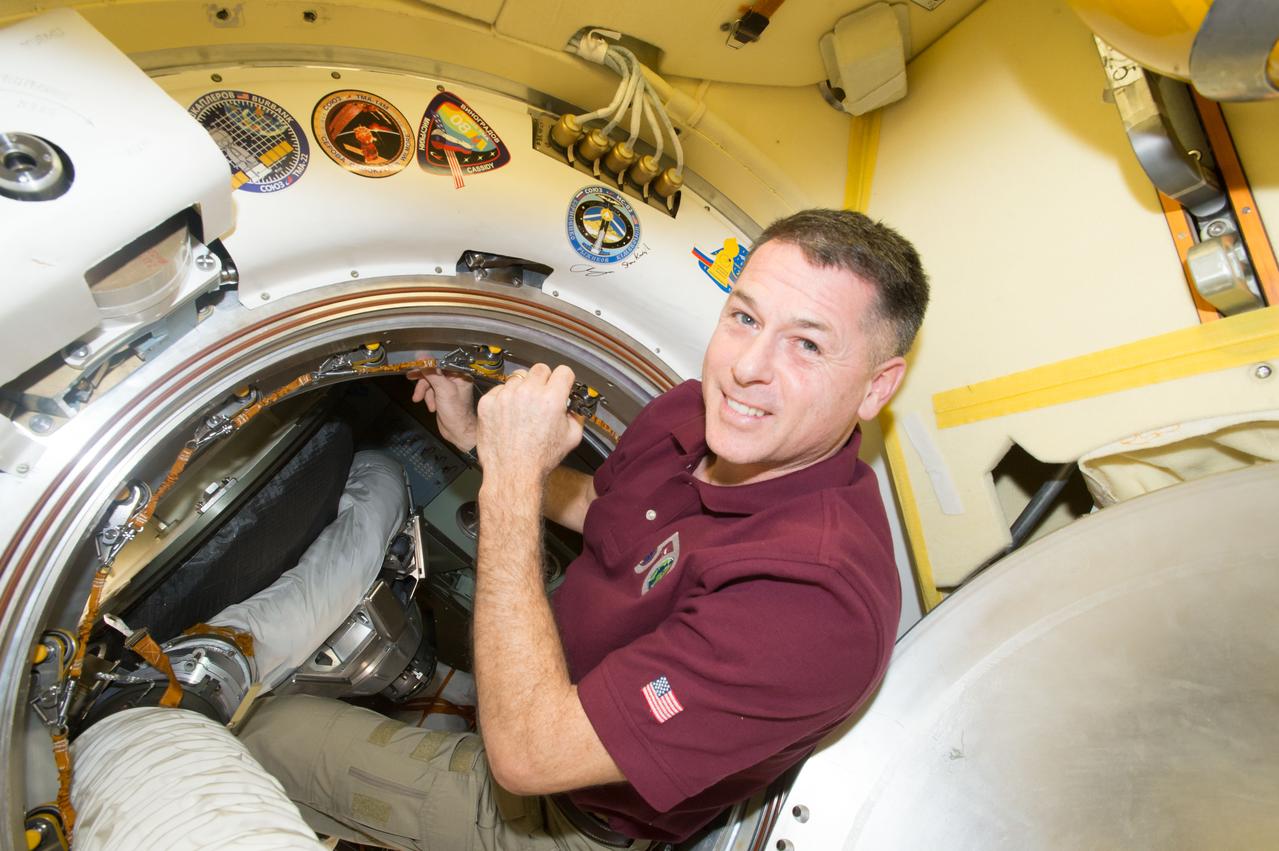
iss050e054575 (03/05/2017) --- NASA astronaut Shane Kimbrough signs a bulkhead on the Russian segment of the International Space station next to the crew patch for his Soyuz MS-03 spacecraft.
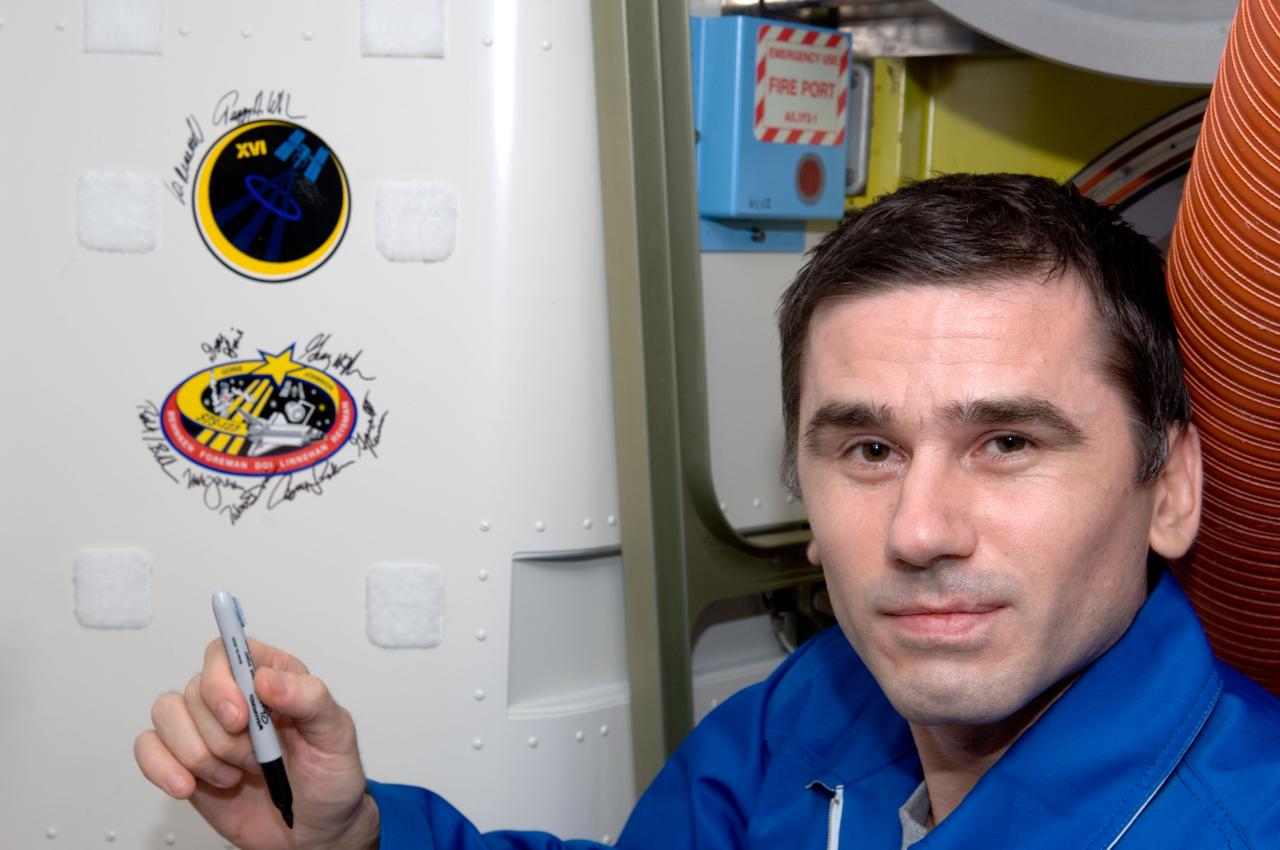
ISS016-E-036382 (17 April 2008) --- Russian Federal Space Agency cosmonaut Yuri Malenchenko, Expedition 16 flight engineer, poses for a photo after signing the Expedition 16 patch, which was added to the growing collection of insignias representing crews who performed spacewalks from the Quest Airlock of the International Space Station.
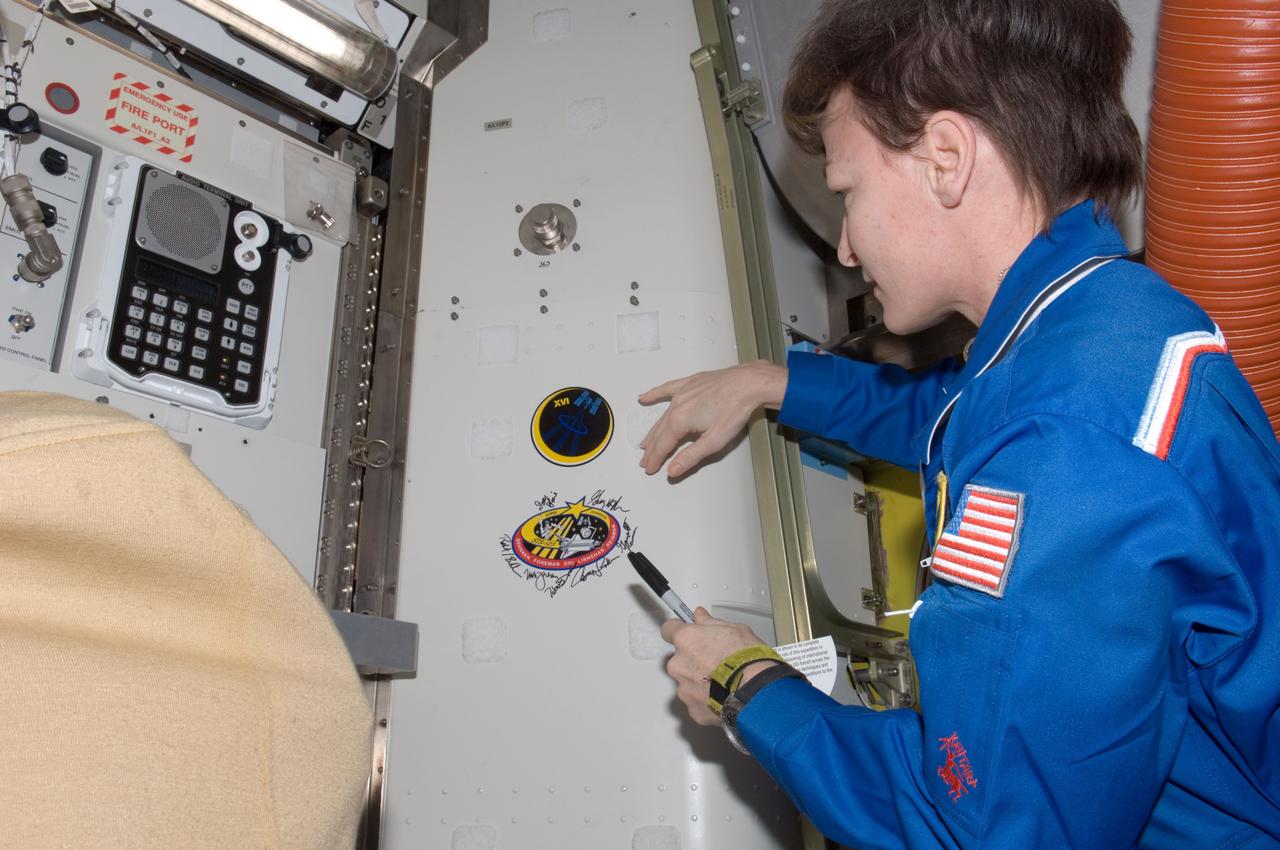
ISS016-E-036380 (17 April 2008) --- NASA astronaut Peggy Whitson, Expedition 16 commander, prepares to sign the Expedition 16 patch, which was added to the growing collection of insignias representing crews who performed spacewalks from the Quest Airlock of the International Space Station.
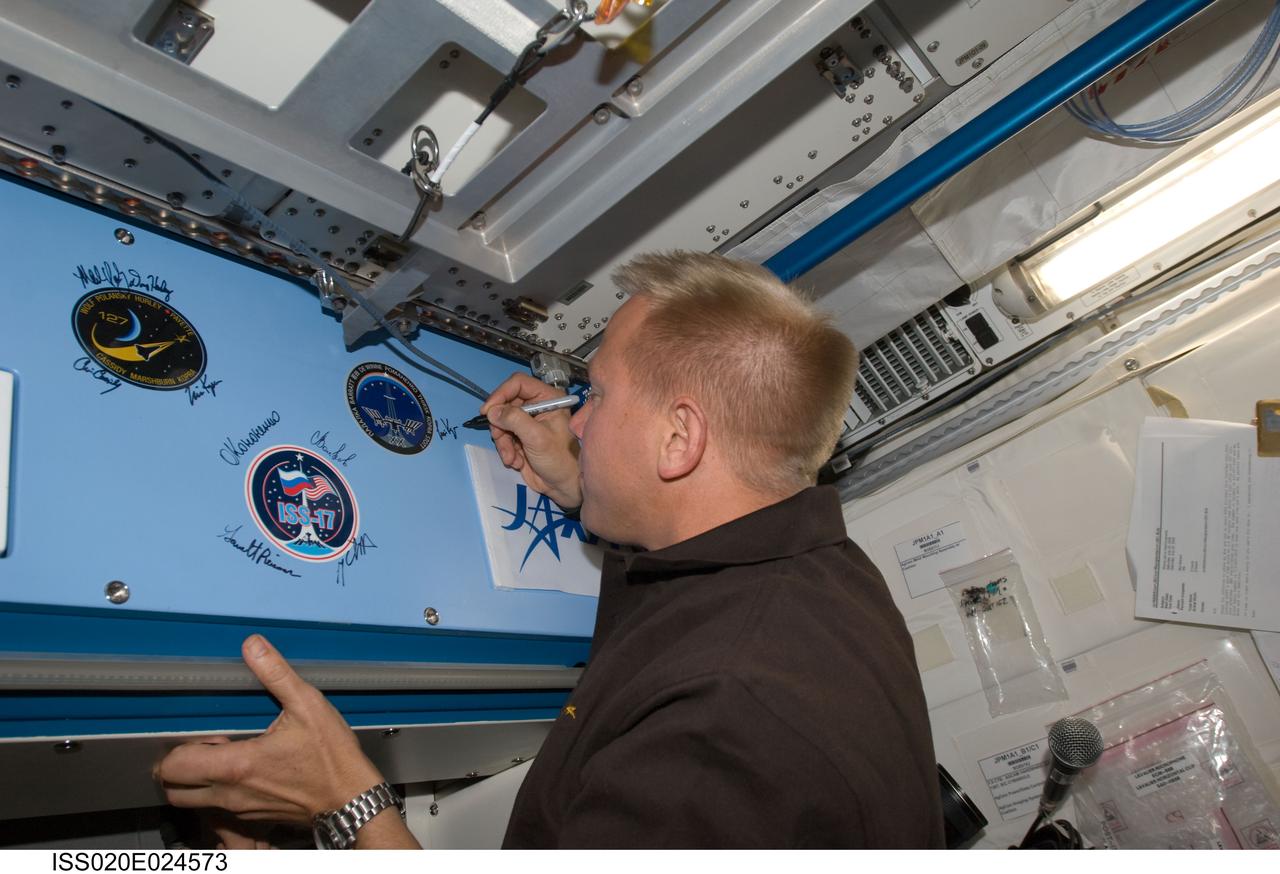
ISS020-E-024573 (25 July 2009) --- Astronaut Tim Kopra, Expedition 20 flight engineer, signs the Expedition 20 patch in the Kibo laboratory, which was added to the growing collection of insignias representing crews who have lived and worked on the International Space Station.
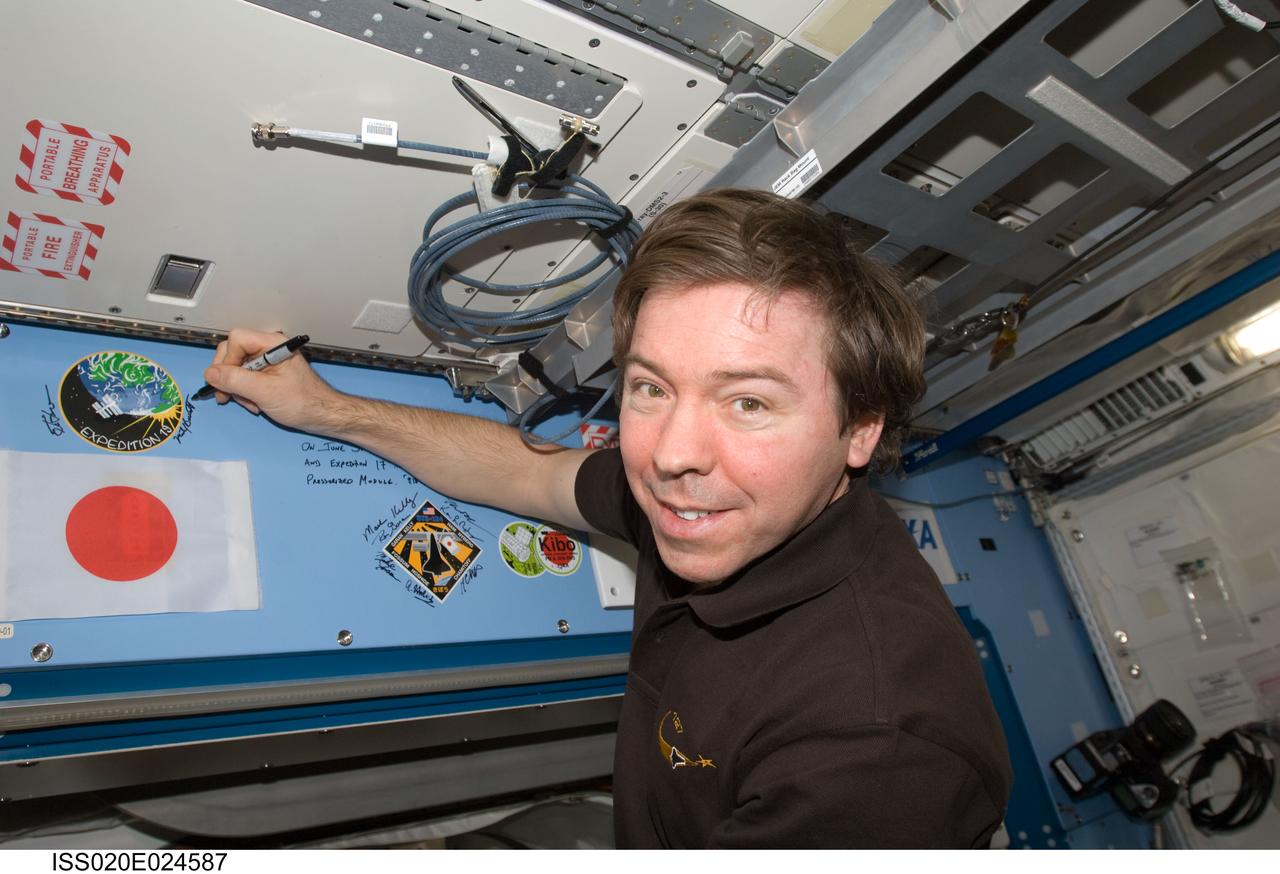
ISS020-E-024587 (25 July 2009) --- Astronaut Michael Barratt, Expedition 19/20 flight engineer, signs the Expedition 19 patch in the Kibo laboratory, which was added to the growing collection of insignias representing crews who have lived and worked on the International Space Station.
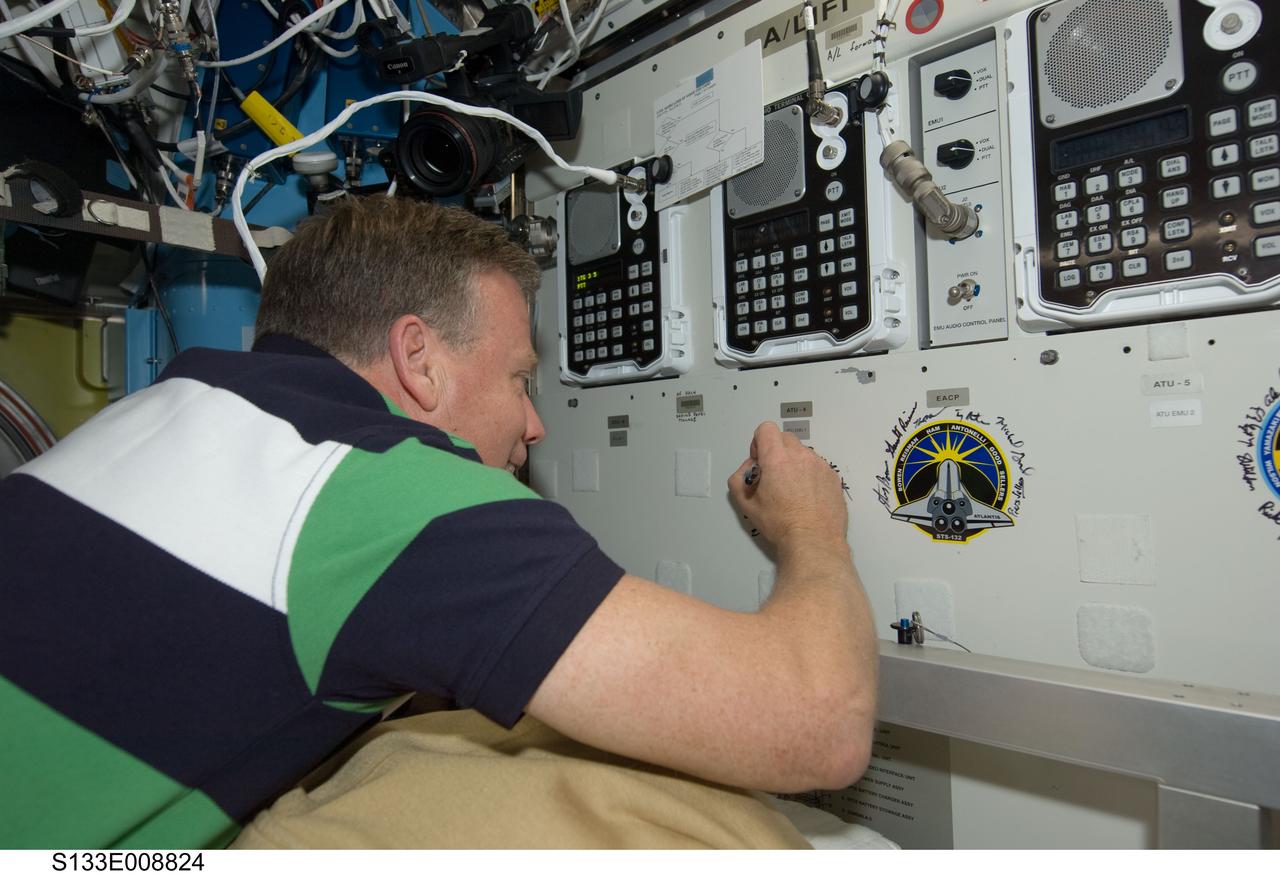
S133-E-008824 (5 March 2011) --- NASA astronaut Steve Lindsey, STS-133 commander, signs the STS-133 patch, which was added to the growing collection of insignias representing crews who performed spacewalks from the Quest airlock of the International Space Station. Photo credit: NASA or National Aeronautics and Space Administration
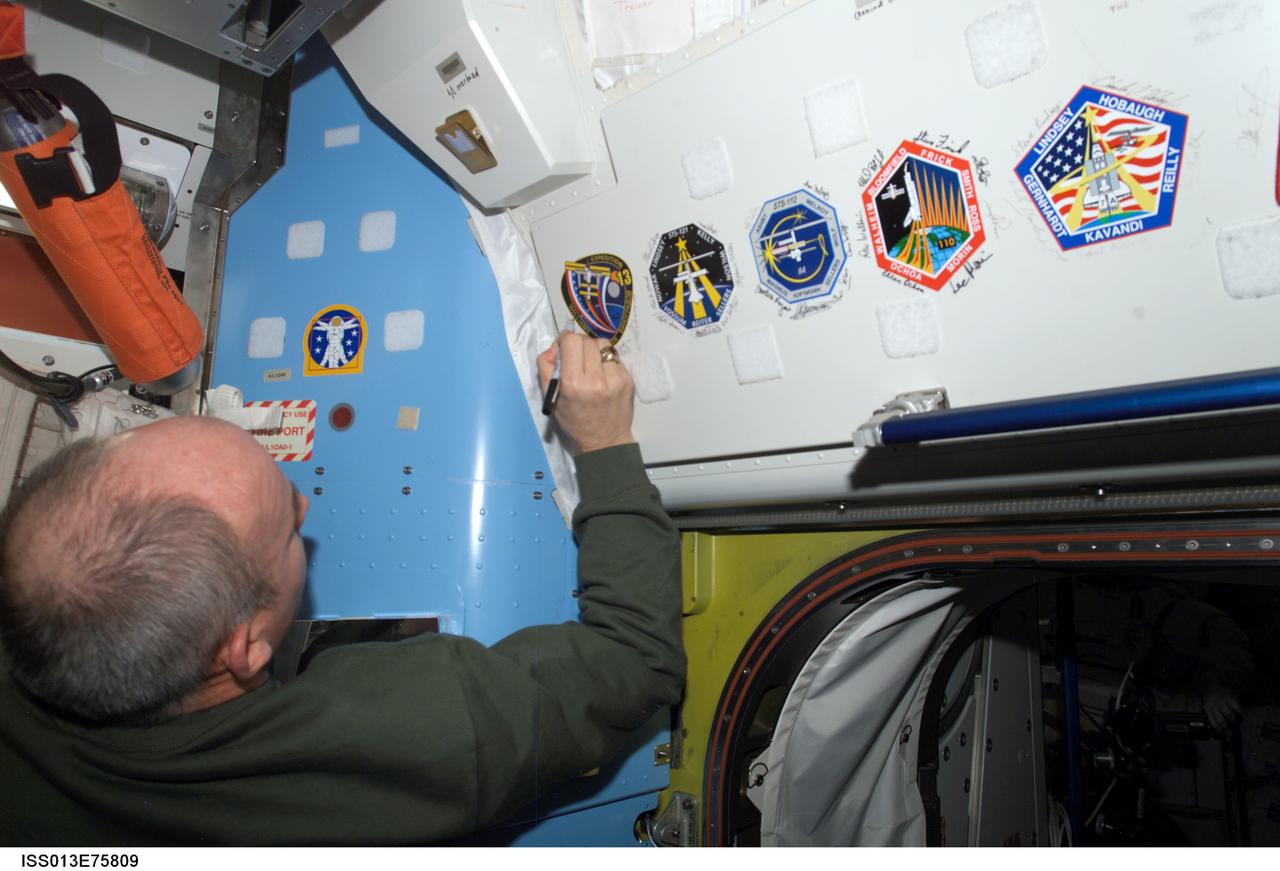
ISS013-E-75809 (4 Sept. 2006) --- Astronaut Jeffrey N. Williams, Expedition 13 NASA space station science officer and flight engineer, signs the Expedition 13 patch, which was added to the growing collection of insignias representing crews who have performed spacewalks from the Quest Airlock of the International Space Station.
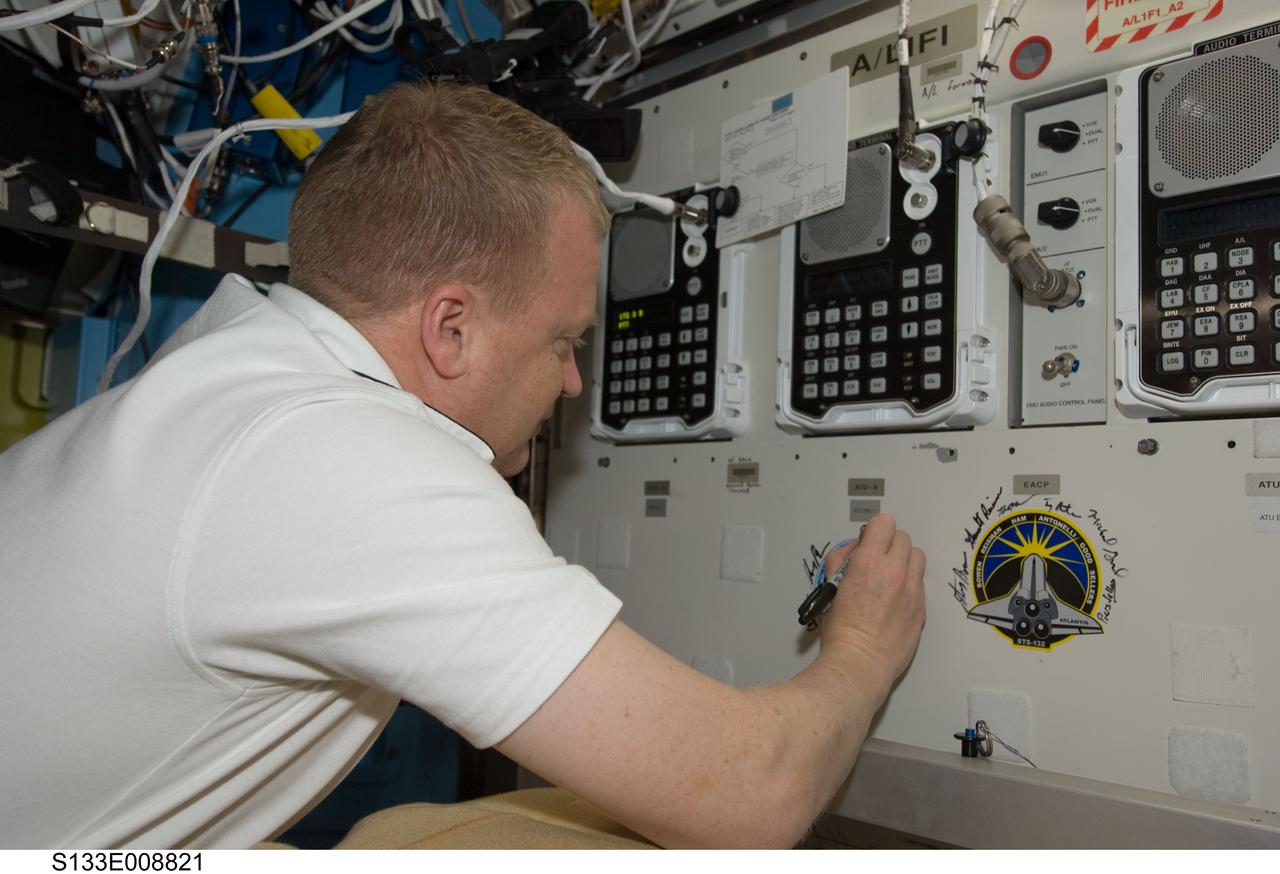
S133-E-008821 (5 March 2011) --- NASA astronaut Eric Boe, STS-133 pilot, signs the STS-133 patch, which was added to the growing collection of insignias representing crews who performed spacewalks from the Quest airlock of the International Space Station. Photo credit: NASA or National Aeronautics and Space Administration
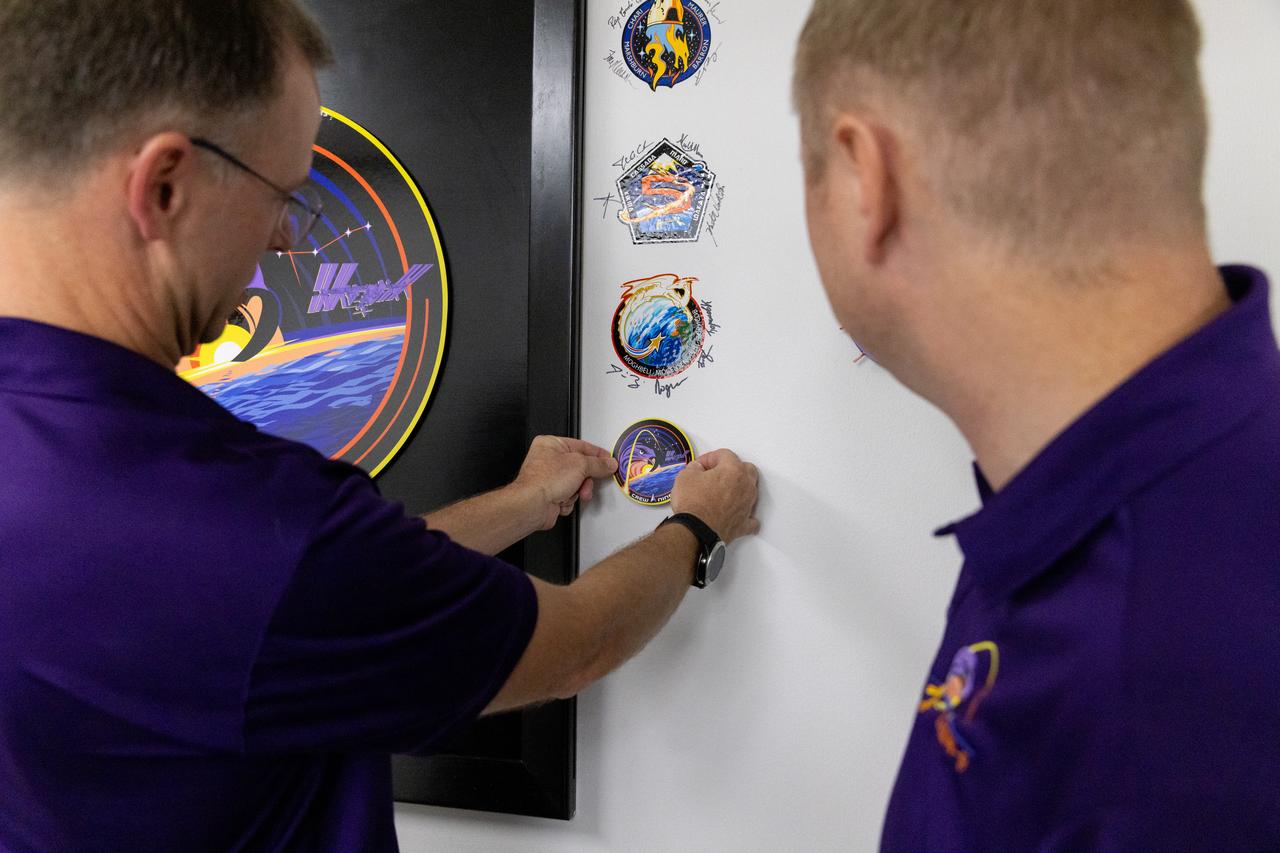
NASA astronaut Nick Hague applies NASA’s SpaceX Crew-9 mission patch to the wall inside the Astronaut Crew Quarters in the Neil A. Armstrong Operations and Checkout Building at the agency’s Kennedy Space Center in Florida on Monday, Sept. 23, 2024. Crew-9 is the ninth crew rotation mission of the SpaceX Dragon spacecraft and Falcon 9 rocket that will send Hague and Roscosmos cosmonaut Aleksandr Gorbunov to the International Space Station as part of the agency’s Commercial Crew Program. The mission is scheduled to launch at 2:05 p.m. EDT Sept. 26, 2024, from Space Launch Complex-40 at Cape Canaveral Space Force Station in Florida.
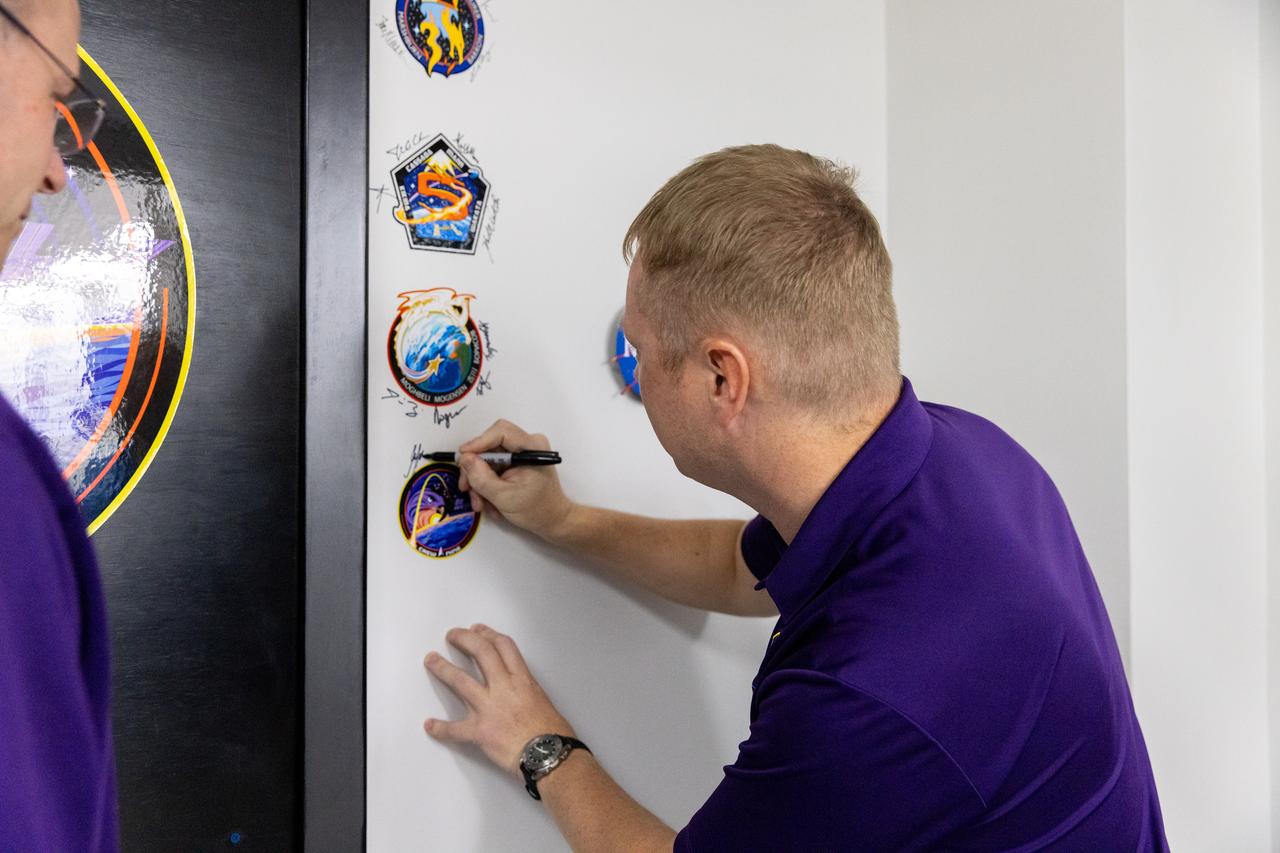
Roscosmos cosmonaut Aleksandr Gorbunov signs his name inside the Astronaut Crew Quarters in the Neil A. Armstrong Operations and Checkout Building at NASA’s Kennedy Space Center in Florida on Monday, Sept. 23, 2024, ahead of the agency’s SpaceX Crew-9 mission. Crew-9 is the ninth crew rotation mission of the SpaceX Dragon spacecraft and Falcon 9 rocket that will send Gorbunov and NASA astronaut Nick Hague to the International Space Station as part of the agency’s Commercial Crew Program. The mission is scheduled to launch at 2:05 p.m. EDT Sept. 26, 2024, from Space Launch Complex-40 at Cape Canaveral Space Force Station in Florida.
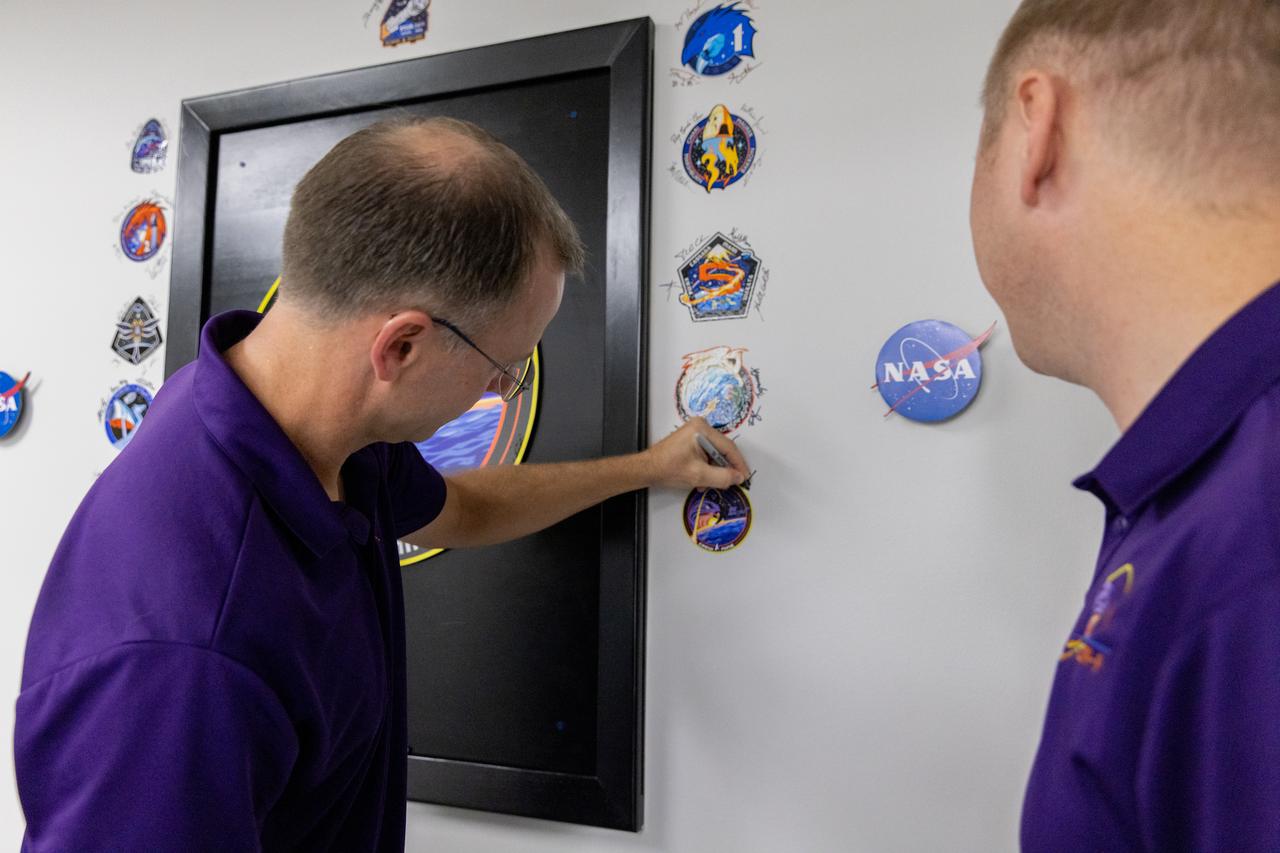
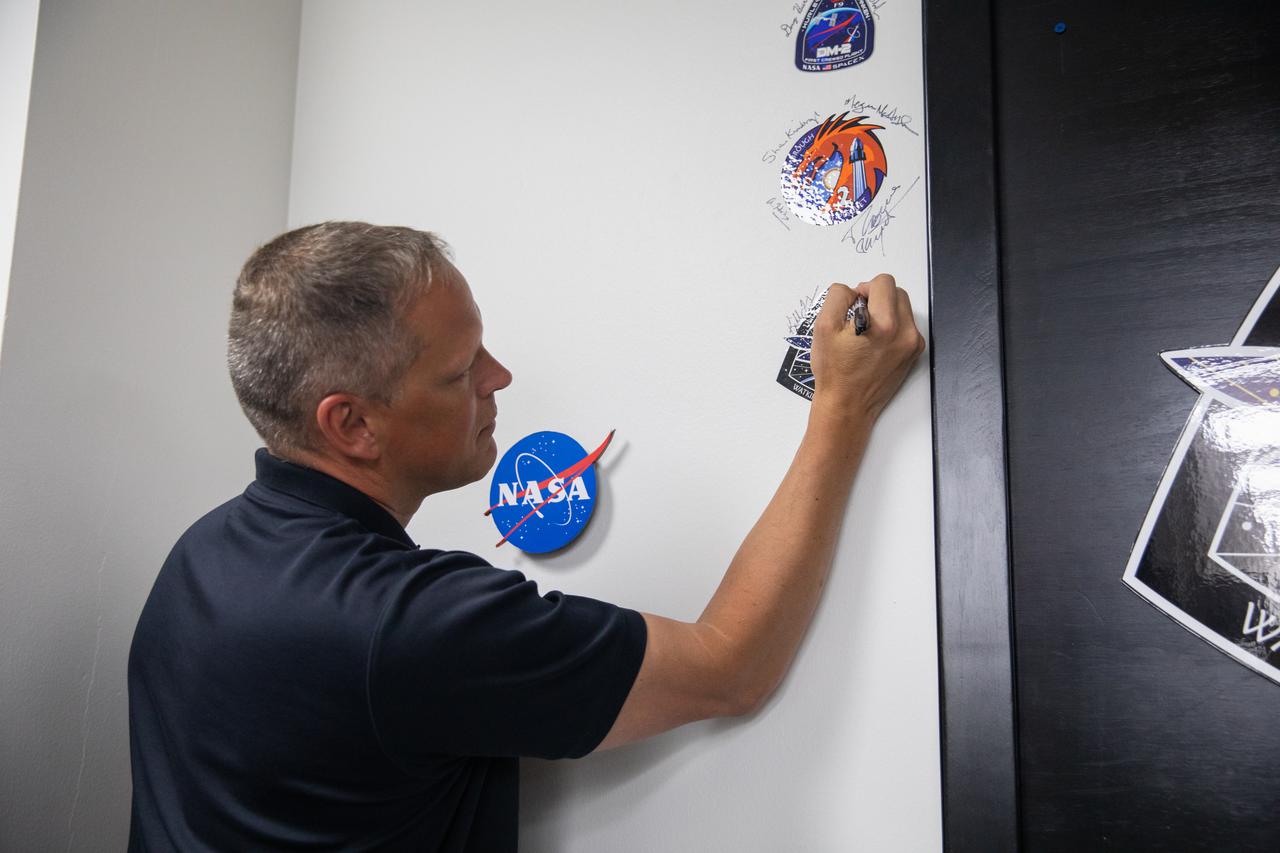
NASA astronaut Nick Hague signs his name inside the Astronaut Crew Quarters in the Neil A. Armstrong Operations and Checkout Building at the agency’s Kennedy Space Center in Florida on Monday, Sept. 23, 2024, ahead of NASA’s SpaceX Crew-9 mission. Crew-9 is the ninth crew rotation mission of the SpaceX Dragon spacecraft and Falcon 9 rocket that will send Hague and Roscosmos cosmonaut Aleksandr Gorbunov to the International Space Station as part of the agency’s Commercial Crew Program. The mission is scheduled to launch at 2:05 p.m. EDT Sept. 26, 2024, from Space Launch Complex-40 at Cape Canaveral Space Force Station in Florida.
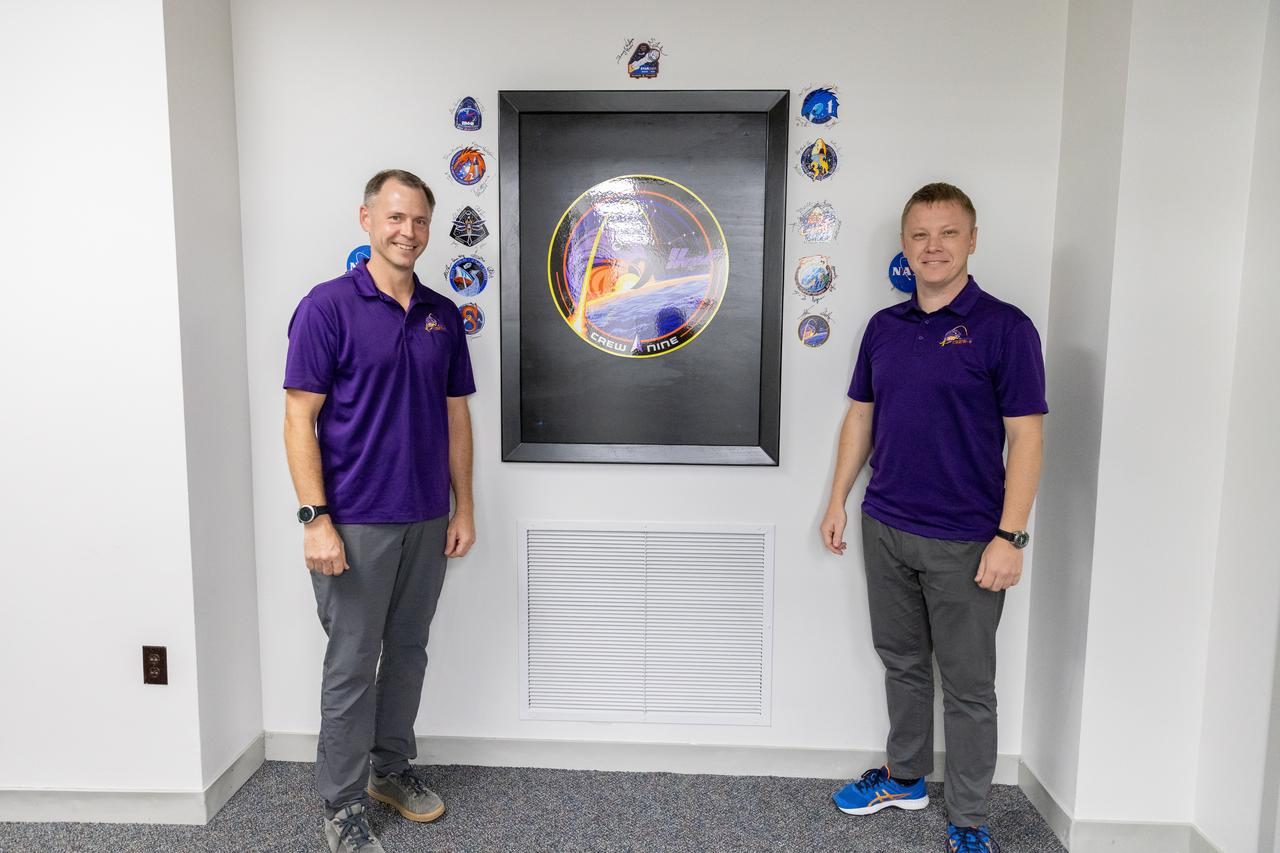
NASA astronaut Nick Hague (left) and Roscosmos cosmonaut Aleksandr Gorbunov pose inside the Astronaut Crew Quarters in the Neil A. Armstrong Operations and Checkout Building at NASA’s Kennedy Space Center in Florida on Monday, Sept. 23, 2024. Hague and Gorbunov will launch on NASA’s SpaceX Crew-9 mission – the ninth crew rotation mission of the SpaceX Dragon spacecraft and Falcon 9 rocket that will send the crew to the International Space Station as part of the agency’s Commercial Crew Program. The mission is scheduled to launch at 2:05 p.m. EDT Sept. 26, 2024, from Space Launch Complex-40 at Cape Canaveral Space Force Station in Florida.

ISS038-E-0066880 (9 March 2014) --- Expedition 38 Flight Engineer Sergey Ryazanskiy representing Russia's Federal Space Agency (Roscosmos) signs a spot on a wall in the Quest Airlock where a long tradition of mission decal placement continues. Ryazanskiy and two crewmates are scheduled to depart the International Space Station and return to Earth in a couple of days.

ISS038-E-006872 (9 March 2014) --- With his departure from the International Space Station nearing, NASA astronaut Mike Hopkins, STS-38 flight engineer, affixes his mission decal in the midst of previous increment logo placements in the Quest airlock on March 9, 2014.

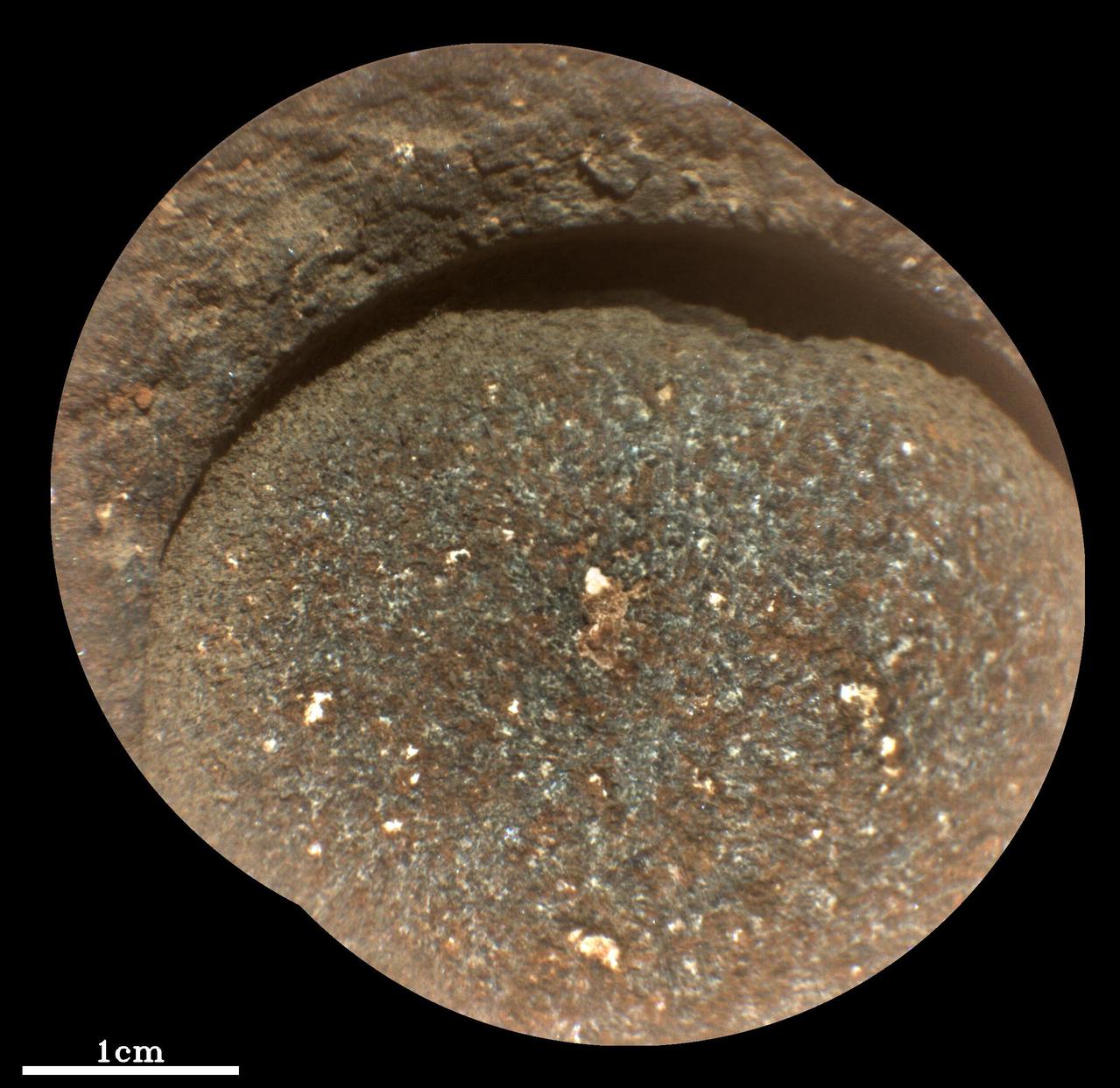
Before collecting a rock sample at a spot nicknamed "Lefroy Bay," NASA's Perseverance Mars rover employed an abrasion tool to wear down the rock surface and then used the Planetary Instrument for X-ray Lithochemistry, or PIXL, to study the rock's internal chemistry. This image is composed of multiple shots of the abrasion patch, dubbed "Bills Bay," that were taken on Oct. 7 and Oct. 11, 2023, the 935th and 939th Martian days, or sols, of the mission. The image was taken by PIXL's camera, the Autofocus and Context Imager, or ACI. Color was added by overlaying data from WATSON (Wide Angle Topographic Sensor for Operations and eNgineering), a pair of cameras that are part of an instrument called Scanning Habitable Environments with Raman & Luminescence for Organics & Chemicals, or SHERLOC. On Earth, both silica and carbonates are good at preserving materials left behind by ancient life. Sand grains made of iron-rich carbonate are also mostly found in places on Earth that are good at protecting carbon-based materials known as organics. Organics can be made from both geological and biological sources; the Lefroy Bay sample does not necessarily show signs of ancient microbial life. Samples like Lefroy Bay would have to be brought back to Earth and studied with complex instruments in laboratories for scientists to confirm signs of ancient life, if indeed they are present. A key objective for Perseverance's mission on Mars is astrobiology, including the search for signs of ancient microbial life. The rover will characterize the planet's geology and past climate, pave the way for human exploration of the Red Planet, and be the first mission to collect and cache Martian rock and regolith (broken rock and dust). Subsequent NASA missions, in cooperation with ESA (European Space Agency), would send spacecraft to Mars to collect these sealed samples from the surface and return them to Earth for in-depth analysis. The Mars 2020 Perseverance mission is part of NASA's Moon to Mars exploration approach, which includes Artemis missions to the Moon that will help prepare for human exploration of the Red Planet. https://photojournal.jpl.nasa.gov/catalog/PIA26205

S133-E-008817 (5 March 2011) --- NASA astronaut Alvin Drew, STS-133 mission specialist, signs the STS-133 patch, which was added to the growing collection of insignias representing crews who performed spacewalks from the Quest airlock of the International Space Station. Photo credit: NASA or National Aeronautics and Space Administration

S133-E-008819 (5 March 2011) --- NASA astronaut Nicole Stott, STS-133 mission specialist, signs the STS-133 patch, which was added to the growing collection of insignias representing crews who performed spacewalks from the Quest airlock of the International Space Station. Photo credit: NASA or National Aeronautics and Space Administration

Expedition 27 Flight Engineer Ron Garan of NASA signs his Soyuz crew patch aboard a Gagarin Cosmonaut Training Center plane as he, Flight Engineer Andrey Borisenko and Soyuz Commander Alexander Samokutyaev flew from Star City, Russia to the Baikonur Cosmodrome in Kazakhstan March 21, 2011. In Baikonur, they will complete training for their launch April 5 (April 4, U.S. time) on the Soyuz TMA-21 spacecraft to the International Space Station. Credit: NASA/Victor Zelentsov

jsc2018e025595 - In the Korolev Museum at the Baikonur Cosmodrome in Kazakhstan, Expedition 55 crewmembers Oleg Artemyev of Roscosmos (left), Ricky Arnold of NASA (center) and Drew Feustel of NASA (right) sign a flag bearing their Soyuz MS-08 crew patch insignia March 16 during a traditional preflight tour of the museum. They will launch March 21 on the Soyuz MS-08 spacecraft for a five-month mission on the International Space Station...NASA/Victor Zelentsov.

S133-E-008822 (5 March 2011) --- NASA astronaut Michael Barratt, STS-133 mission specialist, signs the STS-133 patch, which was added to the growing collection of insignias representing crews who performed spacewalks from the Quest airlock of the International Space Station. Photo credit: NASA or National Aeronautics and Space Administration

In the newly-installed Permanent Multipurpose Module (PMM), the STS-133 crew members pose while signing the STS-133 patch, which was added to the growing collection of insignias representing crews who have worked on the International Space Station. Pictured counter-clockwise (from the center) are NASA astronauts Steve Lindsey, commander; Eric Boe, pilot; Alvin Drew, Steve Bowen, Nicole Stott and Michael Barratt, all mission specialists.

NASA astronaut Victor Glover, Artemis II pilot, left, and CSA (Canadian Space Agency) astronaut Jeremy Hansen, Artemis II mission specialist sign the backs of patches before meeting with members and staff of the House Science Committee, Tuesday, May 12, 2026, at the Rayburn House Office Building in Washington. NASA’s Artemis II mission took Wiseman, Glover, Koch, and Hansen on a nearly 10-day journey around the Moon and back to Earth in April 2026. Photo Credit: (NASA/Joel Kowsky)
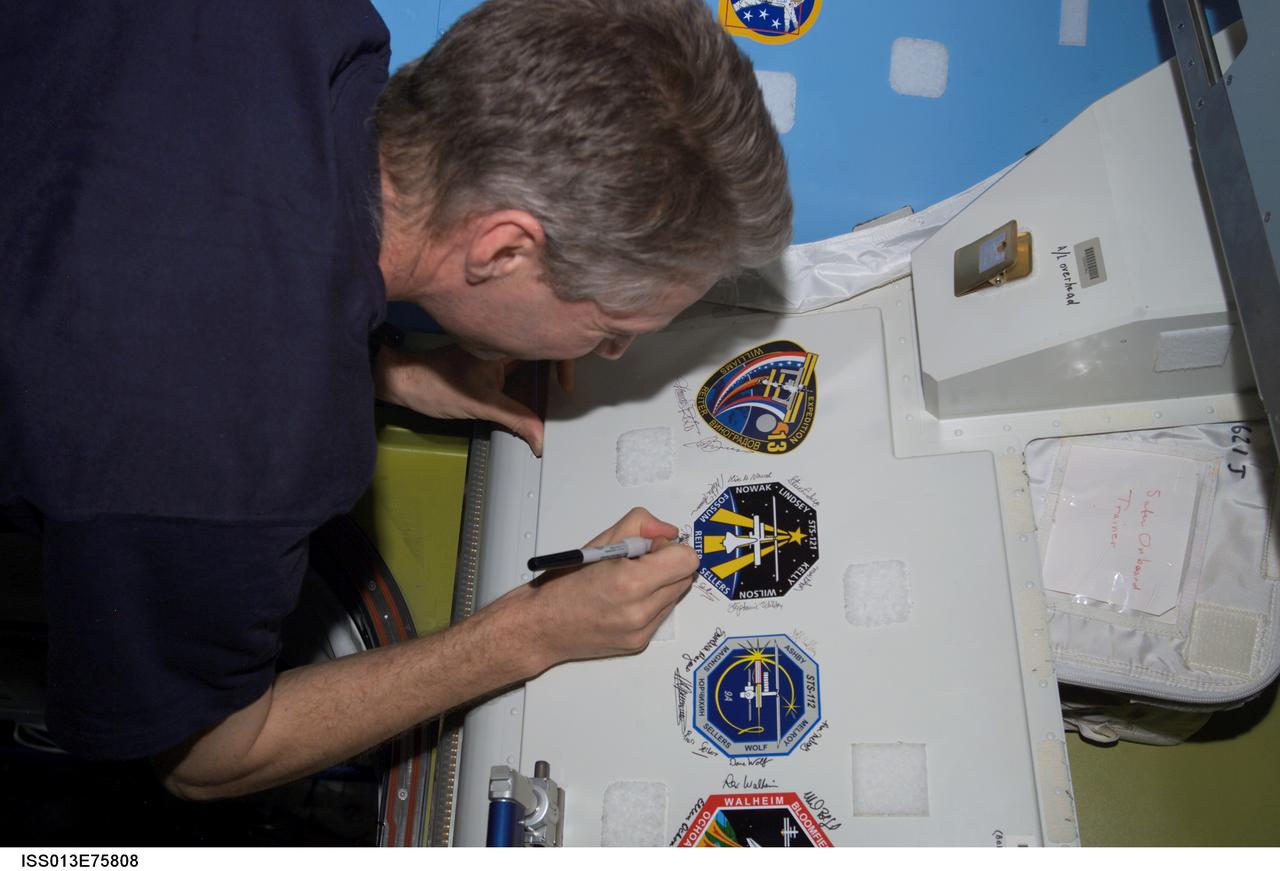
ISS013-E-75808 (4 Sept. 2006) --- European Space Agency (ESA) astronaut Thomas Reiter, Expedition 13 flight engineer, signs the Expedition 13 and STS-121 patches, which were added to the growing collection of insignias representing crews who have performed spacewalks from the Quest Airlock of the International Space Station.

S133-E-008818 (5 March 2011) --- NASA astronaut Steve Bowen, STS-133 mission specialist, signs the STS-133 patch, which was added to the growing collection of insignias representing crews who performed spacewalks from the Quest airlock of the International Space Station. NASA astronaut Nicole Stott, mission specialist, looks on. Photo credit: NASA or National Aeronautics and Space Administration
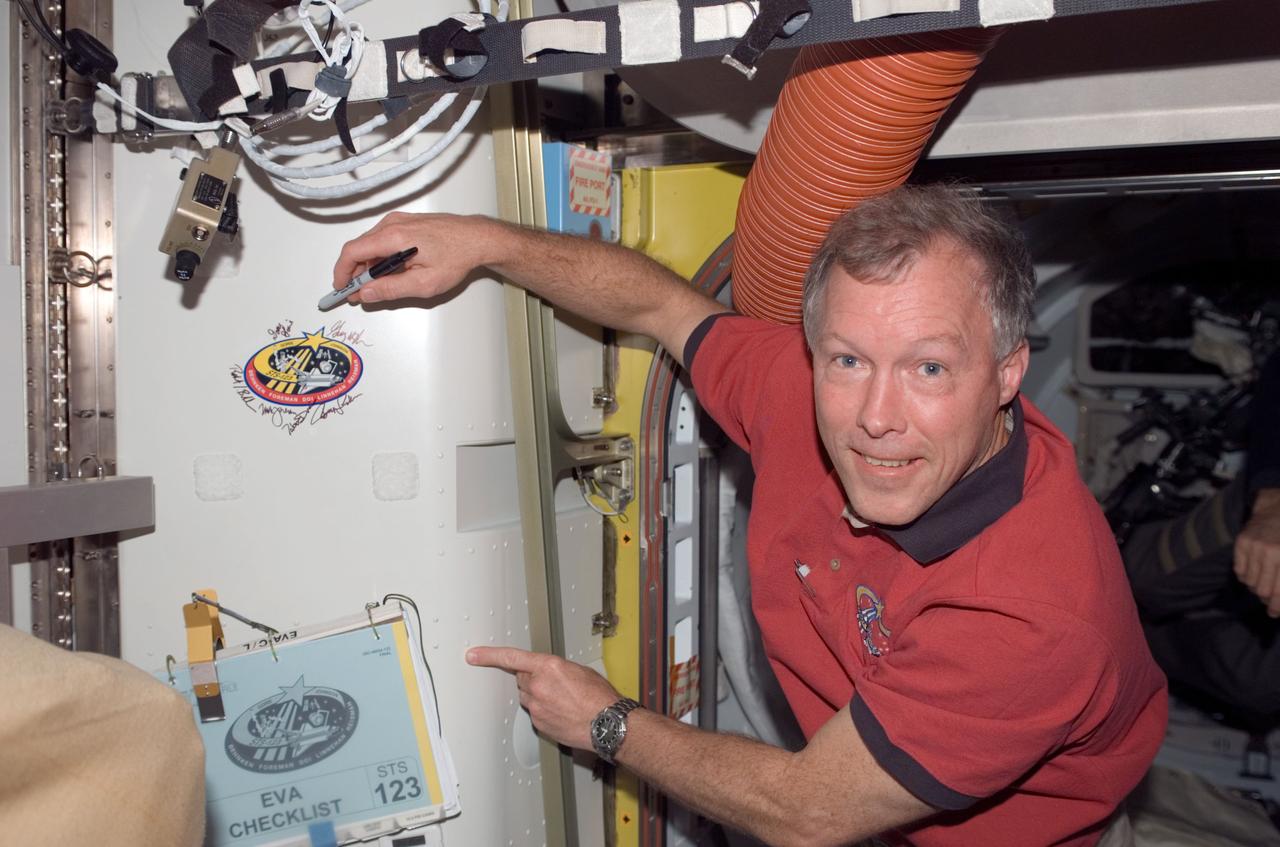
S123-E-008765 (23 March 2008) --- Astronaut Dominic Gorie, STS-123 commander, points to the STS-123 patch which was previously added to the growing collection of insignias representing crews who have performed spacewalks from the Quest Airlock of the International Space Station.
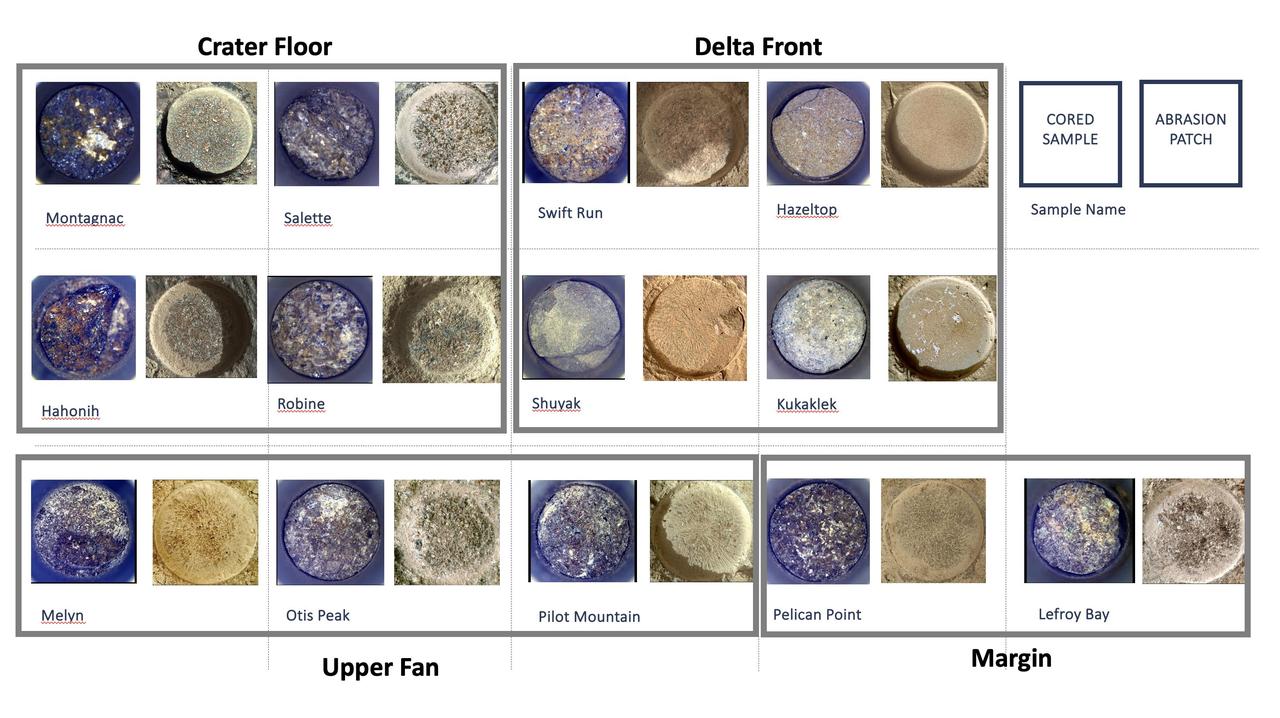
Shown here is an annotated representation of the 13 sample tubes containing rock-core samples that are being carried aboard NASA's Perseverance rover as of Dec. 12, 2023, when the mission was marking its 1,000th Martian day, or sol, on the Red Planet. To the right of each sample is the associated abrasion patch that was created at the same location where the core was extracted. The images of the samples and patches are grouped into gray boxes labeled with the name of the four rover science campaigns during which they were collected, from initial campaign to current: Crater Floor, Delta Front, Upper Fan, and Margin. The images of the cored samples were collected by the Sampling and Caching System Camera (known as CacheCam). Directly below each image of a cored sample is its name, as chosen by the Perseverance science team. The images of the abrasion patches were collected by the WATSON (Wide Angle Topographic Sensor for Operations and eNgineering) camera on the SHERLOC (Scanning Habitable Environments with Raman & Luminescence for Organics & Chemicals) instrument. WATSON is located at the end of Perseverance's robotic arm, and takes images from about 3 inches (7 centimeters) away from each rock surface. Perseverance abrades rocks using a tool on the robotic arm in order to clear away dust and any surface weathering or coatings. Then other instruments analyze the abraded patch to determine if scientists want to collect a sample from the rock. Each abraded patch is 2 inches (5 centimeters) in diameter. A key objective for Perseverance's mission on Mars is astrobiology, including the search for signs of ancient microbial life. The rover will characterize the planet's geology and past climate, pave the way for human exploration of the Red Planet, and be the first mission to collect and cache Martian rock and regolith (broken rock and dust). Subsequent NASA missions, in cooperation with ESA (European Space Agency), would send spacecraft to Mars to collect these sealed samples from the surface and return them to Earth for in-depth analysis. The Mars 2020 Perseverance mission is part of NASA's Moon to Mars exploration approach, which includes Artemis missions to the Moon that will help prepare for human exploration of the Red Planet. https://photojournal.jpl.nasa.gov/catalog/PIA26232
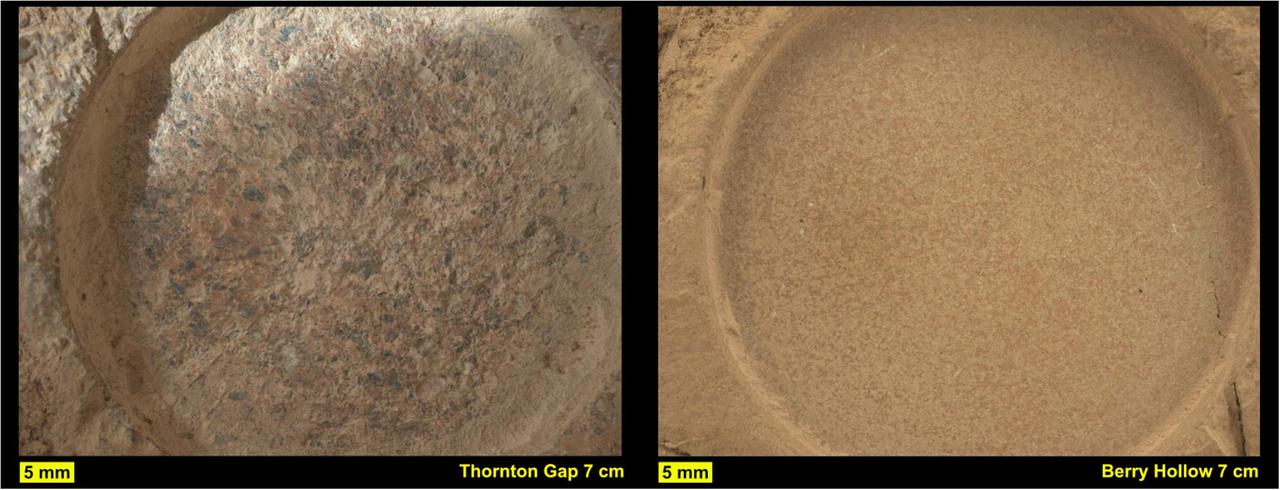
This pair of images from NASA's Perseverance shows close-up views of two rock types the rover investigated in the delta area of Mars' Jezero Crater, which scientists consider one of the best places on the Red Planet to search for potential signs of ancient microbial life. The image on the left shows a circular patch Perseverance abraded on a rocky outcrop called "Skinner Ridge," while the image on the right shows an abrasion patch on a rocky outcrop called "Wildcat Ridge." Under each image is the abrasion patch's name the mission team has provided them for identification purposes. Perseverance grinds circular patches into rocks so its science instruments can analyze the rocks' composition. The images were taken by the WATSON (Wide Angle Topographic Sensor for Operations and eNgineering) camera on the SHERLOC (Scanning Habitable Environments with Raman & Luminescence for Organics & Chemicals) instrument on June 29 and July 21, 2022, the 482nd and 504th Martian days, or sols, of the mission. The camera that took these images, located at the end of Perseverance's robotic arm, was about 3 inches (7 centimeters) away from each rock surface. The Skinner Ridge rock is sandstone and composed of much larger grains than the Wildcat Ridge rock. The rock and mineral fragments at Skinner Ridge – which are the detritus of larger rocks – have a diversity of compositions and were transported by water from possibly hundreds of miles outside of Jezero Crater. The Wildcat Ridge rock is a more finely grained sedimentary rock, a sulfate-bearing mudstone. It has a more homogeneous composition than Skinner Ridge and appears to have formed in saltwater in the distant past, possibly as ancient lake water evaporated. Scientists believe both rocks formed in, and preserve information about, potentially habitable environments in Mars' ancient past. The verification of ancient life on the Red Planet carries an enormous burden of proof. Perseverance collected rock samples beside these abrasion patches (see PIA24927 and PIA24929) and sealed them in ultra-clean sample tubes. A key objective for Perseverance's mission on Mars is astrobiology, including the search for signs of ancient microbial life. The rover will characterize the planet's geology and past climate, pave the way for human exploration of the Red Planet, and be the first mission to collect and cache Martian rock and regolith (broken rock and dust). Subsequent NASA missions, in cooperation with ESA (European Space Agency), would send spacecraft to Mars to collect these sealed samples from the surface and return them to Earth for in-depth analysis. The Mars 2020 Perseverance mission is part of NASA's Moon to Mars exploration approach, which includes Artemis missions to the Moon that will help prepare for human exploration of the Red Planet. https://photojournal.jpl.nasa.gov/catalog/PIA24926
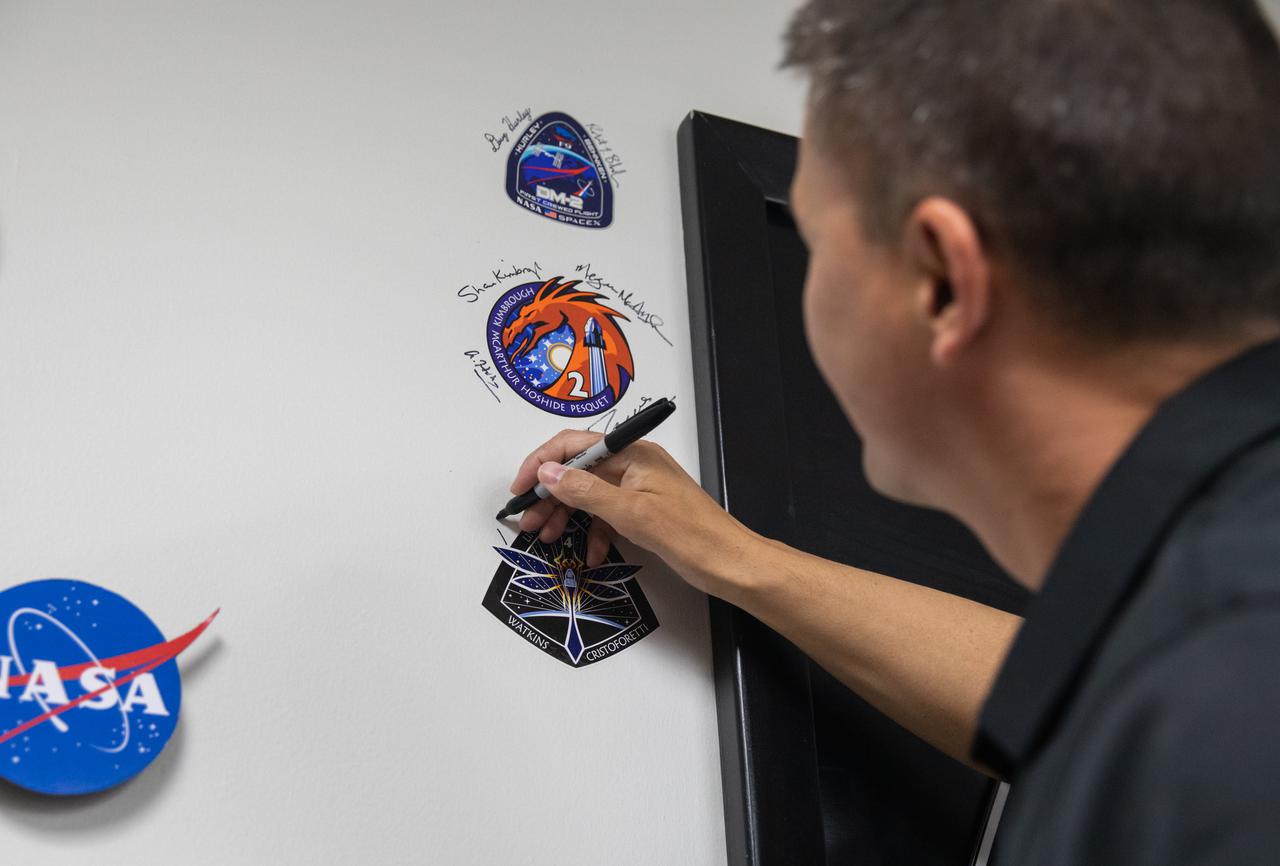
Crew-4 mission astronaut Kjell Lindgren signs the mission patch in the Astronaut Crew Quarters inside Kennedy Space Center’s Neil A. Armstrong Operations and Checkout Building on April 27, 2022. Lindgren, along with Bob Hines, Jessica Watkins, and Samantha Cristoforetti, will launch aboard SpaceX’s Crew Dragon – powered by the company’s Falcon 9 rocket – to the International Space Station as part of NASA’s Commercial Crew Program. Crew-4 is scheduled to lift off today at 3:52 a.m. EDT from Launch Complex 39A at Kennedy.
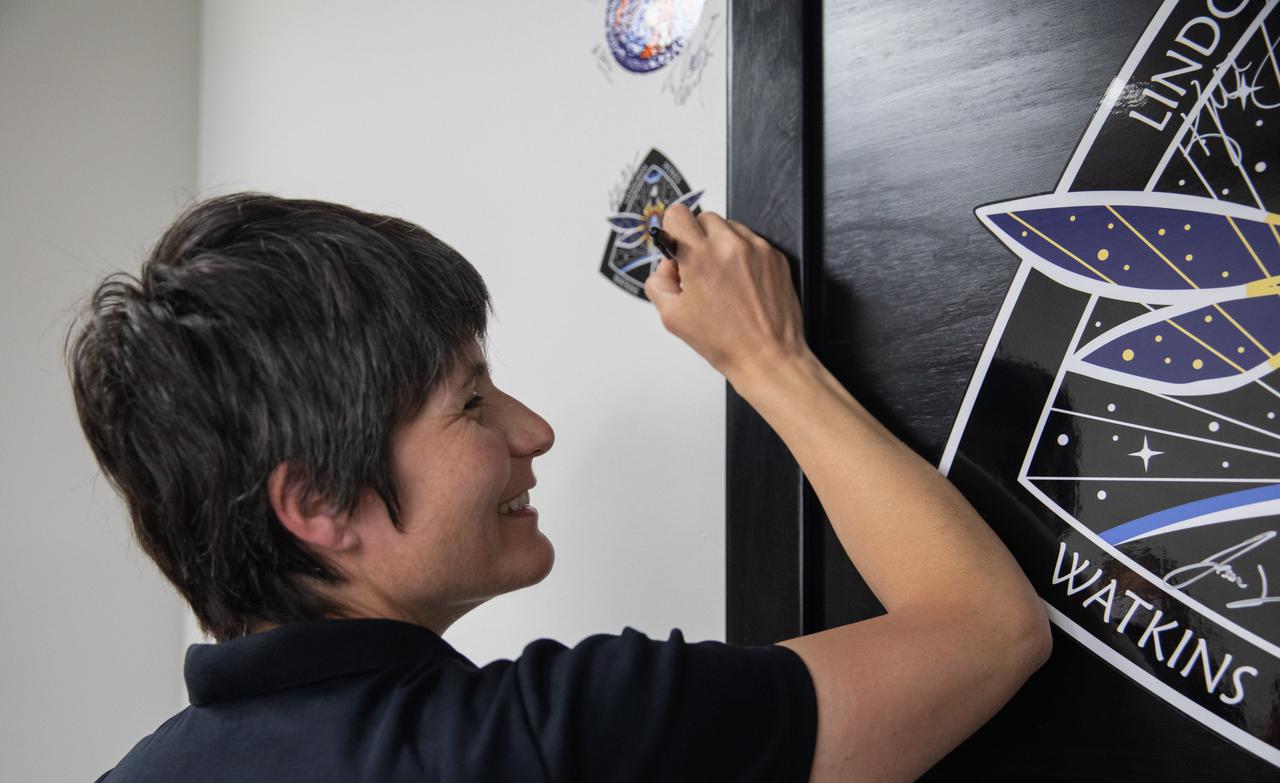
Crew-4 mission astronaut Samantha Cristoforetti signs the mission patch in the Astronaut Crew Quarters inside Kennedy Space Center’s Neil A. Armstrong Operations and Checkout Building on April 27, 2022. Cristoforetti, along with Kjell Lindgren, Bob Hines, and Jessica Watkins, will launch aboard SpaceX’s Crew Dragon – powered by the company’s Falcon 9 rocket – to the International Space Station as part of NASA’s Commercial Crew Program. Crew-4 is scheduled to lift off today at 3:52 a.m. EDT from Launch Complex 39A at Kennedy.

NASA astronaut Christina Koch, Artemis II mission specialist holds a patch signed by her and her fellow Artemis II crew mates NASA astronauts Reid Wiseman, Victor Glover, and CSA (Canadian Space Agency) astronaut Jeremy Hansen before meeting with members and staff of the House Science Committee, Tuesday, May 12, 2026, at the Rayburn House Office Building in Washington. NASA’s Artemis II mission took Wiseman, Glover, Koch, and Hansen on a nearly 10-day journey around the Moon and back to Earth in April 2026. Photo Credit: (NASA/Joel Kowsky)

S133-E-008849 (5 March 2011) --- In the newly-installed Permanent Multipurpose Module (PMM), the STS-133 crew members pose while signing the STS-133 patch, which was added to the growing collection of insignias representing crews who have worked on the International Space Station. Pictured counter-clockwise (from the center) are NASA astronauts Steve Lindsey, commander; Eric Boe, pilot; Alvin Drew, Steve Bowen, Nicole Stott and Michael Barratt, all mission specialists. Photo credit: NASA or National Aeronautics and Space Administration

jsc2018e025593 - In the Korolev Museum at the Baikonur Cosmodrome in Kazakhstan, the Expedition 55 prime and backup crewmembers sign a flag bearing their Soyuz MS-08 crew patch insignia March 16 during a traditional preflight tour of the museum. From left to right are backup crewmembers Nick Hague of NASA and Alexey Ovchinin of Roscosmos and prime crewmembers Oleg Artemyev of Roscosmos, Ricky Arnold of NASA and Drew Feustel of NASA, who will launch March 21 on the Soyuz MS-08 spacecraft for a five-month mission on the International Space Station...NASA/Victor Zelentsov.
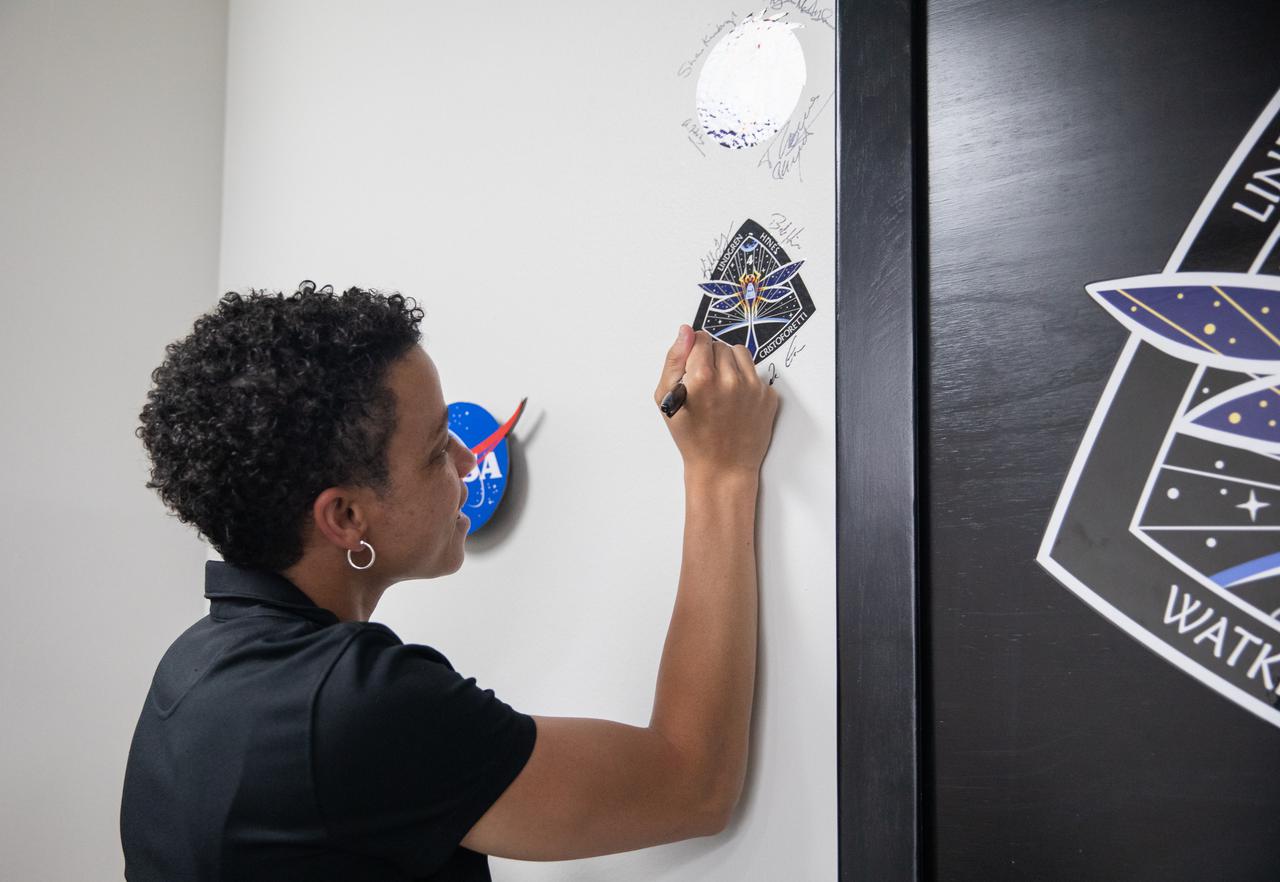
Crew-4 mission astronaut Jessica Watkins signs the mission patch in the Astronaut Crew Quarters inside Kennedy Space Center’s Neil A. Armstrong Operations and Checkout Building on April 27, 2022. Watkins, along with Kjell Lindgren, Bob Hines, and Samantha Cristoforetti, will launch aboard SpaceX’s Crew Dragon – powered by the company’s Falcon 9 rocket – to the International Space Station as part of NASA’s Commercial Crew Program. Crew-4 is scheduled to lift off today at 3:52 a.m. EDT from Launch Complex 39A at Kennedy.
Crew-4 mission astronaut Bob Hines signs the mission patch in the Astronaut Crew Quarters inside Kennedy Space Center’s Neil A. Armstrong Operations and Checkout Building on April 27, 2022. Hines, along with Kjell Lindgren, Jessica Watkins, and Samantha Cristoforetti, will launch aboard SpaceX’s Crew Dragon – powered by the company’s Falcon 9 rocket – to the International Space Station as part of NASA’s Commercial Crew Program. Crew-4 is scheduled to lift off today at 3:52 a.m. EDT from Launch Complex 39A at Kennedy.

jsc2018e025594 - In the Korolev Museum at the Baikonur Cosmodrome in Kazakhstan, the Expedition 55 prime and backup crewmembers sign a flag bearing their Soyuz MS-08 crew patch insignia March 16 during a traditional preflight tour of the museum. From left to right are backup crewmembers Nick Hague of NASA and Alexey Ovchinin of Roscosmos and prime crewmembers Oleg Artemyev of Roscosmos, Ricky Arnold of NASA and Drew Feustel of NASA, who will launch March 21 on the Soyuz MS-08 spacecraft for a five-month mission on the International Space Station...NASA/Victor Zelentsov.
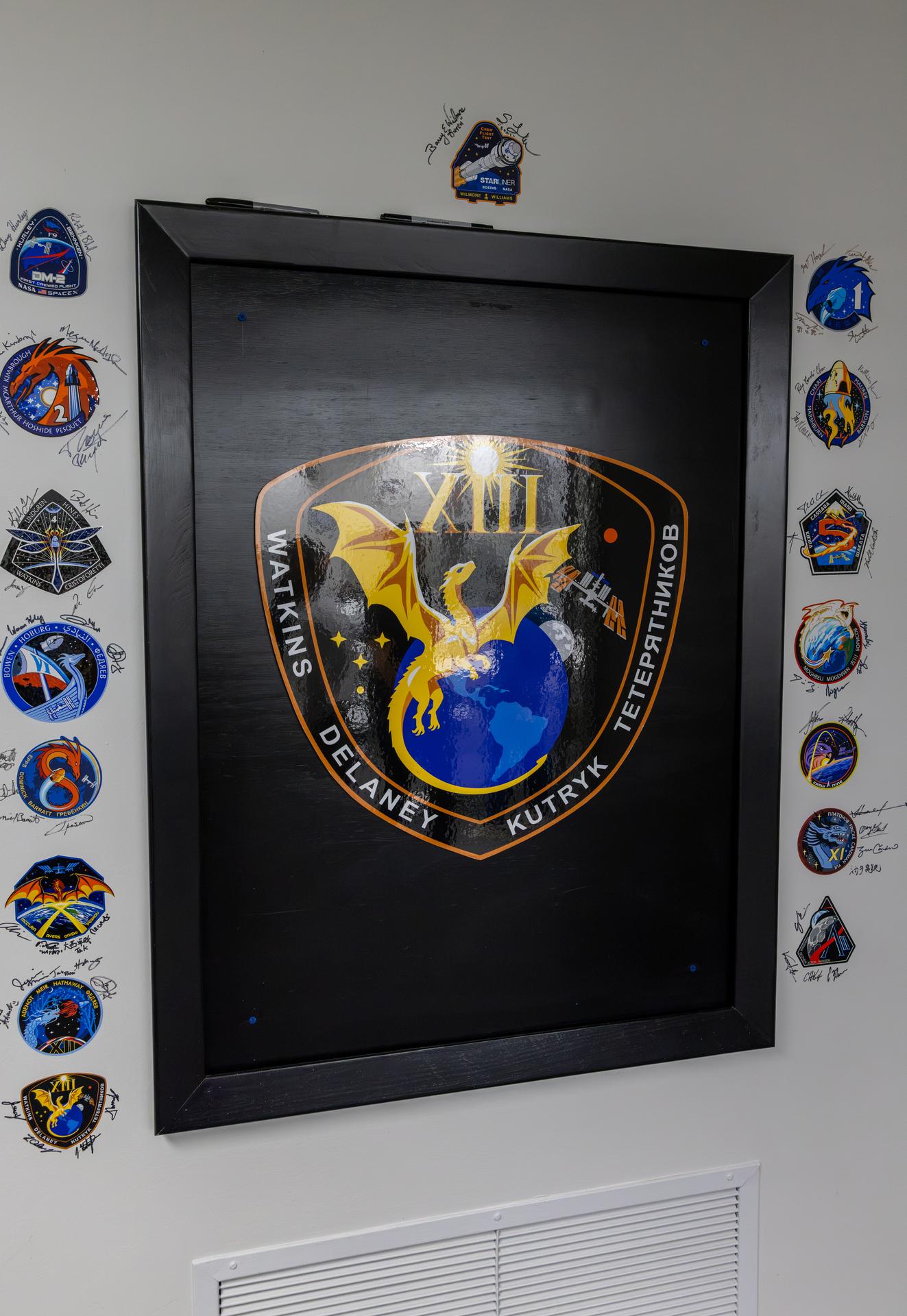
NASA’s SpaceX Crew-13 crew members NASA astronauts Jessica Watkins and Luke Delaney, along with CSA (Canadian Space Agency) astronaut Joshua Kutryk, and Roscosmos cosmonaut Sergey Teteryatnikov sign their names next to their mission insignia inside the Astronaut Crew Quarters in the Neil A. Armstrong Operations and Checkout Building at NASA’s Kennedy Space Center in Florida on Tuesday, Sept. 29, 2026. NASA’s SpaceX Crew-13 crew members will launch aboard a SpaceX Dragon spacecraft and Falcon 9 to the International Space Station no earlier than 11:10 a.m. EDT on Thursday, Oct. 1, from Cape Canaveral Space Force Station’s Space Launch Complex 40.

NASA’s SpaceX Crew-13 crew members NASA astronauts Jessica Watkins and Luke Delaney, along with CSA (Canadian Space Agency) astronaut Joshua Kutryk, and Roscosmos cosmonaut Sergey Teteryatnikov sign their names next to their mission insignia inside the Astronaut Crew Quarters in the Neil A. Armstrong Operations and Checkout Building at NASA’s Kennedy Space Center in Florida on Tuesday, Sept. 29, 2026. NASA’s SpaceX Crew-13 crew members will launch aboard a SpaceX Dragon spacecraft and Falcon 9 to the International Space Station no earlier than 11:10 a.m. EDT on Thursday, Oct. 1, from Cape Canaveral Space Force Station’s Space Launch Complex 40.
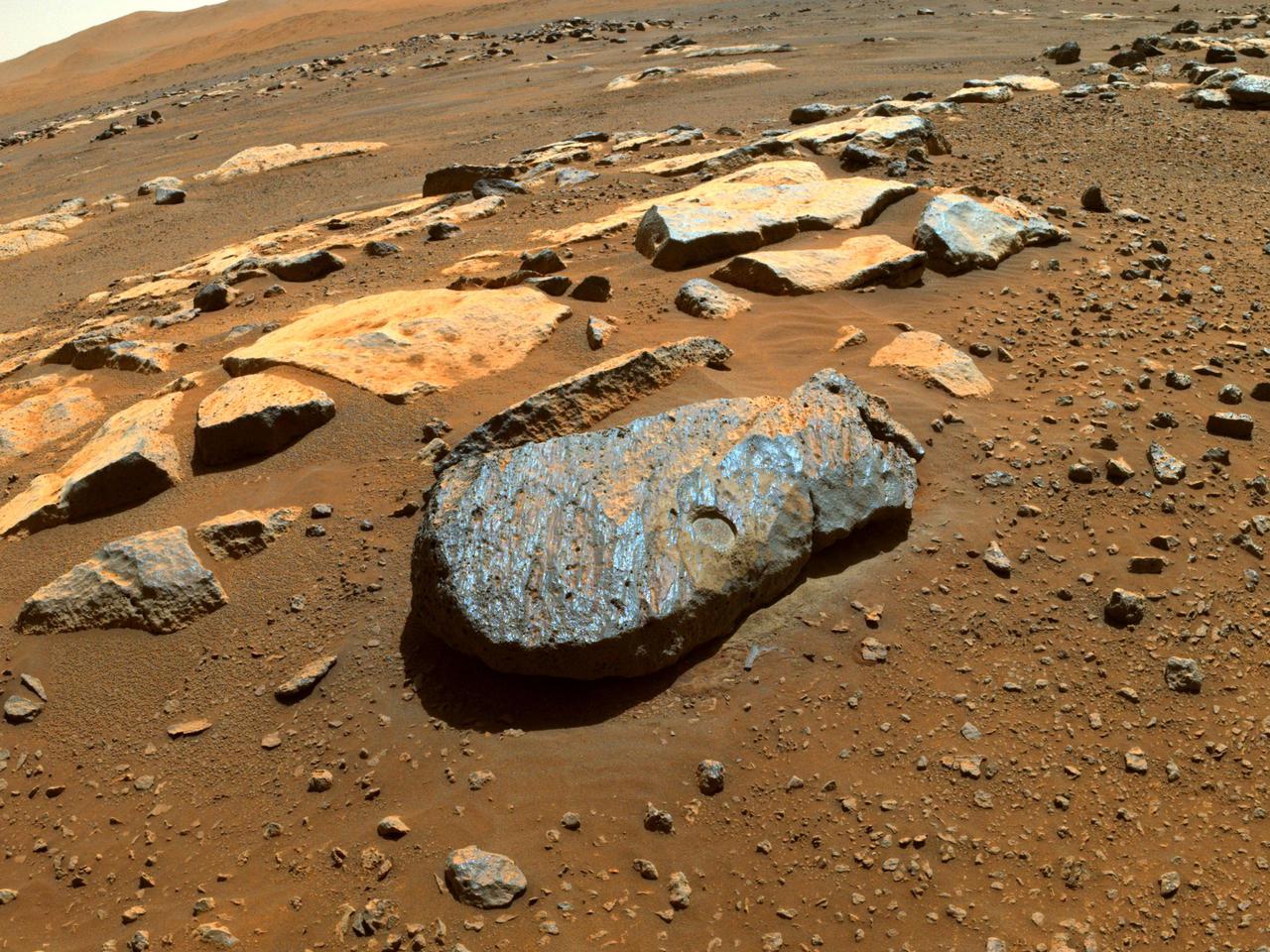
NASA's Perseverance rover took this image of the Martian rock nicknamed "Rochette" on Aug. 27, 2021, shortly after it abraded a circular patch known as "Bellegarde." The patch is about 0.39 inches (10 millimeters) deep and about 2 inches (5 centimeters) in diameter. The image was taken by one of the rover's Hazard Avoidance Cameras on the 185th sol (Martian day) of the rover's mission and processed to enhance contrast. A key objective for Perseverance's mission on Mars is astrobiology, including the search for signs of ancient microbial life. The rover will characterize the planet's geology and past climate, pave the way for human exploration of the Red Planet, and be the first mission to collect and cache Martian rock and regolith. The Mars 2020 Perseverance mission is part of NASA's Moon to Mars exploration approach, which includes Artemis missions to the Moon that will help prepare for human exploration of the Red Planet. Subsequent NASA missions, in cooperation with ESA (European Space Agency), would send spacecraft to Mars to collect these sealed samples from the surface and return them to Earth for in-depth analysis. https://photojournal.jpl.nasa.gov/catalog/PIA24839
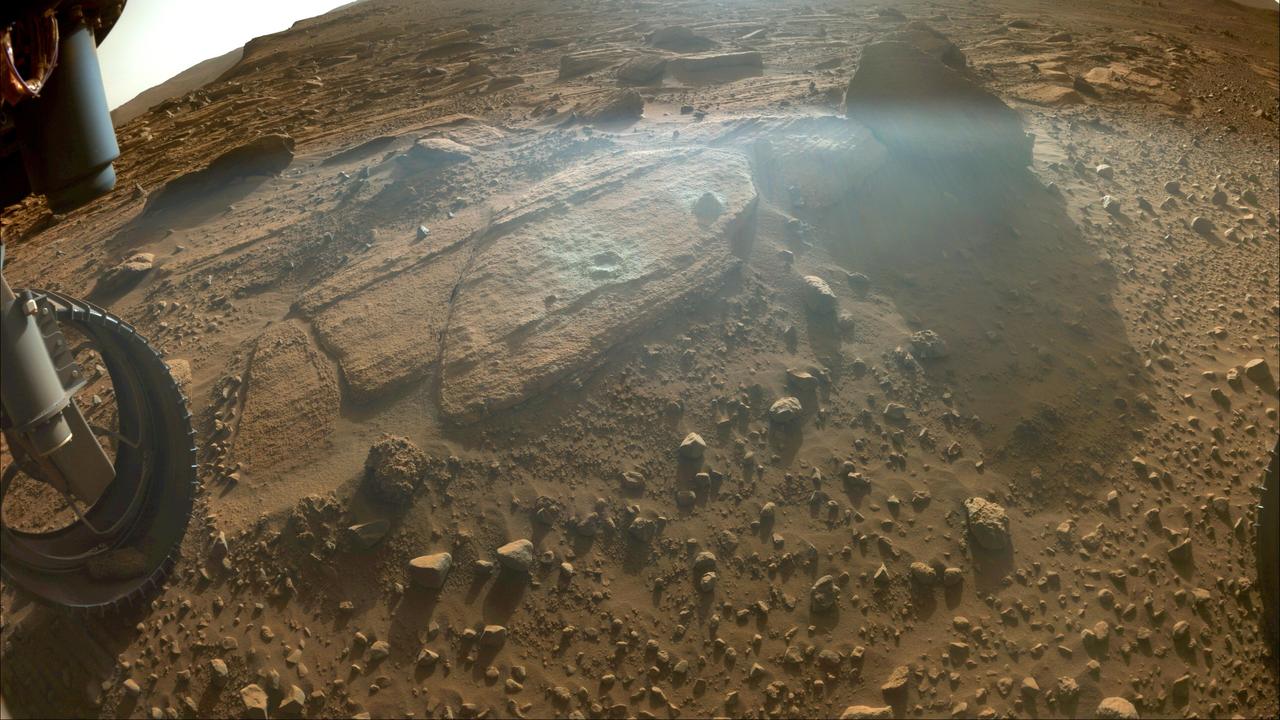
This image shows the rocky outcrop the Perseverance science team calls "Berea" after the NASA Mars rover extracted a rock core (right) and abraded a circular patch (left). The image was taken by one of the rover's front hazard cameras on March 30, 2023, the 749th Martian day, or sol, of the mission. Perseverance grinds, or abrades, circular patches into rocks so its science instruments can analyze the rocks' composition. The rock core it obtained, about the size of a piece of classroom chalk, was sealed in an ultra-clean sample tube. It is currently being stored in the rover's Sampling and Caching System. A key objective for Perseverance's mission on Mars is astrobiology, including the search for signs of ancient microbial life. The rover will characterize the planet's geology and past climate, pave the way for human exploration of the Red Planet, and be the first mission to collect and cache Martian rock and regolith (broken rock and dust). Subsequent NASA missions, in cooperation with ESA (European Space Agency), would send spacecraft to Mars to collect these sealed samples from the surface and return them to Earth for in-depth analysis. The Mars 2020 Perseverance mission is part of NASA's Moon to Mars exploration approach, which includes Artemis missions to the Moon that will help prepare for human exploration of the Red Planet. https://photojournal.jpl.nasa.gov/catalog/PIA25688

CAPE CANAVERAL, Fla. - STS-125 Pilot Gregory C. Johnson tries on his helmet for a fit check. Johnson will be making his first shuttle launch. His name patch reflects his military “call sign.” The crew is at NASA's Kennedy Space Center in Florida to take part in terminal countdown demonstration test, or TCDT, activities as preparation before launch on space shuttle Atlantis’ STS-125 mission to service NASA’s Hubble Space Telescope. TCDT provides astronauts and ground crews with an opportunity to participate in various simulated countdown activities, including equipment familiarization, emergency training and a launch countdown. Atlantis is targeted to launch Oct. 14. Photo credit: NASA/Kim Shiflett

CAPE CANAVERAL, Fla. - STS-125 Pilot Gregory C. Johnson tries on his helmet for a fit check. Johnson will be making his first shuttle launch. His name patch reflects his military “call sign.” The crew is at NASA's Kennedy Space Center in Florida to take part in terminal countdown demonstration test, or TCDT, activities as preparation before launch on space shuttle Atlantis’ STS-125 mission to service NASA’s Hubble Space Telescope. TCDT provides astronauts and ground crews with an opportunity to participate in various simulated countdown activities, including equipment familiarization, emergency training and a launch countdown. Atlantis is targeted to launch Oct. 14. Photo credit: NASA/Kim Shiflett

CAPE CANAVERAL, Fla. - STS-125 Commander Scott Altman tries on his helmet for a fit check. A veteran in space, Altman will be making his fourth shuttle launch. His name patch reflects his military “call sign.” The crew is at NASA's Kennedy Space Center in Florida to take part in terminal countdown demonstration test, or TCDT, activities as preparation before launch on space shuttle Atlantis’ STS-125 mission to service NASA’s Hubble Space Telescope. TCDT provides astronauts and ground crews with an opportunity to participate in various simulated countdown activities, including equipment familiarization, emergency training and a launch countdown. Atlantis is targeted to launch Oct. 14. Photo credit: NASA/Kim Shiflett

CAPE CANAVERAL, Fla. - A technician checks STS-125 Commander Scott Altman’s boot as part of his launch-and-entry suit. A veteran in space, Altman will be making his fourth shuttle launch. His name patch reflects his military “call sign.” The crew is at NASA's Kennedy Space Center in Florida to take part in terminal countdown demonstration test, or TCDT, activities as preparation before launch on space shuttle Atlantis’ STS-125 mission to service NASA’s Hubble Space Telescope. TCDT provides astronauts and ground crews with an opportunity to participate in various simulated countdown activities, including equipment familiarization, emergency training and a launch countdown. Atlantis is targeted to launch Oct. 14. Photo credit: NASA/Kim Shiflett
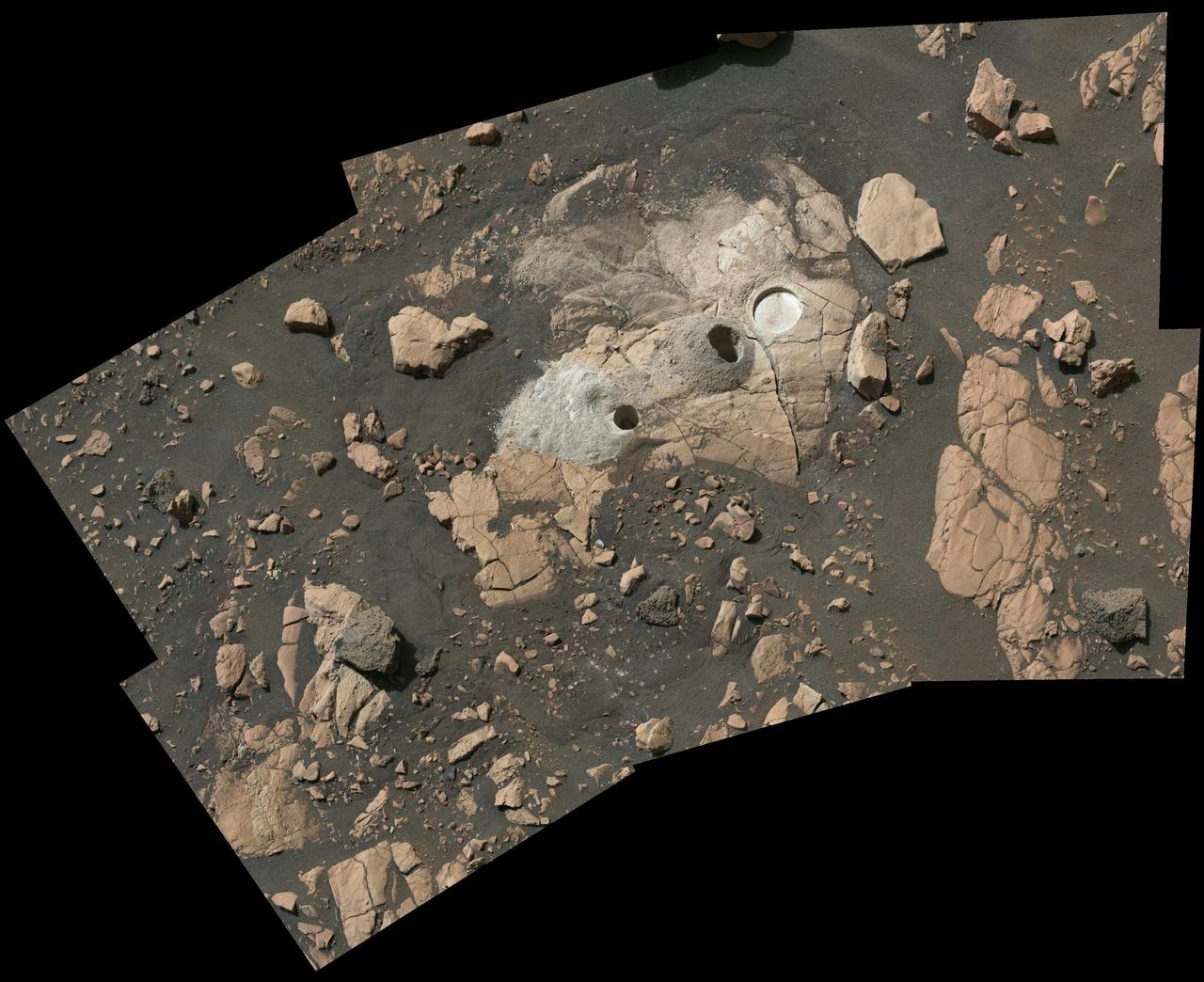
Composed of multiple images from NASA's Perseverance Mars rover, this mosaic shows a rocky outcrop called "Wildcat Ridge," where the rover extracted two rock cores and abraded a circular patch to investigate the rock's composition. The site is in the delta, a fan-shaped area where, billions of years ago, a river once flowed into a lake in Jezero Crater. Scientists consider this area one of the best places on Mars to search for potential signs of ancient microbial life. The images were obtained by the Mastcam-Z instrument on Aug. 4, 2022, the 518th Martian day, or sol, of the rover's mission. For scale, the bright circular abrasion patch on the right is approximately 2 inches (5 centimeters) in diameter. The color bands of the image have been processed to improve visual contrast and accentuate color differences. The rock cores obtained by Perseverance – each about the size of a piece of classroom chalk – were sealed in ultra-clean sample tubes. They are currently stored in the rover's Sampling and Caching System. The verification of ancient life on Mars carries an enormous burden of proof. A key objective for Perseverance's mission on Mars is astrobiology, including the search for signs of ancient microbial life. The rover will characterize the planet's geology and past climate, pave the way for human exploration of the Red Planet, and be the first mission to collect and cache Martian rock and regolith (broken rock and dust). Subsequent NASA missions, in cooperation with ESA (European Space Agency), would send spacecraft to Mars to collect these sealed samples from the surface and return them to Earth for in-depth analysis. The Mars 2020 Perseverance mission is part of NASA's Moon to Mars exploration approach, which includes Artemis missions to the Moon that will help prepare for human exploration of the Red Planet. https://photojournal.jpl.nasa.gov/catalog/PIA24928
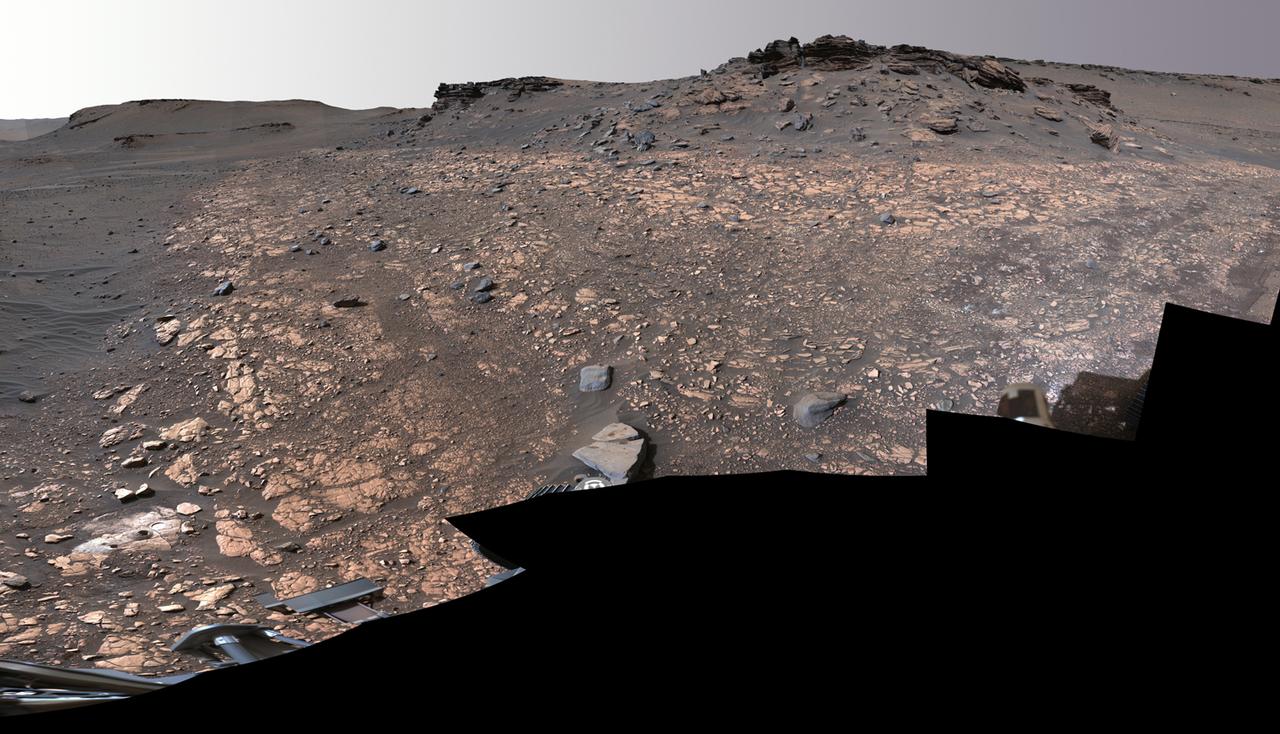
This image shows two locations in Mars's Jezero Crater where NASA's Perseverance rover collected rock samples for possible return to Earth in the future: "Wildcat Ridge" (lower left) and "Skinner Ridge" (upper right). These two outcrops are within about 70 feet (20 meters) of each other. The rover cored two cylinders of rock the size of classroom chalk (about 0.5 inches, or 13 millimeters, in diameter and 2.4 inches, or 60 millimeters, long) from each location. The two sites are in the delta, a fan-shaped area where, billions of years ago, a river once flowed into a lake in Jezero Crater and deposited rocks and sediment. Scientists consider the sedimentary rocks preserved in the delta one of the best places on Mars to search for potential signs of ancient microbial life. The verification of ancient life on Mars carries an enormous burden of proof. A light-colored, circular patch of abraded rock can be seen in the lower-left corner of the image, next to areas where Perseverance used its drill to extract the rock-core samples. The abrasion patch to the right of one of the holes is about 2 inches (5 centimeters) in diameter. The samples taken from these areas were sealed inside ultra-clean sample tubes, which are currently stored inside Perseverance. The multiple images that make up this mosaic were acquired by Perseverance's Mastcam-Z instrument on Aug. 4, 2022, the 518st Martian day, or sol, of the rover's mission. The color bands of the image have been processed to improve visual contrast and accentuate color differences. A key objective for Perseverance's mission on Mars is astrobiology, including the search for signs of ancient microbial life. The rover will characterize the planet's geology and past climate, pave the way for human exploration of the Red Planet, and be the first mission to collect and cache Martian rock and regolith (broken rock and dust). Subsequent NASA missions, in cooperation with ESA (European Space Agency), would send spacecraft to Mars to collect these sealed samples from the surface and return them to Earth for in-depth analysis. The Mars 2020 Perseverance mission is part of NASA's Moon to Mars exploration approach, which includes Artemis missions to the Moon that will help prepare for human exploration of the Red Planet. https://photojournal.jpl.nasa.gov/catalog/PIA24924
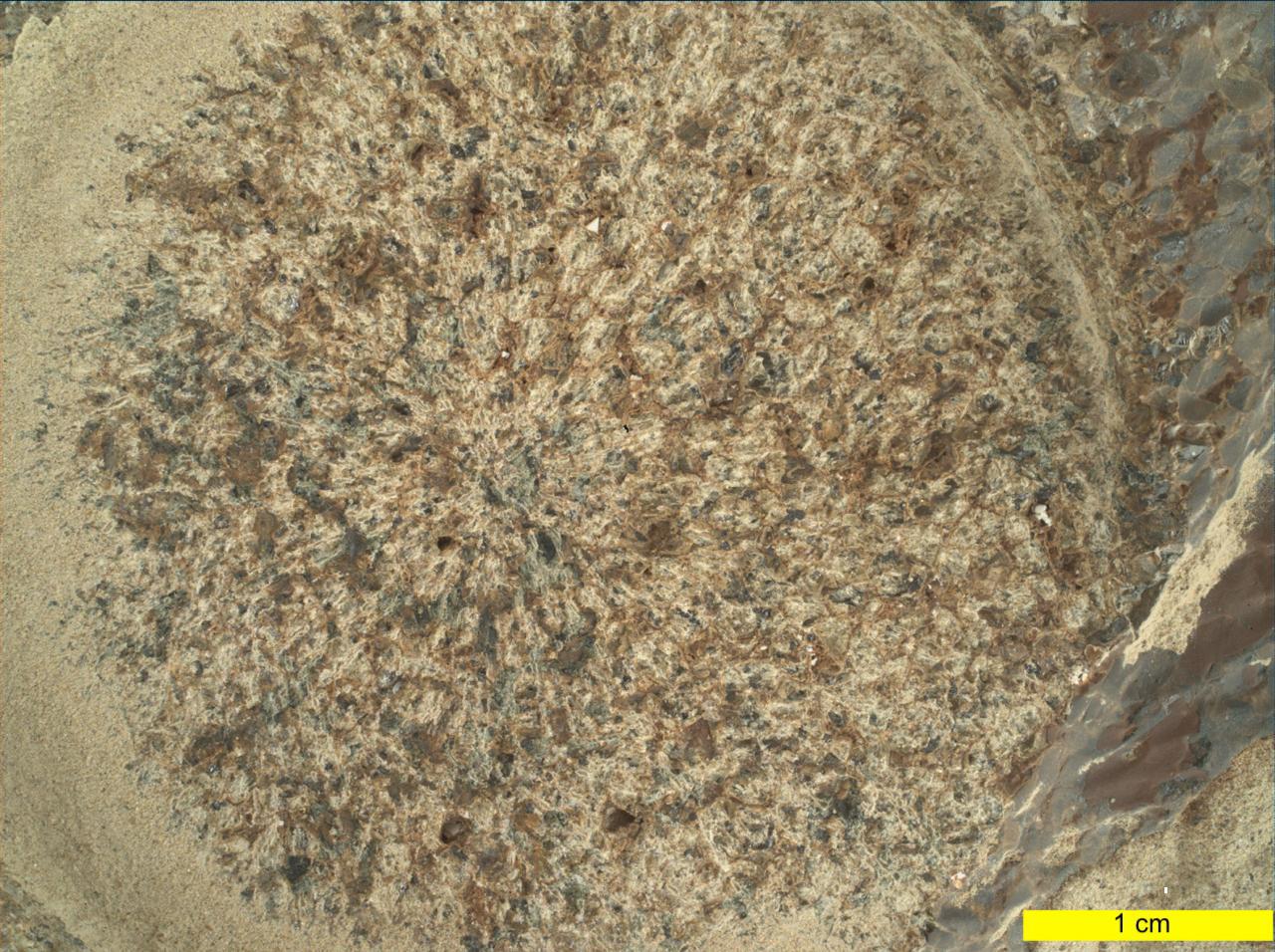
This close-up view of a rock target named "Dourbes" was provided by the WATSON (Wide Angle Topographic Sensor for Operations and eNgineering) camera on the end of the robotic arm aboard NASA's Perseverance Mars rover. WATSON took a series of eight fully-shadowed images on Nov. 5, 2021, the 253rd Martian day, or sol, of the mission, and the images were subsequently merged to create this view. Before drilling rocks, the rover abrades the rock surface using a tool on its robotic arm to clear away dust and weathering rinds, allowing other instruments to study the rocks in detail. The abraded patch is 2 inches (5 centimeters) in diameter. Perseverance subsequently acquired two rock core samples from this outcrop, called "Brac," which forms part of the "South Séítah" geologic unit of Jezero Crater. The WATSON image shows that the abrasion patch is dominated by discrete areas of light-toned material, with subordinate brown, dark-toned interstitial areas. The chemistry and mineralogy of the abrasion patch was analysed by a series of co-registered observations using the SuperCam, Mastcam-Z, PIXL (Planetary Instrument for X-ray Lithochemistry), and SHERLOC (Scanning Habitable Environments with Raman & Luminescence for Organics & Chemicals) instruments. A subsystem of an instrument called SHERLOC (Scanning Habitable Environments with Raman & Luminescence for Organics & Chemicals), WATSON can document the structure and texture within a drilled or abraded target, and its data can be used to derive depth measurements. WATSON was built by Malin Space Science Systems (MSSS) in San Diego and is operated jointly by MSSS and JPL. A key objective for Perseverance's mission on Mars is astrobiology, including the search for signs of ancient microbial life. The rover will characterize the planet's geology and past climate, pave the way for human exploration of the Red Planet, and be the first mission to collect and cache Martian rock and regolith (broken rock and dust). Subsequent NASA missions, in cooperation with ESA (European Space Agency), would send spacecraft to Mars to collect these sealed samples from the surface and return them to Earth for in-depth analysis. The Mars 2020 Perseverance mission is part of NASA's Moon to Mars exploration approach, which includes Artemis missions to the Moon that will help prepare for human exploration of the Red Planet. https://photojournal.jpl.nasa.gov/catalog/PIA24940
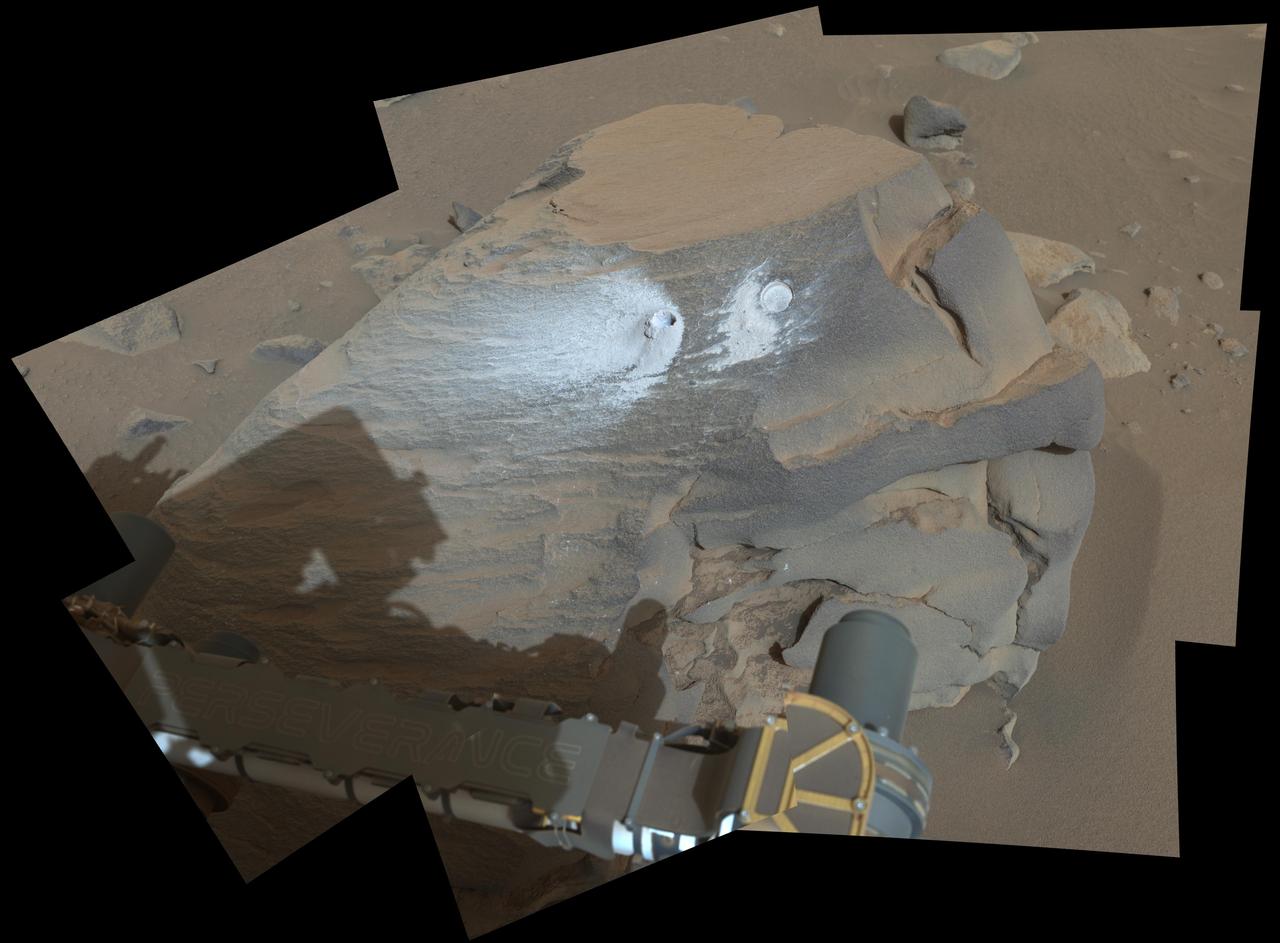
This view shows a rock nicknamed "Bunsen Peak" where NASA's Perseverance Mars rover extracted its 21st rock core (left) and abraded a circular patch (right) to investigate the rock's composition. Perseverance's Mastcam-Z camera system took the eight images that make up this mosaic on March 12, 2024, the 1,088th Martian day, or sol, of the rover's mission to Mars. For scale, the abrasion patch is approximately 2 inches (5 centimeters) in diameter. In this enhanced-color view, the color bands of the image have been processed to improve visual contrast and accentuate color differences. Arizona State University leads the operations of the Mastcam-Z instrument, working in collaboration with Malin Space Science Systems in San Diego, on the design, fabrication, testing, and operation of the cameras, and in collaboration with the Niels Bohr Institute of the University of Copenhagen on the design, fabrication, and testing of the calibration targets. A key objective for Perseverance's mission on Mars is astrobiology, including the search for signs of ancient microbial life. The rover will characterize the planet's geology and past climate, pave the way for human exploration of the Red Planet, and be the first mission to collect and cache Martian rock and regolith. Subsequent NASA missions, in cooperation with ESA (European Space Agency), would send spacecraft to Mars to collect these sealed samples from the surface and return them to Earth for in-depth analysis. The Mars 2020 Perseverance mission is part of NASA's Moon to Mars exploration approach, which includes Artemis missions to the Moon that will help prepare for human exploration of the Red Planet. https://photojournal.jpl.nasa.gov/catalog/PIA26312
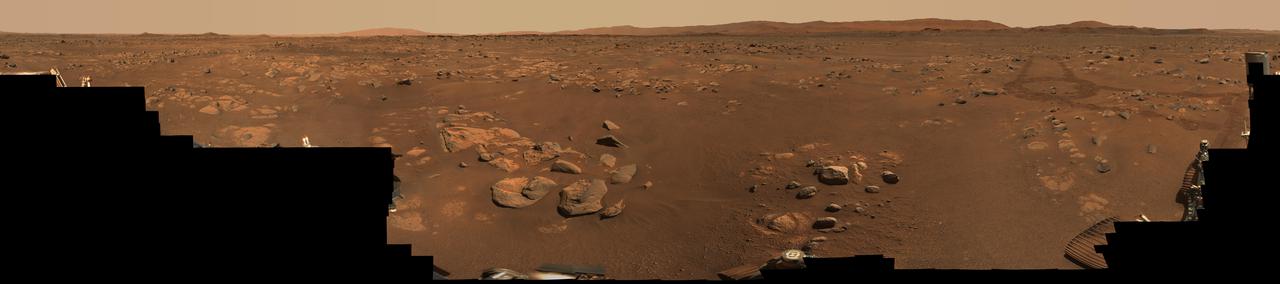
NASA's Perseverance Mars rover used its Mastcam-Z stereo imaging system to capture this 360-degree panorama of "Van Zyl Overlook," where the rover was parked for 13 days as the Ingenuity helicopter performed its first flights. The 2.4 billion-pixel panorama is made up of 992 individual right-eye Mastcam-Z images stitched together. The images were taken between April 15 and 26, 2021, or the 53rd and 64th Martian days, or sols, of the mission. A few small patches of near-field sand had been covered by parts of Perseverance when the right-eye Mastcam-Z images were taken; those gaps were filled with images of the same sandy patches taken by the Mastcam-Z left-eye camera at the same time, or from the earlier navigation camera images. Imaging coverage of the sky has also been digitally smoothed and expanded based on the actual sky color observed as the panorama was being acquired on Mars. Arizona State University in Tempe leads the operations of the Mastcam-Z instrument, working in collaboration with Malin Space Science Systems in San Diego. A key objective for Perseverance's mission on Mars is astrobiology, including the search for signs of ancient microbial life. The rover will characterize the planet's geology and past climate, pave the way for human exploration of the Red Planet, and be the first mission to collect and cache Martian rock and regolith (broken rock and dust). Subsequent NASA missions, in cooperation with ESA (European Space Agency), would send spacecraft to Mars to collect these sealed samples from the surface and return them to Earth for in-depth analysis. The Mars 2020 Perseverance mission is part of NASA's Moon to Mars exploration approach, which includes Artemis missions to the Moon that will help prepare for human exploration of the Red Planet. https://photojournal.jpl.nasa.gov/catalog/PIA24663

CAPE CANAVERAL, Fla. -- At the Kennedy Space Center in Florida, NASA Administrator Charles Bolden, left, presents Center Director Robert Cabana with an Apollo 11 patch that flew to the moon on the Apollo 11 mission and is signed by all three Apollo 11 astronauts. The patch will remain at Kennedy until the first human spaceflight to Mars, when it will fly once again. The presentation was made during a ceremony renaming the refurbished Operations and Checkout Building for Apollo 11 astronaut Neil Armstrong, the first person to set foot on the moon. The building's high bay, in which the ceremony was held, is being used to support the agency's new Orion spacecraft and is the same spaceport facility where the Apollo 11 command/service module and lunar module were prepped for the first lunar landing mission in 1969. Orion is designed to take humans farther than they’ve ever gone before, serving as the exploration vehicle that will carry astronauts to deep space and sustain the crew during travel to destinations such as an asteroid or Mars. The ceremony was part of NASA's 45th anniversary celebration of the Apollo 11 moon landing. As the world watched, Neil Armstrong and Buzz Aldrin landed in the moon's Sea of Tranquility on July 20, 1969, aboard the lunar module Eagle. Meanwhile, crewmate Michael Collins orbited above in the command module Columbia. For more, visit http://www.nasa.gov/press/2014/july/nasa-honors-historic-first-moon-landing-eyes-first-mars-mission. Photo credit: NASA/Kim Shiflett
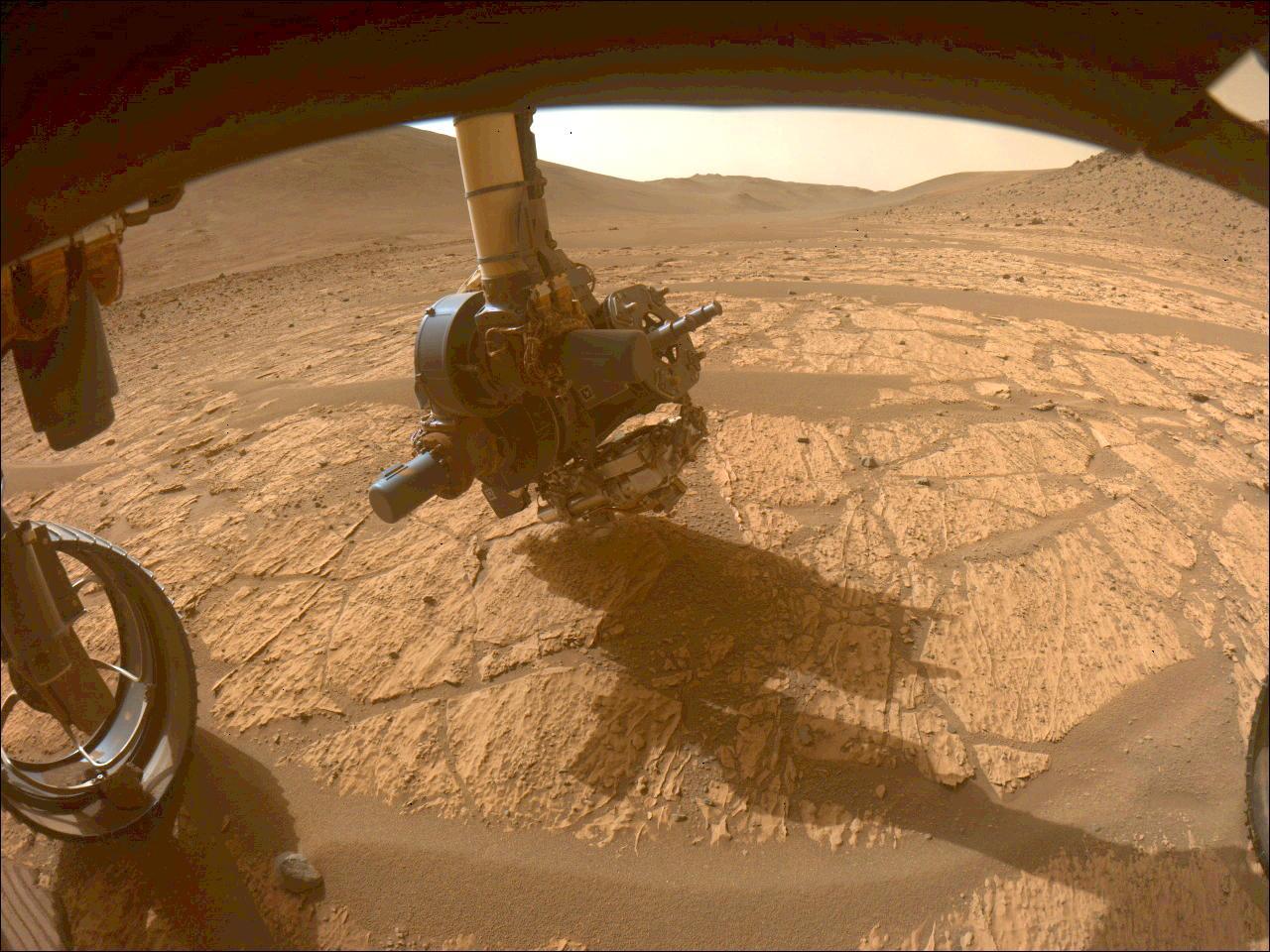
This image shows the WATSON camera aboard NASA's Perseverance Mars rover gathering data on the "Walhalla Glades" abrasion patch. It was taken in the "Bright Angel" region of Jezero Crater by one of the rover's front hazard avoidance cameras on June 14, 2024, the 1,180th Martian day, or sol, of the mission. WATSON (Wide Angle Topographic Sensor for Operations and eNgineering) is located on the SHERLOC (Scanning Habitable Environments with Raman and Luminescence for Organics and Chemicals) instrument at the end of Perseverance's long robotic arm. In this image, SHERLOC is at the bottom of the turret. The WATSON camera head is closest to the surface, and SHERLOC's Autofocus and Context Imager (another camera) is to the right, closer to the drill. A key objective for Perseverance's mission on Mars is astrobiology, including the search for signs of ancient microbial life. The rover is also characterizing the planet's geology and past climate, which paves the way for human exploration of the Red Planet. JPL, which is managed for NASA by Caltech in Pasadena, California, built and manages operations of the Perseverance rover. https://photojournal.jpl.nasa.gov/catalog/PIA26320
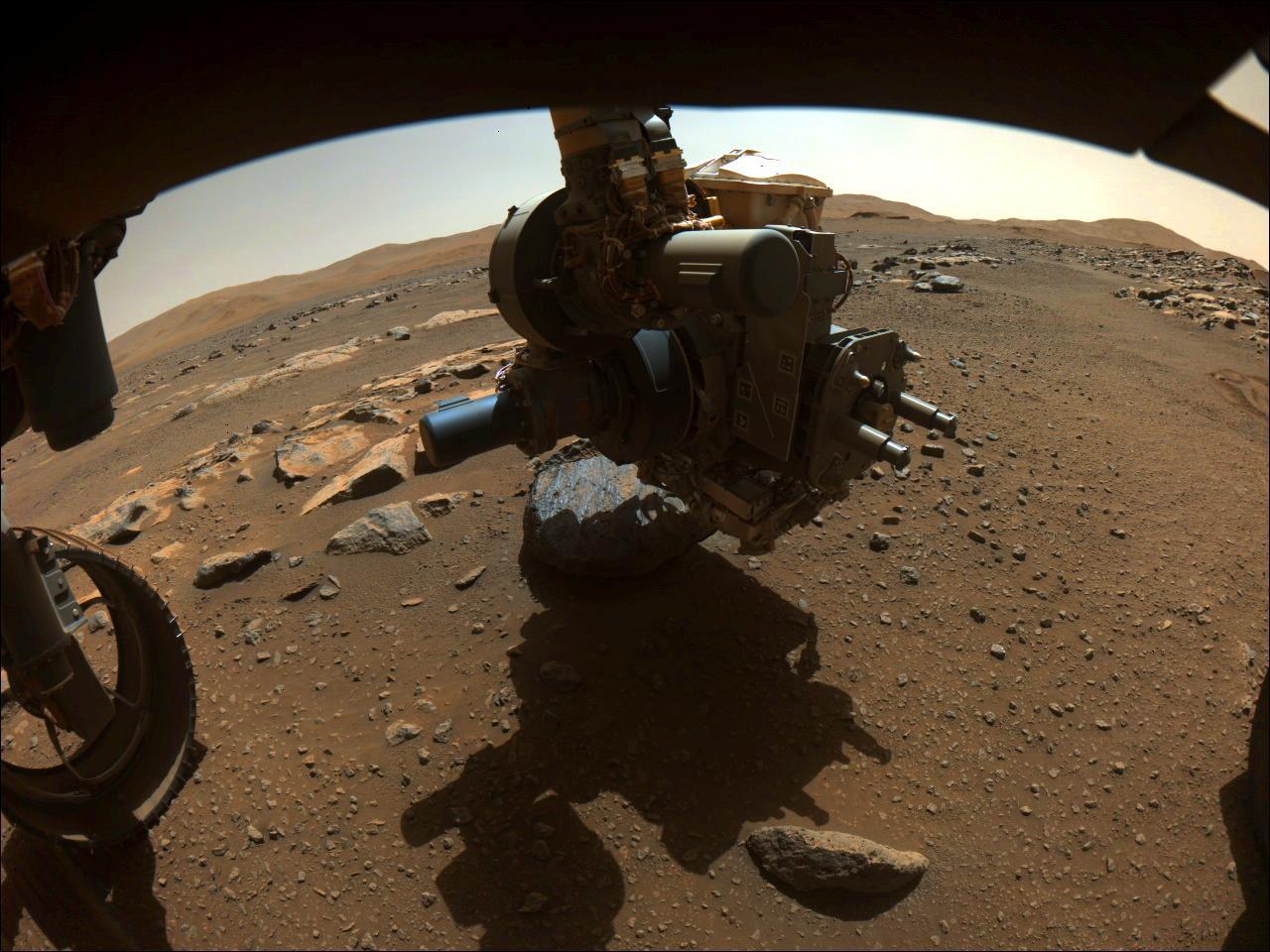
On Aug. 27, 2021, NASA's Perseverance rover captured this image of the science-instrument-laden turret at the end of its robotic arm getting close to the rock nicknamed "Rochette." Perseverance had just abraded a circular patch, nicknamed "Bellegarde," of the rock. This image was taken when the SHERLOC (Scanning Habitable Environments with Raman and Luminescence for Organics and Chemicals) instrument on the turret was using its WATSON (Wide Angle Topographic Sensor for Operations and eNgineering) camera to take a close-up image of Bellegarde on the 185th sol (Martian day) of Perseverance's mission. This image, taken by one of Perseverance's Hazard Avoidance Cameras, has been processed to enhance contrast. A key objective for Perseverance's mission on Mars is astrobiology, including the search for signs of ancient microbial life. The rover will characterize the planet's geology and past climate, pave the way for human exploration of the Red Planet, and be the first mission to collect and cache Martian rock and regolith. The Mars 2020 Perseverance mission is part of NASA's Moon to Mars exploration approach, which includes Artemis missions to the Moon that will help prepare for human exploration of the Red Planet. Subsequent NASA missions, in cooperation with ESA (European Space Agency), would send spacecraft to Mars to collect these sealed samples from the surface and return them to Earth for in-depth analysis. https://photojournal.jpl.nasa.gov/catalog/PIA24831

NASA's Perseverance rover puts its robotic arm to work around a rocky outcrop called "Skinner Ridge" in Mars' Jezero Crater. Composed of multiple images, this mosaic shows layered sedimentary rocks in the face of a cliff in the delta, as well as one of the locations where the rover abraded a circular patch to analyze a rock's composition. The delta is an area where, billions of years ago, a river once flowed into a lake in Jezero Crater and deposited rocks and sediments in a fan shape. Scientists consider the delta one of the best places on Mars to search for potential signs of ancient microbial life. The verification of ancient life on the Red Planet carries an enormous burden of proof. The multiple images that compose this mosaic were acquired by Perseverance's Mastcam-Z instrument between June 30 and July 8, 2022 (PDT), the 484th and 492nd Martian days, or sols, of the rover's mission. The color bands of the image have been processed to improve visual contrast and accentuate color differences. In the days after this mosaic was taken, Perseverance also extracted two classroom chalk-size pieces of rock (cylinders about 0.5 inches, or 13 millimeters, in diameter and 2.4 inches, or 60 millimeters, long) from Skinner Ridge and sealed them in ultra-clean sample tubes. A key objective for Perseverance's mission on Mars is astrobiology, including the search for signs of ancient microbial life. The rover will characterize the planet's geology and past climate, pave the way for human exploration of the Red Planet, and be the first mission to collect and cache Martian rock and regolith (broken rock and dust). Subsequent NASA missions, in cooperation with ESA (European Space Agency), would send spacecraft to Mars to collect these sealed samples from the surface and return them to Earth for in-depth analysis. The Mars 2020 Perseverance mission is part of NASA's Moon to Mars exploration approach, which includes Artemis missions to the Moon that will help prepare for human exploration of the Red Planet. https://photojournal.jpl.nasa.gov/catalog/PIA24925
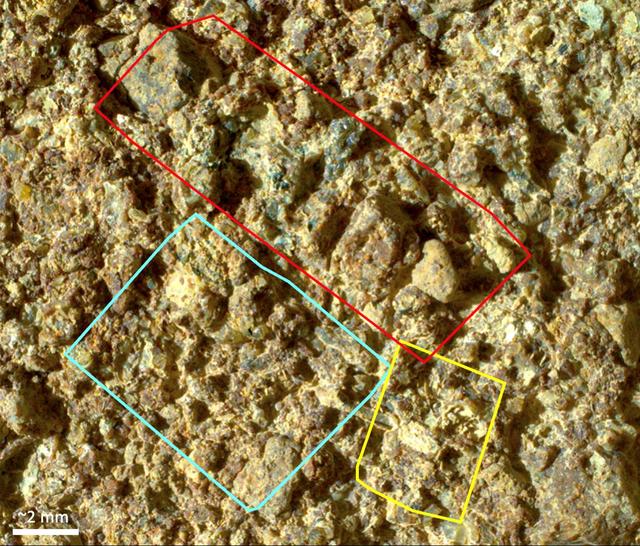
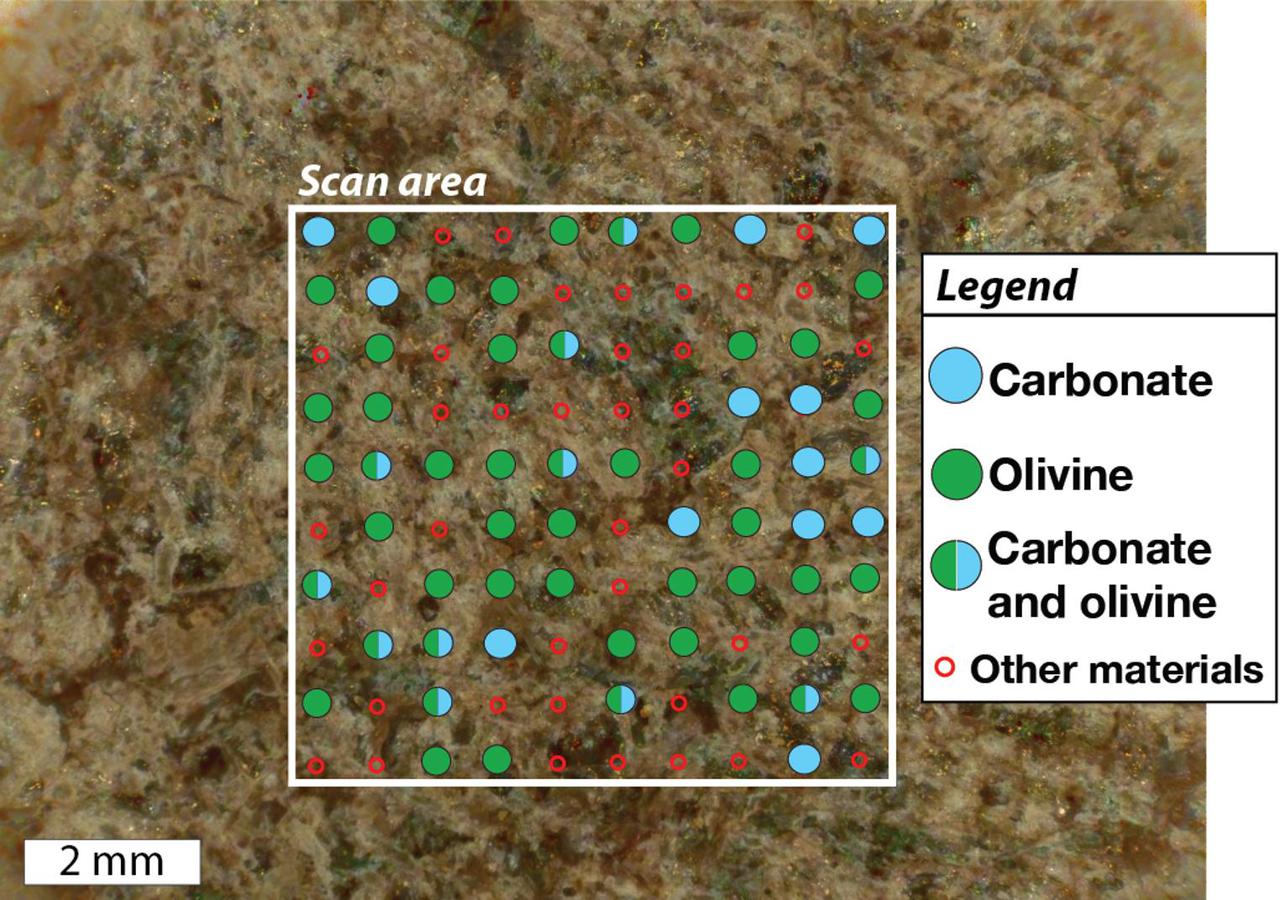
Before collecting a rock sample at a spot nicknamed "Otis Peak," NASA's Perseverance Mars rover employed an abrasion tool to wear down the rock surface and then used the Planetary Instrument for X-ray Lithochemistry, or PIXL, to study the rock's internal chemistry. This image of the abrasion patch, dubbed "Ouzel Falls," was taken in May 2023 by WATSON (Wide Angle Topographic Sensor for Operations and eNgineering), a camera that is part of an instrument called Scanning Habitable Environments with Raman & Luminescence for Organics & Chemicals, or SHERLOC, on the end of the rover's robotic arm. Data from PIXL is laid over the image. Colored squares show different areas where PIXL's X-ray beam scanned the rock's surface. The instrument's data found the rock was rich in phosphate, a material found in the DNA and cell membranes of all known life, and which also serves as a way to store and transfer energy within living things. The Ouzel Falls scan areas contain a rich diversity of other mineral grains, including igneous minerals transported as sand and pebbles, such as olivine and spinel, and minerals crystallized from water, such as carbonates, clays, and sulfates. Each of these record unique aspects of the magmatic, climatic, and paleoenvironmental history of the ancient lake within Jezero Crater and the surrounding region. This diversity will make the Otis Peak sample a treasure trove for scientists on Earth who may study it in the future. A key objective for Perseverance's mission on Mars is astrobiology, including the search for signs of ancient microbial life. The rover will characterize the planet's geology and past climate, pave the way for human exploration of the Red Planet, and be the first mission to collect and cache Martian rock and regolith (broken rock and dust). Subsequent NASA missions, in cooperation with ESA (European Space Agency), would send spacecraft to Mars to collect these sealed samples from the surface and return them to Earth for in-depth analysis. The Mars 2020 Perseverance mission is part of NASA's Moon to Mars exploration approach, which includes Artemis missions to the Moon that will help prepare for human exploration of the Red Planet. https://photojournal.jpl.nasa.gov/catalog/PIA26206
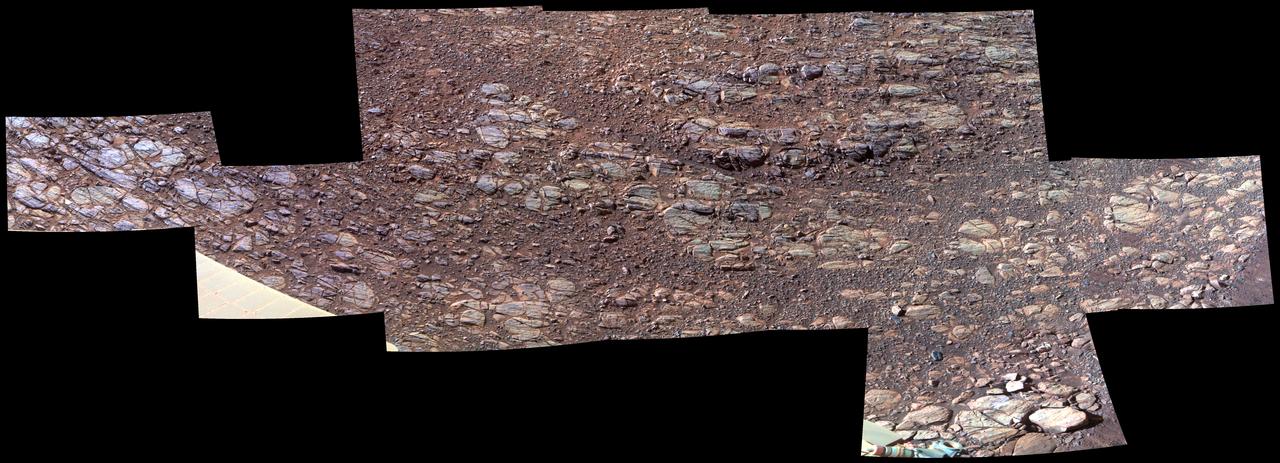
This patch of rocky Martian ground on the floor of "Perseverance Valley" on the inner slope of the western rim of Endurance Crater slopes steeply downhill from left to right. Some textures seen here, including striations just above and parallel to the edge of a solar panel at far left, may be due to abrasion by wind-driven sand. Researchers interpret them as possible signs of past winds blowing from right to left, up and out of the crater, which currently hosts sand dunes on its central floor. The view spans about 11.5 feet (3.5 meters) from left to right and is presented in enhanced color to make differences in surface materials easier to see. The Panoramic Camera (Pancam) on NASA's Mars Exploration Rover Opportunity took the component images of this scene during the period Oct. 13 through Oct. 20, 2017, corresponding to sols (Martian days) 4878 through 4884 of the rover's work on Mars. Opportunity entered the upper end of Perseverance Valley in July 2017 for several months of investigating how it formed. The valley is a system of shallow troughs extending about the length of two football fields down the crater rim's steep inner slope. Endurance Crater is about 14 miles (22 kilometers) in diameter. Opportunity has been exploring features on its western rim since 2011, after investigating a series of smaller craters beginning with the one it landed in on Jan. 25, 2004, Universal Time (Jan. 24, PST). The origin of Perseverance Valley is unknown, but some observed features suggest that water might have played a role in the past. Opportunity is descending the steep valley, making observations along the way that could help illuminate the origin of this feature. The bedrock target area in this view is called "La Bajada." The image combines exposures taken through three Pancam filters, centered at wavelengths of 753 nanometers (near-infrared), 535 nanometers (green) and 432 nanometers (violet). https://photojournal.jpl.nasa.gov/catalog/PIA22072
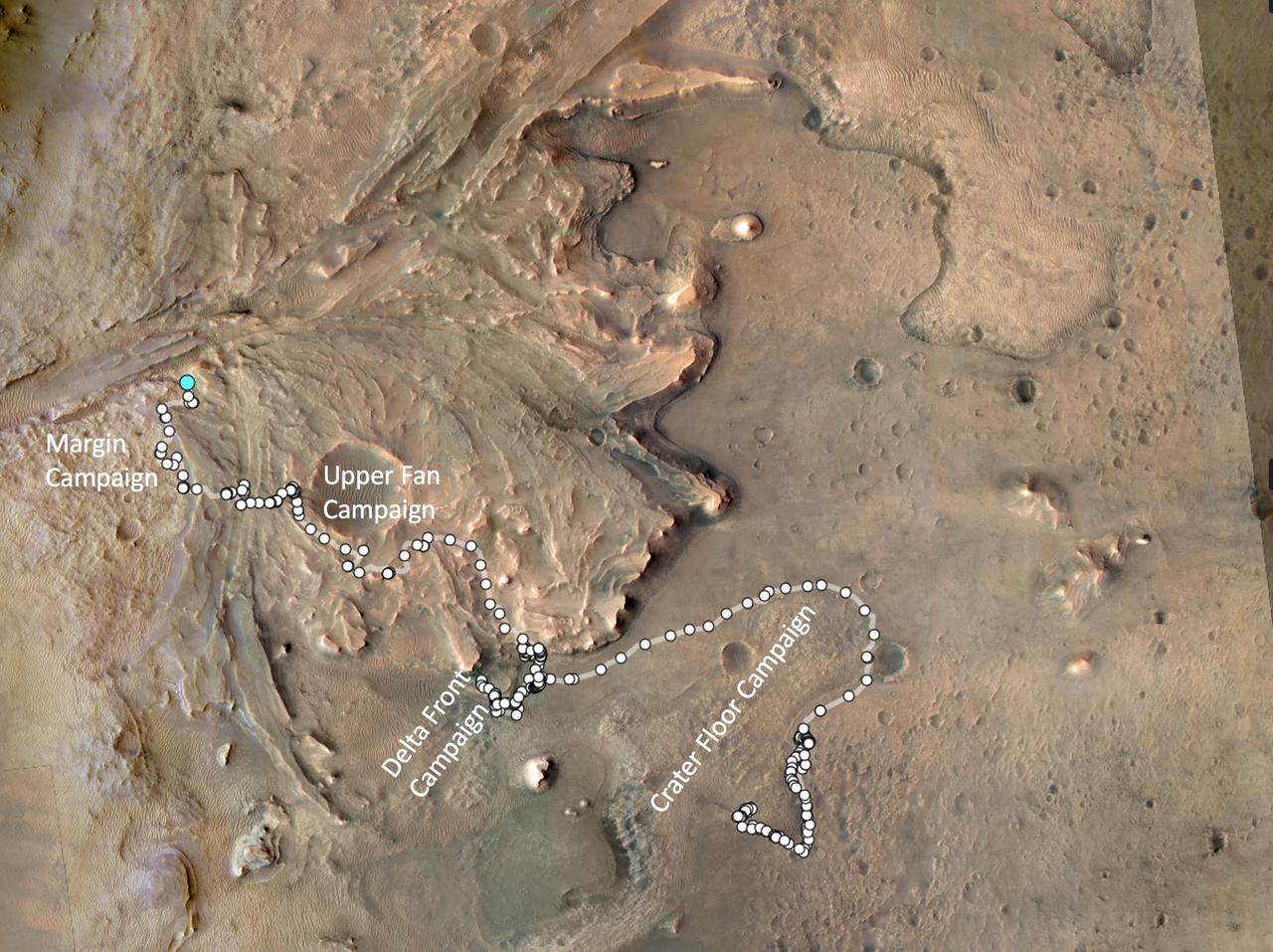
The path taken by NASA's Perseverance Mars rover during the first 1,000 sols (Martian days) of its mission at Jezero Crater is annotated on this overhead view taken by the HiRISE camera aboard the agency's Mars Reconnaissance Orbiter. White circles signify locations on the surface where the rover stopped after completing a traverse. The pale blue circle at upper left indicates the rover's position as of Dec. 12, 2023. The white text indicates the areas of the four rover science campaigns, from initial campaign to current: Crater Floor, Delta Front, Upper Fan, and Margin. Figure A, showing the same general area, is annotated to indicate the route and the two locations where the rover used its PIXL instrument to analyze abrasion patches "Ouzel Falls" and "Bills Bay" and its drill to core corresponding rock samples, "Otis Peak" and "Lefroy Bay." The University of Arizona, in Tucson, operates HiRISE, which was built by Ball Aerospace & Technologies Corp., in Boulder, Colorado. JPL manages the Mars Reconnaissance Orbiter Project for NASA's Science Mission Directorate, Washington. A key objective for Perseverance's mission on Mars is astrobiology, including the search for signs of ancient microbial life. The rover will characterize the planet's geology and past climate, pave the way for human exploration of the Red Planet, and be the first mission to collect and cache Martian rock and regolith (broken rock and dust). Subsequent NASA missions, in cooperation with ESA (European Space Agency), would send spacecraft to Mars to collect these sealed samples from the surface and return them to Earth for in-depth analysis. The Mars 2020 Perseverance mission is part of NASA's Moon to Mars exploration approach, which includes Artemis missions to the Moon that will help prepare for human exploration of the Red Planet. https://photojournal.jpl.nasa.gov/catalog/PIA26231

The workings of the Martian winds are visible in this image of sand dunes trapped inside an unnamed crater in southern Terra Cimmeria captured by NASA Mars Reconnaissance Orbiter spacecraft. Many of the craters in the Southern highlands of Mars contain sand dunes, and HiRISE is still in the process of mapping these dunes and determining how active they are today. So far, the dunes in these craters appear to be a mixed bunch, with some dunes actively advancing while others seem to be frozen in place. This image will be compared to a previous picture, to see how these dunes have changed since 2008. The sand dunes are the large, branched ridges and dark patches that are conspicuous against the bright background, particularly in the northwest corner of our picture. There are also signs of two other wind-related processes: smaller, brighter ridges line the floor of the crater in regularly spaced rows. These are also windblown deposits, mysterious "transverse aeolian ridges" or TARs that are more common in the Martian tropics. Faint, irregular dark lines cross the dunes and the TARs, marking the tracks of dust devils that vacuum the surface during southern summer. So, which came first? We can untangle the history of these processes by looking at the picture more closely. Over most of the image, it is obvious that the dark sand dunes bury the bright TARs, meaning that the sand dunes are younger than the TARs. But this relationship is not so clear for the southernmost dune we see in this picture. Here, the TARs look like they extend into the dune and merge with ripples on the dune's surface, suggesting that the TARs might be younger than the dunes. The question can be resolved by carefully examining an enhanced color cutout. The TARs are brighter and redder than the sand dunes and this color persists on the crests of the TARs as the sand encroaches, burying the valleys first and then the slopes and finally the TAR crests. This tells us that the unusual appearance of the dune margin is caused by burial and exposure of the older TARs by the younger sand. Finally, you can trace the tracks of dust devils crossing over the dunes, telling us that they are younger than the dunes. So, first came the TARs, next the dunes, and last the dust devils -- probably within the last few months! http://photojournal.jpl.nasa.gov/catalog/?IDNumber=pia19941
Different kinds of carbon-based molecules called organic compounds were viewed within a rock target called "Garde" by SHERLOC, one of the instruments on the end of the robotic arm aboard NASA's Perseverance Mars rover. The rover used its drill to abrade, or grind away, a patch of rock so that SHERLOC (Scanning Habitable Environments with Raman & Luminescence for Organics & Chemicals) could analyze its interior. This data was taken on Sept. 18, 2021, the 207th Martian day, or sol, of the mission. Nonbiological, geological processes can form organics. The organics found in PIXL's data and their association with the rocks that they're embedded within bear a striking resemblance to nonbiological organics within Martian meteorites, suggesting that these organics were formed by geological processes. Therefore, these organics findings are not biosignatures (compounds that indicate the presence of a biological process). SHERLOC made the first detection of organics on the Martian surface since the Curiosity rover. It is also the first detection of organics on the Martian surface made through ultraviolet fluorescence spectroscopy (whereas the Curiosity rover utilized a different methodology known as mass spectrometry), and it is the first discovery of the spatial distribution of organics on the Martian surface. The organics were found to be simple aromatics present at low concentrations, which is similar to what was found by the Curiosity rover and within Martian meteorites. A key objective for Perseverance's mission on Mars is astrobiology, including the search for signs of ancient microbial life. The rover will characterize the planet's geology and past climate, pave the way for human exploration of the Red Planet, and be the first mission to collect and cache Martian rock and regolith (broken rock and dust). Subsequent NASA missions, in cooperation with ESA (European Space Agency), would send spacecraft to Mars to collect these sealed samples from the surface and return them to Earth for in-depth analysis. The Mars 2020 Perseverance mission is part of NASA's Moon to Mars exploration approach, which includes Artemis missions to the Moon that will help prepare for human exploration of the Red Planet. https://photojournal.jpl.nasa.gov/catalog/PIA25042
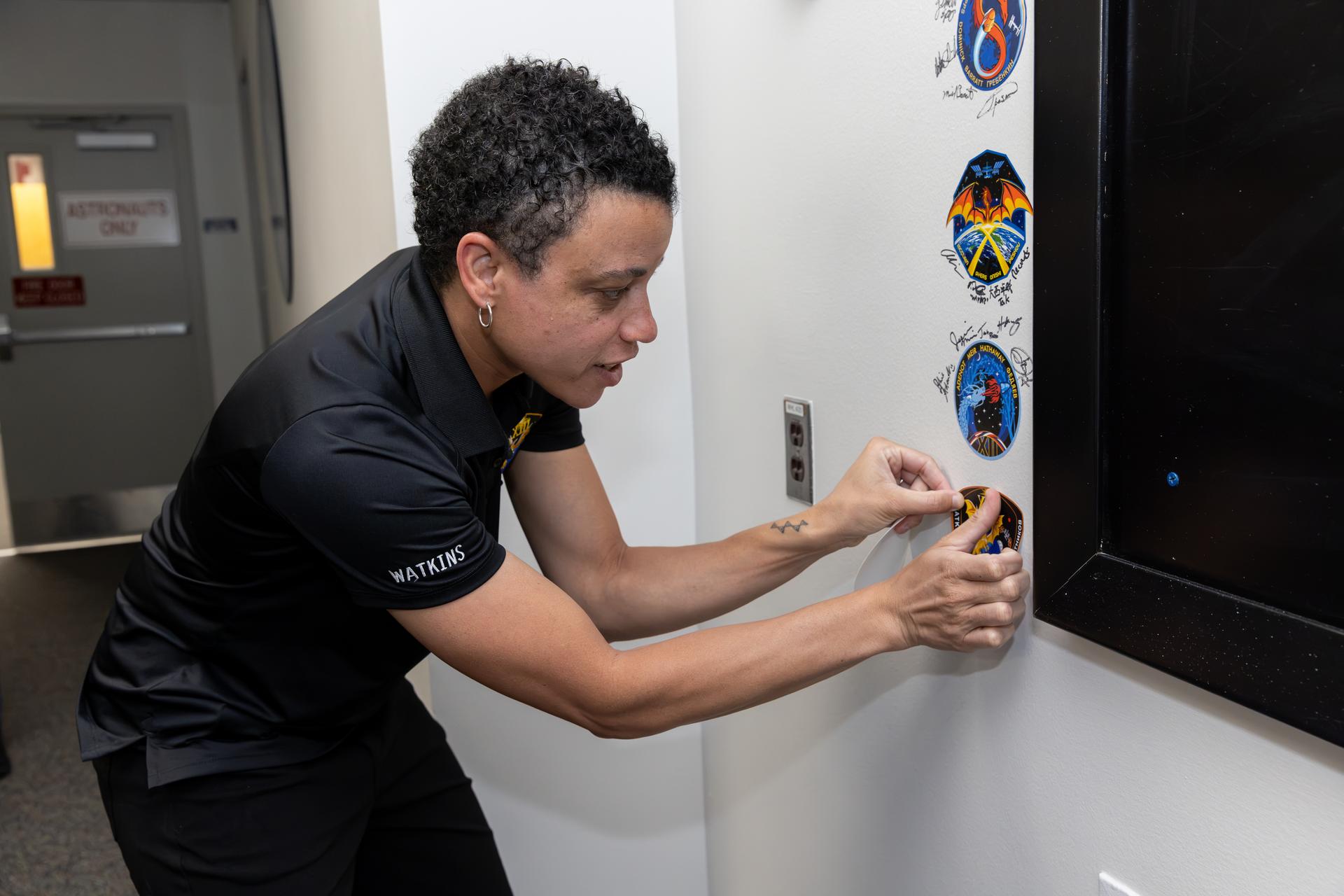
NASA astronaut Jessica Watkins signs her name next to the Crew-13 mission insignia inside the Astronaut Crew Quarters in the Neil A. Armstrong Operations and Checkout Building at NASA’s Kennedy Space Center in Florida on Tuesday, Sept. 29, 2026, ahead of NASA’s SpaceX Crew-13 mission. A SpaceX Dragon spacecraft and Falcon 9 rocket will send NASA astronauts Watkins and Luke Delaney, CSA (Canadian Space Agency) astronaut Joshua Kutryk, and Roscosmos cosmonaut Sergey Teteryatnikov to the International Space Station no earlier than 11:10 a.m. EDT on Thursday, Oct. 1, from Cape Canaveral Space Force Station’s Space Launch Complex 40.
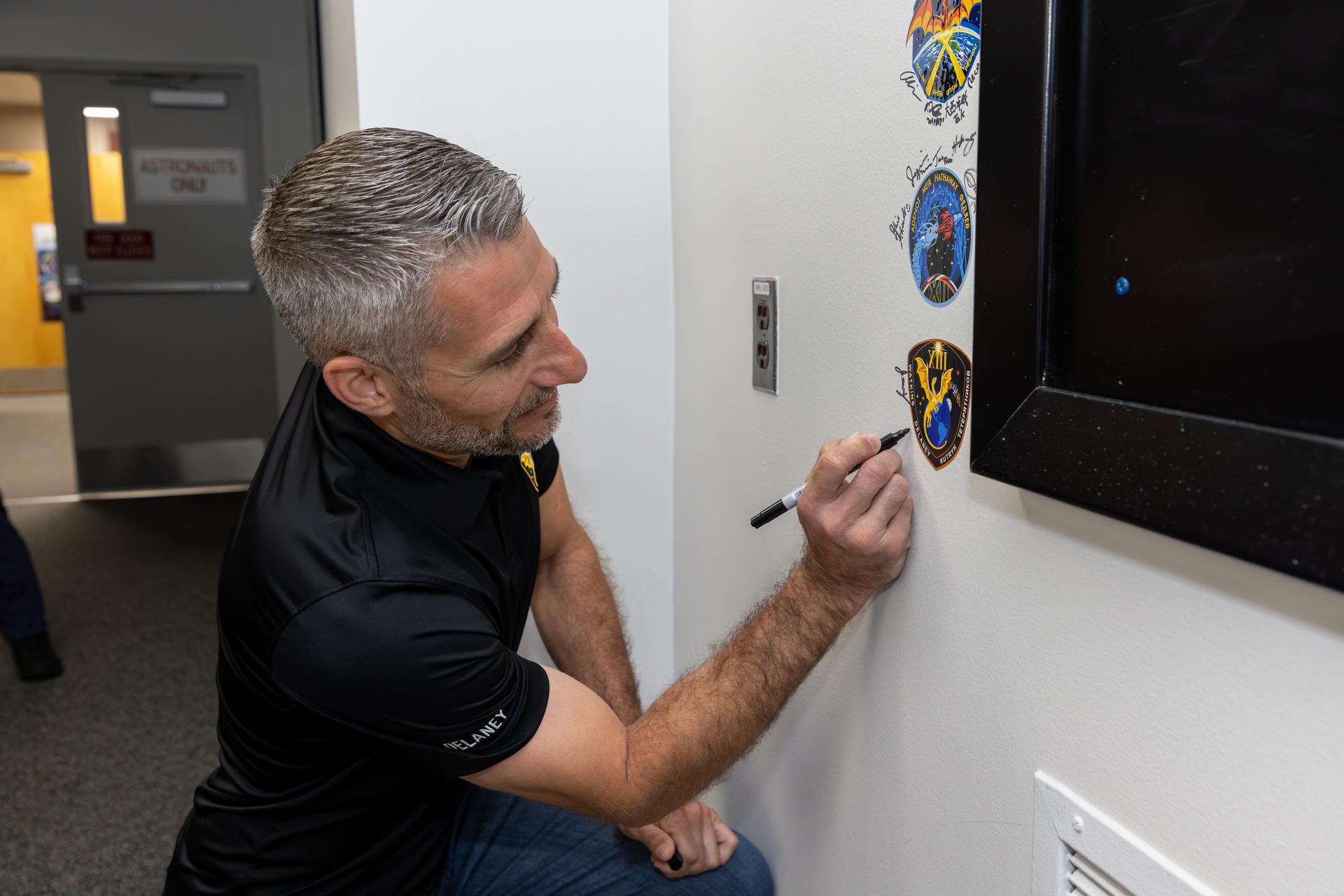
NASA astronaut Luke Delaney signs his name next to the Crew-13 mission insignia inside the Astronaut Crew Quarters in the Neil A. Armstrong Operations and Checkout Building at NASA’s Kennedy Space Center in Florida on [Tuesday, Sept. 29, 2026, ahead of NASA’s SpaceX Crew-13 mission. A SpaceX Dragon spacecraft and Falcon 9 rocket will send NASA astronauts Delaney and Jessica Watkins, CSA (Canadian Space Agency) astronaut Joshua Kutryk, and Roscosmos cosmonaut Sergey Teteryatnikov to the International Space Station no earlier than 11:10 a.m. EDT on Thursday, Oct. 1, from Cape Canaveral Space Force Station’s Space Launch Complex 40.
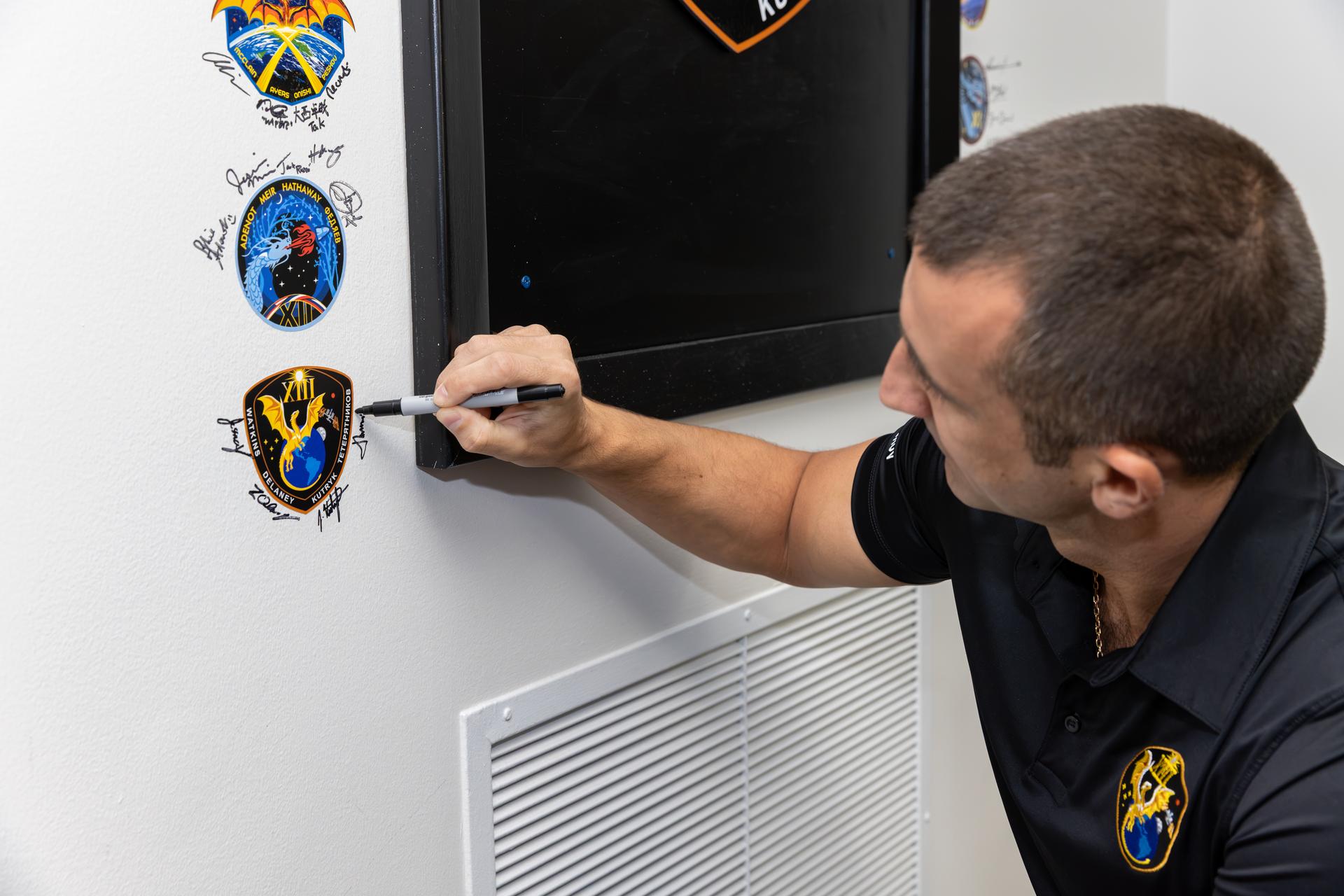
Roscosmos cosmonaut Sergey Teteryatnikov signs his name next to the Crew-13 mission insignia inside the Astronaut Crew Quarters in the Neil A. Armstrong Operations and Checkout Building at NASA’s Kennedy Space Center in Florida on Tuesday, Sept. 29, 2026, ahead of NASA’s SpaceX Crew-13 mission. A SpaceX Dragon spacecraft and Falcon 9 rocket will send Teteryatnikov, NASA astronauts Jessica Watkins and Luke Delaney, and CSA (Canadian Space Agency) astronaut Joshua Kutryk to the International Space Station no earlier than 11:10 a.m. EDT on Thursday, Oct. 1, from Cape Canaveral Space Force Station’s Space Launch Complex 40.
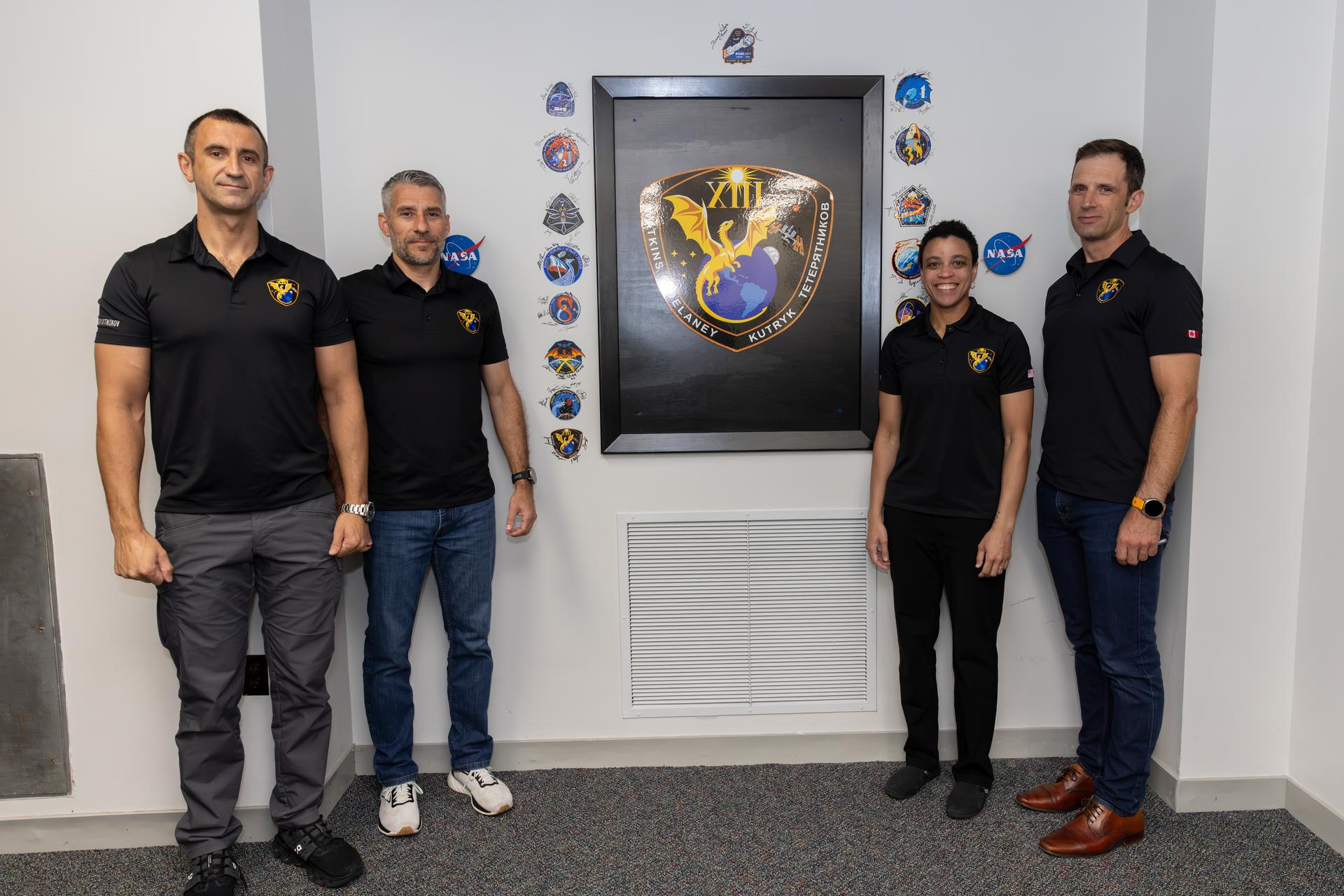
From right to left, CSA (Canadian Space Agency) astronaut Joshua Kutryk, NASA astronauts Jessica Watkins and Luke Delaney, and Roscosmos cosmonaut Sergey Teteryatnikov, pose next to their mission insignia inside the Astronaut Crew Quarters in the Neil A. Armstrong Operations and Checkout Building at NASA’s Kennedy Space Center in Florida on Tuesday, Sept. 29, 2026. NASA’s SpaceX Crew-13 crew members will launch aboard a SpaceX Dragon spacecraft and Falcon 9 to the International Space Station no earlier than 11:10 a.m. EDT on Thursday, Oct. 1, from Cape Canaveral Space Force Station’s Space Launch Complex 40.
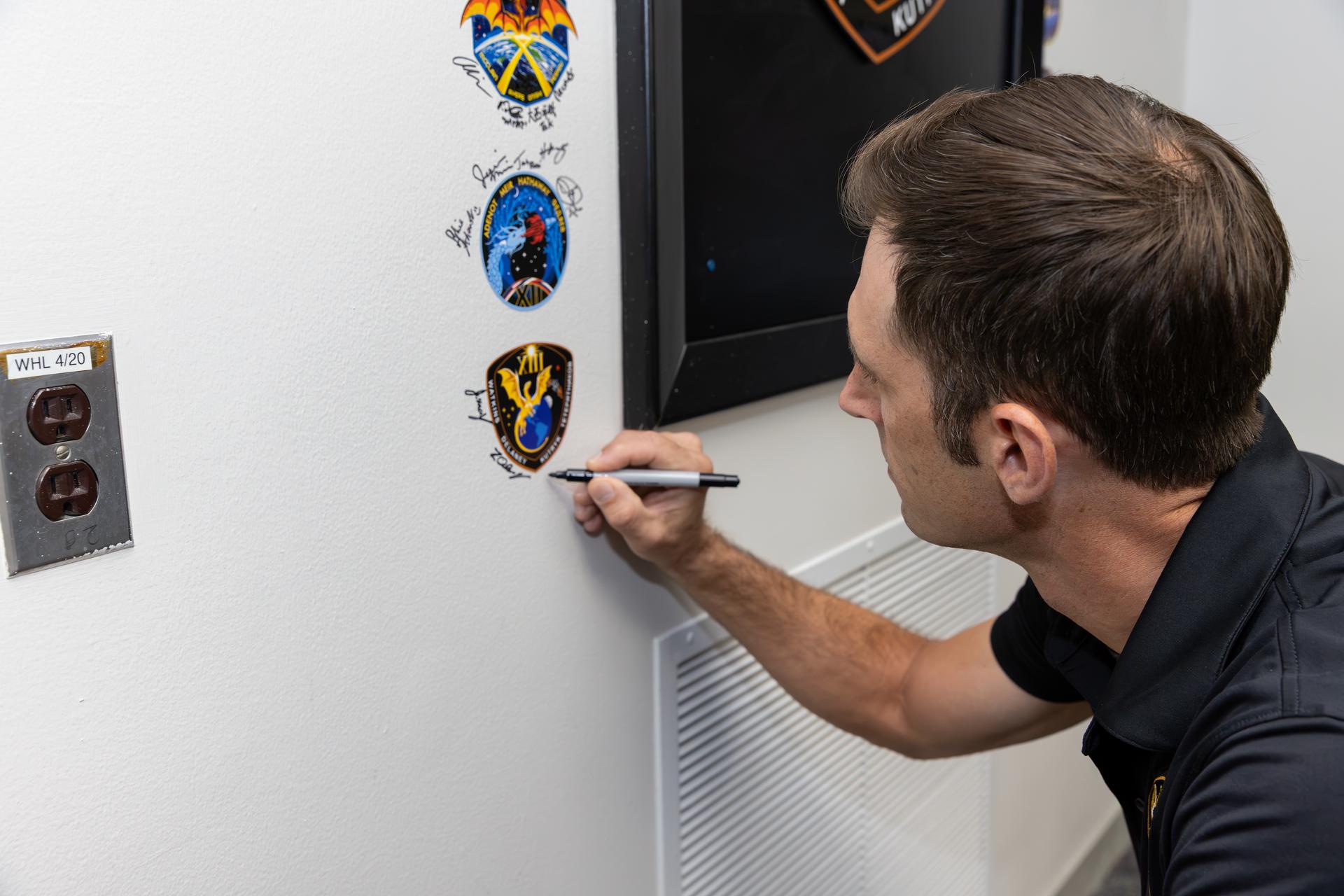
CSA (Canadian Space Agency) astronaut Joshua Kutryk signs his name next to the Crew-13 mission insignia inside the Astronaut Crew Quarters in the Neil A. Armstrong Operations and Checkout Building at NASA’s Kennedy Space Center in Florida on Tuesday, Sept. 29, 2026, ahead of NASA’s SpaceX Crew-13 mission. A SpaceX Dragon spacecraft and Falcon 9 rocket will send Kutryk, NASA astronauts Jessica Watkins and Luke Delaney, and Roscosmos cosmonaut Sergey Teteryatnikov to the International Space Station no earlier than 11:10 a.m. EDT on Thursday, Oct. 1, from Cape Canaveral Space Force Station’s Space Launch Complex 40.
NASA's Perseverance Mars rover used its abrasion tool to grind down the rock surface at this target, nicknamed "Bellegarde," on Aug. 29, 2021, the 188th Martian day, or sol, of the mission. The abraded patch is 0.4 inches (5 centimeters) in diameter. The mission has nicknamed the rock itself "Rochette" and acquired its first two core samples from it. The rover abrades rocks using a tool on its robotic arm before drilling them in order to clear away dust and weathering rinds, allowing other instruments to study the rocks and determine if scientists want to grab a sample of them. This close-up image was produced by Perseverance's SuperCam instrument in natural color, as it would appear under daytime lighting conditions. Besides imagery, SuperCam has a rock-vaporizing laser and spectrometer. By studying a rock's vapor after each laser zap, scientists can study the chemical composition of rocks from a distance. Perseverance landed in Mars' Jezero Crater on Feb. 18, 2021, and has been exploring the floor of the crater since. At the time these images were taken, Perseverance was in an area nicknamed the "Crater Floor Fractured Rough" area. SuperCam is led by Los Alamos National Laboratory in New Mexico, where the instrument's Body Unit was developed. That part of the instrument includes several spectrometers as well as control electronics and software. The Mast Unit, including the Remote Microscopic Imager used for these images, was developed and built by several laboratories of the CNRS (the French research center) and French universities under the contracting authority of Centre National d'Etudes Spatiales (CNES, the French space agency). A key objective for Perseverance's mission on Mars is astrobiology, including the search for signs of ancient microbial life. The rover will characterize the planet's geology and past climate, pave the way for human exploration of the Red Planet, and be the first mission to collect and cache Martian rock and regolith (broken rock and dust). Subsequent NASA missions, in cooperation with ESA (European Space Agency), would send spacecraft to Mars to collect these sealed samples from the surface and return them to Earth for in-depth analysis. The Mars 2020 Perseverance mission is part of NASA's Moon to Mars exploration approach, which includes Artemis missions to the Moon that will help prepare for human exploration of the Red Planet. https://photojournal.jpl.nasa.gov/catalog/PIA24768

The NASA/ESA Hubble Space Telescope has snapped the best ever image of the Antennae Galaxies. Hubble has released images of these stunning galaxies twice before, once using observations from its Wide Field and Planetary Camera 2 (WFPC2) in 1997, and again in 2006 from the Advanced Camera for Surveys (ACS). Each of Hubble’s images of the Antennae Galaxies has been better than the last, due to upgrades made during the famous servicing missions, the last of which took place in 2009. The galaxies — also known as NGC 4038 and NGC 4039 — are locked in a deadly embrace. Once normal, sedate spiral galaxies like the Milky Way, the pair have spent the past few hundred million years sparring with one another. This clash is so violent that stars have been ripped from their host galaxies to form a streaming arc between the two. In wide-field images of the pair the reason for their name becomes clear — far-flung stars and streamers of gas stretch out into space, creating long tidal tails reminiscent of antennae. This new image of the Antennae Galaxies shows obvious signs of chaos. Clouds of gas are seen in bright pink and red, surrounding the bright flashes of blue star-forming regions — some of which are partially obscured by dark patches of dust. The rate of star formation is so high that the Antennae Galaxies are said to be in a state of starburst, a period in which all of the gas within the galaxies is being used to form stars. This cannot last forever and neither can the separate galaxies; eventually the nuclei will coalesce, and the galaxies will begin their retirement together as one large elliptical galaxy. This image uses visible and near-infrared observations from Hubble’s Wide Field Camera 3 (WFC3), along with some of the previously-released observations from Hubble’s Advanced Camera for Surveys (ACS). Credit: NASA/European Space Agency <b><a href="http://www.nasa.gov/audience/formedia/features/MP_Photo_Guidelines.html" rel="nofollow">NASA image use policy.</a></b> <b><a href="http://www.nasa.gov/centers/goddard/home/index.html" rel="nofollow">NASA Goddard Space Flight Center</a></b> enables NASA’s mission through four scientific endeavors: Earth Science, Heliophysics, Solar System Exploration, and Astrophysics. Goddard plays a leading role in NASA’s accomplishments by contributing compelling scientific knowledge to advance the Agency’s mission. <b>Follow us on <a href="http://twitter.com/NASA_GoddardPix" rel="nofollow">Twitter</a></b> <b>Like us on <a href="http://www.facebook.com/pages/Greenbelt-MD/NASA-Goddard/395013845897?ref=tsd" rel="nofollow">Facebook</a></b> <b>Find us on <a href="http://instagram.com/nasagoddard?vm=grid" rel="nofollow">Instagram</a></b>