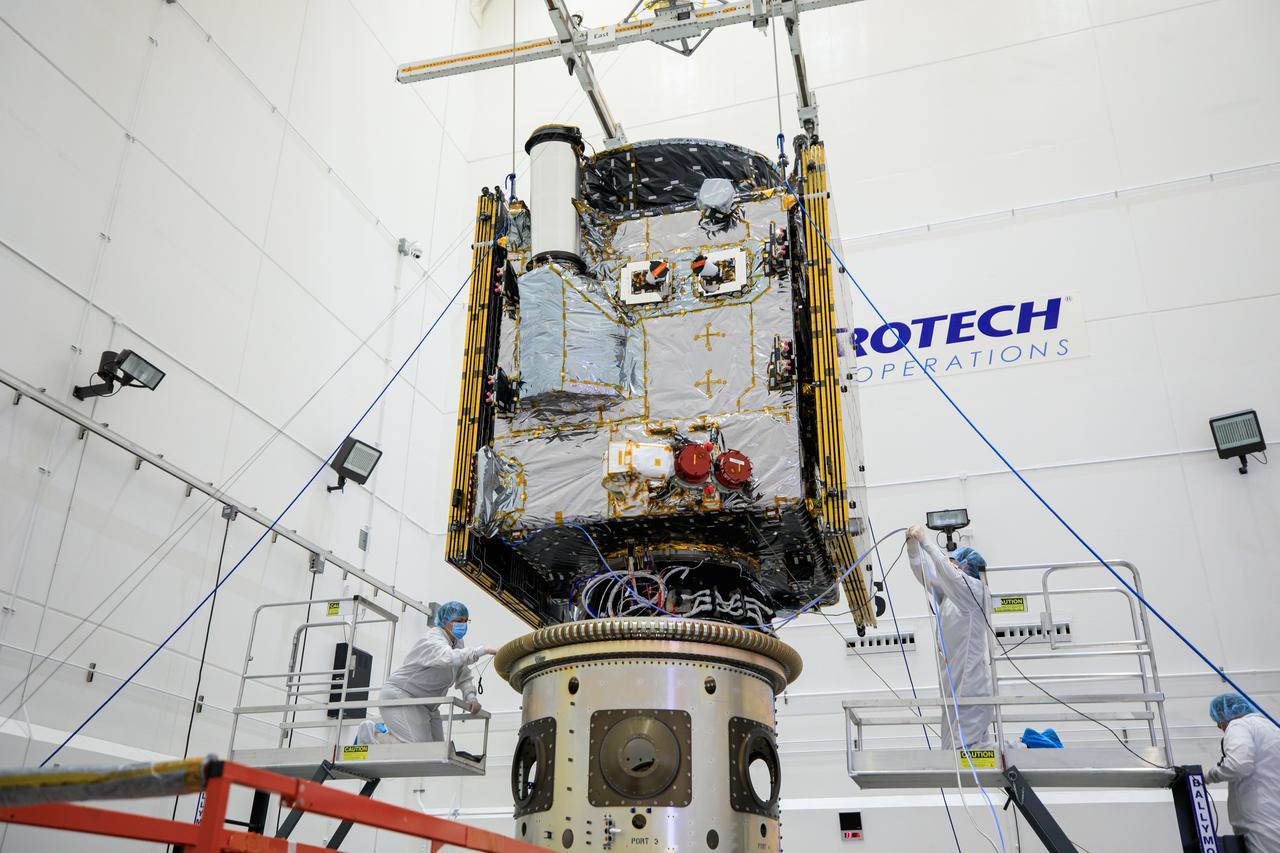
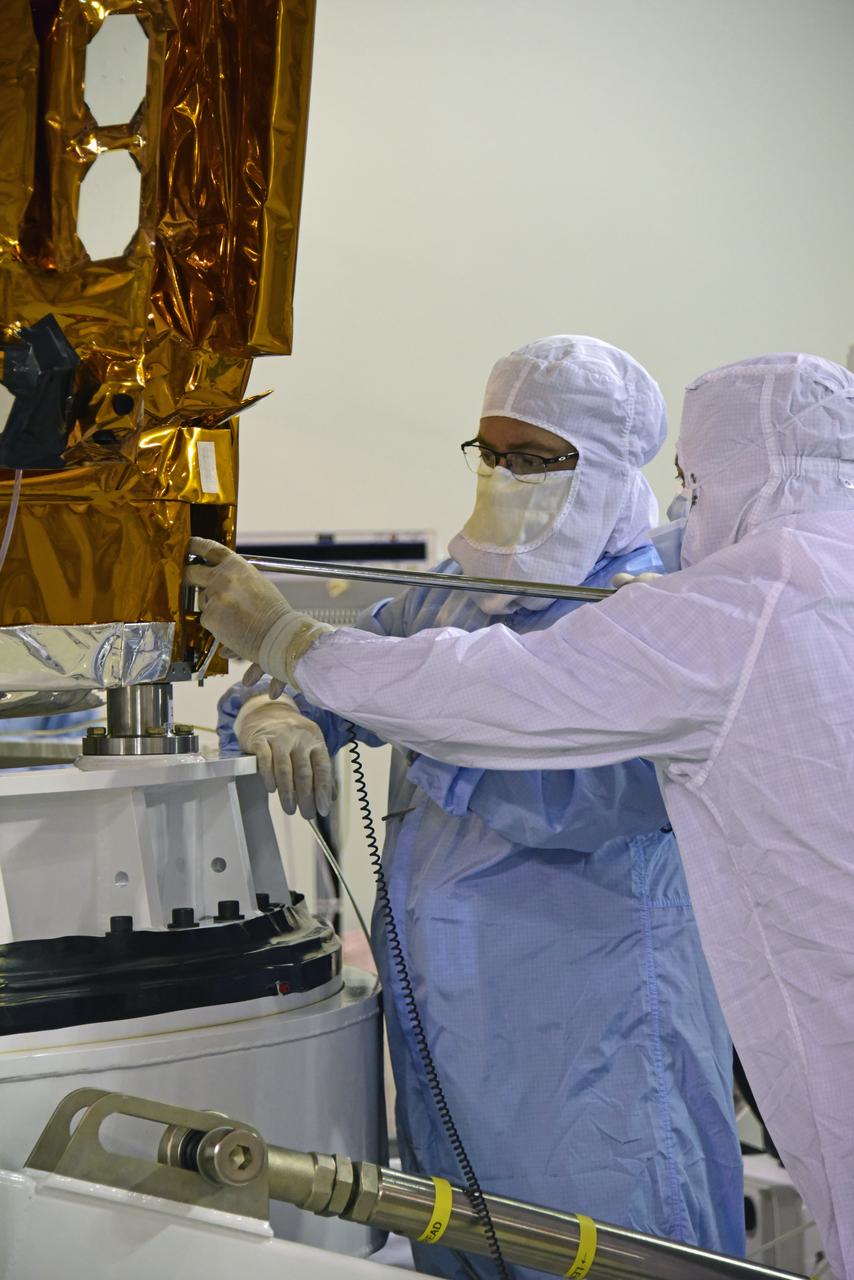
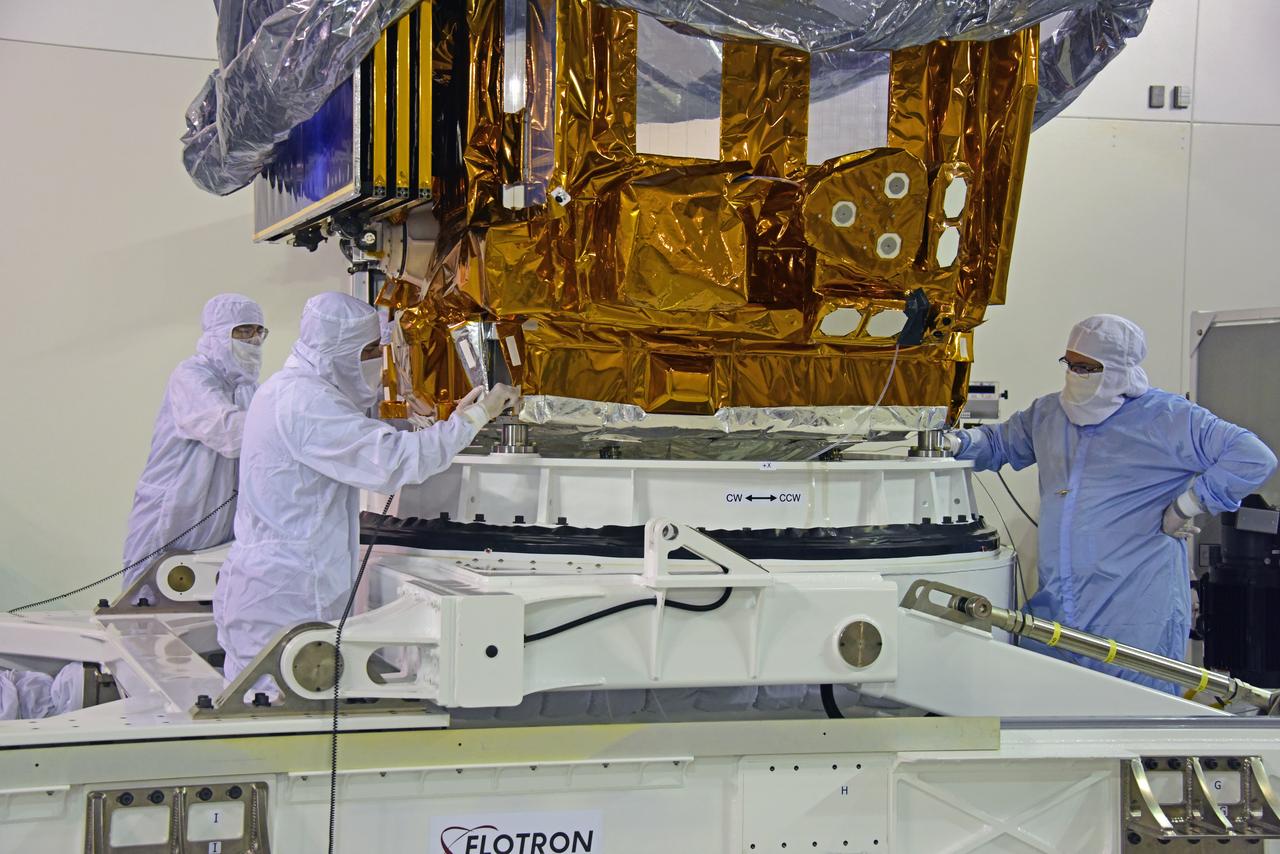
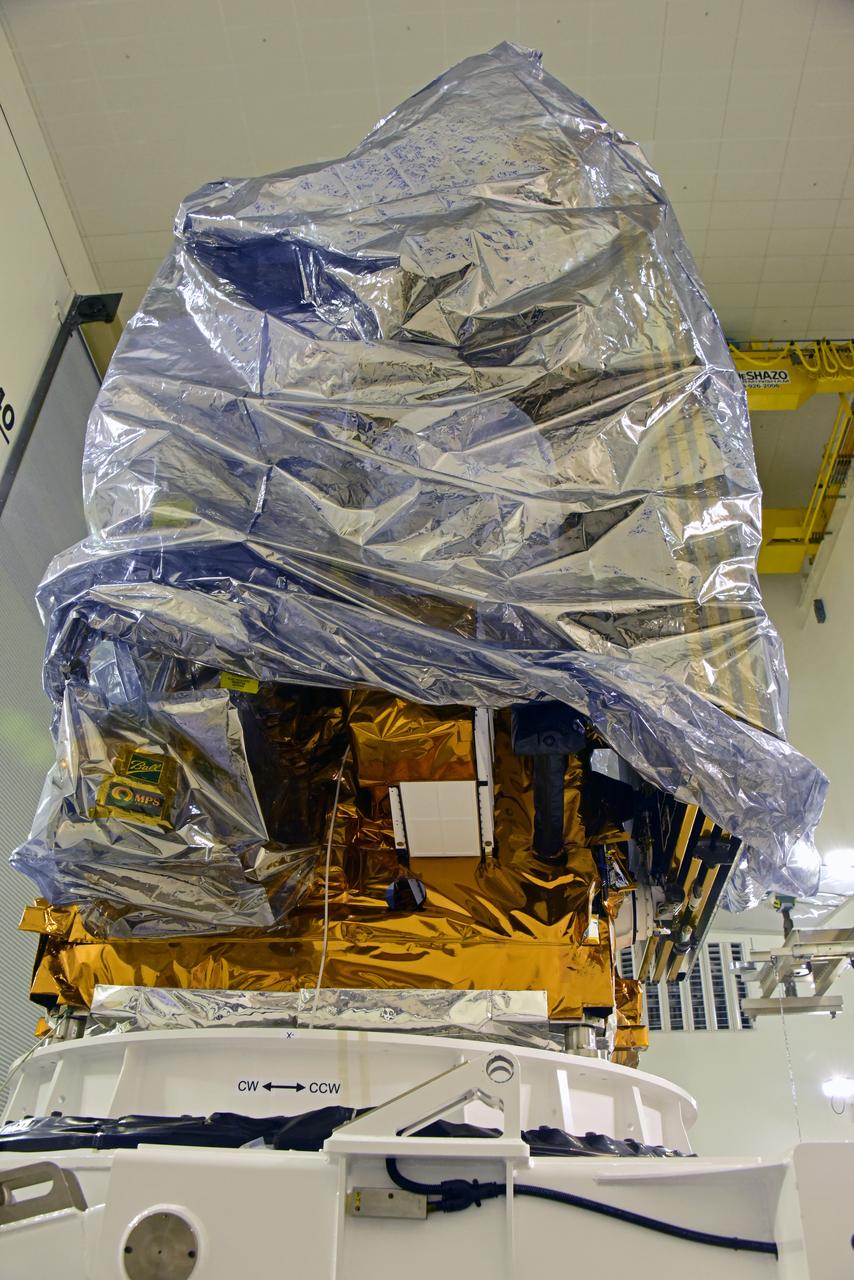
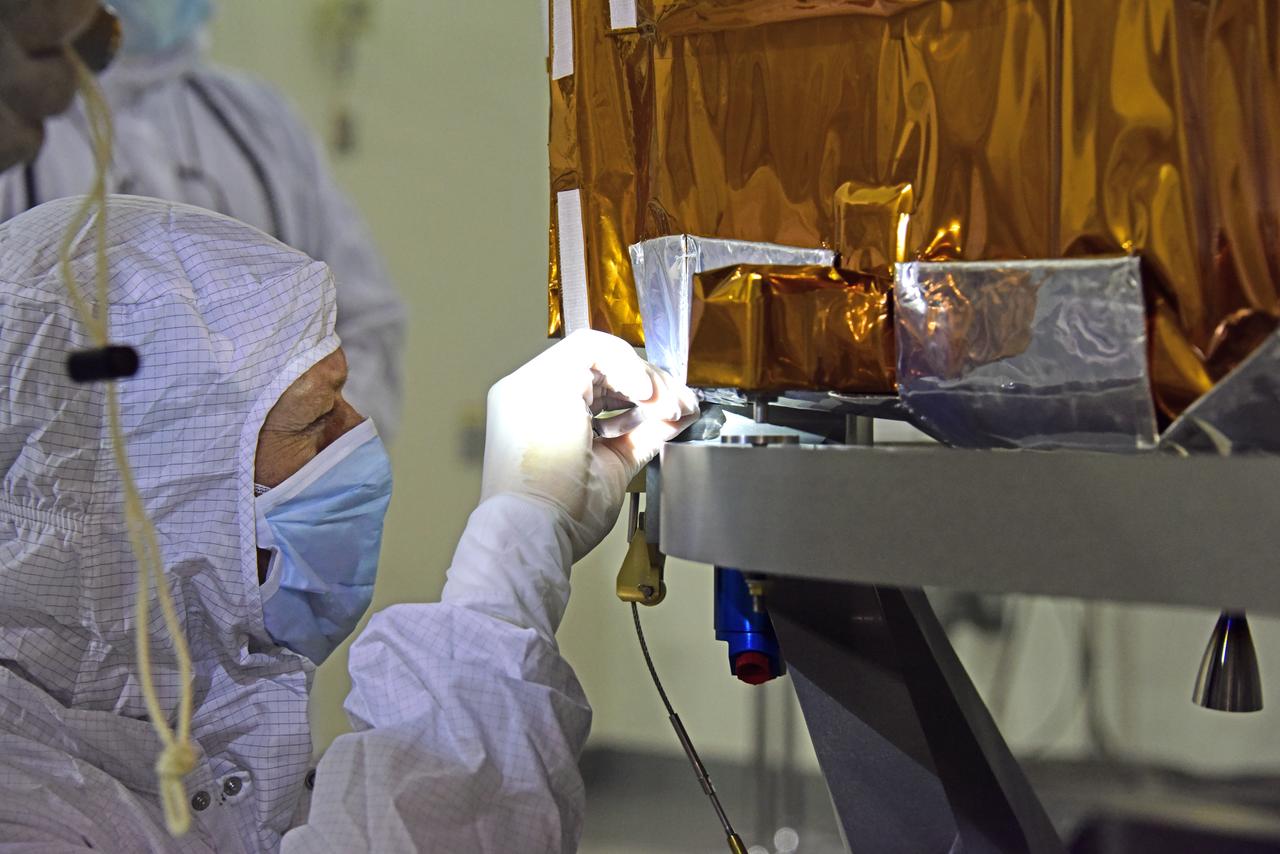
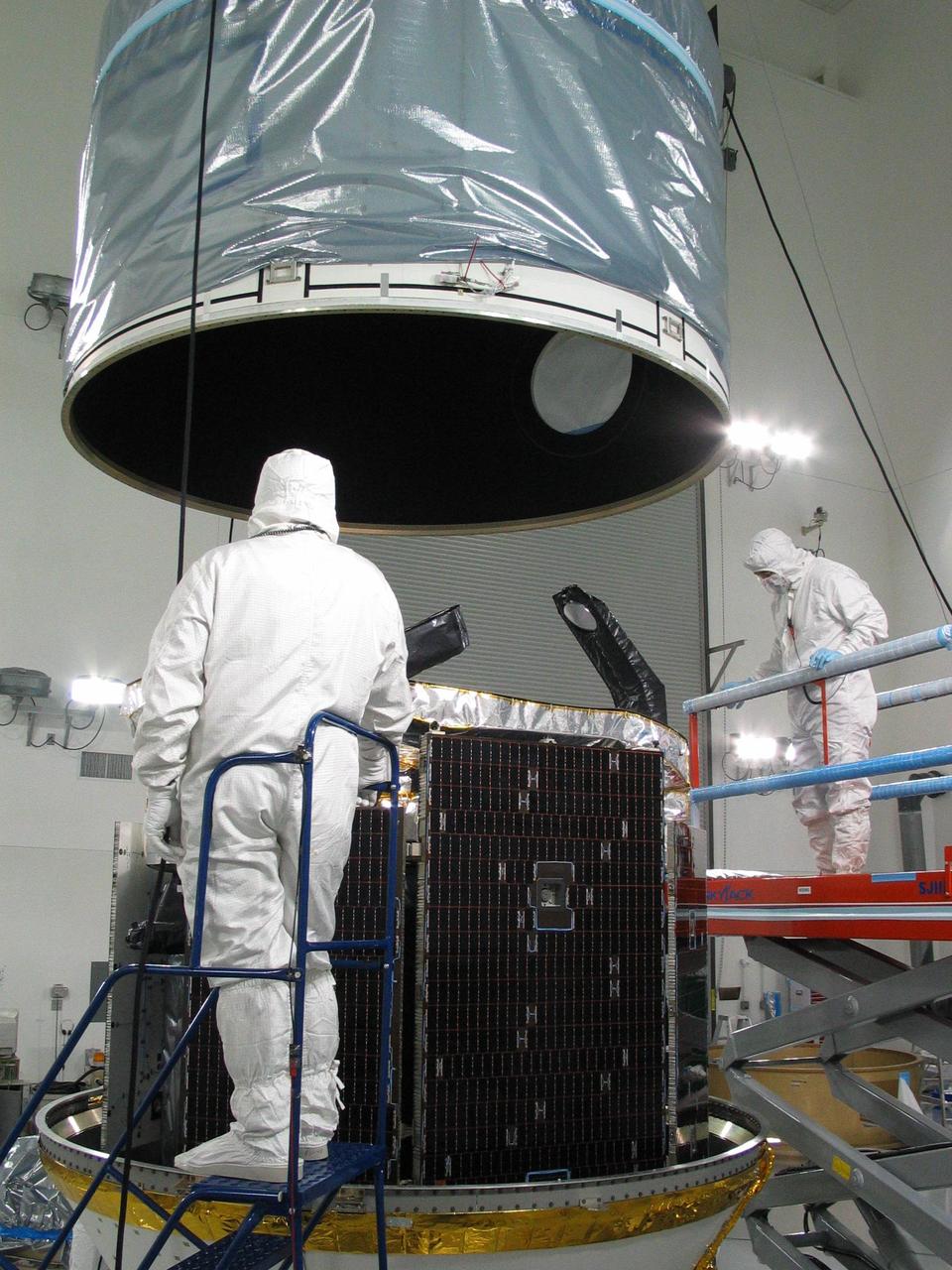
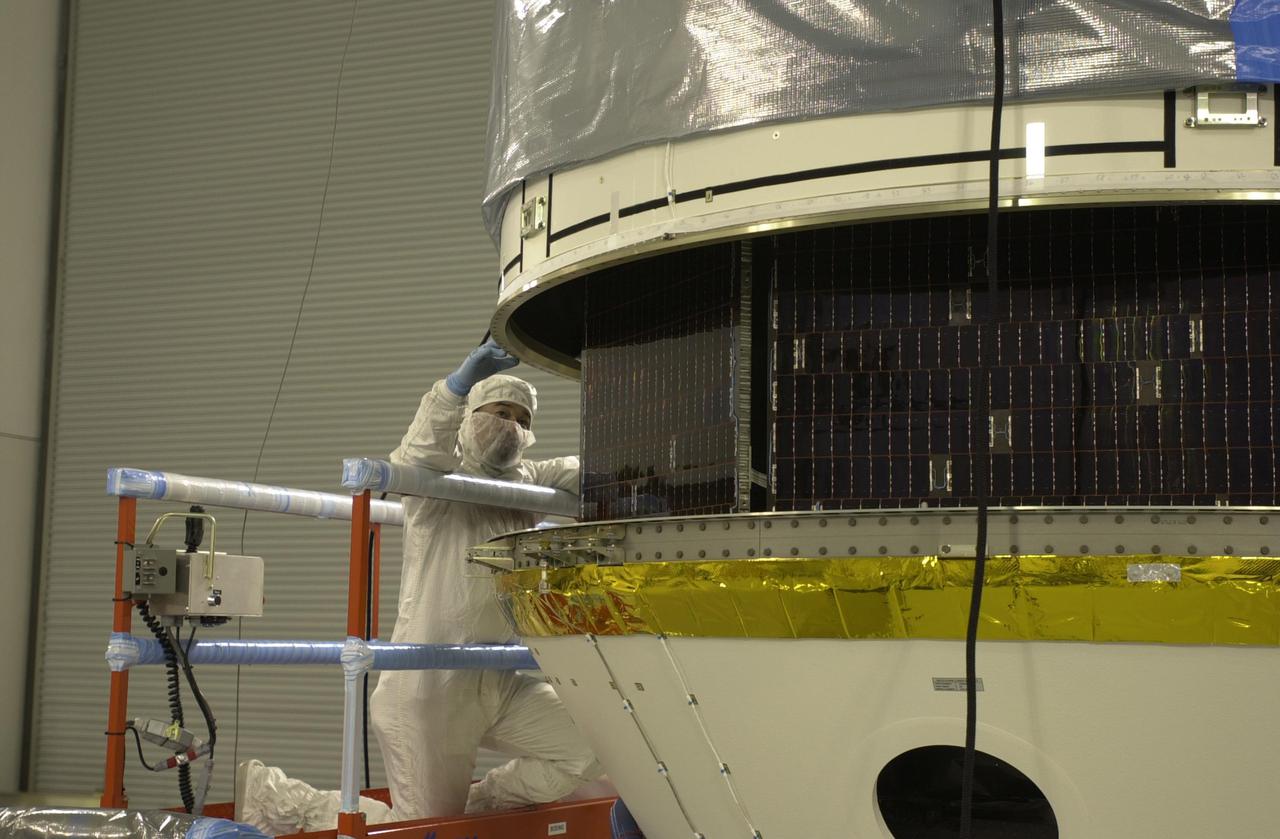
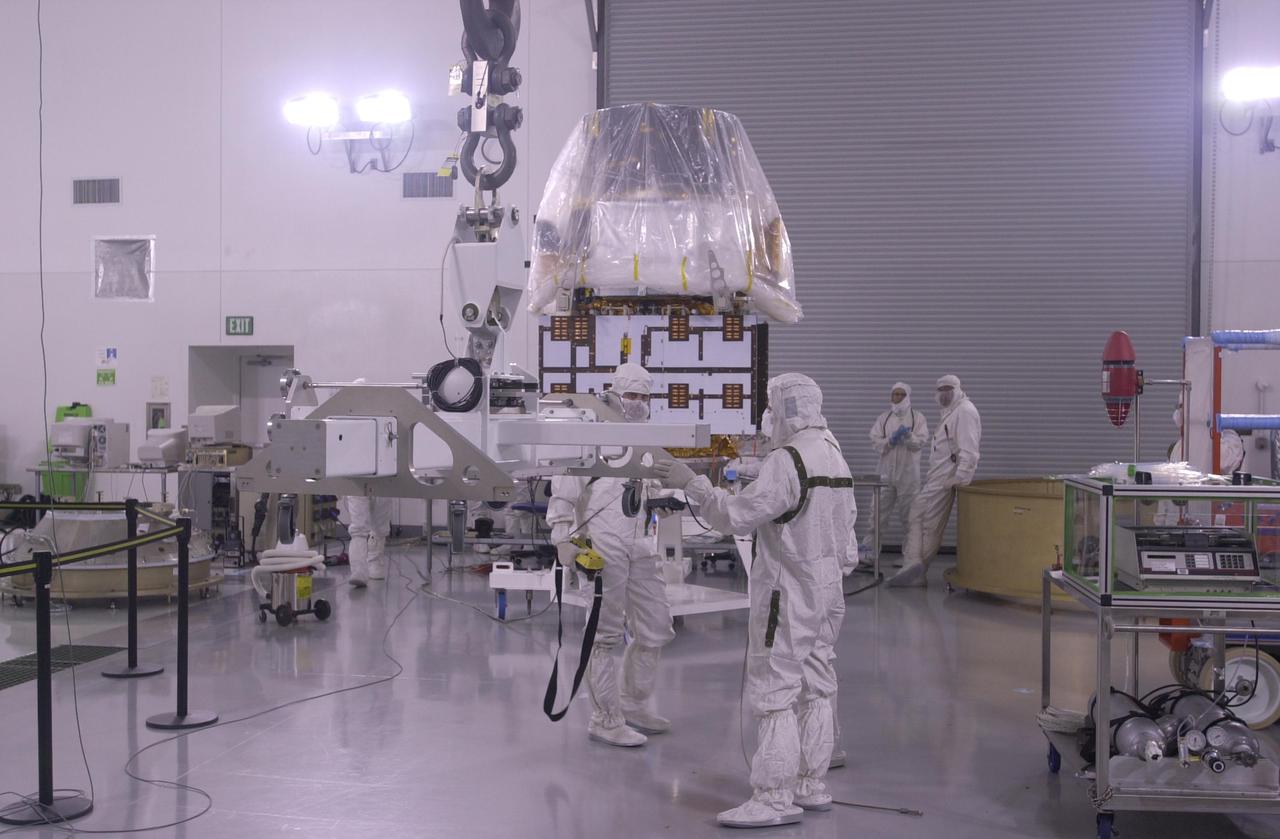
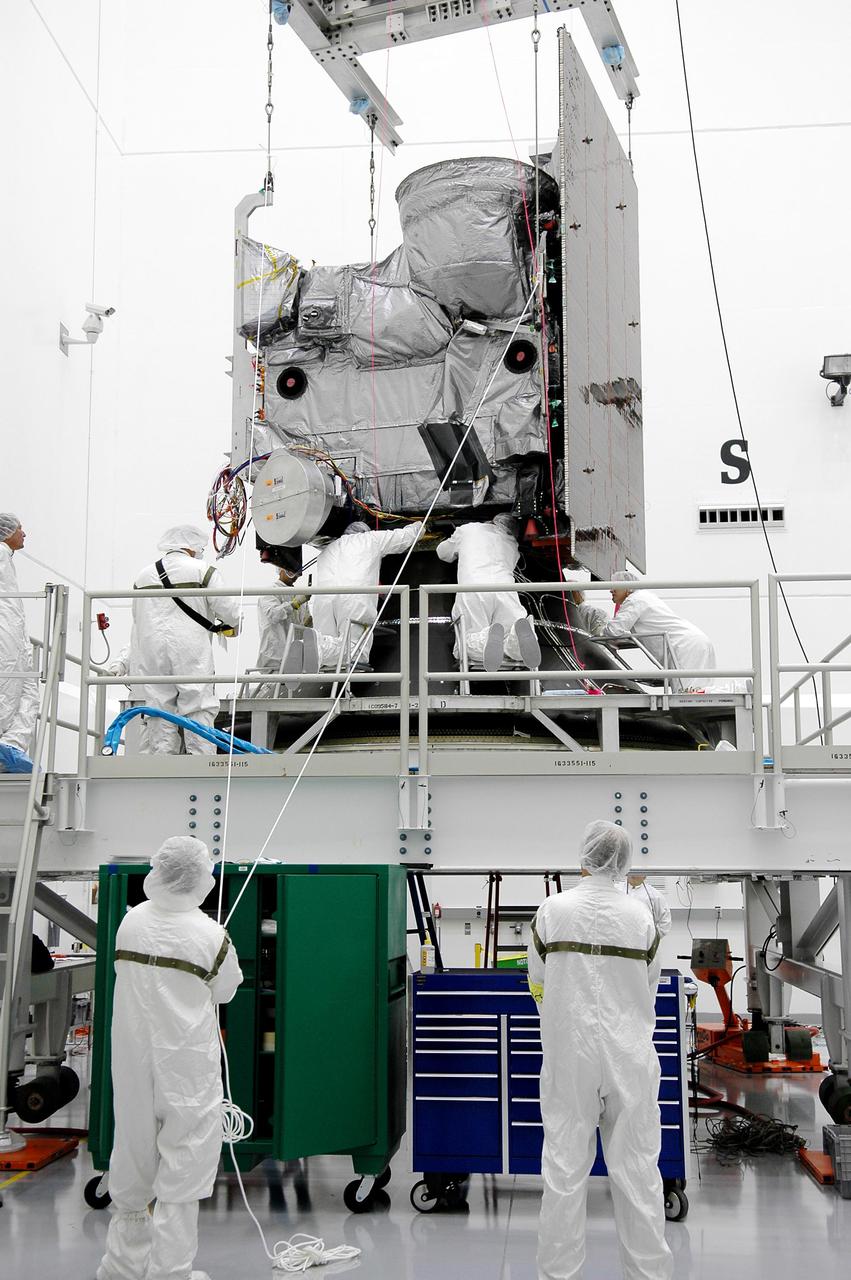
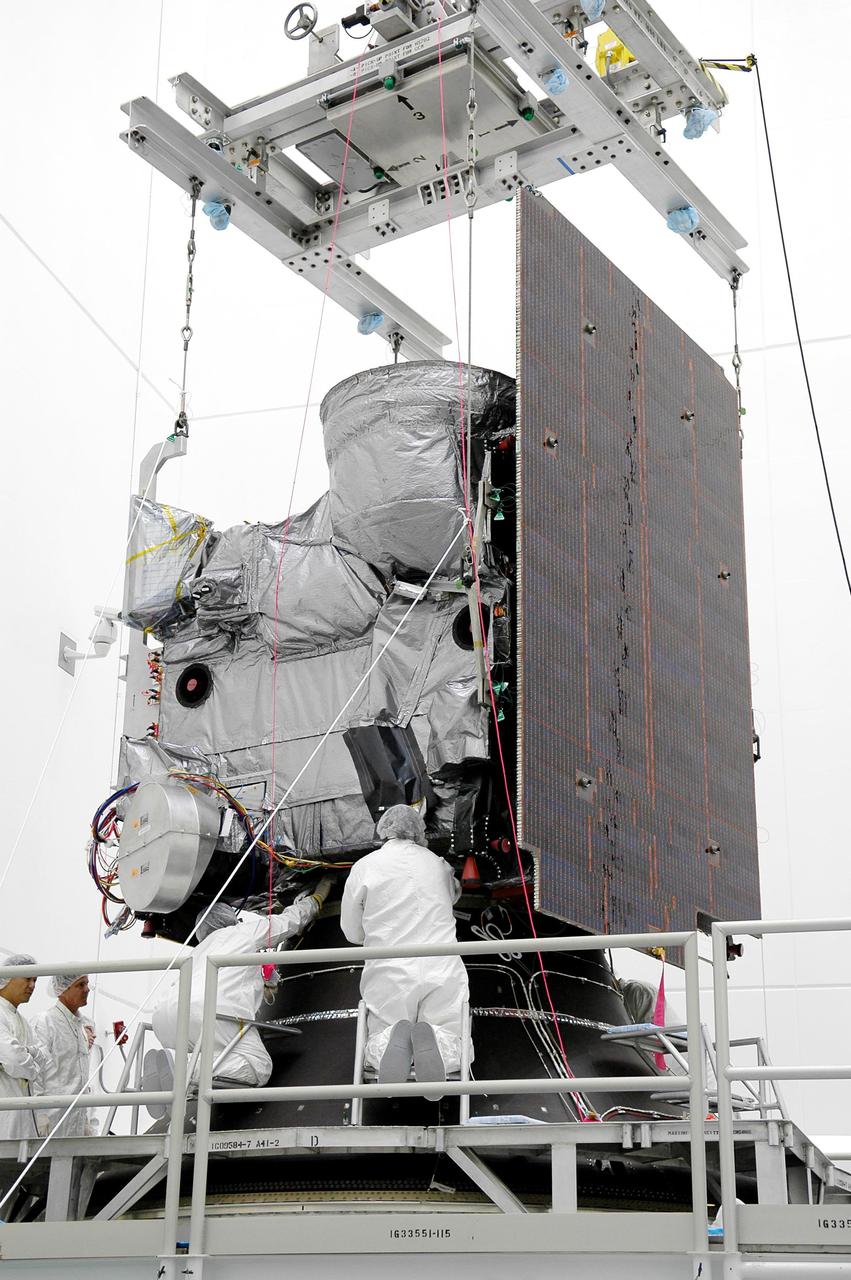
Technicians connected NASA’s Psyche spacecraft to the payload attach fitting inside the clean room at Astrotech Space Operations facility in Titusville, Florida on Wednesday, Sept. 20, 2023. This hardware allows Psyche to connect to the top of the rocket once secured inside the protective payload fairings. Psyche will lift off on a SpaceX Falcon Heavy rocket at 10:34 a.m. EDT Thursday, Oct. 5, 2023, from Launch Complex 39A at NASA’s Kennedy Space Center in Florida. The Psyche spacecraft will travel nearly six years and about 2.2 billion miles (3.6 billion kilometers) to an asteroid of the same name, which is orbiting the Sun between Mars and Jupiter. Scientists believe Psyche could be part of the core of a planetesimal, likely made of iron-nickel metal, which can be studied from orbit to give researchers a better idea of what may make up Earth’s core.
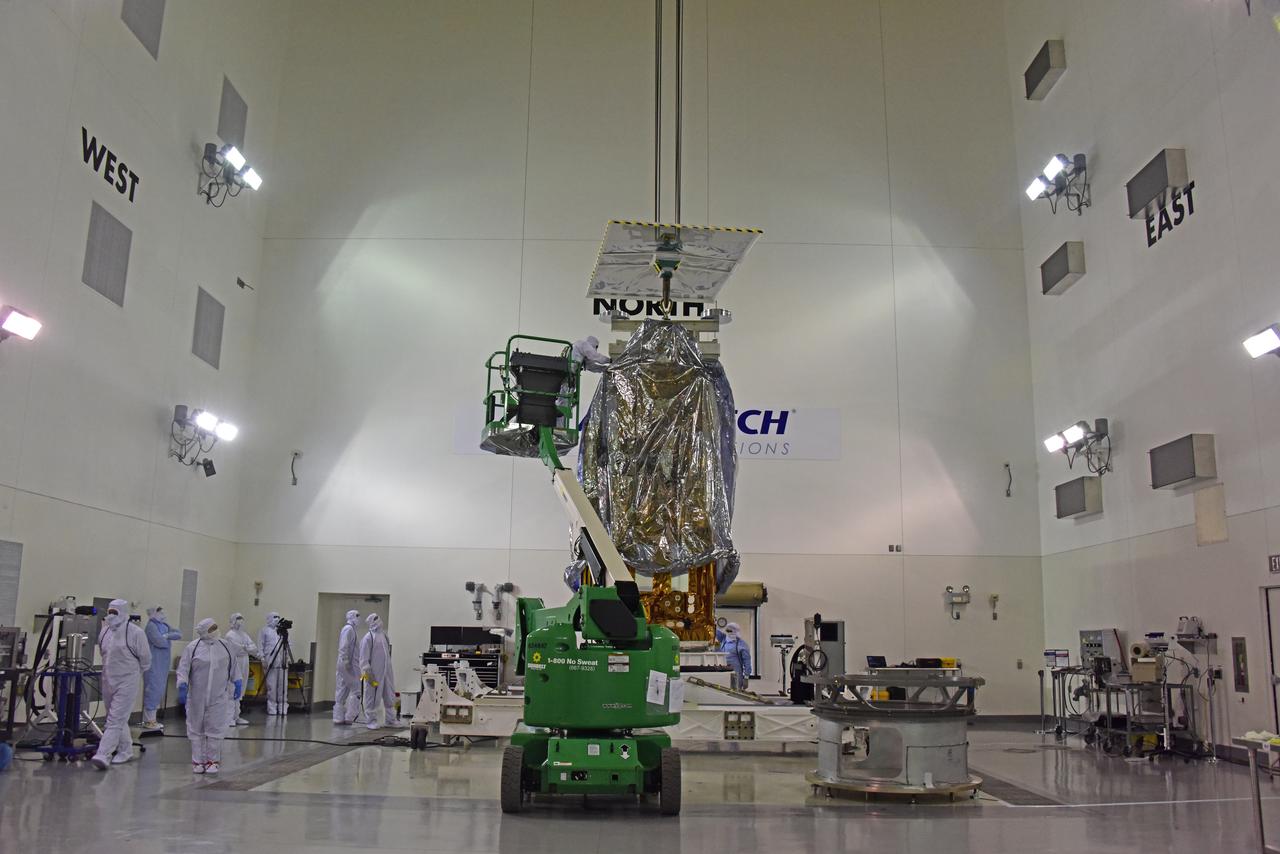
NOAA's Joint Polar Satellite System-1, or JPSS-1, remains wrapped in a protective covering after removal from its shipping container at the Astrotech Processing Facility at Vandenberg Air Force Base in California. A crane is attached to the spacecraft to prepare for its move to a payload attach fitting. JPSS-1 will liftoff aboard a United Launch Alliance Delta II rocket from Vandenberg's Space Launch Complex-2. JPSS-1 is the first in a series of four next-generation environmental satellites in a collaborative program between NOAA and NASA.
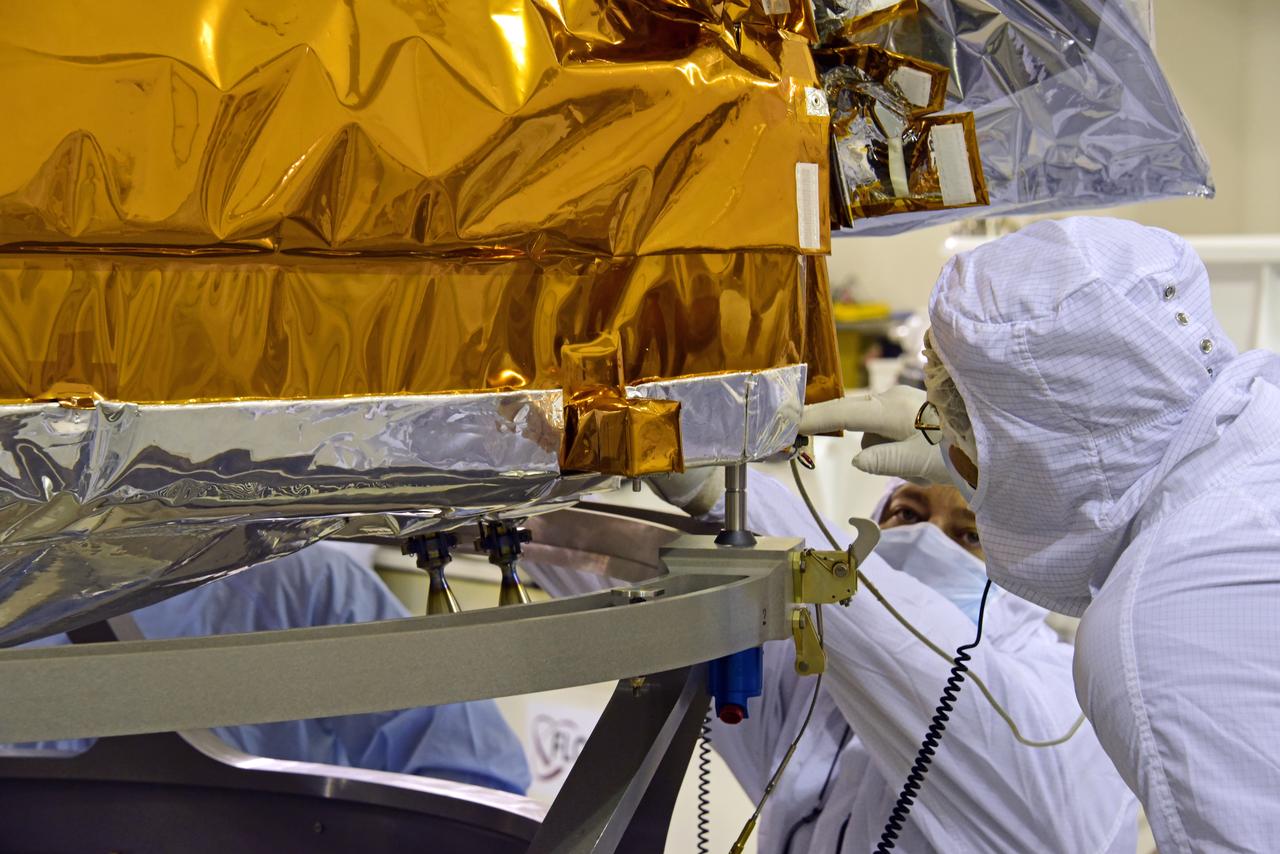
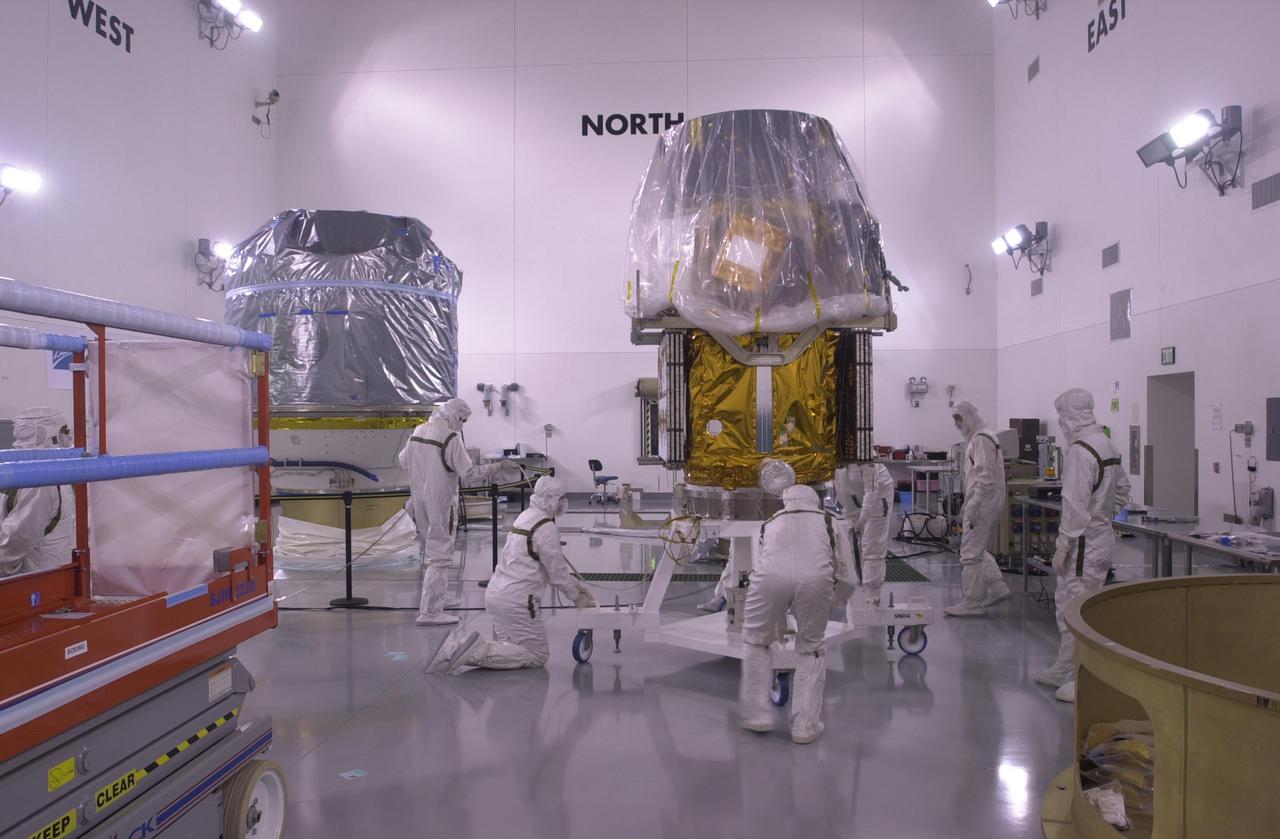
NOAA's Joint Polar Satellite System-1, or JPSS-1, remains wrapped in a protective covering after removal from its shipping container at the Astrotech Processing Facility at Vandenberg Air Force Base in California. Technicians help secure the spacecraft onto a payload attach fitting. JPSS-1 will liftoff aboard a United Launch Alliance Delta II rocket from Vandenberg's Space Launch Complex-2. JPSS-1 is the first in a series of four next-generation environmental satellites in a collaborative program between NOAA and NASA.
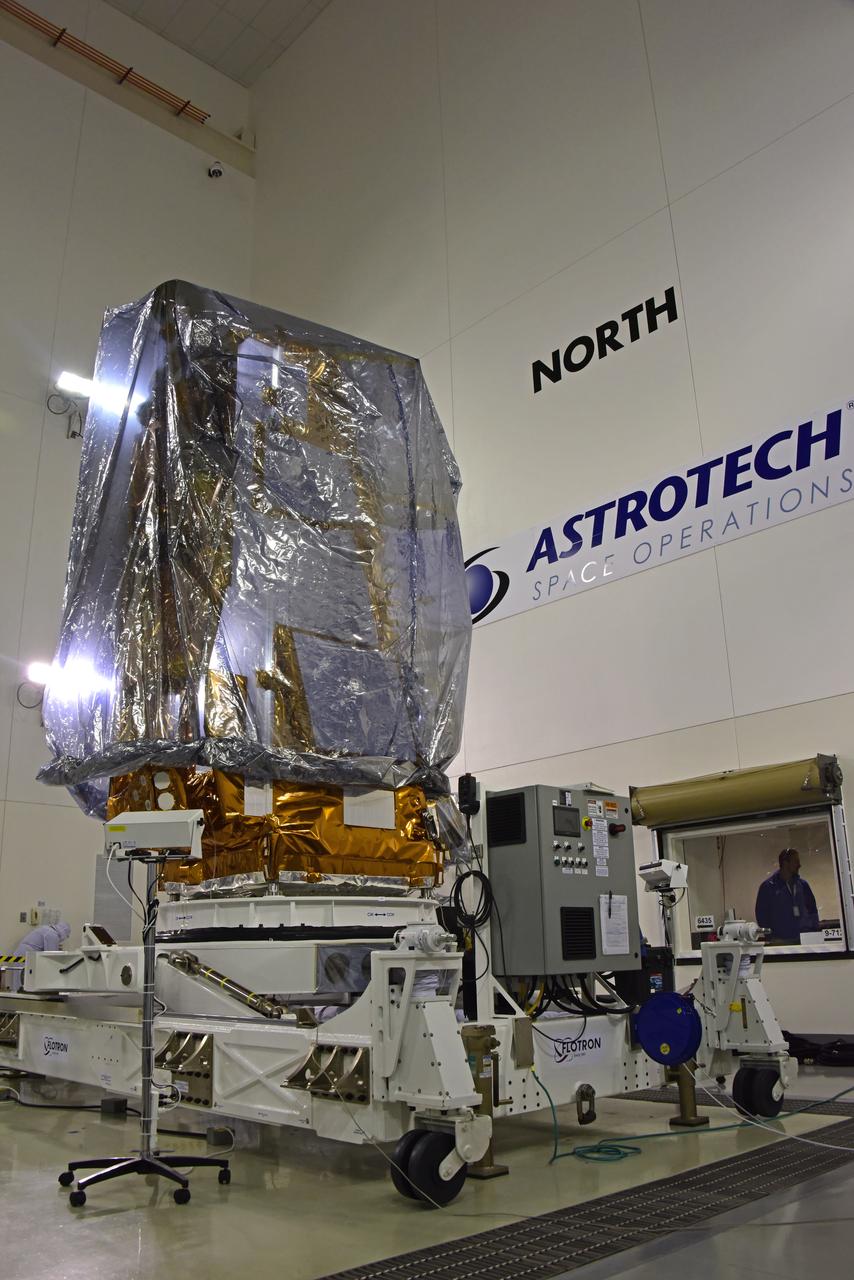
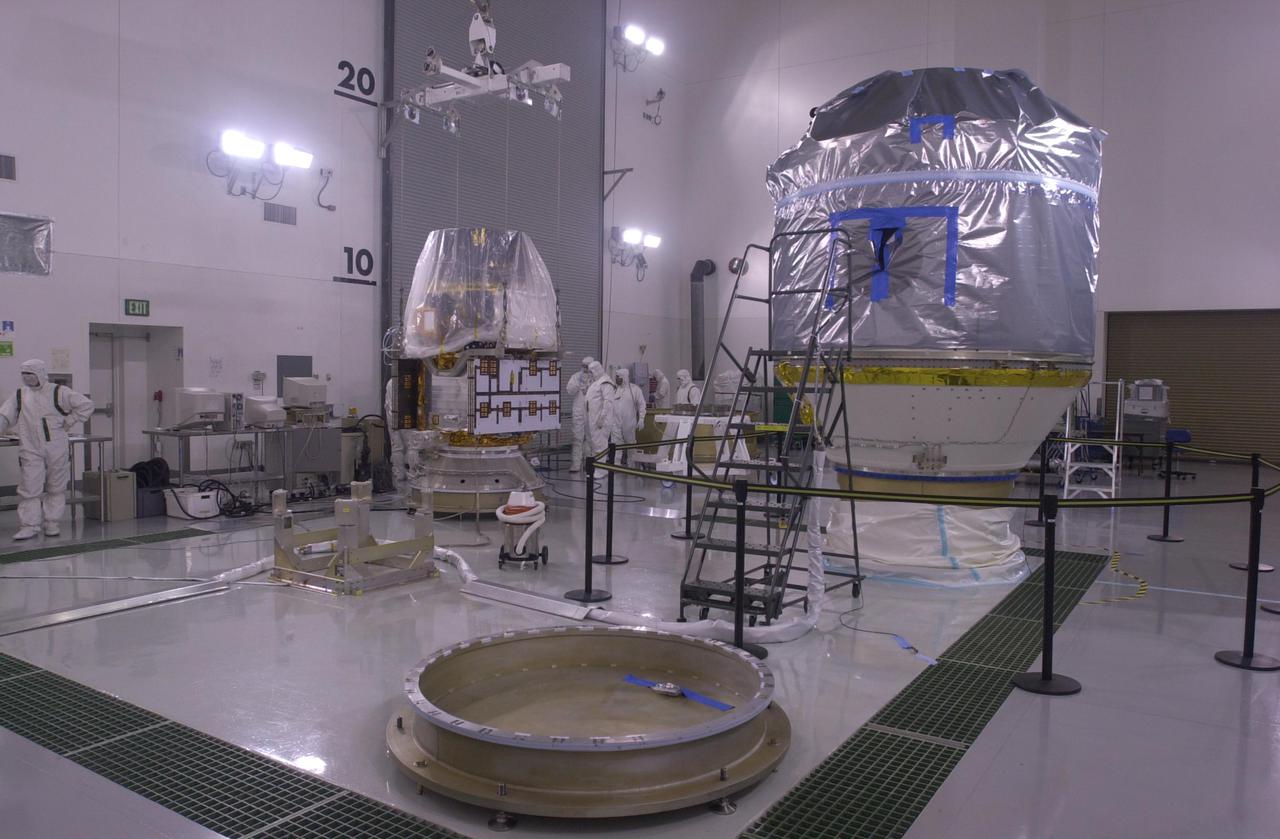
NOAA's Joint Polar Satellite System-1, or JPSS-1, remains wrapped in a protective covering after removal from its shipping container at the Astrotech Processing Facility at Vandenberg Air Force Base in California. The spacecraft is being prepared for its move to a payload attach fitting. JPSS-1 will liftoff aboard a United Launch Alliance Delta II rocket from Vandenberg's Space Launch Complex-2. JPSS-1 is the first in a series of four next-generation environmental satellites in a collaborative program between NOAA and NASA.
NOAA's Joint Polar Satellite System-1, or JPSS-1, remains wrapped in a protective covering after removal from its shipping container at the Astrotech Processing Facility at Vandenberg Air Force Base in California. Technicians prepare the spacecraft for its move to a payload attach fitting. JPSS-1 will liftoff aboard a United Launch Alliance Delta II rocket from Vandenberg's Space Launch Complex-2. JPSS-1 is the first in a series of four next-generation environmental satellites in a collaborative program between NOAA and NASA.
NOAA's Joint Polar Satellite System-1, or JPSS-1, remains wrapped in a protective covering after removal from its shipping container at the Astrotech Processing Facility at Vandenberg Air Force Base in California. Technicians prepare the spacecraft for its move to a payload attach fitting. JPSS-1 will liftoff aboard a United Launch Alliance Delta II rocket from Vandenberg's Space Launch Complex-2. JPSS-1 is the first in a series of four next-generation environmental satellites in a collaborative program between NOAA and NASA.
NOAA's Joint Polar Satellite System-1, or JPSS-1, remains wrapped in a protective covering after removal from its shipping container at the Astrotech Processing Facility at Vandenberg Air Force Base in California. The spacecraft is being prepared for its move to a payload attach fitting. JPSS-1 will liftoff aboard a United Launch Alliance Delta II rocket from Vandenberg's Space Launch Complex-2. JPSS-1 is the first in a series of four next-generation environmental satellites in a collaborative program between NOAA and NASA.
NOAA's Joint Polar Satellite System-1, or JPSS-1, remains wrapped in a protective covering after removal from its shipping container at the Astrotech Processing Facility at Vandenberg Air Force Base in California. Technicians confirm that the spacecraft is secured onto a payload attach fitting. JPSS-1 will liftoff aboard a United Launch Alliance Delta II rocket from Vandenberg's Space Launch Complex-2. JPSS-1 is the first in a series of four next-generation environmental satellites in a collaborative program between NOAA and NASA.
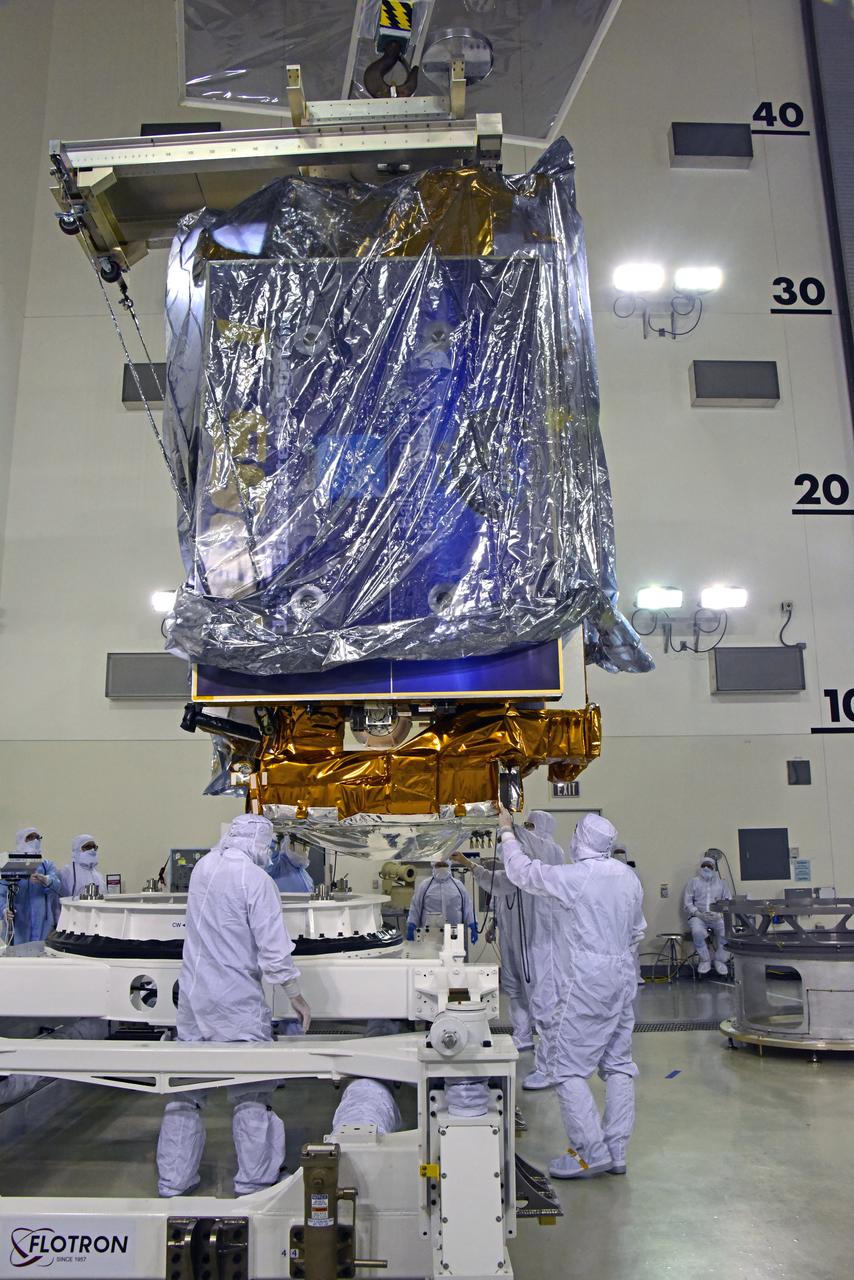
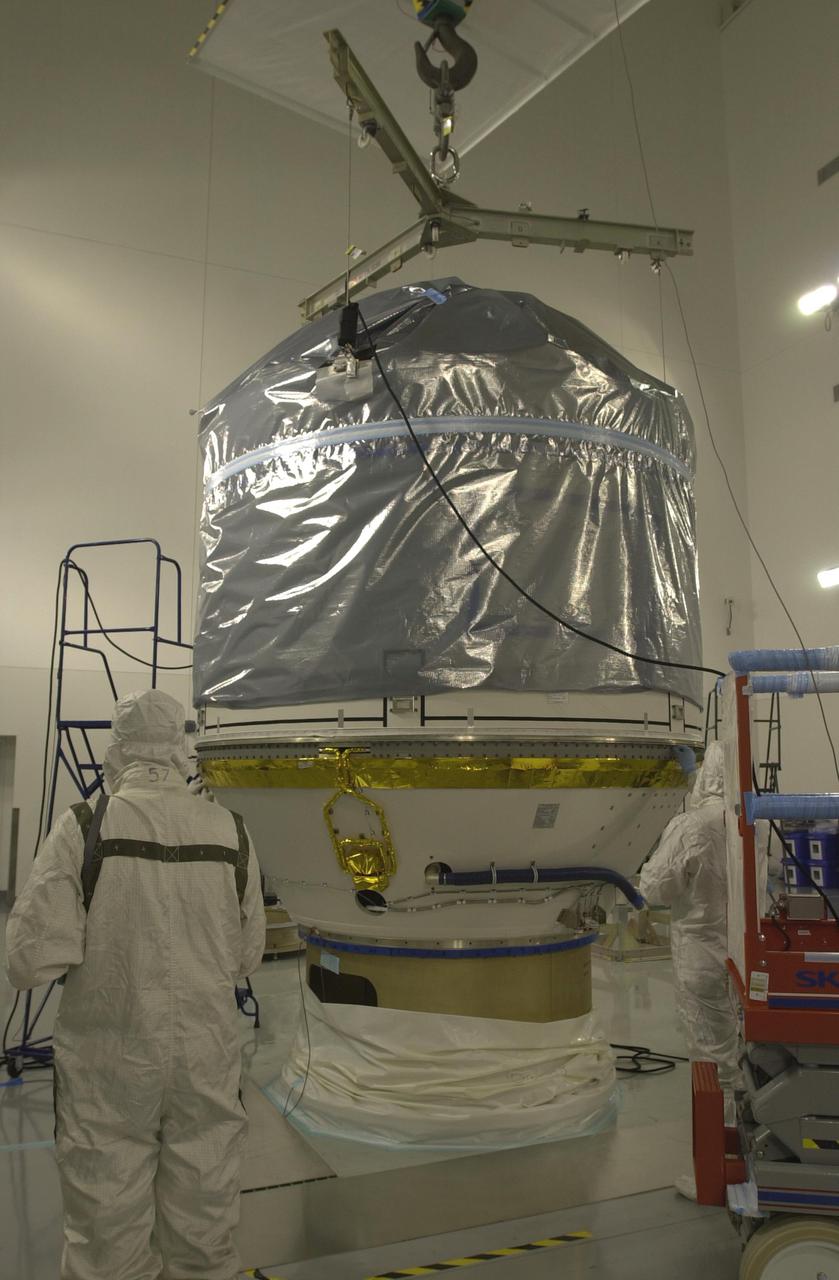
NOAA's Joint Polar Satellite System-1, or JPSS-1, remains wrapped in a protective covering after removal from its shipping container at the Astrotech Processing Facility at Vandenberg Air Force Base in California. Technicians assist as a crane lifts the spacecraft up for its move to a payload attach fitting. JPSS-1 will liftoff aboard a United Launch Alliance Delta II rocket from Vandenberg's Space Launch Complex-2. JPSS-1 is the first in a series of four next-generation environmental satellites in a collaborative program between NOAA and NASA.
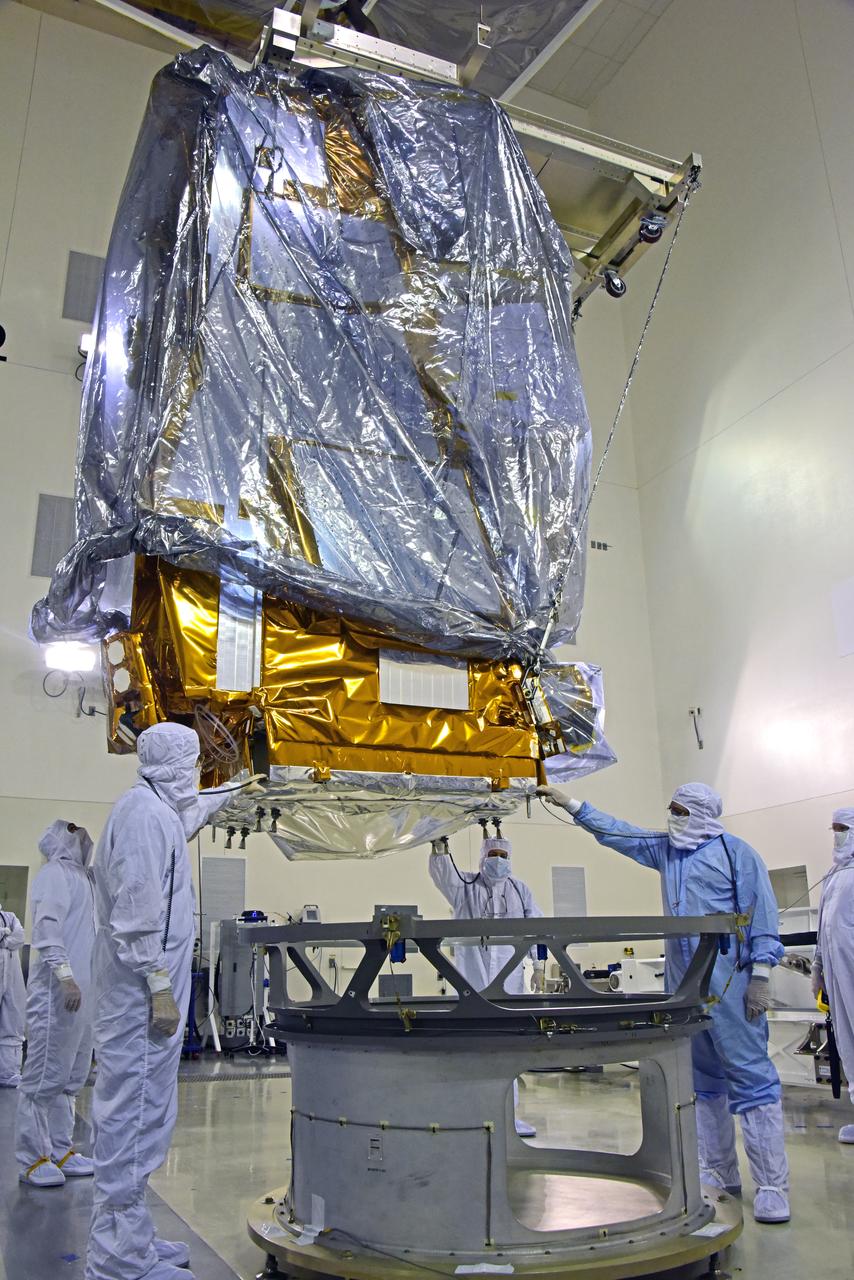
NOAA's Joint Polar Satellite System-1, or JPSS-1, remains wrapped in a protective covering after removal from its shipping container at the Astrotech Processing Facility at Vandenberg Air Force Base in California. Technicians assist as a crane lowers the spacecraft toward a payload attach fitting. JPSS-1 will liftoff aboard a United Launch Alliance Delta II rocket from Vandenberg's Space Launch Complex-2. JPSS-1 is the first in a series of four next-generation environmental satellites in a collaborative program between NOAA and NASA.
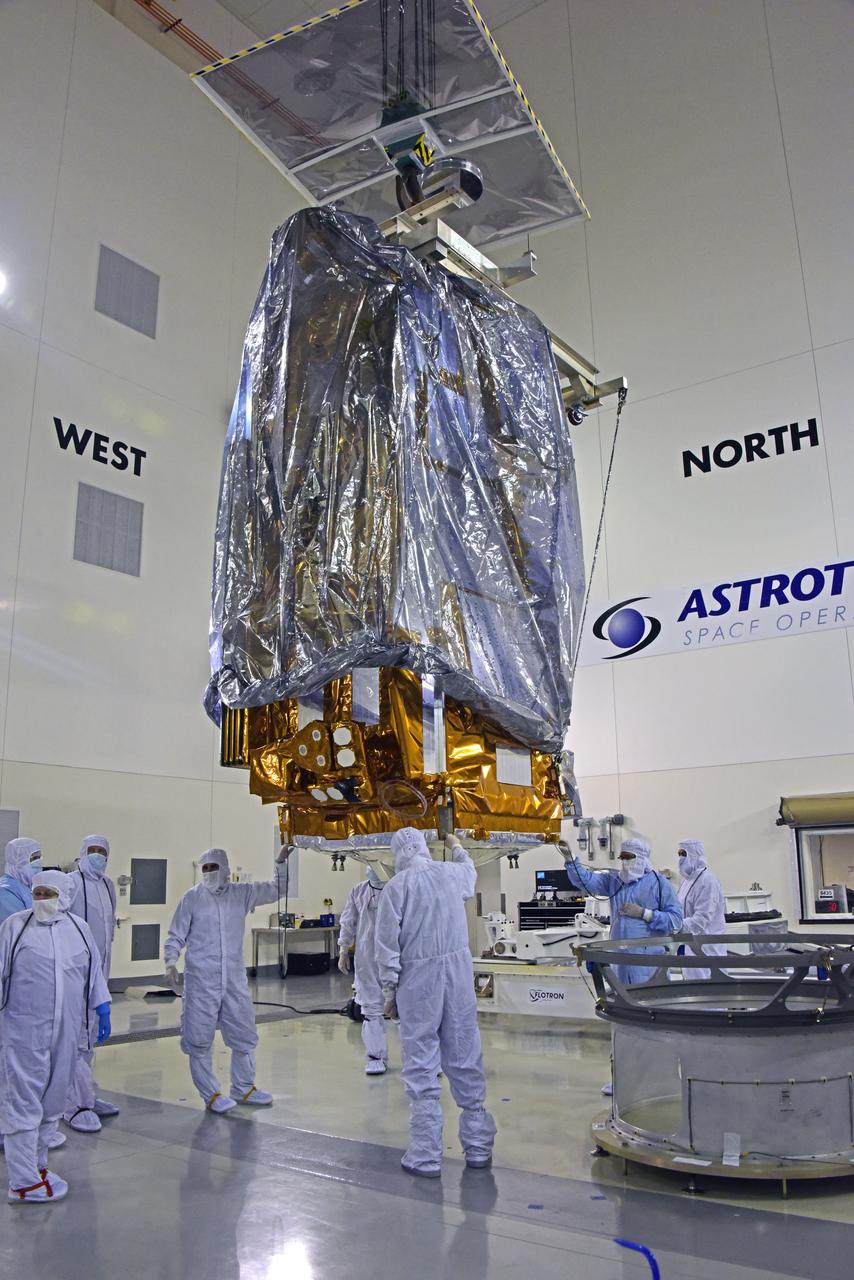
NOAA's Joint Polar Satellite System-1, or JPSS-1, remains wrapped in a protective covering after removal from its shipping container at the Astrotech Processing Facility at Vandenberg Air Force Base in California. Technicians assist as a crane lifts and moves the spacecraft to a payload attach fitting. JPSS-1 will liftoff aboard a United Launch Alliance Delta II rocket from Vandenberg's Space Launch Complex-2. JPSS-1 is the first in a series of four next-generation environmental satellites in a collaborative program between NOAA and NASA.
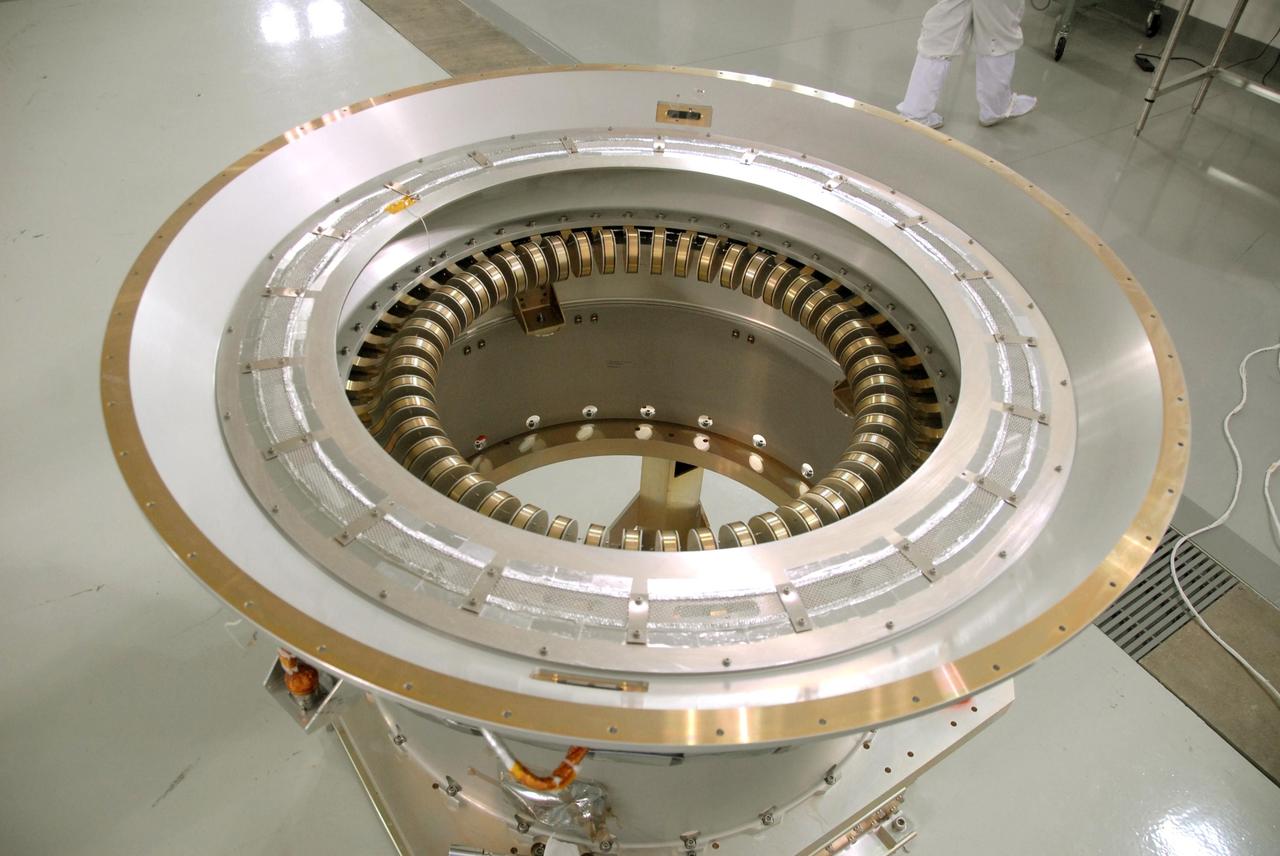
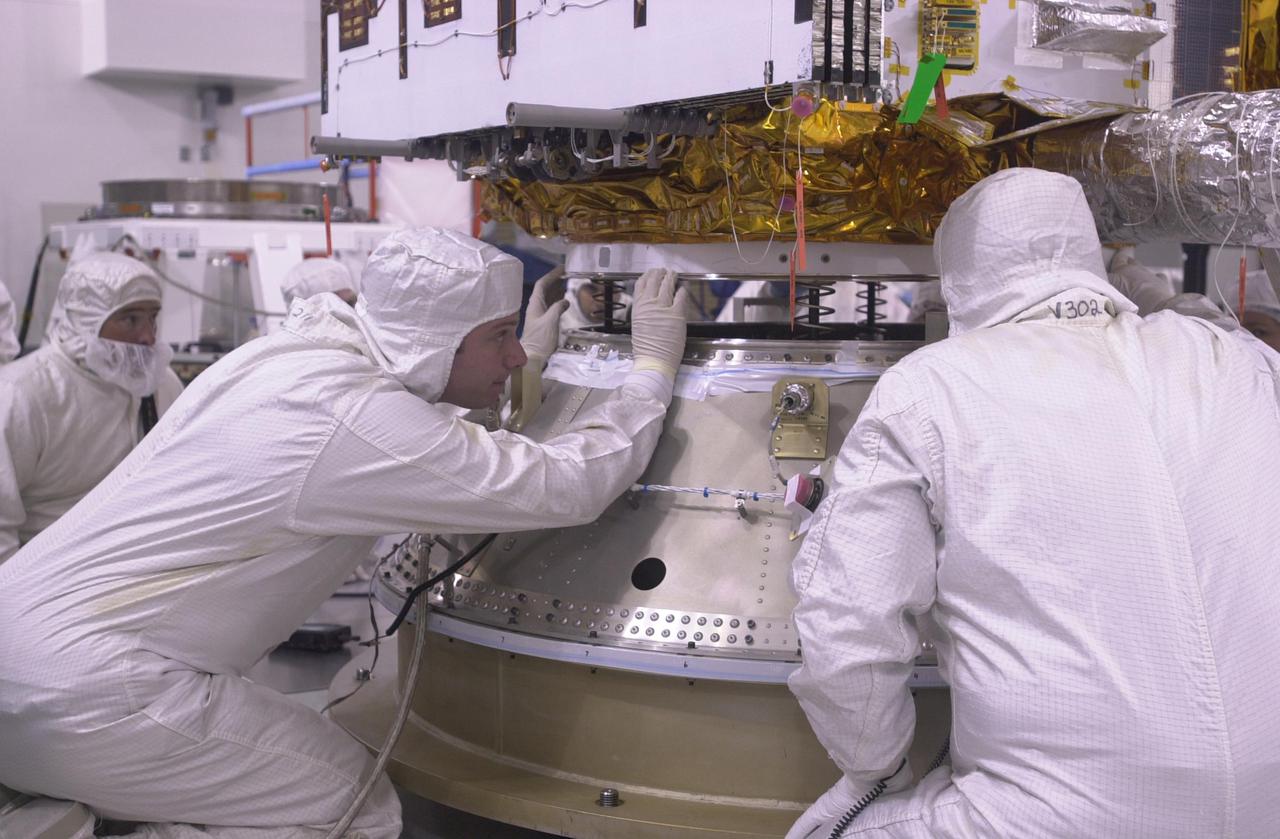
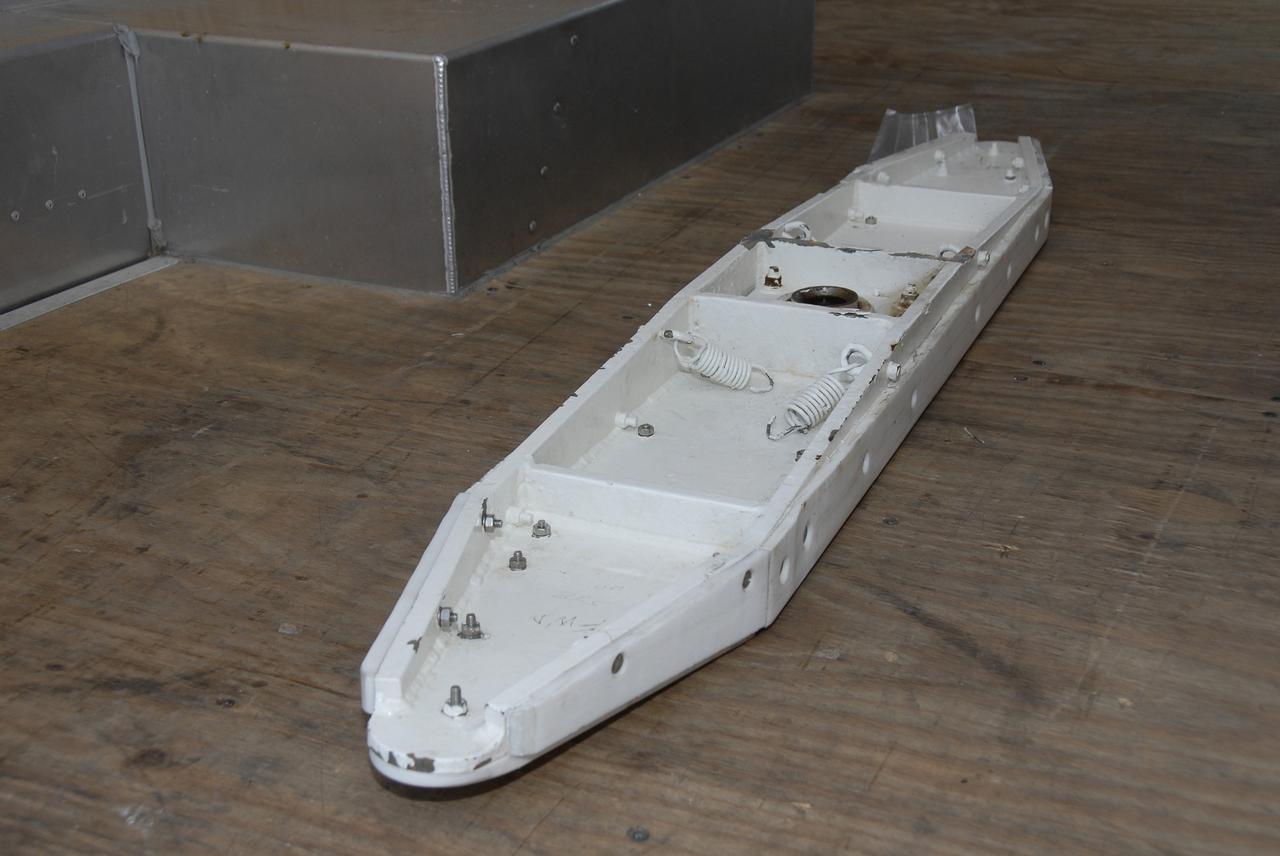
A view of the flexure springs in the soft ride being mated to the payload attach fitting for NASA Wide-field Infrared Survey Explorer, or WISE, spacecraft.
NASA CloudSat spacecraft sits encapsulated within its Boeing Delta launch vehicle dual payload attach fitting at Vandenberg Air Force Base, Calif.
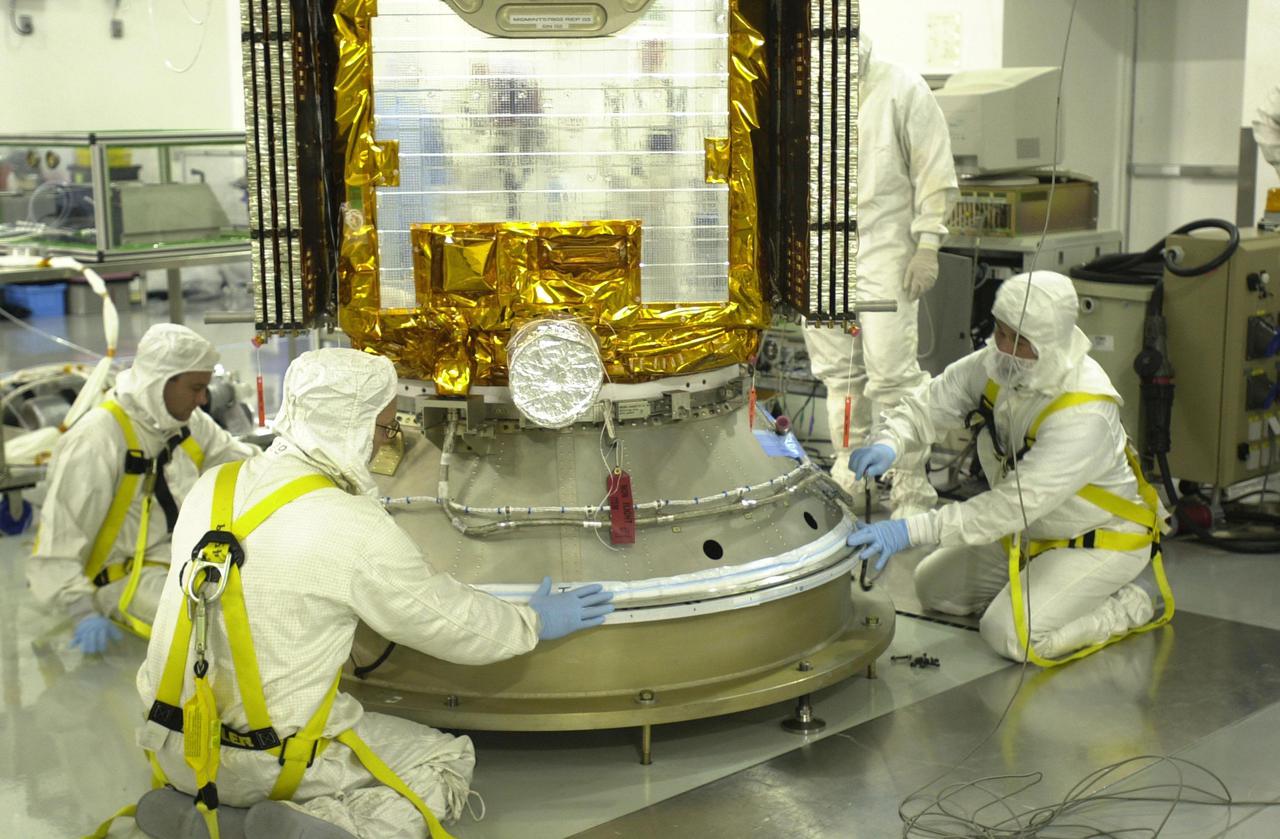
VANDENBERG AIR FORCE BASE, CALIF. — Inside the Astrotech Payload Processing Facility on Vandenberg Air Force Base in California, workers attach the CALIPSO spacecraft onto another payload attach fitting. CALIPSO will be mated with the Lower Delta Payload Attach Fitting (LDPAF) that contains the CloudSat satellite. Later the UDPAF will be mated with the lower Delta Payload Attach Fitting, which contains the CloudSat satellite. The PAF is the interface between the spacecraft and the second stage of the rocket. CALIPSO stands for Cloud-Aerosol Lidar and Infrared Pathfinder Satellite Observation.
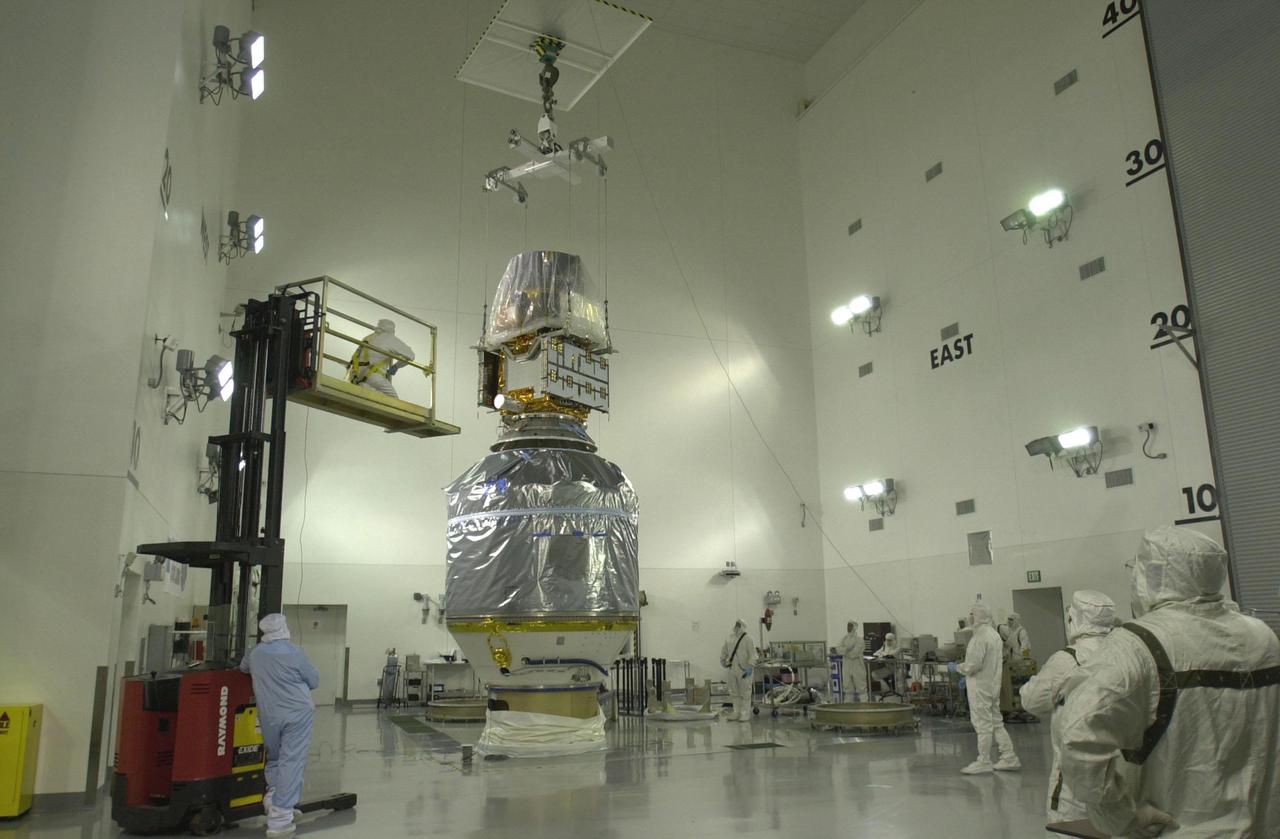
VANDENBERG AIR FORCE BASE, CALIF. — Inside the Astrotech Payload Processing Facility on Vandenberg Air Force Base in California, workers lower the CALIPSO spacecraft and Upper Delta Payload Attach Fitting (UDPAF) toward the Lower Delta Payload Attach Fitting (LDPAF) that contains the CloudSat satellite. Later the UDPAF will be mated with the lower Delta Payload Attach Fitting, which contains the CloudSat satellite. The PAF is the interface between the spacecraft and the second stage of the rocket. CALIPSO stands for Cloud-Aerosol Lidar and Infrared Pathfinder Satellite Observation.
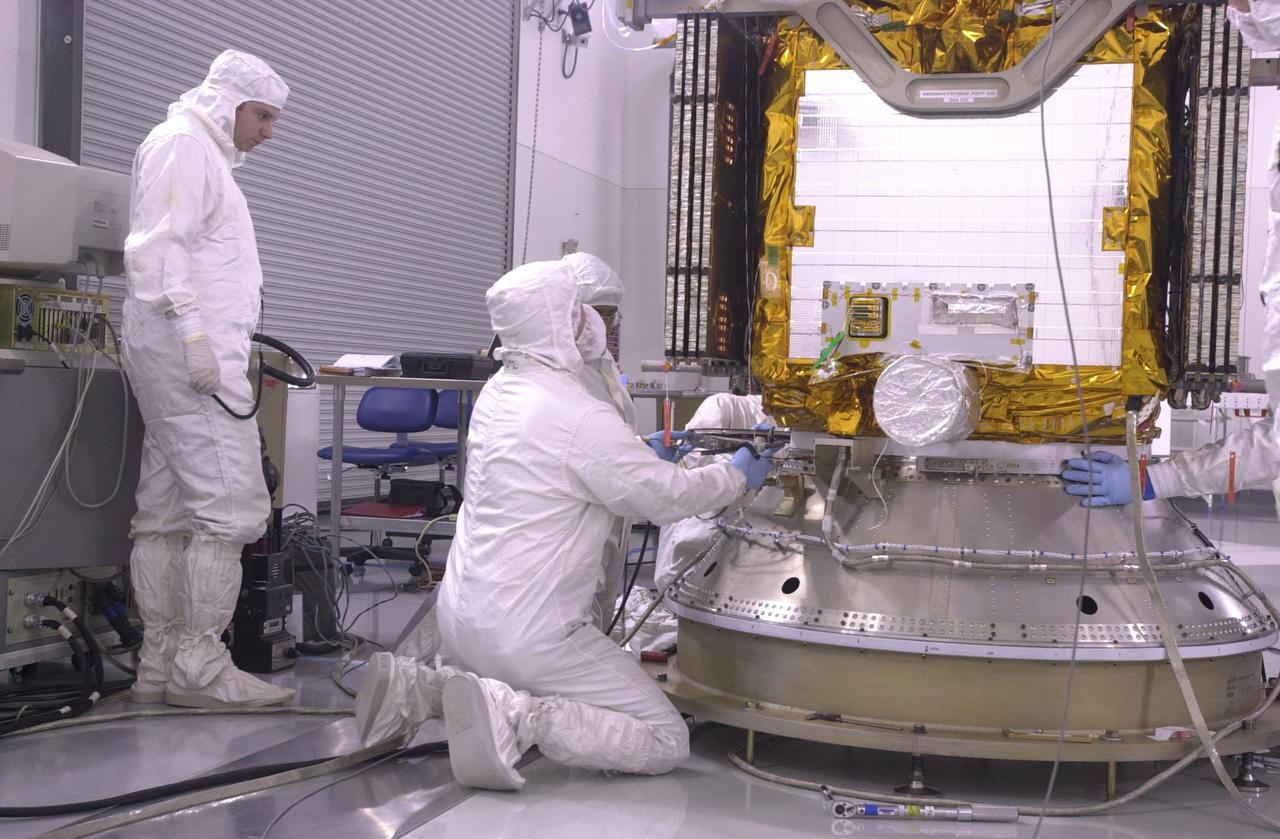
VANDENBERG AIR FORCE BASE, CALIF. — Inside the Astrotech Payload Processing Facility on Vandenberg Air Force Base in California, workers check the attachment of the CALIPSO spacecraft onto the upper Delta Payload Attach Fitting (UDPAF). Later the UDPAF will be mated with the lower Delta Payload Attach Fitting, which contains the CloudSat satellite. The PAF is the interface between the spacecraft and the second stage of the rocket. CALIPSO stands for Cloud-Aerosol Lidar and Infrared Pathfinder Satellite Observation.
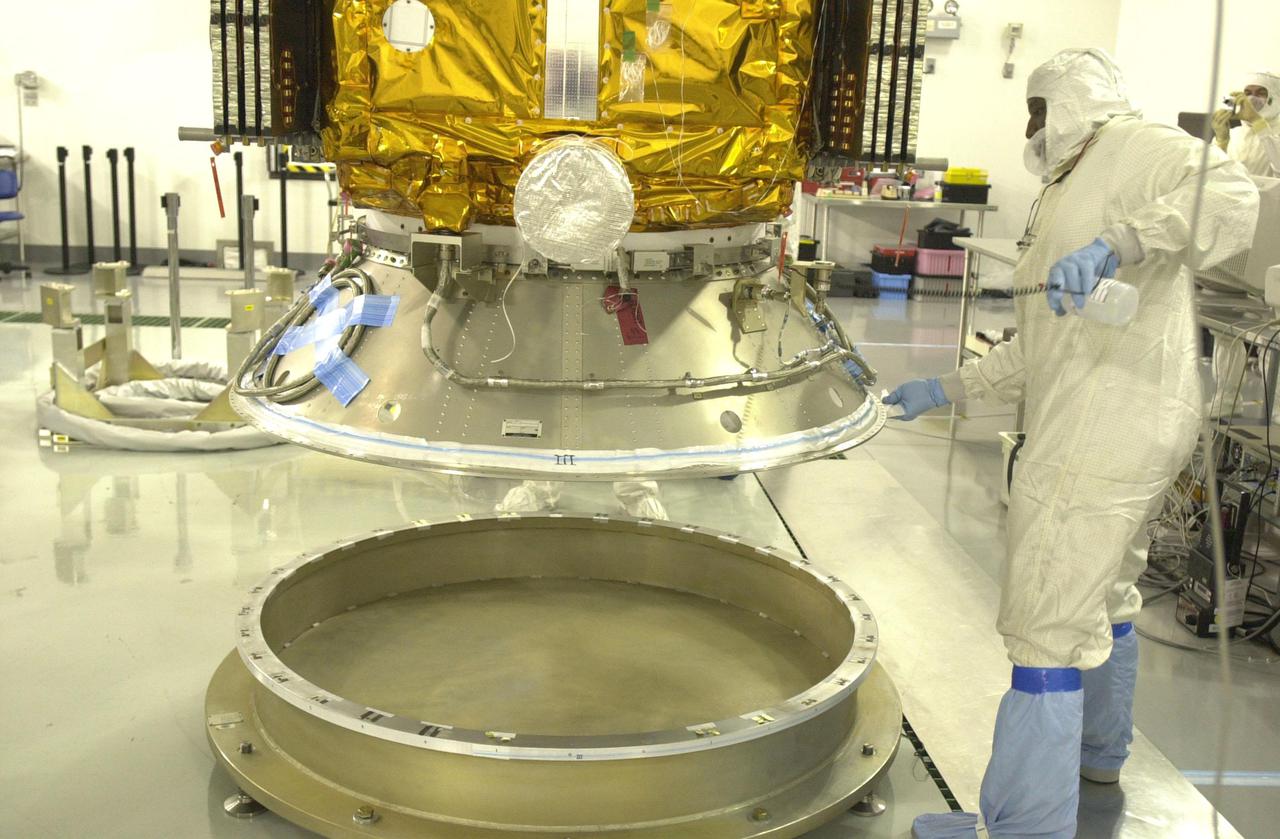
VANDENBERG AIR FORCE BASE, CALIF. — Inside the Astrotech Payload Processing Facility on Vandenberg Air Force Base in California, workers lift the CALIPSO spacecraft from the Upper Delta Payload Attach Fitting (UDPAF) to adjust the attachment. CALIPSO will be mated with the Lower Delta Payload Attach Fitting (LDPAF) that contains the CloudSat satellite. The PAF is the interface between the spacecraft and the second stage of the rocket. CALIPSO stands for Cloud-Aerosol Lidar and Infrared Pathfinder Satellite Observation.
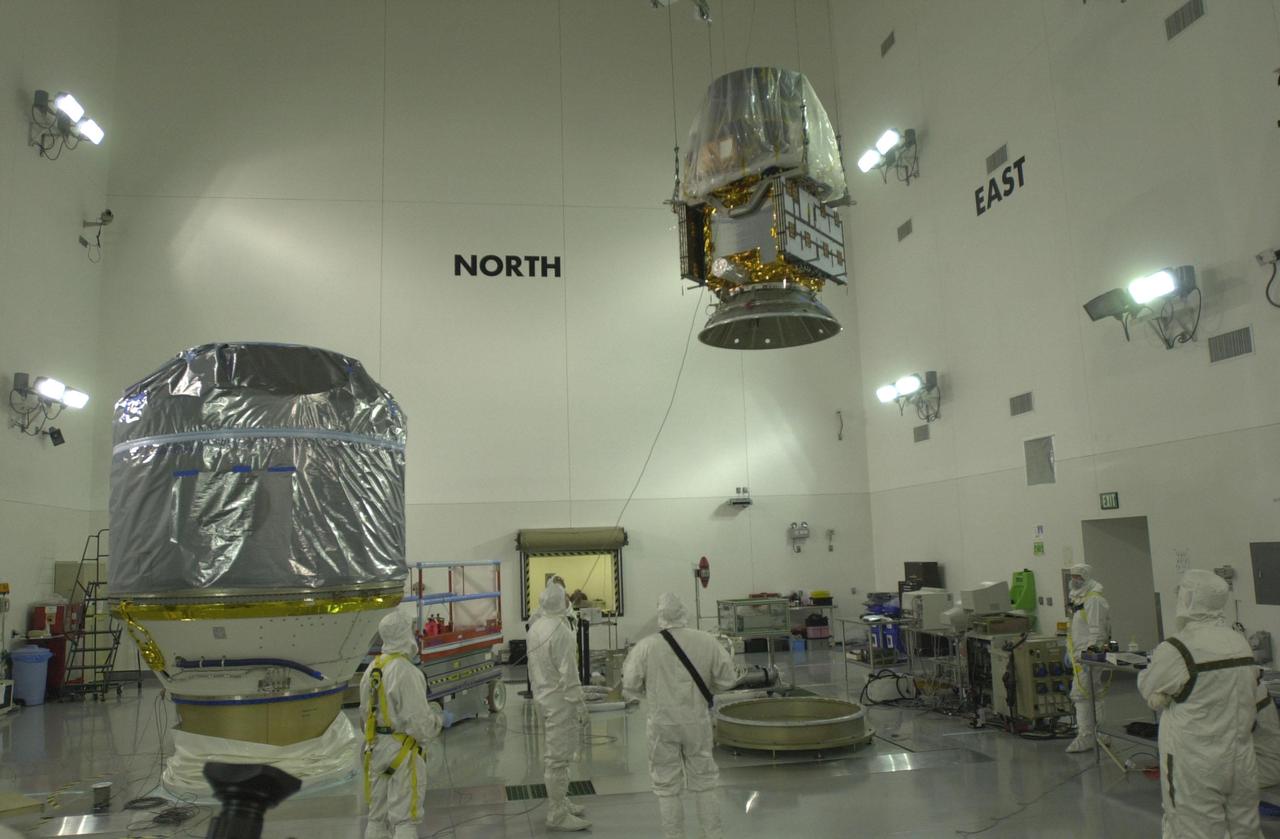
VANDENBERG AIR FORCE BASE, CALIF. - Inside the Astrotech Payload Processing Facility on Vandenberg Air Force Base in California, the CALIPSO spacecraft is destacked from the Lower Delta Payload Attach Fitting (LDPAF) and will be attached to another payload attach fitting. Then CALIPSO will be mated to the Lower Delta Payload Attach Fitting (LDPAF) that contains the CloudSat satellite. The PAF is the interface between the spacecraft and the second stage of the rocket. CALIPSO stands for Cloud-Aerosol Lidar and Infrared Pathfinder Satellite Observation. CALIPSO and CloudSat are highly complementary satellites that will provide never-before-seen 3-D perspectives of how clouds and aerosols form, evolve, and affect weather and climate. CALIPSO and CloudSat will fly in formation with three other satellites in the A-train constellation to enhance understanding of our climate system. Launch of CALIPSO_CloudSat aboard a Boeing Delta II rocket is scheduled for 3:01 a.m. PDT Sept. 29.
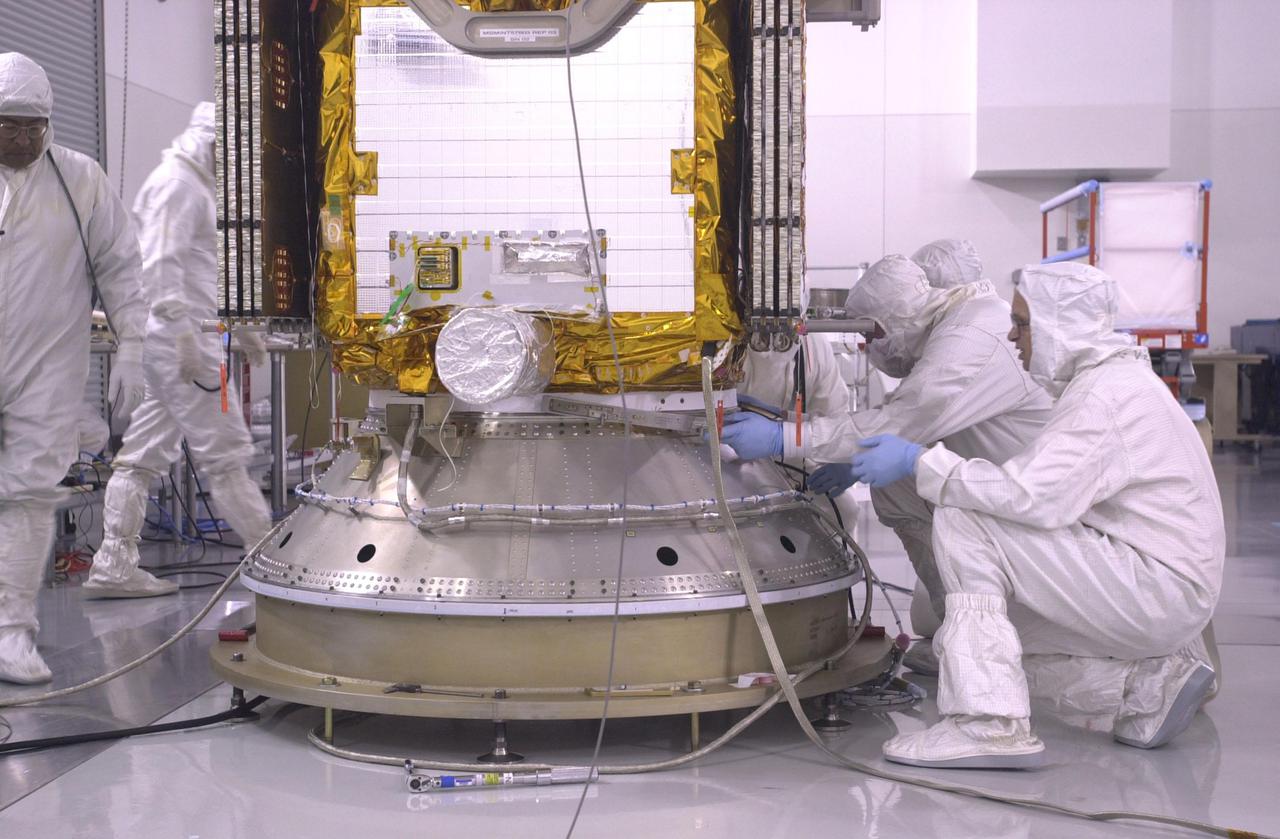
VANDENBERG AIR FORCE BASE, CALIF. — Inside the Astrotech Payload Processing Facility on Vandenberg Air Force Base in California, workers secure the CALIPSO spacecraft on the upper Delta Payload Attach Fitting (UDPAF). Later the UDPAF will be mated with the lower Delta Payload Attach Fitting, which contains the CloudSat satellite. The PAF is the interface between the spacecraft and the second stage of the rocket. CALIPSO stands for Cloud-Aerosol Lidar and Infrared Pathfinder Satellite Observation.
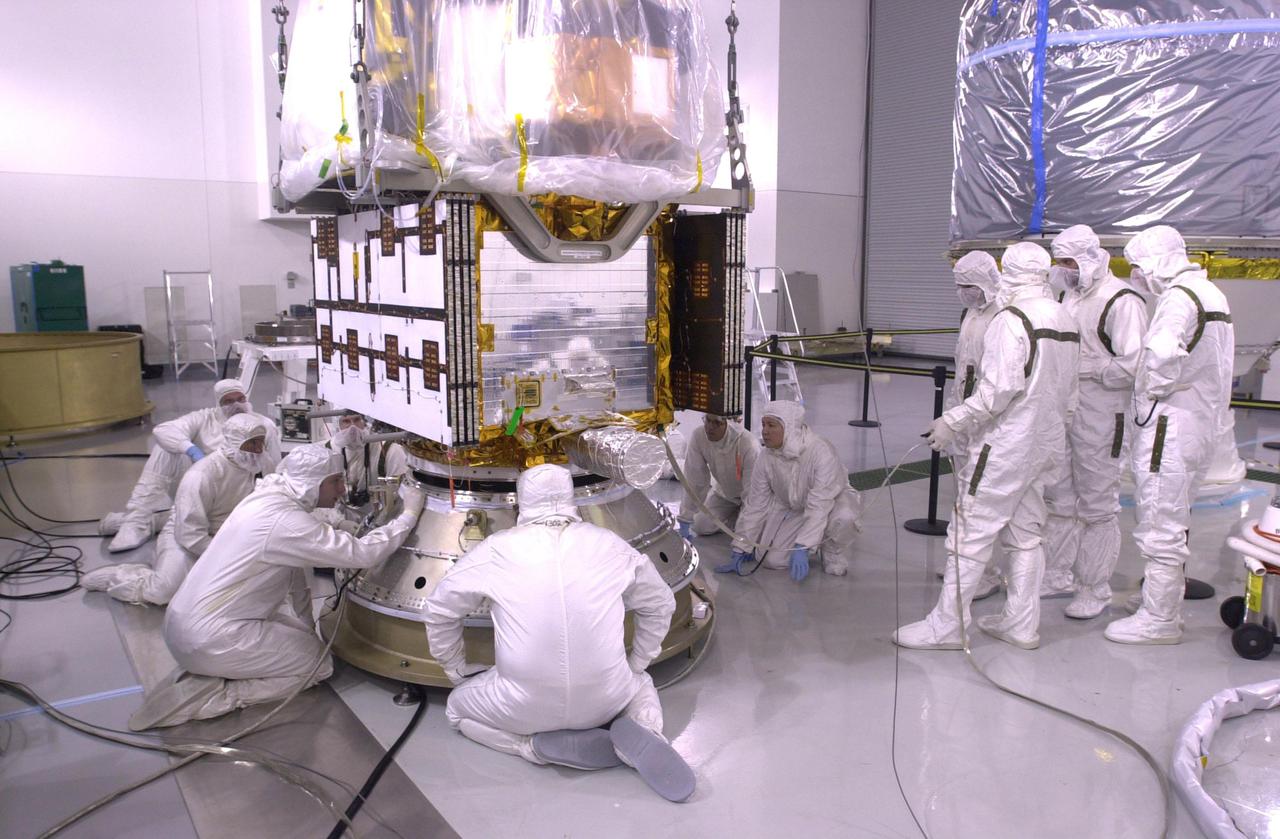
VANDENBERG AIR FORCE BASE, CALIF. — Inside the Astrotech Payload Processing Facility on Vandenberg Air Force Base in California, workers secure the CALIPSO spacecraft on the upper Delta Payload Attach Fitting (UDPAF). Later the UDPAF will be mated with the lower Delta Payload Attach Fitting, which contains the CloudSat satellite. The PAF is the interface between the spacecraft and the second stage of the rocket. CALIPSO stands for Cloud-Aerosol Lidar and Infrared Pathfinder Satellite Observation.
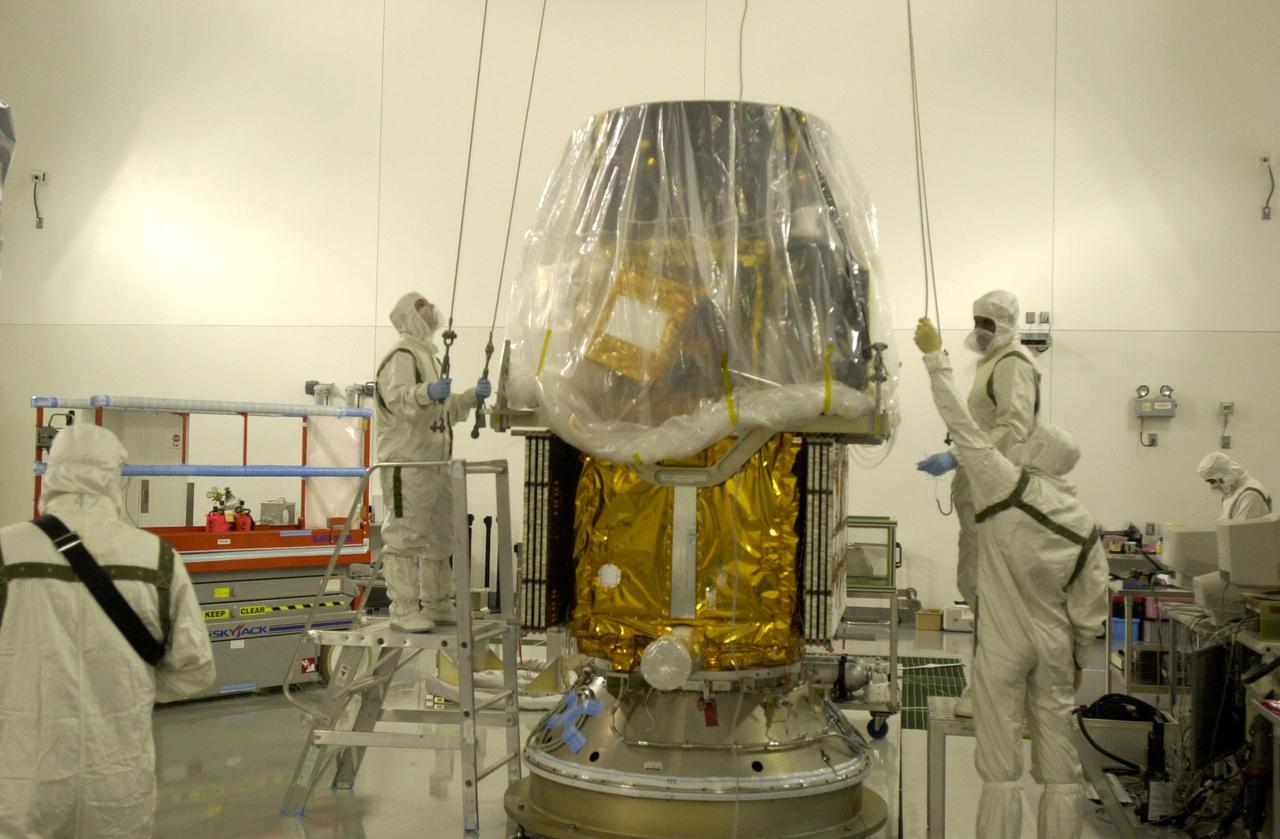
VANDENBERG AIR FORCE BASE, CALIF. — Inside the Astrotech Payload Processing Facility on Vandenberg Air Force Base in California, the CALIPSO spacecraft is back on the floor or further adjustments. CALIPSO will be mated with the Lower Delta Payload Attach Fitting (LDPAF) that contains the CloudSat satellite. Later the UDPAF will be mated with the lower Delta Payload Attach Fitting, which contains the CloudSat satellite. The PAF is the interface between the spacecraft and the second stage of the rocket. CALIPSO stands for Cloud-Aerosol Lidar and Infrared Pathfinder Satellite Observation.
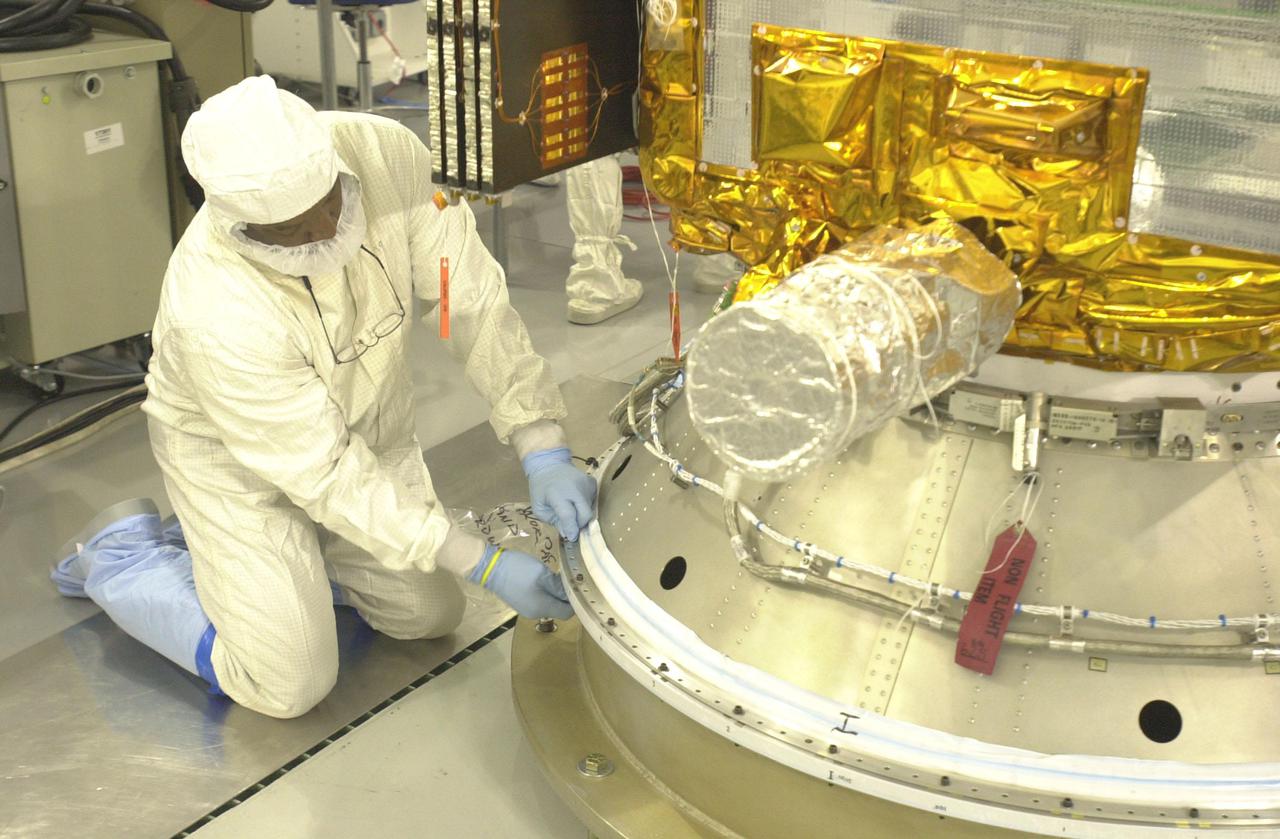
VANDENBERG AIR FORCE BASE, CALIF. — Inside the Astrotech Payload Processing Facility on Vandenberg Air Force Base in California, a worker makes an adjustment on the Upper Delta Payload Attach Fitting (UDPAF) holding the CALIPSO spacecraft. CALIPSO will be mated with the Lower Delta Payload Attach Fitting (LDPAF) that contains the CloudSat satellite. The PAF is the interface between the spacecraft and the second stage of the rocket. CALIPSO stands for Cloud-Aerosol Lidar and Infrared Pathfinder Satellite Observation.
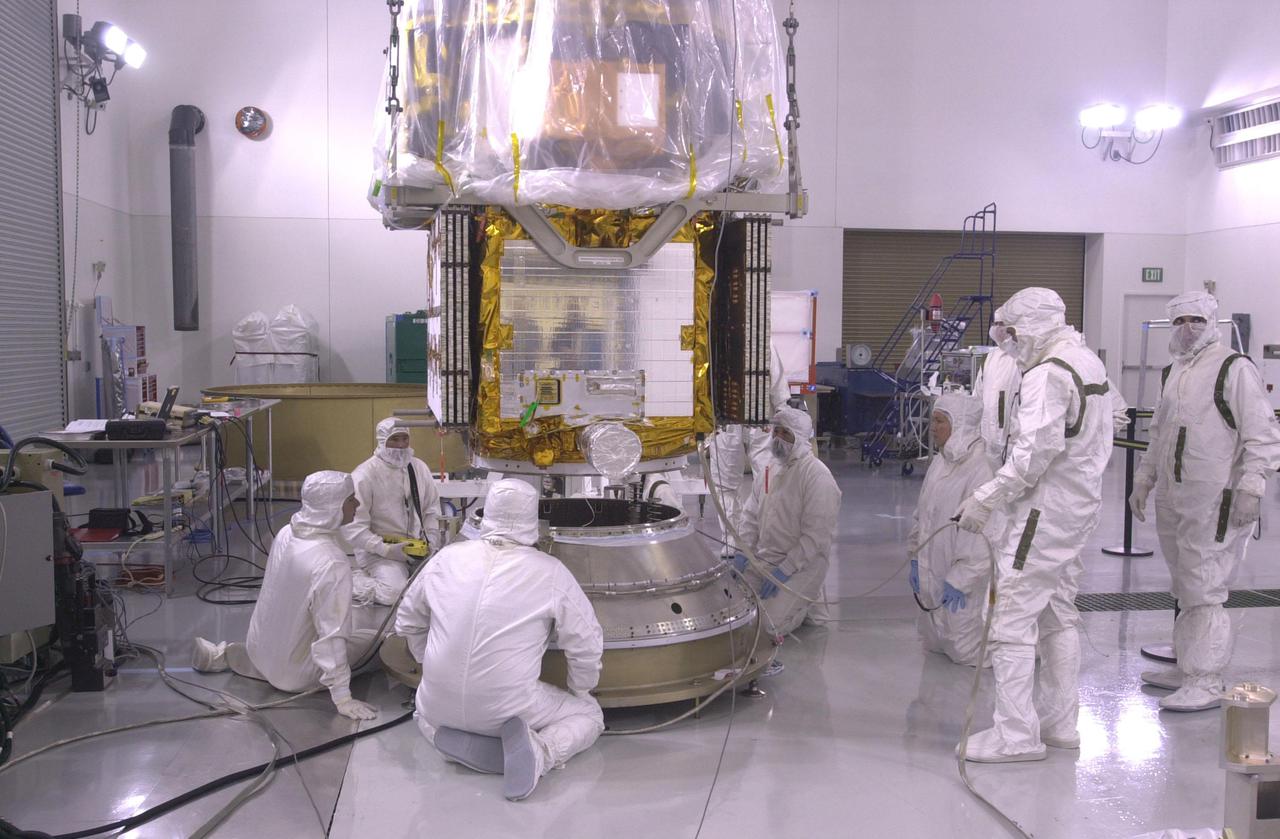
VANDENBERG AIR FORCE BASE, CALIF. — Inside the Astrotech Payload Processing Facility on Vandenberg Air Force Base in California, workers oversee the lowering of the CALIPSO spacecraft toward the upper Delta Payload Attach Fitting (UDPAF). Later the UDPAF will be mated with the lower Delta Payload Attach Fitting, which contains the CloudSat satellite. The PAF is the interface between the spacecraft and the second stage of the rocket. CALIPSO stands for Cloud-Aerosol Lidar and Infrared Pathfinder Satellite Observation.
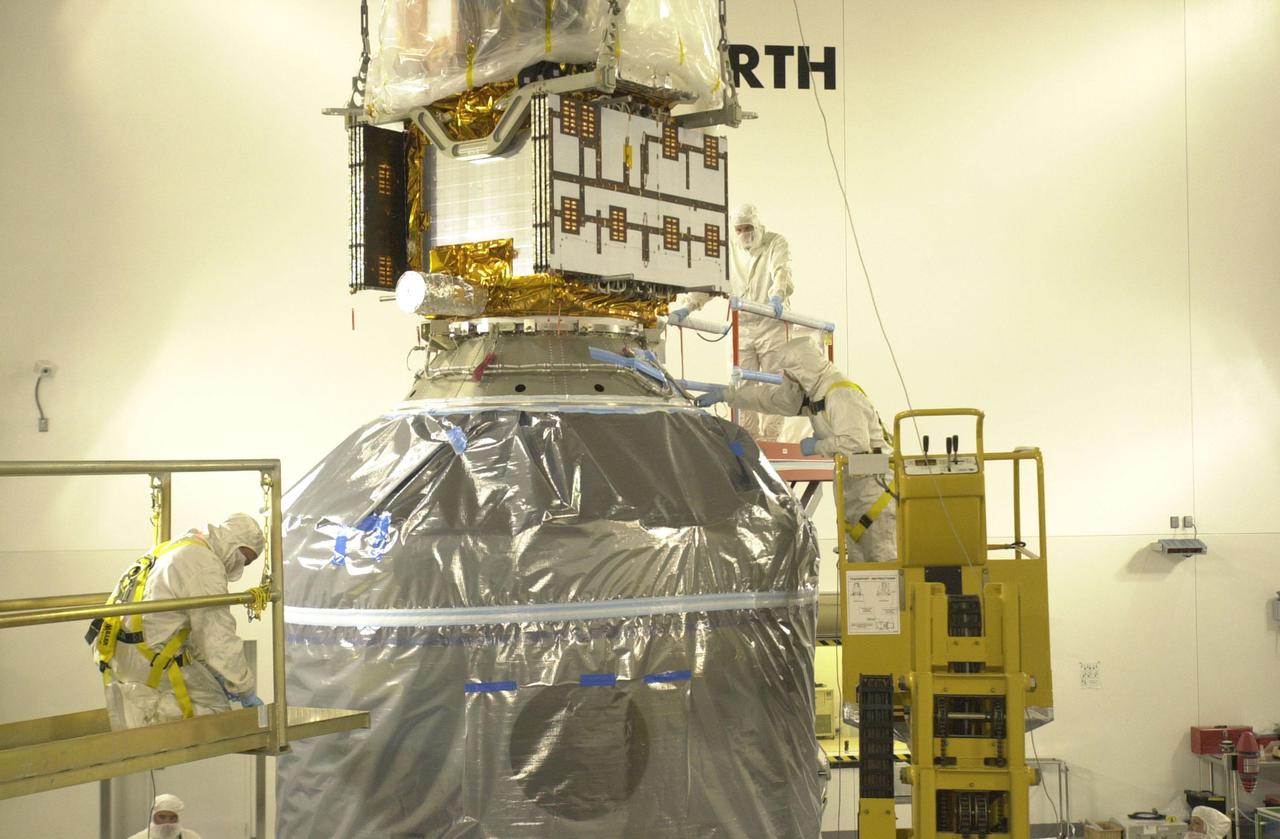
VANDENBERG AIR FORCE BASE, CALIF. — Inside the Astrotech Payload Processing Facility on Vandenberg Air Force Base in California, workers check the lowering of the CALIPSO spacecraft and Upper Delta Payload Attach Fitting (UDPAF) onto the Lower Delta Payload Attach Fitting (LDPAF) that contains the CloudSat satellite. The PAF is the interface between the spacecraft and the second stage of the rocket. CALIPSO stands for Cloud-Aerosol Lidar and Infrared Pathfinder Satellite Observation.
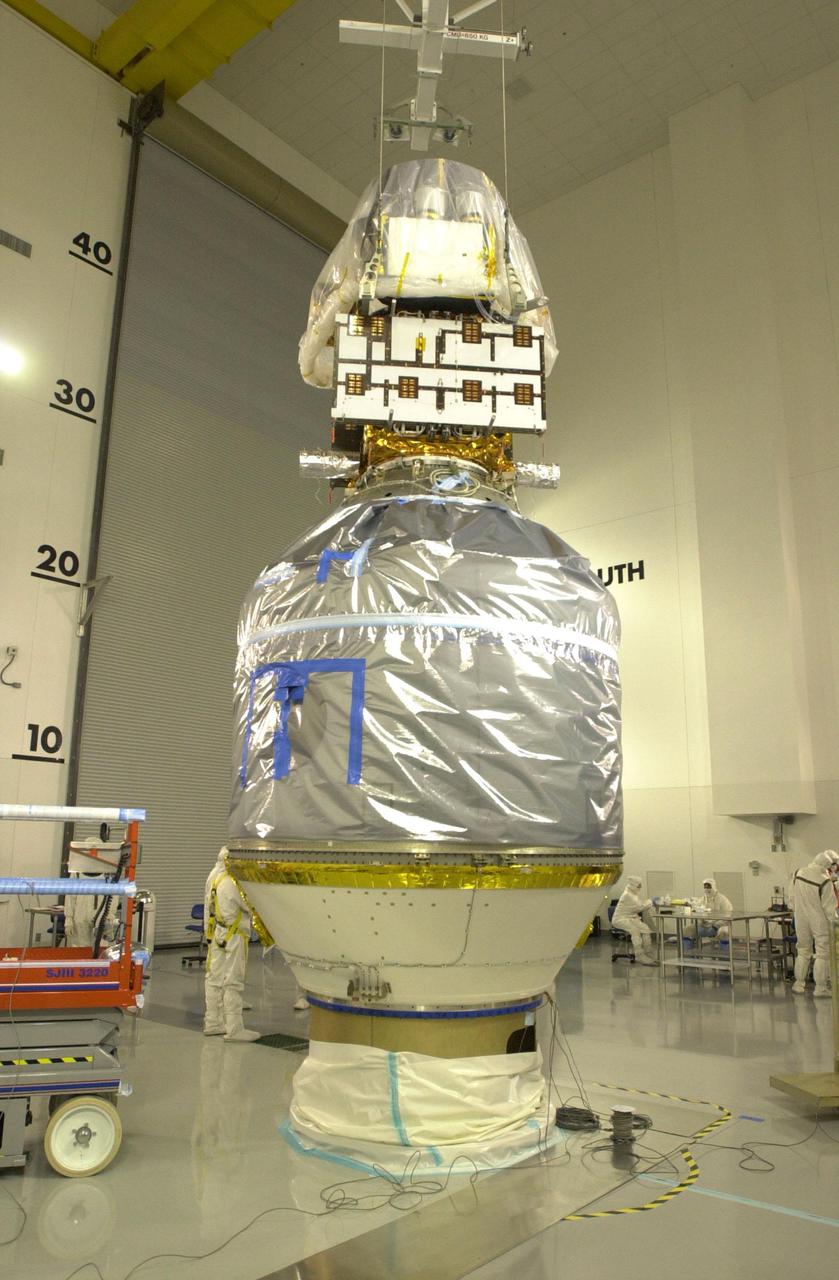
VANDENBERG AIR FORCE BASE, CALIF. — Inside the Astrotech Payload Processing Facility on Vandenberg Air Force Base in California, the Upper Delta Payload Attach Fitting (UDPAF) with the CALIPSO spacecraft has been lowered onto the Lower Delta Payload Attach Fitting (LDPAF) that contains the CloudSat satellite. The PAF is the interface between the spacecraft and the second stage of the rocket. CALIPSO stands for Cloud-Aerosol Lidar and Infrared Pathfinder Satellite Observation.
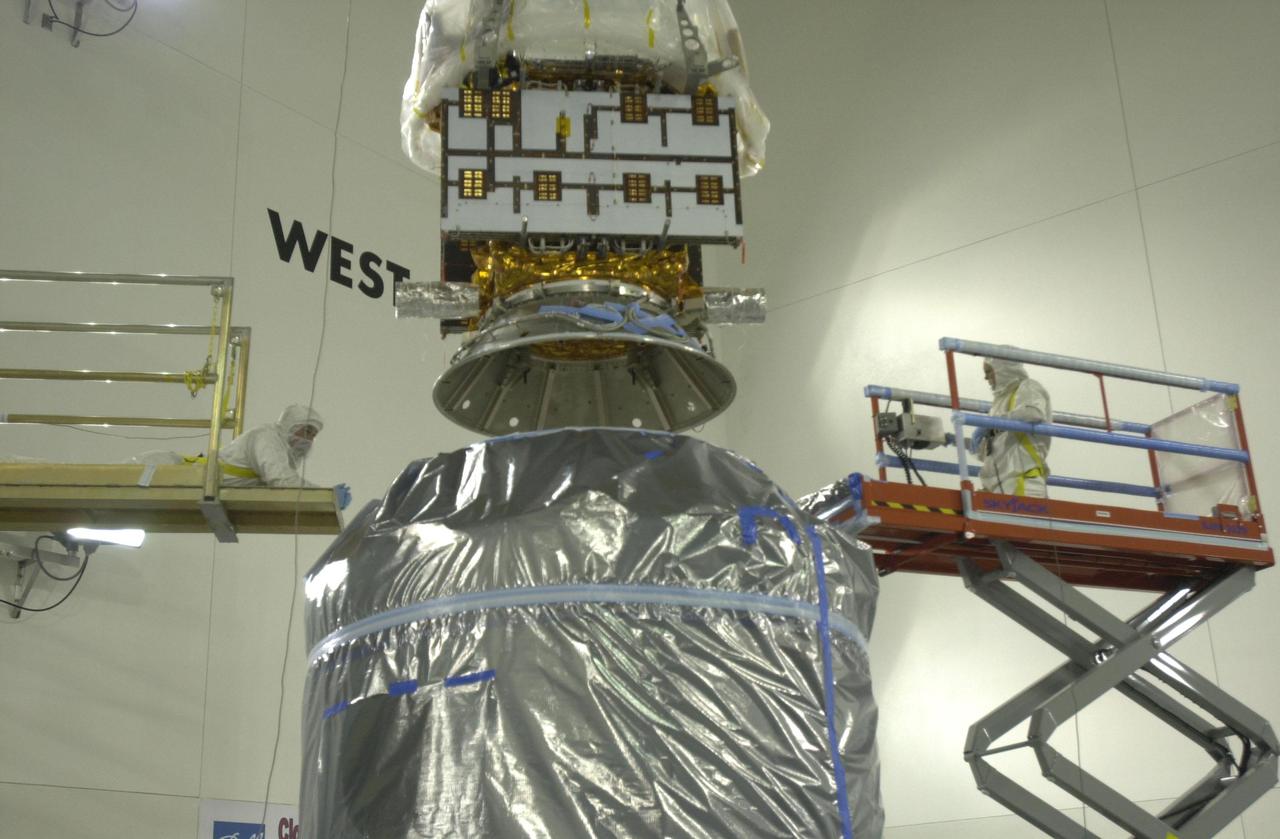
VANDENBERG AIR FORCE BASE, CALIF. — From an elevated platform, workers inside the Astrotech Payload Processing Facility on Vandenberg Air Force Base in California guide the lowering of the CALIPSO spacecraft onto the Lower Delta Payload Attach Fitting (LDPAF) that contains the CloudSat satellite.Later the UDPAF will be mated with the lower Delta Payload Attach Fitting, which contains the CloudSat satellite. The PAF is the interface between the spacecraft and the second stage of the rocket. CALIPSO stands for Cloud-Aerosol Lidar and Infrared Pathfinder Satellite Observation.
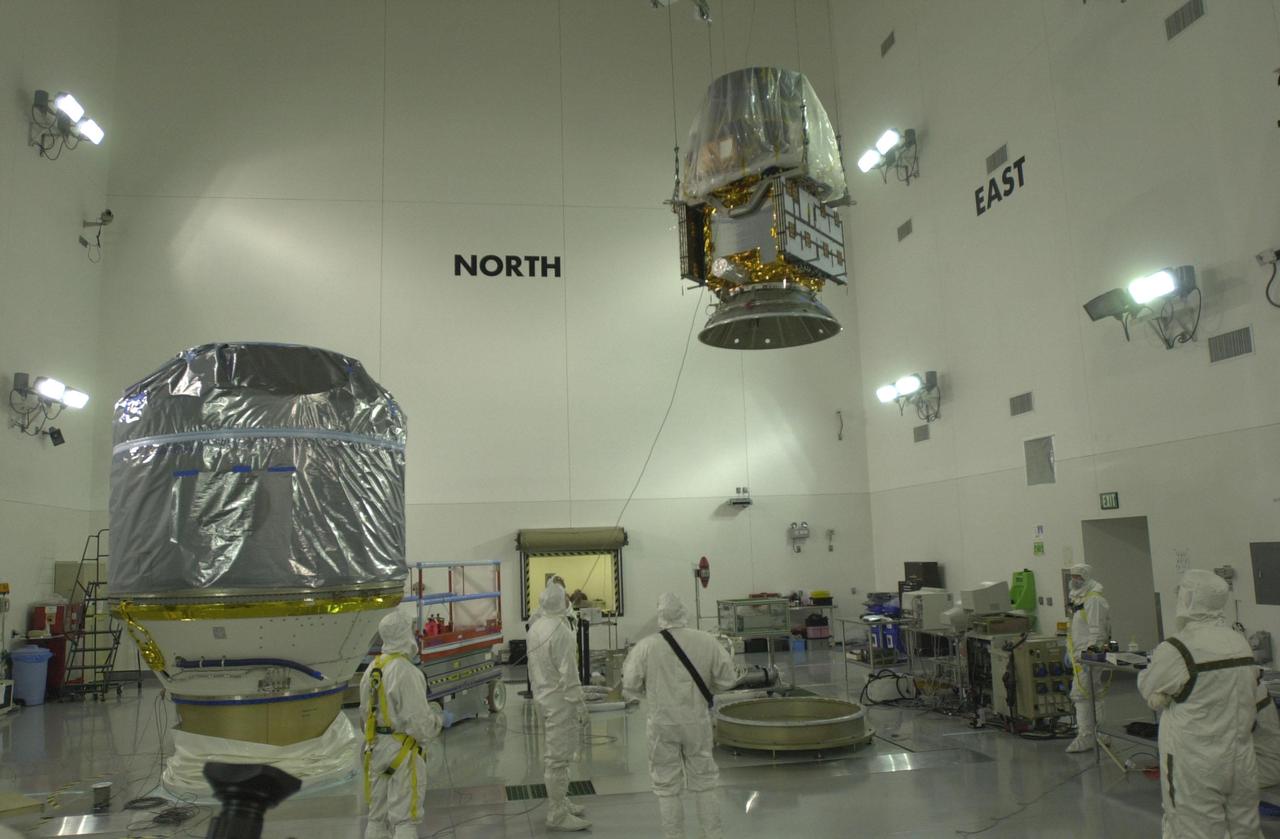
VANDENBERG AIR FORCE BASE, CALIF. — Inside the Astrotech Payload Processing Facility on Vandenberg Air Force Base in California, workers move the CALIPSO spacecraft away from the Lower Delta Payload Attach Fitting, which contains the CloudSat satellite. Later the UDPAF will be mated with the lower Delta Payload Attach Fitting, which contains the CloudSat satellite. The PAF is the interface between the spacecraft and the second stage of the rocket. CALIPSO stands for Cloud-Aerosol Lidar and Infrared Pathfinder Satellite Observation.
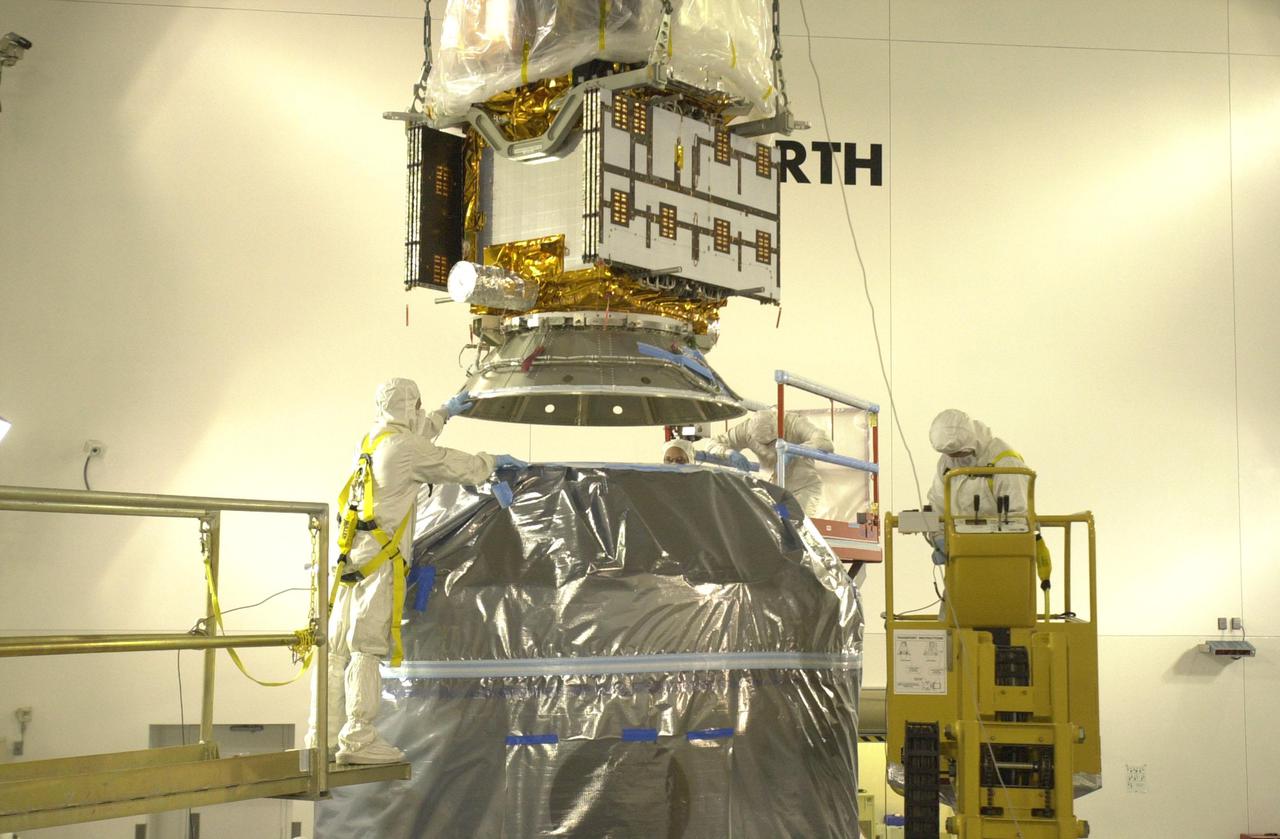
VANDENBERG AIR FORCE BASE, CALIF. — Inside the Astrotech Payload Processing Facility on Vandenberg Air Force Base in California, workers again lower the CALIPSO spacecraft and Upper Delta Payload Attach Fitting (UDPAF) toward the Lower Delta Payload Attach Fitting (LDPAF) that contains the CloudSat satellite. The PAF is the interface between the spacecraft and the second stage of the rocket. CALIPSO stands for Cloud-Aerosol Lidar and Infrared Pathfinder Satellite Observation.
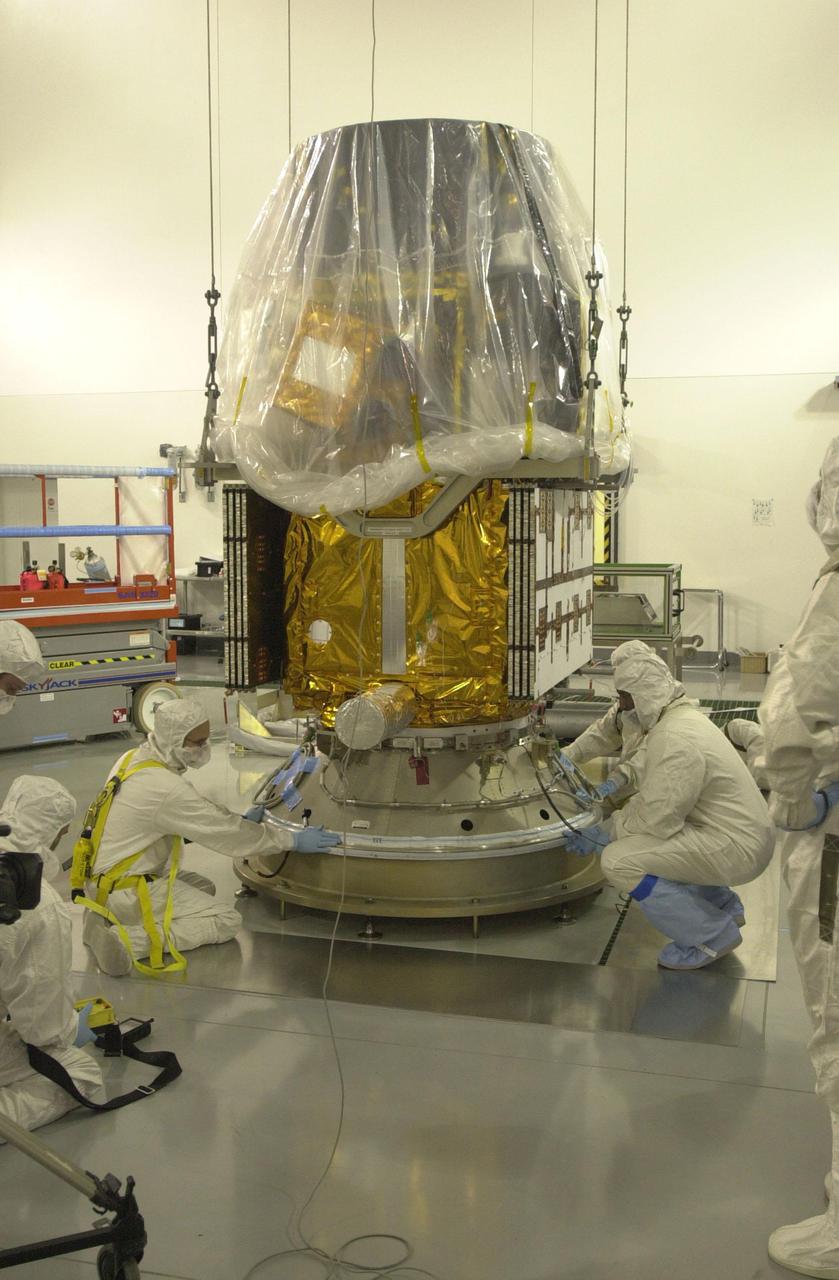
VANDENBERG AIR FORCE BASE, CALIF. — Inside the Astrotech Payload Processing Facility on Vandenberg Air Force Base in California, workers check the Upper Delta Payload Attach Fitting (UDPAF) holding the CALIPSO spacecraft. CALIPSO will be mated with the Lower Delta Payload Attach Fitting (LDPAF) that contains the CloudSat satellite. The PAF is the interface between the spacecraft and the second stage of the rocket. CALIPSO stands for Cloud-Aerosol Lidar and Infrared Pathfinder Satellite Observation.
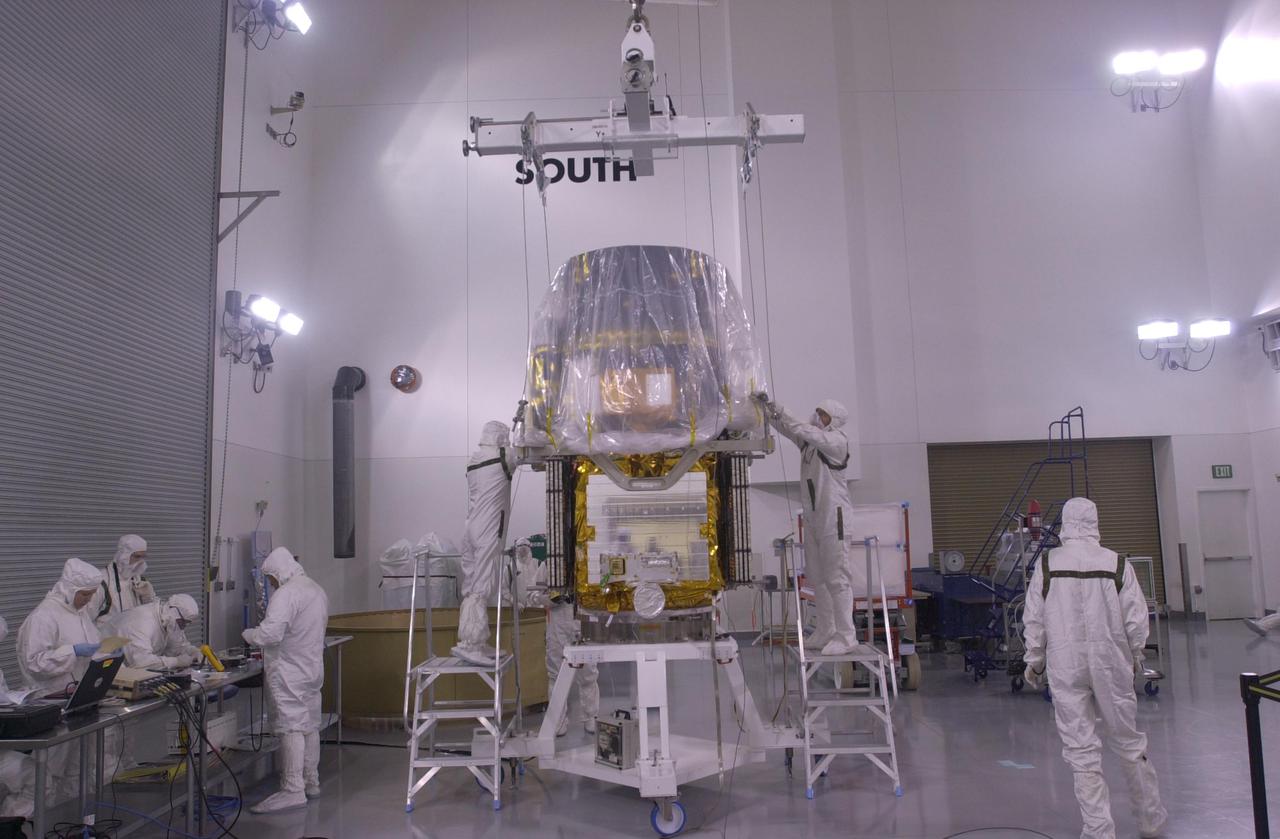
VANDENBERG AIR FORCE BASE, CALIF. — Inside the Astrotech Payload Processing Facility on Vandenberg Air Force Base in California, workers attach an overhead crane to the CALIPSO spacecraft. CALIPSO will be lifted and attached to the upper Delta Payload Attach Fitting (UDPAF). Later the UDPAF will be mated with the lower Delta Payload Attach Fitting, which contains the CloudSat satellite. The PAF is the interface between the spacecraft and the second stage of the rocket. CALIPSO stands for Cloud-Aerosol Lidar and Infrared Pathfinder Satellite Observation. CALIPSO and CloudSat are highly complementary satellites that will provide never-before-seen 3-D perspectives of how clouds and aerosols form, evolve, and affect weather and climate. CALIPSO and CloudSat will fly in formation with three other satellites in the A-train constellation to enhance understanding of our climate system. Launch of CALIPSO_CloudSat aboard a Boeing Delta II rocket is scheduled for 3:01 a.m. PDT Sept. 29.
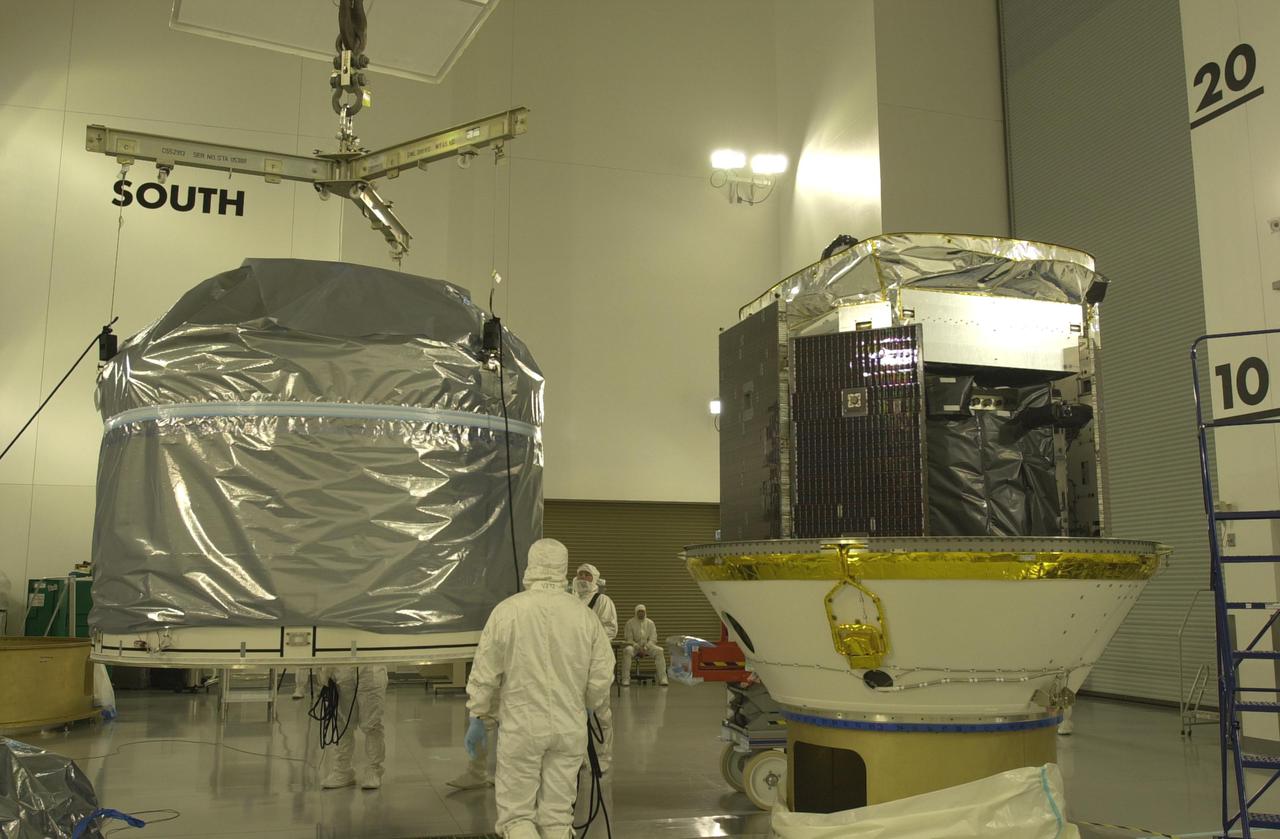
VANDENBERG AIR FORCE BASE, CALIF. - Inside the Astrotech Payload Processing Facility on Vandenberg Air Force Base in California, the upper Delta Payload Attach Fitting (UDPAF) at left is fitted with a crane to lift it and mate it with the lower Delta Payload Attach Fitting (LDPAF) at right. The UDPAF will hold the CALIPSO satellite and the LDPAF holds the CloudSat satellite. The two sections will be mated. CALIPSO stands for Cloud-Aerosol Lidar and Infrared Pathfinder Satellite Observation. CALIPSO and CloudSat are highly complementary satellites that will provide never-before-seen 3-D perspectives of how clouds and aerosols form, evolve, and affect weather and climate. CALIPSO and CloudSat will fly in formation with three other satellites in the A-train constellation to enhance understanding of our climate system. Launch of CALIPSO_CloudSat aboard a Boeing Delta II rocket is scheduled for 3:01 a.m. PDT Sept. 29.
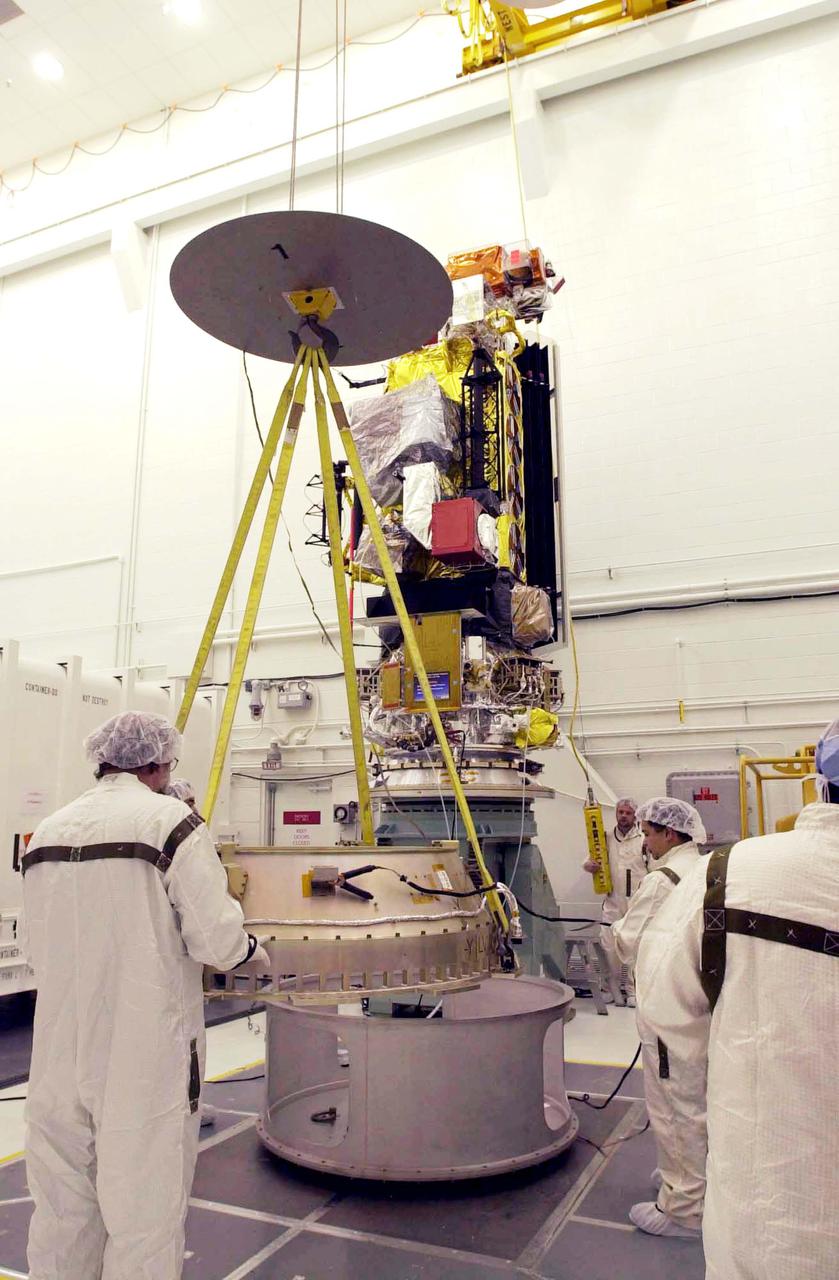
VANDENBERG AIR FORCE BASE, CALIF. - Inside the NASA spacecraft processing hangar 1610 located on North Vandenberg Air Force Base in California, Lockheed Martin workers maneuver the Boeing Delta II payload attach fitting onto a connecting ring on the floor. The National Oceanic and Atmospheric Administration (NOAA-N) spacecraft, in the background, will then be mated to the payload attach fitting. Launch of NOAA-N aboard the Boeing Delta II rocket is currently scheduled for May 11, 2005. NOAA-N is the fourth in the series of support dedicated microwave instruments for the generation of temperature, moisture, surface, and hydrological products in cloudy regions where visible and infrared (IR) instruments have decreased capability.
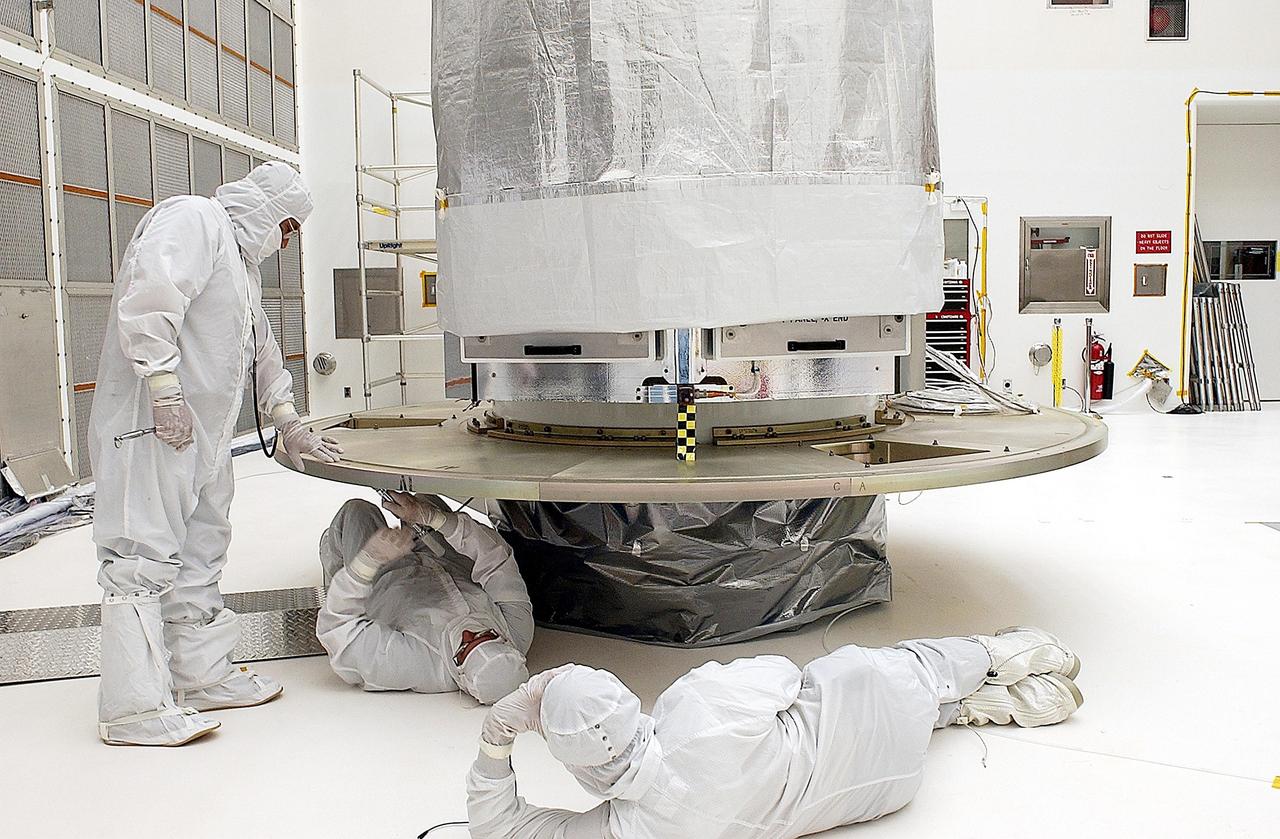
KENNEDY SPACE CENTER, FLA. -- Workers in Building AE adjust the payload attach fitting on the Space Infrared Telescope Facility (SIRTF) before buildup of the payload canister. SIRTF will be mated with the Delta II launch vehicle via the fitting. SIRTF is currently scheduled for transportation to Launch Complex 17-B, Cape Canaveral Air Force Station, and hoisting atop the Delta II on or about April 4.
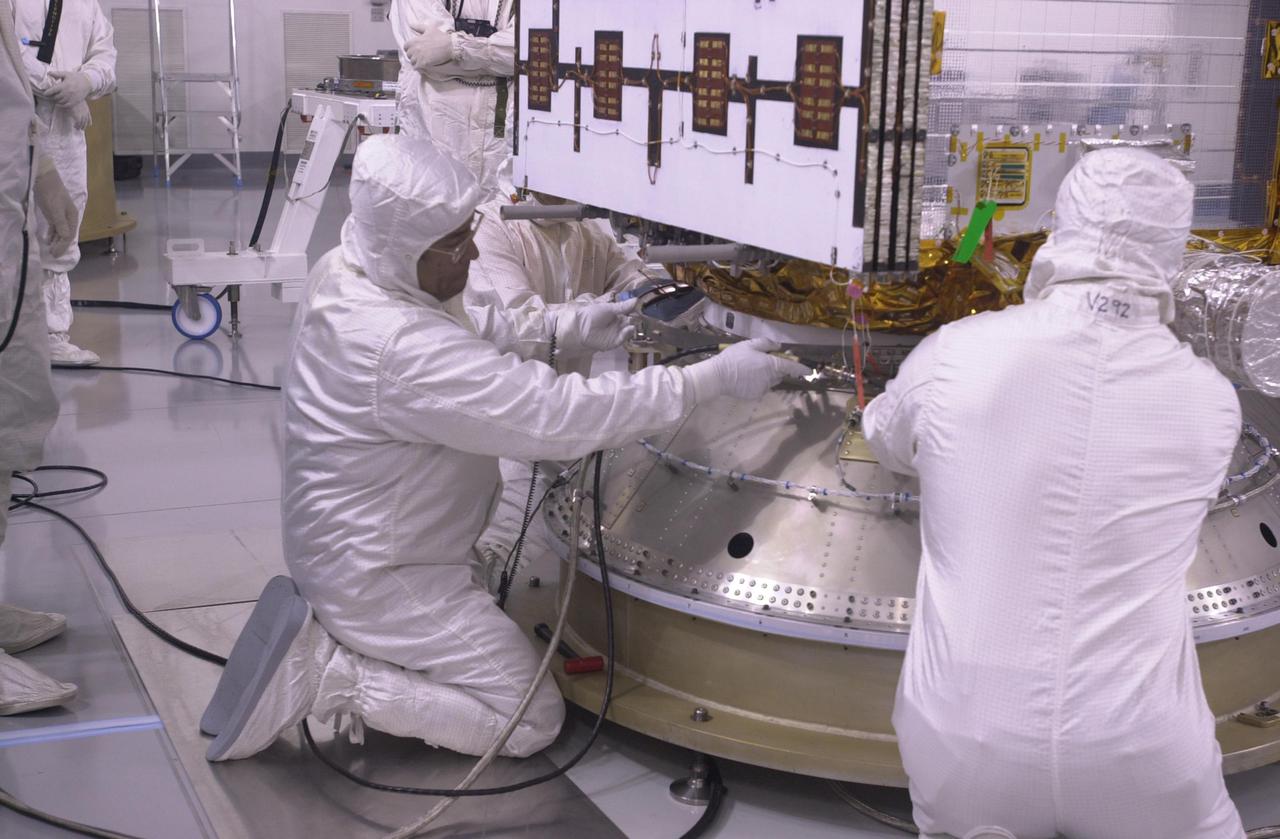
VANDENBERG AIR FORCE BASE, CALIF. — Inside the Astrotech Payload Processing Facility on Vandenberg Air Force Base in California, workers attach the CALIPSO spacecraft to the upper Delta Payload Attach Fitting (UDPAF). Later the UDPAF will be mated with the lower Delta Payload Attach Fitting, which contains the CloudSat satellite. The PAF is the interface between the spacecraft and the second stage of the rocket. CALIPSO stands for Cloud-Aerosol Lidar and Infrared Pathfinder Satellite Observation. CALIPSO and CloudSat are highly complementary satellites that will provide never-before-seen 3-D perspectives of how clouds and aerosols form, evolve, and affect weather and climate. CALIPSO and CloudSat will fly in formation with three other satellites in the A-train constellation to enhance understanding of our climate system. Launch of CALIPSO_CloudSat aboard a Boeing Delta II rocket is scheduled for 3:01 a.m. PDT Sept. 29.
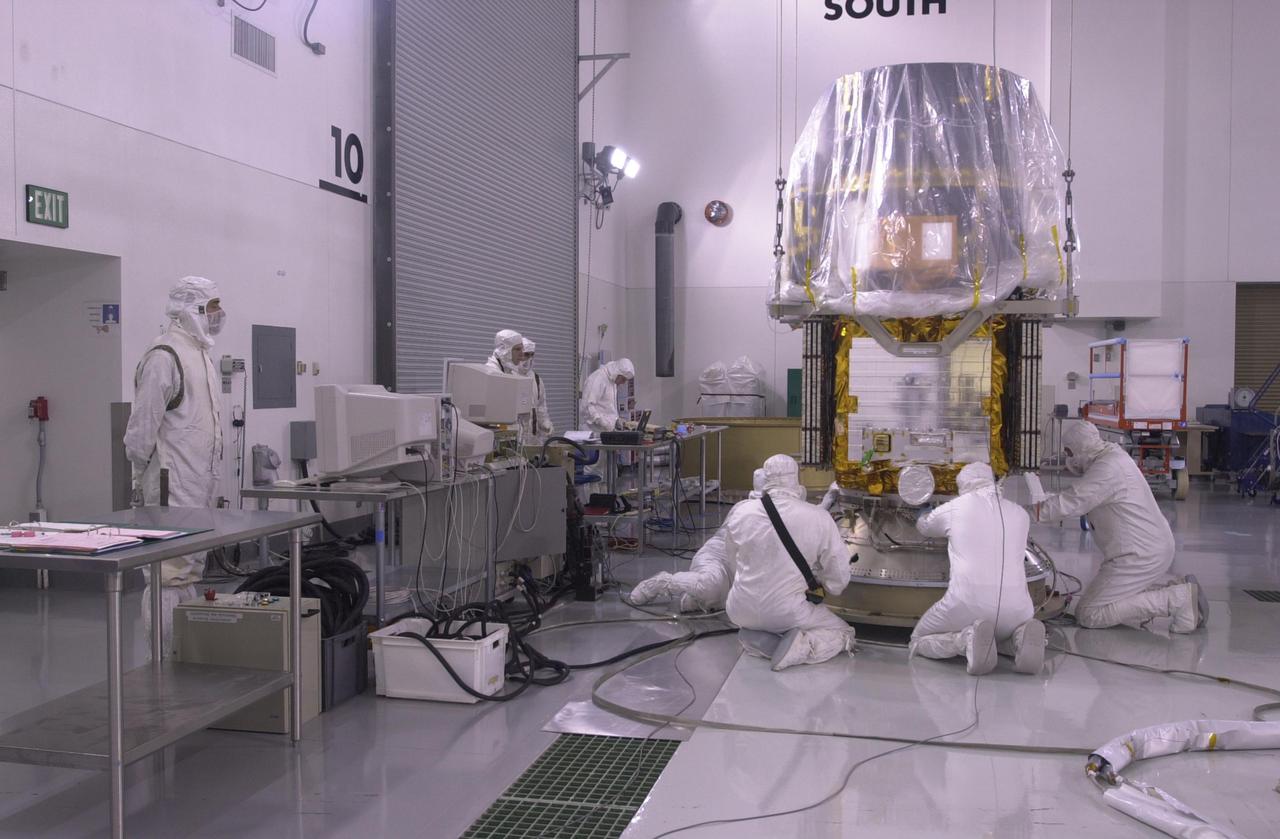
VANDENBERG AIR FORCE BASE, CALIF. — Inside the Astrotech Payload Processing Facility on Vandenberg Air Force Base in California, workers attach the CALIPSO spacecraft to the upper Delta Payload Attach Fitting (UDPAF). Later the UDPAF will be mated with the lower Delta Payload Attach Fitting, which contains the CloudSat satellite. The PAF is the interface between the spacecraft and the second stage of the rocket. CALIPSO stands for Cloud-Aerosol Lidar and Infrared Pathfinder Satellite Observation. CALIPSO and CloudSat are highly complementary satellites that will provide never-before-seen 3-D perspectives of how clouds and aerosols form, evolve, and affect weather and climate. CALIPSO and CloudSat will fly in formation with three other satellites in the A-train constellation to enhance understanding of our climate system. Launch of CALIPSO_CloudSat aboard a Boeing Delta II rocket is scheduled for 3:01 a.m. PDT Sept. 29.
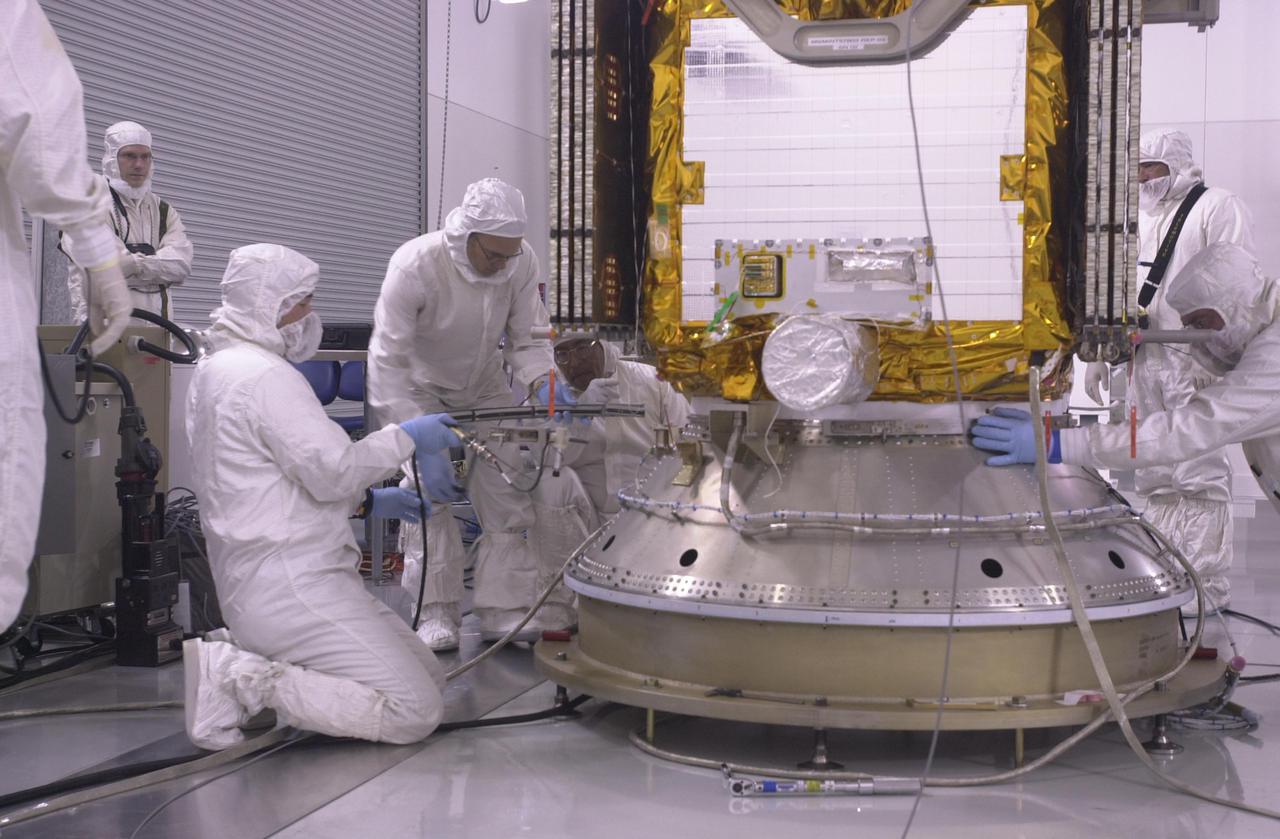
VANDENBERG AIR FORCE BASE, CALIF. — Inside the Astrotech Payload Processing Facility on Vandenberg Air Force Base in California, workers get ready to attach the CALIPSO spacecraft to the upper Delta Payload Attach Fitting (UDPAF). Later the UDPAF will be mated with the lower Delta Payload Attach Fitting, which contains the CloudSat satellite. The PAF is the interface between the spacecraft and the second stage of the rocket. CALIPSO stands for Cloud-Aerosol Lidar and Infrared Pathfinder Satellite Observation. CALIPSO and CloudSat are highly complementary satellites that will provide never-before-seen 3-D perspectives of how clouds and aerosols form, evolve, and affect weather and climate. CALIPSO and CloudSat will fly in formation with three other satellites in the A-train constellation to enhance understanding of our climate system. Launch of CALIPSO_CloudSat aboard a Boeing Delta II rocket is scheduled for 3:01 a.m. PDT Sept. 29.
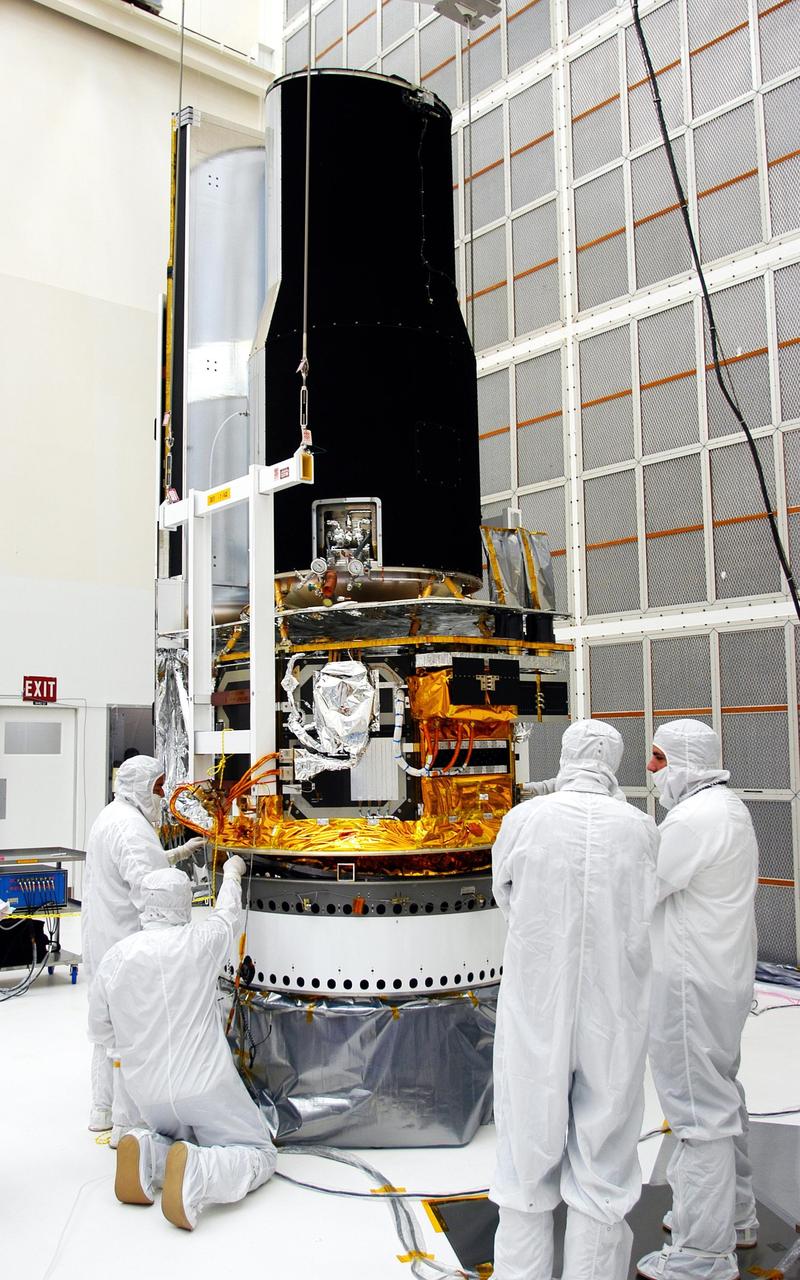
KENNEDY SPACE CENTER, FLA. - Workers in Building AE check the fitting of the Space Infrared Telescope Facility (SIRTF) with the payload attach fitting beneath. SIRTF will be mated with its Delta II launch vehicle via the fitting. SIRTF is currently scheduled for transportation to Launch Complex 17-B, Cape Canaveral Air Force Station, and hoisting atop the Delta II on or about April 4.
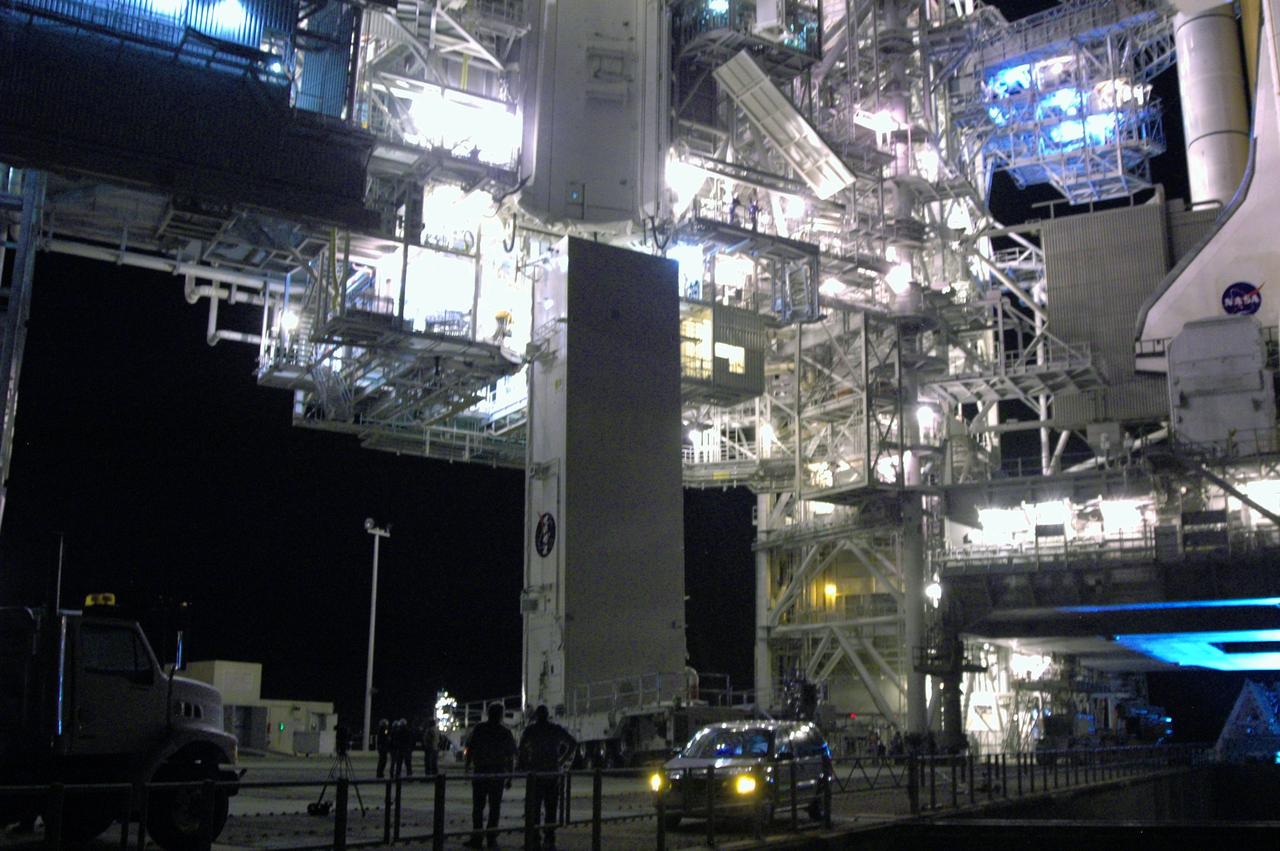
CAPE CANAVERAL, Fla. - On Launch Pad 39A at NASA's Kennedy Space Center, the payload canister is ready for another attempt to be lifted to the payload changeout room. The first attempt encountered problems when Teflon pads on “shoes” attached to the outside of the canister that go onto guide rails to help the canister into the room didn’t fit properly. The two shoes were removed, slightly shaved down so that they would fit into the rails and put back on the canister. The changeout room is the enclosed, environmentally controlled portion of the rotating service structure that supports cargo delivery to the pad and subsequent vertical installation into the shuttle’s payload bay. Launch of Atlantis is targeted for Oct. 10. Photo credit: NASA/Jim Grossmann
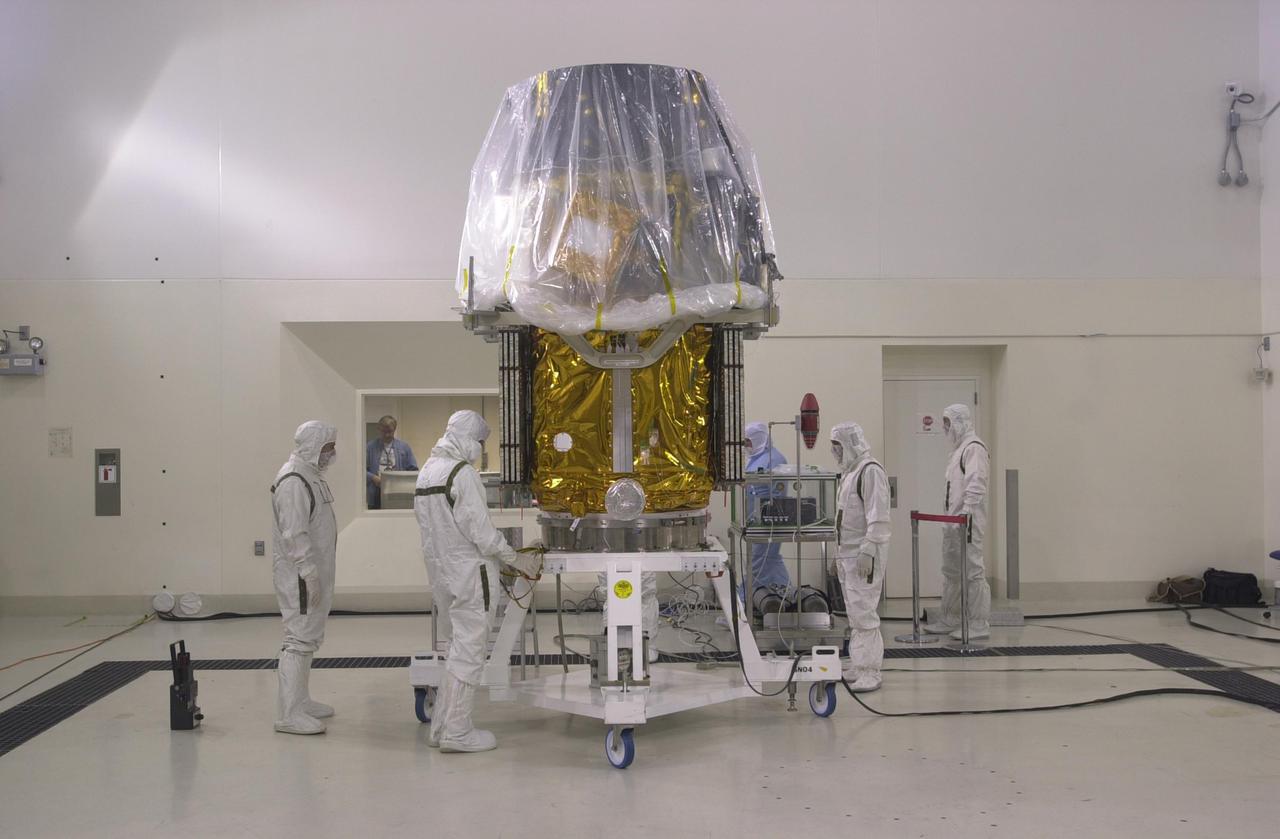
VANDENBERG AIR FORCE BASE, CALIF. — Inside the Astrotech Payload Processing Facility on Vandenberg Air Force Base in California, the CALIPSO spacecraft is being prepared for mating with the upper Delta Payload Attach Fitting (UDPAF). Later the UDPAF will be mated with the lower Delta Payload Attach Fitting, which contains the CloudSat satellite. The PAF is the interface between the spacecraft and the second stage of the rocket. CALIPSO stands for Cloud-Aerosol Lidar and Infrared Pathfinder Satellite Observation. CALIPSO and CloudSat are highly complementary satellites that will provide never-before-seen 3-D perspectives of how clouds and aerosols form, evolve, and affect weather and climate. CALIPSO and CloudSat will fly in formation with three other satellites in the A-train constellation to enhance understanding of our climate system. Launch of CALIPSO_CloudSat aboard a Boeing Delta II rocket is scheduled for 3:01 a.m. PDT Sept. 29.
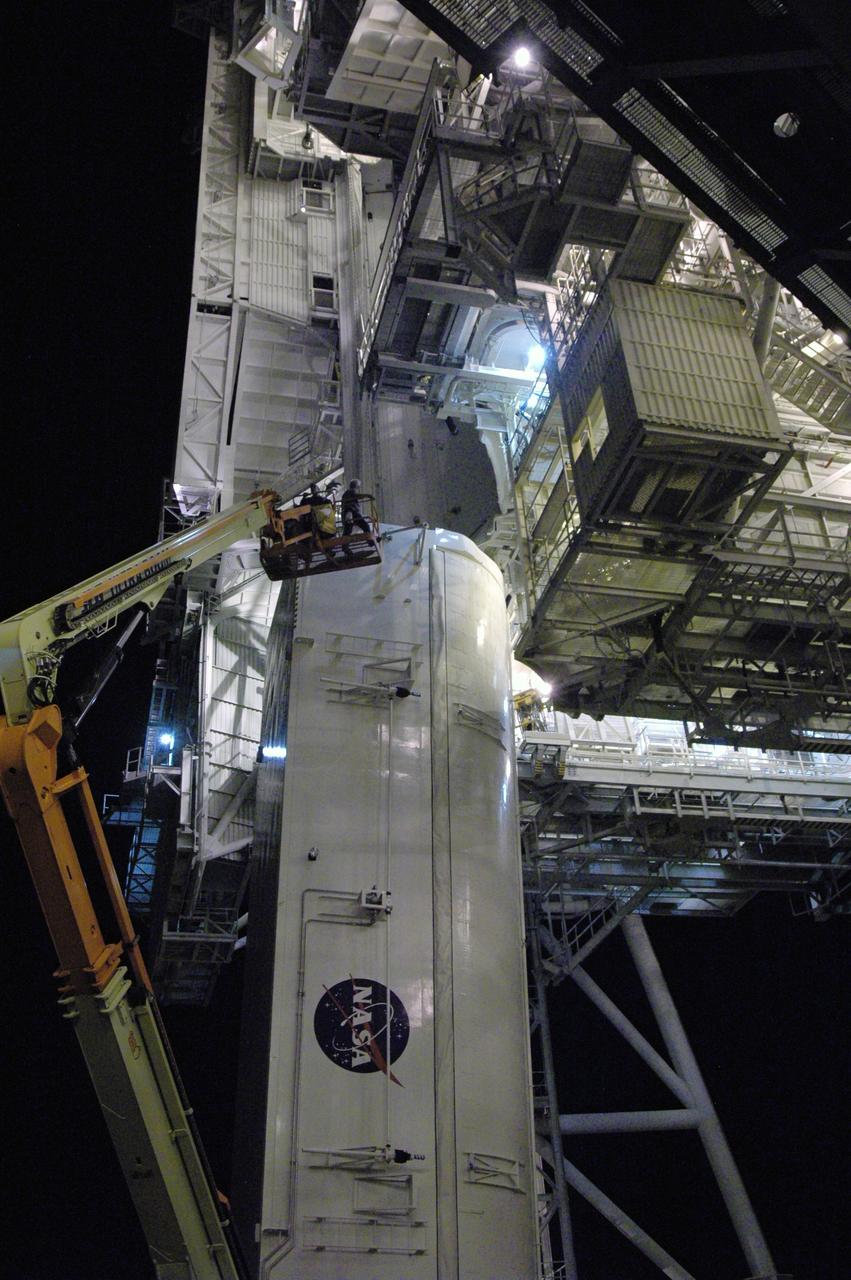
CAPE CANAVERAL, Fla. - On Launch Pad 39A at NASA's Kennedy Space Center, workers on the crane prepare to attach adjusted guide shoes onto the outside of the payload canister for a second lift to the payload changeout room. The first attempt encountered problems when Teflon pads on “shoes” attached to the outside of the canister that go onto guide rails to help the canister into the room didn’t fit properly. The two shoes were removed, slightly shaved down so that they would fit into the rails and put back on the canister. The changeout room is the enclosed, environmentally controlled portion of the rotating service structure that supports cargo delivery to the pad and subsequent vertical installation into the shuttle’s payload bay. Launch of Atlantis is targeted for Oct. 10. Photo credit: NASA/Jim Grossmann
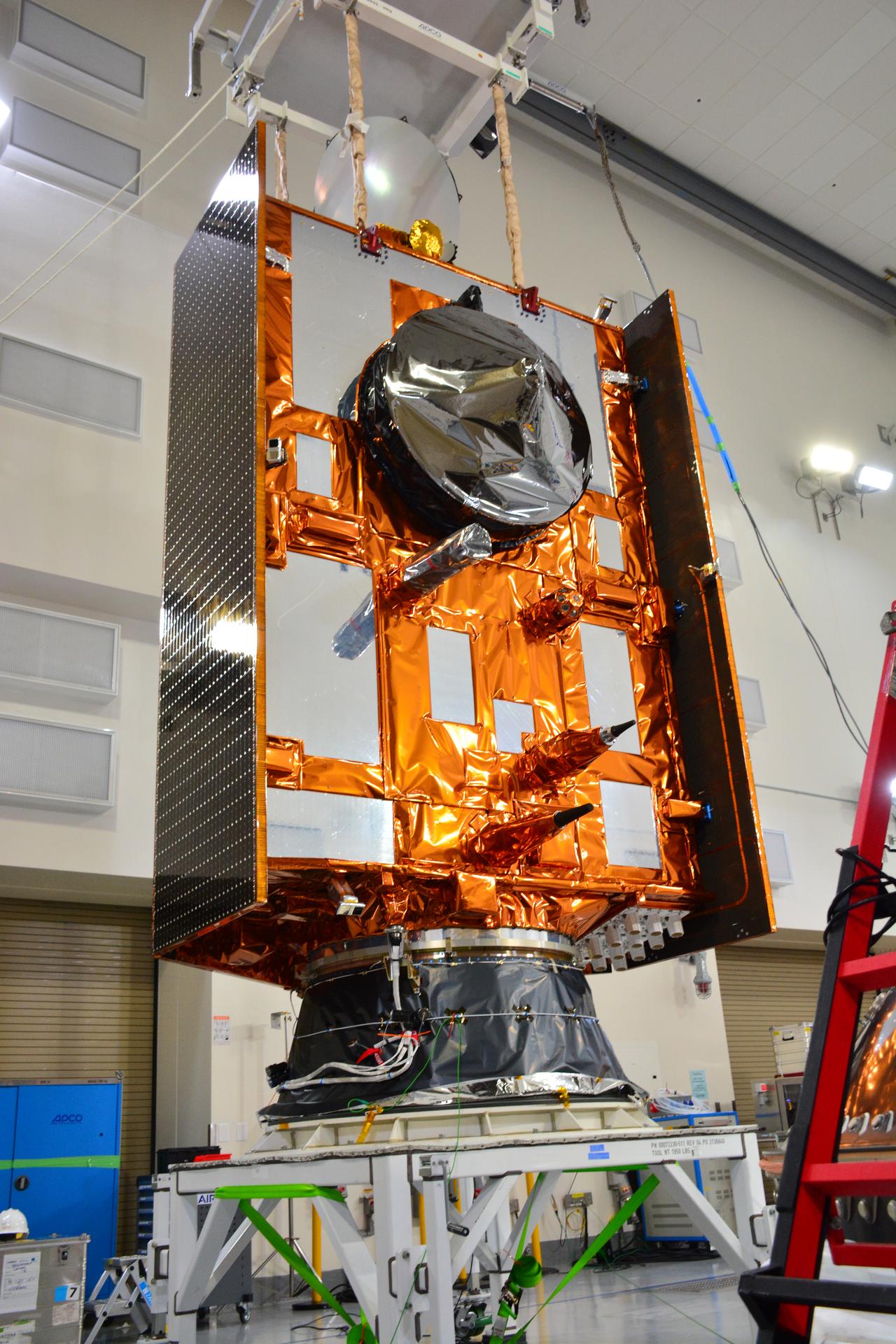
Technicians integrate the Sentinel-6B spacecraft to the payload attach fitting inside the Astrotech Space Operations payload processing facility at Vandenberg Space Force Base in California on Wednesday, Nov. 5, 2025. The payload attach fitting is part of the system that connects Sentinel-6B to the second stage of the SpaceX Falcon 9 rocket that will carry it to orbit. A collaboration between NASA, ESA (European Space Agency), EUMETSAT (European Organisation for the Exploitation of Meteorological Satellites), and the National Oceanic and Atmospheric Administration (NOAA), Sentinel-6B is designed to measure sea levels down to roughly an inch for about 90% of the world’s oceans. NASA is targeting launch no earlier than Sunday, Nov. 16, on a SpaceX Falcon 9 rocket from Space Launch Complex 4 East at Vandenberg.
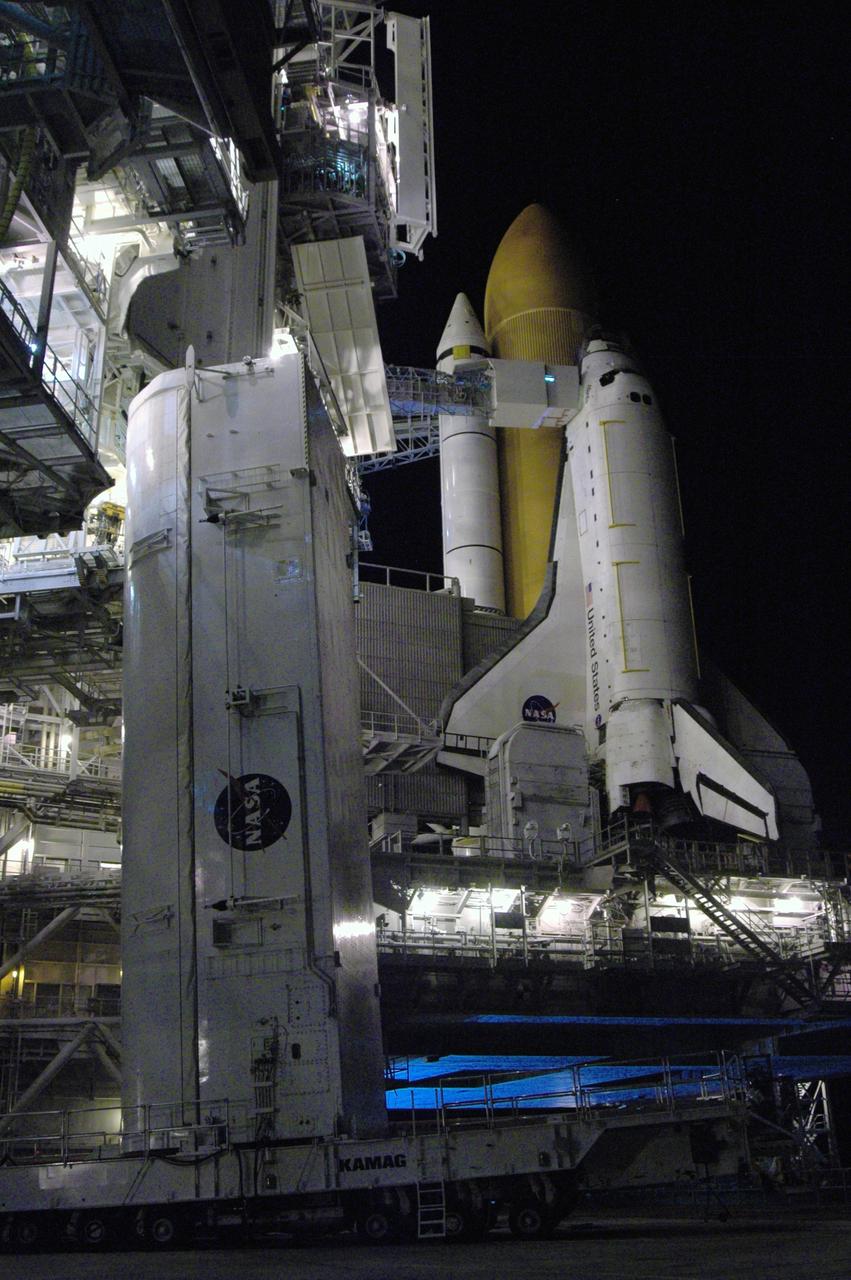
CAPE CANAVERAL, Fla. - On Launch Pad 39A at NASA's Kennedy Space Center, the payload canister waits for adjusted guide shoes to be attached before being lifted to the payload changeout room for the second time. The first attempt encountered problems when Teflon pads on “shoes” attached to the outside of the canister that go onto guide rails to help the canister into the room didn’t fit properly. The two shoes were removed, slightly shaved down so that they would fit into the rails and put back on the canister. The changeout room is the enclosed, environmentally controlled portion of the rotating service structure that supports cargo delivery to the pad and subsequent vertical installation into the shuttle’s payload bay. Launch of Atlantis is targeted for Oct. 10. Photo credit: NASA/Jim Grossmann
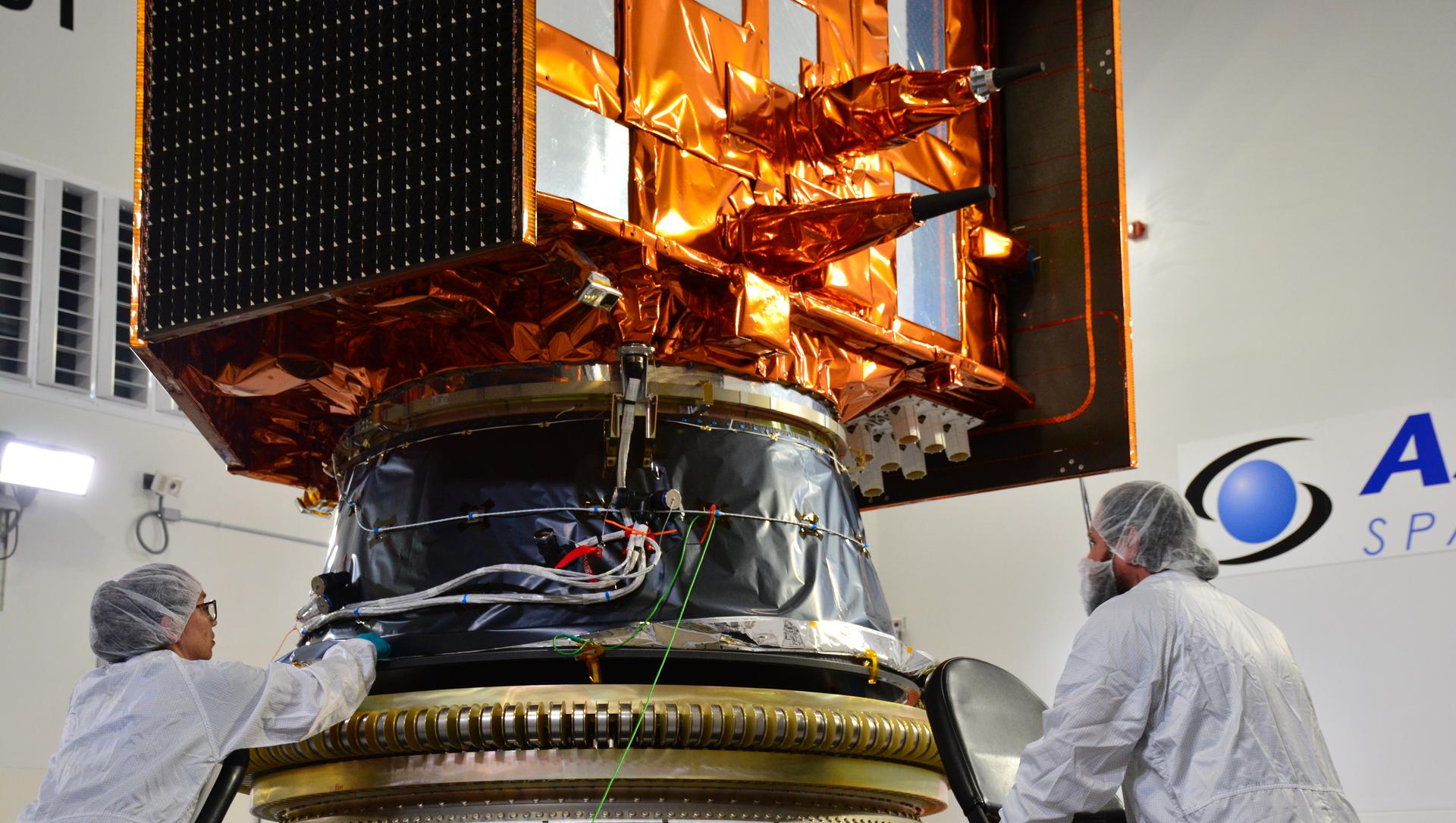
Technicians integrate the Sentinel-6B spacecraft to the payload attach fitting inside the Astrotech Space Operations payload processing facility at Vandenberg Space Force Base in California on Wednesday, Nov. 5, 2025. The payload attach fitting is part of the system that connects Sentinel-6B to the second stage of the SpaceX Falcon 9 rocket that will carry it to orbit. A collaboration between NASA, ESA (European Space Agency), EUMETSAT (European Organisation for the Exploitation of Meteorological Satellites), and the National Oceanic and Atmospheric Administration (NOAA), Sentinel-6B is designed to measure sea levels down to roughly an inch for about 90% of the world’s oceans. NASA is targeting launch no earlier than Sunday, Nov. 16, on a SpaceX Falcon 9 rocket from Space Launch Complex 4 East at Vandenberg.
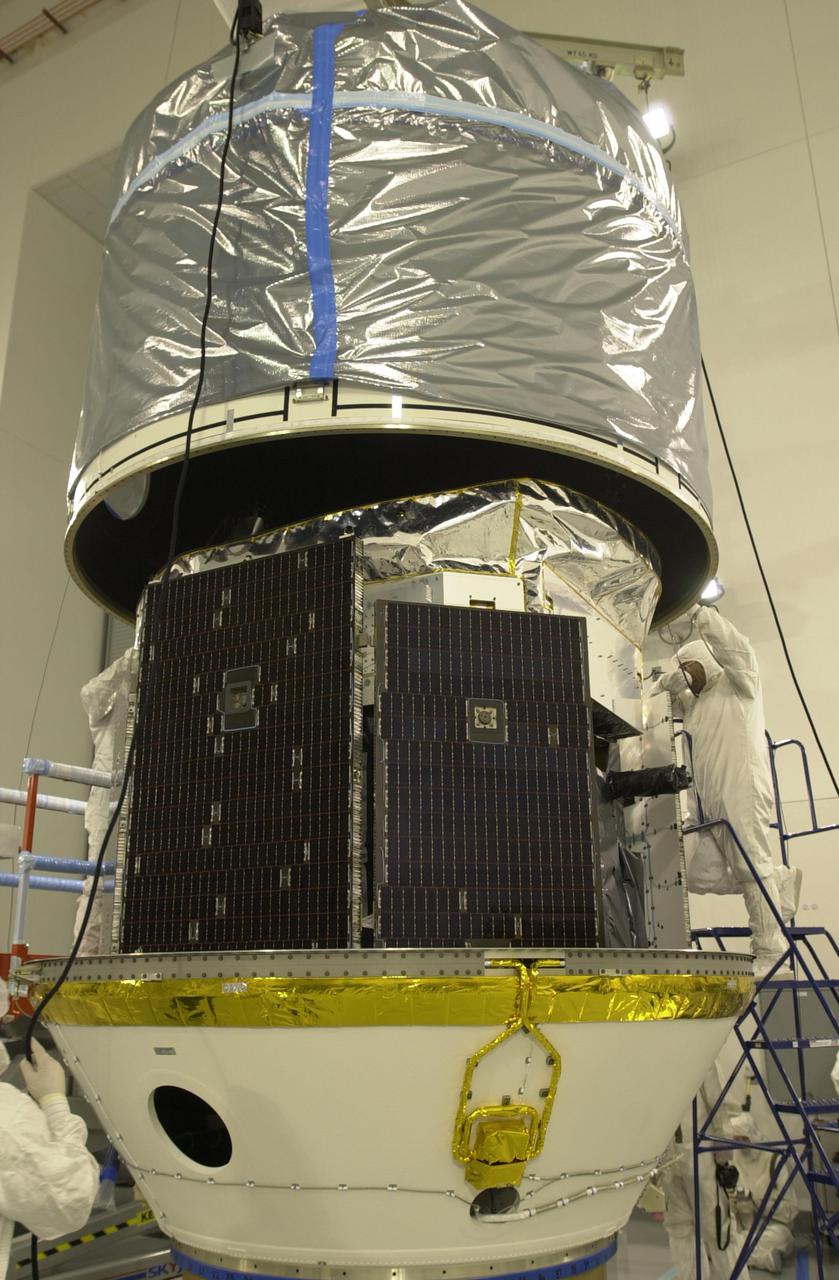
VANDENBERG AIR FORCE BASE, CALIF. - Inside the Astrotech Payload Processing Facility on Vandenberg Air Force Base in California, the upper Delta Payload Attach Fitting (UDPAF) is lowered toward the lower Delta Payload Attach Fitting (LDPAF). The LDPAF holds the CloudSat satellite and the UDPAF will hold the CALIPSO satellite. The two sections will be mated. CALIPSO stands for Cloud-Aerosol Lidar and Infrared Pathfinder Satellite Observation. CALIPSO and CloudSat are highly complementary satellites that will provide never-before-seen 3-D perspectives of how clouds and aerosols form, evolve, and affect weather and climate. CALIPSO and CloudSat will fly in formation with three other satellites in the A-train constellation to enhance understanding of our climate system. Launch of CALIPSO_CloudSat aboard a Boeing Delta II rocket is scheduled for 3:01 a.m. PDT Sept. 29.
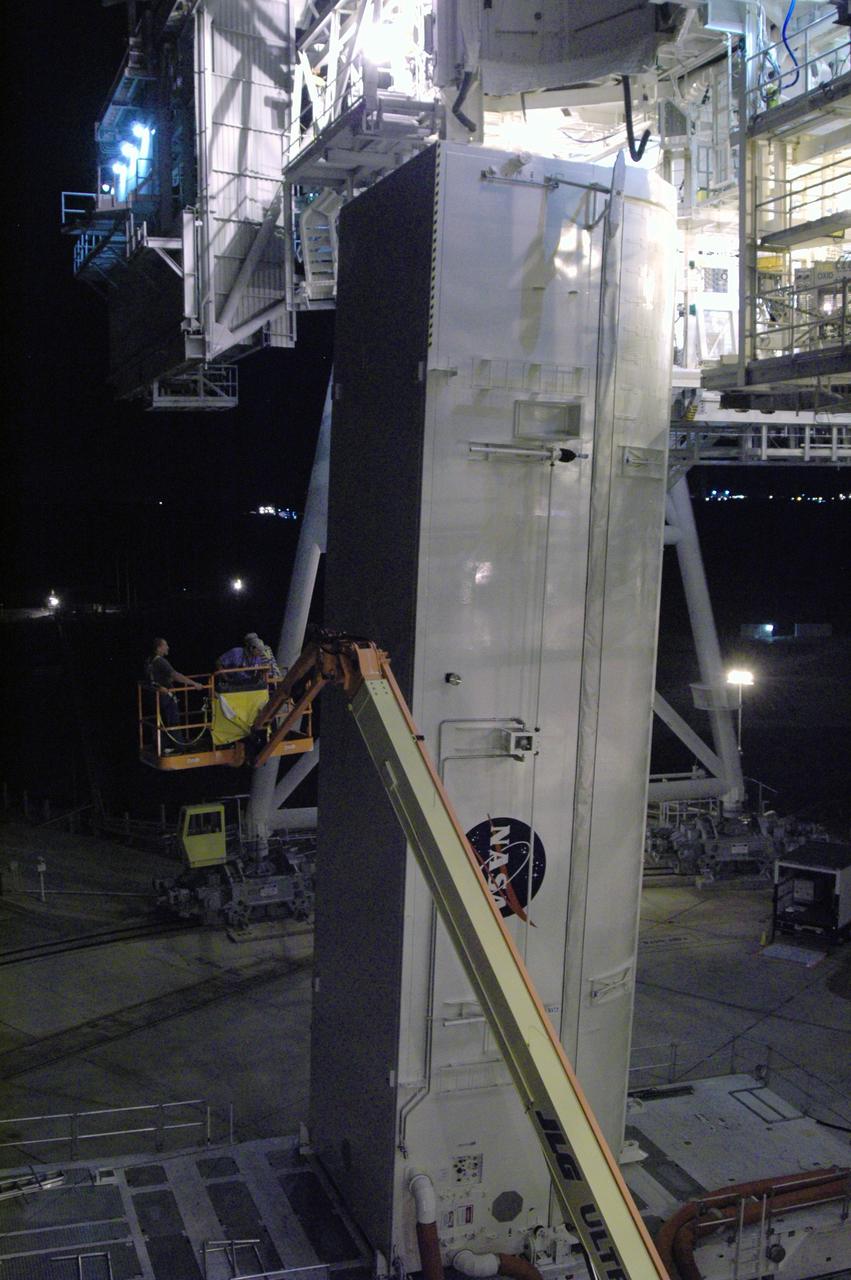
CAPE CANAVERAL, Fla. - On Launch Pad 39A at NASA's Kennedy Space Center, workers on a crane have completed attaching adjusted guide shoes onto the outside of the payload canister for attempt at a second lift into the payload changeout room. The first attempt encountered problems when Teflon pads on “shoes” attached to the outside of the canister that go onto guide rails to help the canister into the room didn’t fit properly. The two shoes were removed, slightly shaved down so that they would fit into the rails and put back on the canister. The changeout room is the enclosed, environmentally controlled portion of the rotating service structure that supports cargo delivery to the pad and subsequent vertical installation into the shuttle’s payload bay. Launch of Atlantis is targeted for Oct. 10. Photo credit: NASA/Jim Grossmann
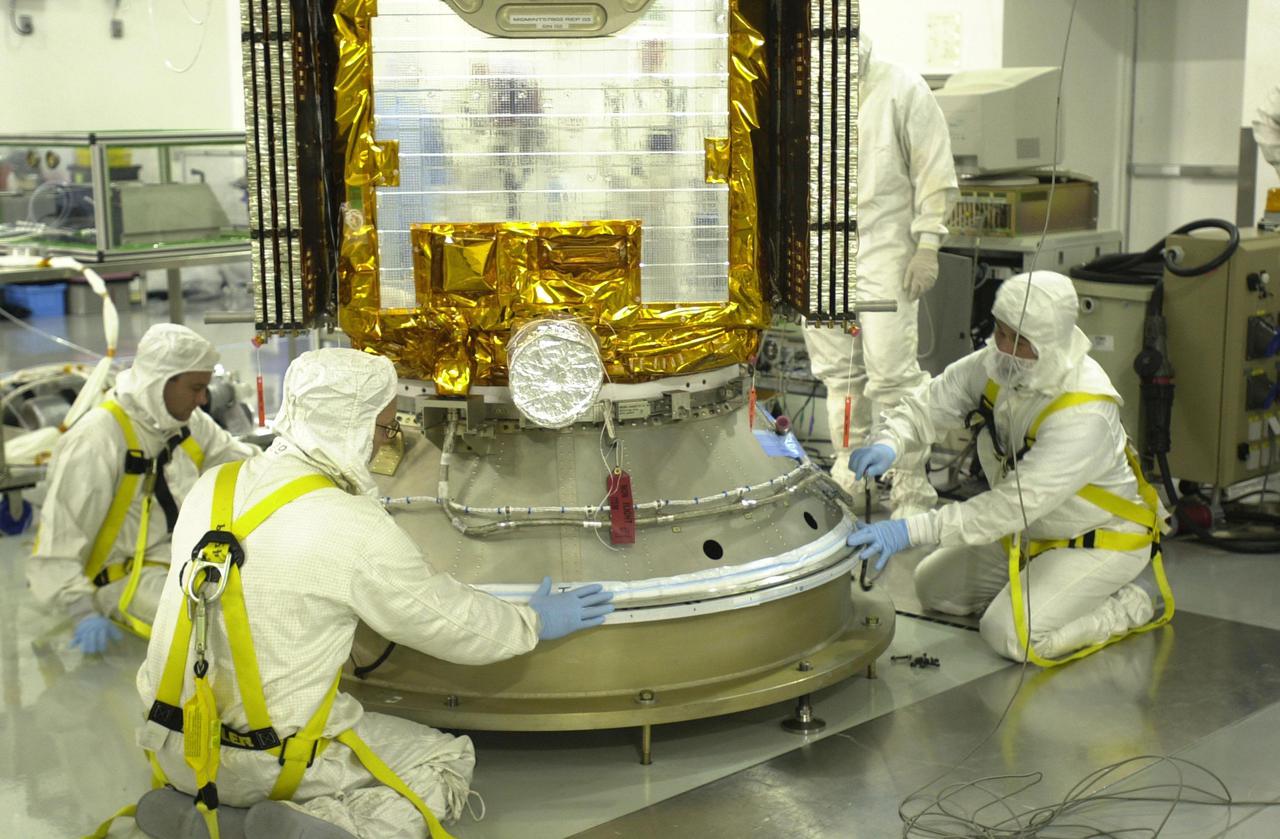
VANDENBERG AIR FORCE BASE, CALIF. - Inside the Astrotech Payload Processing Facility on Vandenberg Air Force Base in California, workers secure the CALIPSO spacecraft onto a payload attach fitting. CALIPSO will be mated to the Lower Delta Payload Attach Fitting (LDPAF) that contains the CloudSat satellite. The PAF is the interface between the spacecraft and the second stage of the rocket. CALIPSO stands for Cloud-Aerosol Lidar and Infrared Pathfinder Satellite Observation. CALIPSO and CloudSat are highly complementary satellites that will provide never-before-seen 3-D perspectives of how clouds and aerosols form, evolve, and affect weather and climate. CALIPSO and CloudSat will fly in formation with three other satellites in the A-train constellation to enhance understanding of our climate system. Launch of CALIPSO_CloudSat aboard a Boeing Delta II rocket is scheduled for 3:01 a.m. PDT Sept. 29.
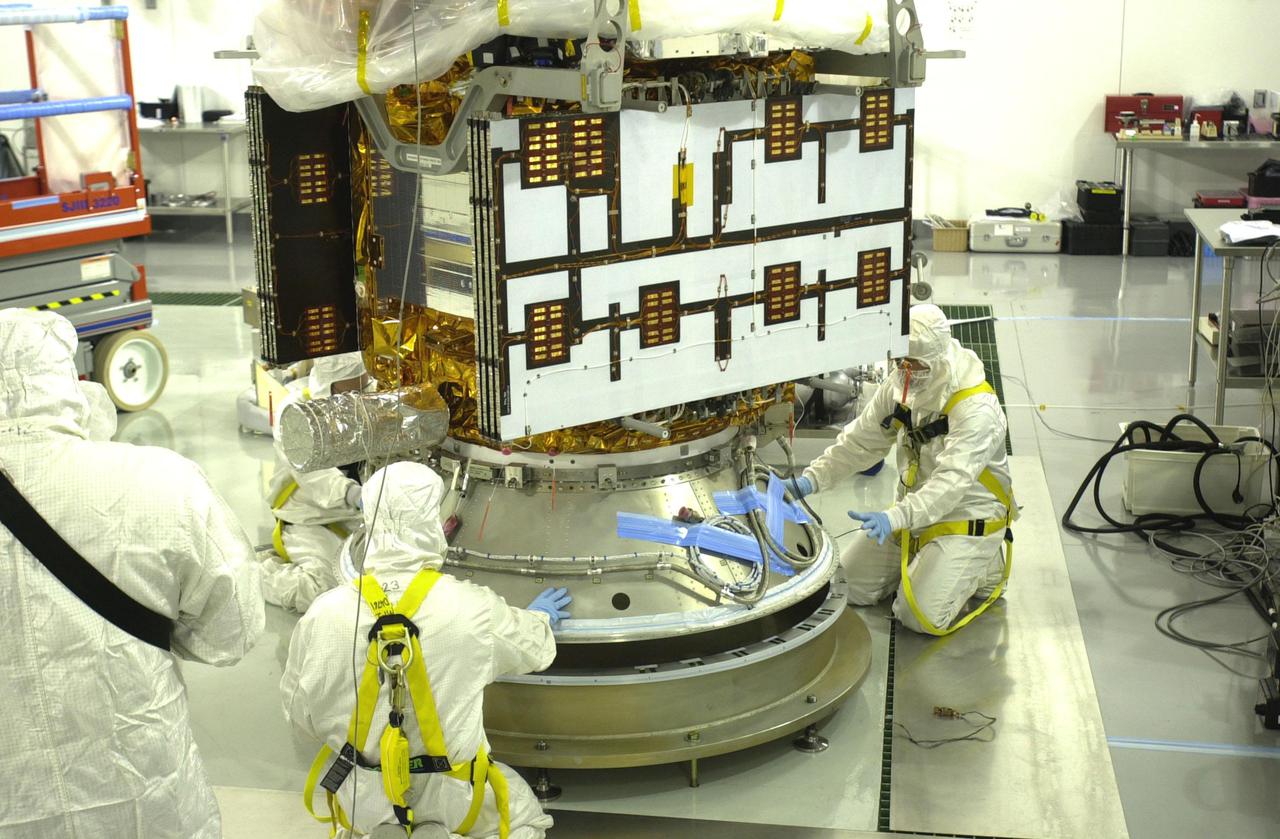
VANDENBERG AIR FORCE BASE, CALIF. - Inside the Astrotech Payload Processing Facility on Vandenberg Air Force Base in California, workers help guide the CALIPSO spacecraft as it is lowered onto a payload attach fitting. CALIPSO will be mated to the Lower Delta Payload Attach Fitting (LDPAF) that contains the CloudSat satellite. The PAF is the interface between the spacecraft and the second stage of the rocket. CALIPSO stands for Cloud-Aerosol Lidar and Infrared Pathfinder Satellite Observation. CALIPSO and CloudSat are highly complementary satellites that will provide never-before-seen 3-D perspectives of how clouds and aerosols form, evolve, and affect weather and climate. CALIPSO and CloudSat will fly in formation with three other satellites in the A-train constellation to enhance understanding of our climate system. Launch of CALIPSO_CloudSat aboard a Boeing Delta II rocket is scheduled for 3:01 a.m. PDT Sept. 29.
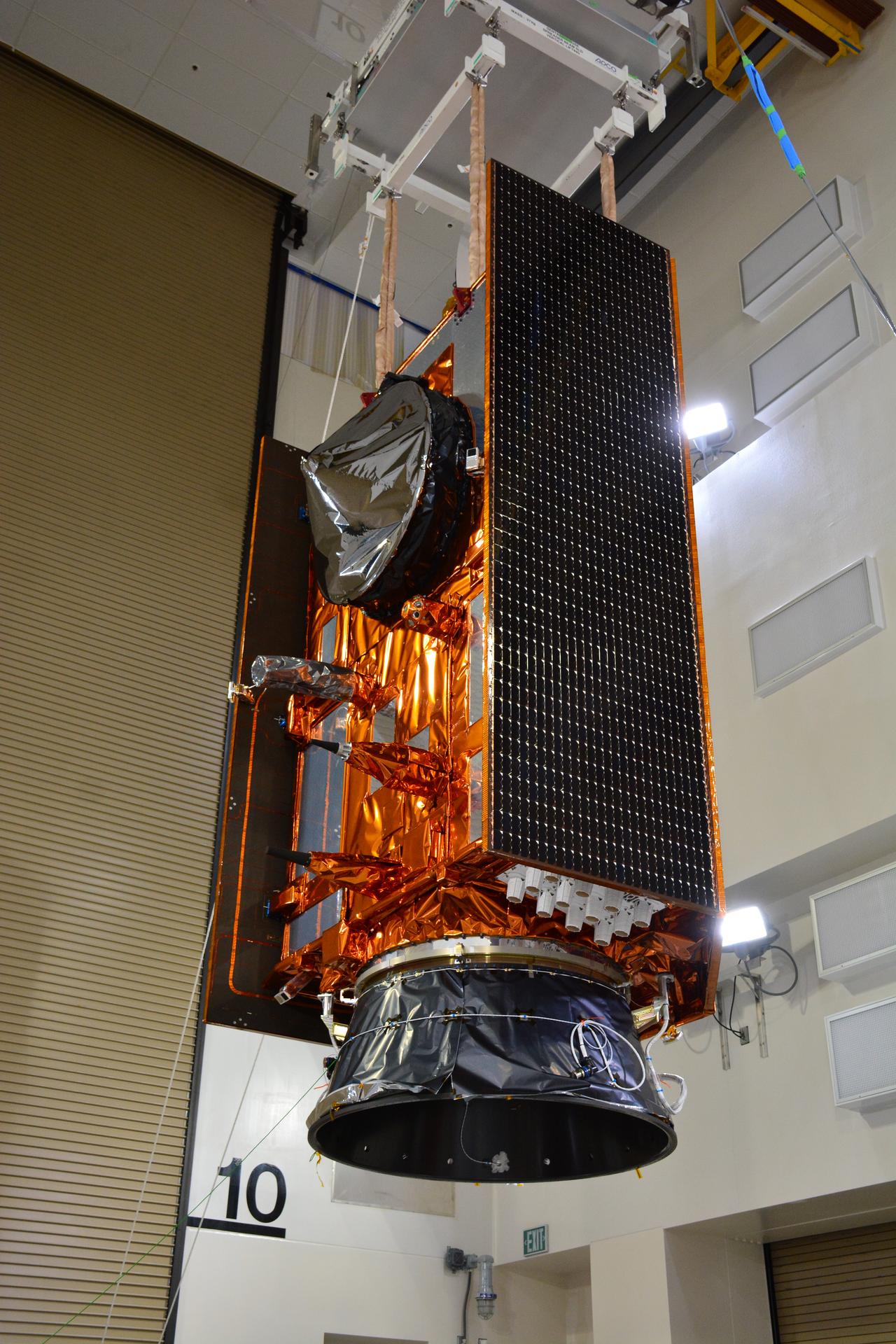
Technicians integrate the Sentinel-6B spacecraft to the payload attach fitting inside the Astrotech Space Operations payload processing facility at Vandenberg Space Force Base in California on Wednesday, Nov. 5, 2025. The payload attach fitting is part of the system that connects Sentinel-6B to the second stage of the SpaceX Falcon 9 rocket that will carry it to orbit. A collaboration between NASA, ESA (European Space Agency), EUMETSAT (European Organisation for the Exploitation of Meteorological Satellites), and the National Oceanic and Atmospheric Administration (NOAA), Sentinel-6B is designed to measure sea levels down to roughly an inch for about 90% of the world’s oceans. NASA is targeting launch no earlier than Sunday, Nov. 16, on a SpaceX Falcon 9 rocket from Space Launch Complex 4 East at Vandenberg.
VANDENBERG AIR FORCE BASE, CALIF. - Inside the Astrotech Payload Processing Facility on Vandenberg Air Force Base in California, the upper Delta Payload Attach Fitting (UDPAF) is lowered toward the lower Delta Payload Attach Fitting (LDPAF). The LDPAF holds the CloudSat satellite and the UDPAF will hold the CALIPSO satellite. The two sections will be mated. CALIPSO stands for Cloud-Aerosol Lidar and Infrared Pathfinder Satellite Observation. CALIPSO and CloudSat are highly complementary satellites that will provide never-before-seen 3-D perspectives of how clouds and aerosols form, evolve, and affect weather and climate. CALIPSO and CloudSat will fly in formation with three other satellites in the A-train constellation to enhance understanding of our climate system. Launch of CALIPSO_CloudSat aboard a Boeing Delta II rocket is scheduled for 3:01 a.m. PDT Sept. 29.
VANDENBERG AIR FORCE BASE, CALIF. — Inside the Astrotech Payload Processing Facility on Vandenberg Air Force Base in California, the CALIPSO spacecraft (background, left) is ready for mating with the upper Delta Payload Attach Fitting (UDPAF). Later the UDPAF will be mated with the lower Delta Payload Attach Fitting, which contains the CloudSat satellite. The PAF is the interface between the spacecraft and the second stage of the rocket. CALIPSO stands for Cloud-Aerosol Lidar and Infrared Pathfinder Satellite Observation. CALIPSO and CloudSat are highly complementary satellites that will provide never-before-seen 3-D perspectives of how clouds and aerosols form, evolve, and affect weather and climate. CALIPSO and CloudSat will fly in formation with three other satellites in the A-train constellation to enhance understanding of our climate system. Launch of CALIPSO_CloudSat aboard a Boeing Delta II rocket is scheduled for 3:01 a.m. PDT Sept. 29.

CAPE CANAVERAL, Fla. - A view of the adjusted guide shoe attached to the outside of the payload canister on Launch Pad 39A at NASA's Kennedy Space Center. A second attempt will be made to lift the canister to the payload changeout room above. The first attempt encountered problems when Teflon pads on “shoes” attached to the outside of the canister that go onto guide rails to help the canister into the room didn’t fit properly. The two shoes were removed, slightly shaved down so that they would fit into the rails and put back on the canister. The changeout room is the enclosed, environmentally controlled portion of the rotating service structure that supports cargo delivery to the pad and subsequent vertical installation into the shuttle’s payload bay. Launch of Atlantis is targeted for Oct. 10. Photo credit: NASA/Jim Grossmann
VANDENBERG AIR FORCE BASE, CALIF. - Inside the Astrotech Payload Processing Facility on Vandenberg Air Force Base in California, the upper Delta Payload Attach Fitting (UDPAF) has been mated with the lower Delta Payload Attach Fitting (LDPAF). The LDPAF holds the CloudSat satellite and the UDPAF will hold the CALIPSO satellite. CALIPSO stands for Cloud-Aerosol Lidar and Infrared Pathfinder Satellite Observation. CALIPSO and CloudSat are highly complementary satellites that will provide never-before-seen 3-D perspectives of how clouds and aerosols form, evolve, and affect weather and climate. CALIPSO and CloudSat will fly in formation with three other satellites in the A-train constellation to enhance understanding of our climate system. Launch of CALIPSO_CloudSat aboard a Boeing Delta II rocket is scheduled for 3:01 a.m. PDT Sept. 29.
VANDENBERG AIR FORCE BASE, CALIF. — Inside the Astrotech Payload Processing Facility on Vandenberg Air Force Base in California, workers prepare the CALIPSO spacecraft for lifting. CALIPSO will be mated with the upper Delta Payload Attach Fitting (UDPAF). Later the UDPAF will be mated with the lower Delta Payload Attach Fitting, which contains the CloudSat satellite. The PAF is the interface between the spacecraft and the second stage of the rocket. CALIPSO stands for Cloud-Aerosol Lidar and Infrared Pathfinder Satellite Observation. CALIPSO and CloudSat are highly complementary satellites that will provide never-before-seen 3-D perspectives of how clouds and aerosols form, evolve, and affect weather and climate. CALIPSO and CloudSat will fly in formation with three other satellites in the A-train constellation to enhance understanding of our climate system. Launch of CALIPSO_CloudSat aboard a Boeing Delta II rocket is scheduled for 3:01 a.m. PDT Sept. 29.

CAPE CANAVERAL, Fla. - On Launch Pad 39A at NASA's Kennedy Space Center, workers on a crane attach adjusted guide shoes onto the outside of the payload canister for attempt at a second lift to the payload changeout room. The first attempt encountered problems when Teflon pads on “shoes” attached to the outside of the canister that go onto guide rails to help the canister into the room didn’t fit properly. The two shoes were removed, slightly shaved down so that they would fit into the rails and put back on the canister. The changeout room is the enclosed, environmentally controlled portion of the rotating service structure that supports cargo delivery to the pad and subsequent vertical installation into the shuttle’s payload bay. Launch of Atlantis is targeted for Oct. 10. Photo credit: NASA/Jim Grossmann
VANDENBERG AIR FORCE BASE, CALIF. — Inside the Astrotech Payload Processing Facility on Vandenberg Air Force Base in California, the CALIPSO spacecraft is being prepared for mating with the upper Delta Payload Attach Fitting (UDPAF). Later the UDPAF will be mated with the lower Delta Payload Attach Fitting, which contains the CloudSat satellite. The PAF is the interface between the spacecraft and the second stage of the rocket. CALIPSO stands for Cloud-Aerosol Lidar and Infrared Pathfinder Satellite Observation. CALIPSO and CloudSat are highly complementary satellites that will provide never-before-seen 3-D perspectives of how clouds and aerosols form, evolve, and affect weather and climate. CALIPSO and CloudSat will fly in formation with three other satellites in the A-train constellation to enhance understanding of our climate system. Launch of CALIPSO_CloudSat aboard a Boeing Delta II rocket is scheduled for 3:01 a.m. PDT Sept. 29.
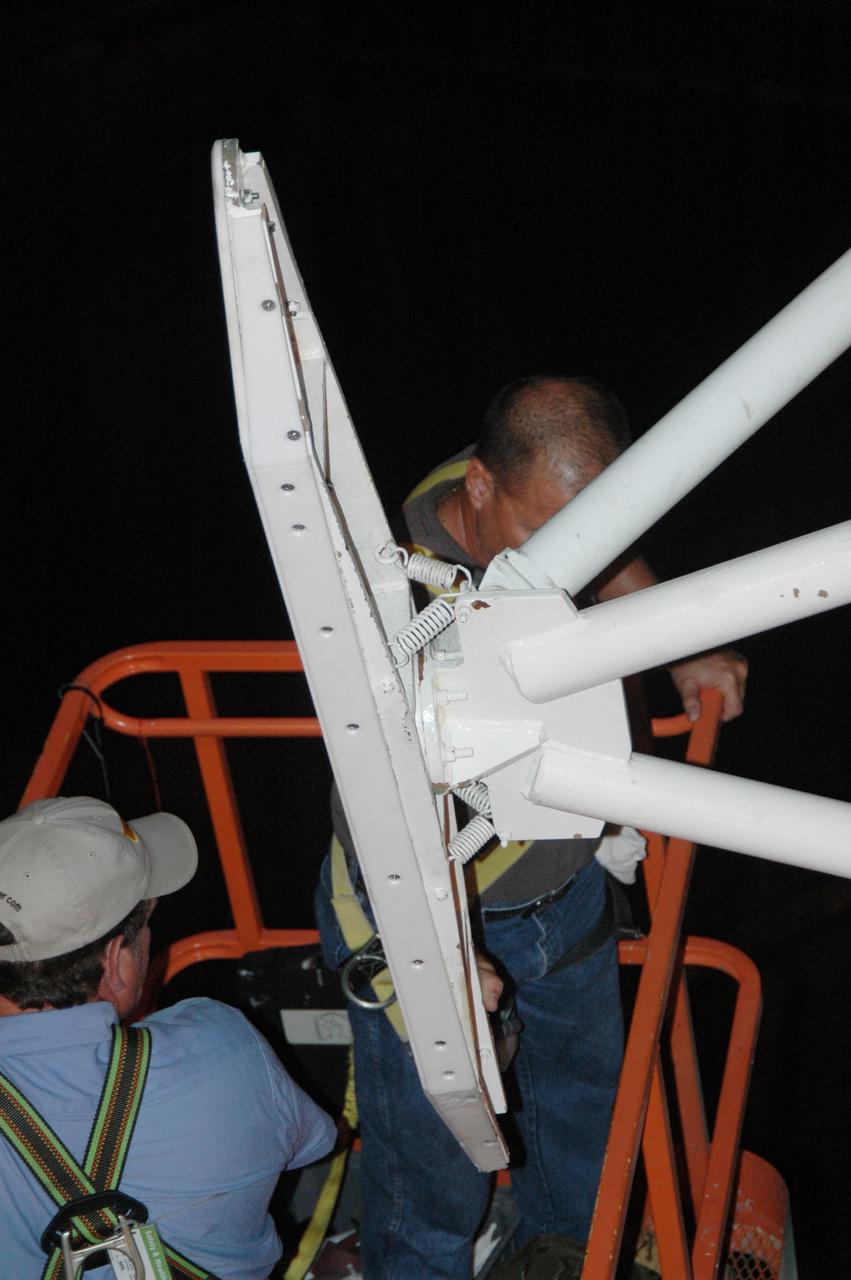
CAPE CANAVERAL, Fla. - On Launch Pad 39A at NASA's Kennedy Space Center, workers on a crane attach adjusted guide shoes onto the outside of the payload canister for attempt at a second lift into the payload changeout room. The first attempt encountered problems when Teflon pads on “shoes” attached to the outside of the canister that go onto guide rails to help the canister into the room didn’t fit properly. The two shoes were removed, slightly shaved down so that they would fit into the rails and put back on the canister. The changeout room is the enclosed, environmentally controlled portion of the rotating service structure that supports cargo delivery to the pad and subsequent vertical installation into the shuttle’s payload bay. Launch of Atlantis is targeted for Oct. 10. Photo credit: NASA/Jim Grossmann
VANDENBERG AIR FORCE BASE, CALIF. — Inside the Astrotech Payload Processing Facility on Vandenberg Air Force Base in California, workers help secure the CALIPSO spacecraft to the upper Delta Payload Attach Fitting (UDPAF). Later the UDPAF will be mated with the lower Delta Payload Attach Fitting, which contains the CloudSat satellite. The PAF is the interface between the spacecraft and the second stage of the rocket. CALIPSO stands for Cloud-Aerosol Lidar and Infrared Pathfinder Satellite Observation. CALIPSO and CloudSat are highly complementary satellites that will provide never-before-seen 3-D perspectives of how clouds and aerosols form, evolve, and affect weather and climate. CALIPSO and CloudSat will fly in formation with three other satellites in the A-train constellation to enhance understanding of our climate system. Launch of CALIPSO_CloudSat aboard a Boeing Delta II rocket is scheduled for 3:01 a.m. PDT Sept. 29.
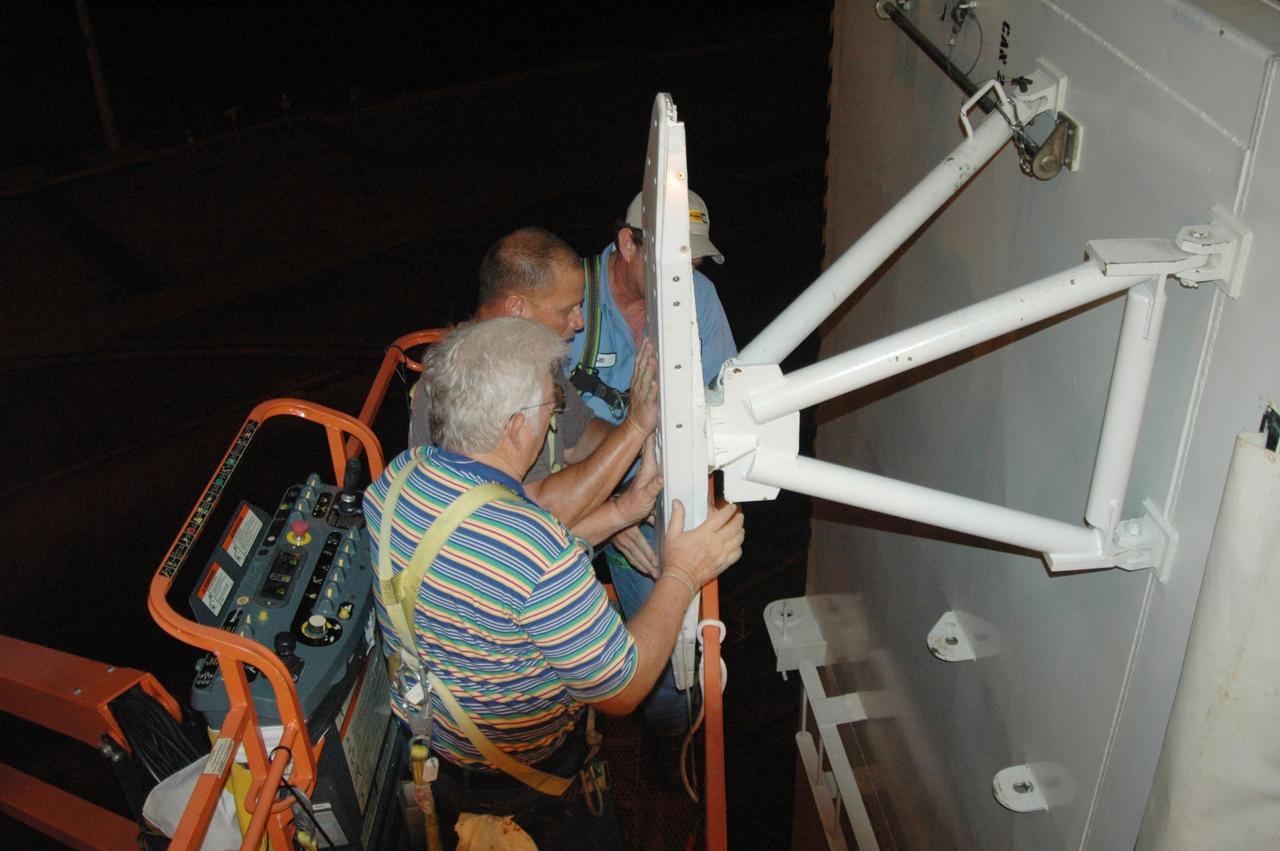
CAPE CANAVERAL, Fla. - On Launch Pad 39A at NASA's Kennedy Space Center, workers on a crane attach adjusted guide shoes onto the outside of the payload canister for attempt at a second lift to the payload changeout room. The first attempt encountered problems when Teflon pads on “shoes” attached to the outside of the canister that go onto guide rails to help the canister into the room didn’t fit properly. The two shoes were removed, slightly shaved down so that they would fit into the rails and put back on the canister. The changeout room is the enclosed, environmentally controlled portion of the rotating service structure that supports cargo delivery to the pad and subsequent vertical installation into the shuttle’s payload bay. Launch of Atlantis is targeted for Oct. 10. Photo credit: NASA/Jim Grossmann
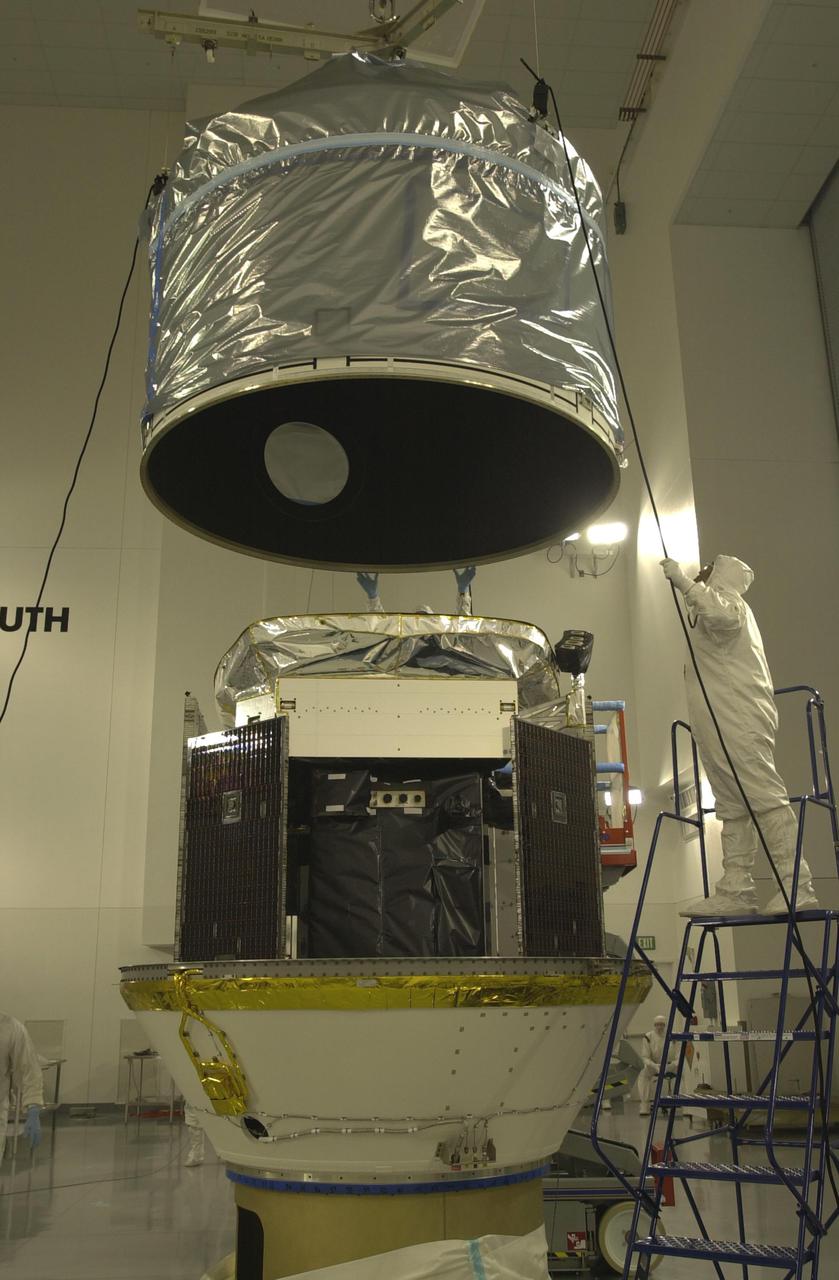
VANDENBERG AIR FORCE BASE, CALIF. - Inside the Astrotech Payload Processing Facility on Vandenberg Air Force Base in California, the upper Delta Payload Attach Fitting (UDPAF) is lowered toward the lower Delta Payload Attach Fitting (LDPAF) at right. The UDPAF will hold the CALIPSO satellite and the LDPAF holds the CloudSat satellite. The two sections will be mated. CALIPSO stands for Cloud-Aerosol Lidar and Infrared Pathfinder Satellite Observation. CALIPSO and CloudSat are highly complementary satellites that will provide never-before-seen 3-D perspectives of how clouds and aerosols form, evolve, and affect weather and climate. CALIPSO and CloudSat will fly in formation with three other satellites in the A-train constellation to enhance understanding of our climate system. Launch of CALIPSO_CloudSat aboard a Boeing Delta II rocket is scheduled for 3:01 a.m. PDT Sept. 29.
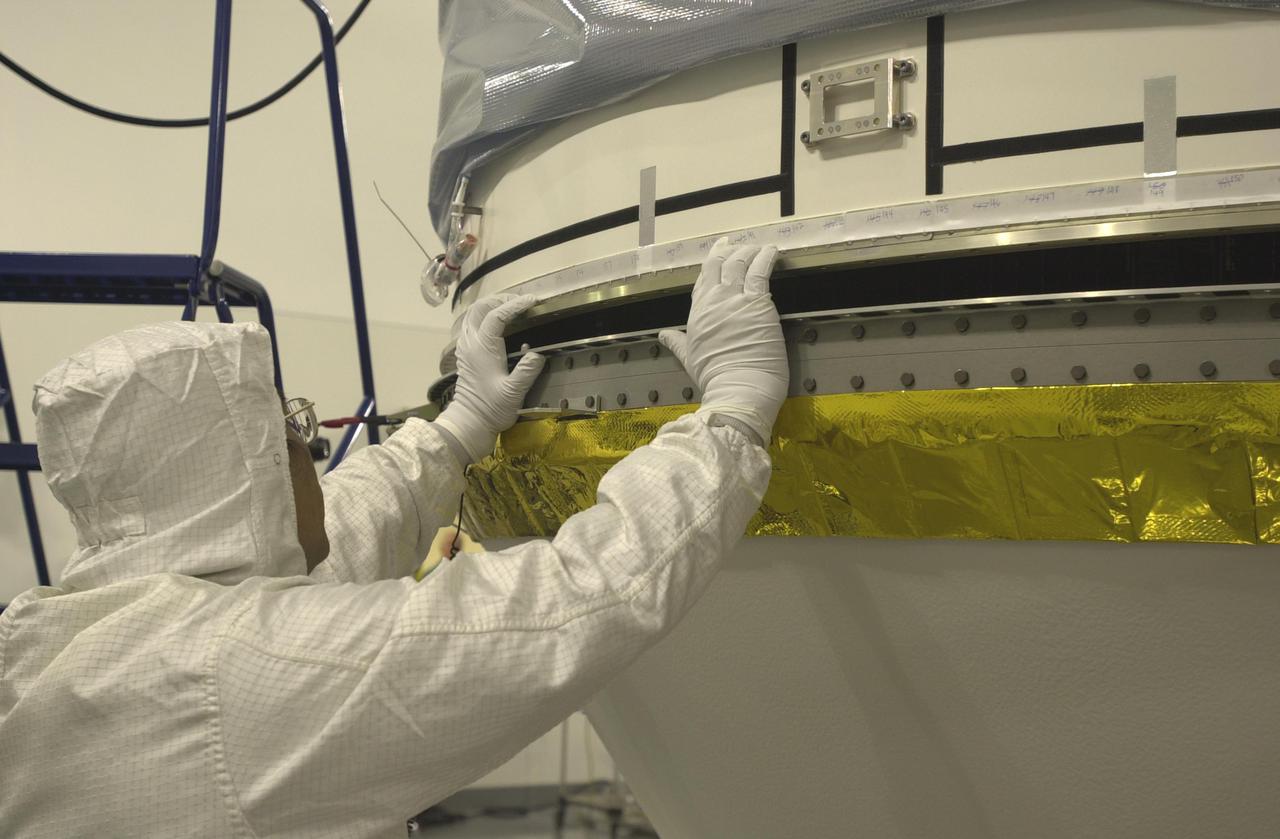
VANDENBERG AIR FORCE BASE, CALIF. - Inside the Astrotech Payload Processing Facility on Vandenberg Air Force Base in California, a worker helps secure the upper Delta Payload Attach Fitting (UDPAF) to the lower Delta Payload Attach Fitting (LDPAF). The LDPAF holds the CloudSat satellite and the UDPAF will hold the CALIPSO satellite. CALIPSO stands for Cloud-Aerosol Lidar and Infrared Pathfinder Satellite Observation. CALIPSO and CloudSat are highly complementary satellites that will provide never-before-seen 3-D perspectives of how clouds and aerosols form, evolve, and affect weather and climate. CALIPSO and CloudSat will fly in formation with three other satellites in the A-train constellation to enhance understanding of our climate system. Launch of CALIPSO_CloudSat aboard a Boeing Delta II rocket is scheduled for 3:01 a.m. PDT Sept. 29.
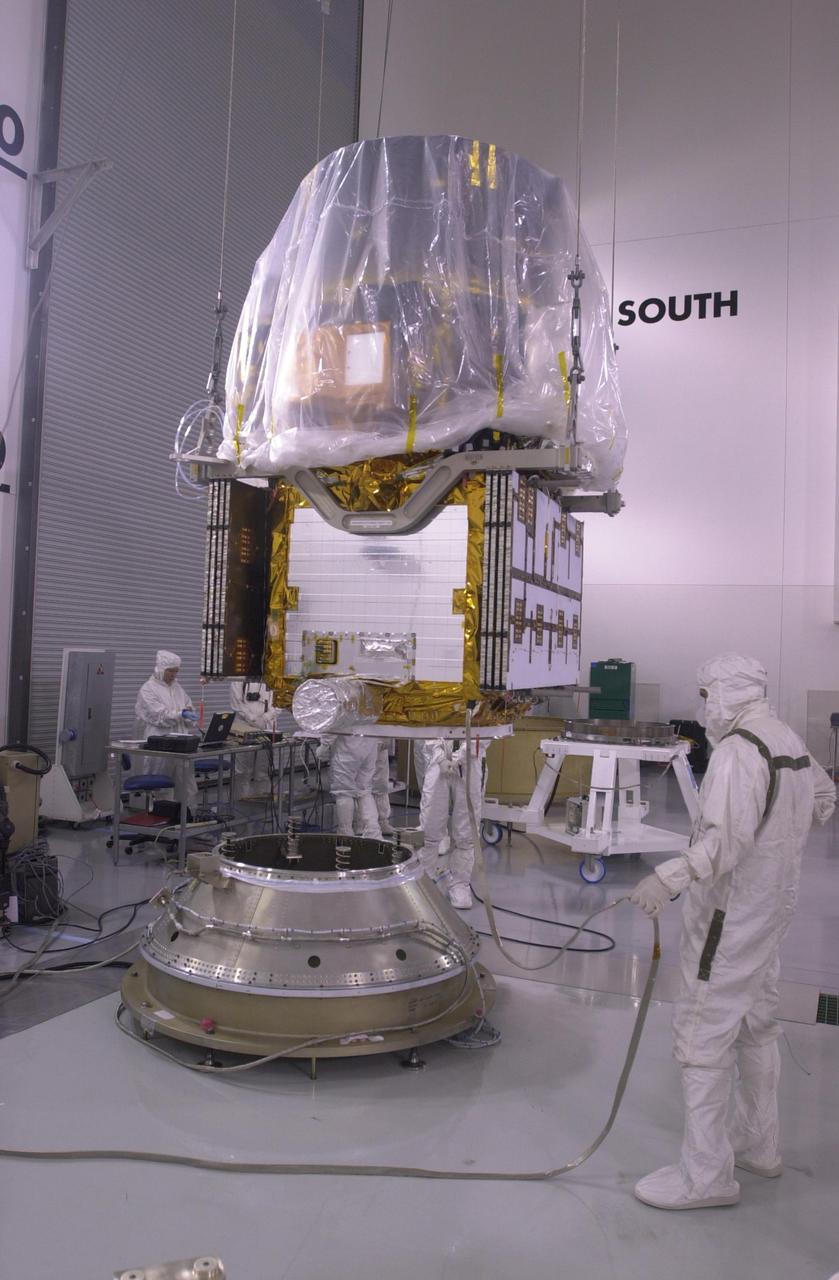
VANDENBERG AIR FORCE BASE, CALIF. — Inside the Astrotech Payload Processing Facility on Vandenberg Air Force Base in California, an overhead crane moves the CALIPSO spacecraft toward the upper Delta Payload Attach Fitting (UDPAF). Later the UDPAF will be mated with the lower Delta Payload Attach Fitting, which contains the CloudSat satellite. The PAF is the interface between the spacecraft and the second stage of the rocket. CALIPSO stands for Cloud-Aerosol Lidar and Infrared Pathfinder Satellite Observation. CALIPSO and CloudSat are highly complementary satellites that will provide never-before-seen 3-D perspectives of how clouds and aerosols form, evolve, and affect weather and climate. CALIPSO and CloudSat will fly in formation with three other satellites in the A-train constellation to enhance understanding of our climate system. Launch of CALIPSO_CloudSat aboard a Boeing Delta II rocket is scheduled for 3:01 a.m. PDT Sept. 29.
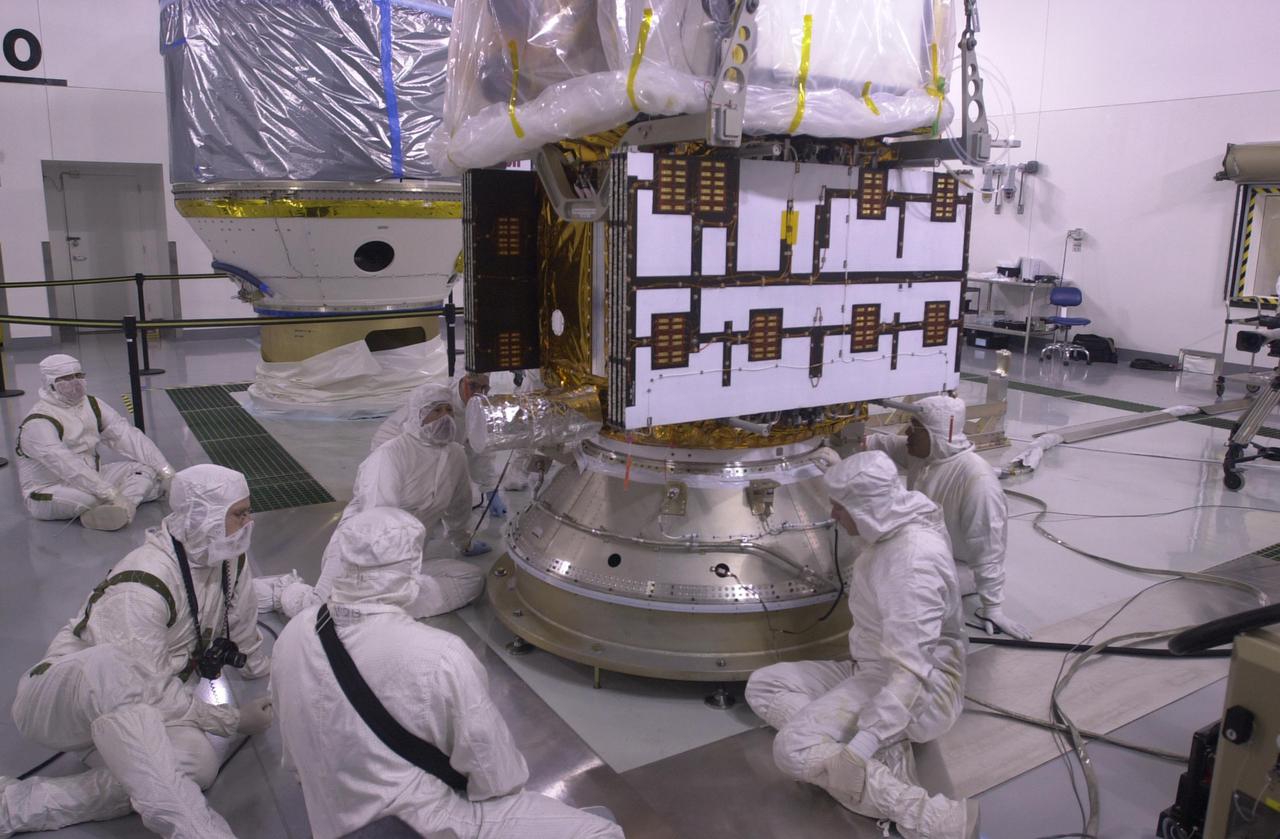
VANDENBERG AIR FORCE BASE, CALIF. — Inside the Astrotech Payload Processing Facility on Vandenberg Air Force Base in California, workers help secure the CALIPSO spacecraft to the upper Delta Payload Attach Fitting (UDPAF). Later the UDPAF will be mated with the lower Delta Payload Attach Fitting, which contains the CloudSat satellite. The PAF is the interface between the spacecraft and the second stage of the rocket. CALIPSO stands for Cloud-Aerosol Lidar and Infrared Pathfinder Satellite Observation. CALIPSO and CloudSat are highly complementary satellites that will provide never-before-seen 3-D perspectives of how clouds and aerosols form, evolve, and affect weather and climate. CALIPSO and CloudSat will fly in formation with three other satellites in the A-train constellation to enhance understanding of our climate system. Launch of CALIPSO_CloudSat aboard a Boeing Delta II rocket is scheduled for 3:01 a.m. PDT Sept. 29.
VANDENBERG AIR FORCE BASE, CALIF. — Inside the Astrotech Payload Processing Facility on Vandenberg Air Force Base in California, workers prepare the CALIPSO spacecraft for lifting. CALIPSO will be mated with the upper Delta Payload Attach Fitting (UDPAF). Later the UDPAF will be mated with the lower Delta Payload Attach Fitting, which contains the CloudSat satellite. The PAF is the interface between the spacecraft and the second stage of the rocket. CALIPSO stands for Cloud-Aerosol Lidar and Infrared Pathfinder Satellite Observation. CALIPSO and CloudSat are highly complementary satellites that will provide never-before-seen 3-D perspectives of how clouds and aerosols form, evolve, and affect weather and climate. CALIPSO and CloudSat will fly in formation with three other satellites in the A-train constellation to enhance understanding of our climate system. Launch of CALIPSO_CloudSat aboard a Boeing Delta II rocket is scheduled for 3:01 a.m. PDT Sept. 29.
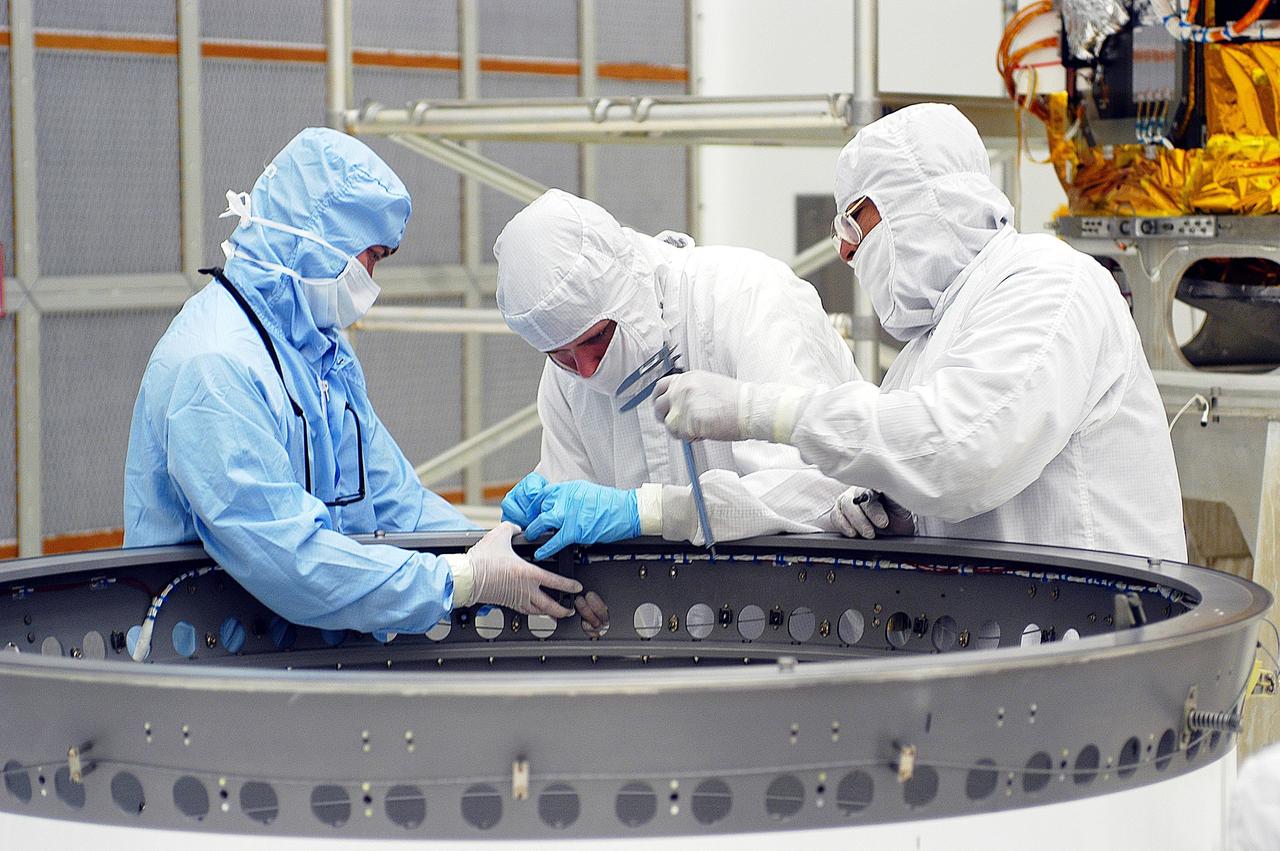
KENNEDY SPACE CENTER, FLA. - Workers in Building AE adjust the payload attach fitting for the Space Infrared Telescope Facility (SIRTF). SIRTF will be mated with the Delta II launch vehicle via the fitting. SIRTF is currently scheduled for transportation to Launch Complex 17-B, Cape Canaveral Air Force Station, and hoisting atop the Delta II on or about April 4.
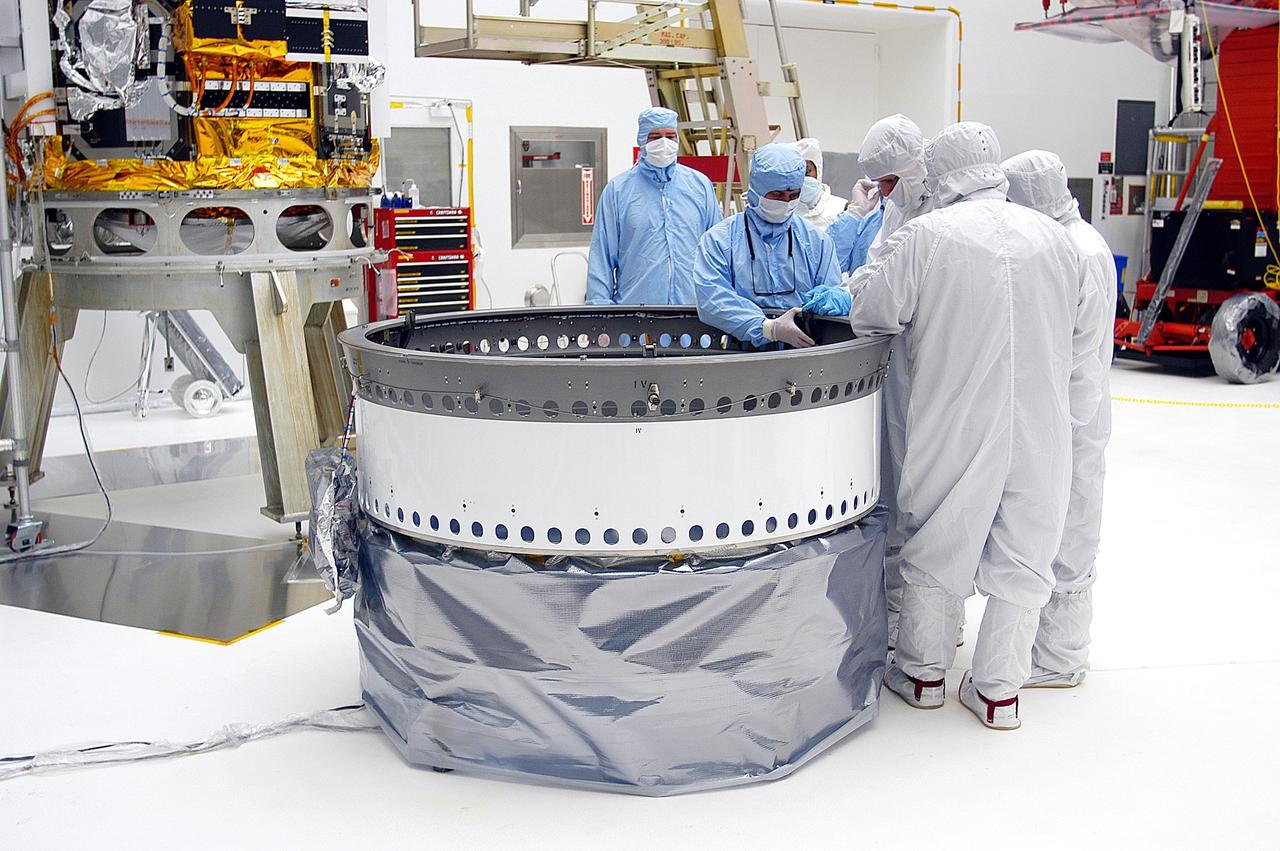
KENNEDY SPACE CENTER, FLA. -- Workers in Building AE adjust the payload attach fitting for the Space Infrared Telescope Facility (SIRTF), in the background. SIRTF will be mated with the Delta II launch vehicle via the fitting. SIRTF is currently scheduled for transportation to Launch Complex 17-B, Cape Canaveral Air Force Station, and hoisting atop the Delta II on or about April 4.
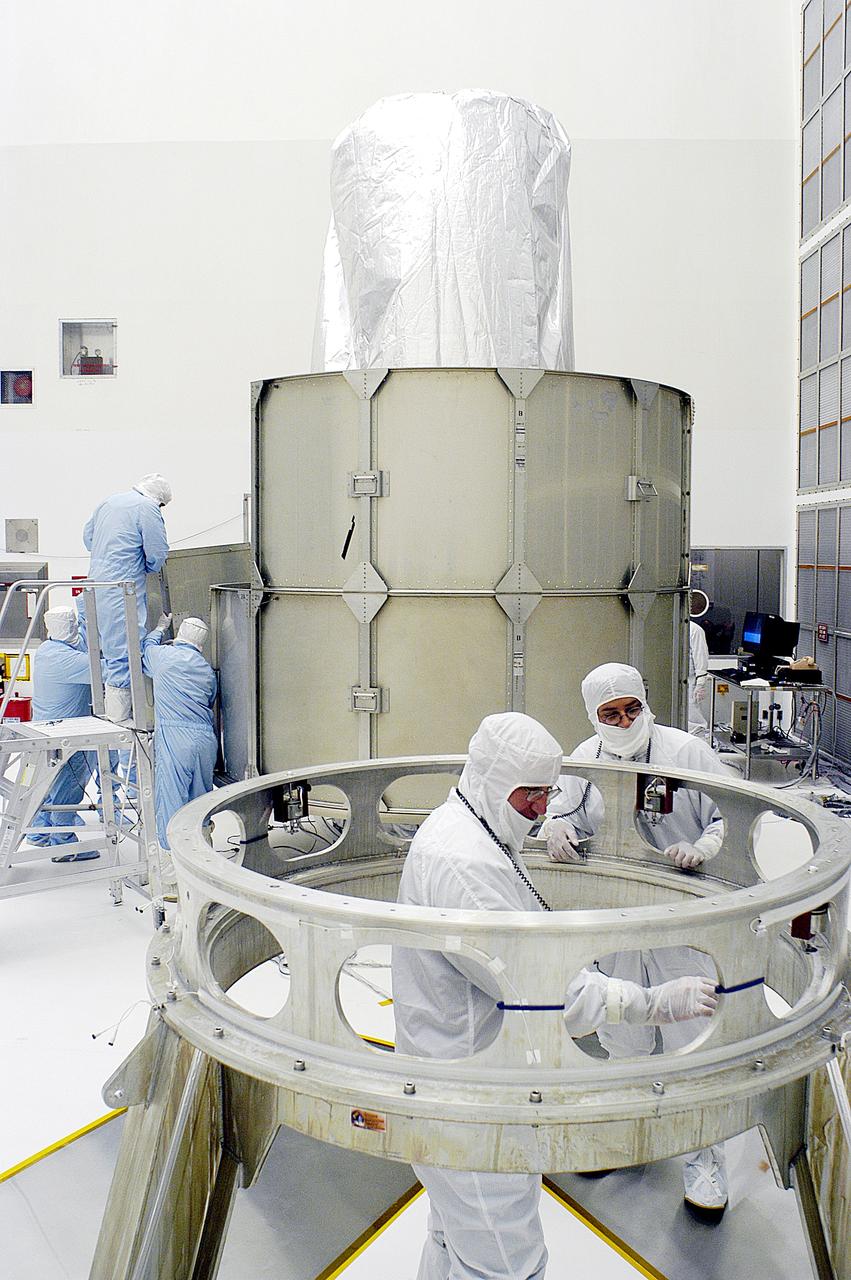
KENNEDY SPACE CENTER, FLA. - Workers in NASA Spacecraft Hangar AE (background) remove sections of the transportation canister from around the Space Infrared Telescope Facility (SIRTF), which has been returned to the hangar from the launch pad. Additional workers (foreground) prepare the Delta payload attach fitting, from which SIRTF was demated, for further use. SIRTF will remain in the clean room until it returns to the pad in early August. One of NASA's largest infrared telescopes to be launched, SIRTF will obtain images and spectra by detecting the infrared energy, or heat, radiated by objects in space.

CAPE CANAVERAL, Fla. -- At the Astrotech payload processing facility, technicians check the attachment of NASA's Gamma-Ray Large Area Space Telescope, or GLAST, spacecraft on the payload attach fitting. The fitting will eventually be used to mate GLAST to the Delta II launch vehicle. The GLAST is a powerful space observatory that will explore the Universe's ultimate frontier, where nature harnesses forces and energies far beyond anything possible on Earth; probe some of science's deepest questions, such as what our Universe is made of, and search for new laws of physics; explain how black holes accelerate jets of material to nearly light speed; and help crack the mystery of stupendously powerful explosions known as gamma-ray bursts. A launch date still is to be determined. Photo credit: NASA/Jim Grossmann
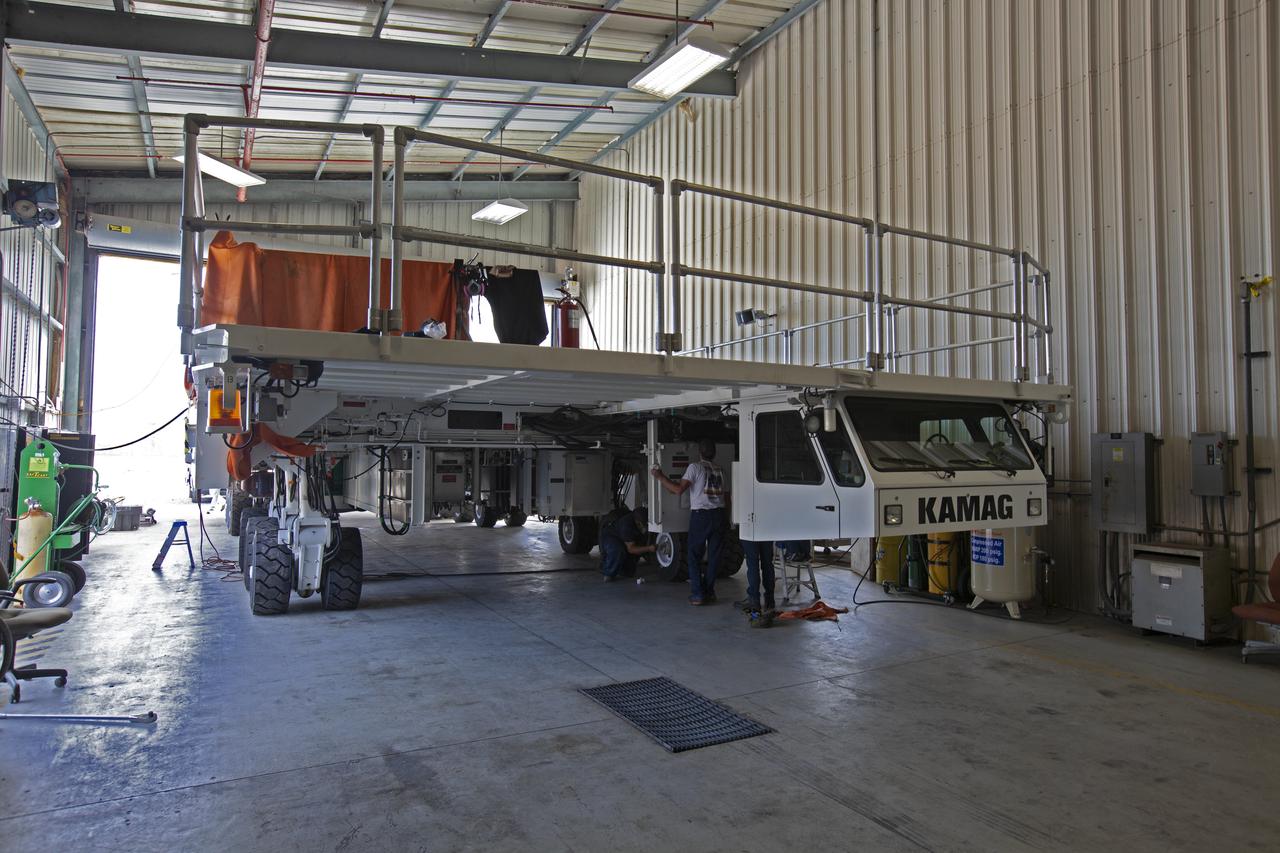
The KAMAG spacecraft transporter is inside a facility at the crawler yard at NASA's Kennedy Space Center in Florida, on Oct. 26, 2018. Jacobs technicians from the Launch Equipment Shop are welding the attach points that will hold the Orion transportation pallet in place. Testing of the pallet will be performed to support validation and verification of the attach fittings in the Multi-Payload Processing Facility. The transporter is designed to carry heavy loads, including the pallet that will contain the Orion crew module.
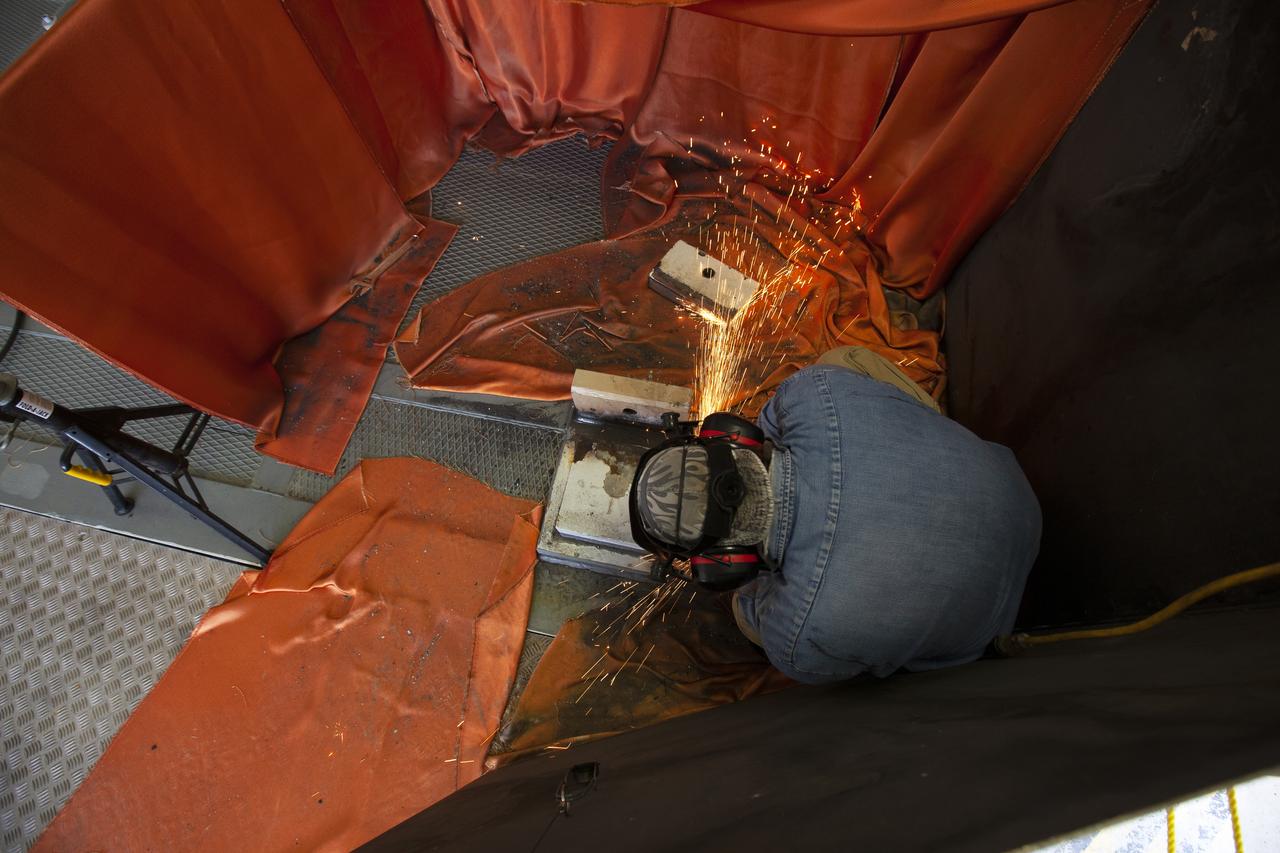
A Jacobs technician from the Launch Equipment Shop performs welding on the KAMAG spacecraft transporter on Oct. 26, 2018, inside a facility at the crawler yard at NASA’s Kennedy Space Center in Florida. The transporter is designed to carry heavy loads. Welding is being performed on the attach points that will hold the Orion transportation pallet in place. Testing of the pallet will be performed to support validation and verification of the attach fittings in the Multi-Payload Processing Facility.
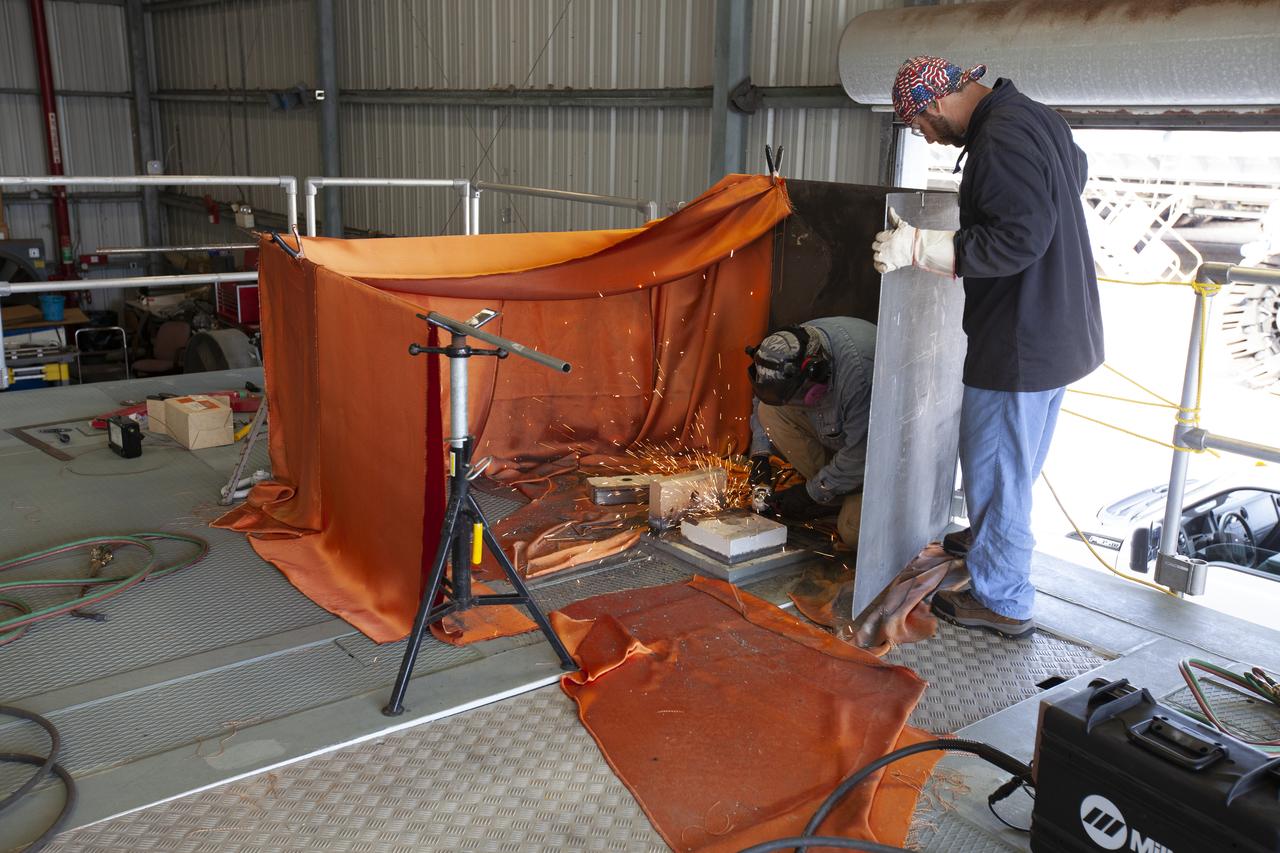
Jacobs technicians from the Launch Equipment Shop perform welding on the KAMAG spacecraft transporter on Oct. 26, 2018, inside a facility at the crawler yard at NASA’s Kennedy Space Center in Florida. The transporter is designed to carry heavy loads. Welding is being performed on the attach points that will hold the Orion transportation pallet in place. Testing of the pallet will be performed to support validation and verification of the attach fittings in the Multi-Payload Processing Facility.

A Jacobs technician from the Launch Equipment Shop performs welding on the KAMAG spacecraft transporter on Oct. 26, 2018, inside a facility at the crawler yard at NASA’s Kennedy Space Center in Florida. The transporter is designed to carry heavy loads. Welding is being performed on the attach points that will hold the Orion transportation pallet in place. Testing of the pallet will be performed to support validation and verification of the attach fittings in the Multi-Payload Processing Facility.

A Jacobs technician from the Launch Equipment Shop performs welding on the KAMAG spacecraft transporter on Oct. 26, 2018, inside a facility at the crawler yard at NASA’s Kennedy Space Center in Florida. The transporter is designed to carry heavy loads. Welding is being performed on the attach points that will hold the Orion transportation pallet in place. Testing of the pallet will be performed to support validation and verification of the attach fittings in the Multi-Payload Processing Facility.
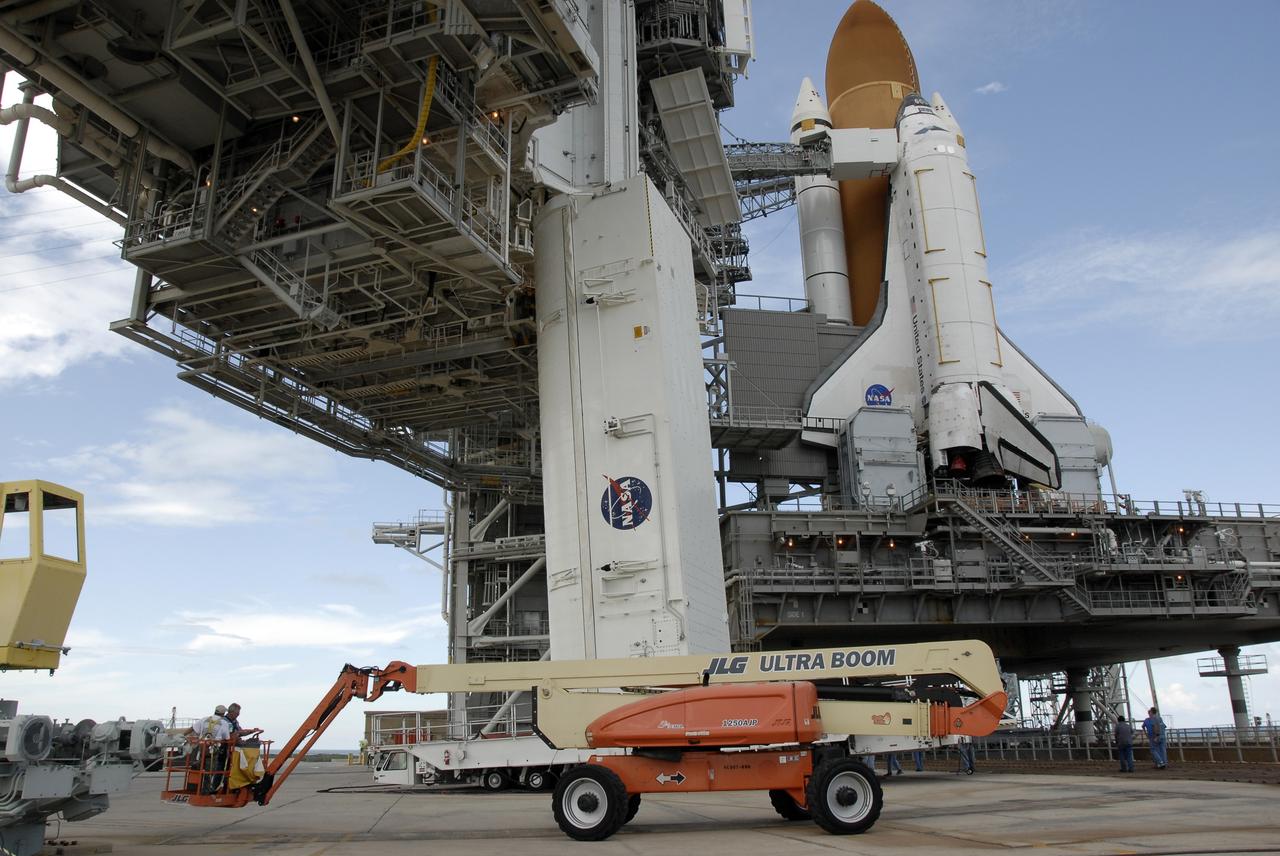
CAPE CANAVERAL, Fla. - At Launch Pad 39A at NASA’s Kennedy Space Center in Florida, technicians work to move the Hubble payload canister into the payload changeout room for space shuttle Atlantis’ STS-125 mission. The canister arrived at the pad on Saturday evening, however, early Sunday morning technicians were unable to place the canister into the pad’s payload changeout room. Teflon pads on “shoes” attached to the outside of the payload canister that help the canister move along guide rails didn’t fit properly. The shoes, one seen here, were removed and several options were considered, including slightly shaving down the pads so the shoes will fit onto the rails. STS-125 is the fifth and final shuttle Hubble Space Telescope servicing mission. Atlantis’ launch is targeted for Oct. 10. Photo credit: NASA/Kim Shiflett.
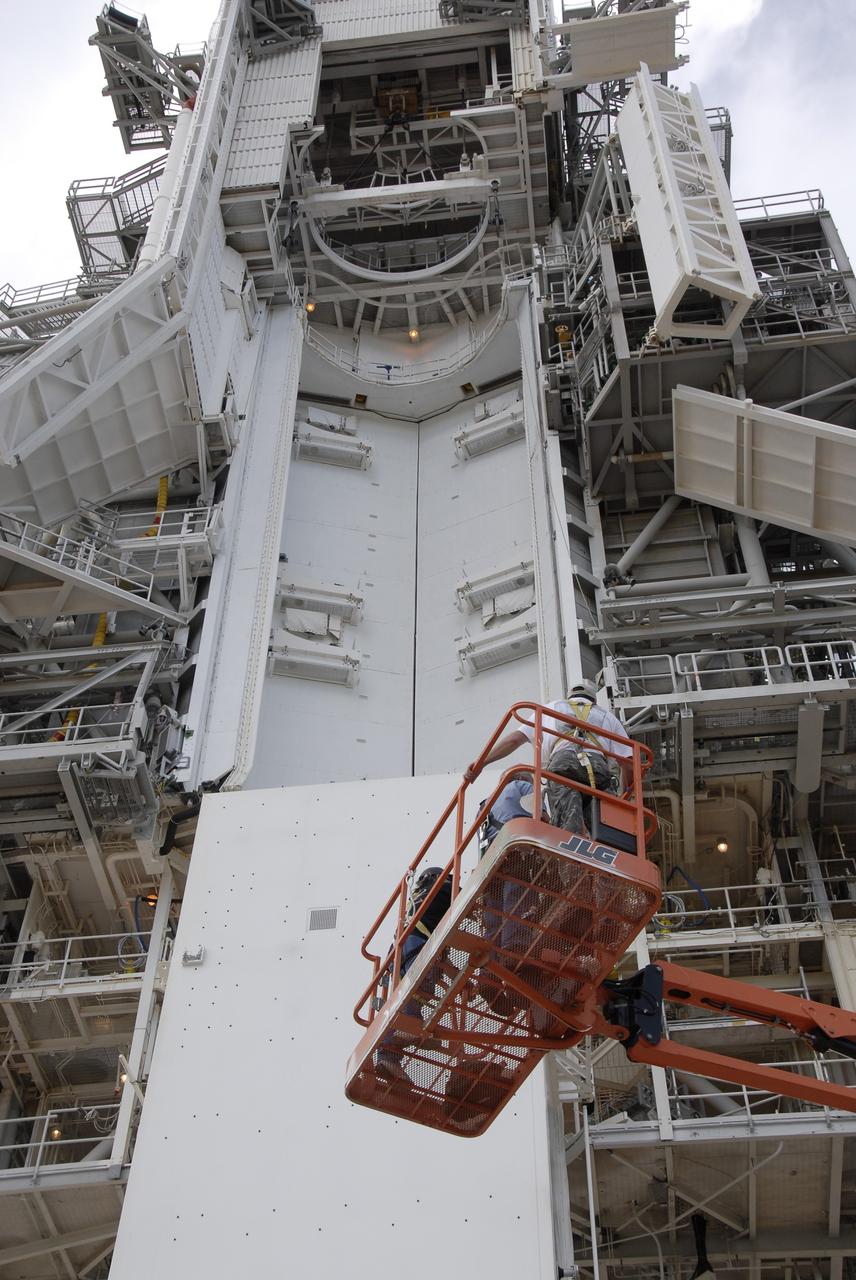
CAPE CANAVERAL, Fla. - At Launch Pad 39A at NASA’s Kennedy Space Center in Florida, technicians work to move the Hubble payload canister into the payload changeout room for space shuttle Atlantis’ STS-125 mission. The canister arrived at the pad on Saturday evening; however, early Sunday morning technicians were unable to place the canister into the pad’s payload changeout room. Teflon pads on “shoes” attached to the outside of the payload canister that help the canister move along the guide rails didn’t fit properly. The shoes were removed and several options were considered, including slightly shaving down the pads so the shoes will fit onto the rails. STS-125 is the fifth and final shuttle Hubble Space Telescope servicing mission. Atlantis’ launch is targeted for Oct. 10. Photo credit: NASA/Kim Shiflett.
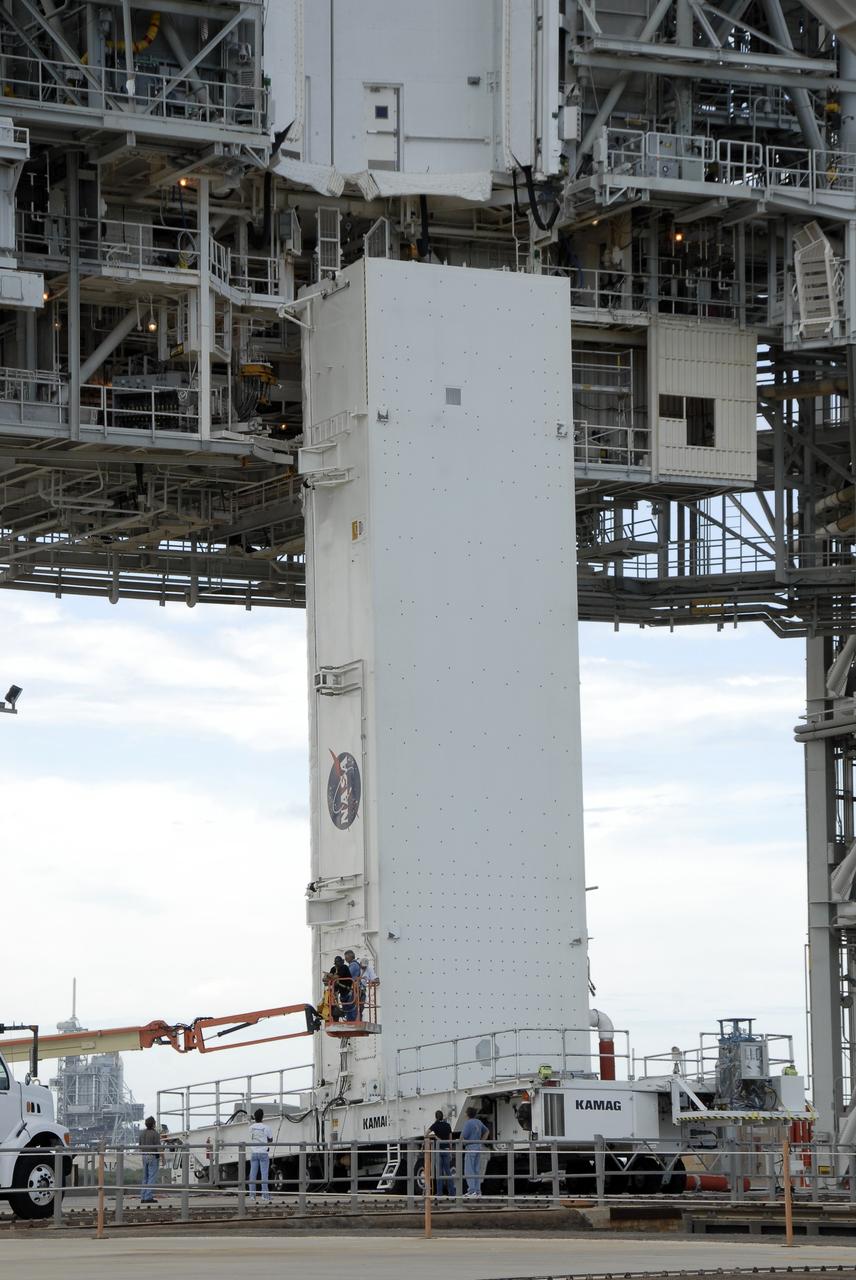
CAPE CANAVERAL, Fla. - At Launch Pad 39A at NASA’s Kennedy Space Center in Florida, technicians work to move the Hubble payload canister into the payload changeout room for space shuttle Atlantis’ STS-125 mission. The canister arrived at the pad on Saturday evening, however, early Sunday morning technicians were unable to place the canister into the pad’s payload changeout room. Teflon pads on “shoes” attached to the outside of the payload canister that help the canister move along guide rails didn’t fit properly. The shoes were removed and several options were considered, including slightly shaving down the pads so the shoes will fit onto the rails. STS-125 is the fifth and final shuttle Hubble Space Telescope servicing mission. Atlantis’ launch is targeted for Oct. 10. Photo credit: NASA/Kim Shiflett.

CAPE CANAVERAL, Fla. - At Launch Pad 39A at NASA’s Kennedy Space Center in Florida, technicians work to move the Hubble payload canister into the payload changeout room for space shuttle Atlantis’ STS-125 mission. The canister arrived at the pad on Saturday evening, however, early Sunday morning technicians were unable to place the canister into the pad’s payload changeout room. Teflon pads on “shoes” attached to the outside of the payload canister that help the canister move along guide rails didn’t fit properly. The shoes were removed and several options were considered, including slightly shaving down the pads so the shoes will fit onto the rails. STS-125 is the fifth and final shuttle Hubble Space Telescope servicing mission. Atlantis’ launch is targeted for Oct. 10. Photo credit: NASA/Kim Shiflett.
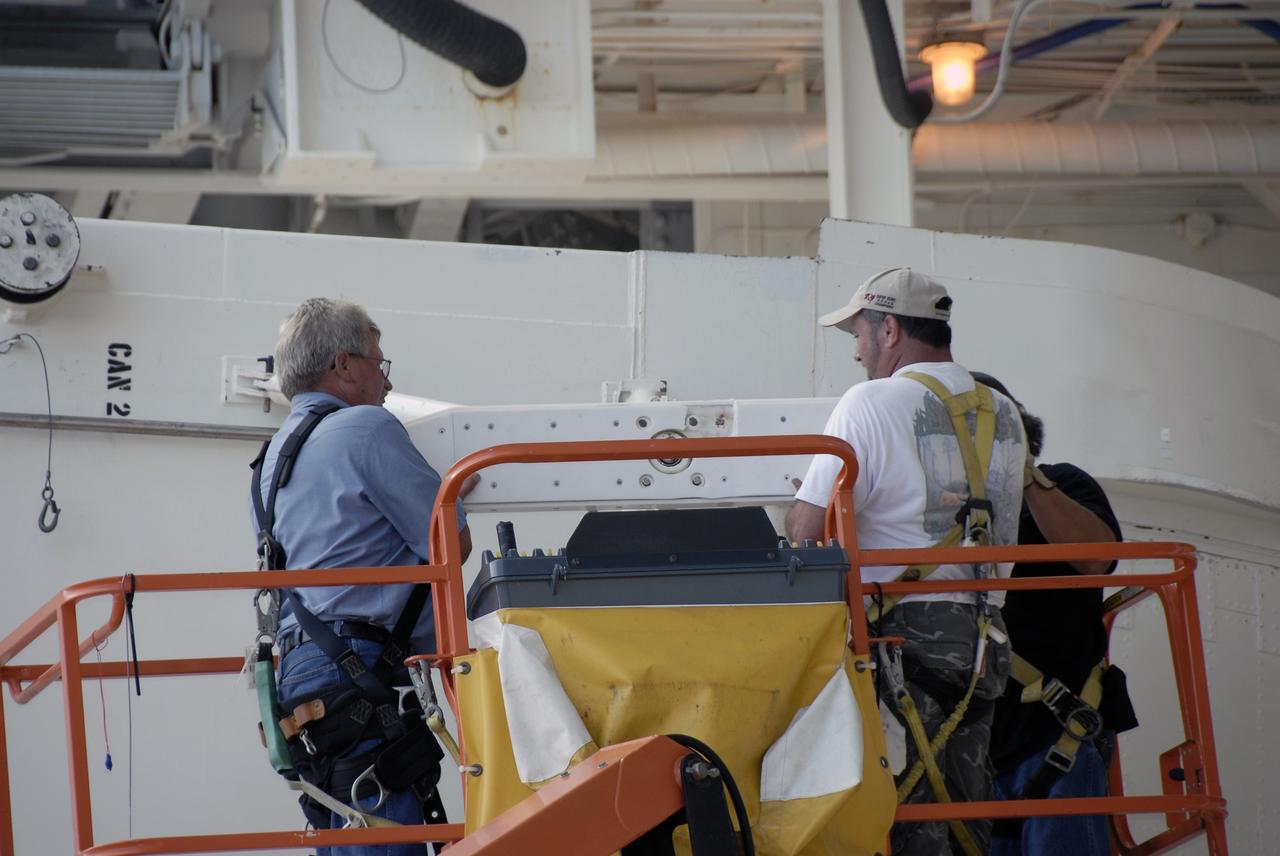
CAPE CANAVERAL, Fla. - At Launch Pad 39A at NASA’s Kennedy Space Center in Florida, technicians work to move the Hubble payload canister into the payload changeout room for space shuttle Atlantis’ STS-125 mission. The canister arrived at the pad on Saturday evening; however, early Sunday morning technicians were unable to place the canister into the pad’s payload changeout room. Teflon pads on “shoes” attached to the outside of the payload canister that help the canister move along the guide rails didn’t fit properly. The shoes were removed and several options were considered, including slightly shaving down the pads so the shoes will fit onto the rails. STS-125 is the fifth and final shuttle Hubble Space Telescope servicing mission. Atlantis’ launch is targeted for Oct. 10. Photo credit: NASA/Kim Shiflett.
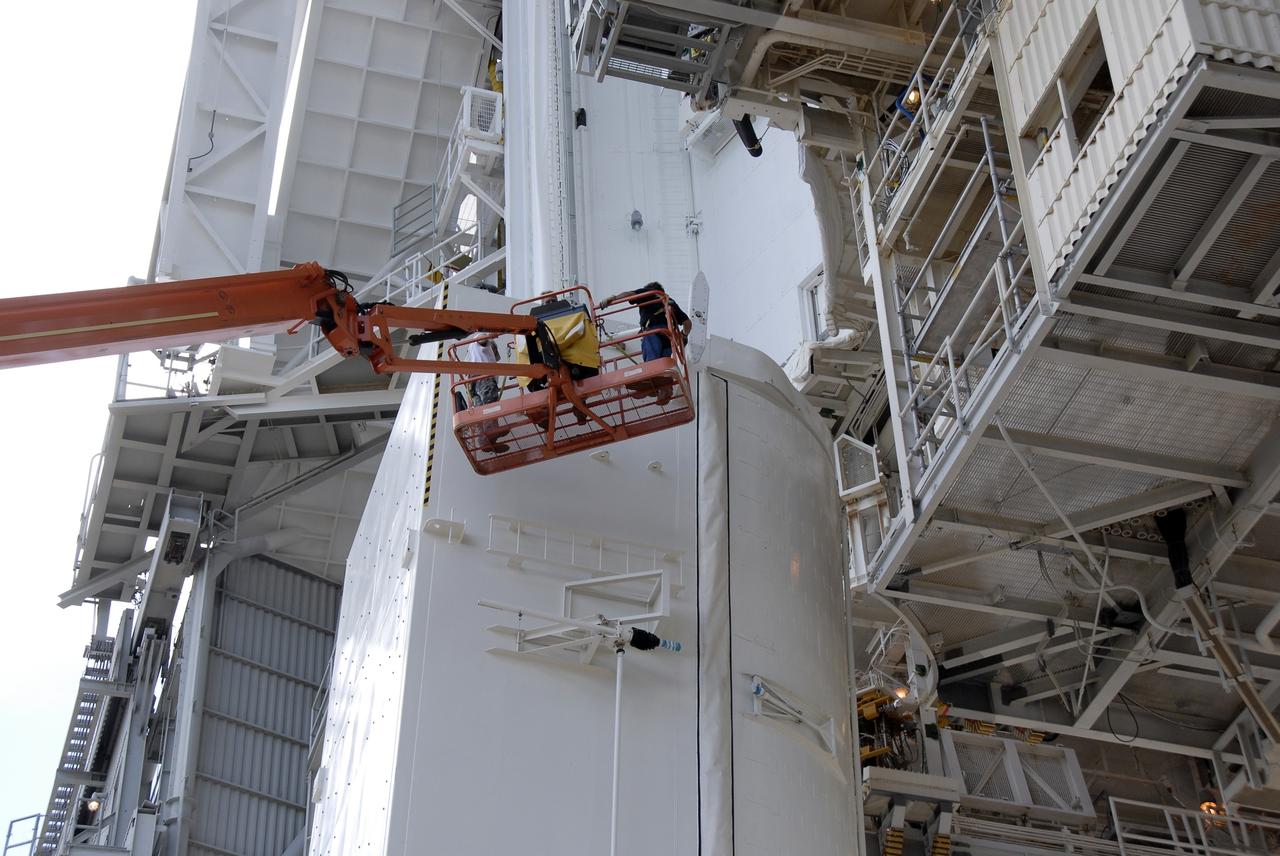
CAPE CANAVERAL, Fla. - At Launch Pad 39A at NASA’s Kennedy Space Center in Florida, technicians work to move the Hubble payload canister into the payload changeout room for space shuttle Atlantis’ STS-125 mission. The canister arrived at the pad on Saturday evening; however, early Sunday morning technicians were unable to place the canister into the pad’s payload changeout room. Teflon pads on “shoes” attached to the outside of the payload canister that help the canister move along the guide rails didn’t fit properly. The shoes were removed and several options were considered, including slightly shaving down the pads so the shoes will fit onto the rails. STS-125 is the fifth and final shuttle Hubble Space Telescope servicing mission. Atlantis’ launch is targeted for Oct. 10. Photo credit: NASA/Kim Shiflett.
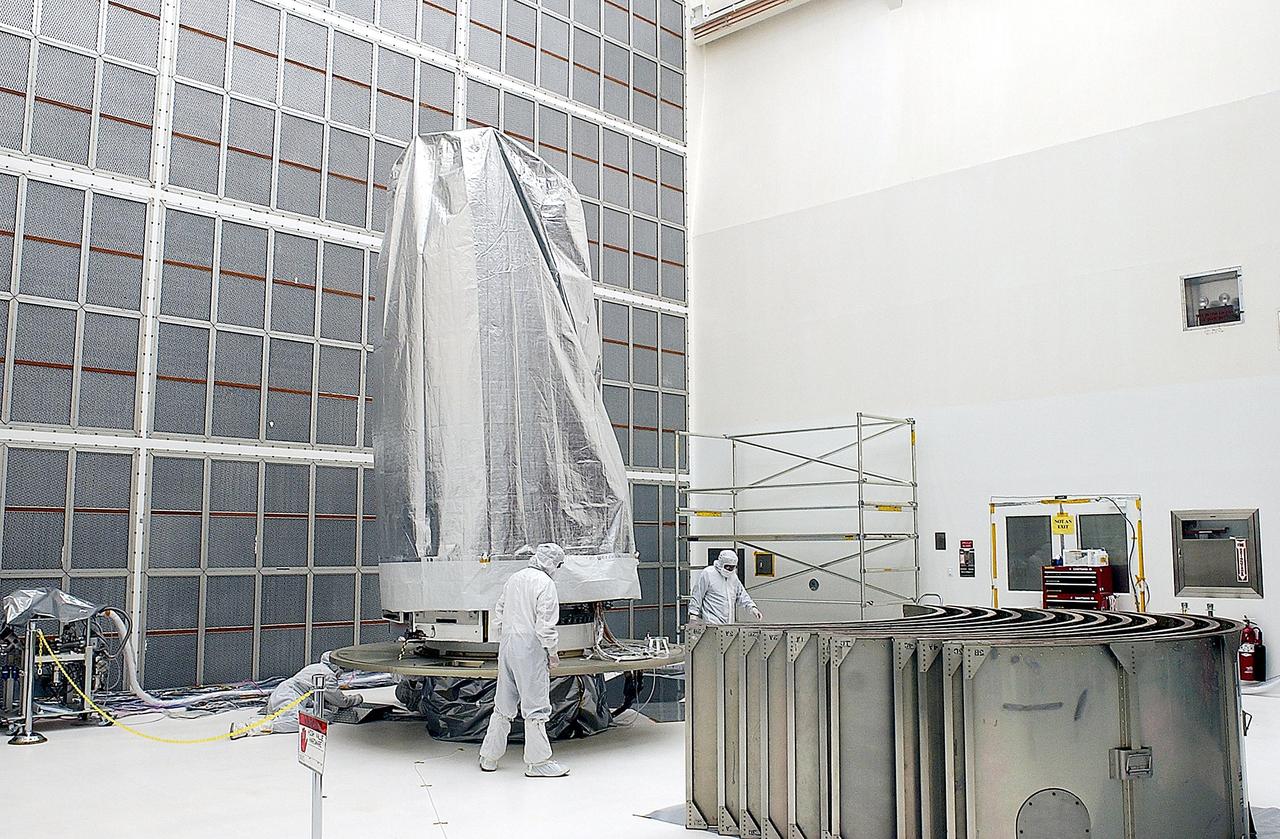
KENNEDY SPACE CENTER, FLA. - Workers in Building AE prepare the Space Infrared Telescope Facility (SIRTF), in the background, for buildup of the payload canister. SIRTF will be mated with the Delta II launch vehicle via the payload attach fitting at the bottom. SIRTF is currently scheduled for transportation to Launch Complex 17-B, Cape Canaveral Air Force Station, and hoisting atop the Delta II on or about April 4.
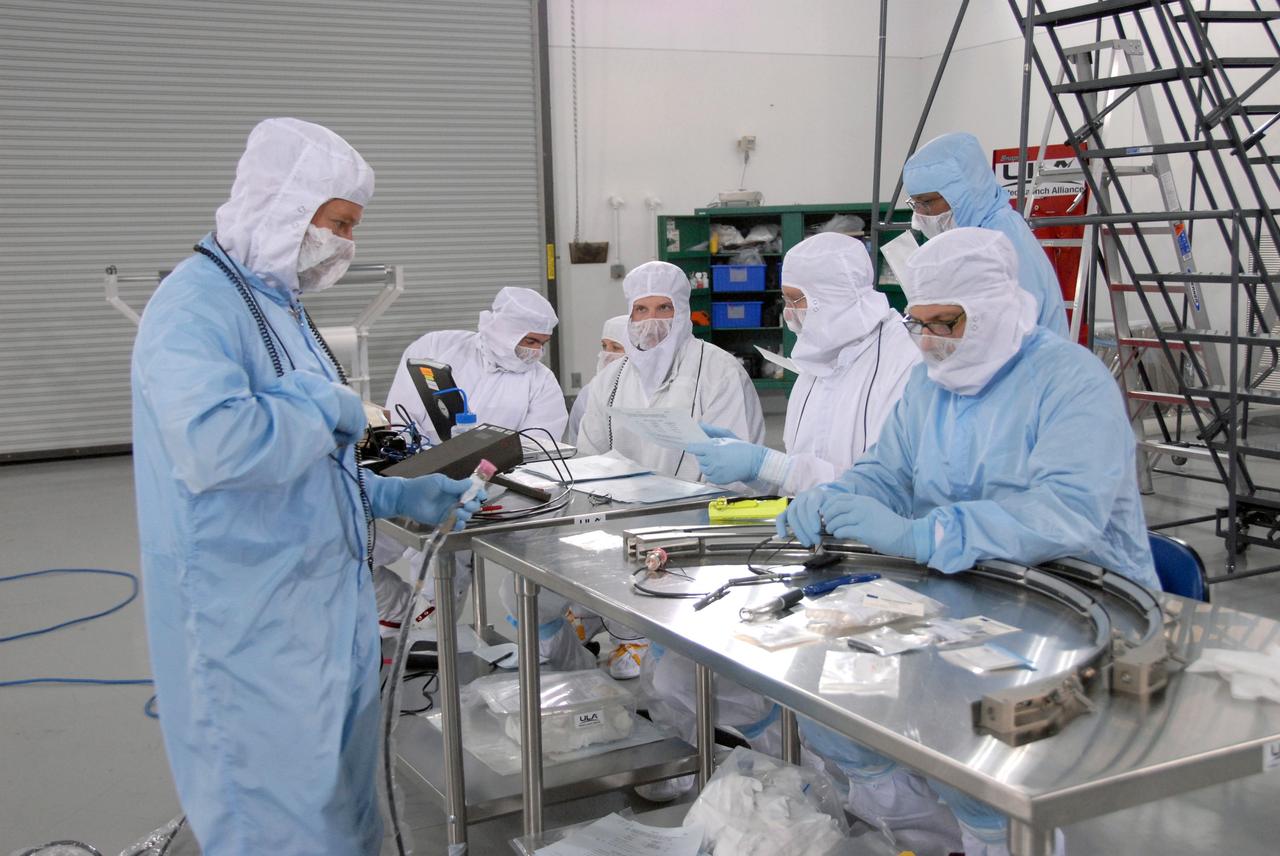
VANDENBERG AIR FORCE BASE, Calif. -- At the Astrotech processing facility on Vandenberg Air Force Base in California, workers prepare a payload adapter ring for NASA's Wide-field Infrared Survey Explorer, or WISE, in preparation for mating to its Payload Attach Fitting. The satellite will survey the entire sky at infrared wavelengths, creating a cosmic clearinghouse of hundreds of millions of objects which will be catalogued and provide a vast storehouse of knowledge about the solar system, the Milky Way, and the universe. Launch is scheduled for Dec. 7. Photo credit: NASA/Doug Kolkow
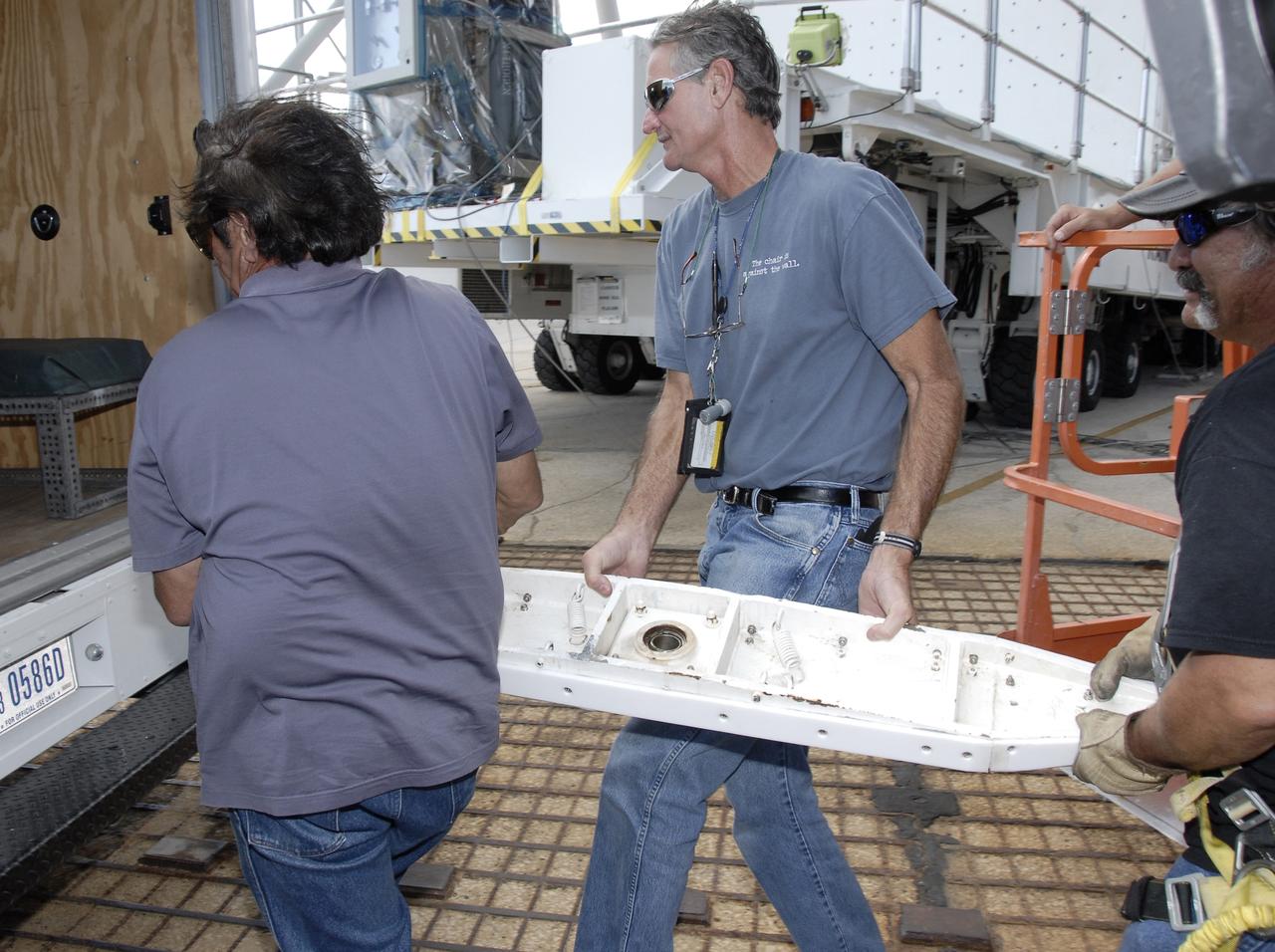
CAPE CANAVERAL, Fla. - Technicians carry a “shoe” that was removed from the Hubble payload canister at Launch Pad 39A at NASA’s Kennedy Space Center in Florida. The canister arrived at the pad on Saturday evening, however, early Sunday morning technicians were unable to place the canister into the pad’s payload changeout room for space shuttle Atlantis’ STS-125 mission. Teflon pads on “shoes” attached to the outside of the payload canister that help the canister move along the guide rails didn’t fit properly. The shoes were removed and several options were considered, including slightly shaving down the pads so the shoes will fit onto the rails. STS-125 is the fifth and final shuttle Hubble Space Telescope servicing mission. Atlantis’ launch is targeted for Oct. 10. Photo credit: NASA/Kim Shiflett.
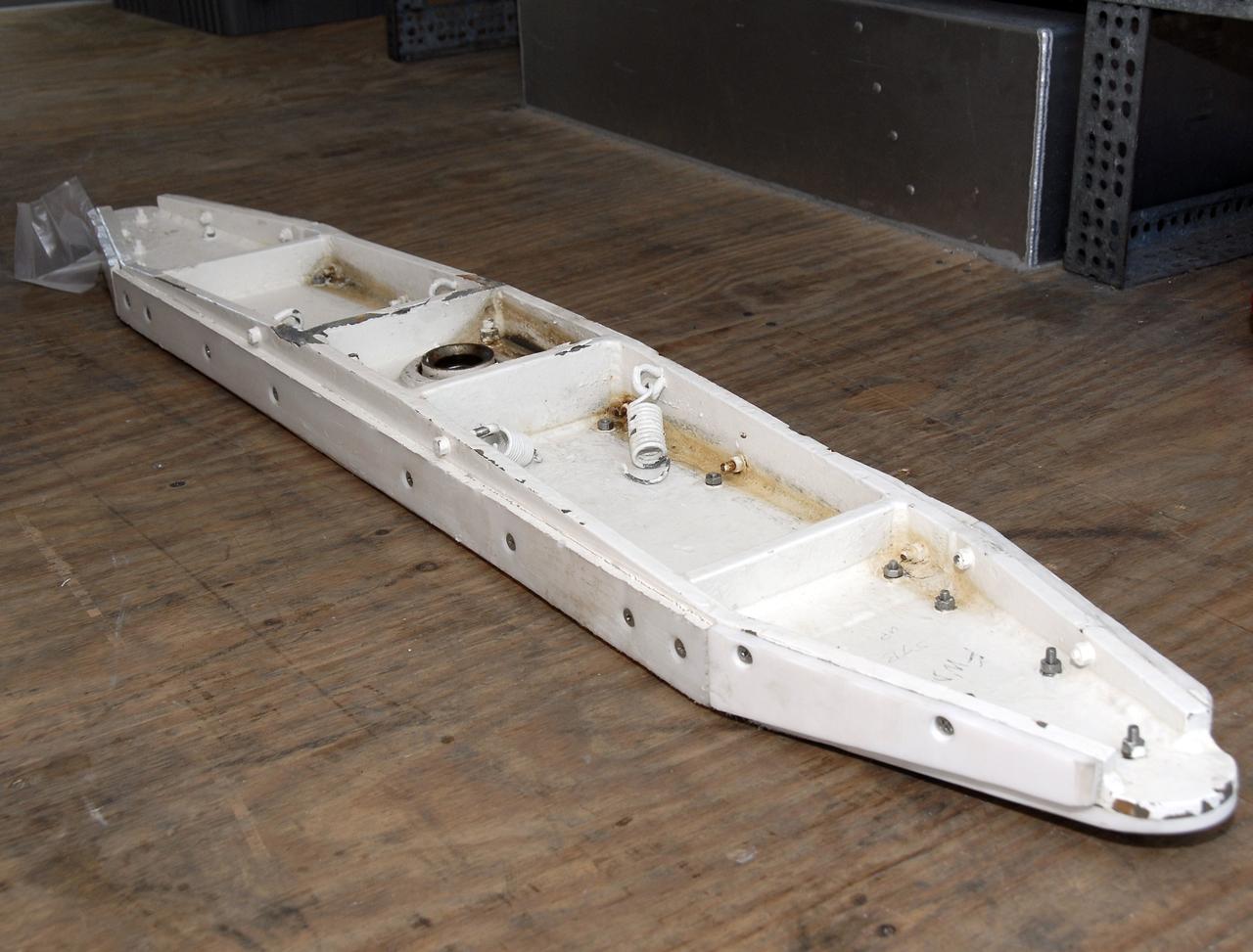
CAPE CANAVERAL, Fla. - Technicians removed a “shoe” on the Hubble payload canister at Launch pad 39A at NASA’s Kennedy Space Center in Florida. The canister arrived at the pad on Saturday evening; however, early Sunday morning technicians were unable to place the canister into the pad’s payload changeout room for space shuttle Atlantis’ STS-125 mission. Teflon pads on the “shoes” attached to the outside of the payload canister that help the canister move along the guide rails didn’t fit properly. The shoes were removed and several options were considered, including slightly shaving down the pads so the shoes will fit onto the rails. STS-125 is the fifth and final shuttle Hubble Space Telescope servicing mission. Atlantis’ launch is targeted for Oct. 10. Photo credit: NASA/Kim Shiflett.
CAPE CANAVERAL, Fla. - Technicians removed a “shoe” on the Hubble payload canister at Launch pad 39A at NASA’s Kennedy Space Center in Florida. The canister arrived at the pad on Saturday evening; however, early Sunday morning technicians were unable to place the canister into the pad’s payload changeout room for space shuttle Atlantis’ STS-125 mission. Teflon pads on the “shoes” attached to the outside of the payload canister that help the canister move along the guide rails didn’t fit properly. The shoes were removed and several options were considered, including slightly shaving down the pads so the shoes will fit onto the rails. STS-125 is the fifth and final shuttle Hubble Space Telescope servicing mission. Atlantis’ launch is targeted for Oct. 10. Photo credit: NASA/Kim Shiflett.
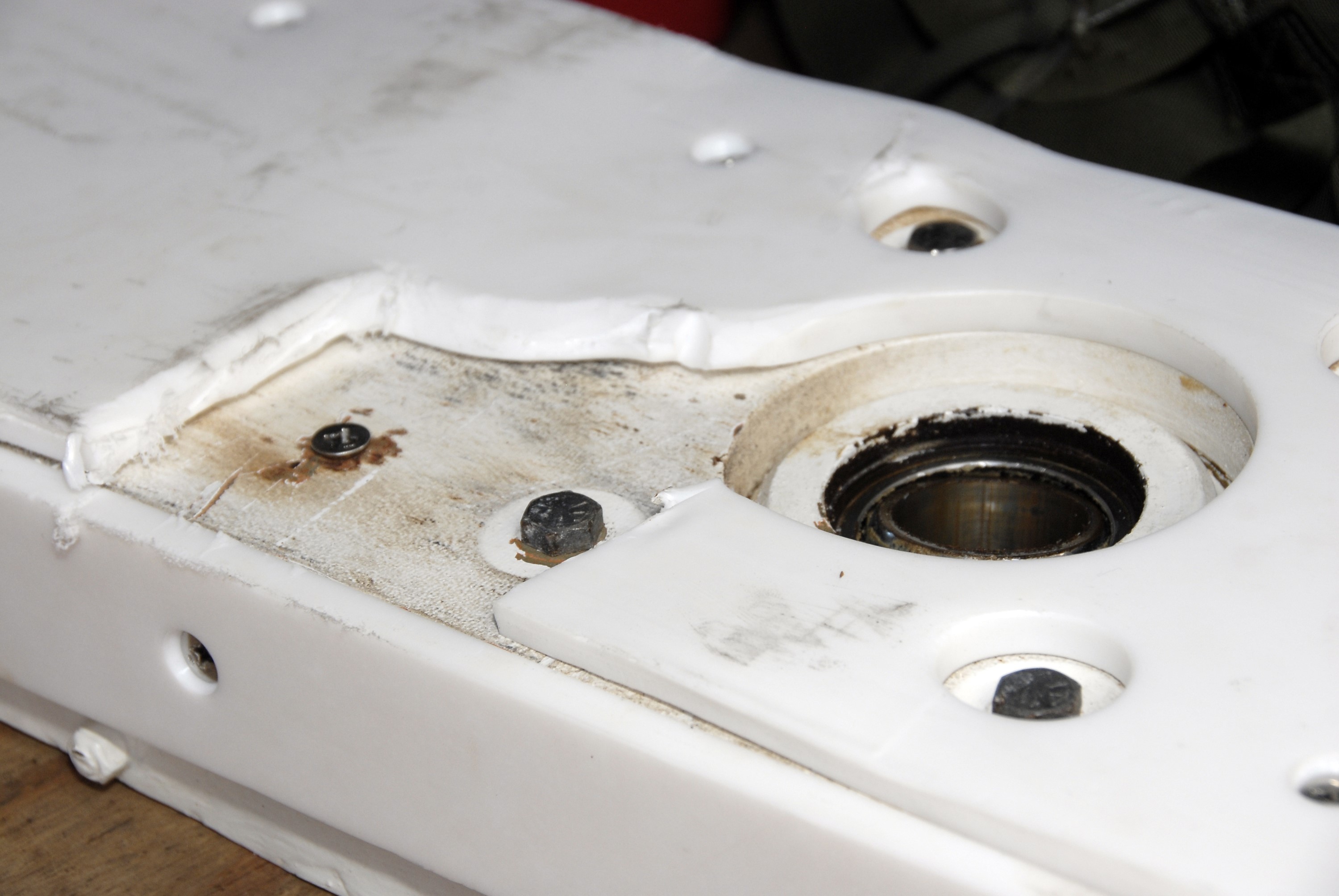
CAPE CANAVERAL, Fla. - A close up view of one of the “shoes” removed from the Hubble payload canister at Launch Pad 39A at NASA’s Kennedy Space Center in Florida. The canister arrived at the pad on Saturday evening; however, early Sunday morning technicians were unable to place the canister into the pad’s payload changeout room for space shuttle Atlantis’ STS-125 mission. Teflon pads on “shoes” attached to the outside of the payload canister that help the canister move along the guide rails didn’t fit properly. The shoes were removed and several options were considered, including slightly shaving down the pads so the shoes will fit onto the rails. STS-125 is the fifth and final shuttle Hubble Space Telescope servicing mission. Atlantis’ launch is targeted for Oct. 10. Photo credit: NASA/Kim Shiflett.
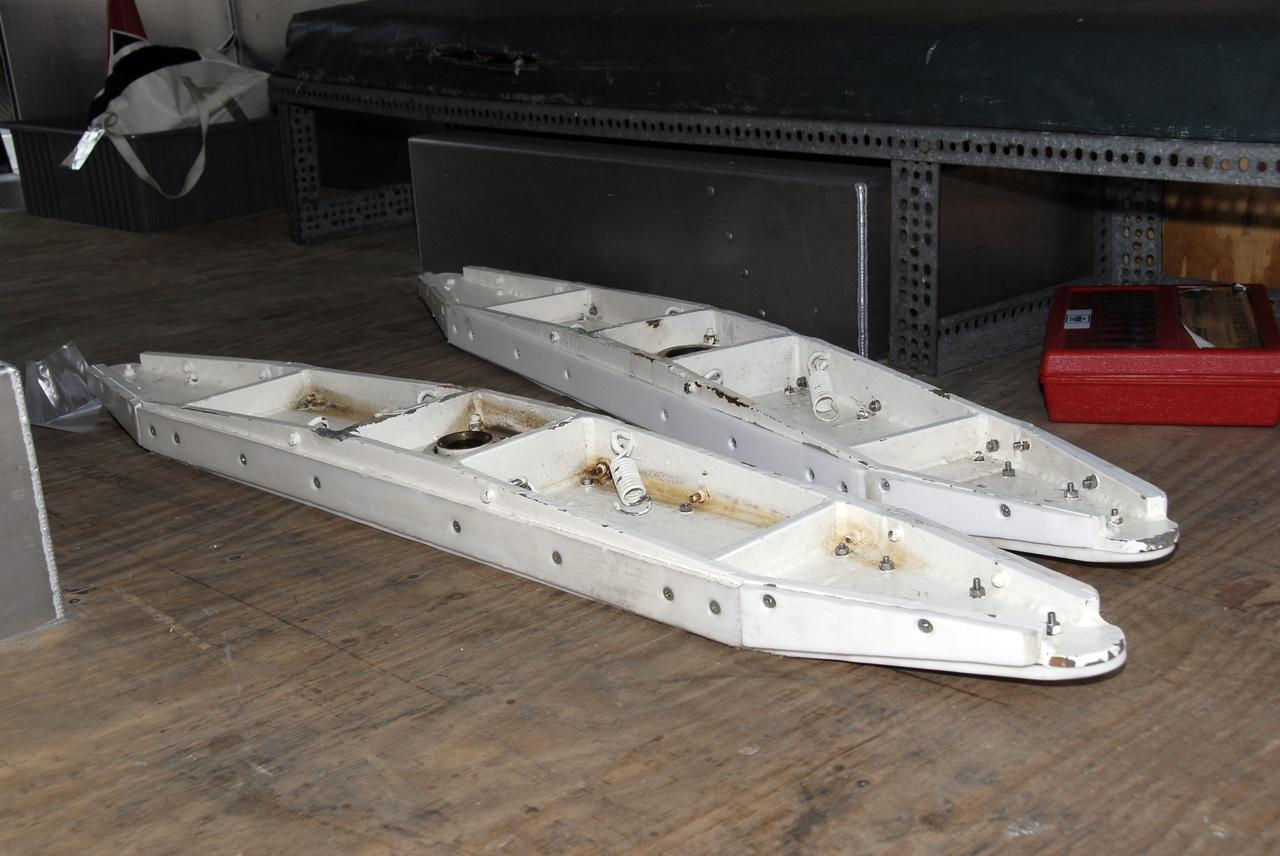
CAPE CANAVERAL, Fla. - Technicians removed two “shoes” from the Hubble payload canister at Launch Pad 39A at NASA’s Kennedy Space Center in Florida. The canister arrived at the pad on Saturday evening; however, early Sunday morning technicians were unable to place the canister into the pad’s payload changeout room for space shuttle Atlantis’ STS-125 mission. Teflon pads on “shoes” attached to the outside of the payload canister that help the canister move along the guide rails didn’t fit properly. The shoes were removed and several options were considered, including slightly shaving down the pads so the shoes will fit onto the rails. STS-125 is the fifth and final shuttle Hubble Space Telescope servicing mission. Atlantis’ launch is targeted for Oct. 10. Photo credit: NASA/Kim Shiflett.

CAPE CANAVERAL, Fla. - A close up view of one of the “shoes” removed from the Hubble payload canister at Launch Pad 39A at NASA’s Kennedy Space Center in Florida. The canister arrived at the pad on Saturday evening; however, early Sunday morning technicians were unable to place the canister into the pad’s payload changeout room for space shuttle Atlantis’ STS-125 mission. Teflon pads on “shoes” attached to the outside of the payload canister that help the canister move along the guide rails didn’t fit properly. The shoes were removed and several options were considered, including slightly shaving down the pads so the shoes will fit onto the rails. STS-125 is the fifth and final shuttle Hubble Space Telescope servicing mission. Atlantis’ launch is targeted for Oct. 10. Photo credit: NASA/Kim Shiflett.
KENNEDY SPACE CENTER, FLA. - At Astrotech Space Operations in Titusville, Fla., Boeing workers attach the Geostationary Operational Environmental Satellite GOES-N to the Payload Attach Fitting. The fitting will enable the spacecraft to be mated to its launch vehicle, a Boeing Delta IV, with a 3-burn second-stage operation. Since its arrival on March 11, the satellite has been undergoing final testing by Boeing Satellite Systems of the imaging system, instrumentation, communications and power systems. The GOES spacecraft are sponsored by NASA’s Goddard Space Flight Center and the National Oceanic and Atmospheric Administration. GOES-N is targeted to launch June 23 from Launch Complex 37 at Cape Canaveral Air Force Station in Florida.
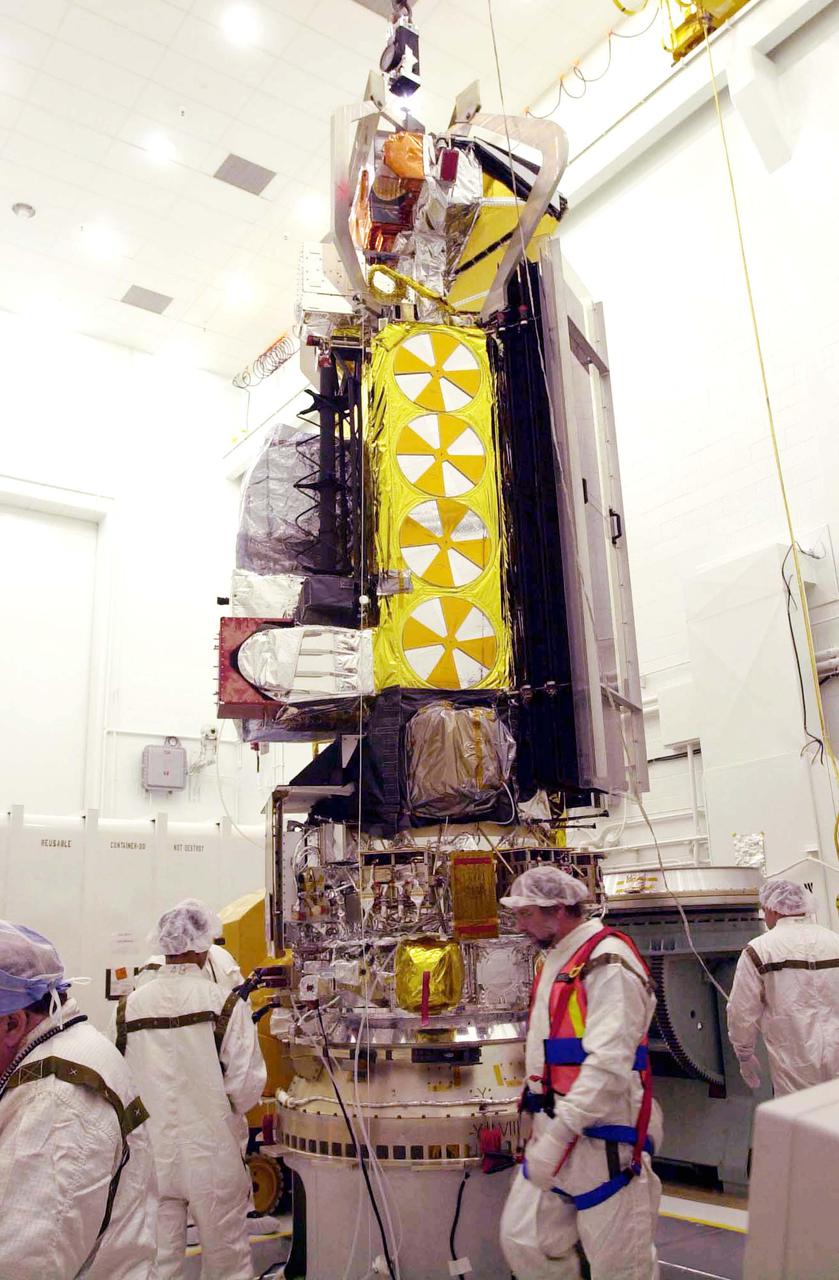
KENNEDY SPACE CENTER, FLA. - At Astrotech Space Operations in Titusville, Fla., Boeing workers attach the Geostationary Operational Environmental Satellite GOES-N to the Payload Attach Fitting. The fitting will enable the spacecraft to be mated to its launch vehicle, a Boeing Delta IV, with a 3-burn second-stage operation. Since its arrival on March 11, the satellite has been undergoing final testing by Boeing Satellite Systems of the imaging system, instrumentation, communications and power systems. The GOES spacecraft are sponsored by NASA’s Goddard Space Flight Center and the National Oceanic and Atmospheric Administration. GOES-N is targeted to launch June 23 from Launch Complex 37 at Cape Canaveral Air Force Station in Florida.
VANDENBERG AIR FORCE BASE, CALIF. - Inside the NASA spacecraft processing hangar 1610 located on North Vandenberg Air Force Base in California, the National Oceanic and Atmospheric Administration (NOAA-N) spacecraft sits attached to the Boeing Delta II payload attach fitting on the bottom. Launch of NOAA-N aboard the Boeing Delta II rocket is currently scheduled for May 11, 2005. NOAA-N is the fourth in the series of support dedicated microwave instruments for the generation of temperature, moisture, surface, and hydrological products in cloudy regions where visible and infrared (IR) instruments have decreased capability.
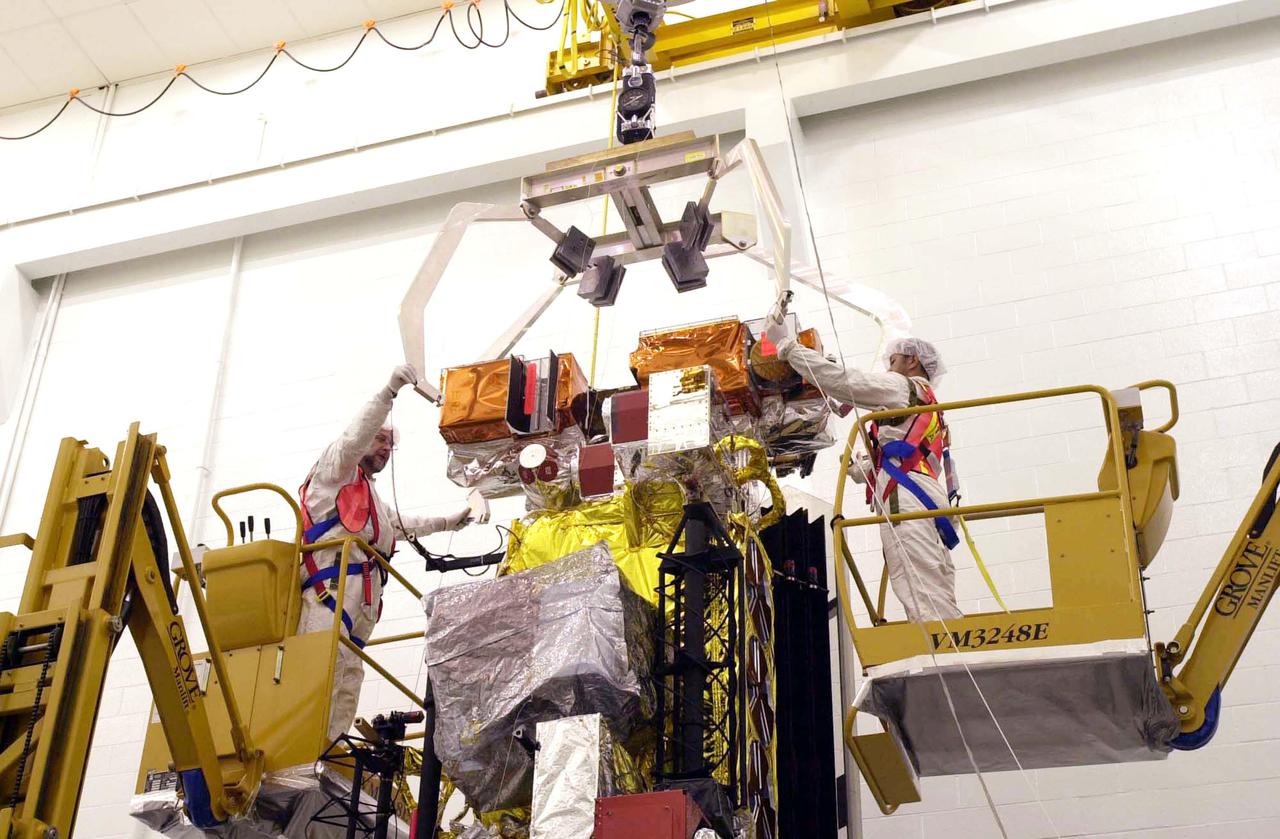
VANDENBERG AIR FORCE BASE, CALIF. - Inside the NASA spacecraft processing hangar 1610 located on North Vandenberg Air Force Base in California, Lockheed Martin workers attach a crane to move the National Oceanic and Atmospheric Administration (NOAA-N) spacecraft. NOAA-N will be lifted and mated to the Boeing Delta II payload attach fitting. Launch of NOAA-N aboard the Boeing Delta II rocket is currently scheduled for May 11, 2005. NOAA-N is the fourth in the series of support dedicated microwave instruments for the generation of temperature, moisture, surface, and hydrological products in cloudy regions where visible and infrared (IR) instruments have decreased capability.
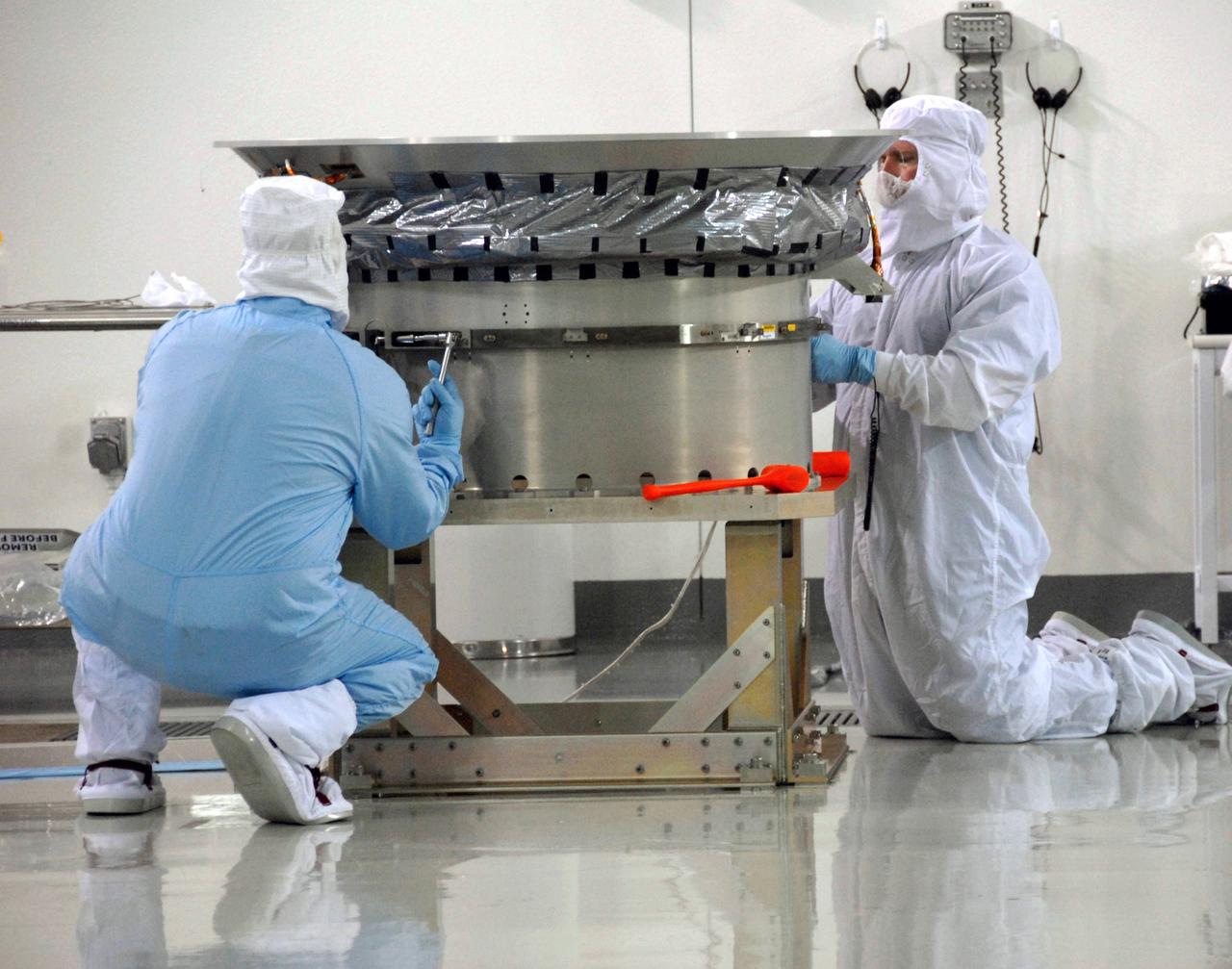
VANDENBERG AIR FORCE BASE, Calif. -- At Vandenberg Air Force Base's Astrotech processing facility in California, technicians working on NASA's Wide-field Infrared Survey Explorer, or WISE, spacecraft complete attaching the clampband on the test payload attach fitting. The satellite will survey the entire sky at infrared wavelengths, creating a cosmic clearinghouse of hundreds of millions of objects, which will be catalogued, providing a vast storehouse of knowledge about the solar system, the Milky Way, and the universe. Launch is scheduled no earlier than Dec. 7. Photo credit: NASA/Doug Kolkow
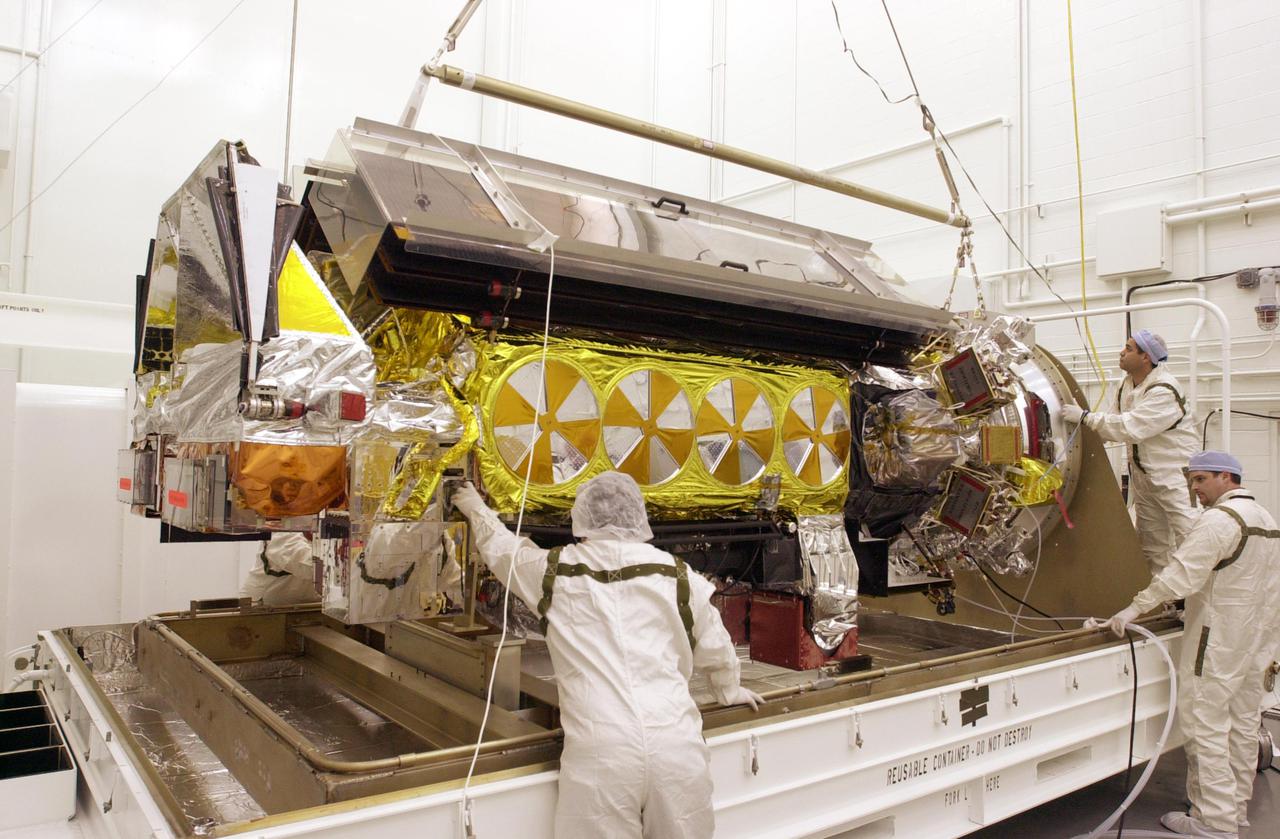
VANDENBERG AIR FORCE BASE, CALIF. - Inside the NASA spacecraft processing hangar 1610 located on North Vandenberg Air Force Base in California, Lockheed Martin workers attach a crane to lift the National Oceanic and Atmospheric Administration (NOAA-N) spacecraft from its shipping container and move it to an assembly and test stand. It will be mated to the Delta II payload attach fitting. Launch of NOAA-N aboard the Boeing Delta II rocket is currently scheduled for May 11, 2005. NOAA-N is the fourth in the series of support dedicated microwave instruments for the generation of temperature, moisture, surface, and hydrological products in cloudy regions where visible and infrared (IR) instruments have decreased capability.

CAPE CANAVERAL, Fla. -- At the Astrotech payload processing facility, technicians lower NASA's Gamma-Ray Large Area Space Telescope, or GLAST, spacecraft toward the payload attach fitting. The fitting will eventually be used to mate GLAST to the Delta II launch vehicle. The GLAST is a powerful space observatory that will explore the Universe's ultimate frontier, where nature harnesses forces and energies far beyond anything possible on Earth; probe some of science's deepest questions, such as what our Universe is made of, and search for new laws of physics; explain how black holes accelerate jets of material to nearly light speed; and help crack the mystery of stupendously powerful explosions known as gamma-ray bursts. A launch date still is to be determined. Photo credit: NASA/Jim Grossmann
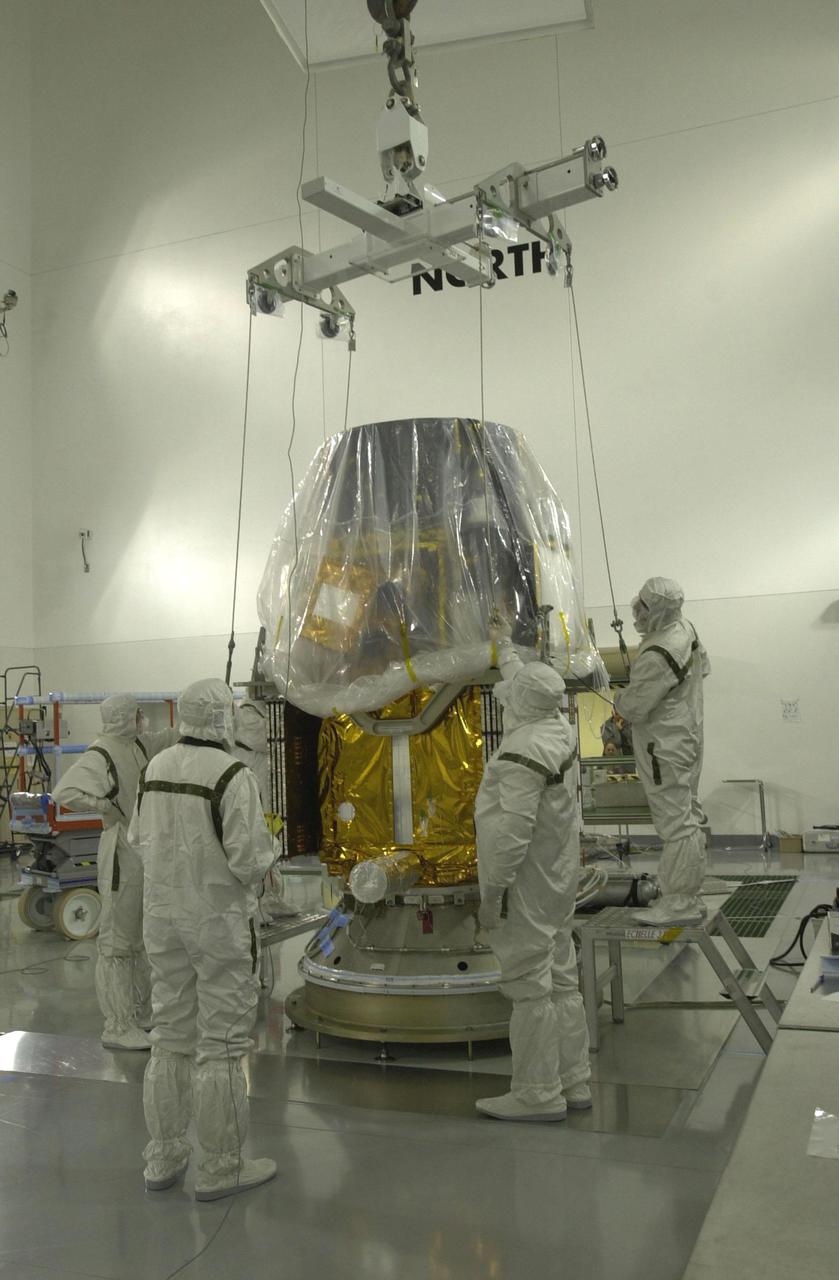
VANDENBERG AIR FORCE BASE, CALIF. - Inside the Astrotech Payload Processing Facility on Vandenberg Air Force Base in California, the CALIPSO spacecraft is being fitted with a crane to lift and move the satellite for mating with the Lower Delta Payload Attach Fitting (LDPAF), which contains the CloudSat satellite. The PAF is the interface between the spacecraft and the second stage of the rocket. CALIPSO stands for Cloud-Aerosol Lidar and Infrared Pathfinder Satellite Observation. CALIPSO and CloudSat are highly complementary satellites that will provide never-before-seen 3-D perspectives of how clouds and aerosols form, evolve, and affect weather and climate. CALIPSO and CloudSat will fly in formation with three other satellites in the A-train constellation to enhance understanding of our climate system. Launch of CALIPSO_CloudSat aboard a Boeing Delta II rocket is scheduled for 3:01 a.m. PDT Sept. 29.

CAPE CANAVERAL, Fla. -- At the Astrotech payload processing facility, technicians check the placement of NASA's Gamma-Ray Large Area Space Telescope, or GLAST, spacecraft on the payload attach fitting. The fitting will eventually be used to mate GLAST to the Delta II launch vehicle. The GLAST is a powerful space observatory that will explore the Universe's ultimate frontier, where nature harnesses forces and energies far beyond anything possible on Earth; probe some of science's deepest questions, such as what our Universe is made of, and search for new laws of physics; explain how black holes accelerate jets of material to nearly light speed; and help crack the mystery of stupendously powerful explosions known as gamma-ray bursts. A launch date still is to be determined. Photo credit: NASA/Jim Grossmann

CAPE CANAVERAL, Fla. -- At the Astrotech payload processing facility, technicians lower NASA's Gamma-Ray Large Area Space Telescope, or GLAST, spacecraft toward the payload attach fitting. The fitting will eventually be used to mate GLAST to the Delta II launch vehicle. The GLAST is a powerful space observatory that will explore the Universe's ultimate frontier, where nature harnesses forces and energies far beyond anything possible on Earth; probe some of science's deepest questions, such as what our Universe is made of, and search for new laws of physics; explain how black holes accelerate jets of material to nearly light speed; and help crack the mystery of stupendously powerful explosions known as gamma-ray bursts. A launch date still is to be determined. Photo credit: NASA/Jim Grossmann

CAPE CANAVERAL, Fla. -- At the Astrotech payload processing facility, technicians prepare the payload attach fitting that will receive NASA's Gamma-Ray Large Area Space Telescope, or GLAST, spacecraft. The fitting will eventually be used to mate GLAST to the Delta II launch vehicle. The GLAST is a powerful space observatory that will explore the Universe's ultimate frontier, where nature harnesses forces and energies far beyond anything possible on Earth; probe some of science's deepest questions, such as what our Universe is made of, and search for new laws of physics; explain how black holes accelerate jets of material to nearly light speed; and help crack the mystery of stupendously powerful explosions known as gamma-ray bursts. A launch date still is to be determined. Photo credit: NASA/Jim Grossmann
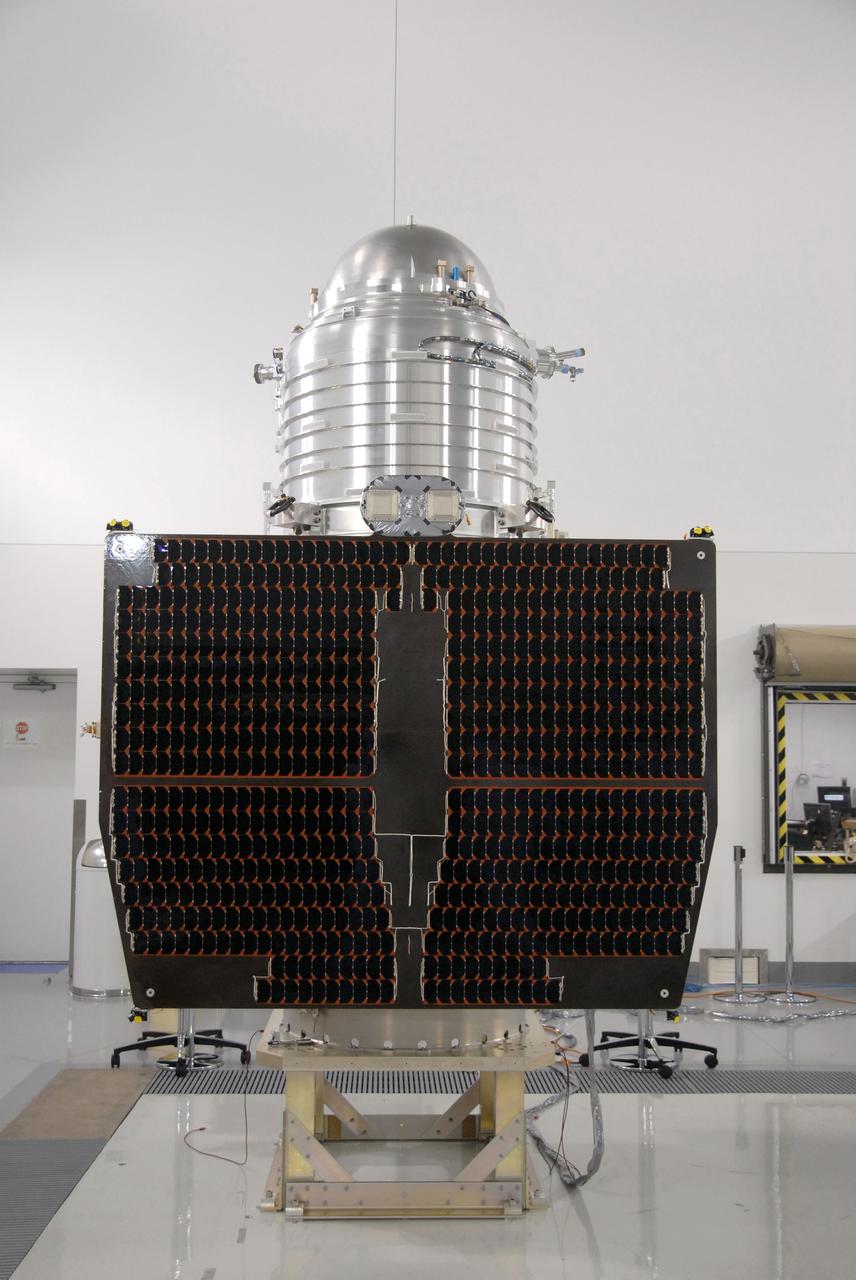
VANDENBERG AIR FORCE BASE, Calif. -- At the Astrotech processing facility on Vandenberg Air Force Base in California, NASA's Wide-field Infrared Survey Explorer, or WISE, is prepared for its move from the test stand for mating to its Payload Attach Fitting. The satellite will survey the entire sky at infrared wavelengths, creating a cosmic clearinghouse of hundreds of millions of objects which will be catalogued and provide a vast storehouse of knowledge about the solar system, the Milky Way, and the universe. Launch is scheduled for Dec. 7. Photo credit: NASA/Doug Kolkow
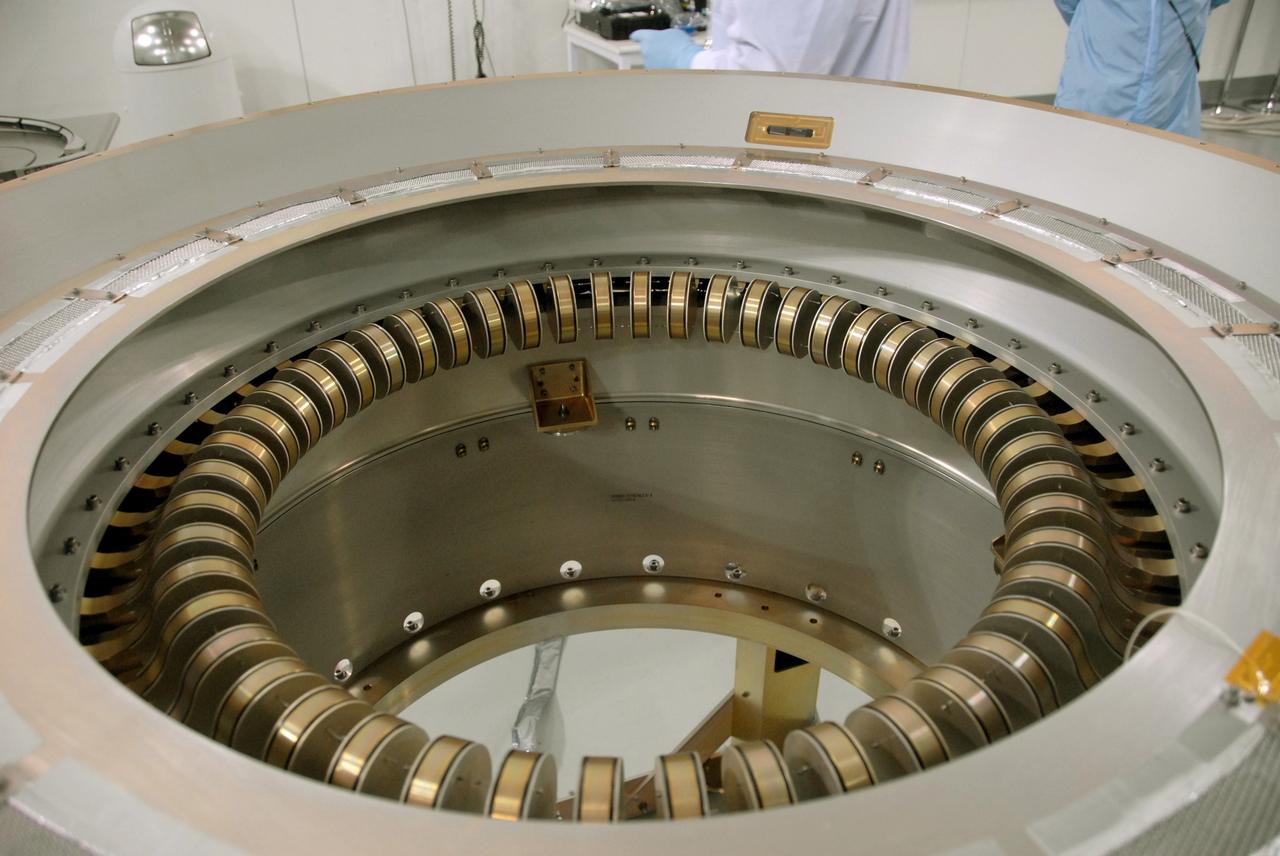
VANDENBERG AIR FORCE BASE, Calif. -- A view of the flexure springs in the soft ride being mated to the payload attach fitting for NASA's Wide-field Infrared Survey Explorer, or WISE, spacecraft. The satellite will survey the entire sky at infrared wavelengths, creating a cosmic clearinghouse of hundreds of millions of objects, which will be catalogued, providing a vast storehouse of knowledge about the solar system, the Milky Way, and the universe. Launch is scheduled no earlier than Dec. 7. Photo credit: NASA/Doug Kolkow
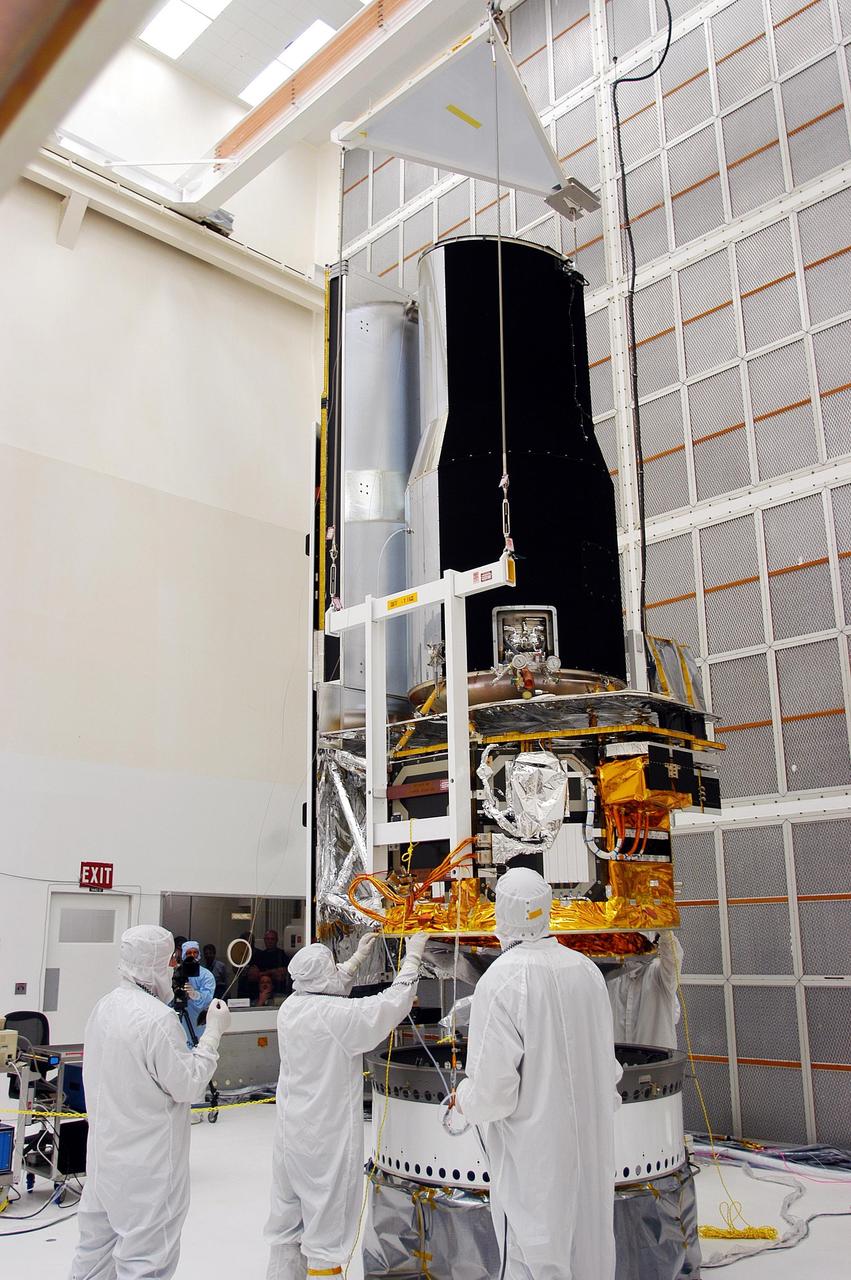
KENNEDY SPACE CENTER, FLA. - Workers make additional adjustments on the Space Infrared Telescope Facility (SIRTF) in Building AE. The telescope will be mated with its Delta II launch vehicle via the payload attach fitting seen beneath it. SIRTF is currently scheduled for transportation to Launch Complex 17-B, Cape Canaveral Air Force Station, and hoisting atop the Delta II on or about April 4.