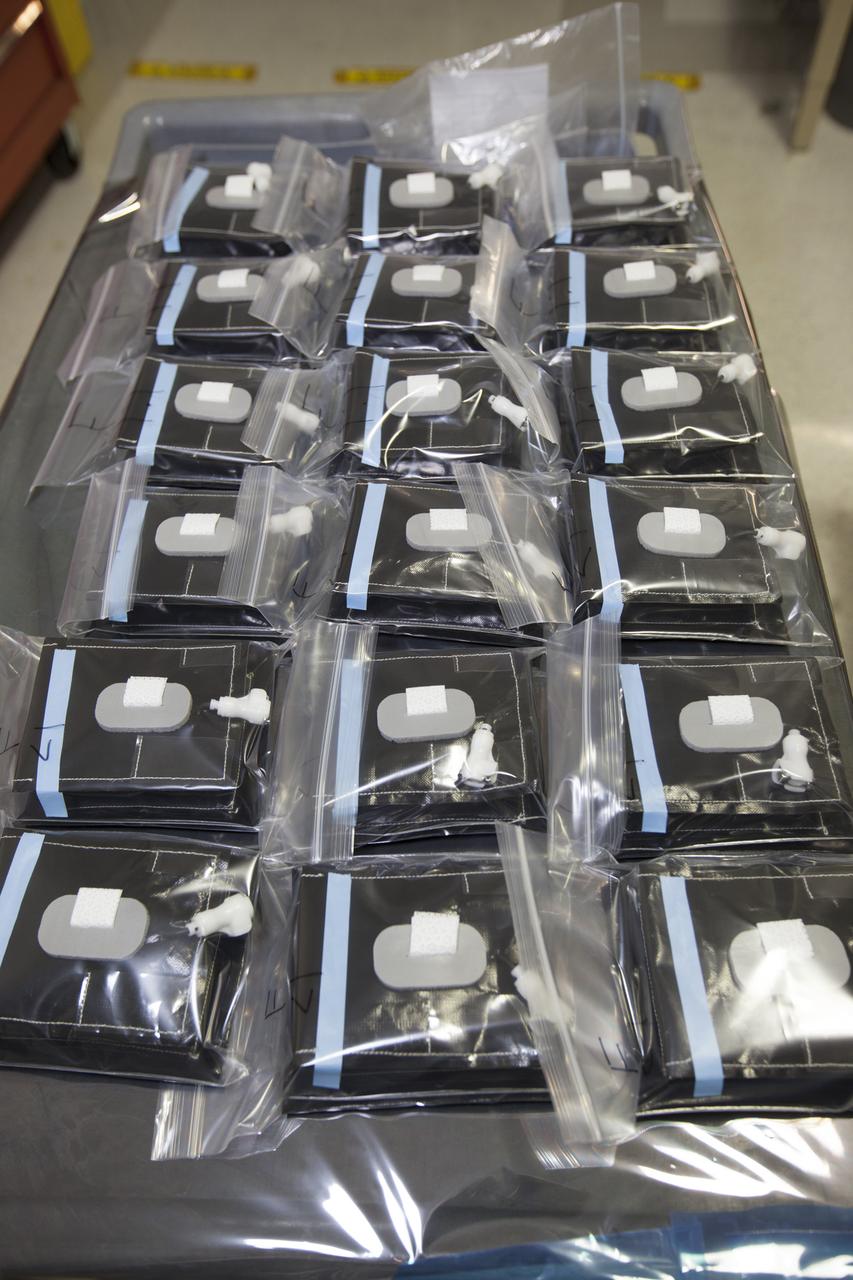
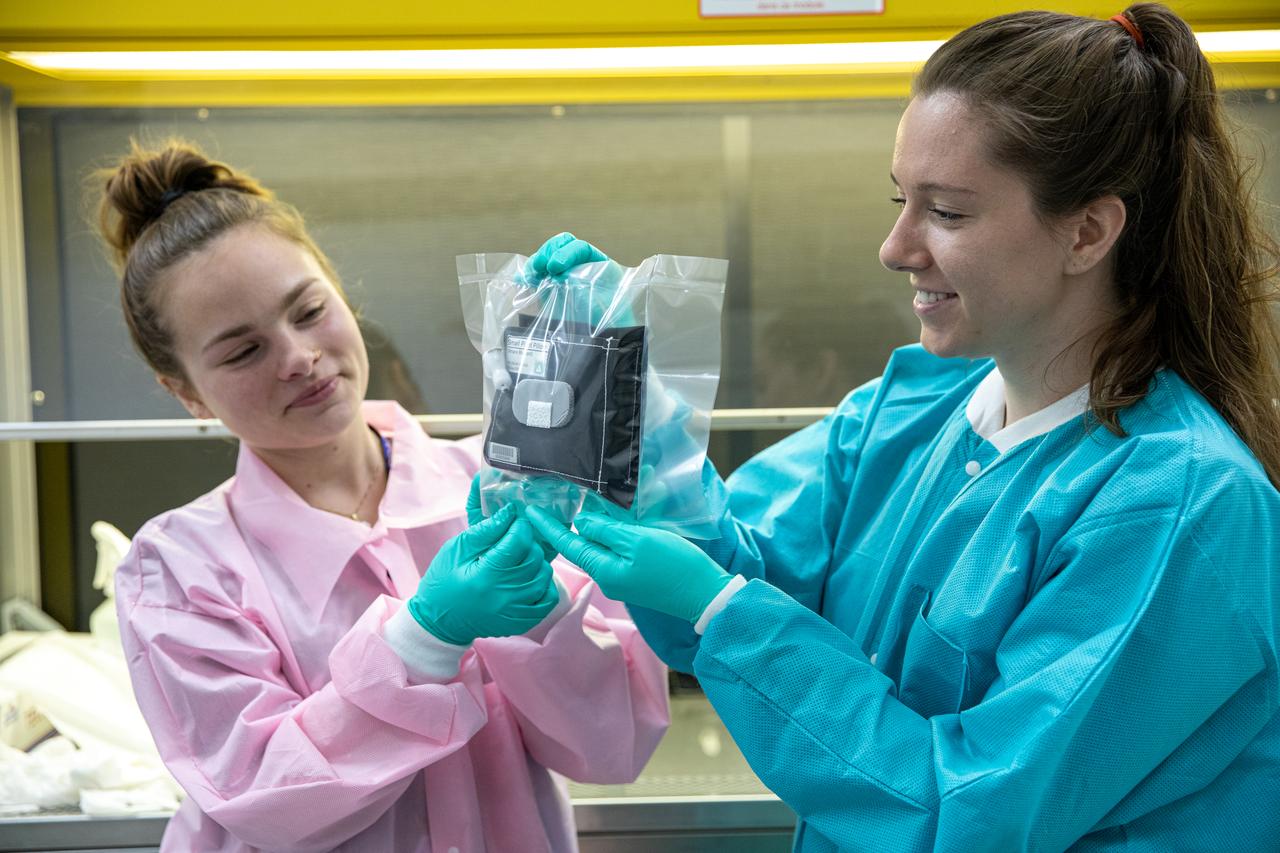
Inside a laboratory in the Space Station Processing Facility at NASA’s Kennedy Space Center in Florida, 18 plant pillows for the Veg-03 experiment have been prepared for delivery to the International Space Station aboard the eighth SpaceX Dragon commercial resupply mission. The Veg-03 plant pillows will contain ‘Tokyo Bekana’ cabbage seeds and lettuce seeds for NASA’s third Veggie plant growth system experiment. The experiment will continue NASA’s deep space plant growth research to benefit the Earth and the agency’s journey to Mars.
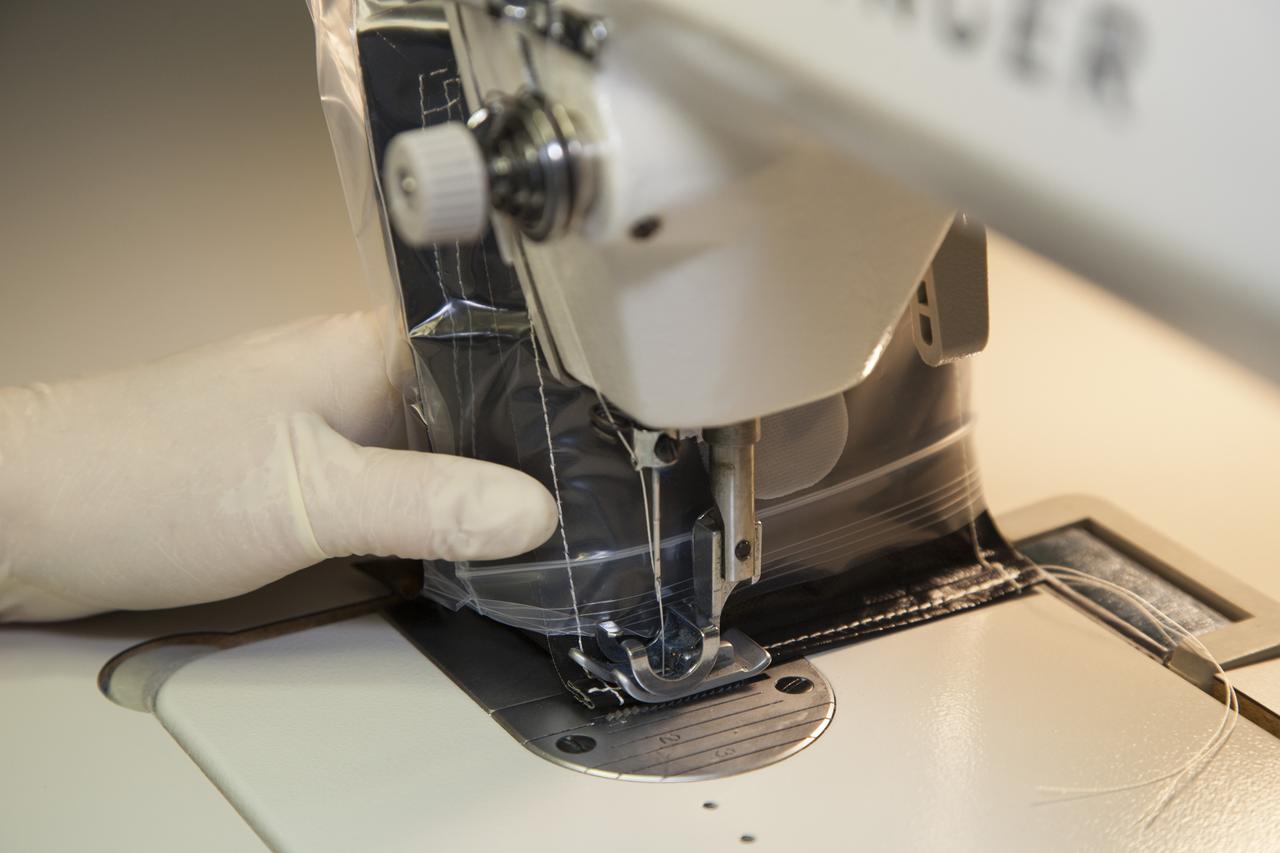
Inside a laboratory in the Space Station Processing Facility at NASA’s Kennedy Space Center in Florida, Michele Koralewicz, a mechanical technician with EASI on the Engineering Services Contract, precisely sews up the end of a bag that contains one of the Veg-03 plant pillows. The Veg-03 experiment will be delivered to the International Space Station aboard the eighth SpaceX Dragon commercial resupply mission. The Veg-03 plant pillows will contain ‘Tokyo Bekana’ cabbage seeds and lettuce seeds for NASA’s third Veggie plant growth system experiment. The experiment will continue NASA’s deep space plant growth research to benefit the Earth and the agency’s journey to Mars.
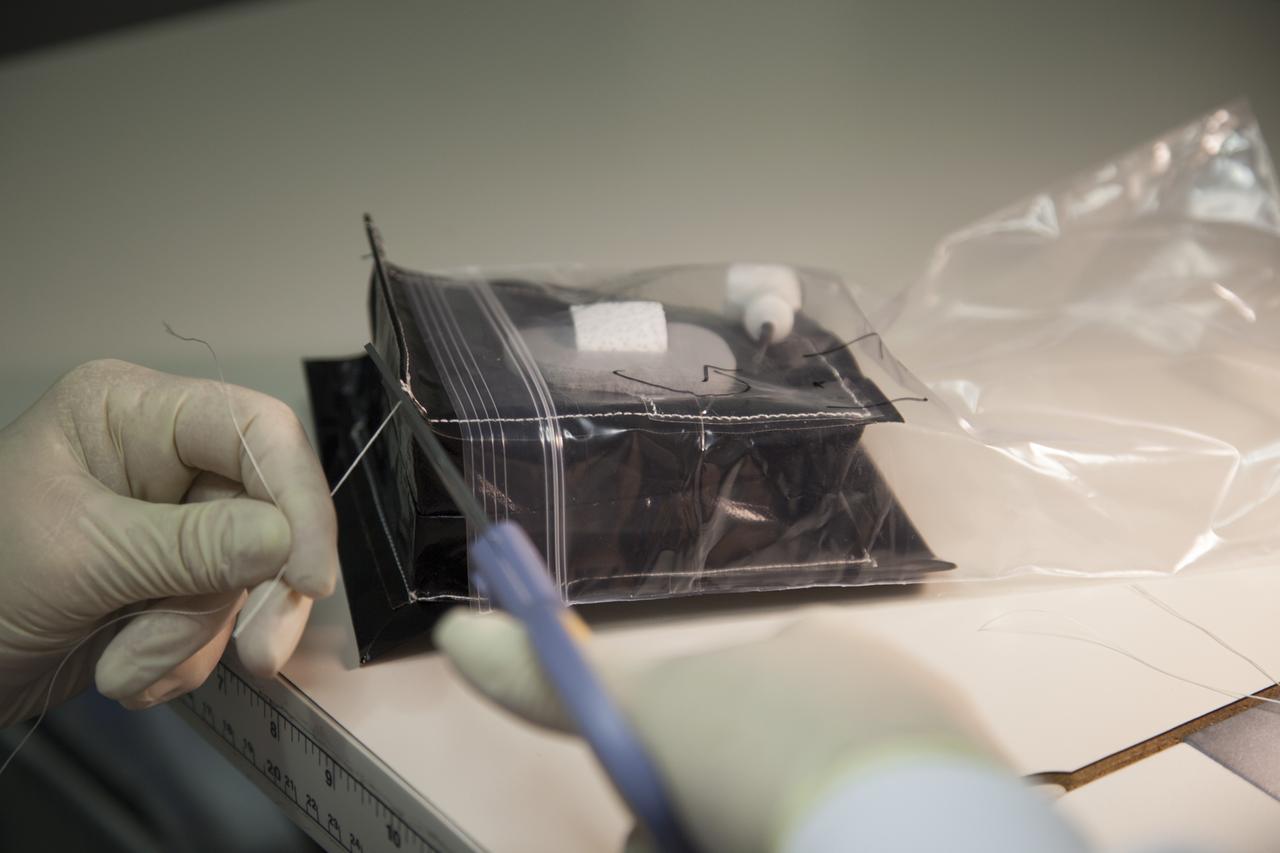
Inside a laboratory in the Space Station Processing Facility at NASA’s Kennedy Space Center in Florida, Michele Koralewicz, a mechanical technician with EASI on the Engineering Services Contract, sews up the end of a bag that contains one of the Veg-03 plant pillows. The Veg-03 experiment will be delivered to the International Space Station aboard the eighth SpaceX Dragon commercial resupply mission. The Veg-03 plant pillows will contain ‘Tokyo Bekana’ cabbage seeds and lettuce seeds for NASA’s third Veggie plant growth system experiment. The experiment will continue NASA’s deep space plant growth research to benefit the Earth and the agency’s journey to Mars.
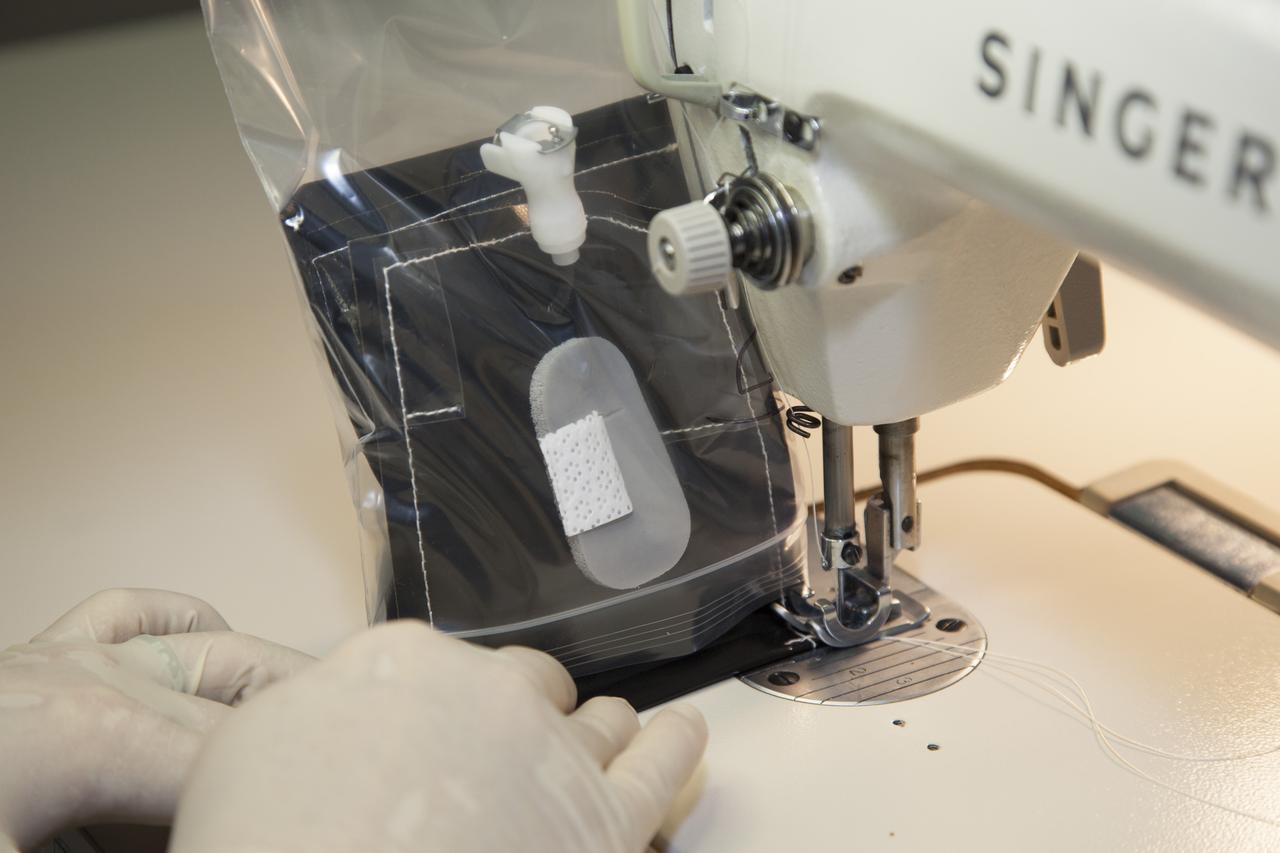
Inside a laboratory in the Space Station Processing Facility at NASA’s Kennedy Space Center in Florida, Michele Koralewicz, a mechanical technician with EASI on the Engineering Services Contract, sews up the end of a bag that contains one of the Veg-03 plant pillows. The Veg-03 experiment will be delivered to the International Space Station aboard the eighth SpaceX Dragon commercial resupply mission. The Veg-03 plant pillows will contain ‘Tokyo Bekana’ cabbage seeds and lettuce seeds for NASA’s third Veggie plant growth system experiment. The experiment will continue NASA’s deep space plant growth research to benefit the Earth and the agency’s journey to Mars.
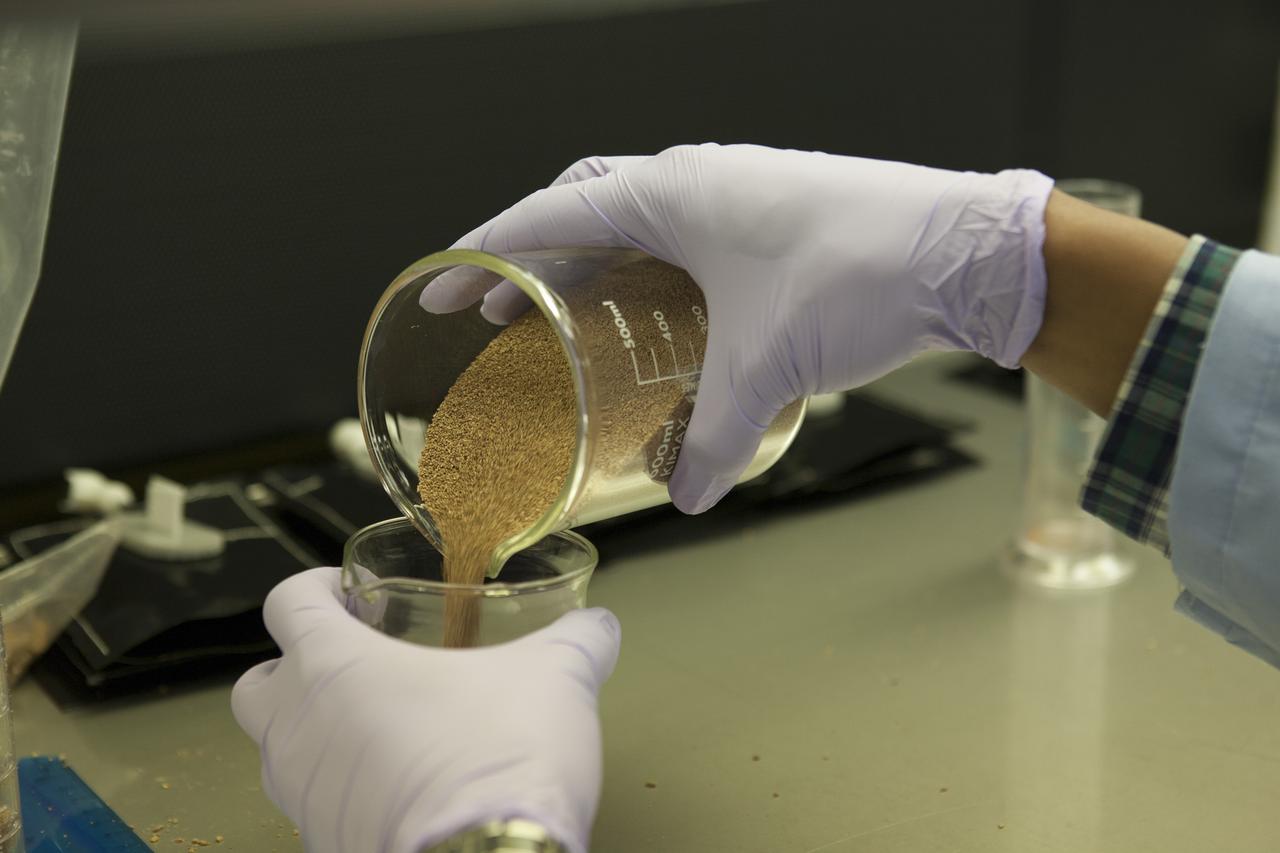
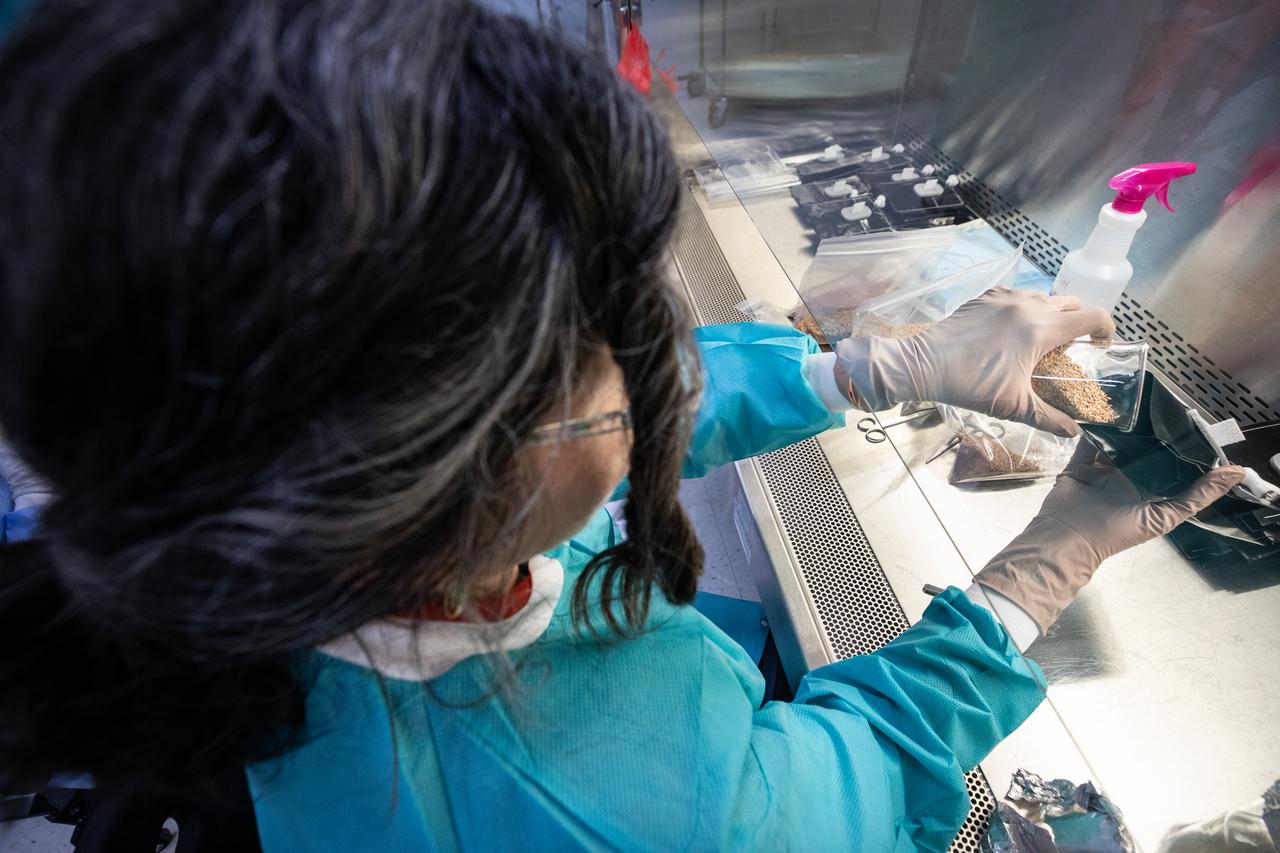
Inside a laboratory in the Space Station Processing Facility at NASA’s Kennedy Space Center in Florida, research scientists prepare the plant pillows for the Veg-03 experiment that will be delivered to the International Space Station aboard the eighth SpaceX Dragon commercial resupply mission. Matt Romeyn, a NASA pathways intern, measures out the calcined clay, or space dirt, for one of the plant pillows. The Veg-03 plant pillows will contain ‘Tokyo Bekana’ cabbage seeds and lettuce seeds for NASA’s third Veggie plant growth system experiment. The experiment will continue NASA’s deep space plant growth research to benefit the Earth and the agency’s journey to Mars.
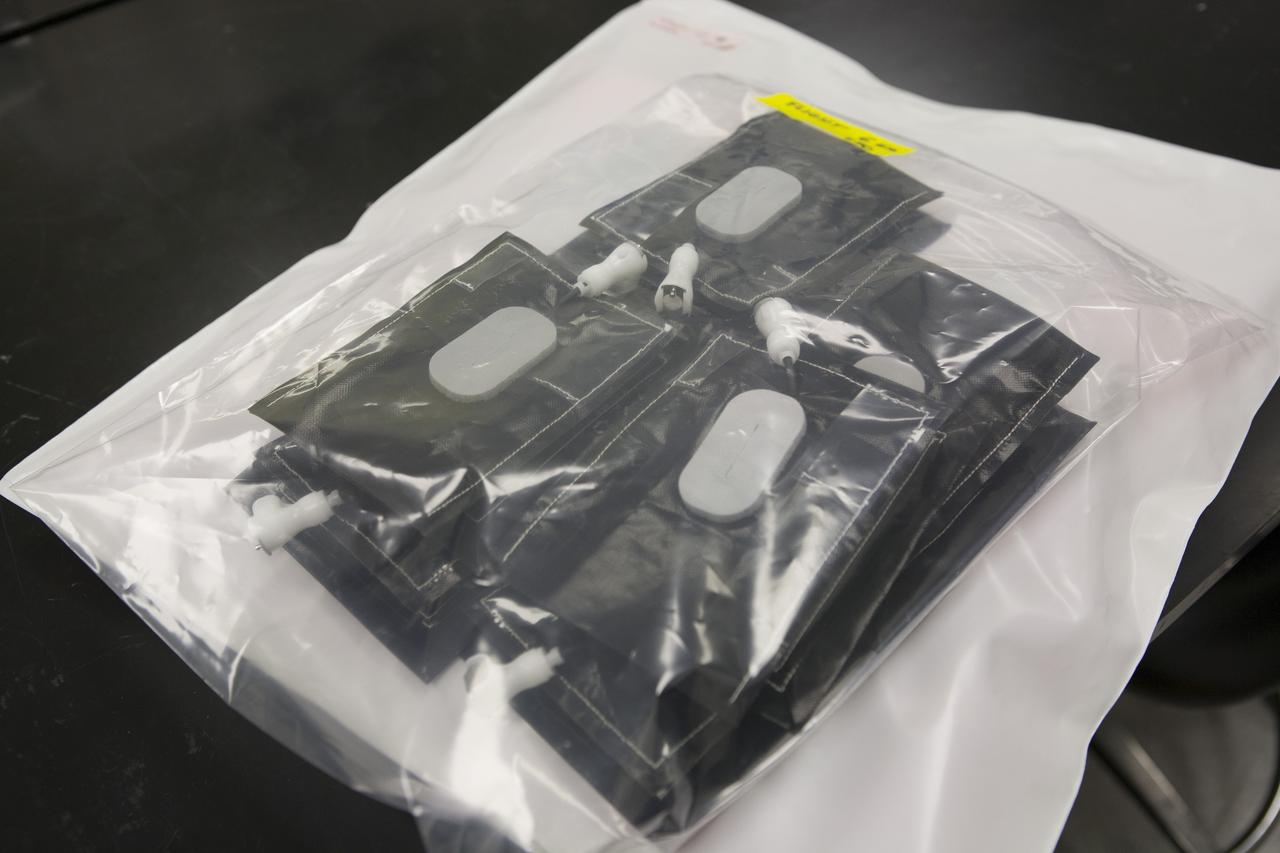
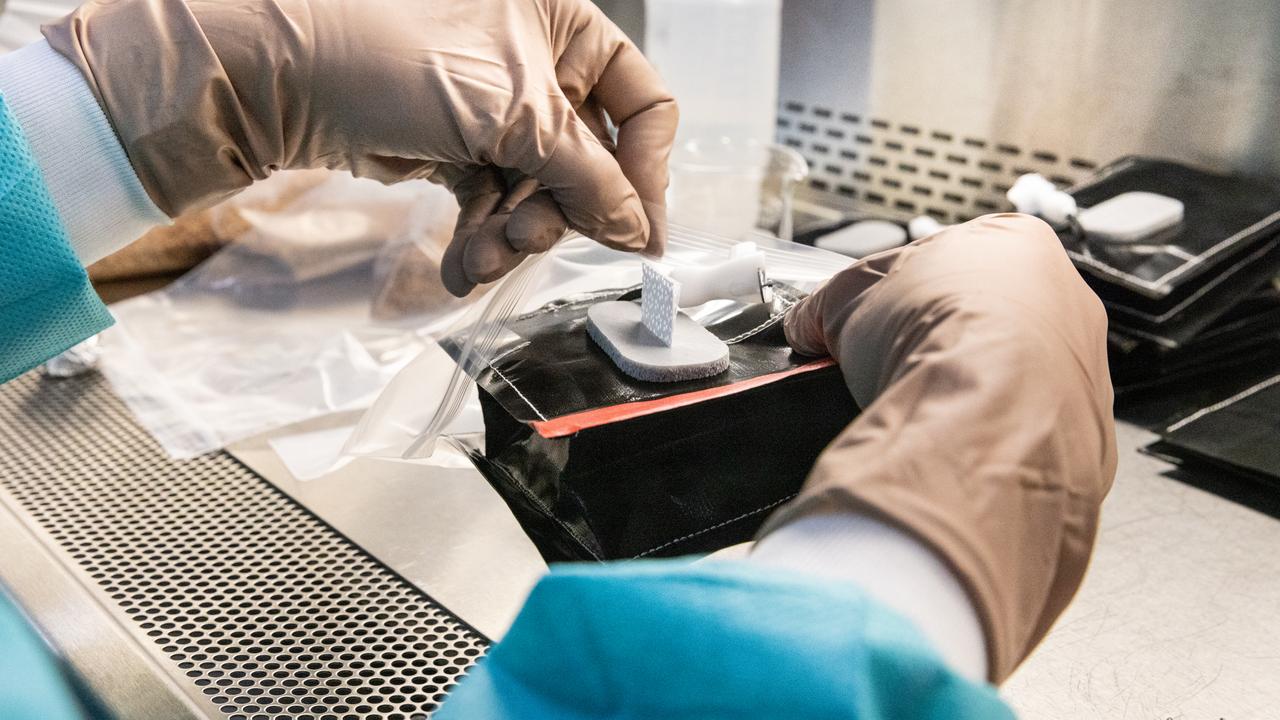
Inside a laboratory in the Space Station Processing Facility at NASA’s Kennedy Space Center in Florida, plant pillows for the Veg-03 experiment are prepared for delivery to the International Space Station aboard the eighth SpaceX Dragon commercial resupply mission. Dr. Mathew Mickens, a post-doctoral researcher, inserts a bonding agent into one of the Veg-03 plant pillows. The Veg-03 plant pillows will contain ‘Tokyo Bekana’ cabbage seeds and lettuce seeds for NASA’s third Veggie plant growth system experiment. The experiment will continue NASA’s deep space plant growth research to benefit the Earth and the agency’s journey to Mars.
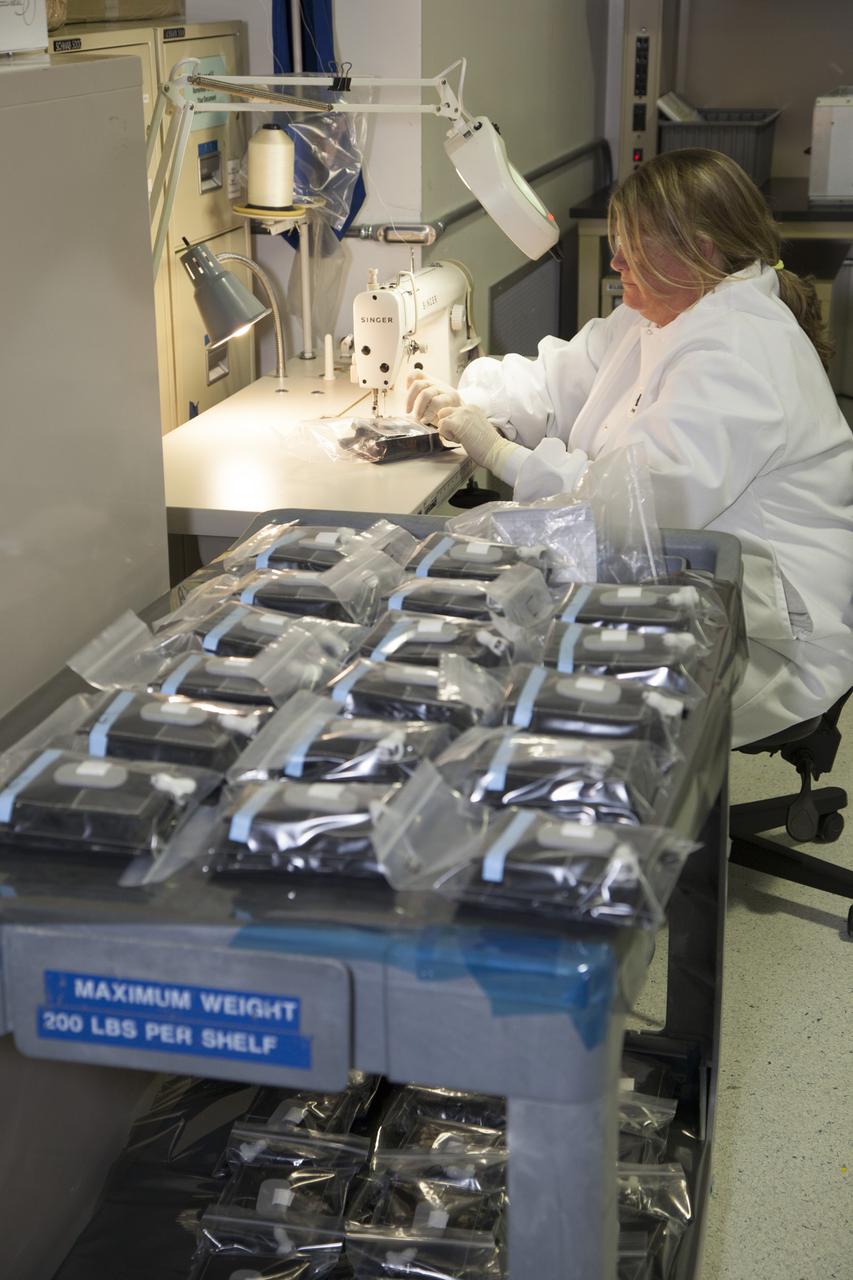
Inside a laboratory in the Space Station Processing Facility at NASA’s Kennedy Space Center in Florida, Michele Koralewicz, a mechanical technician with EASI on the Engineering Services Contract, prepares to sew up the end of a bag that contains one of the Veg-03 plant pillows. In the foreground are all of the other plant pillows that need to be sealed. The Veg-03 experiment will be delivered to the International Space Station aboard the eighth SpaceX Dragon commercial resupply mission. The Veg-03 plant pillows will contain ‘Tokyo Bekana’ cabbage seeds and lettuce seeds for NASA’s third Veggie plant growth system experiment. The experiment will continue NASA’s deep space plant growth research to benefit the Earth and the agency’s journey to Mars.
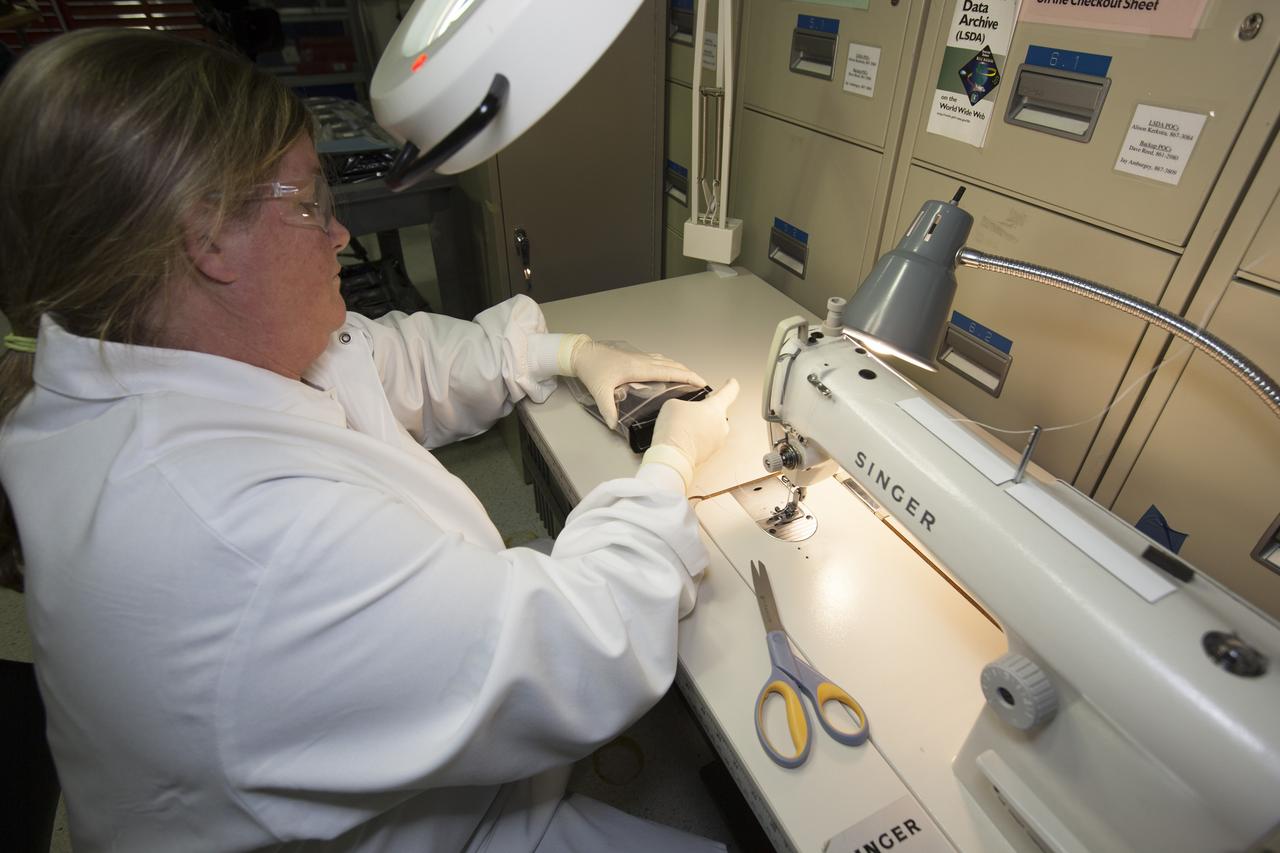
Inside a laboratory in the Space Station Processing Facility at NASA’s Kennedy Space Center in Florida, Michele Koralewicz, a mechanical technician with EASI on the Engineering Services Contract, sews up the end of a bag that contains one of the Veg-03 plant pillows. The Veg-03 experiment will be delivered to the International Space Station aboard the eighth SpaceX Dragon commercial resupply mission. The Veg-03 plant pillows will contain ‘Tokyo Bekana’ cabbage seeds and lettuce seeds for NASA’s third Veggie plant growth system experiment. The experiment will continue NASA’s deep space plant growth research to benefit the Earth and the agency’s journey to Mars.
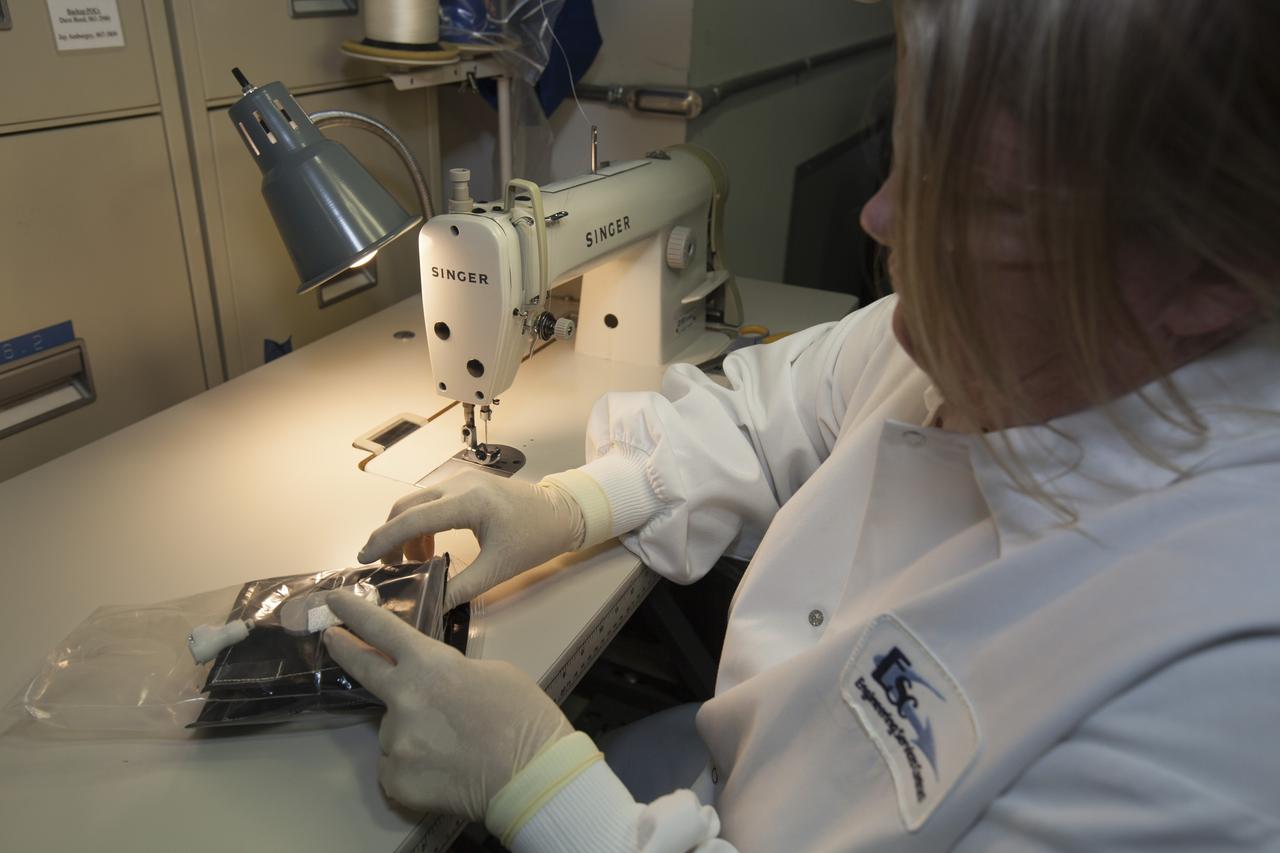
Inside a laboratory in the Space Station Processing Facility at NASA’s Kennedy Space Center in Florida, Michele Koralewicz, a mechanical technician with EASI on the Engineering Services Contract, prepares to sew the end of a bag that contains one of the Veg-03 plant pillows. The Veg-03 experiment will be delivered to the International Space Station aboard the eighth SpaceX Dragon commercial resupply mission. The Veg-03 plant pillows will contain ‘Tokyo Bekana’ cabbage seeds and lettuce seeds for NASA’s third Veggie plant growth system experiment. The experiment will continue NASA’s deep space plant growth research to benefit the Earth and the agency’s journey to Mars.
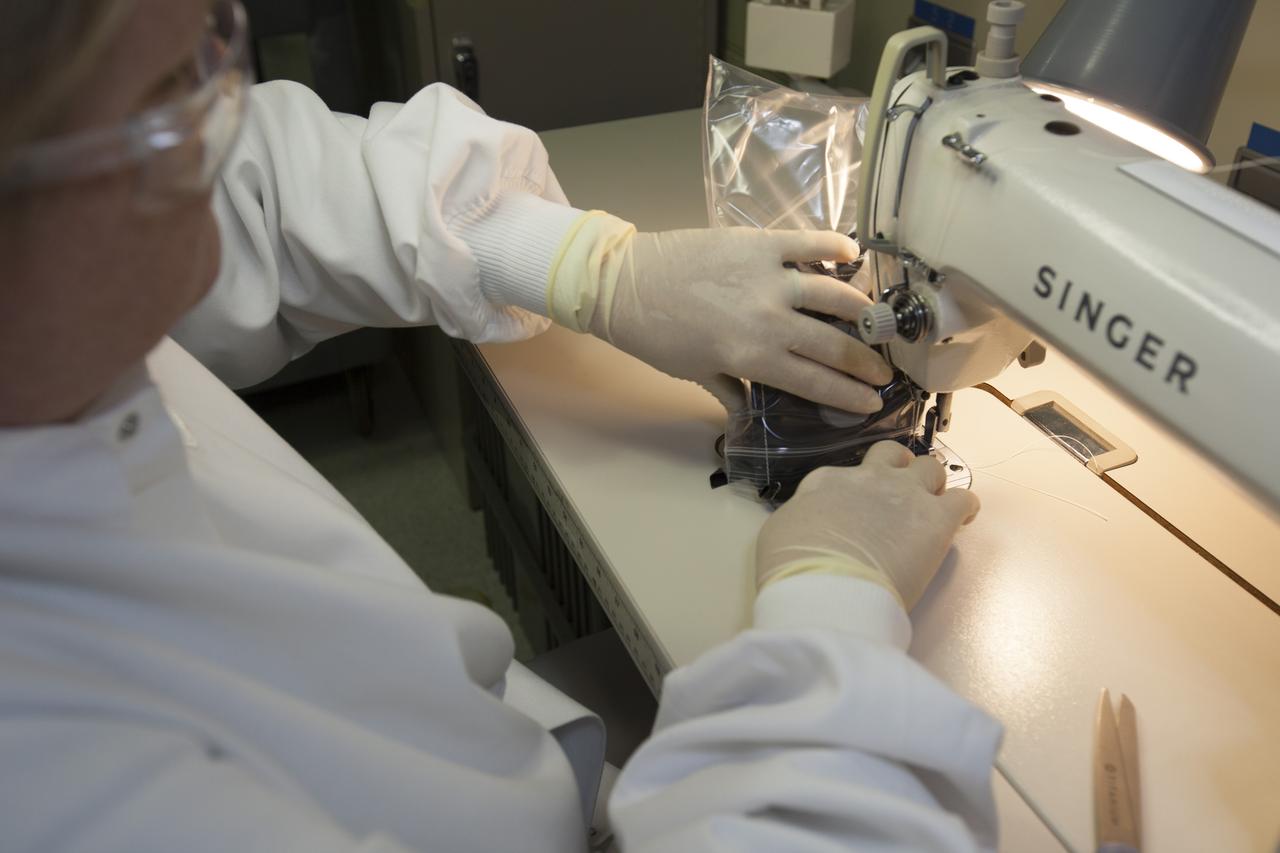
Inside a laboratory in the Space Station Processing Facility at NASA’s Kennedy Space Center in Florida, Michele Koralewicz, a mechanical technician with EASI on the Engineering Services Contract, sews up the end of a bag that contains one of the Veg-03 plant pillows. The Veg-03 experiment will be delivered to the International Space Station aboard the eighth SpaceX Dragon commercial resupply mission. The Veg-03 plant pillows will contain ‘Tokyo Bekana’ cabbage seeds and lettuce seeds for NASA’s third Veggie plant growth system experiment. The experiment will continue NASA’s deep space plant growth research to benefit the Earth and the agency’s journey to Mars.
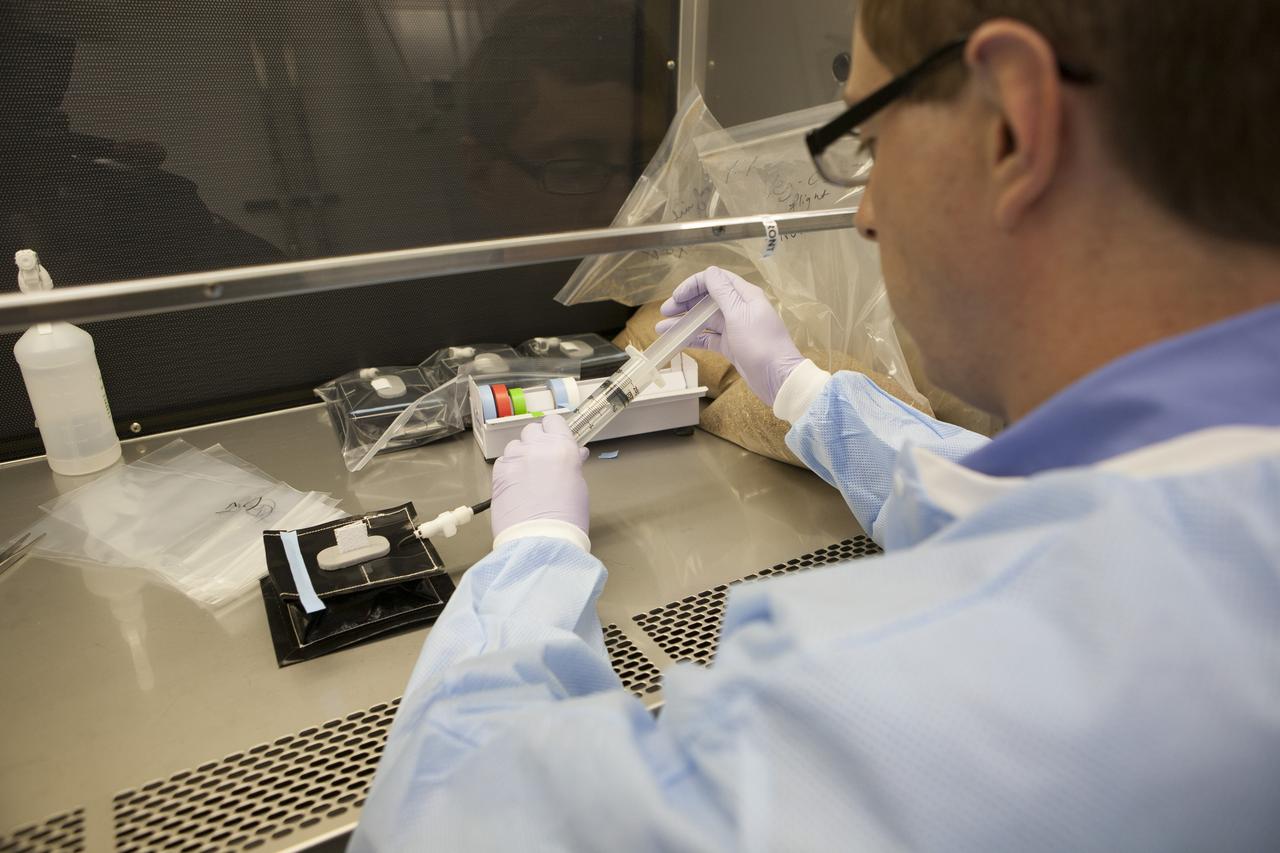
Inside a laboratory in the Space Station Processing Facility at NASA’s Kennedy Space Center in Florida, research scientists prepare the plant pillows for the Veg-03 experiment that will be delivered to the International Space Station aboard the eighth SpaceX Dragon commercial resupply mission. Dr. Mathew Mickens, a post-doctoral researcher, inserts a bonding agent into one of the Veg-03 plant pillows. The Veg-03 plant pillows will contain ‘Tokyo Bekana’ cabbage seeds and lettuce seeds for NASA’s third Veggie plant growth system experiment. The experiment will continue NASA’s deep space plant growth research to benefit the Earth and the agency’s journey to Mars.
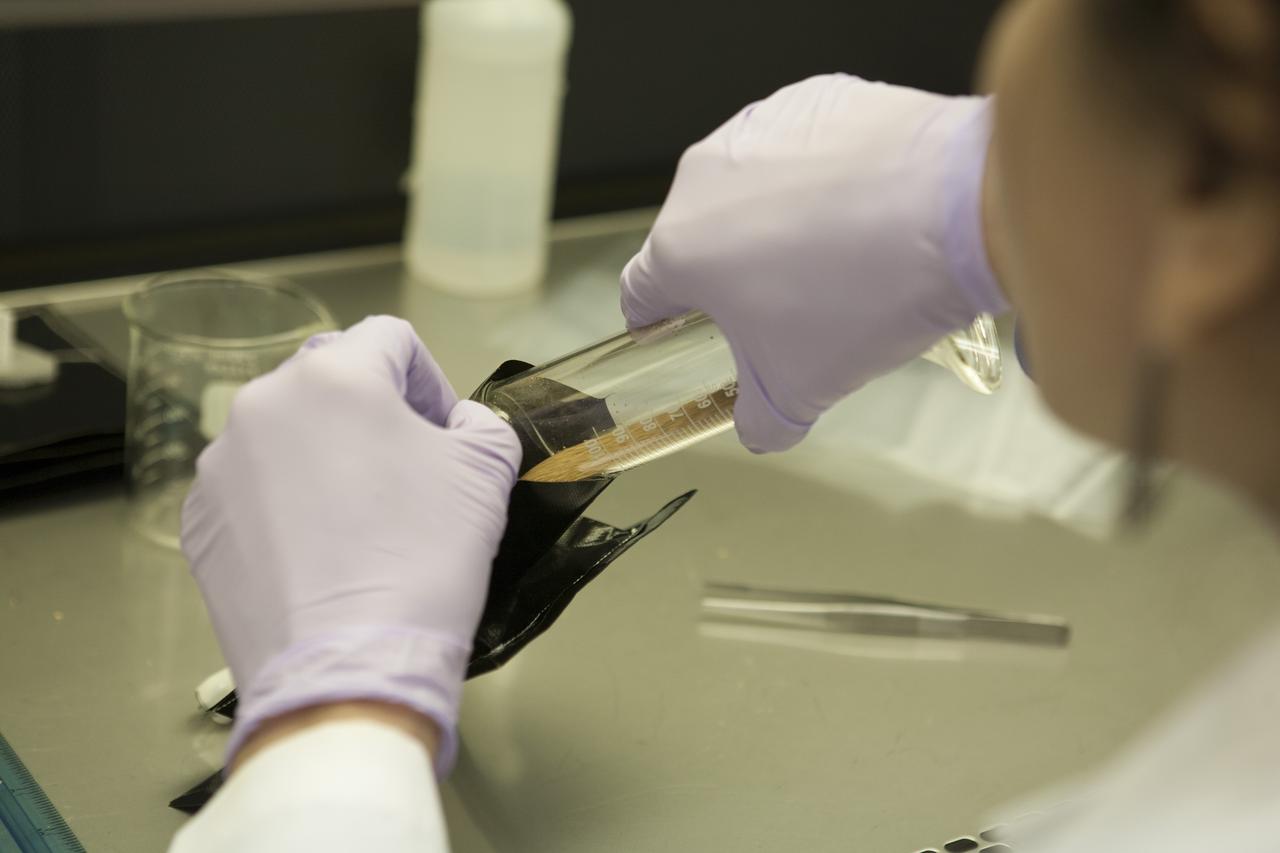
Inside a laboratory in the Space Station Processing Facility at NASA’s Kennedy Space Center in Florida, research scientists prepare the plant pillows for the Veg-03 experiment that will be delivered to the International Space Station aboard the eighth SpaceX Dragon commercial resupply mission. Matt Romeyn, a NASA pathways intern, inserts a measured amount of calcined clay, or space dirt, into one of the plant pillows. The Veg-03 plant pillows will contain ‘Tokyo Bekana’ cabbage seeds and lettuce seeds for NASA’s third Veggie plant growth system experiment. The experiment will continue NASA’s deep space plant growth research to benefit the Earth and the agency’s journey to Mars.
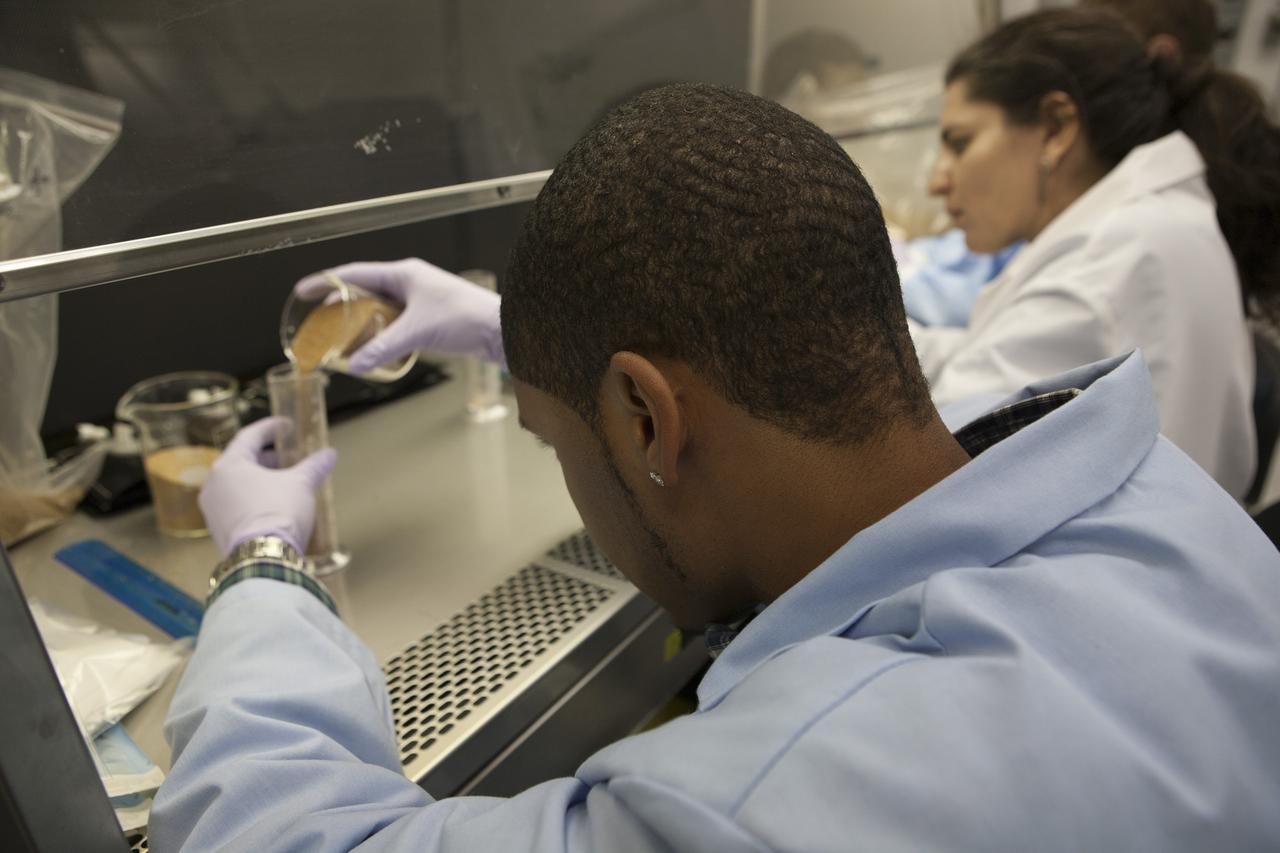
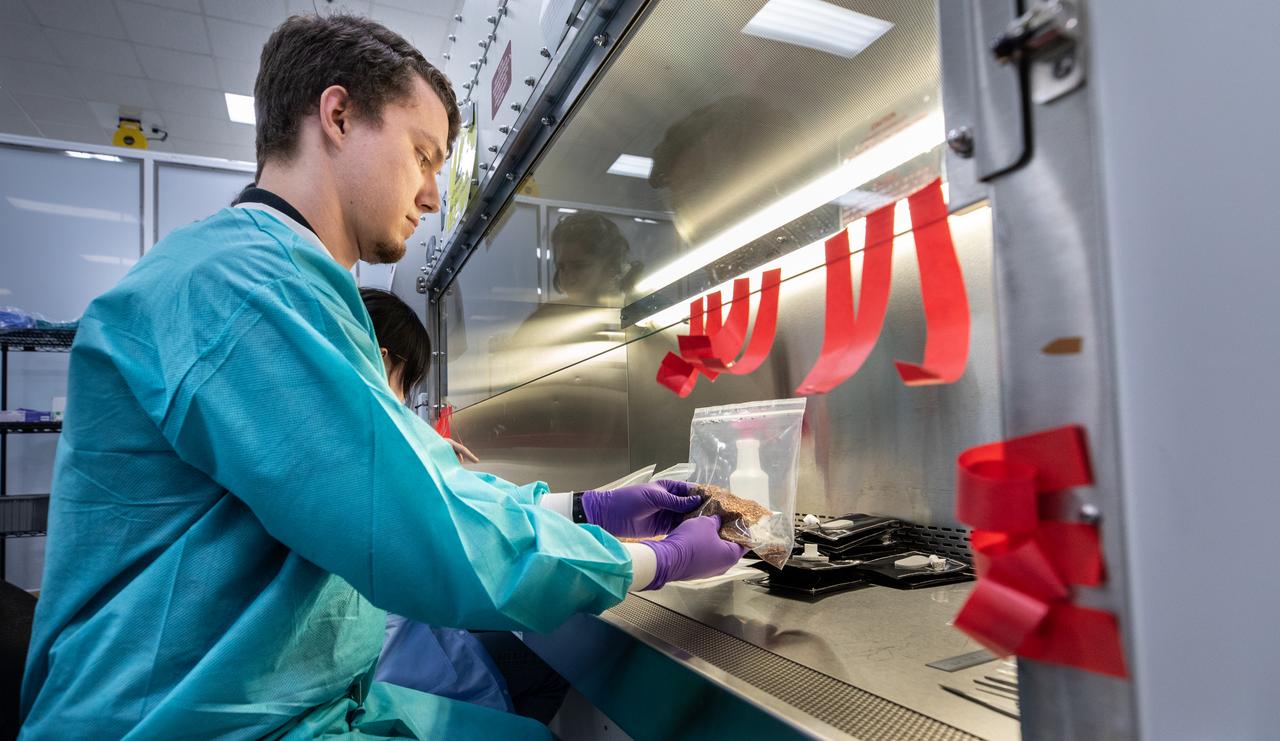
Inside a laboratory in the Space Station Processing Facility at NASA’s Kennedy Space Center in Florida, research scientists prepare the plant pillows for the Veg-03 experiment that will be delivered to the International Space Station aboard the eighth SpaceX Dragon commercial resupply mission. Matt Romeyn, a NASA pathways intern, measures out the calcined clay, or space dirt, for one of the plant pillows. To his right is Dr. Gioia Massa, NASA payload scientist for Veggie. The Veg-03 plant pillows will contain ‘Tokyo Bekana’ cabbage seeds and lettuce seeds for NASA’s third Veggie plant growth system experiment. The experiment will continue NASA’s deep space plant growth research to benefit the Earth and the agency’s journey to Mars.
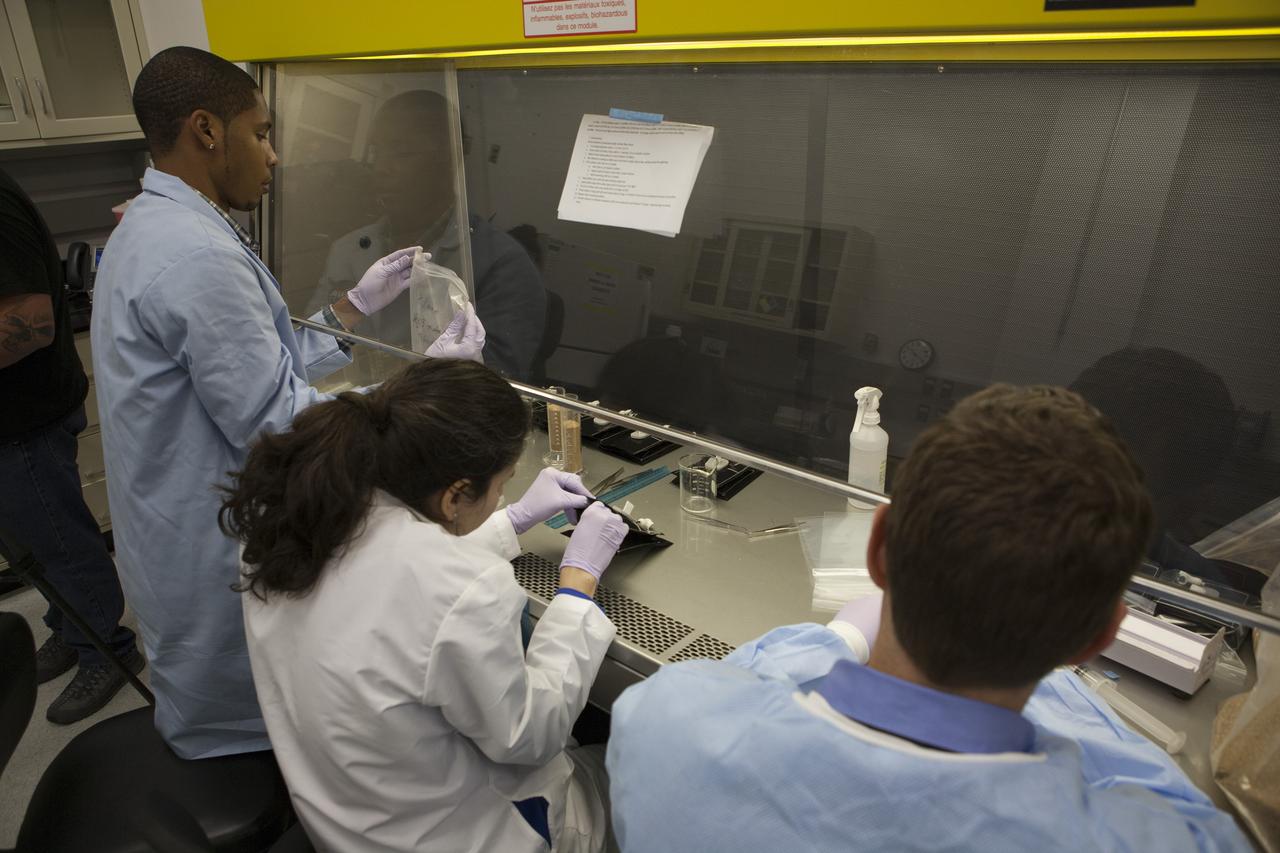
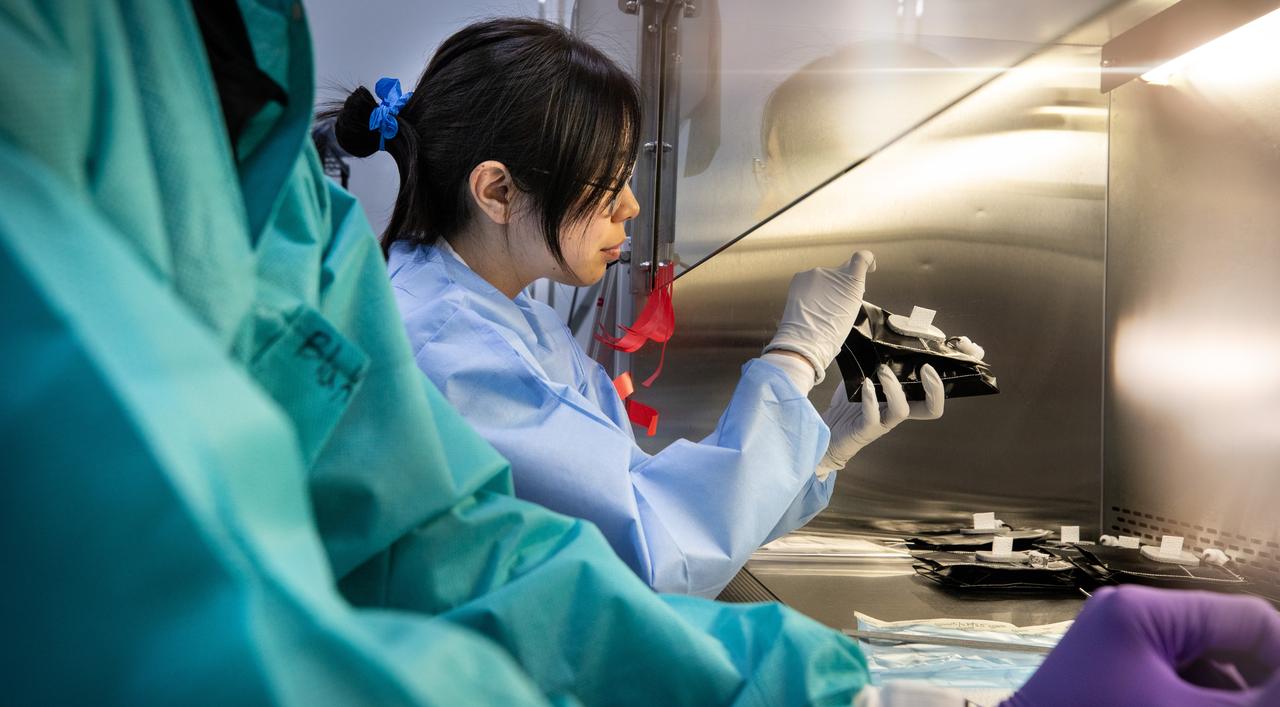
Inside a laboratory in the Space Station Processing Facility at NASA’s Kennedy Space Center in Florida, research scientists prepare the plant pillows for the Veg-03 experiment that will be delivered to the International Space Station aboard the eighth SpaceX Dragon commercial resupply mission. From left, are Matt Romeyn, NASA pathways intern; Dr. Gioia Massa, NASA payload scientist for Veggie; and Dr. Mathew Mickens, a post-doctoral researcher. The Veg-03 plant pillows will contain ‘Tokyo Bekana’ cabbage seeds and lettuce seeds for NASA’s third Veggie plant growth system experiment. The experiment will continue NASA’s deep space plant growth research to benefit the Earth and the agency’s journey to Mars.
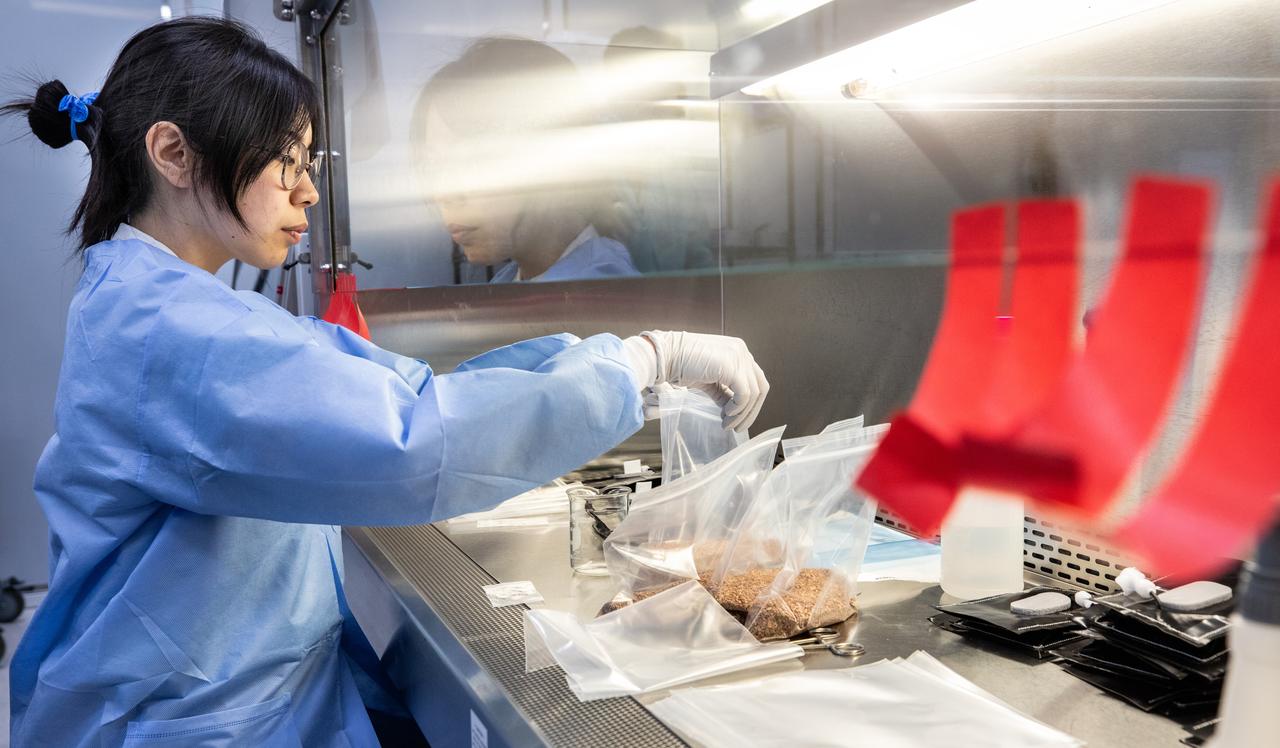
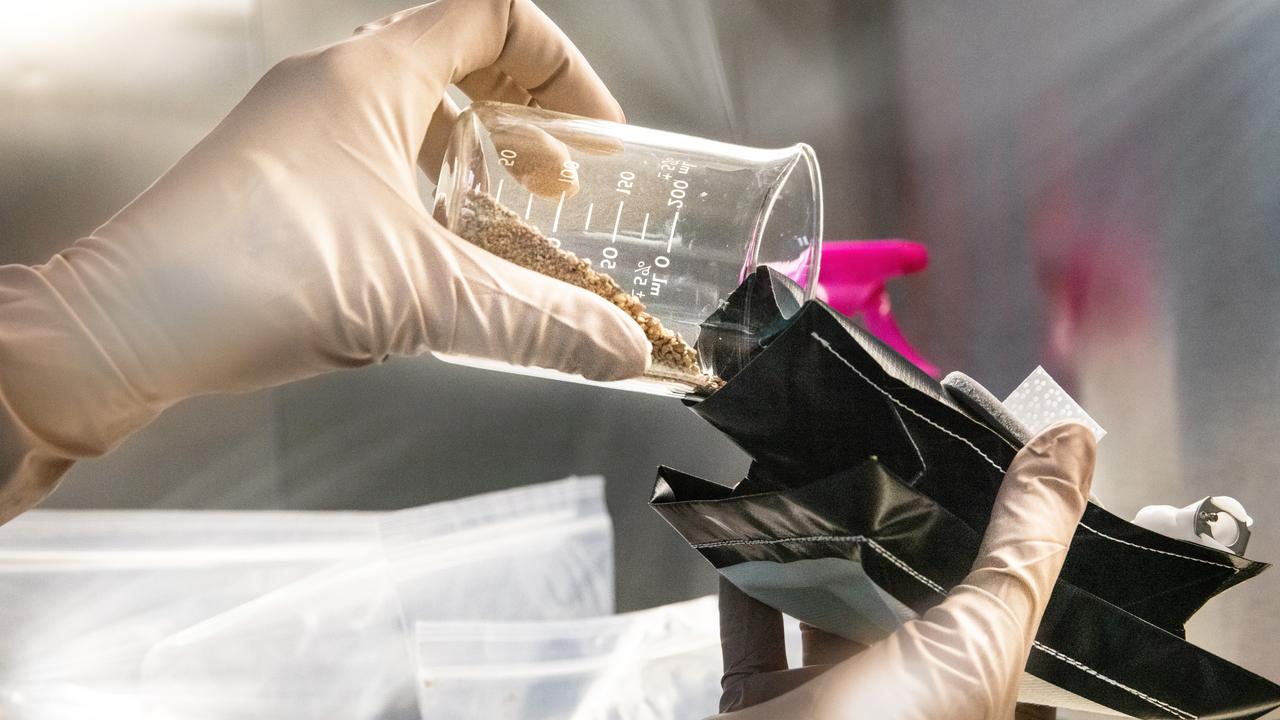
A member of the space crop production team pours substrate and controlled release fertilizer into a Veggie plant pillow on Thursday, May 29, 2025, inside the Space Systems Processing Facility at NASA’s Kennedy Space Center in Florida. The plant pillows, along with Veg-03 MNO seed films, which will carry seeds of Red Russian kale, Wasabi mustard greens, and Dragoon lettuce, are set to fly aboard NASA’s SpaceX Crew-11 mission to the International Space Station to grow in the space environment to study how microgravity impacts crop development compared to ground-grown plants. Seed films enable seed handling and planting of seeds into plant pillows allowing for astronaut choice of crops to grow. Plants can provide whole food nutrition, improve menu variety, and positively impact behavioral health of astronauts on long duration missions to the Moon and Mars and space crop research aboard the orbiting laboratory is enabled by NASA’s Biological and Physical Sciences Division and the International Space Station Program.

A member of the space crop production team pours substrate and controlled release fertilizer into a Veggie plant pillow on Thursday, May 29, 2025, inside the Space Systems Processing Facility at NASA’s Kennedy Space Center in Florida. The plant pillows, along with Veg-03 MNO seed films, which will carry seeds of Red Russian kale, Wasabi mustard greens, and Dragoon lettuce, are set to fly aboard NASA’s SpaceX Crew-11 mission to the International Space Station to grow in the space environment to study how microgravity impacts crop development compared to ground-grown plants. Seed films enable seed handling and planting of seeds into plant pillows allowing for astronaut choice of crops to grow. Plants can provide whole food nutrition, improve menu variety, and positively impact behavioral health of astronauts on long duration missions to the Moon and Mars and space crop research aboard the orbiting laboratory is enabled by NASA’s Biological and Physical Sciences Division and the International Space Station Program.
A member of the space crop production team pours substrate and controlled release fertilizer into a Veggie plant pillow on Thursday, May 29, 2025, inside the Space Systems Processing Facility at NASA’s Kennedy Space Center in Florida. The plant pillows, along with Veg-03 MNO seed films, which will carry seeds of Red Russian kale, Wasabi mustard greens, and Dragoon lettuce, are set to fly aboard NASA’s SpaceX Crew-11 mission to the International Space Station to grow in the space environment to study how microgravity impacts crop development compared to ground-grown plants. Seed films enable seed handling and planting of seeds into plant pillows allowing for astronaut choice of crops to grow. Plants can provide whole food nutrition, improve menu variety, and positively impact behavioral health of astronauts on long duration missions to the Moon and Mars and space crop research aboard the orbiting laboratory is enabled by NASA’s Biological and Physical Sciences Division and the International Space Station Program.
A member of the space crop production team pours substrate and controlled release fertilizer into a Veggie plant pillow on Thursday, May 29, 2025, inside the Space Systems Processing Facility at NASA’s Kennedy Space Center in Florida. The plant pillows, along with Veg-03 MNO seed films, which will carry seeds of Red Russian kale, Wasabi mustard greens, and Dragoon lettuce, are set to fly aboard NASA’s SpaceX Crew-11 mission to the International Space Station to grow in the space environment to study how microgravity impacts crop development compared to ground-grown plants. Seed films enable seed handling and planting of seeds into plant pillows allowing for astronaut choice of crops to grow. Plants can provide whole food nutrition, improve menu variety, and positively impact behavioral health of astronauts on long duration missions to the Moon and Mars and space crop research aboard the orbiting laboratory is enabled by NASA’s Biological and Physical Sciences Division and the International Space Station Program.
A member of the space crop production team pours substrate and controlled release fertilizer into a Veggie plant pillow on Thursday, May 29, 2025, inside the Space Systems Processing Facility at NASA’s Kennedy Space Center in Florida. The plant pillows, along with Veg-03 MNO seed films, which will carry seeds of Red Russian kale, Wasabi mustard greens, and Dragoon lettuce, are set to fly aboard NASA’s SpaceX Crew-11 mission to the International Space Station to grow in the space environment to study how microgravity impacts crop development compared to ground-grown plants. Seed films enable seed handling and planting of seeds into plant pillows allowing for astronaut choice of crops to grow. Plants can provide whole food nutrition, improve menu variety, and positively impact behavioral health of astronauts on long duration missions to the Moon and Mars and space crop research aboard the orbiting laboratory is enabled by NASA’s Biological and Physical Sciences Division and the International Space Station Program.
A member of the space crop production team pours substrate and controlled release fertilizer into a Veggie plant pillow on Thursday, May 29, 2025, inside the Space Systems Processing Facility at NASA’s Kennedy Space Center in Florida. The plant pillows, along with Veg-03 MNO seed films, which will carry seeds of Red Russian kale, Wasabi mustard greens, and Dragoon lettuce, are set to fly aboard NASA’s SpaceX Crew-11 mission to the International Space Station to grow in the space environment to study how microgravity impacts crop development compared to ground-grown plants. Seed films enable seed handling and planting of seeds into plant pillows allowing for astronaut choice of crops to grow. Plants can provide whole food nutrition, improve menu variety, and positively impact behavioral health of astronauts on long duration missions to the Moon and Mars and space crop research aboard the orbiting laboratory is enabled by NASA’s Biological and Physical Sciences Division and the International Space Station Program.
A member of the space crop production team pours substrate and controlled release fertilizer into a Veggie plant pillow on Thursday, May 29, 2025, inside the Space Systems Processing Facility at NASA’s Kennedy Space Center in Florida. The plant pillows, along with Veg-03 MNO seed films, which will carry seeds of Red Russian kale, Wasabi mustard greens, and Dragoon lettuce, are set to fly aboard NASA’s SpaceX Crew-11 mission to the International Space Station to grow in the space environment to study how microgravity impacts crop development compared to ground-grown plants. Seed films enable seed handling and planting of seeds into plant pillows allowing for astronaut choice of crops to grow. Plants can provide whole food nutrition, improve menu variety, and positively impact behavioral health of astronauts on long duration missions to the Moon and Mars and space crop research aboard the orbiting laboratory is enabled by NASA’s Biological and Physical Sciences Division and the International Space Station Program.

Seeds are secured in plant pillows for the Veggie plant growth system inside a laboratory in the Space Station Processing Facility at NASA's Kennedy Space Center in Florida. The plant pillows, containing Outredgeous lettuce, Mizuna Mustard and Waldmann's green lettuce seeds, were packed for delivery to Veggie on SpaceX's 12th commercial resupply services mission to the International Space Station.

Matt Romeyn, a NASA biologist, secures seeds in plant pillows for the Veggie plant growth system inside a laboratory in the Space Station Processing Facility at NASA's Kennedy Space Center in Florida. The plant pillows, containing Outredgeous lettuce, Mizuna Mustard and Waldmann's green lettuce seeds, were packed for delivery to Veggie on SpaceX's 12th commercial resupply services mission to the International Space Station.

Matt Romeyn, a NASA biologist, secures seeds in plant pillows for the Veggie plant growth system inside a laboratory in the Space Station Processing Facility at NASA's Kennedy Space Center in Florida. The plant pillows, containing Outredgeous lettuce, Mizuna Mustard and Waldmann's green lettuce seeds, were packed for delivery to Veggie on SpaceX's 12th commercial resupply services mission to the International Space Station.

Seeds are secured in plant pillows for the Veggie plant growth system inside a laboratory in the Space Station Processing Facility at NASA's Kennedy Space Center in Florida. The plant pillows, containing Outredgeous lettuce, Mizuna Mustard and Waldmann's green lettuce seeds, were packed for delivery to Veggie on SpaceX's 12th commercial resupply services mission to the International Space Station.

Seeds are secured in plant pillows for the Veggie plant growth system inside a laboratory in the Space Station Processing Facility at NASA's Kennedy Space Center in Florida. The plant pillows, containing Outredgeous lettuce, Mizuna Mustard and Waldmann's green lettuce seeds, were packed for delivery to Veggie on SpaceX's 12th commercial resupply services mission to the International Space Station.

Seeds are secured in plant pillows for the Veggie plant growth system inside a laboratory in the Space Station Processing Facility at NASA's Kennedy Space Center in Florida. The plant pillows, containing Outredgeous lettuce, Mizuna Mustard and Waldmann's green lettuce, were packed for delivery to Veggie on SpaceX's 12th commercial resupply services mission to the International Space Station.
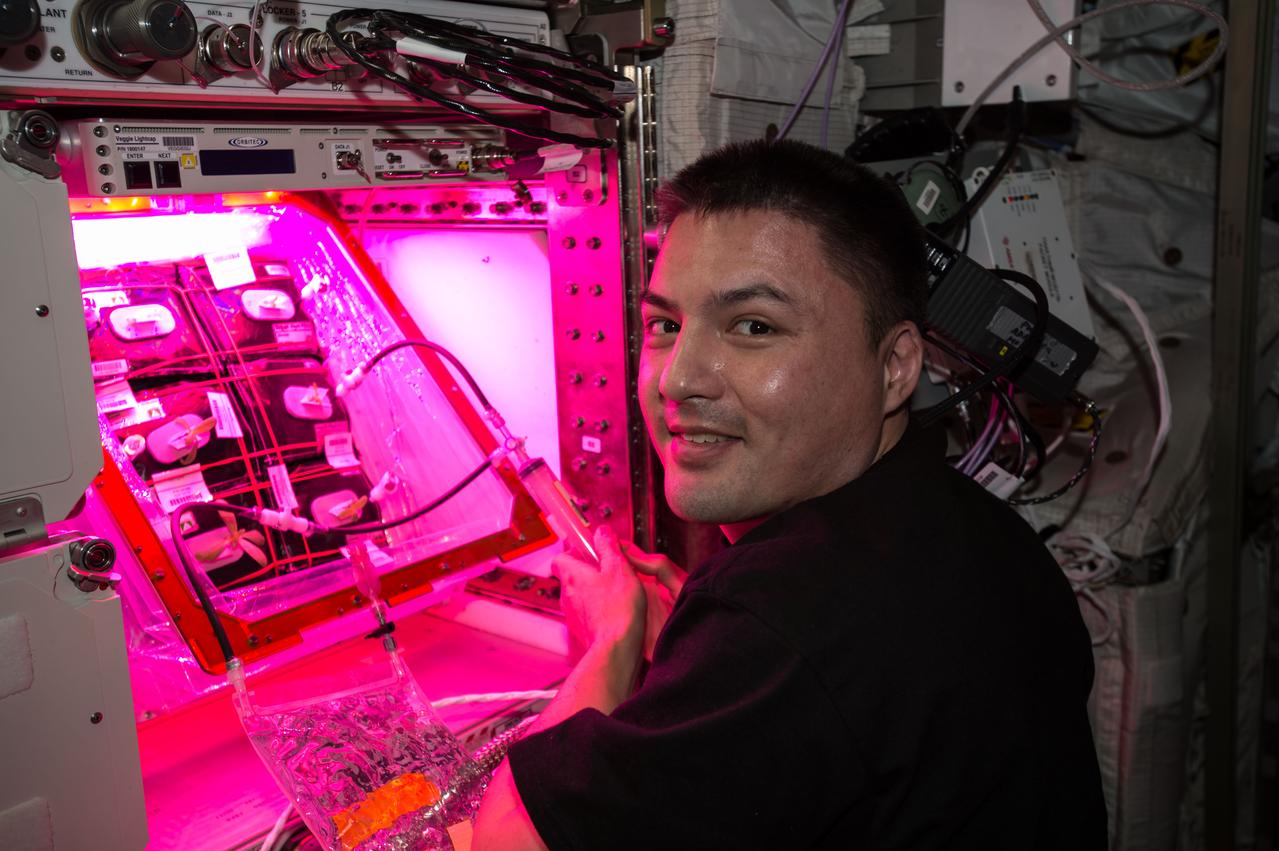
Flight engineer Kjell Lindgren poses with zinnia plants in the Veggie facility during Plant Pillow water refill operations. Image was taken in the Columbus European Laboratory and released by Lindgren on social media. "Our zinnias are looking good! #SpaceGardener"
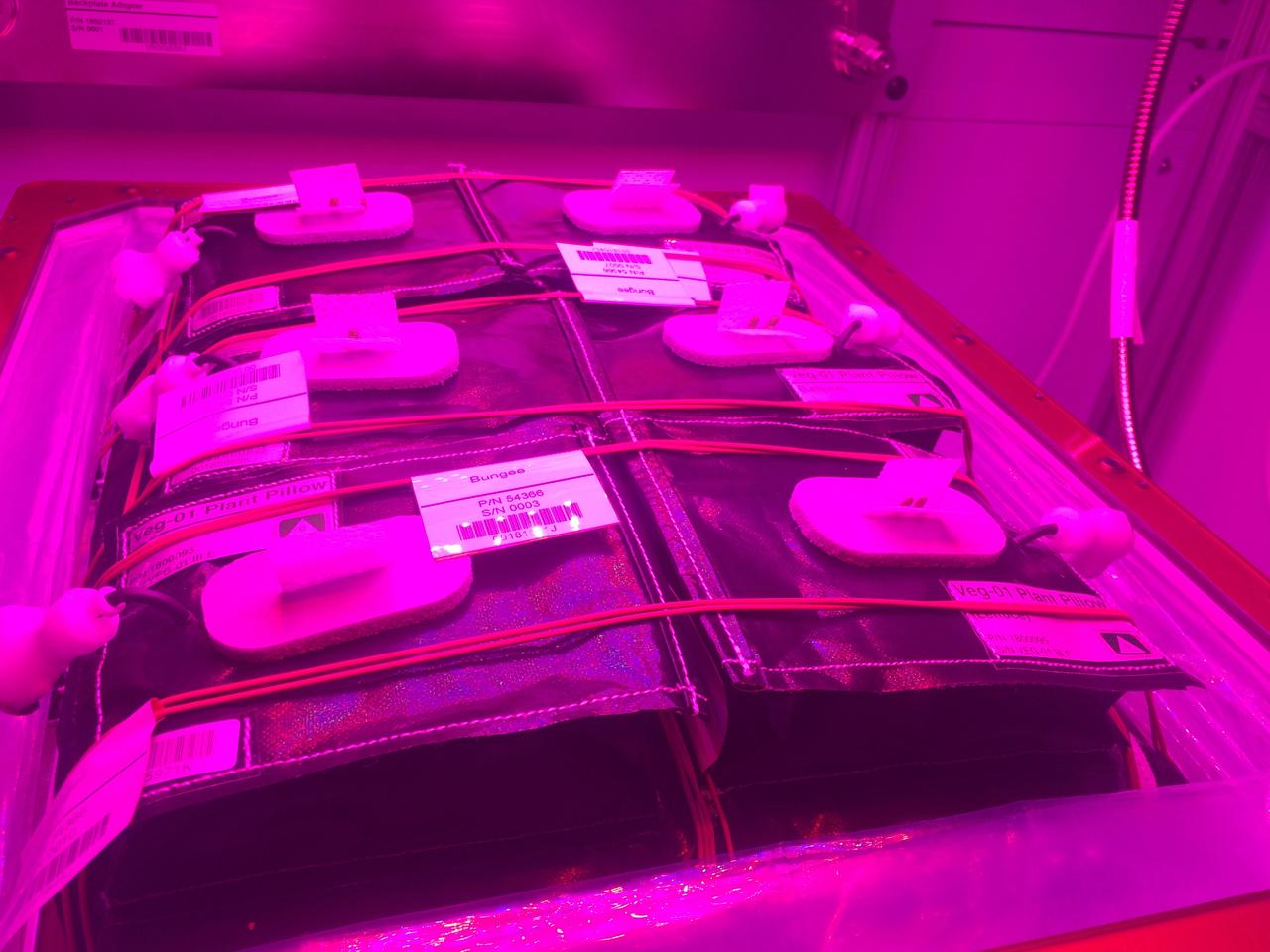
Astronaut Scott Kelly initiated VEG-01 B, the second crop of lettuce, on July, 8, 2015, and both Kelly and Astronaut Kjell Lindgren cared for the plants. The crop grew for 33 days. VEG-01 B included one set of six plant pillows planted with red romaine lettuce seeds. On Aug. 10, 2015, the crew harvested and consumed leaves from each plant. This was the first crop grown and consumed in NASA hardware. They harvested the rest of the plant tissue and froze it in the station’s Minus Eighty-Degree Laboratory Freezer for ISS (MELFI) for return to Earth for further study including microbial analysis, antioxidant capacity, mineral analysis and anthocyanin concentration.
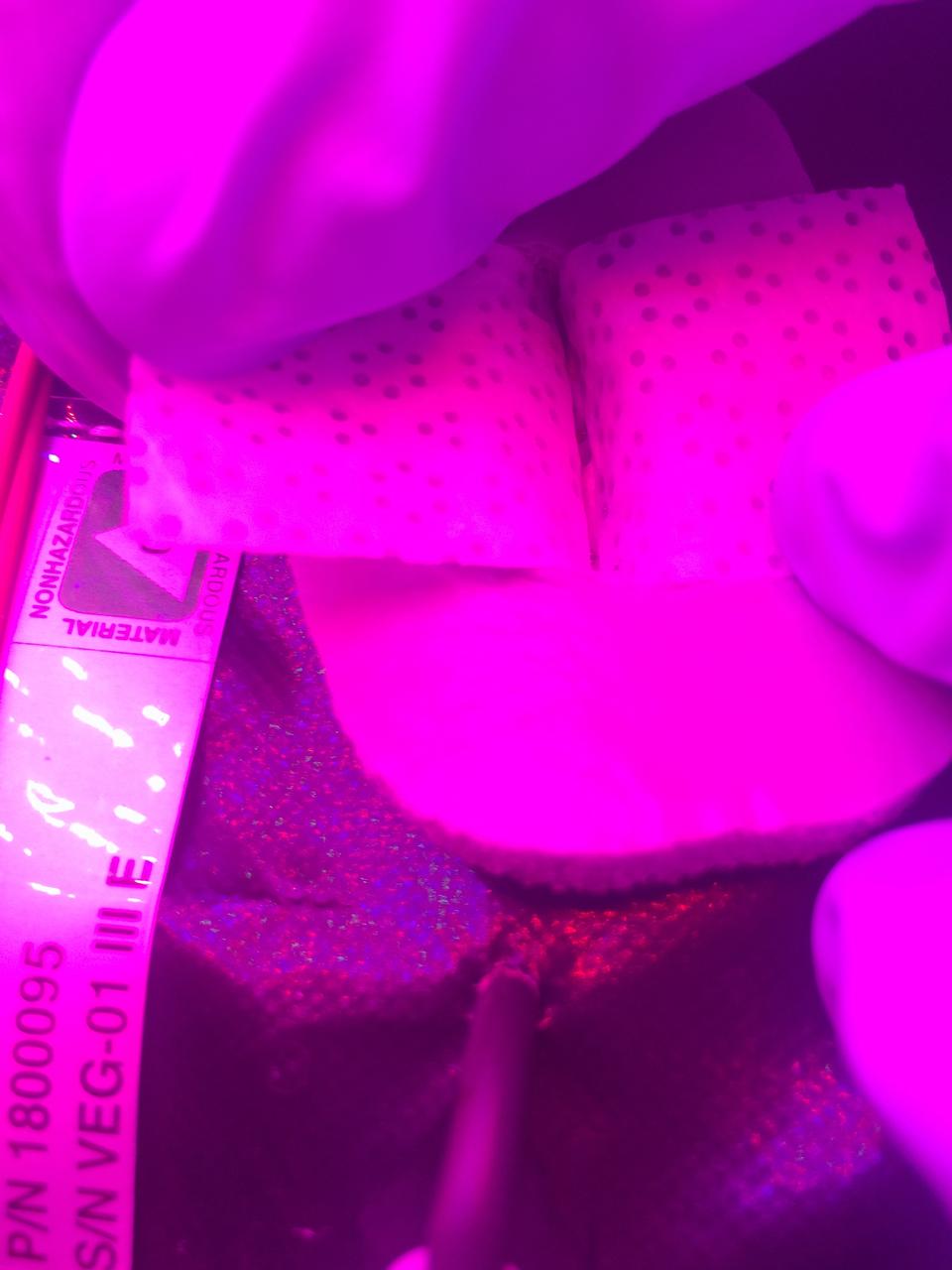
Astronaut Scott Kelly initiated VEG-01 B, the second crop of lettuce, on July, 8, 2015, and both Kelly and Astronaut Kjell Lindgren cared for the plants. The crop grew for 33 days. VEG-01 B included one set of six plant pillows planted with red romaine lettuce seeds. On Aug. 10, 2015, the crew harvested and consumed leaves from each plant. This was the first crop grown and consumed in NASA hardware. They harvested the rest of the plant tissue and froze it in the station’s Minus Eighty-Degree Laboratory Freezer for ISS (MELFI) for return to Earth for further study including microbial analysis, antioxidant capacity, mineral analysis and anthocyanin concentration.
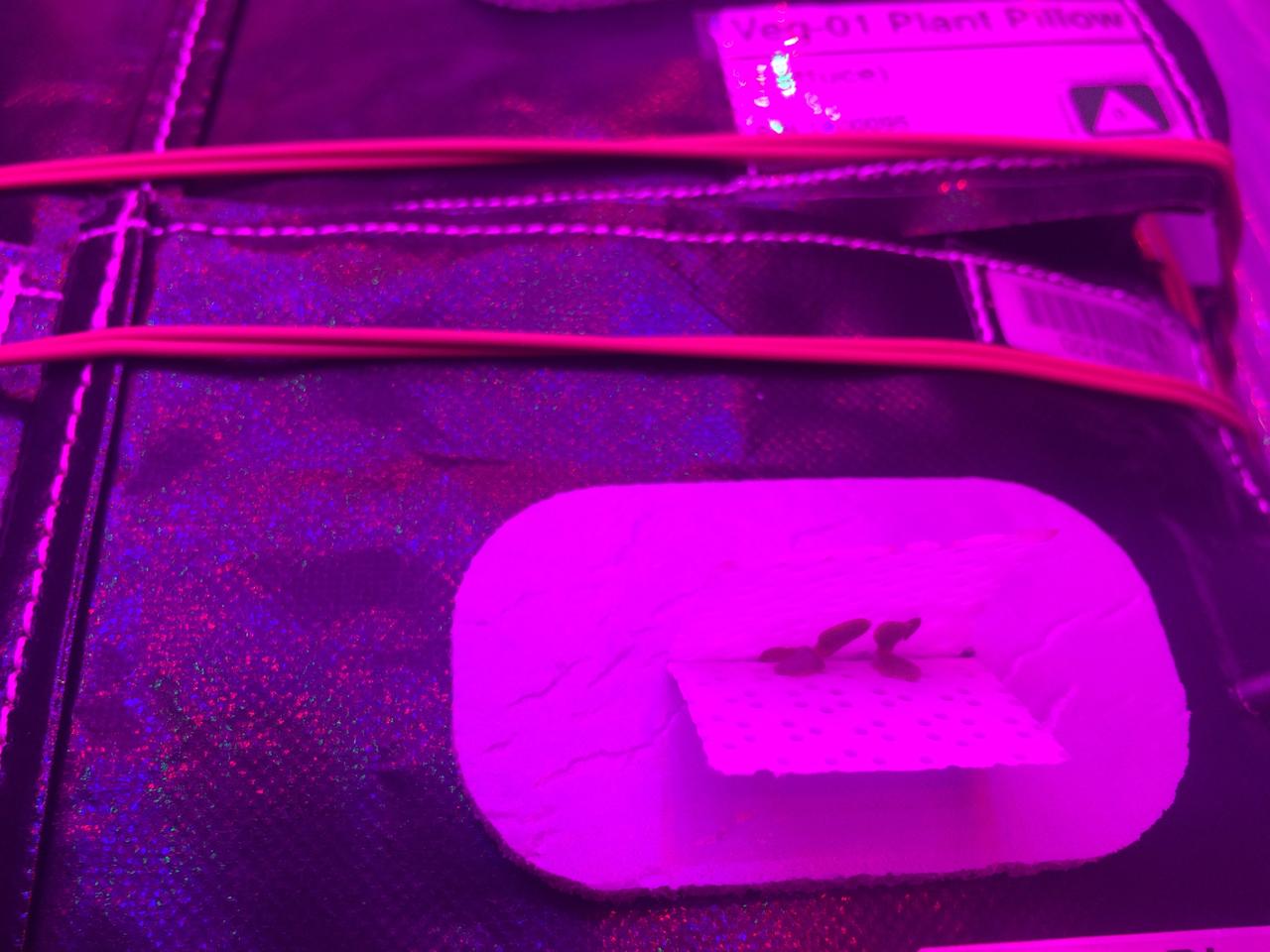
Astronaut Scott Kelly initiated VEG-01 B, the second crop of lettuce, on July, 8, 2015, and both Kelly and Astronaut Kjell Lindgren cared for the plants. The crop grew for 33 days. VEG-01 B included one set of six plant pillows planted with red romaine lettuce seeds. On Aug. 10, 2015, the crew harvested and consumed leaves from each plant. This was the first crop grown and consumed in NASA hardware. They harvested the rest of the plant tissue and froze it in the station’s Minus Eighty-Degree Laboratory Freezer for ISS (MELFI) for return to Earth for further study including microbial analysis, antioxidant capacity, mineral analysis and anthocyanin concentration.

Astronaut Scott Kelly initiated VEG-01 B, the second crop of lettuce, on July, 8, 2015, and both Kelly and Astronaut Kjell Lindgren cared for the plants. The crop grew for 33 days. VEG-01 B included one set of six plant pillows planted with red romaine lettuce seeds. On Aug. 10, 2015, the crew harvested and consumed leaves from each plant. This was the first crop grown and consumed in NASA hardware. They harvested the rest of the plant tissue and froze it in the station’s Minus Eighty-Degree Laboratory Freezer for ISS (MELFI) for return to Earth for further study including microbial analysis, antioxidant capacity, mineral analysis and anthocyanin concentration.
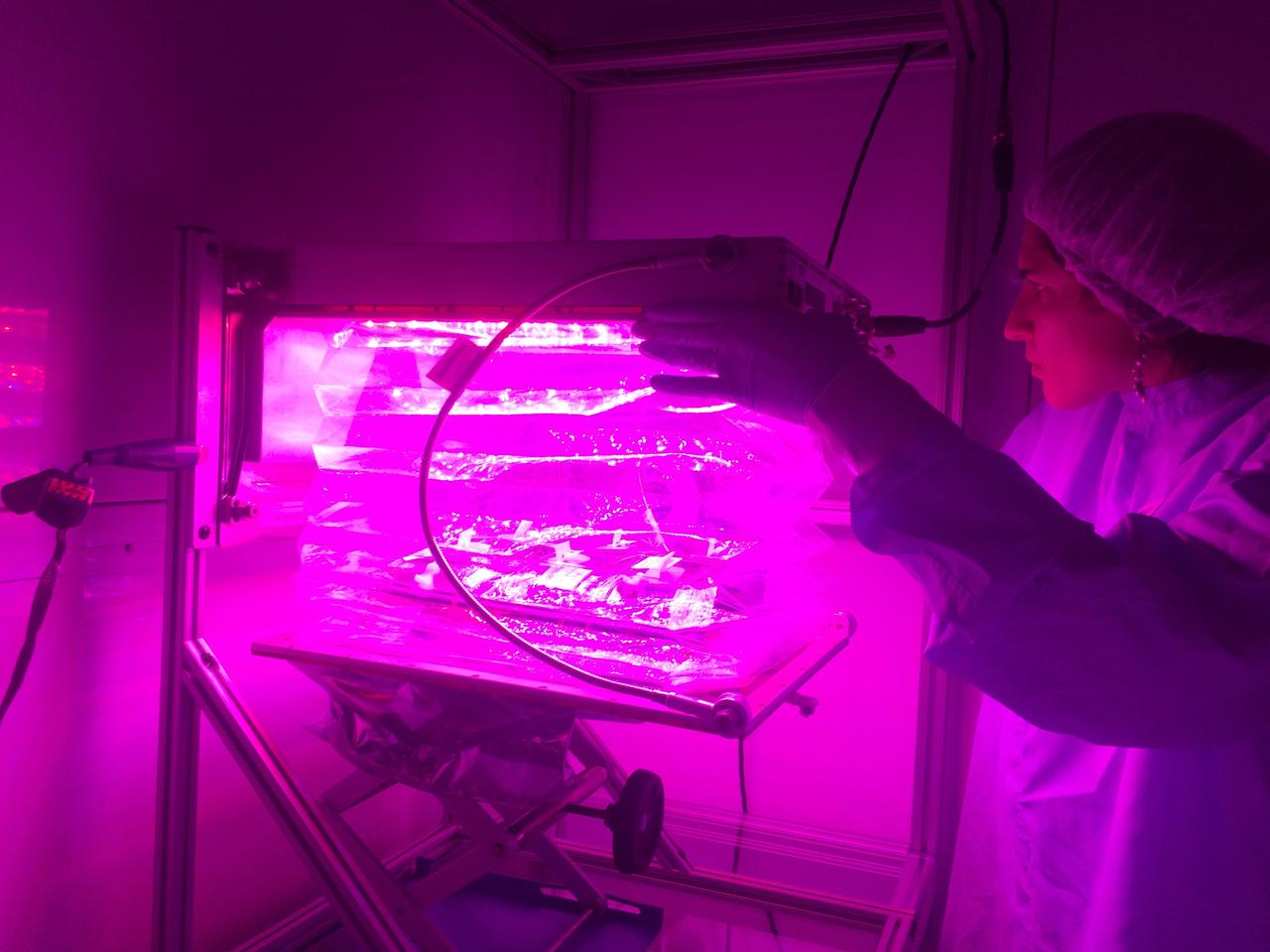
Astronaut Scott Kelly initiated VEG-01 B, the second crop of lettuce, on July, 8, 2015, and both Kelly and Astronaut Kjell Lindgren cared for the plants. The crop grew for 33 days. VEG-01 B included one set of six plant pillows planted with red romaine lettuce seeds. On Aug. 10, 2015, the crew harvested and consumed leaves from each plant. This was the first crop grown and consumed in NASA hardware. They harvested the rest of the plant tissue and froze it in the station’s Minus Eighty-Degree Laboratory Freezer for ISS (MELFI) for return to Earth for further study including microbial analysis, antioxidant capacity, mineral analysis and anthocyanin concentration.
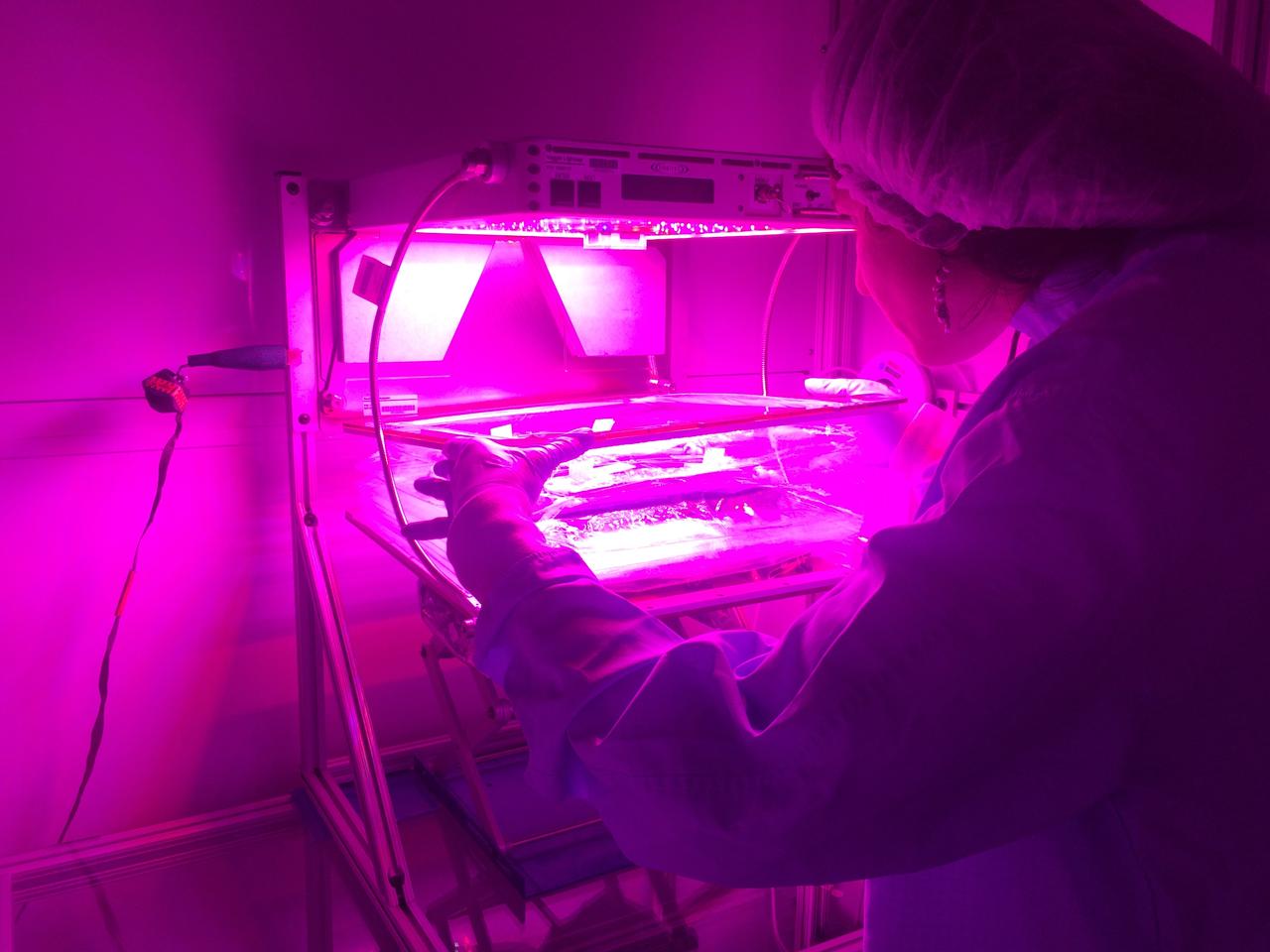
Astronaut Scott Kelly initiated VEG-01 B, the second crop of lettuce, on July, 8, 2015, and both Kelly and Astronaut Kjell Lindgren cared for the plants. The crop grew for 33 days. VEG-01 B included one set of six plant pillows planted with red romaine lettuce seeds. On Aug. 10, 2015, the crew harvested and consumed leaves from each plant. This was the first crop grown and consumed in NASA hardware. They harvested the rest of the plant tissue and froze it in the station’s Minus Eighty-Degree Laboratory Freezer for ISS (MELFI) for return to Earth for further study including microbial analysis, antioxidant capacity, mineral analysis and anthocyanin concentration.
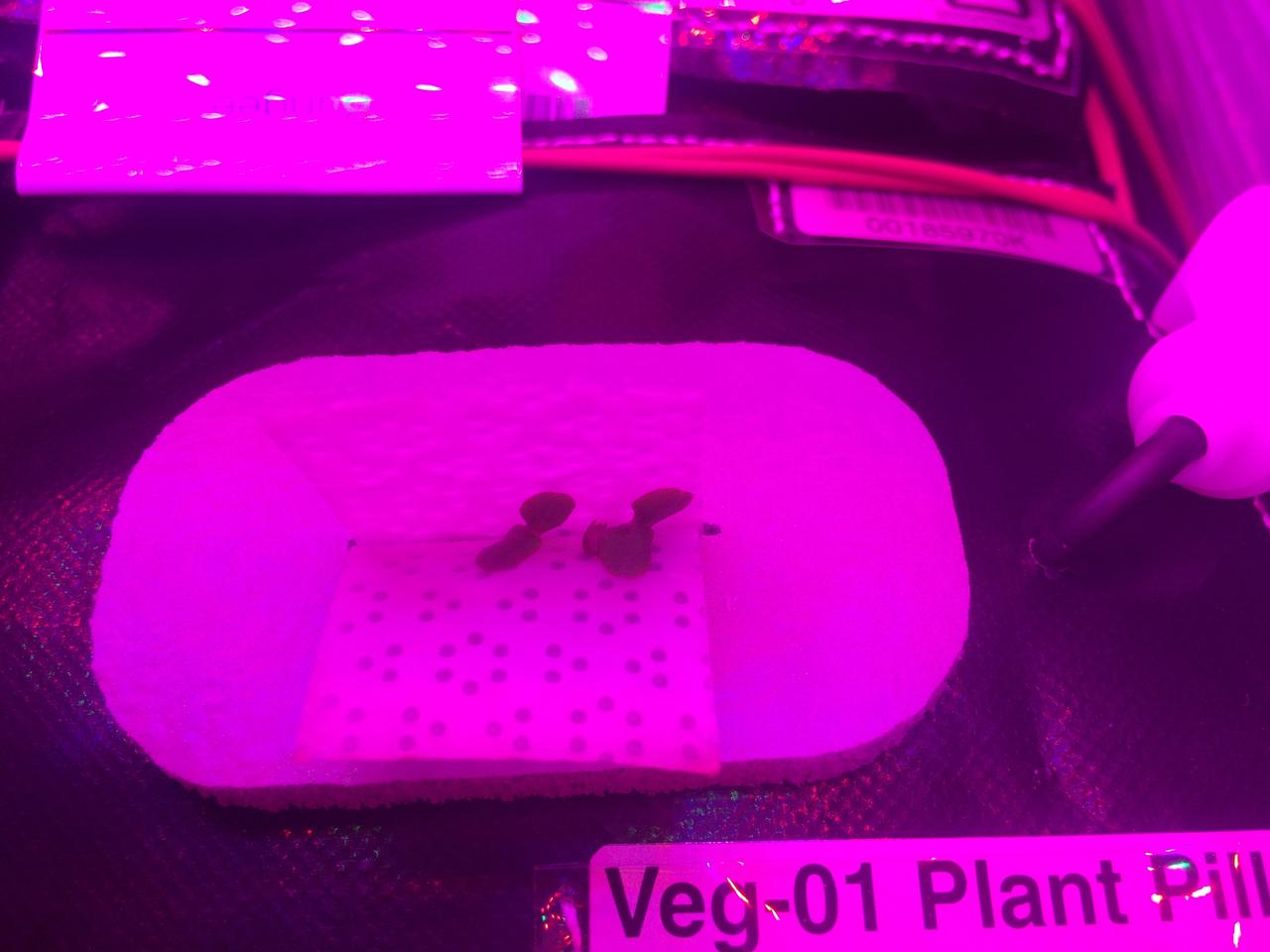
Astronaut Scott Kelly initiated VEG-01 B, the second crop of lettuce, on July, 8, 2015, and both Kelly and Astronaut Kjell Lindgren cared for the plants. The crop grew for 33 days. VEG-01 B included one set of six plant pillows planted with red romaine lettuce seeds. On Aug. 10, 2015, the crew harvested and consumed leaves from each plant. This was the first crop grown and consumed in NASA hardware. They harvested the rest of the plant tissue and froze it in the station’s Minus Eighty-Degree Laboratory Freezer for ISS (MELFI) for return to Earth for further study including microbial analysis, antioxidant capacity, mineral analysis and anthocyanin concentration.
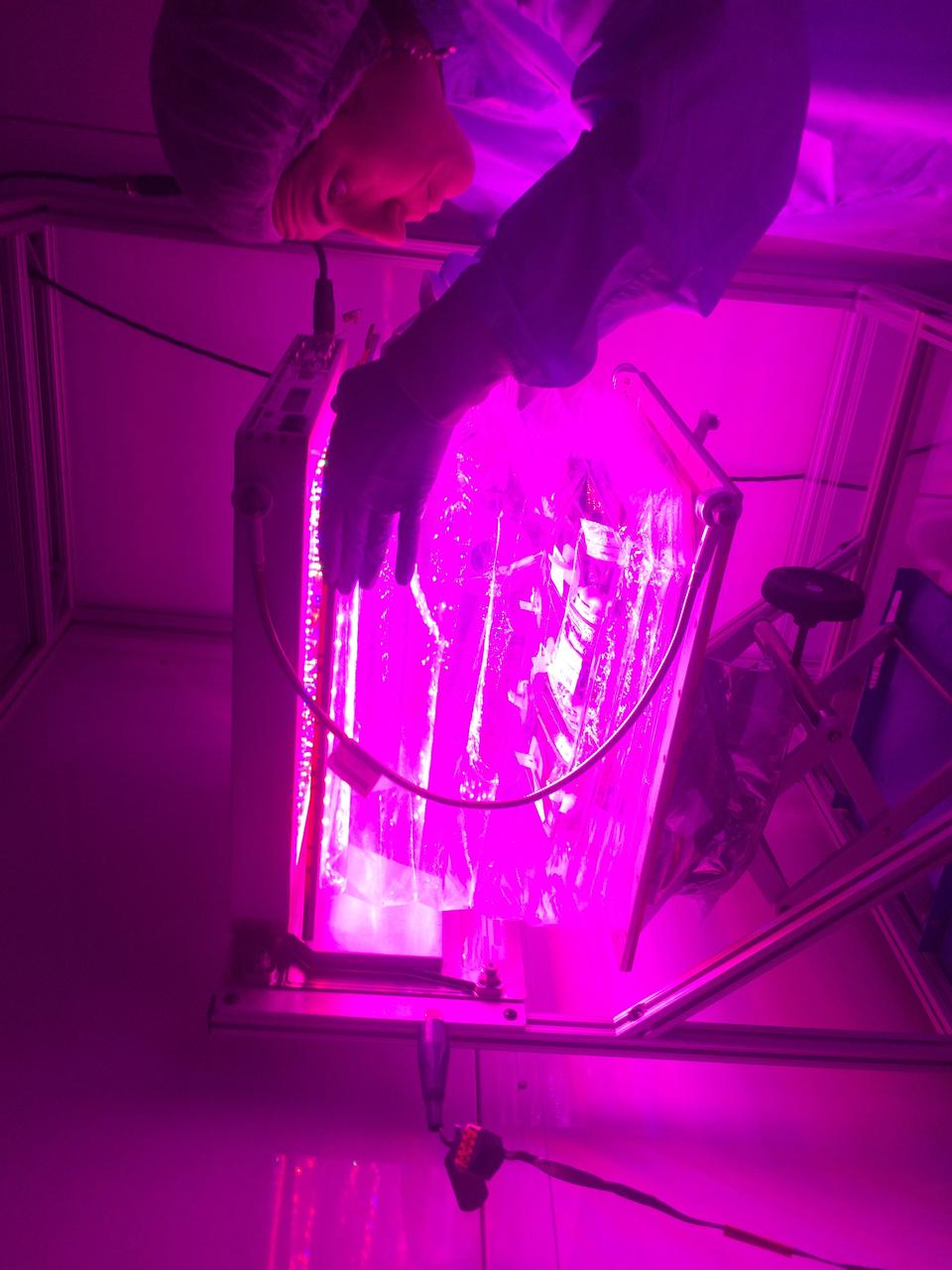
Astronaut Scott Kelly initiated VEG-01 B, the second crop of lettuce, on July, 8, 2015, and both Kelly and Astronaut Kjell Lindgren cared for the plants. The crop grew for 33 days. VEG-01 B included one set of six plant pillows planted with red romaine lettuce seeds. On Aug. 10, 2015, the crew harvested and consumed leaves from each plant. This was the first crop grown and consumed in NASA hardware. They harvested the rest of the plant tissue and froze it in the station’s Minus Eighty-Degree Laboratory Freezer for ISS (MELFI) for return to Earth for further study including microbial analysis, antioxidant capacity, mineral analysis and anthocyanin concentration.
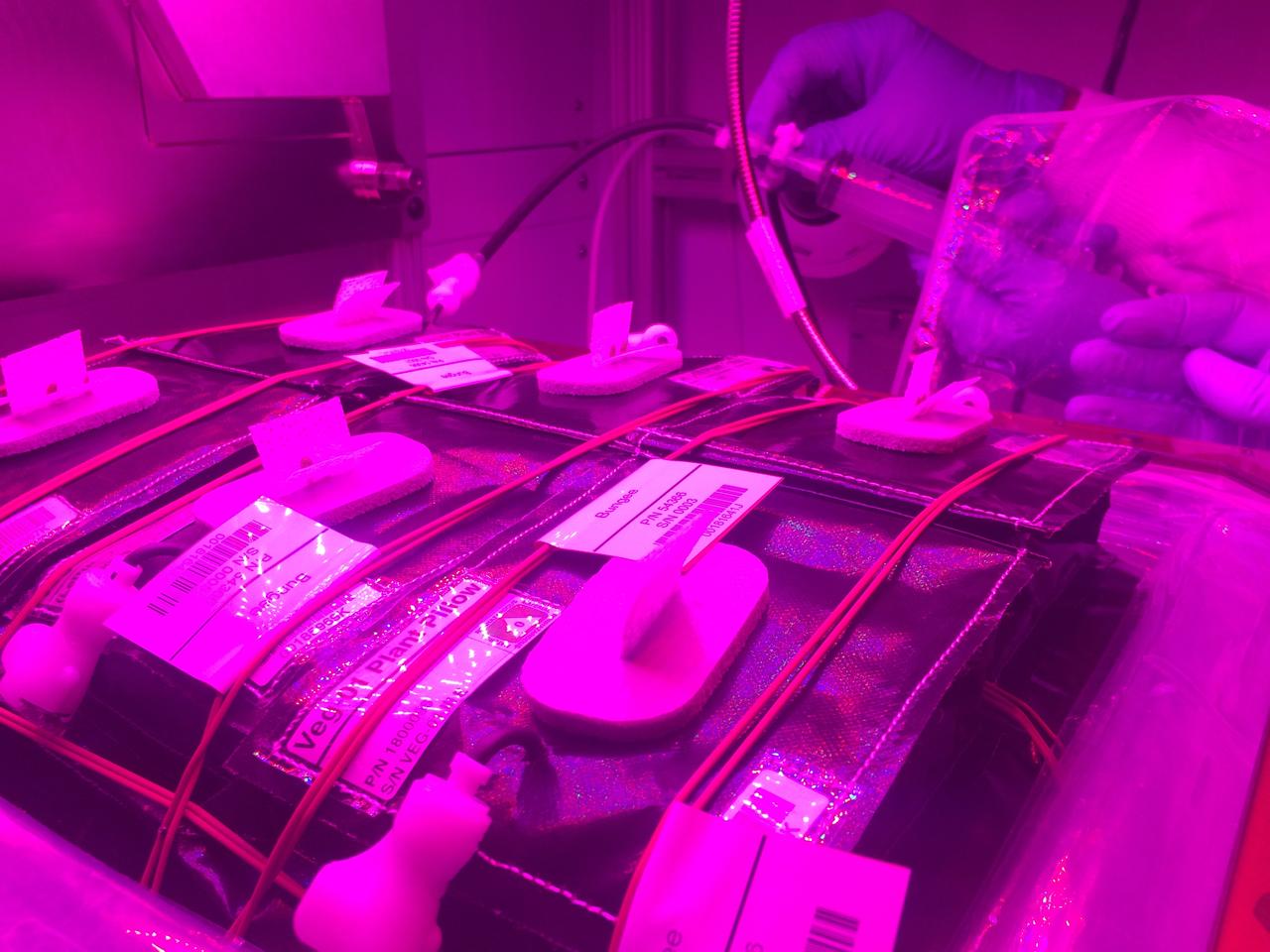
Astronaut Scott Kelly initiated VEG-01 B, the second crop of lettuce, on July, 8, 2015, and both Kelly and Astronaut Kjell Lindgren cared for the plants. The crop grew for 33 days. VEG-01 B included one set of six plant pillows planted with red romaine lettuce seeds. On Aug. 10, 2015, the crew harvested and consumed leaves from each plant. This was the first crop grown and consumed in NASA hardware. They harvested the rest of the plant tissue and froze it in the station’s Minus Eighty-Degree Laboratory Freezer for ISS (MELFI) for return to Earth for further study including microbial analysis, antioxidant capacity, mineral analysis and anthocyanin concentration.
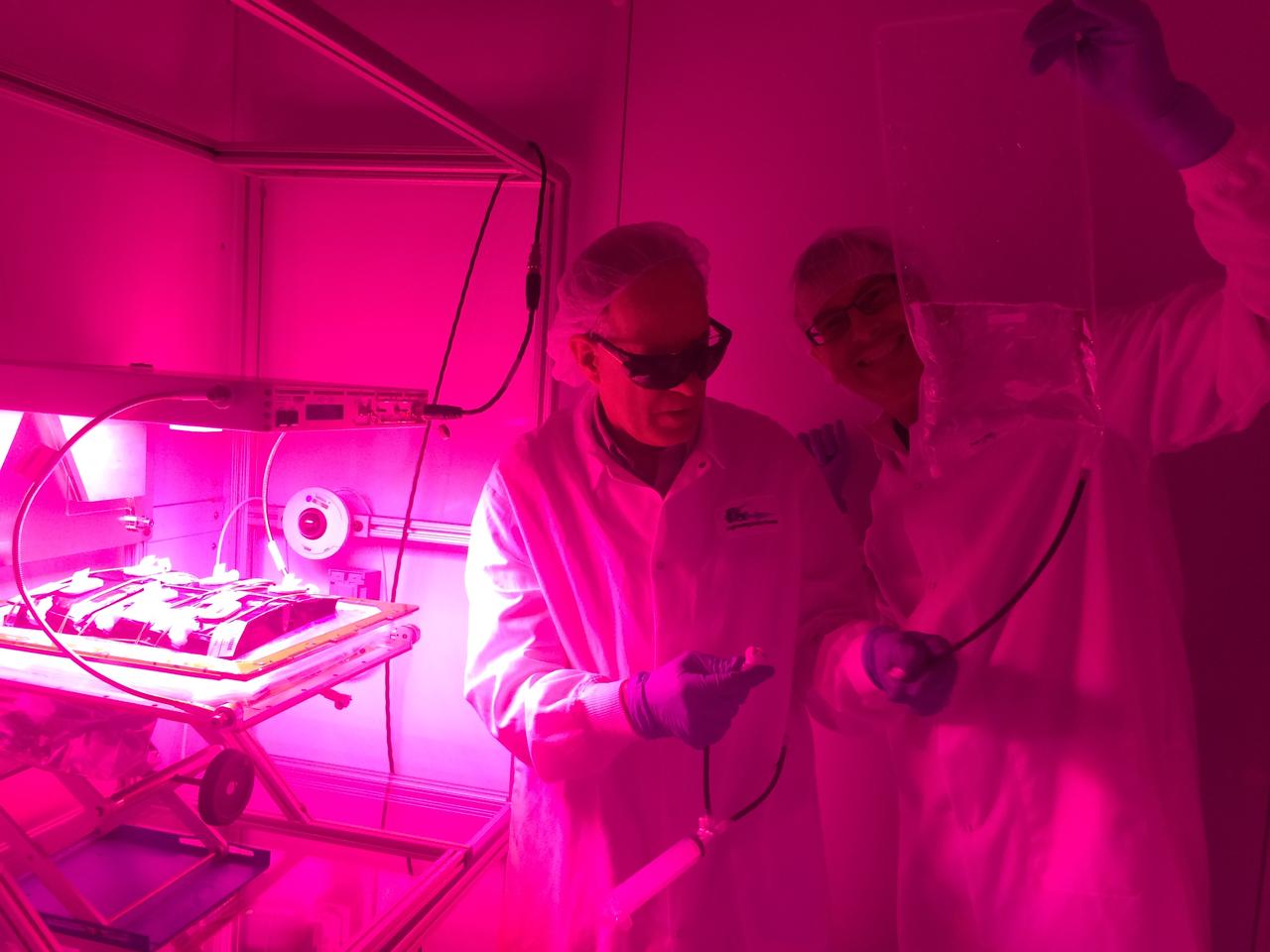
Astronaut Scott Kelly initiated VEG-01 B, the second crop of lettuce, on July, 8, 2015, and both Kelly and Astronaut Kjell Lindgren cared for the plants. The crop grew for 33 days. VEG-01 B included one set of six plant pillows planted with red romaine lettuce seeds. On Aug. 10, 2015, the crew harvested and consumed leaves from each plant. This was the first crop grown and consumed in NASA hardware. They harvested the rest of the plant tissue and froze it in the station’s Minus Eighty-Degree Laboratory Freezer for ISS (MELFI) for return to Earth for further study including microbial analysis, antioxidant capacity, mineral analysis and anthocyanin concentration.
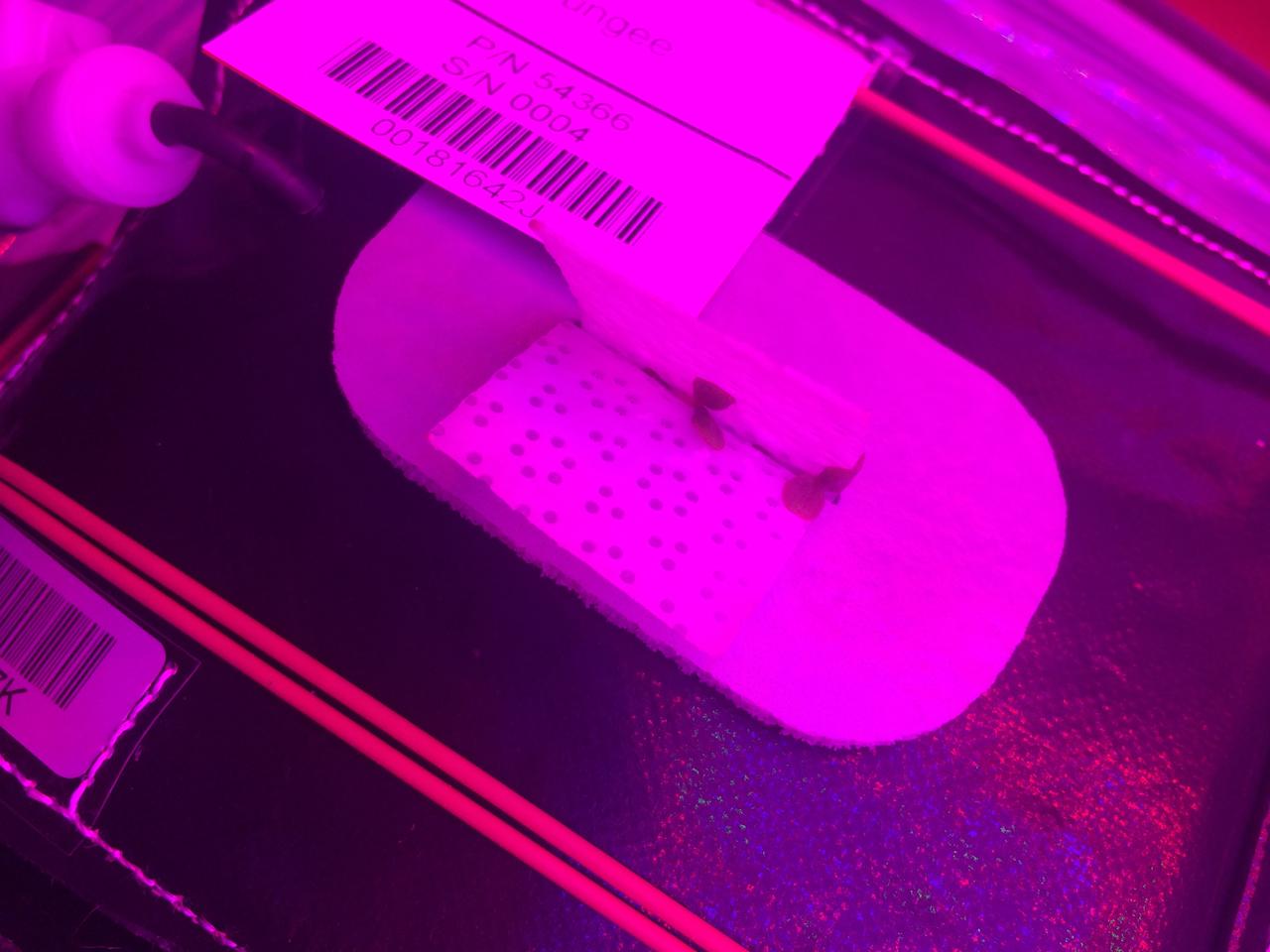
Astronaut Scott Kelly initiated VEG-01 B, the second crop of lettuce, on July, 8, 2015, and both Kelly and Astronaut Kjell Lindgren cared for the plants. The crop grew for 33 days. VEG-01 B included one set of six plant pillows planted with red romaine lettuce seeds. On Aug. 10, 2015, the crew harvested and consumed leaves from each plant. This was the first crop grown and consumed in NASA hardware. They harvested the rest of the plant tissue and froze it in the station’s Minus Eighty-Degree Laboratory Freezer for ISS (MELFI) for return to Earth for further study including microbial analysis, antioxidant capacity, mineral analysis and anthocyanin concentration.
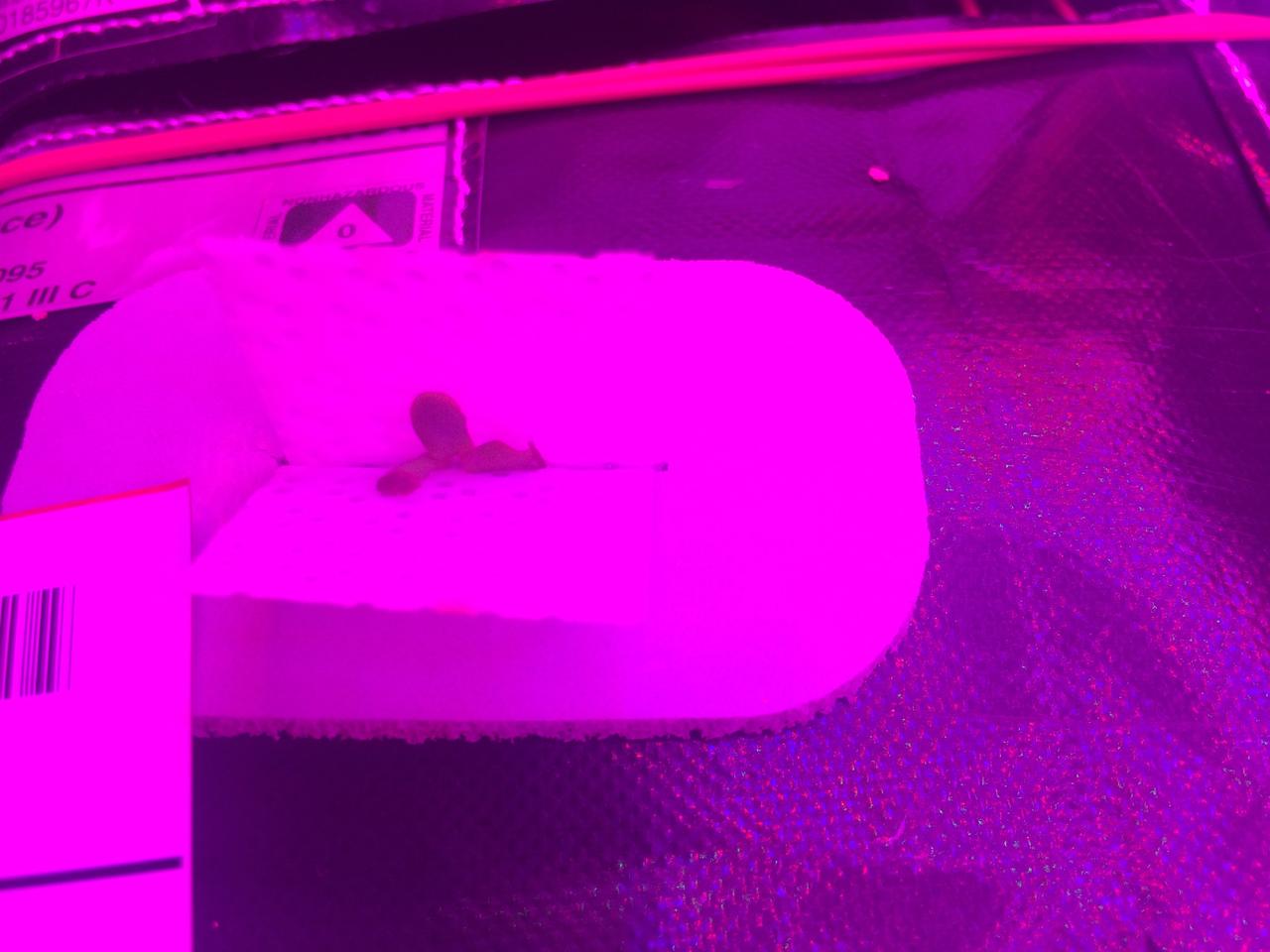
Astronaut Scott Kelly initiated VEG-01 B, the second crop of lettuce, on July, 8, 2015, and both Kelly and Astronaut Kjell Lindgren cared for the plants. The crop grew for 33 days. VEG-01 B included one set of six plant pillows planted with red romaine lettuce seeds. On Aug. 10, 2015, the crew harvested and consumed leaves from each plant. This was the first crop grown and consumed in NASA hardware. They harvested the rest of the plant tissue and froze it in the station’s Minus Eighty-Degree Laboratory Freezer for ISS (MELFI) for return to Earth for further study including microbial analysis, antioxidant capacity, mineral analysis and anthocyanin concentration.
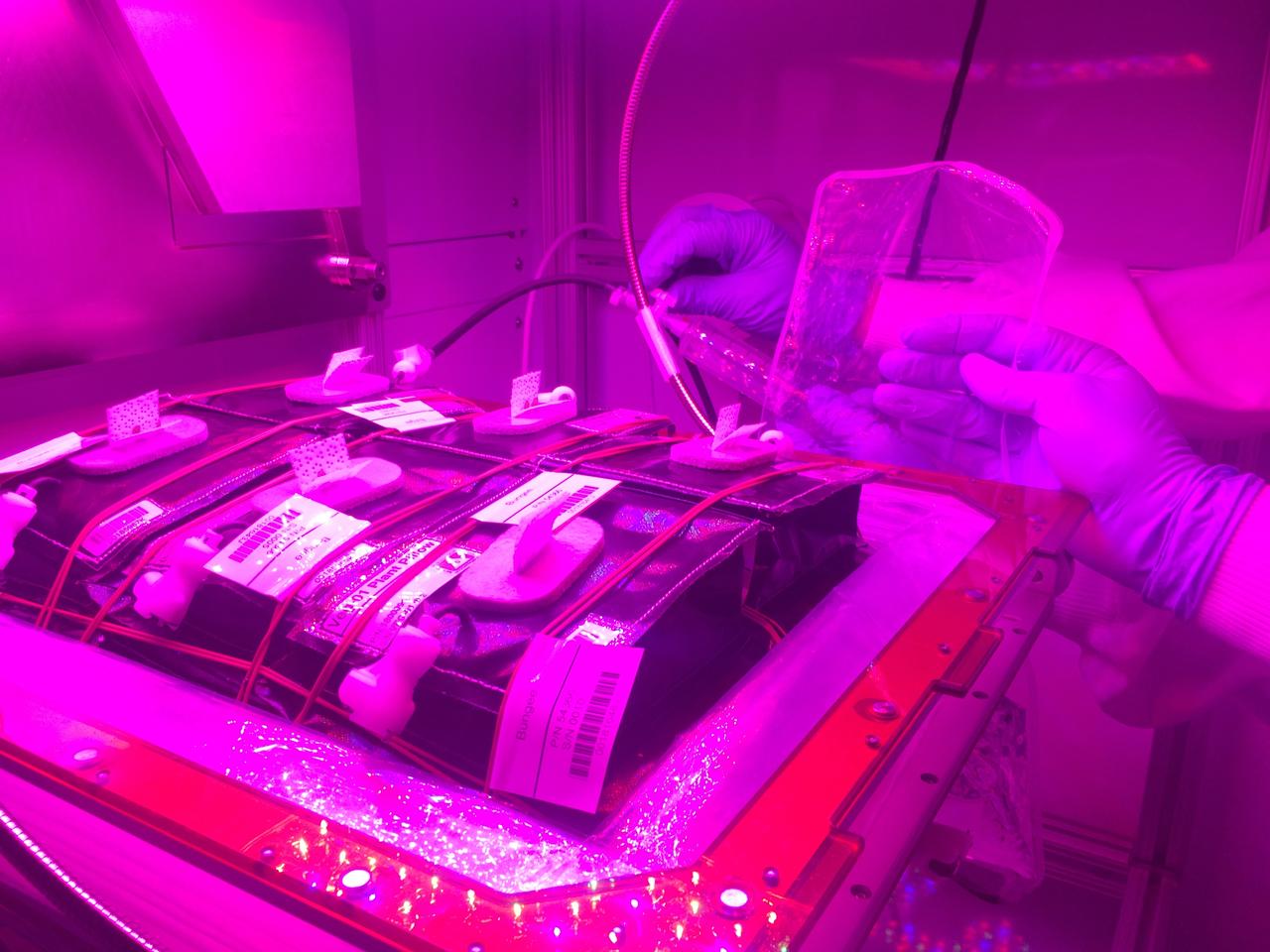
Astronaut Scott Kelly initiated VEG-01 B, the second crop of lettuce, on July, 8, 2015, and both Kelly and Astronaut Kjell Lindgren cared for the plants. The crop grew for 33 days. VEG-01 B included one set of six plant pillows planted with red romaine lettuce seeds. On Aug. 10, 2015, the crew harvested and consumed leaves from each plant. This was the first crop grown and consumed in NASA hardware. They harvested the rest of the plant tissue and froze it in the station’s Minus Eighty-Degree Laboratory Freezer for ISS (MELFI) for return to Earth for further study including microbial analysis, antioxidant capacity, mineral analysis and anthocyanin concentration.
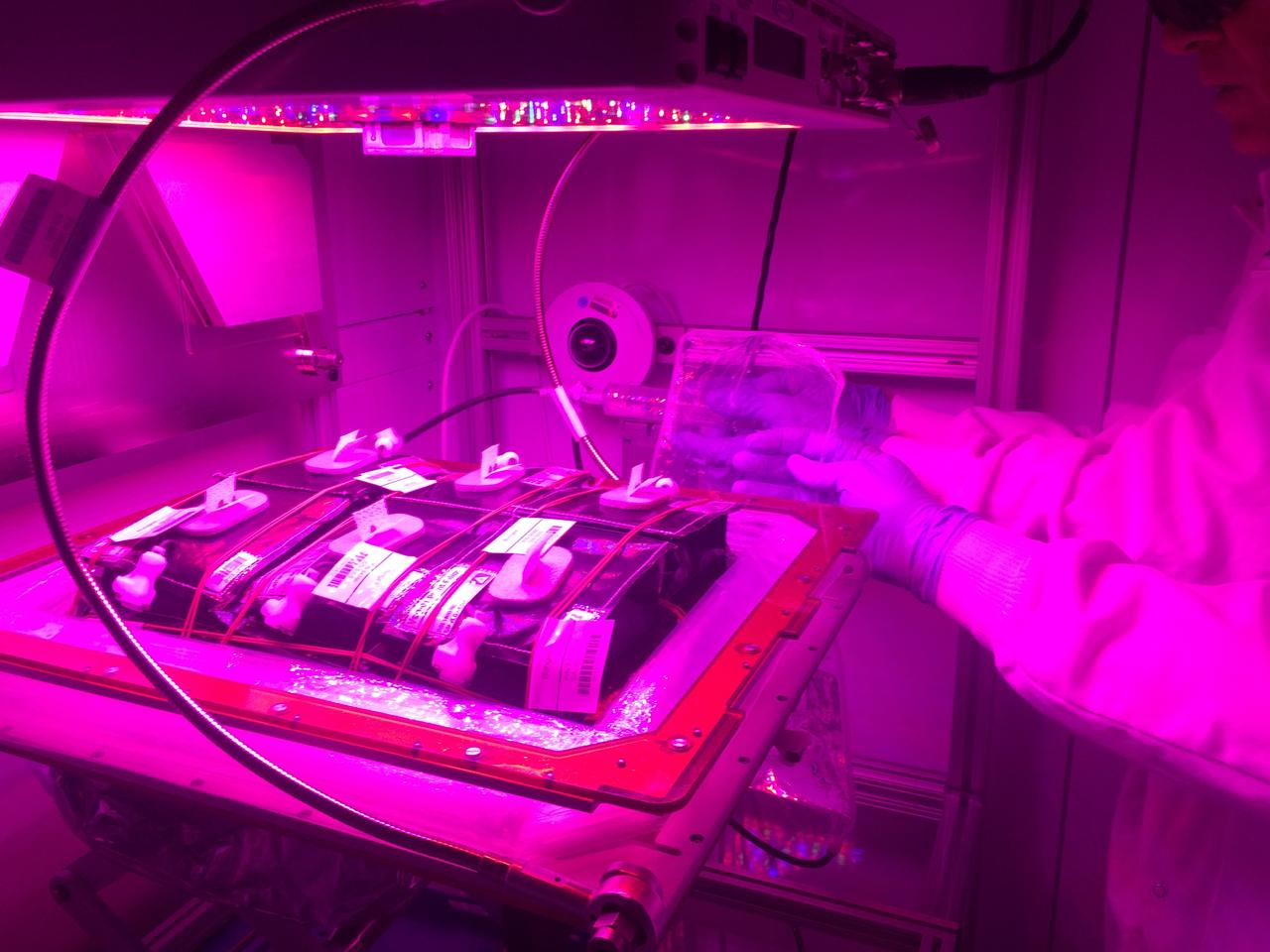
Astronaut Scott Kelly initiated VEG-01 B, the second crop of lettuce, on July, 8, 2015, and both Kelly and Astronaut Kjell Lindgren cared for the plants. The crop grew for 33 days. VEG-01 B included one set of six plant pillows planted with red romaine lettuce seeds. On Aug. 10, 2015, the crew harvested and consumed leaves from each plant. This was the first crop grown and consumed in NASA hardware. They harvested the rest of the plant tissue and froze it in the station’s Minus Eighty-Degree Laboratory Freezer for ISS (MELFI) for return to Earth for further study including microbial analysis, antioxidant capacity, mineral analysis and anthocyanin concentration.
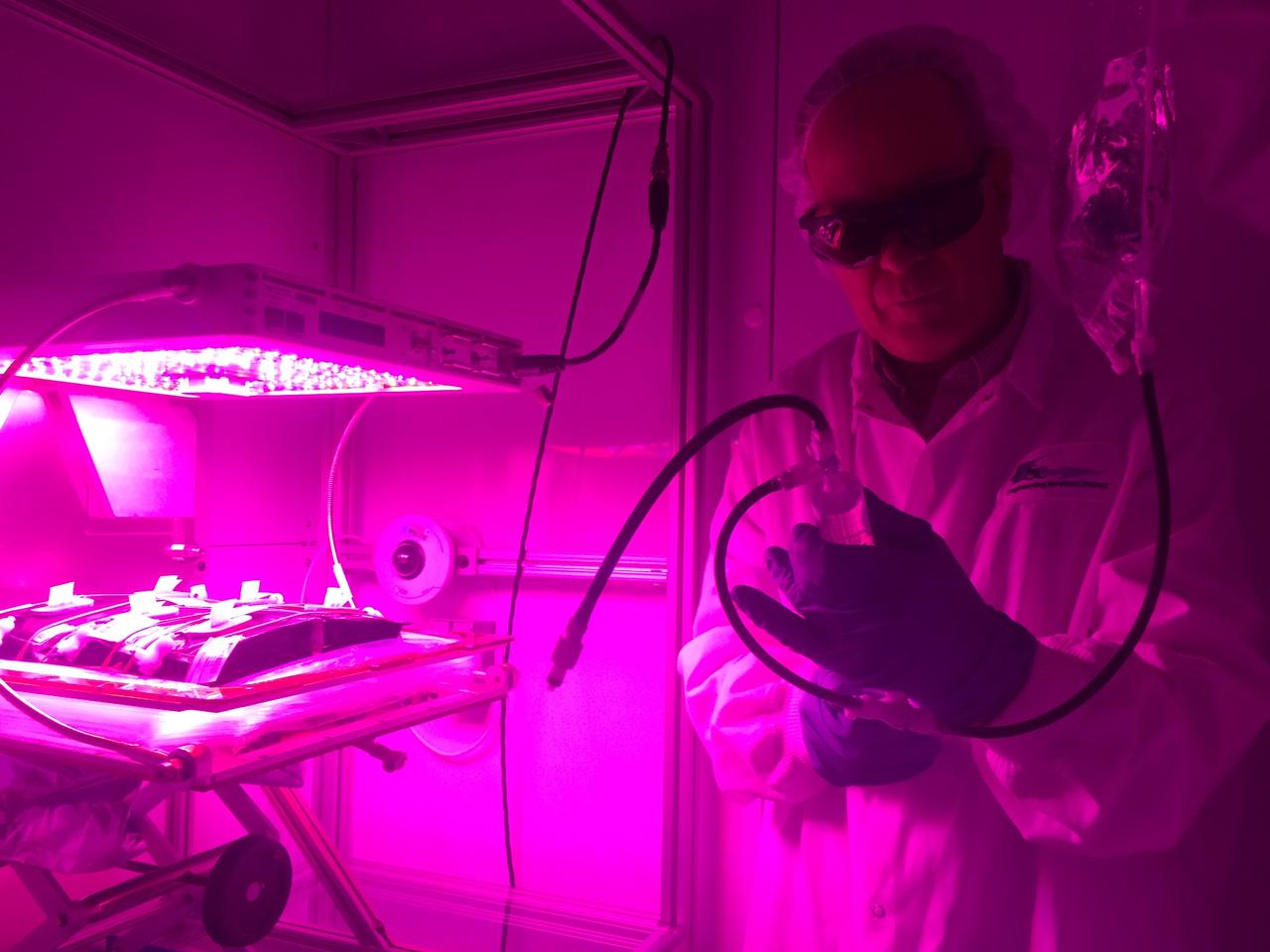
Astronaut Scott Kelly initiated VEG-01 B, the second crop of lettuce, on July, 8, 2015, and both Kelly and Astronaut Kjell Lindgren cared for the plants. The crop grew for 33 days. VEG-01 B included one set of six plant pillows planted with red romaine lettuce seeds. On Aug. 10, 2015, the crew harvested and consumed leaves from each plant. This was the first crop grown and consumed in NASA hardware. They harvested the rest of the plant tissue and froze it in the station’s Minus Eighty-Degree Laboratory Freezer for ISS (MELFI) for return to Earth for further study including microbial analysis, antioxidant capacity, mineral analysis and anthocyanin concentration.
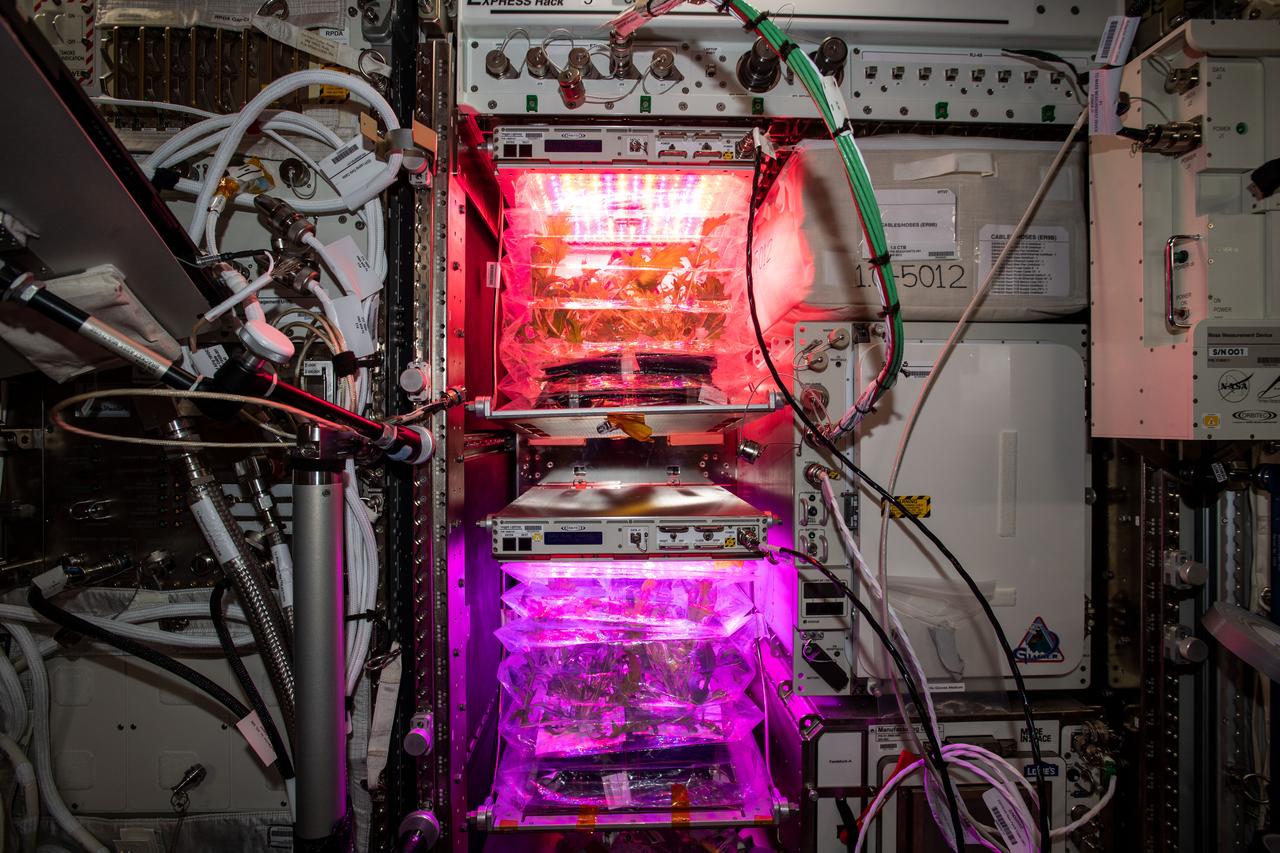
Documentation (overall view) of the Vegetable Production System (Veggie) taken during Pillow watering operations (OPS) for the Veg-04B experiment. Plant Pillows contain Mizuna mustard plants.

NASA interns Jessica Scotten, left, and Ayla Grandpre water plants in the Veggie hardware in NASA Kennedy Space Center's ISS environment simulator chamber. Mizuna mustard, Outredgeous lettuce and Waldmann's green lettuce are growing in Veggie. Growth in the chamber mimics the growth of plant experiments in the Veggie plant growth system on the International Space Station.

Outredgeous red leaf lettuce, Mizuna mustard and Waldmann's green lettuce are growing in the Veggie control system in the ISS environment simulator chamber in the Space Station Processing Facility at NASA's Kennedy Space Center in Florida. Growth in the chamber mimics the growth of plant experiments in the Veggie plant growth system on the International Space Station.

Water and nutrients are being added to plants in the Veggie hardware in NASA Kennedy Space Center's ISS environment simulator chamber. Mizuna mustard, Outredgeous lettuce and Waldmann's green lettuce are growing in Veggie. Growth in the chamber mimics the growth of plant experiments in the Veggie plant growth system on the International Space Station.
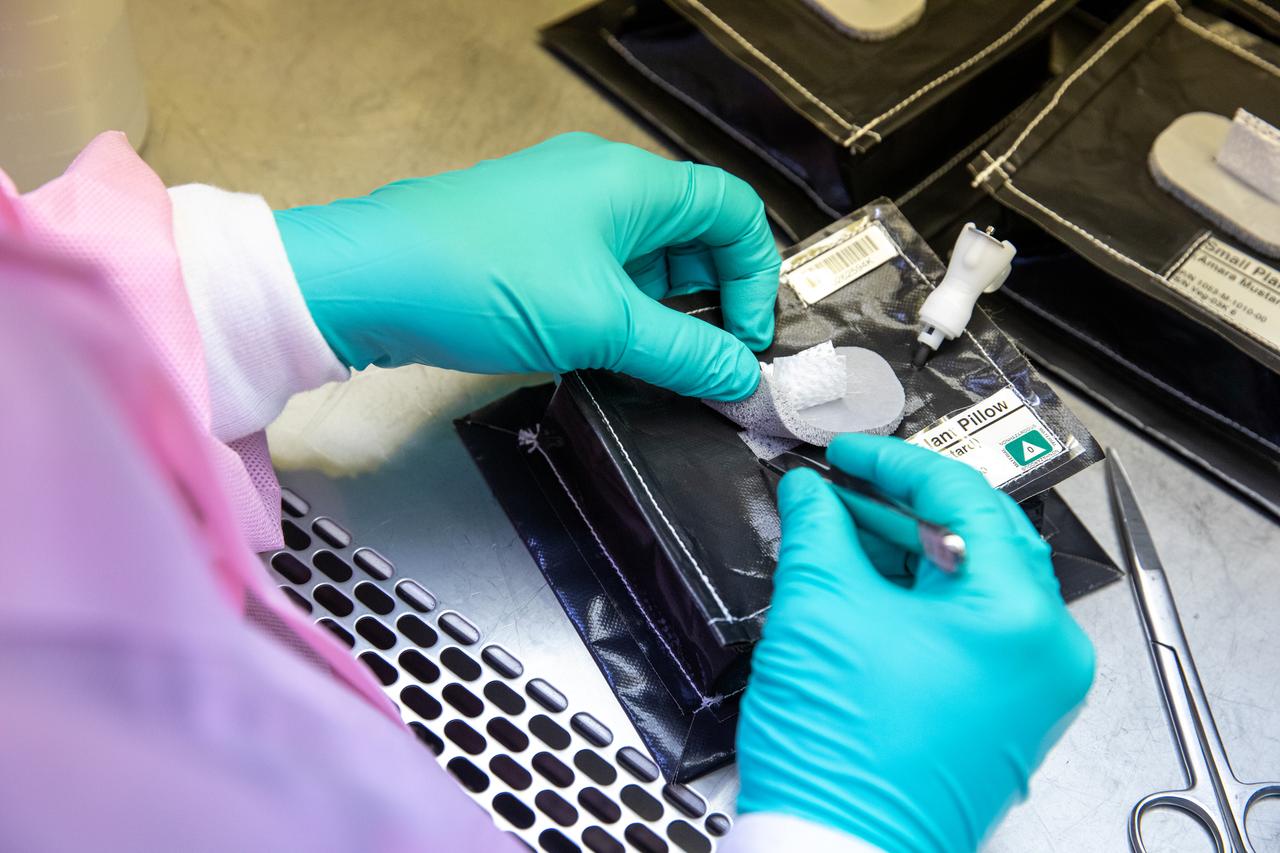
On Jan. 21, 2020, inside the Space Station Processing Facility at NASA’s Kennedy Space Center in Florida, intern Emily Kennebeck prepares plant pillows for their flight to the International Space Station. The pillows, which are a common method used to grow plants in space, are being sent to the orbiting laboratory on Northrop Grumman’s 13th resupply services (NG-13) mission for a series of VEG-03 experiments that will study the growth of three types of leafy greens in a microgravity environment. Once the pillows are assembled and packaged for flight, they will be transported to the agency’s Wallops Flight Facility in Virginia, where liftoff will occur. NG-13 is scheduled to launch on Feb. 9, 2020, at 5:39 p.m. EST.
On Jan. 21, 2020, inside the Space Station Processing Facility at NASA’s Kennedy Space Center in Florida, intern Emily Kennebeck prepares plant pillows for their upcoming flight to the International Space Station. The pillows, which are a common method used to grow plants in space, are being sent to the orbiting laboratory on Northrop Grumman’s 13th resupply services (NG-13) mission for a series of VEG-03 experiments that will study the growth of three types of leafy greens in a microgravity environment. Once the pillows are assembled and packaged for flight, they will be transported to the agency’s Wallops Flight Facility in Virginia, where liftoff will occur. NG-13 is scheduled to launch on Feb. 9, 2020, at 5:39 p.m. EST.
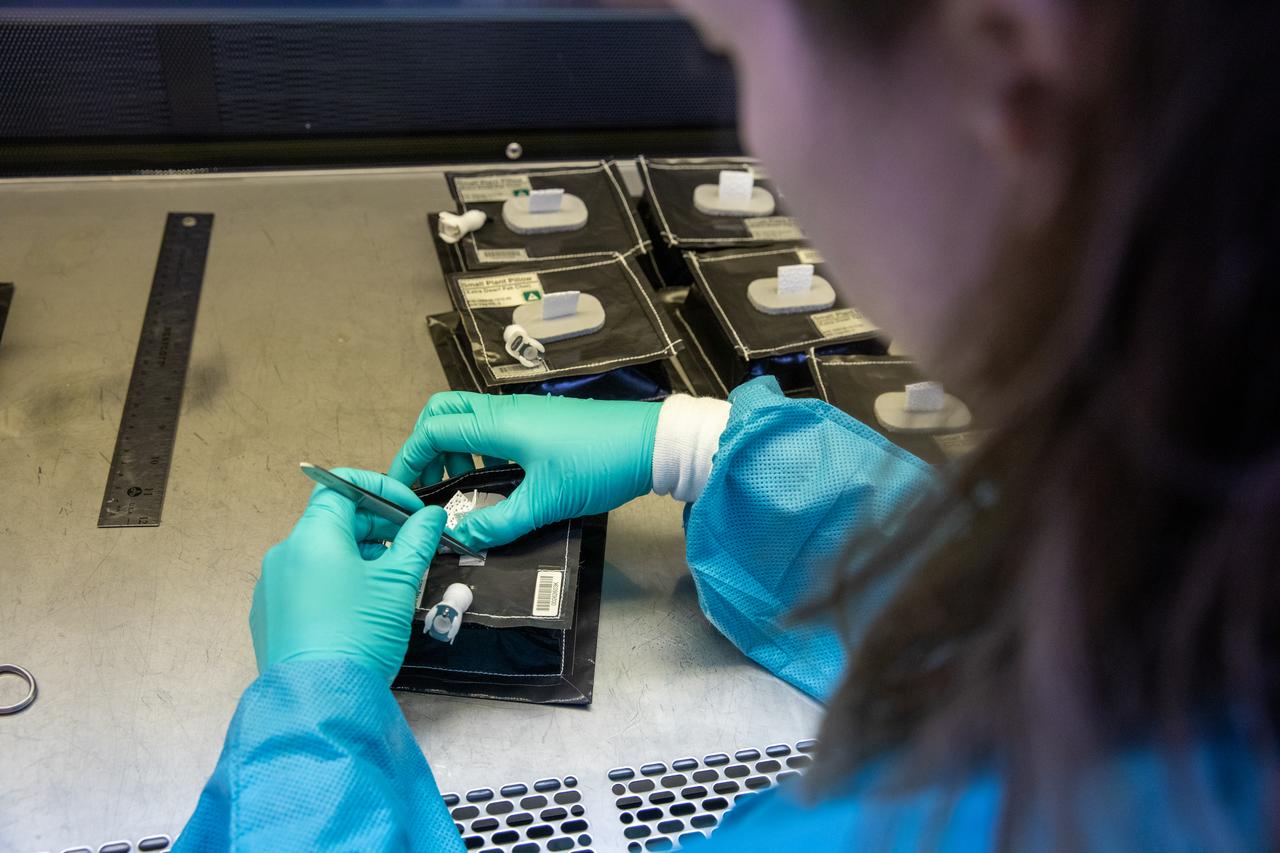
Inside the Space Station Processing Facility on Jan. 21, 2020, Jess Bunchek, a pseudonaut and associate scientist at NASA’s Kennedy Space Center in Florida, prepares plant pillows for their flight to the International Space Station. The pillows, which are a common method used to grow plants in space, are being sent to the orbiting laboratory on Northrop Grumman’s 13th resupply services (NG-13) mission for a series of VEG-03 experiments that will study the growth of three types of leafy greens in a microgravity environment. Once the pillows are assembled and packaged for flight, they will be transported to the agency’s Wallops Flight Facility in Virginia, where liftoff will occur. NG-13 is scheduled to launch on Feb. 9, 2020, at 5:39 p.m. EST.
Inside the Space Station Processing Facility on Jan. 21, 2020, Jess Bunchek, a pseudonaut and associate scientist at NASA’s Kennedy Space Center in Florida, prepares plant pillows for their flight to the International Space Station. The pillows, which are a common method used to grow plants in space, are being sent to the orbiting laboratory on Northrop Grumman’s 13th resupply services (NG-13) mission for a series of VEG-03 experiments that will study the growth of three types of leafy greens in a microgravity environment. Once the pillows are assembled and packaged for flight, they will be transported to the agency’s Wallops Flight Facility in Virginia, where liftoff will occur. NG-13 is scheduled to launch on Feb. 9, 2020, at 5:39 p.m. EST.
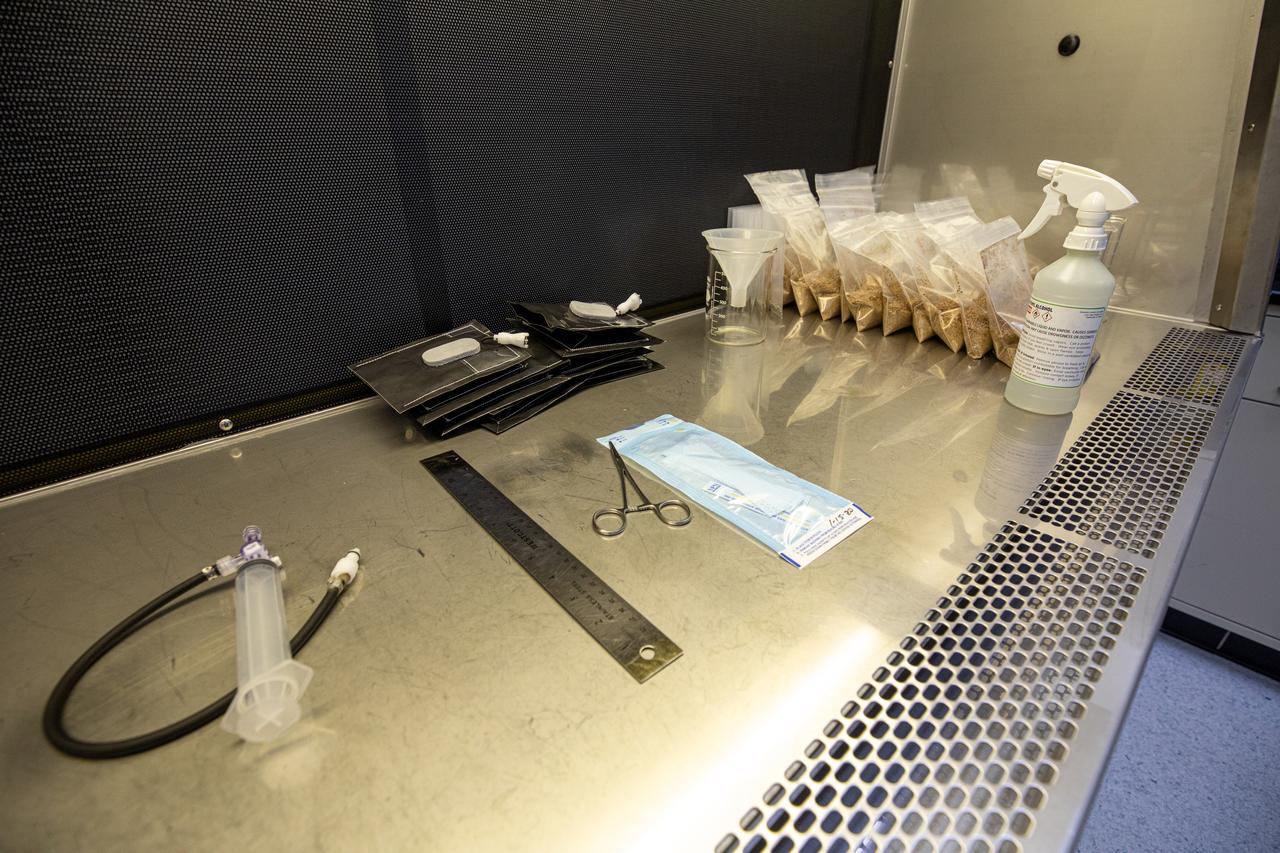
Researchers at NASA’s Kennedy Space Center in Florida have laid out supplies to prepare plant pillows inside the Space Station Processing Facility at on Jan. 16, 2020. The pillows are small containers used to grow plants in microgravity aboard the International Space Station. These pillows are for a series of plant experiments called VEG-03 J/K/L that will monitor the growth of three types of leafy greens. The experiments will be launched to the orbiting laboratory aboard a Northrop Grumman Antares rocket and Cygnus spacecraft on the company’s 13th resupply services mission. Liftoff is scheduled for Feb. 9, 2020, at 5:39 p.m. EST from the agency’s Wallops Flight Facility in Virginia.
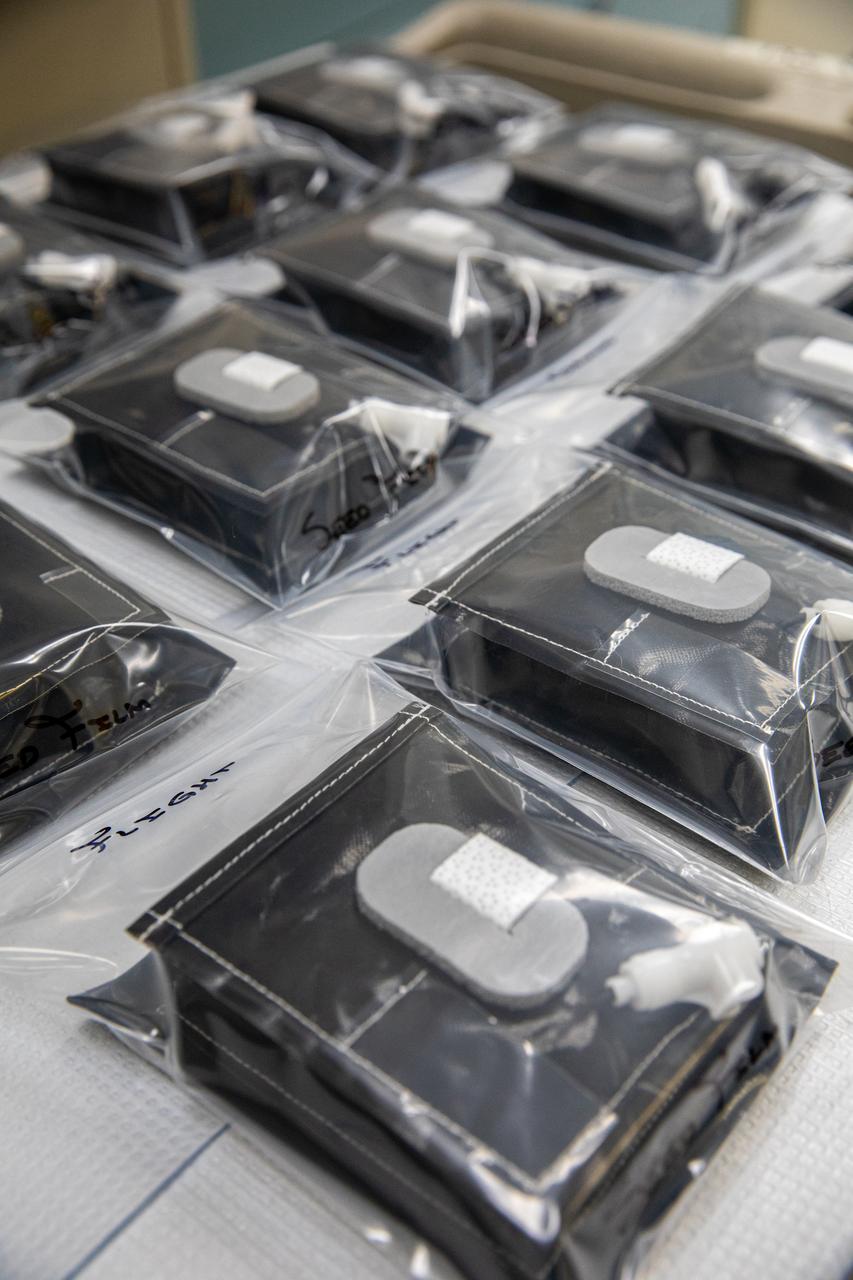
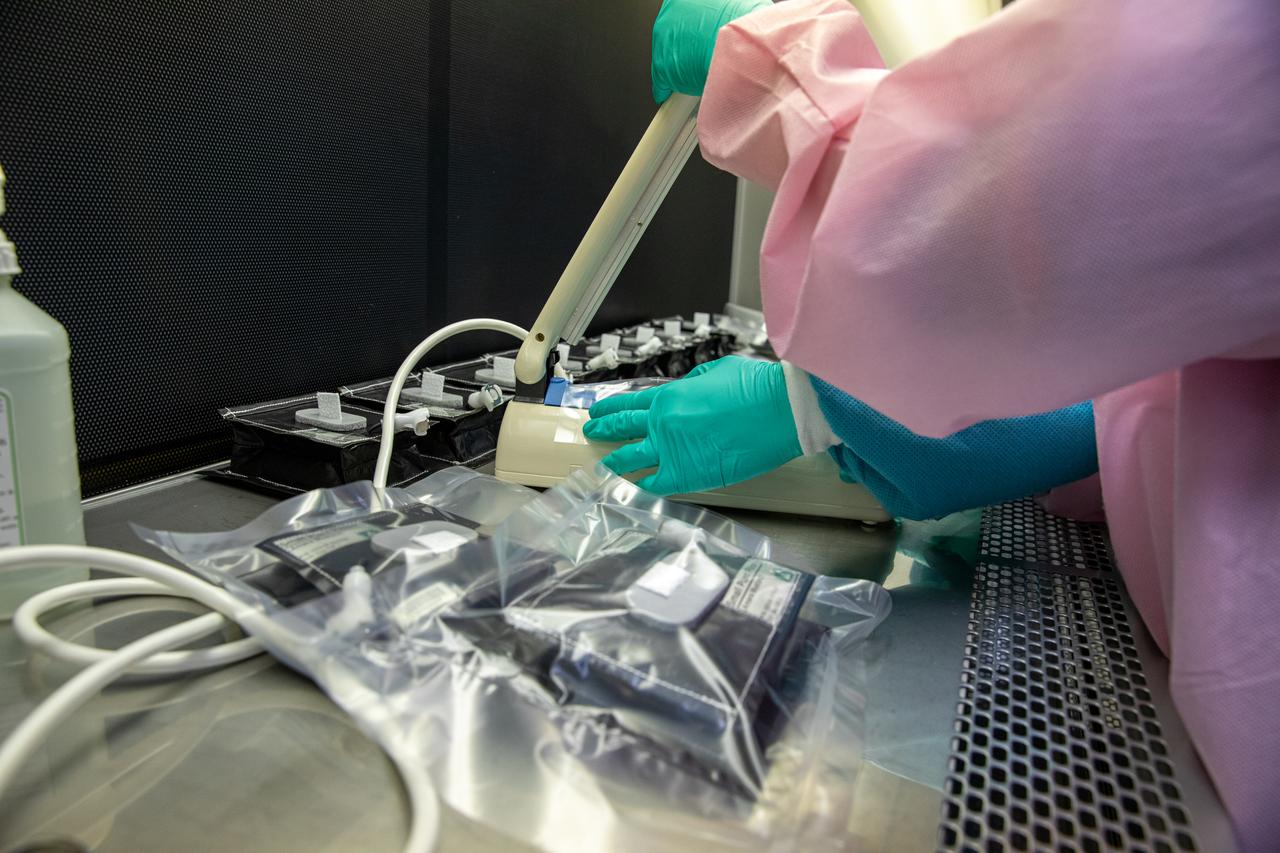
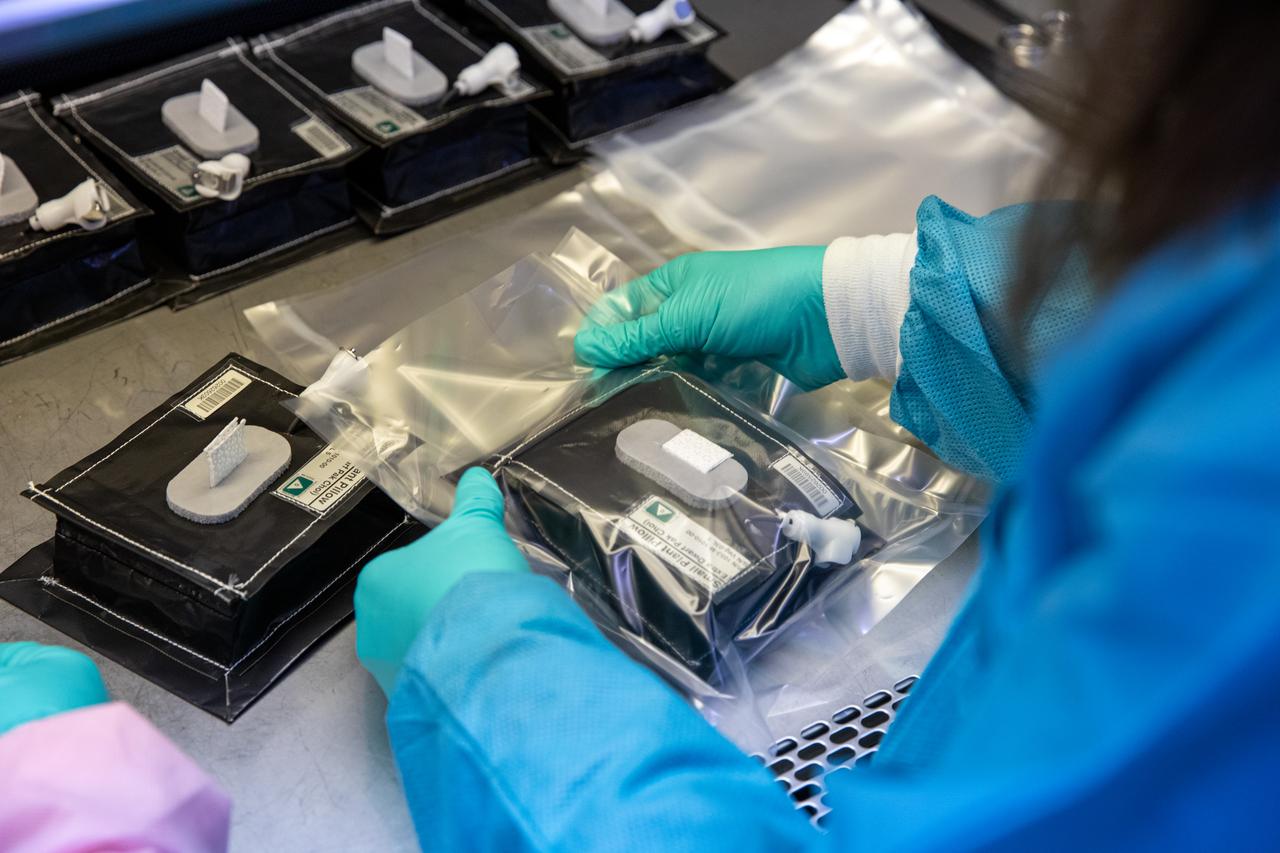
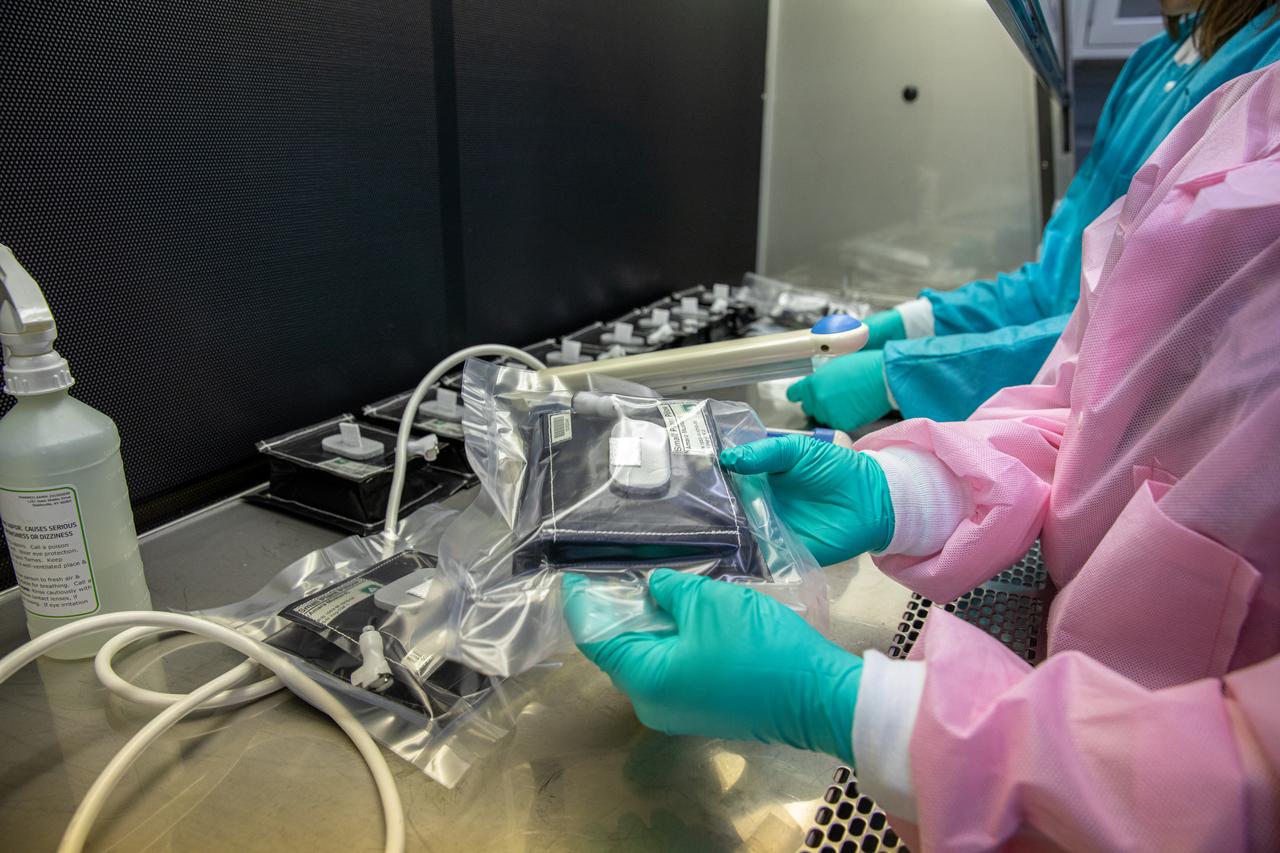
On Jan. 21, 2020, inside the Space Station Processing Facility at NASA’s Kennedy Space Center in Florida, plant pillows are packaged for their upcoming flight to the International Space Station on Northrop Grumman’s 13th resupply services (NG-13) mission. The pillows, which are a common method used to grow plants in space, are being sent to the orbiting laboratory for a series of VEG-03 experiments that will study the growth of three types of leafy greens in a microgravity environment. Once the pillows are assembled and packaged for flight, they will be transported to the agency’s Wallops Flight Facility in Virginia, where liftoff will occur. NG-13 is scheduled to launch on Feb. 9, 2020, at 5:39 p.m. EST.
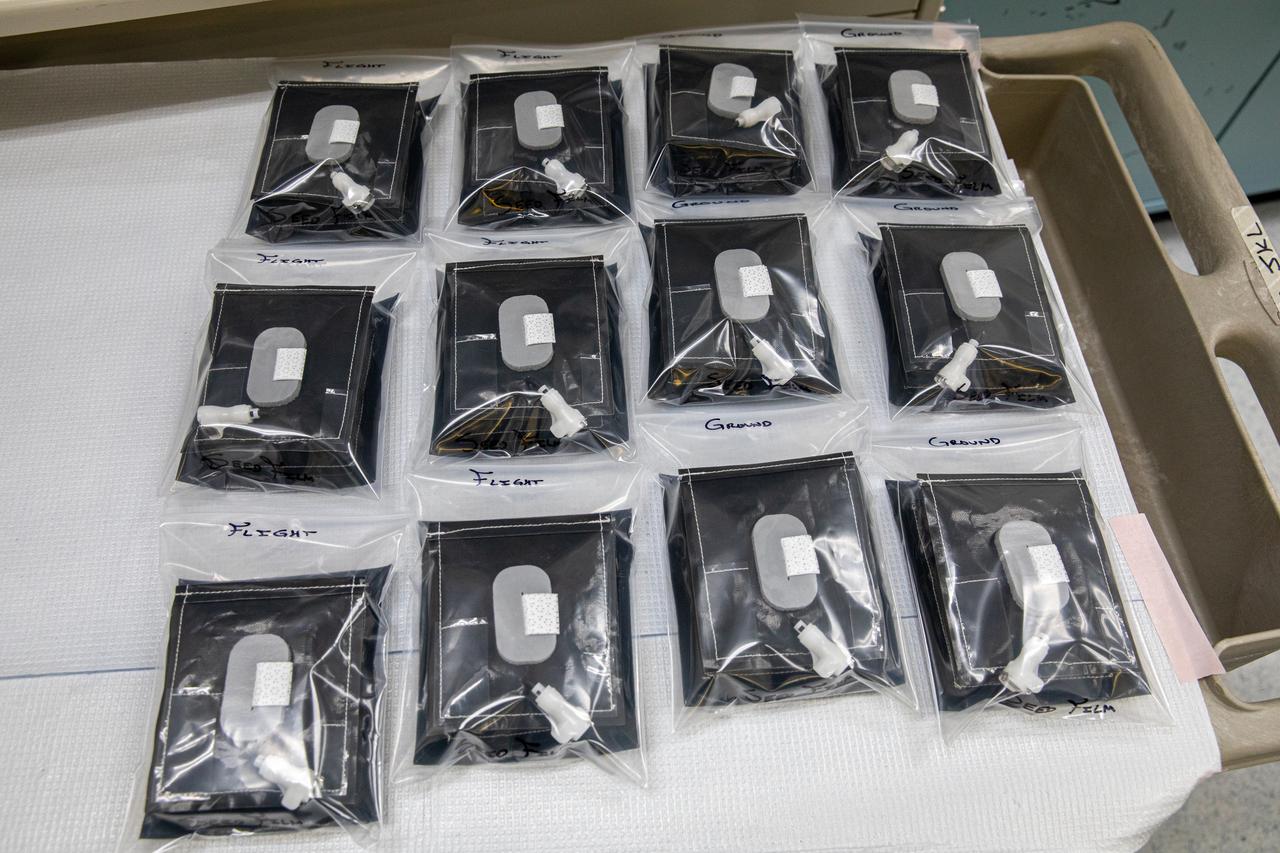
On Jan. 21, 2020, inside the Space Station Processing Facility at NASA’s Kennedy Space Center in Florida, plant pillows are packaged for their upcoming flight to the International Space Station on Northrop Grumman’s 13th resupply services (NG-13) mission. The pillows, which are a common method used to grow plants in space, are being sent to the orbiting laboratory for a series of VEG-03 experiments that will study the growth of three types of leafy greens in a microgravity environment. Once the pillows are assembled and packaged for flight, they will be transported to the agency’s Wallops Flight Facility in Virginia, where liftoff will occur. NG-13 is scheduled to launch on Feb. 9, 2020, at 5:39 p.m. EST.
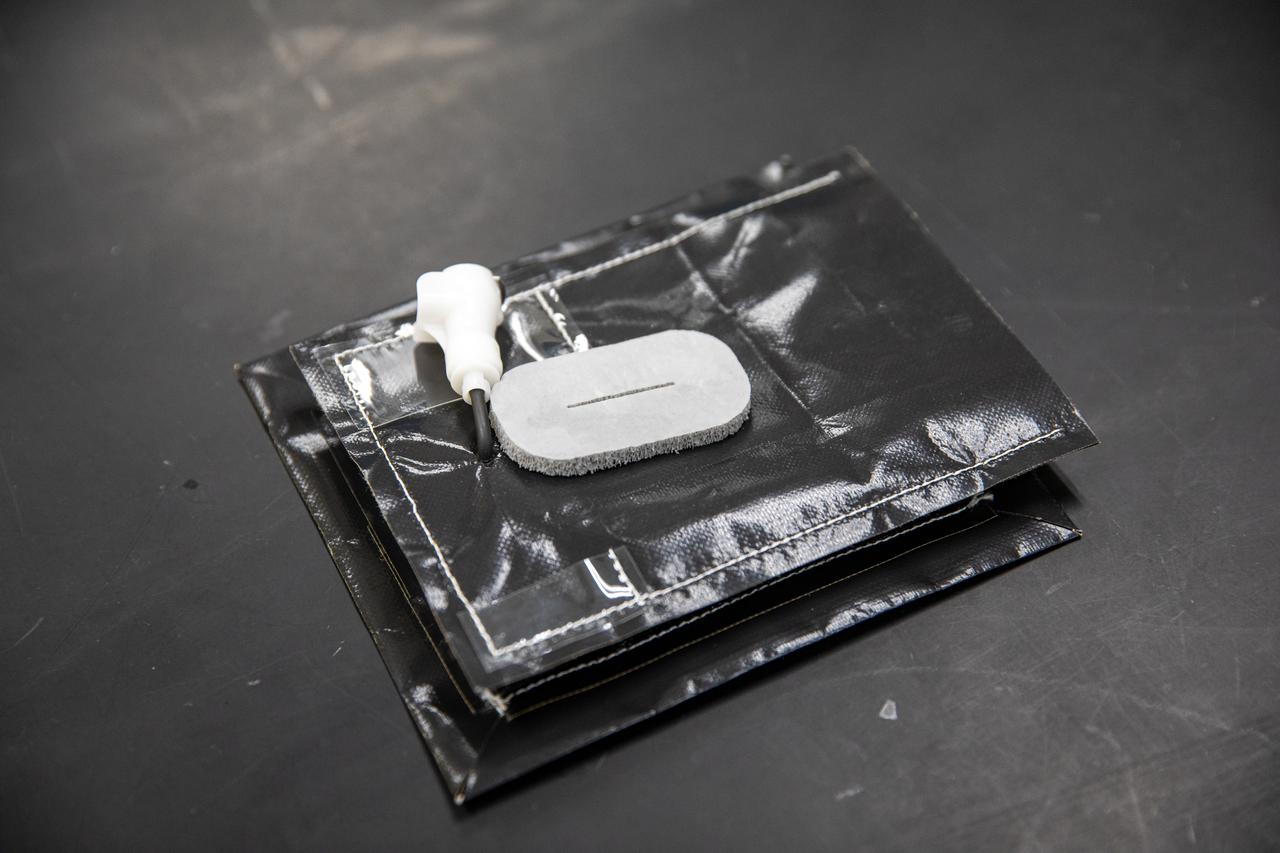
A plant pillow is photographed inside the Space Station Processing Facility at NASA’s Kennedy Space Center in Florida on Jan. 21, 2020, prior to being packaged for flight to the International Space Station. A number of plant pillows are being prepped to fly to the orbiting laboratory on Northrop Grumman’s 13th resupply services (NG-13) mission for a series of VEG-03 experiments that will study the growth of three types of leafy greens in a microgravity environment. Once the pillows are ready for flight, they will be transported to the agency’s Wallops Flight Facility in Virginia, where liftoff will occur. NG-13 is scheduled to launch on Feb. 9, 2020, at 5:39 p.m. EST.
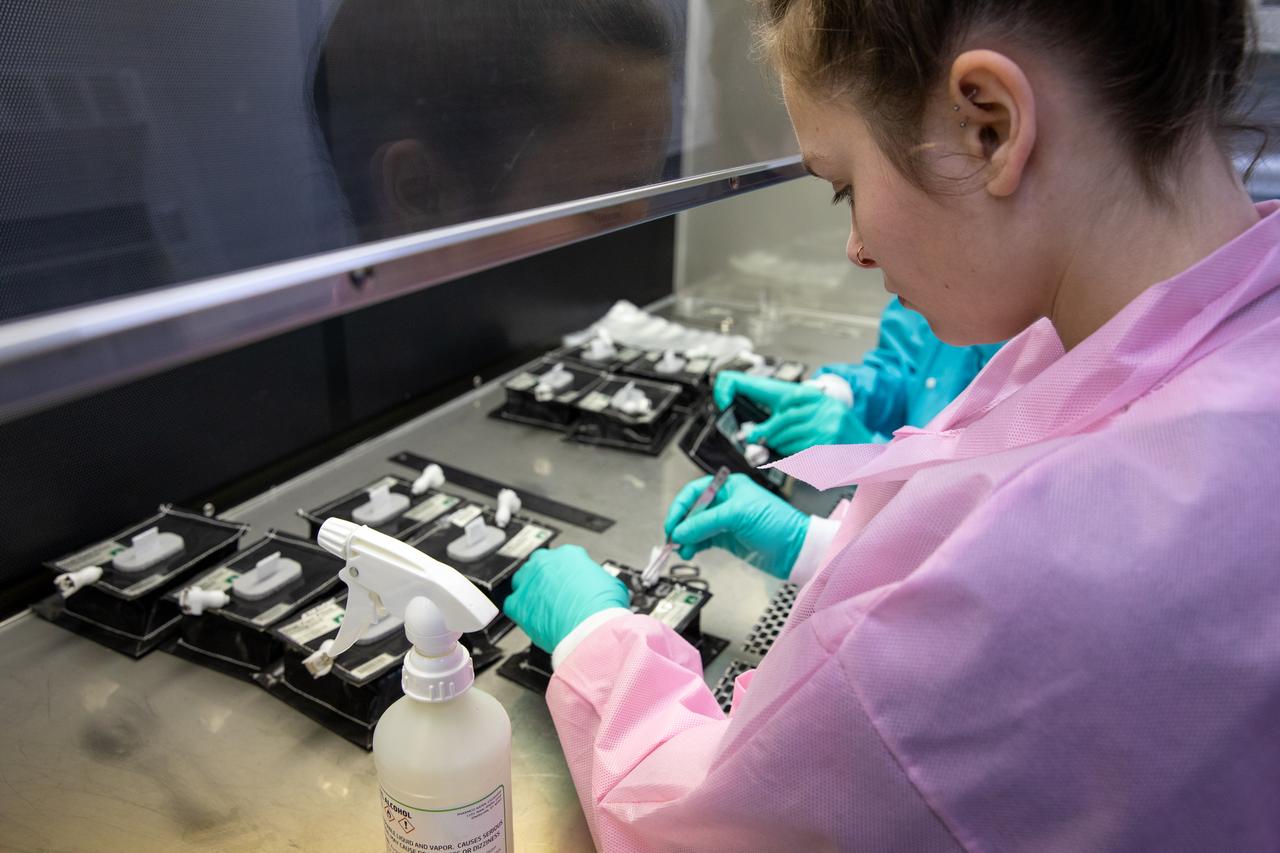
On Jan. 21, 2020, inside the Space Station Processing Facility at NASA’s Kennedy Space Center in Florida, intern Emily Kennebeck prepares plant pillows for their flight to the International Space Station. The pillows, which are a common method used to grow plants in space, are being sent to the orbiting laboratory on Northrop Grumman’s 13th resupply services (NG-13) mission for a series of VEG-03 experiments that will study the growth of three types of leafy greens in a microgravity environment. Once the pillows are assembled and packaged for flight, they will be transported to the agency’s Wallops Flight Facility in Virginia, where liftoff will occur. NG-13 is scheduled to launch on Feb. 9, 2020, at 5:39 p.m. EST.
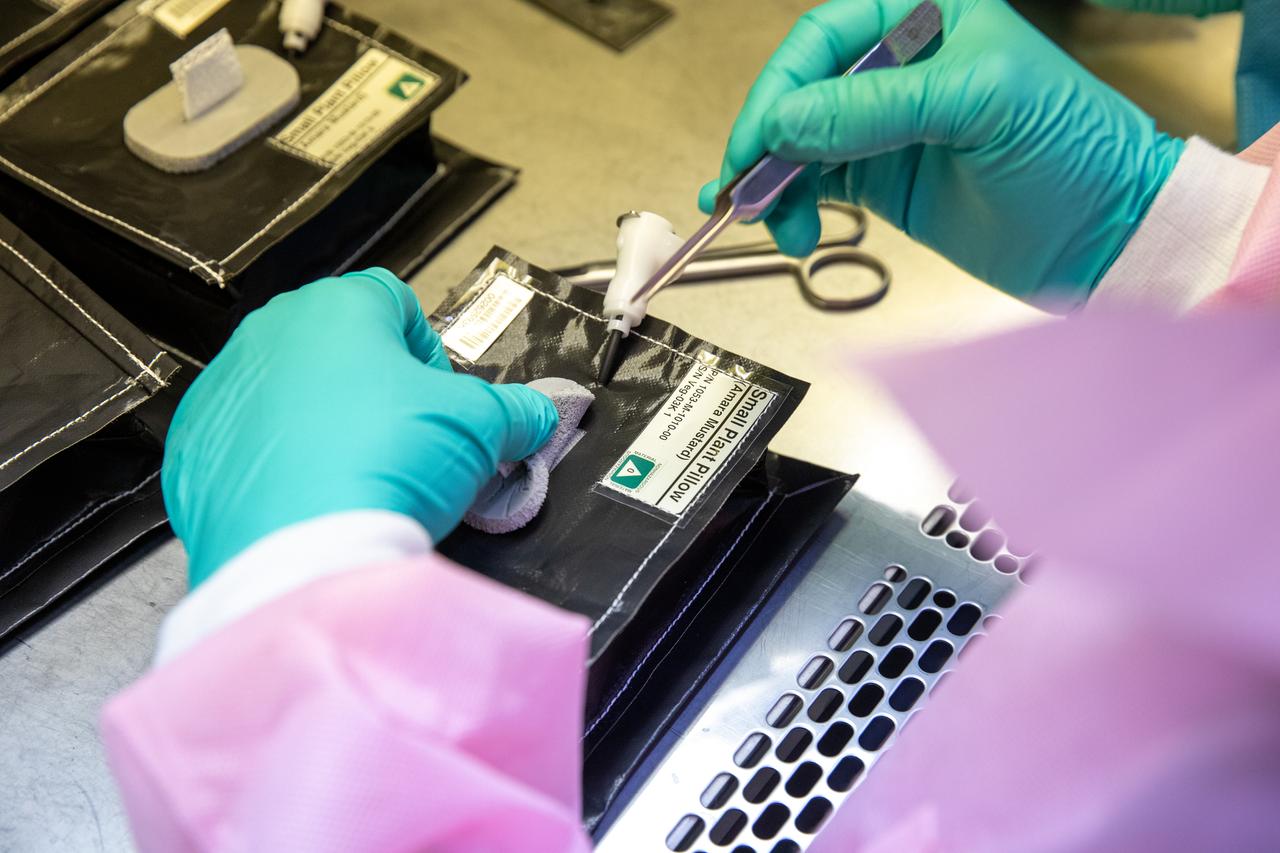
Inside the Space Station Processing Facility on Jan. 21, 2020, Emily Kennebeck, an intern at NASA’s Kennedy Space Center in Florida, prepares plant pillows for their flight to the International Space Station. The pillows, which are a common method used to grow plants in space, are being sent to the orbiting laboratory on Northrop Grumman’s 13th resupply services (NG-13) mission for a series of VEG-03 experiments that will study the growth of three types of leafy greens in a microgravity environment. Once the pillows are assembled and packaged for flight, they will be transported to the agency’s Wallops Flight Facility in Virginia, where liftoff will occur. NG-13 is scheduled to launch on Feb. 9, 2020, at 5:39 p.m. EST.
On Jan. 21, 2020, inside the Space Station Processing Facility at NASA’s Kennedy Space Center in Florida, intern Emily Kennebeck prepares plant pillows for their upcoming flight to the International Space Station. The pillows, which are a common method used to grow plants in space, are being sent to the orbiting laboratory on Northrop Grumman’s 13th resupply services (NG-13) mission for a series of VEG-03 experiments that will study the growth of three types of leafy greens in a microgravity environment. Once the pillows are assembled and packaged for flight, they will be transported to the agency’s Wallops Flight Facility in Virginia, where liftoff will occur. NG-13 is scheduled to launch on Feb. 9, 2020, at 5:39 p.m. EST.
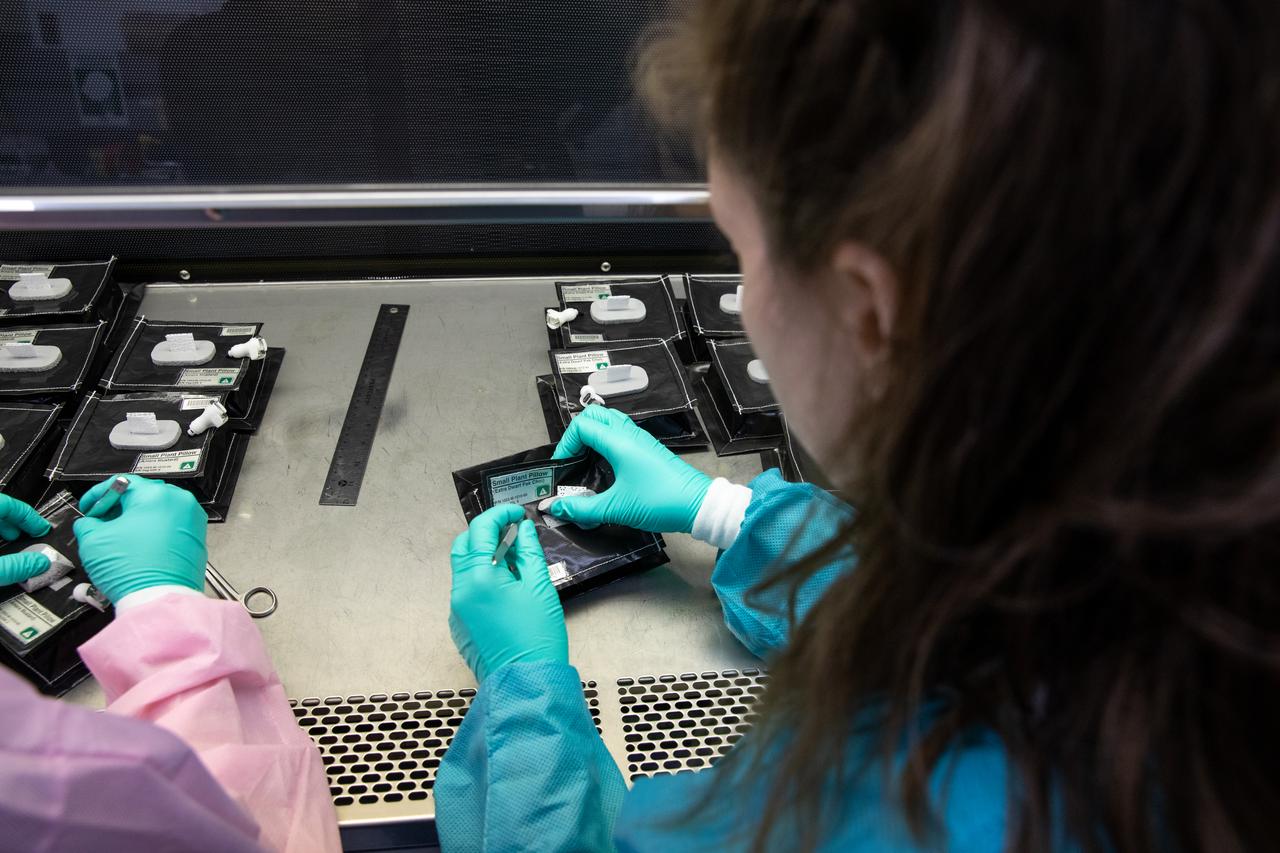
Inside the Space Station Processing Facility on Jan. 21, 2020, Jess Bunchek, a pseudonaut and associate scientist at NASA’s Kennedy Space Center in Florida, prepares plant pillows for their flight to the International Space Station. The pillows, which are a common method used to grow plants in space, are being sent to the orbiting laboratory on Northrop Grumman’s 13th resupply services (NG-13) mission for a series of VEG-03 experiments that will study the growth of three types of leafy greens in a microgravity environment. Once the pillows are assembled and packaged for flight, they will be transported to the agency’s Wallops Flight Facility in Virginia, where liftoff will occur. NG-13 is scheduled to launch on Feb. 9, 2020, at 5:39 p.m. EST.
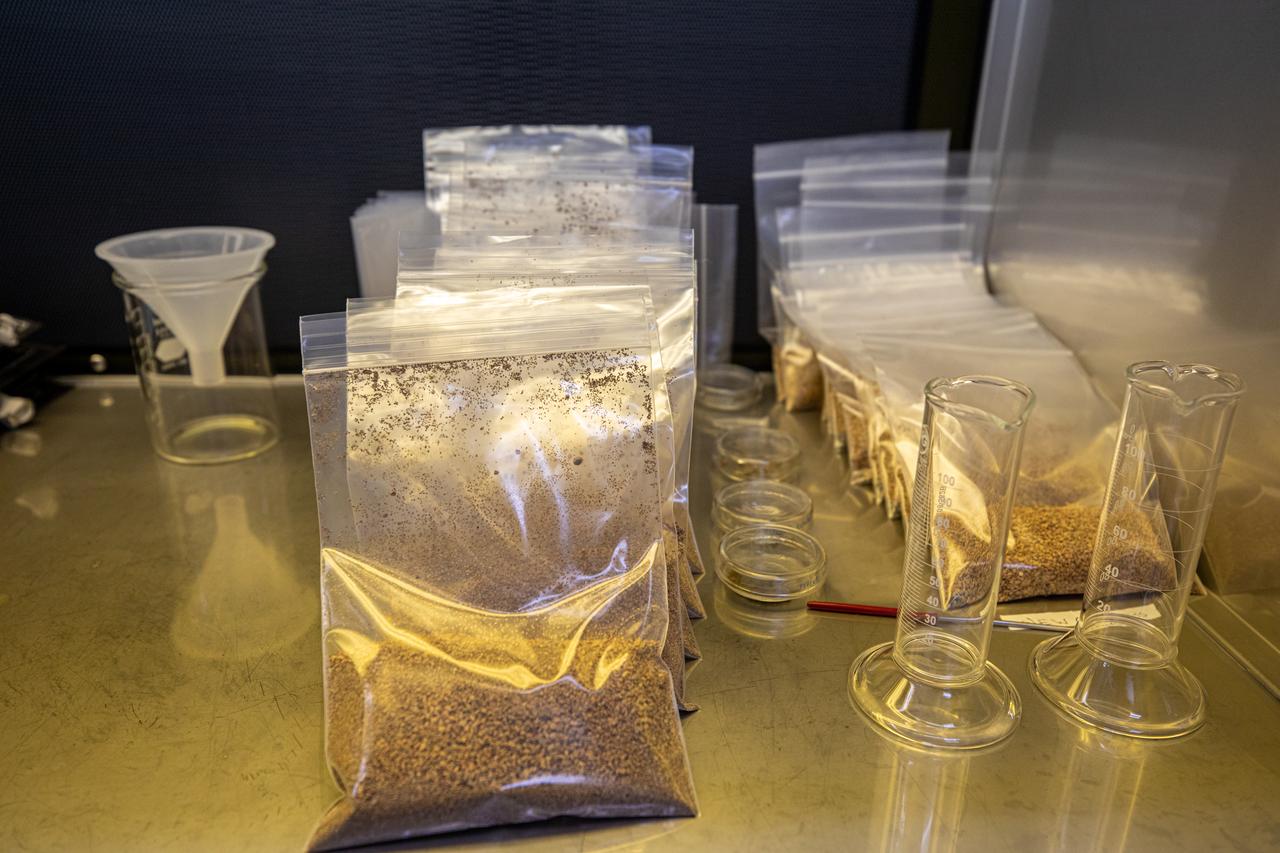
Researchers at NASA’s Kennedy Space Center in Florida have laid out supplies to prepare plant pillows inside the Space Station Processing Facility on Jan. 16, 2020. The pillows are small containers packed with everything needed to grow plants in microgravity aboard the International Space Station. These pillows are for a series of plant experiments called VEG-03 J/K/L that will monitor the growth of three types of leafy greens. The experiments will be launched to the orbiting laboratory aboard a Northrop Grumman Antares rocket and Cygnus spacecraft on the company’s 13th resupply services mission. Liftoff is scheduled for Feb. 9, 2020, at 5:39 p.m. EST from the agency’s Wallops Flight Facility in Virginia.
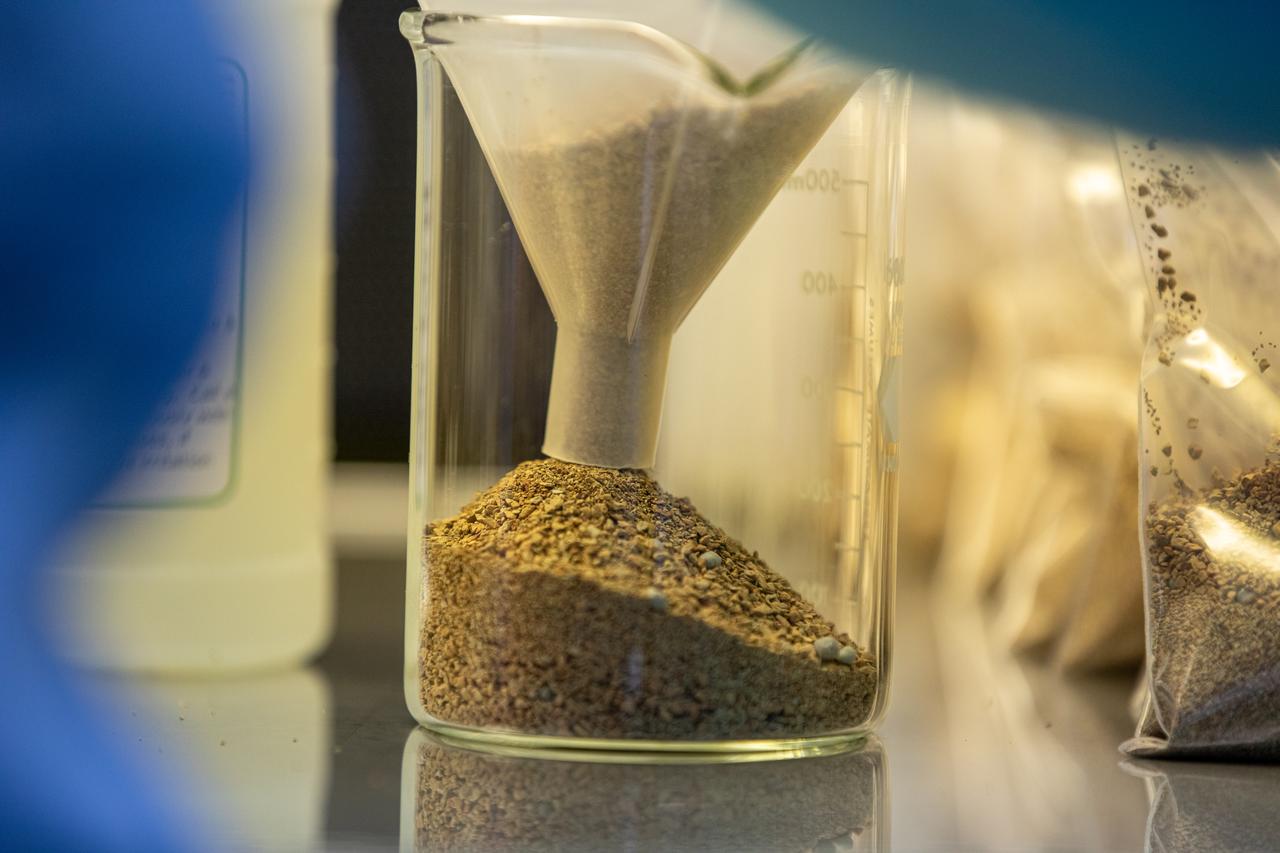
Inside the Space Station Processing Facility at NASA’s Kennedy Space Center in Florida, a researcher measures out the calcined clay that will be used to assemble plant pillows on Jan. 16, 2019. Often used to condition baseball infields, the clay’s size and roughness traps air and absorbs water to provide both to plant roots in microgravity. The pillows are small containers used to grow plants in space aboard the International Space Station. These pillows are for a series of plant experiments called VEG-03 J/K/L that will monitor the growth of three types of leafy greens and test a new way of handling seeds. The experiments will be launched to the orbiting laboratory aboard a Northrop Grumman Antares rocket and Cygnus spacecraft on the company’s 13th resupply services mission. Liftoff is scheduled for Feb. 9, 2020, at 5:39 p.m. EST from the agency’s Wallops Flight Facility in Virginia.
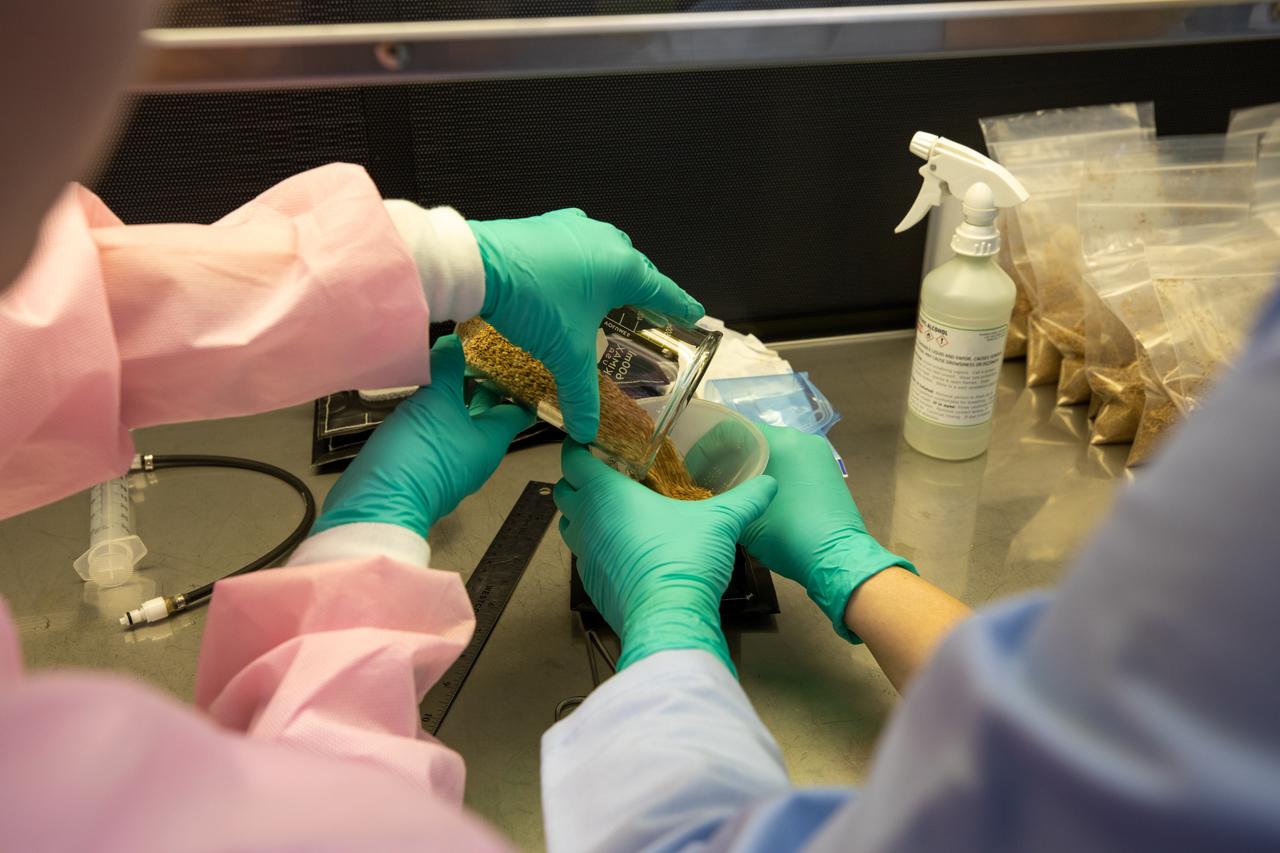
Inside the Space Station Processing Facility at NASA’s Kennedy Space Center in Florida, a researcher measures out the calcined clay that will be used to assemble plant pillows on Jan. 16, 2019. Often used to condition baseball infields, the clay’s size and roughness traps air and absorbs water to provide both to plant roots in microgravity. The pillows are small containers used to grow plants in space aboard the International Space Station. The pillows are for a series of plant experiments called VEG-03 J/K/L that will monitor the growth of three types of leafy greens and test a new way of handling seeds. The experiments will be launched to the orbiting laboratory aboard a Northrop Grumman Antares rocket and Cygnus spacecraft on the company’s 13th resupply services mission. Liftoff is scheduled for Feb. 9, 2020, at 5:39 p.m. EST from the agency’s Wallops Flight Facility in Virginia.
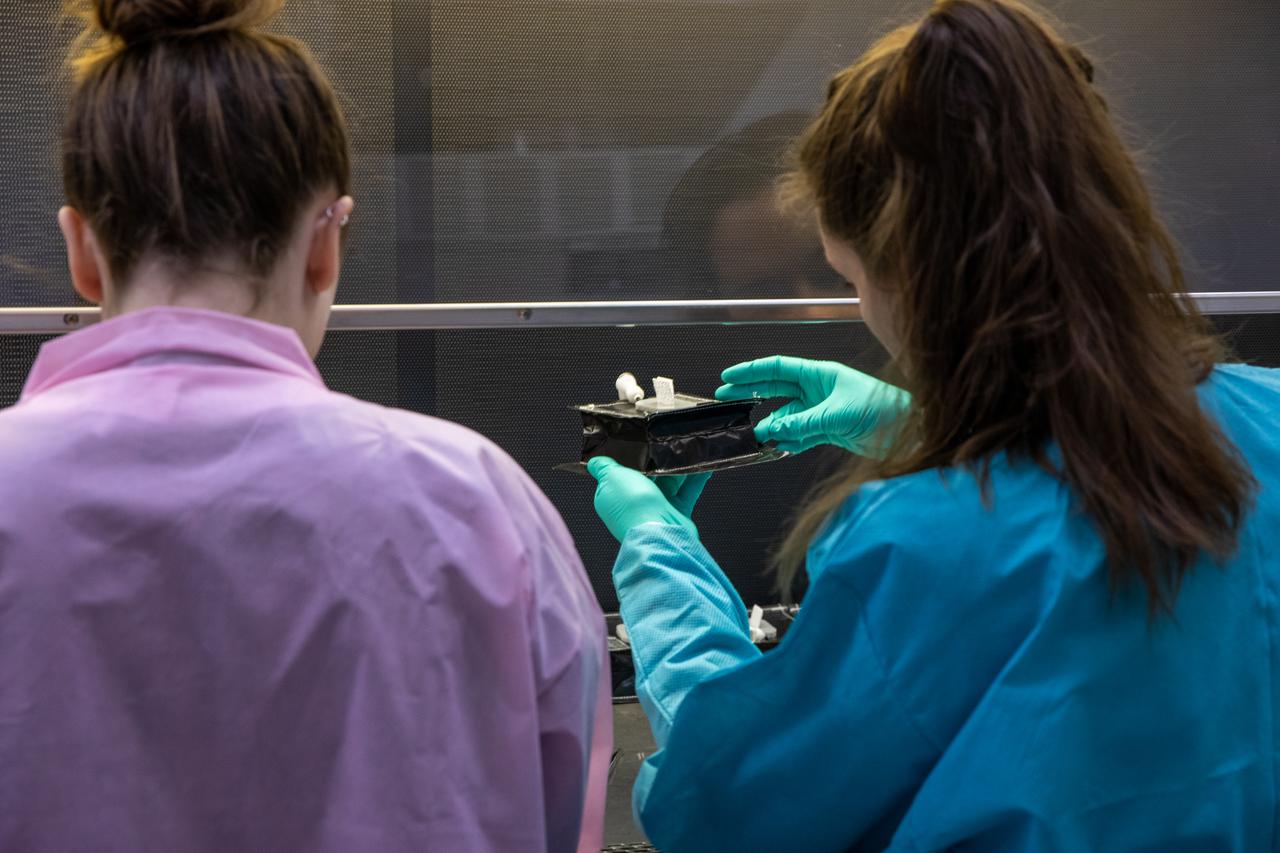
On Jan. 21, 2020, inside the Space Station Processing Facility at NASA’s Kennedy Space Center in Florida, intern Emily Kennebeck (left) and Jess Bunchek, a pseudonaut and associate scientist, prepare plant pillows for their flight to the International Space Station. The pillows, which are a common method used to grow plants in space, are being sent to the orbiting laboratory on Northrop Grumman’s 13th resupply services (NG-13) mission for a series of VEG-03 experiments that will study the growth of three types of leafy greens in a microgravity environment. Once the pillows are assembled and packaged for flight, they will be transported to the agency’s Wallops Flight Facility in Virginia, where liftoff will occur. NG-13 is scheduled to launch on Feb. 9, 2020, at 5:39 p.m. EST.
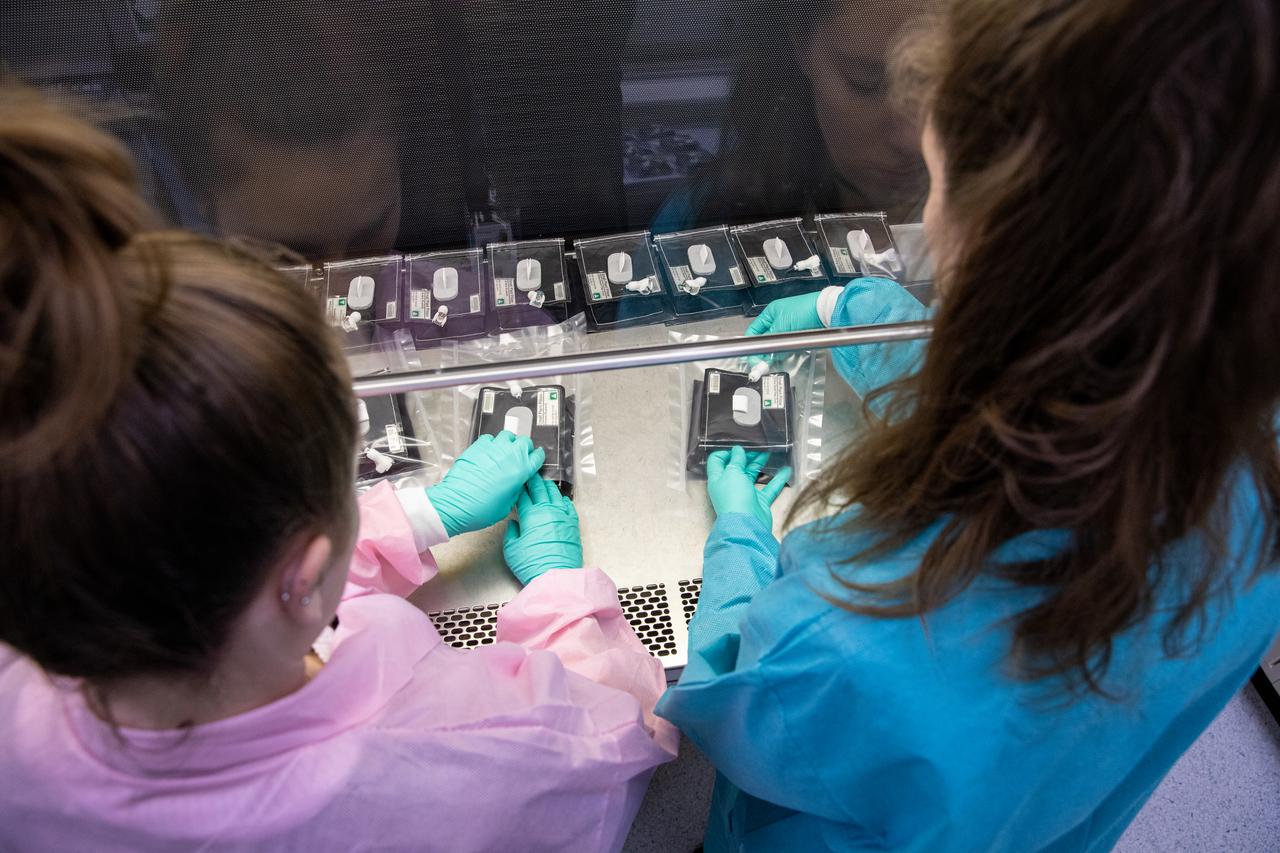
On Jan. 21, 2020, inside the Space Station Processing Facility at NASA’s Kennedy Space Center in Florida, intern Emily Kennebeck (left) and Jess Bunchek, a pseudonaut and associate scientist, prepare plant pillows for their upcoming flight to the International Space Station. The pillows, which are a common method used to grow plants in space, are being sent to the orbiting laboratory on Northrop Grumman’s 13th resupply services (NG-13) mission for a series of VEG-03 experiments that will study the growth of three types of leafy greens in a microgravity environment. Once the pillows are assembled and packaged for flight, they will be transported to the agency’s Wallops Flight Facility in Virginia, where liftoff will occur. NG-13 is scheduled to launch on Feb. 9, 2020, at 5:39 p.m. EST.
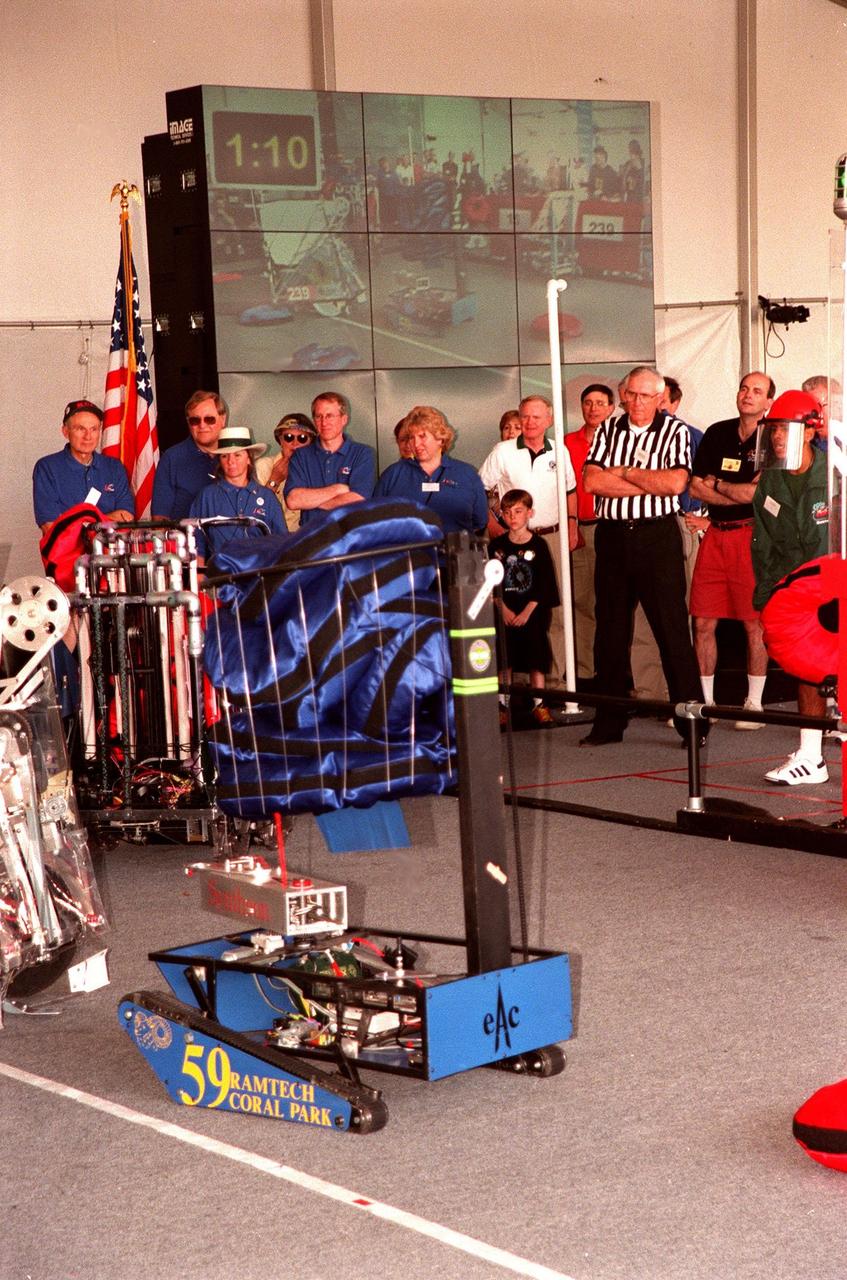
During the 1999 FIRST Southeastern Regional robotic competition held at KSC, a robot carrying its cache of pillow-like disks maneuvers to move around another at left. Powered by 12-volt batteries and operated by remote control, the robotic gladiators spend two minutes each trying to grab, claw and hoist the pillows onto their machines. Teams play defense by taking away competitors' pillows and generally harassing opposing machines. Behind the field are a group of judges, including KSC former KSC Director of Shuttle Processing Robert Sieck (left, in cap), and Center Director Roy Bridges (in white shirt). A giant screen TV in the background displays the action on the playing field. FIRST is a nonprofit organization, For Inspiration and Recognition of Science and Technology. The competition comprised 27 teams, pairing high school students with engineer mentors and corporations. The FIRST robotics competition is designed to provide students with a hands-on, inside look at engineering and other professional careers
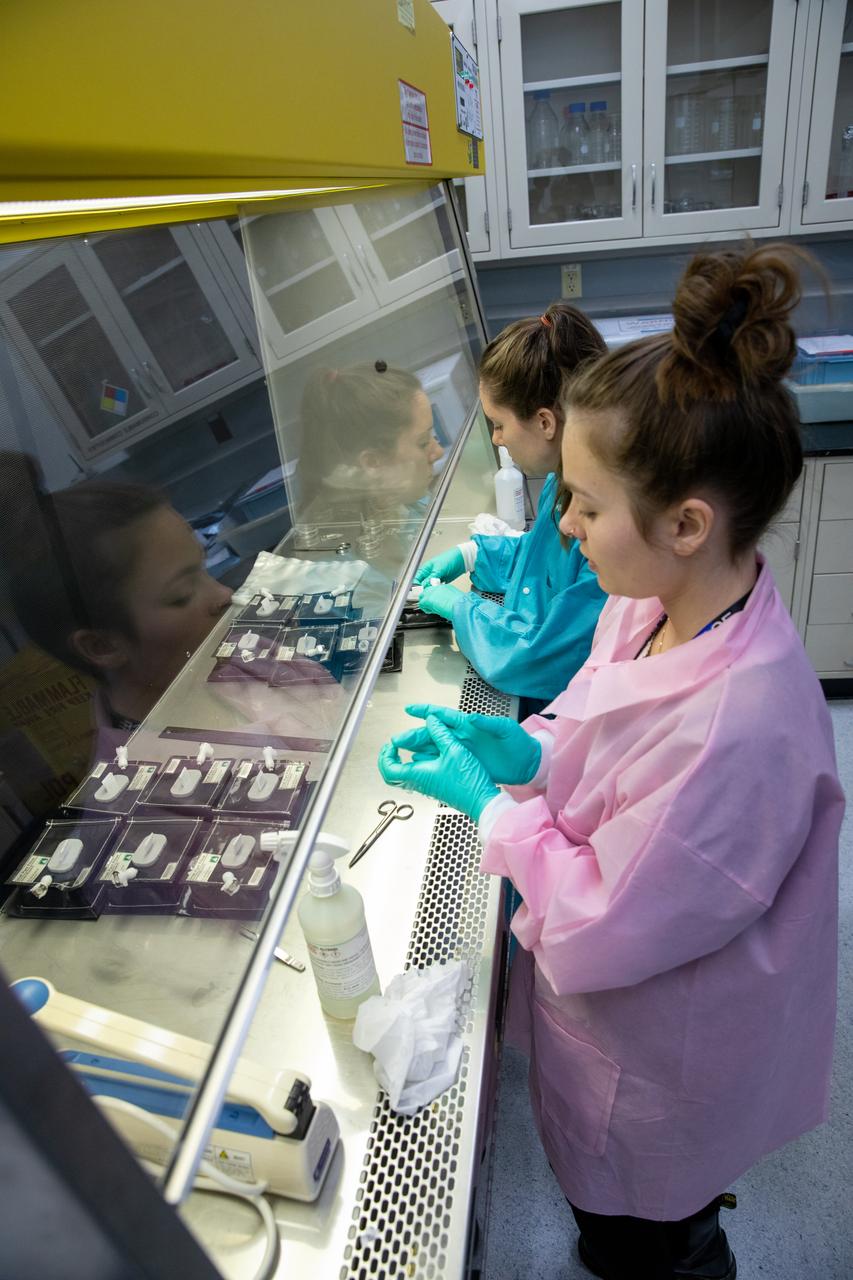
On Jan. 21, 2020, inside the Space Station Processing Facility at NASA’s Kennedy Space Center in Florida, intern Emily Kennebeck (left) and Jess Bunchek, a pseudonaut and associate scientist, prepare plant pillows for their flight to the International Space Station. The pillows, which are a common method used to grow plants in space, are being sent to the orbiting laboratory on Northrop Grumman’s 13th resupply services (NG-13) mission for a series of VEG-03 experiments that will study the growth of three types of leafy greens in a microgravity environment. Once the pillows are assembled and packaged for flight, they will be transported to the agency’s Wallops Flight Facility in Virginia, where liftoff will occur. NG-13 is scheduled to launch on Feb. 9, 2020, at 5:39 p.m. EST.
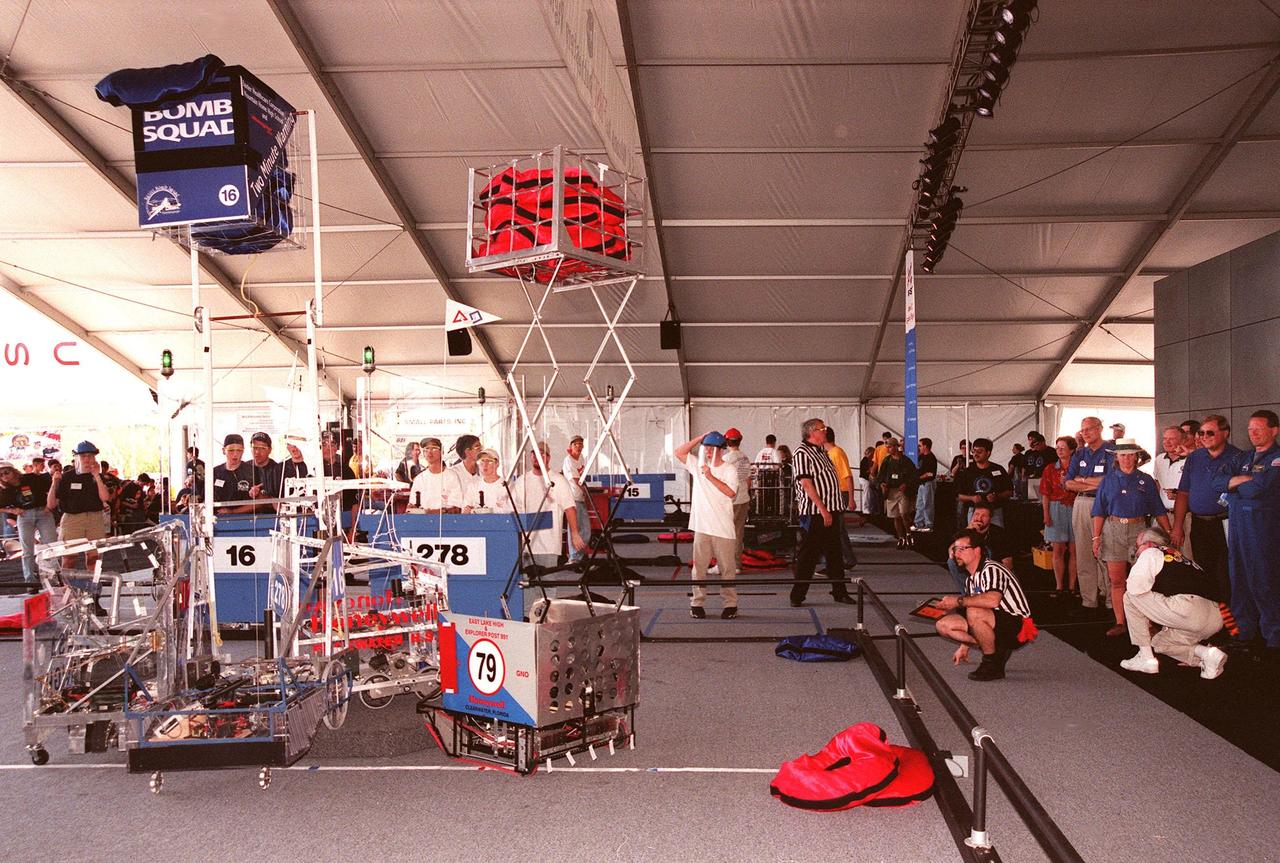
Four robots vie for position on the playing field during the 1999 FIRST Southeastern Regional robotic competition held at KSC. Powered by 12-volt batteries and operated by remote control, the robotic gladiators spent two minutes each trying to grab, claw and hoist large, satin pillows onto their machines. Student teams, shown behind protective walls, play defense by taking away competitors' pillows and generally harassing opposing machines. Two of the robots have lifted their caches of pillows above the field, a movement which earns them points. Along with the volunteer referees, at the edge of the playing field, judges at right watch the action. FIRST is a nonprofit organization, For Inspiration and Recognition of Science and Technology. The competition comprised 27 teams, pairing high school students with engineer mentors and corporations. The FIRST robotics competition is designed to provide students with a hands-on, inside look at engineering and other professional careers
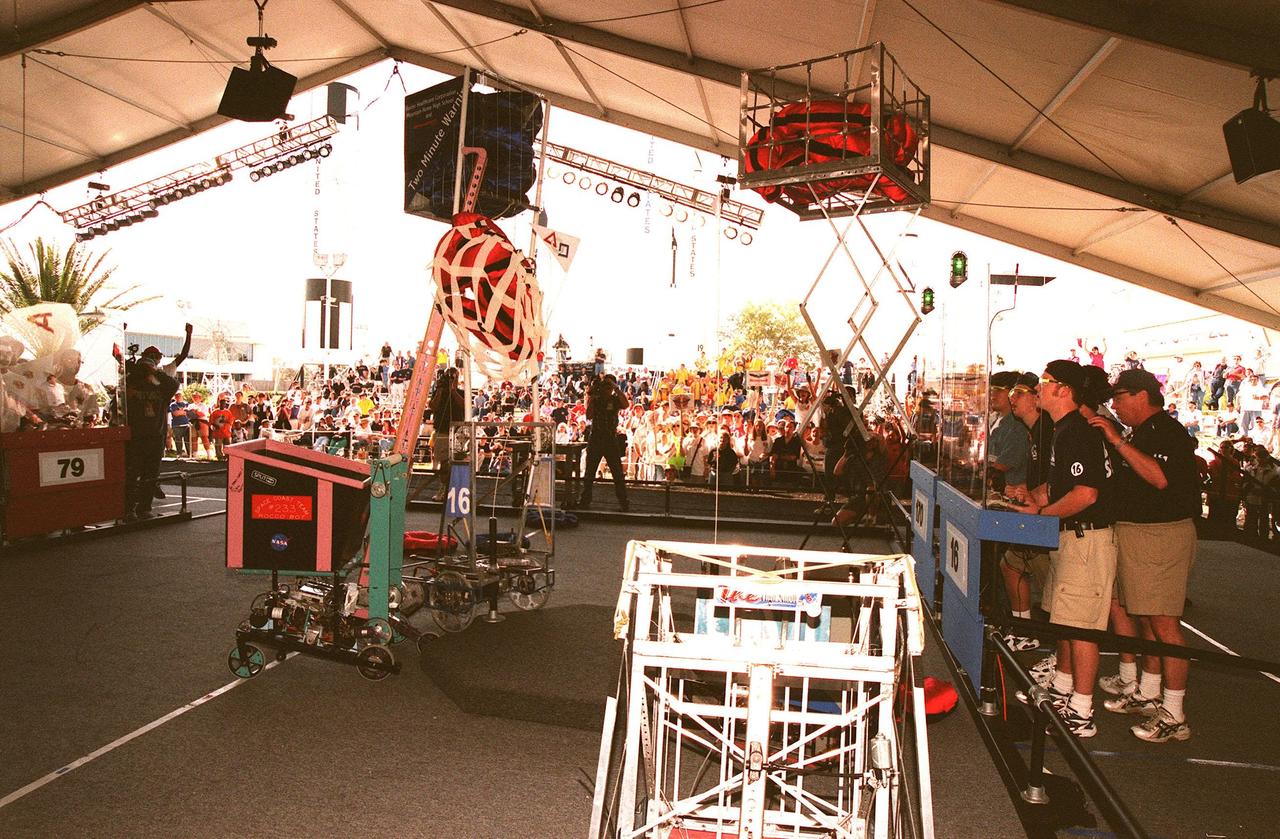
Robots, maneuvered by student teams behind protective walls, raise their caches of pillow-like disks to earn points in competition while spectators in the bleachers and on the sidelines cheer their favorite teams. Held at the KSC Visitor Complex, the 1999 Southeastern Regional robotic competition, sponsored by the nonprofit organization For Inspiration and Recognition of Science and Technology, known as FIRST, comprises 27 teams pairing high school students with engineer mentors and corporations, pitting gladiator robots against each other in an athletic-style competition. Powered by 12-volt batteries and operated by remote control, the robotic gladiators spend two minutes each trying to grab, claw and hoist the pillows onto their machines. Teams play defense by taking away competitors' pillows and generally harassing opposing machines. The FIRST robotics competition is designed to provide students with a hands-on, inside look at engineering and other professional careers
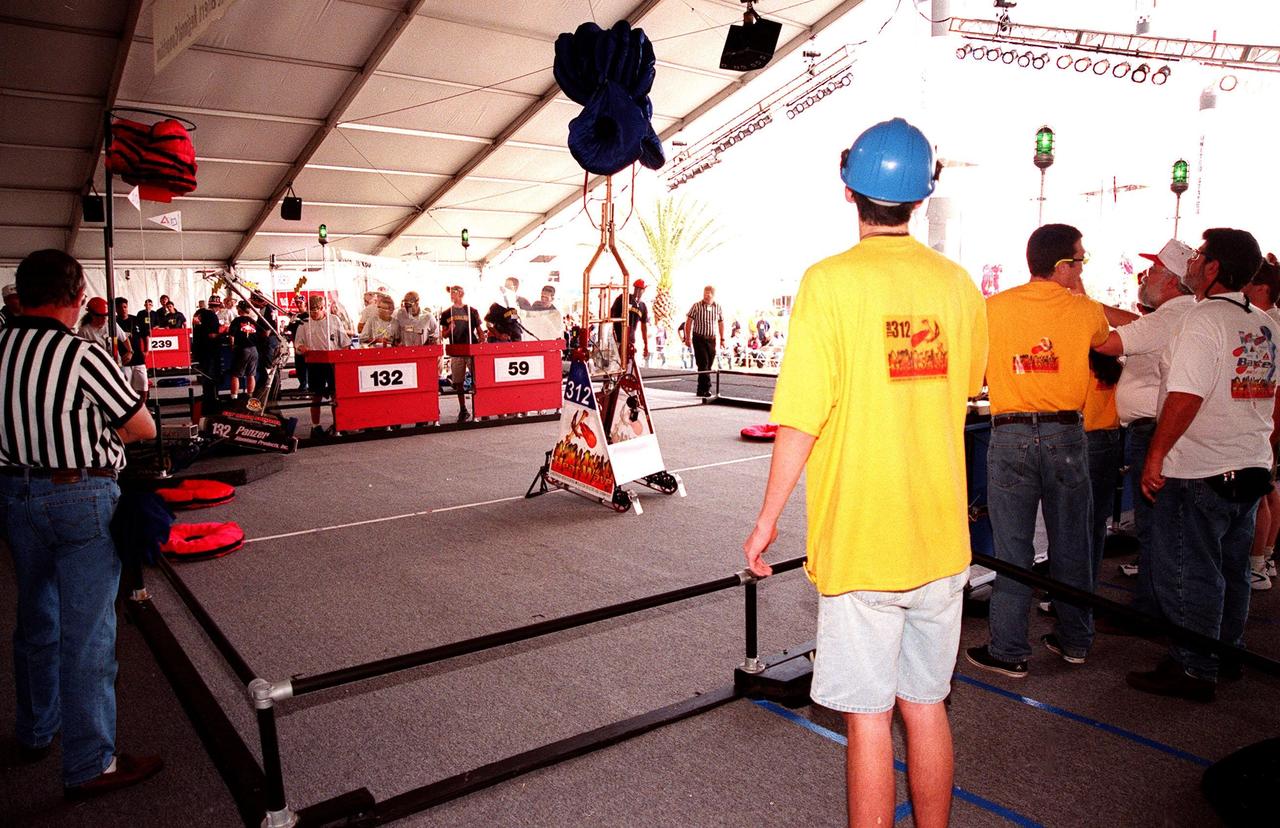
During final matches at the 1999 Southeastern Regional robotic competition at the KSC Visitor Complex, referees in opposite corners and student teams watch as two robots raise their pillow disks to a height of eight feet, one of the goals of the competition. Thirty schools from around the country have converged at KSC for the event that pits gladiator robots against each other in an athletic-style competition. The robots have to retrieve the pillow disks from the floor, climb onto a platform (with flags), as well as raise the cache of pillows, maneuvered by student teams behind protective walls. KSC is hosting the event being sponsored by the nonprofit organization For Inspiration and Recognition of Science and Technology, known as FIRST. The FIRST robotics competition is designed to provide students with a hands-on, inside look at engineering and other professional careers by pairing engineers and corporations with student teams
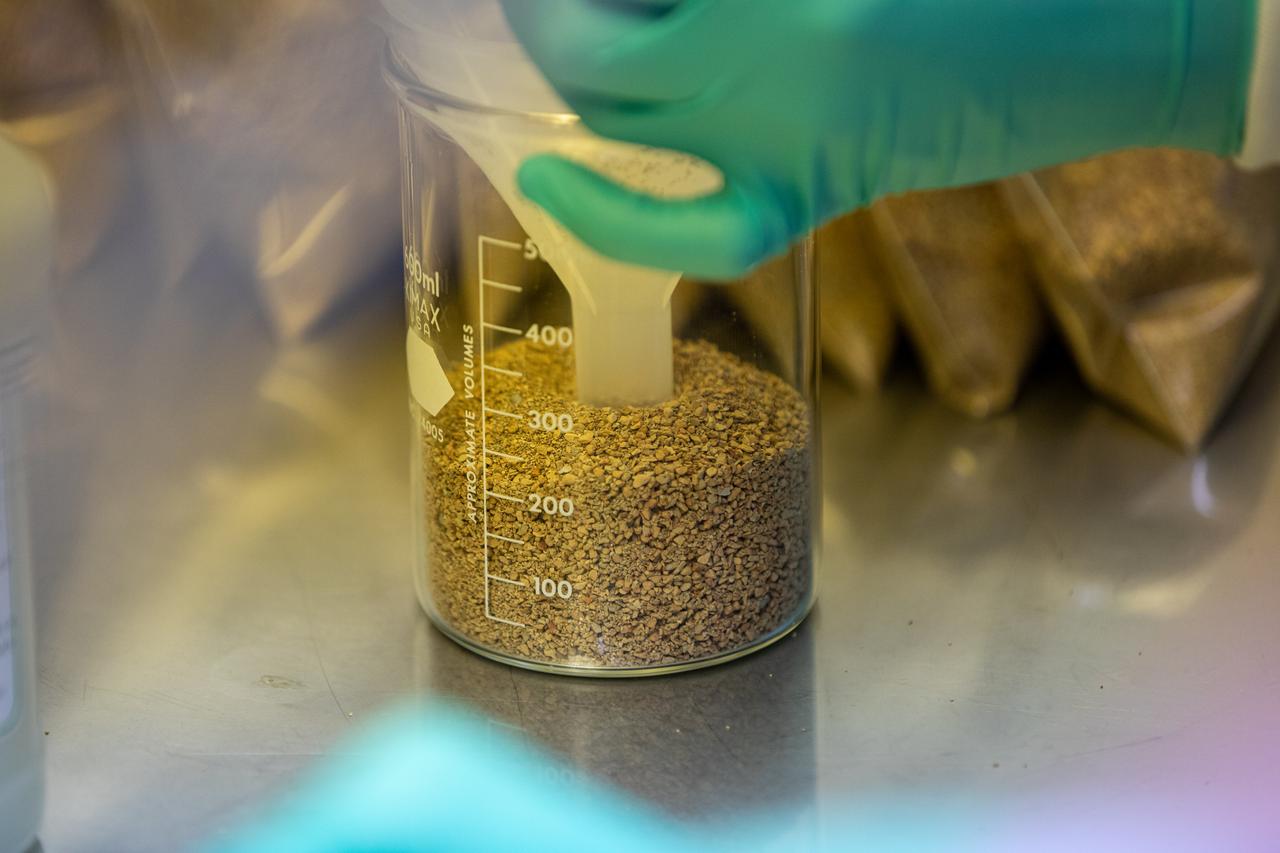
Inside the Space Station Processing Facility at NASA’s Kennedy Space Center in Florida, a researcher measures out the calcined clay that will be used to assemble plant pillows on Jan. 16, 2019. Often used to condition baseball infields, the clay’s size and roughness traps air and absorbs water to provide both to plant roots in microgravity. The pillows are small containers used to grow plants in space aboard the International Space Station. These pillows are for a series of plant experiments called VEG-03 J/K/L that will monitor the growth of three types of leafy greens and test a new way of handling seeds. The experiments will be launched to the orbiting laboratory aboard a Northrop Grumman Antares rocket and Cygnus spacecraft on the company’s 13th resupply services mission. Liftoff is scheduled for Feb. 9, 2020, at 5:39 p.m. EST from the agency’s Wallops Flight Facility in Virginia.
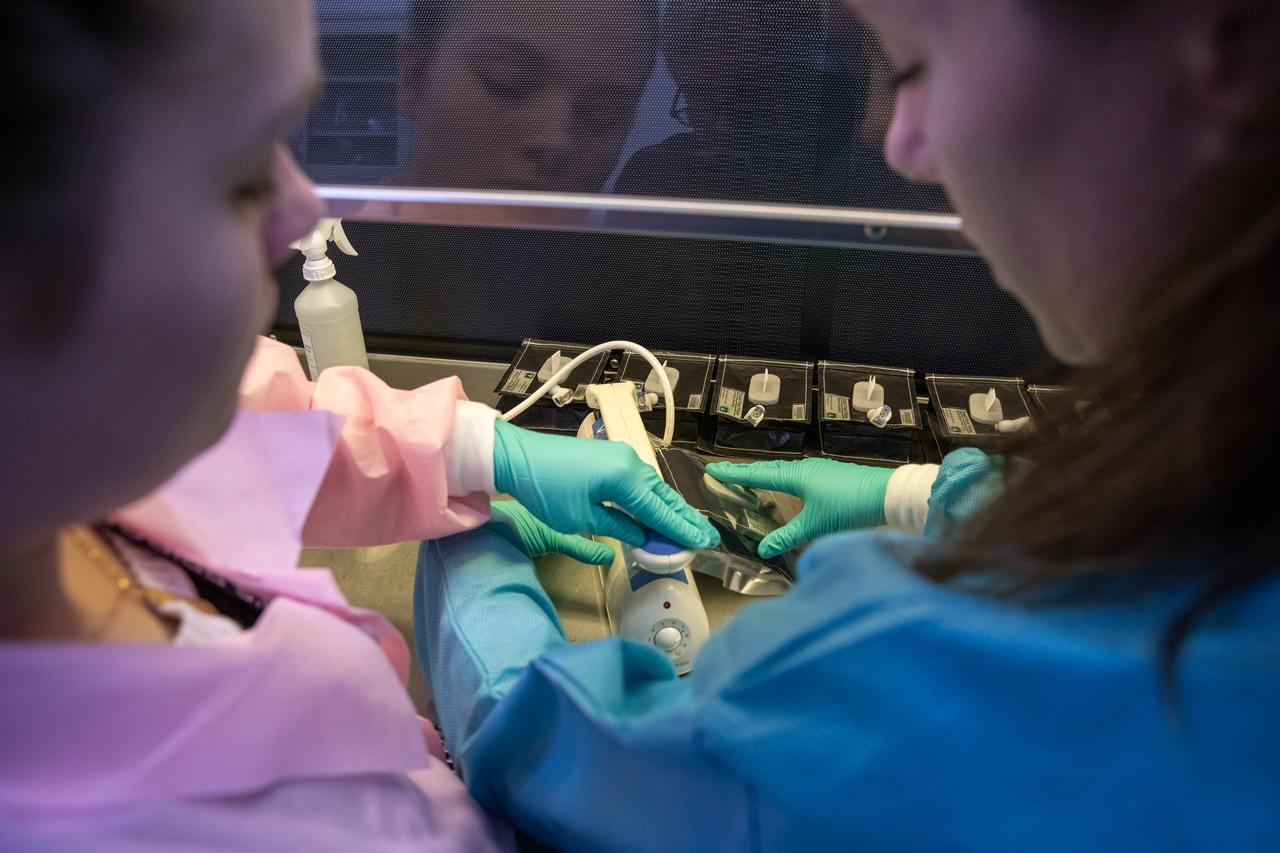
On Jan. 21, 2020, inside the Space Station Processing Facility at NASA’s Kennedy Space Center in Florida, intern Emily Kennebeck (left) and Jess Bunchek, a pseudonaut and associate scientist, prepare plant pillows for their upcoming flight to the International Space Station. The pillows, which are a common method used to grow plants in space, are being sent to the orbiting laboratory on Northrop Grumman’s 13th resupply services (NG-13) mission for a series of VEG-03 experiments that will study the growth of three types of leafy greens in a microgravity environment. Once the pillows are assembled and packaged for flight, they will be transported to the agency’s Wallops Flight Facility in Virginia, where liftoff will occur. NG-13 is scheduled to launch on Feb. 9, 2020, at 5:39 p.m.
On Jan. 21, 2020, inside the Space Station Processing Facility at NASA’s Kennedy Space Center in Florida, intern Emily Kennebeck (left) and Jess Bunchek, a pseudonaut and associate scientist, prepare plant pillows for their upcoming flight to the International Space Station. The pillows, which are a common method used to grow plants in space, are being sent to the orbiting laboratory on Northrop Grumman’s 13th resupply services (NG-13) mission for a series of VEG-03 experiments that will study the growth of three types of leafy greens in a microgravity environment. Once the pillows are assembled and packaged for flight, they will be transported to the agency’s Wallops Flight Facility in Virginia, where liftoff will occur. NG-13 is scheduled to launch on Feb. 9, 2020, at 5:39 p.m. EST.
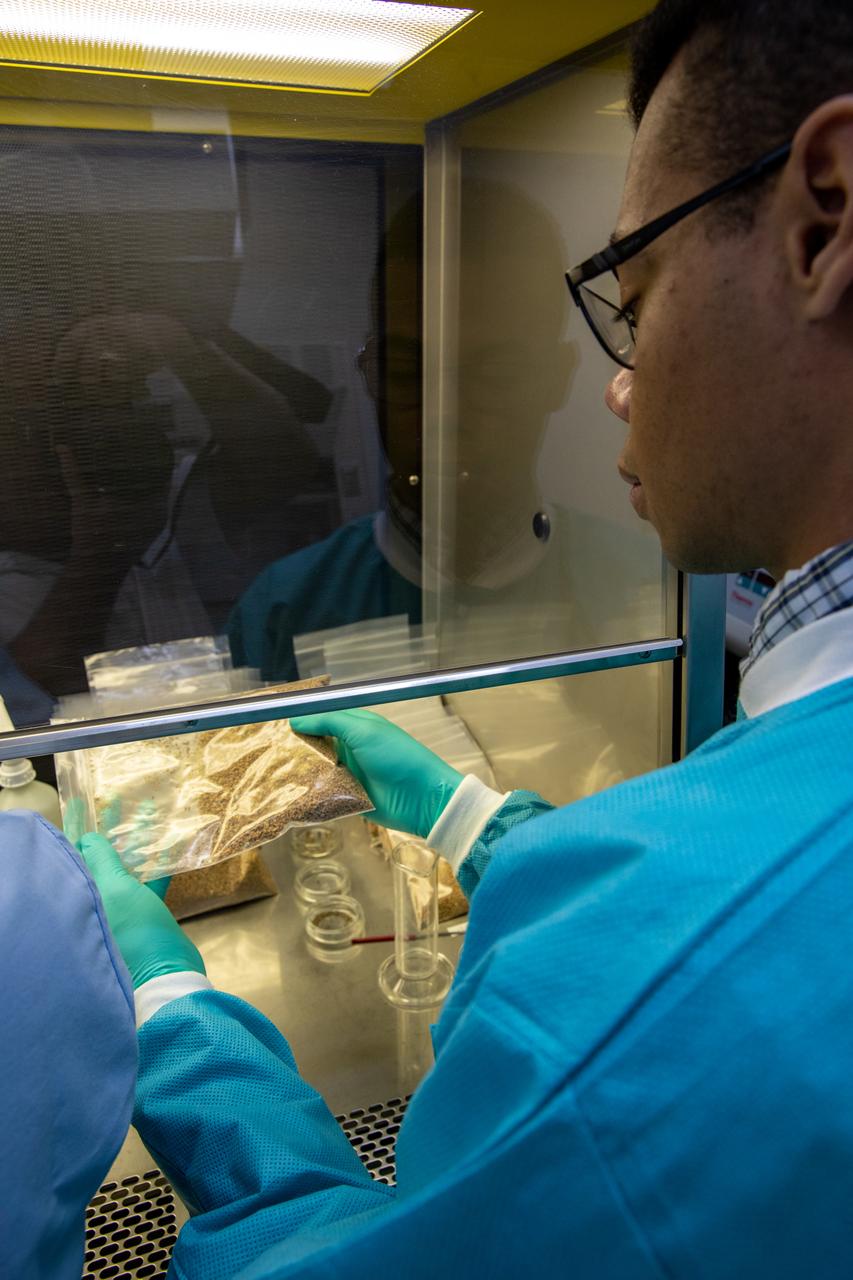
Joseph Taylor, an intern at NASA’s Kennedy Space Center in Florida, observes the calcined clay that will be used to assemble plant pillows inside the Space Station Processing Facility on Jan. 16, 2020. Often used to condition baseball infields, the clay’s size and roughness traps air and absorbs water to provide both to plant roots in microgravity. The pillows are small containers used to grow plants in space aboard the International Space Station. These pillows are for a series of plant experiments called VEG-03 J/K/L that will monitor the growth of three types of leafy greens and test a new way of handling seeds. The experiments will be launched to the orbiting laboratory aboard a Northrop Grumman Antares rocket and Cygnus spacecraft on the company’s 13th resupply services mission. Liftoff is scheduled for Feb. 9, 2020, at 5:39 p.m. EST from the agency’s Wallops Flight Facility in Virginia.
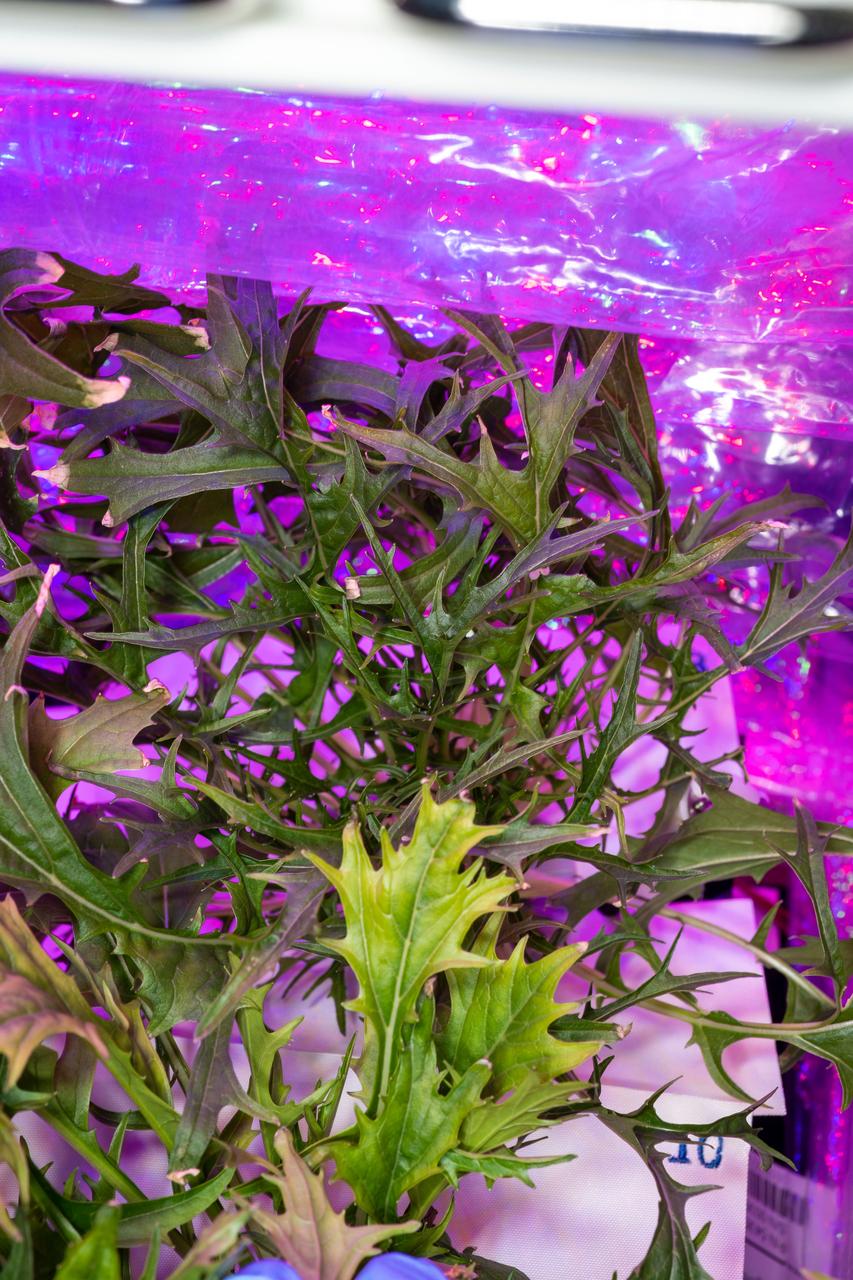
Documentation of a Mizuna mustard plant growing in Plant Pillow 8 in the Vegetable Production System (Veggie). Photo was taken prior to plant harvesting operations (OPS) for the Veg-04B experiment.
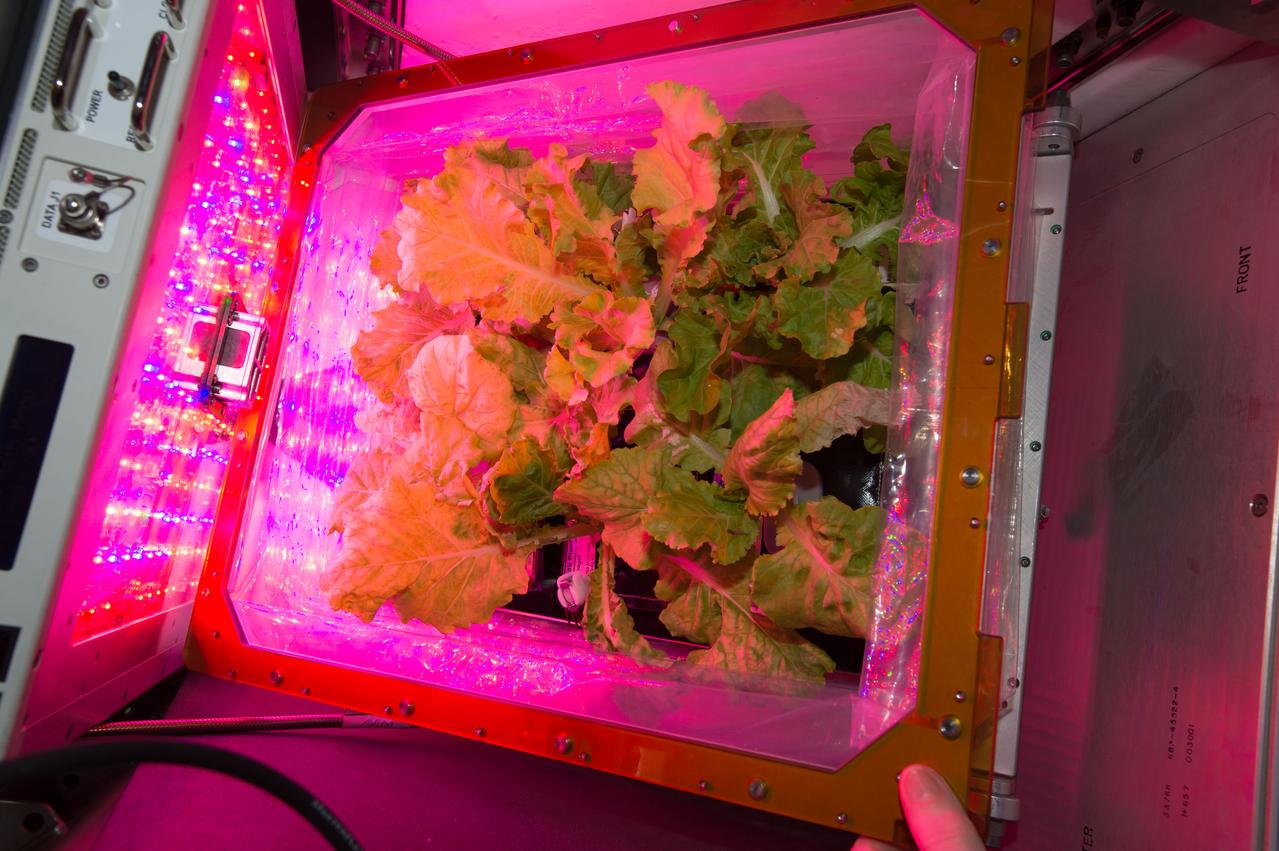
iss051e038158 (5/8/2017) --- Chinese cabbage is grown in the Veggie facility on the International Space Station. The sprouts form in a low-maintenance foam pillow and are grown using a special light to help the plants thrive.
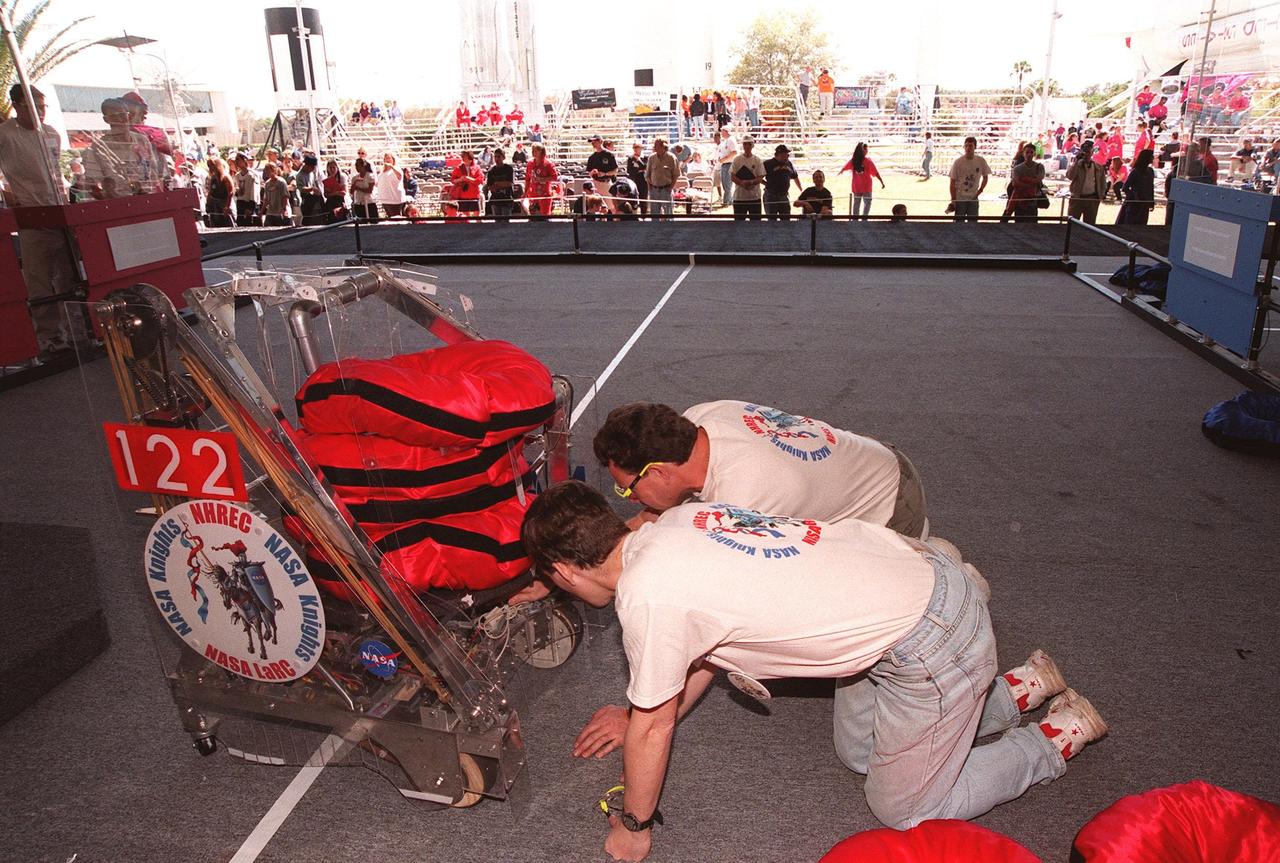
During practice rounds of the 1999 Southeastern Regional robotic competition at Kennedy Space Center Visitor Complex, team members adjust components of their robot on the floor. Thirty schools from around the country have converged at KSC for the event that pits gladiator robots against each other in an athletic-style competition. The robots have to retrieve pillow-like disks from the floor, as well as climb onto a platform and raise the cache of pillows to a height of eight feet. KSC is hosting the event being sponsored by the nonprofit organization For Inspiration and Recognition of Science and Technology, known as FIRST. The FIRST robotics competition is designed to provide students with a hands-on, inside look at engineering and other professional careers
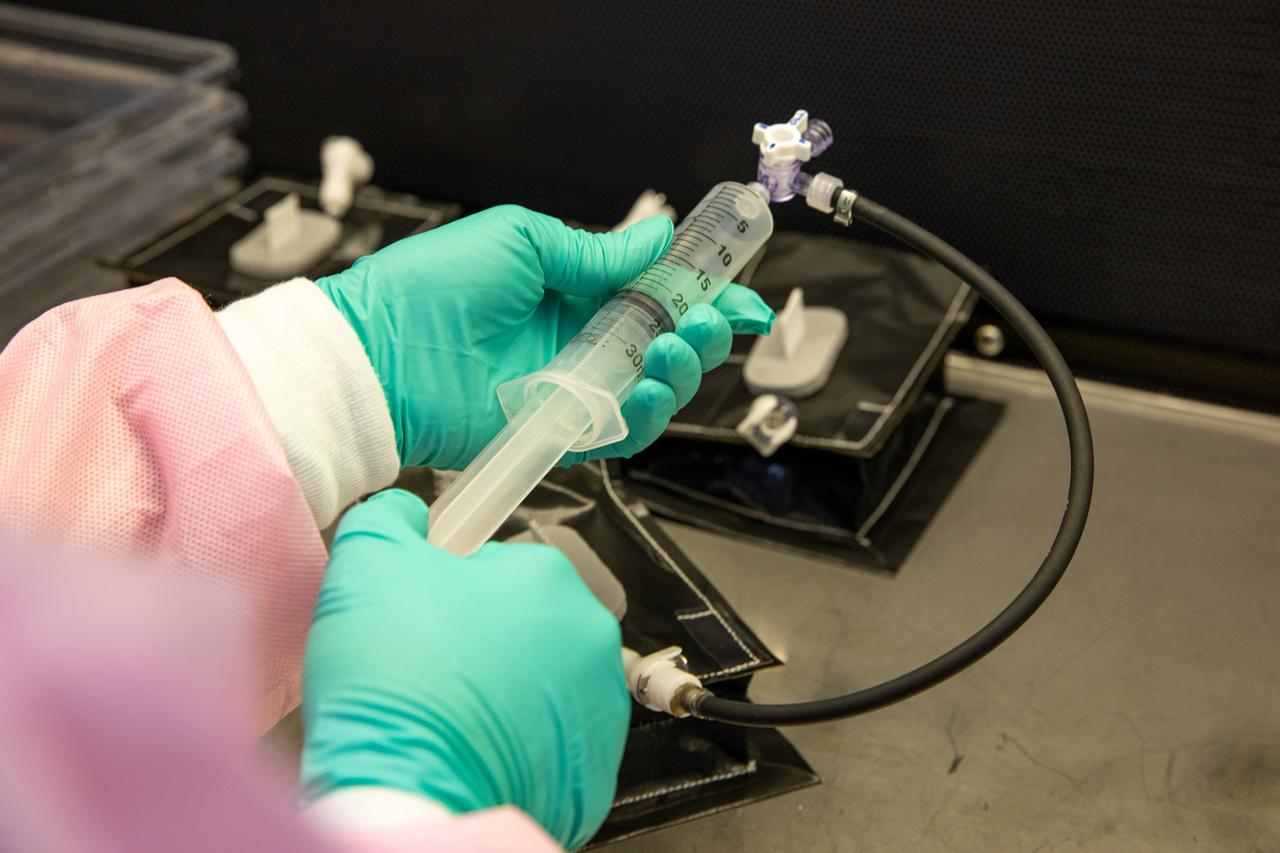
An intern at NASA’s Kennedy Space Center in Florida assembles plant pillows inside the Space Station Processing Facility on Jan. 16, 2020. The pillows, which are a common method used to grow plants in space, are being sent to the International Space Station for a series of VEG-03 experiments that will study the growth of three types of leafy greens and a new seed handling material in a microgravity environment. The experiments will be launched to the orbiting laboratory aboard a Northrop Grumman Antares rocket and Cygnus spacecraft on the company’s 13th resupply services mission. Liftoff is scheduled for Feb. 9, 2020, at 5:39 p.m. EST from the agency’s Wallops Flight Facility in Virginia.
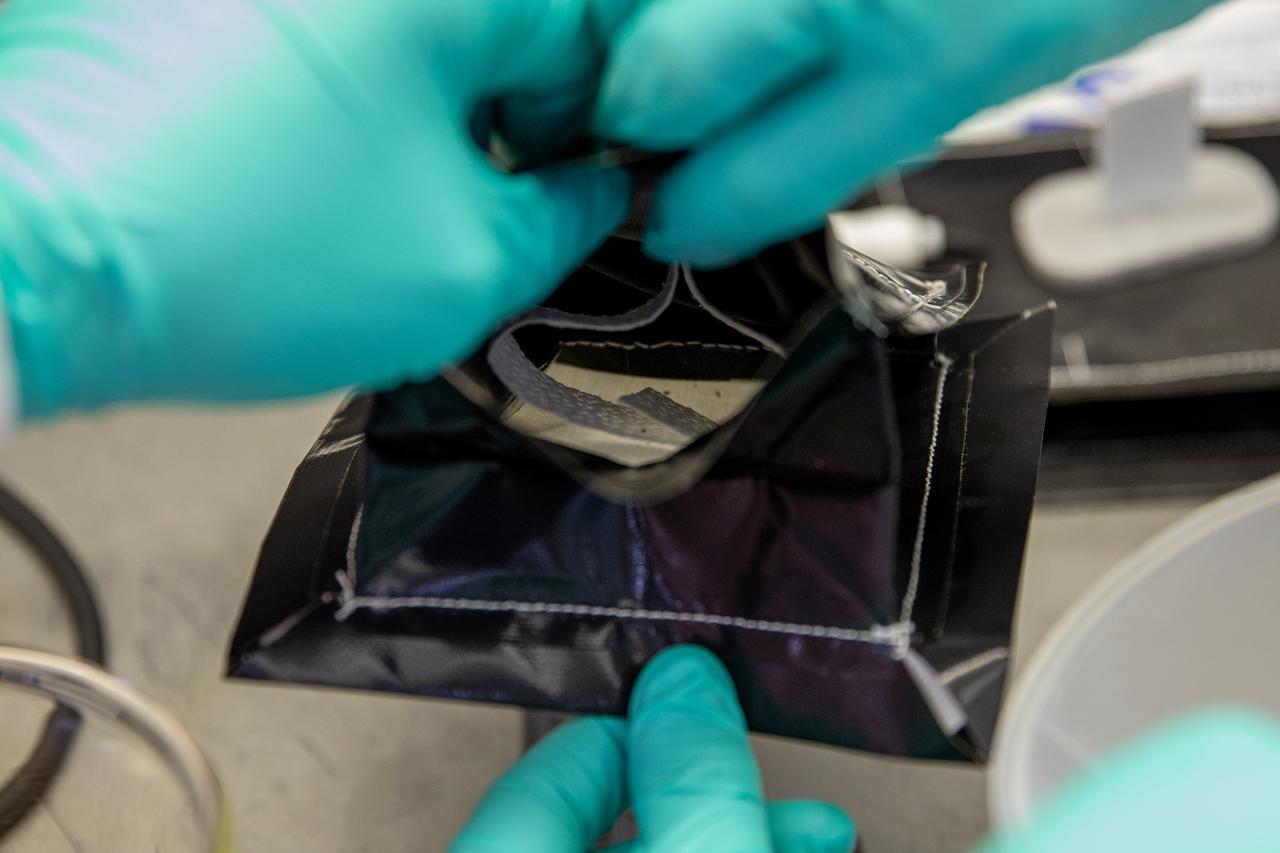
Researchers at NASA’s Kennedy Space Center in Florida assemble plant pillows inside the Space Station Processing Facility on Jan. 16, 2020. The pillows, which are a common method used to grow plants in space, are being sent to the International Space Station for a series of VEG-03 experiments that will study the growth of three types of leafy greens and a new seed handling technology in a microgravity environment. The experiments will be launched to the orbiting laboratory aboard a Northrop Grumman Antares rocket and Cygnus spacecraft on the company’s 13th resupply services mission. Liftoff is scheduled for Feb. 9, 2020, at 5:39 p.m. EST from the agency’s Wallops Flight Facility in Virginia.
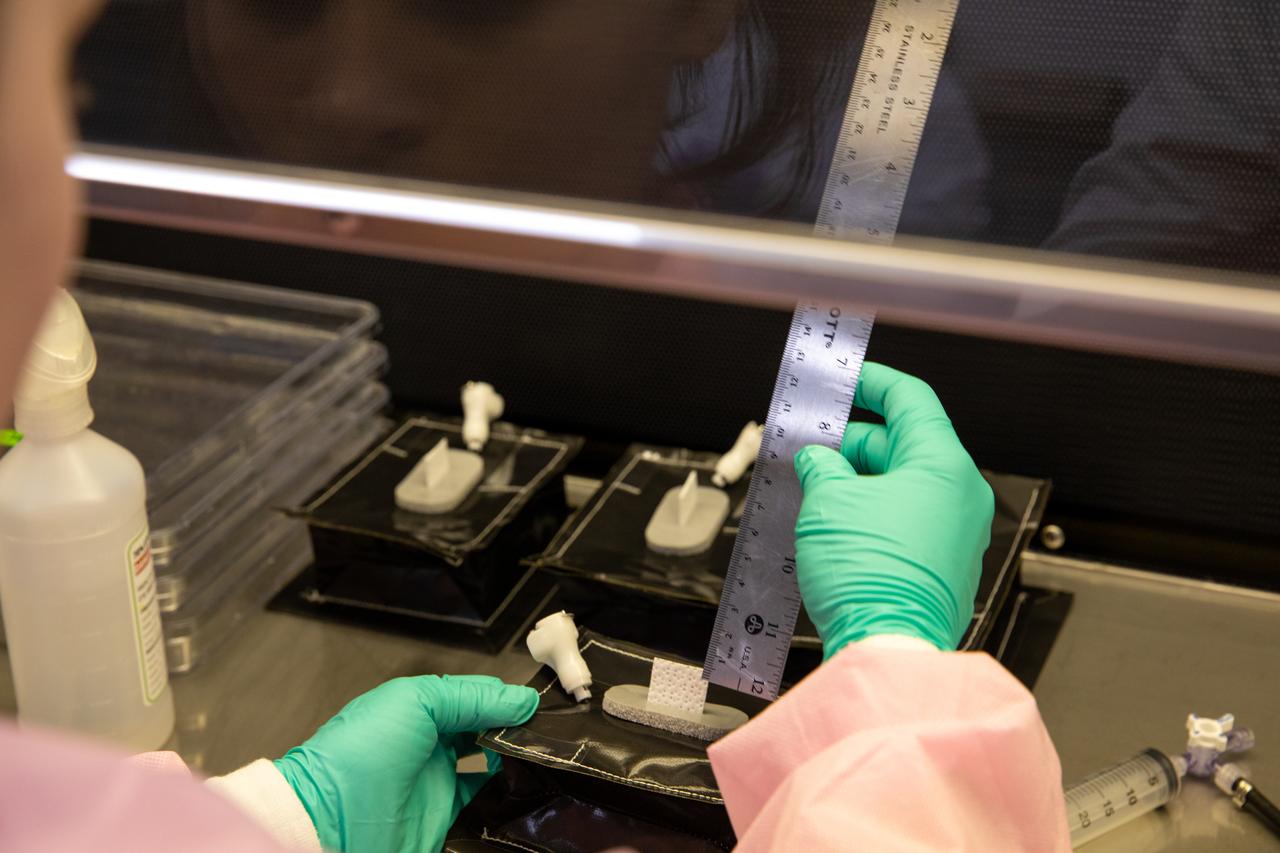
An intern at NASA’s Kennedy Space Center in Florida measures the seed wick – which plant seeds will be glued into later – emerging from a plant pillow in the Space Station Processing Facility on Jan. 16, 2019. A common method used to grow plants in space, the pillows are being sent to the International Space Station for a series of VEG-03 experiments that will study the growth of three types of leafy greens in a microgravity environment. The experiments will be launched to the orbiting laboratory aboard a Northrop Grumman Antares rocket and Cygnus spacecraft on the company’s 13th resupply services mission. Liftoff is scheduled for Feb. 9, 2020, at 5:39 p.m. EST from the agency’s Wallops Flight Facility in Virginia.
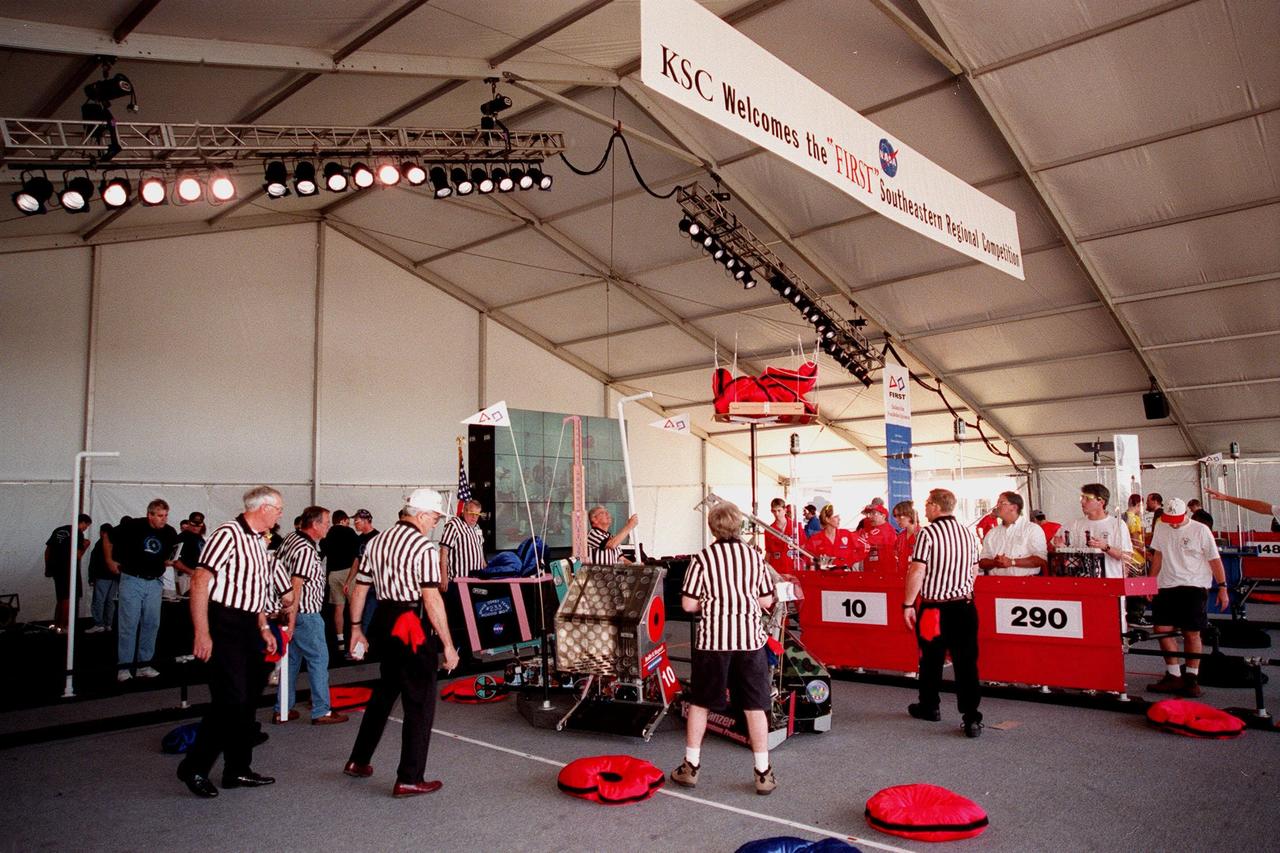
Referees check the robots on the floor of the playing field after a qualifying match of the 1999 Southeastern Regional robotic competition at Kennedy Space Center Visitor Complex . Thirty schools from around the country have converged at KSC for the event that pits gladiator robots against each other in an athletic-style competition. The robots have to retrieve pillow-like disks from the floor, as well as climb onto the platform (with flags) and raise the cache of pillows to a height of eight feet. KSC is hosting the event being sponsored by the nonprofit organization For Inspiration and Recognition of Science and Technology, known as FIRST. The FIRST robotics competition is designed to provide students with a hands-on, inside look at engineering and other professional careers
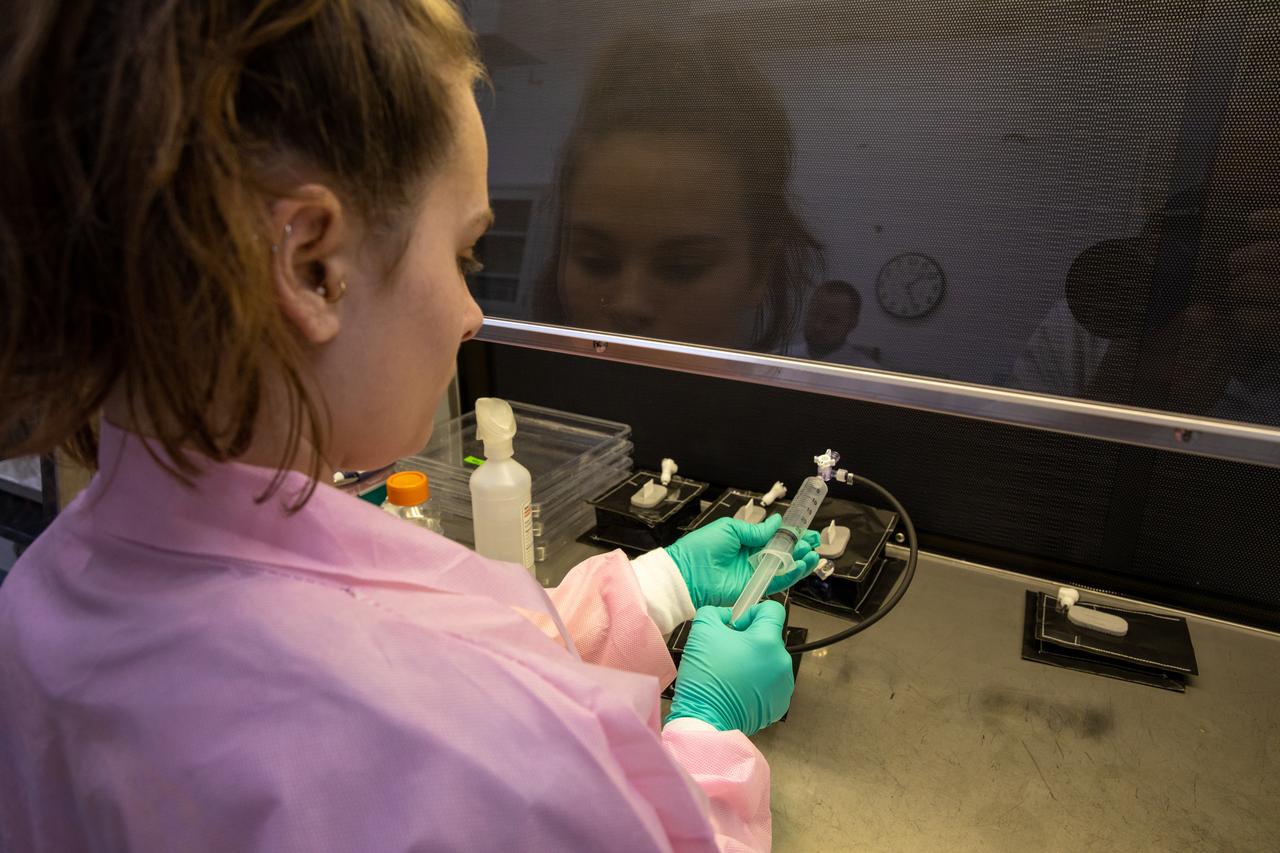
Emily Kennebeck, an intern at NASA’s Kennedy Space Center in Florida, assembles plant pillows inside the Space Station Processing Facility on Jan. 16, 2020. The pillows, which are a common method used to grow plants in space, are being sent to the International Space Station for a series of VEG-03 experiments that will study the growth of three types of leafy greens and a new seed handling material in a microgravity environment. The experiments will be launched to the orbiting laboratory aboard a Northrop Grumman Antares rocket and Cygnus spacecraft on the company’s 13th resupply services mission. Liftoff is scheduled for Feb. 9, 2020, at 5:39 p.m. EST from the agency’s Wallops Flight Facility in Virginia.
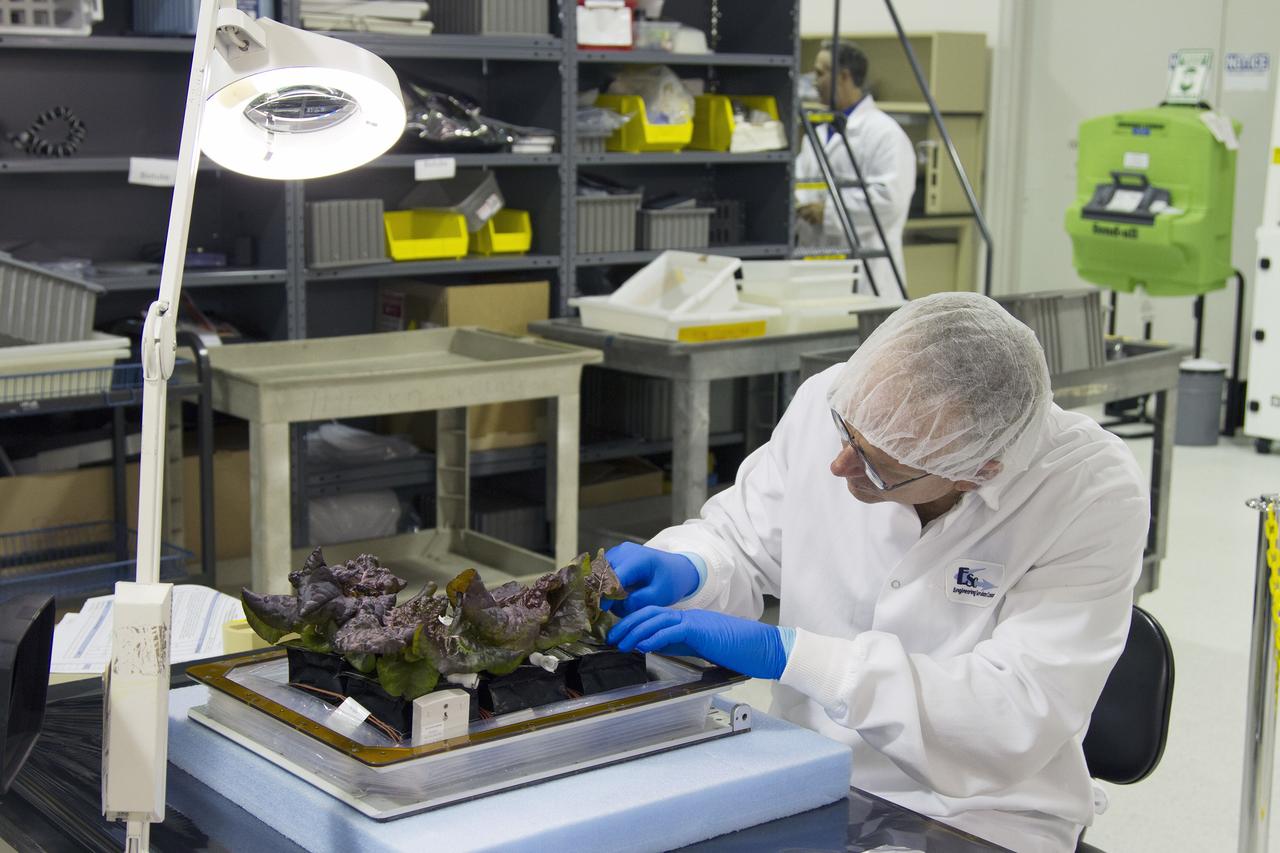
CAPE CANAVERAL, Fla. – Jim Smodell, a technician with SGT, removes an outredgeous red lettuce leaf from a plant pillow inside the Payload Development Laboratory at the Space Station Processing Facility, or SSPF, at NASA's Kennedy Space Center in Florida. The plant pillows were removed from the Veggie plant growth system inside a control chamber at the SSPF. The growth chamber was used as a control unit for Veggie and procedures were followed identical to those being performed on Veggie and the Veg-01 experiment on the International Space Station. The lettuce leaves will be wrapped and placed in a minus eighty-degree freezer, along with the plant pillows and samples swabbed from the plants, plant pillows and Veggie bellows. The chamber mimicked the temperature, relative humidity and carbon dioxide concentration of those in the Veggie unit on the space station. Veggie and Veg-01 were delivered to the space station aboard the SpaceX-3 mission. Veggie is the first fresh food production system delivered to the station. Six plant pillows, each containing outredgeous red romaine lettuce seeds and a root mat were inserted into Veggie. The plant chamber's red, blue and green LED lights were activated. The plant growth was monitored for 33 days. On June 10, at the end of the cycle, the plants were carefully harvested, frozen and stored for return to Earth by Expedition 39 flight engineer and NASA astronaut Steve Swanson. Photo credit: NASA/Frankie Martin
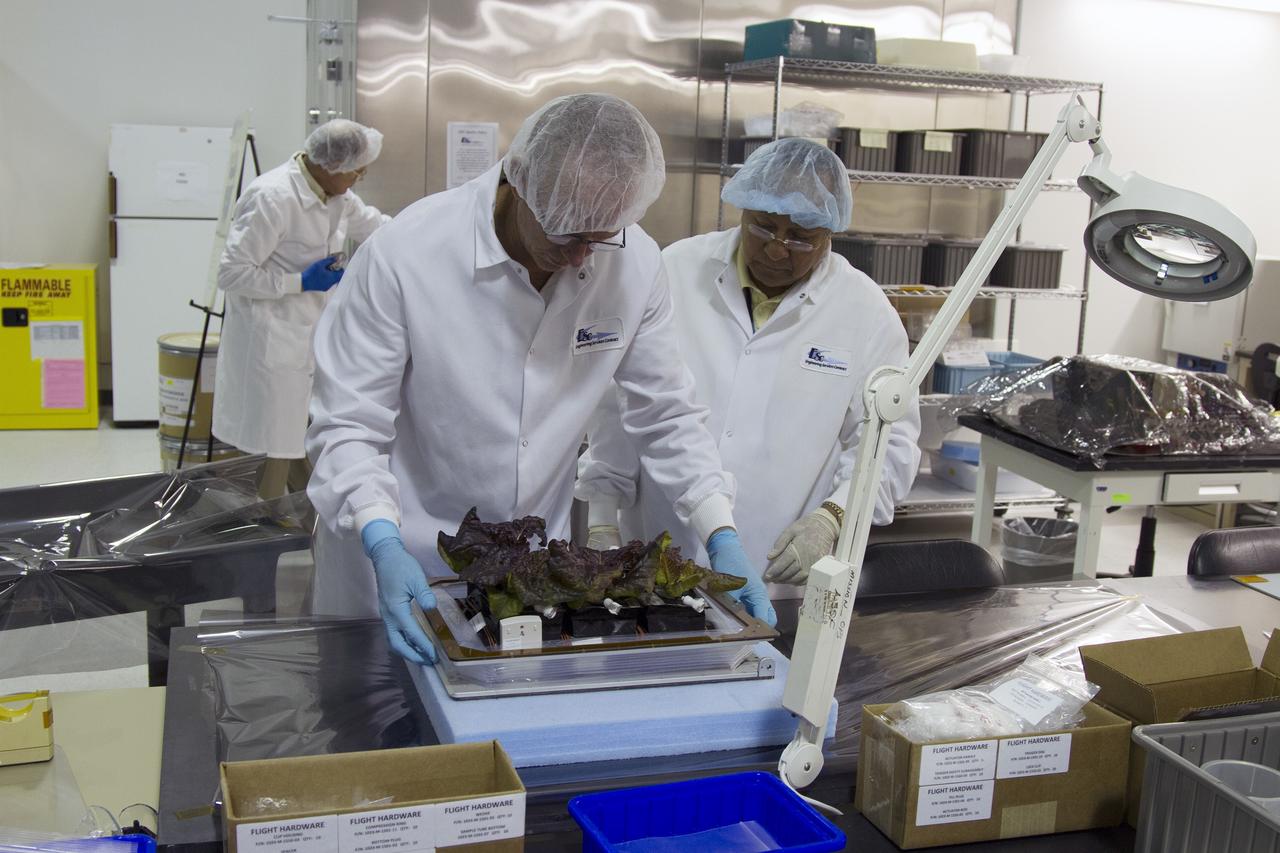
CAPE CANAVERAL, Fla. – The plant pillows containing the outredgeous red lettuce leaves are being harvested inside the Payload Development Laboratory at the Space Station Processing Facility at NASA's Kennedy Space Center in Florida. From left, are Jim Smodell, a technician with SGT, and George Guerra, a quality control engineer with QinetiQ North America. The plant pillows were removed from a growth chamber was used as a control unit for the Veggie plant growth system, and procedures were followed identical to those being performed on Veggie and the Veg-01 experiment on the International Space Station. The chamber mimicked the temperature, relative humidity and carbon dioxide concentration of those in the Veggie unit on the space station. Veggie and Veg-01 were delivered to the space station aboard the SpaceX-3 mission. Veggie is the first fresh food production system delivered to the station. Six plant pillows, each containing outredgeous red romaine lettuce seeds and a root mat were inserted into Veggie. The plant chamber's red, blue and green LED lights were activated. The plant growth was monitored for 33 days. On June 10, at the end of the cycle, the plants were carefully harvested, frozen and stored for return to Earth by Expedition 39 flight engineer and NASA astronaut Steve Swanson. Photo credit: NASA/Frankie Martin
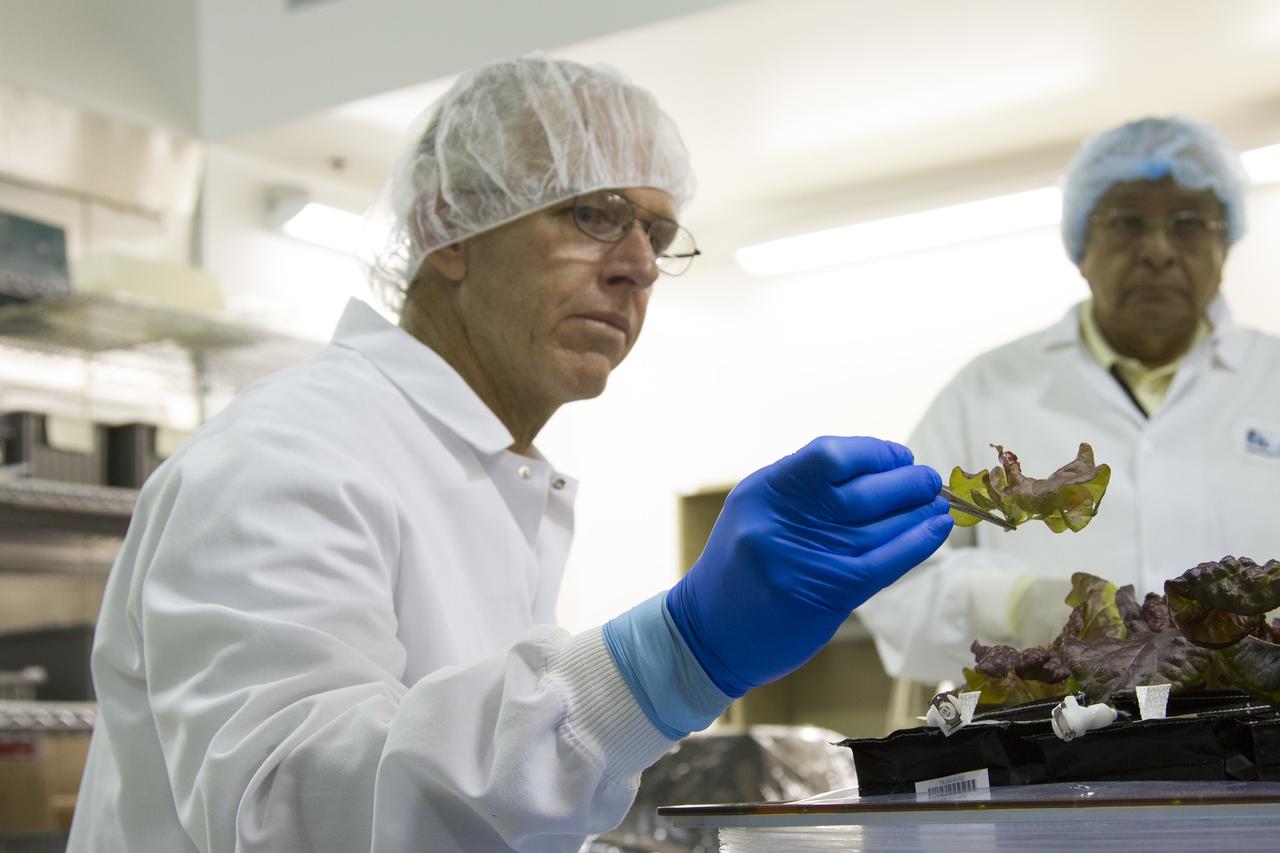
CAPE CANAVERAL, Fla. – Jim Smodell, a technician with SGT, removes an outredgeous red lettuce leaf from a plant pillow inside the Payload Development Laboratory at the Space Station Processing Facility, or SSPF, at NASA's Kennedy Space Center in Florida. In the background is George Guerra, a quality control engineer with QinetiQ North America. The plant pillows were removed from the Veggie plant growth system inside a control chamber at the SSPF. The growth chamber was used as a control unit for Veggie and procedures were followed identical to those being performed on Veggie and the Veg-01 experiment on the International Space Station. The chamber mimicked the temperature, relative humidity and carbon dioxide concentration of those in the Veggie unit on the space station. Veggie and Veg-01 were delivered to the space station aboard the SpaceX-3 mission. Veggie is the first fresh food production system delivered to the station. Six plant pillows, each containing outredgeous red romaine lettuce seeds and a root mat were inserted into Veggie. The plant chamber's red, blue and green LED lights were activated. The plant growth was monitored for 33 days. On June 10, at the end of the cycle, the plants were carefully harvested, frozen and stored for return to Earth by Expedition 39 flight engineer and NASA astronaut Steve Swanson. Photo credit: NASA/Frankie Martin
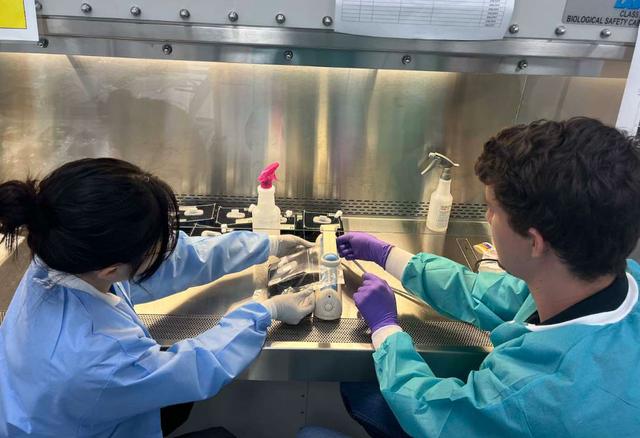
jsc2026e404783 (July 29, 2026) --- Preflight image of researchers sealing plant pillows as part of ISSGardens (VEG-03 MNO), an investigation that allows astronauts to grow plants in different locations around the International Space Station. Credit: NASA KSC.
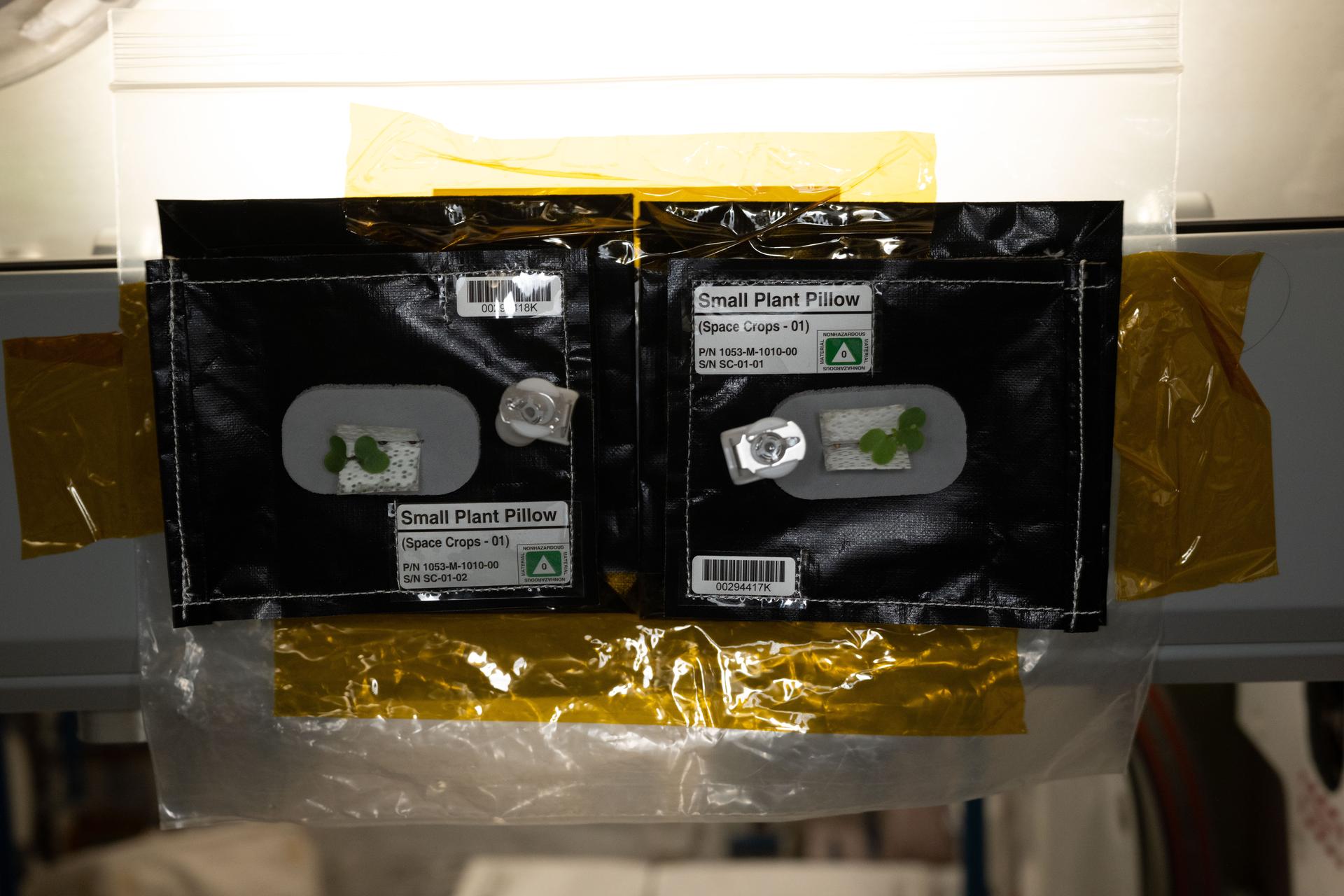
iss074e0814710 (July 29, 2026) --- Tiny plant sprouts in small plant pillows aboard the International Space Station as part of ISSGardens, an investigation that allows astronauts to autonomously grow plants in different locations around the space station. Credit: NASA KSC.
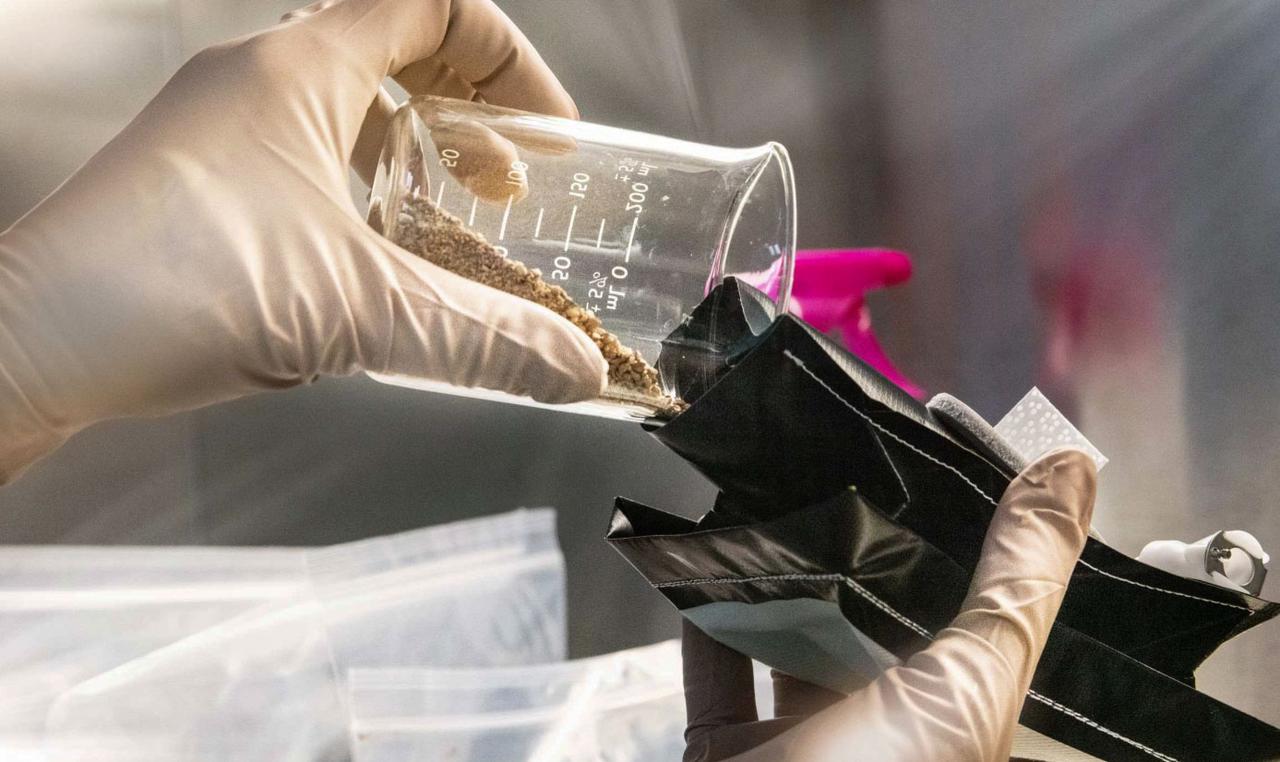
jsc2026e404781 (July 29, 2026) --- Preflight image of researcher at Kennedy Space Center filling a plant pillow as part of ISSGardens (VEG-03 MNO), an investigation that allows astronauts to grow plants in different locations around the International Space Station. Credit: NASA KSC.
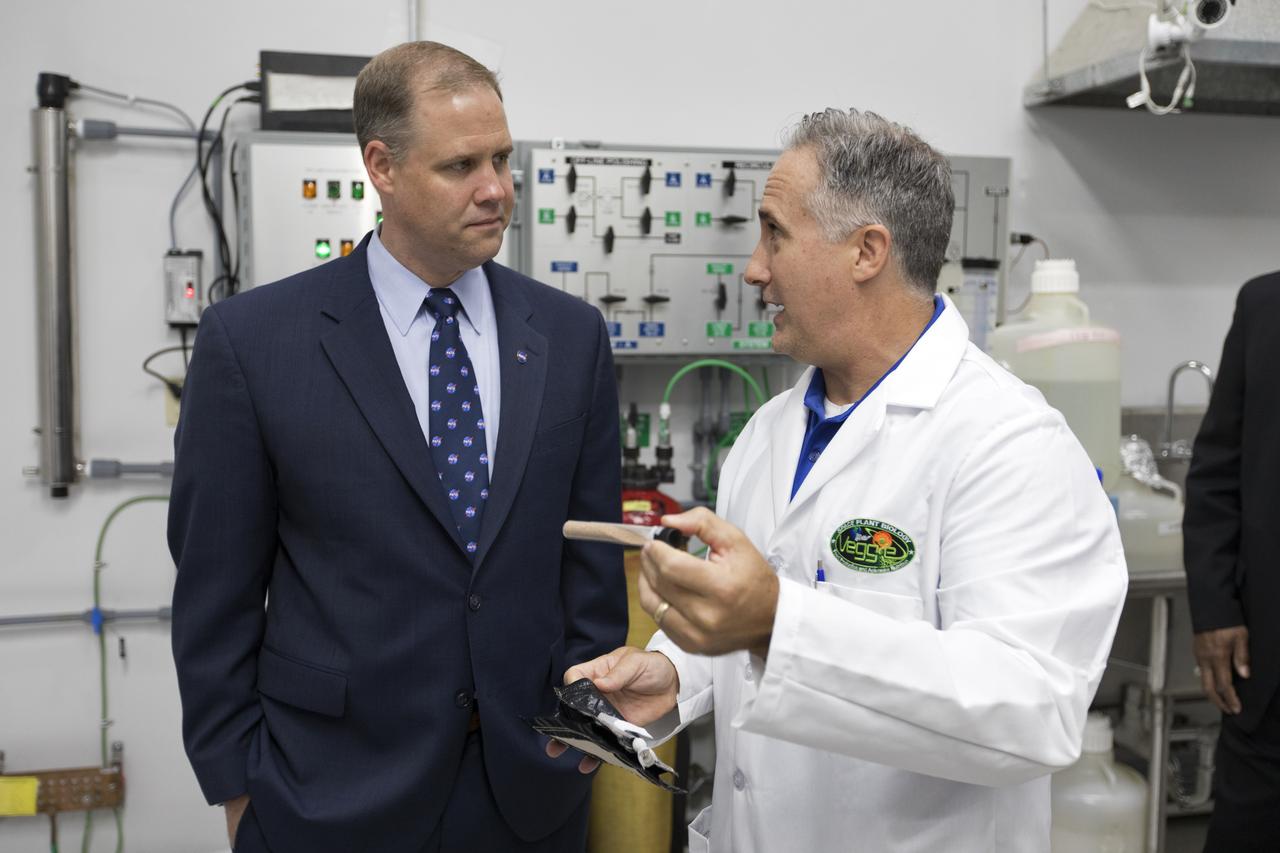
NASA Administrator Jim Bridenstine, at left, tours the Space Station Processing Facility at NASA's Kennedy Space Center in Florida, on Aug. 7, 2018. At right, Trent Smith, Veggie project manager, displays a seed packet and plant pillow for the Veggie plant growth system. Bridenstine also received updates on research and technology accomplishments.
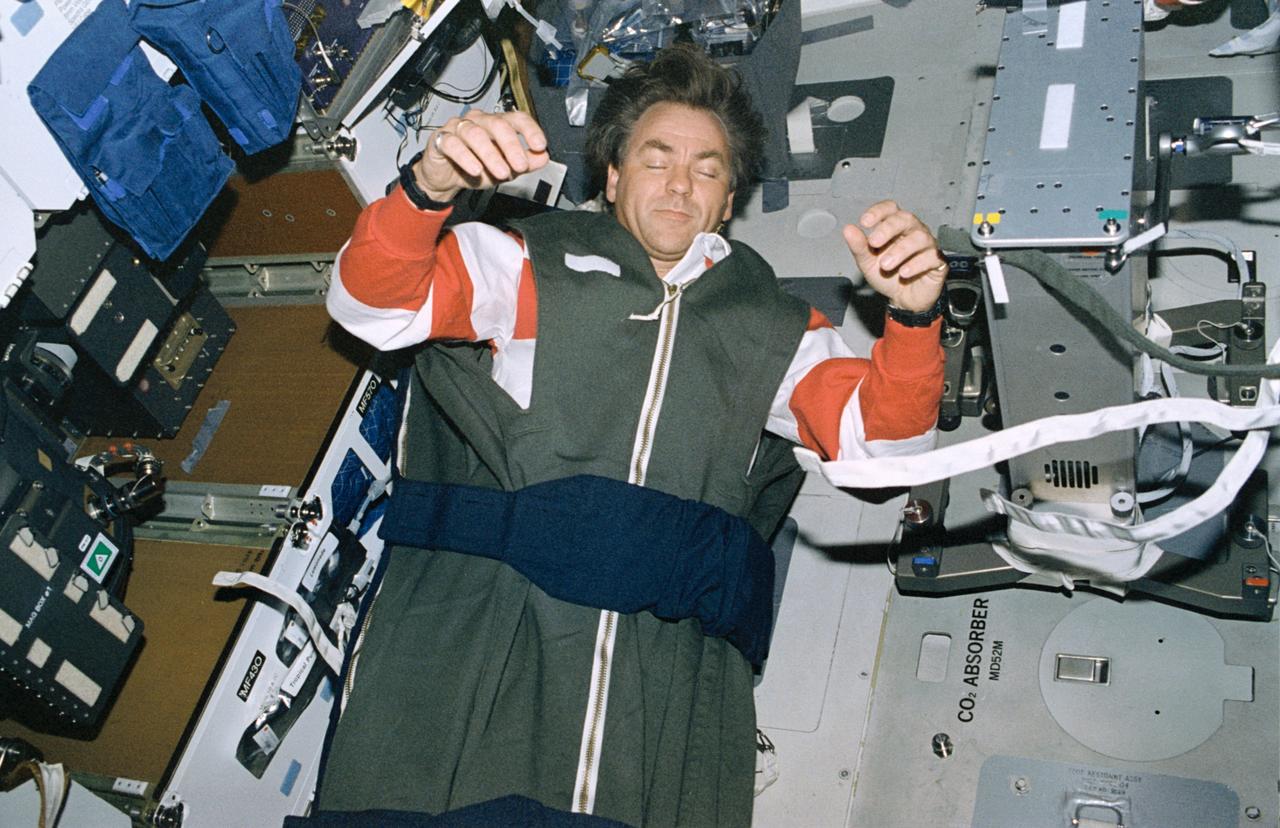
STS085-327-026 (7 - 19 August 1997) --- Payload specialist Bjarni V. Tryggvason, representing the Canadian Space Agency (CSA), sleeps on the Space Shuttle Discovery's mid-deck floor. Tryggvason elected to not use a pillow, allowing his head to float freely in the Microgravity environment.
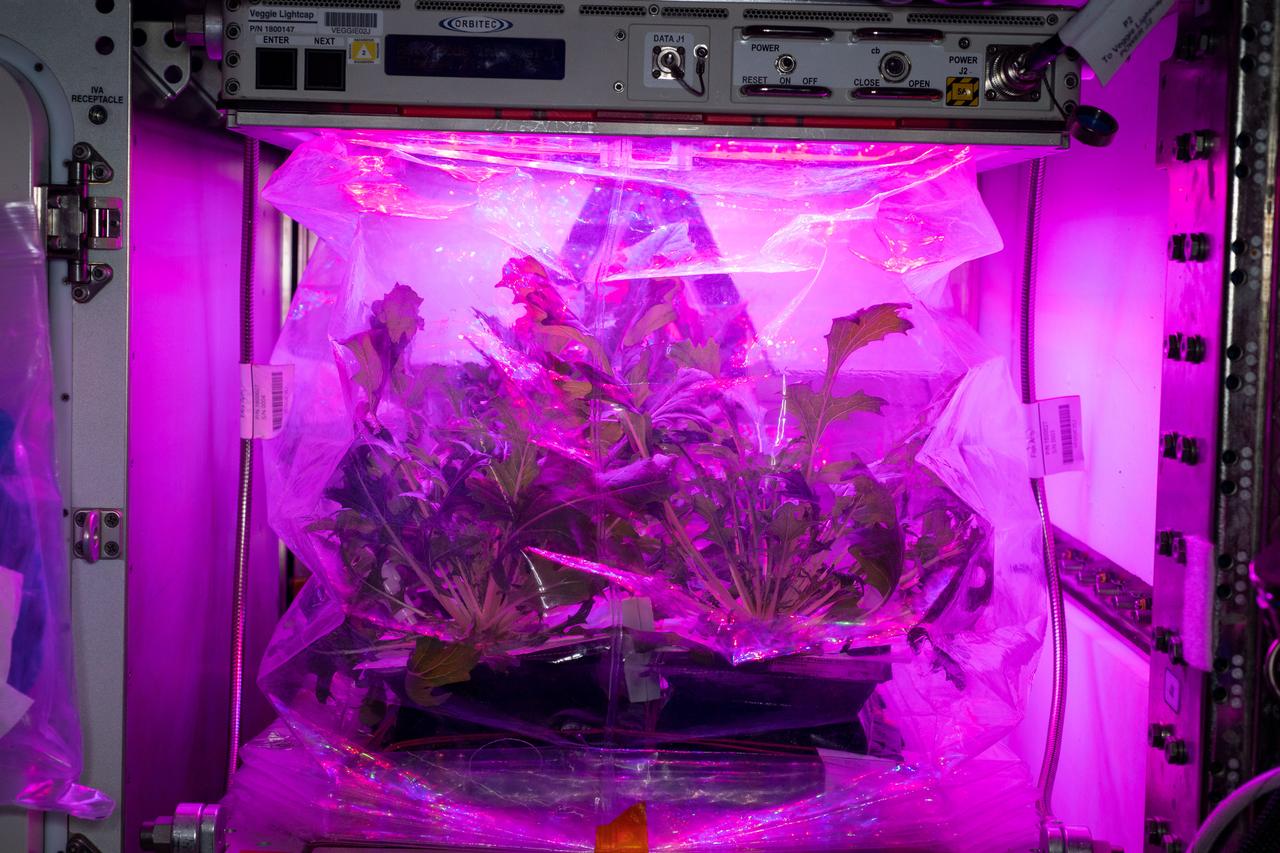
Mizuna Mustard mustard greens, part of the Veg-04A experiment, are shown growing in a Veggie plant growth chamber aboard the International Space Station on July 9, 2019. The Veg-04A experiment tested the greens, grown in blue-rich lighting and red-rich lighting, to determine the effects of different light ratios on plants grown in space on the station. The plants arrived aboard the SpaceX Commercial Resupply Services-16 mission. Astronaut Christina Koch initiated the on-orbit experiment on June 4, 2019, in the station’s two Veggie plant growth chambers, with six plant pillows per chamber. On June 11, 2019, Koch thinned the Mizuna plants to one plant per pillow. The on-orbit harvest took place July 9, 2019, with astronaut Nick Hague harvesting the plants grown under blue-rich light and Koch harvesting the plants grown under red-rich lights.
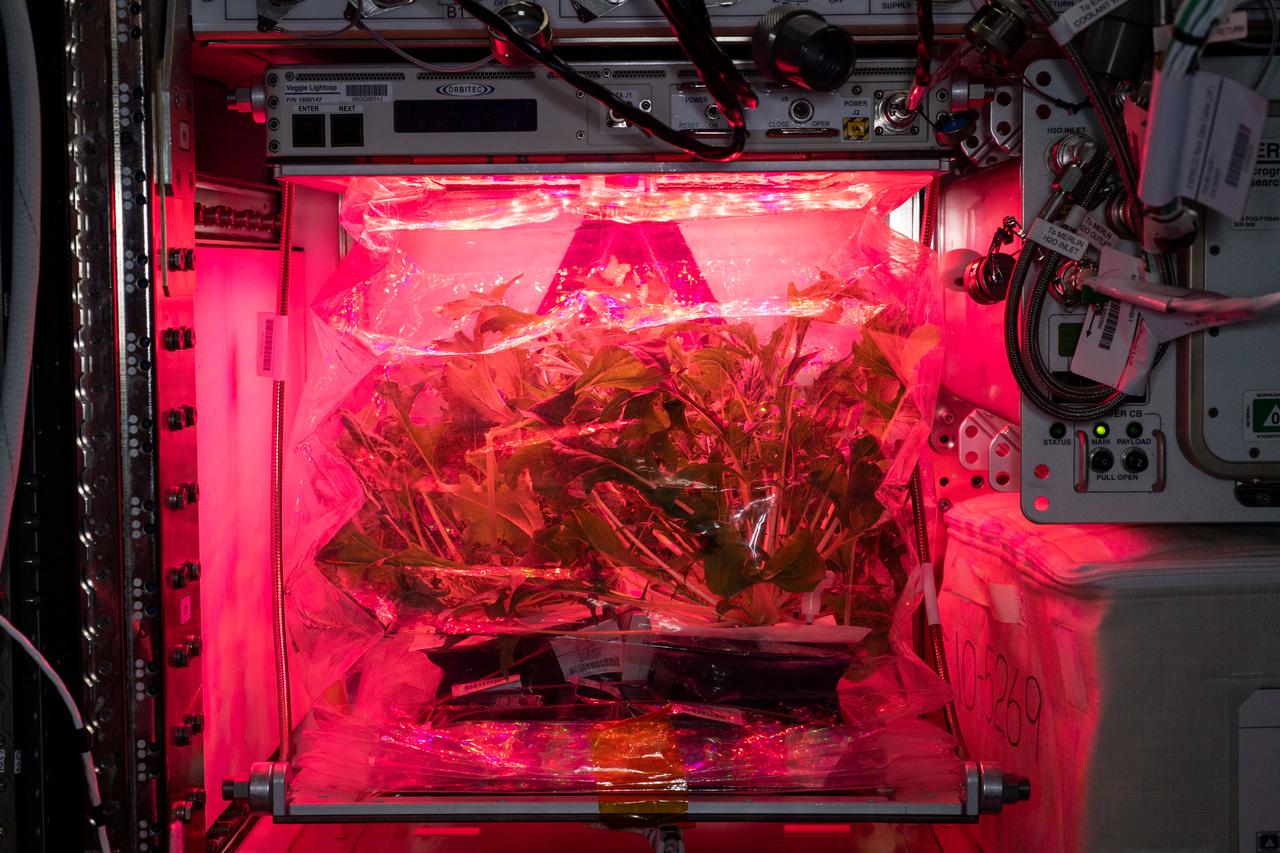
Mizuna Mustard mustard greens, part of the Veg-04A experiment, are shown growing in a Veggie plant growth chamber aboard the International Space Station on July 9, 2019. The Veg-04A experiment tested the greens, grown in blue-rich lighting and red-rich lighting, to determine the effects of different light ratios on plants grown in space on the station. The plants arrived aboard the SpaceX Commercial Resupply Services-16 mission. Astronaut Christina Koch initiated the on-orbit experiment on June 4, 2019, in the station’s two Veggie plant growth chambers, with six plant pillows per chamber. On June 11, 2019, Koch thinned the Mizuna plants to one plant per pillow. The on-orbit harvest took place July 9, 2019, with astronaut Nick Hague harvesting the plants grown under blue-rich light and Koch harvesting the plants grown under red-rich lights.
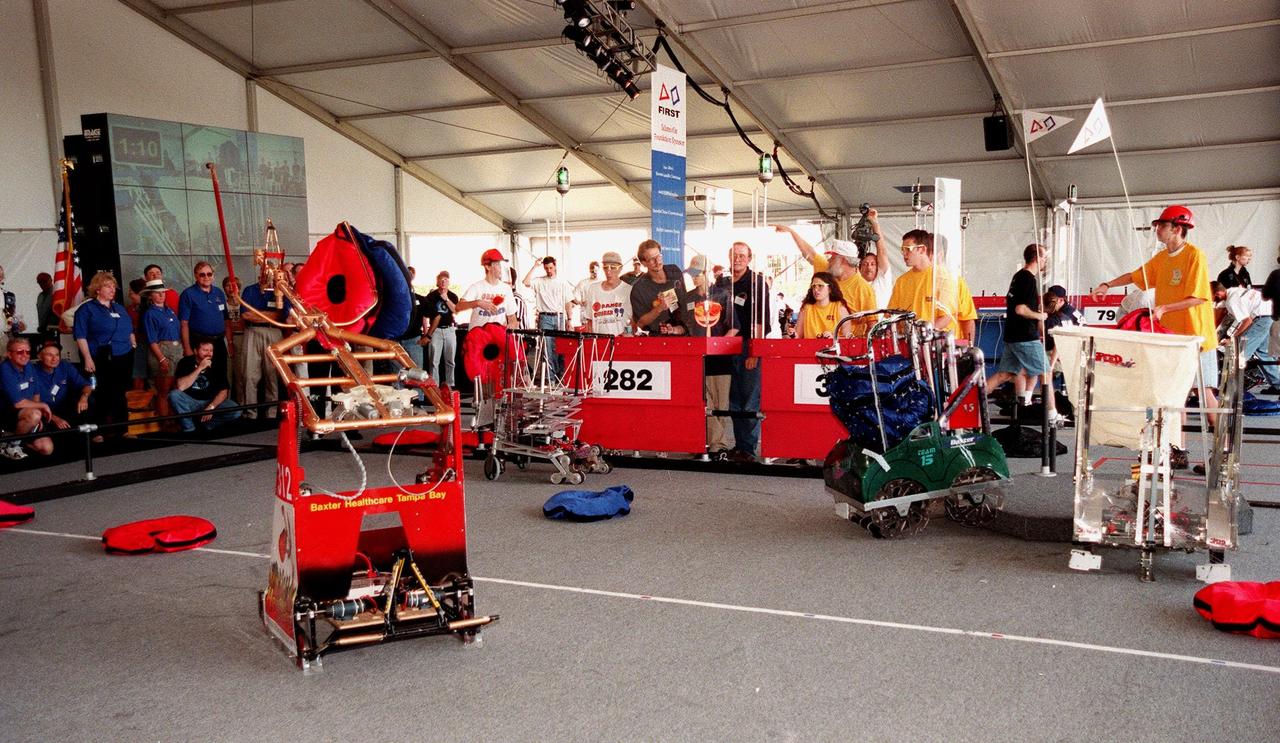
Student teams behind protective walls operate remote controls to maneuver their robots around the playing field during the 1999 FIRST Southeastern Regional robotic competition held at KSC. The robotic gladiators spent two minutes each trying to grab, claw and hoist large, satin pillows onto their machines. Teams played defense by taking away competitors' pillows and generally harassing opposing machines. On the side of the field are the judges, including (far left) Deputy Director for Launch and Payload Processing Loren Shriver and former KSC Director of Shuttle Processing Robert Sieck. A giant screen TV displays the action on the field. The competition comprised 27 teams, pairing high school students with engineer mentors and corporations. The FIRST robotics competition is designed to provide students with a hands-on, inside look at engineering and other professional careers
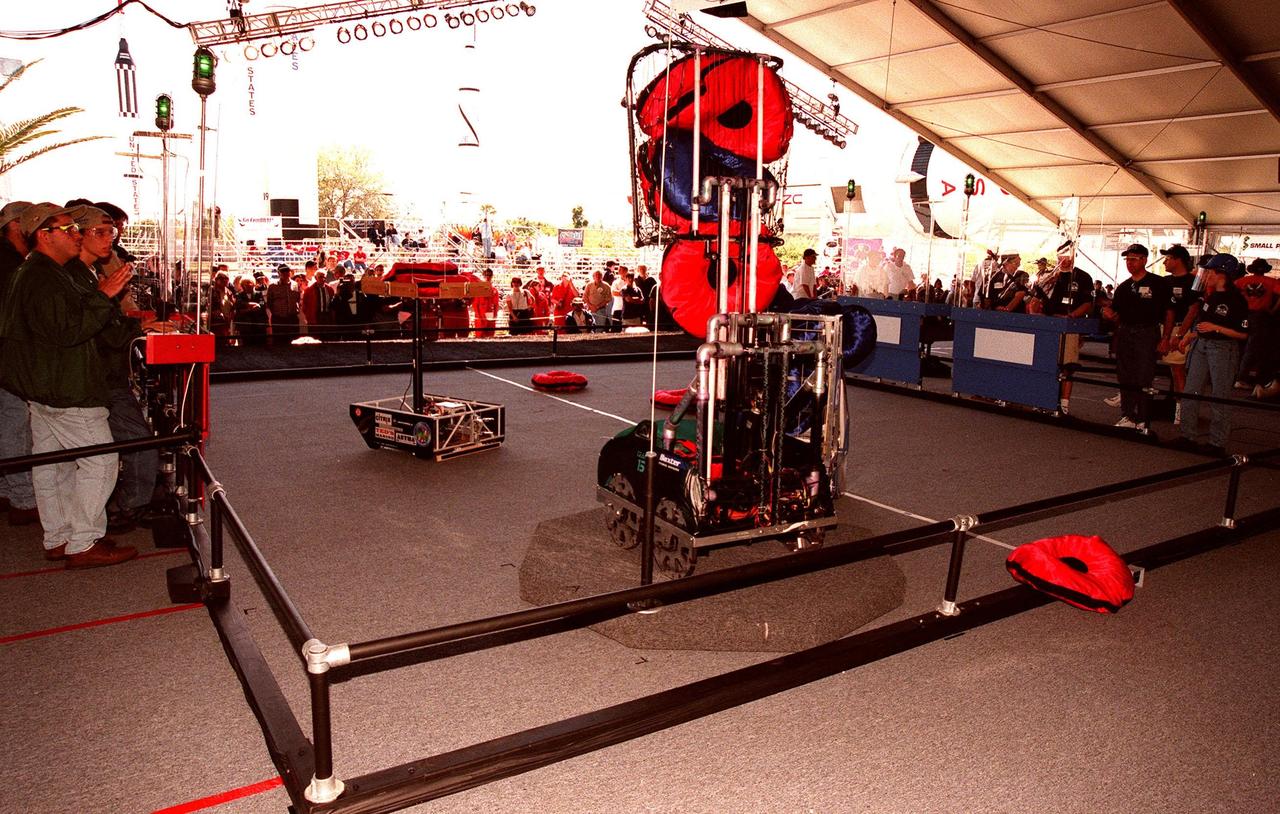
Student teams (right and left) behind protective walls maneuver their robots on the playing field during practice rounds of the 1999 Southeastern Regional robotic competition at Kennedy Space Center Visitor Complex . Thirty schools from around the country have converged at KSC for the event that pits gladiator robots against each other in an athletic-style competition. The robots have to retrieve pillow-like disks from the floor, as well as climb onto the platform (foreground) and raise the cache of pillows to a height of eight feet. KSC is hosting the event being sponsored by the nonprofit organization For Inspiration and Recognition of Science and Technology, known as FIRST. The FIRST robotics competition is designed to provide students with a hands-on, inside look at engineering and other professional careers
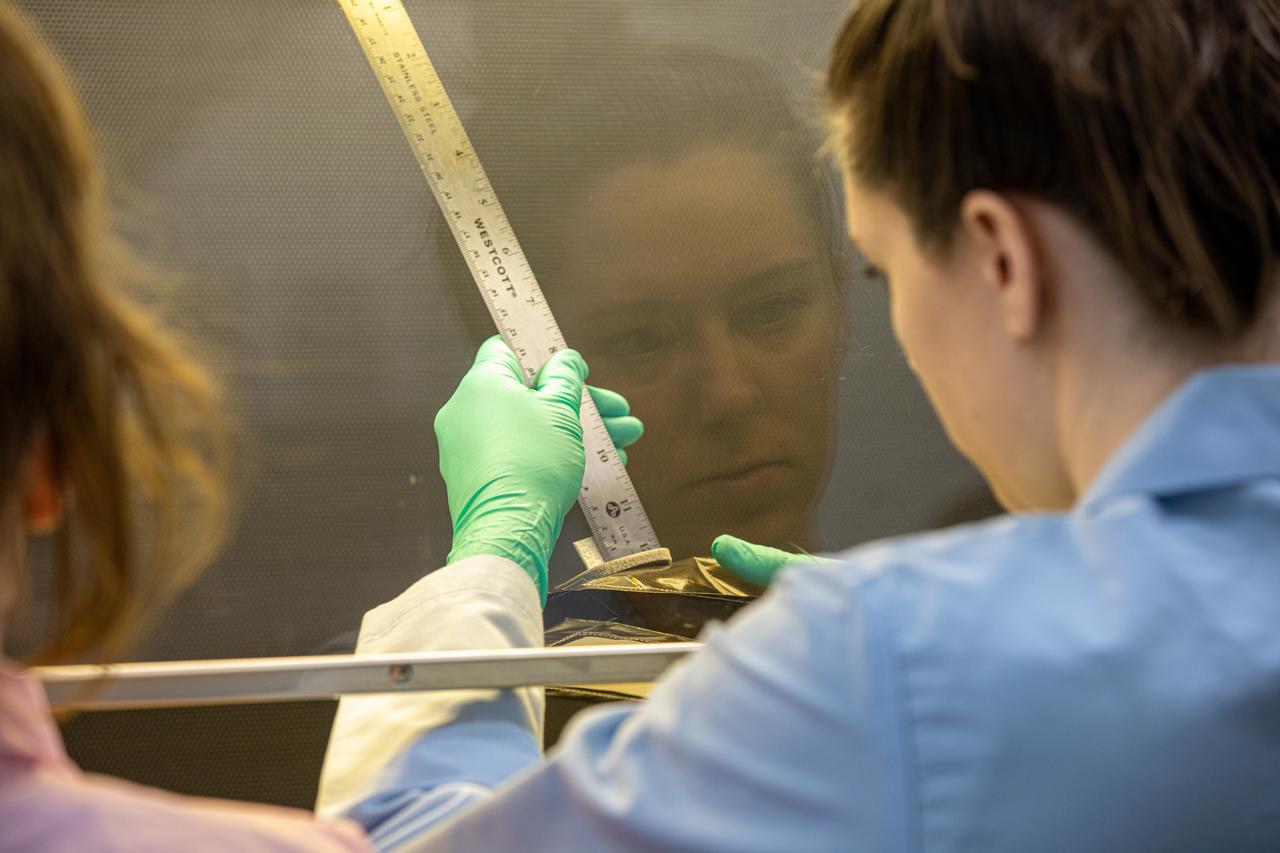
Jess Bunchek, a pseudonaut and associate scientist at NASA’s Kennedy Space Center, measures the seed wick emerging from a plant pillow in the Florida spaceport’s Space Station Processing Facility on Jan. 16, 2019. Researchers will then glue seeds onto the wick. A common method used to grow plants in space, the pillows are being sent to the International Space Station for a series of VEG-03 experiments that will study the growth of three types of leafy greens in a microgravity environment and test a new way of handling seeds. The experiments will be launched to the orbiting laboratory aboard a Northrop Grumman Antares rocket and Cygnus spacecraft on the company’s 13th resupply services mission. Liftoff is scheduled for Feb. 9, 2020, at 5:39 p.m. EST from the agency’s Wallops Flight Facility in Virginia.
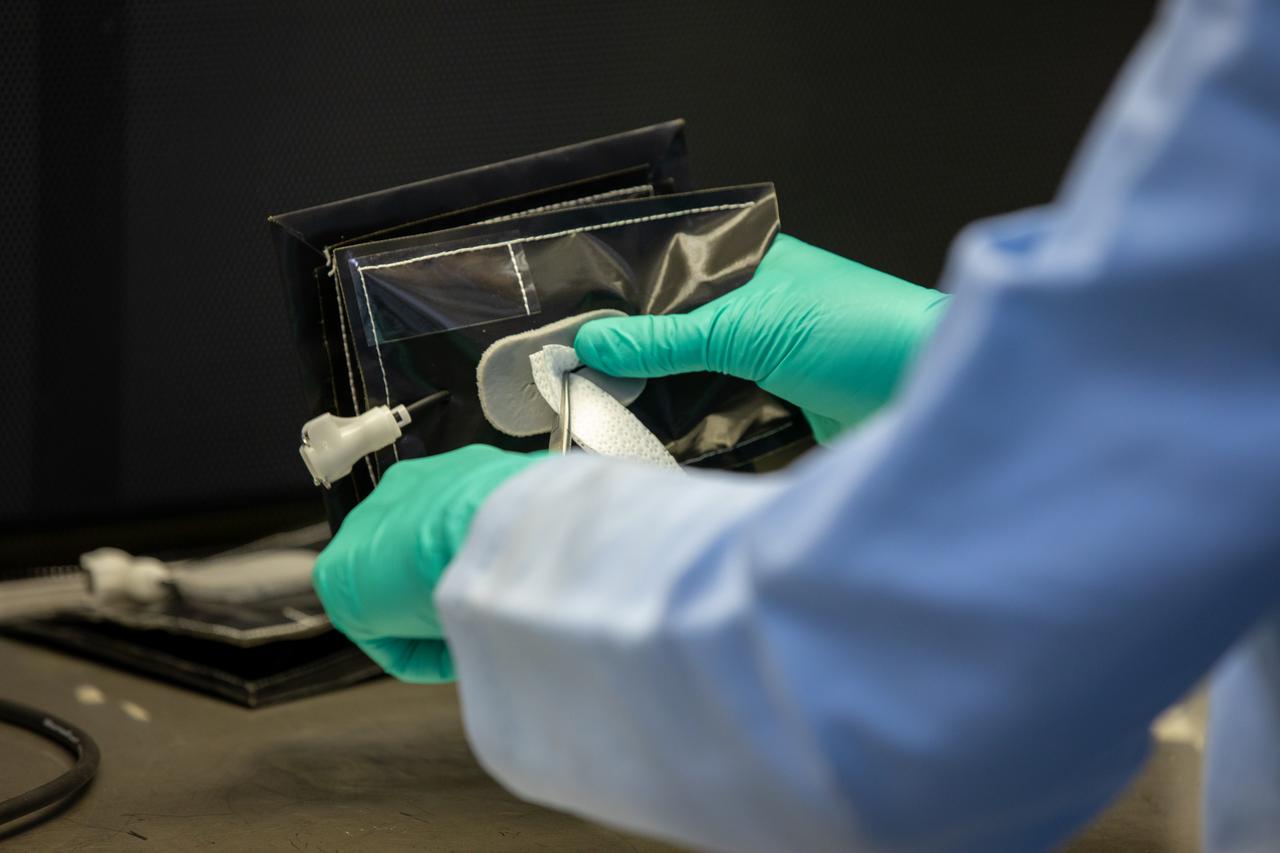
Jess Bunchek, a pseudonaut and associate scientist at NASA’s Kennedy Space Center, measures the seed wick emerging from a plant pillow in the Florida spaceport’s Space Station Processing Facility on Jan. 16, 2019. Researchers will then glue seeds for two crops onto the wicks. A common method used to grow plants in space, the pillows are being sent to the International Space Station for a series of VEG-03 experiments that will study the growth of three types of leafy greens in a microgravity environment and a new seed handling material. The experiments will be launched to the orbiting laboratory aboard a Northrop Grumman Antares rocket and Cygnus spacecraft on the company’s 13th resupply services mission. Liftoff is scheduled for Feb. 9, 2020, at 5:39 p.m. EST from the agency’s Wallops Flight Facility in Virginia.

Watching the 1999 FIRST Southeastern Regional robotic competition held at KSC are (left to right) FIRST representative Vince Wilczynski and Executive Director of FIRST David Brown, Center Director Roy Bridges, former KSC Director of Shuttle Processing Robert Sieck (pointing), and astronaut David Brown. FIRST is a nonprofit organization, For Inspiration and Recognition of Science and Technology. The competition comprised 27 teams, pairing high school students with engineer mentors and corporations. Brown and Sieck served as judges for the event that pits gladiator robots against each other in an athletic-style competition. Powered by 12-volt batteries and operated by remote control, the robotic gladiators spend two minutes each trying to grab, claw and hoist large, satin pillows onto their machines. Teams play defense by taking away competitors' pillows and generally harassing opposing machines. The FIRST robotics competition is designed to provide students with a hands-on, inside look at engineering and other professional careers
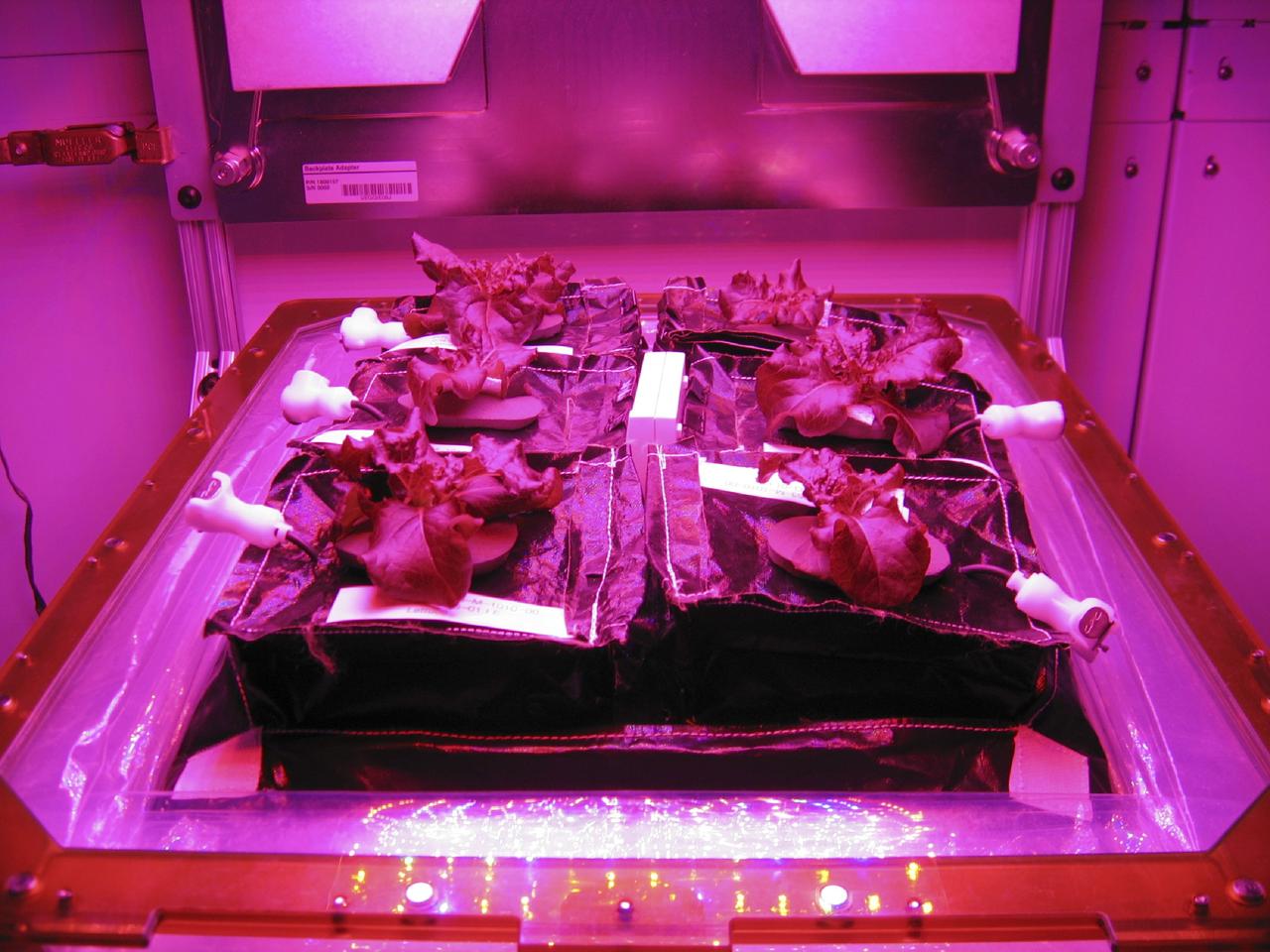
CAPE CANAVERAL, Fla. –Outredgeous red romaine lettuce plants grow inside in a prototype VEGGIE flight pillow. The bellows of the hardware have been lowered to better observe the plants. A small temperature and relative humidity data logger is placed between the pillows small white box, central. U.S. astronauts living and working aboard the International Space Station are going to receive a newly developed Vegetable Production System VEGGIE. VEGGIE is set to launch aboard SpaceX's Dragon capsule on NASA's third Commercial Resupply Services mission targeted to launch Dec. 9 from Space Launch Complex 40 at Cape Canaveral Air Force Station in Florida. Photo credit: NASA/Gioia Massa
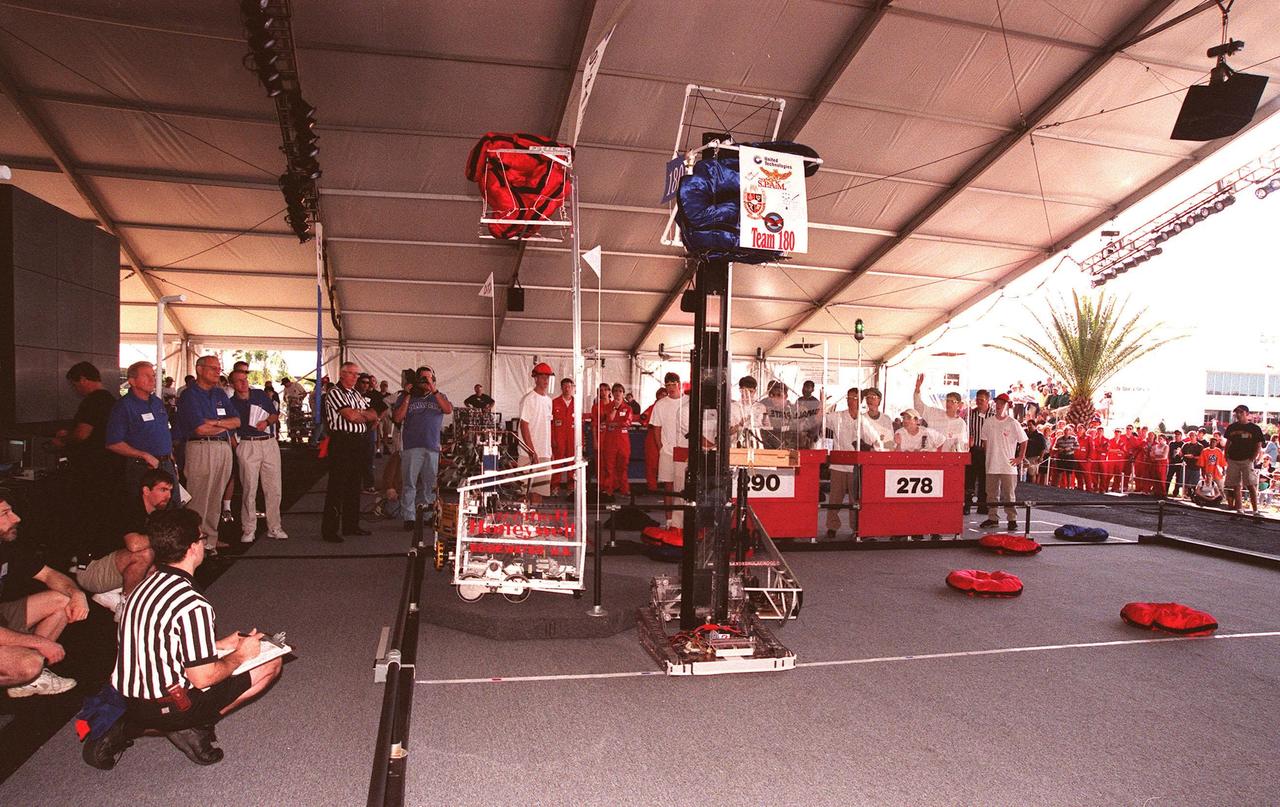
During final matches at the 1999 Southeastern Regional robotic competition at the KSC Visitor Complex, referees and judges (blue shirts at left) watch as two robots raise their pillow disks to a height of eight feet, one of the goals of the competition. KSC Deputy Director for Launch and Payload Processing Loren Shriver is one of the judges. Thirty schools from around the country have converged at KSC for the event that pits gladiator robots against each other in an athletic-style competition. The robots have to retrieve the disks from the floor, climb onto a platform (with flags), as well as raise the cache of pillows, maneuvered by student teams behind protective walls. KSC is hosting the event being sponsored by the nonprofit organization For Inspiration and Recognition of Science and Technology, known as FIRST. The FIRST robotics competition is designed to provide students with a hands-on, inside look at engineering and other professional careers by pairing engineers and corporations with student teams
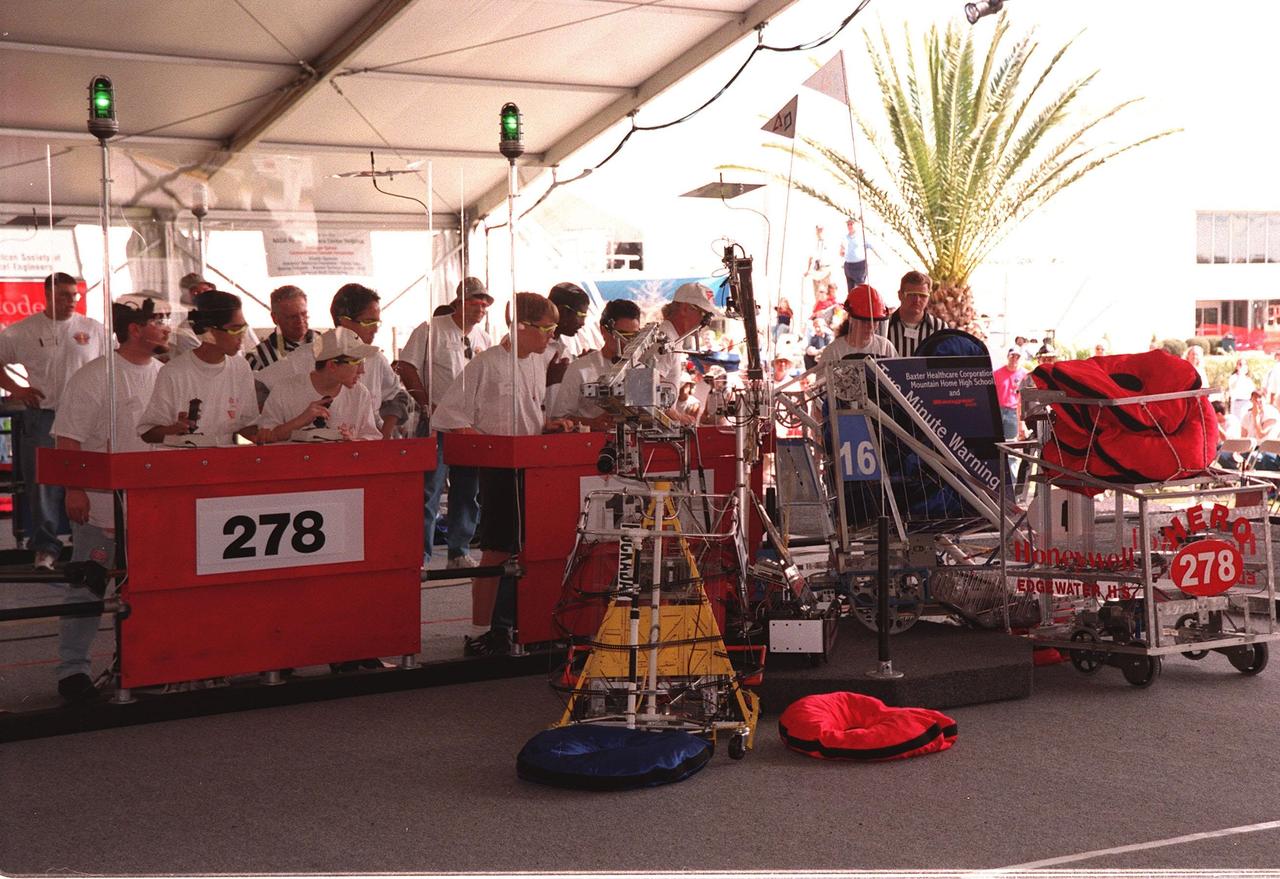
All four robots, maneuvered by student teams behind protective walls, converge on a corner of the playing field during qualifying matches of the 1999 Southeastern Regional robotic competition at Kennedy Space Center Visitor Complex . Thirty schools from around the country have converged at KSC for the event that pits gladiator robots against each other in an athletic-style competition. The robots have to retrieve pillow-like disks from the floor, as well as climb onto the platform (with flags) and raise the cache of pillows to a height of eight feet. KSC is hosting the event being sponsored by the nonprofit organization For Inspiration and Recognition of Science and Technology, known as FIRST. The FIRST robotics competition is designed to provide students with a hands-on, inside look at engineering and other professional careers
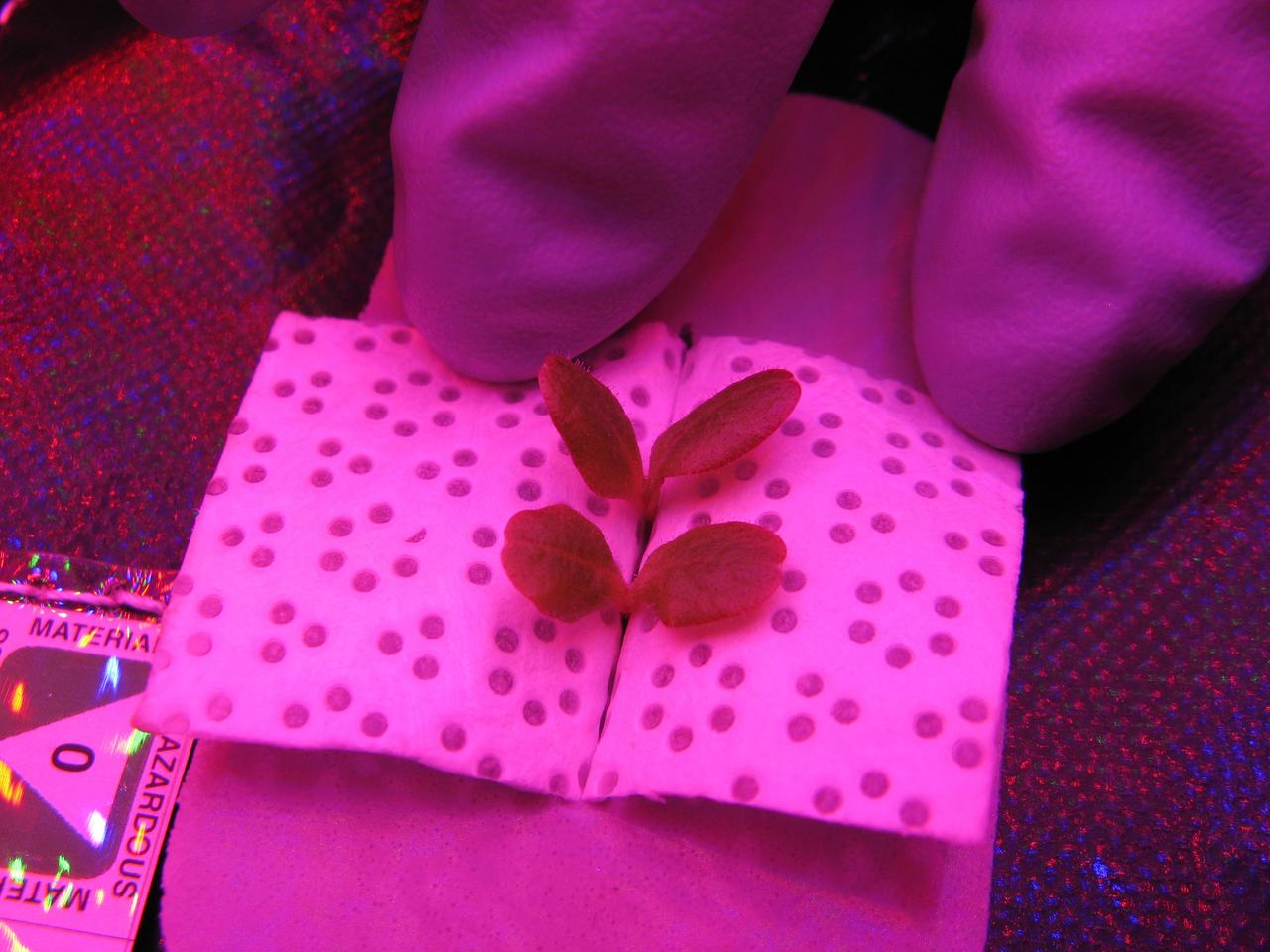
CAPE CANAVERAL, Fla. -- Researchers document the ground control plant pillows in the Veggie plant growth system inside a control chamber at the Space Station Processing Facility at NASA's Kennedy Space Center in Florida prior to thinning them to one plant each. The growth chamber is being used as a control unit and procedures are being followed identical to those being performed on Veggie and the Veg-01 experiment on the International Space Station. Veggie and Veg-01 were delivered to the space station aboard the SpaceX-3 mission. Veggie is the first fresh food production system delivered to the station. Six plant pillows, each containing outredgeous red romaine lettuce seeds and a root mat were inserted into Veggie. The plant chamber's red, blue and green LED lights were activated. The plant growth was monitored for 28 days. At the end of the cycle, the plants will be carefully harvested, frozen and stored for return to Earth. Photo credit: NASA/Charles Spern