
From the first taste of Red Romaine Lettuce in fall 2015, astronauts have grown and eaten a range of salad crops in orbit as NASA researches ways to keep crews healthy on future missions exploring the Moon and Mars. These plants are good sources of Vitamin C and Vitamin K, and they have traits that make them good candidates for feeding future space explorers.
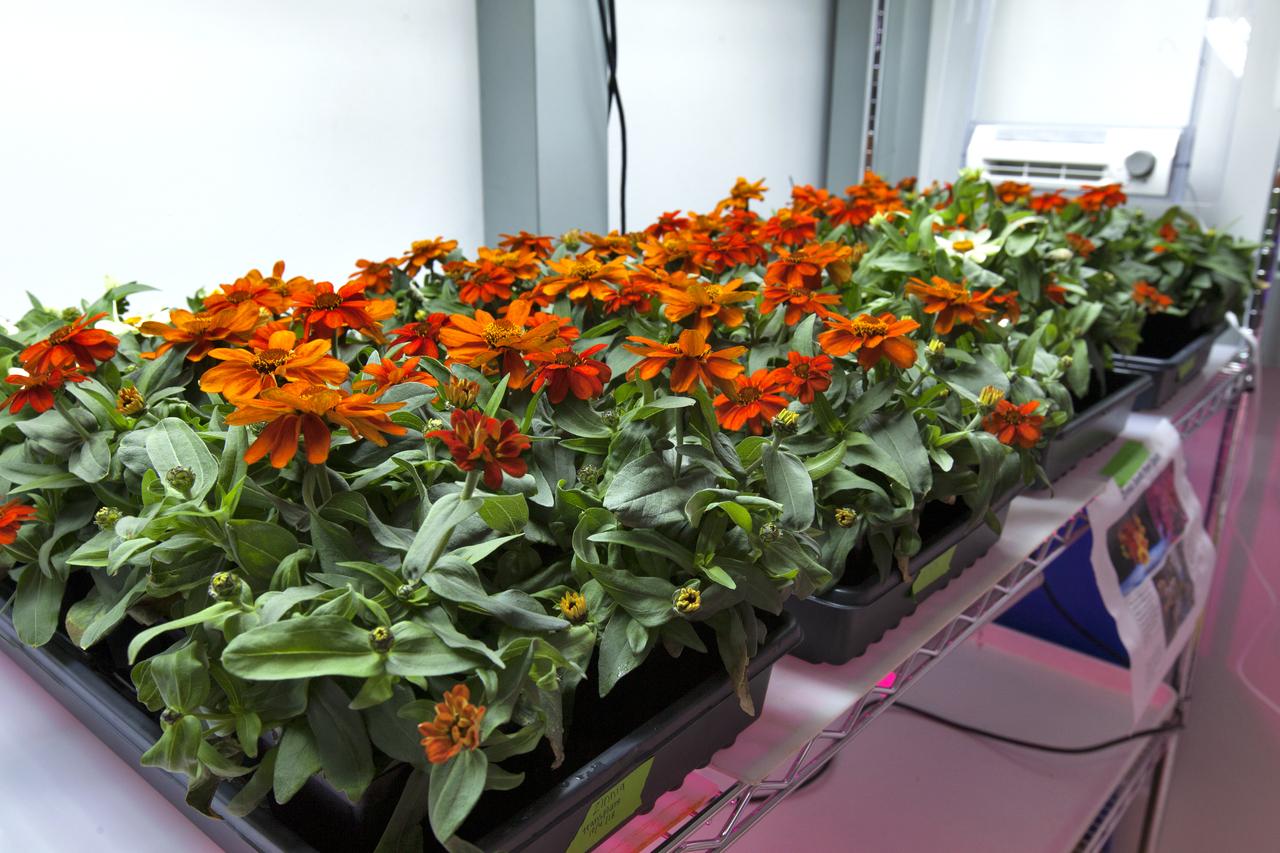
Zinnia seeds grown in the Veggie plant growth system on the International Space Station were planted and are growing in the Veggie Laboratory in the Space Station Processing Facility (SSPF) at NASA's Kennedy Space Center in Florida on Nov. 27, 2018.
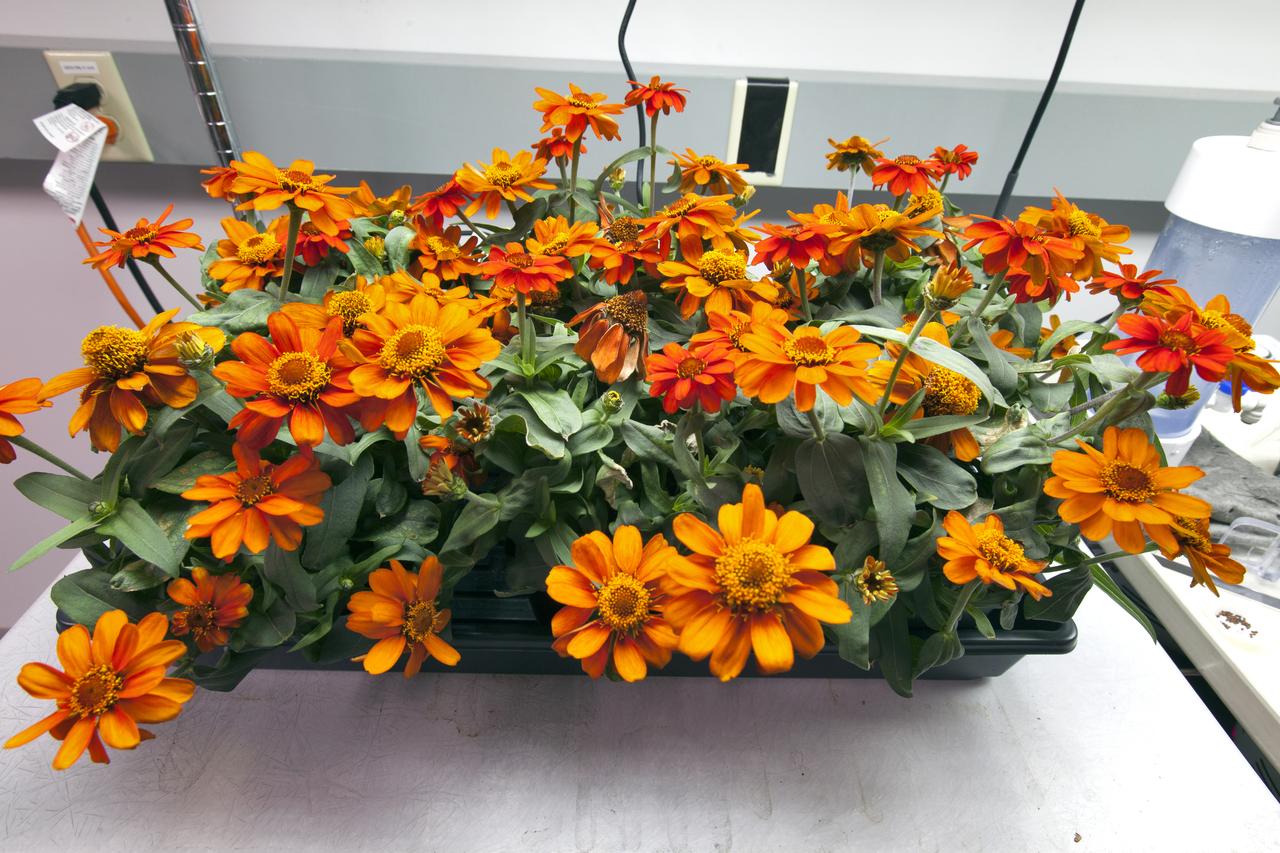
Zinnia seeds grown in the Veggie plant growth system on the International Space Station were planted and are growing in the Veggie Laboratory in the Space Station Processing Facility (SSPF) at NASA's Kennedy Space Center in Florida on Nov. 27, 2018.
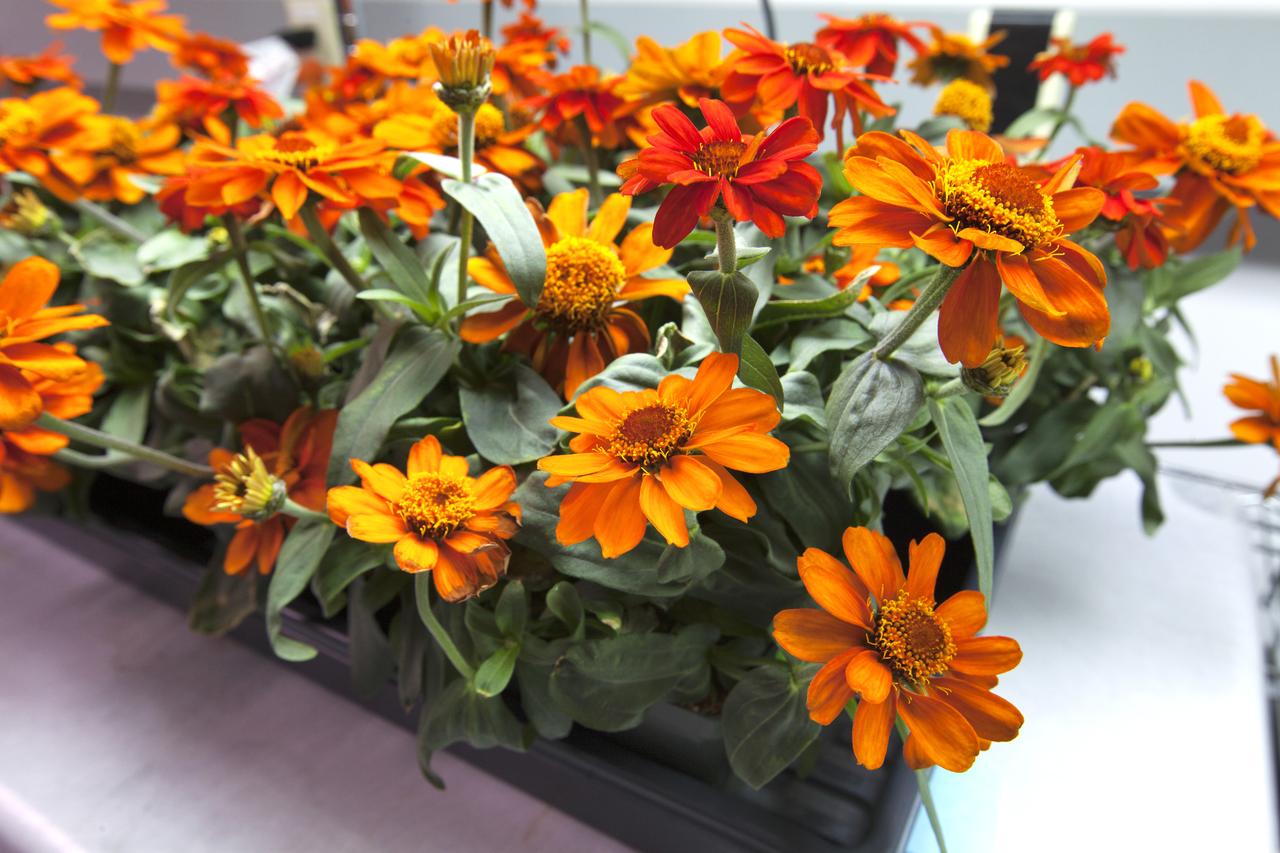
Zinnia seeds grown in the Veggie plant growth system on the International Space Station were planted and are growing in the Veggie Laboratory in the Space Station Processing Facility (SSPF) at NASA's Kennedy Space Center in Florida on Nov. 27, 2018.
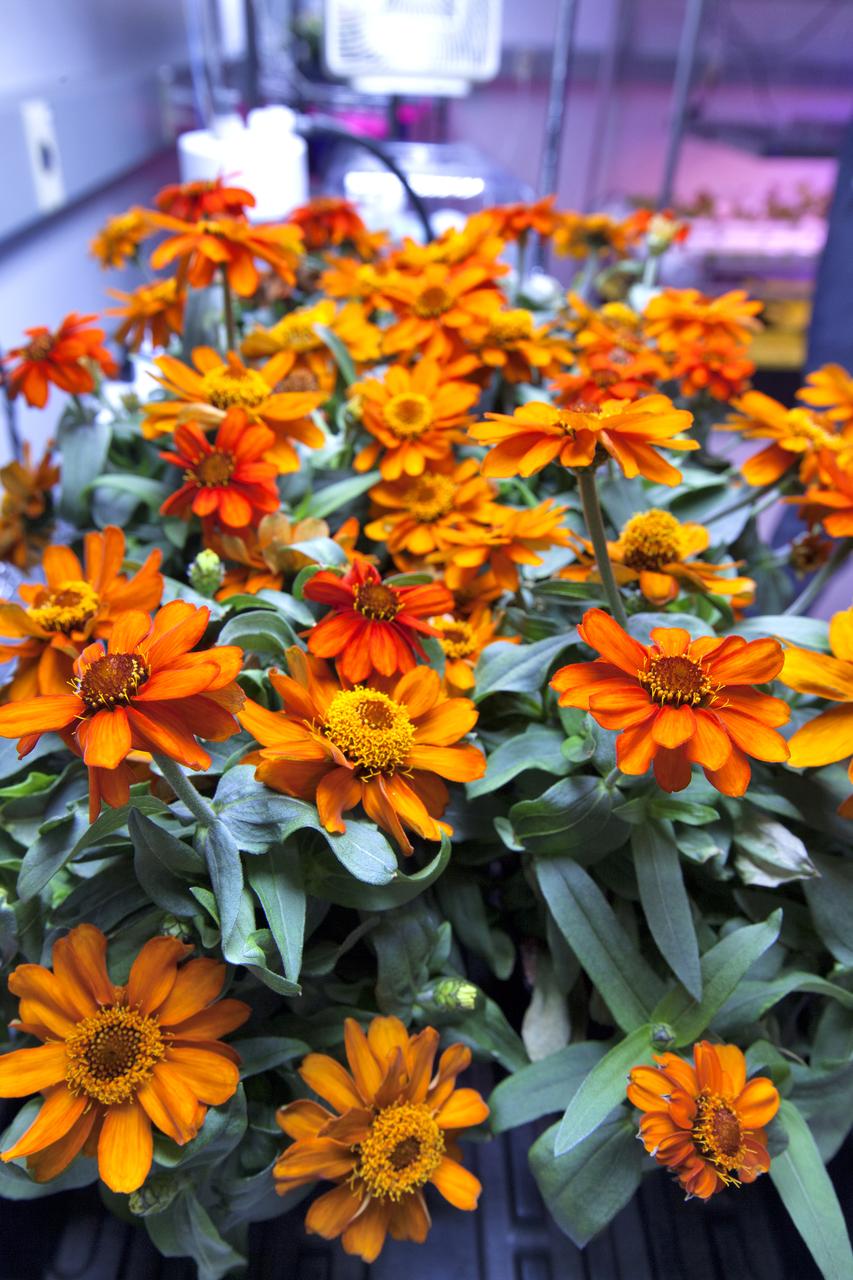
Zinnia seeds grown in the Veggie plant growth system on the International Space Station were planted and are growing in the Veggie Laboratory in the Space Station Processing Facility (SSPF) at NASA's Kennedy Space Center in Florida on Nov. 27, 2018.

iss066e008110 (October 20, 2021) -- NASA astronaut and Expedition 65 Flight Engineer Mark Vande Hei prepares to photograph chile peppers growing in the Advanced Plant Habitat as part of the Plant Habit-04 experiment being conducted aboard the International Space Station. The chile pepper seeds started growing on July 12, 2021, and represent one of the longest and most challenging plant experiments attempted aboard the orbiting laboratory. They will be harvested twice, once in late October and again in late November. Astronauts will sanitize the peppers, eat part of their harvest, and return the rest to Earth for analysis. What we learn will inform future crop growth and food supplementation activities for deep space exploration.

Inside the Space Life Sciences Lab at NASA’s Kennedy Space Center in Florida, researchers plant pepper seeds in a science carrier on April 8, 2021, in preparation for the Plant Habitat-04 (PH-04) experiment. The seeds will fly to the International Space Station on SpaceX’s 22nd Commercial Resupply Services (CRS-22) mission. When the experiment starts, astronauts will grow the pepper seeds in the Advanced Plant Habitat (APH) growth chamber, which will monitor the experiment with more than 180 sensors. The astronauts will observe plant growth for about four months and conduct two harvests to study whether microgravity affects growth, flavor, or texture. Since peppers take longer to germinate, grow, and develop than previous crops grown in space, the PH-04 experiment also will test the durability and reliability of the various systems within the APH.

A researcher from NASA’s Kennedy Space Center in Florida prepares pepper seeds for planting inside science carriers on April 8, 2021, inside the Space Life Sciences Lab for the Plant Habitat-04 (PH-04) experiment. The seeds will fly to the International Space Station on SpaceX’s 22nd Commercial Resupply Services (CRS-22) mission. When the experiment starts, astronauts will grow the pepper seeds in the Advanced Plant Habitat (APH) growth chamber, which will monitor the experiment with more than 180 sensors. The astronauts will observe plant growth for about four months and conduct two harvests to study whether microgravity affects growth, flavor, or texture. Since peppers take longer to germinate, grow, and develop than previous crops grown in space, the PH-04 experiment also will test the durability and reliability of the various systems within the APH.

A researcher from NASA’s Kennedy Space Center in Florida prepares pepper seeds for planting inside science carriers on April 8, 2021, inside the Space Life Sciences Lab for the Plant Habitat-04 (PH-04) experiment. The seeds will fly to the International Space Station on SpaceX’s 22nd Commercial Resupply Services (CRS-22) mission. When the experiment starts, astronauts will grow the pepper seeds in the Advanced Plant Habitat (APH) growth chamber, which will monitor the experiment with more than 180 sensors. The astronauts will observe plant growth for about four months and conduct two harvests to study whether microgravity affects growth, flavor, or texture. Since peppers take longer to germinate, grow, and develop than previous crops grown in space, the PH-04 experiment also will test the durability and reliability of the various systems within the APH.

Inside the Space Life Sciences Lab at NASA’s Kennedy Space Center in Florida, a researcher plants pepper seeds in science carriers on April 8, 2021, in preparation for the Plant Habitat-04 (PH-04) experiment. The seeds will fly to the International Space Station on SpaceX’s 22nd Commercial Resupply Services (CRS-22) mission. When the experiment starts, astronauts will grow the pepper seeds in the Advanced Plant Habitat (APH) growth chamber, which will monitor the experiment with more than 180 sensors. The astronauts will observe plant growth for about four months and conduct two harvests to study whether microgravity affects growth, flavor, or texture. Since peppers take longer to germinate, grow, and develop than previous crops grown in space, the PH-04 experiment also will test the durability and reliability of the various systems within the APH.

A close-up photo of a pepper seed prepared by researchers at NASA’s Kennedy Space Center in Florida is shown before it’s planted inside a science carrier on April 8, 2021, inside the Space Life Sciences Lab for the Plant Habitat-04 (PH-04) experiment. The seeds will fly to the International Space Station on SpaceX’s 22nd Commercial Resupply Services (CRS-22) mission. When the experiment starts, astronauts will grow the pepper seeds in the Advanced Plant Habitat (APH) growth chamber, which will monitor the experiment with more than 180 sensors. The astronauts will observe plant growth for about four months and conduct two harvests to study whether microgravity affects growth, flavor, or texture. Since peppers take longer to germinate, grow, and develop than previous crops grown in space, the PH-04 experiment also will test the durability and reliability of the various systems within the APH.

A researcher from NASA’s Kennedy Space Center in Florida prepares pepper seeds for planting inside science carriers on April 8, 2021, inside the Space Life Sciences Lab for the Plant Habitat-04 (PH-04) experiment. The seeds will fly to the International Space Station on SpaceX’s 22nd Commercial Resupply Services (CRS-22) mission. When the experiment starts, astronauts will grow the pepper seeds in the Advanced Plant Habitat (APH) growth chamber, which will monitor the experiment with more than 180 sensors. The astronauts will observe plant growth for about four months and conduct two harvests to study whether microgravity affects growth, flavor, or texture. Since peppers take longer to germinate, grow, and develop than previous crops grown in space, the PH-04 experiment also will test the durability and reliability of the various systems within the APH.
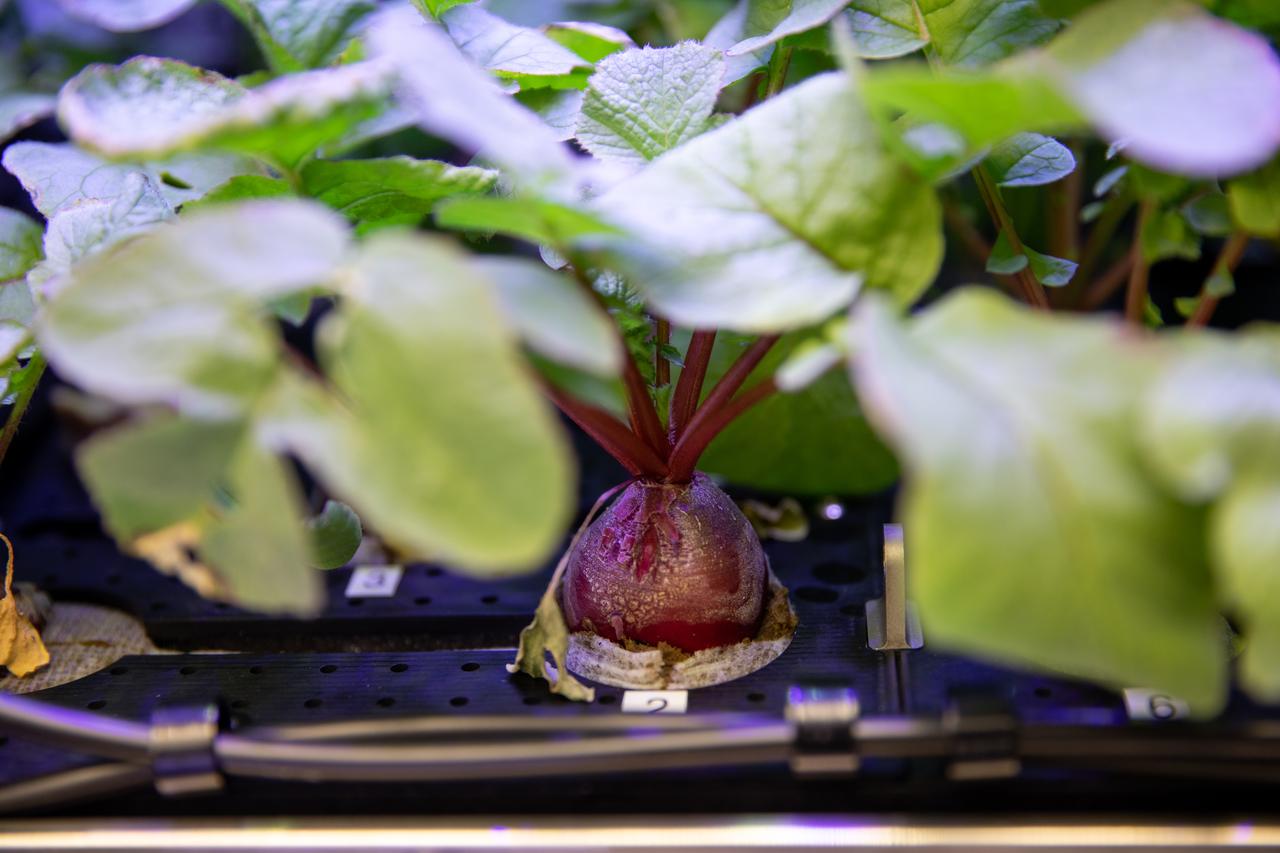
A view of radishes growing in the Advanced Plant Habitat (APH) ground unit inside the Space Station Processing Facility at NASA’s Kennedy Space Center in Florida on Dec. 14, 2020. The radishes are a ground control crop for the Plant Habitat-02 (PH-02) experiment. The experiment also involves growing two similar radish crops inside the International Space Station’s APH. NASA astronaut Kate Rubins harvested the first crop on Nov. 30, and the second harvest aboard the orbiting laboratory is planned for Dec. 30. Once samples return to Earth, researchers will compare those grown in space to the radishes grown here on Earth to better understand how microgravity affects plant growth.
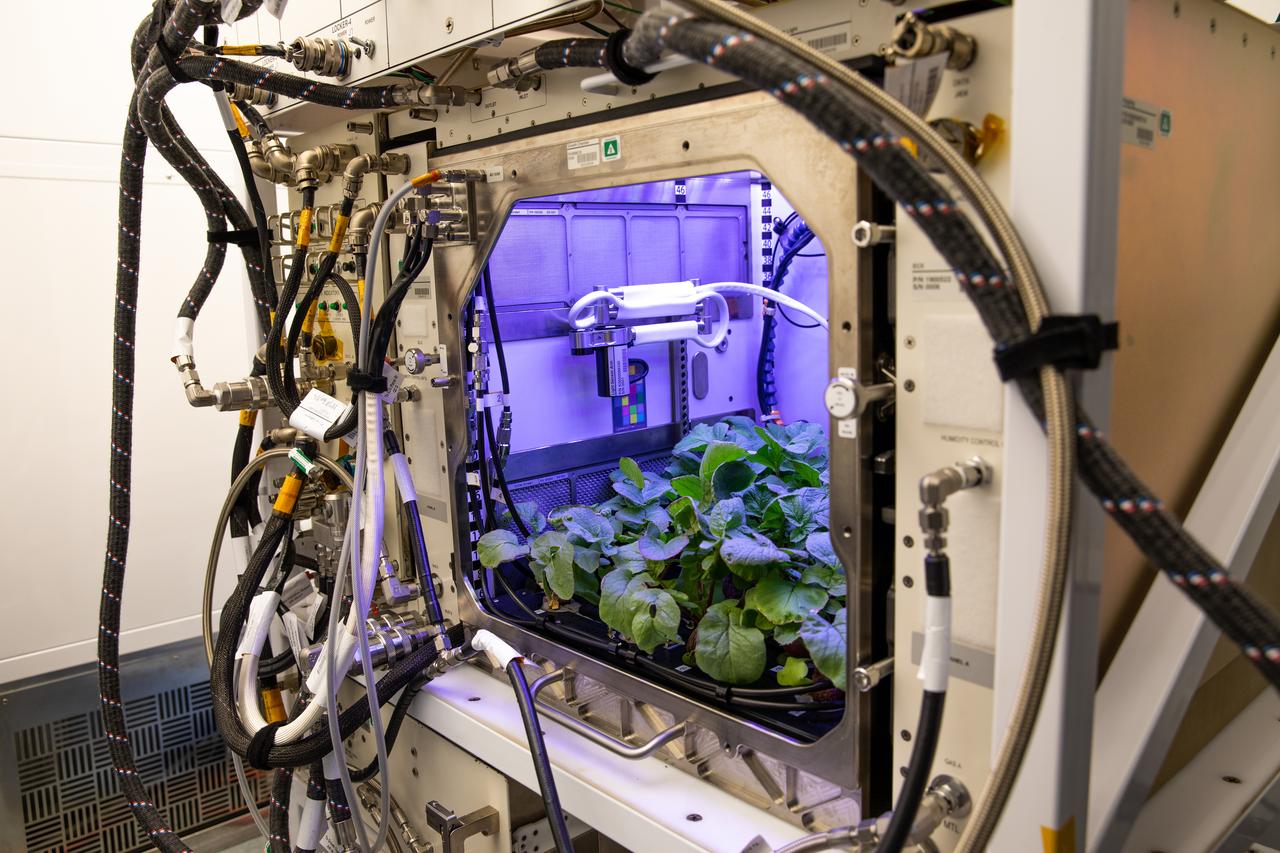
A view of radishes growing in the Advanced Plant Habitat (APH) ground unit inside the Space Station Processing Facility at NASA’s Kennedy Space Center in Florida on Dec. 14, 2020. The radishes are a ground control crop for the Plant Habitat-02 (PH-02) experiment, which also involves growing two similar radish crops inside the International Space Station’s APH. NASA astronaut Kate Rubins harvested the first crop on Nov. 30, and the second harvest aboard the orbiting laboratory is planned for Dec. 30. Once samples return to Earth, researchers will compare those grown in space to the radishes grown here on Earth to better understand how microgravity affects plant growth.
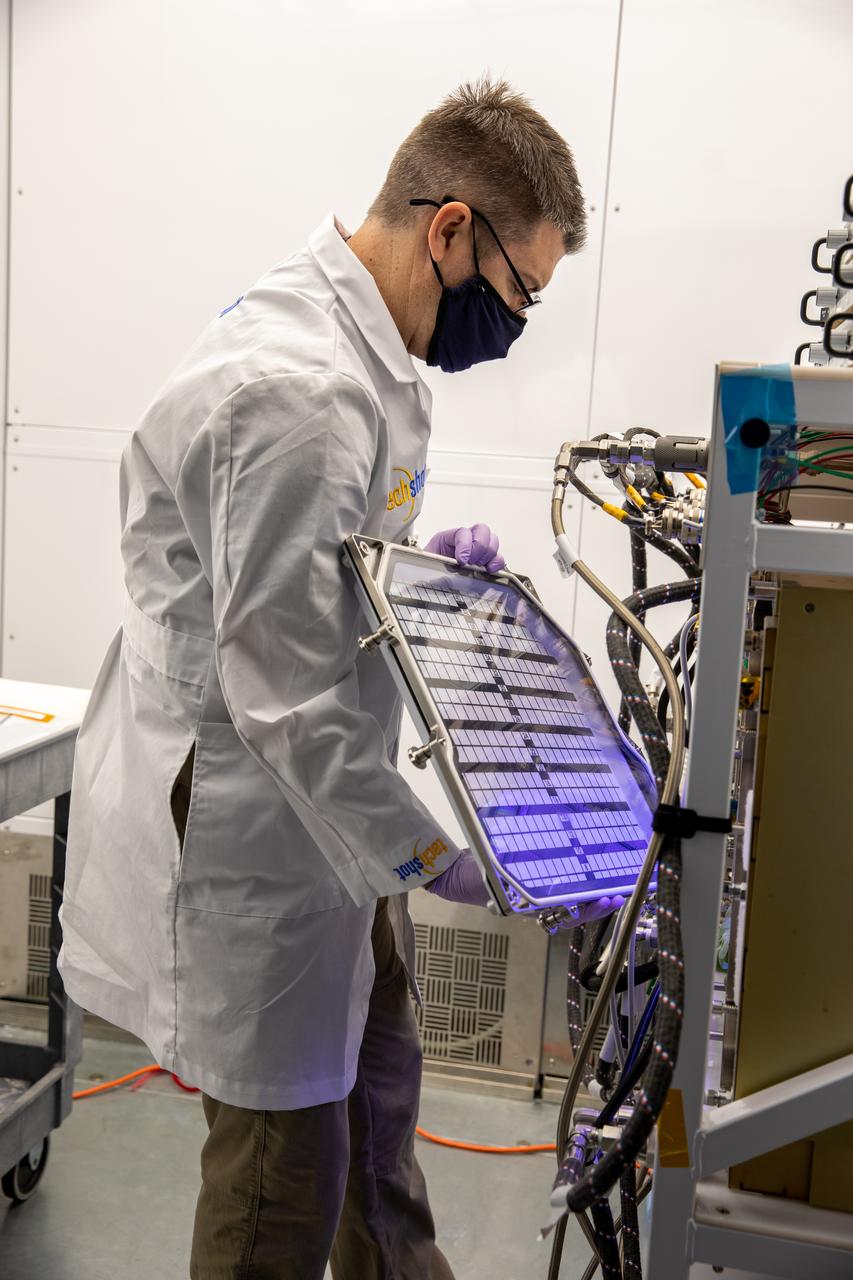
A researcher prepares to harvest radishes grown in the Advanced Plant Habitat (APH) ground unit inside the Space Station Processing Facility at NASA’s Kennedy Space Center in Florida on Dec. 14, 2020. The radishes are a ground control crop for the Plant Habitat-02 (PH-02) experiment, which also involves growing two radish crops inside the International Space Station’s APH. NASA astronaut Kate Rubins harvested the first crop on Nov. 30, and the second harvest aboard the orbiting laboratory is planned for Dec. 30. Once samples return to Earth, researchers will compare those grown in space to the radishes grown here on Earth to better understand how microgravity affects plant growth.
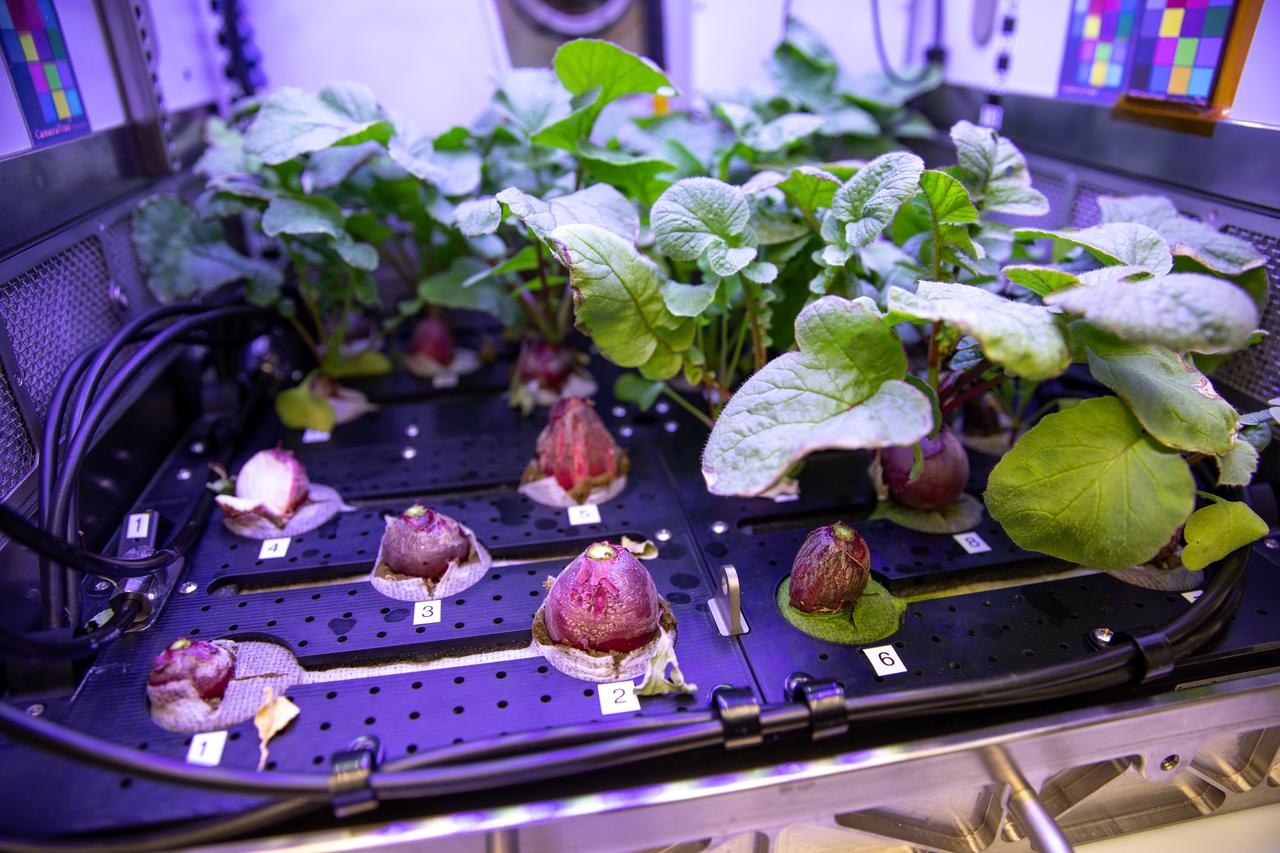
A view of radishes growing in the Advanced Plant Habitat (APH) ground unit inside the Space Station Processing Facility at NASA’s Kennedy Space Center in Florida on Dec. 14, 2020. The radishes are a ground control crop for the Plant Habitat-02 (PH-02) experiment. The experiment also involves growing two similar radish crops inside the International Space Station’s APH. NASA astronaut Kate Rubins harvested the first crop on Nov. 30, and the second harvest aboard the orbiting laboratory is planned for Dec. 30. Once samples return to Earth, researchers will compare those grown in space to the radishes grown here on Earth to better understand how microgravity affects plant growth.
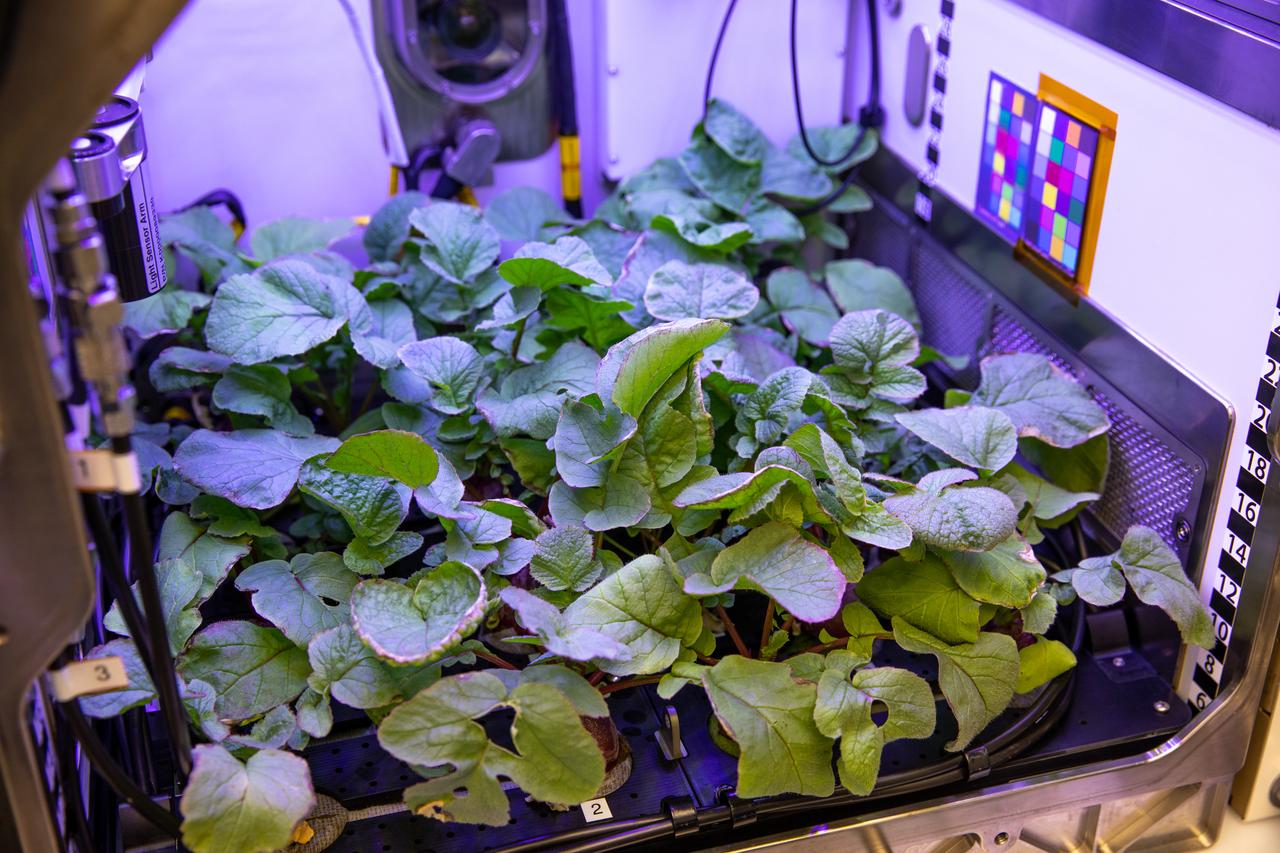
A view of radishes growing in the Advanced Plant Habitat (APH) ground unit inside the Space Station Processing Facility at NASA’s Kennedy Space Center in Florida on Dec. 14, 2020. The radishes are a ground control crop for the Plant Habitat-02 (PH-02) experiment. The experiment also involves growing two similar radish crops inside the International Space Station’s APH. NASA astronaut Kate Rubins harvested the first crop on Nov. 30, and the second harvest aboard the orbiting laboratory is planned for Dec. 30. Once samples return to Earth, researchers will compare those grown in space to the radishes grown here on Earth to better understand how microgravity affects plant growth.
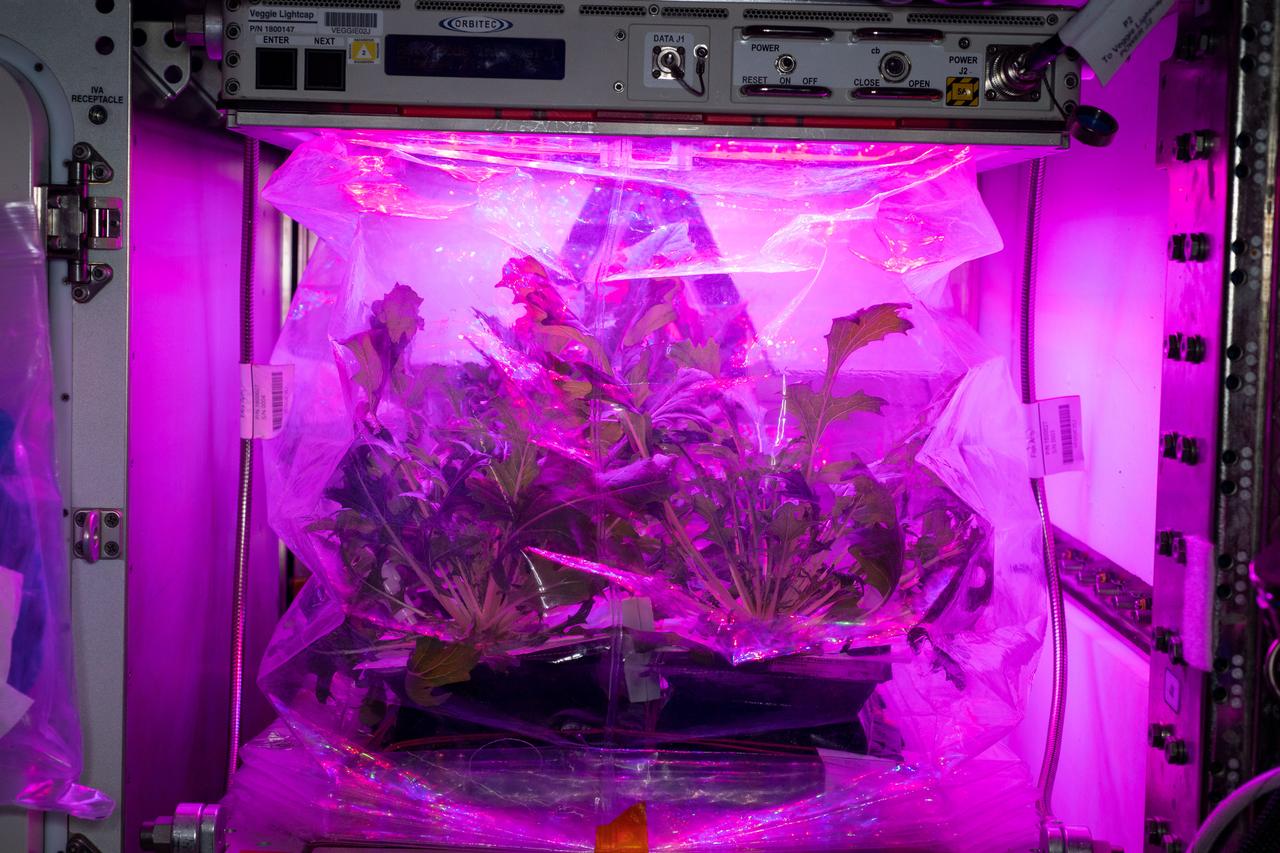
Mizuna Mustard mustard greens, part of the Veg-04A experiment, are shown growing in a Veggie plant growth chamber aboard the International Space Station on July 9, 2019. The Veg-04A experiment tested the greens, grown in blue-rich lighting and red-rich lighting, to determine the effects of different light ratios on plants grown in space on the station. The plants arrived aboard the SpaceX Commercial Resupply Services-16 mission. Astronaut Christina Koch initiated the on-orbit experiment on June 4, 2019, in the station’s two Veggie plant growth chambers, with six plant pillows per chamber. On June 11, 2019, Koch thinned the Mizuna plants to one plant per pillow. The on-orbit harvest took place July 9, 2019, with astronaut Nick Hague harvesting the plants grown under blue-rich light and Koch harvesting the plants grown under red-rich lights.
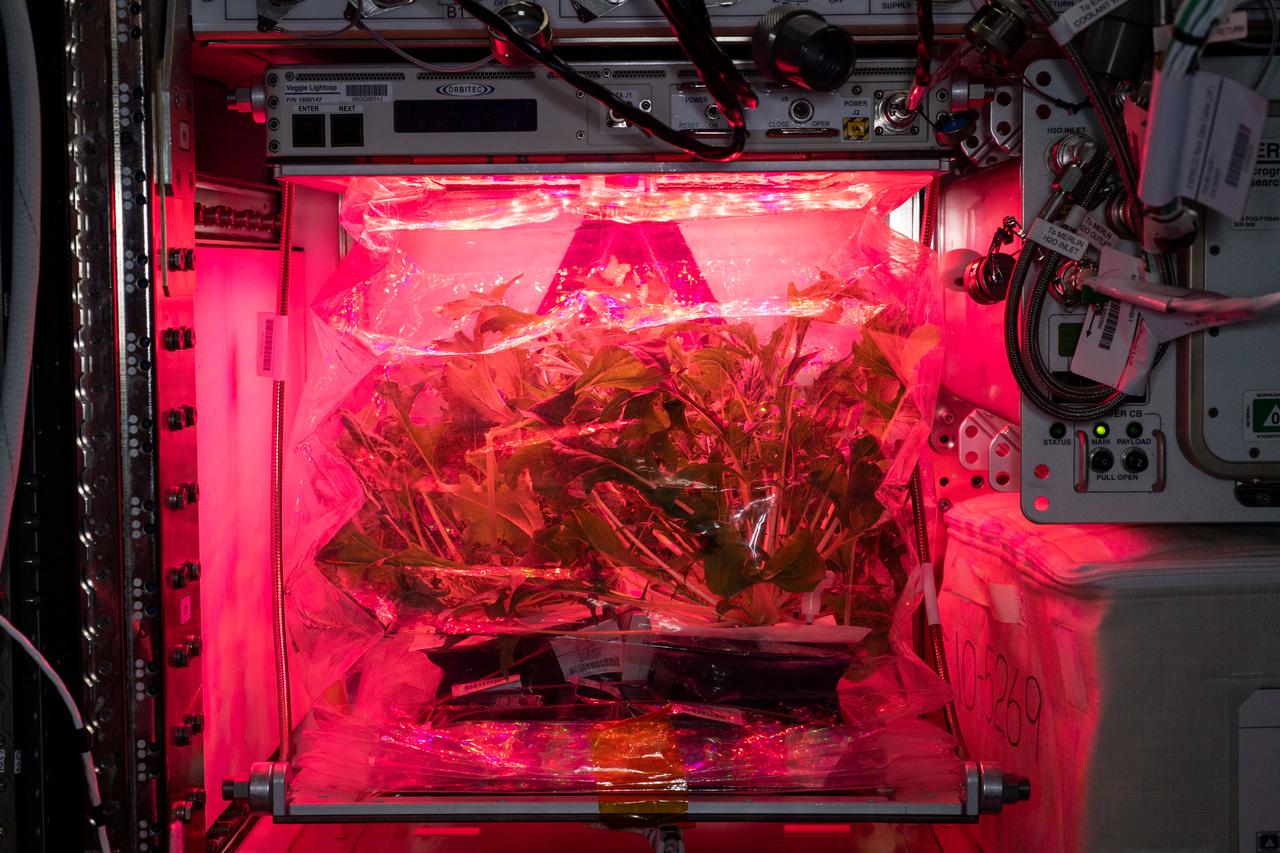
Mizuna Mustard mustard greens, part of the Veg-04A experiment, are shown growing in a Veggie plant growth chamber aboard the International Space Station on July 9, 2019. The Veg-04A experiment tested the greens, grown in blue-rich lighting and red-rich lighting, to determine the effects of different light ratios on plants grown in space on the station. The plants arrived aboard the SpaceX Commercial Resupply Services-16 mission. Astronaut Christina Koch initiated the on-orbit experiment on June 4, 2019, in the station’s two Veggie plant growth chambers, with six plant pillows per chamber. On June 11, 2019, Koch thinned the Mizuna plants to one plant per pillow. The on-orbit harvest took place July 9, 2019, with astronaut Nick Hague harvesting the plants grown under blue-rich light and Koch harvesting the plants grown under red-rich lights.
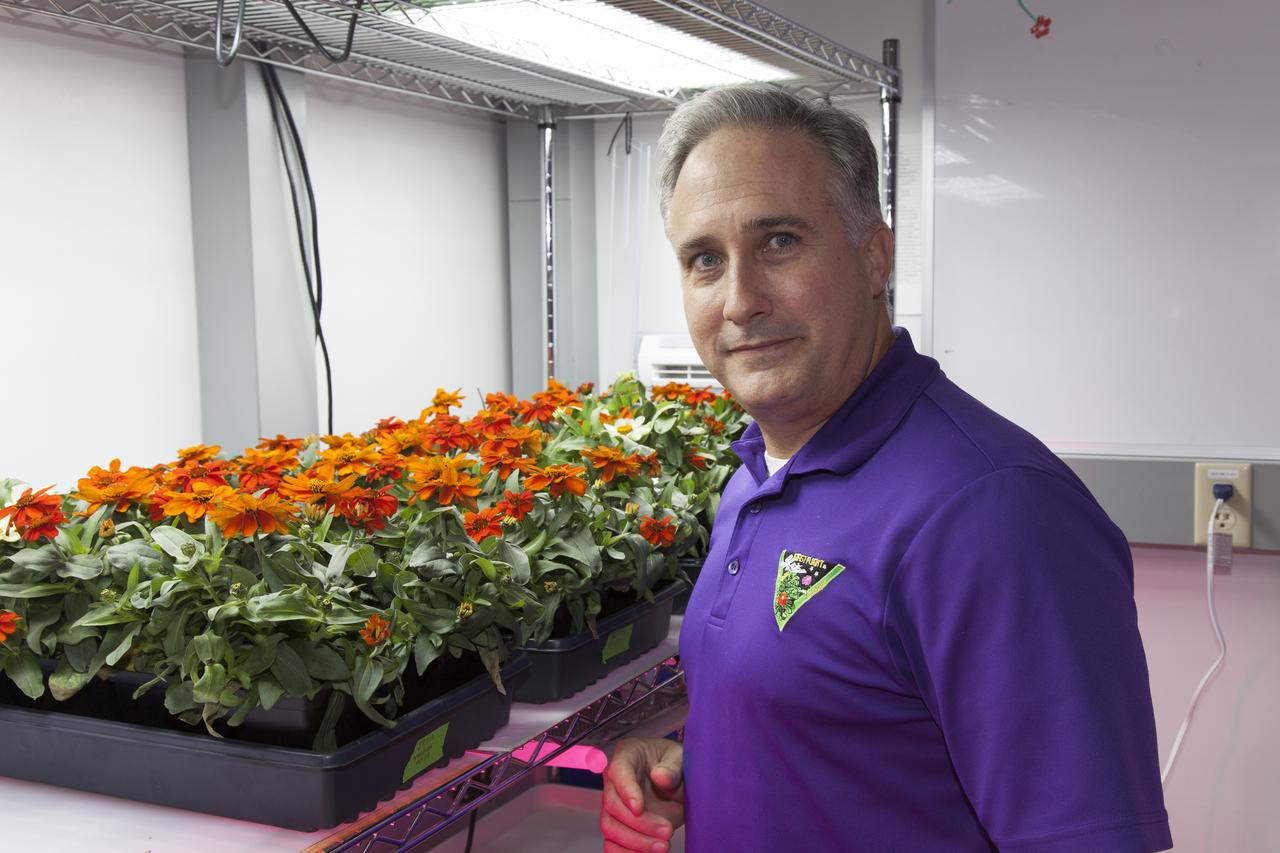
Trent Smith, Veggie project manager, Exploration Research and Technology Programs, is in the Veggie Laboratory in the Space Station Processing Facility (SSPF) at NASA's Kennedy Space Center in Florida on Nov. 27, 2018. Next to him are zinnia flowers grown from seeds germinated in the Veggie plant growth system on the International Space Station. The seeds were returned to Earth and researchers in the SSPF planted them in the Veggie control unit and grew the colorful flowers.
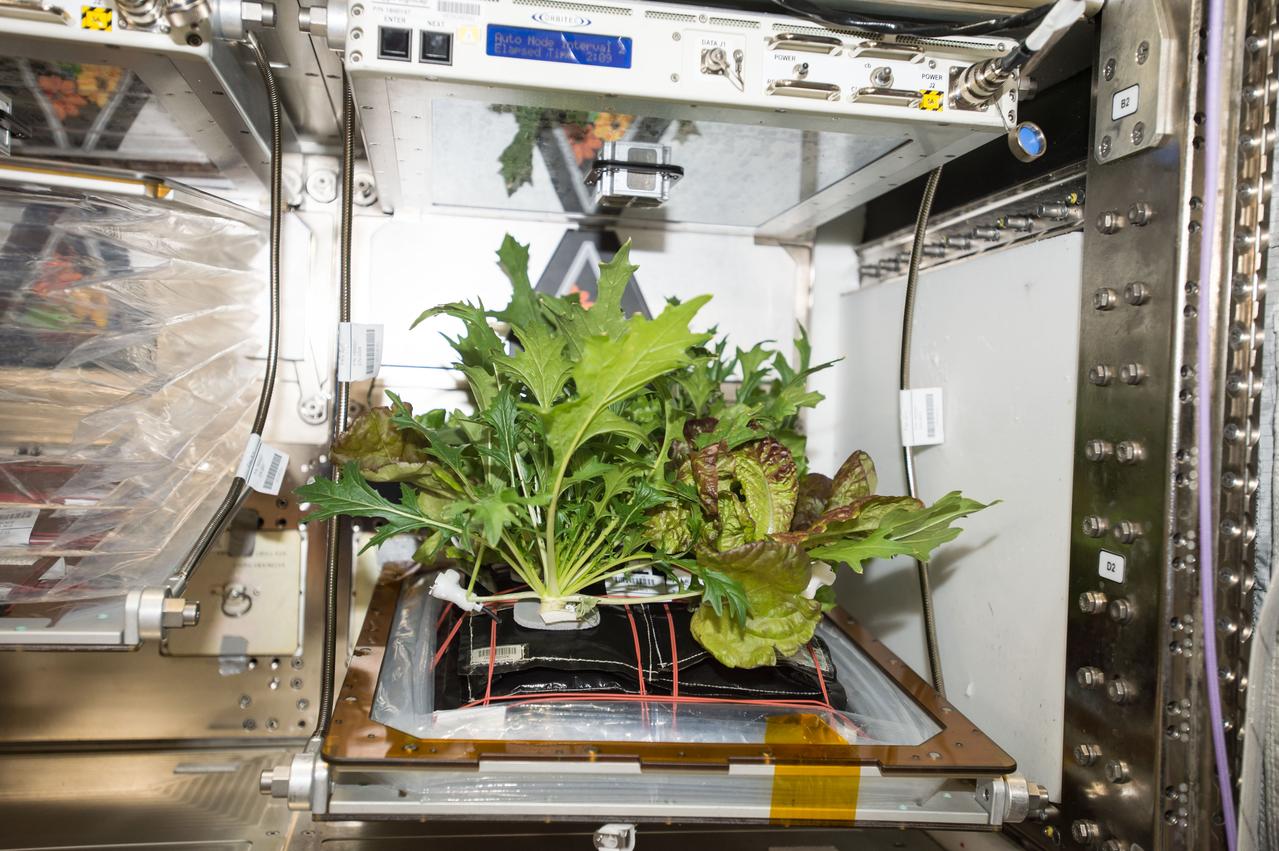
Three different varieties of plants growing in the Veggie plant growth chamber on the International Space Station were harvested this morning.
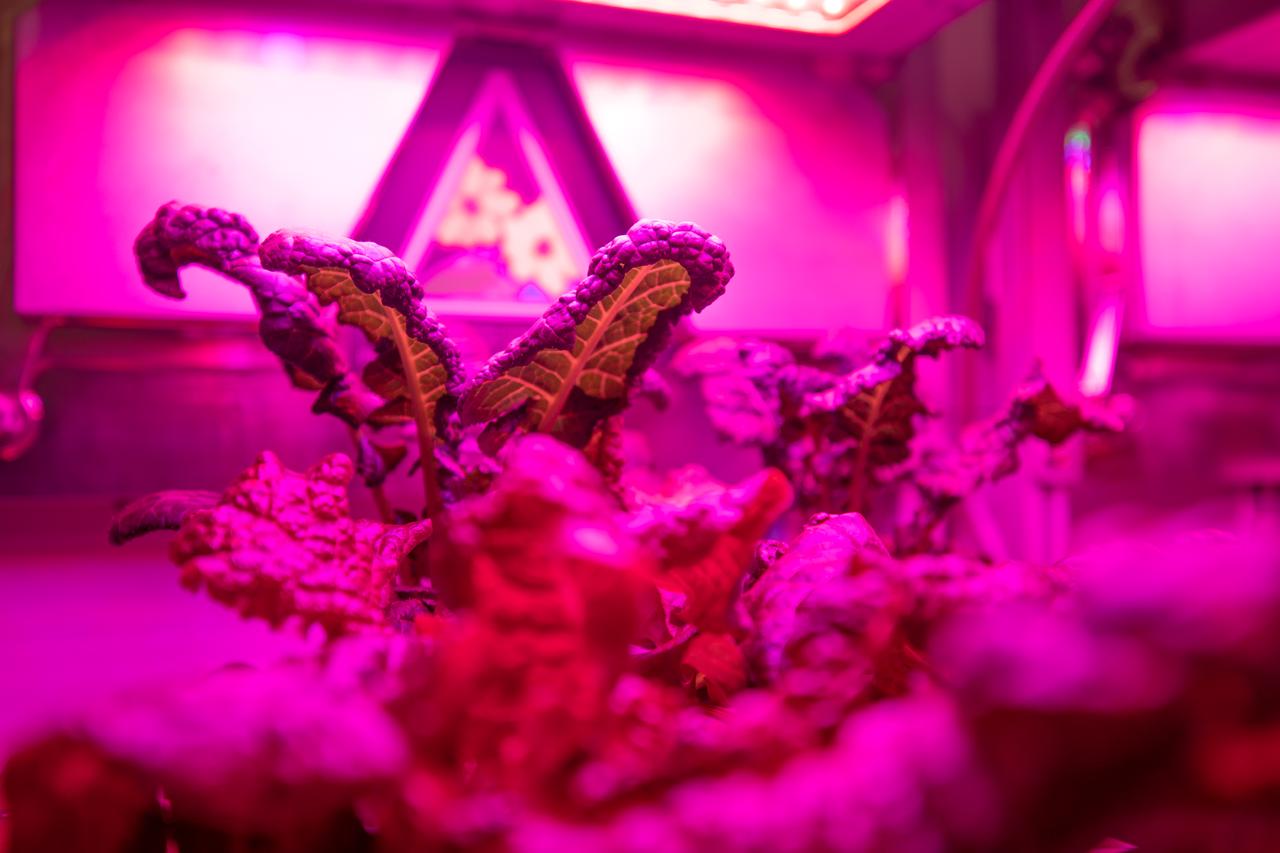
Three crops grown under a test condition representative of the International Space Station are photographed moments before harvest for a science verification test (SVT) in the Space Station Processing Facility at NASA’s Kennedy Space Center in Florida on Sept. 30, 2019. The SVT will study the potential of the three plant cultivars to grow in space. The harvest included ‘outredgeous’ red romaine lettuce, which has been grown in space before, and two new plant cultivars – amara mustard and shungiku, an Asian green comparable to an edible chrysanthemum. All three lettuce plants were grown from seed film, making this the first SVT with this new plant growth material. Earlier this year, the amara mustard and shungiku plants were grown for the first time using seed bags – referred to as pillows – during the Sustained Veggie project, a study funded by the Human Research Program.
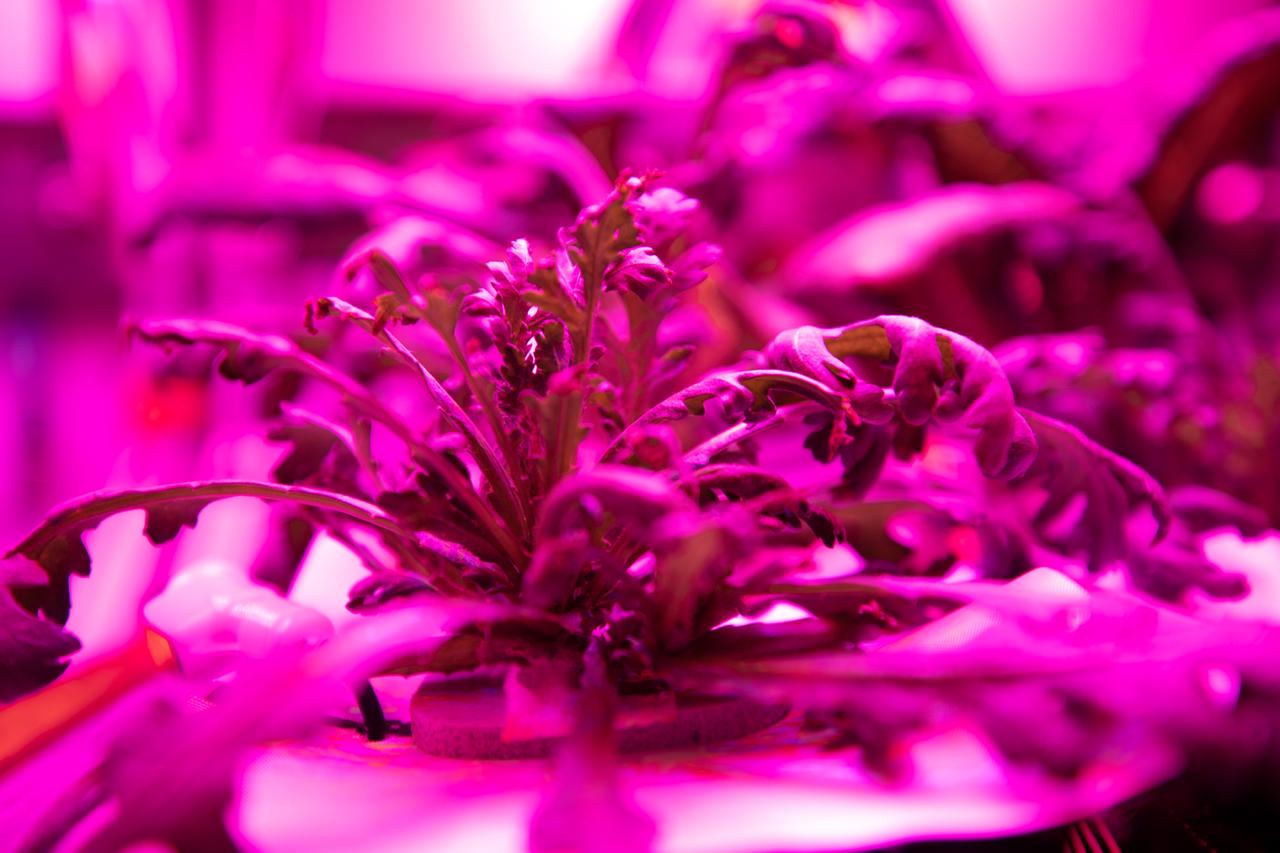
Three crops grown under a test condition representative of the International Space Station are photographed moments before harvest for a science verification test (SVT) in the Space Station Processing Facility at NASA’s Kennedy Space Center in Florida on Sept. 30, 2019. The SVT will study the potential of the three plant cultivars to grow in space. The harvest included ‘outredgeous’ red romaine lettuce, which has been grown in space before, and two new plant cultivars – amara mustard and shungiku, an Asian green comparable to an edible chrysanthemum. All three lettuce plants were grown from seed film, making this the first SVT with this new plant growth material. Earlier this year, the amara mustard and shungiku plants were grown for the first time using seed bags – referred to as pillows – during the Sustained Veggie project, a study funded by the Human Research Program.
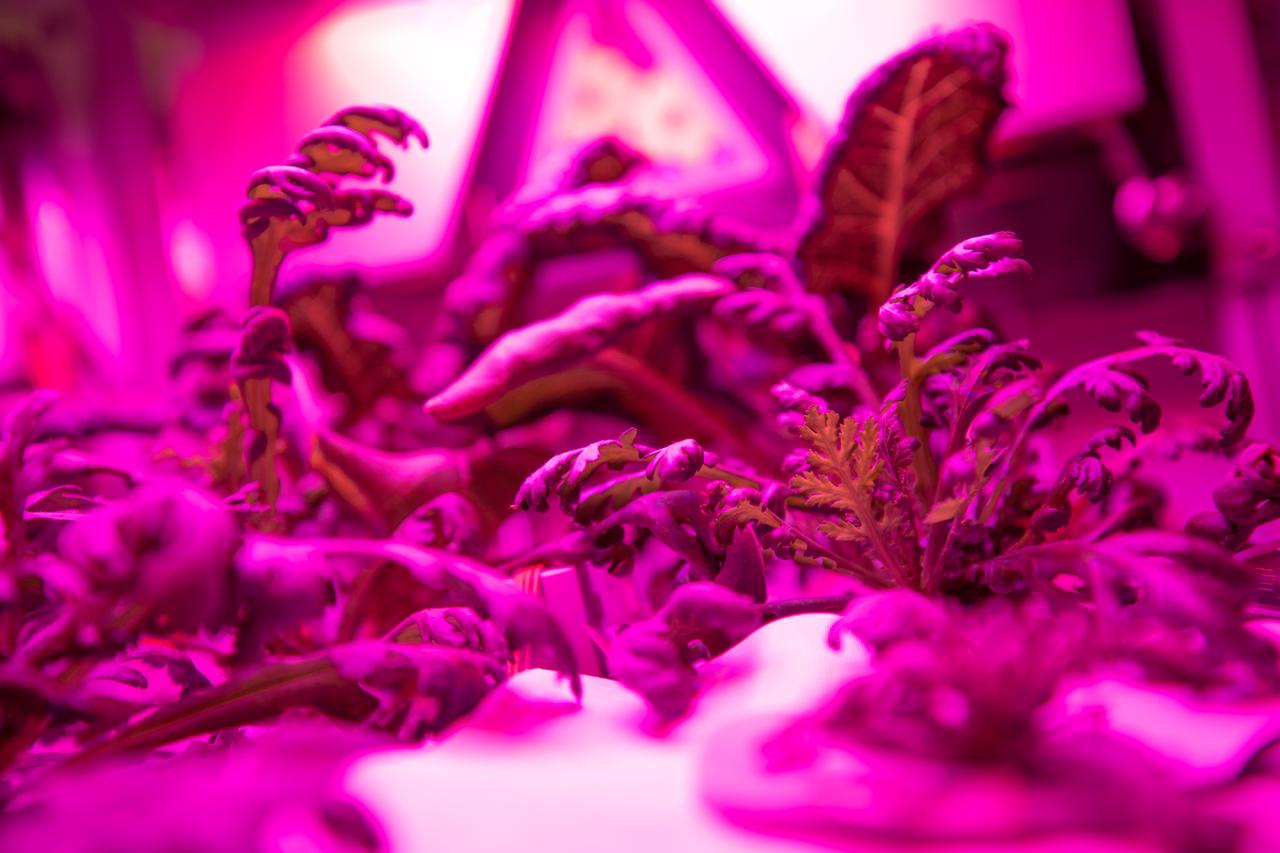
Three crops grown under a test condition representative of the International Space Station are photographed moments before harvest for a science verification test (SVT) in the Space Station Processing Facility at NASA’s Kennedy Space Center in Florida on Sept. 30, 2019. The SVT will study the potential of the three plant cultivars to grow in space. The harvest included ‘outredgeous’ red romaine lettuce, which has been grown in space before, and two new plant cultivars – amara mustard and shungiku, an Asian green comparable to an edible chrysanthemum. All three lettuce plants were grown from seed film, making this the first SVT with this new plant growth material. Earlier this year, the amara mustard and shungiku plants were grown for the first time using seed bags – referred to as pillows – during the Sustained Veggie project, a study funded by the Human Research Program.
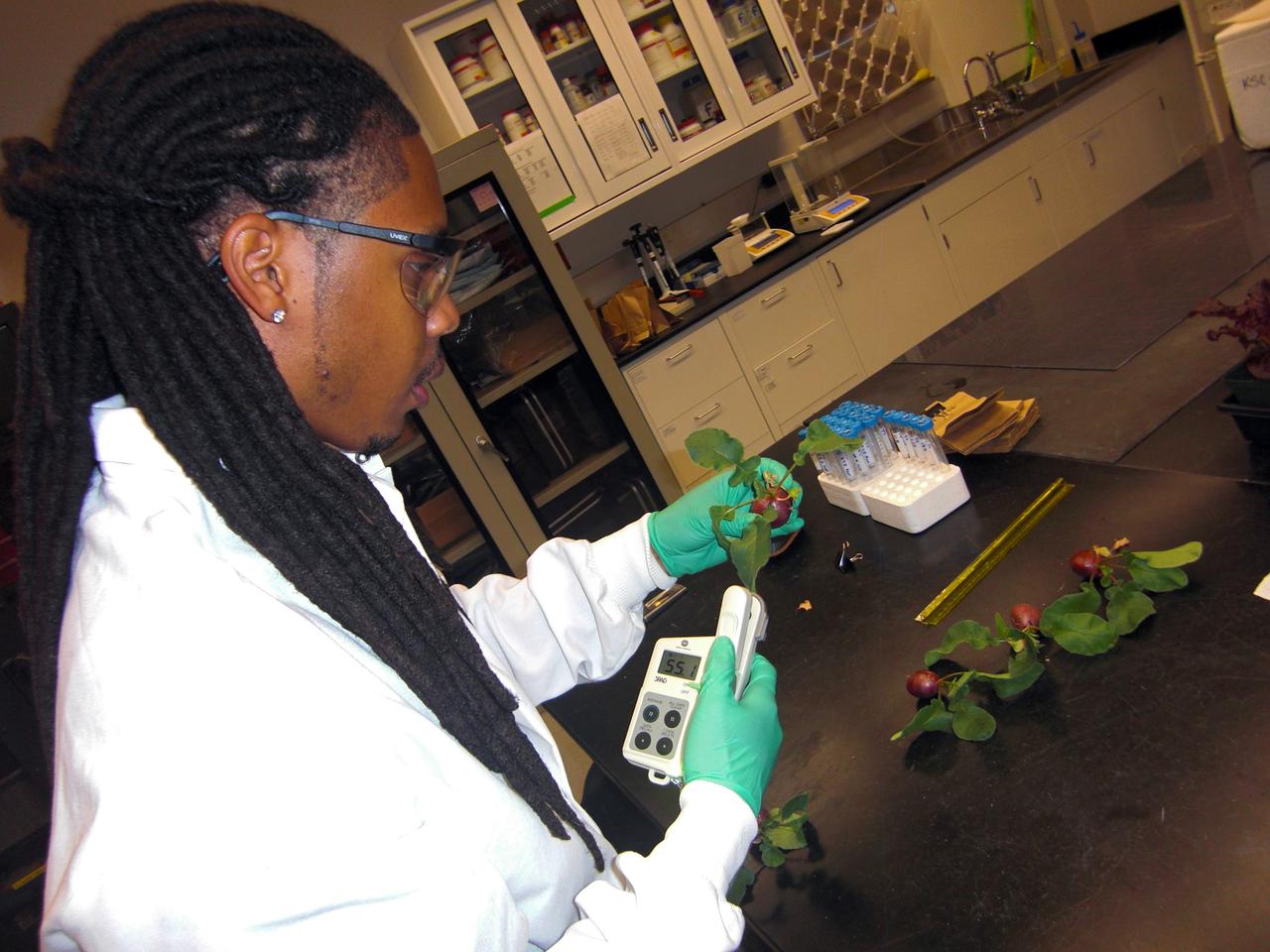
CAPE CANAVERAL, Fla. – Inside the Space Life Sciences Laboratory, or SLSL, at NASA’s Kennedy Space Center in Florida, Dr. Matthew Mickens, a plant biologist from North Carolina Agriculture and Technical State University in North Carolina, measures radish plants that were just harvested from a plant growth chamber. The plants were grown under red and blue LED lights. The plant experiment at Kennedy is part of the Advanced Exploration Systems, or AES, program in NASA’s Human Exploration and Operations Mission Directorate. This plant experiment studies the effects of different types of lighting on plants such as radishes and leaf lettuce. Results of these studies will help provide information on how to grow food sources for deep space exploration missions. AES projects pioneer new approaches for rapidly developing prototype systems, demonstrating key capabilities and validating operational concepts for future human missions beyond Earth orbit. Photo credit: NASA/Frank Ochoa-Gonzales
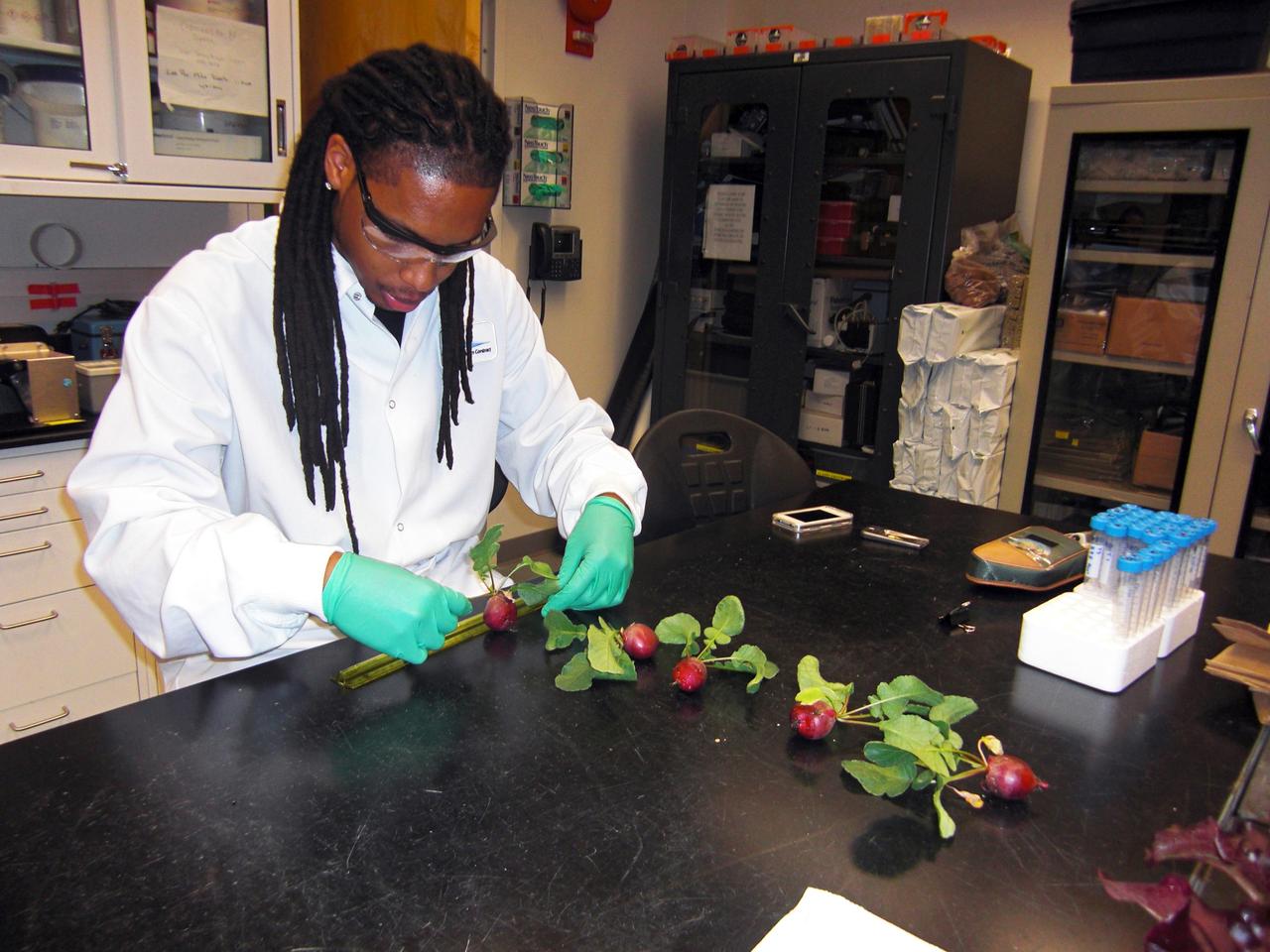
CAPE CANAVERAL, Fla. – Inside the Space Life Sciences Laboratory, or SLSL, at NASA’s Kennedy Space Center in Florida, Dr. Matthew Mickens, a plant biologist from North Carolina Agriculture and Technical State University in North Carolina, measures radish plants that were just harvested from a plant growth chamber. The plants were grown under red and blue LED lights. The plant experiment at Kennedy is part of the Advanced Exploration Systems, or AES, program in NASA’s Human Exploration and Operations Mission Directorate. This plant experiment studies the effects of different types of lighting on plants such as radishes and leaf lettuce. Results of these studies will help provide information on how to grow food sources for deep space exploration missions. AES projects pioneer new approaches for rapidly developing prototype systems, demonstrating key capabilities and validating operational concepts for future human missions beyond Earth orbit. Photo credit: NASA/Frank Ochoa-Gonzales
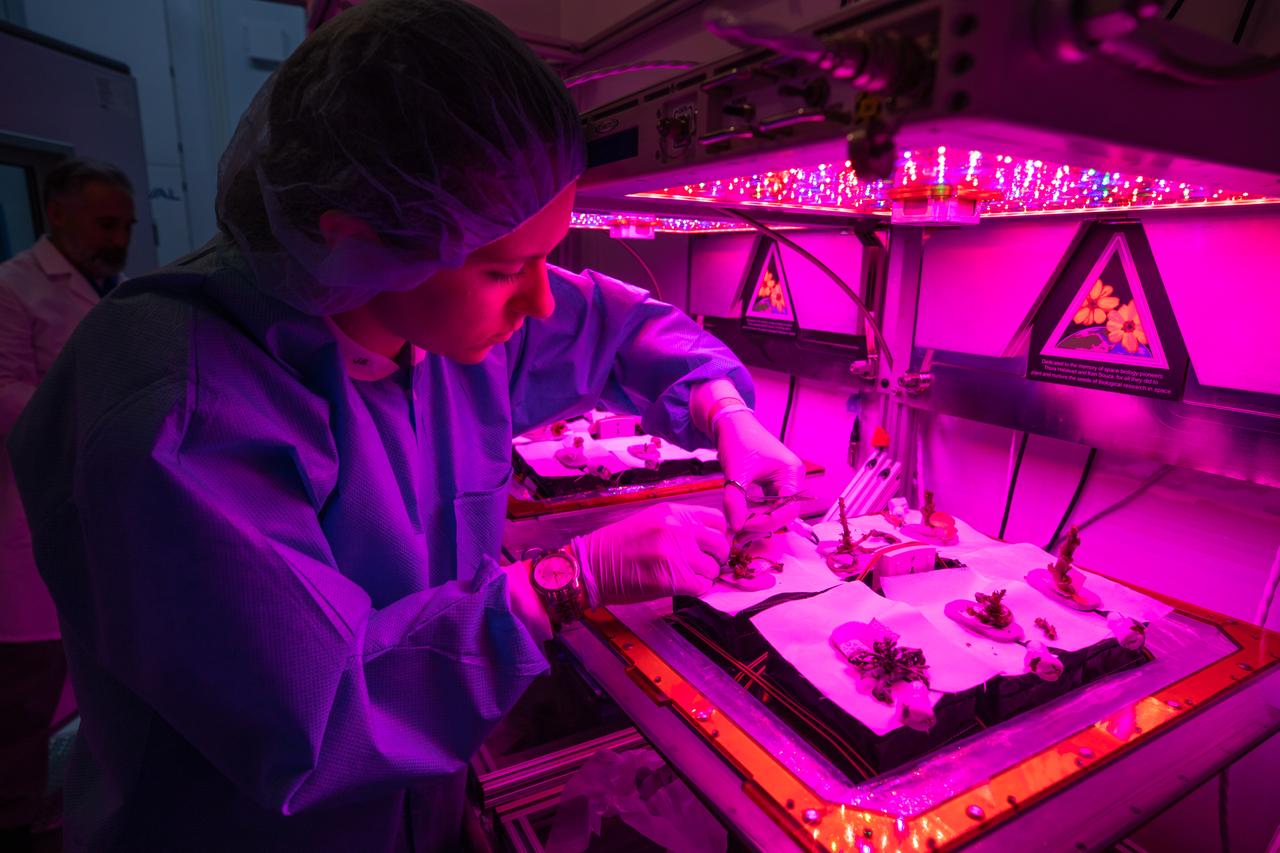
Jess Bunchek, an associate scientist at NASA’s Kennedy Space Center in Florida, harvests plant cultivars inside the Veggie growth chamber in the Space Station Processing Facility on Sept. 30, 2019, for a science verification test (SVT). This SVT will study the potential of three plants – amara mustard, ‘outredgeous’ red romaine lettuce and shungiku, an Asian green comparable to an edible chrysanthemum – to grow in space. All three lettuce plants were grown from seed film, making this the first SVT with this new plant growth material. Earlier this year, the amara mustard and shungiku plants were grown for the first time using seed bags – referred to as pillows – during the Sustained Veggie project, a study funded by the Human Research Program.
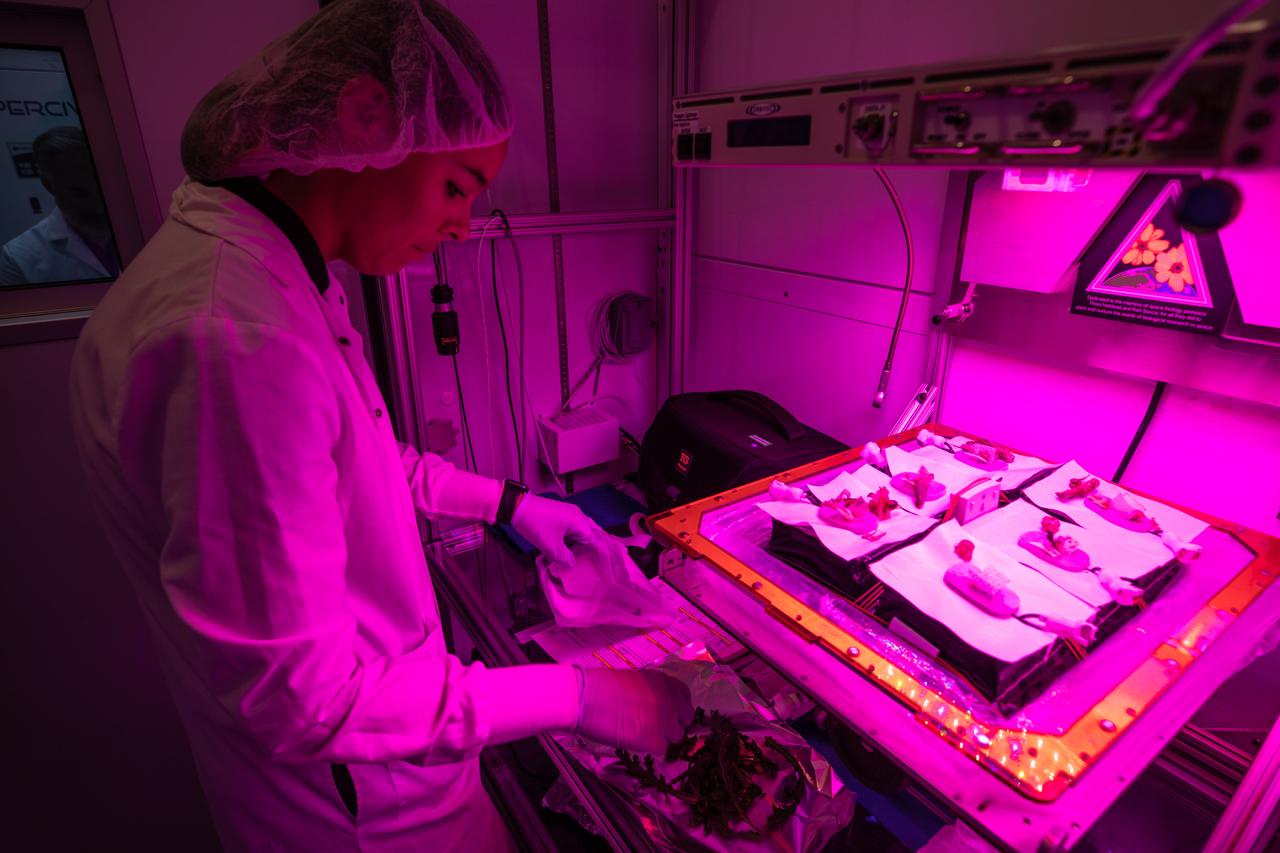
Kennedy Space Center employee Anna Maria Ruby harvests plant cultivars inside the Veggie growth chamber in the Space Station Processing Facility on Sept. 30, 2019, for a science verification test (SVT). This SVT will study the potential of three plants – amara mustard, ‘outredgeous’ red romaine lettuce and shungiku, an Asian green comparable to an edible chrysanthemum – to grow in space. All three lettuce plants were grown from seed film, making this the first SVT with this new plant growth material. Earlier this year, the amara mustard and shungiku plants were grown for the first time using seed bags – referred to as pillows – during the Sustained Veggie project, a study funded by the Human Research Program.
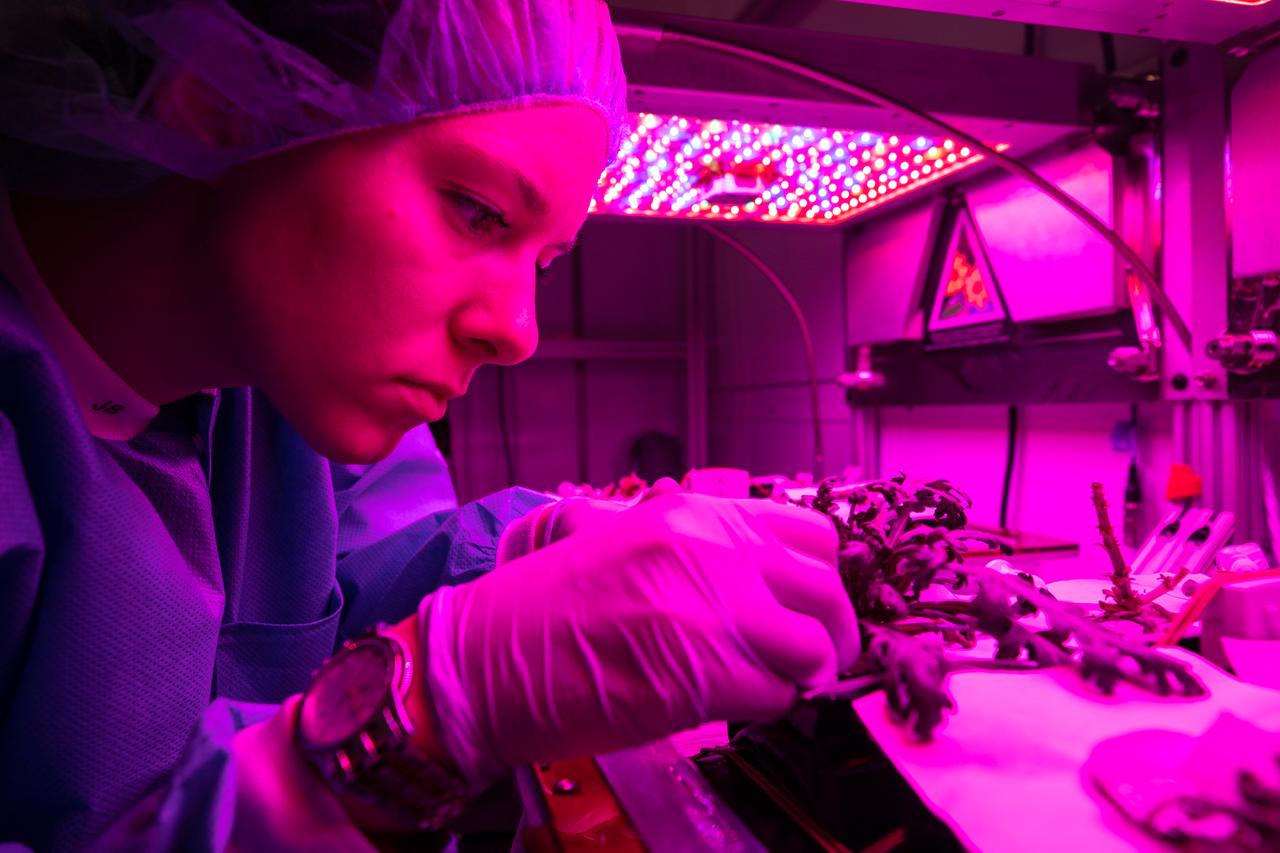
Jess Bunchek, an associate scientist at NASA’s Kennedy Space Center in Florida, harvests plant cultivars inside the Veggie growth chamber in the Space Station Processing Facility on Sept. 30, 2019, for a science verification test (SVT). This SVT will study the potential of three plants – amara mustard, ‘outredgeous’ red romaine lettuce and shungiku, an Asian green comparable to an edible chrysanthemum – to grow in space. All three lettuce plants were grown from seed film, making this the first SVT with this new plant growth material. Earlier this year, the amara mustard and shungiku plants were grown for the first time using seed bags – referred to as pillows – during the Sustained Veggie project, a study funded by the Human Research Program.
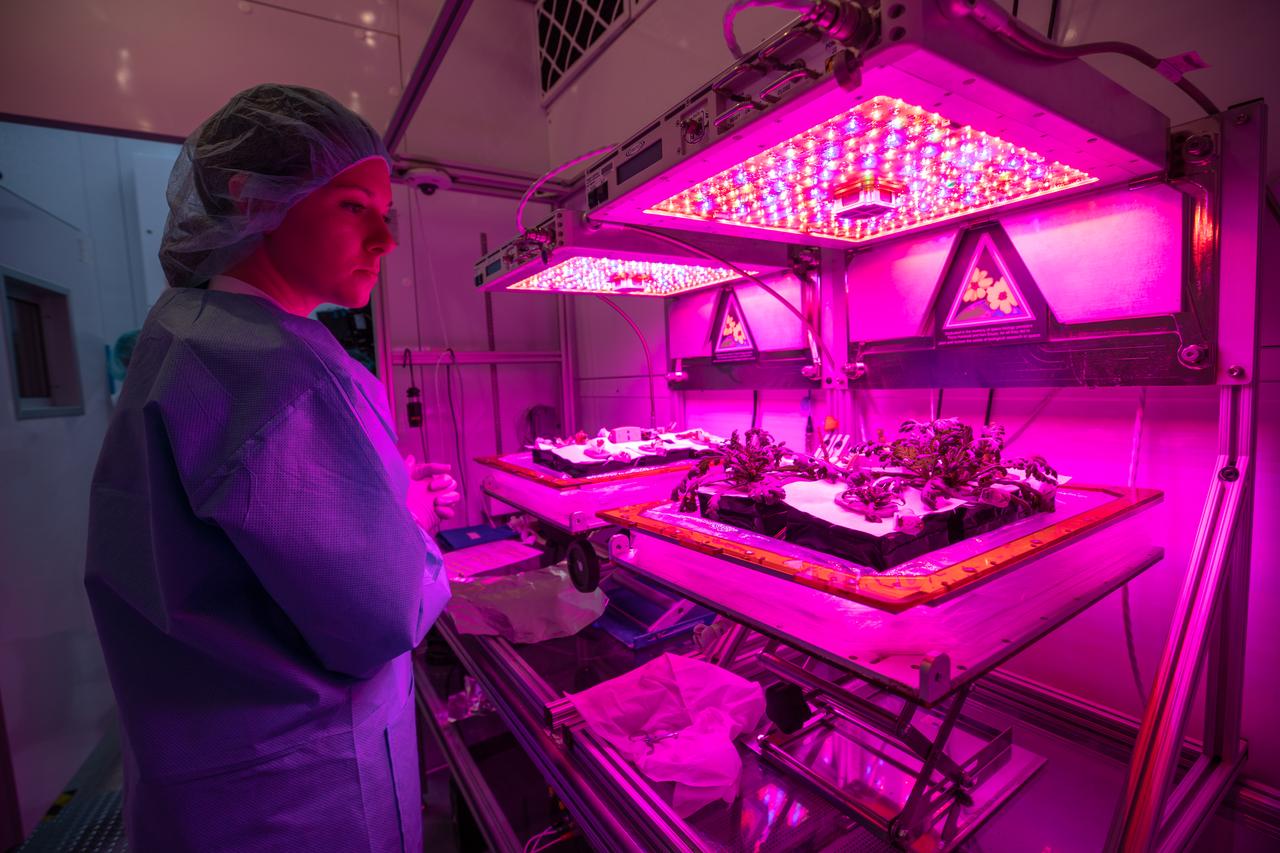
Jess Bunchek, an associate scientist at NASA’s Kennedy Space Center in Florida, observes plant cultivars inside the Veggie growth chamber in the Space Station Processing Facility prior to harvesting them on Sept. 30, 2019, for a science verification test (SVT). This SVT will study the potential of three plants – amara mustard, ‘outredgeous’ red romaine lettuce and shungiku, an Asian green comparable to an edible chrysanthemum – to grow in space. All three lettuce plants were grown from seed film, making this the first SVT with this new plant growth material. Earlier this year, the amara mustard and shungiku plants were grown for the first time using seed bags – referred to as pillows – during the Sustained Veggie project, a study funded by the Human Research Program.
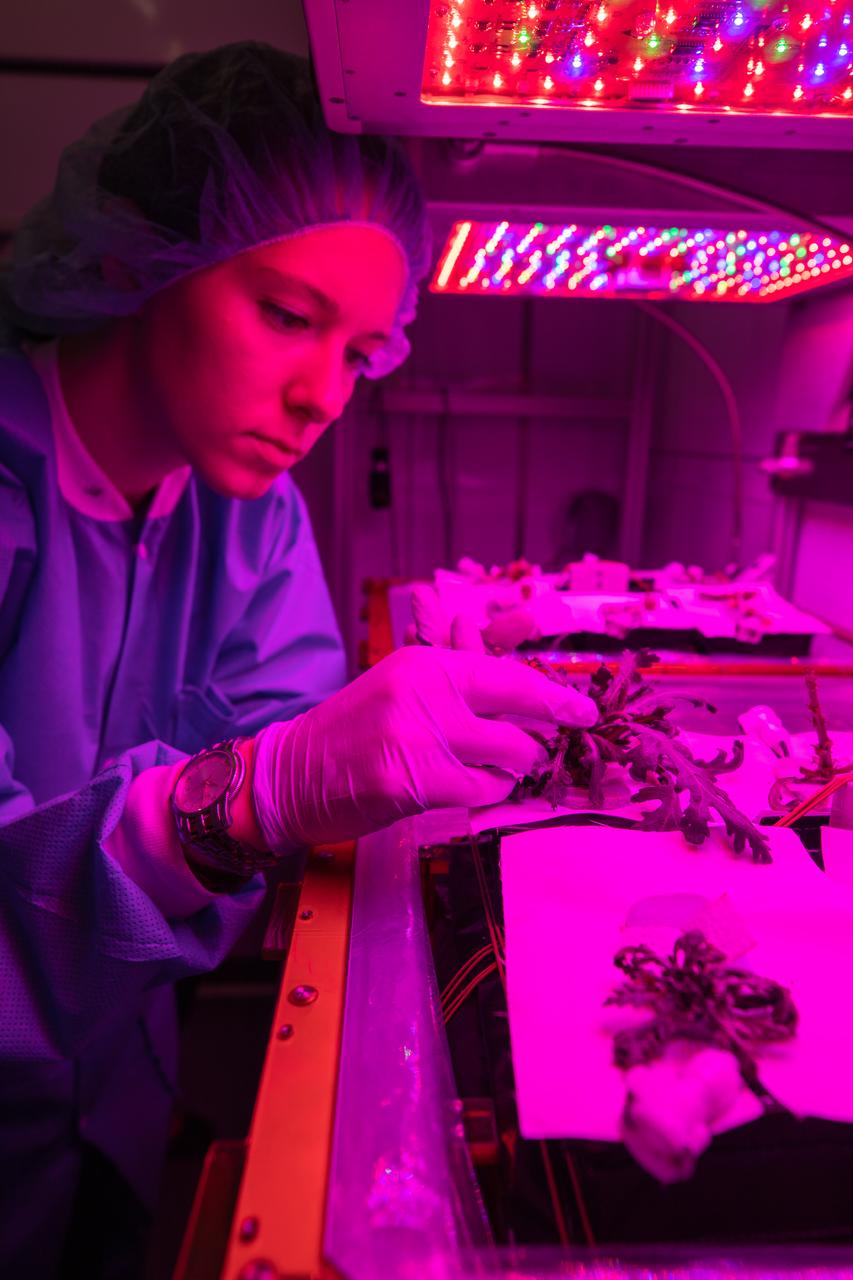
Jess Bunchek, an associate scientist at NASA’s Kennedy Space Center in Florida, harvests plant cultivars inside the Veggie growth chamber in the Space Station Processing Facility on Sept. 30, 2019, for a science verification test (SVT). This SVT will study the potential of three plants – amara mustard, ‘outredgeous’ red romaine lettuce and shungiku, an Asian green comparable to an edible chrysanthemum – to grow in space. All three lettuce plants were grown from seed film, making this the first SVT with this new plant growth material. Earlier this year, the amara mustard and shungiku plants were grown for the first time using seed bags – referred to as pillows – during the Sustained Veggie project, a study funded by the Human Research Program.
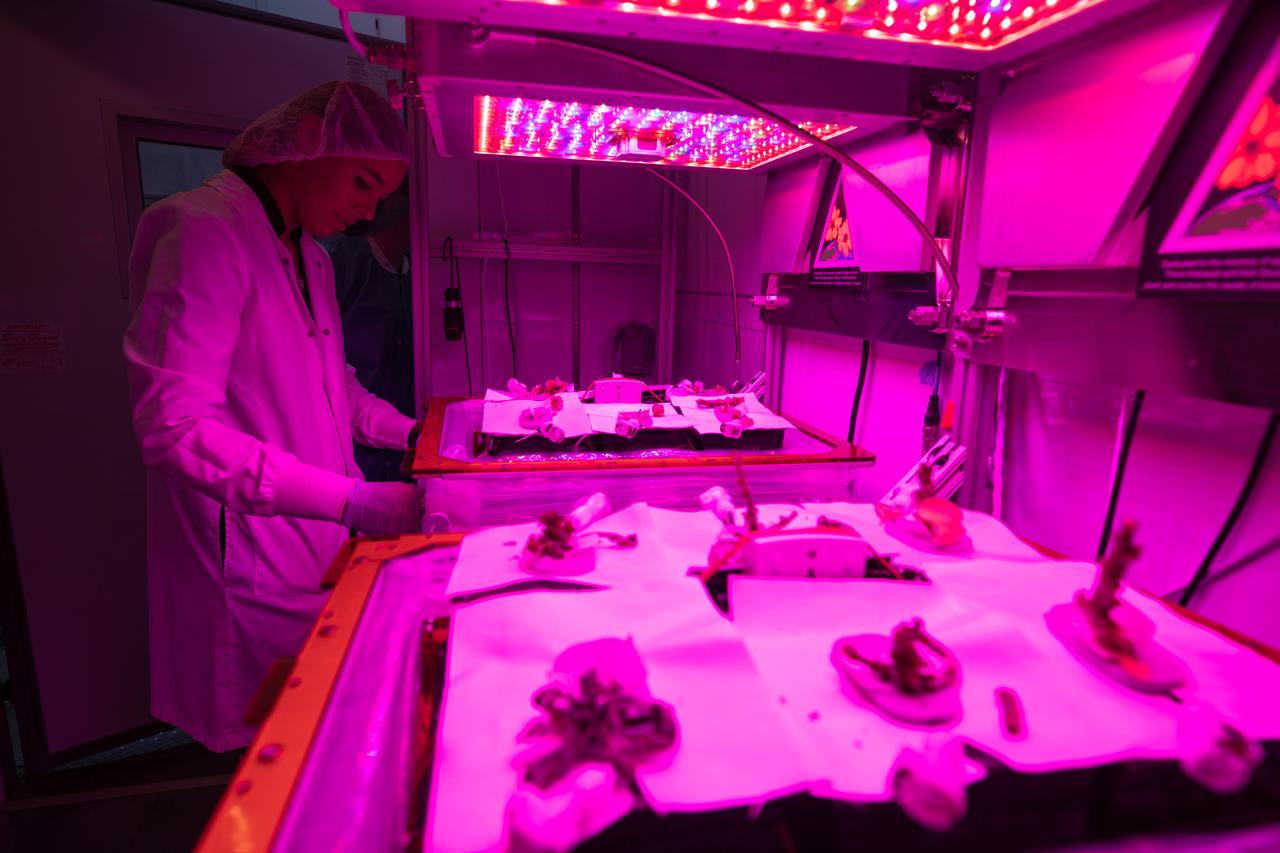
Kennedy Space Center employee Anna Maria Ruby observes plant cultivars inside the Veggie growth chamber in the Space Station Processing Facility prior to harvesting them on Sept. 30, 2019, for a science verification test (SVT). This SVT will study the potential of three plants – amara mustard, ‘outredgeous’ red romaine lettuce and shungiku, an Asian green comparable to an edible chrysanthemum – to grow in space. All three lettuce plants were grown from seed film, making this the first SVT with this new plant growth material. Earlier this year, the amara mustard and shungiku plants were grown for the first time using seed bags – referred to as pillows – during the Sustained Veggie project, a study funded by the Human Research Program.

Water and nutrients are being added to plants in the Veggie hardware in NASA Kennedy Space Center's ISS environment simulator chamber. Mizuna mustard, Outredgeous lettuce and Waldmann's green lettuce are growing in Veggie. Growth in the chamber mimics the growth of plant experiments in the Veggie plant growth system on the International Space Station.
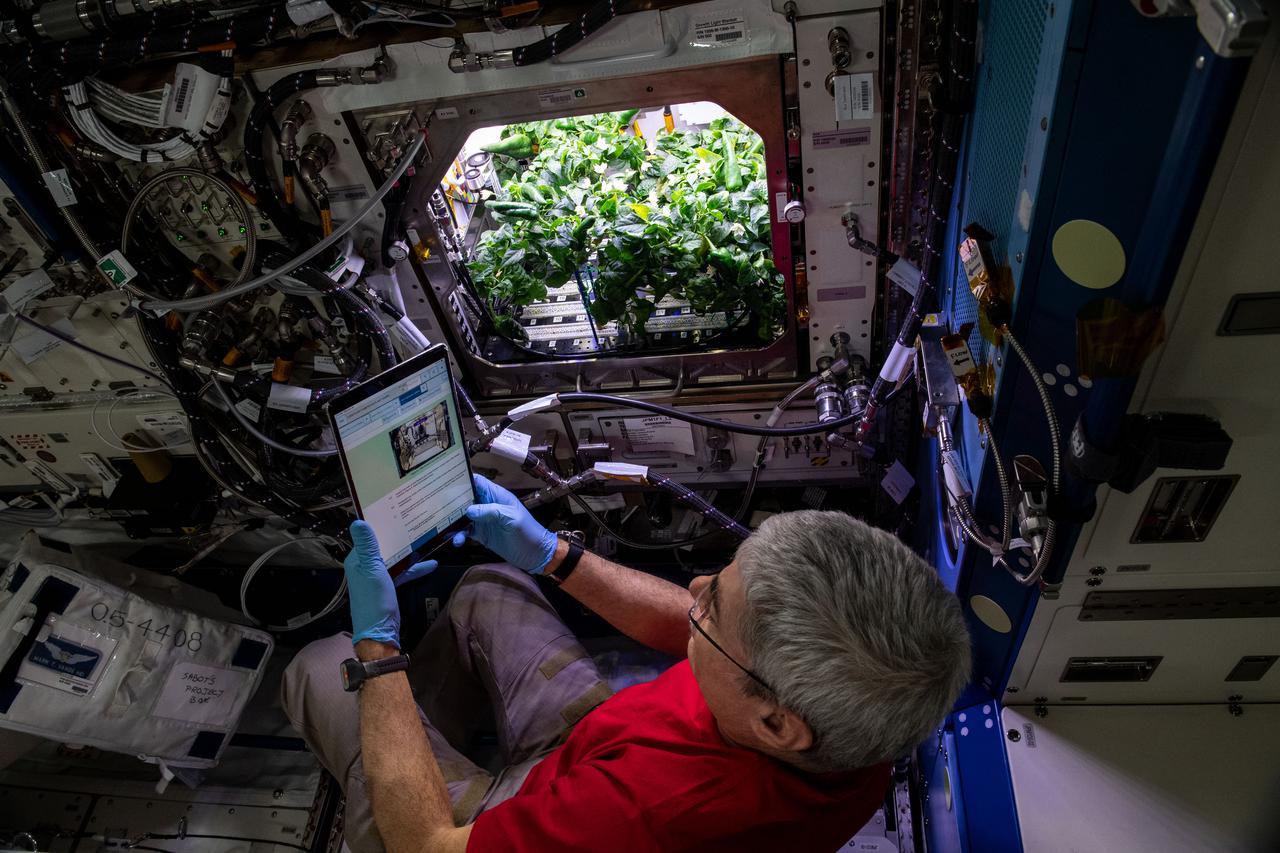
iss066e008125 (October 20, 2021) -- NASA astronaut and Expedition 65 Flight Engineer Mark Vande Hei prepares for the routine debris removal procedure for chile peppers growing in the Advanced Plant Habitat as part of the Plant Habit-04 experiment being conducted aboard the International Space Station. The chile pepper seeds started growing on July 12, 2021, and represent one of the longest and most challenging plant experiments attempted aboard the orbiting laboratory. They will be harvested twice, once in late October and again in late November. Astronauts will sanitize the peppers, eat part of their harvest, and return the rest to Earth for analysis. What we learn will inform future crop growth and food supplementation activities for deep space exploration.
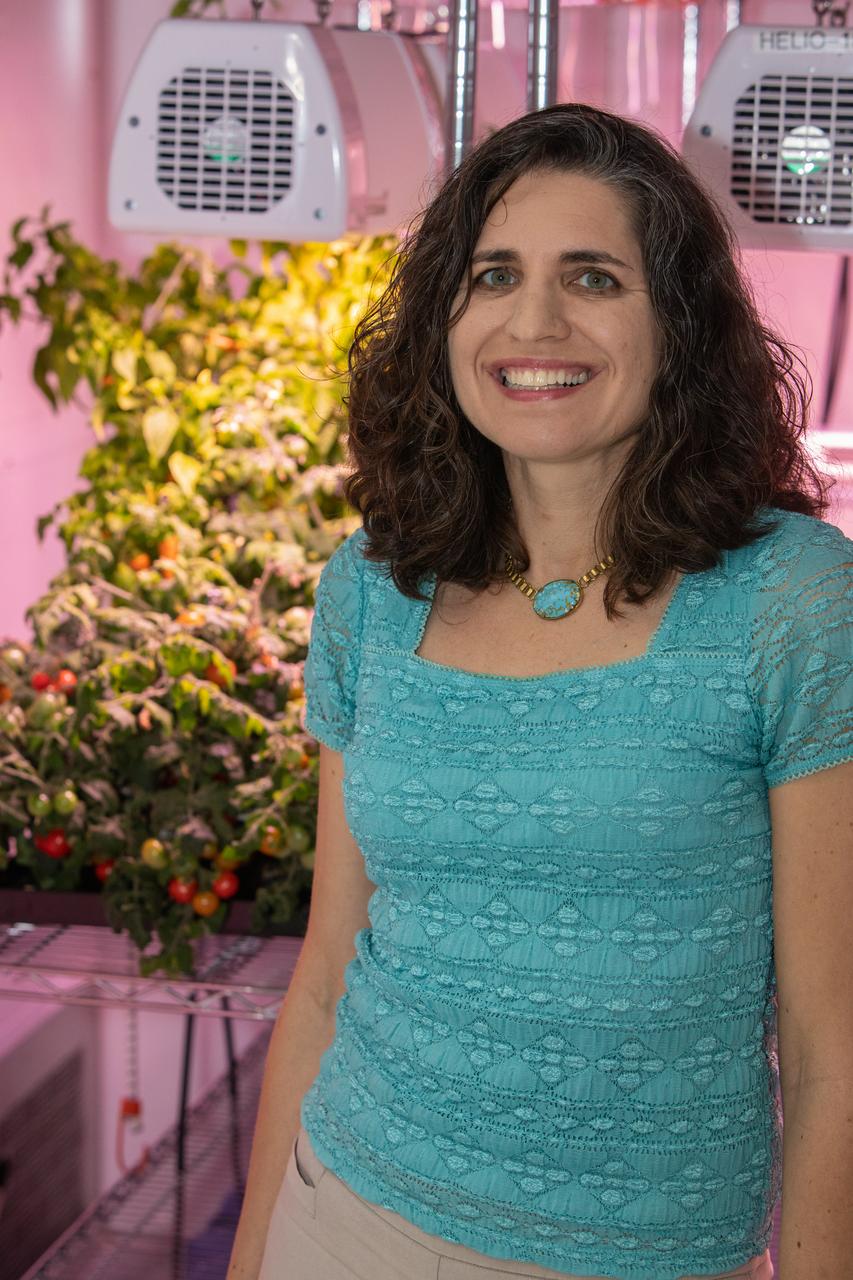
Gioia Massa, a NASA project scientist, poses inside a lab at the Space Station Processing Facility located at the agency’s Kennedy Space Center in Florida. Massa’s responsibilities include studying the effects of a microgravity environment on plant growth, discovering the perfect conditions for growing plants in space and determining what plant species grow the most effectively under those conditions. Massa and her team are currently experimenting with growing plants aboard the International Space Station to develop the knowhow to supplement astronauts’ packaged diets with freshly grown crops, which should facilitate long-duration exploration missions into deep space.
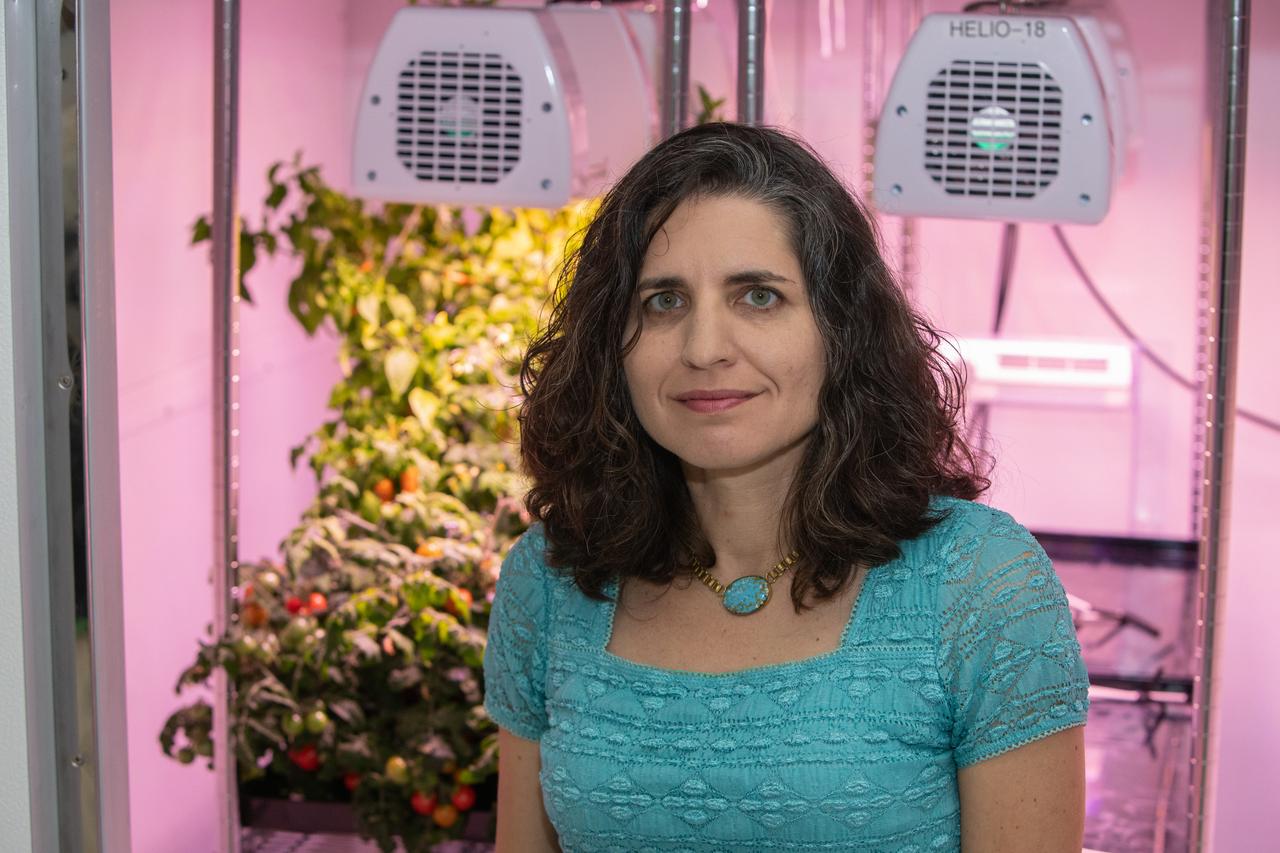
Gioia Massa, a NASA project scientist, poses inside a lab at the Space Station Processing Facility located at the agency’s Kennedy Space Center in Florida. Massa’s responsibilities include studying the effects of a microgravity environment on plant growth, discovering the perfect conditions for growing plants in space and determining what plant species grow the most effectively under those conditions. Massa and her team are currently experimenting with growing plants aboard the International Space Station to develop the knowhow to supplement astronauts’ packaged diets with freshly grown crops, which should facilitate long-duration exploration missions into deep space.

Arabidopsis thaliana plants are seen inside the growth chamber of the Advanced Plant Habitat (APH) Flight Unit No. 1 prior to harvest of half the plants. The harvest is part of an ongoing verification test of the APH unit, which is located inside the International Space Station Environmental Simulator in NASA Kennedy Space Center's Space Station Processing Facility. The APH undergoing testing at Kennedy is identical to one on the station and uses red, green and broad-spectrum white LED lights to grow plants in an environmentally controlled chamber. The seeds grown during the verification test will be grown on the station to help scientists understand how these plants adapt to spaceflight.
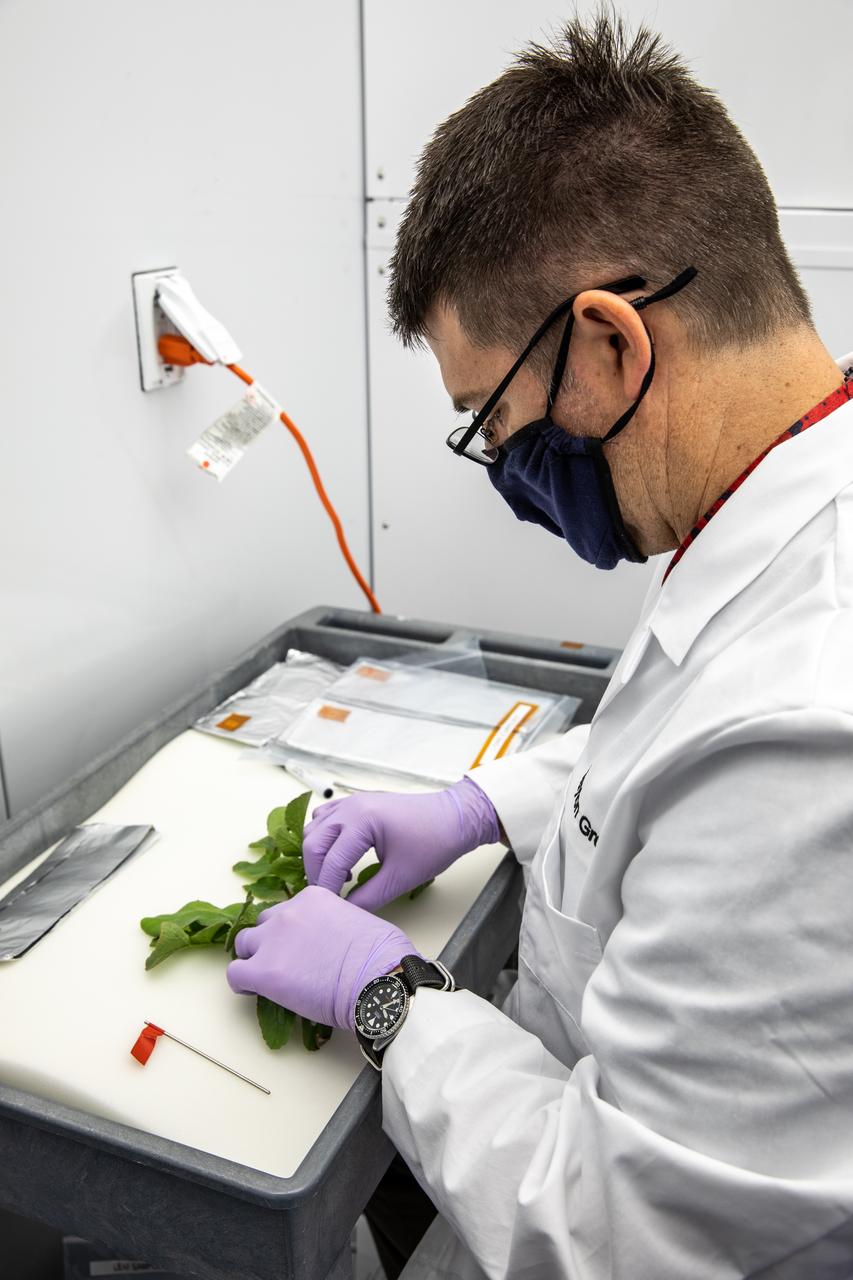
A research scientist collects measurements of radishes harvested from the Advanced Plant Habitat (APH) ground unit inside the Space Station Processing Facility at NASA’s Kennedy Space Center in Florida on Dec. 14, 2020. The radishes are a ground control crop for the Plant Habitat-02 (PH-02) experiment, which also involves growing two similar radish crops inside the International Space Station’s APH. NASA astronaut Kate Rubins harvested the first crop on Nov. 30, and the second harvest aboard the orbiting laboratory is planned for Dec. 30. Once samples return to Earth, researchers will compare those grown in space to the radishes grown here on Earth to better understand how microgravity affects plant growth.
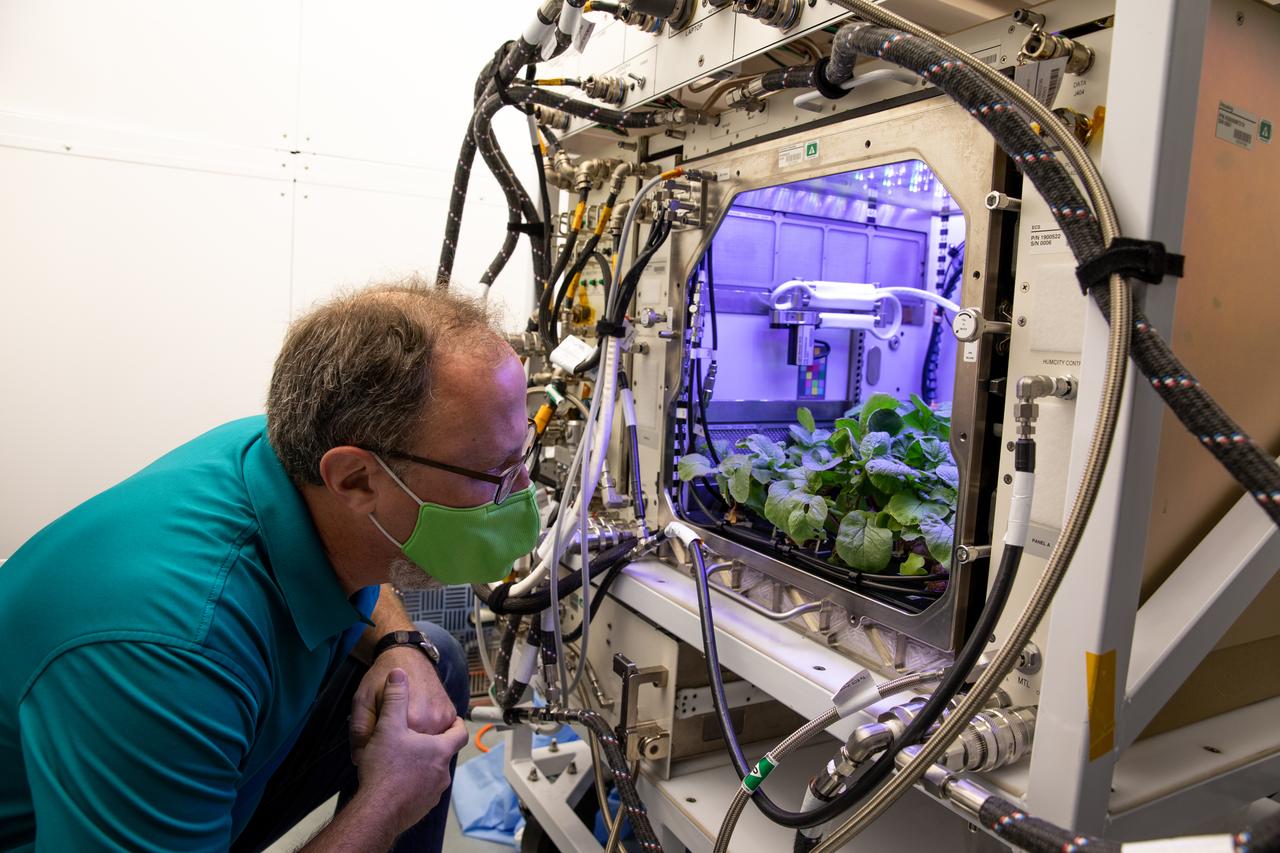
Dave Reed, Florida operations director for Techshot, Inc., observes radishes growing in the Advanced Plant Habitat (APH) ground unit inside the Space Station Processing Facility at NASA’s Kennedy Space Center in Florida on Dec. 14, 2020. The radishes are a ground control crop for the Plant Habitat-02 (PH-02) experiment, which also involves growing two similar radish crops inside the International Space Station’s APH. NASA astronaut Kate Rubins harvested the first crop on Nov. 30, and the second harvest aboard the orbiting laboratory is planned for Dec. 30. Once samples return to Earth, researchers will compare those grown in space to the radishes grown here on Earth to better understand how microgravity affects plant growth.
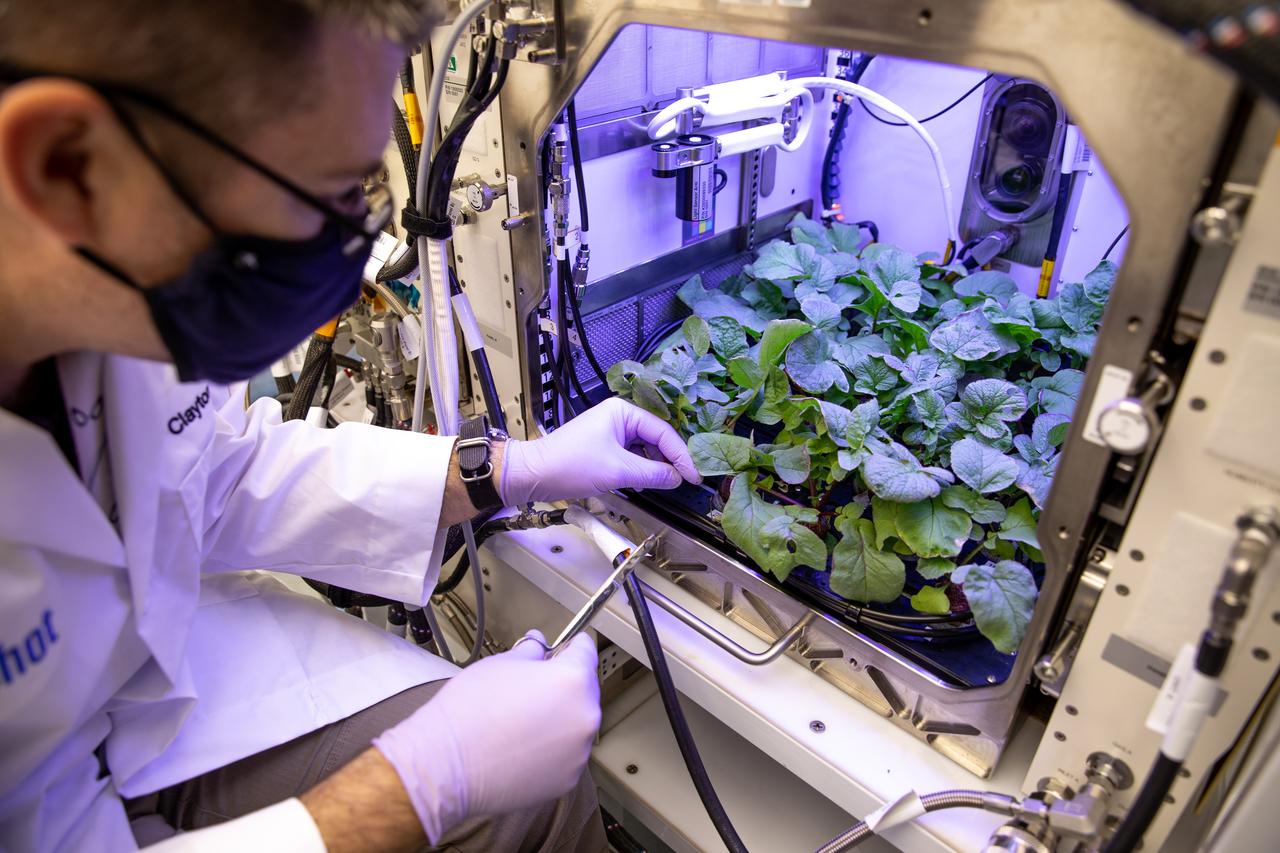
A research scientist harvests radishes grown in the Advanced Plant Habitat (APH) ground unit inside the Space Station Processing Facility at NASA’s Kennedy Space Center in Florida on Dec. 14, 2020. The radishes are a ground control crop for the Plant Habitat-02 (PH-02) experiment. The experiment also involves growing two similar radish crops inside the International Space Station’s APH. NASA astronaut Kate Rubins harvested the first crop on Nov. 30, and the second harvest aboard the orbiting laboratory is planned for Dec. 30. Once samples return to Earth, researchers will compare those grown in space to the radishes grown here on Earth to better understand how microgravity affects plant growth.

A researcher takes measurements of a radish crop harvested from the Advanced Plant Habitat (APH) ground unit inside the Space Station Processing Facility at NASA’s Kennedy Space Center in Florida on Dec. 14, 2020. The radishes are a ground control crop for the Plant Habitat-02 (PH-02) experiment, which also involves growing two similar radish crops inside the International Space Station’s APH. NASA astronaut Kate Rubins harvested the first crop on Nov. 30, and the second harvest aboard the orbiting laboratory is planned for Dec. 30. Once samples return to Earth, researchers will compare those grown in space to the radishes grown here on Earth to better understand how microgravity affects plant growth.
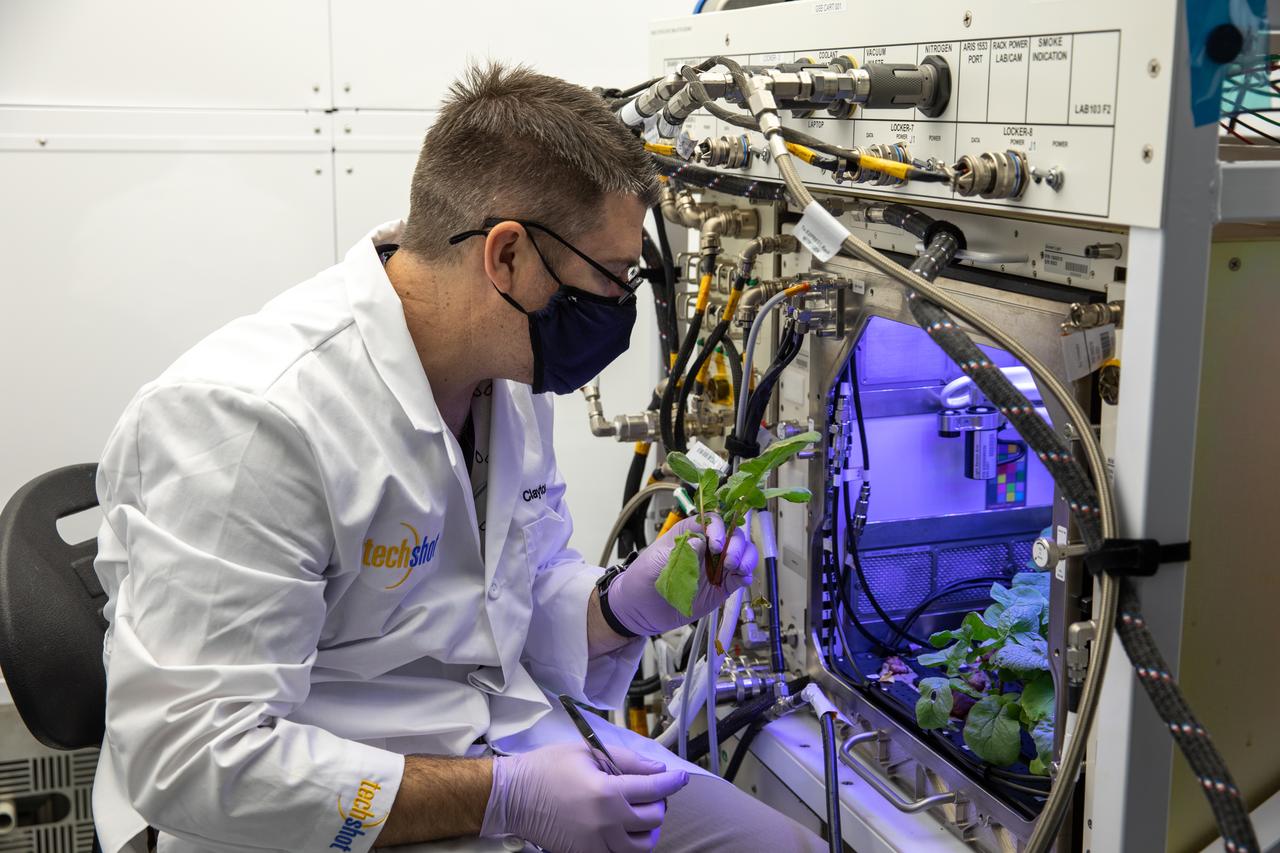
A research scientist harvests radishes grown in the Advanced Plant Habitat (APH) ground unit inside the Space Station Processing Facility at NASA’s Kennedy Space Center in Florida on Dec. 14, 2020. The radishes are a ground control crop for the Plant Habitat-02 (PH-02) experiment. The experiment also involves growing two similar radish crops inside the International Space Station’s APH. NASA astronaut Kate Rubins harvested the first crop on Nov. 30, and the second harvest aboard the orbiting laboratory is planned for Dec. 30. Once samples return to Earth, researchers will compare those grown in space to the radishes grown here on Earth to better understand how microgravity affects plant growth.
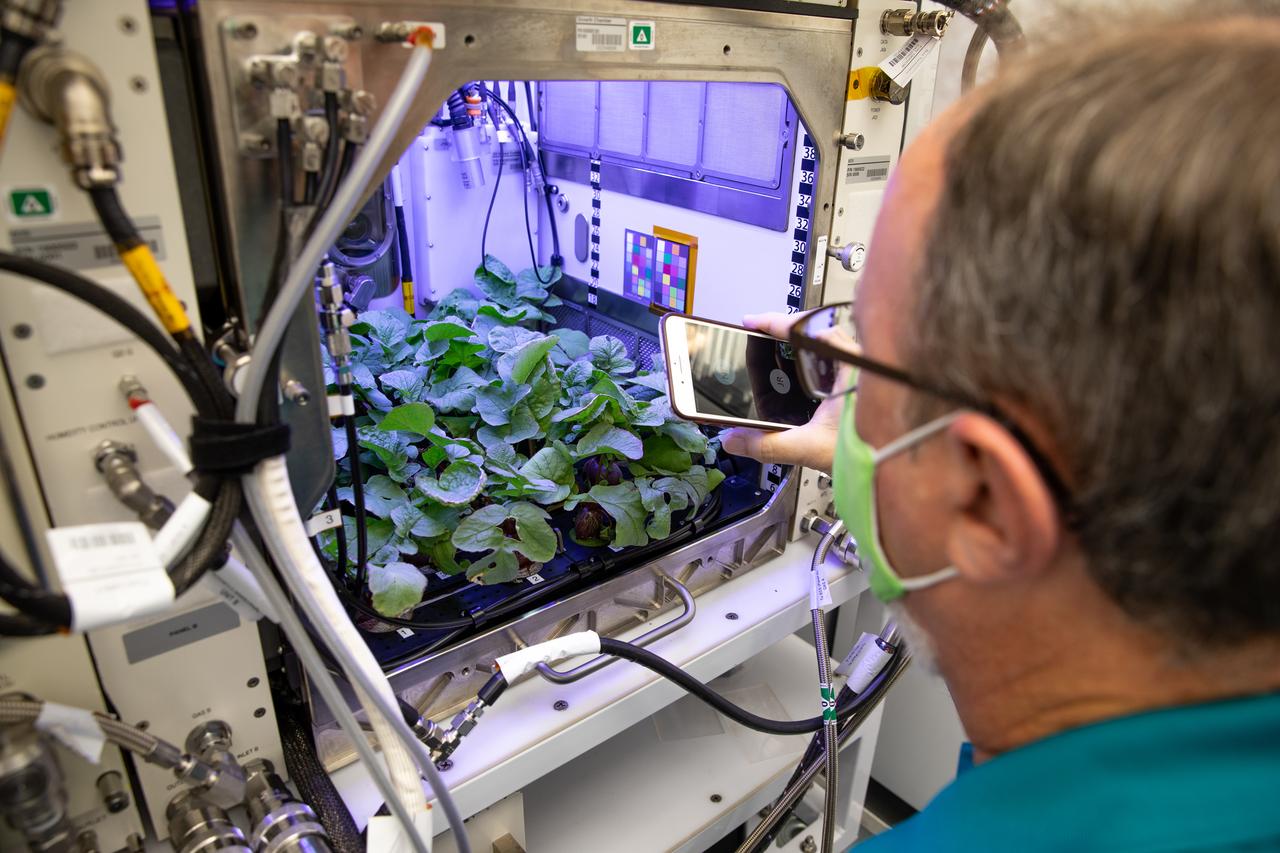
Dave Reed, Florida operations director for Techshot, Inc., observes radishes growing in the Advanced Plant Habitat (APH) ground unit inside the Space Station Processing Facility at NASA’s Kennedy Space Center in Florida on Dec. 14, 2020. The radishes are a ground control crop for the Plant Habitat-02 (PH-02) experiment. The experiment also involves growing two similar radish crops inside the International Space Station’s APH. NASA astronaut Kate Rubins harvested the first crop on Nov. 30, and the second harvest aboard the orbiting laboratory is planned for Dec. 30. Once samples return to Earth, researchers will compare those grown in space to the radishes grown here on Earth to better understand how microgravity affects plant growth.
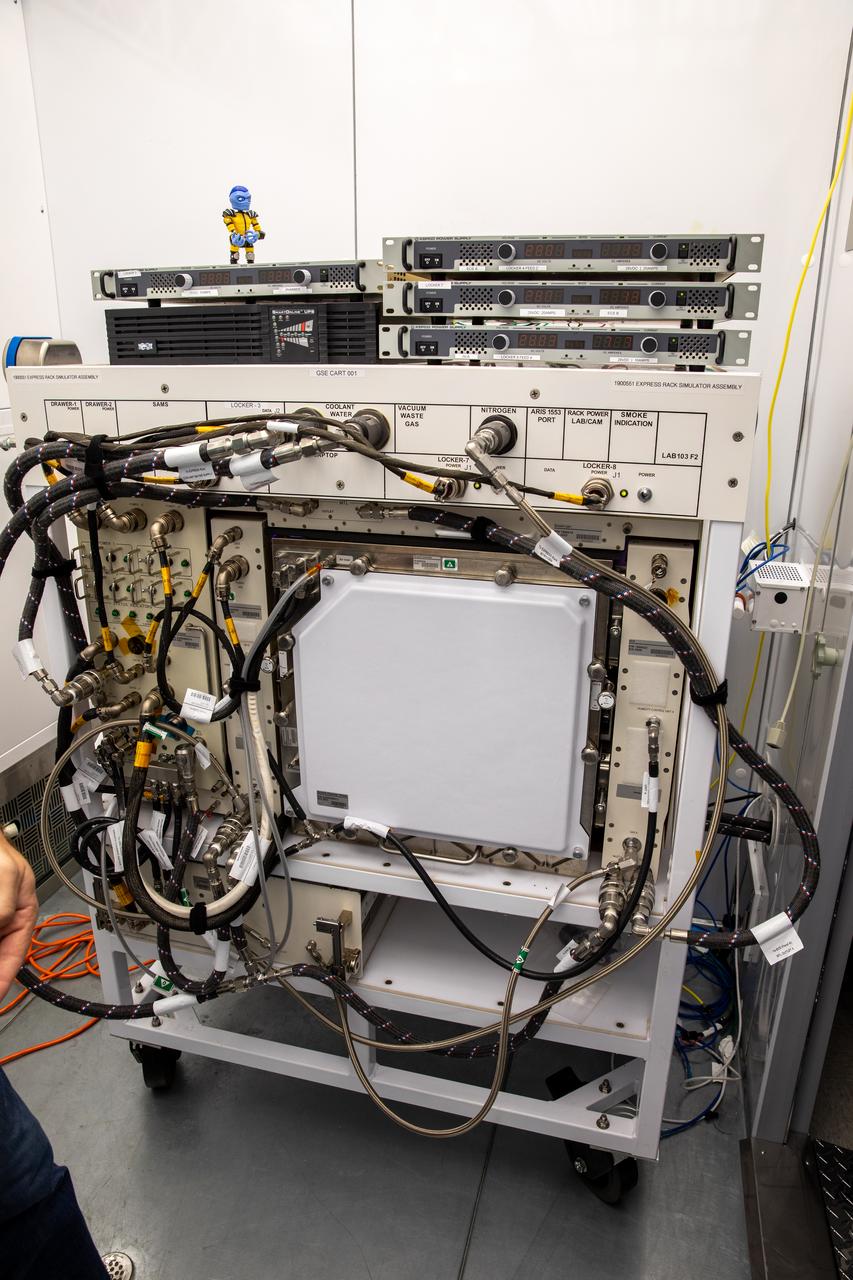
In view is the Advanced Plant Habitat (APH) ground unit inside the Space Station Processing Facility at NASA’s Kennedy Space Center in Florida on Dec. 14, 2020. Part of the Plant Habitat-02 (PH-02) experiment, a ground control crop of radishes was grown at Kennedy and harvested on Dec. 14. The experiment also involves growing two similar radish crops inside the International Space Station’s APH. NASA astronaut Kate Rubins harvested the first crop on Nov. 30, and the second harvest aboard the orbiting laboratory is planned for Dec. 30. Once samples return to Earth, researchers will compare those grown in space to the radishes grown here on Earth to better understand how microgravity affects plant growth.

Lashelle Spencer, plant scientist with the Laboratory Support Services and Operations (LASSO) contract at NASA’s Kennedy Space Center in Florida, takes measurements on ‘Red Robin’ dwarf tomato plants, Jan. 10, 2020, inside a laboratory in the spaceport’s Space Station Processing Facility. The tomatoes are growing from seeds that have been exposed to simulated solar particle radiation. The plants’ edible mass and nutrients will be measured and compared to those of a control crop, grown from non-irradiated seeds. The project was designed to confirm that nutritious, high-quality produce can be reliably grown in deep space, or to provide a baseline to guide development of countermeasures to protect future crop foods from radiation during missions beyond low-Earth orbit. The investigation on space radiation impact on seeds and crop production also will be carried on the Materials International Space Station Experiment (MISSE) platform outside the station, supported NASA’s Space Technology Mission Directorate and the Space Biology Program, and potentially on future beyond-low-Earth platforms.
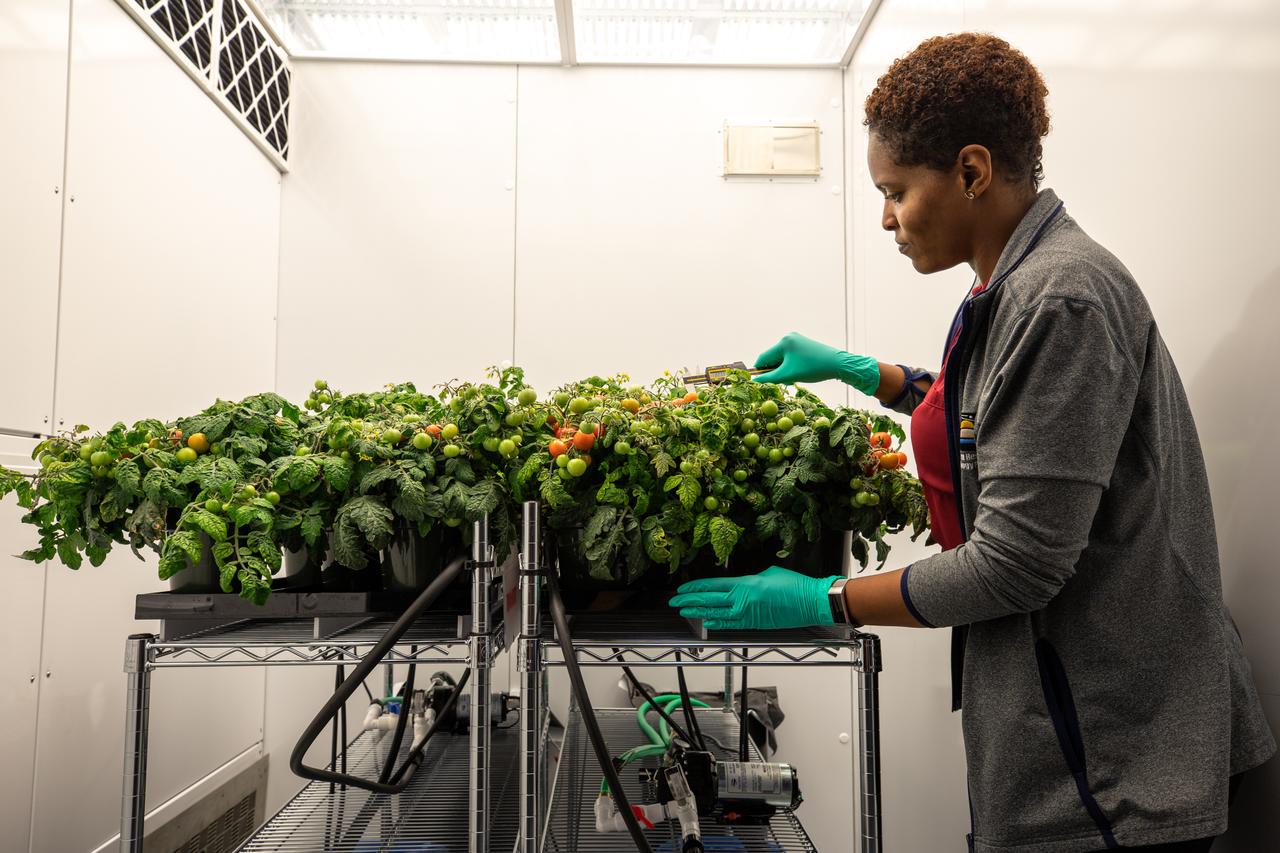
Lashelle Spencer, plant scientist with the Laboratory Support Services and Operations (LASSO) contract at NASA’s Kennedy Space Center in Florida, takes measurements on ‘Red Robin’ dwarf tomato plants, Jan. 10, 2020, inside a laboratory in the spaceport’s Space Station Processing Facility. The tomatoes are growing from seeds that have been exposed to simulated solar particle radiation. The plants’ edible mass and nutrients will be measured and compared to those of a control crop, grown from non-irradiated seeds. The project was designed to confirm that nutritious, high-quality produce can be reliably grown in deep space, or to provide a baseline to guide development of countermeasures to protect future crop foods from radiation during missions beyond low-Earth orbit. The investigation on space radiation impact on seeds and crop production also will be carried on the Materials International Space Station Experiment (MISSE) platform outside the station, supported NASA’s Space Technology Mission Directorate and the Space Biology Program, and potentially on future beyond-low-Earth platforms.
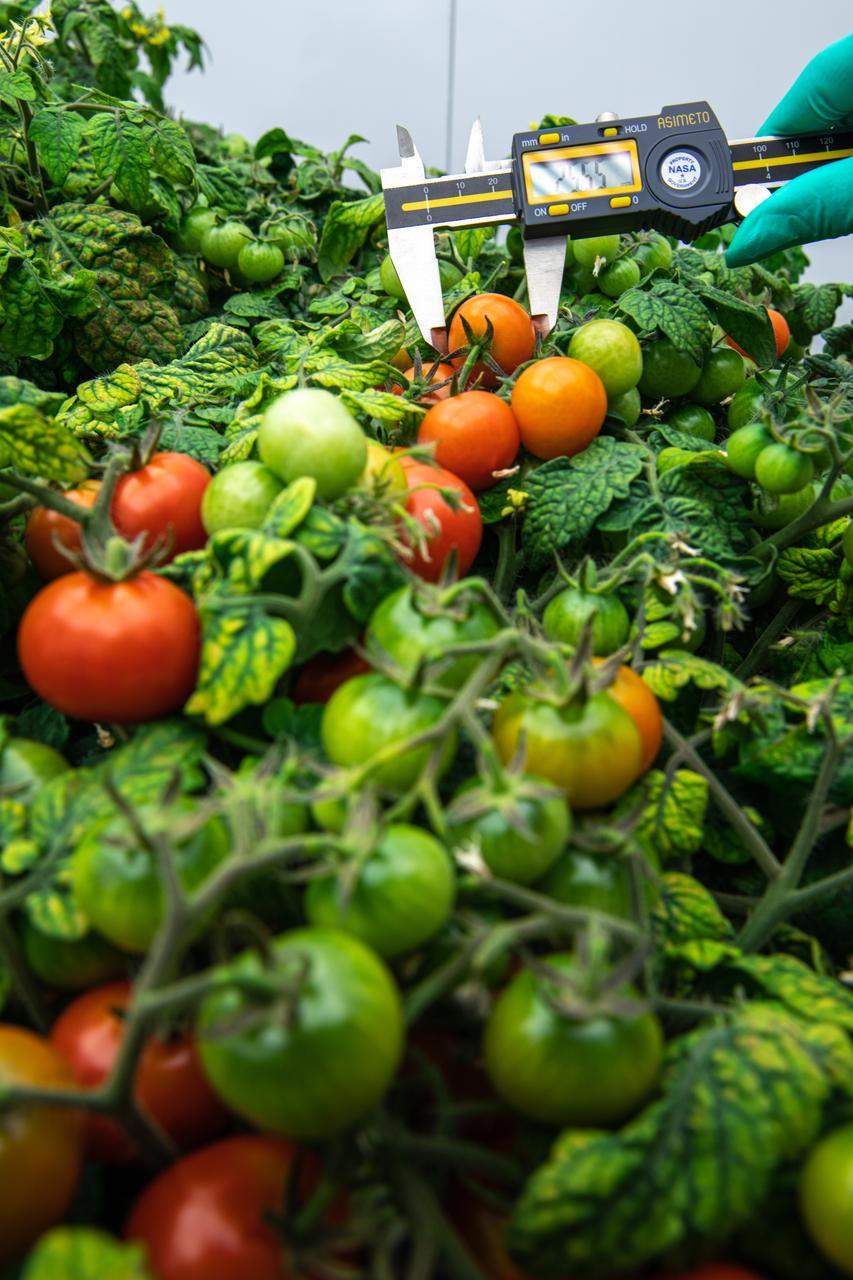
Lashelle Spencer, plant scientist with the Laboratory Support Services and Operations (LASSO) contract at NASA’s Kennedy Space Center in Florida, takes measurements on ‘Red Robin’ dwarf tomato plants, Jan. 10, 2020, inside a laboratory in the spaceport’s Space Station Processing Facility. The tomatoes are growing from seeds that have been exposed to simulated solar particle radiation. The plants’ edible mass and nutrients will be measured and compared to those of a control crop, grown from non-irradiated seeds. The project was designed to confirm that nutritious, high-quality produce can be reliably grown in deep space, or to provide a baseline to guide development of countermeasures to protect future crop foods from radiation during missions beyond low-Earth orbit. The investigation on space radiation impact on seeds and crop production also will be carried on the Materials International Space Station Experiment (MISSE) platform outside the station, supported NASA’s Space Technology Mission Directorate and the Space Biology Program, and potentially on future beyond-low-Earth platforms.
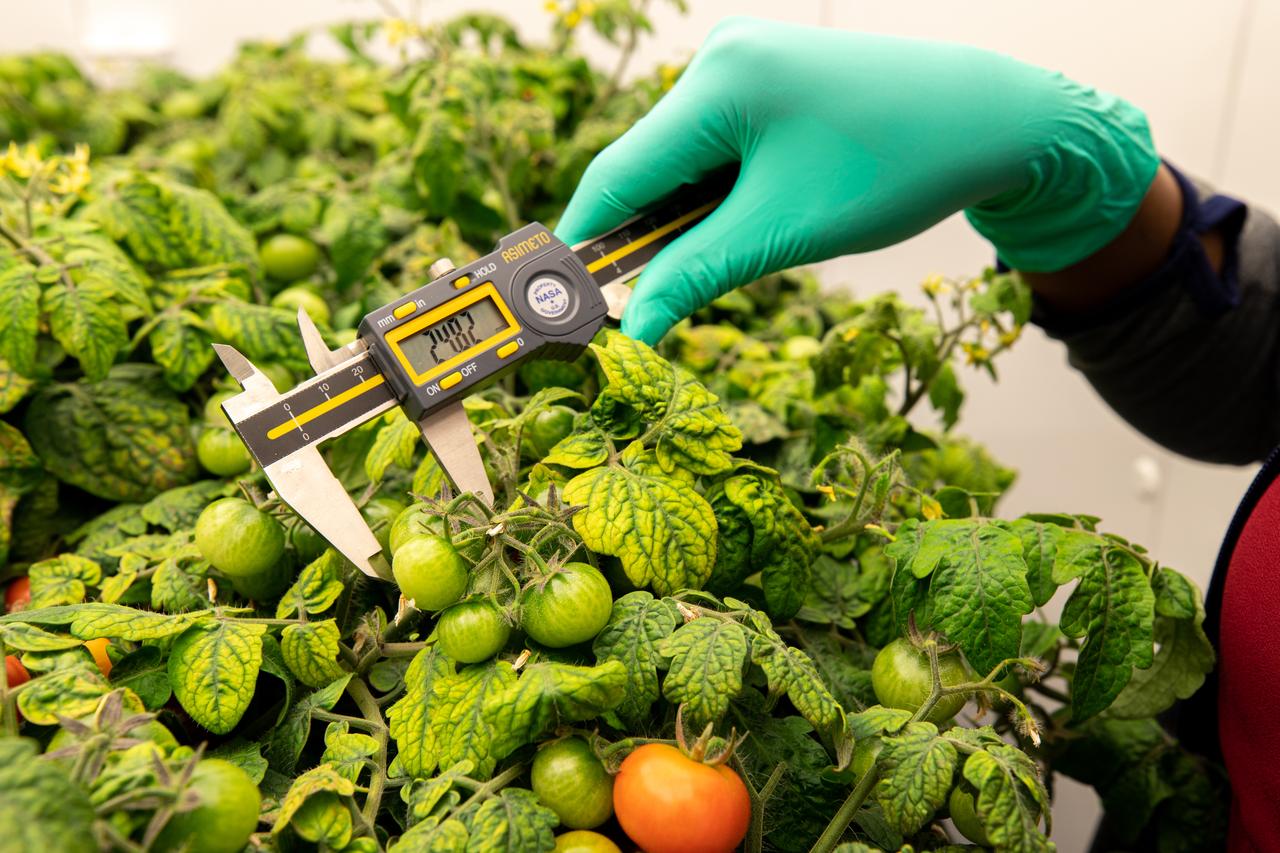
Lashelle Spencer, plant scientist with the Laboratory Support Services and Operations (LASSO) contract at NASA’s Kennedy Space Center in Florida, takes measurements on ‘Red Robin’ dwarf tomato plants, Jan. 10, 2020, inside a laboratory in the spaceport’s Space Station Processing Facility. The tomatoes are growing from seeds that have been exposed to simulated solar particle radiation. The plants’ edible mass and nutrients will be measured and compared to those of a control crop, grown from non-irradiated seeds. The project was designed to confirm that nutritious, high-quality produce can be reliably grown in deep space, or to provide a baseline to guide development of countermeasures to protect future crop foods from radiation during missions beyond low-Earth orbit. The investigation on space radiation impact on seeds and crop production also will be carried on the Materials International Space Station Experiment (MISSE) platform outside the station, supported NASA’s Space Technology Mission Directorate and the Space Biology Program, and potentially on future beyond-low-Earth platforms.

Lashelle Spencer, plant scientist with the Laboratory Support Services and Operations (LASSO) contract at NASA’s Kennedy Space Center in Florida, takes measurements on ‘Red Robin’ dwarf tomato plants, Jan. 10, 2020, inside a laboratory in the spaceport’s Space Station Processing Facility. The tomatoes are growing from seeds that have been exposed to simulated solar particle radiation. The plants’ edible mass and nutrients will be measured and compared to those of a control crop, grown from non-irradiated seeds. The project was designed to confirm that nutritious, high-quality produce can be reliably grown in deep space, or to provide a baseline to guide development of countermeasures to protect future crop foods from radiation during missions beyond low-Earth orbit. The investigation on space radiation impact on seeds and crop production also will be carried on the Materials International Space Station Experiment (MISSE) platform outside the station, supported NASA’s Space Technology Mission Directorate and the Space Biology Program, and potentially on future beyond-low-Earth platforms.
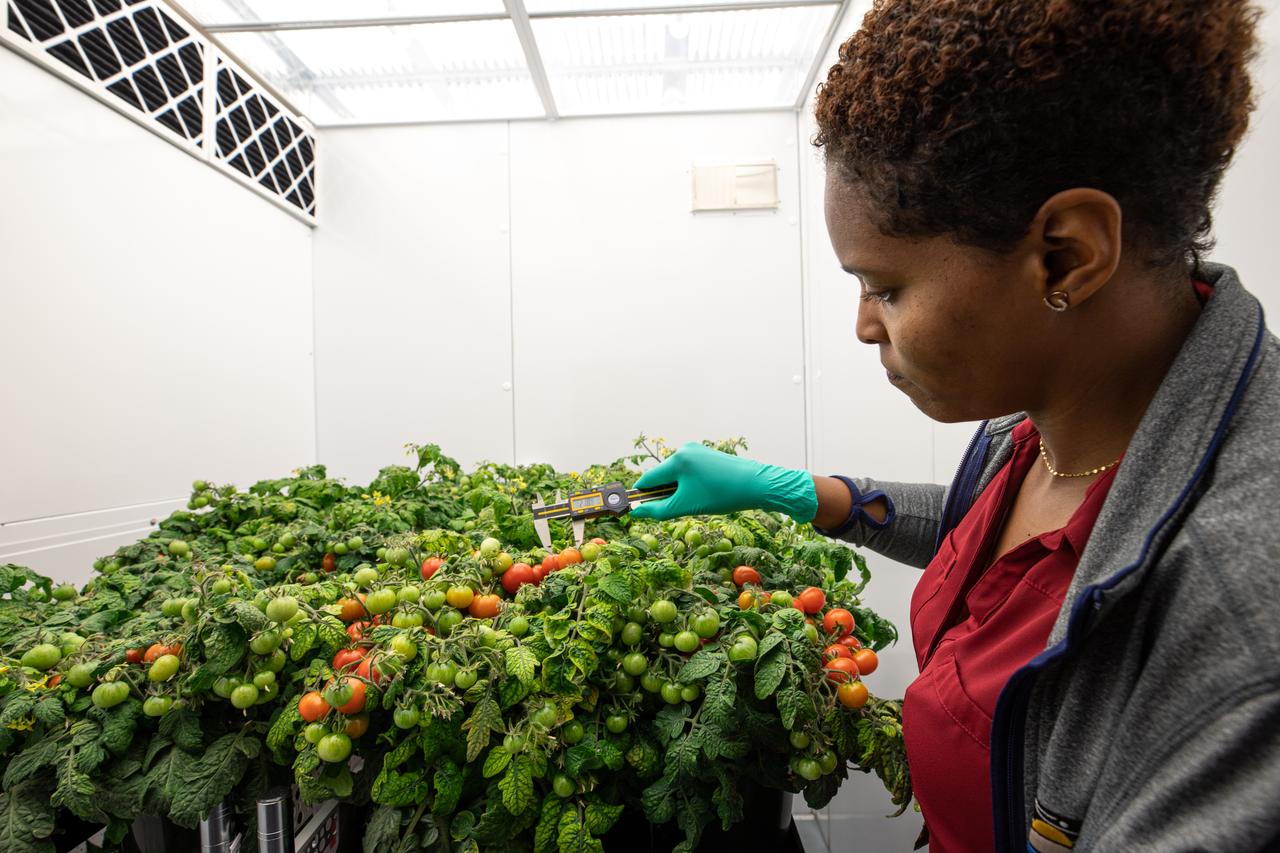
Lashelle Spencer, plant scientist with the Laboratory Support Services and Operations (LASSO) contract at NASA’s Kennedy Space Center in Florida, takes measurements on ‘Red Robin’ dwarf tomato plants, Jan. 10, 2020, inside a laboratory in the spaceport’s Space Station Processing Facility. The tomatoes are growing from seeds that have been exposed to simulated solar particle radiation. The plants’ edible mass and nutrients will be measured and compared to those of a control crop, grown from non-irradiated seeds. The project was designed to confirm that nutritious, high-quality produce can be reliably grown in deep space, or to provide a baseline to guide development of countermeasures to protect future crop foods from radiation during missions beyond low-Earth orbit. The investigation on space radiation impact on seeds and crop production also will be carried on the Materials International Space Station Experiment (MISSE) platform outside the station, supported NASA’s Space Technology Mission Directorate and the Space Biology Program, and potentially on future beyond-low-Earth platforms.
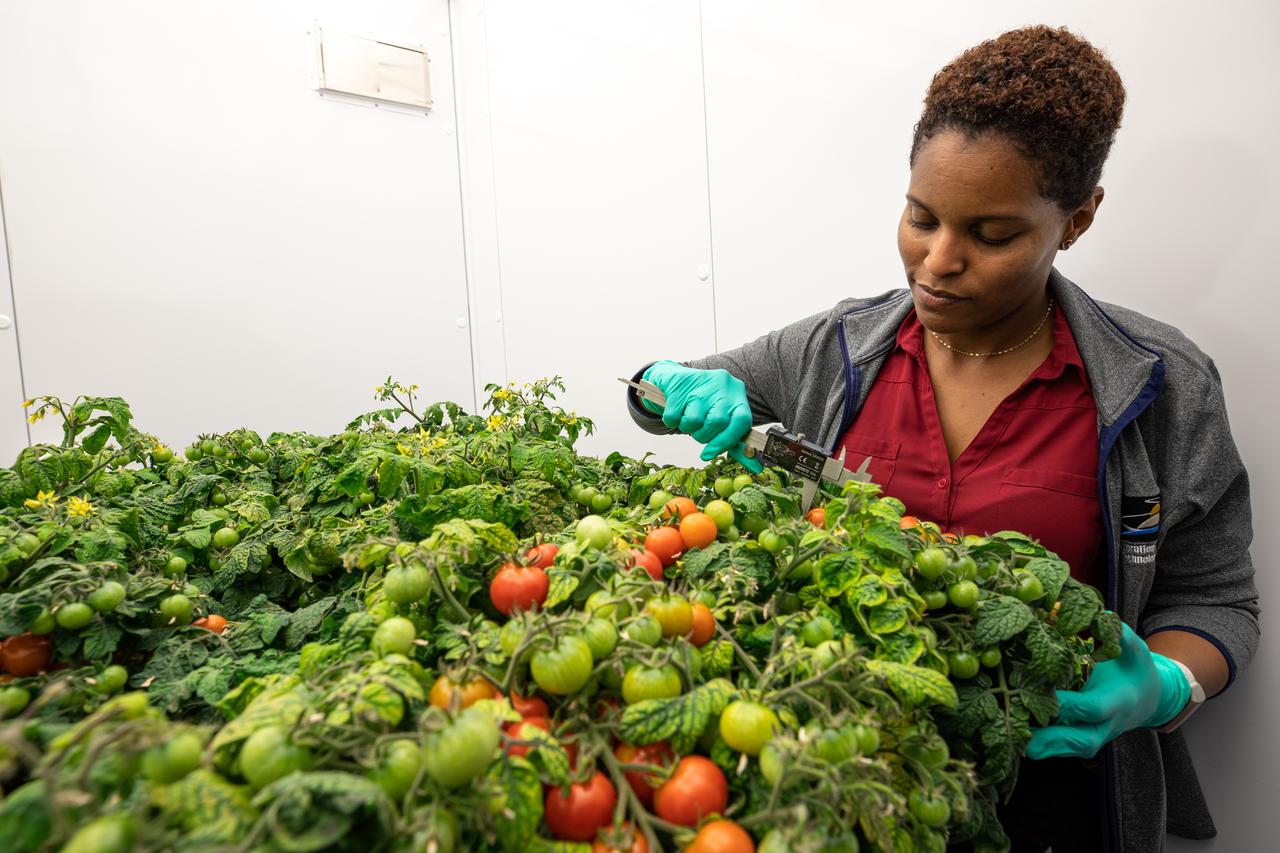
Lashelle Spencer, plant scientist with the Laboratory Support Services and Operations (LASSO) contract at NASA’s Kennedy Space Center in Florida, takes measurements on ‘Red Robin’ dwarf tomato plants, Jan. 10, 2020, inside a laboratory in the spaceport’s Space Station Processing Facility. The tomatoes are growing from seeds that have been exposed to simulated solar particle radiation. The plants’ edible mass and nutrients will be measured and compared to those of a control crop, grown from non-irradiated seeds. The project was designed to confirm that nutritious, high-quality produce can be reliably grown in deep space, or to provide a baseline to guide development of countermeasures to protect future crop foods from radiation during missions beyond low-Earth orbit. The investigation on space radiation impact on seeds and crop production also will be carried on the Materials International Space Station Experiment (MISSE) platform outside the station, supported NASA’s Space Technology Mission Directorate and the Space Biology Program, and potentially on future beyond-low-Earth platforms.
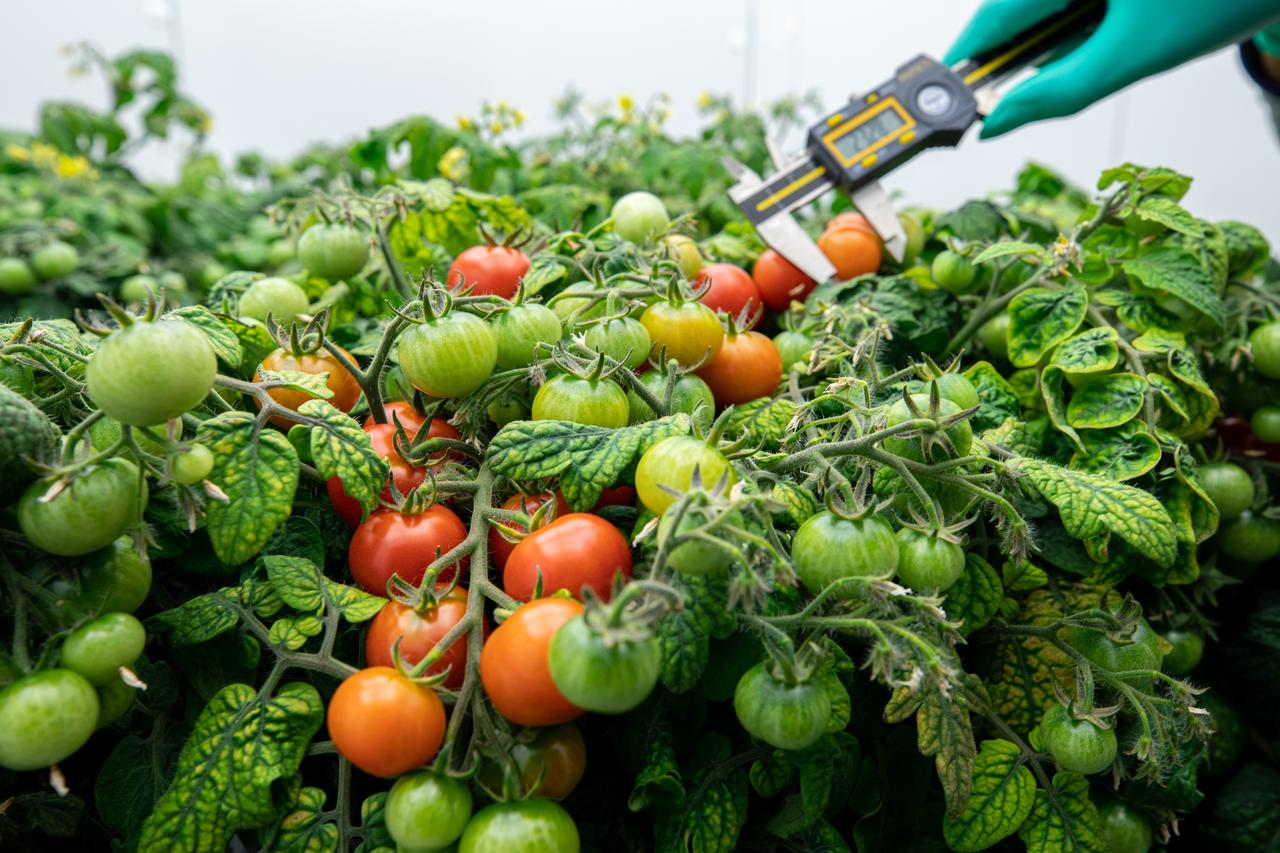
Lashelle Spencer, plant scientist with the Laboratory Support Services and Operations (LASSO) contract at NASA’s Kennedy Space Center in Florida, takes measurements on ‘Red Robin’ dwarf tomato plants, Jan. 10, 2020, inside a laboratory in the spaceport’s Space Station Processing Facility. The tomatoes are growing from seeds that have been exposed to simulated solar particle radiation. The plants’ edible mass and nutrients will be measured and compared to those of a control crop, grown from non-irradiated seeds. The project was designed to confirm that nutritious, high-quality produce can be reliably grown in deep space, or to provide a baseline to guide development of countermeasures to protect future crop foods from radiation during missions beyond low-Earth orbit. The investigation on space radiation impact on seeds and crop production also will be carried on the Materials International Space Station Experiment (MISSE) platform outside the station, supported NASA’s Space Technology Mission Directorate and the Space Biology Program, and potentially on future beyond-low-Earth platforms.
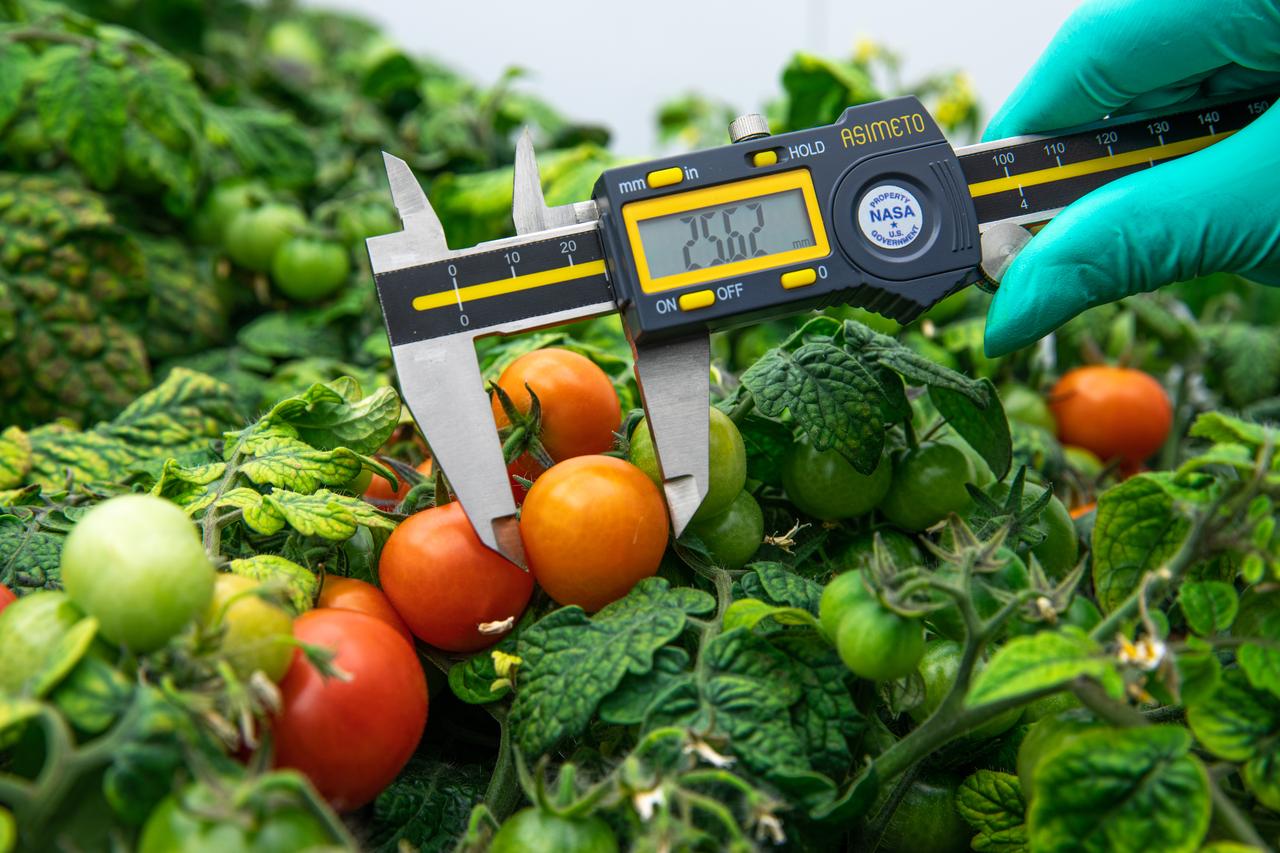
Lashelle Spencer, plant scientist with the Laboratory Support Services and Operations (LASSO) contract at NASA’s Kennedy Space Center in Florida, takes measurements on ‘Red Robin’ dwarf tomato plants, Jan. 10, 2020, inside a laboratory in the spaceport’s Space Station Processing Facility. The tomatoes are growing from seeds that have been exposed to simulated solar particle radiation. The plants’ edible mass and nutrients will be measured and compared to those of a control crop, grown from non-irradiated seeds. The project was designed to confirm that nutritious, high-quality produce can be reliably grown in deep space, or to provide a baseline to guide development of countermeasures to protect future crop foods from radiation during missions beyond low-Earth orbit. The investigation on space radiation impact on seeds and crop production also will be carried on the Materials International Space Station Experiment (MISSE) platform outside the station, supported NASA’s Space Technology Mission Directorate and the Space Biology Program, and potentially on future beyond-low-Earth platforms.
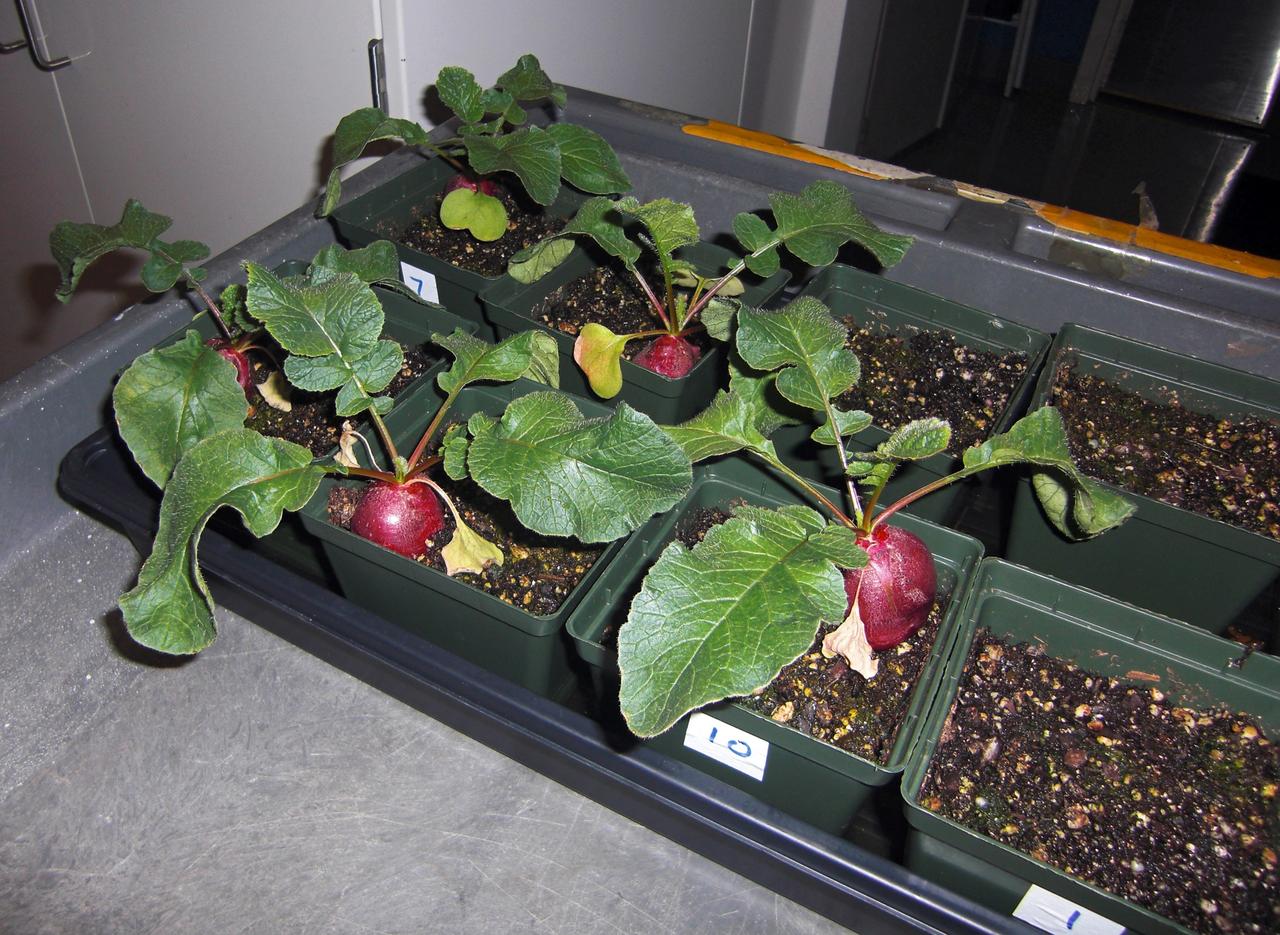
CAPE CANAVERAL, Fla. – Inside the Space Life Sciences Laboratory, or SLSL, at NASA’s Kennedy Space Center in Florida, radish plants are being harvested in a plant growth chamber. The plants were grown under red and blue LED lights. The plant experiment at Kennedy is part of the Advanced Exploration Systems, or AES, program in NASA’s Human Exploration and Operations Mission Directorate. This plant experiment studies the effects of different types of lighting on plants such as radishes and leaf lettuce. Results of these studies will help provide information on how to grow food sources for deep space exploration missions. AES projects pioneer new approaches for rapidly developing prototype systems, demonstrating key capabilities and validating operational concepts for future human missions beyond Earth orbit. Photo credit: NASA/Frank Ochoa-Gonzales
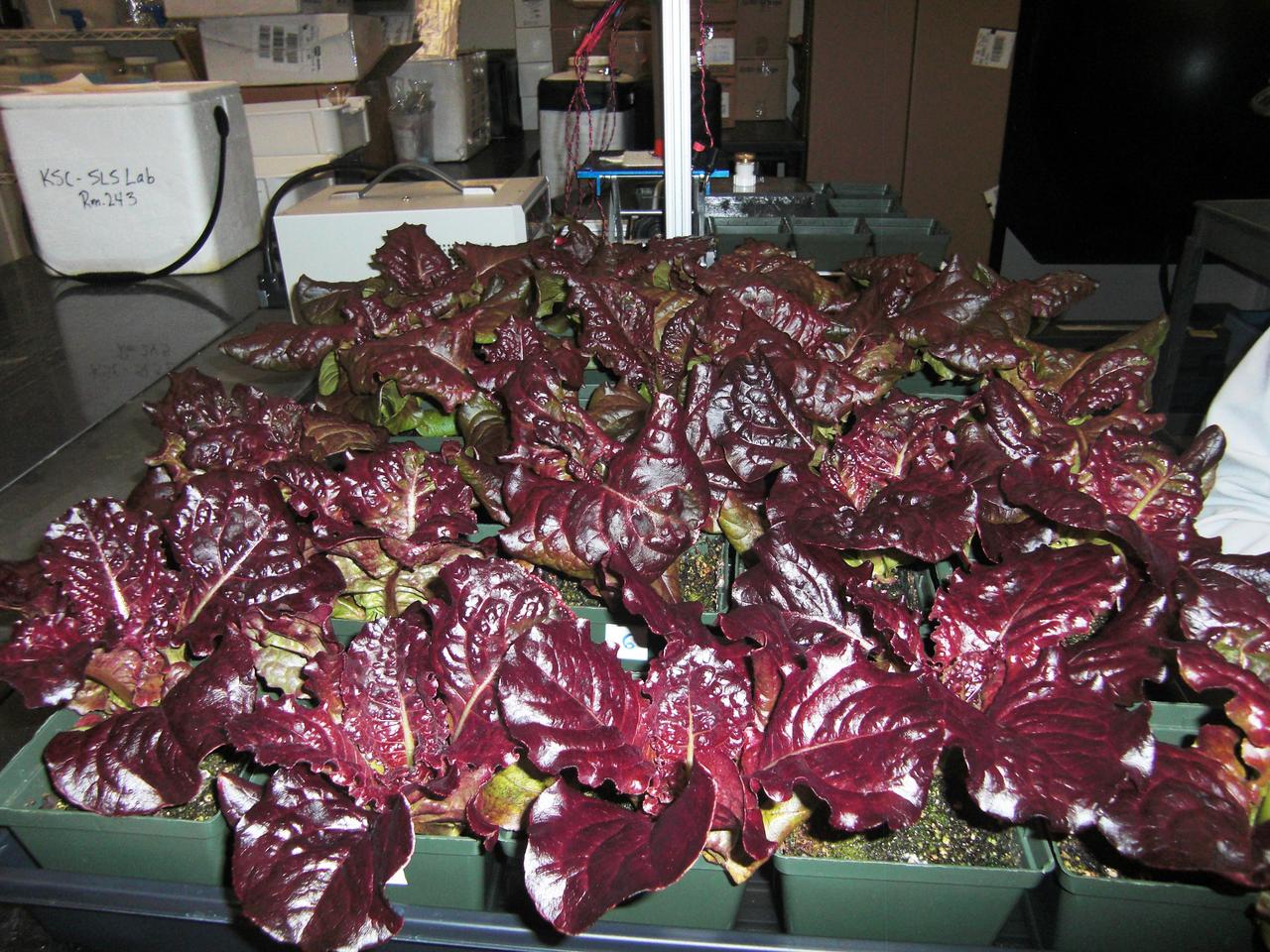
CAPE CANAVERAL, Fla. – Inside the Space Life Sciences Laboratory, or SLSL, at NASA’s Kennedy Space Center in Florida, red leaf lettuce plants were harvested from a plant growth chamber. The plants were grown under red and blue LED lights. The plant experiment at Kennedy is part of the Advanced Exploration Systems, or AES, program in NASA’s Human Exploration and Operations Mission Directorate. This plant experiment studies the effects of different types of lighting on plants such as radishes and leaf lettuce. Results of these studies will help provide information on how to grow food sources for deep space exploration missions. AES projects pioneer new approaches for rapidly developing prototype systems, demonstrating key capabilities and validating operational concepts for future human missions beyond Earth orbit. Photo credit: NASA/Frank Ochoa-Gonzales
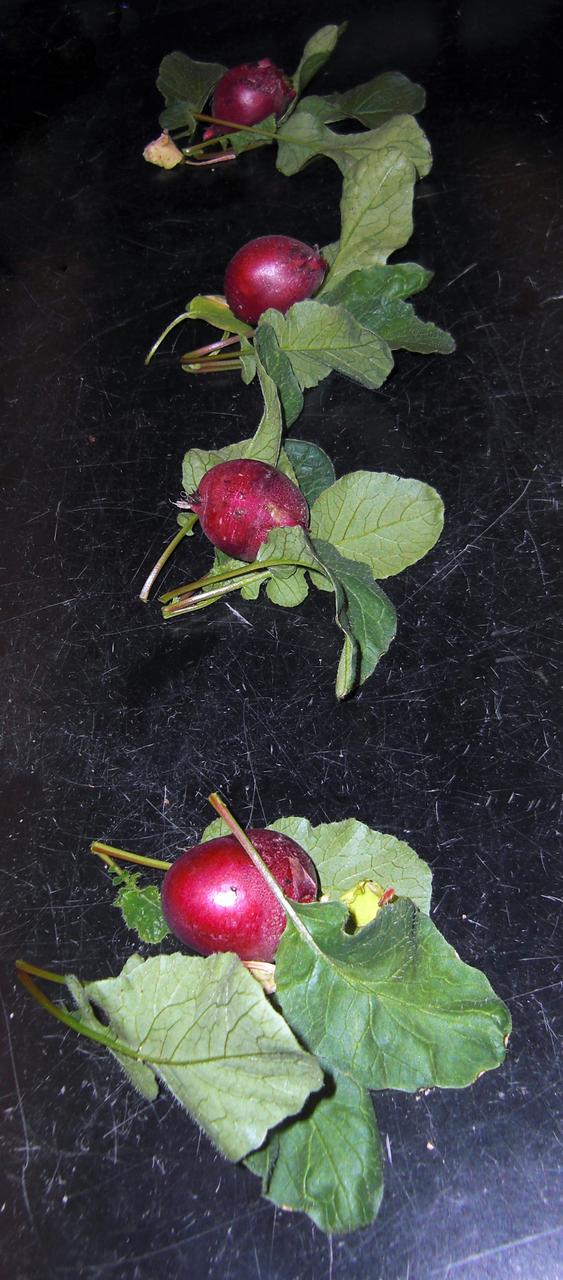
CAPE CANAVERAL, Fla. – Inside the Space Life Sciences Laboratory, or SLSL, at NASA’s Kennedy Space Center in Florida, radish plants were harvested from a plant growth chamber. The plants were grown under red and blue LED lights. The plant experiment at Kennedy is part of the Advanced Exploration Systems, or AES, program in NASA’s Human Exploration and Operations Mission Directorate. This plant experiment studies the effects of different types of lighting on plants such as radishes and leaf lettuce. Results of these studies will help provide information on how to grow food sources for deep space exploration missions. AES projects pioneer new approaches for rapidly developing prototype systems, demonstrating key capabilities and validating operational concepts for future human missions beyond Earth orbit. Photo credit: NASA/Frank Ochoa-Gonzales

These ‘Red Robin’ dwarf tomato plants, photographed Jan. 10, 2020, inside a laboratory in the Space Station Processing Facility at NASA Kennedy Space Center in Florida, are growing from seeds that have been exposed to simulated solar particle radiation. The plants’ edible mass and nutrients will be measured and compared to those of a control crop, grown from non-irradiated seeds. The project was designed to confirm that nutritious, high-quality produce can be reliably grown in deep space, or to provide a baseline to guide development of countermeasures to protect future crop foods from radiation during missions beyond low-Earth orbit. The investigation on space radiation impact on seeds and crop production also will be carried on the Materials International Space Station Experiment (MISSE) platform outside the station, supported NASA’s Space Technology Mission Directorate and the Space Biology Program, and potentially on future beyond-low-Earth platforms.

These ‘Red Robin’ dwarf tomato plants, photographed Jan. 10, 2020, inside a laboratory in the Space Station Processing Facility at NASA Kennedy Space Center in Florida, are growing from seeds that have been exposed to simulated solar particle radiation. The plants’ edible mass and nutrients will be measured and compared to those of a control crop, grown from non-irradiated seeds. The project was designed to confirm that nutritious, high-quality produce can be reliably grown in deep space, or to provide a baseline to guide development of countermeasures to protect future crop foods from radiation during missions beyond low-Earth orbit. The investigation on space radiation impact on seeds and crop production also will be carried on the Materials International Space Station Experiment (MISSE) platform outside the station, supported NASA’s Space Technology Mission Directorate and the Space Biology Program, and potentially on future beyond-low-Earth platforms.

These ‘Red Robin’ dwarf tomato plants, photographed Jan. 10, 2020, inside a laboratory in the Space Station Processing Facility at NASA Kennedy Space Center in Florida, are growing from seeds that have been exposed to simulated solar particle radiation. The plants’ edible mass and nutrients will be measured and compared to those of a control crop, grown from non-irradiated seeds. The project was designed to confirm that nutritious, high-quality produce can be reliably grown in deep space, or to provide a baseline to guide development of countermeasures to protect future crop foods from radiation during missions beyond low-Earth orbit. The investigation on space radiation impact on seeds and crop production also will be carried on the Materials International Space Station Experiment (MISSE) platform outside the station, supported NASA’s Space Technology Mission Directorate and the Space Biology Program, and potentially on future beyond-low-Earth platforms.

Karl Hasenstein, the principal investigator for the Plant Habitat-02, or PH-02, plants radish seeds in seed carriers for the Addvanced Plant Habitat (APH) in the Space Life Sciences Lab at Kennedy Space Center on Sept. 23, 2020. The carriers will fly aboard Northrop Grumman’s 14th commercial resupply services mission to the International Space Station. The launch, aboard Northrop Grumman’s Cygnus spacecraft, is targeted for Sept. 29 from NASA’s Wallops Flight Facility in Virginia. Astronauts will grow radish plants in the APH, NASA’s largest and most advanced growth chamber on station.

Karl Hasenstein, the principal investigator for the Plant Habitat-02, or PH-02, plants radish seeds in seed carriers for the Addvanced Plant Habitat (APH) in the Space Life Sciences Lab at Kennedy Space Center on Sept. 23, 2020. The carriers will fly aboard Northrop Grumman’s 14th commercial resupply services mission to the International Space Station. The launch, aboard Northrop Grumman’s Cygnus spacecraft, is targeted for Sept. 29 from NASA’s Wallops Flight Facility in Virginia. Astronauts will grow radish plants in the APH, NASA’s largest and most advanced growth chamber on station.

Karl Hasenstein, the principal investigator for the Plant Habitat-02, or PH-02, plants radish seeds in seed carriers for the Addvanced Plant Habitat (APH) in the Space Life Sciences Lab at Kennedy Space Center on Sept. 23, 2020. The carriers will fly aboard Northrop Grumman’s 14th commercial resupply services mission to the International Space Station. The launch, aboard Northrop Grumman’s Cygnus spacecraft, is targeted for Sept. 29 from NASA’s Wallops Flight Facility in Virginia. Astronauts will grow radish plants in the APH, NASA’s largest and most advanced growth chamber on station.

Karl Hasenstein, the principal investigator for the Plant Habitat-02, or PH-02, plants radish seeds in seed carriers for the Addvanced Plant Habitat (APH) in the Space Life Sciences Lab at Kennedy Space Center on Sept. 23, 2020. The carriers will fly aboard Northrop Grumman’s 14th commercial resupply services mission to the International Space Station. The launch, aboard Northrop Grumman’s Cygnus spacecraft, is targeted for Sept. 29 from NASA’s Wallops Flight Facility in Virginia. Astronauts will grow radish plants in the APH, NASA’s largest and most advanced growth chamber on station.

Karl Hasenstein, the principal investigator for the Plant Habitat-02, or PH-02, plants radish seeds in seed carriers for the Addvanced Plant Habitat (APH) in the Space Life Sciences Lab at Kennedy Space Center on Sept. 23, 2020. The carriers will fly aboard Northrop Grumman’s 14th commercial resupply services mission to the International Space Station. The launch, aboard Northrop Grumman’s Cygnus spacecraft, is targeted for Sept. 29 from NASA’s Wallops Flight Facility in Virginia. Astronauts will grow radish plants in the APH, NASA’s largest and most advanced growth chamber on station.

Karl Hasenstein, the principal investigator for the Plant Habitat-02, or PH-02, plants radish seeds in seed carriers for the Addvanced Plant Habitat (APH) in the Space Life Sciences Lab at Kennedy Space Center on Sept. 23, 2020. The carriers will fly aboard Northrop Grumman’s 14th commercial resupply services mission to the International Space Station. The launch, aboard Northrop Grumman’s Cygnus spacecraft, is targeted for Sept. 29 from NASA’s Wallops Flight Facility in Virginia. Astronauts will grow radish plants in the APH, NASA’s largest and most advanced growth chamber on station.

Karl Hasenstein, the principal investigator for the Plant Habitat-02, or PH-02, plants radish seeds in seed carriers for the Addvanced Plant Habitat (APH) in the Space Life Sciences Lab at Kennedy Space Center on Sept. 23, 2020. The carriers will fly aboard Northrop Grumman’s 14th commercial resupply services mission to the International Space Station. The launch, aboard Northrop Grumman’s Cygnus spacecraft, is targeted for Sept. 29 from NASA’s Wallops Flight Facility in Virginia. Astronauts will grow radish plants in the APH, NASA’s largest and most advanced growth chamber on station.

Karl Hasenstein, the principal investigator for the Plant Habitat-02, or PH-02, plants radish seeds in seed carriers for the Addvanced Plant Habitat (APH) in the Space Life Sciences Lab at Kennedy Space Center on Sept. 23, 2020. The carriers will fly aboard Northrop Grumman’s 14th commercial resupply services mission to the International Space Station. The launch, aboard Northrop Grumman’s Cygnus spacecraft, is targeted for Sept. 29 from NASA’s Wallops Flight Facility in Virginia. Astronauts will grow radish plants in the APH, NASA’s largest and most advanced growth chamber on station.

Karl Hasenstein, the principal investigator for the Plant Habitat-02, or PH-02, plants radish seeds in seed carriers for the Addvanced Plant Habitat (APH) in the Space Life Sciences Lab at Kennedy Space Center on Sept. 23, 2020. The carriers will fly aboard Northrop Grumman’s 14th commercial resupply services mission to the International Space Station. The launch, aboard Northrop Grumman’s Cygnus spacecraft, is targeted for Sept. 29 from NASA’s Wallops Flight Facility in Virginia. Astronauts will grow radish plants in the APH, NASA’s largest and most advanced growth chamber on station.

Karl Hasenstein, the principal investigator for the Plant Habitat-02, or PH-02, plants radish seeds in seed carriers for the Addvanced Plant Habitat (APH) in the Space Life Sciences Lab at Kennedy Space Center on Sept. 23, 2020. The carriers will fly aboard Northrop Grumman’s 14th commercial resupply services mission to the International Space Station. The launch, aboard Northrop Grumman’s Cygnus spacecraft, is targeted for Sept. 29 from NASA’s Wallops Flight Facility in Virginia. Astronauts will grow radish plants in the APH, NASA’s largest and most advanced growth chamber on station.

Horticulture scientist Blake Costine adjusts moisture sensors for the Advanced Plant Imaging project at NASA’s Kennedy Space Center on April 17, 2023. In this project, hyperspectral cameras are used to assess plant health. The activity is taking place inside the Plant Production Area at the Florida spaceport’s Space Station Processing Facility.

Shown here are moisture sensors for the Advanced Plant Imaging project at NASA’s Kennedy Space Center on April 17, 2023. In this project, hyperspectral cameras are used to assess plant health. The activity is taking place inside the Plant Production Area at the Florida spaceport’s Space Station Processing Facility.

Horticulture scientist Blake Costine adjusts moisture sensors for the Advanced Plant Imaging project at NASA’s Kennedy Space Center on April 17, 2023. In this project, hyperspectral cameras are used to assess plant health. The activity is taking place inside the Plant Production Area at the Florida spaceport’s Space Station Processing Facility.
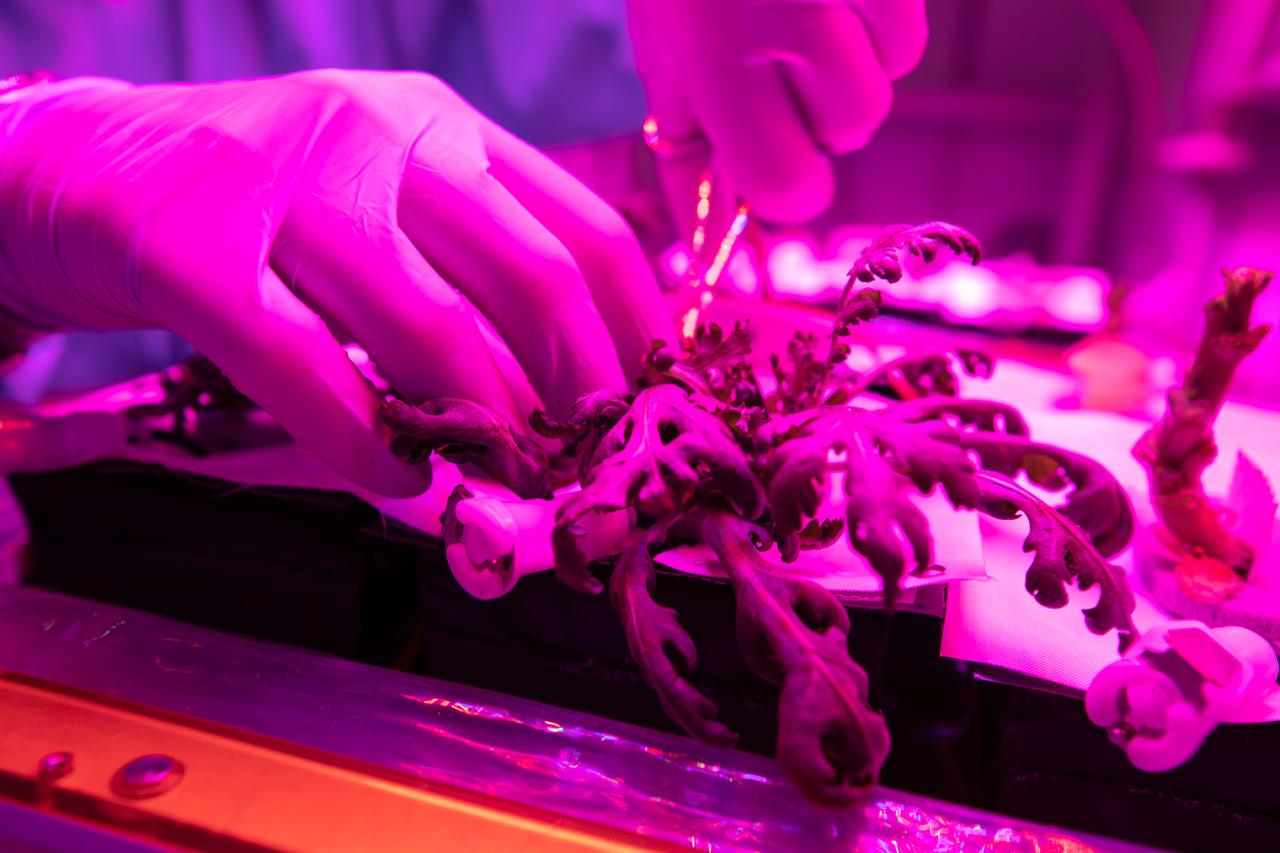
Test crops are harvested inside the Veggie growth chamber in the Space Station Processing Facility at NASA’s Kennedy Space Center in Florida on Sept. 30, 2019, for a science verification test (SVT) to study their potential to grow in space. The harvest included ‘outredgeous’ red romaine lettuce, which has been grown in space before, and two new plant cultivars – amara mustard and shungiku, an Asian green comparable to an edible chrysanthemum. All three lettuce plants were grown from seed film, making this the first SVT with this new plant growth material. Earlier this year, the amara mustard and shungiku plants were grown for the first time using seed bags – referred to as pillows – during the Sustained Veggie project, a study funded by the Human Research Program.
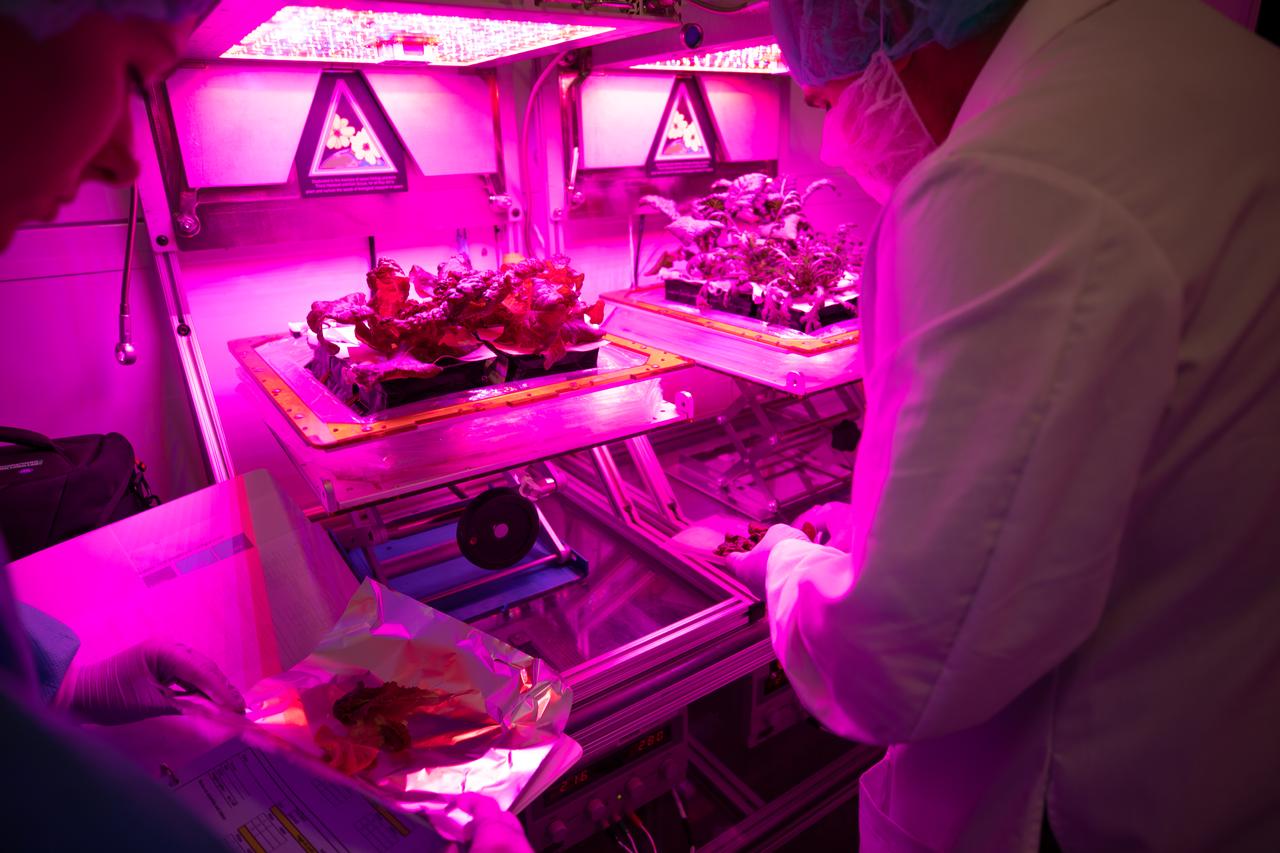
Kennedy Space Center Veggie Project Manager Trent Smith harvests test crops inside the Veggie growth chamber in the Florida spaceport’s Space Station Processing Facility on Sept. 30, 2019, for a science verification test (SVT) to study their potential to grown in space. The harvest included ‘outredgeous’ red romaine lettuce, which has been grown in space before, and two new plant cultivars – amara mustard and shungiku, an Asian green comparable to an edible chrysanthemum. All three lettuce plants were grown from seed film, making this the first SVT with this new plant growth material. Earlier this year, the amara mustard and shungiku plants were grown for the first time using seed bags – referred to as pillows – during the Sustained Veggie project, a study funded by the Human Research Program.
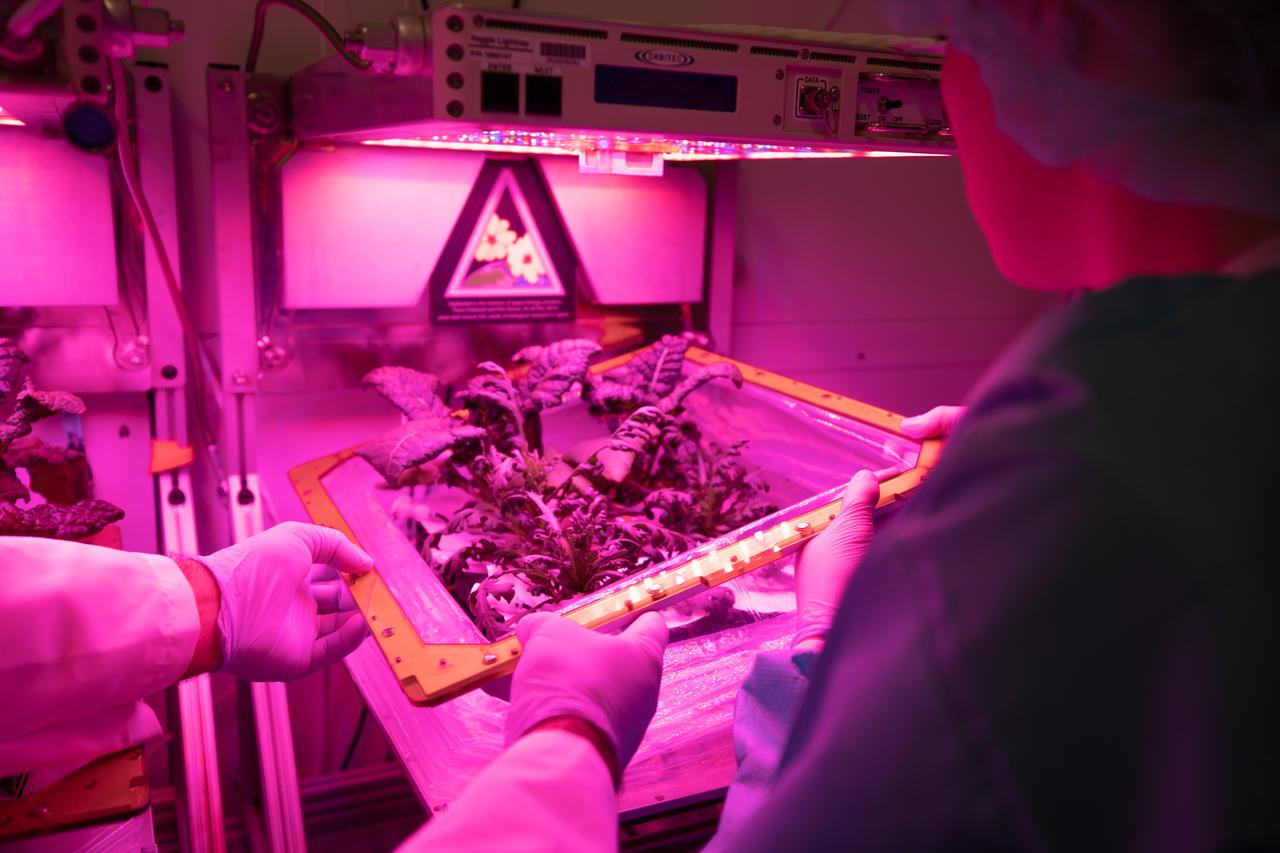
Kennedy Space Center employees harvest test crops inside the Veggie growth chamber in the Florida spaceport’s Space Station Processing Facility on Sept. 30, 2019, for a science verification test (SVT) to study their potential to grown in space. The harvest included ‘outredgeous’ red romaine lettuce, which has been grown in space before, and two new plant cultivars – amara mustard and shungiku, an Asian green comparable to an edible chrysanthemum. All three lettuce plants were grown from seed film, making this the first SVT with this new plant growth material. Earlier this year, the amara mustard and shungiku plants were grown for the first time using seed bags – referred to as pillows – during the Sustained Veggie project, a study funded by the Human Research Program.
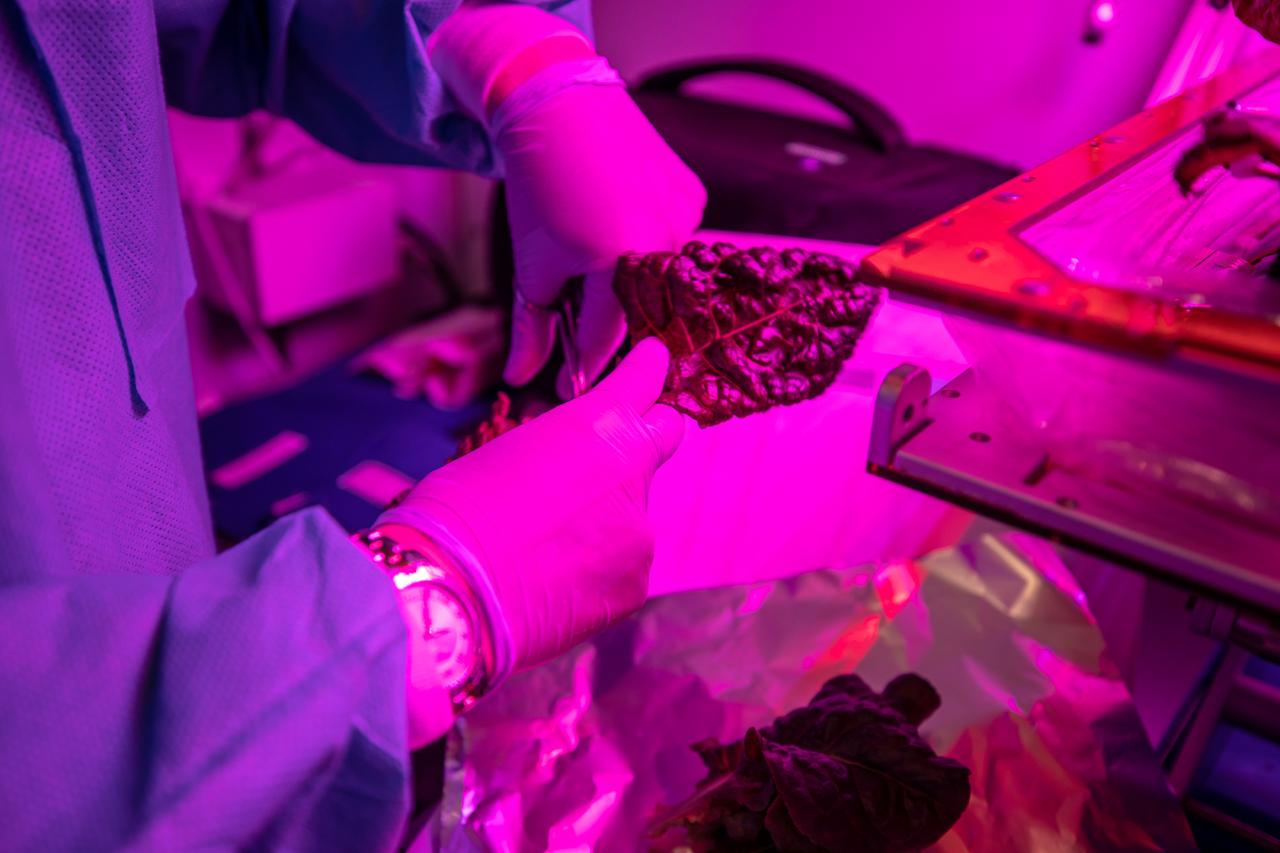
Test crops are harvested inside the Veggie growth chamber in the Space Station Processing Facility at NASA’s Kennedy Space Center in Florida on Sept. 30, 2019, for a science verification test (SVT) to study their potential to grow in space. The harvest included ‘outredgeous’ red romaine lettuce, which has been grown in space before, and two new plant cultivars – amara mustard and shungiku, an Asian green comparable to an edible chrysanthemum. All three lettuce plants were grown from seed film, making this the first SVT with this new plant growth material. Earlier this year, the amara mustard and shungiku plants were grown for the first time using seed bags – referred to as pillows – during the Sustained Veggie project, a study funded by the Human Research Program.
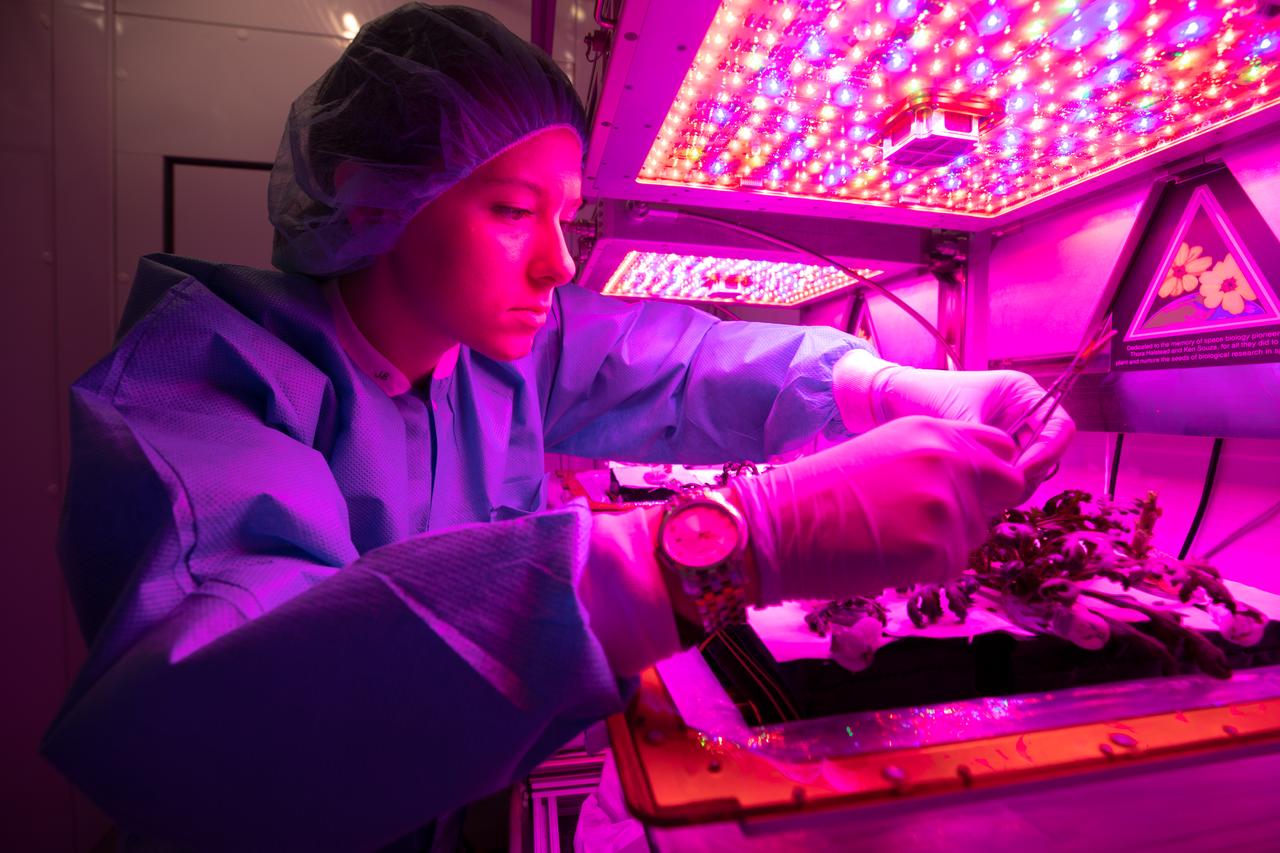
Jess Bunchek, an associate scientist at NASA’s Kennedy Space Center in Florida, harvests shungiku – an Asian green comparable to an edible chrysanthemum – inside the Veggie growth chamber in the Space Station Processing Facility on Sept. 30, 2019, for a science verification test (SVT). The SVT included the harvest of two other plant cultivars – amara mustard and ‘outredgeous’ red romaine lettuce – and will study their potential to grow in space. All three lettuce plants were grown from seed film, making this the first SVT with this new plant growth material. Earlier this year, the amara mustard and shungiku plants were grown for the first time using seed bags – referred to as pillows – during the Sustained Veggie project, a study funded by the Human Research Program.
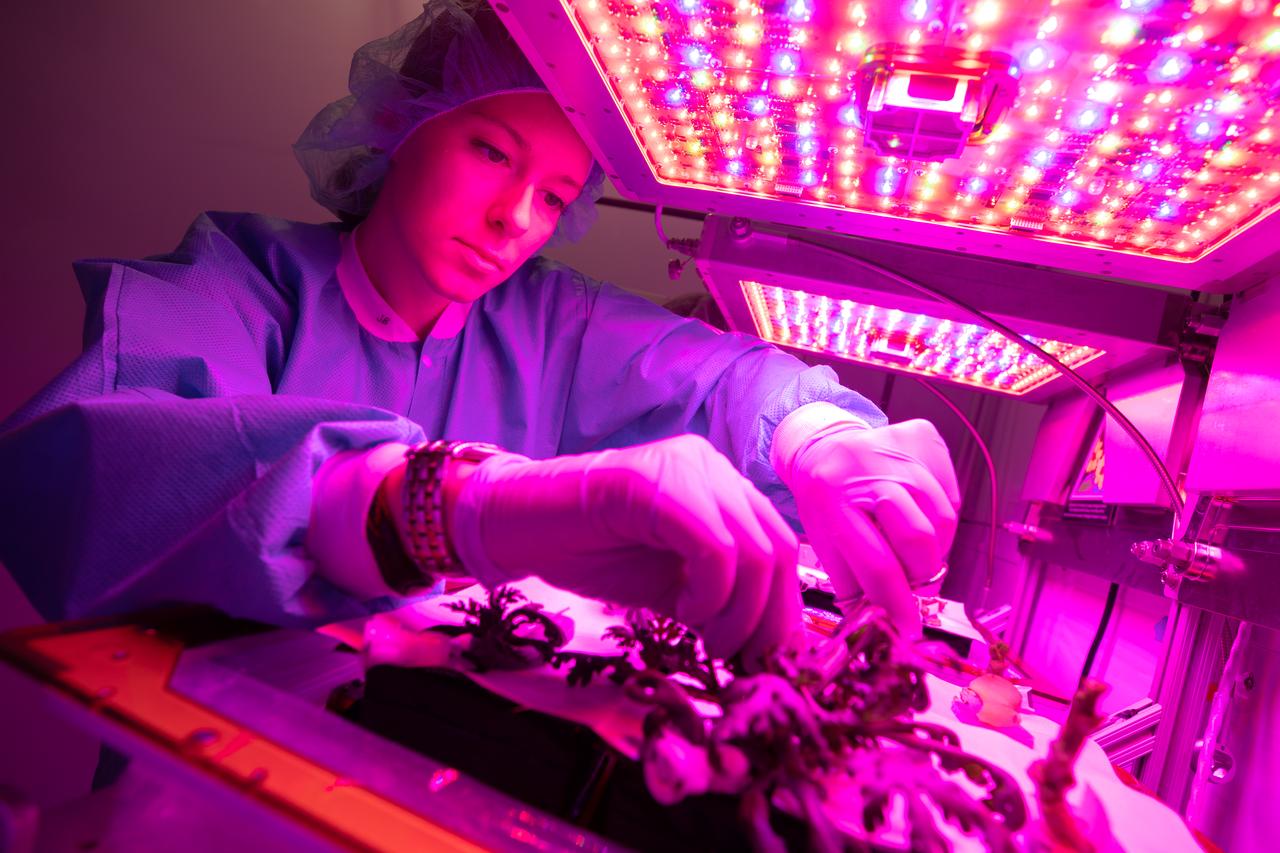
Jess Bunchek, an associate scientist at NASA’s Kennedy Space Center in Florida, harvests shungiku – an Asian green comparable to an edible chrysanthemum – inside the Veggie growth chamber in the Space Station Processing Facility on Sept. 30, 2019, for a science verification test (SVT). The SVT included the harvest of two other plant cultivars – amara mustard and ‘outredgeous’ red romaine lettuce – and will study their potential to grow in space. All three lettuce plants were grown from seed film, making this the first SVT with this new plant growth material. Earlier this year, the amara mustard and shungiku plants were grown for the first time using seed bags – referred to as pillows – during the Sustained Veggie project, a study funded by the Human Research Program.
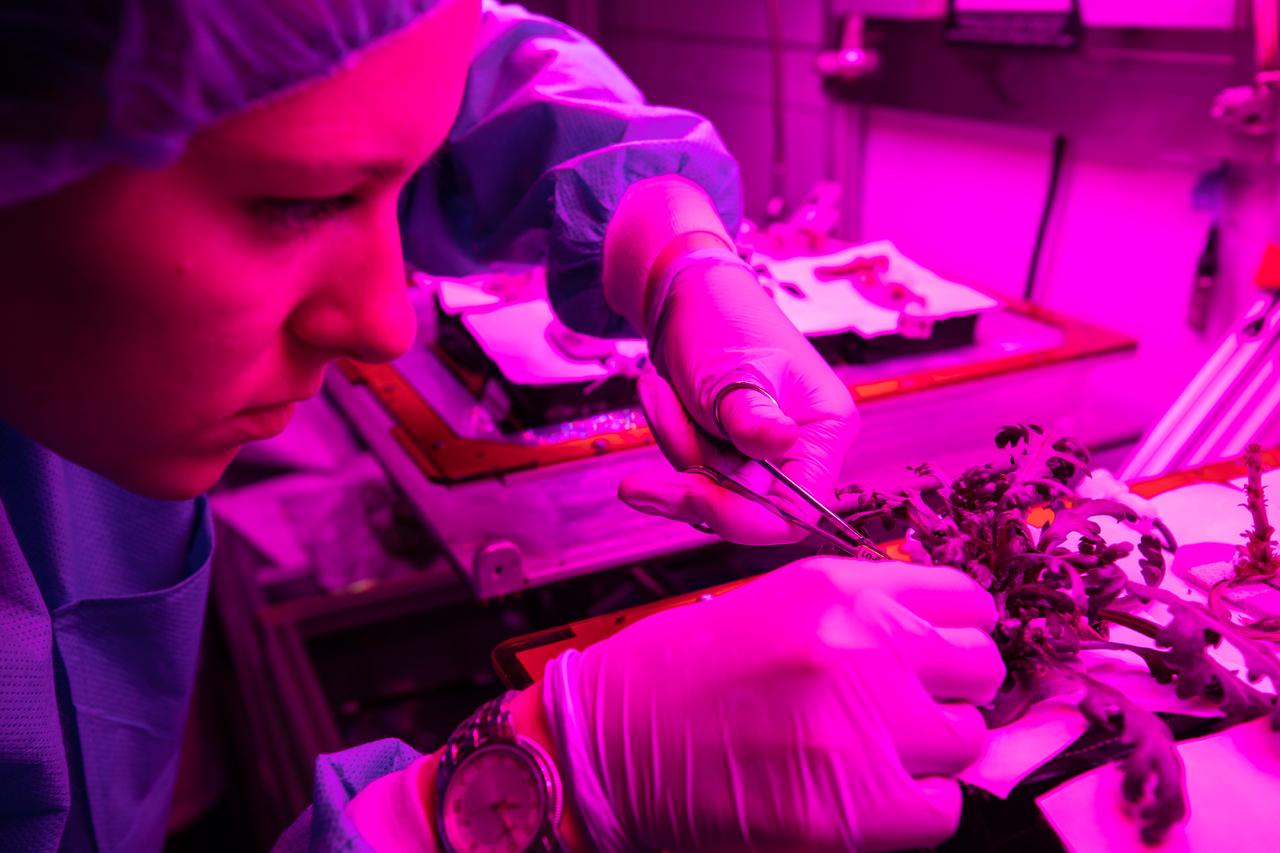
Jess Bunchek, an associate scientist at NASA’s Kennedy Space Center in Florida, harvests shungiku – an Asian green comparable to an edible chrysanthemum – inside the Veggie growth chamber in the Space Station Processing Facility on Sept. 30, 2019, for a science verification test (SVT). The SVT included the harvest of two other plant cultivars – amara mustard and ‘outredgeous’ red romaine lettuce – and will study their potential to grow in space. All three lettuce plants were grown from seed film, making this the first SVT with this new plant growth material. Earlier this year, the amara mustard and shungiku plants were grown for the first time using seed bags – referred to as pillows – during the Sustained Veggie project, a study funded by the Human Research Program.

John "JC" Carver, a payload integration engineer with NASA Kennedy Space Center's Test and Operations Support Contract, harvests half the Arabidopsis thaliana plants inside the growth chamber of the Advanced Plant Habitat (APH) Flight Unit No. 1. The harvest is part of an ongoing verification test of the APH unit, which is located inside the International Space Station Environmental Simulator in Kennedy's Space Station Processing Facility. The APH undergoing testing at Kennedy is identical to one on the station and uses red, green and broad-spectrum white LED lights to grow plants in an environmentally controlled chamber. The seeds grown during the verification test will be grown on the station to help scientists understand how these plants adapt to spaceflight.

Dr. Oscar Monje, a research scientist, pours a growing substrate called arcillite in the science carrier, or base, of the Advanced Plant Habitat (APH) inside a laboratory at the Space Station Processing Facility at NASA's Kennedy Space Center in Florida. Developed by NASA and ORBITEC of Madison, Wisconsin, the APH is the largest plant chamber built for the agency. It is a fully automated plant growth facility that will be used to conduct bioscience research on the International Space Station. The APH will be delivered to the space station aboard future Commercial Resupply Services missions.

Dr. Oscar Monje, a research scientist, pours a growing substrate called arcillite in the science carrier, or base, of the Advanced Plant Habitat (APH) inside a laboratory at the Space Station Processing Facility at NASA's Kennedy Space Center in Florida. Developed by NASA and ORBITEC of Madison, Wisconsin, the APH is the largest plant chamber built for the agency. It is a fully automated plant growth facility that will be used to conduct bioscience research on the International Space Station. The APH will be delivered to the space station aboard future Commercial Resupply Services missions.

Dr. Oscar Monje, a research scientist, packs a growing substrate called arcillite in the science carrier, or base, of the Advanced Plant Habitat (APH) inside a laboratory at the Space Station Processing Facility at NASA's Kennedy Space Center in Florida. Developed by NASA and ORBITEC of Madison, Wisconsin, the APH is the largest plant chamber built for the agency. It is a fully automated plant growth facility that will be used to conduct bioscience research on the International Space Station. The APH will be delivered to the space station aboard future Commercial Resupply Services missions.

John "JC" Carver, a payload integration engineer with NASA Kennedy Space Center's Test and Operations Support Contract, places Arabidopsis thaliana plants harvested from the Advanced Plant Habitat (APH) Flight Unit No. 1 into a Mini ColdBag that quickly freezes the plants. The harvest is part of an ongoing verification test of the APH unit, which is located inside the International Space Station Environmental Simulator in Kennedy's Space Station Processing Facility. The APH undergoing testing at Kennedy is identical to one on the station and uses red, green and broad-spectrum white LED lights to grow plants in an environmentally controlled chamber. The seeds grown during the verification test will be grown on the station to help scientists understand how these plants adapt to spaceflight.

John "JC" Carver, a payload integration engineer with NASA Kennedy Space Center's Test and Operations Support Contract, uses a FluorPen to measure the chlorophyll fluorescence of Arabidopsis thaliana plants inside the growth chamber of the Advanced Plant Habitat (APH) Flight Unit No. 1. Half the plants were then harvested. The harvest is part of an ongoing verification test of the APH unit, which is located inside the International Space Station Environmental Simulator in Kennedy's Space Station Processing Facility. The APH undergoing testing at Kennedy is identical to one on the station and uses red, green and broad-spectrum white LED lights to grow plants in an environmentally controlled chamber. The seeds grown during the verification test will be grown on the station to help scientists understand how these plants adapt to spaceflight.

John "JC" Carver, a payload integration engineer with NASA Kennedy Space Center's Test and Operations Support Contract, uses a FluorPen to measure the chlorophyll fluorescence of Arabidopsis thaliana plants inside the growth chamber of the Advanced Plant Habitat (APH) Flight Unit No. 1. Half the plants were then harvested. The harvest is part of an ongoing verification test of the APH unit, which is located inside the International Space Station Environmental Simulator in Kennedy's Space Station Processing Facility. The APH undergoing testing at Kennedy is identical to one on the station and uses red, green and broad-spectrum white LED lights to grow plants in an environmentally controlled chamber. The seeds grown during the verification test will be grown on the station to help scientists understand how these plants adapt to spaceflight.

Matt Romeyn, a NASA biologist, secures seeds in plant pillows for the Veggie plant growth system inside a laboratory in the Space Station Processing Facility at NASA's Kennedy Space Center in Florida. The plant pillows, containing Outredgeous lettuce, Mizuna Mustard and Waldmann's green lettuce seeds, were packed for delivery to Veggie on SpaceX's 12th commercial resupply services mission to the International Space Station.

Seeds are secured in plant pillows for the Veggie plant growth system inside a laboratory in the Space Station Processing Facility at NASA's Kennedy Space Center in Florida. The plant pillows, containing Outredgeous lettuce, Mizuna Mustard and Waldmann's green lettuce seeds, were packed for delivery to Veggie on SpaceX's 12th commercial resupply services mission to the International Space Station.

Seeds are secured in plant pillows for the Veggie plant growth system inside a laboratory in the Space Station Processing Facility at NASA's Kennedy Space Center in Florida. The plant pillows, containing Outredgeous lettuce, Mizuna Mustard and Waldmann's green lettuce, were packed for delivery to Veggie on SpaceX's 12th commercial resupply services mission to the International Space Station.

Matt Romeyn, a NASA biologist, secures seeds in plant pillows for the Veggie plant growth system inside a laboratory in the Space Station Processing Facility at NASA's Kennedy Space Center in Florida. The plant pillows, containing Outredgeous lettuce, Mizuna Mustard and Waldmann's green lettuce seeds, were packed for delivery to Veggie on SpaceX's 12th commercial resupply services mission to the International Space Station.

Seeds are secured in plant pillows for the Veggie plant growth system inside a laboratory in the Space Station Processing Facility at NASA's Kennedy Space Center in Florida. The plant pillows, containing Outredgeous lettuce, Mizuna Mustard and Waldmann's green lettuce seeds, were packed for delivery to Veggie on SpaceX's 12th commercial resupply services mission to the International Space Station.

Seeds are secured in plant pillows for the Veggie plant growth system inside a laboratory in the Space Station Processing Facility at NASA's Kennedy Space Center in Florida. The plant pillows, containing Outredgeous lettuce, Mizuna Mustard and Waldmann's green lettuce seeds, were packed for delivery to Veggie on SpaceX's 12th commercial resupply services mission to the International Space Station.

A close-up view of a zinnia flower grown in the Veggie Laboratory in the Space Station Processing Facility (SSPF) at NASA's Kennedy Space Center in Florida, on Nov. 27, 2018. Seeds from zinnias growing on the space station were returned to Earth. Researchers in the SSPF planted the seeds in the Veggie control unit and grew the colorful flowers.

NASA interns Jessica Scotten, left, and Ayla Grandpre water plants in the Veggie hardware in NASA Kennedy Space Center's ISS environment simulator chamber. Mizuna mustard, Outredgeous lettuce and Waldmann's green lettuce are growing in Veggie. Growth in the chamber mimics the growth of plant experiments in the Veggie plant growth system on the International Space Station.
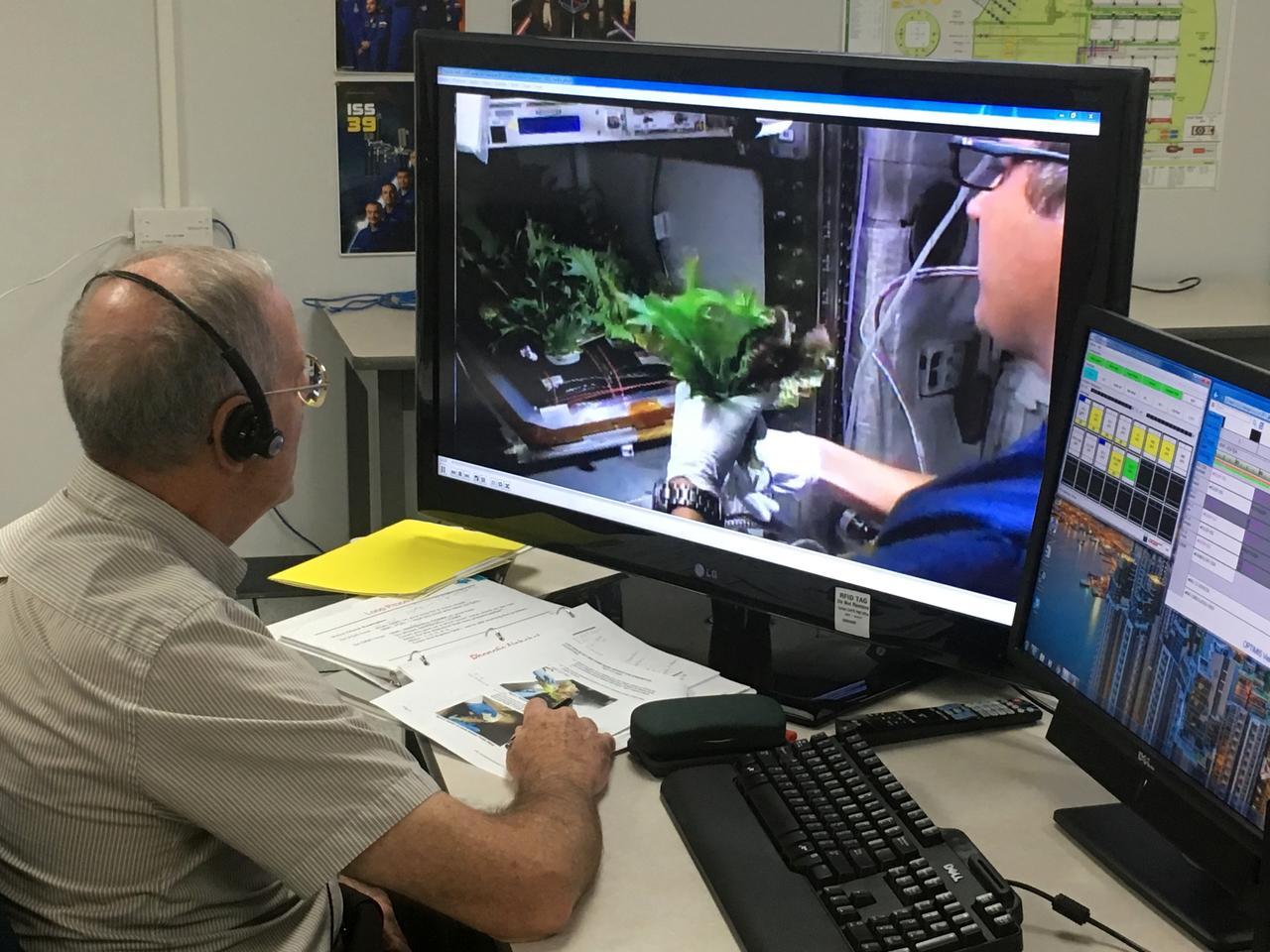
Charles Spern, project manager on the Engineering Services Contract, communicates instructions for the Veggie system to astronaut Joe Acaba on the International Space Station. Spern is in the Experiment Monitoring Room in the Space Station Processing Facility at Kennedy Space Center in Florida. Three different varieties of plants from the Veg-03D plant experiment were harvested.

Outredgeous red leaf lettuce, Mizuna mustard and Waldmann's green lettuce are growing in the Veggie control system in the ISS environment simulator chamber in the Space Station Processing Facility at NASA's Kennedy Space Center in Florida. Growth in the chamber mimics the growth of plant experiments in the Veggie plant growth system on the International Space Station.

Inside a laboratory in the Space Station Processing Facility at NASA's Kennedy Space Center in Florida, LED plant growth lights are being checked out on the hardware for the Advanced Plant Habitat flight unit. The flight unit is an exact replica of the APH that was delivered to the International Space Station. Validation tests and post-delivery checkout was performed to prepare for space station in-orbit APH activities. The flight unit will be moved to the International Space Station Environmental Simulator to begin an experiment verification test for the science that will fly on the first mission, PH-01. Developed by NASA and ORBITEC of Madison, Wisconsin, the APH is the largest plant chamber built for the agency. It is a fully automated plant growth facility that will be used to conduct bioscience research on the space station.

Inside a laboratory in the Space Station Processing Facility at NASA's Kennedy Space Center in Florida, LED plant growth lights are being checked out on the hardware for the Advanced Plant Habitat flight unit. The flight unit is an exact replica of the APH that was delivered to the International Space Station. Validation tests and post-delivery checkout was performed to prepare for space station in-orbit APH activities. The flight unit will be moved to the International Space Station Environmental Simulator to begin an experiment verification test for the science that will fly on the first mission, PH-01. Developed by NASA and ORBITEC of Madison, Wisconsin, the APH is the largest plant chamber built for the agency. It is a fully automated plant growth facility that will be used to conduct bioscience research on the space station.

Inside a laboratory in the Space Station Processing Facility at NASA's Kennedy Space Center in Florida, a quality technician checks the control panel on hardware for the Advanced Plant Habitat flight unit. The flight unit is an exact replica of the APH that was delivered to the International Space Station. Validation tests and post-delivery checkout was performed to prepare for space station in-orbit APH activities. The flight unit will be moved to the International Space Station Environmental Simulator to begin an experiment verification test for the science that will fly on the first mission, PH-01. Developed by NASA and ORBITEC of Madison, Wisconsin, the APH is the largest plant chamber built for the agency. It is a fully automated plant growth facility that will be used to conduct bioscience research on the space station.

Inside a laboratory in the Space Station Processing Facility at NASA's Kennedy Space Center in Florida, a quality technician checks the hardware for the Advanced Plant Habitat flight unit. The flight unit is an exact replica of the APH that was delivered to the International Space Station. Validation tests and post-delivery checkout was performed to prepare for space station in-orbit APH activities. The flight unit will be moved to the International Space Station Environmental Simulator to begin an experiment verification test for the science that will fly on the first mission, PH-01. Developed by NASA and ORBITEC of Madison, Wisconsin, the APH is the largest plant chamber built for the agency. It is a fully automated plant growth facility that will be used to conduct bioscience research on the space station.