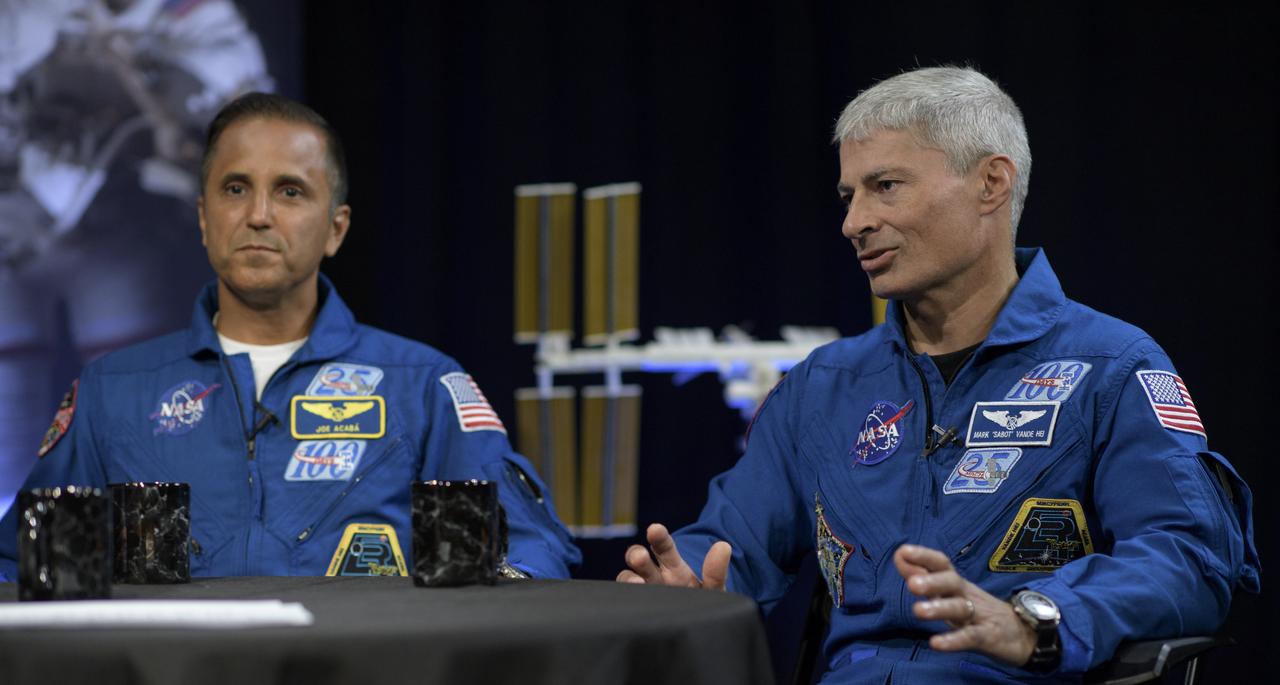
Expedition 54 NASA astronauts Joe Acaba, left, and Mark Vande Hei meet with NASA Administrator Jim Bridenstine during their Expedition 54 post flight visit, Wednesday, June 13, 2018 at NASA Headquarters, Washington. Photo Credit: (NASA/Bill Ingalls)
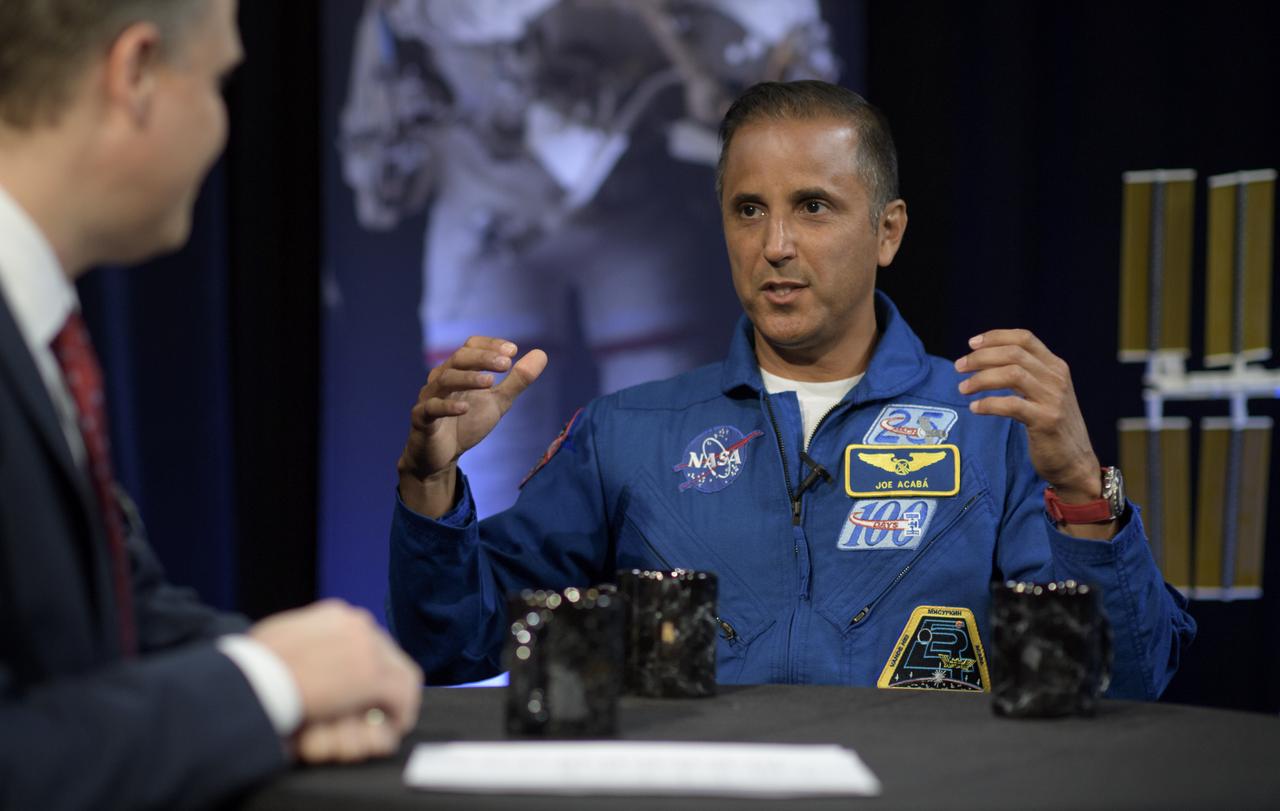
NASA Administrator Jim Bridenstine, left, meets with Expedition 54 NASA astronauts Joe Acaba, right, and Mark Vande Hei, off camera, during their Expedition 54 post flight, Wednesday, June 13, 2018 at NASA Headquarters, Washington. Photo Credit: (NASA/Bill Ingalls)
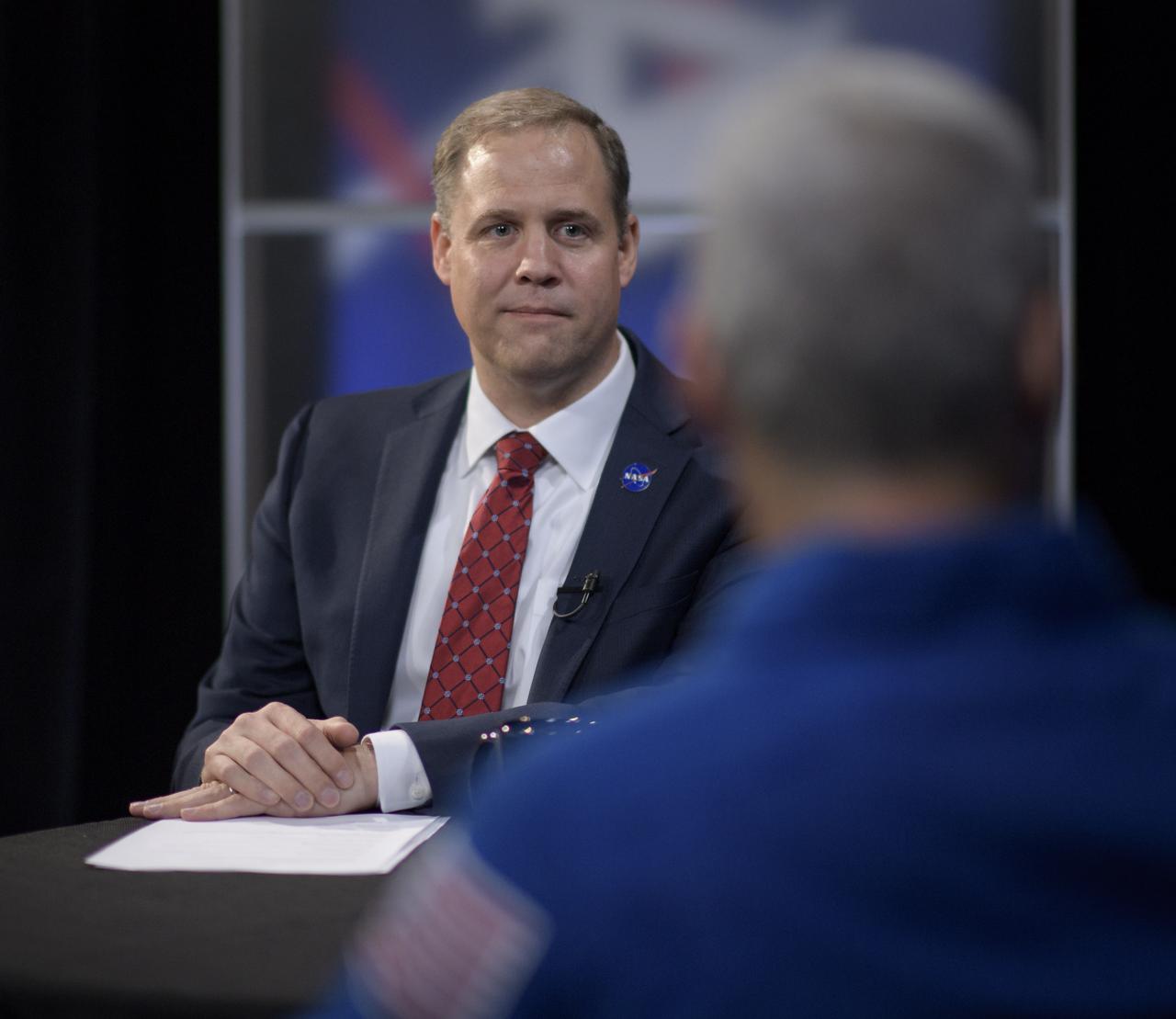
NASA Administrator Jim Bridenstine is seen as he meets with Expedition 54 NASA astronauts Joe Acaba and Mark Vande Hei during their Expedition 54 post flight, Wednesday, June 13, 2018 at NASA Headquarters, Washington. Photo Credit: (NASA/Bill Ingalls)
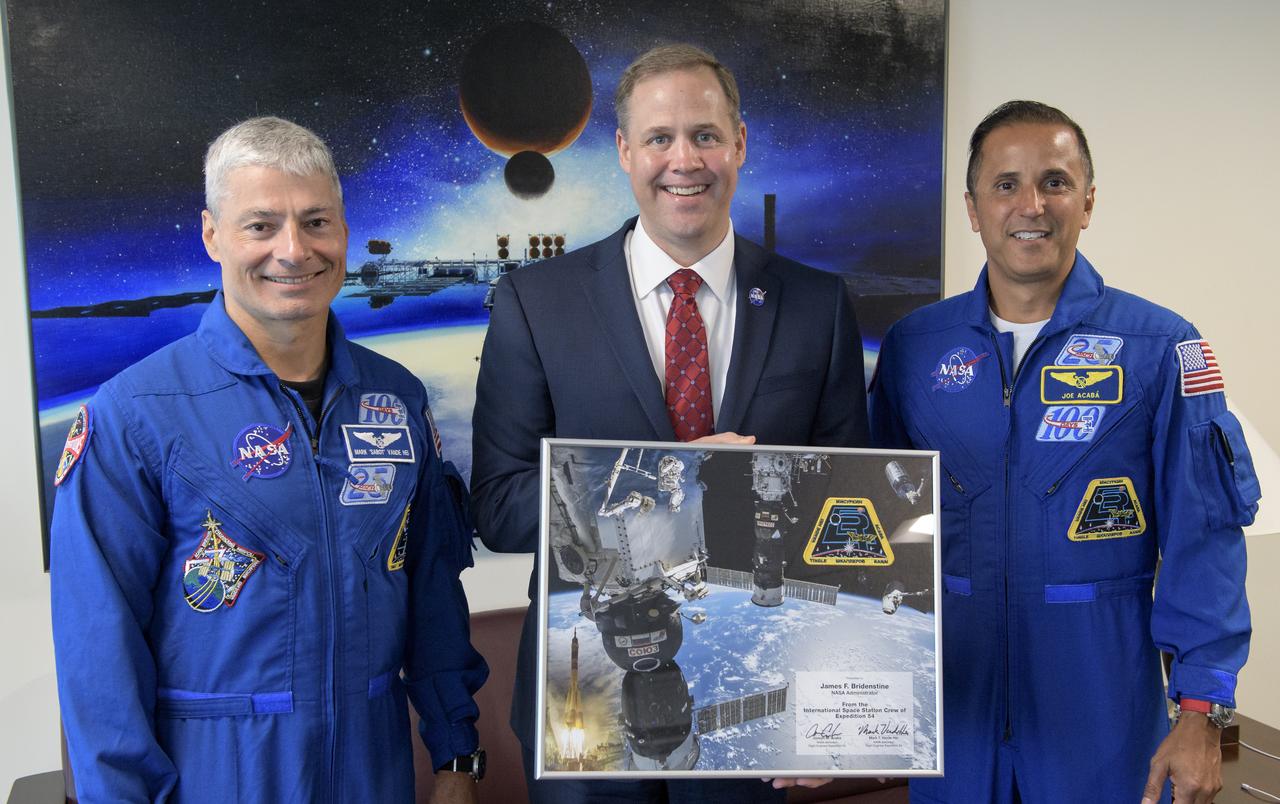
NASA Administrator Jim Bridenstine, center, meets with Expedition 54 NASA astronauts Mark Vande Hei, left, and Joe Acaba during their Expedition 54 post flight, Wednesday, June 13, 2018 at NASA Headquarters, Washington. Photo Credit: (NASA/Bill Ingalls)

NASA Administrator Jim Bridenstine, left, meets with Expedition 54 NASA astronauts Joe Acaba, center, and Mark Vande Hei during their Expedition 54 post flight, Wednesday, June 13, 2018 at NASA Headquarters, Washington. Photo Credit: (NASA/Bill Ingalls)
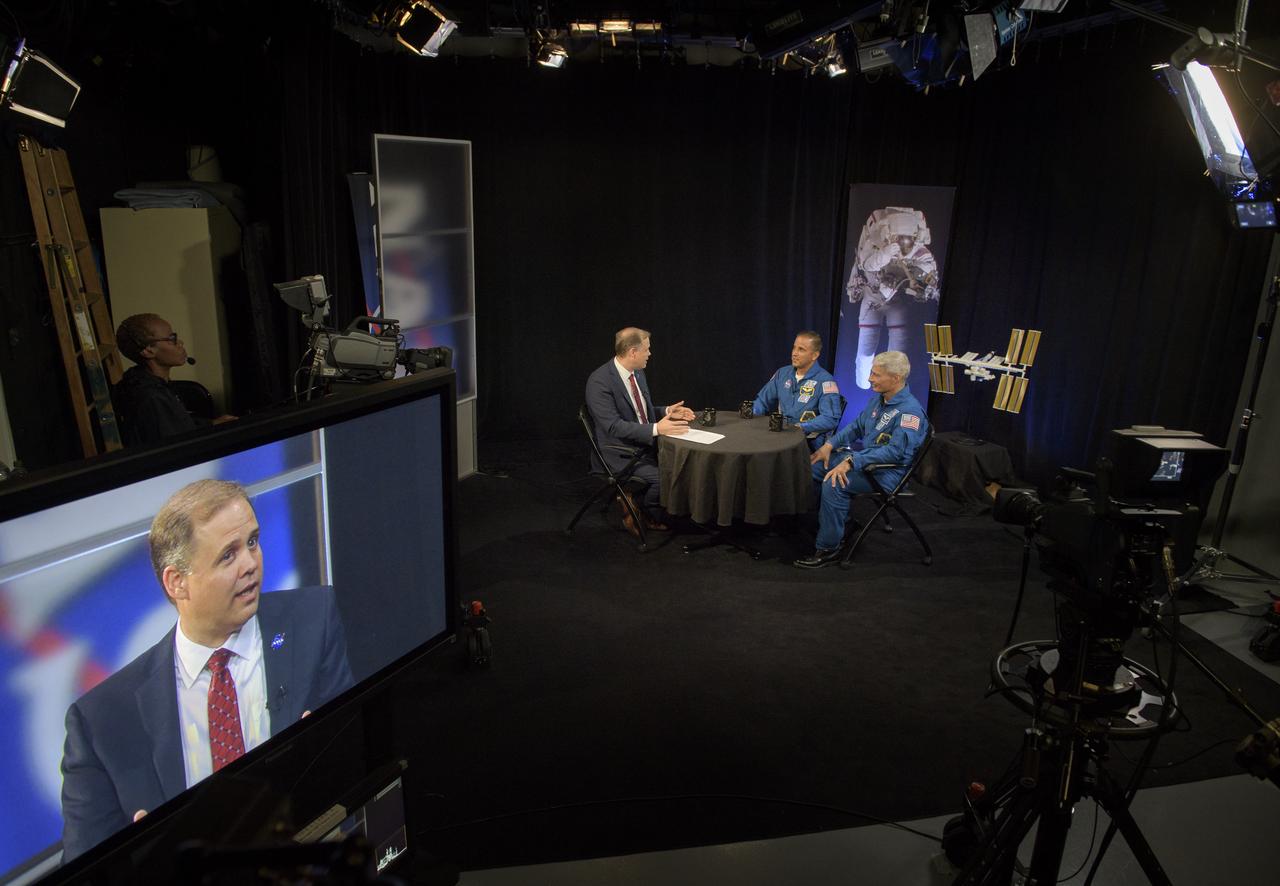
NASA Administrator Jim Bridenstine, left, meets with Expedition 54 NASA astronauts Joe Acaba, center, and Mark Vande Hei during their Expedition 54 post flight, Wednesday, June 13, 2018 at NASA Headquarters, Washington. Photo Credit: (NASA/Bill Ingalls)
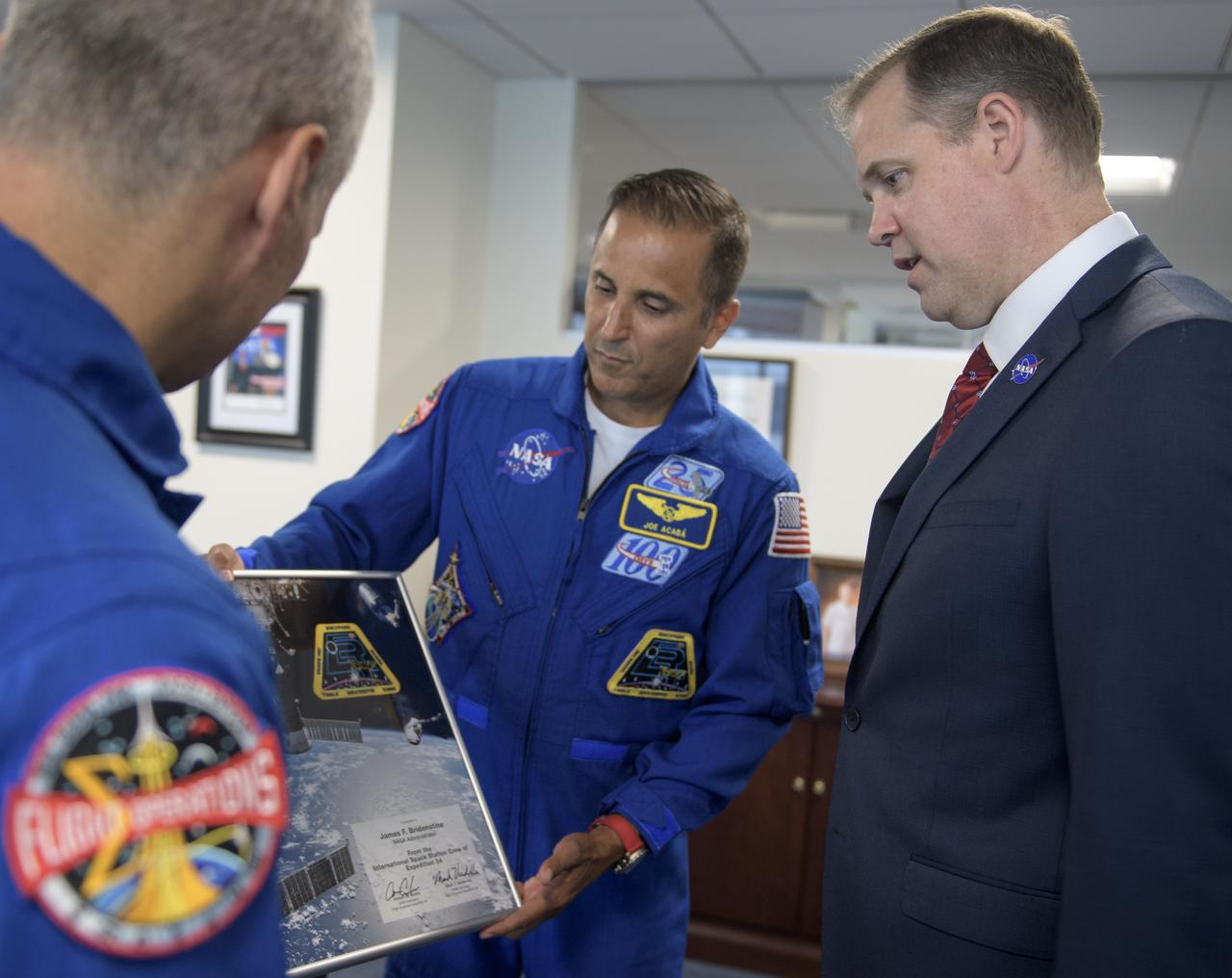
NASA Administrator Jim Bridenstine, right, meets with Expedition 54 NASA astronauts Mark Vande Hei, left, and Joe Acaba during their Expedition 54 post flight, Wednesday, June 13, 2018 at NASA Headquarters, Washington. Photo Credit: (NASA/Bill Ingalls)

Lit by sunlight filtered through the smoke of a distant forest fire, the Space Shuttle Atlantis receives post-flight servicing in the Mate-Demate Device (MDD), following its landing at NASA's Dryden Flight Research Center, Edwards, California. The gantry-like MDD structure is used for servicing the shuttle orbiters in preparation for their ferry flight back to the Kennedy Space Center in Florida, including mounting the shuttle atop NASA's modified Boeing 747 Shuttle Carrier Aircraft.
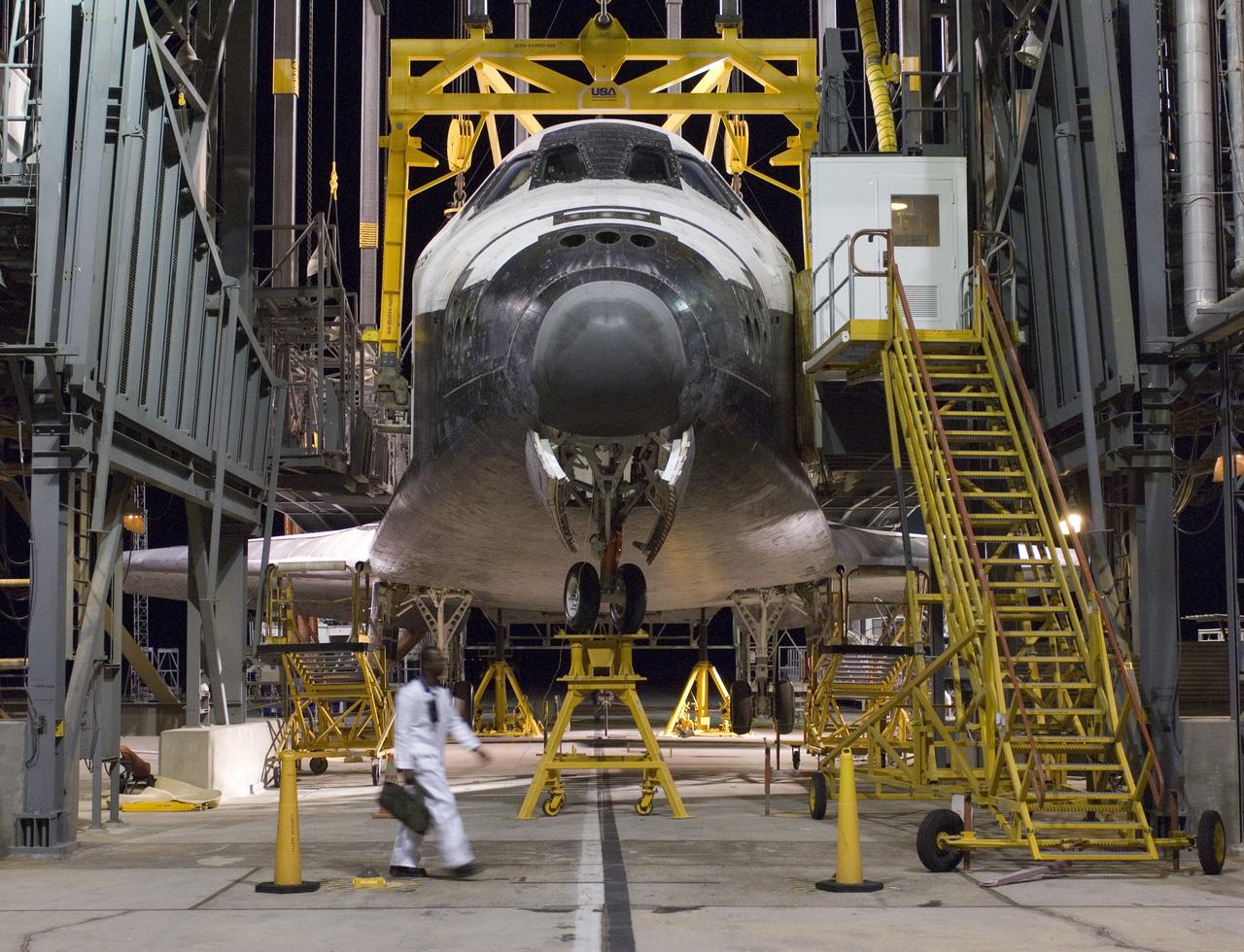
The Space Shuttle Atlantis receives post-flight servicing in the Mate-Demate Device (MDD), following its landing at NASA's Dryden Flight Research Center, Edwards, California, June 22, 2007. The gantry-like MDD structure is used for servicing the shuttle orbiters in preparation for their ferry flight back to the Kennedy Space Center in Florida, including mounting the shuttle atop NASA's modified Boeing 747 Shuttle Carrier Aircraft.
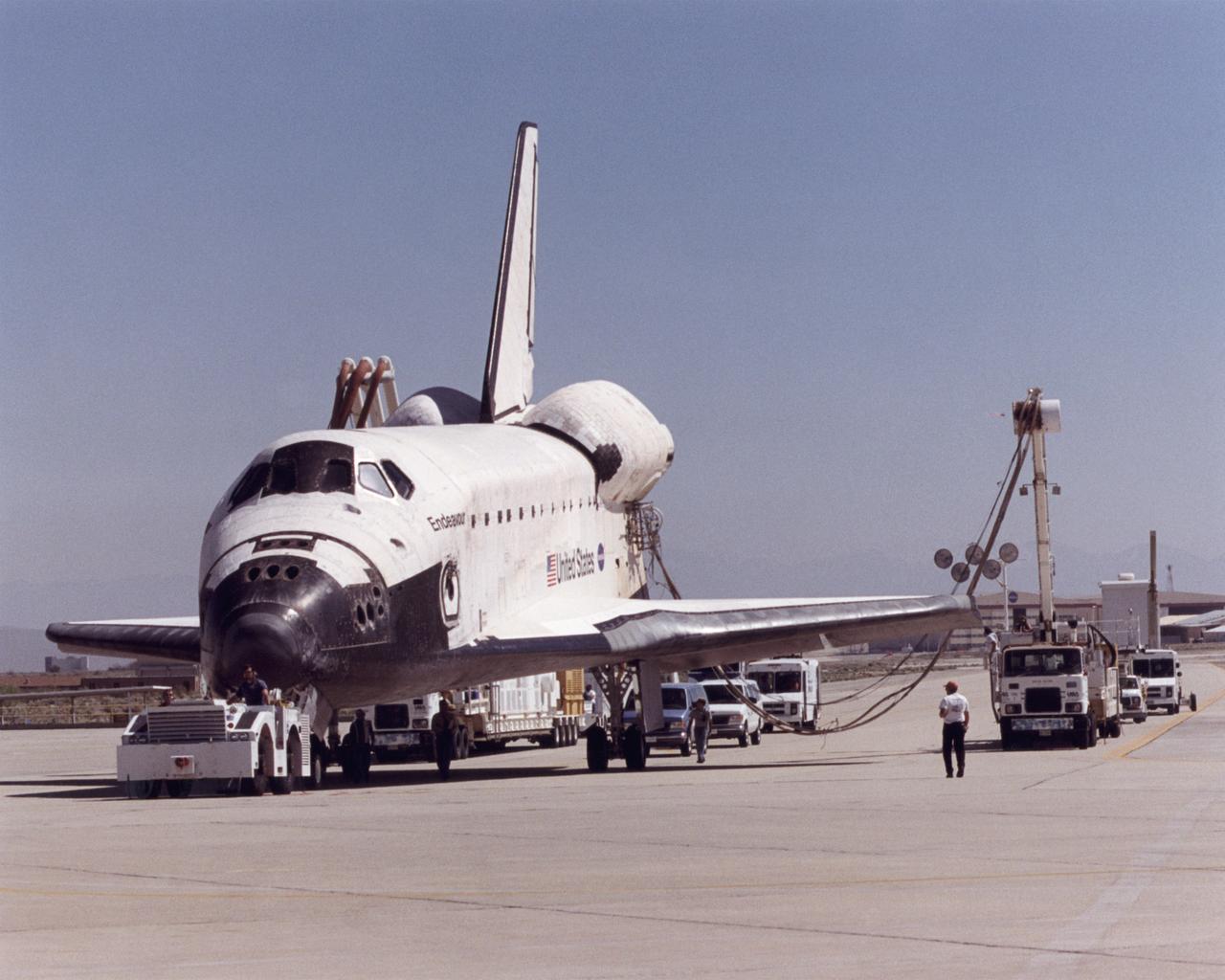
A convoy of specialized support vehicles follow the Space Shuttle Endeavour as it is towed up a taxiway at NASA's Dryden Flight Research Center on Edwards Air Force Base, California, after landing on May 1, 2001. The two largest vehicles trailing the shuttle provide electrical power and air conditioning to the shuttle's systems during post-flight recovery operations. The Endeavour had just completed mission STS-100, an almost 12-day mission to install the Canadarm 2 robotic arm and deliver some three tons of supplies and experiments to the International Space Station. The landing was the 48th shuttle landing at Edwards since shuttle flights began in 1981. After post-flight processing, the Endeavour was mounted atop one of NASA's modified Boeing 747 shuttle carrier aircraft and ferried back to the Kennedy Space Center in Florida on May 8, 2001.
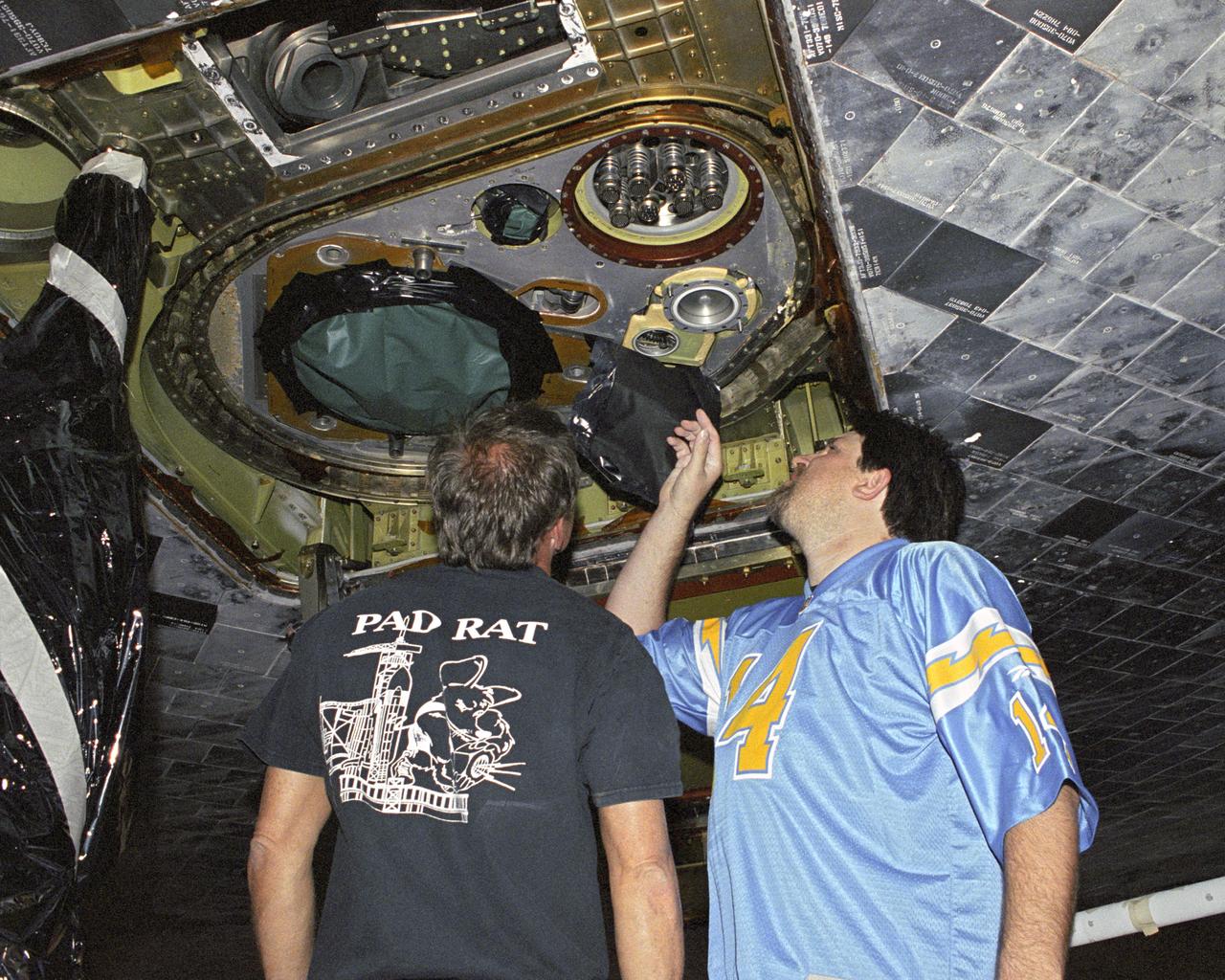
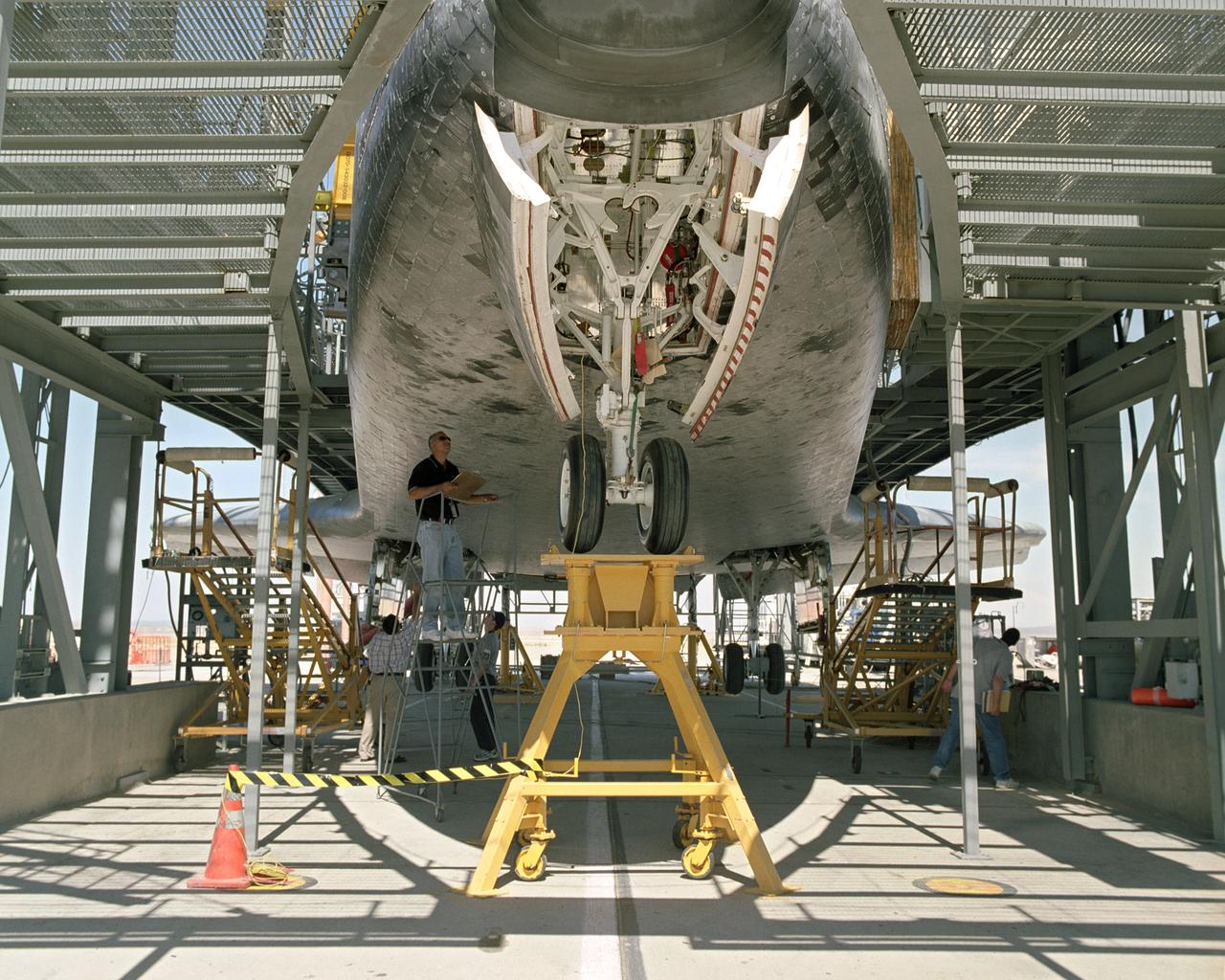
Robert 'Skip' Garrett; main propulsion advanced systems technician, and Chris Jacobs; main propulsion systems engineering technician, inspect external tank attachment fittings on the Space Shuttle Discovery as part of it's post-flight processing at NASA's Dryden Flight Research Center. The Space Shuttles receive post-flight servicing in the Mate-Demate Device (MDD) following landings at NASA's Dryden Flight Research Center, Edwards, California. The gantry-like MDD structure is used for servicing the shuttle orbiters in preparation for their ferry flight back to the Kennedy Space Center in Florida, including mounting the shuttle atop NASA's modified Boeing 747 Shuttle Carrier Aircraft. Space Shuttle Discovery landed safely at NASA's Dryden Flight Research Center at Edwards Air Force Base in California at 5:11:22 a.m. PDT, August 9, 2005, following the very successful 14-day STS-114 return to flight mission. During their two weeks in space, Commander Eileen Collins and her six crewmates tested out new safety procedures and delivered supplies and equipment the International Space Station. Discovery spent two weeks in space, where the crew demonstrated new methods to inspect and repair the Shuttle in orbit. The crew also delivered supplies, outfitted and performed maintenance on the International Space Station. A number of these tasks were conducted during three spacewalks. In an unprecedented event, spacewalkers were called upon to remove protruding gap fillers from the heat shield on Discovery's underbelly. In other spacewalk activities, astronauts installed an external platform onto the Station's Quest Airlock and replaced one of the orbital outpost's Control Moment Gyroscopes. Inside the Station, the STS-114 crew conducted joint operations with the Expedition 11 crew. They unloaded fresh supplies from the Shuttle and the Raffaello Multi-Purpose Logistics Module. Before Discovery undocked, the crews filled Raffeallo with unneeded items and returned to Shuttle pa
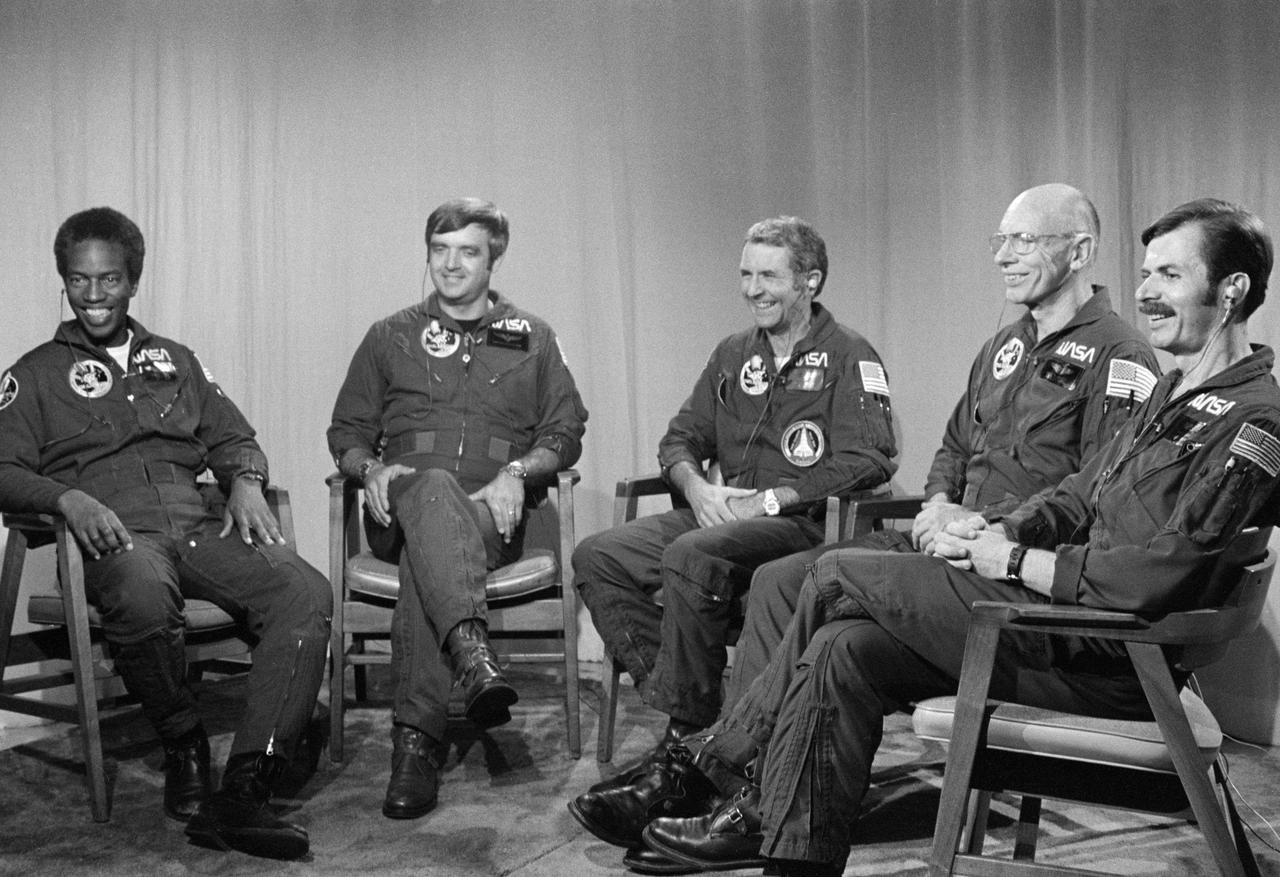
S83-39696 (5 Sept 1983) --- The five member astronaut crew of the Space Shuttle Challenger for STS-8 responds to a comment made by President Ronald Reagan during a post flight telephone conversation with the chief executive. The five astronauts earlier today landed the reusable spacecraft at Edwards Air Force Base in California and were flown to JSC via NASA aircraft. Richard H. Truly, center, is crew commander. Pilot for the six day flight was Daniel C. Brandenstein, second left. The mission specialist were Guion S. Bluford, left: Dr. William S. Thornton, second right, and Dale A. Gardner, right. Photo credit: NASA
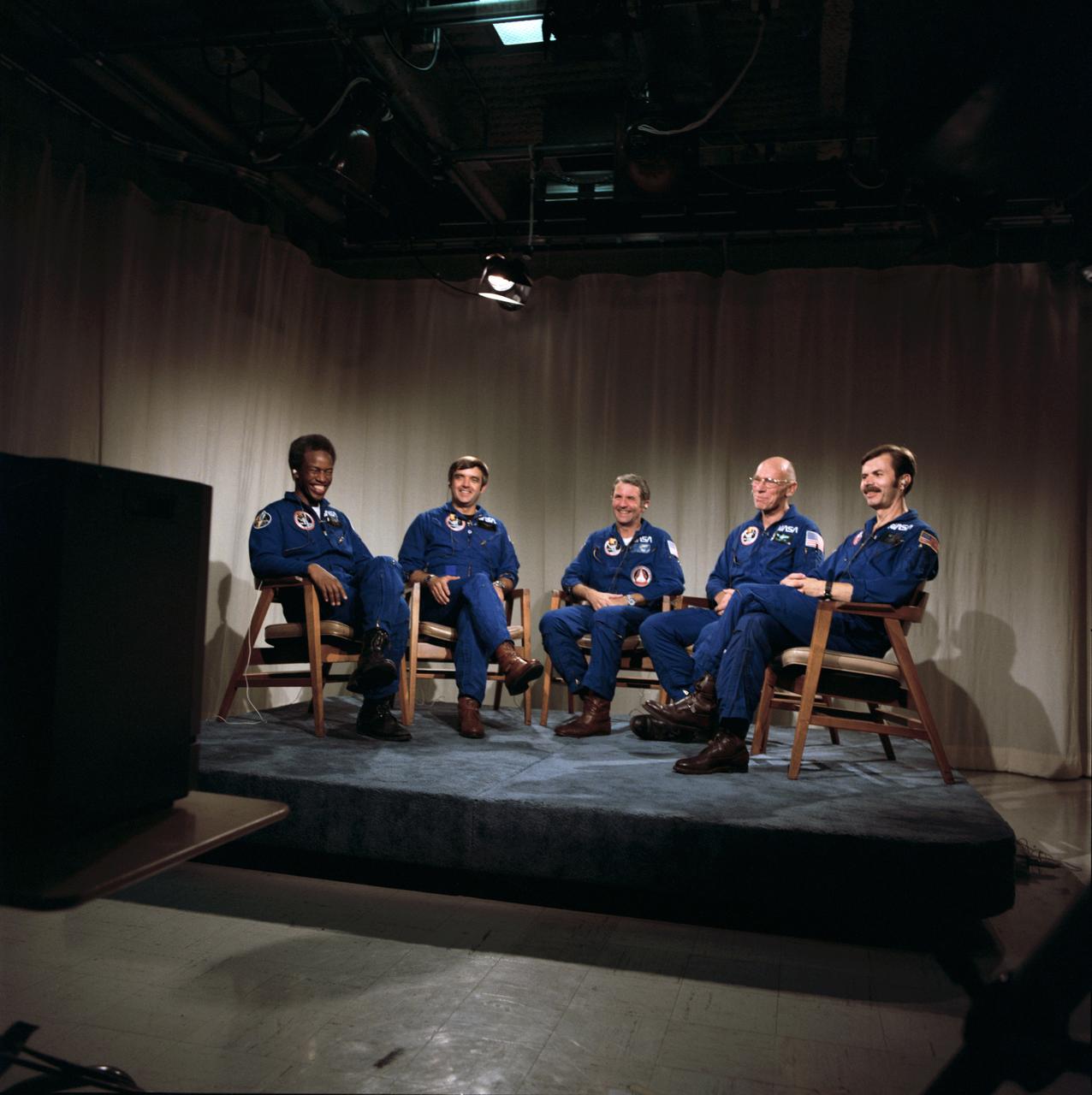
S83-39693 (5 Sept 1983) --- The five member astronaut crew of the Space Shuttle Challenger for STS-8 responds to a comment made by President Ronald Reagan during a post flight telephone conversation with the chief executive. The five astronauts earlier today landed the reusable spacecraft at Edwards Air Force Base in California and were flown to JSC via NASA aircraft. Richard H. Truly, center, is crew commander. Pilot for the six day flight was Daniel C. Brandenstein, second left. The mission specialist were Guion S. Bluford, left: Dr. William S. Thornton, second right, and Dale A. Gardner, right.
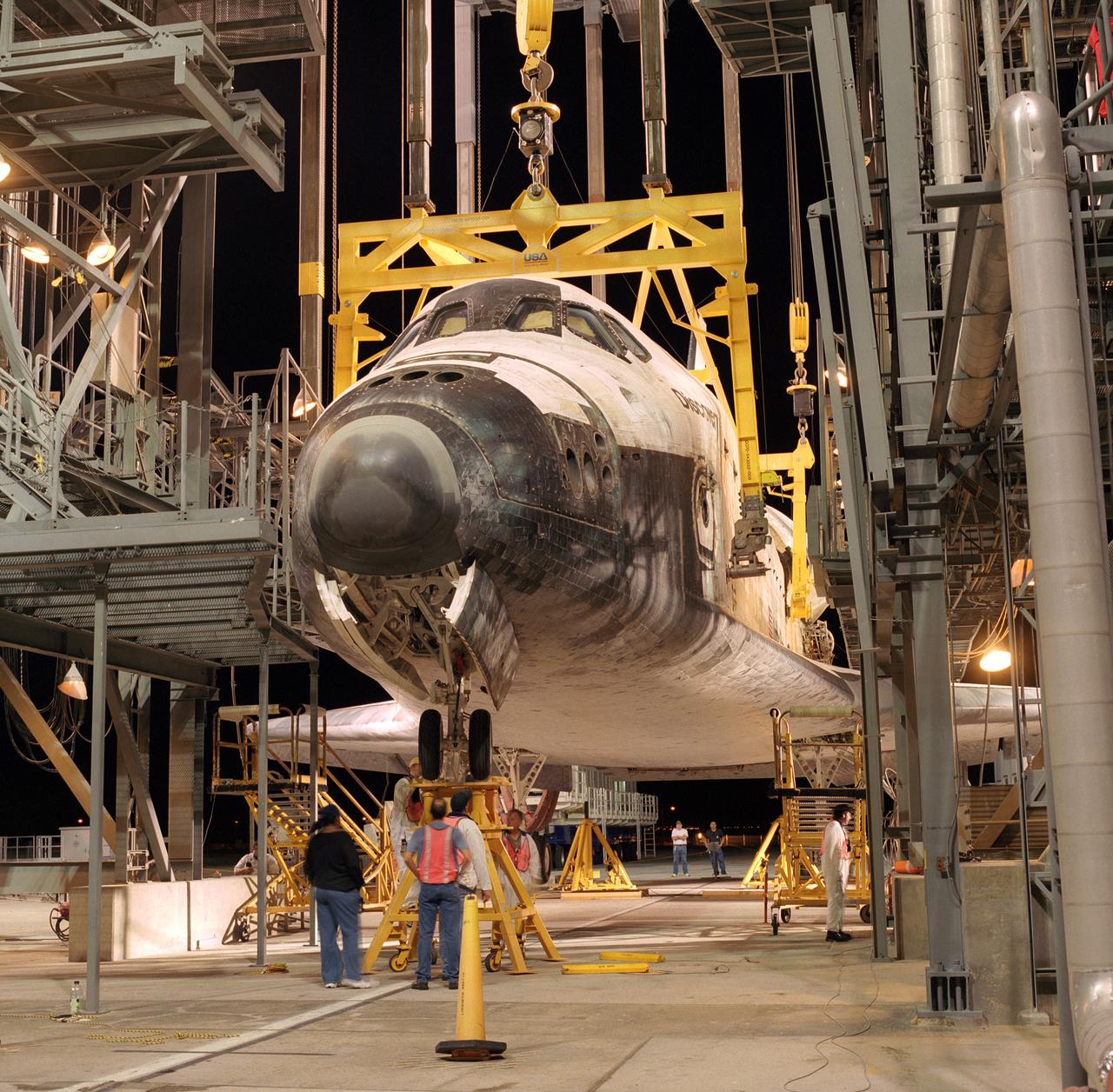
The Space Shuttle Discovery receives post-flight servicing in the Mate-Demate Device (MDD), following its landing at NASA's Dryden Flight Research Center, Edwards, California, August 9, 2005. The gantry-like MDD structure is used for servicing the shuttle orbiters in preparation for their ferry flight back to the Kennedy Space Center in Florida, including mounting the shuttle atop NASA's modified Boeing 747 Shuttle Carrier Aircraft. Space Shuttle Discovery landed safely at NASA's Dryden Flight Research Center at Edwards Air Force Base in California at 5:11:22 a.m. PDT this morning, following the very successful 14-day STS-114 return to flight mission. During their two weeks in space, Commander Eileen Collins and her six crewmates tested out new safety procedures and delivered supplies and equipment the International Space Station. Discovery spent two weeks in space, where the crew demonstrated new methods to inspect and repair the Shuttle in orbit. The crew also delivered supplies, outfitted and performed maintenance on the International Space Station. A number of these tasks were conducted during three spacewalks. In an unprecedented event, spacewalkers were called upon to remove protruding gap fillers from the heat shield on Discovery's underbelly. In other spacewalk activities, astronauts installed an external platform onto the Station's Quest Airlock and replaced one of the orbital outpost's Control Moment Gyroscopes. Inside the Station, the STS-114 crew conducted joint operations with the Expedition 11 crew. They unloaded fresh supplies from the Shuttle and the Raffaello Multi-Purpose Logistics Module. Before Discovery undocked, the crews filled Raffeallo with unneeded items and returned to Shuttle payload bay. Discovery launched on July 26 and spent almost 14 days on orbit.
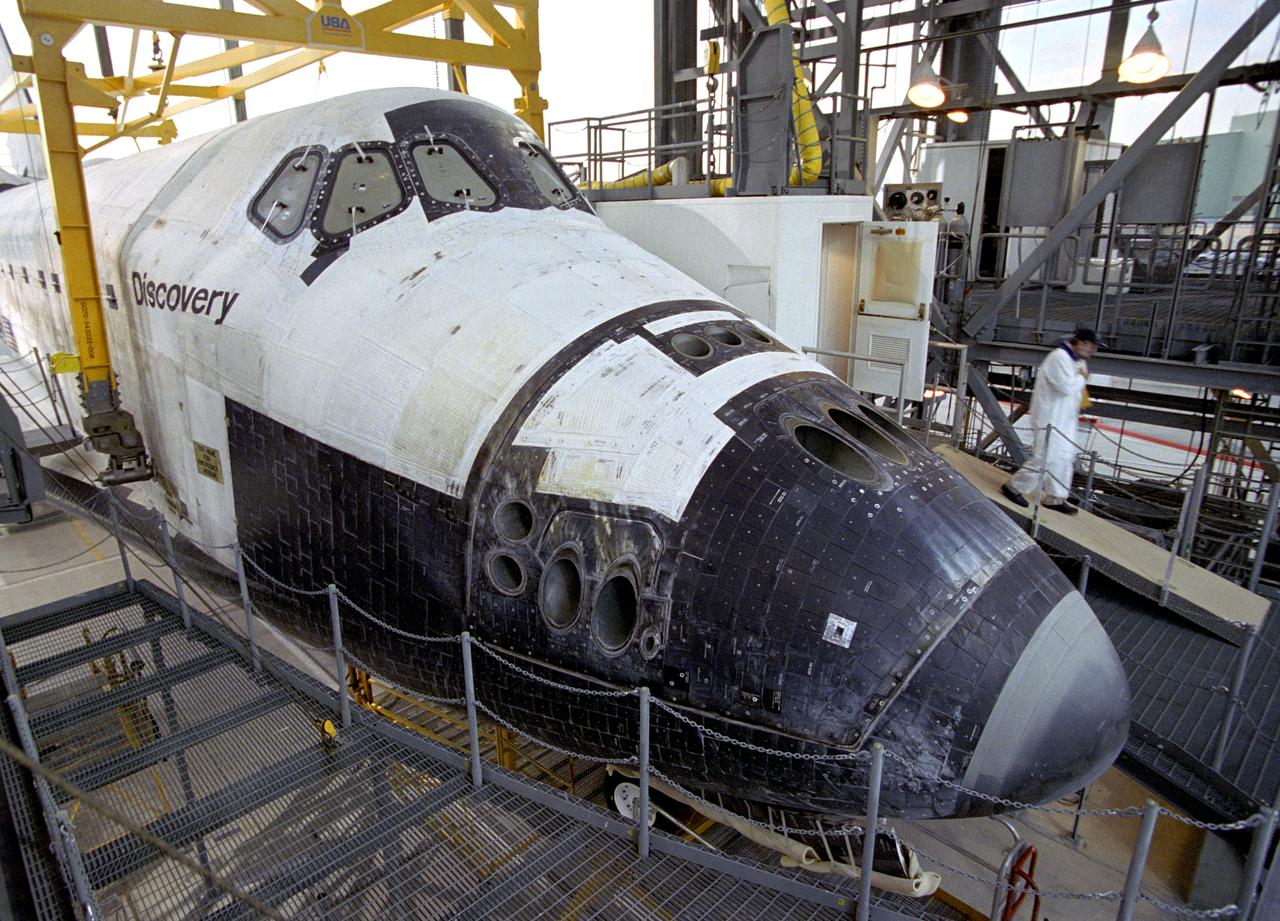
The Space Shuttle Discovery receives post-flight servicing in the Mate-Demate Device (MDD), following its landing at NASA's Dryden Flight Research Center, Edwards, California, August 9, 2005. The gantry-like MDD structure is used for servicing the shuttle orbiters in preparation for their ferry flight back to the Kennedy Space Center in Florida, including mounting the shuttle atop NASA's modified Boeing 747 Shuttle Carrier Aircraft. Space Shuttle Discovery landed safely at NASA's Dryden Flight Research Center at Edwards Air Force Base in California at 5:11:22 a.m. PDT, August 9, 2005, following the very successful 14-day STS-114 return to flight mission. During their two weeks in space, Commander Eileen Collins and her six crewmates tested out new safety procedures and delivered supplies and equipment the International Space Station. Discovery spent two weeks in space, where the crew demonstrated new methods to inspect and repair the Shuttle in orbit. The crew also delivered supplies, outfitted and performed maintenance on the International Space Station. A number of these tasks were conducted during three spacewalks. In an unprecedented event, spacewalkers were called upon to remove protruding gap fillers from the heat shield on Discovery's underbelly. In other spacewalk activities, astronauts installed an external platform onto the Station's Quest Airlock and replaced one of the orbital outpost's Control Moment Gyroscopes. Inside the Station, the STS-114 crew conducted joint operations with the Expedition 11 crew. They unloaded fresh supplies from the Shuttle and the Raffaello Multi-Purpose Logistics Module. Before Discovery undocked, the crews filled Raffeallo with unneeded items and returned to Shuttle payload bay. Discovery launched on July 26 and spent almost 14 days on orbit.
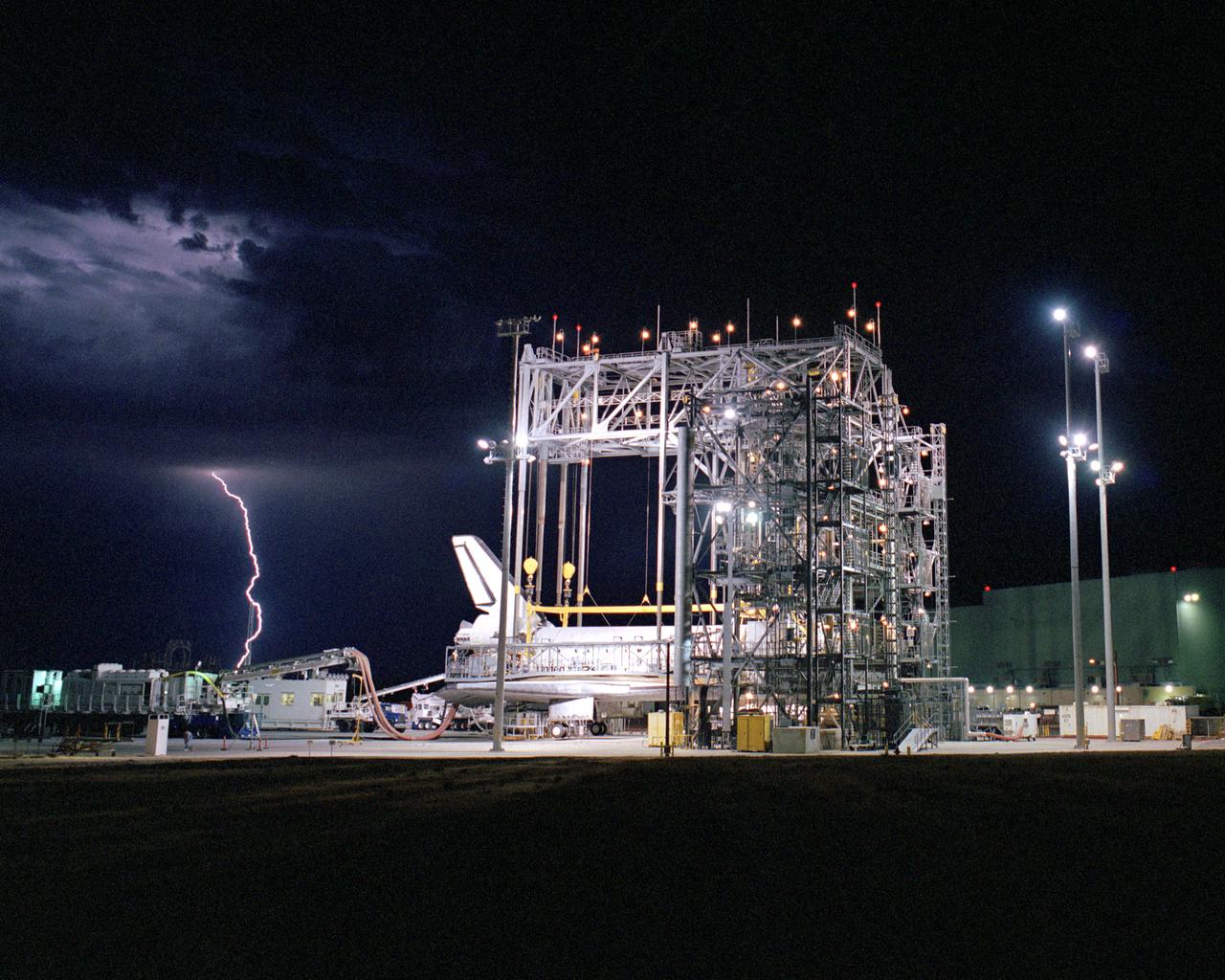
Lightning strikes in the distance as the Space Shuttle Discovery receives post-flight processing in the Mate-Demate Device (MDD), following its landing at NASA's Dryden Flight Research Center in California. The gantry-like MDD structure is used for servicing the shuttle orbiters in preparation for their ferry flight back to the Kennedy Space Center in Florida, including mounting the shuttle atop NASA's modified Boeing 747 Shuttle Carrier Aircraft. Space Shuttle Discovery landed safely at NASA's Dryden Flight Research Center at Edwards Air Force Base in California at 5:11:22 a.m. PDT, August 9, 2005, following the very successful 14-day STS-114 return to flight mission. During their two weeks in space, Commander Eileen Collins and her six crewmates tested out new safety procedures and delivered supplies and equipment the International Space Station. Discovery spent two weeks in space, where the crew demonstrated new methods to inspect and repair the Shuttle in orbit. The crew also delivered supplies, outfitted and performed maintenance on the International Space Station. A number of these tasks were conducted during three spacewalks. In an unprecedented event, spacewalkers were called upon to remove protruding gap fillers from the heat shield on Discovery's underbelly. In other spacewalk activities, astronauts installed an external platform onto the Station's Quest Airlock and replaced one of the orbital outpost's Control Moment Gyroscopes. Inside the Station, the STS-114 crew conducted joint operations with the Expedition 11 crew. They unloaded fresh supplies from the Shuttle and the Raffaello Multi-Purpose Logistics Module. Before Discovery undocked, the crews filled Raffeallo with unneeded items and returned to Shuttle payload bay. Discovery launched on July 26 and spent almost 14 days on orbit.
A technician leaves the 'white room', the access point for entering the Space Shuttle Discovery during post-flight processing in the Mate-Demate Device (MDD) at NASA's Dryden Flight Research Center in California. The gantry-like MDD structure is used for servicing the shuttle orbiters in preparation for their ferry flight back to the Kennedy Space Center in Florida, including mounting the shuttle atop NASA's modified Boeing 747 Shuttle Carrier Aircraft. Space Shuttle Discovery landed safely at NASA's Dryden Flight Research Center at Edwards Air Force Base in California at 5:11:22 a.m. PDT, August 9, 2005, following the very successful 14-day STS-114 return to flight mission. During their two weeks in space, Commander Eileen Collins and her six crewmates tested out new safety procedures and delivered supplies and equipment the International Space Station. Discovery spent two weeks in space, where the crew demonstrated new methods to inspect and repair the Shuttle in orbit. The crew also delivered supplies, outfitted and performed maintenance on the International Space Station. A number of these tasks were conducted during three spacewalks. In an unprecedented event, spacewalkers were called upon to remove protruding gap fillers from the heat shield on Discovery's underbelly. In other spacewalk activities, astronauts installed an external platform onto the Station's Quest Airlock and replaced one of the orbital outpost's Control Moment Gyroscopes. Inside the Station, the STS-114 crew conducted joint operations with the Expedition 11 crew. They unloaded fresh supplies from the Shuttle and the Raffaello Multi-Purpose Logistics Module. Before Discovery undocked, the crews filled Raffeallo with unneeded items and returned to Shuttle payload bay. Discovery launched on July 26 and spent almost 14 days on orbit.
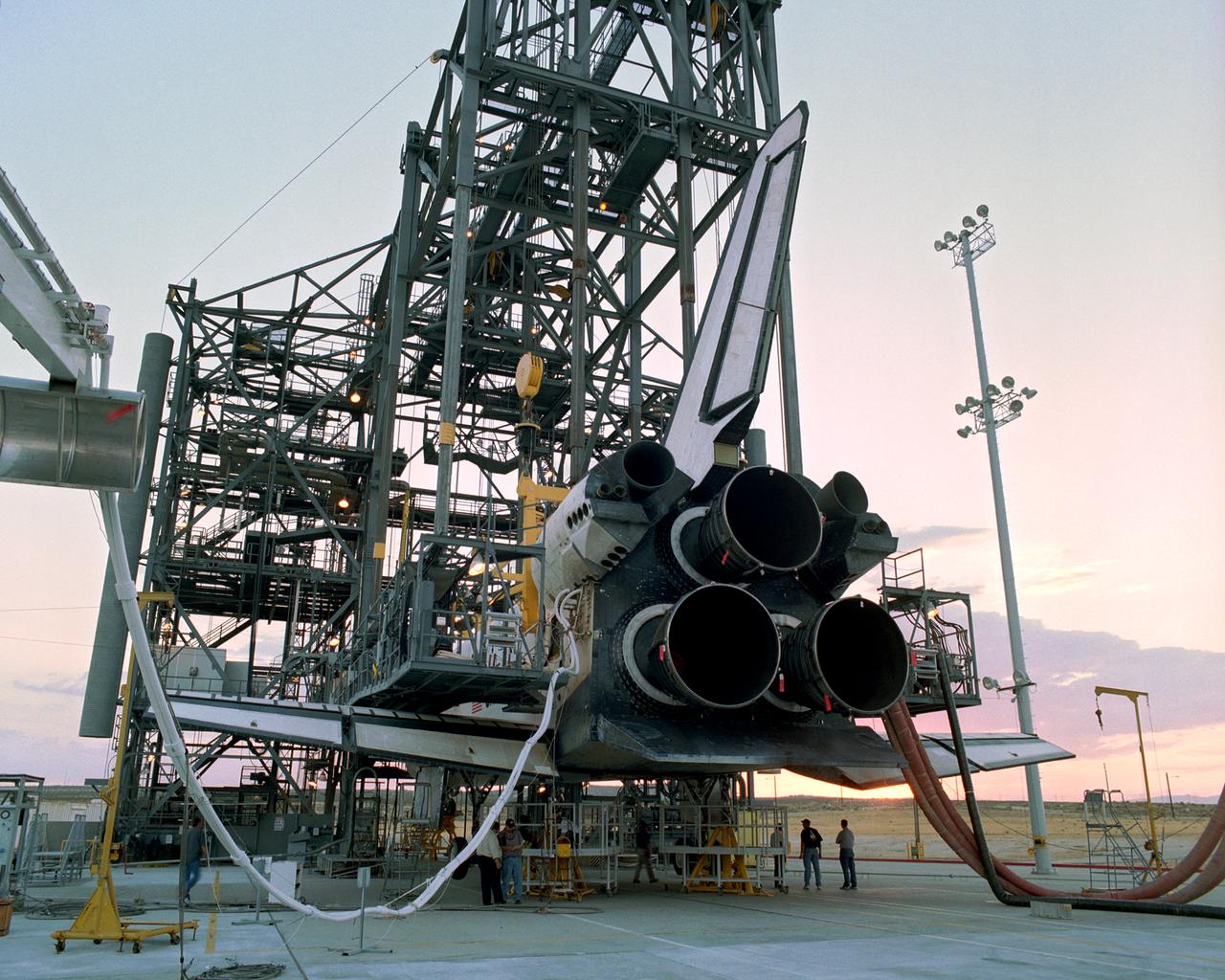
The sun sets on the Space Shuttle Discovery during post-flight processing in the Mate-Demate Device (MDD), following its landing at NASA's Dryden Flight Research Center in California. The gantry-like MDD structure is used for servicing the shuttle orbiters in preparation for their ferry flight back to the Kennedy Space Center in Florida, including mounting the shuttle atop NASA's modified Boeing 747 Shuttle Carrier Aircraft. Space Shuttle Discovery landed safely at NASA's Dryden Flight Research Center at Edwards Air Force Base in California at 5:11:22 a.m. PDT, August 9, 2005, following the very successful 14-day STS-114 return to flight mission. During their two weeks in space, Commander Eileen Collins and her six crewmates tested out new safety procedures and delivered supplies and equipment the International Space Station. Discovery spent two weeks in space, where the crew demonstrated new methods to inspect and repair the Shuttle in orbit. The crew also delivered supplies, outfitted and performed maintenance on the International Space Station. A number of these tasks were conducted during three spacewalks. In an unprecedented event, spacewalkers were called upon to remove protruding gap fillers from the heat shield on Discovery's underbelly. In other spacewalk activities, astronauts installed an external platform onto the Station's Quest Airlock and replaced one of the orbital outpost's Control Moment Gyroscopes. Inside the Station, the STS-114 crew conducted joint operations with the Expedition 11 crew. They unloaded fresh supplies from the Shuttle and the Raffaello Multi-Purpose Logistics Module. Before Discovery undocked, the crews filled Raffeallo with unneeded items and returned to Shuttle payload bay. Discovery launched on July 26 and spent almost 14 days on orbit.
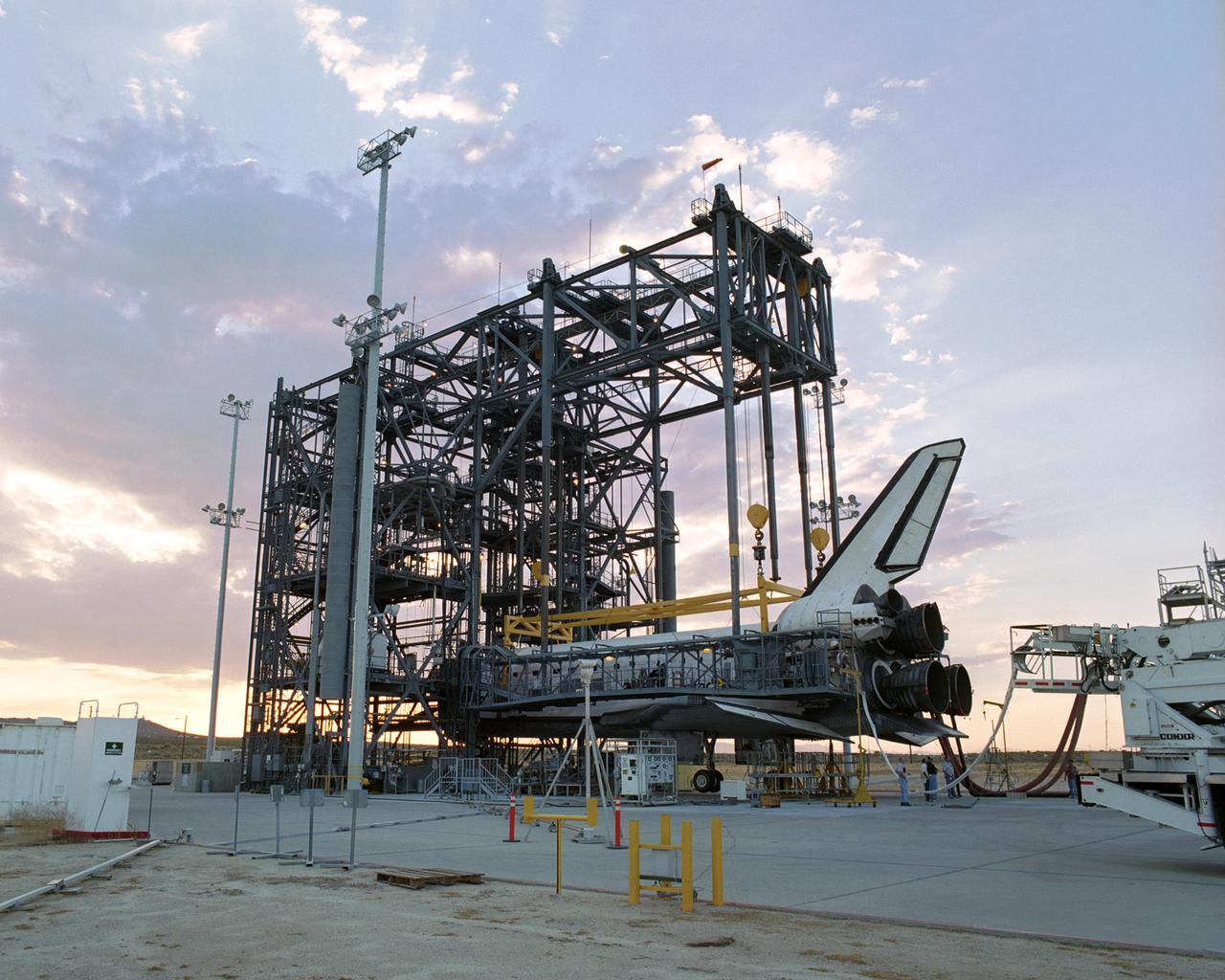
The sun sets on the Space Shuttle Discovery during post-flight processing in the Mate-Demate Device (MDD), following its landing at NASA's Dryden Flight Research Center in California. The gantry-like MDD structure is used for servicing the shuttle orbiters in preparation for their ferry flight back to the Kennedy Space Center in Florida, including mounting the shuttle atop NASA's modified Boeing 747 Shuttle Carrier Aircraft. Space Shuttle Discovery landed safely at NASA's Dryden Flight Research Center at Edwards Air Force Base in California at 5:11:22 a.m. PDT, August 9, 2005, following the very successful 14-day STS-114 return to flight mission. During their two weeks in space, Commander Eileen Collins and her six crewmates tested out new safety procedures and delivered supplies and equipment the International Space Station. Discovery spent two weeks in space, where the crew demonstrated new methods to inspect and repair the Shuttle in orbit. The crew also delivered supplies, outfitted and performed maintenance on the International Space Station. A number of these tasks were conducted during three spacewalks. In an unprecedented event, spacewalkers were called upon to remove protruding gap fillers from the heat shield on Discovery's underbelly. In other spacewalk activities, astronauts installed an external platform onto the Station's Quest Airlock and replaced one of the orbital outpost's Control Moment Gyroscopes. Inside the Station, the STS-114 crew conducted joint operations with the Expedition 11 crew. They unloaded fresh supplies from the Shuttle and the Raffaello Multi-Purpose Logistics Module. Before Discovery undocked, the crews filled Raffeallo with unneeded items and returned to Shuttle payload bay. Discovery launched on July 26 and spent almost 14 days on orbit.
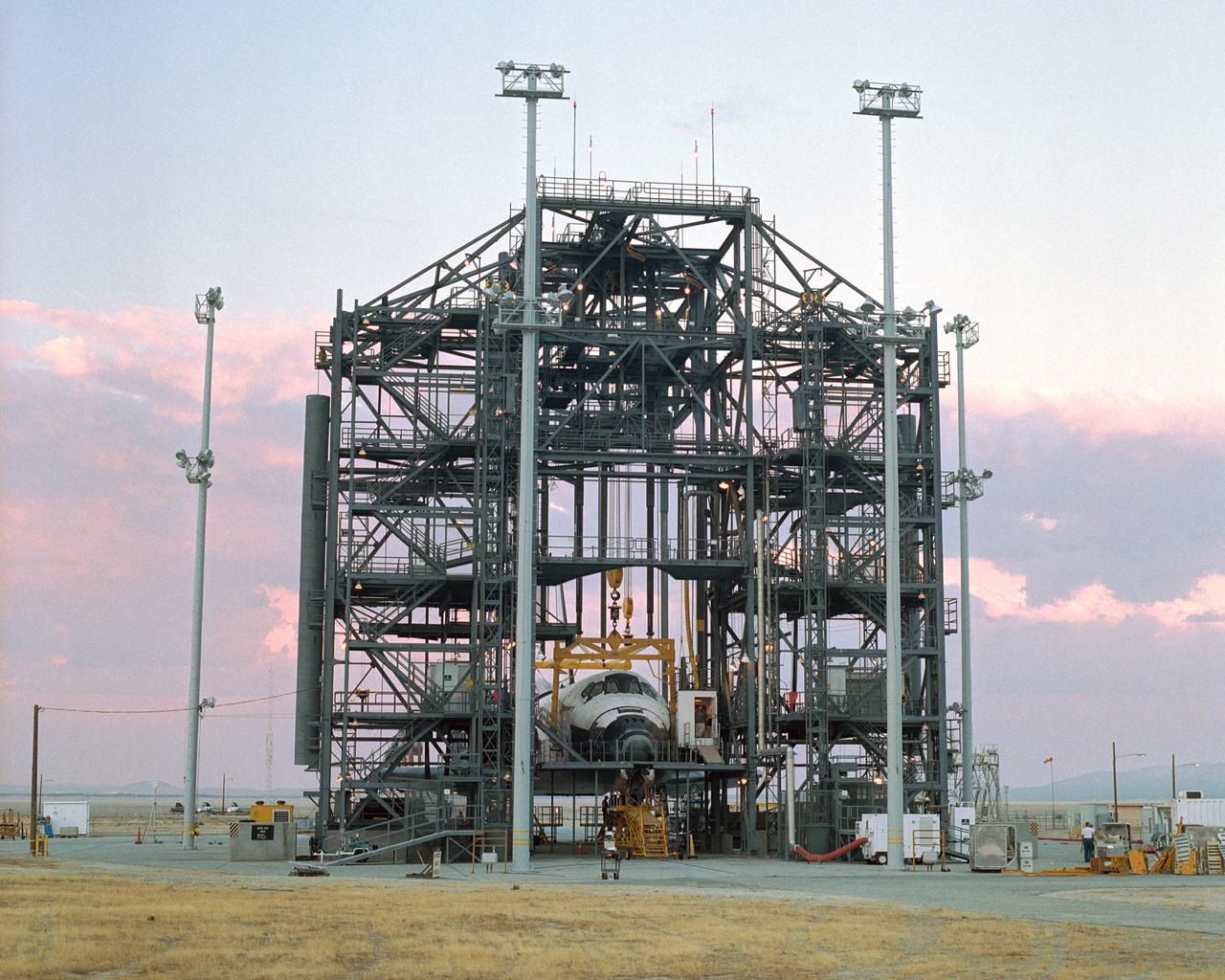
The sun sets on the Space Shuttle Discovery during post-flight processing in the Mate-Demate Device (MDD), following its landing at NASA's Dryden Flight Research Center in California. The gantry-like MDD structure is used for servicing the shuttle orbiters in preparation for their ferry flight back to the Kennedy Space Center in Florida, including mounting the shuttle atop NASA's modified Boeing 747 Shuttle Carrier Aircraft. Space Shuttle Discovery landed safely at NASA's Dryden Flight Research Center at Edwards Air Force Base in California at 5:11:22 a.m. PDT, August 9, 2005, following the very successful 14-day STS-114 return to flight mission. During their two weeks in space, Commander Eileen Collins and her six crewmates tested out new safety procedures and delivered supplies and equipment the International Space Station. Discovery spent two weeks in space, where the crew demonstrated new methods to inspect and repair the Shuttle in orbit. The crew also delivered supplies, outfitted and performed maintenance on the International Space Station. A number of these tasks were conducted during three spacewalks. In an unprecedented event, spacewalkers were called upon to remove protruding gap fillers from the heat shield on Discovery's underbelly. In other spacewalk activities, astronauts installed an external platform onto the Station's Quest Airlock and replaced one of the orbital outpost's Control Moment Gyroscopes. Inside the Station, the STS-114 crew conducted joint operations with the Expedition 11 crew. They unloaded fresh supplies from the Shuttle and the Raffaello Multi-Purpose Logistics Module. Before Discovery undocked, the crews filled Raffeallo with unneeded items and returned to Shuttle payload bay. Discovery launched on July 26 and spent almost 14 days on orbit.
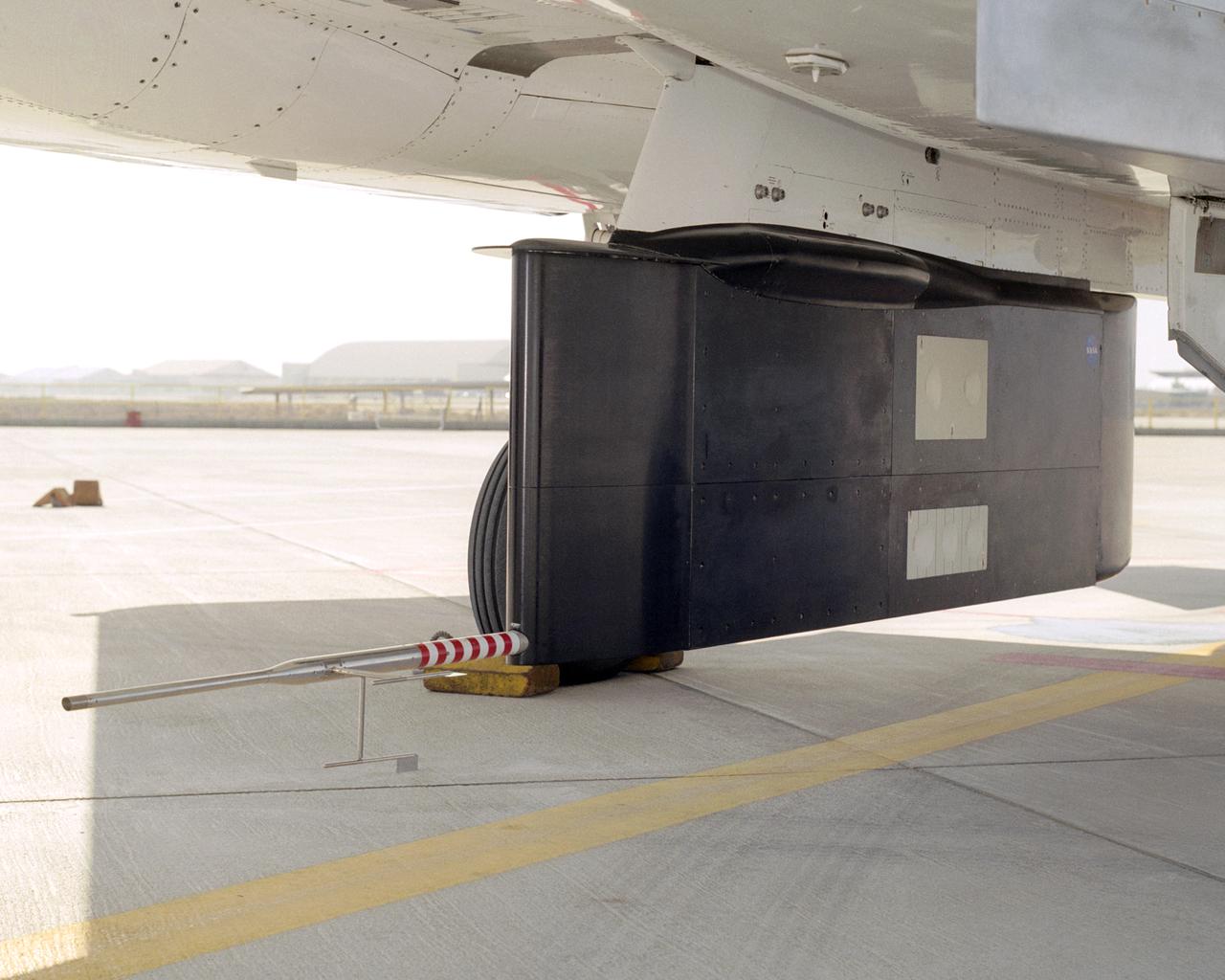
A post-flight inspection of the panels on the F-15B's flight test fixture shows five divots of TPS foam were successfully ejected during the LIFT experiment flight #2, the first flight with TPS foam.
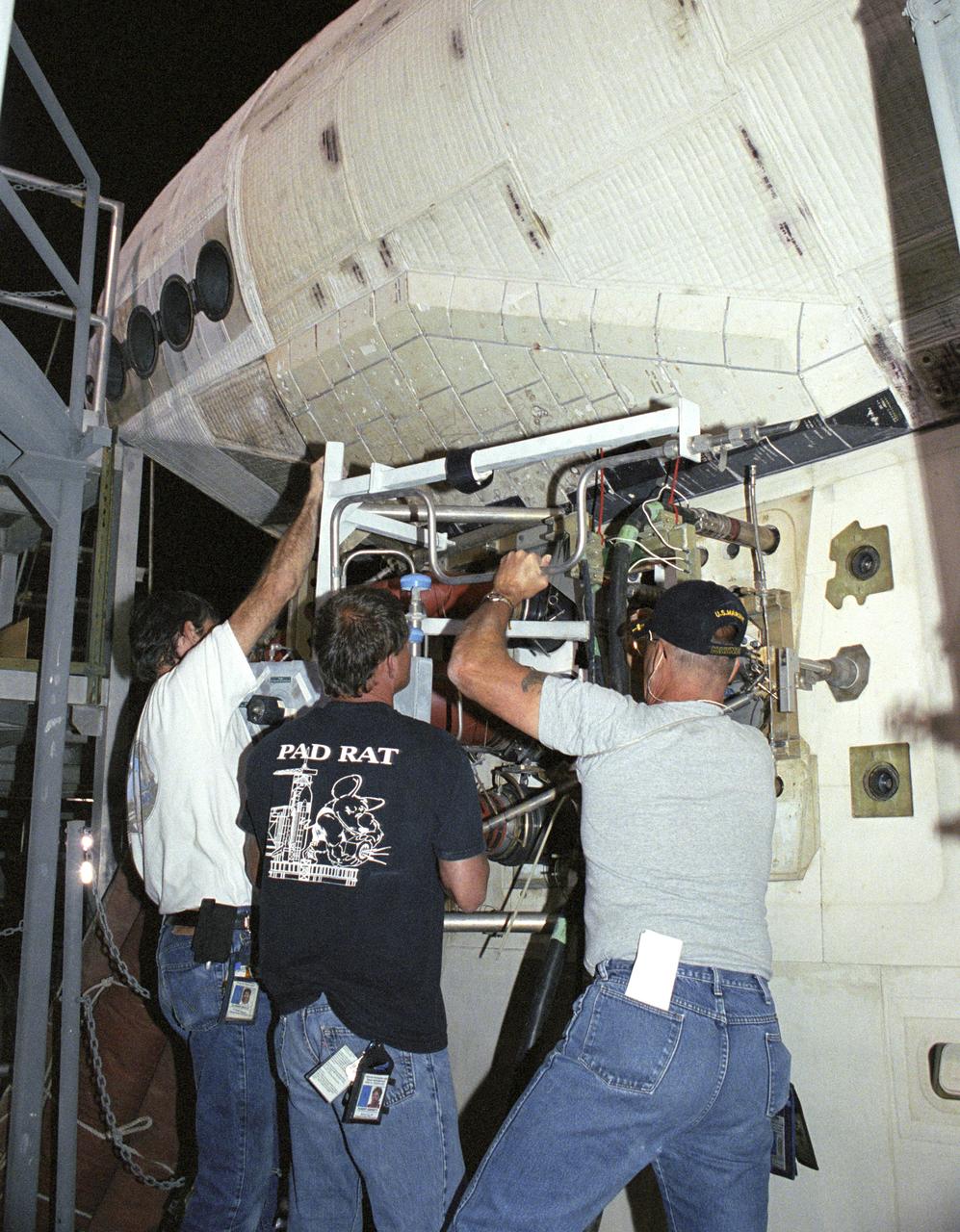
Todd Viddle; APU advanced systems technician, Robert 'Skip' Garrett; main propulsion advanced systems technician, and Dan McGrath; main propulsion systems engineer technician, remove a servicing unit from the Space Shuttle Discovery as part of it's post-flight processing at NASA's Dryden Flight Research Center. The Space Shuttles receive post-flight servicing in the Mate-Demate Device (MDD) following landings at NASA's Dryden Flight Research Center, Edwards, California. The gantry-like MDD structure is used for servicing the shuttle orbiters in preparation for their ferry flight back to the Kennedy Space Center in Florida, including mounting the shuttle atop NASA's modified Boeing 747 Shuttle Carrier Aircraft. Space Shuttle Discovery landed safely at NASA's Dryden Flight Research Center at Edwards Air Force Base in California at 5:11:22 a.m. PDT, August 9, 2005, following the very successful 14-day STS-114 return to flight mission. During their two weeks in space, Commander Eileen Collins and her six crewmates tested out new safety procedures and delivered supplies and equipment the International Space Station. Discovery spent two weeks in space, where the crew demonstrated new methods to inspect and repair the Shuttle in orbit. The crew also delivered supplies, outfitted and performed maintenance on the International Space Station. A number of these tasks were conducted during three spacewalks. In an unprecedented event, spacewalkers were called upon to remove protruding gap fillers from the heat shield on Discovery's underbelly. In other spacewalk activities, astronauts installed an external platform onto the Station's Quest Airlock and replaced one of the orbital outpost's Control Moment Gyroscopes. Inside the Station, the STS-114 crew conducted joint operations with the Expedition 11 crew. They unloaded fresh supplies from the Shuttle and the Raffaello Multi-Purpose Logistics Module. Before Discovery undocked, the crews filled Raffeallo with unneeded items
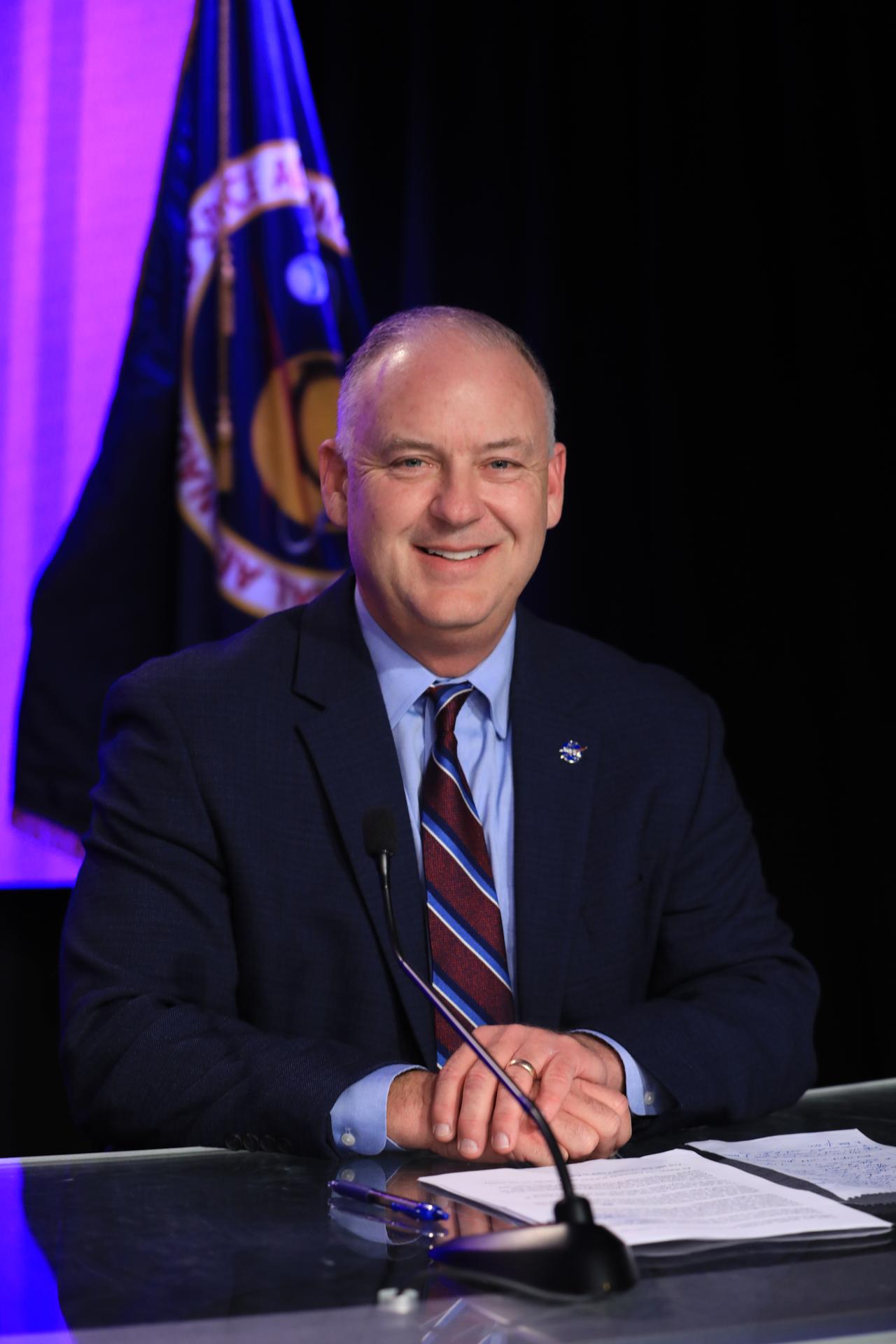
Norm Knight, director, Flight Operations Directorate, participates in a post-Flight Readiness Review news conference for the Artemis II test flight inside the John Holliman Auditorium of the NASA News Center at the agency’s Kennedy Space Center in Florida on Thursday, March 12, 2026. The review is an assessment of the readiness of NASA’s SLS (Space Launch System) rocket and Orion spacecraft to support the Artemis II test flight as four astronauts journey around the Moon and return to Earth.

John Honeycutt, chair, Artemis II Mission Management Team, participates in a post-Flight Readiness Review news conference for the Artemis II test flight inside the John Holliman Auditorium of the NASA News Center at the agency’s Kennedy Space Center in Florida on Thursday, March 12, 2026. The review is an assessment of the readiness of NASA’s SLS (Space Launch System) rocket and Orion spacecraft to support the Artemis II test flight as four astronauts journey around the Moon and return to Earth.
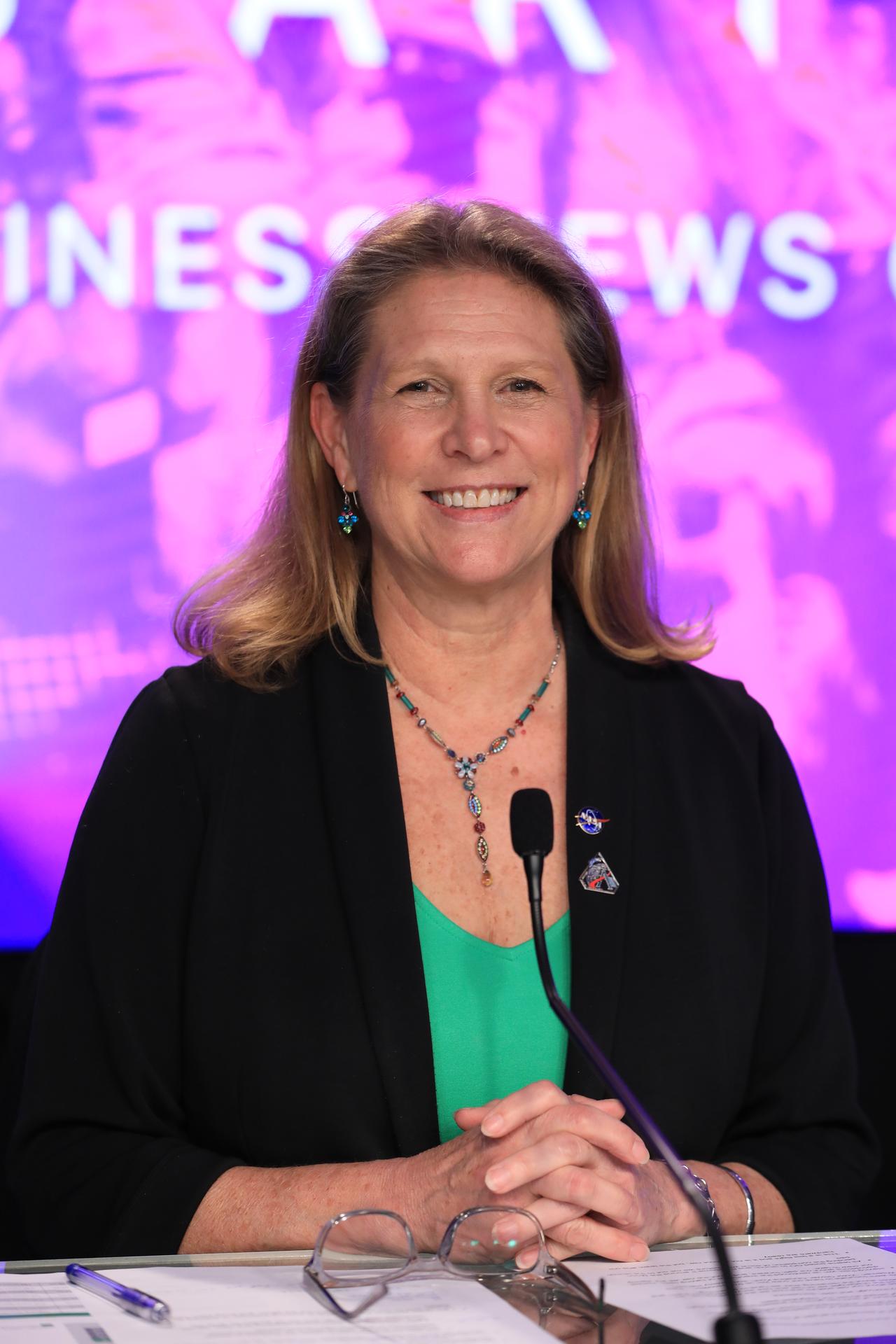
Lori Glaze, acting associate administrator, Exploration Systems Development Mission Directorate, participates in a post-Flight Readiness Review news conference for the Artemis II test flight inside the John Holliman Auditorium of the NASA News Center at the agency’s Kennedy Space Center in Florida on Thursday, March 12, 2026. The review is an assessment of the readiness of NASA’s SLS (Space Launch System) rocket and Orion spacecraft to support the Artemis II test flight as four astronauts journey around the Moon and return to Earth.
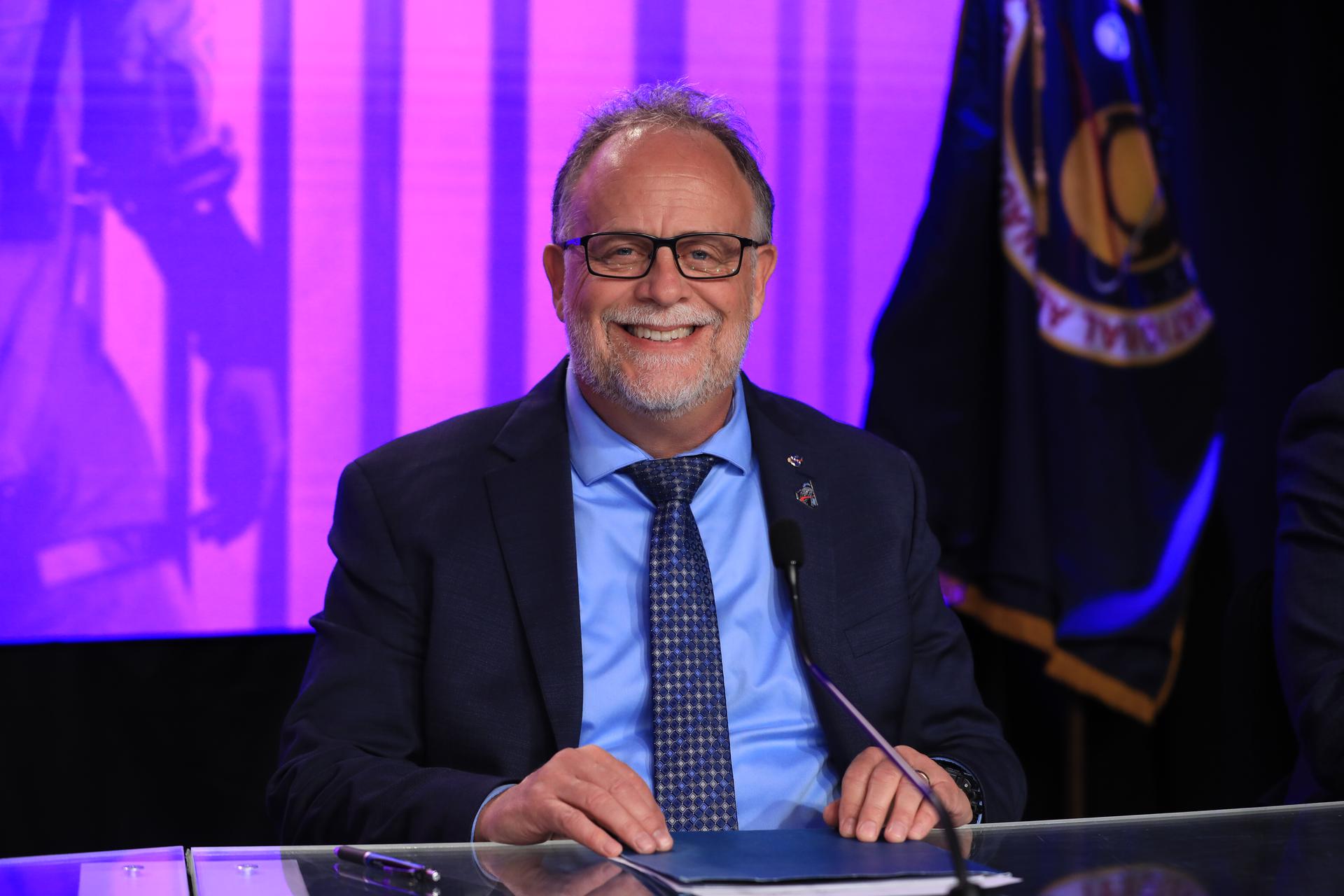
Shawn Quinn, manager, Exploration Ground Systems Program, participates in a post-Flight Readiness Review news conference for the Artemis II test flight inside the John Holliman Auditorium of the NASA News Center at the agency’s Kennedy Space Center in Florida on Thursday, March 12, 2026. The review is an assessment of the readiness of NASA’s SLS (Space Launch System) rocket and Orion spacecraft to support the Artemis II test flight as four astronauts journey around the Moon and return to Earth.

Rachel Kraft, NASA Communications, participates in a post-Flight Readiness Review news conference for the Artemis II test flight inside the John Holliman Auditorium of the NASA News Center at the agency’s Kennedy Space Center in Florida on Thursday, March 12, 2026. The review is an assessment of the readiness of NASA’s SLS (Space Launch System) rocket and Orion spacecraft to support the Artemis II test flight as four astronauts journey around the Moon and return to Earth.
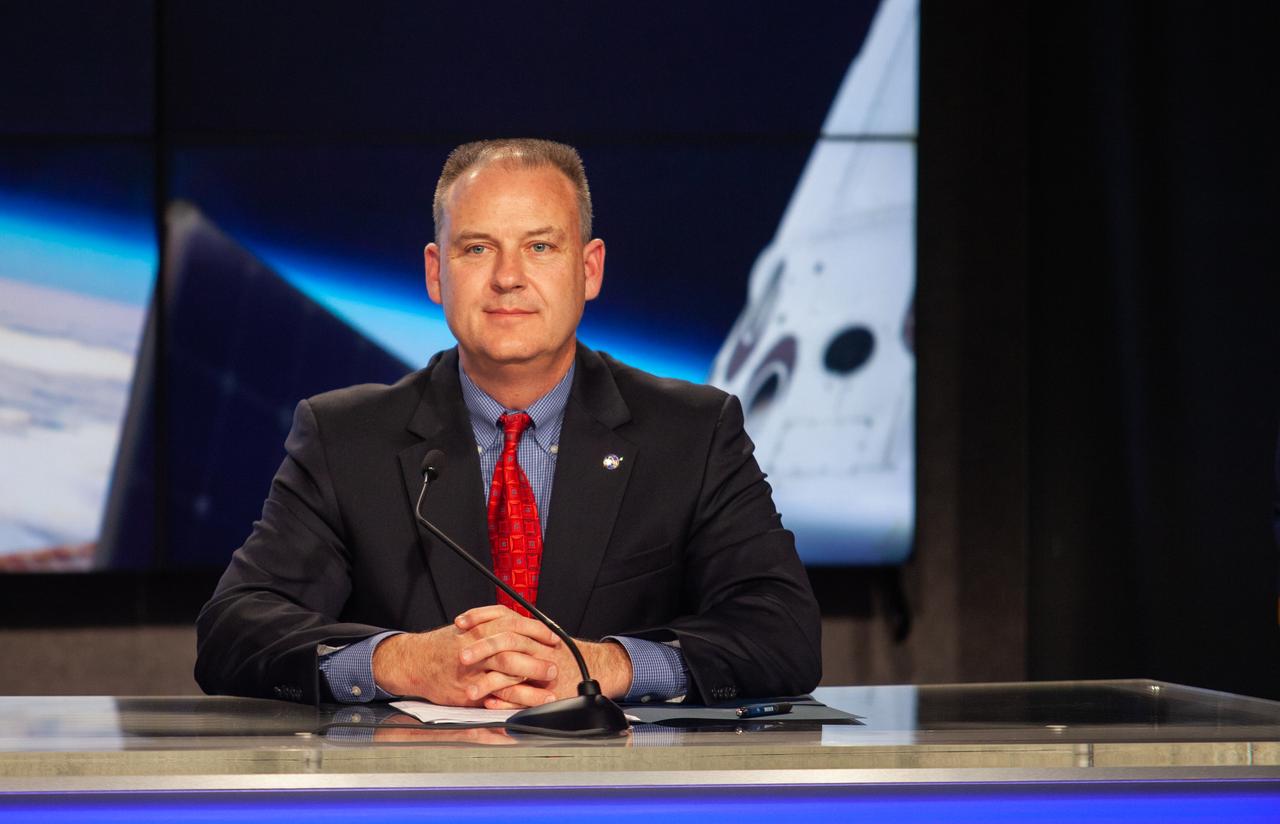
In Kennedy Space Center’s Press Site auditorium, agency and industry leaders speak to members of the media on Friday, Feb. 22, during the post-flight readiness review briefing for the SpaceX Demo-1 Commercial Crew Program (CCP) mission to the International Space Station. Pictured is Norm Knight, deputy director, NASA Johnson Space Center Flight Operations. The inaugural uncrewed flight of the SpaceX Crew Dragon, known as Demo-1, is targeted to lift off from Kennedy’s Launch Complex 39A on Saturday, March 2. EST. A SpaceX Falcon 9 rocket will launch the Crew Dragon on a mission designed to validate end-to-end systems and capabilities, leading to certification to fly crew.

The Space Shuttle Endeavour receives post-flight servicing in the Mate-Demate Device (MDD), following its landing at NASA's Dryden Flight Research Center, Edwards, California, June 19, 2002.
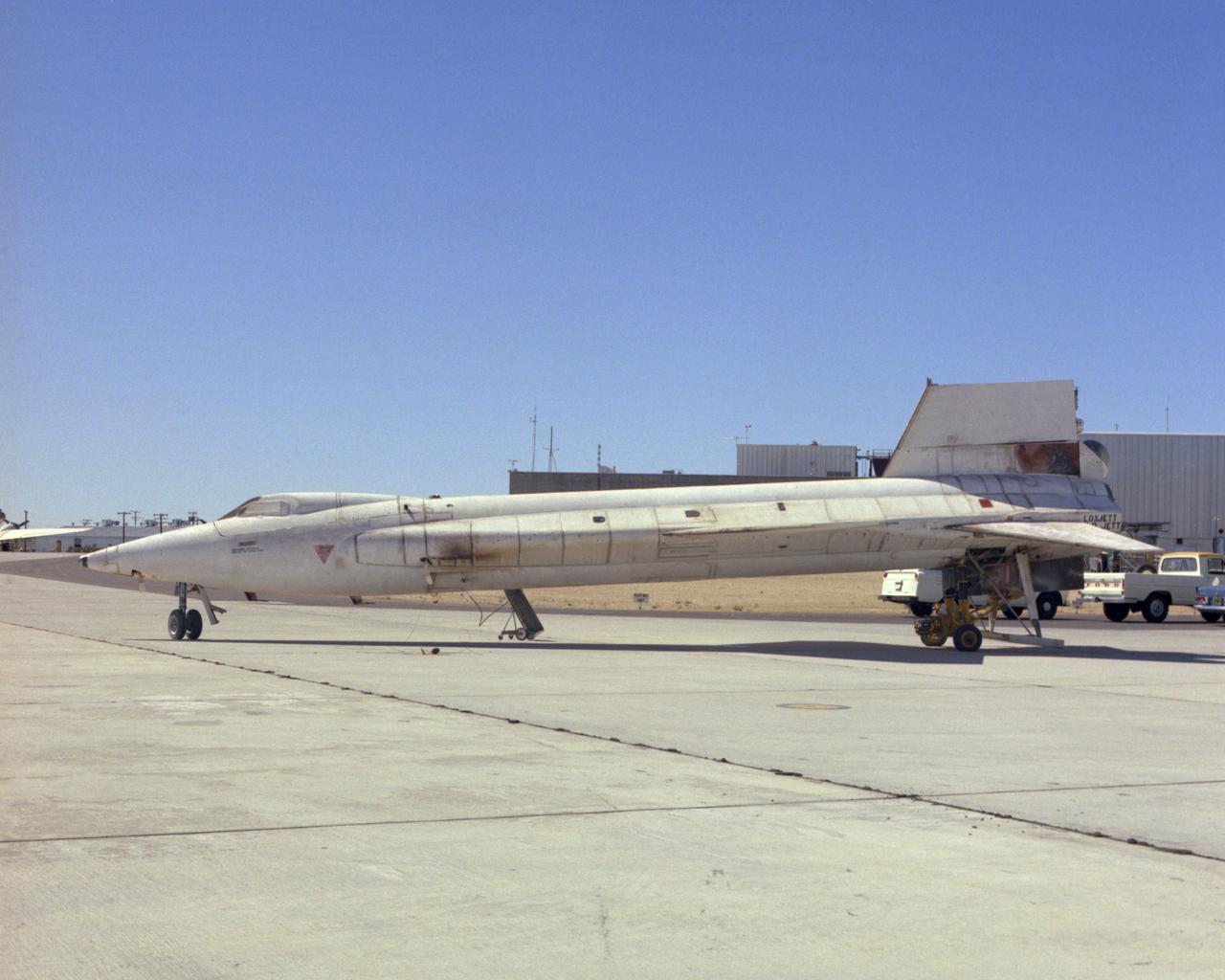
X-15A-2 post flight photo showing heat damage from Mach 6.7 flight on 3 Oct 67. Flt. 2-53-97; pilot-Pete Knight.
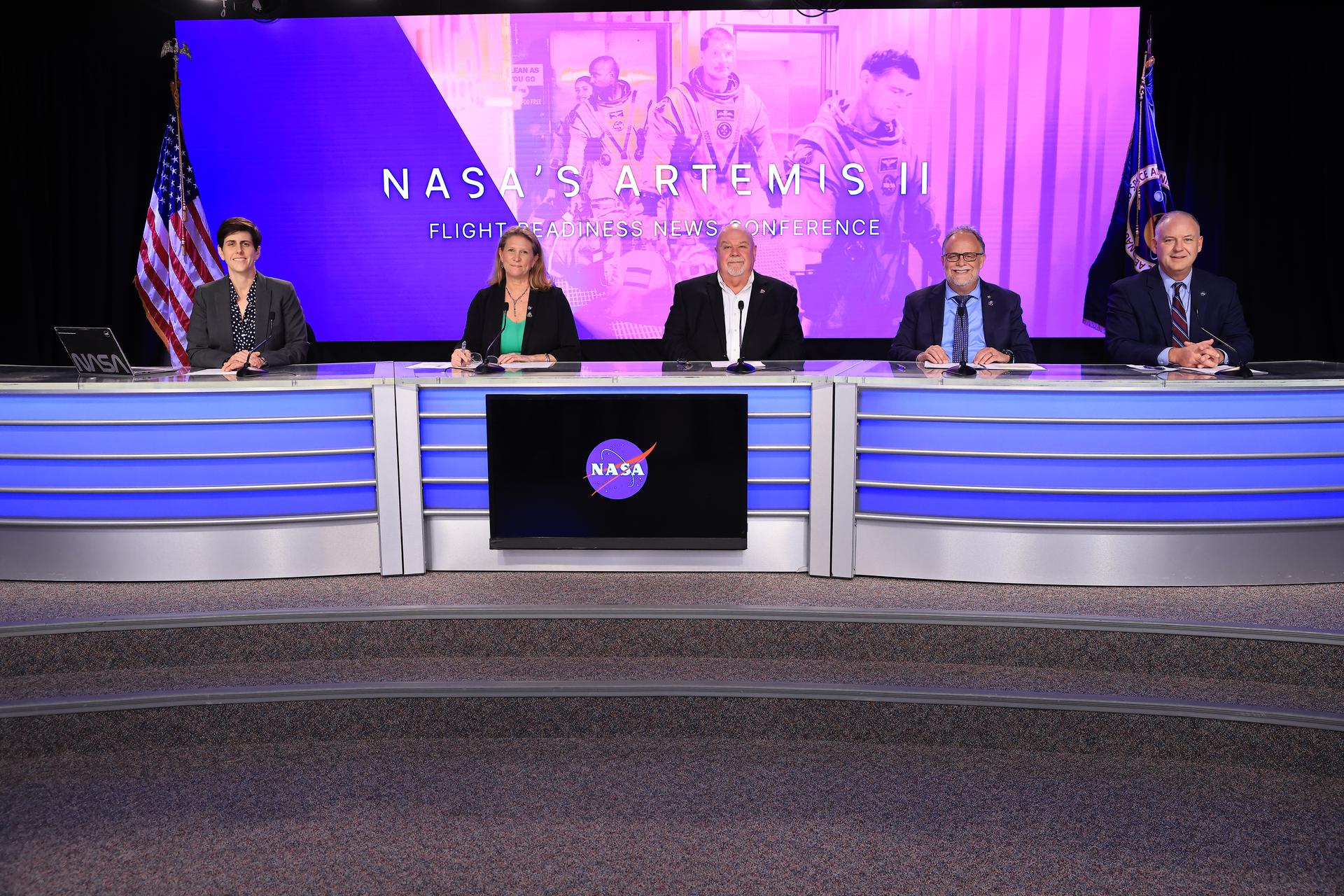
From left to right, Rachel Kraft, NASA Communications; Lori Glaze, acting associate administrator, Exploration Systems Development Mission Directorate; John Honeycutt, chair, Artemis II Mission Management Team; Shawn Quinn, manager, Exploration Ground Systems Program; and Norm Knight, director, Flight Operations Directorate, participate in a post-Flight Readiness Review news conference for the Artemis II test flight inside the John Holliman Auditorium of the NASA News Center at the agency’s Kennedy Space Center in Florida on Thursday, March 12, 2026. The review is an assessment of the readiness of NASA’s SLS (Space Launch System) rocket and Orion spacecraft to support the Artemis II test flight as four astronauts journey around the Moon and return to Earth.
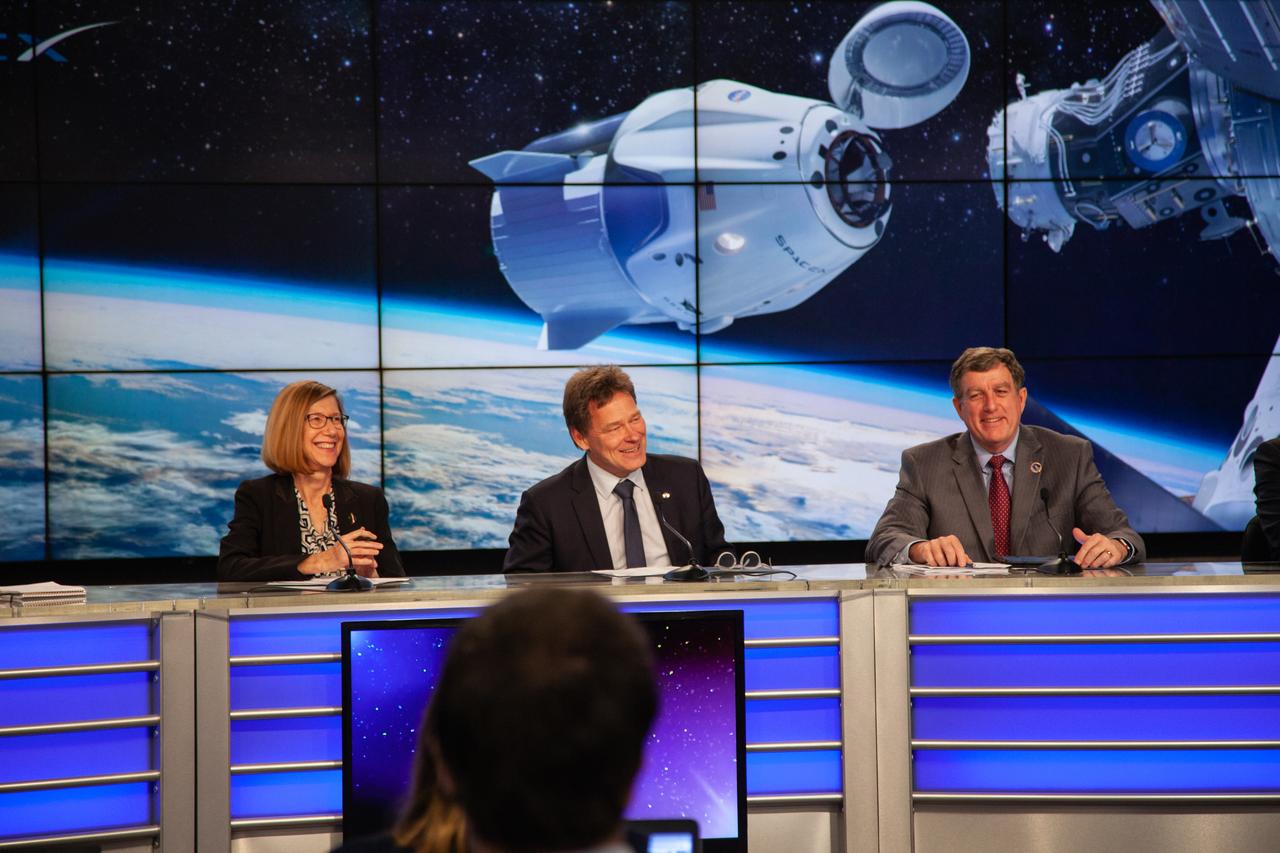
In Kennedy Space Center’s Press Site auditorium, agency and industry leaders speak to members of the media on Friday, Feb. 22, during the post-flight readiness review briefing for the SpaceX Demo-1 Commercial Crew Program (CCP) mission to the International Space Station. From left are: Kathy Lueders, manager, NASA Commercial Crew Program; Hans Koenigsmann, vice president, Build and Flight Reliability, SpaceX; and Kirk Shireman, International Space Station Program manager. The inaugural uncrewed flight of the SpaceX Crew Dragon, known as Demo-1, is targeted to lift off from Kennedy’s Launch Complex 39A on Saturday, March 2. EST. A SpaceX Falcon 9 rocket will launch the Crew Dragon on a mission designed to validate end-to-end systems and capabilities, leading to certification to fly crew.

The Space Shuttle Endeavour receives post-flight servicing in the Mate-Demate Device (MDD), following its landing at NASA's Dryden Flight Research Center, Edwards, California, May 1, 2001. Once servicing was complete, one of NASA's two 747 Shuttle Carrier Aircraft, No. 905, was readied to ferry Endeavour back to the Kennedy Space Center, FL.
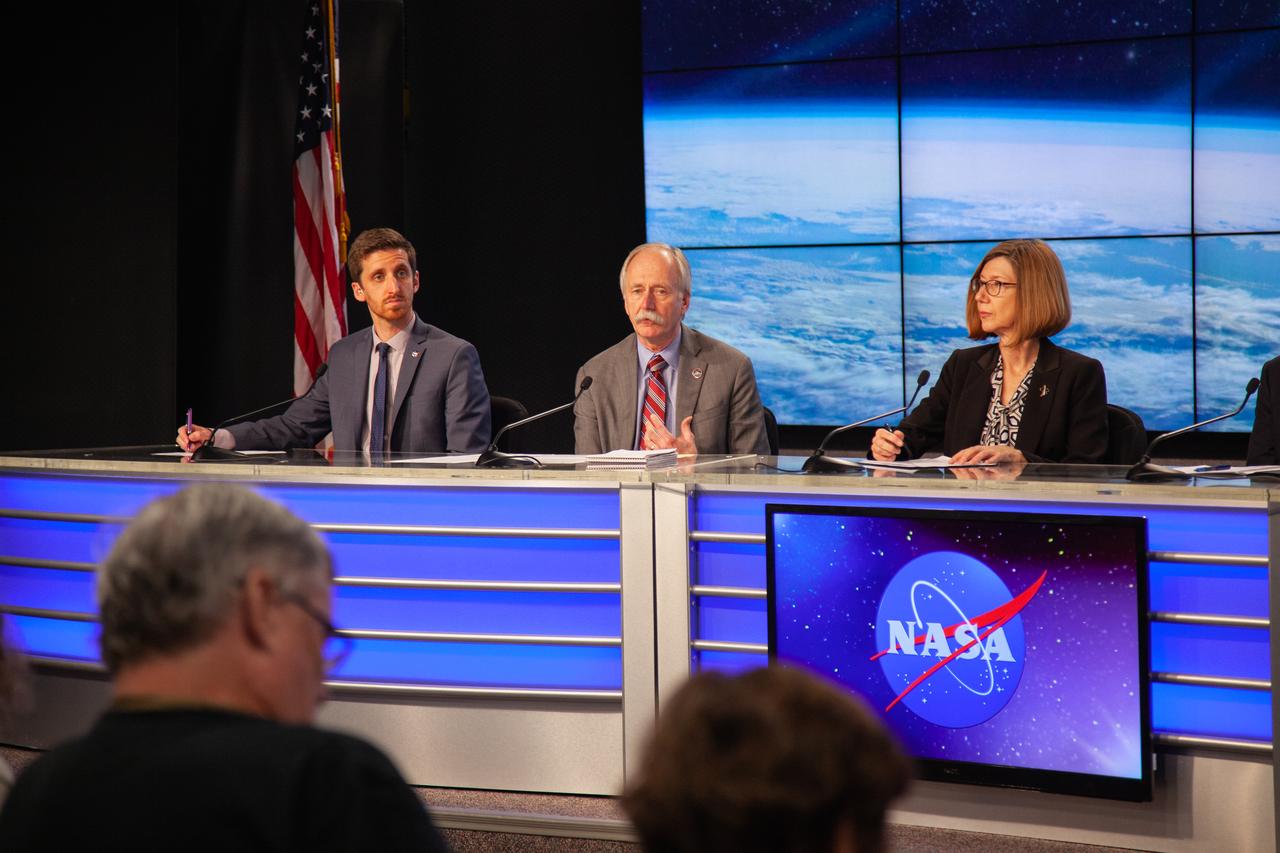
In Kennedy Space Center’s Press Site auditorium, agency and industry leaders speak to members of the media on Friday, Feb. 22, during the post-flight readiness review briefing for the SpaceX Demo-1 Commercial Crew Program (CCP) mission to the International Space Station. From left are: Josh Finch of NASA Communications; William Gerstenmaier, associate administrator, NASA Human Exploration and Operations; and Kathy Lueders, manager, NASA Commercial Crew Program. The inaugural uncrewed flight of the SpaceX Crew Dragon, known as Demo-1, is targeted to lift off from Kennedy’s Launch Complex 39A on Saturday, March 2. EST. A SpaceX Falcon 9 rocket will launch the Crew Dragon on a mission designed to validate end-to-end systems and capabilities, leading to certification to fly crew.
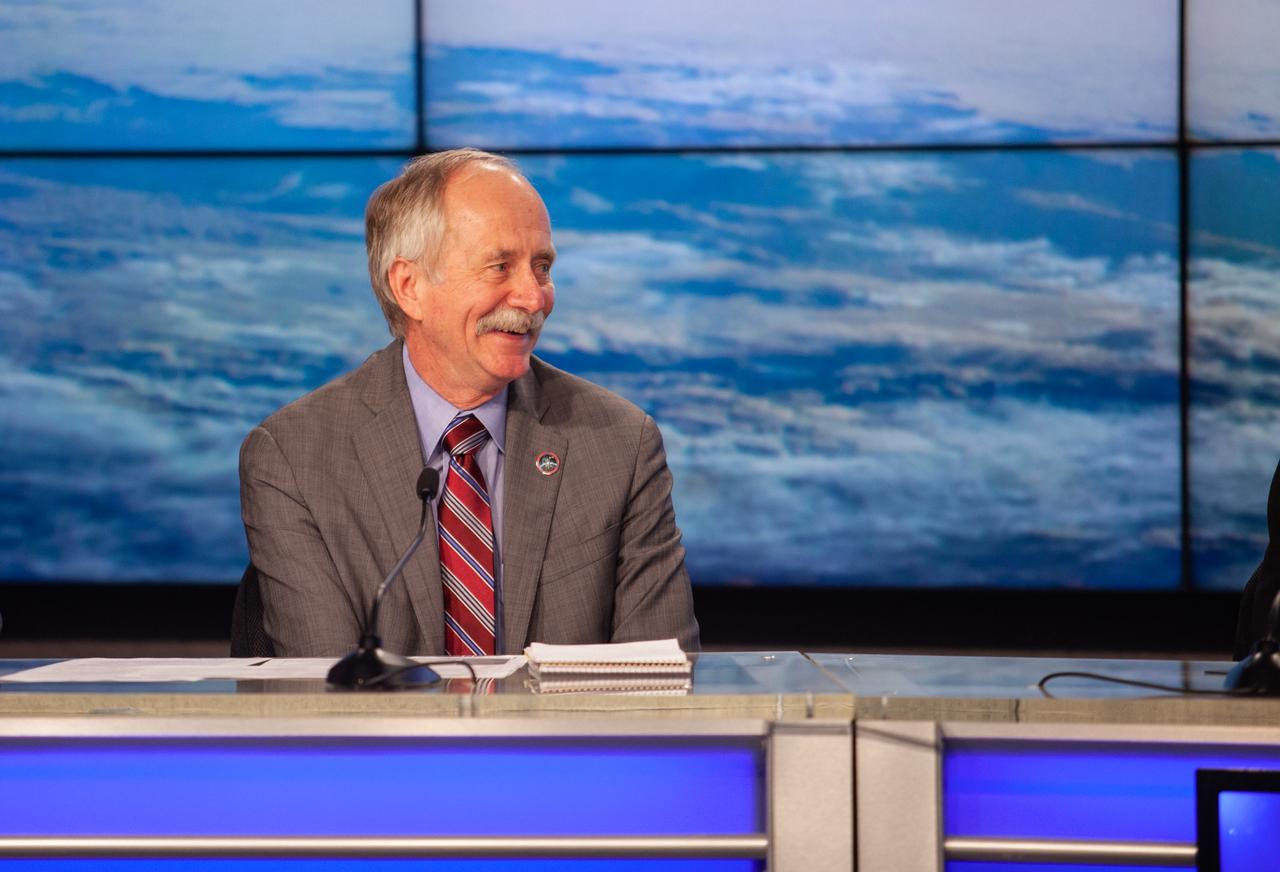
In Kennedy Space Center’s Press Site auditorium, agency and industry leaders speak to members of the media on Friday, Feb. 22, during the post-flight readiness review briefing for the SpaceX Demo-1 Commercial Crew Program (CCP) mission to the International Space Station. From left are: Josh Finch of NASA Communications and William Gerstenmaier, associate administrator, NASA Human Exploration and Operations. The inaugural uncrewed flight of the SpaceX Crew Dragon, known as Demo-1, is targeted to lift off from Kennedy’s Launch Complex 39A on Saturday, March 2. EST. A SpaceX Falcon 9 rocket will launch the Crew Dragon on a mission designed to validate end-to-end systems and capabilities, leading to certification to fly crew.
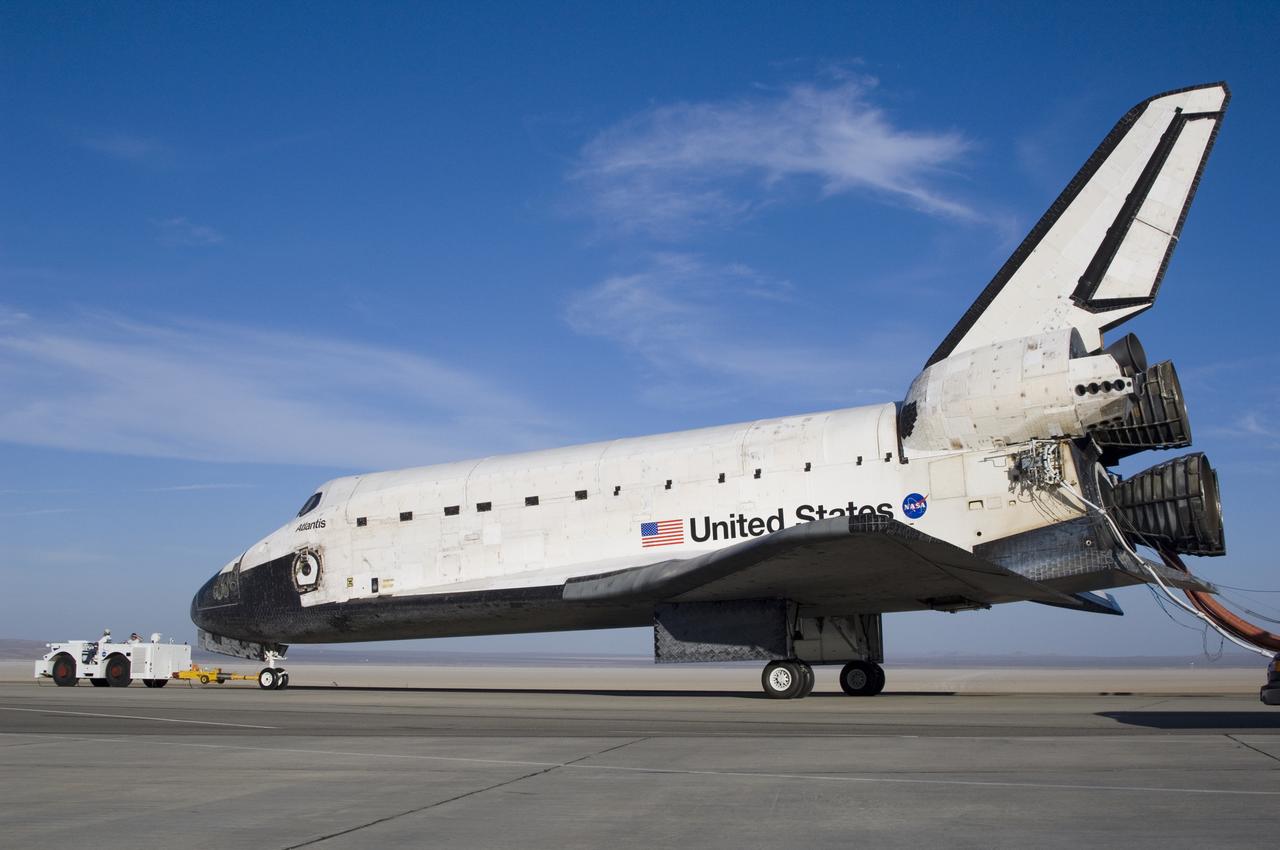
Following its landing on June 22, 2007, the Space Shuttle Atlantis is towed from the runway at Edwards Air Force Base to NASA Dryden's Mate-Demate Device (MDD) for post-flight processing in preparation for its return to the Kennedy Space Center in Florida.
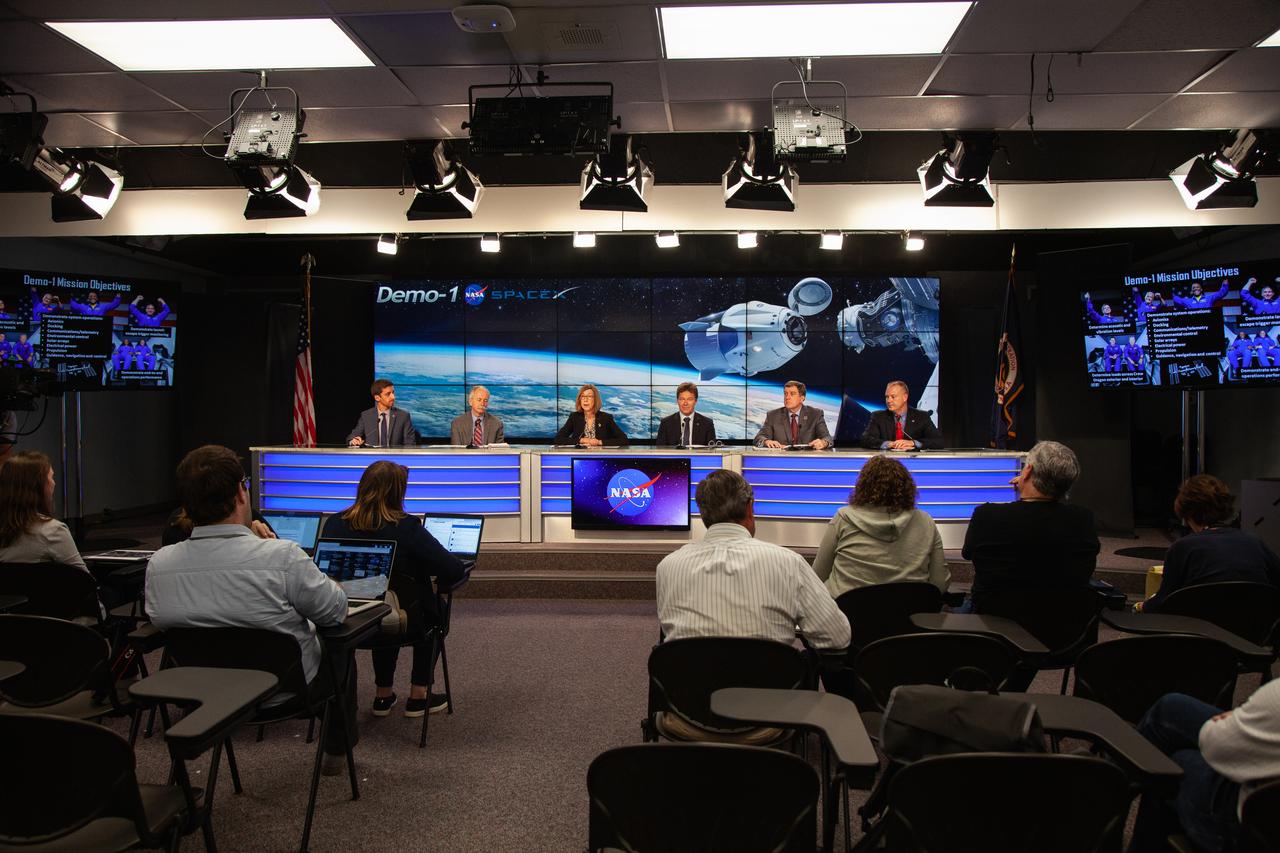
In Kennedy Space Center’s Press Site auditorium, agency and industry leaders speak to members of the media on Friday, Feb. 22, during the post-flight readiness review briefing for the SpaceX Demo-1 Commercial Crew Program (CCP) mission to the International Space Station. From left are: Josh Finch of NASA Communications; William Gerstenmaier, associate administrator, NASA Human Exploration and Operations; Kathy Lueders, manager, NASA Commercial Crew Program; Hans Koenigsmann, vice president, Build and Flight Reliability, SpaceX; Kirk Shireman, International Space Station Program manager; and Norm Knight, deputy director, NASA Johnson Space Center Flight Operations. The inaugural uncrewed flight of the SpaceX Crew Dragon, known as Demo-1, is targeted to lift off from Kennedy’s Launch Complex 39A on Saturday, March 2. EST. A SpaceX Falcon 9 rocket will launch the Crew Dragon on a mission designed to validate end-to-end systems and capabilities, leading to certification to fly crew.
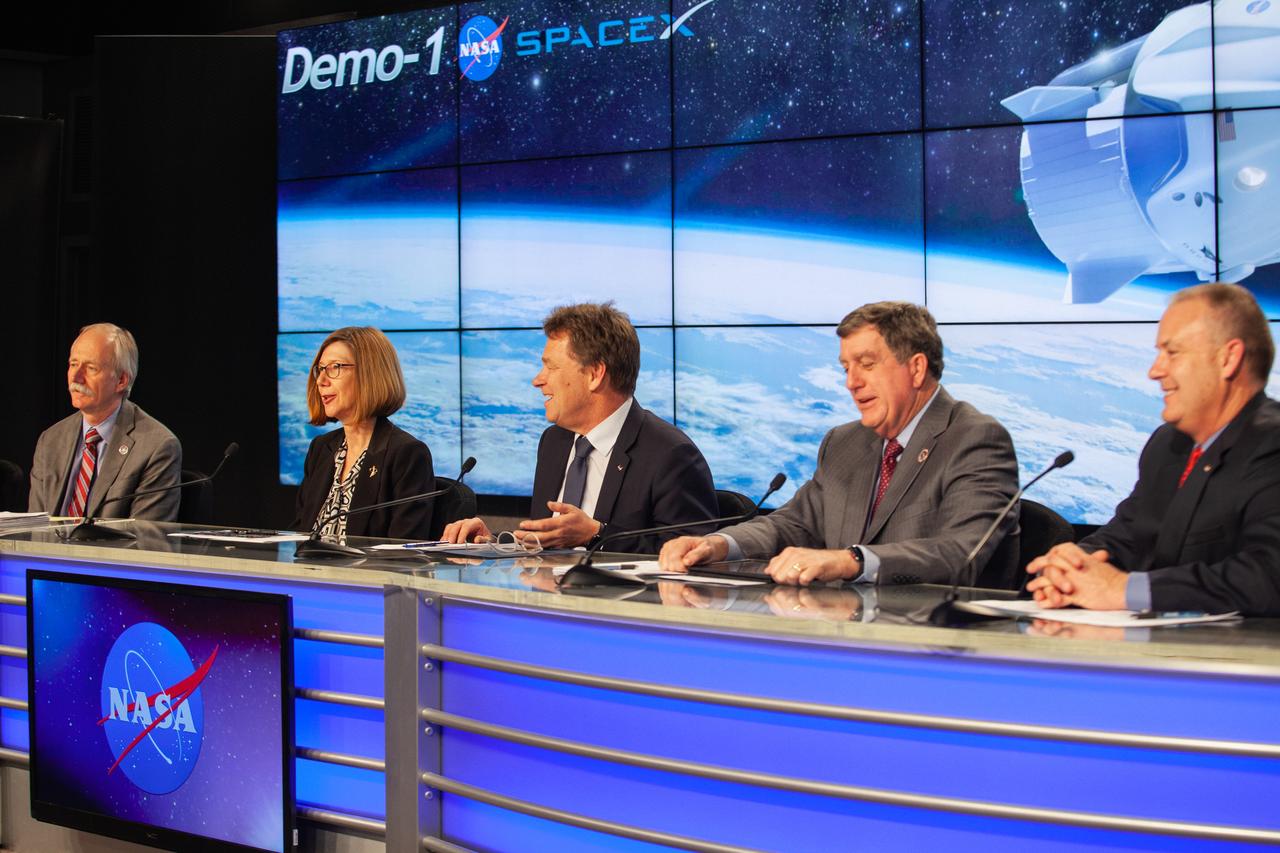
In Kennedy Space Center’s Press Site auditorium, agency and industry leaders speak to members of the media on Friday, Feb. 22, during the post-flight readiness review briefing for the SpaceX Demo-1 Commercial Crew Program (CCP) mission to the International Space Station. From left are: Josh Finch of NASA Communications; William Gerstenmaier, associate administrator, NASA Human Exploration and Operations; Kathy Lueders, manager, NASA Commercial Crew Program; Hans Koenigsmann, vice president, Build and Flight Reliability, SpaceX; Kirk Shireman, International Space Station Program manager; and Norm Knight, deputy director, NASA Johnson Space Center Flight Operations. The inaugural uncrewed flight of the SpaceX Crew Dragon, known as Demo-1, is targeted to lift off from Kennedy’s Launch Complex 39A on Saturday, March 2. EST. A SpaceX Falcon 9 rocket will launch the Crew Dragon on a mission designed to validate end-to-end systems and capabilities, leading to certification to fly crew.

Flight Director Matt Smith studies the data during the second post-launch trajectory correction maneuver during Perseverance's cruise to Mars. The team is in the Mission Support Area at NASA's Jet Propulsion Laboratory in Southern California. https://photojournal.jpl.nasa.gov/catalog/PIA24195
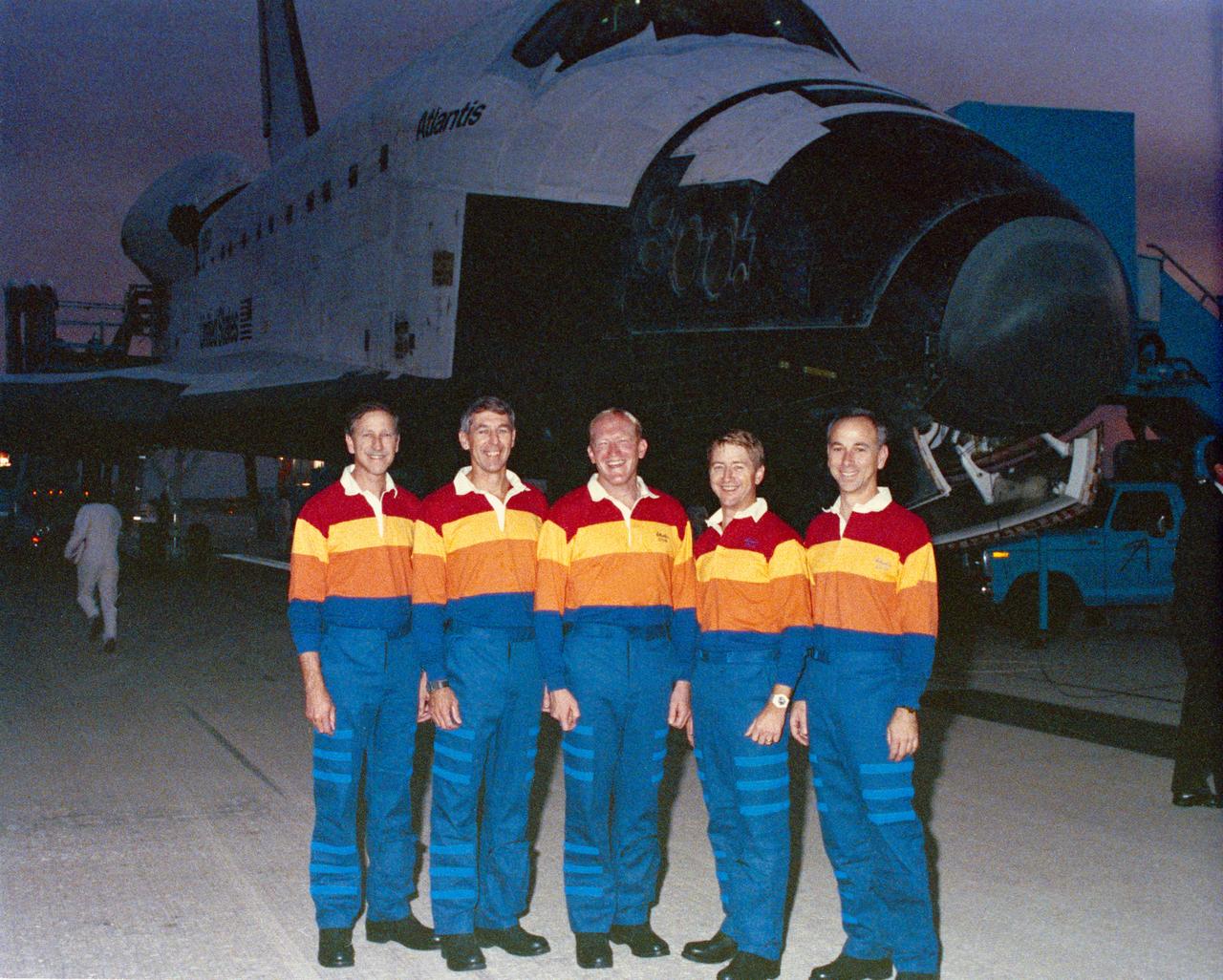
STS038-S-040 (20 Nov 1990) --- STS-38 crewmembers, wearing red, yellow, and orange polo shirts, pose in front of Atlantis, Orbiter Vehicle (OV) 104, parked on runway 33 at Kennedy Space Center's (KSC) Shuttle Landing Facility (SLF) during post flight activities. Left to right are Commander Richard O. Covey, Mission Specialist (MS) Robert C. Springer, MS Charles D. Gemar, Pilot Frank L. Culbertson, and MS Carl J. Meade.
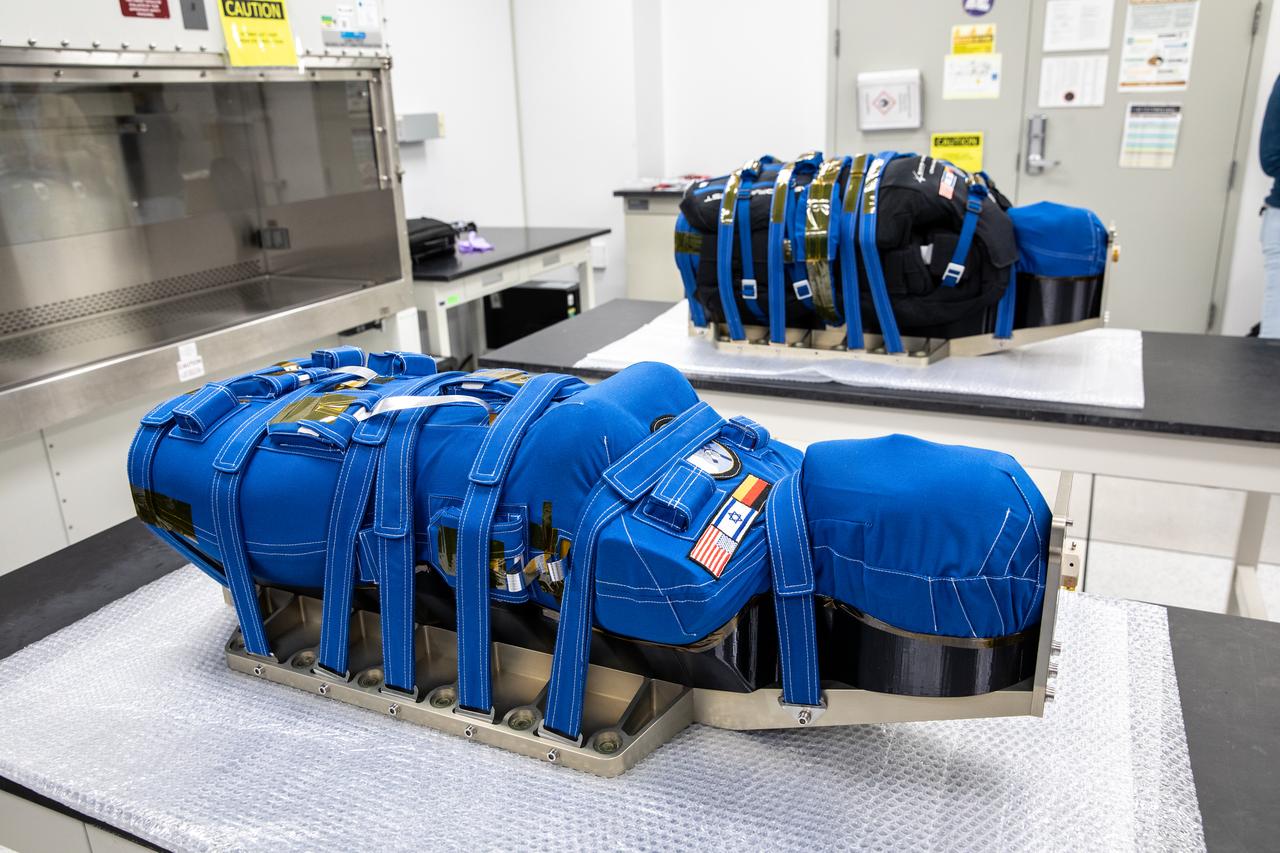
After a 25-day flight beyond the Moon and back inside the Artemis I Orion crew module, two manikins undergo post-flight payload inspections inside the Space Station Processing Facility at Kennedy Space Center in Florida on Jan. 11, 2023. As part of the Matroshka AstroRad Radiation Experiment (MARE) investigation, the two female manikins – Helga and Zohar – were equipped with radiation detectors. Zohar also wore a radiation protection vest, to determine the radiation risk during the Artemis I mission and potentially reduce exposure during future missions with astronauts. The detectors will be removed at Kennedy and the torsos will return to teams at the German Space Agency for further analysis. Artemis I Orion launched atop the Space Launch System (SLS) rocket from Kennedy’s Launch Complex 39B on Nov. 16, 2022, at 1:47 a.m. EST. During the flight, Orion flew farther than any spacecraft built for humans has ever flown, paving the way for human deep space exploration and demonstrating NASA’s commitment and capability to extend human presence to the Moon and beyond. The primary goal of Artemis I was to thoroughly test the SLS and Orion spacecraft’s integrated systems before crewed missions. Under Artemis, NASA aims to land the first woman and first person of color on the Moon and establish sustainable lunar exploration.
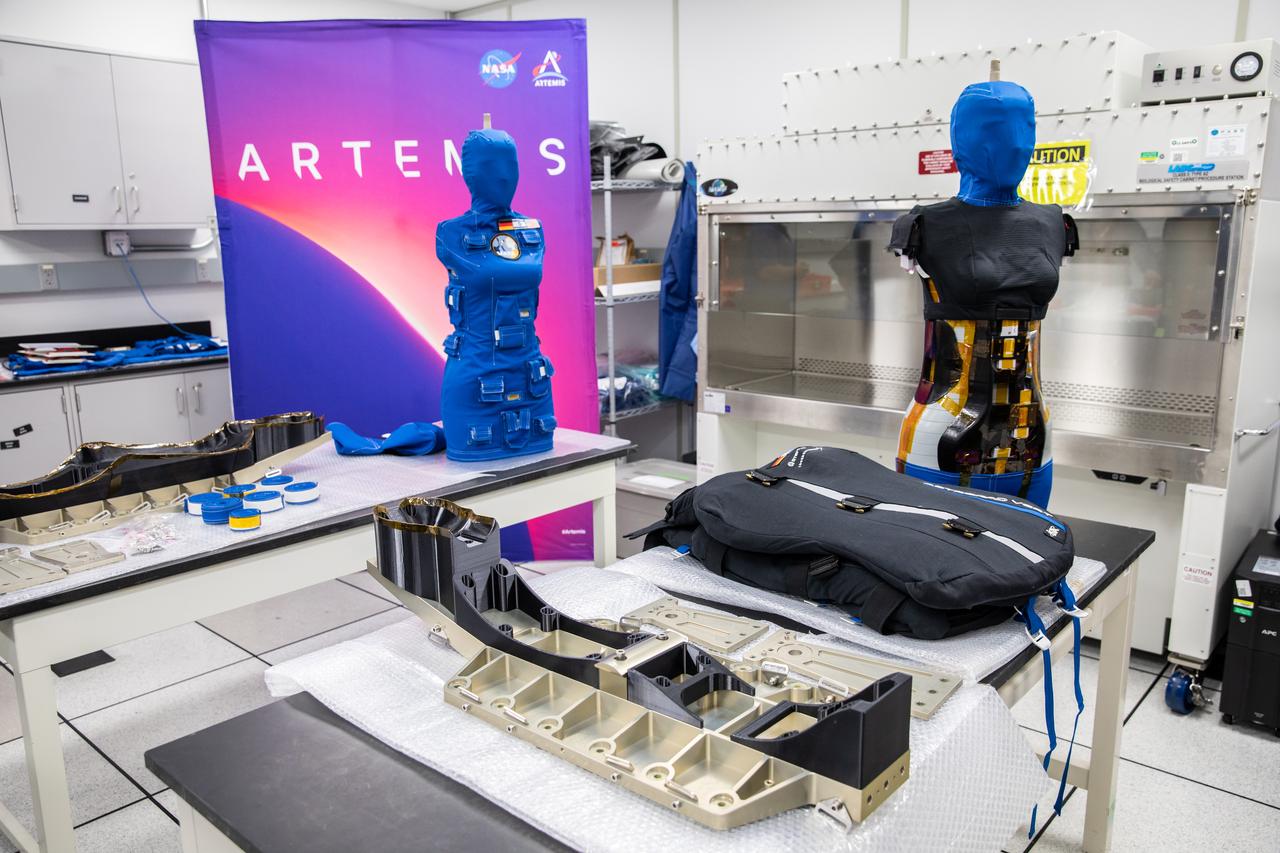
After a 25-day flight beyond the Moon and back inside the Artemis I Orion crew module, two manikins undergo post-flight payload inspections inside the Space Station Processing Facility at Kennedy Space Center in Florida on Jan. 11, 2023. As part of the Matroshka AstroRad Radiation Experiment (MARE) investigation, the two female manikins – Helga and Zohar – were equipped with radiation detectors. Zohar also wore a radiation protection vest, to determine the radiation risk during the Artemis I mission and potentially reduce exposure during future missions with astronauts. The detectors will be removed at Kennedy and the torsos will return to teams at the German Space Agency for further analysis. Artemis I Orion launched atop the Space Launch System (SLS) rocket from Kennedy’s Launch Complex 39B on Nov. 16, 2022, at 1:47 a.m. EST. During the flight, Orion flew farther than any spacecraft built for humans has ever flown, paving the way for human deep space exploration and demonstrating NASA’s commitment and capability to extend human presence to the Moon and beyond. The primary goal of Artemis I was to thoroughly test the SLS and Orion spacecraft’s integrated systems before crewed missions. Under Artemis, NASA aims to land the first woman and first person of color on the Moon and establish sustainable lunar exploration.
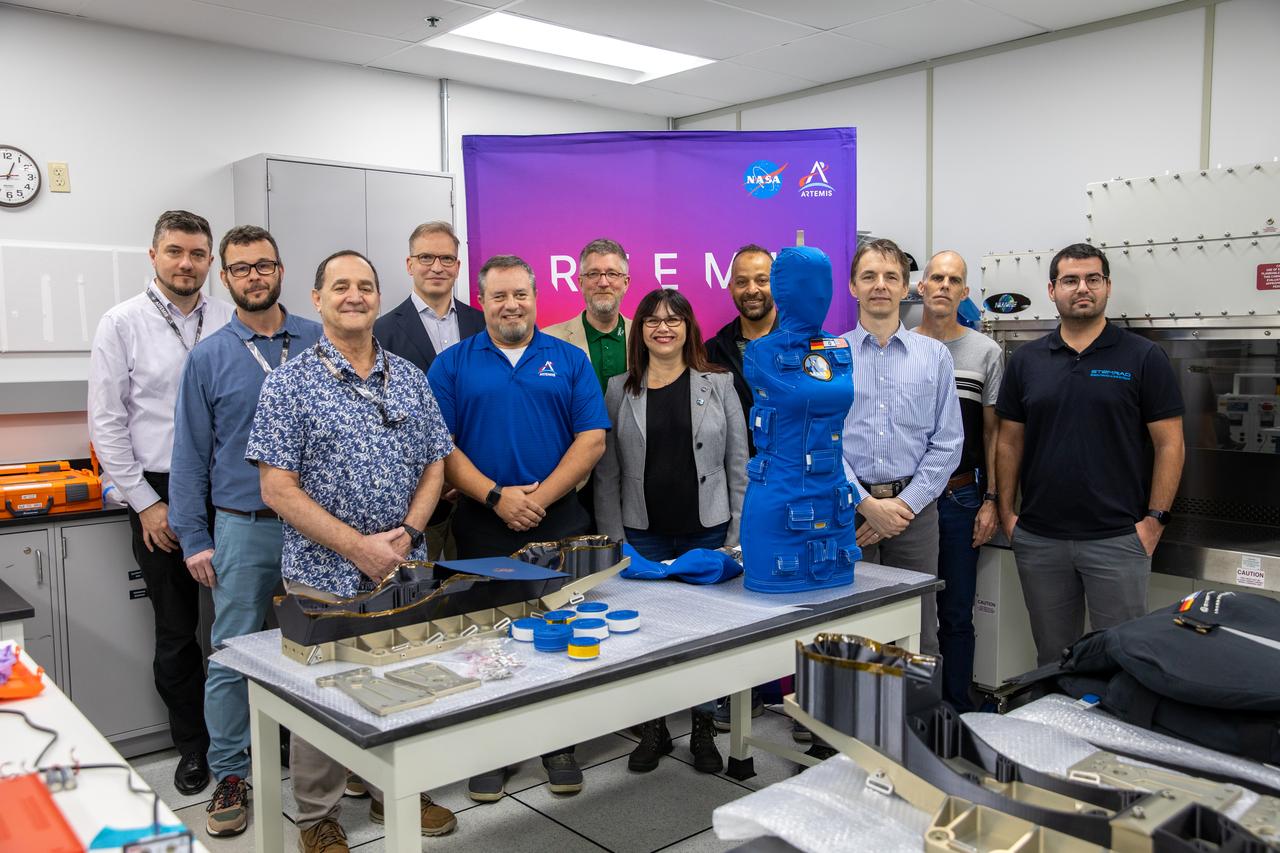
After a 25-day flight beyond the Moon and back inside the Artemis I Orion crew module, two manikins undergo post-flight payload inspections by teams from NASA, Lockheed Martin, AstroRad and the German Space Agency inside the Space Station Processing Facility at Kennedy Space Center in Florida on Jan. 17, 2023. As part of the Matroshka AstroRad Radiation Experiment (MARE) investigation, the two female manikins – Helga and Zohar – were equipped with radiation detectors. Zohar also wore a radiation protection vest, to determine the radiation risk during the Artemis I mission and potentially reduce exposure during future missions with astronauts. Artemis I Orion launched atop the Space Launch System (SLS) rocket from Kennedy’s Launch Complex 39B on Nov. 16, 2022, at 1:47 a.m. EST. During the flight, Orion flew farther than any spacecraft built for humans has ever flown, paving the way for human deep space exploration and demonstrating NASA’s commitment and capability to extend human presence to the Moon and beyond. The primary goal of Artemis I was to thoroughly test the SLS and Orion spacecraft’s integrated systems before crewed missions. Under Artemis, NASA aims to land the first woman and first person of color on the Moon and establish sustainable lunar exploration.
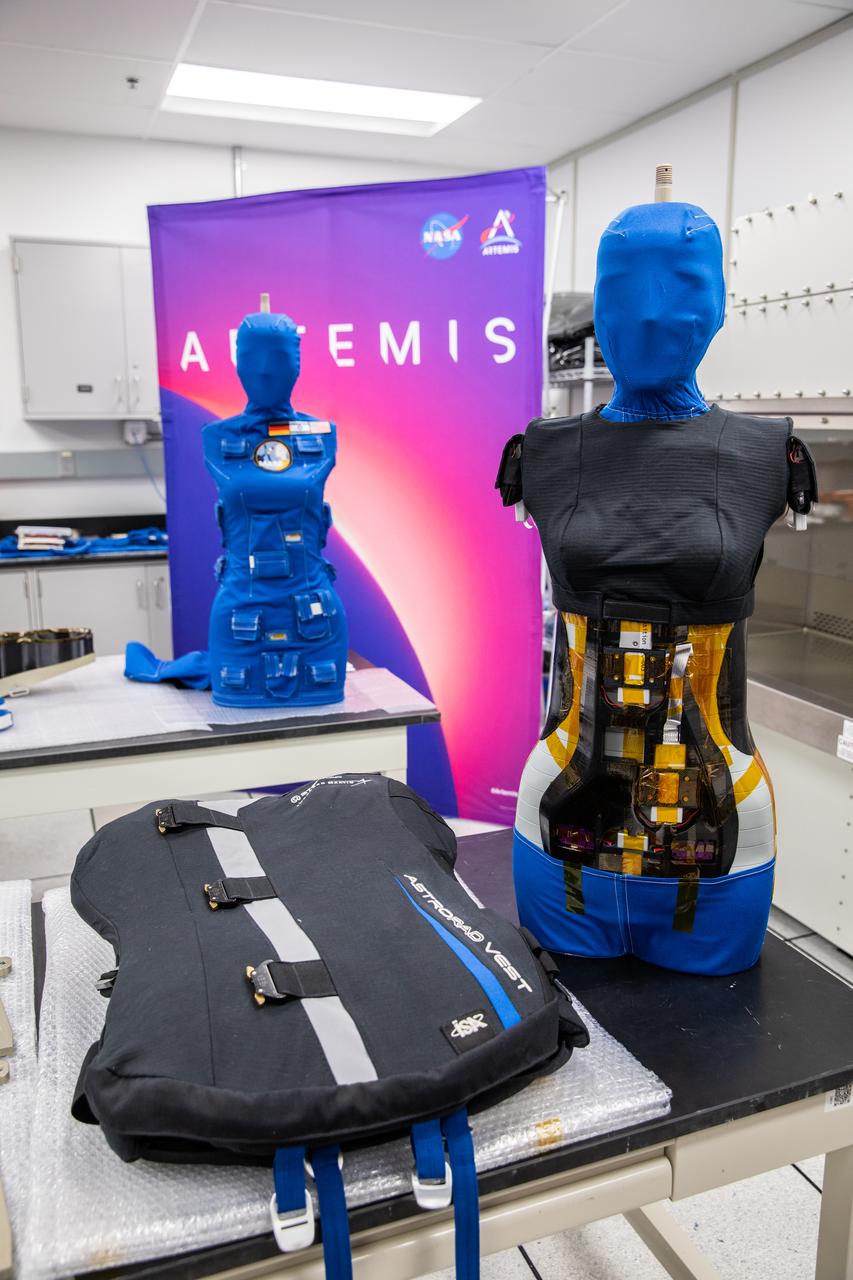
After a 25-day flight beyond the Moon and back inside the Artemis I Orion crew module, two manikins undergo post-flight payload inspections inside the Space Station Processing Facility at Kennedy Space Center in Florida on Jan. 11, 2023. As part of the Matroshka AstroRad Radiation Experiment (MARE) investigation, the two female manikins – Helga and Zohar – were equipped with radiation detectors. Zohar also wore a radiation protection vest, to determine the radiation risk during the Artemis I mission and potentially reduce exposure during future missions with astronauts. The detectors will be removed at Kennedy and the torsos will return to teams at the German Space Agency for further analysis. Artemis I Orion launched atop the Space Launch System (SLS) rocket from Kennedy’s Launch Complex 39B on Nov. 16, 2022, at 1:47 a.m. EST. During the flight, Orion flew farther than any spacecraft built for humans has ever flown, paving the way for human deep space exploration and demonstrating NASA’s commitment and capability to extend human presence to the Moon and beyond. The primary goal of Artemis I was to thoroughly test the SLS and Orion spacecraft’s integrated systems before crewed missions. Under Artemis, NASA aims to land the first woman and first person of color on the Moon and establish sustainable lunar exploration.
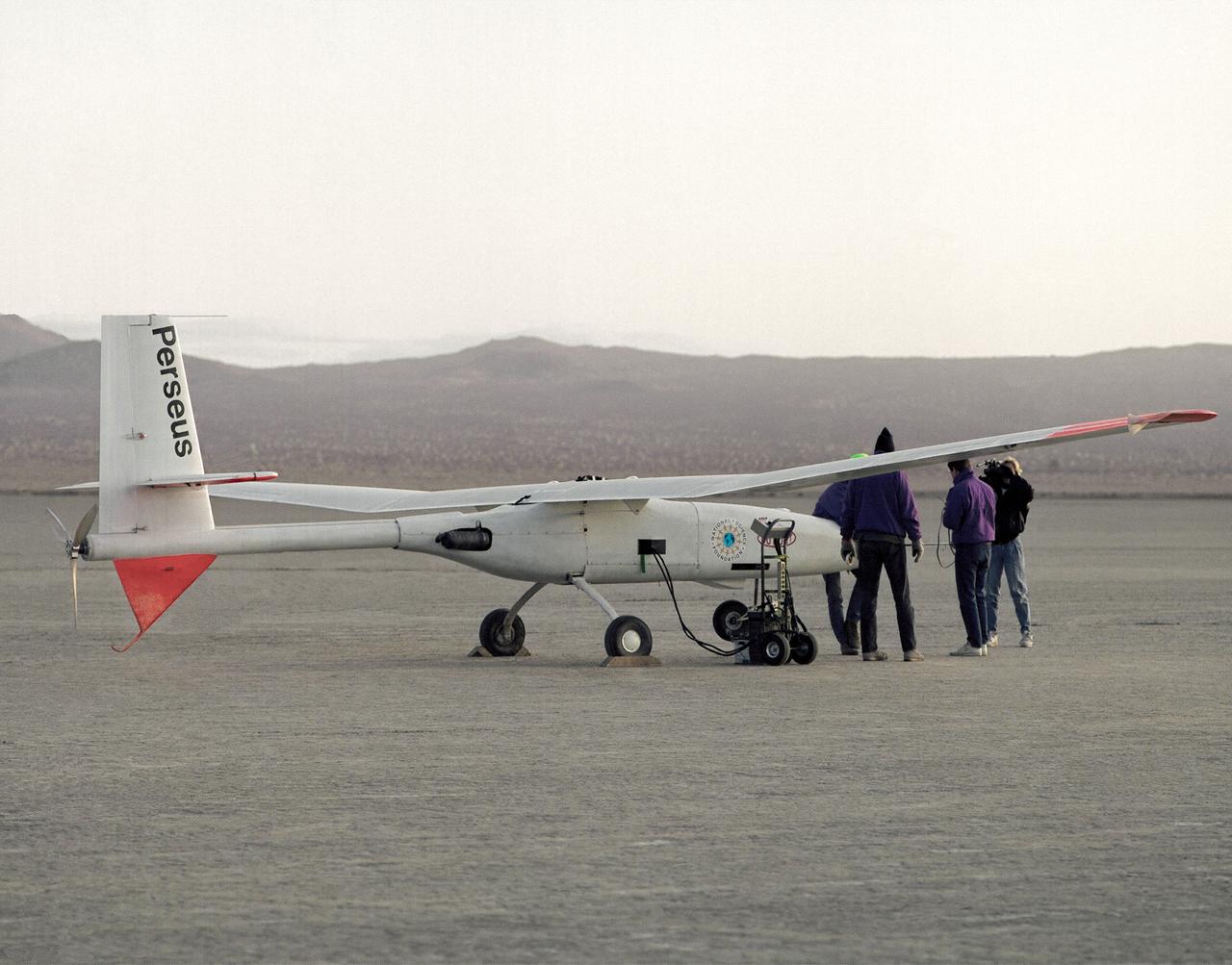
Crew members check out the Perseus proof-of-concept vehicle on Rogers Dry Lake, adjacent to the Dryden Flight Research Center, Edwards, California, after a test flight in 1991.
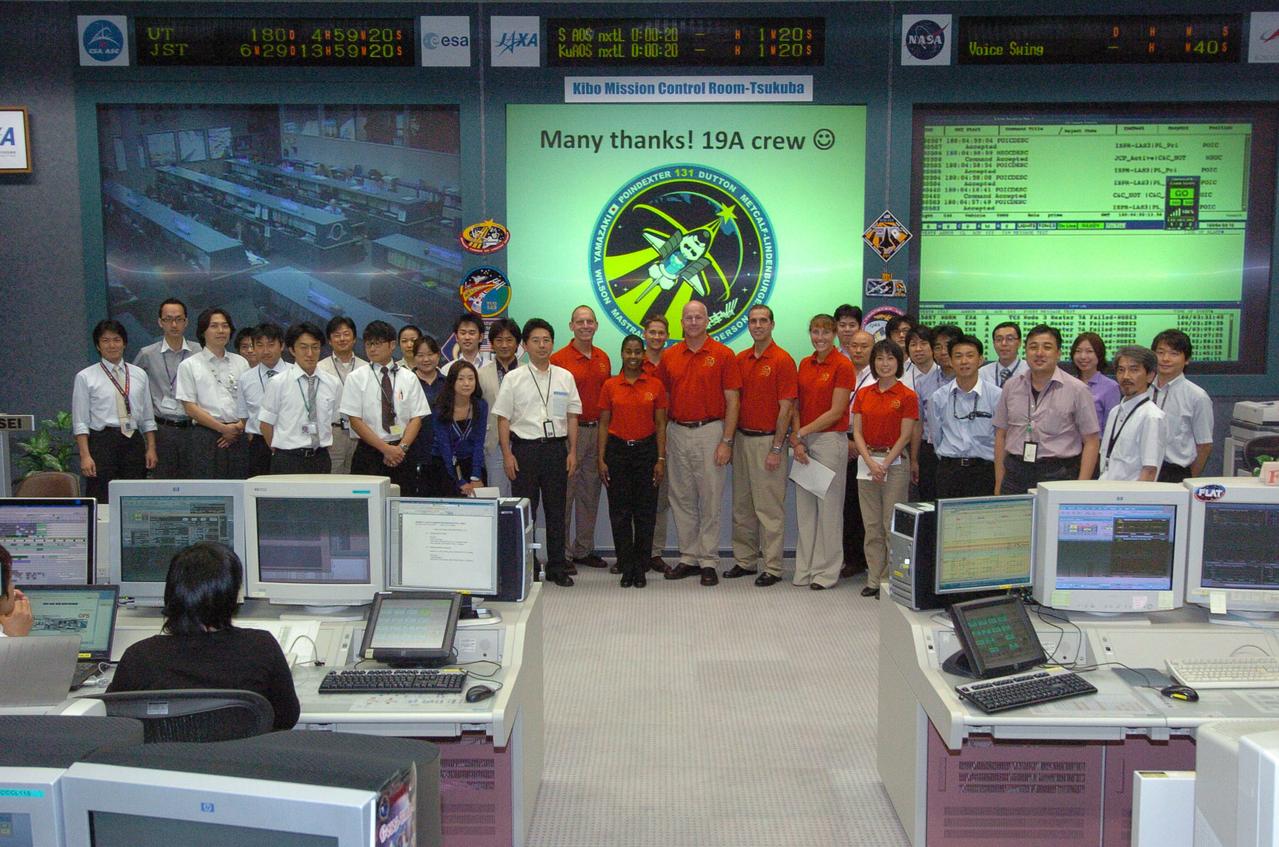
JSC2010-E-108817 (29 June 2010) --- The STS-131 crew is pictured with the support team at the Space Station Integration and Promotion Center in the Tsukuba Space Center on June 29 during one of its trips following the mission. Pictured in red shirts from the left are NASA astronauts Clayton Anderson, Stephanie Wilson, James P. Dutton Jr . Alan Poindexter, Rick Mastracchio and Dorothy Metcalf-Lindenburger, along with Japan Aerospace Exploration Agency (JAXA) astronaut Naoko Yamazaki. Photo credit: Japan Aerospace Exploration Agency or JAXA
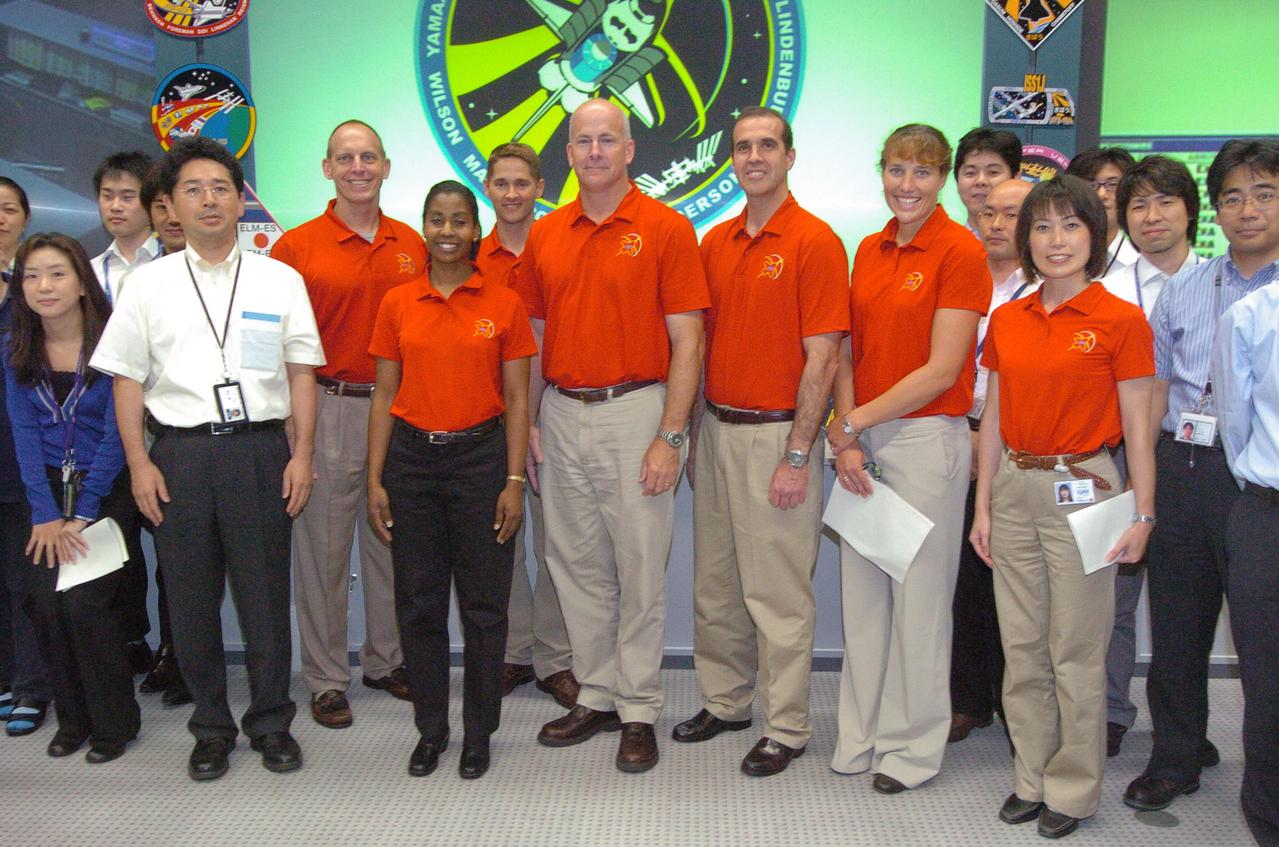
JSC2010-E-108818 (29 June 2010) --- The STS-131 crew is pictured with part of the support team at the Space Station Integration and Promotion Center in the Tsukuba Space Center on June 29 during one of its trips following the mission. Pictured in red shirts from the left are NASA astronauts Clayton Anderson, Stephanie Wilson, James P. Dutton Jr . Alan Poindexter, Rick Mastracchio and Dorothy Metcalf-Lindenburger, along with Japan Aerospace Exploration Agency (JAXA) astronaut Naoko Yamazaki. Photo credit: Japan Aerospace Exploration Agency or JAXA
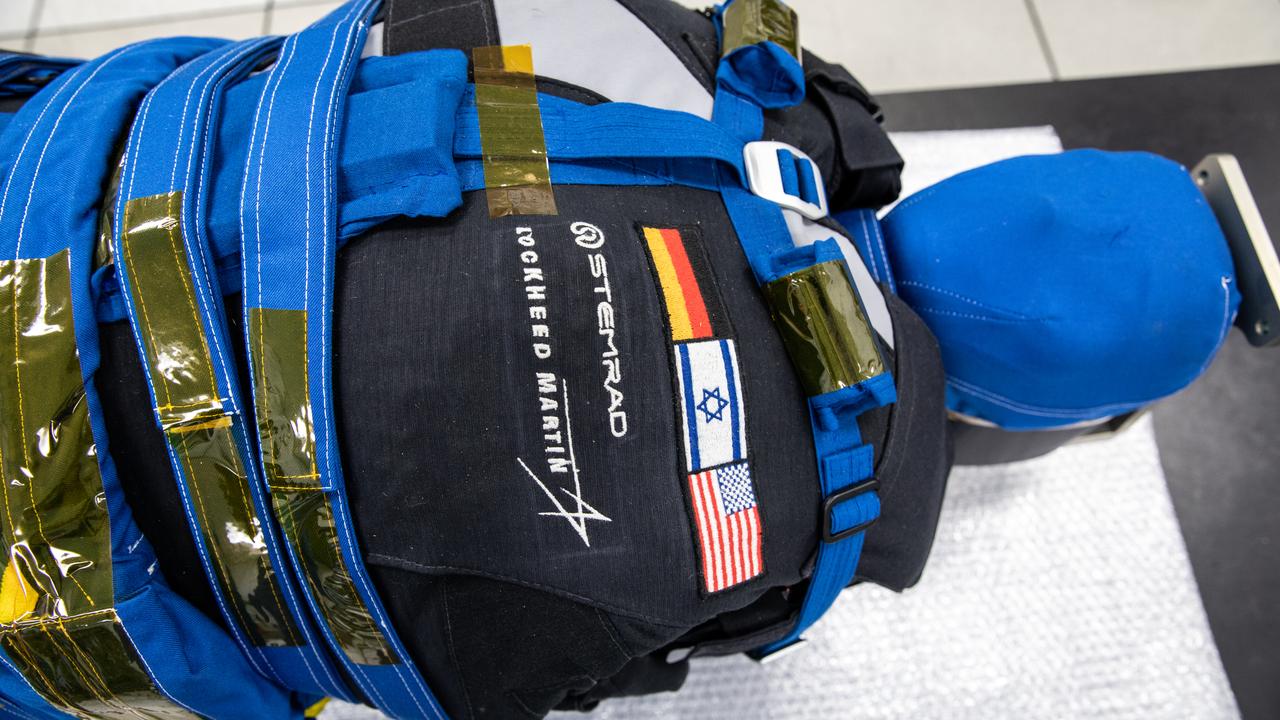
After a 25-day flight inside the Artemis I Orion crew module beyond the Moon and back, Helga, one of two identical phantom torsos, is shown without a radiation detection vest while undergoing post-flight payload inspections inside the Space Station Processing Facility at Kennedy Space Center in Florida on Jan. 11, 2023. The detectors will be removed at Kennedy and the torsos will return to teams at the German Space Agency for further analysis. As part of the Matroshka AstroRad Radiation Experiment (MARE) investigation, two female manikins – Helga and Zohar – were equipped with radiation detectors, while Zohar also wore a radiation protection vest, to determine the radiation risk during the Artemis I mission and potentially reduce exposure during future missions with astronauts. Artemis I Orion launched atop the Space Launch System (SLS) rocket from Kennedy’s Launch Complex 39B on Nov. 16, 2022, at 1:47 a.m. EST. During the flight, Orion flew farther than any spacecraft built for humans has ever flown, paving the way for human deep space exploration and demonstrating NASA’s commitment and capability to extend human presence to the Moon and beyond. The primary goal of Artemis I was to thoroughly test the SLS and Orion spacecraft’s integrated systems before crewed missions. Under Artemis, NASA aims to land the first woman and first person of color on the Moon and establish sustainable lunar exploration.

After a 25-day flight inside the Artemis I Orion crew module beyond the Moon and back, Helga, one of two identical phantom torsos, is shown without a radiation detection vest while undergoing post-flight payload inspections inside the Space Station Processing Facility at Kennedy Space Center in Florida on Jan. 11, 2023. The detectors will be removed at Kennedy and the torsos will return to teams at the German Space Agency for further analysis. As part of the Matroshka AstroRad Radiation Experiment (MARE) investigation, two female manikins – Helga and Zohar – were equipped with radiation detectors, while Zohar also wore a radiation protection vest, to determine the radiation risk during the Artemis I mission and potentially reduce exposure during future missions with astronauts. Artemis I Orion launched atop the Space Launch System (SLS) rocket from Kennedy’s Launch Complex 39B on Nov. 16, 2022, at 1:47 a.m. EST. During the flight, Orion flew farther than any spacecraft built for humans has ever flown, paving the way for human deep space exploration and demonstrating NASA’s commitment and capability to extend human presence to the Moon and beyond. The primary goal of Artemis I was to thoroughly test the SLS and Orion spacecraft’s integrated systems before crewed missions. Under Artemis, NASA aims to land the first woman and first person of color on the Moon and establish sustainable lunar exploration.
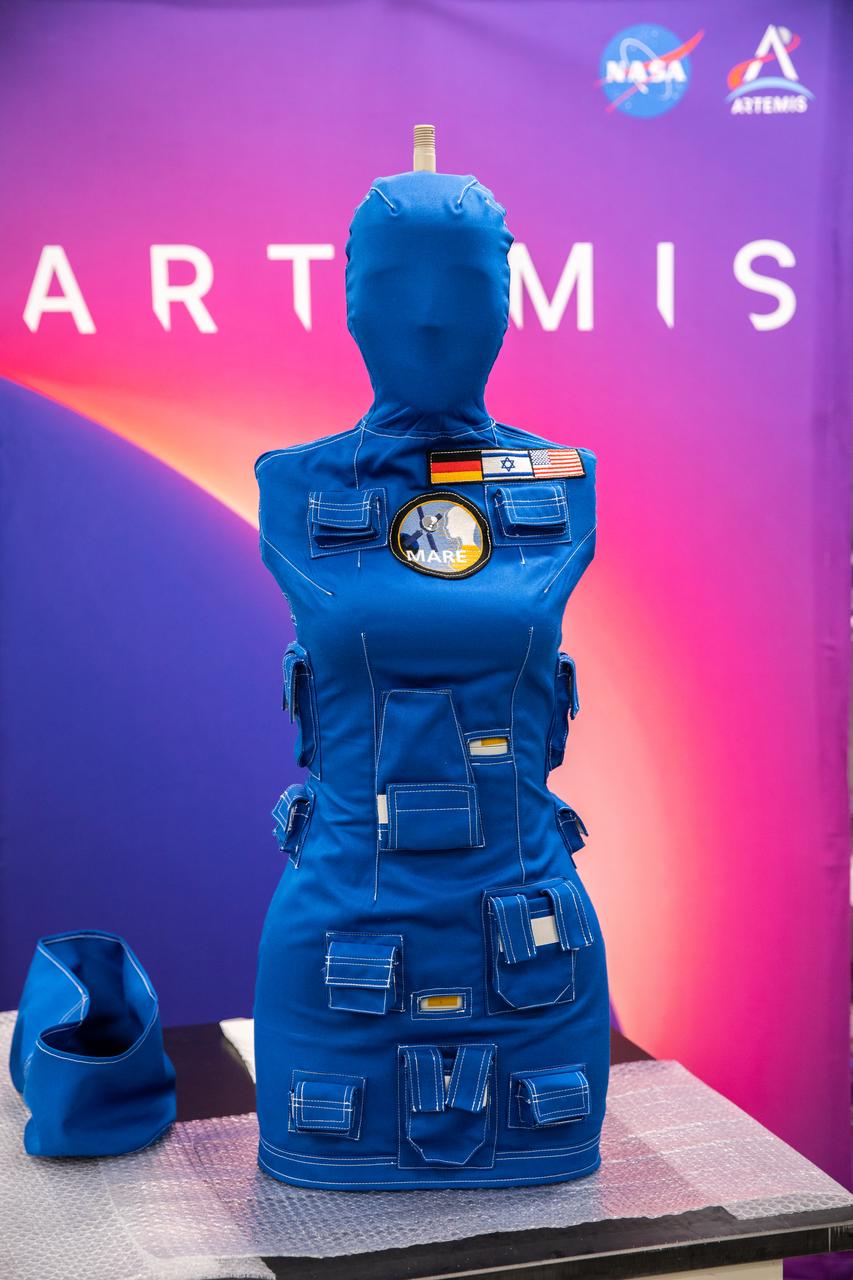
After a 25-day flight inside the Artemis I Orion crew module beyond the Moon and back, Helga, one of two identical phantom torsos, is shown without a radiation detection vest while undergoing post-flight payload inspections inside the Space Station Processing Facility at Kennedy Space Center in Florida on Jan. 11, 2023. The detectors will be removed at Kennedy and the torsos will return to teams at the German Space Agency for further analysis. As part of the Matroshka AstroRad Radiation Experiment (MARE) investigation, two female manikins – Helga and Zohar – were equipped with radiation detectors, while Zohar also wore a radiation protection vest, to determine the radiation risk during the Artemis I mission and potentially reduce exposure during future missions with astronauts. Artemis I Orion launched atop the Space Launch System (SLS) rocket from Kennedy’s Launch Complex 39B on Nov. 16, 2022, at 1:47 a.m. EST. During the flight, Orion flew farther than any spacecraft built for humans has ever flown, paving the way for human deep space exploration and demonstrating NASA’s commitment and capability to extend human presence to the Moon and beyond. The primary goal of Artemis I was to thoroughly test the SLS and Orion spacecraft’s integrated systems before crewed missions. Under Artemis, NASA aims to land the first woman and first person of color on the Moon and establish sustainable lunar exploration.
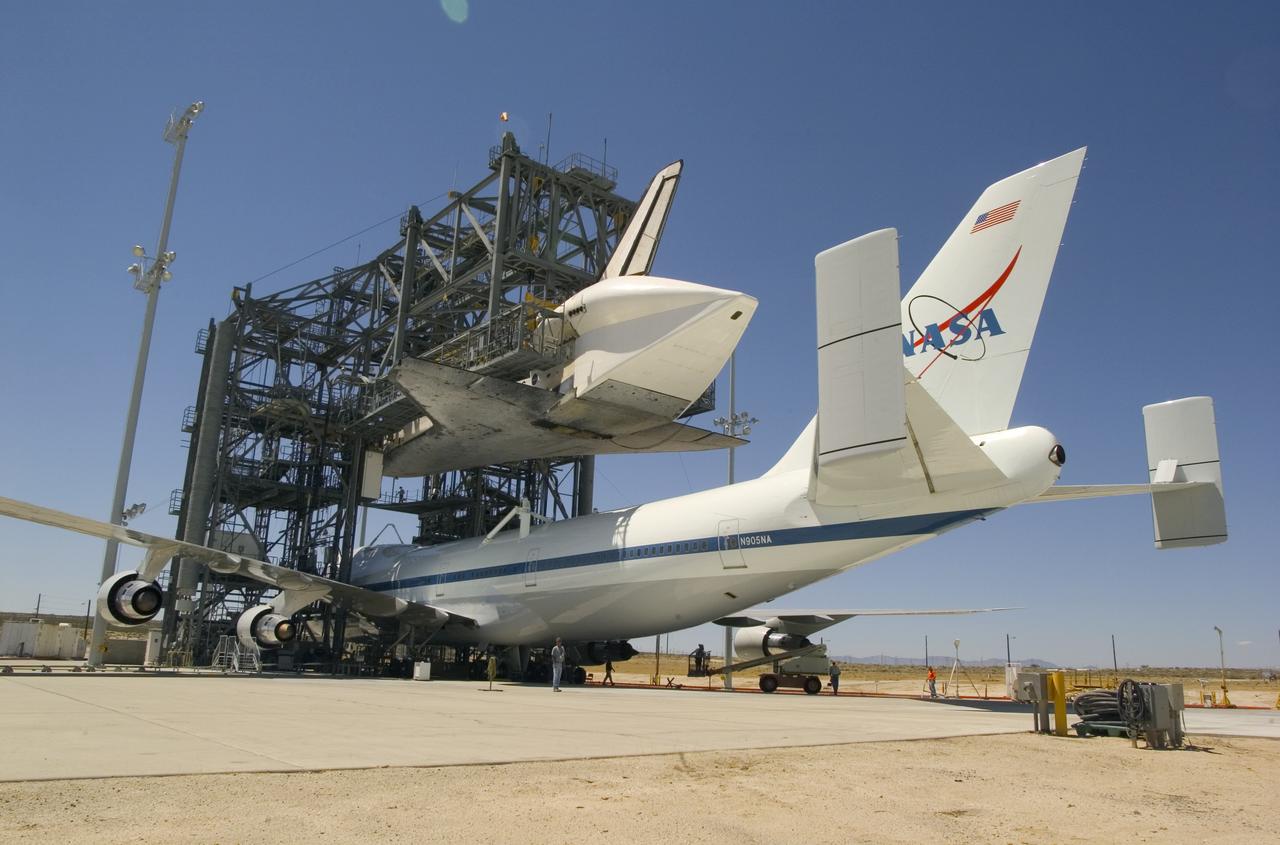
NASA's specially modified 747 Shuttle Carrier Aircraft, or SCA, is positioned under the Space Shuttle Discovery to be attached for their ferry flight to the Kennedy Space Center in Florida. After its post-flight servicing and preparation at NASA Dryden in California, Discovery's return flight to Kennedy aboard the 747 will take approximately 2 days, with stops at several intermediate points for refueling. Space Shuttle Discovery landed safely at NASA's Dryden Flight Research Center at Edwards Air Force Base at 5:11:22 a.m. PDT, August 9, 2005, following the very successful 14-day STS-114 return to flight mission. During their two weeks in space, Commander Eileen Collins and her six crewmates tested out new safety procedures and delivered supplies and equipment the International Space Station. Discovery spent two weeks in space, where the crew demonstrated new methods to inspect and repair the Shuttle in orbit. The crew also delivered supplies, outfitted and performed maintenance on the International Space Station. A number of these tasks were conducted during three spacewalks. In an unprecedented event, spacewalkers were called upon to remove protruding gap fillers from the heat shield on Discovery's underbelly. In other spacewalk activities, astronauts installed an external platform onto the Station's Quest Airlock and replaced one of the orbital outpost's Control Moment Gyroscopes. Inside the Station, the STS-114 crew conducted joint operations with the Expedition 11 crew. They unloaded fresh supplies from the Shuttle and the Raffaello Multi-Purpose Logistics Module. Before Discovery undocked, the crews filled Raffeallo with unneeded items and returned to Shuttle payload bay. Discovery launched on July 26 and spent almost 14 days on orbit.
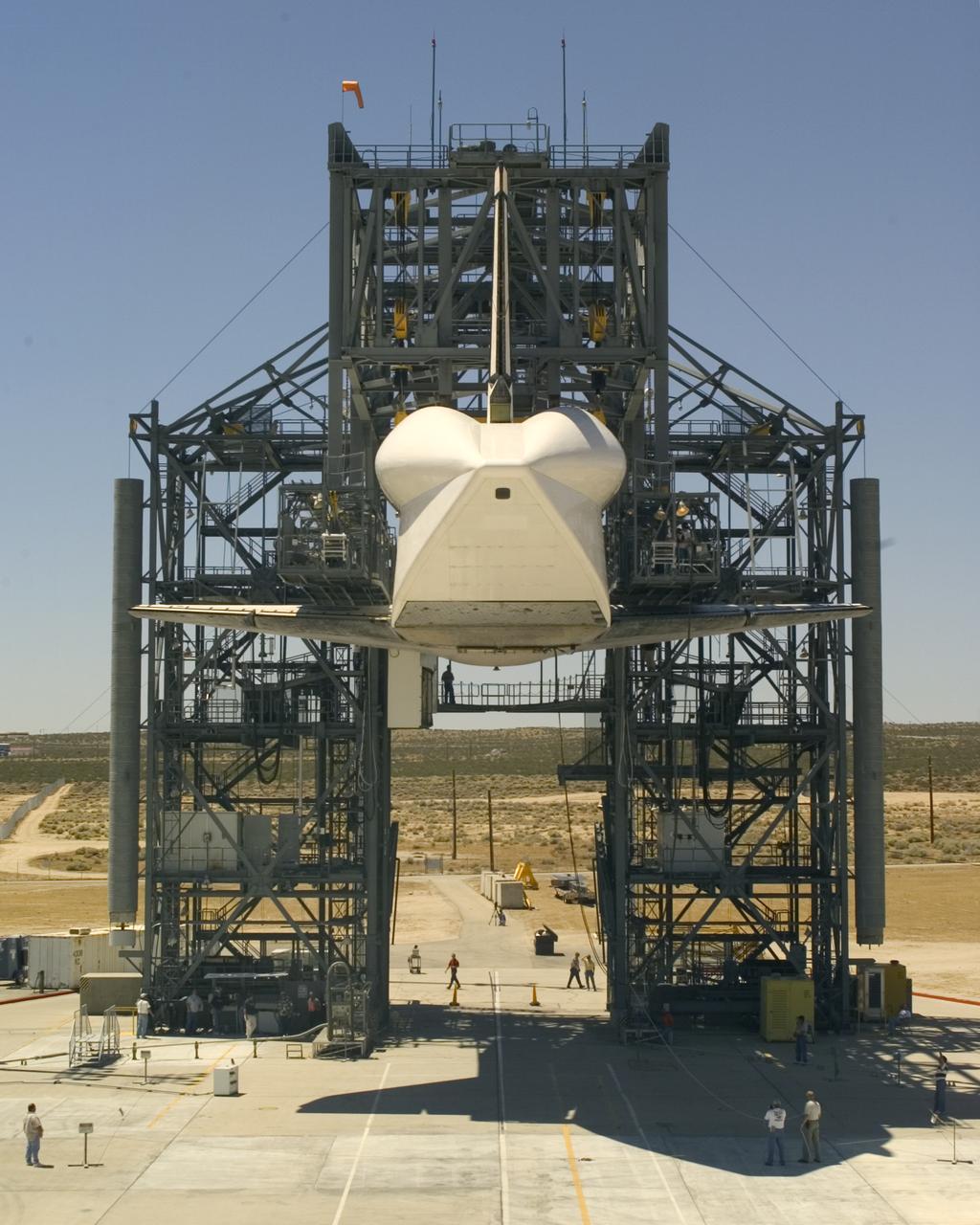
NASA's specially modified 747 Shuttle Carrier Aircraft, or SCA, is positioned under the Space Shuttle Discovery to be attached for their ferry flight to the Kennedy Space Center in Florida. After its post-flight servicing and preparation at NASA Dryden in California, Discovery's return flight to Kennedy aboard the 747 will take approximately 2 days, with stops at several intermediate points for refueling. Space Shuttle Discovery landed safely at NASA's Dryden Flight Research Center at Edwards Air Force Base at 5:11:22 a.m. PDT, August 9, 2005, following the very successful 14-day STS-114 return to flight mission. During their two weeks in space, Commander Eileen Collins and her six crewmates tested out new safety procedures and delivered supplies and equipment the International Space Station. Discovery spent two weeks in space, where the crew demonstrated new methods to inspect and repair the Shuttle in orbit. The crew also delivered supplies, outfitted and performed maintenance on the International Space Station. A number of these tasks were conducted during three spacewalks. In an unprecedented event, spacewalkers were called upon to remove protruding gap fillers from the heat shield on Discovery's underbelly. In other spacewalk activities, astronauts installed an external platform onto the Station's Quest Airlock and replaced one of the orbital outpost's Control Moment Gyroscopes. Inside the Station, the STS-114 crew conducted joint operations with the Expedition 11 crew. They unloaded fresh supplies from the Shuttle and the Raffaello Multi-Purpose Logistics Module. Before Discovery undocked, the crews filled Raffeallo with unneeded items and returned to Shuttle payload bay. Discovery launched on July 26 and spent almost 14 days on orbit.

Four vehicle support posts have been installed on the deck of the mobile launcher at NASA's Kennedy Space Center in Florida. A total of eight support posts will be installed to support the load of the Space Launch System's (SLS) solid rocket boosters, with four posts for each of the boosters. The support posts are about five feet tall and each weigh about 10,000 pounds. The posts will structurally support the SLS rocket through T-0 and liftoff, and will drop down before vehicle liftoff to avoid contact with the flight hardware. The Ground Systems Development and Operations Program is overseeing installation of the support posts to prepare for the launch of the Orion spacecraft atop the SLS rocket.
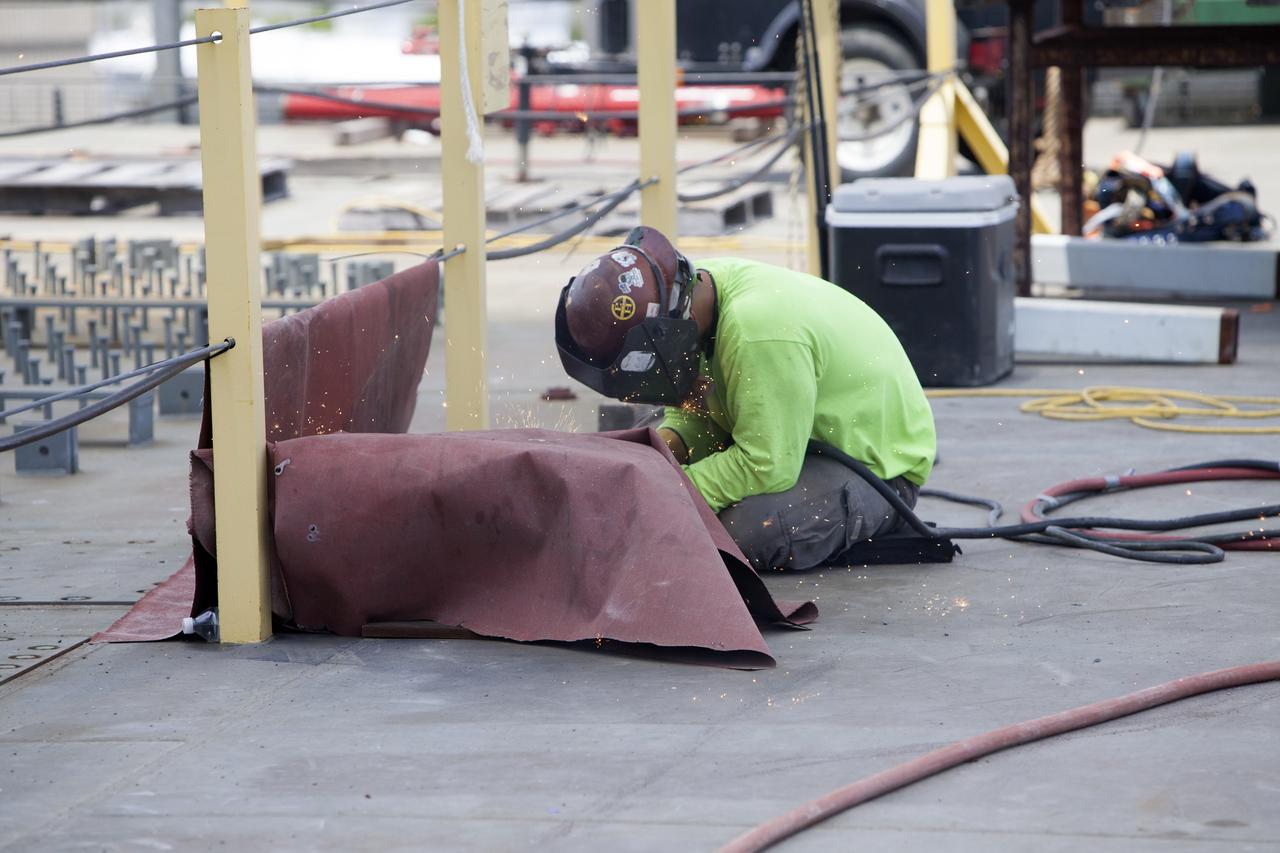
A construction worker on the deck of the mobile launcher welds a portion of a platform for installation of a vehicle support post at NASA's Kennedy Space Center in Florida. A total of eight support posts will be installed to support the load of the Space Launch System's (SLS) solid rocket boosters, with four posts for each of the boosters. The support posts are about five feet tall and each weigh about 10,000 pounds. The posts will structurally support the SLS rocket through T-0 and liftoff, and will drop down before vehicle liftoff to avoid contact with the flight hardware. The Ground Systems Development and Operations Program is overseeing installation of the support posts to prepare for the launch of the Orion spacecraft atop the SLS rocket.
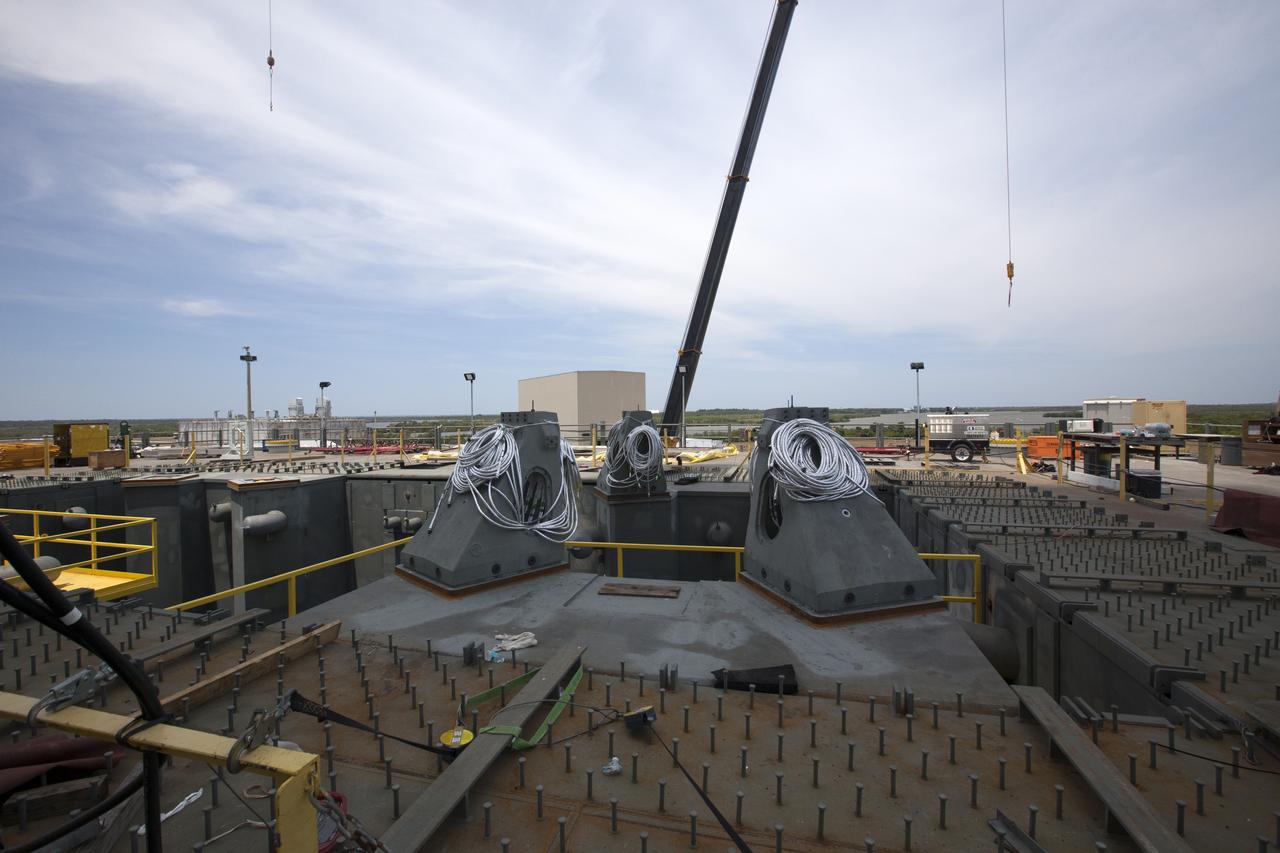
In view are three vehicle support posts installed on the deck of the mobile launcher at NASA's Kennedy Space Center in Florida. A total of eight support posts will be installed to support the load of the Space Launch System's (SLS) solid rocket boosters, with four posts for each of the boosters. The support posts are about five feet tall and each weigh about 10,000 pounds. The posts will structurally support the SLS rocket through T-0 and liftoff, and will drop down before vehicle liftoff to avoid contact with the flight hardware. The Ground Systems Development and Operations Program is overseeing installation of the support posts to prepare for the launch of the Orion spacecraft atop the SLS rocket.
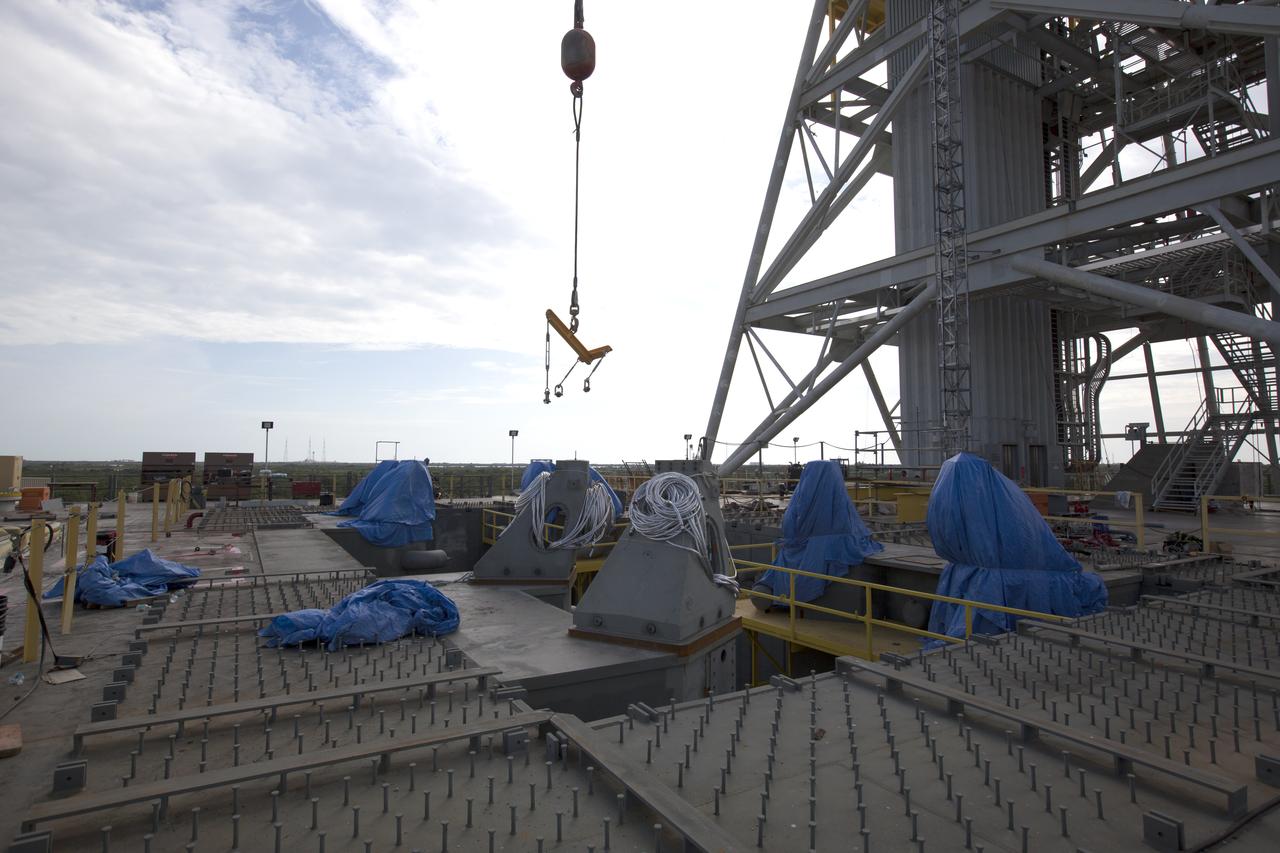
At NASA's Kennedy Space Center in Florida, the final four vehicle support posts are being installed on the deck of the mobile launcher. A total of eight support posts are being installed to support the load of the Space Launch System's (SLS) solid rocket boosters, with four posts for each of the boosters. The support posts are about five feet tall and each weigh about 10,000 pounds. The posts will structurally support the SLS rocket through T-0 and liftoff, and will drop down before vehicle liftoff to avoid contact with the flight hardware. The Ground Systems Development and Operations Program is overseeing installation of the support posts to prepare for the launch of the Orion spacecraft atop the SLS rocket.
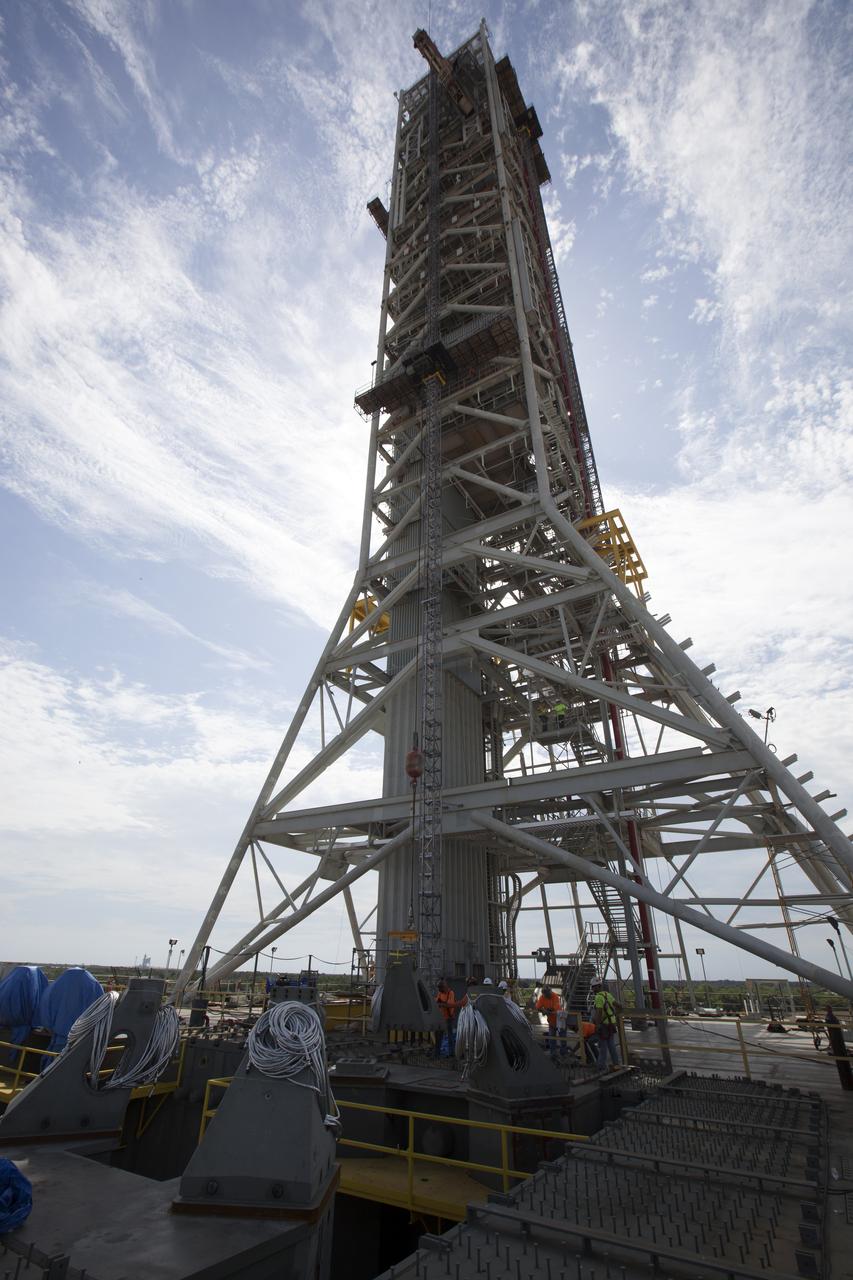
Construction workers on the deck of the mobile launcher at NASA's Kennedy Space Center in Florida, prepare to install a vehicle support post. A total of eight support posts are being installed to support the load of the Space Launch System's (SLS) solid rocket boosters, with four posts for each of the boosters. The support posts are about five feet tall and each weigh about 10,000 pounds. The posts will structurally support the SLS rocket through T-0 and liftoff, and will drop down before vehicle liftoff to avoid contact with the flight hardware. The Ground Systems Development and Operations Program is overseeing installation of the support posts to prepare for the launch of the Orion spacecraft atop the SLS rocket.
Construction workers on the deck of the mobile launcher at NASA's Kennedy Space Center in Florida, prepare a platform for installation of a vehicle support post. A total of eight support posts will be installed to support the load of the Space Launch System's (SLS) solid rocket boosters, with four posts for each of the boosters. The support posts are about five feet tall and each weigh about 10,000 pounds. The posts will structurally support the SLS rocket through T-0 and liftoff, and will drop down before vehicle liftoff to avoid contact with the flight hardware. The Ground Systems Development and Operations Program is overseeing installation of the support posts to prepare for the launch of the Orion spacecraft atop the SLS rocket.
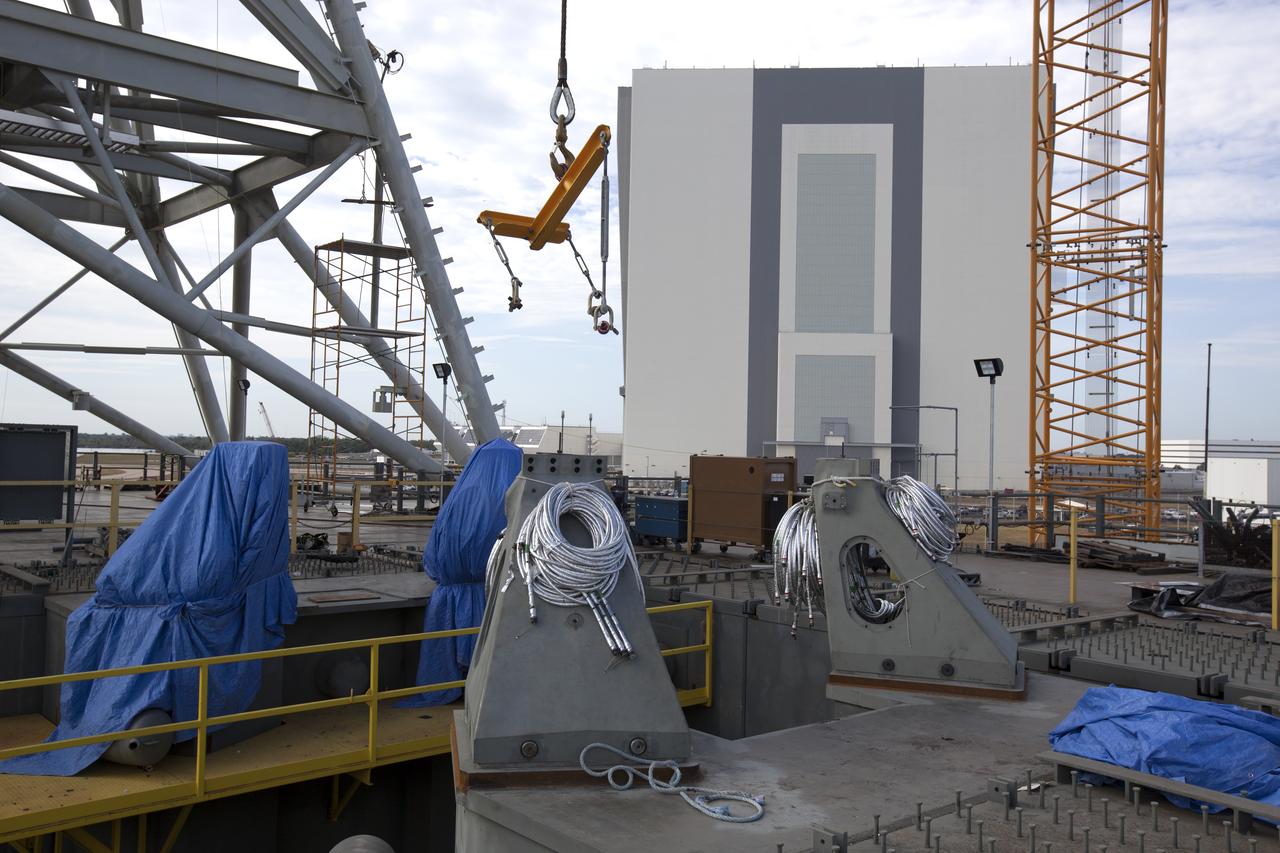
At NASA's Kennedy Space Center in Florida, the final four vehicle support posts are being installed on the deck of the mobile launcher. A total of eight support posts are being installed to support the load of the Space Launch System's (SLS) solid rocket boosters, with four posts for each of the boosters. The support posts are about five feet tall and each weigh about 10,000 pounds. The posts will structurally support the SLS rocket through T-0 and liftoff, and will drop down before vehicle liftoff to avoid contact with the flight hardware. The Ground Systems Development and Operations Program is overseeing installation of the support posts to prepare for the launch of the Orion spacecraft atop the SLS rocket.
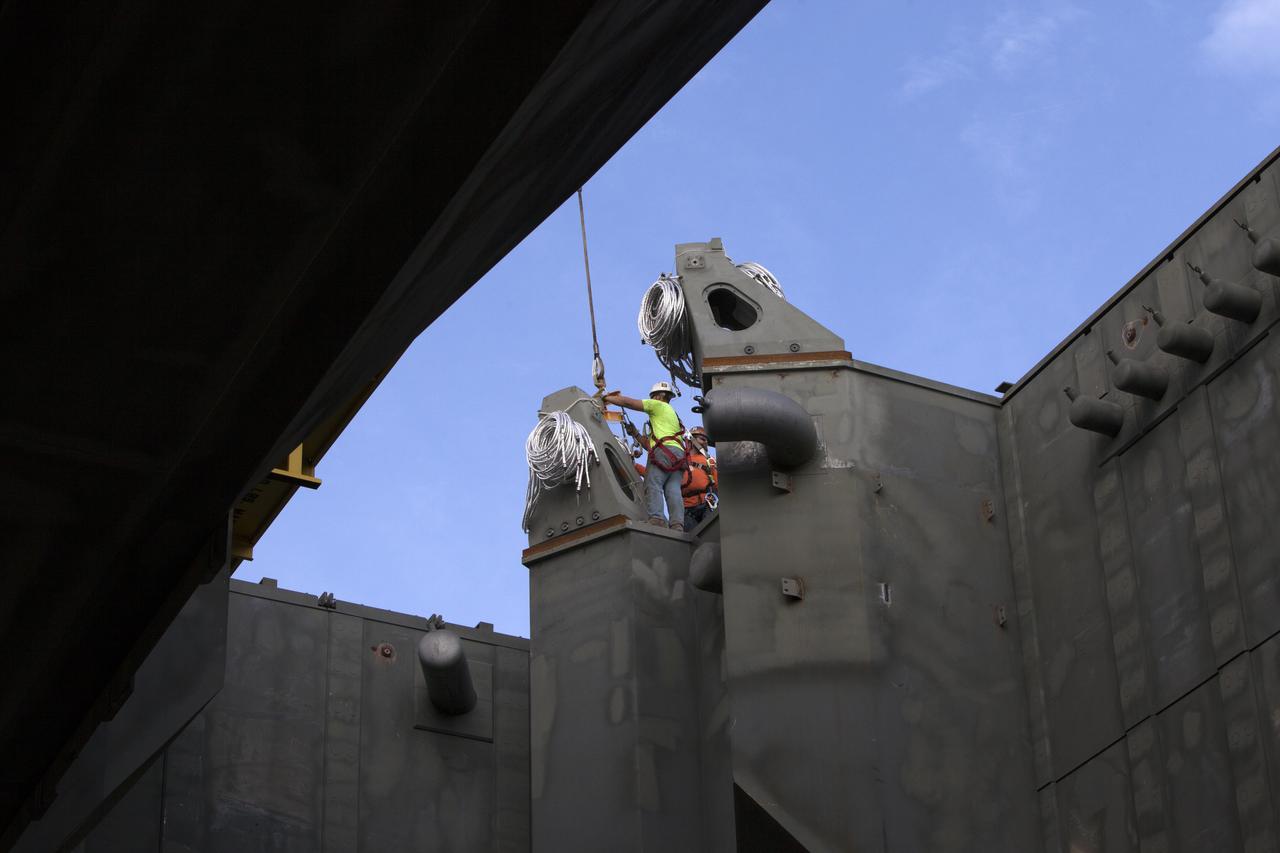
At NASA's Kennedy Space Center in Florida, construction workers on the deck of the mobile launcher install the final four vehicle support posts. A total of eight support posts are being installed to support the load of the Space Launch System's (SLS) solid rocket boosters, with four posts for each of the boosters. The support posts are about five feet tall and each weigh about 10,000 pounds. The posts will structurally support the SLS rocket through T-0 and liftoff, and will drop down before vehicle liftoff to avoid contact with the flight hardware. The Ground Systems Development and Operations Program is overseeing installation of the support posts to prepare for the launch of the Orion spacecraft atop the SLS rocket.
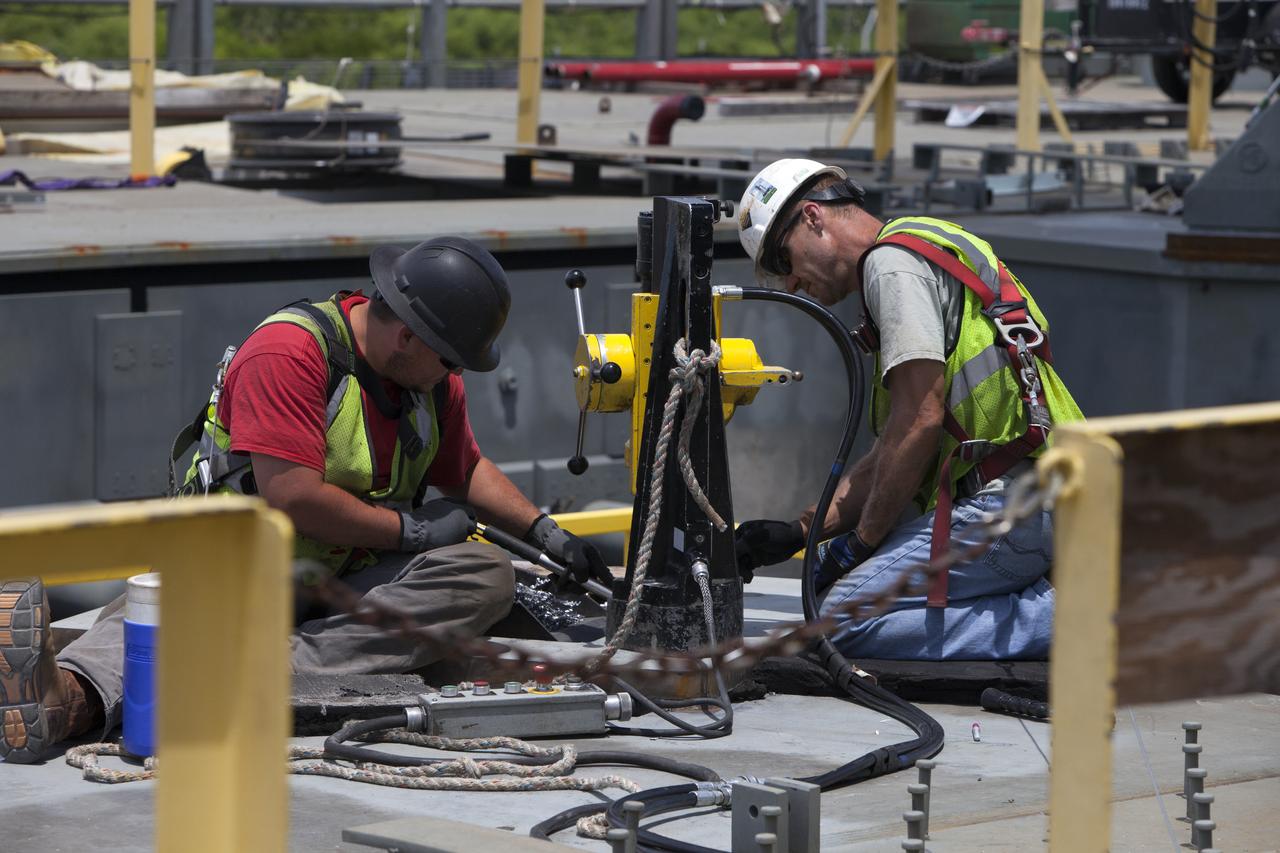
Construction workers on the deck of the mobile launcher at NASA's Kennedy Space Center in Florida, prepare a platform for installation of a vehicle support post. A total of eight support posts will be installed to support the load of the Space Launch System's (SLS) solid rocket boosters, with four posts for each of the boosters. The support posts are about five feet tall and each weigh about 10,000 pounds. The posts will structurally support the SLS rocket through T-0 and liftoff, and will drop down before vehicle liftoff to avoid contact with the flight hardware. The Ground Systems Development and Operations Program is overseeing installation of the support posts to prepare for the launch of the Orion spacecraft atop the SLS rocket.
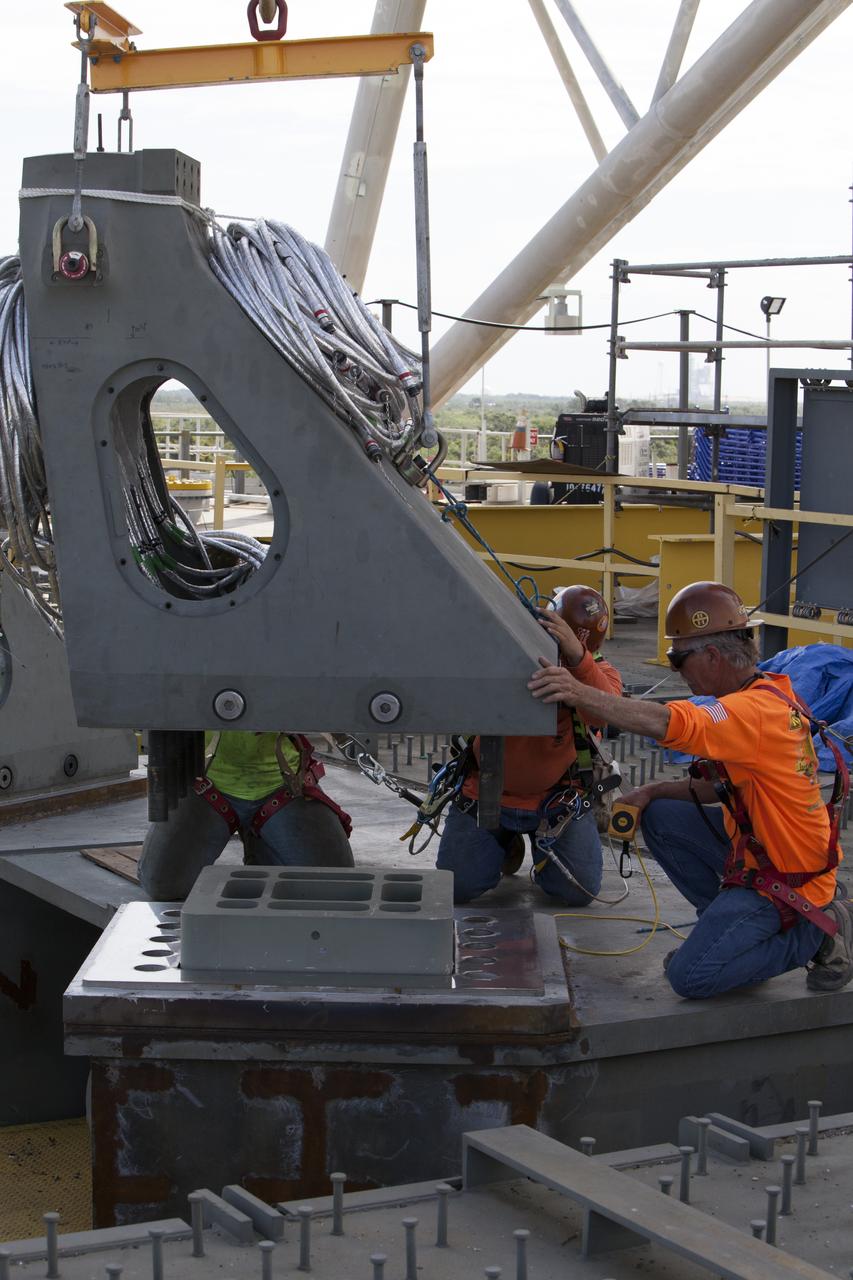
Construction workers on the deck of the mobile launcher at NASA's Kennedy Space Center in Florida, prepare to install a vehicle support post. A total of eight support posts are being installed to support the load of the Space Launch System's (SLS) solid rocket boosters, with four posts for each of the boosters. The support posts are about five feet tall and each weigh about 10,000 pounds. The posts will structurally support the SLS rocket through T-0 and liftoff, and will drop down before vehicle liftoff to avoid contact with the flight hardware. The Ground Systems Development and Operations Program is overseeing installation of the support posts to prepare for the launch of the Orion spacecraft atop the SLS rocket.
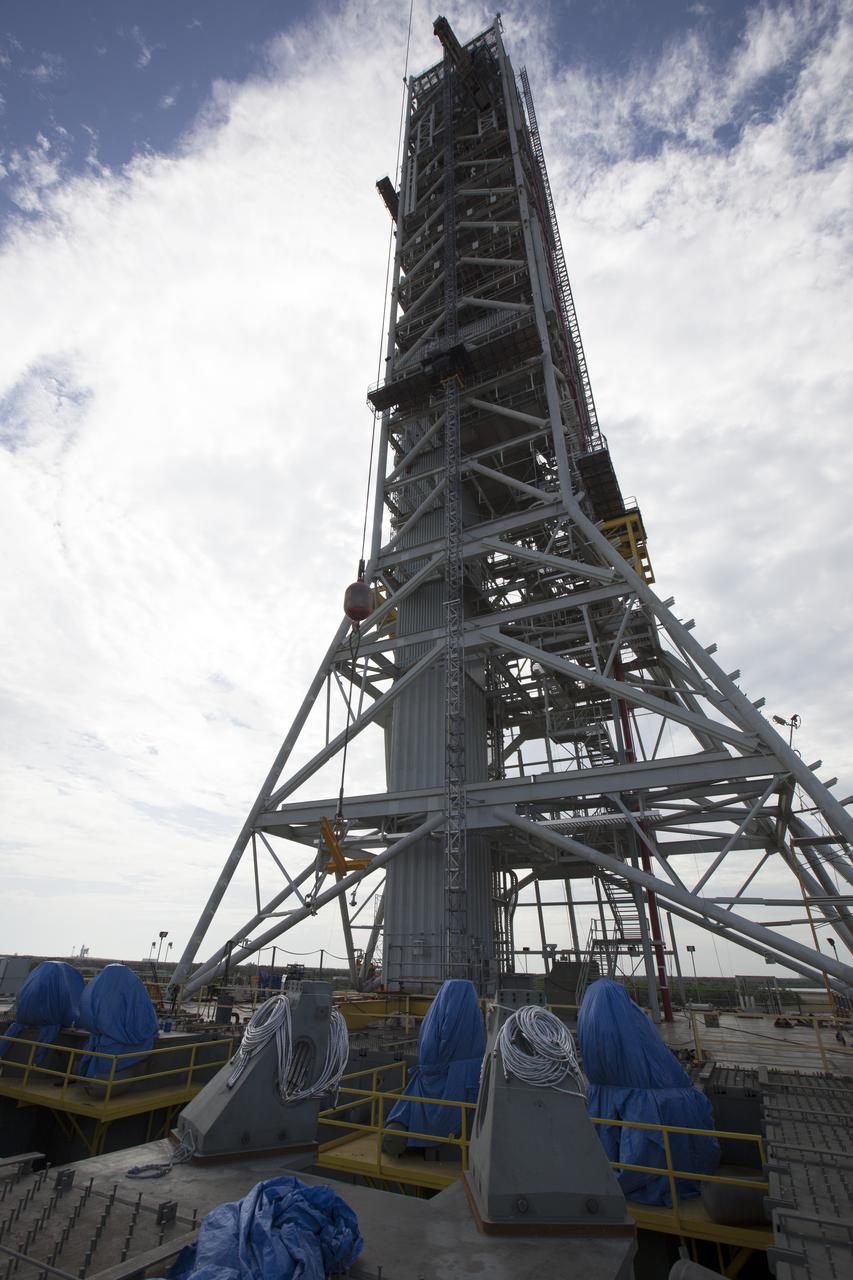
At NASA's Kennedy Space Center in Florida, the final four vehicle support posts are being installed on the deck of the mobile launcher. A total of eight support posts are being installed to support the load of the Space Launch System's (SLS) solid rocket boosters, with four posts for each of the boosters. The support posts are about five feet tall and each weigh about 10,000 pounds. The posts will structurally support the SLS rocket through T-0 and liftoff, and will drop down before vehicle liftoff to avoid contact with the flight hardware. The Ground Systems Development and Operations Program is overseeing installation of the support posts to prepare for the launch of the Orion spacecraft atop the SLS rocket.
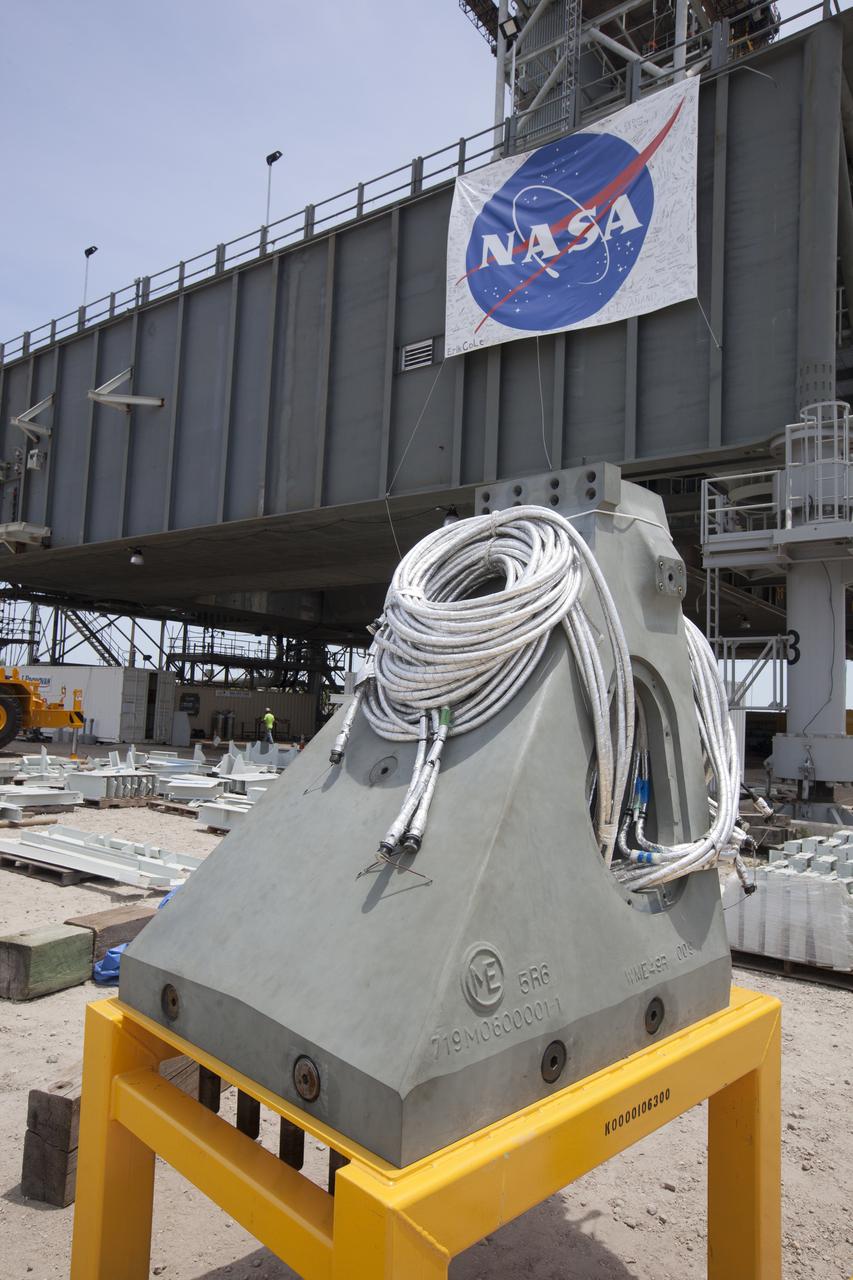
A vehicle support post will be lifted up by crane and lowered onto the deck of the mobile launcher at NASA's Kennedy Space Center in Florida. A total of eight support posts will be installed to support the load of the Space Launch System's (SLS) solid rocket boosters, with four posts for each of the boosters. The support posts are about five feet tall and each weigh about 10,000 pounds. The posts will structurally support the SLS rocket through T-0 and liftoff, and will drop down before vehicle liftoff to avoid contact with the flight hardware. The Ground Systems Development and Operations Program is overseeing installation of the support posts to prepare for the launch of the Orion spacecraft atop the SLS rocket.
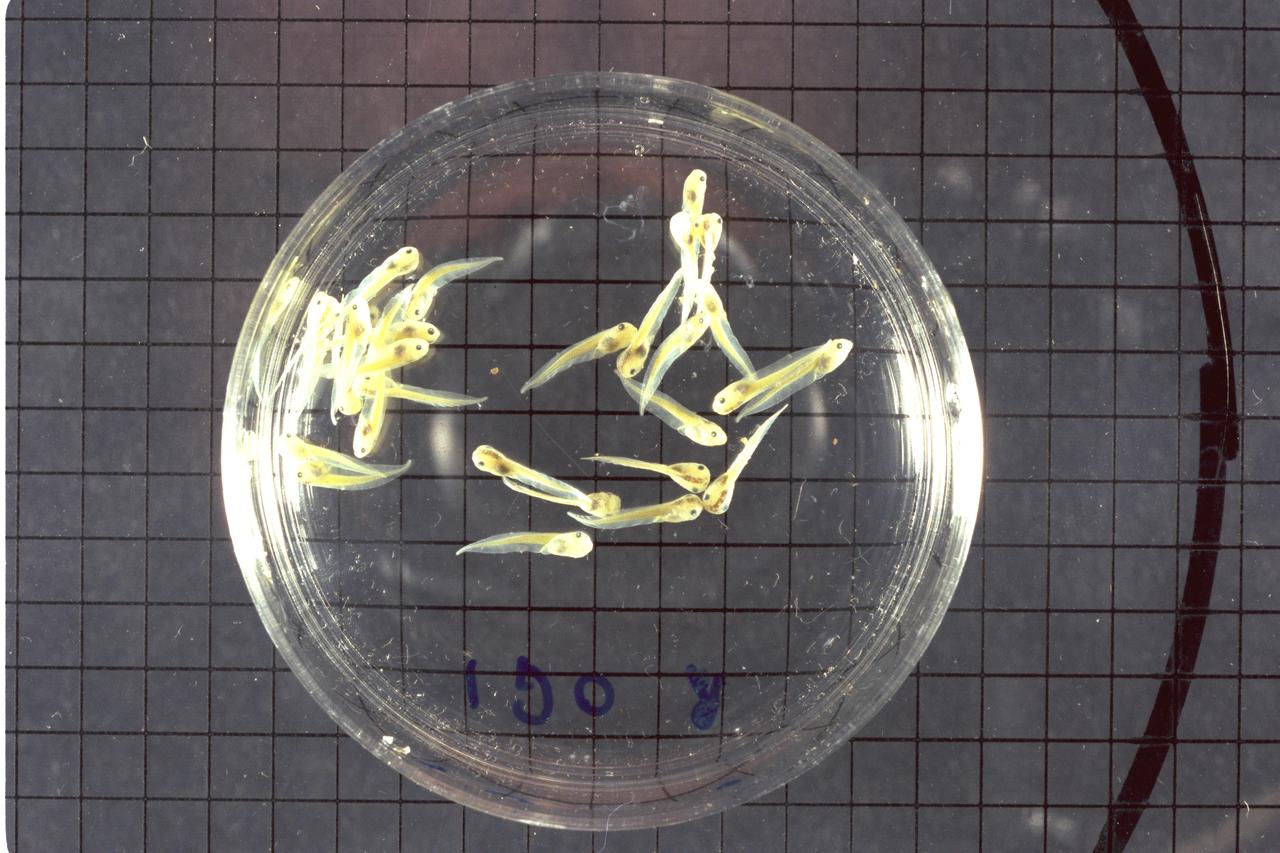
STS-47 Spacelab-J - post flight tadpoles
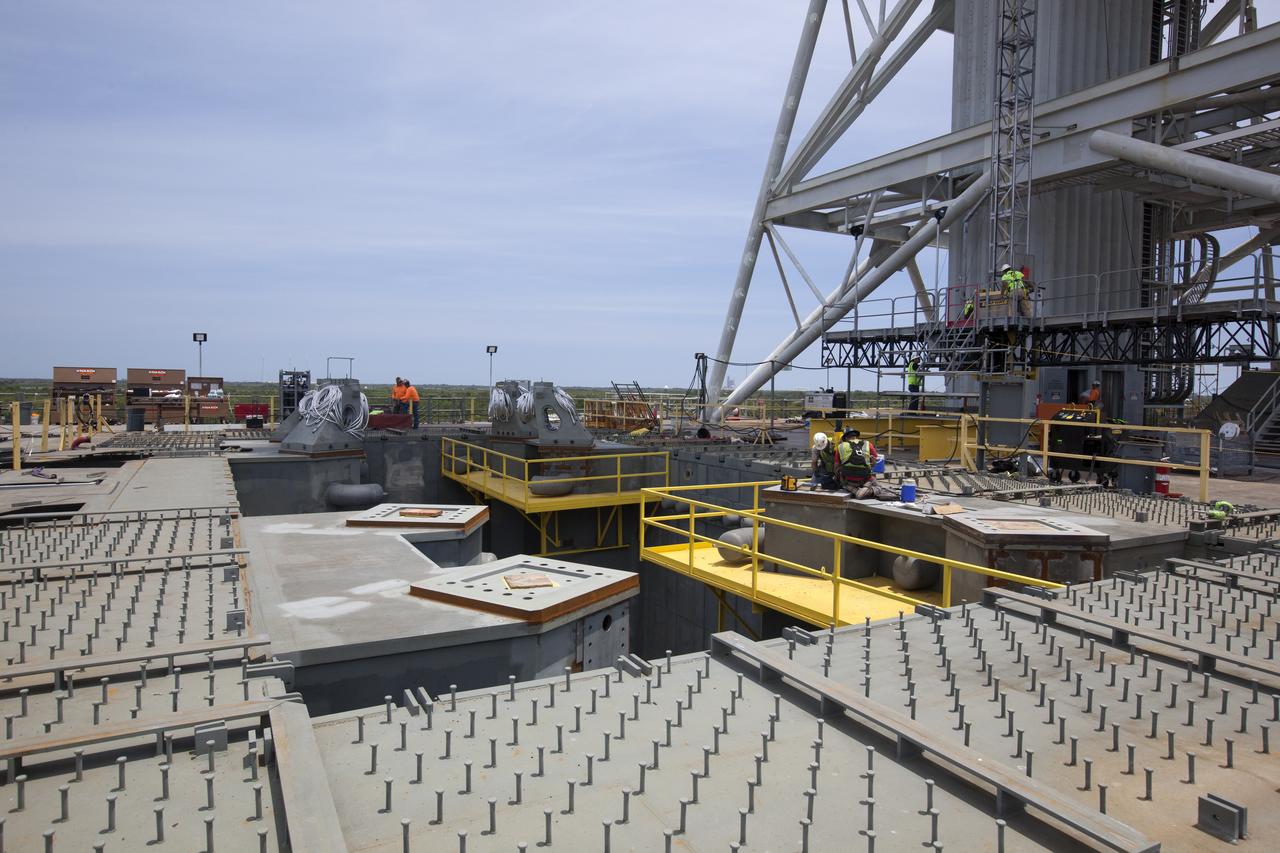
Construction workers on the deck of the mobile launcher prepare the platforms for installation of vehicle support posts at NASA's Kennedy Space Center in Florida. At left, four of the support posts are installed. A total of eight support posts will be installed to support the load of the Space Launch System's (SLS) solid rocket boosters, with four posts for each of the boosters. The support posts are about five feet tall and each weigh about 10,000 pounds. The posts will structurally support the SLS rocket through T-0 and liftoff, and will drop down before vehicle liftoff to avoid contact with the flight hardware. The Ground Systems Development and Operations Program is overseeing installation of the support posts to prepare for the launch of the Orion spacecraft atop the SLS rocket.
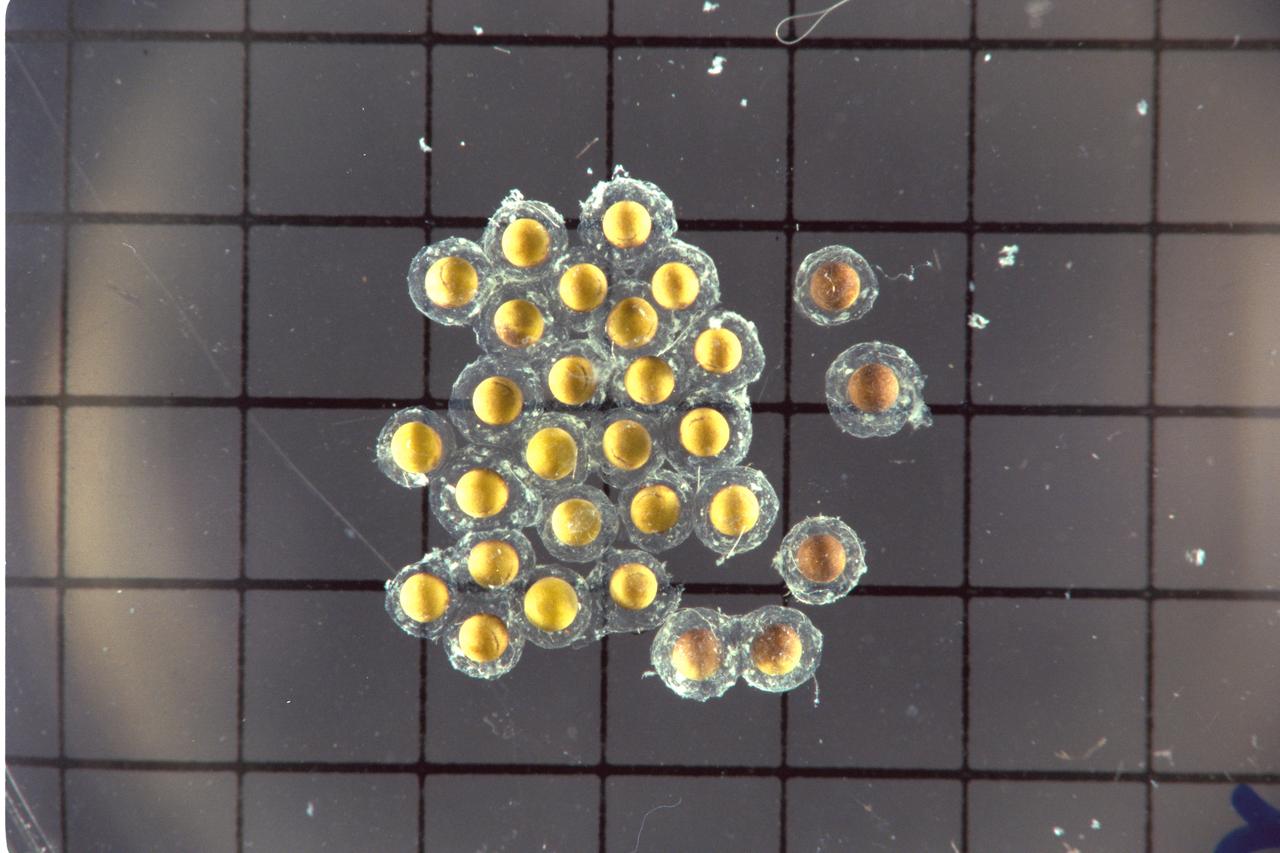
STS-47 Spacelab-J - eggs - post flight data
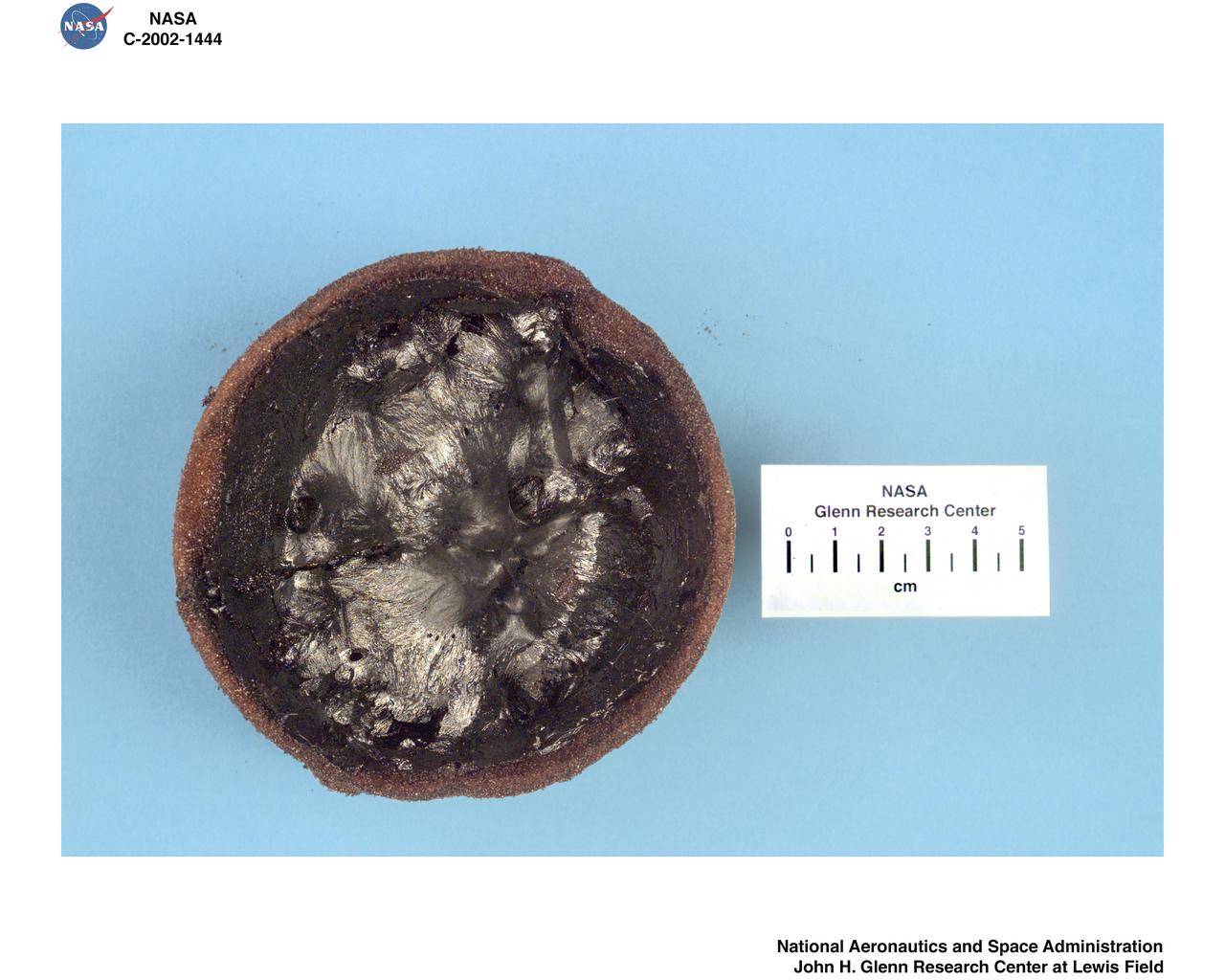
MICROGRAVITY SMOLDERING COMBUSTION POST FLIGHT SAMPLES - STS 105 AND STS 108
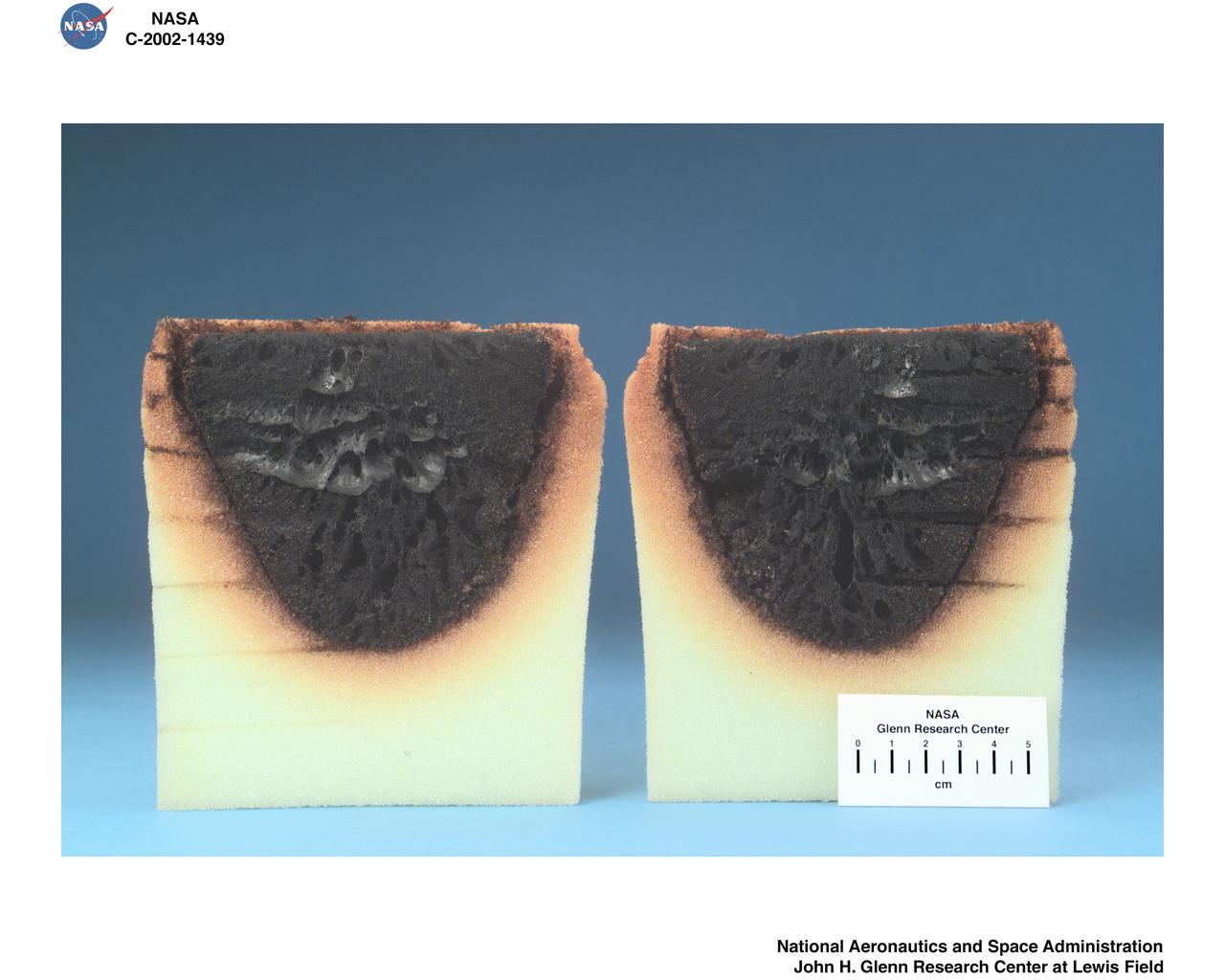
MICROGRAVITY SMOLDERING COMBUSTION POST FLIGHT SAMPLES - STS 105 AND STS 108
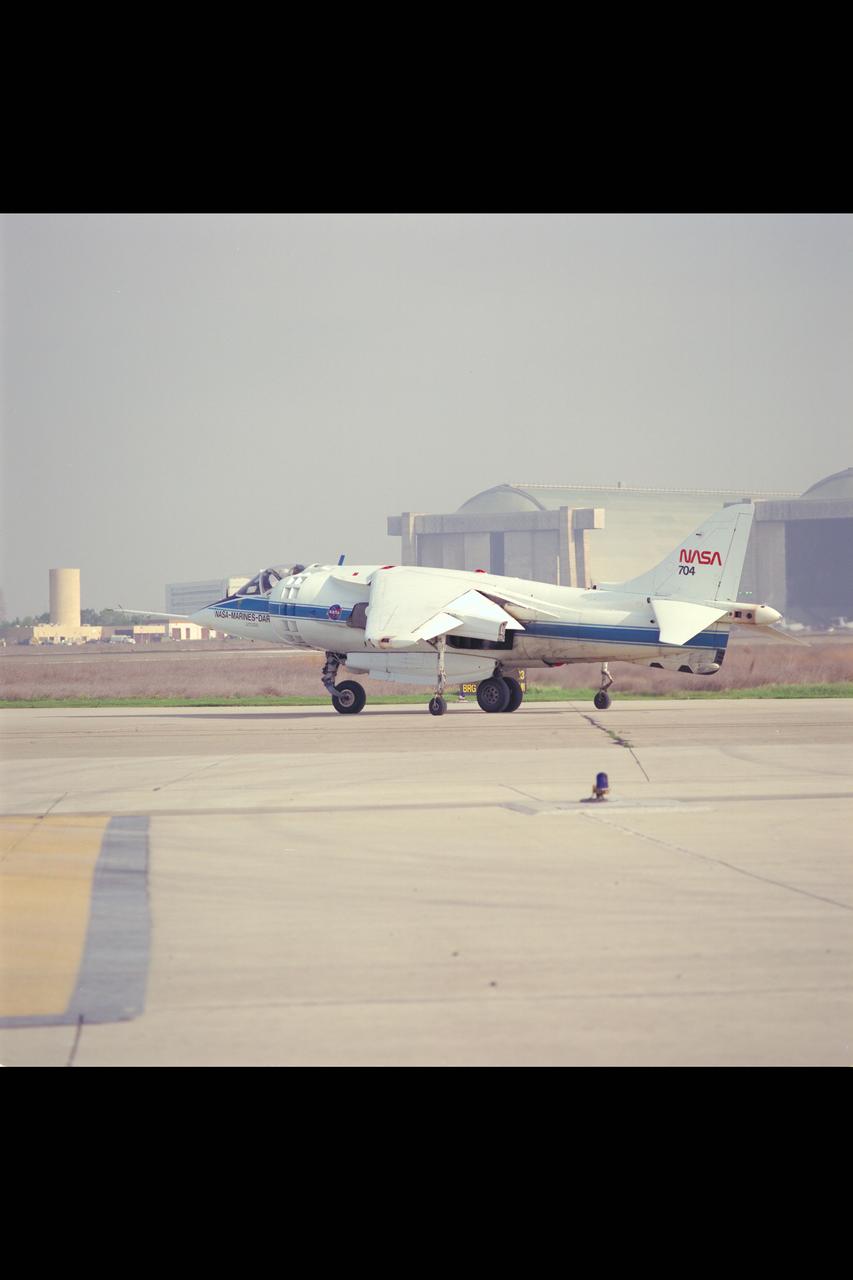
AV-8B (NASA-704) HARRIER POST MAINTENANCE CHECK FLIGHT
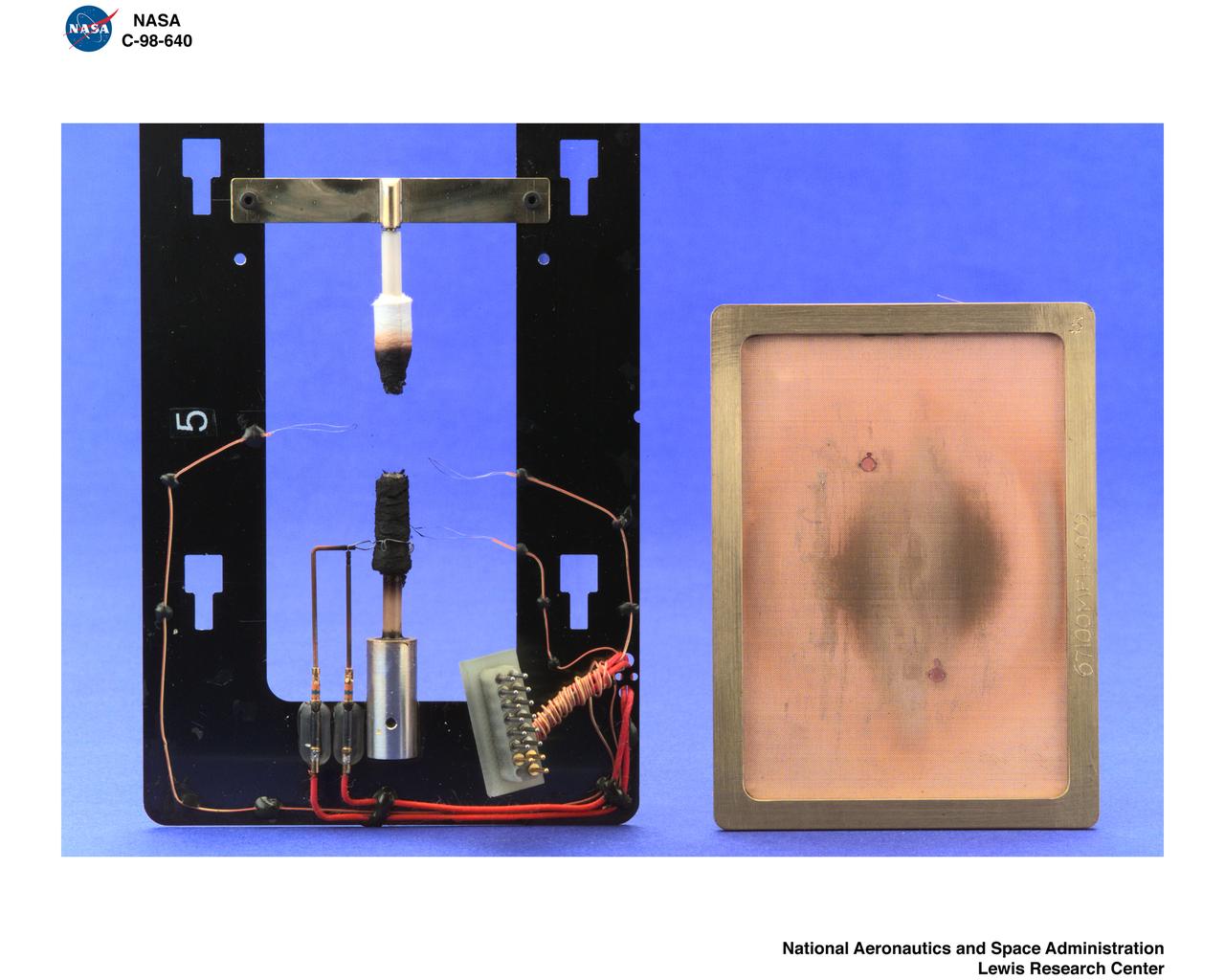
OPPOSED FLOW FLAME SPREAD POST FLIGHT MATERIAL SAMPLES
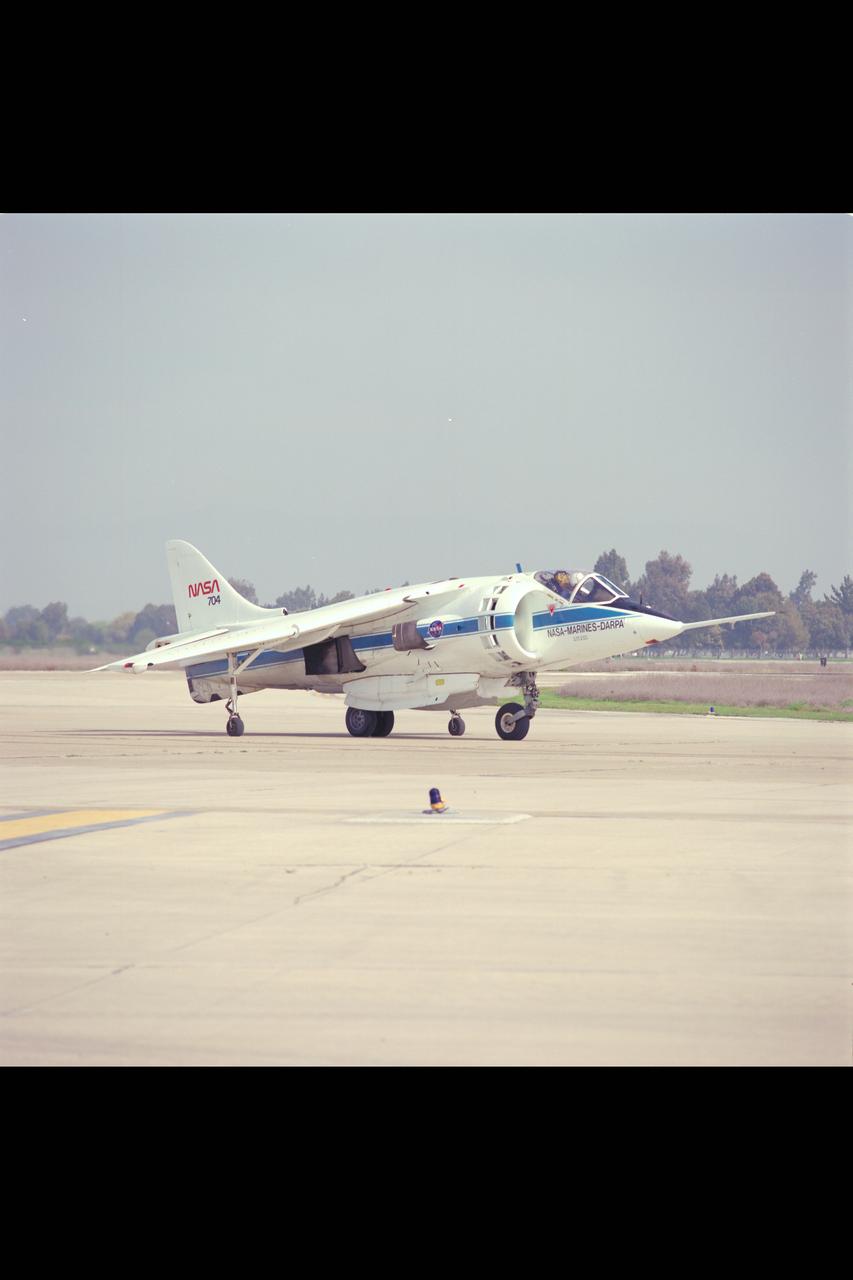
AV-8B (NASA-704) Harrier post maintenance check flight

AV-8B (NASA-704) Harrier post maintenance check flight
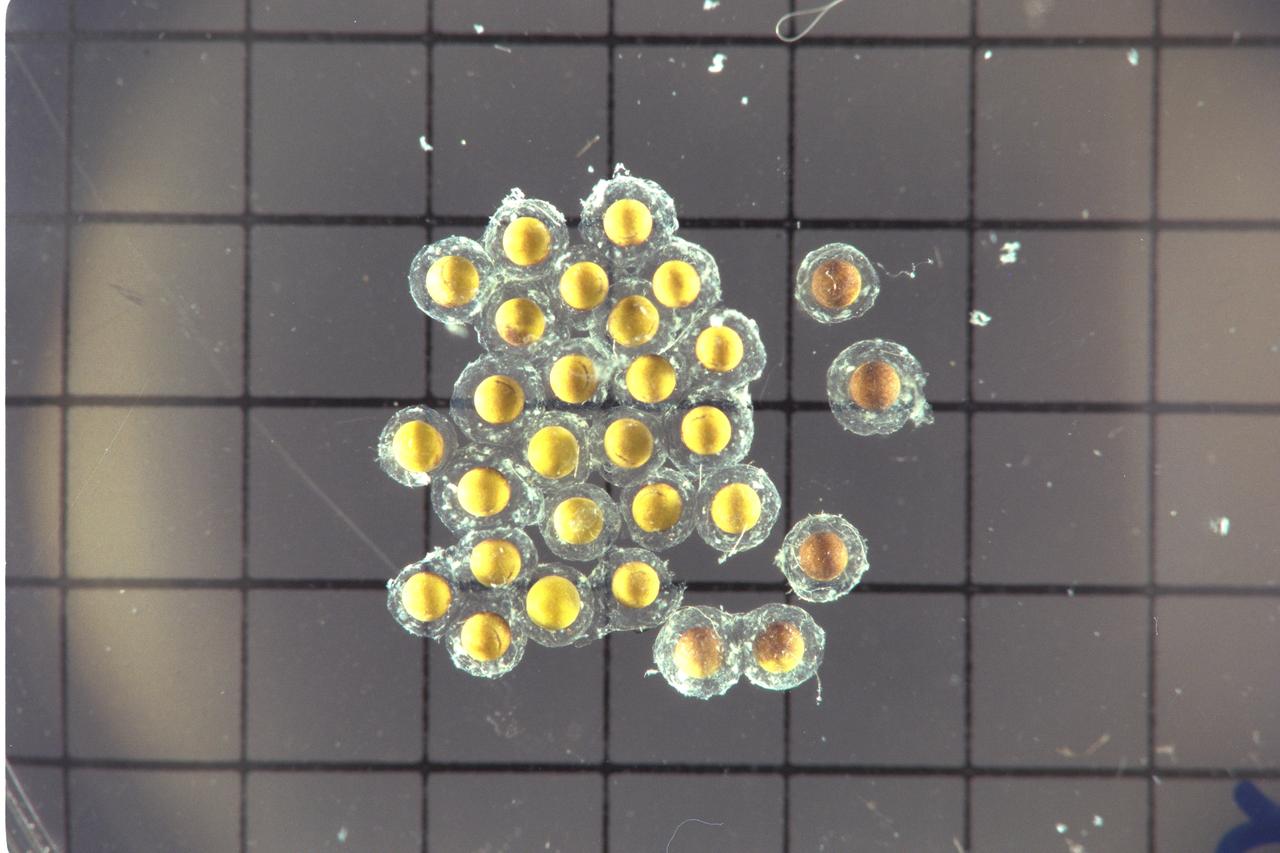
STS-47 Spacelab-J - eggs - post flight data
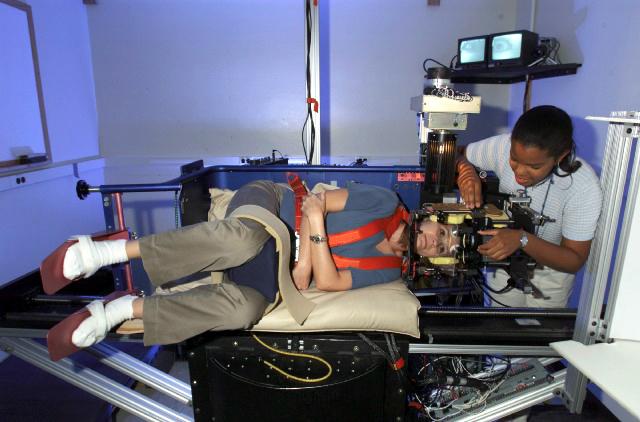
The short-arm centrifuge subjects an astronaut to conflicting sensory input and study the astronaut's perception of motion. It is one of several instruments used in the Spatial Reorientation Following Space Flight investigation to be conducted on crewmembers. During space flight, the vestibular organs no longer respond in a familiar way. Instead, inputs from the irner ear do not match those coming from the eyes. While on Earth, you can open your eyes to see if you truly are spinning, but astronauts do not have this luxury. Astronauts can see the floor, but have no sense of down; when they bend their heads forward, the otoliths are not stimulated properly. This state, called sensory conflict, must be resolved by the brain to maintain orientation. When they first return to Earth, astronauts are again disoriented because of sensory conflict. They undergo a period of spatial reorientation, as their brains reconcile what their eyes see and what their vestibular system senses. Recovery can take anywhere from hours to days depending on the length of the mission. Principal Investigator: Dr. William Paloski, Johnson Space Center, Houston, TX.
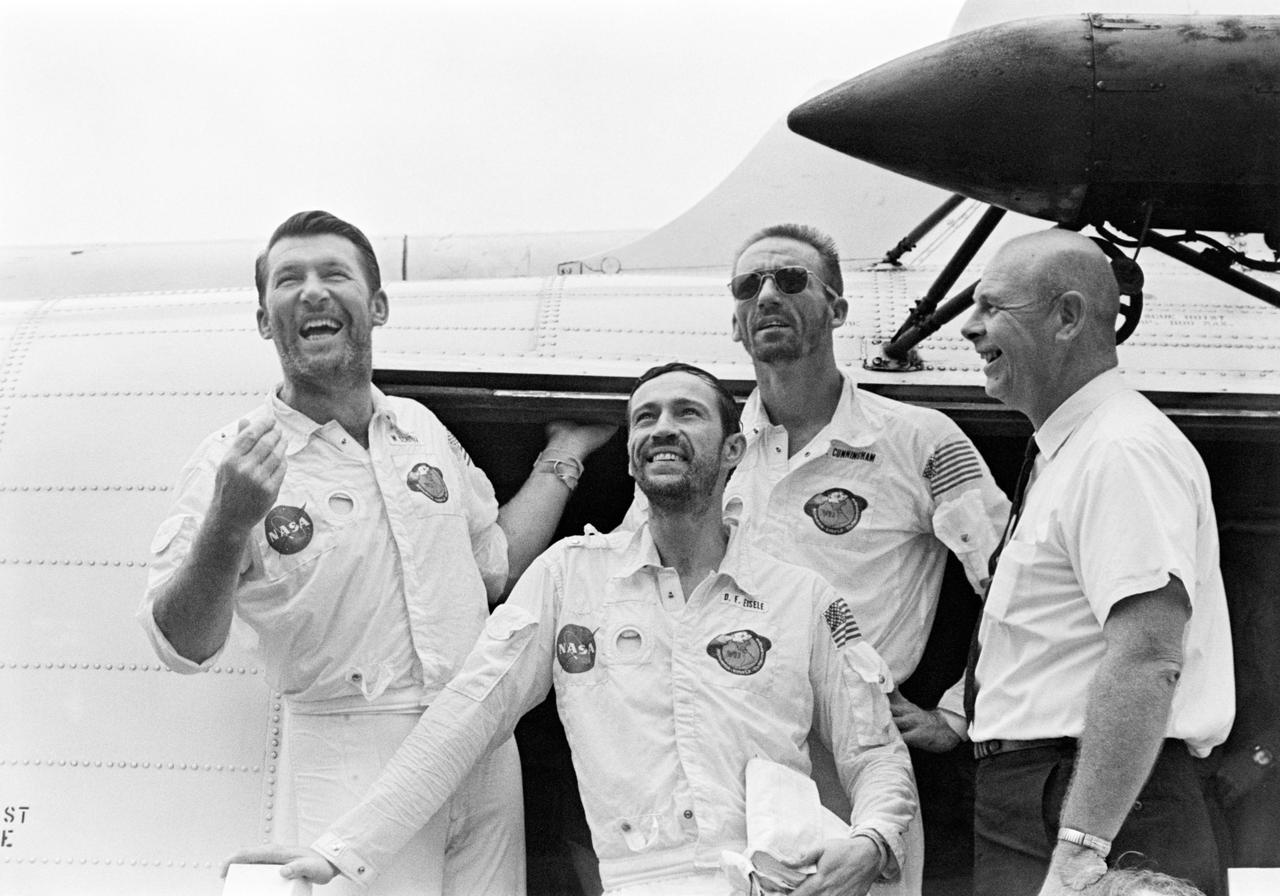
S68-52542 (22 Oct. 1968) --- The Apollo 7 crew arrives aboard the USS Essex, the prime recovery ship for the mission. Left to right, are astronauts Walter M. Schirra Jr., commander; Donn F. Eisele, command module pilot; Walter Cunningham, lunar module pilot; and Dr. Donald E. Stullken, NASA Recovery Team Leader from the Manned Spacecraft Center's (MSC) Landing and Recovery Division. The crew is pausing in the doorway of the recovery helicopter.

S81-30479 (April 1981) --- Astronauts John W. Young, second from left, and Robert L. Crippen, left, discuss photography from their recent STS-1 mission with astronauts Joe H. Engle, right, and Richard H. Truly during a post-mission debriefing session. Engle and Truly were backup crewmen for STS-1 and they have been named as prime crew members for STS-2, scheduled for a Sept. 30, 1981 liftoff. Photo credit: NASA
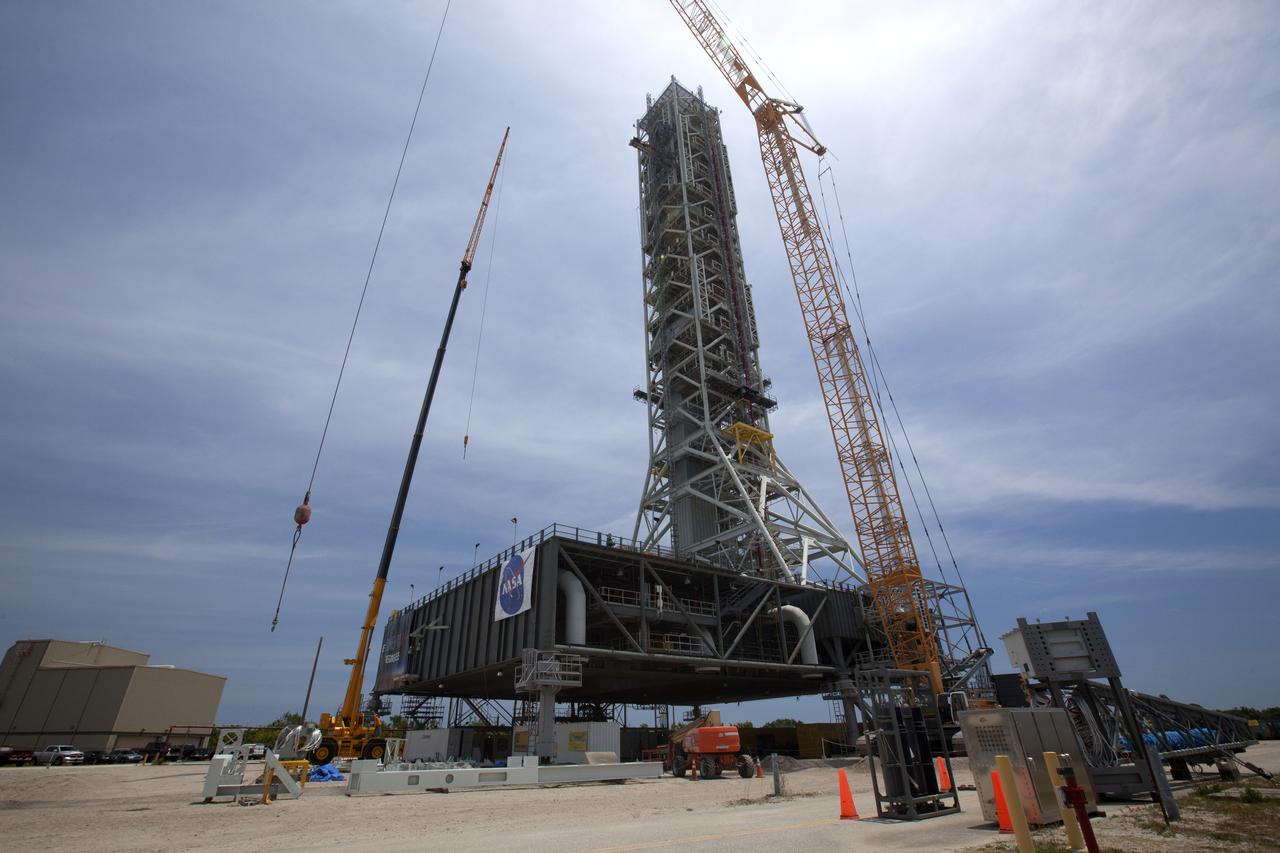
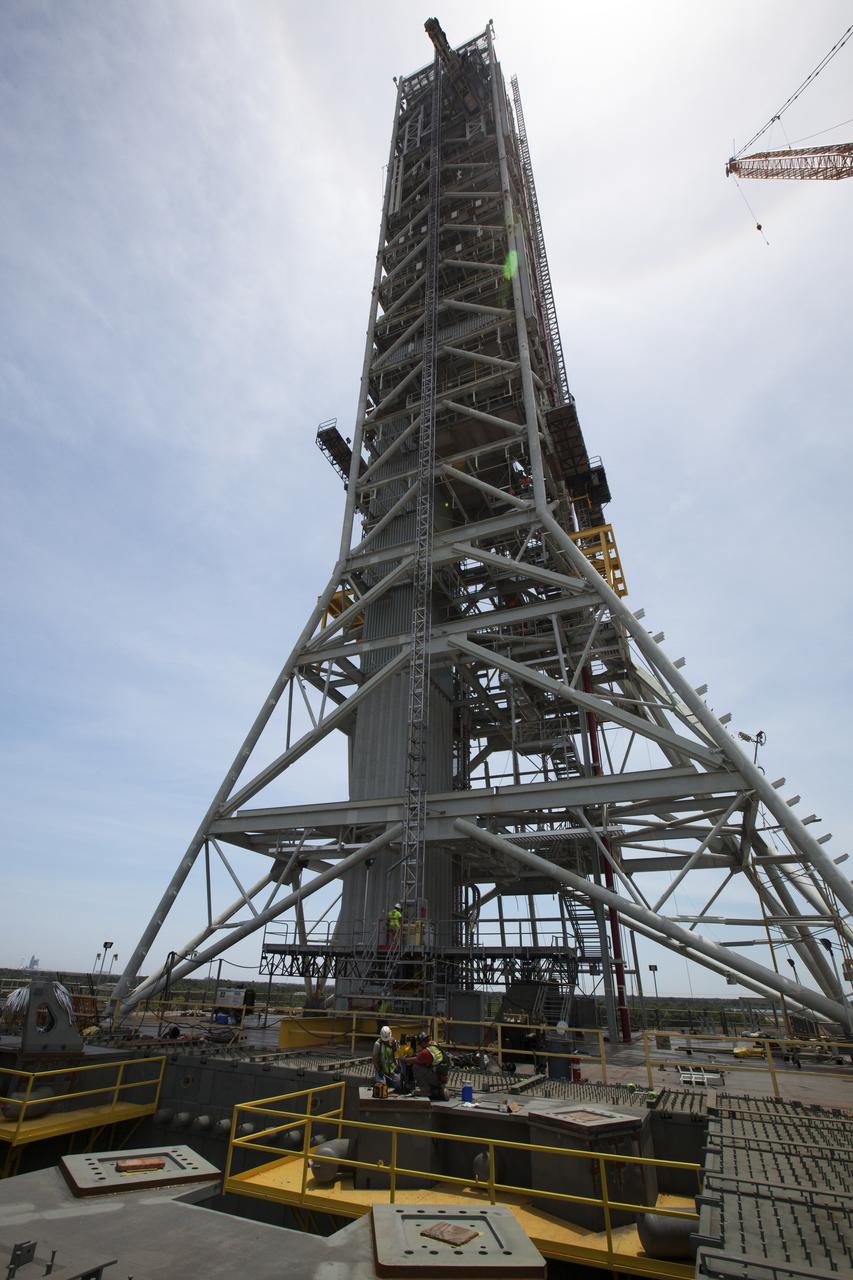
Several heavy lift cranes surround the mobile launcher at NASA's Kennedy Space Center in Florida. Preparations are underway to lift a vehicle support post up and onto the mobile launcher for installation on the deck. A total of eight support posts will be installed to support the load of the Space Launch System's (SLS) solid rocket boosters, with four posts for each of the boosters. The support posts are about five feet tall and each weigh about 10,000 pounds. The posts will structurally support the SLS rocket through T-0 and liftoff, and will drop down before vehicle liftoff to avoid contact with the flight hardware. The Ground Systems Development and Operations Program is overseeing installation of the support posts to prepare for the launch of the Orion spacecraft atop the SLS rocket.
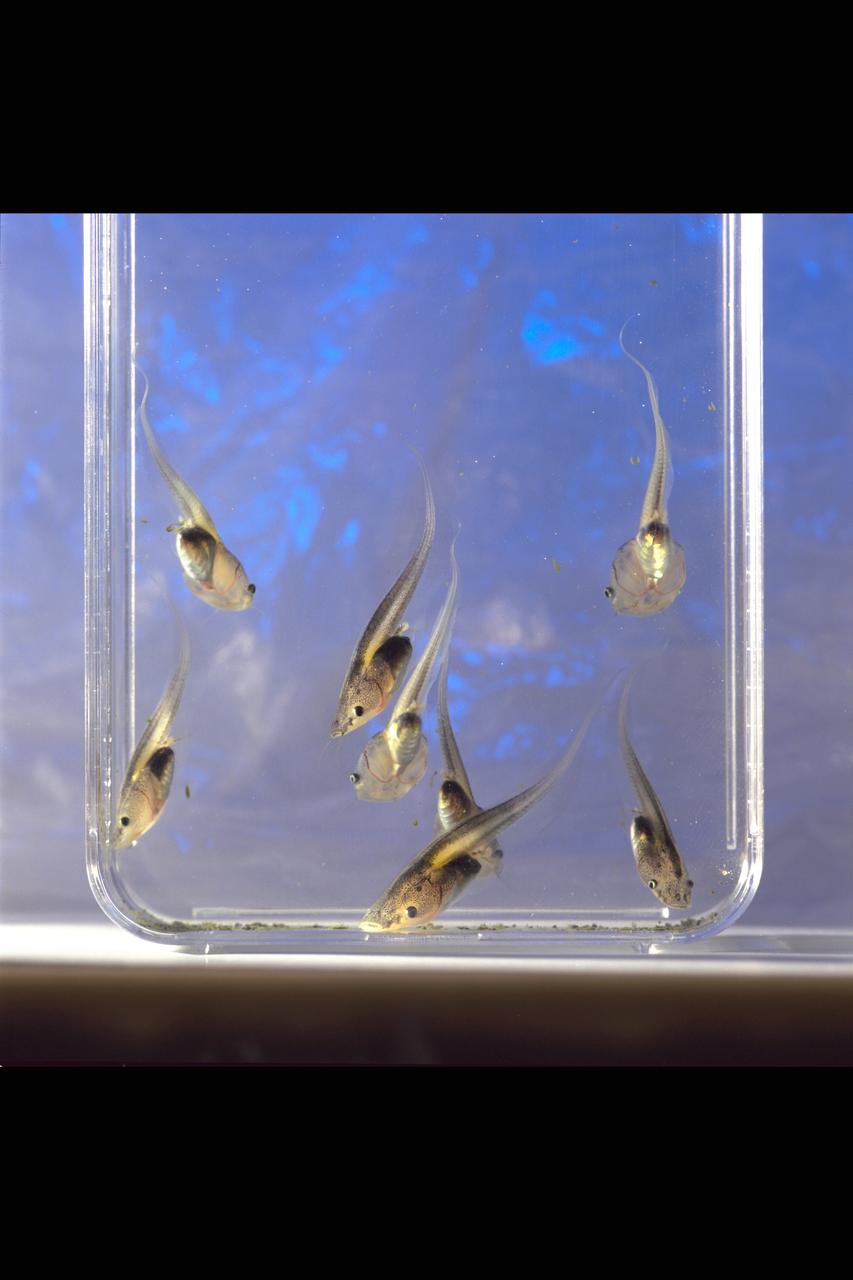
STS-47 Spacelab-J FFE (Frog Embryology Experiment) post flight data - flight frogs from SL-J, ground control tadpoles
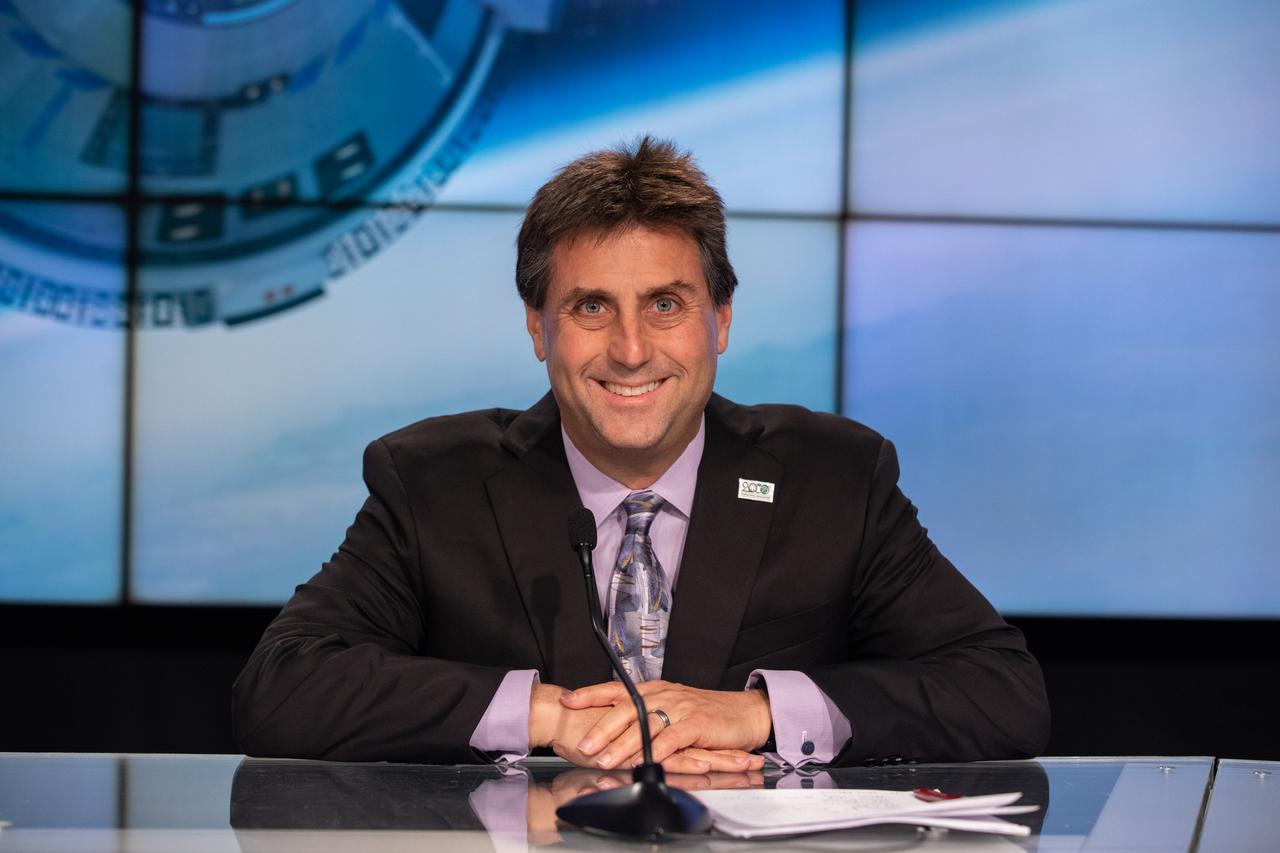
Joel Montalbano, manager, NASA’s International Space Station Program, participates in a post-launch news conference following the liftoff of NASA Boeing’s Orbital Flight Test-2 (OFT-2) on May 19, 2022. Liftoff occurred at 6:54 p.m. EDT from Space Launch Complex-41 at Florida’s Cape Canaveral Space Force Station. Boeing’s uncrewed flight test is designed to test the system’s end-to-end capabilities for NASA’s Commercial Crew Program providing valuable data towards NASA certifying Boeing’s crew transportation system for regular crewed flights to and from the International Space Station.
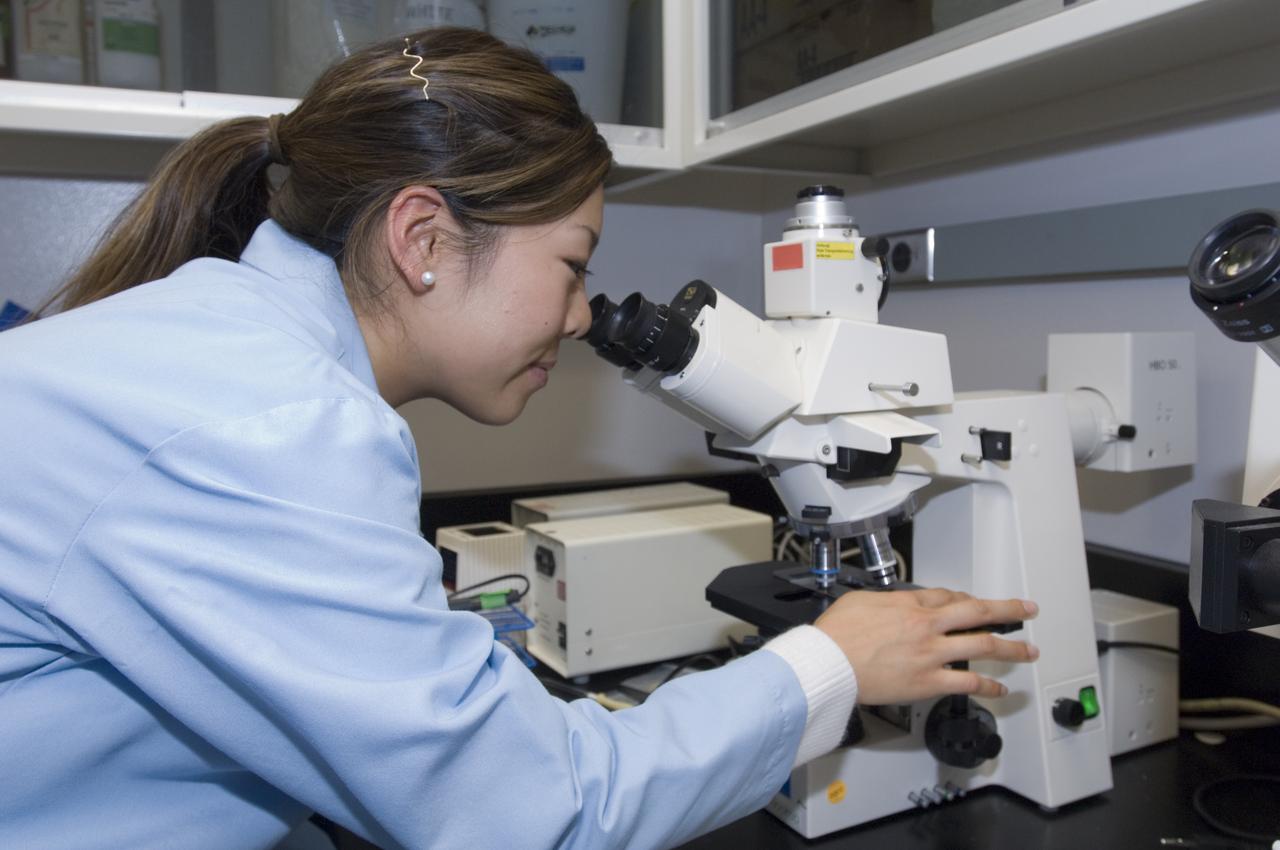
STS-121 PAYLOAD; FIT FRUITFLIES (DORSOPHILA) Post flight with Min Choi checking microscope
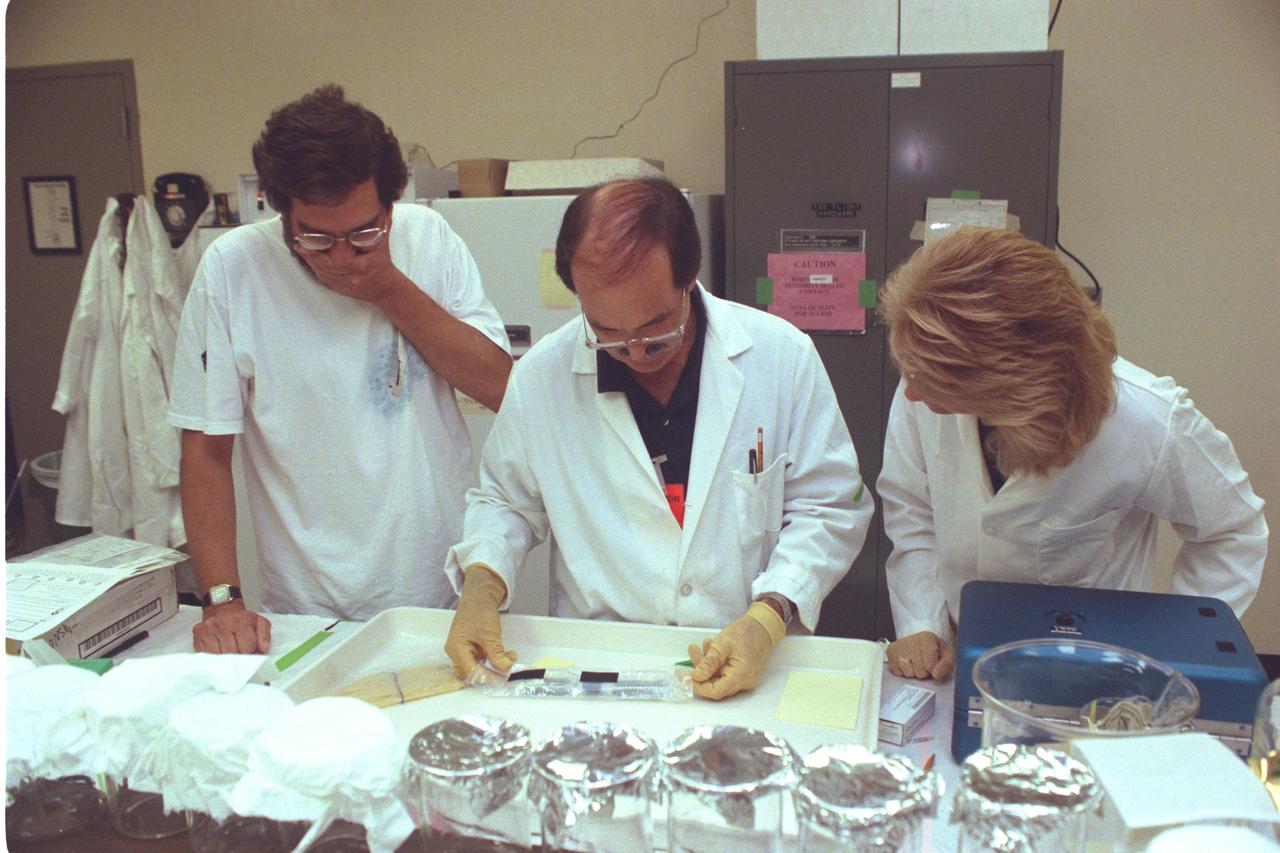
STS-47 Spacelab-J - Ken Souza and team during post flight work at KSC
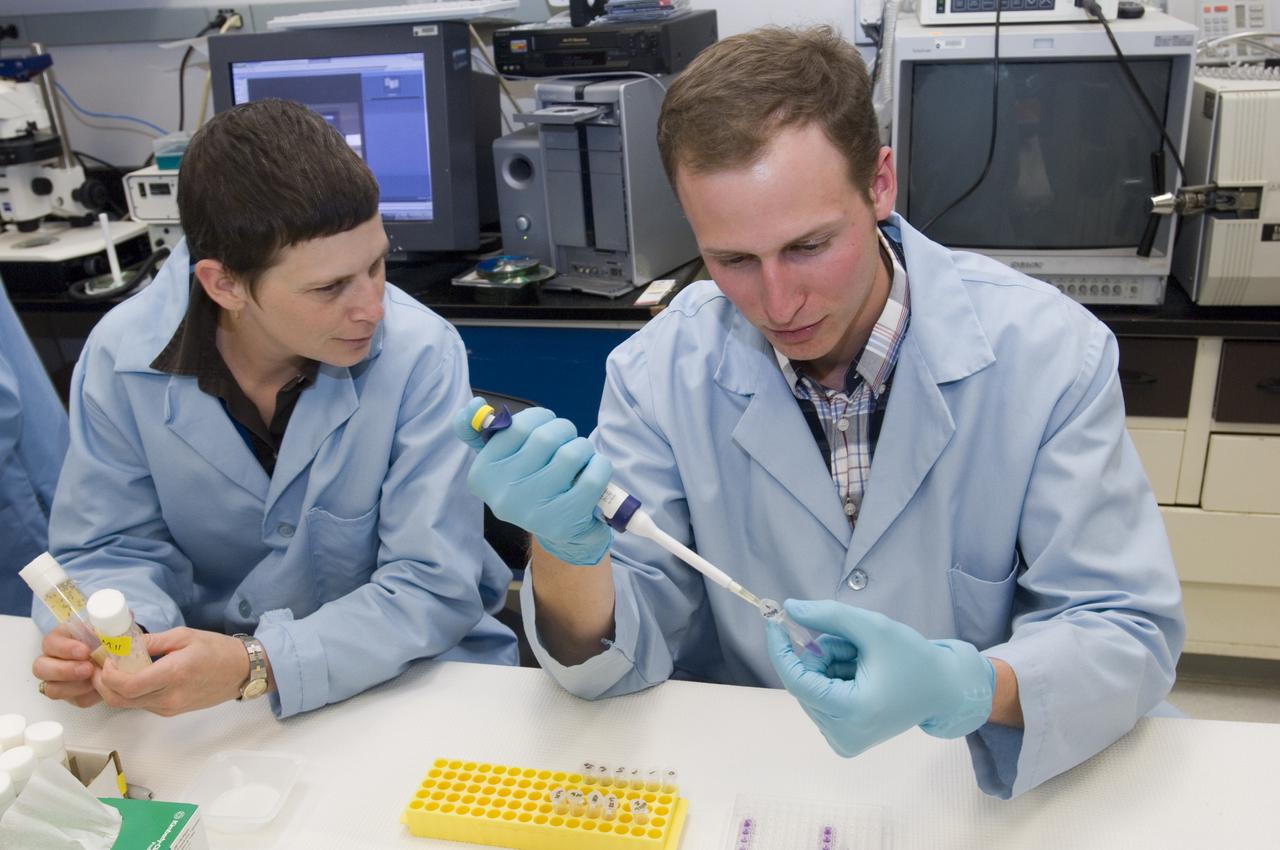
STS-121 PAYLOAD; FIT FRUITFLIES (DORSOPHILA) Post flight with Laura Higgins (r) and Florian Selch (l)
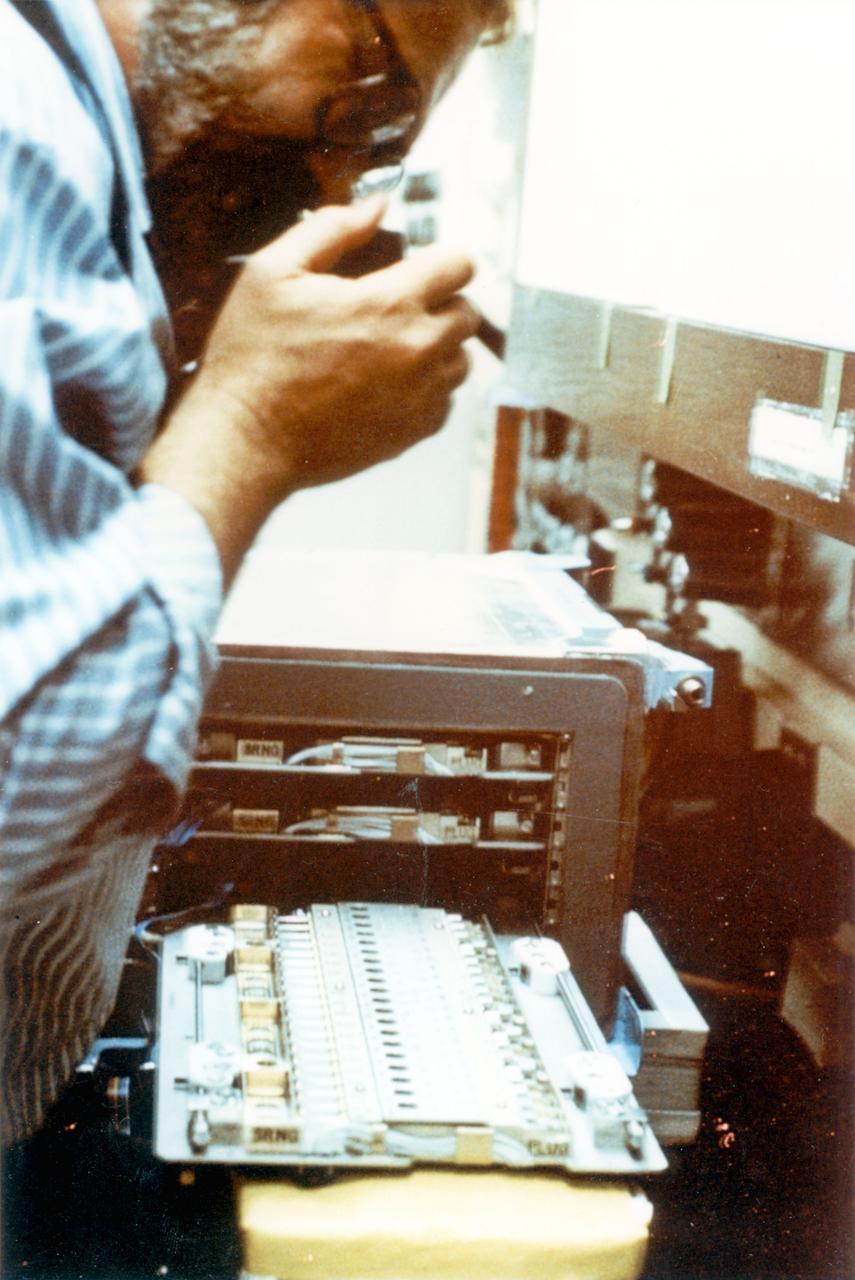
Scientist photographs STS- 26 Post-flight (VDA) Vapor Diffusion Apparatus Tray with (PCG) Protein Crystal Growth Samples.
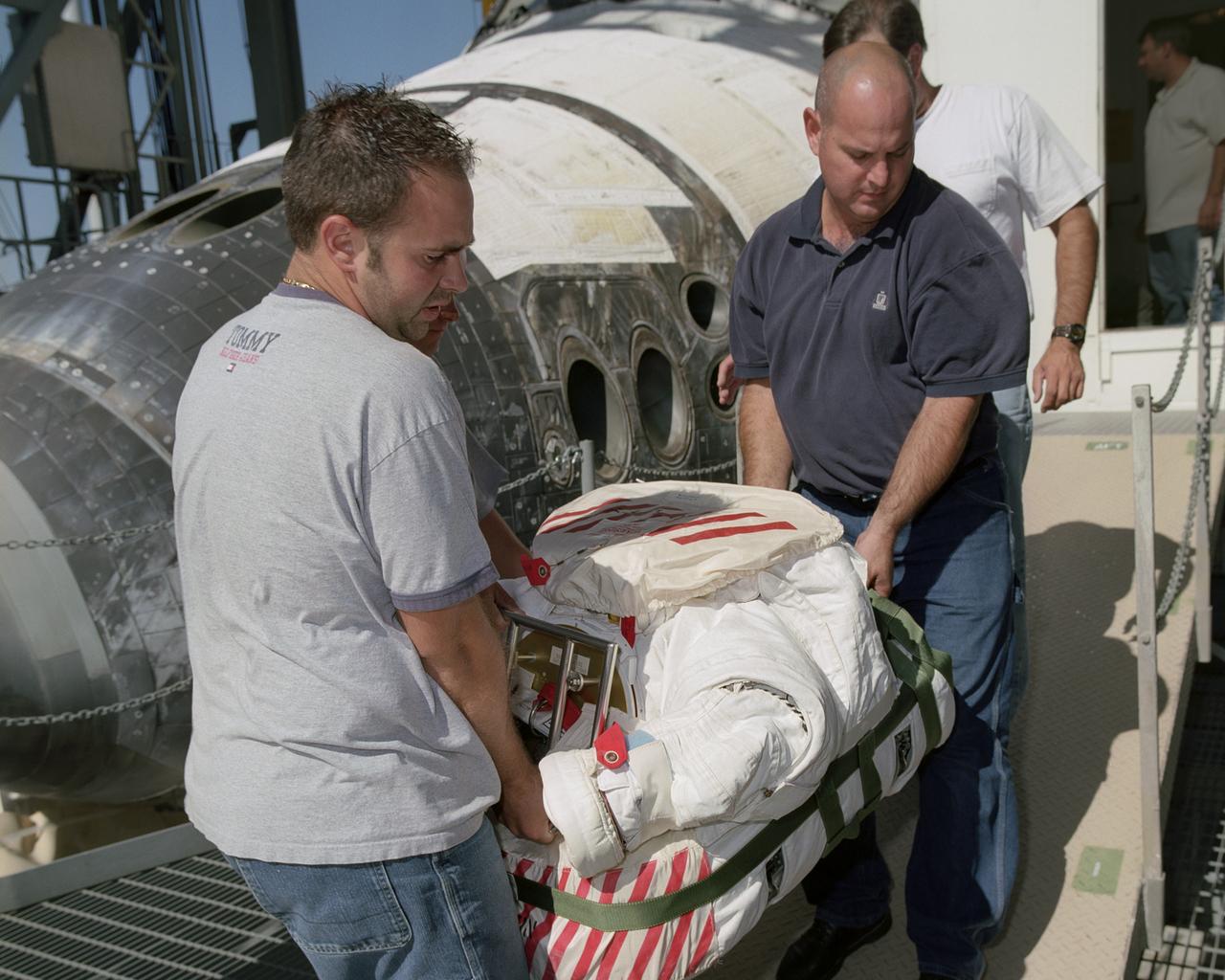
Flight Crew Systems Technicians Ray Smith and Raphael Rodriguez remove one of the Extravehicular Mobility Units, or EMUs, from the Space Shuttle Discovery after it's successful landing at NASA's Dryden Flight Research Center. The Space Shuttles receive post-flight servicing in the Mate-Demate Device (MDD) following landings at NASA's Dryden Flight Research Center, Edwards, California. The gantry-like MDD structure is used for servicing the shuttle orbiters in preparation for their ferry flight back to the Kennedy Space Center in Florida, including mounting the shuttle atop NASA's modified Boeing 747 Shuttle Carrier Aircraft. Space Shuttle Discovery landed safely at NASA's Dryden Flight Research Center at Edwards Air Force Base in California at 5:11:22 a.m. PDT, August 9, 2005, following the very successful 14-day STS-114 return to flight mission. During their two weeks in space, Commander Eileen Collins and her six crewmates tested out new safety procedures and delivered supplies and equipment the International Space Station. Discovery spent two weeks in space, where the crew demonstrated new methods to inspect and repair the Shuttle in orbit. The crew also delivered supplies, outfitted and performed maintenance on the International Space Station. A number of these tasks were conducted during three spacewalks. In an unprecedented event, spacewalkers were called upon to remove protruding gap fillers from the heat shield on Discovery's underbelly. In other spacewalk activities, astronauts installed an external platform onto the Station's Quest Airlock and replaced one of the orbital outpost's Control Moment Gyroscopes. Inside the Station, the STS-114 crew conducted joint operations with the Expedition 11 crew. They unloaded fresh supplies from the Shuttle and the Raffaello Multi-Purpose Logistics Module. Before Discovery undocked, the crews filled Raffeallo with unneeded items and returned to Shuttle payload bay. Discovery launched on July 26 and spent almost 14
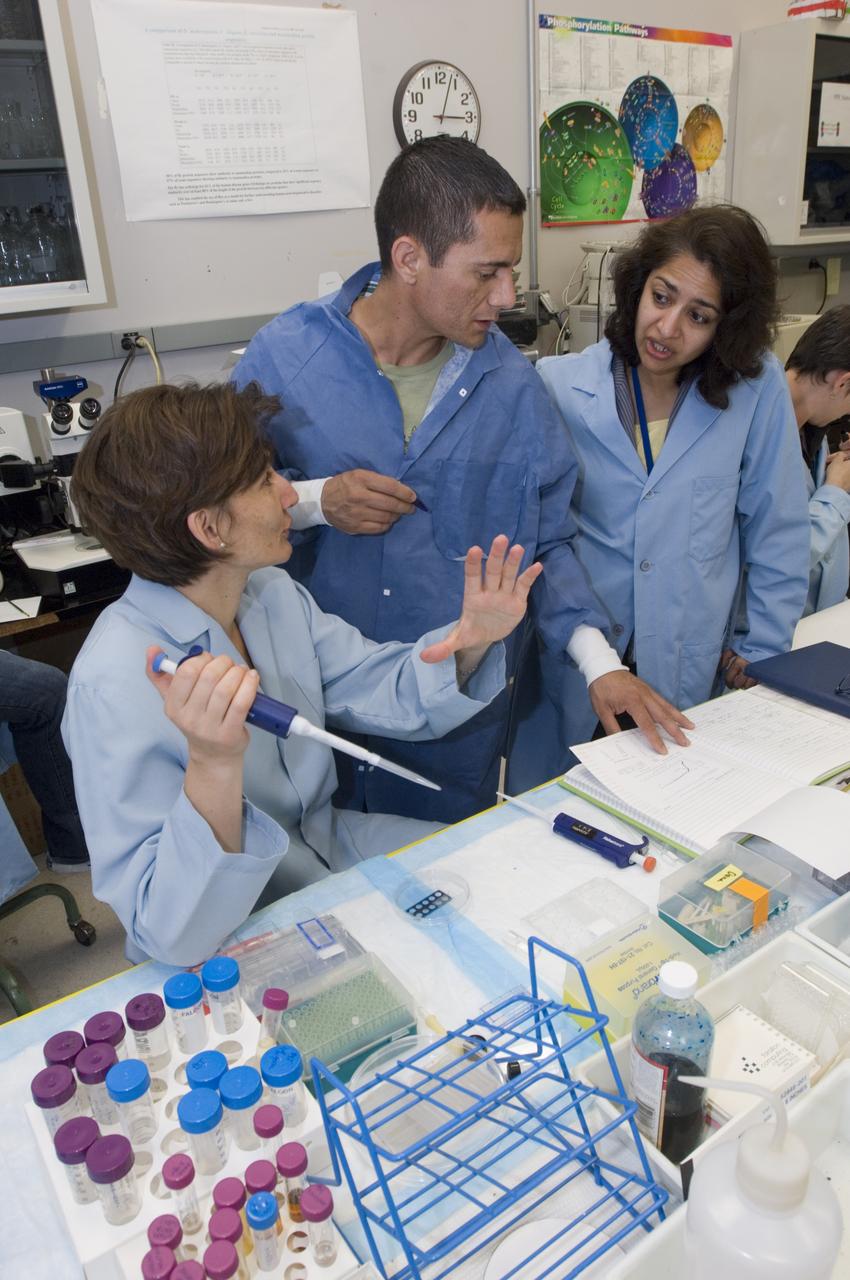
STS-121 PAYLOAD; FIT FRUITFLIES (DORSOPHILA) Post flight with L-R: Oana Marcu, Max Sanchez and Sharmila Bhattacarya. P.I.
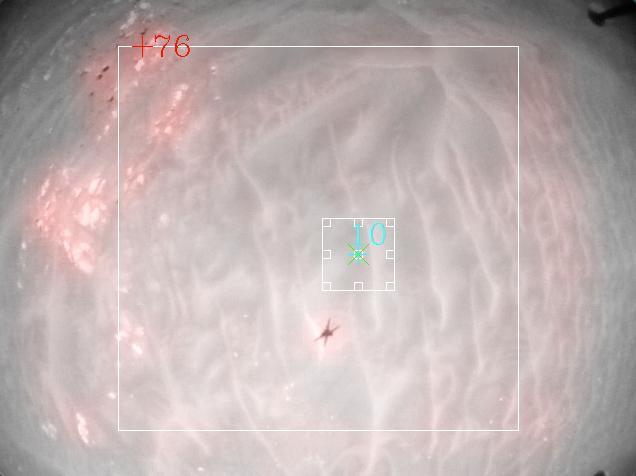
In this video, images from NASA's Mars Ingenuity Helicopter's Flight 9, which took place on July 5, 2021, have been post-processed using the helicopter's hazard avoidance capability, which was added via a software update to the helicopter in late 2022. The update provides two key improvements: It identifies areas unsuitable for landing (shaded in red) as well as candidate landing sites (shown in green). The algorithm also enables the use of digital elevation maps to help navigate. Movie available at https://photojournal.jpl.nasa.gov/catalog/PIA25662
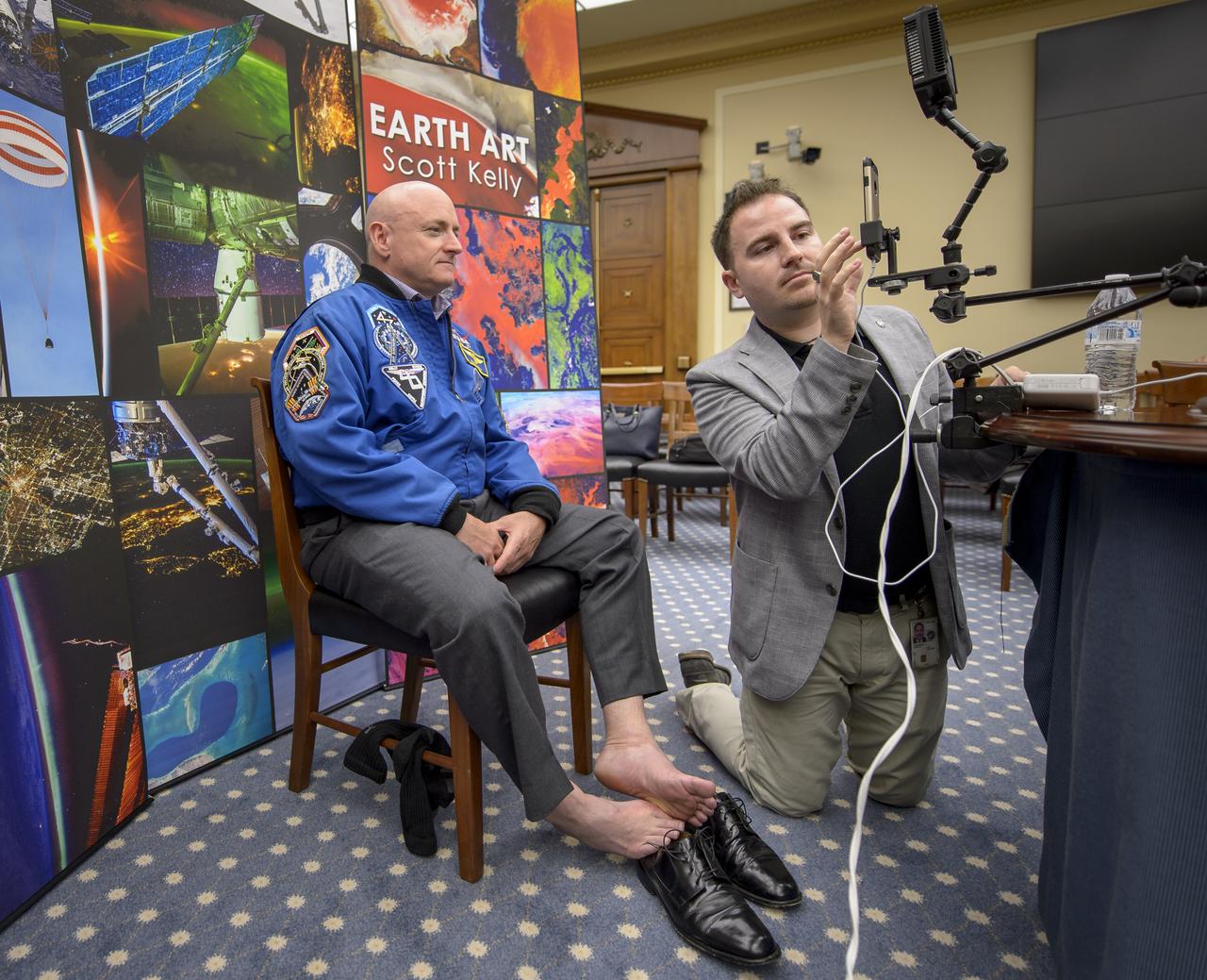
Former NASA astronaut Scott Kelly, left, gives video replies to questions from social media, Wednesday, May 25, 2016, in Washington. Photo Credit: (NASA/Bill Ingalls)
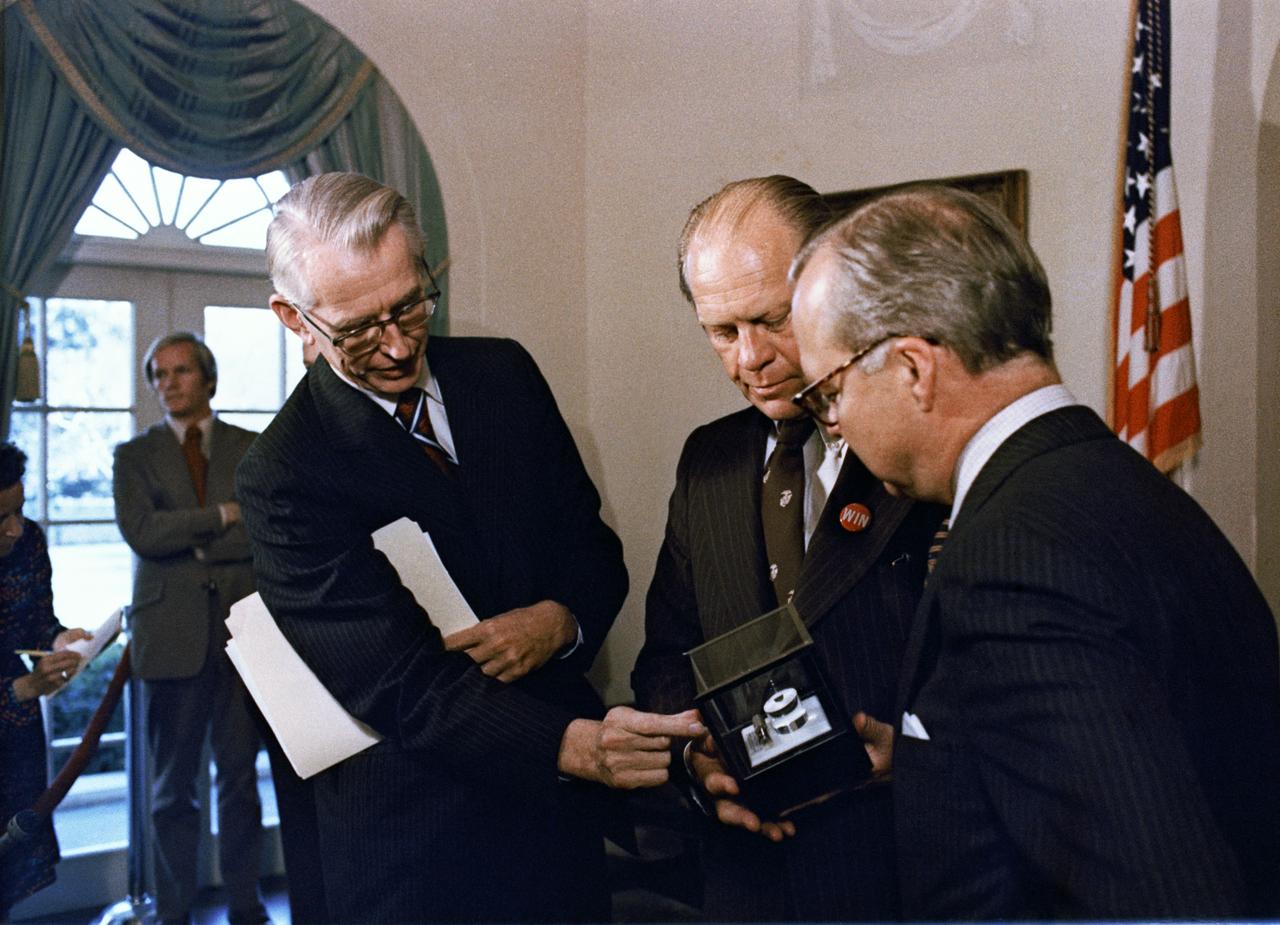
S74-34046 (October 1974) --- Dr. James C. Fletcher, left, NASA Administrator, explains the formation of the indium-antimonide crystal, manufactured in space, to President Gerald R. Ford at the White House. Standing at right is Harold Johnson, Chairman of the Massachusetts Institute of Technology. The segment of indium-antimonide is cut from a cylindrical single crystal that was partially melted and resolidified aboard the Skylab space station on Jan. 6, 1974, during the third and final manned flight. This segment is approximately one by one centimeters and about three millimeters thick. The sequence of heating and cooling was started and supervised by the members of the third Skylab crew, astronauts Gerald P. Carr, Edward G. Gibson and William R. Pogue. The crystal forming was accomplished in a special multipurpose furnace, known as the Materials Processing Facility (Skylab Technology Experiment M512). Photo credit: NASA

art001e002126 (Dec. 5, 2022) - The Moon is seen from cameras onboard NASA's Orion spacecraft during the 20th day of the Artemis I mission. These images were taken after Orion executed the Return Trajectory Correction 3 burn to prepare it for the Return Powered Flyby maneuver, bringing it on its second close approach to the lunar surface and continuing the journey back to Earth.
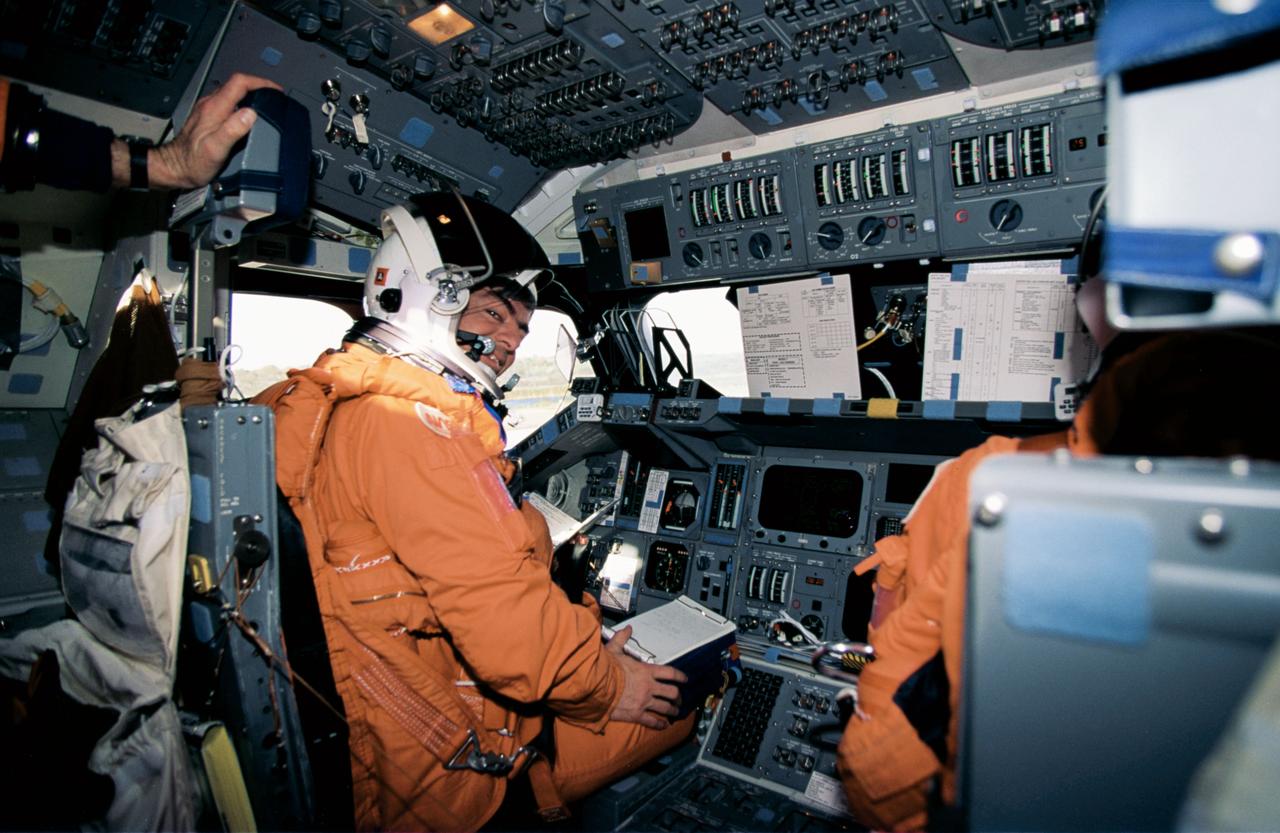
STS075-303-007 (9 March 1996) --- Astronauts Andrew M. Allen (left), mission commander, and Scott J. Horowitz (partially visible at right), pilot, have just completed the landing phase of the STS-75 flight. The Space Shuttle Columbia is now securely on Runway 33 at the Kennedy Space Center (KSC).
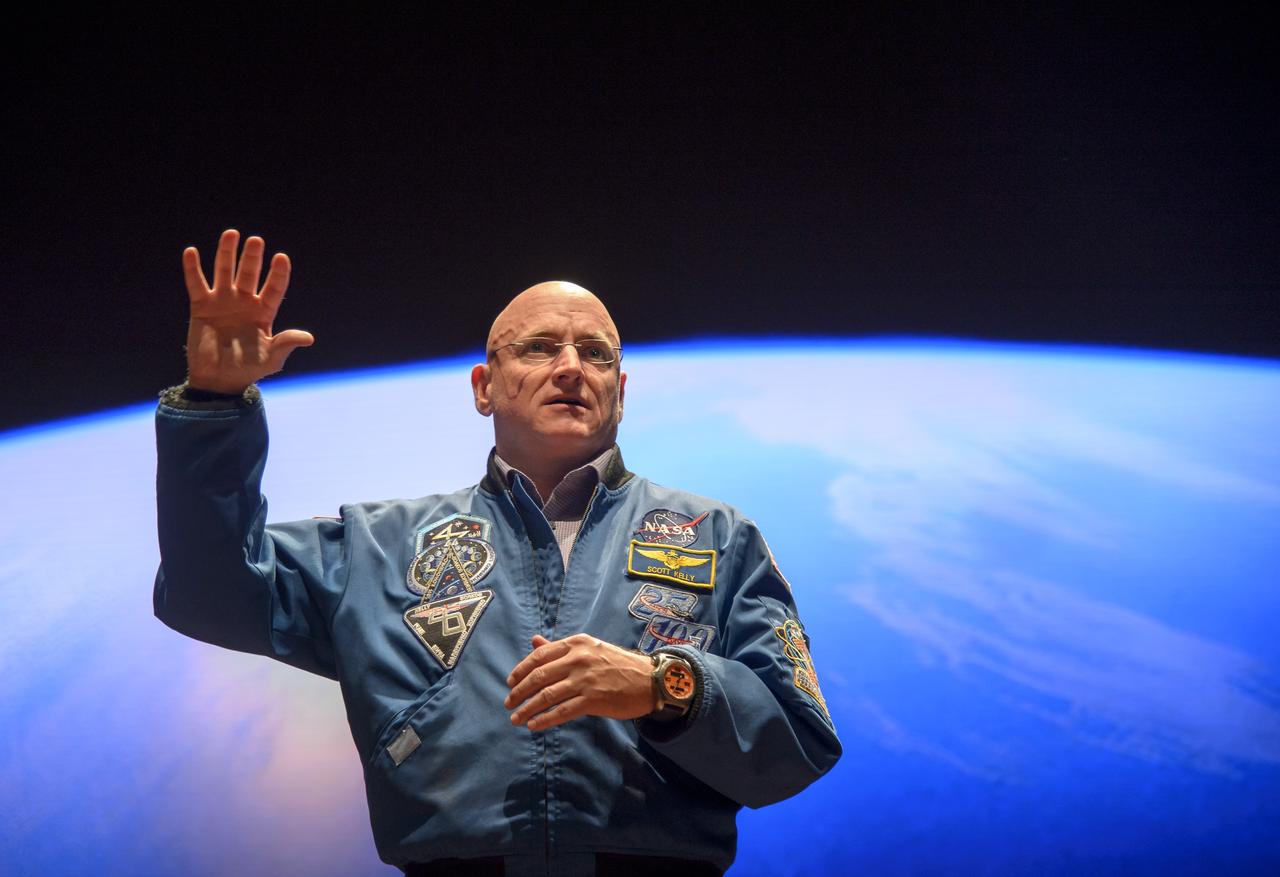
Former NASA astronaut Scott Kelly speaks during an event at the United States Capitol Visitor Center, Wednesday, May 25, 2016, in Washington. Photo Credit: (NASA/Bill Ingalls)
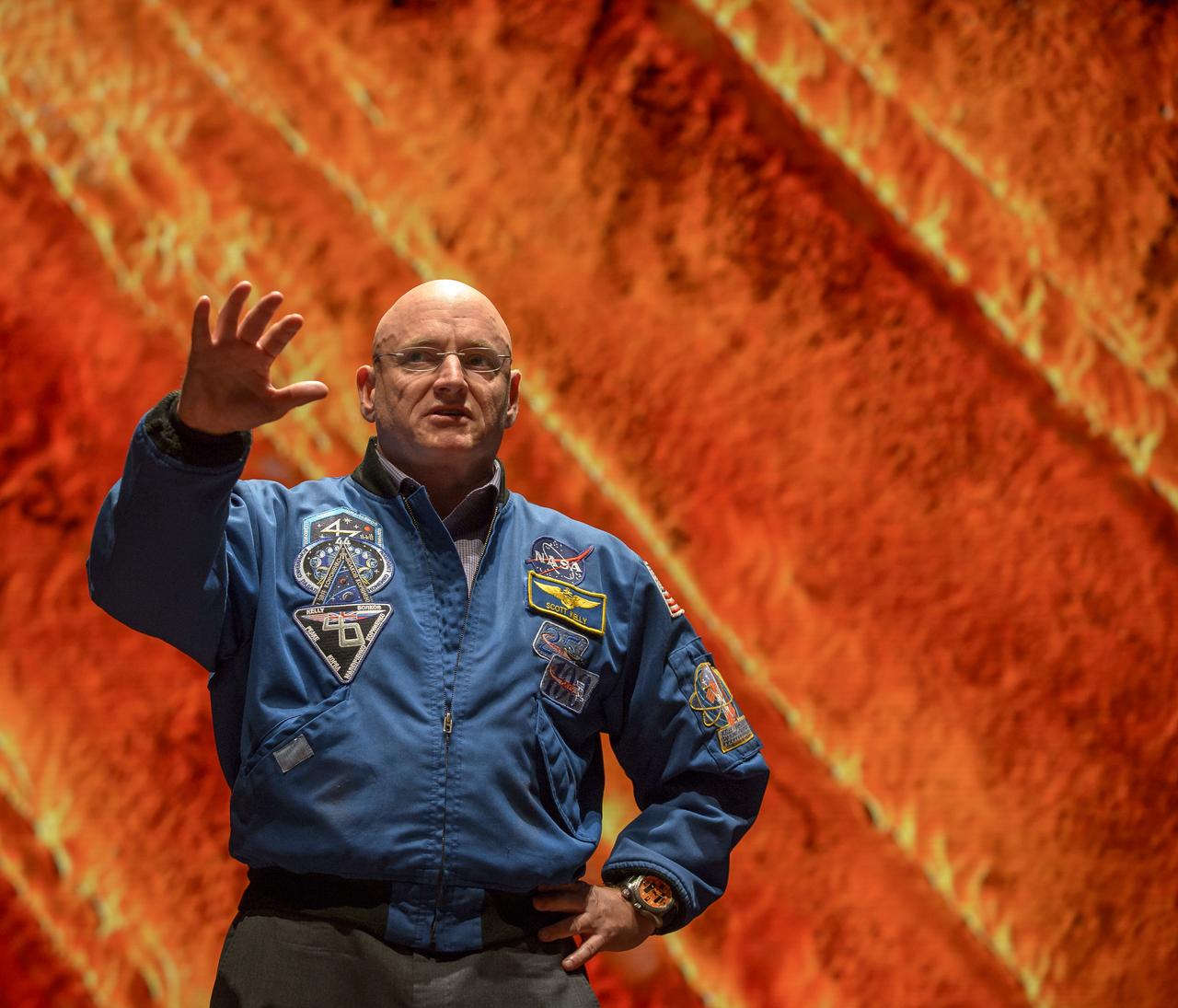
Former NASA astronaut Scott Kelly speaks during an event at the United States Capitol Visitor Center, Wednesday, May 25, 2016, in Washington. Photo Credit: (NASA/Bill Ingalls)
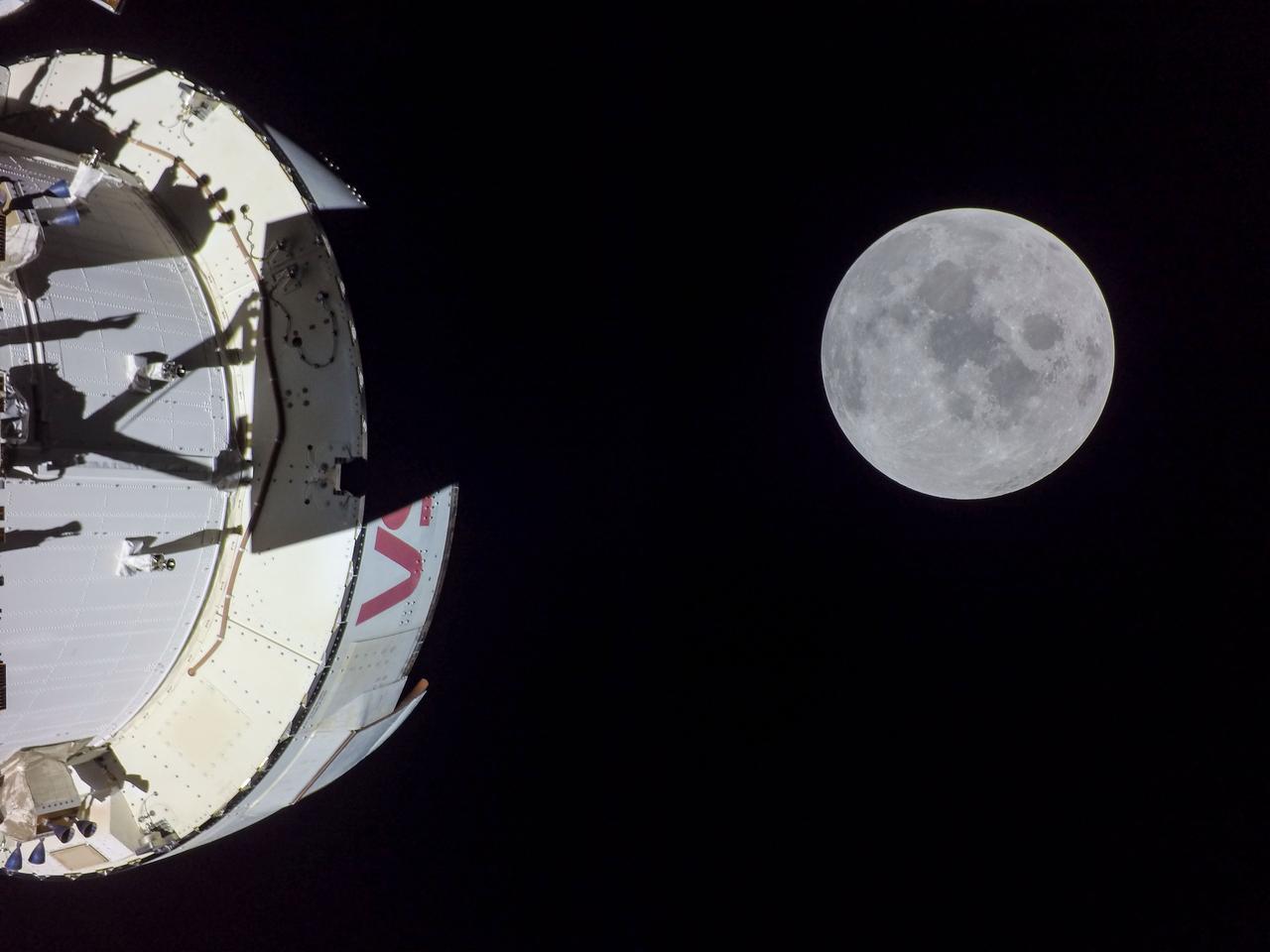
art001e002104 (Dec. 5, 2022) - The Moon is seen from cameras onboard NASA's Orion spacecraft during the 20th day of the Artemis I mission. These images were taken after Orion executed the Return Trajectory Correction 3 burn to prepare it for the Return Powered Flyby maneuver, bringing it on its second close approach to the lunar surface and continuing the journey back to Earth.
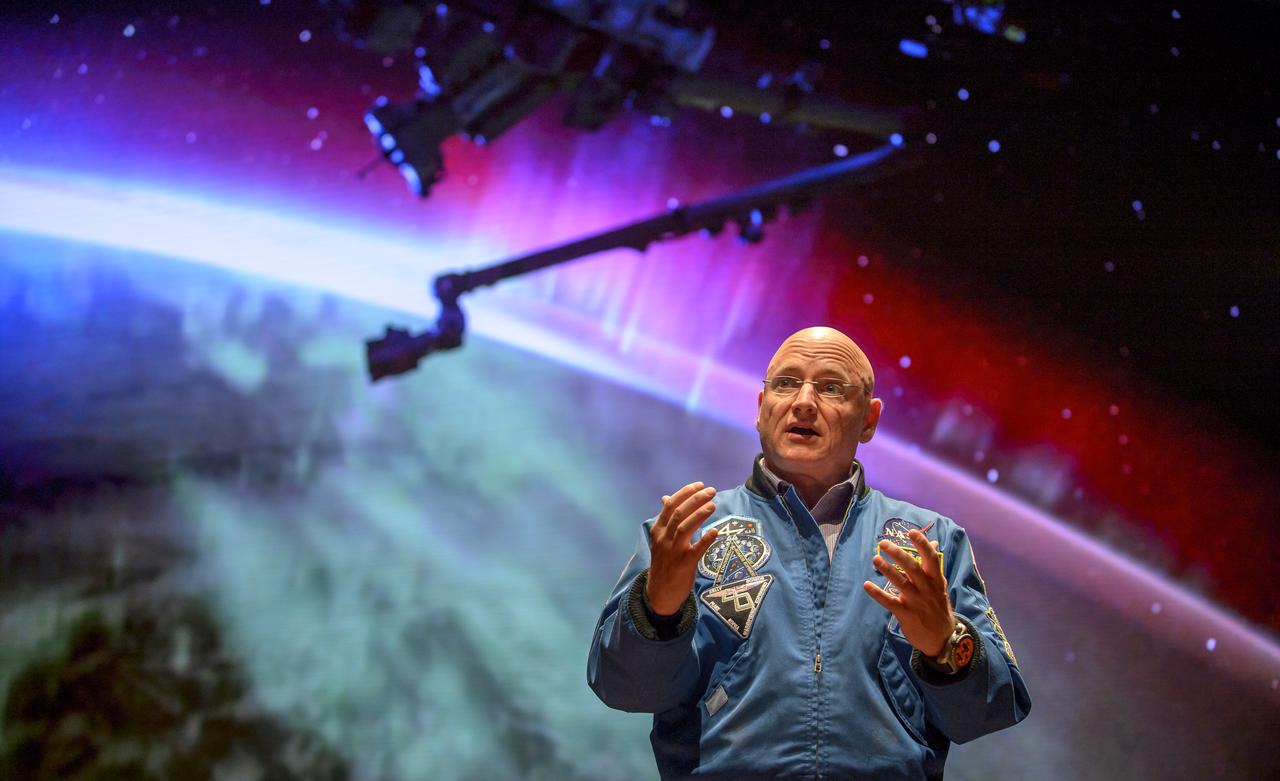
Former NASA astronaut Scott Kelly speaks during an event at the United States Capitol Visitor Center, Wednesday, May 25, 2016, in Washington. Photo Credit: (NASA/Bill Ingalls)
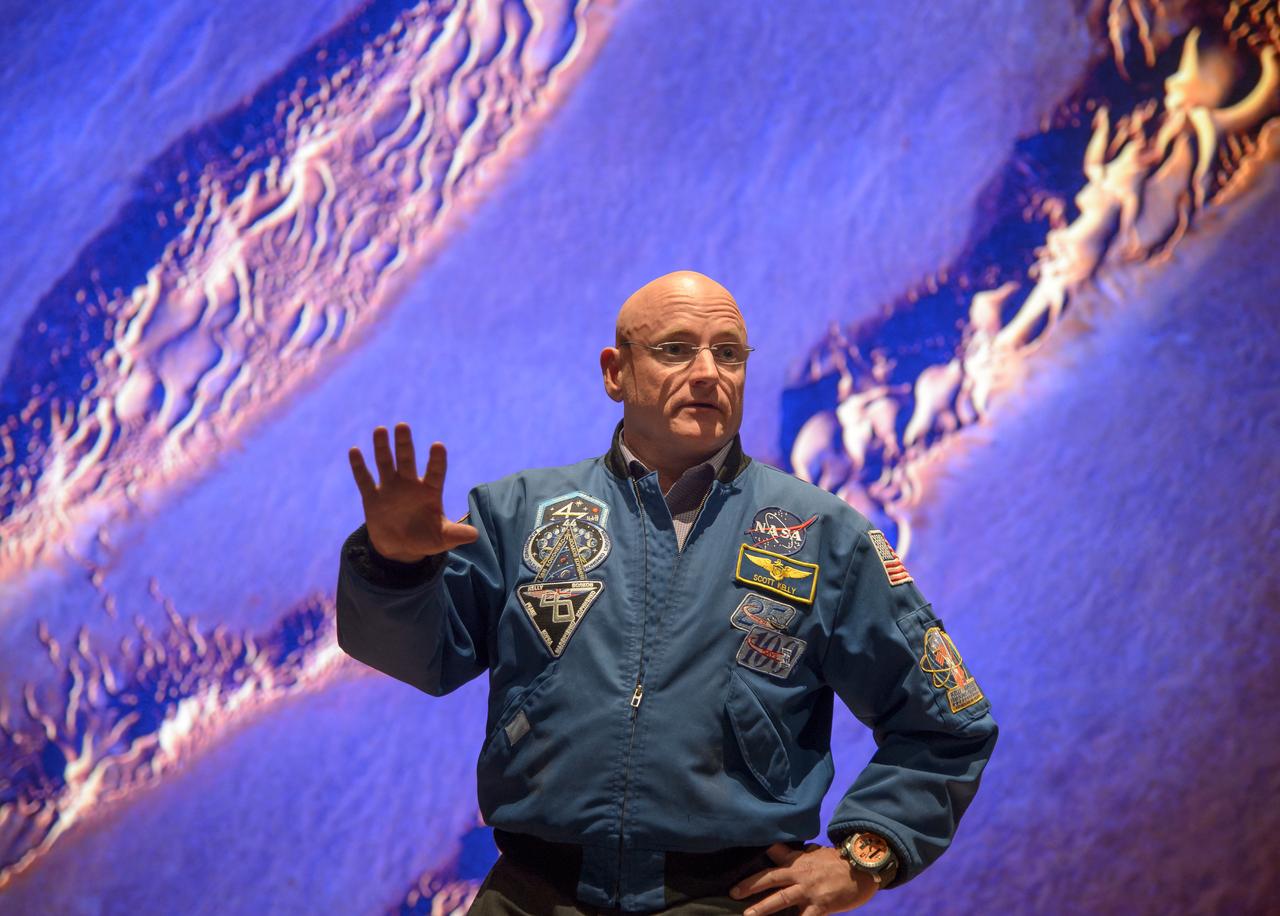
Former NASA astronaut Scott Kelly speaks during an event at the United States Capitol Visitor Center, Wednesday, May 25, 2016, in Washington. Photo Credit: (NASA/Bill Ingalls)
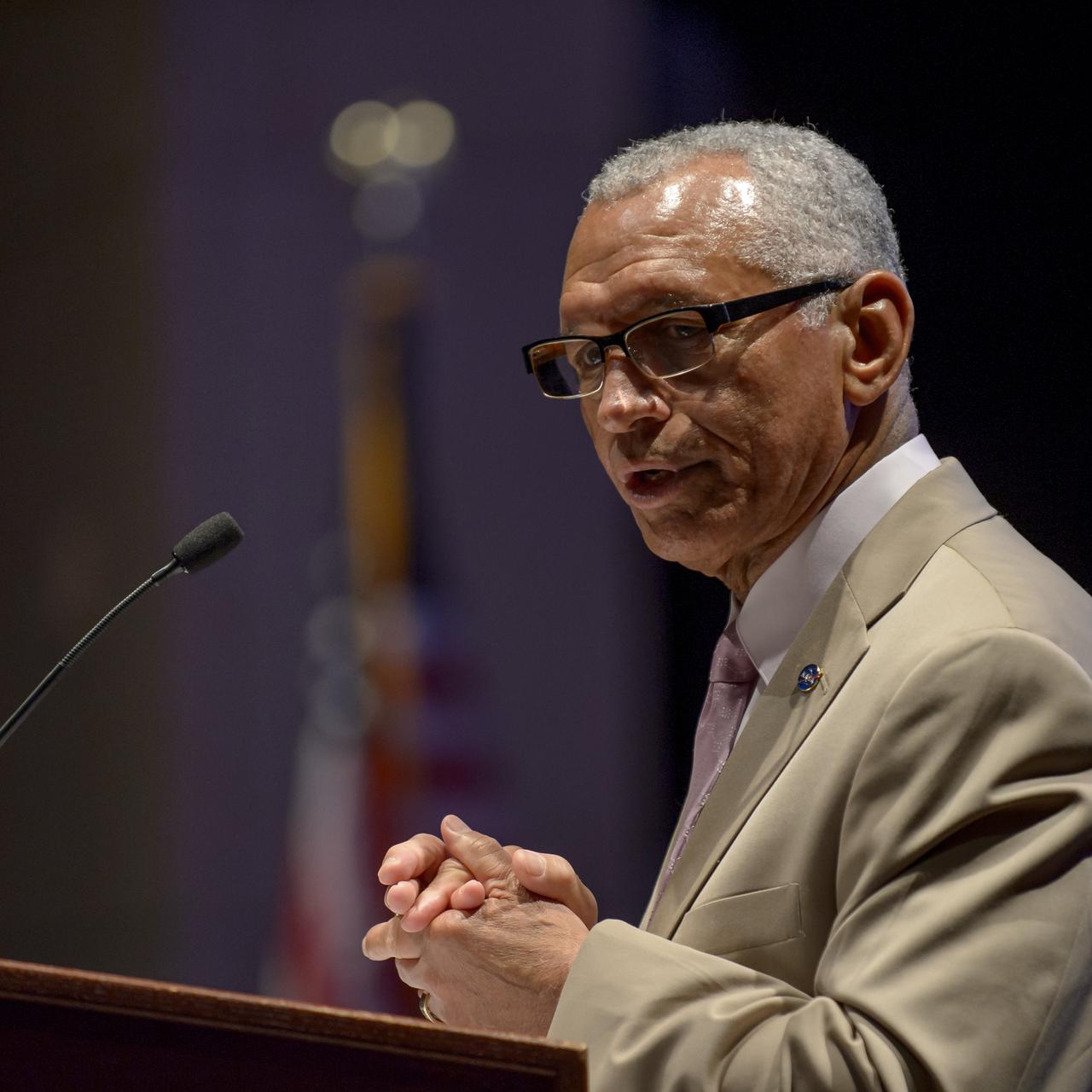
NASA Administrator Charles Bolden introduces former NASA astronaut Scott Kelly during an event at the United States Capitol Visitor Center, Wednesday, May 25, 2016, in Washington. Photo Credit: (NASA/Bill Ingalls)
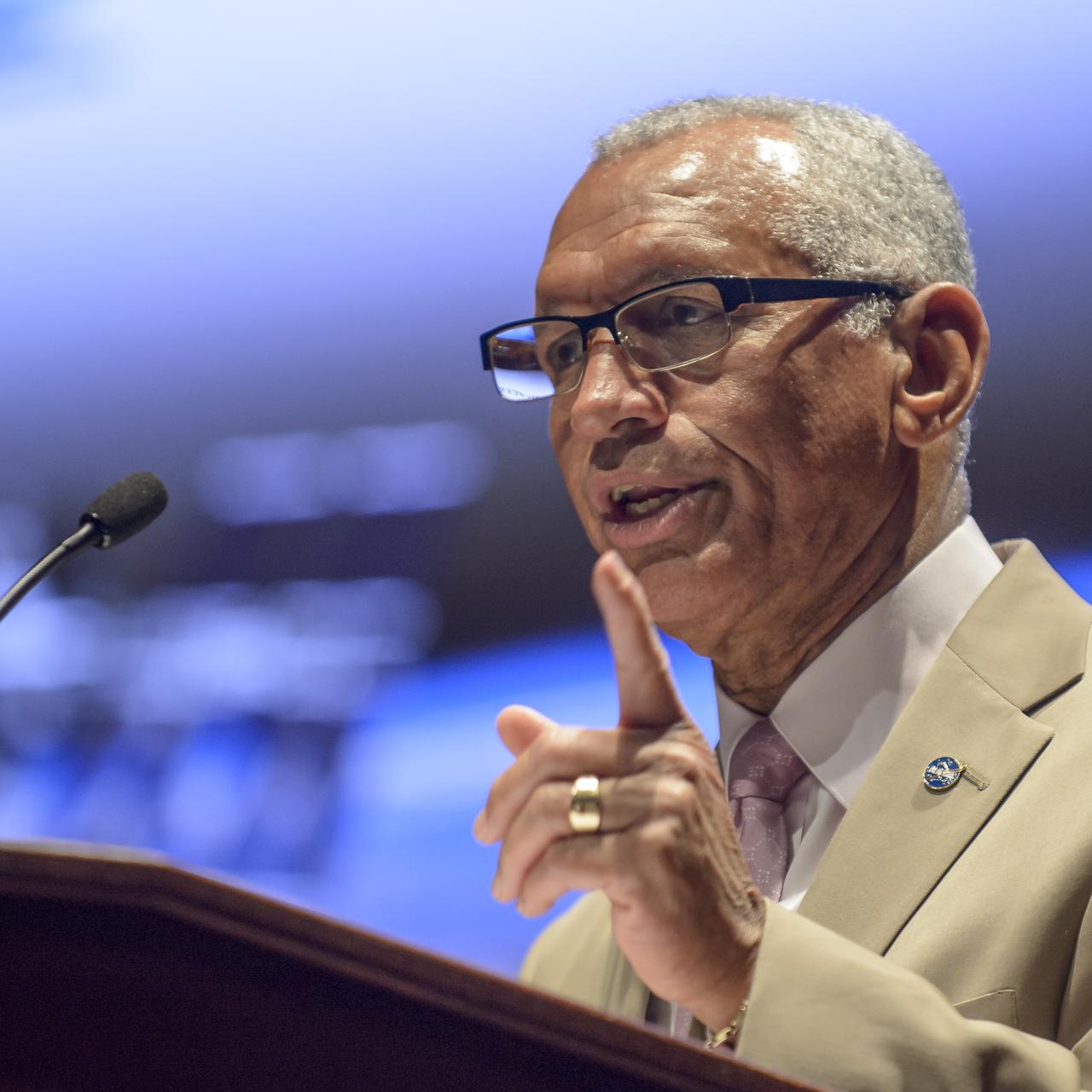
NASA Administrator Charles Bolden introduces former NASA astronaut Scott Kelly during an event at the United States Capitol Visitor Center, Wednesday, May 25, 2016, in Washington. Photo Credit: (NASA/Bill Ingalls)
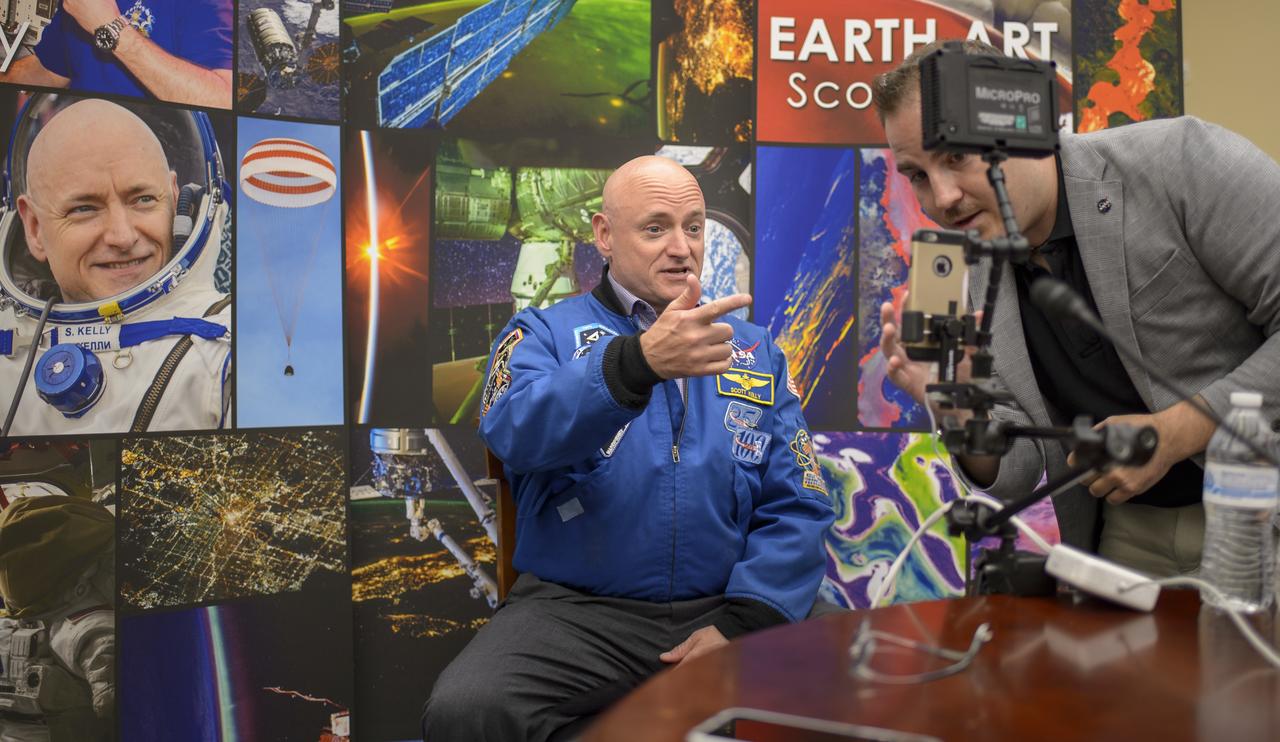
Former NASA astronaut Scott Kelly, left, gives video replies to questions from social media, Wednesday, May 25, 2016, in Washington. Photo Credit: (NASA/Bill Ingalls)
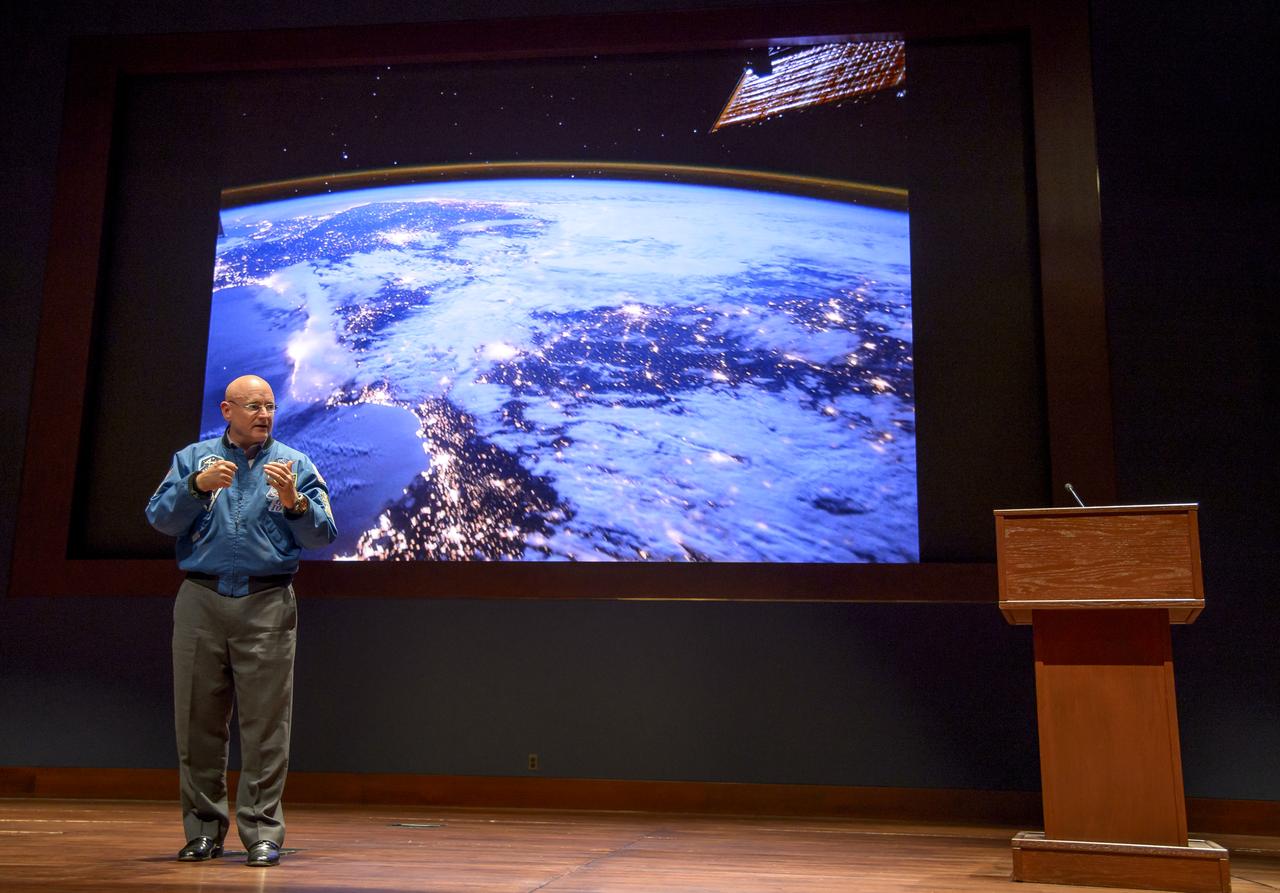
Former NASA astronaut Scott Kelly speaks during an event at the United States Capitol Visitor Center, Wednesday, May 25, 2016, in Washington. Photo Credit: (NASA/Bill Ingalls)