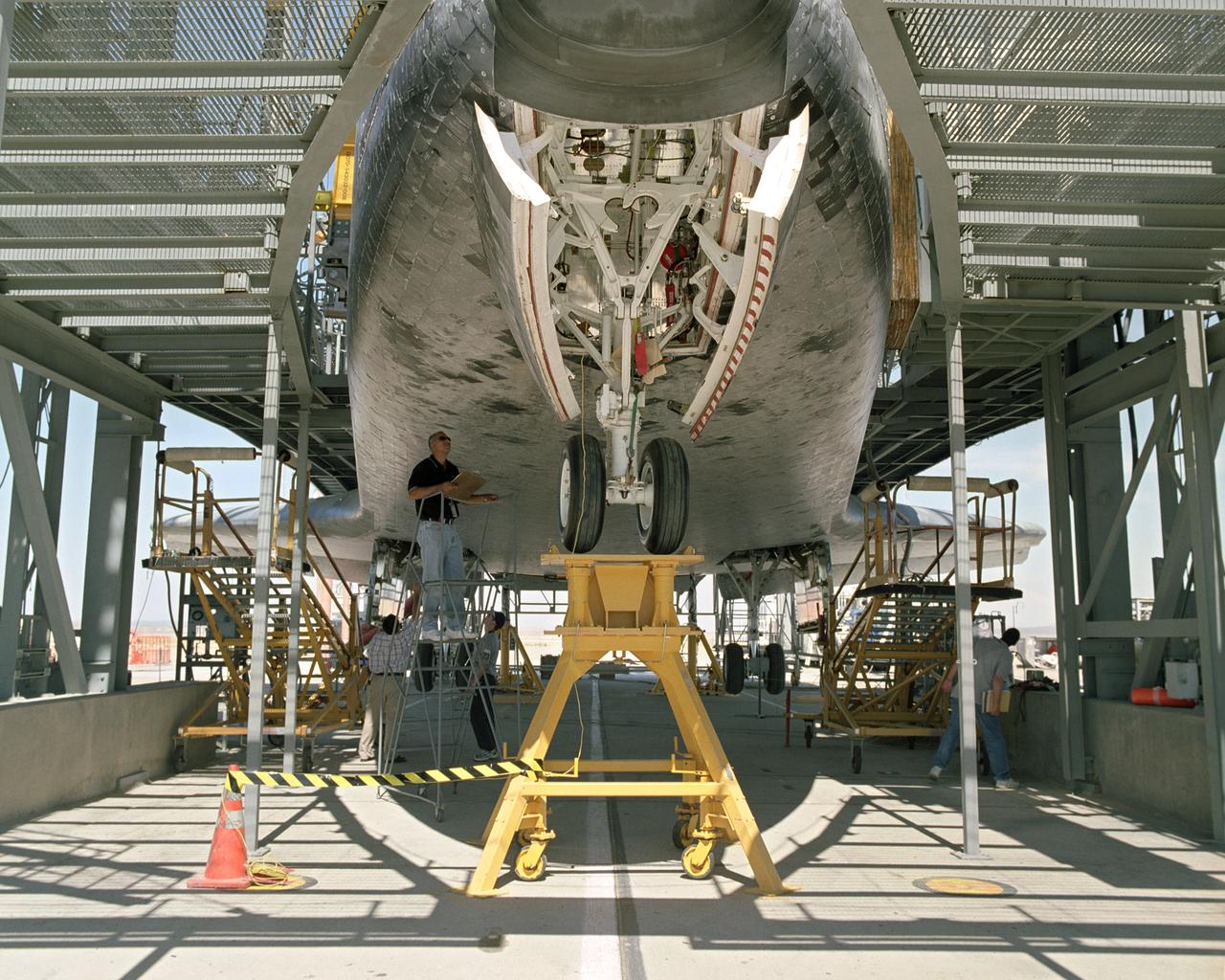
The Space Shuttle Atlantis receives post-flight servicing in the Mate-Demate Device (MDD), following its landing at NASA's Dryden Flight Research Center, Edwards, California, June 22, 2007. The gantry-like MDD structure is used for servicing the shuttle orbiters in preparation for their ferry flight back to the Kennedy Space Center in Florida, including mounting the shuttle atop NASA's modified Boeing 747 Shuttle Carrier Aircraft.

Lit by sunlight filtered through the smoke of a distant forest fire, the Space Shuttle Atlantis receives post-flight servicing in the Mate-Demate Device (MDD), following its landing at NASA's Dryden Flight Research Center, Edwards, California. The gantry-like MDD structure is used for servicing the shuttle orbiters in preparation for their ferry flight back to the Kennedy Space Center in Florida, including mounting the shuttle atop NASA's modified Boeing 747 Shuttle Carrier Aircraft.
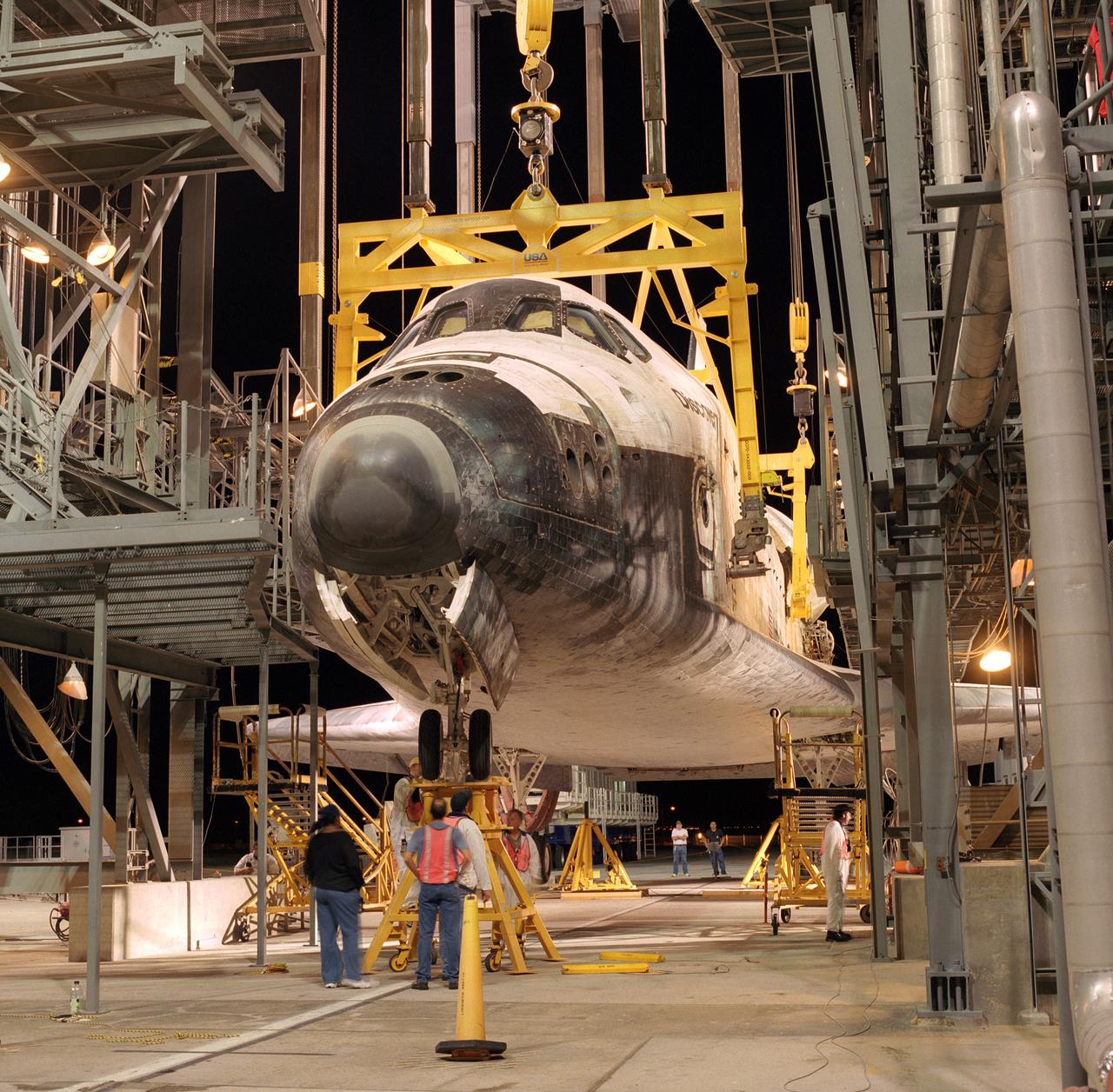
The Space Shuttle Discovery receives post-flight servicing in the Mate-Demate Device (MDD), following its landing at NASA's Dryden Flight Research Center, Edwards, California, August 9, 2005. The gantry-like MDD structure is used for servicing the shuttle orbiters in preparation for their ferry flight back to the Kennedy Space Center in Florida, including mounting the shuttle atop NASA's modified Boeing 747 Shuttle Carrier Aircraft. Space Shuttle Discovery landed safely at NASA's Dryden Flight Research Center at Edwards Air Force Base in California at 5:11:22 a.m. PDT this morning, following the very successful 14-day STS-114 return to flight mission. During their two weeks in space, Commander Eileen Collins and her six crewmates tested out new safety procedures and delivered supplies and equipment the International Space Station. Discovery spent two weeks in space, where the crew demonstrated new methods to inspect and repair the Shuttle in orbit. The crew also delivered supplies, outfitted and performed maintenance on the International Space Station. A number of these tasks were conducted during three spacewalks. In an unprecedented event, spacewalkers were called upon to remove protruding gap fillers from the heat shield on Discovery's underbelly. In other spacewalk activities, astronauts installed an external platform onto the Station's Quest Airlock and replaced one of the orbital outpost's Control Moment Gyroscopes. Inside the Station, the STS-114 crew conducted joint operations with the Expedition 11 crew. They unloaded fresh supplies from the Shuttle and the Raffaello Multi-Purpose Logistics Module. Before Discovery undocked, the crews filled Raffeallo with unneeded items and returned to Shuttle payload bay. Discovery launched on July 26 and spent almost 14 days on orbit.
The Space Shuttle Discovery receives post-flight servicing in the Mate-Demate Device (MDD), following its landing at NASA's Dryden Flight Research Center, Edwards, California, August 9, 2005. The gantry-like MDD structure is used for servicing the shuttle orbiters in preparation for their ferry flight back to the Kennedy Space Center in Florida, including mounting the shuttle atop NASA's modified Boeing 747 Shuttle Carrier Aircraft. Space Shuttle Discovery landed safely at NASA's Dryden Flight Research Center at Edwards Air Force Base in California at 5:11:22 a.m. PDT, August 9, 2005, following the very successful 14-day STS-114 return to flight mission. During their two weeks in space, Commander Eileen Collins and her six crewmates tested out new safety procedures and delivered supplies and equipment the International Space Station. Discovery spent two weeks in space, where the crew demonstrated new methods to inspect and repair the Shuttle in orbit. The crew also delivered supplies, outfitted and performed maintenance on the International Space Station. A number of these tasks were conducted during three spacewalks. In an unprecedented event, spacewalkers were called upon to remove protruding gap fillers from the heat shield on Discovery's underbelly. In other spacewalk activities, astronauts installed an external platform onto the Station's Quest Airlock and replaced one of the orbital outpost's Control Moment Gyroscopes. Inside the Station, the STS-114 crew conducted joint operations with the Expedition 11 crew. They unloaded fresh supplies from the Shuttle and the Raffaello Multi-Purpose Logistics Module. Before Discovery undocked, the crews filled Raffeallo with unneeded items and returned to Shuttle payload bay. Discovery launched on July 26 and spent almost 14 days on orbit.
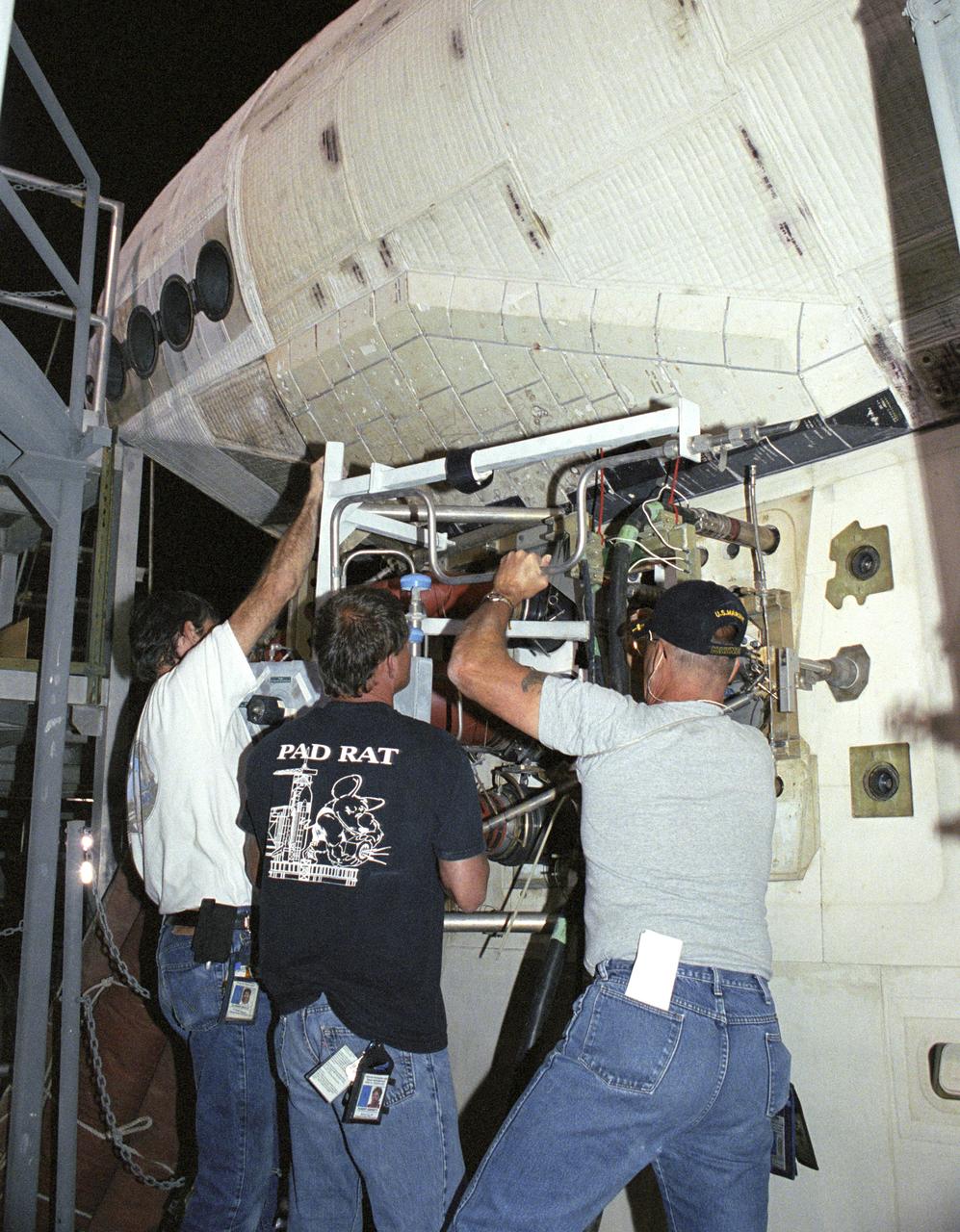
Todd Viddle; APU advanced systems technician, Robert 'Skip' Garrett; main propulsion advanced systems technician, and Dan McGrath; main propulsion systems engineer technician, remove a servicing unit from the Space Shuttle Discovery as part of it's post-flight processing at NASA's Dryden Flight Research Center. The Space Shuttles receive post-flight servicing in the Mate-Demate Device (MDD) following landings at NASA's Dryden Flight Research Center, Edwards, California. The gantry-like MDD structure is used for servicing the shuttle orbiters in preparation for their ferry flight back to the Kennedy Space Center in Florida, including mounting the shuttle atop NASA's modified Boeing 747 Shuttle Carrier Aircraft. Space Shuttle Discovery landed safely at NASA's Dryden Flight Research Center at Edwards Air Force Base in California at 5:11:22 a.m. PDT, August 9, 2005, following the very successful 14-day STS-114 return to flight mission. During their two weeks in space, Commander Eileen Collins and her six crewmates tested out new safety procedures and delivered supplies and equipment the International Space Station. Discovery spent two weeks in space, where the crew demonstrated new methods to inspect and repair the Shuttle in orbit. The crew also delivered supplies, outfitted and performed maintenance on the International Space Station. A number of these tasks were conducted during three spacewalks. In an unprecedented event, spacewalkers were called upon to remove protruding gap fillers from the heat shield on Discovery's underbelly. In other spacewalk activities, astronauts installed an external platform onto the Station's Quest Airlock and replaced one of the orbital outpost's Control Moment Gyroscopes. Inside the Station, the STS-114 crew conducted joint operations with the Expedition 11 crew. They unloaded fresh supplies from the Shuttle and the Raffaello Multi-Purpose Logistics Module. Before Discovery undocked, the crews filled Raffeallo with unneeded items

The Space Shuttle Endeavour receives post-flight servicing in the Mate-Demate Device (MDD), following its landing at NASA's Dryden Flight Research Center, Edwards, California, June 19, 2002.

The Space Shuttle Endeavour receives post-flight servicing in the Mate-Demate Device (MDD), following its landing at NASA's Dryden Flight Research Center, Edwards, California, May 1, 2001. Once servicing was complete, one of NASA's two 747 Shuttle Carrier Aircraft, No. 905, was readied to ferry Endeavour back to the Kennedy Space Center, FL.
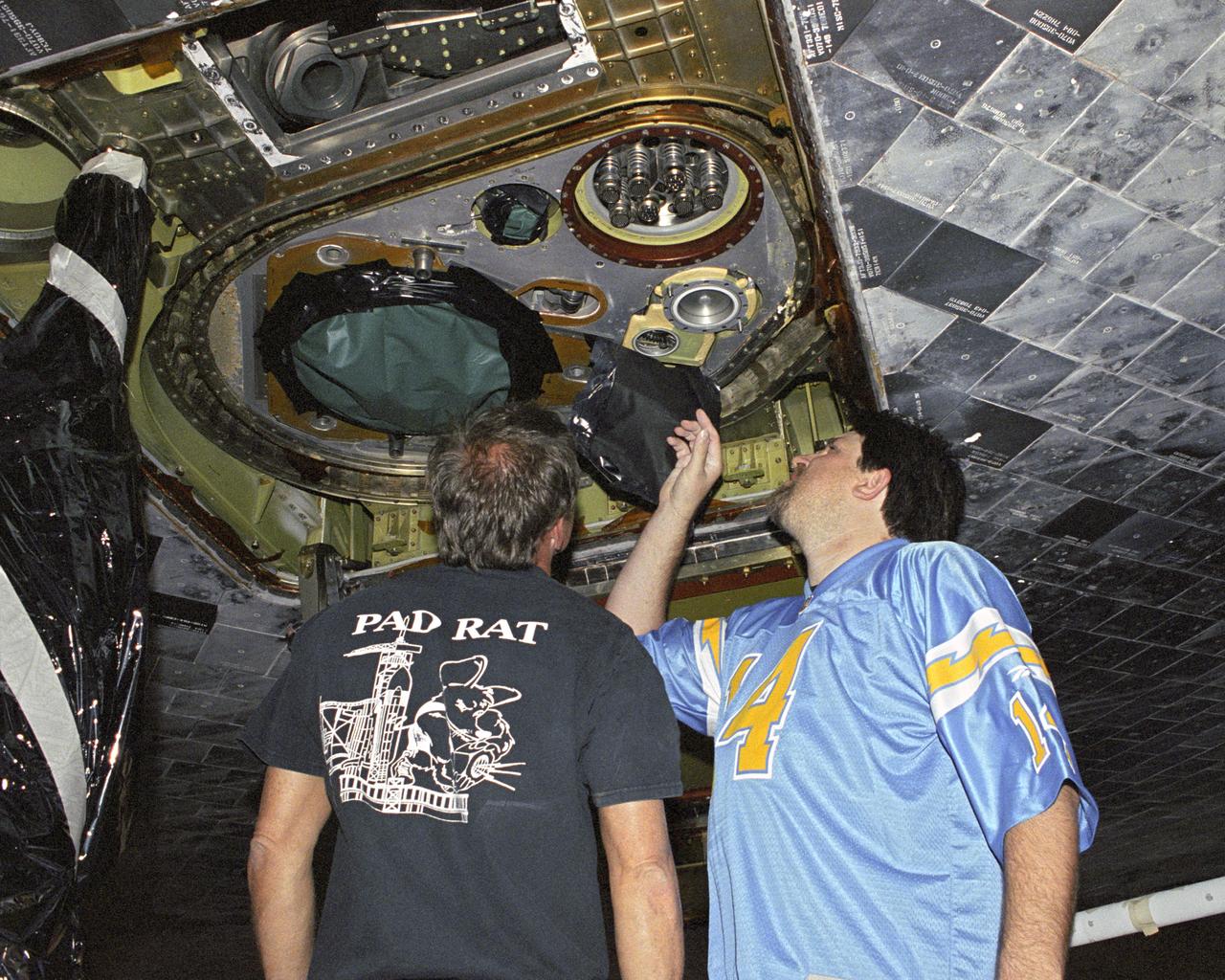
Robert 'Skip' Garrett; main propulsion advanced systems technician, and Chris Jacobs; main propulsion systems engineering technician, inspect external tank attachment fittings on the Space Shuttle Discovery as part of it's post-flight processing at NASA's Dryden Flight Research Center. The Space Shuttles receive post-flight servicing in the Mate-Demate Device (MDD) following landings at NASA's Dryden Flight Research Center, Edwards, California. The gantry-like MDD structure is used for servicing the shuttle orbiters in preparation for their ferry flight back to the Kennedy Space Center in Florida, including mounting the shuttle atop NASA's modified Boeing 747 Shuttle Carrier Aircraft. Space Shuttle Discovery landed safely at NASA's Dryden Flight Research Center at Edwards Air Force Base in California at 5:11:22 a.m. PDT, August 9, 2005, following the very successful 14-day STS-114 return to flight mission. During their two weeks in space, Commander Eileen Collins and her six crewmates tested out new safety procedures and delivered supplies and equipment the International Space Station. Discovery spent two weeks in space, where the crew demonstrated new methods to inspect and repair the Shuttle in orbit. The crew also delivered supplies, outfitted and performed maintenance on the International Space Station. A number of these tasks were conducted during three spacewalks. In an unprecedented event, spacewalkers were called upon to remove protruding gap fillers from the heat shield on Discovery's underbelly. In other spacewalk activities, astronauts installed an external platform onto the Station's Quest Airlock and replaced one of the orbital outpost's Control Moment Gyroscopes. Inside the Station, the STS-114 crew conducted joint operations with the Expedition 11 crew. They unloaded fresh supplies from the Shuttle and the Raffaello Multi-Purpose Logistics Module. Before Discovery undocked, the crews filled Raffeallo with unneeded items and returned to Shuttle pa
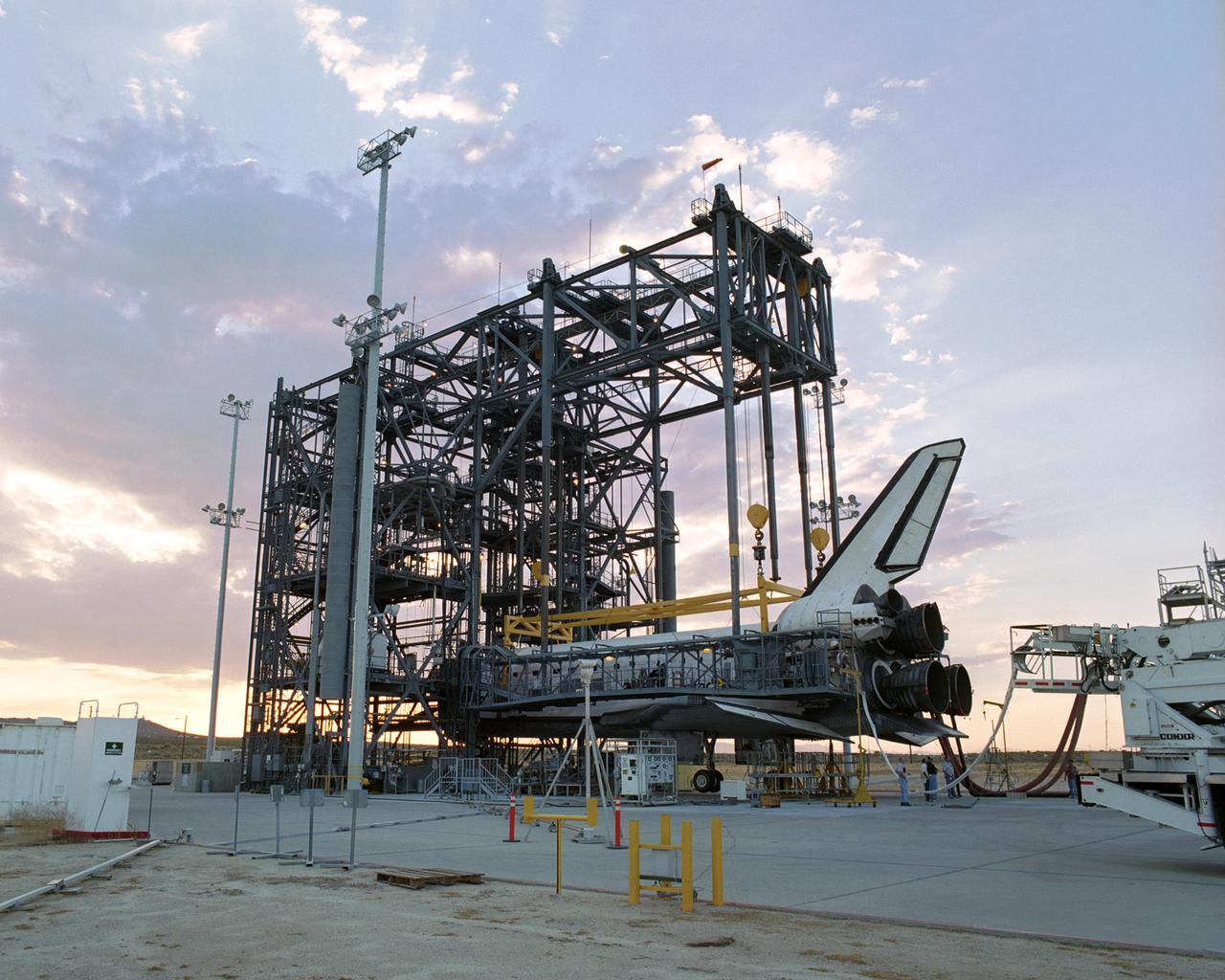
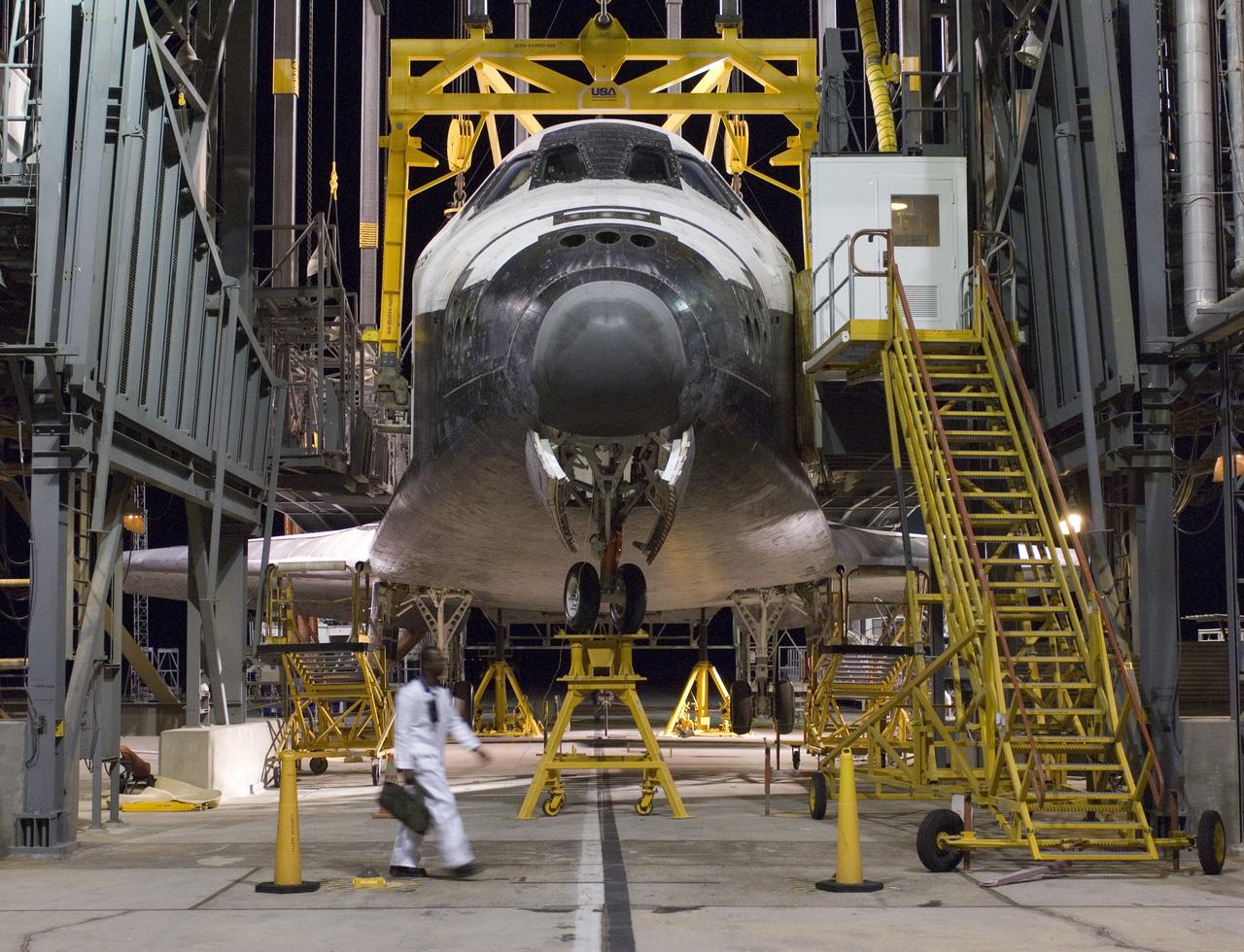
The sun sets on the Space Shuttle Discovery during post-flight processing in the Mate-Demate Device (MDD), following its landing at NASA's Dryden Flight Research Center in California. The gantry-like MDD structure is used for servicing the shuttle orbiters in preparation for their ferry flight back to the Kennedy Space Center in Florida, including mounting the shuttle atop NASA's modified Boeing 747 Shuttle Carrier Aircraft. Space Shuttle Discovery landed safely at NASA's Dryden Flight Research Center at Edwards Air Force Base in California at 5:11:22 a.m. PDT, August 9, 2005, following the very successful 14-day STS-114 return to flight mission. During their two weeks in space, Commander Eileen Collins and her six crewmates tested out new safety procedures and delivered supplies and equipment the International Space Station. Discovery spent two weeks in space, where the crew demonstrated new methods to inspect and repair the Shuttle in orbit. The crew also delivered supplies, outfitted and performed maintenance on the International Space Station. A number of these tasks were conducted during three spacewalks. In an unprecedented event, spacewalkers were called upon to remove protruding gap fillers from the heat shield on Discovery's underbelly. In other spacewalk activities, astronauts installed an external platform onto the Station's Quest Airlock and replaced one of the orbital outpost's Control Moment Gyroscopes. Inside the Station, the STS-114 crew conducted joint operations with the Expedition 11 crew. They unloaded fresh supplies from the Shuttle and the Raffaello Multi-Purpose Logistics Module. Before Discovery undocked, the crews filled Raffeallo with unneeded items and returned to Shuttle payload bay. Discovery launched on July 26 and spent almost 14 days on orbit.
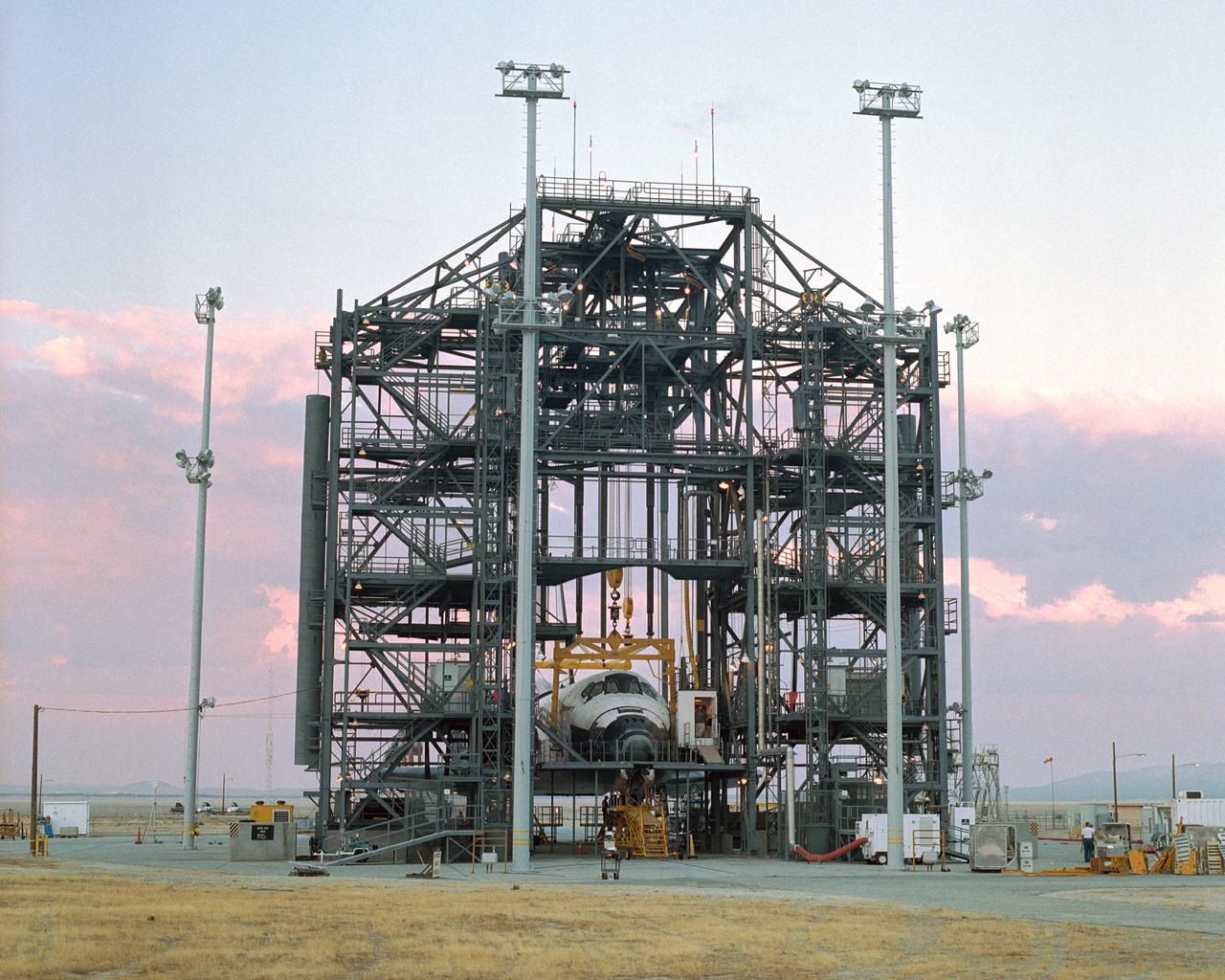
The sun sets on the Space Shuttle Discovery during post-flight processing in the Mate-Demate Device (MDD), following its landing at NASA's Dryden Flight Research Center in California. The gantry-like MDD structure is used for servicing the shuttle orbiters in preparation for their ferry flight back to the Kennedy Space Center in Florida, including mounting the shuttle atop NASA's modified Boeing 747 Shuttle Carrier Aircraft. Space Shuttle Discovery landed safely at NASA's Dryden Flight Research Center at Edwards Air Force Base in California at 5:11:22 a.m. PDT, August 9, 2005, following the very successful 14-day STS-114 return to flight mission. During their two weeks in space, Commander Eileen Collins and her six crewmates tested out new safety procedures and delivered supplies and equipment the International Space Station. Discovery spent two weeks in space, where the crew demonstrated new methods to inspect and repair the Shuttle in orbit. The crew also delivered supplies, outfitted and performed maintenance on the International Space Station. A number of these tasks were conducted during three spacewalks. In an unprecedented event, spacewalkers were called upon to remove protruding gap fillers from the heat shield on Discovery's underbelly. In other spacewalk activities, astronauts installed an external platform onto the Station's Quest Airlock and replaced one of the orbital outpost's Control Moment Gyroscopes. Inside the Station, the STS-114 crew conducted joint operations with the Expedition 11 crew. They unloaded fresh supplies from the Shuttle and the Raffaello Multi-Purpose Logistics Module. Before Discovery undocked, the crews filled Raffeallo with unneeded items and returned to Shuttle payload bay. Discovery launched on July 26 and spent almost 14 days on orbit.
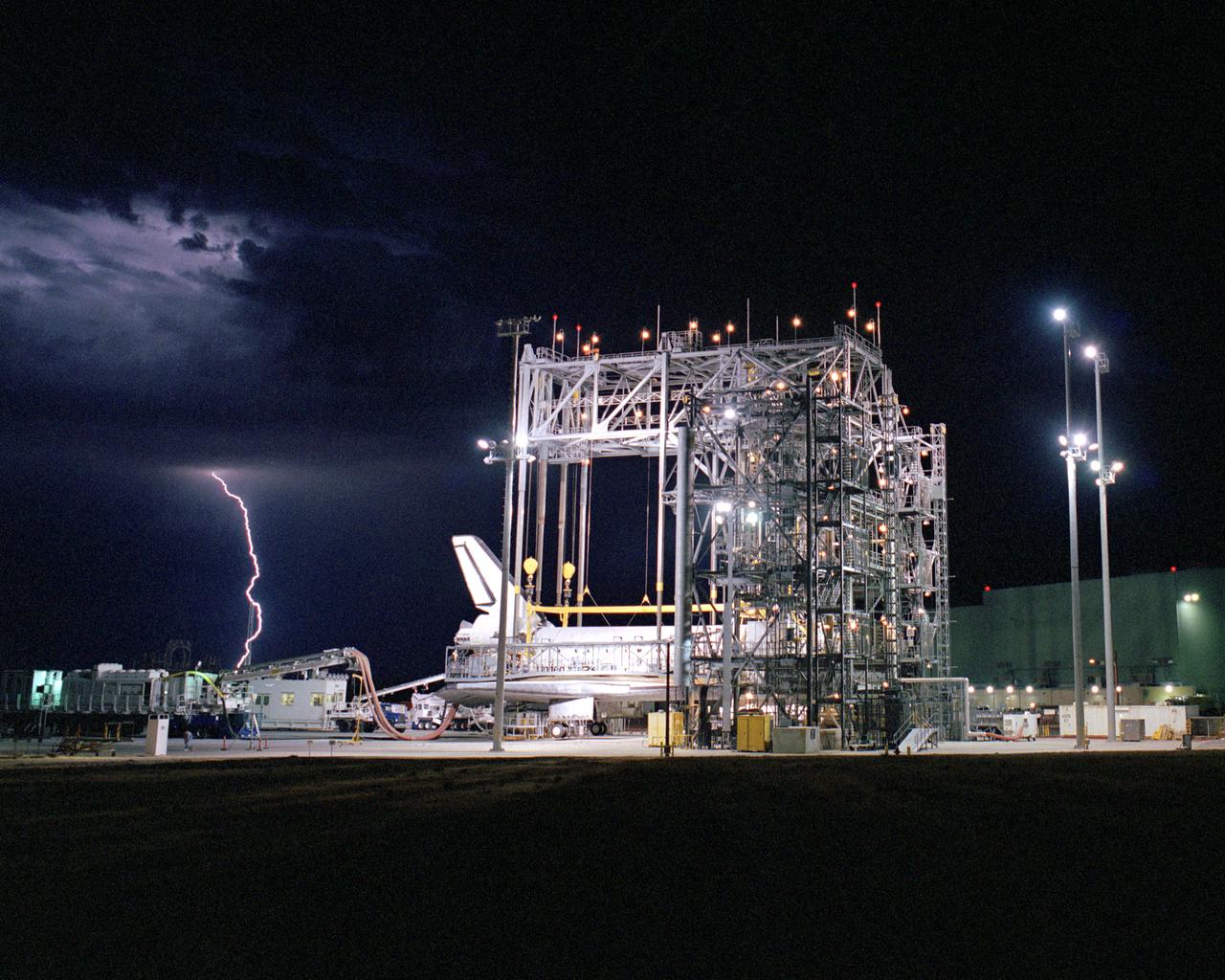
Lightning strikes in the distance as the Space Shuttle Discovery receives post-flight processing in the Mate-Demate Device (MDD), following its landing at NASA's Dryden Flight Research Center in California. The gantry-like MDD structure is used for servicing the shuttle orbiters in preparation for their ferry flight back to the Kennedy Space Center in Florida, including mounting the shuttle atop NASA's modified Boeing 747 Shuttle Carrier Aircraft. Space Shuttle Discovery landed safely at NASA's Dryden Flight Research Center at Edwards Air Force Base in California at 5:11:22 a.m. PDT, August 9, 2005, following the very successful 14-day STS-114 return to flight mission. During their two weeks in space, Commander Eileen Collins and her six crewmates tested out new safety procedures and delivered supplies and equipment the International Space Station. Discovery spent two weeks in space, where the crew demonstrated new methods to inspect and repair the Shuttle in orbit. The crew also delivered supplies, outfitted and performed maintenance on the International Space Station. A number of these tasks were conducted during three spacewalks. In an unprecedented event, spacewalkers were called upon to remove protruding gap fillers from the heat shield on Discovery's underbelly. In other spacewalk activities, astronauts installed an external platform onto the Station's Quest Airlock and replaced one of the orbital outpost's Control Moment Gyroscopes. Inside the Station, the STS-114 crew conducted joint operations with the Expedition 11 crew. They unloaded fresh supplies from the Shuttle and the Raffaello Multi-Purpose Logistics Module. Before Discovery undocked, the crews filled Raffeallo with unneeded items and returned to Shuttle payload bay. Discovery launched on July 26 and spent almost 14 days on orbit.
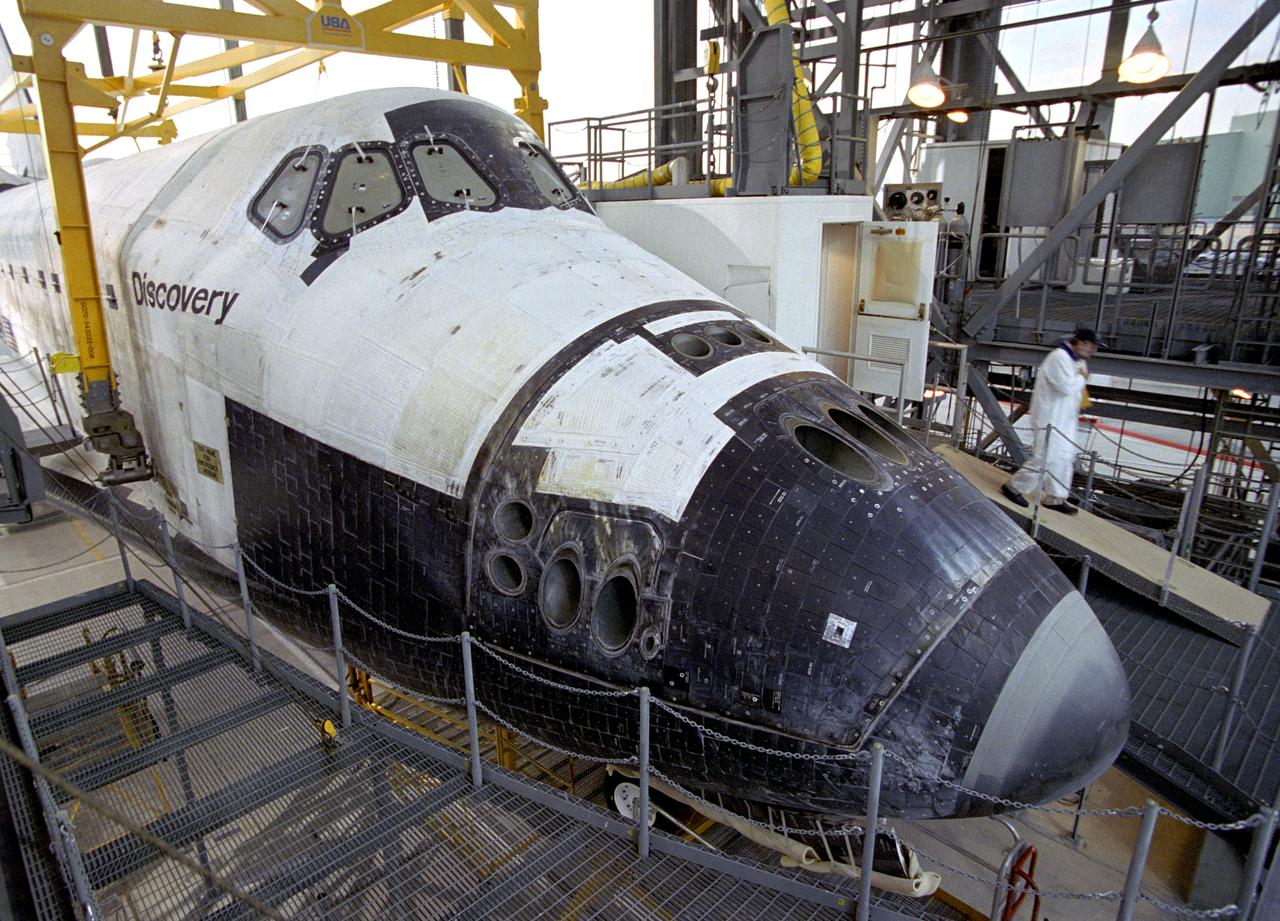
A technician leaves the 'white room', the access point for entering the Space Shuttle Discovery during post-flight processing in the Mate-Demate Device (MDD) at NASA's Dryden Flight Research Center in California. The gantry-like MDD structure is used for servicing the shuttle orbiters in preparation for their ferry flight back to the Kennedy Space Center in Florida, including mounting the shuttle atop NASA's modified Boeing 747 Shuttle Carrier Aircraft. Space Shuttle Discovery landed safely at NASA's Dryden Flight Research Center at Edwards Air Force Base in California at 5:11:22 a.m. PDT, August 9, 2005, following the very successful 14-day STS-114 return to flight mission. During their two weeks in space, Commander Eileen Collins and her six crewmates tested out new safety procedures and delivered supplies and equipment the International Space Station. Discovery spent two weeks in space, where the crew demonstrated new methods to inspect and repair the Shuttle in orbit. The crew also delivered supplies, outfitted and performed maintenance on the International Space Station. A number of these tasks were conducted during three spacewalks. In an unprecedented event, spacewalkers were called upon to remove protruding gap fillers from the heat shield on Discovery's underbelly. In other spacewalk activities, astronauts installed an external platform onto the Station's Quest Airlock and replaced one of the orbital outpost's Control Moment Gyroscopes. Inside the Station, the STS-114 crew conducted joint operations with the Expedition 11 crew. They unloaded fresh supplies from the Shuttle and the Raffaello Multi-Purpose Logistics Module. Before Discovery undocked, the crews filled Raffeallo with unneeded items and returned to Shuttle payload bay. Discovery launched on July 26 and spent almost 14 days on orbit.
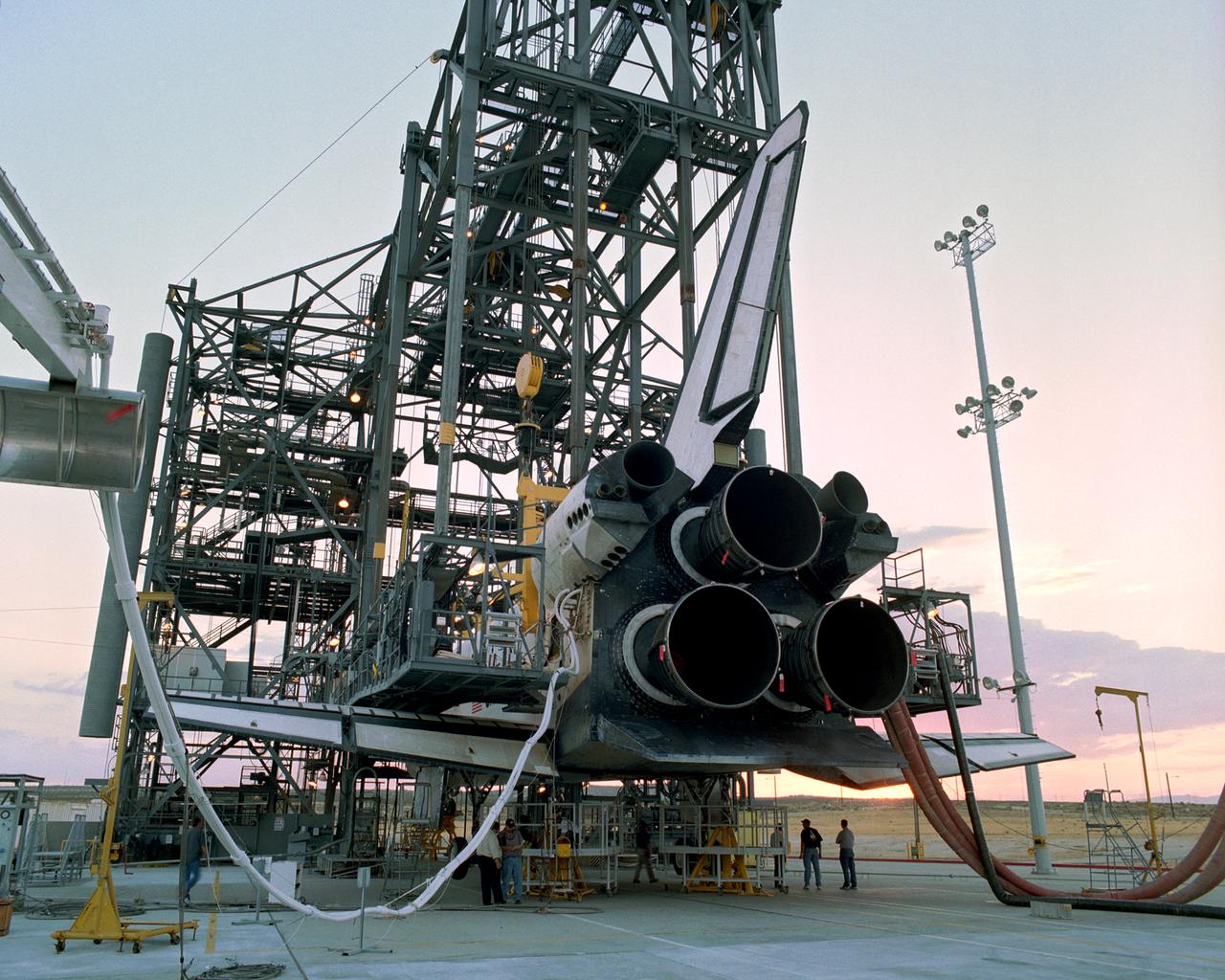
The sun sets on the Space Shuttle Discovery during post-flight processing in the Mate-Demate Device (MDD), following its landing at NASA's Dryden Flight Research Center in California. The gantry-like MDD structure is used for servicing the shuttle orbiters in preparation for their ferry flight back to the Kennedy Space Center in Florida, including mounting the shuttle atop NASA's modified Boeing 747 Shuttle Carrier Aircraft. Space Shuttle Discovery landed safely at NASA's Dryden Flight Research Center at Edwards Air Force Base in California at 5:11:22 a.m. PDT, August 9, 2005, following the very successful 14-day STS-114 return to flight mission. During their two weeks in space, Commander Eileen Collins and her six crewmates tested out new safety procedures and delivered supplies and equipment the International Space Station. Discovery spent two weeks in space, where the crew demonstrated new methods to inspect and repair the Shuttle in orbit. The crew also delivered supplies, outfitted and performed maintenance on the International Space Station. A number of these tasks were conducted during three spacewalks. In an unprecedented event, spacewalkers were called upon to remove protruding gap fillers from the heat shield on Discovery's underbelly. In other spacewalk activities, astronauts installed an external platform onto the Station's Quest Airlock and replaced one of the orbital outpost's Control Moment Gyroscopes. Inside the Station, the STS-114 crew conducted joint operations with the Expedition 11 crew. They unloaded fresh supplies from the Shuttle and the Raffaello Multi-Purpose Logistics Module. Before Discovery undocked, the crews filled Raffeallo with unneeded items and returned to Shuttle payload bay. Discovery launched on July 26 and spent almost 14 days on orbit.
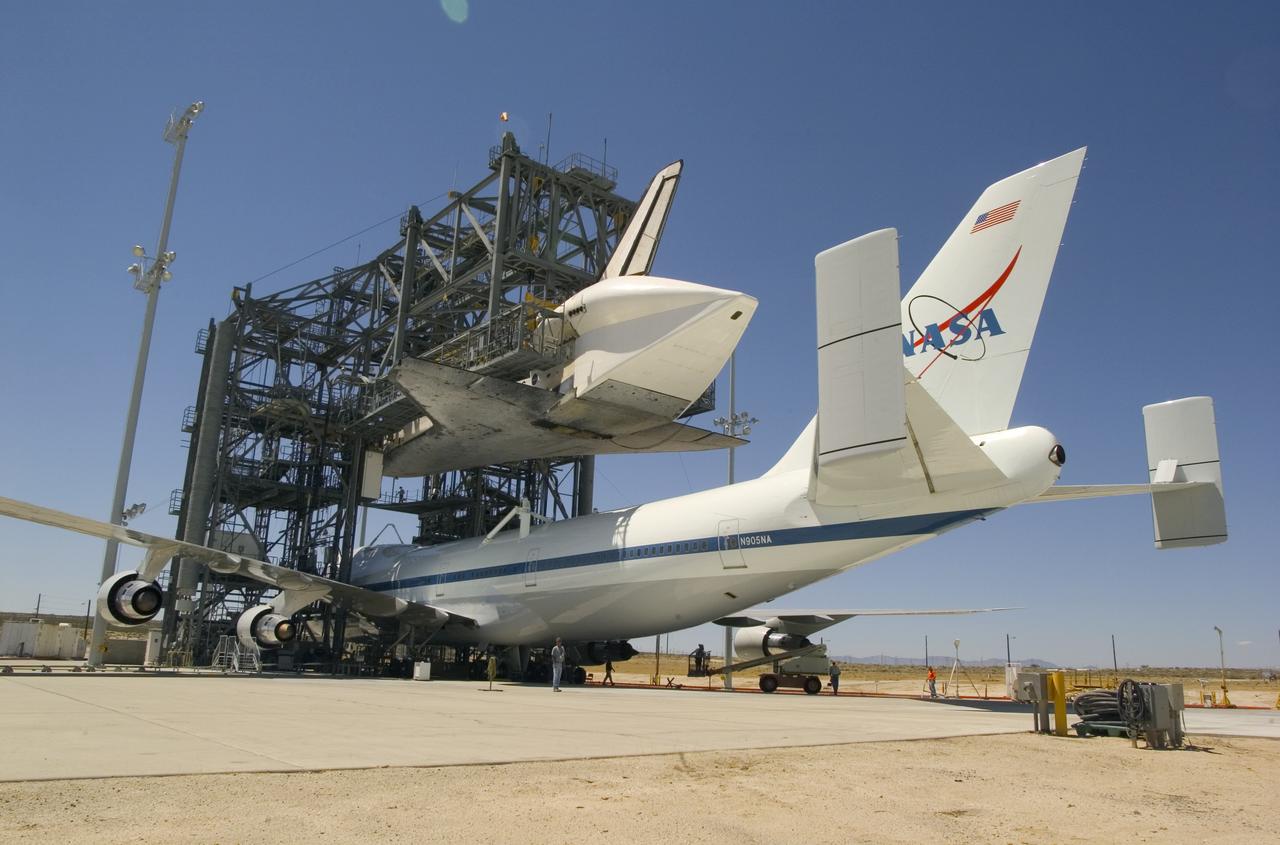
NASA's specially modified 747 Shuttle Carrier Aircraft, or SCA, is positioned under the Space Shuttle Discovery to be attached for their ferry flight to the Kennedy Space Center in Florida. After its post-flight servicing and preparation at NASA Dryden in California, Discovery's return flight to Kennedy aboard the 747 will take approximately 2 days, with stops at several intermediate points for refueling. Space Shuttle Discovery landed safely at NASA's Dryden Flight Research Center at Edwards Air Force Base at 5:11:22 a.m. PDT, August 9, 2005, following the very successful 14-day STS-114 return to flight mission. During their two weeks in space, Commander Eileen Collins and her six crewmates tested out new safety procedures and delivered supplies and equipment the International Space Station. Discovery spent two weeks in space, where the crew demonstrated new methods to inspect and repair the Shuttle in orbit. The crew also delivered supplies, outfitted and performed maintenance on the International Space Station. A number of these tasks were conducted during three spacewalks. In an unprecedented event, spacewalkers were called upon to remove protruding gap fillers from the heat shield on Discovery's underbelly. In other spacewalk activities, astronauts installed an external platform onto the Station's Quest Airlock and replaced one of the orbital outpost's Control Moment Gyroscopes. Inside the Station, the STS-114 crew conducted joint operations with the Expedition 11 crew. They unloaded fresh supplies from the Shuttle and the Raffaello Multi-Purpose Logistics Module. Before Discovery undocked, the crews filled Raffeallo with unneeded items and returned to Shuttle payload bay. Discovery launched on July 26 and spent almost 14 days on orbit.
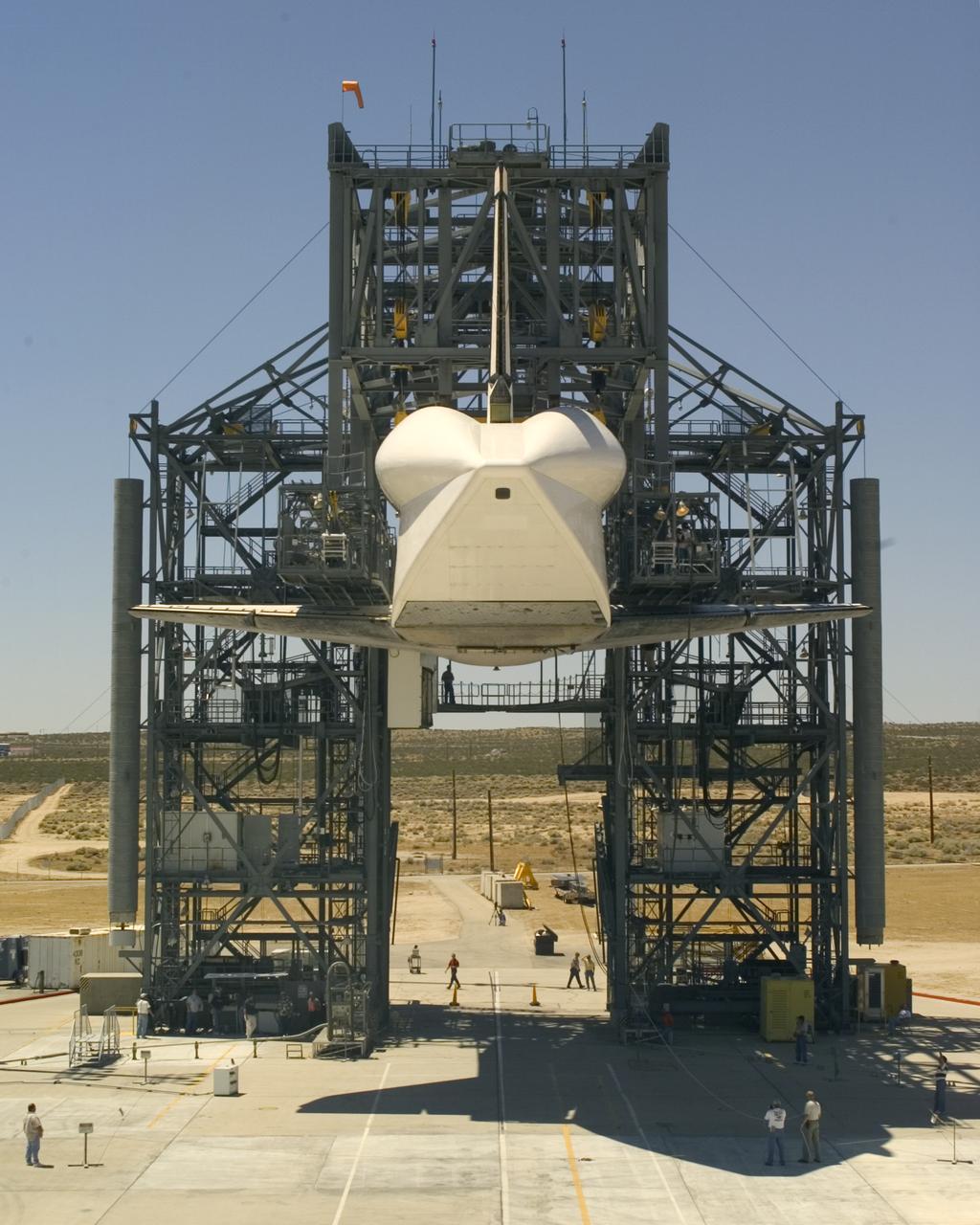
NASA's specially modified 747 Shuttle Carrier Aircraft, or SCA, is positioned under the Space Shuttle Discovery to be attached for their ferry flight to the Kennedy Space Center in Florida. After its post-flight servicing and preparation at NASA Dryden in California, Discovery's return flight to Kennedy aboard the 747 will take approximately 2 days, with stops at several intermediate points for refueling. Space Shuttle Discovery landed safely at NASA's Dryden Flight Research Center at Edwards Air Force Base at 5:11:22 a.m. PDT, August 9, 2005, following the very successful 14-day STS-114 return to flight mission. During their two weeks in space, Commander Eileen Collins and her six crewmates tested out new safety procedures and delivered supplies and equipment the International Space Station. Discovery spent two weeks in space, where the crew demonstrated new methods to inspect and repair the Shuttle in orbit. The crew also delivered supplies, outfitted and performed maintenance on the International Space Station. A number of these tasks were conducted during three spacewalks. In an unprecedented event, spacewalkers were called upon to remove protruding gap fillers from the heat shield on Discovery's underbelly. In other spacewalk activities, astronauts installed an external platform onto the Station's Quest Airlock and replaced one of the orbital outpost's Control Moment Gyroscopes. Inside the Station, the STS-114 crew conducted joint operations with the Expedition 11 crew. They unloaded fresh supplies from the Shuttle and the Raffaello Multi-Purpose Logistics Module. Before Discovery undocked, the crews filled Raffeallo with unneeded items and returned to Shuttle payload bay. Discovery launched on July 26 and spent almost 14 days on orbit.
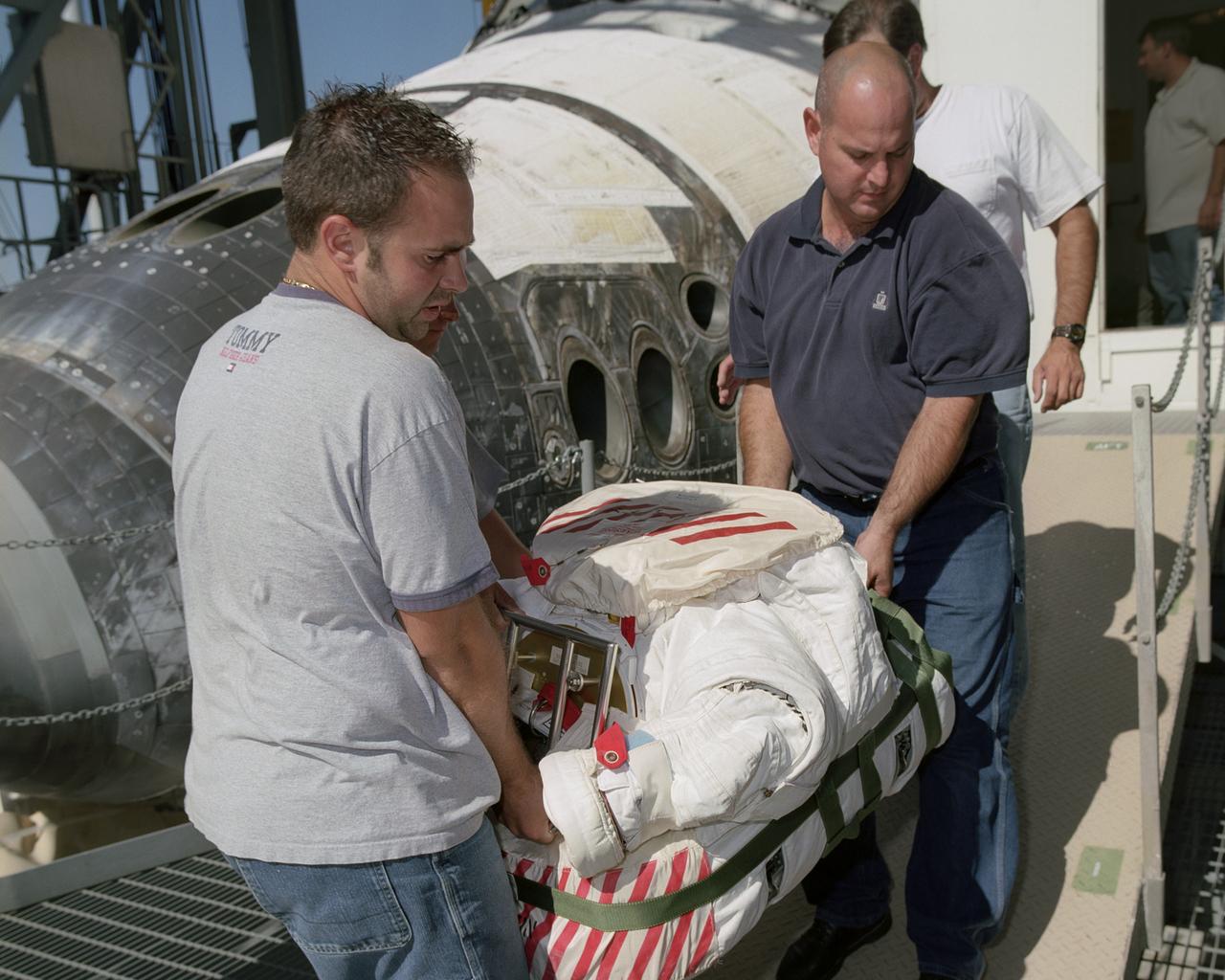
Flight Crew Systems Technicians Ray Smith and Raphael Rodriguez remove one of the Extravehicular Mobility Units, or EMUs, from the Space Shuttle Discovery after it's successful landing at NASA's Dryden Flight Research Center. The Space Shuttles receive post-flight servicing in the Mate-Demate Device (MDD) following landings at NASA's Dryden Flight Research Center, Edwards, California. The gantry-like MDD structure is used for servicing the shuttle orbiters in preparation for their ferry flight back to the Kennedy Space Center in Florida, including mounting the shuttle atop NASA's modified Boeing 747 Shuttle Carrier Aircraft. Space Shuttle Discovery landed safely at NASA's Dryden Flight Research Center at Edwards Air Force Base in California at 5:11:22 a.m. PDT, August 9, 2005, following the very successful 14-day STS-114 return to flight mission. During their two weeks in space, Commander Eileen Collins and her six crewmates tested out new safety procedures and delivered supplies and equipment the International Space Station. Discovery spent two weeks in space, where the crew demonstrated new methods to inspect and repair the Shuttle in orbit. The crew also delivered supplies, outfitted and performed maintenance on the International Space Station. A number of these tasks were conducted during three spacewalks. In an unprecedented event, spacewalkers were called upon to remove protruding gap fillers from the heat shield on Discovery's underbelly. In other spacewalk activities, astronauts installed an external platform onto the Station's Quest Airlock and replaced one of the orbital outpost's Control Moment Gyroscopes. Inside the Station, the STS-114 crew conducted joint operations with the Expedition 11 crew. They unloaded fresh supplies from the Shuttle and the Raffaello Multi-Purpose Logistics Module. Before Discovery undocked, the crews filled Raffeallo with unneeded items and returned to Shuttle payload bay. Discovery launched on July 26 and spent almost 14
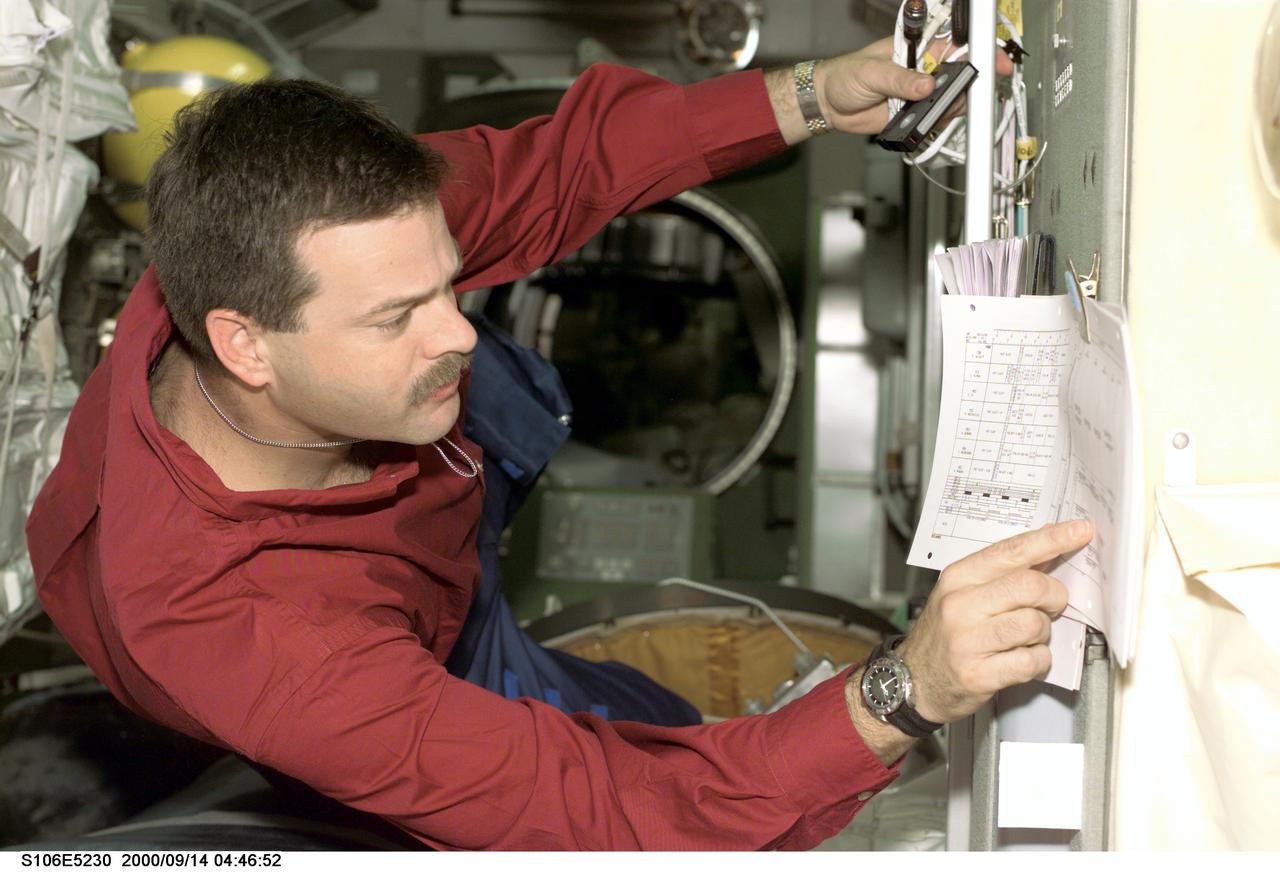
S106-E-5230 (14 September 2000) --- Astronaut Scott D. Altman, pilot, checks the crew activity timeline posted on the wall of the Zvezda service module during Flight Day 6 activity.
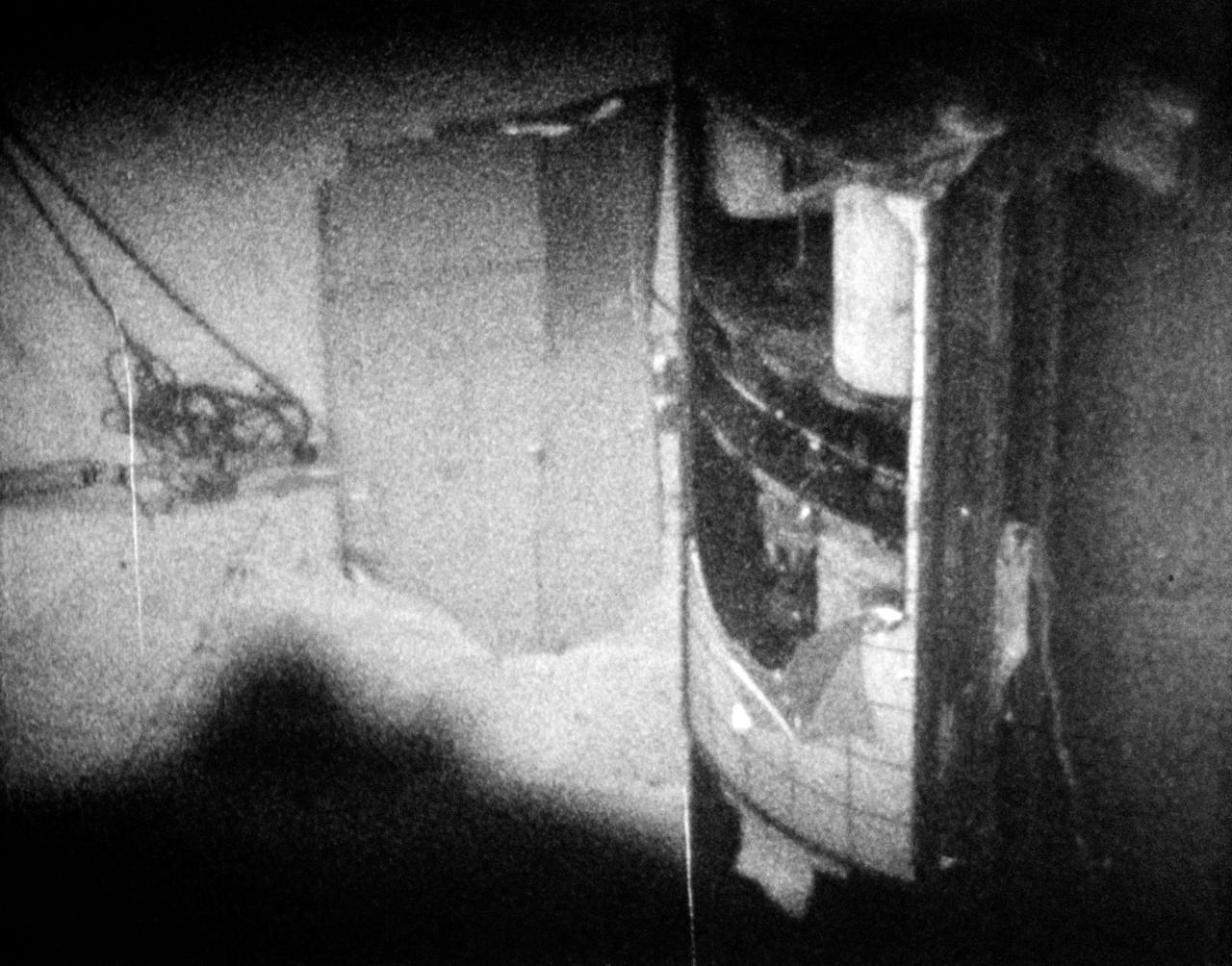
S70-41983 (June 1970) --- Second photograph in sequence of three of panel separation test at Langley Research Center. The test was part of the Apollo 13 post flight investigation of the Service Module explosion incident. Photo credit: NASA
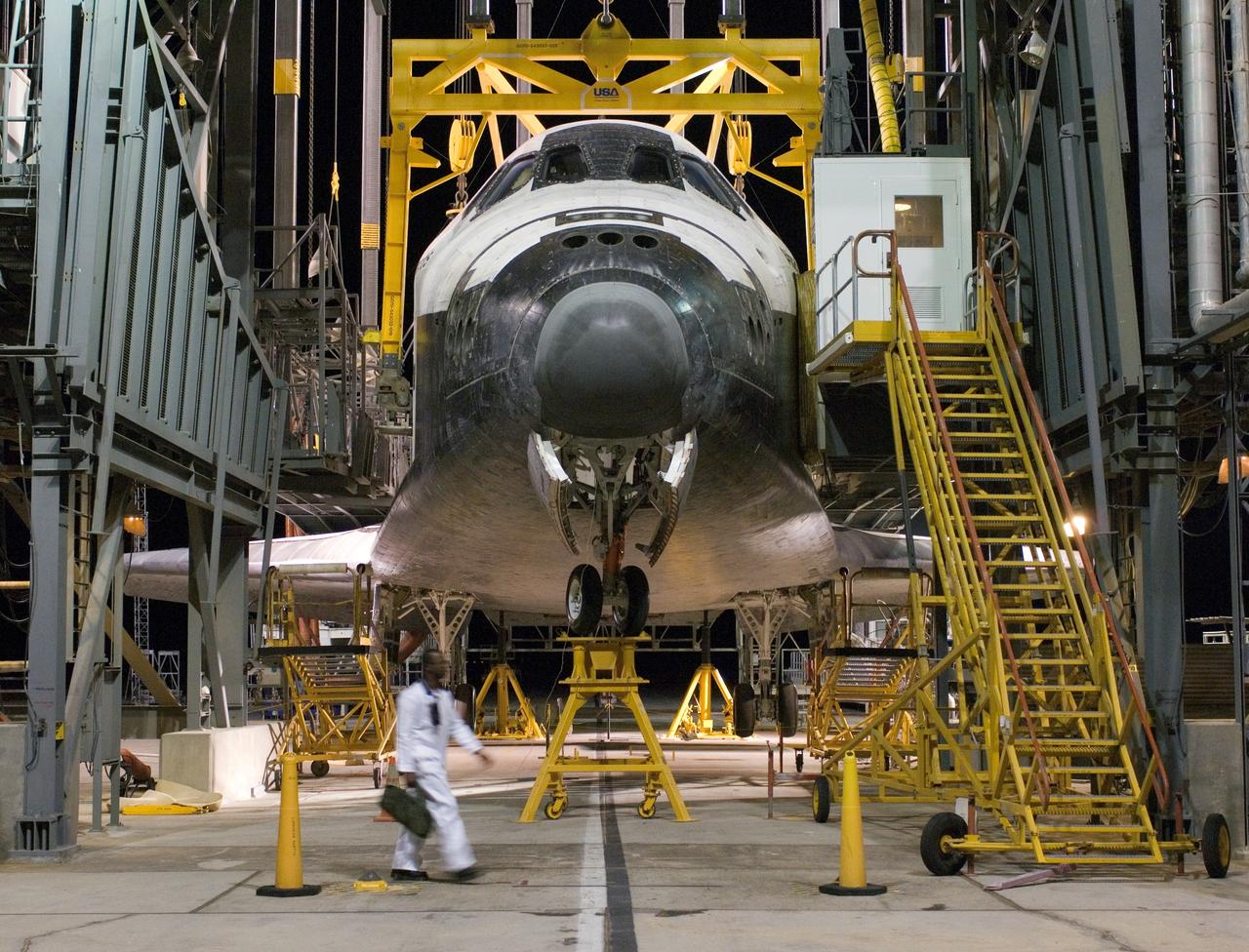
STS117-S-055 (23 June 2007) --- The Space Shuttle Atlantis receives post-flight servicing in the Mate-Demate Device (MDD) at NASA Dryden Flight Research Center after a successful landing at 12:49 p.m. (PDT) on June 22, 2007 at Edwards Air Force Base in California.
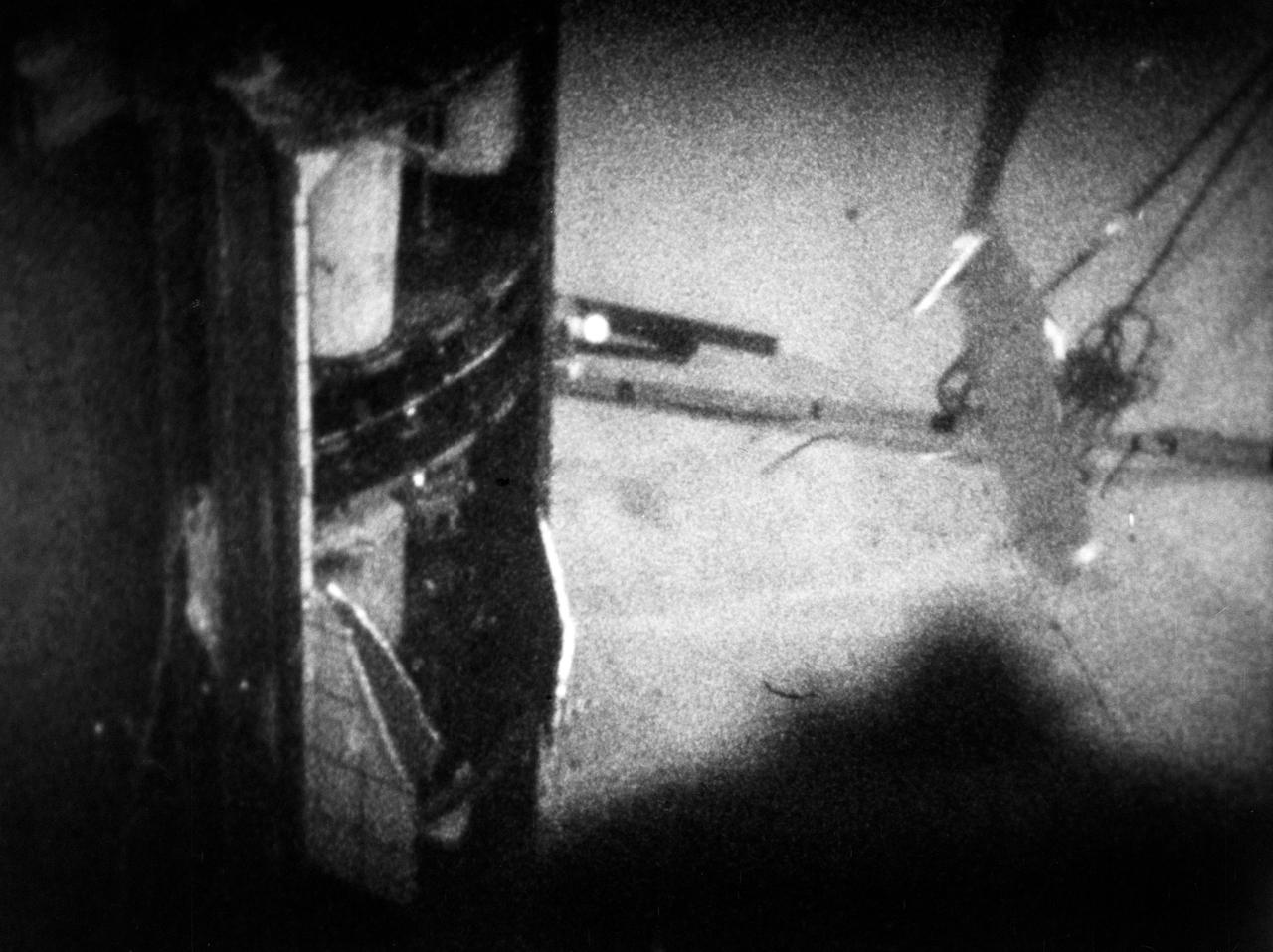
S70-41985 (15 June 1970) --- The third photograph in sequence of three showing panel separation test at Langley Research Center (LRC). The test was part of the Apollo 13 post flight investigation of the Service Module explosion incident. Photo credit: NASA
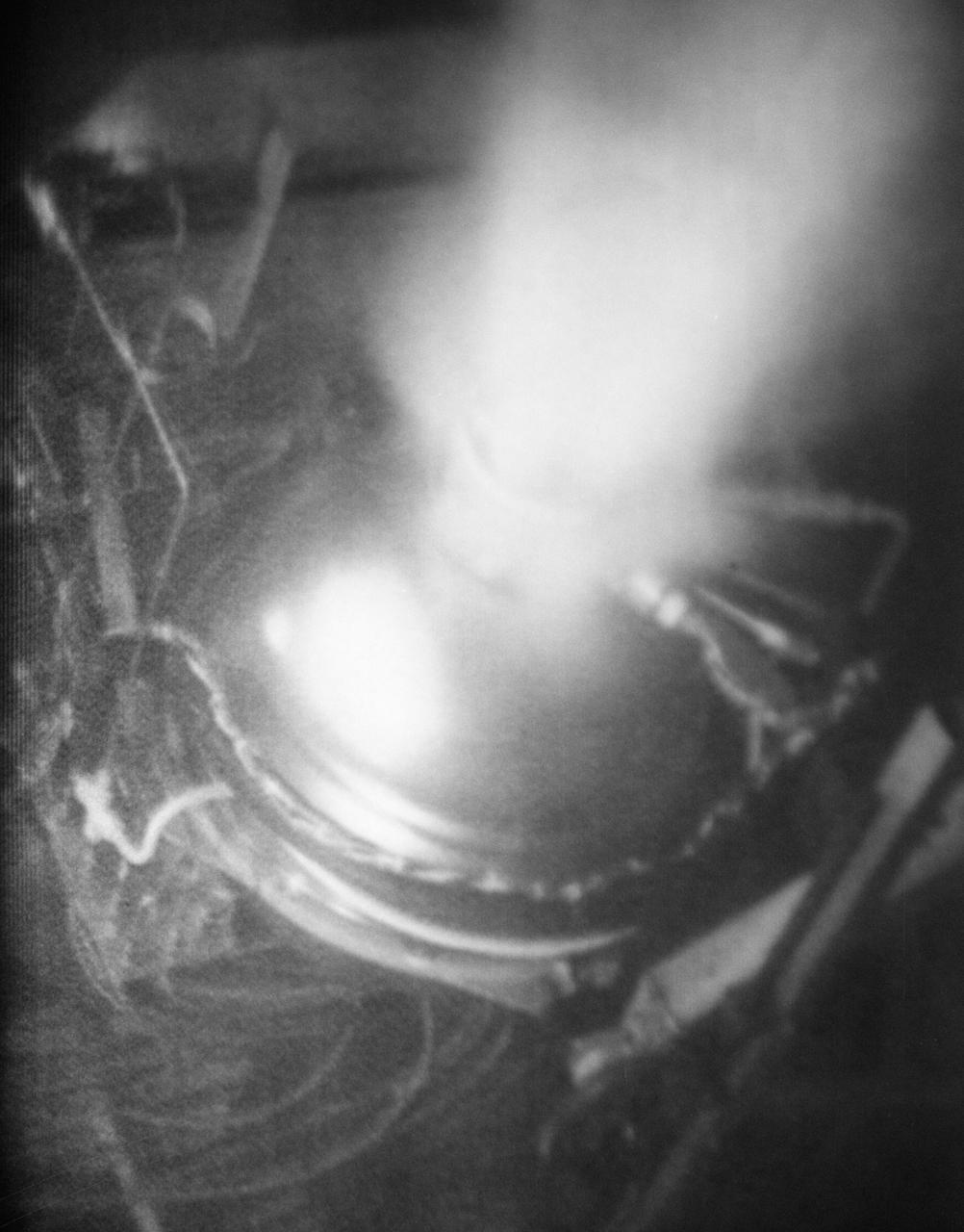
S70-41984 (June 1970) --- Full-scale propagation test at the NASA Manned Spacecraft Center (MSC) of fire inside an Apollo Service Module (SM) oxygen tank. The photograph from a motion picture sequence taken from outside the vessel shows failure of tank conduit with abrupt loss of oxygen pressure. The test was part of the Apollo 13 post flight investigation of the Service Module explosion incident. Photo credit: NASA
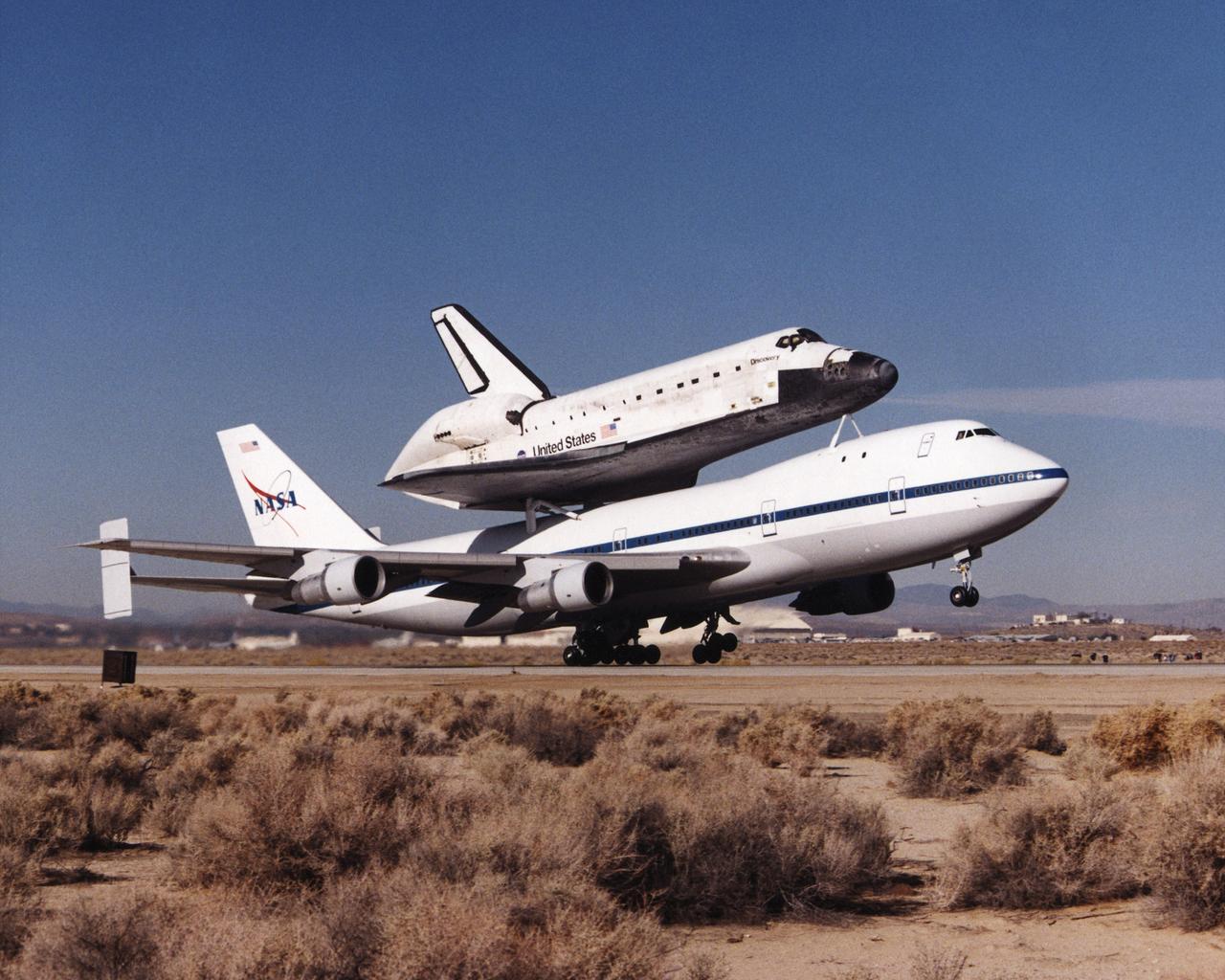
Carrying the Space Shuttle Discovery piggyback, one of NASA’s modified Boeing 747 Shuttle Carrier Aircraft lifts off the runway at Edwards Air Force Base, California. The Discovery was ferried from NASA’s Dryden Flight Research Center at Edwards to NASA’s Kennedy Space Center in Florida on November 2, 2000, after extensive post-landing servicing and ferry flight preparations.
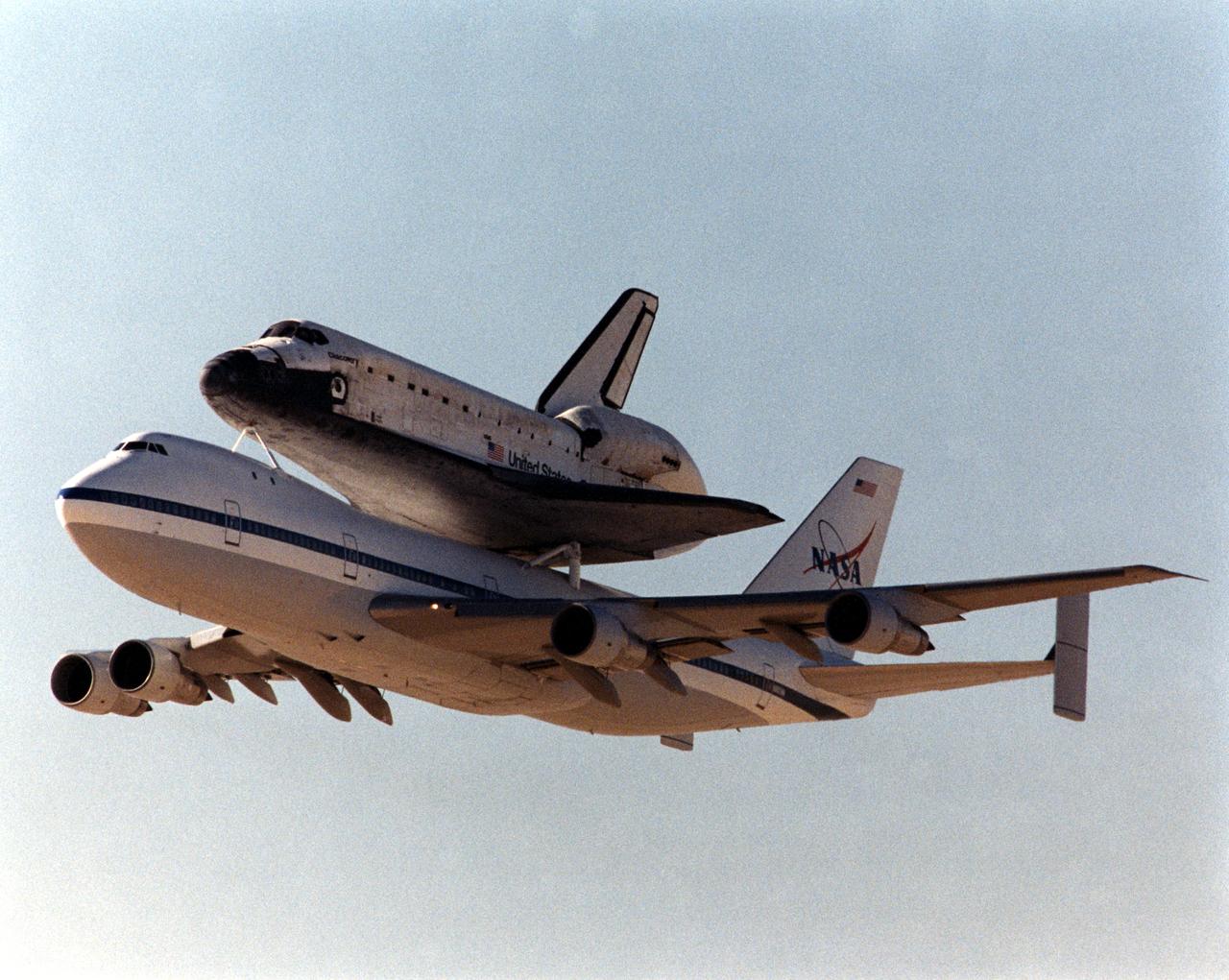
One of NASA’s two modified Boeing 747 Shuttle Carrier Aircraft with the Space Shuttle orbiter Discovery on its back climbs out after takeoff from Edwards Air Force Base, California. The Discovery was ferried from NASA’s Dryden Flight Research Center at Edwards to NASA’s Kennedy Space Center in Florida on November 2, 2000, after extensive post-landing servicing and ferry flight preparations.
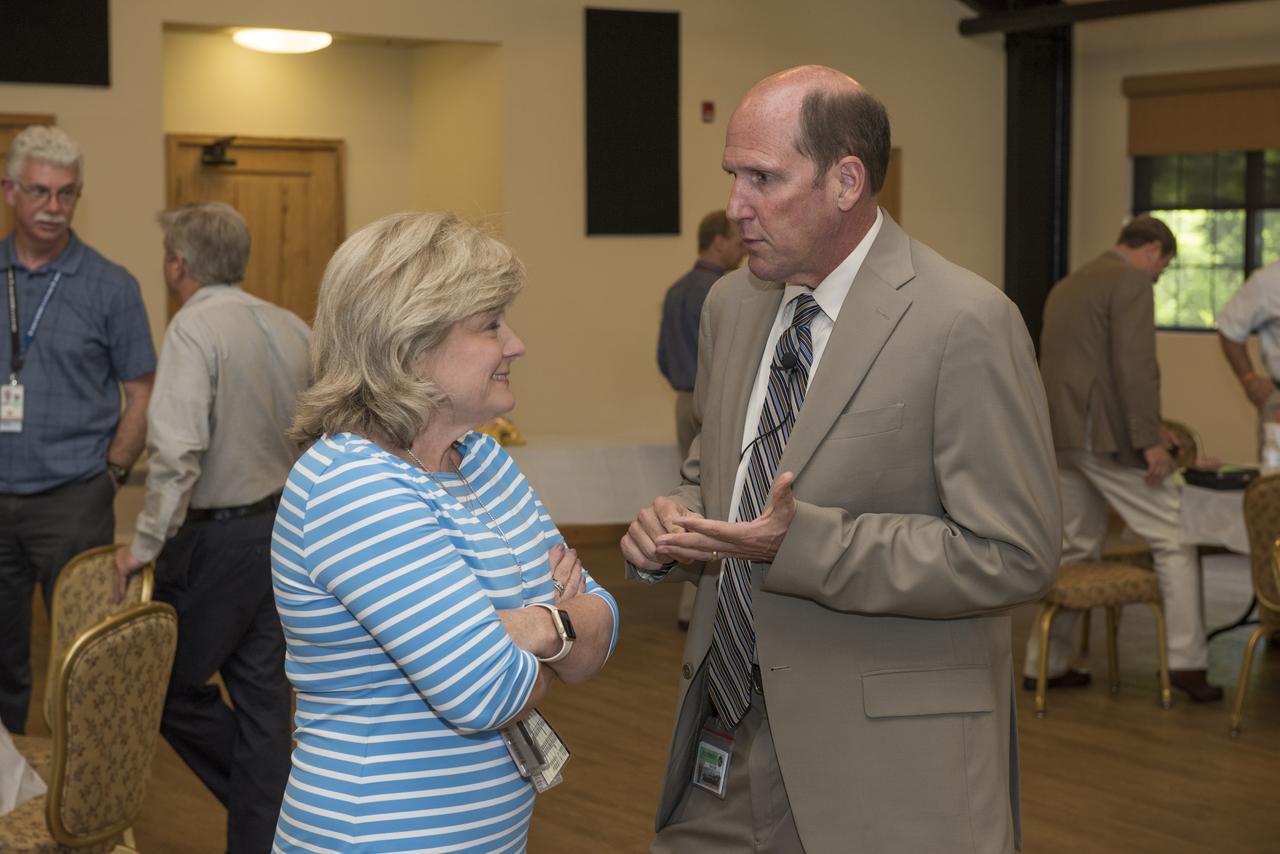
Paul Finley, mayor of the City of Madison, Alabama, chats with Jody Singer, deputy director of NASA’s Marshall Space Flight Center, following the April 26 lunch meeting of the Marshall Association, the center's professional, employee service organization. Finley, the guest speaker for the event, served as mayor of Madison from 2008-2012 and was elected to the post again in 2016.
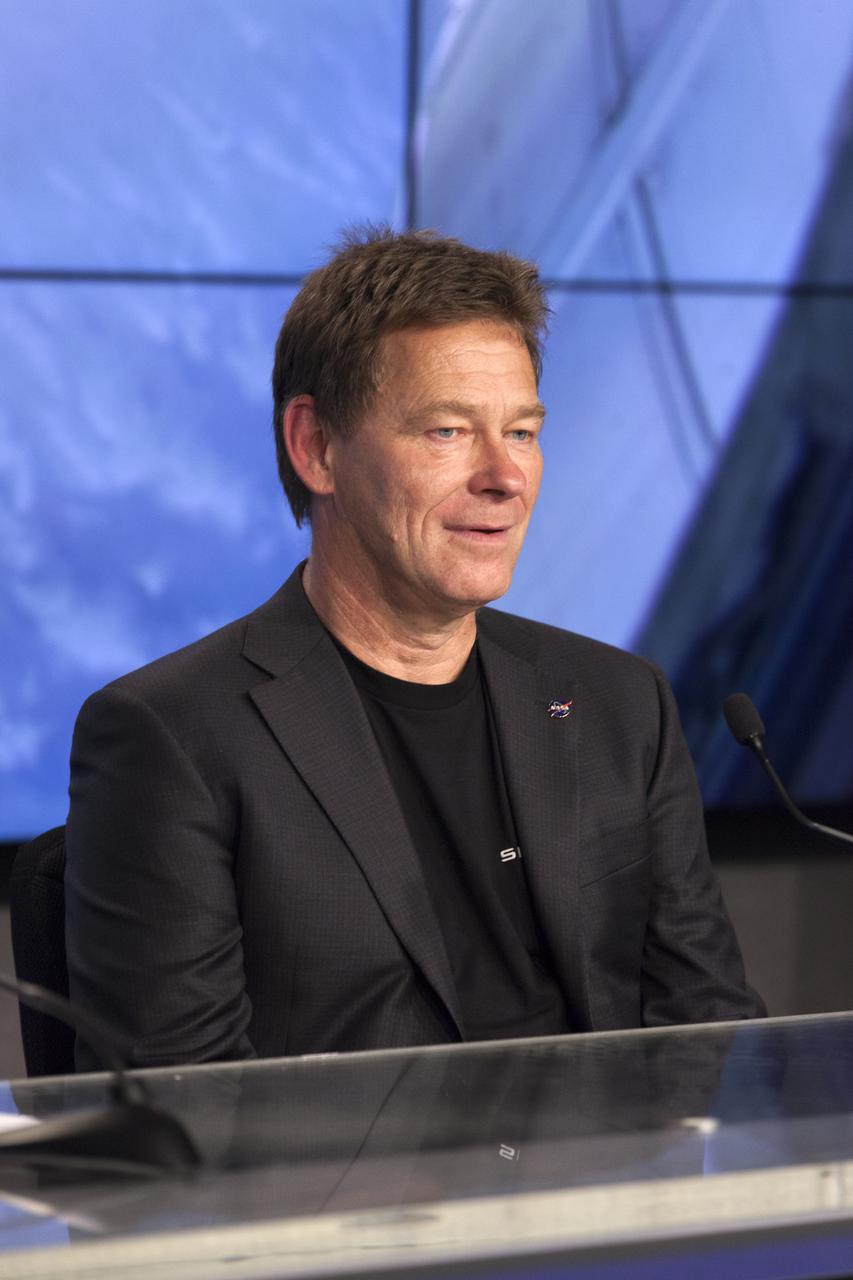
In the Press Site auditorium of NASA's Kennedy Space Center in Florida, Hans Koenigsmann, SpaceX vice president of Flight and Build Reliability, speaks to media at a post-launch news conference following the liftoff of SpaceX CRS-12, a commercial resupply services mission to the International Space Station. SpaceX CRS-12 lifted off atop a Falcon 9 rocket from Kennedy's Launch Complex 39A at 12:31 p.m. EDT.
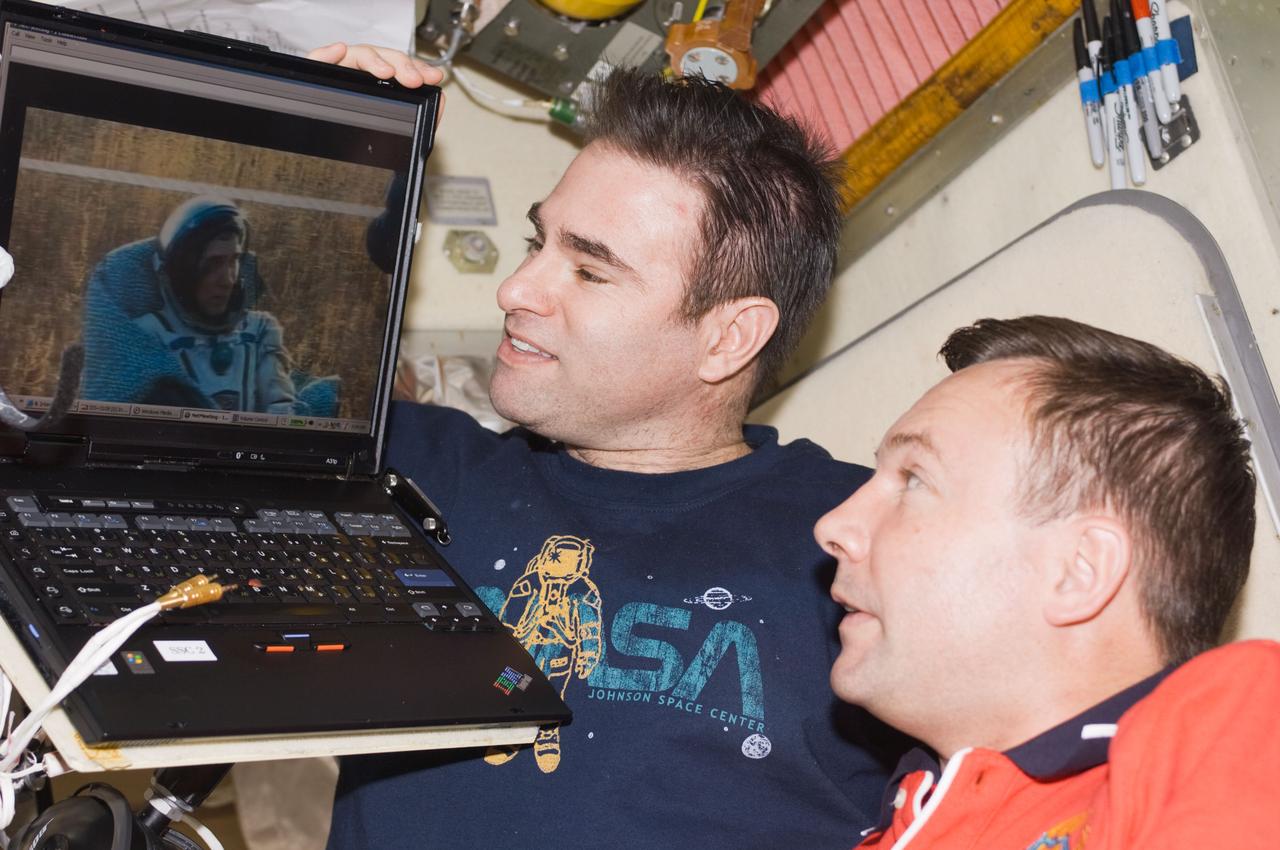
ISS018-E-005026 (23 Oct. 2008) --- Astronaut Greg Chamitoff (left) and cosmonaut Yury Lonchakov, both Expedition 18 flight engineers, watch live video of post landing activities on the steppes of Kazakhstan of Expedition 17 crewmembers and spaceflight participant on a computer screen in the Zvezda Service Module of the International Space Station. Cosmonaut Sergei Volkov, Expedition 17 commander, is visible on the screen.
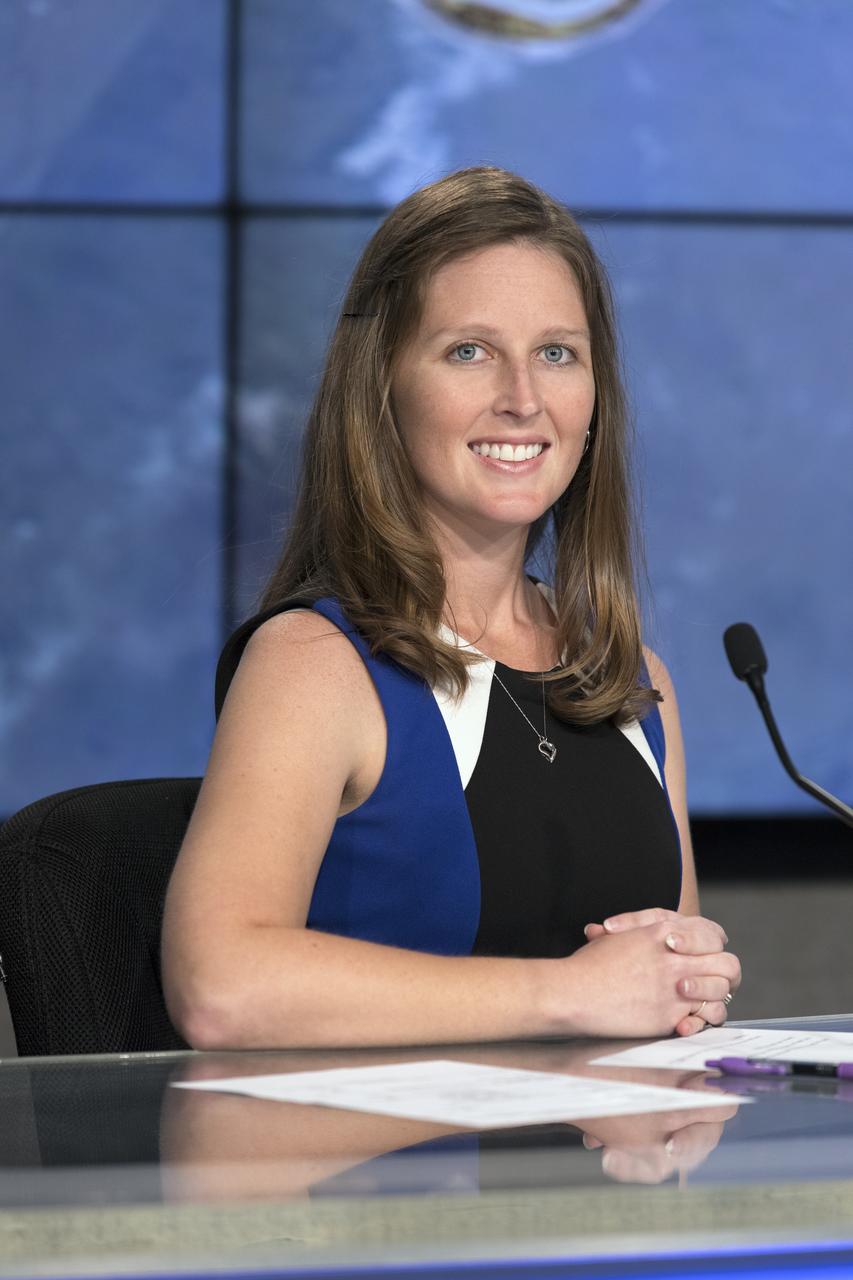
In the Press Site auditorium of NASA's Kennedy Space Center in Florida, from left, Stephanie Martin of NASA Communications, speaks to media at a post-launch news conference following the liftoff of SpaceX CRS-13. The flight is a commercial resupply services mission to the International Space Station. SpaceX CRS-13 lifted off atop a Falcon 9 rocket from Space Launch Complex 40 at Cape Canaveral Air Force Station at 10:36 a.m. EST with supplies and equipment and new science experiments for technology research.
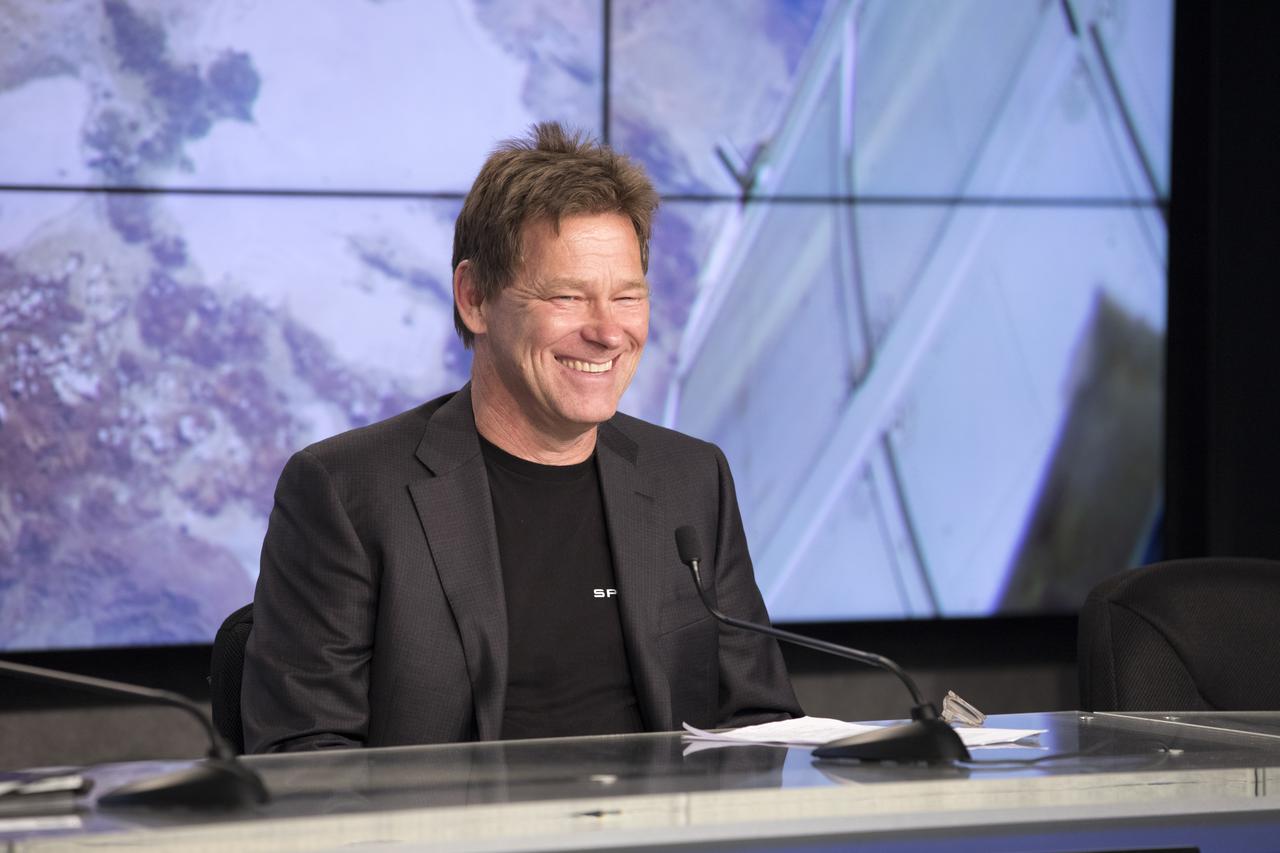
In the Press Site auditorium of NASA's Kennedy Space Center in Florida, Hans Koenigsmann, vice president of Flight Reliability for SpaceX. SpaceX, speaks to media at a post-launch news conference following the liftoff of SpaceX CRS-11, a commercial resupply services mission to the International Space Station. SpaceX CRS-11 lifted off atop a Falcon 9 rocket from Kennedy's Launch Complex 39A at 5:07 p.m. EDT.
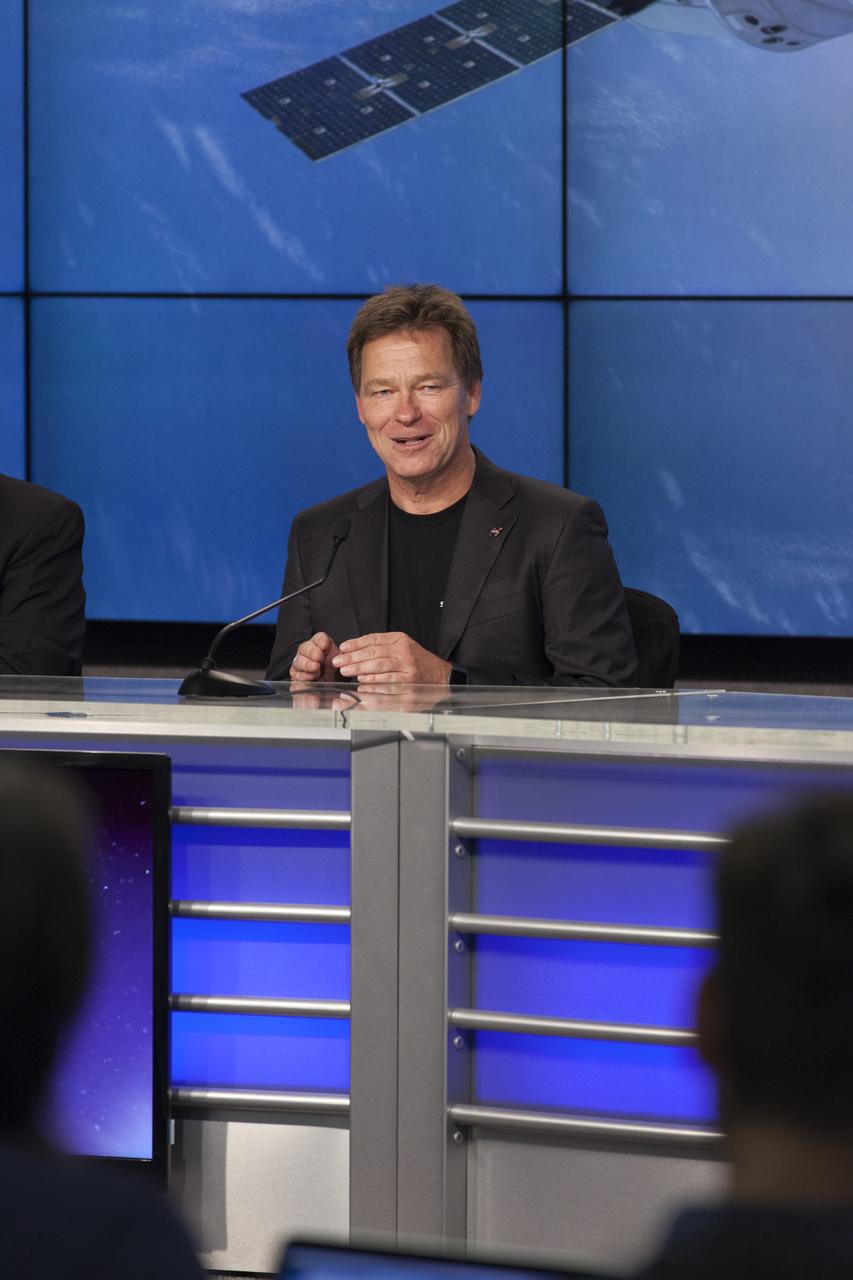
In the Press Site auditorium of NASA's Kennedy Space Center in Florida, Hans Koenigsmann, SpaceX vice president of Flight and Build Reliability, speaks to media at a post-launch news conference following the liftoff of SpaceX CRS-12, a commercial resupply services mission to the International Space Station. SpaceX CRS-12 lifted off atop a Falcon 9 rocket from Kennedy's Launch Complex 39A at 12:31 p.m. EDT.
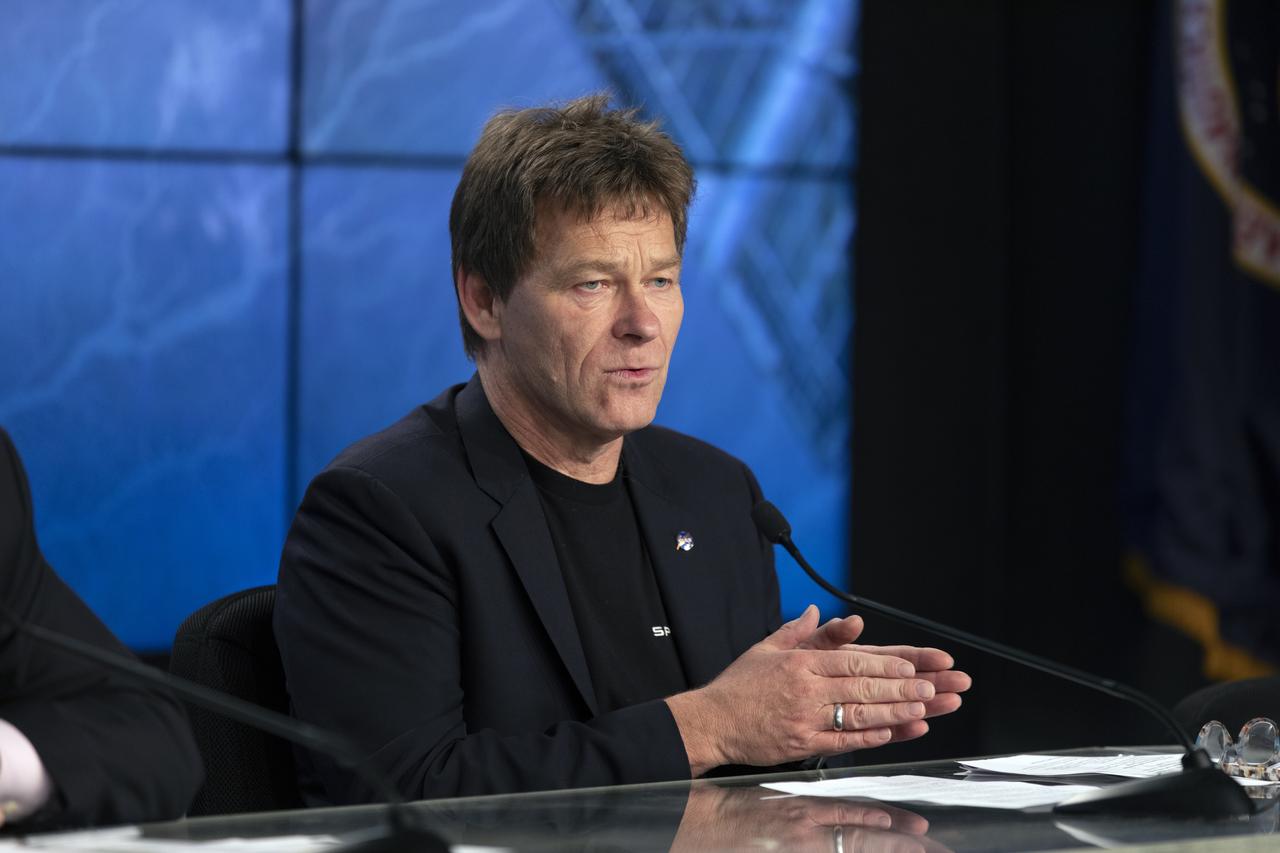
In the Press Site auditorium of NASA's Kennedy Space Center in Florida, Hans Koenigsmann, vice president of Build and Flight Reliability for SpaceX, speaks to media at a post-launch news conference following the liftoff of SpaceX CRS-16. The flight is a commercial resupply services mission to the International Space Station. SpaceX CRS-16 lifted off atop a Falcon 9 rocket from Space Launch Complex 40 at Cape Canaveral Air Force Station at 1:16 p.m. EST, Dec. 5, 2018, with supplies and equipment and new science experiments for technology research.
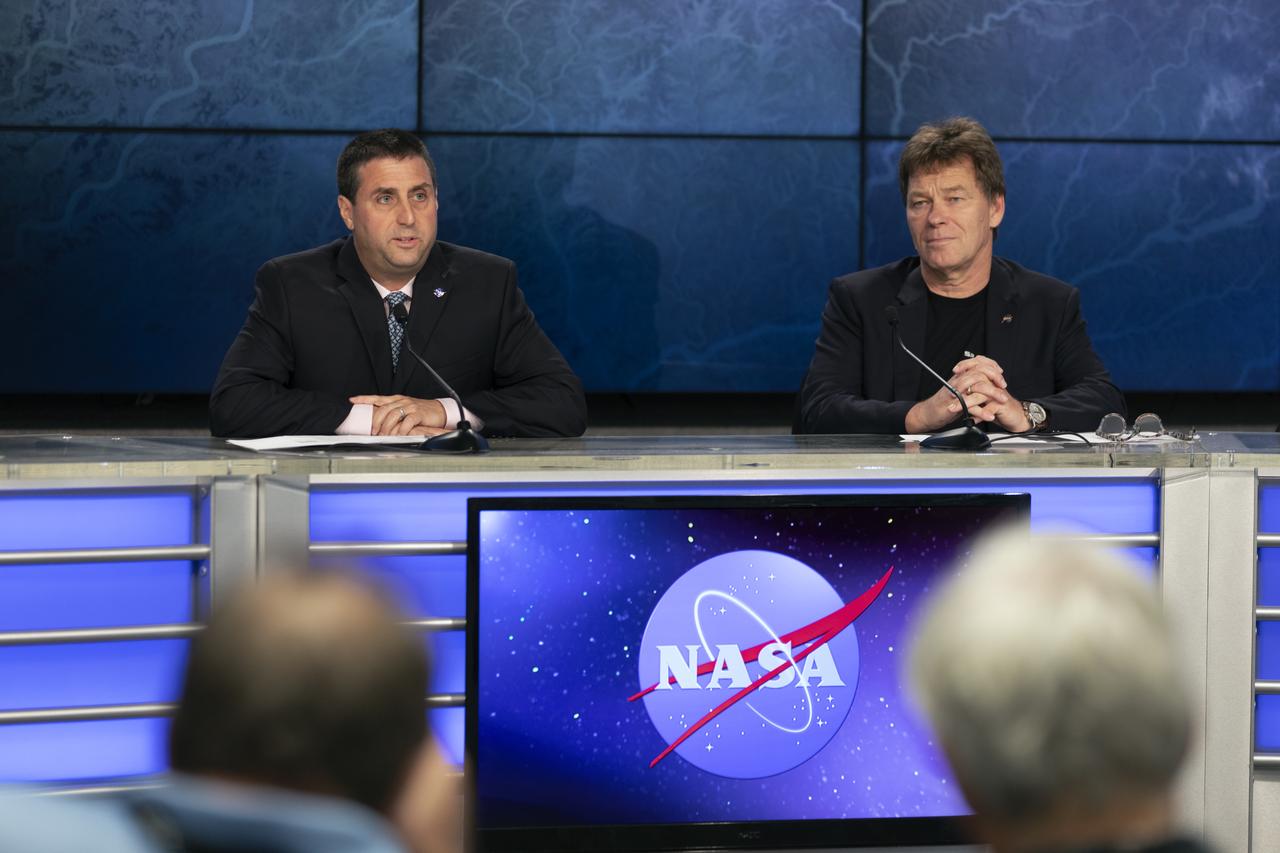
In the Press Site auditorium of NASA's Kennedy Space Center in Florida, Joel Montalbano, deputy International Space Station program manager at NASA's Johnson Space Center in Houston, left, and Hans Koenigsmann, vice president of Build and Flight Reliability for SpaceX, speak to media at a post-launch news conference following the liftoff of SpaceX CRS-16. The flight is a commercial resupply services mission to the International Space Station. SpaceX CRS-16 lifted off atop a Falcon 9 rocket from Space Launch Complex 40 at Cape Canaveral Air Force Station at 1:16 p.m. EST, Dec. 5, 2018, with supplies and equipment and new science experiments for technology research.
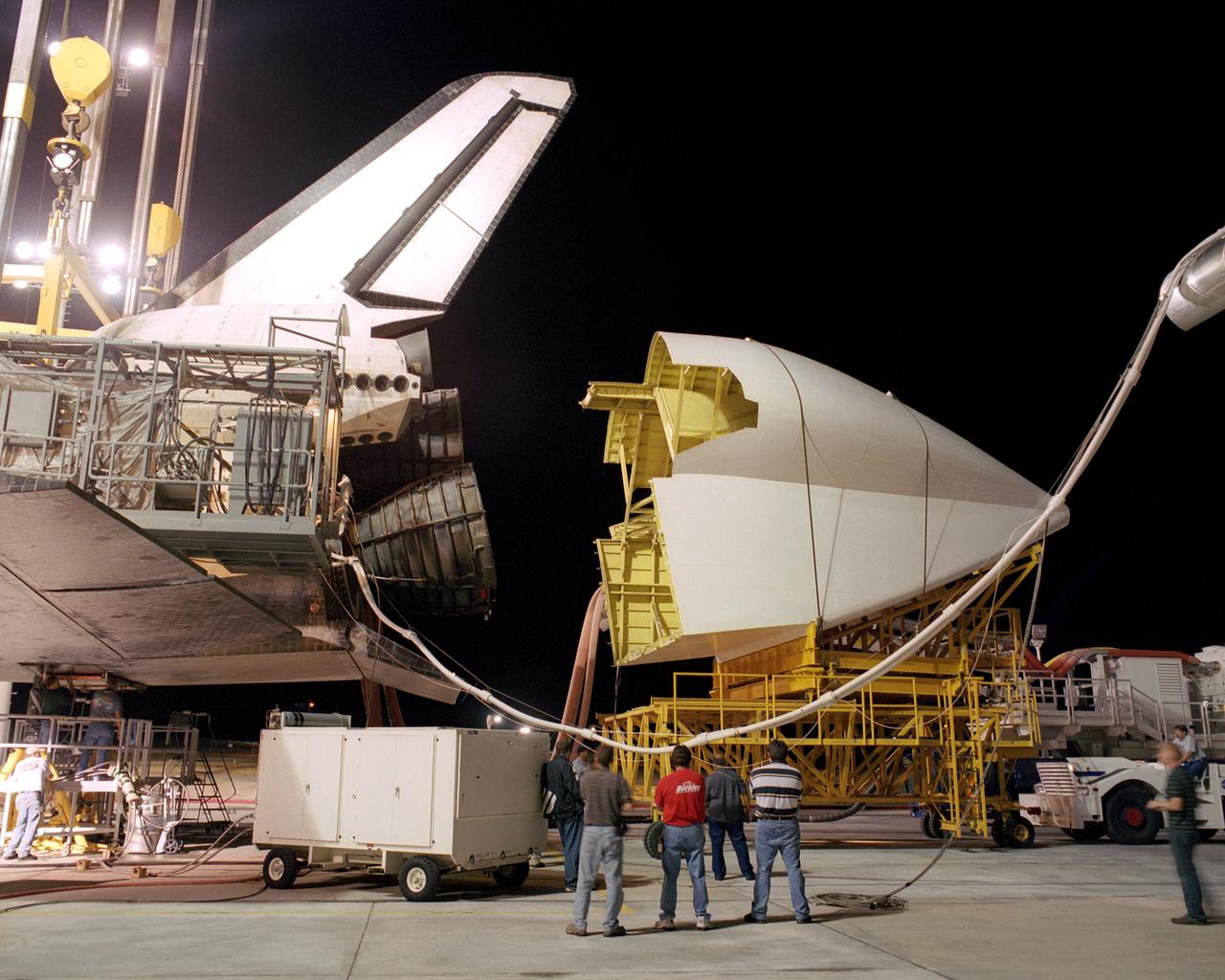
Workers position the tail cone on the Space Shuttle Discovery in preparation for its return to NASA's Kennedy Space Center in Florida. After the tail-cone is installed, Discovery will be mounted on NASA's modified Boeing 747 Shuttle Carrier Aircraft, or SCA, for the return flight. The tail cone is a fitting that helps reduce aerodynamic drag and turbulence during its ferry flight. Space Shuttle Discovery landed safely at NASA's Dryden Flight Research Center at Edwards Air Force Base in California at 5:11:22 a.m. PDT, August 9, 2005, following the very successful 14-day STS-114 return to flight mission. During their two weeks in space, Commander Eileen Collins and her six crewmates tested out new safety procedures and delivered supplies and equipment the International Space Station. Discovery spent two weeks in space, where the crew demonstrated new methods to inspect and repair the Shuttle in orbit. The crew also delivered supplies, outfitted and performed maintenance on the International Space Station. A number of these tasks were conducted during three spacewalks. In an unprecedented event, spacewalkers were called upon to remove protruding gap fillers from the heat shield on Discovery's underbelly. In other spacewalk activities, astronauts installed an external platform onto the Station's Quest Airlock and replaced one of the orbital outpost's Control Moment Gyroscopes. Inside the Station, the STS-114 crew conducted joint operations with the Expedition 11 crew. They unloaded fresh supplies from the Shuttle and the Raffaello Multi-Purpose Logistics Module. Before Discovery undocked, the crews filled Raffeallo with unneeded items and returned to Shuttle payload bay. Discovery launched on July 26 and spent almost 14 days on orbit.
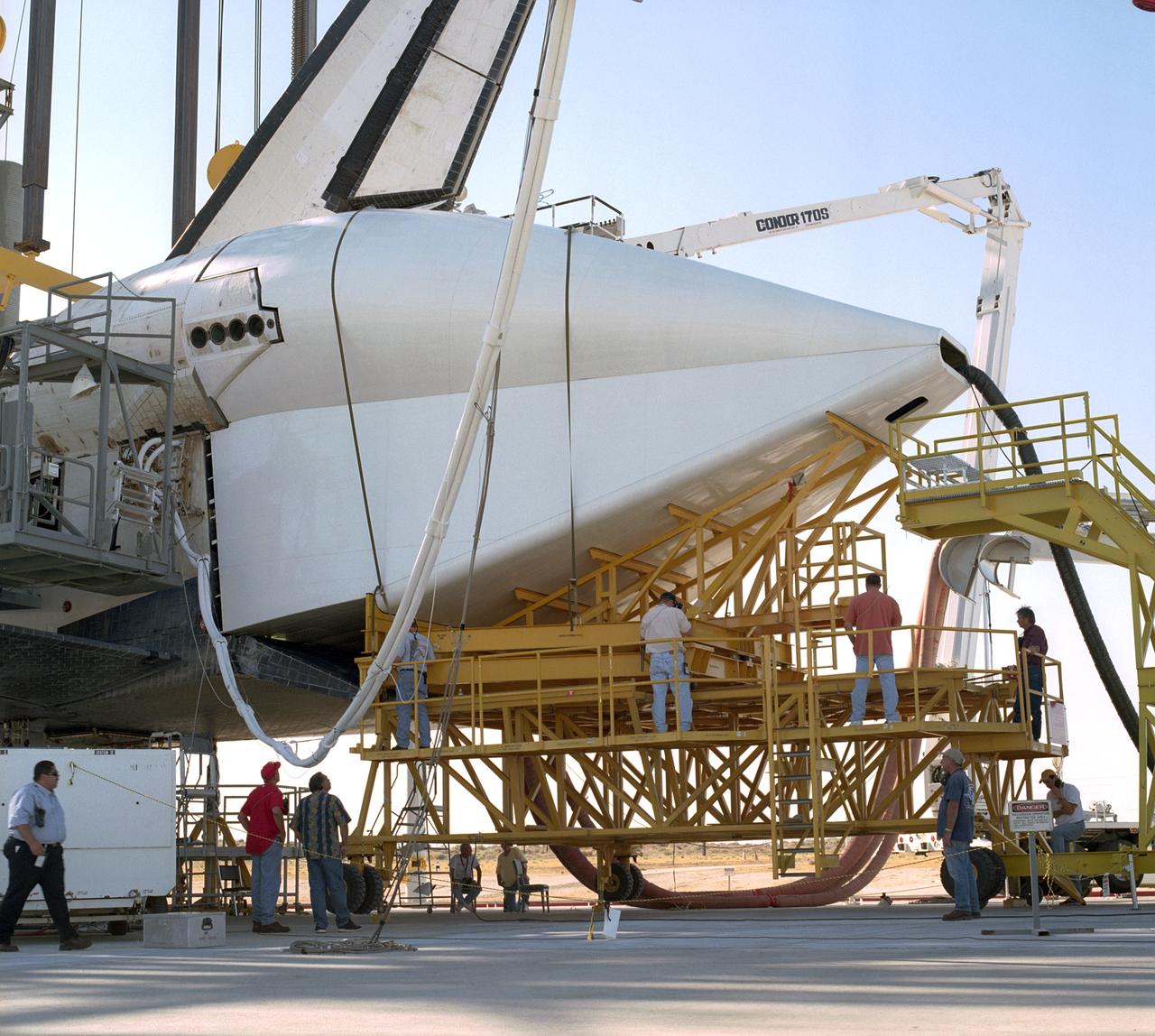
Technicians attach the tail cone, which helps reduce aerodynamic drag and turbulence during its ferry flight, to the Space Shuttle Discovery in preparation for its return to NASA's Kennedy Space Center in Florida. After the tail-cone is installed, Discovery will be mounted on NASA's modified Boeing 747 Shuttle Carrier Aircraft, or SCA, for the return flight. Space Shuttle Discovery landed safely at NASA's Dryden Flight Research Center at Edwards Air Force Base in California at 5:11:22 a.m. PDT, August 9, 2005, following the very successful 14-day STS-114 return to flight mission. During their two weeks in space, Commander Eileen Collins and her six crewmates tested out new safety procedures and delivered supplies and equipment the International Space Station. Discovery spent two weeks in space, where the crew demonstrated new methods to inspect and repair the Shuttle in orbit. The crew also delivered supplies, outfitted and performed maintenance on the International Space Station. A number of these tasks were conducted during three spacewalks. In an unprecedented event, spacewalkers were called upon to remove protruding gap fillers from the heat shield on Discovery's underbelly. In other spacewalk activities, astronauts installed an external platform onto the Station's Quest Airlock and replaced one of the orbital outpost's Control Moment Gyroscopes. Inside the Station, the STS-114 crew conducted joint operations with the Expedition 11 crew. They unloaded fresh supplies from the Shuttle and the Raffaello Multi-Purpose Logistics Module. Before Discovery undocked, the crews filled Raffeallo with unneeded items and returned to Shuttle payload bay. Discovery launched on July 26 and spent almost 14 days on orbit.
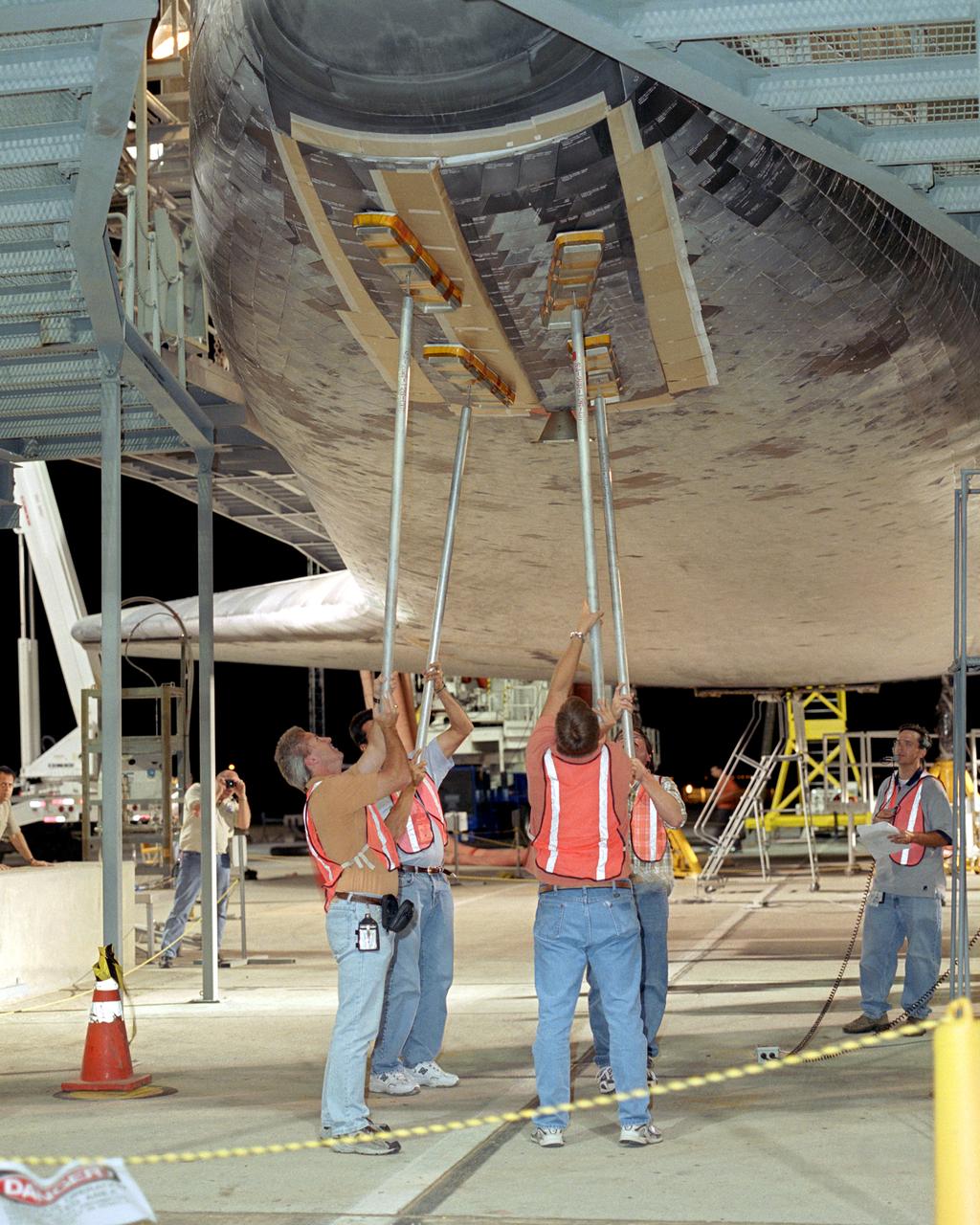
Closing the landing gear doors is one of the final servicing steps before lifting of the Space Shuttle Discovery and mating it to NASA's 747 can begin. After being raised in the gantry-like Mate-Demate Device (MDD), Discovery will be mounted on NASA's modified Boeing 747 Shuttle Carrier Aircraft, or SCA, for the return flight to the Kennedy Space Center in Florida. Space Shuttle Discovery landed safely at NASA's Dryden Flight Research Center at Edwards Air Force Base in California at 5:11:22 a.m. PDT, August 9, 2005, following the very successful 14-day STS-114 return to flight mission. During their two weeks in space, Commander Eileen Collins and her six crewmates tested out new safety procedures and delivered supplies and equipment the International Space Station. Discovery spent two weeks in space, where the crew demonstrated new methods to inspect and repair the Shuttle in orbit. The crew also delivered supplies, outfitted and performed maintenance on the International Space Station. A number of these tasks were conducted during three spacewalks. In an unprecedented event, spacewalkers were called upon to remove protruding gap fillers from the heat shield on Discovery's underbelly. In other spacewalk activities, astronauts installed an external platform onto the Station's Quest Airlock and replaced one of the orbital outpost's Control Moment Gyroscopes. Inside the Station, the STS-114 crew conducted joint operations with the Expedition 11 crew. They unloaded fresh supplies from the Shuttle and the Raffaello Multi-Purpose Logistics Module. Before Discovery undocked, the crews filled Raffeallo with unneeded items and returned to Shuttle payload bay. Discovery launched on July 26 and spent almost 14 days on orbit.
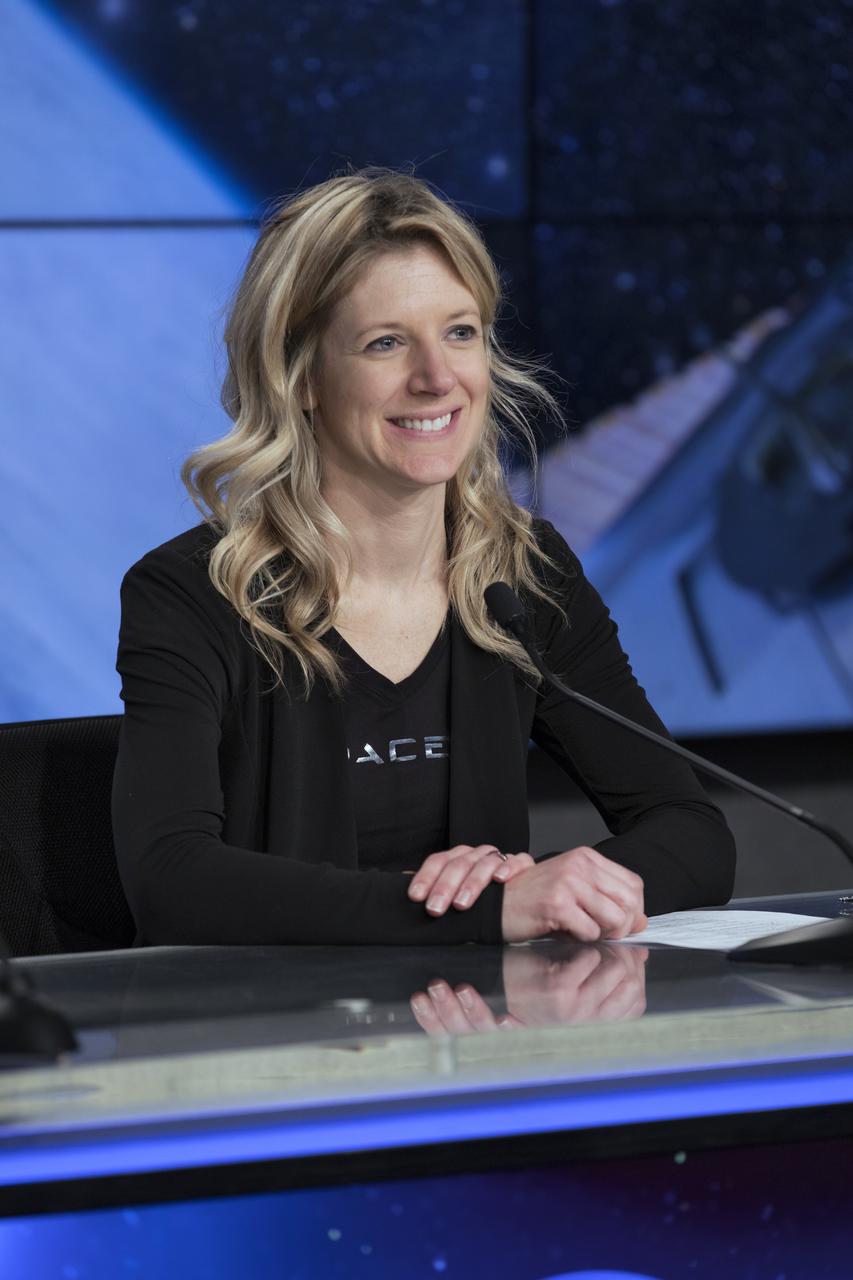
In the Press Site auditorium of NASA's Kennedy Space Center in Florida, from left, Jessica Jensen, SpaceX director of Dragon Mission Management, speaks to media at a post-launch news conference following the liftoff of SpaceX CRS-13. The flight is a commercial resupply services mission to the International Space Station. SpaceX CRS-13 lifted off atop a Falcon 9 rocket from Space Launch Complex 40 at Cape Canaveral Air Force Station at 10:36 a.m. EST with supplies and equipment and new science experiments for technology research.
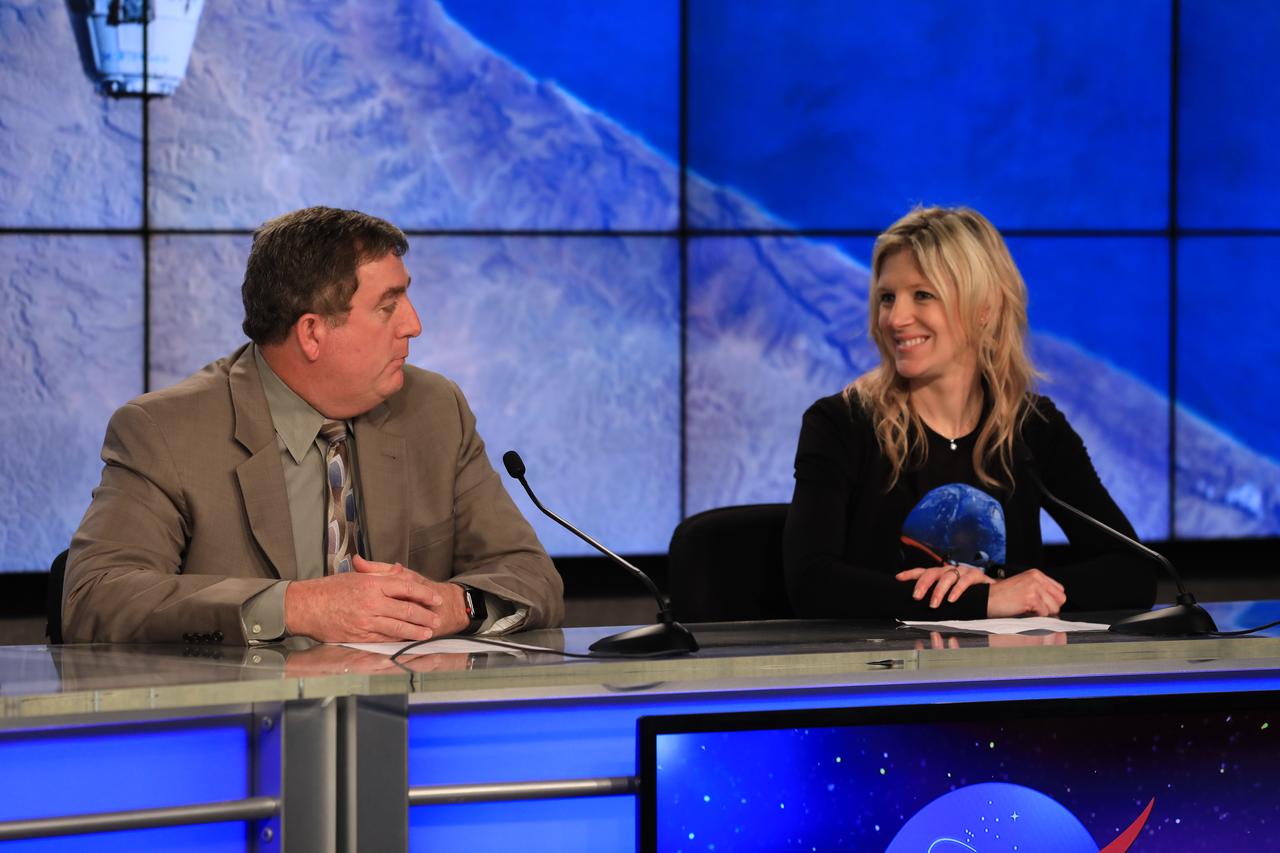
In the Press Site auditorium of NASA's Kennedy Space Center in Florida, from left, Kirk Shireman, manager, International Space Station Program, and Jessica Jensen, Director, Dragon Mission Management, SpaceX, speak to media at a post-launch news conference following the liftoff of SpaceX CRS-15. The flight is a commercial resupply services mission to the International Space Station. SpaceX CRS-15 lifted off atop a Falcon 9 rocket from Space Launch Complex 40 at Cape Canaveral Air Force Station on Friday, June 29, 2018, at 5:42 a.m. EDT with supplies and materials to support multiple critical science and research investigations.
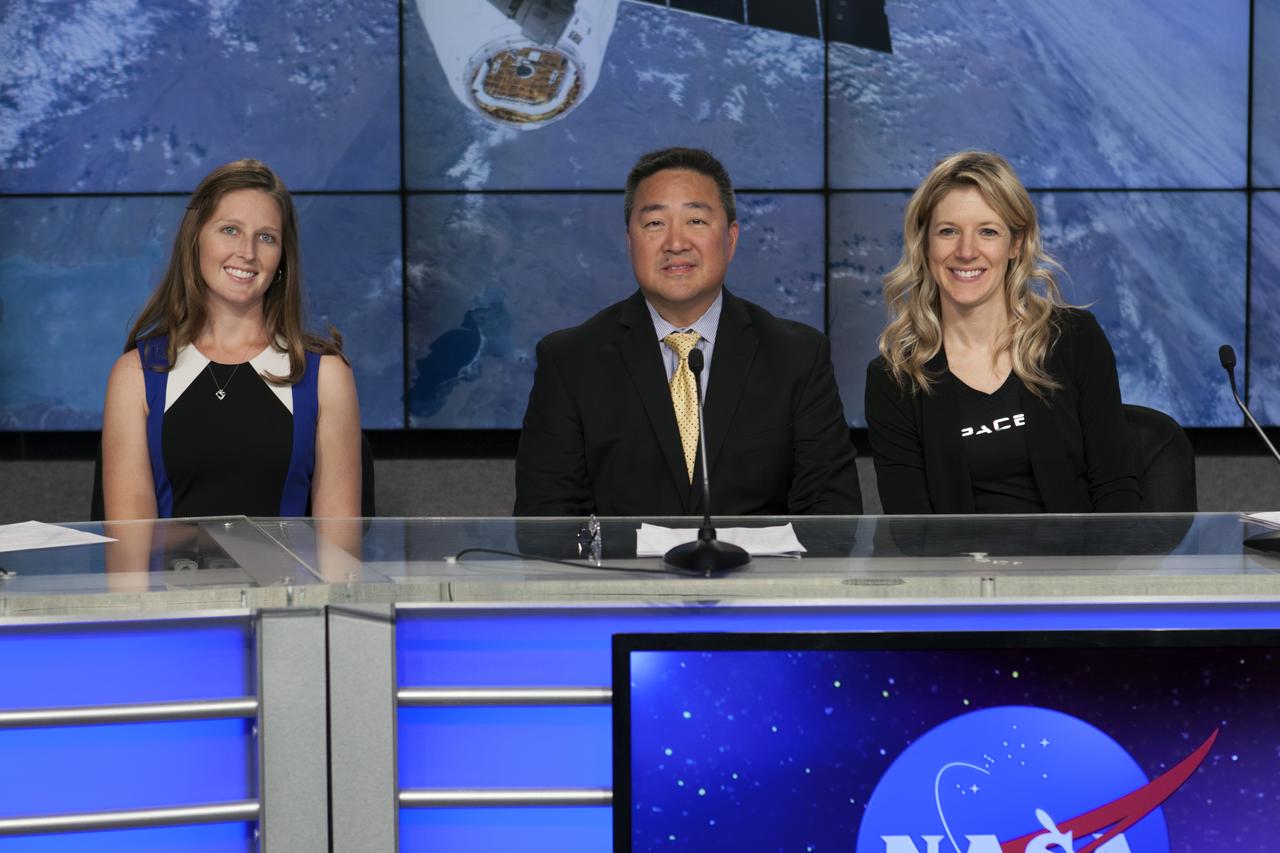
In the Press Site auditorium of NASA's Kennedy Space Center in Florida, from left, Stephanie Martin of NASA Communications, Ven Feng, manager of the Transportation Integration Office for the International Space Station Program, and Jessica Jensen, SpaceX director of Dragon Mission Management, speak to media at a post-launch news conference following the liftoff of SpaceX CRS-13. The flight is a commercial resupply services mission to the International Space Station. SpaceX CRS-13 lifted off atop a Falcon 9 rocket from Space Launch Complex 40 at Cape Canaveral Air Force Station at 10:36 a.m. EST with supplies and equipment and new science experiments for technology research.
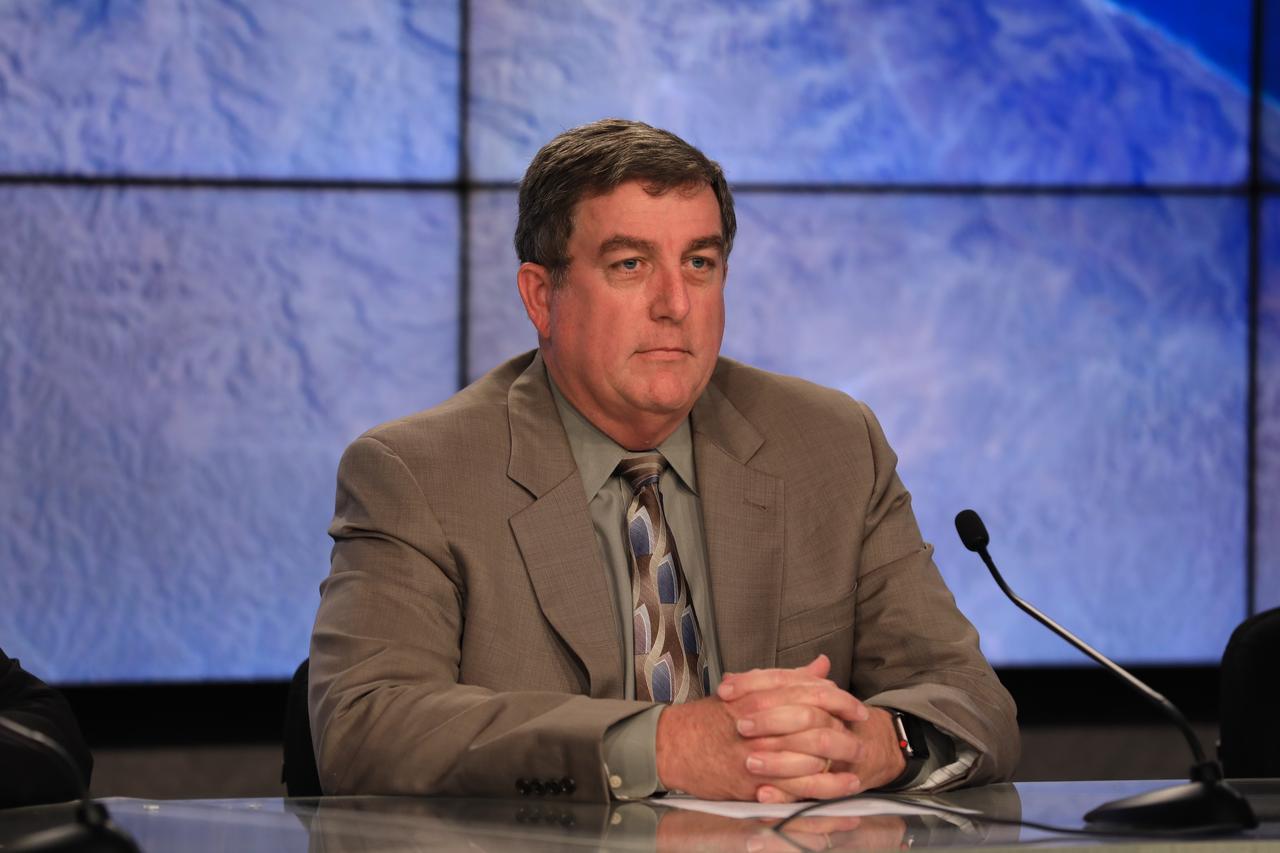
In the Press Site auditorium of NASA's Kennedy Space Center in Florida, Kirk Shireman, manager, International Space Station Program, speaks to media at a post-launch news conference following the liftoff of SpaceX CRS-15. The flight is a commercial resupply services mission to the International Space Station. SpaceX CRS-15 lifted off atop a Falcon 9 rocket from Space Launch Complex 40 at Cape Canaveral Air Force Station on Friday, June 29, 2018, at 5:42 a.m. EDT with supplies and materials to support multiple critical science and research investigations.
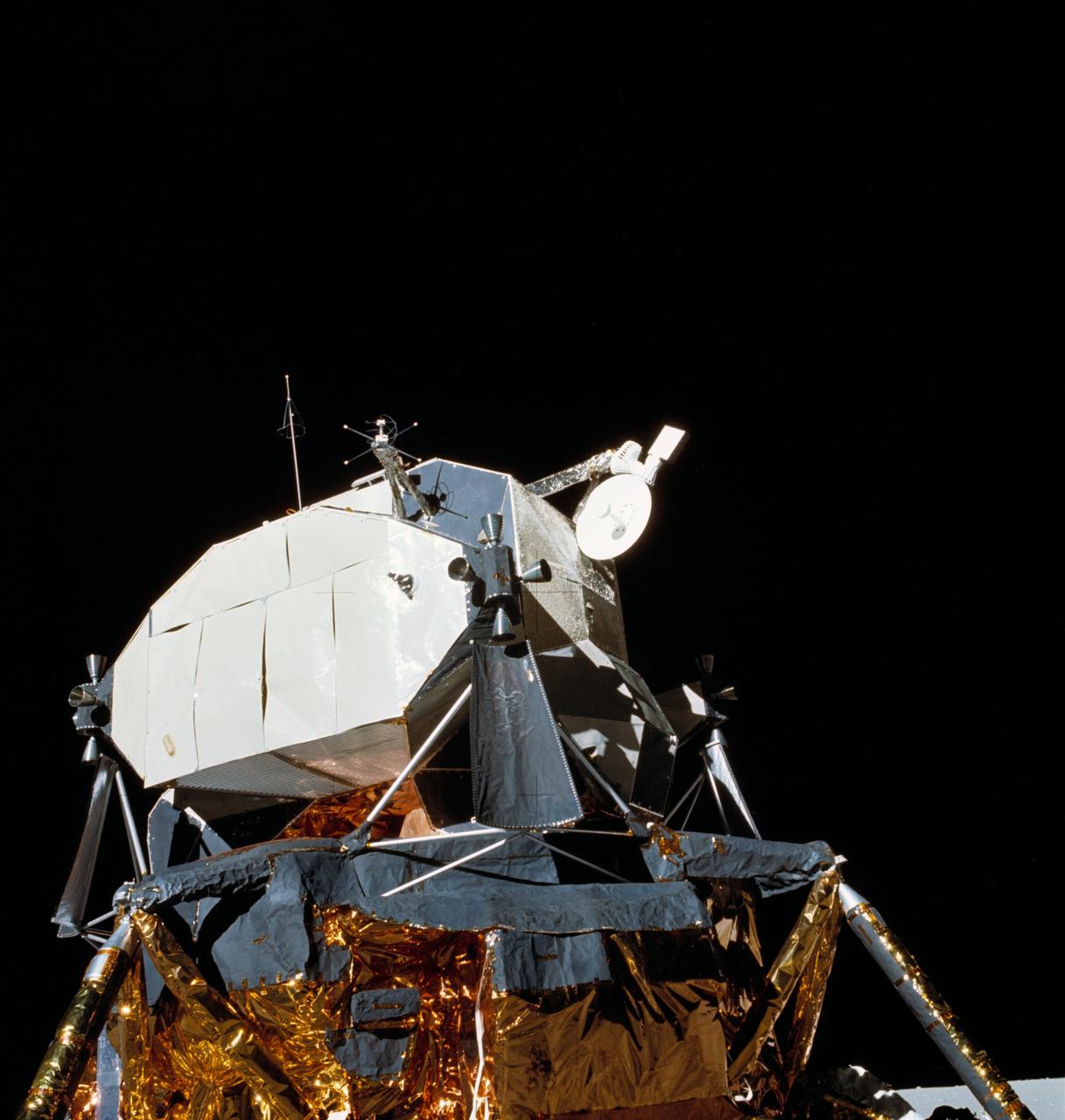
AS16-113-18334 (21 April 1972) --- View of the Lunar Module (LM) "Orion" parked on the lunar surface. During their post mission press conference, the Apollo 16 crewmembers called attention to the steerable S-band antenna, which was "frozen" in a yaw axis during much of the flight. This view of the LM was photographed by astronaut Charles M. Duke Jr., the lunar module pilot, during the mission's first extravehicular activity (EVA). Astronauts John W. Young, commander, and Duke had earlier descended in the LM to explore the Descartes region of the moon, while astronaut Thomas K. Mattingly II, command module pilot, remained with the Command and Service Modules (CSM) "Casper" in lunar orbit.
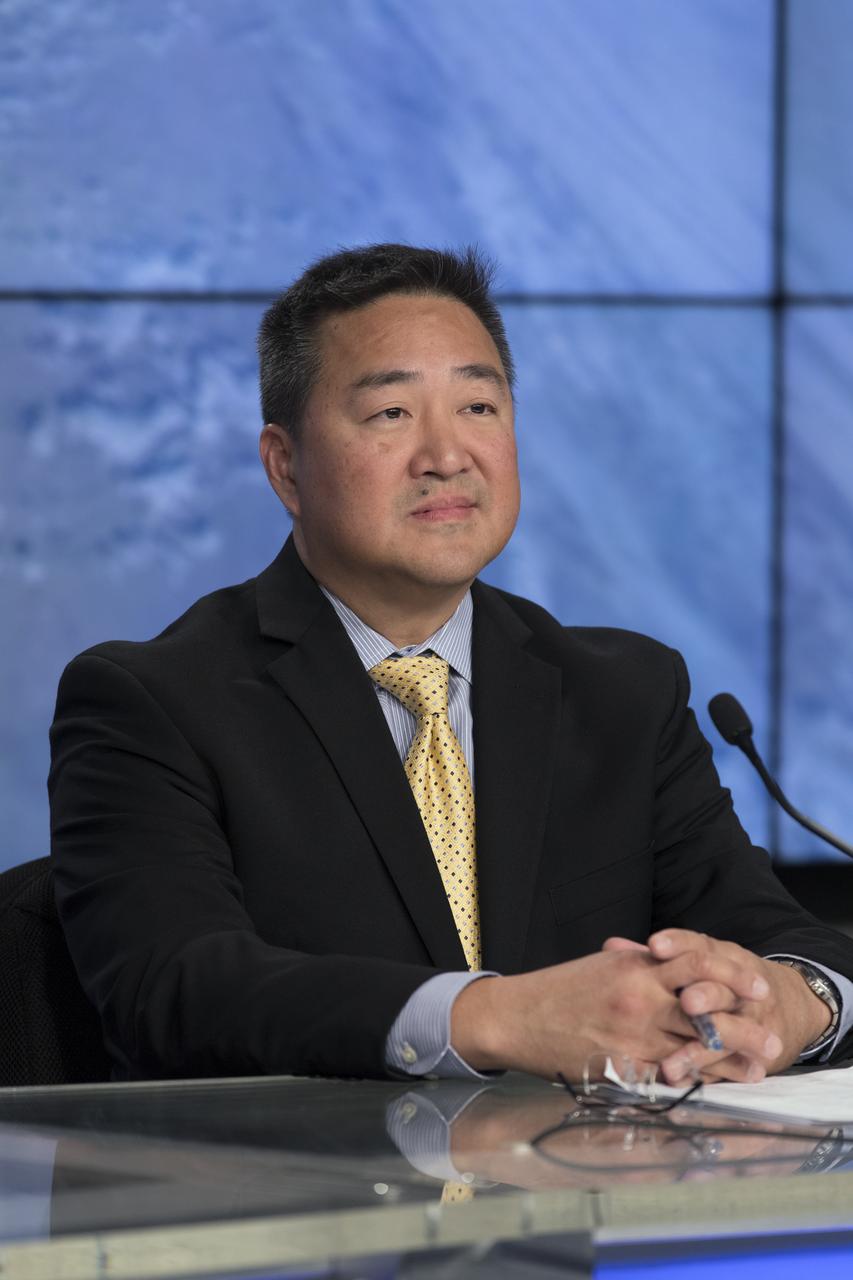
In the Press Site auditorium of NASA's Kennedy Space Center in Florida, from left, Ven Feng, manager of the Transportation Integration Office for the International Space Station Program, speaks to media at a post-launch news conference following the liftoff of SpaceX CRS-13. The flight is a commercial resupply services mission to the International Space Station. SpaceX CRS-13 lifted off atop a Falcon 9 rocket from Space Launch Complex 40 at Cape Canaveral Air Force Station at 10:36 a.m. EST with supplies and equipment and new science experiments for technology research.
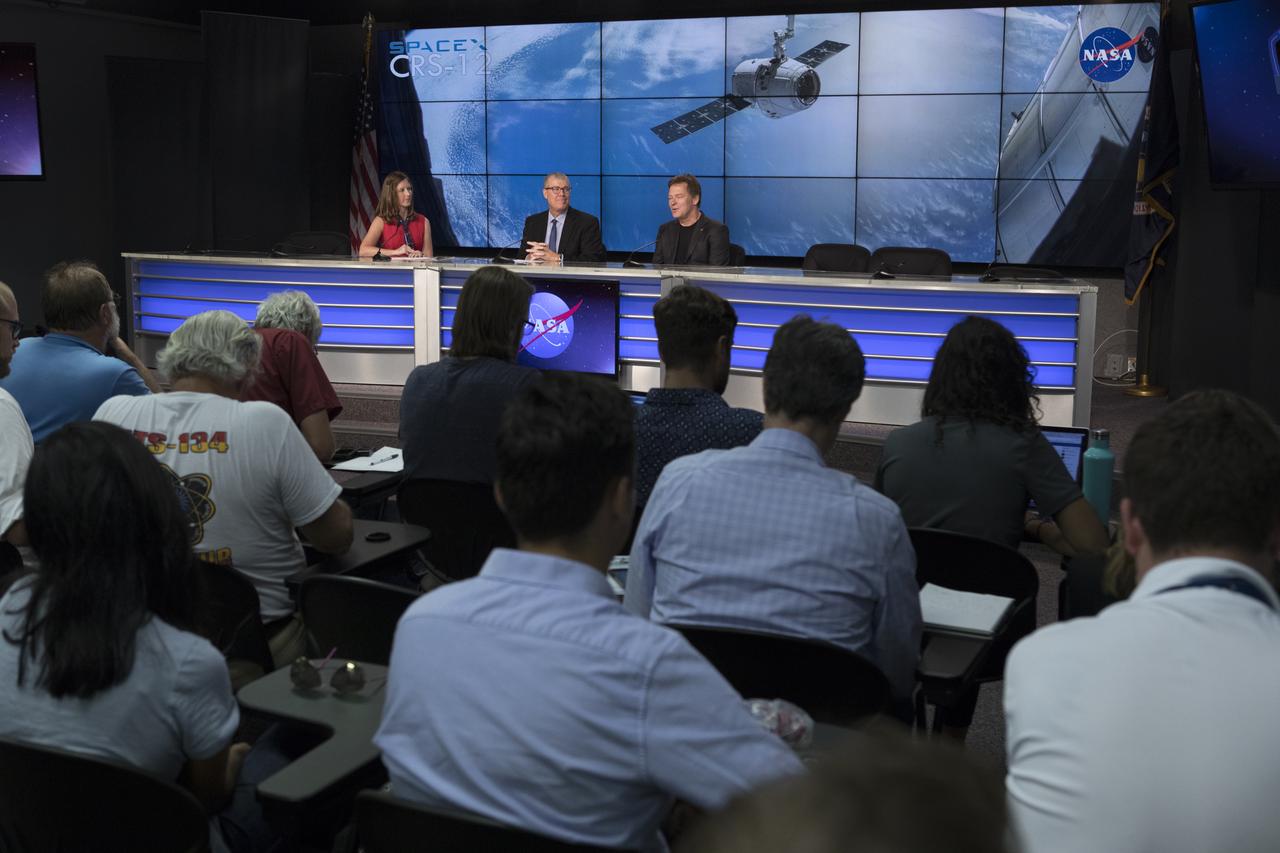
In the Press Site auditorium of NASA's Kennedy Space Center in Florida, NASA and industry leaders speak to media at a post-launch news conference following the liftoff of SpaceX CRS-12, a commercial resupply services mission to the International Space Station. From left are: Stephanie Martin of NASA Communications, Dan Hartman, NASA deputy manager of the International Space Station Program, and Hans Koenigsmann, SpaceX vice president of Flight and Build Reliability. SpaceX CRS-12 lifted off atop a Falcon 9 rocket from Kennedy's Launch Complex 39A at 12:31 p.m. EDT.
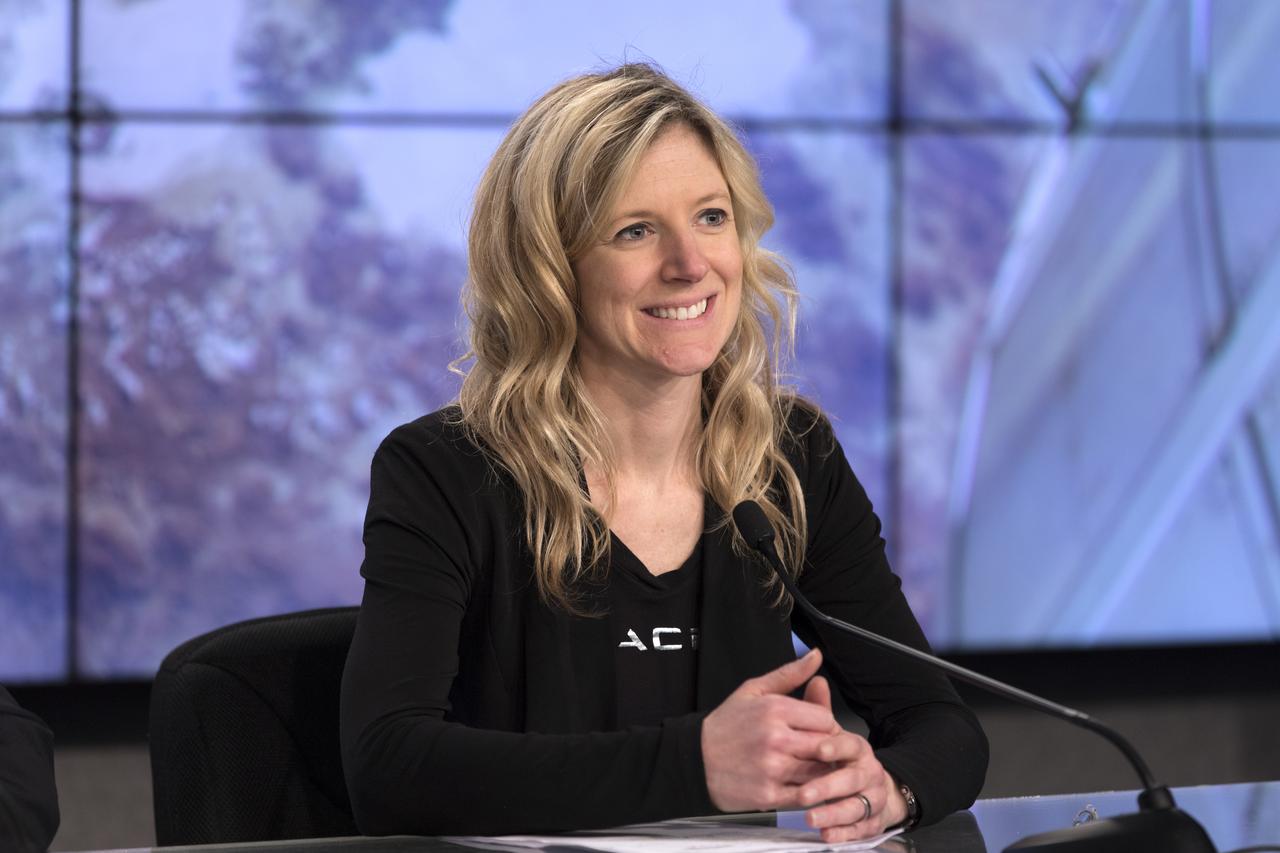
In the Press Site auditorium of NASA's Kennedy Space Center in Florida, Jessica Jensen, SpaceX director of Dragon Mission Management, speaks to media at a post-launch news conference following the liftoff of the SpaceX Falcon 9 rocket at 4:30 p.m. EST. The flight is a commercial resupply services mission for NASA to the International Space Station. SpaceX CRS-14 lifted off atop the Falcon 9 rocket from Space Launch Complex 40 at Cape Canaveral Air Force Station carrying supplies and equipment and new science experiments for technology research.
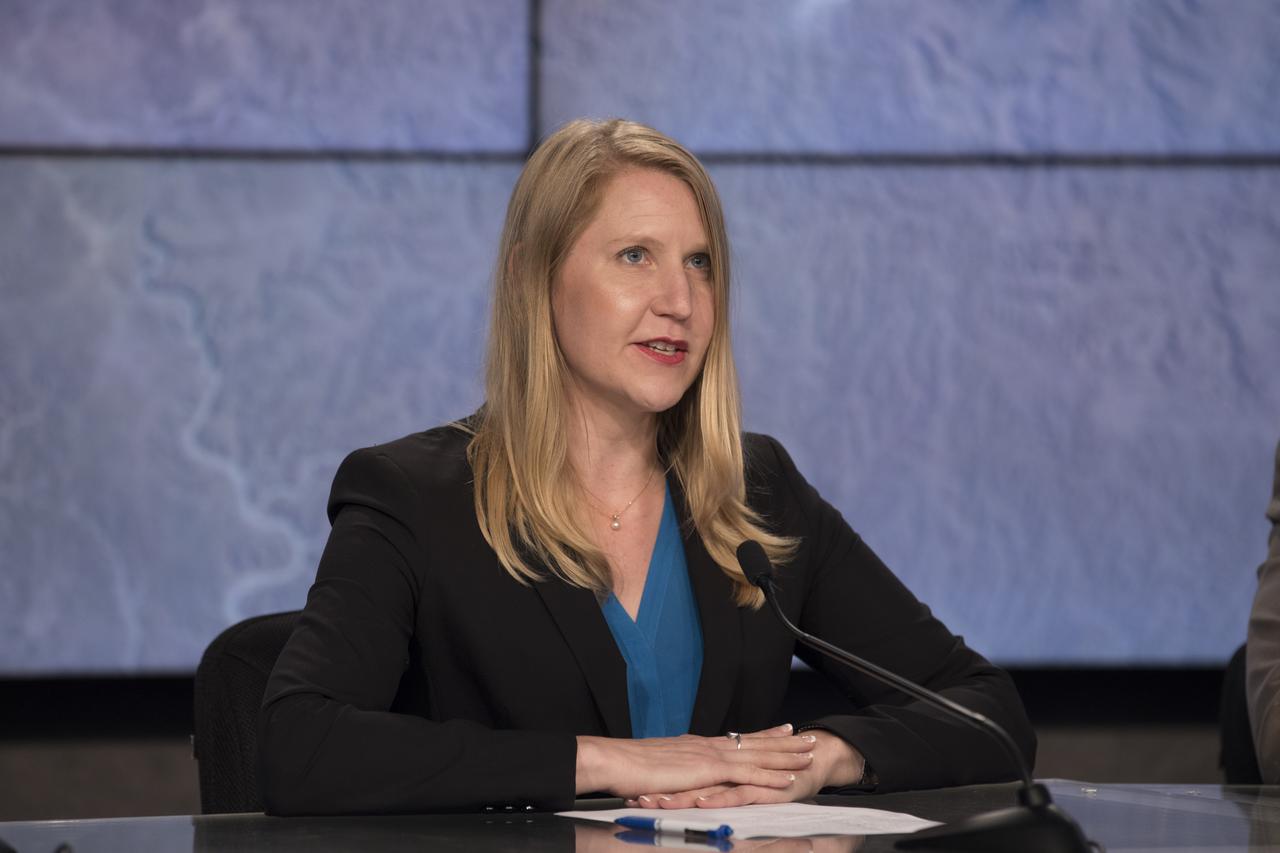
In the Press Site auditorium of NASA's Kennedy Space Center in Florida, Stephanie Schierholz of NASA Communications speaks to media at a post-launch news conference following the liftoff of SpaceX CRS-15. The flight is a commercial resupply services mission to the International Space Station. SpaceX CRS-15 lifted off atop a Falcon 9 rocket from Space Launch Complex 40 at Cape Canaveral Air Force Station on Friday, June 29, 2018, at 5:42 a.m. EDT with supplies and materials to support multiple critical science and research investigations.
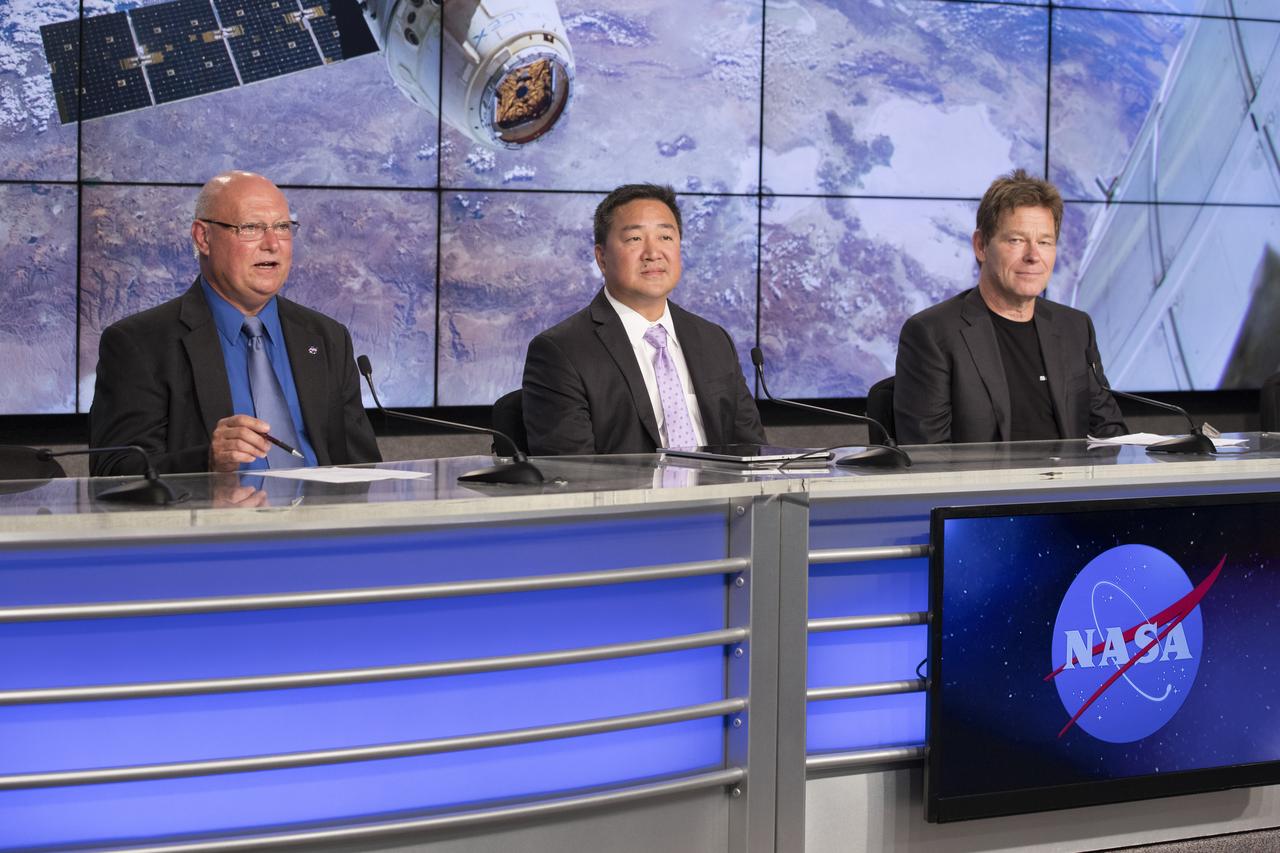
In the Press Site auditorium of NASA's Kennedy Space Center in Florida, NASA and industry leaders speak to media at a post-launch news conference following the liftoff of SpaceX CRS-11, a commercial resupply services mission to the International Space Station. From left are: Mike Curie of NASA Communications, Ven Feng, NASA's manager of the International Space Station Transportation Integration Office, and Hans Koenigsmann, vice president of Flight Reliability for SpaceX. SpaceX CRS-11 lifted off atop a Falcon 9 rocket from Kennedy's Launch Complex 39A at 5:07 p.m. EDT.

In the Press Site auditorium of NASA's Kennedy Space Center in Florida, from left, Ven Feng, manager of the Transportation Integration Office for the International Space Station Program, and Jessica Jensen, SpaceX director of Dragon Mission Management, speak to media at a post-launch news conference following the liftoff of SpaceX CRS-13. The flight is a commercial resupply services mission to the International Space Station. SpaceX CRS-13 lifted off atop a Falcon 9 rocket from Space Launch Complex 40 at Cape Canaveral Air Force Station at 10:36 a.m. EST with supplies and equipment and new science experiments for technology research.
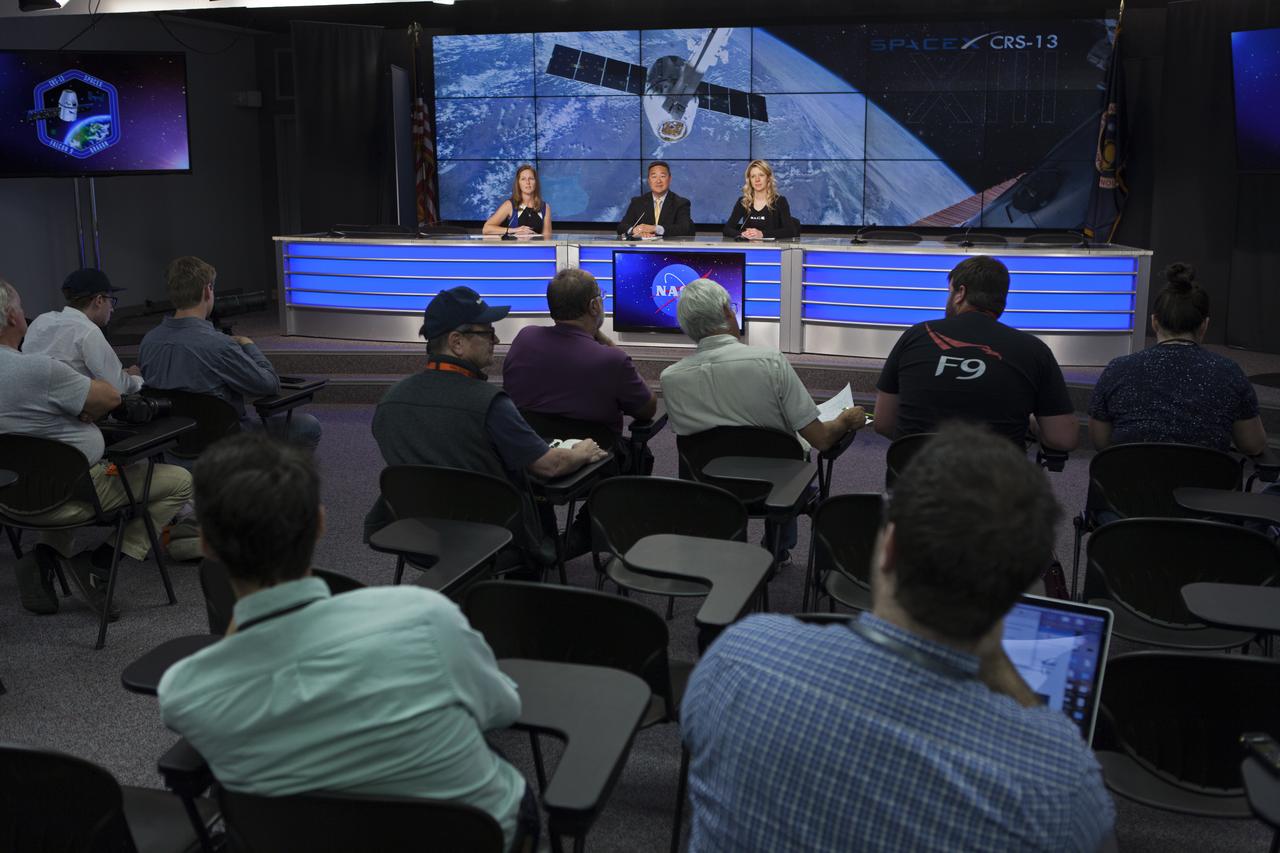
In the Press Site auditorium of NASA's Kennedy Space Center in Florida, from left, Stephanie Martin of NASA Communications, Ven Feng, manager of the Transportation Integration Office for the International Space Station Program, and Jessica Jensen, SpaceX director of Dragon Mission Management, speak to media at a post-launch news conference following the liftoff of SpaceX CRS-13. The flight is a commercial resupply services mission to the International Space Station. SpaceX CRS-13 lifted off atop a Falcon 9 rocket from Space Launch Complex 40 at Cape Canaveral Air Force Station at 10:36 a.m. EST with supplies and equipment and new science experiments for technology research.
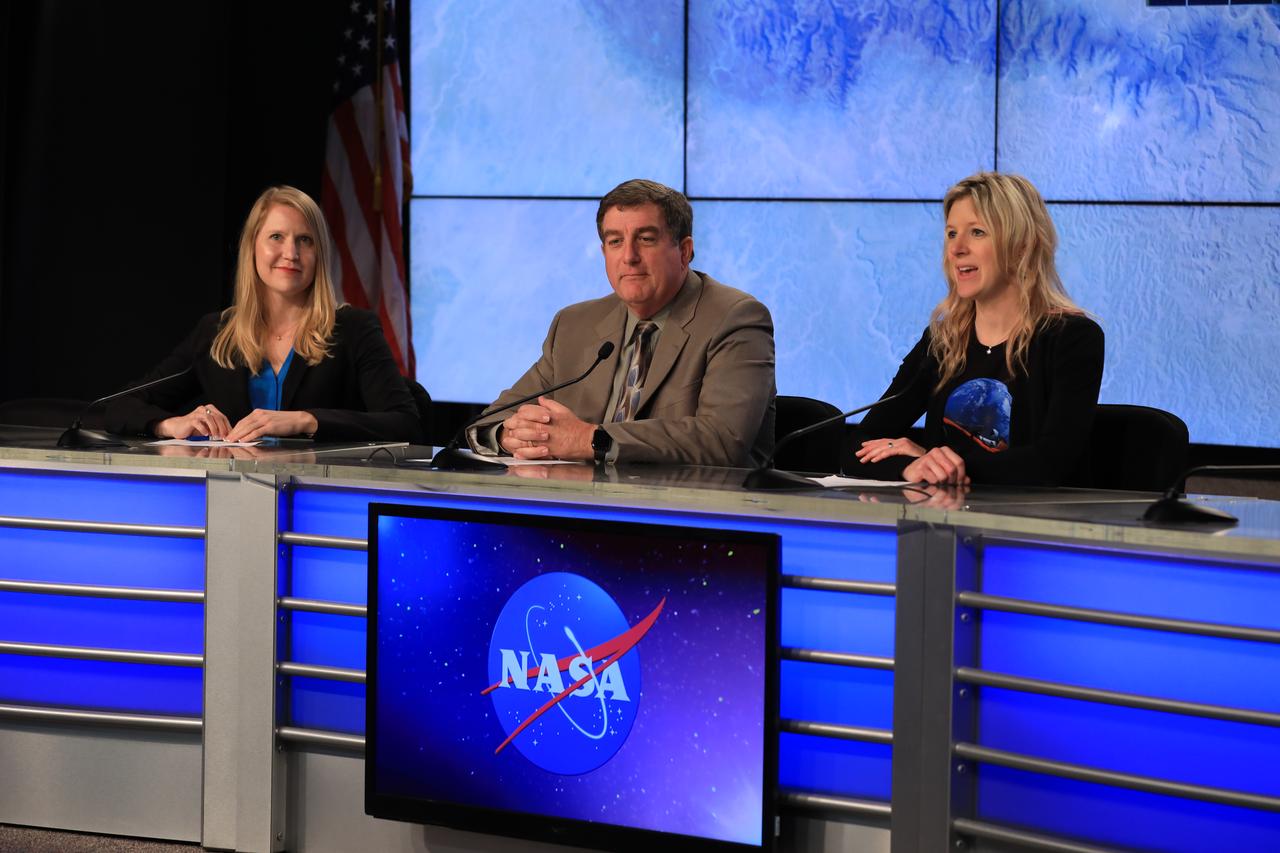
In the Press Site auditorium of NASA's Kennedy Space Center in Florida, from left, Stephanie Schierholz of NASA Communications, Kirk Shireman, manager, International Space Station Program, and Jessica Jensen, Director, Dragon Mission Management, SpaceX, speak to media at a post-launch news conference following the liftoff of SpaceX CRS-15. The flight is a commercial resupply services mission to the International Space Station. SpaceX CRS-15 lifted off atop a Falcon 9 rocket from Space Launch Complex 40 at Cape Canaveral Air Force Station on Friday, June 29, 2018, at 5:42 a.m. EDT with supplies and materials to support multiple critical science and research investigations.
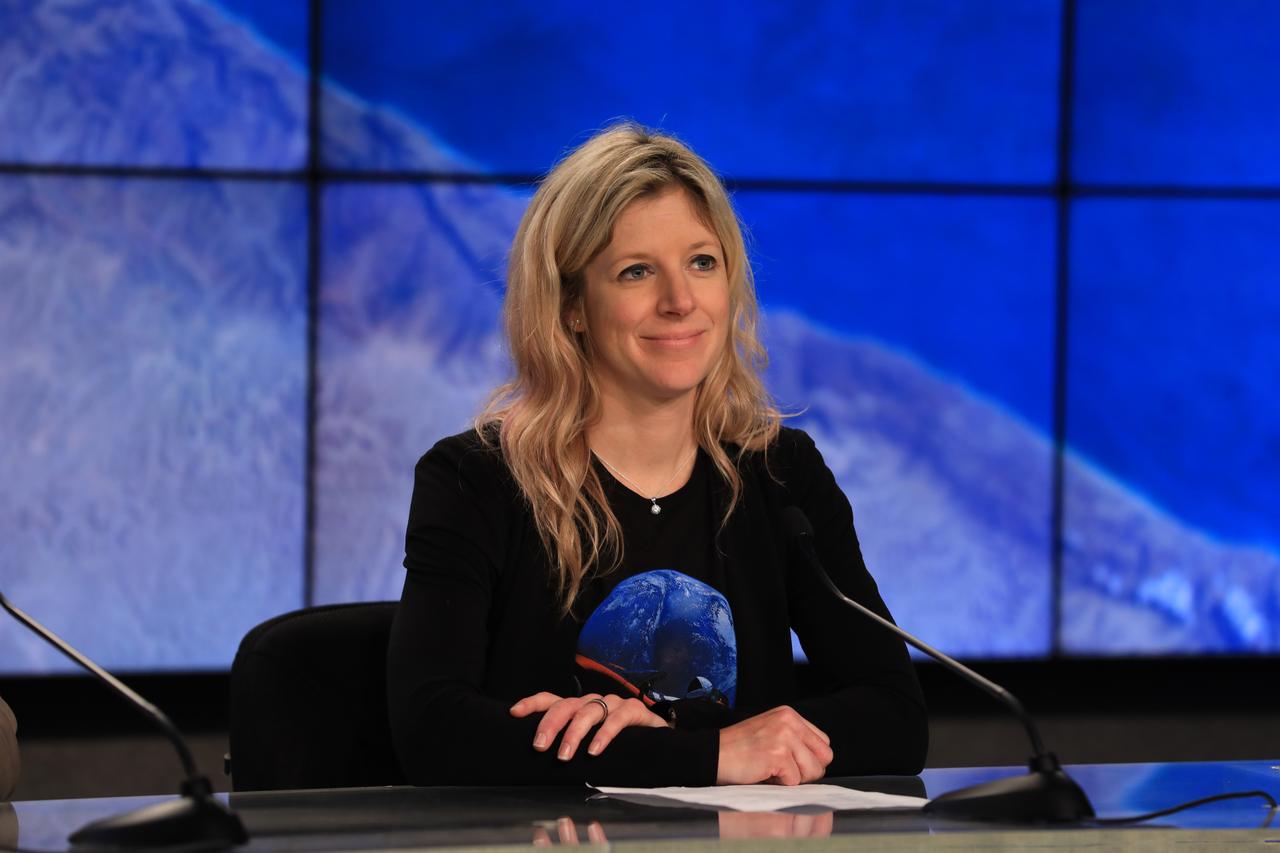
In the Press Site auditorium of NASA's Kennedy Space Center in Florida, Jessica Jensen, Director, Dragon Mission Management, SpaceX, speaks to media at a post-launch news conference following the liftoff of SpaceX CRS-15. The flight is a commercial resupply services mission to the International Space Station. SpaceX CRS-15 lifted off atop a Falcon 9 rocket from Space Launch Complex 40 at Cape Canaveral Air Force Station on Friday, June 29, 2018, at 5:42 a.m. EDT with supplies and materials to support multiple critical science and research investigations.
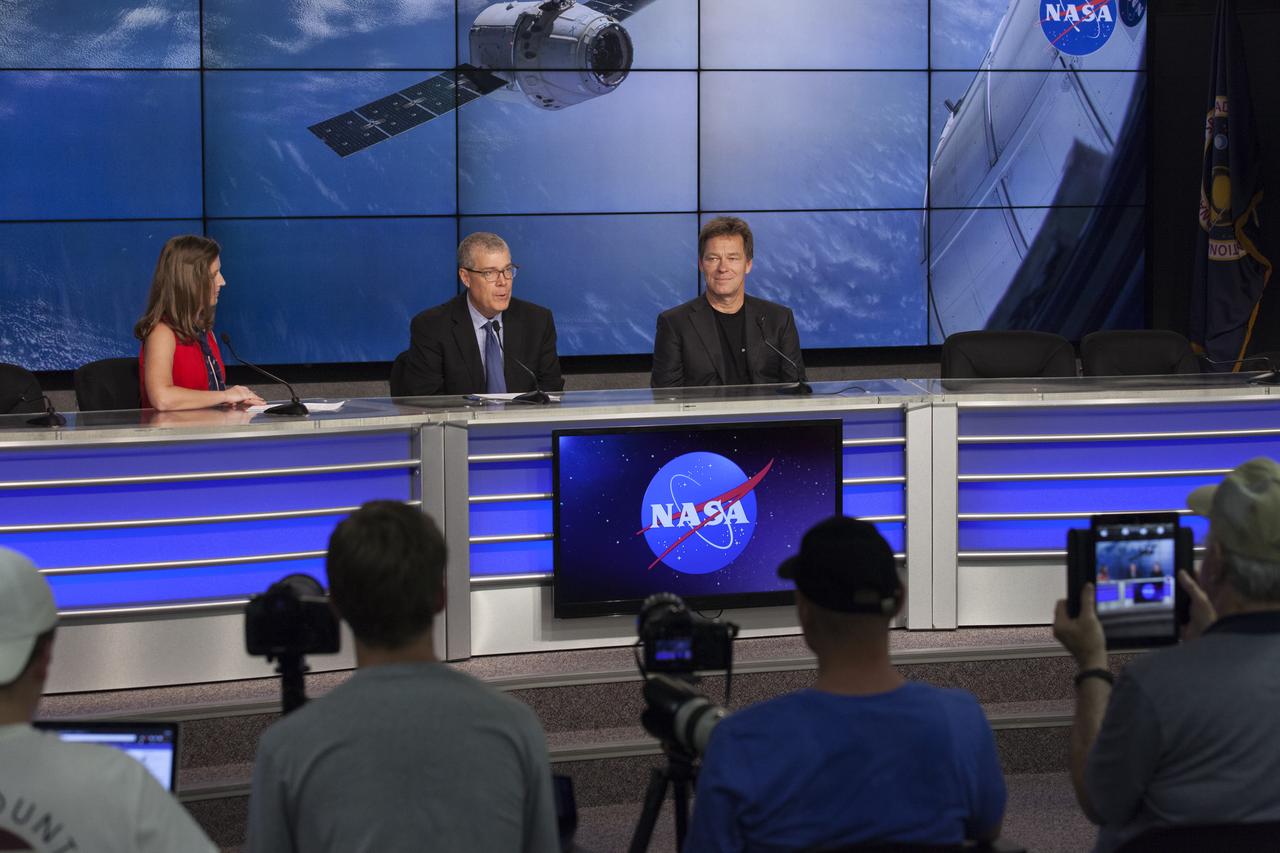
In the Press Site auditorium of NASA's Kennedy Space Center in Florida, NASA and industry leaders speak to media at a post-launch news conference following the liftoff of SpaceX CRS-12, a commercial resupply services mission to the International Space Station. From left are: Stephanie Martin of NASA Communications, Dan Hartman, NASA deputy manager of the International Space Station Program, and Hans Koenigsmann, SpaceX vice president of Flight and Build Reliability. SpaceX CRS-12 lifted off atop a Falcon 9 rocket from Kennedy's Launch Complex 39A at 12:31 p.m. EDT.
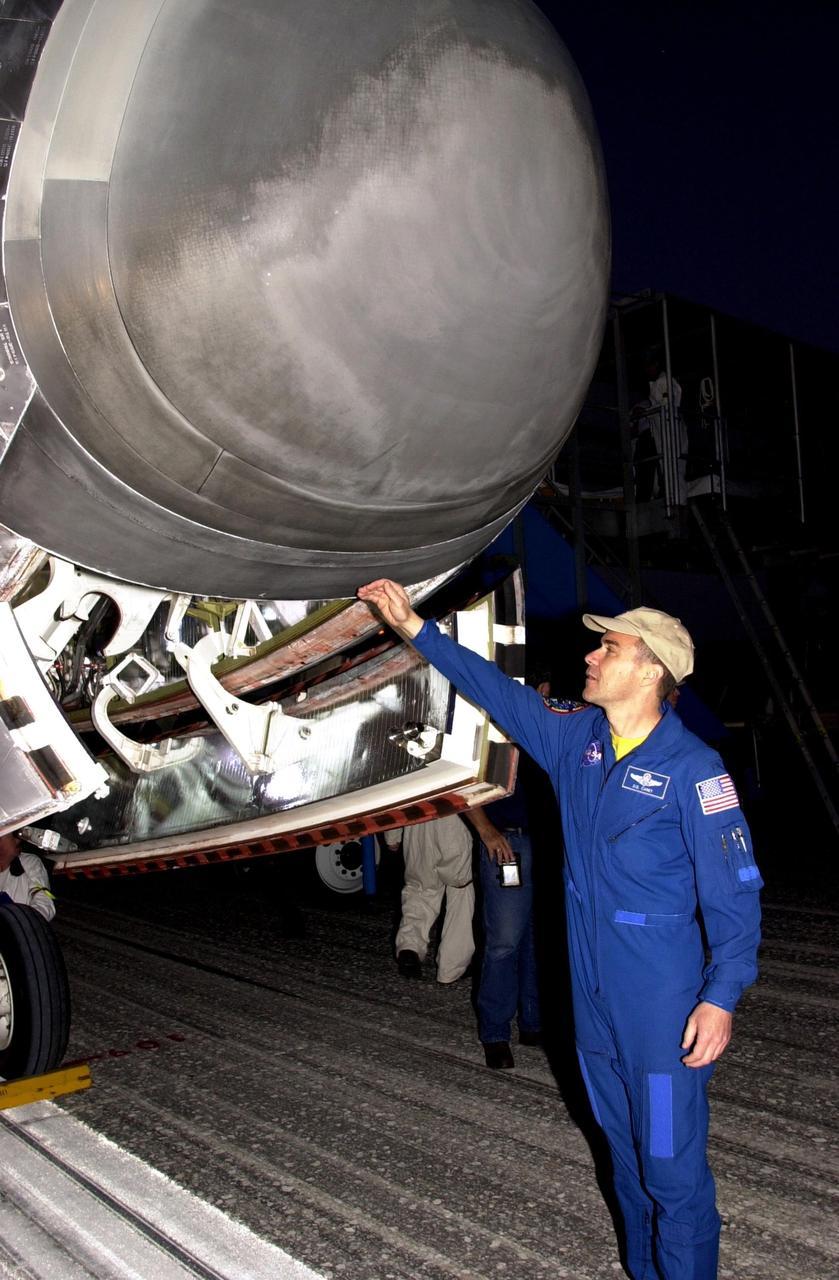
KENNEDY SPACE CENTER, FLA. -- During a post-flight walk around orbiter Columbia at the Shuttle Landing Facility, STS-109 Pilot Duane Carey gingerly checks the heat of the nose cone. The crew returned to Earth after an 11-day mission servicing the Hubble Space Telescope. Wheel stop occurred on orbit 165 at 4:33:09 a.m. EST. Main gear touchdown occurred at 4:31:52 a.m. and nose wheel touchdown at 4:32:02. Rollout time was 1 minute, 17 seconds. This was the 58th landing at KSC out of 108 missions in the history of the Shuttle program
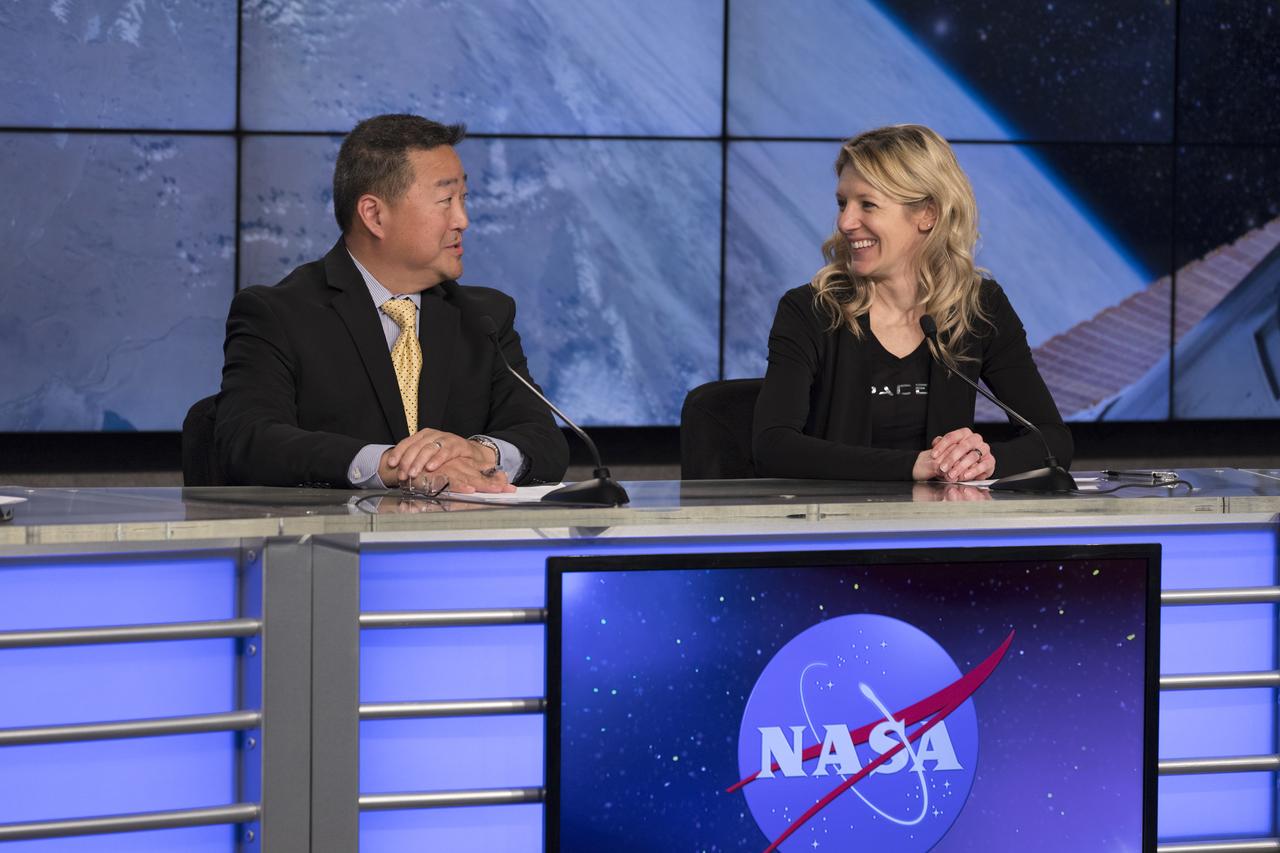
In the Press Site auditorium of NASA's Kennedy Space Center in Florida, from left, Ven Feng, manager of the Transportation Integration Office for the International Space Station Program, and Jessica Jensen, SpaceX director of Dragon Mission Management, speak to media at a post-launch news conference following the liftoff of SpaceX CRS-13. The flight is a commercial resupply services mission to the International Space Station. SpaceX CRS-13 lifted off atop a Falcon 9 rocket from Space Launch Complex 40 at Cape Canaveral Air Force Station at 10:36 a.m. EST with supplies and equipment and new science experiments for technology research.
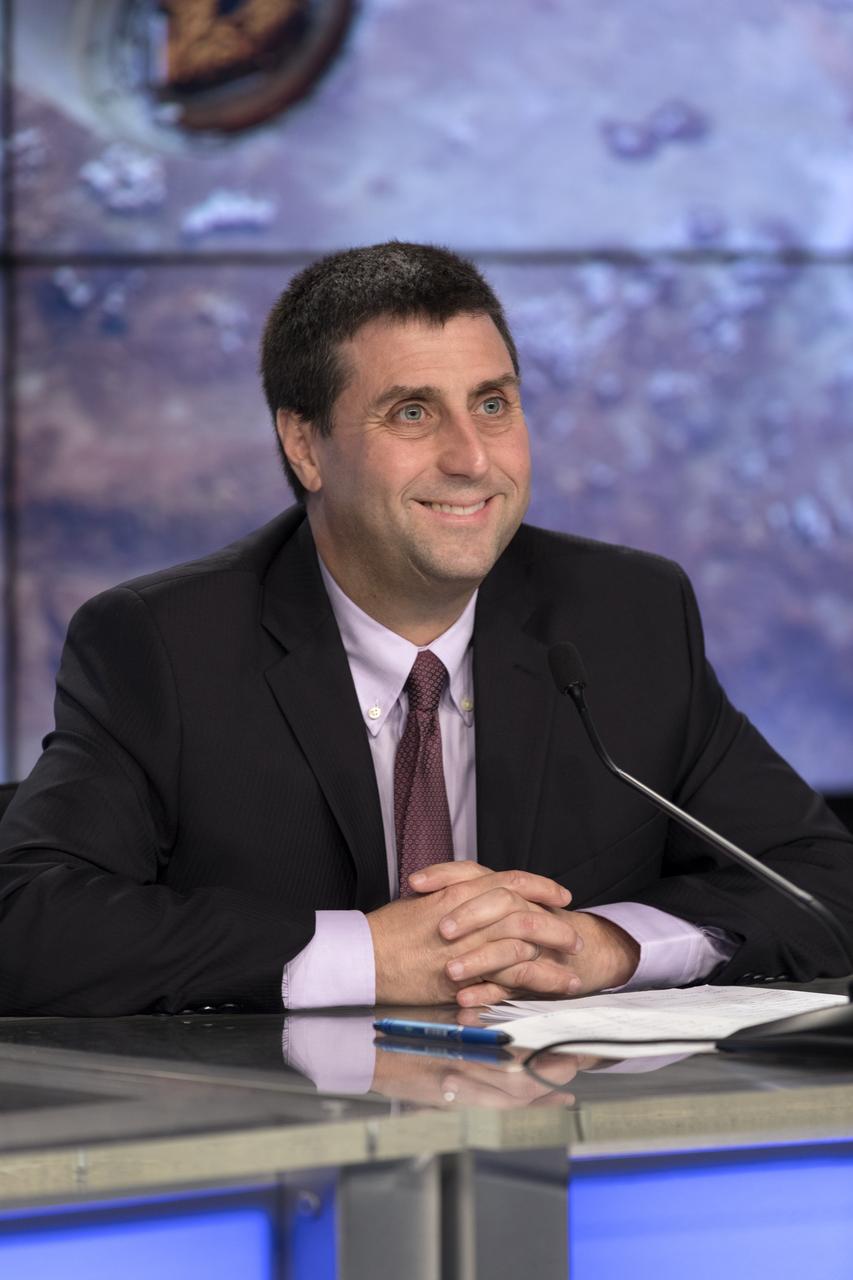
In the Press Site auditorium of NASA's Kennedy Space Center in Florida,Joel Montalbano, deputy manager, International Space Station Program manager at NASA's Johnson Space Center in Houston, speaks to media at a post-launch news conference following the liftoff of the SpaceX Falcon 9 rocket at 4:30 p.m. EST. The flight is a commercial resupply services mission for NASA to the International Space Station. SpaceX CRS-14 lifted off atop the Falcon 9 rocket from Space Launch Complex 40 at Cape Canaveral Air Force Station carrying supplies and equipment and new science experiments for technology research.
In the Press Site auditorium of NASA's Kennedy Space Center in Florida, from left, Stephanie Schierholz of NASA Communications, Kirk Shireman, manager, International Space Station Program, and Jessica Jensen, Director, Dragon Mission Management, SpaceX, speak to media at a post-launch news conference following the liftoff of SpaceX CRS-15. The flight is a commercial resupply services mission to the International Space Station. SpaceX CRS-15 lifted off atop a Falcon 9 rocket from Space Launch Complex 40 at Cape Canaveral Air Force Station on Friday, June 29, 2018, at 5:42 a.m. EDT with supplies and materials to support multiple critical science and research investigations.
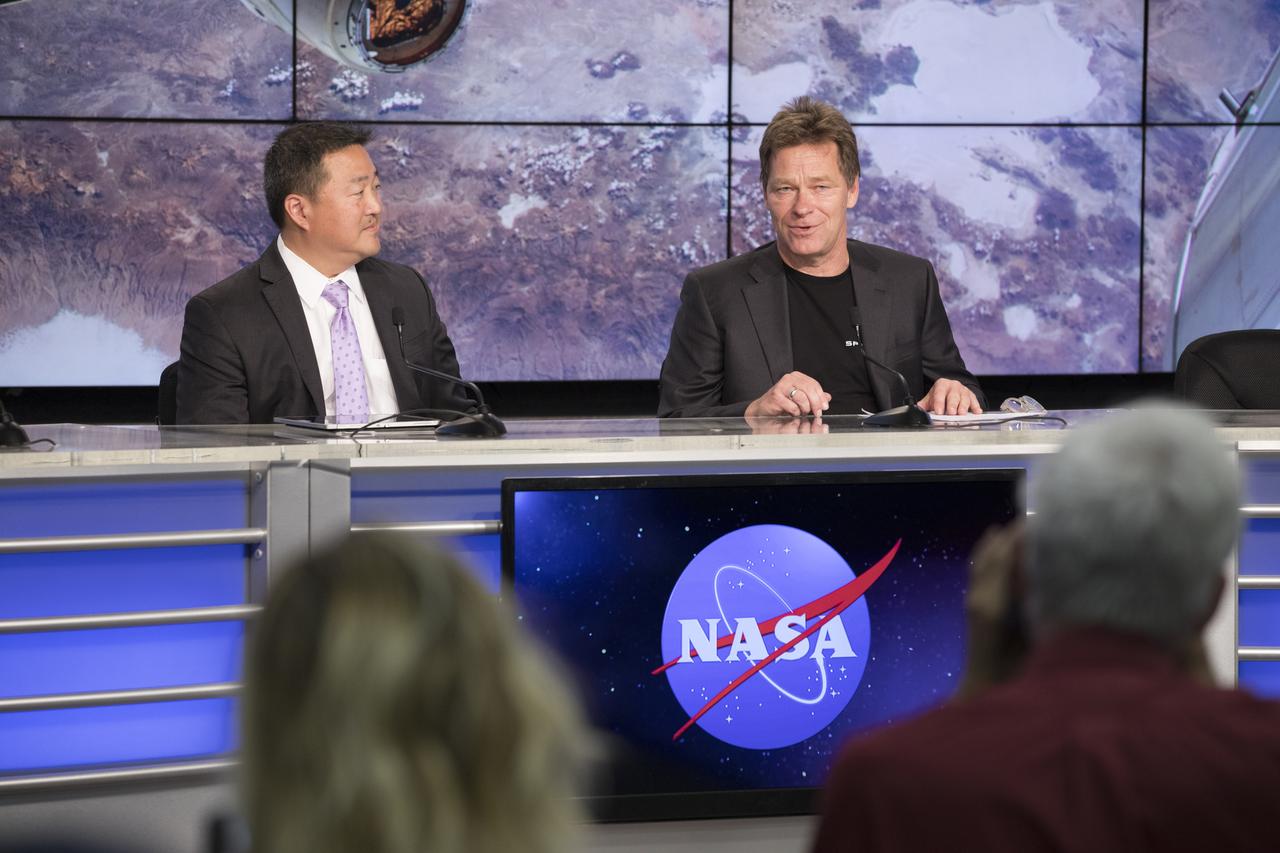
In the Press Site auditorium of NASA's Kennedy Space Center in Florida, NASA and industry leaders speak to media at a post-launch news conference following the liftoff of SpaceX CRS-11, a commercial resupply services mission to the International Space Station. From left are: Ven Feng, NASA's manager of the International Space Station Transportation Integration Office, and Hans Koenigsmann, vice president of Flight Reliability for SpaceX. SpaceX CRS-11 lifted off atop a Falcon 9 rocket from Kennedy's Launch Complex 39A at 5:07 p.m. EDT.
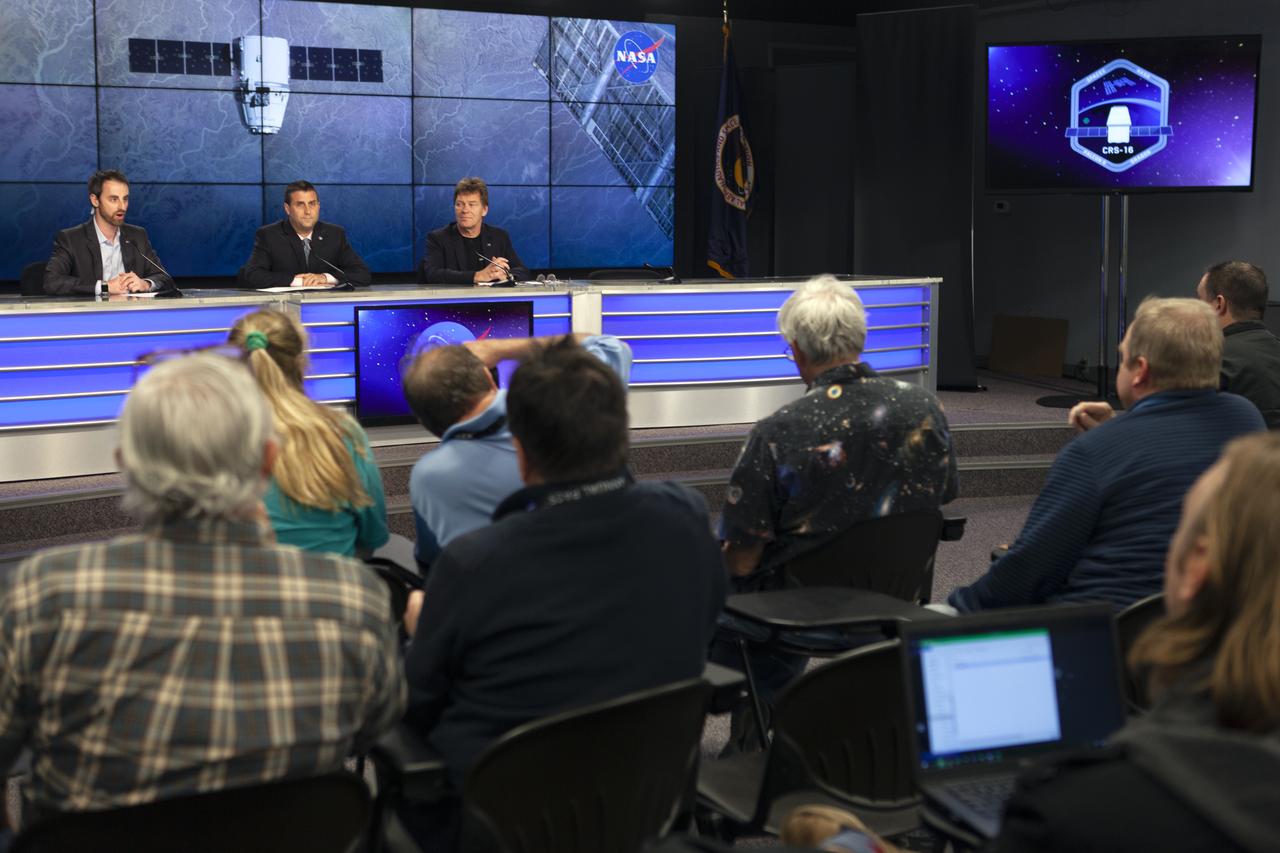
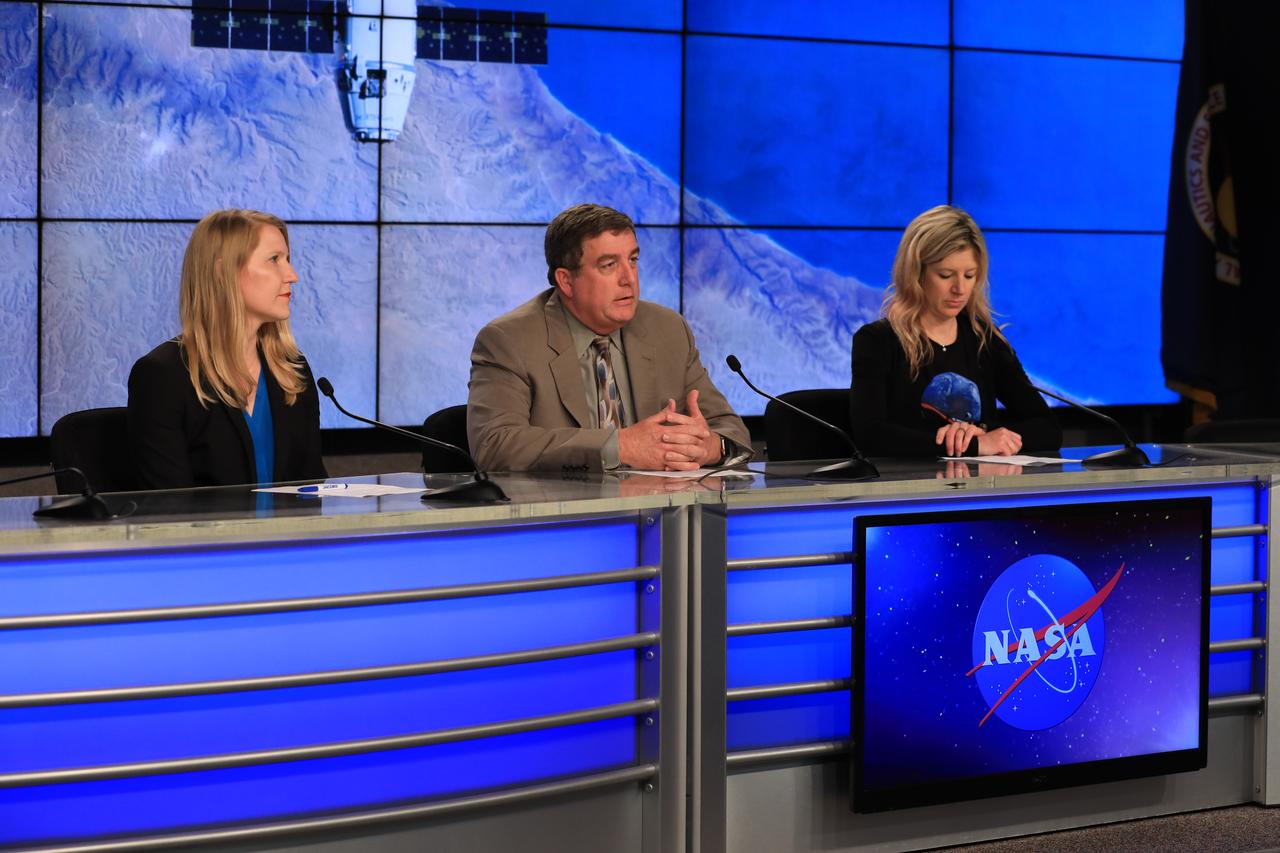
In the Press Site auditorium of NASA's Kennedy Space Center in Florida, from left, Joshua Santora of NASA Communications, Joel Montalbano, deputy International Space Station program manager at NASA's Johnson Space Center in Houston, and Hans Koenigsmann, vice president of Build and Flight Reliability for SpaceX, speak to media at a post-launch news conference following the liftoff of SpaceX CRS-16. The flight is a commercial resupply services mission to the International Space Station. SpaceX CRS-16 lifted off atop a Falcon 9 rocket from Space Launch Complex 40 at Cape Canaveral Air Force Station at 1:16 p.m. EST, Dec. 5, 2018, with supplies and equipment and new science experiments for technology research.
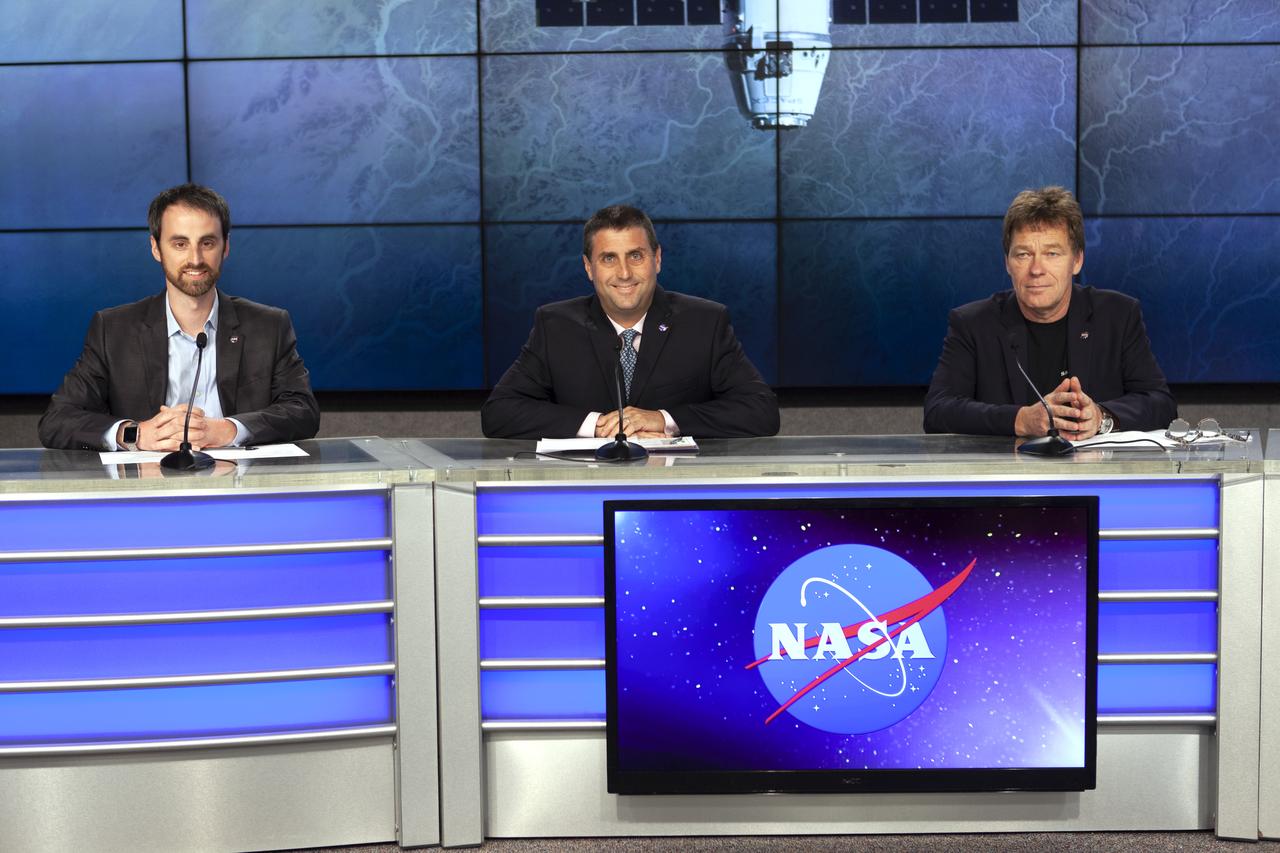
In the Press Site auditorium of NASA's Kennedy Space Center in Florida, from left, Joshua Santora of NASA Communications, Joel Montalbano, deputy International Space Station program manager at NASA's Johnson Space Center in Houston, and Hans Koenigsmann, vice president of Build and Flight Reliability for SpaceX, speak to media at a post-launch news conference following the liftoff of SpaceX CRS-16. The flight is a commercial resupply services mission to the International Space Station. SpaceX CRS-16 lifted off atop a Falcon 9 rocket from Space Launch Complex 40 at Cape Canaveral Air Force Station at 1:16 p.m. EST, Dec. 5, 2018, with supplies and equipment and new science experiments for technology research.
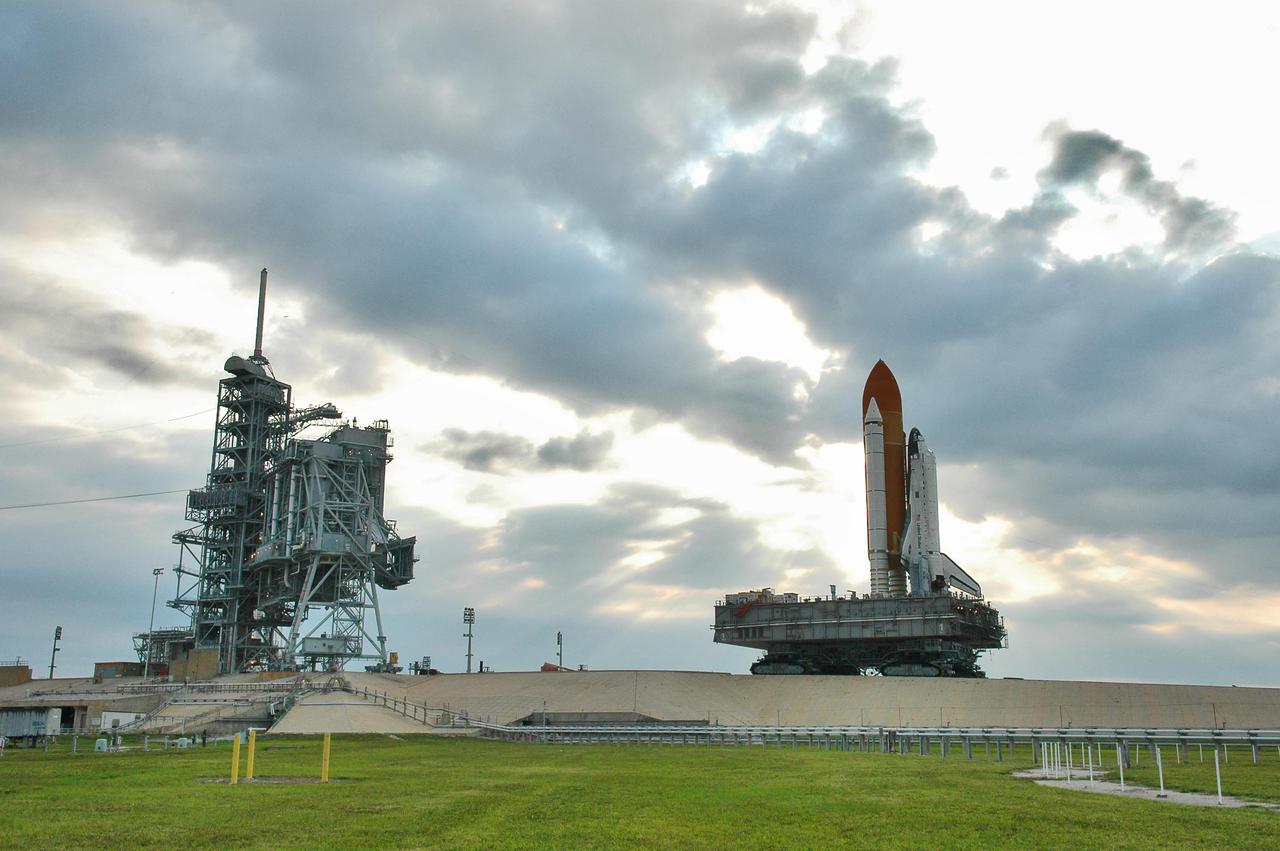
KENNEDY SPACE CENTER, FLA. - Space Shuttle Discovery, resting on the Mobile Launcher Platform, looms against post-dawn cloudy skies as it slowly rolls off Launch Pad 39B on its way back to the Vehicle Assembly Building. At left are the Rotating and Fixed Service Structures (RSS and FSS). Atop the FSS is the 80-foot lightning mast. Once inside the VAB, Discovery will be demated from its External Tank and lifted into the transfer aisle. On or about June 7, Discovery will be lifted and attached to its new tank and Solid Rocket Boosters, which are already in the VAB. Only the 15th rollback in Space Shuttle Program history, the 4.2-mile journey allows additional modifications to be made to the External Tank prior to a safe Return to Flight. Discovery is expected to be rolled back to the launch pad in mid-June for Return to Flight mission STS-114. The launch window extends from July 13 to July 31.

The NASA Dryden 747 Shuttle Carrier Aircraft crew poses in an engine inlet; Standing L to R - aircraft mechanic John Goleno and SCA Team Leader Pete Seidl; Kneeling L to R - aircraft mechanics Todd Weston and Arvid Knutson, and avionics technician Jim Bedard NASA uses two modified Boeing 747 jetliners, originally manufactured for commercial use, as Space Shuttle Carrier Aircraft (SCA). One is a 747-100 model, while the other is designated a 747-100SR (short range). The two aircraft are identical in appearance and in their performance as Shuttle Carrier Aircraft. The 747 series of aircraft are four-engine intercontinental-range swept-wing "jumbo jets" that entered commercial service in 1969. The SCAs are used to ferry space shuttle orbiters from landing sites back to the launch complex at the Kennedy Space Center, and also to and from other locations too distant for the orbiters to be delivered by ground transportation. The orbiters are placed atop the SCAs by Mate-Demate Devices, large gantry-like structures which hoist the orbiters off the ground for post-flight servicing, and then mate them with the SCAs for ferry flights.
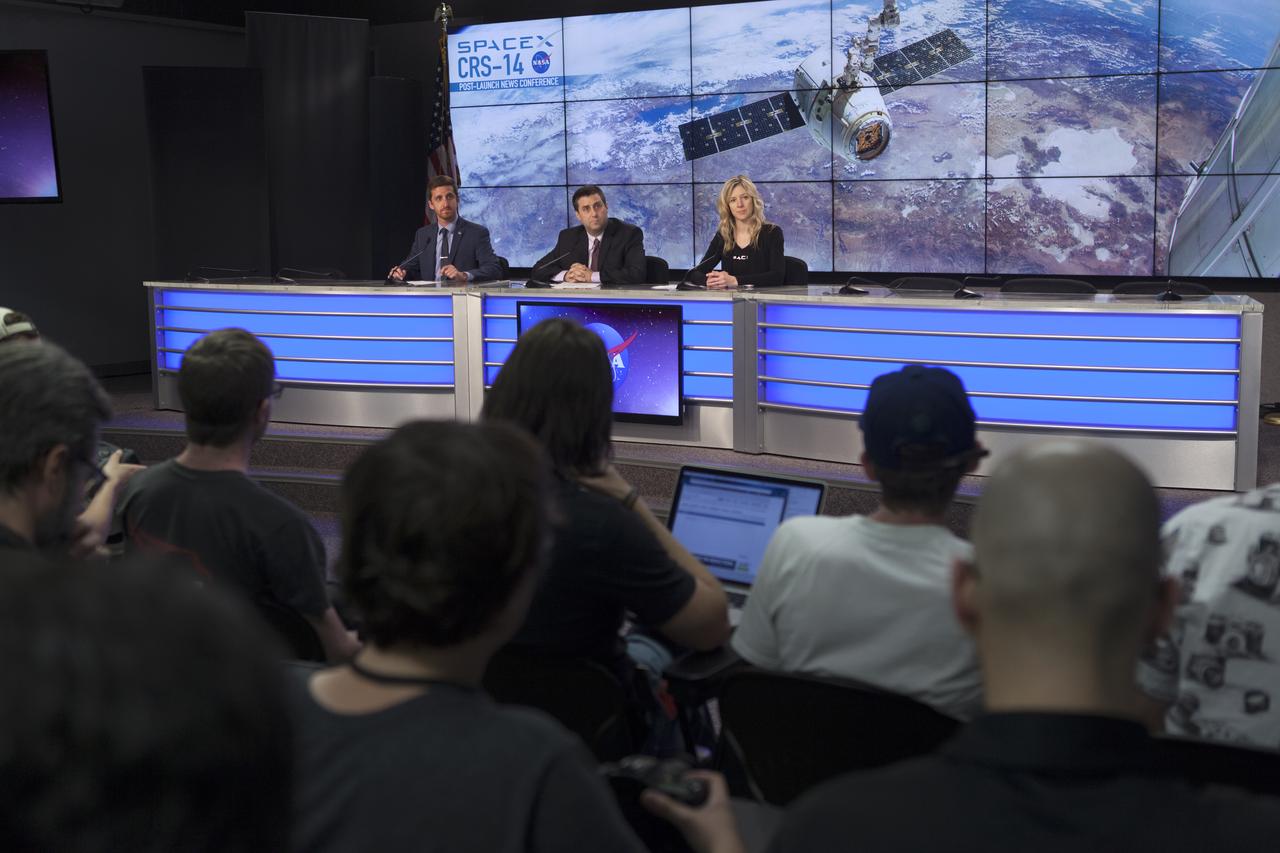
In the Press Site auditorium of NASA's Kennedy Space Center in Florida, from left, Josh Finch of NASA Communications, Joel Montalbano, deputy manager, International Space Station Program manager at NASA's Johnson Space Center in Houston, and Jessica Jensen, SpaceX director of Dragon Mission Management, speak to media at a post-launch news conference following the liftoff of the SpaceX Falcon 9 rocket at 4:30 p.m. EST. The flight is a commercial resupply services mission for NASA to the International Space Station. SpaceX CRS-14 lifted off atop the Falcon 9 rocket from Space Launch Complex 40 at Cape Canaveral Air Force Station carrying supplies and equipment and new science experiments for technology research.
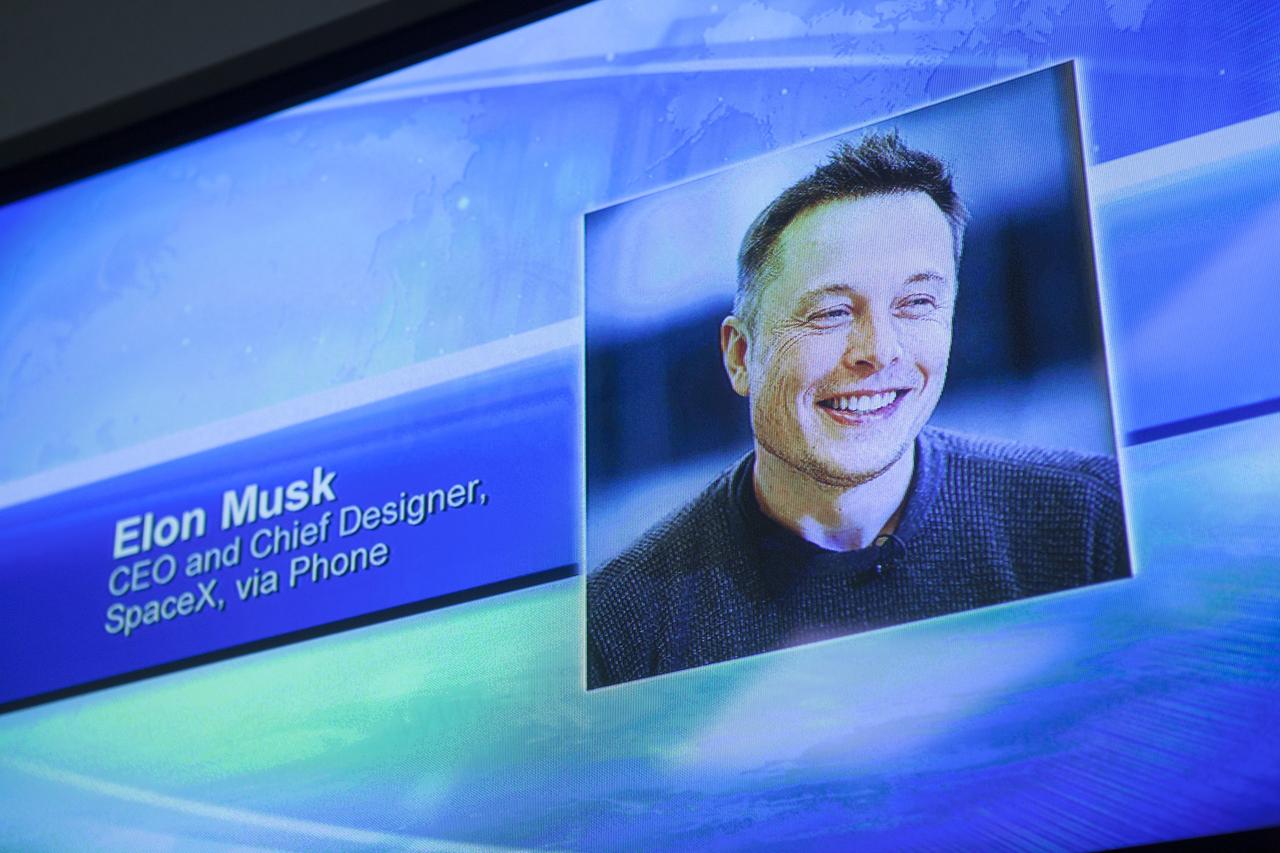
CAPE CANAVERAL, Fla. - An image of SpaceX CEO and chief designer Elon Musk is displayed in the NASA Press Site news auditorium at Kennedy Space Center in Florida during a SpaceX-3 post-launch news conference. Musk participated in the conference by telephone. SpaceX-3 launched at 3:25 p.m. EDT aboard a Falcon 9 rocket carrying a Dragon capsule from Space Launch Complex 40 on Cape Canaveral Air Force Station. Dragon is making its fourth trip to the space station. The SpaceX-3 mission, carrying almost 2.5 tons of supplies, technology and science experiments, is the third of 12 flights through a $1.6 billion NASA Commercial Resupply Services contract. Dragon's cargo will support more than 150 experiments that will be conducted during the station's Expeditions 39 and 40. For more information, visit http://www.nasa.gov/mission_pages/station/structure/launch/index.html. Photo credit: NASA/Kim Shiflett
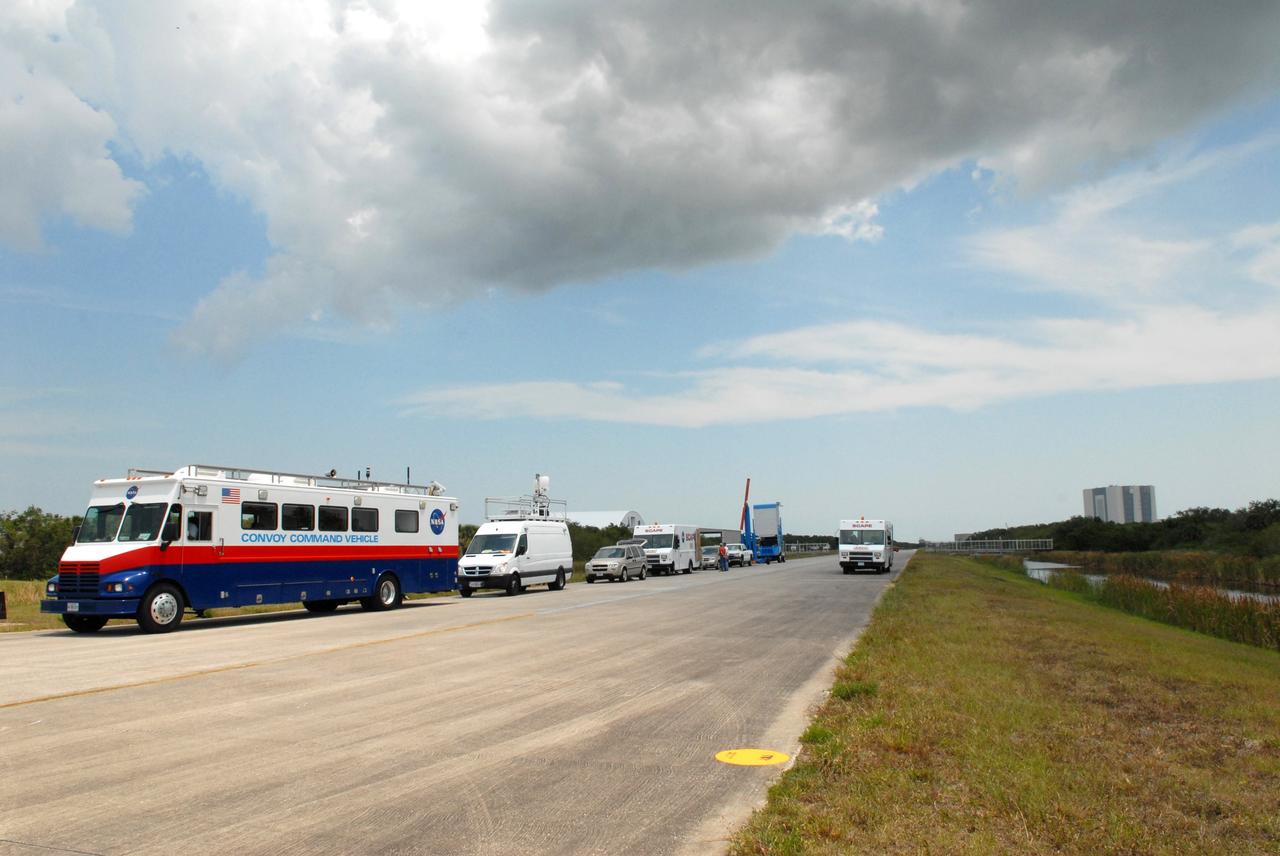
CAPE CANAVERAL, Fla. – The mini-convoy is lined up on the Shuttle Landing Facility runway at NASA's Kennedy Space Center in Florida awaiting space shuttle Atlantis' launch on the STS-125 mission to service NASA's Hubble Space Telescope. The convoy is prepared to act should the shuttle need to return to the launch site in the event of an emergency. At left is the Convoy Command Vehicle which is the command post for the convoy commander. Atlantis launched successfully on time at 2:01 p.m. EDT. Atlantis' 11-day flight will include five spacewalks to refurbish and upgrade the telescope with state-of-the-art science instruments that will expand Hubble's capabilities and extend its operational lifespan through at least 2014. The payload includes a Wide Field Camera 3, Fine Guidance Sensor and the Cosmic Origins Spectrograph. Photo credit: NASA/Jack Pfaller
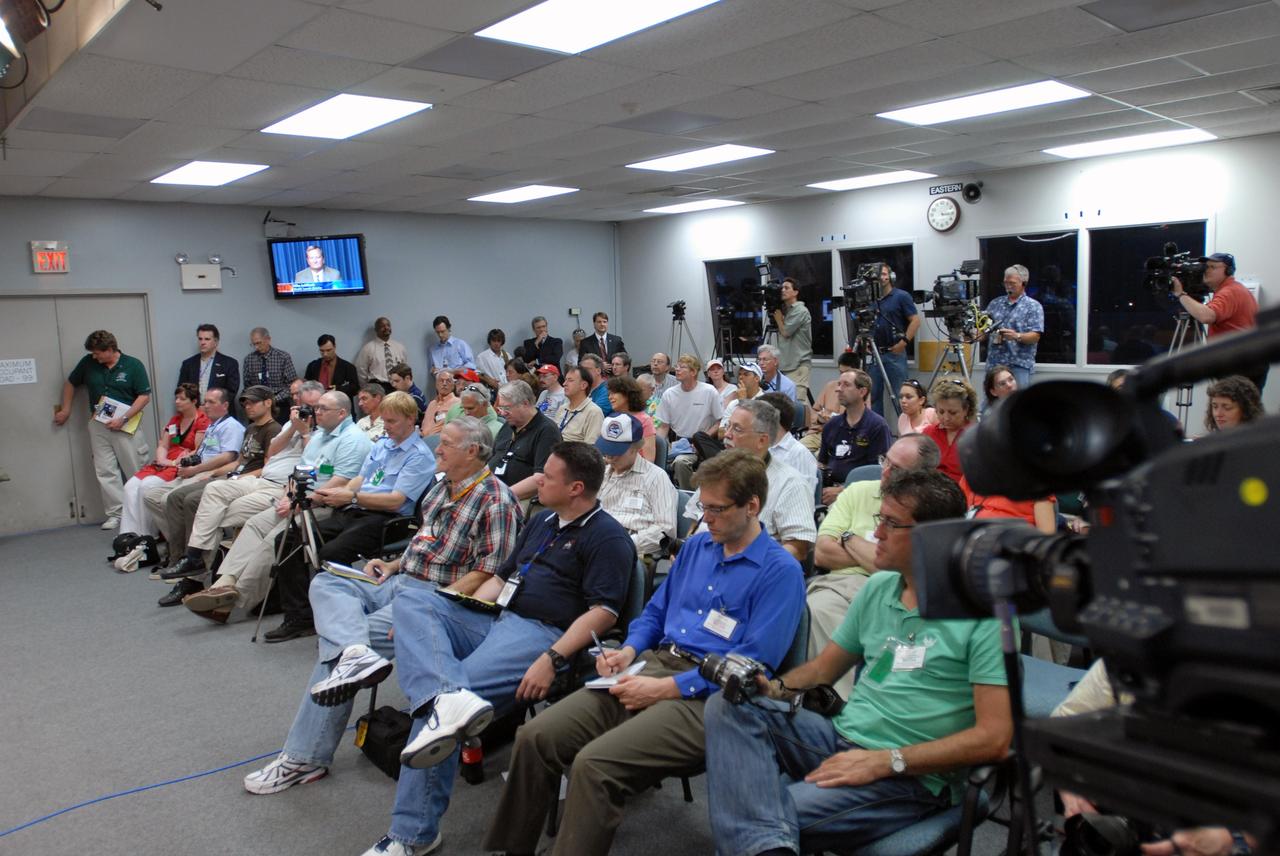
CAPE CANAVERAL, Fla. – The NASA News Auditorium is filled with media during the post-launch press conference at NASA's Kennedy Space Center in Florida. Featured on the dais were Associate Administrator for NASA's Space Operations Directorate William Gerstenmaier, Associate Administrator for NASA's Science Mission Directorate Ed Weiler, Launch Integration Manager Mike Moses and Shuttle Launch Director Mike Leinbach. The conference followed the successful launch of space shuttle Atlantis on the STS-125 mission to service NASA's Hubble Space Telescope. Atlantis' 11-day flight will include five spacewalks to refurbish and upgrade the telescope with state-of-the-art science instruments that will expand Hubble's capabilities and extend its operational lifespan through at least 2014. The payload includes a Wide Field Camera 3, Fine Guidance Sensor and the Cosmic Origins Spectrograph. Photo credit: NASA/Jim Grossmann
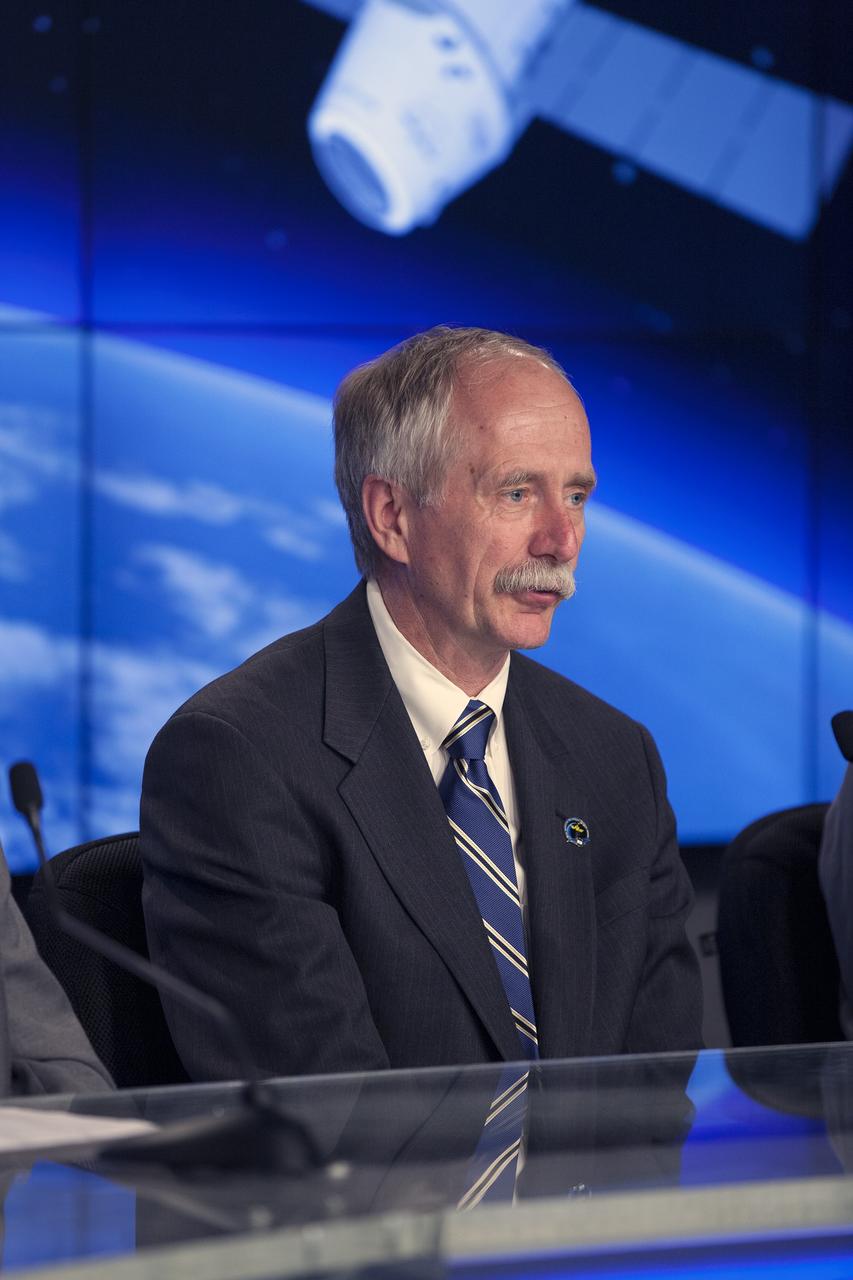
CAPE CANAVERAL, Fla. - NASA Associate Administrator for Human Exploration and Operations William Gersteinmeier participates in a SpaceX-3 post-launch news conference in the NASA Press Site television auditorium at Kennedy Space Center in Florida. SpaceX-3 launched at 3:25 p.m. EDT aboard a Falcon 9 rocket carrying a Dragon capsule from Space Launch Complex 40 on Cape Canaveral Air Force Station. Dragon is making its fourth trip to the space station. The SpaceX-3 mission, carrying almost 2.5 tons of supplies, technology and science experiments, is the third of 12 flights through a $1.6 billion NASA Commercial Resupply Services contract. Dragon's cargo will support more than 150 experiments that will be conducted during the station's Expeditions 39 and 40. For more information, visit http://www.nasa.gov/mission_pages/station/structure/launch/index.html. Photo credit: NASA/Kim Shiflett
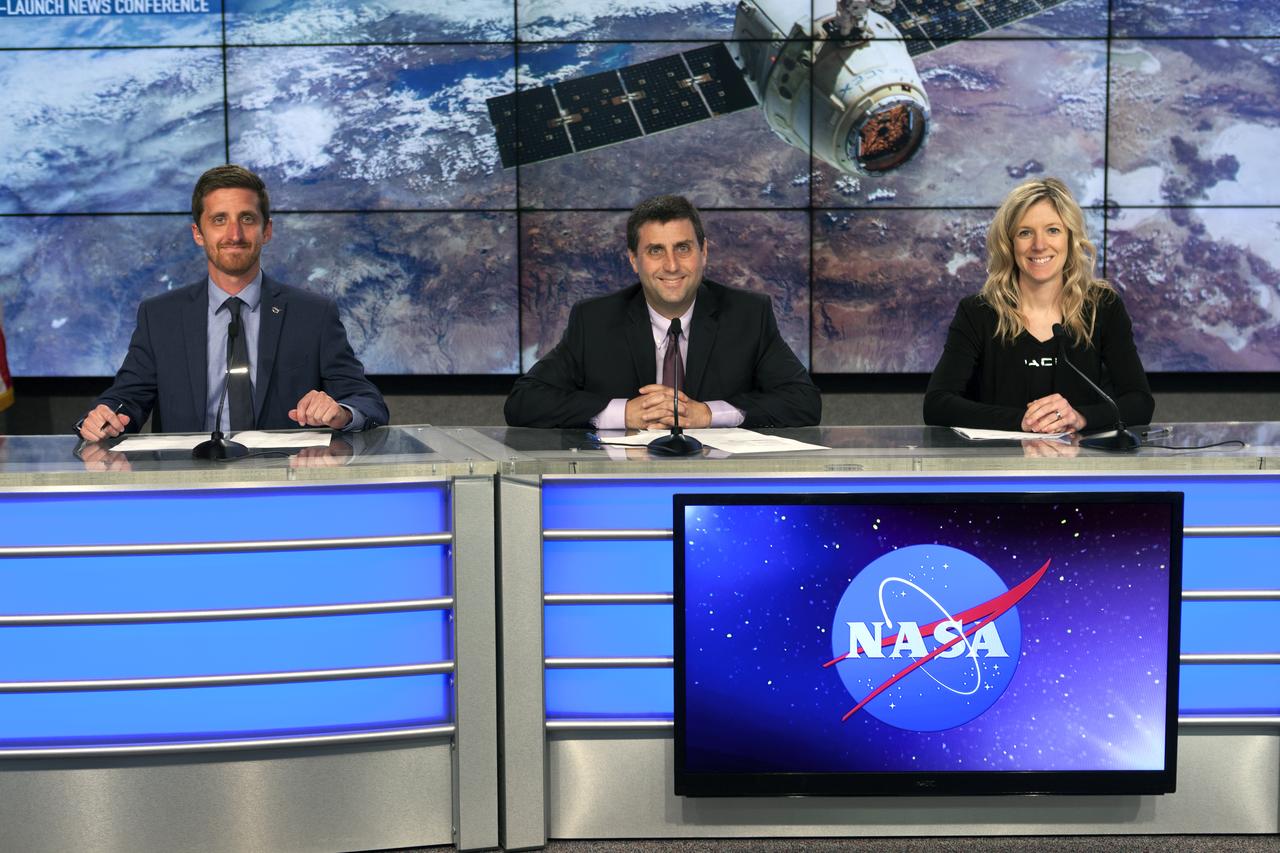
In the Press Site auditorium of NASA's Kennedy Space Center in Florida, from left, Josh Finch of NASA Communications, Joel Montalbano, deputy manager, International Space Station Program manager at NASA's Johnson Space Center in Houston, and Jessica Jensen, SpaceX director of Dragon Mission Management, speak to media at a post-launch news conference following the liftoff of the SpaceX Falcon 9 rocket at 4:30 p.m. EST. The flight is a commercial resupply services mission for NASA to the International Space Station. SpaceX CRS-14 lifted off atop the Falcon 9 rocket from Space Launch Complex 40 at Cape Canaveral Air Force Station carrying supplies and equipment and new science experiments for technology research.
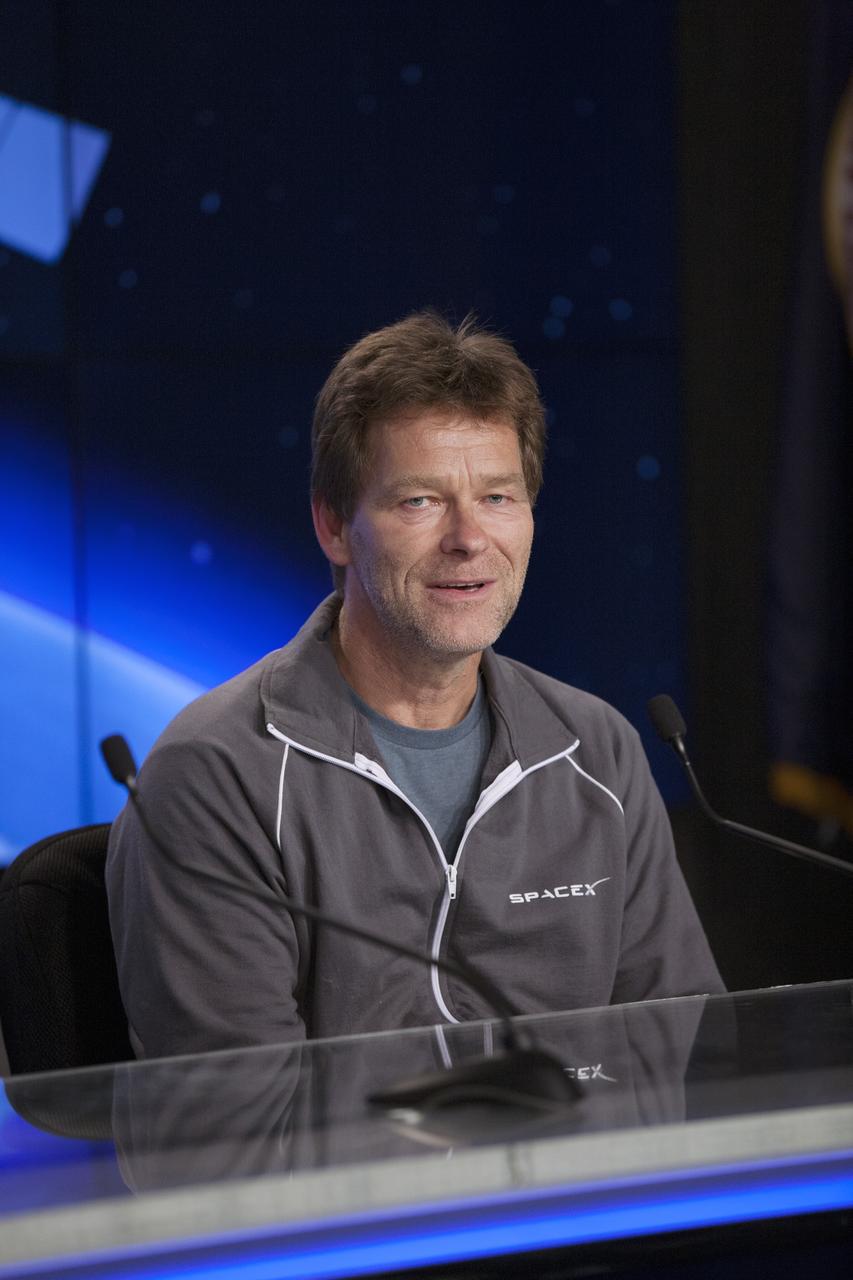
CAPE CANAVERAL, Fla. - SpaceX Vice President of Mission Assurance Hans Koenigsmann participates in a SpaceX-3 post-launch news conference in the NASA Press Site television auditorium at Kennedy Space Center in Florida. SpaceX-3 launched at 3:25 p.m. EDT aboard a Falcon 9 rocket carrying a Dragon capsule from Space Launch Complex 40 on Cape Canaveral Air Force Station. Dragon is making its fourth trip to the space station. The SpaceX-3 mission, carrying almost 2.5 tons of supplies, technology and science experiments, is the third of 12 flights through a $1.6 billion NASA Commercial Resupply Services contract. Dragon's cargo will support more than 150 experiments that will be conducted during the station's Expeditions 39 and 40. For more information, visit http://www.nasa.gov/mission_pages/station/structure/launch/index.html. Photo credit: NASA/Kim Shiflett
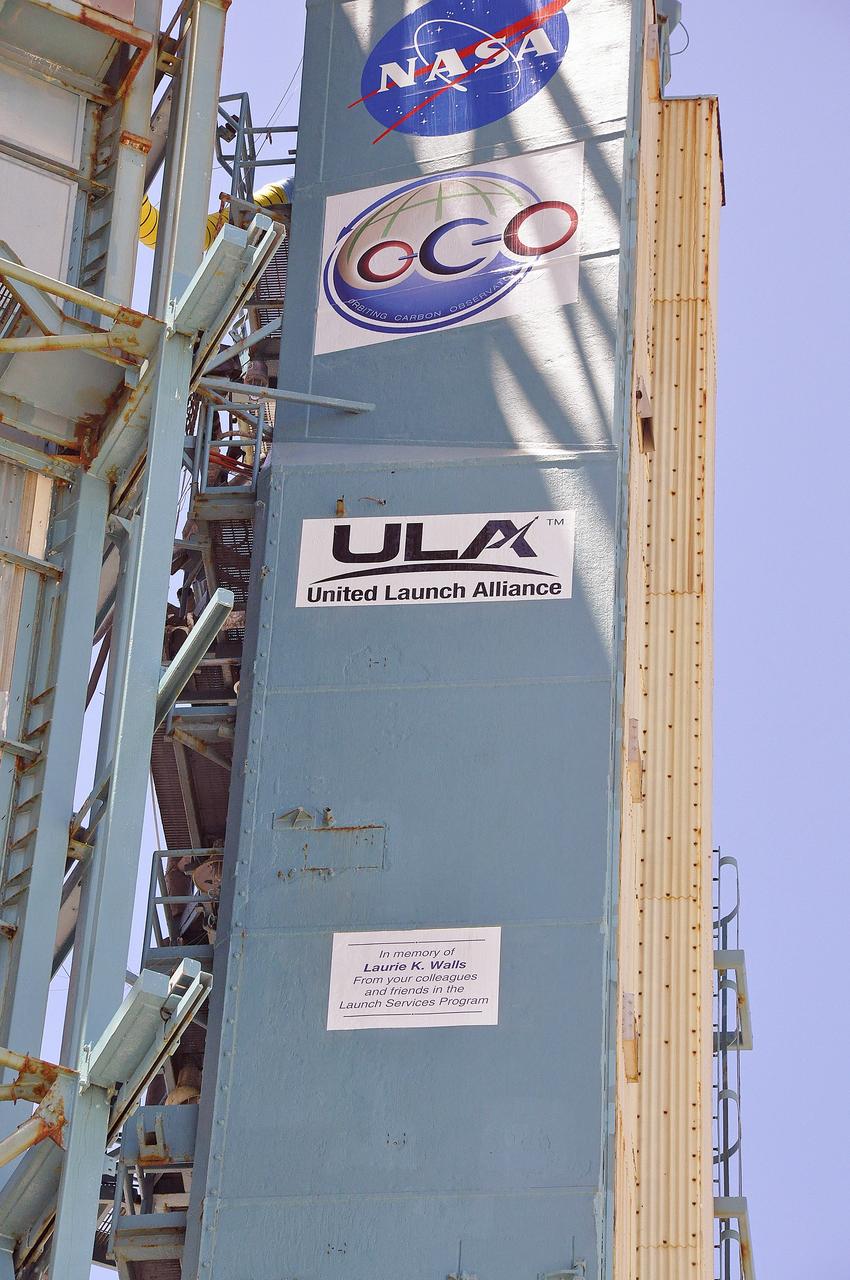
VANDENBERG AIR FORCE BASE, Calif. – A memorial plaque honoring Laurie K. Walls is affixed to the umbilical tower on Space Launch Complex 2 at Vandenberg Air Force Base in California for the launch of NASA's Orbiting Carbon Observatory-2, or OCO-2. Walls, a thermal analysis engineer with the Launch Services Program, or LSP, at NASA's Kennedy Space Center, died June 4. This dedication to Walls from the members of the launch team was read during the OCO-2 countdown commentary: "The OCO-2 mission has special meaning to NASA's Launch Services Program as we have dedicated it to one of our LSP Teammates, Laurie Walls. Laurie began her career over 30 years ago as a thermal engineer for McDonnell Douglas in Huntsville, Alabama, supporting NASA's Marshall Space Flight Center. She moved to Florida in 1985. Shortly after coming to Florida, Laurie became a civil servant working on the Shuttle program return to flight effort post-Challenger. In 1998, Laurie joined the newly formed Launch Services Program as one of the founding members of the flight analysis group. She served in LSP as the thermal discipline expert until her untimely death earlier this month. Laurie worked thermal issues for numerous NASA Delta II and Atlas V missions. Additionally, she provided key thermal support for both Delta II Heavy development and Atlas V Certification. Laurie was an integral member of LSP's family and she was truly dedicated to NASA and the LSP team. She will be greatly missed. We honor Laurie with a special memorial placed on the SLC-2 umbilical tower, and we thank ULA for helping to make this happen." Launch of OCO-2 is scheduled for 5:56 a.m. EDT on July 1. To learn more about NASA's Launch Services Program, visit http://www.nasa.gov/centers/kennedy/launchingrockets/index.html. Photo credit: NASA/Randy Beaudoin

CAPE CANAVERAL, Fla. – Elon Musk, chief executive officer and chief designer for SpaceX, participates in a post-launch news conference being held in the Press Site auditorium at NASA’s Kennedy Space Center in Florida by video teleconference. The SpaceX Falcon 9 rocket launched into space at 3:44 a.m. EDT from Space Launch Complex-40 on Cape Canaveral Air Force Station in Florida. The launch is the company's second demonstration test flight for NASA's Commercial Orbital Transportation Services Program, or COTS. During the flight, the capsule will conduct a series of check-out procedures to test and prove its systems, including rendezvous and berthing with the International Space Station. If the capsule performs as planned, the cargo and experiments it is carrying will be transferred to the station. The cargo includes food, water and provisions for the station’s Expedition crews, such as clothing, batteries and computer equipment. Under COTS, NASA has partnered with two aerospace companies to deliver cargo to the station. For more information, visit http://www.nasa.gov/spacex. Photo credit: NASA/Kim Shiflett
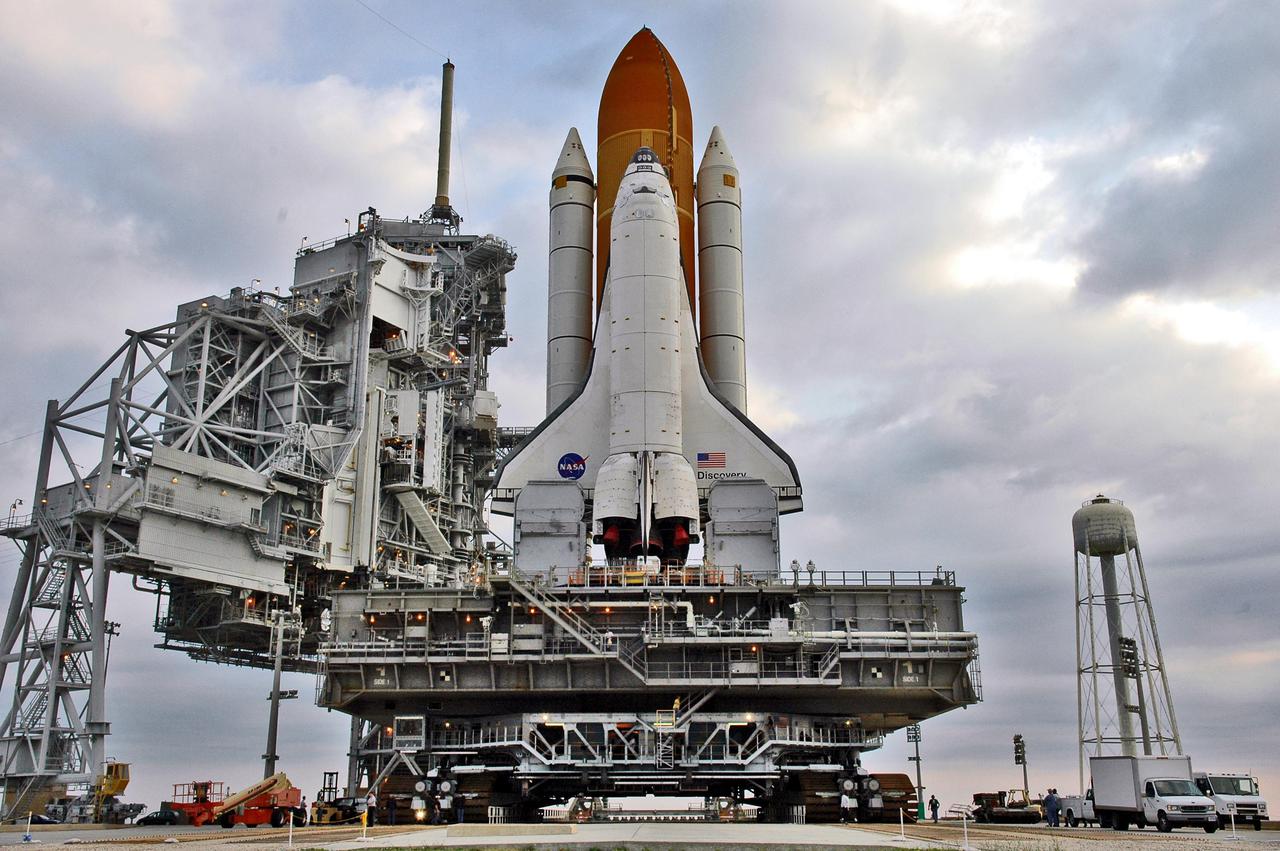
KENNEDY SPACE CENTER, FLA. - Under post-dawn cloudy skies, Space Shuttle Discovery, resting on the Mobile Launcher Platform, begins rolling off Launch Pad 39B via the Crawler_Transporter underneath. At left are the Rotating and Fixed Service Structures (RSS and FSS). The 80-foot lightning mast is atop the FSS. At right is the 290-foot-tall water tower that holds 300,000 gallons of water, part of the sound suppression system during a launch. Discovery is returning to the Vehicle Assembly Buildling where it will be demated from its External Tank and lifted into the transfer aisle. On or about June 7, Discovery will be lifted and attached to its new tank and Solid Rocket Boosters, which are already in the VAB. Only the 15th rollback in Space Shuttle Program history, the 4.2-mile journey allows additional modifications to be made to the External Tank prior to a safe Return to Flight. Discovery is expected to be rolled back to the launch pad in mid-June for Return to Flight mission STS-114. The launch window extends from July 13 to July 31.
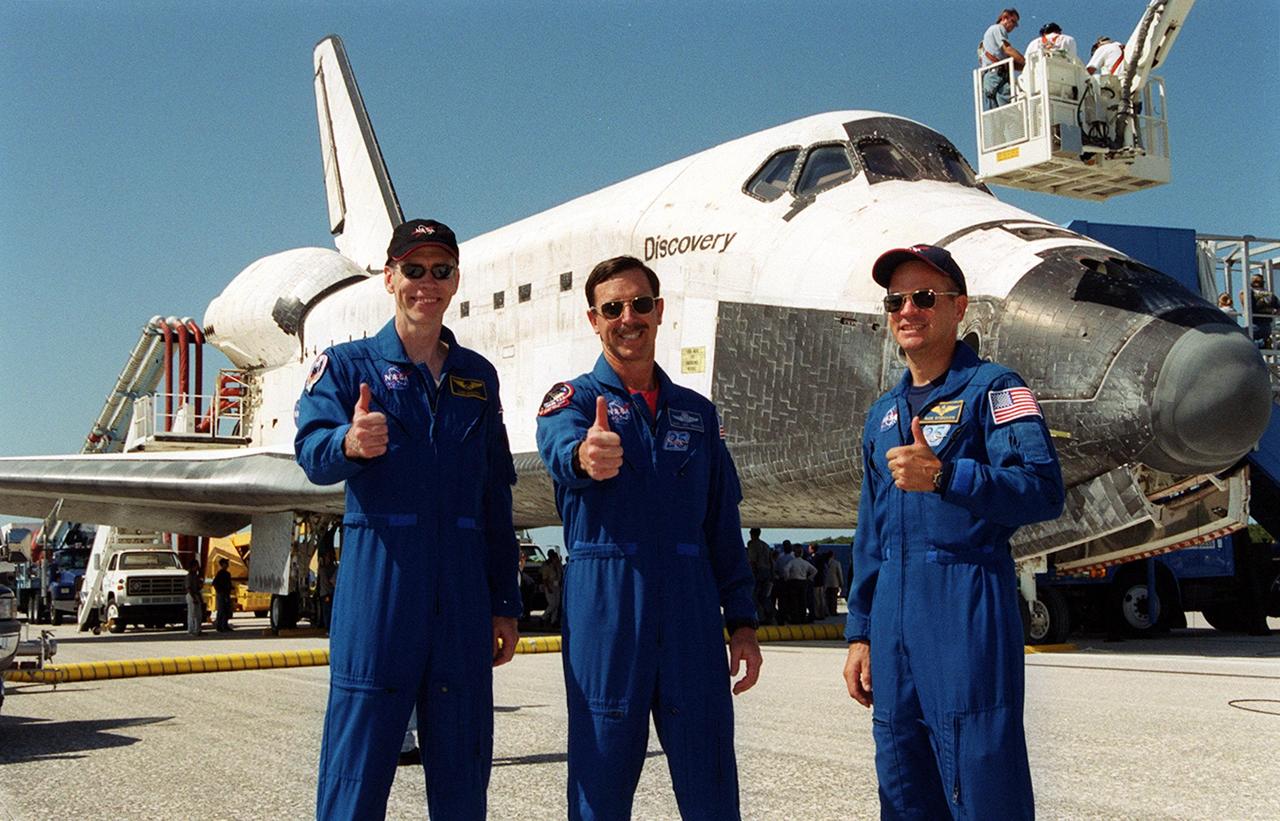
KENNEDY SPACE CENTER, Fla. - Following the landing of mission STS-105, from left, Mission Specialist Daniel Barry, Commander Scott "Doc" Horowitz, and Pilot Frederick "Rick" Sturckow give a thumbs up in front of Space Shuttle Discovery on KSC's Shuttle Landing Facility runway 15, as post-landing safing operations continue on the orbiter. Main gear touchdown was at 2:22:58 p.m. EDT; wheel stop, at 2:24:06 p.m. EDT. The 11-day, 21-hour, 12-minute STS-105 mission accomplished the goals set for the 11th flight to the International Space Station: swapout of the resident Station crew; delivery of equipment, supplies and scientific experiments; and installation of the Early Ammonia Servicer and heater cables for the S0 truss on the Station. Discovery traveled 4.3 million miles on its 30th flight into space, the 106th mission of the Space Shuttle program. Out of five missions in 2001, the landing was the first to occur in daylight at KSC.
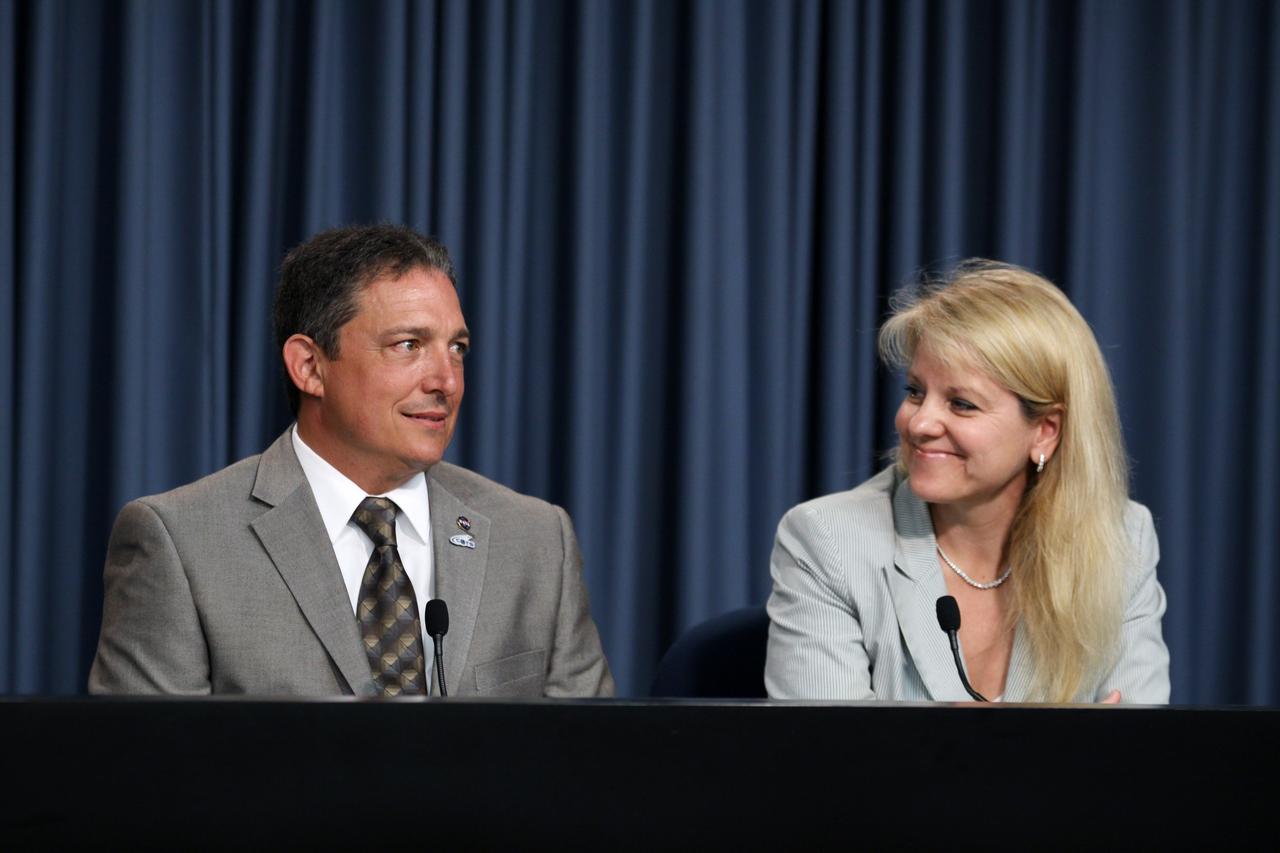
CAPE CANAVERAL, Fla. – Alan Lindenmoyer, manager of NASA’s Commercial Crew and Cargo Program, congratulates Gwynne Shotwell, president of SpaceX, on a job well done during a post-launch news conference in the Press Site auditorium at NASA’s Kennedy Space Center in Florida. The SpaceX Falcon 9 rocket launched into space at 3:44 a.m. EDT from Space Launch Complex-40 on Cape Canaveral Air Force Station in Florida. The launch is the company's second demonstration test flight for NASA's Commercial Orbital Transportation Services Program, or COTS. During the flight, the capsule will conduct a series of check-out procedures to test and prove its systems, including rendezvous and berthing with the International Space Station. If the capsule performs as planned, the cargo and experiments it is carrying will be transferred to the station. The cargo includes food, water and provisions for the station’s Expedition crews, such as clothing, batteries and computer equipment. Under COTS, NASA has partnered with two aerospace companies to deliver cargo to the station. For more information, visit http://www.nasa.gov/spacex. Photo credit: NASA/Kim Shiflett
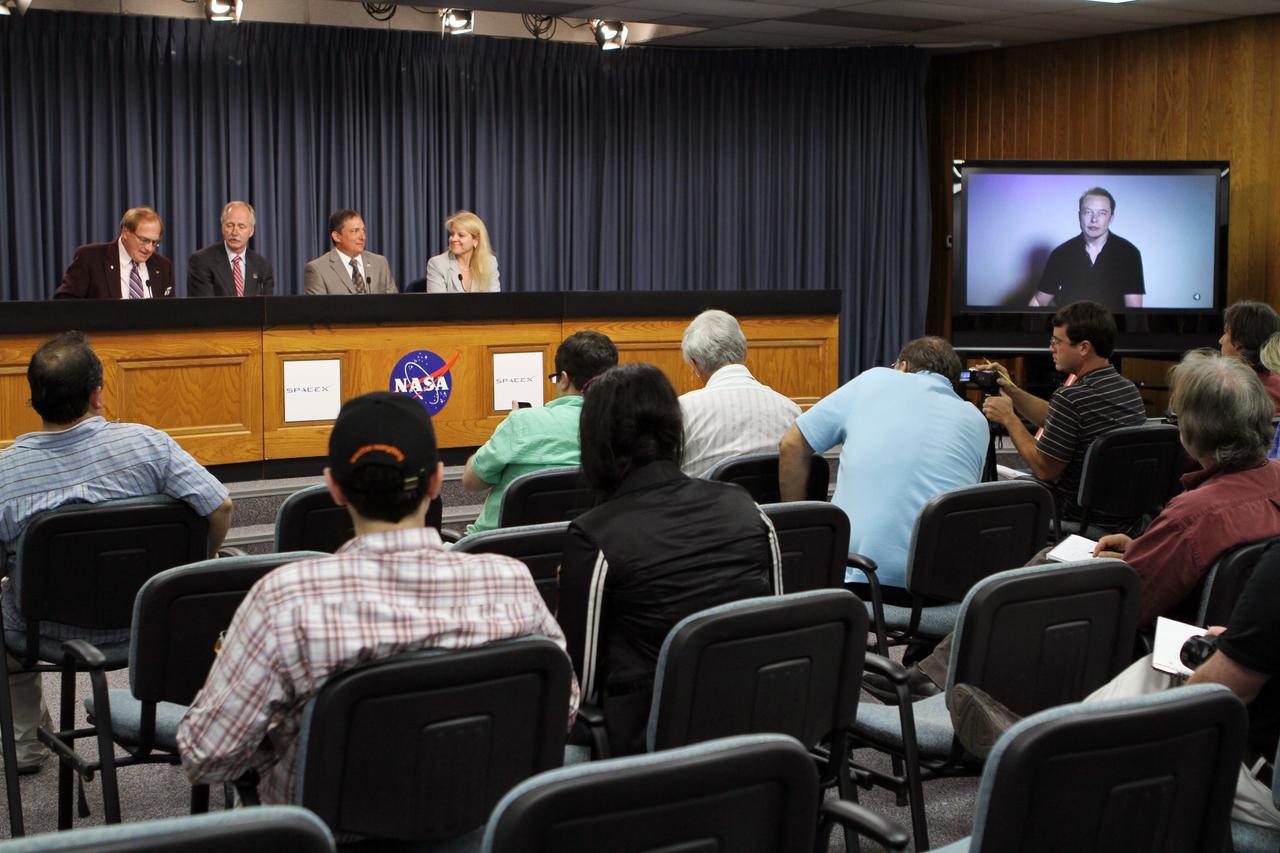
CAPE CANAVERAL, Fla. – Participating in a post-launch news conference in the Press Site auditorium at NASA’s Kennedy Space Center in Florida are, from left, George H. Diller, NASA Public Affairs, William Gerstenmaier, associate administrator of NASA’s Human Exploration and Operations Directorate, Alan Lindenmoyer, manager of NASA’s Commercial Crew and Cargo Program, and Gwynne Shotwell, president of SpaceX. Also participating by video teleconference, on the screen at right, is Elon Musk, chief executive officer and chief designer for SpaceX. The SpaceX Falcon 9 rocket launched into space at 3:44 a.m. EDT from Space Launch Complex-40 on Cape Canaveral Air Force Station in Florida. The launch is the company's second demonstration test flight for NASA's Commercial Orbital Transportation Services Program, or COTS. During the flight, the capsule will conduct a series of check-out procedures to test and prove its systems, including rendezvous and berthing with the International Space Station. If the capsule performs as planned, the cargo and experiments it is carrying will be transferred to the station. The cargo includes food, water and provisions for the station’s Expedition crews, such as clothing, batteries and computer equipment. Under COTS, NASA has partnered with two aerospace companies to deliver cargo to the station. For more information, visit http://www.nasa.gov/spacex. Photo credit: NASA/Kim Shiflett
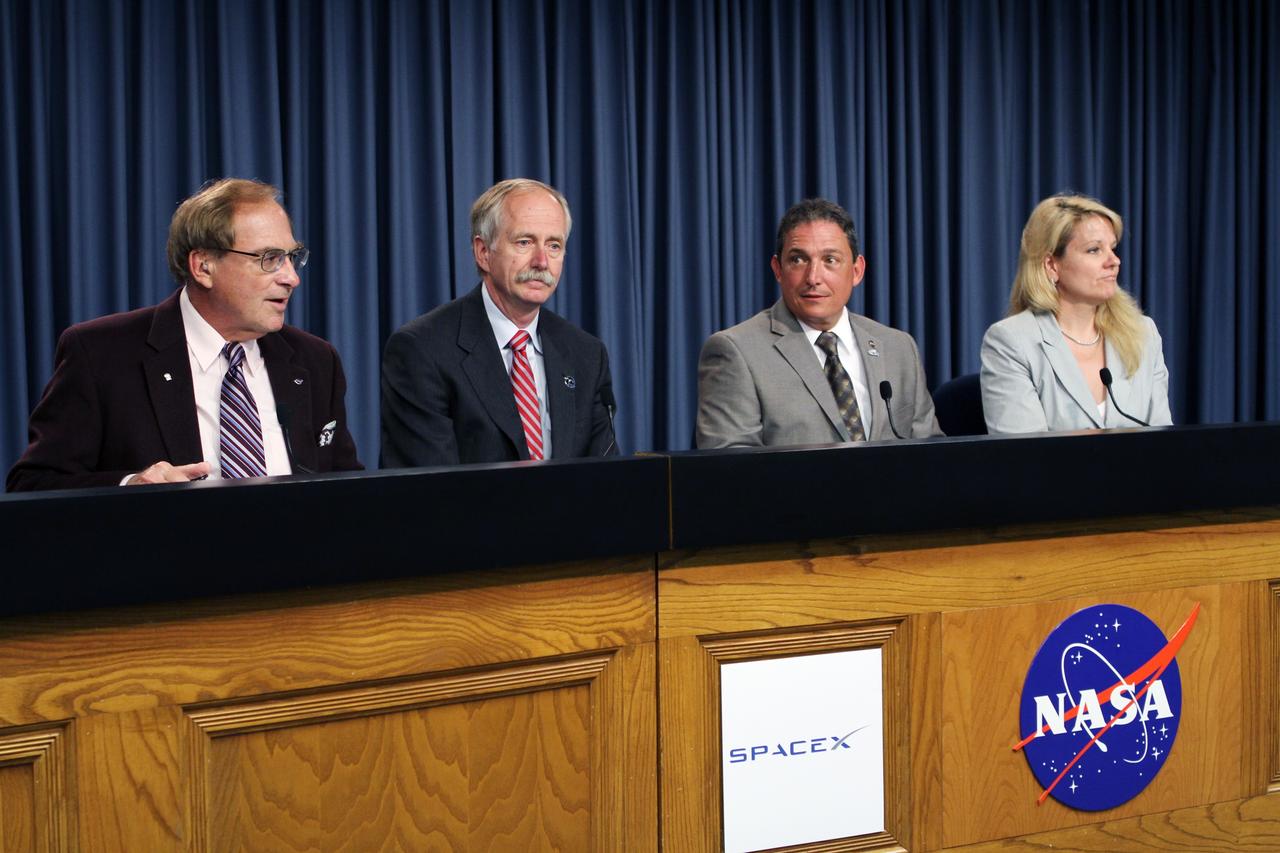
CAPE CANAVERAL, Fla. – Participating in a post-launch news conference in the Press Site auditorium at NASA’s Kennedy Space Center in Florida are, from left, George H. Diller, NASA Public Affairs, William Gerstenmaier, associate administrator of NASA’s Human Exploration and Operations Directorate, Alan Lindenmoyer, manager of NASA’s Commercial Crew and Cargo Program, and Gwynne Shotwell, president of SpaceX. The SpaceX Falcon 9 rocket launched into space at 3:44 a.m. EDT from Space Launch Complex-40 on Cape Canaveral Air Force Station in Florida. The launch is the company's second demonstration test flight for NASA's Commercial Orbital Transportation Services Program, or COTS. During the flight, the capsule will conduct a series of check-out procedures to test and prove its systems, including rendezvous and berthing with the International Space Station. If the capsule performs as planned, the cargo and experiments it is carrying will be transferred to the station. The cargo includes food, water and provisions for the station’s Expedition crews, such as clothing, batteries and computer equipment. Under COTS, NASA has partnered with two aerospace companies to deliver cargo to the station. For more information, visit http://www.nasa.gov/spacex. Photo credit: NASA/Kim Shiflett
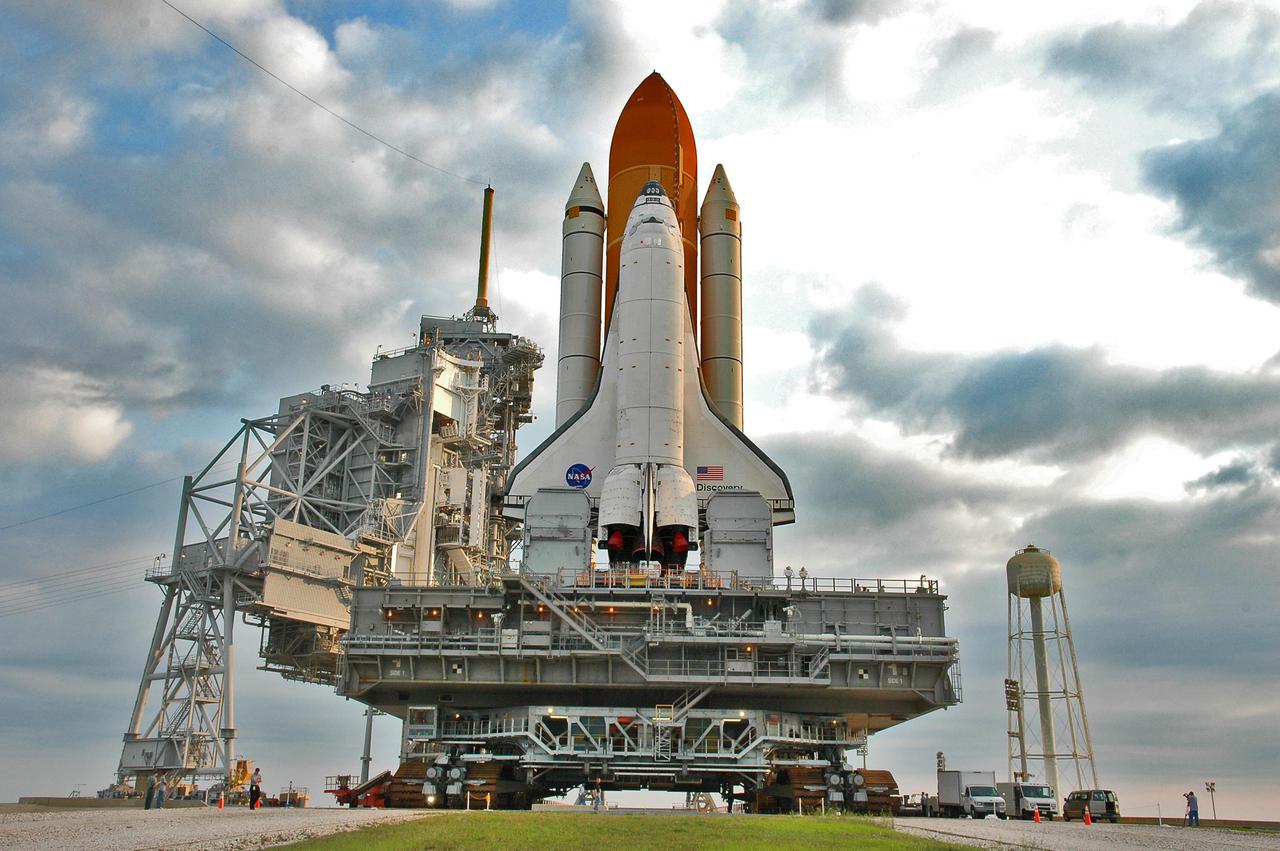
KENNEDY SPACE CENTER, FLA. - Under post-dawn cloudy skies, Space Shuttle Discovery, resting on the Mobile Launcher Platform, rolls away from Launch Pad 39B via the Crawler_Transporter underneath. At left are the Rotating and Fixed Service Structures (RSS and FSS). Atop the FSS is the 80-foot lightning mast. At right is the 290-foot-tall water tower that holds 300,000 gallons of water, part of the sound suppression system during a launch. Discovery is returning to the Vehicle Assembly Buildling where it will be demated from its External Tank and lifted into the transfer aisle. On or about June 7, Discovery will be lifted and attached to its new tank and Solid Rocket Boosters, which are already in the VAB. Only the 15th rollback in Space Shuttle Program history, the 4.2-mile journey allows additional modifications to be made to the External Tank prior to a safe Return to Flight. Discovery is expected to be rolled back to the launch pad in mid-June for Return to Flight mission STS-114. The launch window extends from July 13 to July 31.
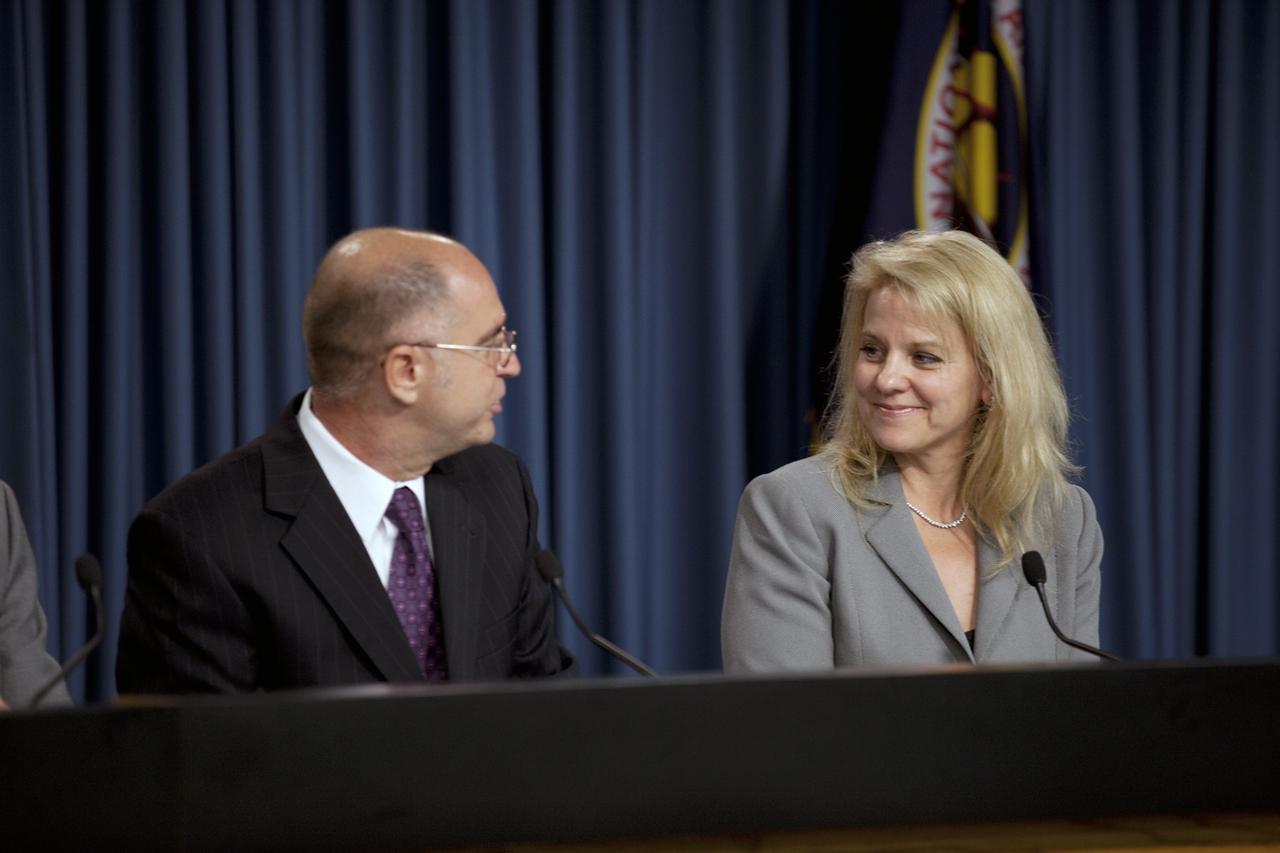
CAPE CANAVERAL, Fla. -- Sam Scimemi, at left, director of International Space Station at NASA Headquarters, congratulates Gwynne Shotwell, president of Space Exploration Technologies Corp., or SpaceX, on the successful launch of NASA's first Commercial Resupply Services, or CRS-1, mission to the International Space Station during a post-launch news conference held in the Press Site auditorium at NASA's Kennedy Space Center in Florida. SpaceX built both the Falcon 9 rocket and Dragon capsule that launched at 8:35 p.m. EDT from Space Launch Complex 40 on Cape Canaveral Air Force Station. SpaceX CRS-1 is an important step toward making America’s microgravity research program self-sufficient by providing a way to deliver and return significant amounts of cargo, including science experiments, to and from the orbiting laboratory. NASA has contracted for 12 commercial resupply flights from SpaceX and eight from the Orbital Sciences Corp. For more information, visit http://www.nasa.gov/mission_pages/station/living/launch/index.html. Photo credit: NASA/Kim Shiflett
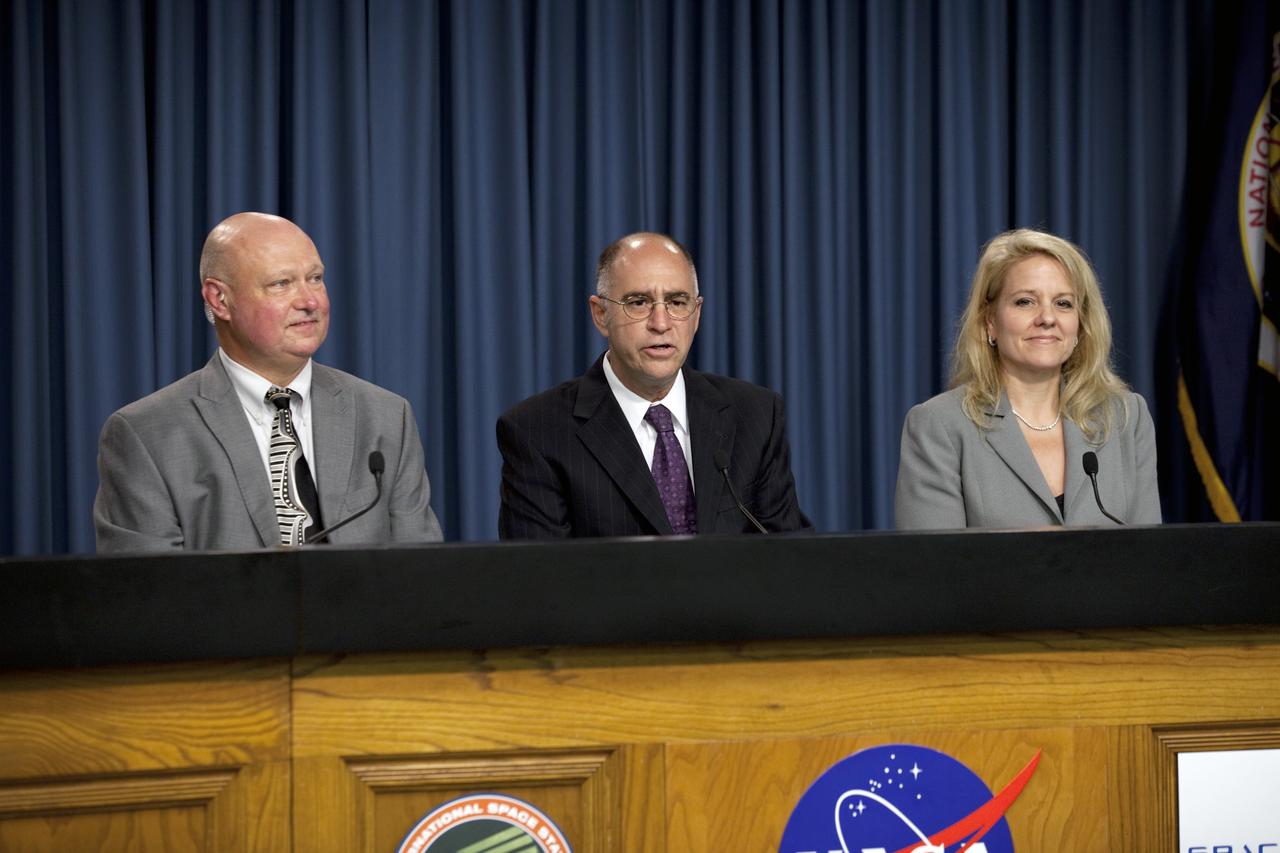
CAPE CANAVERAL, Fla. -- Sam Scimemi, director of International Space Station at NASA Headquarters, addresses news and social media representatives during a post-launch news conference in the Press Site auditorium at NASA's Kennedy Space Center in Florida following the successful launch of NASA's first Commercial Resupply Services, or CRS-1, mission to the International Space Station. Also participating in the conference are Michael Curie, at left, NASA Public Affairs, and Gwynne Shotwell, at right, president of Space Exploration Technologies Corp., or SpaceX. SpaceX built both the Falcon 9 rocket and Dragon capsule that launched at 8:35 p.m. EDT from Space Launch Complex 40 on Cape Canaveral Air Force Station. SpaceX CRS-1 is an important step toward making America’s microgravity research program self-sufficient by providing a way to deliver and return significant amounts of cargo, including science experiments, to and from the orbiting laboratory. NASA has contracted for 12 commercial resupply flights from SpaceX and eight from the Orbital Sciences Corp. For more information, visit http://www.nasa.gov/mission_pages/station/living/launch/index.html. Photo credit: NASA/Kim Shiflett
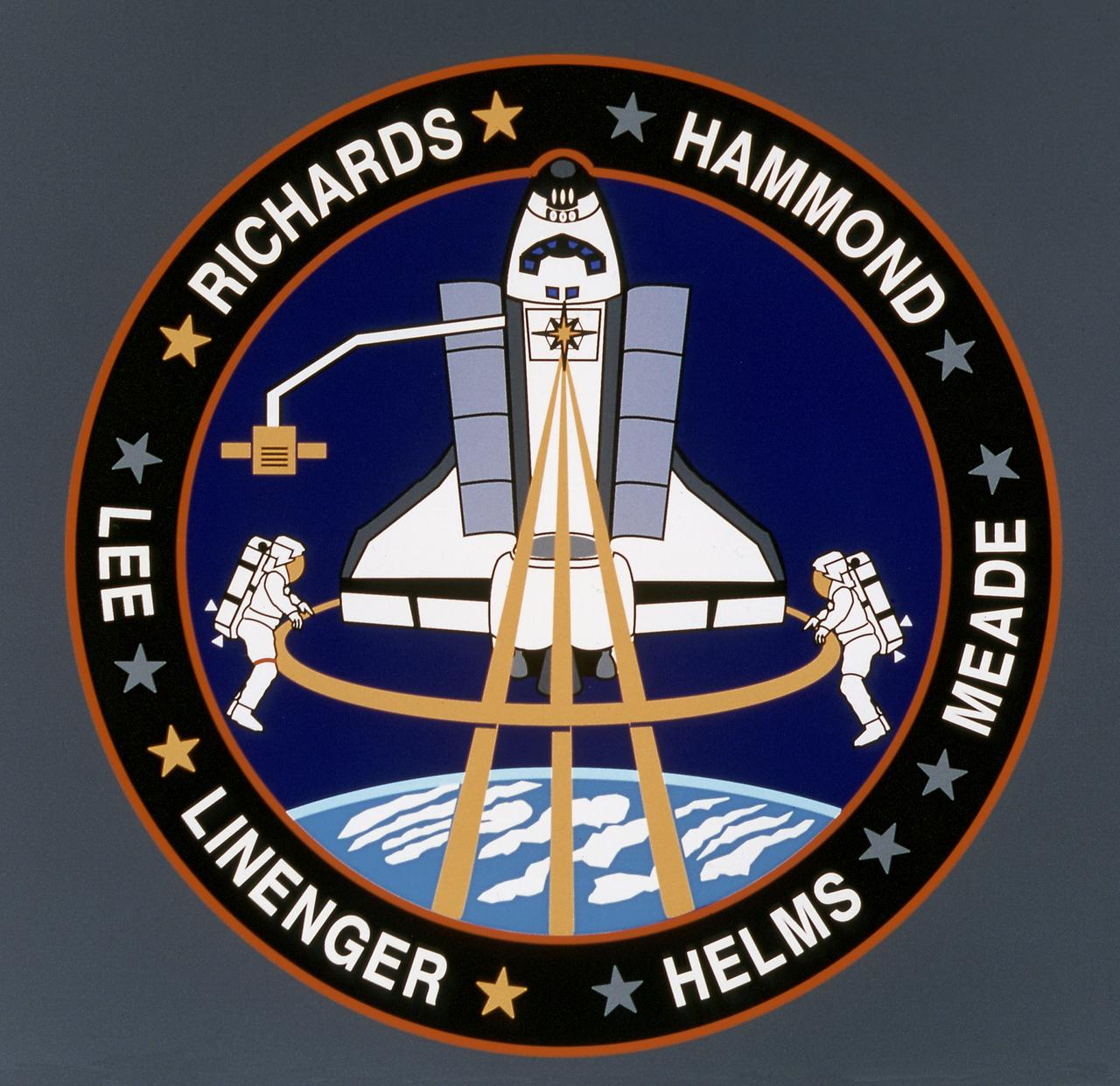
The STS-64 patch depicts the Space Shuttle Discovery in a payload-bay-to-Earth attitude with its primary payload, Lidar In-Space Technology Experiment (LITE-1) operating in support of Mission to Planet Earth. LITE-1 is a lidar system that uses a three-wavelength laser, symbolized by the three gold rays emanating from the star in the payload bay that form part of the astronaut symbol. The major objective of the LITE-1 is to gather data about the Earth's troposphere and stratosphere, represented by the clouds and dual-colored Earth limb. A secondary payload on STS-64 is the free-flier SPARTAN 201 satellite shown on the Remote Manipulator System (RMS) arm post-retrieval. The RMS also operated another payload, Shuttle Plume Impingement Flight Experiment (SPIFEX). A newly tested extravehicular activity (EVA) maneuvering device, Simplified Aid for EVA Rescue (SAFER), represented symbolically by the two small nozzles on the backpacks of the two untethered EVA crew men. The names of the crew members encircle the patch: Astronauts Richard N. Richards, L. Blaine Hammond, Jr., Jerry M. Linenger, Susan J. Helms, Carl J. Meade and Mark C. Lee. The gold or silver stars by each name represent that person's parent service.
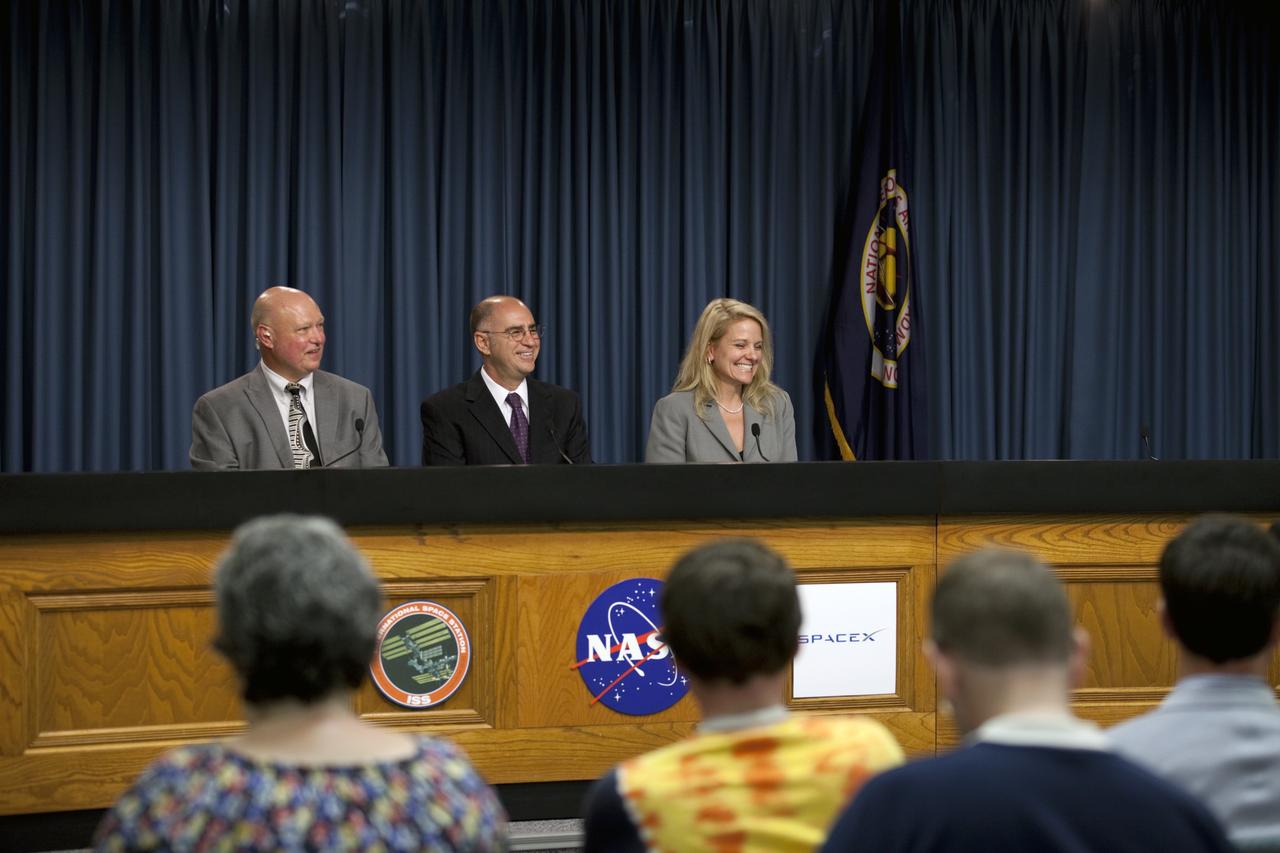
CAPE CANAVERAL, Fla. -- The participants of a post-launch news conference held in the Press Site auditorium at NASA's Kennedy Space Center in Florida are all smiles following the successful launch of NASA's first Commercial Resupply Services, or CRS-1, mission to the International Space Station. On the dais are, from left, Michael Curie, NASA Public Affairs, Sam Scimemi, director of International Space Station at NASA Headquarters, and Gwynne Shotwell, president of Space Exploration Technologies Corp., or SpaceX. SpaceX built both the Falcon 9 rocket and Dragon capsule that launched at 8:35 p.m. EDT from Space Launch Complex 40 on Cape Canaveral Air Force Station. SpaceX CRS-1 is an important step toward making America’s microgravity research program self-sufficient by providing a way to deliver and return significant amounts of cargo, including science experiments, to and from the orbiting laboratory. NASA has contracted for 12 commercial resupply flights from SpaceX and eight from the Orbital Sciences Corp. For more information, visit http://www.nasa.gov/mission_pages/station/living/launch/index.html. Photo credit: NASA/Kim Shiflett
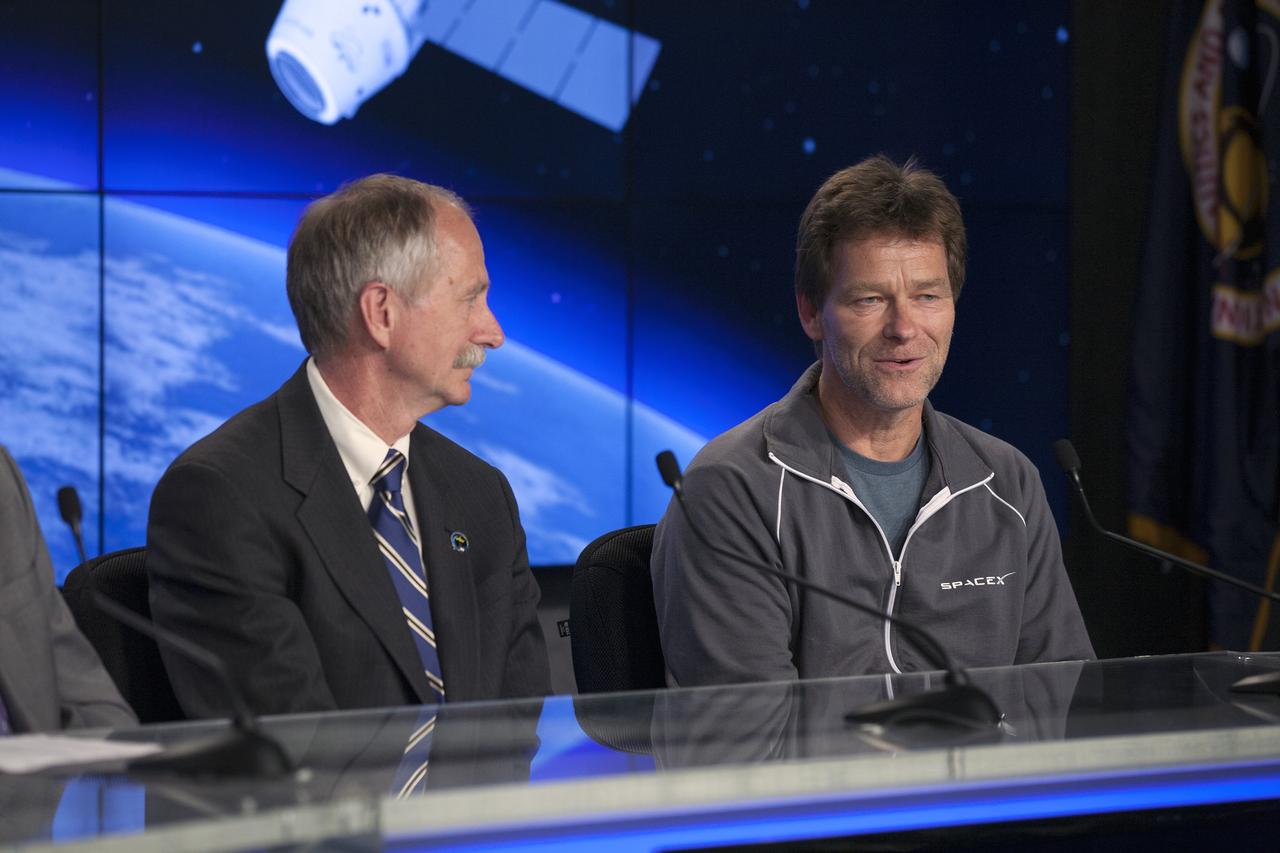
CAPE CANAVERAL, Fla. - Participating in a SpaceX-3 post-launch news conference in the NASA Press Site television auditorium at Kennedy Space Center in Florida are, from left, William Gersteinmeier, NASA associate administrator for Human Exploration and Operations, and Hans Koenigsmann, SpaceX vice president of Mission Assurance. SpaceX CEO and chief designer Elon Musk participated in the conference by telephone. SpaceX-3 launched at 3:25 p.m. EDT aboard a Falcon 9 rocket carrying a Dragon capsule from Space Launch Complex 40 on Cape Canaveral Air Force Station. Dragon is making its fourth trip to the space station. The SpaceX-3 mission, carrying almost 2.5 tons of supplies, technology and science experiments, is the third of 12 flights through a $1.6 billion NASA Commercial Resupply Services contract. Dragon's cargo will support more than 150 experiments that will be conducted during the station's Expeditions 39 and 40. For more information, visit http://www.nasa.gov/mission_pages/station/structure/launch/index.html. Photo credit: NASA/Kim Shiflett
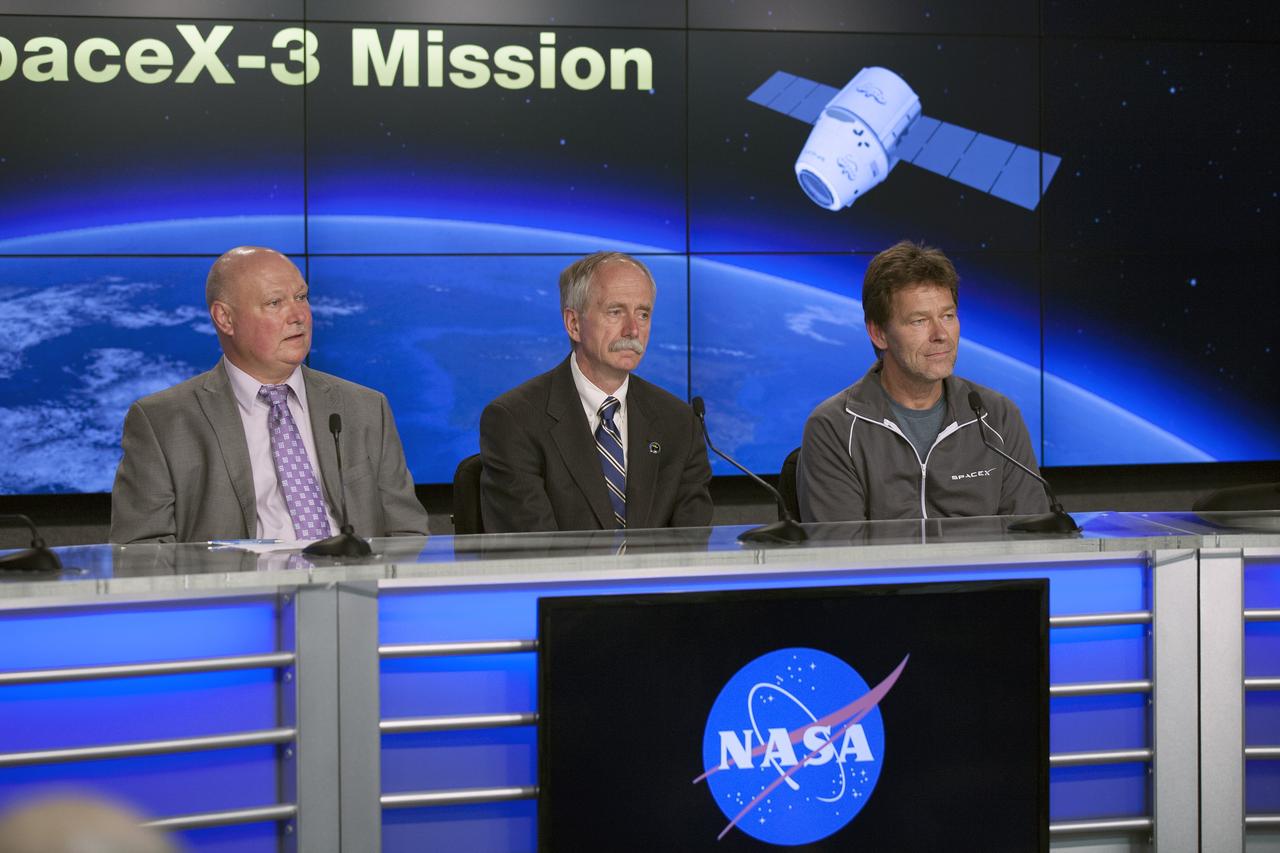
CAPE CANAVERAL, Fla. - Participating in a SpaceX-3 post-launch news conference in the NASA Press Site television auditorium at Kennedy Space Center in Florida are, from left, Michael Curie, NASA Public Affairs, William Gersteinmeier, NASA associate administrator for Human Exploration and Operations, and Hans Koenigsmann, SpaceX vice president of Mission Assurance. SpaceX CEO and chief designer Elon Musk participated in the conference by telephone. SpaceX-3 launched at 3:25 p.m. EDT aboard a Falcon 9 rocket carrying a Dragon capsule from Space Launch Complex 40 on Cape Canaveral Air Force Station. Dragon is making its fourth trip to the space station. The SpaceX-3 mission, carrying almost 2.5 tons of supplies, technology and science experiments, is the third of 12 flights through a $1.6 billion NASA Commercial Resupply Services contract. Dragon's cargo will support more than 150 experiments that will be conducted during the station's Expeditions 39 and 40. For more information, visit http://www.nasa.gov/mission_pages/station/structure/launch/index.html. Photo credit: NASA/Kim Shiflett
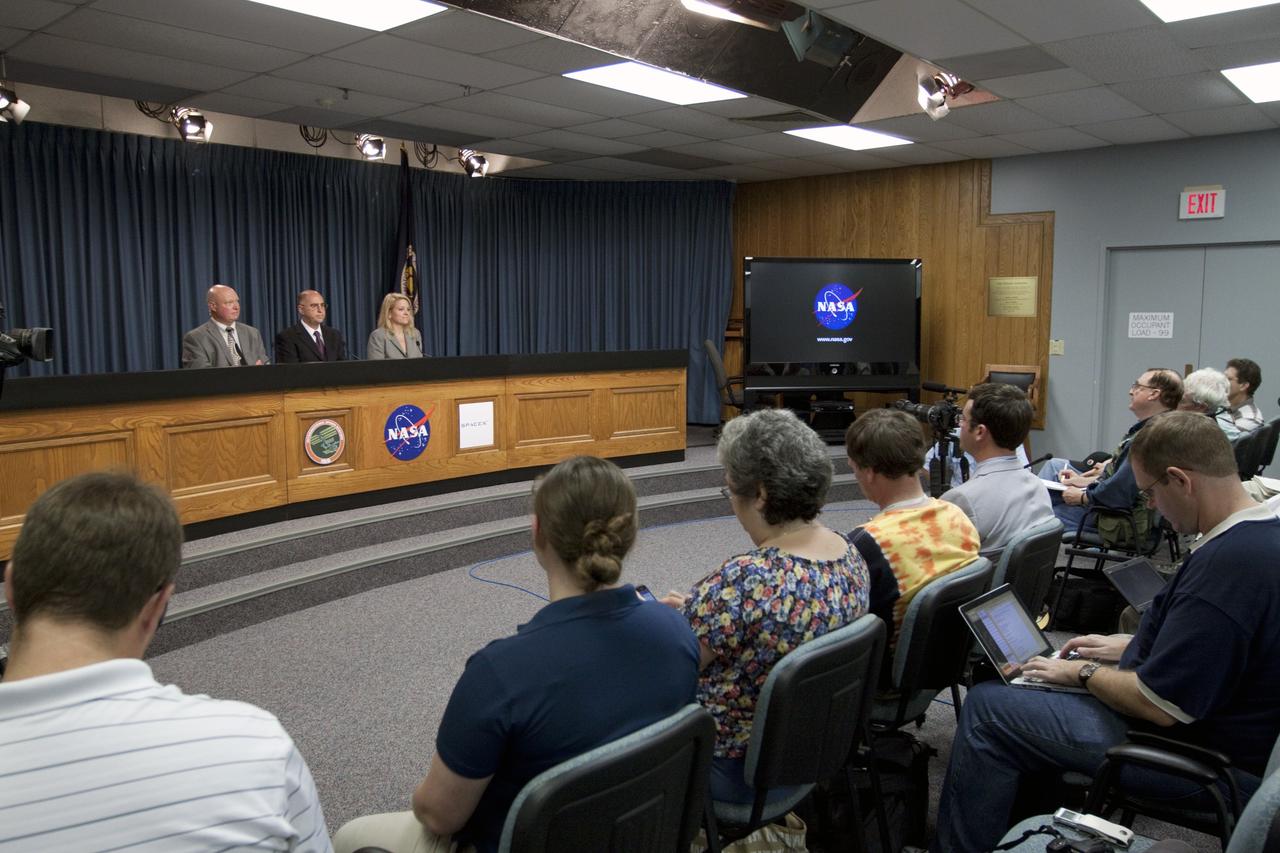
CAPE CANAVERAL, Fla. -- News and social media representatives participate in a post-launch news conference in the Press Site auditorium at NASA's Kennedy Space Center in Florida following the successful launch of NASA's first Commercial Resupply Services, or CRS-1, mission to the International Space Station. On the dais are, from left, Michael Curie, NASA Public Affairs, Sam Scimemi, director of International Space Station at NASA Headquarters, and Gwynne Shotwell, president of Space Exploration Technologies Corp., or SpaceX. SpaceX built both the Falcon 9 rocket and Dragon capsule that launched at 8:35 p.m. EDT from Space Launch Complex 40 on Cape Canaveral Air Force Station. SpaceX CRS-1 is an important step toward making America’s microgravity research program self-sufficient by providing a way to deliver and return significant amounts of cargo, including science experiments, to and from the orbiting laboratory. NASA has contracted for 12 commercial resupply flights from SpaceX and eight from the Orbital Sciences Corp. For more information, visit http://www.nasa.gov/mission_pages/station/living/launch/index.html. Photo credit: NASA/Kim Shiflett
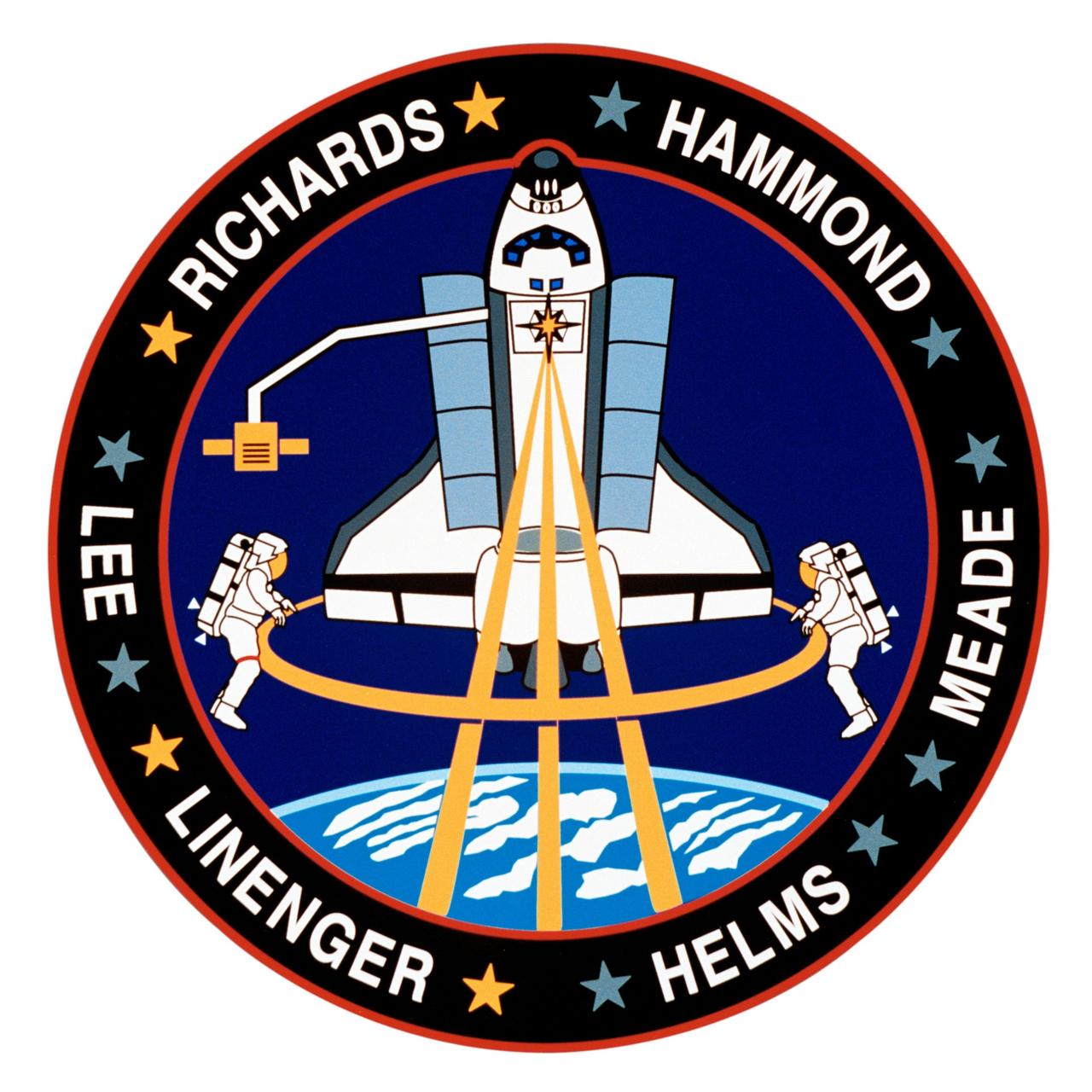
STS064-S-001 (July 1994) --- The patch depicts the space shuttle Discovery in a payload-bay-to-Earth attitude with its primary payload, Lidar In-Space Technology Experiment (LITE-1) operating in support of Mission to Planet Earth. LITE-1 is a lidar (light detection and ranging) system that uses a three-wavelength laser, symbolized by the three gold rays emanating from the star in the payload bay that form part of the astronaut symbol. The major objective of this first flight of LITE-1 is to validate its design and operating characteristics by gathering data about the Earth's troposphere and stratosphere, represented by the clouds and dual-colored Earth limb. A secondary payload on STS-64 is the free-flier SPARTAN-201 satellite shown on the Remote Manipulator System (RMS) arm post-retrieval. The objective of SPARTAN-201 is to investigate the physics of the solar wind and complement data being obtained from the ULYSSES satellite launched on STS-41. The RMS will also operate another secondary payload, Shuttle Plume Impingement Flight Experiment (SPIFEX), which will assess the plume effects from the Orbiter's Reaction Control System thrusters. Additionally, STS-64 will test a new extravehicular activity (EVA) maneuvering device, Simplified Aid for EVA Rescue (SAFER), represented symbolically by the two small nozzles on the backpacks of the two untethered EVA crew men. The names of the crew members encircle the patch: astronauts Richard N. Richards, commander; L. Blaine Hammond Jr., pilot; Jerry M. Linenger; Susan J. Helms, Carl J. Meade and Mark C. Lee, all mission specialists. The gold or silver stars by each name represent that person's parent service. The NASA insignia design for space shuttle flights is reserved for use by the astronauts and for other official use as the NASA Administrator may authorize. Public availability has been approved only in the forms of illustrations by the various news media. When and if there is any change in this policy, which is not anticipated, the change will be publicly announced. Photo credit: NASA

Image acquired December 19, 2011 A strong low pressure area in the southwestern U.S. today is bringing snowfall there as NOAA's GOES-13 satellite captured its associated clouds. Blizzard warnings are already posted for some areas. The image was created on Dec. 19 at 19:10 UTC (2:10 p.m. EST) from the Geostationary Operational Environmental Satellite called GOES-13. GOES-13 is operated by the National Oceanic and Atmospheric Administration. Images and animations are created by NASA's GOES Project, located at NASA's Goddard Space Flight Center, Greenbelt, Md. The low is forecast to move northeast across southeastern New Mexico today and reach southwest the Texas panhandle by early evening. The plains states including portions of Kansas, New Mexico and the Texas and Oklahoma panhandles could all have blizzard warnings later in the day on Dec. 19. Wind gusts to 60mph were recorded in northeastern New Mexico during the afternoon hours today. Kansas City may have a mix of rain, sleet and snow as the front moves past and temperatures fall. At 3 p.m. EST, the National Weather Service forecast indicated that moderate to heavy snow and strong north winds to impact the Texas and Oklahoma panhandles today into Tuesday morning. The low and associated cold front are expected to bring heavy snow to the Oklahoma panhandle and all but the far southeast Texas Panhandle. Behind the cold front, the strong winds will blow snow and lead to poor visibilities and blizzard conditions. The GOES image shows the large bank of clouds along the front stretching from the four corners states east-northeast through the Ohio Valley and into upstate New York. The rounded comma shape of clouds over Texas and stretching into Colorado indicate where the low pressure center is located. Image: NASA/NOAA GOES Project Text: NASA, Rob Gutro <b><a href="http://www.nasa.gov/audience/formedia/features/MP_Photo_Guidelines.html" rel="nofollow">NASA image use policy.</a></b> <b><a href="http://www.nasa.gov/centers/goddard/home/index.html" rel="nofollow">NASA Goddard Space Flight Center</a></b> enables NASA’s mission through four scientific endeavors: Earth Science, Heliophysics, Solar System Exploration, and Astrophysics. Goddard plays a leading role in NASA’s accomplishments by contributing compelling scientific knowledge to advance the Agency’s mission. <b>Follow us on <a href="http://twitter.com/NASA_GoddardPix" rel="nofollow">Twitter</a></b> <b>Like us on <a href="http://www.facebook.com/pages/Greenbelt-MD/NASA-Goddard/395013845897?ref=tsd" rel="nofollow">Facebook</a></b> <b>Find us on <a href="http://instagrid.me/nasagoddard/?vm=grid" rel="nofollow">Instagram</a></b>
![A swirling Eastern Pacific Ocean storm system headed for California was spotted by NOAA's GOES-West satellite on February 28. According to the National Weather Service, this storm system has the potential to bring heavy rainfall to the drought-stricken state. The storm was captured using visible data from NOAA's GOES-West or GOES-15 satellite on Feb. 28 at 1915 UTC/11:15 a.m. PST was made into an image by NASA/NOAA's GOES Project at NASA's Goddard Space Flight Center in Greenbelt, Md. The storm's center appeared as a tight swirl, with bands of clouds and showers already sweeping over the state extending from northern California to Baja California, Mexico. At 11:30 a.m. PST on February 28, Bill Patzert, climatologist at NASA's Jet Propulsion Laboratory in Pasadena, Calif. said, "Right now from northern to southern California we are being battered by very heavy rain, strong winds and our coastal communities are being battered by high surf. Through the weekend we are bracing for mud and rock slides in areas that recently burned [from wildfires]. Flooding is looming up and down the state." The National Weather Service (NWS) serving Los Angeles posted a Flood Watch for the region on Friday, February 28. The Flood Watch notes the "potential for flash flooding and debris flows for some 2013 and 2014 burn areas in Los Angeles County from this morning through Saturday evening (March 1).” The NWS Flood Watch also noted "a very strong and dynamic storm will bring a significant amount of rain to much of southwestern California through Saturday evening. A flash flood watch has been issued for several recent burn areas in Los Angeles County due to the abundant rainfall expected. Rain rates at times are expected to range from a half inch to one inch per hour which could cause significant mud and debris flows. There will be a chance of thunderstorms with locally higher rainfall rates." "Californians haven't seen rain and wind this powerful in 3 years," Patzert said. "By early next week, as this system moves east, this powerful system will wreak havoc causing snow and ice storms through the Midwest into the Northeast." GOES satellites provide the kind of continuous monitoring necessary for intensive data analysis. Geostationary describes an orbit in which a satellite is always in the same position with respect to the rotating Earth. This allows GOES to hover continuously over one position on Earth's surface, appearing stationary. As a result, GOES provide a constant vigil for the atmospheric "triggers" for severe weather conditions such as tornadoes, flash floods, hail storms and hurricanes. On a positive note, Patzert noted, "This is a nice down payment on drought recovery in the parched Western U.S." For updated information about the storm system, visit NOAA's National Weather Service website: <a href="http://www.weather.gov" rel="nofollow">www.weather.gov</a> For more information about GOES satellites, visit: <a href="http://www.goes.noaa.gov/" rel="nofollow">www.goes.noaa.gov/</a> or <a href="http://goes.gsfc.nasa.gov/" rel="nofollow">goes.gsfc.nasa.gov/</a> Rob Gutro NASA's Goddard Space Flight Center <b><a href="http://www.nasa.gov/audience/formedia/features/MP_Photo_Guidelines.html" rel="nofollow">NASA image use policy.</a></b> <b><a href="http://www.nasa.gov/centers/goddard/home/index.html" rel="nofollow">NASA Goddard Space Flight Center</a></b> enables NASA’s mission through four scientific endeavors: Earth Science, Heliophysics, Solar System Exploration, and Astrophysics. Goddard plays a leading role in NASA’s accomplishments by contributing compelling scientific knowledge to advance the Agency’s mission. <b>Follow us on <a href="http://twitter.com/NASAGoddardPix" rel="nofollow">Twitter</a></b> <b>Like us on <a href="http://www.facebook.com/pages/Greenbelt-MD/NASA-Goddard/395013845897?ref=tsd" rel="nofollow">Facebook</a></b> <b>Find us on <a href="http://instagram.com/nasagoddard?vm=grid" rel="nofollow">Instagram</a></b>](https://images-assets.nasa.gov/image/GSFC_20171208_Archive_e001192/GSFC_20171208_Archive_e001192~medium.jpg)
A swirling Eastern Pacific Ocean storm system headed for California was spotted by NOAA's GOES-West satellite on February 28. According to the National Weather Service, this storm system has the potential to bring heavy rainfall to the drought-stricken state. The storm was captured using visible data from NOAA's GOES-West or GOES-15 satellite on Feb. 28 at 1915 UTC/11:15 a.m. PST was made into an image by NASA/NOAA's GOES Project at NASA's Goddard Space Flight Center in Greenbelt, Md. The storm's center appeared as a tight swirl, with bands of clouds and showers already sweeping over the state extending from northern California to Baja California, Mexico. At 11:30 a.m. PST on February 28, Bill Patzert, climatologist at NASA's Jet Propulsion Laboratory in Pasadena, Calif. said, "Right now from northern to southern California we are being battered by very heavy rain, strong winds and our coastal communities are being battered by high surf. Through the weekend we are bracing for mud and rock slides in areas that recently burned [from wildfires]. Flooding is looming up and down the state." The National Weather Service (NWS) serving Los Angeles posted a Flood Watch for the region on Friday, February 28. The Flood Watch notes the "potential for flash flooding and debris flows for some 2013 and 2014 burn areas in Los Angeles County from this morning through Saturday evening (March 1).” The NWS Flood Watch also noted "a very strong and dynamic storm will bring a significant amount of rain to much of southwestern California through Saturday evening. A flash flood watch has been issued for several recent burn areas in Los Angeles County due to the abundant rainfall expected. Rain rates at times are expected to range from a half inch to one inch per hour which could cause significant mud and debris flows. There will be a chance of thunderstorms with locally higher rainfall rates." "Californians haven't seen rain and wind this powerful in 3 years," Patzert said. "By early next week, as this system moves east, this powerful system will wreak havoc causing snow and ice storms through the Midwest into the Northeast." GOES satellites provide the kind of continuous monitoring necessary for intensive data analysis. Geostationary describes an orbit in which a satellite is always in the same position with respect to the rotating Earth. This allows GOES to hover continuously over one position on Earth's surface, appearing stationary. As a result, GOES provide a constant vigil for the atmospheric "triggers" for severe weather conditions such as tornadoes, flash floods, hail storms and hurricanes. On a positive note, Patzert noted, "This is a nice down payment on drought recovery in the parched Western U.S." For updated information about the storm system, visit NOAA's National Weather Service website: <a href="http://www.weather.gov" rel="nofollow">www.weather.gov</a> For more information about GOES satellites, visit: <a href="http://www.goes.noaa.gov/" rel="nofollow">www.goes.noaa.gov/</a> or <a href="http://goes.gsfc.nasa.gov/" rel="nofollow">goes.gsfc.nasa.gov/</a> Rob Gutro NASA's Goddard Space Flight Center <b><a href="http://www.nasa.gov/audience/formedia/features/MP_Photo_Guidelines.html" rel="nofollow">NASA image use policy.</a></b> <b><a href="http://www.nasa.gov/centers/goddard/home/index.html" rel="nofollow">NASA Goddard Space Flight Center</a></b> enables NASA’s mission through four scientific endeavors: Earth Science, Heliophysics, Solar System Exploration, and Astrophysics. Goddard plays a leading role in NASA’s accomplishments by contributing compelling scientific knowledge to advance the Agency’s mission. <b>Follow us on <a href="http://twitter.com/NASAGoddardPix" rel="nofollow">Twitter</a></b> <b>Like us on <a href="http://www.facebook.com/pages/Greenbelt-MD/NASA-Goddard/395013845897?ref=tsd" rel="nofollow">Facebook</a></b> <b>Find us on <a href="http://instagram.com/nasagoddard?vm=grid" rel="nofollow">Instagram</a></b>