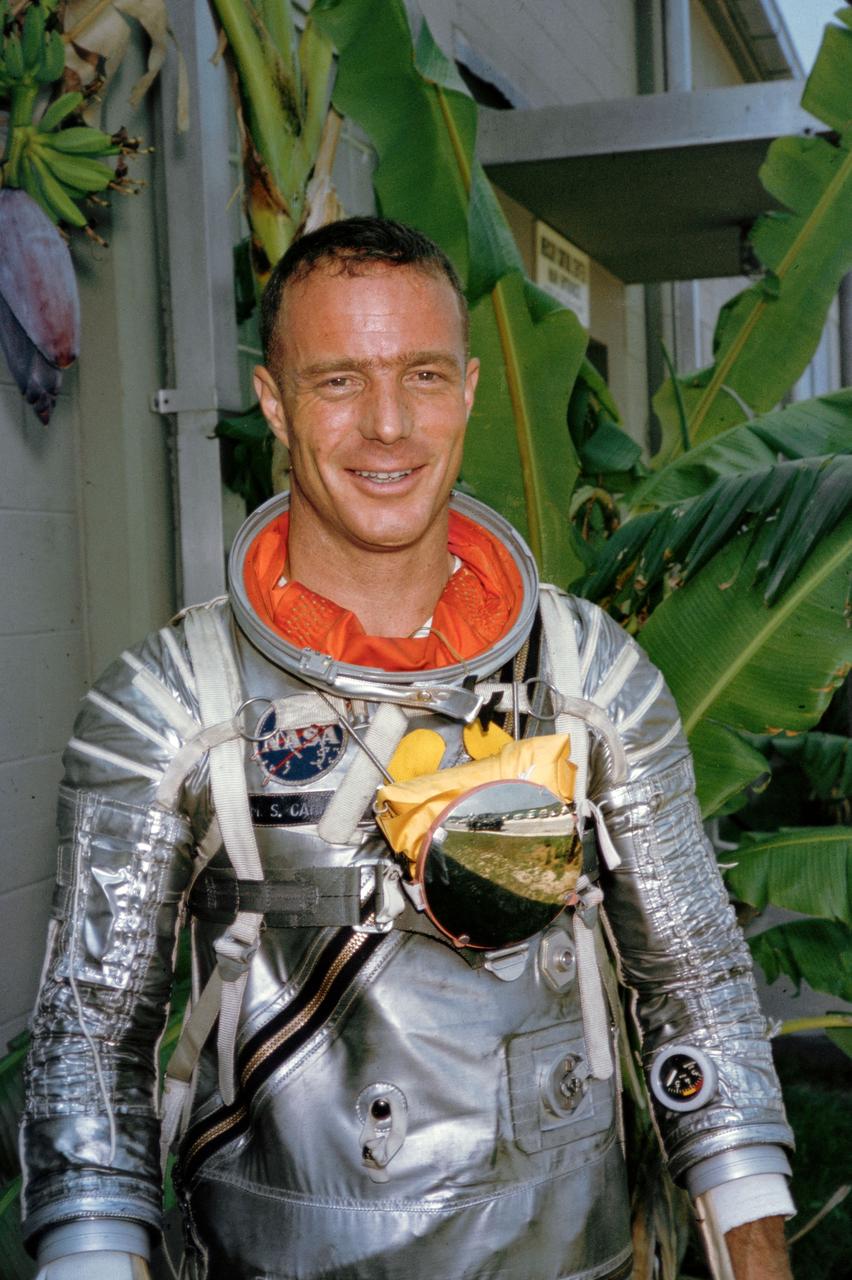
S64-36908 (1962) --- Portrait view of astronaut M. Scott Carpenter, wearing Mercury pressure suit, posing for pictures during astronaut training at the Cape Canaveral, Florida. Photo credit: NASA
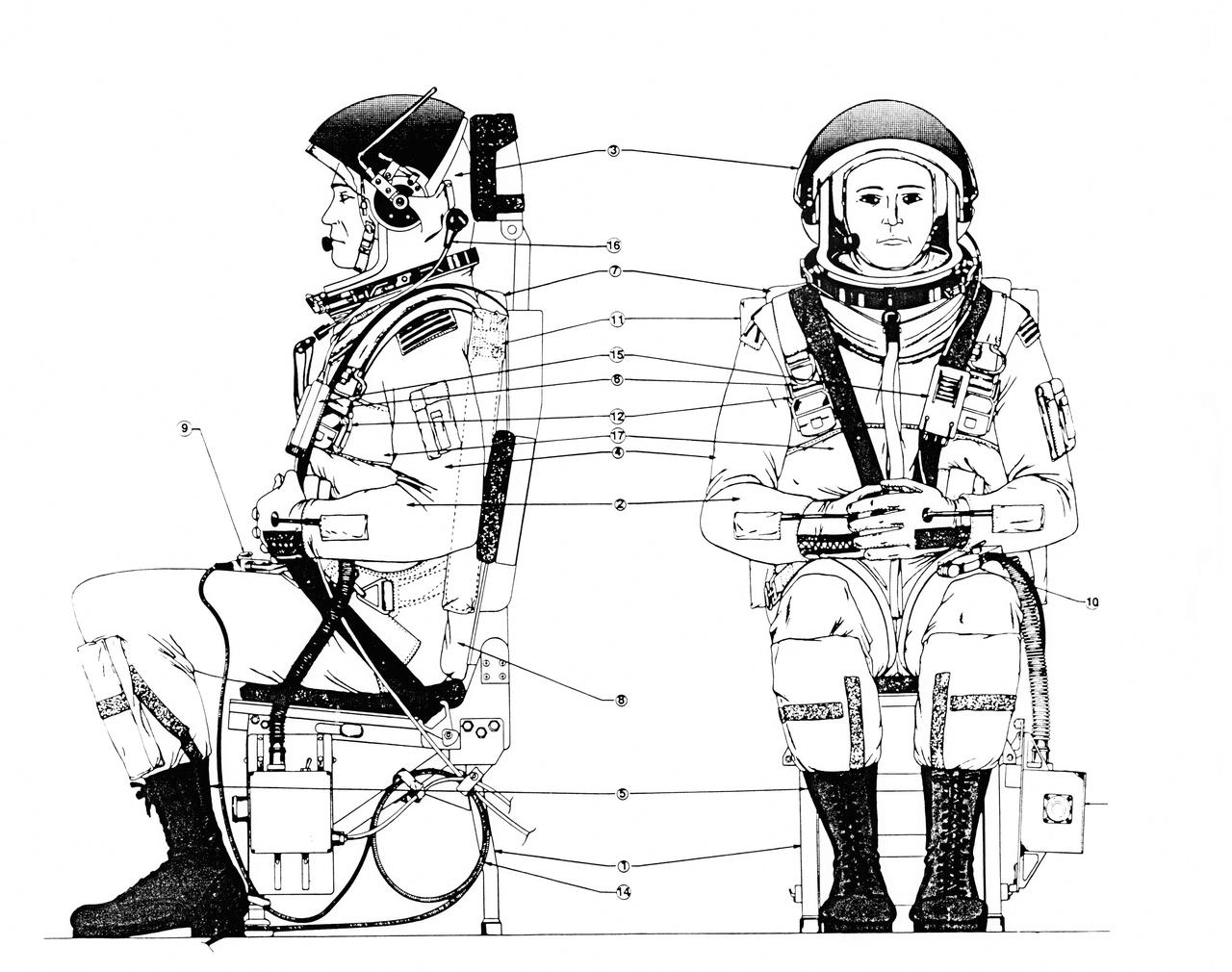
Diagrams of Crew Escape System Partial Pressure Suits, dated July, 1988.
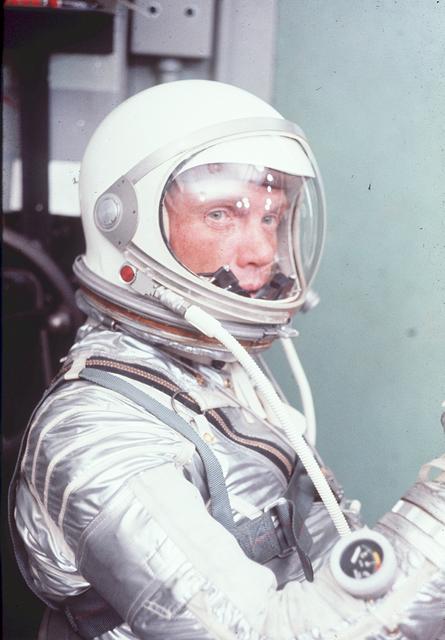
S64-36910 (February 1962) --- Astronaut John H. Glenn Jr., wearing a Mercury pressure suit, was the pilot of the Mercury-Atlas 6 (MA-6) mission. Glenn made America's first manned Earth-orbiting spaceflight on Feb. 20, 1962. This photograph was taken at Cape Canaveral, Florida, during MA-6 preflight training activities. Photo credit: NASA
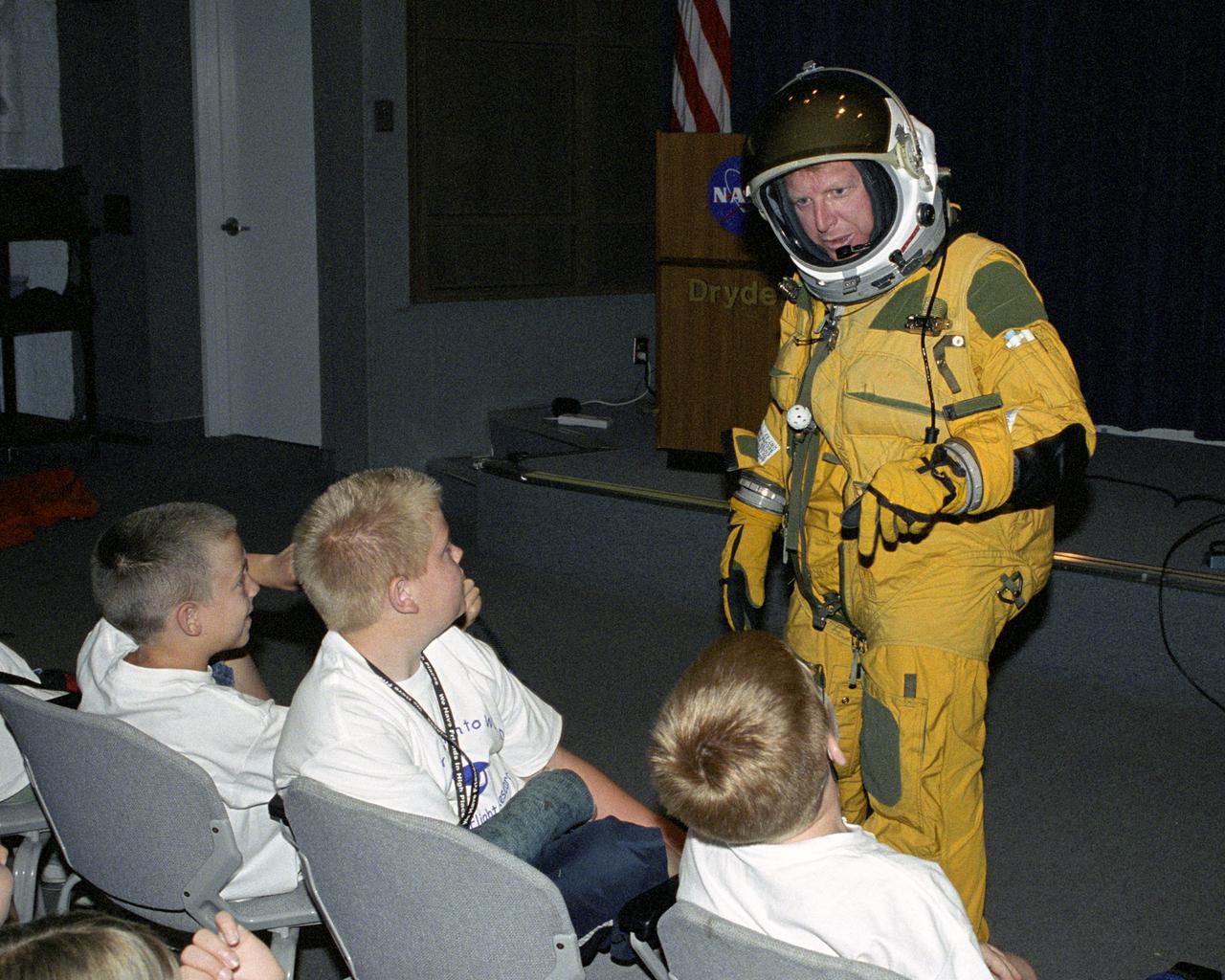
NASA Dryden historian Christian Gelzer explains functions of the high-altitude pressure suit he is wearing to (left to right) Brandon Blankenship and Garrett Clay of Lancaster and Eddie Patterson of Tehachapi during Take Your Children to Work Day activities at NASA Dryden Flight Research Center June 22.
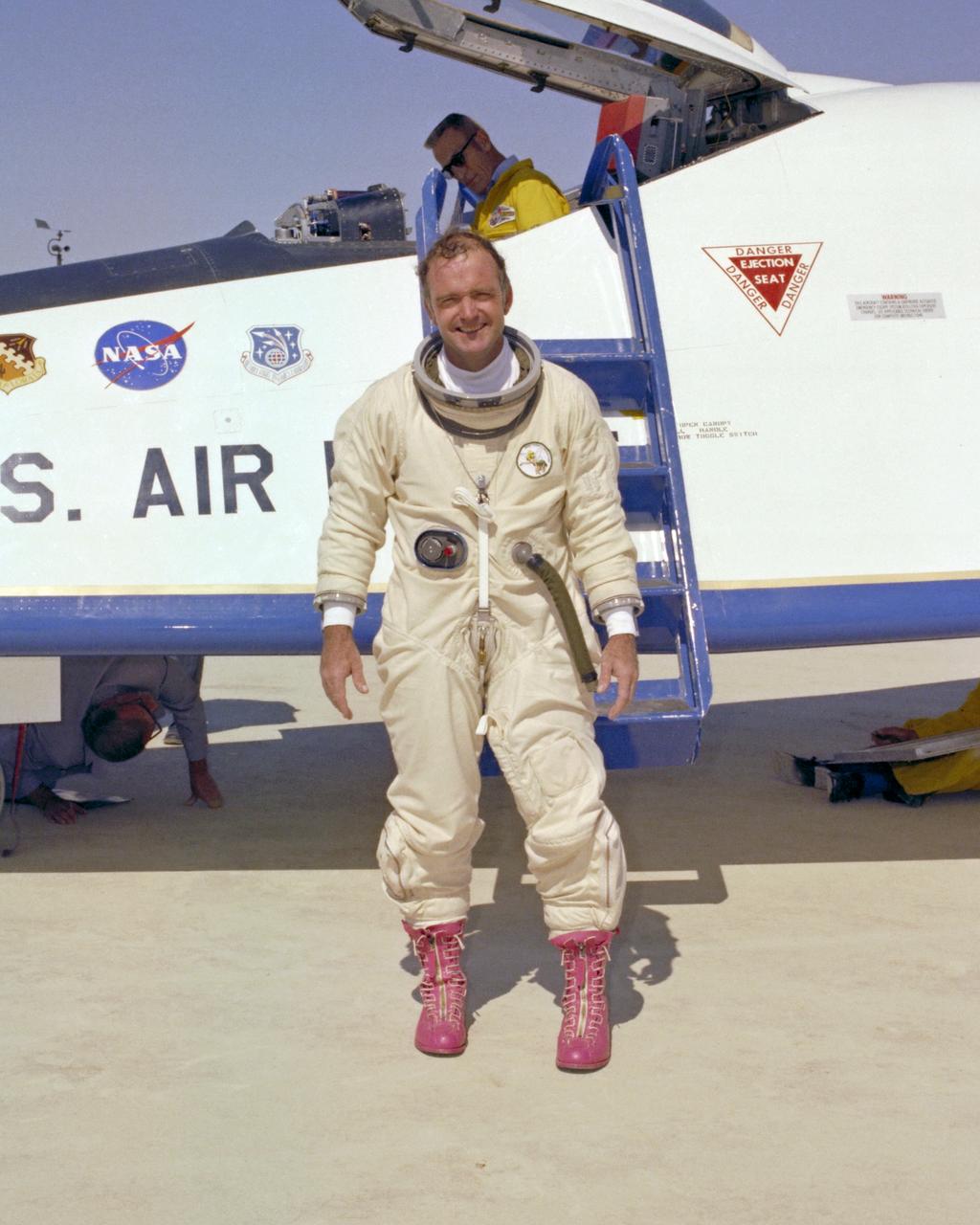
NASA test pilot Bill Dana, resplendent in pink boots and pressure suit, was all smiles following the last powered flight of the X-24B on Sept. 23, 1975.
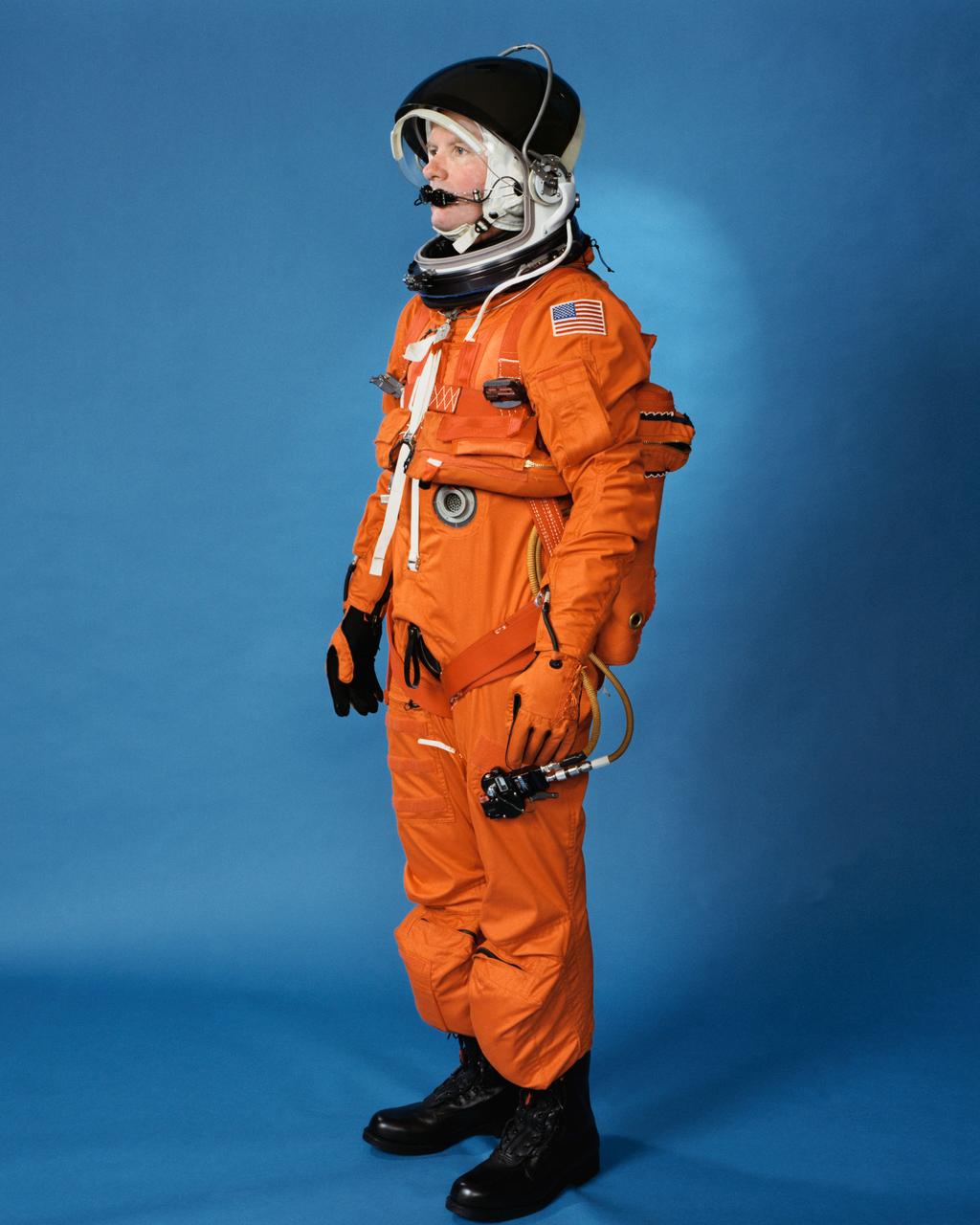
Space shuttle orange launch and entry suit (LES), a partial pressure suit, is modeled by a technician. LES was designed for STS-26, the return to flight mission, and subsequent missions. Included in the crew escape system (CES) package are launch and entry helmet (LEH) with communications carrier (COMM CAP), parachute pack and harness, life raft, life preserver unit (LPU), LES gloves, suit oxygen manifold and valves, boots, and survival gear.
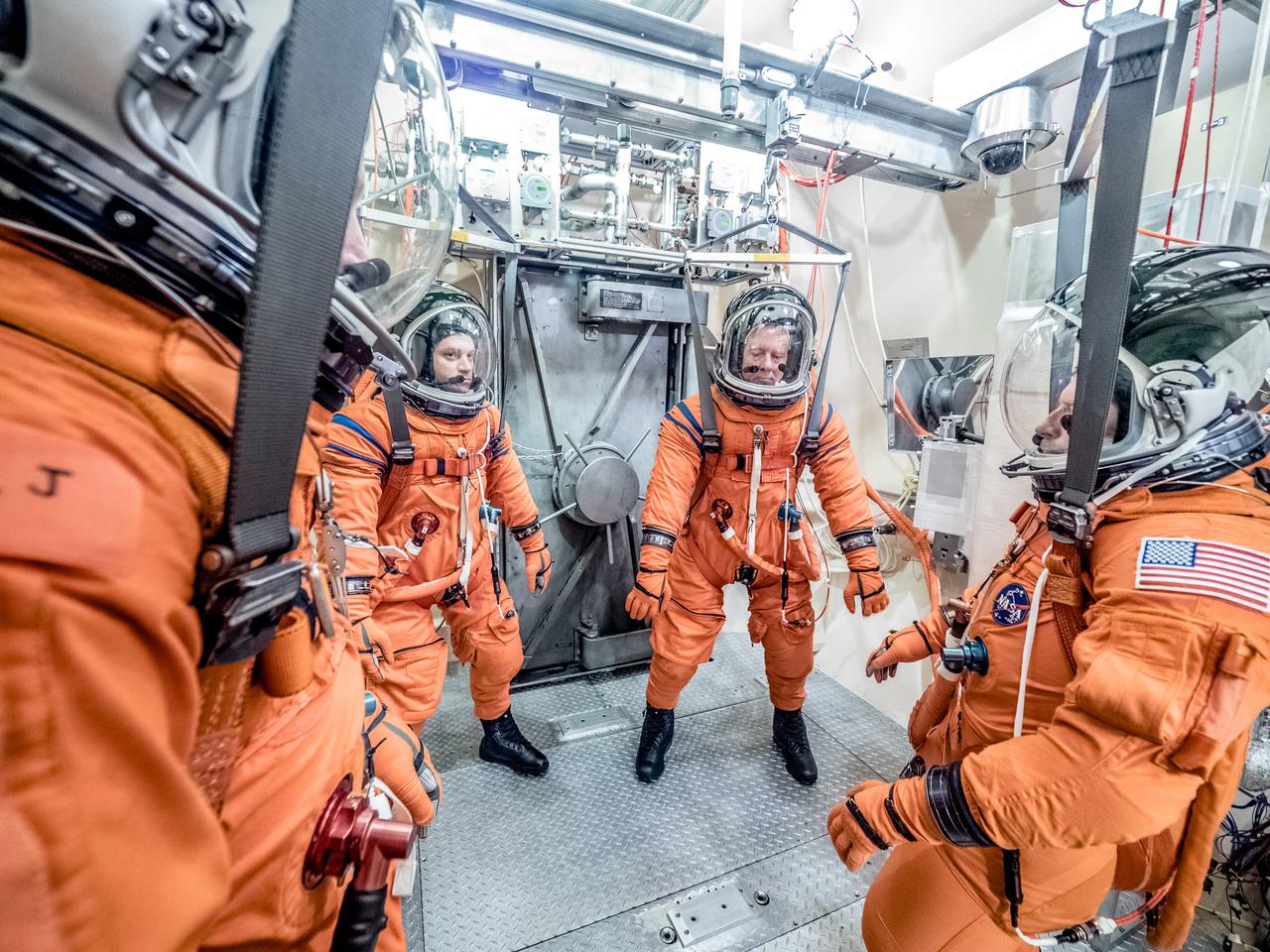
Engineers and technicians at NASA’s Johnson Space Center in Houston are testing the spacesuit astronauts will wear in the agency’s Orion spacecraft on trips to deep space. On June 22, 2017, members of the Johnson team participated in a Vacuum Pressure Integrated Suit Test to verify enhancements to the suit will meet test and design standards for the Orion spacecraft. During this test, the suit is connected to life support systems and then air is removed from Johnson’s 11-foot thermal vacuum chamber to evaluate the performance of the suits in conditions similar to a spacecraft. The suit will contain all the necessary functions to support life and is being designed to enable spacewalks and sustain the crew in the unlikely event the spacecraft loses pressure. Part of Batch images transfer from Flickr.
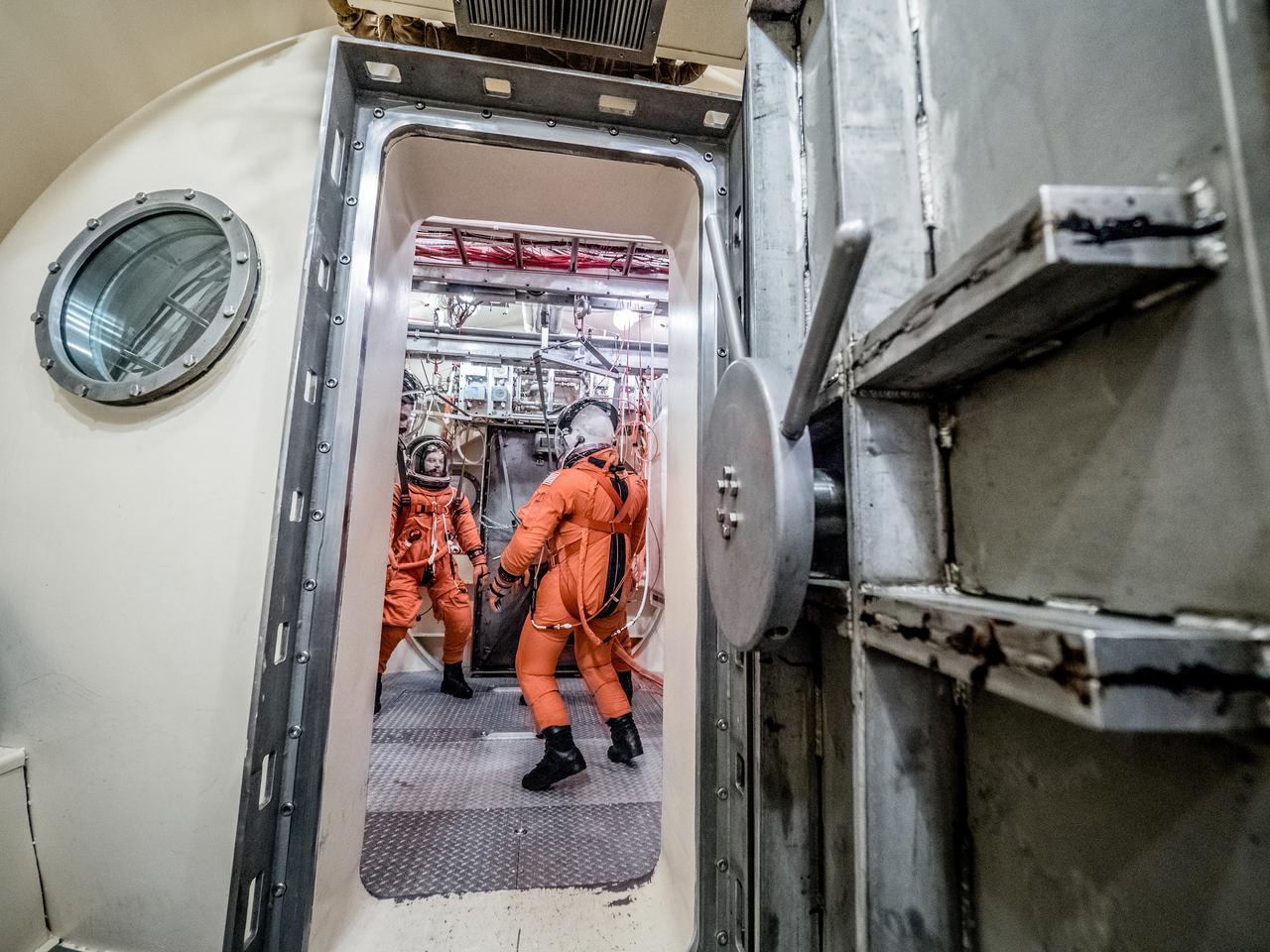
Engineers and technicians at NASA’s Johnson Space Center in Houston are testing the spacesuit astronauts will wear in the agency’s Orion spacecraft on trips to deep space. On June 22, 2017, members of the Johnson team participated in a Vacuum Pressure Integrated Suit Test to verify enhancements to the suit will meet test and design standards for the Orion spacecraft. During this test, the suit is connected to life support systems and then air is removed from Johnson’s 11-foot thermal vacuum chamber to evaluate the performance of the suits in conditions similar to a spacecraft. The suit will contain all the necessary functions to support life and is being designed to enable spacewalks and sustain the crew in the unlikely event the spacecraft loses pressure. Part of Batch images transfer from Flickr.
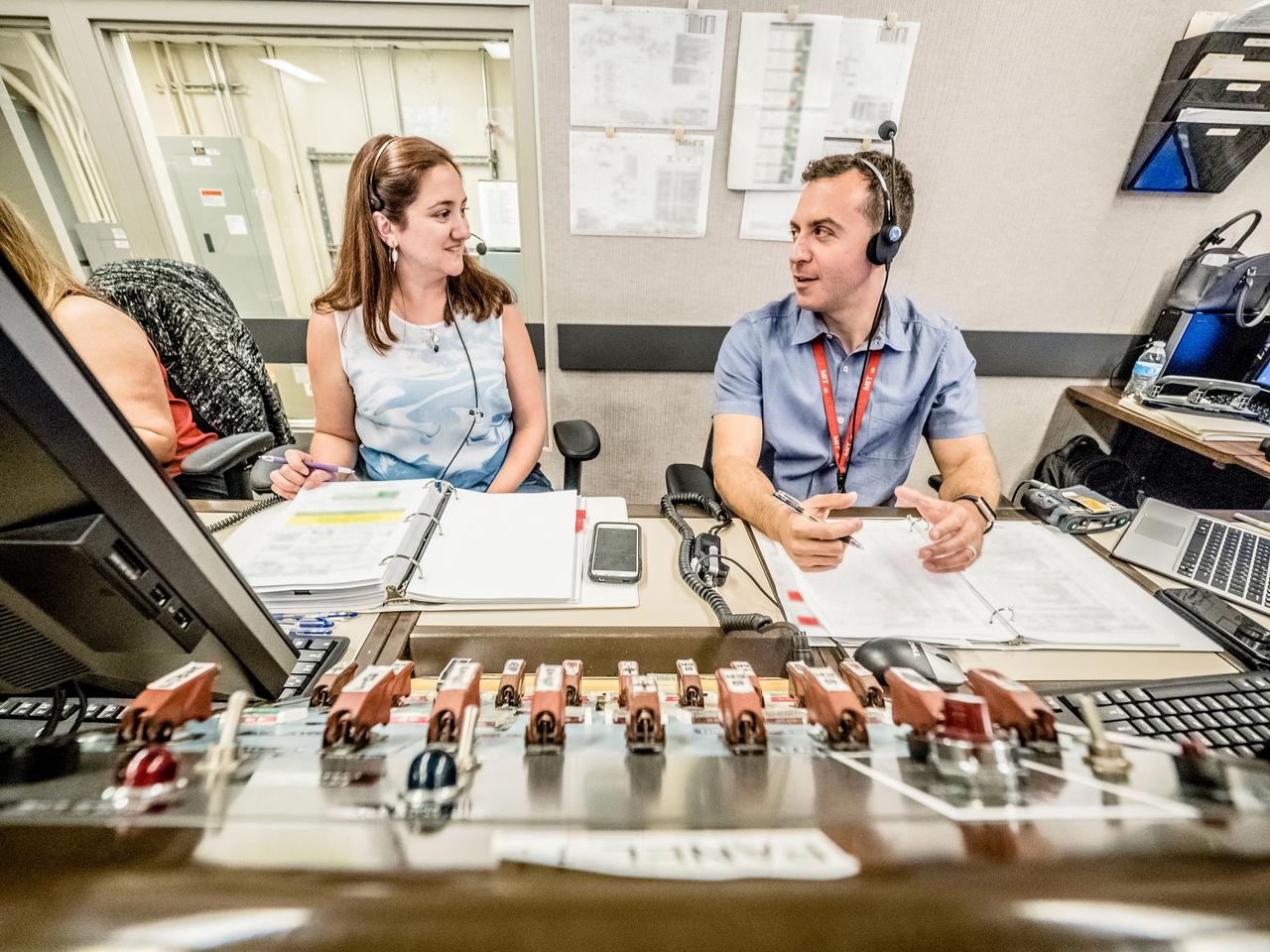
Engineers and technicians at NASA’s Johnson Space Center in Houston are testing the spacesuit astronauts will wear in the agency’s Orion spacecraft on trips to deep space. On June 22, 2017, members of the Johnson team participated in a Vacuum Pressure Integrated Suit Test to verify enhancements to the suit will meet test and design standards for the Orion spacecraft. During this test, the suit is connected to life support systems and then air is removed from Johnson’s 11-foot thermal vacuum chamber to evaluate the performance of the suits in conditions similar to a spacecraft. The suit will contain all the necessary functions to support life and is being designed to enable spacewalks and sustain the crew in the unlikely event the spacecraft loses pressure. Part of Batch images transfer from Flickr.
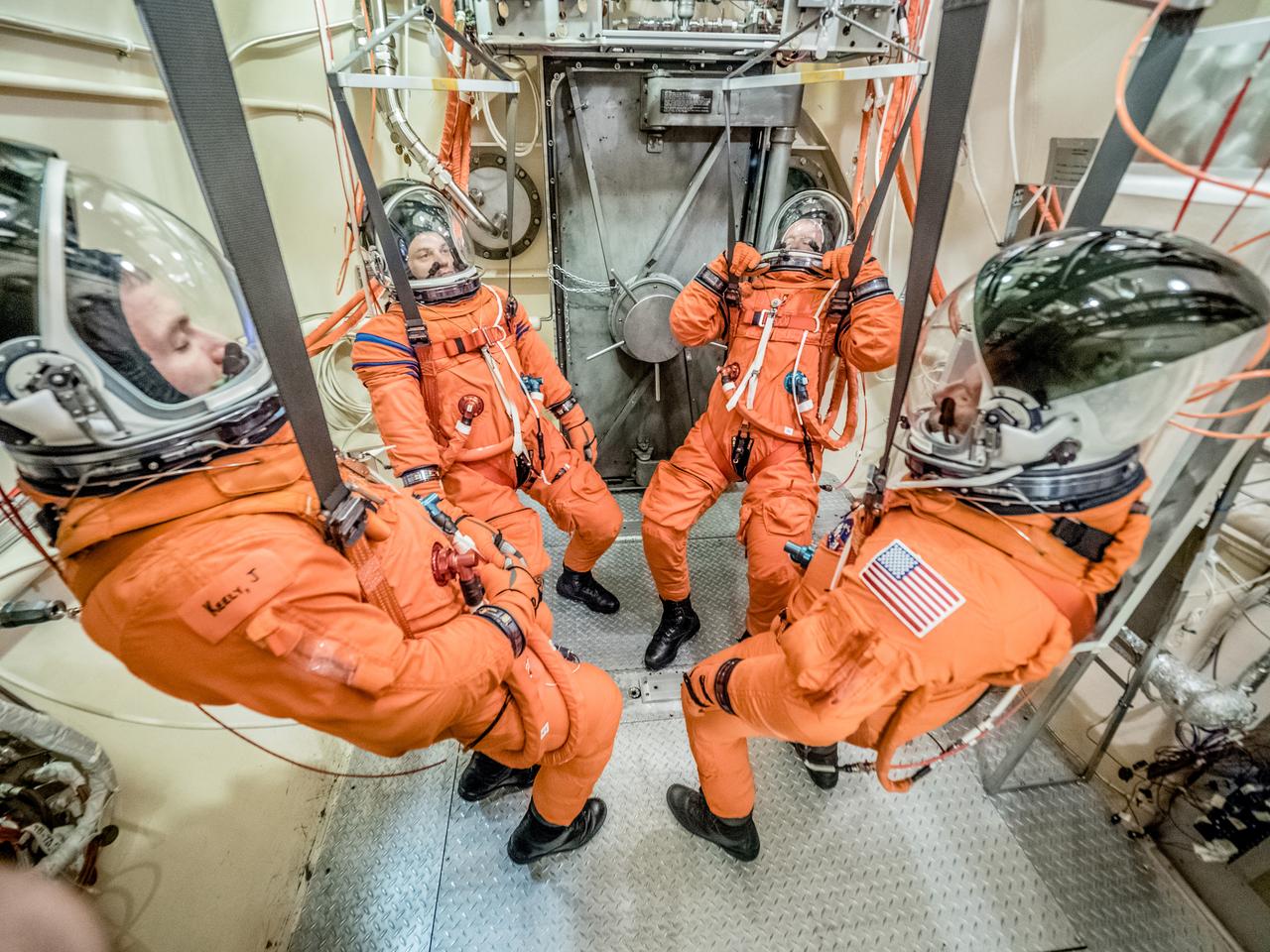
Engineers and technicians at NASA’s Johnson Space Center in Houston are testing the spacesuit astronauts will wear in the agency’s Orion spacecraft on trips to deep space. On June 22, 2017, members of the Johnson team participated in a Vacuum Pressure Integrated Suit Test to verify enhancements to the suit will meet test and design standards for the Orion spacecraft. During this test, the suit is connected to life support systems and then air is removed from Johnson’s 11-foot thermal vacuum chamber to evaluate the performance of the suits in conditions similar to a spacecraft. The suit will contain all the necessary functions to support life and is being designed to enable spacewalks and sustain the crew in the unlikely event the spacecraft loses pressure. Part of Batch images transfer from Flickr.
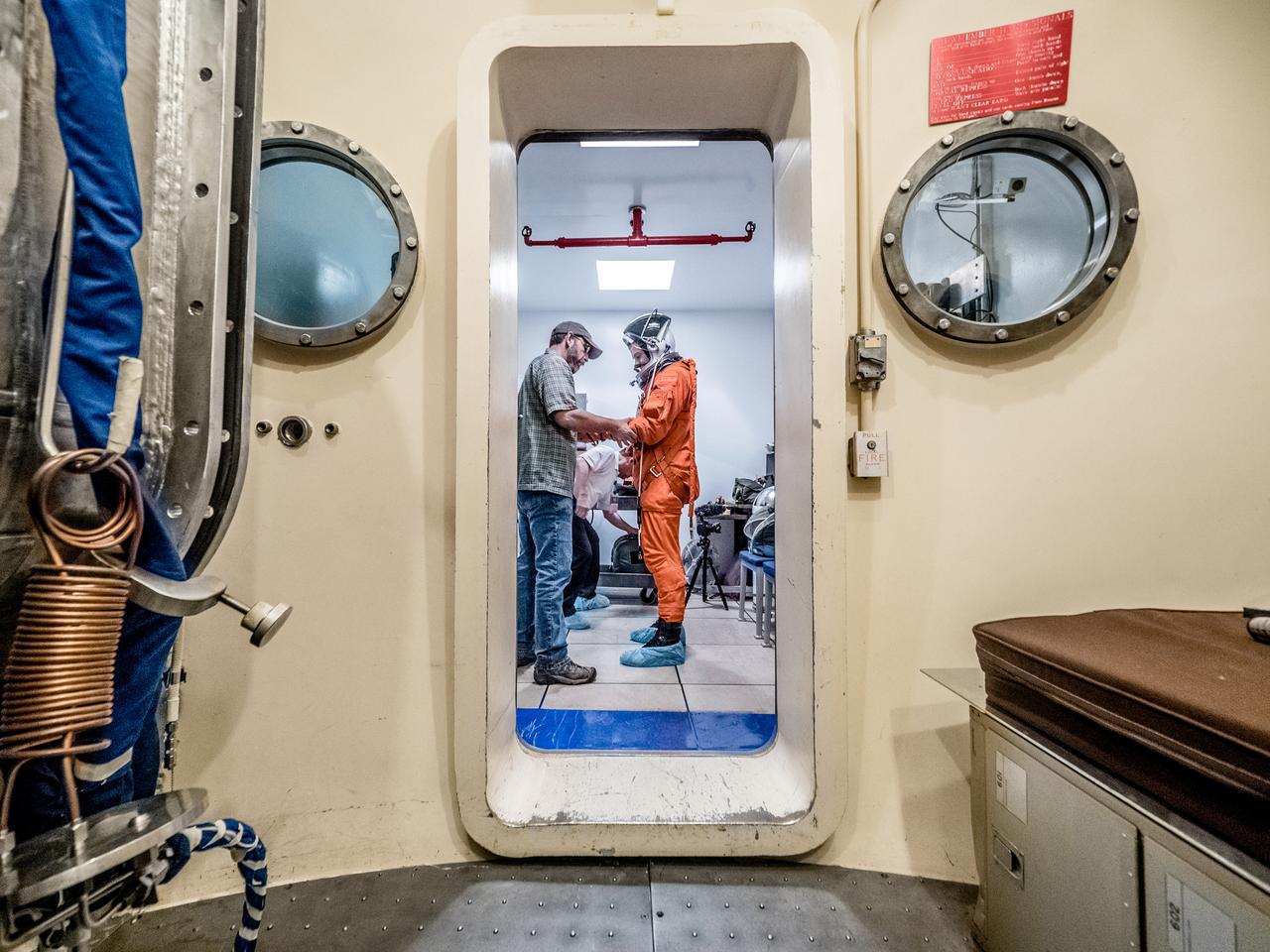
Engineers and technicians at NASA’s Johnson Space Center in Houston are testing the spacesuit astronauts will wear in the agency’s Orion spacecraft on trips to deep space. On June 22, 2017, members of the Johnson team participated in a Vacuum Pressure Integrated Suit Test to verify enhancements to the suit will meet test and design standards for the Orion spacecraft. During this test, the suit is connected to life support systems and then air is removed from Johnson’s 11-foot thermal vacuum chamber to evaluate the performance of the suits in conditions similar to a spacecraft. The suit will contain all the necessary functions to support life and is being designed to enable spacewalks and sustain the crew in the unlikely event the spacecraft loses pressure. Part of Batch images transfer from Flickr.
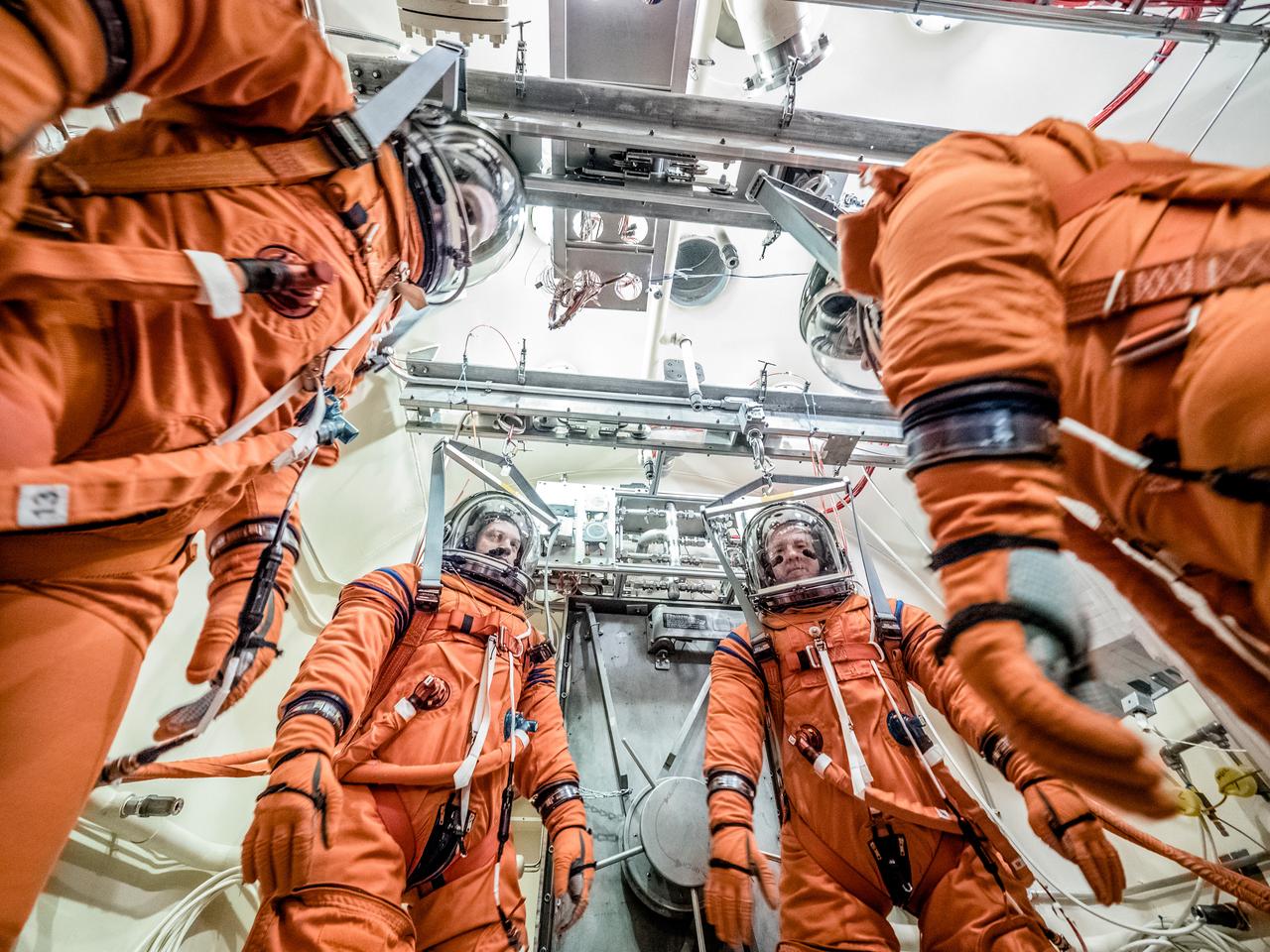
Engineers and technicians at NASA’s Johnson Space Center in Houston are testing the spacesuit astronauts will wear in the agency’s Orion spacecraft on trips to deep space. On June 22, 2017, members of the Johnson team participated in a Vacuum Pressure Integrated Suit Test to verify enhancements to the suit will meet test and design standards for the Orion spacecraft. During this test, the suit is connected to life support systems and then air is removed from Johnson’s 11-foot thermal vacuum chamber to evaluate the performance of the suits in conditions similar to a spacecraft. The suit will contain all the necessary functions to support life and is being designed to enable spacewalks and sustain the crew in the unlikely event the spacecraft loses pressure. Part of Batch images transfer from Flickr.
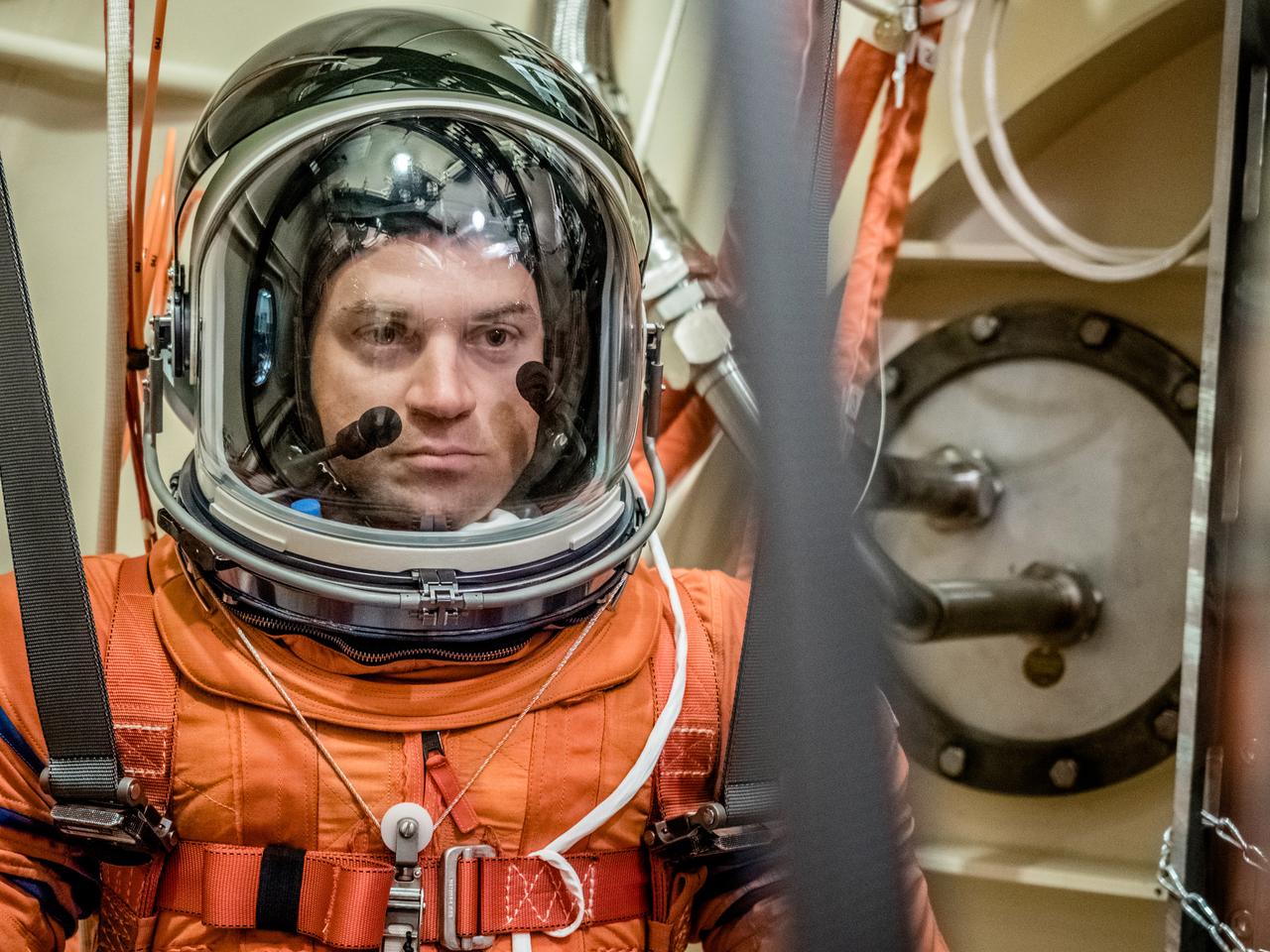
Engineers and technicians at NASA’s Johnson Space Center in Houston are testing the spacesuit astronauts will wear in the agency’s Orion spacecraft on trips to deep space. On June 22, 2017, members of the Johnson team participated in a Vacuum Pressure Integrated Suit Test to verify enhancements to the suit will meet test and design standards for the Orion spacecraft. During this test, the suit is connected to life support systems and then air is removed from Johnson’s 11-foot thermal vacuum chamber to evaluate the performance of the suits in conditions similar to a spacecraft. The suit will contain all the necessary functions to support life and is being designed to enable spacewalks and sustain the crew in the unlikely event the spacecraft loses pressure. Part of Batch images transfer from Flickr.
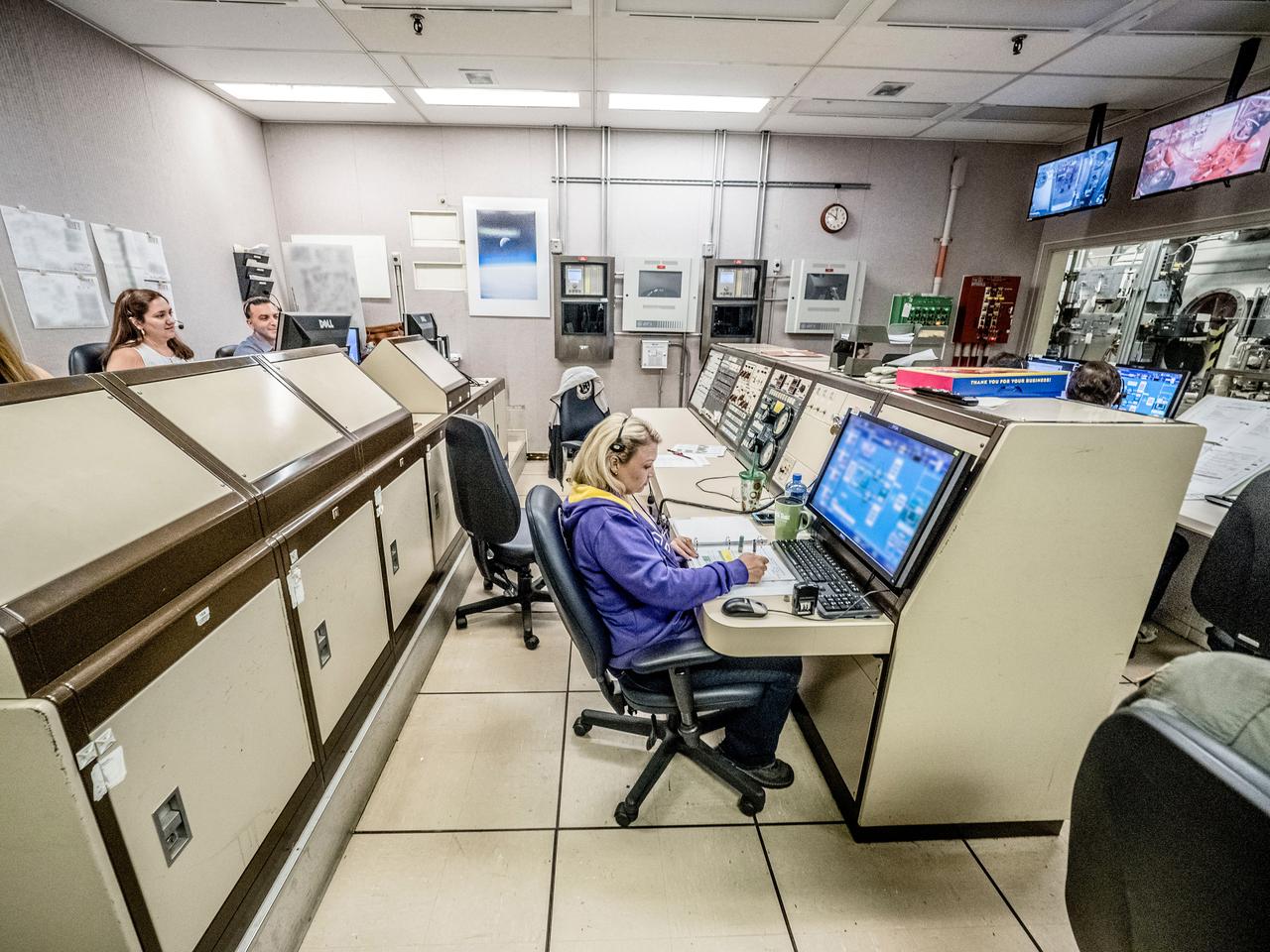
Engineers and technicians at NASA’s Johnson Space Center in Houston are testing the spacesuit astronauts will wear in the agency’s Orion spacecraft on trips to deep space. On June 22, 2017, members of the Johnson team participated in a Vacuum Pressure Integrated Suit Test to verify enhancements to the suit will meet test and design standards for the Orion spacecraft. During this test, the suit is connected to life support systems and then air is removed from Johnson’s 11-foot thermal vacuum chamber to evaluate the performance of the suits in conditions similar to a spacecraft. The suit will contain all the necessary functions to support life and is being designed to enable spacewalks and sustain the crew in the unlikely event the spacecraft loses pressure. Part of Batch images transfer from Flickr.
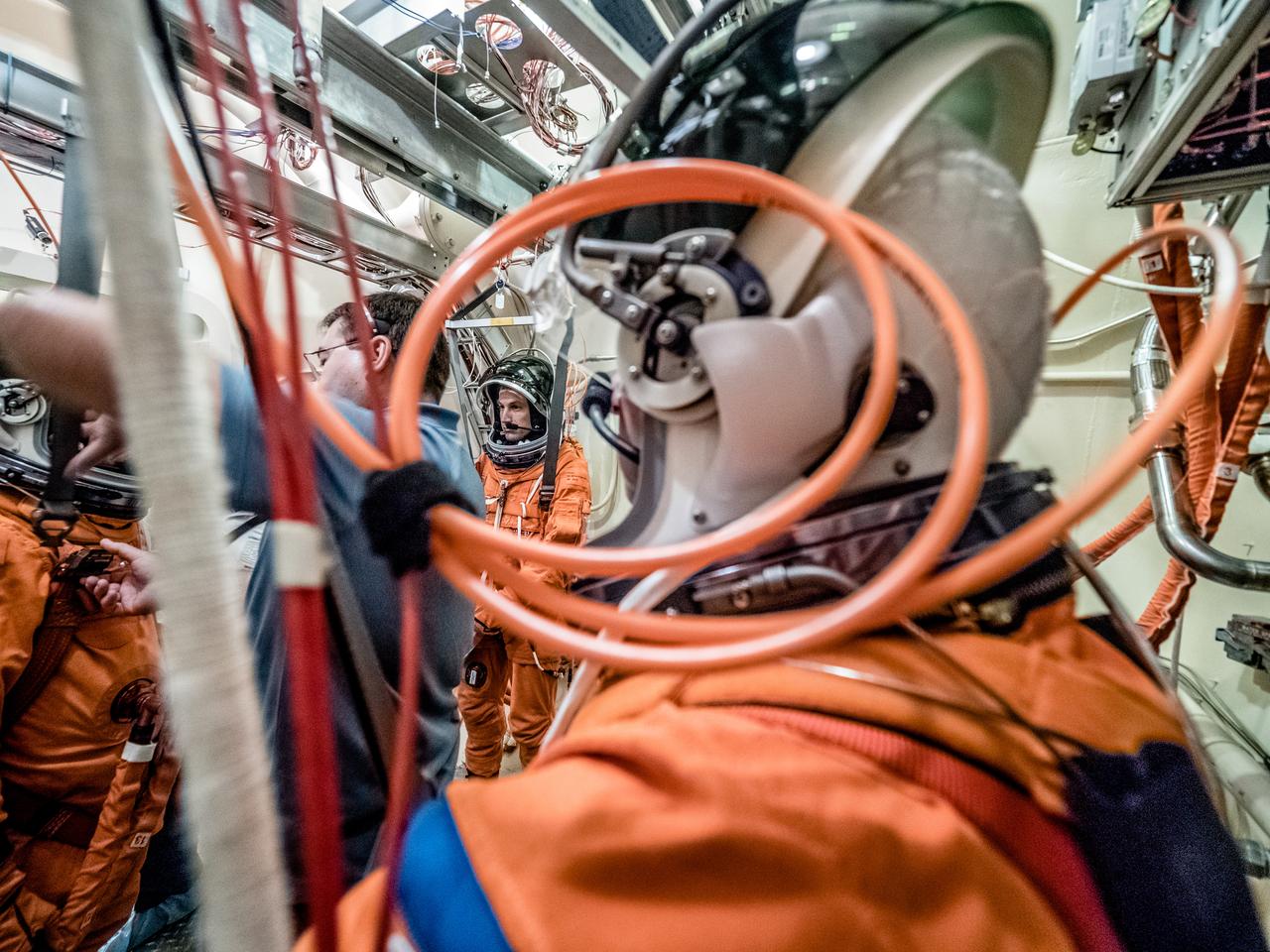
Engineers and technicians at NASA’s Johnson Space Center in Houston are testing the spacesuit astronauts will wear in the agency’s Orion spacecraft on trips to deep space. On June 22, 2017, members of the Johnson team participated in a Vacuum Pressure Integrated Suit Test to verify enhancements to the suit will meet test and design standards for the Orion spacecraft. During this test, the suit is connected to life support systems and then air is removed from Johnson’s 11-foot thermal vacuum chamber to evaluate the performance of the suits in conditions similar to a spacecraft. The suit will contain all the necessary functions to support life and is being designed to enable spacewalks and sustain the crew in the unlikely event the spacecraft loses pressure. Part of Batch images transfer from Flickr.
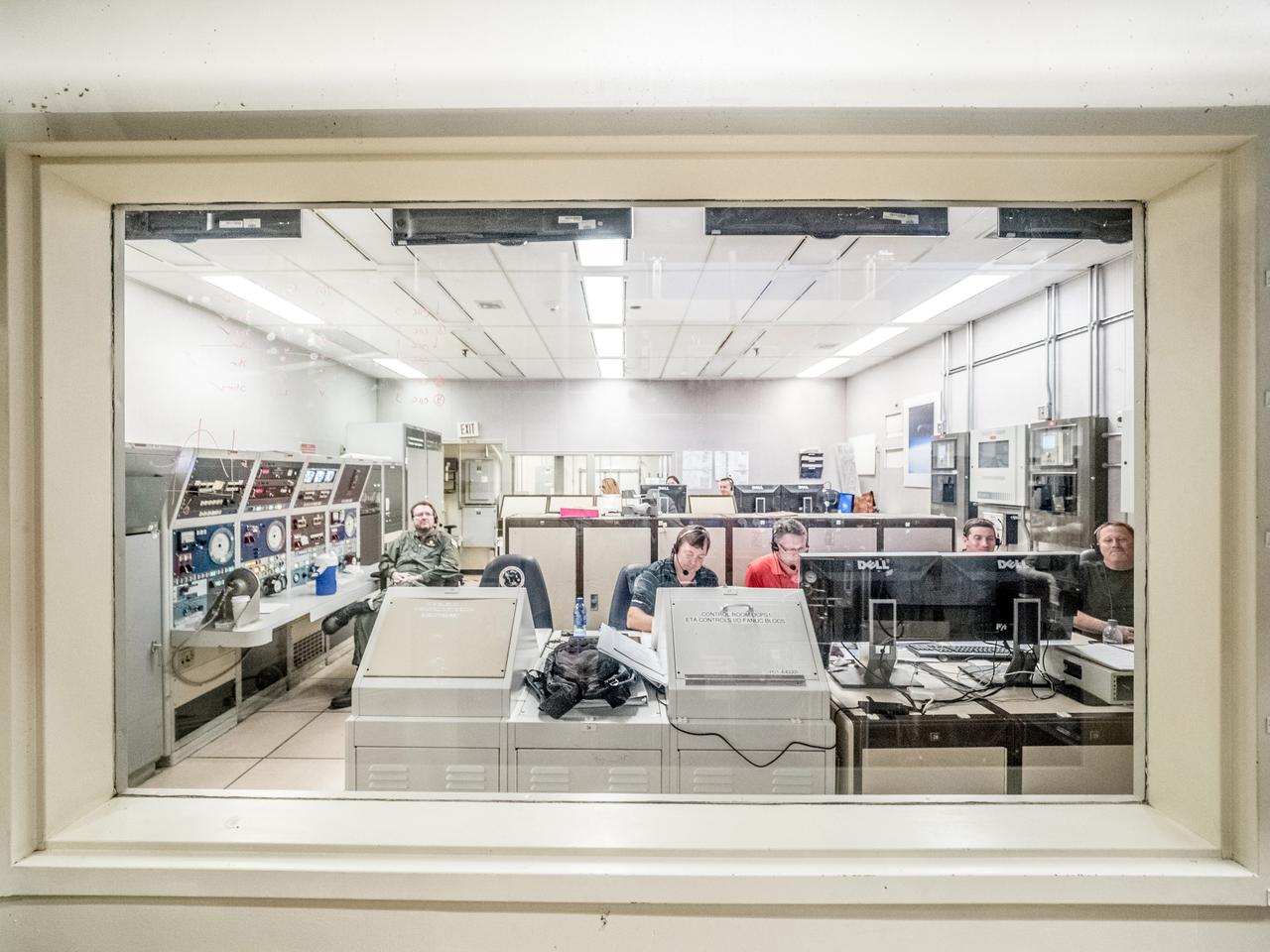
Engineers and technicians at NASA’s Johnson Space Center in Houston are testing the spacesuit astronauts will wear in the agency’s Orion spacecraft on trips to deep space. On June 22, 2017, members of the Johnson team participated in a Vacuum Pressure Integrated Suit Test to verify enhancements to the suit will meet test and design standards for the Orion spacecraft. During this test, the suit is connected to life support systems and then air is removed from Johnson’s 11-foot thermal vacuum chamber to evaluate the performance of the suits in conditions similar to a spacecraft. The suit will contain all the necessary functions to support life and is being designed to enable spacewalks and sustain the crew in the unlikely event the spacecraft loses pressure. Part of Batch images transfer from Flickr.
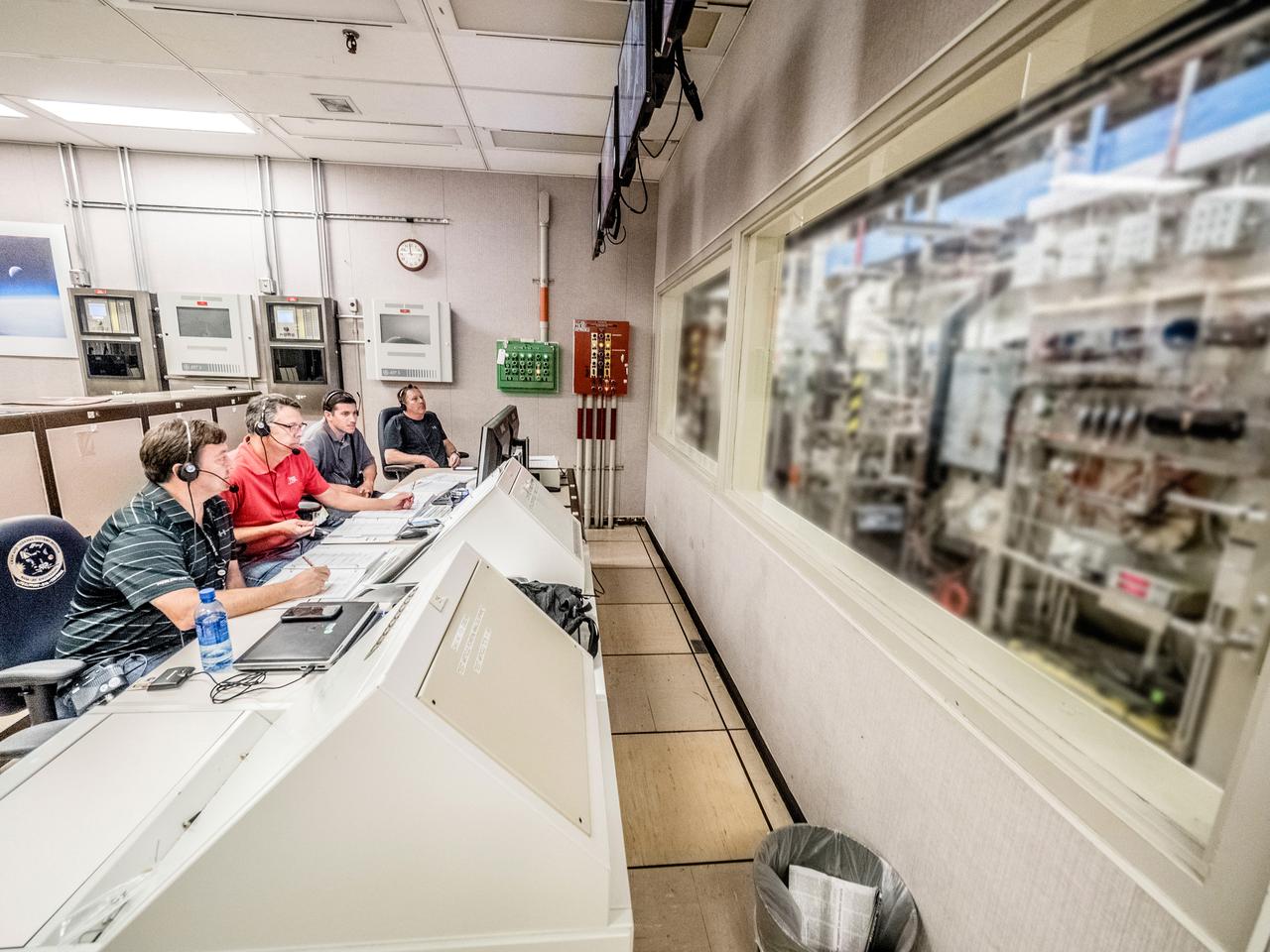
Engineers and technicians at NASA’s Johnson Space Center in Houston are testing the spacesuit astronauts will wear in the agency’s Orion spacecraft on trips to deep space. On June 22, 2017, members of the Johnson team participated in a Vacuum Pressure Integrated Suit Test to verify enhancements to the suit will meet test and design standards for the Orion spacecraft. During this test, the suit is connected to life support systems and then air is removed from Johnson’s 11-foot thermal vacuum chamber to evaluate the performance of the suits in conditions similar to a spacecraft. The suit will contain all the necessary functions to support life and is being designed to enable spacewalks and sustain the crew in the unlikely event the spacecraft loses pressure. Part of Batch images transfer from Flickr.
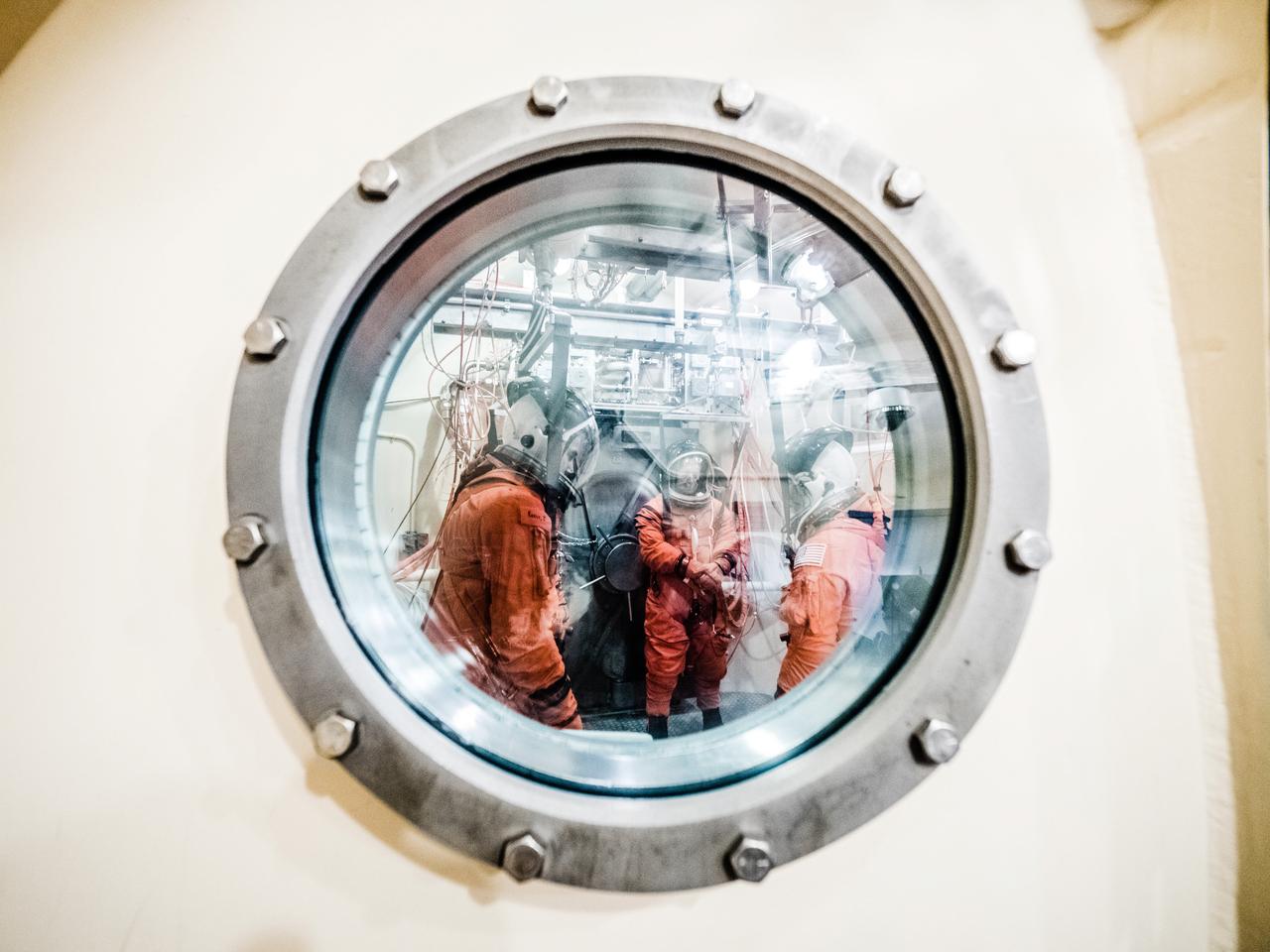
Engineers and technicians at NASA’s Johnson Space Center in Houston are testing the spacesuit astronauts will wear in the agency’s Orion spacecraft on trips to deep space. On June 22, 2017, members of the Johnson team participated in a Vacuum Pressure Integrated Suit Test to verify enhancements to the suit will meet test and design standards for the Orion spacecraft. During this test, the suit is connected to life support systems and then air is removed from Johnson’s 11-foot thermal vacuum chamber to evaluate the performance of the suits in conditions similar to a spacecraft. The suit will contain all the necessary functions to support life and is being designed to enable spacewalks and sustain the crew in the unlikely event the spacecraft loses pressure. Part of Batch images transfer from Flickr.
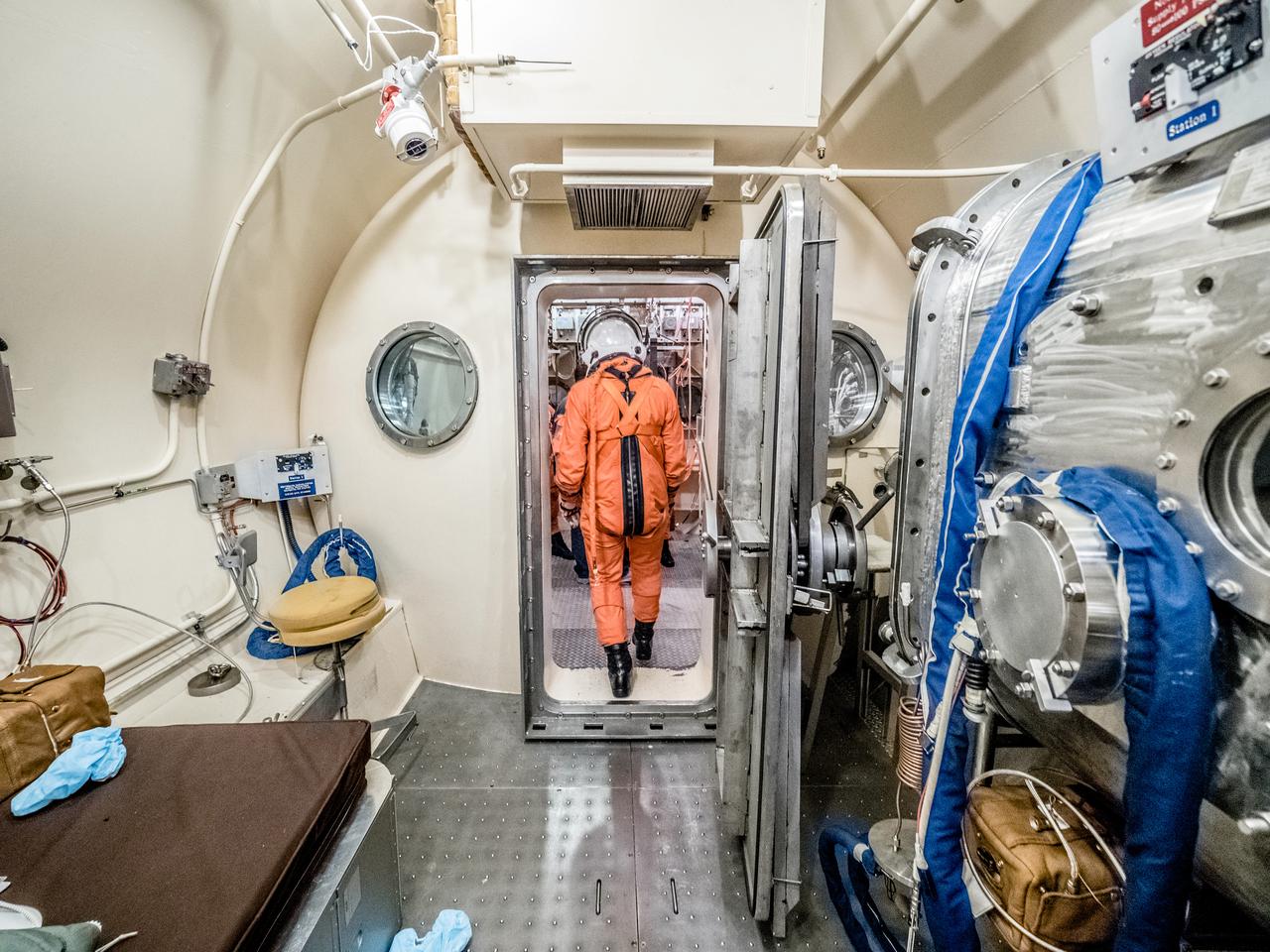
Engineers and technicians at NASA’s Johnson Space Center in Houston are testing the spacesuit astronauts will wear in the agency’s Orion spacecraft on trips to deep space. On June 22, 2017, members of the Johnson team participated in a Vacuum Pressure Integrated Suit Test to verify enhancements to the suit will meet test and design standards for the Orion spacecraft. During this test, the suit is connected to life support systems and then air is removed from Johnson’s 11-foot thermal vacuum chamber to evaluate the performance of the suits in conditions similar to a spacecraft. The suit will contain all the necessary functions to support life and is being designed to enable spacewalks and sustain the crew in the unlikely event the spacecraft loses pressure. Part of Batch images transfer from Flickr.
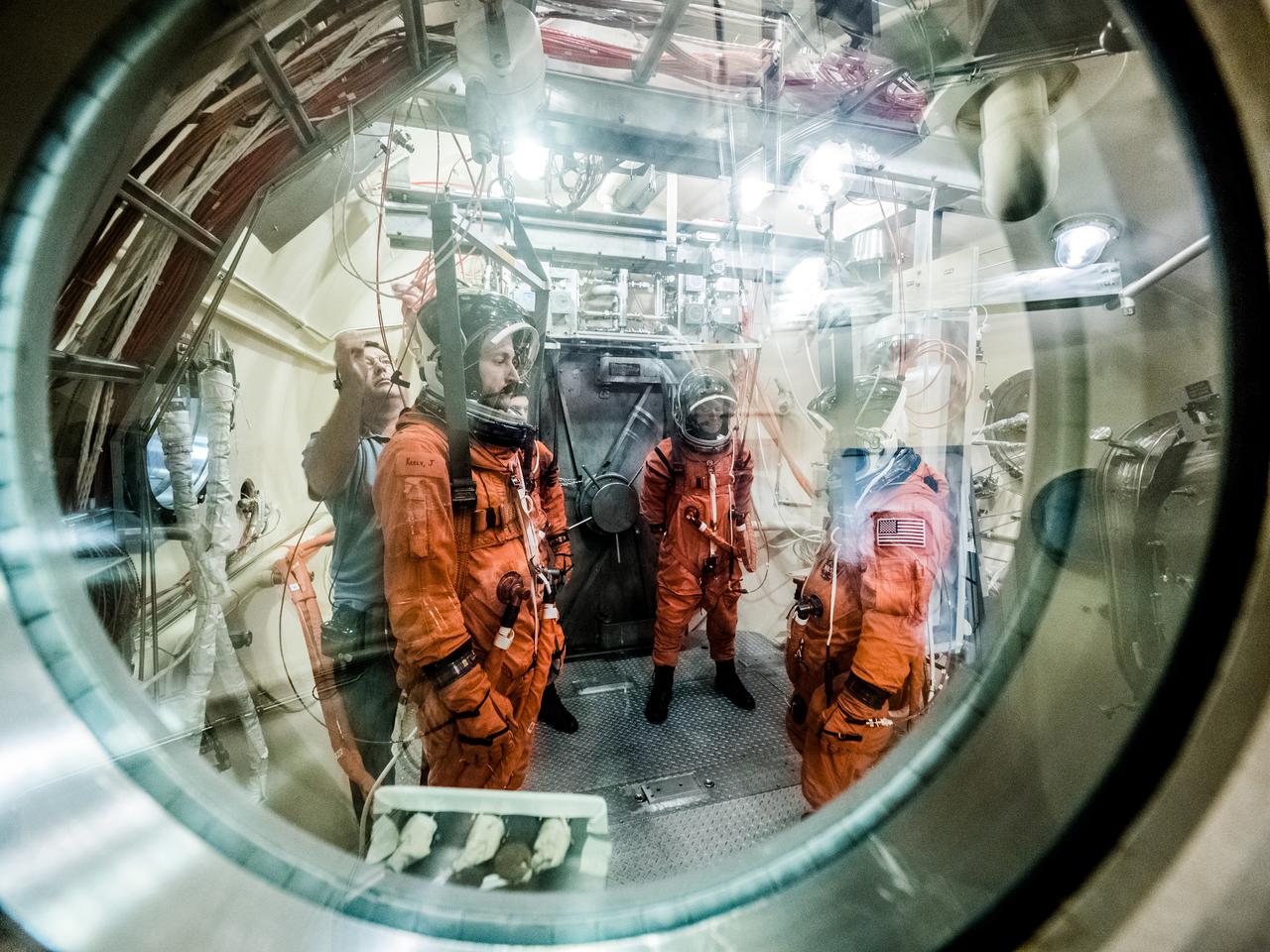
Engineers and technicians at NASA’s Johnson Space Center in Houston are testing the spacesuit astronauts will wear in the agency’s Orion spacecraft on trips to deep space. On June 22, 2017, members of the Johnson team participated in a Vacuum Pressure Integrated Suit Test to verify enhancements to the suit will meet test and design standards for the Orion spacecraft. During this test, the suit is connected to life support systems and then air is removed from Johnson’s 11-foot thermal vacuum chamber to evaluate the performance of the suits in conditions similar to a spacecraft. The suit will contain all the necessary functions to support life and is being designed to enable spacewalks and sustain the crew in the unlikely event the spacecraft loses pressure. Part of Batch images transfer from Flickr.
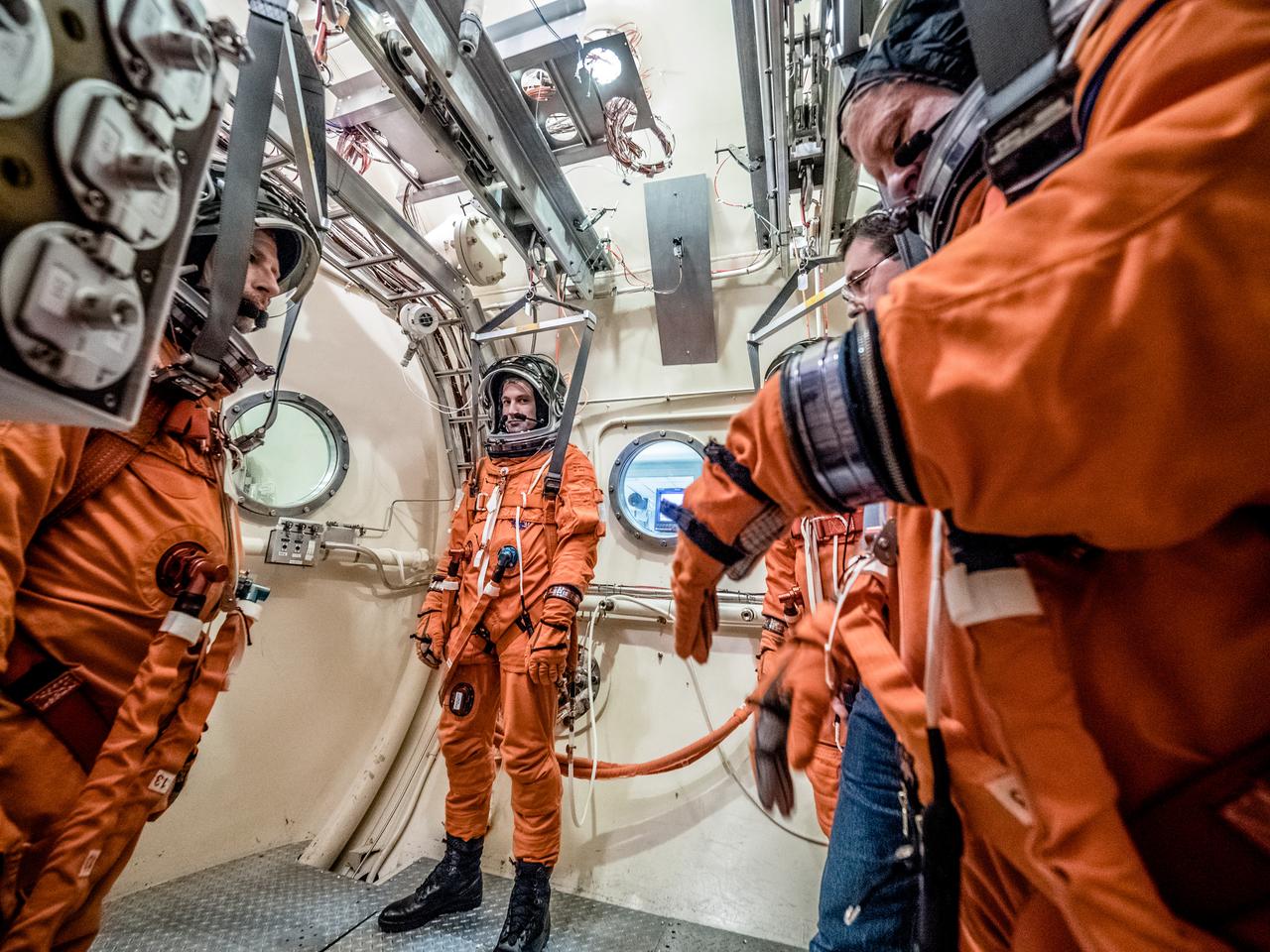
Engineers and technicians at NASA’s Johnson Space Center in Houston are testing the spacesuit astronauts will wear in the agency’s Orion spacecraft on trips to deep space. On June 22, 2017, members of the Johnson team participated in a Vacuum Pressure Integrated Suit Test to verify enhancements to the suit will meet test and design standards for the Orion spacecraft. During this test, the suit is connected to life support systems and then air is removed from Johnson’s 11-foot thermal vacuum chamber to evaluate the performance of the suits in conditions similar to a spacecraft. The suit will contain all the necessary functions to support life and is being designed to enable spacewalks and sustain the crew in the unlikely event the spacecraft loses pressure. Part of Batch images transfer from Flickr.
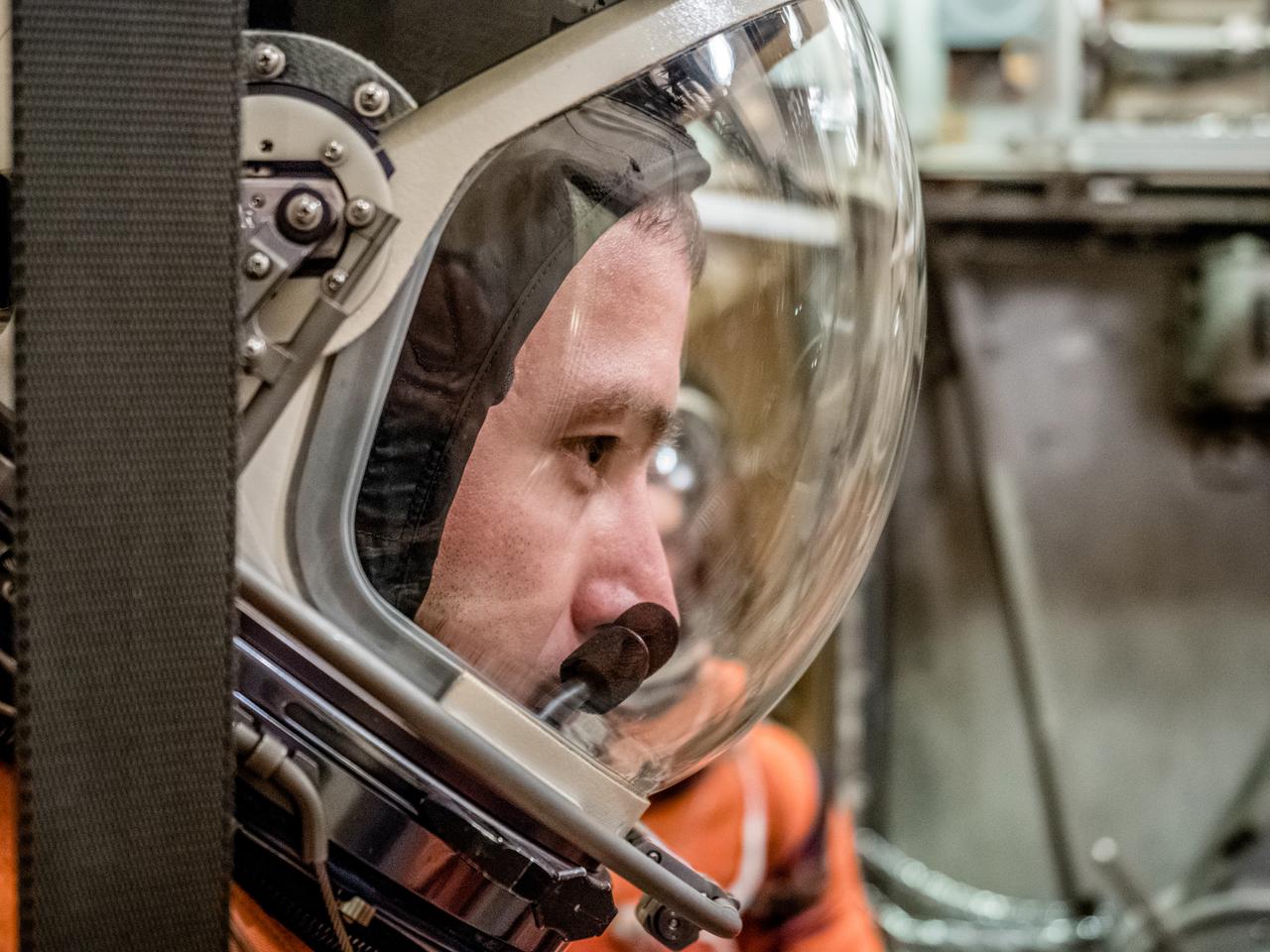
Engineers and technicians at NASA’s Johnson Space Center in Houston are testing the spacesuit astronauts will wear in the agency’s Orion spacecraft on trips to deep space. On June 22, 2017, members of the Johnson team participated in a Vacuum Pressure Integrated Suit Test to verify enhancements to the suit will meet test and design standards for the Orion spacecraft. During this test, the suit is connected to life support systems and then air is removed from Johnson’s 11-foot thermal vacuum chamber to evaluate the performance of the suits in conditions similar to a spacecraft. The suit will contain all the necessary functions to support life and is being designed to enable spacewalks and sustain the crew in the unlikely event the spacecraft loses pressure. Part of Batch images transfer from Flickr.
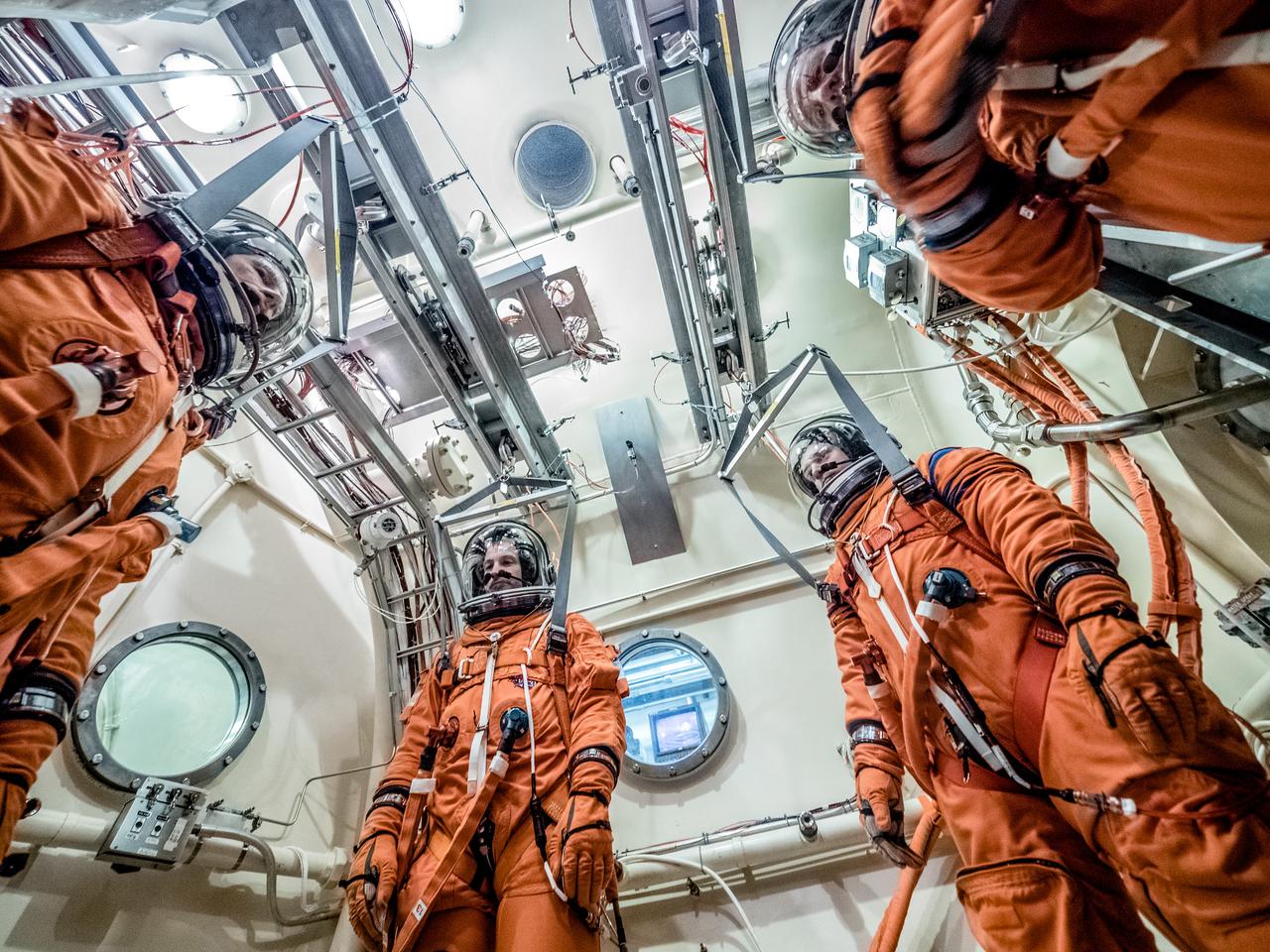
Engineers and technicians at NASA’s Johnson Space Center in Houston are testing the spacesuit astronauts will wear in the agency’s Orion spacecraft on trips to deep space. On June 22, 2017, members of the Johnson team participated in a Vacuum Pressure Integrated Suit Test to verify enhancements to the suit will meet test and design standards for the Orion spacecraft. During this test, the suit is connected to life support systems and then air is removed from Johnson’s 11-foot thermal vacuum chamber to evaluate the performance of the suits in conditions similar to a spacecraft. The suit will contain all the necessary functions to support life and is being designed to enable spacewalks and sustain the crew in the unlikely event the spacecraft loses pressure. Part of Batch images transfer from Flickr.
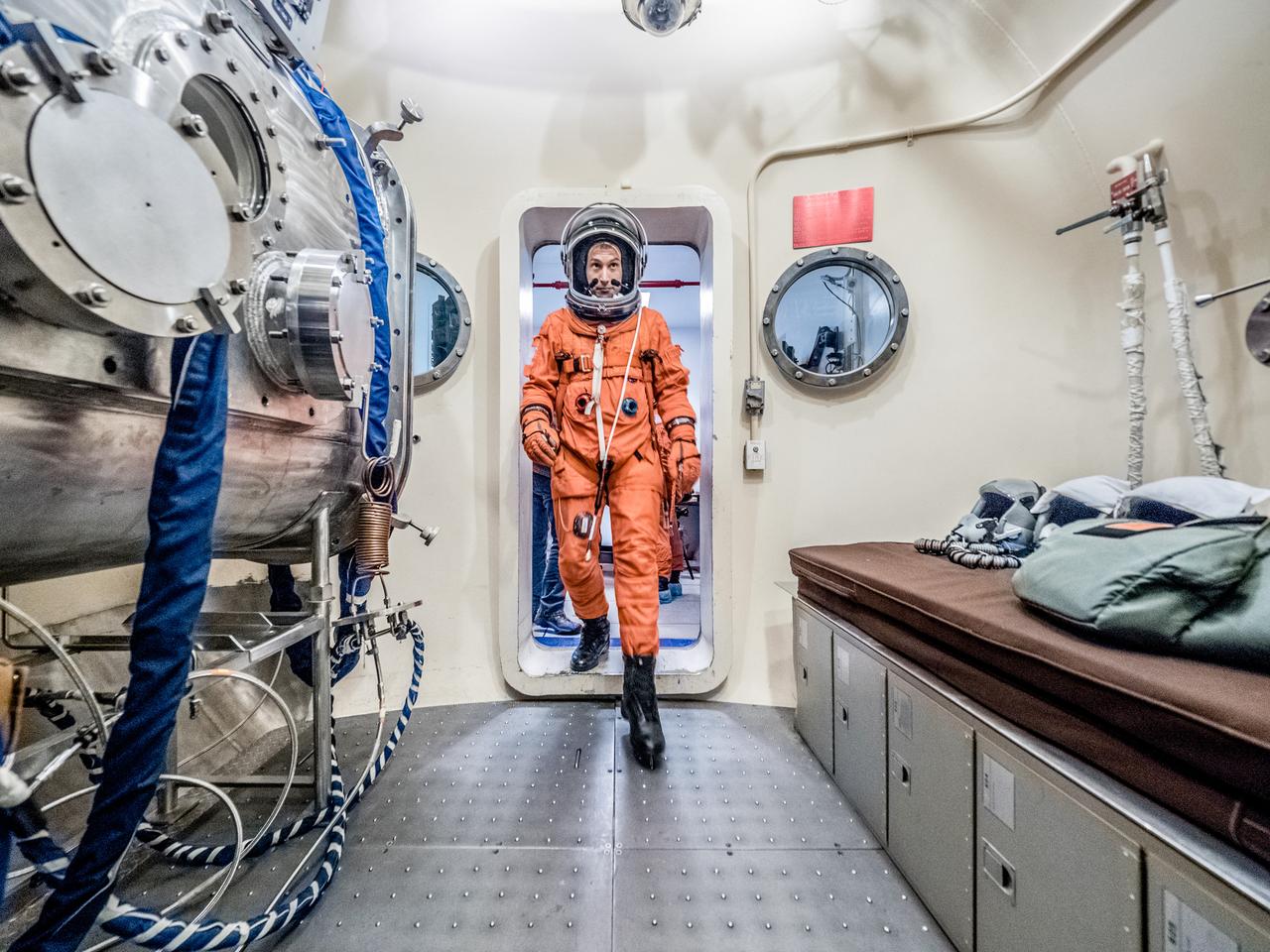
Engineers and technicians at NASA’s Johnson Space Center in Houston are testing the spacesuit astronauts will wear in the agency’s Orion spacecraft on trips to deep space. On June 22, 2017, members of the Johnson team participated in a Vacuum Pressure Integrated Suit Test to verify enhancements to the suit will meet test and design standards for the Orion spacecraft. During this test, the suit is connected to life support systems and then air is removed from Johnson’s 11-foot thermal vacuum chamber to evaluate the performance of the suits in conditions similar to a spacecraft. The suit will contain all the necessary functions to support life and is being designed to enable spacewalks and sustain the crew in the unlikely event the spacecraft loses pressure. Part of Batch images transfer from Flickr.
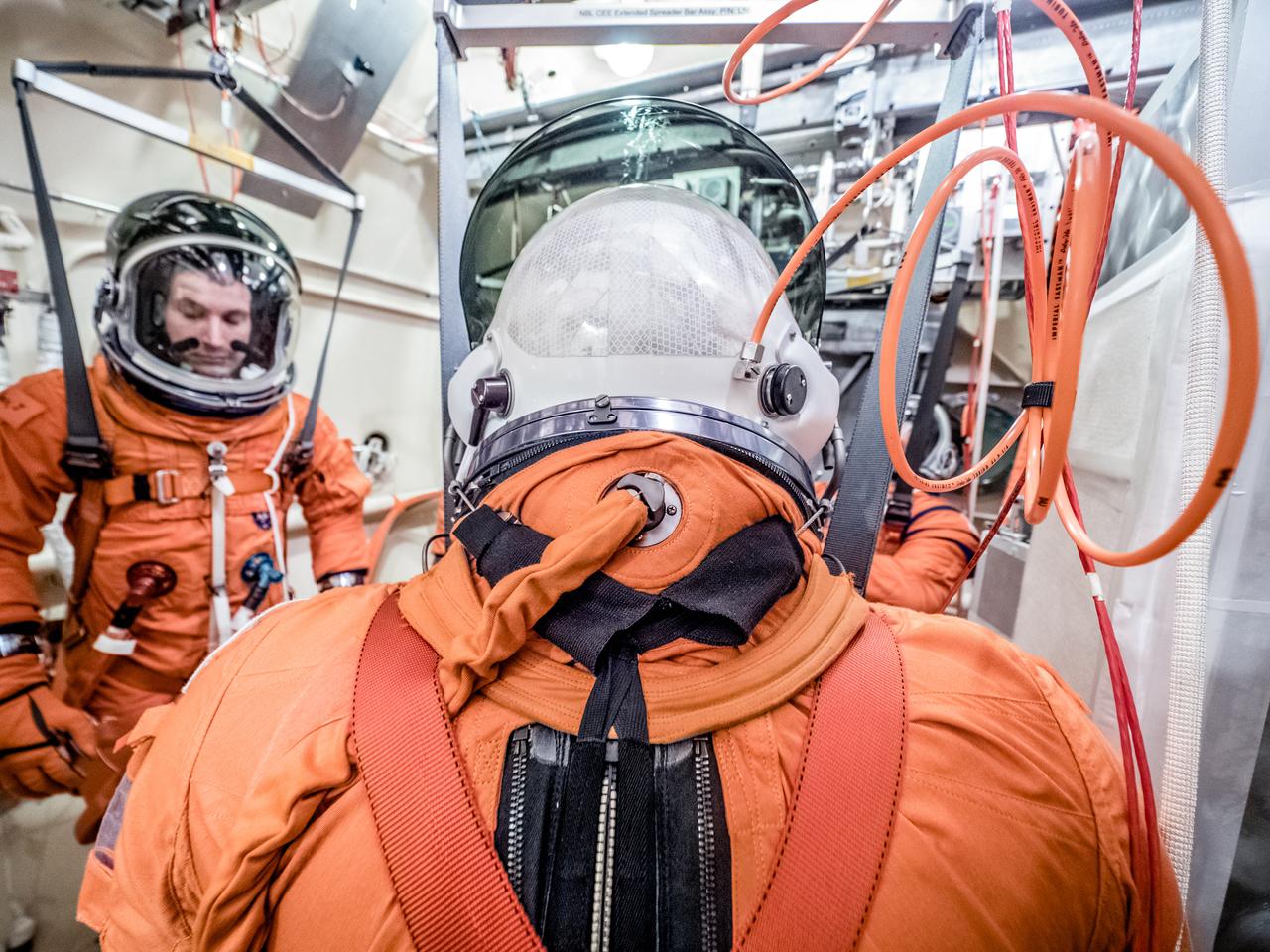
Engineers and technicians at NASA’s Johnson Space Center in Houston are testing the spacesuit astronauts will wear in the agency’s Orion spacecraft on trips to deep space. On June 22, 2017, members of the Johnson team participated in a Vacuum Pressure Integrated Suit Test to verify enhancements to the suit will meet test and design standards for the Orion spacecraft. During this test, the suit is connected to life support systems and then air is removed from Johnson’s 11-foot thermal vacuum chamber to evaluate the performance of the suits in conditions similar to a spacecraft. The suit will contain all the necessary functions to support life and is being designed to enable spacewalks and sustain the crew in the unlikely event the spacecraft loses pressure. Part of Batch images transfer from Flickr.
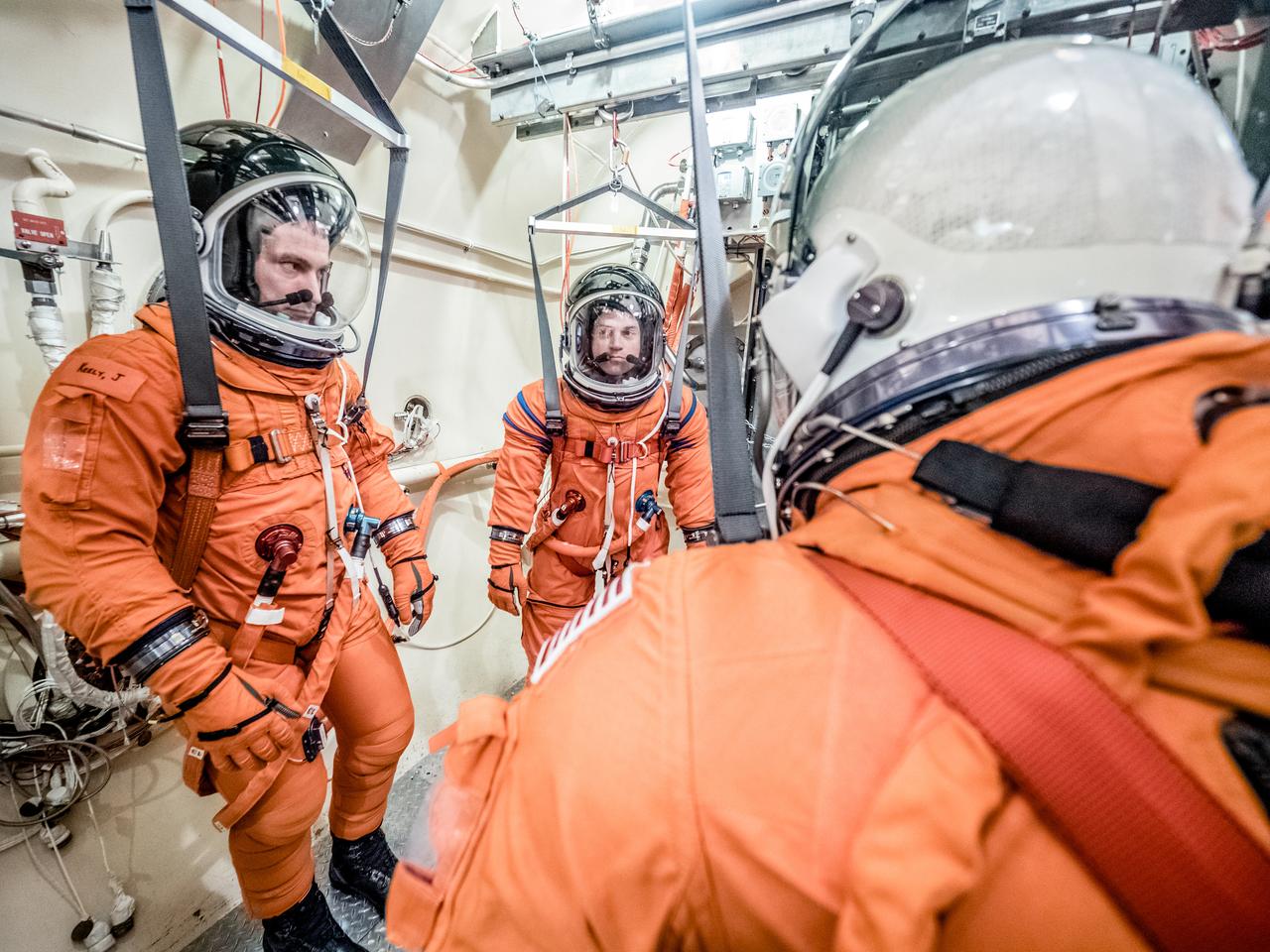
Engineers and technicians at NASA’s Johnson Space Center in Houston are testing the spacesuit astronauts will wear in the agency’s Orion spacecraft on trips to deep space. On June 22, 2017, members of the Johnson team participated in a Vacuum Pressure Integrated Suit Test to verify enhancements to the suit will meet test and design standards for the Orion spacecraft. During this test, the suit is connected to life support systems and then air is removed from Johnson’s 11-foot thermal vacuum chamber to evaluate the performance of the suits in conditions similar to a spacecraft. The suit will contain all the necessary functions to support life and is being designed to enable spacewalks and sustain the crew in the unlikely event the spacecraft loses pressure. Part of Batch images transfer from Flickr.
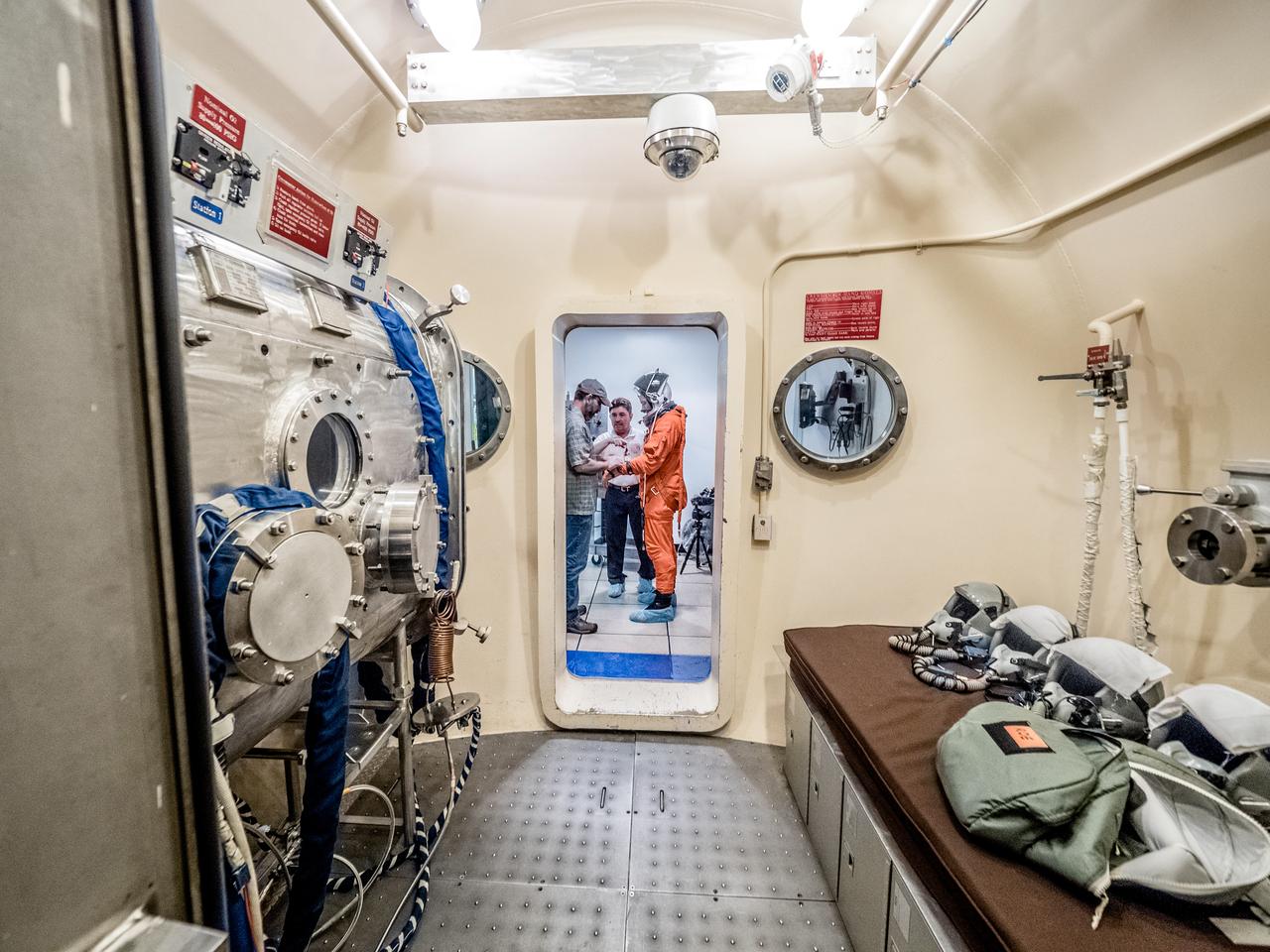
Engineers and technicians at NASA’s Johnson Space Center in Houston are testing the spacesuit astronauts will wear in the agency’s Orion spacecraft on trips to deep space. On June 22, 2017, members of the Johnson team participated in a Vacuum Pressure Integrated Suit Test to verify enhancements to the suit will meet test and design standards for the Orion spacecraft. During this test, the suit is connected to life support systems and then air is removed from Johnson’s 11-foot thermal vacuum chamber to evaluate the performance of the suits in conditions similar to a spacecraft. The suit will contain all the necessary functions to support life and is being designed to enable spacewalks and sustain the crew in the unlikely event the spacecraft loses pressure. Part of Batch images transfer from Flickr.
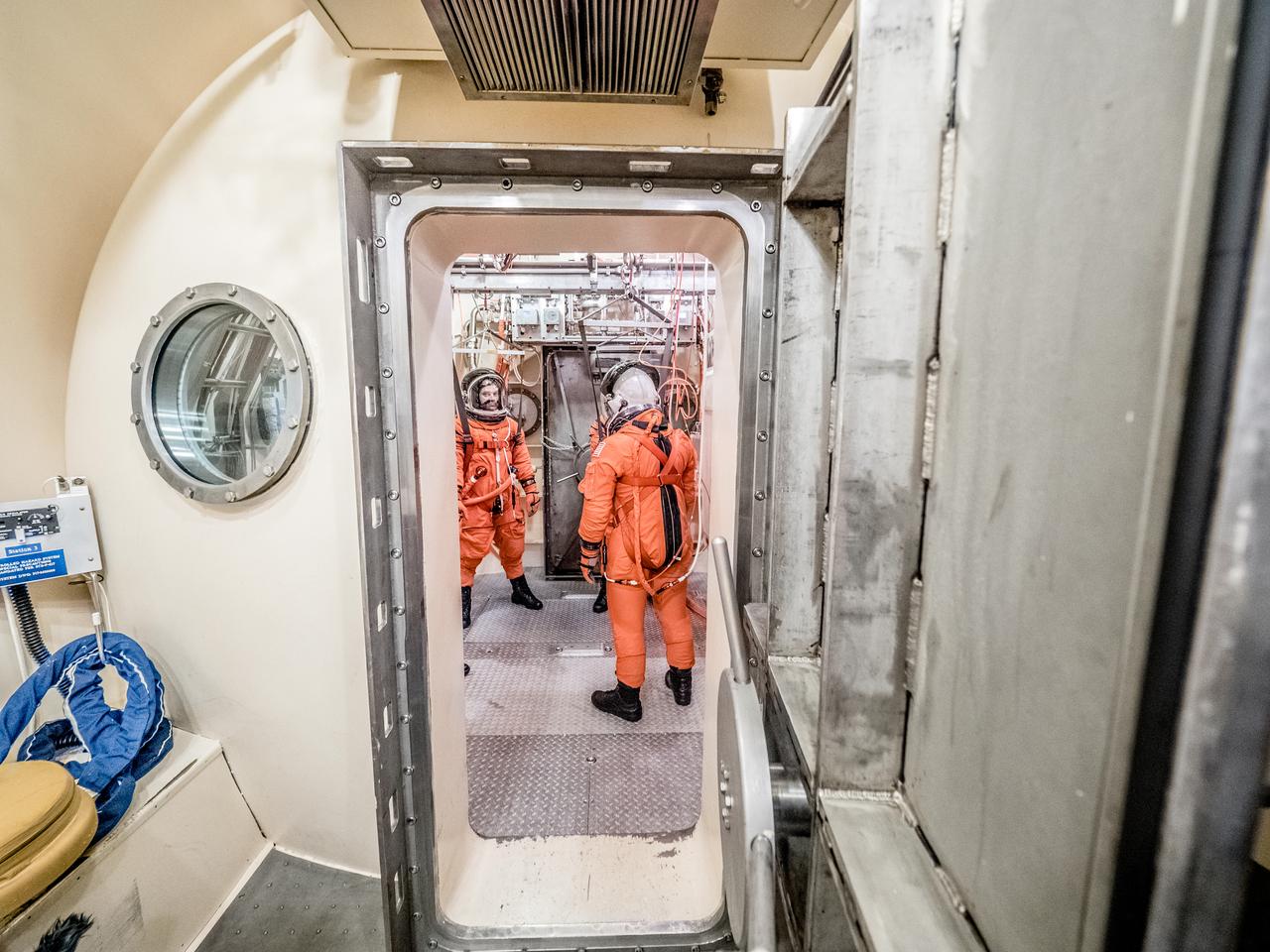
Engineers and technicians at NASA’s Johnson Space Center in Houston are testing the spacesuit astronauts will wear in the agency’s Orion spacecraft on trips to deep space. On June 22, 2017, members of the Johnson team participated in a Vacuum Pressure Integrated Suit Test to verify enhancements to the suit will meet test and design standards for the Orion spacecraft. During this test, the suit is connected to life support systems and then air is removed from Johnson’s 11-foot thermal vacuum chamber to evaluate the performance of the suits in conditions similar to a spacecraft. The suit will contain all the necessary functions to support life and is being designed to enable spacewalks and sustain the crew in the unlikely event the spacecraft loses pressure. Part of Batch images transfer from Flickr.
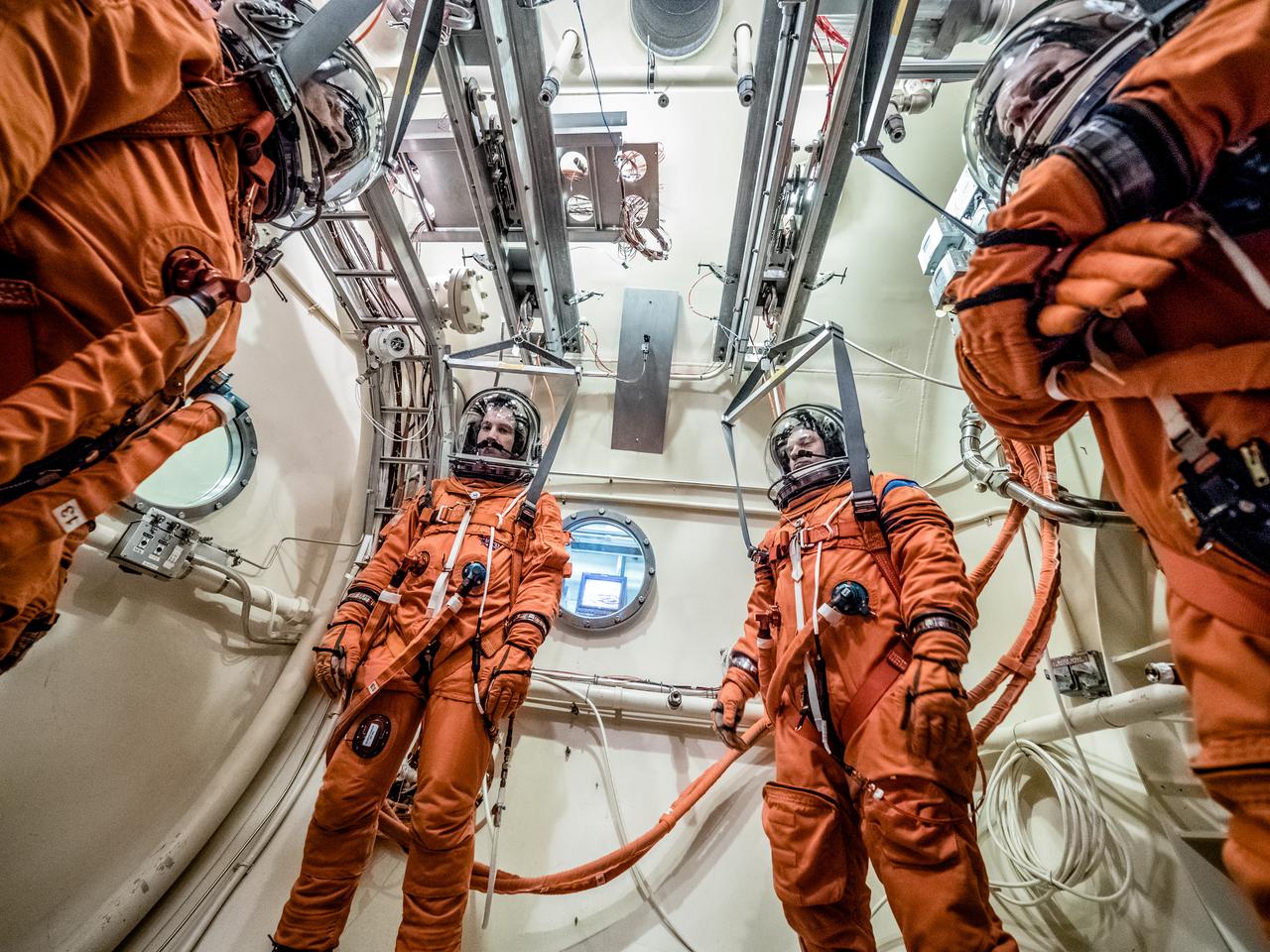
Engineers and technicians at NASA’s Johnson Space Center in Houston are testing the spacesuit astronauts will wear in the agency’s Orion spacecraft on trips to deep space. On June 22, 2017, members of the Johnson team participated in a Vacuum Pressure Integrated Suit Test to verify enhancements to the suit will meet test and design standards for the Orion spacecraft. During this test, the suit is connected to life support systems and then air is removed from Johnson’s 11-foot thermal vacuum chamber to evaluate the performance of the suits in conditions similar to a spacecraft. The suit will contain all the necessary functions to support life and is being designed to enable spacewalks and sustain the crew in the unlikely event the spacecraft loses pressure. Part of Batch images transfer from Flickr.
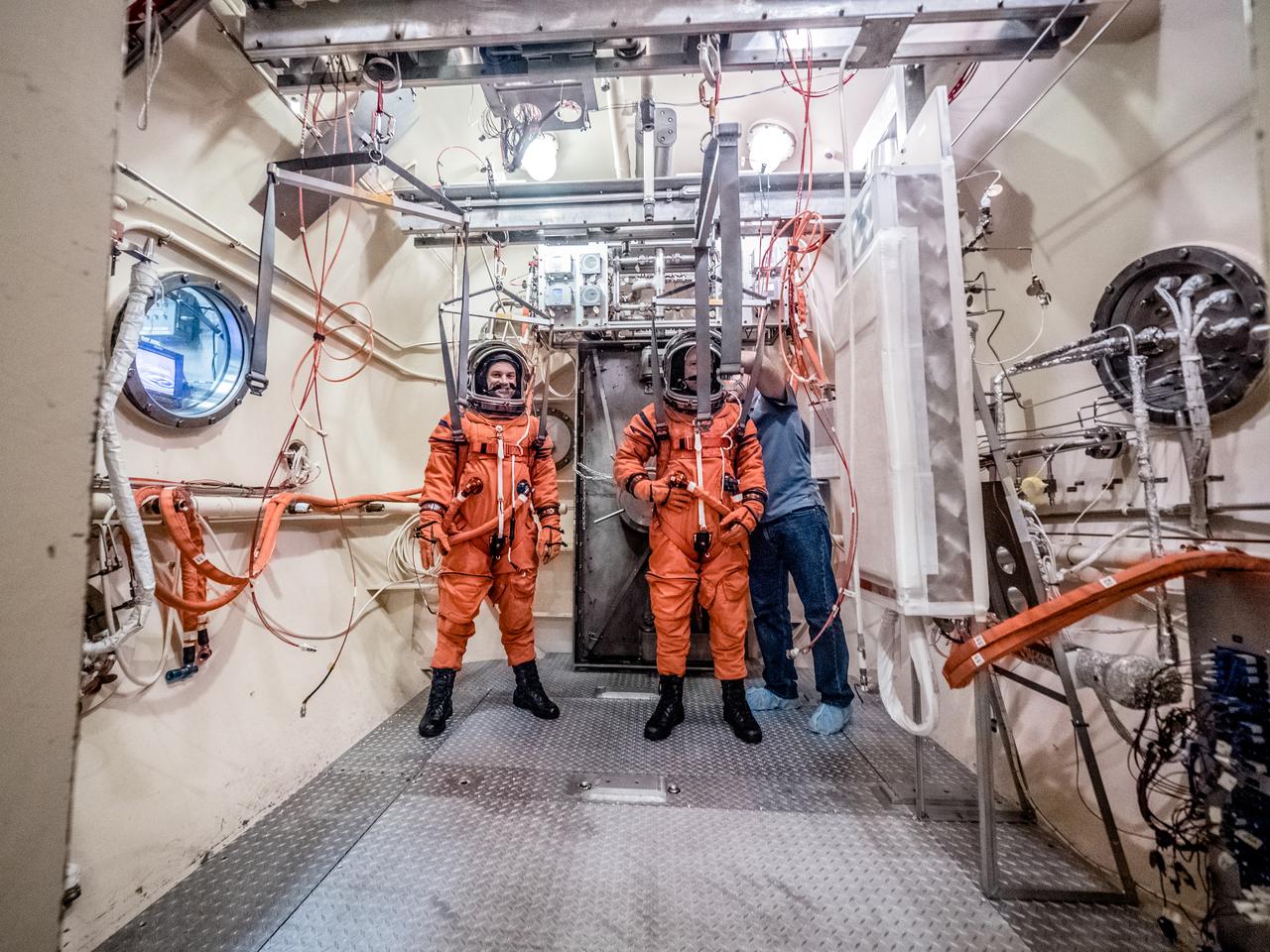
Engineers and technicians at NASA’s Johnson Space Center in Houston are testing the spacesuit astronauts will wear in the agency’s Orion spacecraft on trips to deep space. On June 22, 2017, members of the Johnson team participated in a Vacuum Pressure Integrated Suit Test to verify enhancements to the suit will meet test and design standards for the Orion spacecraft. During this test, the suit is connected to life support systems and then air is removed from Johnson’s 11-foot thermal vacuum chamber to evaluate the performance of the suits in conditions similar to a spacecraft. The suit will contain all the necessary functions to support life and is being designed to enable spacewalks and sustain the crew in the unlikely event the spacecraft loses pressure. Part of Batch images transfer from Flickr.
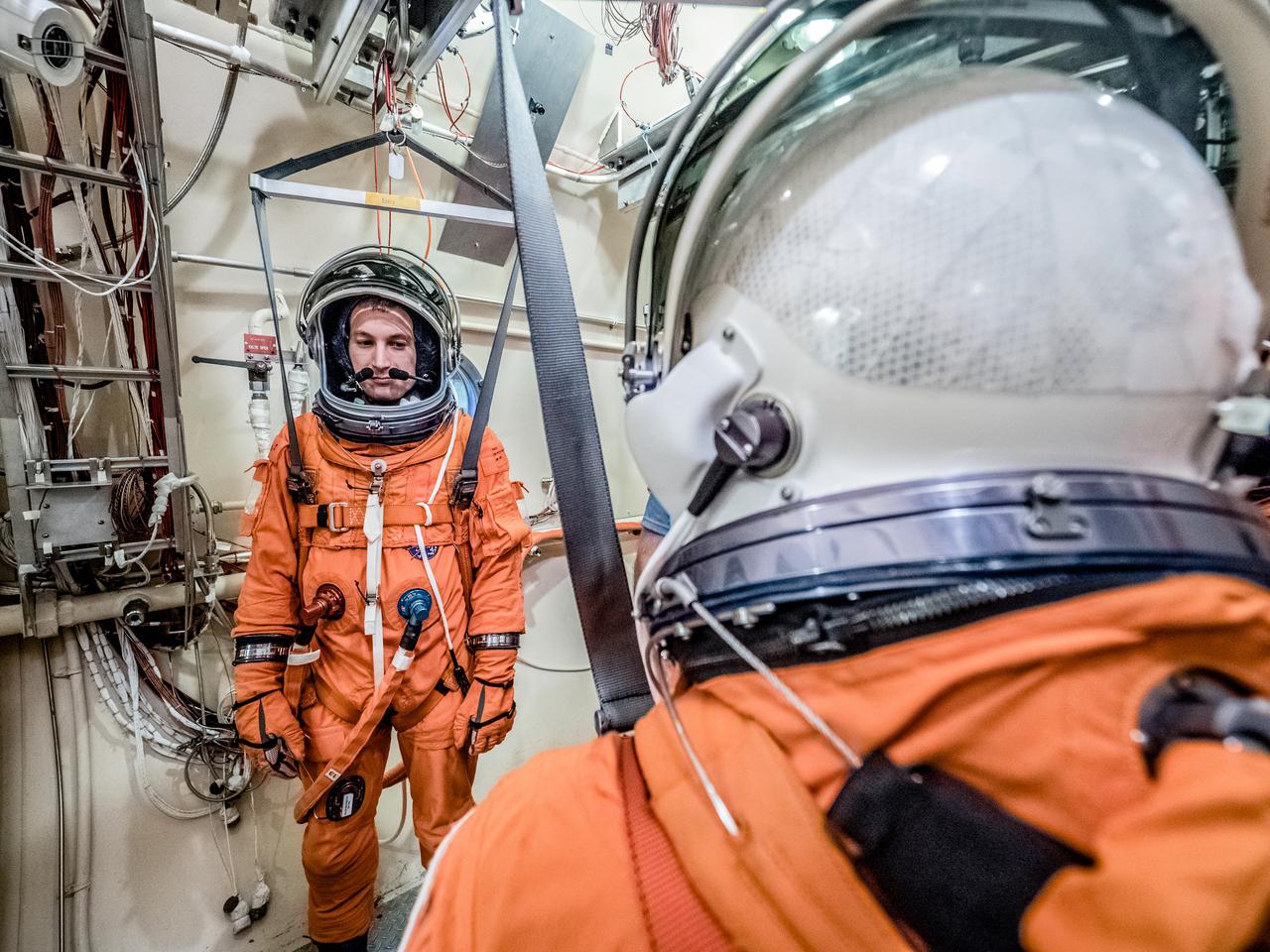
Engineers and technicians at NASA’s Johnson Space Center in Houston are testing the spacesuit astronauts will wear in the agency’s Orion spacecraft on trips to deep space. On June 22, 2017, members of the Johnson team participated in a Vacuum Pressure Integrated Suit Test to verify enhancements to the suit will meet test and design standards for the Orion spacecraft. During this test, the suit is connected to life support systems and then air is removed from Johnson’s 11-foot thermal vacuum chamber to evaluate the performance of the suits in conditions similar to a spacecraft. The suit will contain all the necessary functions to support life and is being designed to enable spacewalks and sustain the crew in the unlikely event the spacecraft loses pressure. Part of Batch images transfer from Flickr.
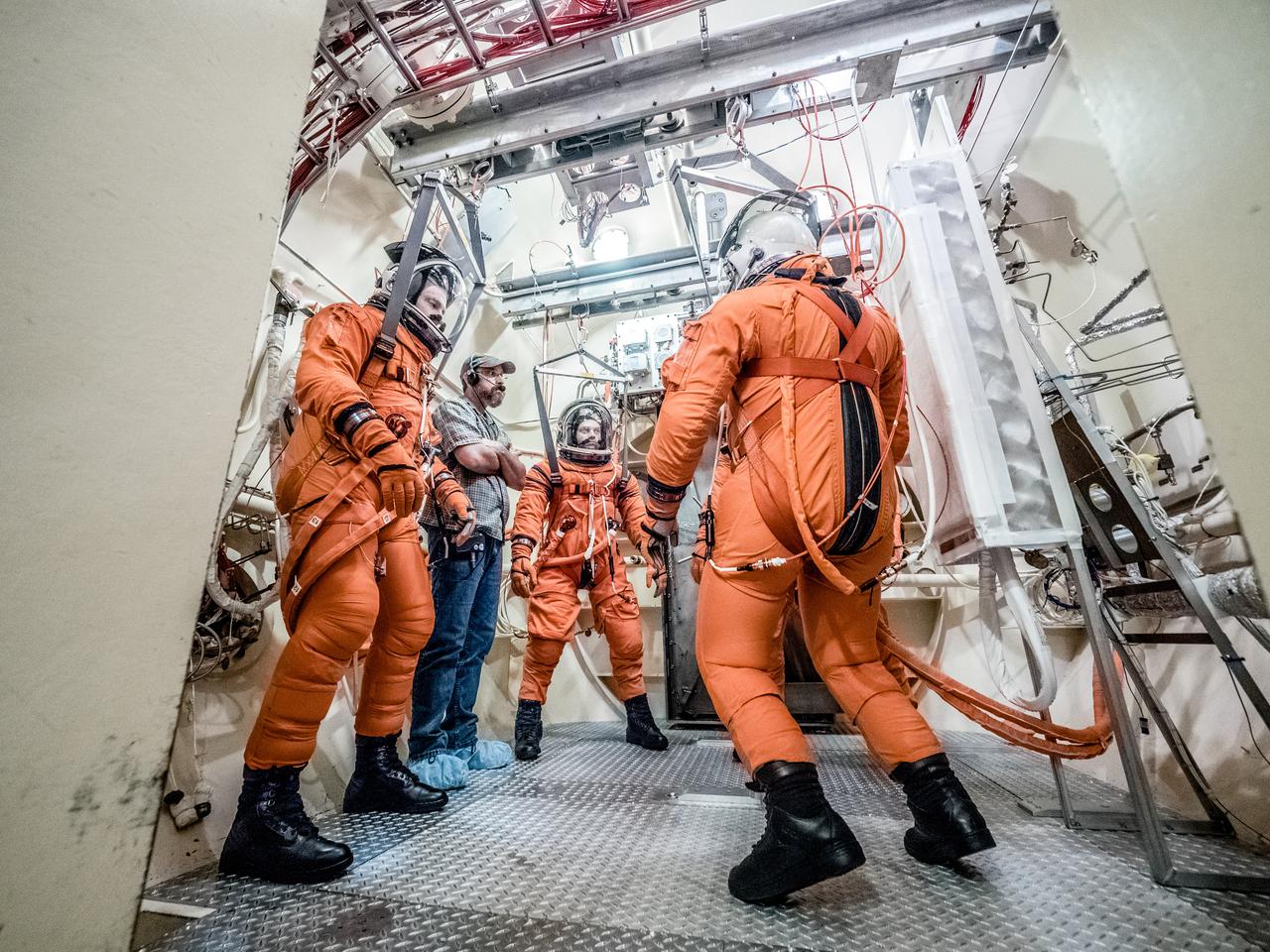
Engineers and technicians at NASA’s Johnson Space Center in Houston are testing the spacesuit astronauts will wear in the agency’s Orion spacecraft on trips to deep space. On June 22, 2017, members of the Johnson team participated in a Vacuum Pressure Integrated Suit Test to verify enhancements to the suit will meet test and design standards for the Orion spacecraft. During this test, the suit is connected to life support systems and then air is removed from Johnson’s 11-foot thermal vacuum chamber to evaluate the performance of the suits in conditions similar to a spacecraft. The suit will contain all the necessary functions to support life and is being designed to enable spacewalks and sustain the crew in the unlikely event the spacecraft loses pressure. Part of Batch images transfer from Flickr.
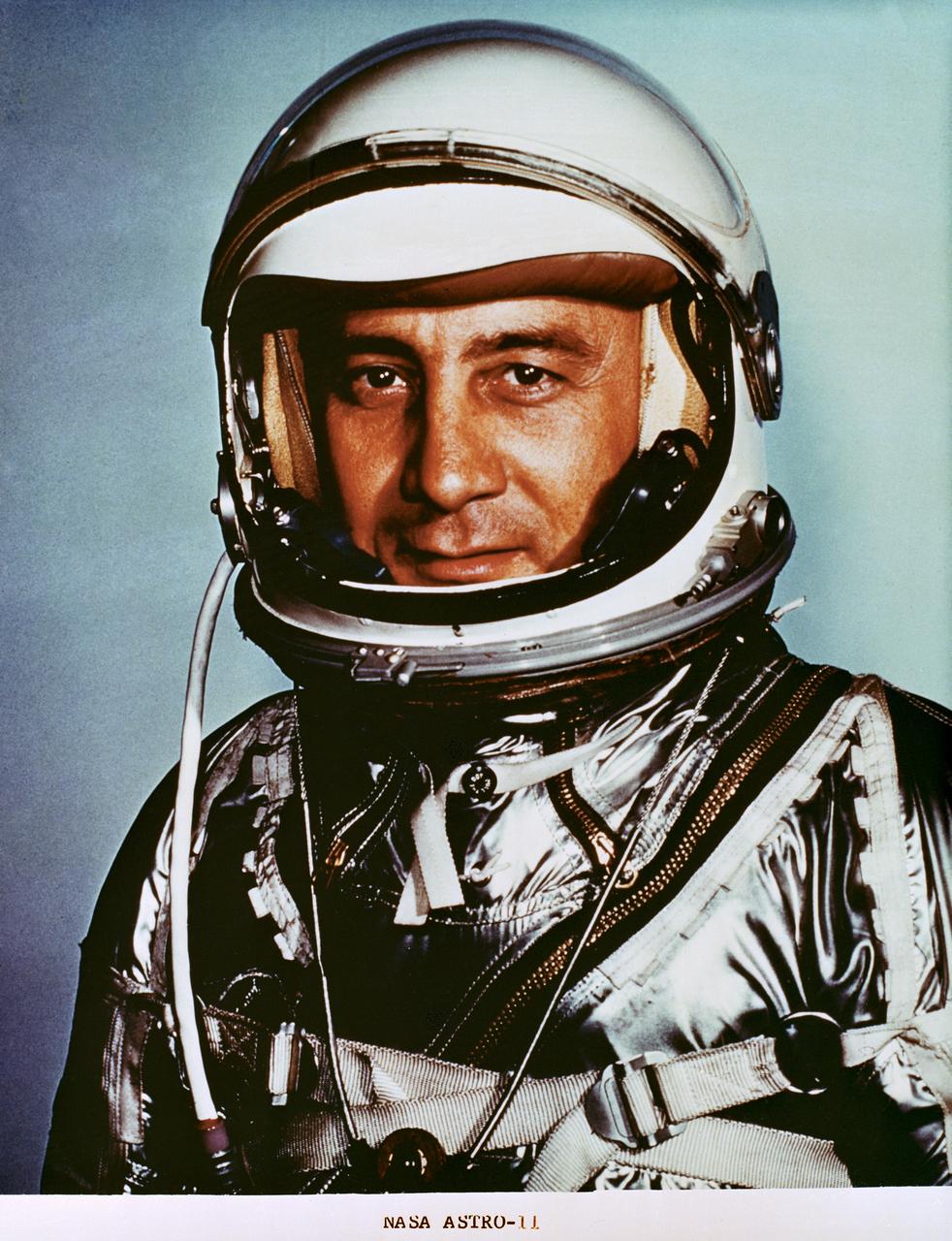
S88-55873 (1961) --- Astronaut Virgil I. (Gus) Grissom, pilot of the Mercury-Redstone 4 (MR-4) spaceflight. (NOTE: Astronaut "Gus" Grissom, one of the original seven astronauts, died Jan. 27, 1967, at NASA?s John F. Kennedy Space Center (KSC), Cape Canaveral Florida, in the Apollo 1 spacecraft fire.) Photo credit: NASA
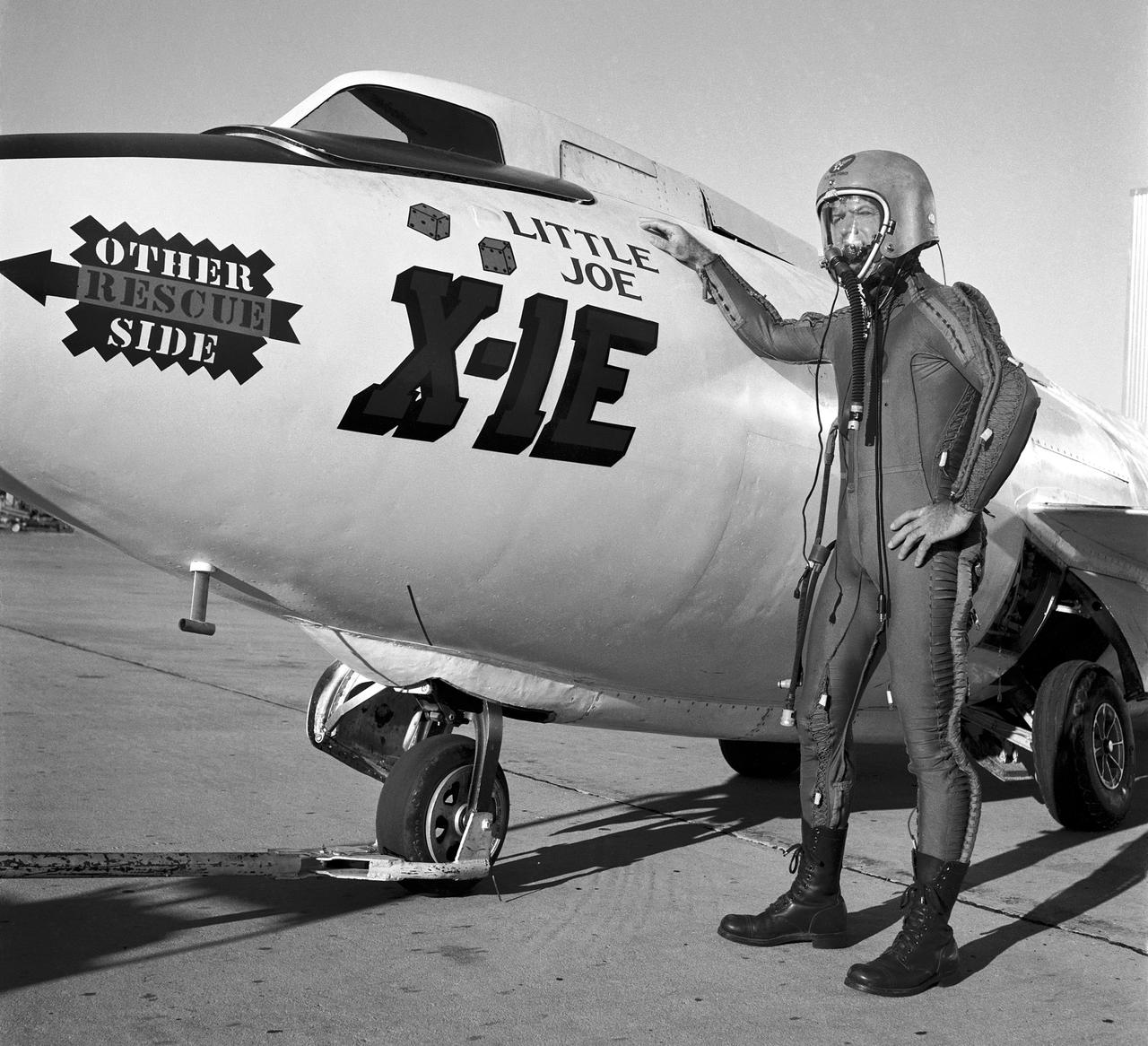
Joe Walker in a pressure suit beside the X-1E at the NASA High-Speed Flight Station, Edwards,California. The dice and "Little Joe" are prominently displayed under the cockpit area. (Little Joe is a dice players slang term for two deuces.) Walker is shown in the photo wearing an early Air Force partial pressure suit. This protected the pilot if cockpit pressure was lost above 50,000 feet. Similar suits were used in such aircraft as B-47s, B-52s, F-104s, U-2s, and the X-2 and D-558-II research aircraft. Five years later, Walker reached 354,200 feet in the X-15. Similar artwork - reading "Little Joe the II" - was applied for the record flight. These cases are two of the few times that research aircraft carried such nose art.
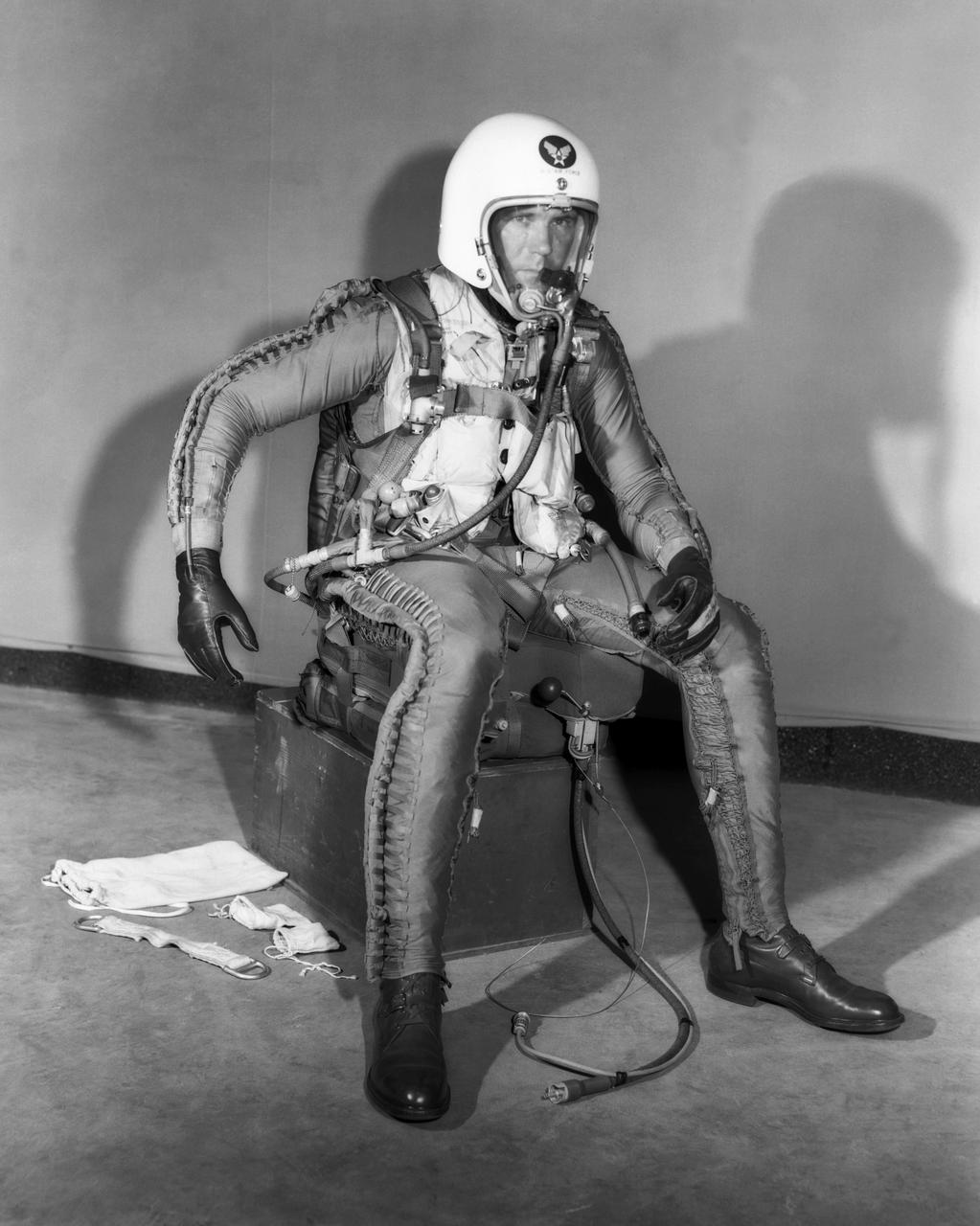
Robert Champine in X-Series Pressure Suit. Photograph published in Engineer in Charge: A History of the Langley Aeronautical Laboratory, 1917-1958 by James R. Hansen. Page 305.
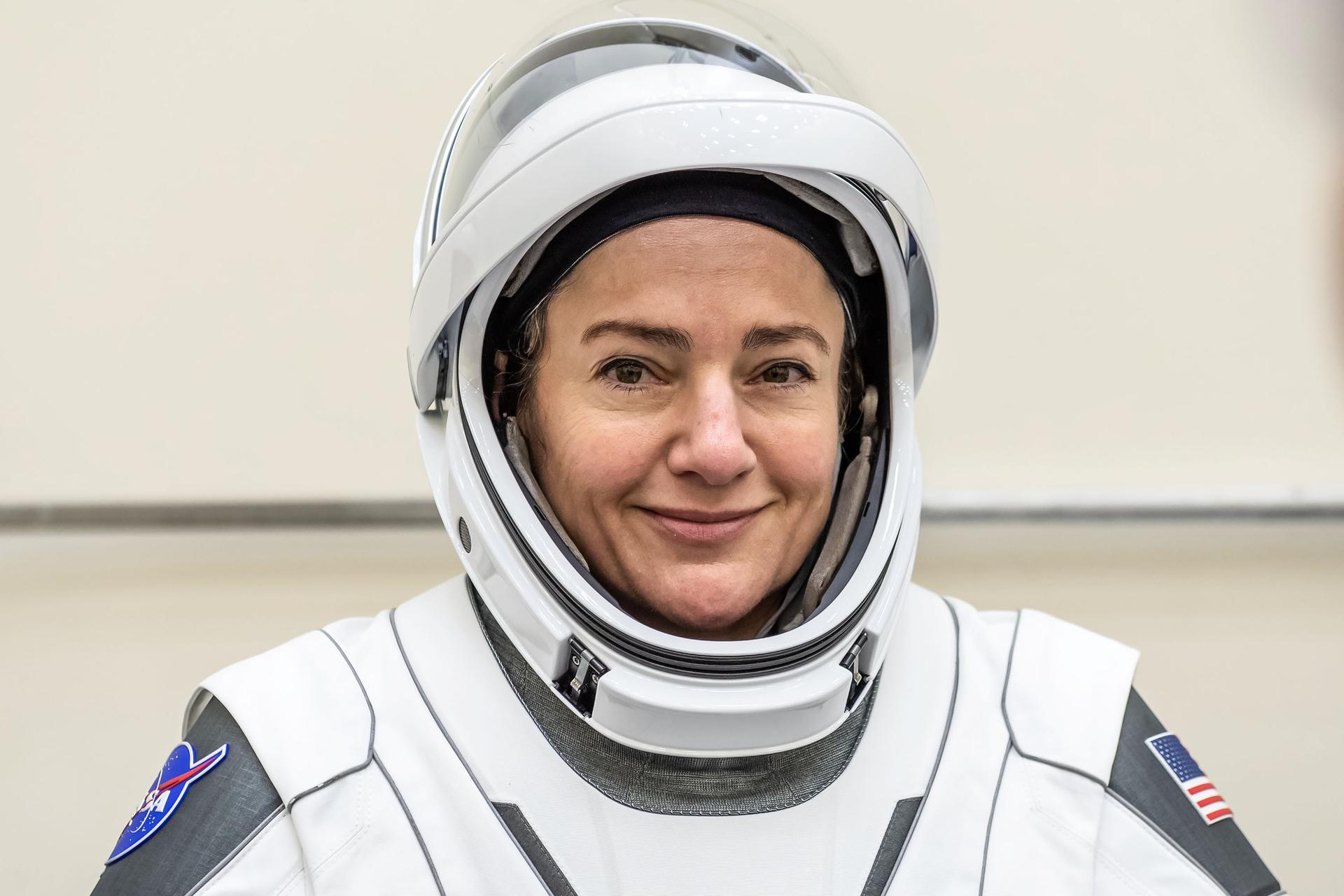
jsc2026e002966 (Jan. 12, 2026) --- NASA astronaut and SpaceX Crew-12 Commander Jessica Meir is photographed in her pressure suit during the Crew Equipment Interface Test at NASA’s Kennedy Space Center in Florida. The goal of the training is to rehearse launch day activities and get a close look at the Dragon spacecraft. Credit: SpaceX
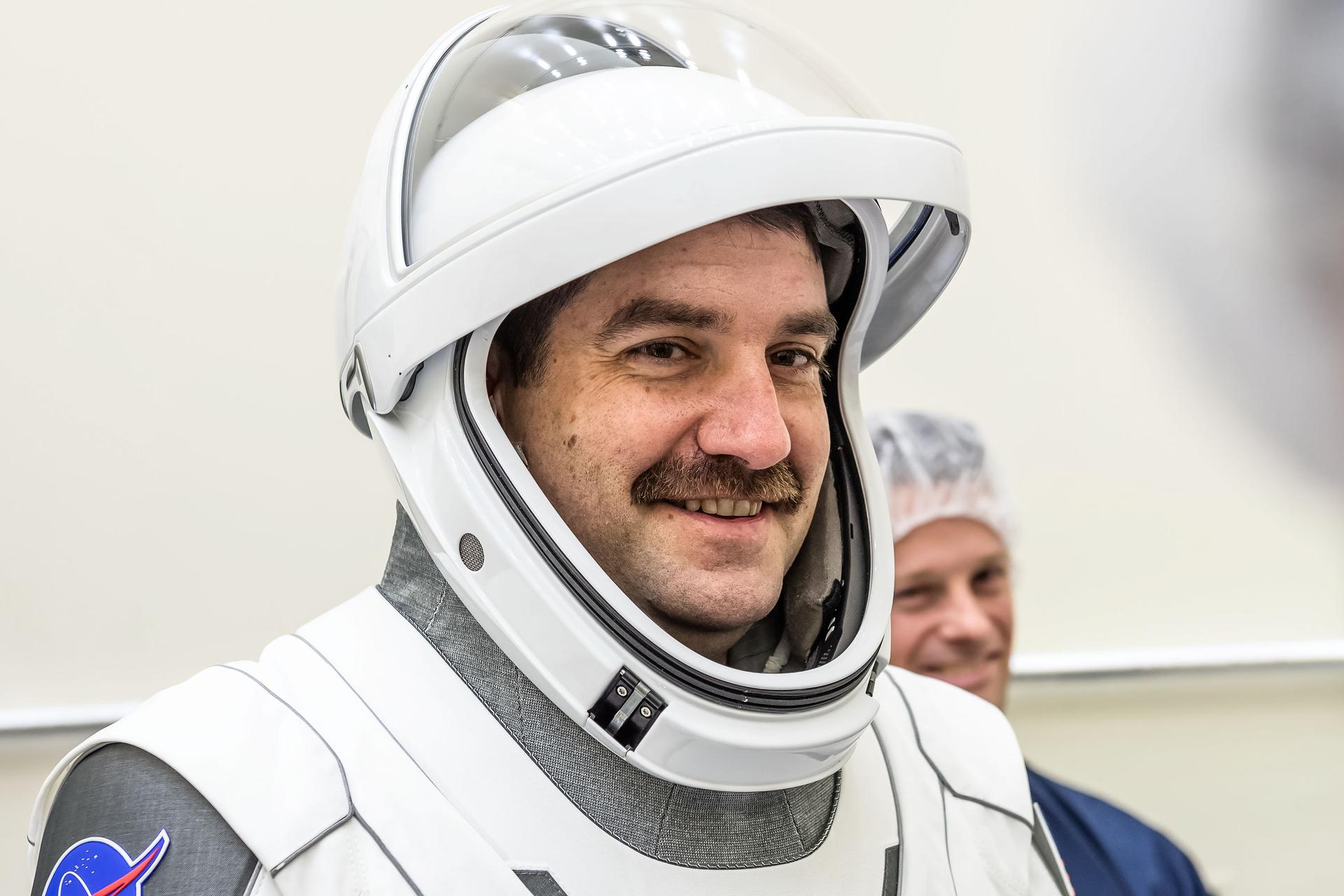
jsc2026e002965 (Jan. 12, 2026) --- NASA astronaut and SpaceX Crew-12 Pilot Jack Hathaway is photographed in his pressure suit during the Crew Equipment Interface Test at NASA’s Kennedy Space Center in Florida. The goal of the training is to rehearse launch day activities and get a close look at the Dragon spacecraft. Credit: SpaceX

jsc2026e040445 (April 30, 2026) --- The SpaceX Crew-13 members pose for a portrait in their pressure suits during a preflight training session at the company's headquarters in Hawthorne, California. From left are, Roscosmos Sergey Teteryatnikov, NASA astronauts Jessica Watkins and Luke Delaney, and CSA (Canadian Space Agency) astronaut Joshua Kutryk. Credit: SpaceX
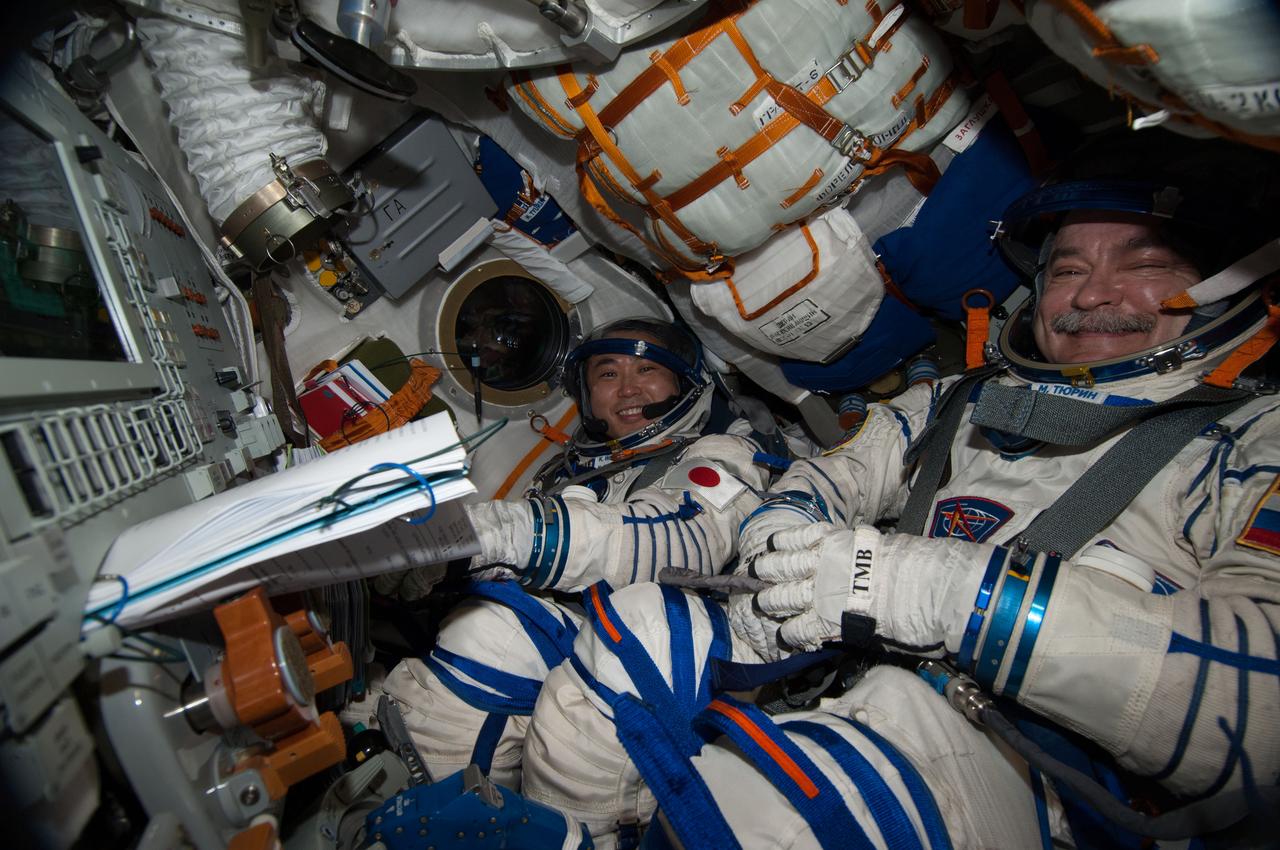
Expedition 39 commander Koichi Wakata and flight engineer Mikhail Tyurin, wearing Sokol pressure suits, are photographed in the Soyuz TMA-11M spacecraft during a Sokol leak check. Wakata is a Japan Aerospace Exploration Agency astronaut; Tyurin is a Roscosmos cosmonaut. Image was released by the commander on Twitter.
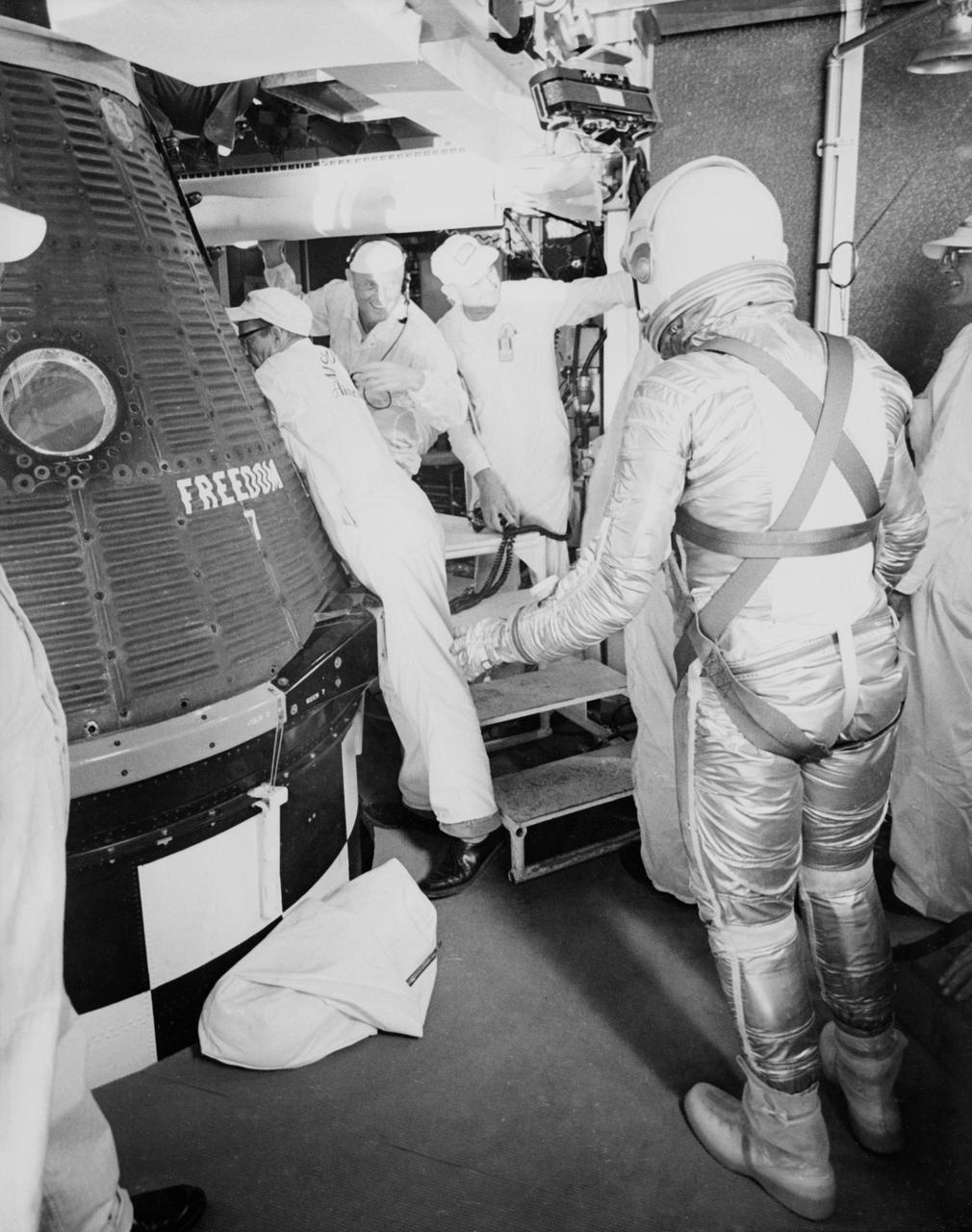
S61-02792 (5 May 1961) --- Astronaut Alan B. Shepard Jr., in his pressure suit and helmet, approaches the Freedom 7 capsule in preparation for insertion before the Mercury-Redstone 3 (MR-3) mission. Photo credit: NASA or National Aeronautics and Space Administration
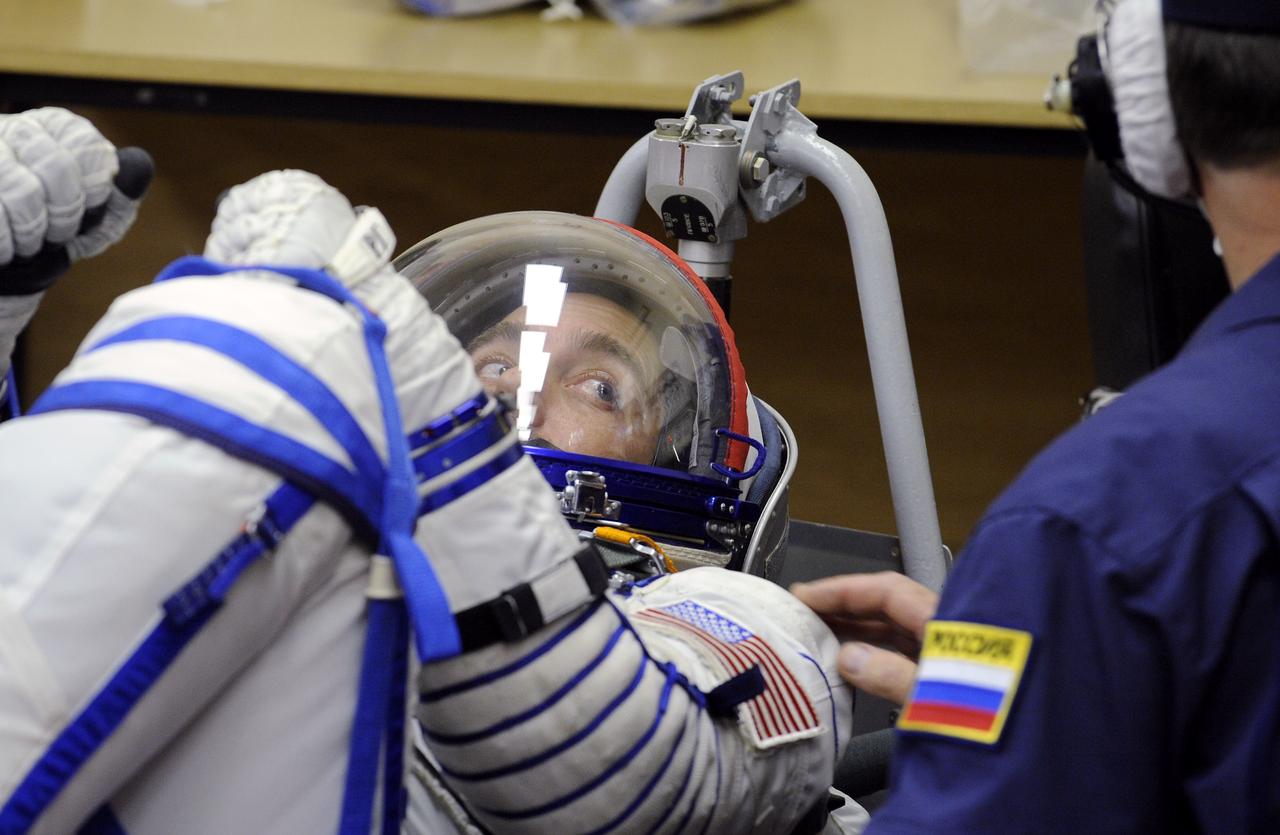
American Spaceflight Participant Richard Garriott has his Russian Sokol suit pressure checked prior to launching in the Soyuz TMA-13 spacecraft with Expedition 18 Commander Michael Fincke and Flight Engineer Yury V. Lonchakov, Sunday, Oct. 12, 2008 from the Baikonur Cosmodrome in Kazakhstan. The three crew members are scheduled to dock with the International Space Station on Oct. 14. Fincke and Lonchakov will spend six months on the station, while Garriott will return to Earth Oct. 24, 2008 with two of the Expedition 17 crewmembers currently on the International Space Station. Photo Credit: (NASA/Bill Ingalls)
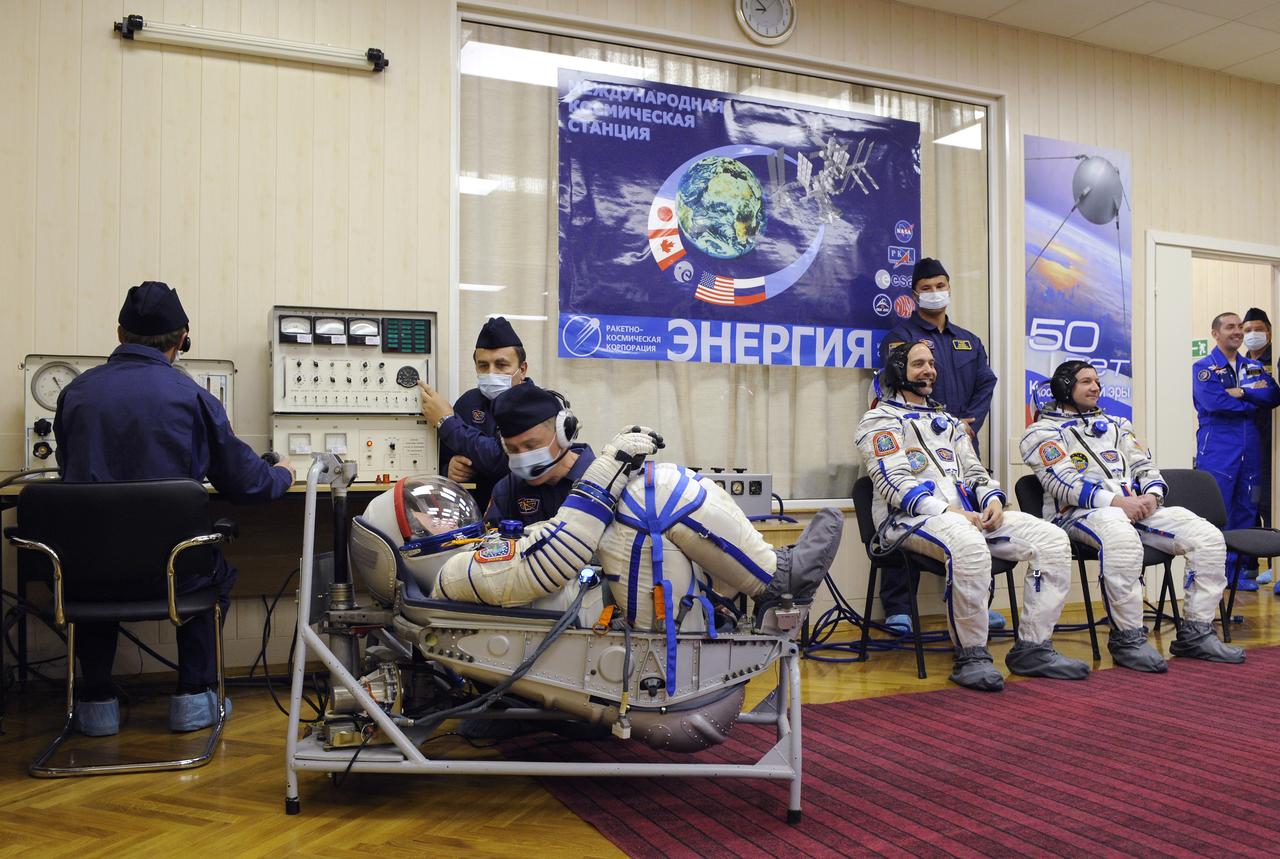
Expedition 18 Commander Michael Fincke, foreground, has his Russian Sokol suit pressure checked prior to launching in the Soyuz TMA-13 spacecraft with American spaceflight participant Richard Garriott and Expedition 18 Flight Engineer Yuri V. Lonchakov, right, Sunday, Oct. 12, 2008 from the Baikonur Cosmodrome in Kazakhstan. The three crew members are scheduled to dock with the International Space Station on Oct. 14. Fincke and Lonchakov will spend six months on the station, while Garriott will return to Earth Oct. 24 with two of the Expedition 17 crew members currently on the International Space Station. Photo Credit: (NASA/Bill Ingalls)
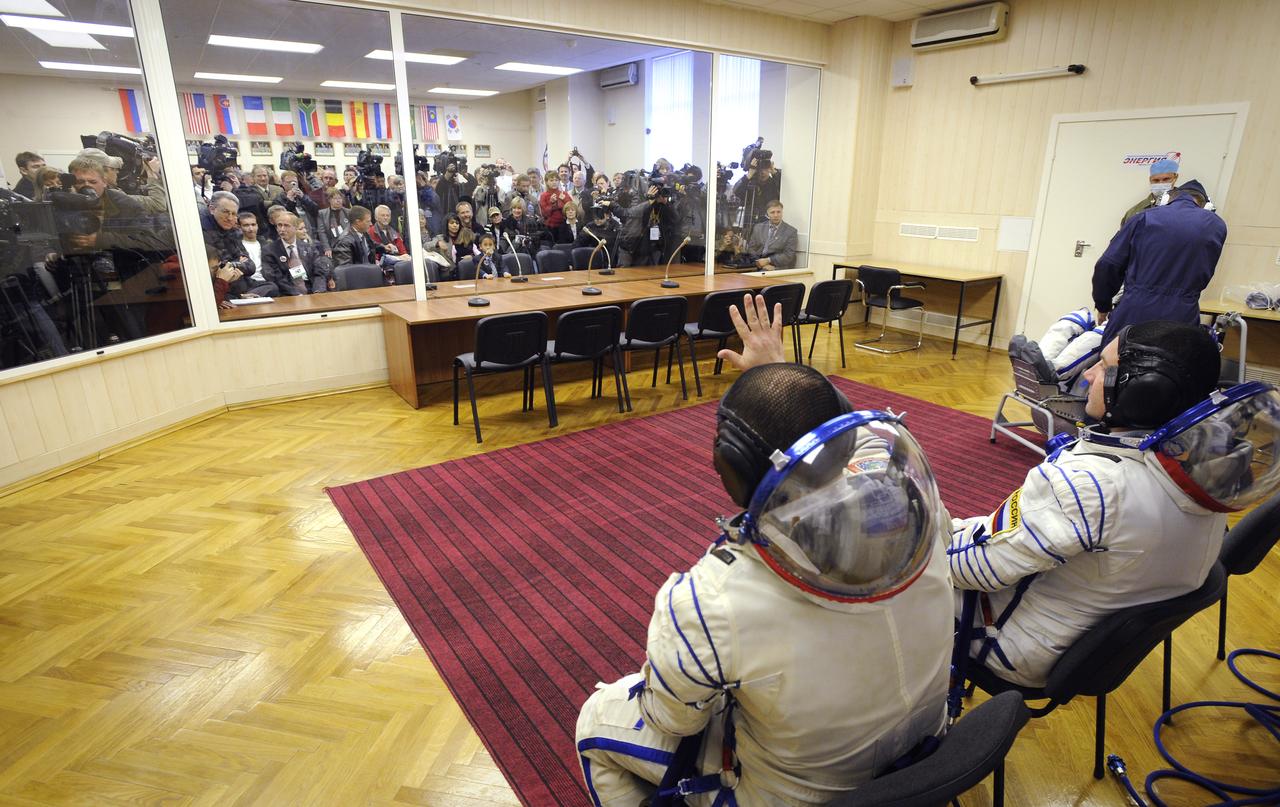
Expedition 18 Commander Michael Fincke waves hello to his family as he and Expedition 18 Flight Engineer Yuri V. Lonchakov and American spaceflight participant Richard Garriott have their Russian Sokol suits pressure checked prior to launching in the Soyuz TMA-13 spacecraft, Sunday, Oct. 12, 2008 from the Baikonur Cosmodrome in Kazakhstan. The three crew members are scheduled to dock with the International Space Station on Oct. 14. Fincke and Lonchakov will spend six months on the station, while Garriott will return to Earth Oct. 24 with two of the Expedition 17 crew members currently on the International Space Station. Photo Credit: (NASA/Bill Ingalls)
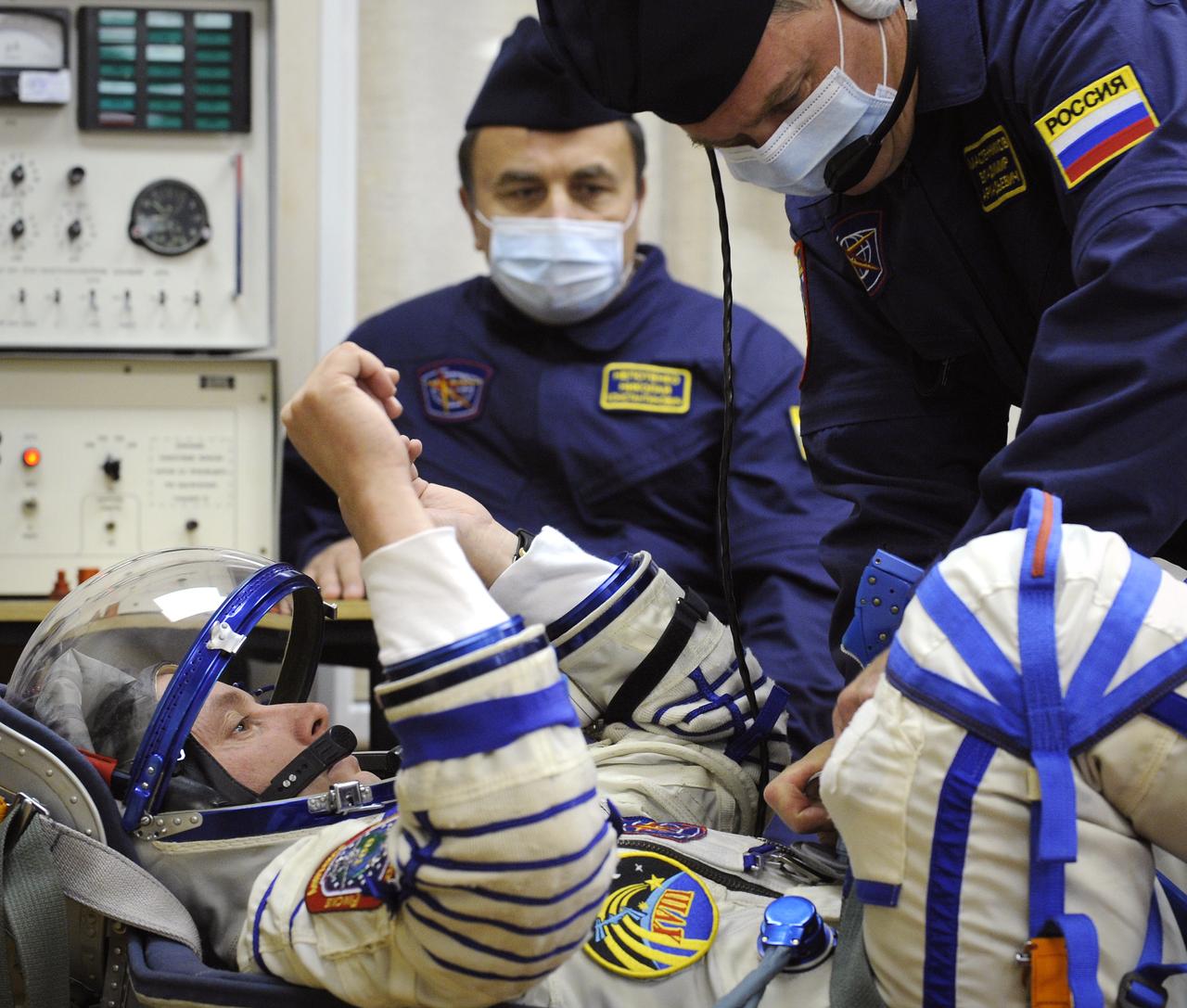
Expedition 18 Commander Michael Fincke has his Russian Sokol suit pressure checked prior to launching in the Soyuz TMA-13 spacecraft with Expedition 18 Flight Engineer Yuri V. Lonchakov and American spaceflight participant Richard Garriott, Sunday, Oct. 12, 2008 from the Baikonur Cosmodrome in Kazakhstan. The three crew members are scheduled to dock with the International Space Station on Oct. 14. Fincke and Lonchakov will spend six months on the station, while Garriott will return to Earth Oct. 24 with two of the Expedition 17 crew members currently on the International Space Station. Photo Credit: (NASA/Bill Ingalls)
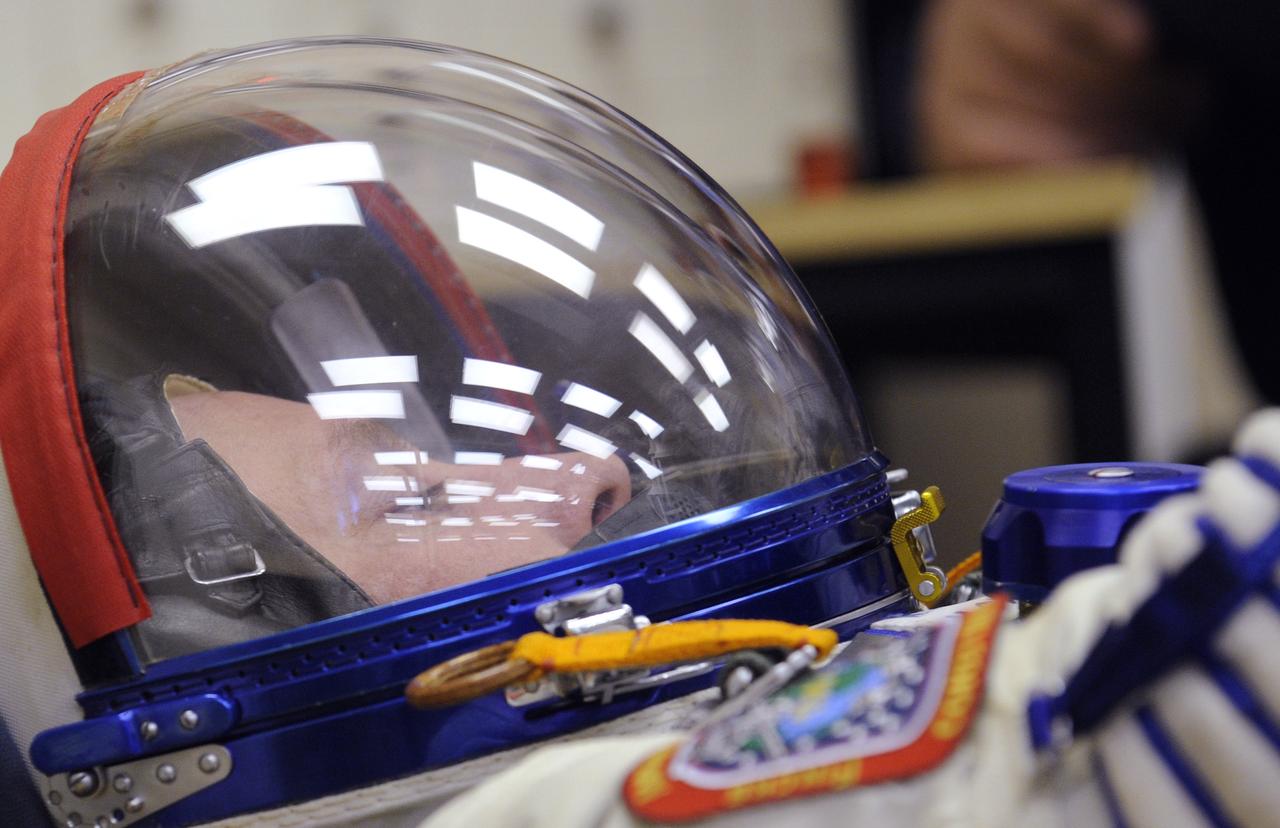
Expedition 18 Commander Michael Fincke has his Russian Sokol suit pressure checked prior to launching in the Soyuz TMA-13 spacecraft with Expedition 18 Flight Engineer Yuri V. Lonchakov and American spaceflight participant Richard Garriott, Sunday, Oct. 12, 2008 from the Baikonur Cosmodrome in Kazakhstan. The three crew members are scheduled to dock with the International Space Station on Oct. 14. Fincke and Lonchakov will spend six months on the station, while Garriott will return to Earth Oct. 24 with two of the Expedition 17 crew members currently on the International Space Station. Photo Credit: (NASA/Bill Ingalls)
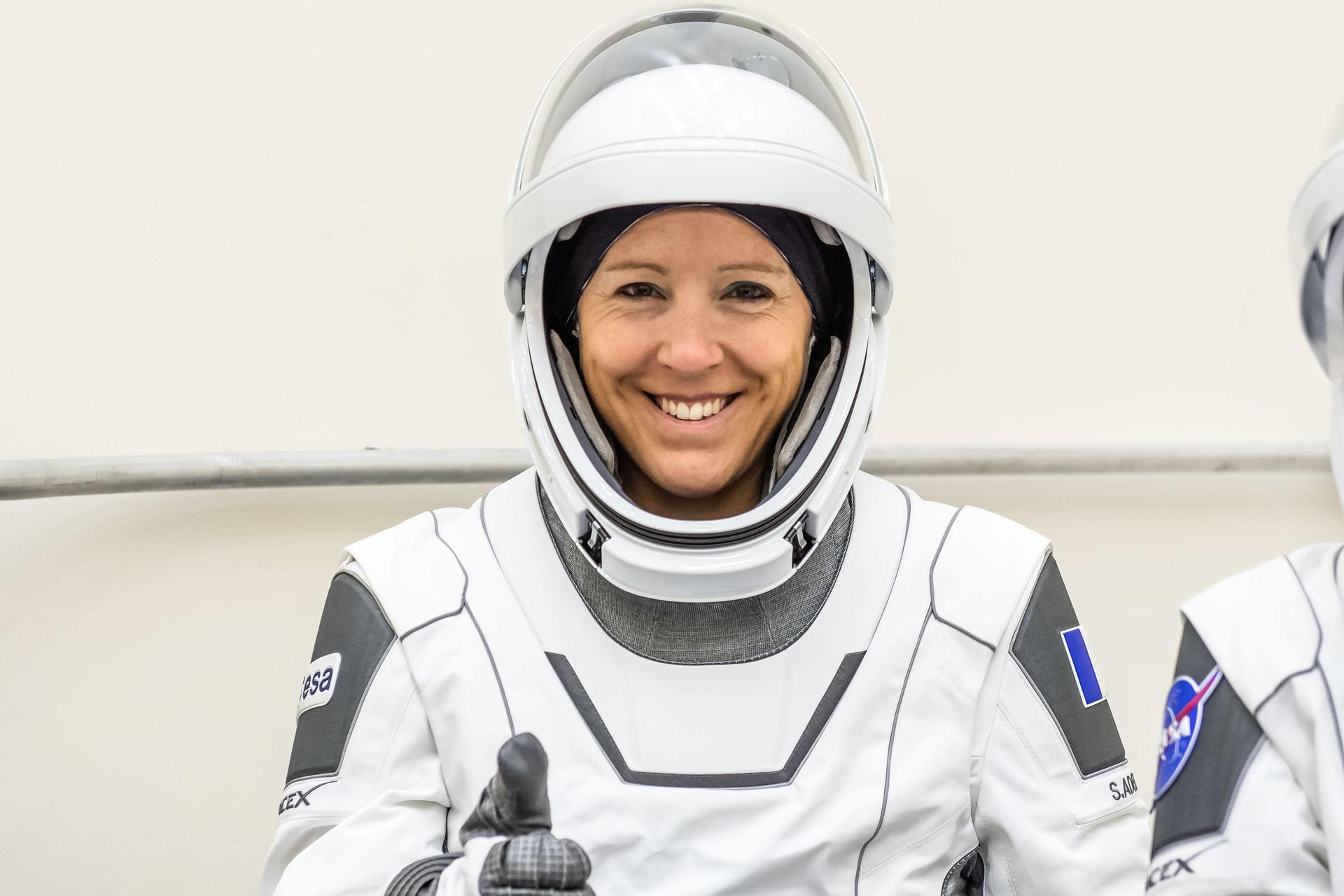
jsc2026e002964 (Jan. 12, 2026) --- ESA (European Space Agency) astronaut and SpaceX Crew-12 Mission Specialist Sophie Adenot is photographed in her pressure suit during the Crew Equipment Interface Test at NASA’s Kennedy Space Center in Florida. The goal of the training is to rehearse launch day activities and get a close look at the Dragon spacecraft. Credit: SpaceX
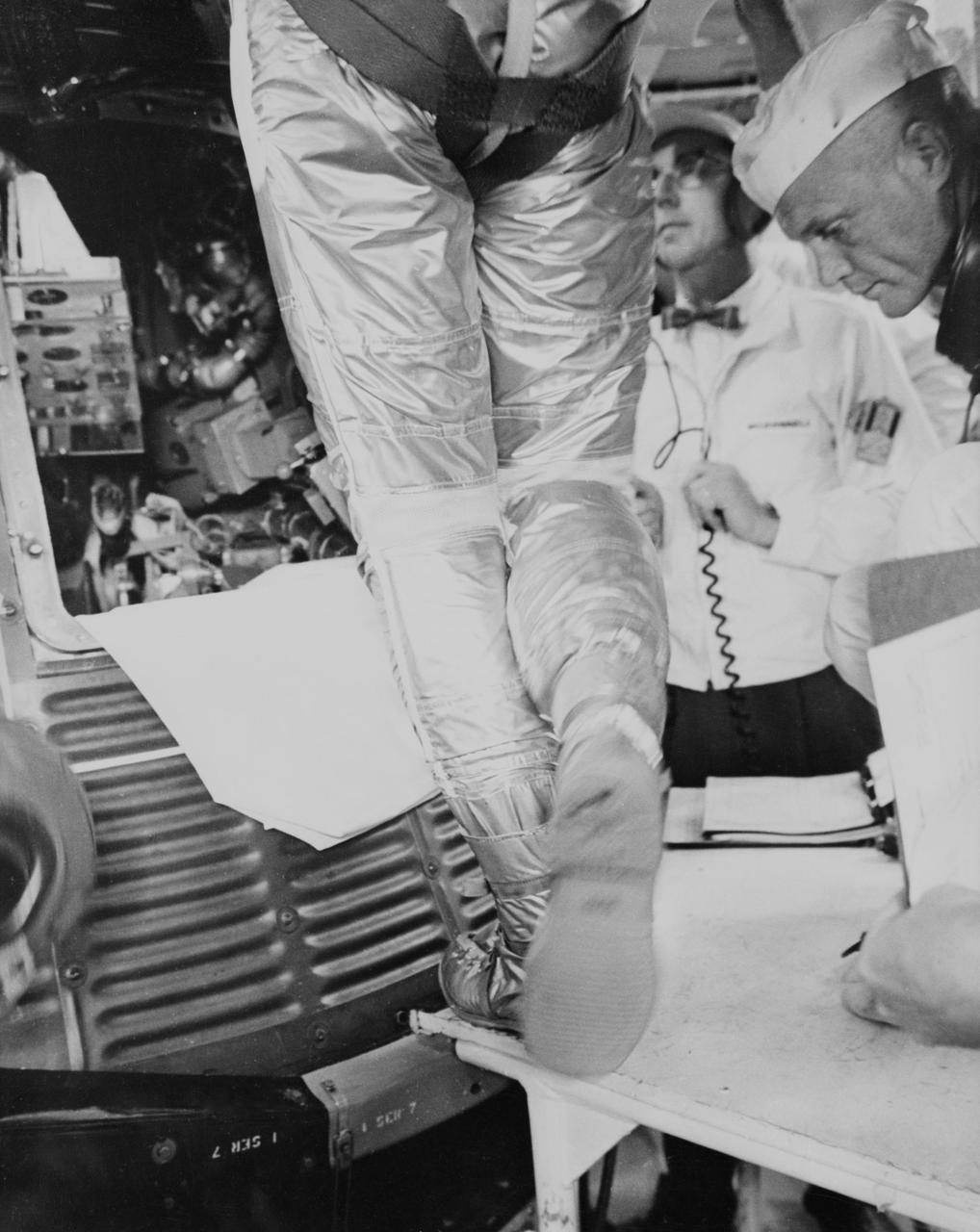
S61-02796 (5 May 1961) --- Rear view of astronaut Alan B. Shepard Jr., in his pressure suit and helmet, as he approaches the Freedom 7 capsule in preparation for ingress before the Mercury-Redstone 3 mission. All that can be seen of the astronaut is his legs. Photo credit: NASA or National Aeronautics and Space Administration
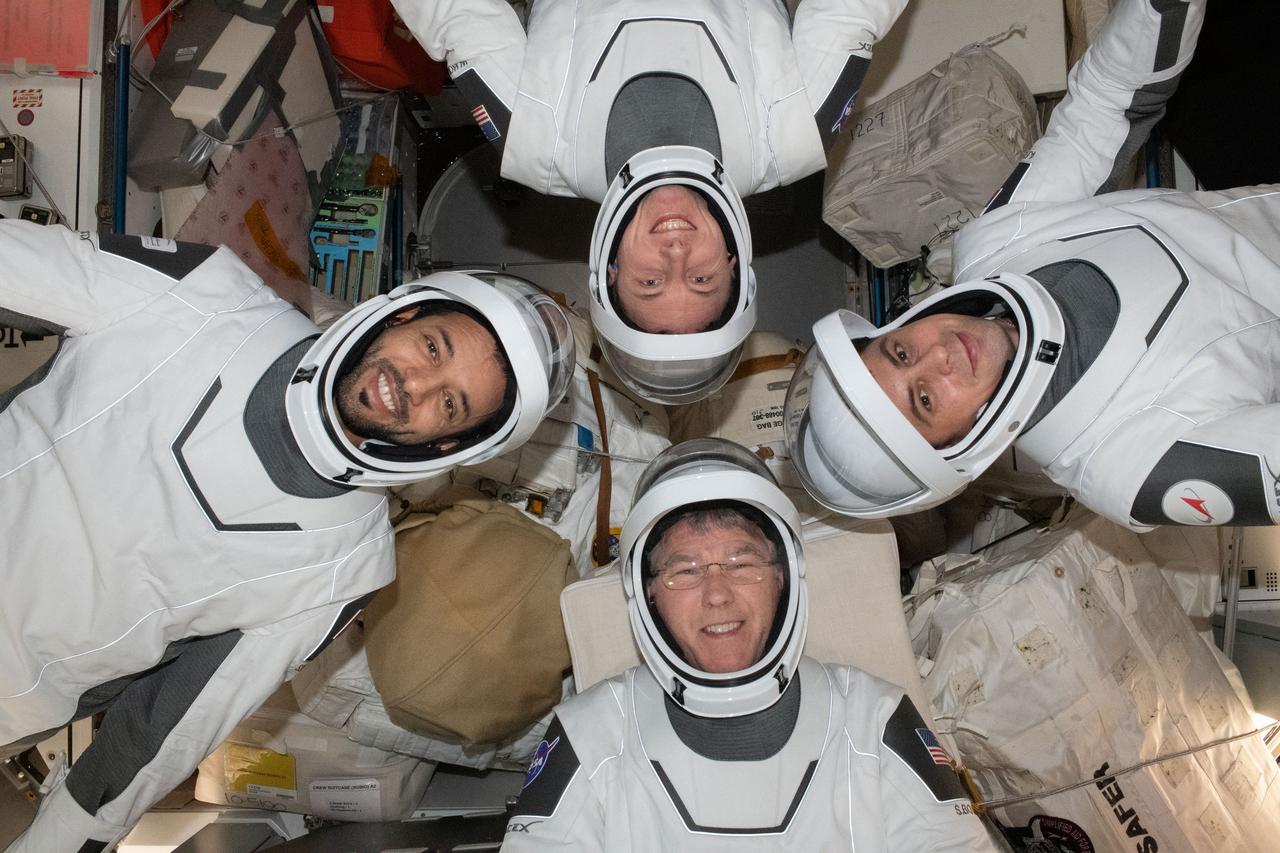
iss069e008444 (May 2, 2023) --- Four Expedition 69 flight engineers aboard the International Space Station pose for a portrait in the pressure suits they will wear when they relocate the SpaceX Dragon Endeavour crew ship from the Harmony module's space-facing port to Harmony's forward port on Saturday May 6, 2023. Clockwise from bottom, are NASA astronaut Stephen Bowen; UAE (United Arab Emirates) astronaut Sultan Alneyadi; NASA astronaut Woody Hoburg; and Roscosmos cosmonaut Andrey Fedyaev.
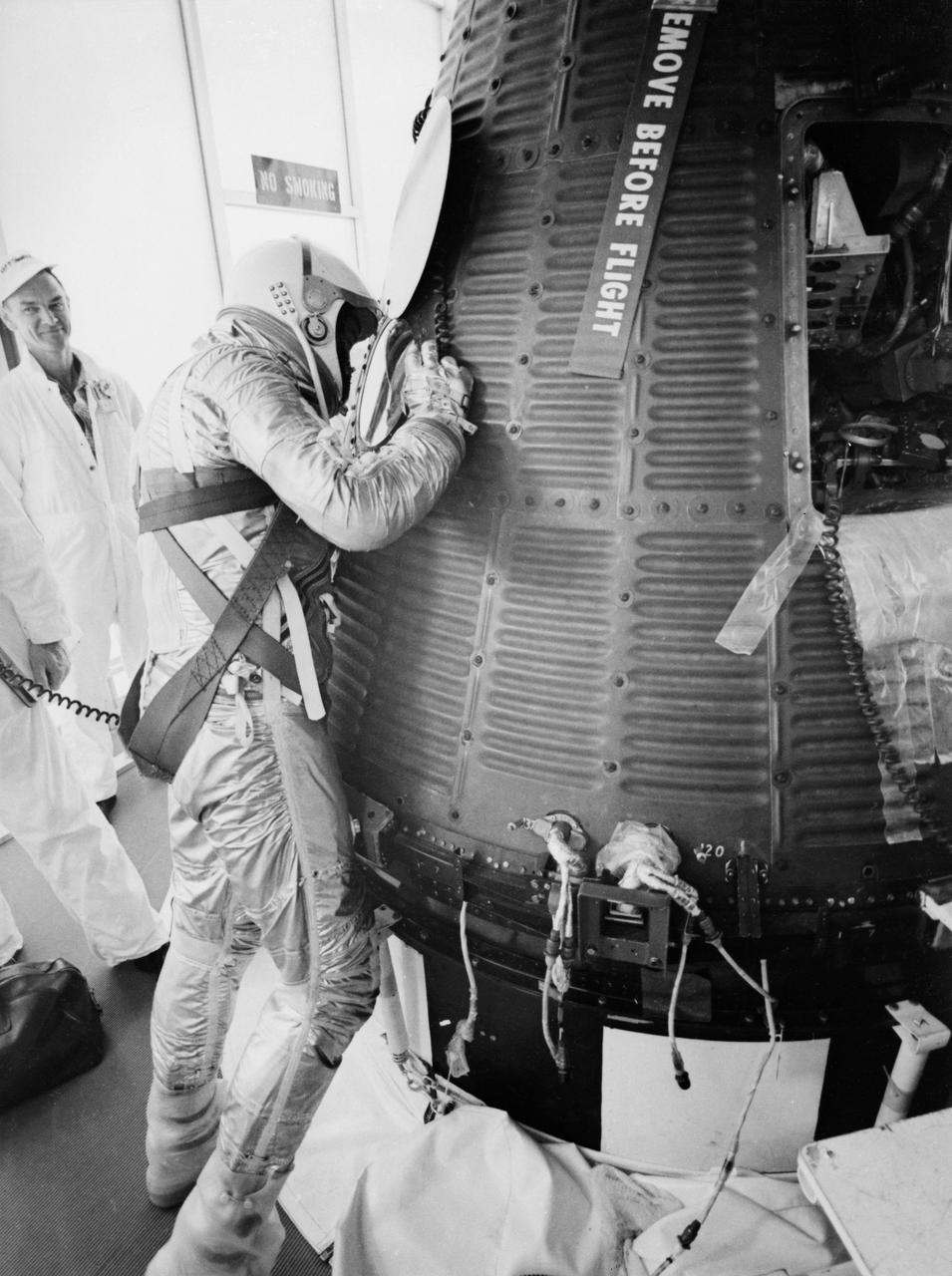
S61-02547 (5 May 1961) --- Astronaut Alan B. Shepard Jr., in his pressure suit and helmet, looks into the Freedom 7 capsule in preparation for ingress before the Mercury-Redstone 3 (MR-3) mission. Photo credit: NASA or National Aeronautics and Space Administration
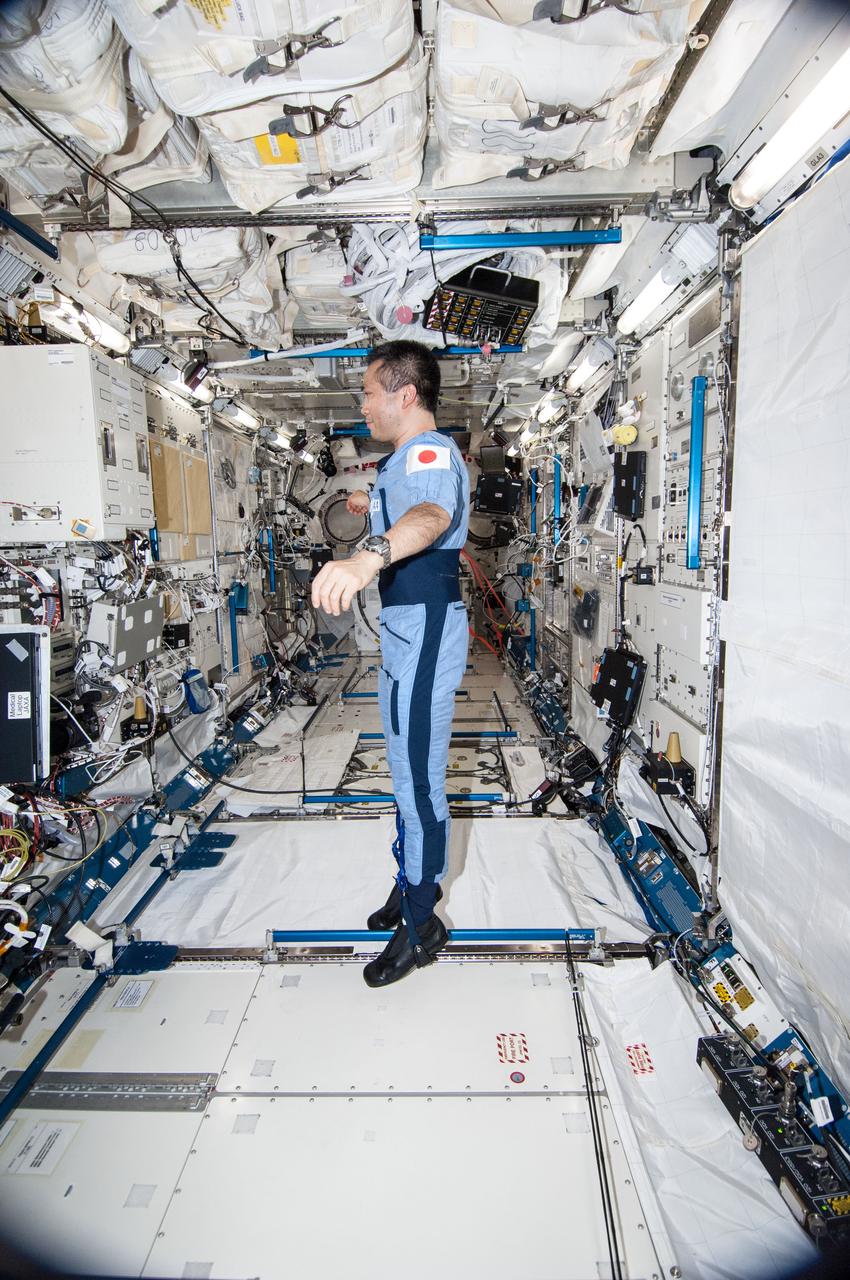
ISS038-E-035476 (24 Jan. 2014) --- Japan Aerospace Exploration Agency astronaut Koichi Wakata, Expedition 38 flight engineer, is pictured wearing the Penguin-3 antigravity pressure/stress suit in the Kibo laboratory of the International Space Station.
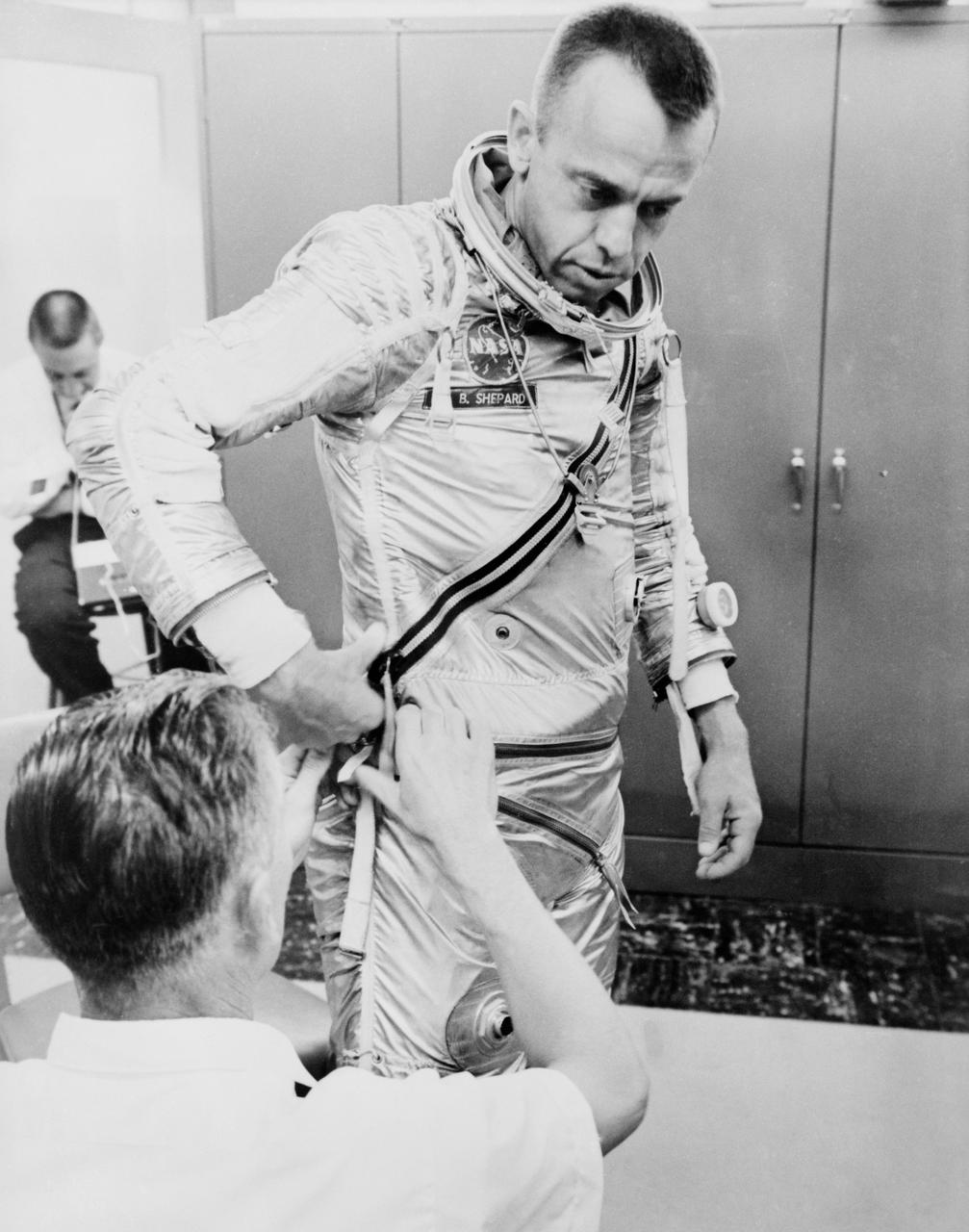
S61-02757 (5 May 1961) --- Astronaut Alan B. Shepard Jr. is being helped into his pressure suit for the Mercury-Redstone 3 (MR-3) flight, the first American manned spaceflight. Photo credit: NASA or National Aeronautics and Space Administration
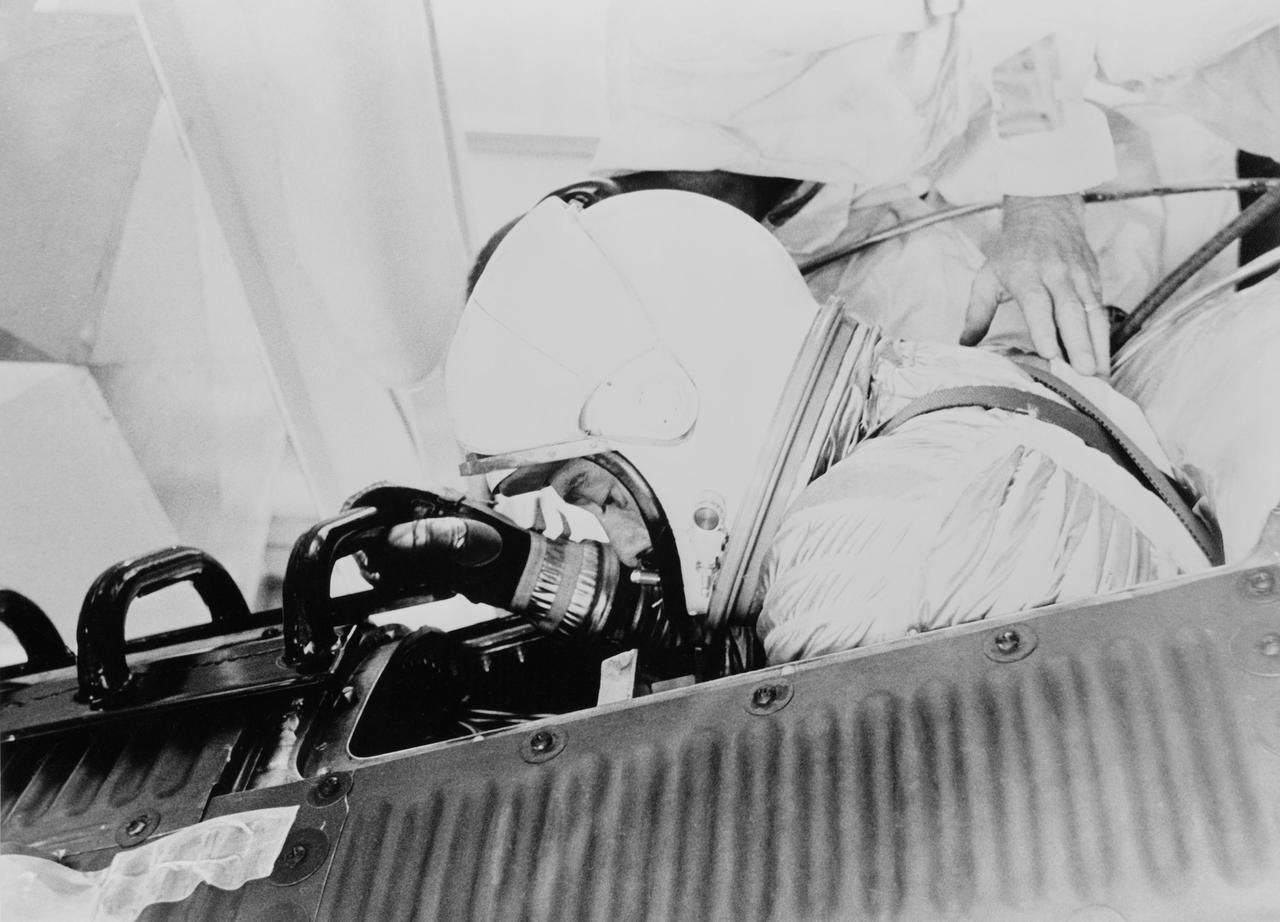
S61-03645 (5 May 1961) --- Close-up of astronaut Alan B. Shepard Jr., in his pressure suit and helmet, ingressing into the Freedom 7 capsule in preparation for the Mercury-Redstone 3 (MR-3) mission. Photo credit: NASA or National Aeronautics and Space Administration
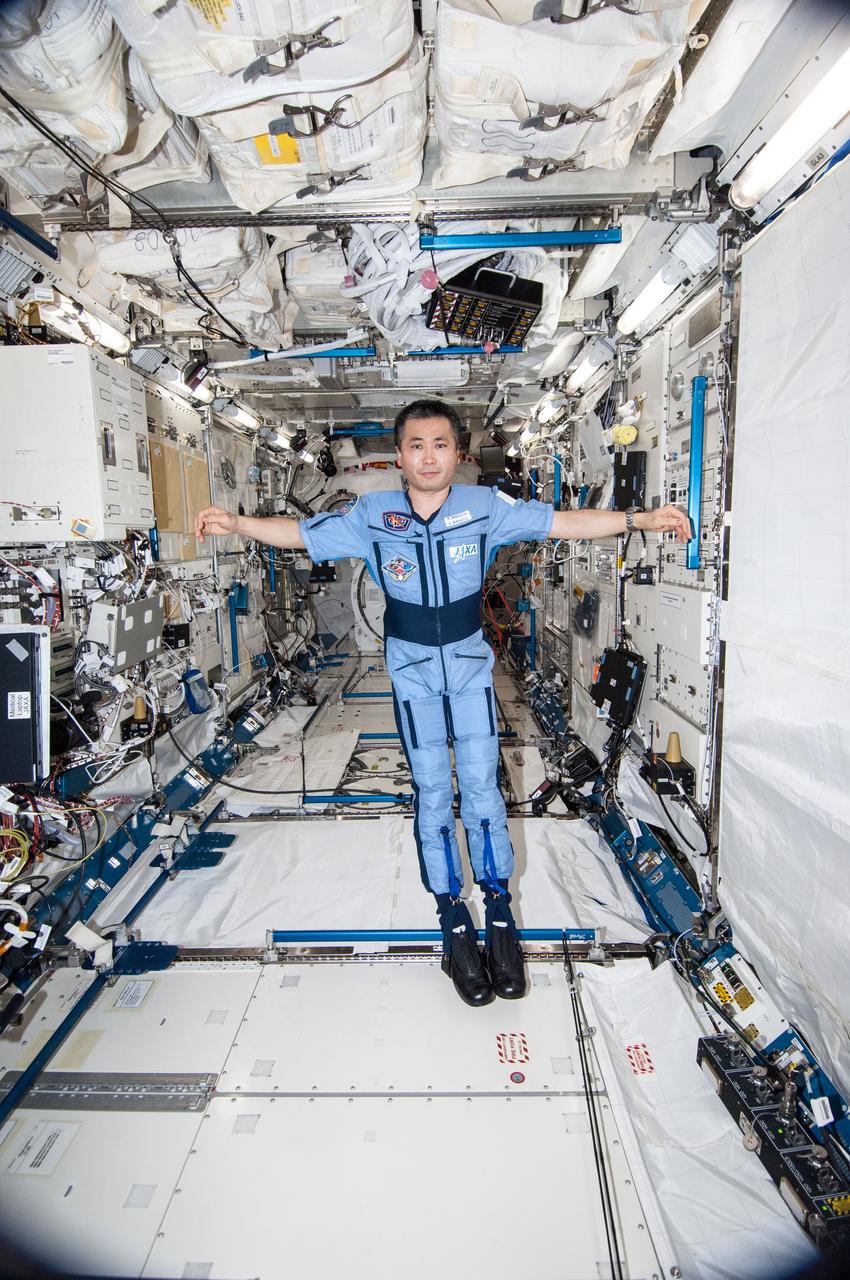
ISS038-E-035473 (24 Jan. 2014) --- Japan Aerospace Exploration Agency astronaut Koichi Wakata, Expedition 38 flight engineer, is pictured wearing the Penguin-3 antigravity pressure/stress suit in the Kibo laboratory of the International Space Station.
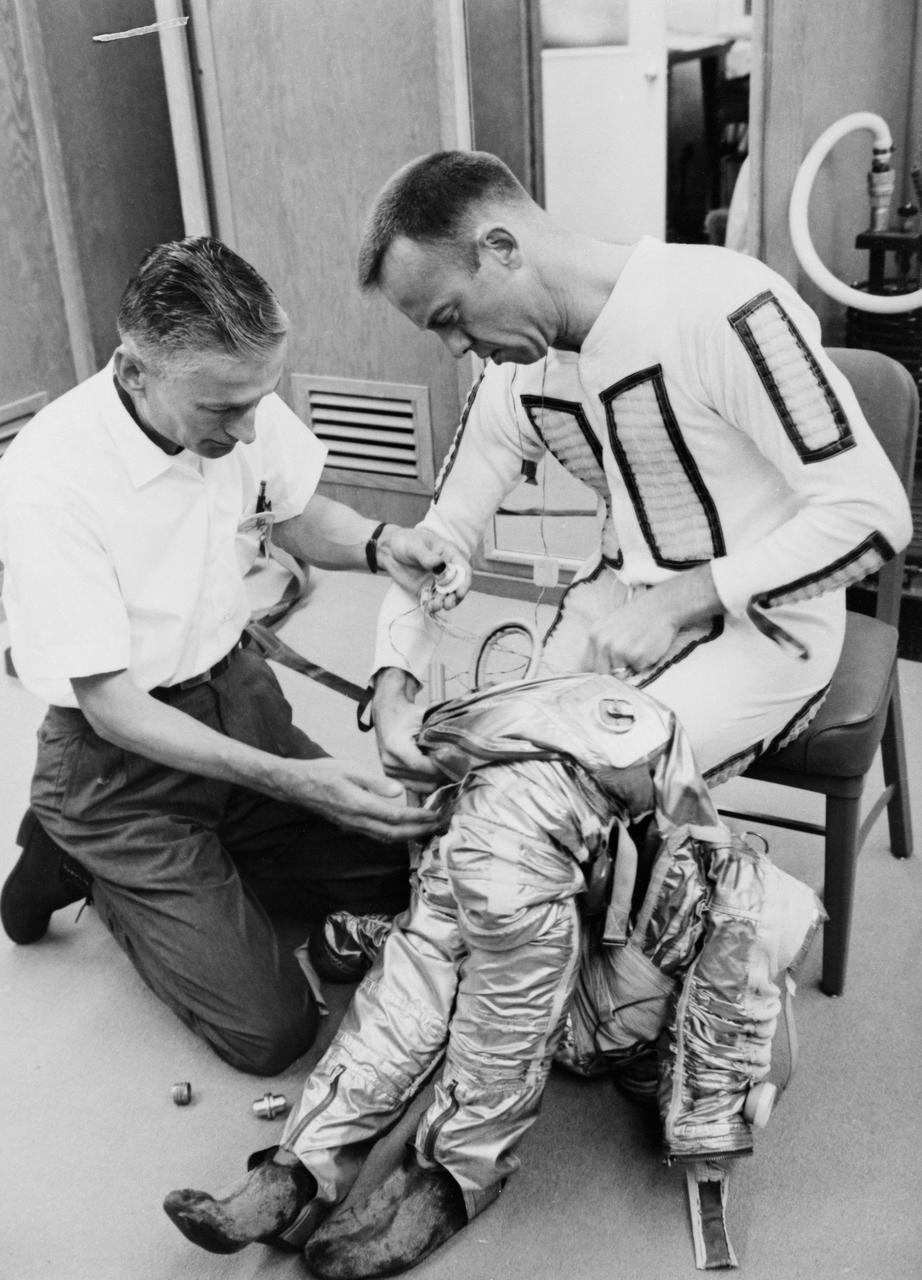
S61-02755 (5 May 1961) --- Astronaut Alan B. Shepard Jr. is being helped into the lower half of his pressure suit for the Mercury-Redstone 3 (MR-3) flight, the first American manned spaceflight. Photo credit: NASA or National Aeronautics and Space Administration
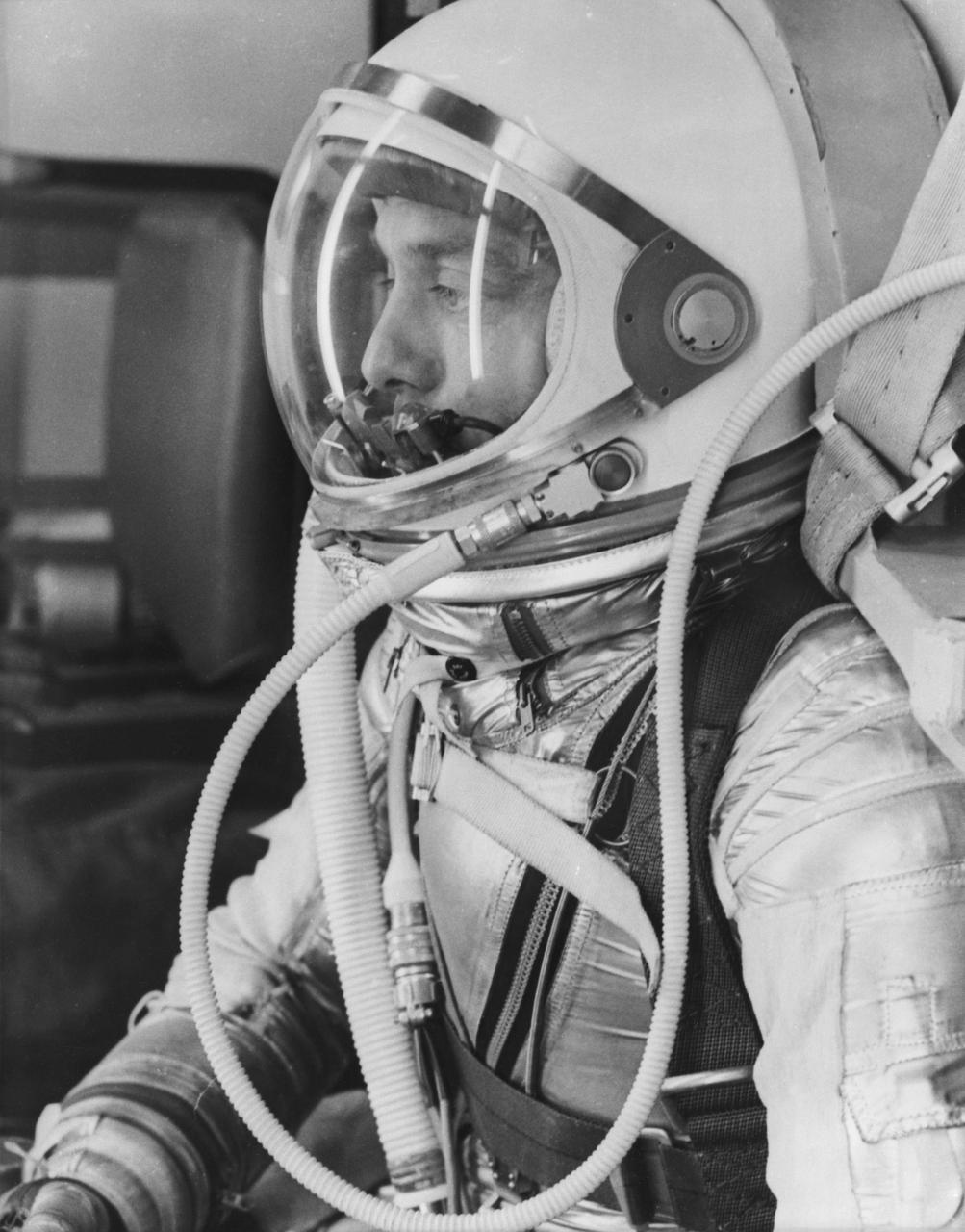
S61-02766 (5 May 1961) --- Side view of astronaut Alan B. Shepard Jr. in his pressure suit, with helmet closed, for the Mercury-Redstone 3 (MR-3) flight, the first American manned spaceflight. Photo credit: NASA or National Aeronautics and Space Administration
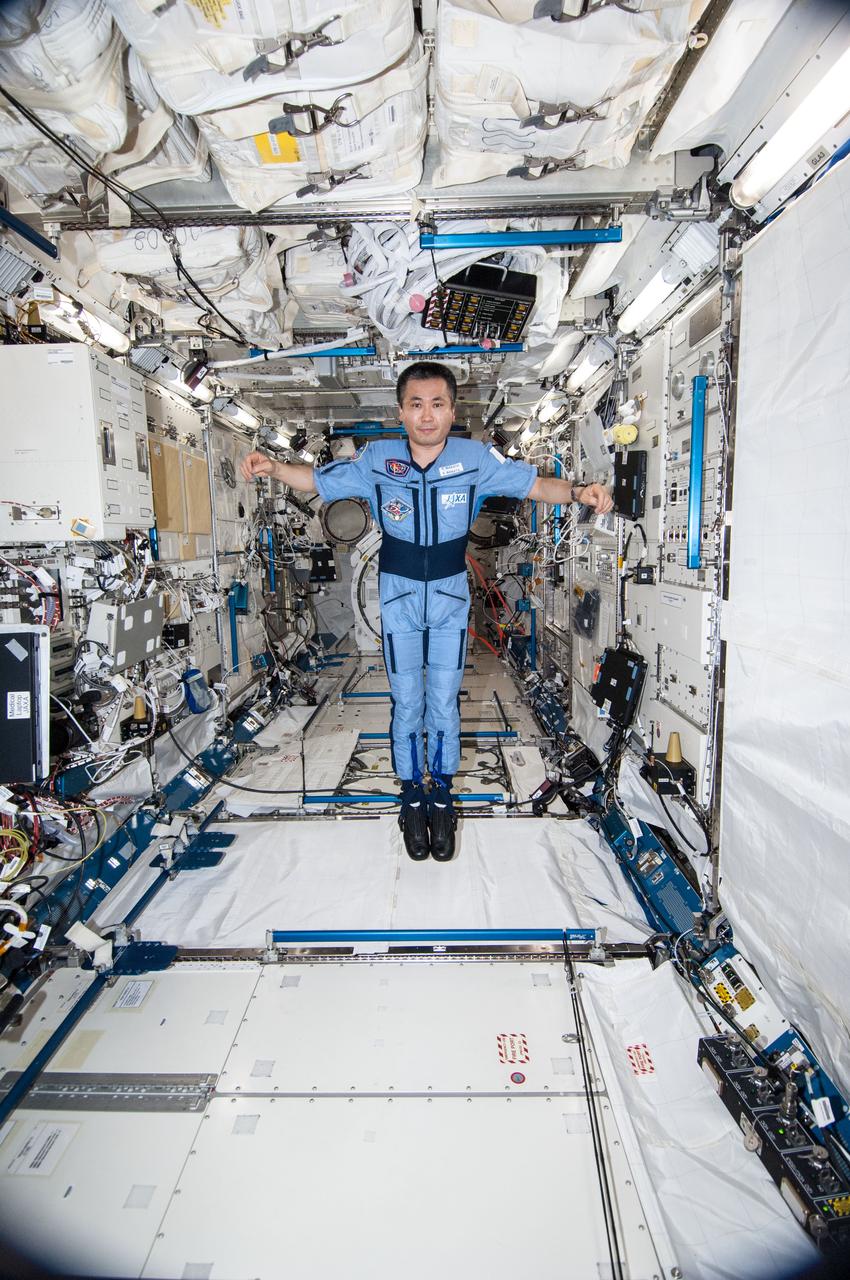
ISS038-E-035470 (24 Jan. 2014) --- Japan Aerospace Exploration Agency astronaut Koichi Wakata, Expedition 38 flight engineer, is pictured wearing the Penguin-3 antigravity pressure/stress suit in the Kibo laboratory of the International Space Station.
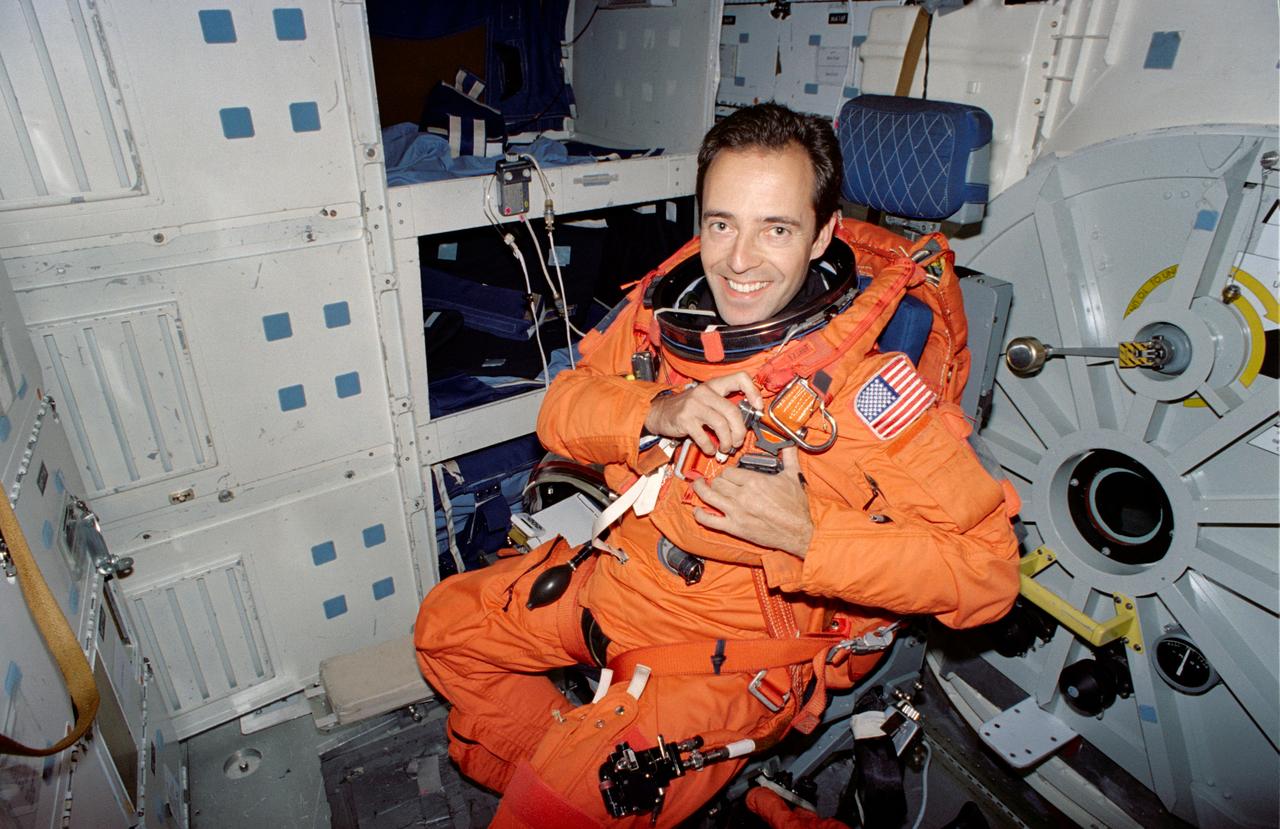
S94-40081 (23 June 1994) --- Wearing a training version of a partial pressure suit, Jean-Francois Clervoy, STS-66 international mission specialist, secures himself on a collapsible seat on the middeck of a Shuttle trainer during a rehearsal of procedures to be followed during launch and entry phases of his scheduled November flight. This rehearsal, held in the Crew Compartment Trainer (CCT) of the Johnson Space Center's (JSC) Shuttle Mockup and Integration Laboratory, was followed by a training session on emergency egress procedures. Clervoy, a European astronaut, will join five NASA astronauts for a week and a half aboard the Space Shuttle Atlantis in Earth-orbit in support of the Atmospheric Laboratory for Applications and Science (ATLAS-3).
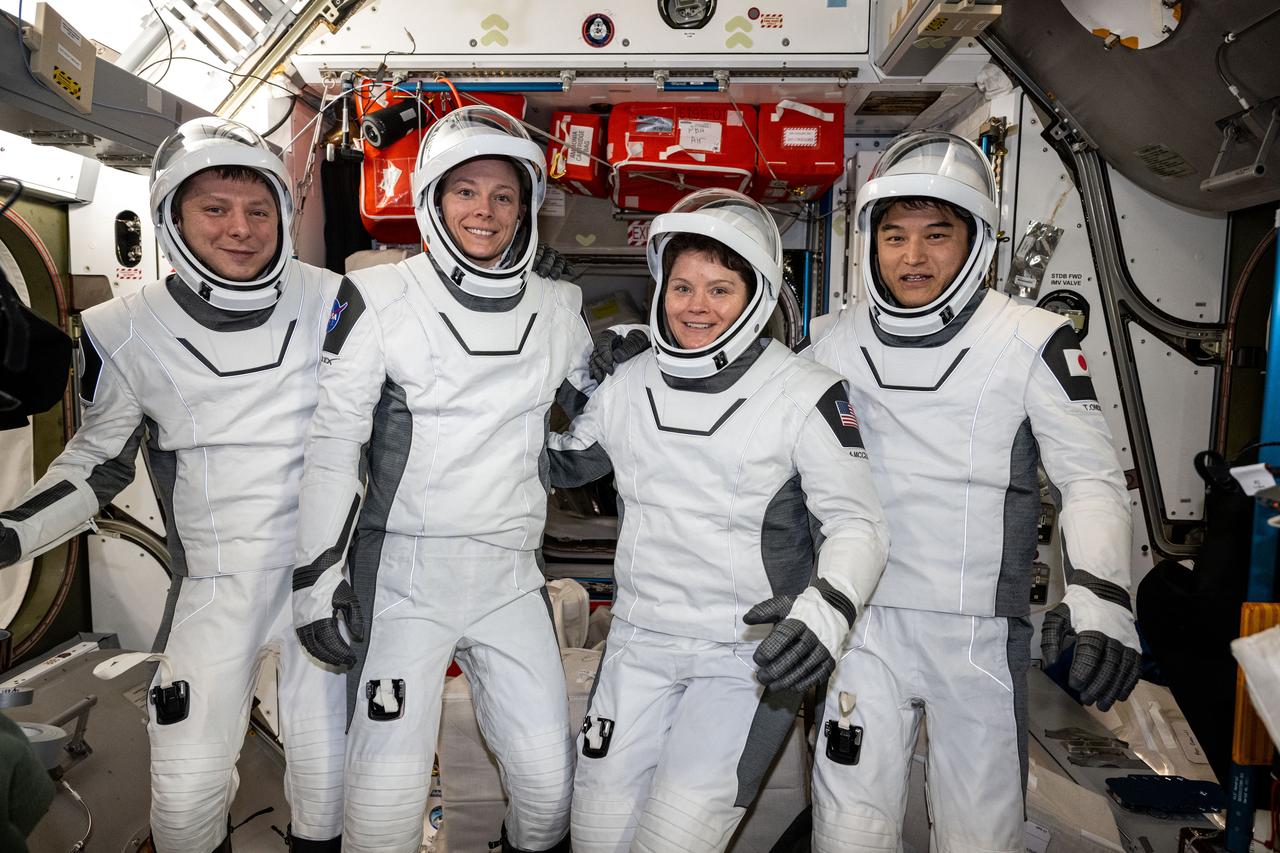
iss073e0414510 (July 29, 2025) --- The four members of NASA's SpaceX Crew-10 mission pose for a portrait in their Dragon pressure suits aboard the International Space Station's Harmony module. The Commercial Crew members were testing their suits' components and ensuring a proper fit before their departure on Aug. 8, 2025, aboard Dragon ending their five-month space research mission inside the orbital outpost. From left are, Roscosmos cosmonaut Kirill Peskov, NASA astronauts Nichole Ayers and Anne McClain, and JAXA (Japan Aerospace Exploration Agency) astronaut Takuya Onishi.
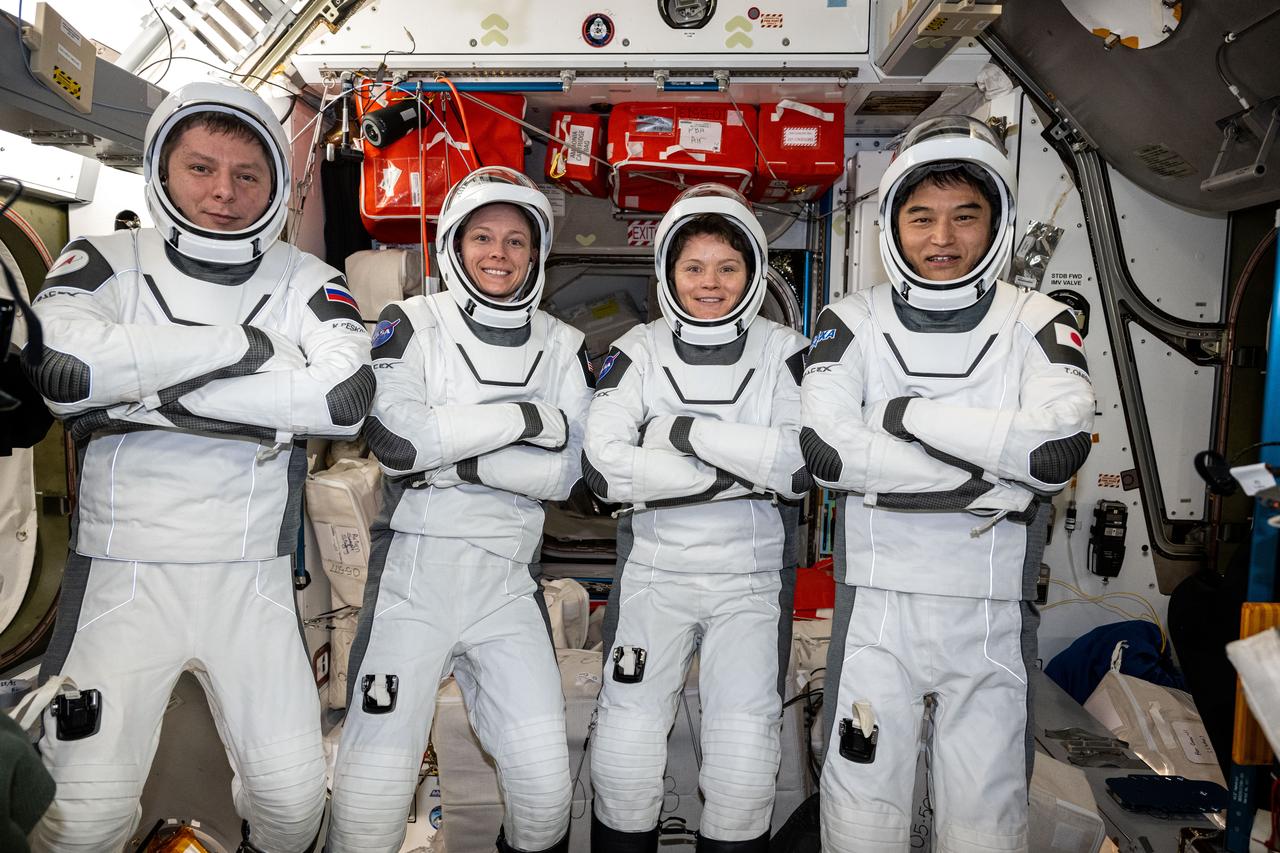
iss073e0414514 (July 29, 2025) --- The four members of NASA's SpaceX Crew-10 mission pose for a portrait in their Dragon pressure suits aboard the International Space Station's Harmony module. The Commercial Crew members were testing their suits' components and ensuring a proper fit before their departure on Aug. 8, 2025, aboard Dragon ending their five-month space research mission inside the orbital outpost. From left are, Roscosmos cosmonaut Kirill Peskov, NASA astronauts Nichole Ayers and Anne McClain, and JAXA (Japan Aerospace Exploration Agency) astronaut Takuya Onishi.
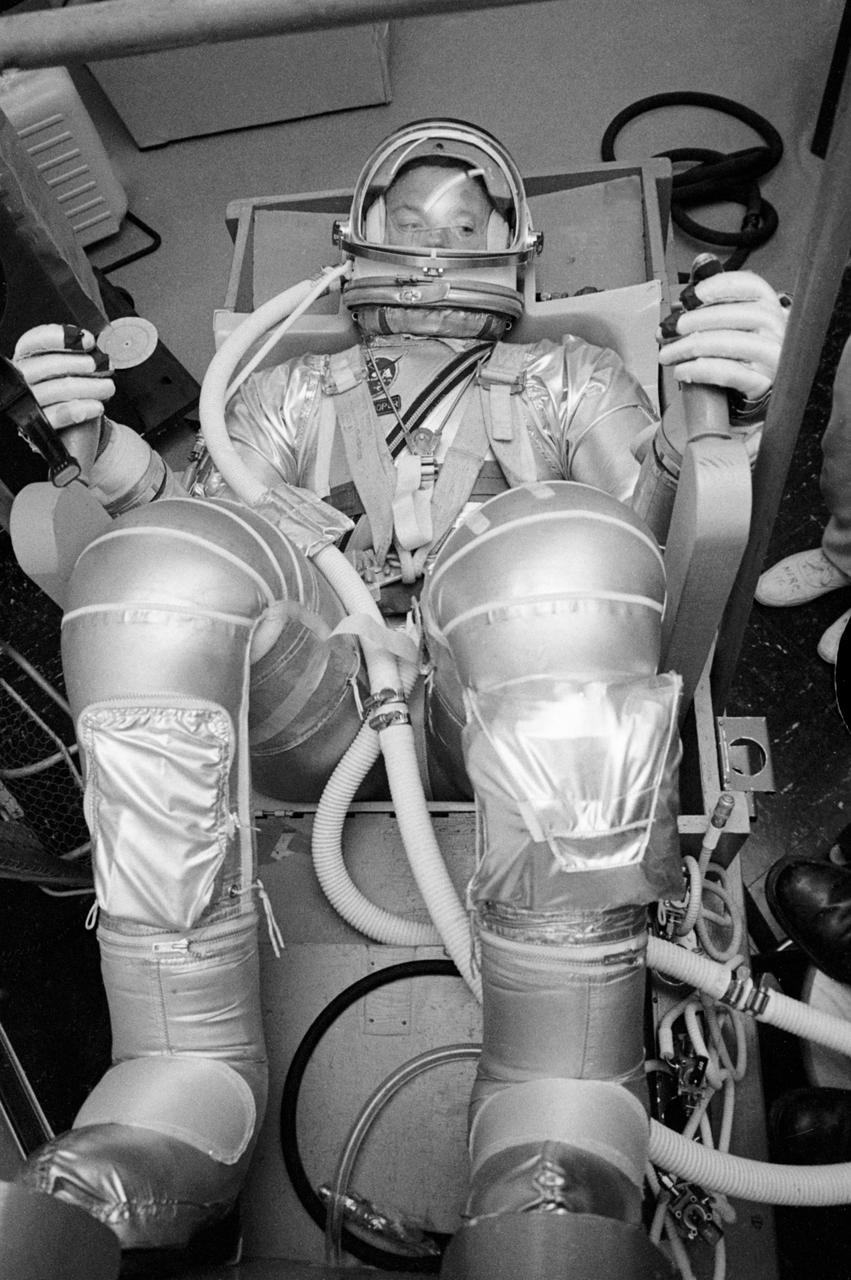
S63-03976 (1963) --- Astronaut L. Gordon Cooper Jr., prime pilot for the Mercury-Atlas 9 (MA-9) mission, undergoes suit pressurization tests. Photo credit: NASA
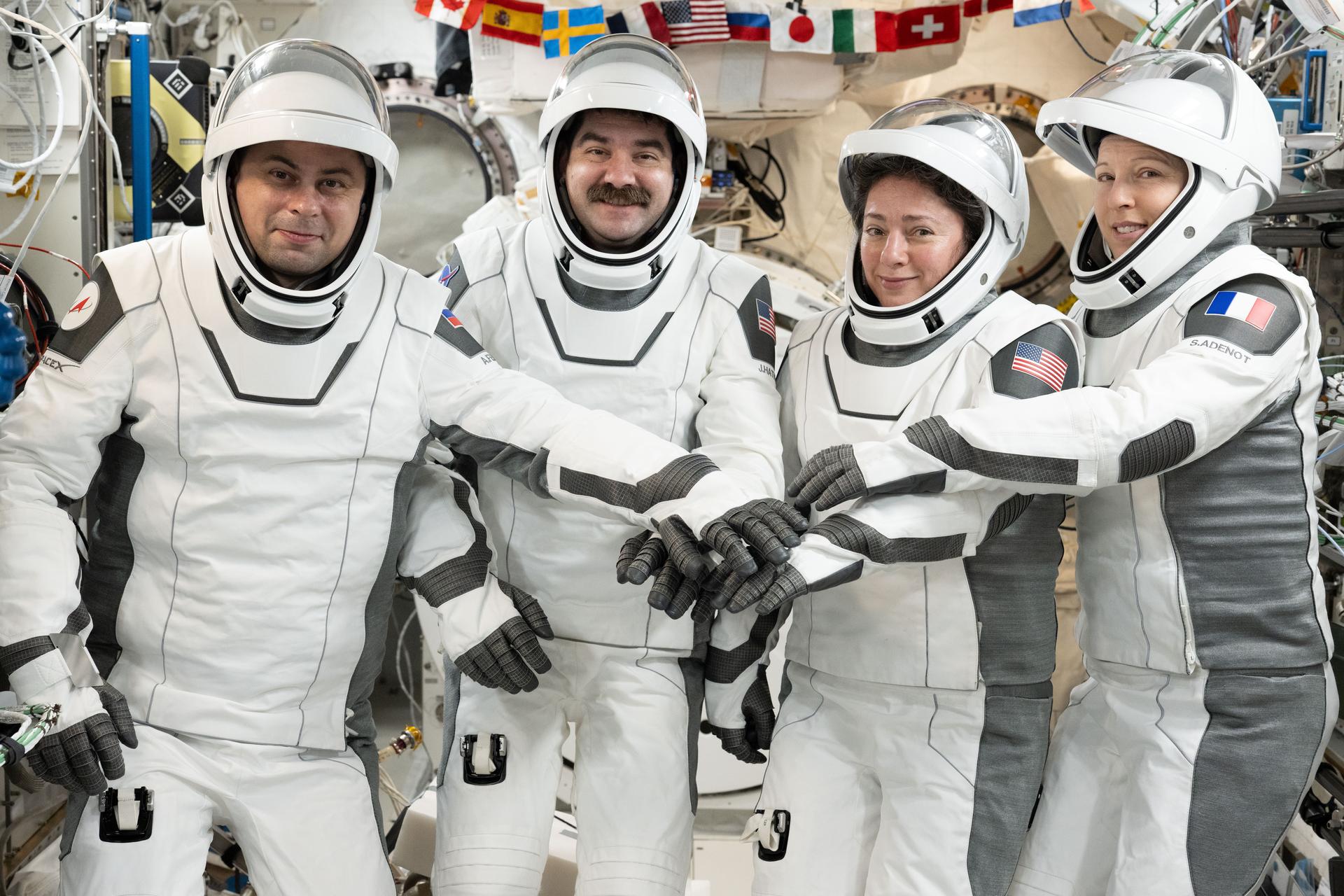
iss075e0150066 (Sept. 22, 2026) --- NASA's SpaceX Crew-12 members gather for a portrait in the pressure suits they will wear when they depart the International Space Station inside the SpaceX Dragon spacecraft. From left, Roscosmos cosmonaut and mission specialist Andrey Fedyaev, NASA astronauts Jack Hathaway and Jessica Meir, Crew-12 pilot and commander respectively, and ESA (European Space Agency) astronaut and mission specialist Sophie Adenot. Credit: NASA/Anil Menon

NASA Dryden life support technician Jim Sokolik assists pressure-suited pilot Dee Porter into the cockpit of NASA's ER-2 Earth resources aircraft.
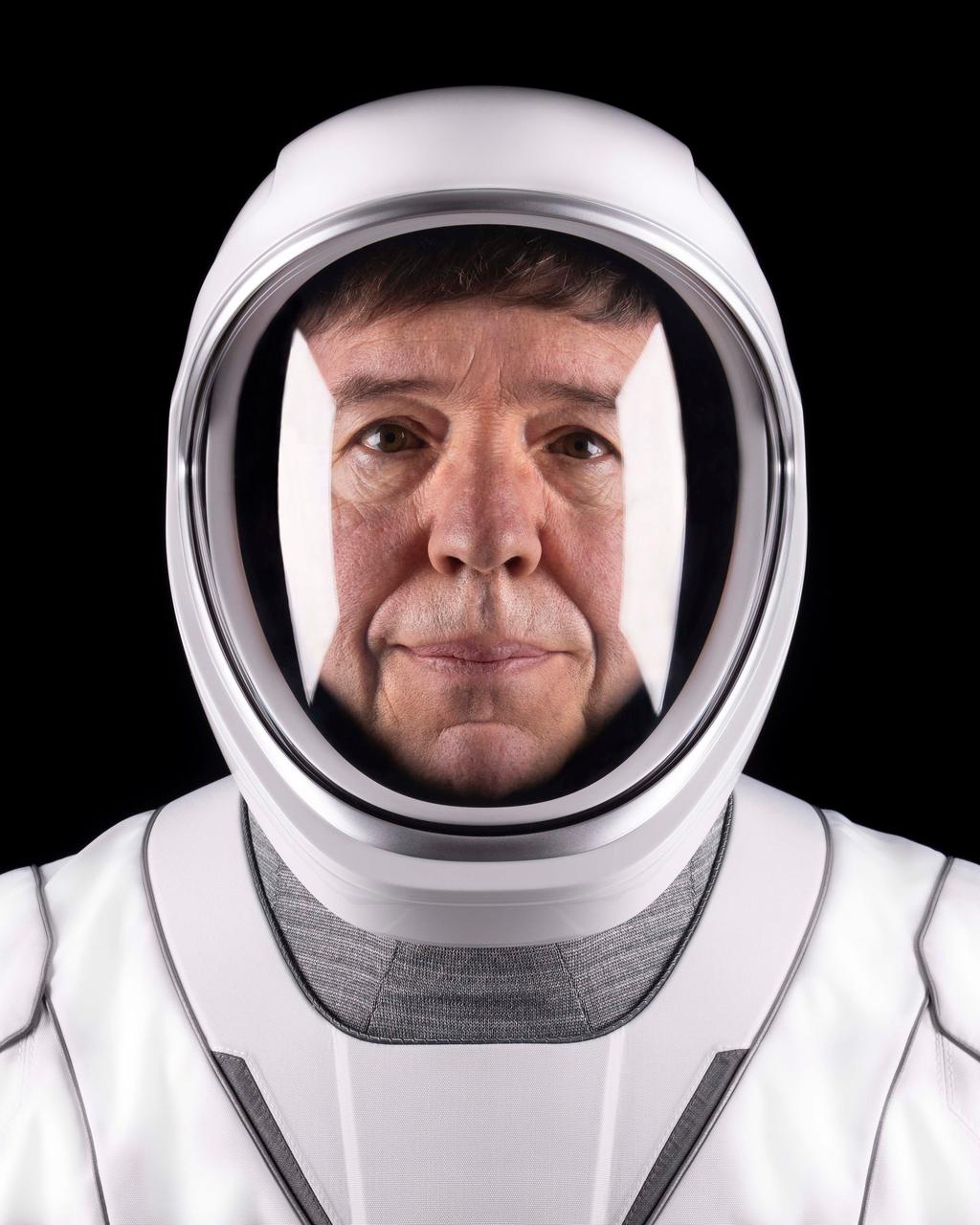
jsc2024e01170 (Dec. 3, 2023) --- SpaceX Crew-8 Pilot Michael Barratt of NASA's Commercial Crew Program poses for a portrait in his pressure suit at SpaceX headquarters in Hawthorne, California. Credit: SpaceX
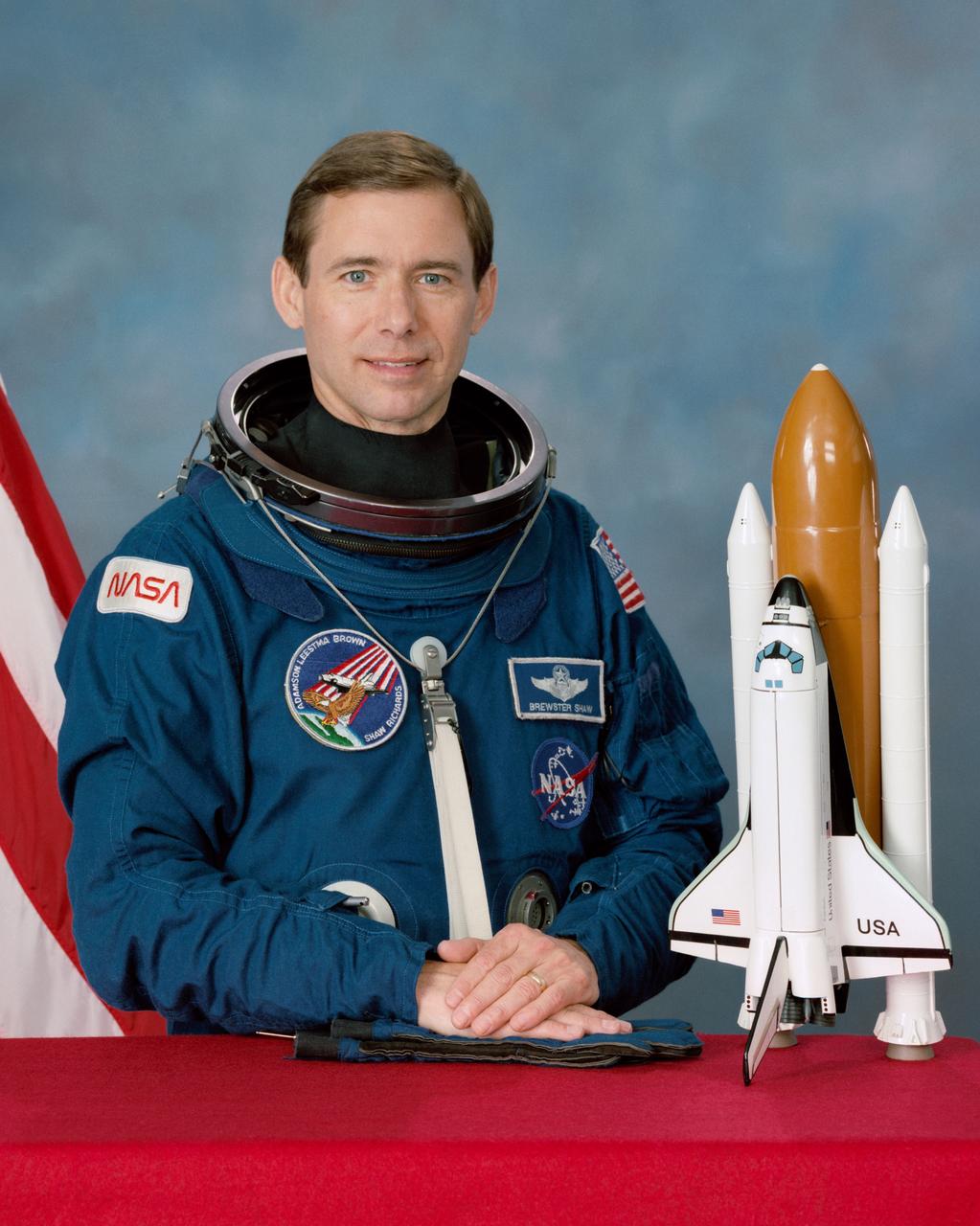
S89-29371 (19 March 1989) --- Astronaut Brewster H. Shaw, Jr.
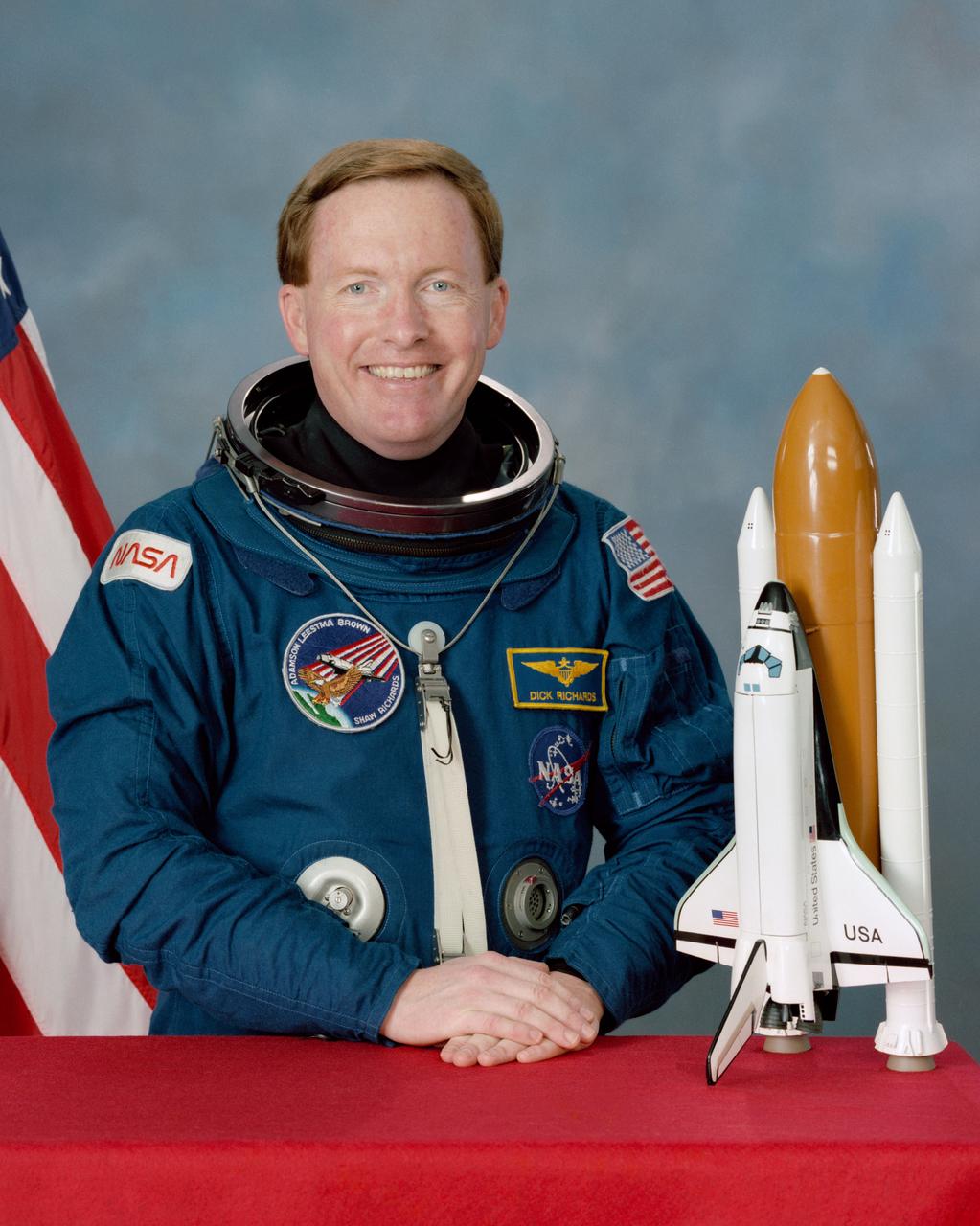
S89-29425 (20 March 1989) --- Astronaut Richard N. Richards.
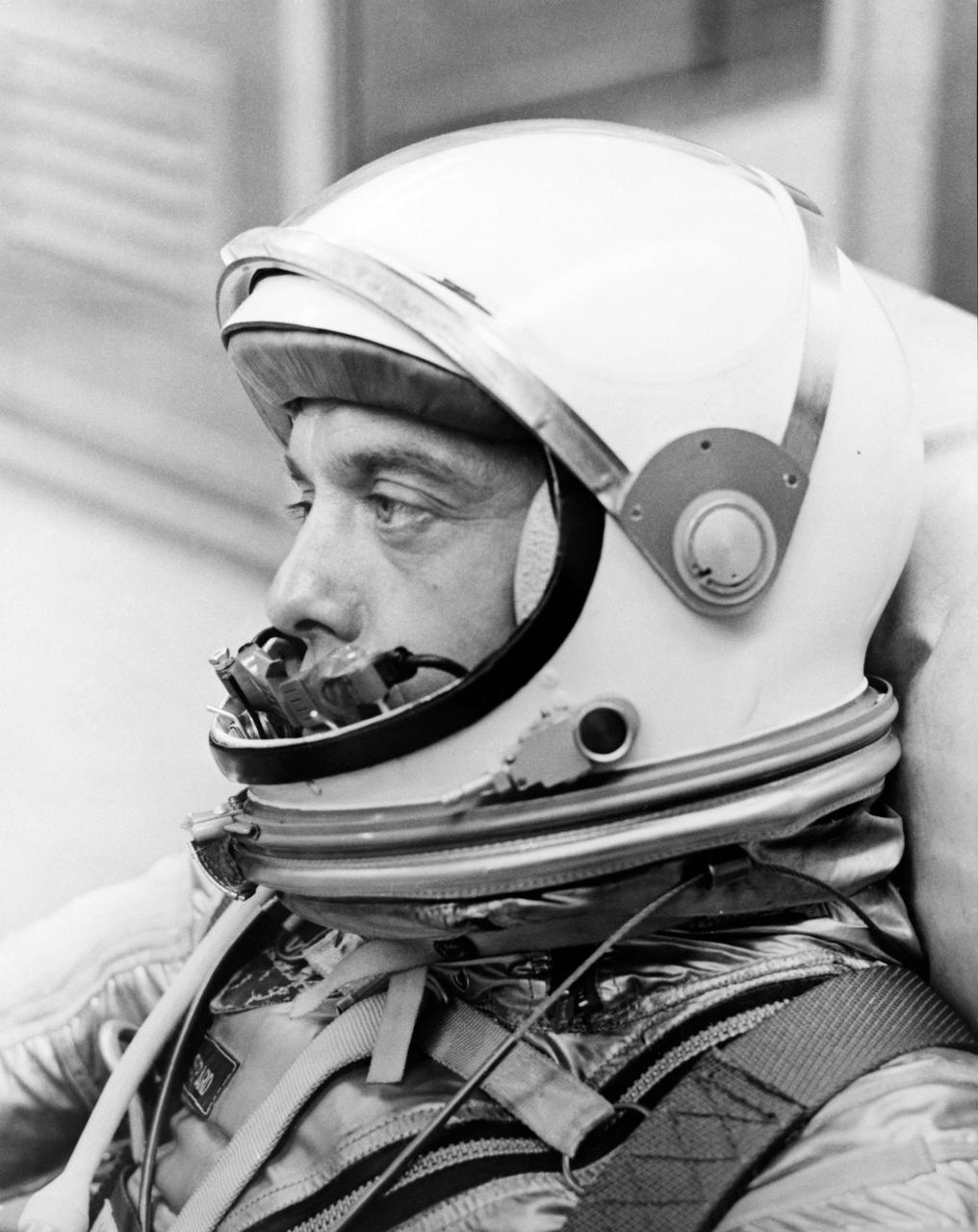
S61-02775 (5 May 1961) --- Close-up view of astronaut Alan B. Shepard Jr. in his pressure suit, with helmet opened, for the Mercury-Redstone 3 (MR-3) flight, the first American manned spaceflight. Photo credit: NASA or National Aeronautics and Space Administration
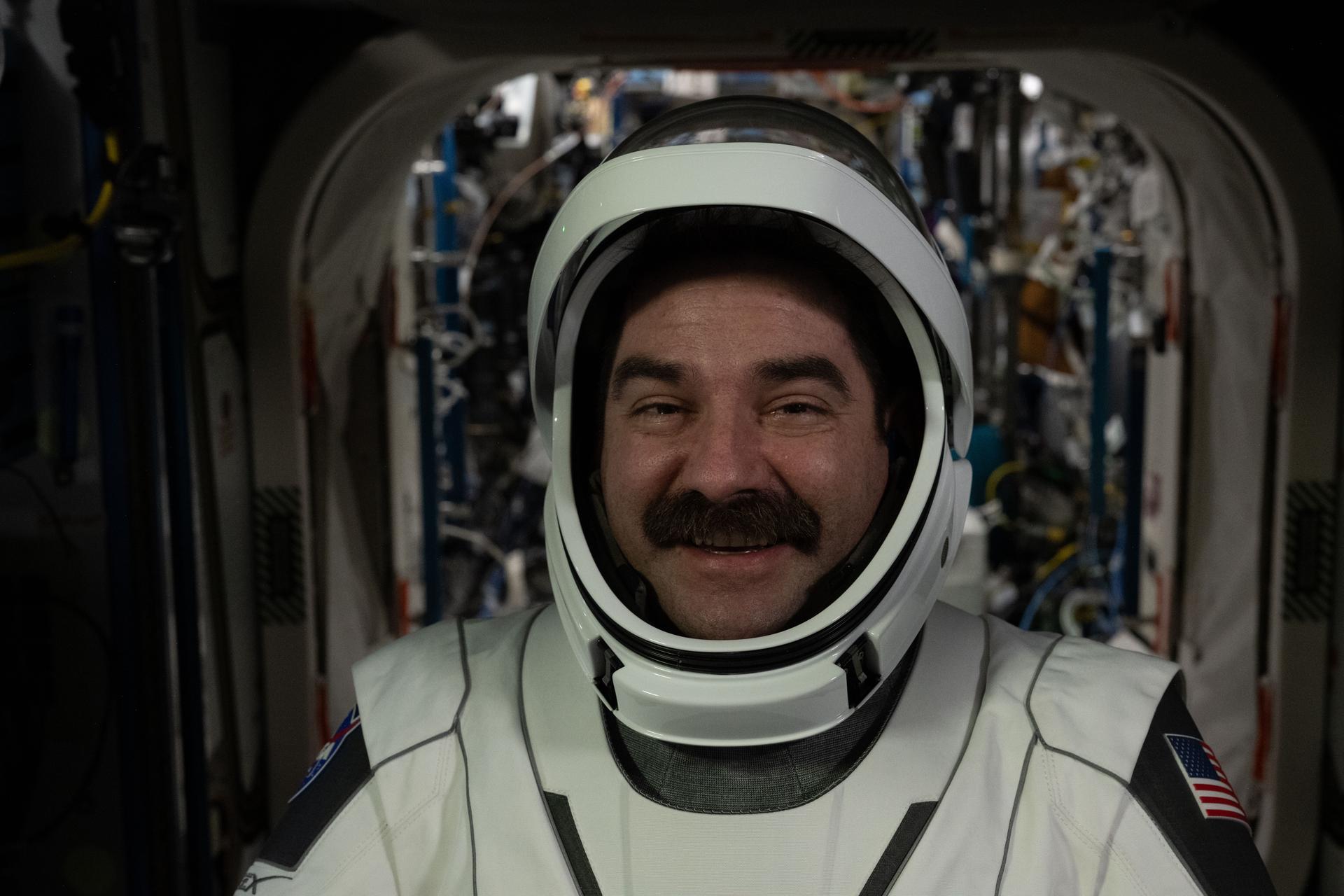
iss075e0150001 (Sept. 22, 2026) --- NASA astronaut and NASA's SpaceX Crew-12 pilot Jack Hathaway poses for a portrait while wearing the pressure suit he will wear when he departs the International Space Station inside the SpaceX Dragon spacecraft. Credit: NASA/Anil Menon
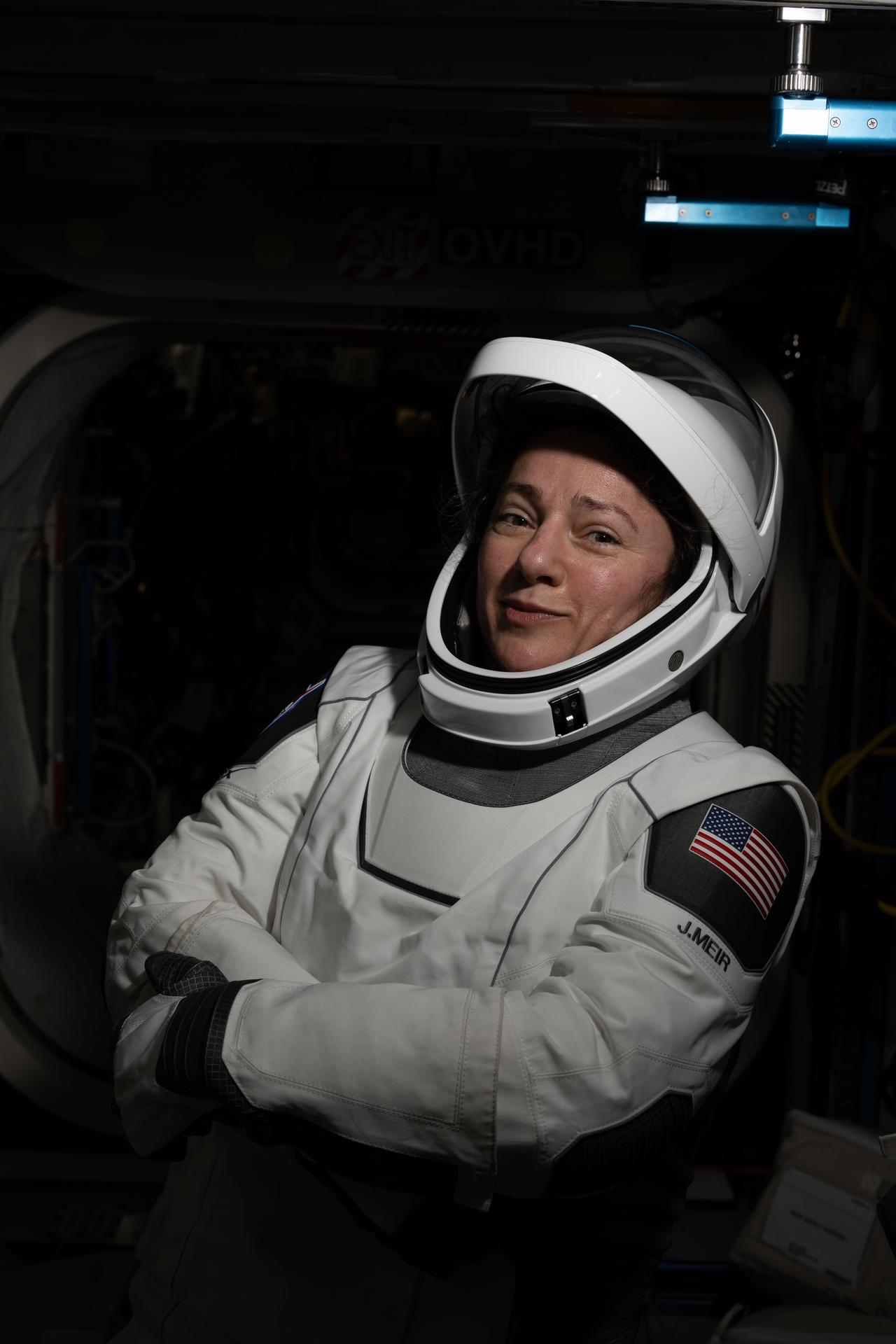
iss075e0150019 (Sept. 22, 2026) --- NASA astronaut and NASA's SpaceX Crew-12 commander Jessica Meir poses for a portrait while wearing the pressure suit she will wear when she departs the International Space Station inside the SpaceX Dragon spacecraft. Credit: NASA/Anil Menon
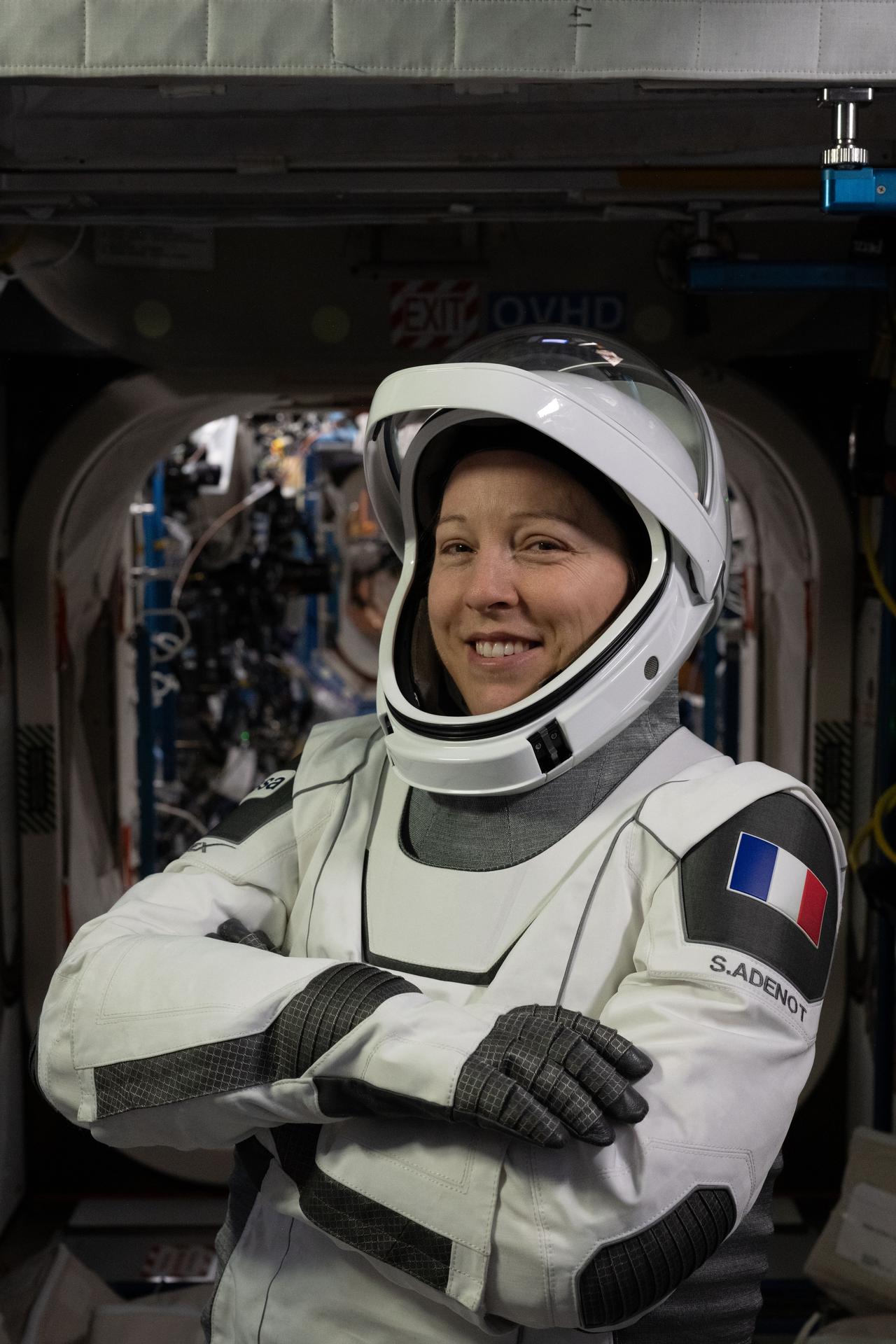
iss075e0150007 (Sept. 22, 2026) --- ESA (European Space Agency) astronaut and NASA's SpaceX Crew-12 mission specialist Sophie Adenot poses for a portrait while wearing the pressure suit she will wear when she departs the International Space Station inside the SpaceX Dragon spacecraft. Credit: NASA/Anil Menon
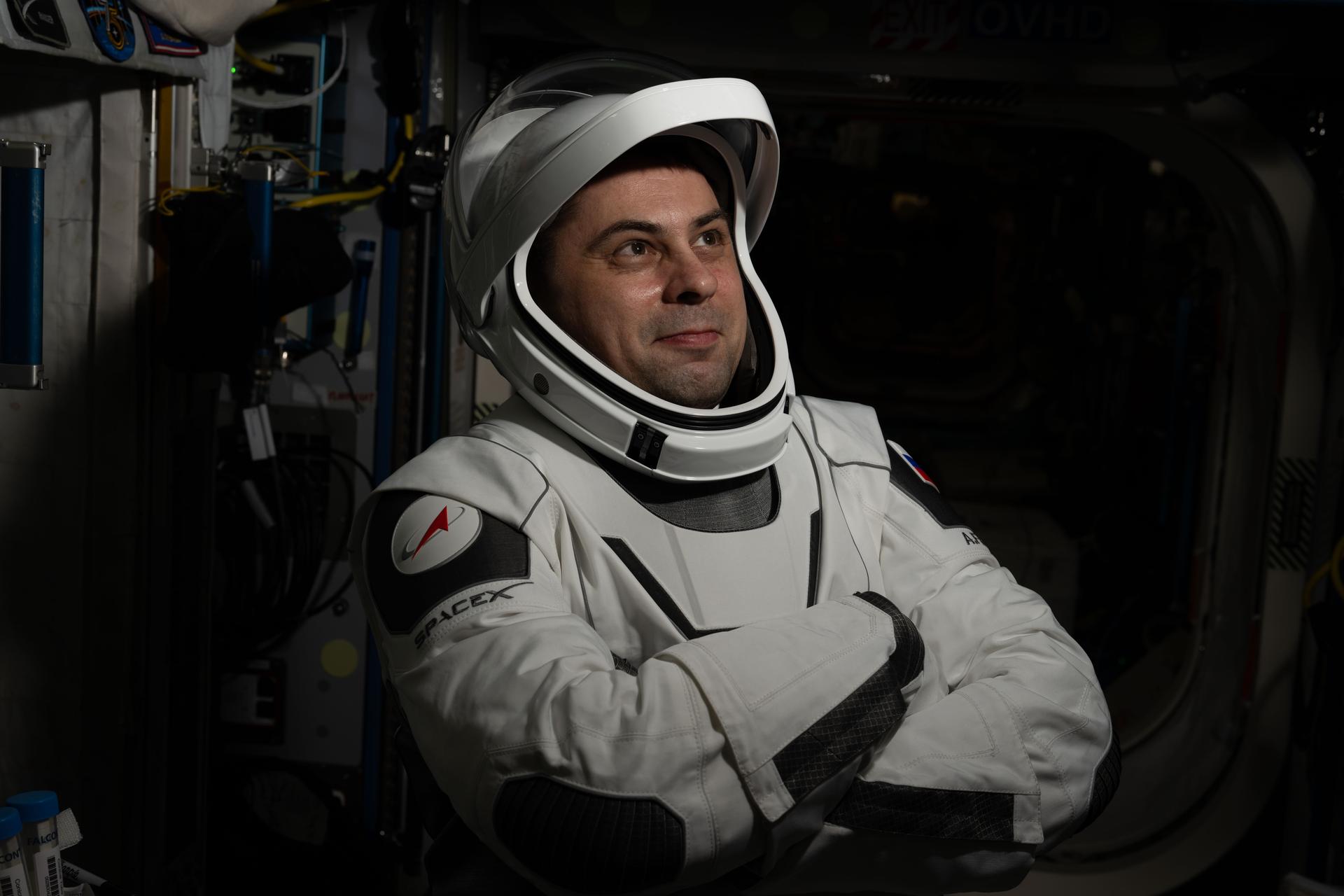
iss075e0150044 (Sept. 22, 2026) --- Roscosmos cosmonaut and NASA's SpaceX Crew-12 mission specialist Andrey Fedyaev poses for a portrait while wearing the pressure suit he will wear when he departs the International Space Station inside the SpaceX Dragon spacecraft. Credit: NASA/Anil Menon
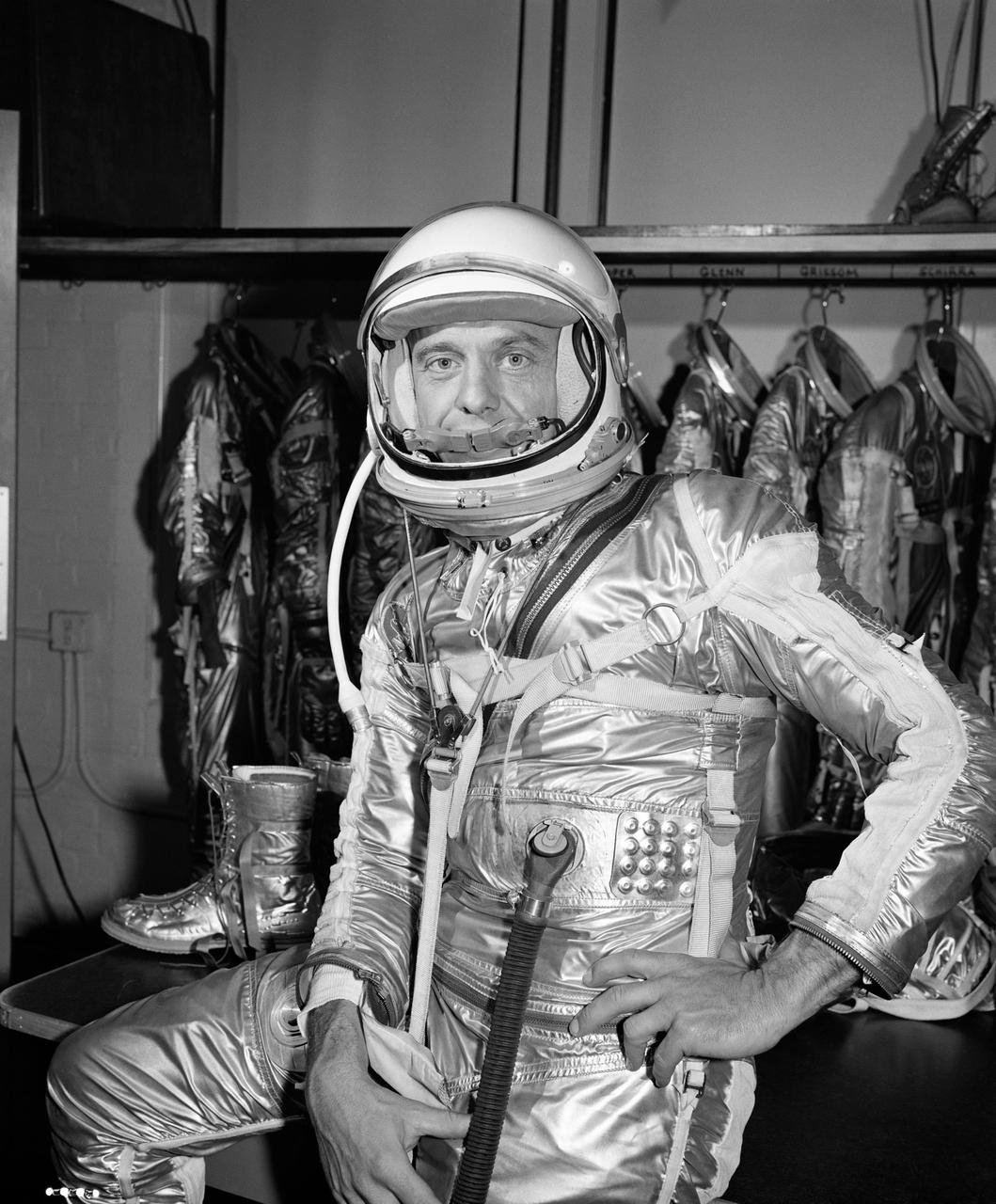
S61-00220 (20 April 1961) --- Close-up view of astronaut Alan B. Shepard Jr. in his pressure suit, with helmet opened, for the Mercury-Redstone 3 (MR-3) flight, the first American manned spaceflight. Photo credit: NASA or National Aeronautics and Space Administration

jsc2025e015860 (March 7, 2025) --- NASA’s SpaceX Crew-10 Pilot Nichole Ayers poses for a portrait in her pressure suit at the SpaceX facility in Hawthorne, California. Credit: SpaceX

jsc2026e034339 (April 17, 2026) --- NASA astronaut and SpaceX Crew-13 Commander Jessica Watkins is pictured in her pressure suit during a training session at SpaceX headquarters in Hawthorne, California. Credit: SpaceX
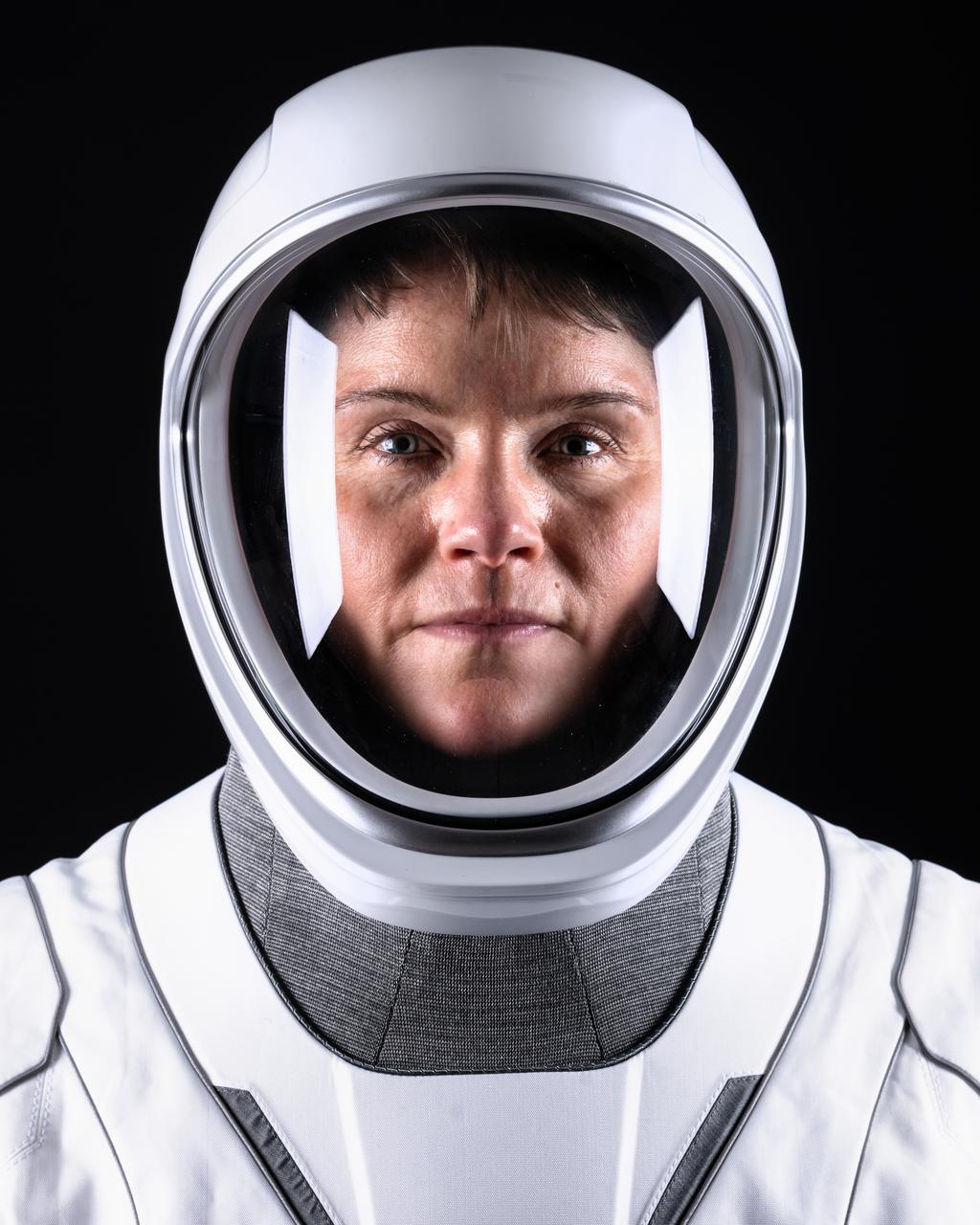
jsc2025e015859 (March 7, 2025) --- NASA’s SpaceX Crew-10 Commander Anne McClain poses for a portrait in her pressure suit at the SpaceX facility in Hawthorne, California. Credit: SpaceX
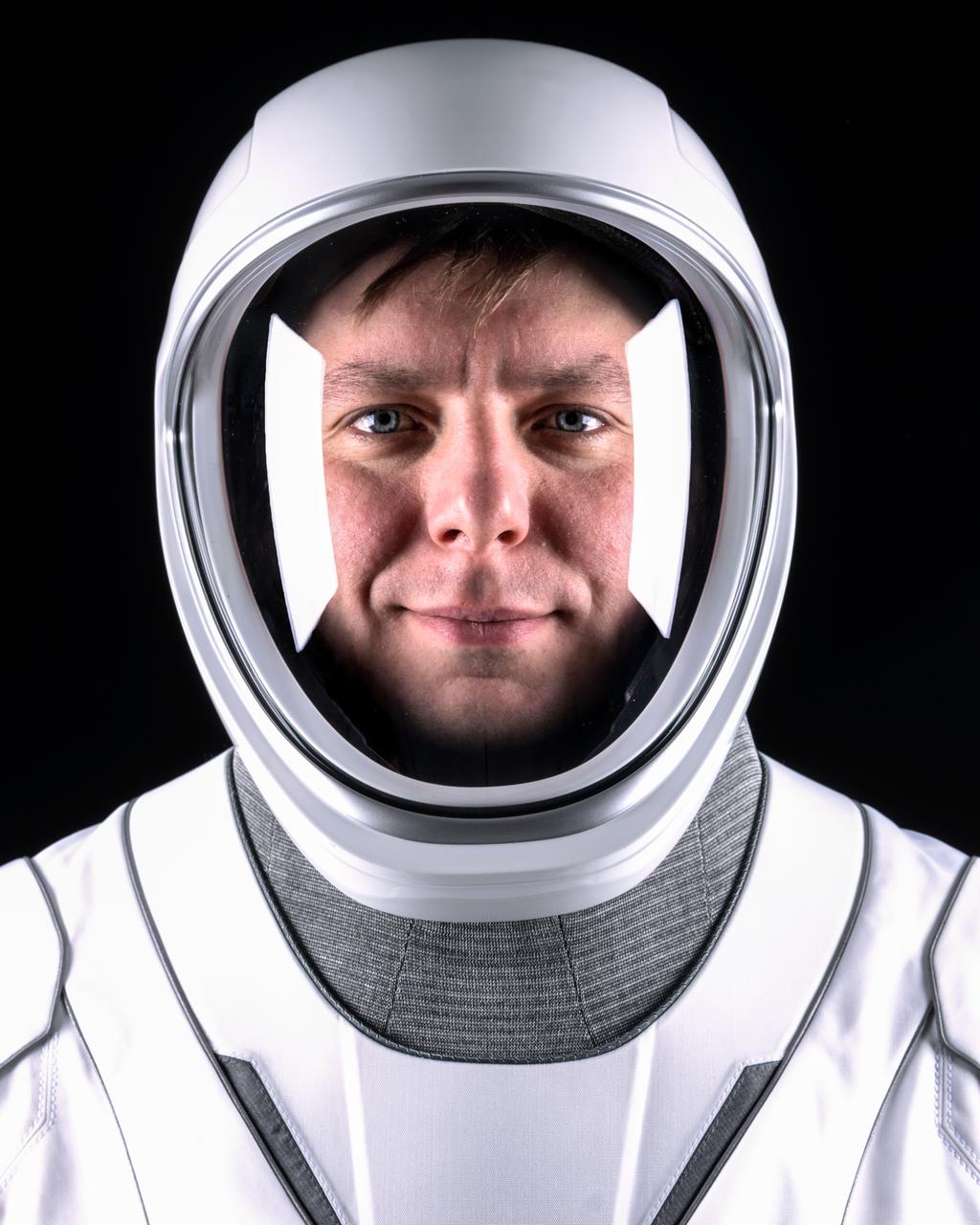
jsc2025e015861 (March 7, 2025) --- NASA’s SpaceX Crew-10 Mission Specialist Kirill Peskov poses for a portrait in his pressure suit at the SpaceX facility in Hawthorne, California. Credit: SpaceX

jsc2026e034338 (April 17, 2026) --- NASA astronaut and SpaceX Crew-13 Commander Jessica Watkins is pictured in her pressure suit during a training session at SpaceX headquarters in Hawthorne, California. Credit: SpaceX
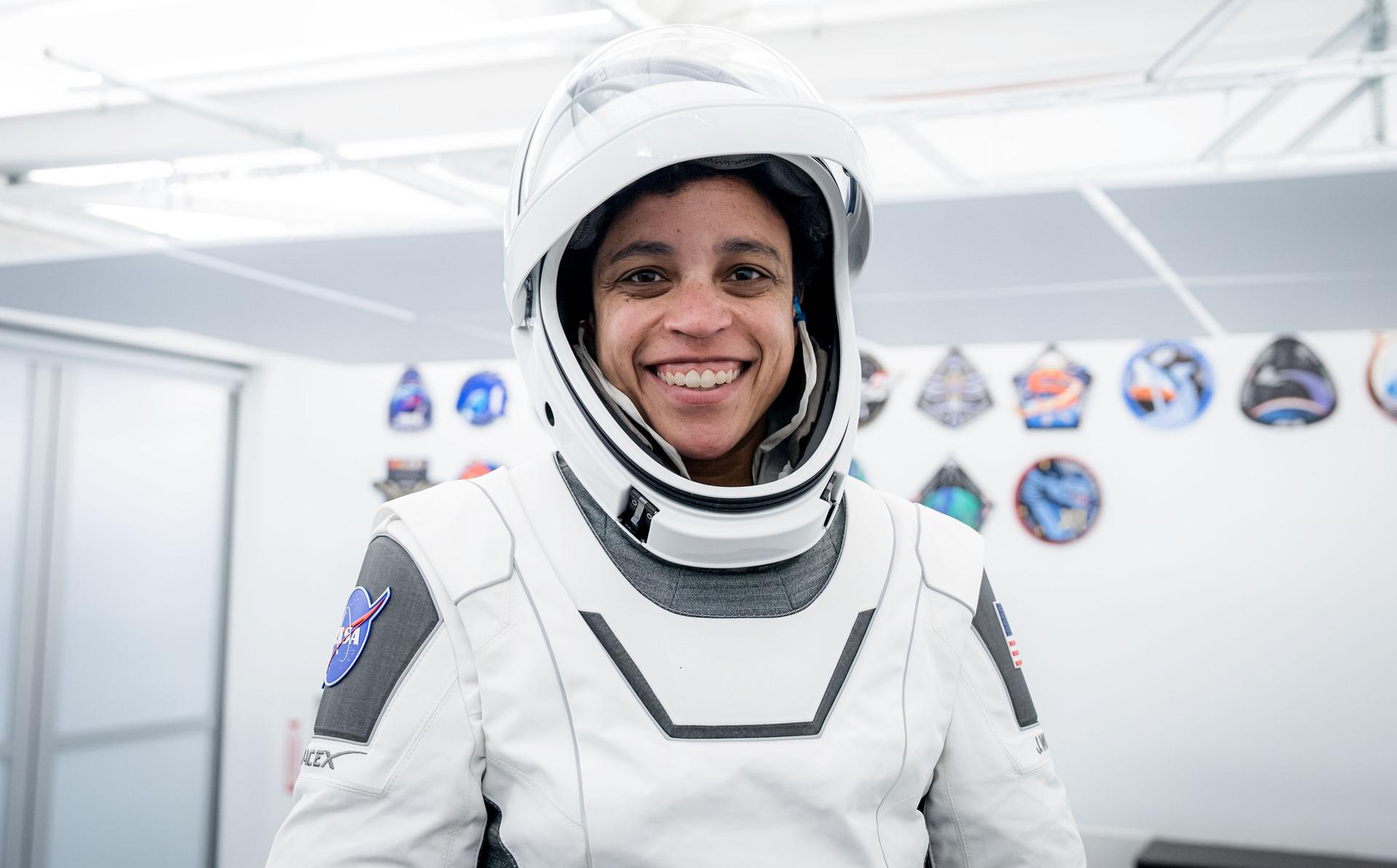
jsc2026e034336 (April 17, 2026) --- NASA astronaut and SpaceX Crew-13 Commander Jessica Watkins is pictured in her pressure suit during a training session at SpaceX headquarters in Hawthorne, California. Credit: SpaceX
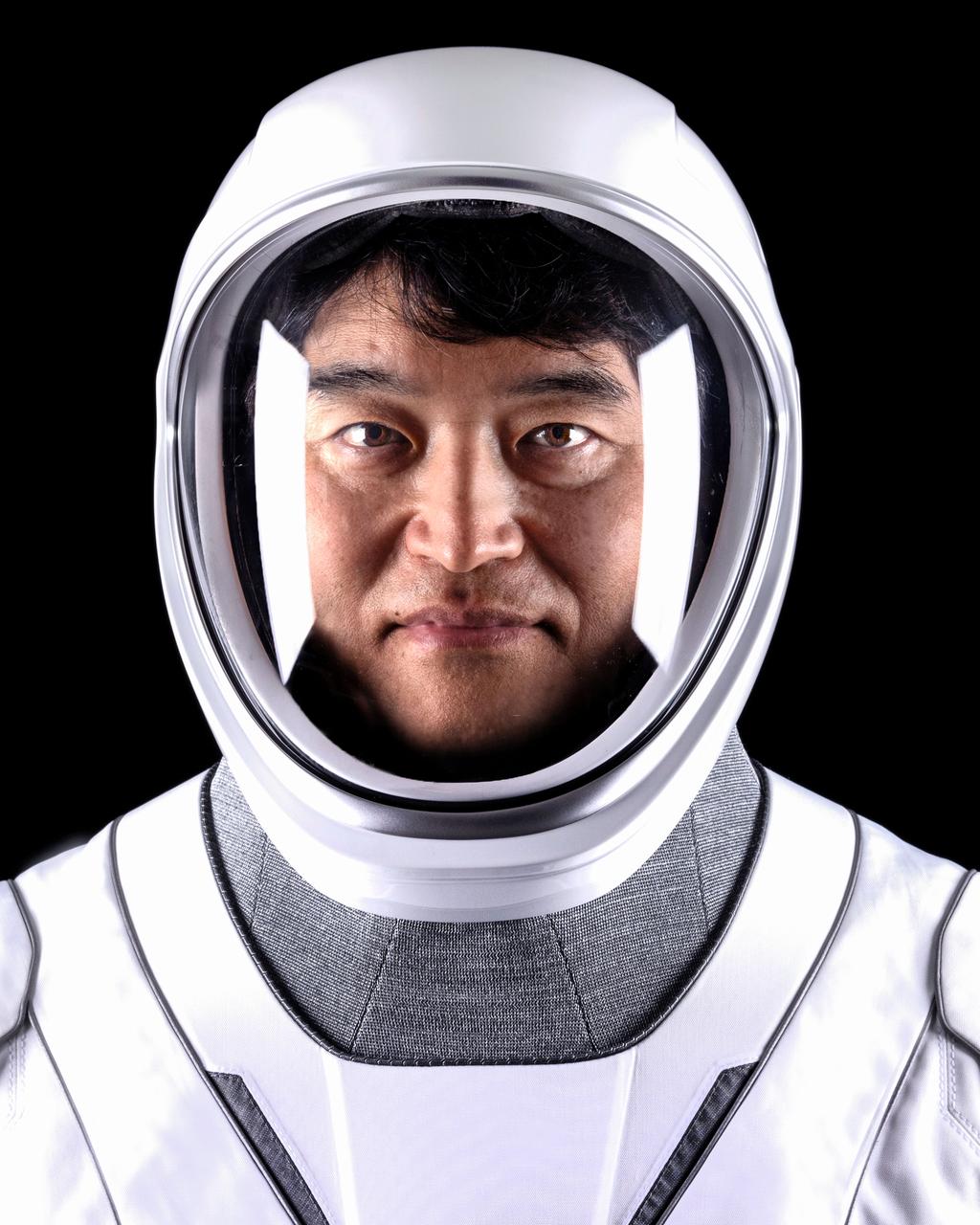
jsc2025e015862 (March 7, 2025) --- NASA’s SpaceX Crew-10 Mission Specialist Takuya Onishi poses for a portrait in his pressure suit at the SpaceX facility in Hawthorne, California. Credit: SpaceX
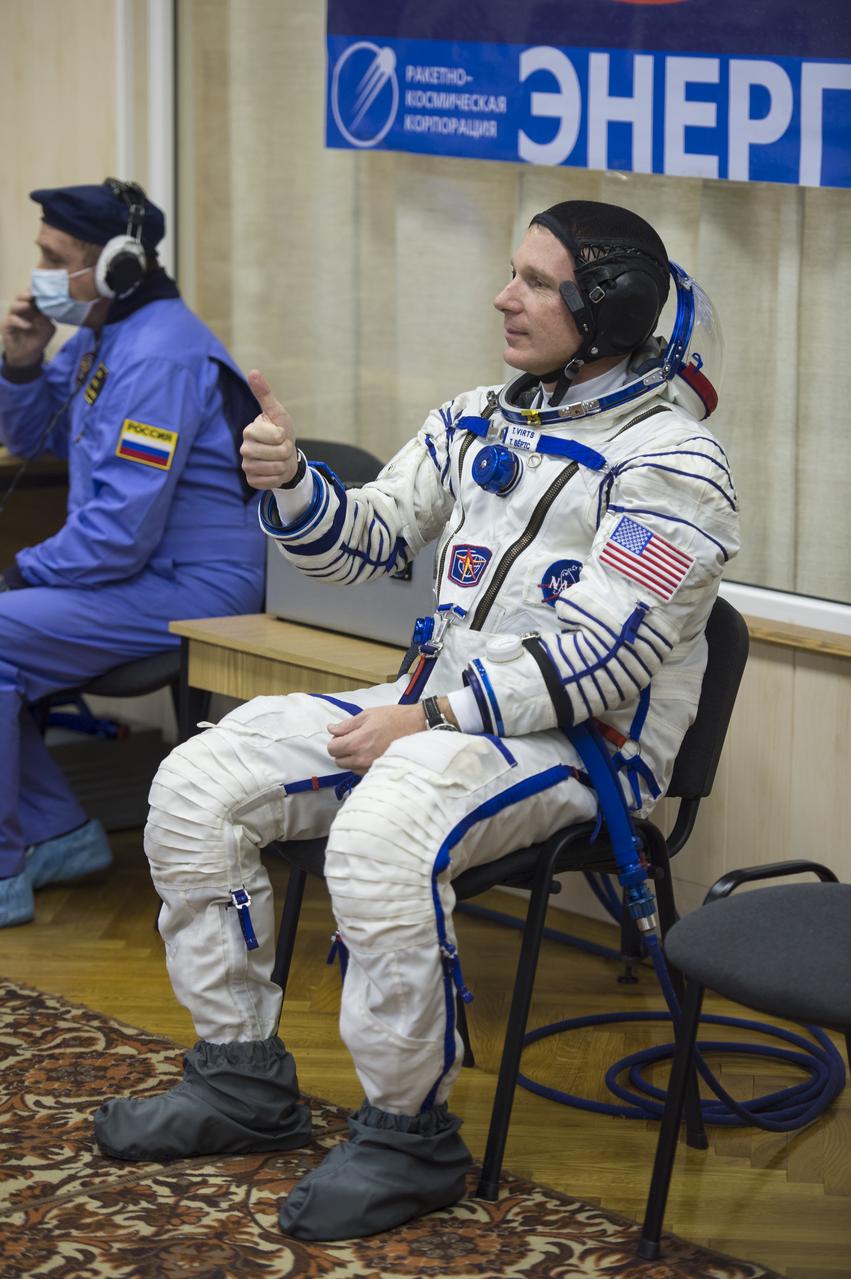
Expedition 42 Flight Engineer Terry Virts of NASA gives a thumbs up while waiting for a pressure check of his Sokol suit in Building 254 following his suit up for launch, Sunday, Nov. 23, 2014, at the Baikonur Cosmodrome in Kazakhstan. Launch of the Soyuz rocket is scheduled for the early hours of Nov. 24 and will carry Virts and fellow crewmates, Flight Engineer Samantha Cristoforetti of the European Space Agency (ESA) and Soyuz Commander Anton Shkaplerov of the Russian Federal Space Agency (Roscosmos) into orbit to begin their five and a half month mission on the International Space Station. Photo Credit: (NASA/Aubrey Gemignani)
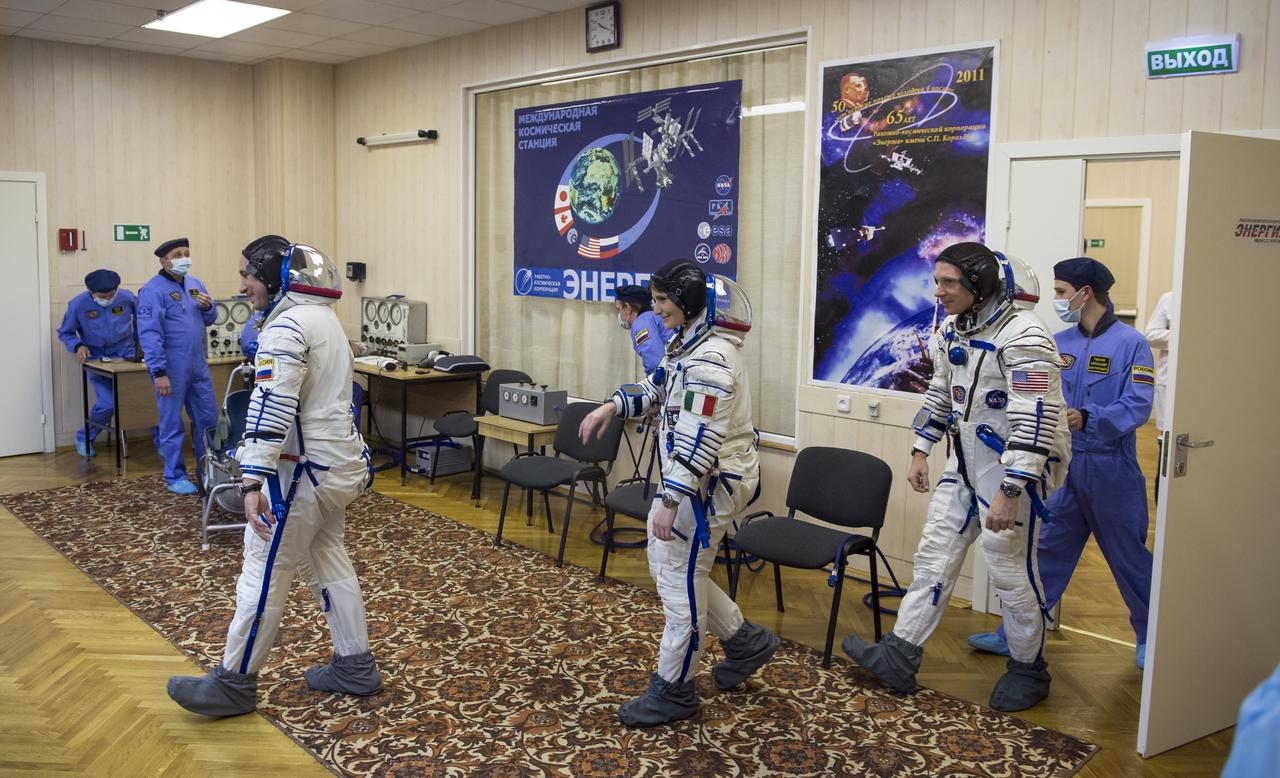
Expedition 42 crew members, Soyuz Commander Anton Shkaplerov of the Russian Federal Space Agency (Roscosmos), left, Flight Engineer Samantha Cristoforetti of the European Space Agency (ESA), center, and Flight Engineer Terry Virts of NASA, right, prepare for pressure checks of their Sokol suits in Building 254 following their suit up for launch, Sunday, Nov. 23, 2014, at the Baikonur Cosmodrome in Kazakhstan. Launch of the Soyuz rocket is scheduled for the early hours of Nov. 24 and will carry Virts, Shkaplerov, and Cristoforetti into orbit to begin their five and a half month mission on the International Space Station. Photo Credit: (NASA/Aubrey Gemignani)
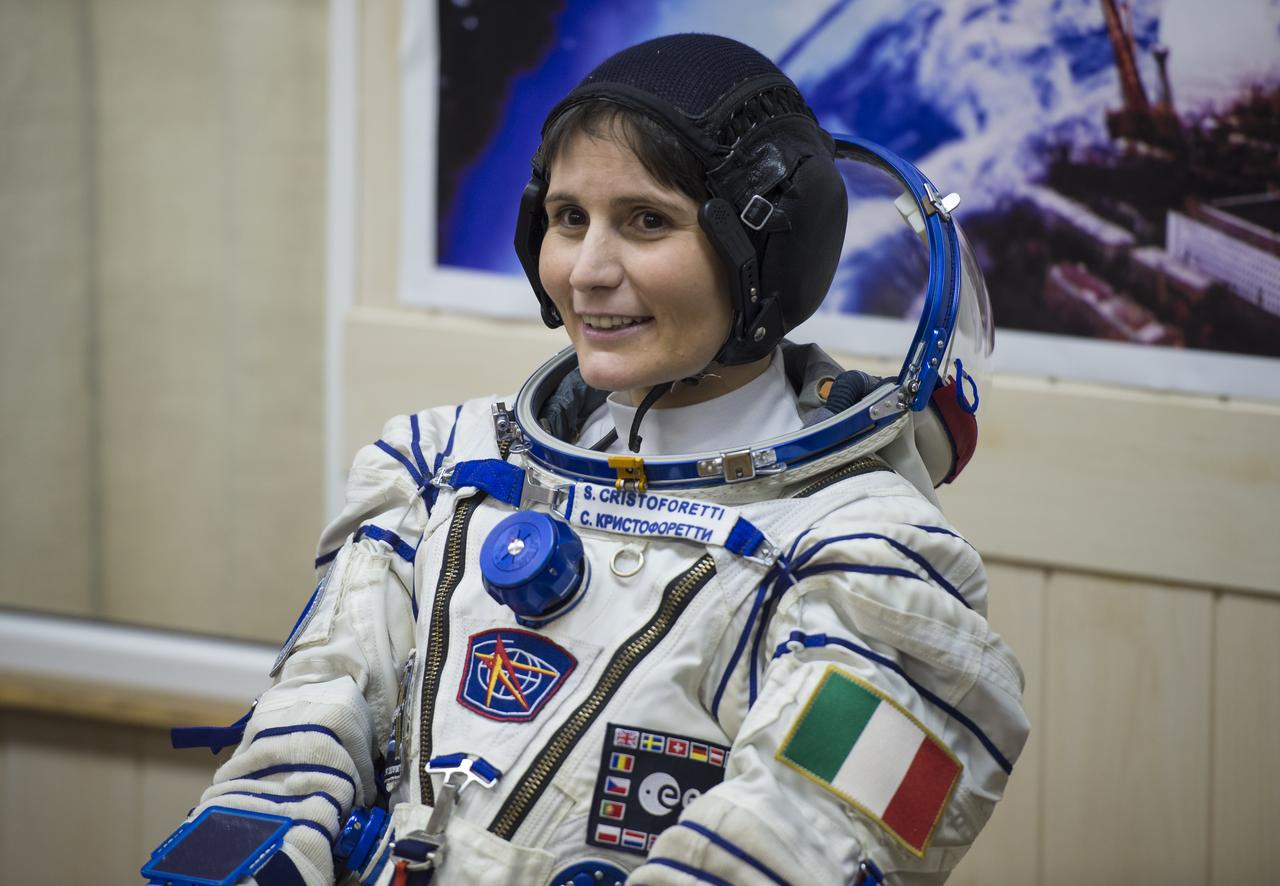
Expedition 42 Flight Engineer Samantha Cristoforetti of the European Space Agency (ESA) waits for a pressure check of her Sokol suit in Building 254 following her suit up for launch, Sunday, Nov. 23, 2014, at the Baikonur Cosmodrome in Kazakhstan. Launch of the Soyuz rocket is scheduled for the early hours of Nov. 24 and will carry Cristoforetti and fellow crewmates, Flight Engineer Terry Virts of NASA and Soyuz Commander Anton Shkaplerov of the Russian Federal Space Agency (Roscosmos) into orbit to begin their five and a half month mission on the International Space Station. Photo Credit: (NASA/Aubrey Gemignani)
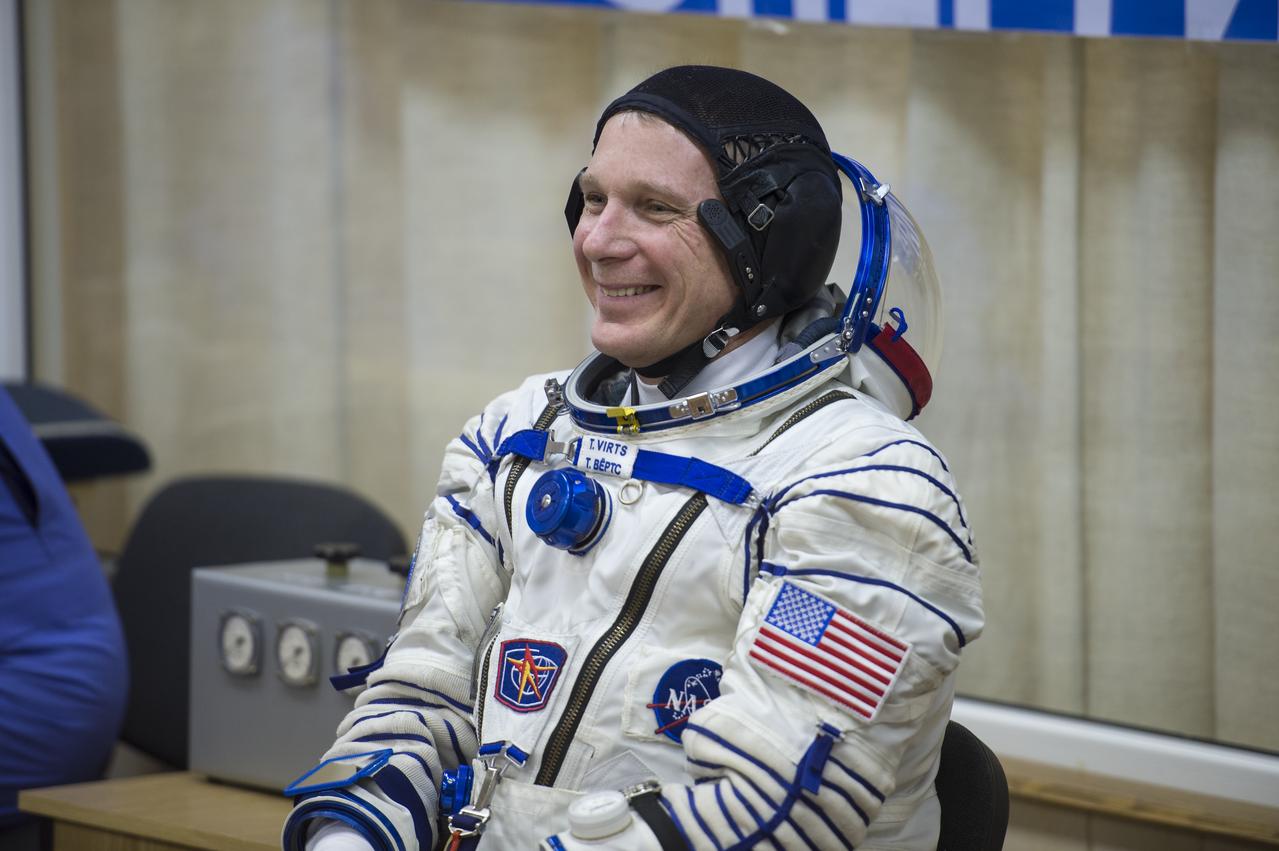
Expedition 42 Flight Engineer Terry Virts of NASA waits for a pressure check of his Sokol suit in Building 254 following his suit up for launch, Sunday, Nov. 23, 2014, at the Baikonur Cosmodrome in Kazakhstan. Launch of the Soyuz rocket is scheduled for the early hours of Nov. 24 and will carry Virts and fellow crewmates, Flight Engineer Samantha Cristoforetti of the European Space Agency (ESA) and Soyuz Commander Anton Shkaplerov of the Russian Federal Space Agency (Roscosmos) into orbit to begin their five and a half month mission on the International Space Station. Photo Credit: (NASA/Aubrey Gemignani)
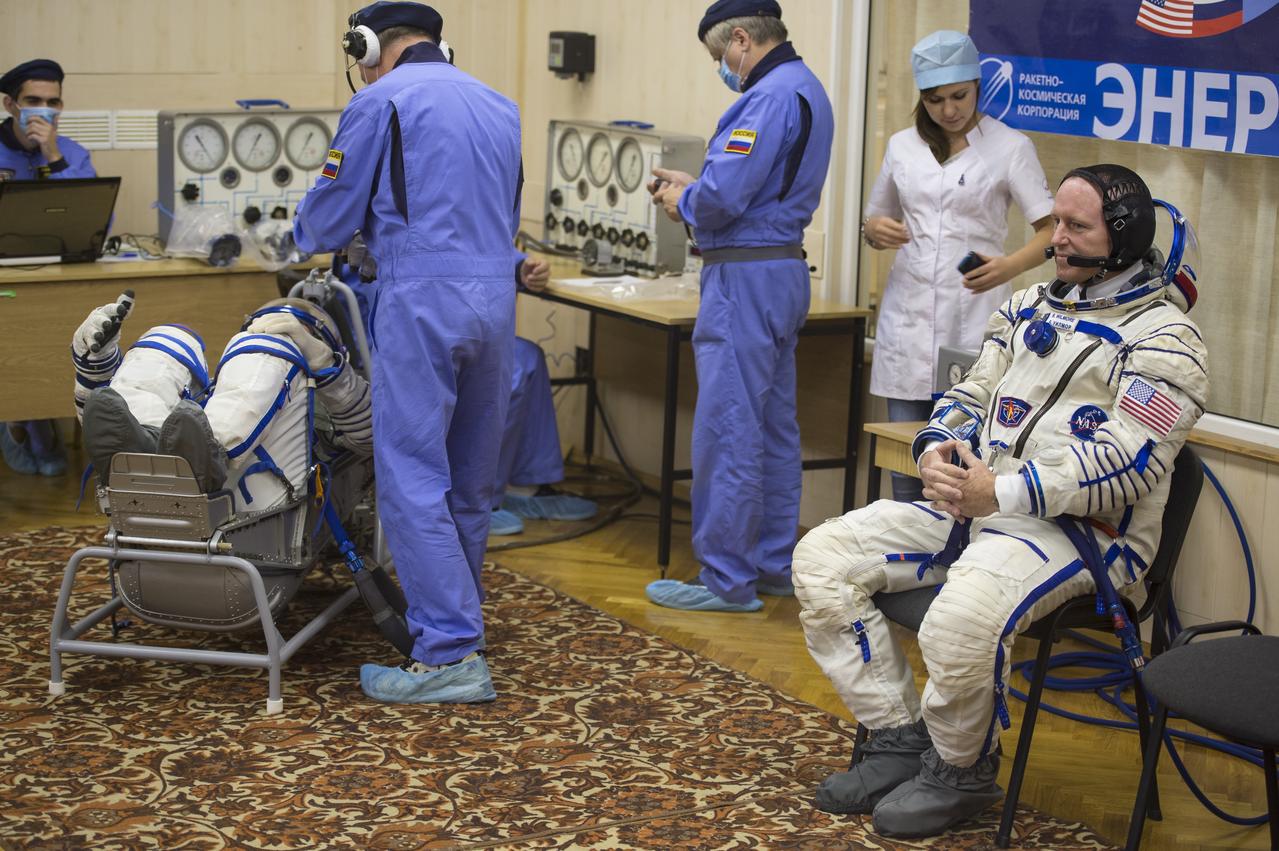
Expedition 41 Flight Engineer Barry Wilmore of NASA, right, waits to have his Russian Sokol suit pressure checked while Soyuz Commander Alexander Samokutyaev of the Russian Federal Space Agency (Roscosmos) has his suit checked on Thursday, Sept. 25, 2014, at the Baikonur Cosmodrome in Baikonur, Kazakhstan. Launch of the Soyuz rocket is scheduled for the early hours of Sept. 26 (Kazakhstan time) and will carry Samokutyaev, Wilmore, and Flight Engineer Elena Serova of Roscosmos into orbit to begin their five and a half month mission on the International Space Station. Photo Credit: (NASA/Aubrey Gemignani)
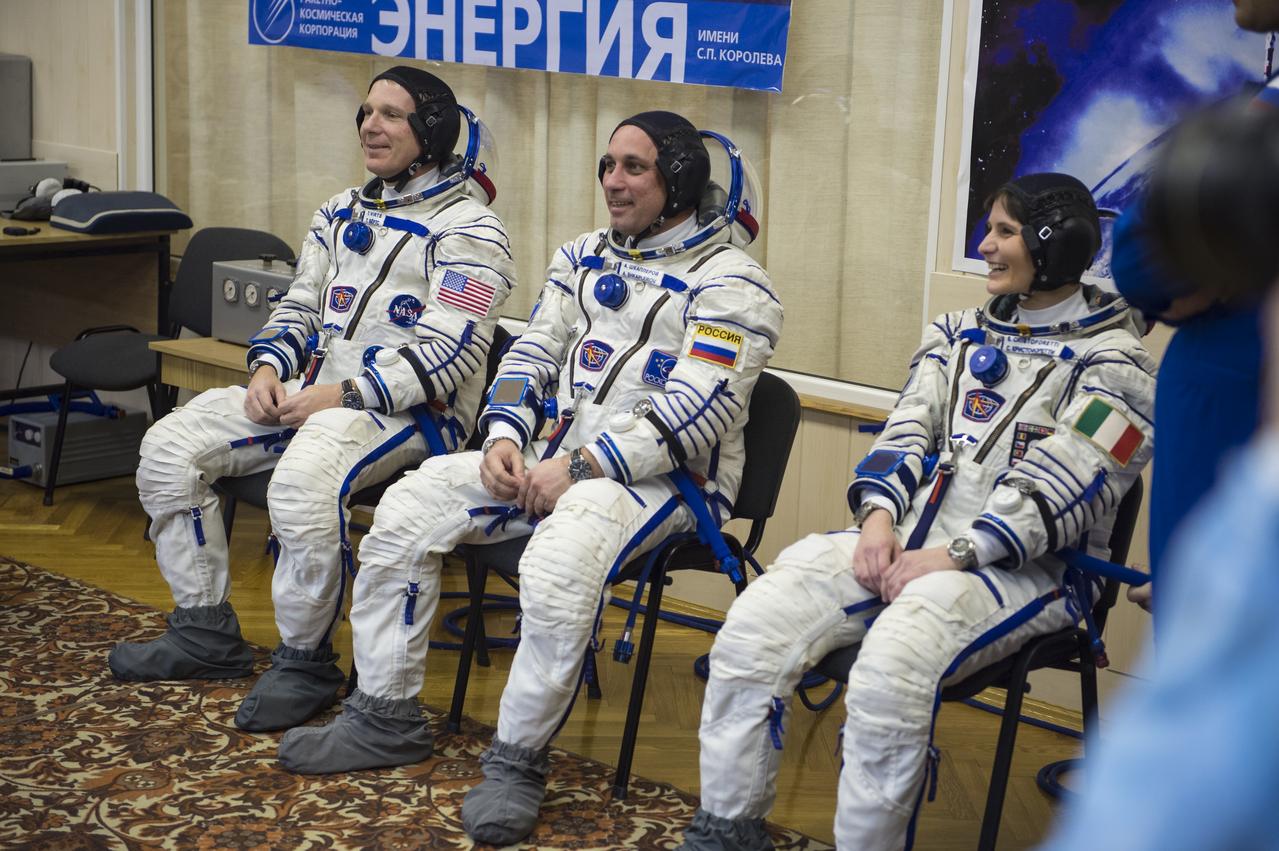
Expedition 42 crew members, Flight Engineer Terry Virts of NASA, left, Soyuz Commander Anton Shkaplerov of the Russian Federal Space Agency (Roscosmos), center, and Flight Engineer Samantha Cristoforetti of the European Space Agency (ESA), right, prepare for pressure checks of their Sokol suits in Building 254 following their suit up for launch, Sunday, Nov. 23, 2014, at the Baikonur Cosmodrome in Kazakhstan. Launch of the Soyuz rocket is scheduled for the early hours of Nov. 24 and will carry Virts, Shkaplerov, and Cristoforetti into orbit to begin their five and a half month mission on the International Space Station. Photo Credit: (NASA/Aubrey Gemignani)
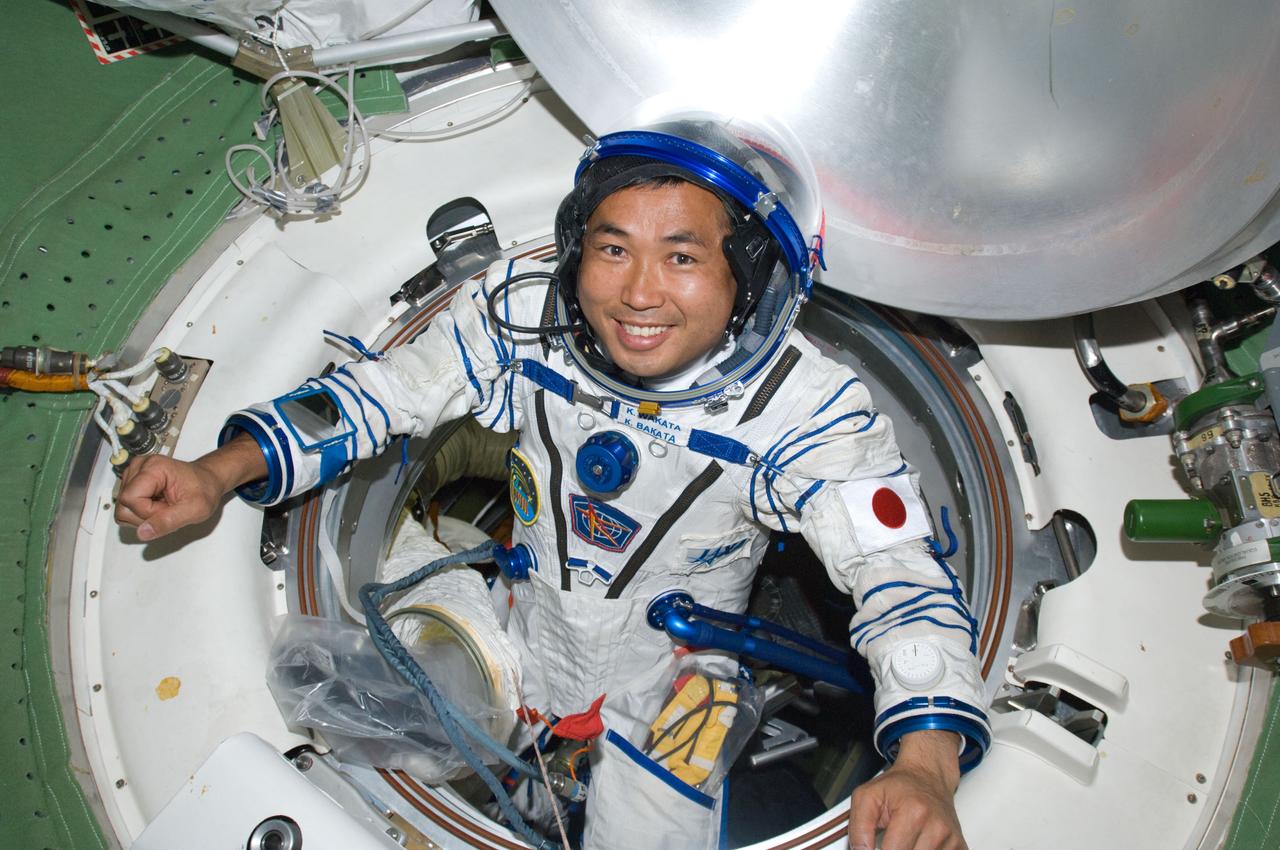
ISS018-E-040994 (18 March 2009) --- Japan Aerospace Exploration Agency (JAXA) astronaut Koichi Wakata, Expedition 18 flight engineer, attired in his Russian Sokol launch and entry suit, is pictured near a hatch on the International Space Station while Space Shuttle Discovery (STS-119) remains docked with the station.
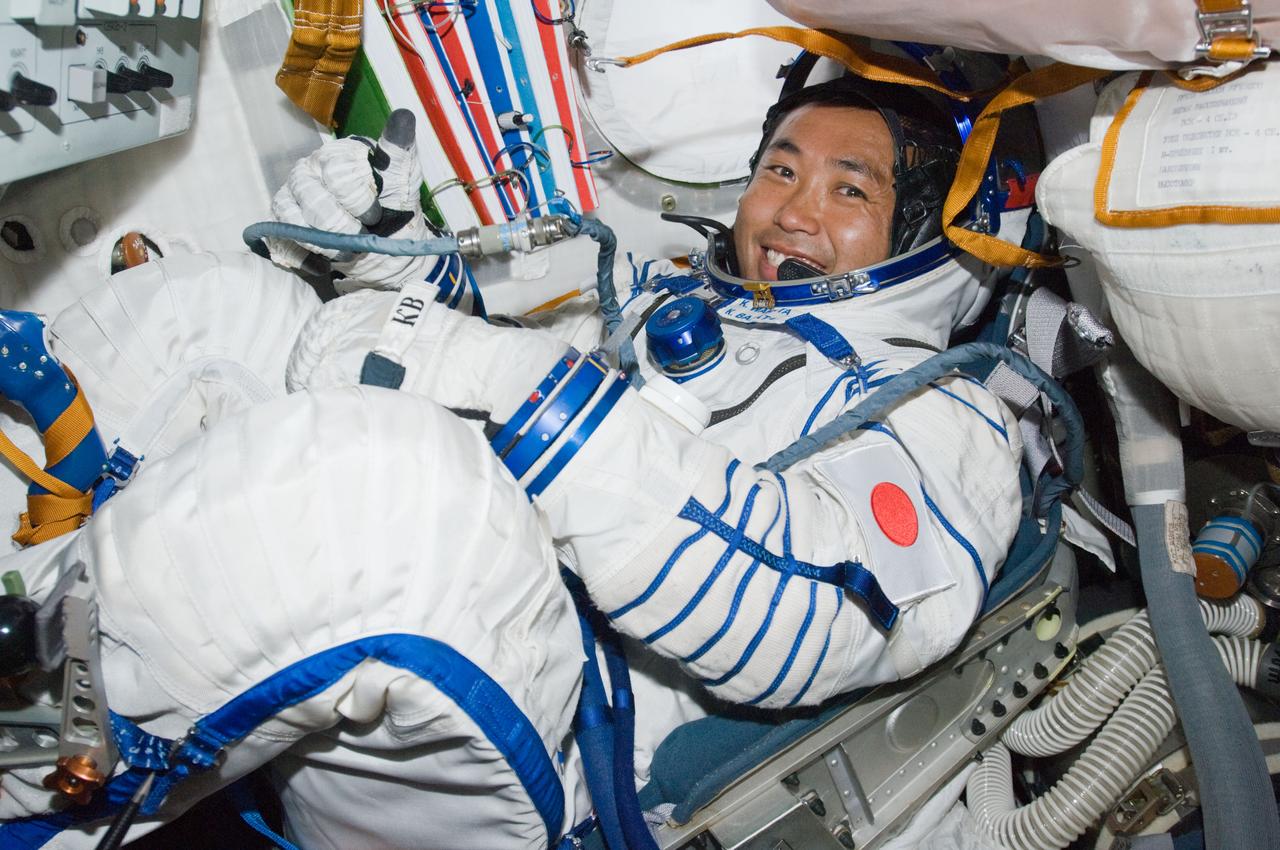
ISS018-E-040996 (18 March 2009) --- Japan Aerospace Exploration Agency (JAXA) astronaut Koichi Wakata, Expedition 18 flight engineer, attired in his Russian Sokol launch and entry suit, tries out his seat liner in the Soyuz TMA-13 spacecraft docked to the International Space Station while Space Shuttle Discovery (STS-119) remains docked with the station.
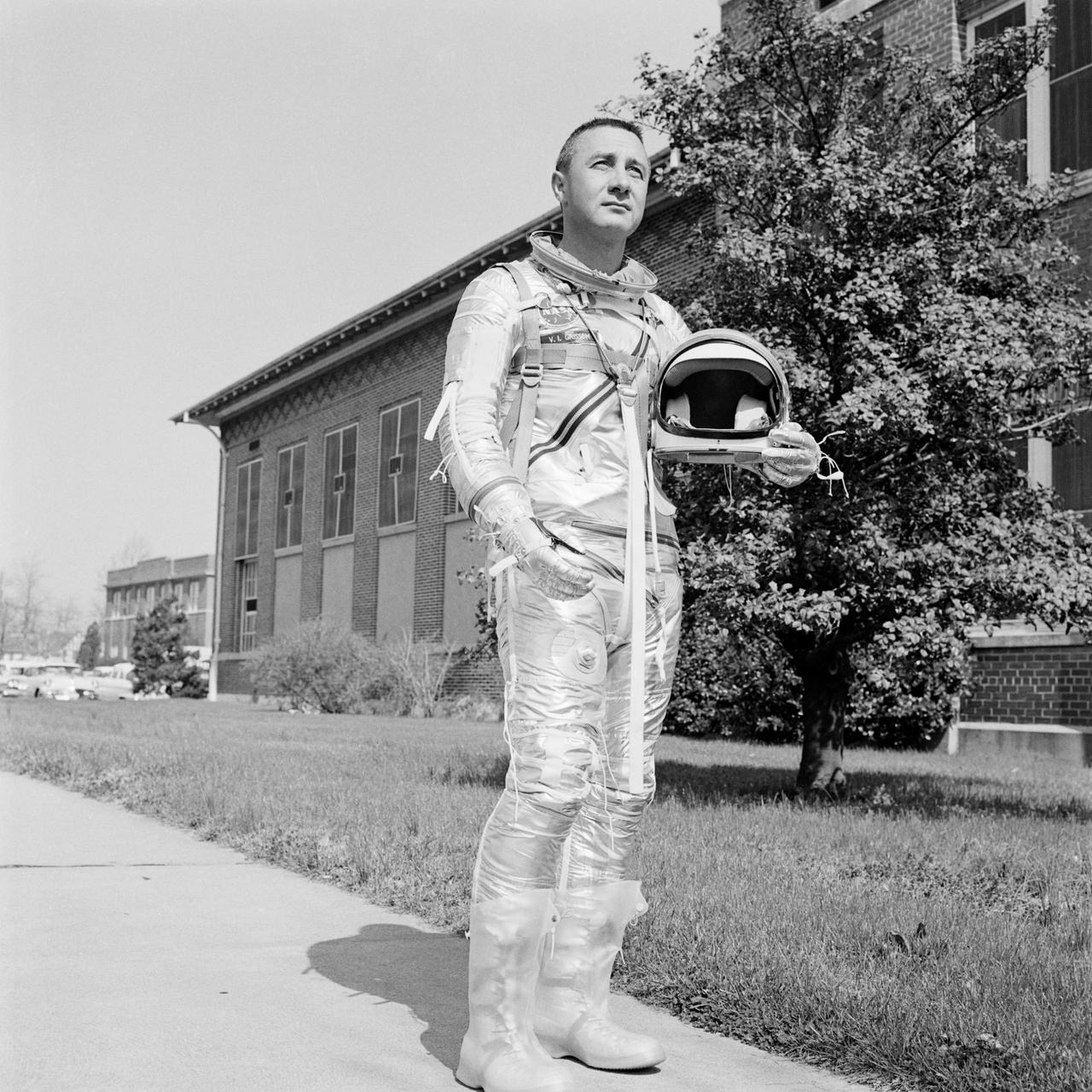
S61-01490 (4 April 1961) --- Astronaut Virgil Grissom photographed in the new Mercury spacesuit, holding his helmet. Photo credit: NASA
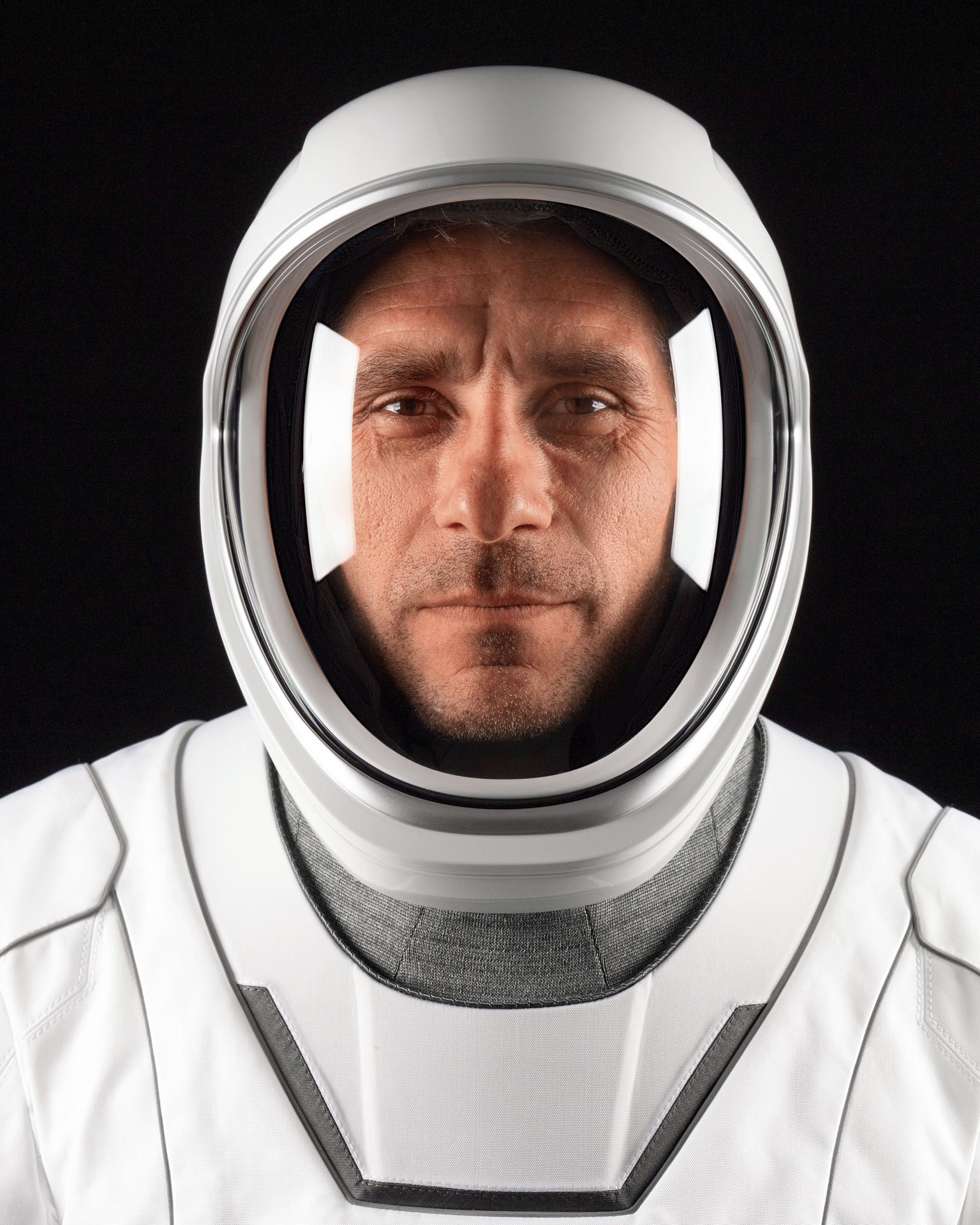
jsc2026e413251 (Aug. 25, 2026) --- NASA astronaut Luke Delaney, pilot of NASA’s SpaceX Crew-13 mission to the International Space Station, poses for a portrait in his pressure suit at SpaceX headquarters in Hawthorne, California. Credit: SpaceX
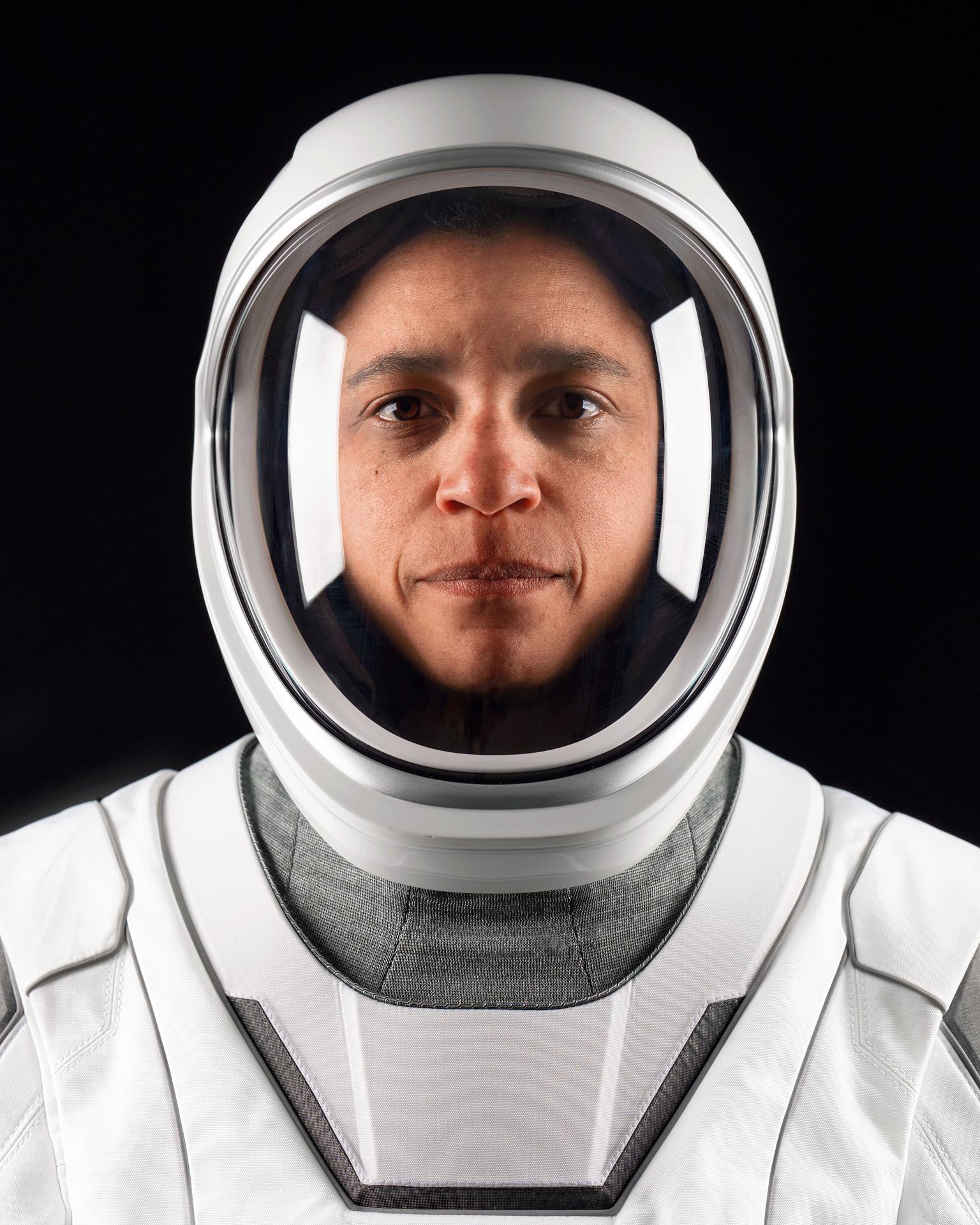
jsc2026e413249 (Aug. 25, 2026) --- NASA astronaut Jessica Watkins, commander of NASA’s SpaceX Crew-13 mission to the International Space Station, poses for a portrait in her pressure suit at SpaceX headquarters in Hawthorne, California. Credit: SpaceX
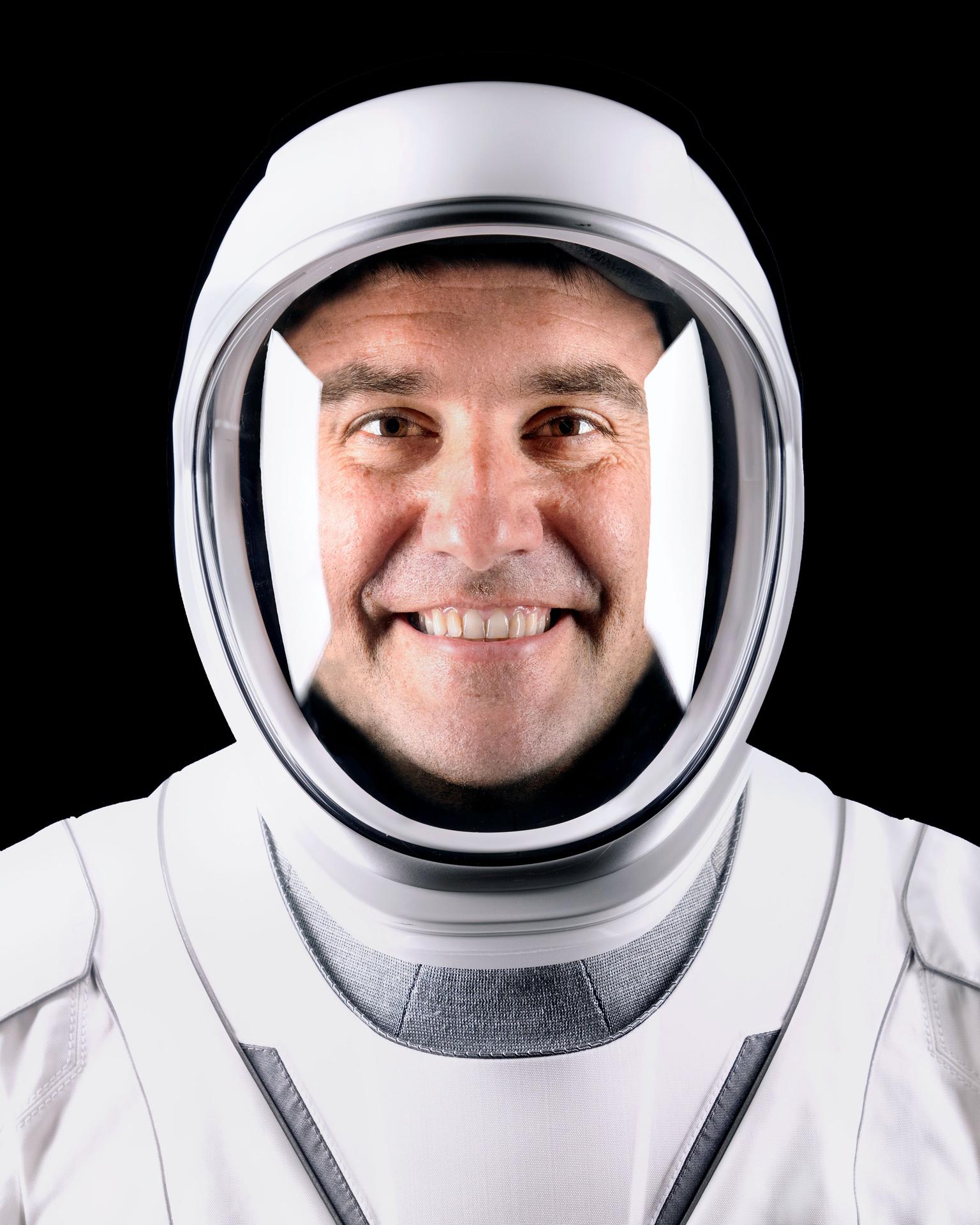
jsc2026e002318 (Jan. 14, 2026) --- NASA astronaut Jack Hathaway, pilot of NASA’s SpaceX Crew-12 mission to the International Space Station, poses for a portrait in his pressure suit at SpaceX headquarters in Hawthorne, California. Credit: SpaceX
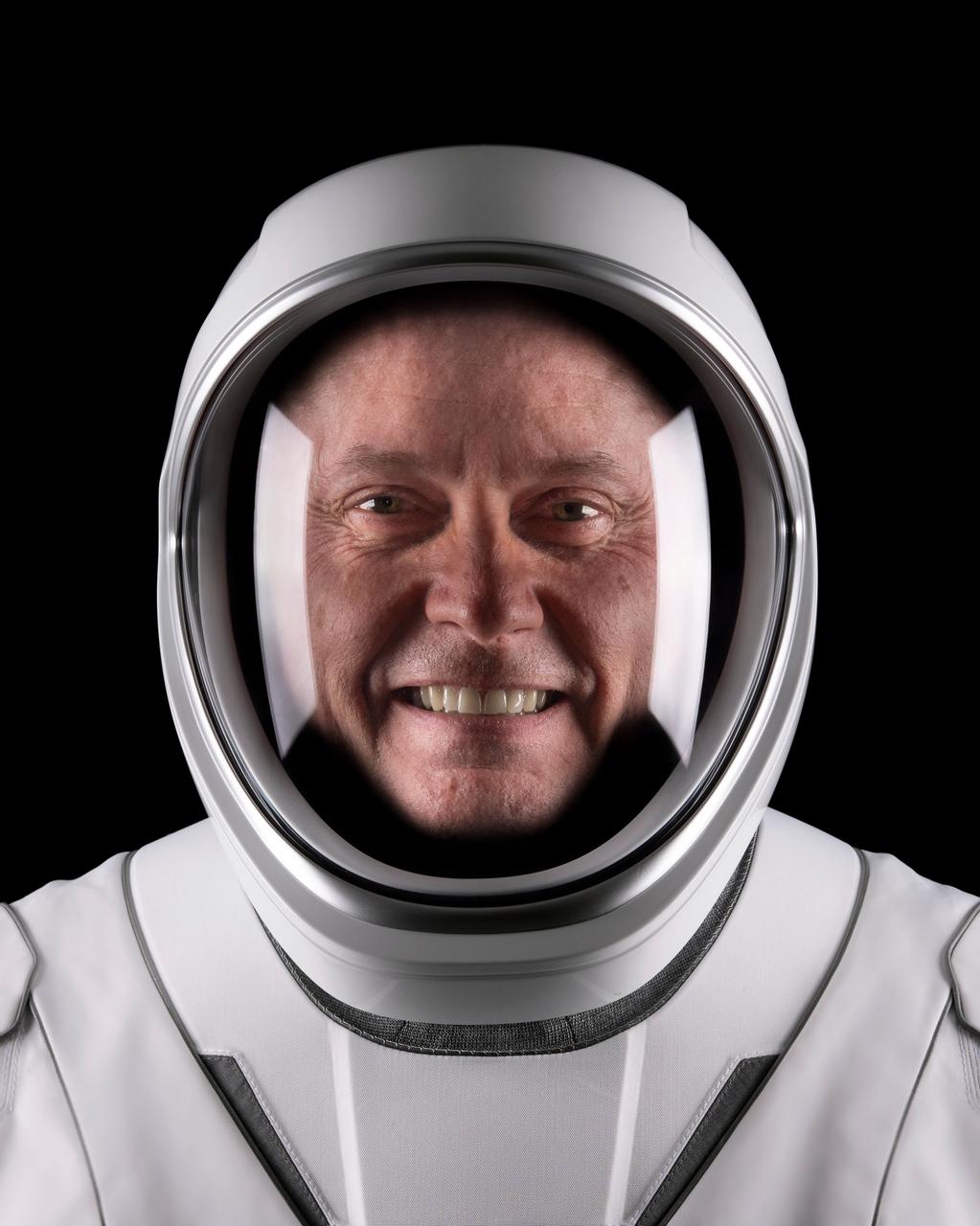
jsc2025e060301 (May 19, 2025) --- NASA astronaut Mike Fincke, pilot of NASA’s SpaceX Crew-11 mission to the International Space Station, poses for a portrait in his pressure suit at SpaceX headquarters in Hawthorne, California. Credit: SpaceX

jsc2025e060299 (May 19, 2025) --- NASA astronaut Zena Cardman, commander of NASA’s SpaceX Crew-11 mission to the International Space Station, poses for a portrait in her pressure suit at SpaceX headquarters in Hawthorne, California. Credit: SpaceX
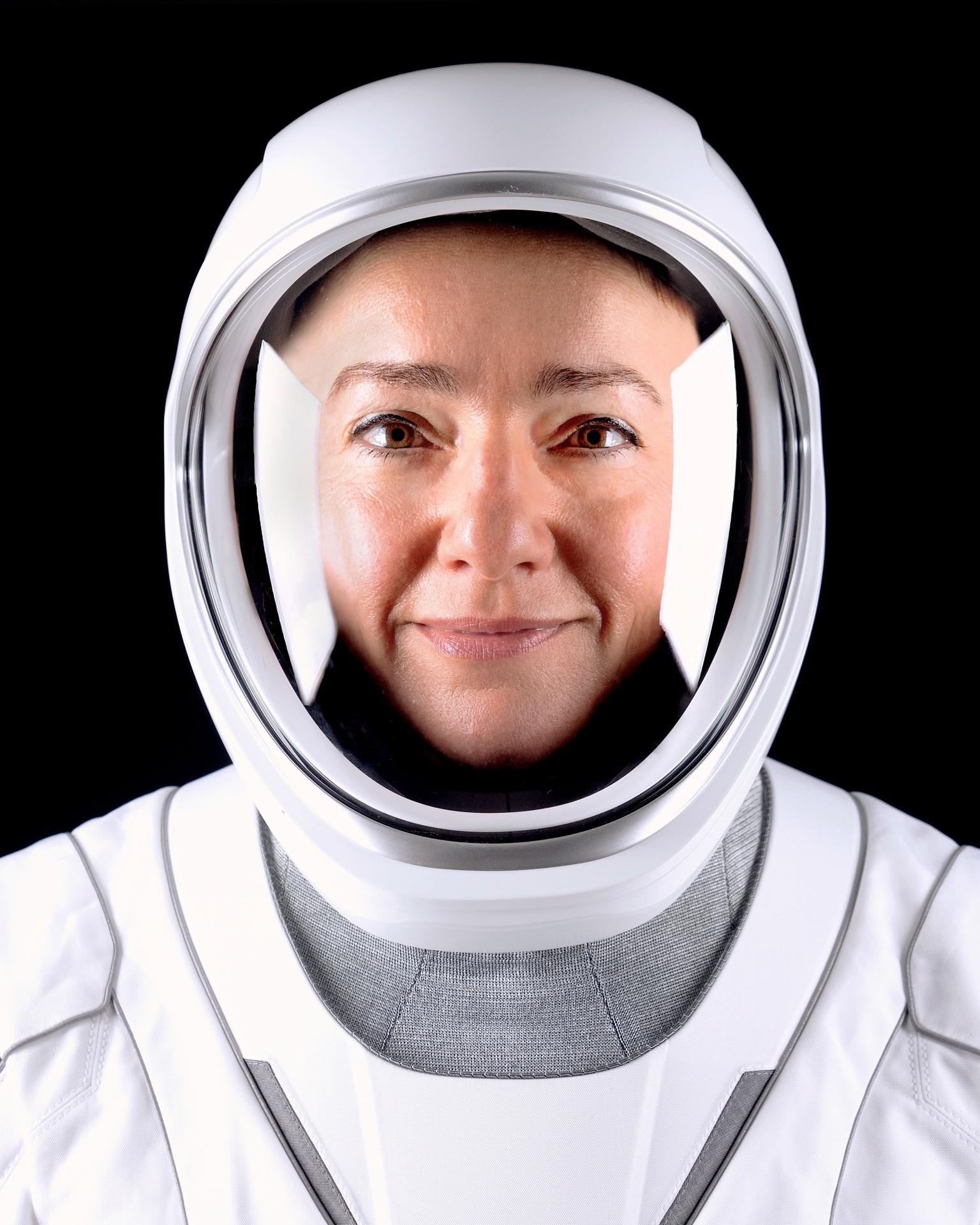
jsc2026e002317 (Jan. 14, 2026) --- NASA astronaut Jessica Meir, commander of NASA’s SpaceX Crew-12 mission to the International Space Station, poses for a portrait in her pressure suit at SpaceX headquarters in Hawthorne, California. Credit: SpaceX
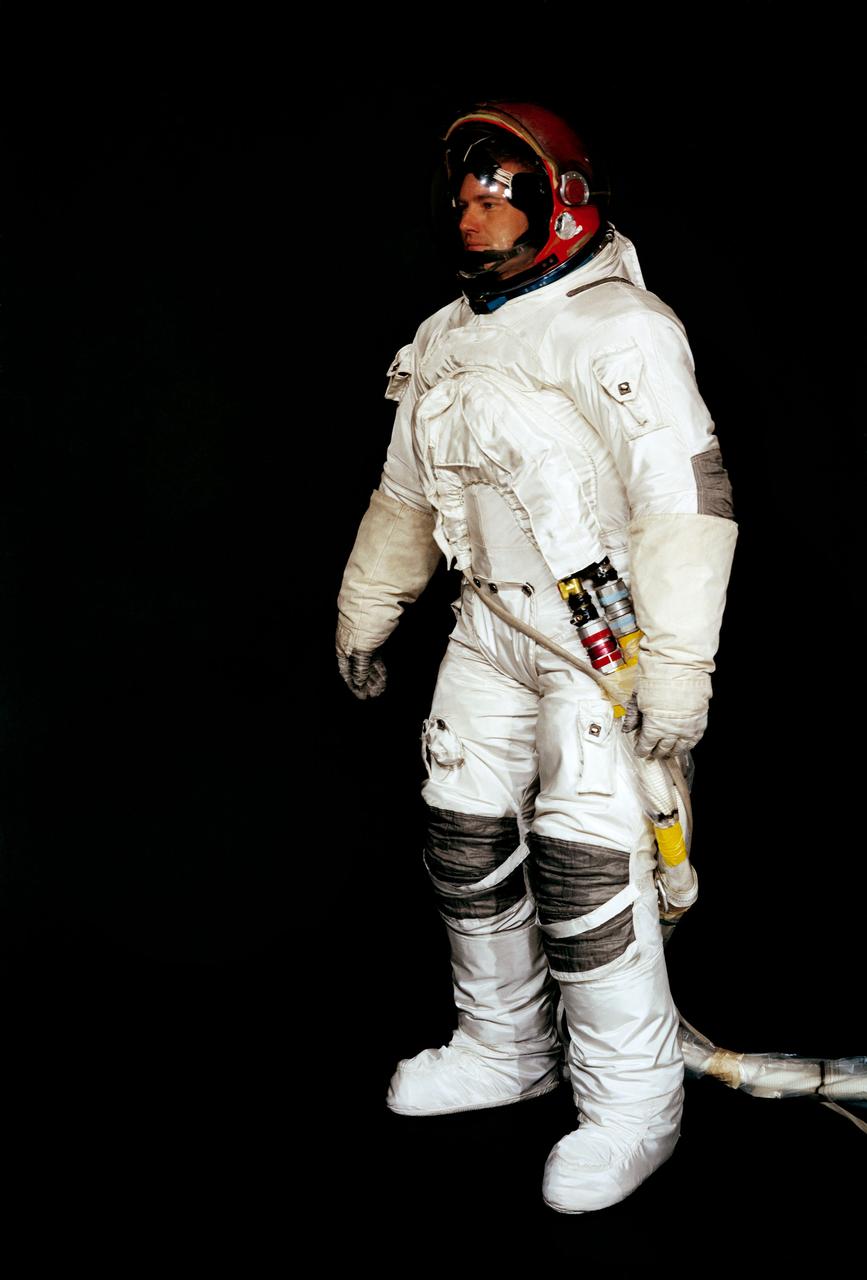
Astronaut John S. Bull wears the A6-L type Pressure Garment Assembly update to an A7-L configuration.
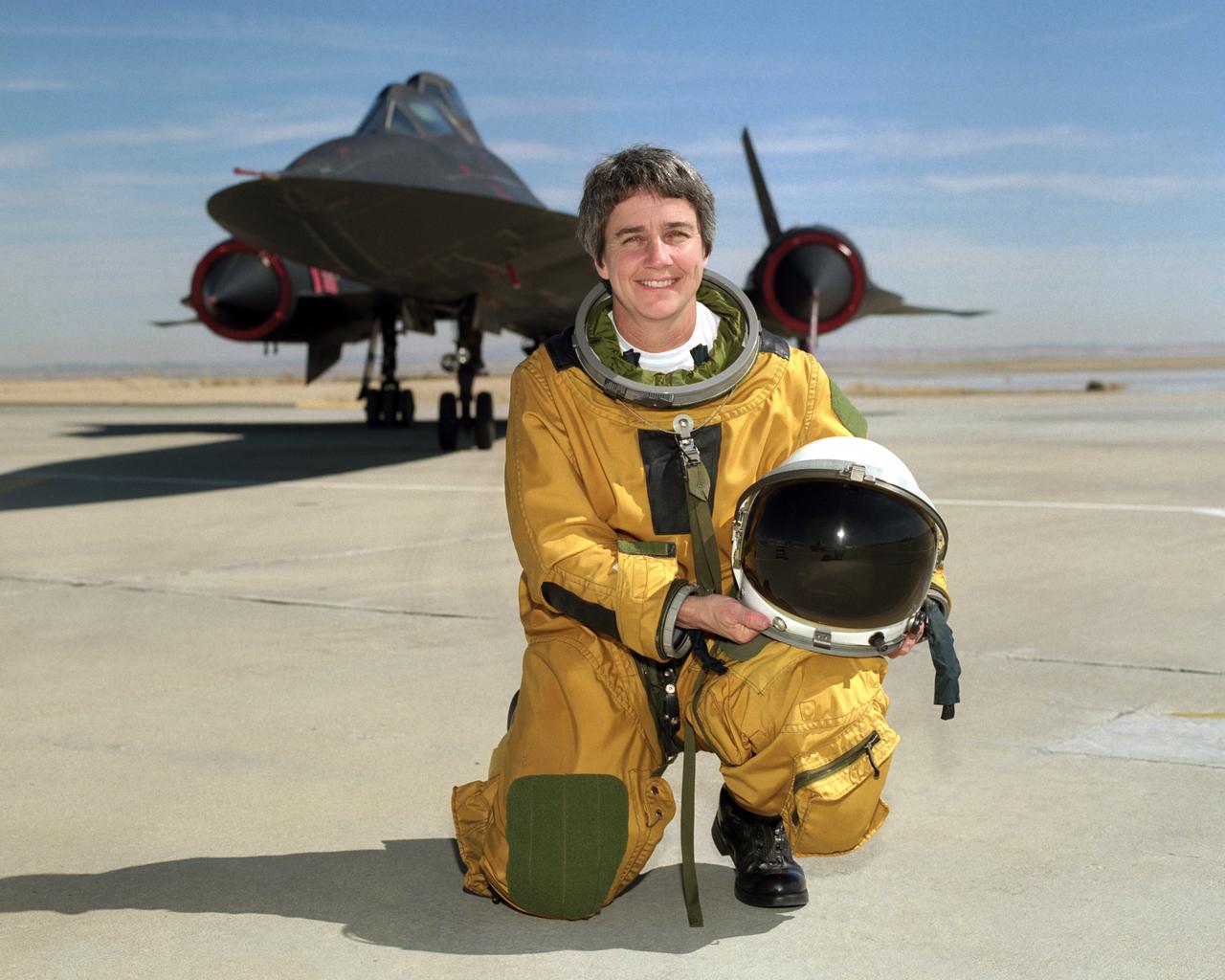
Marta Bohn-Meyer, Chief Engineer, NASA Dryden Flight Research Center
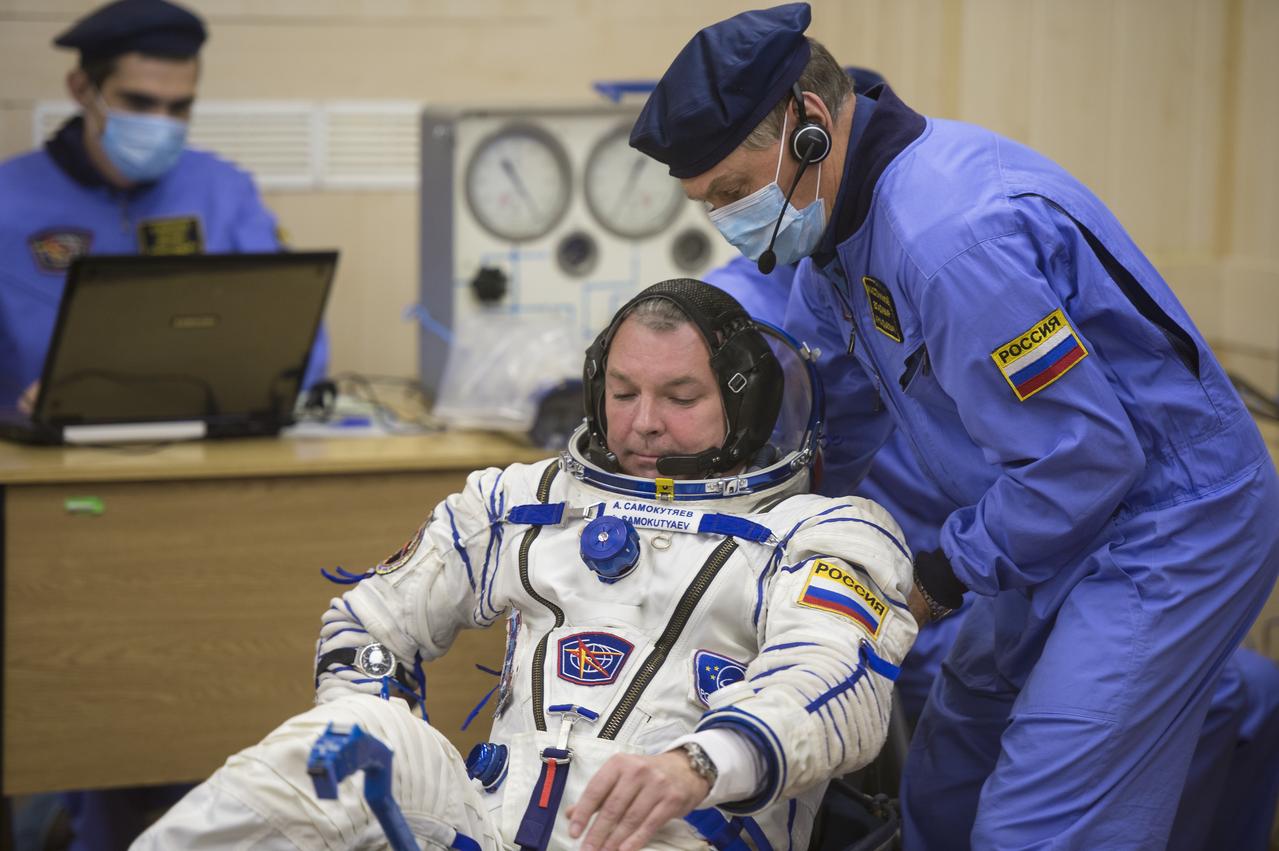
Expedition 41 Soyuz Commander Alexander Samokutyaev of the Russian Federal Space Agency (Roscosmos) has his Russian Sokol suit pressure checked in preparation for his launch aboard the Soyuz TMA-14M spacecraft on Thursday, Sept. 25, 2014, at the Baikonur Cosmodrome in Baikonur, Kazakhstan. Launch of the Soyuz rocket is scheduled for the early hours of Sept. 26 (Kazakhstan time) and will carry Samokutyaev and fellow crewmates, Flight Engineer Elena Serova of Roscosmos and Flight Engineer Barry Wilmore of NASA, into orbit to begin their five and a half month mission on the International Space Station. Photo Credit: (NASA/Aubrey Gemignani)
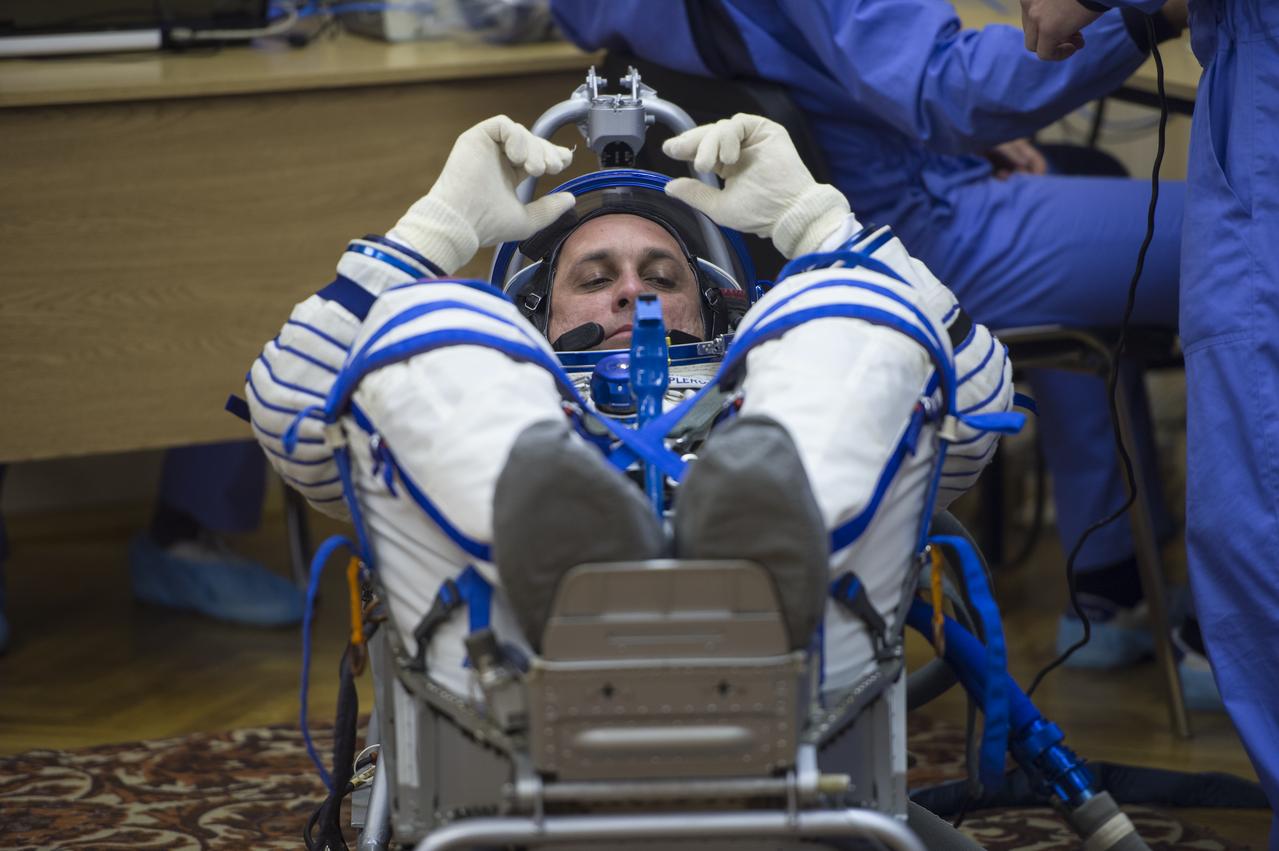
Expedition 42 Soyuz Commander Anton Shkaplerov of the Russian Federal Space Agency (Roscosmos) has his Russian Sokol suit pressure checked in preparation for his launch aboard the Soyuz TMA-15M spacecraft on Sunday, Nov. 23, 2014, at Building 254 in the Baikonur Cosmodrome in Baikonur, Kazakhstan. Launch of the Soyuz rocket is scheduled for the early hours of Nov. 24 and will carry Shkaplerov and fellow crewmates, Flight Engineers Terry Virts of NASA and Samantha Cristoforetti of the European Space Agency (ESA) into orbit to begin their five and a half month mission on the International Space Station. Photo Credit: (NASA/Aubrey Gemignani)
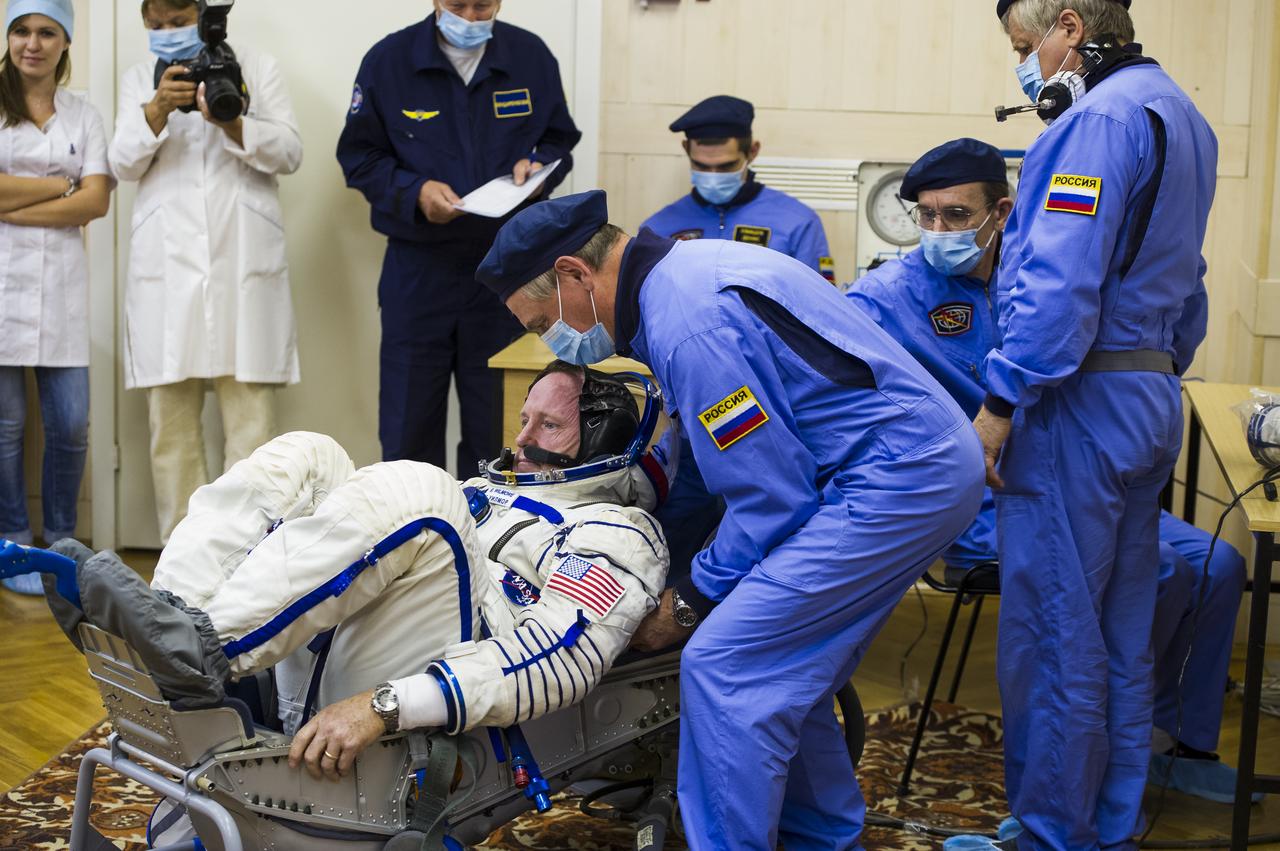
Expedition 41 Flight Engineer Barry Wilmore of NASA has his Russian Sokol suit pressure checked in preparation for his launch aboard the Soyuz TMA-14M spacecraft on Thursday, Sept. 25, 2014, at the Baikonur Cosmodrome in Baikonur, Kazakhstan. Launch of the Soyuz rocket is scheduled for the early hours of Sept. 26 (Kazakhstan time) and will carry Wilmore and fellow crewmates, Flight Engineer Elena Serova and Soyuz Commander Alexander Samokutyaev of the Russian Federal Space Agency (Roscosmos), into orbit to begin their five and a half month mission on the International Space Station. Photo Credit: (NASA/GCTC/Andrey Shelepin)
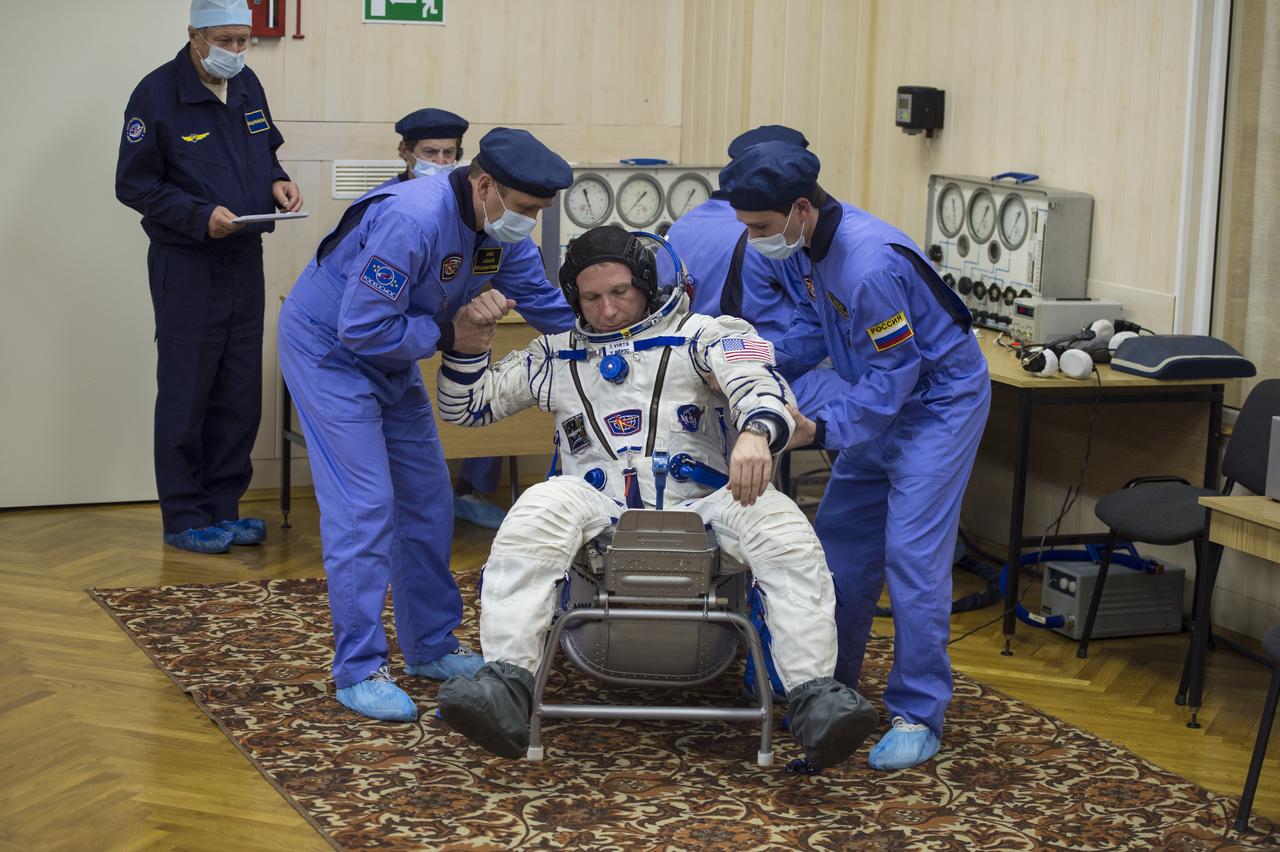
Expedition 42 Flight Engineer Terry Virts has his Russian Sokol suit pressure checked in preparation for his launch aboard the Soyuz TMA-15M spacecraft on Sunday, Nov. 23, 2014, at the Baikonur Cosmodrome in Baikonur, Kazakhstan. Launch of the Soyuz rocket is scheduled for the early hours of Nov. 24 and will carry Virts and fellow crewmates, Flight Engineer Samantha Cristoforetti of the European Space Agency (ESA) and Soyuz Commander Anton Shkaplerov of the Russian Federal Space Agency (Roscosmos) into orbit to begin their five and a half month mission on the International Space Station. Photo Credit: (NASA/Aubrey Gemignani)
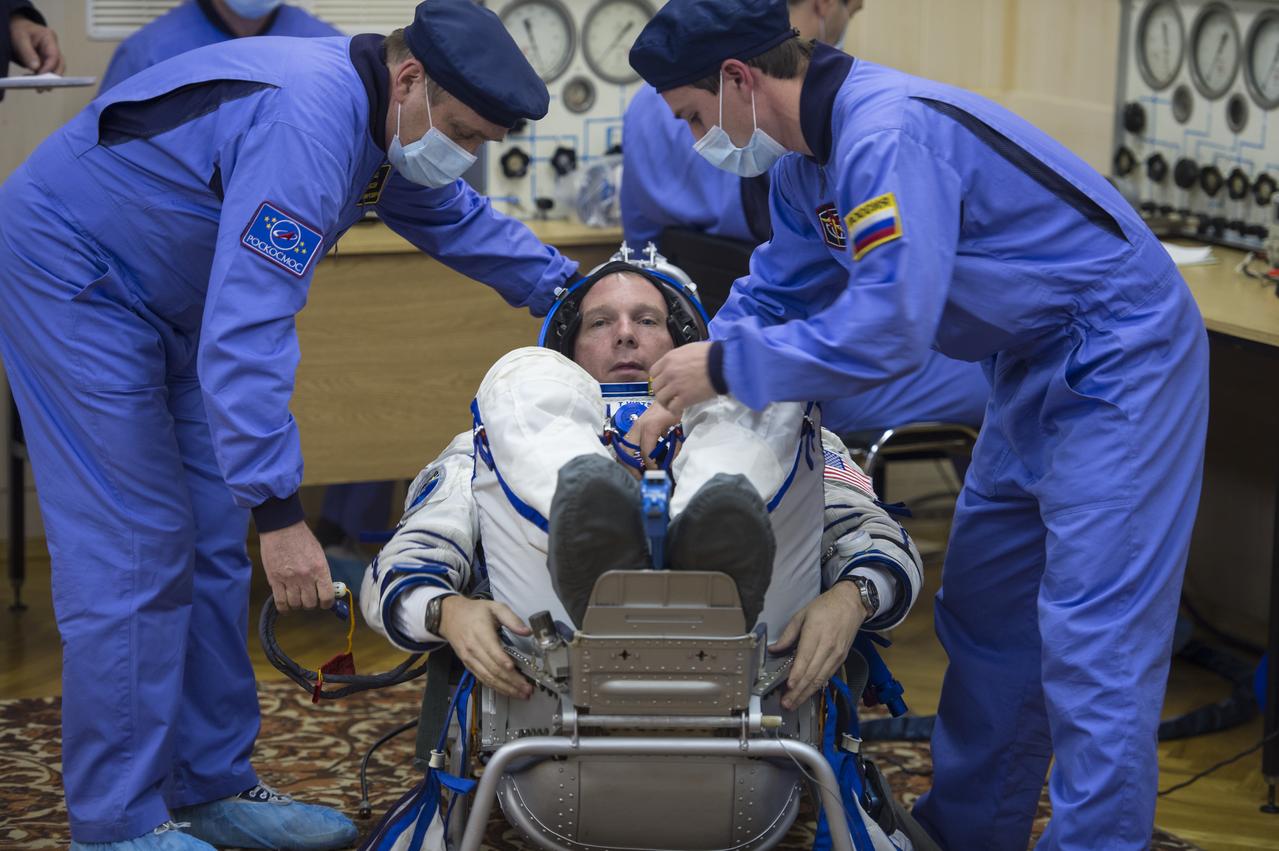
Expedition 42 Flight Engineer Terry Virts has his Russian Sokol suit pressure checked in preparation for his launch aboard the Soyuz TMA-15M spacecraft on Sunday, Nov. 23, 2014, at the Baikonur Cosmodrome in Baikonur, Kazakhstan. Launch of the Soyuz rocket is scheduled for the early hours of Nov. 24 and will carry Virts and fellow crewmates, Flight Engineer Samantha Cristoforetti of the European Space Agency (ESA) and Soyuz Commander Anton Shkaplerov of the Russian Federal Space Agency (Roscosmos) into orbit to begin their five and a half month mission on the International Space Station. Photo Credit: (NASA/Aubrey Gemignani)