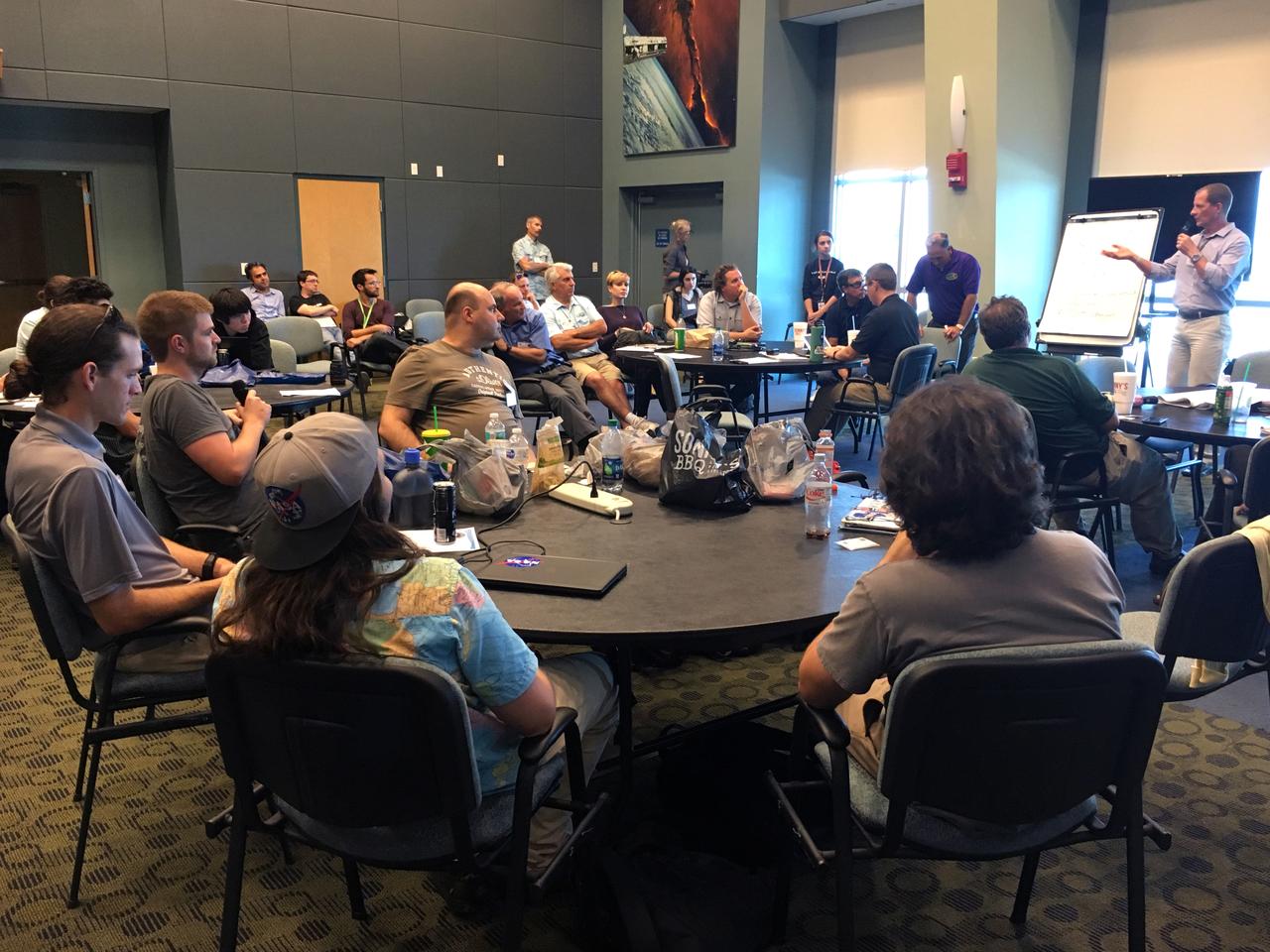
Scientists in the Exploration Research and Technology Directorate brainstorm innovative approaches to food production with industry representatives at the Space Station Processing Facility at NASA's Kennedy Space Center in Florida.
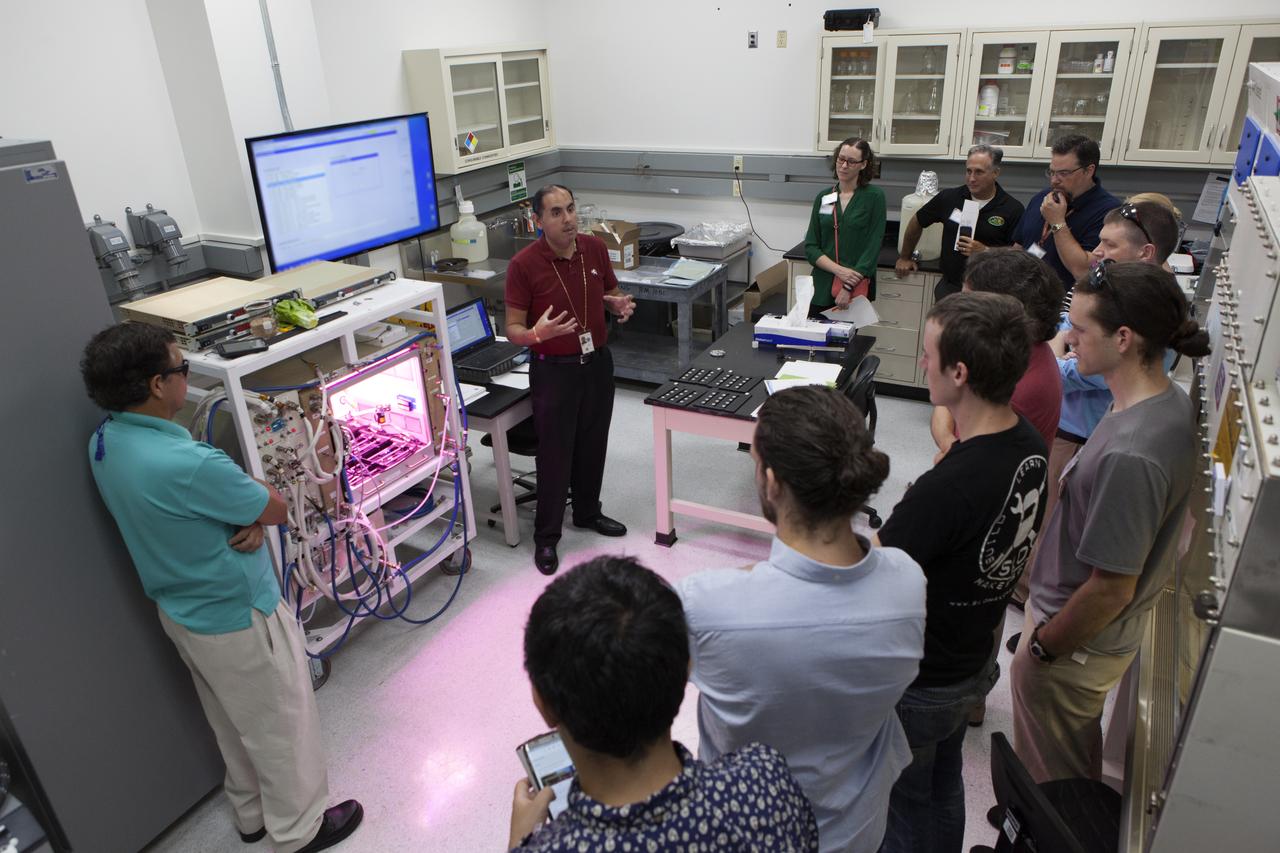
Bryan Onate, Advanced Plant Habitat project manager, with the Exploration Research and Technology Directorate, brainstorms innovative approaches to food production with industry representatives inside a laboratory at the Space Station Processing Facility at NASA's Kennedy Space Center in Florida.
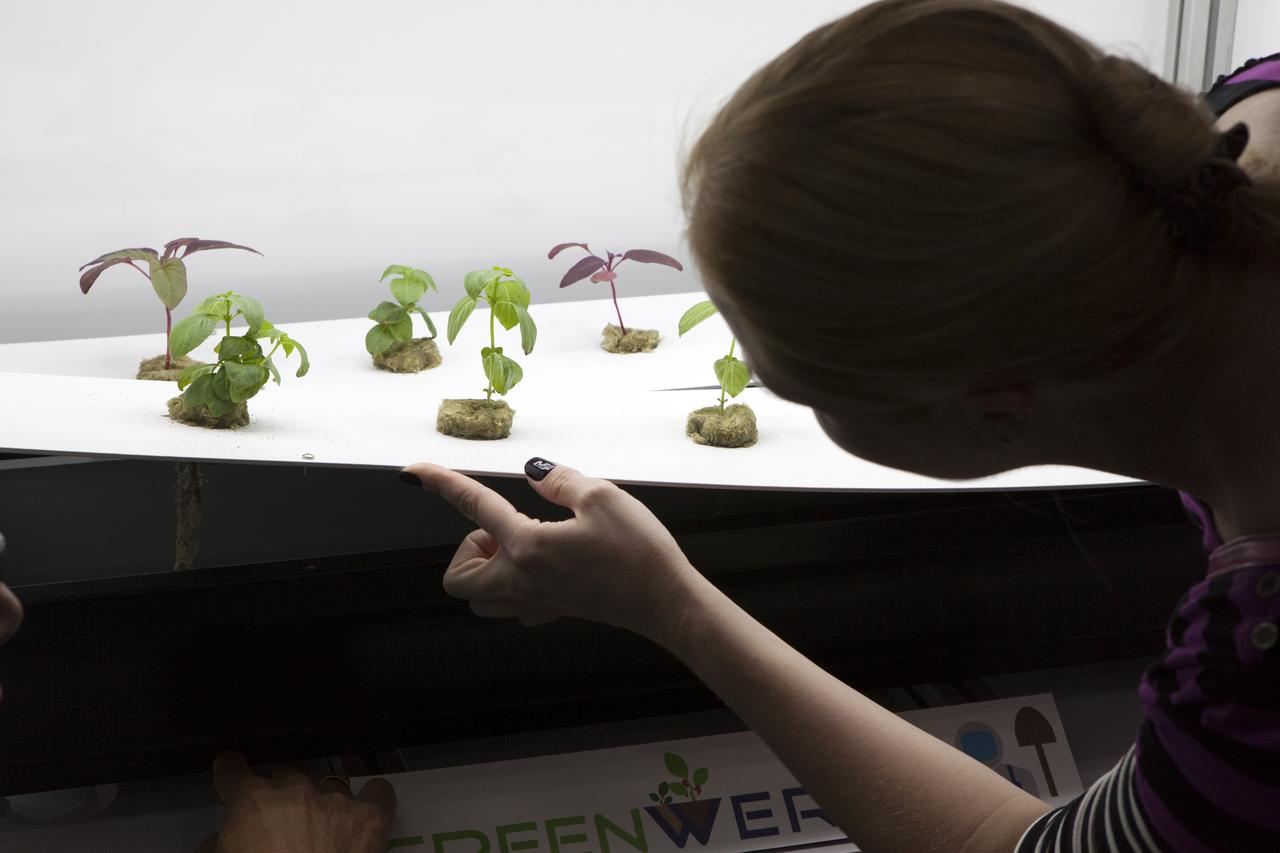
During a brainstorming session on innovative approaches to food production, an industry participant looks at plants growing inside a laboratory in the Space Station Processing Facility at NASA's Kennedy Space Center in Florida. The workshop was hosted by the Exploration Research and Technology Directorate.
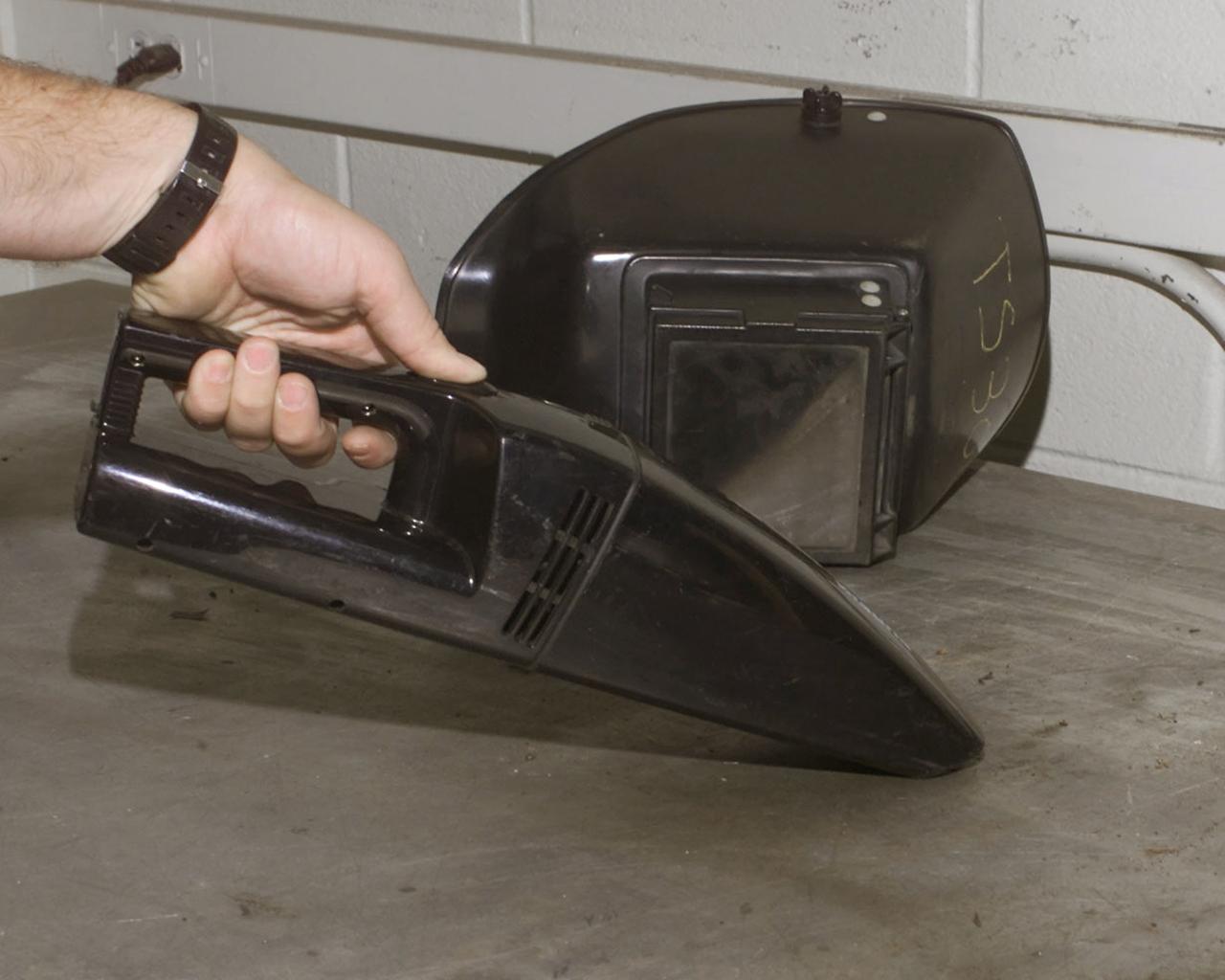
Apollo-era technology spurred the development of cordless products that we take for granted everyday. In the 1960s, NASA asked Black Decker to develop a special drill that would be powerful enough to cut through hard layers of the lunar surface and be lightweight, compact, and operate under its own power source, allowing Apollo astronauts to collect lunar samples further away from the Lunar Experiment Module. In response, Black Decker developed a computer program that analyzed and optimized drill motor operations. From their analysis, engineers were able to design a motor that was powerful yet required minimal battery power to operate. Since those first days of cordless products, Black Decker has continued to refine this technology and they now sell their rechargeable products worldwide (i.e. the Dustbuster, cordless tools for home and industrial use, and medical tools.)
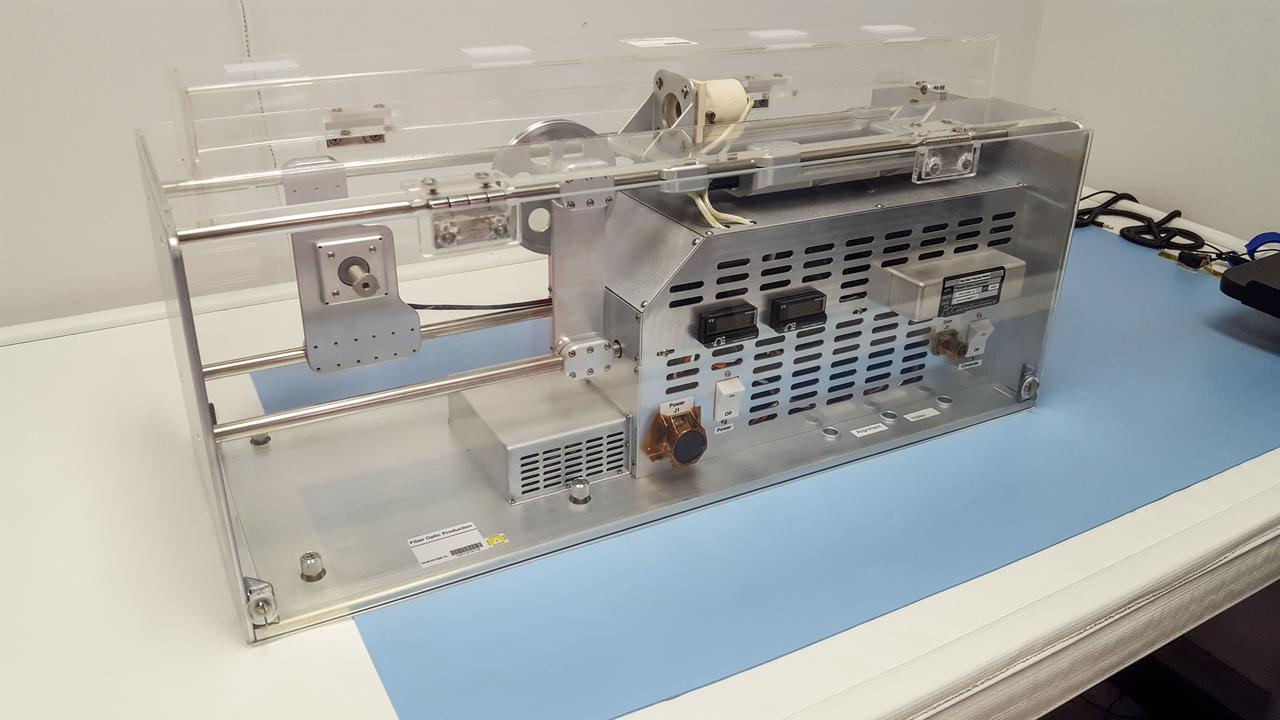
jsc2019e048245 (3/6/2019) — Preflight imagery of the Fiber Optic Production hardware. Physical Optics Corporation’s (POC’s) Fiber Optic Production investigation will create optical fibers with high commercial value aboard the International Space Station (ISS)and will operate within the Microgravity Science Glovebox (MSG).
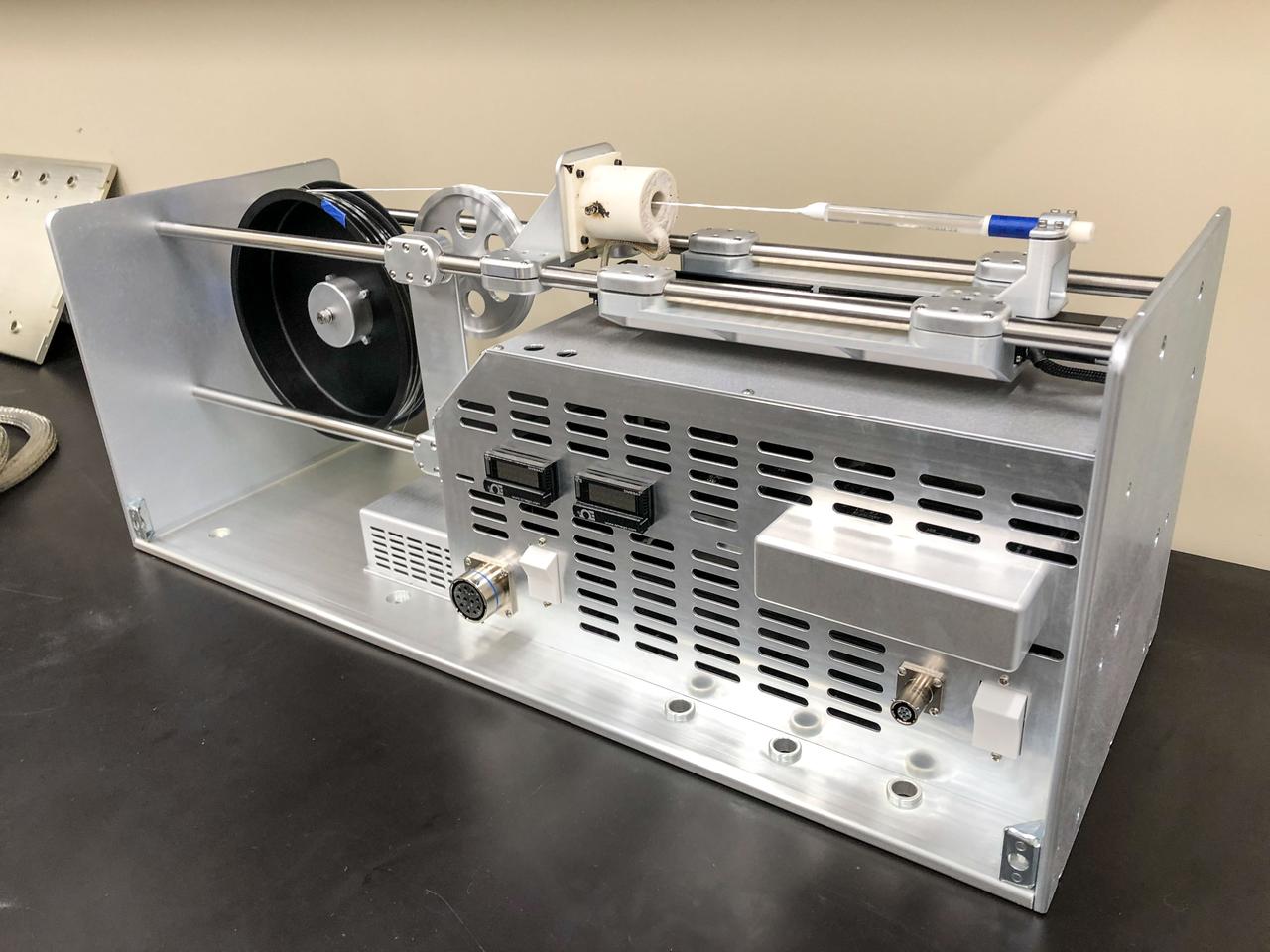
jsc2019e048247 (9/28/2018) — Preflight imagery of the Fiber Optic Production hardware. Physical Optics Corporation’s (POC’s) Fiber Optic Production investigation will create optical fibers with high commercial value aboard the International Space Station (ISS)and will operate within the Microgravity Science Glovebox (MSG).
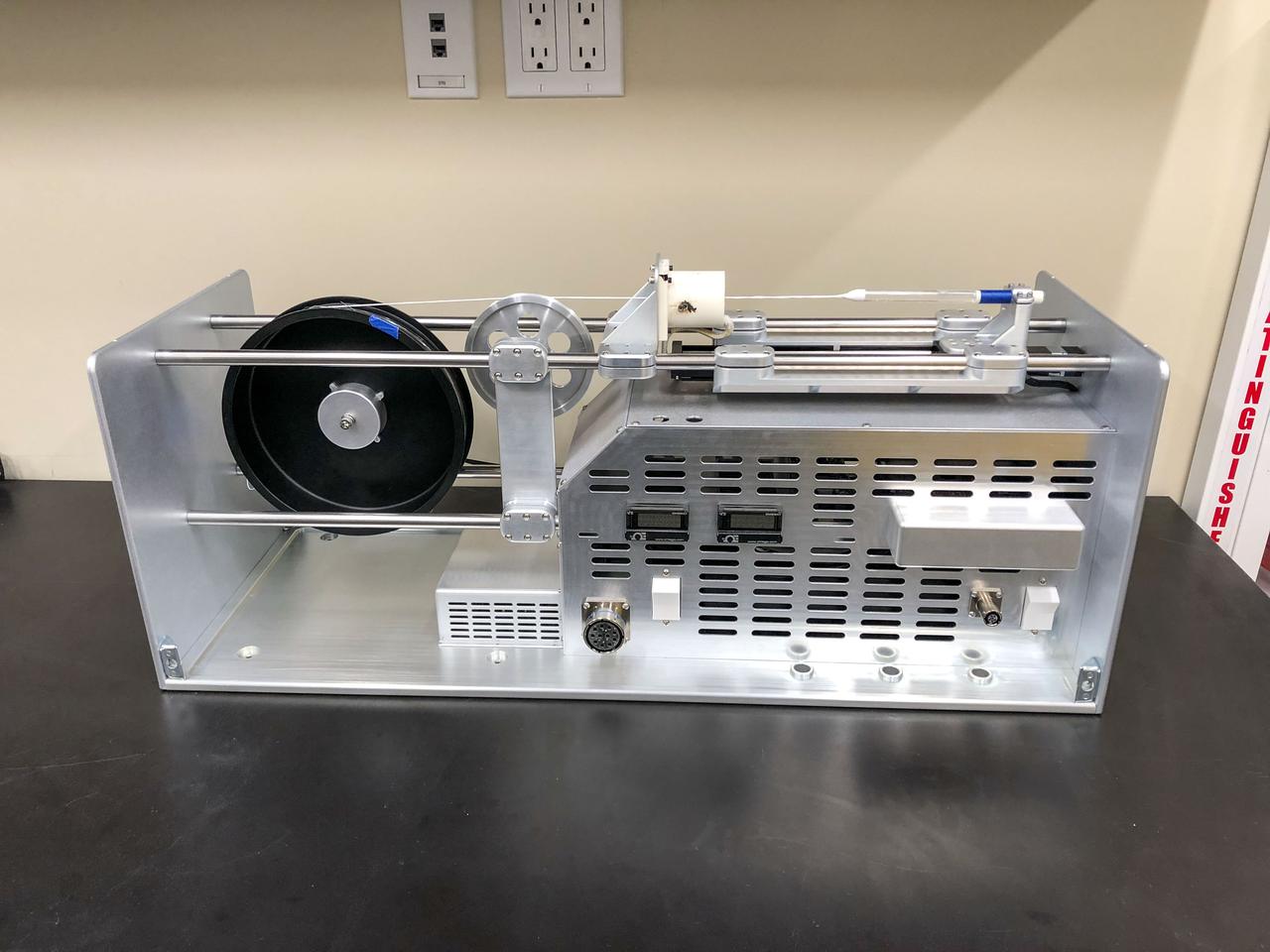
jsc2019e048246 (9/28/2018) — Preflight imagery of the Fiber Optic Production hardware. Physical Optics Corporation’s (POC’s) Fiber Optic Production investigation will create optical fibers with high commercial value aboard the International Space Station (ISS)and will operate within the Microgravity Science Glovebox (MSG).
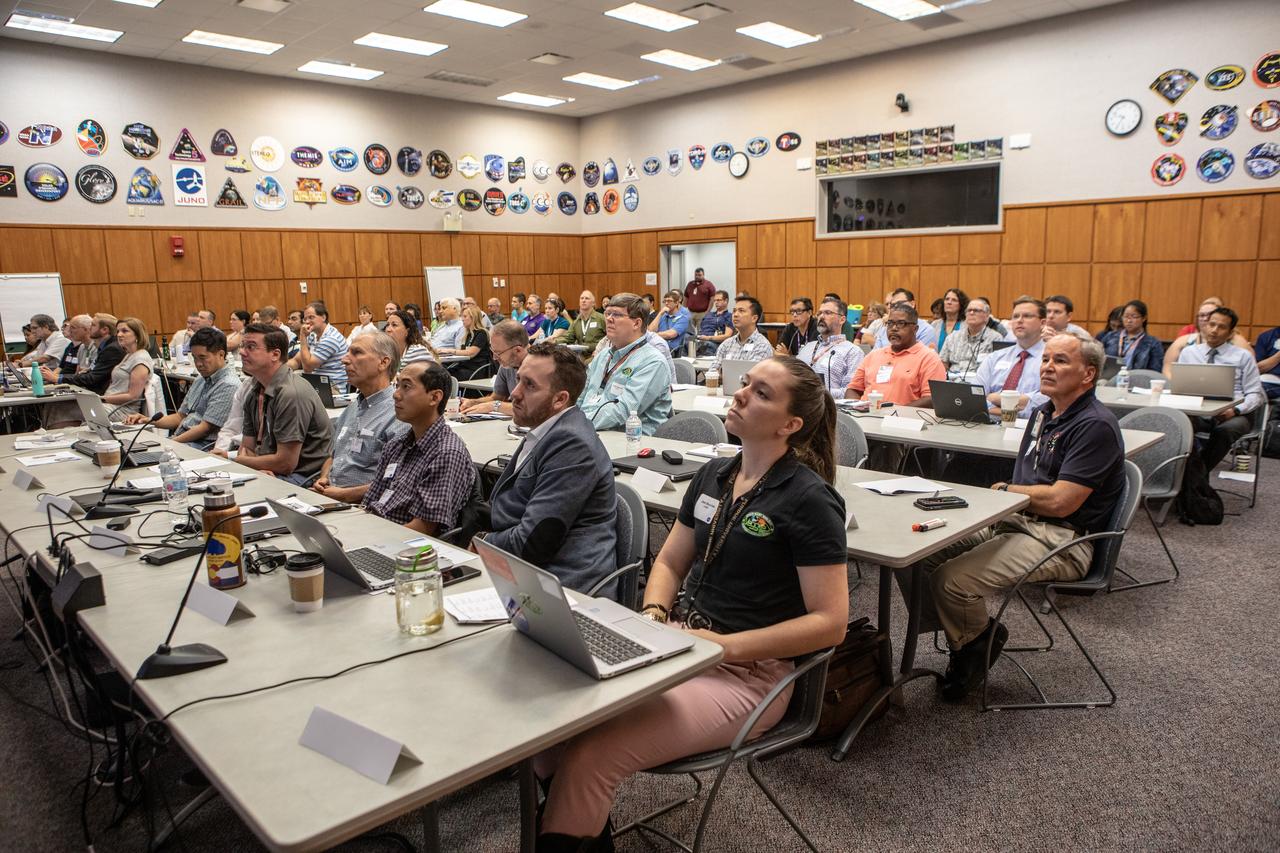
Participants listen to presentations during a two-day workshop, Aug. 6 and 7, 2019, focusing on robotics and automation in space crop production. The workshop was hosted by the Exploration Research and Technology Programs at NASA’s Kennedy Space Center in Florida. Participants from around the world and members of NASA, industry, academia and other government agencies met to share their knowledge to enable a common goal of sustaining human operations on the Moon, in deep space and eventually on Mars. Keynote speakers and representatives from different organizations presented data gleaned from their research.
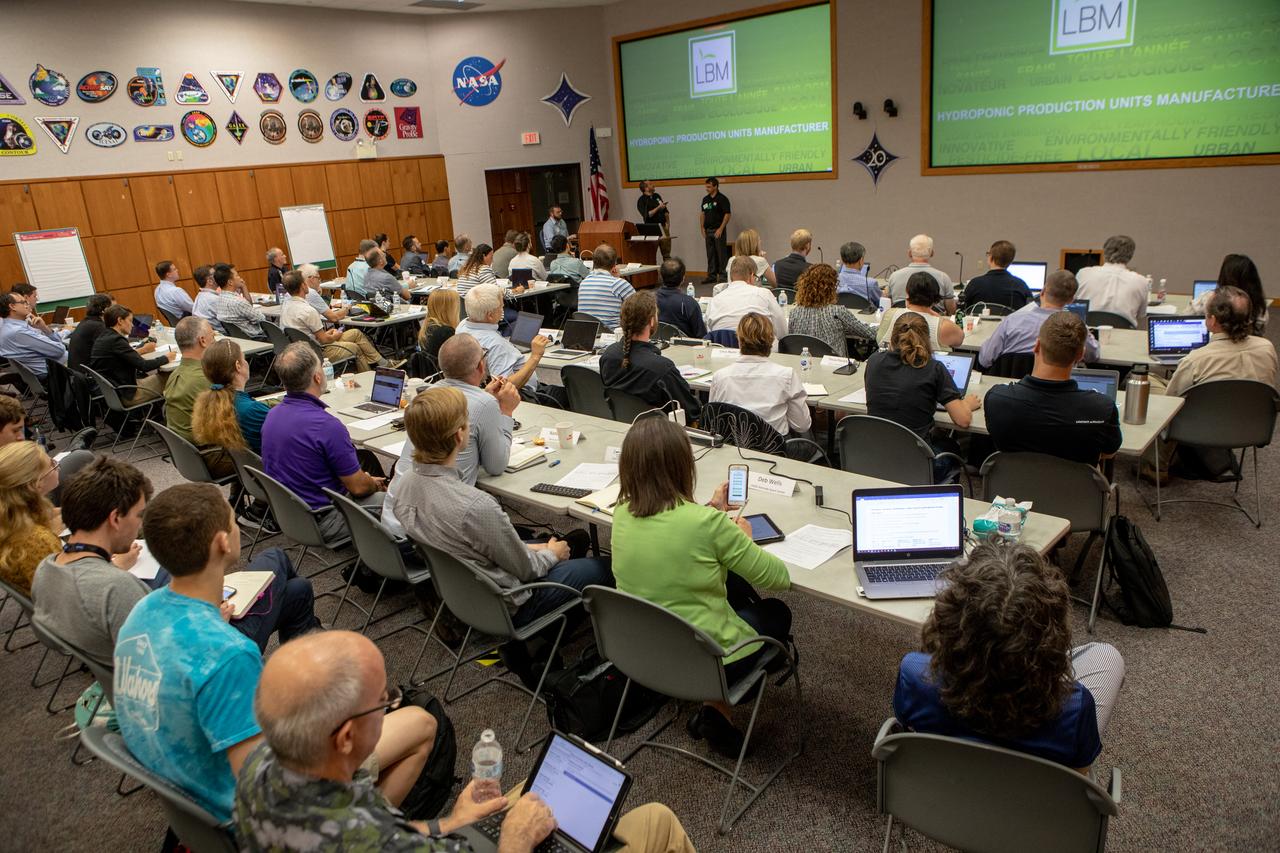
Participants listen to presentations during a two-day workshop, Aug. 6 and 7, 2019, focusing on robotics and automation in space crop production. The workshop was hosted by the Exploration Research and Technology Programs at NASA’s Kennedy Space Center in Florida. Participants from around the world and members of NASA, industry, academia and other government agencies met to share their knowledge to enable a common goal of sustaining human operations on the Moon, in deep space and eventually on Mars. Keynote speakers and representatives from different organizations presented data gleaned from their research.
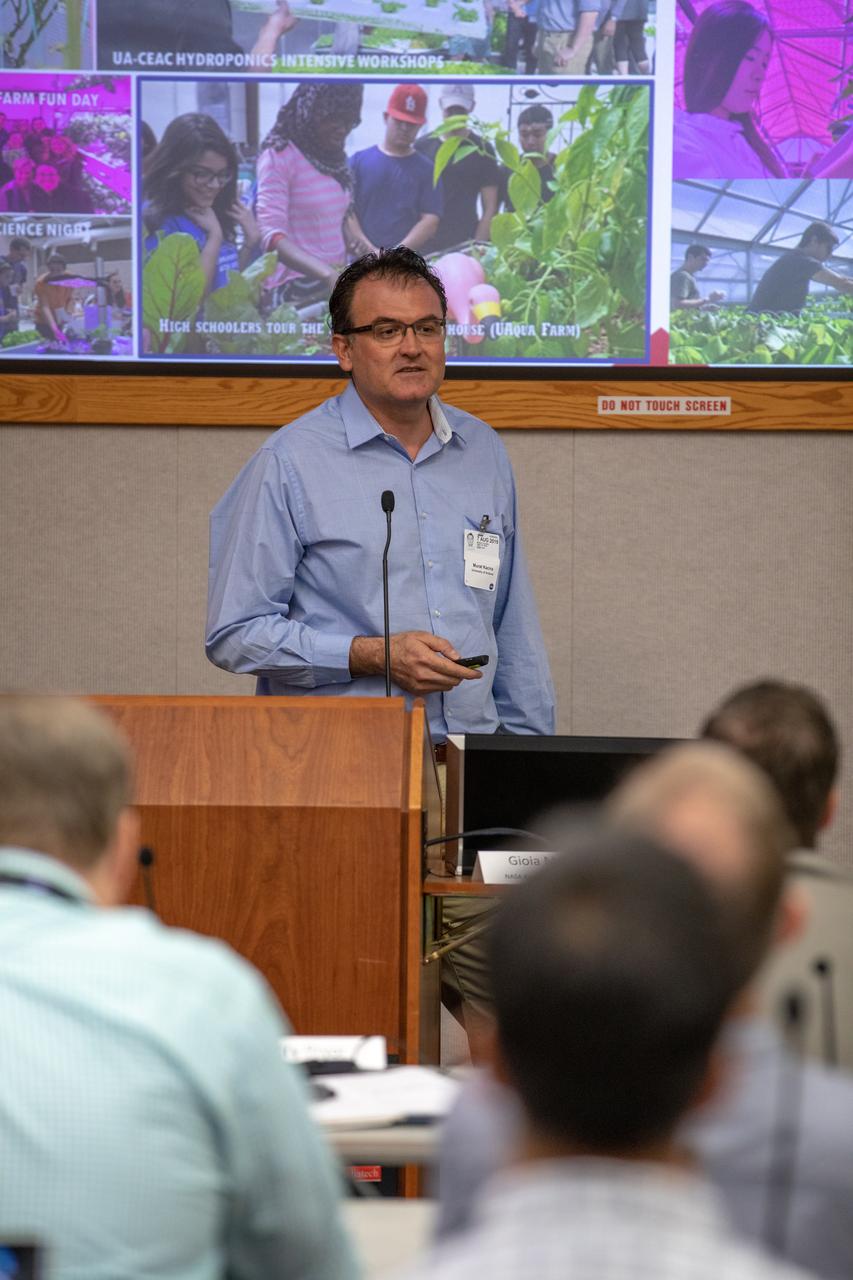
The Exploration Research and Technology Programs at NASA’s Kennedy Space Center in Florida hosted a two-day workshop, Aug. 6 and 7, 2019, focusing on robotics and automation in space crop production. Participants from around the world and members of NASA, industry, academia and other government agencies met to share their knowledge to enable a common goal of sustaining human operations on the Moon, in deep space and eventually on Mars. Keynote speakers and representatives from different organizations presented data gleaned from their research.. Murat Kacira, a professor in the Department of Agricultural and Biosystems Engineering and director of the Controlled Environment Agriculture Program at the University of Arizona presents to workshop attendees on Aug. 6.
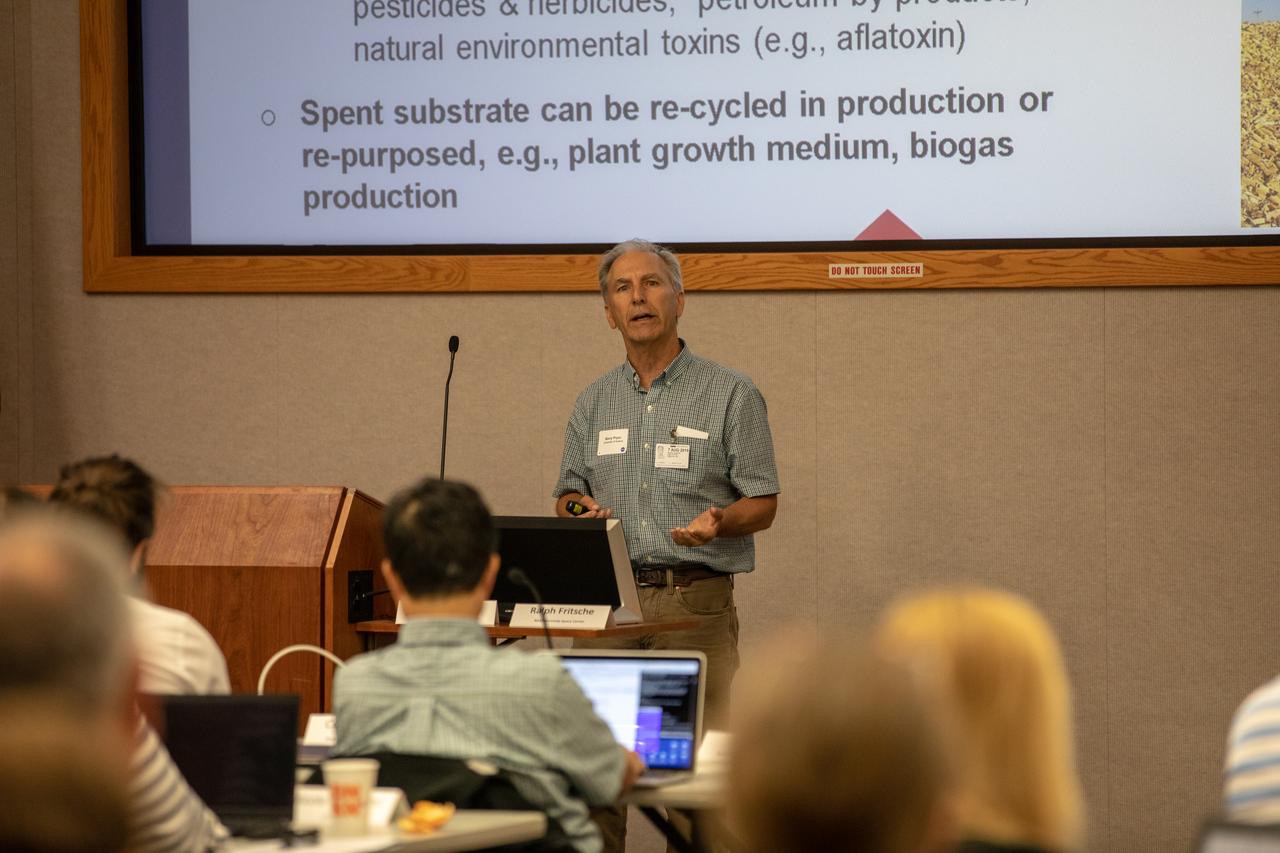
The Exploration Research and Technology Programs at NASA’s Kennedy Space Center in Florida hosted a two-day workshop, Aug. 6 and 7, 2019, focusing on robotics and automation in space crop production. Participants from around the world and members of NASA, industry, academia and other government agencies met to share their knowledge to enable a common goal of sustaining human operations on the Moon, in deep space and eventually on Mars. Keynote speakers and representatives from different organizations presented data gleaned from their research. Barry Pryor, a professor with the School of Plant Sciences at the University of Arizona presents to workshop attendees on Aug. 6.
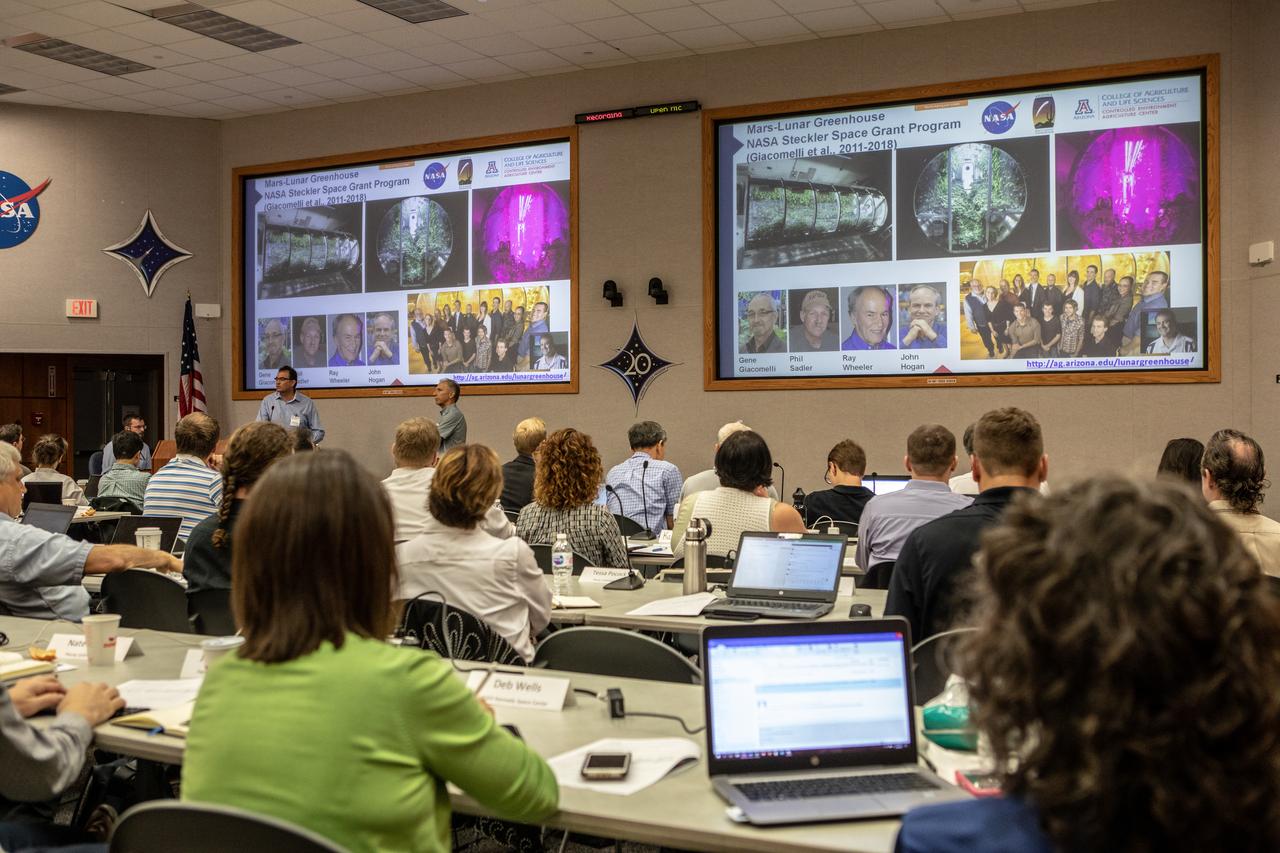
The Exploration Research and Technology Programs at NASA’s Kennedy Space Center in Florida hosted a two-day workshop, Aug. 6 and 7, 2019, focusing on robotics and automation in space crop production. Participants from around the world and members of NASA, industry, academia and other government agencies met to share their knowledge to enable a common goal of sustaining human operations on the Moon, in deep space and eventually on Mars. Keynote speakers and representatives from different organizations presented data gleaned from their research. Murat Kacira, left, a professor in the Department of Agricultural and Biosystems Engineering and director of the Controlled Environment Agriculture Program at the University of Arizona, and Barry Pryor, a professor with the School of Plant Sciences, also at the University of Arizona, present to workshop attendees on Aug. 6.
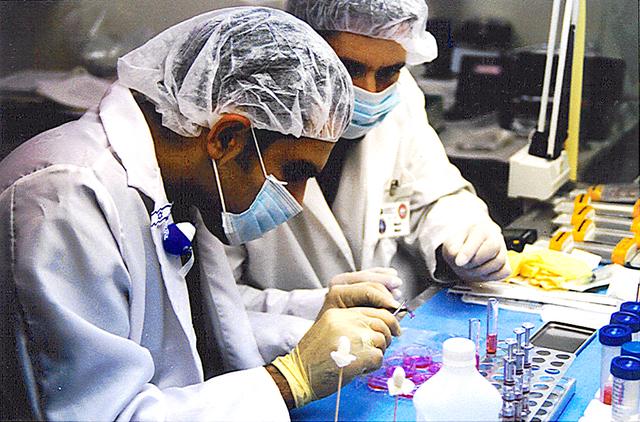
Experiments to seek solutions for a range of biomedical issues are at the heart of several investigations that will be hosted by the Commercial Instrumentation Technology Associates (ITA), Inc. Biomedical Experiments (CIBX-2) payload. CIBX-2 is unique, encompassing more than 20 separate experiments including cancer research, commercial experiments, and student hands-on experiments from 10 schools as part of ITA's ongoing University Among the Stars program. Student Marnix Aklian and ITA's Mark Bem prepare biological samples for flight as part of ITA's hands-on student outreach program on STS-95. Similar activities are a part of the CIBX-2 payload. The experiments are sponsored by NASA's Space Product Development Program (SPD).
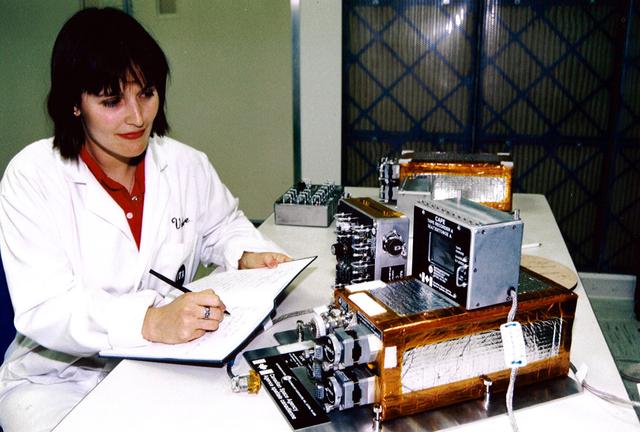
Experiments to seek solutions for a range of biomedical issues are at the heart of several investigations that will be hosted by the Commercial Instrumentation Technology Associates (ITA), Inc. Biomedical Experiments (CIBX-2) payload. CIBX-2 is unique, encompassing more than 20 separate experiments including cancer research, commercial experiments, and student hands-on experiments from 10 schools as part of ITA's ongoing University Among the Stars program. Valerie Cassanto of ITA checks the Canadian Protein Crystallization Experiment (CAPE) carried by STS-86 to Mir in 1997. The experiments are sponsored by NASA's Space Product Development Program (SPD).
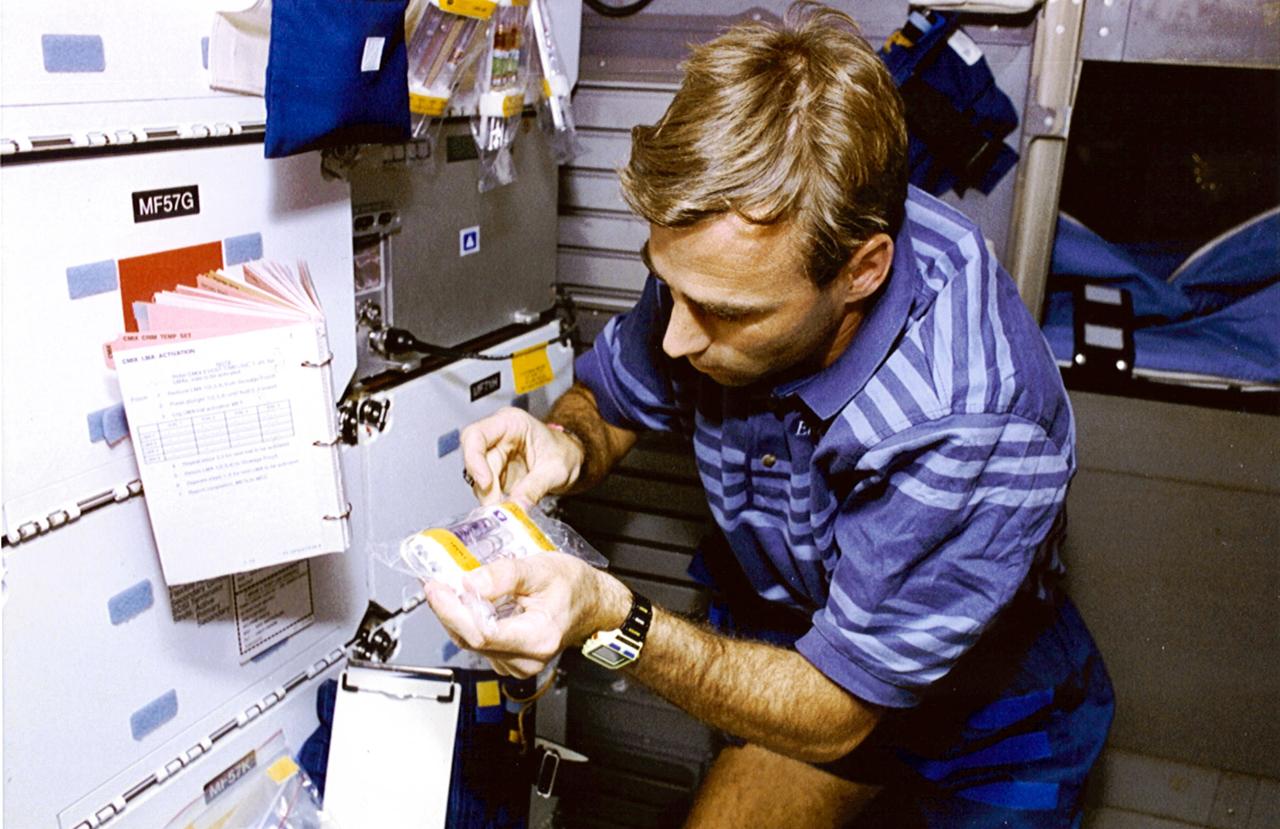
Experiments to seek solutions for a range of biomedical issues are at the heart of several investigations that will be hosted by the Commercial Instrumentation Technology Associates (ITA), Inc. Biomedical Experiments (CIBX-2) payload. CIBX-2 is unique, encompassing more than 20 separate experiments including cancer research, commercial experiments, and student hands-on experiments from 10 schools as part of ITA's ongoing University Among the Stars program. Astronaut William G. Gregory activates Liquids Mixing Apparatus (LMA) vials during STS-67. Other LMAs hang at top on the face of the middeck locker array. The experiments are sponsored under NASA's Space Product Development Program (SPD).
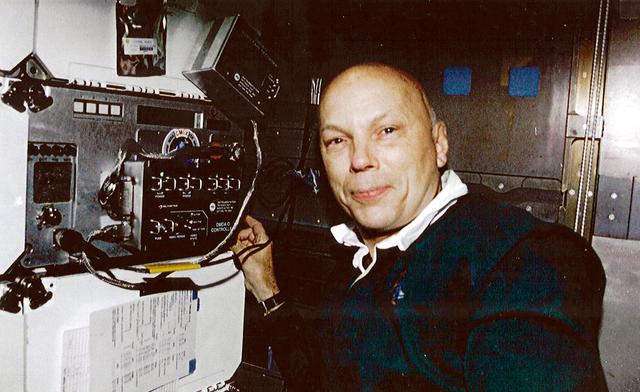
Experiments to seek solutions for a range of biomedical issues are at the heart of several investigations that will be hosted by the Commercial Instrumentation Technology Associates (ITA), Inc. The biomedical experiments CIBX-2 payload is unique, encompassing more than 20 separate experiments including cancer research, commercial experiments, and student hands-on experiments from 10 schools as part of ITA's ongoing University Among the stars program. Here, Astronaut Story Musgrave activates the CMIX-5 (Commercial MDA ITA experiment) payload in the Space Shuttle mid deck during the STS-80 mission in 1996 which is similar to CIBX-2. The experiments are sponsored by NASA's Space Product Development Program (SPD).
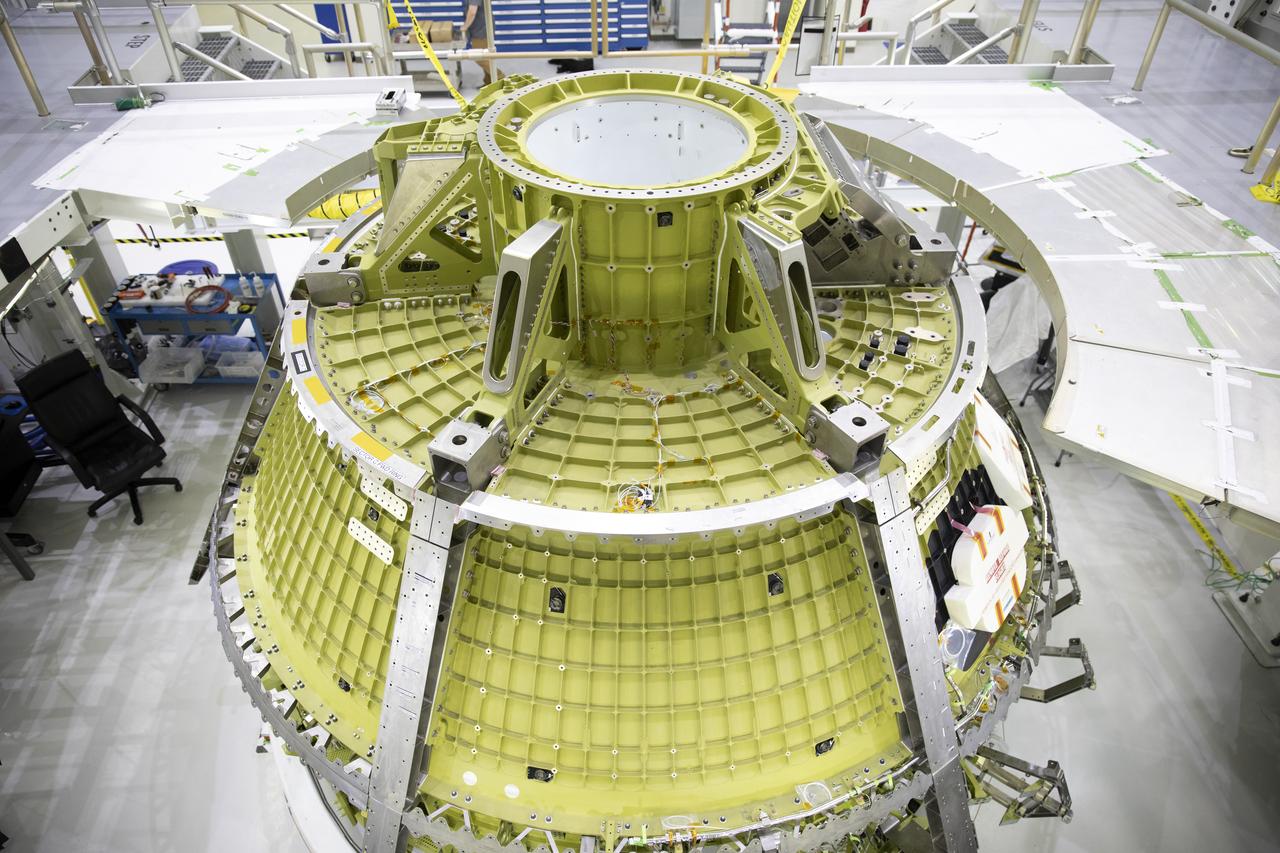
The Orion pressure vessel for NASA’s Artemis ll mission is in view in a processing stand inside the Neil Armstrong Operations and Checkout Building high bay on Sept. 17, 2019. Orion is being prepared for the first crewed test flight atop the agency’s Space Launch System rocket. Artemis ll will lift off from Launch Complex 39B. The mission will confirm all of the spacecraft’s systems operate as designed in the actual environment of deep space with astronauts aboard.
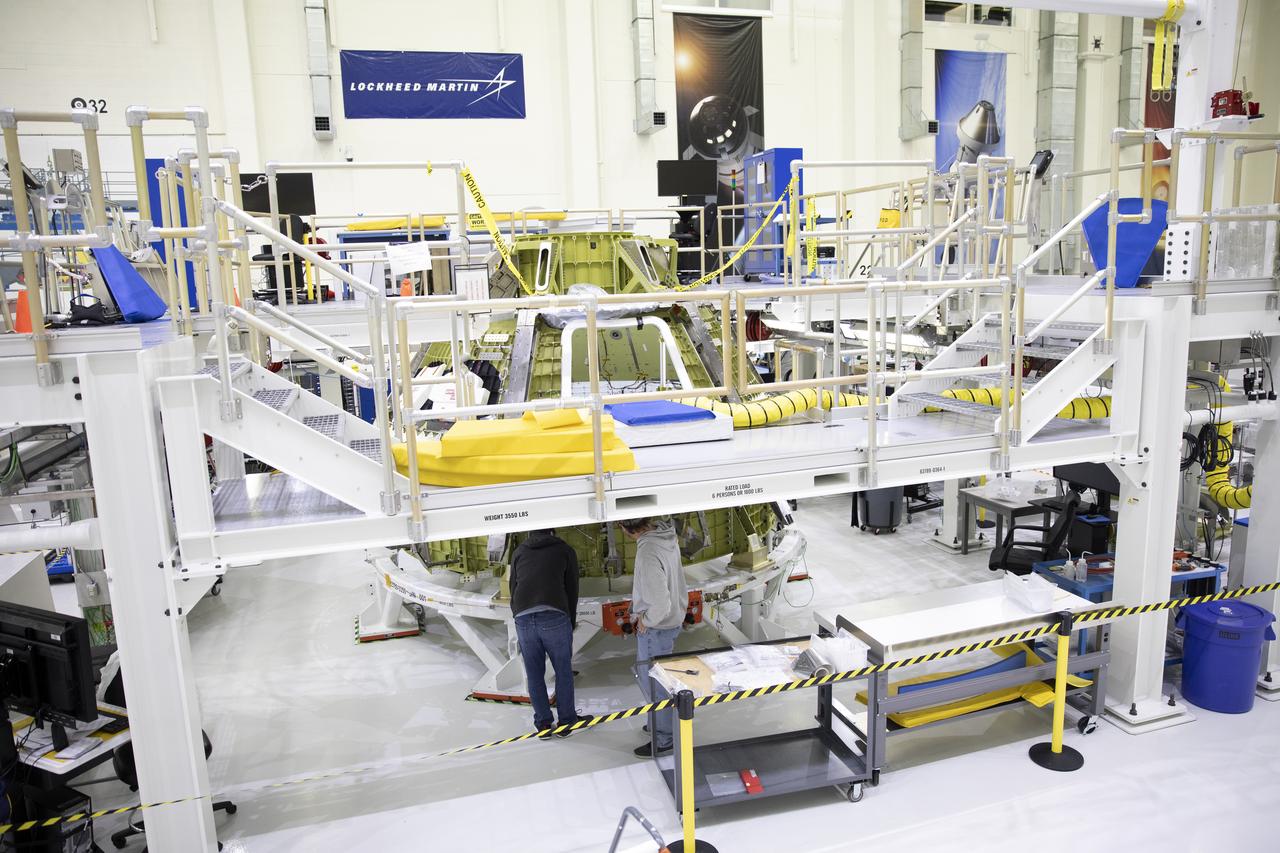
The Orion pressure vessel for NASA’s Artemis ll mission is in a processing stand inside the Neil Armstrong Operations and Checkout Building high bay on Sept. 17, 2019. Orion is being prepared for the first crewed test flight atop the agency’s Space Launch System rocket. Artemis ll will lift off from Launch Complex 39B. The mission will confirm all of the spacecraft’s systems operate as designed in the actual environment of deep space with astronauts aboard.
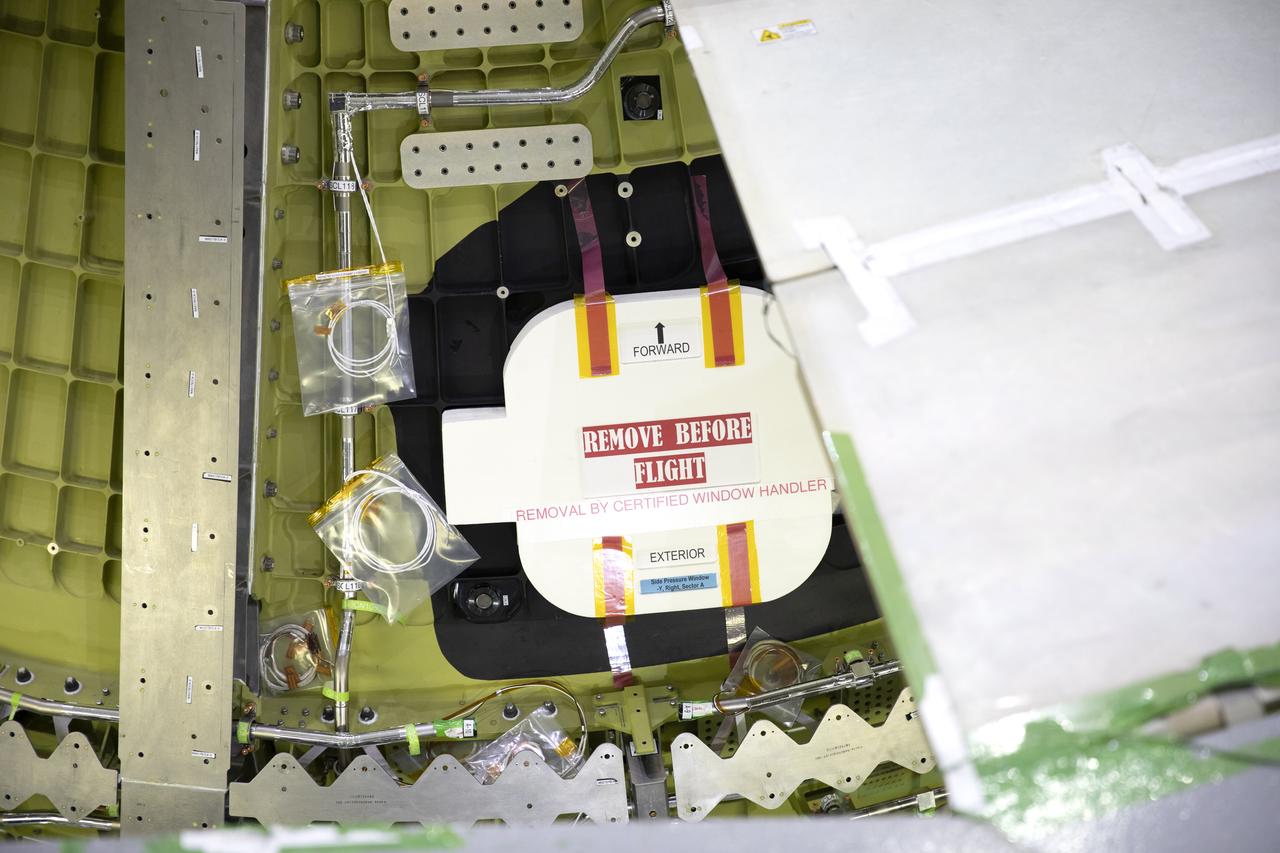
A close-up view of a cover over one of the windows on the Orion pressure vessel for NASA’s Artemis ll mission inside the Neil Armstrong Operations and Checkout Building high bay on Sept. 17, 2019. Orion is being prepared for the first crewed test flight atop the agency’s Space Launch System rocket. Artemis ll will lift off from Launch Complex 39B. The mission will confirm all of the spacecraft’s systems operate as designed in the actual environment of deep space with astronauts aboard.
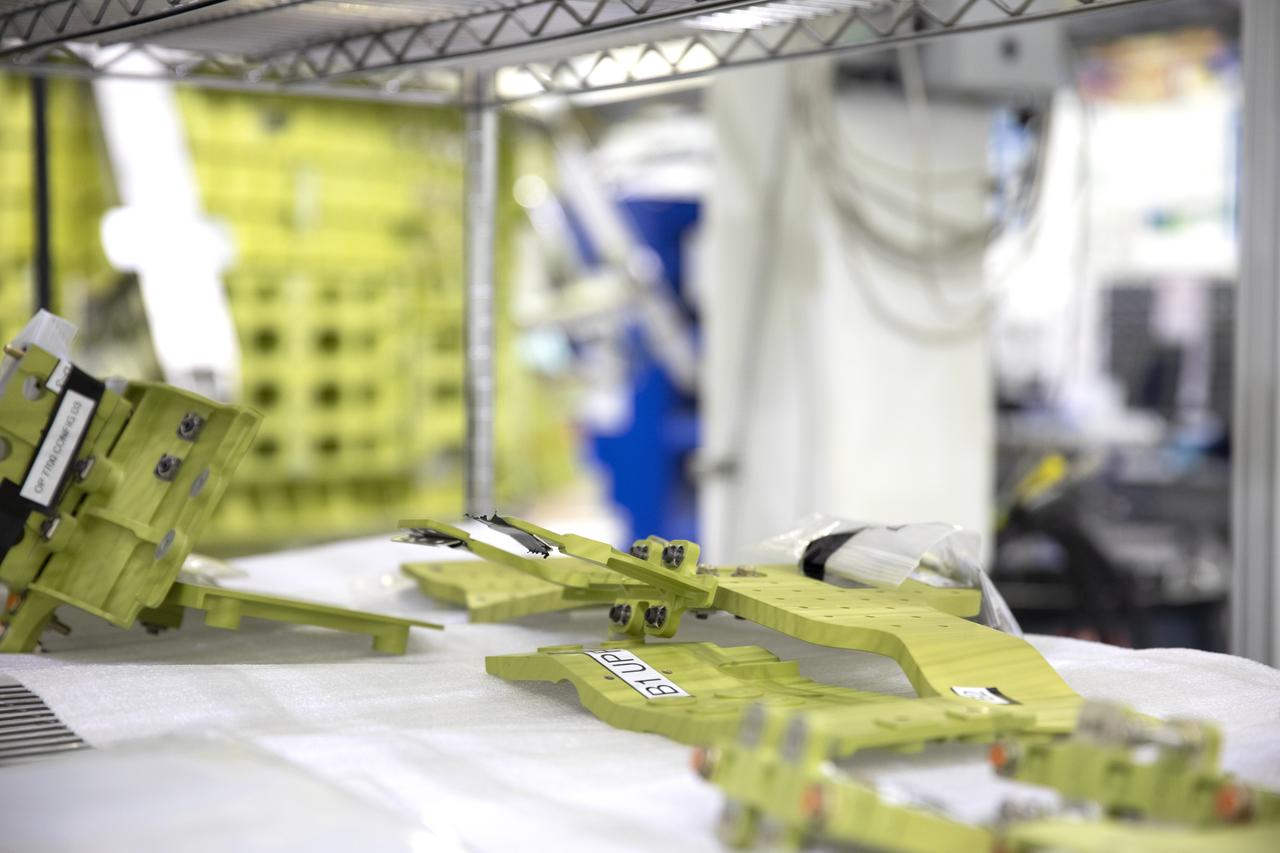
Pieces of hardware for the Orion pressure vessel for NASA’s Artemis ll mission are in view inside the Neil Armstrong Operations and Checkout Building high bay at the agency’s Kennedy Space Center in Florida on Sept. 17, 2019. Orion is being prepared for the first crewed test flight atop the agency’s Space Launch System rocket. Artemis ll will lift off from Launch Complex 39B. The mission will confirm all of the spacecraft’s systems operate as designed in the actual environment of deep space with astronauts aboard.
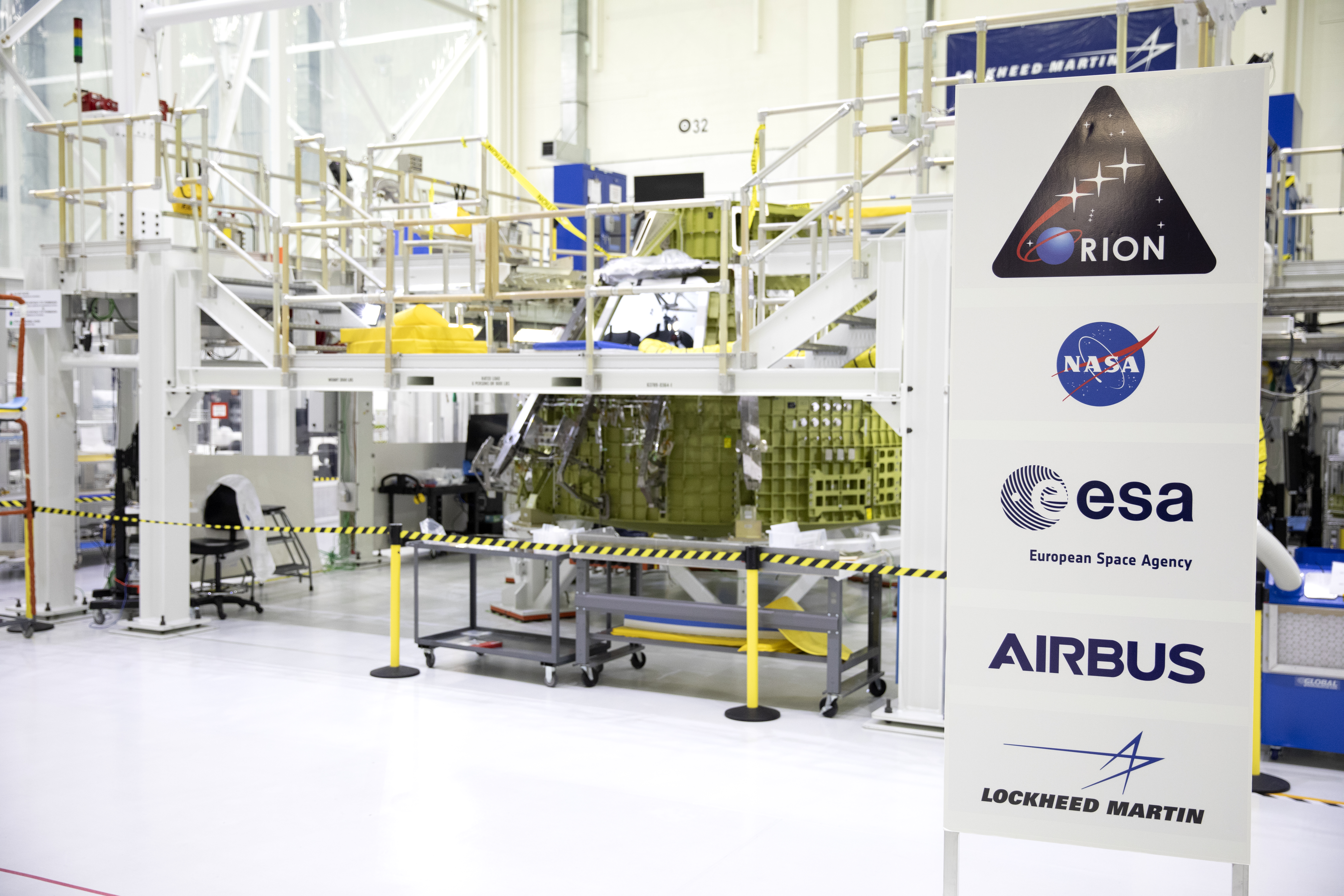
The Orion pressure vessel for NASA’s Artemis ll mission is in a processing stand inside the Neil Armstrong Operations and Checkout Building high bay on Sept. 17, 2019. Orion is being prepared for the first crewed test flight atop the agency’s Space Launch System rocket. Artemis ll will lift off from Launch Complex 39B. The mission will confirm all of the spacecraft’s systems operate as designed in the actual environment of deep space with astronauts aboard.
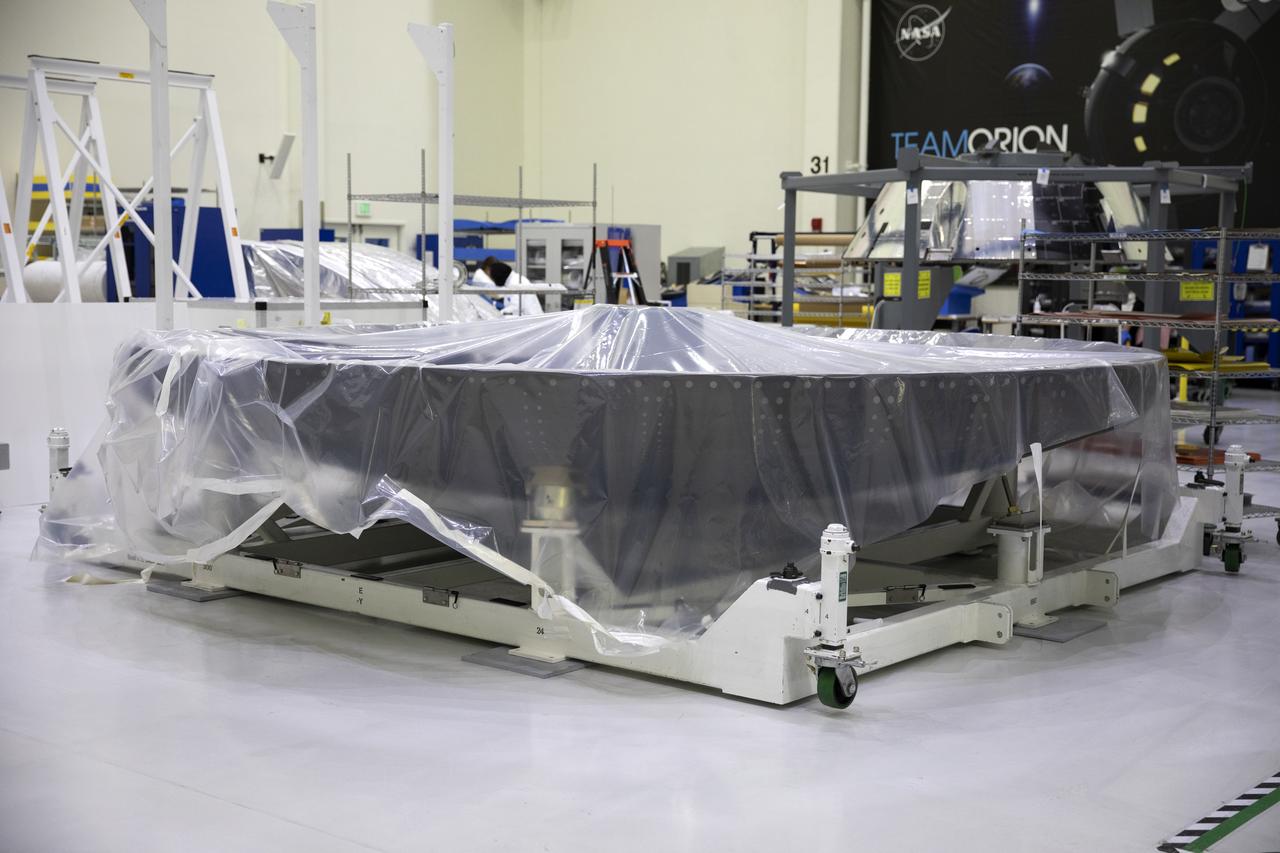
The heat shield for Orion’s Artemis ll, NASA’s first crewed mission, is inside the Neil Armstrong Operations and Checkout Building high bay at the agency’s Kennedy Space Center in Florida on Sept. 17, 2019. The heat shield, measuring roughly 16 feet in diameter, will protect astronauts upon re-entry. The heat shield is a base titanium truss structure. Technicians will apply Avcoat, an ablative material that will provide the thermal protection needed to withstand the harsh environment of space and during re-entry. Artemis ll will confirm all of the spacecraft’s systems operate as designed in the actual environment of deep space with astronauts aboard.
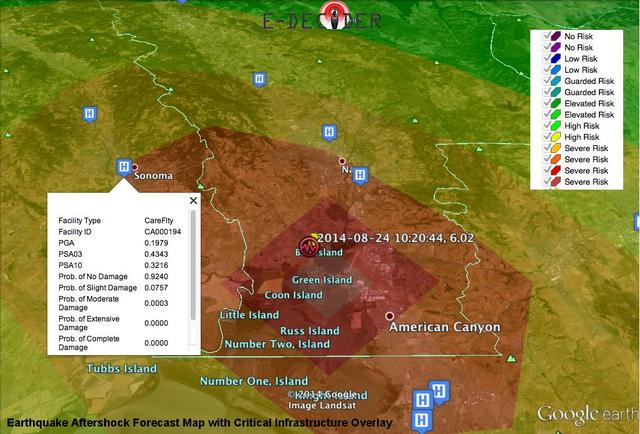
A NASA-funded disaster decision support system, provided a number of rapid response map data products to decision makers at the California Earthquake Clearinghouse following its activation for the Aug. 24, 2014 magnitude 6.0 earthquake in Napa, California
SPD representative Steve Lambing shows the PentaPure water purification unit to some EAA visitors. The Microgravity Research and the Space Product Development Programs joined with the Johnson Space Center (JSC) for a first time ever ISS/Microgravity Research space-focused exhibit at Oshkosh AirVenture'99 from July 28-August 3, 1999. The Space Product Development (SPD) display included the STS-95 ASTROCULTURE training hardware used by John Glenn and his crewmates, a PentaPure water purfication system, and a Ford engine block.

Melons are grown in a controlled environment chamber at NASA’s Kennedy Space Center on April 17, 2023. The activity is taking place inside the Plant Production Area at the Florida spaceport’s Space Station Processing Facility.

Cucumbers are grown in a controlled environment chamber at NASA’s Kennedy Space Center on April 17, 2023. The activity is taking place inside the Plant Production Area at the Florida spaceport’s Space Station Processing Facility.
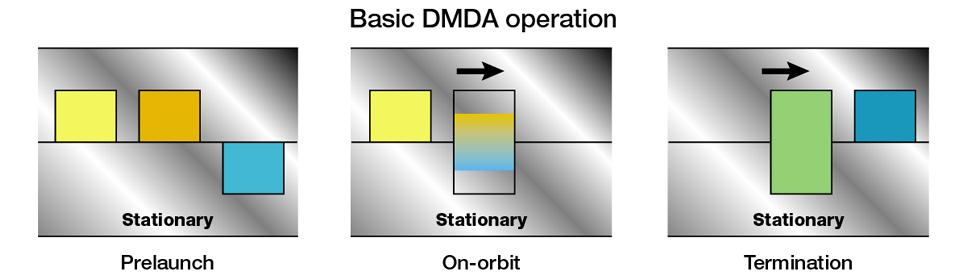
Experiments to seek solutions for a range of biomedical issues are at the heart of several investigations that will be hosted by the Commercial Instrumentation Technology Associates (ITA), Inc. Biomedical Experiments (CIBX-2) payload. CIBX-2 is unique, encompassing more than 20 separate experiments including cancer research, commercial experiments, and student hands-on experiments from 10 schools as part of ITA's ongoing University Among the Stars program. This drawing depicts a cross-section of a set of Dual-Materials Dispersion Apparatus (DMDA) specimen wells, one of which can include a reverse osmosis membrane to dewater a protein solution and thus cause crystallization. Depending on individual needs, two or three wells may be used, the membrane may be absent, or other proprietary enhancements may be present. The experiments are sponsored by NASA's Space Product Development Program (SPD).
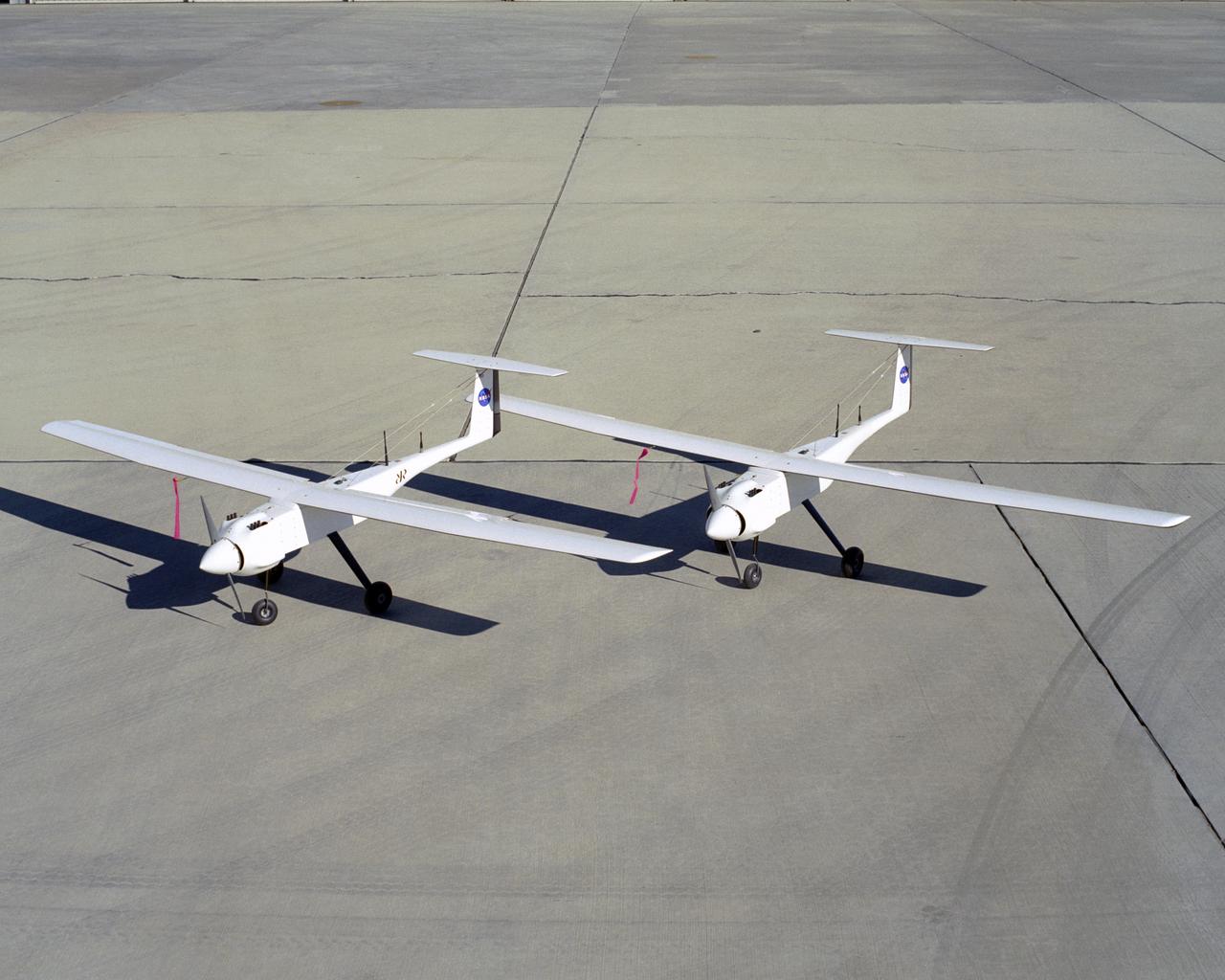
Two identical RnR Products APV-3 aircraft validated cooperative flight control software in the Networked UAV Teaming Experiment at NASA Dryden in early 2005.

Acquired by NASA Terra spacecraft, this image shows a mine in Baiyun Ebo, Inner Mongolia, China, the site of almost half the world rare earth production. China is responsible for over 95% of global production of rare earth elements.

Shown here are microgreens – a quick-growing, highly nutritious crop – inside the Plant Production Area at NASA’s Kennedy Space Center’s Space Station Processing Facility in Florida on April 17, 2023. The microgreens will be used to make mixes to create complex flavors to help with menu fatigue in space.

Horticulturalists study the use of 3D printed materials as media to grow plants at NASA’s Kennedy Space Center on April 17, 2023. The activity is taking place inside the Plant Production Area at the Florida spaceport’s Space Station Processing Facility.

Horticulture scientist Blake Costine adjusts moisture sensors for the Advanced Plant Imaging project at NASA’s Kennedy Space Center on April 17, 2023. In this project, hyperspectral cameras are used to assess plant health. The activity is taking place inside the Plant Production Area at the Florida spaceport’s Space Station Processing Facility.

Lead horticulturist LaShelle Spencer studies the use of 3D printed materials as media to grow plants at NASA’s Kennedy Space Center on April 17, 2023. The activity is taking place inside the Plant Production Area at the Florida spaceport’s Space Station Processing Facility.

Shown here are moisture sensors for the Advanced Plant Imaging project at NASA’s Kennedy Space Center on April 17, 2023. In this project, hyperspectral cameras are used to assess plant health. The activity is taking place inside the Plant Production Area at the Florida spaceport’s Space Station Processing Facility.

Horticulture scientist Blake Costine adjusts moisture sensors for the Advanced Plant Imaging project at NASA’s Kennedy Space Center on April 17, 2023. In this project, hyperspectral cameras are used to assess plant health. The activity is taking place inside the Plant Production Area at the Florida spaceport’s Space Station Processing Facility.
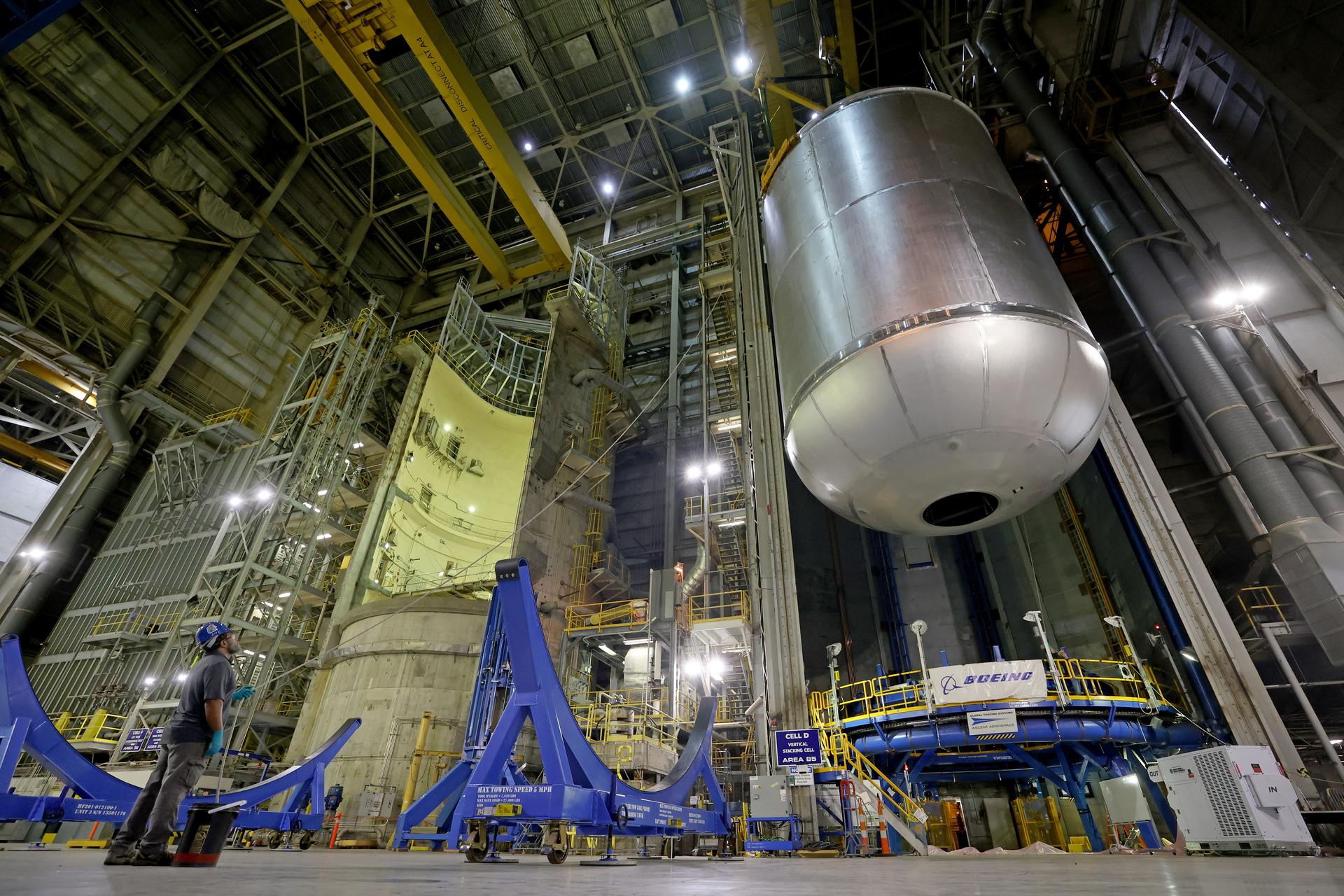
Teams at NASA’s Michoud Assembly Facility in New Orleans use an overhead crane to lift a 51-foot-tall liquid oxygen tank out of a production cell and into the main aisle of the vertical assembly building on June 9. The team rotates the tank from a vertical to a horizontal configuration in an operation called a “breakover,” and sets the tank into a pair of cradles until it is moved to its next phase of production. This liquid oxygen tank will form part of the SLS (Space Launch System) rocket for NASA’s Artemis IV mission to the Moon, and it will hold more than 196,000 gallons of super-cold liquid oxygen at launch. The propellant tank is one of five major elements that make up the 212-foot-tall SLS rocket stage. The core stage, along with its four RS-25 engines at its base, produces more than two million pounds of thrust to help launch NASA’s Orion spacecraft, astronauts, and supplies beyond Earth’s orbit and to the lunar surface for Artemis. Image credit: NASA/Michael DeMocker
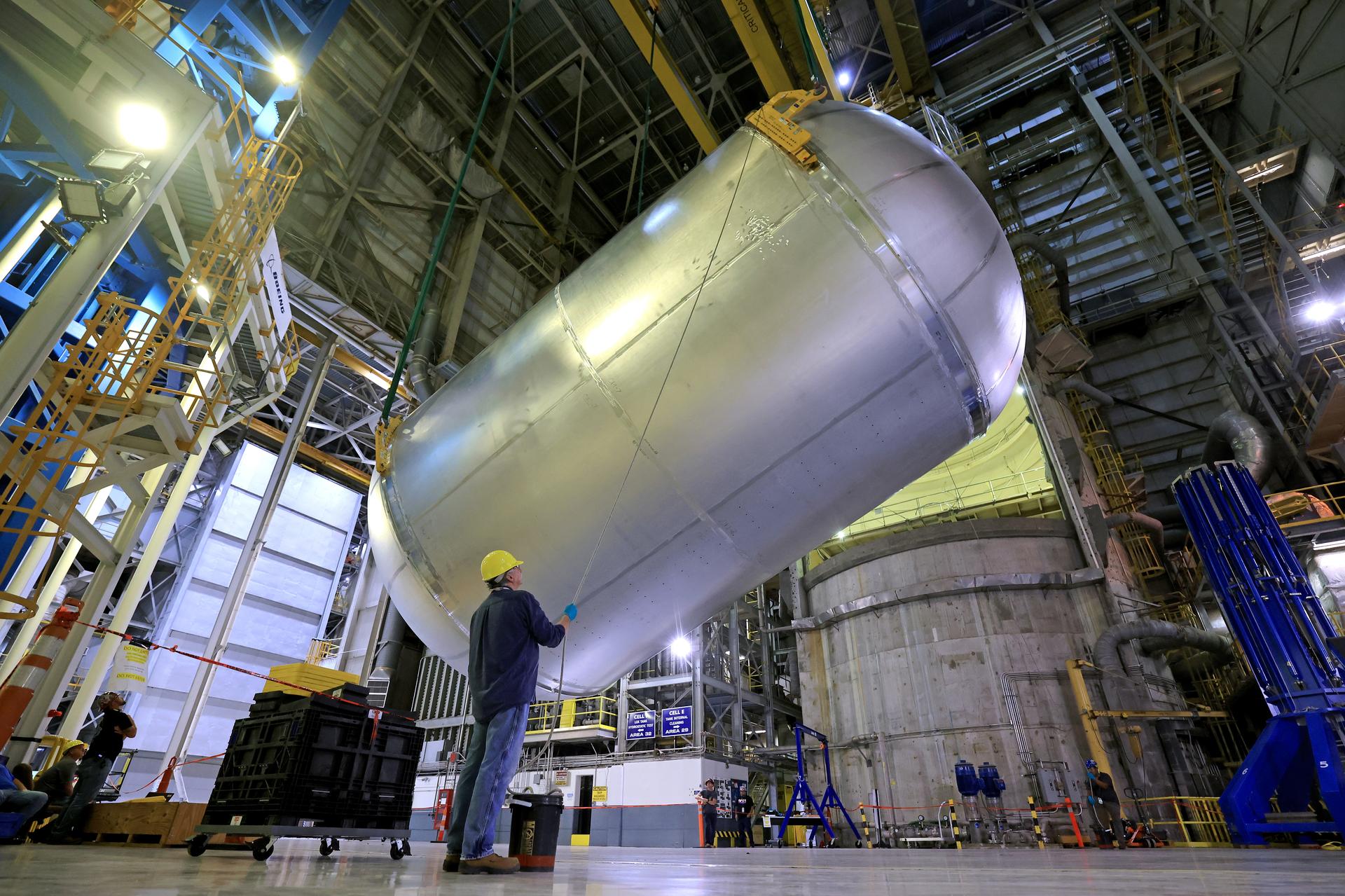
Teams at NASA’s Michoud Assembly Facility in New Orleans use an overhead crane to lift a 51-foot-tall liquid oxygen tank out of a production cell and into the main aisle of the vertical assembly building on June 9. The team rotates the tank from a vertical to a horizontal configuration in an operation called a “breakover,” and sets the tank into a pair of cradles until it is moved to its next phase of production. This liquid oxygen tank will form part of the SLS (Space Launch System) rocket for NASA’s Artemis IV mission to the Moon, and it will hold more than 196,000 gallons of super-cold liquid oxygen at launch. The propellant tank is one of five major elements that make up the 212-foot-tall SLS rocket stage. The core stage, along with its four RS-25 engines at its base, produces more than two million pounds of thrust to help launch NASA’s Orion spacecraft, astronauts, and supplies beyond Earth’s orbit and to the lunar surface for Artemis. Image credit: NASA/Michael DeMocker
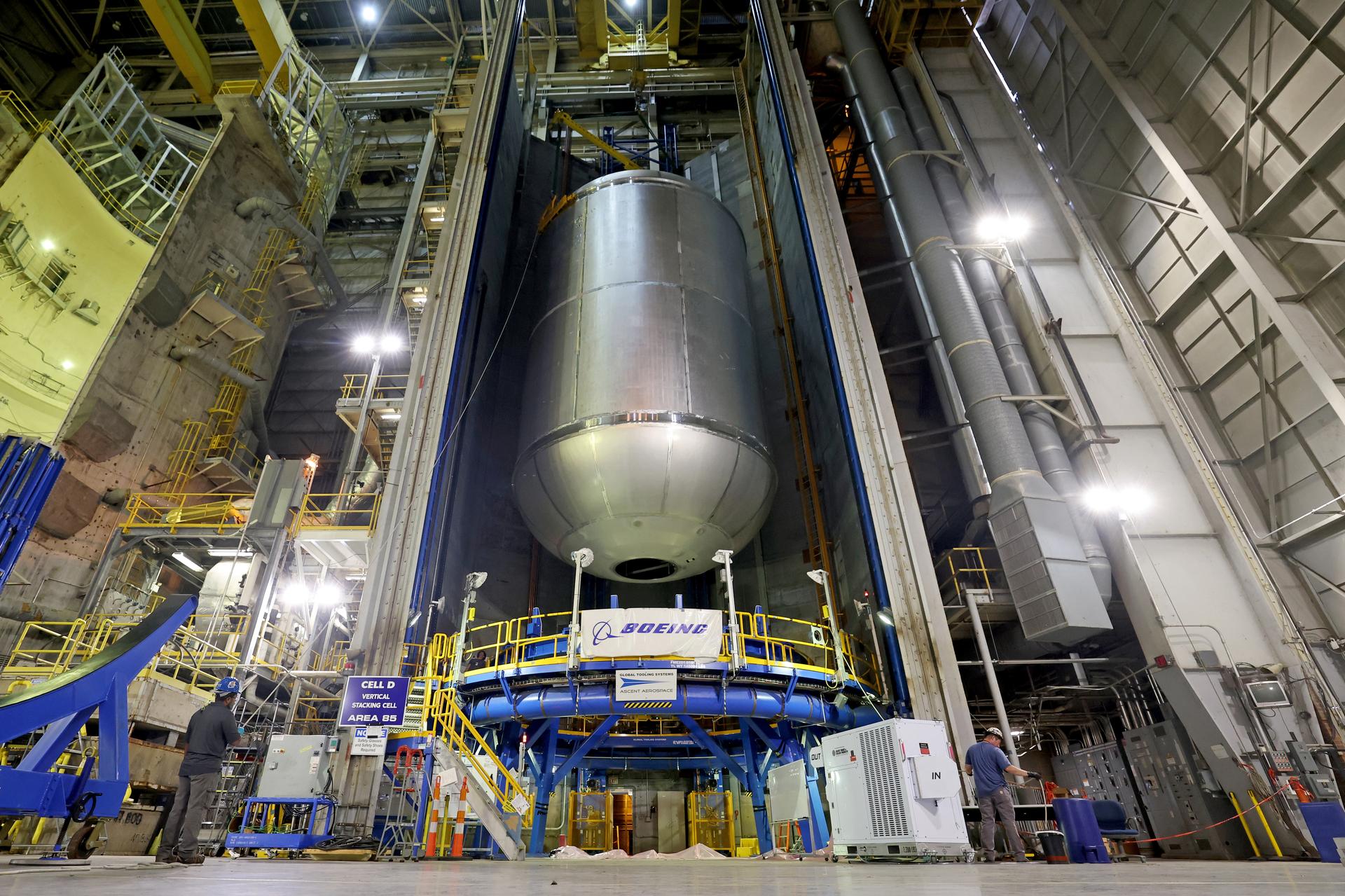
Teams at NASA’s Michoud Assembly Facility in New Orleans use an overhead crane to lift a 51-foot-tall liquid oxygen tank out of a production cell and into the main aisle of the vertical assembly building on June 9. The team rotates the tank from a vertical to a horizontal configuration in an operation called a “breakover,” and sets the tank into a pair of cradles until it is moved to its next phase of production. This liquid oxygen tank will form part of the SLS (Space Launch System) rocket for NASA’s Artemis IV mission to the Moon, and it will hold more than 196,000 gallons of super-cold liquid oxygen at launch. The propellant tank is one of five major elements that make up the 212-foot-tall SLS rocket stage. The core stage, along with its four RS-25 engines at its base, produces more than two million pounds of thrust to help launch NASA’s Orion spacecraft, astronauts, and supplies beyond Earth’s orbit and to the lunar surface for Artemis. Image credit: NASA/Michael DeMocker
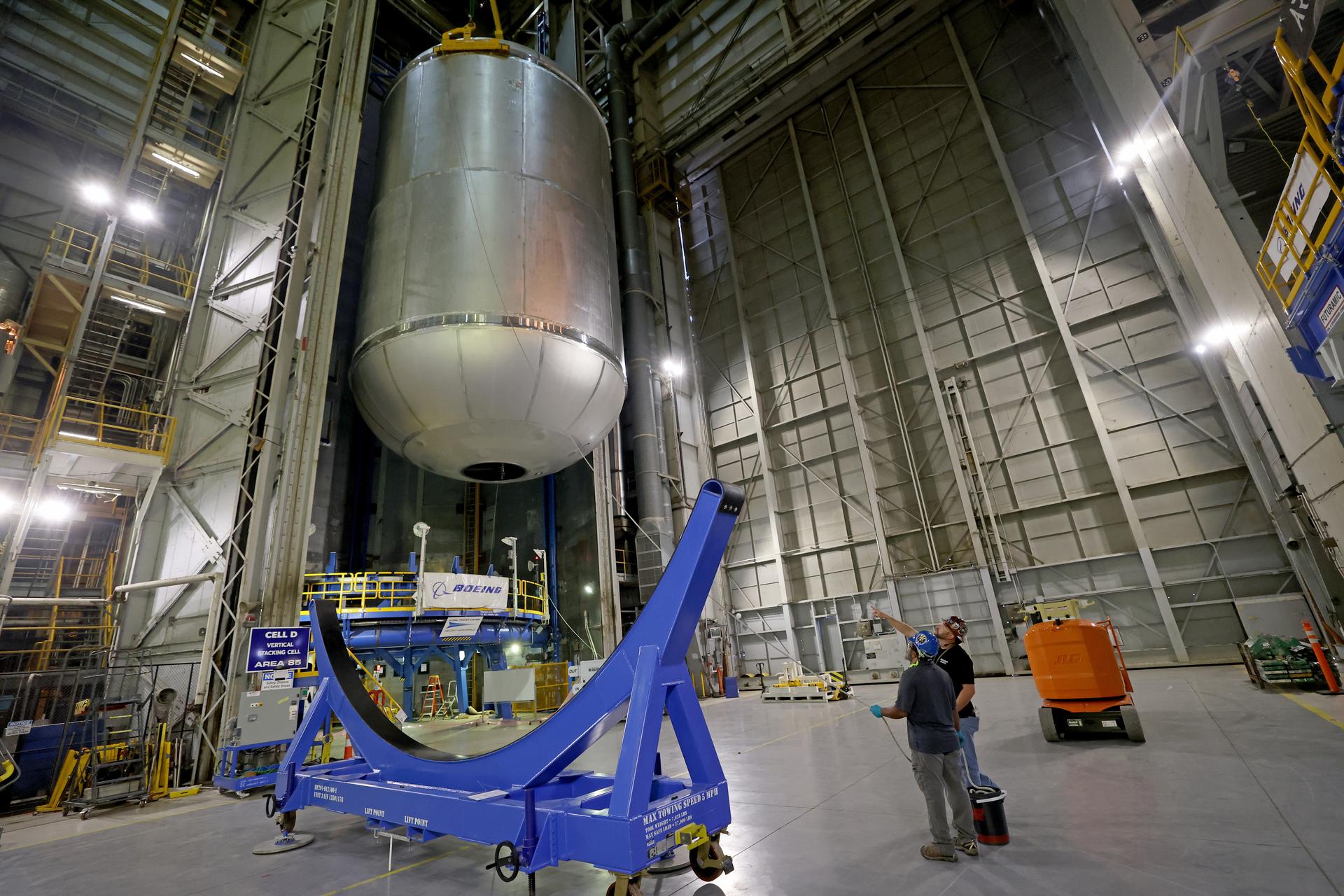
Teams at NASA’s Michoud Assembly Facility in New Orleans use an overhead crane to lift a 51-foot-tall liquid oxygen tank out of a production cell and into the main aisle of the vertical assembly building on June 9. The team rotates the tank from a vertical to a horizontal configuration in an operation called a “breakover,” and sets the tank into a pair of cradles until it is moved to its next phase of production. This liquid oxygen tank will form part of the SLS (Space Launch System) rocket for NASA’s Artemis IV mission to the Moon, and it will hold more than 196,000 gallons of super-cold liquid oxygen at launch. The propellant tank is one of five major elements that make up the 212-foot-tall SLS rocket stage. The core stage, along with its four RS-25 engines at its base, produces more than two million pounds of thrust to help launch NASA’s Orion spacecraft, astronauts, and supplies beyond Earth’s orbit and to the lunar surface for Artemis. Image credit: NASA/Michael DeMocker
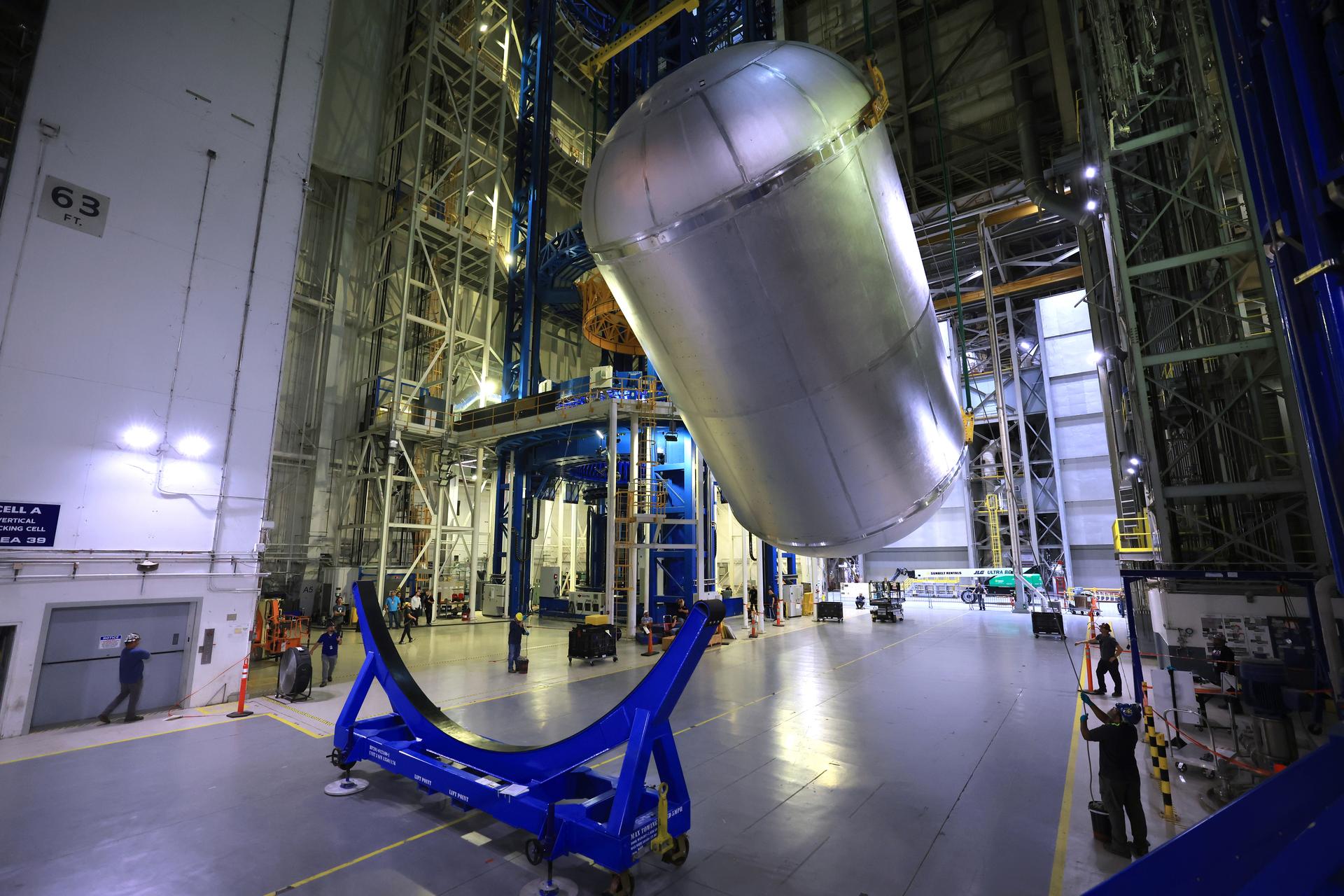
Teams at NASA’s Michoud Assembly Facility in New Orleans use an overhead crane to lift a 51-foot-tall liquid oxygen tank out of a production cell and into the main aisle of the vertical assembly building on June 9. The team rotates the tank from a vertical to a horizontal configuration in an operation called a “breakover,” and sets the tank into a pair of cradles until it is moved to its next phase of production. This liquid oxygen tank will form part of the SLS (Space Launch System) rocket for NASA’s Artemis IV mission to the Moon, and it will hold more than 196,000 gallons of super-cold liquid oxygen at launch. The propellant tank is one of five major elements that make up the 212-foot-tall SLS rocket stage. The core stage, along with its four RS-25 engines at its base, produces more than two million pounds of thrust to help launch NASA’s Orion spacecraft, astronauts, and supplies beyond Earth’s orbit and to the lunar surface for Artemis. Image credit: NASA/Michael DeMocker
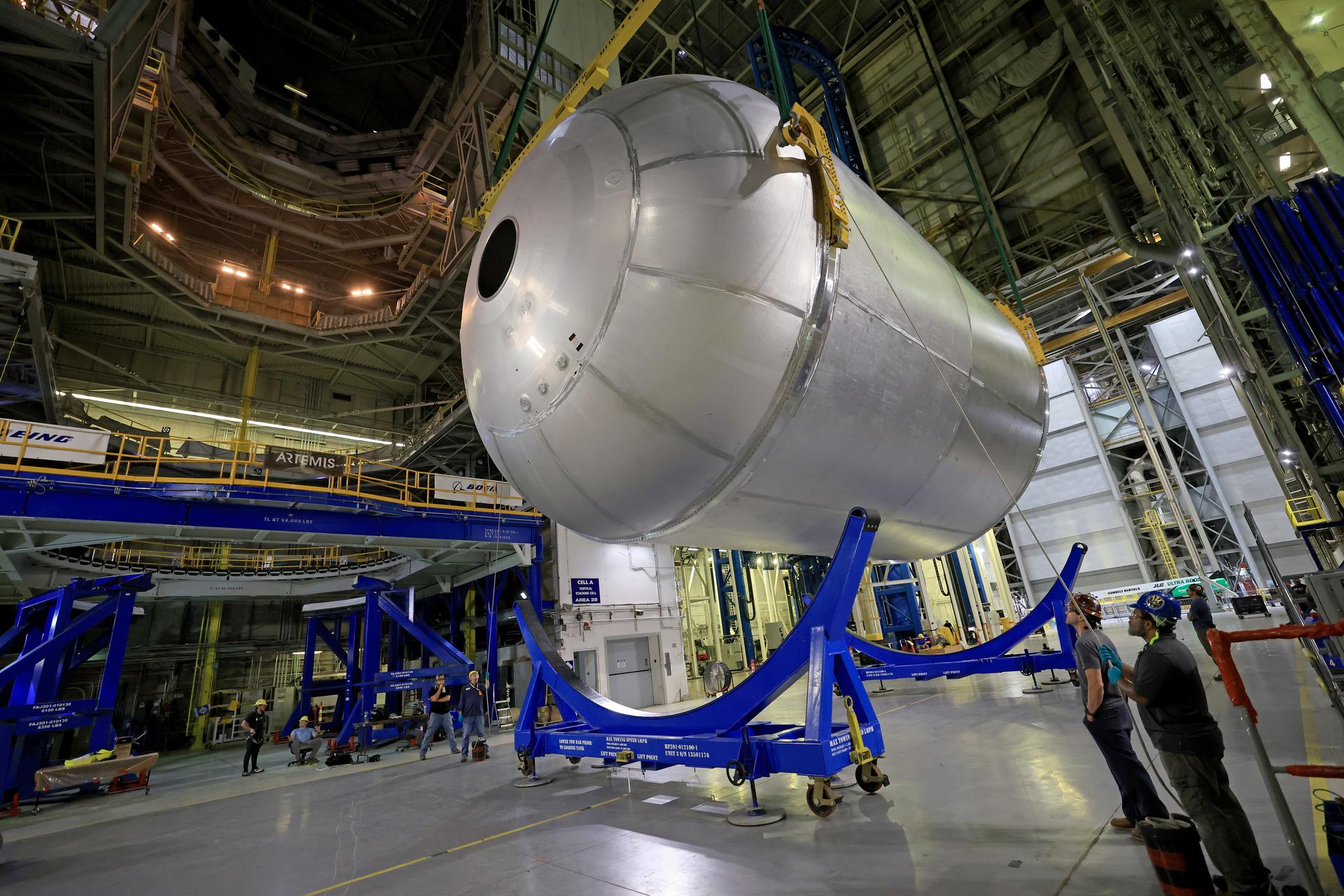
Teams at NASA’s Michoud Assembly Facility in New Orleans use an overhead crane to lift a 51-foot-tall liquid oxygen tank out of a production cell and into the main aisle of the vertical assembly building on June 9. The team rotates the tank from a vertical to a horizontal configuration in an operation called a “breakover,” and sets the tank into a pair of cradles until it is moved to its next phase of production. This liquid oxygen tank will form part of the SLS (Space Launch System) rocket for NASA’s Artemis IV mission to the Moon, and it will hold more than 196,000 gallons of super-cold liquid oxygen at launch. The propellant tank is one of five major elements that make up the 212-foot-tall SLS rocket stage. The core stage, along with its four RS-25 engines at its base, produces more than two million pounds of thrust to help launch NASA’s Orion spacecraft, astronauts, and supplies beyond Earth’s orbit and to the lunar surface for Artemis. Image credit: NASA/Michael DeMocker
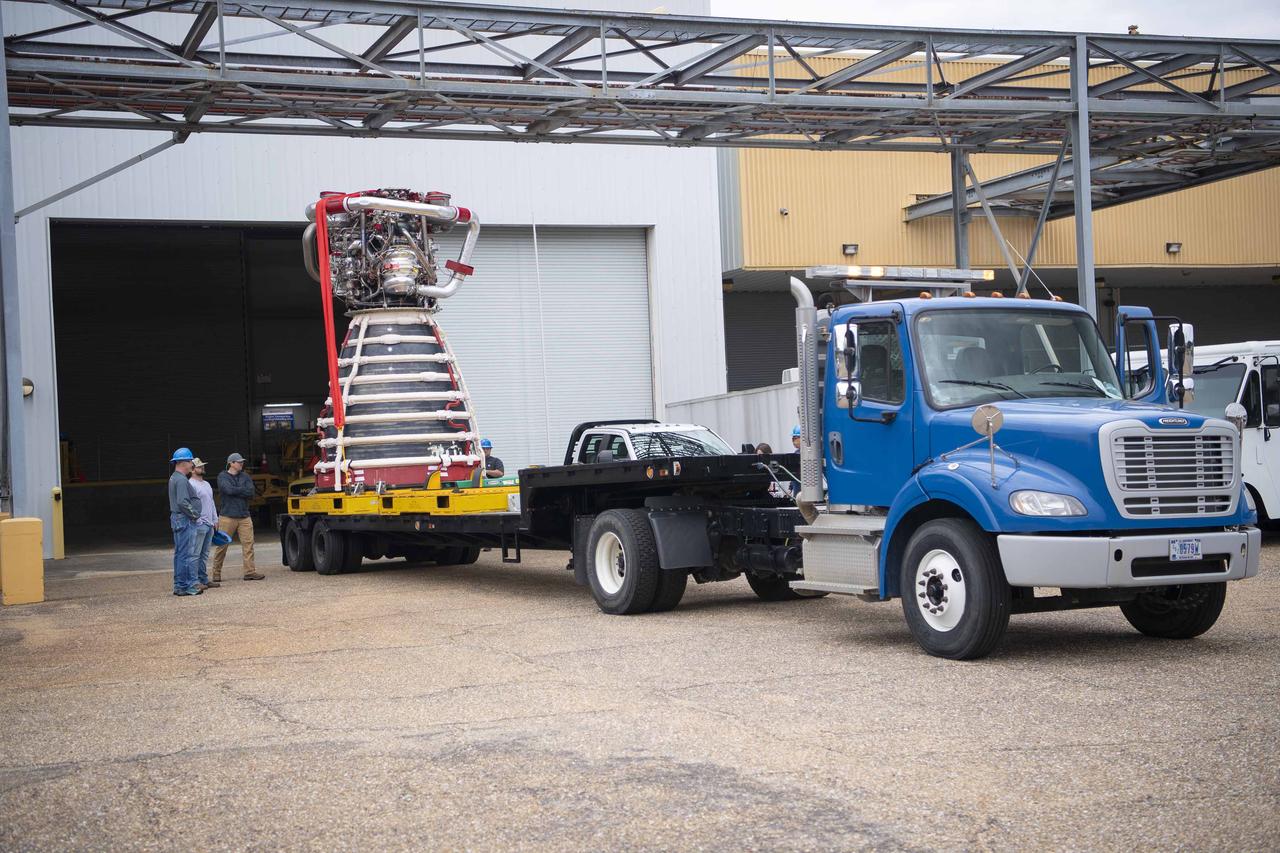
Teams at NASA’s Stennis Space Center deliver, lift, and install the first new production RS-25 engine on the Fred Haise Test Stand on Feb. 18.

Teams at NASA’s Stennis Space Center deliver, lift, and install the first new production RS-25 engine on the Fred Haise Test Stand on Feb. 18.
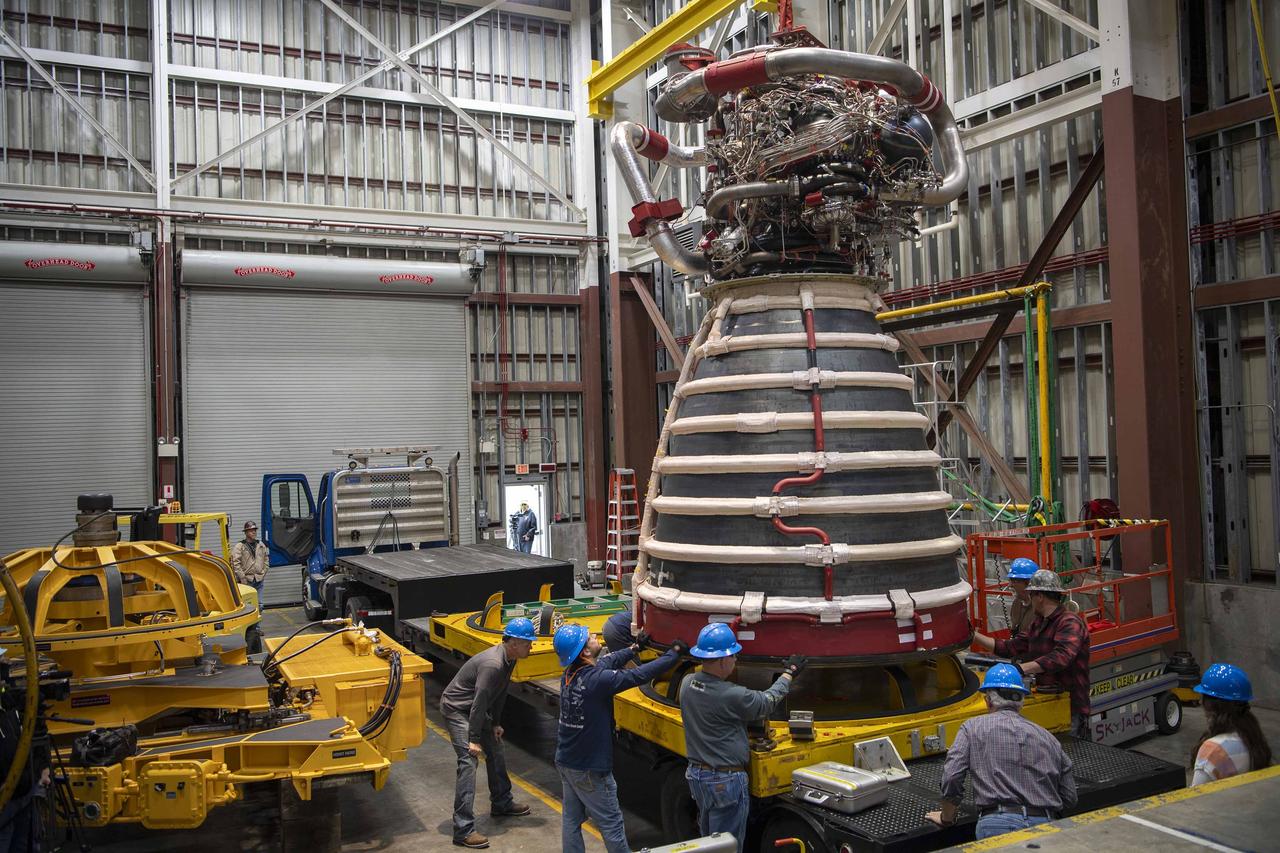
Teams at NASA’s Stennis Space Center deliver, lift, and install the first new production RS-25 engine on the Fred Haise Test Stand on Feb. 18.
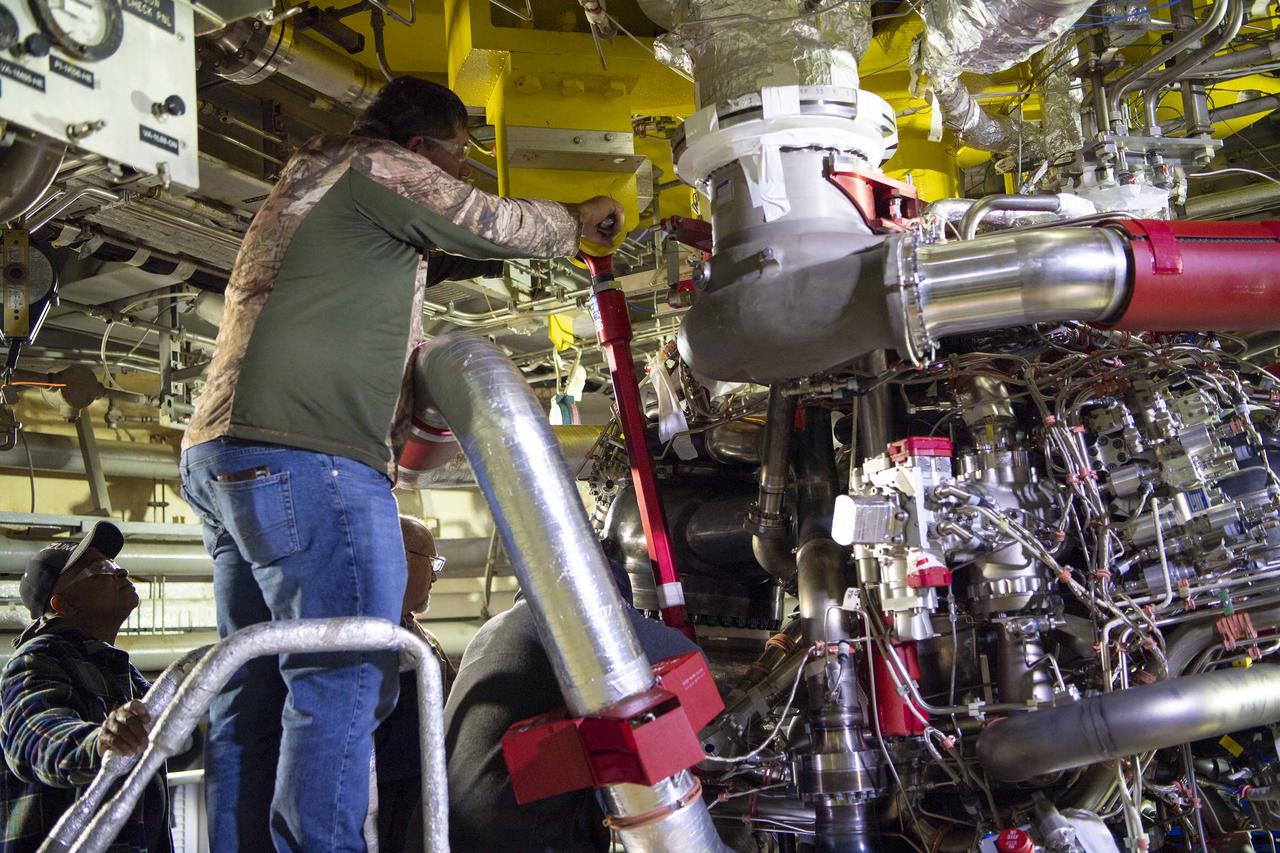
Teams at NASA’s Stennis Space Center deliver, lift, and install the first new production RS-25 engine on the Fred Haise Test Stand on Feb. 18.
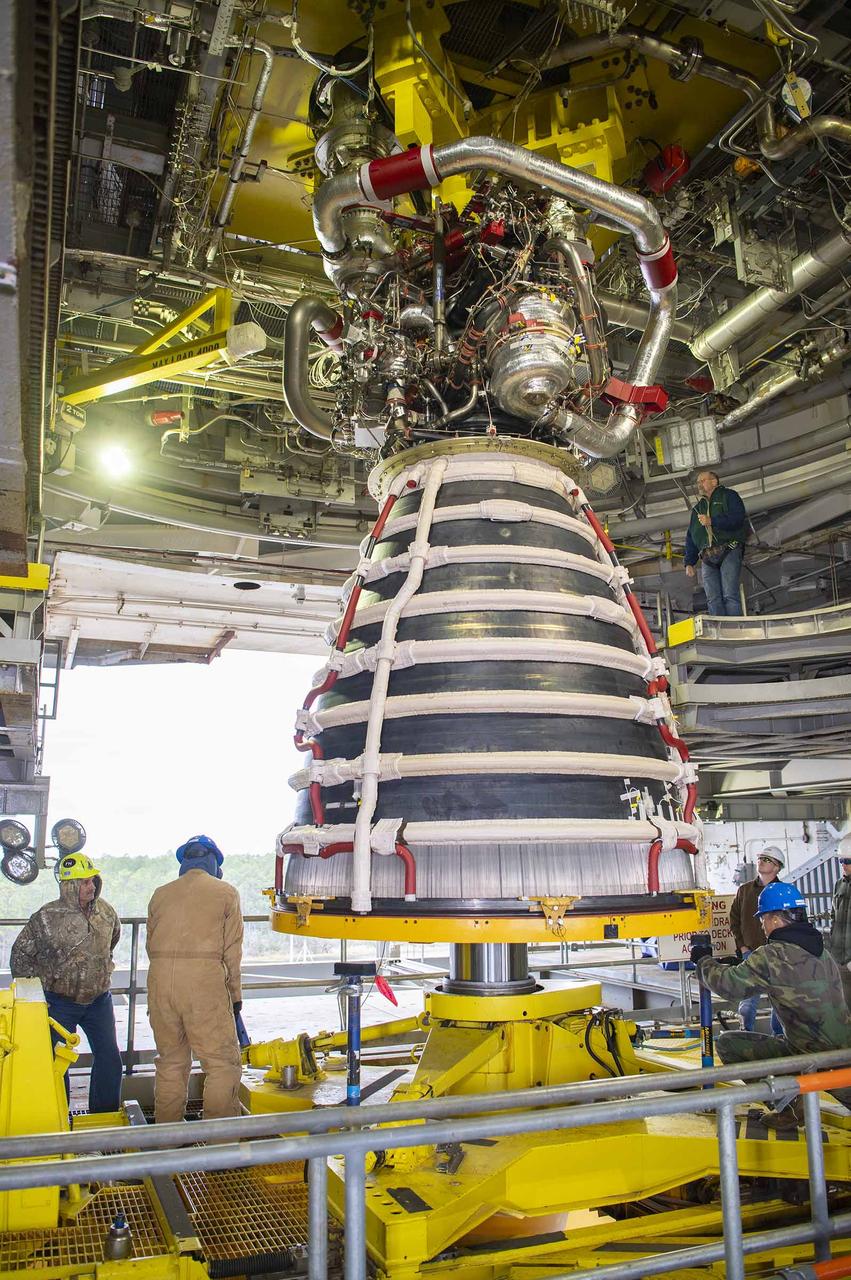
Teams at NASA’s Stennis Space Center deliver, lift, and install the first new production RS-25 engine on the Fred Haise Test Stand on Feb. 18.
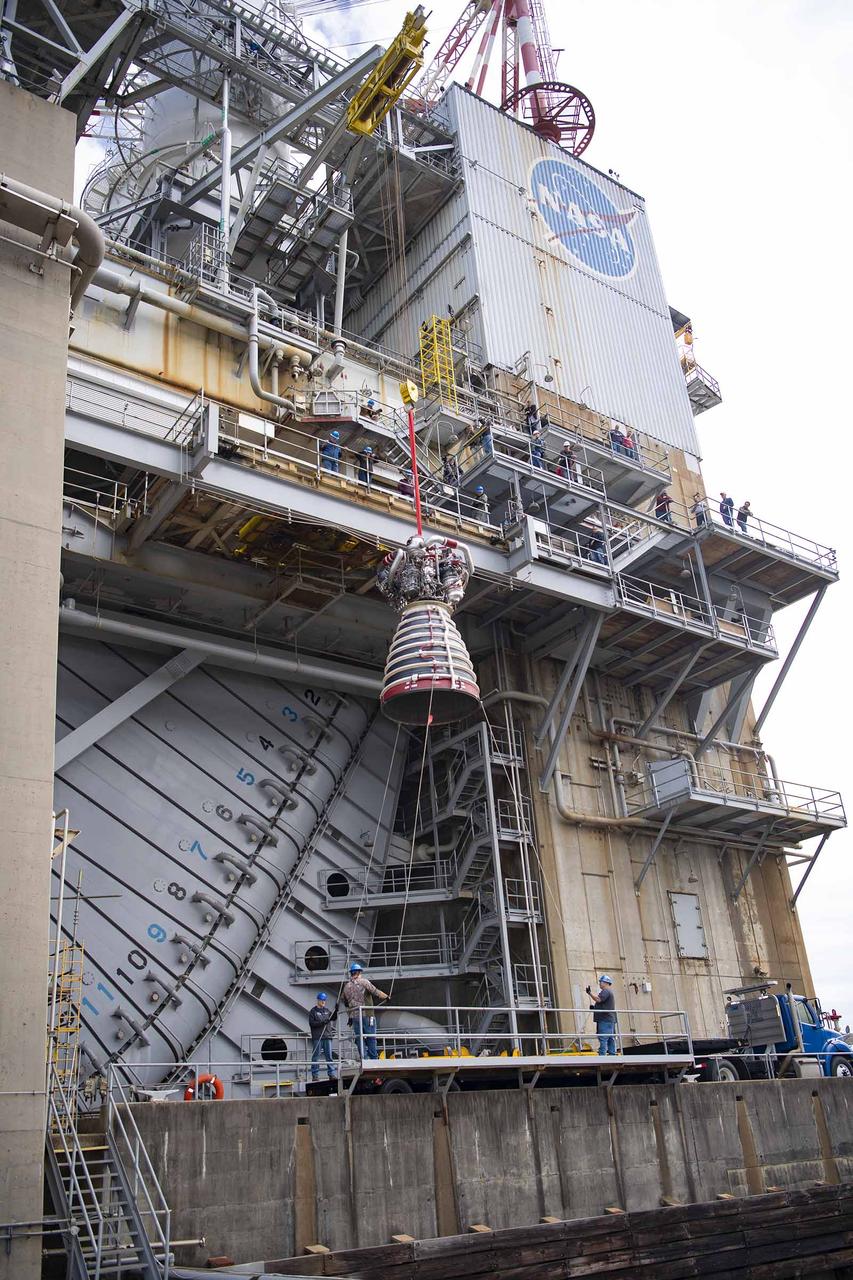
Teams at NASA’s Stennis Space Center deliver, lift, and install the first new production RS-25 engine on the Fred Haise Test Stand on Feb. 18.

Teams at NASA’s Stennis Space Center deliver, lift, and install the first new production RS-25 engine on the Fred Haise Test Stand on Feb. 18.
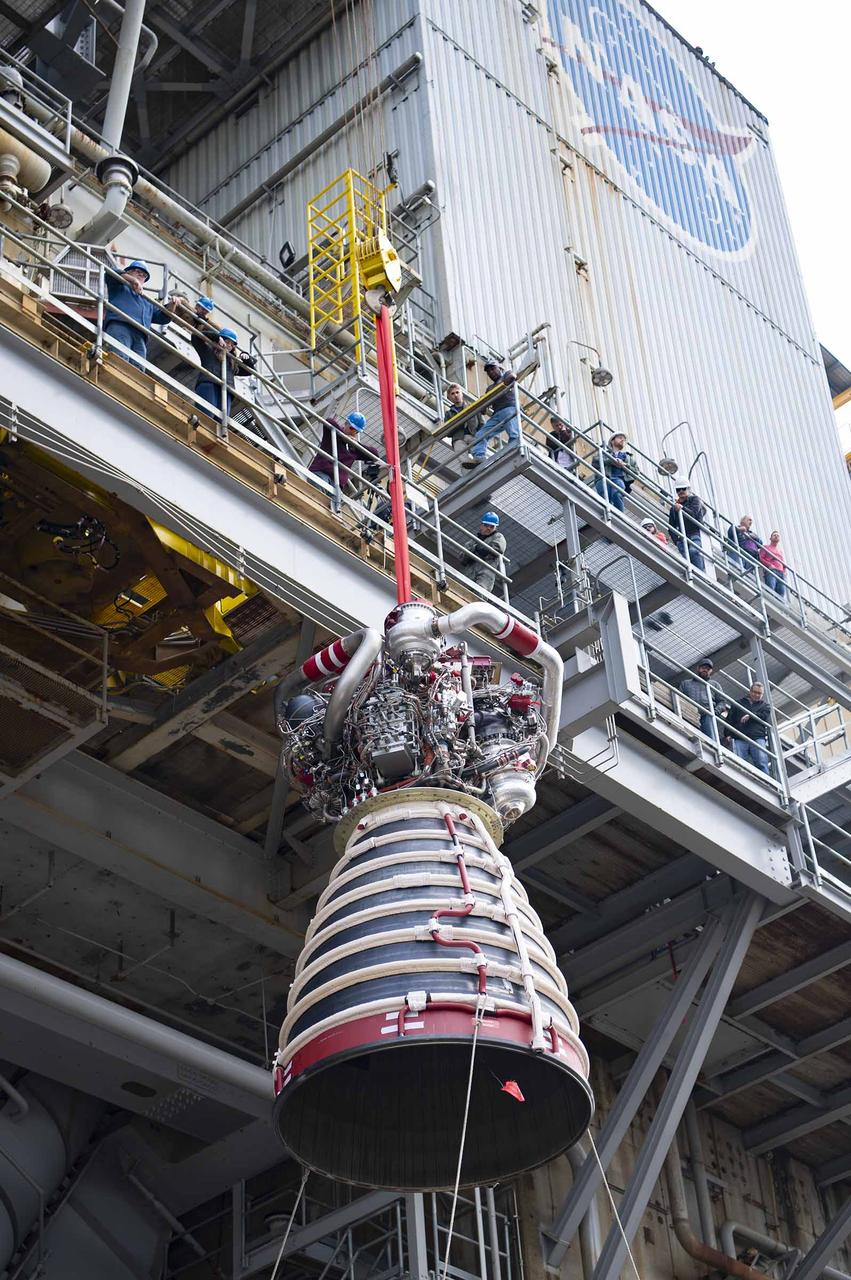
Teams at NASA’s Stennis Space Center deliver, lift, and install the first new production RS-25 engine on the Fred Haise Test Stand on Feb. 18.
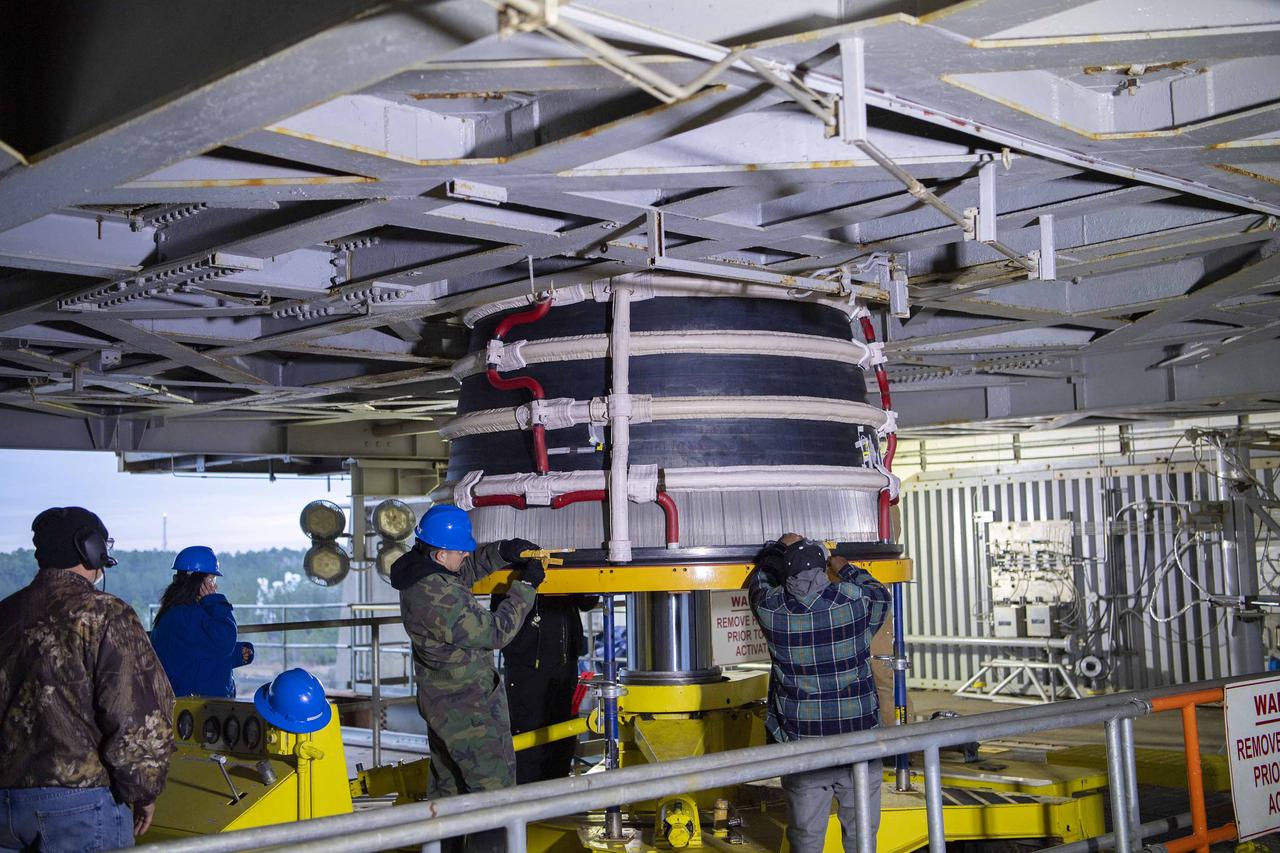
Teams at NASA’s Stennis Space Center deliver, lift, and install the first new production RS-25 engine on the Fred Haise Test Stand on Feb. 18.

Teams at NASA’s Stennis Space Center deliver, lift, and install the first new production RS-25 engine on the Fred Haise Test Stand on Feb. 18.
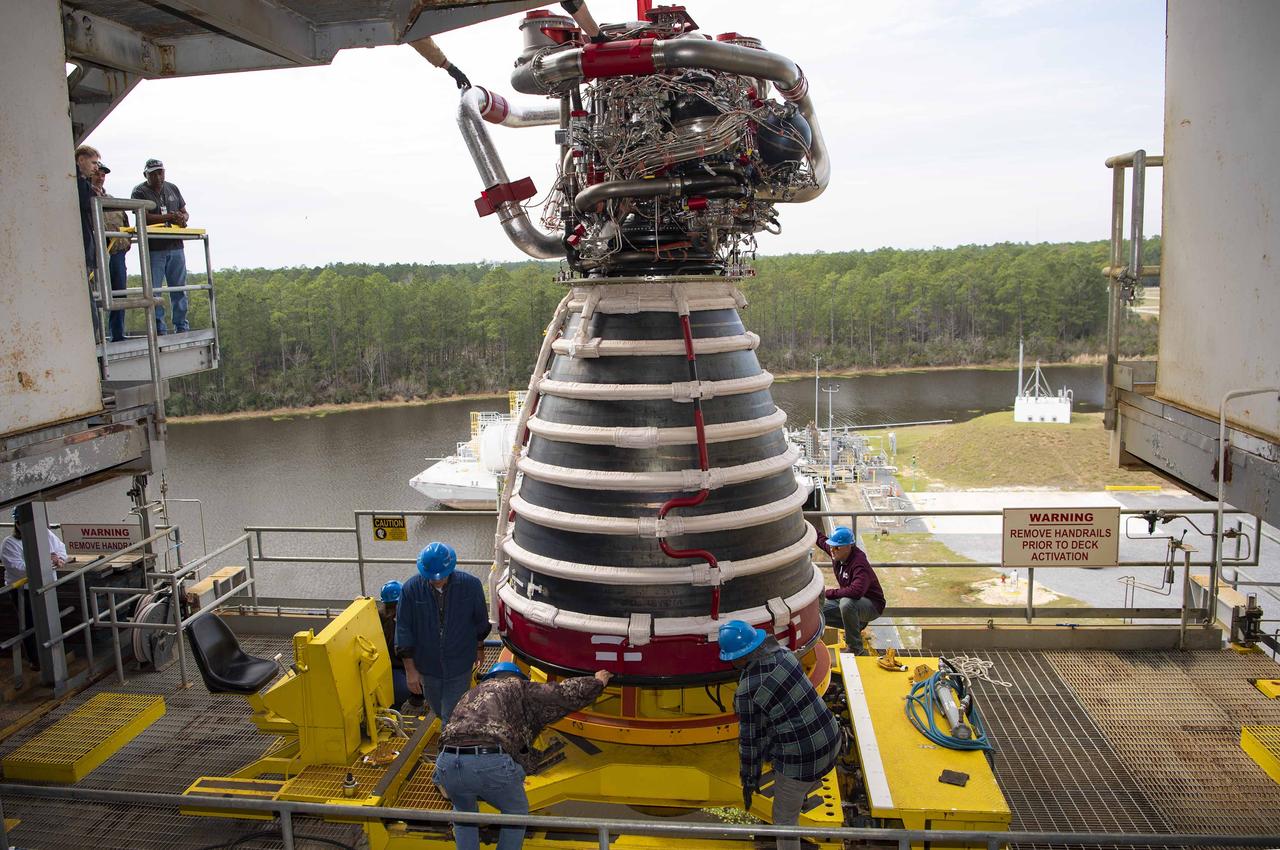
Teams at NASA’s Stennis Space Center deliver, lift, and install the first new production RS-25 engine on the Fred Haise Test Stand on Feb. 18.
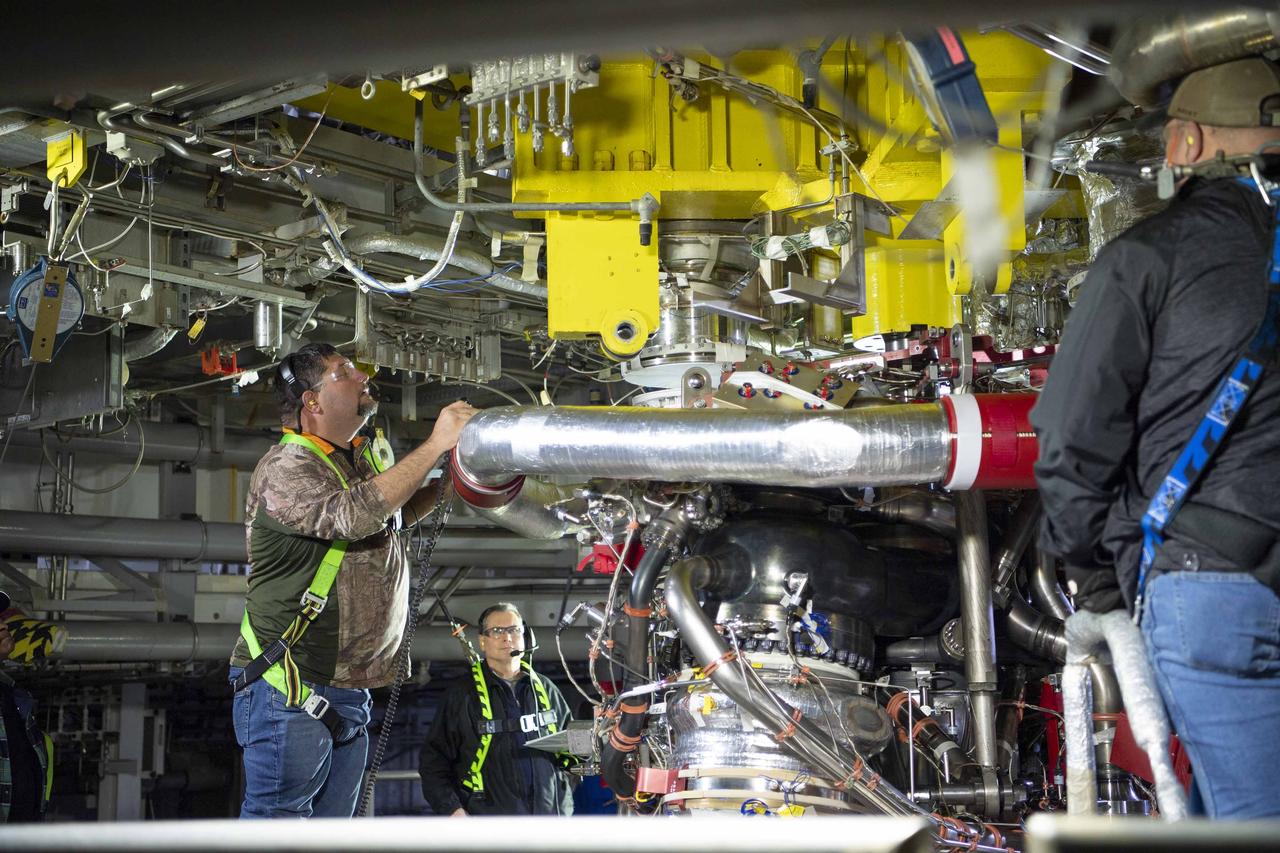
Teams at NASA’s Stennis Space Center deliver, lift, and install the first new production RS-25 engine on the Fred Haise Test Stand on Feb. 18.
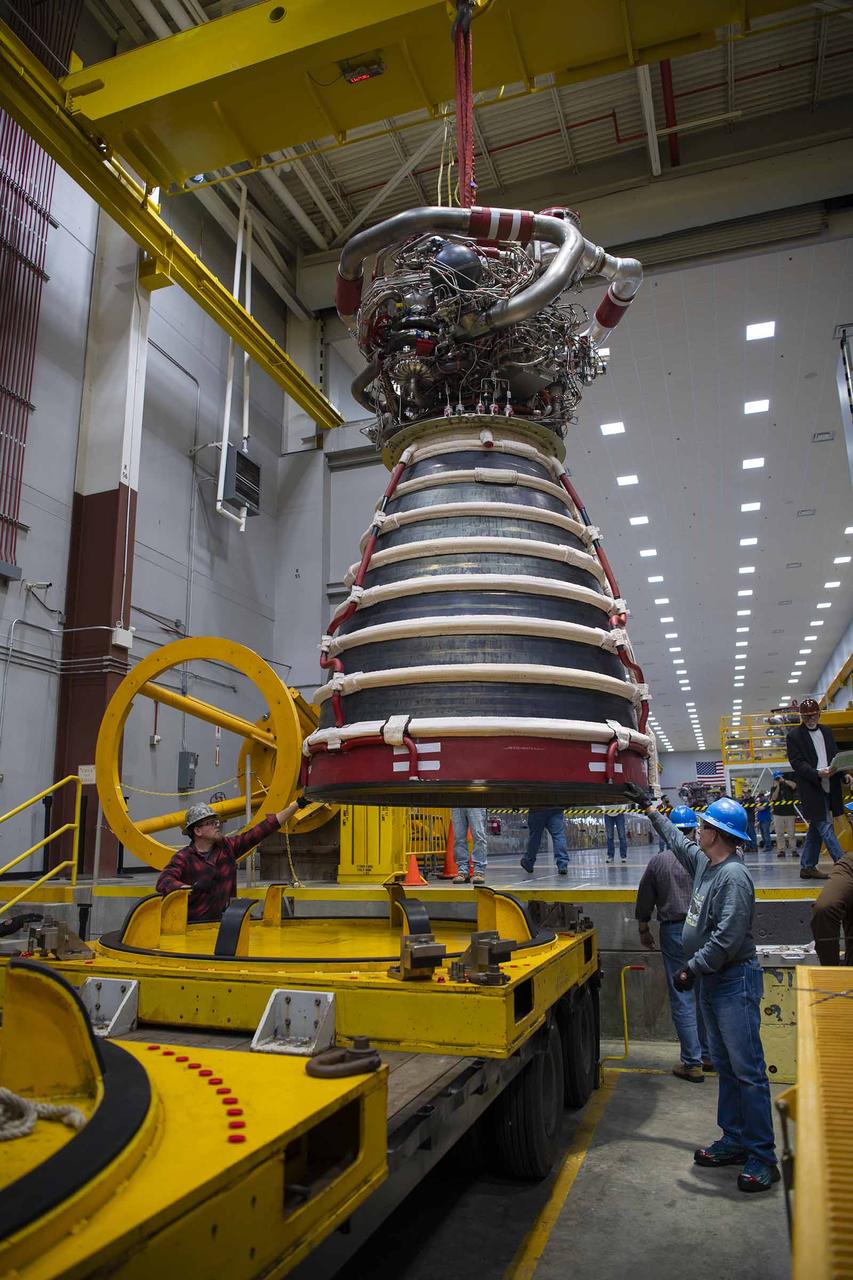
Teams at NASA’s Stennis Space Center deliver, lift, and install the first new production RS-25 engine on the Fred Haise Test Stand on Feb. 18.
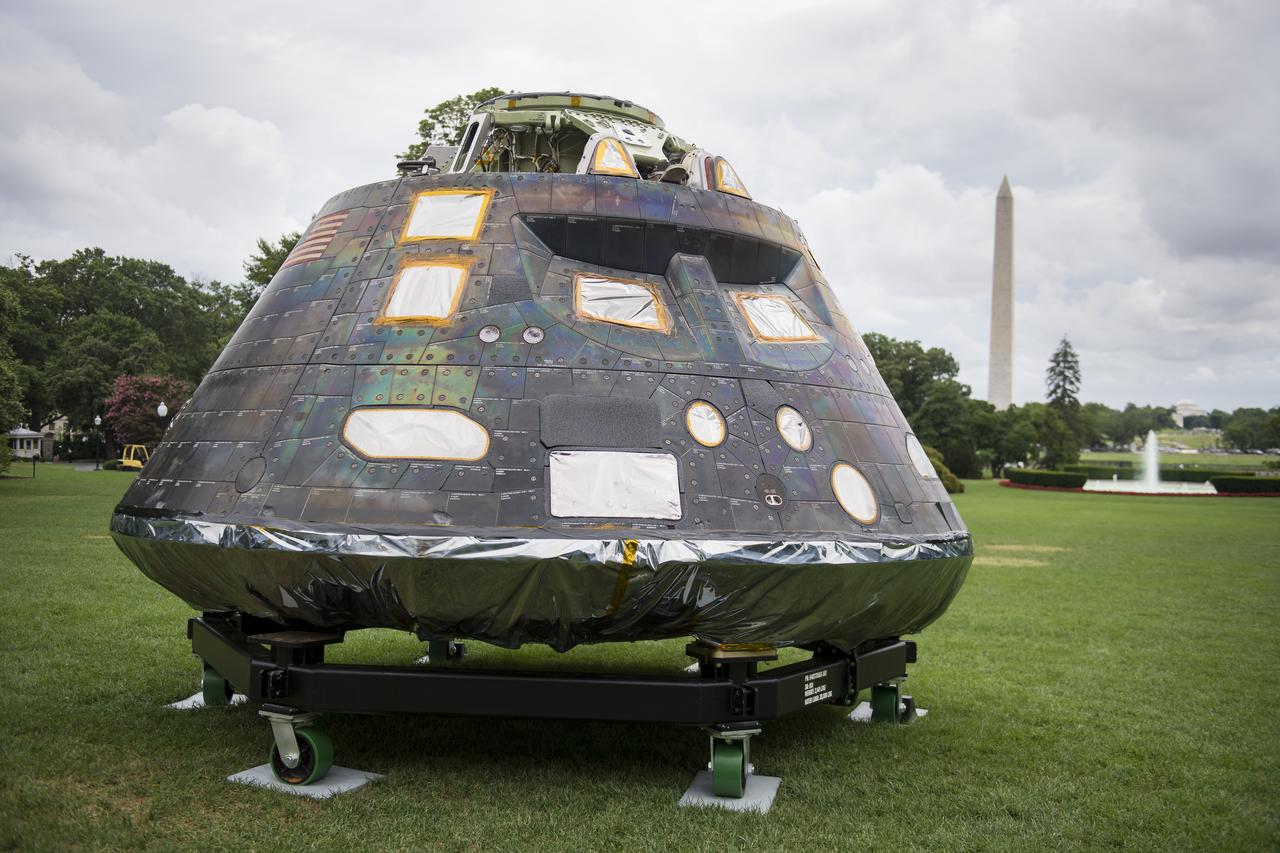
NASA's Orion spacecraft that flew on Exploration Flight Test-1 on Dec. 5, 2014, is seen on the south lawn of the White House during a Made in America Product Showcase, Monday, July 23, 2018 in Washington. Lockheed Martin, NASA’s prime contractor for Orion, began manufacturing the Orion crew module in 2011 and delivered it in July 2012 to NASA's Kennedy Space Center where final assembly, integration and testing was completed. More than 1,000 companies across the country manufactured or contributed elements to the spacecraft. Photo Credit: (NASA/Aubrey Gemignani)

NASA's Orion spacecraft that flew on Exploration Flight Test-1 on Dec. 5, 2014, is seen on the south lawn of the White House during a Made in America Product Showcase, Monday, July 23, 2018 in Washington. Lockheed Martin, NASA’s prime contractor for Orion, began manufacturing the Orion crew module in 2011 and delivered it in July 2012 to NASA's Kennedy Space Center where final assembly, integration and testing was completed. More than 1,000 companies across the country manufactured or contributed elements to the spacecraft. Photo Credit: (NASA/Aubrey Gemignani)

President Donald Trump tours a bus during the Made in America Product Showcase at the White House, Monday, July 23, 2018 in Washington. The Orion crew module that launched on Dec. 5, 2014 on the Exploration Flight Test-1 was also on display during the event. Lockheed Martin, NASA’s prime contractor for Orion, began manufacturing the Orion crew module in 2011 and delivered it in July 2012 to NASA's Kennedy Space Center where final assembly, integration and testing was completed. More than 1,000 companies across the country manufactured or contributed elements to the spacecraft. Photo Credit: (NASA/Aubrey Gemignani)
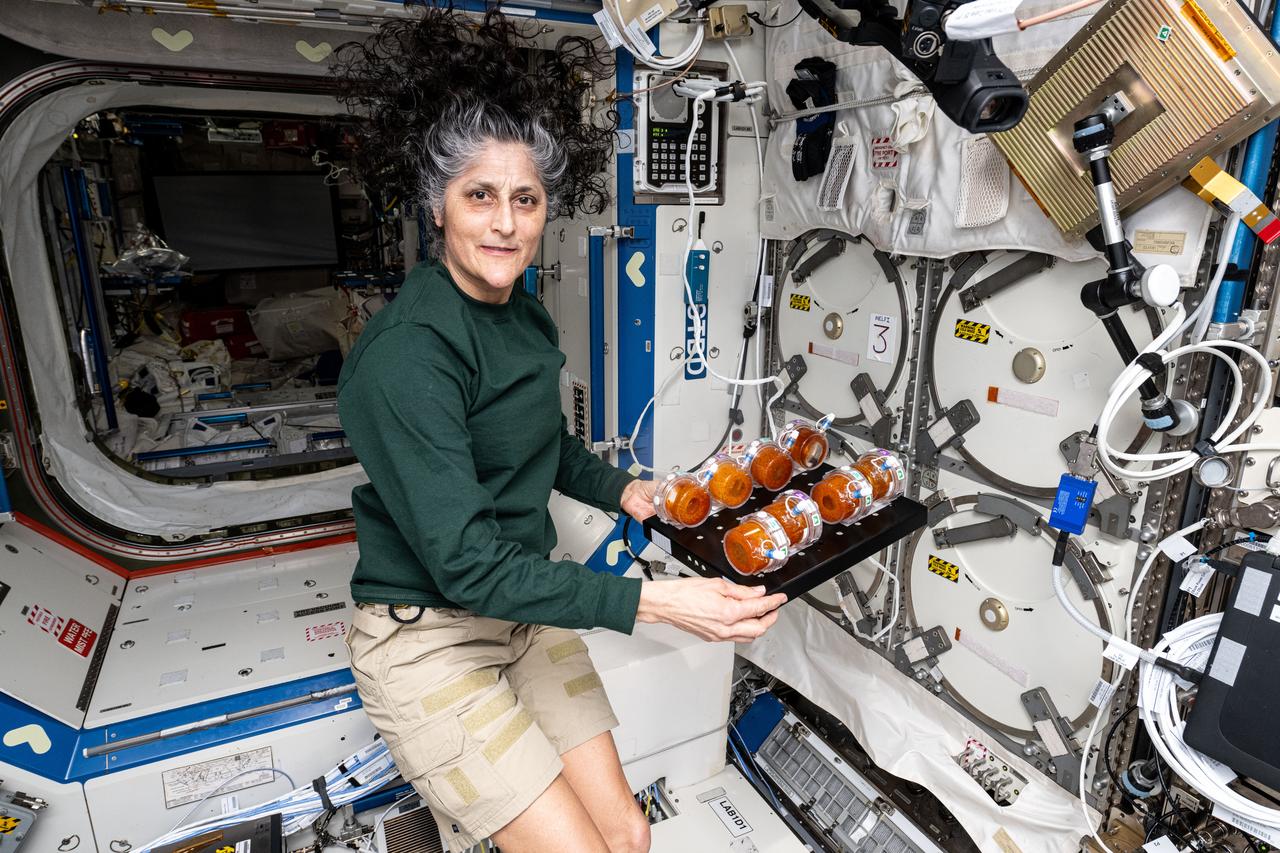
iss072e616432 (Feb. 11, 2025) --- NASA astronaut and Expedition 72 Commander Suni Williams displays production packs containing geneticallly engineered yeast and edible media for incubation to activate yeast growth. The BioNutrients investigation explores using the engineered yeast to produce on-demand nutrients and avoid vitamin deficiencies for crews on long-term missions. The samples are later frozen then returned to Earth to analyze their ability promote crew health and improve the preservation of probiotics.

iss074e0603632 (May 16, 2026) --- Industrial-scale farming and oil production exist side-by-side and compete for land and water resources in western Texas. The crop circles are center-pivot irrigation systems used to cultivate cotton, sorghum, wheat, hay, and corn. The grid set against the circular farms is a dense network of well sites, pipelines, and roads that support the petroleum infrastructure. The International Space Station was orbiting 259 miles above the Texas–Oklahoma border at the time of this photograph. Credit: NASA
Teams at NASA’s Michoud Assembly Facility in New Orleans move a liquid hydrogen tank for the agency’s SLS (Space Launch System) rocket into the factory’s vertical assembly building on Sep. 26, 2025. The tank, which is designated for the agency’s Artemis III mission, is lifted and loaded into a production cell where it will be mated with the LH2 Transport Adapter Assembly for future transportation to NASA’s Kennedy Space Center. The engine section flight hardware structure was completed in 2022 and was shipped to Kennedy where teams continue to integrate vital systems. The propellant tank is one of five major elements that make up the 212-foot-tall rocket stage. The core stage, along with its four RS-25 engines, produce more than two million pounds of thrust to help launch NASA’s Orion spacecraft, astronauts, and supplies beyond Earth’s orbit and to the lunar surface for Artemis. Image credit: NASA/Michael DeMocker
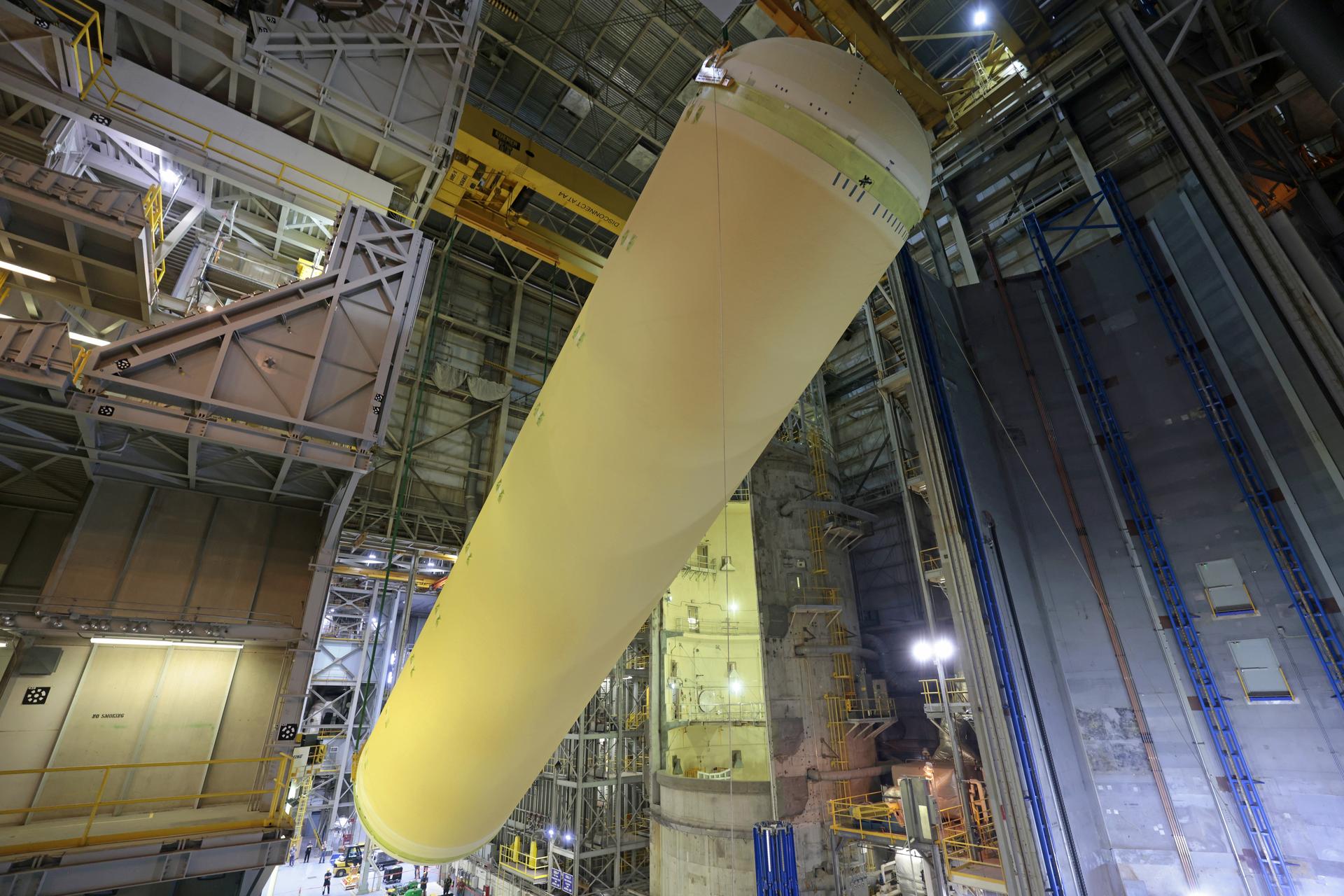
Teams at NASA’s Michoud Assembly Facility in New Orleans move a liquid hydrogen tank for the agency’s SLS (Space Launch System) rocket inside the factory’s vertical assembly building on Sep. 28, 2025. The tank, which is designated for the agency’s Artemis III mission, is being lifted and loaded into a production cell where it will be mated with the LH2 Transport Adapter Assembly for future transportation to NASA’s Kennedy Space Center. The engine section flight hardware structure was completed in 2022 and was shipped to Kennedy where teams continue to integrate vital systems. The propellant tank is one of five major elements that make up the 212-foot-tall rocket stage. The core stage, along with its four RS-25 engines, produce more than two million pounds of thrust to help launch NASA’s Orion spacecraft, astronauts, and supplies beyond Earth’s orbit and to the lunar surface for Artemis. Image credit: NASA/Michael DeMocker
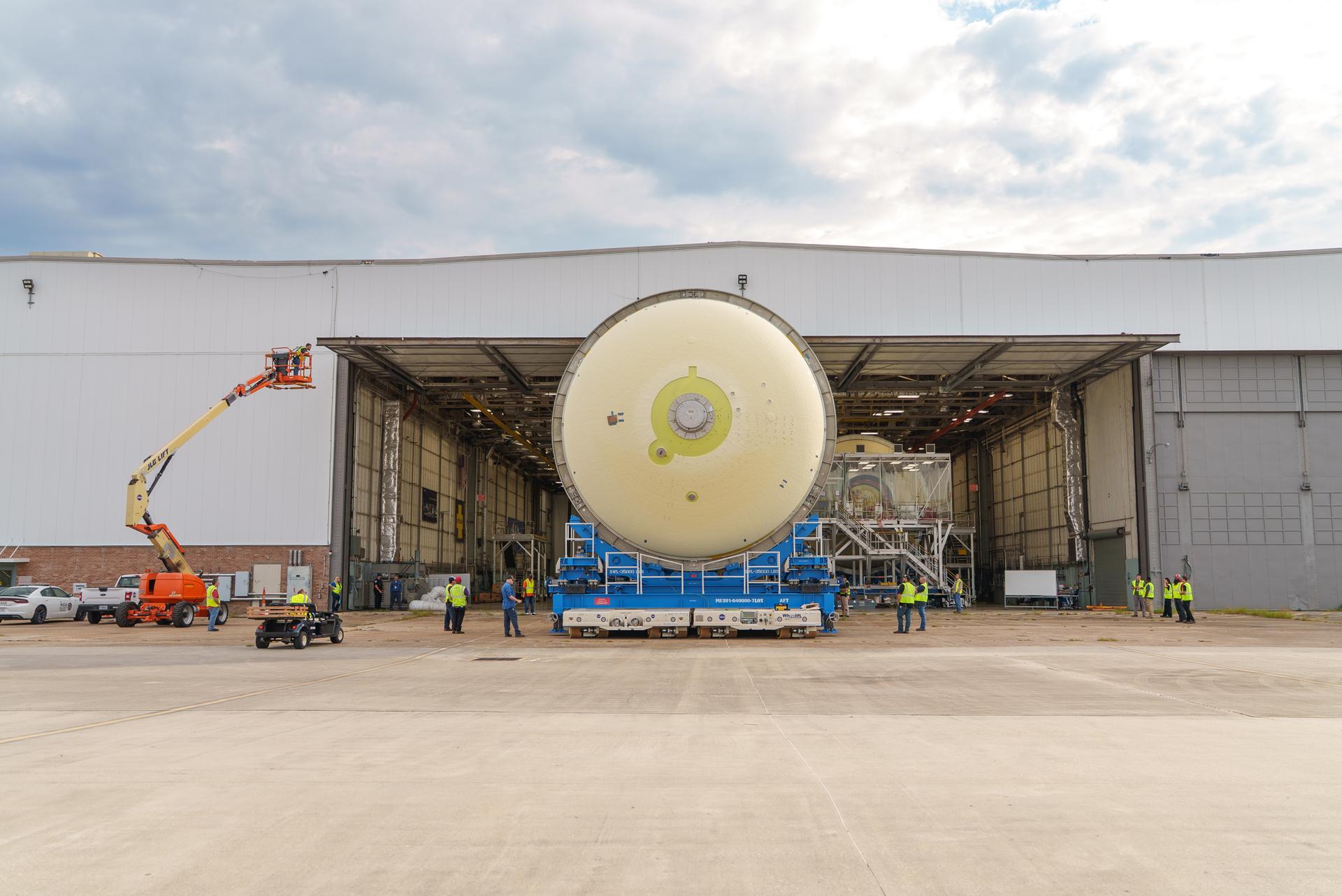
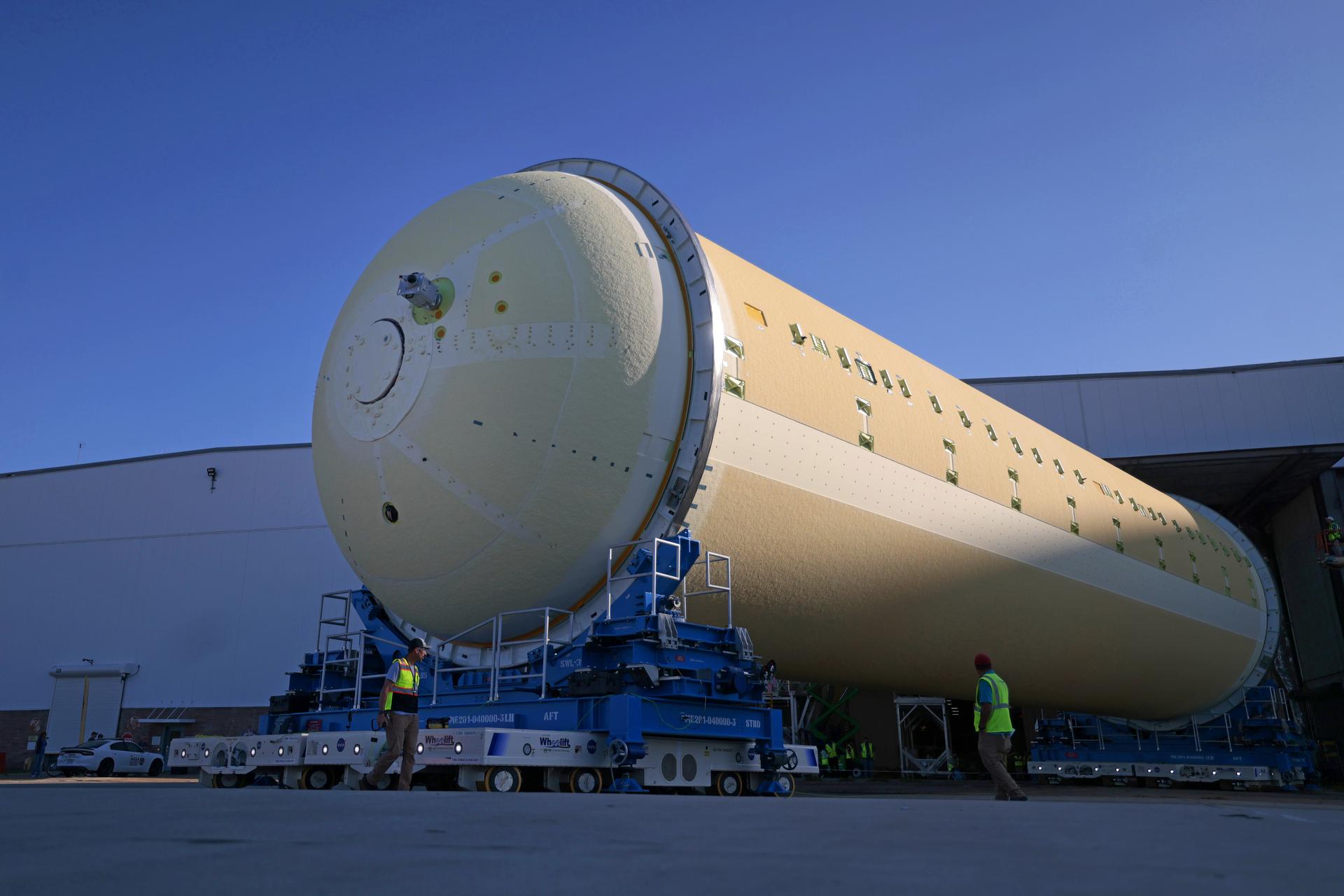
Move crews at NASA’s Michoud Assembly Facility in New Orleans move the liquid oxygen tank into final assembly production area on Aug. 27, 2025. There, it will undergo integration of the forward dome by SLS (Space Launch System) prime contractor, Boeing. Eventually, the liquid oxygen tank will be moved back to the high bay where it will be mated with the intertank and forward skirt to complete the forward join of the Artemis III core stage. The propellant tank is one of five major elements that make up the 212-foot-tall rocket stage. The core stage, along with its four RS-25 engines, produce more than two million pounds of thrust to help launch NASA’s Orion spacecraft, astronauts, and supplies beyond Earth’s orbit and to the lunar surface for Artemis.
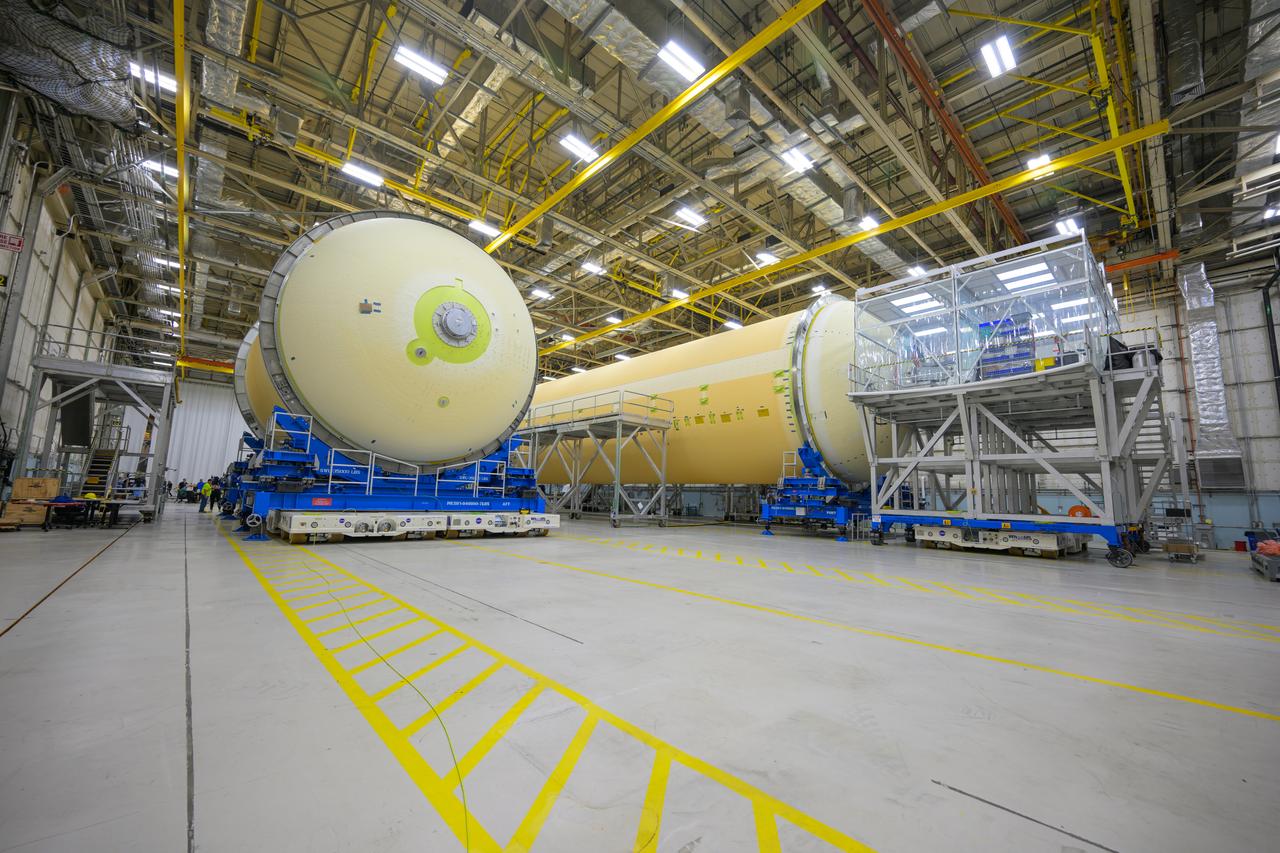
Move crews at NASA’s Michoud Assembly Facility in New Orleans move the liquid oxygen tank into final assembly production area on Aug. 27, 2025. There, it will undergo integration of the forward dome by SLS (Space Launch System) prime contractor,Boeing. Eventually, the liquid oxygen tank will be moved back to the high bay where it will be mated with the intertank and forward skirt to complete the forward join of the Artemis III core stage. The propellant tank is one of five major elements that make up the 212-foot-tall rocket stage. The core stage, along with its four RS-25 engines, produce more than two million pounds of thrust to help launch NASA’s Orion spacecraft, astronauts, and supplies beyond Earth’s orbit and to the lunar surface for Artemis.

Move crews at NASA’s Michoud Assembly Facility in New Orleans move a liquid oxygen tank out of the facility’s vertical assembly building on Aug. 27, 2025. Using self-propelled mobile transporters teams transferred the tank to the final assembly production area. There, it will undergo integration of the forward dome by SLS (Space Launch System) prime contractor, Boeing. Eventually, the liquid oxygen tank will be moved back to the high bay where it will be mated with the intertank and forward skirt to complete the forward join of the Artemis III core stage. The propellant tank is one of five major elements that make up the 212-foot-tall rocket stage. The core stage, along with its four RS-25 engines, produce more than two million pounds of thrust to help launch NASA’s Orion spacecraft, astronauts, and supplies beyond Earth’s orbit and to the lunar surface for Artemis.
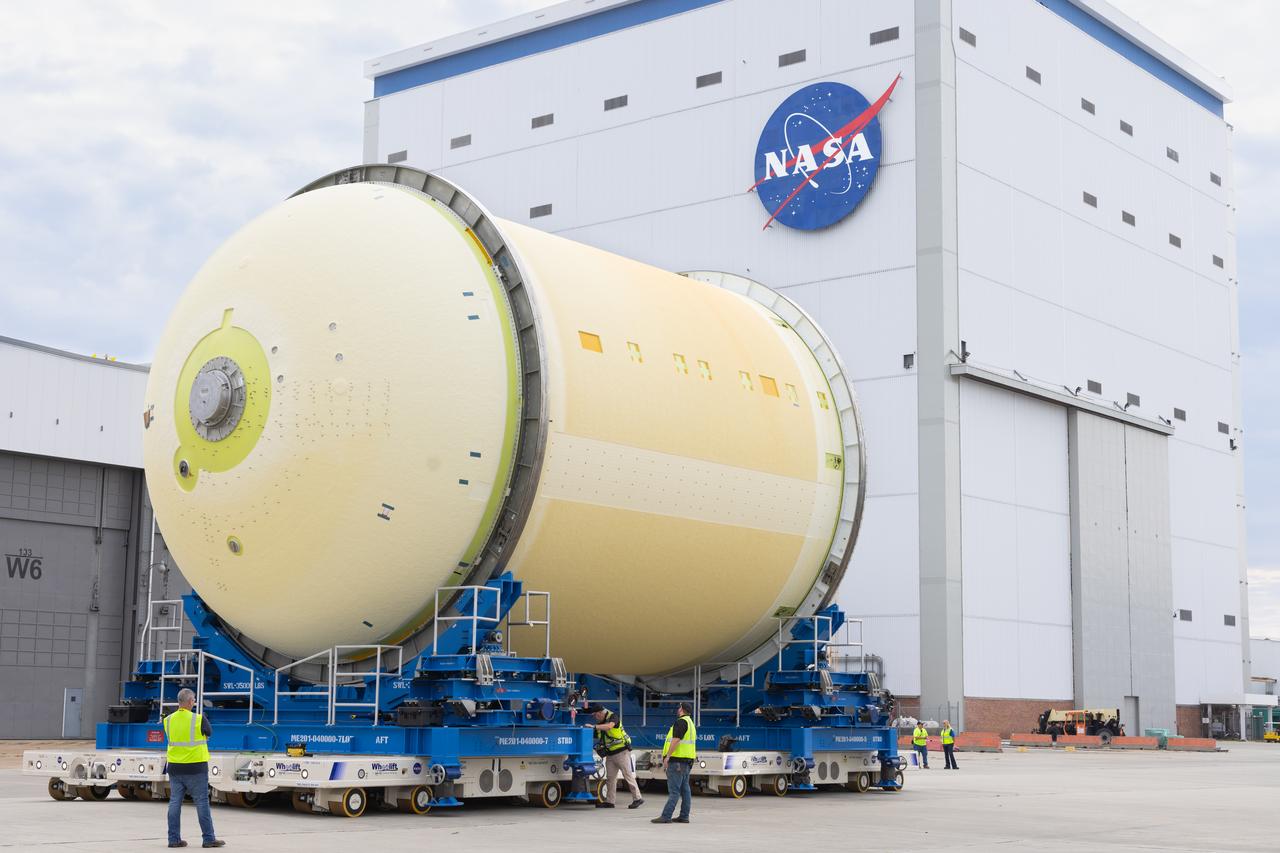
Move crews at NASA’s Michoud Assembly Facility in New Orleans move a liquid oxygen tank out of the facility’s vertical assembly building on Aug. 27, 2025. Using self-propelled mobile transporters teams transferred the tank to the final assembly production area. There, it will undergo integration of the forward dome by SLS (Space Launch System) prime contractor, Boeing. Eventually, the liquid oxygen tank will be moved back to the high bay where it will be mated with the intertank and forward skirt to complete the forward join of the Artemis III core stage. The propellant tank is one of five major elements that make up the 212-foot-tall rocket stage. The core stage, along with its four RS-25 engines, produce more than two million pounds of thrust to help launch NASA’s Orion spacecraft, astronauts, and supplies beyond Earth’s orbit and to the lunar surface for Artemis.

Move crews at NASA’s Michoud Assembly Facility in New Orleans move a liquid oxygen tank out of the facility’s vertical assembly building on Aug. 27, 2025. Using self-propelled mobile transporters teams transferred the tank to the final assembly production area. There, it will undergo integration of the forward dome by SLS (Space Launch System) prime contractor, Boeing. Eventually, the liquid oxygen tank will be moved back to the high bay where it will be mated with the intertank and forward skirt to complete the forward join of the Artemis III core stage. The propellant tank is one of five major elements that make up the 212-foot-tall rocket stage. The core stage, along with its four RS-25 engines, produce more than two million pounds of thrust to help launch NASA’s Orion spacecraft, astronauts, and supplies beyond Earth’s orbit and to the lunar surface for Artemis.
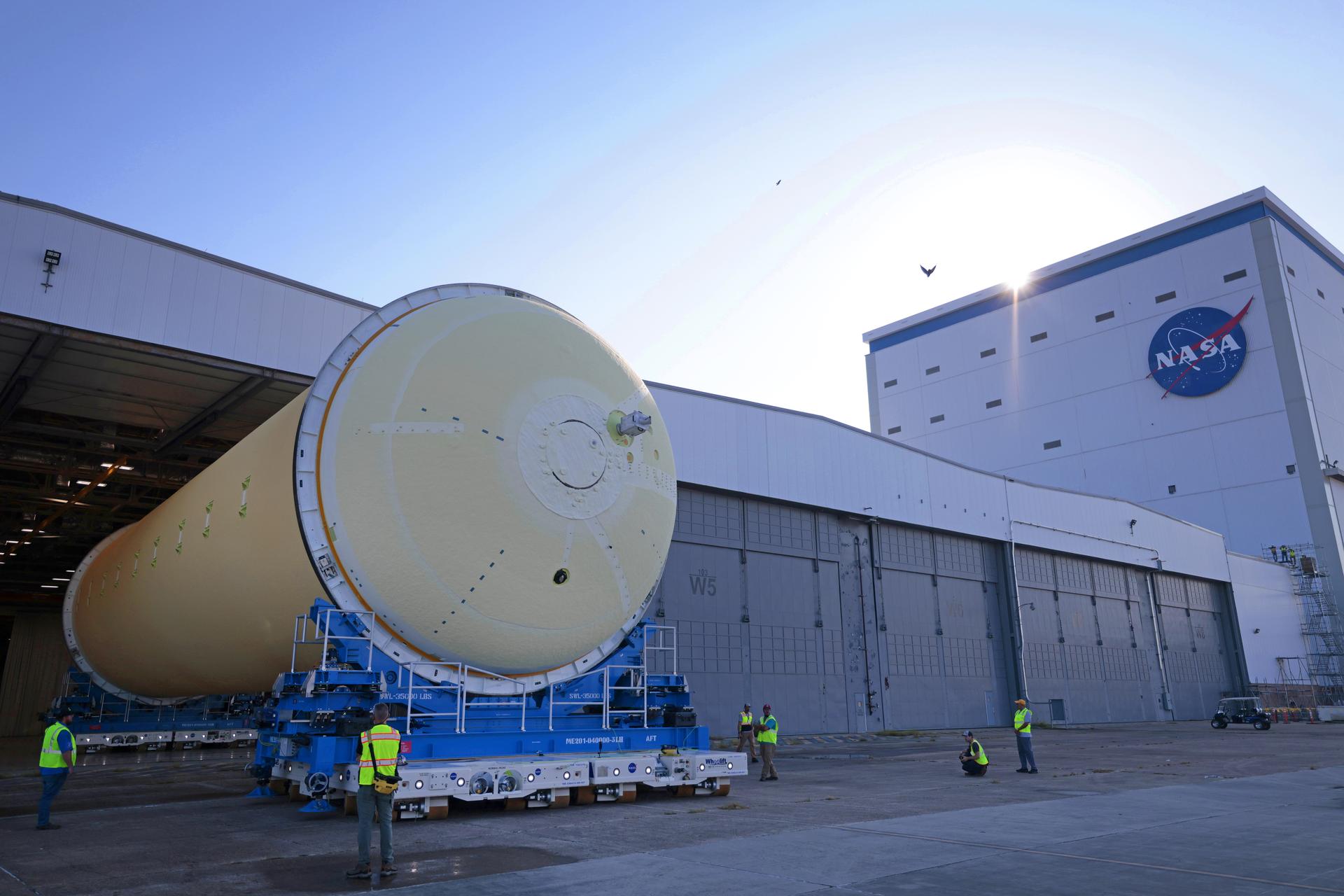
Teams at NASA’s Michoud Assembly Facility in New Orleans move a liquid hydrogen tank for the agency’s SLS (Space Launch System) rocket into the factory’s vertical assembly building on Sep. 26, 2025. The tank, which is designated for the agency’s Artemis III mission, is lifted and loaded into a production cell where it will be mated with the LH2 Transport Adapter Assembly for future transportation to NASA’s Kennedy Space Center. The engine section flight hardware structure was completed in 2022 and was shipped to Kennedy where teams continue to integrate vital systems. The propellant tank is one of five major elements that make up the 212-foot-tall rocket stage. The core stage, along with its four RS-25 engines, produce more than two million pounds of thrust to help launch NASA’s Orion spacecraft, astronauts, and supplies beyond Earth’s orbit and to the lunar surface for Artemis. Image credit: NASA/Michael DeMocker
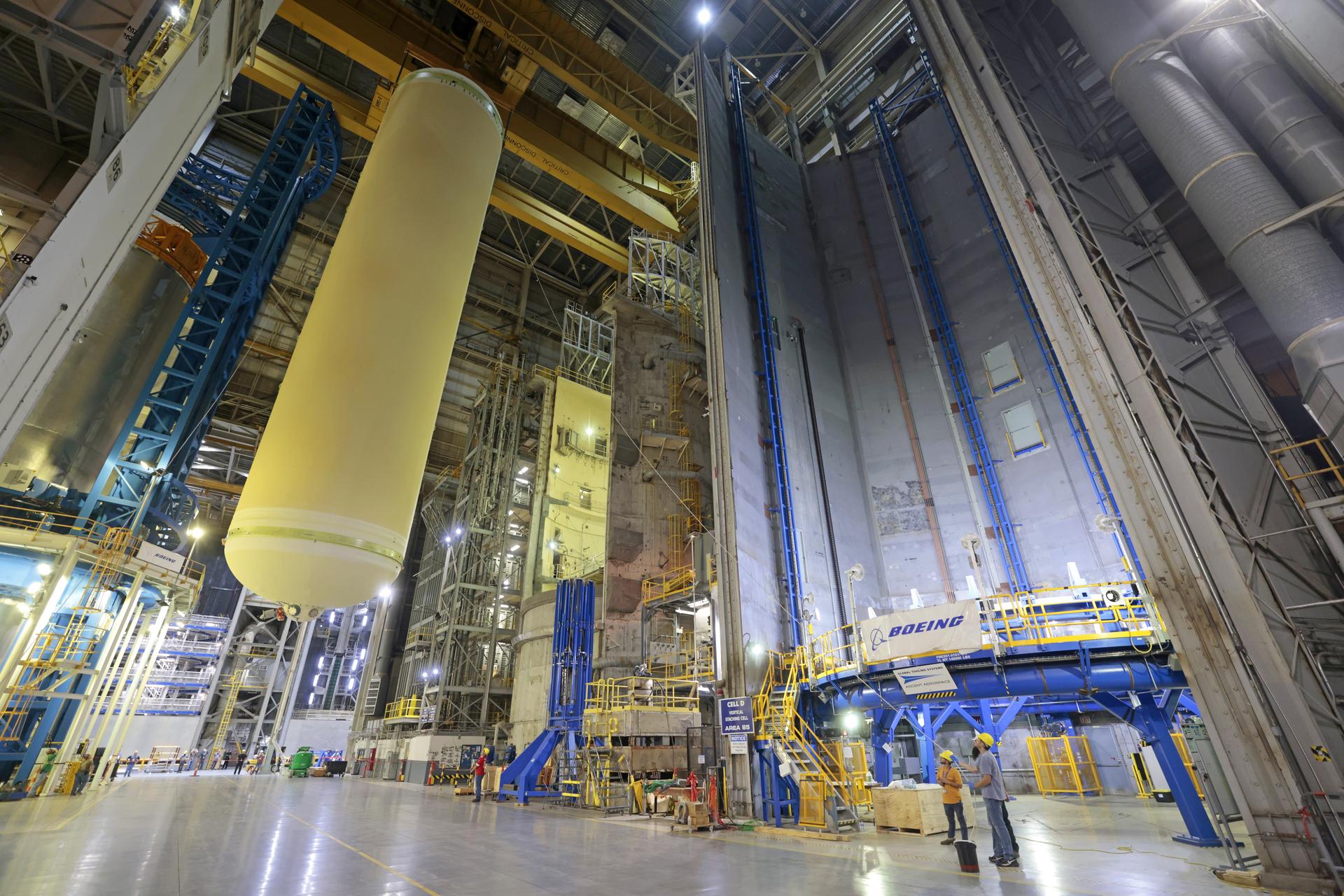
Teams at NASA’s Michoud Assembly Facility in New Orleans move a liquid hydrogen tank for the agency’s SLS (Space Launch System) rocket inside the factory’s vertical assembly building on Sep. 28, 2025. The tank, which is designated for the agency’s Artemis III mission, is being lifted and loaded into a production cell where it will be mated with the LH2 Transport Adapter Assembly for future transportation to NASA’s Kennedy Space Center. The engine section flight hardware structure was completed in 2022 and was shipped to Kennedy where teams continue to integrate vital systems. The propellant tank is one of five major elements that make up the 212-foot-tall rocket stage. The core stage, along with its four RS-25 engines, produce more than two million pounds of thrust to help launch NASA’s Orion spacecraft, astronauts, and supplies beyond Earth’s orbit and to the lunar surface for Artemis. Image credit: NASA/Michael DeMocker

Move crews at NASA’s Michoud Assembly Facility in New Orleans move a liquid oxygen tank out of the facility’s vertical assembly building on Aug. 27, 2025. Using self-propelled mobile transporters teams transferred the tank to the final assembly production area. There, it will undergo integration of the forward dome by SLS (Space Launch System) prime contractor, Boeing. Eventually, the liquid oxygen tank will be moved back to the high bay where it will be mated with the intertank and forward skirt to complete the forward join of the Artemis III core stage. The propellant tank is one of five major elements that make up the 212-foot-tall rocket stage. The core stage, along with its four RS-25 engines, produce more than two million pounds of thrust to help launch NASA’s Orion spacecraft, astronauts, and supplies beyond Earth’s orbit and to the lunar surface for Artemis.
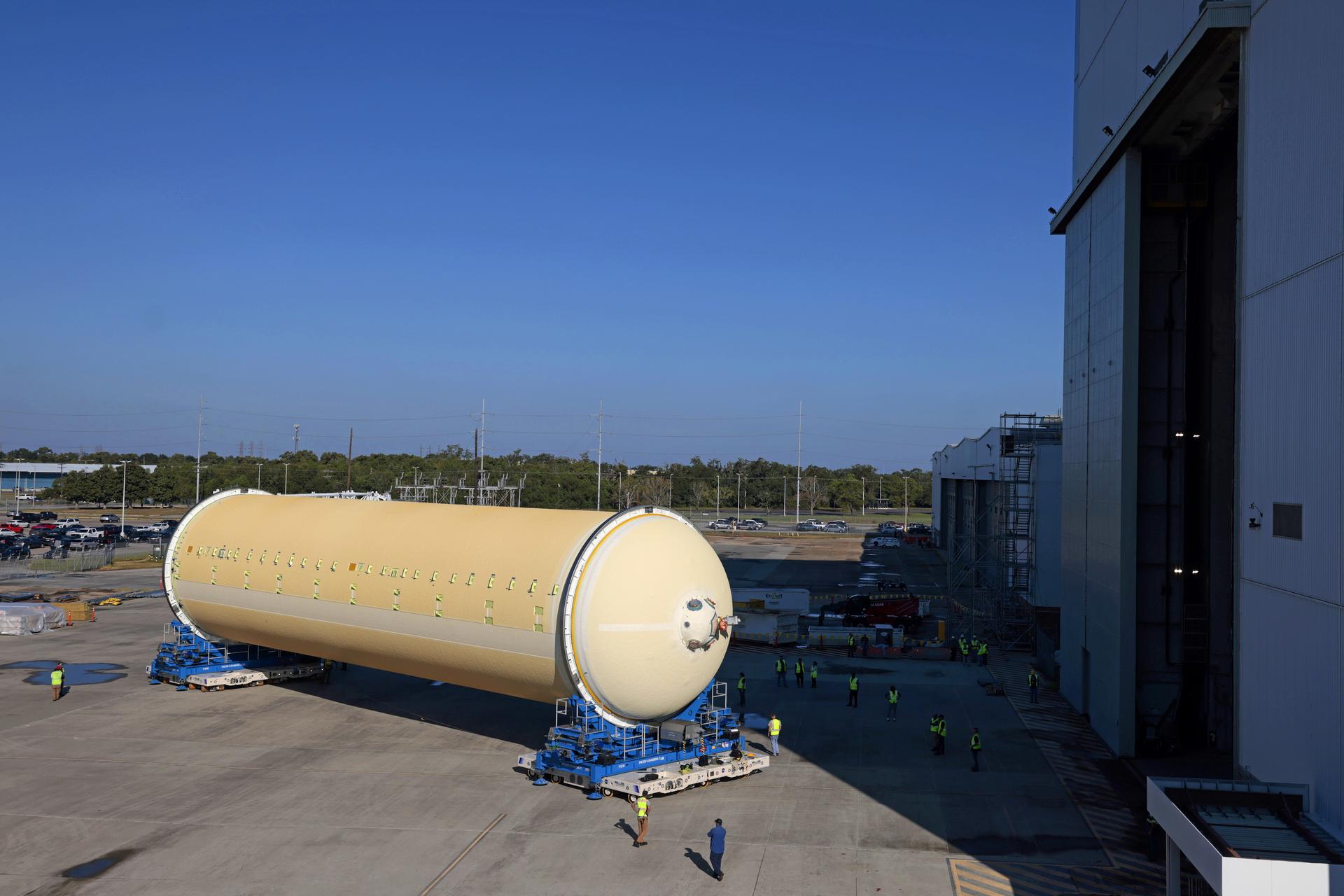
Teams at NASA’s Michoud Assembly Facility in New Orleans move a liquid hydrogen tank for the agency’s SLS (Space Launch System) rocket into the factory’s vertical assembly building on Sep. 26, 2025. The tank, which is designated for the agency’s Artemis III mission, is lifted and loaded into a production cell where it will be mated with the LH2 Transport Adapter Assembly for future transportation to NASA’s Kennedy Space Center. The engine section flight hardware structure was completed in 2022 and was shipped to Kennedy where teams continue to integrate vital systems. The propellant tank is one of five major elements that make up the 212-foot-tall rocket stage. The core stage, along with its four RS-25 engines, produce more than two million pounds of thrust to help launch NASA’s Orion spacecraft, astronauts, and supplies beyond Earth’s orbit and to the lunar surface for Artemis. Image credit: NASA/Michael DeMocker

Move crews at NASA’s Michoud Assembly Facility in New Orleans move a liquid oxygen tank out of the facility’s vertical assembly building on Aug. 27, 2025. Using self-propelled mobile transporters teams transferred the tank to the final assembly production area. There, it will undergo integration of the forward dome by SLS (Space Launch System) prime contractor, Boeing. Eventually, the liquid oxygen tank will be moved back to the high bay where it will be mated with the intertank and forward skirt to complete the forward join of the Artemis III core stage. The propellant tank is one of five major elements that make up the 212-foot-tall rocket stage. The core stage, along with its four RS-25 engines, produce more than two million pounds of thrust to help launch NASA’s Orion spacecraft, astronauts, and supplies beyond Earth’s orbit and to the lunar surface for Artemis.
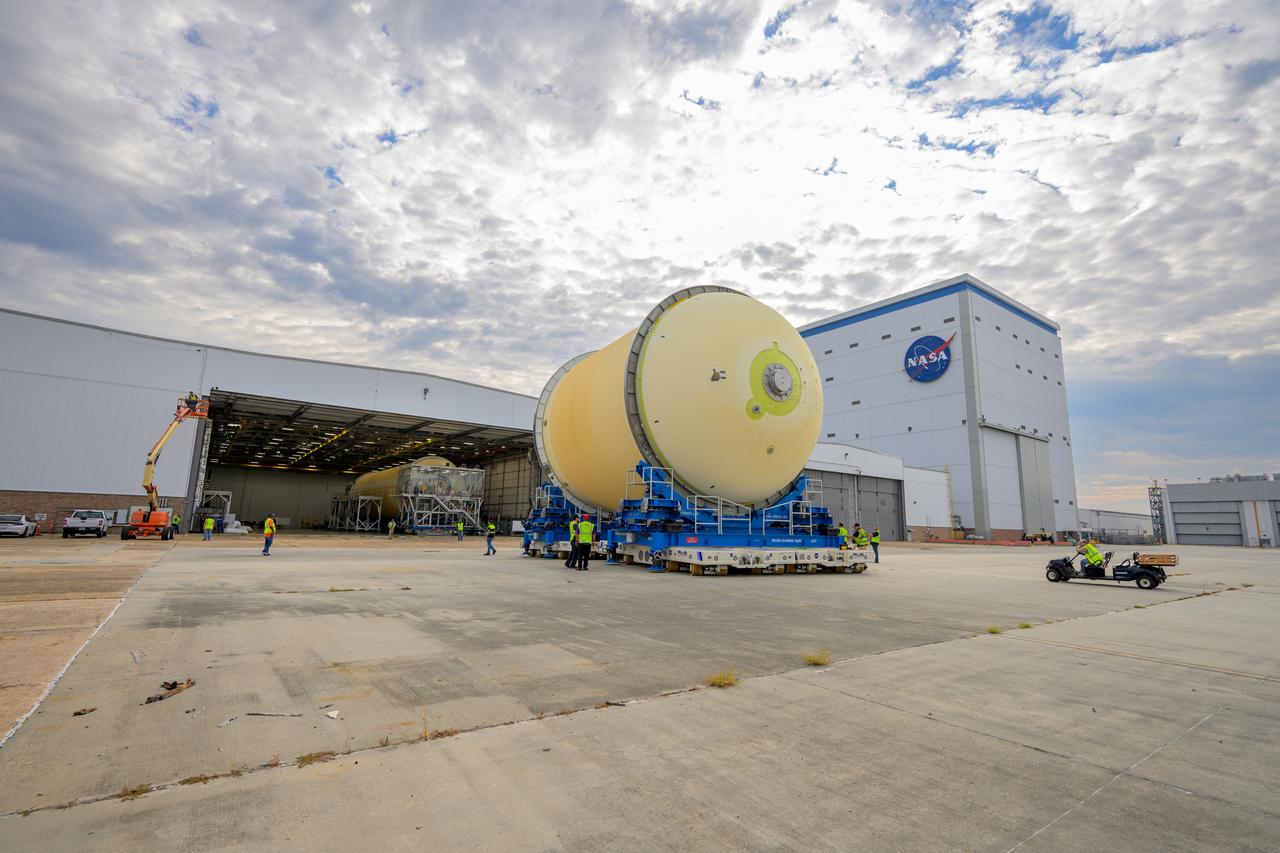
Move crews at NASA’s Michoud Assembly Facility in New Orleans move the liquid oxygen tank into final assembly production area on Aug. 27, 2025. There, it will undergo integration of the forward dome by SLS (Space Launch System) prime contractor, Boeing. Eventually, the liquid oxygen tank will be moved back to the high bay where it will be mated with the intertank and forward skirt to complete the forward join of the Artemis III core stage. The propellant tank is one of five major elements that make up the 212-foot-tall rocket stage. The core stage, along with its four RS-25 engines, produce more than two million pounds of thrust to help launch NASA’s Orion spacecraft, astronauts, and supplies beyond Earth’s orbit and to the lunar surface for Artemis.

Move crews at NASA’s Michoud Assembly Facility in New Orleans move a liquid oxygen tank out of the facility’s vertical assembly building on Aug. 27, 2025. Using self-propelled mobile transporters teams transferred the tank to the final assembly production area. There, it will undergo integration of the forward dome by SLS (Space Launch System) prime contractor, Boeing. Eventually, the liquid oxygen tank will be moved back to the high bay where it will be mated with the intertank and forward skirt to complete the forward join of the Artemis III core stage. The propellant tank is one of five major elements that make up the 212-foot-tall rocket stage. The core stage, along with its four RS-25 engines, produce more than two million pounds of thrust to help launch NASA’s Orion spacecraft, astronauts, and supplies beyond Earth’s orbit and to the lunar surface for Artemis.

Move crews at NASA’s Michoud Assembly Facility in New Orleans move a liquid oxygen tank out of the facility’s vertical assembly building on Aug. 27, 2025. Using self-propelled mobile transporters teams transferred the tank to the final assembly production area. There, it will undergo integration of the forward dome by SLS (Space Launch System) prime contractor, Boeing. Eventually, the liquid oxygen tank will be moved back to the high bay where it will be mated with the intertank and forward skirt to complete the forward join of the Artemis III core stage. The propellant tank is one of five major elements that make up the 212-foot-tall rocket stage. The core stage, along with its four RS-25 engines, produce more than two million pounds of thrust to help launch NASA’s Orion spacecraft, astronauts, and supplies beyond Earth’s orbit and to the lunar surface for Artemis.
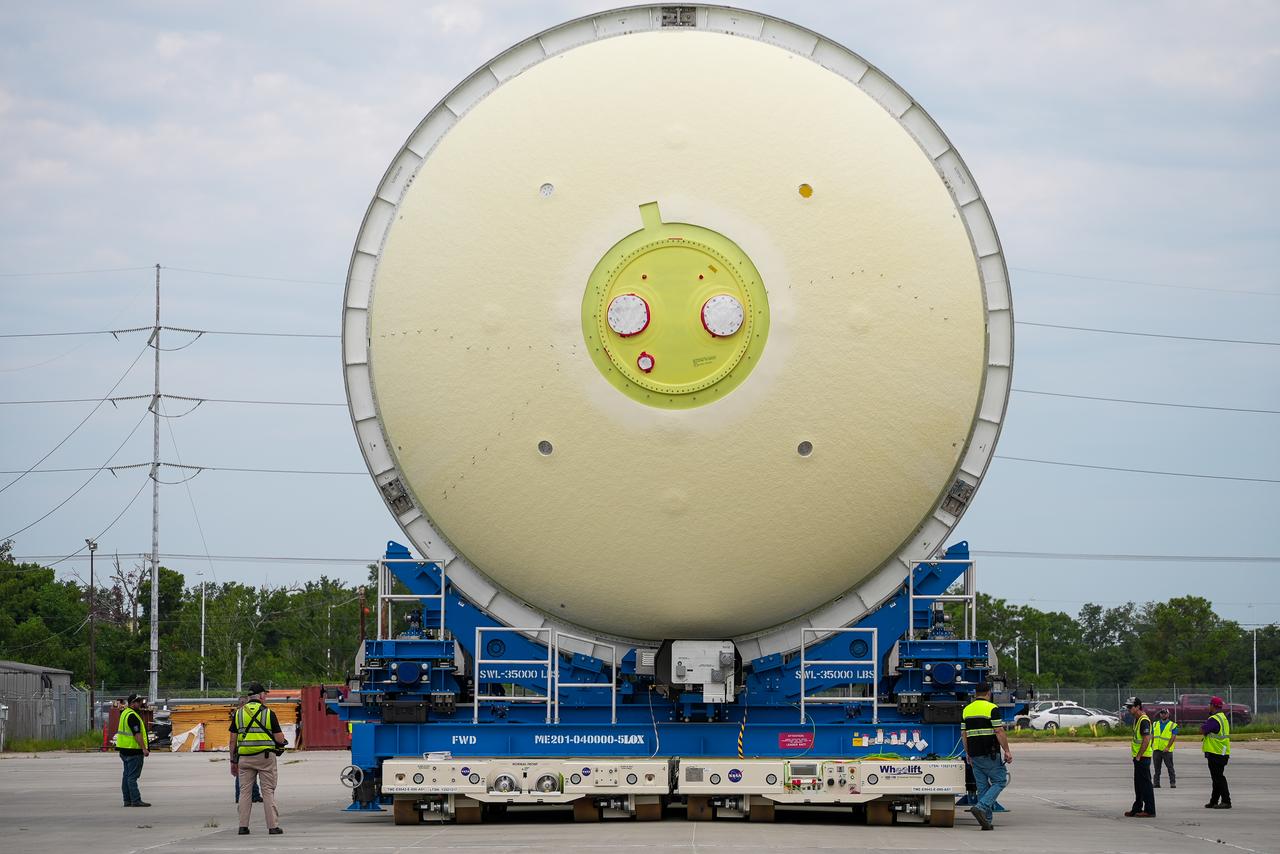
Move crews at NASA’s Michoud Assembly Facility in New Orleans move the liquid oxygen tank into final assembly production area on Aug. 27, 2025. There, it will undergo integration of the forward dome by SLS (Space Launch System) prime contractor, Boeing. Eventually, the liquid oxygen tank will be moved back to the high bay where it will be mated with the intertank and forward skirt to complete the forward join of the Artemis III core stage. The propellant tank is one of five major elements that make up the 212-foot-tall rocket stage. The core stage, along with its four RS-25 engines, produce more than two million pounds of thrust to help launch NASA’s Orion spacecraft, astronauts, and supplies beyond Earth’s orbit and to the lunar surface for Artemis.
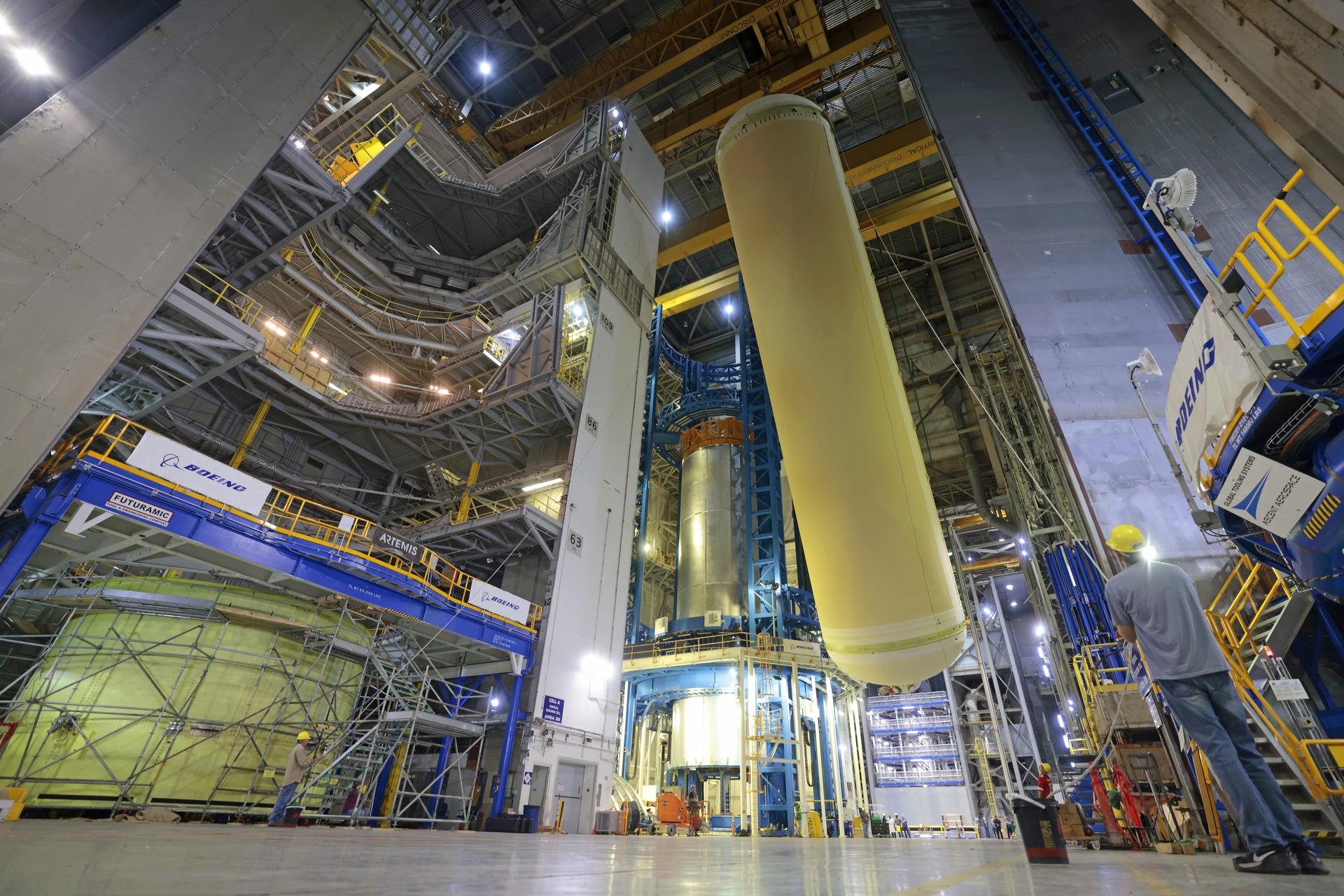
Teams at NASA’s Michoud Assembly Facility in New Orleans move a liquid hydrogen tank for the agency’s SLS (Space Launch System) rocket inside the factory’s vertical assembly building on Sep. 28, 2025. The tank, which is designated for the agency’s Artemis III mission, is being lifted and loaded into a production cell where it will be mated with the LH2 Transport Adapter Assembly for future transportation to NASA’s Kennedy Space Center. The engine section flight hardware structure was completed in 2022 and was shipped to Kennedy where teams continue to integrate vital systems. The propellant tank is one of five major elements that make up the 212-foot-tall rocket stage. The core stage, along with its four RS-25 engines, produce more than two million pounds of thrust to help launch NASA’s Orion spacecraft, astronauts, and supplies beyond Earth’s orbit and to the lunar surface for Artemis. Image credit: NASA/Michael DeMocker
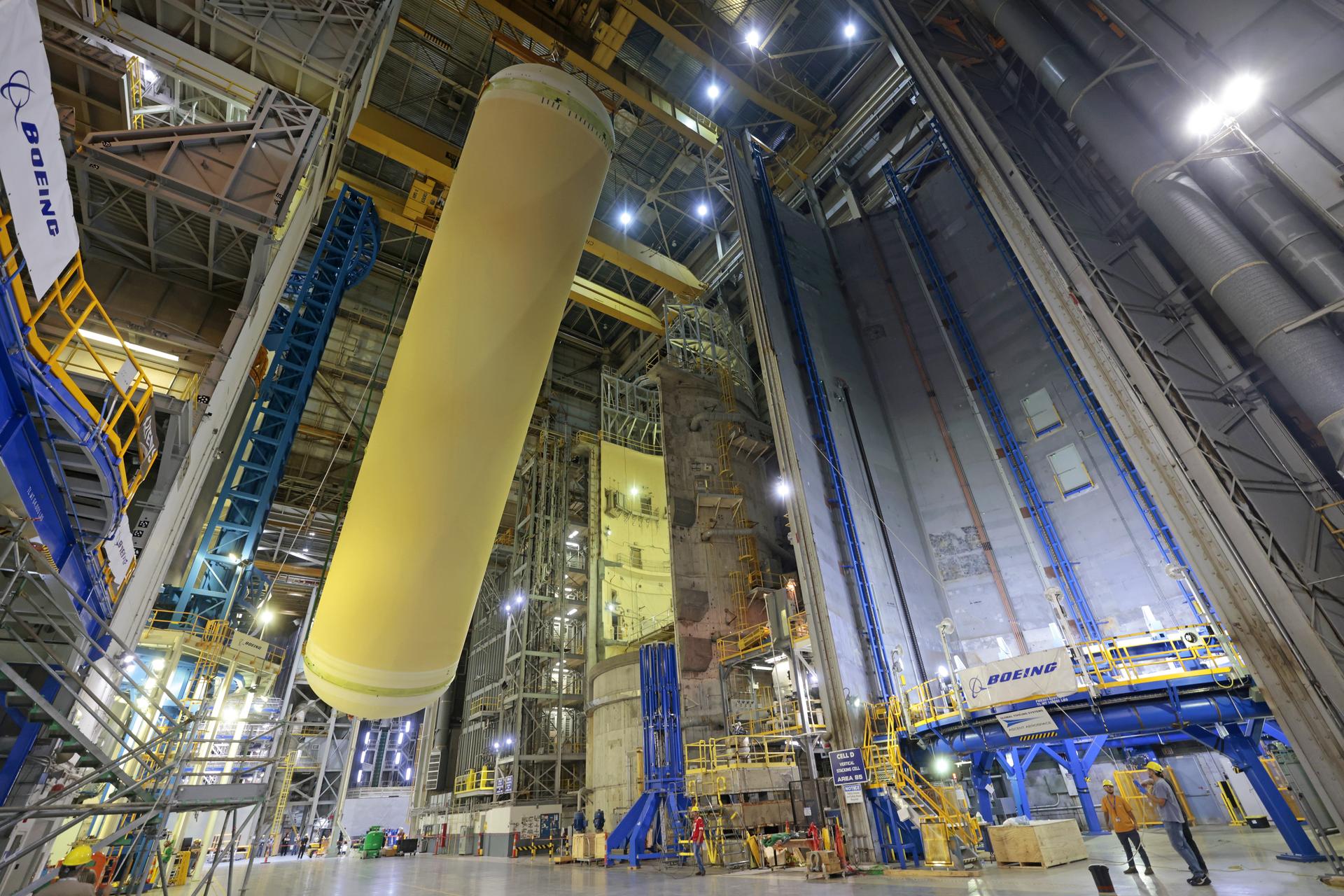
Teams at NASA’s Michoud Assembly Facility in New Orleans move a liquid hydrogen tank for the agency’s SLS (Space Launch System) rocket inside the factory’s vertical assembly building on Sep. 28, 2025. The tank, which is designated for the agency’s Artemis III mission, is being lifted and loaded into a production cell where it will be mated with the LH2 Transport Adapter Assembly for future transportation to NASA’s Kennedy Space Center. The engine section flight hardware structure was completed in 2022 and was shipped to Kennedy where teams continue to integrate vital systems. The propellant tank is one of five major elements that make up the 212-foot-tall rocket stage. The core stage, along with its four RS-25 engines, produce more than two million pounds of thrust to help launch NASA’s Orion spacecraft, astronauts, and supplies beyond Earth’s orbit and to the lunar surface for Artemis. Image credit: NASA/Michael DeMocker
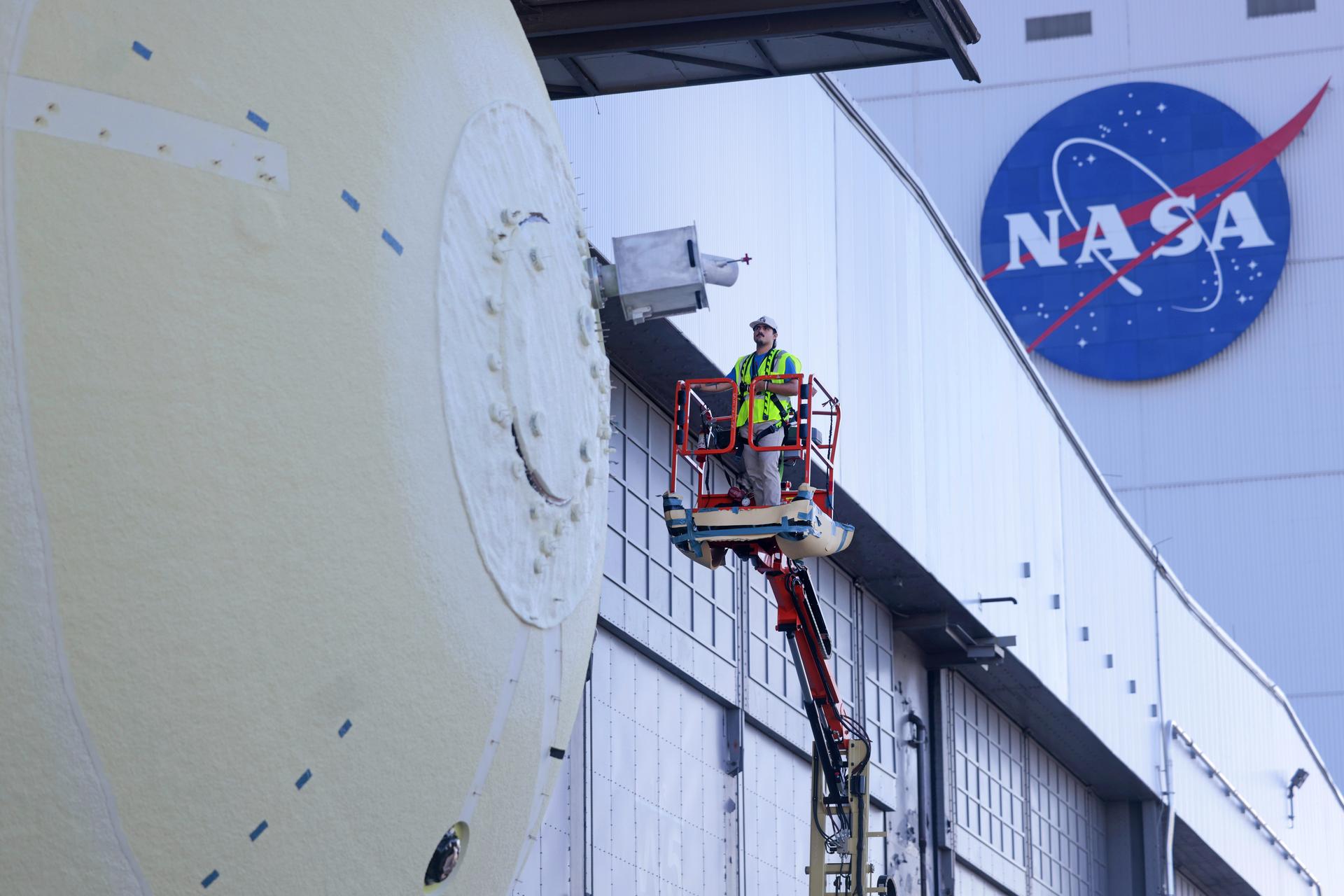
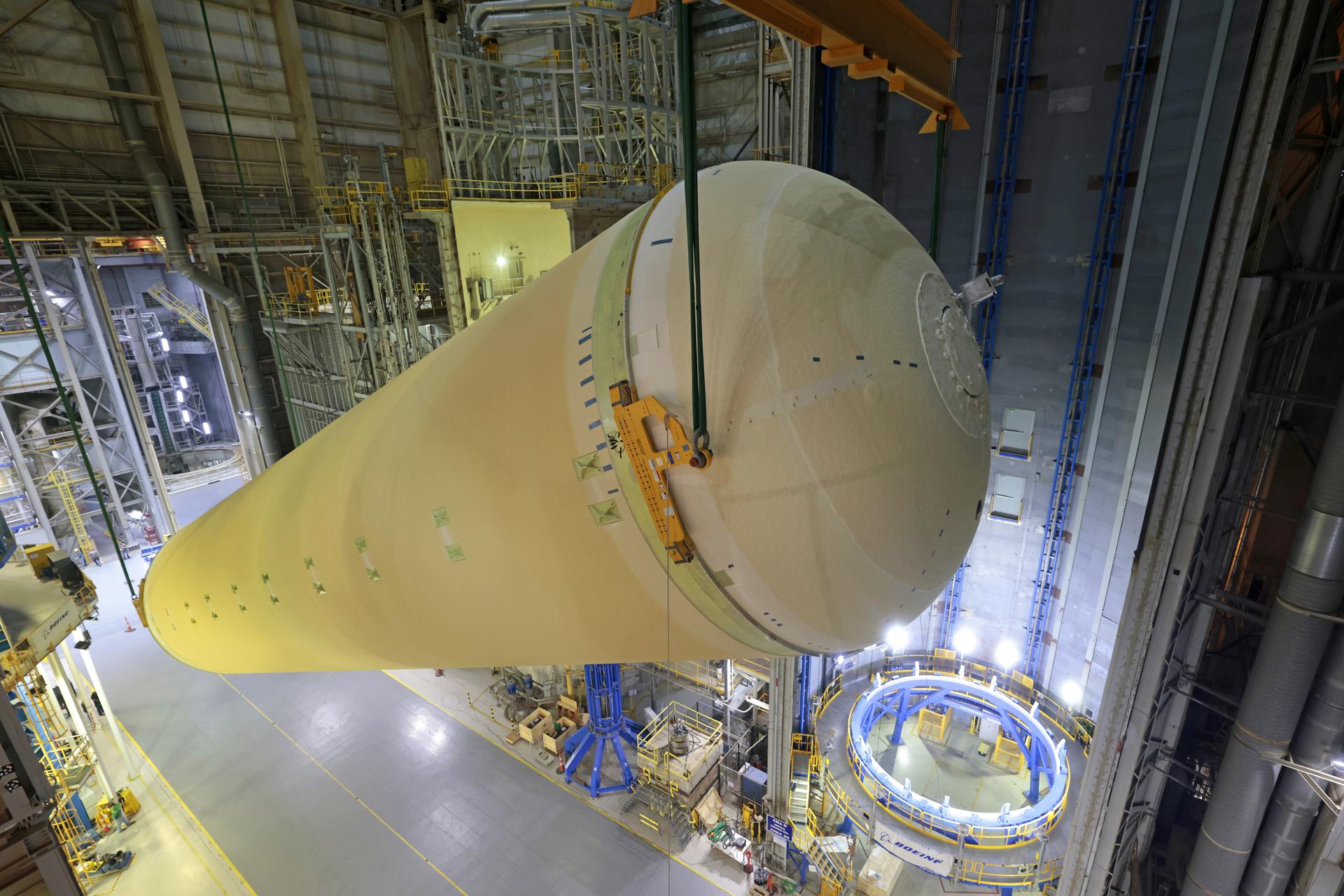
Teams at NASA’s Michoud Assembly Facility in New Orleans move a liquid hydrogen tank for the agency’s SLS (Space Launch System) rocket into the factory’s vertical assembly building on Sep. 26, 2025. The tank, which is designated for the agency’s Artemis III mission, is lifted and loaded into a production cell where it will be mated with the LH2 Transport Adapter Assembly for future transportation to NASA’s Kennedy Space Center. The engine section flight hardware structure was completed in 2022 and was shipped to Kennedy where teams continue to integrate vital systems. The propellant tank is one of five major elements that make up the 212-foot-tall rocket stage. The core stage, along with its four RS-25 engines, produce more than two million pounds of thrust to help launch NASA’s Orion spacecraft, astronauts, and supplies beyond Earth’s orbit and to the lunar surface for Artemis. Image credit: NASA/Michael DeMocker
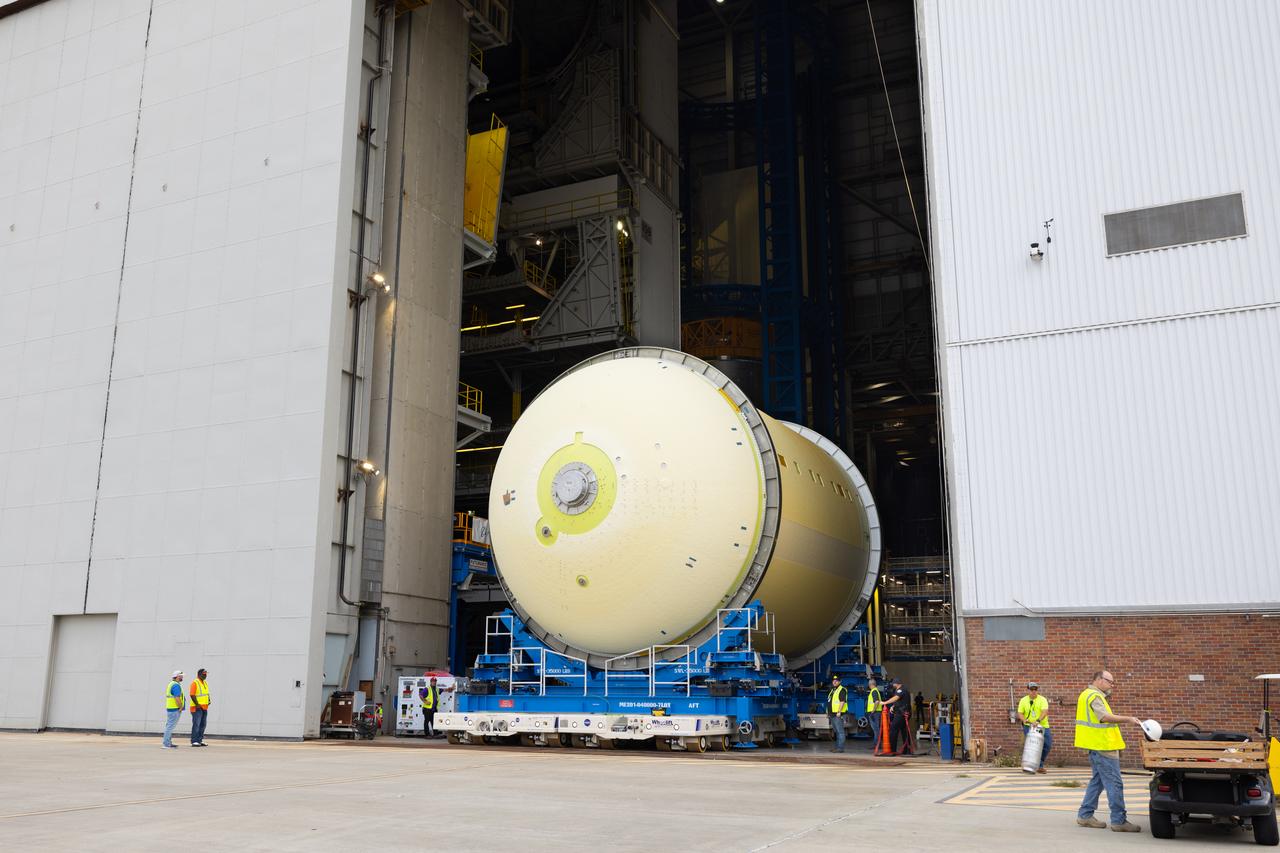
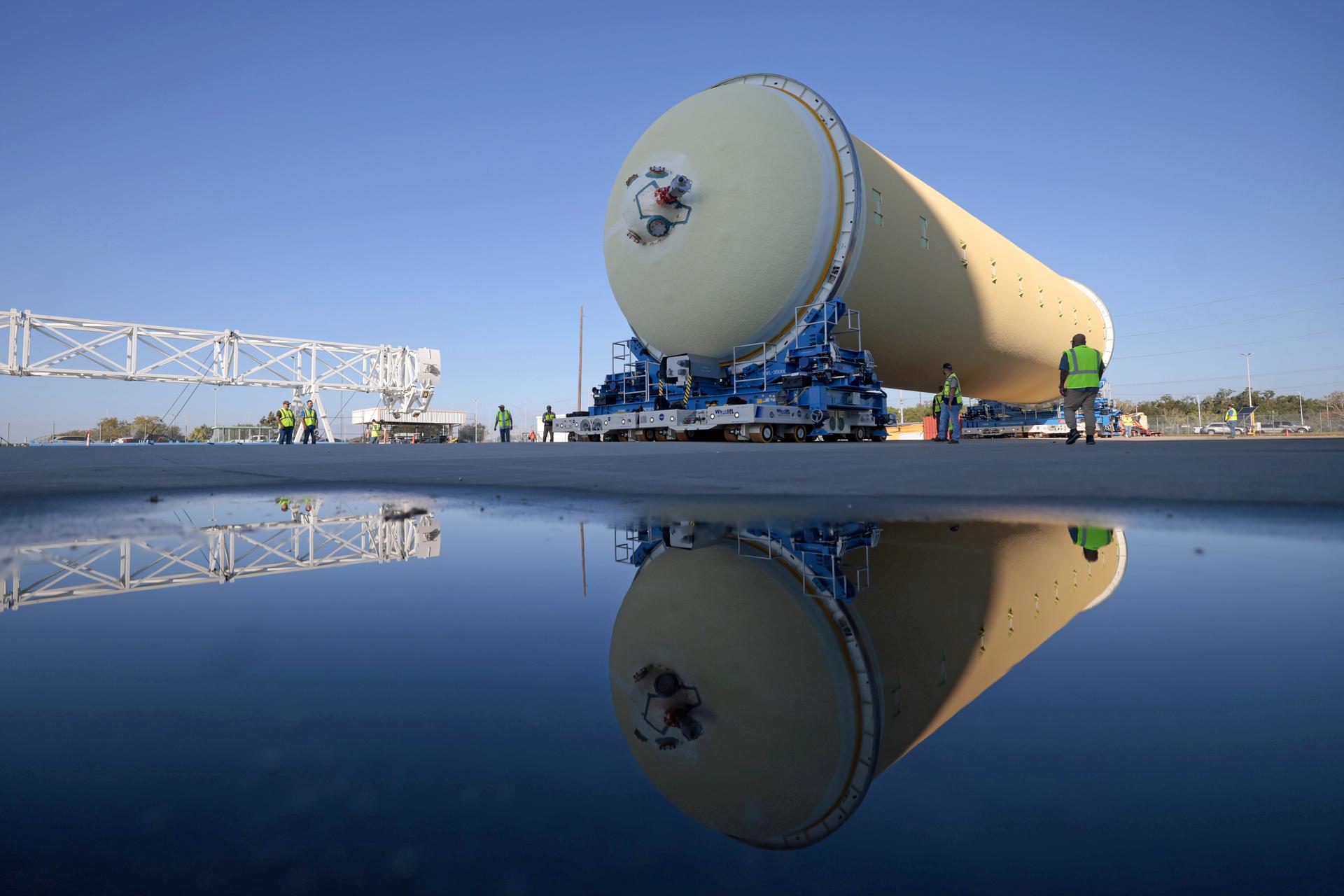
Move crews at NASA’s Michoud Assembly Facility in New Orleans move a liquid oxygen tank out of the facility’s vertical assembly building on Aug. 27, 2025. Using self-propelled mobile transporters teams transferred the tank to the final assembly production area. There, it will undergo integration of the forward dome by SLS (Space Launch System) prime contractor, Boeing. Eventually, the liquid oxygen tank will be moved back to the high bay where it will be mated with the intertank and forward skirt to complete the forward join of the Artemis III core stage. The propellant tank is one of five major elements that make up the 212-foot-tall rocket stage. The core stage, along with its four RS-25 engines, produce more than two million pounds of thrust to help launch NASA’s Orion spacecraft, astronauts, and supplies beyond Earth’s orbit and to the lunar surface for Artemis.
Teams at NASA’s Michoud Assembly Facility in New Orleans move a liquid hydrogen tank for the agency’s SLS (Space Launch System) rocket into the factory’s vertical assembly building on Sep. 26, 2025. The tank, which is designated for the agency’s Artemis III mission, is lifted and loaded into a production cell where it will be mated with the LH2 Transport Adapter Assembly for future transportation to NASA’s Kennedy Space Center. The engine section flight hardware structure was completed in 2022 and was shipped to Kennedy where teams continue to integrate vital systems. The propellant tank is one of five major elements that make up the 212-foot-tall rocket stage. The core stage, along with its four RS-25 engines, produce more than two million pounds of thrust to help launch NASA’s Orion spacecraft, astronauts, and supplies beyond Earth’s orbit and to the lunar surface for Artemis. Image credit: NASA/Michael DeMocker
Teams at NASA’s Michoud Assembly Facility in New Orleans move a liquid hydrogen tank for the agency’s SLS (Space Launch System) rocket inside the factory’s vertical assembly building on Sep. 28, 2025. The tank, which is designated for the agency’s Artemis III mission, is being lifted and loaded into a production cell where it will be mated with the LH2 Transport Adapter Assembly for future transportation to NASA’s Kennedy Space Center. The engine section flight hardware structure was completed in 2022 and was shipped to Kennedy where teams continue to integrate vital systems. The propellant tank is one of five major elements that make up the 212-foot-tall rocket stage. The core stage, along with its four RS-25 engines, produce more than two million pounds of thrust to help launch NASA’s Orion spacecraft, astronauts, and supplies beyond Earth’s orbit and to the lunar surface for Artemis. Image credit: NASA/Michael DeMocker
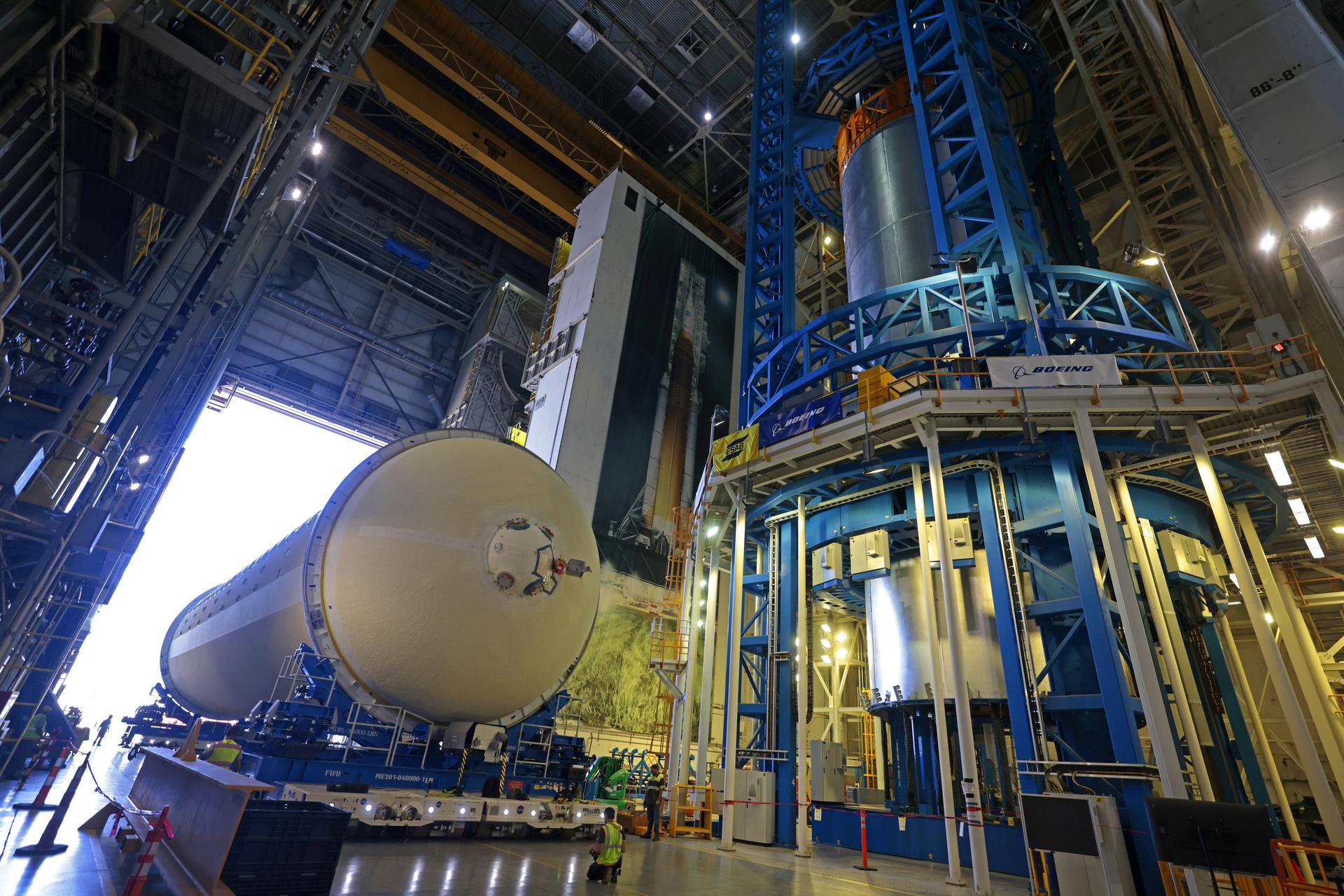
Teams at NASA’s Michoud Assembly Facility in New Orleans move a liquid hydrogen tank for the agency’s SLS (Space Launch System) rocket into the factory’s vertical assembly building on Sep. 26, 2025. The tank, which is designated for the agency’s Artemis III mission, is lifted and loaded into a production cell where it will be mated with the LH2 Transport Adapter Assembly for future transportation to NASA’s Kennedy Space Center. The engine section flight hardware structure was completed in 2022 and was shipped to Kennedy where teams continue to integrate vital systems. The propellant tank is one of five major elements that make up the 212-foot-tall rocket stage. The core stage, along with its four RS-25 engines, produce more than two million pounds of thrust to help launch NASA’s Orion spacecraft, astronauts, and supplies beyond Earth’s orbit and to the lunar surface for Artemis. Image credit: NASA/Michael DeMocker
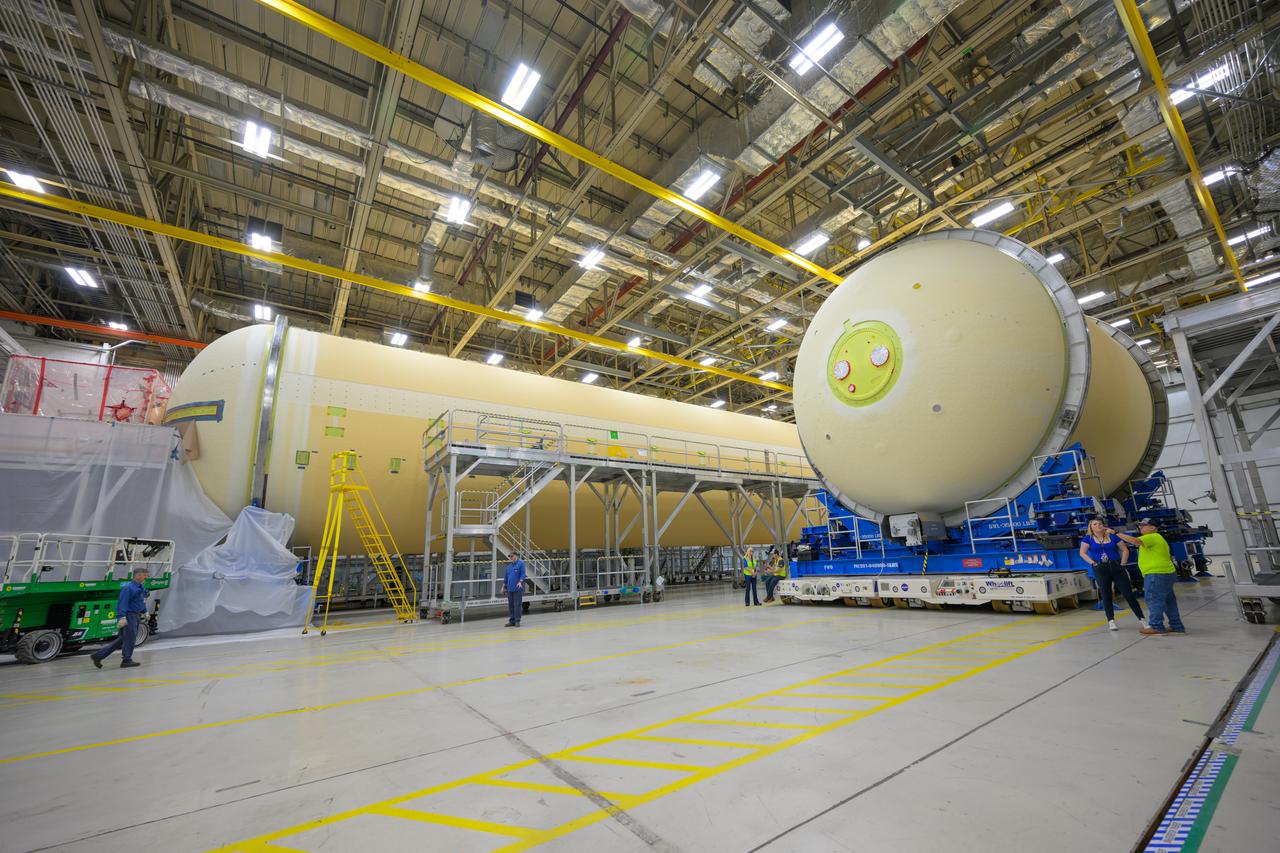
Move crews at NASA’s Michoud Assembly Facility in New Orleans move the liquid oxygen tank into final assembly production area on Aug. 27, 2025. There, it will undergo integration of the forward dome by SLS (Space Launch System) prime contractor, Boeing. Eventually, the liquid oxygen tank will be moved back to the high bay where it will be mated with the intertank and forward skirt to complete the forward join of the Artemis III core stage. The propellant tank is one of five major elements that make up the 212-foot-tall rocket stage. The core stage, along with its four RS-25 engines, produce more than two million pounds of thrust to help launch NASA’s Orion spacecraft, astronauts, and supplies beyond Earth’s orbit and to the lunar surface for Artemis.
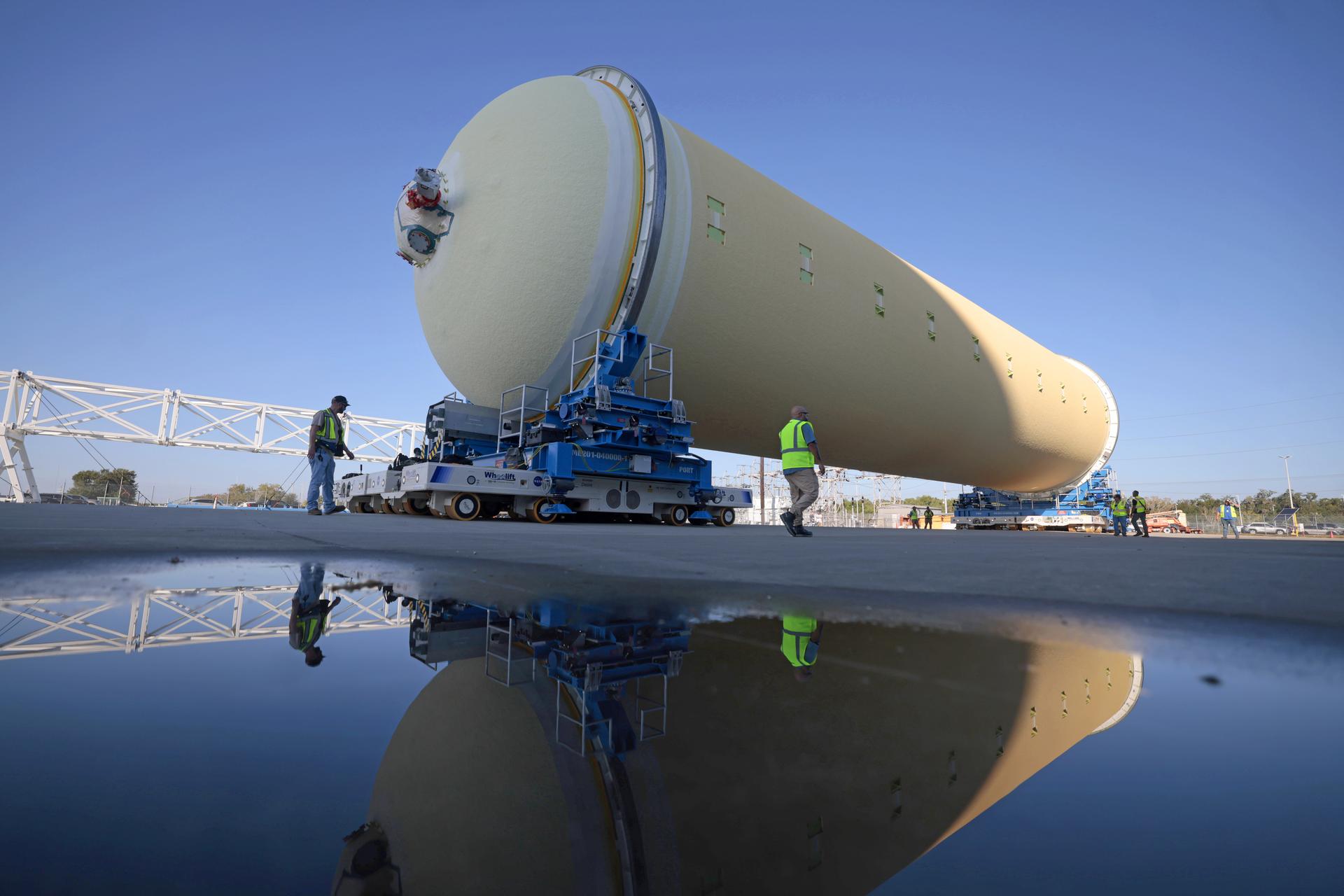
Teams at NASA’s Michoud Assembly Facility in New Orleans move a liquid hydrogen tank for the agency’s SLS (Space Launch System) rocket into the factory’s vertical assembly building on Sep. 26, 2025. The tank, which is designated for the agency’s Artemis III mission, is lifted and loaded into a production cell where it will be mated with the LH2 Transport Adapter Assembly for future transportation to NASA’s Kennedy Space Center. The engine section flight hardware structure was completed in 2022 and was shipped to Kennedy where teams continue to integrate vital systems. The propellant tank is one of five major elements that make up the 212-foot-tall rocket stage. The core stage, along with its four RS-25 engines, produce more than two million pounds of thrust to help launch NASA’s Orion spacecraft, astronauts, and supplies beyond Earth’s orbit and to the lunar surface for Artemis. Image credit: NASA/Michael DeMocker
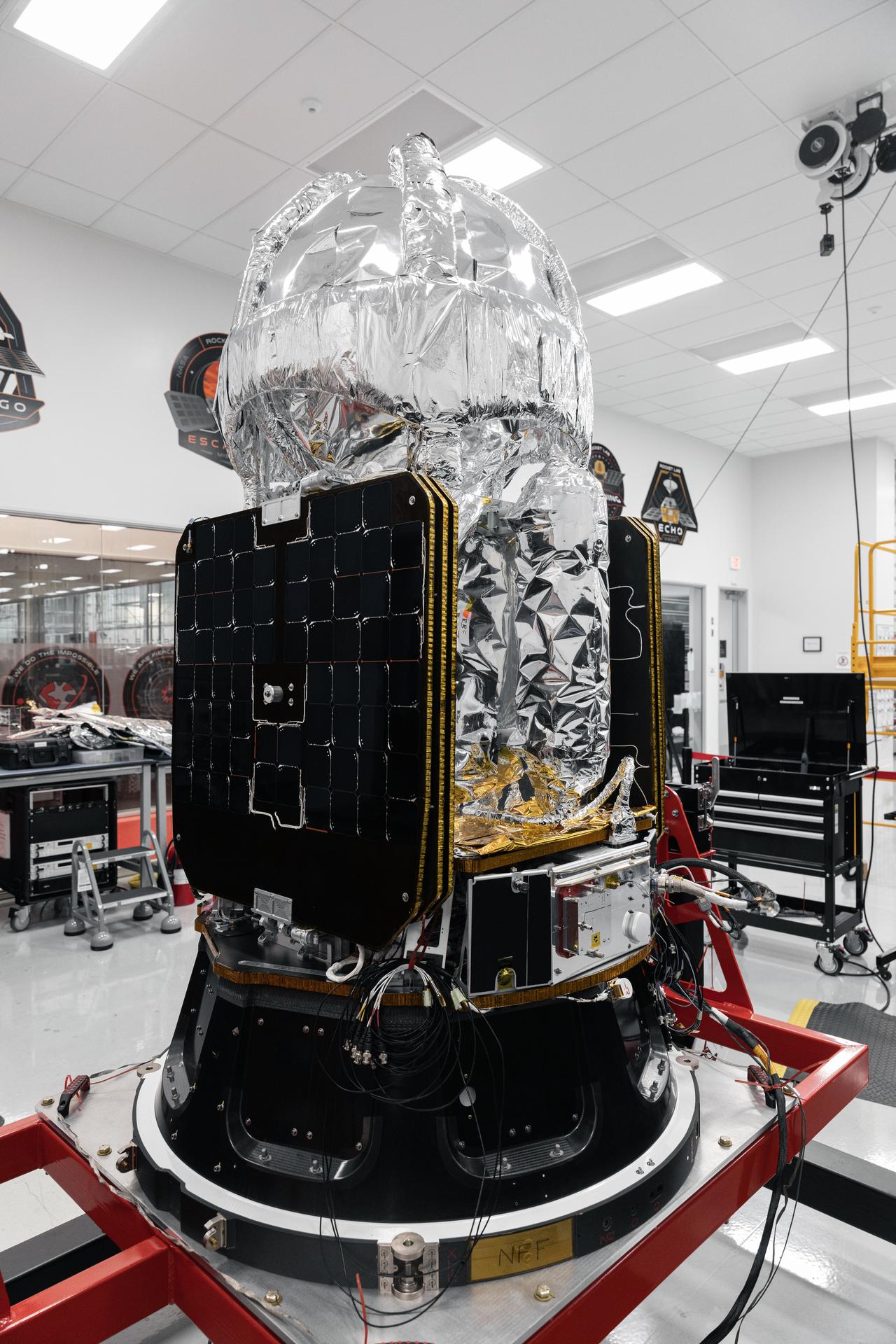
The LOXSAT payload is displayed inside Rocket Lab’s Spacecraft Production Complex on March 6, 2026, in Long Beach, California. Eta Space built LOXSAT as part of a NASA Tipping Point opportunity, and Rocket Lab is providing spacecraft and launch services to deliver it to low Earth orbit.

President Donald Trump meets NASA Administrator Jim Bridenstine, front, NASA Chief Financial Officer Jeff DeWitt, second from left, and Orion Program Manager, W. Michael Hawes, right, during a Made in America Product Showcase at the White House, Monday, July 23, 2018 in Washington. The Orion crew module that launched on Dec. 5, 2014 on the Exploration Flight Test-1 was also on display during the event. Lockheed Martin, NASA’s prime contractor for Orion, began manufacturing the Orion crew module in 2011 and delivered it in July 2012 to NASA's Kennedy Space Center where final assembly, integration and testing was completed. More than 1,000 companies across the country manufactured or contributed elements to the spacecraft. Photo Credit: (NASA/Aubrey Gemignani)
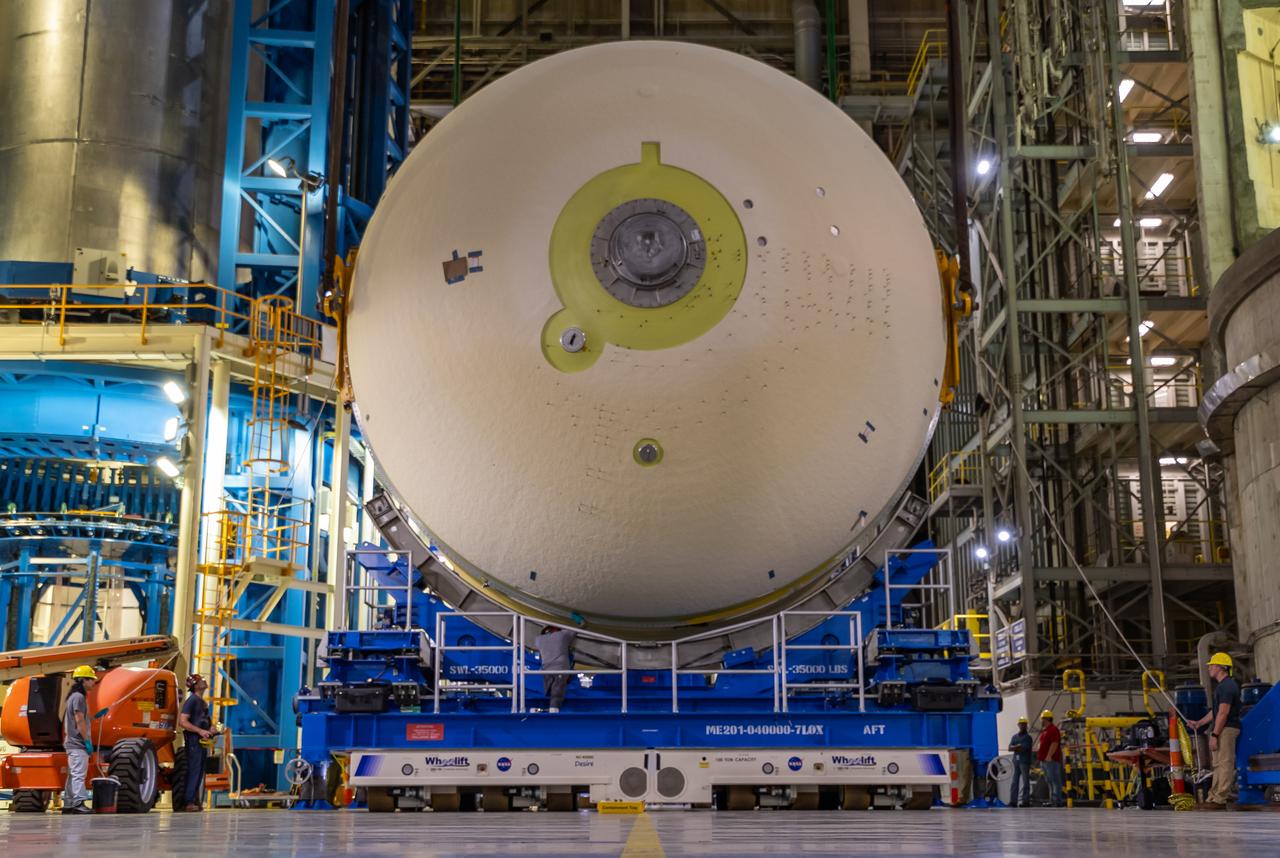
Move crews at NASA’s Michoud Assembly Facility in New Orleans perform “breakover” operations on a liquid oxygen tank in the facility’s vertical assembly building on Aug. 22, 2025. During the breakover, teams lifted the tank from its vertical configuration inside of a production cell and set it horizontally atop self-propelled mobile transporters for transfer to the final assembly production area. There, it will undergo integration of the forward dome by SLS (Space Launch System) prime contractor, Boeing. Eventually, the liquid oxygen tank will be moved back to the high bay where it will be mated with the intertank and forward skirt to complete the forward join of the Artemis III core stage. The propellant tank is one of five major elements that make up the 212-foot-tall rocket stage. The core stage, along with its four RS-25 engines, produce more than two million pounds of thrust to help launch NASA’s Orion spacecraft, astronauts, and supplies beyond Earth’s orbit and to the lunar surface for Artemis.
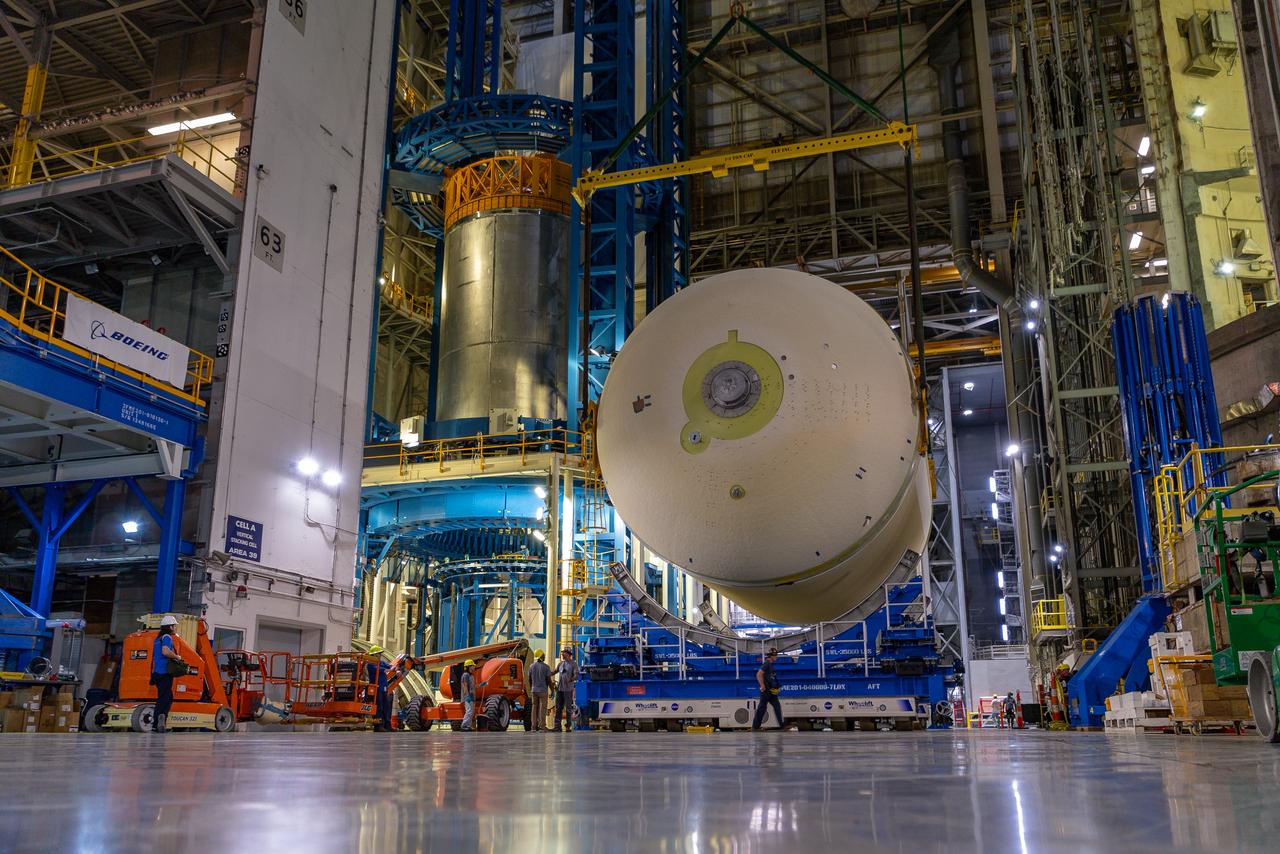
Move crews at NASA’s Michoud Assembly Facility in New Orleans perform “breakover” operations on a liquid oxygen tank in the facility’s vertical assembly building on Aug. 22, 2025. During the breakover, teams lifted the tank from its vertical configuration inside of a production cell and set it horizontally atop self-propelled mobile transporters for transfer to the final assembly production area. There, it will undergo integration of the forward dome by SLS (Space Launch System) prime contractor, Boeing. Eventually, the liquid oxygen tank will be moved back to the high bay where it will be mated with the intertank and forward skirt to complete the forward join of the Artemis III core stage. The propellant tank is one of five major elements that make up the 212-foot-tall rocket stage. The core stage, along with its four RS-25 engines, produce more than two million pounds of thrust to help launch NASA’s Orion spacecraft, astronauts, and supplies beyond Earth’s orbit and to the lunar surface for Artemis.
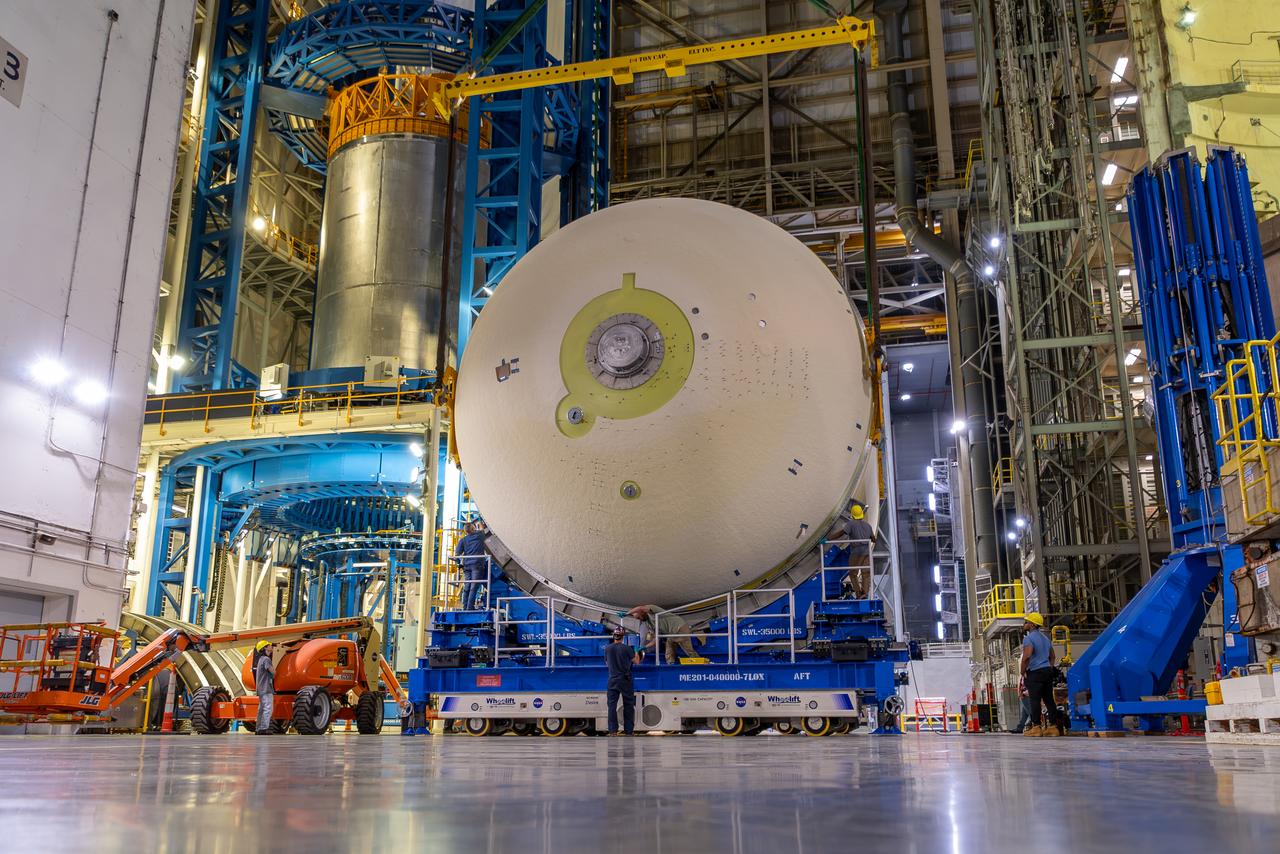
Move crews at NASA’s Michoud Assembly Facility in New Orleans perform “breakover” operations on a liquid oxygen tank in the facility’s vertical assembly building on Aug. 22, 2025. During the breakover, teams lifted the tank from its vertical configuration inside of a production cell and set it horizontally atop self-propelled mobile transporters for transfer to the final assembly production area. There, it will undergo integration of the forward dome by SLS (Space Launch System) prime contractor, Boeing. Eventually, the liquid oxygen tank will be moved back to the high bay where it will be mated with the intertank and forward skirt to complete the forward join of the Artemis III core stage. The propellant tank is one of five major elements that make up the 212-foot-tall rocket stage. The core stage, along with its four RS-25 engines, produce more than two million pounds of thrust to help launch NASA’s Orion spacecraft, astronauts, and supplies beyond Earth’s orbit and to the lunar surface for Artemis.
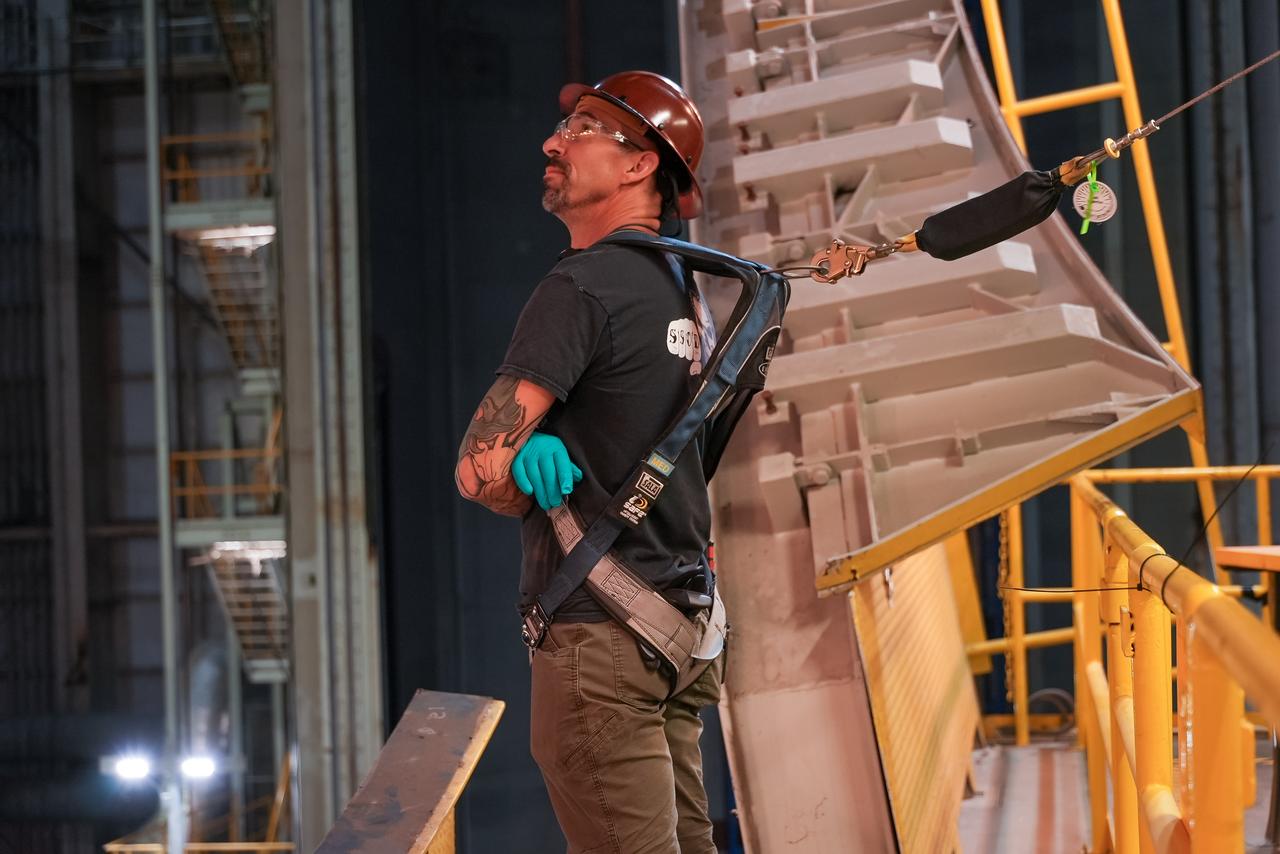
Move crews at NASA’s Michoud Assembly Facility in New Orleans perform “breakover” operations on a liquid oxygen tank in the facility’s vertical assembly building on Aug. 22, 2025. During the breakover, teams lifted the tank from its vertical configuration inside of a production cell and set it horizontally atop self-propelled mobile transporters for transfer to the final assembly production area. There, it will undergo integration of the forward dome by SLS (Space Launch System) prime contractor, Boeing. Eventually, the liquid oxygen tank will be moved back to the high bay where it will be mated with the intertank and forward skirt to complete the forward join of the Artemis III core stage. The propellant tank is one of five major elements that make up the 212-foot-tall rocket stage. The core stage, along with its four RS-25 engines, produce more than two million pounds of thrust to help launch NASA’s Orion spacecraft, astronauts, and supplies beyond Earth’s orbit and to the lunar surface for Artemis.
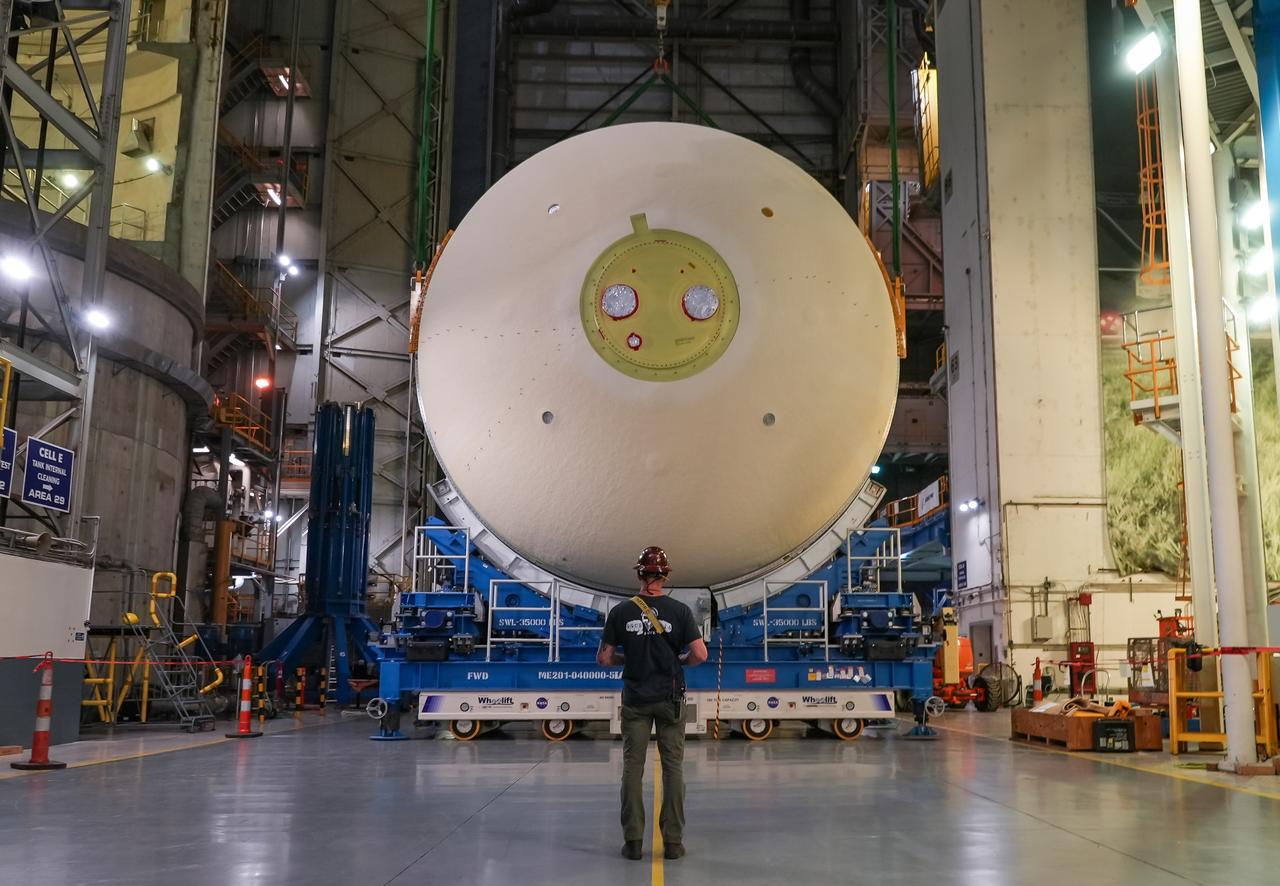
Move crews at NASA’s Michoud Assembly Facility in New Orleans perform “breakover” operations on a liquid oxygen tank in the facility’s vertical assembly building on Aug. 22, 2025. During the breakover, teams lifted the tank from its vertical configuration inside of a production cell and set it horizontally atop self-propelled mobile transporters for transfer to the final assembly production area. There, it will undergo integration of the forward dome by SLS (Space Launch System) prime contractor, Boeing. Eventually, the liquid oxygen tank will be moved back to the high bay where it will be mated with the intertank and forward skirt to complete the forward join of the Artemis III core stage. The propellant tank is one of five major elements that make up the 212-foot-tall rocket stage. The core stage, along with its four RS-25 engines, produce more than two million pounds of thrust to help launch NASA’s Orion spacecraft, astronauts, and supplies beyond Earth’s orbit and to the lunar surface for Artemis.
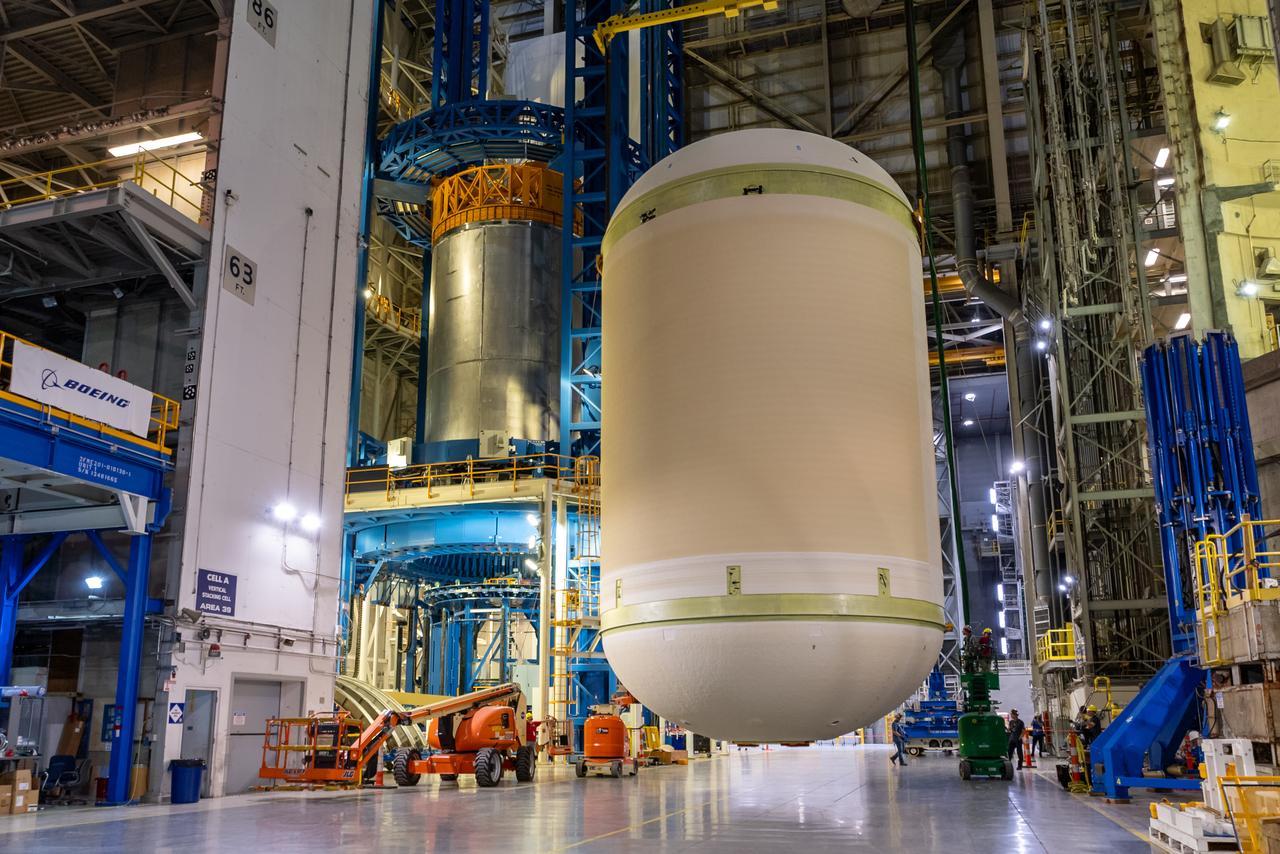
Move crews at NASA’s Michoud Assembly Facility in New Orleans perform “breakover” operations on a liquid oxygen tank in the facility’s vertical assembly building on Aug. 22, 2025. During the breakover, teams lifted the tank from its vertical configuration inside of a production cell and set it horizontally atop self-propelled mobile transporters for transfer to the final assembly production area. There, it will undergo integration of the forward dome by SLS (Space Launch System) prime contractor, Boeing. Eventually, the liquid oxygen tank will be moved back to the high bay where it will be mated with the intertank and forward skirt to complete the forward join of the Artemis III core stage. The propellant tank is one of five major elements that make up the 212-foot-tall rocket stage. The core stage, along with its four RS-25 engines, produce more than two million pounds of thrust to help launch NASA’s Orion spacecraft, astronauts, and supplies beyond Earth’s orbit and to the lunar surface for Artemis.
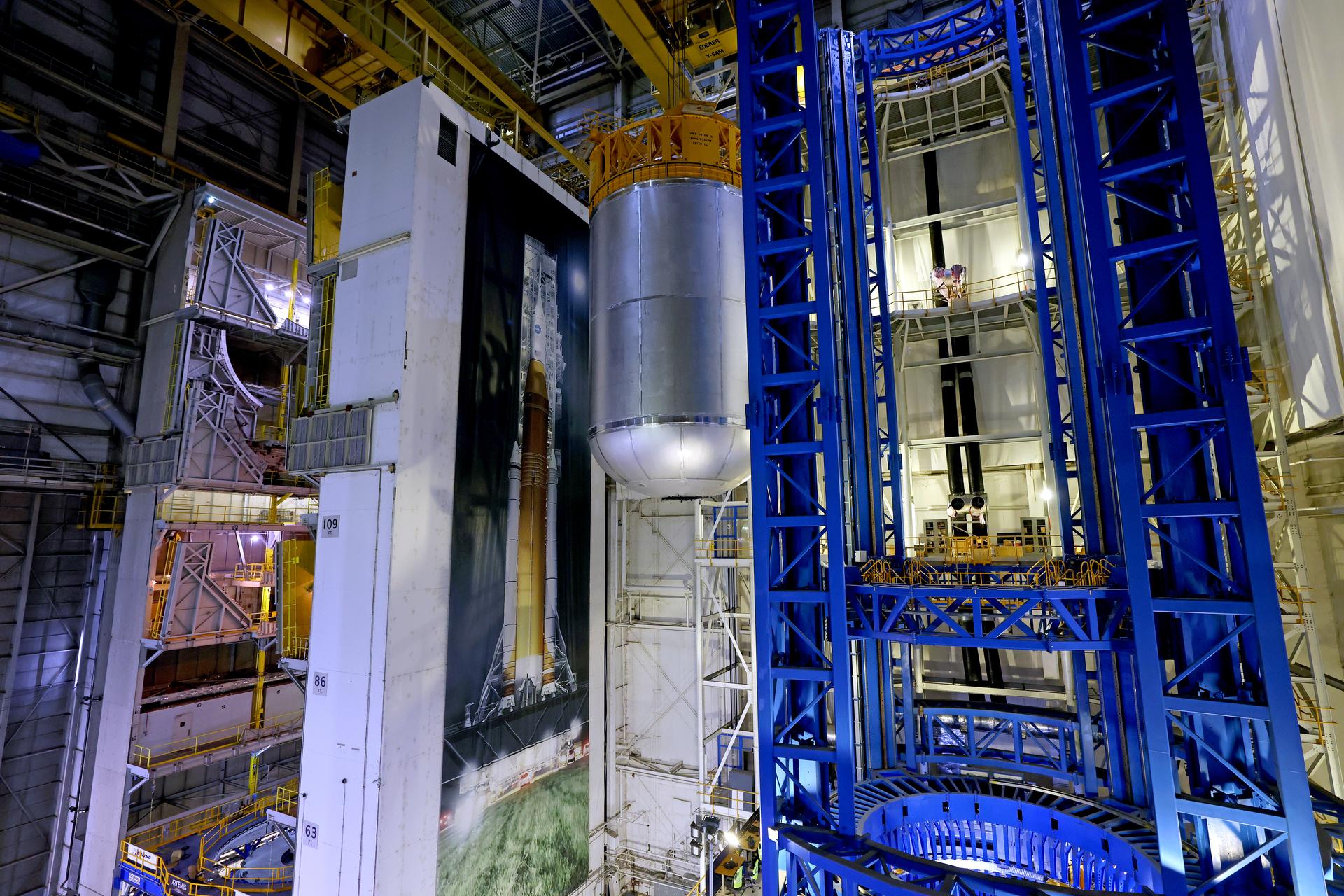
Teams at NASA’s Michoud Assembly Facility in New Orleans use an overhead crane to lift a 51-foot-tall liquid oxygen tank out of the vertical assembly center on May 26. The liquid oxygen tank will form part of the SLS (Space Launch System) rocket for NASA’s Artemis IV mission to the Moon. It will hold more than 196,000 gallons of super-cold liquid oxygen; and next, technicians with Boeing, SLS core stage prime contractor, and NASA will perform dimensional inspections and install internal baffles on the propellant tank before the next phase of production. The propellant tank is one of five major elements that make up the 212-foot-tall SLS rocket stage. The core stage, along with its four RS-25 engines at its base, produces more than two million pounds of thrust to help launch NASA’s Orion spacecraft, astronauts, and supplies beyond Earth’s orbit and to the lunar surface for Artemis. Image credit: NASA/Michael DeMocker
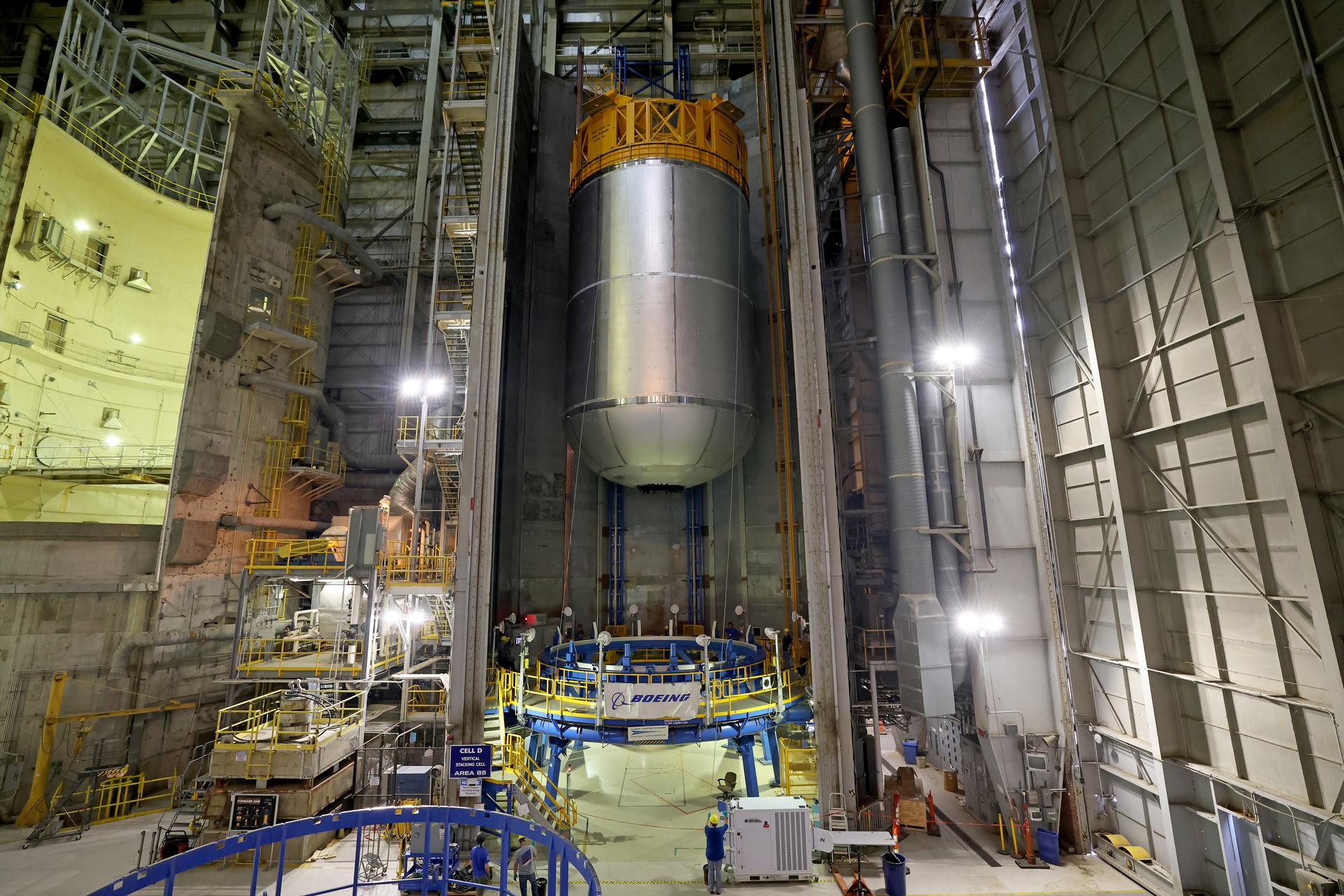
Teams at NASA’s Michoud Assembly Facility in New Orleans use an overhead crane to lift a 51-foot-tall liquid oxygen tank out of the vertical assembly center on May 26. The liquid oxygen tank will form part of the SLS (Space Launch System) rocket for NASA’s Artemis IV mission to the Moon. It will hold more than 196,000 gallons of super-cold liquid oxygen; and next, technicians with Boeing, SLS core stage prime contractor, and NASA will perform dimensional inspections and install internal baffles on the propellant tank before the next phase of production. The propellant tank is one of five major elements that make up the 212-foot-tall SLS rocket stage. The core stage, along with its four RS-25 engines at its base, produces more than two million pounds of thrust to help launch NASA’s Orion spacecraft, astronauts, and supplies beyond Earth’s orbit and to the lunar surface for Artemis. Image credit: NASA/Michael DeMocker
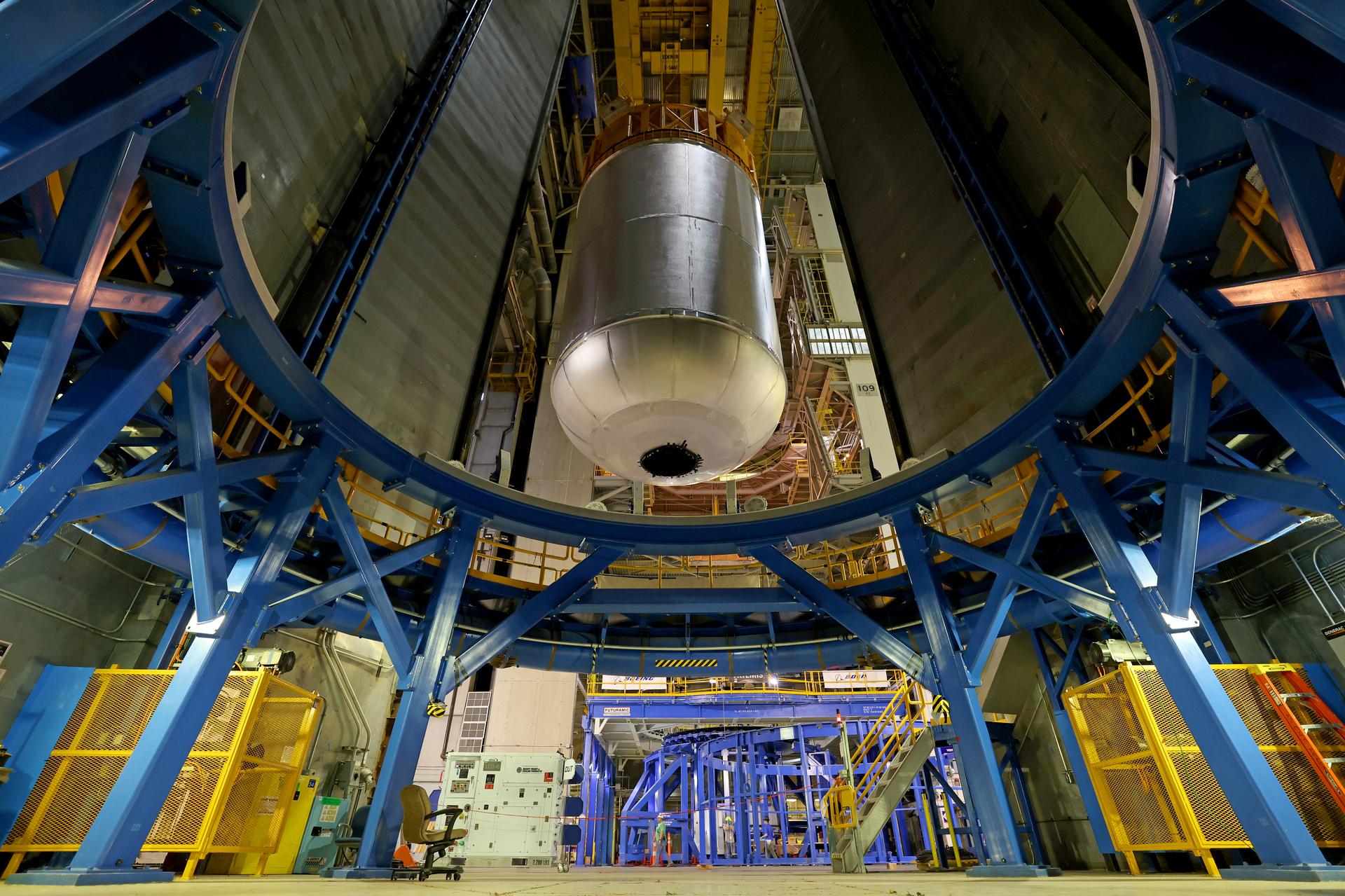
Teams at NASA’s Michoud Assembly Facility in New Orleans use an overhead crane to lift a 51-foot-tall liquid oxygen tank out of the vertical assembly center on May 26. The liquid oxygen tank will form part of the SLS (Space Launch System) rocket for NASA’s Artemis IV mission to the Moon. It will hold more than 196,000 gallons of super-cold liquid oxygen; and next, technicians with Boeing, SLS core stage prime contractor, and NASA will perform dimensional inspections and install internal baffles on the propellant tank before the next phase of production. The propellant tank is one of five major elements that make up the 212-foot-tall SLS rocket stage. The core stage, along with its four RS-25 engines at its base, produces more than two million pounds of thrust to help launch NASA’s Orion spacecraft, astronauts, and supplies beyond Earth’s orbit and to the lunar surface for Artemis. Image credit: NASA/Michael DeMocker
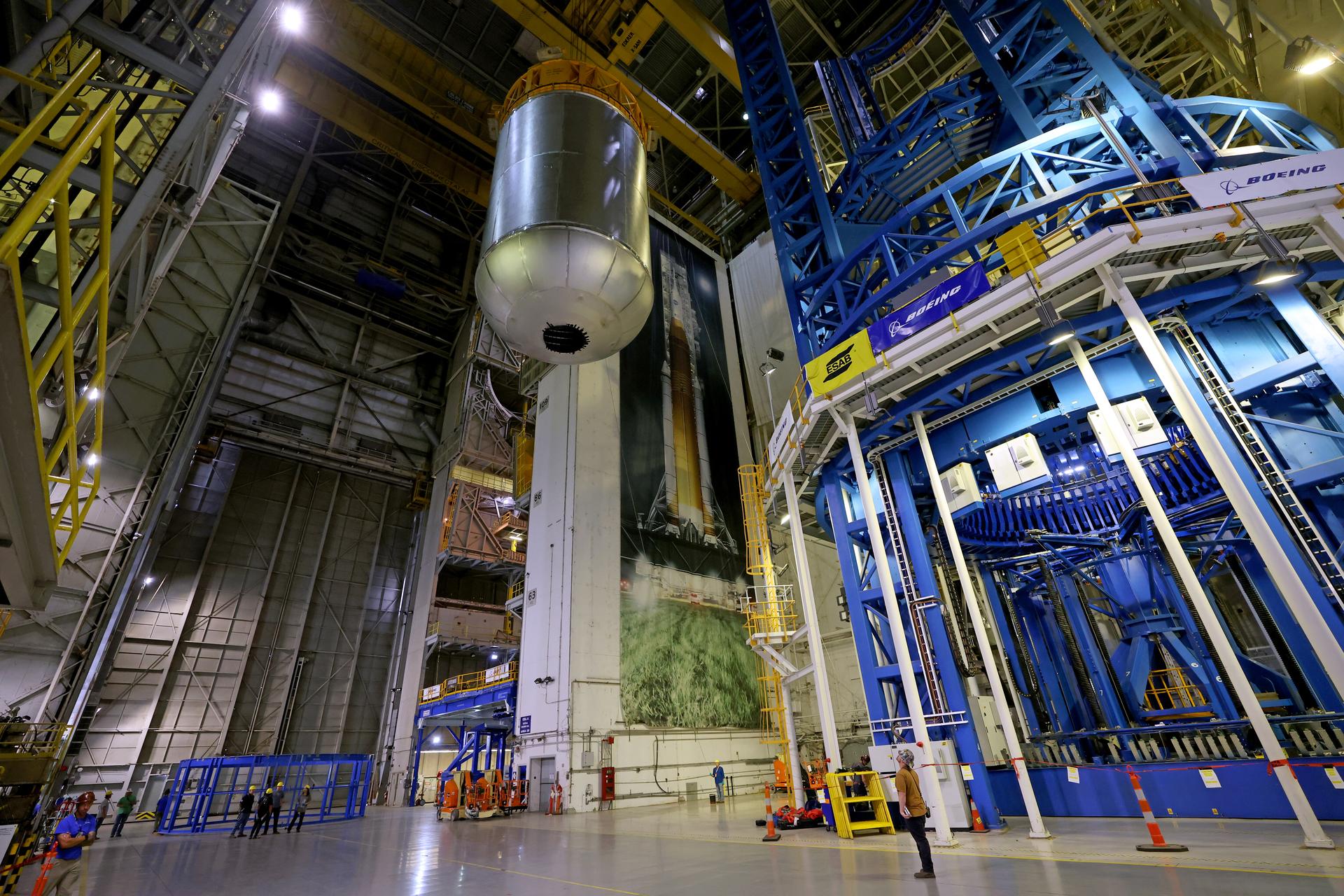
Teams at NASA’s Michoud Assembly Facility in New Orleans use an overhead crane to lift a 51-foot-tall liquid oxygen tank out of the vertical assembly center on May 26. The liquid oxygen tank will form part of the SLS (Space Launch System) rocket for NASA’s Artemis IV mission to the Moon. It will hold more than 196,000 gallons of super-cold liquid oxygen; and next, technicians with Boeing, SLS core stage prime contractor, and NASA will perform dimensional inspections and install internal baffles on the propellant tank before the next phase of production. The propellant tank is one of five major elements that make up the 212-foot-tall SLS rocket stage. The core stage, along with its four RS-25 engines at its base, produces more than two million pounds of thrust to help launch NASA’s Orion spacecraft, astronauts, and supplies beyond Earth’s orbit and to the lunar surface for Artemis. Image credit: NASA/Michael DeMocker
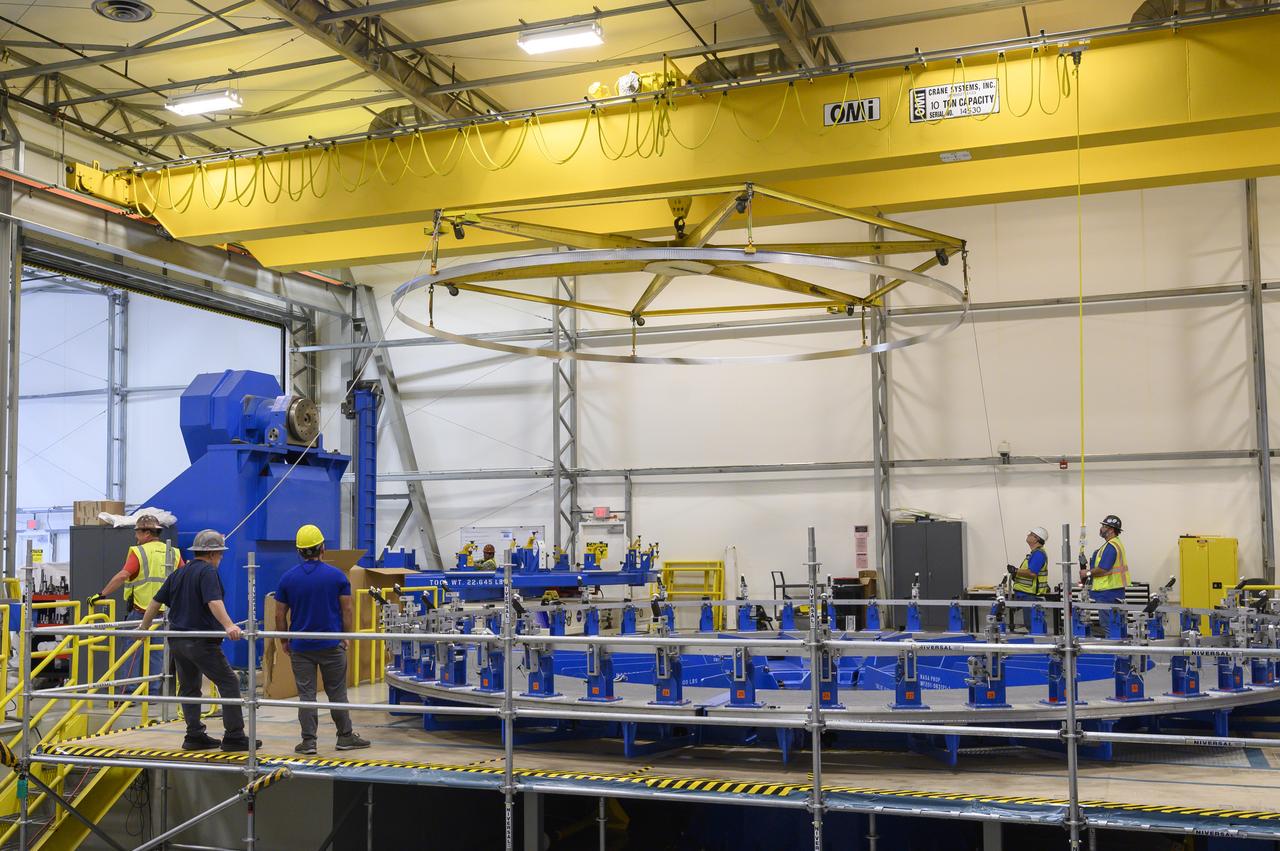
Technicians at NASA’s Michoud Assembly Facility in New Orleans lift a ring for the Exploration Upper Stage (EUS) of the SLS (Space Launch System) rocket to move it to another location in the 43-acre factory for further inspection and production. Flight hardware of the SLS EUS, a more powerful in-space propulsion stage beginning with Artemis IV, is in early production at Michoud. The rings make up the barrel sections for the flight hardware. The Exploration Upper Stage will be used on the second configuration of the SLS rocket, known as Block 1B, and will provide in-space propulsion to send astronauts in NASA’s Orion spacecraft and heavy cargo on a precise trajectory to the Moon. EUS will replace the interim cryogenic propulsion stage for the Block 1 configuration of SLS. It has larger propellant tanks and four RL10 engines, enabling SLS to launch 40% more cargo to the Moon along with crew. NASA and Boeing, the SLS lead contractor for the core stage and EUS, are currently manufacturing stages for Artemis II, III, IV, and V at the factory. NASA is working to land the first woman and first person of color on the Moon under Artemis. SLS is part of NASA’s backbone for deep space exploration, along with Orion and the Gateway in orbit around the Moon. SLS is the only rocket that can send Orion, astronauts, and supplies to the Moon in a single mission.
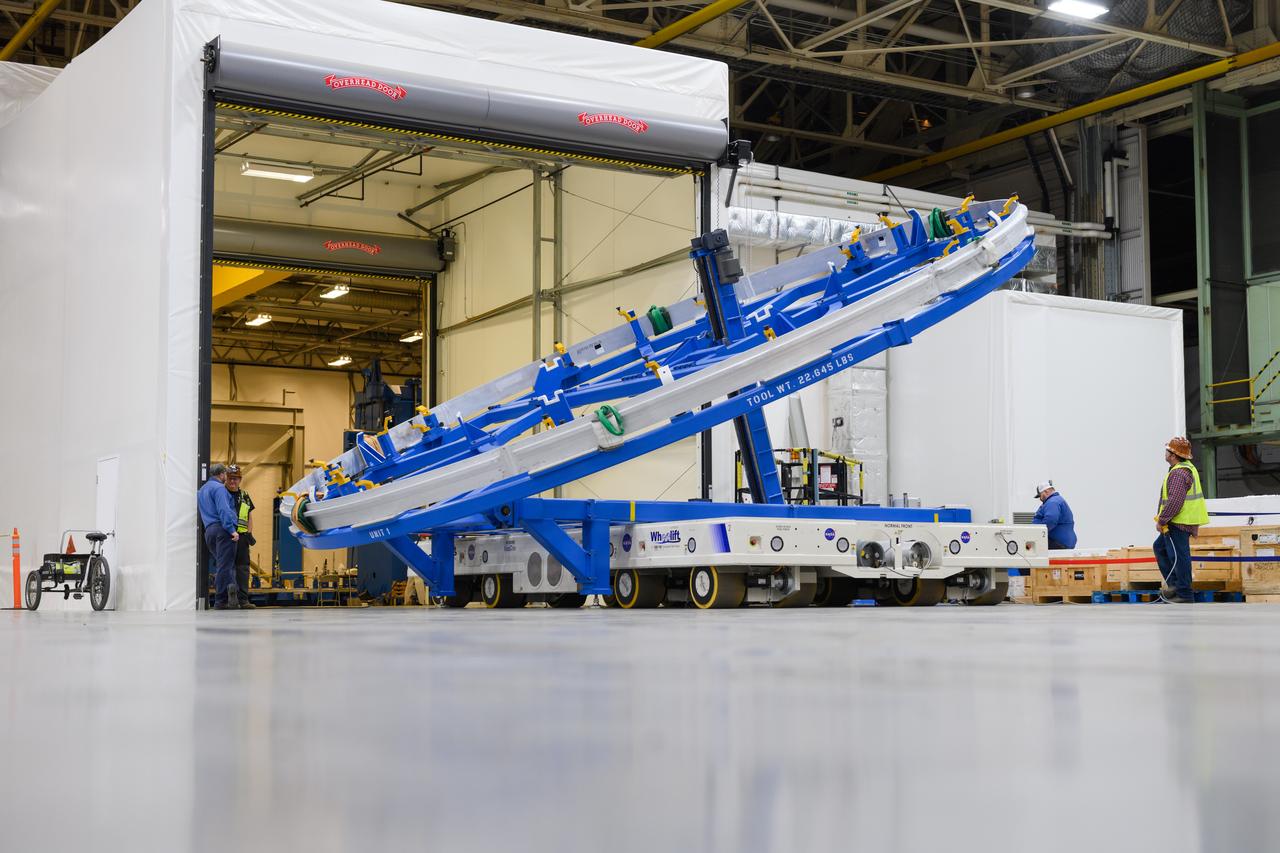
Technicians at NASA’s Michoud Assembly Facility in New Orleans lift a ring for the Exploration Upper Stage (EUS) of the SLS (Space Launch System) rocket to move it to another location in the 43-acre factory for further inspection and production. Flight hardware of the SLS EUS, a more powerful in-space propulsion stage beginning with Artemis IV, is in early production at Michoud. The rings make up the barrel sections for the flight hardware. The Exploration Upper Stage will be used on the second configuration of the SLS rocket, known as Block 1B, and will provide in-space propulsion to send astronauts in NASA’s Orion spacecraft and heavy cargo on a precise trajectory to the Moon. EUS will replace the interim cryogenic propulsion stage for the Block 1 configuration of SLS. It has larger propellant tanks and four RL10 engines, enabling SLS to launch 40% more cargo to the Moon along with crew. NASA and Boeing, the SLS lead contractor for the core stage and EUS, are currently manufacturing stages for Artemis II, III, IV, and V at the factory. NASA is working to land the first woman and first person of color on the Moon under Artemis. SLS is part of NASA’s backbone for deep space exploration, along with Orion and the Gateway in orbit around the Moon. SLS is the only rocket that can send Orion, astronauts, and supplies to the Moon in a single mission.
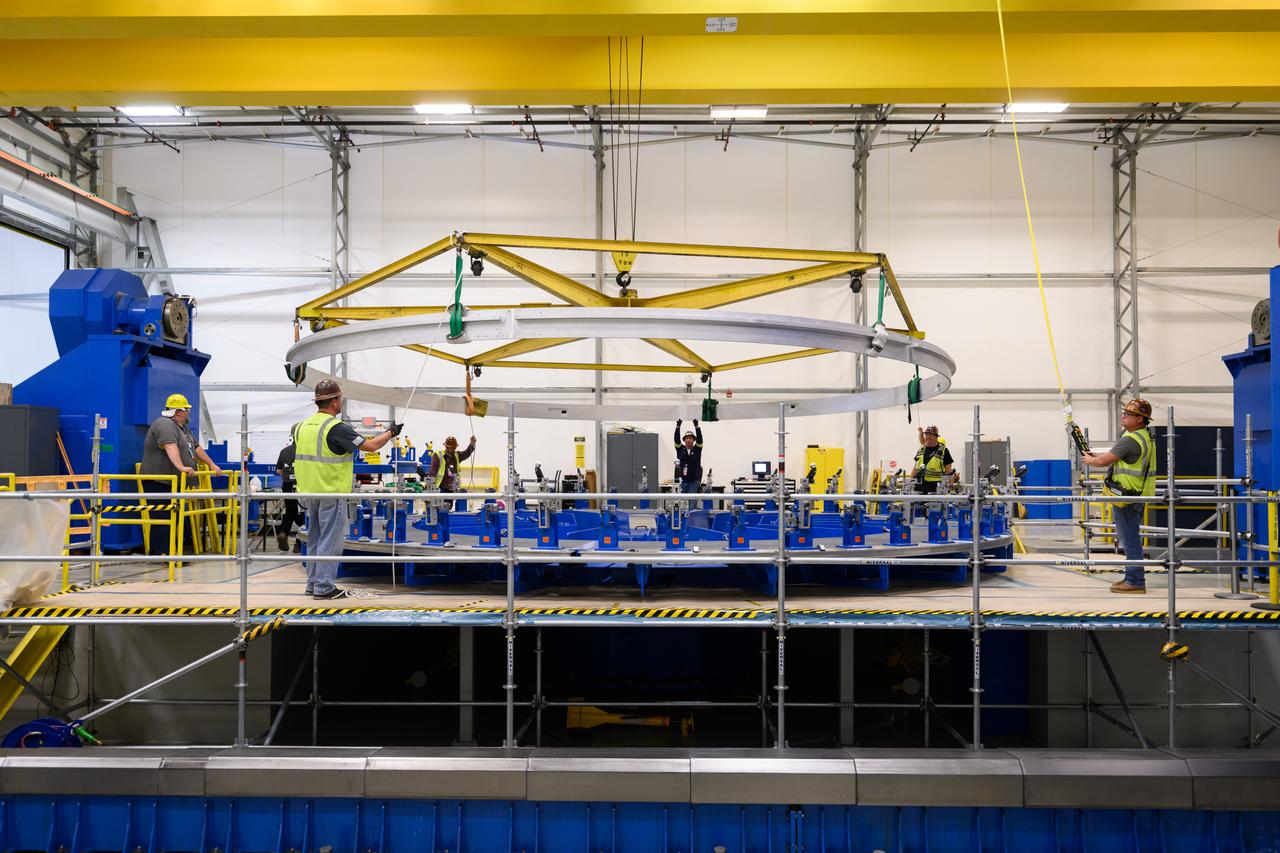
Technicians at NASA’s Michoud Assembly Facility in New Orleans lift a ring for the Exploration Upper Stage (EUS) of the SLS (Space Launch System) rocket to move it to another location in the 43-acre factory for further inspection and production. Flight hardware of the SLS EUS, a more powerful in-space propulsion stage beginning with Artemis IV, is in early production at Michoud. The rings make up the barrel sections for the flight hardware. The Exploration Upper Stage will be used on the second configuration of the SLS rocket, known as Block 1B, and will provide in-space propulsion to send astronauts in NASA’s Orion spacecraft and heavy cargo on a precise trajectory to the Moon. EUS will replace the interim cryogenic propulsion stage for the Block 1 configuration of SLS. It has larger propellant tanks and four RL10 engines, enabling SLS to launch 40% more cargo to the Moon along with crew. NASA and Boeing, the SLS lead contractor for the core stage and EUS, are currently manufacturing stages for Artemis II, III, IV, and V at the factory. NASA is working to land the first woman and first person of color on the Moon under Artemis. SLS is part of NASA’s backbone for deep space exploration, along with Orion and the Gateway in orbit around the Moon. SLS is the only rocket that can send Orion, astronauts, and supplies to the Moon in a single mission.
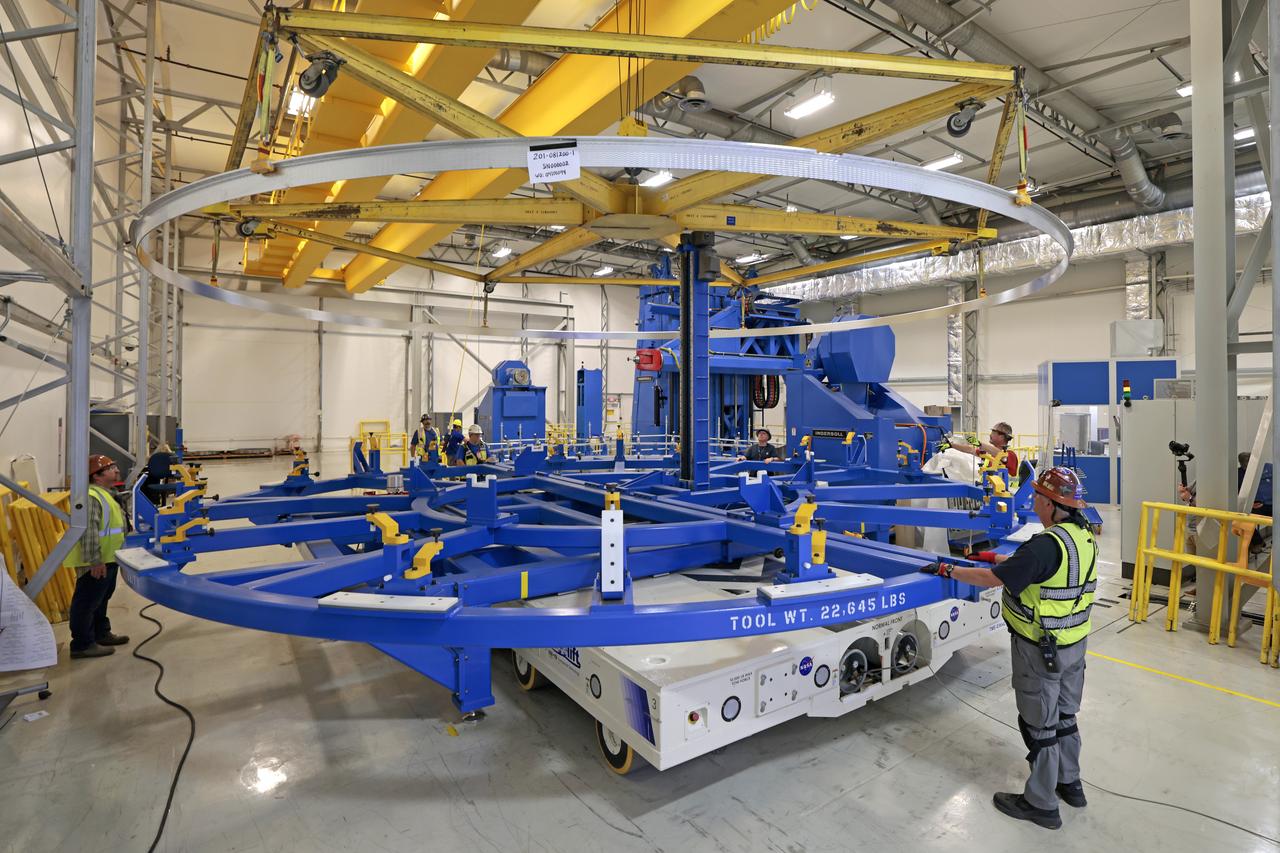
Technicians at NASA’s Michoud Assembly Facility in New Orleans lift a ring for the Exploration Upper Stage (EUS) of the SLS (Space Launch System) rocket to move it to another location in the 43-acre factory for further inspection and production. Flight hardware of the SLS EUS, a more powerful in-space propulsion stage beginning with Artemis IV, is in early production at Michoud. The rings make up the barrel sections for the flight hardware. The Exploration Upper Stage will be used on the second configuration of the SLS rocket, known as Block 1B, and will provide in-space propulsion to send astronauts in NASA’s Orion spacecraft and heavy cargo on a precise trajectory to the Moon. EUS will replace the interim cryogenic propulsion stage for the Block 1 configuration of SLS. It has larger propellant tanks and four RL10 engines, enabling SLS to launch 40% more cargo to the Moon along with crew. NASA and Boeing, the SLS lead contractor for the core stage and EUS, are currently manufacturing stages for Artemis II, III, IV, and V at the factory. NASA is working to land the first woman and first person of color on the Moon under Artemis. SLS is part of NASA’s backbone for deep space exploration, along with Orion and the Gateway in orbit around the Moon. SLS is the only rocket that can send Orion, astronauts, and supplies to the Moon in a single mission.