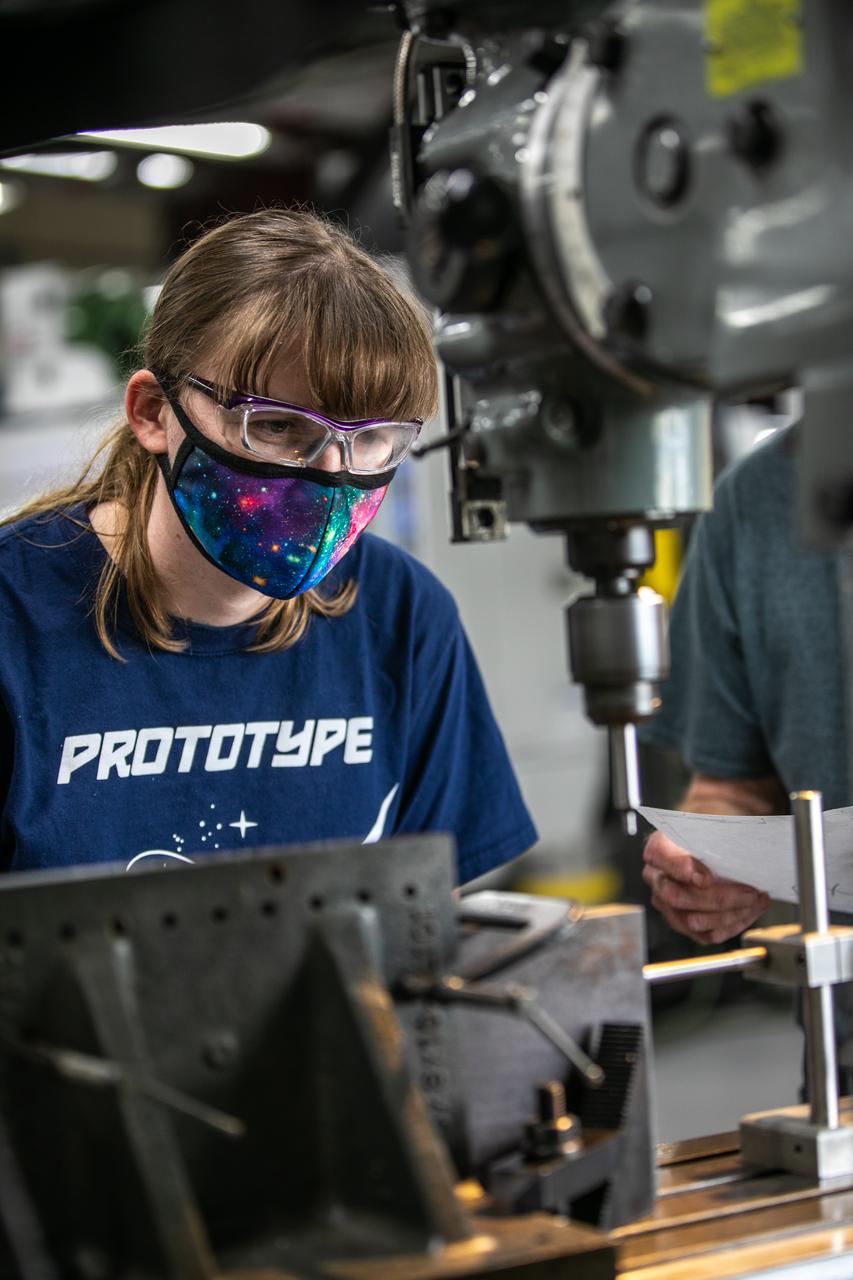
Katie Mortensen, a mechanical engineering technician, machines test article materials inside the Prototype Development Laboratory at NASA’s Kennedy Space Center in Florida on Oct. 21, 2020. The prototype laboratory designs, fabricates, and tests prototypes, test articles and test support equipment. It has a long history of providing fast solutions to complex operations problems. The lab’s teams of engineers use specialized equipment to produce exacting, one-of-a-kind items made from a range of materials depending on the design. The lab supports projects at Kennedy and at the agency level.
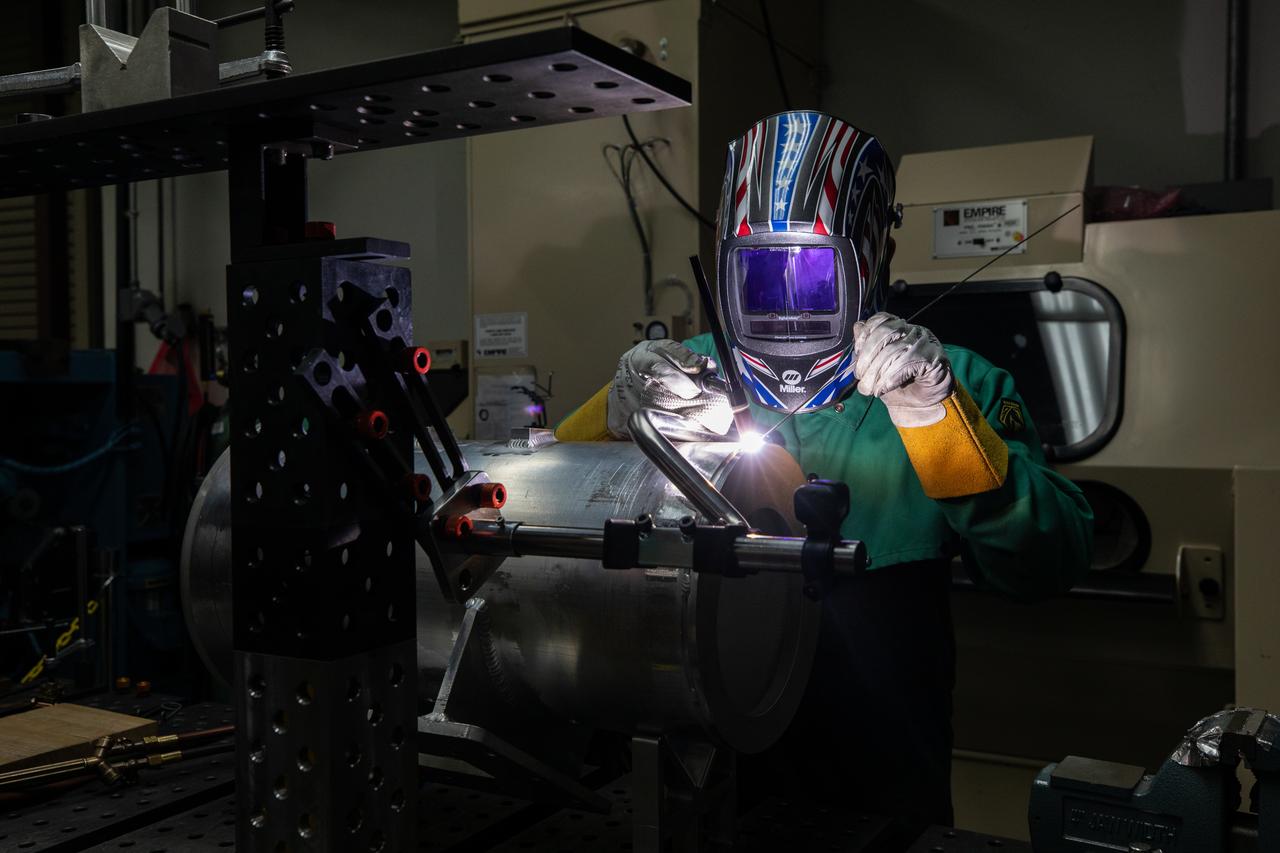
Spencer Wells, a mechanical engineering technician, welds a part of a camera enclosure which will be used at Launch Complex 39B inside the Prototype Development Laboratory at NASA’s Kennedy Space Center in Florida on Oct. 21, 2020. The prototype laboratory designs, fabricates, and tests prototypes, test articles and test support equipment. It has a long history of providing fast solutions to complex operations problems. The lab’s teams of engineers use specialized equipment to produce exacting, one-of-a-kind items made from a range of materials depending on the design. The lab supports projects at Kennedy and at the agency level.
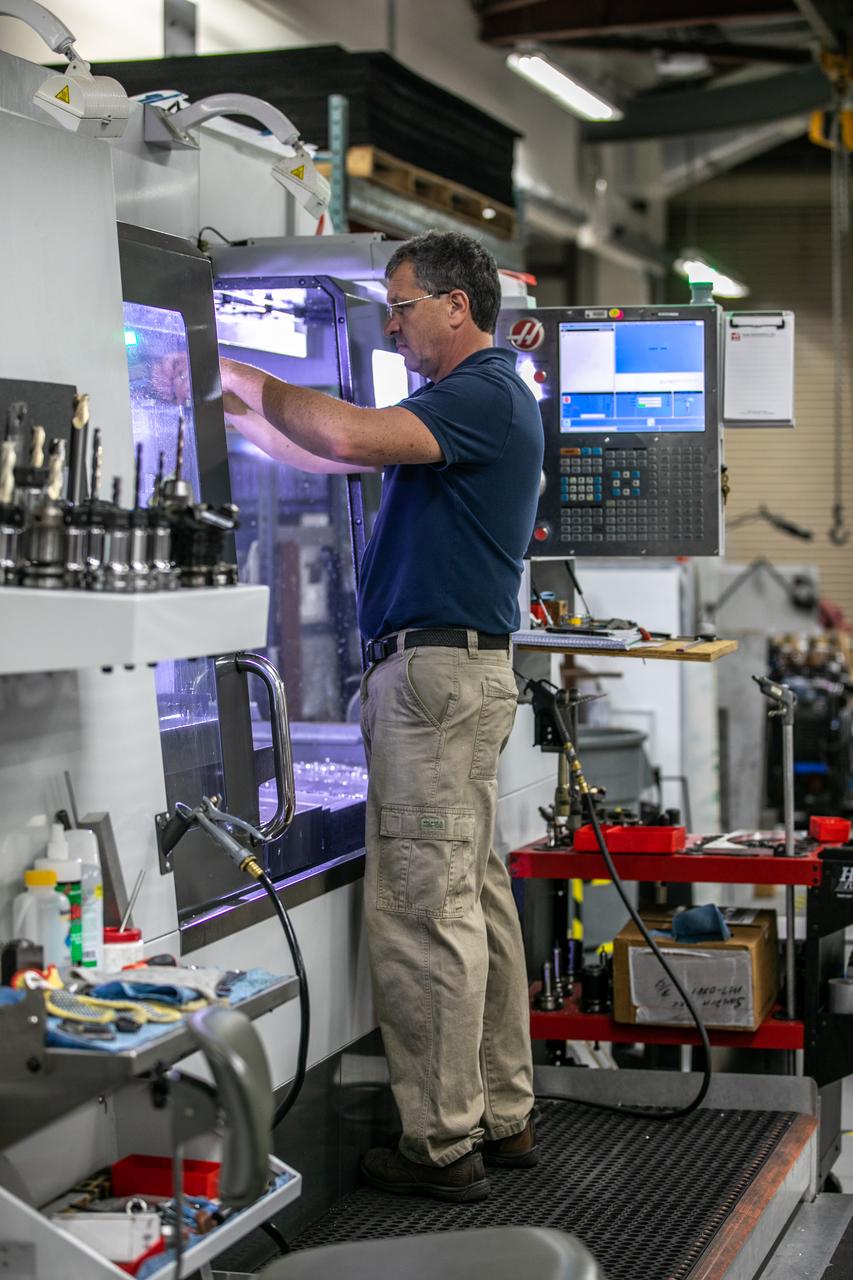
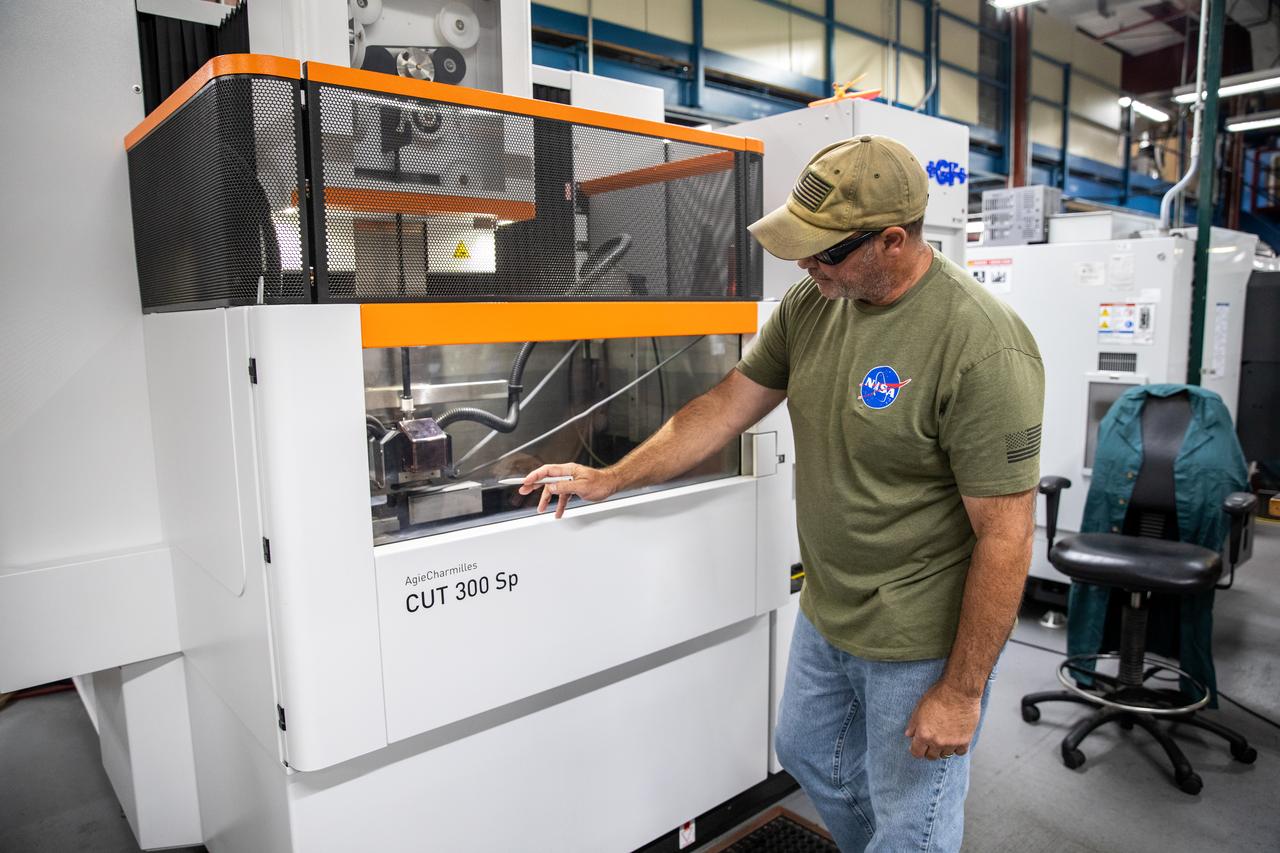
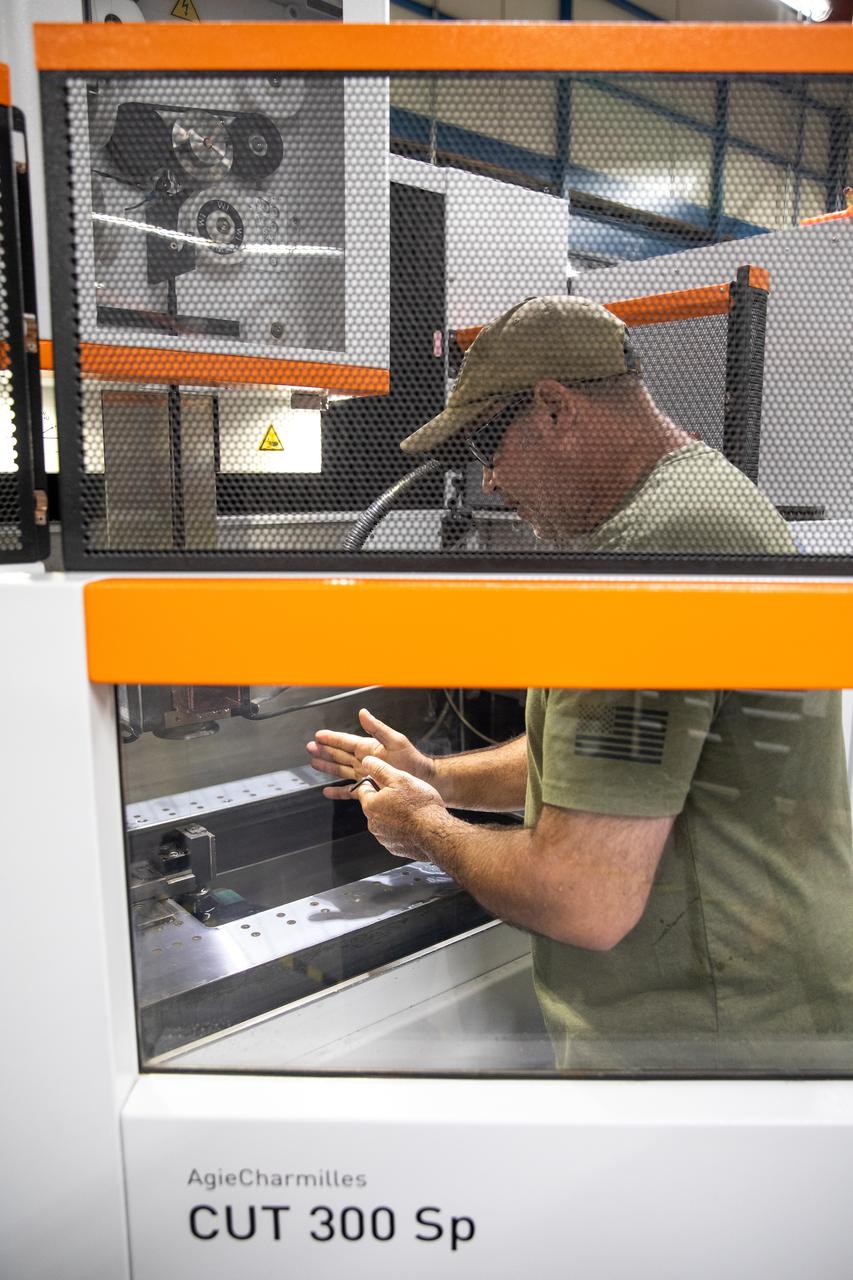
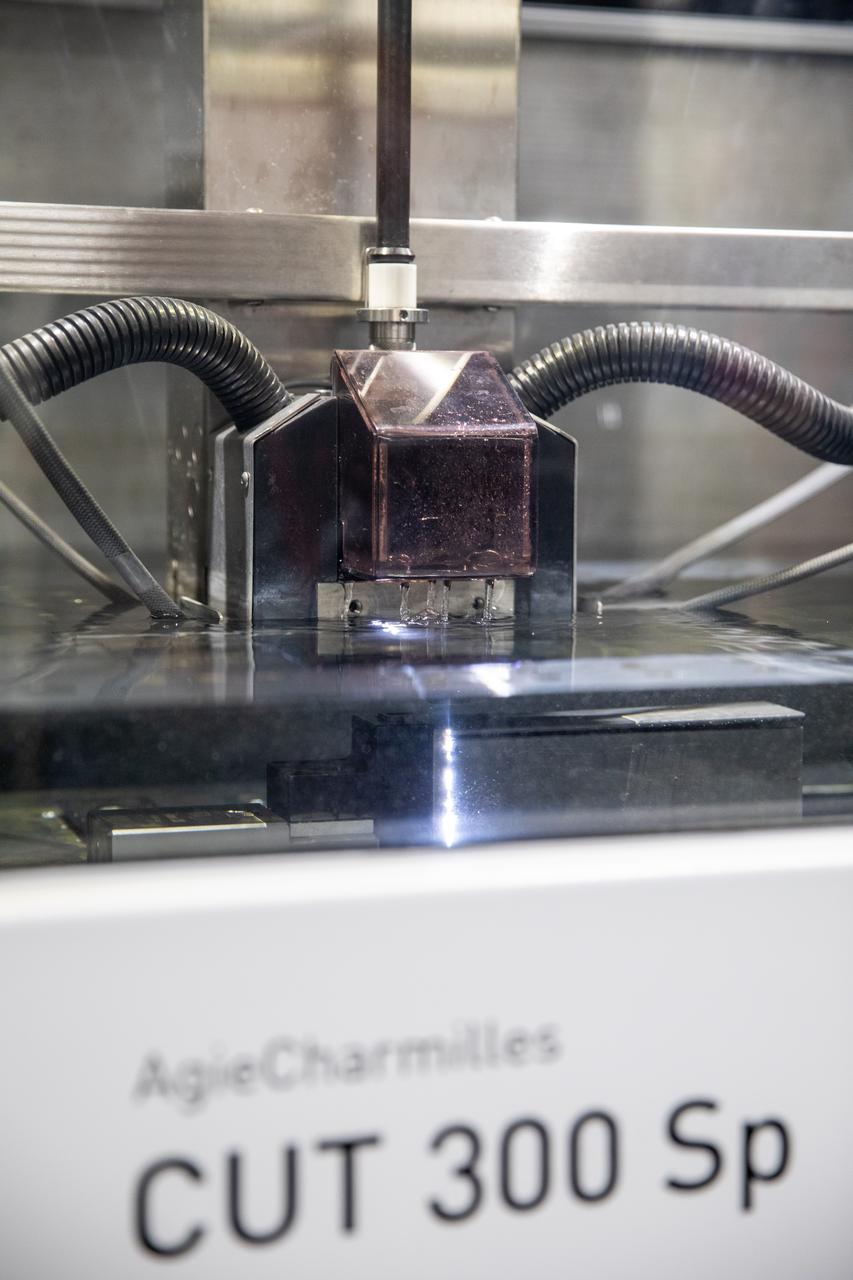
Tim Evans, a mechanical engineering technician, uses a computer numerical control (CNC) machine to machine a part for a Launch Pad 39B camera enclosure inside the Prototype Development Laboratory at NASA’s Kennedy Space Center in Florida on Oct. 21, 2020. The prototype laboratory designs, fabricates, and tests prototypes, test articles and test support equipment. It has a long history of providing fast solutions to complex operations problems. The lab’s teams of engineers use specialized equipment to produce exacting, one-of-a-kind items made from a range of materials depending on the design. The lab supports projects at Kennedy and at the agency level.
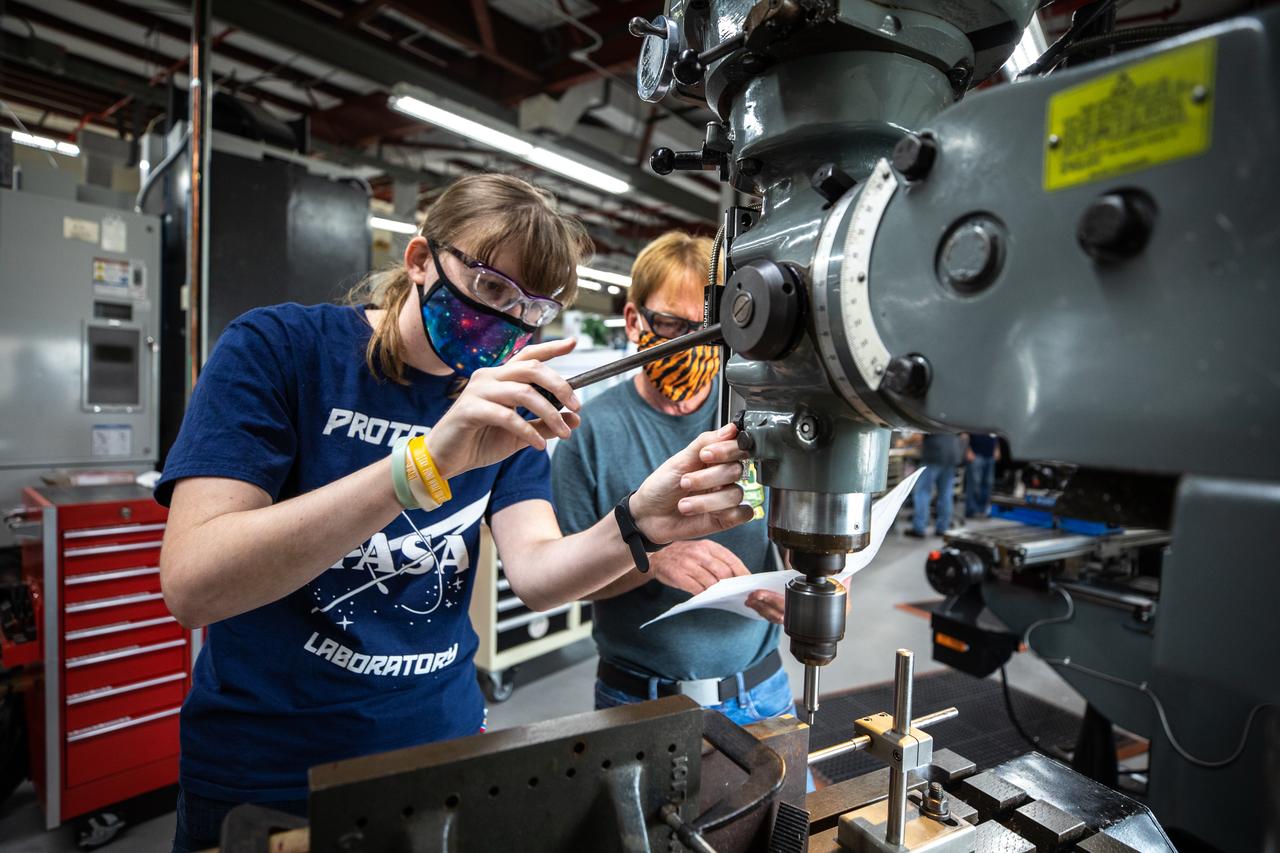
From left, mechanical engineering technicians Katie Mortensen and Jim Niehoff machine test article material inside the Prototype Development Laboratory at NASA’s Kennedy Space Center in Florida on Oct. 21, 2020. The prototype laboratory designs, fabricates, and tests prototypes, test articles and test support equipment. It has a long history of providing fast solutions to complex operations problems. The lab’s teams of engineers use specialized equipment to produce exacting, one-of-a-kind items made from a range of materials depending on the design. The lab supports projects at Kennedy and at the agency level.
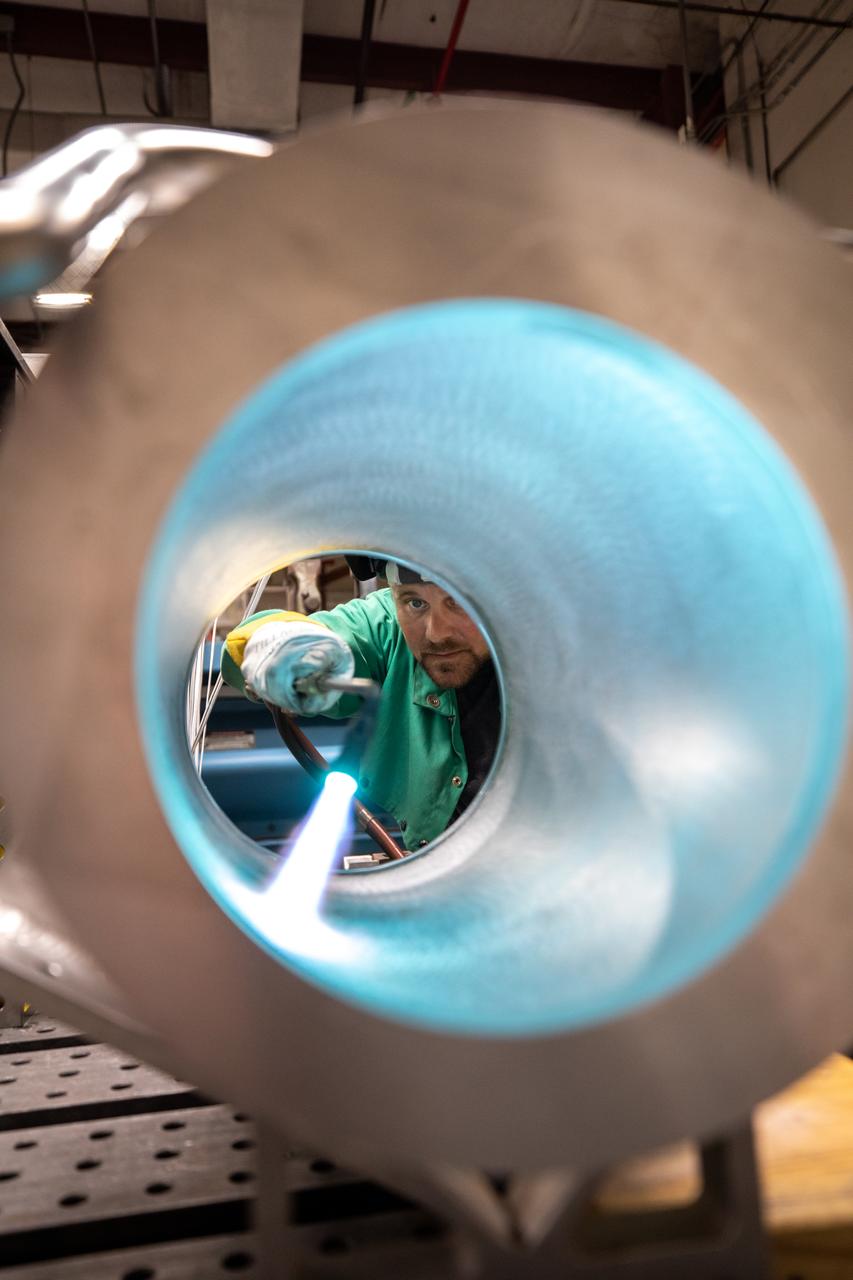
Spencer Wells, a mechanical engineering technician, examines the interior of a camera enclosure for Launch Complex 39B inside the Prototype Development Laboratory at NASA’s Kennedy Space Center in Florida on Oct. 21, 2020. The prototype laboratory designs, fabricates, and tests prototypes, test articles and test support equipment. It has a long history of providing fast solutions to complex operations problems. The lab’s teams of engineers use specialized equipment to produce exacting, one-of-a-kind items made from a range of materials depending on the design. The lab supports projects at Kennedy and at the agency level.
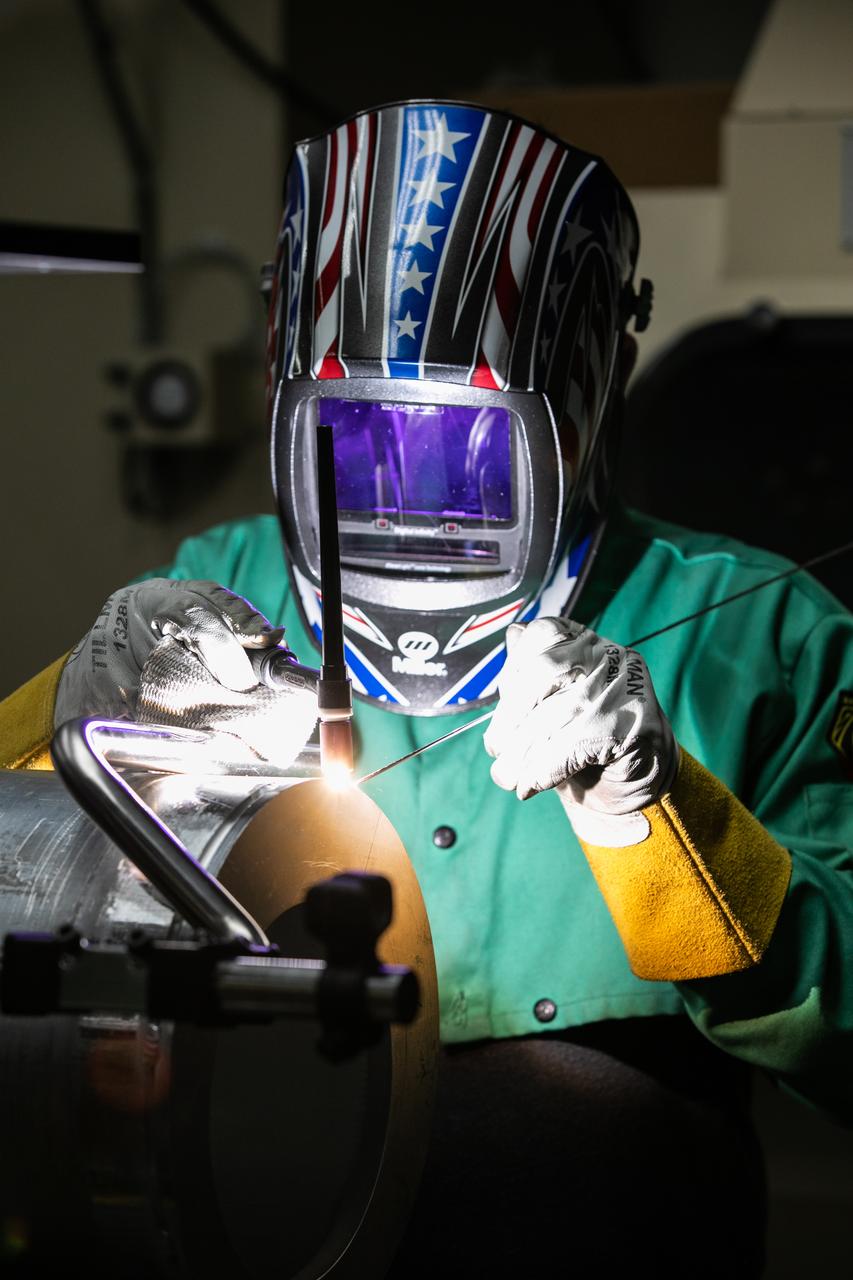
Spencer Wells, a mechanical engineering technician, welds a part of a camera enclosure which will be used at Launch Complex 39B inside the Prototype Development Laboratory at NASA’s Kennedy Space Center in Florida on Oct. 21, 2020. The prototype laboratory designs, fabricates, and tests prototypes, test articles and test support equipment. It has a long history of providing fast solutions to complex operations problems. The lab’s teams of engineers use specialized equipment to produce exacting, one-of-a-kind items made from a range of materials depending on the design. The lab supports projects at Kennedy and at the agency level.
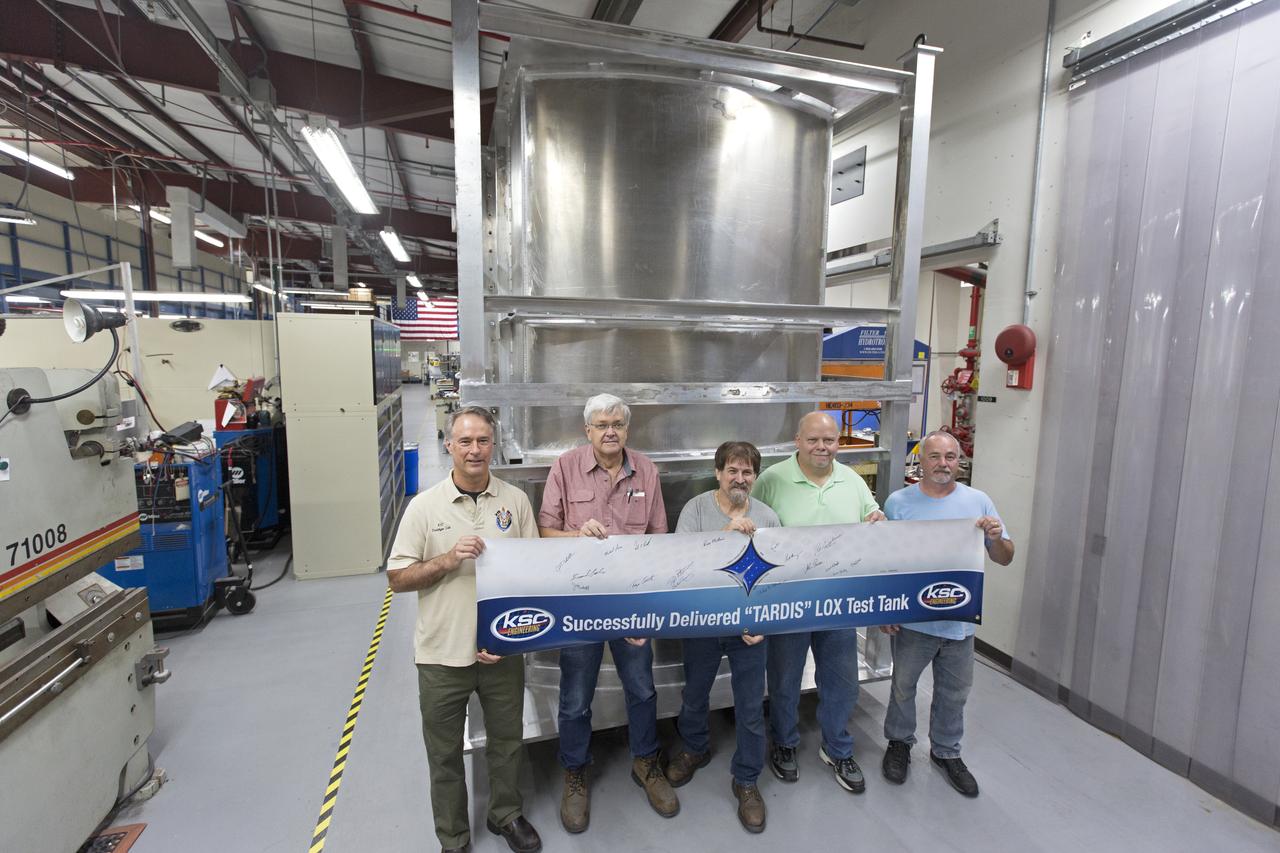
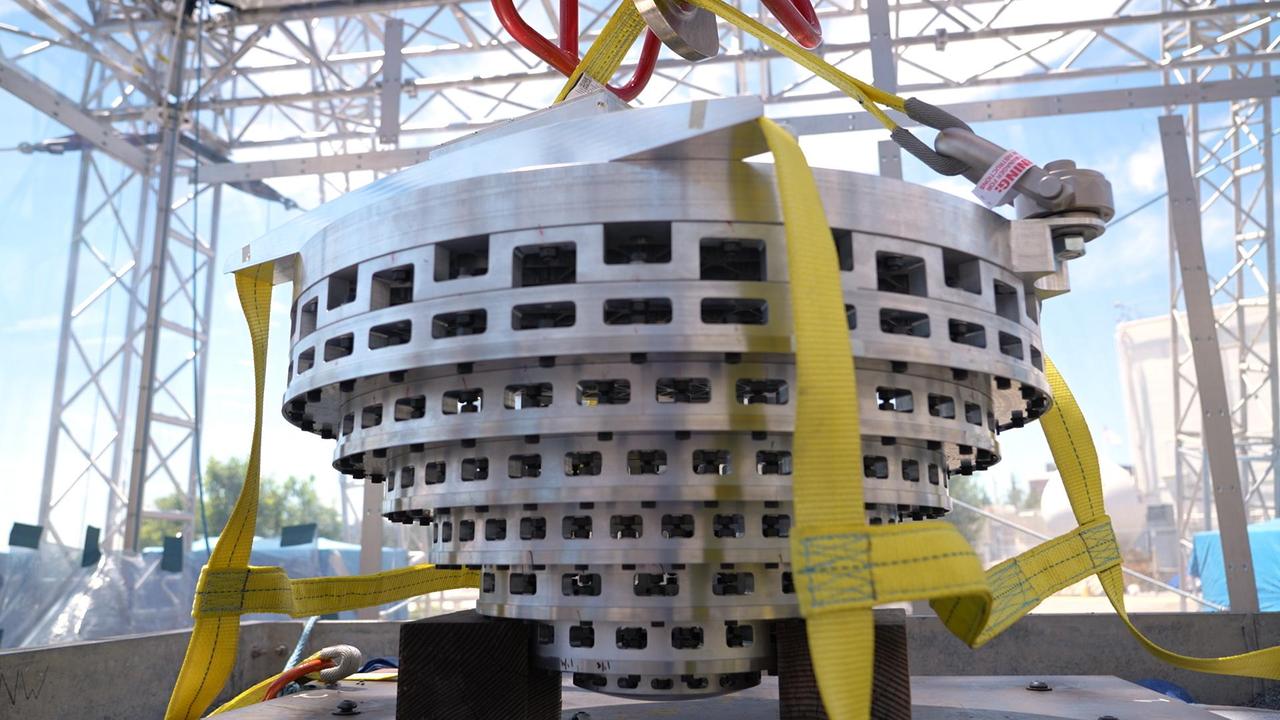
Inside the Prototype Development Laboratory at NASA's Kennedy Space Center in Florida, engineers and technicians hold a banner marking the successful delivery of a liquid oxygen test tank called Tardis. From left, are Todd Steinrock, chief, Fabrication and Development Branch, Prototype Development Lab; David McLaughlin, electrical engineering technician; Phil Stroda, mechanical engineering technician; Perry Dickey, lead electrical engineering technician; and Harold McAmis, lead mechanical engineering technician. Engineers and technicians worked together to develop the tank and build it at the lab to support cryogenic testing at Johnson Space Center's White Sands Test Facility in Las Cruces, New Mexico. The 12-foot-tall, 3,810-pound aluminum tank will be shipped to White Sands for testing.
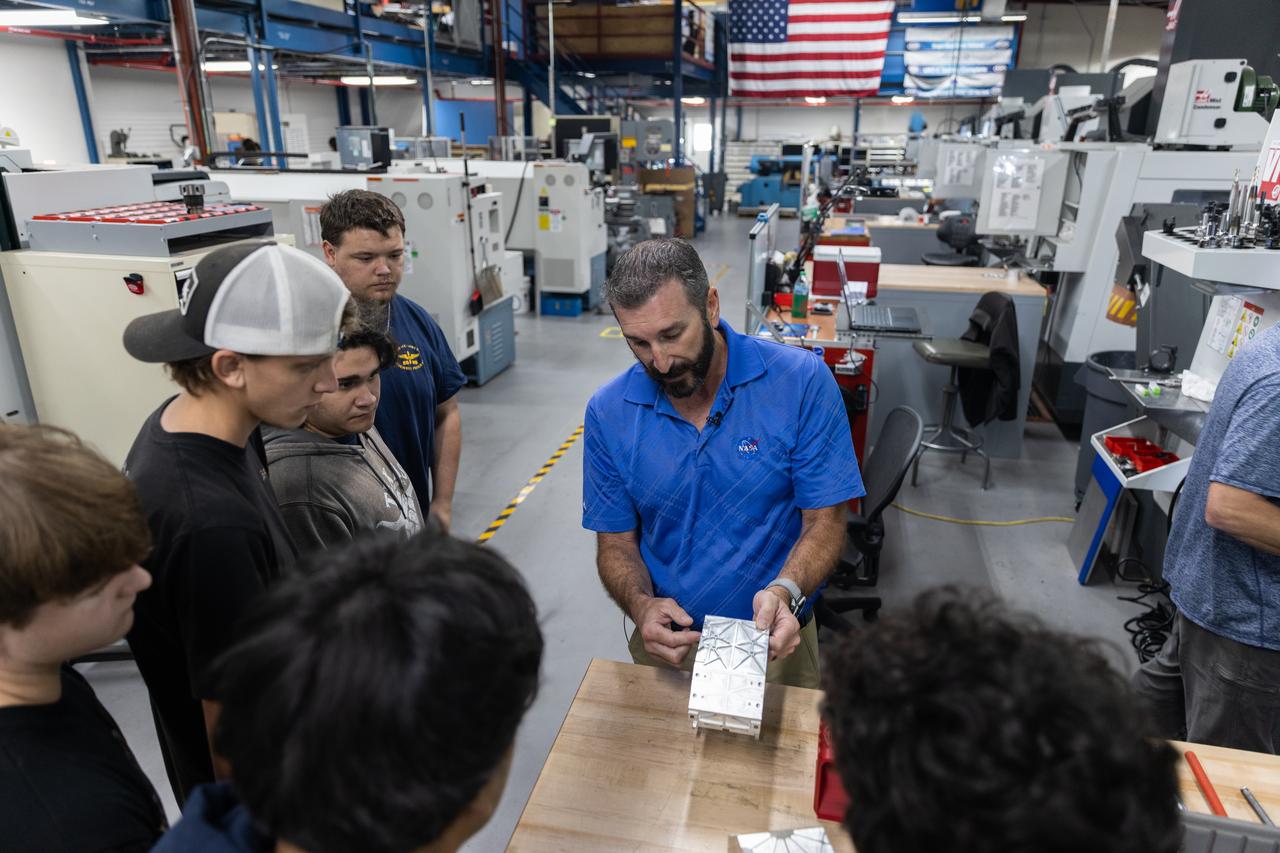
Students from Eau Gallie High School in Melbourne, Florida, visited the Prototype Development Laboratory at NASA’s Kennedy Space Center in Florida on Monday, April 28, 2025. The STEM participants have an interest in technical trades and learned about the technicians at the Prototype Development Laboratory who design, fabricate, and test protypes, test articles, and test support equipment.
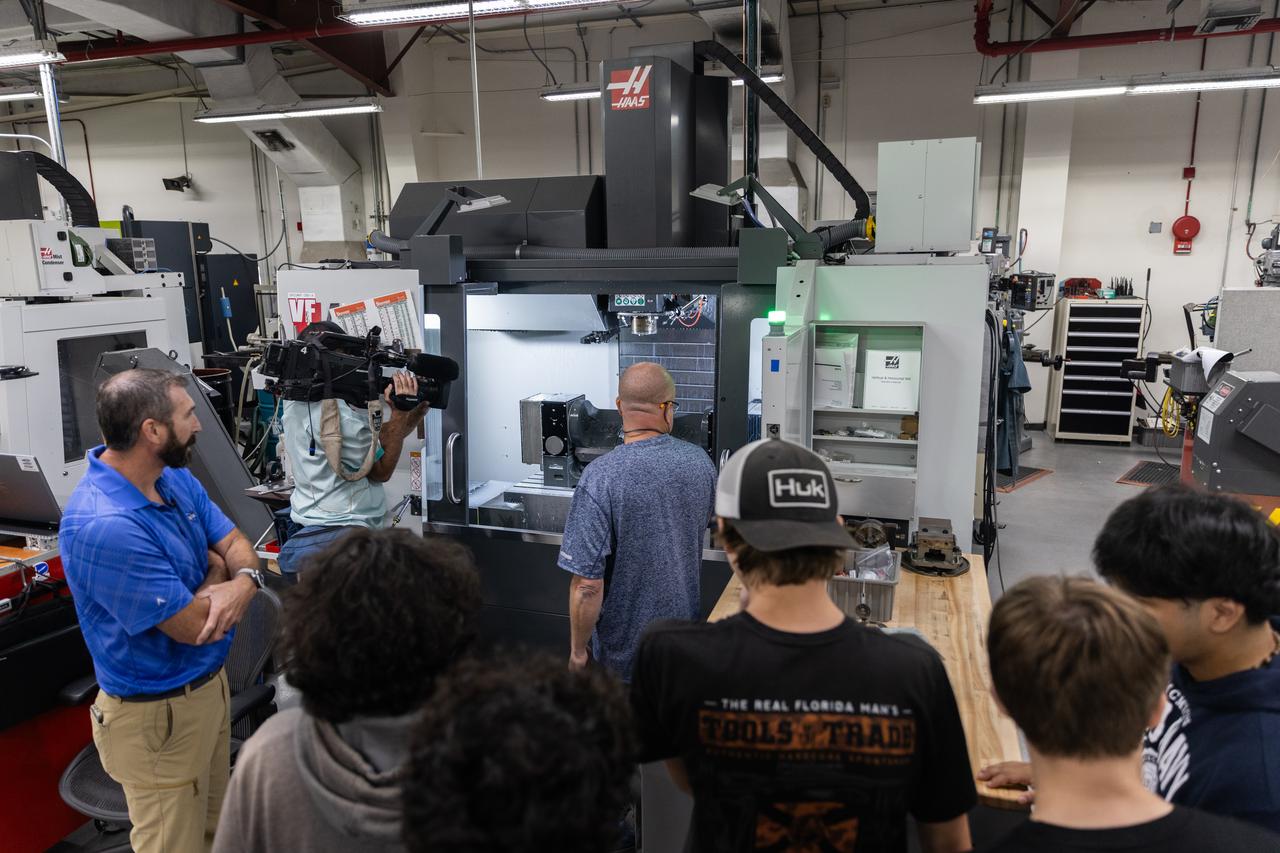
Students from Eau Gallie High School in Melbourne, Florida, visited the Prototype Development Laboratory at NASA’s Kennedy Space Center in Florida on Monday, April 28, 2025. The STEM participants have an interest in technical trades and learned about the technicians at the Prototype Development Laboratory who design, fabricate, and test protypes, test articles, and test support equipment.
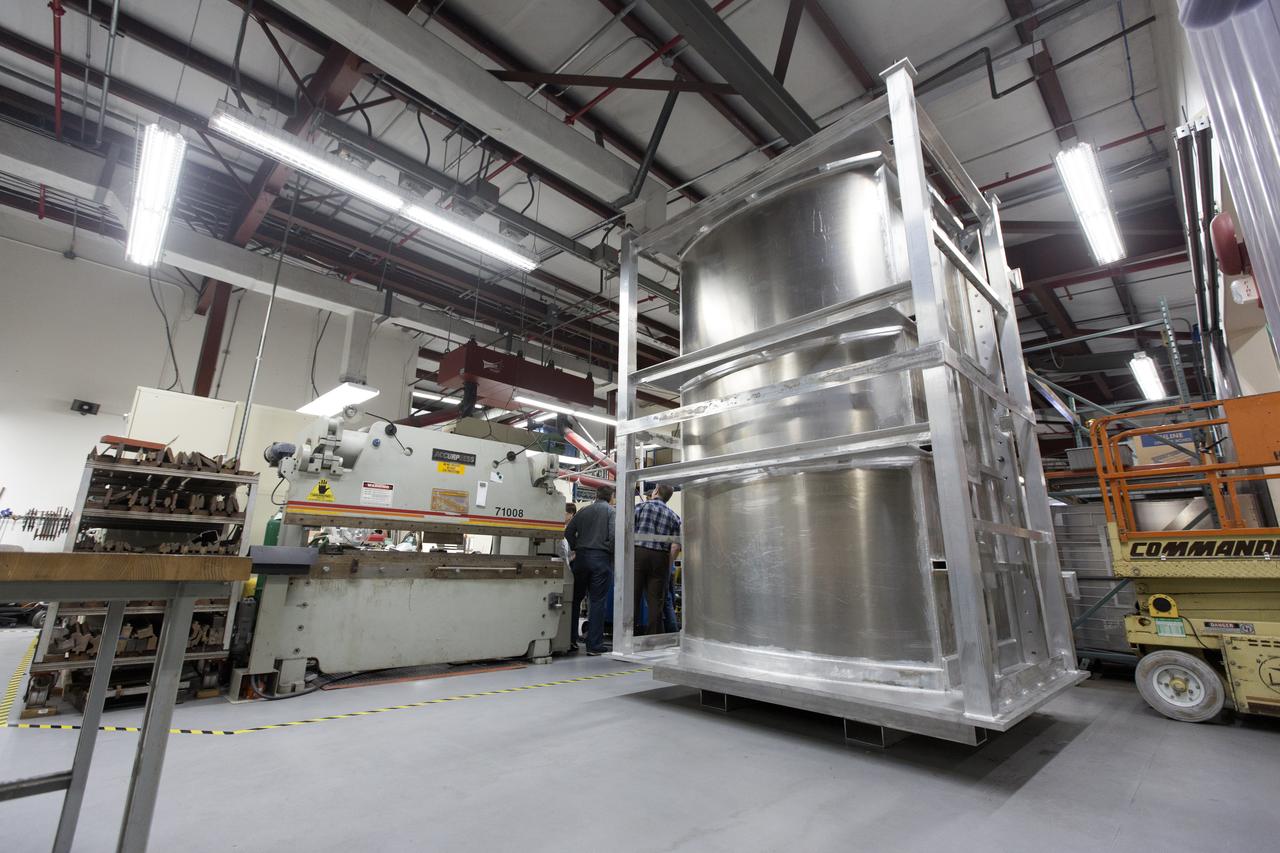
A liquid oxygen test tank was completed in the Prototype Development Laboratory at NASA's Kennedy Space Center in Florida. A banner signing event marked the successful delivery of the tank called Tardis. Engineers and technicians worked together to develop the tank and build it at the lab to support cryogenic testing at Johnson Space Center's White Sands Test Facility in Las Cruces, New Mexico. The 12-foot-tall, 3,810-pound aluminum tank will be shipped to White Sands for testing.
NASA Kennedy Space Center's Engineering Directorate held a banner signing event in the Prototype Development Laboratory to mark the successful delivery of a liquid oxygen test tank, called Tardis. Engineers and technicians worked together to develop the tank and build it to support cryogenic testing at Johnson Space Center's White Stands Test Facility in Las Cruces, New Mexico. The 12-foot-tall, 3,810-pound aluminum tank will be shipped to White Sands for testing.
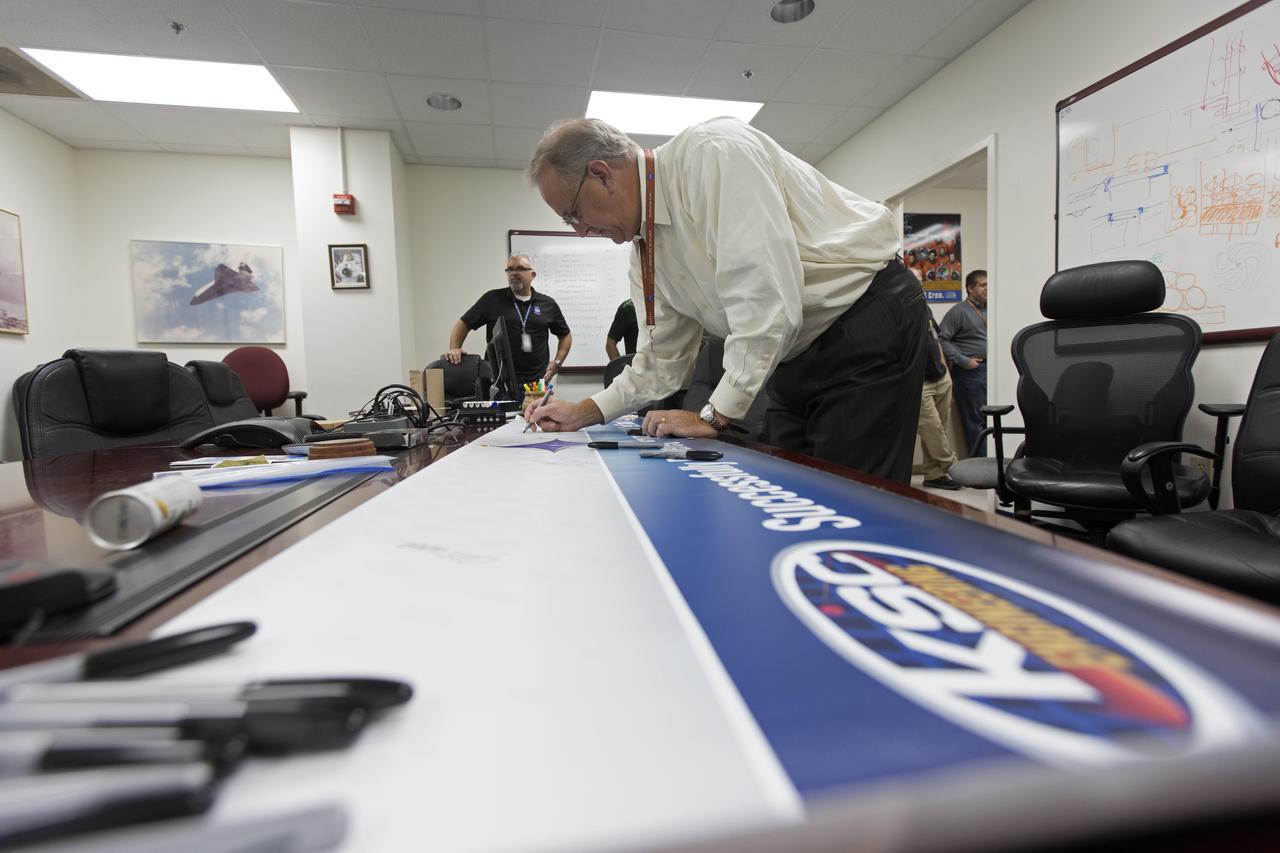
NASA Kennedy Space Center's Engineering Director Pat Simpkins signs the banner marking the successful delivery of a liquid oxygen test tank, called Tardis, in the Prototype Development Laboratory at NASA's Kennedy Space Center in Florida. Engineers and technicians worked together to develop the tank and build it to support cryogenic testing at Johnson Space Center's White Stands Test Facility in Las Cruces, New Mexico. The 12-foot-tall, 3,810-pound aluminum tank will be shipped to White Sands for testing.
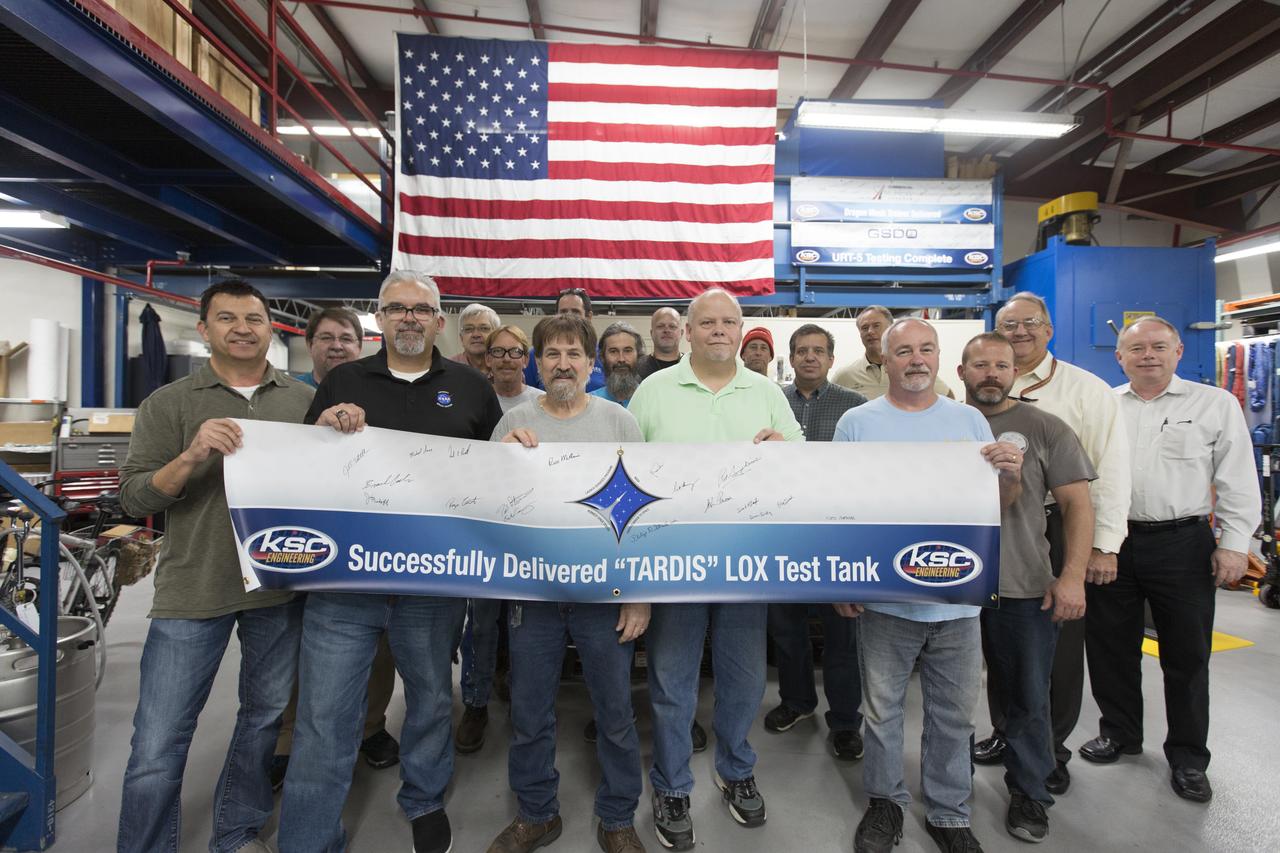
Inside the Prototype Development Laboratory at NASA's Kennedy Space Center in Florida, workers in the lab hold a banner marking the successful delivery of a liquid oxygen test tank called Tardis. Engineers and technicians worked together to develop the tank to build it at the lab to support cryogenic testing at Johnson Space Center's White Sands Test Facility in Las Cruces, New Mexico. The 12-foot-tall, 3,810-pound aluminum tank will be shipped to White Sands for testing.
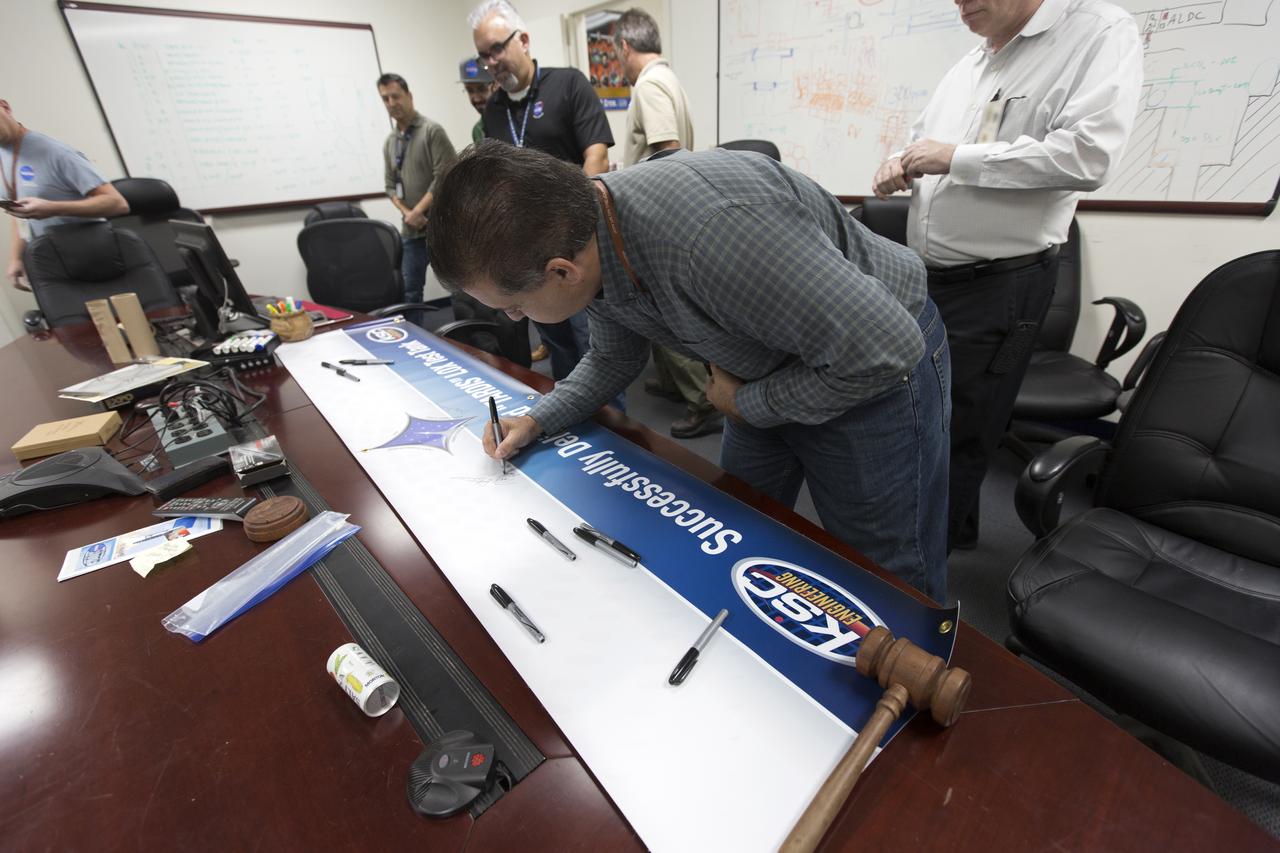
Workers sign the banner marking the successful delivery of a liquid oxygen test tank, called Tardis, in the Prototype Development Laboratory at NASA's Kennedy Space Center in Florida. Engineers and technicians worked together to develop the tank and build it at the lab to support cryogenic testing at Johnson Space Center's White Sands Test Facility in Las Cruces, New Mexico. The 12-foot-tall, 3,810-pound aluminum tank will be shipped to White Sands for testing.
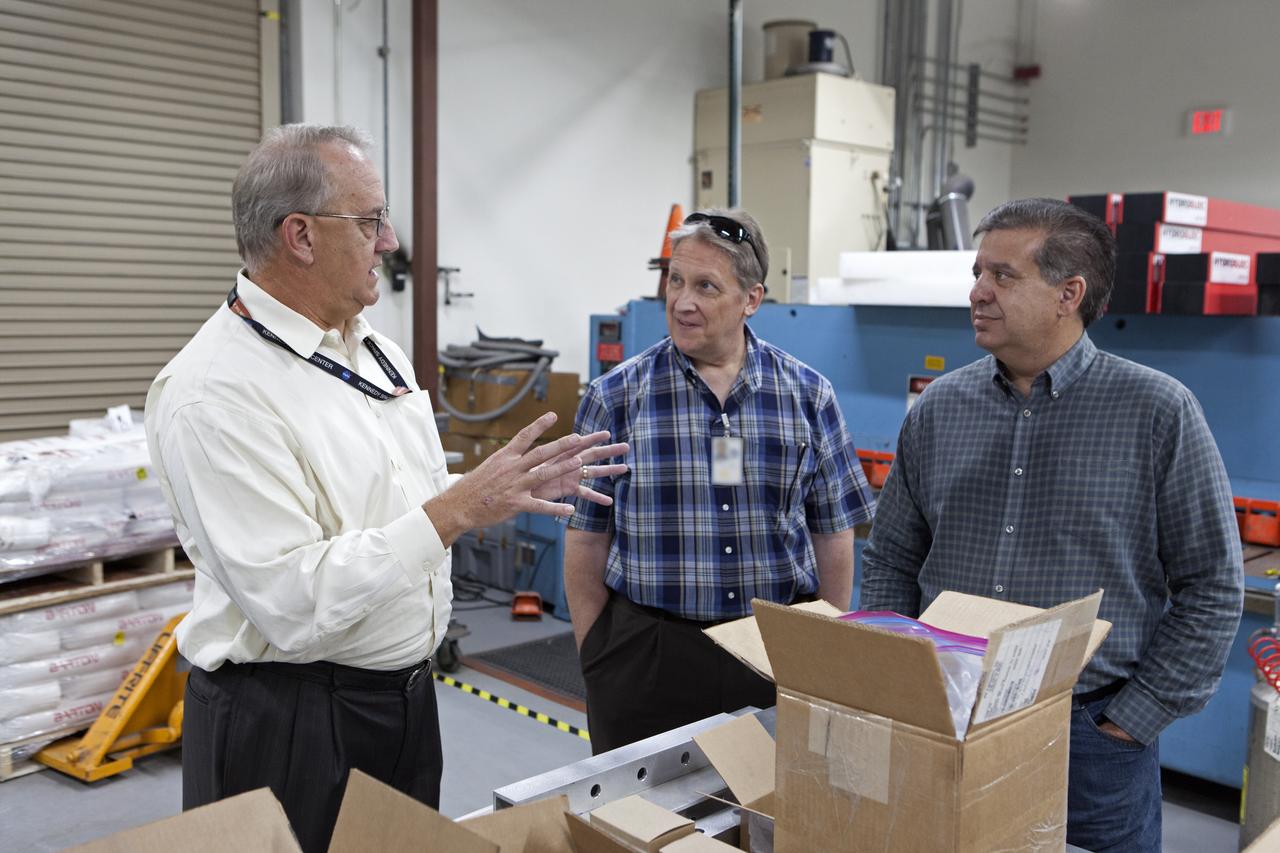
NASA Kennedy Space Center's Engineering Director Pat Simpkins, at left, talks with Michael E. Johnson, a project engineer; and Emilio Cruz, deputy division chief in the Laboratories, Development and Testing Division, inside the Prototype Development Laboratory. A banner signing event was held to mark the successful delivery of a liquid oxygen test tank, called Tardis. Engineers and technicians worked together to develop the tank and build it at the lab to support cryogenic testing at Johnson Space Center's White Sands Test Facility in Las Cruces, New Mexico. The 12-foot-tall, 3,810-pound aluminum tank will be shipped to White Sands for testing.
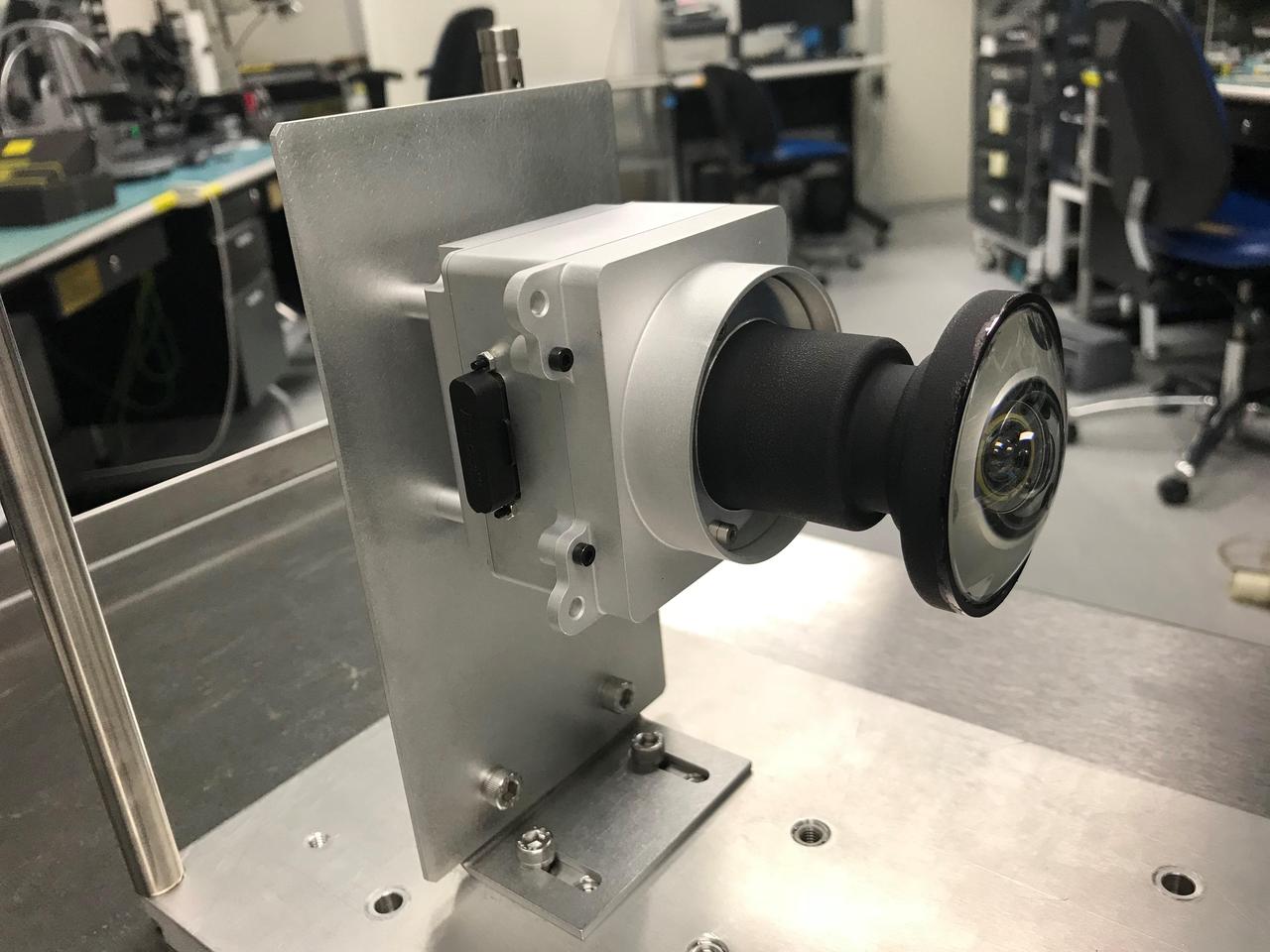
This image shows one of the enhanced engineering cameras with a prototype lens for the Hazcams, which will watch for obstacles encountered by NASA's Mars 2020 rover. https://photojournal.jpl.nasa.gov/catalog/PIA22102
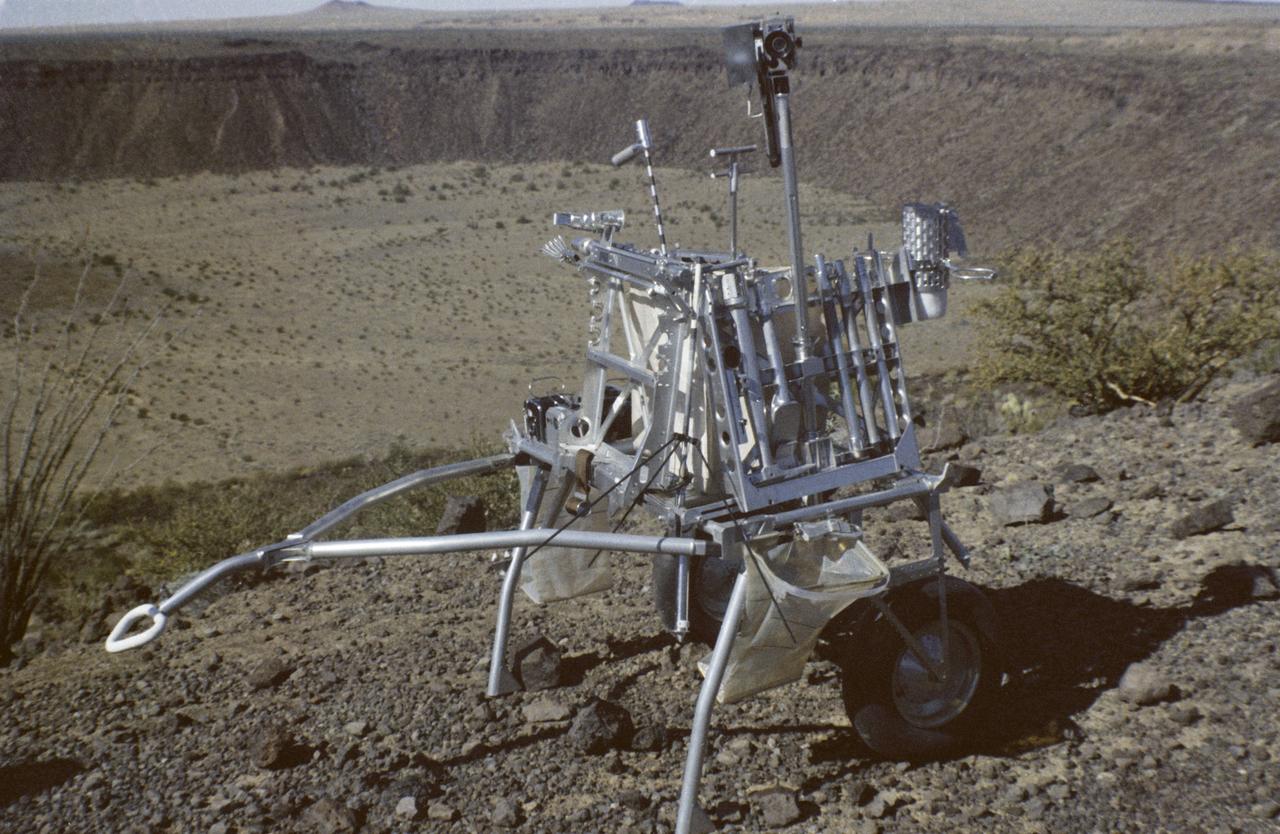
S70-29505 (13-18 Feb. 1970) --- A prototype of the modular equipment transporter (MET), nicknamed the "Rickshaw" after its shape and method of propulsion. This equipment was used by the Apollo 14 astronauts during their geological and lunar surface simulation training in the Pinacate volcanic area of northwestern Sonora, Mexico. The Apollo 14 crew will be the first one to use the MET. It will be a portable workbench with a place for the lunar hand tools and their carrier, three cameras, two sample container bags, a special environmental sample container, spare film magazines, and a lunar surface Penetrometer.
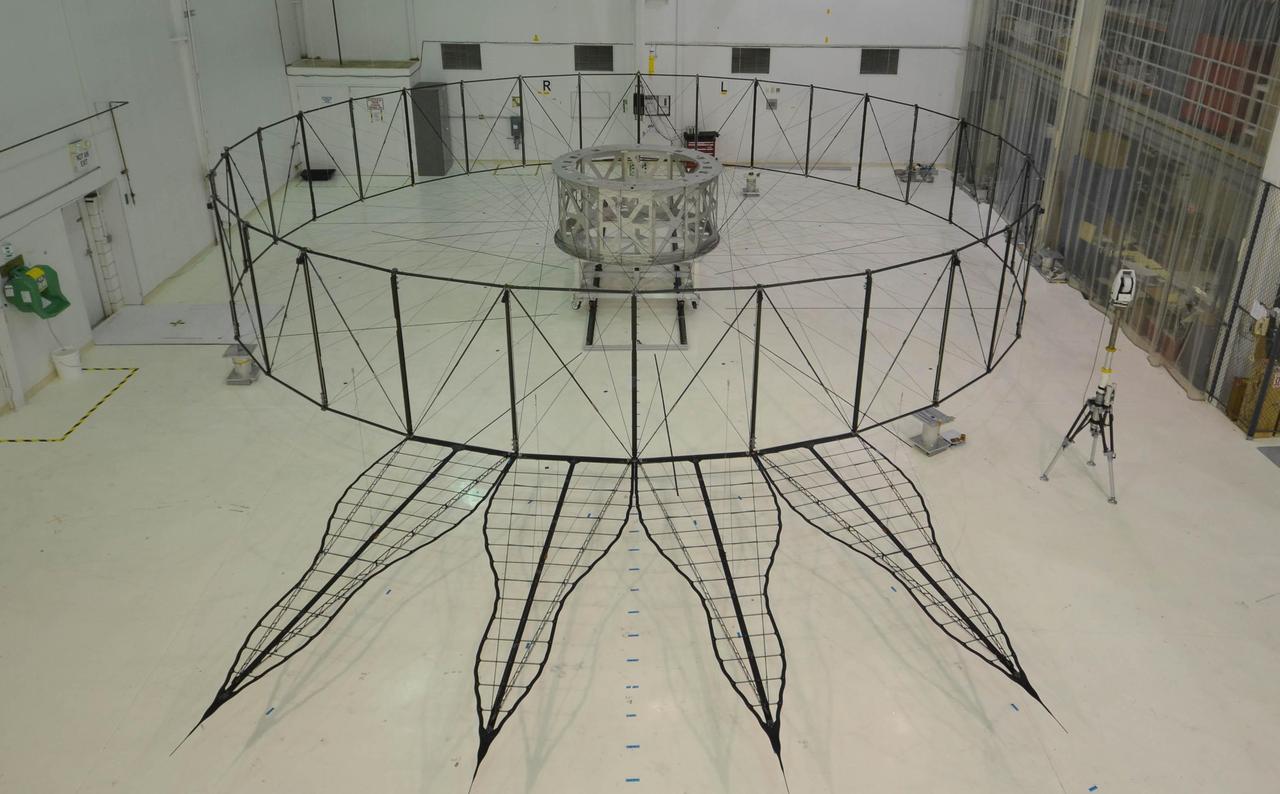
This image shows the bare bones of the first prototype starshade by NASA's Jet Propulsion Laboratory, Pasadena, California. The prototype was shown in technology partner Astro Aerospace/Northrup Grumman's facility in Santa Barbara, California in 2013. In order for the petals of the starshade to diffract starlight away from the camera of a space telescope, they must be deployed with accuracy once the starshade reaches space. The four petals pictured in the image are being measured for this positional accuracy with a laser. As shown by this 66-foot (20-meter) model, starshades can come in many shapes and sizes. This design shows petals that are more extreme in shape which properly diffracts starlight for smaller telescopes. http://photojournal.jpl.nasa.gov/catalog/PIA20903
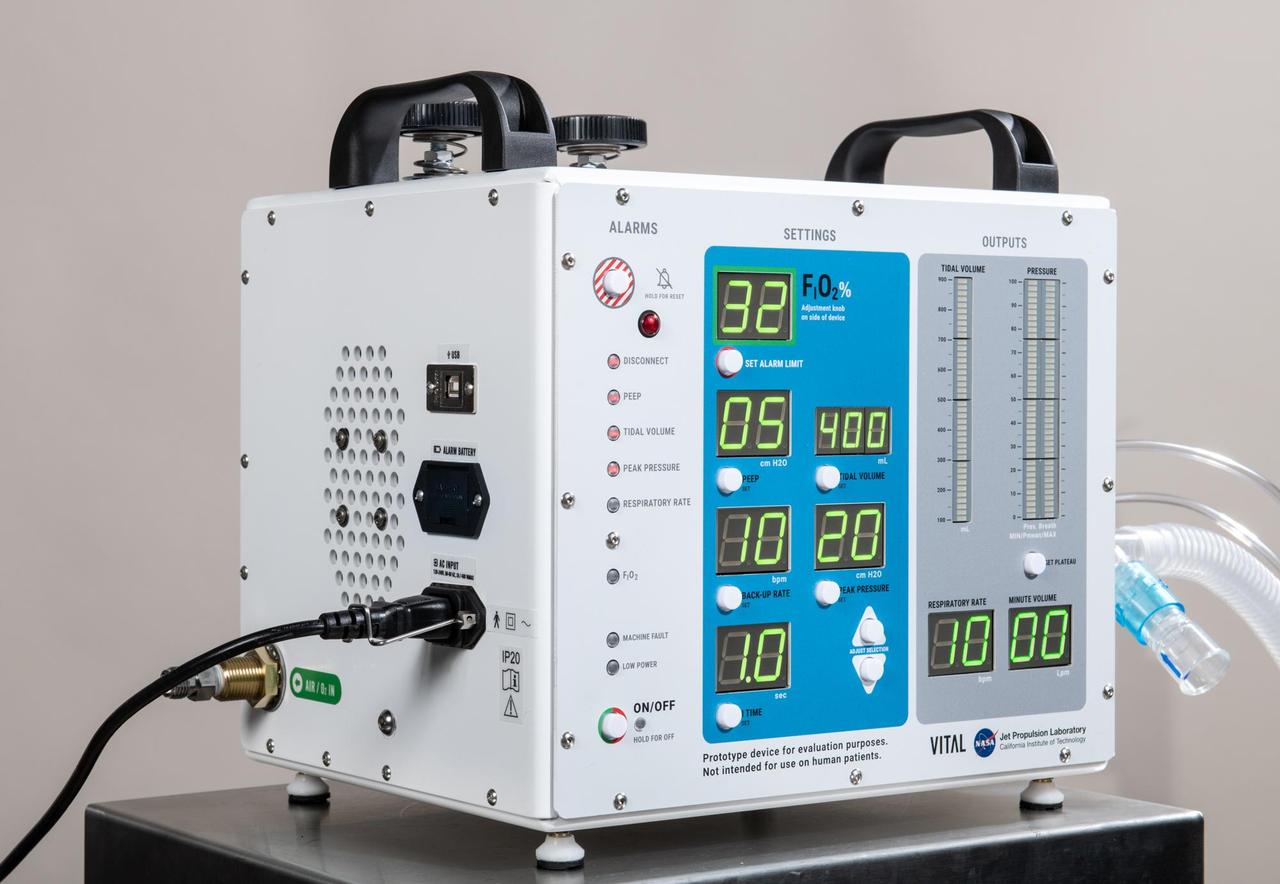
This image shows the ventilator prototype for coronavirus patients designed and built by NASA's Jet Propulsion Laboratory in Southern California. VITAL (Ventilator Intervention Technology Accessible Locally) is designed to be faster to build and easier to maintain than traditional ventilators, with a fraction of the parts. https://photojournal.jpl.nasa.gov/catalog/PIA23714
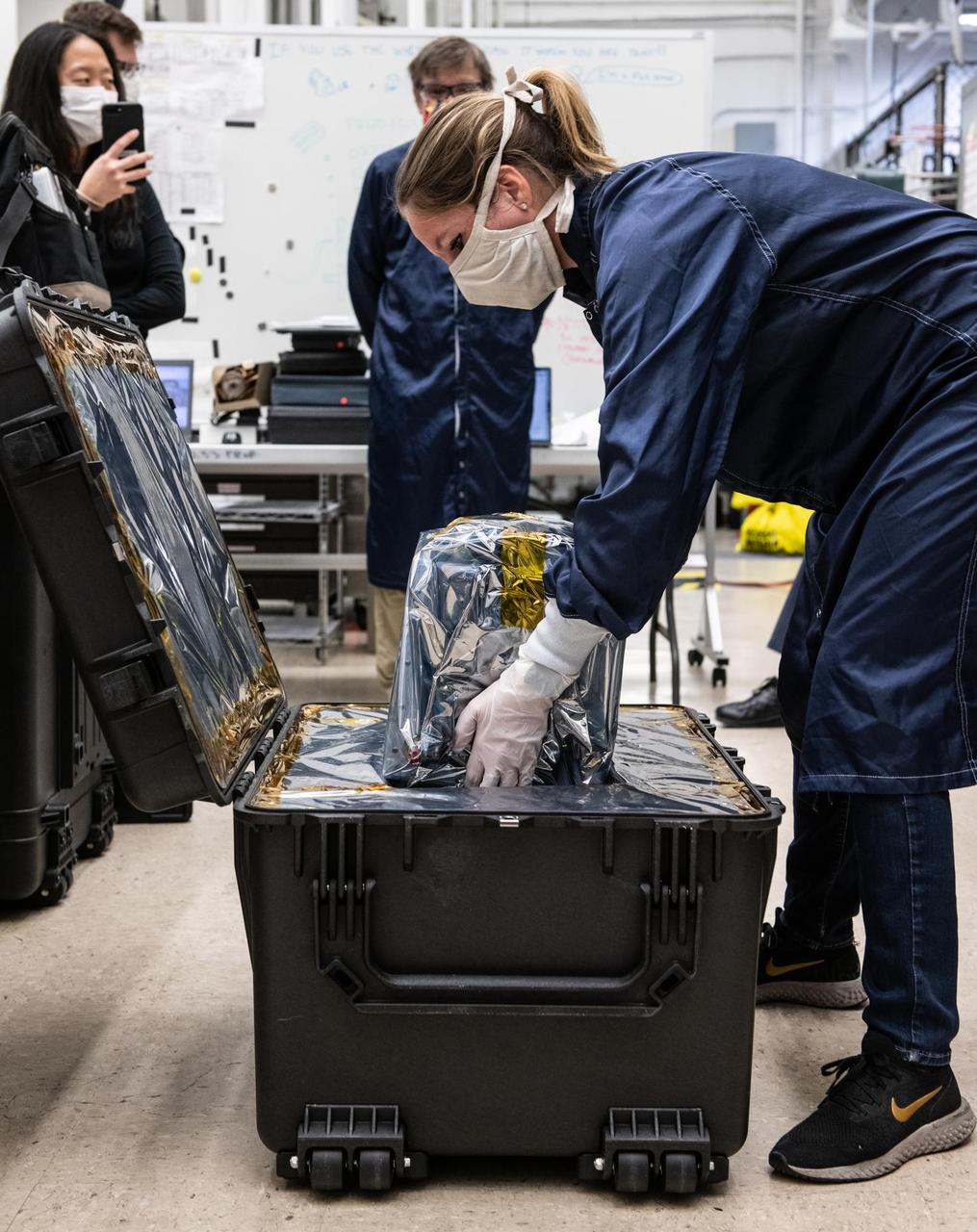
Engineers at NASA's Jet Propulsion Laboratory in Southern California prepare to ship a prototype ventilator for coronavirus patients to the Icahn School of Medicine at Mount Sinai in New York. VITAL (Ventilator Intervention Technology Accessible Locally) is designed to be faster to build and easier to maintain than traditional ventilators, with a fraction of the parts. JPL engineers created the prototype specially targeted at COVID-19 patients in 37 days in March and April 2020. https://photojournal.jpl.nasa.gov/catalog/PIA23716
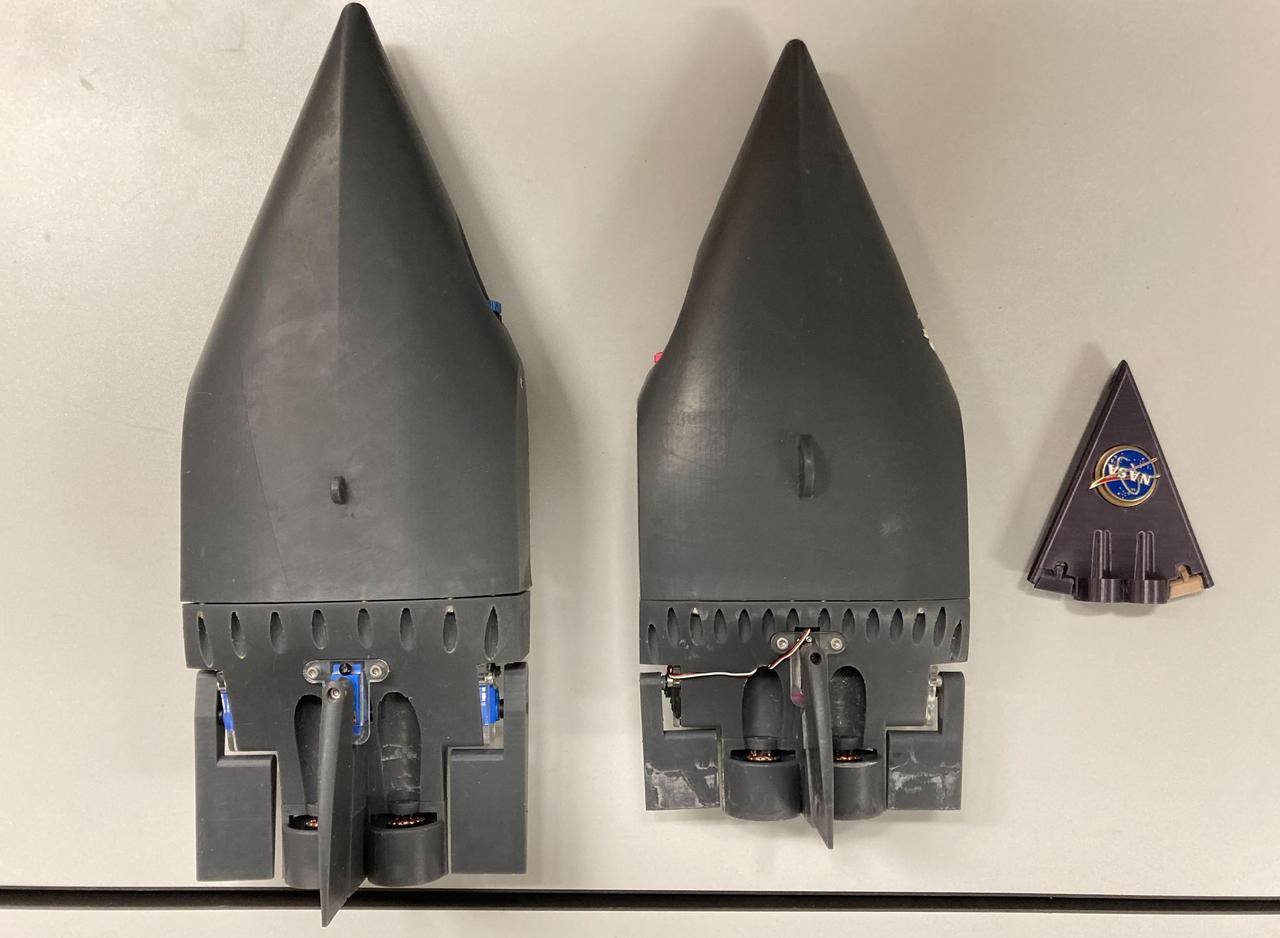
Two prototypes for a NASA mission concept called SWIM (short for Sensing With Independent Micro-swimmers) are arranged beside a much smaller nonfunctioning model representing the final envisioned size of the robot: about 5 inches (12 centimeters) long. The plastic prototypes were built at NASA's Jet Propulsion Laboratory in Southern California to demonstrate the feasibility of the concept, a swarm of dozens of self-propelled, cellphone-size robots exploring the waters of icy moons like Jupiter's Europa and Saturn's Enceladus. Delivered to the subsurface ocean by an ice-melting cryobot, the tiny robots would zoom away to look for chemical and temperature signals that could point to life. The prototypes were used in more that 20 rounds of underwater testing in a pair of tanks at JPL and in a competition swimming pool at Caltech in Pasadena. Relying on low-cost, commercially made motors and electronics, the robots are pushed along by two propellers and use two to four flaps for steering. The prototype in the center of the image weighs 3.7 pounds (1.7 kilograms) and is 14.5 inches (37 centimeters) long, 6 inches (15 centimeters) wide, and 2.5 inches (6.5 centimeters) tall, with a volume of 104 cubic inches (1.7 liters). The upgraded prototype at left is slightly bigger: 16.5 inches (42 centimeters) long, 3 inches (7.5 centimeters) tall, with a weight of 5 pounds (2.3 kilograms) and a volume of 140 cubic inches (2.3 liters). In pool tests, the prototype at left demonstrated controlled maneuvering, the ability to stay on and correct its course, and a back-and-forth "lawnmower" exploration pattern. It managed all of this autonomously, without the team's direct intervention. The robot even spelled out "J-P-L." As conceived for spaceflight and represented by the model at right, the robots would have dimensions about three times smaller than these prototypes – tiny compared to existing remotely operated and autonomous underwater scientific vehicles. The swimmers would feature miniaturized, purpose-built parts and employ a novel wireless underwater acoustic communication system for transmitting data and triangulating their positions. Several years more of work would be needed to make such an advanced concept ready for spaceflight. Led by JPL, SWIM development took place from spring 2021 to fall 2024. The project was supported by Phase I and II funding from NASA's Innovative Advanced Concepts program under the agency's Space Technology Mission Directorate. JPL is managed for NASA by Caltech in Pasadena, California. https://photojournal.jpl.nasa.gov/catalog/PIA26425
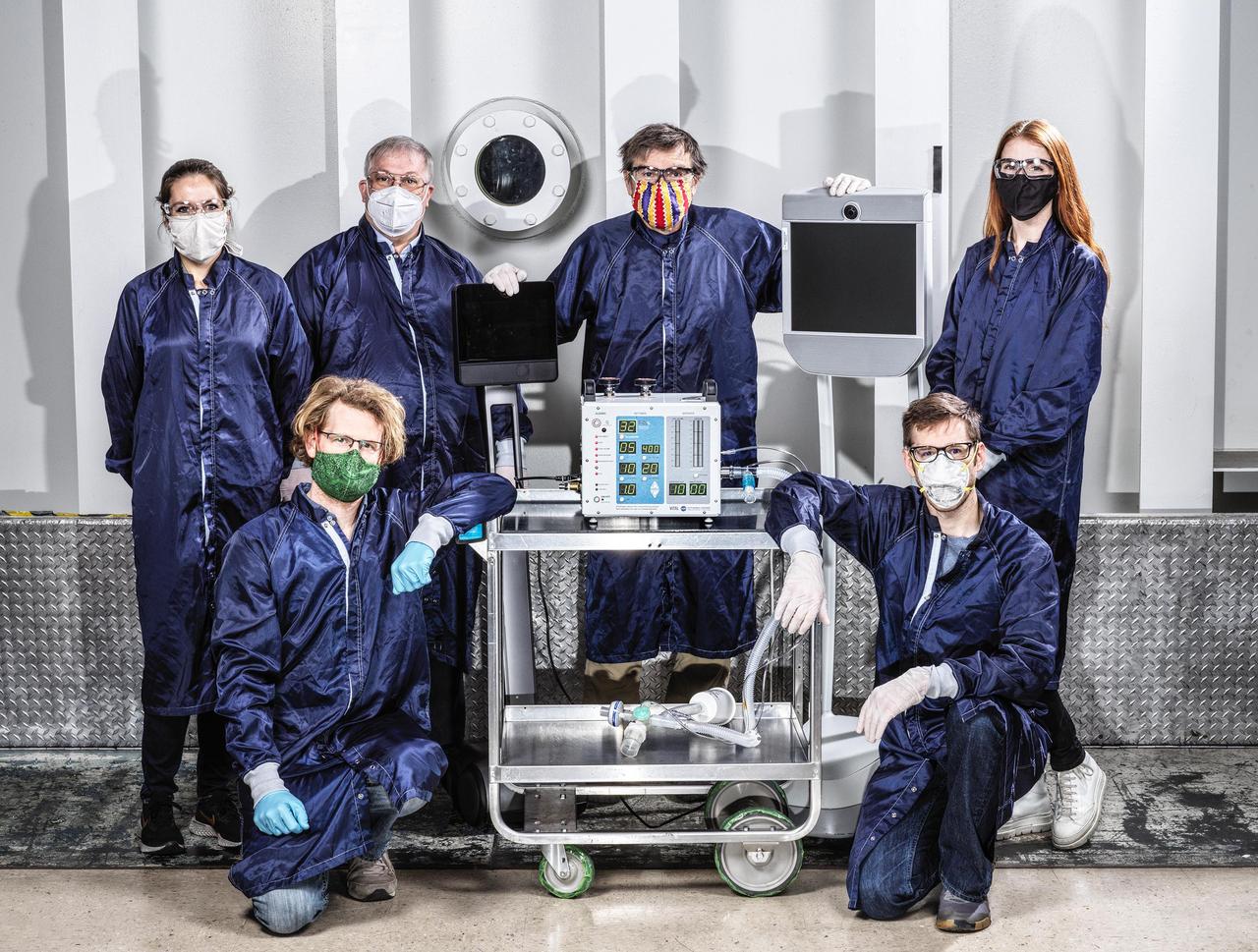
Some of the dozens of engineers involved in creating a ventilator prototype specially targeted to coronavirus disease patients at NASA's Jet Propulsion Laboratory in Southern California. Called VITAL (Ventilator Intervention Technology Accessible Locally), the prototype was created in 37 days in March and April 2020. https://photojournal.jpl.nasa.gov/catalog/PIA23713
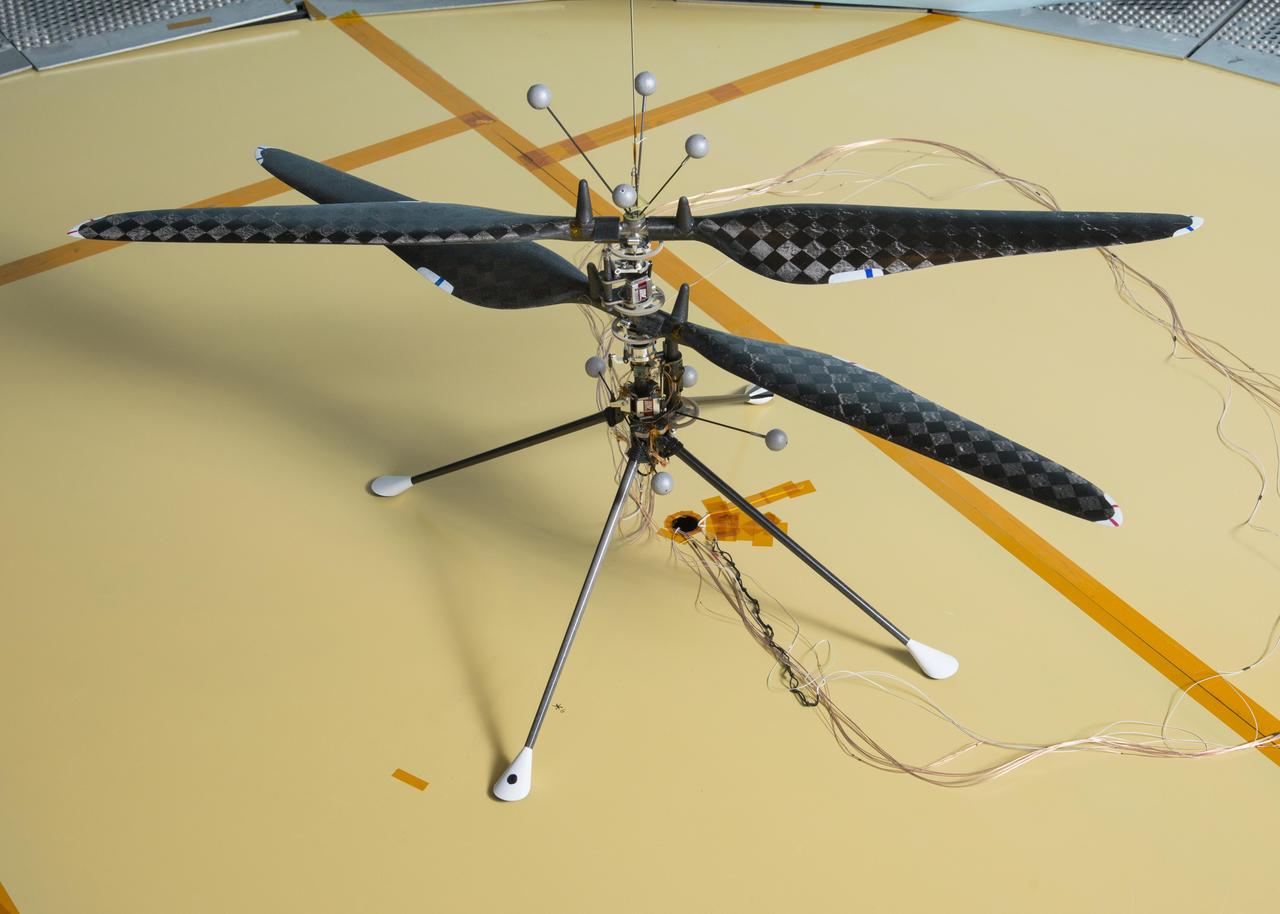
This image depicts the demonstration vehicle used to prove that controlled, and sustained flight is feasible in a Martian atmosphere. The first free flight of this prototype Mars Helicopter in atmospheric conditions similar to Mars occurred on May 31, 2016, inside the Space Simulator, a 25-foot-wide (7.62-meter-wide) vacuum chamber at NASA's Jet Propulsion Laboratory in Pasadena, Calif. https://photojournal.jpl.nasa.gov/catalog/PIA23159
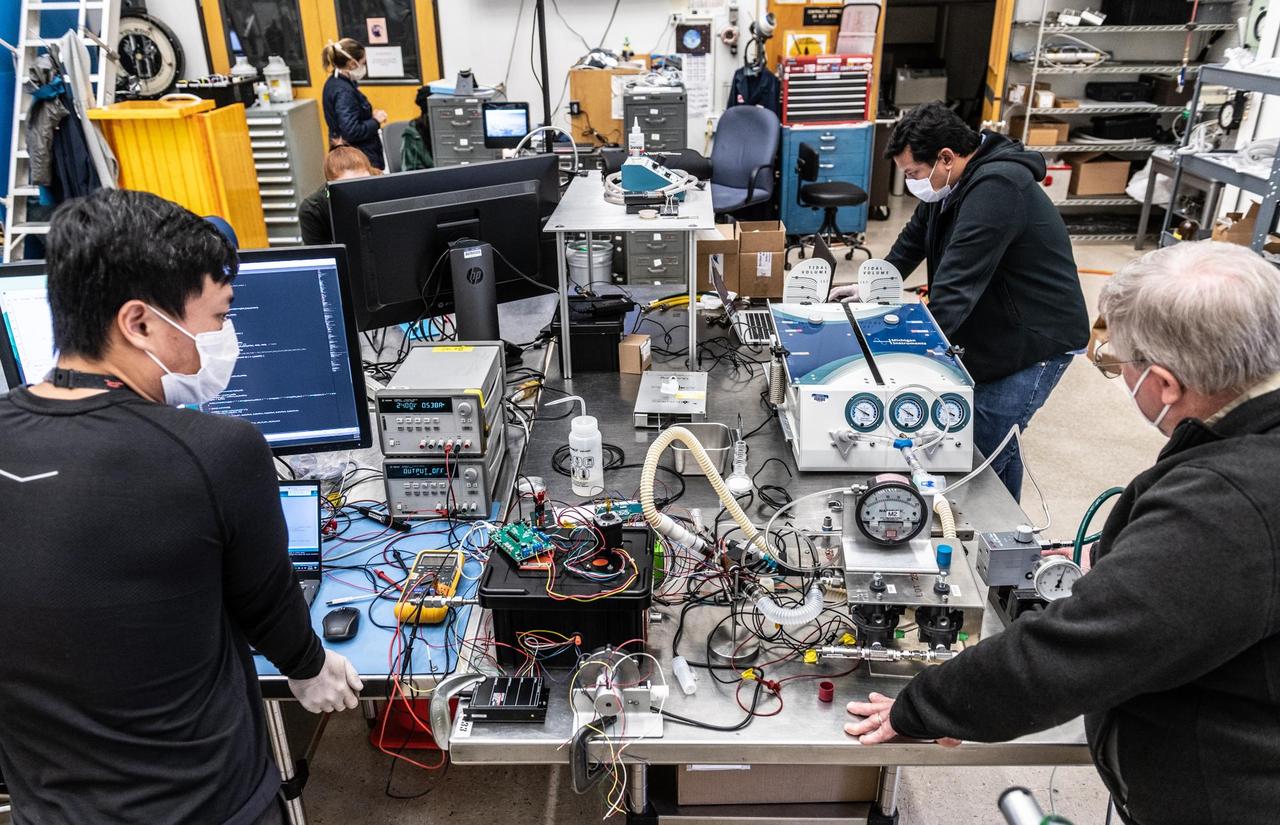
Engineers more accustomed to building spacecraft than medical devices worked on a prototype ventilator for coronavirus patients at NASA's Jet Propulsion Laboratory in Southern California in March and April of 2020. VITAL (Ventilator Intervention Technology Accessible Locally) is designed to be faster to build and easier to maintain than traditional ventilators, with a fraction of the parts. The VITAL team at JPL created their prototype in 37 days. https://photojournal.jpl.nasa.gov/catalog/PIA23715

A full-scale prototype of the high-gain antenna on NASA's Europa Clipper spacecraft is undergoing testing in the Experimental Test Range at NASA's Langley Research Center in Hampton, Virginia. The Europa Clipper is expected to launch on a mission to conduct detailed reconnaissance of Jupiter's moon Europa in the 2020s. https://photojournal.jpl.nasa.gov/catalog/PIA22773
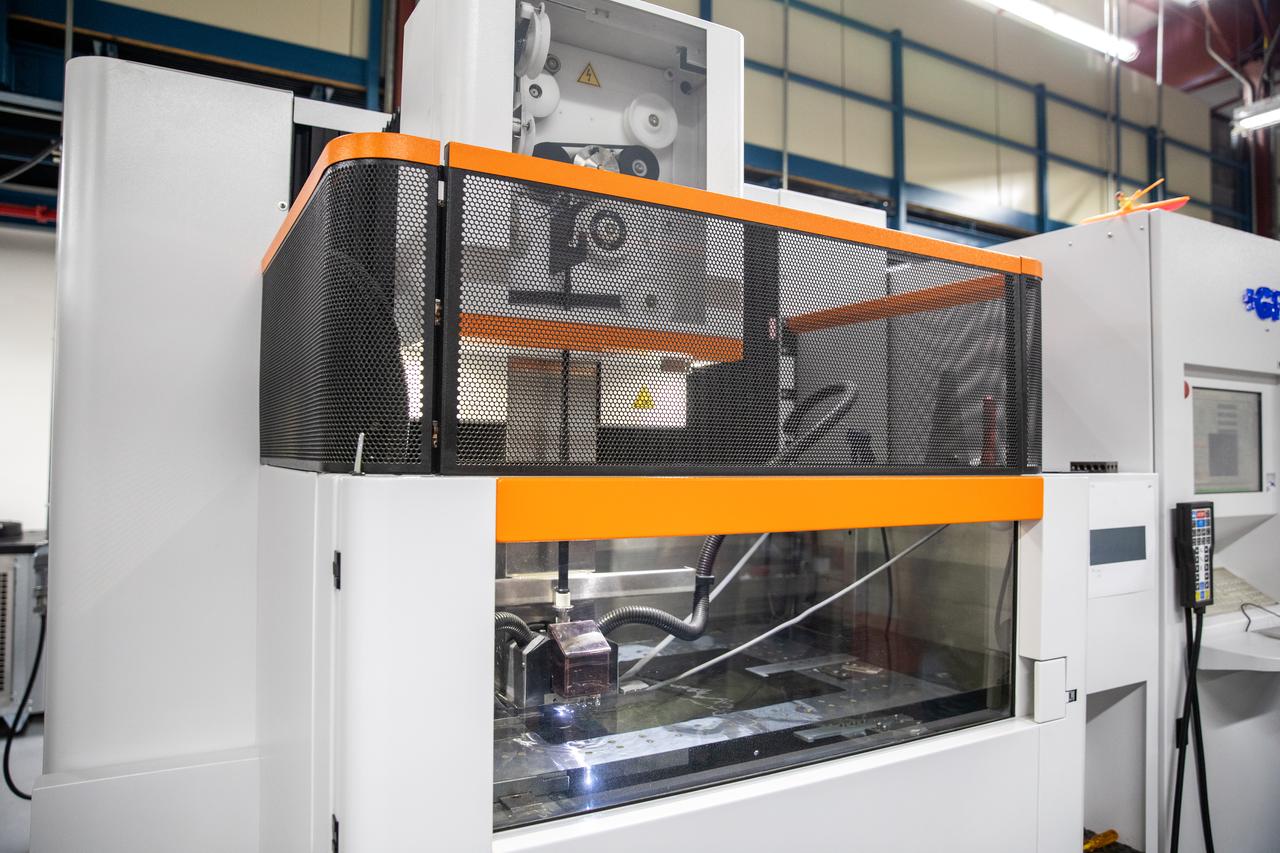
Testing of the Plasma Rapid Oxidation Technique for Extending Component Tenability (PROTECT) experiment is underway inside the Prototype Development Laboratory at NASA’s Kennedy Space Center in Florida on Nov. 2, 2022. Plasma electrolytic oxidation is a surface coating technology that produces oxide layers on the surface of light metals and their alloys to improve their performance characteristics. These coatings are tailored to provide a combination of characteristics such as corrosion protection, wear resistance, thermal management, extreme hardness, and fatigue performance. PROTECT is expected to demonstrate a ten percent improved fatigue performance and a 70 percent improvement in corrosion characteristics on the interior of treated 3-D printed metallic parts when compared to non-treated parts. PROTECT could be applied on spacecraft and launch vehicles.
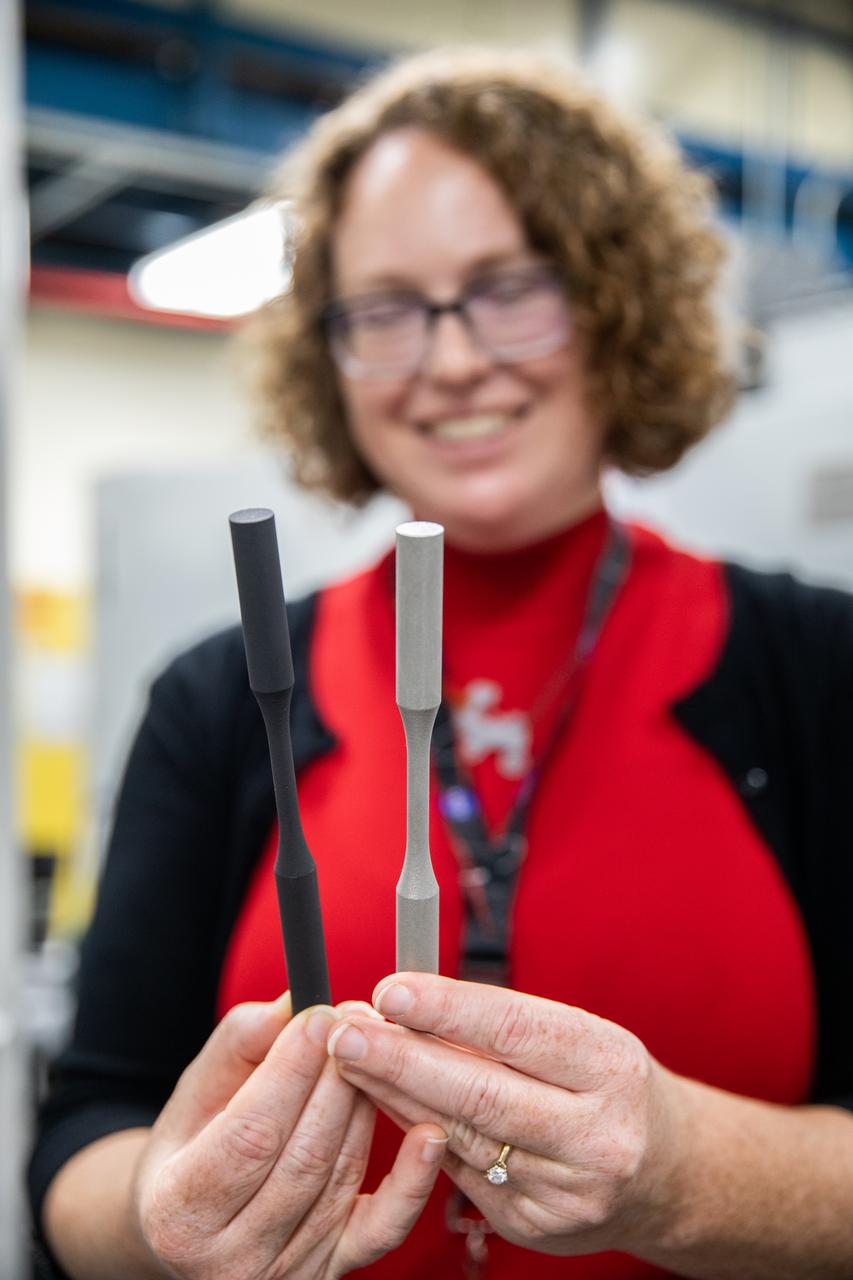
Dr. Jennifer Williams, a NASA research chemical engineer, displays two fatigue samples that will be tested in the Plasma Rapid Oxidation Technique for Extending Component Tenability (PROTECT) experiments inside the Prototype Laboratory at NASA’s Kennedy Space Center in Florida on Nov. 2, 2022. Plasma electrolytic oxidation is a surface coating technology that produces oxide layers on the surface of light metals and their alloys to improve their performance characteristics. These coatings are tailored to provide a combination of characteristics such as corrosion protection, wear resistance, thermal management, extreme hardness, and fatigue performance. PROTECT is expected to demonstrate a 10 percent improved fatigue performance and a 70 percent improvement in corrosion characteristics on the interior of treated 3-D printed metallic parts when compared to non-treated parts. PROTECT could be applied to spacecraft and launch vehicles.
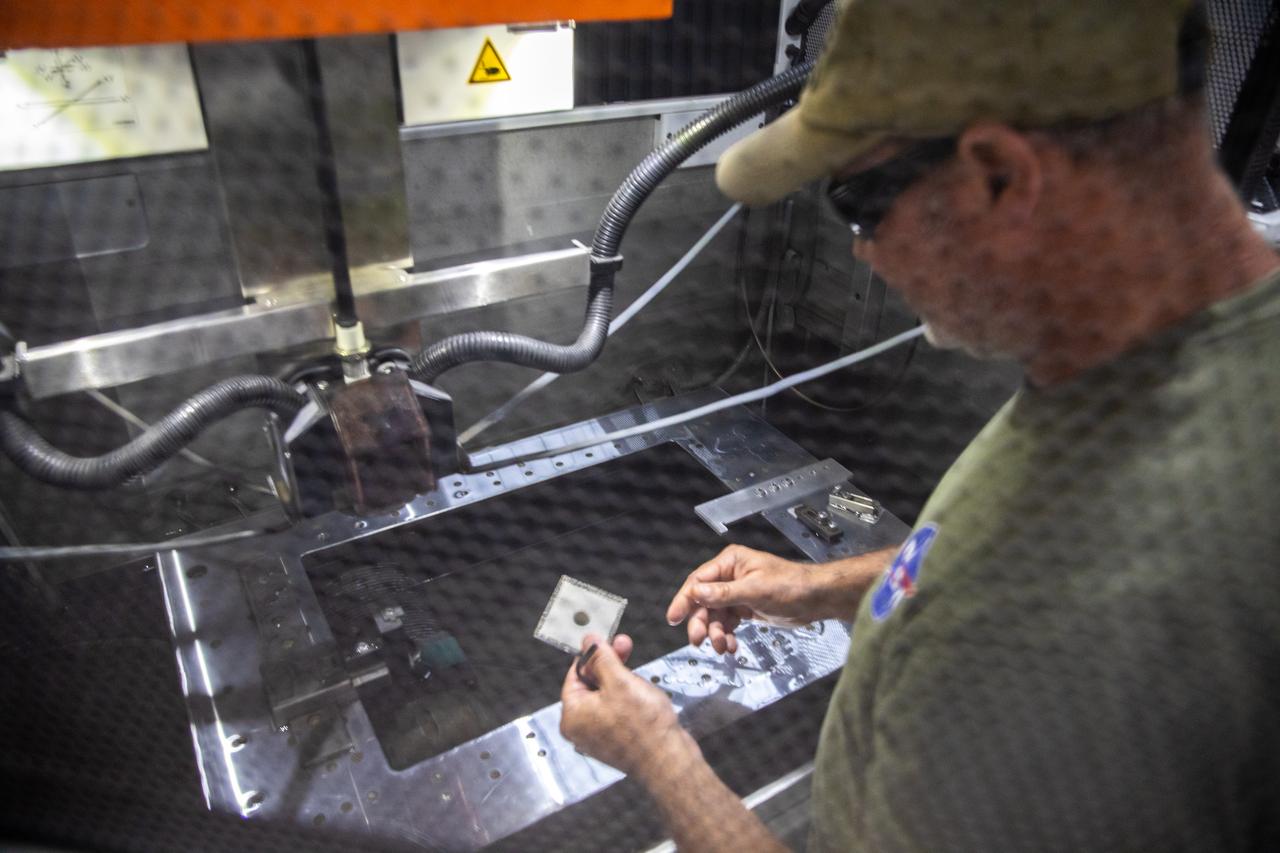
Gerard Moscoso, a mechanical engineer technician with NASA, prepares a sample for testing for the Plasma Rapid Oxidation Technique for Extending Component Tenability (PROTECT) project inside the Prototype Development Laboratory at NASA’s Kennedy Space Center in Florida on Nov. 2, 2022. Plasma electrolytic oxidation is a surface coating technology that produces oxide layers on the surface of light metals and their alloys to improve their performance characteristics. These coatings are tailored to provide a combination of characteristics such as corrosion protection, wear resistance, thermal management, extreme hardness, and fatigue performance. PROTECT is expected to demonstrate a 10 percent improved fatigue performance and a 70 percent improvement in corrosion characteristics on the interior of treated 3-D printed metallic parts when compared to non-treated parts. PROTECT could be applied on spacecraft and launch vehicles.

Dr. Jennifer Williams, a NASA research chemical engineer, is inside the Prototype Development Laboratory at NASA’s Kennedy Space Center in Florida to begin testing on the Plasma Rapid Oxidation Technique for Extending Component Tenability (PROTECT) project on Nov. 2, 2022. Plasma electrolytic oxidation is a surface coating technology that produces oxide layers on the surface of light metals and their alloys to improve their performance characteristics. These coatings are tailored to provide a combination of characteristics such as corrosion protection, wear resistance, thermal management, extreme hardness, and fatigue performance. PROTECT is expected to demonstrate a 10 percent improved fatigue performance and a 70 percent improvement in corrosion characteristics on the interior of treated 3-D printed metallic parts when compared to non-treated parts. PROTECT could be applied to spacecraft and launch vehicles.
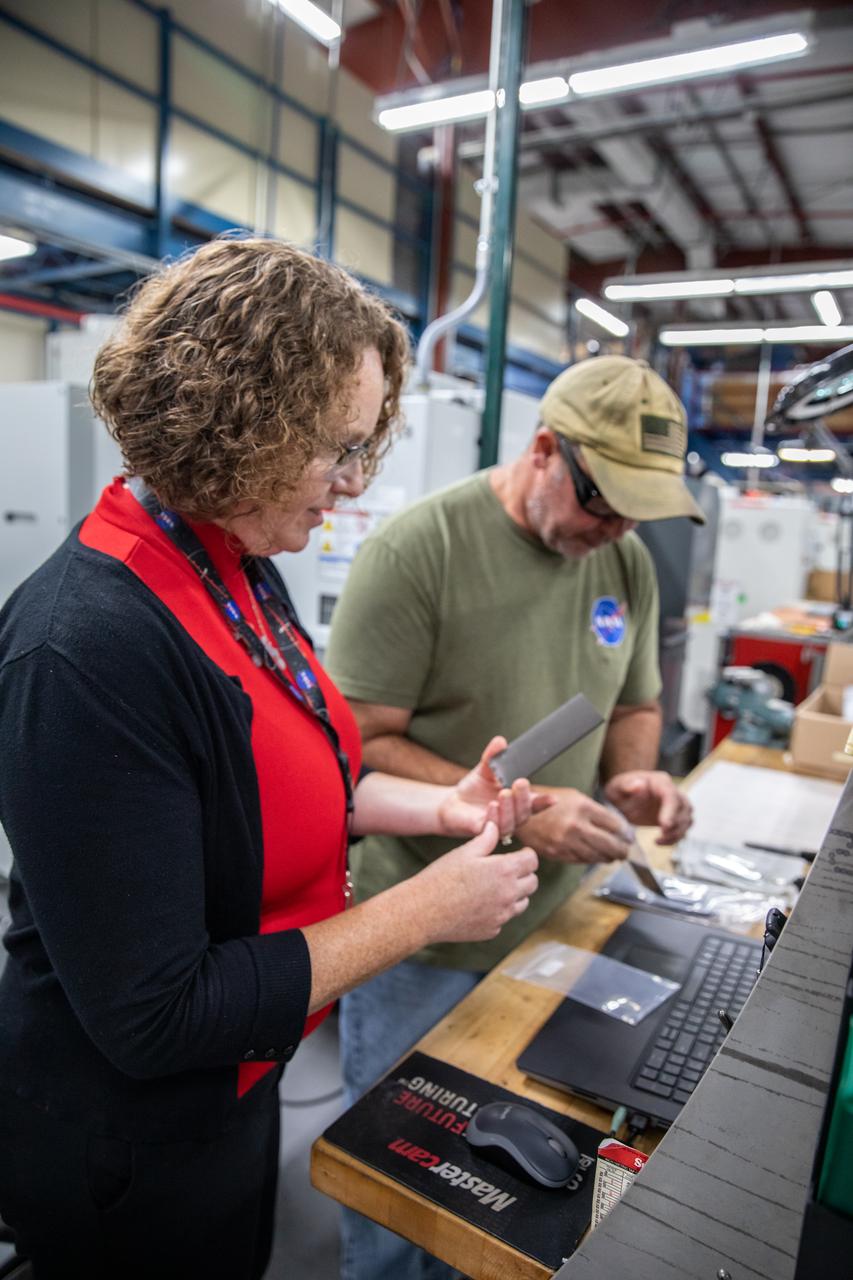
From left, Dr. Jennifer Williams, a NASA research chemical engineer, and Gerard Moscoso, a mechanical engineer technician, inspect specimens prepared forthe Plasma Rapid Oxidation Technique for Extending Component Tenability (PROTECT) experiment inside the Prototype Development Laboratory at NASA’s Kennedy Space Center in Florida on Nov. 2, 2022. Plasma electrolytic oxidation is a surface coating technology that produces oxide layers on the surface of light metals and their alloys to improve their performance characteristics. These coatings are tailored to provide a combination of characteristics such as corrosion protection, wear resistance, thermal management, extreme hardness, and fatigue performance. PROTECT is expected to demonstrate a 10 percent improved fatigue performance and a 70 percent improvement in corrosion characteristics on the interior of treated 3-D printed metallic parts when compared to non-treated parts. PROTECT could be applied used on spacecraft and launch vehicles.
Gerard Moscoso, a mechanical engineer technician with NASA, prepares the Plasma Rapid Oxidation Technique for Extending Component Tenability (PROTECT) specimens for testing inside the Prototype Development Laboratory at NASA’s Kennedy Space Center in Florida on Nov. 2, 2022. Plasma electrolytic oxidation is a surface coating technology that produces oxide layers on the surface of light metals and their alloys to improve their performance characteristics. These coatings are tailored to provide a combination of characteristics such as corrosion protection, wear resistance, thermal management, extreme hardness, and fatigue performance. PROTECT is expected to demonstrate a 10 percent improved fatigue performance and a 70 percent improvement in corrosion characteristics on the interior of treated 3-D printed metallic parts when compared to non-treated parts. PROTECT could be applied on spacecraft and launch vehicles.
Gerard Moscoso, a mechanical engineer technician with NASA, handles a sample that is being prepared for fatigue and corrosion testing for the Plasma Rapid Oxidation Technique for Extending Component Tenability (PROTECT) project inside the Prototype Development Laboratory at NASA’s Kennedy Space Center in Florida on Nov. 2, 2022. Plasma electrolytic oxidation is a surface coating technology that produces oxide layers on the surface of light metals and their alloys to improve their performance characteristics. These coatings are tailored to provide a combination of characteristics such as corrosion protection, wear resistance, thermal management, extreme hardness, and fatigue performance. PROTECT is expected to demonstrate a ten percent improved fatigue performance and a 70 percent improvement in corrosion characteristics on the interior of treated 3-D printed metallic parts when compared to non-treated parts. PROTECT could be applied on spacecraft and launch vehicles.
Testing of the Plasma Rapid Oxidation Technique for Extending Component Tenability (PROTECT) experiment is underway inside the Prototype Development Laboratory at NASA’s Kennedy Space Center in Florida on Nov. 2, 2022. Plasma electrolytic oxidation is a surface coating technology that produces oxide layers on the surface of light metals and their alloys to improve their performance characteristics. These coatings are tailored to provide a combination of characteristics such as corrosion protection, wear resistance, thermal management, extreme hardness, and fatigue performance. PROTECT is expected to demonstrate a 10 percent improved fatigue performance and a 70 percent improvement in corrosion characteristics on the interior of treated 3-D printed metallic parts when compared to non-treated parts. PROTECT could be applied on spacecraft and launch vehicles.
This prototype of a collapsible Mars lander base is part of SHIELD (Simplified High Impact Energy Landing Device), a project aimed at developing spacecraft that would intentionally crash land on the Red Planet, using an accordion-like, collapsible base that acts like the crumple zone of a car to absorb the energy of a hard impact. The design could drastically reduce the cost of landing on Mars by simplifying the harrowing entry, descent, and landing process and expanding options for possible landing sites. Developed at NASA's Jet Propulsion Laboratory in Southern California, the prototype was attached to a drop tower on Aug. 12, 2022, at JPL. https://photojournal.jpl.nasa.gov/catalog/PIA25420
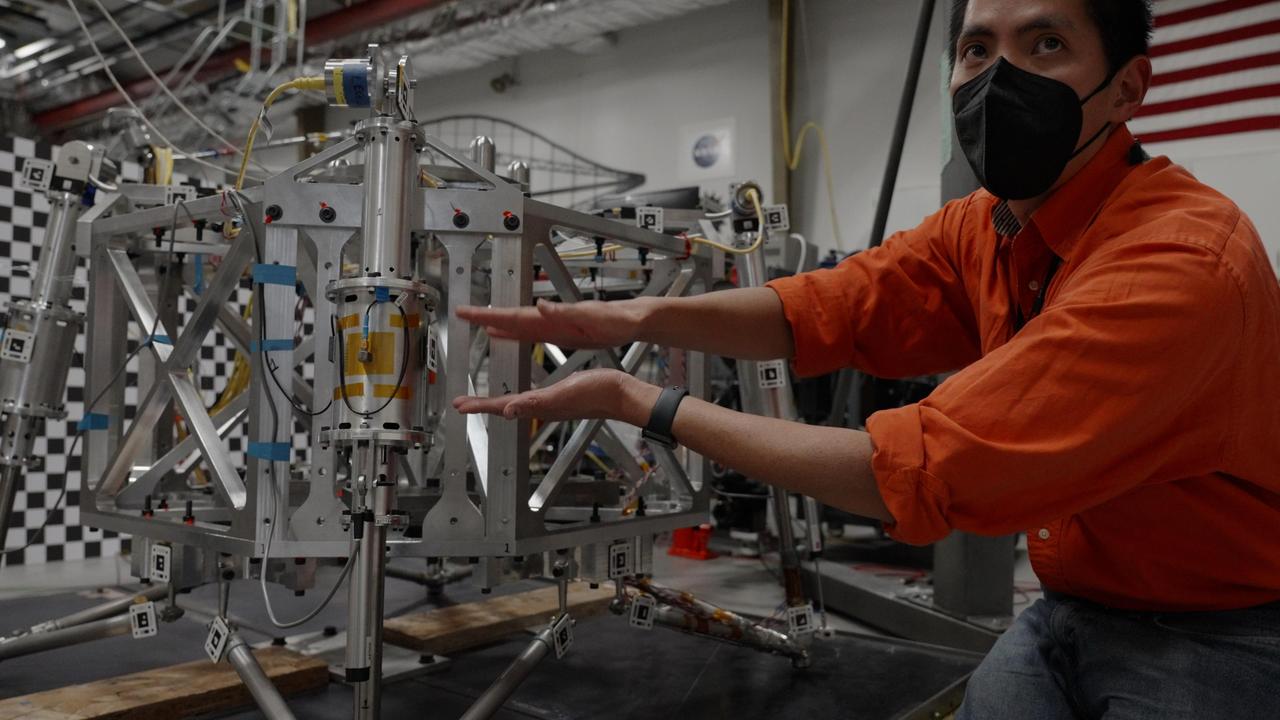
Engineer Abel Dizon explains how drop tests are conducted for a prototype lander being designed by NASA's Jet Propulsion Laboratory for the planned Mars Sample Return campaign. The Sample Retrieval Lander, estimated to weigh as much as 5,016 pounds (2,275 kilograms), would be the heaviest spacecraft ever to land on the Red Planet. To study the physics involved in landing such a massive spacecraft, engineers have been testing a lander prototype that's about one-third the size it would be on Mars. Mars Sample Return will revolutionize our understanding of Mars by bringing scientifically selected samples to Earth for study using the most sophisticated instrumentation around the world. NASA's planned Mars Sample Return (MSR) campaign would fulfill one of the highest priority solar system exploration goals identified by the National Academies of Sciences, Engineering and Medicine in the past three decadal surveys. This strategic partnership with the ESA (European Space Agency) features the first mission to return samples from another planet, including the first launch from the surface of another planet. The samples being collected by NASA's Perseverance rover during its exploration of an ancient river delta are thought to be the best opportunity to reveal the early evolution of Mars, including the potential for ancient life. https://photojournal.jpl.nasa.gov/catalog/PIA25822
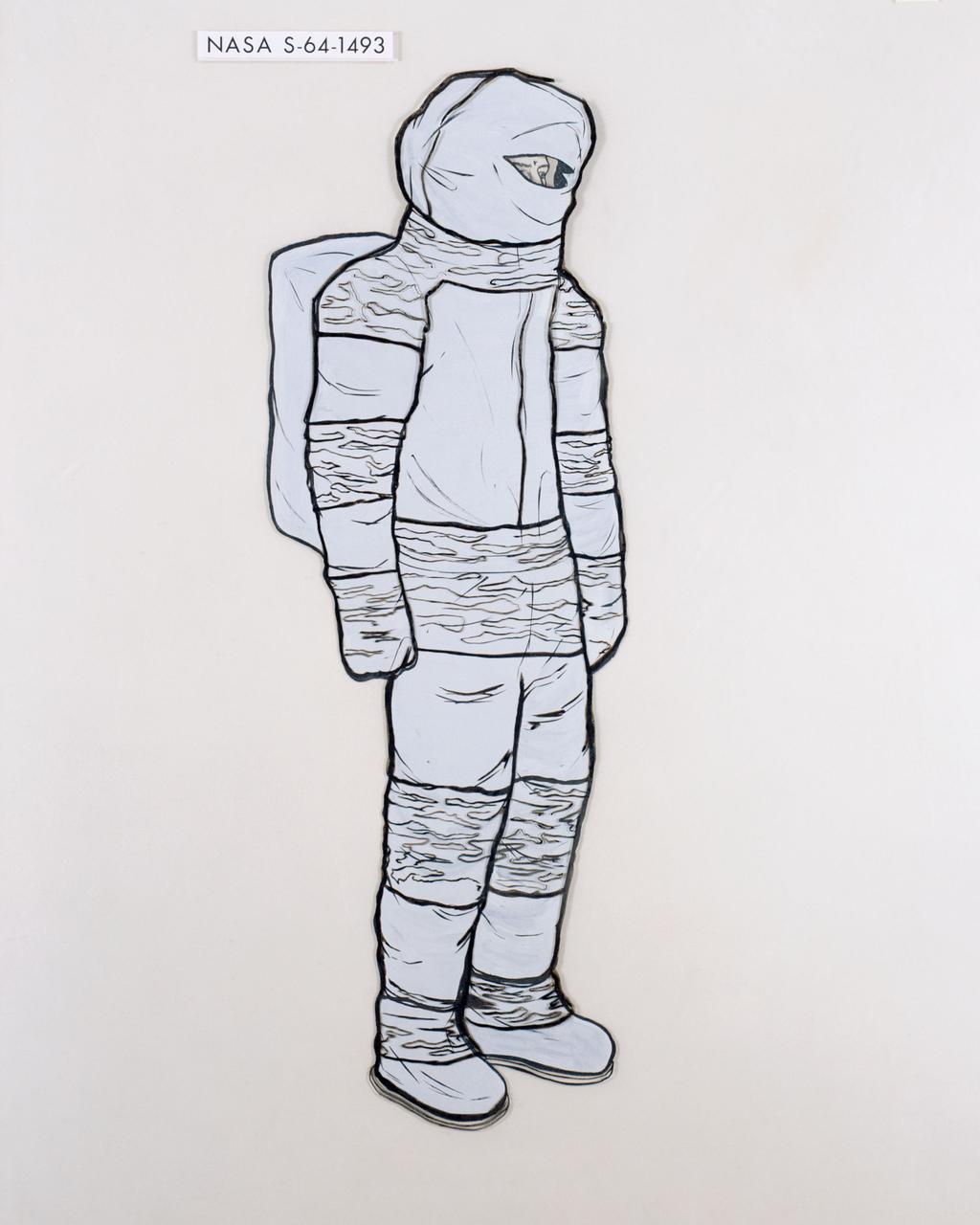
Artist Concept of a prototype of an Apollo Space Suit.
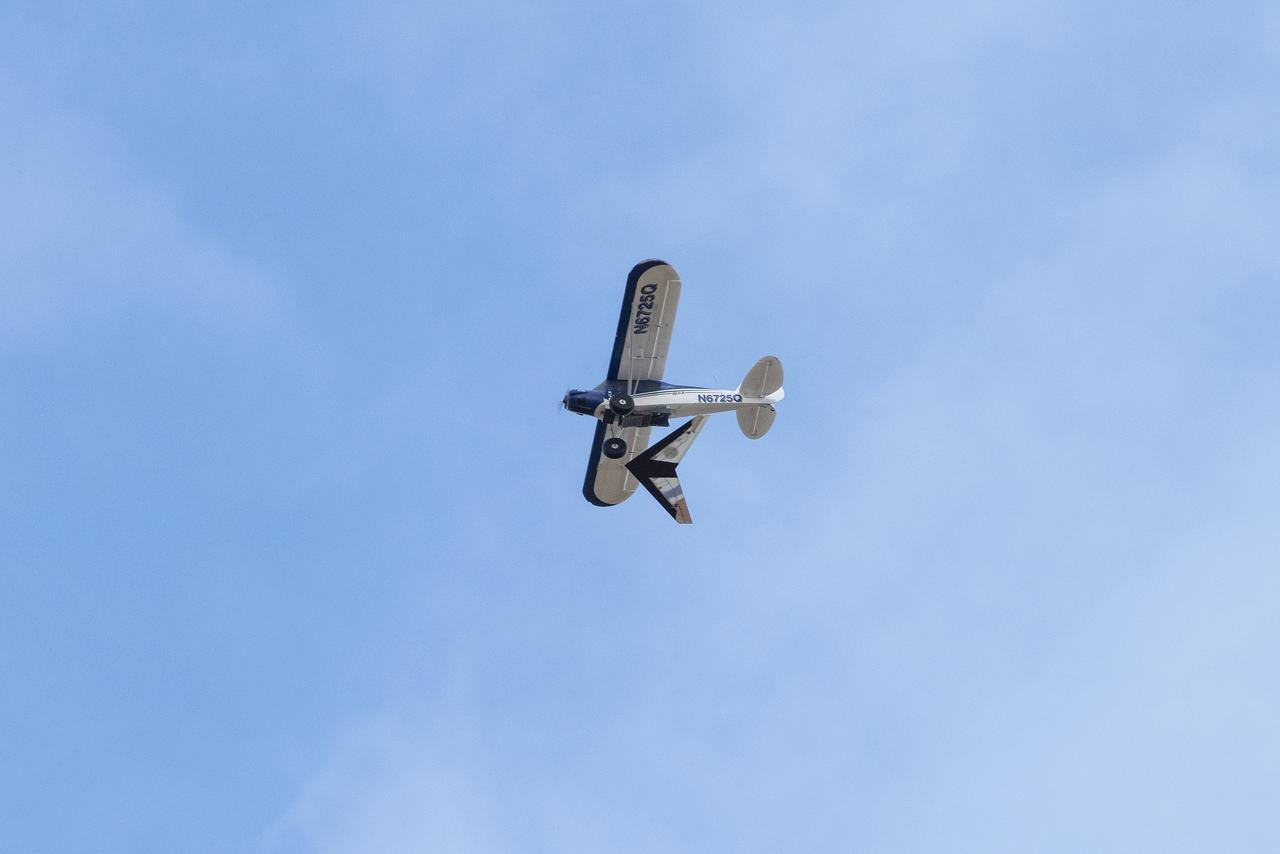
A Prandtl-M prototype is air launched from the Carbon Cub aircraft March 13, 2020, at NASA’s Armstrong Flight Research Center in California. The aircraft is the second of three prototypes of varying sizes to provide scientists with options to fly sensors in the Martian atmosphere to collect weather and landing site information for future human exploration of Mars.
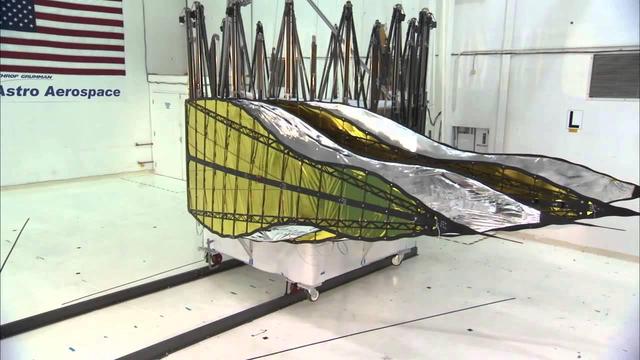
A furled first prototype starshade developed by NASA's Jet Propulsion Laboratory, shown in technology partner Astro Aerospace/Northrup Grumman's facility in Santa Barbara, California, in 2013. This design shows petals that are more extreme in shape, which properly diffracts starlight for smaller telescopes. For launch, the petals of the starshade will be wrapped around the spacecraft, then unfurled into the familiar flower-like design once in space. As shown by this 66-foot (20-meter) model, starshades can come in many shapes and sizes. http://photojournal.jpl.nasa.gov/catalog/PIA20905
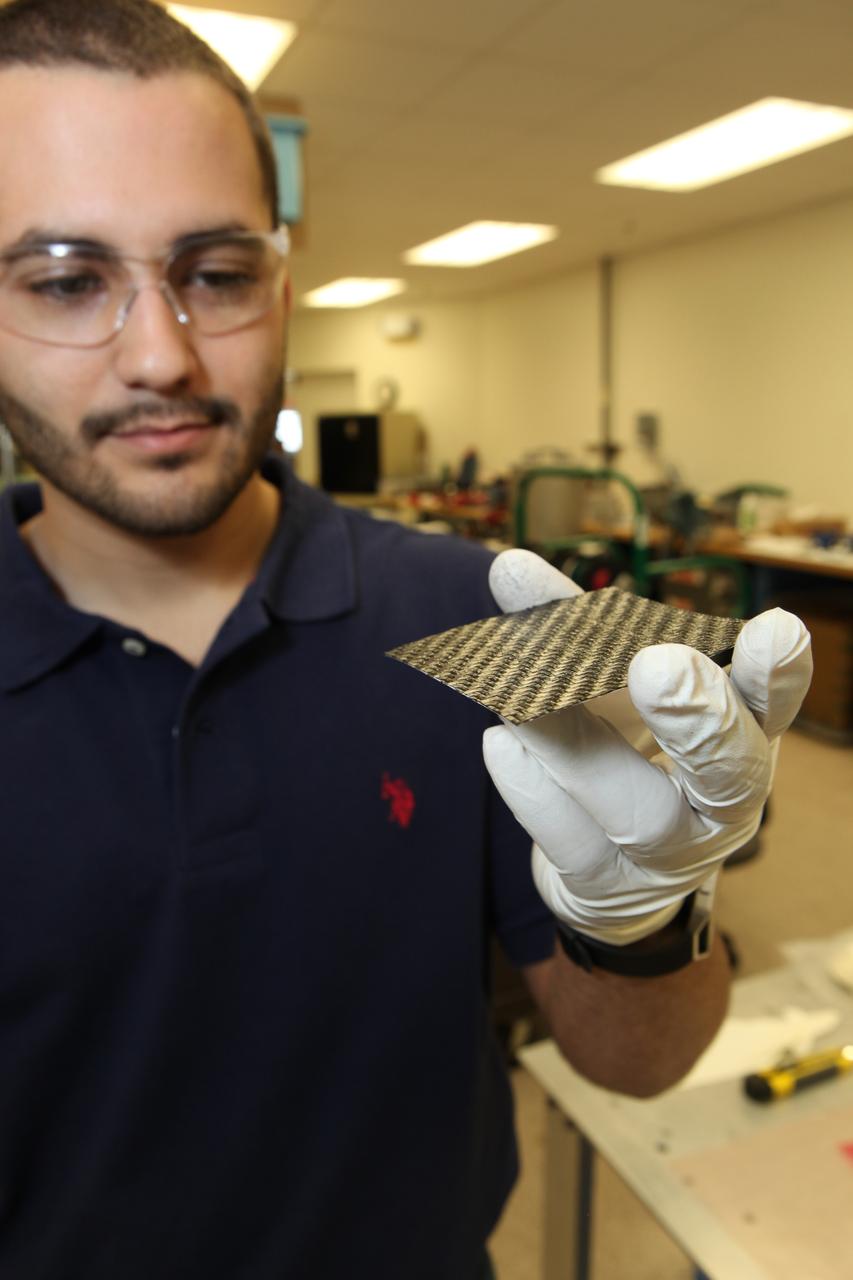
Daniel Perez, Ph.D., a graduate student from the University of Miami, displays a piece of the prototype structure for a new solid-state battery in the Prototype Laboratory at NASA's Kennedy Space Center in Florida. The size of the battery is so small that it could be a prime candidate for use in microsatellites, including CubeSats. Researchers at Kennedy are collaborating with experts at the University of Miami. The university partnership is funded through the Small Spacecraft Technology Program, in NASA's Space Technology Mission Directorate.
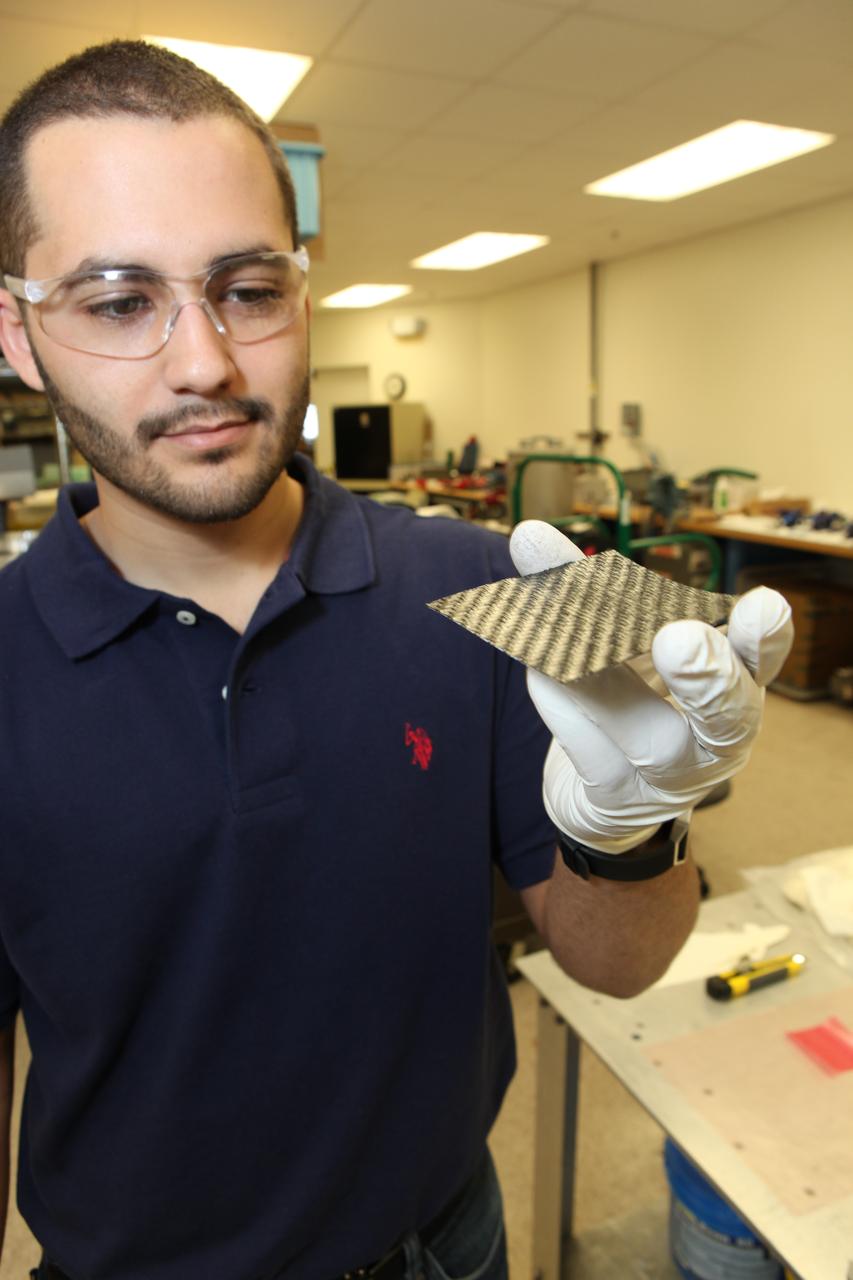
Daniel Perez, Ph.D., a graduate student from the University of Miami, displays a piece of the prototype structure for a new solid-state battery in the Prototype Laboratory at NASA's Kennedy Space Center in Florida. The size of the battery is so small that it could be a prime candidate for use in microsatellites, including CubeSats. Researchers at Kennedy are collaborating with experts at the University of Miami. The university partnership is funded through the Small Spacecraft Technology Program, in NASA's Space Technology Mission Directorate.
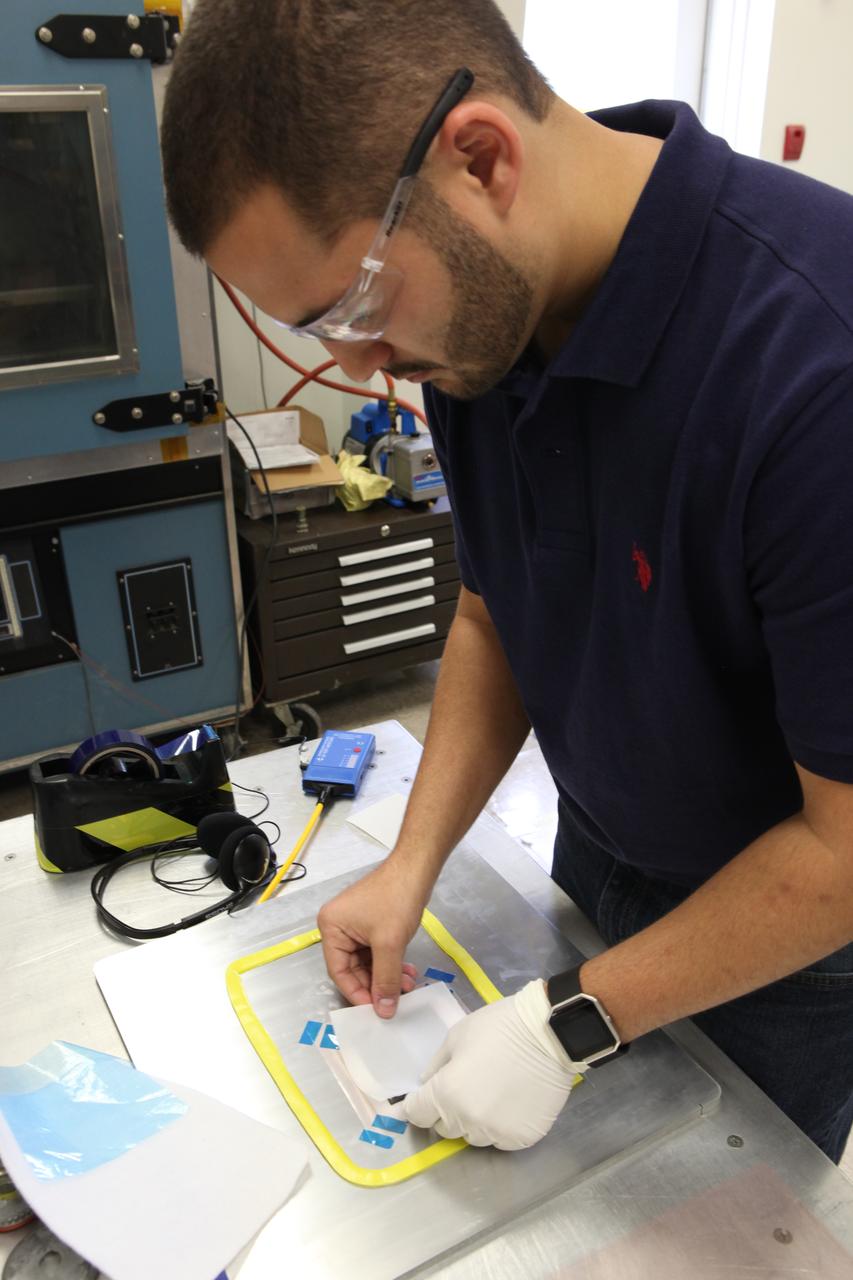
Daniel Perez, Ph.D., a graduate student from the University of Miami, prepares layers of the prototype structure for a new solid-state battery in the Prototype Laboratory at NASA's Kennedy Space Center in Florida. The size of the battery is so small that it could be a prime candidate for use in microsatellites, including CubeSats. Researchers at Kennedy are collaborating with experts at the University of Miami. The university partnership is funded through the Small Spacecraft Technology Program, in NASA's Space Technology Mission Directorate.
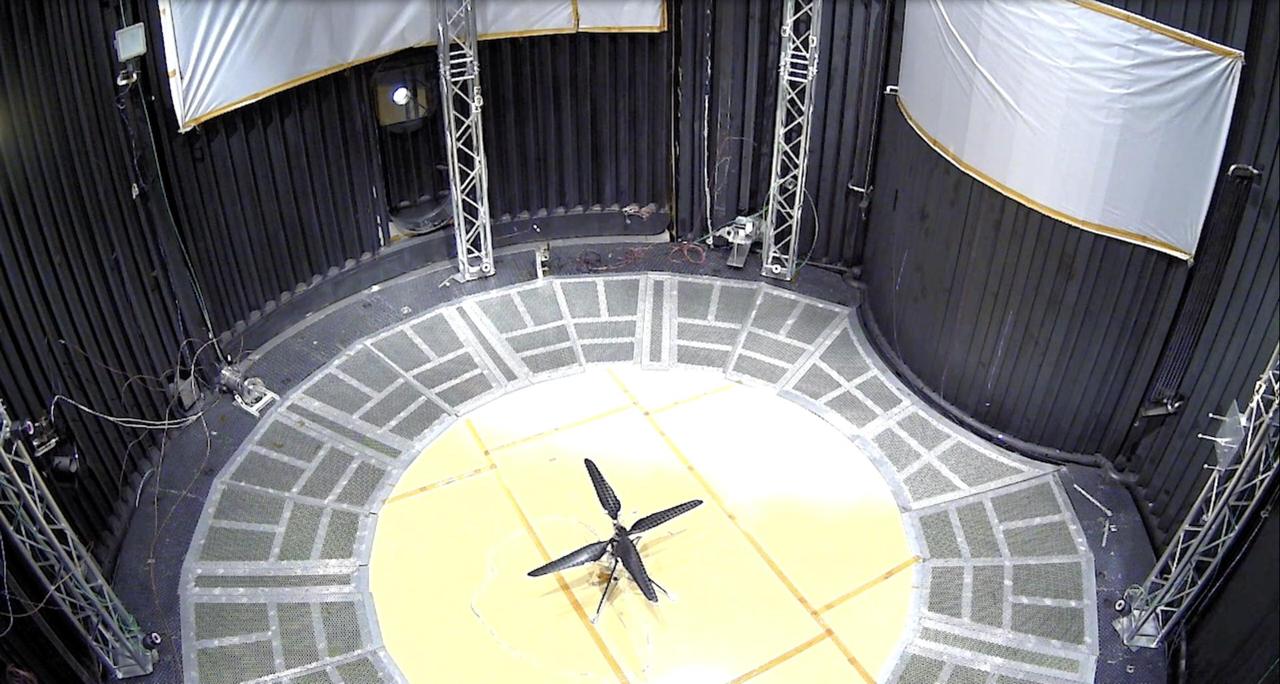
This image shows a test flight of a full-scale prototype of the Ingenuity Mars Helicopter. The flight took place on May 31, 2016, in the 25-foot-wide, 85-foot-tall (8-meter-by-26-meter) Space Simulator Facility at NASA's Jet Propulsion Laboratory in Southern California. The flight was the first demonstration that powered-controlled flight could be successfully executed in Mars-like conditions. The simulator's vacuum chamber allows engineers to test spacecraft and components in conditions like those they would face on Mars. https://photojournal.jpl.nasa.gov/catalog/PIA26233
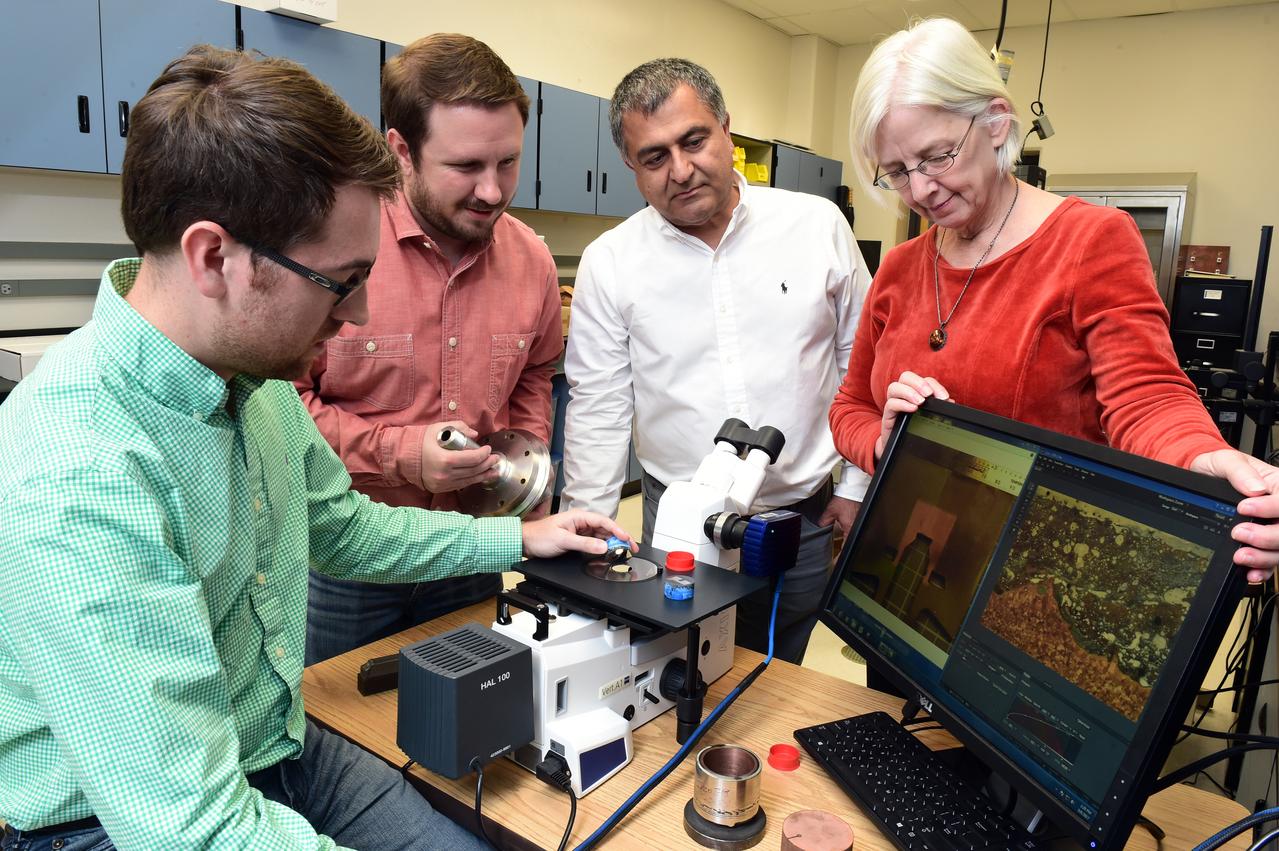
Majid Babai along with Dr. Judy Schneider, and graduate students Chris Hill and Ryan Anderson examine a cross section of the prototype rocket engine igniter created by an innovative bi-metallic 3-D printing advanced manufacturing process under a microscope.
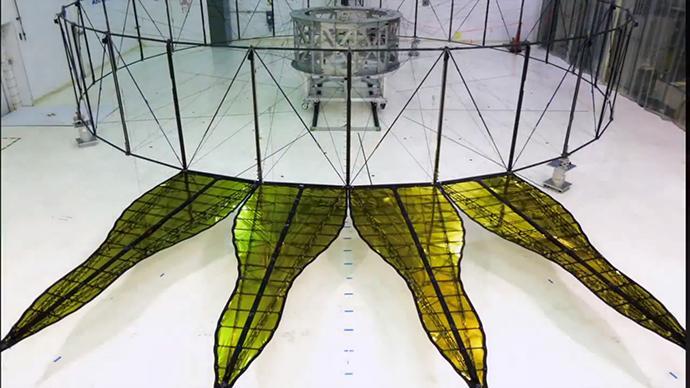
The first prototype starshade developed by NASA's Jet Propulsion Laboratory, shown in technology partner Astro Aerospace/Northrup Grumman's facility in Santa Barbara, California, in 2013. As shown by this 66 foot (20-meter) model, starshades can come in many shapes and sizes. This design shows petals that are more extreme in shape which properly diffracts starlight for smaller telescopes. Each petal is covered in a high-performance plastic film that resembles gold foil. On a starshade ready for launch, the thermal gold foil will only cover the side of the petals facing away from the telescope, with black on the other, so as not to reflect other light sources such as the Earth into its camera. http://photojournal.jpl.nasa.gov/catalog/PIA20906
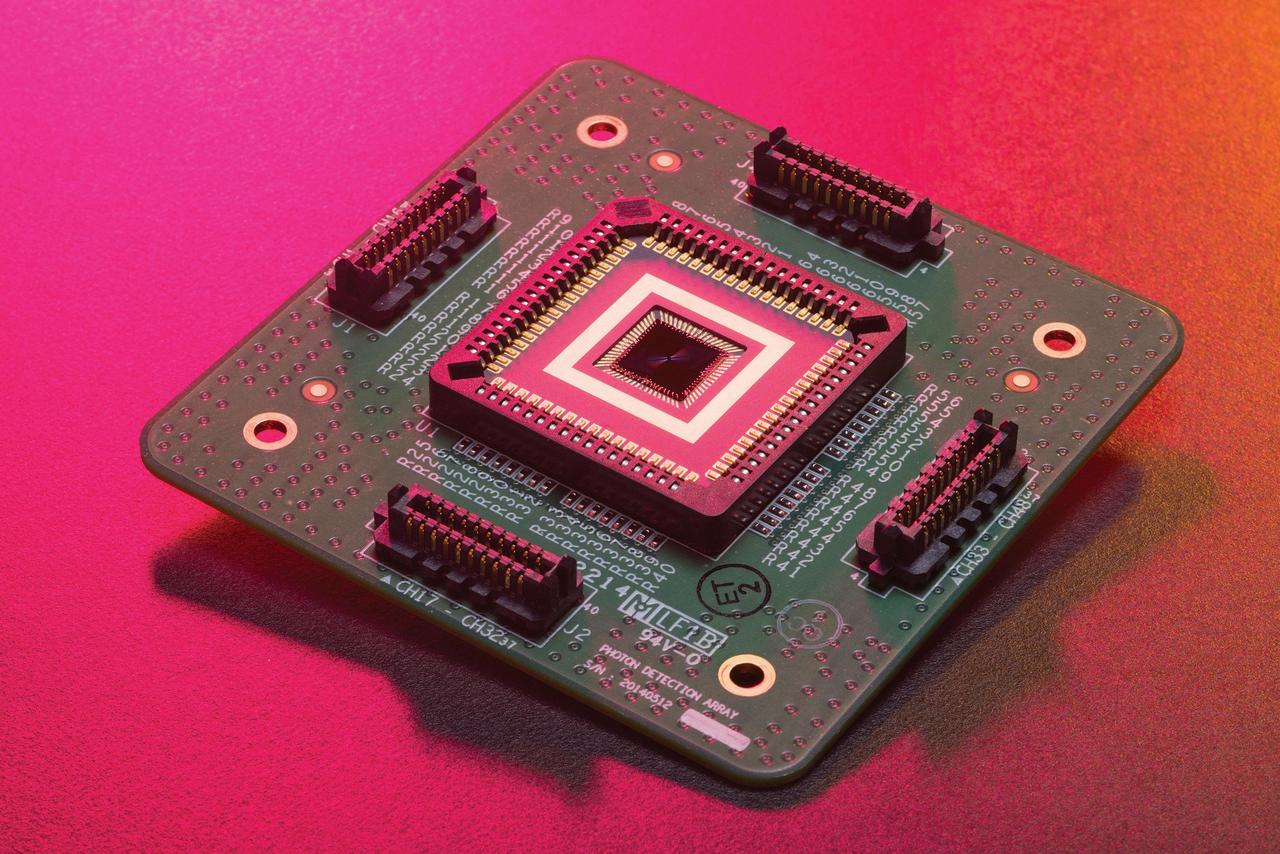
Shown here is a prototype of the Deep Space Optical Communications, or DSOC, ground receiver detector built by the Microdevices Laboratory at NASA's Jet Propulsion Laboratory in Southern California. The prototype superconducting nanowire single-photon detector was used by JPL technologists to help develop the detector that – from a station on Earth – will receive near-infrared laser signals from the DSOC flight transceiver traveling with NASA's Psyche mission in deep space. DSOC will test key technologies that could enable high-bandwidth optical, or laser, communications from Mars distances. Bolted to the side of the spacecraft and operating for the first two years of Psyche's journey to the asteroid of the same name, the DSOC flight laser transceiver will transmit high-rate data to Caltech's Palomar Observatory in San Diego County, California, which houses the 200-inch (5.1-meter) Hale Telescope. The downlink detector converts optical signals to electrical signals, which can be processed and decoded. The detector is designed to be both sensitive enough to detect single photons (quantum particles of light) and able to detect many photons arriving all at once. At its farthest point during the technology demonstration's operations period, the transceiver will be up to 240 million miles (390 million kilometers) away, meaning that by the time its weak laser pulses arrive at Earth, the detector will need to efficiently detect a trickle of single photons. But when the spacecraft is closer to Earth and the flight transceiver is delivering its highest bit rate to Palomar, the detector is capable of detecting very high numbers of photons without becoming overwhelmed. Because data is encoded in the timing of the laser pulses, the detector must also be able to determine the time of a photon's arrival with a precision of 100 picoseconds (one picosecond is one trillionth of a second). DSOC is the latest in a series of optical communication technology demonstrations funded by NASA's Technology Demonstrations Missions (TDM) program and the agency's Space Communications and Navigation (SCaN) program. JPL, a division of Caltech in Pasadena, California, manages DSOC for TDM within NASA's Space Technology Mission Directorate and SCaN within the agency's Space Operations Mission Directorate. https://photojournal.jpl.nasa.gov/catalog/PIA25840
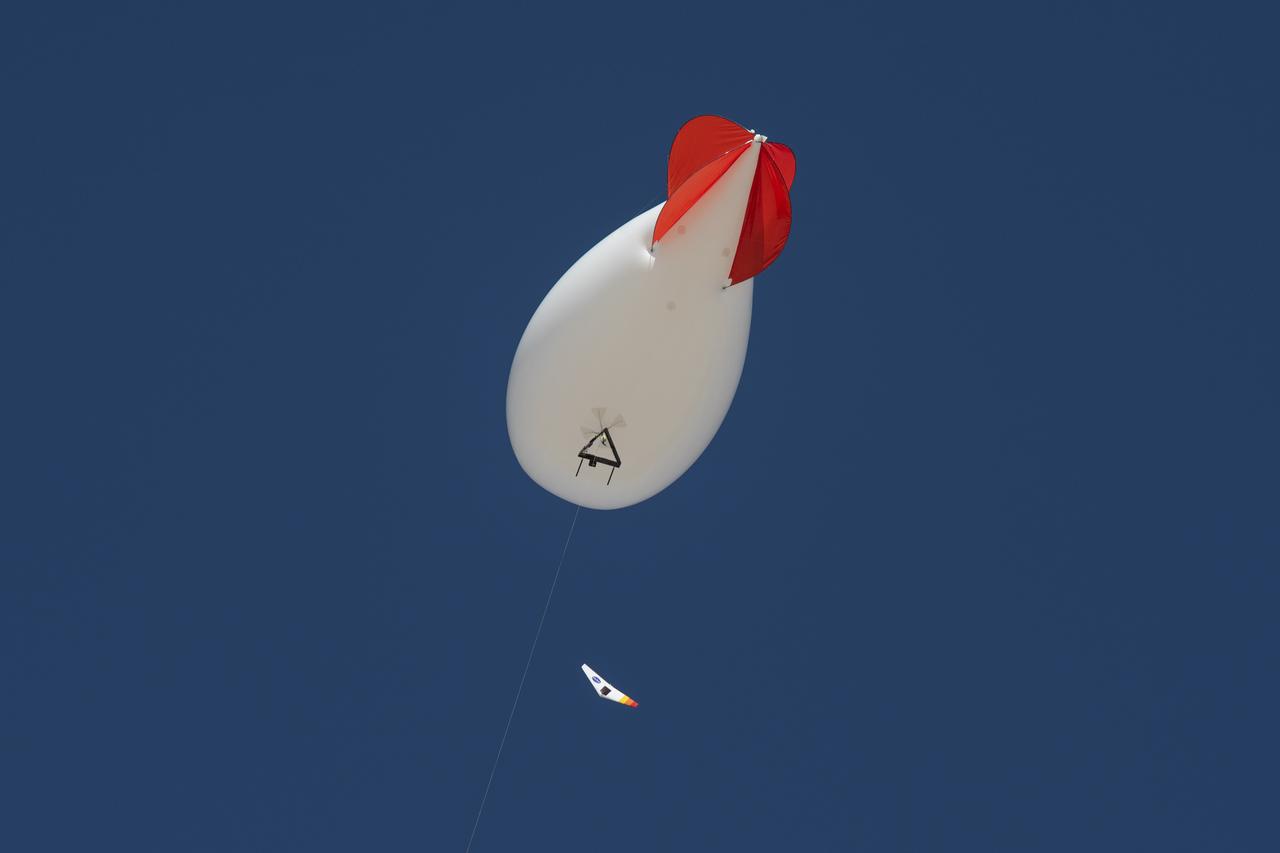
The first of three Prandtl-M prototype aircraft was air launched Aug. 16, 2019, from an Aerostat blimp at NASA’s Armstrong Flight Research Center in California. Three different prototypes of varying size, two still in development, eventually will be air launched from a weather balloon at 100,000 feet to simulate the atmosphere on Mars. The validated Prandtl-M could give scientists options to fly sensors in the Martian atmosphere to collect weather and landing site information for future human exploration of Mars.
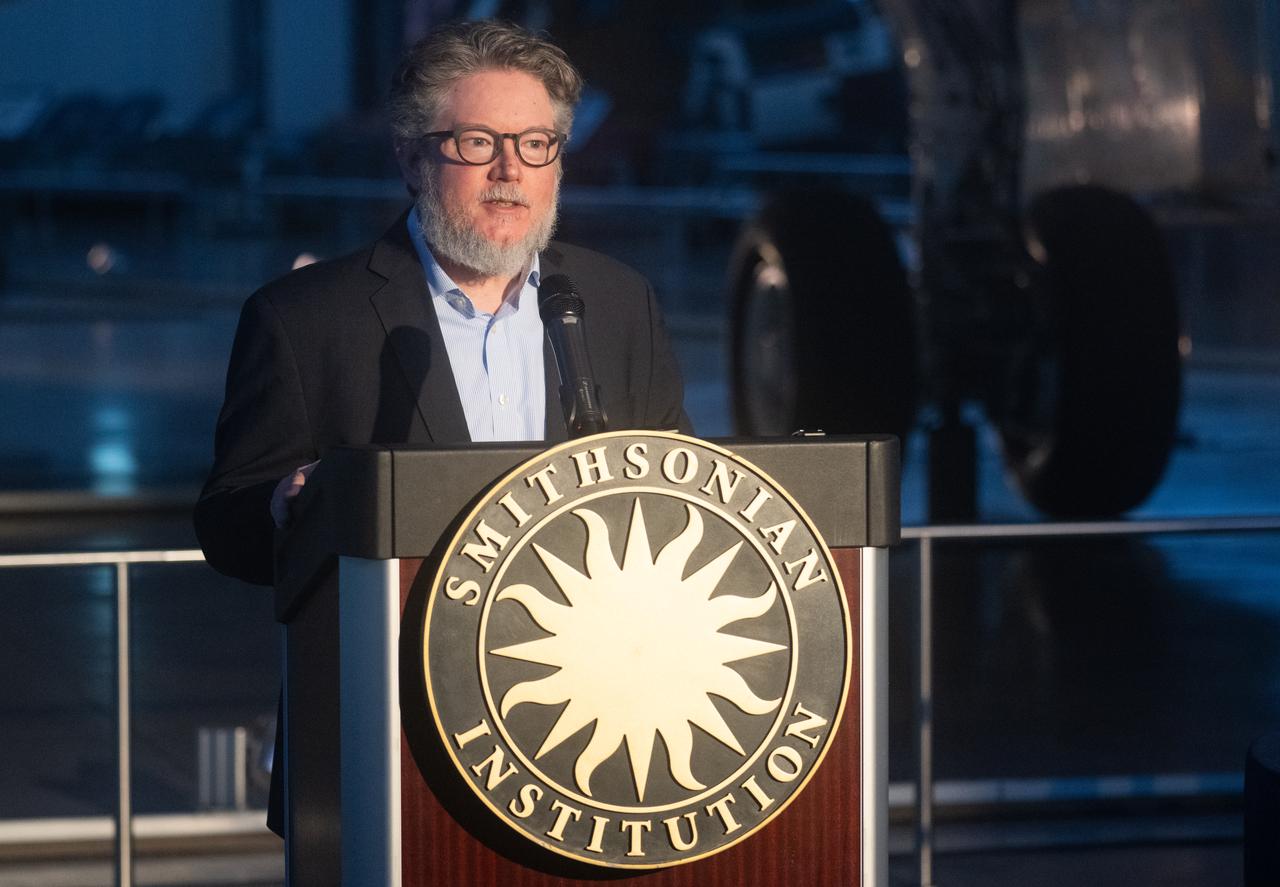
Matt Shindell, space history curator at the National Air and Space Museum speaks at an event marking NASA’s donation of the aerial prototype of the Ingenuity Mars Helicopter, Friday, Dec. 15, 2023, at the Smithsonian National Air and Space Museum’s Steve F. Udvar-Hazy Center in Chantilly, Va. The aerial prototype of the Ingenuity Mars Helicopter, which was the first to demonstrate it was possible to fly in a simulated Mars environment at NASA’s Jet Propulsion Laboratory (JPL), was donated to the museum on Friday. Photo Credit: (NASA/Joel Kowsky)The aerial prototype of the Ingenuity Mars Helicopter is seen at the Smithsonian National Air and Space Museum’s Steve F. Udvar-Hazy Center, Friday, Dec. 15, 2023, in Chantilly, Va. The prototype, which demonstrated it was possible to fly in a simulated Mars environment at NASA’s Jet Propulsion Laboratory (JPL), was donated Photo Credit: (NASA/Joel Kowsky)
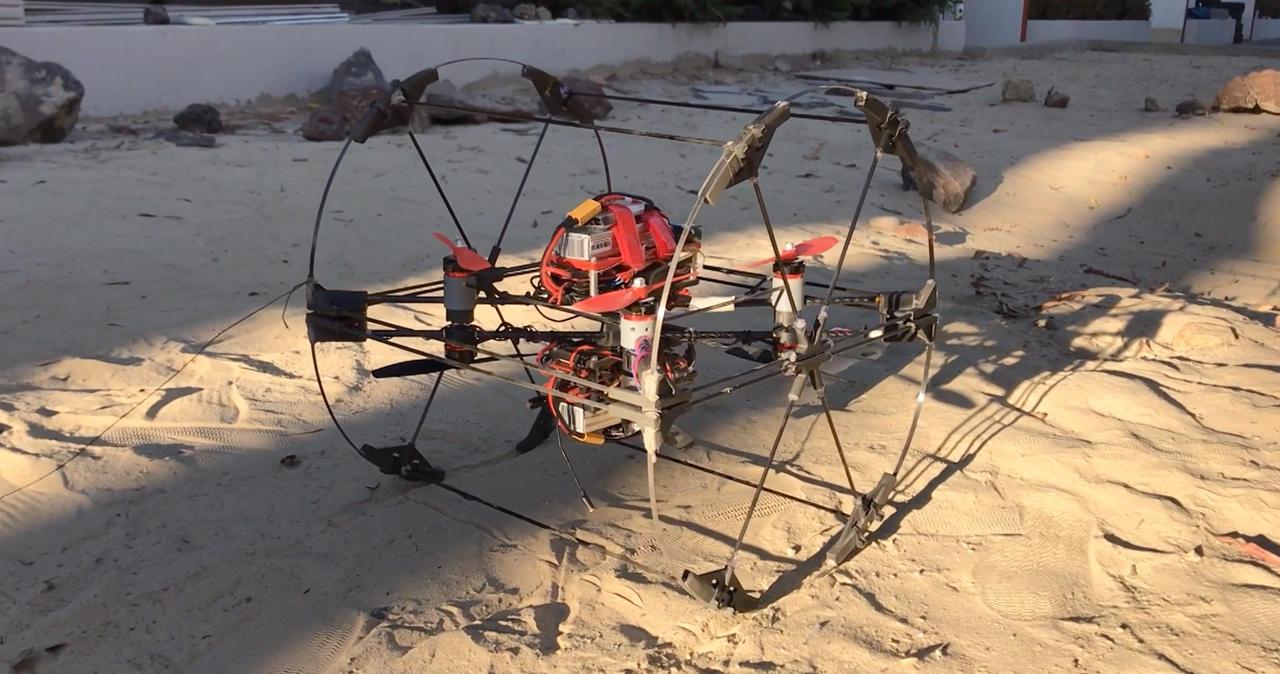
A prototype of the transforming robot Shapeshifter is tested in the robotics yard at NASA's Jet Propulsion Laboratory. Shapeshifter is made of smaller robots that can morph into rolling spheres, flying drones, swimming submersibles and more. Shapeshifter is a developing concept for a transformational vehicle to explore treacherous, distant worlds. The flying amphibious robot is part of the early-stage research program NASA Innovative Advanced Concepts (NIAC), which offers several phases of funding to visionary concepts, helping turn ideas that sound like science fiction into science fact. JPL Principle Investigator Ali Agha envisions Shapeshifter as a mission to Saturn's moon Titan, the only other world in the solar system known to have liquid in the form of methane lakes, rivers and seas on its surface. https://photojournal.jpl.nasa.gov/catalog/PIA23433
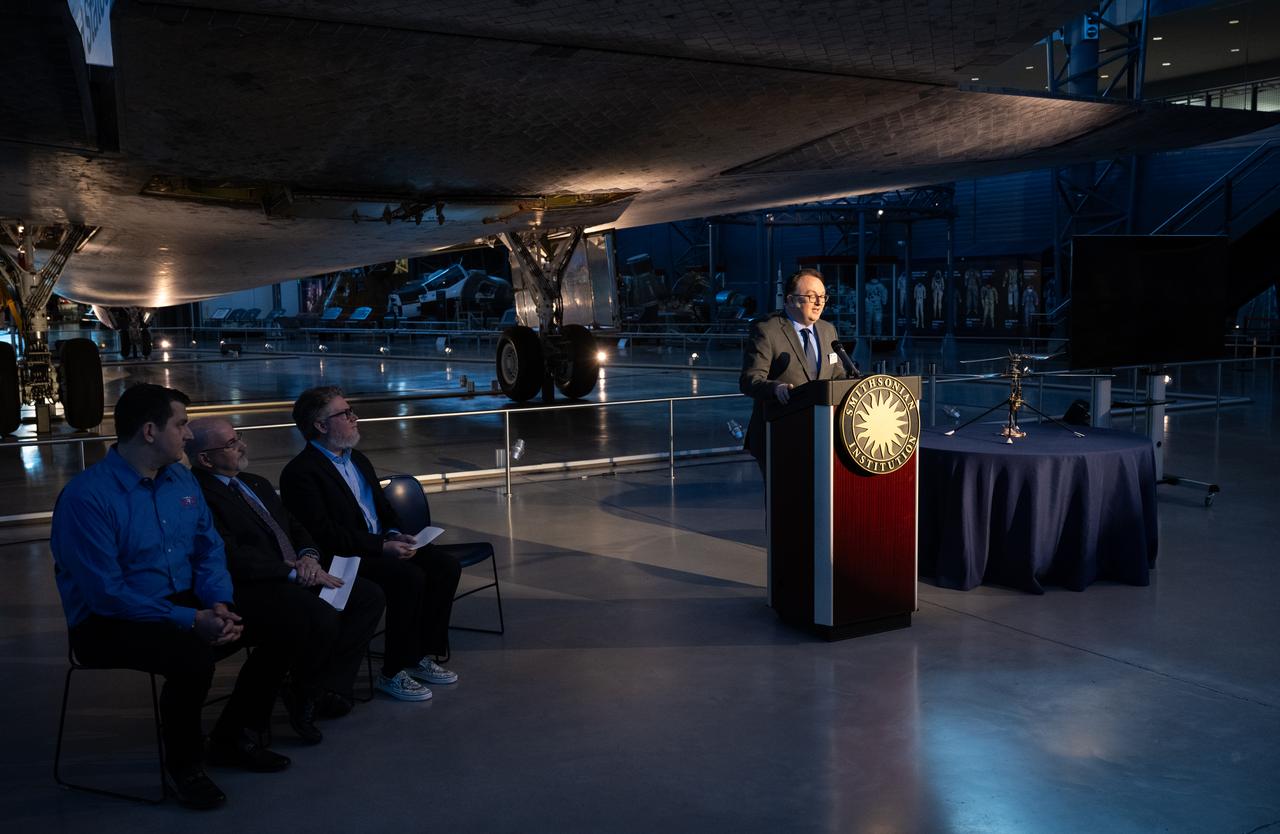
Jeremy Kinney, associate director of research, collections, and curatorial affairs at the National Air and Space Museum speaks at an event marking NASA’s donation of the aerial prototype of the Ingenuity Mars Helicopter, Friday, Dec. 15, 2023, at the Smithsonian National Air and Space Museum’s Steve F. Udvar-Hazy Center in Chantilly, Va. The aerial prototype of the Ingenuity Mars Helicopter, which was the first to demonstrate it was possible to fly in a simulated Mars environment at NASA’s Jet Propulsion Laboratory (JPL), was donated to the museum on Friday. Photo Credit: (NASA/Joel Kowsky)
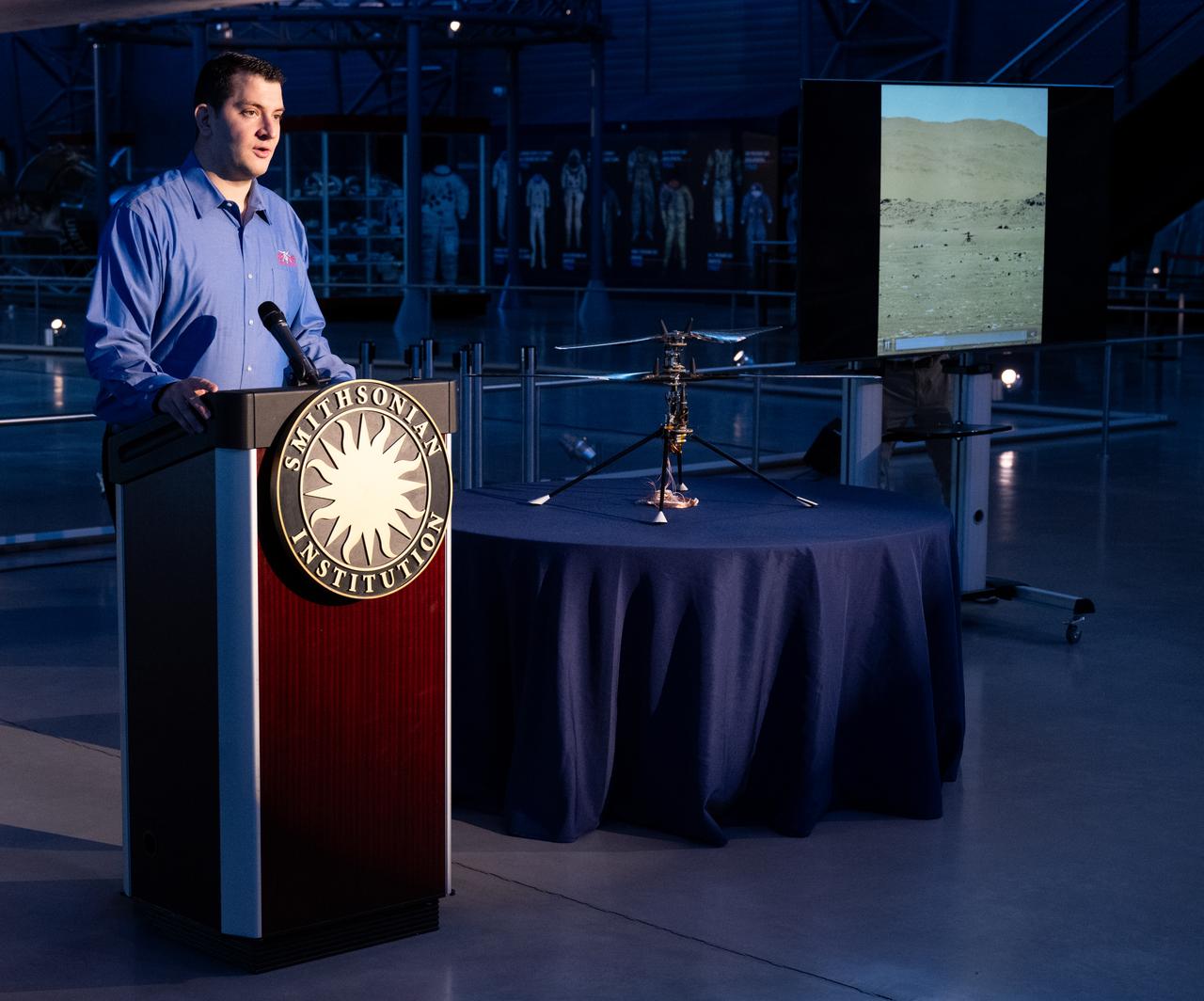
Teddy Tzanetos, Ingenuity project manager at NASA's Jet Propulsion Laboratory speaks at an event marking NASA’s donation of the aerial prototype of the Ingenuity Mars Helicopter, Friday, Dec. 15, 2023, at the Smithsonian National Air and Space Museum’s Steve F. Udvar-Hazy Center in Chantilly, Va. The aerial prototype of the Ingenuity Mars Helicopter, which was the first to demonstrate it was possible to fly in a simulated Mars environment at NASA’s Jet Propulsion Laboratory (JPL), was donated to the museum on Friday. Photo Credit: (NASA/Joel Kowsky)
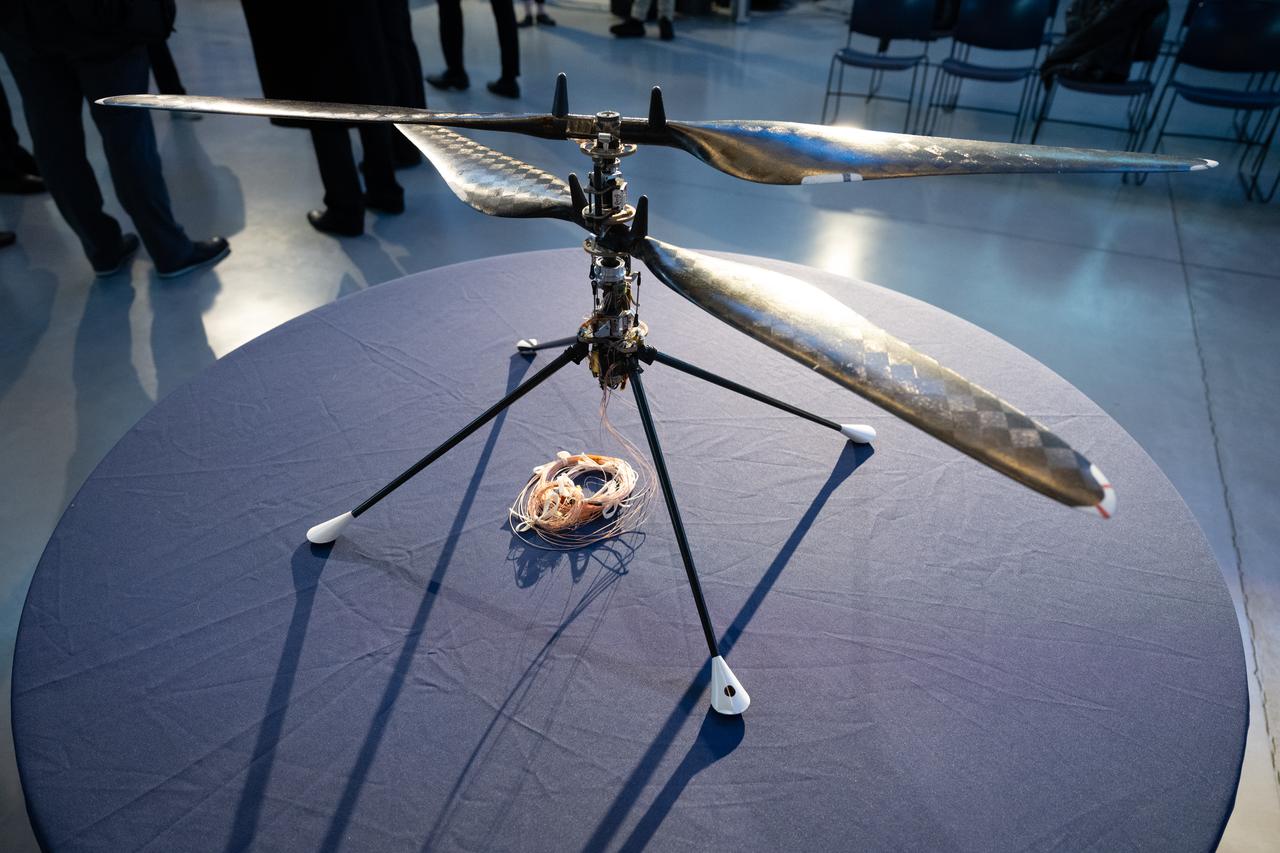
The aerial prototype of the Ingenuity Mars Helicopter is seen at the Smithsonian National Air and Space Museum’s Steve F. Udvar-Hazy Center, Friday, Dec. 15, 2023, in Chantilly, Va. The prototype, which was the first to demonstrate it was possible to fly in a simulated Mars environment at NASA’s Jet Propulsion Laboratory (JPL), was donated to the museum on Friday. Photo Credit: (NASA/Joel Kowsky)
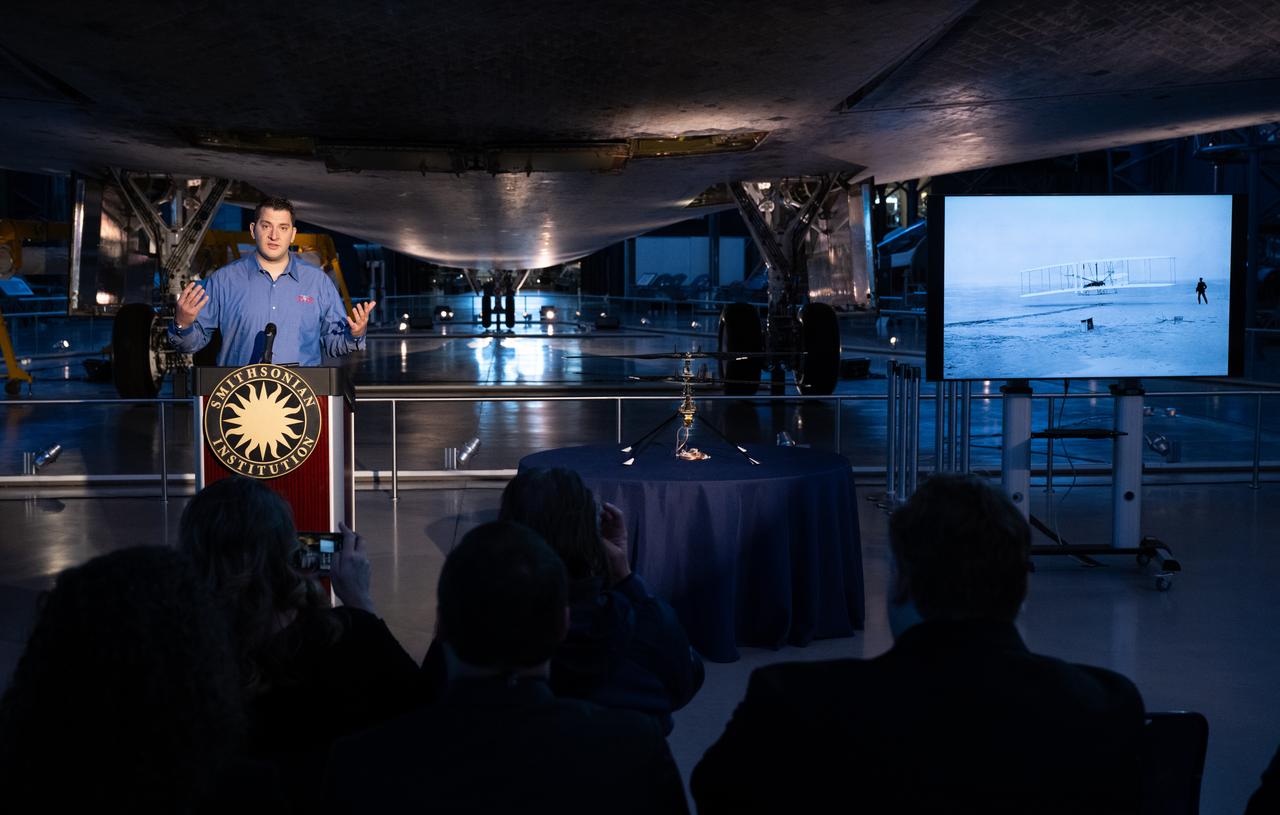
Teddy Tzanetos, Ingenuity project manager at NASA's Jet Propulsion Laboratory speaks at an event marking NASA’s donation of the aerial prototype of the Ingenuity Mars Helicopter, Friday, Dec. 15, 2023, at the Smithsonian National Air and Space Museum’s Steve F. Udvar-Hazy Center in Chantilly, Va. The aerial prototype of the Ingenuity Mars Helicopter, which was the first to demonstrate it was possible to fly in a simulated Mars environment at NASA’s Jet Propulsion Laboratory (JPL), was donated to the museum on Friday. Photo Credit: (NASA/Joel Kowsky)
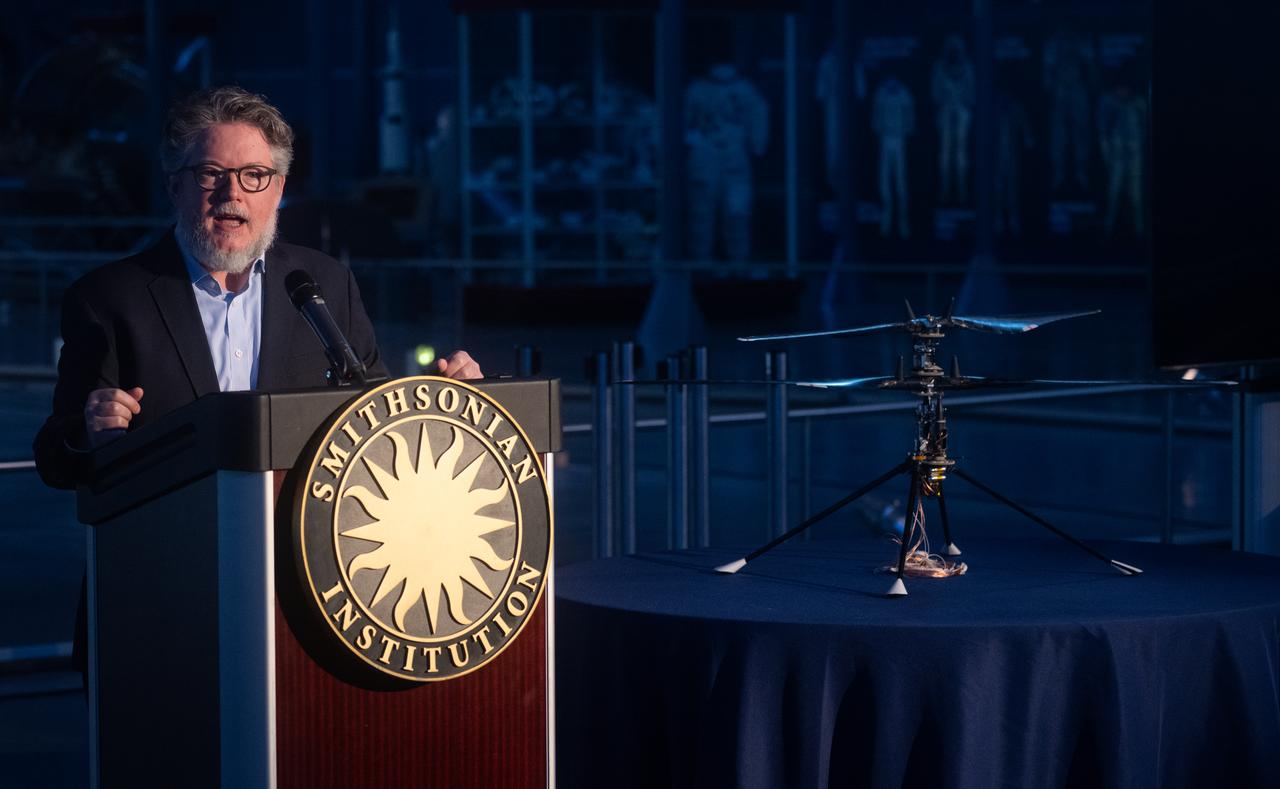
Matt Shindell, space history curator at the National Air and Space Museum speaks at an event marking NASA’s donation of the aerial prototype of the Ingenuity Mars Helicopter, Friday, Dec. 15, 2023, at the Smithsonian National Air and Space Museum’s Steve F. Udvar-Hazy Center in Chantilly, Va. The aerial prototype of the Ingenuity Mars Helicopter, which was the first to demonstrate it was possible to fly in a simulated Mars environment at NASA’s Jet Propulsion Laboratory (JPL), was donated to the museum on Friday. Photo Credit: (NASA/Joel Kowsky)
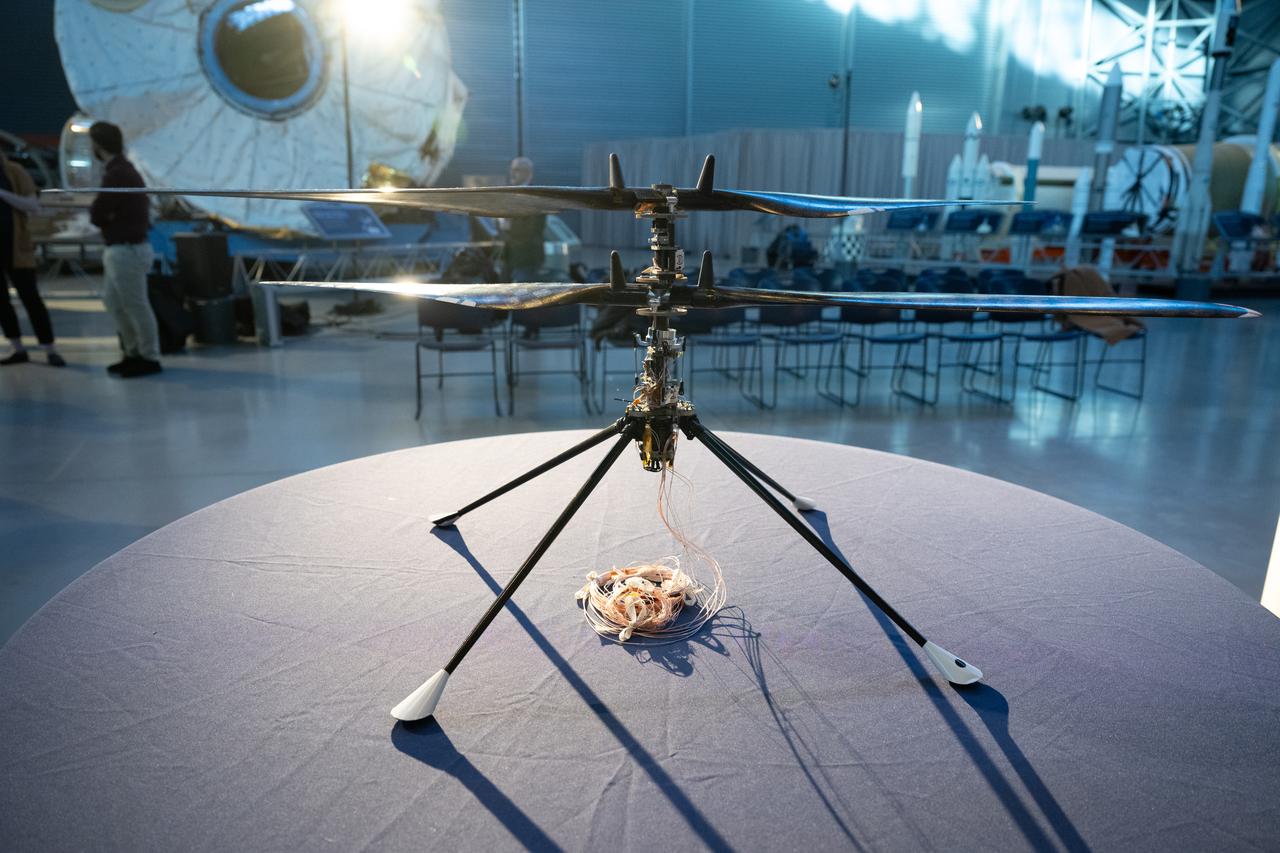
The aerial prototype of the Ingenuity Mars Helicopter is seen at the Smithsonian National Air and Space Museum’s Steve F. Udvar-Hazy Center, Friday, Dec. 15, 2023, in Chantilly, Va. The prototype, which was the first to demonstrate it was possible to fly in a simulated Mars environment at NASA’s Jet Propulsion Laboratory (JPL), was donated to the museum on Friday. Photo Credit: (NASA/Joel Kowsky)
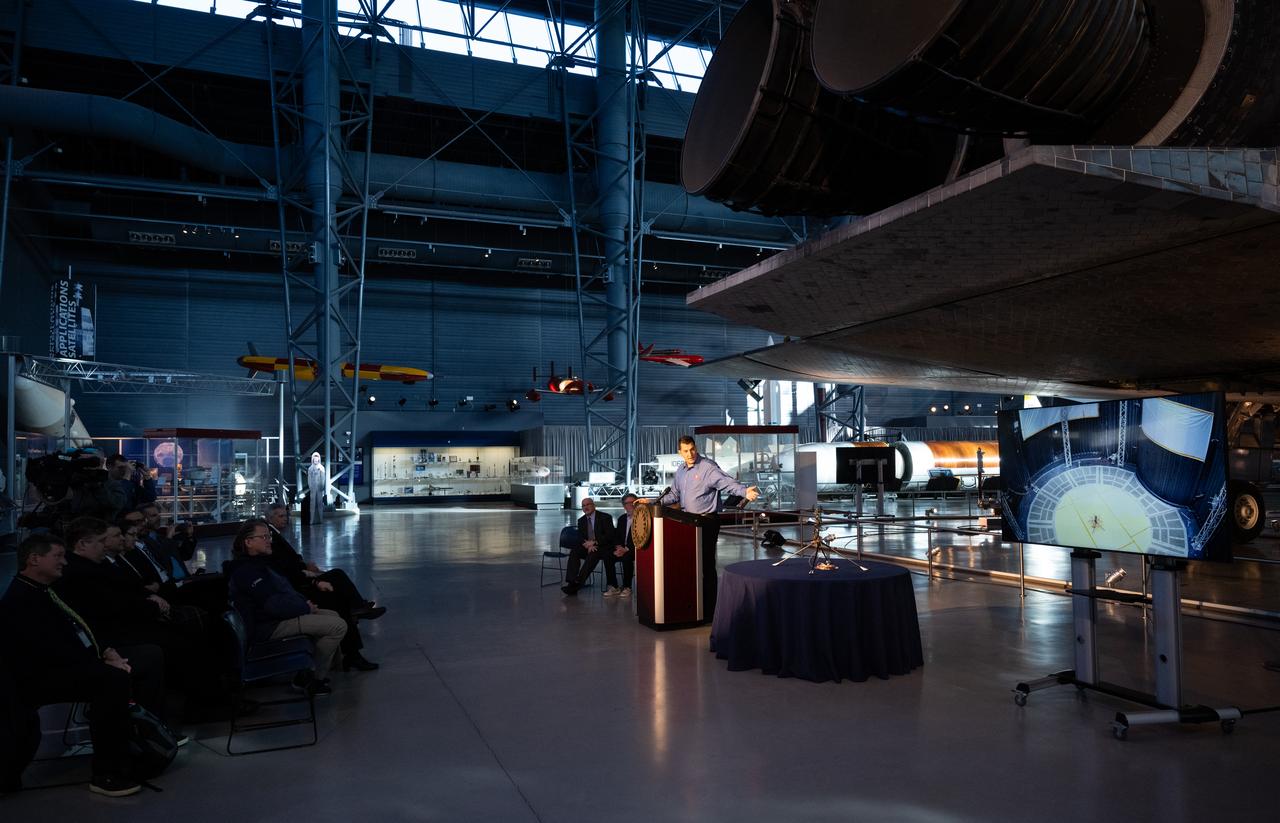
Teddy Tzanetos, Ingenuity project manager at NASA's Jet Propulsion Laboratory speaks at an event marking NASA’s donation of the aerial prototype of the Ingenuity Mars Helicopter, Friday, Dec. 15, 2023, at the Smithsonian National Air and Space Museum’s Steve F. Udvar-Hazy Center in Chantilly, Va. The aerial prototype of the Ingenuity Mars Helicopter, which was the first to demonstrate it was possible to fly in a simulated Mars environment at NASA’s Jet Propulsion Laboratory (JPL), was donated to the museum on Friday. Photo Credit: (NASA/Joel Kowsky)
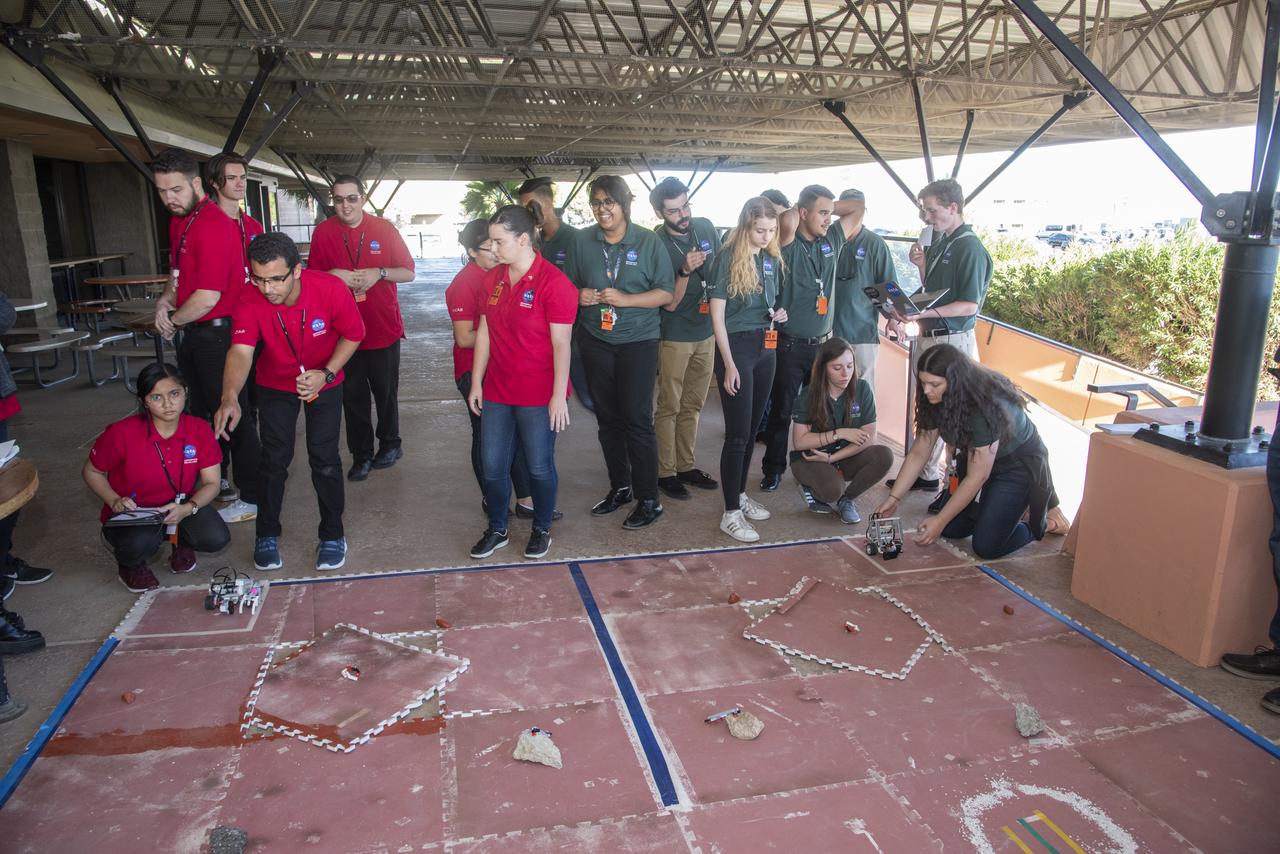
Four student teams: Blue, Gold, Green and Red built, designed and tested a LEGO robotic Martian rover prototype at NASA's Armstrong Flight Research Center. The teams competed against each other during a four-day workshop coordinated by the NASA Community College Aerospace Scholars. Each team prepared a marketing package to "sell" their design to NASA based on the performance of its Martian rover.
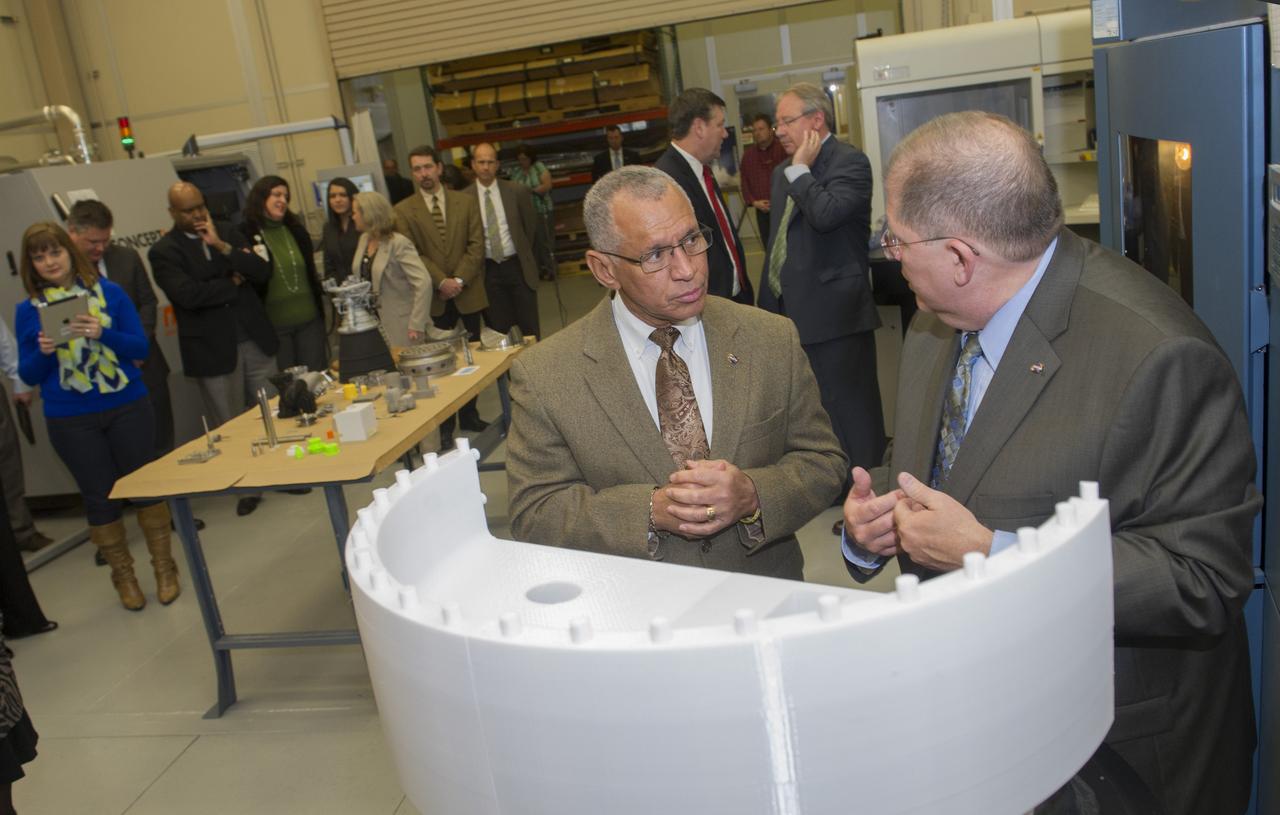
NASA ADMINISTRATOR CHARLES BOLDEN, LEFT, TALKS WITH FRANK LEDBETTER, CHIEF OF THE NONMETALLIC MATERIALS AND MANUFACTURING DIVISION AT MARSHALL, ABOUT A PART OF A PROTOTYPE FOR THE CORE STAGE-TO-BOOSTER ATTACH FITTING DURING BOLDEN'S FEB. 22 VISIT TO THE NATIONAL CENTER FOR ADVANCED MANUFACTURING RAPID PROTOTYPING FACILITY AT MARSHALL. DURING HIS TOUR, BOLDEN WATCHED RESEARCHERS EMPLOY A 3-D PRINTING PROCESS CALLED "SELECTIVE LASER MELTING" TO CREATE COMPLEX PARTS FOR THE J-2X AND RS-25 ROCKET ENGINES -- WITHOUT WELDING.
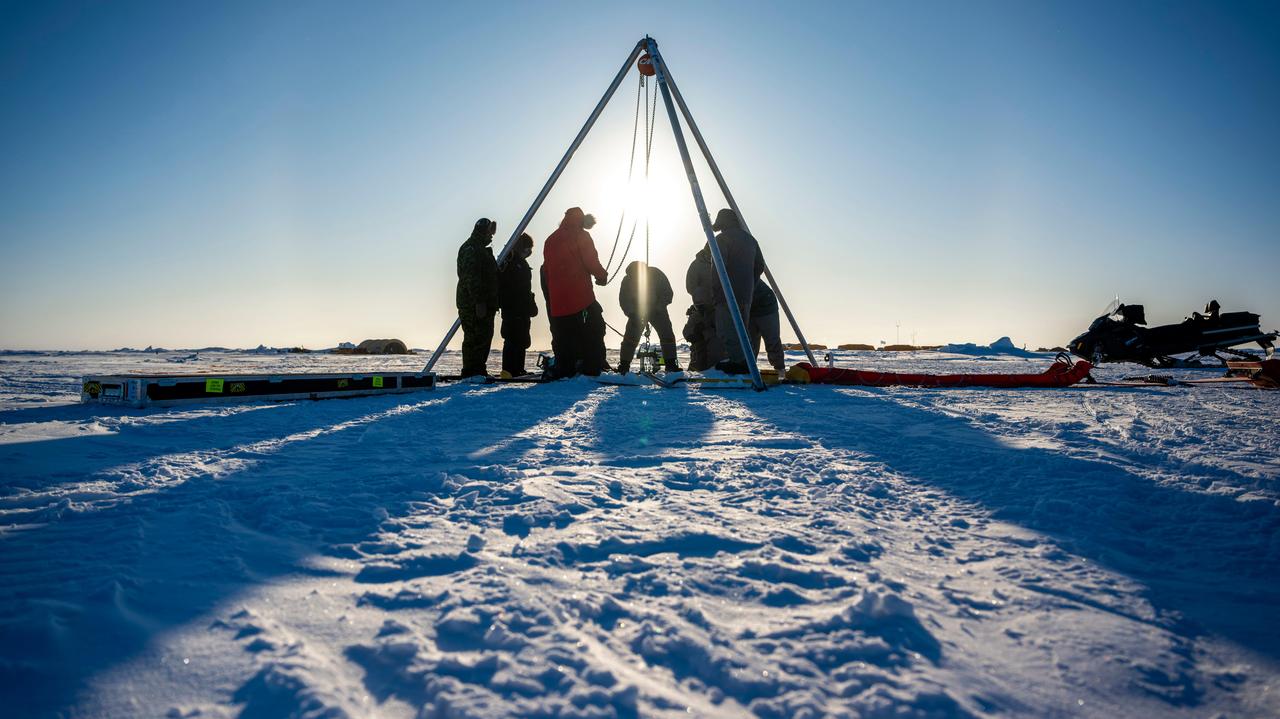
A prototype of an autonomous robot, part of a project called IceNode being developed at NASA's Jet Propulsion Laboratory, was tested in the Beaufort Sea north of Alaska in March 2024. The project envisions a fleet of such robots to venture beneath Antarctic ice shelves and gather data that would help scientists calculate how rapidly the ice shelves there are melting – and how fast that melting could cause global sea levels to rise. This image, as well as Figures A and B, shows the team lowering the prototype through a borehole in the sea ice. During this Arctic field test, the robot descended on a tether about 330 feet (100 meters) into the ocean, where its instruments gathered salinity, temperature, and flow data. The team also conducted tests to determine adjustments that would enable them to take the robot off-tether. Each about 8 feet (2.4 meters) long and 10 inches (25 centimeters) in diameter, the robots use three-legged "landing gear" that springs out from one end to attach the robot to the underside of the ice. Rather than using propulsion, the robots would autonomously position themselves with the help of novel algorithms based on models of ocean currents. Released from a borehole or a vessel in the open ocean, the robots would ride those currents on a long journey beneath an ice shelf. They would target the underwater area known as the "grounding zone," where floating ice shelves, ocean, and land meet, deep inside unmapped cavities where the ice may be melting the fastest. Each robot would detach a ballast and rise up to affix itself to the underside of the ice, where their suite of sensors would measure how fast warm, salty ocean water is circulating up to melt the ice, and how quickly cold meltwater is sinking. As conceived, the IceNode fleet would operate for up to a year, continuously capturing data, including seasonal fluctuations. Then the robots would detach themselves from the ice, drift back out to open ocean, and transmit their data via satellite. This test was conducted through the U.S. Navy Arctic Submarine Laboratory's biennial Ice Camp, a three-week operation that provides researchers a temporary base camp from which to conduct field work in the harsh Arctic environment. IceNode has been funded through JPL's internal research and technology development program and its Earth Science and Technology Directorate. JPL is managed for NASA by Caltech in Pasadena, California. https://photojournal.jpl.nasa.gov/catalog/PIA26349
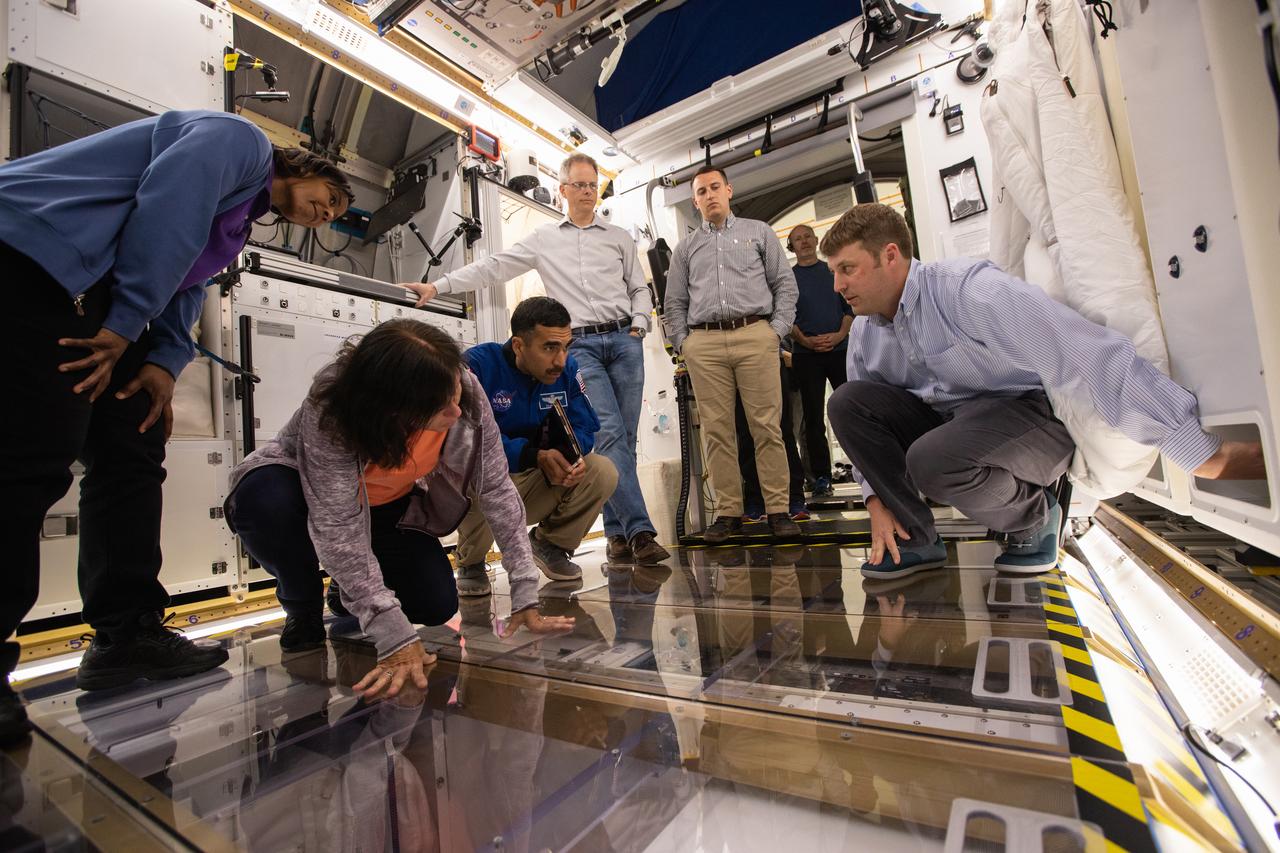
NASA began evaluating five habitat prototypes developed through NASA’s Next Space Exploration for Technologies Partnerships, or NextSTEP, to help engineers refine requirements for the design of an American-made deep space habitat for the Gateway. Lockheed Martin turned over its prototype to NASA, and testing began with crew on March 25, 2019, at Kennedy Space Center in Florida. Pictured inside the habitat prototype on March 26, 2019, from left are astronauts Stephanie Wilson, Shannon Walker and Raja Chari. Astronauts are participating in the evaluations to provide their perspectives as those who may one day live aboard the lunar outpost, which would be located about 250,000 miles from Earth. Ground prototypes developed by Bigelow Aerospace, Boeing, Northrop Grumman, and Sierra Nevada Corporation will be tested in the future at various facilities across the country. A sixth company, NanoRacks, plans to develop a prototype as well.
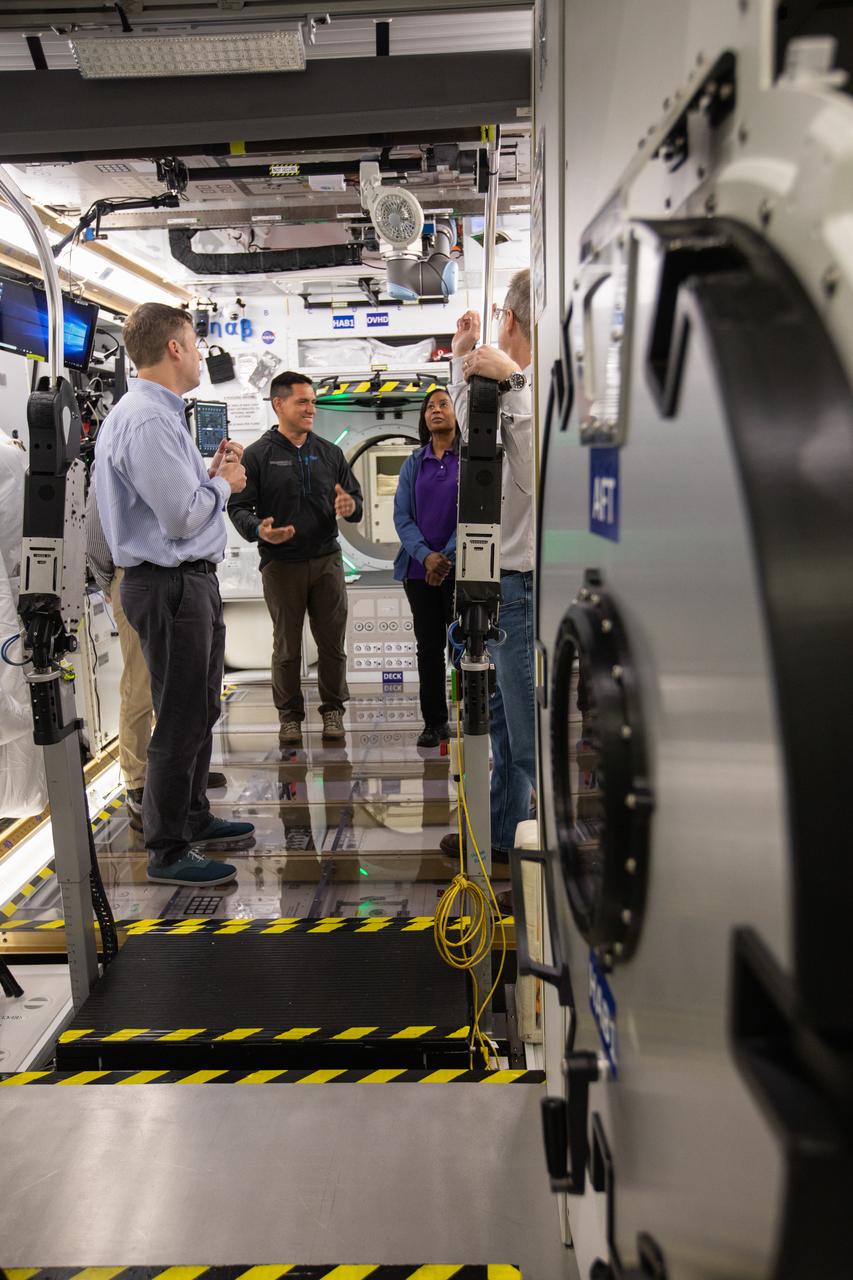
NASA began evaluating five habitat prototypes developed through NASA’s Next Space Exploration for Technologies Partnerships, or NextSTEP, to help engineers refine requirements for the design of an American-made deep space habitat for the Gateway. Lockheed Martin turned over its prototype to NASA, and testing began with crew on March 25, 2019, at Kennedy Space Center in Florida. Pictured inside the habitat prototype on March 26, 2019, second from left is astronaut Frank Rubio. Next to him is astronaut Stephanie Wilson. Astronauts are participating in the evaluations to provide their perspectives as those who may one day live aboard the lunar outpost, which would be located about 250,000 miles from Earth. Ground prototypes developed by Bigelow Aerospace, Boeing, Northrop Grumman, and Sierra Nevada Corporation will be tested in the future at various facilities across the country. A sixth company, NanoRacks, plans to develop a prototype as well.
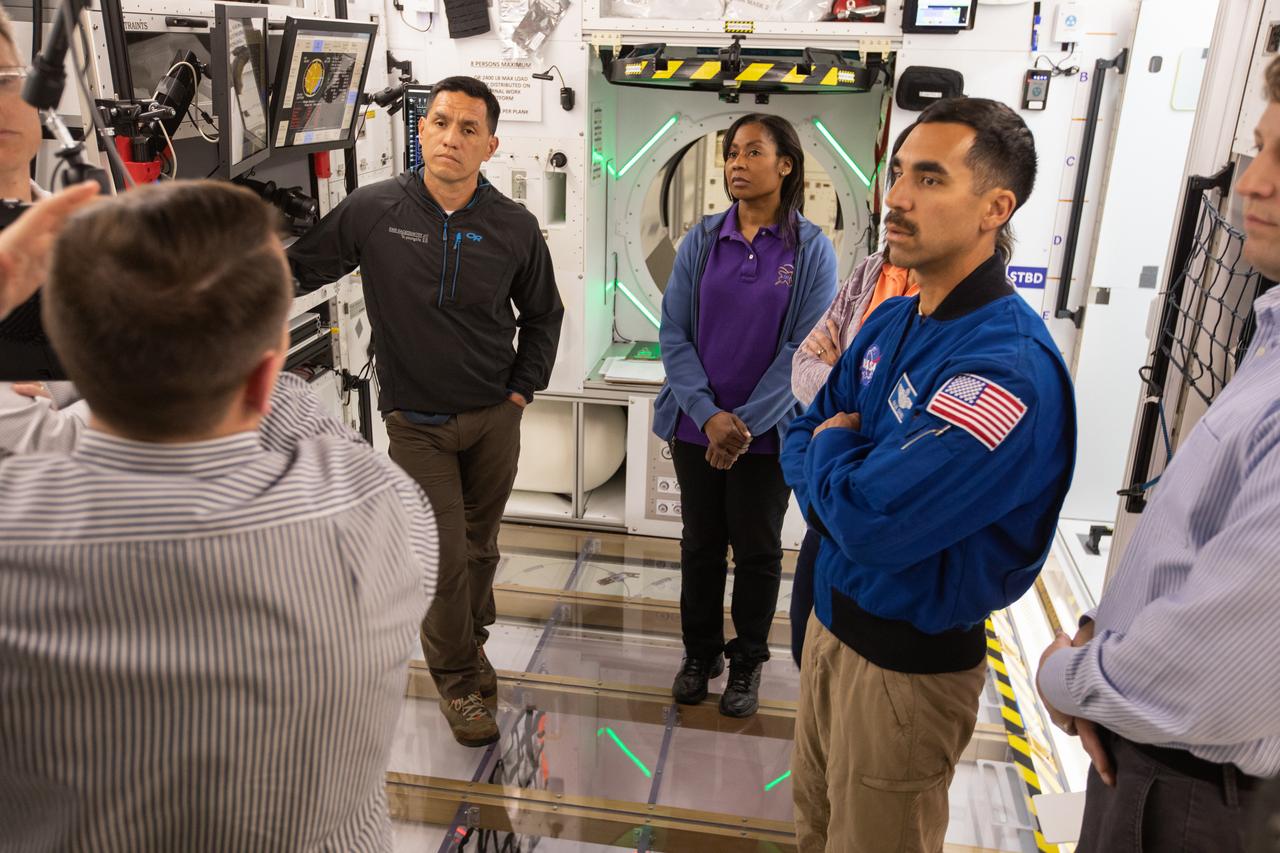
NASA began evaluating five habitat prototypes developed through NASA’s Next Space Exploration for Technologies Partnerships, or NextSTEP, to help engineers refine requirements for the design of an American-made deep space habitat for the Gateway. Lockheed Martin turned over its prototype to NASA, and testing began with crew on March 25, 2019, at Kennedy Space Center in Florida. Pictured inside the habitat prototype on March 26, 2019, from left are astronauts Frank Rubio, Stephanie Wilson and Raja Chari. Partially in view next to Chari is astronaut Shannon Walker. Astronauts are participating in the evaluations to provide their perspectives as those who may one day live aboard the lunar outpost, which would be located about 250,000 miles from Earth. Ground prototypes developed by Bigelow Aerospace, Boeing, Northrop Grumman, and Sierra Nevada Corporation will be tested in the future at various facilities across the country. A sixth company, NanoRacks, plans to develop a prototype as well.
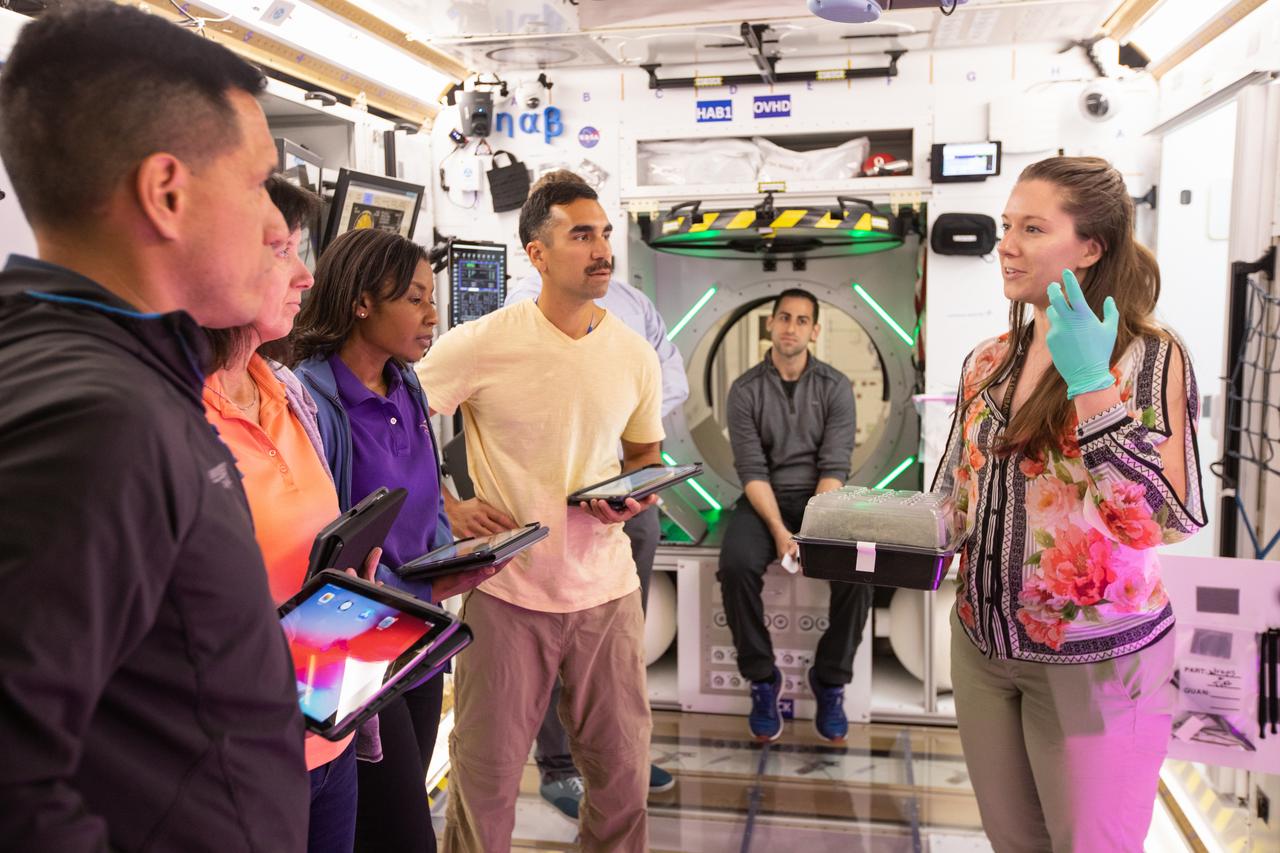
NASA began evaluating five habitat prototypes developed through NASA’s Next Space Exploration for Technologies Partnerships, or NextSTEP, to help engineers refine requirements for the design of an American-made deep space habitat for the Gateway. Lockheed Martin turned over its prototype to NASA, and testing began with crew on March 25, 2019, at Kennedy Space Center in Florida. Pictured inside the habitat prototype on March 26, 2019, from far left are astronauts Frank Rubio, Shannon Walker, Stephanie Wilson and Raja Chari. Astronauts are participating in the evaluations to provide their perspectives as those who may one day live aboard the lunar outpost, which would be located about 250,000 miles from Earth. Ground prototypes developed by Bigelow Aerospace, Boeing, Northrop Grumman, and Sierra Nevada Corporation will be tested in the future at various facilities across the country. A sixth company, NanoRacks, plans to develop a prototype as well.
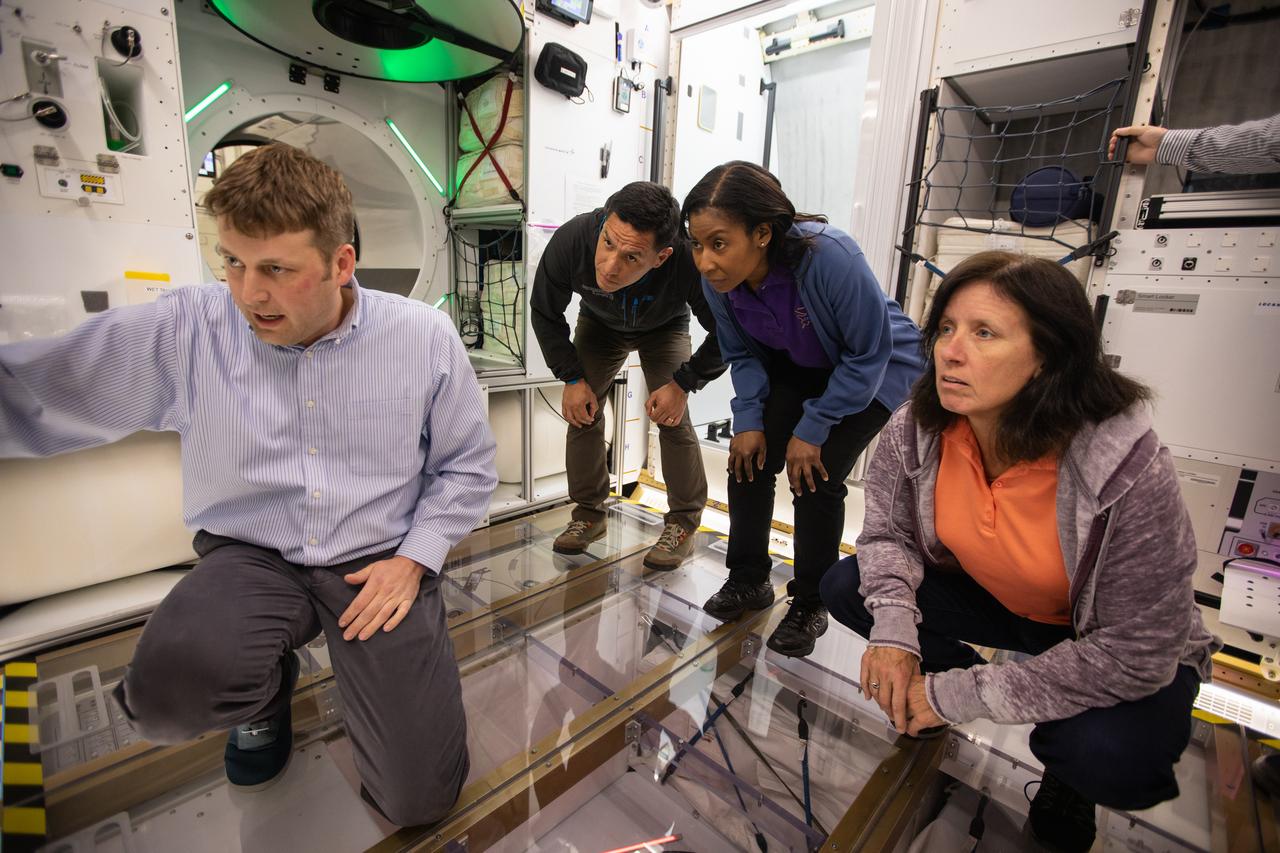
NASA began evaluating five habitat prototypes developed through NASA’s Next Space Exploration for Technologies Partnerships, or NextSTEP, to help engineers refine requirements for the design of an American-made deep space habitat for the Gateway. Lockheed Martin turned over its prototype to NASA, and testing began with crew on March 25, 2019, at Kennedy Space Center in Florida. Pictured inside the habitat prototype on March 26, 2019, in back from left are astronauts Frank Rubio, Stephanie Wilson and Shannon Walker. Astronauts are participating in the evaluations to provide their perspectives as those who may one day live aboard the lunar outpost, which would be located about 250,000 miles from Earth. Ground prototypes developed by Bigelow Aerospace, Boeing, Northrop Grumman, and Sierra Nevada Corporation will be tested in the future at various facilities across the country. A sixth company, NanoRacks, plans to develop a prototype as well.
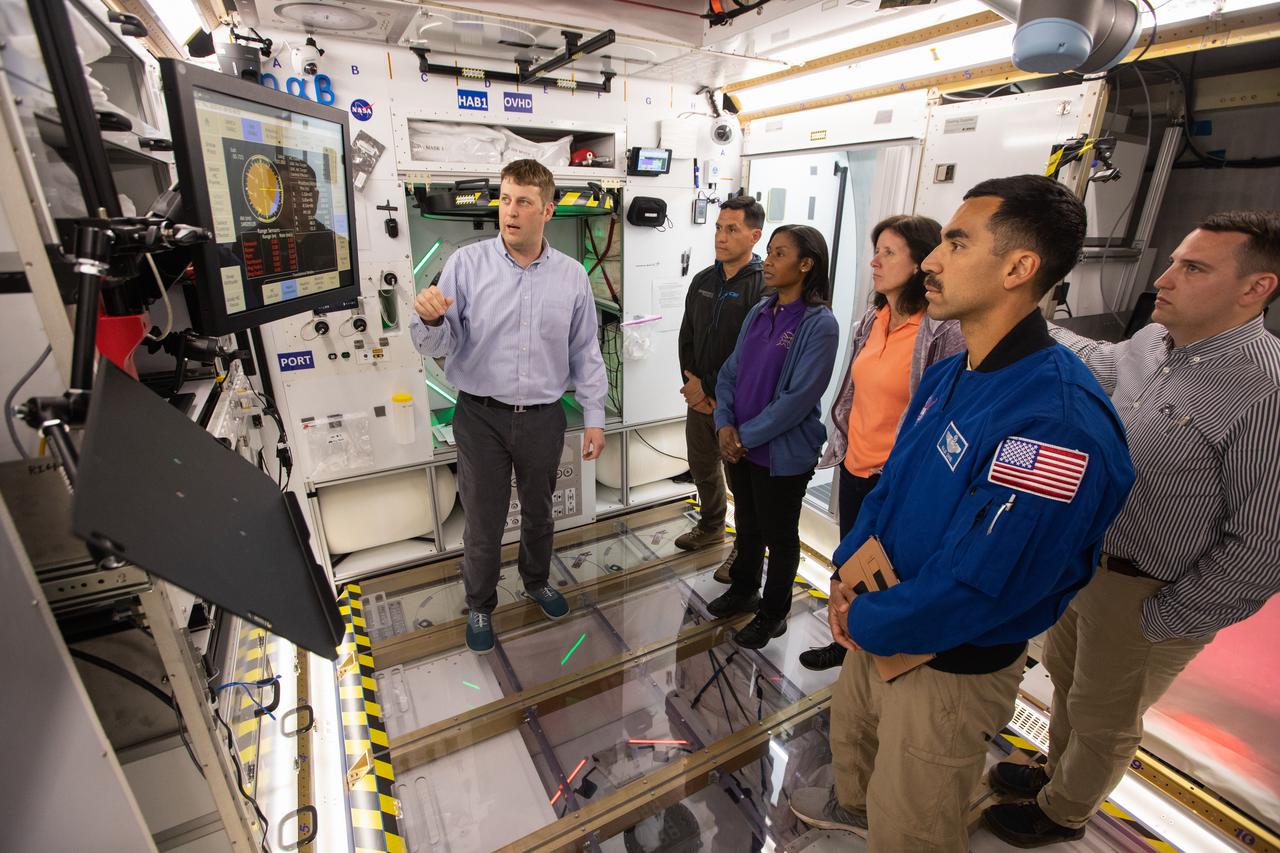
NASA began evaluating five habitat prototypes developed through NASA’s Next Space Exploration for Technologies Partnerships, or NextSTEP, to help engineers refine requirements for the design of an American-made deep space habitat for the Gateway. Lockheed Martin turned over its prototype to NASA, and testing began with crew on March 25, 2019, at Kennedy Space Center in Florida. Pictured inside the habitat prototype on March 26, 2019, beginning second from left are astronauts Frank Rubio, Raja Shari, Stephanie Wilson and Shannon Walker. Astronauts are participating in the evaluations to provide their perspectives as those who may one day live aboard the lunar outpost, which would be located about 250,000 miles from Earth. Ground prototypes developed by Bigelow Aerospace, Boeing, Northrop Grumman, and Sierra Nevada Corporation will be tested in the future at various facilities across the country. A sixth company, NanoRacks, plans to develop a prototype as well.
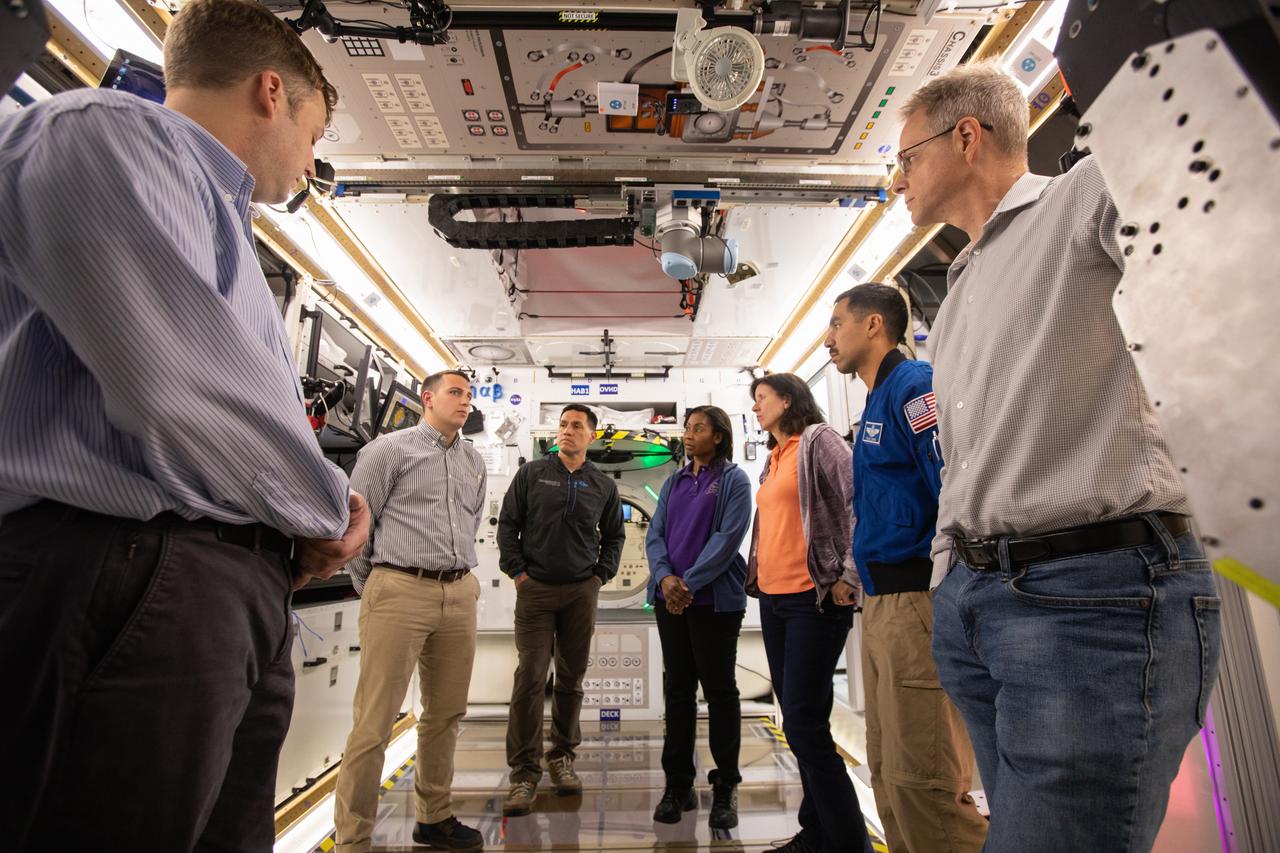
NASA began evaluating five habitat prototypes developed through NASA’s Next Space Exploration for Technologies Partnerships, or NextSTEP, to help engineers refine requirements for the design of an American-made deep space habitat for the Gateway. Lockheed Martin turned over its prototype to NASA, and testing began with crew on March 25, 2019, at Kennedy Space Center in Florida. Pictured inside the habitat prototype on March 26, 2019, beginning third from left are astronauts Frank Rubio, Stephanie Wilson, Shannon Walker and Raja Chari. Astronauts are participating in the evaluations to provide their perspectives as those who may one day live aboard the lunar outpost, which would be located about 250,000 miles from Earth. Ground prototypes developed by Bigelow Aerospace, Boeing, Northrop Grumman, and Sierra Nevada Corporation will be tested in the future at various facilities across the country. A sixth company, NanoRacks, plans to develop a prototype as well.
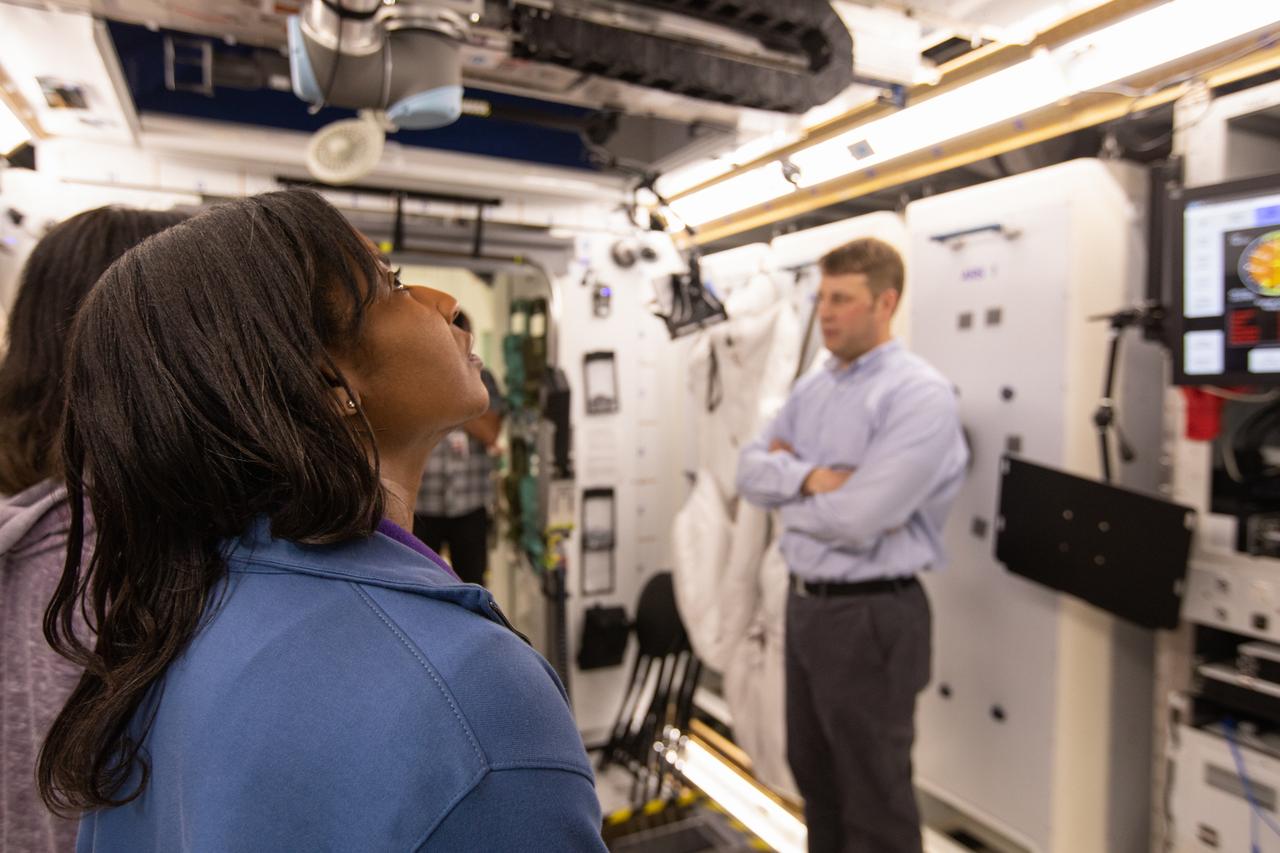
NASA began evaluating five habitat prototypes developed through NASA’s Next Space Exploration for Technologies Partnerships, or NextSTEP, to help engineers refine requirements for the design of an American-made deep space habitat for the Gateway. Lockheed Martin turned over its prototype to NASA, and testing began with crew on March 25, 2019, at Kennedy Space Center in Florida. Pictured inside the habitat prototype on March 26, 2019, at left is astronaut Stephanie Wilson. To her left, partially hidden is astronaut Shannon Walker. Astronauts are participating in the evaluations to provide their perspectives as those who may one day live aboard the lunar outpost, which would be located about 250,000 miles from Earth. Ground prototypes developed by Bigelow Aerospace, Boeing, Northrop Grumman, and Sierra Nevada Corporation will be tested in the future at various facilities across the country. A sixth company, NanoRacks, plans to develop a prototype as well.
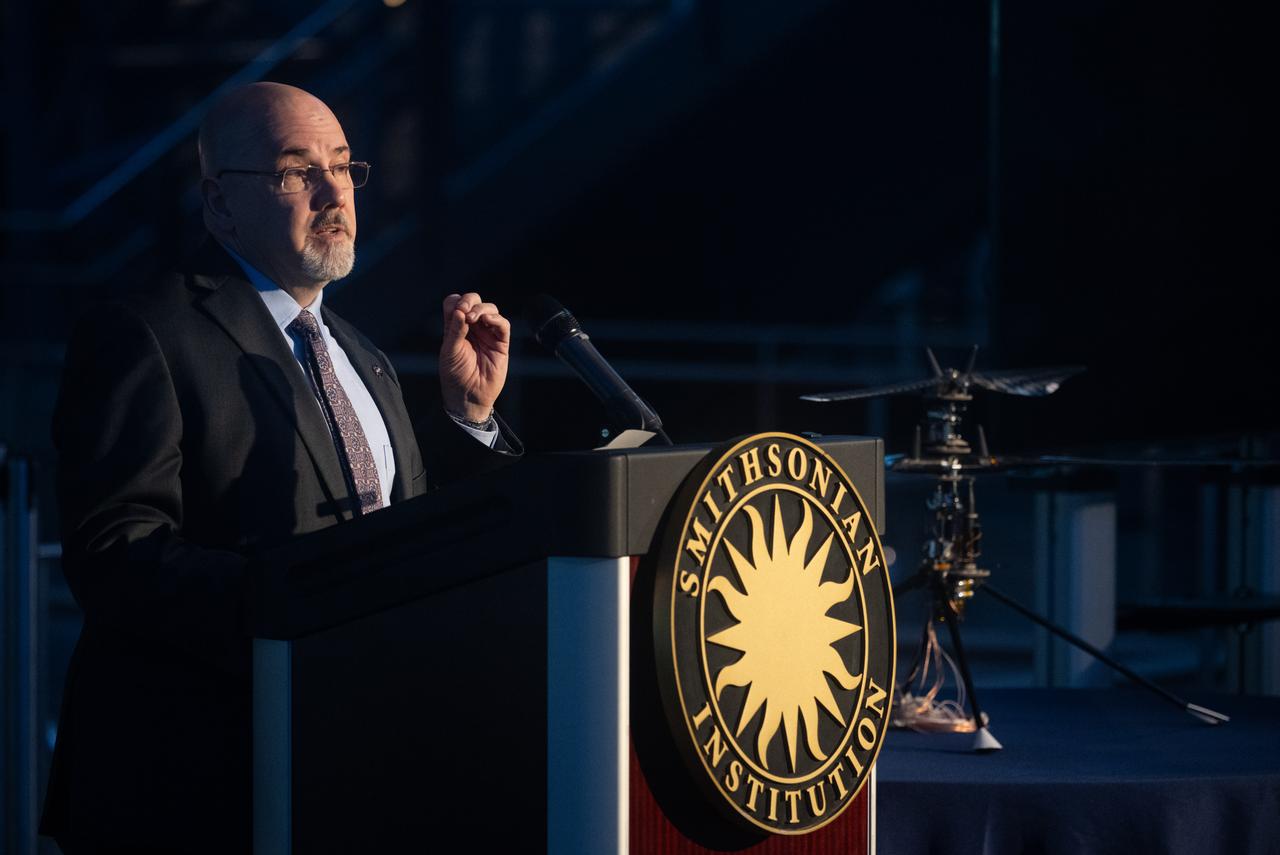
Eric Ianson, deputy director of the Planetary Science Division and director of the Mars Exploration Program and Radioisotope Power Systems Program at NASA speaks at an event marking NASA’s donation of the aerial prototype of the Ingenuity Mars Helicopter, Friday, Dec. 15, 2023, at the Smithsonian National Air and Space Museum’s Steve F. Udvar-Hazy Center in Chantilly, Va. The aerial prototype of the Ingenuity Mars Helicopter, which was the first to demonstrate it was possible to fly in a simulated Mars environment at NASA’s Jet Propulsion Laboratory (JPL), was donated to the museum on Friday. Photo Credit: (NASA/Joel Kowsky)
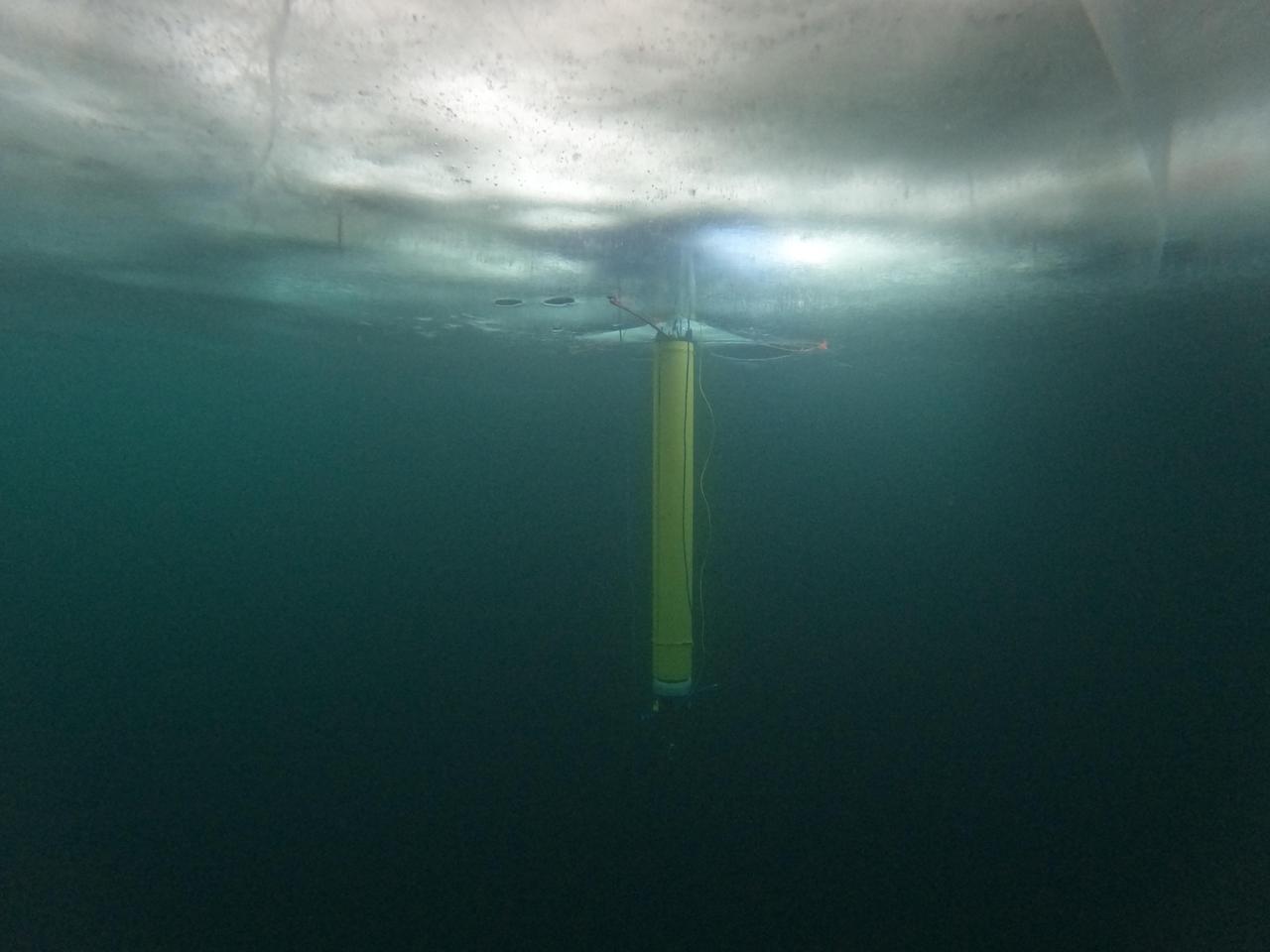
A prototype of an autonomous robot, part of a project called IceNode being developed at NASA's Jet Propulsion Laboratory, is seen from beneath the frozen surface of Lake Superior, off Michigan's Upper Peninsula. The three thin legs of the robot's "landing gear" affix it to the icy ceiling. A remote camera captured the image during a field test in 2022. The IceNode project envisions a fleet of such robots to venture beneath Antarctic ice shelves and gather data that would help scientists calculate how rapidly the ice shelves there are melting – and how fast that melting could cause global sea levels to rise. Each about 8 feet (2.4 meters) long and 10 inches (25 centimeters) in diameter, the robots use three-legged "landing gear" that springs out from one end to attach the robot to the underside of the ice. Rather than using propulsion, the robots would autonomously position themselves with the help of novel algorithms based on models of ocean currents. Released from a borehole or a vessel in the open ocean, the robots would ride those currents on a long journey beneath an ice shelf. They would target the underwater area known as the "grounding zone," where floating ice shelves, ocean, and land meet, deep inside unmapped cavities where the ice may be melting the fastest. Each robot would detach a ballast and rise up to affix itself to the underside of the ice, where their suite of sensors would measure how fast warm, salty ocean water is circulating up to melt the ice, and how quickly cold meltwater is sinking. As conceived, the IceNode fleet would operate for up to a year, continuously capturing data, including seasonal fluctuations. Then the robots would detach themselves from the ice, drift back out to open ocean, and transmit their data via satellite. This test was conducted through the U.S. Navy Arctic Submarine Laboratory's biennial Ice Camp, a three-week operation that provides researchers a temporary base camp from which to conduct field work in the harsh Arctic environment. IceNode has been funded through JPL's internal research and technology development program and its Earth Science and Technology Directorate. JPL is managed for NASA by Caltech in Pasadena, California. https://photojournal.jpl.nasa.gov/catalog/PIA26421
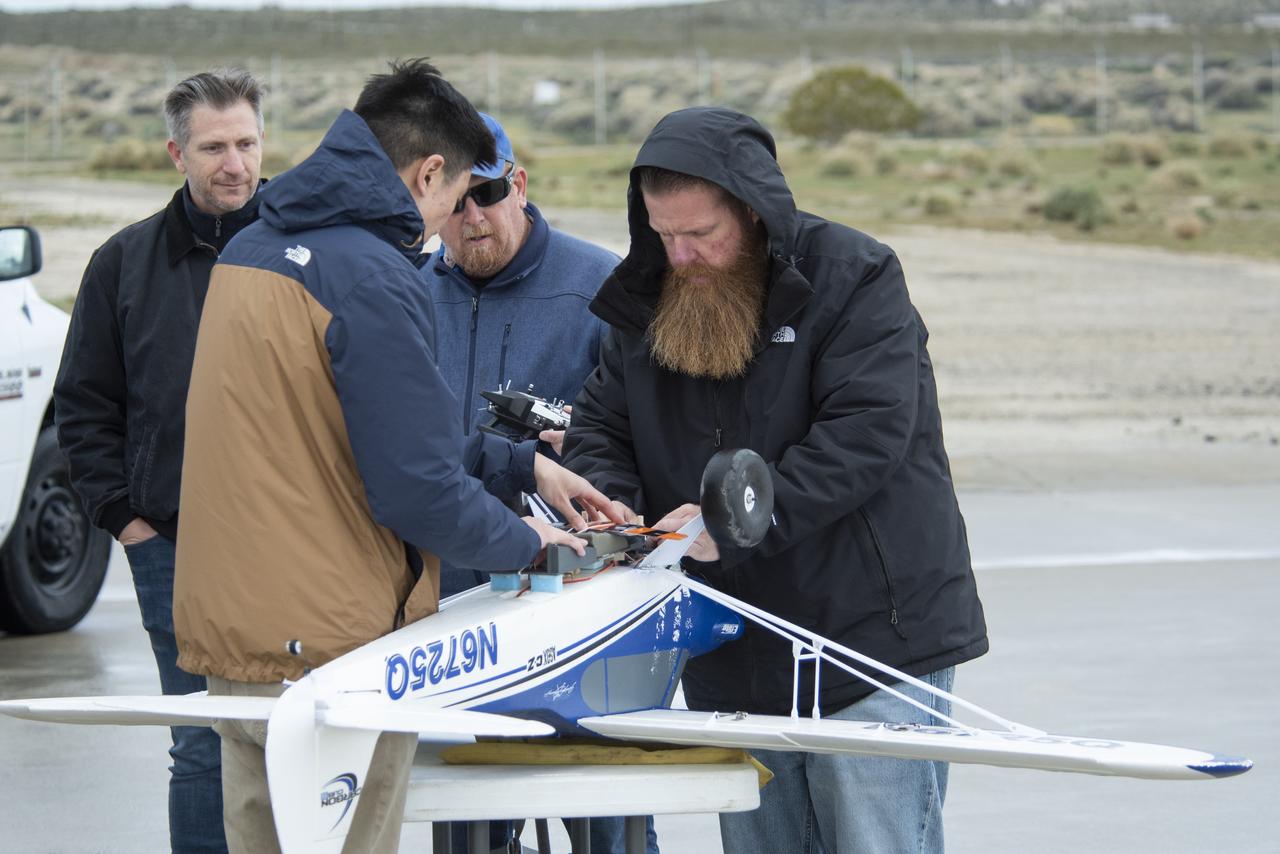
From left Eric Becker watches as Nathan Sam, Robert 'Red' Jensen and Justin Hall attach a Prandtl-M aircraft onto the Carbon Cub aircraft that air launched it at NASA's Armstrong Flight Research Center in California. The aircraft is the second of three prototypes of varying sizes to provide scientists with options to fly sensors in the Martian atmosphere to collect weather and landing site information for future human exploration of Mars.

NASA astronaut Raja Chari climbs through a hatch of Lockheed Martin’s deep space habitat ground prototype at NASA’s Kennedy Space Center in Florida on March 25, 2019. Chari is one of the astronauts helping engineers refine requirements for the design of an American-made deep space habitat for the Gateway. Astronauts provide important design perspective as they may one day live and work aboard the lunar outpost, which would be located about 250,000 miles from Earth. To date, five habitat prototypes have been developed through NASA’s Next Space Exploration for Technologies Partnerships, or NextSTEP. Lockheed Martin was the first to turn their habitat over to NASA for testing. Ground prototypes developed by Bigelow Aerospace, Boeing, Northrop Grumman and Sierra Nevada Corporation will be tested in the future at various facilities across the country. A sixth company, NanoRacks, plans to develop a prototype as well.
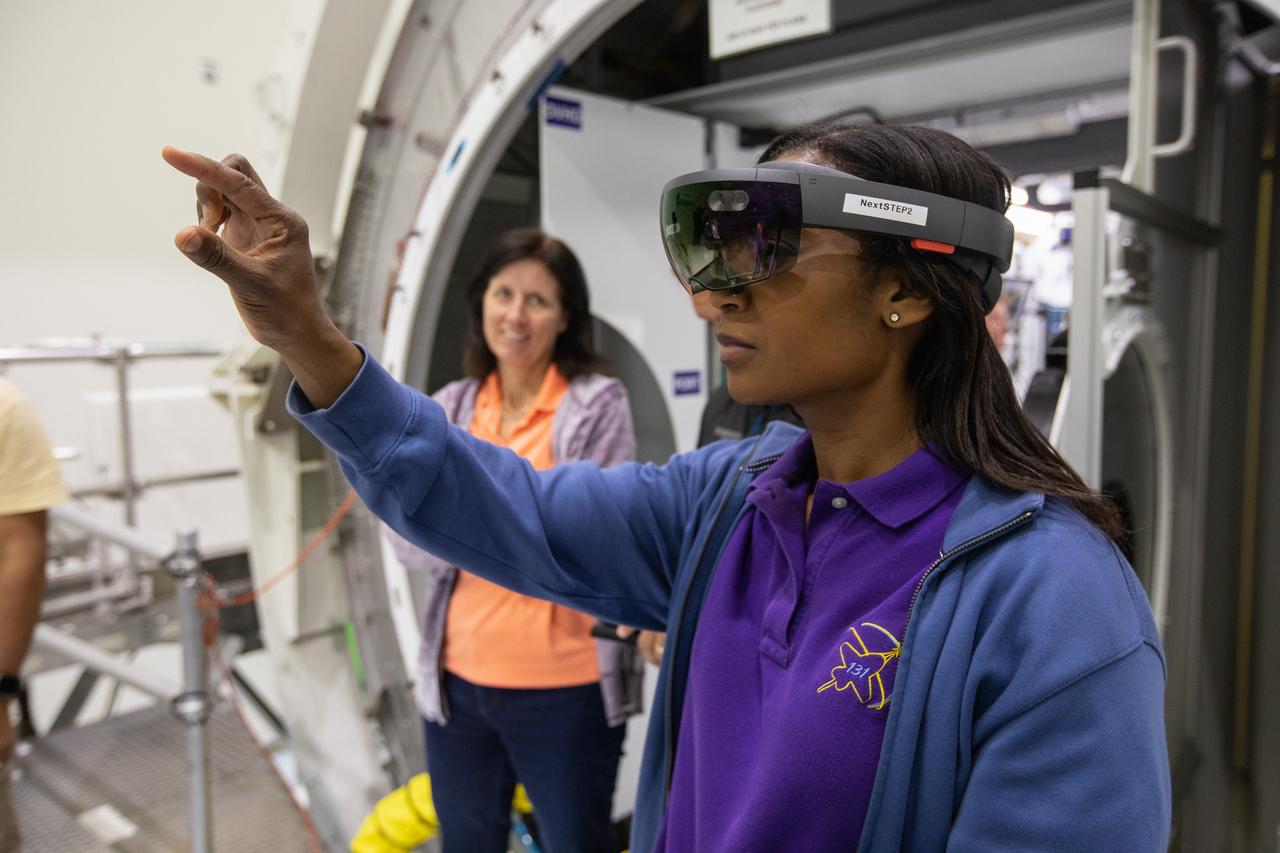
NASA began evaluating five habitat prototypes developed through NASA’s Next Space Exploration for Technologies Partnerships, or NextSTEP, to help engineers refine requirements for the design of an American-made deep space habitat for the Gateway. Lockheed Martin turned over its prototype to NASA, and testing began with crew on March 25, 2019, at Kennedy Space Center in Florida. Pictured inside the Space Station Processing Facility on March 26, 2019, from left are astronauts Shannon Walker and Stephanie Wilson. Astronauts are participating in the evaluations to provide their perspectives as those who may one day live aboard the lunar outpost, which would be located about 250,000 miles from Earth. Ground prototypes developed by Bigelow Aerospace, Boeing, Northrop Grumman, and Sierra Nevada Corporation will be tested in the future at various facilities across the country. A sixth company, NanoRacks, plans to develop a prototype as well.
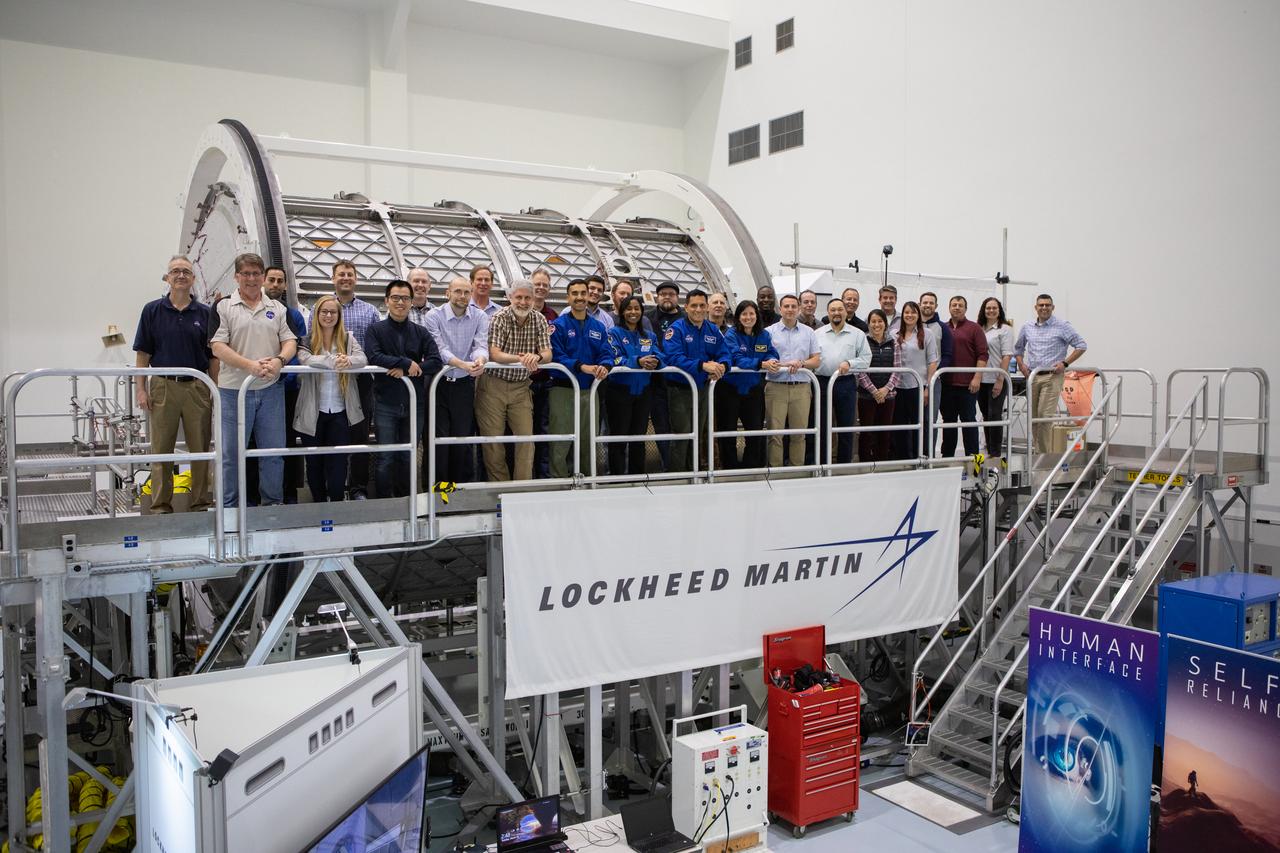
NASA began evaluating five habitat prototypes developed through NASA’s Next Space Exploration for Technologies Partnerships, or NextSTEP, to help engineers refine requirements for the design of an American-made deep space habitat for the Gateway. Lockheed Martin turned over its prototype to NASA, and testing began with crew on March 25, 2019, at Kennedy Space Center in Florida. Astronauts are participating in the evaluations to provide their perspectives as those who may one day live aboard the lunar outpost, which would be located about 250,000 miles from Earth. Ground prototypes developed by Bigelow Aerospace, Boeing, Northrop Grumman, and Sierra Nevada Corporation will be tested in the future at various facilities across the country. A sixth company, NanoRacks, plans to develop a prototype as well.
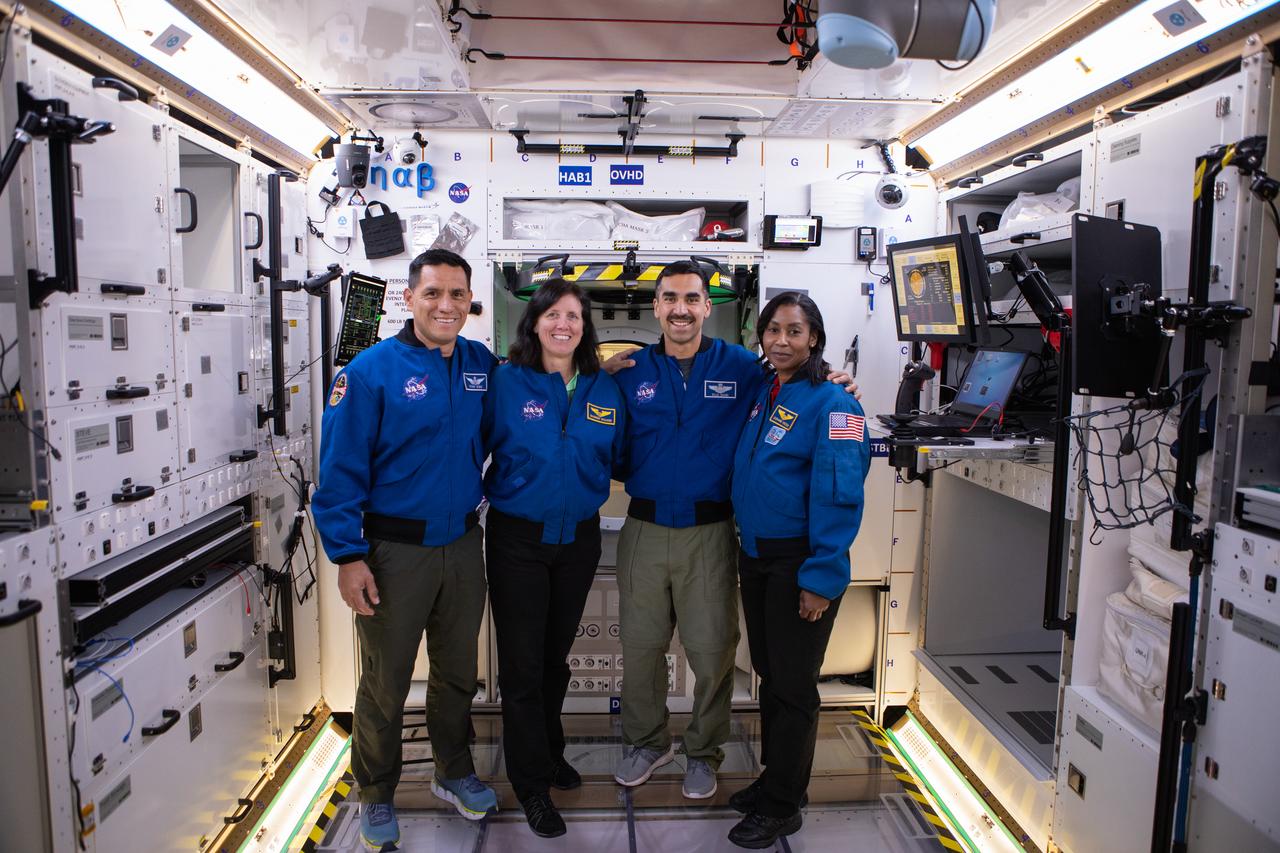
NASA began evaluating five habitat prototypes developed through NASA’s Next Space Exploration for Technologies Partnerships, or NextSTEP, to help engineers refine requirements for the design of an American-made deep space habitat for the Gateway. Lockheed Martin turned over its prototype to NASA, and testing began with crew on March 25, 2019, at Kennedy Space Center in Florida. Pictured, from left are astronauts Frank Rubio, Shannon Walker, Raja Chari and Stephanie Wilson. Astronauts are participating in the evaluations to provide their perspectives as those who may one day live aboard the lunar outpost, which would be located about 250,000 miles from Earth. Ground prototypes developed by Bigelow Aerospace, Boeing, Northrop Grumman, and Sierra Nevada Corporation will be tested in the future at various facilities across the country. A sixth company, NanoRacks, plans to develop a prototype as well.
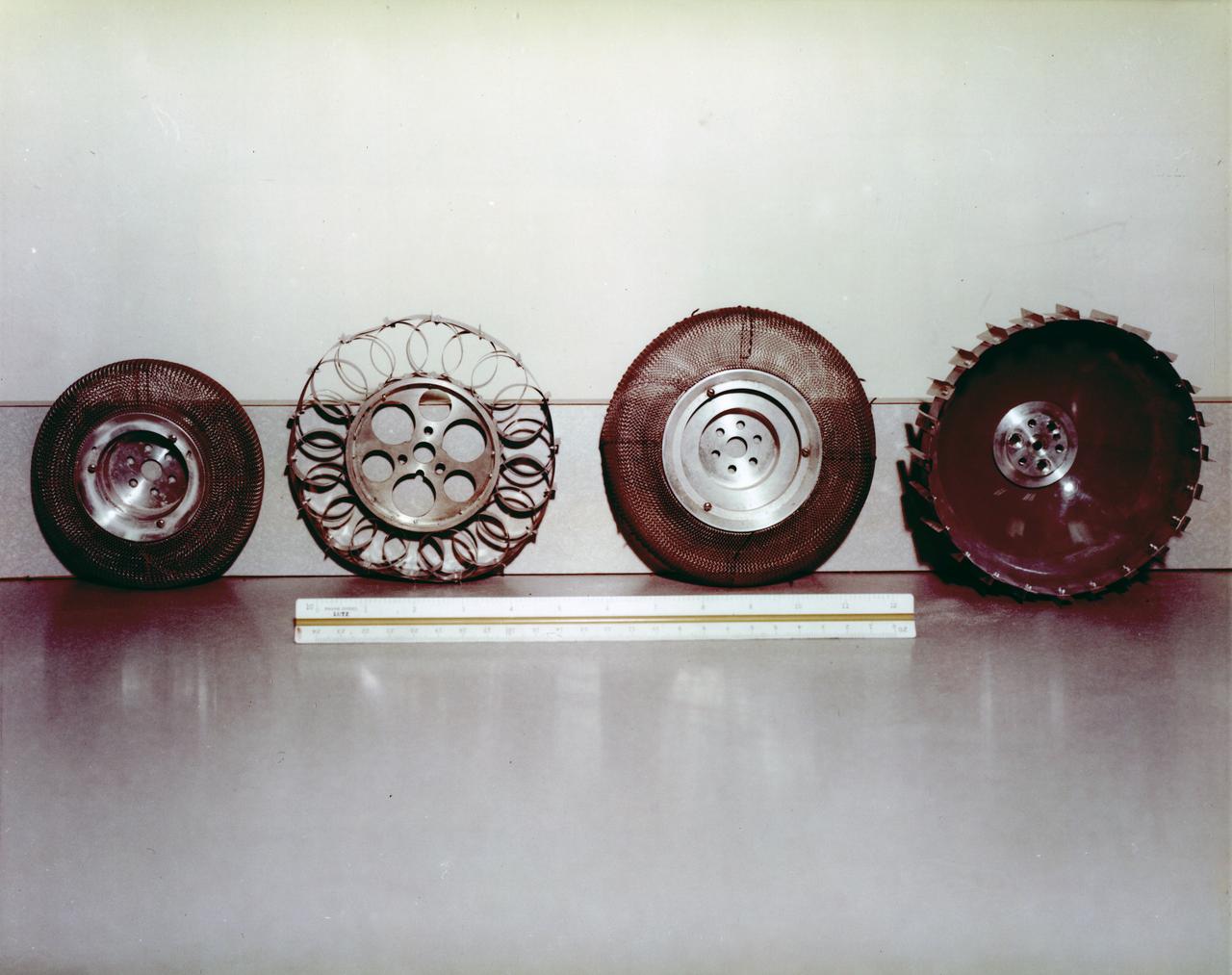
Under the direction of Marshall Space Flight Center (MSFC), the Lunar Roving Vehicle (LRV) was designed to allow Apollo astronauts a greater range of mobility during lunar exploration missions. During the development process, LRV prototype wheels underwent soil tests in building 4481 at Marshall Space Flight Center (MSFC). Pictured from left to right are the wheels for: LRV, Bendix Corporation, Local Scientific Survey Module (LSSM), and Grumman Industries.
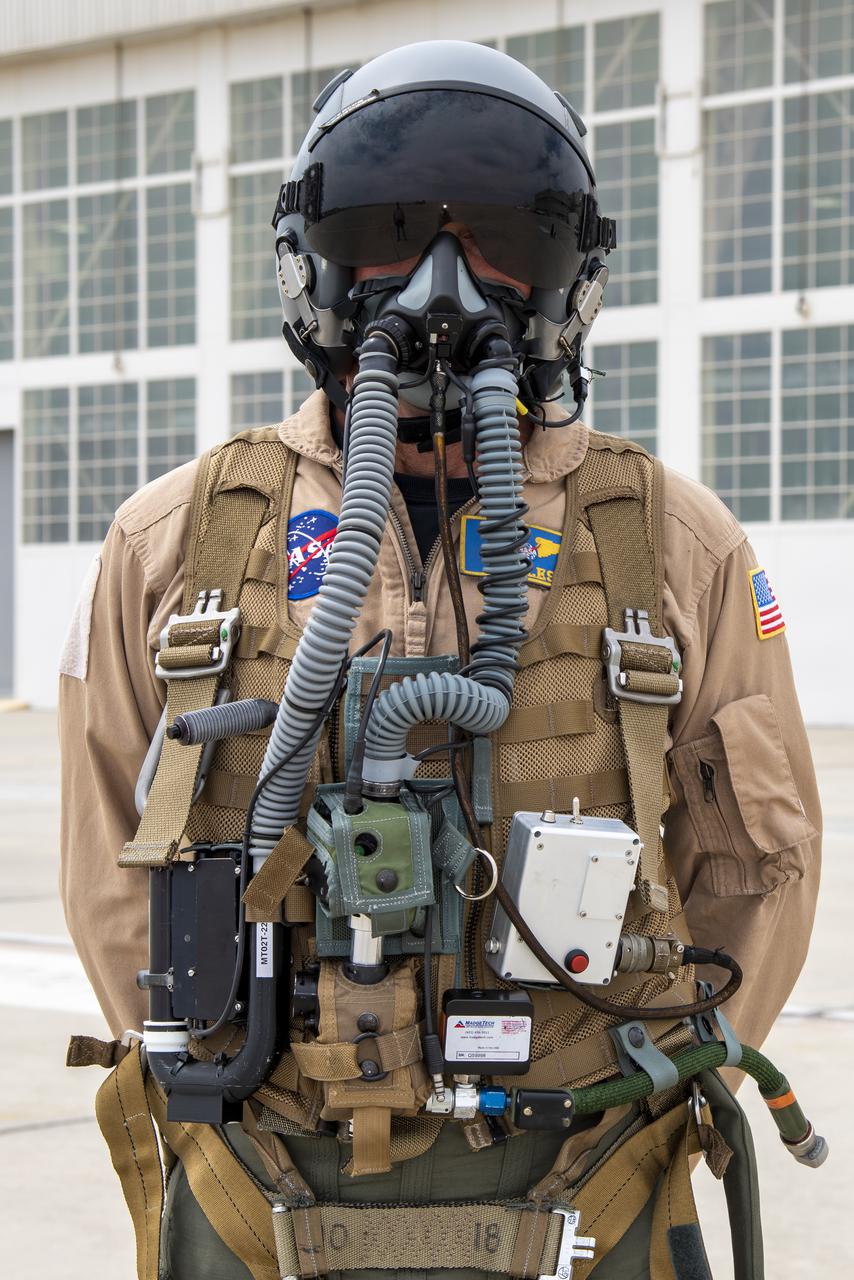
NASA research pilot Jim Less wears a U.S. Navy harness configuration with the NASA Jet Propulsion Laboratory in California prototype mask, which uses laser sensors to determine levels of carbon dioxide and water exhaled inside the mask. This prototype was tested in conjunction with the current VigilOX system, which measures the pilot’s oxygen concentration, breathing pressures and flow rates. This and the U.S. Air Force configuration was used in the Pilot Breathing Assessment program at NASA’s Armstrong Flight Research Center in California.
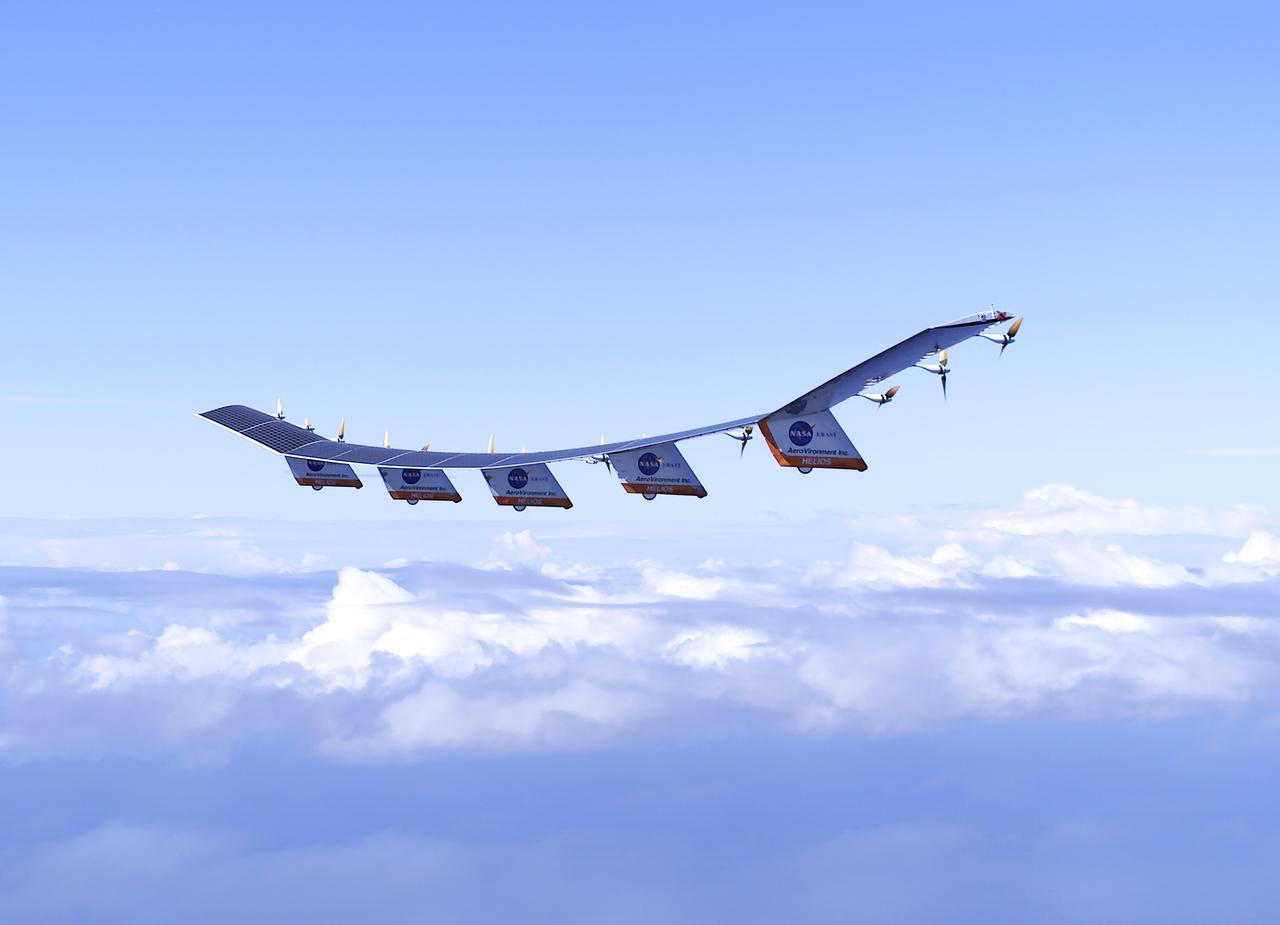
The Helios Prototype aircraft at approximately 10,000 feet flying above cloud cover northwest of Kauai, Hawaii.
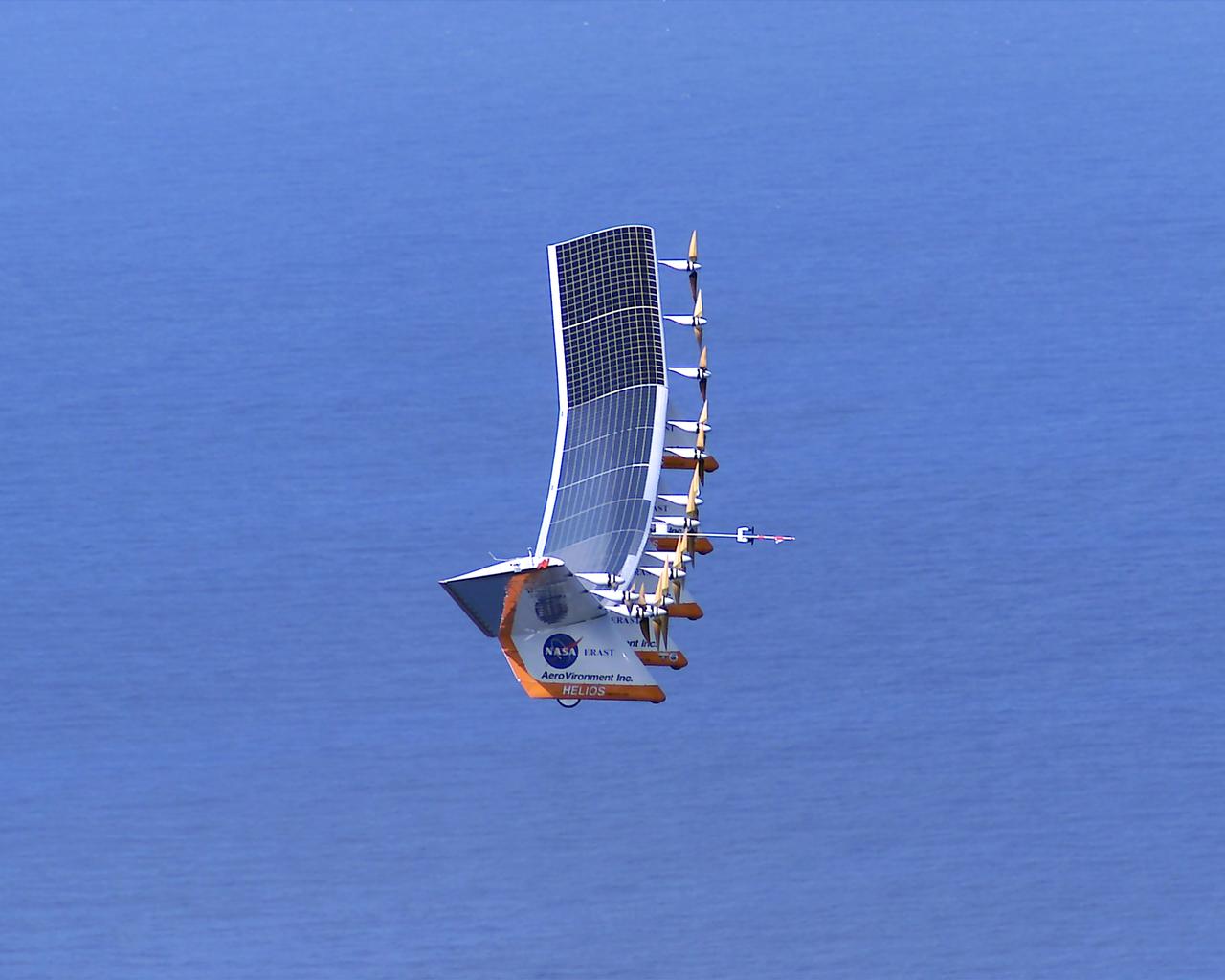
The Helios Prototype aircraft during initial climb-out to the west over the Pacific Ocean.
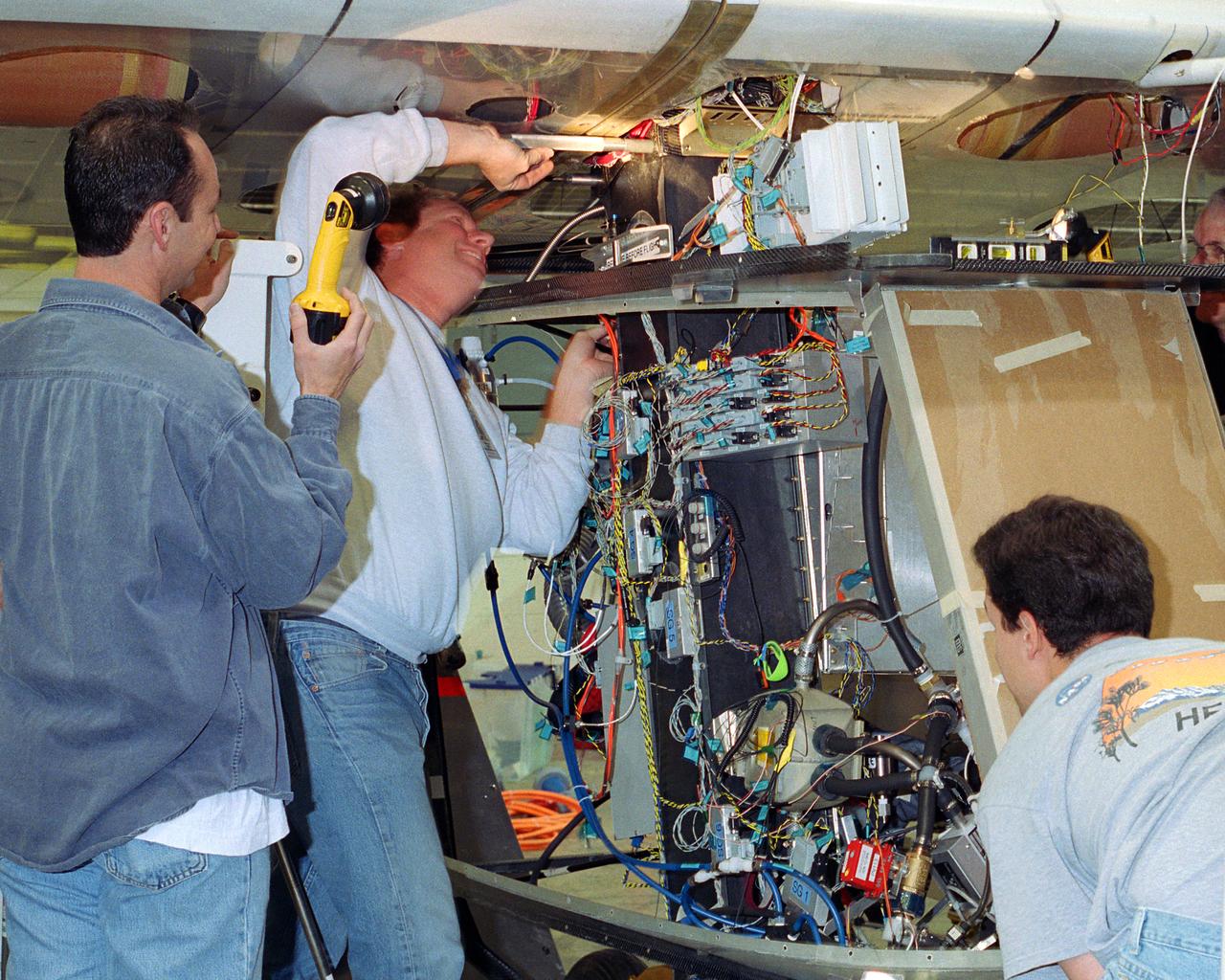
Aerovironment technicians carefully line up attachments as a fuel cell electrical system is installed on the Helios Prototype solar powered flying wing. The fuel cell system will power the aircraft at night during NASA-sponsored long-endurance demonstration flight in the summer of 2003.
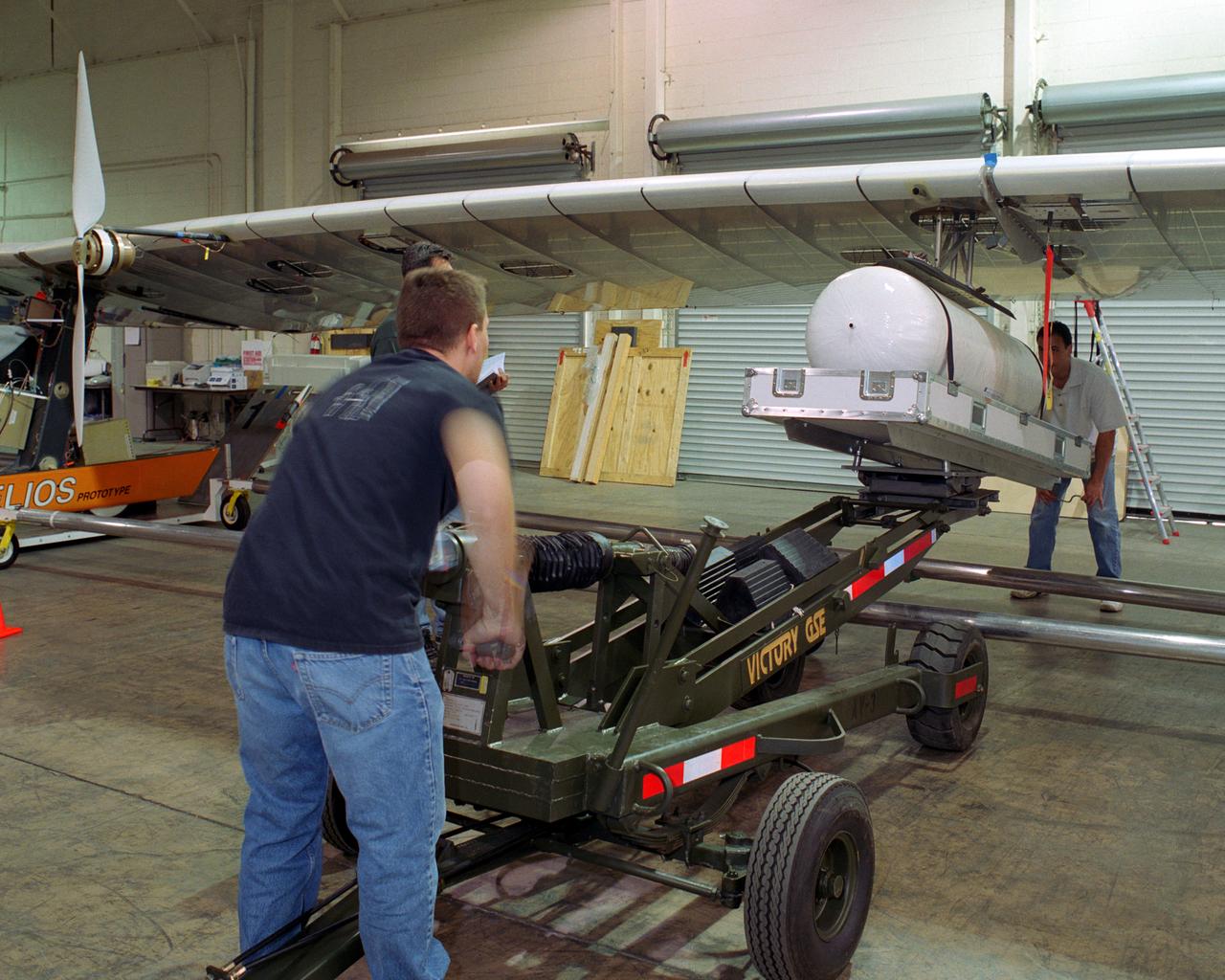
Technicians for AeroVironment, Inc., jack up a pressure tank to the wing of the Helios Prototype solar-electric flying wing. The tank carries pressurized hydrogen to fuel an experimental fuel cell system that powered the aircraft at night during an almost two-day long-endurance flight demonstration in the summer of 2003.
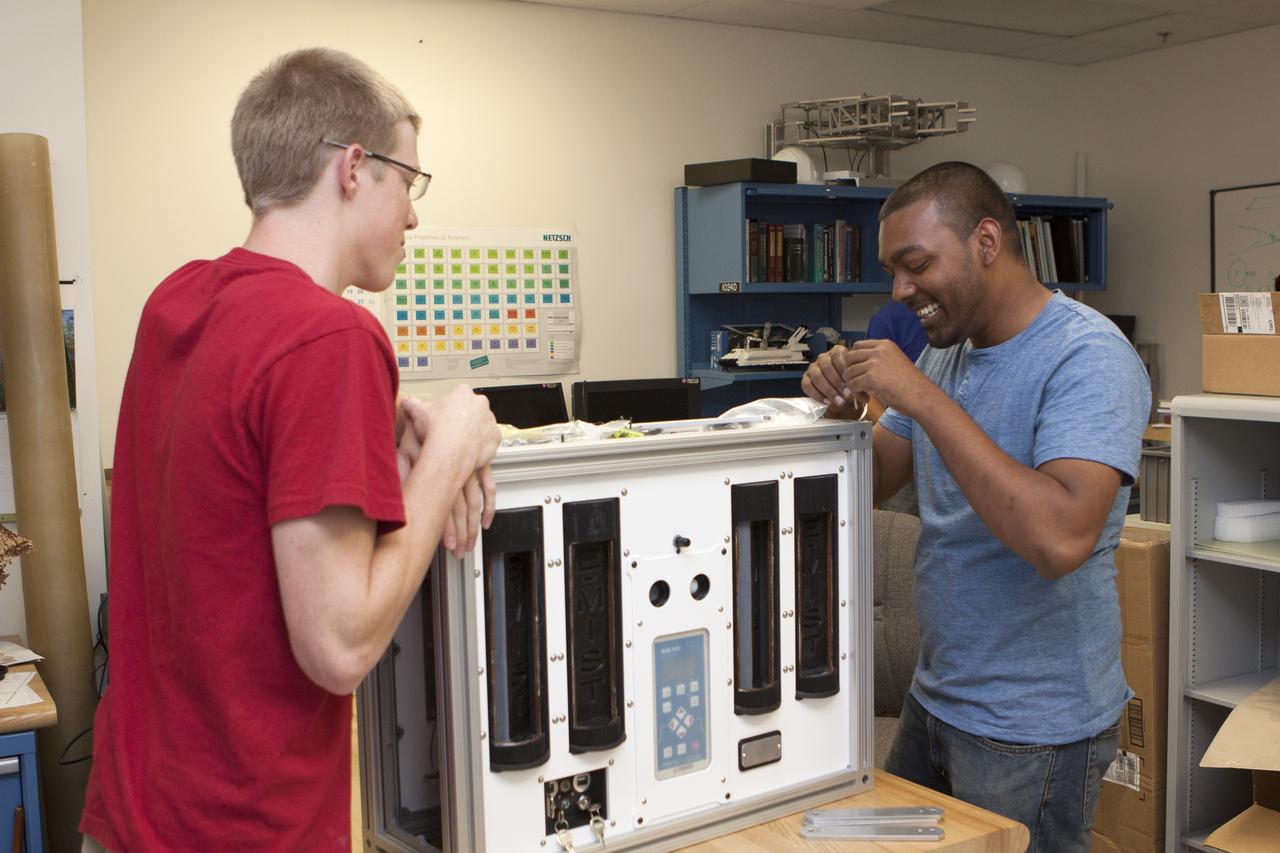
CAPE CANAVERAL, Fla. – Inside the Prototype Laboratory at NASA's Kennedy Space Center in Florida, Evan Williams, left, an Education intern from the University of Central Florida, and Anthony Bharrat, NASA avionics lead, prepare the experiment container for NASA's Exposing Microorganisms in the Stratosphere, or E-MIST, experiment. The container was designed and built at Kennedy. The 80-pound structure features four doors that rotate to expose up to 10 microbial samples each for a predetermined period of time in the Earth's stratosphere. The E-MIST experiment will launch on the exterior of a giant scientific balloon gondola at about 8 a.m. MST on Aug. 24 from Ft. Sumner, New Mexico. It will soar 125,000 feet above the Earth during a 5-hour journey over the desert to understand how spore-forming bacteria, commonly found in spacecraft assembly facilities can survive. Photo credit: NASA/Kim Shiflett
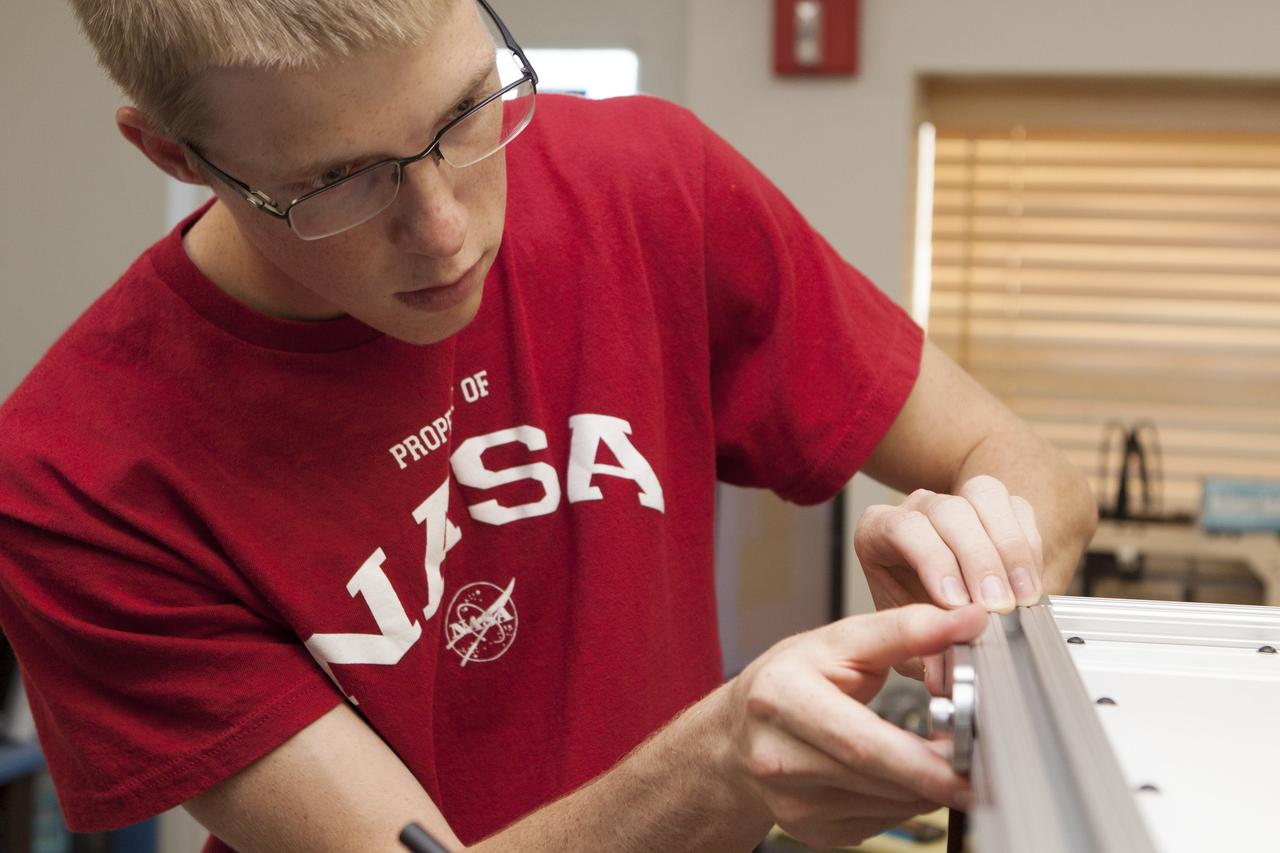
CAPE CANAVERAL, Fla. – Inside the Prototype Laboratory at NASA's Kennedy Space Center in Florida, Evan Williams, an Education intern from the University of Central Florida, prepares the experiment container for NASA's Exposing Microorganisms in the Stratosphere, or E-MIST, experiment. The container was designed and built at Kennedy. The 80-pound structure features four doors that rotate to expose up to 10 microbial samples each for a predetermined period of time in the Earth's stratosphere. The E-MIST experiment will launch on the exterior of a giant scientific balloon gondola at about 8 a.m. MST on Aug. 24 from Ft. Sumner, New Mexico. It will soar 125,000 feet above the Earth during a 5-hour journey over the desert to understand how spore-forming bacteria, commonly found in spacecraft assembly facilities can survive. Photo credit: NASA/Kim Shiflett

This photograph depicts an air-breathing rocket engine prototype in the test bay at the General Applied Science Lab facility in Ronkonkoma, New York. Air-breathing engines, known as rocket based, combined-cycle engines, get their initial take-off power from specially designed rockets, called air-augmented rockets, that boost performance about 15 percent over conventional rockets. When the vehicle's velocity reaches twice the speed of sound, the rockets are turned off and the engine relies totally on oxygen in the atmosphere to burn hydrogen fuel, as opposed to a rocket that must carry its own oxygen, thus reducing weight and flight costs. Once the vehicle has accelerated to about 10 times the speed of sound, the engine converts to a conventional rocket-powered system to propel the craft into orbit or sustain it to suborbital flight speed. NASA's Advanced Space Transportation Program at Marshall Space Flight Center, along with several industry partners and collegiate forces, is developing this technology to make space transportation affordable for everyone from business travelers to tourists. The goal is to reduce launch costs from today's price tag of $10,000 per pound to only hundreds of dollars per pound. NASA's series of hypersonic flight demonstrators currently include three air-breathing vehicles: the X-43A, X-43B and X-43C.
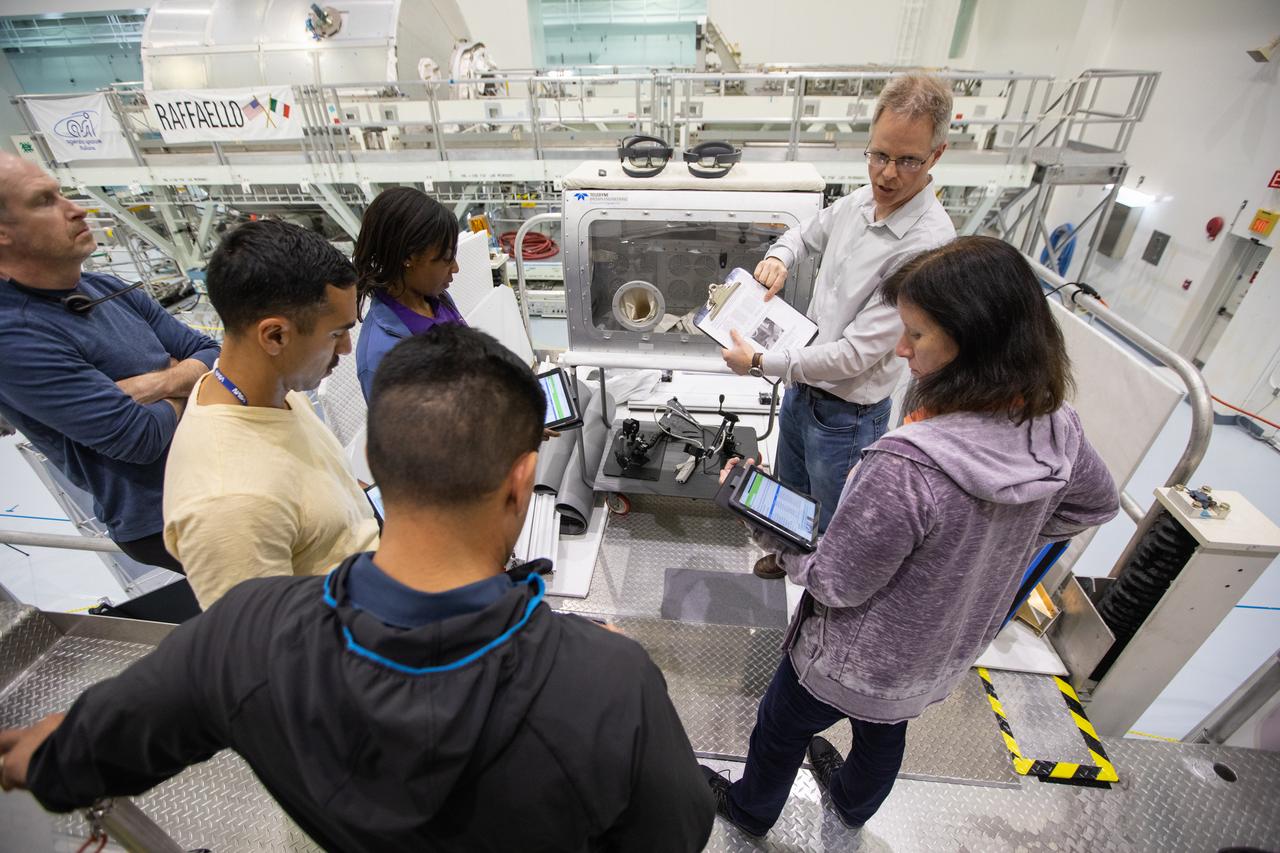
NASA began evaluating five habitat prototypes developed through NASA’s Next Space Exploration for Technologies Partnerships, or NextSTEP, to help engineers refine requirements for the design of an American-made deep space habitat for the Gateway. Lockheed Martin turned over its prototype to NASA, and testing began with crew on March 25, 2019, at Kennedy Space Center in Florida. Pictured inside the Space Station Processing Facility on March 26, 2019, from far left is astronaut Frank Rubio. In front of him, are Raja Chari and Stephanie Wilson. At right is astronaut Shannon Walker. Astronauts are participating in the evaluations to provide their perspectives as those who may one day live aboard the lunar outpost, which would be located about 250,000 miles from Earth. Ground prototypes developed by Bigelow Aerospace, Boeing, Northrop Grumman, and Sierra Nevada Corporation will be tested in the future at various facilities across the country. A sixth company, NanoRacks, plans to develop a prototype as well.
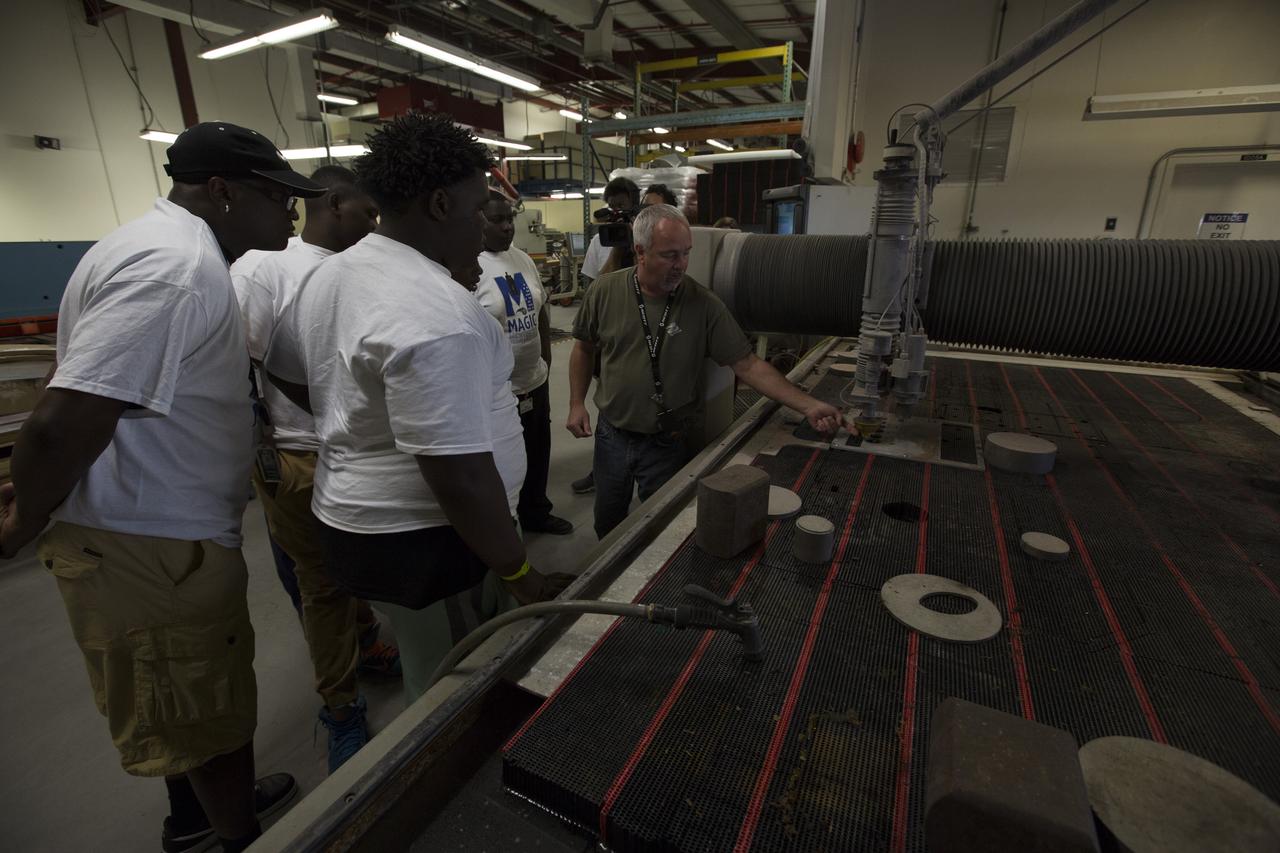
Harold (Russ) McAmis demonstrates machinery inside NASA Kennedy Space Center’s Prototype Lab for students in the My Brother’s Keeper program. The Florida spaceport is one of six NASA centers that participated in My Brother’s Keeper National Lab Week. The event is a nationwide effort to bring youth from underrepresented communities into federal labs and centers for hands-on activities, tours and inspirational speakers. Sixty students from the nearby cities of Orlando and Sanford visited Kennedy, where they toured the Vehicle Assembly Building, the Space Station Processing Facility and the center’s innovative Swamp Works Labs. The students also had a chance to meet and ask questions of a panel of subject matter experts from across Kennedy.
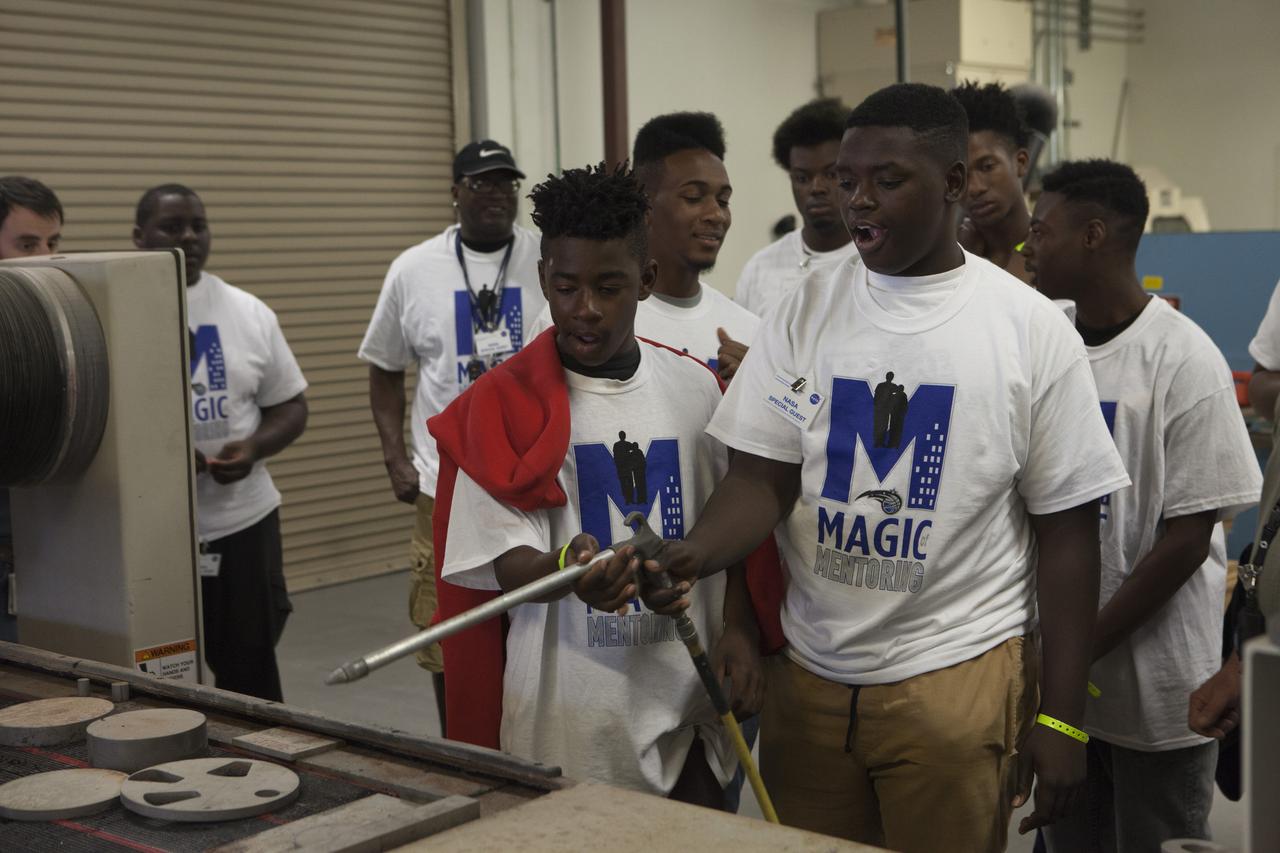
Students in the My Brother’s Keeper program try out some of the machinery inside the Prototype Lab at NASA’s Kennedy Space Center. The Florida spaceport is one of six NASA centers that participated in My Brother’s Keeper National Lab Week. The event is a nationwide effort to bring youth from underrepresented communities into federal labs and centers for hands-on activities, tours and inspirational speakers. Sixty students from the nearby cities of Orlando and Sanford visited Kennedy, where they toured the Vehicle Assembly Building, the Space Station Processing Facility and the center’s innovative Swamp Works Labs. The students also had a chance to meet and ask questions of a panel of subject matter experts from across Kennedy.
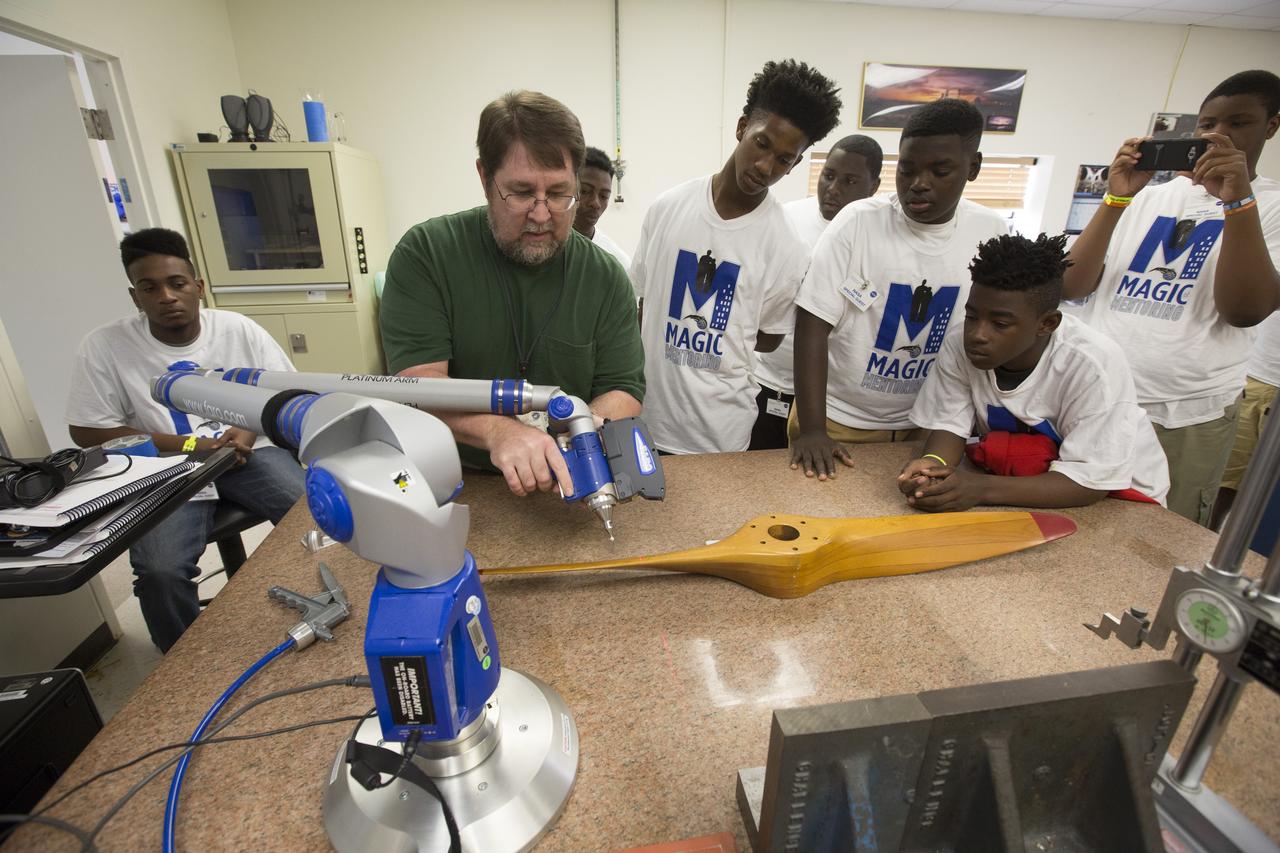
Mike Lane demonstrates a 3D scanner inside the NASA Kennedy Space Center Prototype Lab for students in the My Brother’s Keeper program. The Florida spaceport is one of six NASA centers that participated in My Brother’s Keeper National Lab Week. The event is a nationwide effort to bring youth from underrepresented communities into federal labs and centers for hands-on activities, tours and inspirational speakers. Sixty students from the nearby cities of Orlando and Sanford visited Kennedy, where they toured the Vehicle Assembly Building, the Space Station Processing Facility and the center’s innovative Swamp Works Labs. The students also had a chance to meet and ask questions of a panel of subject matter experts from across Kennedy.
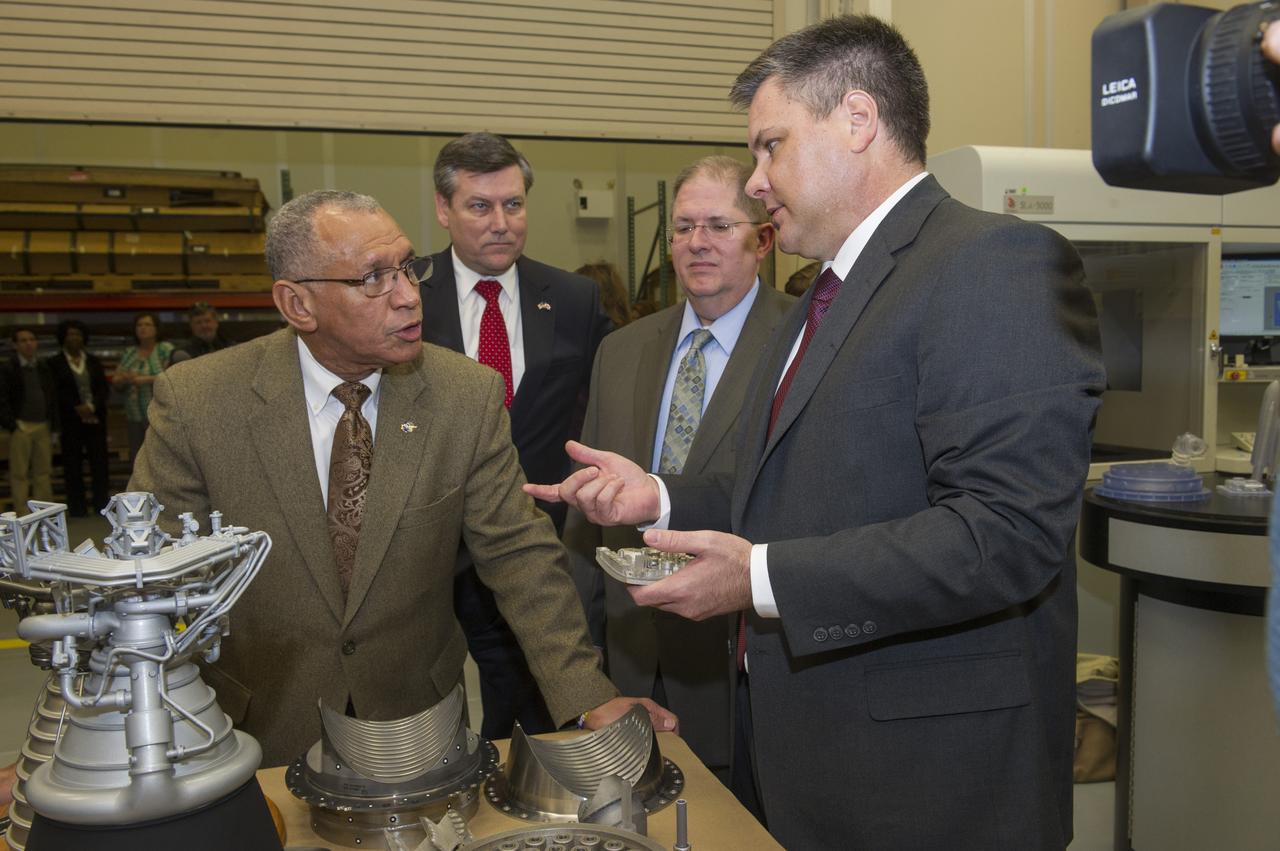
FROM LEFT, NASA ADMINISTRATOR CHARLES BOLDEN IS JOINED BY PATRICK SCHEUERMANN, NASA MARSHALL SPACE FLIGHT CENTER DIRECTOR; FRANK LEDBETTER, CHIEF OF NONMETALLIC MATERIALS AND MANUFACTURING DIVISION AT THE MARSHALL CENTER; AND ANDY HARDIN, NASA'S SPACE LAUNCH SYSTEM SUBSYSTEM MANAGER FOR LIQUID ENGINES DURING BOLDEN'S TOUR OF THE NATIONAL CENTER FOR ADVANCED MANUFACTURING RAPID PROTOTYPING FACILITY AT THE MARSHALL CENTER ON FRIDAY, FEB. 22.

A test unit, or prototype, of NASA's Advanced Plant Habitat (APH) with its first initial grow test in the Space Station Processing Facility at the agency's Kennedy Space Center in Florida. The taller plants pictured are dwarf wheat and the smaller plants are Arabidopsis. Developed by NASA and ORBITEC of Madison, Wisconsin, the APH is the largest plant chamber built for the agency. It is a fully automated plant growth facility that will be used to conduct bioscience research on the International Space Station. The APH will be delivered to the space station aboard future Commercial Resupply Services missions.
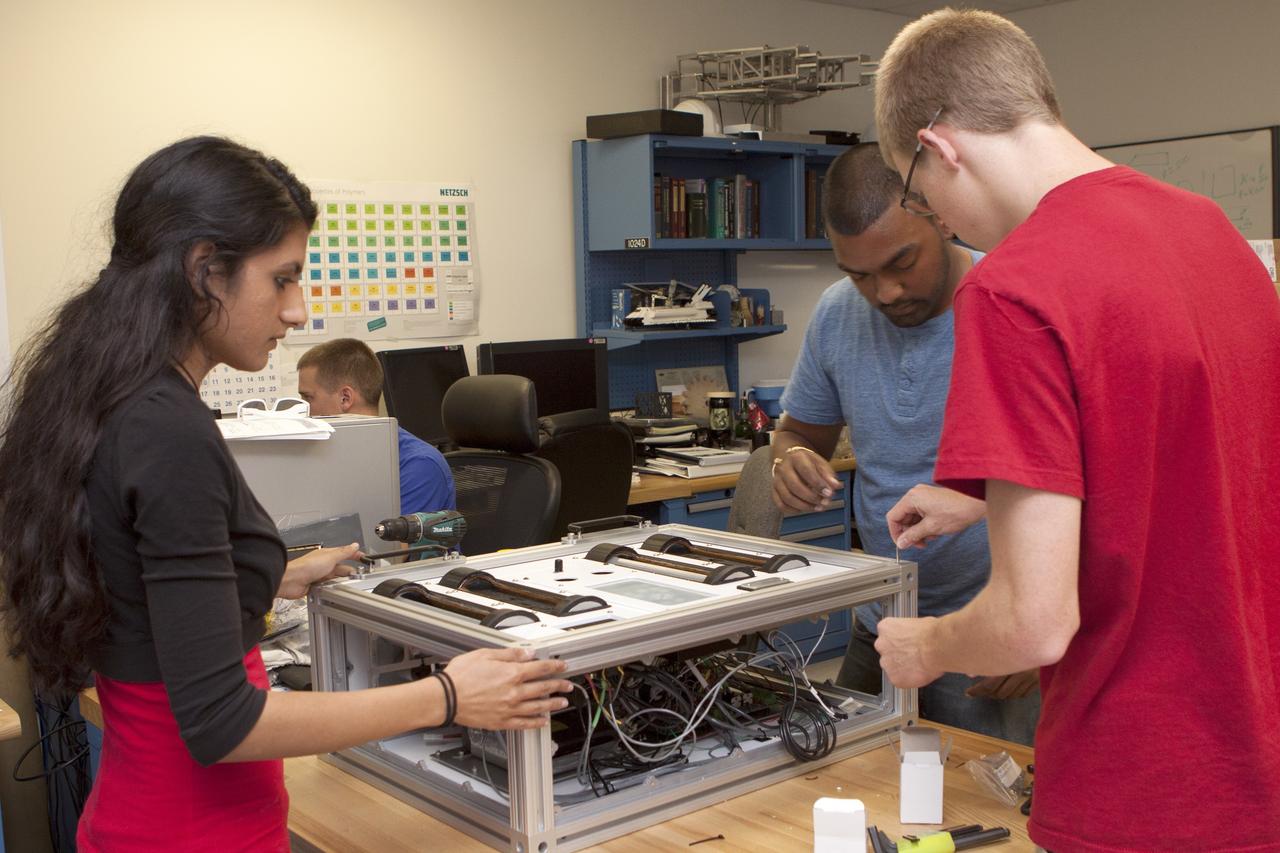
CAPE CANAVERAL, Fla. – Inside the Prototype Laboratory at NASA's Kennedy Space Center in Florida, Prital Thakrar, left, design lead and student engineer trainee from the University of Florida in Gainesville, Anthony Bharrat, NASA avionics lead, and Evan Williams, an Education intern from the University of Central Florida, prepare the experiment container for NASA's Exposing Microorganisms in the Stratosphere, or E-MIST, experiment. The container was designed and built at Kennedy. The 80-pound structure features four doors that rotate to expose up to 10 microbial samples each for a predetermined period of time in the Earth's stratosphere. The E-MIST experiment will launch on the exterior of a giant scientific balloon gondola at about 8 a.m. MST on Aug. 24 from Ft. Sumner, New Mexico. It will soar 125,000 feet above the Earth during a 5-hour journey over the desert to understand how spore-forming bacteria, commonly found in spacecraft assembly facilities can survive. Photo credit: NASA/Kim Shiflett
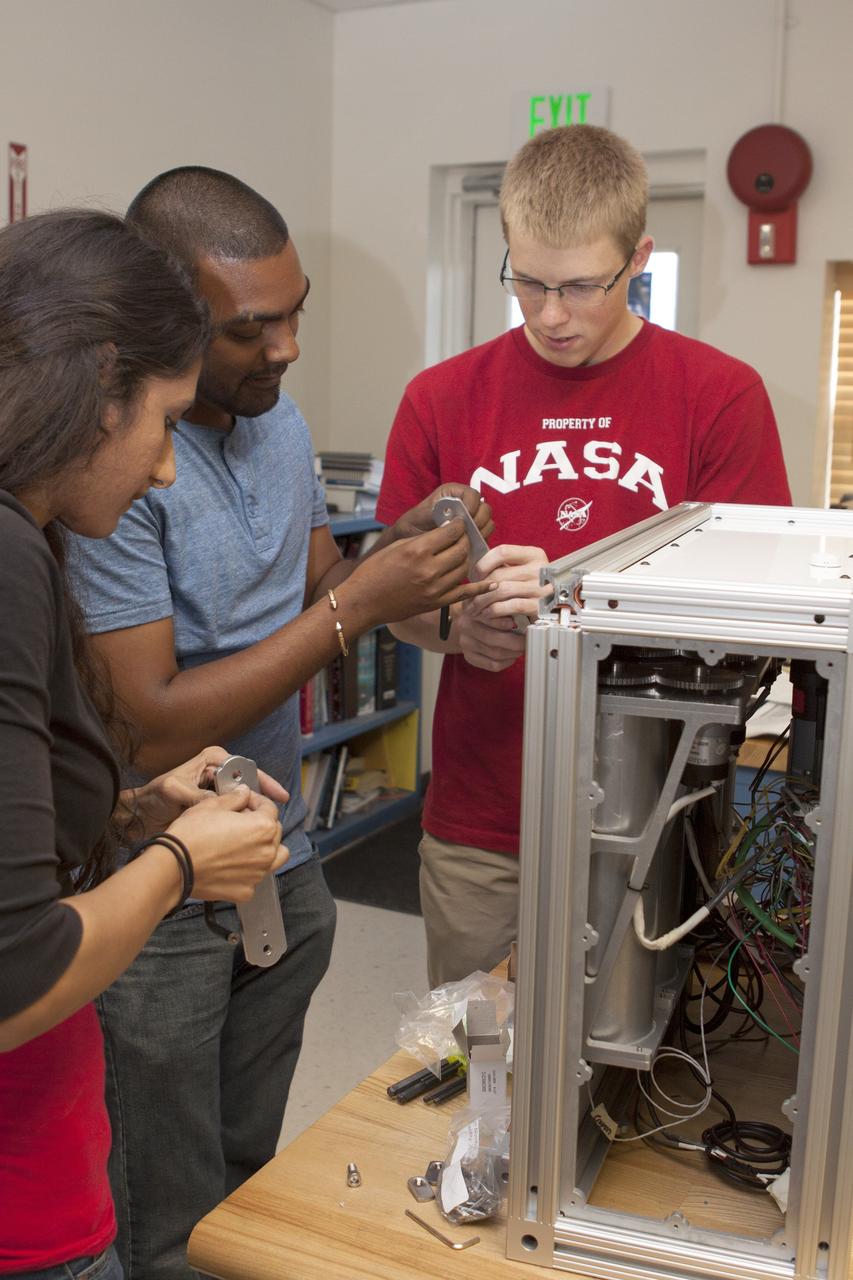
CAPE CANAVERAL, Fla. – Inside the Prototype Laboratory at NASA's Kennedy Space Center in Florida, Prital Thakrar, left, design lead and student engineer trainee from the University of Florida in Gainesville, Anthony Bharrat, NASA avionics lead, and Evan Williams, an Education intern from the University of Central Florida, prepare the experiment container for NASA's Exposing Microorganisms in the Stratosphere, or E-MIST, experiment. The container was designed and built at Kennedy. The 80-pound structure features four doors that rotate to expose up to 10 microbial samples each for a predetermined period of time in the Earth's stratosphere. The E-MIST experiment will launch on the exterior of a giant scientific balloon gondola at about 8 a.m. MST on Aug. 24 from Ft. Sumner, New Mexico. It will soar 125,000 feet above the Earth during a 5-hour journey over the desert to understand how spore-forming bacteria, commonly found in spacecraft assembly facilities can survive. Photo credit: NASA/Kim Shiflett
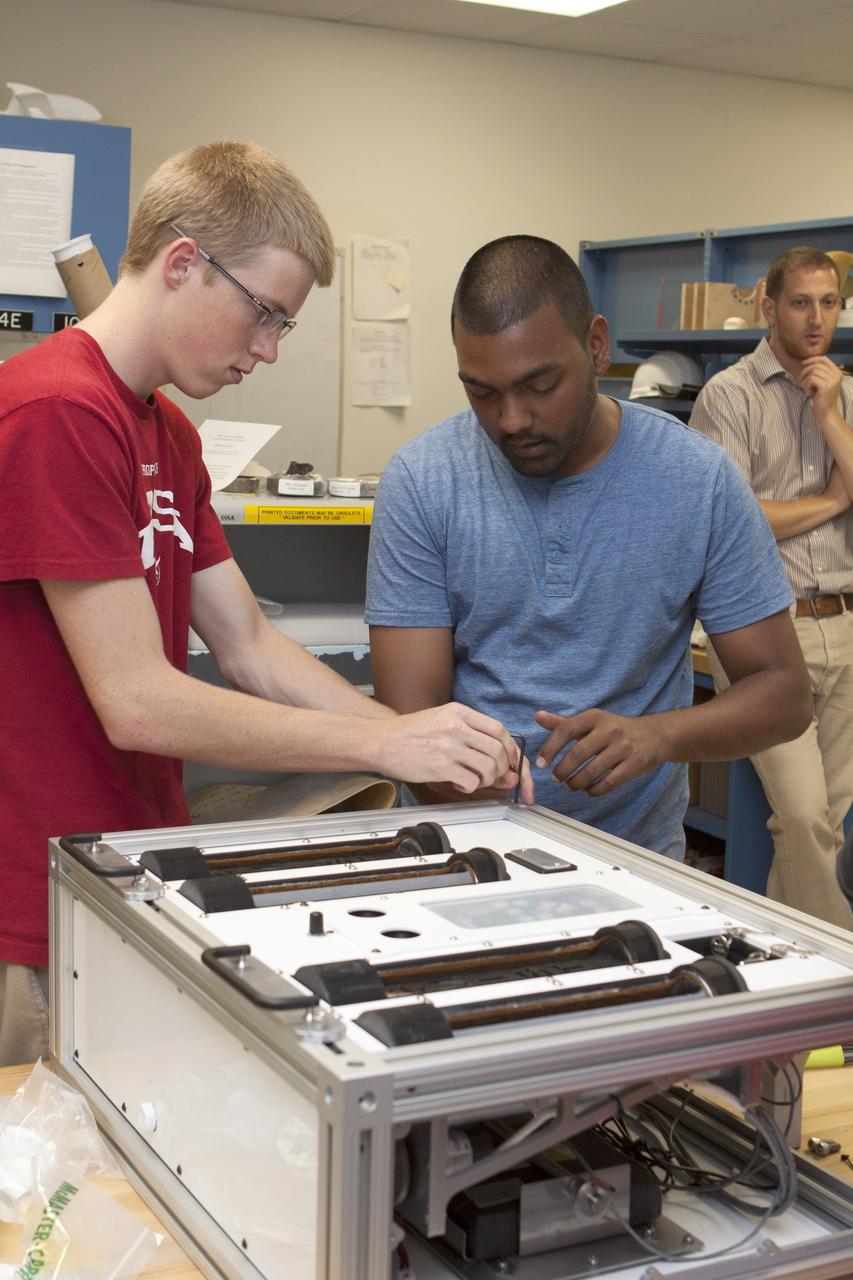
CAPE CANAVERAL, Fla. – Inside the Prototype Laboratory at NASA's Kennedy Space Center in Florida, Evan Williams, left, an Education intern from the University of Central Florida, and Anthony Bharrat, NASA avionics lead, prepare the experiment container for NASA's Exposing Microorganisms in the Stratosphere, or E-MIST, experiment. In the background is David J. Smith, Ph.D., NASA E-MIST principal investigator. The container was designed and built at Kennedy. The 80-pound structure features four doors that rotate to expose up to 10 microbial samples each for a predetermined period of time in the Earth's stratosphere. The E-MIST experiment will launch on the exterior of a giant scientific balloon gondola at about 8 a.m. MST on Aug. 24 from Ft. Sumner, New Mexico. It will soar 125,000 feet above the Earth during a 5-hour journey over the desert to understand how spore-forming bacteria, commonly found in spacecraft assembly facilities can survive. Photo credit: NASA/Kim Shiflett
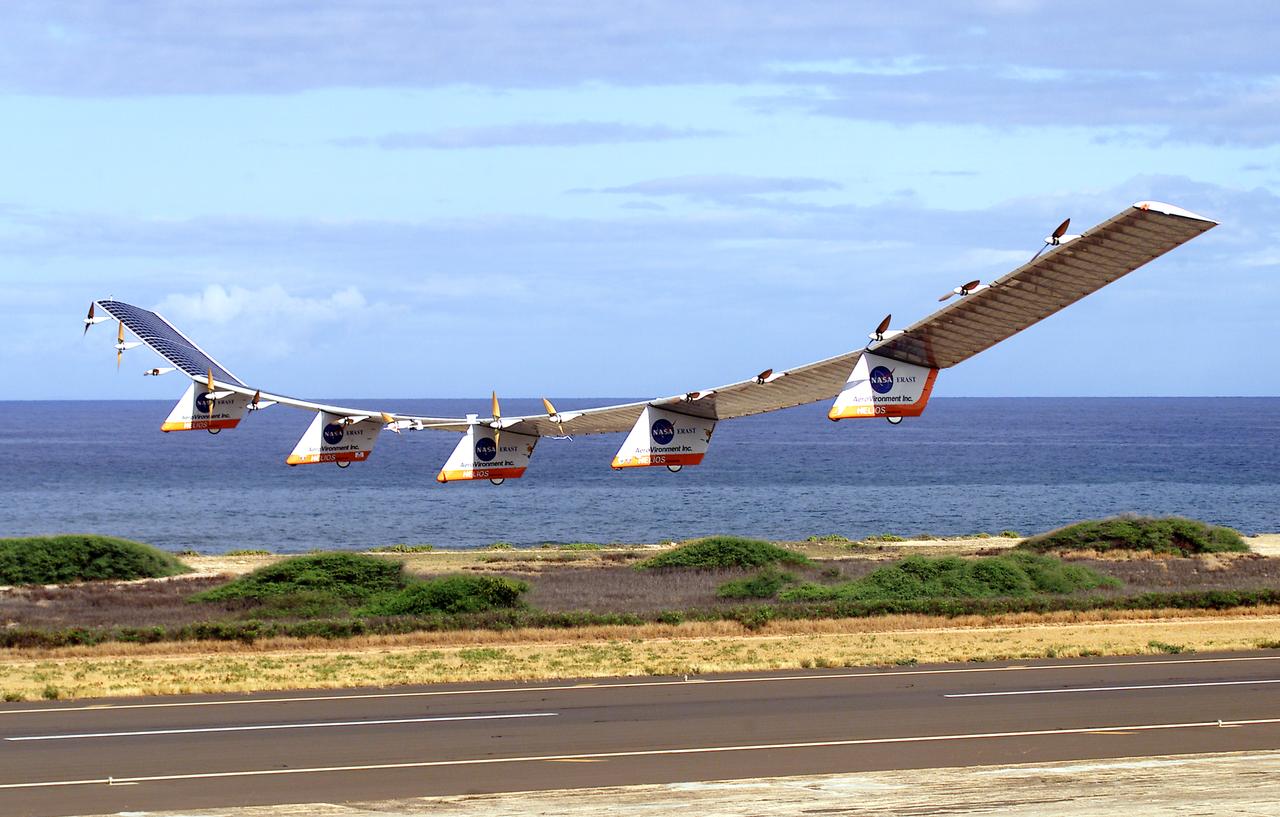
NASA's Helios Prototype aircraft taking off from the Pacific Missile Range Facility, Kauai, Hawaii, for the record flight. As a follow-on to the Centurion (and earlier Pathfinder and Pathfinder-Plus) aircraft, the solar-powered Helios Prototype is the latest and largest example of a slow-flying ultralight flying wing designed for long-duration, high-altitude Earth science or telecommunications relay missions in the stratosphere. Developed by AeroVironment, Inc., of Monrovia, California, under NASA's Environmental Research Aircraft and Sensor Technology (ERAST) project, the unique craft is intended to demonstrate two key missions: the ability to reach and sustain horizontal flight at 100,000 feet altitude on a single-day flight in 2001, and to maintain flight above 50,000 feet altitude for at least four days in 2003, with the aid of a regenerative fuel cell-based energy storage system now in development. Both of these missions will be powered by electricity derived from non-polluting solar energy. The Helios Prototype is an enlarged version of the Centurion flying wing, which flew a series of test flights at NASA's Dryden Flight Research Center in late 1998. The craft has a wingspan of 247 feet, 41 feet greater than the Centurion, 2 1/2 times that of its solar-powered Pathfinder flying wing, and longer than the wingspans of either the Boeing 747 jetliner or Lockheed C-5 transport aircraft. The remotely piloted, electrically powered Helios Prototype went aloft on its maiden low-altitude checkout flight Sept. 8, 1999, over Rogers Dry Lake adjacent to NASA's Dryden Flight Research Center in the Southern California desert. The initial flight series was flown on battery power as a risk-reduction measure. In all, six flights were flown in the Helios Protoype's initial development series. In upgrading the Centurion to the Helios Prototype configuration, AeroVironment added a sixth wing section and a fifth landing gear pod, among other improvements. The additional wingsp
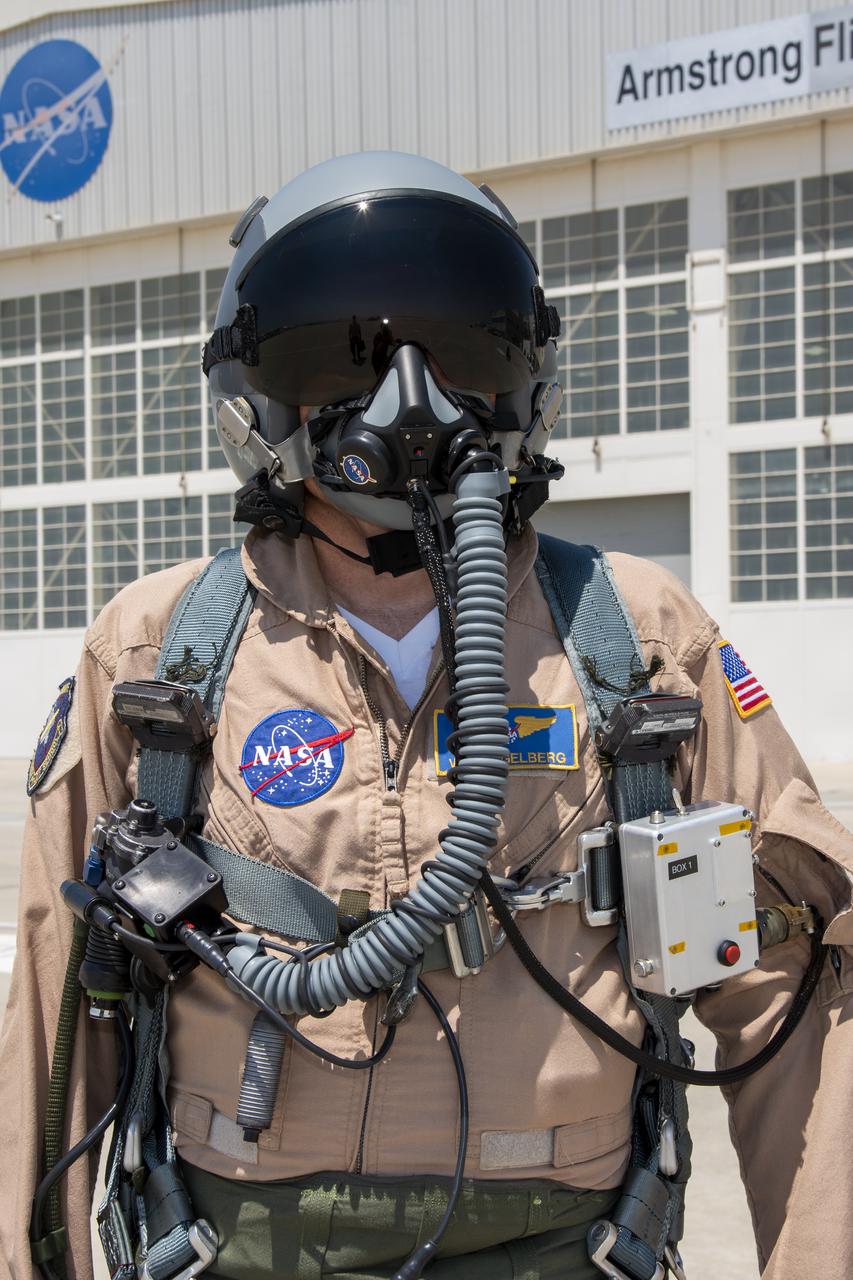
NASA research pilot Wayne Ringelberg wears a U.S. Air Force configuration of the NASA Jet Propulsion Laboratory in California prototype mask, which uses laser sensors to determine levels of carbon dioxide and water exhaled inside the mask. This prototype was tested in conjunction with the current VigilOX system, which measures the pilot’s oxygen concentration, breathing pressures and flow rates. This and the U.S. Navy configuration was used in the Pilot Breathing Assessment program at NASA’s Armstrong Flight Research Center in California.
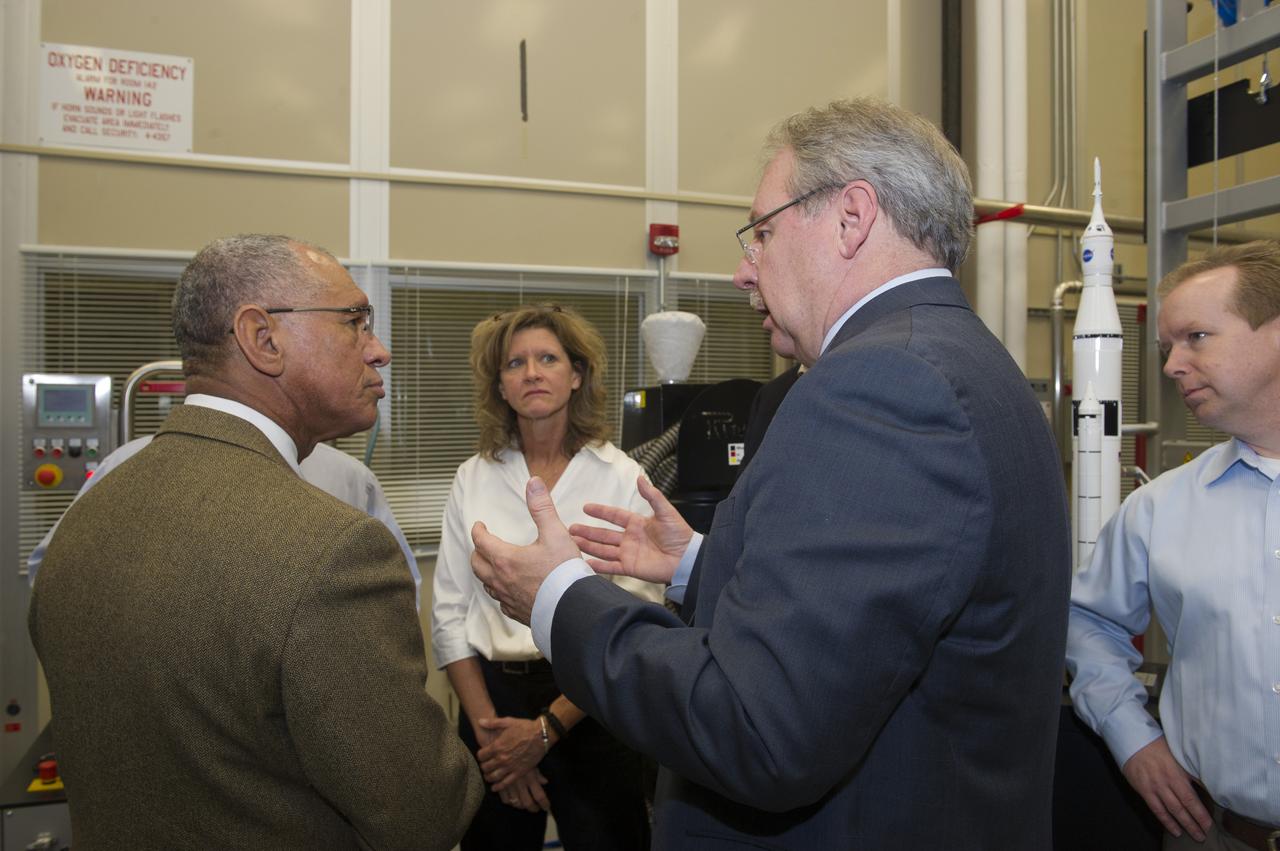
FROM LEFT, NASA ADMINISTRATOR CHARLES BOLDEN LISTENS TO MARSHALL MATERIALS ENGINEER NANCY TOLLIVER; JOHN VICKERS, MANAGER OF THE NATIONAL CENTER FOR ADVANCED MANUFACTURING; AND MARSHALL FLIGHT SYSTEMS DESIGN ENGINEER ROB BLACK AS THEY BRIEF HIM ON THE USE OF 3-D PRINTING AND PROTOTYPING TECHNOLOGY TO CREATE PARTS FOR THE SPACE LAUNCH SYSTEM
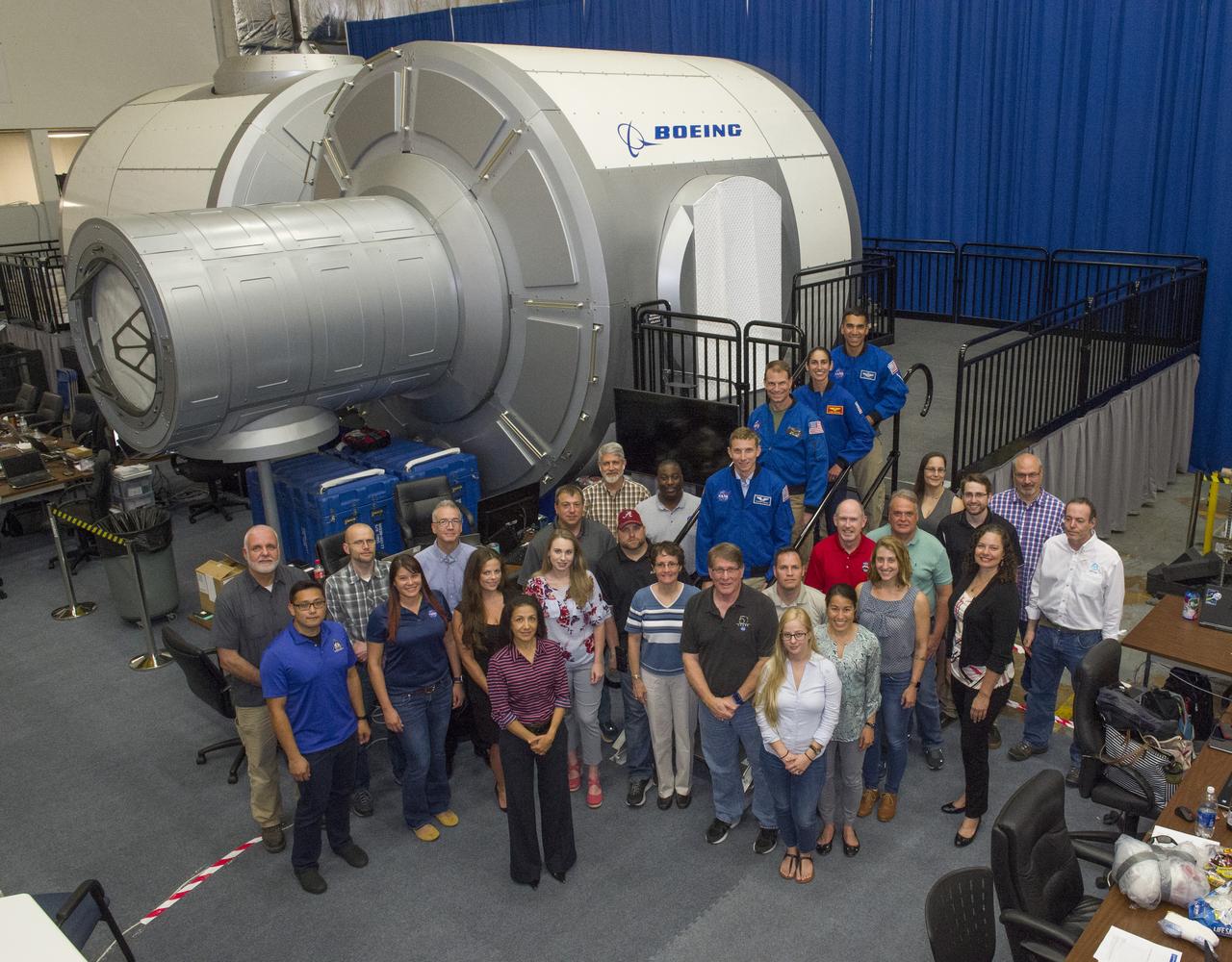
The Boeing Exploration Habitat Demonstrator at Marshall is one of five uniquely designed, deep space habitat prototypes in development through NASA’s Next Space Technologies for Exploration Partnerships, or NextSTEP. NASA and Boeing engineers and trainers pose with four astronauts training on the demonstrator.
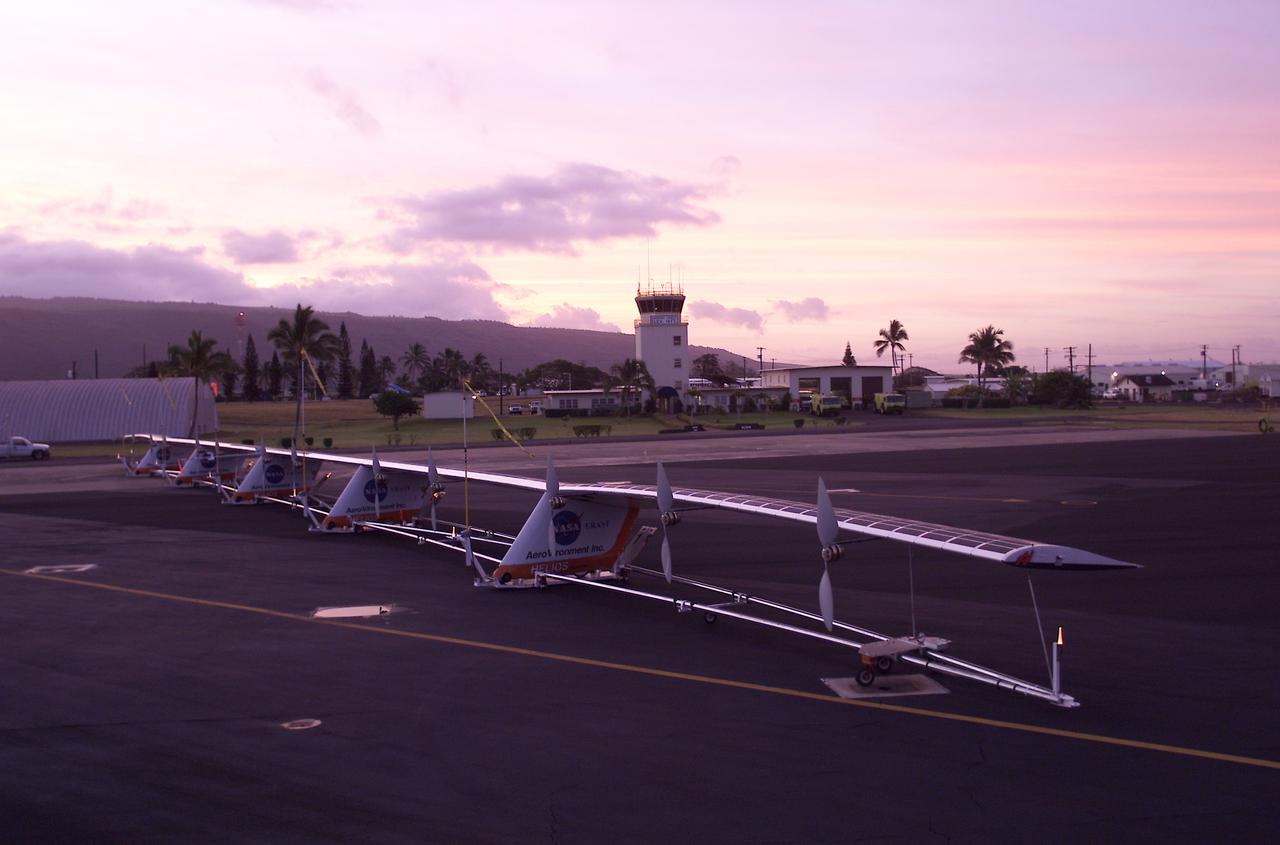
The 247-foot length of the Helios prototype wing is in evidence as the high-altitude, solar-powered flying wing rests on its ground dolly during pre-flight tests at the U.S. Navy's Pacific Missile Range Facility on Kaua'i, Hawaii.
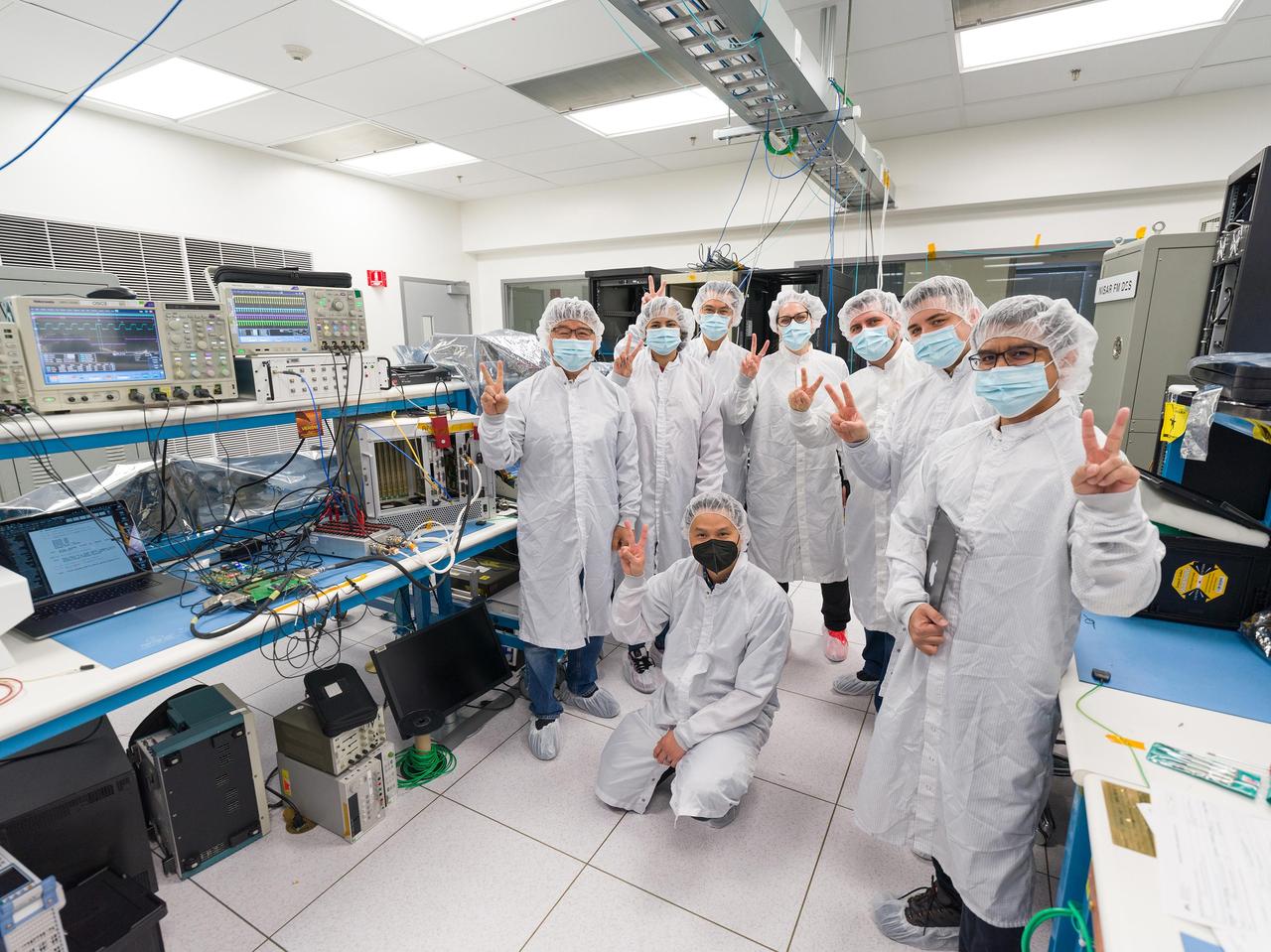
Seen here are members of the international team that participated in recent tests on prototype hardware for the Venus Interferometric Synthetic Aperture Radar (VISAR) at NASA's Jet Propulsion Laboratory in Southern California. VISAR is being developed at JPL for NASA's Venus Emissivity Radio Science, InSAR, Topography & Spectroscopy (VERITAS) mission that will launch within a decade to explore Earth's twin. In March 2023, the hardware underwent early interface tests in a JPL clean room, representing the first in a series to be run by JPL and Thales Alenia Space Italy (TASI), an international partner of the VERITAS mission that is contributing hardware to the instrument. Dressed in gowns to minimize the risk of contamination with sensitive electronics, the JPL VISAR digital team and TASI engineers pose for a photograph next to the laboratory benches where the tests took place. Figure A shows the same personnel without gowns for a team photo. From left to right: Marvin Cruz (JPL), Chester Lim (JPL), Tim Noh (JPL), Hana Haideri (JPL), Luca Di Marco Napini (TASI), Ernie Chuang (JPL), Dragana Perkovic-Martin (JPL), and Gabriel Mihu (TASI). JPL's Michael Burke, Anusha Yarlagadda, Duane Clark, and TASI's Antonio Delfino also participated in the tests but are not pictured. When VERITAS arrives in orbit, it will use VISAR to create detailed 3D global maps of Venus. The spacecraft will also carry a near-infrared spectrometer to figure out what the surface is made of. Together, the instruments will offer clues about the planet's past and present geologic processes, help reveal how the paths of Venus and Earth diverged, and how Venus lost its potential as a habitable world. VERITAS is managed by JPL. VERITAS and NASA's Deep Atmosphere Venus Investigation of Noble gases, Chemistry, and Imaging (DAVINCI) mission were selected in 2021 under NASA's Discovery Program as the agency's next missions to Venus. The Discovery Program is managed by the Planetary Missions Program Office at NASA's Marshall Space Flight Center in Huntsville, Alabama, for the Planetary Science Division of NASA's Science Mission Directorate in Washington. https://photojournal.jpl.nasa.gov/catalog/PIA25833
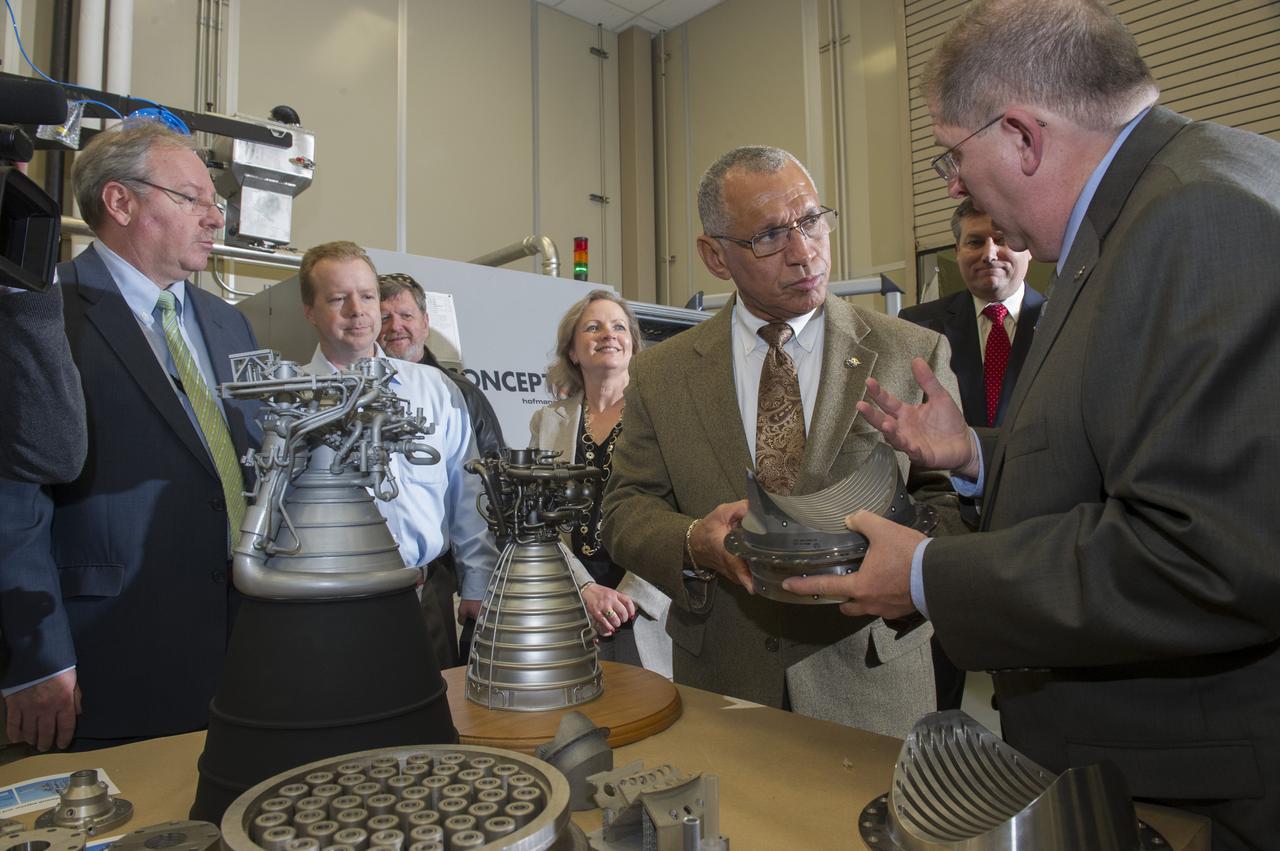
DURING HIS FEB. 22 VISIT TO THE NATIONAL CENTER FOR ADVANCED MANUFACTURING RAPID PROTOTYPING FACILITY AT NASA'S MARSHALL SPACE FLIGHT CENTER, NASA ADMINISTRATOR CHARLES BOLDEN, CENTER, TALKS WITH FRANK LEDBETTER, RIGHT, CHIEF OF THE NONMETALLIC MATERIALS AND MANUFACTURING DIVISION AT MARSHALL, ABOUT THE USE OF 3-D PRINTING AND PROTOTYPING TECHNOLOGY TO CREATE PARTS FOR THE SPACE LAUNCH SYSTEM. ALSO PARTICIPATING IN THE TOUR ARE, FROM BACK RIGHT, MARSHALL CENTER DIRECTOR PATRICK SCHEUERMANN; SHERRY KITTREDGE, DEPUTY MANAGER OF THE SLS LIQUID ENGINES OFFICE; MARSHALL FLIGHT SYSTEMS DESIGN ENGINEER ROB BLACK; AND JOHN VICKERS, MANAGER OF THE NATIONAL CENTER FOR ADVANCED MANUFACTURING.
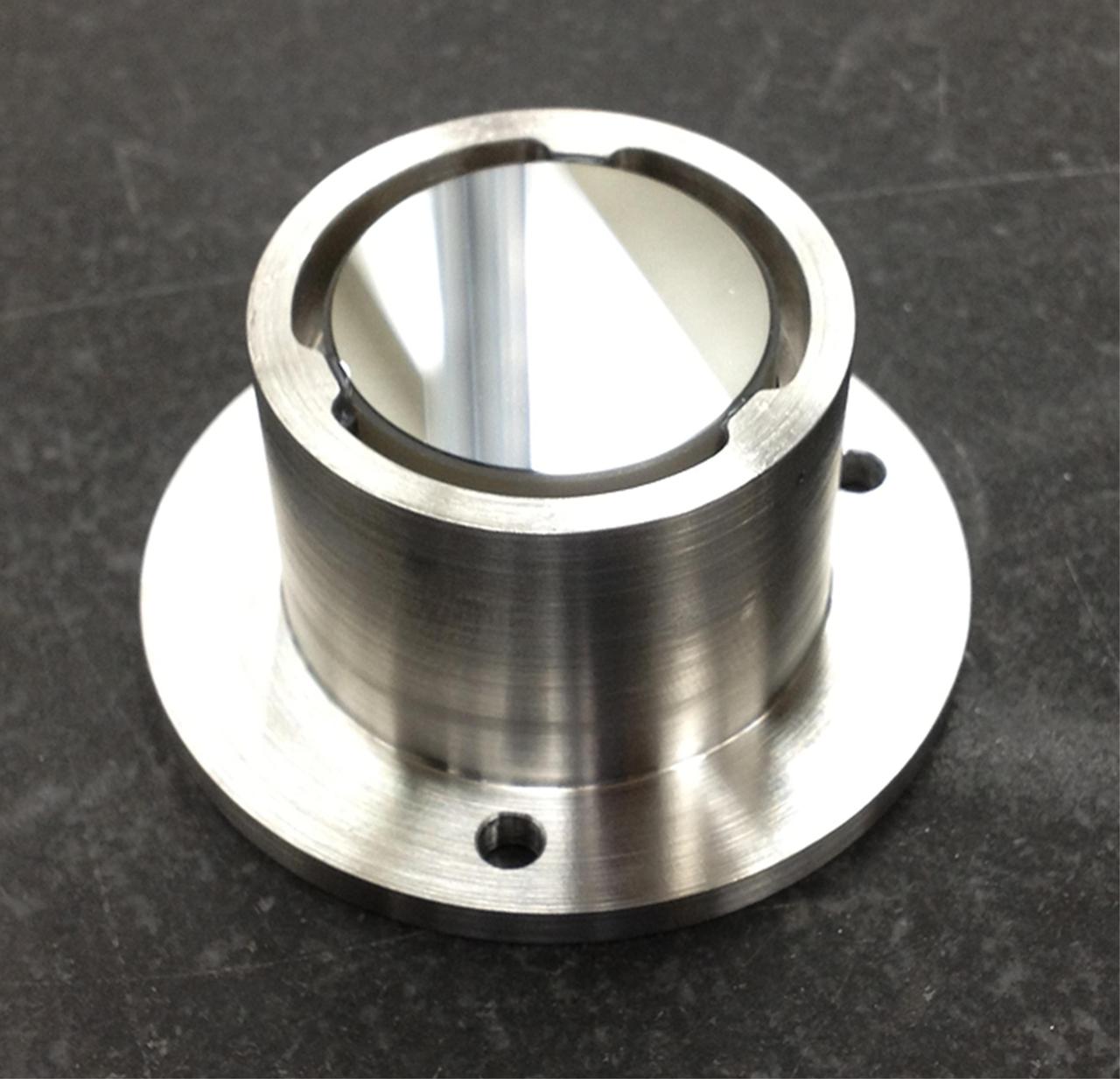
This is a prototype of a mirror mount that scientists made using a new 3-D printing technique at NASA Jet Propulsion Laboratory.
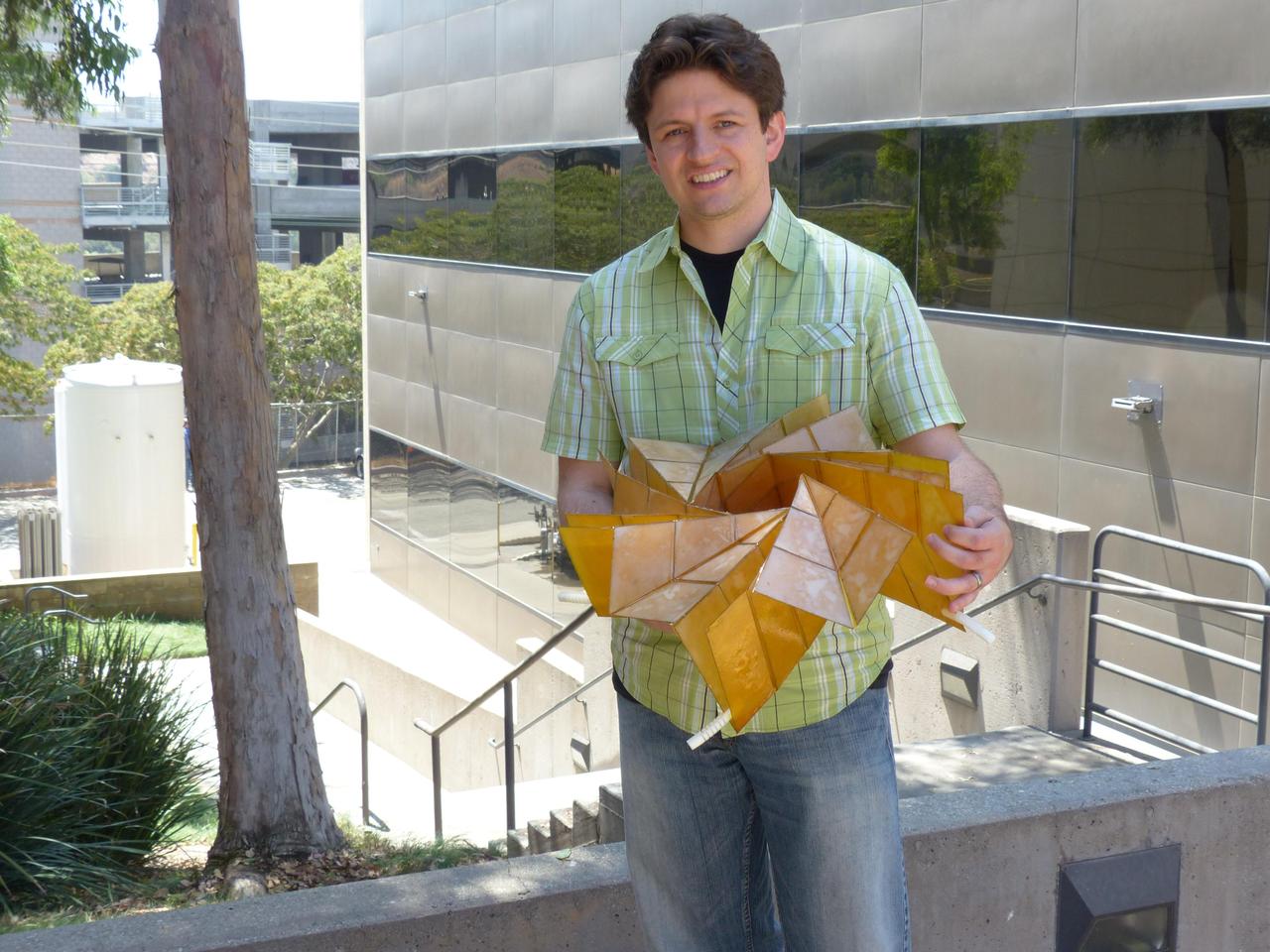
A researcher at NASA Jet Propulsion Laboratory in Pasadena, holds a prototype of a solar panel array that folds up in the style of origami.