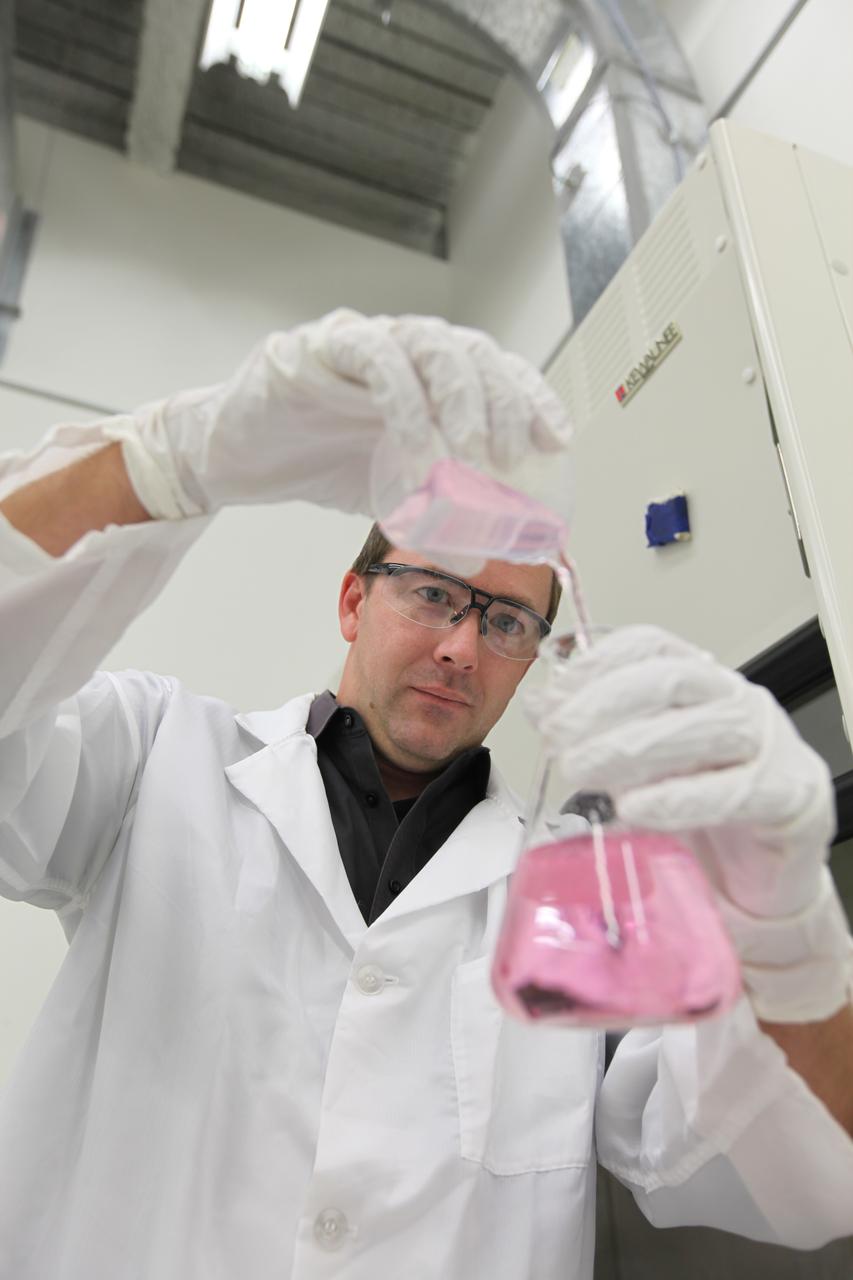
Dr. Luke Roberson, NASA scientist in the Exploration Research and Technology Programs, works in a laboratory in the Space Station Processing Facility at NASA's Kennedy Space Center in Florida.
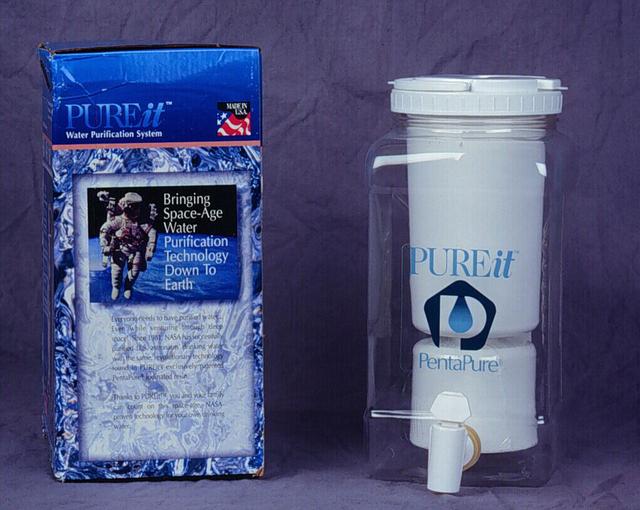
Ecomaster, an affiliate of BioServe Space Technologies, this PentaPure technology has been used to purify water for our nation's Space Shuttle missions since 1981. WTC-Ecomaster of Mirneapolis, Minnesota manufactures water purification systems under the brand name PentaPure (TM). BioServe researcher Dr. George Marchin, of Kansas State University, first demonstrated the superiority of this technology and licensed it to WTC. Marchin continues to perform microgravity research in the development of new technologies for the benefit of life on Earth.
SPD representative Steve Lambing shows the PentaPure water purification unit to some EAA visitors. The Microgravity Research and the Space Product Development Programs joined with the Johnson Space Center (JSC) for a first time ever ISS/Microgravity Research space-focused exhibit at Oshkosh AirVenture'99 from July 28-August 3, 1999. The Space Product Development (SPD) display included the STS-95 ASTROCULTURE training hardware used by John Glenn and his crewmates, a PentaPure water purfication system, and a Ford engine block.
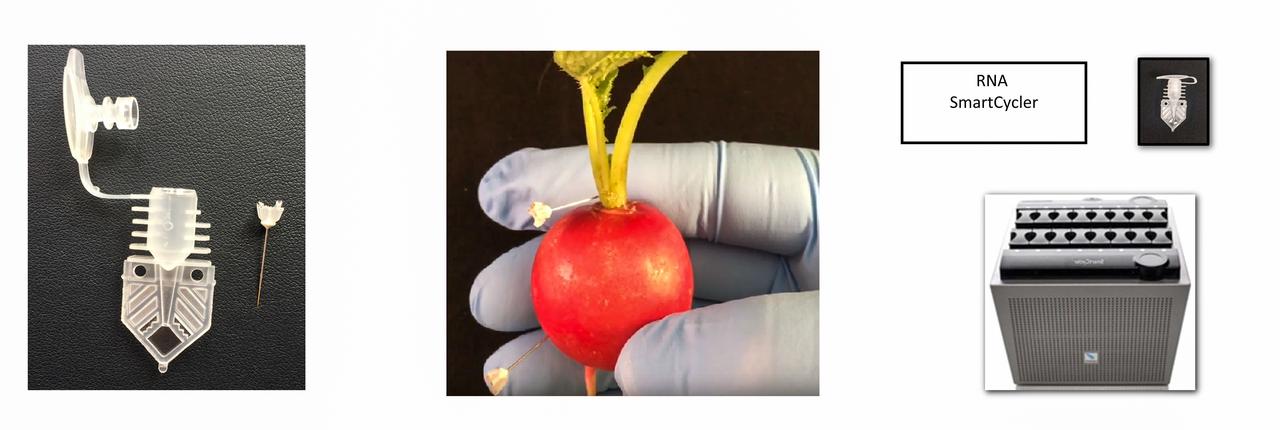
jsc2019e058183 (7/1/2019) --- Gene Sampler technology overview illustrating the direct purification and amplification of genetic material using RNA capture pins and the SmartCycler PCR instrument. Image courtesy of: Dr. Niel D. Crews
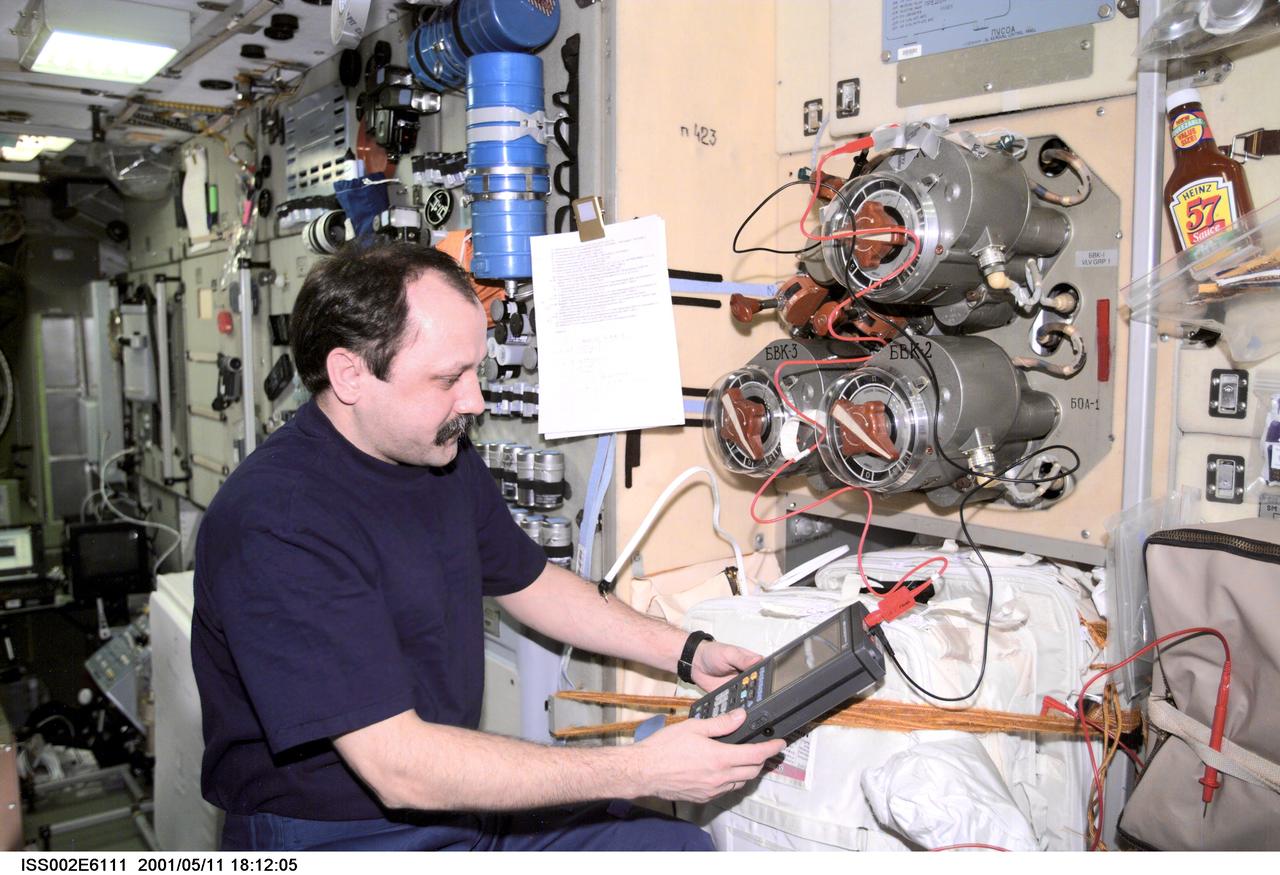
ISS002-E-6111 (11 May 2001) --- Yury V. Usachev of Rosaviakosmos, Expedition Two mission commander, tests the Vozdukh Air Purification System in the Zvezda Service Module. The image was taken with a digital still camera.
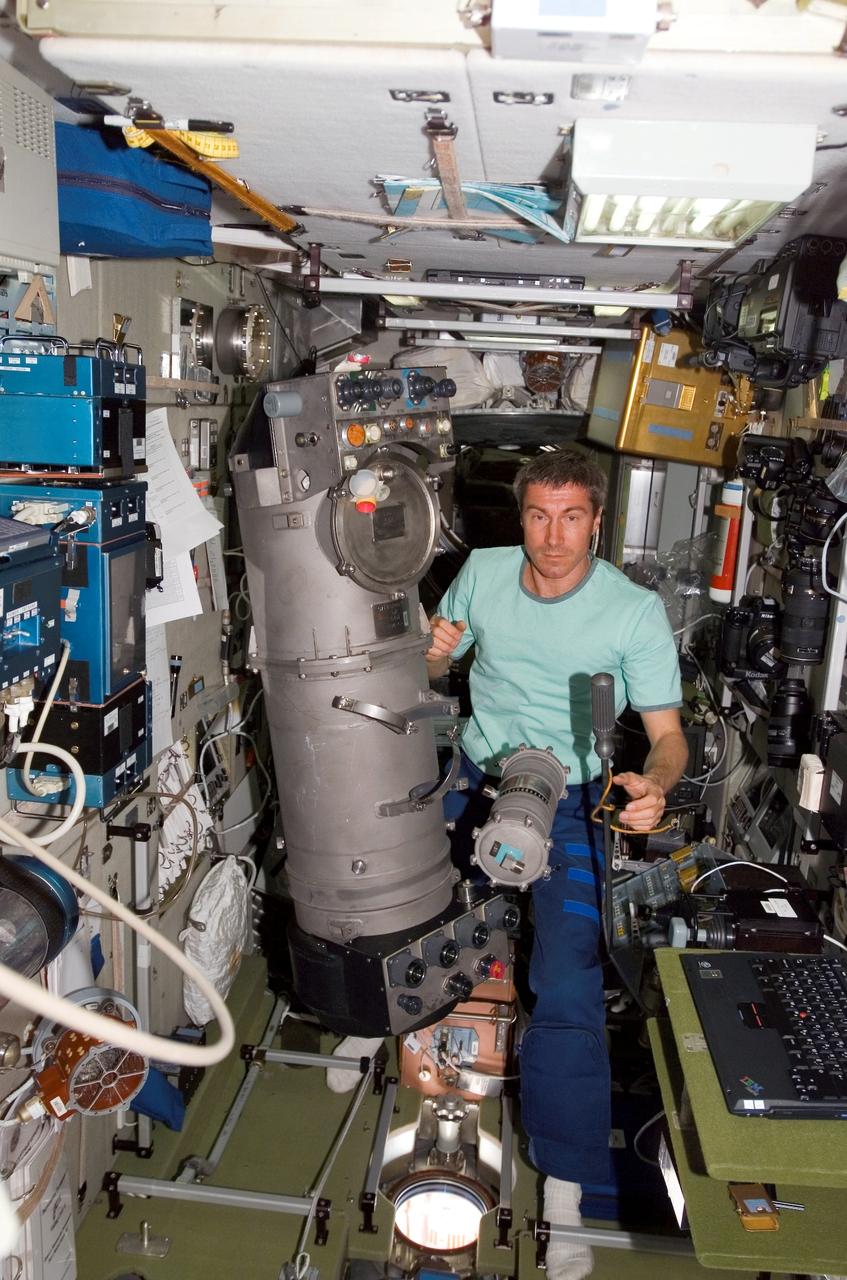
ISS011-E-05513 (5 May 2005) --- Cosmonaut Sergei K. Krikalev, Expedition 11 commander representing Russia's Federal Space Agency, poses beside the disconnected Liquid Unit #5 (BZh-5) and the O2 end-filter (BD, secondary purification unit) from the BZh5 he removed while making repairs to the Elektron oxygen generator in the Zvezda Service Module of the international space station.
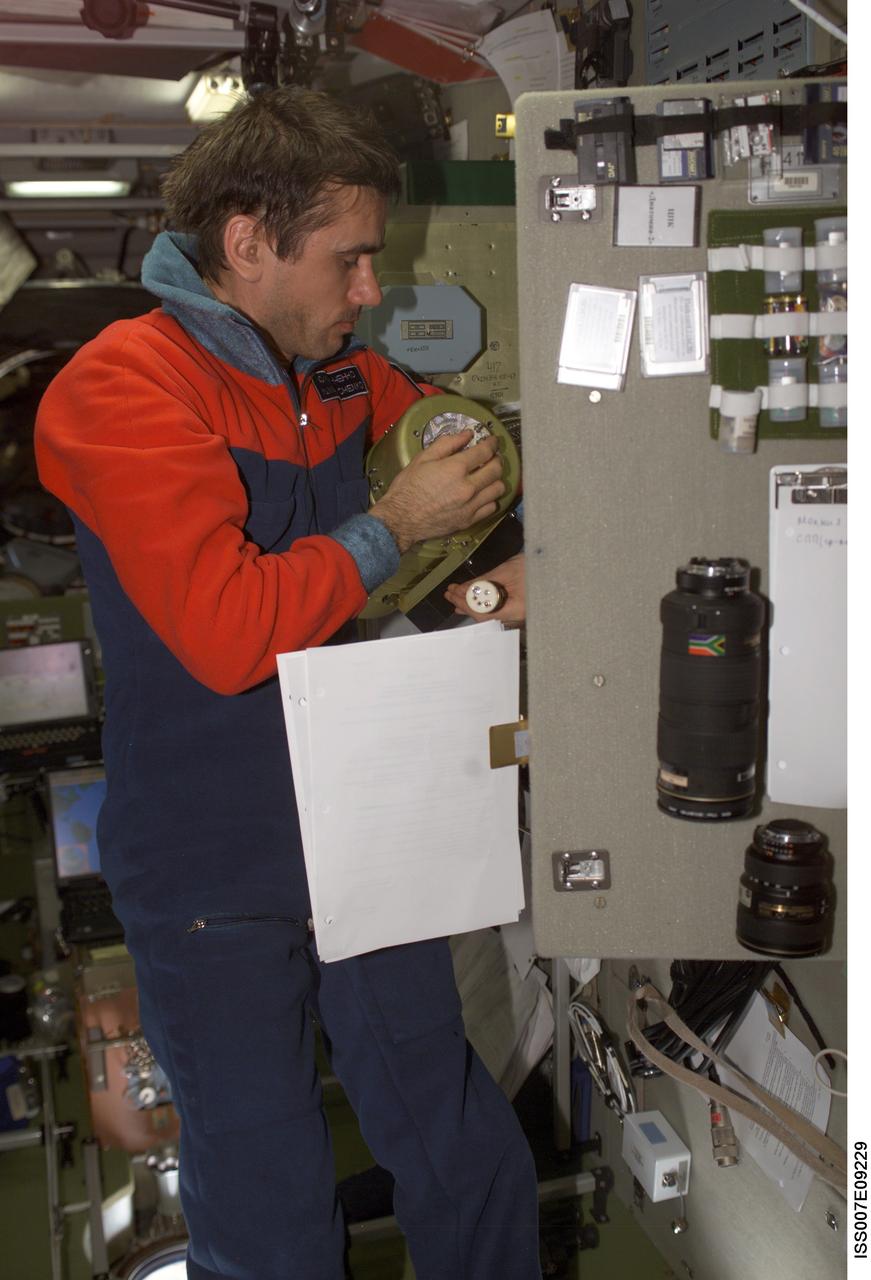
ISS007-E-09229 (3 July 2003) --- Cosmonaut Yuri I. Malenchenko, Expedition 7 mission commander, performs scheduled in-flight maintenance (IFM) on the condensate water processor (SRV-K2M) by removing and replacing its BKO multifiltration/purification column unit, which has reached its service life limit (450 liters min.). The old unit will be discarded on Progress. The IFM took place in the Zvezda Service Module on the International Space Station (ISS). Malenchenko represents Rosaviakosmos.
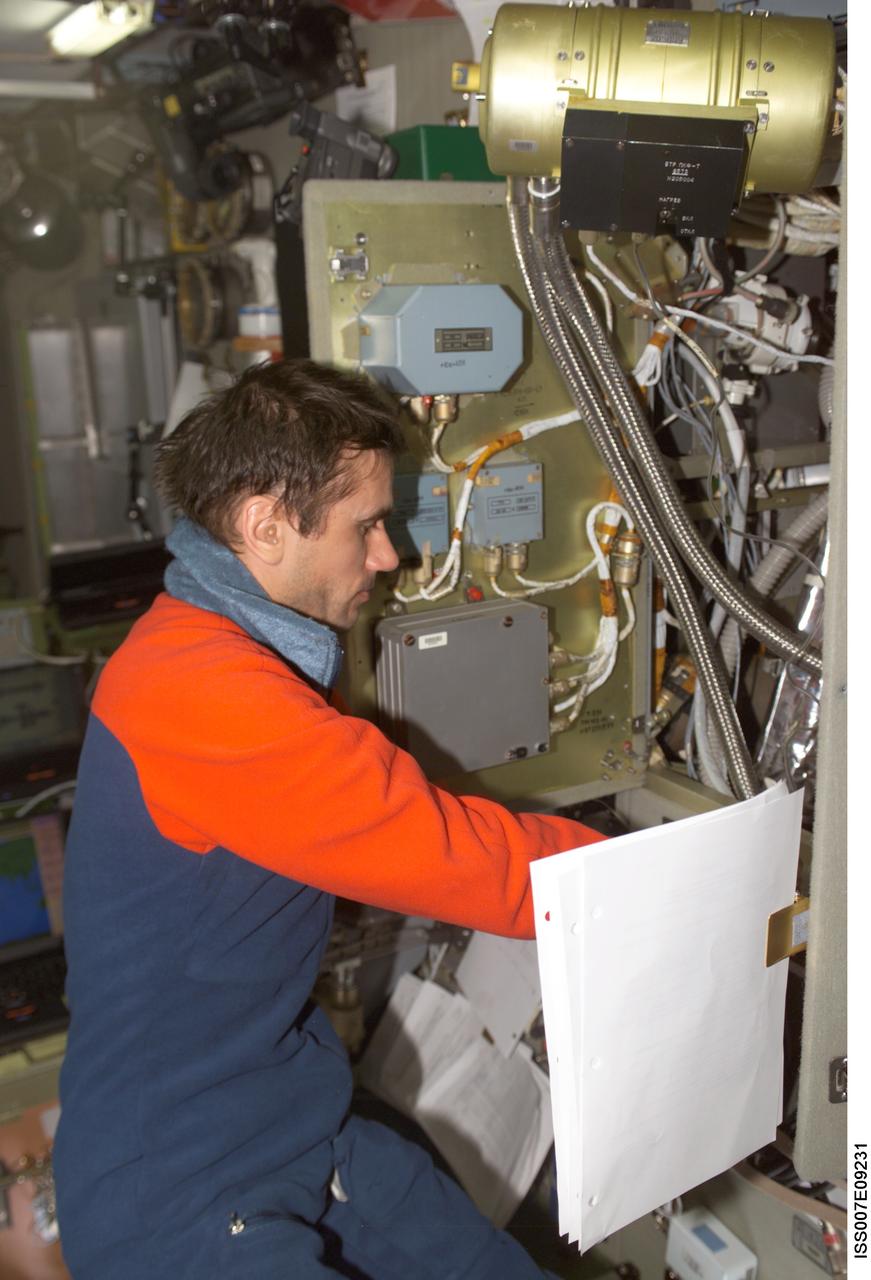
ISS007-E-09231 (3 July 2003) --- Cosmonaut Yuri I. Malenchenko, Expedition 7 mission commander, performs scheduled in-flight maintenance (IFM) on the condensate water processor (SRV-K2M) by removing and replacing its BKO multifiltration/purification column unit, which has reached its service life limit (450 liters min.). The old unit will be discarded on Progress. The IFM took place in the Zvezda Service Module on the International Space Station (ISS). Malenchenko represents Rosaviakosmos.
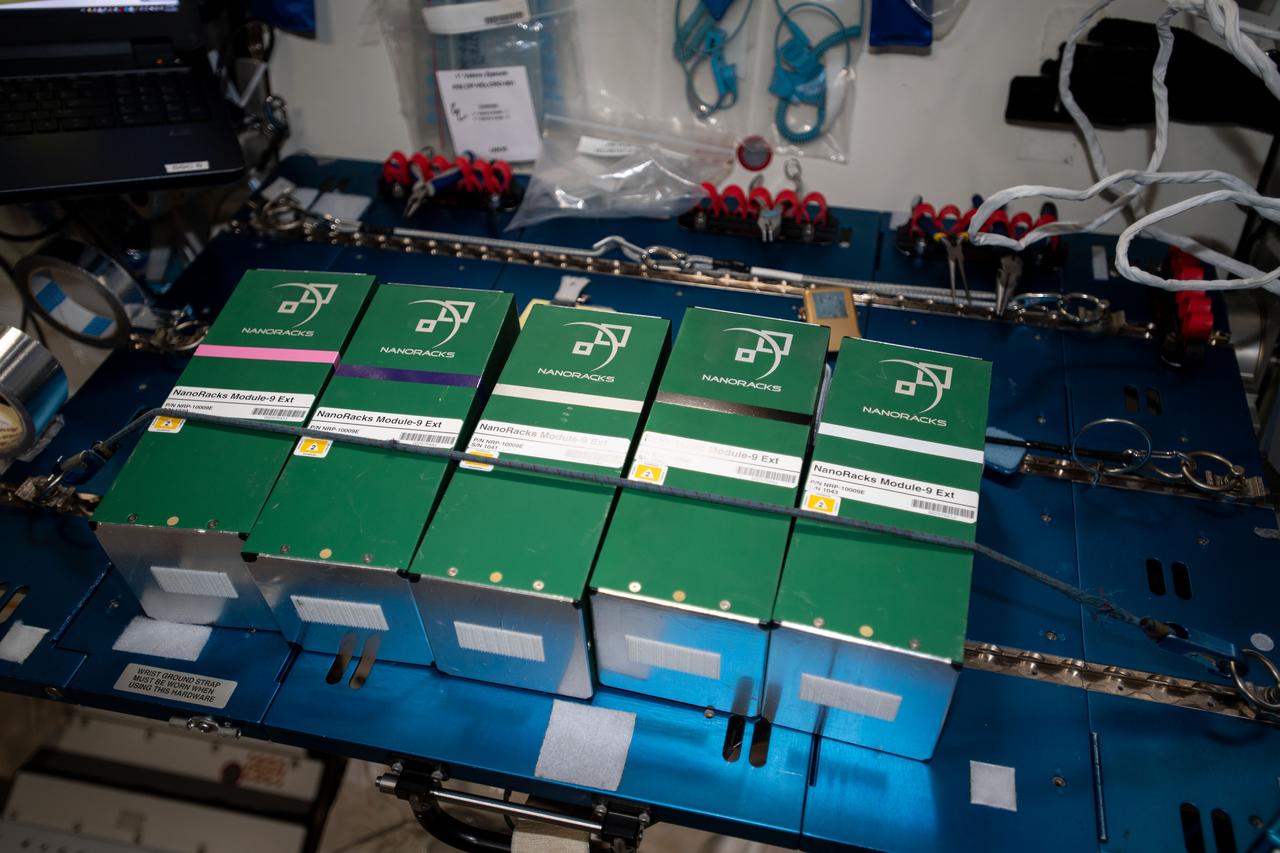
iss060e035405 (8/13/2019) --- A view the NanoRacks-NCESSE-Gemini NanoRacks-National Center for Earth and Space Science-Gemini (SSEP Mission 13) - Part of NanoRacks Module-9 Ext. aboard the International Space Station (ISS). The experiments range from examinations of water filtration and purification to synthetic soil production, rust formation, antibiotic effectiveness, growth and development of microacquatic organisms, and growth of plant, fungi, and bacteria. Each was chosen from more than 3,000 entries submitted by more than 23,000 U.S., Canadian, and Brazilian students. The experiments use NanoRacks MixStix, miniature laboratories activated by space station crew and eventually returned to the student teams on Earth for analysis.
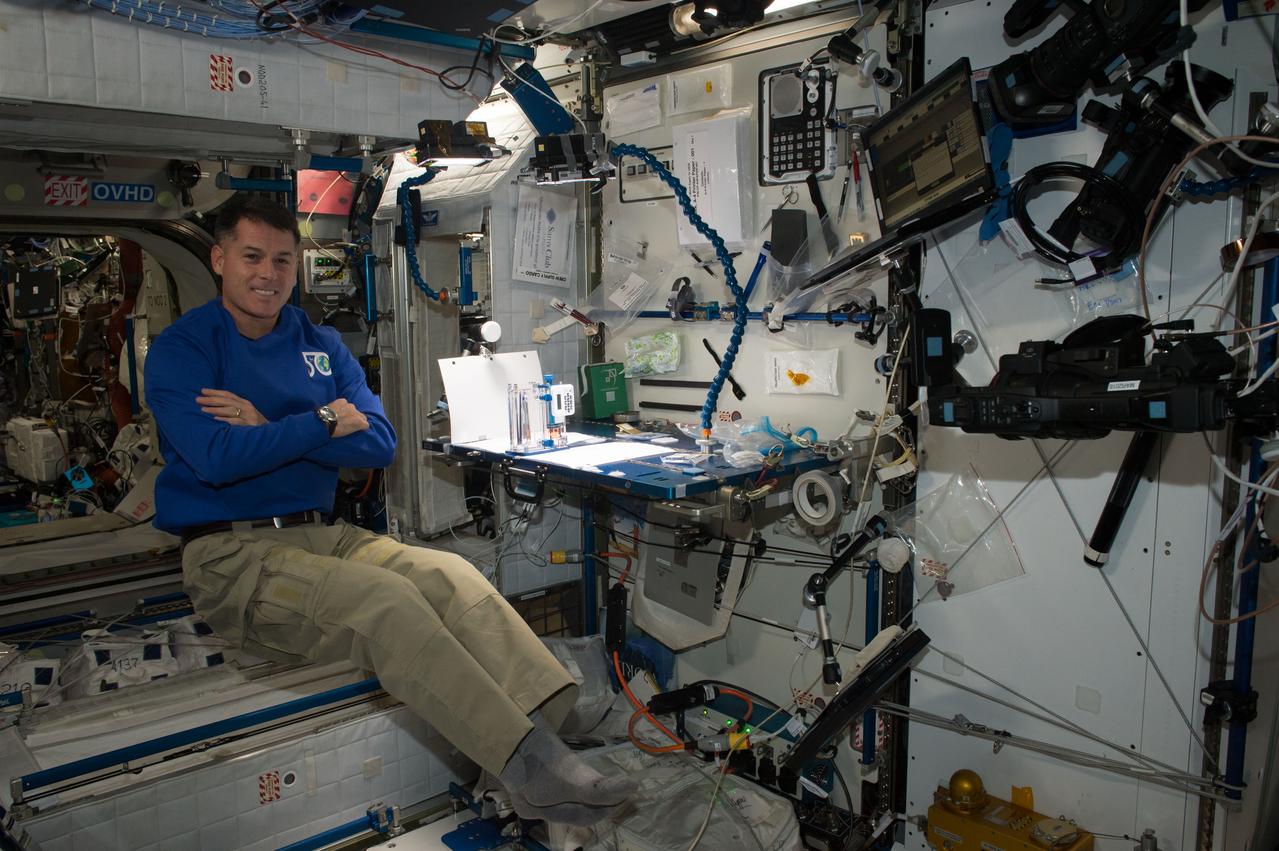
iss050e014941 (12/8/2016) --- NASA astronaut Shane Kimbrough during Capillary Flow Experiment-2 (CFE-2) with the Interior Corner Flow 1 hardware. The Capillary Flow Experiments demonstrate how capillary forces work in space, how differently shaped containers change the wicking behavior of a wetting fluid, and how such can be used to passively separate liquids and gases. Understanding how microgravity amplifies these behaviors could improve the reliability of such key processes as water purification fuel storage and supply, and general liquid transport aboard spacecraft.
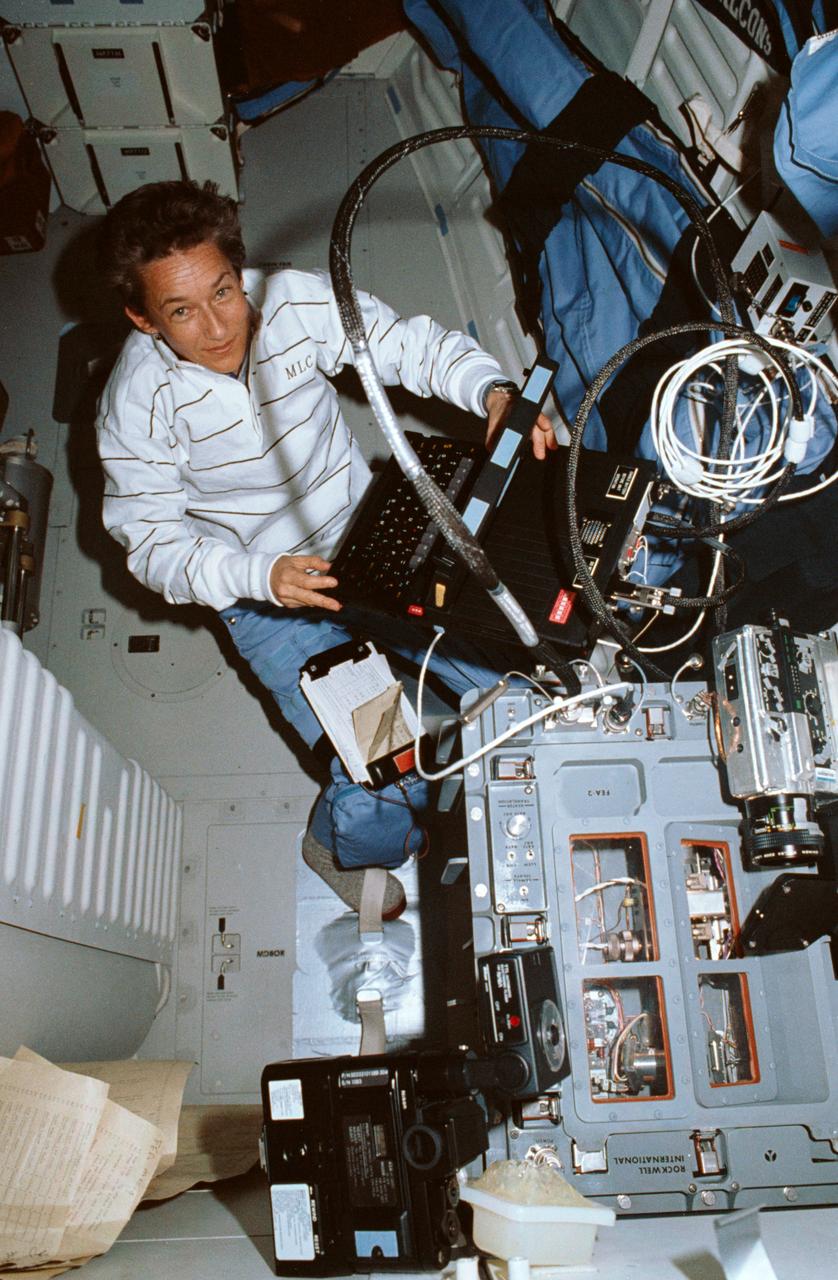
STS030-02-018 (4-8 May 1989) --- A 35mm overall scene of the operations devoted to the fluids experiment apparatus (FEA) aboard Atlantis for NASA’s STS-30 mission. Astronaut Mary L. Cleave, mission specialist, is seen with the computer which is instrumental in the carrying out of a variety of materials science experiments. Rockwell International is engaged in a joint endeavor agreement with NASA’s Office of Commercial Programs in the field of floating zone crystal growth and purification research. The March 1987 agreement provides for microgravity experiments to be performed in the company’s Microgravity Laboratory, the FEA. An 8 mm camcorder which documented details inside the apparatus is visible at bottom of the frame.
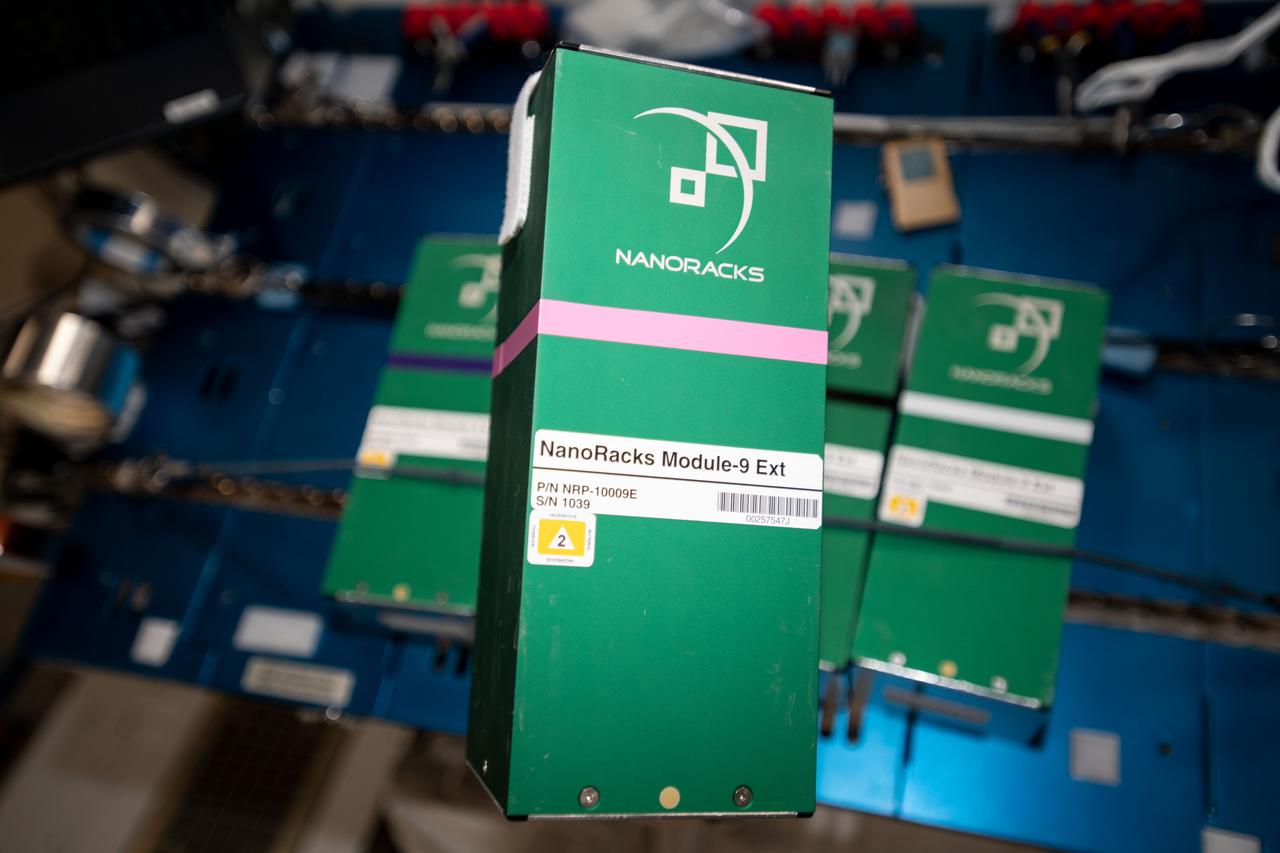
iss060e035407 (8/13/2019) --- A view the NanoRacks-NCESSE-Gemini NanoRacks-National Center for Earth and Space Science-Gemini (SSEP Mission 13) - Part of NanoRacks Module-9 Ext. The experiments range from examinations of water filtration and purification to synthetic soil production, rust formation, antibiotic effectiveness, growth and development of microacquatic organisms, and growth of plant, fungi, and bacteria. Each was chosen from more than 3,000 entries submitted by more than 23,000 U.S., Canadian, and Brazilian students. The experiments use NanoRacks MixStix, miniature laboratories activated by space station crew and eventually returned to the student teams on Earth for analysis.
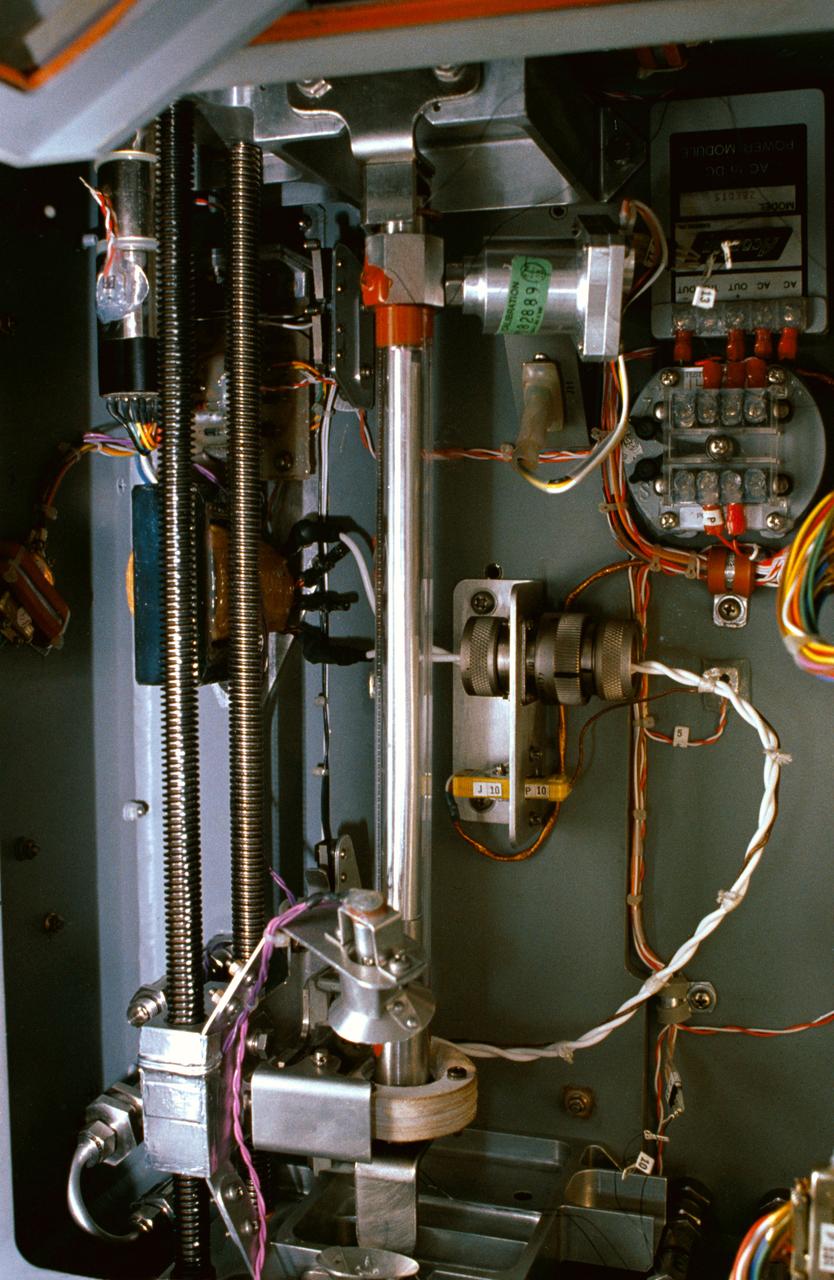
STS030-01-015 (4-8 May 1989) --- A 35mm close-up view of the Fluids Experiment Apparatus (FEA) aboard Atlantis for NASA’s STS-30 mission. Rockwell International is engaged in a joint endeavor agreement with NASA’s Office of Commercial Programs in the field of floating zone crystal growth and purification research. The March 1987 agreement provides for microgravity experiments to be performed in the company’s Microgravity Laboratory, the FEA. Crewmembers, especially Mary L. Cleave, devoted a great deal of onboard time to the monitoring of various materials science experiments using the apparatus.
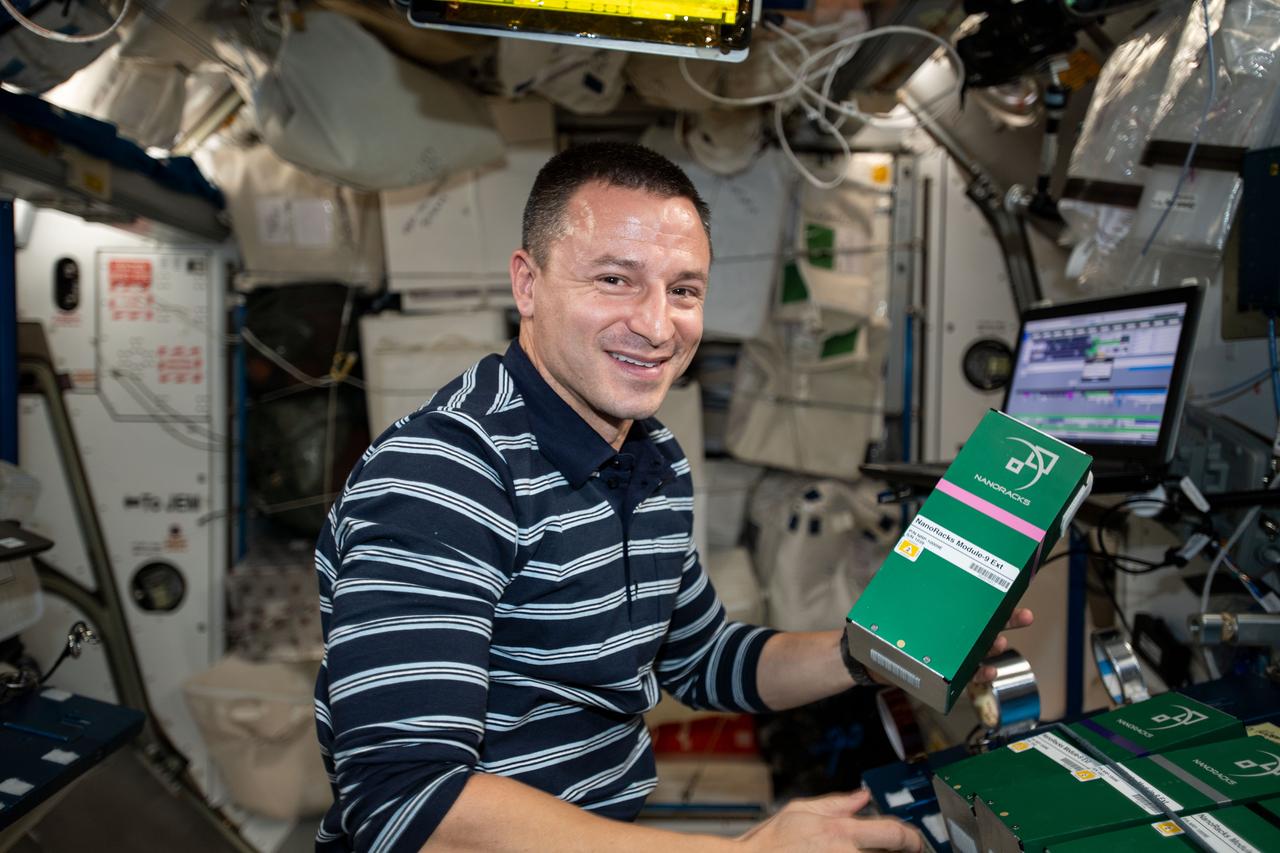
iss060e035409 (8/13/2019) --- A view of NASA astronaut Drew Morgan during the deactivation and/or shaking designated mixture tubes of NanoRacks-NCESSE-Gemini NanoRacks-National Center for Earth and Space Science-Gemini (SSEP Mission 13) - Part of NanoRacks Module-9 Ext. aboard the International Space Station (ISS). The experiments range from examinations of water filtration and purification to synthetic soil production, rust formation, antibiotic effectiveness, growth and development of microacquatic organisms, and growth of plant, fungi, and bacteria. Each was chosen from more than 3,000 entries submitted by more than 23,000 U.S., Canadian, and Brazilian students. The experiments use NanoRacks MixStix, miniature laboratories activated by space station crew and eventually returned to the student teams on Earth for analysis.
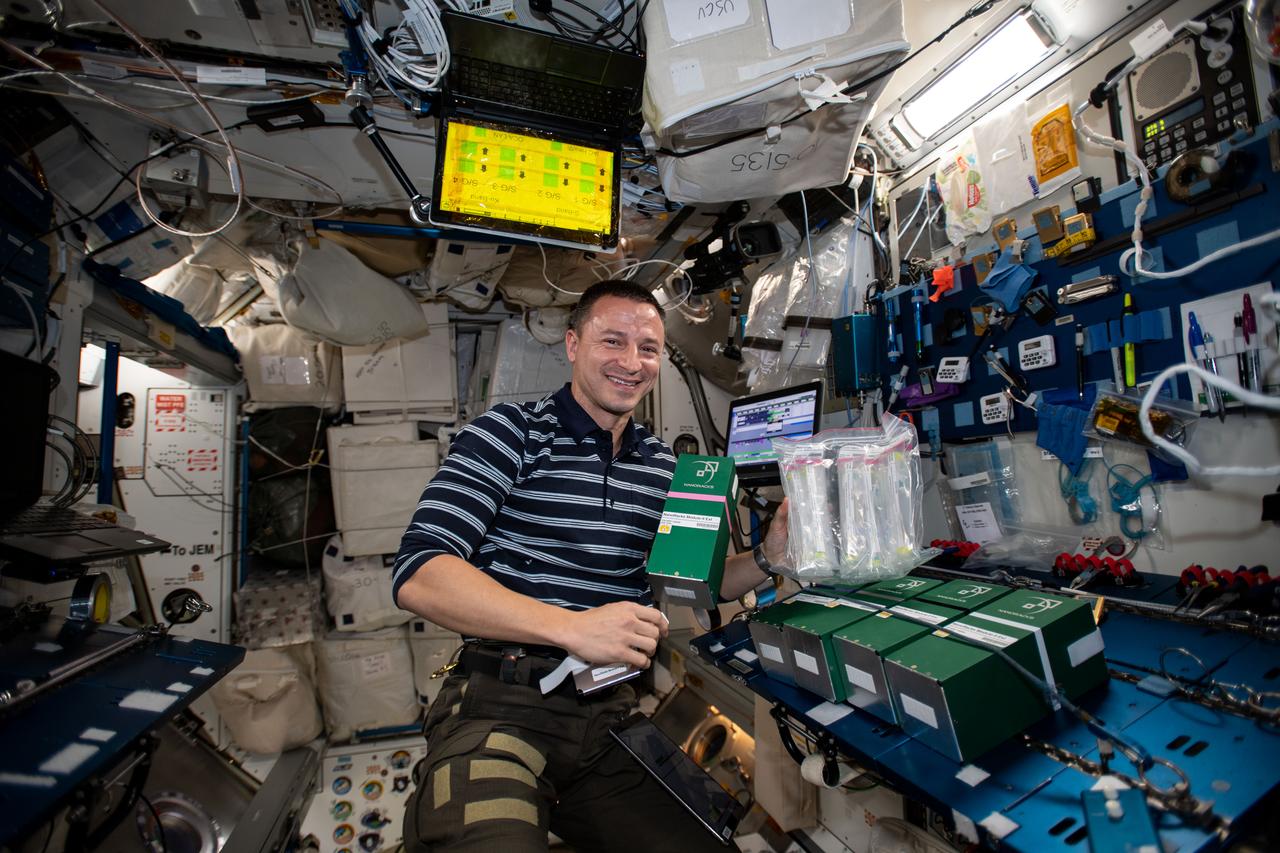
iss060e035415 8/13/2019) --- A view of NASA astronaut Drew Morgan during the deactivation and/or shaking designated mixture tubes of NanoRacks-NCESSE-Gemini NanoRacks-National Center for Earth and Space Science-Gemini (SSEP Mission 13) - Part of NanoRacks Module-9 Ext. aboard the International Space Station (ISS). The experiments range from examinations of water filtration and purification to synthetic soil production, rust formation, antibiotic effectiveness, growth and development of microacquatic organisms, and growth of plant, fungi, and bacteria. Each was chosen from more than 3,000 entries submitted by more than 23,000 U.S., Canadian, and Brazilian students. The experiments use NanoRacks MixStix, miniature laboratories activated by space station crew and eventually returned to the student teams on Earth for analysis.
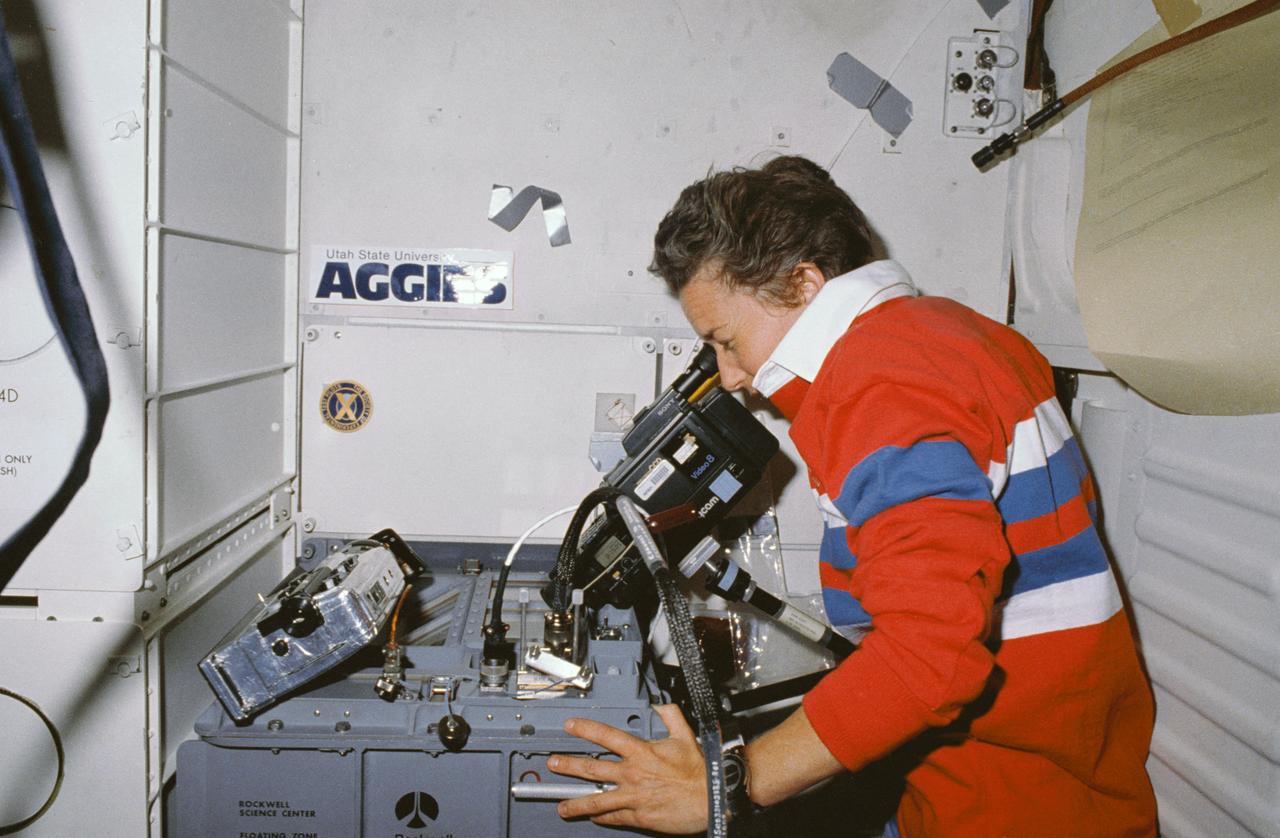
STS030-10-002 (8 May 1989) --- STS-30 Mission Specialist Mary L. Cleave operates 8mm video camcorder at Fluids Experiment Apparatus 2 (FEA-2) (SK73-000102) unit located in aft middeck locker onboard Atlantis, Orbiter Vehicle (OV) 103. Two 8mm video camcorders are positioned above FEA-2 unit to record experiment titled "Floating Zone Crystal Growth and Purification". Rockwell International (RI) through its Space Transportation Systems Division, Downey, California, is engaged in a joint endeavor agreement (JEA) with NASA's Office of Commercial Programs in the field for floating zone crystal growth research. Utah State University Aggies decal appears on aft bulkhead above FEA-2 unit.
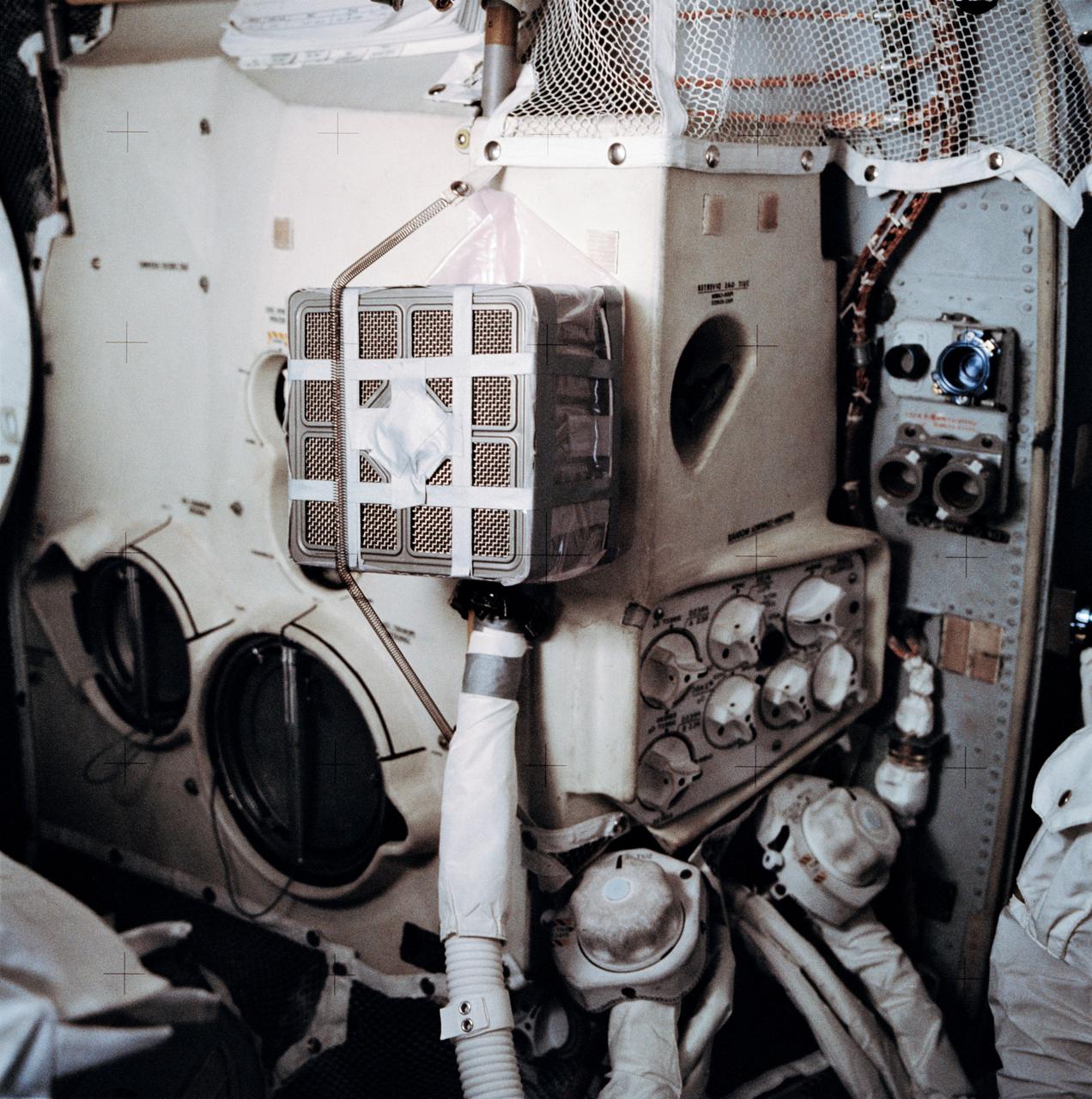
AS13-62-8929 (11-17 April 1970) --- Interior view of the Apollo 13 Lunar Module (LM) showing the "mail box," a jury-rigged arrangement which the Apollo 13 astronauts built to use the Command Module (CM) lithium hydroxide canisters to purge carbon dioxide from the LM. Lithium hydroxide is used to scrub CO2 from the spacecraft's atmosphere. Since there was a limited amount of lithium hydroxide in the LM, this arrangement was rigged up to utilize the canisters from the CM. The "mail box" was designed and tested on the ground at the Manned Spacecraft Center (MSC) before it was suggested to the problem-plagued Apollo 13 crew men. Because of the explosion of one of the oxygen tanks in the Service Module (SM), the three crew men had to use the LM as a "lifeboat".
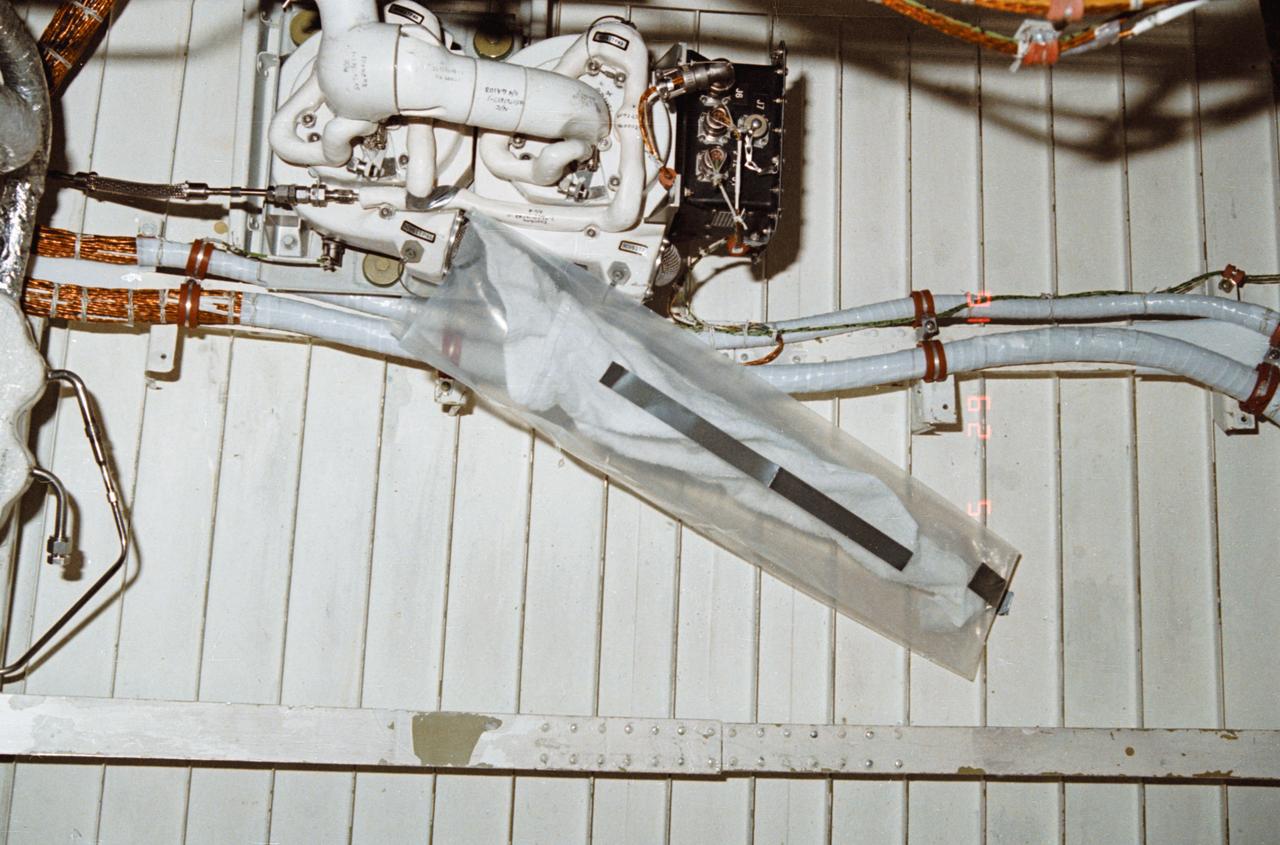
During STS-32, onboard Columbia, Orbiter Vehicle (OV) 102, a leakage problem at environmental control and life support system (ECLSS) air revitalization system (ARS) humidity separator A below the middeck is solved with a plastic bag and a towel. The towel inserted inside a plastic bag absorbed the water that had collected at the separator inlet.
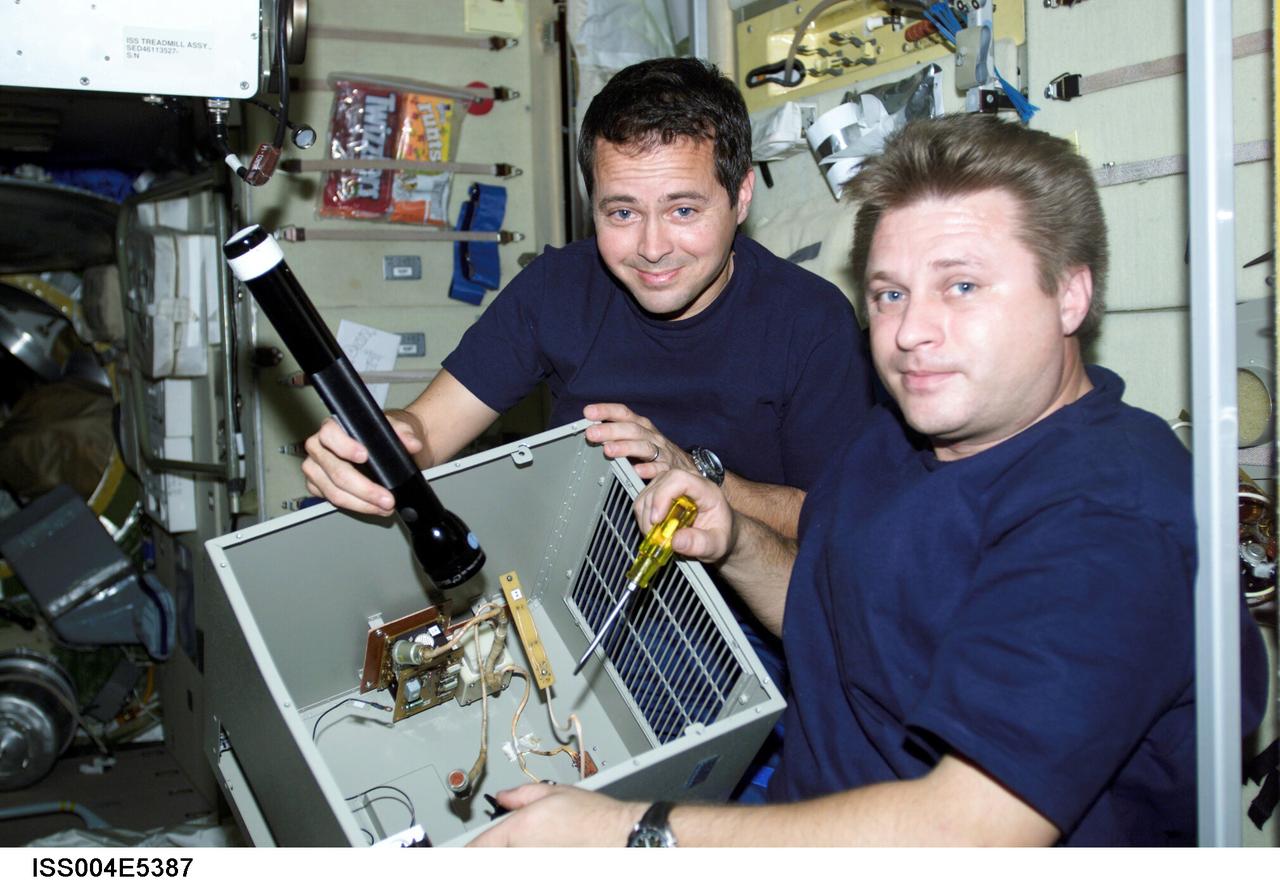
ISS004-E-5387 (January 2002) --- Cosmonaut Yuri I. Onufrienko (right), Expedition Four mission commander, and astronaut Daniel W. Bursch, flight engineer, perform maintenance on equipment in the Zvezda Service Module on the International Space Station (ISS). Onufrienko represents Rosaviakosmos. The image was taken with a digital still camera.
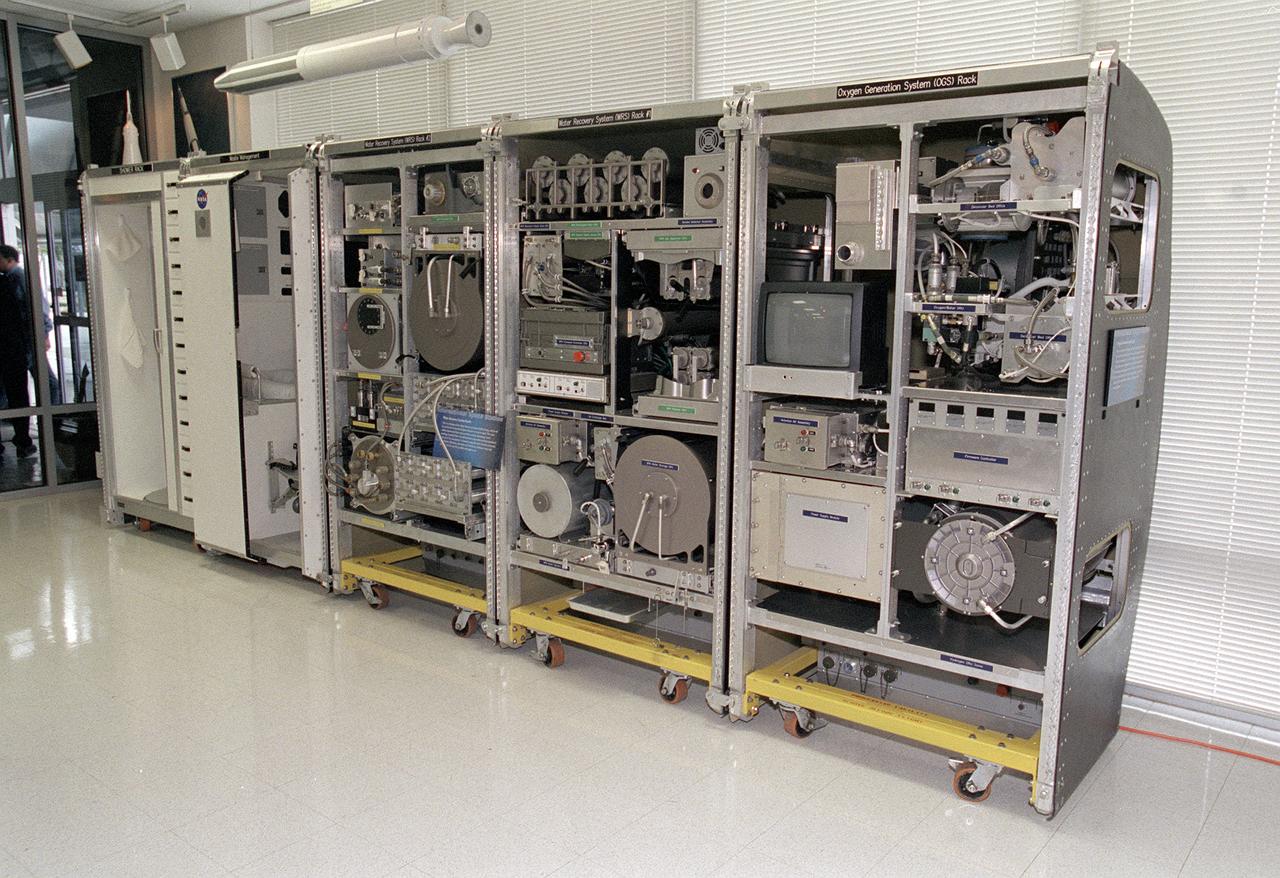
The Environmental Control and Life Support System (ECLSS) Group of the Flight Projects Directorate at the Marshall Space Flight Center in Huntsville, Alabama, is responsible for designing and building the life support systems that will provide the crew of the International Space Station (ISS) a comfortable environment in which to live and work. This photograph shows the mockup of the the ECLSS to be installed in the Node 3 module of the ISS. From left to right, shower rack, waste management rack, Water Recovery System (WRS) Rack #2, WRS Rack #1, and Oxygen Generation System (OGS) rack are shown. The WRS provides clean water through the reclamation of wastewaters and is comprised of a Urine Processor Assembly (UPA) and a Water Processor Assembly (WPA). The UPA accepts and processes pretreated crewmember urine to allow it to be processed along with other wastewaters in the WPA. The WPA removes free gas, organic, and nonorganic constituents before the water goes through a series of multifiltration beds for further purification. The OGS produces oxygen for breathing air for the crew and laboratory animals, as well as for replacing oxygen loss. The OGS is comprised of a cell stack, which electrolyzes (breaks apart the hydrogen and oxygen molecules) some of the clean water provided by the WRS, and the separators that remove the gases from the water after electrolysis.
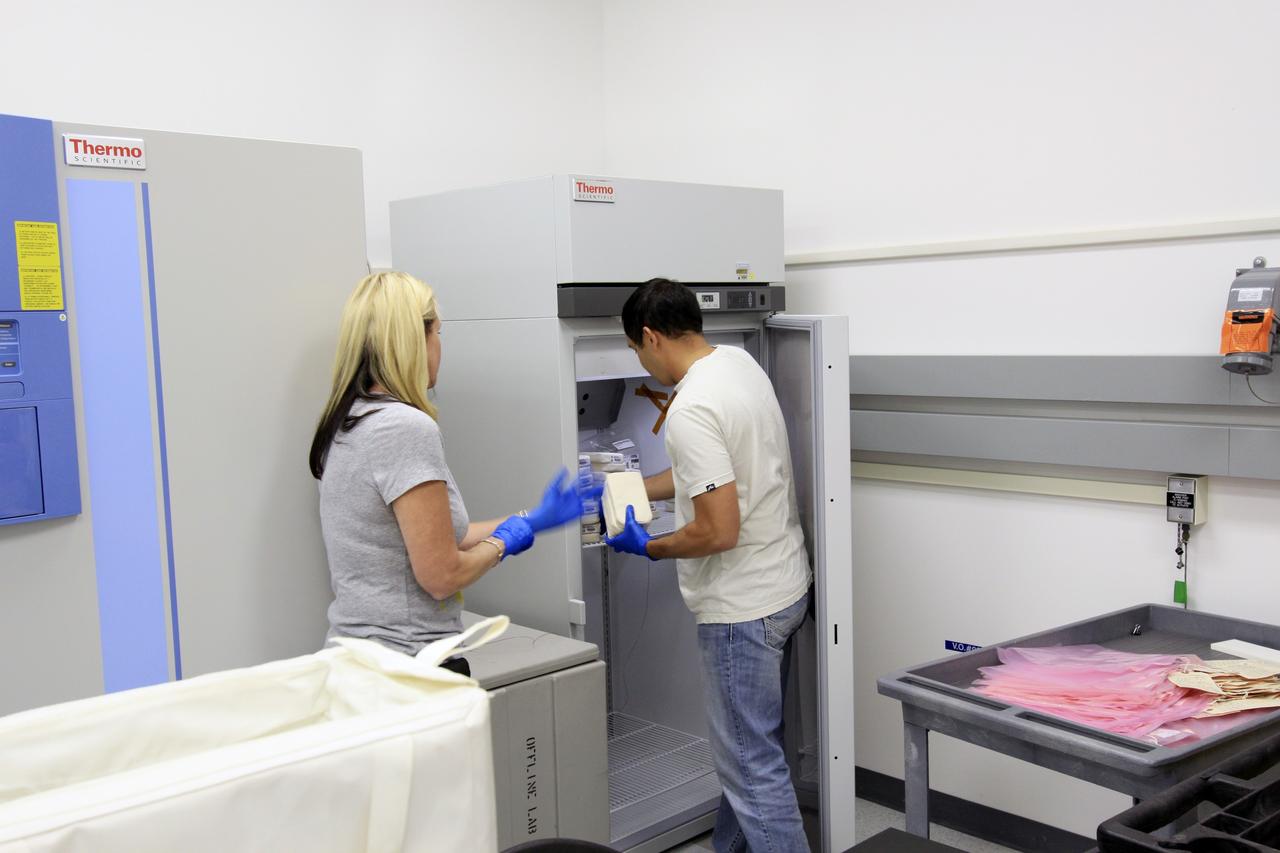
CAPE CANAVERAL, Fla. – In the Space Station Processing Facility at NASA’s Kennedy Space Center in Florida, refrigerated NanoRacks-CubeLabs Module-9 experiments are being prepared for transport to Space Launch Complex-40 on nearby Cape Canaveral Air Force Station. There, the bags will be loaded into the Space Exploration Technologies Dragon capsule in preparation for its scheduled April 30 liftoff aboard a Falcon 9 rocket. NanoRacks-CubeLabs Module-9 uses a two-cube unit box for student competition investigations using 15 liquid mixing tube assemblies that function similar to commercial glow sticks. The investigations range from microbial growth to water purification in microgravity. Known as SpaceX, the launch will be the company's second demonstration test flight for NASA's Commercial Orbital Transportation Services program, or COTS. During the flight, the capsule will conduct a series of check-out procedures to test and prove its systems, including rendezvous and berthing with the International Space Station. If the capsule performs as planned, the module and other cargo will be transferred to the station. The cargo includes food, water and provisions for the station’s Expedition crews, such as clothing, batteries and computer equipment. Under COTS, NASA has partnered with two private companies to launch cargo safely to the station. For more information, visit http://www.nasa.gov/spacex. Photo credit: NASA/Jim Grossmann
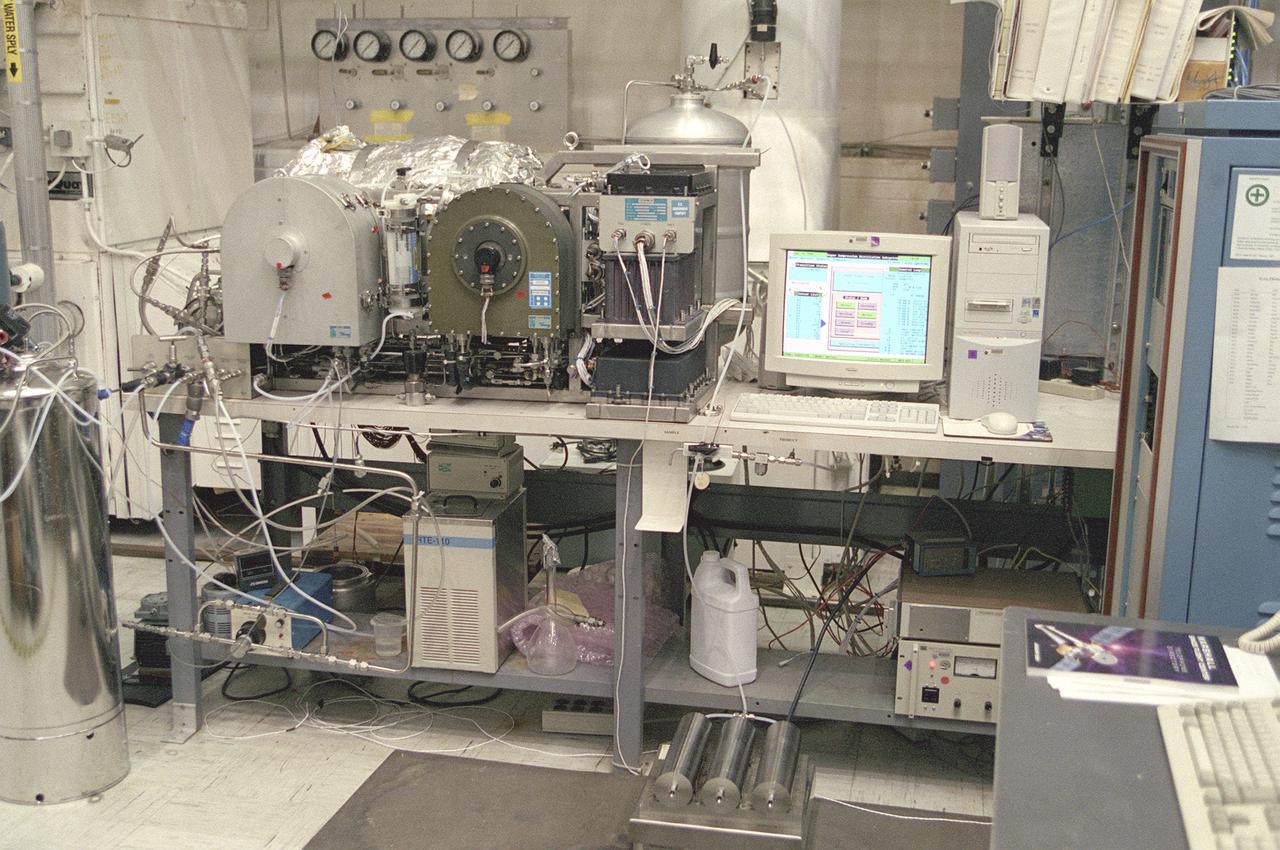
The Marshall Space Flight Center (MSFC) is responsible for designing and building the life support systems that will provide the crew of the International Space Station (ISS) a comfortable environment in which to live and work. Scientists and engineers at the MSFC are working together to provide the ISS with systems that are safe, efficient, and cost-effective. These compact and powerful systems are collectively called the Environmental Control and Life Support Systems, or simply, ECLSS. This photograph shows the fifth generation Urine Processor Development Hardware. The Urine Processor Assembly (UPA) is a part of the Water Recovery System (WRS) on the ISS. It uses a chase change process called vapor compression distillation technology to remove contaminants from urine. The UPA accepts and processes pretreated crewmember urine to allow it to be processed along with other wastewaters in the Water Processor Assembly (WPA). The WPA removes free gas, organic, and nonorganic constituents before the water goes through a series of multifiltration beds for further purification. Product water quality is monitored primarily through conductivity measurements. Unacceptable water is sent back through the WPA for reprocessing. Clean water is sent to a storage tank.
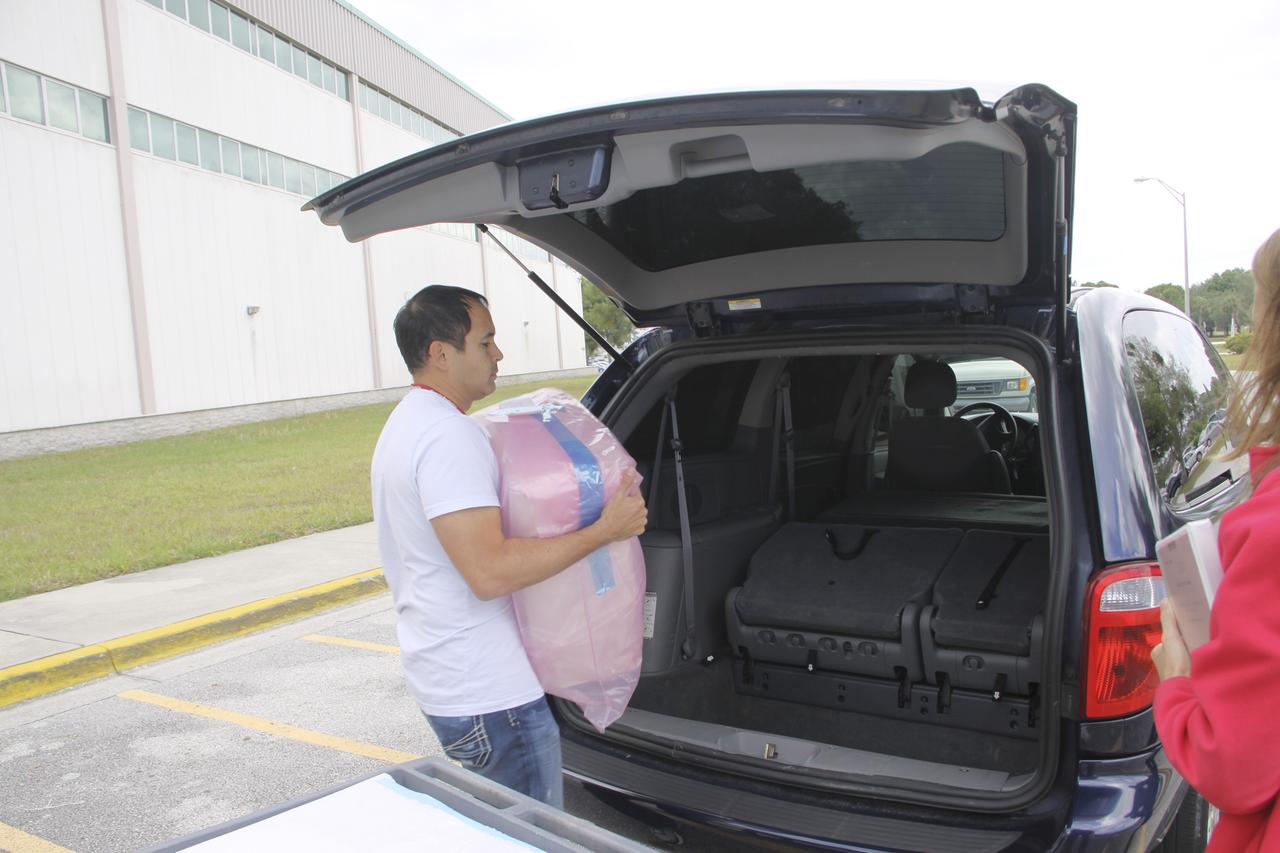
CAPE CANAVERAL, Fla. – A cargo bag designed to keep its contents cool, packed with NanoRacks-CubeLabs Module-9 experiments, is loaded into a van at the Space Station Processing Facility at NASA’s Kennedy Space Center in Florida for its trip to Space Launch Complex-40 on nearby Cape Canaveral Air Force Station. There, the bag will be loaded into the Space Exploration Technologies Dragon capsule in preparation for its scheduled April 30 liftoff aboard a Falcon 9 rocket. NanoRacks-CubeLabs Module-9 uses a two-cube unit box for student competition investigations using 15 liquid mixing tube assemblies that function similar to commercial glow sticks. The investigations range from microbial growth to water purification in microgravity. Known as SpaceX, the launch will be the company's second demonstration test flight for NASA's Commercial Orbital Transportation Services program, or COTS. During the flight, the capsule will conduct a series of check-out procedures to test and prove its systems, including rendezvous and berthing with the International Space Station. If the capsule performs as planned, the module and other cargo will be transferred to the station. The cargo includes food, water and provisions for the station’s Expedition crews, such as clothing, batteries and computer equipment. Under COTS, NASA has partnered with two private companies to launch cargo safely to the station. For more information, visit http://www.nasa.gov/spacex. Photo credit: NASA/Jim Grossmann

CAPE CANAVERAL, Fla. – In the Space Station Processing Facility at NASA’s Kennedy Space Center in Florida, a cargo bag designed to keep its contents cool is packed with NanoRacks-CubeLabs Module-9 experiments in preparation to transport it to Space Launch Complex-40 on nearby Cape Canaveral Air Force Station. There, the bag will be loaded into the Space Exploration Technologies Dragon capsule in preparation for its scheduled April 30 liftoff aboard a Falcon 9 rocket. NanoRacks-CubeLabs Module-9 uses a two-cube unit box for student competition investigations using 15 liquid mixing tube assemblies that function similar to commercial glow sticks. The investigations range from microbial growth to water purification in microgravity. Known as SpaceX, the launch will be the company's second demonstration test flight for NASA's Commercial Orbital Transportation Services program, or COTS. During the flight, the capsule will conduct a series of check-out procedures to test and prove its systems, including rendezvous and berthing with the International Space Station. If the capsule performs as planned, the module and other cargo will be transferred to the station. The cargo includes food, water and provisions for the station’s Expedition crews, such as clothing, batteries and computer equipment. Under COTS, NASA has partnered with two private companies to launch cargo safely to the station. For more information, visit http://www.nasa.gov/spacex. Photo credit: NASA/Jim Grossmann
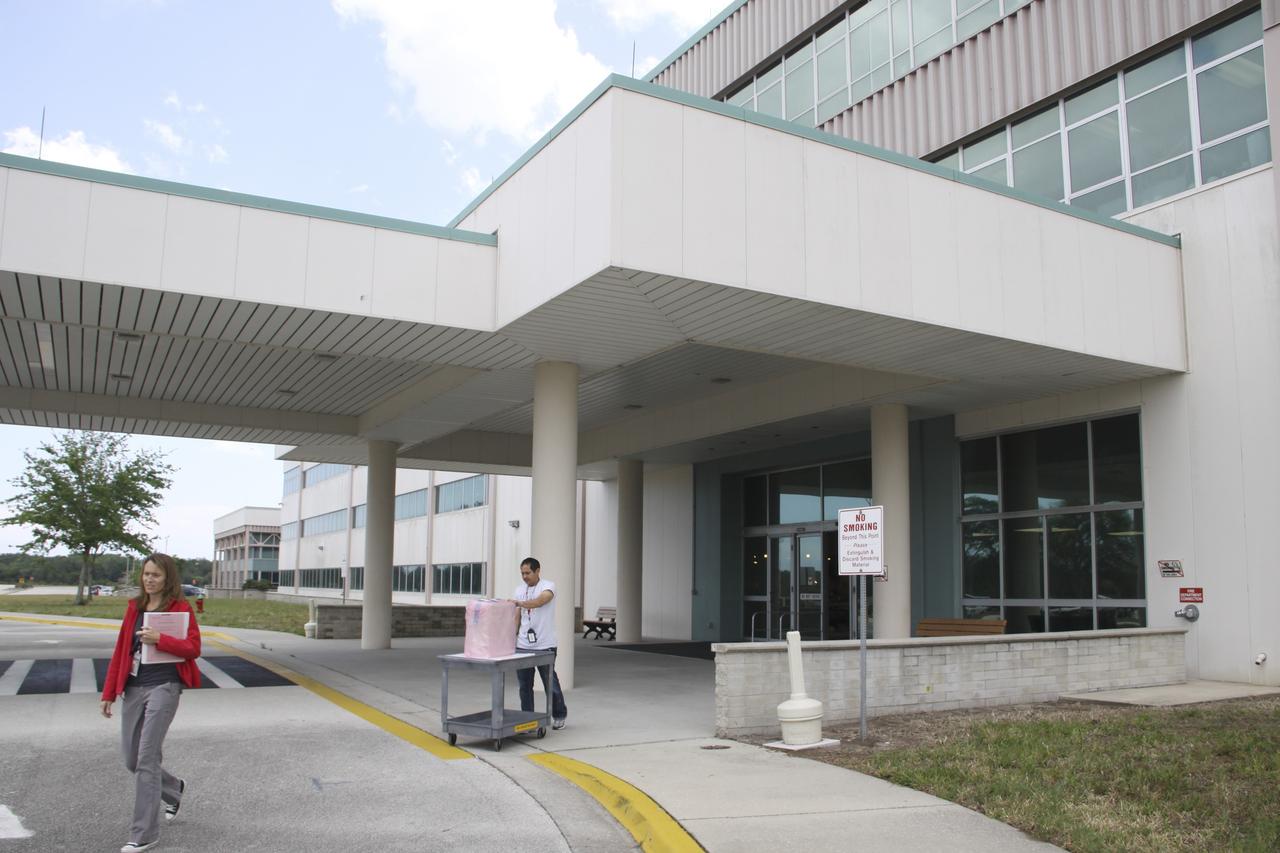
CAPE CANAVERAL, Fla. – A cargo bag designed to keep its contents cool, packed with NanoRacks-CubeLabs Module-9 experiments, departs the Space Station Processing Facility at NASA’s Kennedy Space Center in Florida for its trip to Space Launch Complex-40 on nearby Cape Canaveral Air Force Station. There, the bag will be loaded into the Space Exploration Technologies Dragon capsule in preparation for its scheduled April 30 liftoff aboard a Falcon 9 rocket. NanoRacks-CubeLabs Module-9 uses a two-cube unit box for student competition investigations using 15 liquid mixing tube assemblies that function similar to commercial glow sticks. The investigations range from microbial growth to water purification in microgravity. Known as SpaceX, the launch will be the company's second demonstration test flight for NASA's Commercial Orbital Transportation Services program, or COTS. During the flight, the capsule will conduct a series of check-out procedures to test and prove its systems, including rendezvous and berthing with the International Space Station. If the capsule performs as planned, the module and other cargo will be transferred to the station. The cargo includes food, water and provisions for the station’s Expedition crews, such as clothing, batteries and computer equipment. Under COTS, NASA has partnered with two private companies to launch cargo safely to the station. For more information, visit http://www.nasa.gov/spacex. Photo credit: NASA/Jim Grossmann
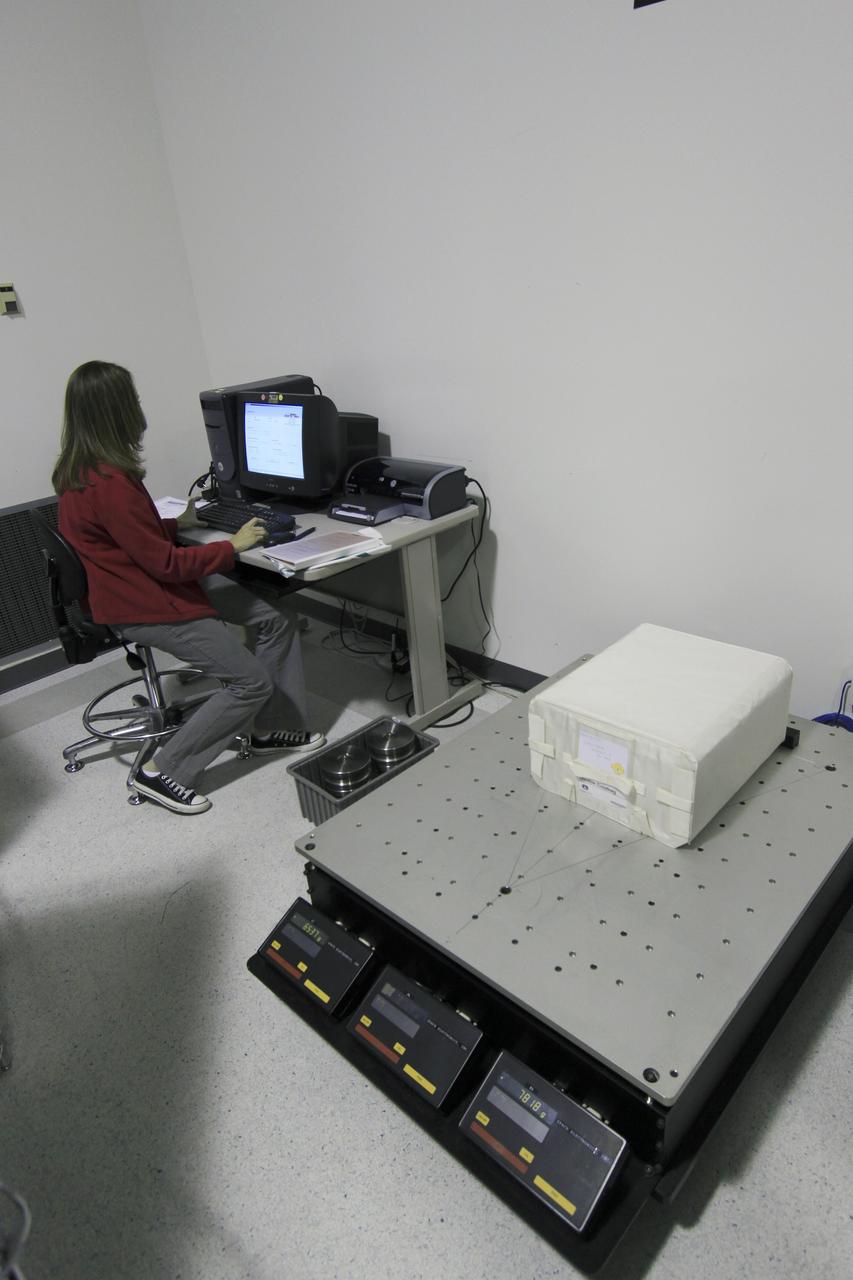
CAPE CANAVERAL, Fla. – In the Space Station Processing Facility at NASA’s Kennedy Space Center in Florida, a cargo bag packed with NanoRacks-CubeLabs Module-9 experiments is weighed before it is transported to Space Launch Complex-40 on nearby Cape Canaveral Air Force Station for cold stowage. There, the bag will be loaded into the Space Exploration Technologies Dragon capsule in preparation for its scheduled April 30 liftoff aboard a Falcon 9 rocket. NanoRacks-CubeLabs Module-9 uses a two-cube unit box for student competition investigations using 15 liquid mixing tube assemblies that function similar to commercial glow sticks. The investigations range from microbial growth to water purification in microgravity. Known as SpaceX, the launch will be the company's second demonstration test flight for NASA's Commercial Orbital Transportation Services program, or COTS. During the flight, the capsule will conduct a series of check-out procedures to test and prove its systems, including rendezvous and berthing with the International Space Station. If the capsule performs as planned, the module and other cargo will be transferred to the station. The cargo includes food, water and provisions for the station’s Expedition crews, such as clothing, batteries and computer equipment. Under COTS, NASA has partnered with two private companies to launch cargo safely to the station. For more information, visit http://www.nasa.gov/spacex. Photo credit: NASA/Jim Grossmann
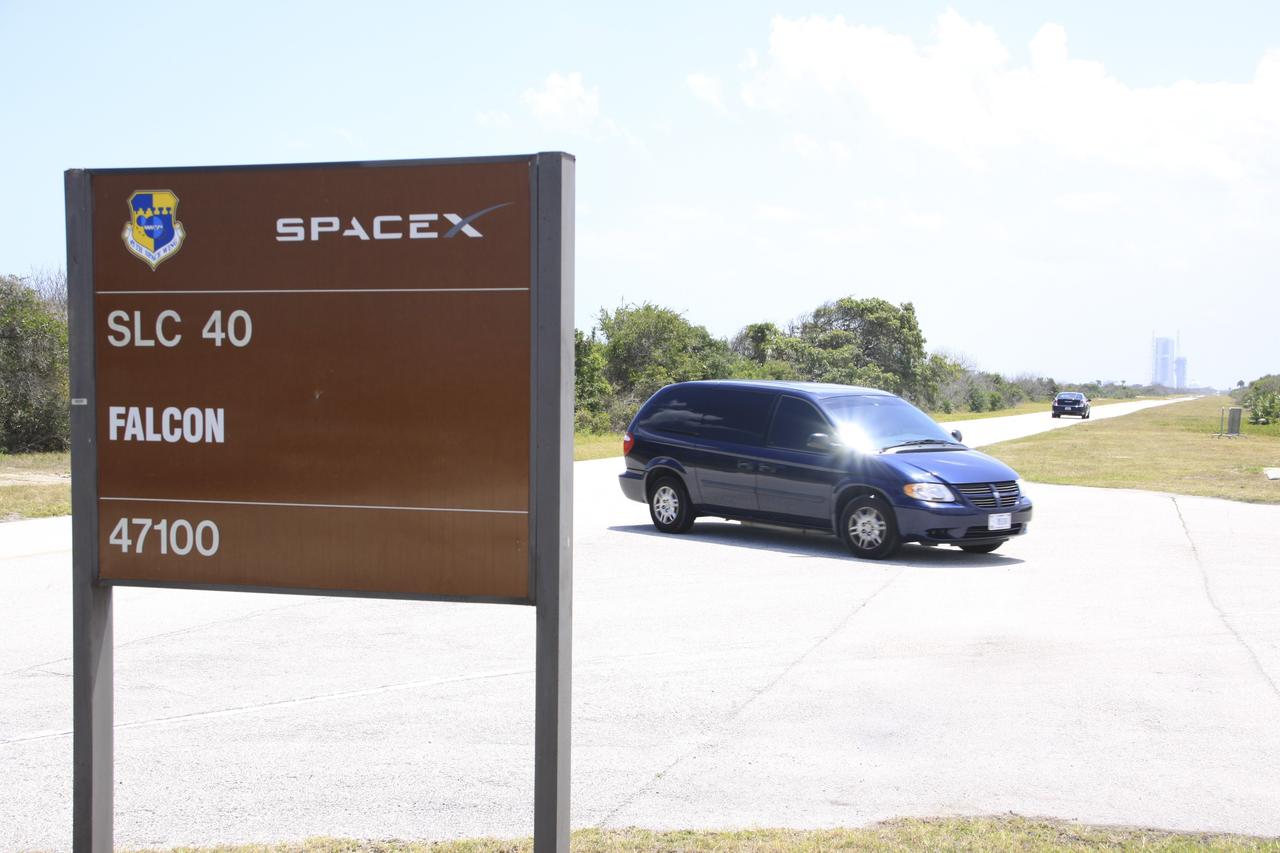
CAPE CANAVERAL, Fla. – The van transporting the cargo bag packed with NanoRacks-CubeLabs Module-9 experiments, arrives at Space Launch Complex-40 on Cape Canaveral Air Force Station in Florida for cold stowage. The bag will be loaded into the Space Exploration Technologies Dragon capsule in preparation for its scheduled April 30 liftoff aboard a Falcon 9 rocket. NanoRacks-CubeLabs Module-9 uses a two-cube unit box for student competition investigations using 15 liquid mixing tube assemblies that function similar to commercial glow sticks. The investigations range from microbial growth to water purification in microgravity. Known as SpaceX, the launch will be the company's second demonstration test flight for NASA's Commercial Orbital Transportation Services program, or COTS. During the flight, the capsule will conduct a series of check-out procedures to test and prove its systems, including rendezvous and berthing with the International Space Station. If the capsule performs as planned, the module and other cargo will be transferred to the station. The cargo includes food, water and provisions for the station’s Expedition crews, such as clothing, batteries and computer equipment. Under COTS, NASA has partnered with two private companies to launch cargo safely to the station. For more information, visit http://www.nasa.gov/spacex. Photo credit: NASA/Jim Grossmann
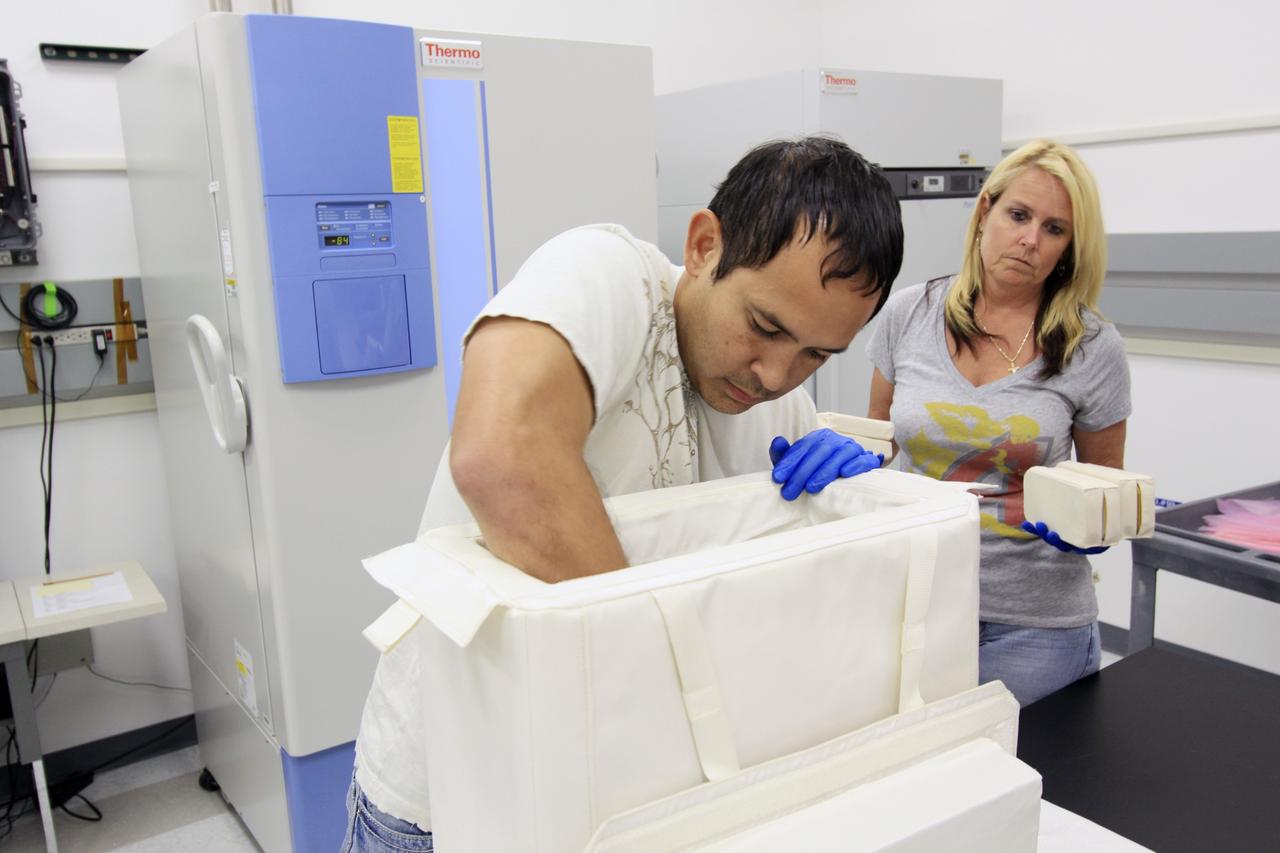
CAPE CANAVERAL, Fla. – In the Space Station Processing Facility at NASA’s Kennedy Space Center in Florida, a cargo bag designed to keep its contents cool is readied to receive the NanoRacks-CubeLabs Module-9 experiments. The module’s experiments requiring cold stowage are being prepared for transport to Space Launch Complex-40 on nearby Cape Canaveral Air Force Station. There, the bags will be loaded into the Space Exploration Technologies Dragon capsule in preparation for its scheduled April 30 liftoff aboard a Falcon 9 rocket. NanoRacks-CubeLabs Module-9 uses a two-cube unit box for student competition investigations using 15 liquid mixing tube assemblies that function similar to commercial glow sticks. The investigations range from microbial growth to water purification in microgravity. Known as SpaceX, the launch will be the company's second demonstration test flight for NASA's Commercial Orbital Transportation Services program, or COTS. During the flight, the capsule will conduct a series of check-out procedures to test and prove its systems, including rendezvous and berthing with the International Space Station. If the capsule performs as planned, the module and other cargo will be transferred to the station. The cargo includes food, water and provisions for the station’s Expedition crews, such as clothing, batteries and computer equipment. Under COTS, NASA has partnered with two private companies to launch cargo safely to the station. For more information, visit http://www.nasa.gov/spacex. Photo credit: NASA/Jim Grossmann
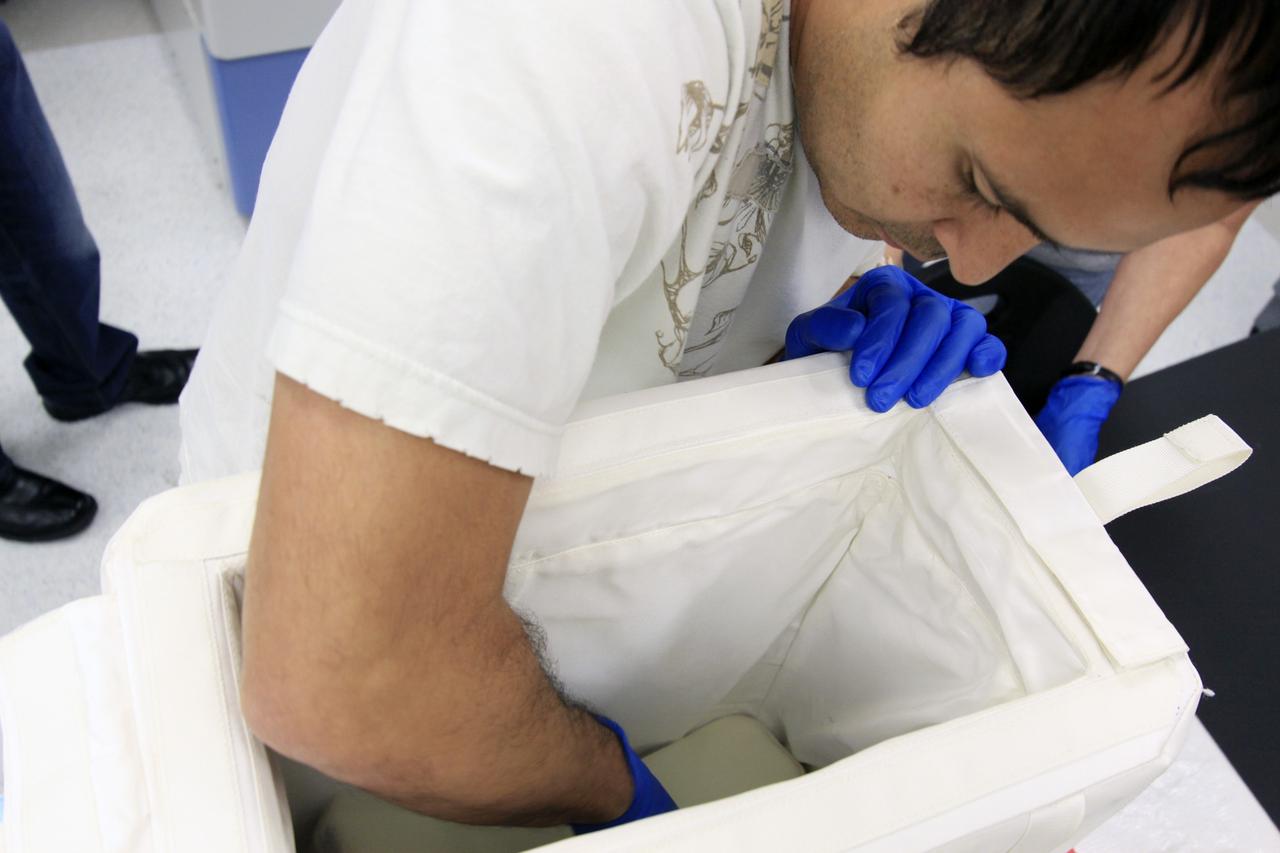
CAPE CANAVERAL, Fla. – In the Space Station Processing Facility at NASA’s Kennedy Space Center in Florida, the NanoRacks-CubeLabs Module-9 experiments requiring refrigeration are placed in a cargo bag designed to keep its contents cool. The module’s experiments requiring cold stowage are being prepared for transport to Space Launch Complex-40 on nearby Cape Canaveral Air Force Station. There, the bags will be loaded into the Space Exploration Technologies Dragon capsule in preparation for its scheduled April 30 liftoff aboard a Falcon 9 rocket. NanoRacks-CubeLabs Module-9 uses a two-cube unit box for student competition investigations using 15 liquid mixing tube assemblies that function similar to commercial glow sticks. The investigations range from microbial growth to water purification in microgravity. Known as SpaceX, the launch will be the company's second demonstration test flight for NASA's Commercial Orbital Transportation Services program, or COTS. During the flight, the capsule will conduct a series of check-out procedures to test and prove its systems, including rendezvous and berthing with the International Space Station. If the capsule performs as planned, the module and other cargo will be transferred to the station. The cargo includes food, water and provisions for the station’s Expedition crews, such as clothing, batteries and computer equipment. Under COTS, NASA has partnered with two private companies to launch cargo safely to the station. For more information, visit http://www.nasa.gov/spacex. Photo credit: NASA/Jim Grossmann
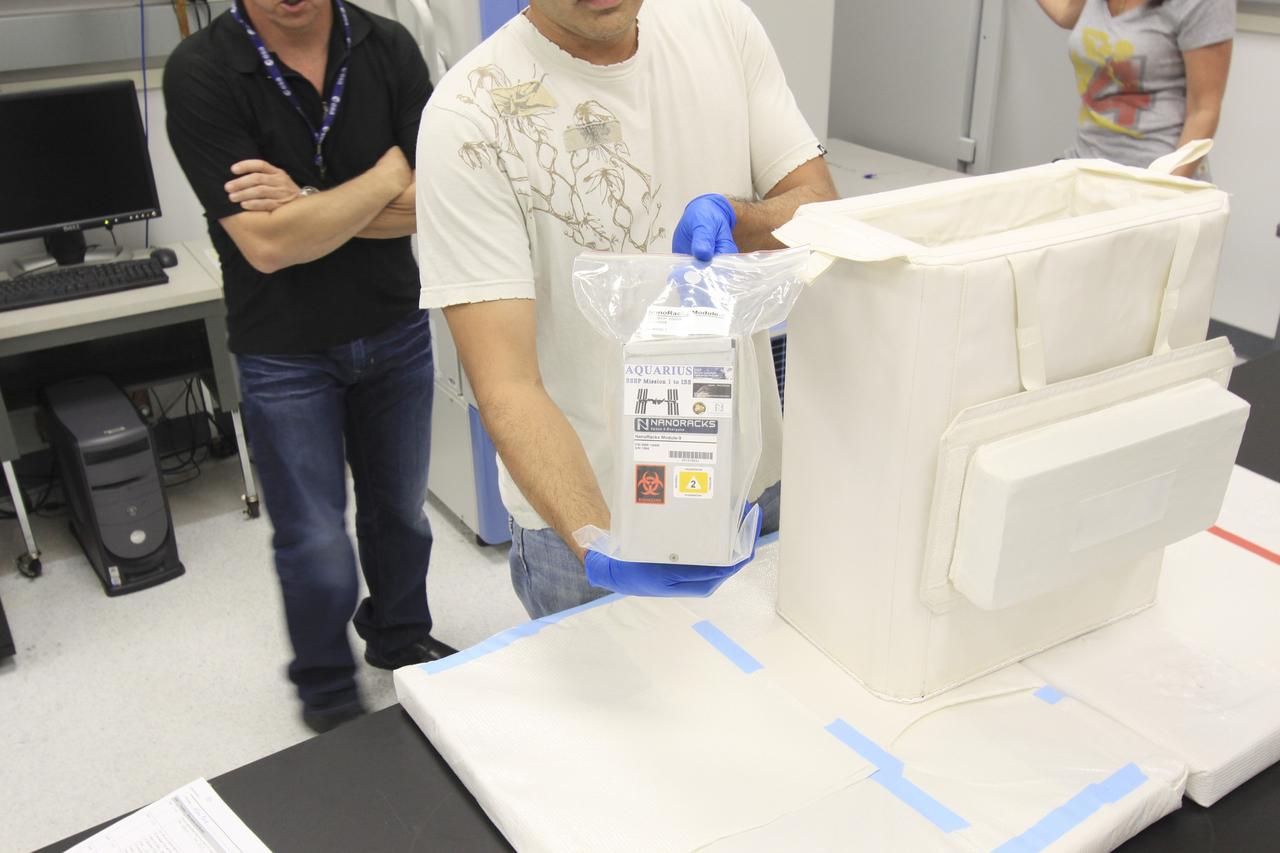
CAPE CANAVERAL, Fla. – In the Space Station Processing Facility at NASA’s Kennedy Space Center in Florida, the NanoRacks-CubeLabs Module-9 experiments requiring refrigeration are prepared for placement in a cargo bag designed to keep its contents cool. The module’s experiments requiring cold stowage are being prepared for transport to Space Launch Complex-40 on nearby Cape Canaveral Air Force Station. There, the bags will be loaded into the Space Exploration Technologies Dragon capsule in preparation for its scheduled April 30 liftoff aboard a Falcon 9 rocket. NanoRacks-CubeLabs Module-9 uses a two-cube unit box for student competition investigations using 15 liquid mixing tube assemblies that function similar to commercial glow sticks. The investigations range from microbial growth to water purification in microgravity. Known as SpaceX, the launch will be the company's second demonstration test flight for NASA's Commercial Orbital Transportation Services program, or COTS. During the flight, the capsule will conduct a series of check-out procedures to test and prove its systems, including rendezvous and berthing with the International Space Station. If the capsule performs as planned, the module and other cargo will be transferred to the station. The cargo includes food, water and provisions for the station’s Expedition crews, such as clothing, batteries and computer equipment. Under COTS, NASA has partnered with two private companies to launch cargo safely to the station. For more information, visit http://www.nasa.gov/spacex. Photo credit: NASA/Jim Grossmann