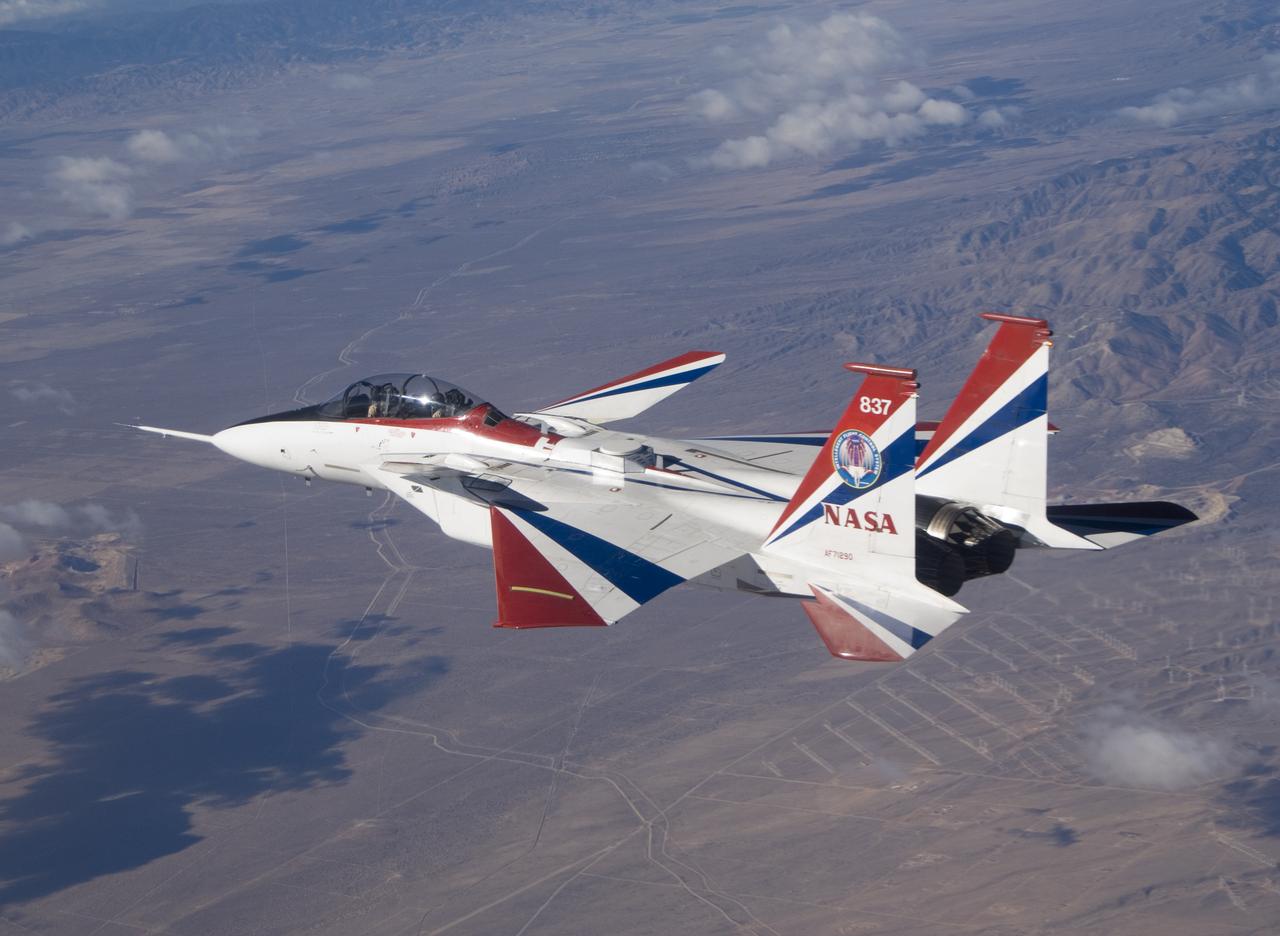
New range safety and range user system antennas for the ECANS project can be seen just behind and to the left of the cockpit on NASA's NF-15B research aircraft.
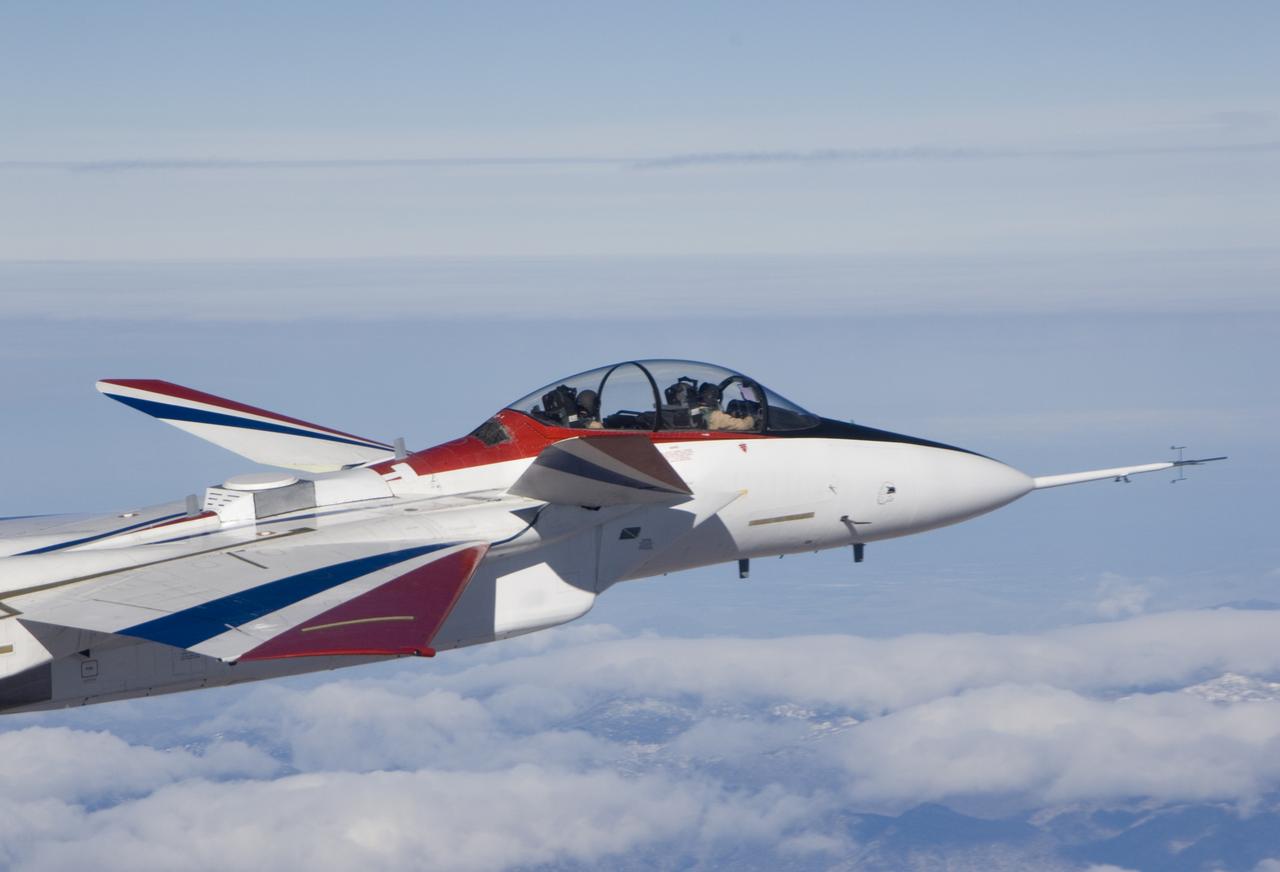
Range safety and phased-array range user system antennas validated in the ECANS project can be seen just behind the cockpit on NASA's NF-15B research aircraft.
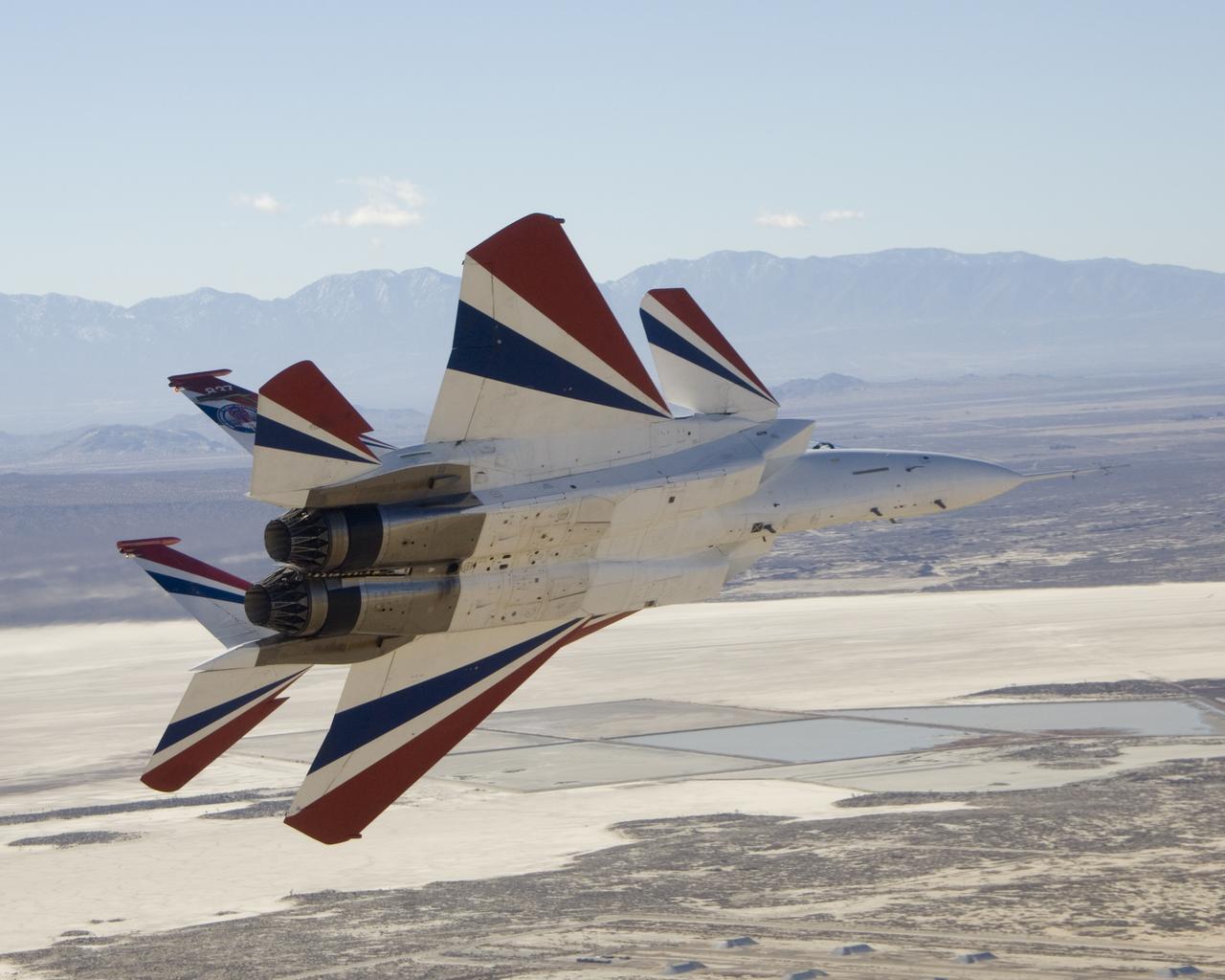
Two small Range Safety System antennas are located just behind the engine inlets of NASA's NF-15B research aircraft as it banks away from the chase plane.

Employees at NASA’s Kennedy Space Center in Florida participate in the Safety and Health days activities on Thursday, May 9, 2024. The agency’s Safety and Health days took place the week of May 6-10 to show the NASA’s commitment to the safety and health of the entire workforce, and various organizations provided interactive exhibits and information on a range of safety and health issues.
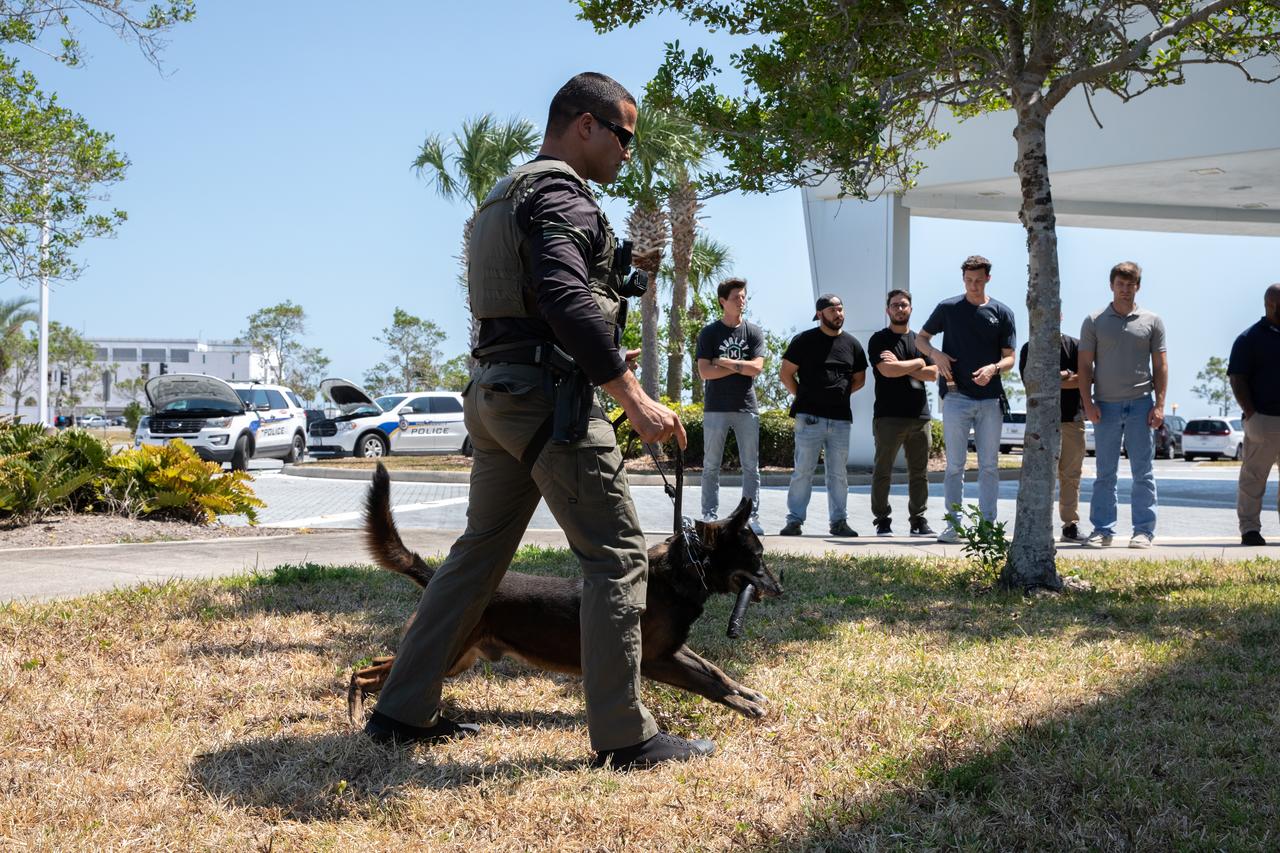
Employees at NASA’s Kennedy Space Center in Florida participate in the Safety and Health days activities on Thursday, May 9, 2024. The agency’s Safety and Health days took place the week of May 6-10 to show the NASA’s commitment to the safety and health of the entire workforce, and various organizations provided interactive exhibits and information on a range of safety and health issues.
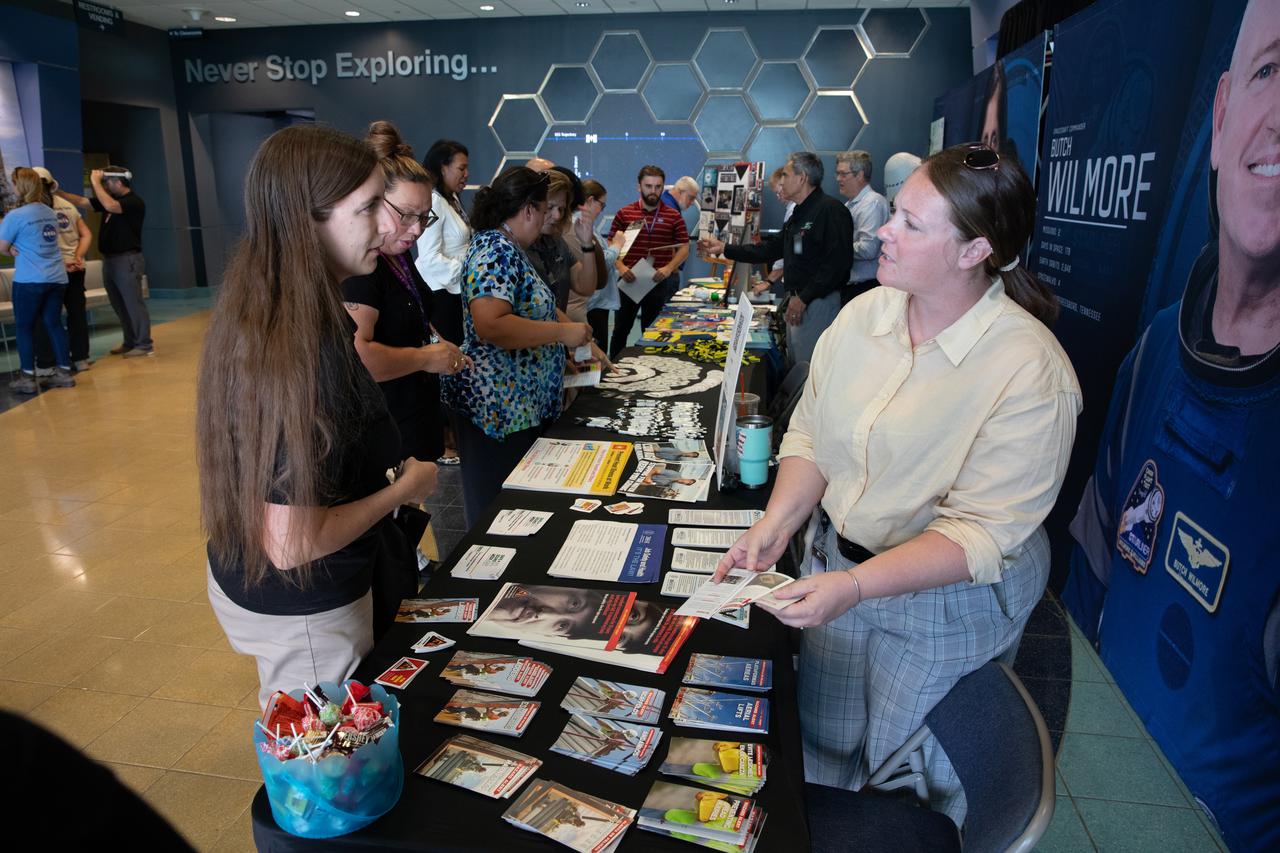
Employees at NASA’s Kennedy Space Center in Florida participate in the Safety and Health days activities on Thursday, May 9, 2024. The agency’s Safety and Health days took place the week of May 6-10 to show the NASA’s commitment to the safety and health of the entire workforce, and various organizations provided interactive exhibits and information on a range of safety and health issues.
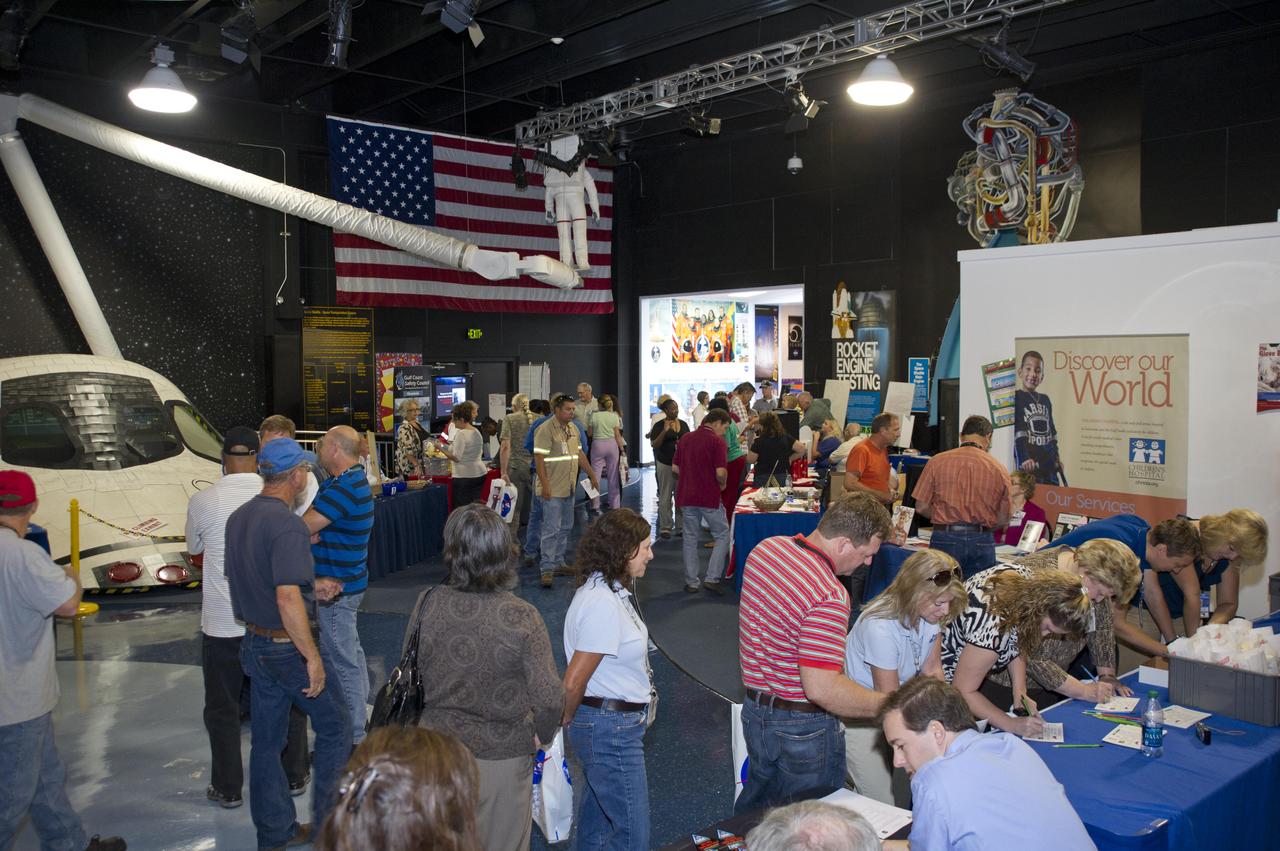
Employees at NASA's John C. Stennis Space Center participated in 2012 Safety and Health Day activities Aug. 21. Various organizations provided interactive exhibits and information on a range of safety and health issues. During large group presentations, Brad Gardner also spoke about losing part of his right arm to an industrial accident in 2003 and what it has taught him about preventing accidents. Gardner served 22 years in the U.S. Air Force and has a background in safety management.
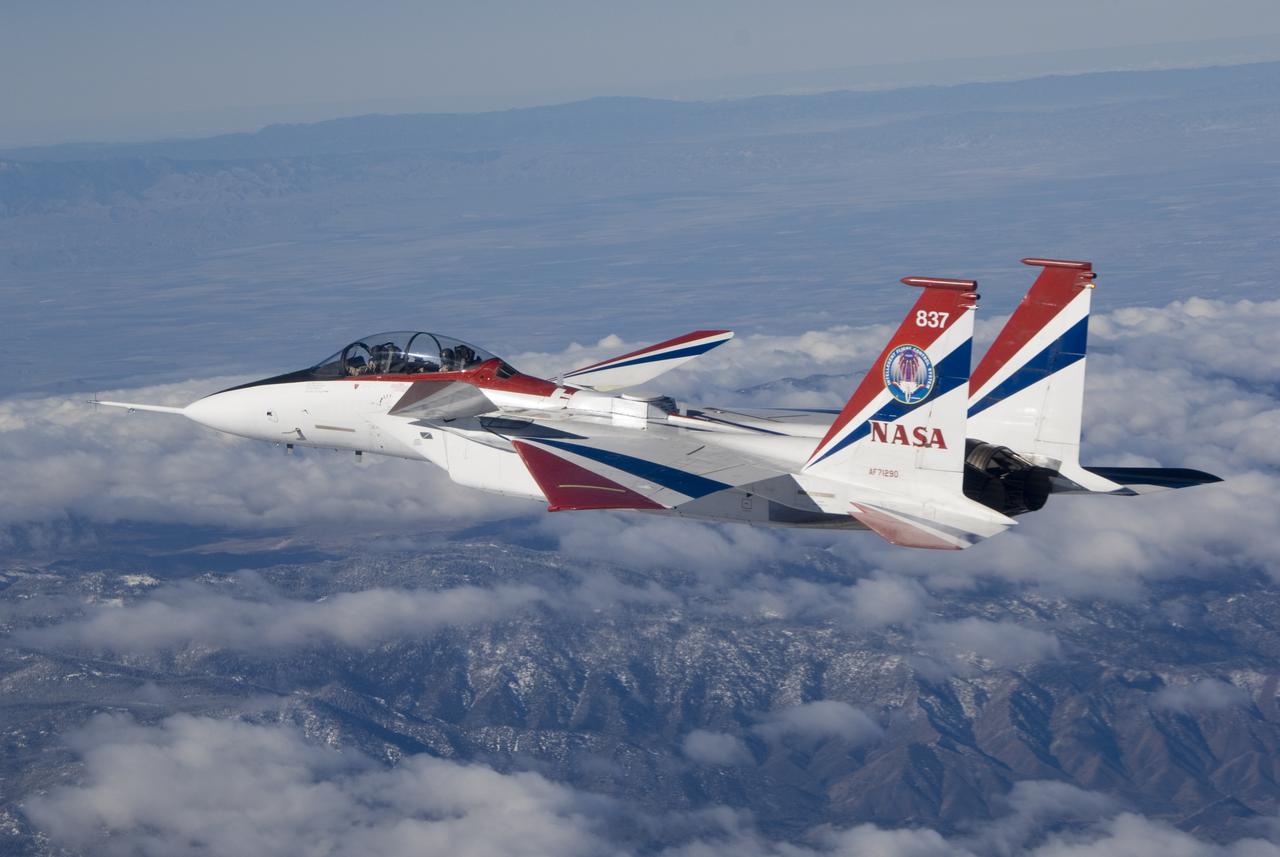
Antennas used for the Space-Based Range Demonstration and Certification project protrude from the top of NASA's NF-15B testbed during a research flight.
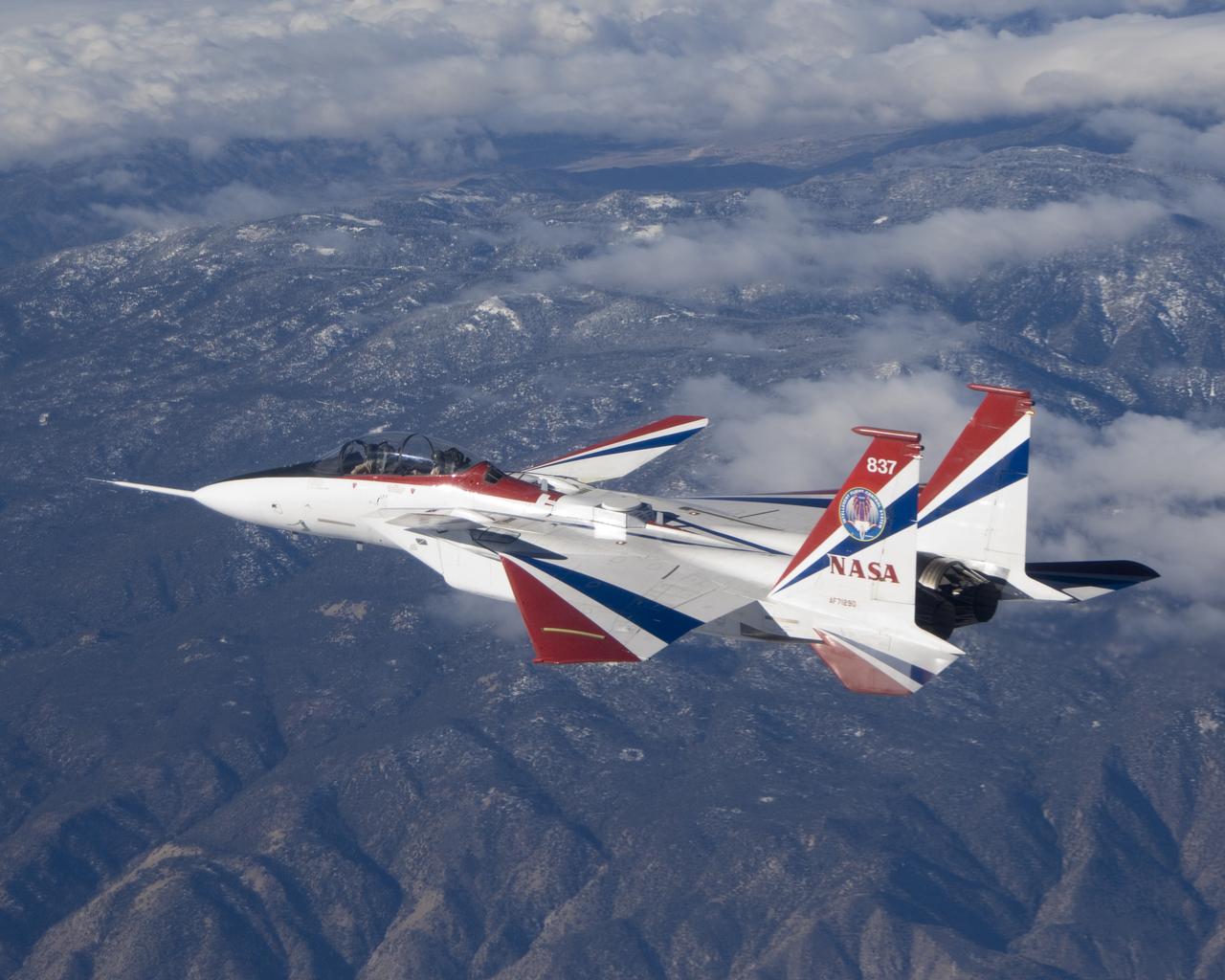
The jagged ridges of Southern California's Tehachapi Mountains form the backdrop to NASA's brightly-colored NF-15B testbed aircraft during a research mission.
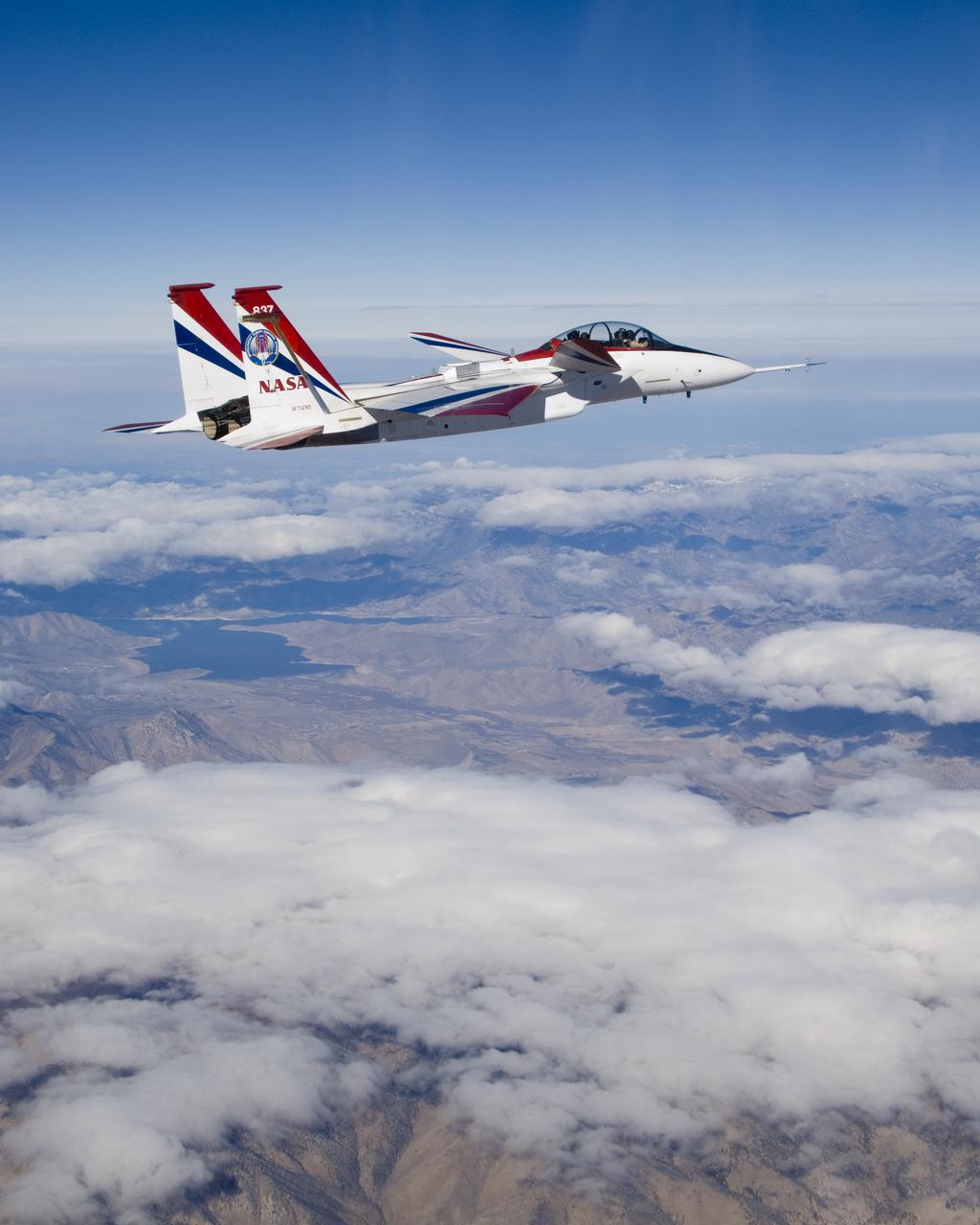
NASA's highly modified NF-15B research aircraft cruises over Southern California's Tehachapi Mountains near Lake Isabella during a research mission.
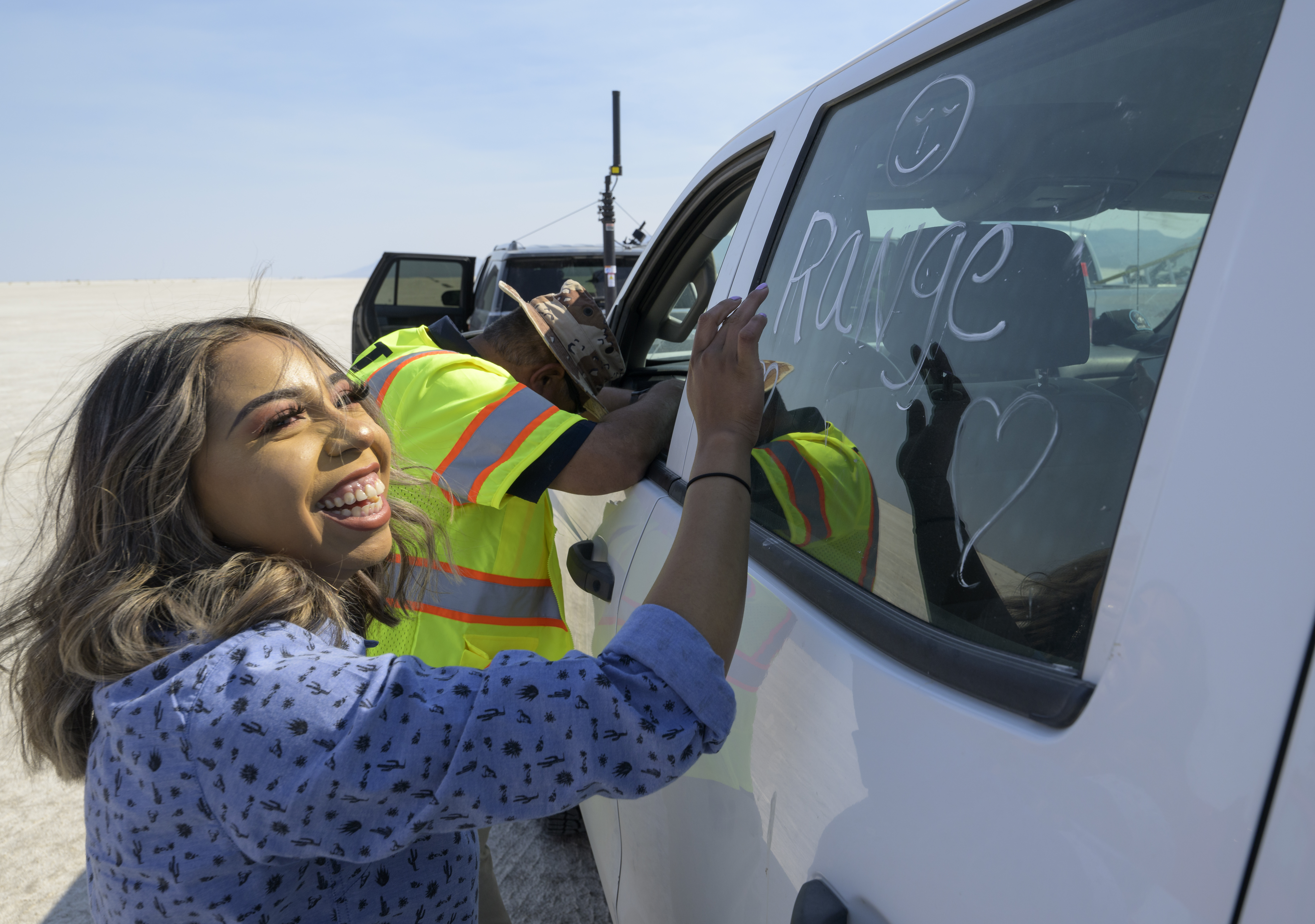
A member of the range safety team labels her convoy vehicle as they prepare for the landing of Boeing’s CST-100 Starliner spacecraft at White Sands Missile Range’s Space Harbor, Wednesday, May 25, 2022, in New Mexico. Boeing’s Orbital Flight Test-2 (OFT-2) is Starliner’s second uncrewed flight test to the International Space Station as part of NASA's Commercial Crew Program. OFT-2 serves as an end-to-end test of the system's capabilities. Photo Credit: (NASA/Bill Ingalls)
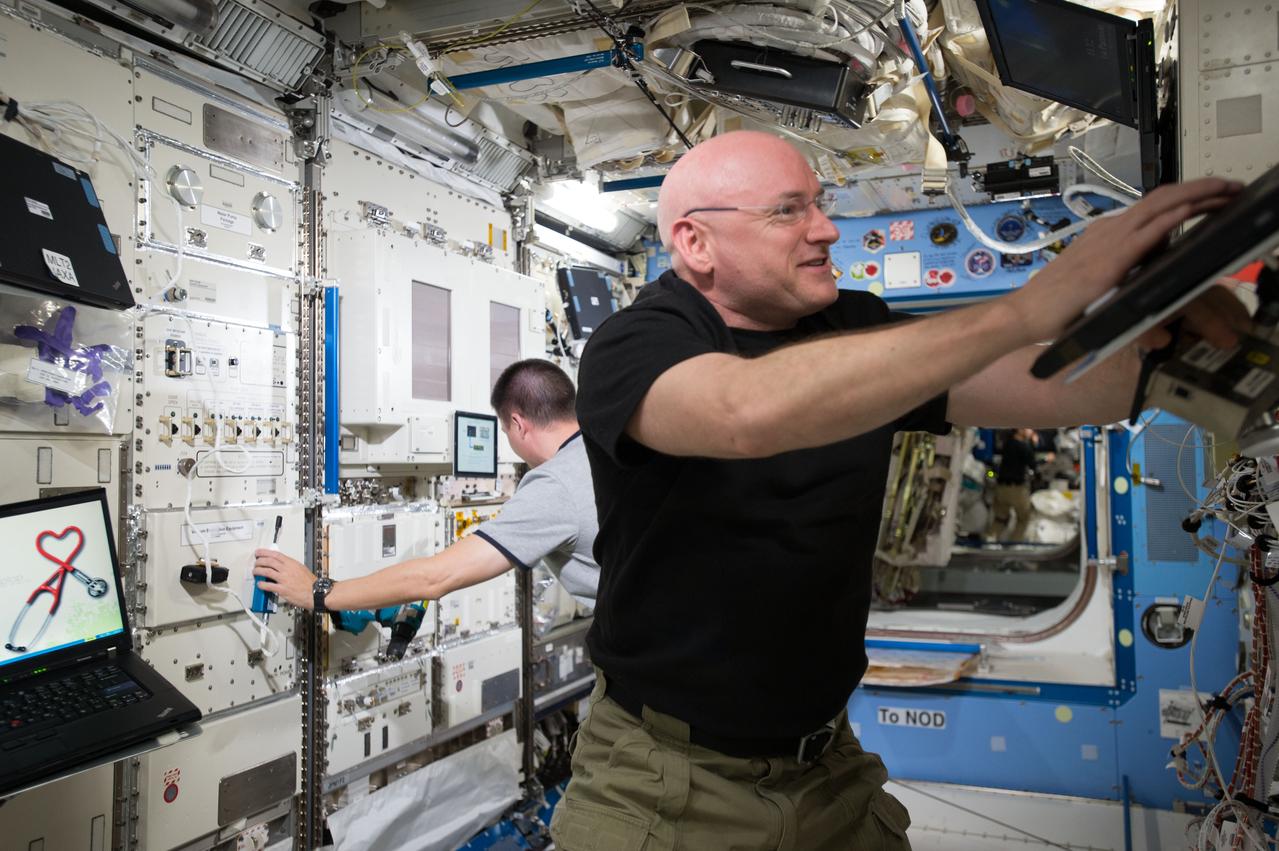
ISS044E079682 (09/01/2015) --- NASA Astronaut Scott Kelly works inside the U.S. Destiny Laboratory. Destiny is the primary research laboratory for U.S. payloads, supporting a wide range of experiments and studies contributing to health, safety and quality of life for people all over the world.
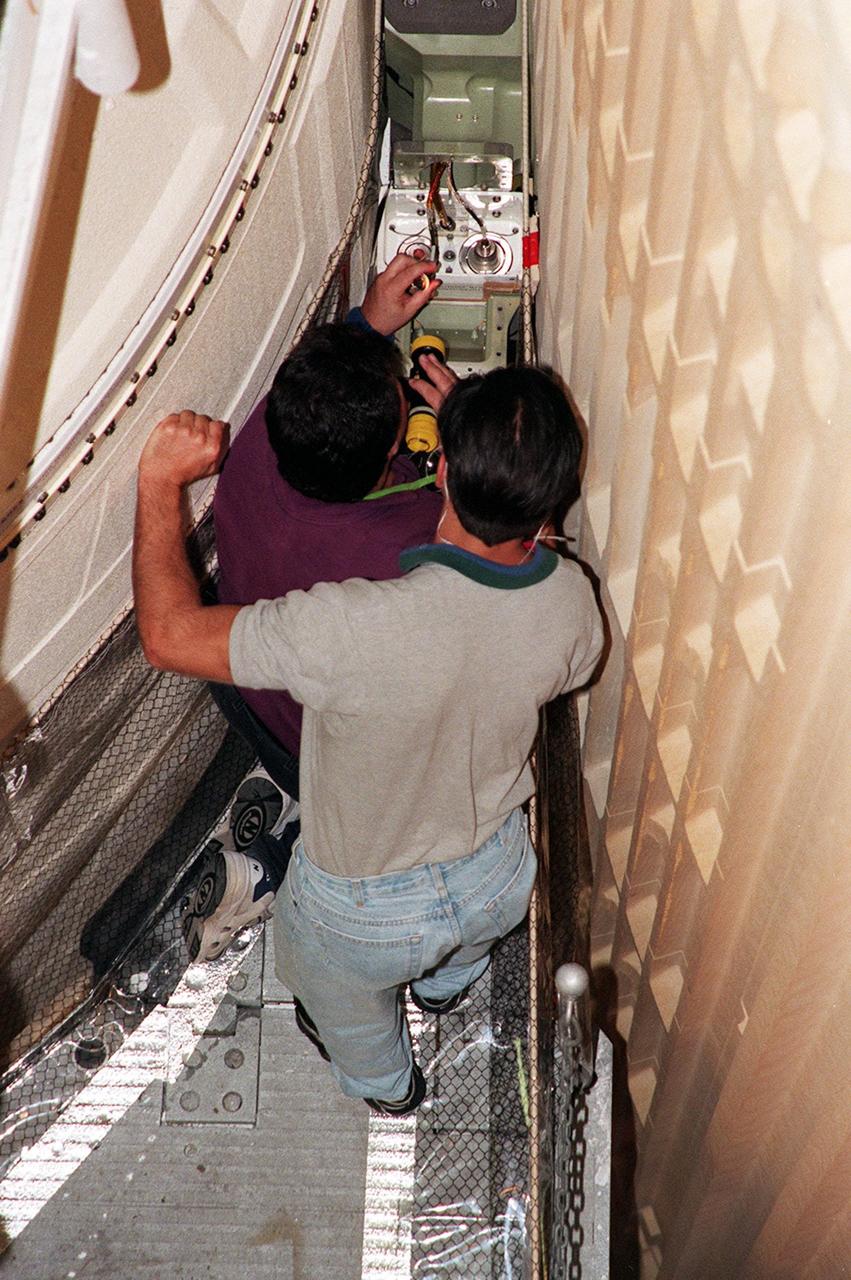
KENNEDY SPACE CENTER, FLA. -- Terry Kent (left), United Space Alliance, and James Silviano (right), NASA, inspect the range safety cable between the external tank and solid rocket boosters (SRB) on Space Shuttle Discovery. The cable, which relays a redundant emergency destruction signal between the SRBs in the unlikely event of a contingency, was damaged during close-out operations and is being replaced. Discovery's processing schedule leads to a target launch date of Dec. 6
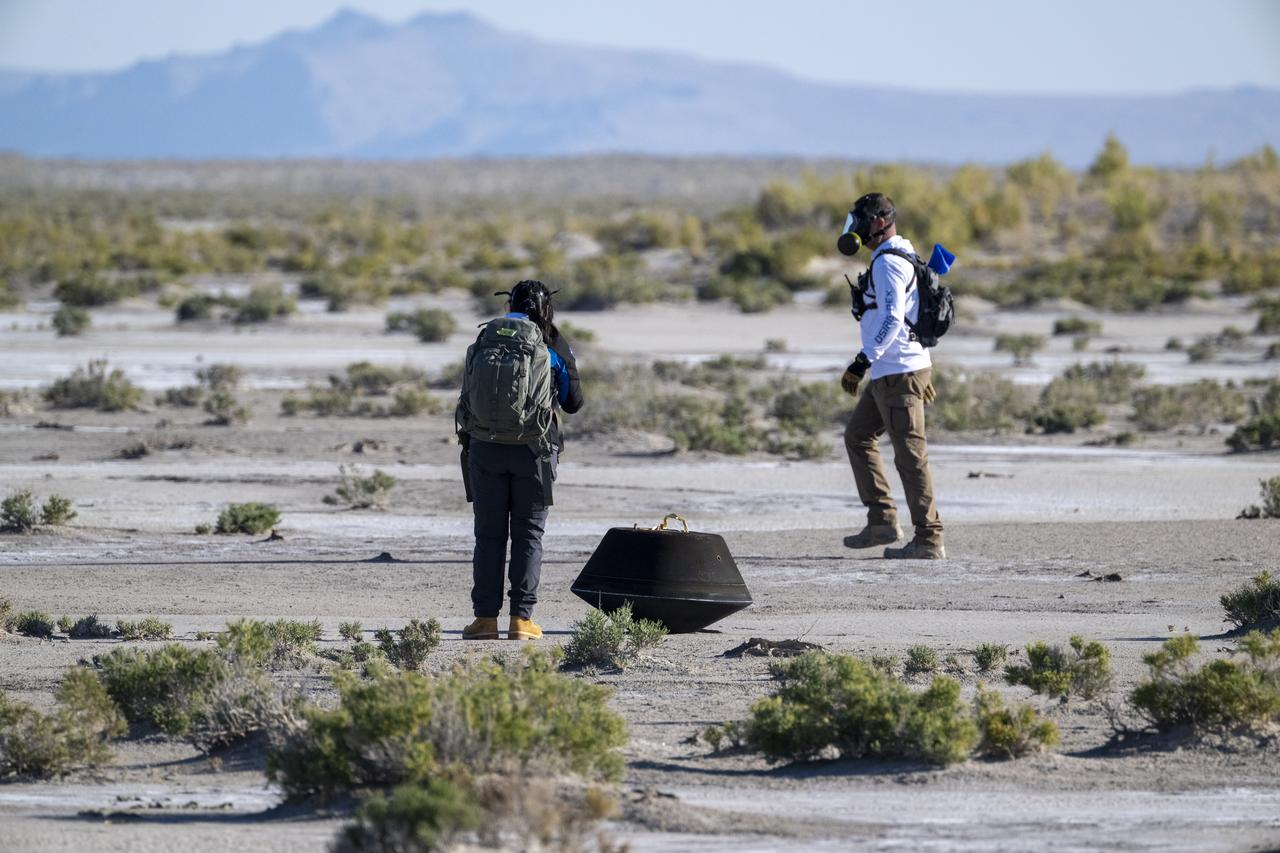
Lockheed Martin System Safety Engineer Victoria Thiem, left, and On Scene Commander of Recovery Stuart Wylie, right, perform preliminary checks on the sample return capsule from NASA’s OSIRIS-REx mission, Sunday, Sept. 24, 2023, shortly after the capsule landed at the Department of Defense's Utah Test and Training Range. The sample was collected from the asteroid Bennu in October 2020 by NASA’s OSIRIS-REx spacecraft. Photo Credit: (NASA/Keegan Barber)
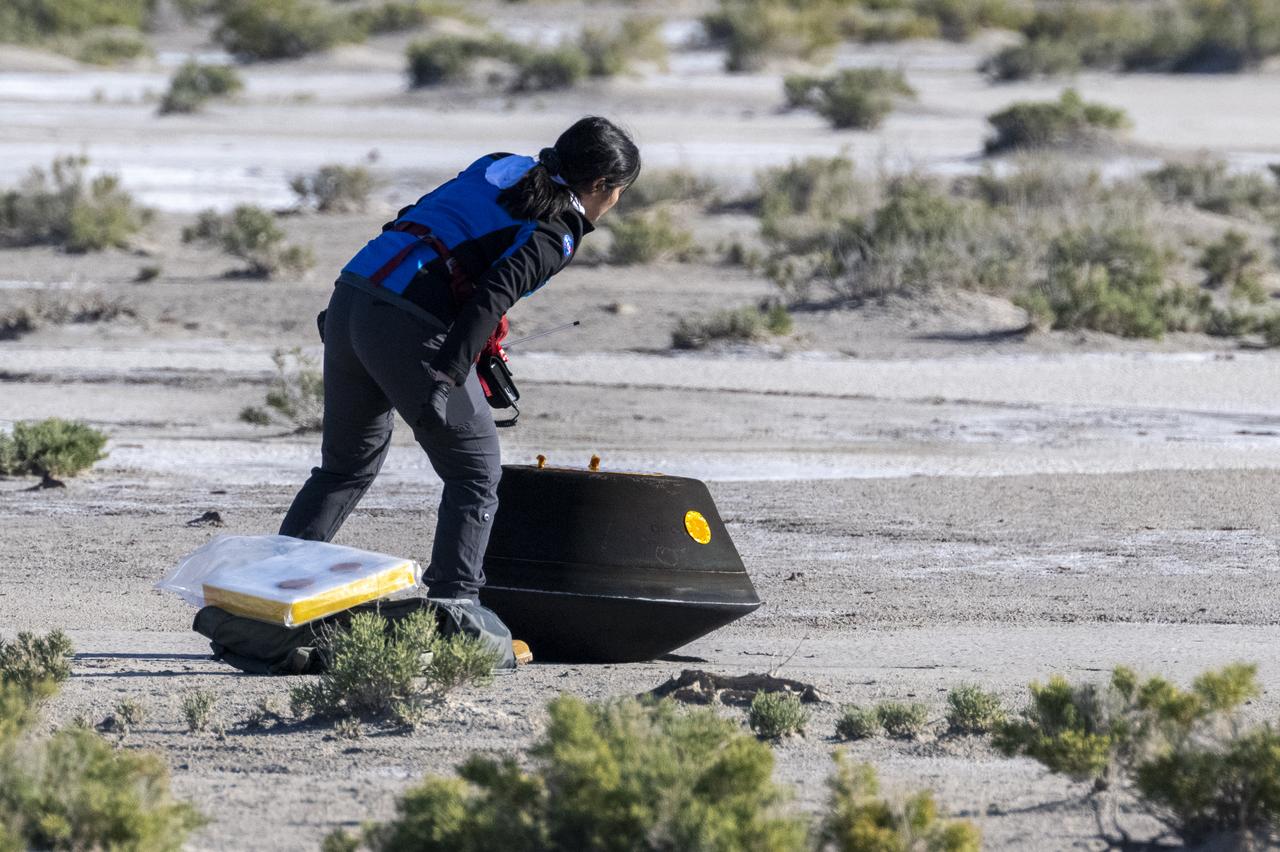
Lockheed Martin System Safety Engineer Victoria Thiem performs preliminary checks on the sample return capsule from NASA’s OSIRIS-REx mission, Sunday, Sept. 24, 2023, shortly after the capsule landed at the Department of Defense's Utah Test and Training Range. The sample was collected from the asteroid Bennu in October 2020 by NASA’s OSIRIS-REx spacecraft. Photo Credit: (NASA/Keegan Barber)
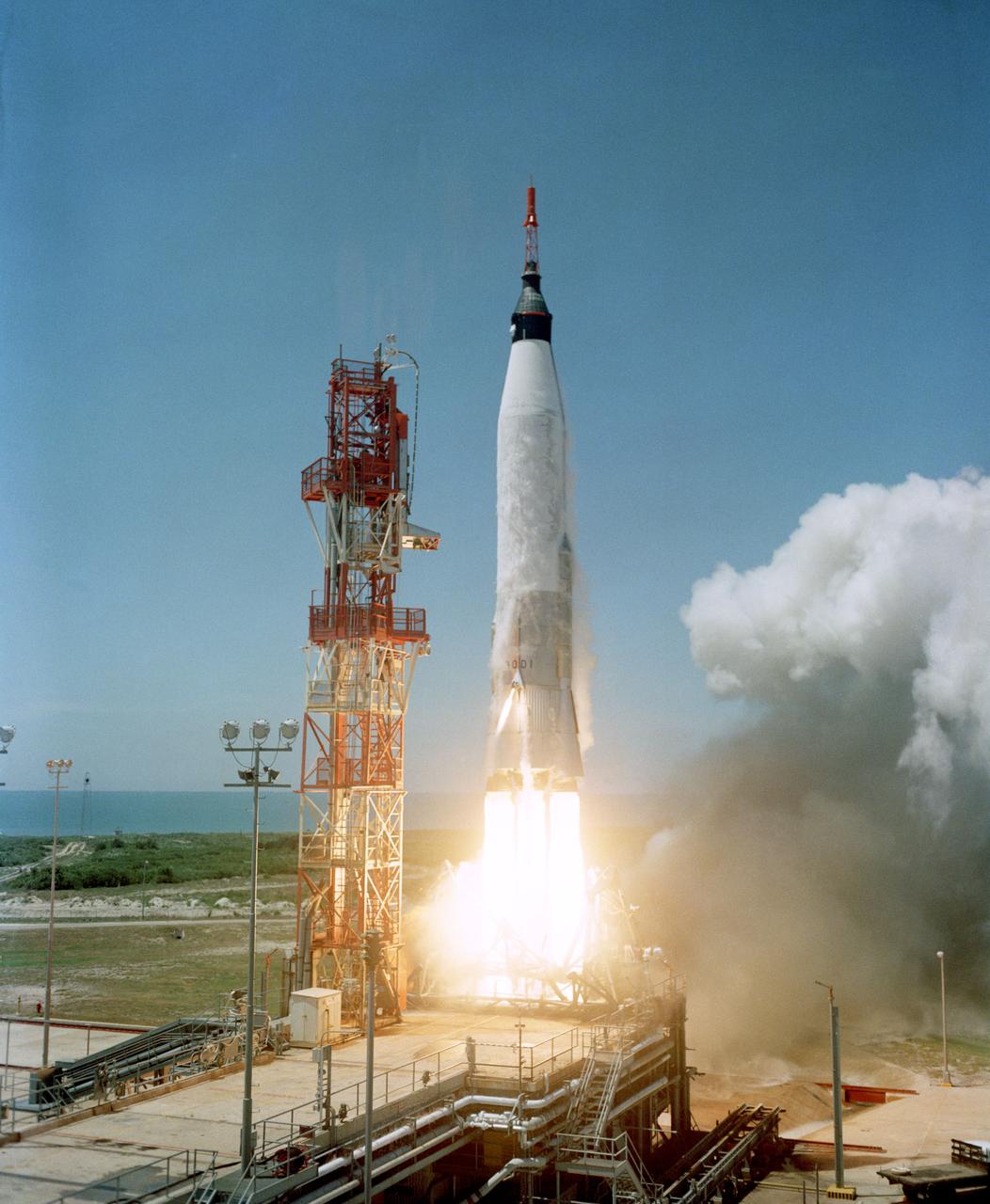
S61-01925 (25 April 1961) --- View of the Mercury-Atlas 3 (MA-3) liftoff from Cape Canaveral, Florida on April 25, 1961. The orbital test flight of the Mercury capsule did not achieve orbit and was destroyed after 40 seconds by Range Safety Officer when the inertial guidance system failed to pitch the vehicle over toward the horizon. Photo credit: NASA
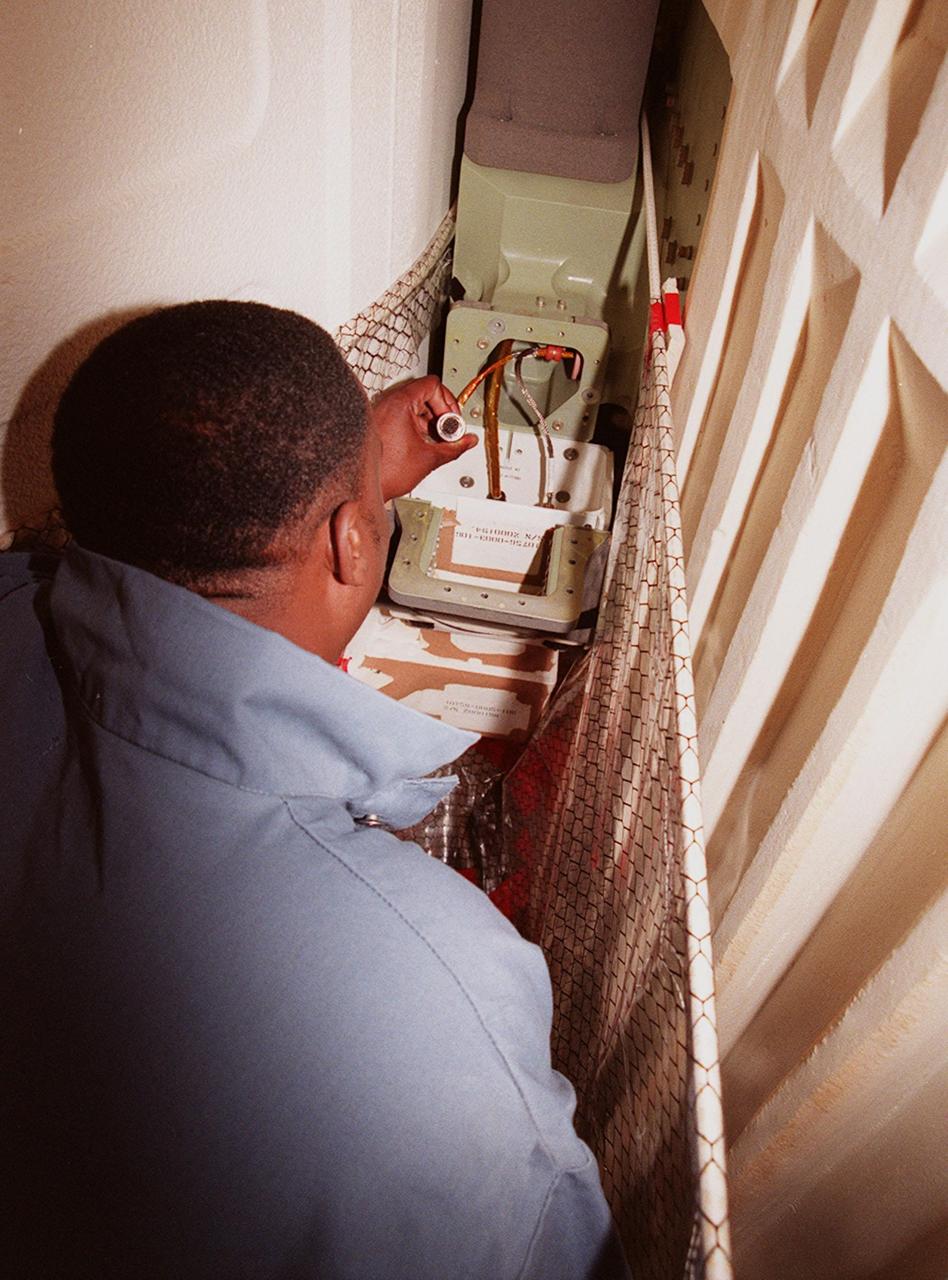
KENNEDY SPACE CENTER, FLA. -- Rodney Wilson, with United Space Alliance, inspects the range safety cable between the external tank and solid rocket boosters (SRB) on Space Shuttle Discovery. The cable, which relays a redundant emergency destruction signal between the SRBs in the unlikely event of a contingency, was damaged during close-out operations and is being replaced. Discovery's processing schedule leads to a target launch date of Dec. 6

KENNEDY SPACE CENTER, FLA. -- James Silviano (bottom), NASA, examines the range safety cable between the external tank and solid rocket boosters (SRB) on Space Shuttle Discovery, while Terry Kent (above), United Space Alliance, looks on. The cable, which relays a redundant emergency destruction signal between the SRBs in the unlikely event of a contingency, was damaged during close-out operations and is being replaced. Discovery's processing schedule leads to a target launch date of Dec. 6
![Engineers and technicians in the control room at the Dryden Flight Research Center must constantly monitor critical operations and checks during research projects like NASA's hypersonic X-43A. Visible in the photo, taken two days before the X-43's captive carry flight in January 2004, are [foreground to background]; Tony Kawano (Range Safety Officer), Brad Neal (Mission Controller), and Griffin Corpening (Test Conductor).](https://images-assets.nasa.gov/image/ED04-0019-10/ED04-0019-10~medium.jpg)
Engineers and technicians in the control room at the Dryden Flight Research Center must constantly monitor critical operations and checks during research projects like NASA's hypersonic X-43A. Visible in the photo, taken two days before the X-43's captive carry flight in January 2004, are [foreground to background]; Tony Kawano (Range Safety Officer), Brad Neal (Mission Controller), and Griffin Corpening (Test Conductor).
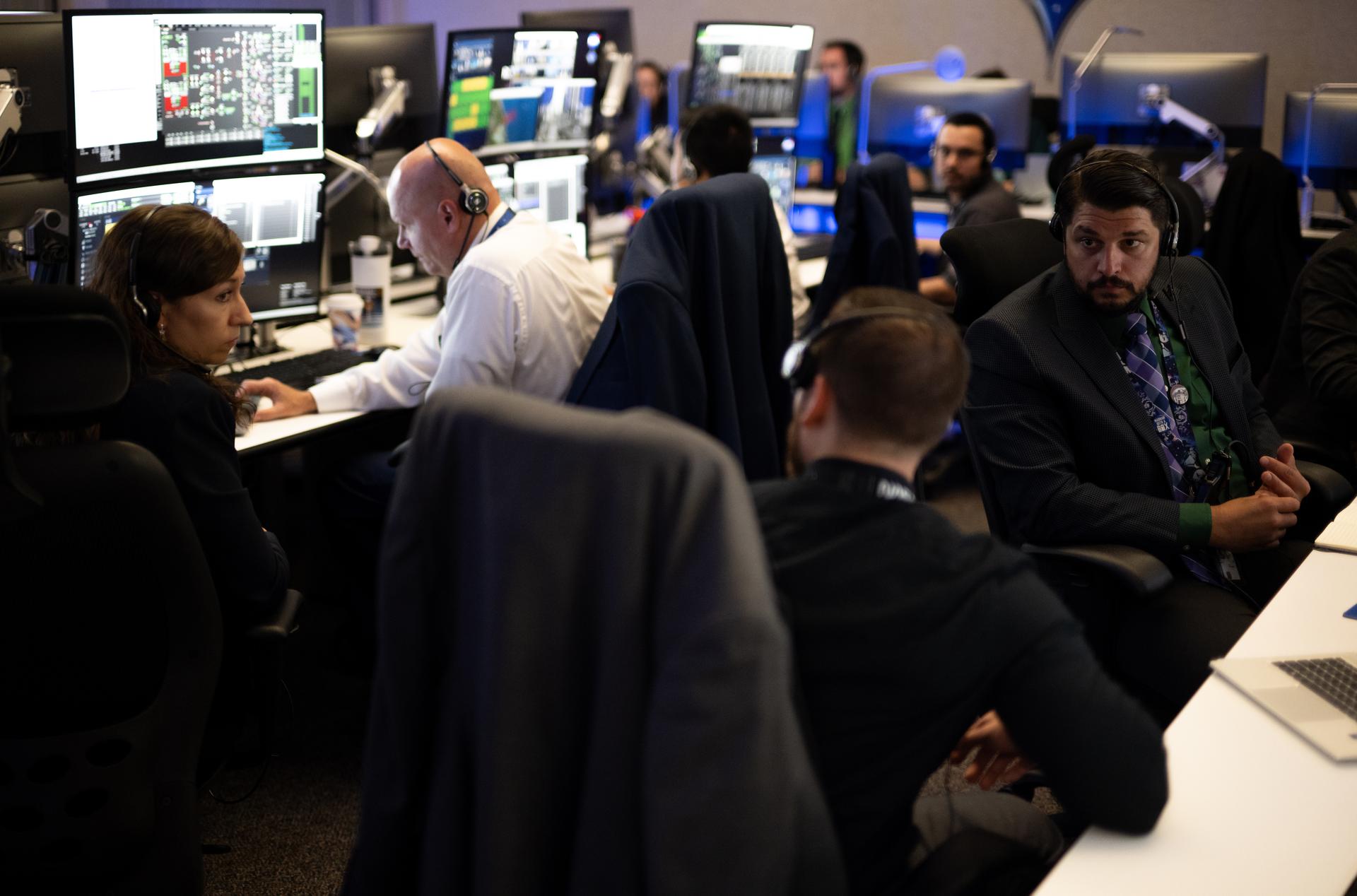
Theresa Trzupek, a mission assurance engineer at NASA’s Kennedy Space Center, left, confers with Bobby Hughes, a safety and mission assurance engineer and NASA’s Kennedy Space Center, center, and Casey Quinn, a safety and mission assurance engineer at NASA’s Kennedy Space Center, right, as they monitor the countdown inside Hangar AE at Cape Canaveral Space Force Station for the launch of a SpaceX Falcon Heavy rocket with NASA’S Nancy Grace Roman Space Telescope from Launch Complex 39A at NASA’s Kennedy Space Center, Sunday, Aug. 30, 2026, in Florida. Roman will investigate dark energy and dark matter, conduct a statistical census of planetary systems, and enable a broad range of additional astrophysics research. Launch occurred at 7:26 a.m. EDT. Photo Credit (NASA/Joel Kowsky)

Inside the Vehicle Assembly Building, an overhead crane moves the forward section of a solid rocket booster (SRB) toward the previously stacked elements at lower left in the photo. The forward section of each booster, from nose cap to forward skirt contains avionics, a sequencer, forward separation motors, a nose cone separation system, drogue and main parachutes, a recovery beacon, a recovery light, a parachute camera on selected flights and a range safety system. Each SRB weighs approximately 1.3 million pounds at launch. The SRB is part of the stack for Space Shuttle Discovery and the STS-92 mission, scheduled for launch Oct. 5, from Launch Pad 39A, on the fifth flight to the International Space Station
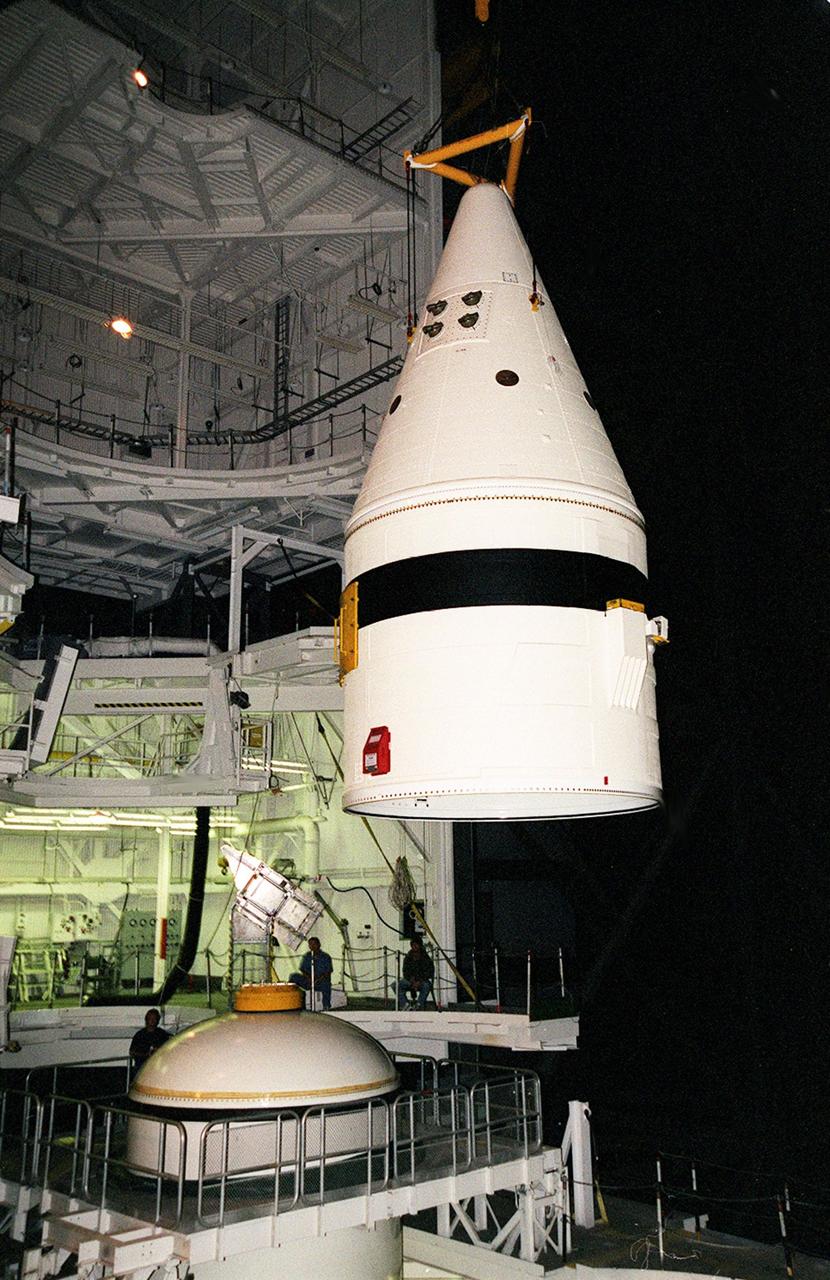
Inside the Vehicle Assembly Building, an overhead crane moves the forward section of a solid rocket booster (SRB) toward the previously stacked elements at lower left in the photo. The forward section of each booster, from nose cap to forward skirt contains avionics, a sequencer, forward separation motors, a nose cone separation system, drogue and main parachutes, a recovery beacon, a recovery light, a parachute camera on selected flights and a range safety system. Each SRB weighs approximately 1.3 million pounds at launch. The SRB is part of the stack for Space Shuttle Discovery and the STS-92 mission, scheduled for launch Oct. 5, from Launch Pad 39A, on the fifth flight to the International Space Station
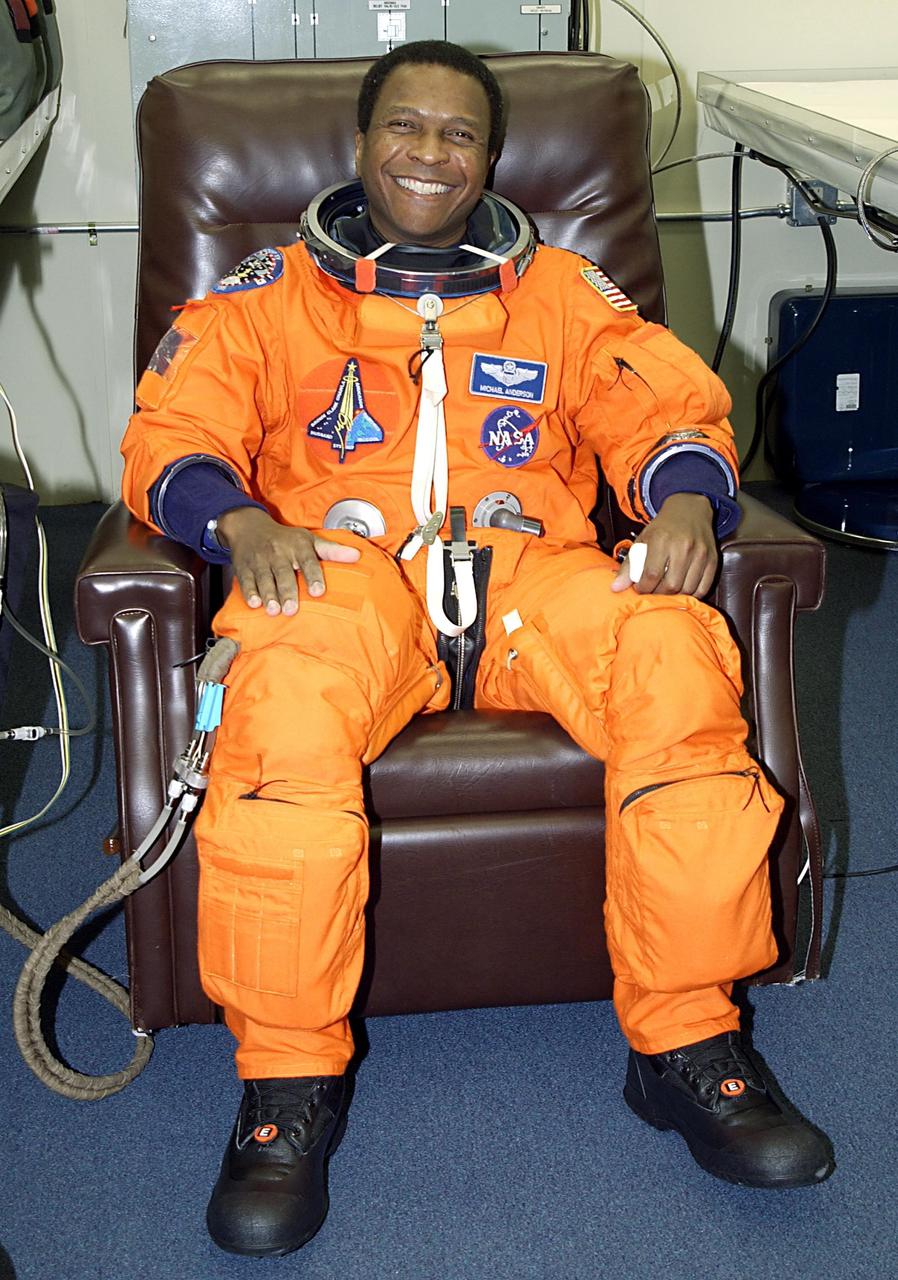
KENNEDY SPACE CENTER, FLA. - STS-107 Payload Commander Michael Anderson is happy to being suiting up for launch on mission STS-107. The mission is devoted to research and will include more than 80 experiments that will study Earth and space science, advanced technology development, and astronaut health and safety. The payload on Space Shuttle Columbia includes FREESTAR (Fast Reaction Experiments Enabling Science, Technology, Applications and Research) and the SHI Research Double Module (SHI/RDM), known as SPACEHAB. Experiments on the module range from material sciences to life sciences. Liftoff is scheduled for 10:39 a.m. EST.
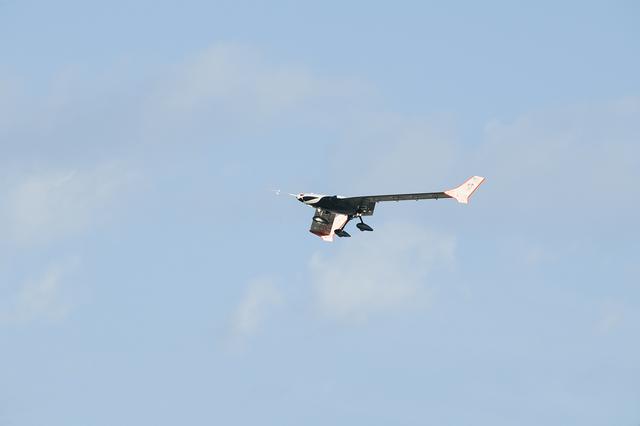
Long, thin, high-aspect-ratio wings are considered crucial to the design of future long-range aircraft, including fuel-efficient airliners and cargo transports. Unlike the short, stiff wings found on most aircraft today, slender, flexible airfoils are susceptible to uncontrollable vibrations, known as flutter, and may be stressed by bending forces from wind gusts and atmospheric turbulence. To improve ride quality, efficiency, safety, and the long-term health of flexible aircraft structures, NASA is using the X-56A Multi-Utility Technology Testbed (MUTT) to investigate key technologies for active flutter suppression and gust-load alleviation.
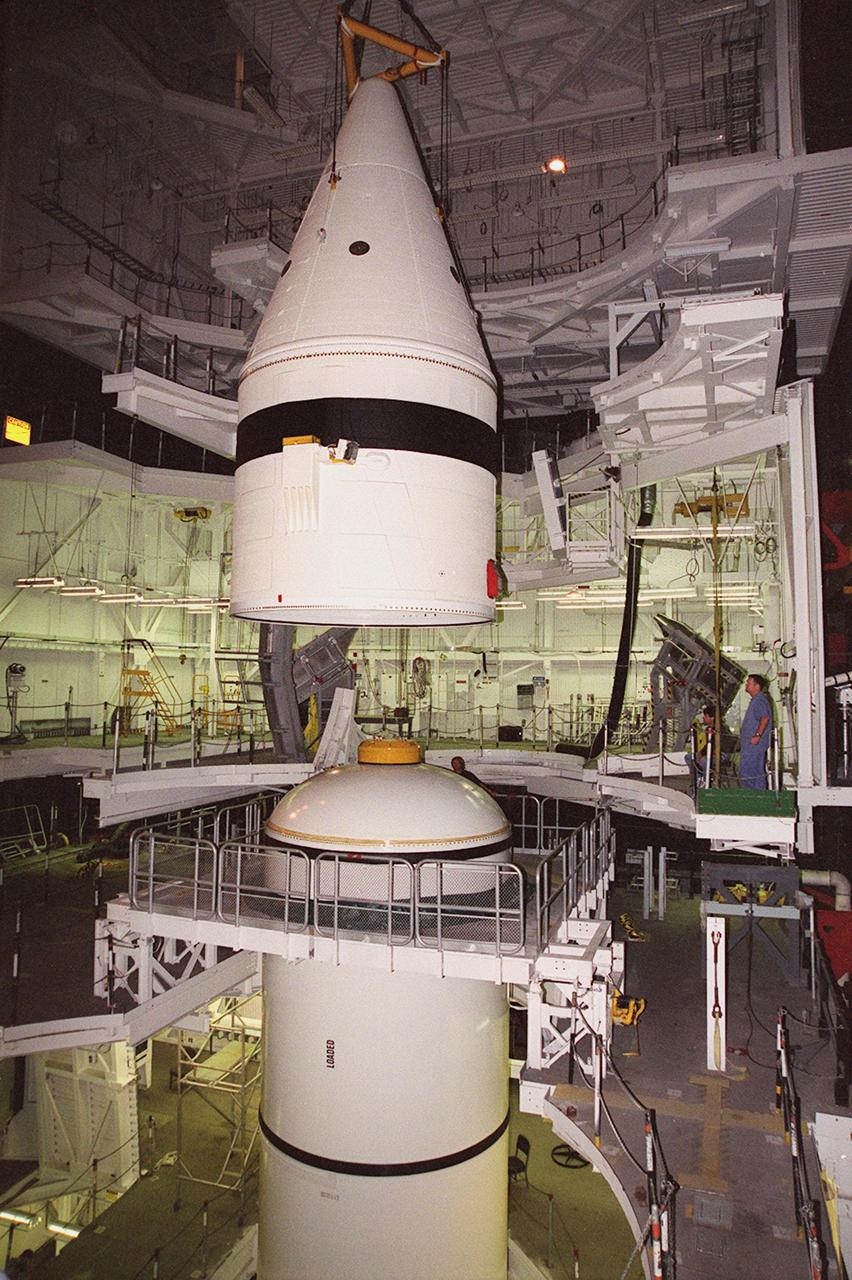
Inside the Vehicle Assembly Building, an overhead crane centers the forward section of a solid rocket booster (SRB) above the rest of the stack it will be mated to. The forward section of each booster, from nose cap to forward skirt contains avionics, a sequencer, forward separation motors, a nose cone separation system, drogue and main parachutes, a recovery beacon, a recovery light, a parachute camera on selected flights and a range safety system. Each SRB weighs approximately 1.3 million pounds at launch. The SRB is part of the stack for Space Shuttle Discovery and the STS-92 mission, scheduled for launch Oct. 5, from Launch Pad 39A, on the fifth flight to the International Space Station
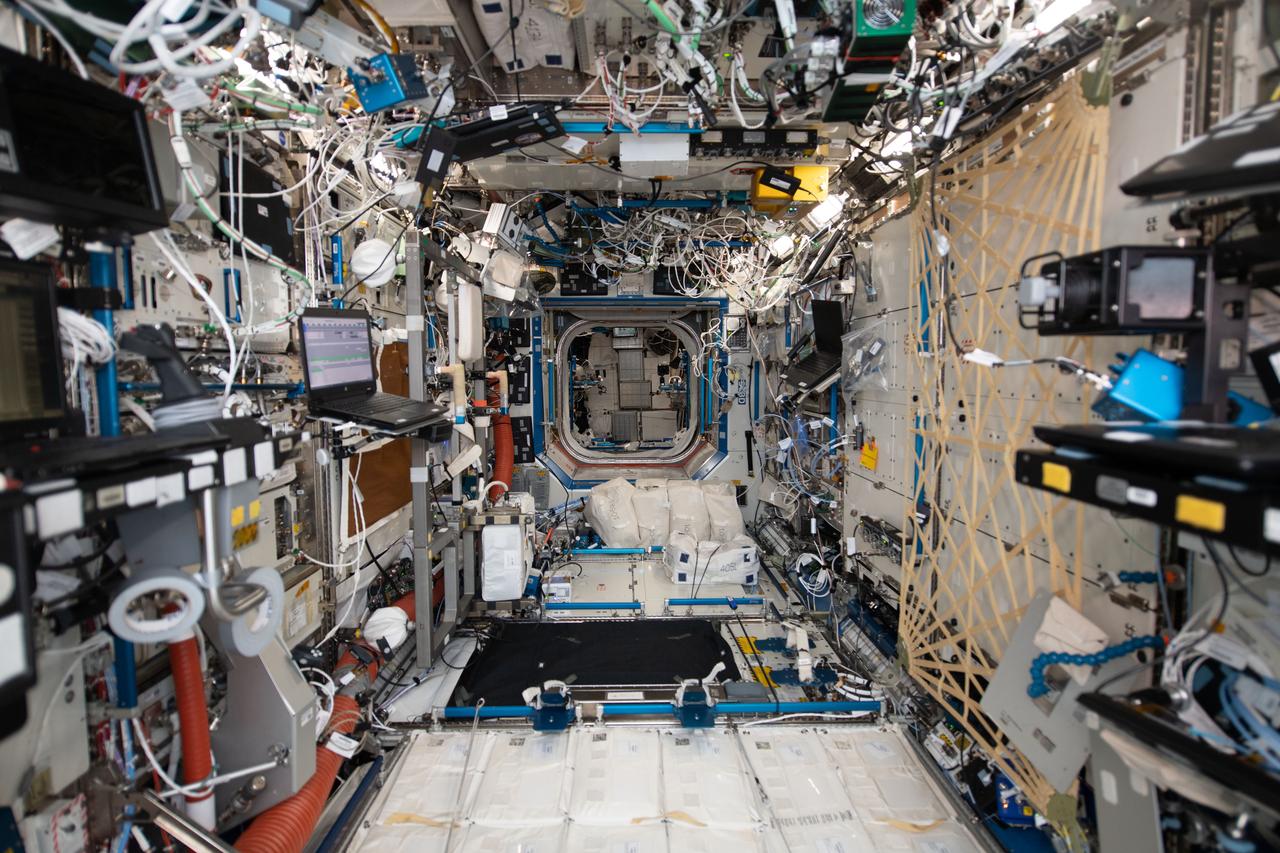
iss058e004610 (1/20/2019) --- A View of the Destiny US Laboratory aboard the International Space Station (ISS). The U.S. Laboratory Module, called Destiny, is the primary research laboratory for U.S. payloads, supporting a wide range of experiments and studies contributing to health, safety, and quality of life for people all over the world. Science conducted on the ISS offers researchers an unparalleled opportunity to test physical processes in the absence of gravity. The results of these experiments will allow scientists to better understand our world and ourselves and prepare us for future missions. Destiny provides internal interfaces to accommodate 24 equipment racks for accommodation and control of ISS systems and scientific research.
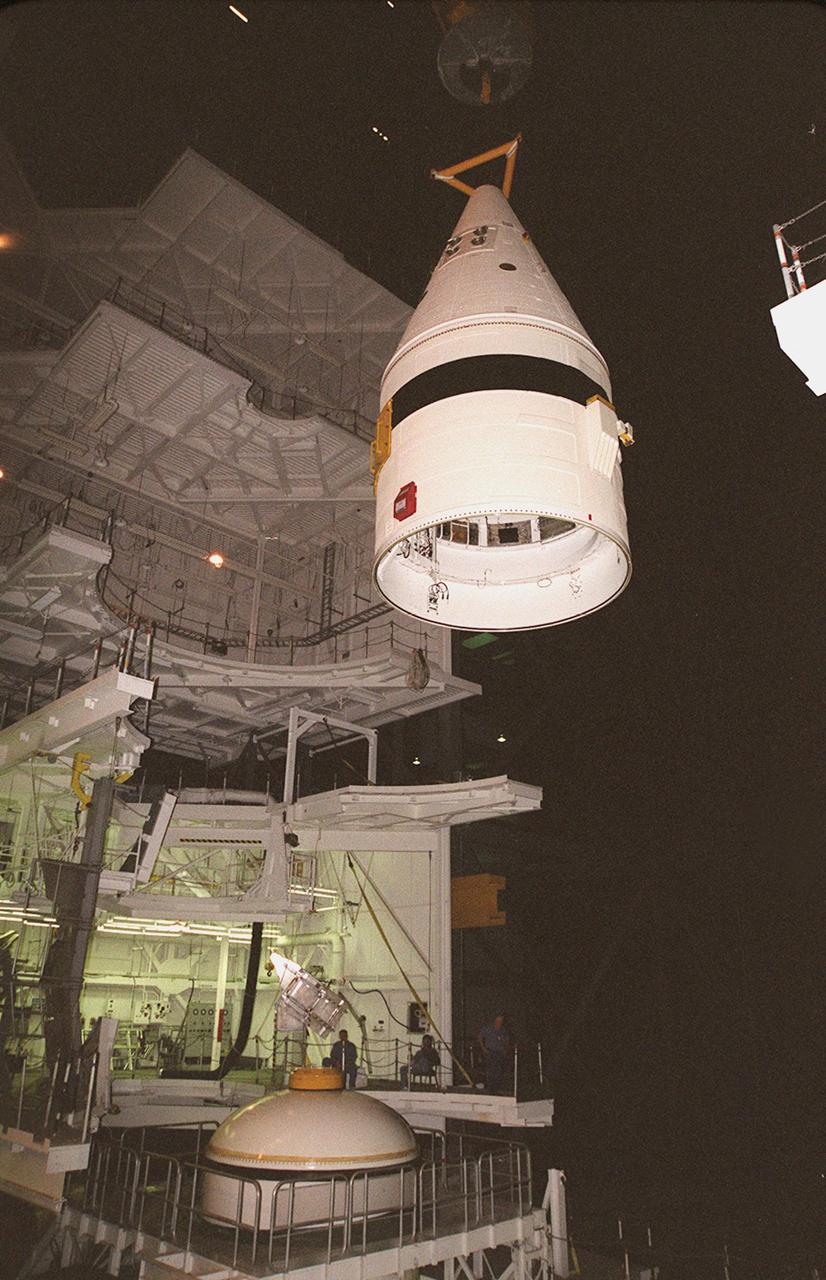
Inside the Vehicle Assembly Building, an overhead crane lifts the forward section of a solid rocket booster (SRB) to mate it with the components seen at lower left in the photo. The forward section of each booster, from nose cap to forward skirt contains avionics, a sequencer, forward separation motors, a nose cone separation system, drogue and main parachutes, a recovery beacon, a recovery light, a parachute camera on selected flights and a range safety system. Each SRB weighs approximately 1.3 million pounds at launch. The SRB is part of the stack for Space Shuttle Discovery and the STS-92 mission, scheduled for launch Oct. 5, from Launch Pad 39A, on the fifth flight to the International Space Station
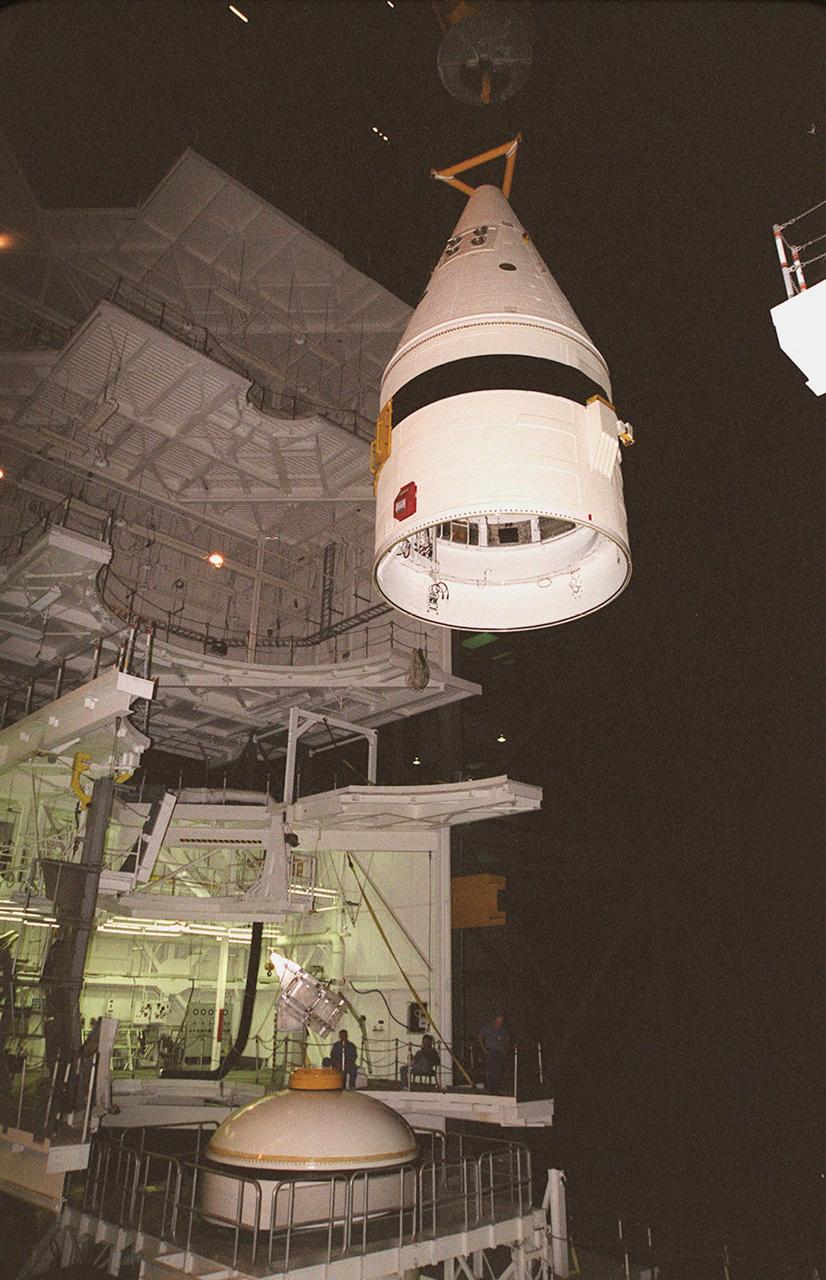
Inside the Vehicle Assembly Building, an overhead crane lifts the forward section of a solid rocket booster (SRB) to mate it with the components seen at lower left in the photo. The forward section of each booster, from nose cap to forward skirt contains avionics, a sequencer, forward separation motors, a nose cone separation system, drogue and main parachutes, a recovery beacon, a recovery light, a parachute camera on selected flights and a range safety system. Each SRB weighs approximately 1.3 million pounds at launch. The SRB is part of the stack for Space Shuttle Discovery and the STS-92 mission, scheduled for launch Oct. 5, from Launch Pad 39A, on the fifth flight to the International Space Station
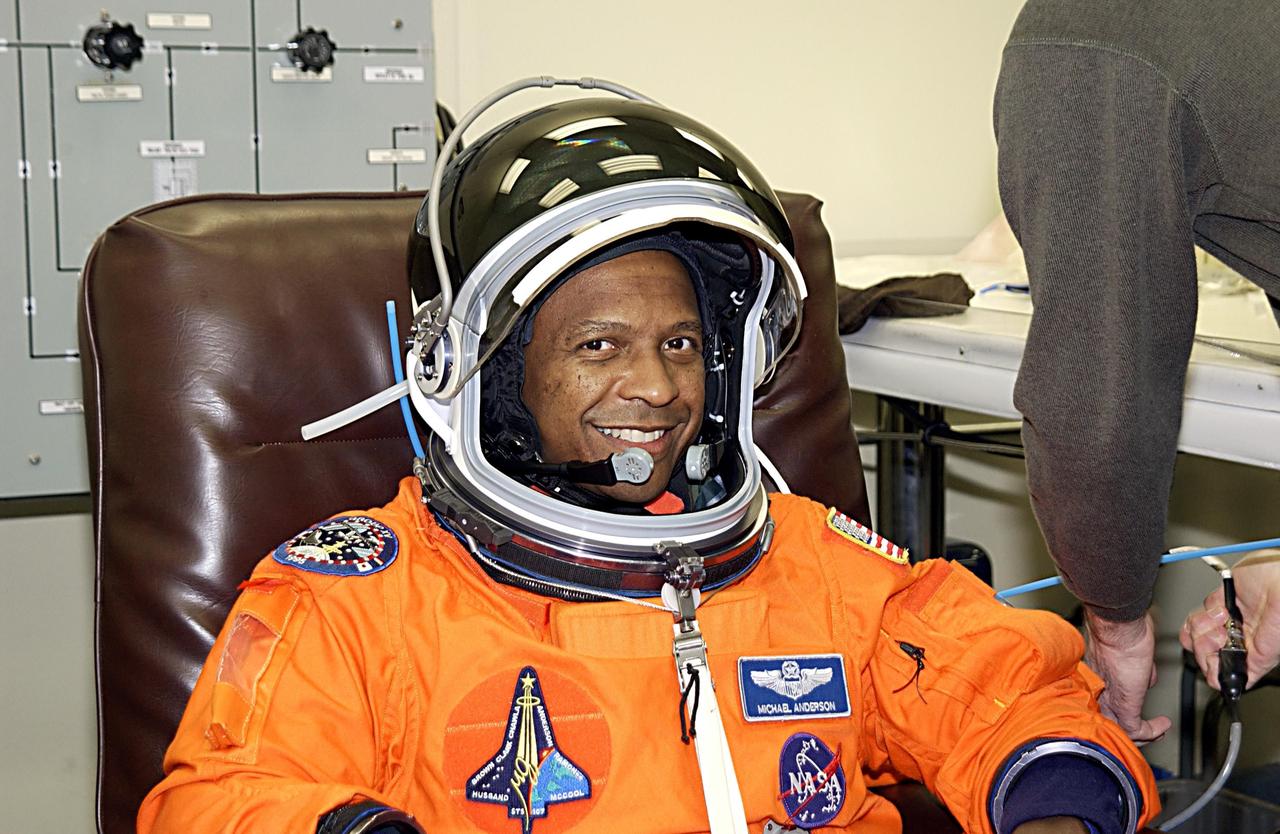
KENNEDY SPACE CENTER, FLA. - STS-107 Payload Commander Michael Anderson is helped with suit check, part of launch preparations. STS-107 is a mission devoted to research and will include more than 80 experiments that will study Earth and space science, advanced technology development, and astronaut health and safety. The payload on Space Shuttle Columbia includes FREESTAR (Fast Reaction Experiments Enabling Science, Technology, Applications and Research) and the SHI Research Double Module (SHI/RDM), known as SPACEHAB. Experiments on the module range from material sciences to life sciences. Launch is scheduled for Jan. 16, between 10 a.m. and 2 p.m.
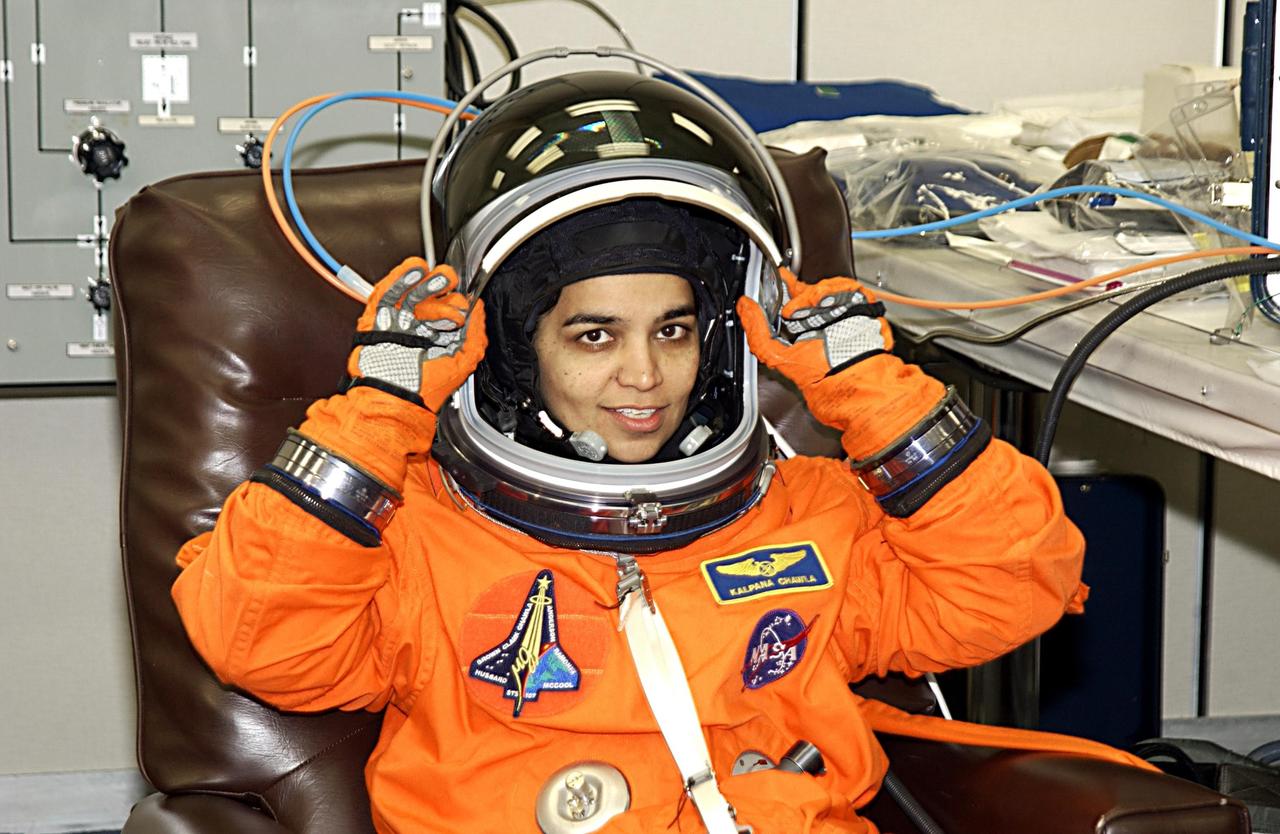
KENNEDY SPACE CENTER, FLA. -- STS-107 Mission Specialist Kalpana Chawla puts on her helmet during suit check, part of launch preparations. STS-107 is a mission devoted to research and will include more than 80 experiments that will study Earth and space science, advanced technology development, and astronaut health and safety. The payload on Space Shuttle Columbia includes FREESTAR (Fast Reaction Experiments Enabling Science, Technology, Applications and Research) and the SHI Research Double Module (SHI/RDM), known as SPACEHAB. Experiments on the module range from material sciences to life sciences. Launch is scheduled for Jan. 16, between 10 a.m. and 2 p.m.
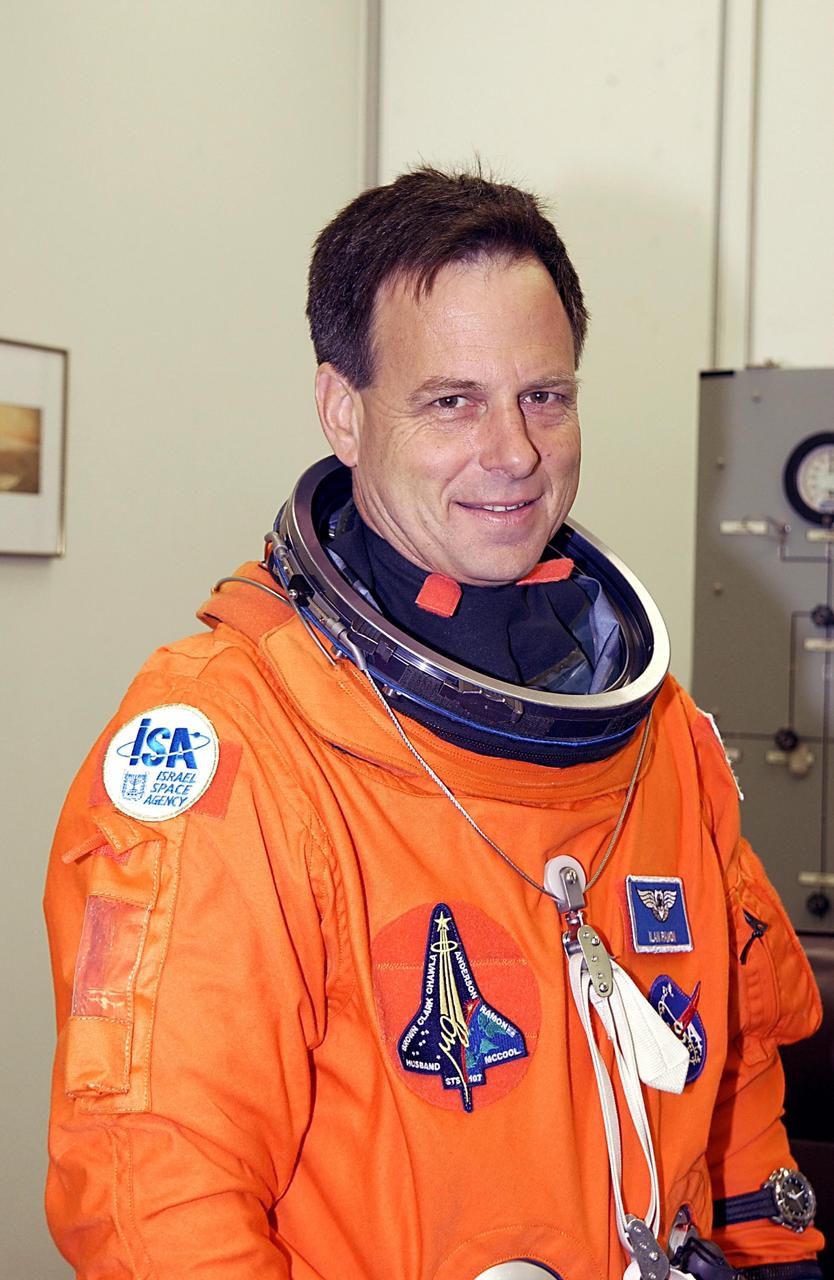
KENNEDY SPACE CENTER, FLA. -- STS-107 Payload Specialist Ilan Ramon, who represents the Israeli Space Agency, suits up for launch. STS-107 is a mission devoted to research and will include more than 80 experiments that will study Earth and space science, advanced technology development, and astronaut health and safety. The payload on Space Shuttle Columbia includes FREESTAR (Fast Reaction Experiments Enabling Science, Technology, Applications and Research) and the SHI Research Double Module (SHI/RDM), known as SPACEHAB. Experiments on the module range from material sciences to life sciences. Liftoff is scheduled for 10:39 a.m. EST.
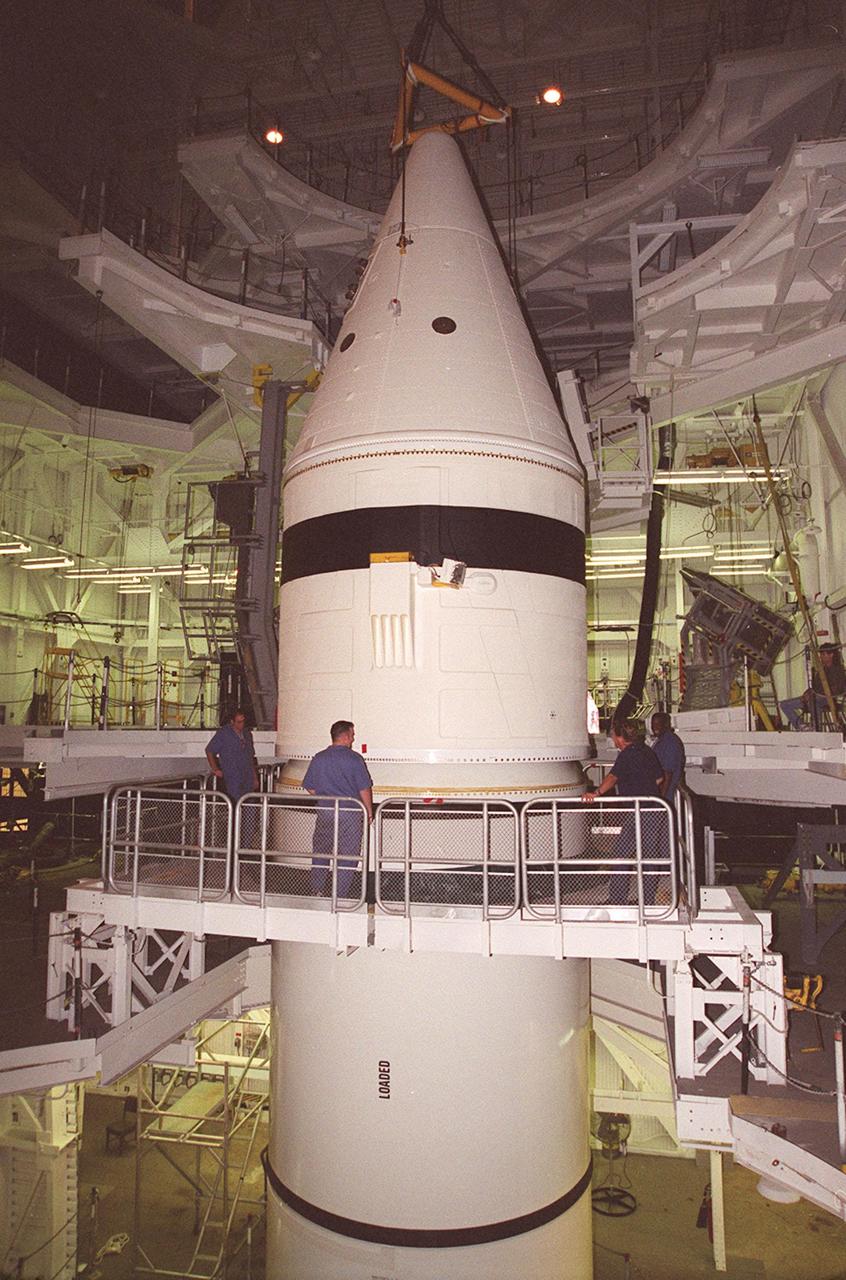
Inside the Vehicle Assembly Building, the forward section of a solid rocket booster (SRB) sits on top of the rest of the stack for mating. The forward section of each booster, from nose cap to forward skirt contains avionics, a sequencer, forward separation motors, a nose cone separation system, drogue and main parachutes, a recovery beacon, a recovery light, a parachute camera on selected flights and a range safety system. Each SRB weighs approximately 1.3 million pounds at launch. The SRB is part of the stack for Space Shuttle Discovery and the STS-92 mission, scheduled for launch Oct. 5, from Launch Pad 39A, on the fifth flight to the International Space Station
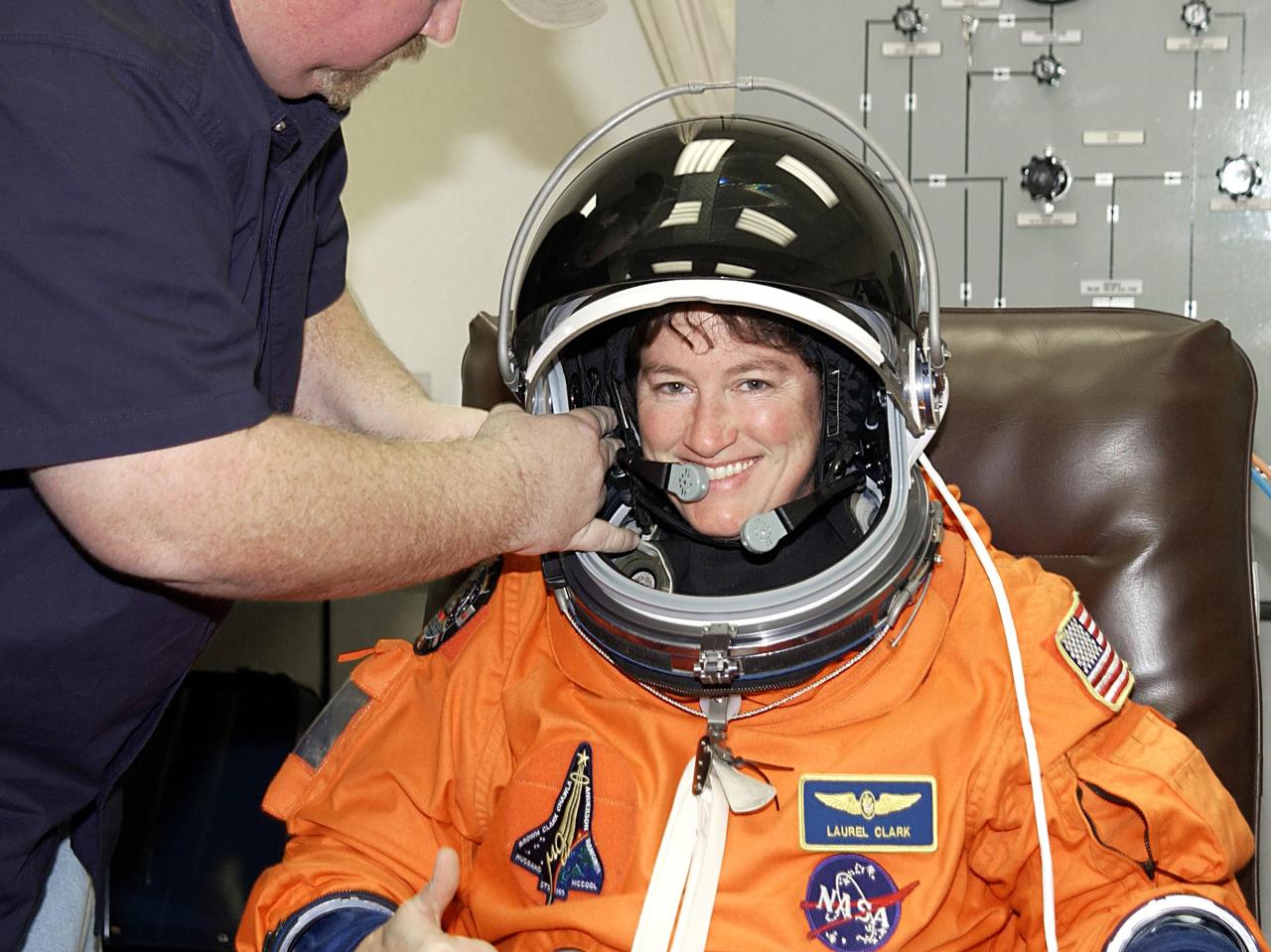
KENNEDY SPACE CENTER, FLA. - STS-107 Mission Specialist Laurel Clark is helped with her helmet during suitup for launch. STS-107 is a mission devoted to research and will include more than 80 experiments that will study Earth and space science, advanced technology development, and astronaut health and safety. The payload on Space Shuttle Columbia includes FREESTAR (Fast Reaction Experiments Enabling Science, Technology, Applications and Research) and the SHI Research Double Module (SHI/RDM), known as SPACEHAB. Experiments on the module range from material sciences to life sciences. Liftoff is scheduled for 10:39 a.m. EST.
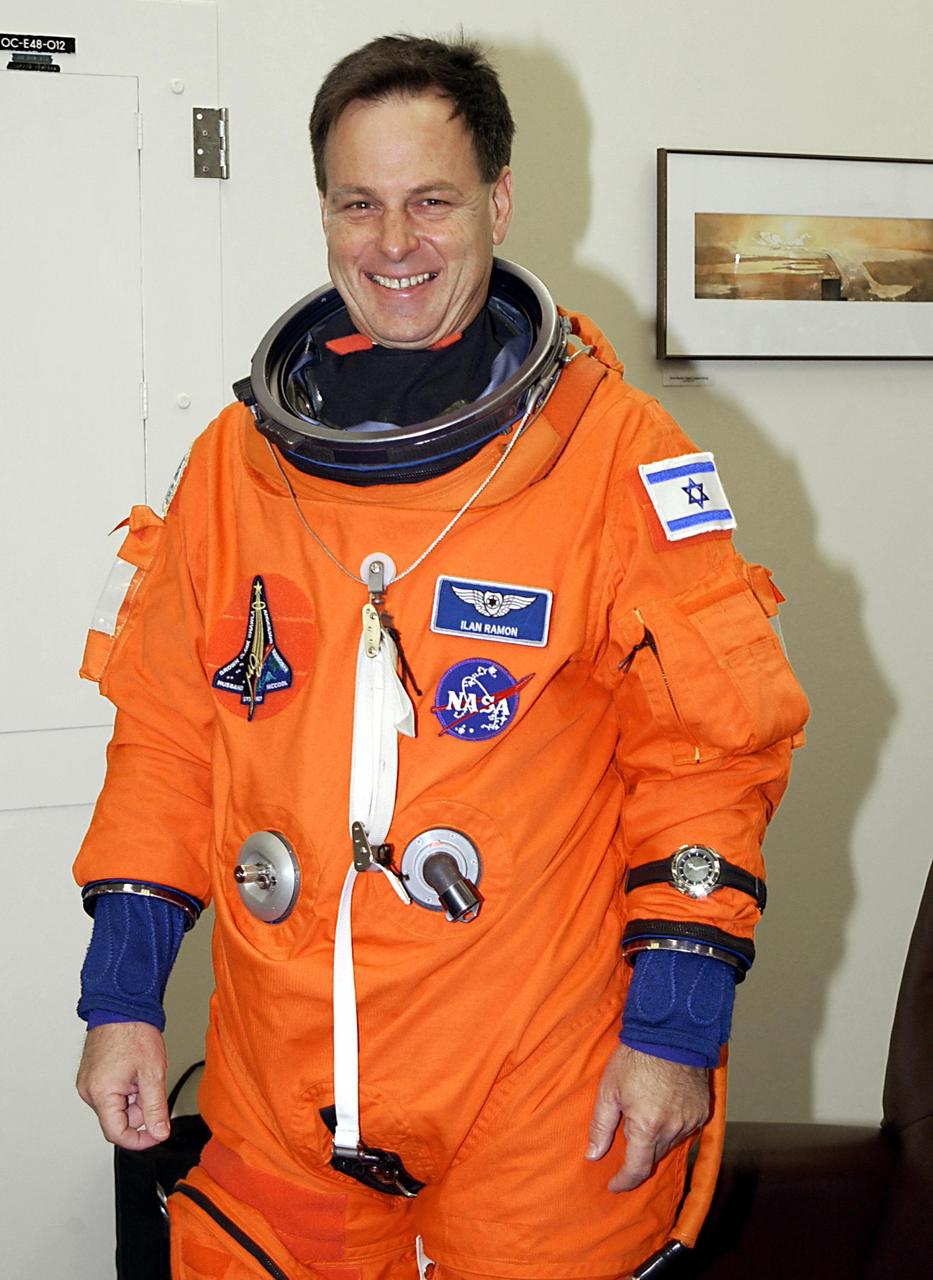
KENNEDY SPACE CENTER, FLA. -- STS-107 Payload Specialist Ilan Ramon, who represents the Israeli Space Agency, suits up for launch. STS-107 is a mission devoted to research and will include more than 80 experiments that will study Earth and space science, advanced technology development, and astronaut health and safety. The payload on Space Shuttle Columbia includes FREESTAR (Fast Reaction Experiments Enabling Science, Technology, Applications and Research) and the SHI Research Double Module (SHI/RDM), known as SPACEHAB. Experiments on the module range from material sciences to life sciences. Liftoff is scheduled for 10:39 a.m. EST.
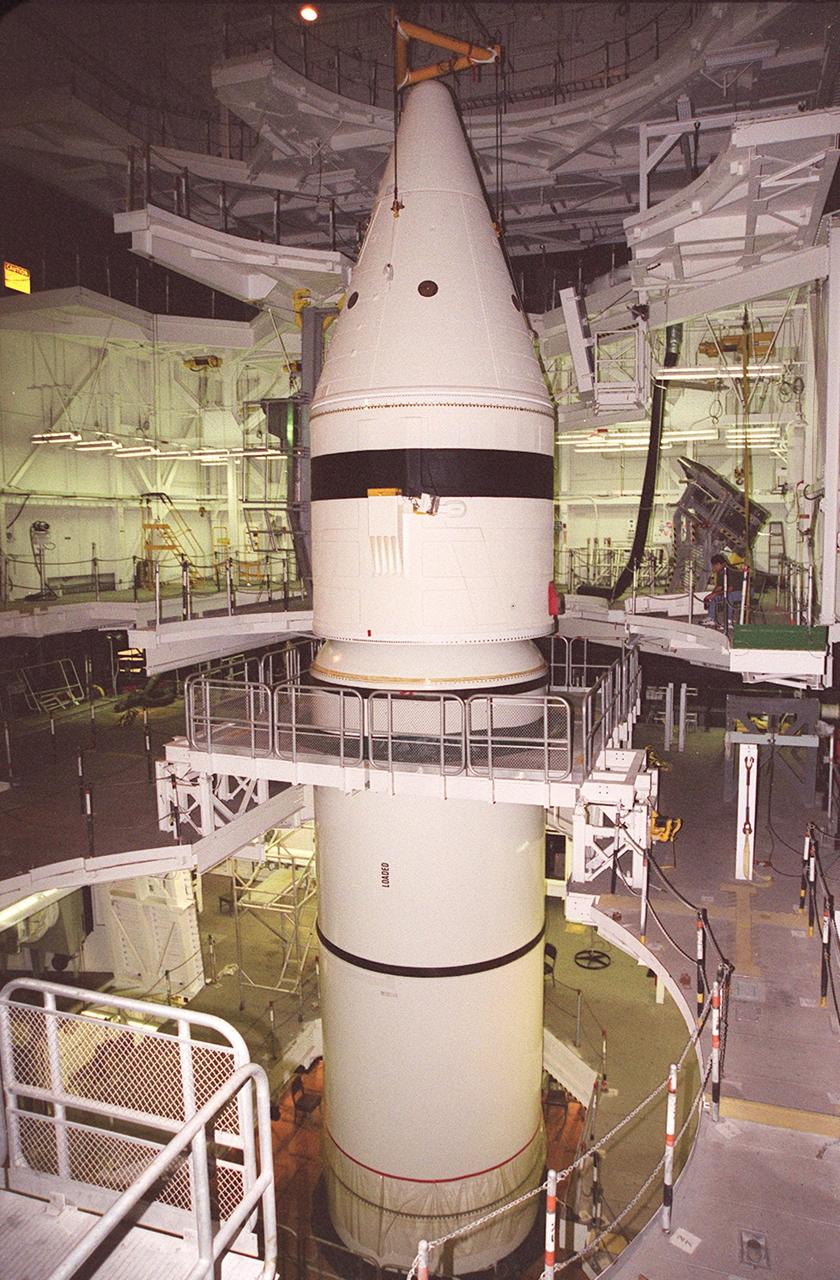
Inside the Vehicle Assembly Building, the forward section of a solid rocket booster (SRB) is lowered onto the rest of the stack for mating. The forward section of each booster, from nose cap to forward skirt contains avionics, a sequencer, forward separation motors, a nose cone separation system, drogue and main parachutes, a recovery beacon, a recovery light, a parachute camera on selected flights and a range safety system. Each SRB weighs approximately 1.3 million pounds at launch. The SRB is part of the stack for Space Shuttle Discovery and the STS-92 mission, scheduled for launch Oct. 5, from Launch Pad 39A, on the fifth flight to the International Space Station
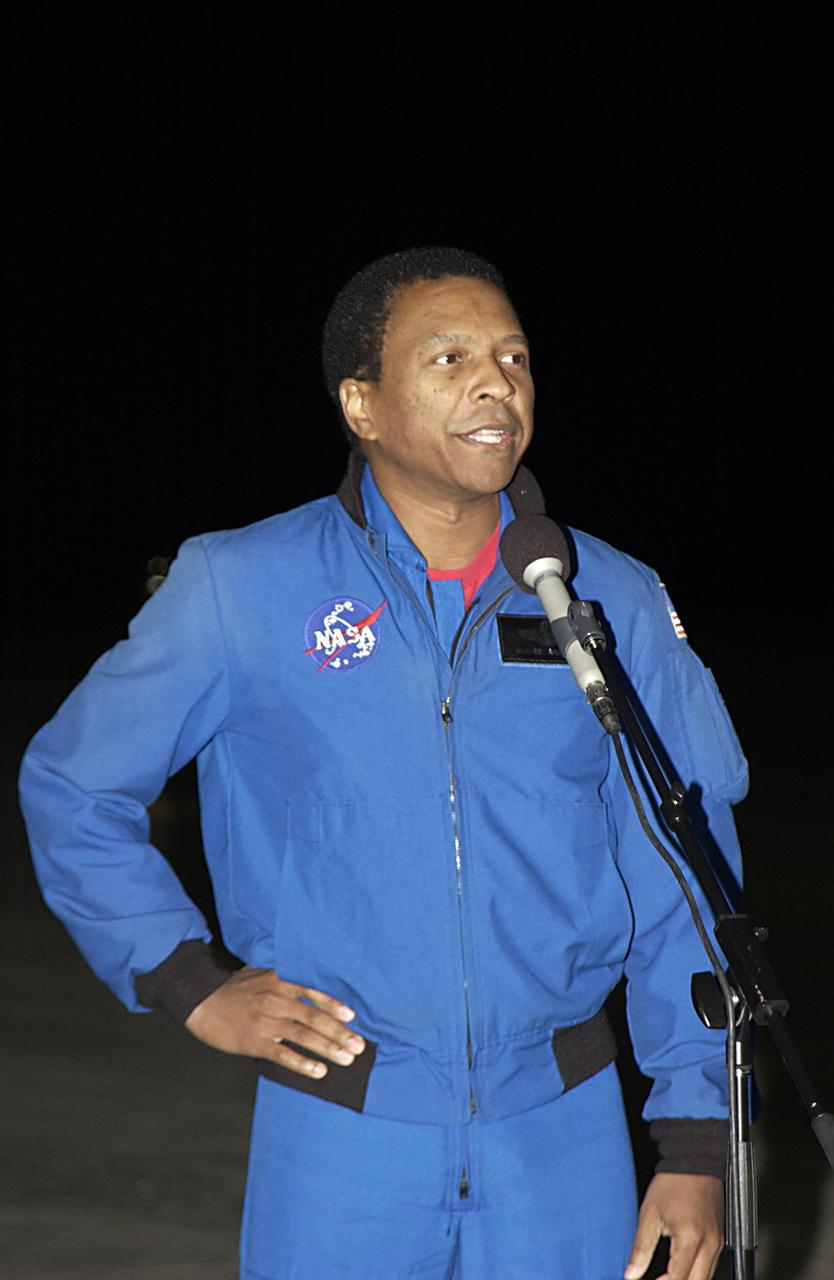
KENNEDY SPACE CENTER, FLA. - STS-107 Payload Commander Michael Anderson comments about the mission after the crew's arrival at KSC for pre-launch preparations. STS-107 is a mission devoted to research and will include more than 80 experiments that will study Earth and space science, advanced technology development, and astronaut health and safety. The payload on Space Shuttle Columbia includes FREESTAR (Fast Reaction Experiments Enabling Science, Technology, Applications and Research) and the SHI Research Double Module (SHI/RDM), known as SPACEHAB. Experiments on the module range from material sciences to life sciences. Launch of Columbia is targeted for Jan. 16 between 10 a.m. and 2 p.m.
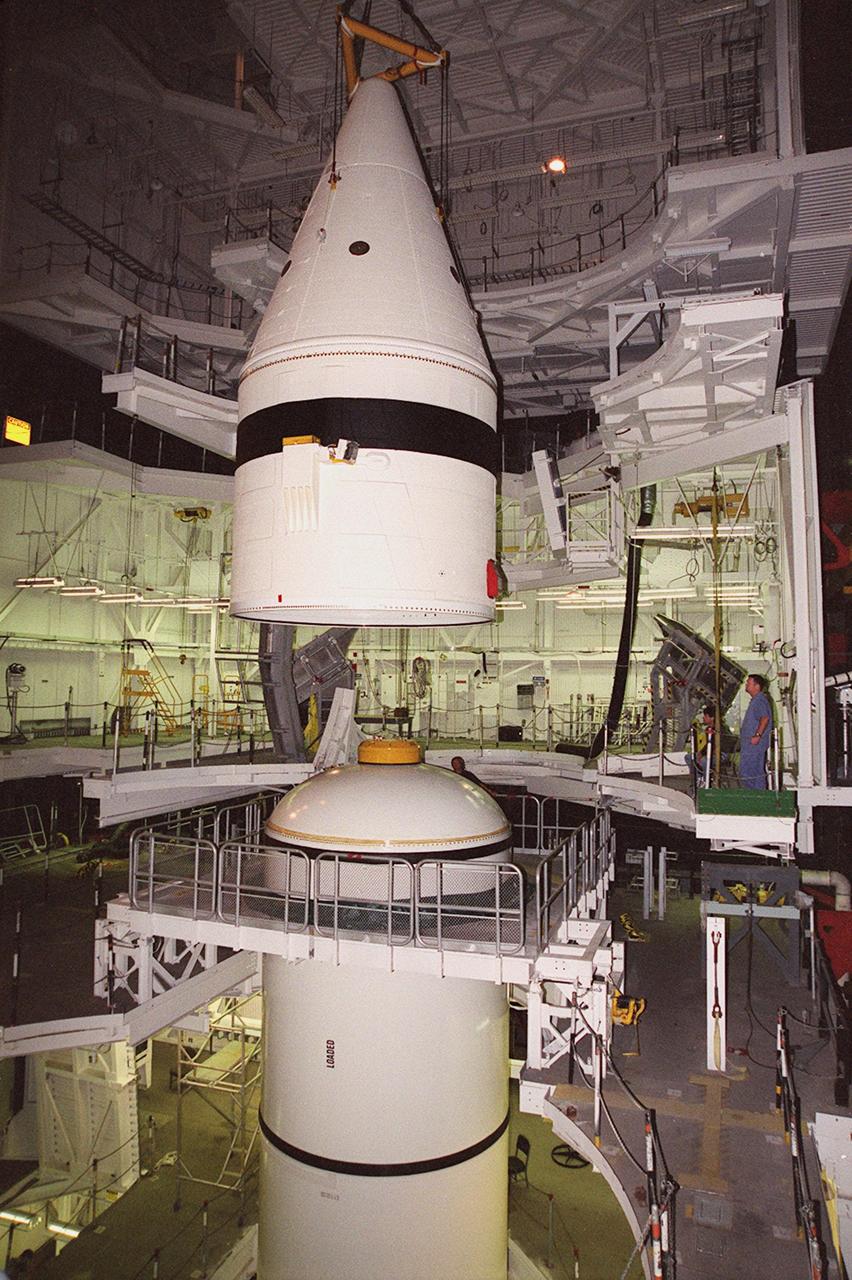
Inside the Vehicle Assembly Building, an overhead crane centers the forward section of a solid rocket booster (SRB) above the rest of the stack it will be mated to. The forward section of each booster, from nose cap to forward skirt contains avionics, a sequencer, forward separation motors, a nose cone separation system, drogue and main parachutes, a recovery beacon, a recovery light, a parachute camera on selected flights and a range safety system. Each SRB weighs approximately 1.3 million pounds at launch. The SRB is part of the stack for Space Shuttle Discovery and the STS-92 mission, scheduled for launch Oct. 5, from Launch Pad 39A, on the fifth flight to the International Space Station
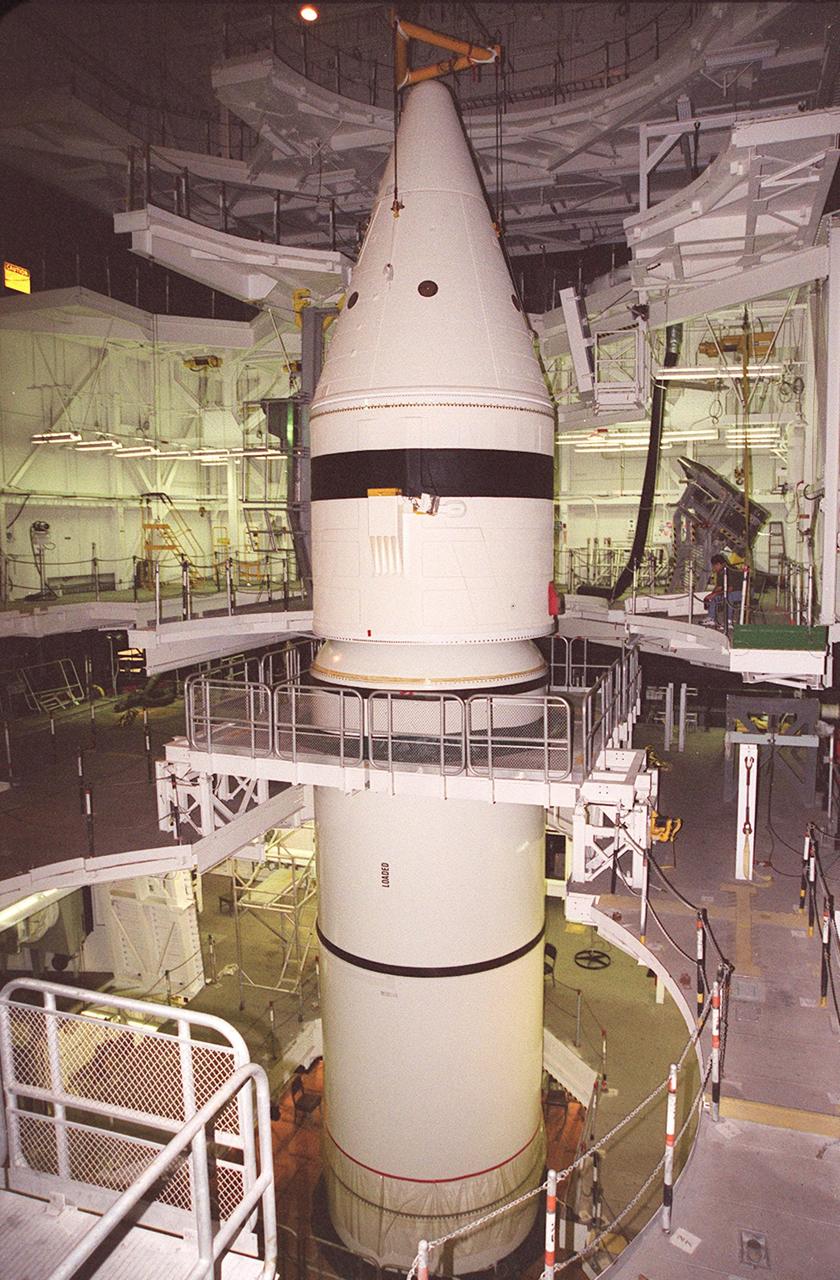
Inside the Vehicle Assembly Building, the forward section of a solid rocket booster (SRB) is lowered onto the rest of the stack for mating. The forward section of each booster, from nose cap to forward skirt contains avionics, a sequencer, forward separation motors, a nose cone separation system, drogue and main parachutes, a recovery beacon, a recovery light, a parachute camera on selected flights and a range safety system. Each SRB weighs approximately 1.3 million pounds at launch. The SRB is part of the stack for Space Shuttle Discovery and the STS-92 mission, scheduled for launch Oct. 5, from Launch Pad 39A, on the fifth flight to the International Space Station
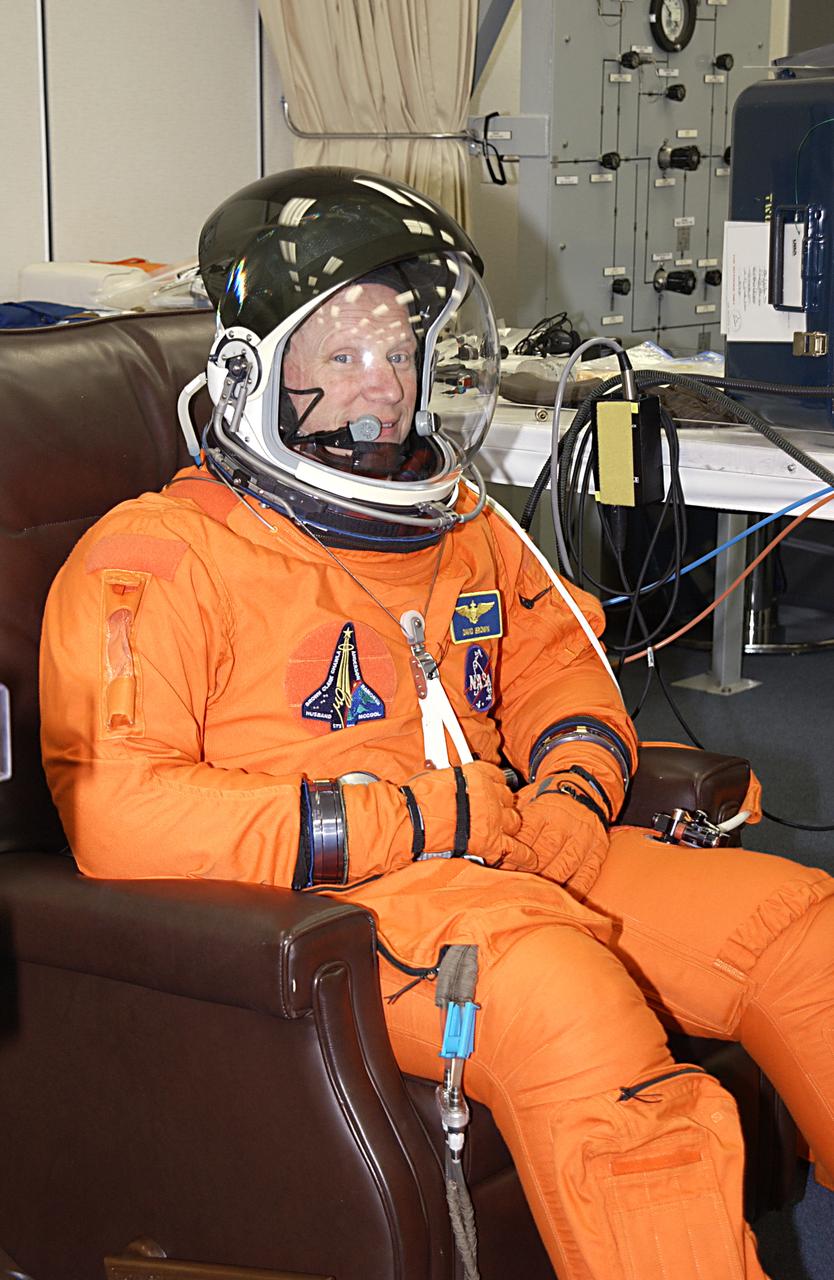
STS-107 Mission Specialist David Brown gets a final suit fit as part of launch preparations. STS-107 is a mission devoted to research and will include more than 80 experiments that will study Earth and space science, advanced technology development, and astronaut health and safety. The payload on Space Shuttle Columbia includes FREESTAR (Fast Reaction Experiments Enabling Science, Technology, Applications and Research) and the SHI Research Double Module (SHI/RDM), known as SPACEHAB. Experiments on the module range from material sciences to life sciences. Launch is scheduled for Jan. 16, between 10 a.m. and 2 p.m.
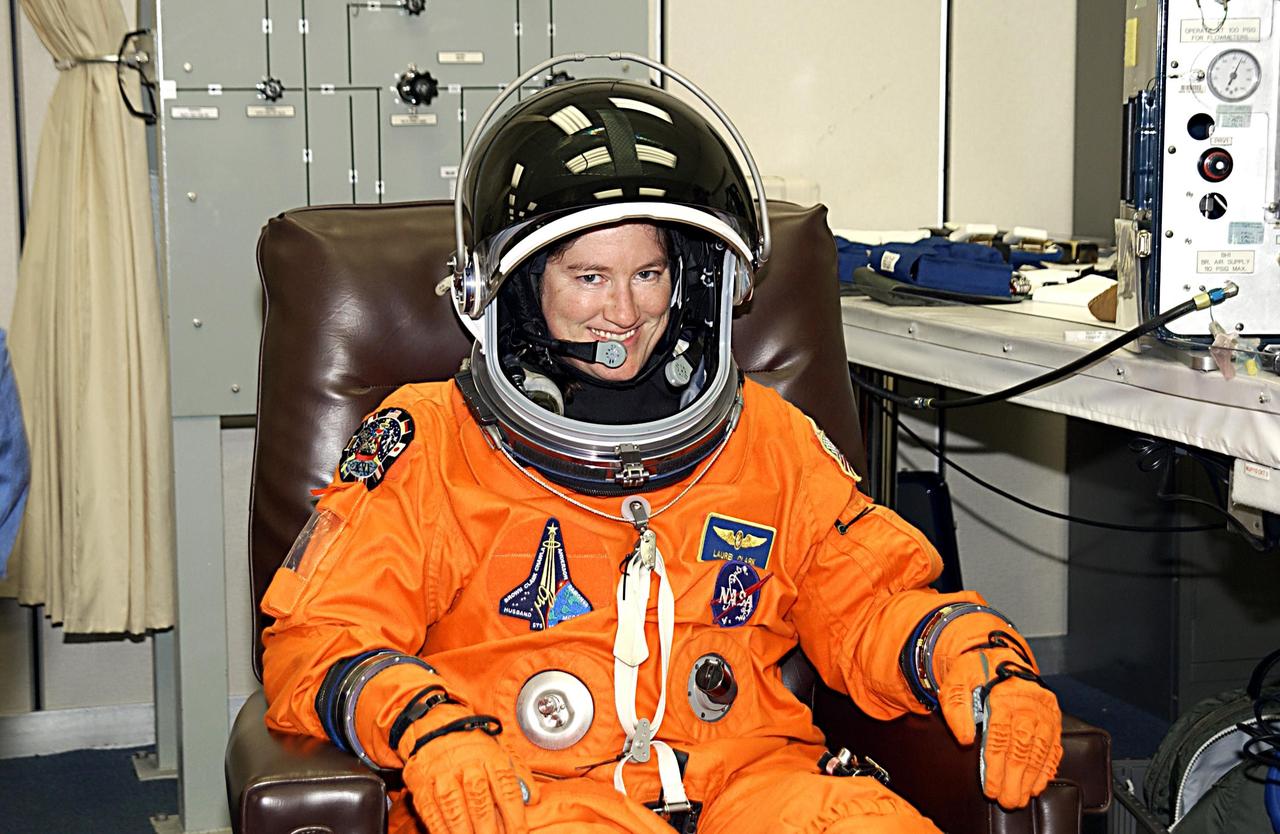
KENNEDY SPACE CENTER, FLA. - STS-107 Mission Specialist Laurel Clark gets a final fitting on her launch and entry suit as part of launch preparations. STS-107 is a mission devoted to research and will include more than 80 experiments that will study Earth and space science, advanced technology development, and astronaut health and safety. The payload on Space Shuttle Columbia includes FREESTAR (Fast Reaction Experiments Enabling Science, Technology, Applications and Research) and the SHI Research Double Module (SHI/RDM), known as SPACEHAB. Experiments on the module range from material sciences to life sciences. Launch is scheduled for Jan. 16, between 10 a.m. and 2 p.m.
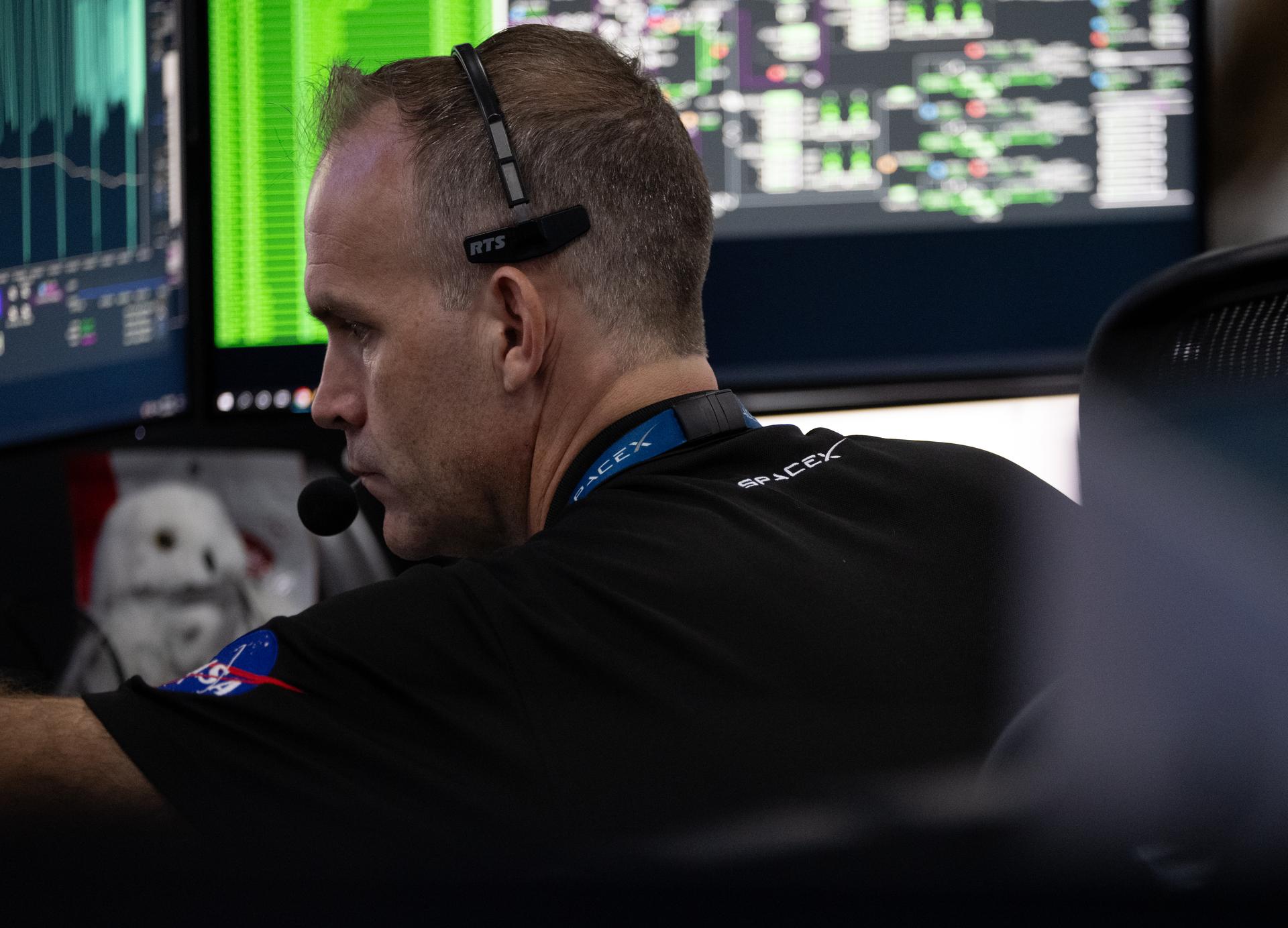
Joseph Dant, chief safety and mission assurance officer for NASA’s Launch Services Program, is seen as he monitors the countdown inside SpaceX’s Hangar X for the launch of a SpaceX Falcon Heavy rocket with NASA’S Nancy Grace Roman Space Telescope from Launch Complex 39A at NASA’s Kennedy Space Center, Sunday, Aug. 30, 2026, in Florida. Roman will investigate dark energy and dark matter, conduct a statistical census of planetary systems, and enable a broad range of additional astrophysics research. Launch occurred at 7:26 a.m. EDT. Photo Credit (NASA/Joel Kowsky)
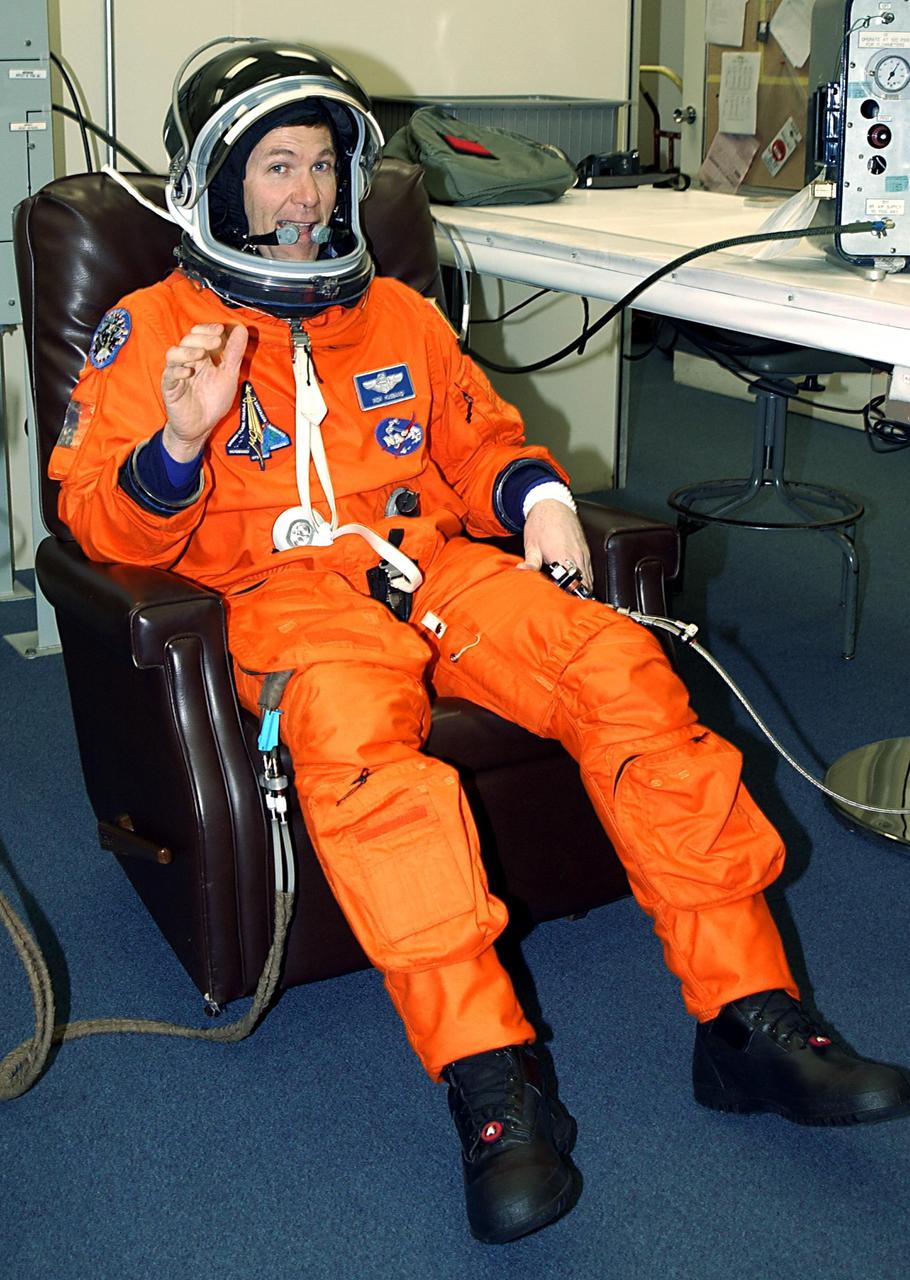
KENNEDY SPACE CENTER, FLA. - STS-107 Mission Commander Rick Husband waves during suitup for launch on mission STS-107. The mission is devoted to research and will include more than 80 experiments that will study Earth and space science, advanced technology development, and astronaut health and safety. The payload on Space Shuttle Columbia includes FREESTAR (Fast Reaction Experiments Enabling Science, Technology, Applications and Research) and the SHI Research Double Module (SHI/RDM), known as SPACEHAB. Experiments on the module range from material sciences to life sciences. Liftoff is scheduled for 10:39 a.m. EST.
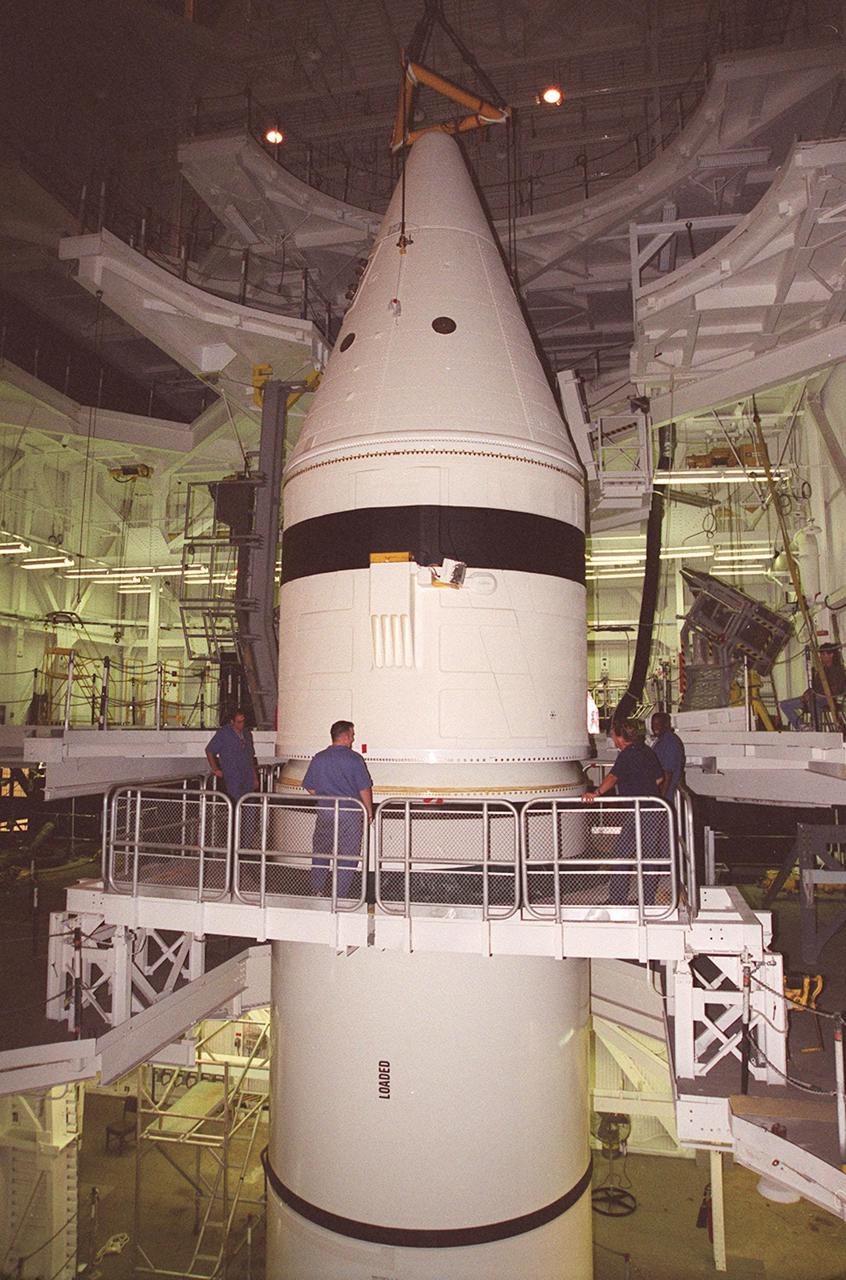
Inside the Vehicle Assembly Building, the forward section of a solid rocket booster (SRB) sits on top of the rest of the stack for mating. The forward section of each booster, from nose cap to forward skirt contains avionics, a sequencer, forward separation motors, a nose cone separation system, drogue and main parachutes, a recovery beacon, a recovery light, a parachute camera on selected flights and a range safety system. Each SRB weighs approximately 1.3 million pounds at launch. The SRB is part of the stack for Space Shuttle Discovery and the STS-92 mission, scheduled for launch Oct. 5, from Launch Pad 39A, on the fifth flight to the International Space Station
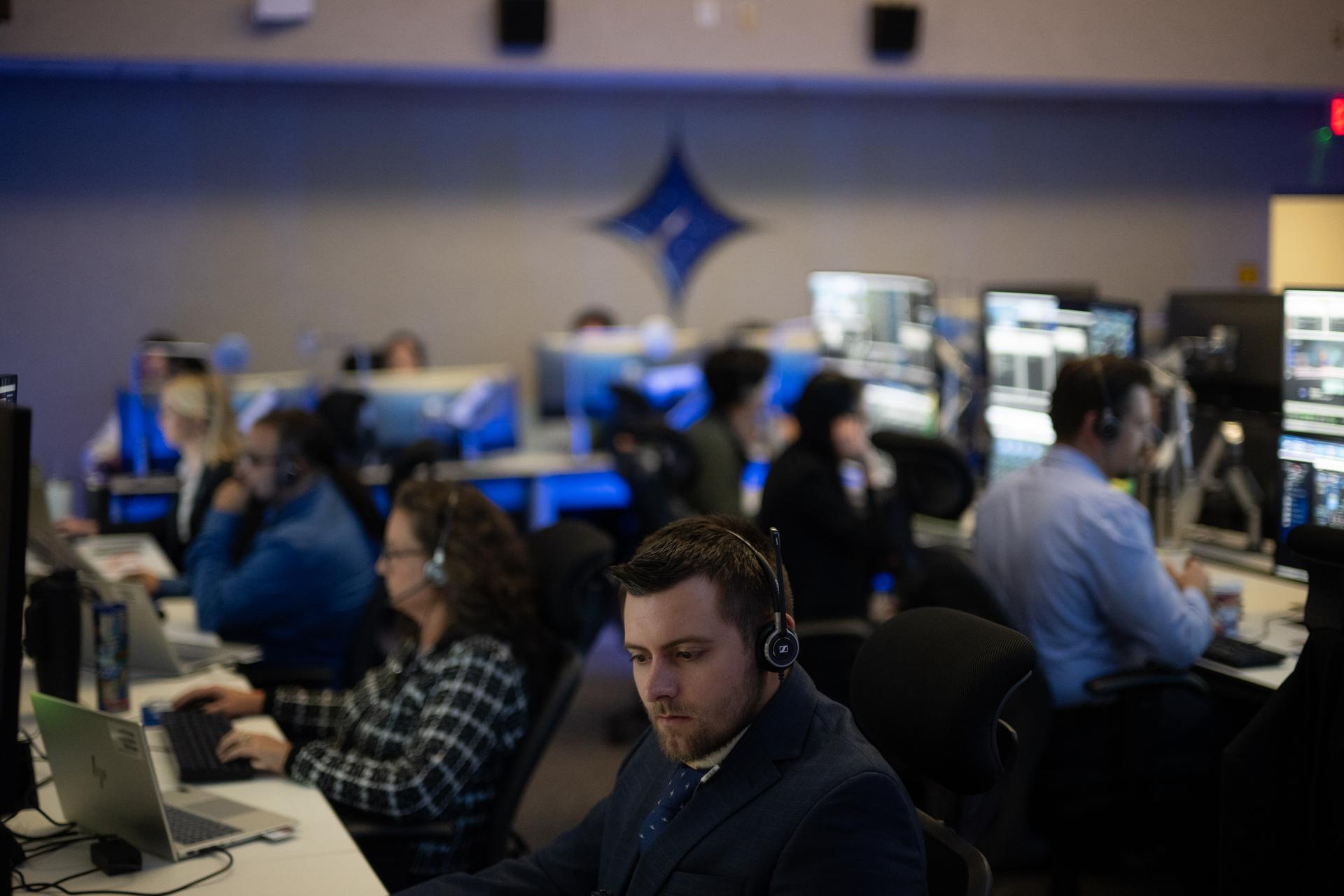
Zach Blanchard, a safety and quality engineer at NASA’s Kennedy Space Center, monitors the countdown inside Hangar AE at Cape Canaveral Space Force Station for the launch of a SpaceX Falcon Heavy rocket with NASA’S Nancy Grace Roman Space Telescope from Launch Complex 39A at NASA’s Kennedy Space Center, Sunday, Aug. 30, 2026, in Florida. Roman will investigate dark energy and dark matter, conduct a statistical census of planetary systems, and enable a broad range of additional astrophysics research. Launch occurred at 7:26 a.m. EDT. Photo Credit (NASA/Joel Kowsky)
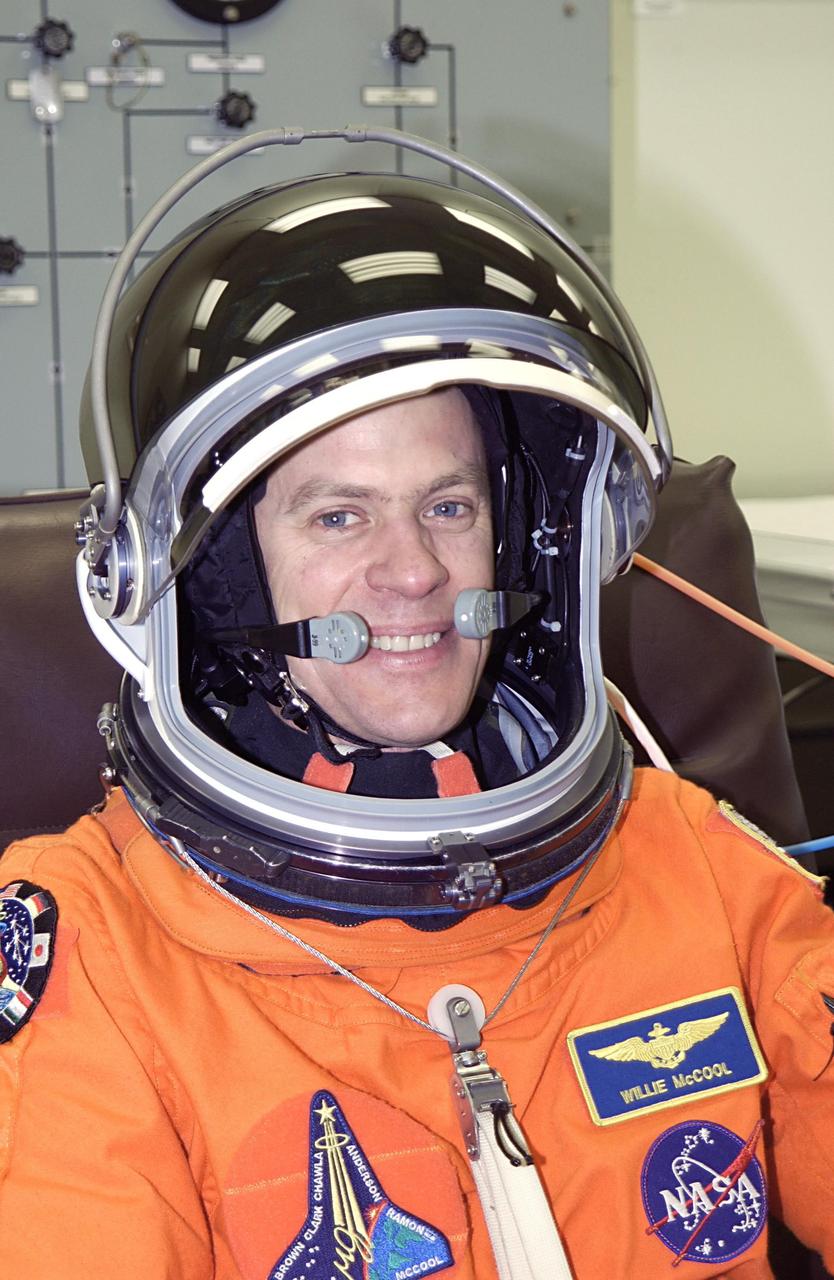
KENNEDY SPACE CENTER, FLA. - STS-107 Pilot William "Willie" McCool shows his pleasure at suiting up for launch. STS-107 is a mission devoted to research and will include more than 80 experiments that will study Earth and space science, advanced technology development, and astronaut health and safety. The payload on Space Shuttle Columbia includes FREESTAR (Fast Reaction Experiments Enabling Science, Technology, Applications and Research) and the SHI Research Double Module (SHI/RDM), known as SPACEHAB. Experiments on the module range from material sciences to life sciences. Liftoff is scheduled for 10:39 a.m. EST.

KENNEDY SPACE CENTER, FLA. -- STS-107 Mission Specialist David Brown gets help during suitup for launch. STS-107 is a mission devoted to research and will include more than 80 experiments that will study Earth and space science, advanced technology development, and astronaut health and safety. The payload on Space Shuttle Columbia includes FREESTAR (Fast Reaction Experiments Enabling Science, Technology, Applications and Research) and the SHI Research Double Module (SHI/RDM), known as SPACEHAB. Experiments on the module range from material sciences to life sciences. Liftoff is scheduled for 10:39 a.m. EST.
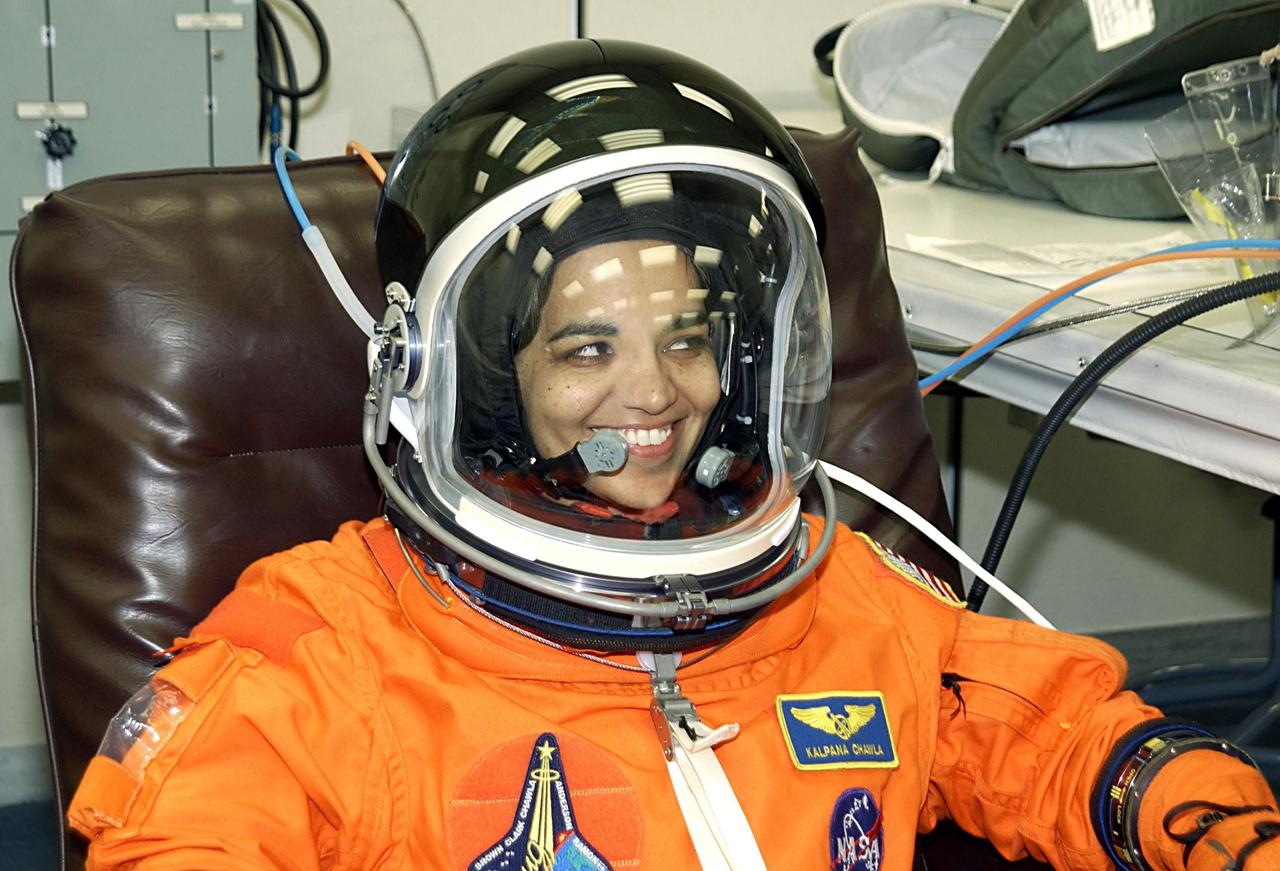
KENNEDY SPACE CENTER, FLA. -- STS-107 Mission Specialist Kalpana Chawla finishes suitup for launch. STS-107 is a mission devoted to research and will include more than 80 experiments that will study Earth and space science, advanced technology development, and astronaut health and safety. The payload on Space Shuttle Columbia includes FREESTAR (Fast Reaction Experiments Enabling Science, Technology, Applications and Research) and the SHI Research Double Module (SHI/RDM), known as SPACEHAB. Experiments on the module range from material sciences to life sciences. Liftoff is scheduled for 10:39 a.m. EST.
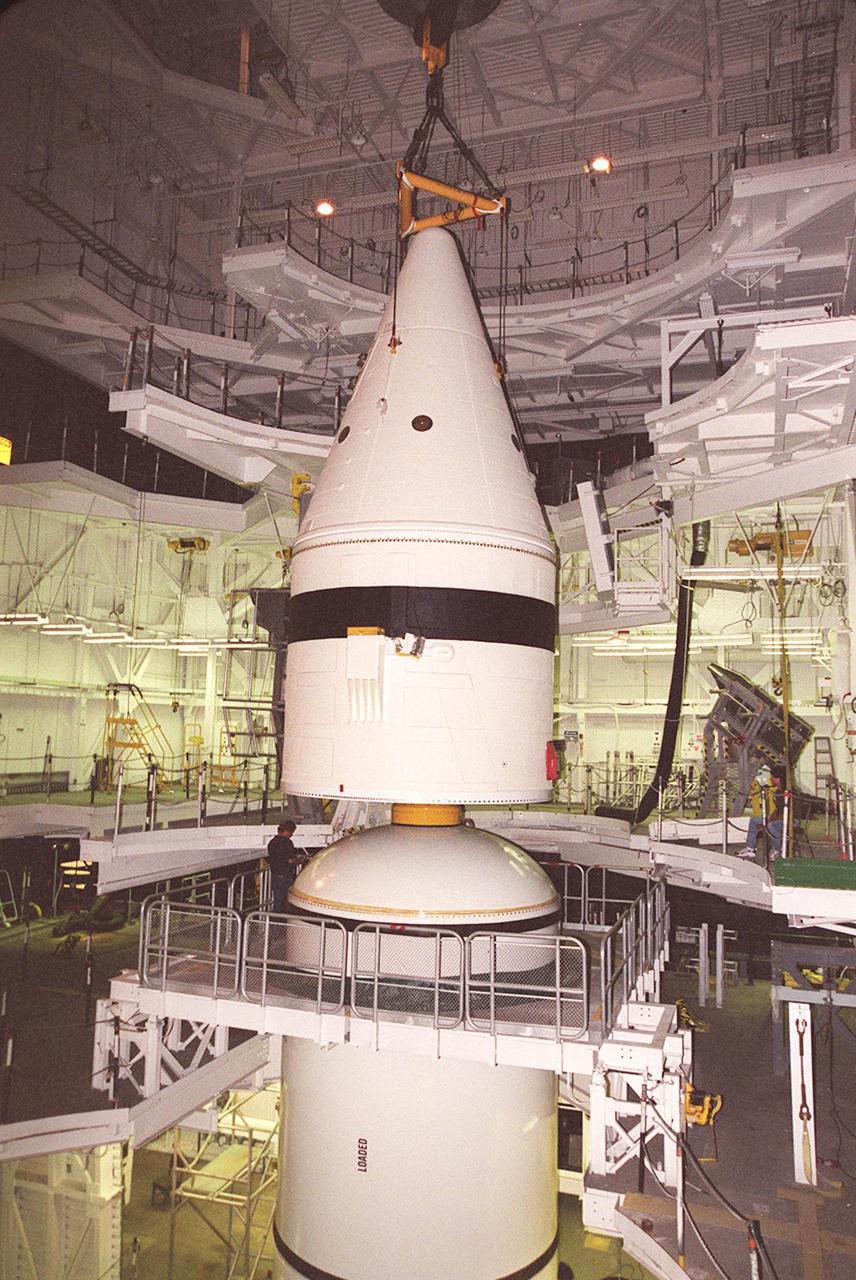
Inside the Vehicle Assembly Building, an overhead crane lowers the forward section of a solid rocket booster (SRB) toward the rest of the stack for mating. The forward section of each booster, from nose cap to forward skirt contains avionics, a sequencer, forward separation motors, a nose cone separation system, drogue and main parachutes, a recovery beacon, a recovery light, a parachute camera on selected flights and a range safety system. Each SRB weighs approximately 1.3 million pounds at launch. The SRB is part of the stack for Space Shuttle Discovery and the STS-92 mission, scheduled for launch Oct. 5, from Launch Pad 39A, on the fifth flight to the International Space Station
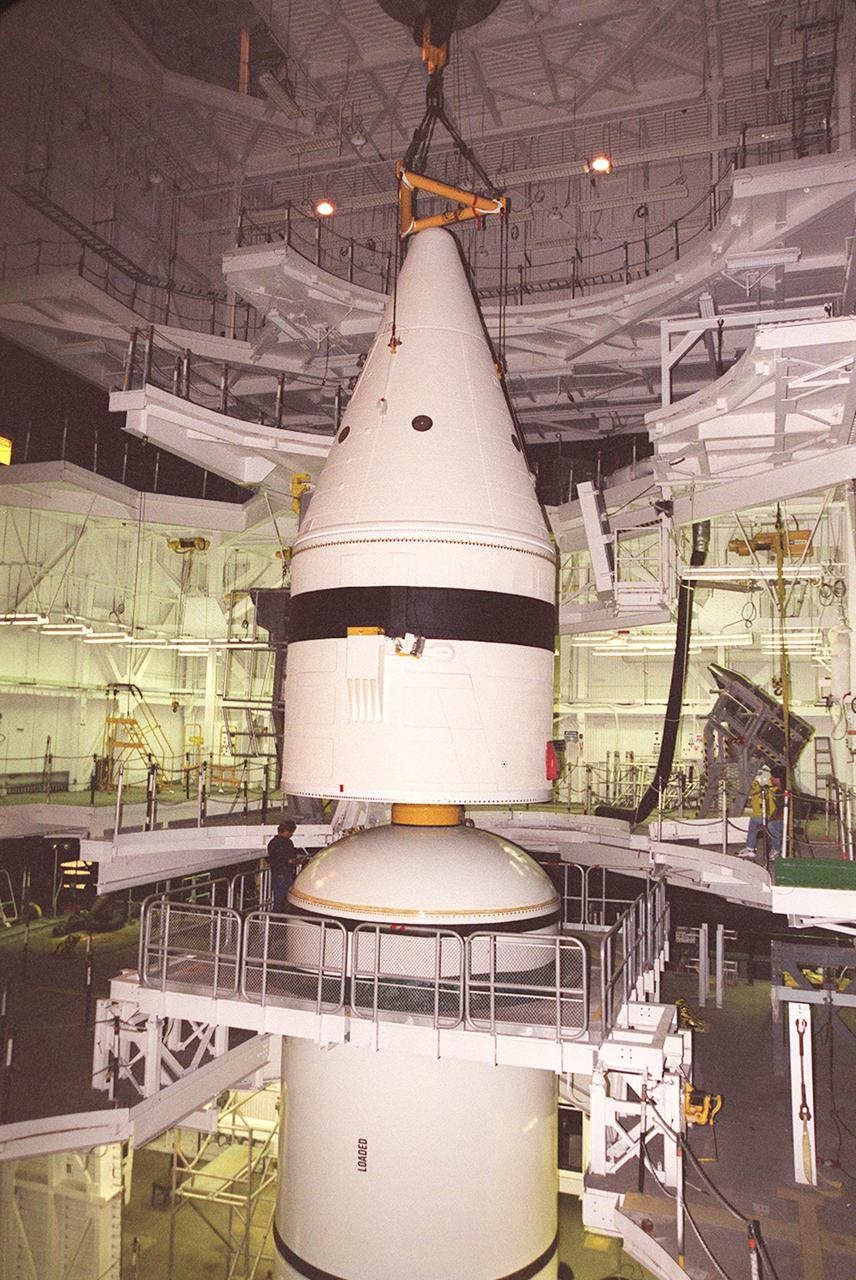
Inside the Vehicle Assembly Building, an overhead crane lowers the forward section of a solid rocket booster (SRB) toward the rest of the stack for mating. The forward section of each booster, from nose cap to forward skirt contains avionics, a sequencer, forward separation motors, a nose cone separation system, drogue and main parachutes, a recovery beacon, a recovery light, a parachute camera on selected flights and a range safety system. Each SRB weighs approximately 1.3 million pounds at launch. The SRB is part of the stack for Space Shuttle Discovery and the STS-92 mission, scheduled for launch Oct. 5, from Launch Pad 39A, on the fifth flight to the International Space Station
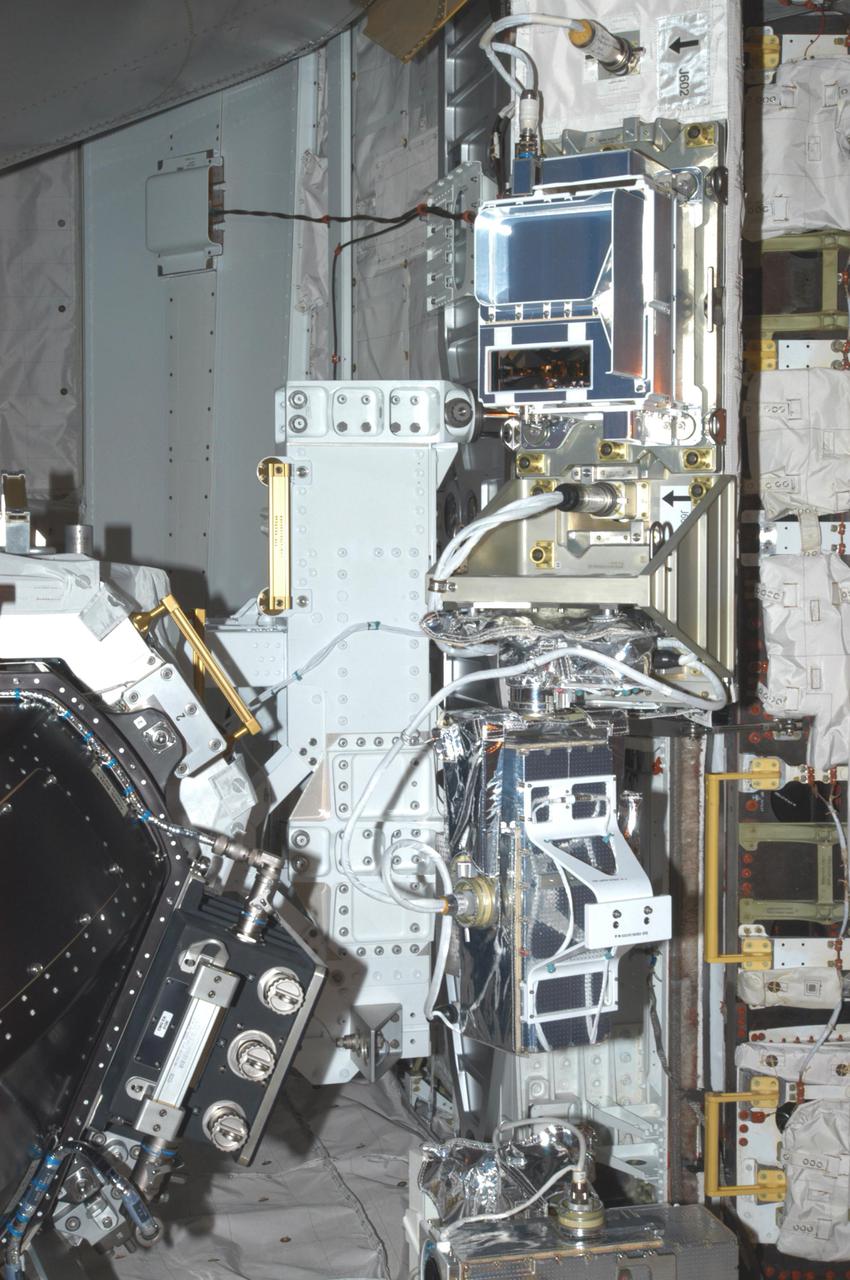
KENNEDY SPACE CENTER, FLA. - At Launch Pad 39B, the Orbiter Boom Sensor System (OBSS) sensor package is viewed before the orbiter's payload bay doors are closed for launch. Payload bay door closure is a significant milestone in the preparations of Discovery for the first Return to Flight mission, STS-114. This sensor package will provide surface area and depth defect inspection for all the surfaces of the orbiter. It includes an intensified television camera (ITVC) and a laser dynamic range imager, which are mounted on a pan and tilt unit, and a laser camera system (LCS) mounted on a stationary bracket. The package is part of the new safety measures added for all future Space Shuttle missions. During its 12-day mission, Discovery’s seven-person crew will test new hardware and techniques to improve Shuttle safety, as well as deliver supplies to the International Space Station. Discovery’s payloads include the Multi-Purpose Logistics Module Raffaello, the Lightweight Multi-Purpose Experiment Support Structure Carrier (LMC), and the External Stowage Platform-2 (ESP-2). Raffaello will deliver supplies to the International Space Station including food, clothing and research equipment. The LMC supports a replacement Control Moment Gyroscope and a tile repair sample box. The ESP-2 is outfitted with replacement parts. Launch of mission STS-114 was set for July 13 at the conclusion of the Flight Readiness Review yesterday.
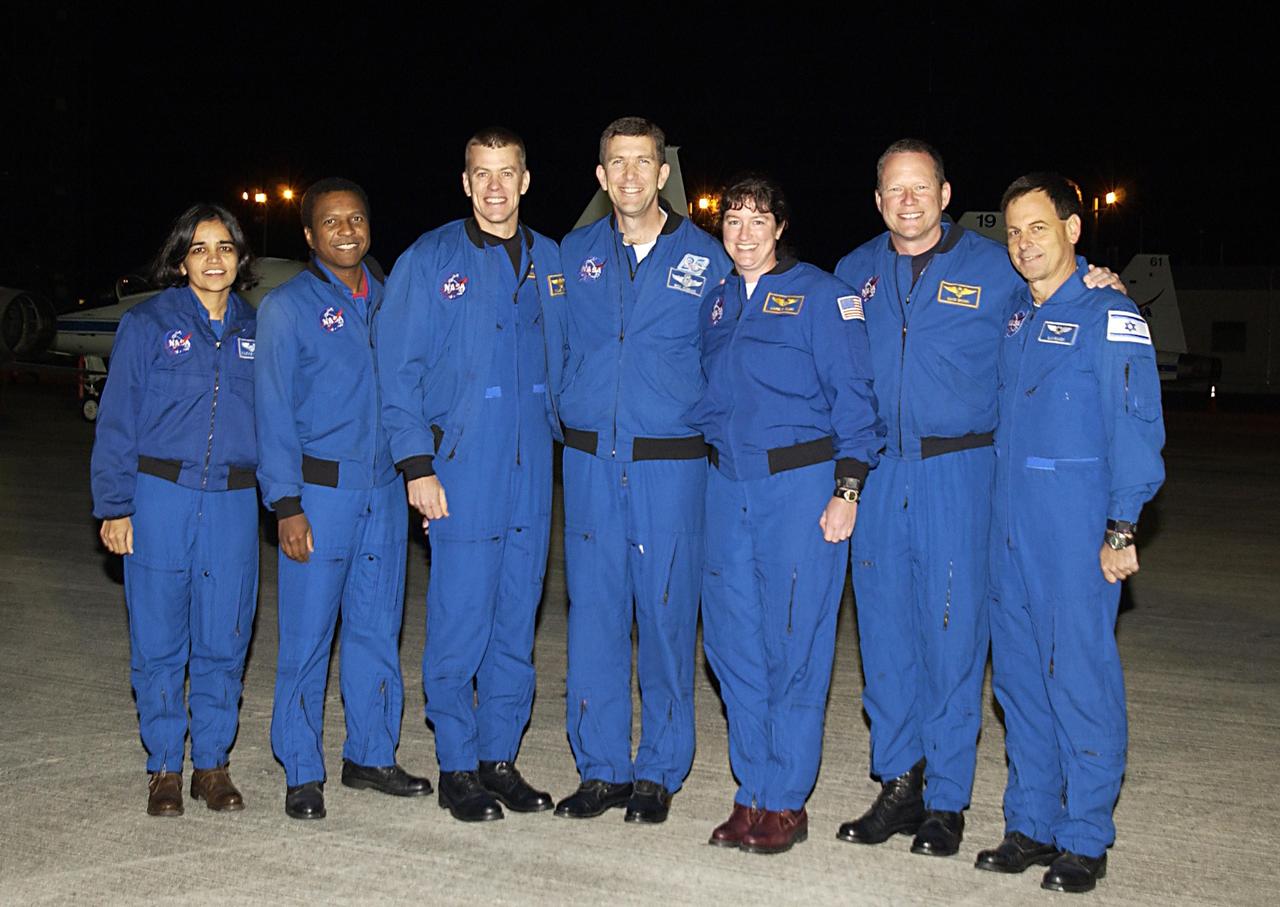
KENNEDY SPACE CENTER, FLA. - The STS-107 crew pose for a photo after their arrival at KSC for pre-launch preparations. Standing from left to right are Mission Specialist Kalpana Chawla, Payload Commander Michael Anderson, Pilot William "Willie" McCool, Commander Rick Husband, Mission Specialists Laurel Clark and David Brown, and Payload Specialist Ilan Ramon, who is the first Israeli astronaut to fly on a Shuttle mission. STS-107 is a mission devoted to research and will include more than 80 experiments that will study Earth and space science, advanced technology development, and astronaut health and safety. The payload on Space Shuttle Columbia includes FREESTAR (Fast Reaction Experiments Enabling Science, Technology, Applications and Research) and the SHI Research Double Module (SHI/RDM), known as SPACEHAB. Experiments on the module range from material sciences to life sciences. Launch of Columbia is targeted for Jan. 16 between 10 a.m. and 2 p.m.
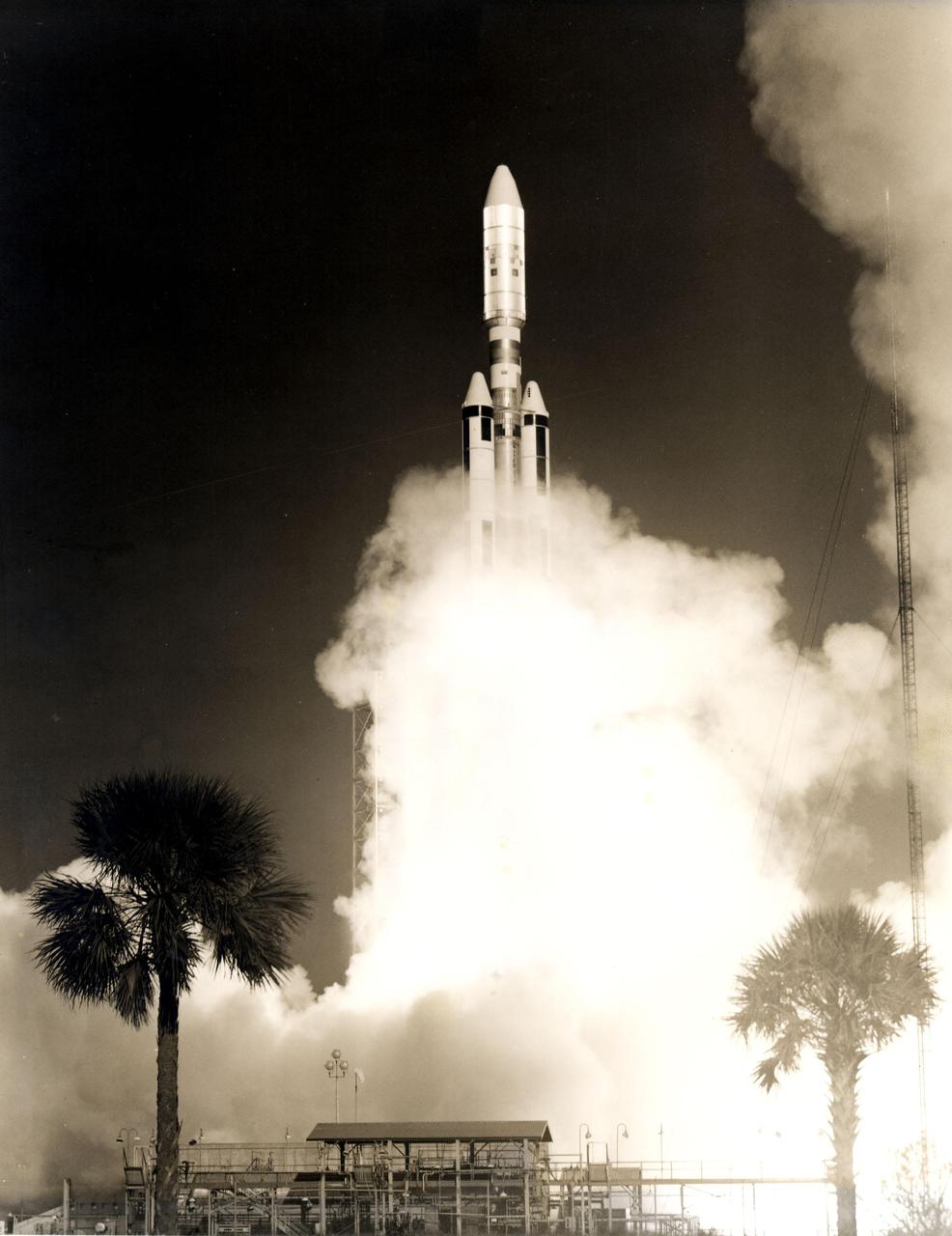
The first Titan_Centaur lifted off from Complex 41 at Cape Kennedy Air Force Station at 9:48 a.m. EDT today. The Titan stages burned as programmed, but when the Centaur stage failed to ignite, it was destroyed by the Range Safety Officer. The new NASA rocket was launched on a proof flight designed to prepare it for twin Viking launches to Mars in 1975 and other missions involving heavy unmanned payloads. The 160-foot-tall rocket combines the Air Force Titan III with the NASA high-energy Centaur final stage. The twin solid rocket boosters have a combined liftoff thrust of 2.4 million pounds. Aboard Titan_Centaur on its proof flight were a dynamic simulator of the Viking spacecraft and a small scientific satellite (SPHYNX) designed to determine how high voltage solar cells, insulators and conductors are affected by the charged particles in space. Launch was conducted by KSC's Unmanned Launch Operations Directorate.
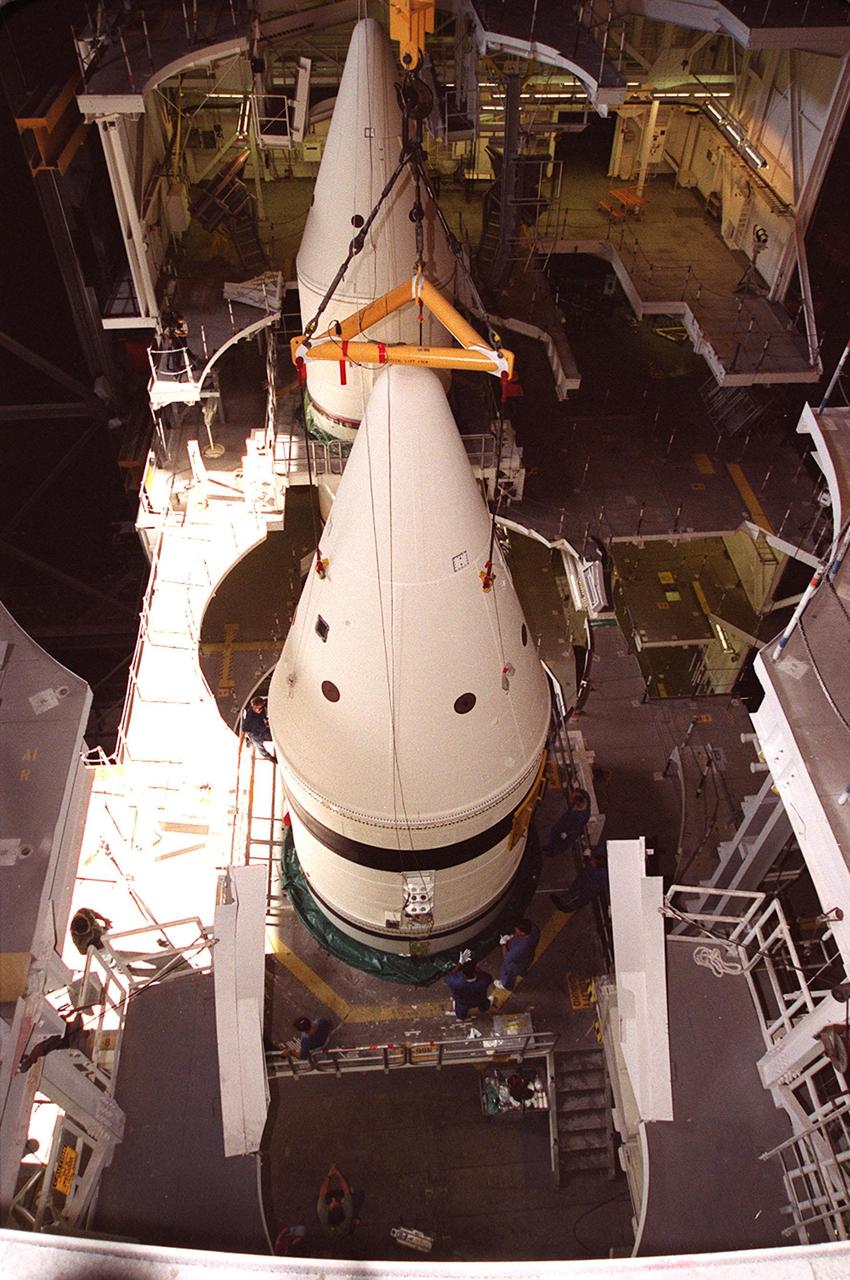
Workers in the Vehicle Assembly Building check the connections on the forward section of a solid rocket booster (SRB) being mated to the rest of the stack below it. The forward section of each booster, from nose cap to forward skirt contains avionics, a sequencer, forward separation motors, a nose cone separation system, drogue and main parachutes, a recovery beacon, a recovery light, a parachute camera on selected flights and a range safety system. Each SRB weighs approximately 1.3 million pounds at launch. The SRB is part of the stack for Space Shuttle Discovery and the STS-92 mission, scheduled for launch Oct. 5, from Launch Pad 39A, on the fifth flight to the International Space Station. Payloads on the mission include the Z-1 truss and Pressurized Mating Adapter-3, components of the Space Station
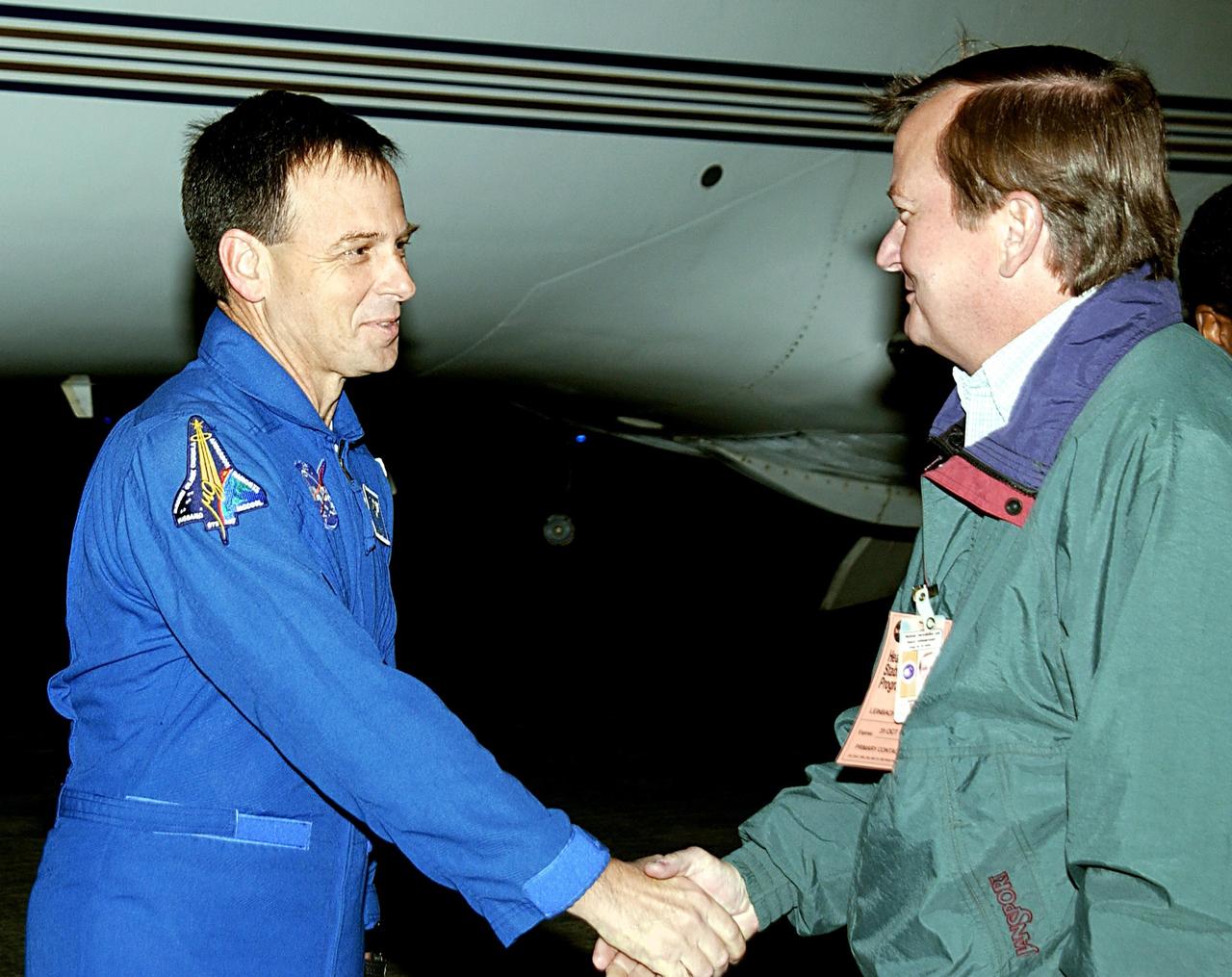
KENNEDY SPACE CENTER, FLA. -- STS-107 Payload Specialist Ilan Ramon (left) is greeted on his arrival by Launch Director Mike Linebach. Ramon is the first Israeli astronaut to fly on a Shuttle mission. STS-107 is a mission devoted to research and will include more than 80 experiments that will study Earth and space science, advanced technology development, and astronaut health and safety. The payload on Space Shuttle Columbia includes FREESTAR (Fast Reaction Experiments Enabling Science, Technology, Applications and Research) and the SHI Research Double Module (SHI/RDM), known as SPACEHAB. Experiments on the module range from material sciences to life sciences. Other crew members are Commander Rick Husband, Pilot William "Willie" McCool, Payload Commander Michael Anderson and Mission Specialists Kalpana Chawla, David Brown and Laurel Clark. Launch of Columbia is targeted for Jan. 16 between 10 a.m. and 2 p.m.
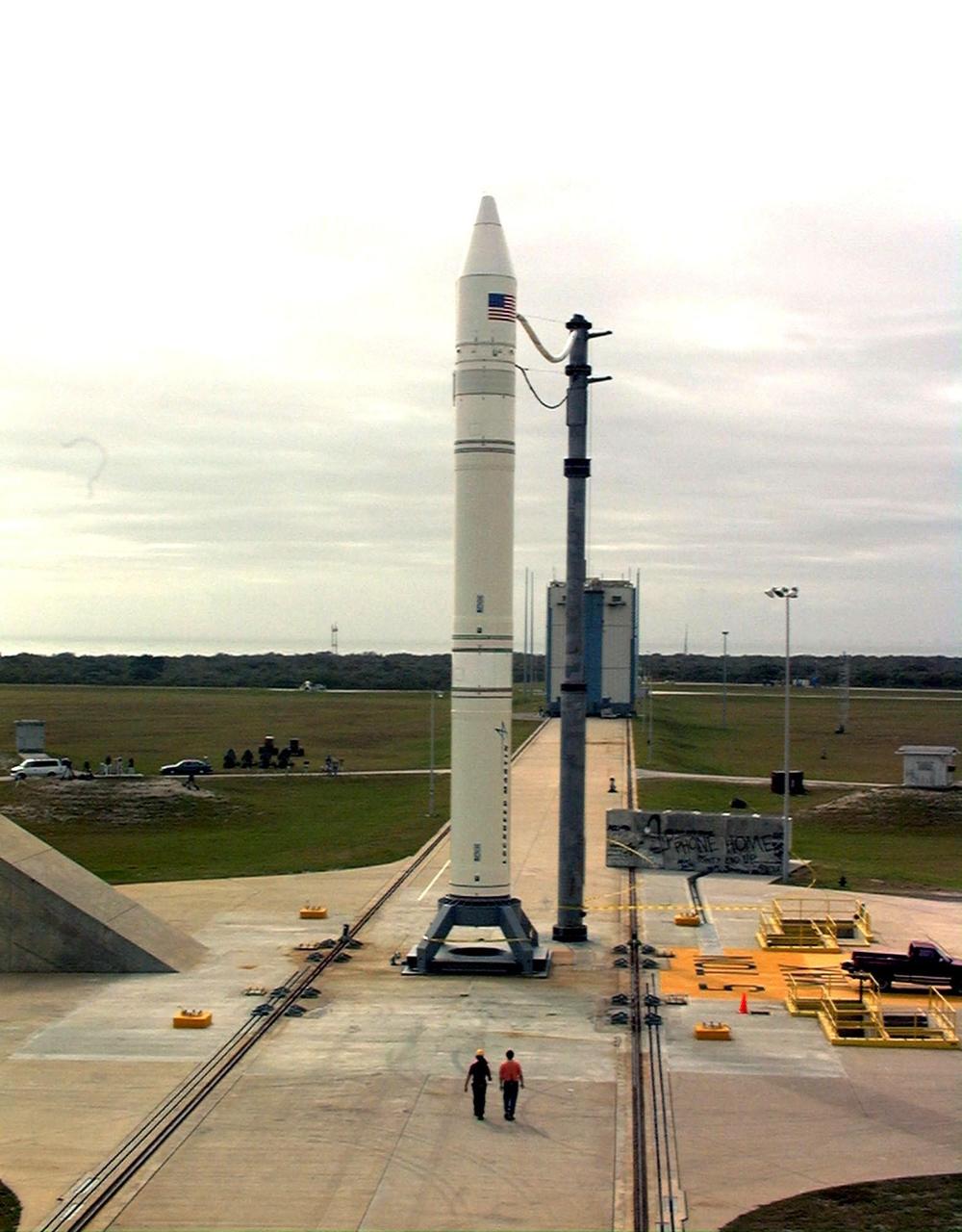
NASA’s Lunar Prospector is readied for launch as its gantry-like service tower is rolled back again at Cape Canaveral Air Station’s Launch Complex 46. The launch, previously scheduled for Jan. 5, was postponed one day due to a problem with a range safety radar located at Patrick Air Force Base, Fla. Lunar Prospector, built for the NASA Ames Research Center by Lockheed Martin, is a spin-stabilized spacecraft designed to provide NASA with the first global maps of the Moon’s surface and its gravitational magnetic fields, as well as look for the possible presence of ice near the lunar poles. It will orbit the Moon at an altitude of approximately 63 miles during a one-year mission. The launch of Lunar Prospector is now scheduled for Jan. 6, 1998 at 9:28 p.m. EST

KENNEDY SPACE CENTER, FLA. - STS-107 Mission Specialist Kalpana Chawla joins other crew members after arrival at KSC for pre-launch preparations. Not seen are Commander Rick Husband, Pilot William "Willie" McCool, Payload Commander Michael Anderson, Payload Specialist Ilan Ramon, and Mission Specialists David Brown and Laurel Clark. STS-107 is a mission devoted to research and will include more than 80 experiments that will study Earth and space science, advanced technology development, and astronaut health and safety. The payload on Space Shuttle Columbia includes FREESTAR (Fast Reaction Experiments Enabling Science, Technology, Applications and Research) and the SHI Research Double Module (SHI/RDM), known as SPACEHAB. Experiments on the module range from material sciences to life sciences. Launch of Columbia is targeted for Jan. 16 between 10 a.m. and 2 p.m.
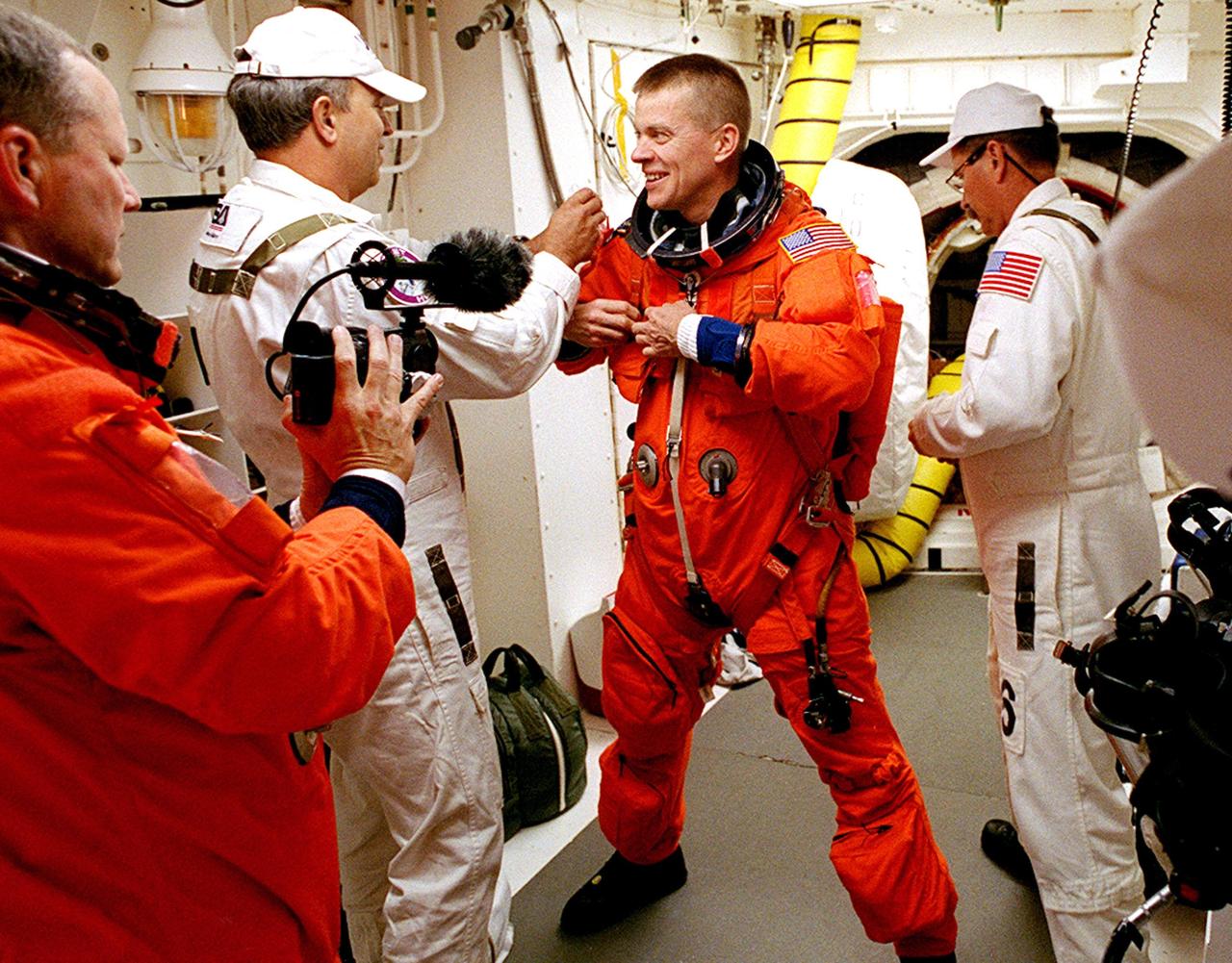
KENNEDY SPACE CENTER, FLA. - STS-107 Pilot William "Willie" McCool (center) gets help with his launch and entry suit from the Closeout Crew in the White Room. The environmentally controlled chamber is mated to Space Shuttle Columbia for entry into the Shuttle. In the foreground, left, is Mission Specialist David Brown. STS-107 is a mission devoted to research and will include more than 80 experiments that will study Earth and space science, advanced technology development, and astronaut health and safety. The payload on Space Shuttle Columbia includes FREESTAR (Fast Reaction Experiments Enabling Science, Technology, Applications and Research) and the SHI Research Double Module (SHI/RDM), known as SPACEHAB. Experiments on the module range from material sciences to life sciences. Liftoff is scheduled for 10:39 a.m. EST.
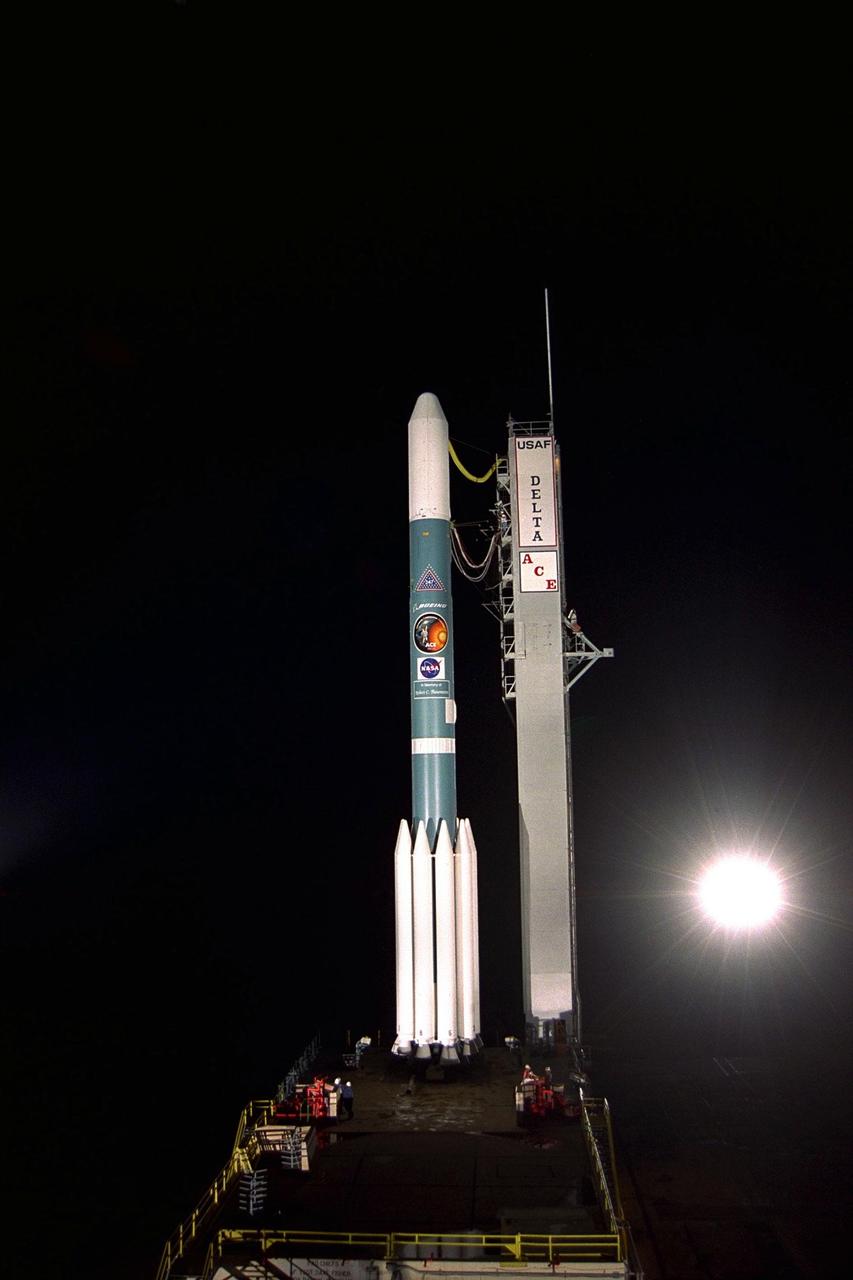
The Boeing Delta II expendable launch vehicle carrying the Advanced Composition Explorer (ACE) undergoes final preparations for liftoff in the predawn hours of Aug. 25, 1997, at Launch Complex 17A, Cape Canaveral Air Station. This is the second Delta launch under the Boeing name and the first from Cape Canaveral. The first launch attempt on Aug. 24 was scrubbed by Air Force range safety personnel because two commercial fishing vessels were within the Delta’s launch danger area. ACE with its combination of nine sensors and instruments will investigate the origin and evolution of solar phenomenon, the formation of solar corona, solar flares and acceleration of the solar wind. ACE was built for NASA by the Johns Hopkins Applied Physics Laboratory and is managed by the Explorer Project Office at NASA’s Goddard Space Flight Center. The lead scientific institution is the California Institute of Technology

Workers in the Vehicle Assembly Building check the connections on the forward section of a solid rocket booster (SRB) being mated to the rest of the stack below it. The forward section of each booster, from nose cap to forward skirt contains avionics, a sequencer, forward separation motors, a nose cone separation system, drogue and main parachutes, a recovery beacon, a recovery light, a parachute camera on selected flights and a range safety system. Each SRB weighs approximately 1.3 million pounds at launch. The SRB is part of the stack for Space Shuttle Discovery and the STS-92 mission, scheduled for launch Oct. 5, from Launch Pad 39A, on the fifth flight to the International Space Station. Payloads on the mission include the Z-1 truss and Pressurized Mating Adapter-3, components of the Space Station
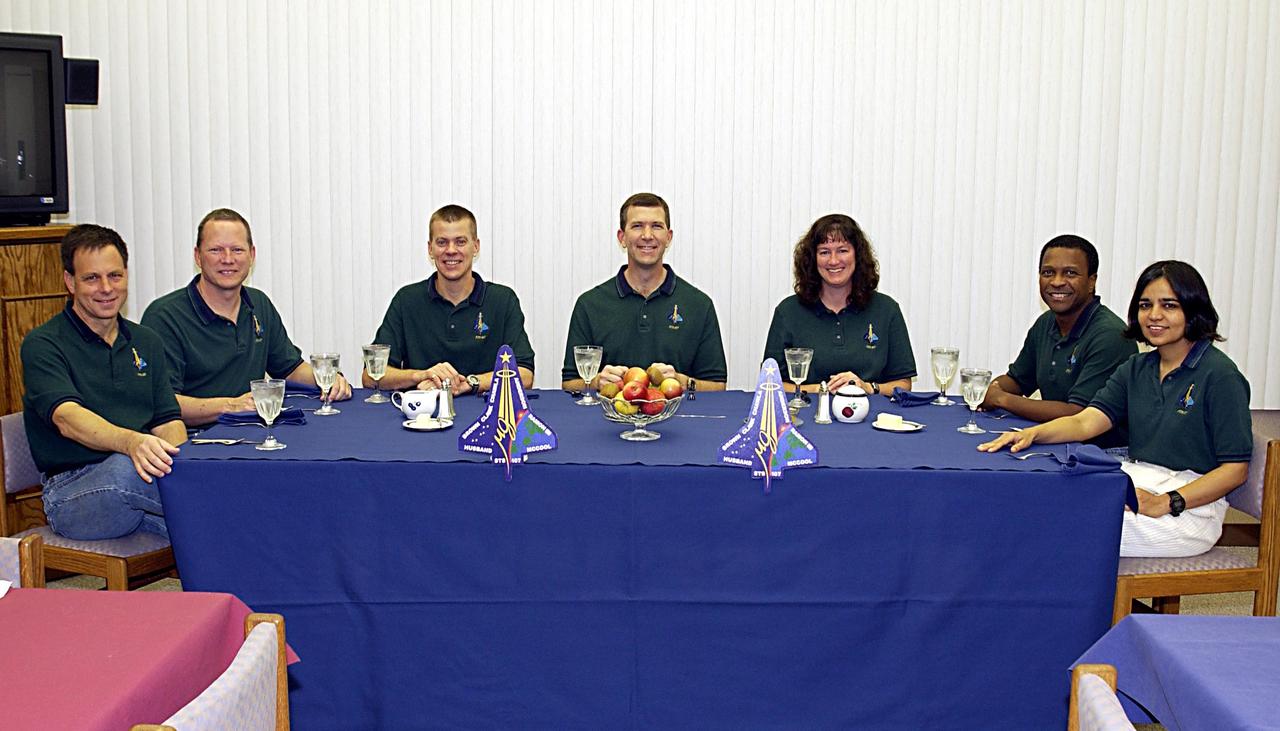
KENNEDY SPACE CENTER, FLA. - The STS-107 crew gathers at breakfast prior to preparing for launch. Seated left to right are Payload Specialist Ilan Ramon, Mission Specialist David Brown, Pilot William "Willie" McCool, Commander Rick Husband, Mission Specialist Laurel Clark, Payload Commander Michael Anderson and Mission Specialist Kalpana Chawla. STS-107 is a mission devoted to research and will include more than 80 experiments that will study Earth and space science, advanced technology development, and astronaut health and safety. The payload on Space Shuttle Columbia includes FREESTAR (Fast Reaction Experiments Enabling Science, Technology, Applications and Research) and the SHI Research Double Module (SHI/RDM), known as SPACEHAB. Experiments on the module range from material sciences to life sciences. Liftoff is scheduled for 10:39 a.m. EST.
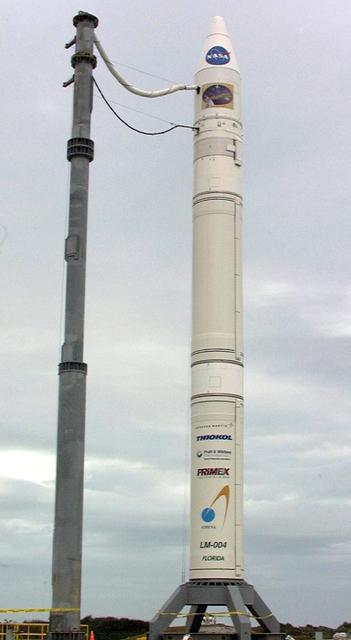
NASA’s Lunar Prospector is readied for launch as its gantry-like service tower is rolled back again at Cape Canaveral Air Station’s Launch Complex 46. The launch, previously scheduled for Jan. 5, was postponed one day due to a problem with a range safety radar located at Patrick Air Force Base, Fla. Lunar Prospector, built for the NASA Ames Research Center by Lockheed Martin, is a spin-stabilized spacecraft designed to provide NASA with the first global maps of the Moon’s surface and its gravitational magnetic fields, as well as look for the possible presence of ice near the lunar poles. It will orbit the Moon at an altitude of approximately 63 miles during a one-year mission. The launch of Lunar Prospector is now scheduled for Jan. 6, 1998 at 9:28 p.m. EST
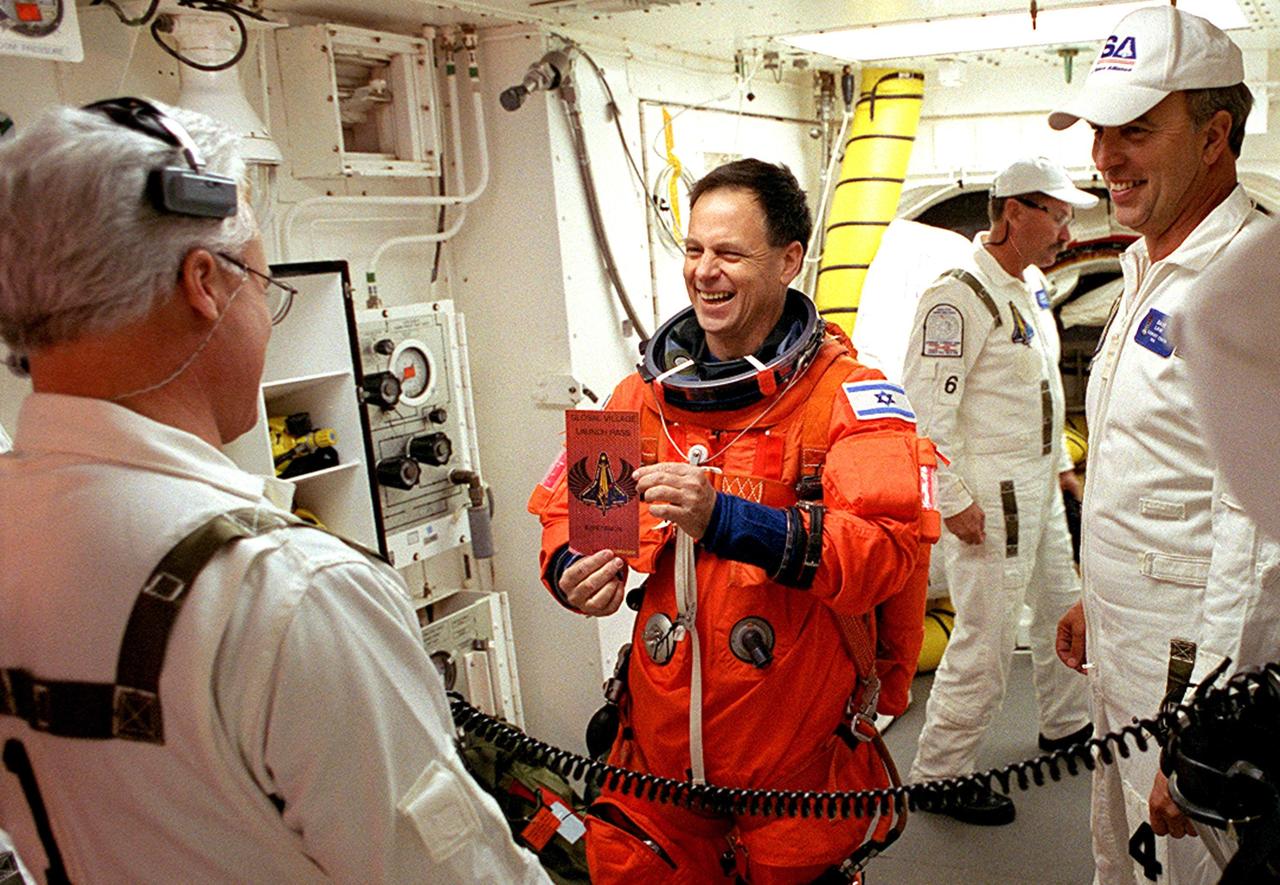
KENNEDY SPACE CENTER, FLA. -- STS-107 Payload Specialist Ilan Ramon, who represents the Israel Space Agency, chats with the Closeout Crew in the White Room before entering Columbia. The environmentally controlled chamber is mated to Space Shuttle Columbia for entry into the Shuttle. Ramon is the first Israeli astronaut to fly in the Shuttle. STS-107 is a mission devoted to research and will include more than 80 experiments that will study Earth and space science, advanced technology development, and astronaut health and safety. The payload on Space Shuttle Columbia includes FREESTAR (Fast Reaction Experiments Enabling Science, Technology, Applications and Research) and the SHI Research Double Module (SHI/RDM), known as SPACEHAB. Experiments on the module range from material sciences to life sciences. Liftoff is scheduled for 10:39 a.m. EST.
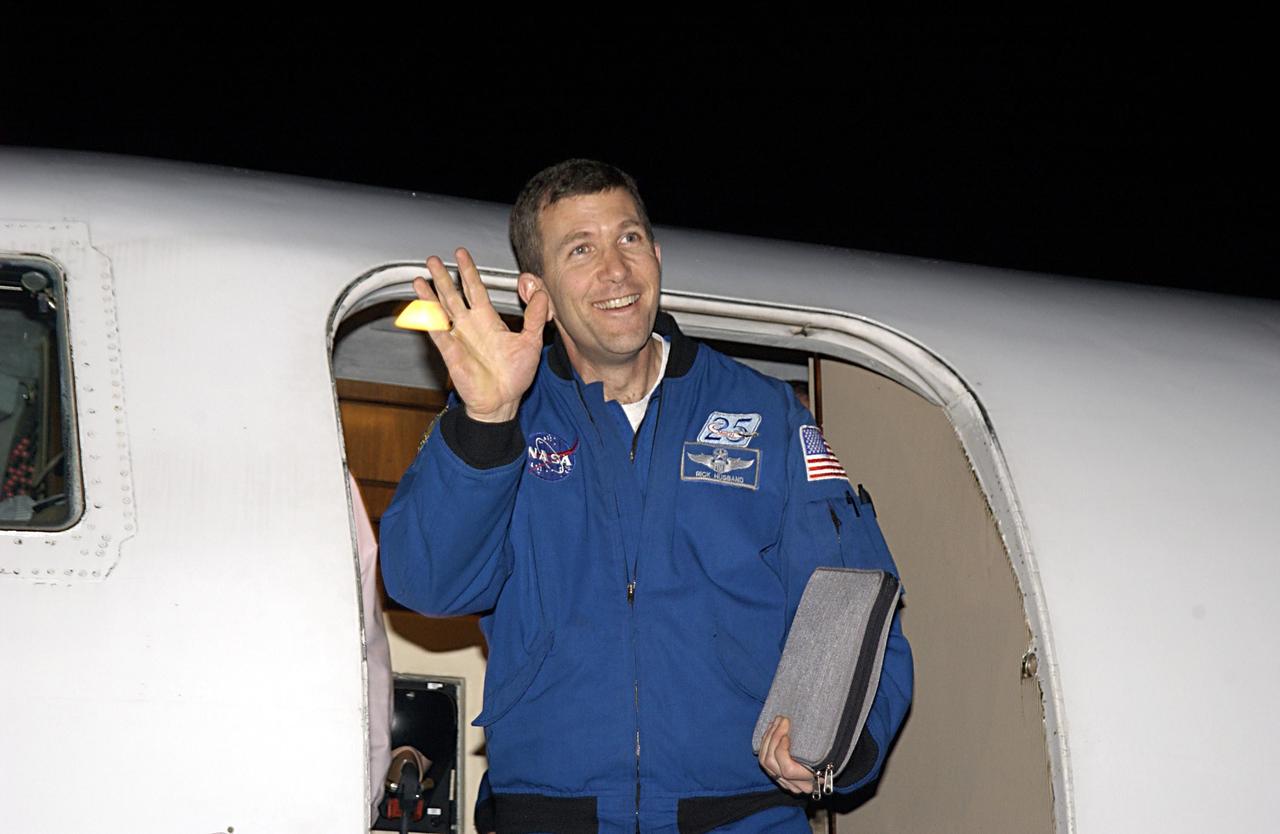
KENNEDY SPACE CENTER, FLA. - STS-107 Commander Rick Husband waves to spectators as he arrives at KSC for pre-launch preparations. STS-107 is a mission devoted to research and will include more than 80 experiments that will study Earth and space science, advanced technology development, and astronaut health and safety. The payload on Space Shuttle Columbia includes FREESTAR (Fast Reaction Experiments Enabling Science, Technology, Applications and Research) and the SHI Research Double Module (SHI/RDM), known as SPACEHAB. Experiments on the module range from material sciences to life sciences. The crew includes Payload Specialist Ilan Ramon, the first Israeli astronaut. Other crew members are Pilot William "Willie" McCool, Payload Commander Michael Anderson and Mission Specialists Kalpana Chawla, David Brown and Laurel Clark. Launch of Columbia is targeted for Jan. 16 between 10 a.m. and 2 p.m.
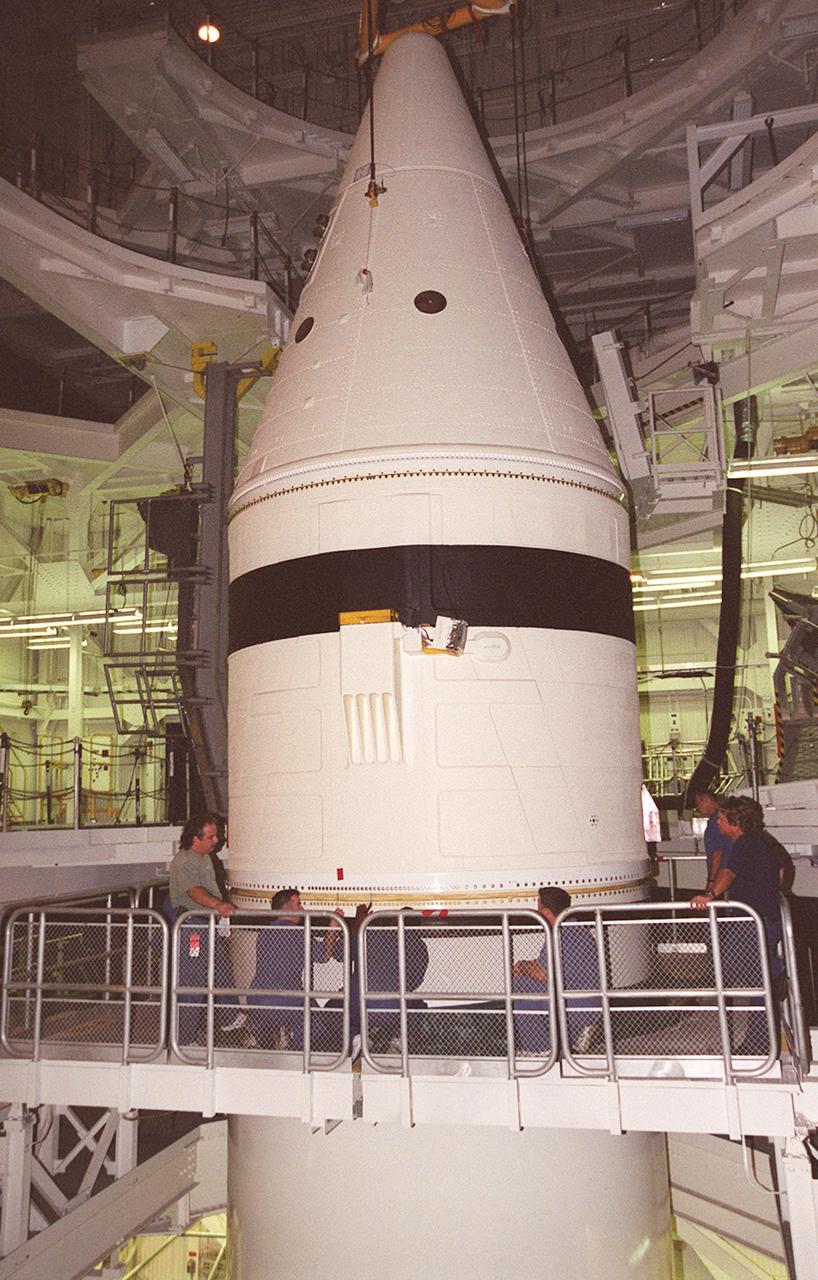
Workers in the Vehicle Assembly Building check the connections on the forward section of a solid rocket booster (SRB) being mated to the rest of the stack below it. The forward section of each booster, from nose cap to forward skirt contains avionics, a sequencer, forward separation motors, a nose cone separation system, drogue and main parachutes, a recovery beacon, a recovery light, a parachute camera on selected flights and a range safety system. Each SRB weighs approximately 1.3 million pounds at launch. The SRB is part of the stack for Space Shuttle Discovery and the STS-92 mission, scheduled for launch Oct. 5, from Launch Pad 39A, on the fifth flight to the International Space Station. Payloads on the mission include the Z-1 truss and Pressurized Mating Adapter-3, components of the Space Station
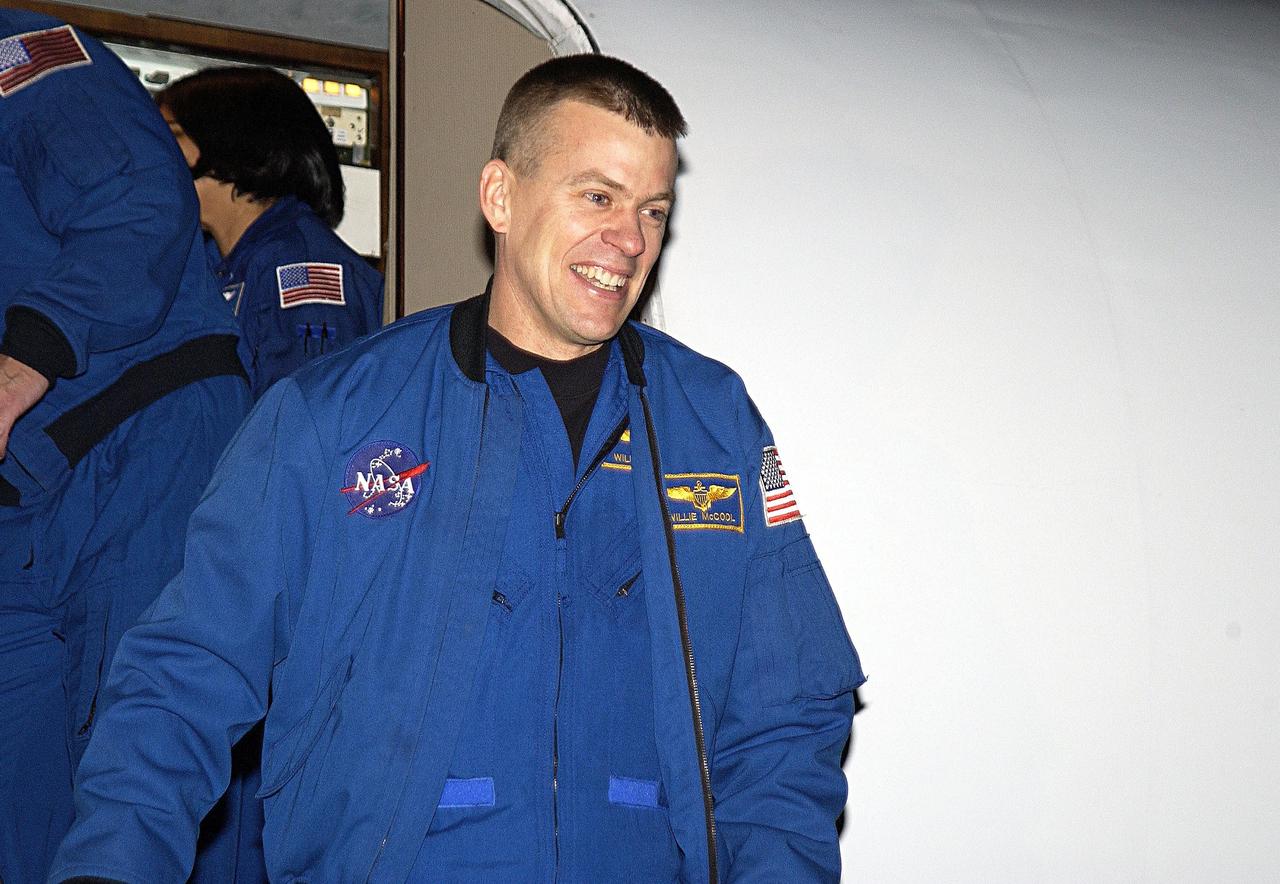
KENNEDY SPACE CENTER, FLA. - STS-107 Pilot William "Willie" McCool smiles at spectators as he arrives at KSC for pre-launch preparations. STS-107 is a mission devoted to research and will include more than 80 experiments that will study Earth and space science, advanced technology development, and astronaut health and safety. The payload on Space Shuttle Columbia includes FREESTAR (Fast Reaction Experiments Enabling Science, Technology, Applications and Research) and the SHI Research Double Module (SHI/RDM), known as SPACEHAB. Experiments on the module range from material sciences to life sciences. The crew includes Payload Specialist Ilan Ramon, the first Israeli astronaut. Other crew members are Commander Rick Husband, Payload Commander Michael Anderson and Mission Specialists Kalpana Chawla, David Brown and Laurel Clark. Launch of Columbia is targeted for Jan. 16 between 10 a.m. and 2 p.m.
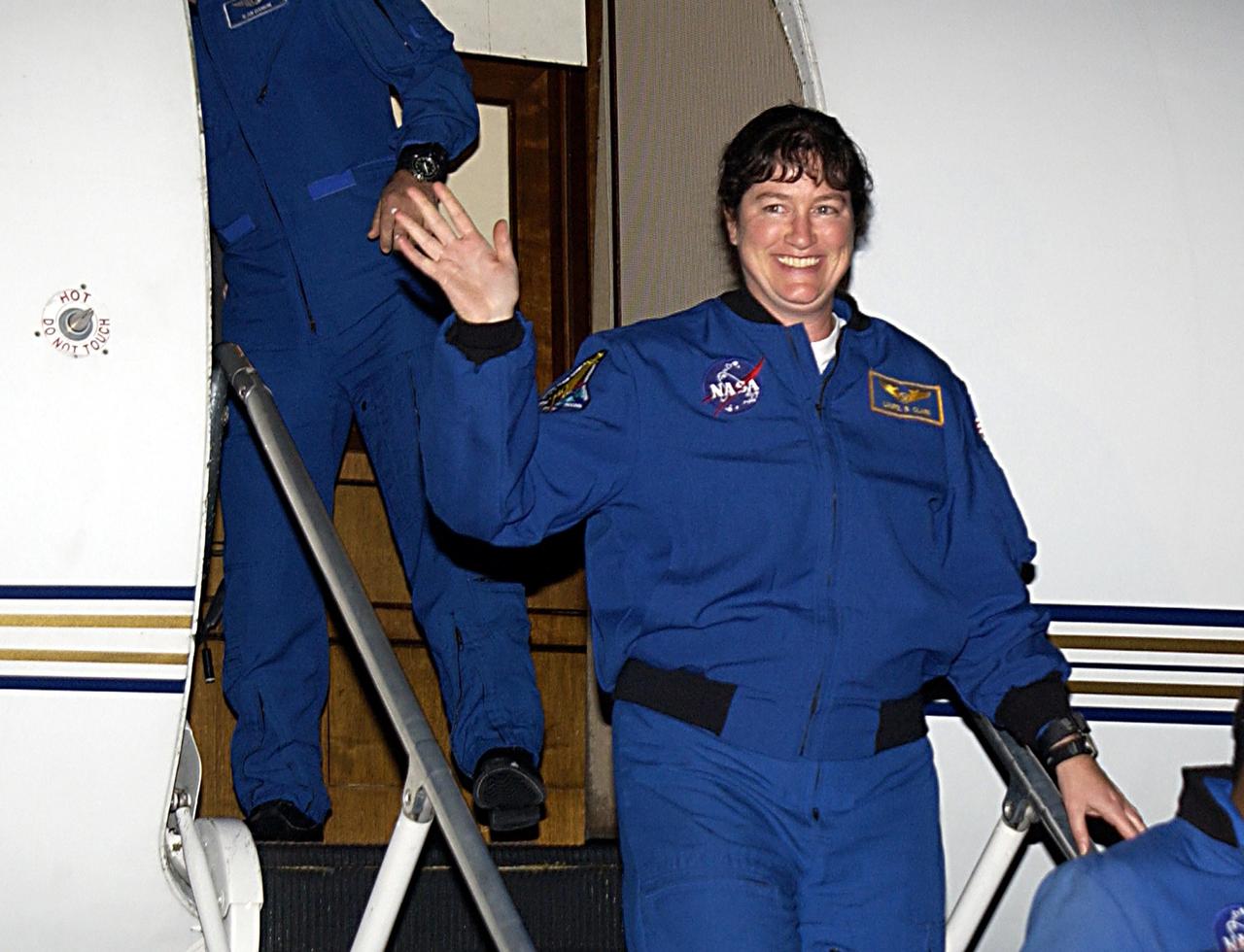
KENNEDY SPACE CENTER, FLA. - STS-107 Mission Specialist Laurel Clark waves to onlookers as she arrives at KSC for pre-launch preparations. STS-107 is a mission devoted to research and will include more than 80 experiments that will study Earth and space science, advanced technology development, and astronaut health and safety. The payload on Space Shuttle Columbia includes FREESTAR (Fast Reaction Experiments Enabling Science, Technology, Applications and Research) and the SHI Research Double Module (SHI/RDM), known as SPACEHAB. Experiments on the module range from material sciences to life sciences. The crew includes Payload Specialist Ilan Ramon, the first Israeli astronaut. Other crew members are Commander Rick Husband, Pilot William "Willie" McCool, Payload Commander Michael Anderson and Mission Specialists Kalpana Chawla and David Brown. Launch of Columbia is targeted for Jan. 16 between 10 a.m. and 2 p.m.
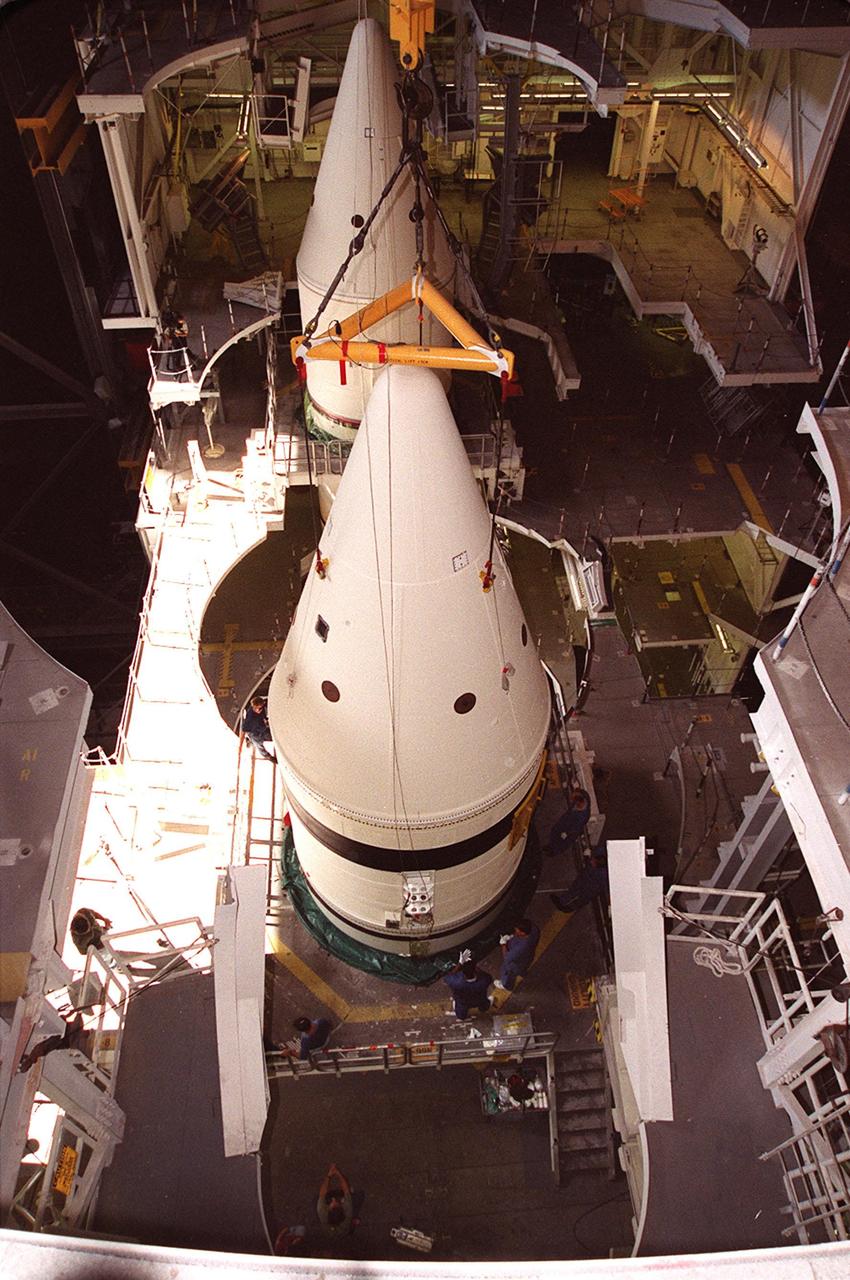
Workers in the Vehicle Assembly Building check the connections on the forward section of a solid rocket booster (SRB) being mated to the rest of the stack below it. The forward section of each booster, from nose cap to forward skirt contains avionics, a sequencer, forward separation motors, a nose cone separation system, drogue and main parachutes, a recovery beacon, a recovery light, a parachute camera on selected flights and a range safety system. Each SRB weighs approximately 1.3 million pounds at launch. The SRB is part of the stack for Space Shuttle Discovery and the STS-92 mission, scheduled for launch Oct. 5, from Launch Pad 39A, on the fifth flight to the International Space Station. Payloads on the mission include the Z-1 truss and Pressurized Mating Adapter-3, components of the Space Station
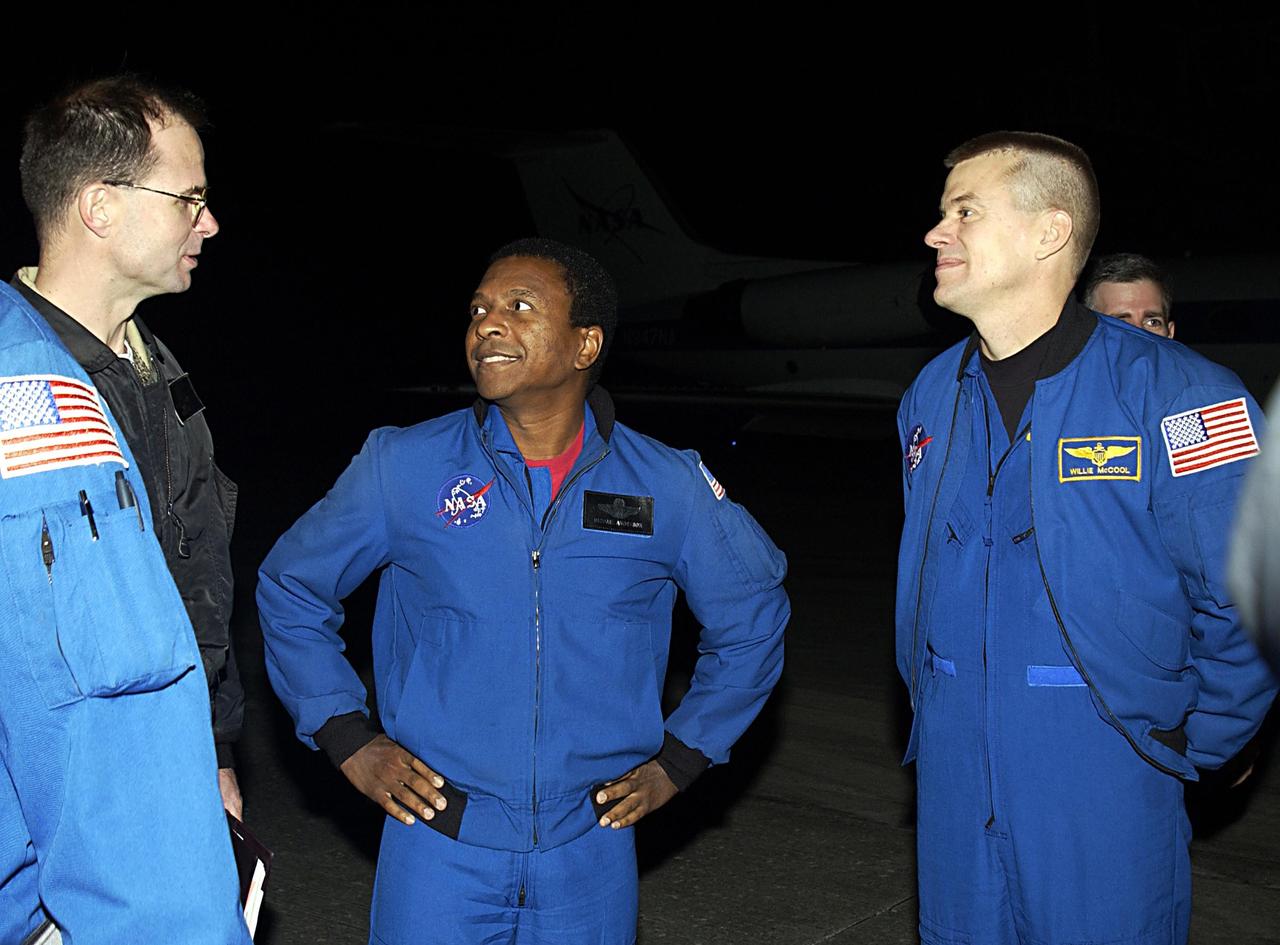
KENNEDY SPACE CENTER, FLA. - After their arrival at KSC, STS-107 Payload Commander Michael Anderson (center) and Pilot William "Willie" McCool (right) talk with Robert Hanley, who is mission lead with the Vehicle Integration Test team from Houston. STS-107 is a mission devoted to research and will include more than 80 experiments that will study Earth and space science, advanced technology development, and astronaut health and safety. The payload on Space Shuttle Columbia includes FREESTAR (Fast Reaction Experiments Enabling Science, Technology, Applications and Research) and the SHI Research Double Module (SHI/RDM), known as SPACEHAB. Experiments on the module range from material sciences to life sciences. Launch of Columbia is targeted for Jan. 16 between 10 a.m. and 2 p.m.
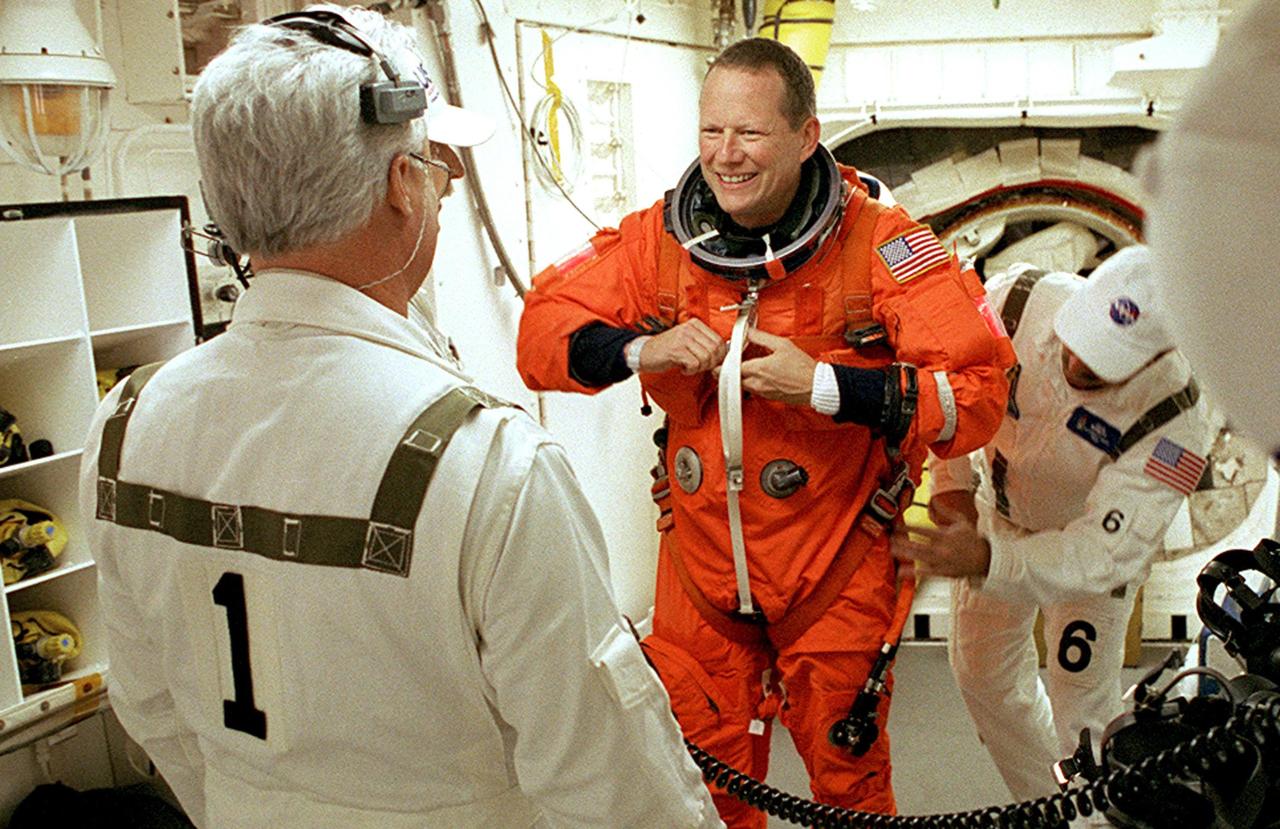
KENNEDY SPACE CENTER, FLA. - STS-107 David Brown chats with the Closeout Crew during final preparations of his launch and entry suit in the White Room. The environmentally controlled chamber is mated to Space Shuttle Columbia for entry into the Shuttle. The hatch is seen in the background right. STS-107 is a mission devoted to research and will include more than 80 experiments that will study Earth and space science, advanced technology development, and astronaut health and safety. The payload on Space Shuttle Columbia includes FREESTAR (Fast Reaction Experiments Enabling Science, Technology, Applications and Research) and the SHI Research Double Module (SHI/RDM), known as SPACEHAB. Experiments on the module range from material sciences to life sciences. Liftoff is scheduled for 10:39 a.m. EST.
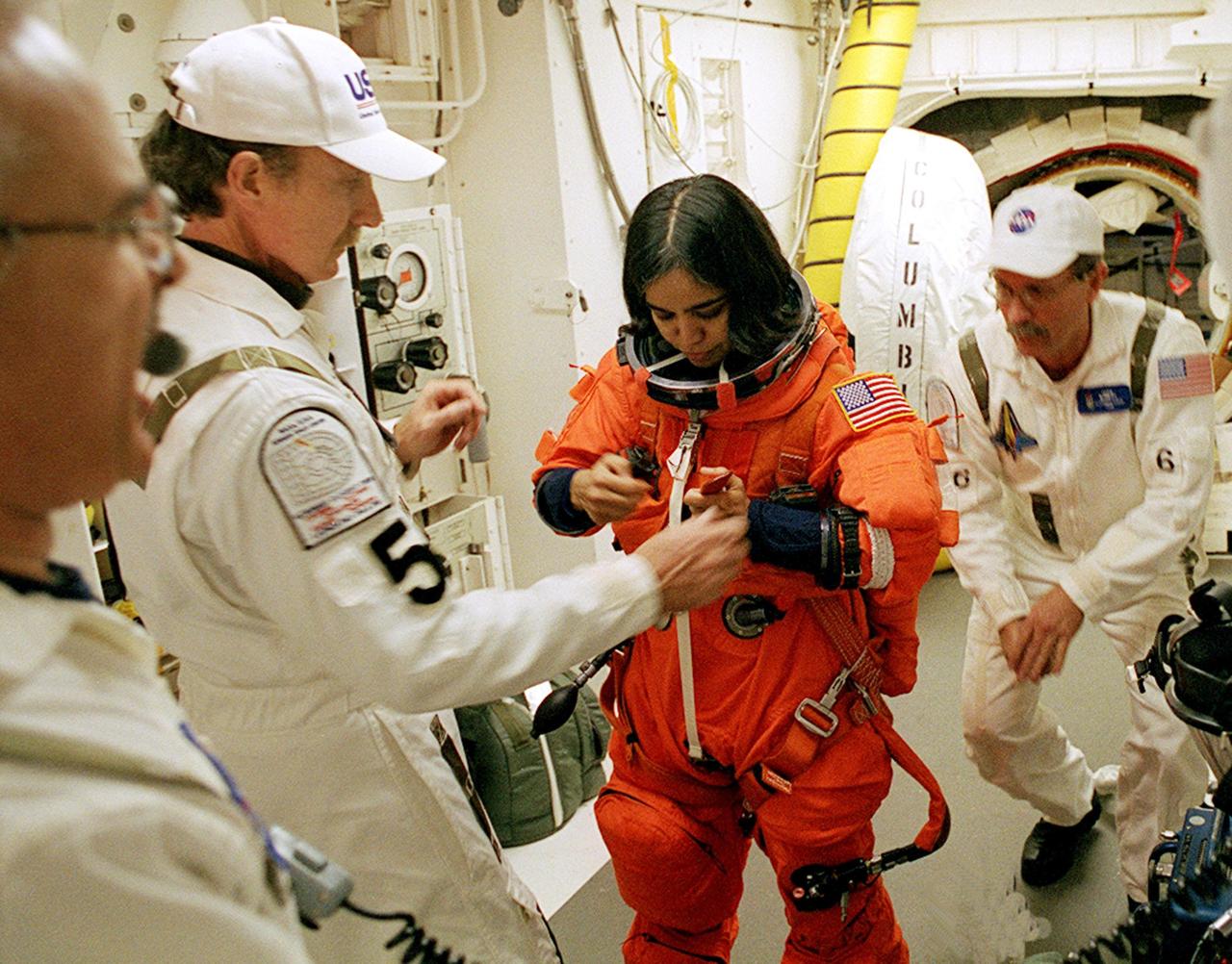
KENNEDY SPACE CENTER, FLA. -- STS-107 Mission Specialist Kalpana Chawla gets help with her launch and entry suit from the Closeout Crew in the White Room. The environmentally controlled chamber is mated to Space Shuttle Columbia for entry into the Shuttle. The hatch is seen in the background right. STS-107 is a mission devoted to research and will include more than 80 experiments that will study Earth and space science, advanced technology development, and astronaut health and safety. The payload on Space Shuttle Columbia includes FREESTAR (Fast Reaction Experiments Enabling Science, Technology, Applications and Research) and the SHI Research Double Module (SHI/RDM), known as SPACEHAB. Experiments on the module range from material sciences to life sciences. Liftoff is scheduled for 10:39 a.m. EST.

KENNEDY SPACE CENTER, FLA. - STS-107 Mission Specialist Laurel Clark waves to a camera out of view during final preparations of her launch and entry suit in the White Room. The environmentally controlled chamber is mated to Space Shuttle Columbia for entry into the Shuttle. The hatch is seen in the background right. STS-107 is a mission devoted to research and will include more than 80 experiments that will study Earth and space science, advanced technology development, and astronaut health and safety. The payload on Space Shuttle Columbia includes FREESTAR (Fast Reaction Experiments Enabling Science, Technology, Applications and Research) and the SHI Research Double Module (SHI/RDM), known as SPACEHAB. Experiments on the module range from material sciences to life sciences. Liftoff is scheduled for 10:39 a.m. EST.
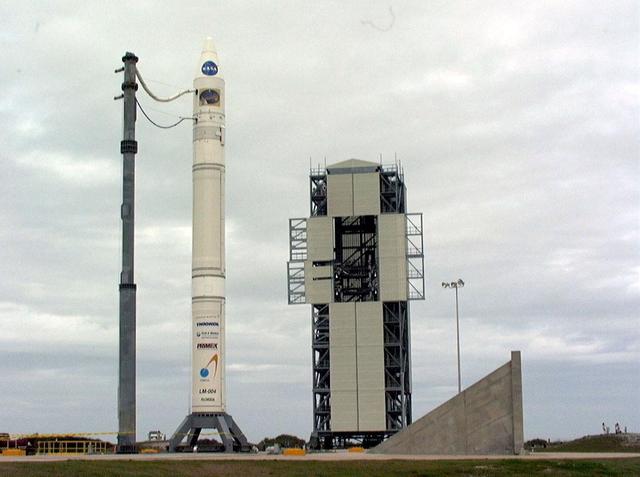
NASA’s Lunar Prospector is readied for launch as its gantry-like service tower is rolled back again at Cape Canaveral Air Station’s Launch Complex 46. The launch, previously scheduled for Jan. 5, was postponed one day due to a problem with a range safety radar located at Patrick Air Force Base, Fla. Lunar Prospector, built for the NASA Ames Research Center by Lockheed Martin, is a spin-stabilized spacecraft designed to provide NASA with the first global maps of the Moon’s surface and its gravitational magnetic fields, as well as look for the possible presence of ice near the lunar poles. It will orbit the Moon at an altitude of approximately 63 miles during a one-year mission. The launch of Lunar Prospector is now scheduled for Jan. 6, 1998 at 9:28 p.m. EST
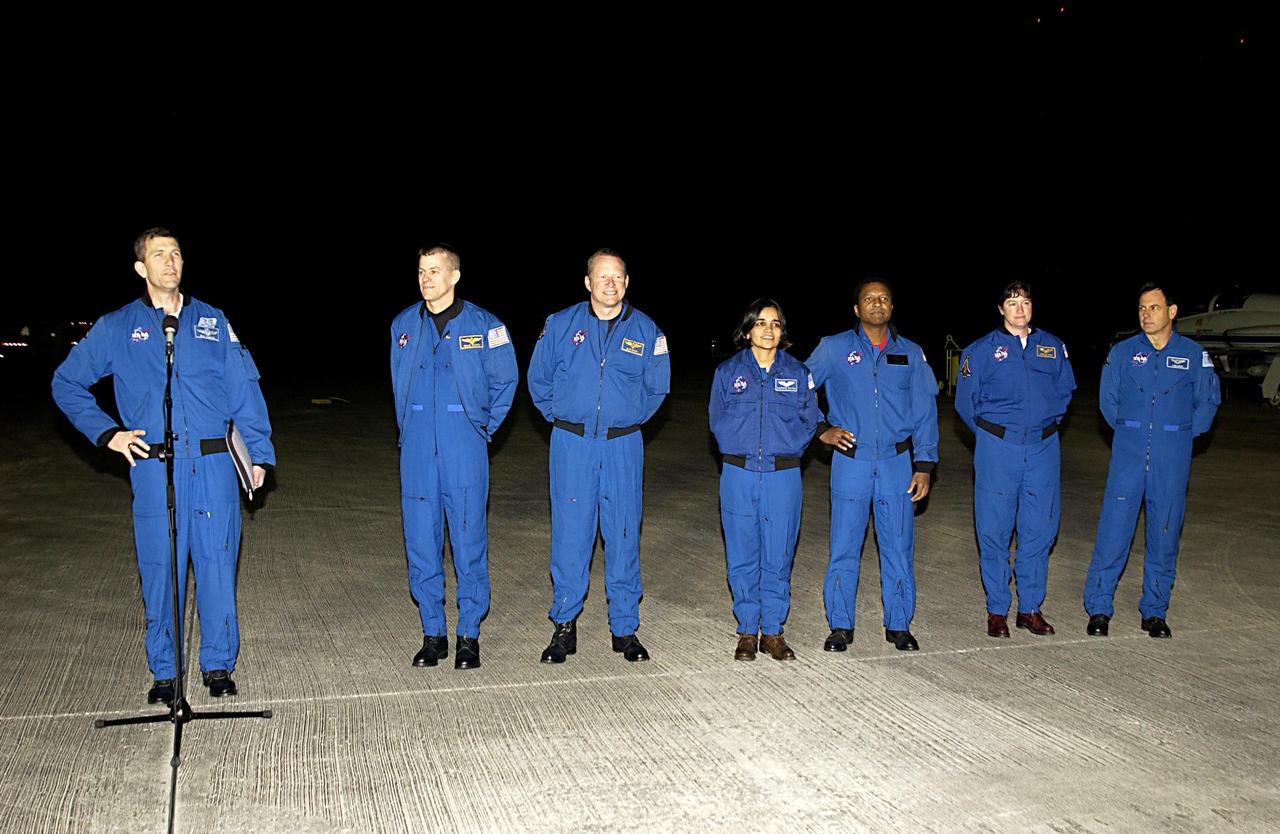
KENNEDY SPACE CENTER, FLA. -STS-107 Commander Rick Husband (at the microphone) makes a few comments after the crew's arrival at KSC for pre-launch preparations. Standing left to right are Husband, Pilot William "Willie" McCool, Mission Specialists David Brown and Kalpana Chawla, Payload Commander Michael Anderson, Mission Specialist Laurel Clark and Payload Specialist Ilan Ramon, who is the first Israeli astronaut to fly on a Shuttle mission. STS-107 is a mission devoted to research and will include more than 80 experiments that will study Earth and space science, advanced technology development, and astronaut health and safety. The payload on Space Shuttle Columbia includes FREESTAR (Fast Reaction Experiments Enabling Science, Technology, Applications and Research) and the SHI Research Double Module (SHI/RDM), known as SPACEHAB. Experiments on the module range from material sciences to life sciences. Launch of Columbia is targeted for Jan. 16 between 10 a.m. and 2 p.m.
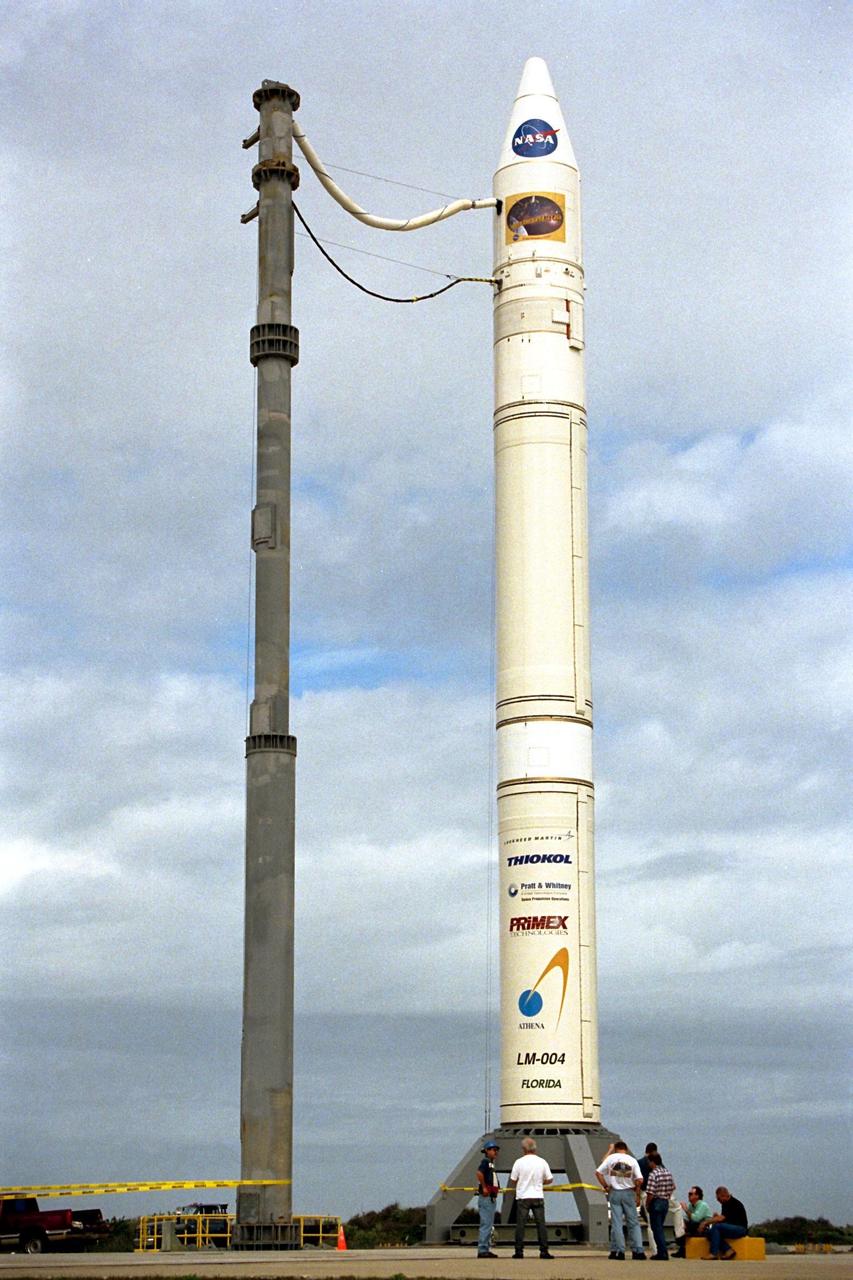
NASA’s Lunar Prospector is readied for launch as its gantry-like service tower is rolled back again at Cape Canaveral Air Station’s Launch Complex 46. The launch, previously scheduled for Jan. 5, was postponed one day due to a problem with a range safety radar located at Patrick Air Force Base, Fla. Lunar Prospector, built for the NASA Ames Research Center by Lockheed Martin, is a spin-stabilized spacecraft designed to provide NASA with the first global maps of the Moon’s surface and its gravitational magnetic fields, as well as look for the possible presence of ice near the lunar poles. It will orbit the Moon at an altitude of approximately 63 miles during a one-year mission. The launch of Lunar Prospector is now scheduled for Jan. 6, 1998 at 9:28 p.m. EST
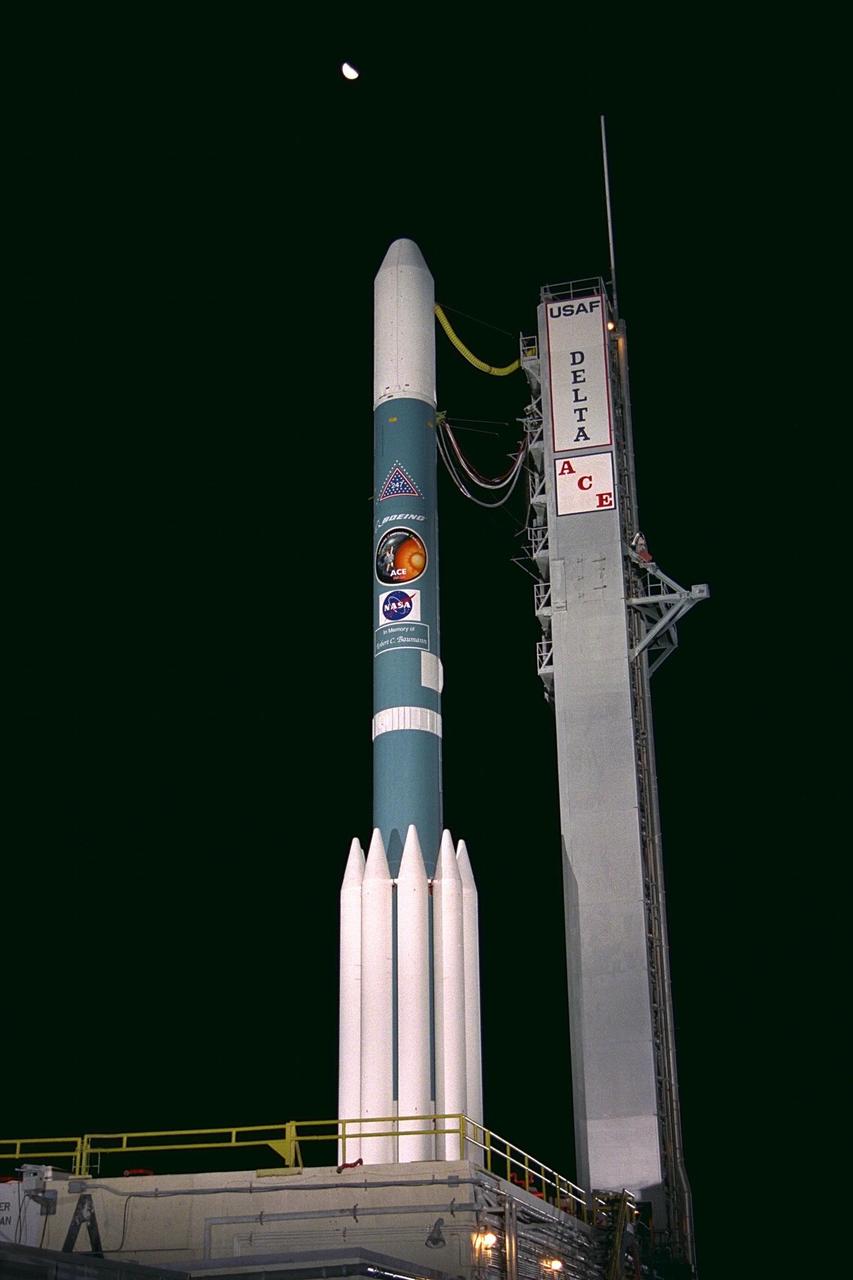
The Boeing Delta II expendable launch vehicle carrying the Advanced Composition Explorer (ACE) undergoes final preparations for liftoff in the predawn hours of Aug. 25, 1997, at Launch Complex 17A, Cape Canaveral Air Station. This is the second Delta launch under the Boeing name and the first from Cape Canaveral. The first launch attempt on Aug. 24 was scrubbed by Air Force range safety personnel because two commercial fishing vessels were within the Delta’s launch danger area. ACE with its combination of nine sensors and instruments will investigate the origin and evolution of solar phenomenon, the formation of solar corona, solar flares and acceleration of the solar wind. ACE was built for NASA by the Johns Hopkins Applied Physics Laboratory and is managed by the Explorer Project Office at NASA’s Goddard Space Flight Center. The lead scientific institution is the California Institute of Technology
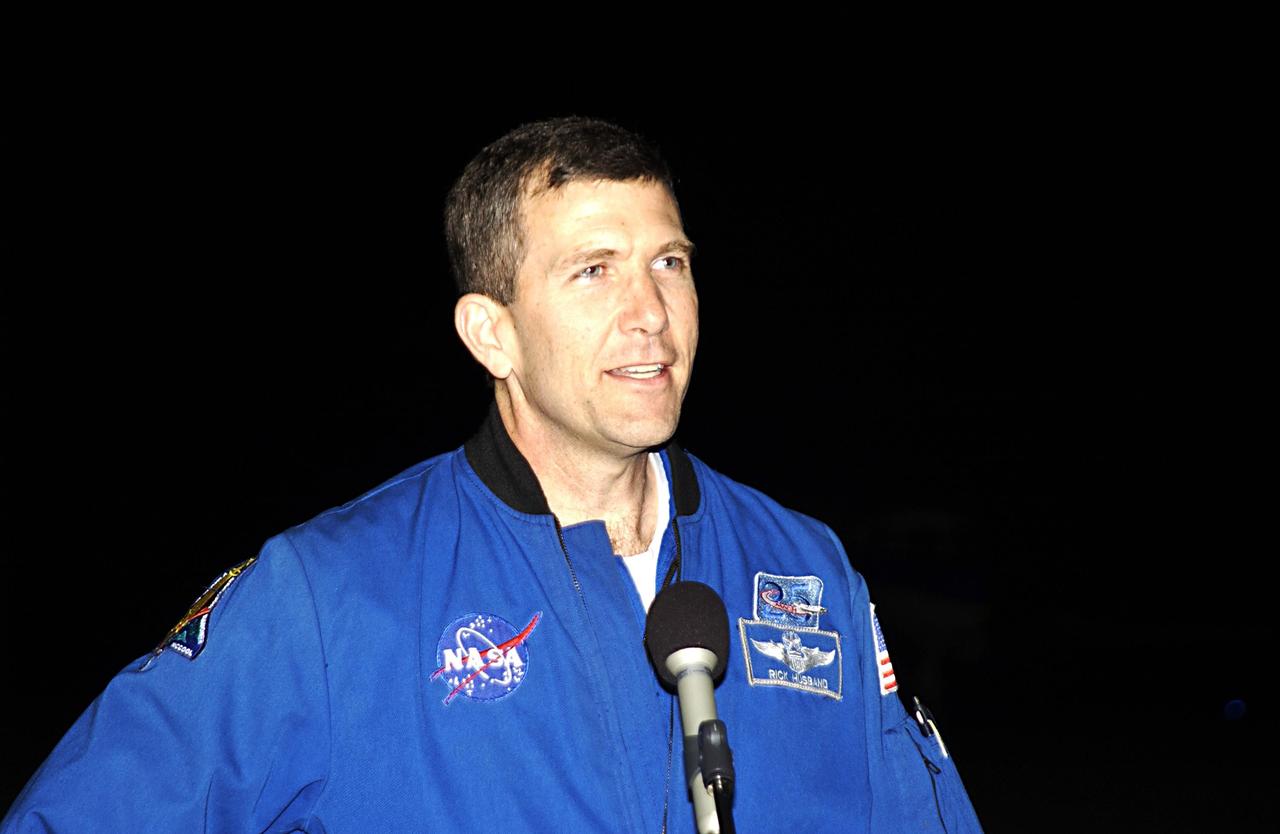
KENNEDY SPACE CENTER, FLA. -- STS-107 Commander Rick Husband makes a few comments after the crew's arrival at KSC for pre-launch preparations. Other crew members are Pilot William "Willie" McCool, Payload Commander Michael Anderson, Payload Specialist Ilan Ramon, and Mission Specialists Kalpana Chawla, David Brown and Laurel Clark. Ramon is the first Israeli astronaut to fly on a Shuttle mission. STS-107 is a mission devoted to research and will include more than 80 experiments that will study Earth and space science, advanced technology development, and astronaut health and safety. The payload on Space Shuttle Columbia includes FREESTAR (Fast Reaction Experiments Enabling Science, Technology, Applications and Research) and the SHI Research Double Module (SHI/RDM), known as SPACEHAB. Experiments on the module range from material sciences to life sciences. Launch of Columbia is targeted for Jan. 16 between 10 a.m. and 2 p.m.
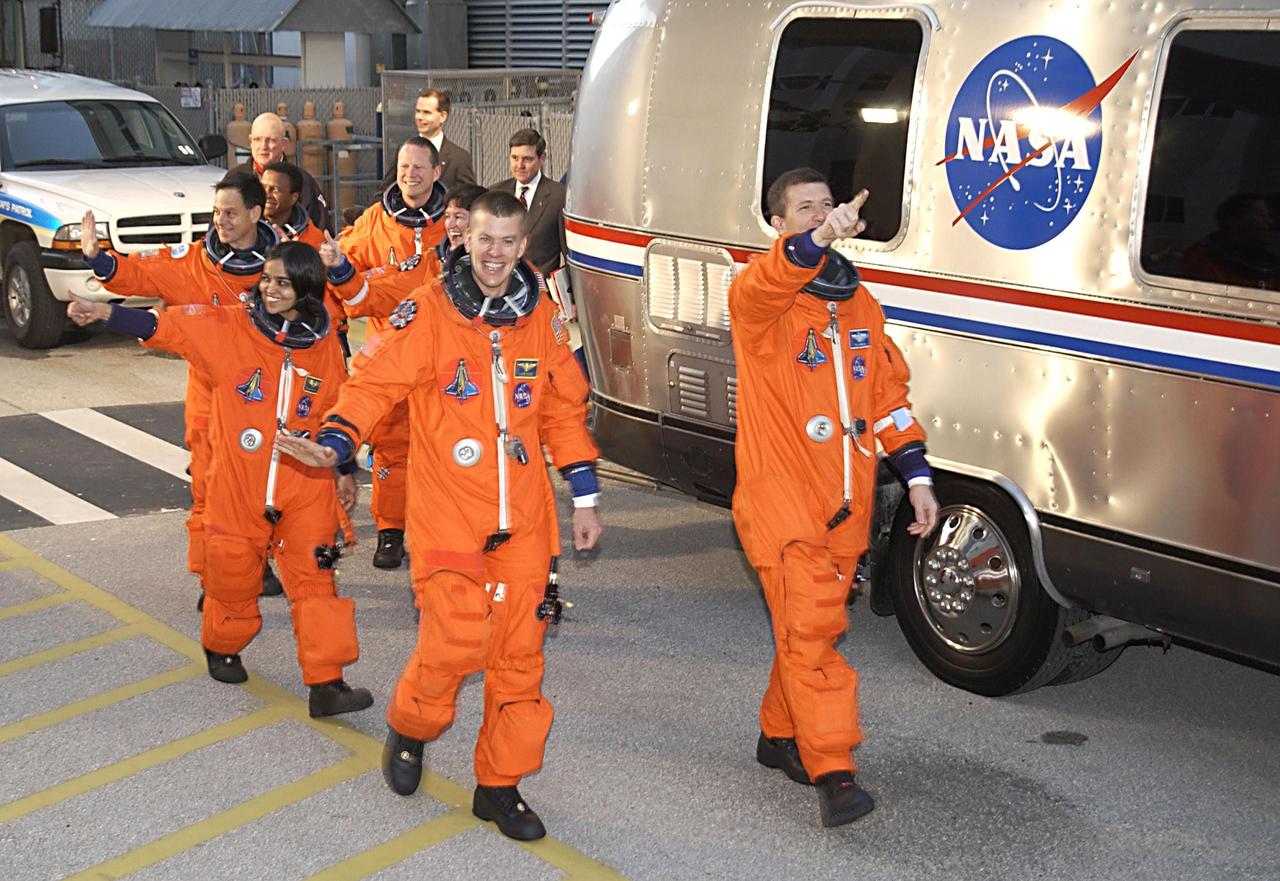
KENNEDY SPACE CENTER, FLA. - The STS-107 crew heads for the Astrovan and a ride to Launch Pad 39A for liftoff. In front, left to right, are Payload Specialist Ilan Ramon, Mission Specialist Kalpana Chawla and Pilot William "Willie" McCool; behind them, left to right, are Payload Commander Michael Anderson, Mission Specialists David Brown and Laurel Clark, and Mission Commander Rick Husband. Ramon is the first astronaut from Israel to fly on a Shuttle. The 16-day mission is devoted to research and will include more than 80 experiments that will study Earth and space science, advanced technology development, and astronaut health and safety. The payload on Space Shuttle Columbia includes FREESTAR (Fast Reaction Experiments Enabling Science, Technology, Applications and Research) and the SHI Research Double Module (SHI/RDM), known as SPACEHAB. Experiments on the module range from material sciences to life sciences. Liftoff is scheduled for 10:39 a.m. EST.
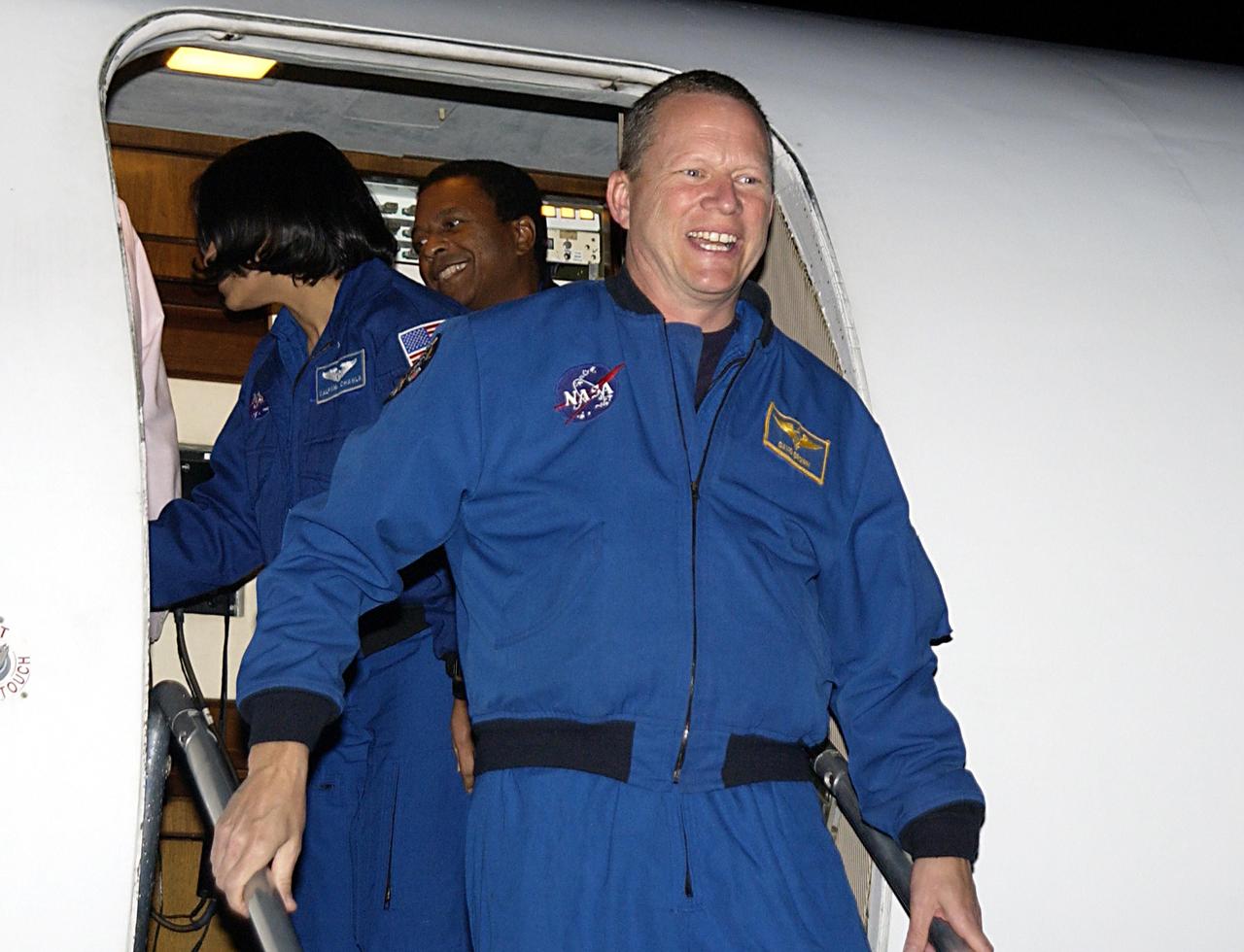
KENNEDY SPACE CENTER, FLA. - STS-107 Mission Specialist David Brown shows his pleasure at arriving at KSC for pre-launch preparations. STS-107 is a mission devoted to research and will include more than 80 experiments that will study Earth and space science, advanced technology development, and astronaut health and safety. The payload on Space Shuttle Columbia includes FREESTAR (Fast Reaction Experiments Enabling Science, Technology, Applications and Research) and the SHI Research Double Module (SHI/RDM), known as SPACEHAB. Experiments on the module range from material sciences to life sciences. The crew includes Payload Specialist Ilan Ramon, the first Israeli astronaut. Other crew members are Commander Rick Husband, Pilot William "Willie" McCool, Payload Commander Michael Anderson and Mission Specialists Kalpana Chawla and Laurel Clark. Launch of Columbia is targeted for Jan. 16 between 10 a.m. and 2 p.m.

KENNEDY SPACE CENTER, FLA. - STS-107 Payload Specialist Ilan Ramon comments on the mission after the crew's arrival at KSC for pre-launch preparations. Ramon is the first Israeli astronaut to fly on a Shuttle mission. Standing behind him are (left to right) Commander Rick Husband, Pilot William "Willie" McCool, Mission Specialists David Brown and Kalpana Chawla, Payload Commander Michael Anderson and Mission Specialist Laurel Clark. STS-107 is a mission devoted to research and will include more than 80 experiments that will study Earth and space science, advanced technology development, and astronaut health and safety. The payload on Space Shuttle Columbia includes FREESTAR (Fast Reaction Experiments Enabling Science, Technology, Applications and Research) and the SHI Research Double Module (SHI/RDM), known as SPACEHAB. Experiments on the module range from material sciences to life sciences. Launch of Columbia is targeted for Jan. 16 between 10 a.m. and 2 p.m.
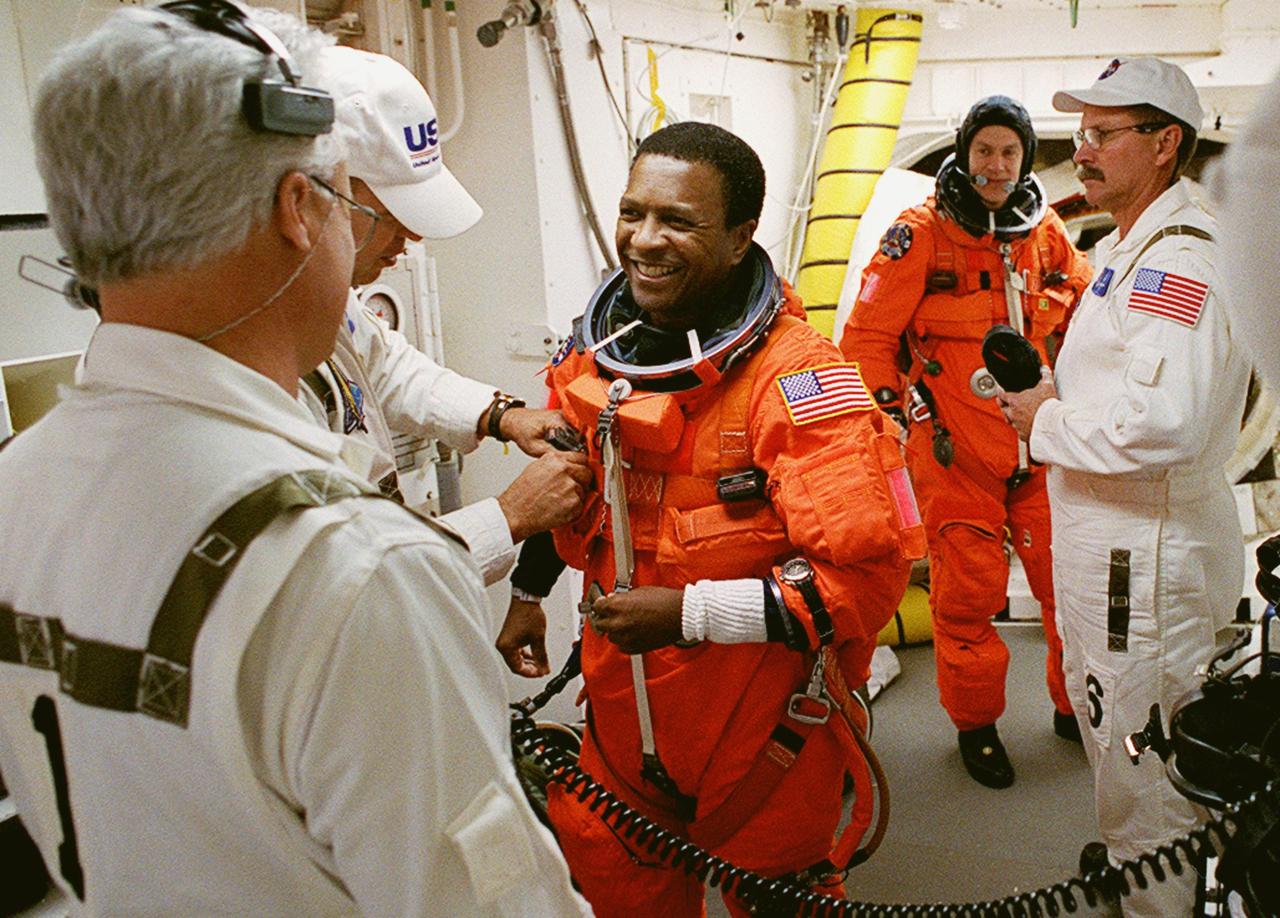
KENNEDY SPACE CENTER, FLA. -- STS-107 Payload Commander Michael Anderson gets help with his launch and entry suit from the Closeout Crew in the White Room. The environmentally controlled chamber is mated to Space Shuttle Columbia for entry into the Shuttle. Behind him is Pilot William "Willie" McCool. STS-107 is a mission devoted to research and will include more than 80 experiments that will study Earth and space science, advanced technology development, and astronaut health and safety. The payload on Space Shuttle Columbia includes FREESTAR (Fast Reaction Experiments Enabling Science, Technology, Applications and Research) and the SHI Research Double Module (SHI/RDM), known as SPACEHAB. Experiments on the module range from material sciences to life sciences. Liftoff is scheduled for 10:39 a.m. EST.
![KENNEDY SPACE CENTER, FLA. -- The STS-107 crew heads for the Astrovan and a ride to Launch Pad 39A for liftoff. From left to right are Payload Commander Michael Anderson, Mission Specialist David Brown, Payload Specialist Ilan Ramon, Mission Specialists Laurel Clark and Kalpana Chawla, Mission Commandaer Rick Husband and Pilot William "Willie" McCool. Ramon is the first astronaut from Israel to fly on a Shuttle. The 16-day mission is devoted to research and will include more than 80 experiments that will study Earth and space science, advanced technology development, and astronaut health and safety. The payload on Space Shuttle Columbia includes FREESTAR (Fast Reaction Experiments Enabling Science, Technology, Applications and Research) and the SHI Research Double Module (SHI/RDM), known as SPACEHAB. Experiments on the module range from material sciences to life sciences. Liftoff is scheduled for 10:39 a.m. EST. [Photo courtesy of Scott Andrews]](https://images-assets.nasa.gov/image/KSC-03pd0110/KSC-03pd0110~medium.jpg)
KENNEDY SPACE CENTER, FLA. -- The STS-107 crew heads for the Astrovan and a ride to Launch Pad 39A for liftoff. From left to right are Payload Commander Michael Anderson, Mission Specialist David Brown, Payload Specialist Ilan Ramon, Mission Specialists Laurel Clark and Kalpana Chawla, Mission Commandaer Rick Husband and Pilot William "Willie" McCool. Ramon is the first astronaut from Israel to fly on a Shuttle. The 16-day mission is devoted to research and will include more than 80 experiments that will study Earth and space science, advanced technology development, and astronaut health and safety. The payload on Space Shuttle Columbia includes FREESTAR (Fast Reaction Experiments Enabling Science, Technology, Applications and Research) and the SHI Research Double Module (SHI/RDM), known as SPACEHAB. Experiments on the module range from material sciences to life sciences. Liftoff is scheduled for 10:39 a.m. EST. [Photo courtesy of Scott Andrews]
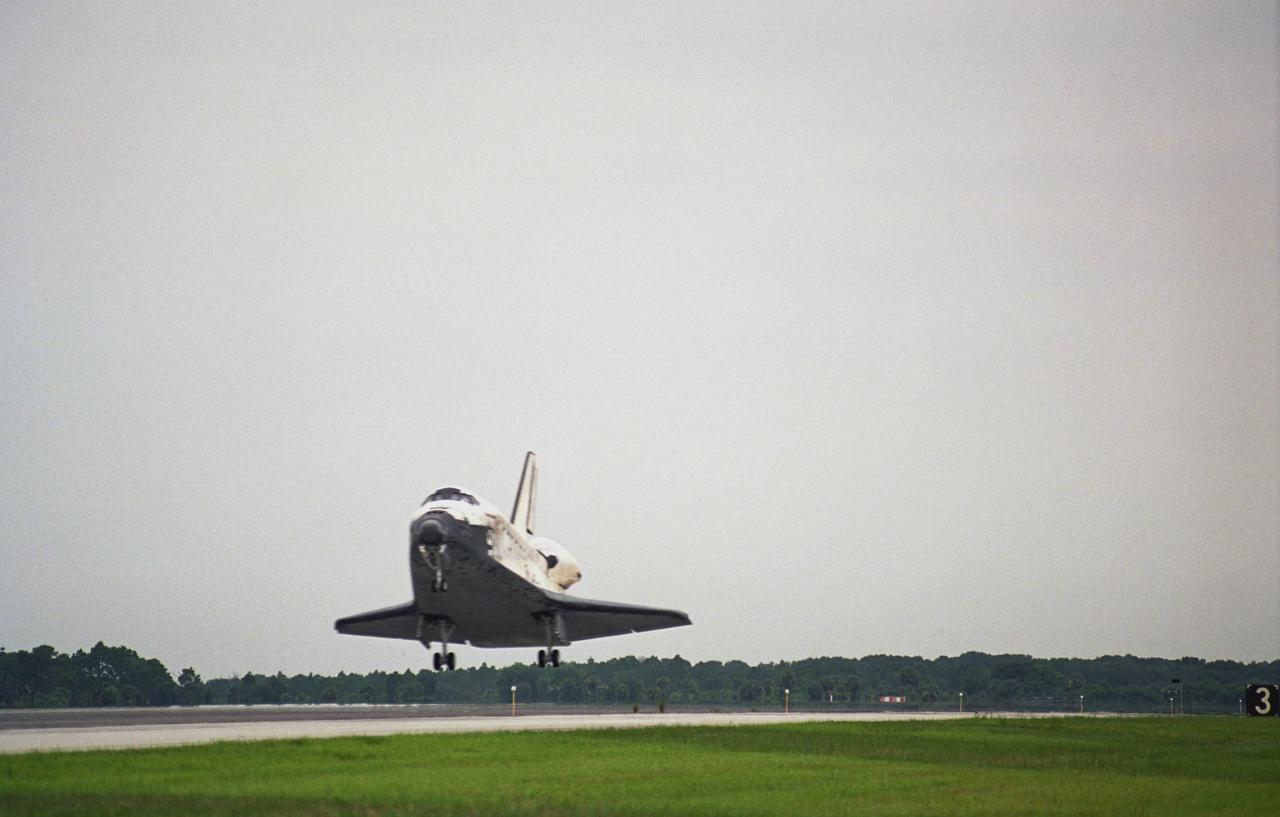
KENNEDY SPACE CENTER, FLA. - The orbiter Discovery nears touchdown on Runway 15 at NASA's Shuttle Landing Facility after completing mission STS-121 to the International Space Station. At touchdown -- nominally about 2,500 ft. beyond the runway threshold -- the orbiter is traveling at a speed ranging from 213 to 226 mph. Discovery traveled 5.3 million miles, landing on orbit 202. Mission elapsed time was 12 days, 18 hours, 37 minutes and 54 seconds. Main gear touchdown occurred on time at 9:14:43 EDT. Wheel stop was at 9:15:49 EDT. The returning crew members aboard are Commander Steven Lindsey, Pilot Mark Kelly and Mission Specialists Piers Sellers, Michael Fossum, Lisa Nowak and Stephanie Wilson. Mission Specialist Thomas Reiter, who launched with the crew on July 4, remained on the station to join the Expedition 13 crew there. The landing is the 62nd at Kennedy Space Center and the 32nd for Discovery. During the mission, the STS-121 crew tested new equipment and procedures to improve shuttle safety, and delivered supplies and made repairs to the International Space Station. Photo credit: NASA/Tony Gray & Tim Powers
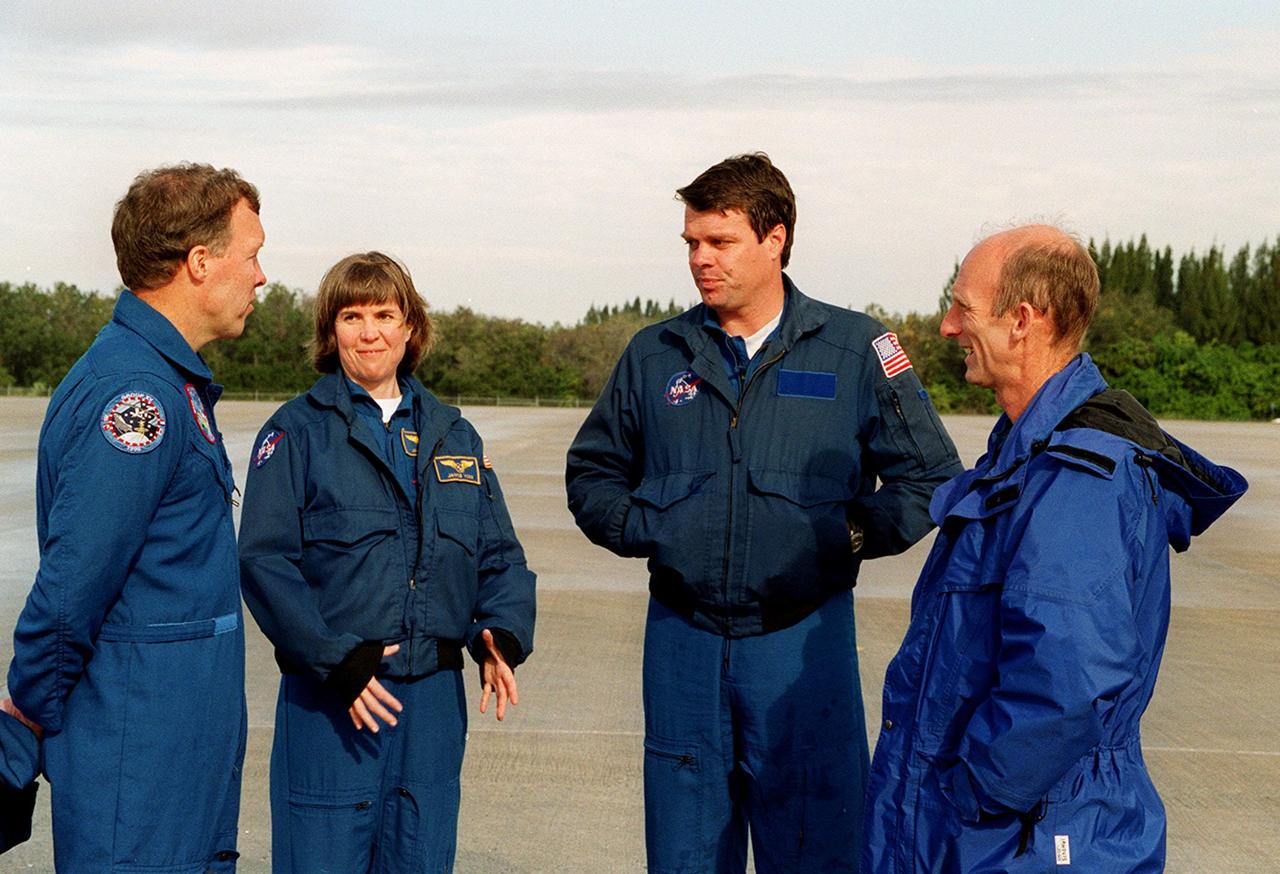
On the runway at the Shuttle Landing Facility, STS-99 crew members Pilot Dominic Gorie, Mission Specialist Janice Voss, Commander Kevin Kregel and Mission Specialist Gerhard Thiele discuss departure plans to Houston. Kregel and Gorie will be piloting T-38 jets with Voss and Thiele as passengers. During the Jan. 31 launch countdown, Endeavour's enhanced master events controller (E-MEC) No. 2 failed a standard preflight test. Launch was postponed and Shuttle managers decided to replace the E-MEC located in the orbiter's aft compartment. Launch controllers will be in a position to begin the STS-99 countdown the morning of Feb. 6 and ready to support a launch midto latenext week pending availability of the Eastern Range. The postponed launch gives the crew an opportunity for more training and time with their families. Known as the Shuttle Radar Topography Mission, it will chart a new course to produce unrivaled 3-D images of the Earth's surface, using two antennae and a 200-foot-long section of space station-derived mast protruding from the payload bay. The result could be close to 1 trillion measurements of the Earth's topography. Besides contributing to the production of better maps, these measurements could lead to improved water drainage modeling, more realistic flight simulators, better locations for cell phone towers, and enhanced navigation safety
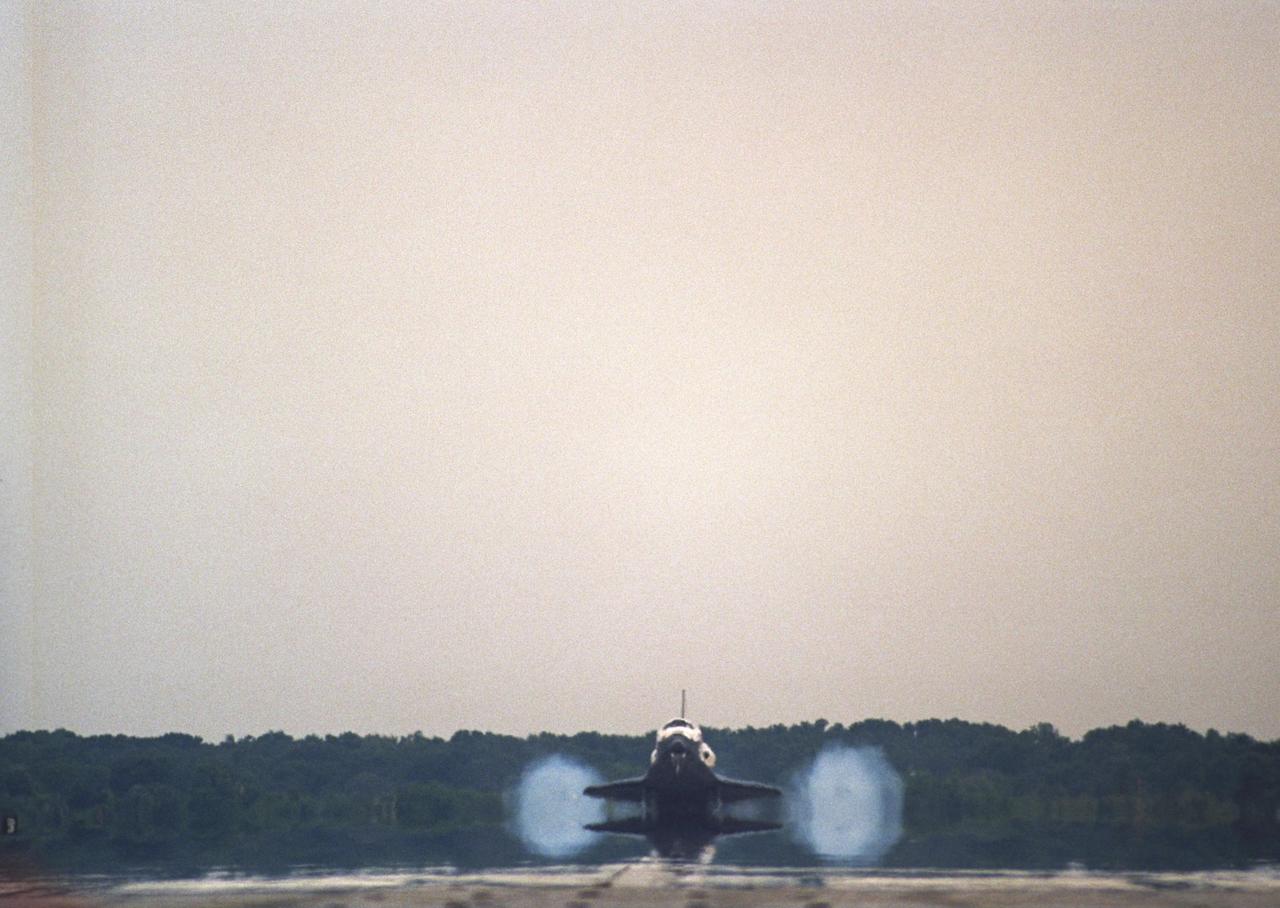
KENNEDY SPACE CENTER, FLA. - Vapor trails from Discovery's wing tips look like balls of smoke as the orbiter touches down on Runway 15 at NASA's Shuttle Landing Facility, completing mission STS-121 to the International Space Station. At touchdown -- nominally about 2,500 ft. beyond the runway threshold -- the orbiter is traveling at a speed ranging from 213 to 226 mph. Discovery traveled 5.3 million miles, landing on orbit 202. Mission elapsed time was 12 days, 18 hours, 37 minutes and 54 seconds. Main gear touchdown occurred on time at 9:14:43 EDT. Wheel stop was at 9:15:49 EDT. The returning crew members aboard are Commander Steven Lindsey, Pilot Mark Kelly and Mission Specialists Piers Sellers, Michael Fossum, Lisa Nowak and Stephanie Wilson. Mission Specialist Thomas Reiter, who launched with the crew on July 4, remained on the station to join the Expedition 13 crew there. The landing is the 62nd at Kennedy Space Center and the 32nd for Discovery. During the mission, the STS-121 crew tested new equipment and procedures to improve shuttle safety, and delivered supplies and made repairs to the International Space Station. Photo credit: NASA/Tony Gray & Tim Powers
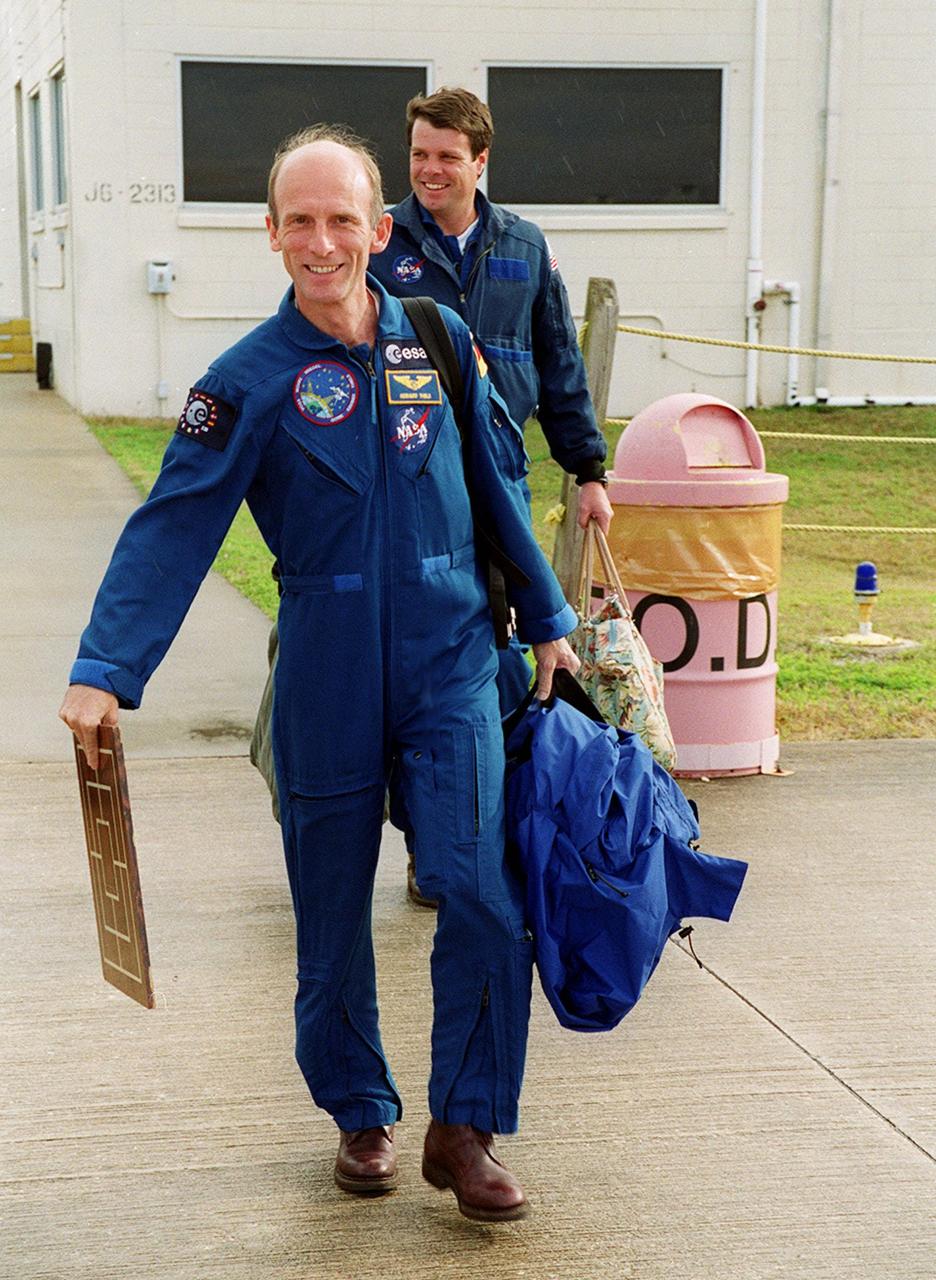
STS-99 Mission Specialist Gerhard Thiele (foreground) and Commander Kevin Kregel make their way to the runway at the Shuttle Landing Facility for a return flight to Houston. During the Jan. 31 launch countdown, Endeavour's enhanced master events controller (E-MEC) No. 2 failed a standard preflight test. Launch was postponed and Shuttle managers decided to replace the E-MEC located in the orbiter's aft compartment. Launch controllers will be in a position to begin the STS-99 countdown the morning of Feb. 6 and ready to support a launch midto late next week pending availability of the Eastern Range. The postponed launch gives the crew an opportunity for more training and time with their families. Known as the Shuttle Radar Topography Mission, it will chart a new course to produce unrivaled 3-D images of the Earth's surface, using two antennae and a 200-foot-long section of space station-derived mast protruding from the payload bay. The result could be close to 1 trillion measurements of the Earth's topography. Besides contributing to the production of better maps, these measurements could lead to improved water drainage modeling, more realistic flight simulators, better locations for cell phone towers, and enhanced navigation safety
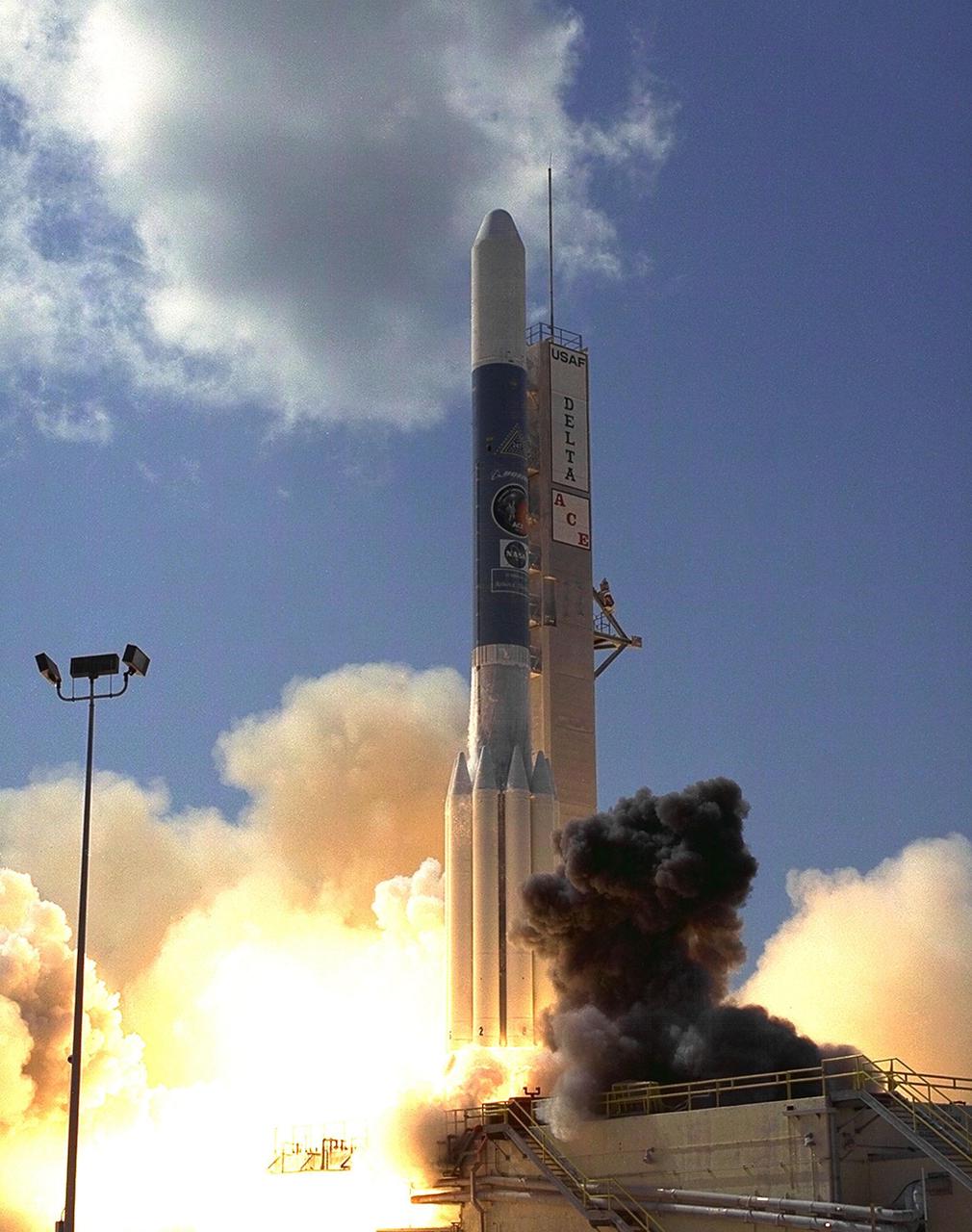
A Boeing Delta II expendable launch vehicle lifts off with NASA’s Advanced Composition Explorer (ACE) observatory at 10:39 a.m. EDT, on Aug. 25, 1997, from Launch Complex 17A, Cape Canaveral Air Station. This is the second Delta launch under the Boeing name and the first from Cape Canaveral. Launch was scrubbed one day by Air Force range safety personnel because two commercial fishing vessels were within the Delta’s launch danger area. The ACE spacecraft will study low-energy particles of solar origin and high-energy galactic particles on its one-million-mile journey. The collecting power of instruments aboard ACE is 10 to 1,000 times greater than anything previously flown to collect similar data by NASA. Study of these energetic particles may contribute to our understanding of the formation and evolution of the solar system. ACE has a two-year minimum mission lifetime and a goal of five years of service. ACE was built for NASA by the Johns Hopkins Applied Physics Laboratory and is managed by the Explorer Project Office at NASA's Goddard Space Flight Center. The lead scientific institution is the California Institute of Technology (Caltech) in Pasadena, Calif
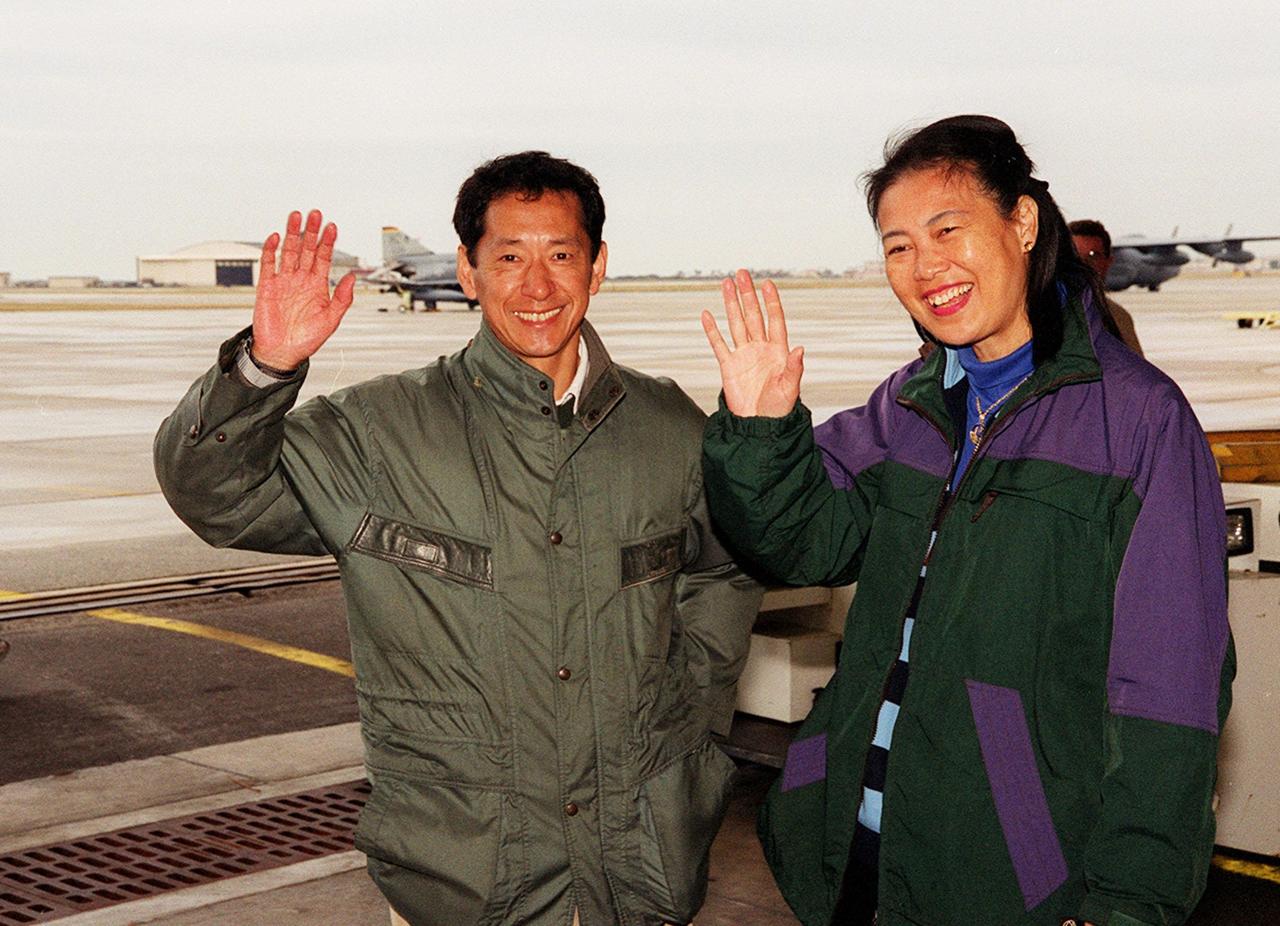
STS-99 Mission Specialist Mamoru Mohri of Japan and his wife, Akiko, wave before their departure from Patrick Air Force Base and return to Houston. With the postponement of the launch of STS-99 on Jan. 31, the crew have an opportunity for more training and time with their families. During the launch countdown, Endeavour's enhanced master events controller (E-MEC) No. 2 failed a standard preflight test. Launch was postponed and Shuttle managers decided to replace the E-MEC located in the orbiter's aft compartment. Launch controllers will be in a position to begin the STS-99 countdown the morning of Feb. 6 and ready to support a launch midto late next week pending availability of the Eastern Range. Known as the Shuttle Radar Topography Mission, it will chart a new course to produce unrivaled 3-D images of the Earth's surface, using two antennae and a 200-foot-long section of space station-derived mast protruding from the payload bay. The result could be close to 1 trillion measurements of the Earth's topography. Besides contributing to the production of better maps, these measurements could lead to improved water drainage modeling, more realistic flight simulators, better locations for cell phone towers, and enhanced navigation safety
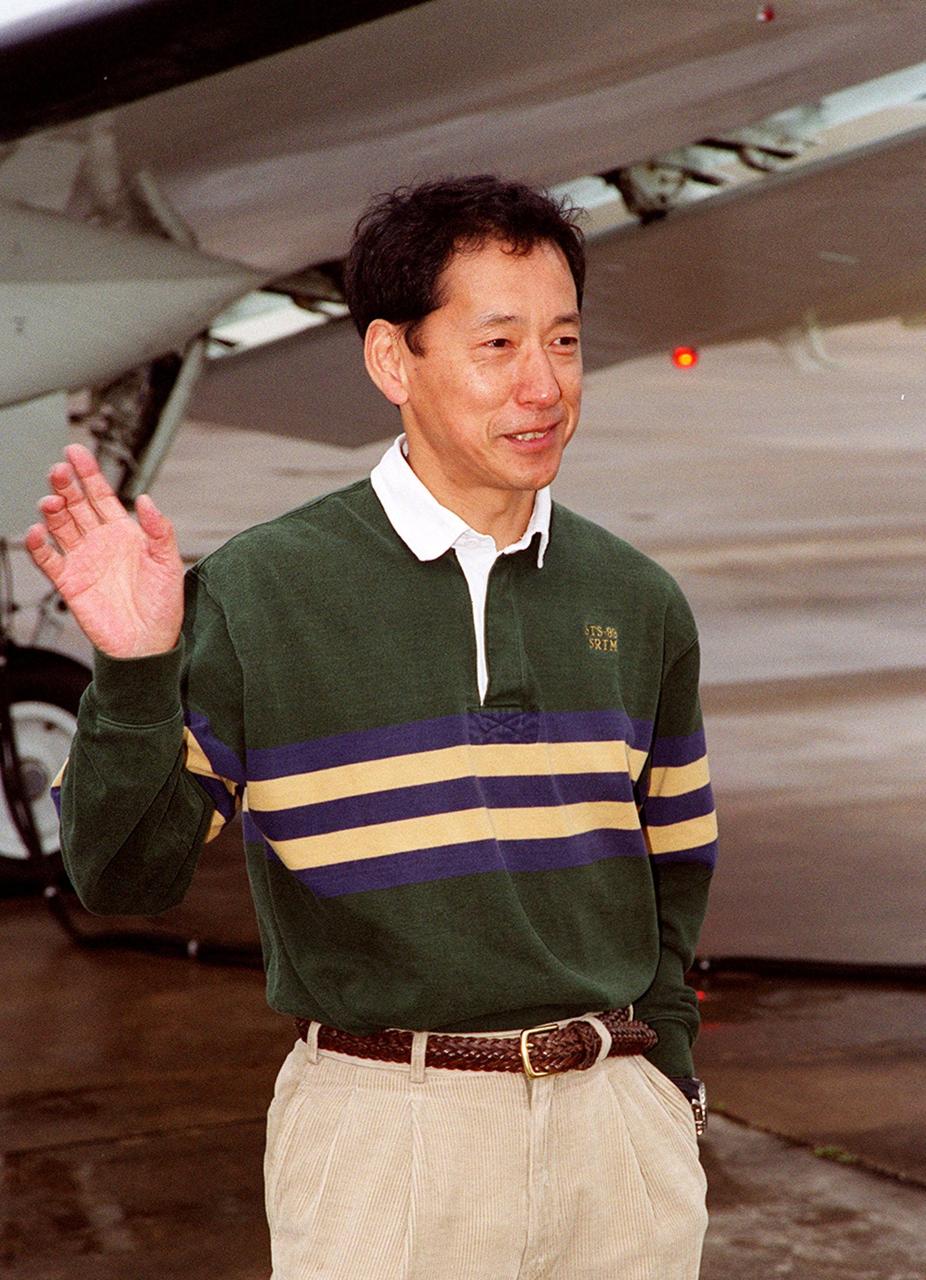
STS-99 Mission Specialist Mamoru Mohri of Japan waves before his departure from Patrick Air Force Base and return to Houston. With the postponement of the launch of STS-99 on Jan. 31, the crew have an opportunity for more training and time with their families. During the launch countdown, Endeavour's enhanced master events controller (E-MEC) No. 2 failed a standard preflight test. Launch was postponed and Shuttle managers decided to replace the E-MEC located in the orbiter's aft compartment. Launch controllers will be in a position to begin the STS-99 countdown the morning of Feb. 6 and ready to support a launch midto late next week pending availability of the Eastern Range. Known as the Shuttle Radar Topography Mission, it will chart a new course to produce unrivaled 3-D images of the Earth's surface, using two antennae and a 200-foot-long section of space station-derived mast protruding from the payload bay. The result could be close to 1 trillion measurements of the Earth's topography. Besides contributing to the production of better maps, these measurements could lead to improved water drainage modeling, more realistic flight simulators, better locations for cell phone towers, and enhanced navigation safety
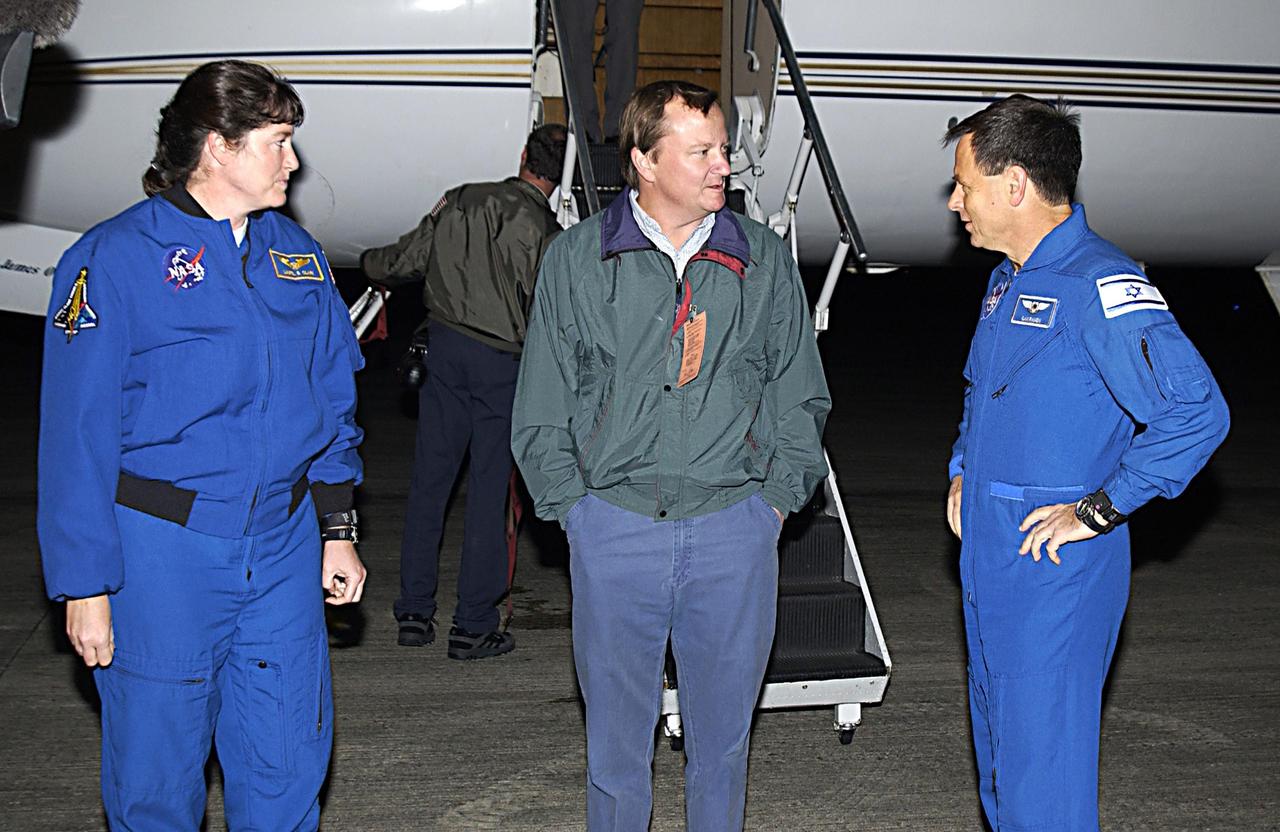
KENNEDY SPACE CENTER, FLA. -- Two members of the STS-107 crew, Mission Specialist Laurel Clark (left) and Payload Specialist Ilan Ramon (right), talk after their arrival at KSC to Launch Director Mike Leinbach. Ramon is the first Israeli astronaut to fly on a Shuttle mission. STS-107 is a mission devoted to research and will include more than 80 experiments that will study Earth and space science, advanced technology development, and astronaut health and safety. The payload on Space Shuttle Columbia includes FREESTAR (Fast Reaction Experiments Enabling Science, Technology, Applications and Research) and the SHI Research Double Module (SHI/RDM), known as SPACEHAB. Experiments on the module range from material sciences to life sciences. Other crew members are Commander Rick Husband, Pilot William "Willie" McCool, Payload Commander Michael Anderson and Mission Specialists Kalpana Chawla and David Brown. Launch of Columbia is targeted for Jan. 16 between 10 a.m. and 2 p.m.
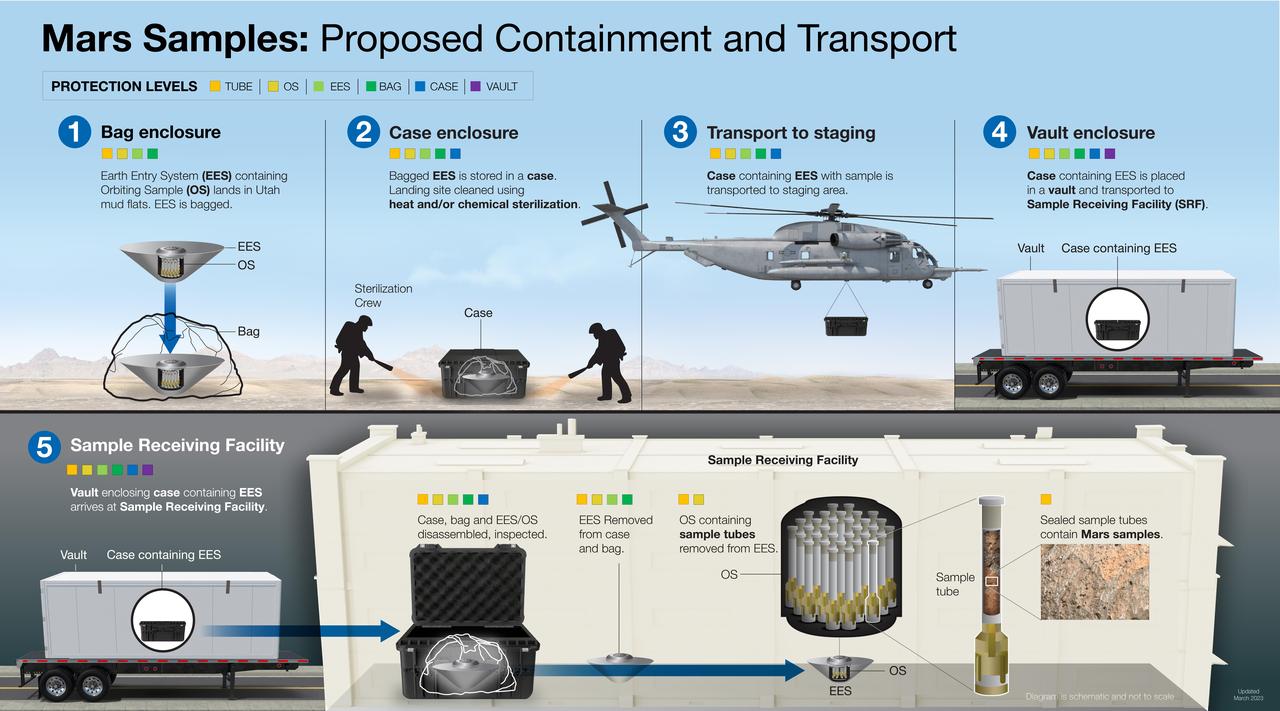
This illustration shows the proposed process for safely recovering, containing, and transporting Mars samples gathered by NASA's Perseverance Mars rover after they are returned to Earth as part of the joint NASA/ESA (European Space Agency) Mars Sample Return Campaign. The process of carefully containing and handling the samples would begin long before they arrive on Earth. Every phase of the Mars Sample Return campaign from collection and sealing to launch, transfer, and landing has been developed with a "safety first" approach. Sample handling and curation experts would be involved in planning for the round trip at each phase of the campaign. After its journey back to Earth from Mars on the ESA-provided Earth Return Orbiter, the capsule containing the samples would land at the Utah Test and Training Range in west-central Utah. NASA would securely transport the capsule and its contents to a Sample Return Facility at a location to be determined. Once at the facility, the samples would undergo a rigorous process to assess whether they are safe for release for detailed analysis by scientists from around the world. https://photojournal.jpl.nasa.gov/catalog/PIA25857
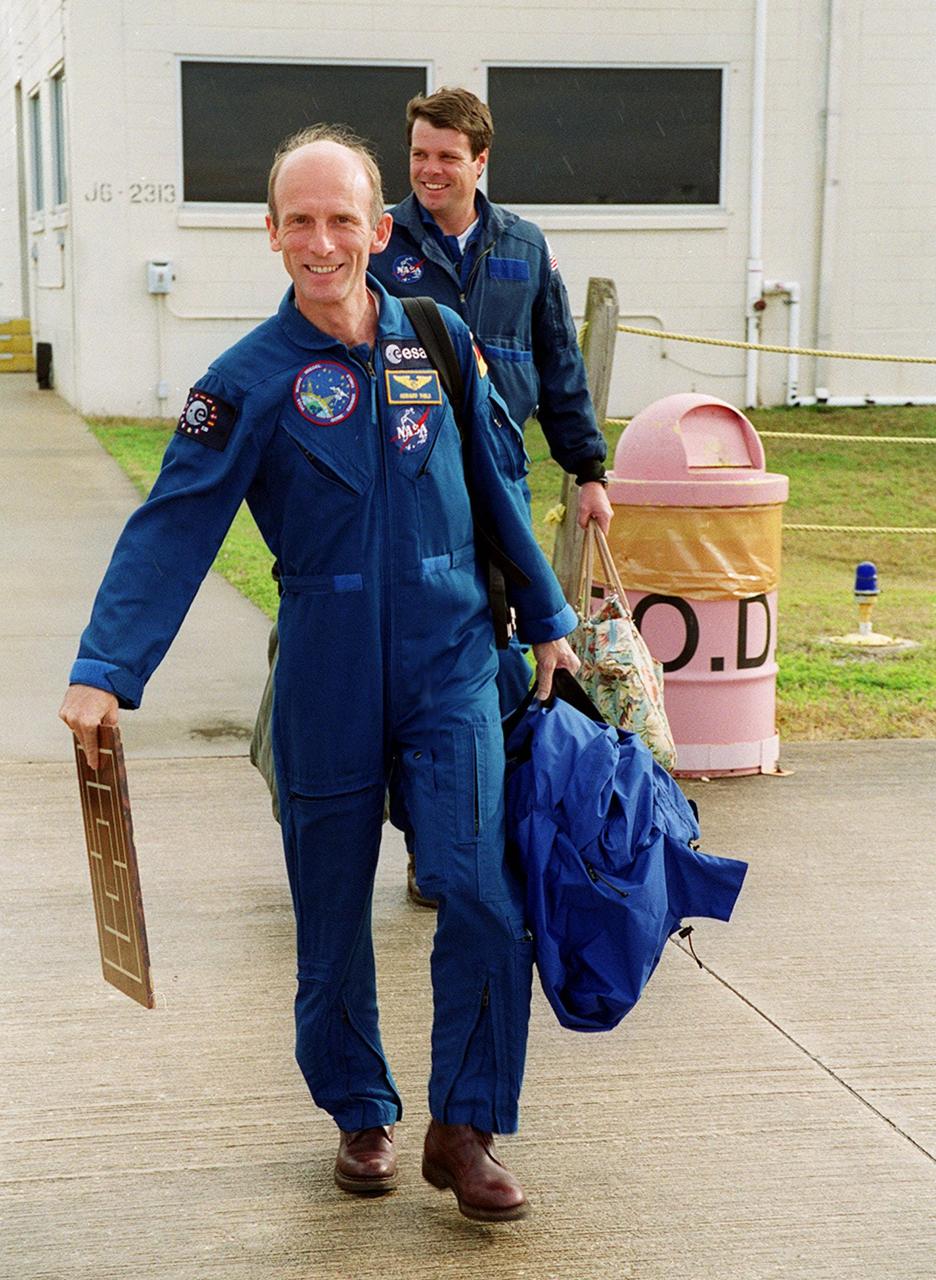
STS-99 Mission Specialist Gerhard Thiele (foreground) and Commander Kevin Kregel make their way to the runway at the Shuttle Landing Facility for a return flight to Houston. During the Jan. 31 launch countdown, Endeavour's enhanced master events controller (E-MEC) No. 2 failed a standard preflight test. Launch was postponed and Shuttle managers decided to replace the E-MEC located in the orbiter's aft compartment. Launch controllers will be in a position to begin the STS-99 countdown the morning of Feb. 6 and ready to support a launch midto late next week pending availability of the Eastern Range. The postponed launch gives the crew an opportunity for more training and time with their families. Known as the Shuttle Radar Topography Mission, it will chart a new course to produce unrivaled 3-D images of the Earth's surface, using two antennae and a 200-foot-long section of space station-derived mast protruding from the payload bay. The result could be close to 1 trillion measurements of the Earth's topography. Besides contributing to the production of better maps, these measurements could lead to improved water drainage modeling, more realistic flight simulators, better locations for cell phone towers, and enhanced navigation safety

Photographers and other onlookers watch as a Boeing Delta II expendable launch vehicle lifts off with NASA’s Advanced Composition Explorer (ACE) observatory at 10:39 a.m. EDT, on Aug. 25, 1997, from Launch Complex 17A, Cape Canaveral Air Station. This is the second Delta launch under the Boeing name and the first from Cape Canaveral. Liftoff had been scheduled for Aug. 24, but was scrubbed one day by Air Force range safety personnel because two commercial fishing vessels were within the Delta’s launch danger area. The ACE spacecraft will study low-energy particles of solar origin and high-energy galactic particles on its one-million-mile journey. The collecting power of instruments aboard ACE is 10 to 1,000 times greater than anything previously flown to collect similar data by NASA. Study of these energetic particles may contribute to our understanding of the formation and evolution of the solar system. ACE has a two-year minimum mission lifetime and a goal of five years of service. ACE was built for NASA by the Johns Hopkins Applied Physics Laboratory and is managed by the Explorer Project Office at NASA's Goddard Space Flight Center. The lead scientific institution is the California Institute of Technology (Caltech) in Pasadena, Calif
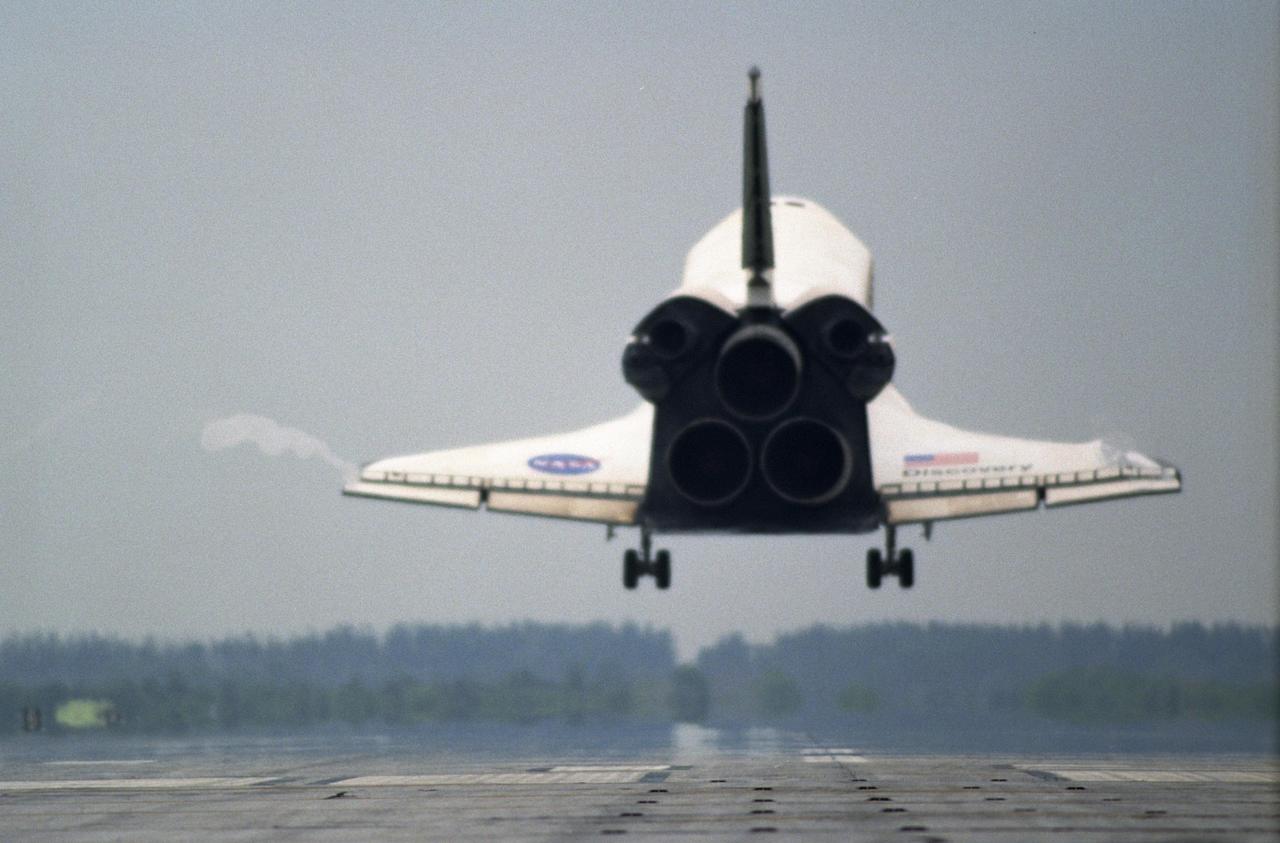
KENNEDY SPACE CENTER, FLA. - A vapor trail flows from Discovery's wing tip as it makes a speedy approach to Runway 15 at NASA's Shuttle Landing Facility, completing mission STS-121 to the International Space Station. At touchdown -- nominally about 2,500 ft. beyond the runway threshold -- the orbiter is traveling at a speed ranging from 213 to 226 mph. Discovery traveled 5.3 million miles, landing on orbit 202. Mission elapsed time was 12 days, 18 hours, 37 minutes and 54 seconds. Main gear touchdown occurred on time at 9:14:43 EDT. Wheel stop was at 9:15:49 EDT. The returning crew members aboard are Commander Steven Lindsey, Pilot Mark Kelly and Mission Specialists Piers Sellers, Michael Fossum, Lisa Nowak and Stephanie Wilson. Mission Specialist Thomas Reiter, who launched with the crew on July 4, remained on the station to join the Expedition 13 crew there. The landing is the 62nd at Kennedy Space Center and the 32nd for Discovery. During the mission, the STS-121 crew tested new equipment and procedures to improve shuttle safety, and delivered supplies and made repairs to the International Space Station. Photo credit: NASA/Tony Gray & Tim Powers
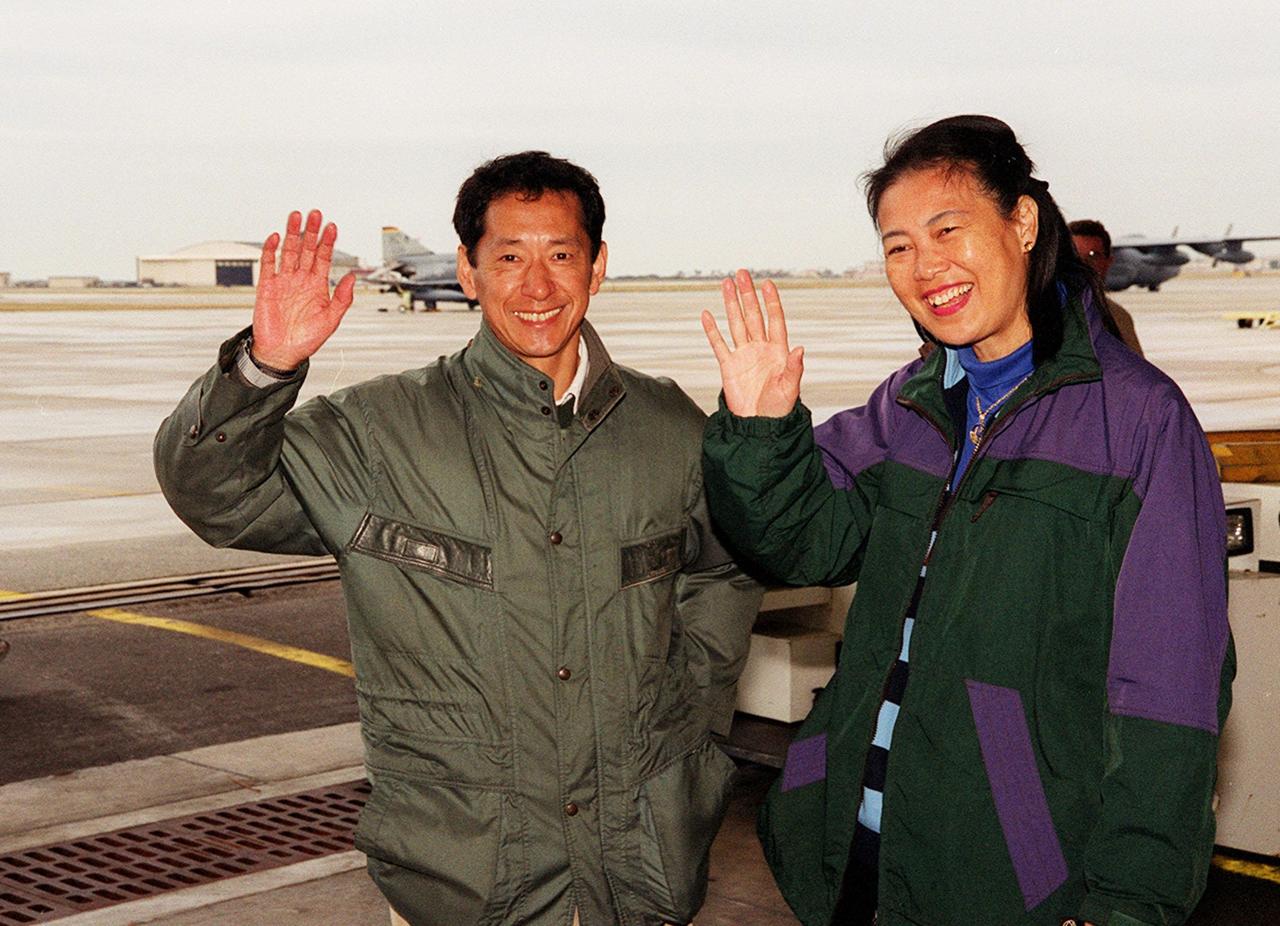
STS-99 Mission Specialist Mamoru Mohri of Japan and his wife, Akiko, wave before their departure from Patrick Air Force Base and return to Houston. With the postponement of the launch of STS-99 on Jan. 31, the crew have an opportunity for more training and time with their families. During the launch countdown, Endeavour's enhanced master events controller (E-MEC) No. 2 failed a standard preflight test. Launch was postponed and Shuttle managers decided to replace the E-MEC located in the orbiter's aft compartment. Launch controllers will be in a position to begin the STS-99 countdown the morning of Feb. 6 and ready to support a launch midto late next week pending availability of the Eastern Range. Known as the Shuttle Radar Topography Mission, it will chart a new course to produce unrivaled 3-D images of the Earth's surface, using two antennae and a 200-foot-long section of space station-derived mast protruding from the payload bay. The result could be close to 1 trillion measurements of the Earth's topography. Besides contributing to the production of better maps, these measurements could lead to improved water drainage modeling, more realistic flight simulators, better locations for cell phone towers, and enhanced navigation safety
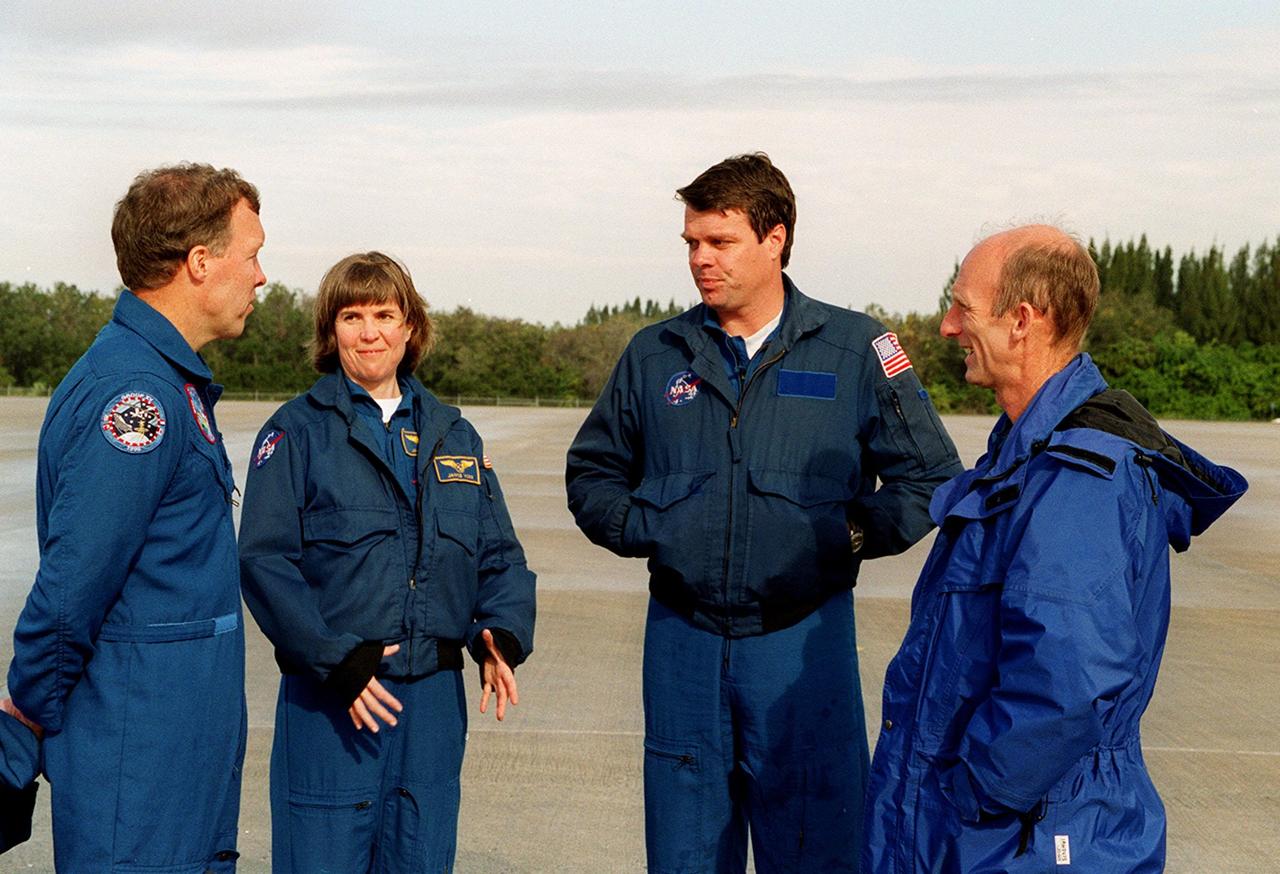
On the runway at the Shuttle Landing Facility, STS-99 crew members Pilot Dominic Gorie, Mission Specialist Janice Voss, Commander Kevin Kregel and Mission Specialist Gerhard Thiele discuss departure plans to Houston. Kregel and Gorie will be piloting T-38 jets with Voss and Thiele as passengers. During the Jan. 31 launch countdown, Endeavour's enhanced master events controller (E-MEC) No. 2 failed a standard preflight test. Launch was postponed and Shuttle managers decided to replace the E-MEC located in the orbiter's aft compartment. Launch controllers will be in a position to begin the STS-99 countdown the morning of Feb. 6 and ready to support a launch midto latenext week pending availability of the Eastern Range. The postponed launch gives the crew an opportunity for more training and time with their families. Known as the Shuttle Radar Topography Mission, it will chart a new course to produce unrivaled 3-D images of the Earth's surface, using two antennae and a 200-foot-long section of space station-derived mast protruding from the payload bay. The result could be close to 1 trillion measurements of the Earth's topography. Besides contributing to the production of better maps, these measurements could lead to improved water drainage modeling, more realistic flight simulators, better locations for cell phone towers, and enhanced navigation safety
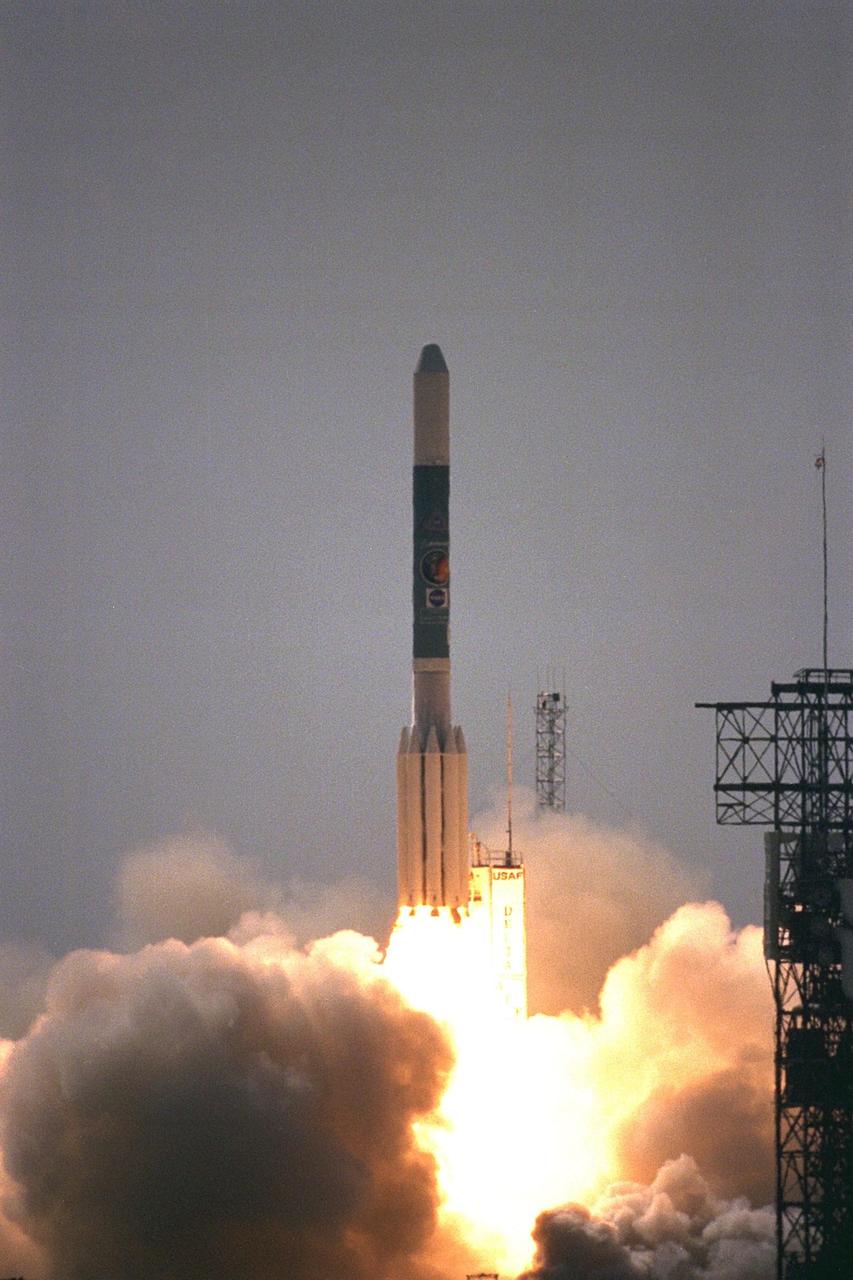
A Boeing Delta II expendable launch vehicle lifts off with NASA’s Advanced Composition Explorer (ACE) observatory at 10:39 a.m. EDT, on Aug. 25, 1997, from Launch Complex 17A, Cape Canaveral Air Station. This is the second Delta launch under the Boeing name and the first from Cape Canaveral. Launch was scrubbed one day by Air Force range safety personnel because two commercial fishing vessels were within the Delta’s launch danger area. The ACE spacecraft will study low-energy particles of solar origin and high-energy galactic particles on its one-million-mile journey. The collecting power of instruments aboard ACE is 10 to 1,000 times greater than anything previously flown to collect similar data by NASA. Study of these energetic particles may contribute to our understanding of the formation and evolution of the solar system. ACE has a two-year minimum mission lifetime and a goal of five years of service. ACE was built for NASA by the Johns Hopkins Applied Physics Laboratory and is managed by the Explorer Project Office at NASA's Goddard Space Flight Center. The lead scientific institution is the California Institute of Technology (Caltech) in Pasadena, Calif
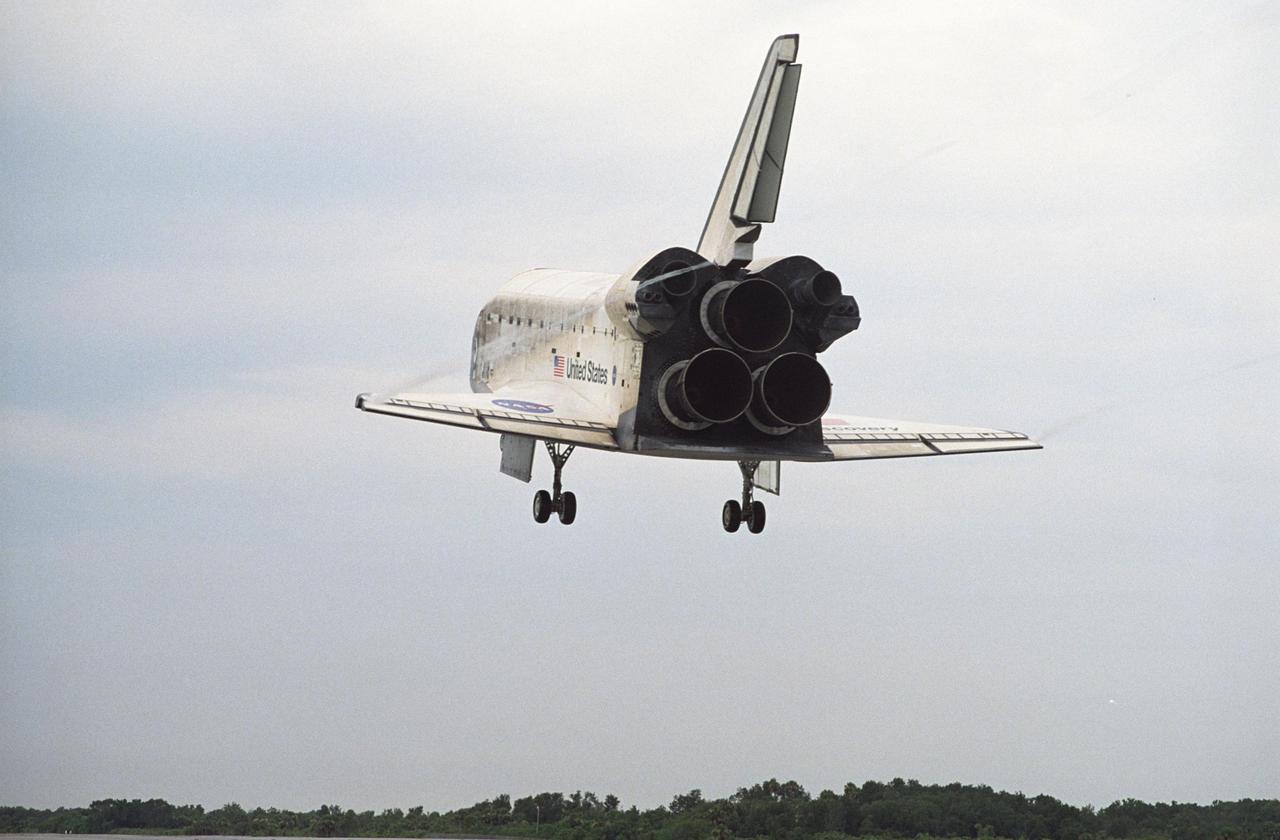
KENNEDY SPACE CENTER, FLA. - Vapor trails flow from Discovery's wing tips as it makes a speedy approach to Runway 15 at NASA's Shuttle Landing Facility, completing mission STS-121 to the International Space Station. At touchdown -- nominally about 2,500 ft. beyond the runway threshold -- the orbiter is traveling at a speed ranging from 213 to 226 mph. Discovery traveled 5.3 million miles, landing on orbit 202. Mission elapsed time was 12 days, 18 hours, 37 minutes and 54 seconds. Main gear touchdown occurred on time at 9:14:43 EDT. Wheel stop was at 9:15:49 EDT. The returning crew members aboard are Commander Steven Lindsey, Pilot Mark Kelly and Mission Specialists Piers Sellers, Michael Fossum, Lisa Nowak and Stephanie Wilson. Mission Specialist Thomas Reiter, who launched with the crew on July 4, remained on the station to join the Expedition 13 crew there. The landing is the 62nd at Kennedy Space Center and the 32nd for Discovery. During the mission, the STS-121 crew tested new equipment and procedures to improve shuttle safety, and delivered supplies and made repairs to the International Space Station. Photo credit: NASA/Tony Gray & Tim Powers
![KENNEDY SPACE CENTER, FLA. - . The STS-107 crew, waving to onlookers, exits the Operations and Checkout Building on their way to Launch Pad 39A for liftoff. Leading the way are Pilot William "Willie" McCool (left) and Commander Rick Husband (right). Following in the second row are Mission Specialists Kalpana Chawla (left) and Laurel Clark; in the rear are Payload Specialist Ilan Ramon, Payload Commander Michael Anderson and Mission Specialist David Brown. Ramon is the first astronaut from Israel to fly on a Shuttle. The 16-day mission is devoted to research and will include more than 80 experiments that will study Earth and space science, advanced technology development, and astronaut health and safety. The payload on Space Shuttle Columbia includes FREESTAR (Fast Reaction Experiments Enabling Science, Technology, Applications and Research) and the SHI Research Double Module (SHI/RDM), known as SPACEHAB. Experiments on the module range from material sciences to life sciences. Liftoff is scheduled for 10:39 a.m. EST. [Photo courtesy of Scott Andrews]](https://images-assets.nasa.gov/image/KSC-03pd0109/KSC-03pd0109~medium.jpg)
KENNEDY SPACE CENTER, FLA. - . The STS-107 crew, waving to onlookers, exits the Operations and Checkout Building on their way to Launch Pad 39A for liftoff. Leading the way are Pilot William "Willie" McCool (left) and Commander Rick Husband (right). Following in the second row are Mission Specialists Kalpana Chawla (left) and Laurel Clark; in the rear are Payload Specialist Ilan Ramon, Payload Commander Michael Anderson and Mission Specialist David Brown. Ramon is the first astronaut from Israel to fly on a Shuttle. The 16-day mission is devoted to research and will include more than 80 experiments that will study Earth and space science, advanced technology development, and astronaut health and safety. The payload on Space Shuttle Columbia includes FREESTAR (Fast Reaction Experiments Enabling Science, Technology, Applications and Research) and the SHI Research Double Module (SHI/RDM), known as SPACEHAB. Experiments on the module range from material sciences to life sciences. Liftoff is scheduled for 10:39 a.m. EST. [Photo courtesy of Scott Andrews]
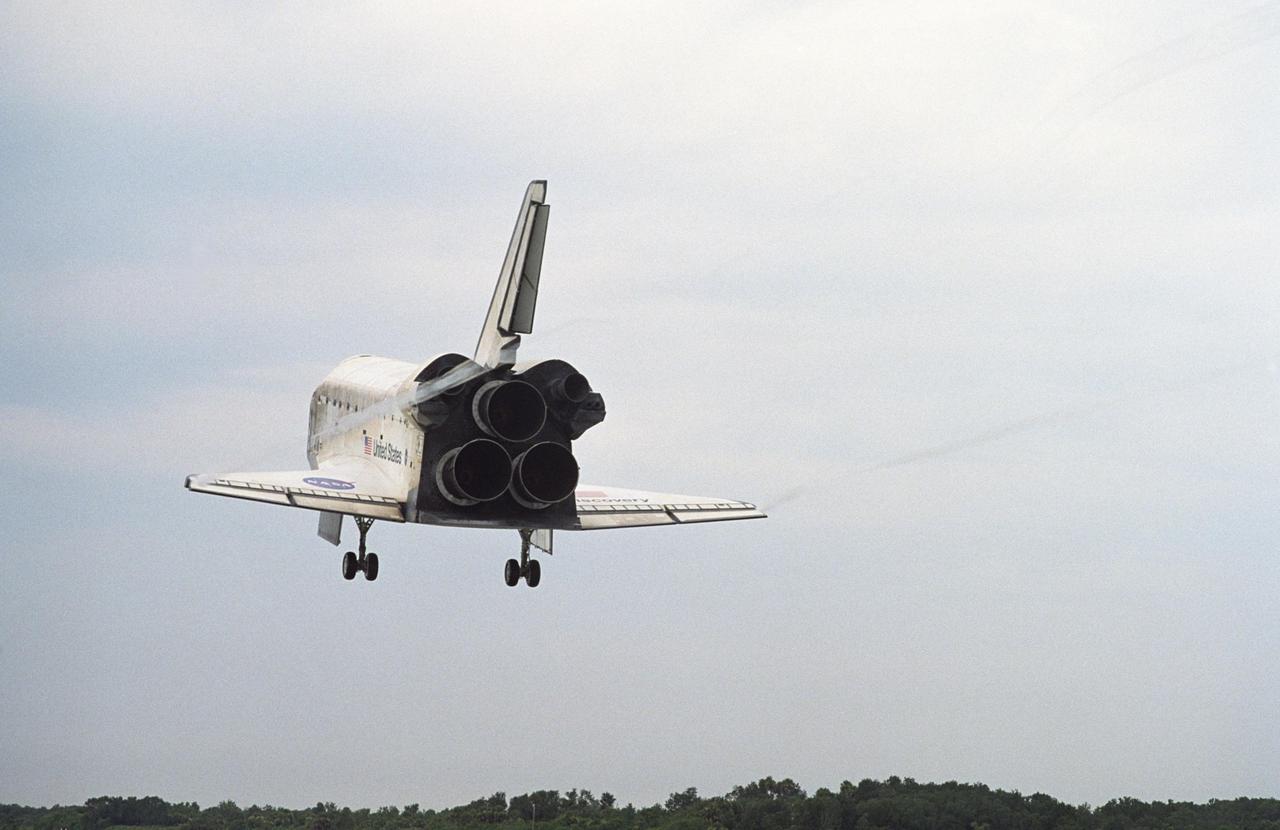
KENNEDY SPACE CENTER, FLA. - Vapor trails flow from Discovery's wing tips as it makes a speedy approach to Runway 15 at NASA's Shuttle Landing Facility, completing mission STS-121 to the International Space Station. At touchdown -- nominally about 2,500 ft. beyond the runway threshold -- the orbiter is traveling at a speed ranging from 213 to 226 mph. Discovery traveled 5.3 million miles, landing on orbit 202. Mission elapsed time was 12 days, 18 hours, 37 minutes and 54 seconds. Main gear touchdown occurred on time at 9:14:43 EDT. Wheel stop was at 9:15:49 EDT. The returning crew members aboard are Commander Steven Lindsey, Pilot Mark Kelly and Mission Specialists Piers Sellers, Michael Fossum, Lisa Nowak and Stephanie Wilson. Mission Specialist Thomas Reiter, who launched with the crew on July 4, remained on the station to join the Expedition 13 crew there. The landing is the 62nd at Kennedy Space Center and the 32nd for Discovery. During the mission, the STS-121 crew tested new equipment and procedures to improve shuttle safety, and delivered supplies and made repairs to the International Space Station. Photo credit: NASA/Tony Gray & Tim Powers
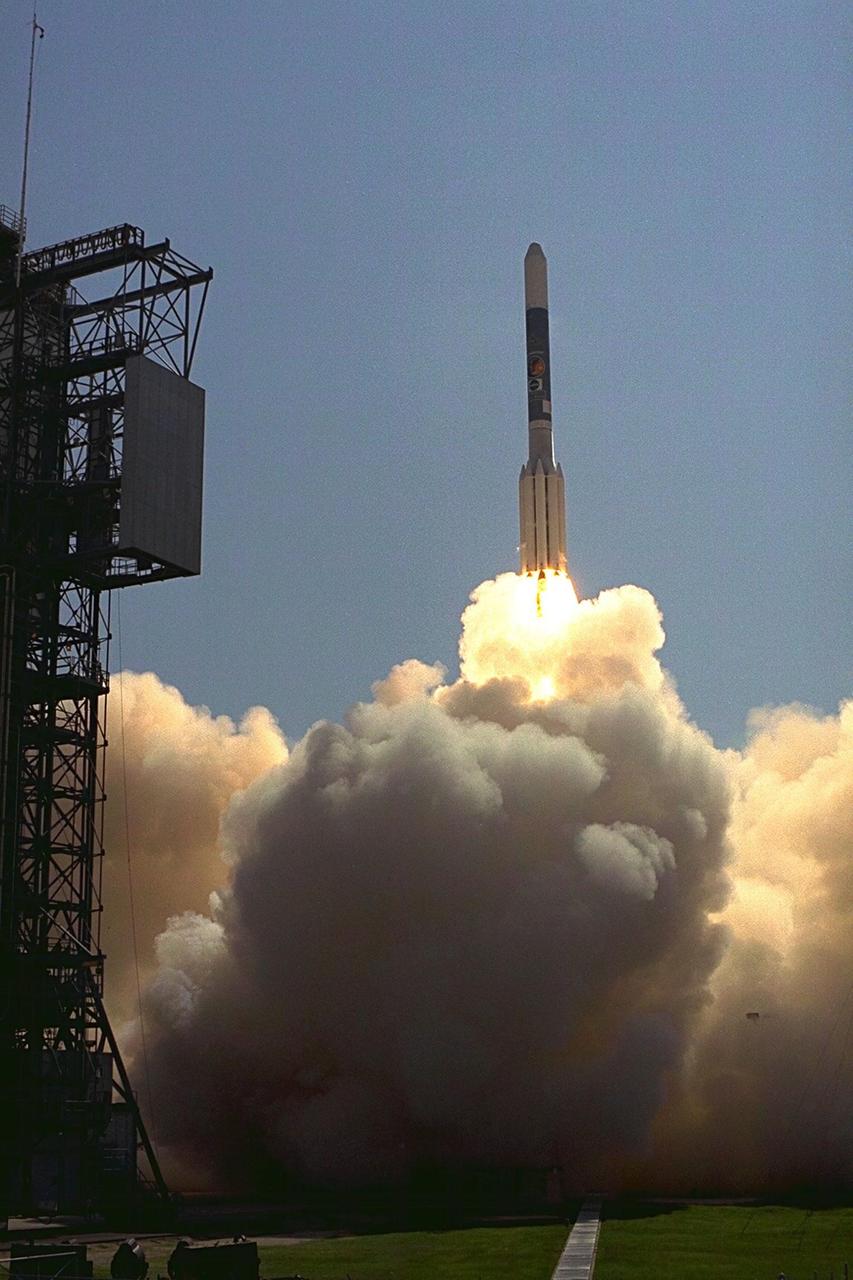
A Boeing Delta II expendable launch vehicle lifts off with NASA’s Advanced Composition Explorer (ACE) observatory at 10:39 a.m. EDT, on Aug. 25, 1997, from Launch Complex 17A, Cape Canaveral Air Station. This is the second Delta launch under the Boeing name and the first from Cape Canaveral. Launch was scrubbed one day by Air Force range safety personnel because two commercial fishing vessels were within the Delta’s launch danger area. The ACE spacecraft will study low-energy particles of solar origin and high-energy galactic particles on its one-million-mile journey. The collecting power of instruments aboard ACE is 10 to 1,000 times greater than anything previously flown to collect similar data by NASA. Study of these energetic particles may contribute to our understanding of the formation and evolution of the solar system. ACE has a two-year minimum mission lifetime and a goal of five years of service. ACE was built for NASA by the Johns Hopkins Applied Physics Laboratory and is managed by the Explorer Project Office at NASA's Goddard Space Flight Center. The lead scientific institution is the California Institute of Technology (Caltech) in Pasadena, Calif