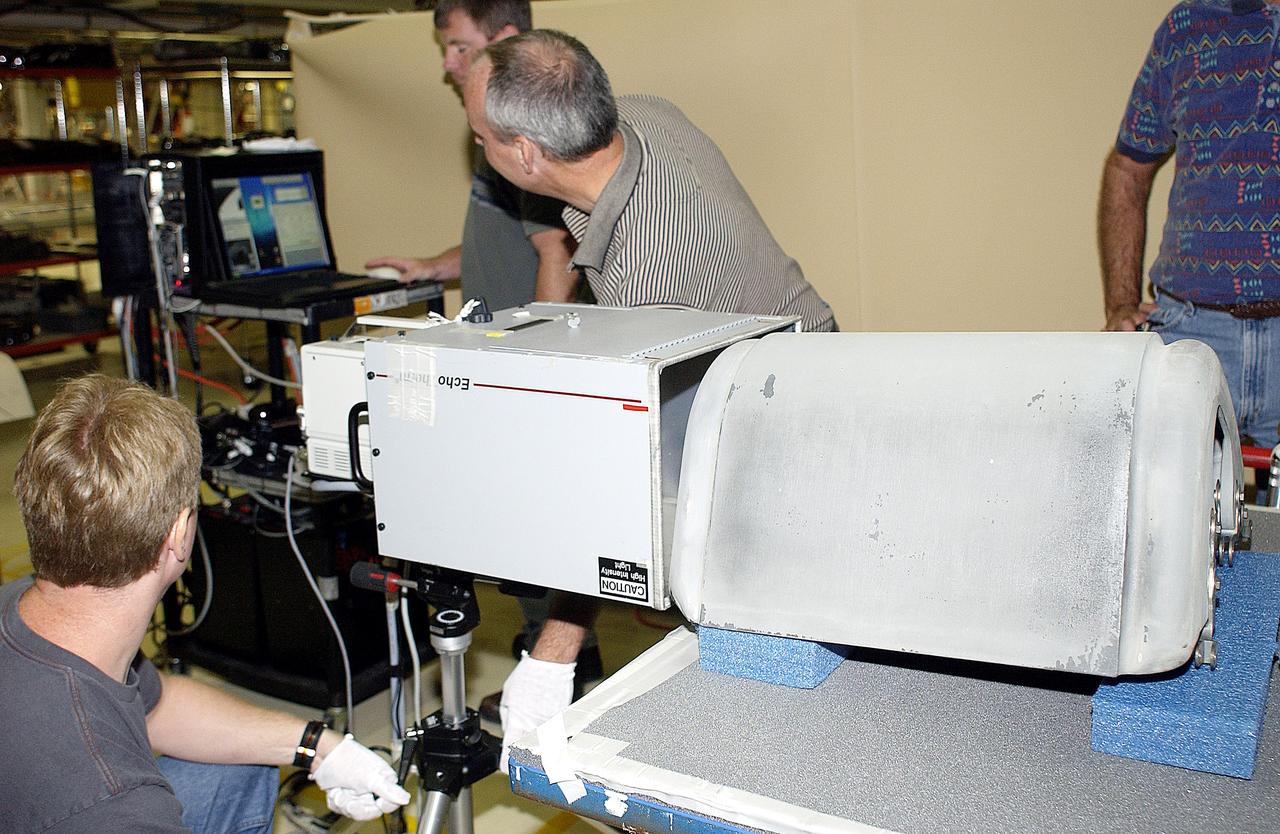
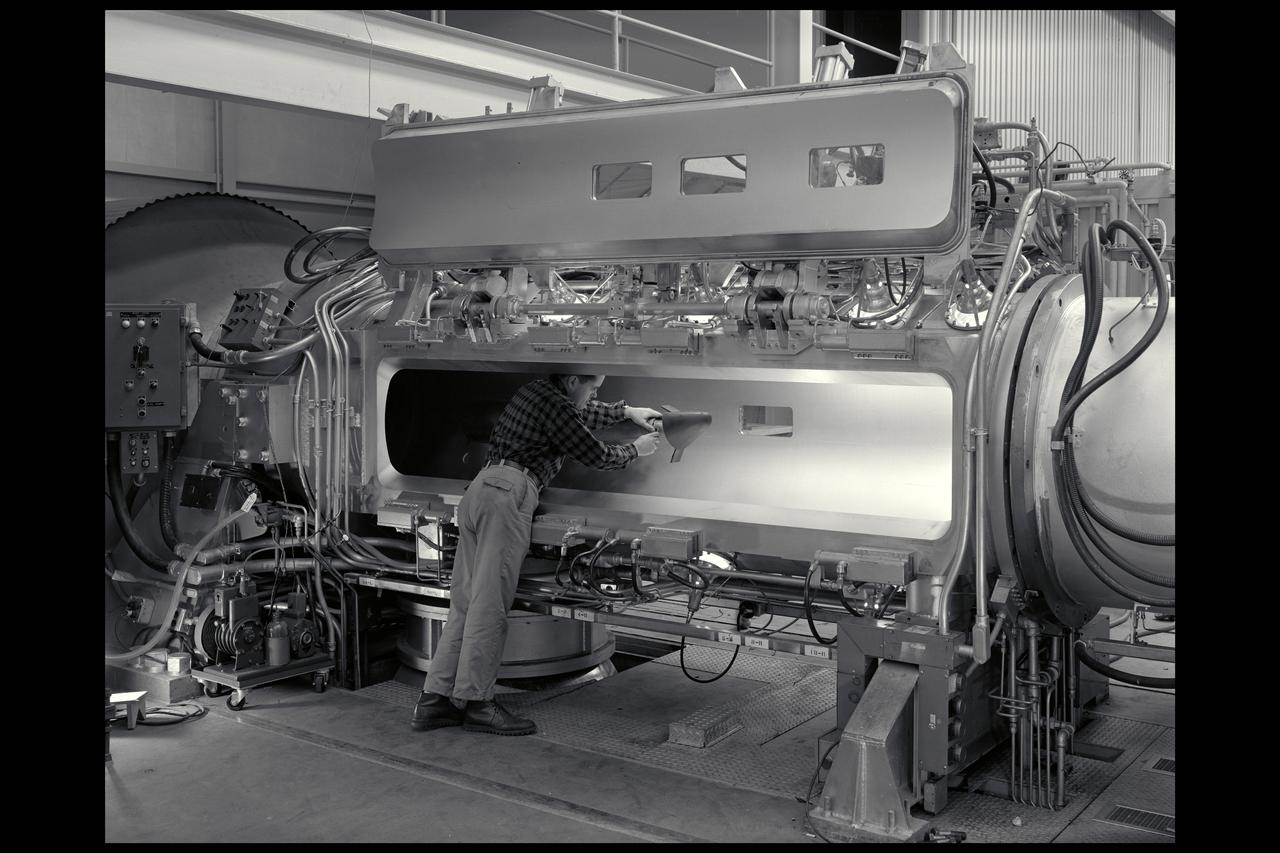
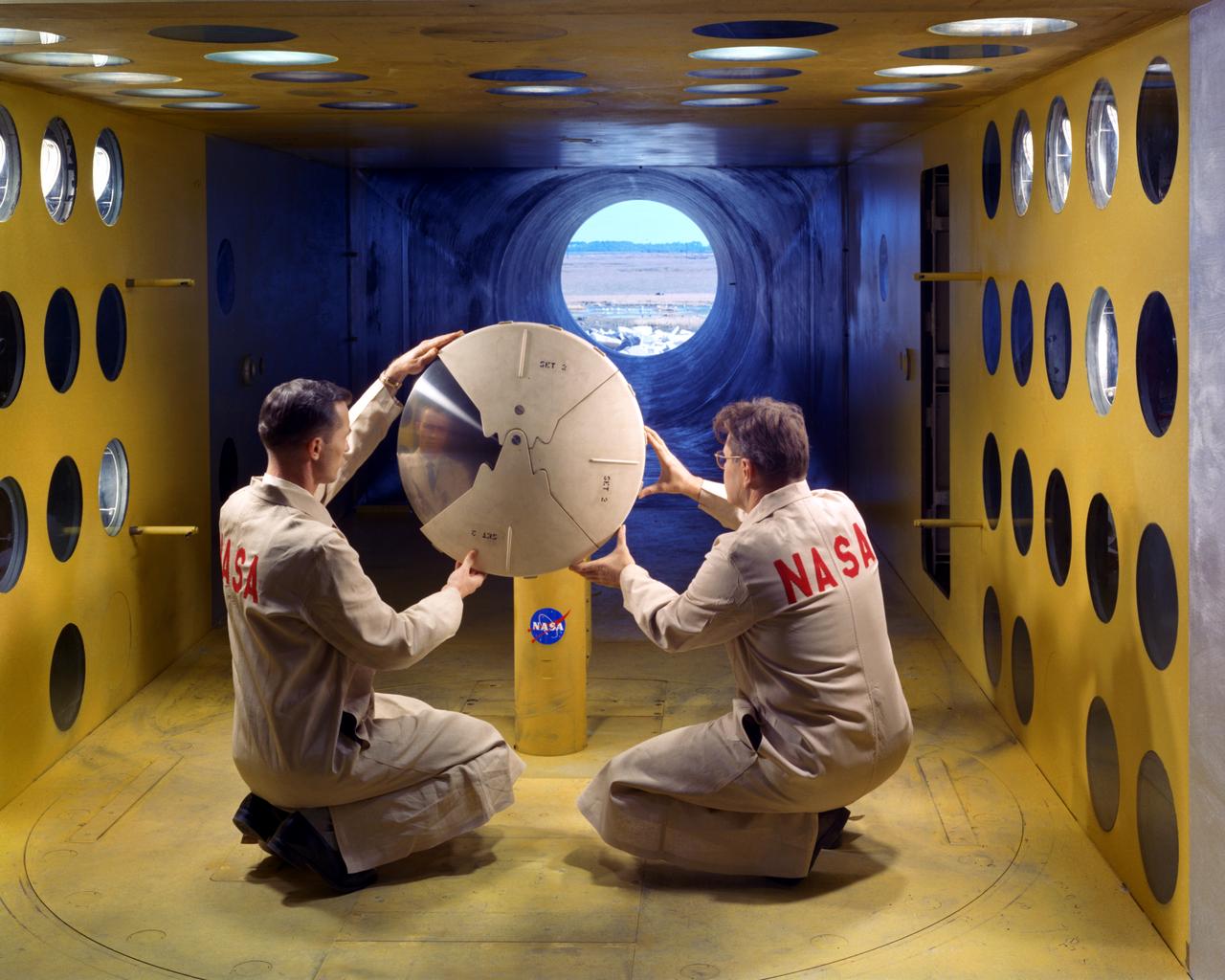
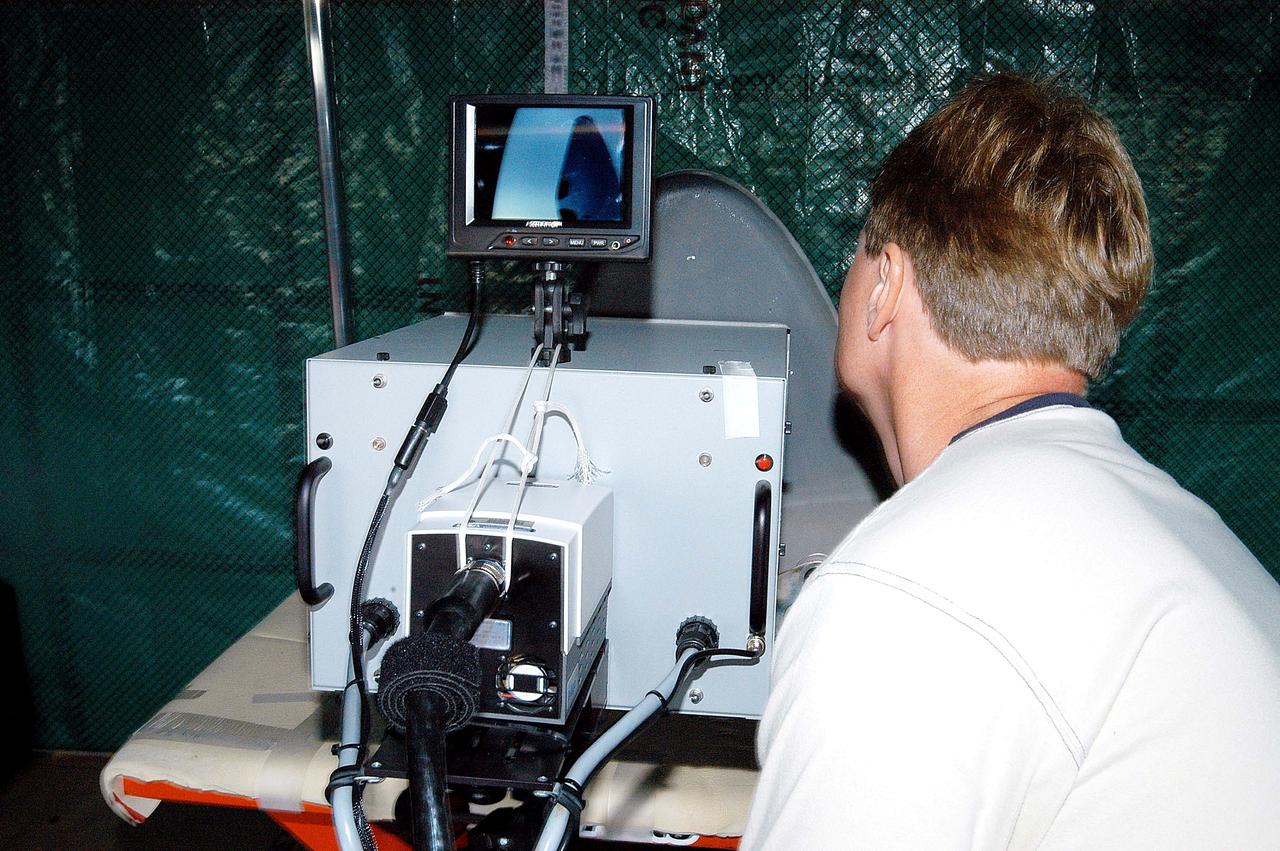
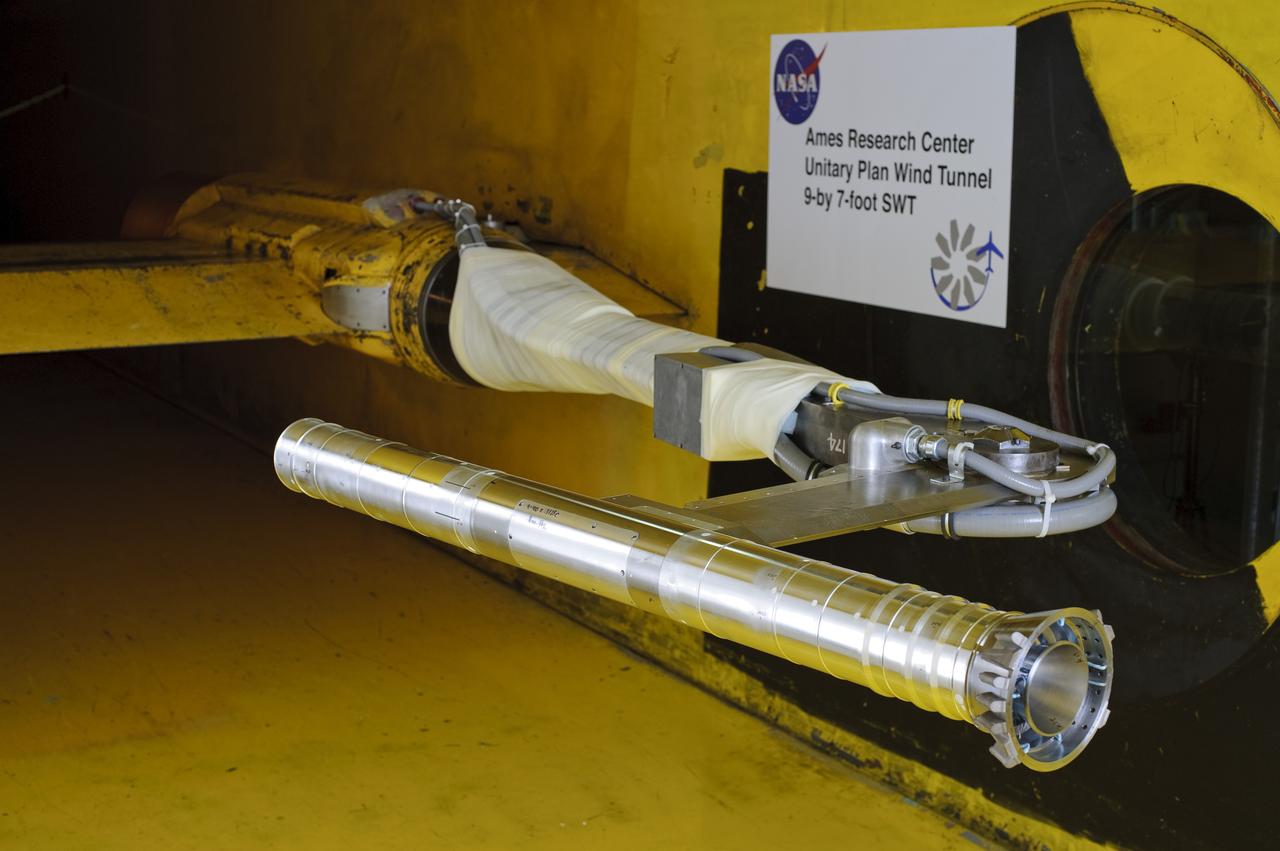
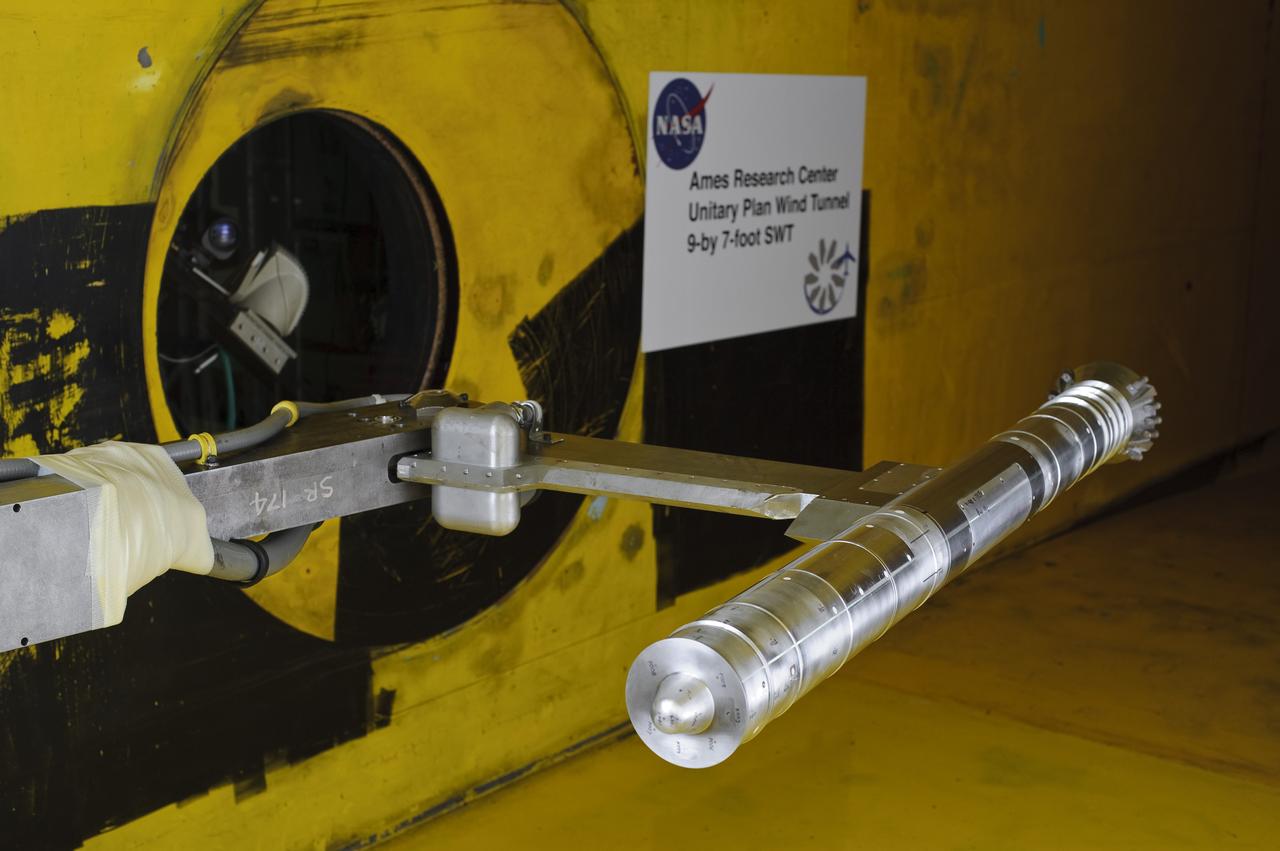
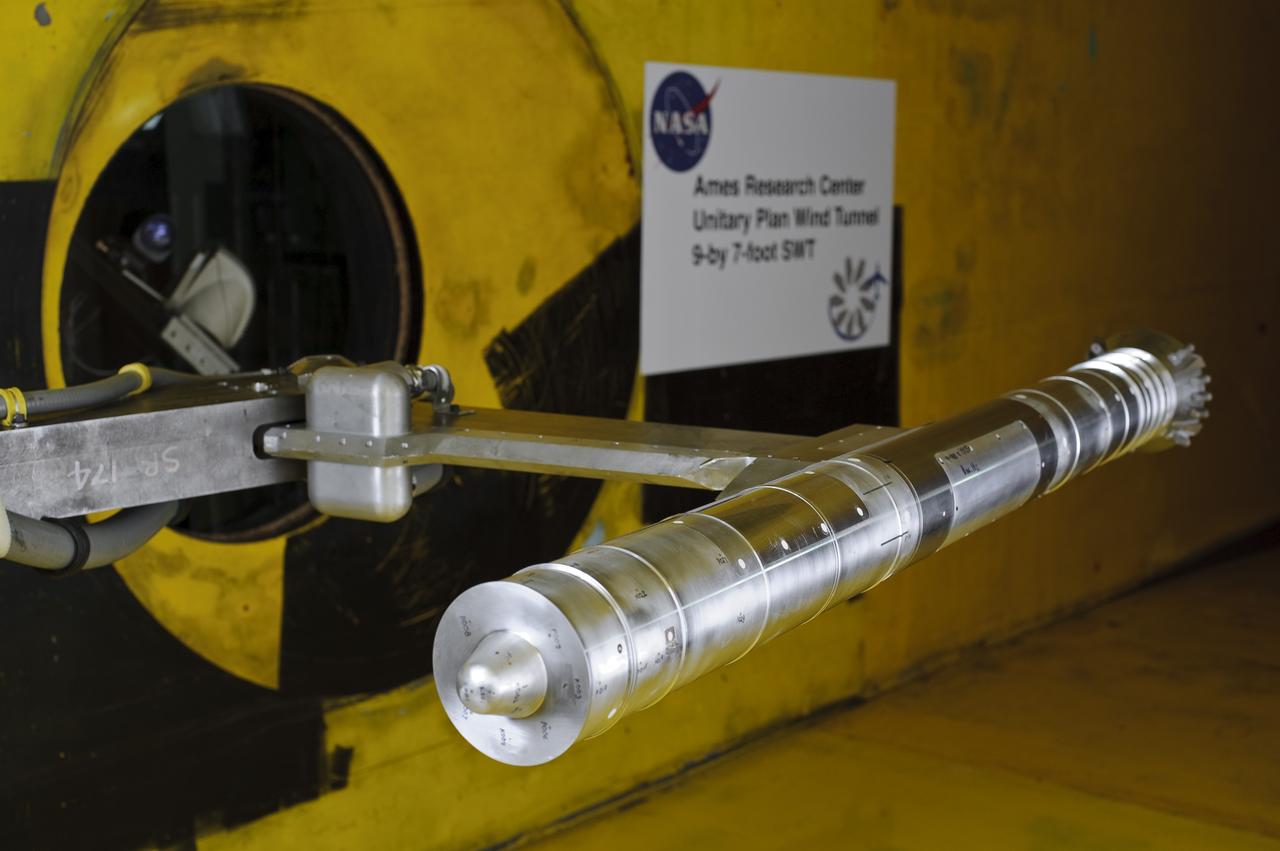
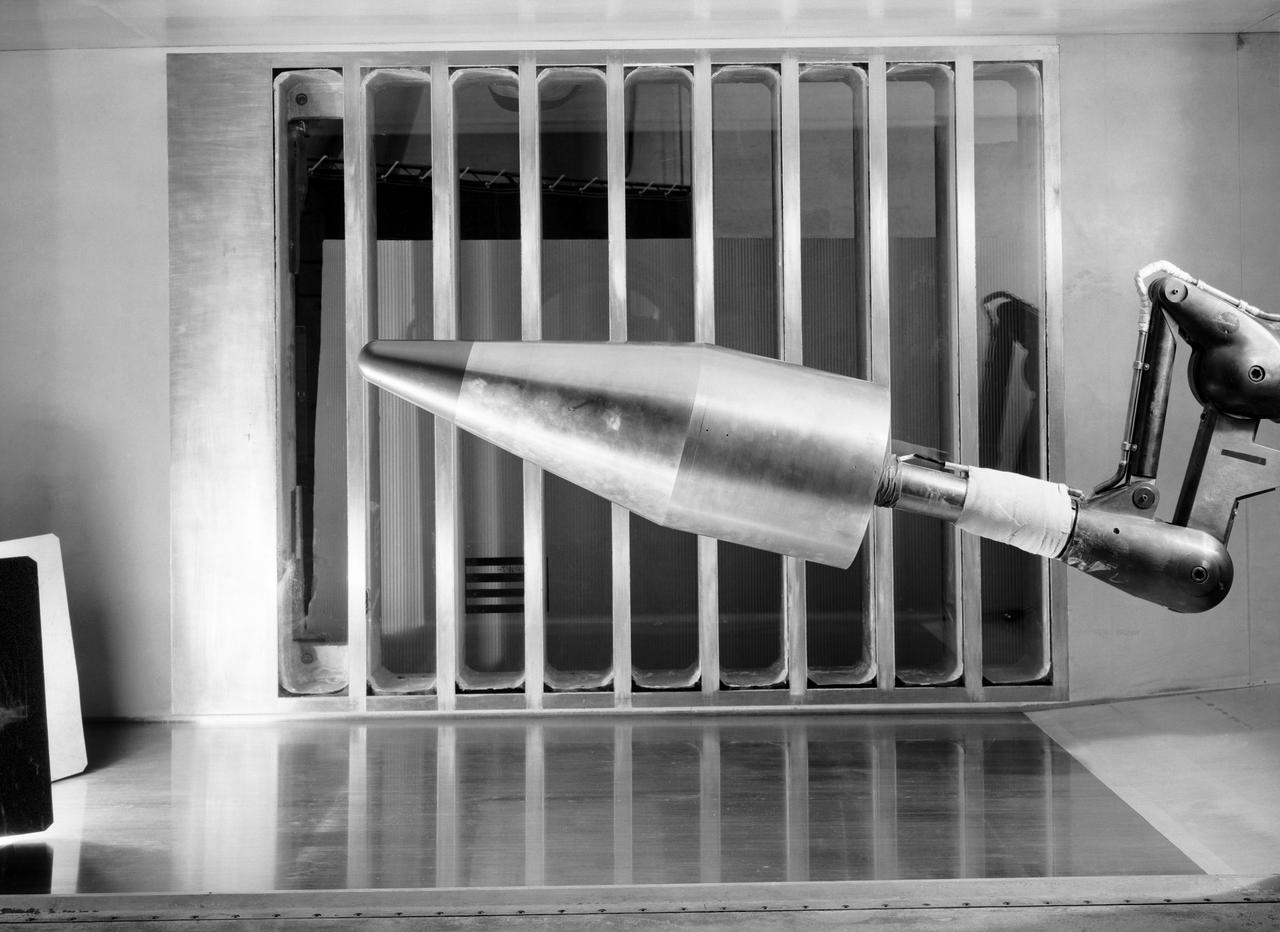
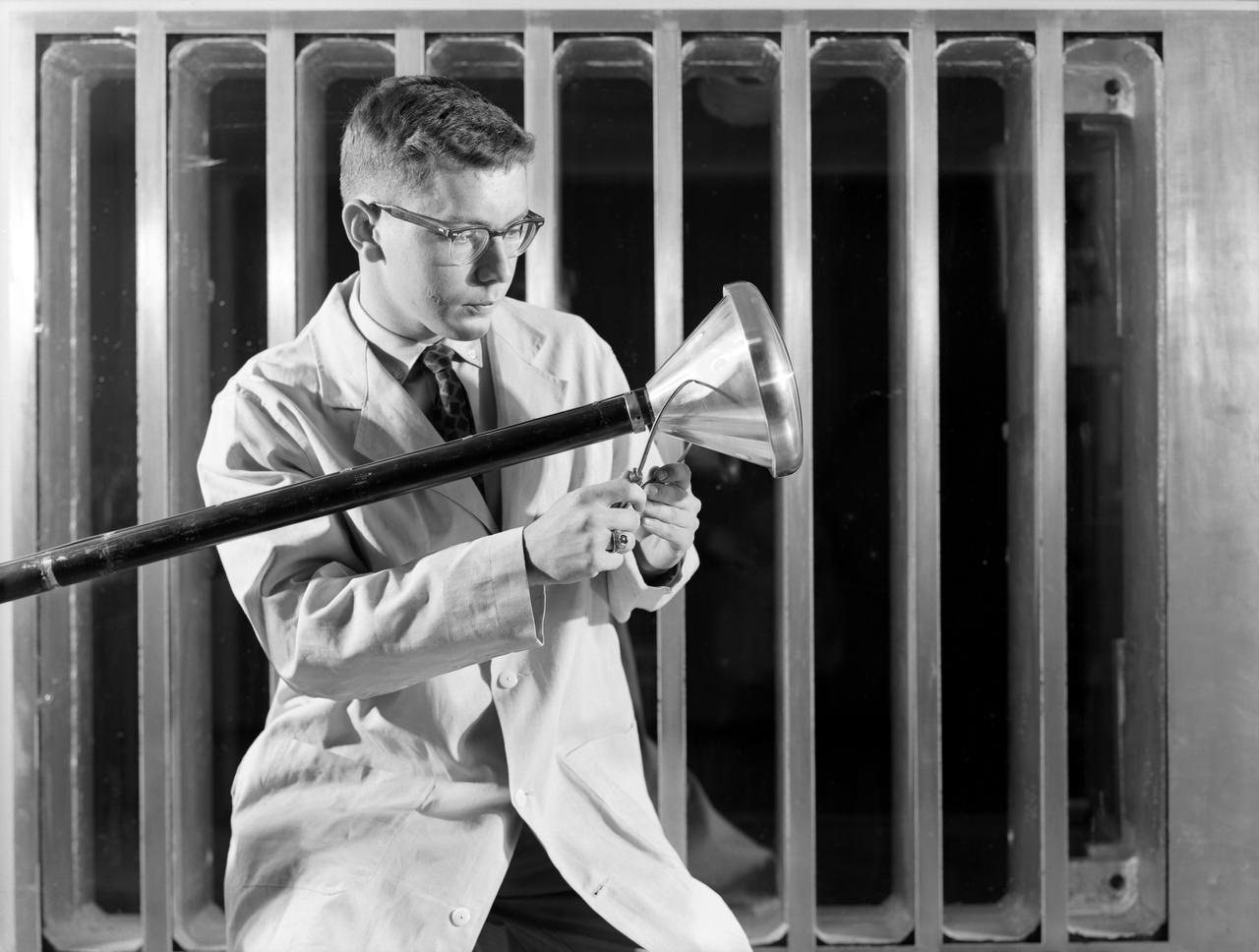
Researcher checks model of Project Fire Reentry package to be tested in Unitary Plan Wind Tunnel. Project FIRE (Flight Investigation Reentry Environment) studied the effects of reentry heating on spacecraft materials. It involved both wind tunnel and flight tests, although the majority were tests with Atlas rockets and recoverable reentry packages. These flight tests took place at Cape Canaveral in Florida. Wind tunnel tests were made in several Langley tunnels including the Unitary Plan Wind Tunnel, the 8-foot High-Temperature Tunnel and the 9x6-Foot Thermal Structures Tunnel.  Photo published in  book "A Century at Langley" by Joseph Chambers pg. 92
Project FIRE Reentry Package in UPWT Test Section of Tunnel
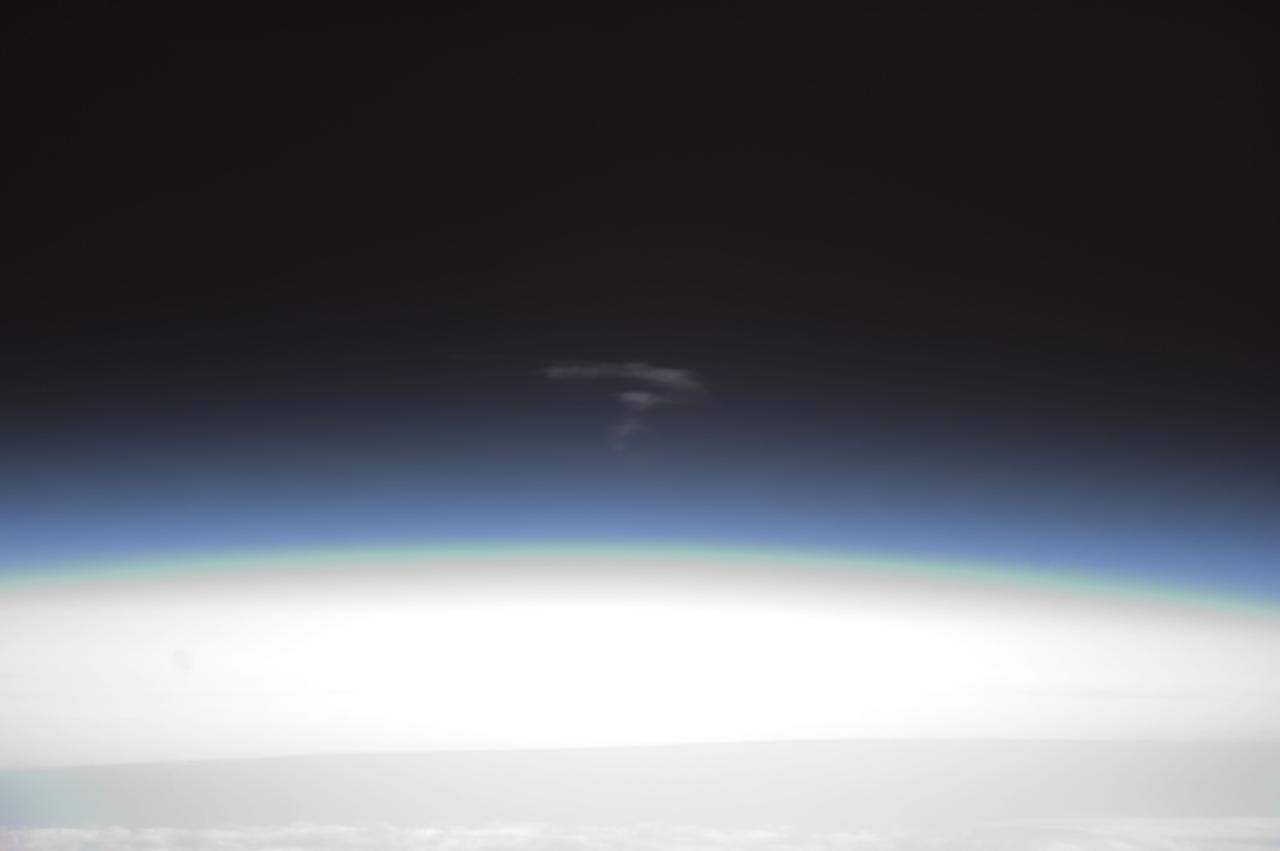
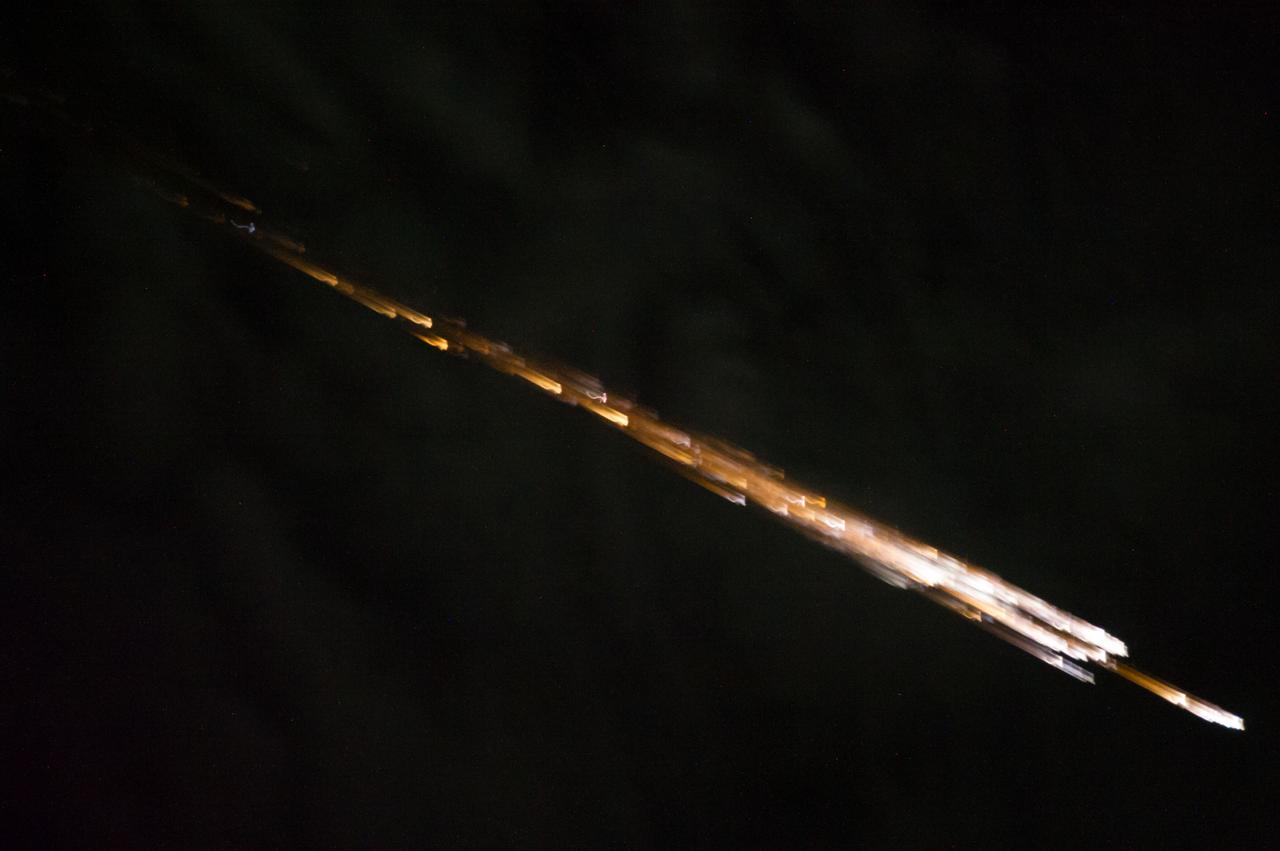
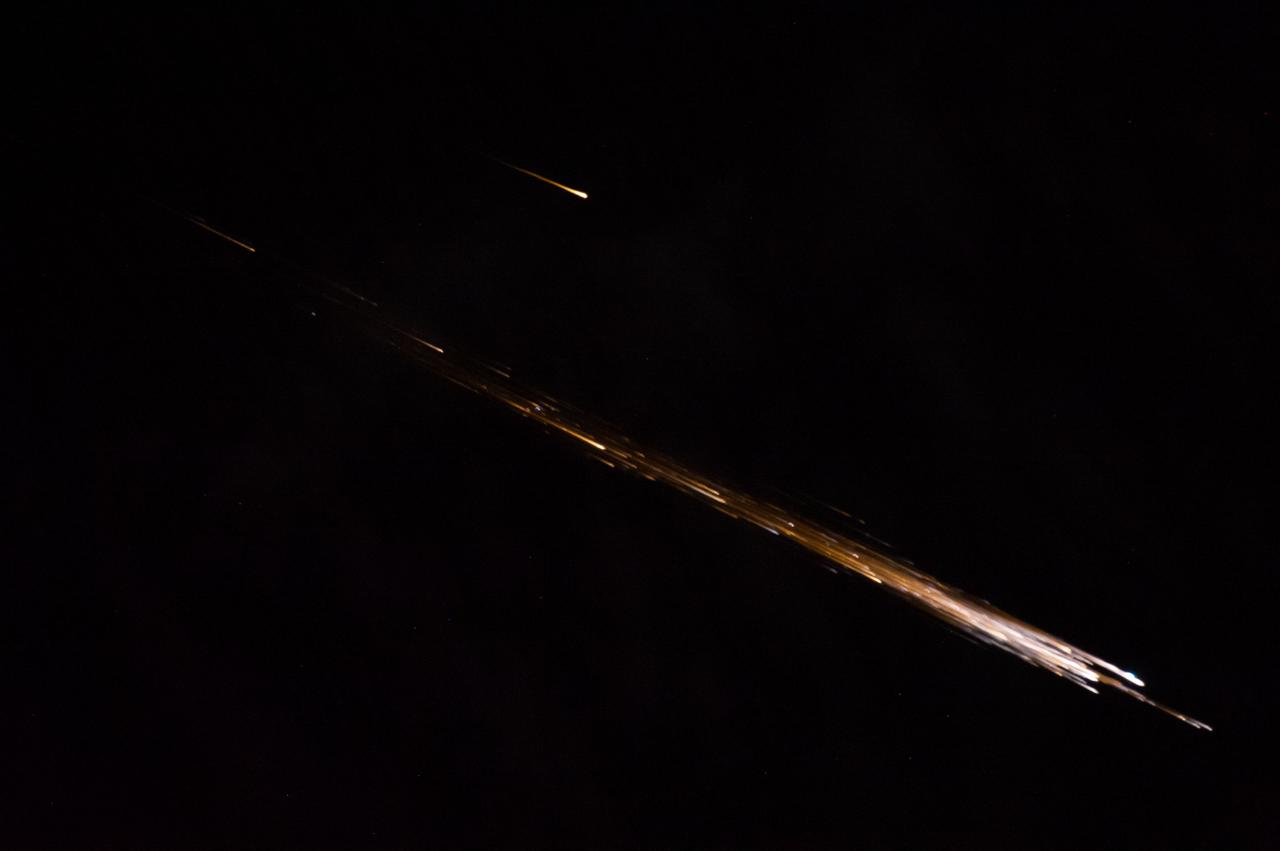
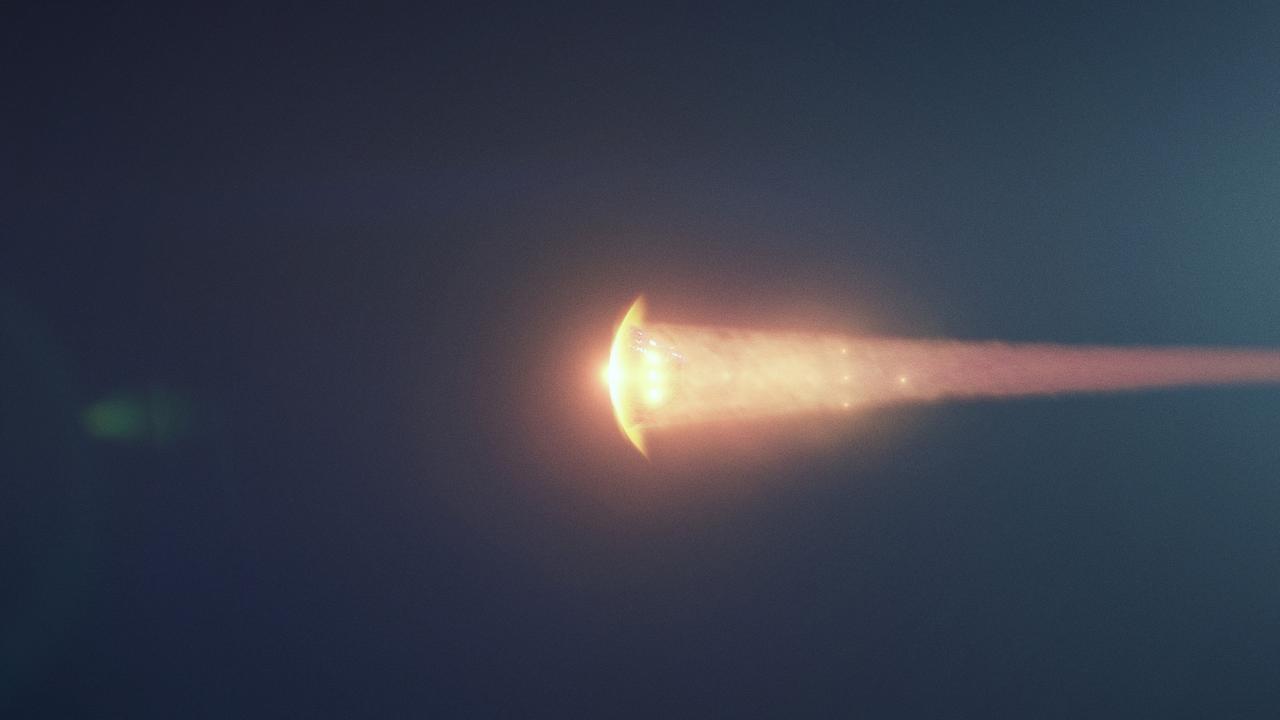
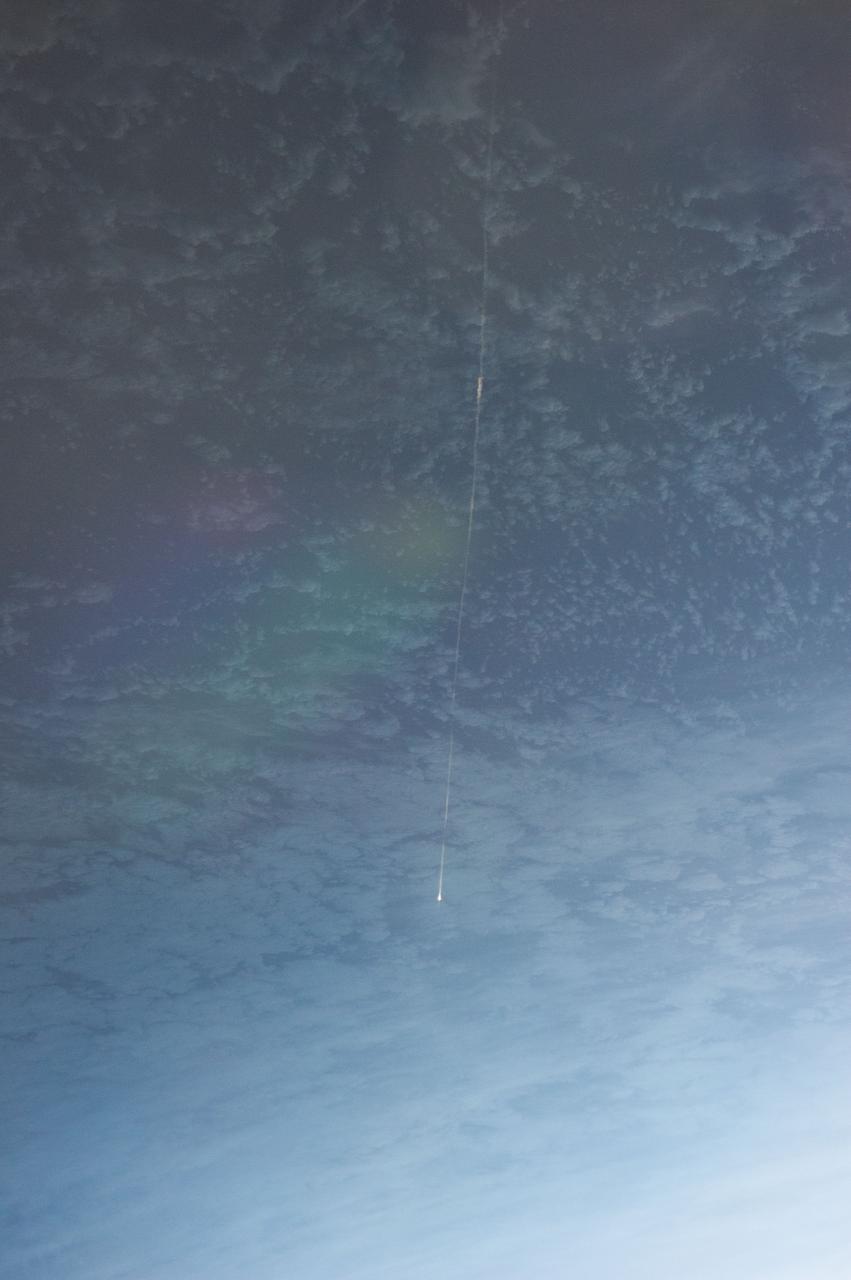
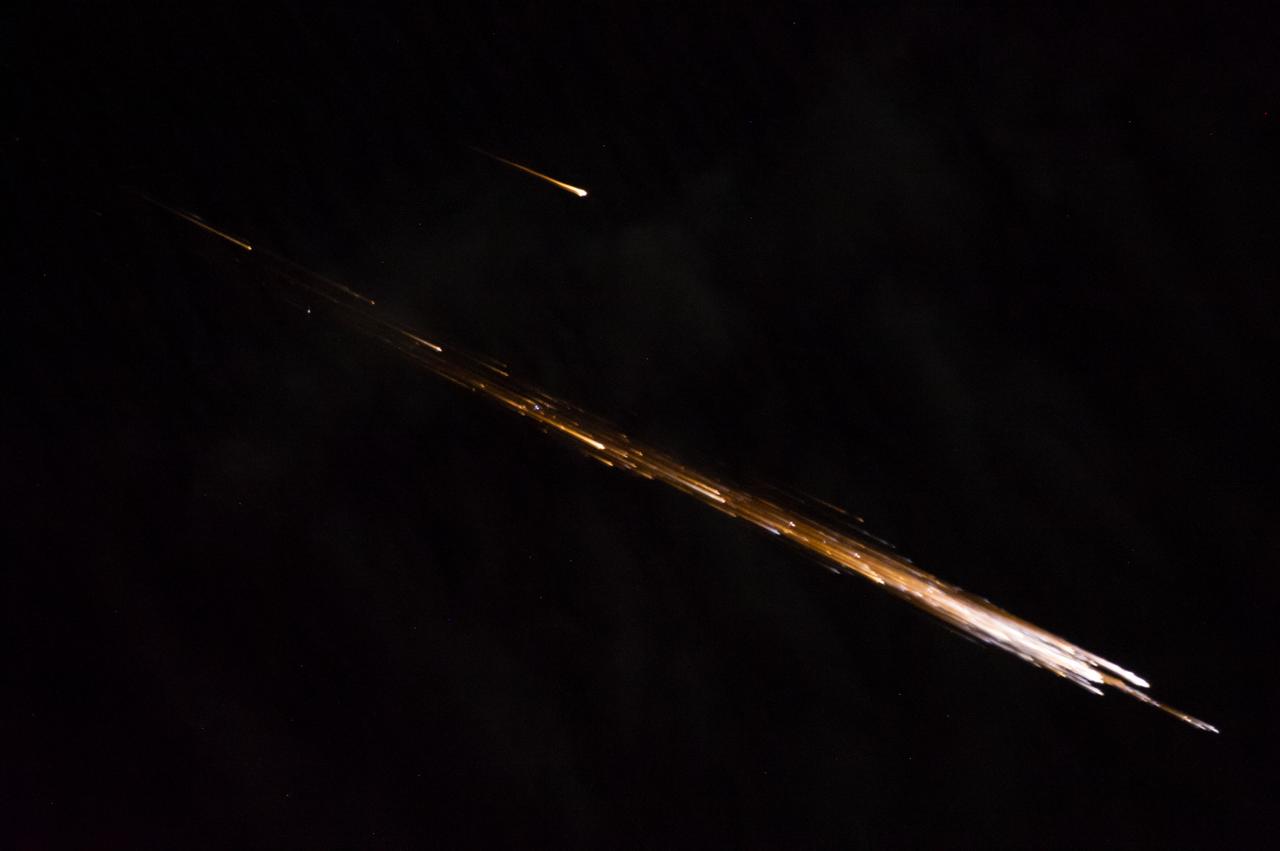
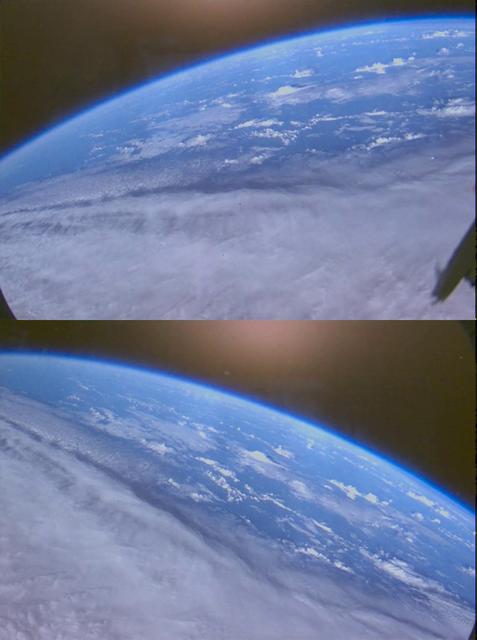
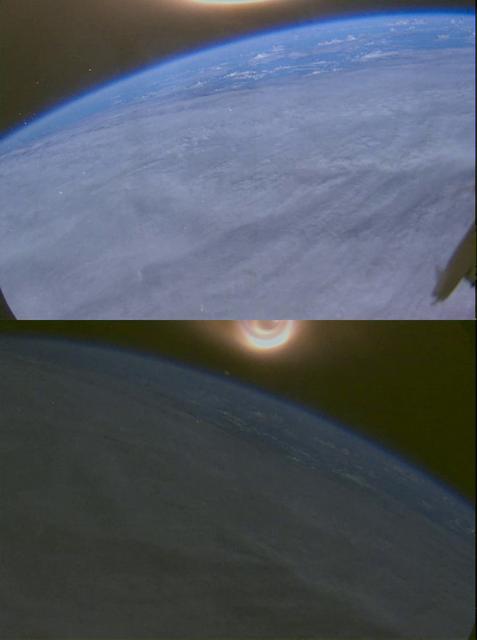
iss040e098572 (8/19/2014) --- A dark view of the Orbital Cygnus 2 reentry taken by the Expedition 40 crew. Light streak from reentry visible in frame. The Thermal Protection Material Flight Test and Reentry Data Collection (RED-Data2) investigation studies a new type of recording device that rides along a vehicle reentering Earth’s atmosphere, providing crucial data about the extreme conditions a spacecraft encounters during atmospheric reentry.
Cygnus 2 reentry
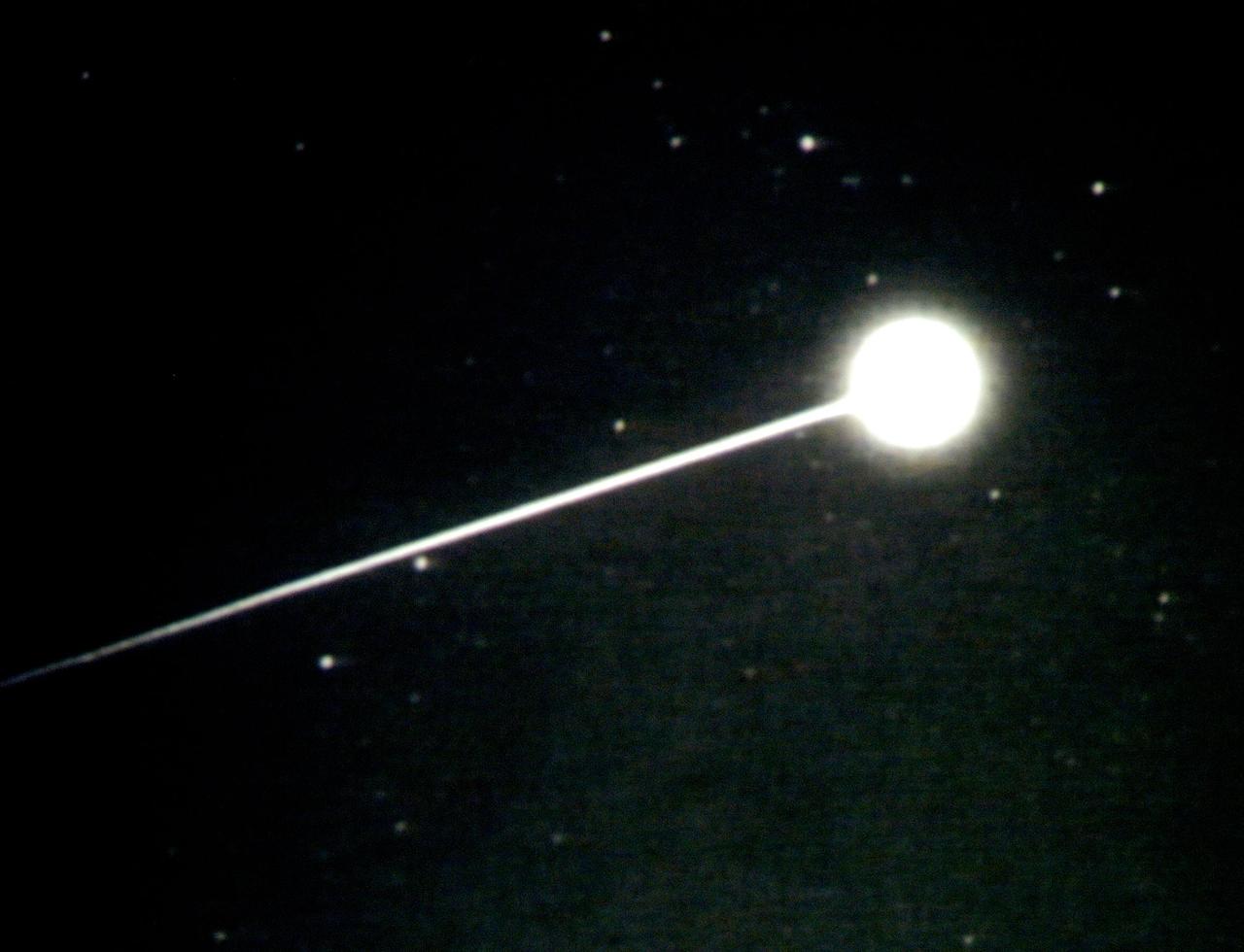
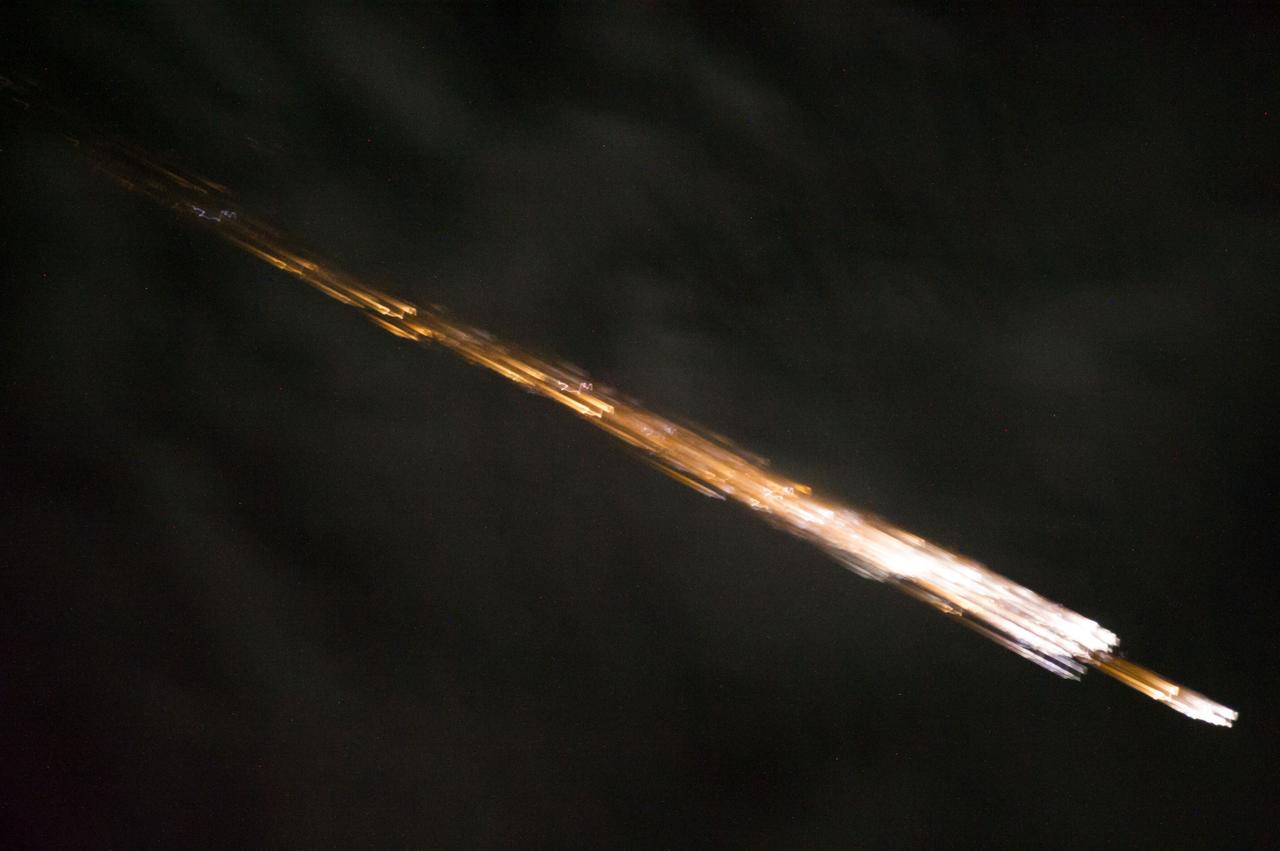
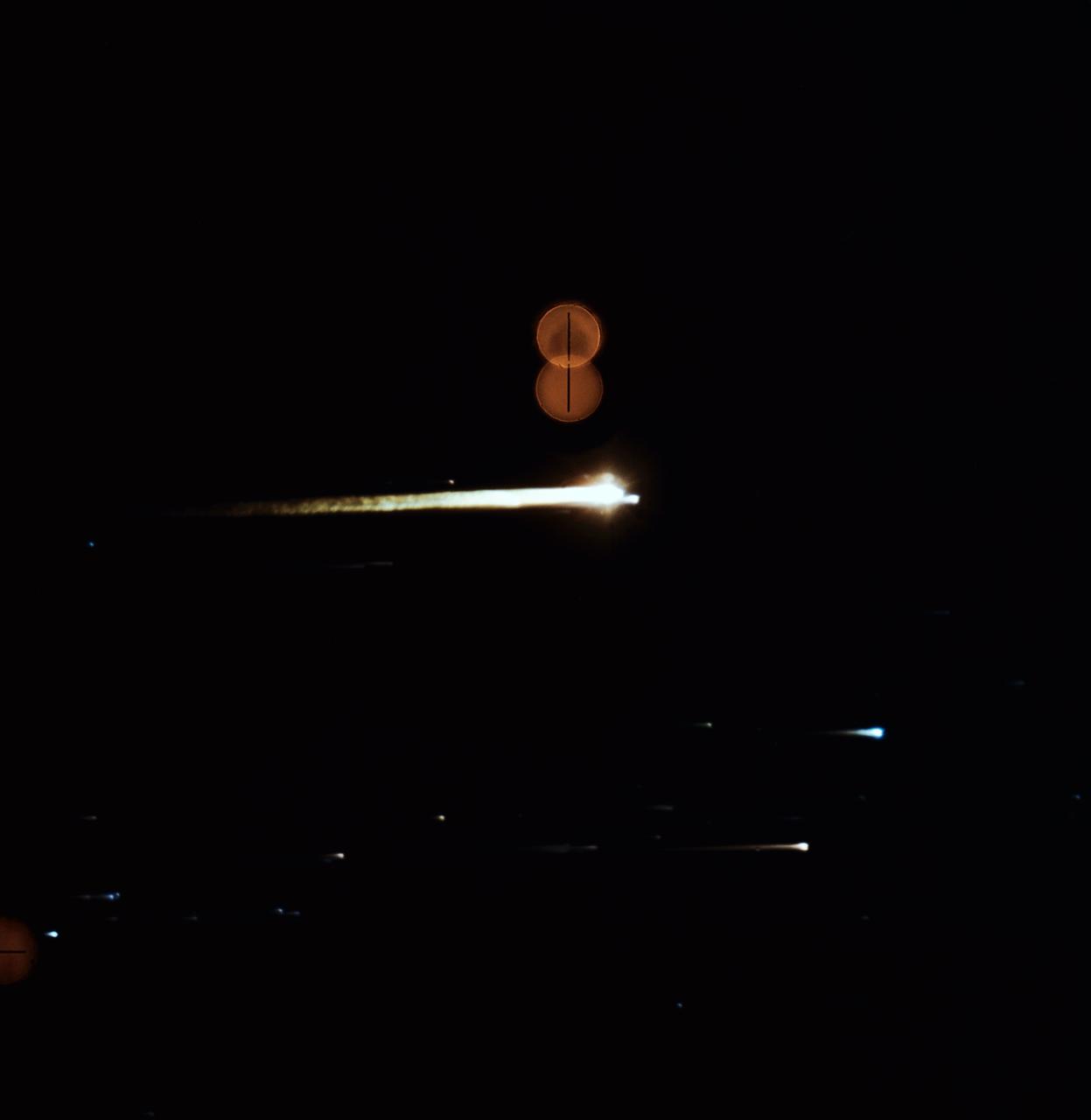
ISS040-E-098545 (17 Aug. 2014) --- One of the Expedition 40 crew members aboard the International Space Station recorded this image of the Orbital Sciences Corporation's Cygnus cargo carrier spacecraft breaking up in Earth's atmosphere after being released from the orbital outpost. The breakup started around 13:22 GMT on Aug. 17, 2014 and this photo was taken at 13:23:08 GMT.
Cygnus 2 reentry
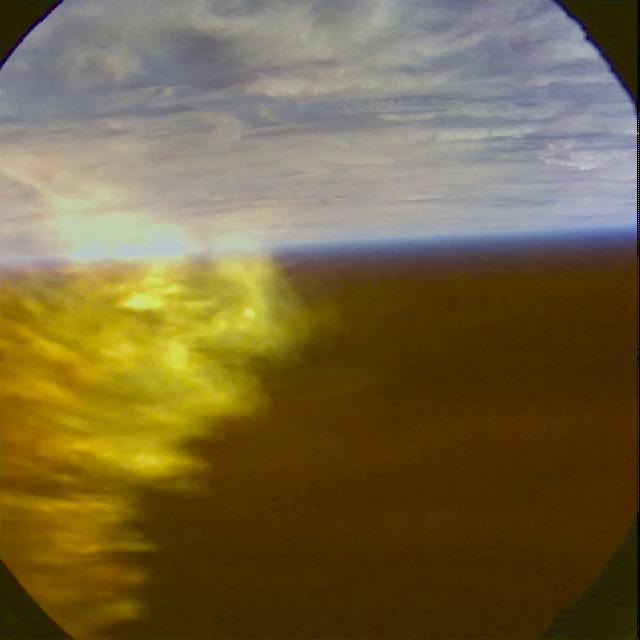
A view from the top hatch window as plasma surrounds the vehicle during reentry on Orion's first flight test, Exploration Flight Test-1 (EFT-1), on December 5, 2014.
Plasma surrounds vehicle during reentry
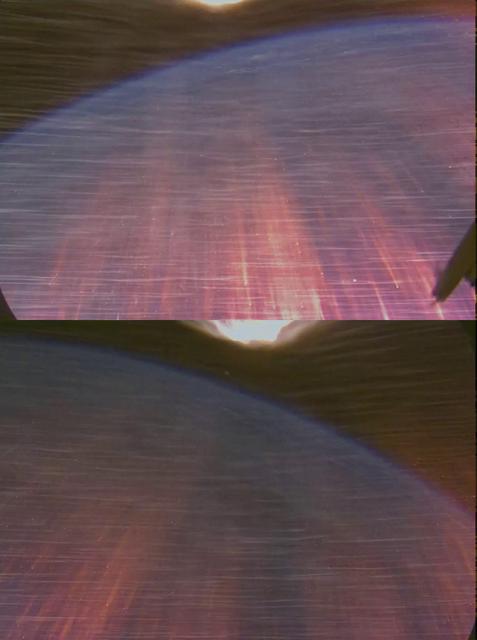
A view from the side windows as plasma surrounds the vehicle during reentry on Orion's first flight test, Exploration Flight Test-1 (EFT-1), on December 5, 2014.
Plasma surrounds vehicle during reentry
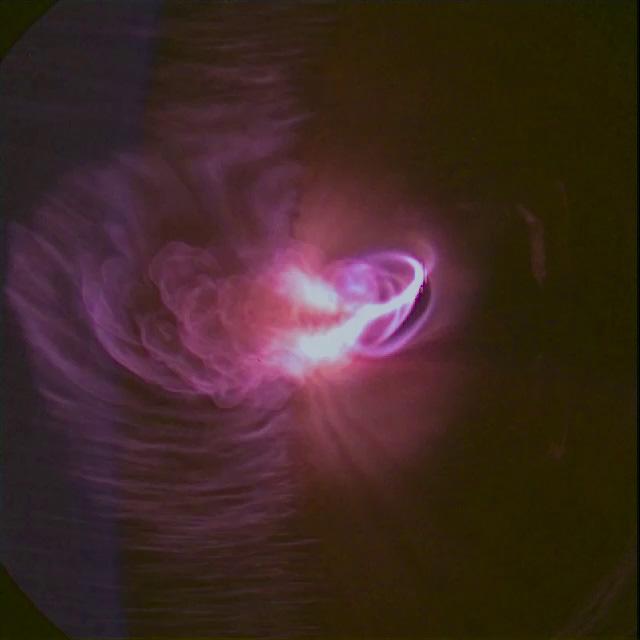
A view from the top hatch window as plasma surrounds the vehicle during reentry on Orion's first flight test, Exploration Flight Test-1 (EFT-1), on December 5, 2014.
Plasma surrounds vehicle during reentry
A view from the top hatch window as plasma surrounds the vehicle during reentry on Orion's first flight test, Exploration Flight Test-1 (EFT-1), on December 5, 2014.
Plasma surrounds vehicle during reentry
A view from the side windows as plasma surrounds the vehicle during reentry on Orion's first flight test, Exploration Flight Test-1 (EFT-1), on December 5, 2014.
Plasma surrounds vehicle during reentry
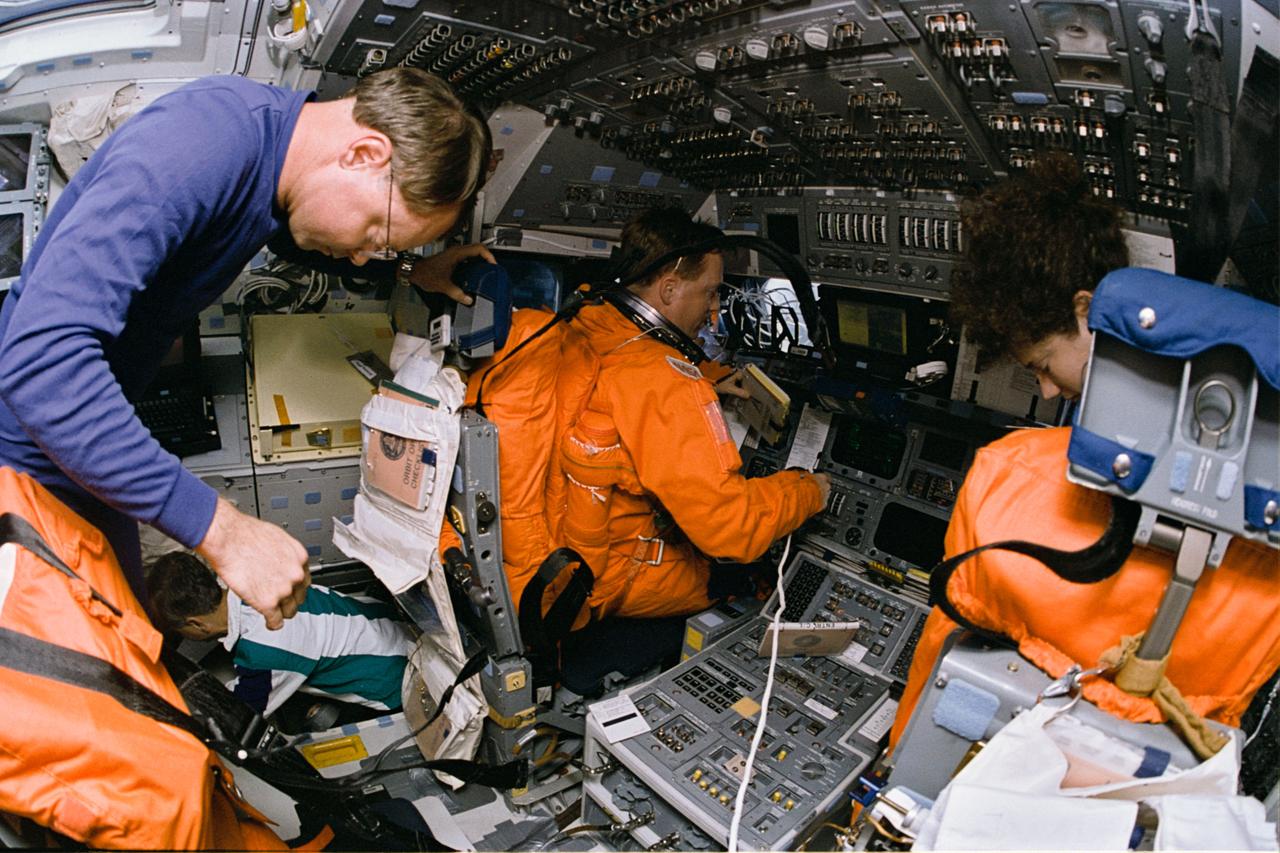
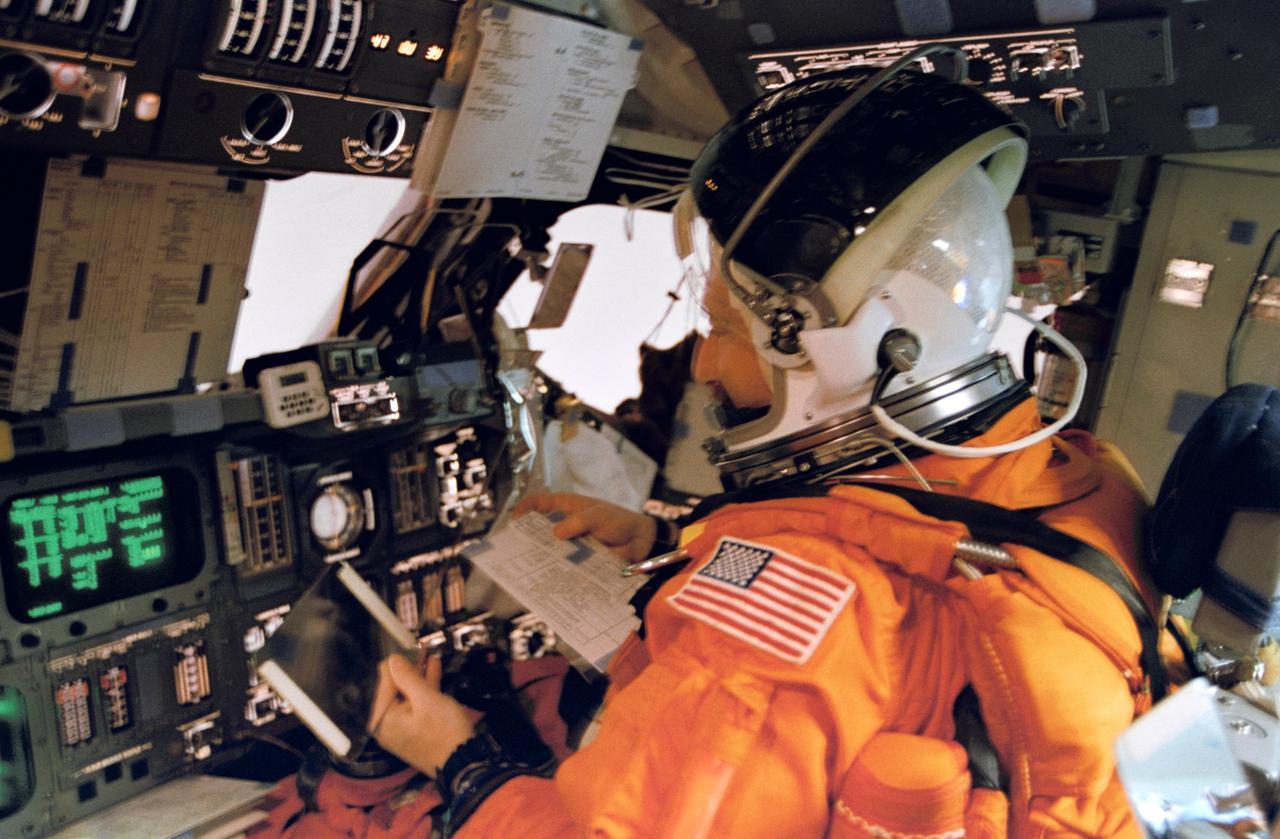
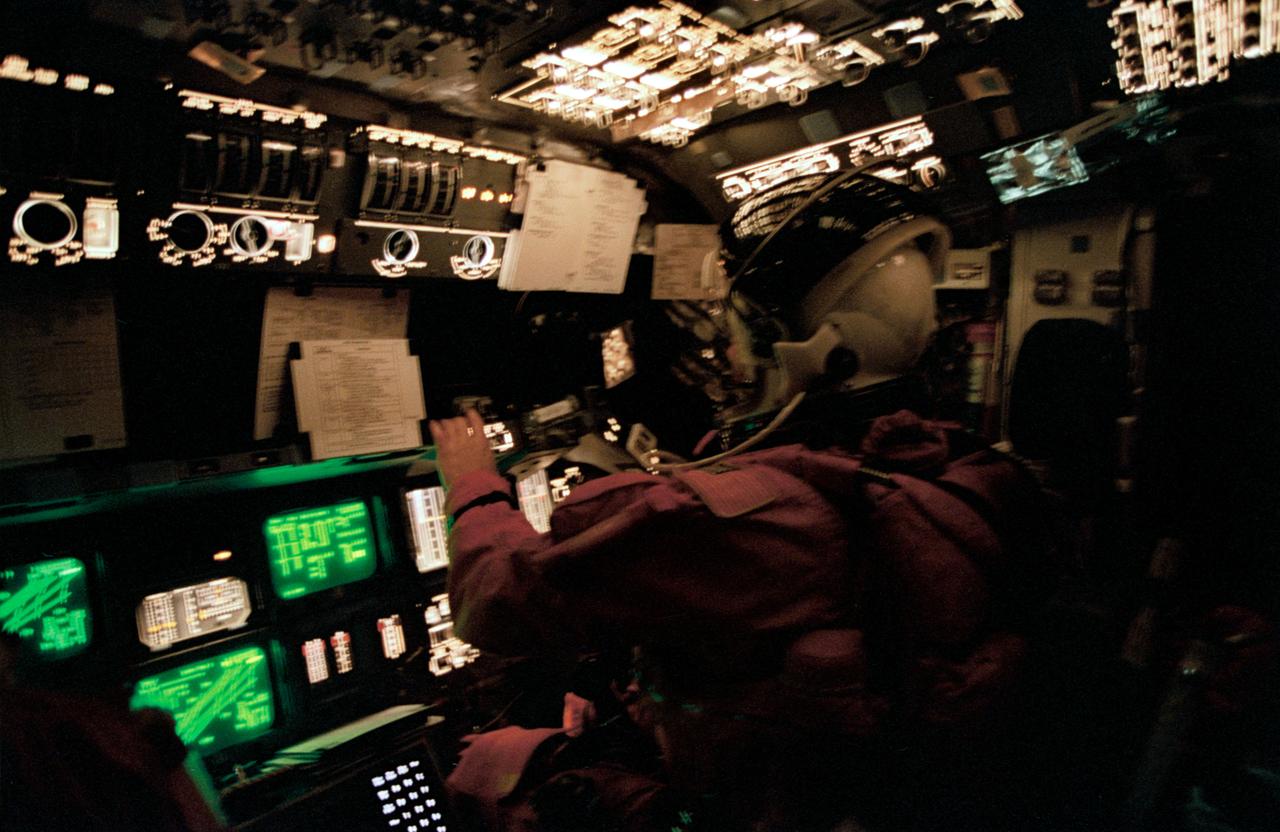
STS075-322-012 (9 March 1996) --- Seated at the pilot's station, astronaut Scott J. Horowitz uses a mirror to monitor the vertical stabilizer and the aft cargo bay area during the entry phase of the flight. Horowitz, pilot, joined four other astronauts and an international payload specialist for 16 days of scientific research in Earth-orbit.
Astronaut Horowitz at shuttle controls for reentry
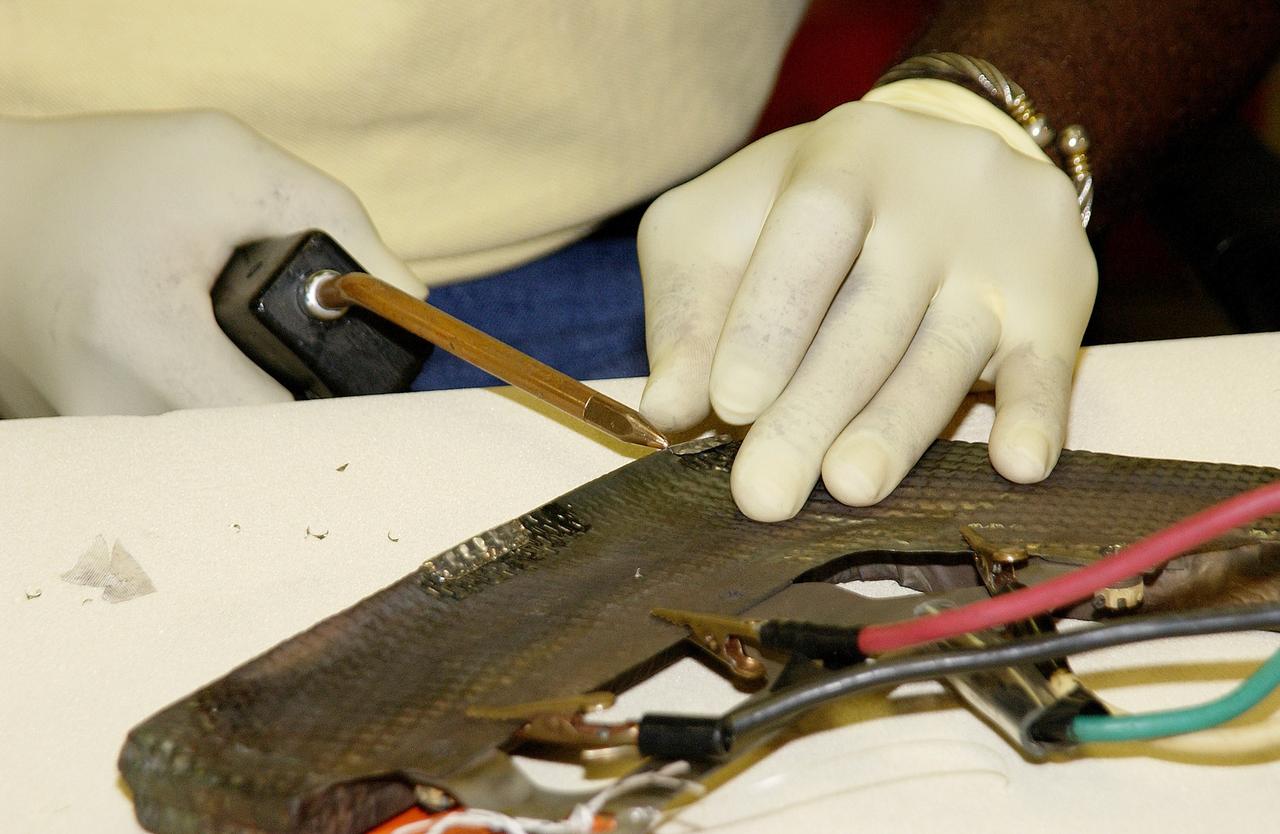
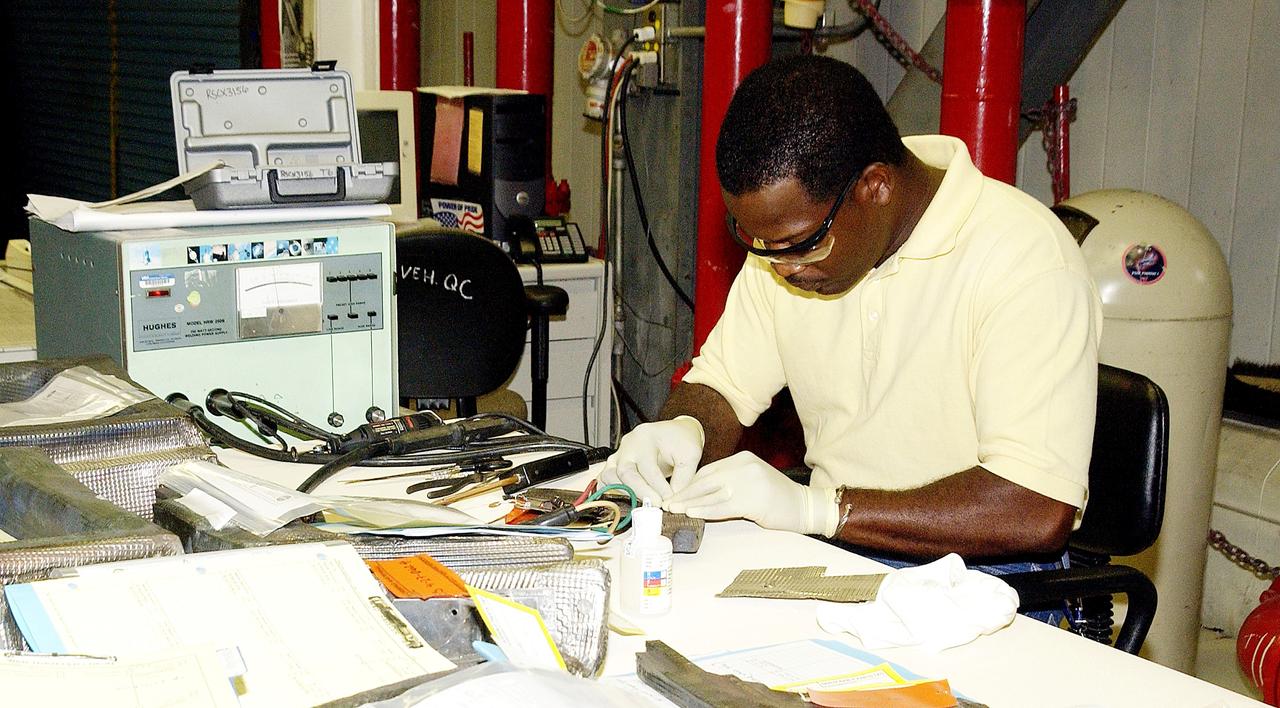
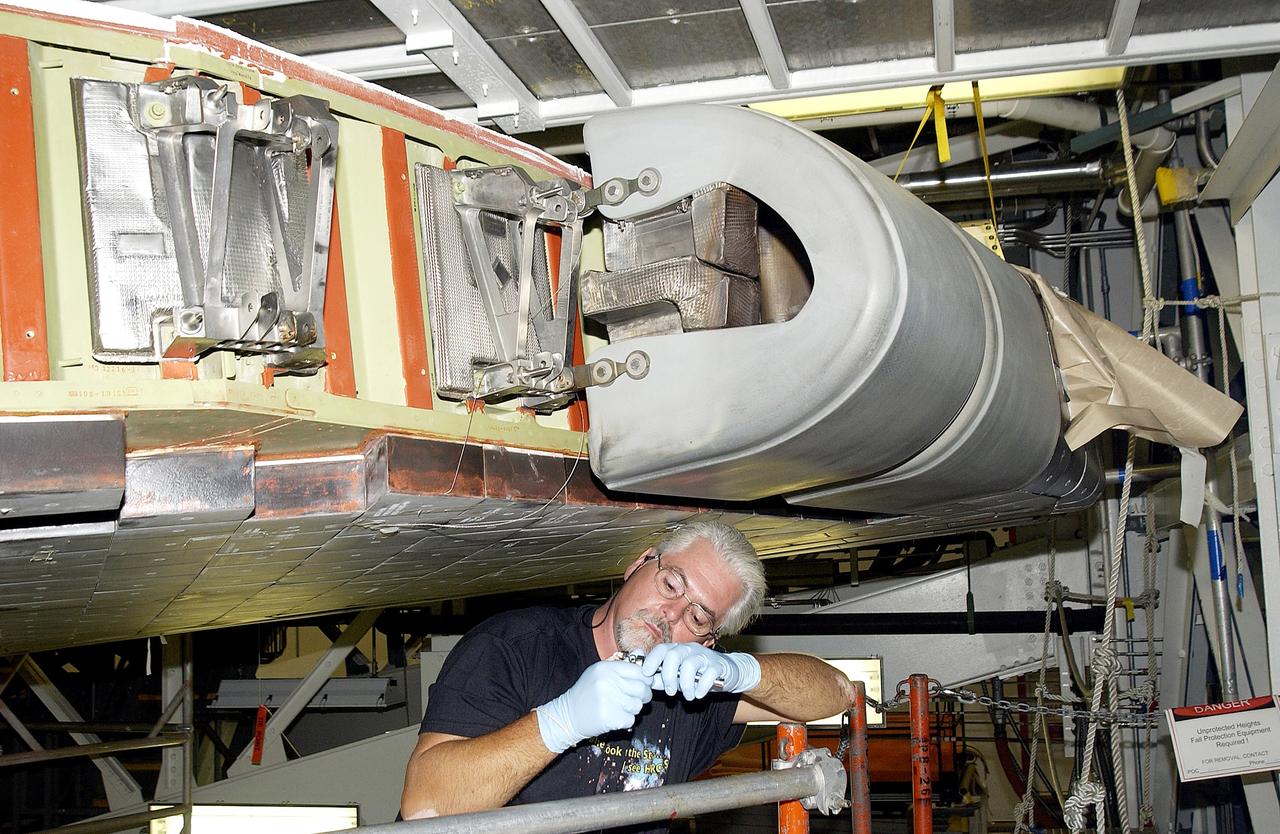
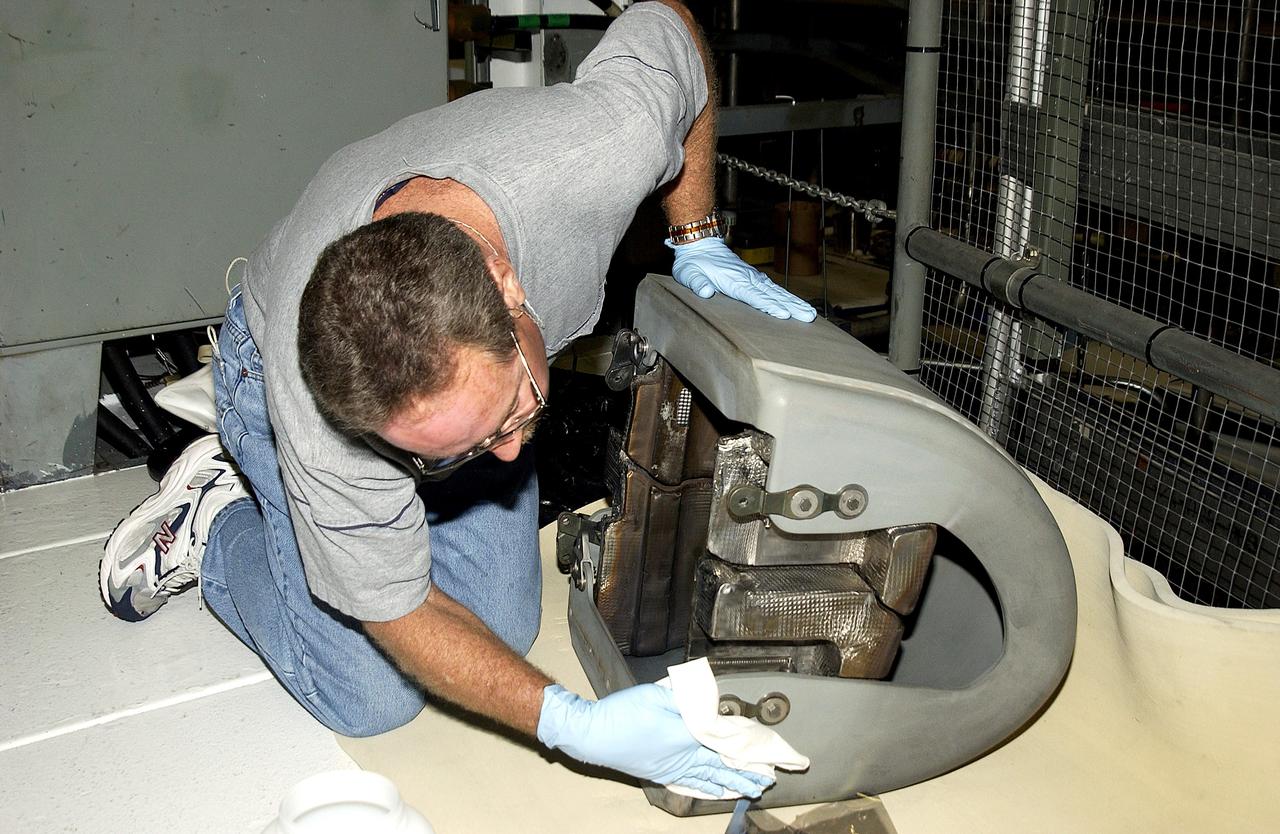
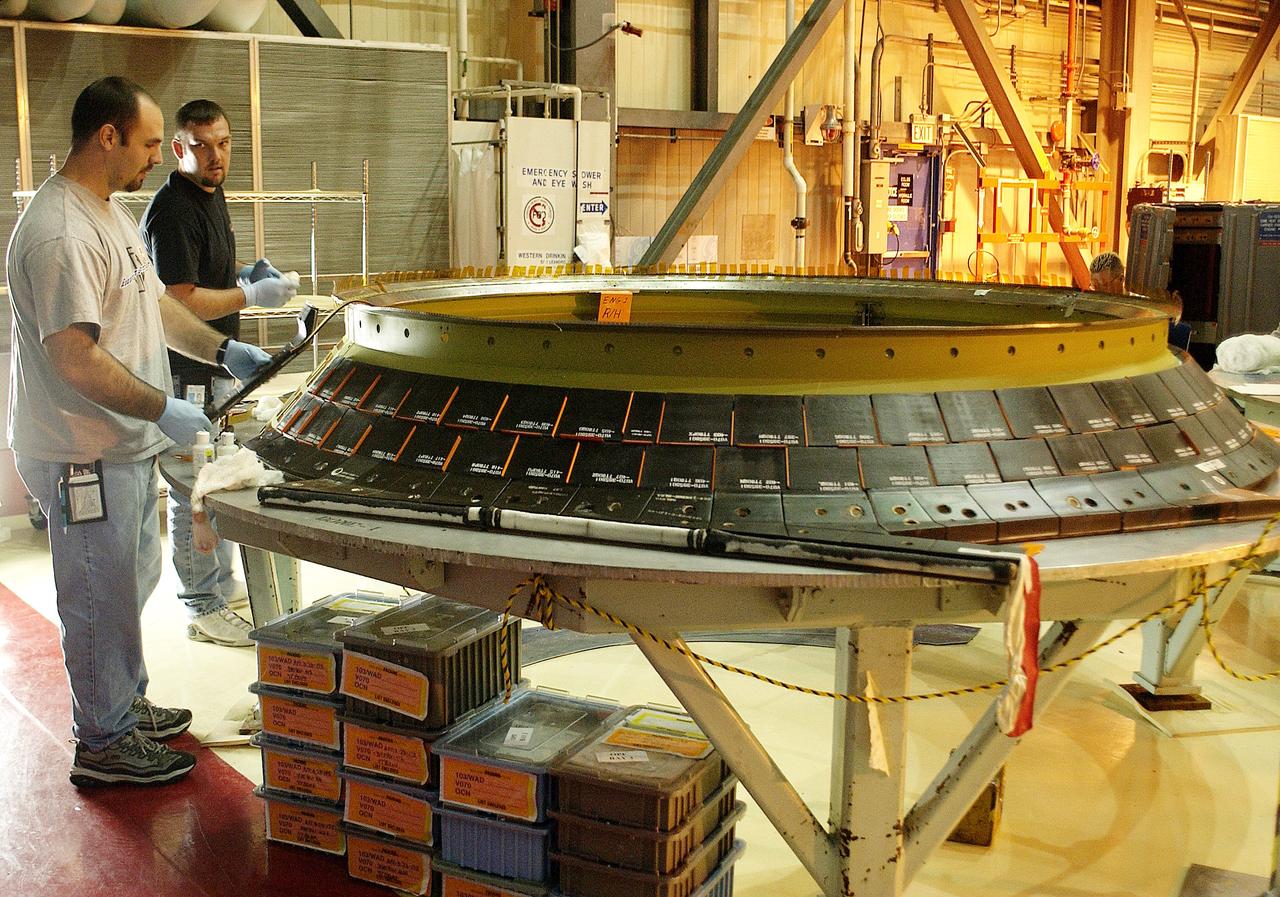
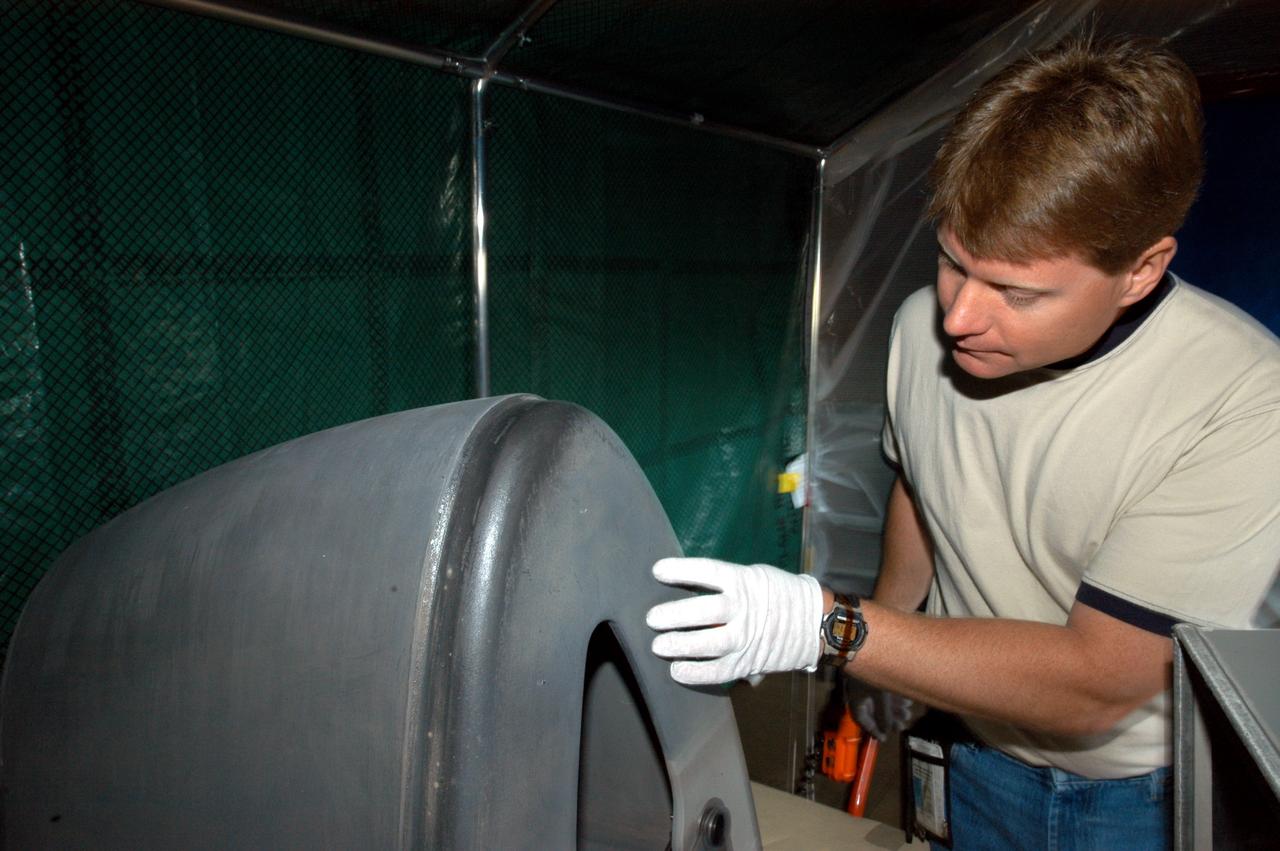
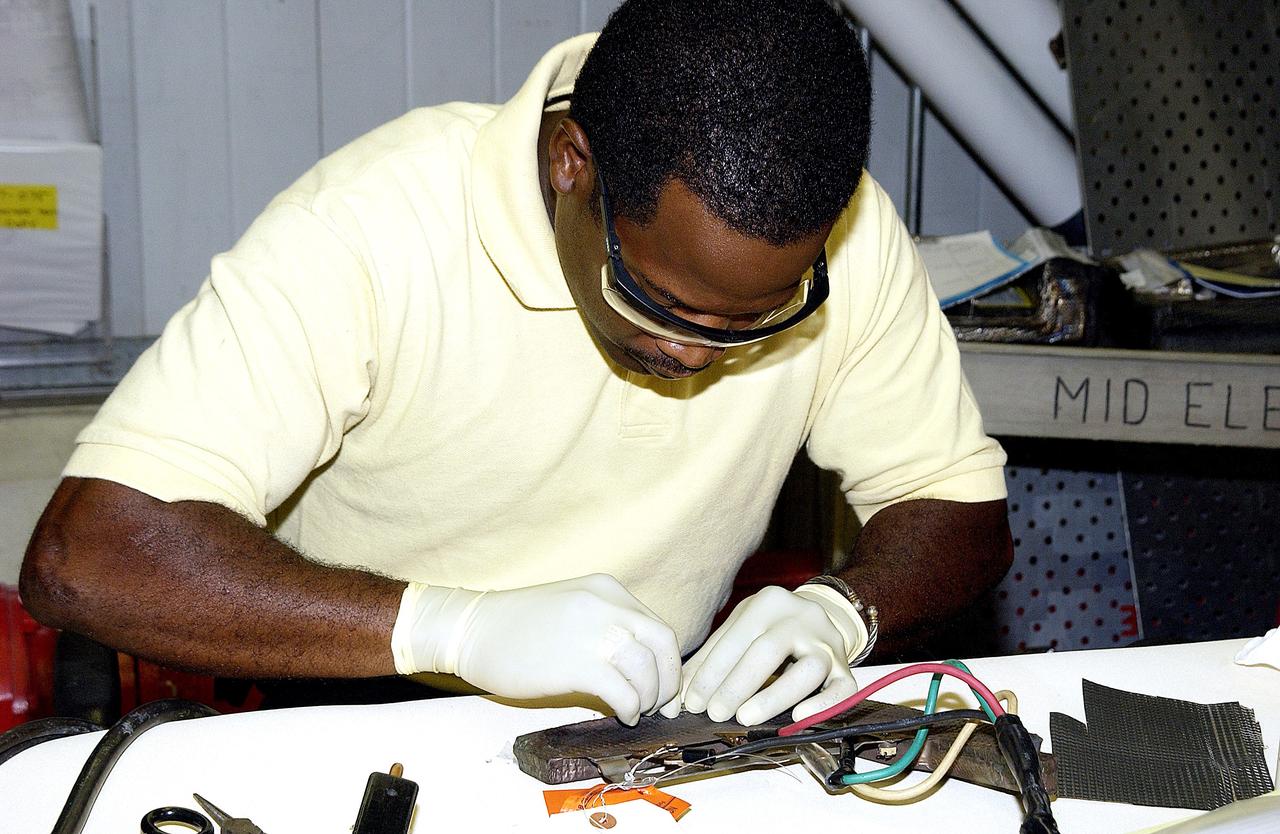
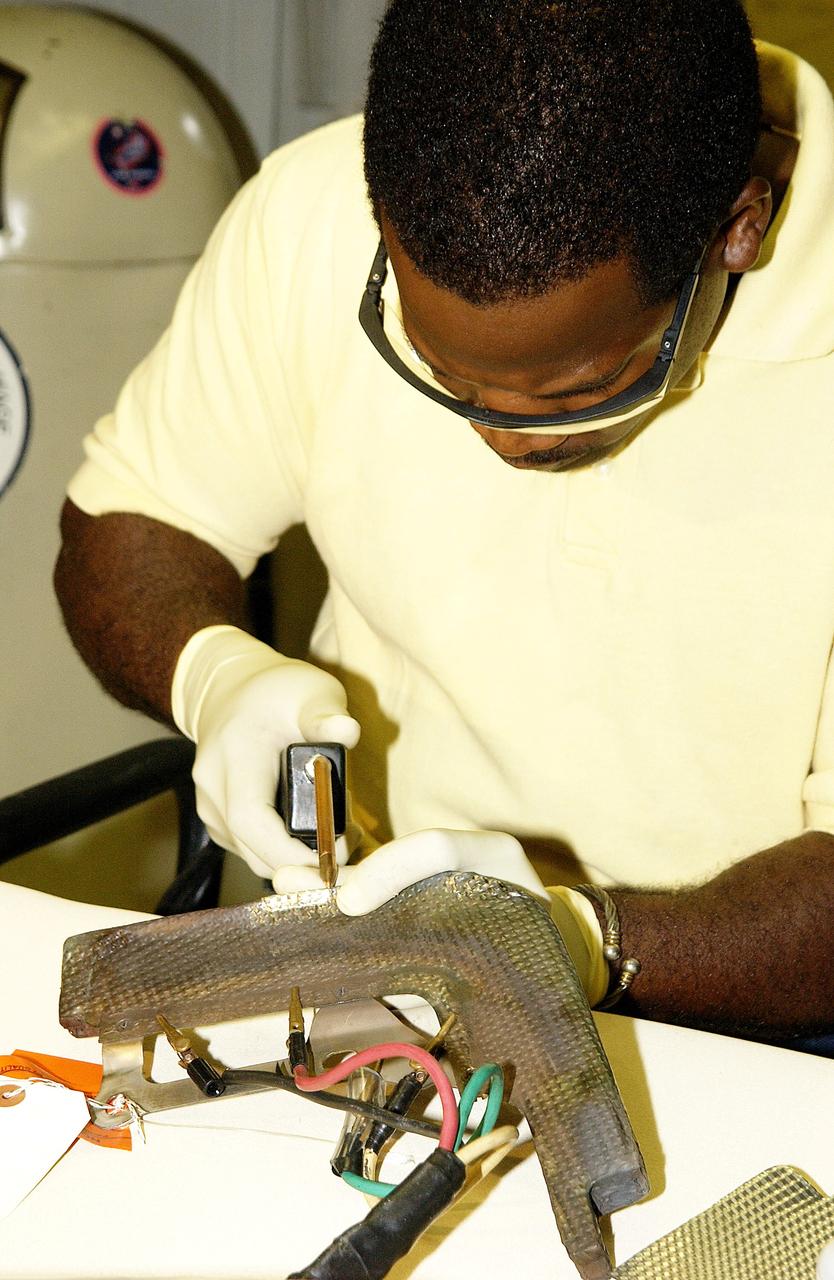
KENNEDY SPACE CENTER, FLA. -  United Space Alliance employee Anthony Simmons prepares to electroweld a crack formed in the insulator inside a Reinforced Carbon Carbon panel.   The gray carbon composite RCC panels are attached to the leading edge of the wing of the orbiters to withstand the aerodynamic forces experienced during launch and reentry, which can reach as high as 800 pounds per square foot.  The operating range of RCC is from minus 250º F to about 3,000º F, the temperature produced by friction with the atmosphere during reentry.
KENNEDY SPACE CENTER, FLA. - United Space Alliance employee Anthony Simmons prepares to electroweld a crack formed in the insulator inside a Reinforced Carbon Carbon panel. The gray carbon composite RCC panels are attached to the leading edge of the wing of the orbiters to withstand the aerodynamic forces experienced during launch and reentry, which can reach as high as 800 pounds per square foot. The operating range of RCC is from minus 250º F to about 3,000º F, the temperature produced by friction with the atmosphere during reentry.
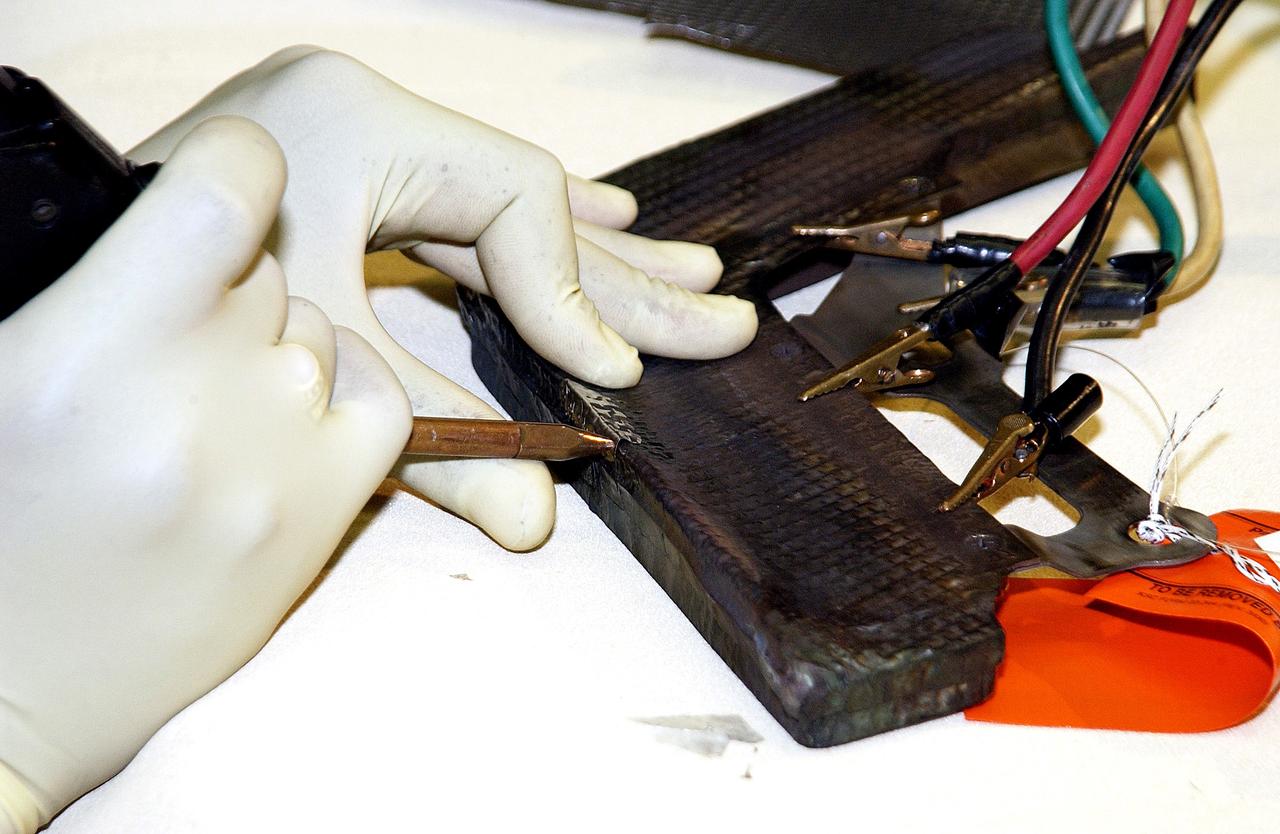
KENNEDY SPACE CENTER, FLA. -   United Space Alliance employee Anthony Simmons continues electrowelding on an insulator inside a Reinforced Carbon Carbon panel.   The gray carbon composite RCC panels are attached to the leading edge of the wing of the orbiters to withstand the aerodynamic forces experienced during launch and reentry, which can reach as high as 800 pounds per square foot.  The operating range of RCC is from minus 250º F to about 3,000º F, the temperature produced by friction with the atmosphere during reentry.
KENNEDY SPACE CENTER, FLA. - United Space Alliance employee Anthony Simmons continues electrowelding on an insulator inside a Reinforced Carbon Carbon panel. The gray carbon composite RCC panels are attached to the leading edge of the wing of the orbiters to withstand the aerodynamic forces experienced during launch and reentry, which can reach as high as 800 pounds per square foot. The operating range of RCC is from minus 250º F to about 3,000º F, the temperature produced by friction with the atmosphere during reentry.
KENNEDY SPACE CENTER, FLA. -   United Space Alliance employee Anthony Simmons continues electrowelding on an insulator inside a Reinforced Carbon Carbon panel.   The gray carbon composite RCC panels are attached to the leading edge of the wing of the orbiters to withstand the aerodynamic forces experienced during launch and reentry, which can reach as high as 800 pounds per square foot.  The operating range of RCC is from minus 250º F to about 3,000º F, the temperature produced by friction with the atmosphere during reentry.
KENNEDY SPACE CENTER, FLA. - United Space Alliance employee Anthony Simmons continues electrowelding on an insulator inside a Reinforced Carbon Carbon panel. The gray carbon composite RCC panels are attached to the leading edge of the wing of the orbiters to withstand the aerodynamic forces experienced during launch and reentry, which can reach as high as 800 pounds per square foot. The operating range of RCC is from minus 250º F to about 3,000º F, the temperature produced by friction with the atmosphere during reentry.
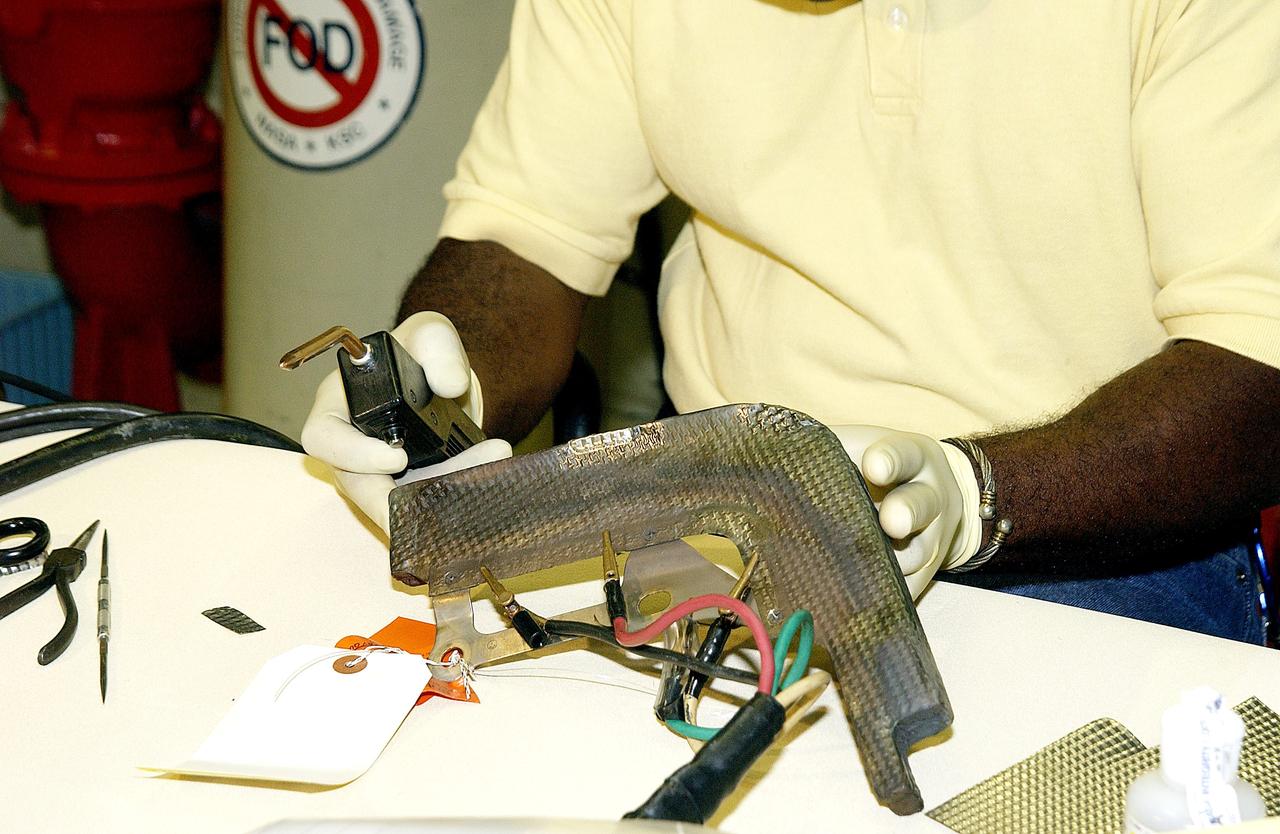
KENNEDY SPACE CENTER, FLA. - United Space Alliance employee Anthony Simmons checks the electroweld he performed on an insulator inside a Reinforced Carbon Carbon panel.   The gray carbon composite RCC panels are attached to the leading edge of the wing of the orbiters to withstand the aerodynamic forces experienced during launch and reentry, which can reach as high as 800 pounds per square foot.  The operating range of RCC is from minus 250º F to about 3,000º F, the temperature produced by friction with the atmosphere during reentry.
KENNEDY SPACE CENTER, FLA. - United Space Alliance employee Anthony Simmons checks the electroweld he performed on an insulator inside a Reinforced Carbon Carbon panel. The gray carbon composite RCC panels are attached to the leading edge of the wing of the orbiters to withstand the aerodynamic forces experienced during launch and reentry, which can reach as high as 800 pounds per square foot. The operating range of RCC is from minus 250º F to about 3,000º F, the temperature produced by friction with the atmosphere during reentry.
KENNEDY SPACE CENTER, FLA. -  United Space Alliance employee Anthony Simmons electrowelds a crack formed in the insulator inside a Reinforced Carbon Carbon panel.   The gray carbon composite RCC panels are attached to the leading edge of the wing of the orbiters to withstand the aerodynamic forces experienced during launch and reentry, which can reach as high as 800 pounds per square foot.  The operating range of RCC is from minus 250º F to about 3,000º F, the temperature produced by friction with the atmosphere during reentry.
KENNEDY SPACE CENTER, FLA. - United Space Alliance employee Anthony Simmons electrowelds a crack formed in the insulator inside a Reinforced Carbon Carbon panel. The gray carbon composite RCC panels are attached to the leading edge of the wing of the orbiters to withstand the aerodynamic forces experienced during launch and reentry, which can reach as high as 800 pounds per square foot. The operating range of RCC is from minus 250º F to about 3,000º F, the temperature produced by friction with the atmosphere during reentry.
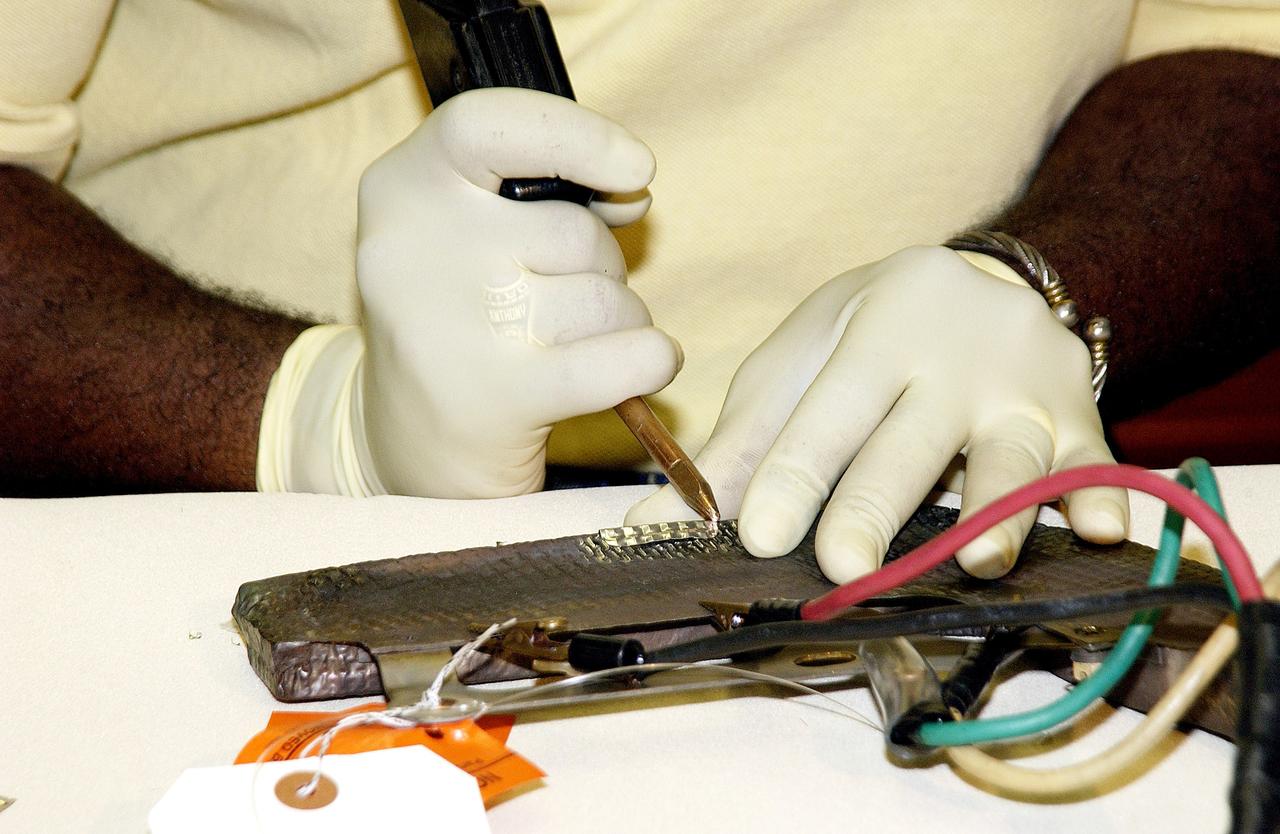
KENNEDY SPACE CENTER, FLA. -  United Space Alliance employee Anthony Simmons electrowelds a crack formed in the insulator inside a Reinforced Carbon Carbon panel.   The gray carbon composite RCC panels are attached to the leading edge of the wing of the orbiters to withstand the aerodynamic forces experienced during launch and reentry, which can reach as high as 800 pounds per square foot.  The operating range of RCC is from minus 250º F to about 3,000º F, the temperature produced by friction with the atmosphere during reentry.
KENNEDY SPACE CENTER, FLA. - United Space Alliance employee Anthony Simmons electrowelds a crack formed in the insulator inside a Reinforced Carbon Carbon panel. The gray carbon composite RCC panels are attached to the leading edge of the wing of the orbiters to withstand the aerodynamic forces experienced during launch and reentry, which can reach as high as 800 pounds per square foot. The operating range of RCC is from minus 250º F to about 3,000º F, the temperature produced by friction with the atmosphere during reentry.
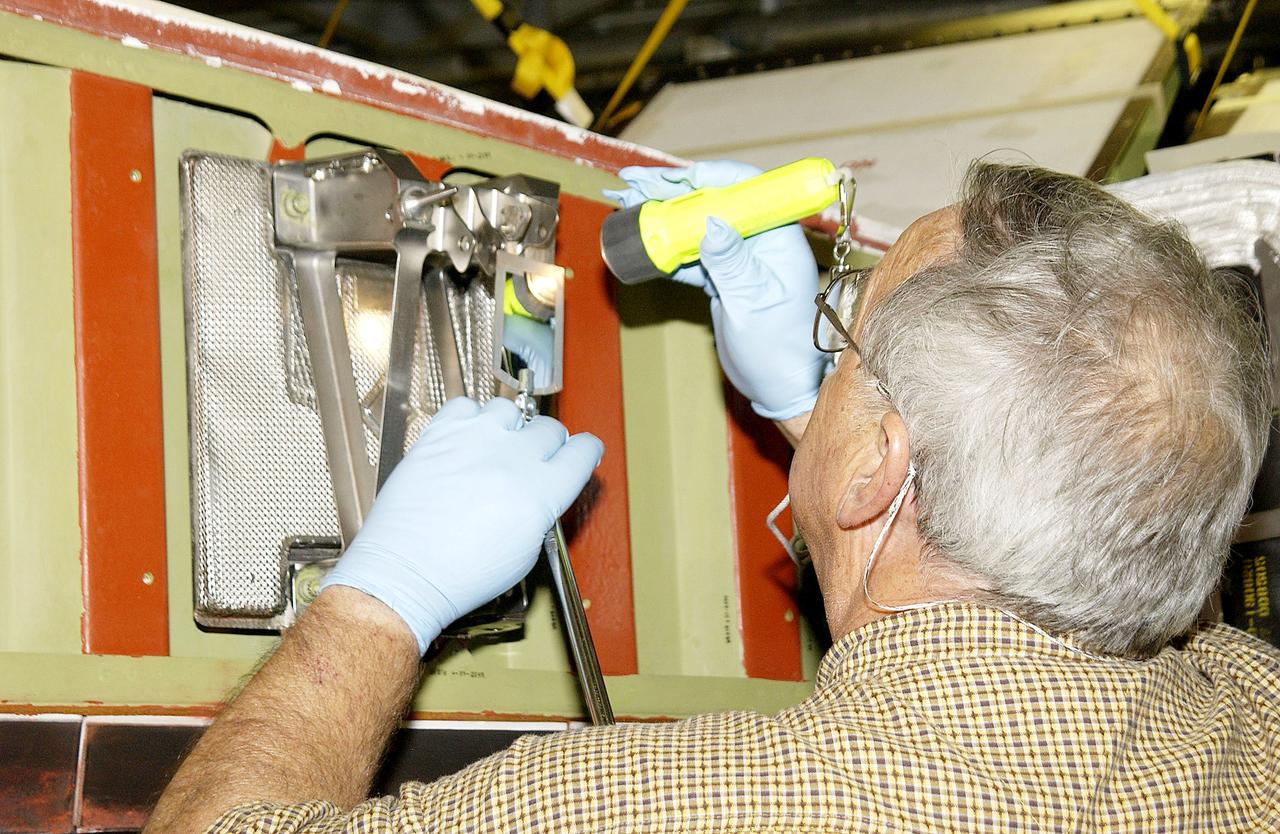
KENNEDY SPACE CENTER, FLA. -   United Space Alliance employee Anthony Simmons prepares to electroweld a crack found on an insulator inside a Reinforced Carbon Carbon panel.   The gray carbon composite RCC panels are attached to the leading edge of the wing of the orbiters to withstand the aerodynamic forces experienced during launch and reentry, which can reach as high as 800 pounds per square foot.  The operating range of RCC is from minus 250º F to about 3,000º F, the temperature produced by friction with the atmosphere during reentry.
KENNEDY SPACE CENTER, FLA. - United Space Alliance employee Anthony Simmons prepares to electroweld a crack found on an insulator inside a Reinforced Carbon Carbon panel. The gray carbon composite RCC panels are attached to the leading edge of the wing of the orbiters to withstand the aerodynamic forces experienced during launch and reentry, which can reach as high as 800 pounds per square foot. The operating range of RCC is from minus 250º F to about 3,000º F, the temperature produced by friction with the atmosphere during reentry.
ISS033-E-009232 (3 Oct. 2012) --- This still photo taken by the Expedition 33 crew members aboard the International Space Station shows evidence of the fiery plunge through Earth?s atmosphere and the destructive re-entry of the European Automated Transfer Vehicle-3 (ATV-3) spacecraft, also known as ?Edoardo Amaldi.? The end of the ATV took place over a remote swath of the Pacific Ocean where any surviving debris safely splashed down a short time later, at around 1:30 a.m. (GMT) on Oct. 3, thus concluding the highly successful ATV-3 mission. Aboard the craft during re-entry was the Re Entry Breakup Recorder (REBR), a spacecraft ?black box? designed to gather data on vehicle disintegration during re-entry in order to improve future spacecraft re-entry models.
ATV reentry
The Orion spacecraft will reenter Earth's atmosphere traveling about 25,000 mph during Exploration Mission-1. It's heat shield will endure temperatures approaching 5,000 degrees Fahrenheit. Part of Batch image transfer from Flickr.
Orion reentry
Stardust Capsule Return as seen from NASA DC-8 Airborne Laboratory with  a mission to explore the conditions during reentry from the light emitted  by the fireball caused when the capsule streaked through the sky
Stardust Capsule Return
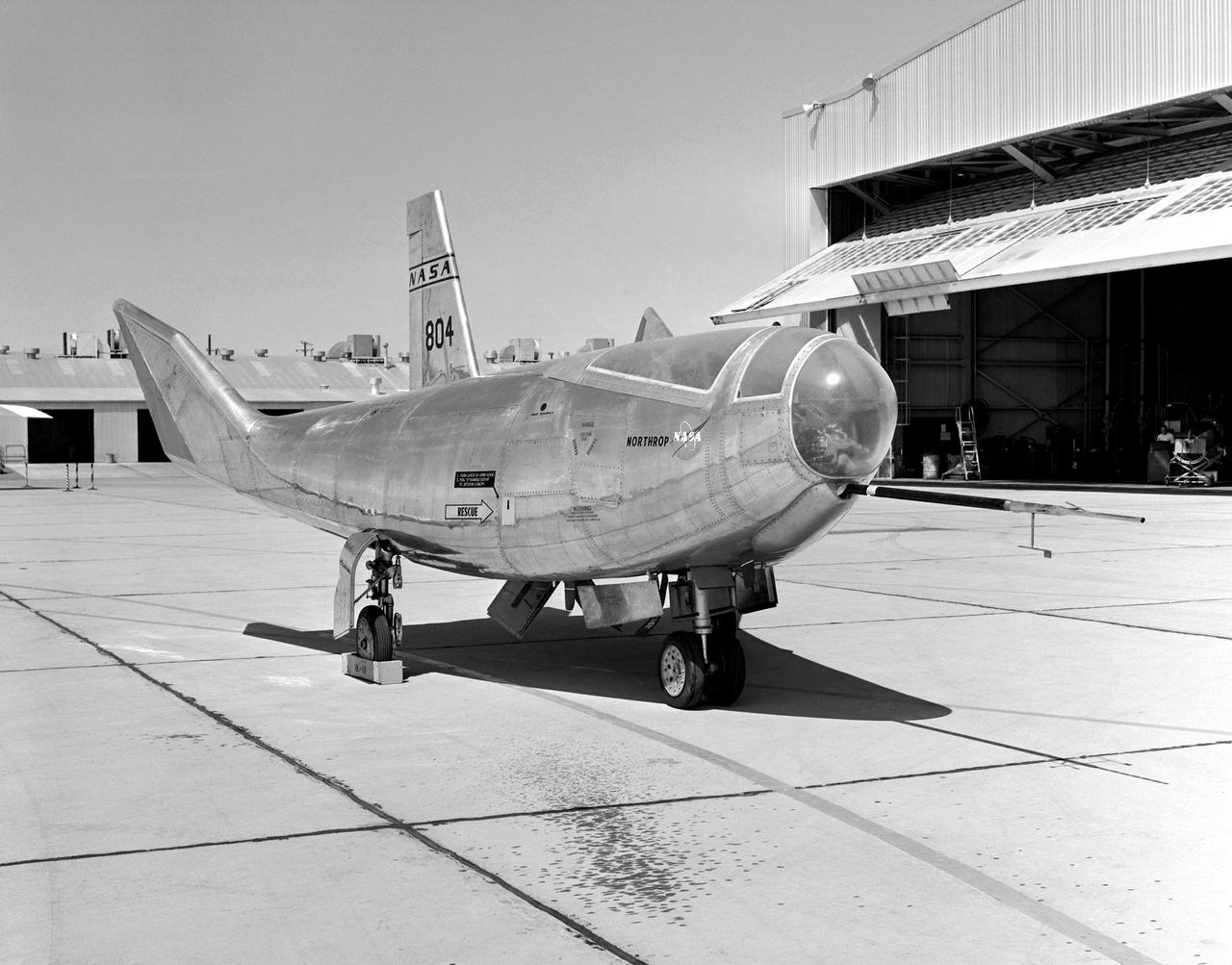
The HL-10, seen here parked on the ramp, was one of five lifting body designs flown at NASA's Dryden Flight Research Center, Edwards, California, from July 1966 to November 1975 to study and validate the concept of safely maneuvering and landing a low lift-over-drag vehicle designed for reentry from space.
E-14969
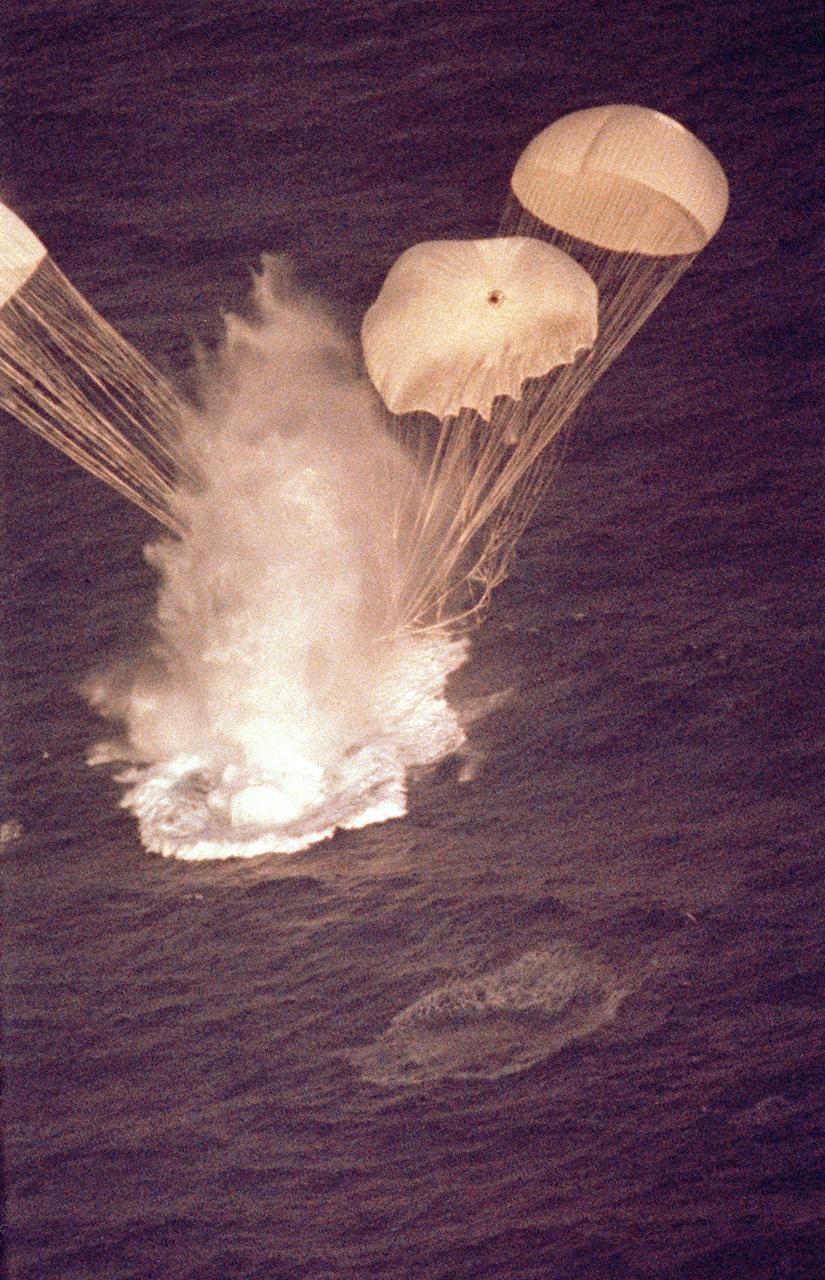
he left solid rocket booster (SRB) for the STS-5 mission is shown in this photograph at the moment of splashdown after its separation from the external tank. This view was photographed from a Cast Glance aircraft. After impact to the ocean, it was retrieved and refurbished for reuse. The Shuttle's SRB's and solid rocket motors (SRM's) are the largest ever built and the first designed for refurbishment and reuse. Standing nearly 150-feet high, the twin boosters provide the majority of thrust for the first two minutes of flight, about 5.8 million pounds. That is equivalent to 44 million horsepower, or the combined power of 400,000 subcompact cars.
Space Shuttle Projects
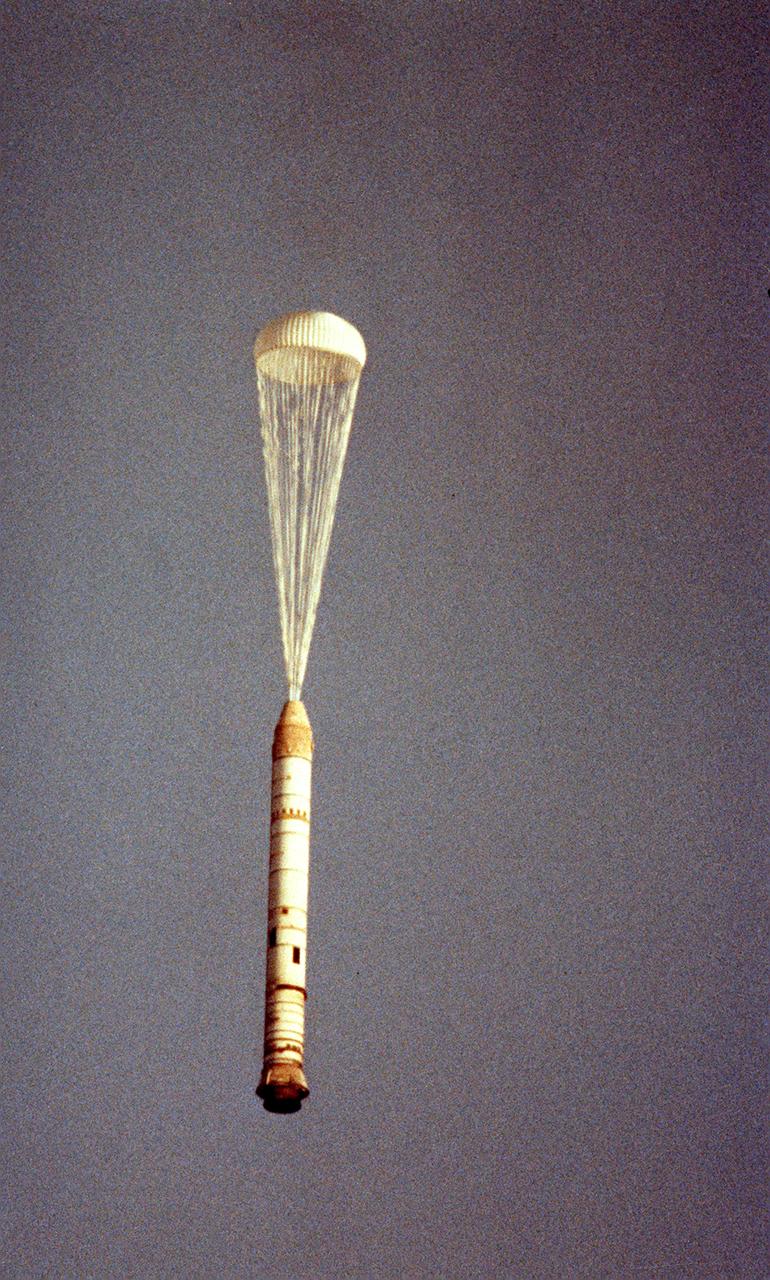
The right solid rocket booster (SRB) for the STS-5 mission, with one chute opened, falls after its separation from the external tank (ET). This view was photographed from a Cast Glance aircraft. After impact to the ocean, it was retrieved and refurbished for reuse. The Shuttle's SRB's and solid rocket motors (SRM's) are the largest ever built and the first designed for refurbishment and reuse. Standing nearly 150-feet high, the twin boosters provide the majority of thrust for the first two minutes of flight, about 5.8 million pounds. That is equivalent to 44 million horsepower, or the combined power of 400,000 subcompact cars.
Space Shuttle Projects
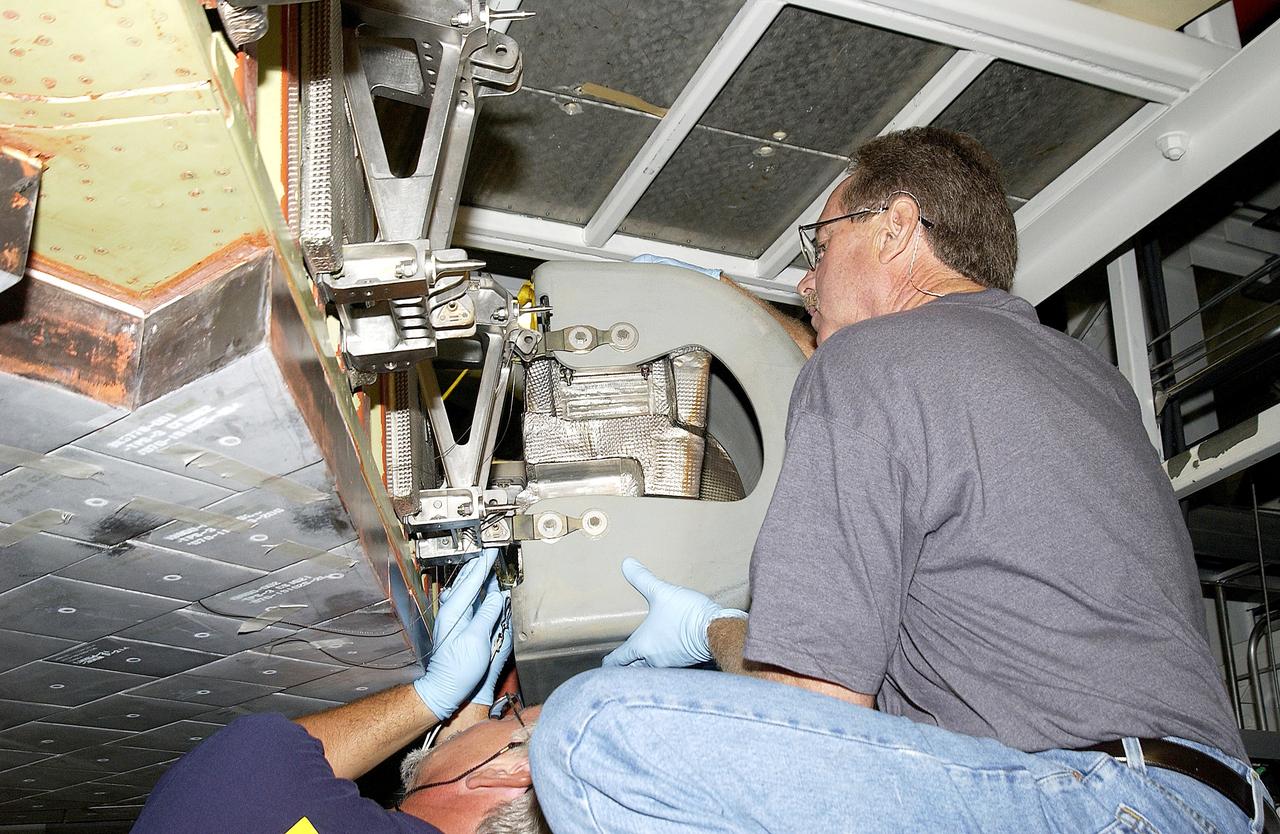
KENNEDY SPACE CENTER, FLA. -   Billy Witt, a midbody shop mechanic with United Space Alliance, checks a part used for installation of a Reinforced Carbon Carbon (RCC) panel to the leading edge of the wing of an orbiter.  Above him is an RCC panel just installed on Atlantis.  The gray carbon composite RCC panels have sufficient strength to withstand the aerodynamic forces experienced during launch and reentry, which can reach as high as 800 pounds per square foot.  The operating range of RCC is from minus 250º F to about 3,000º F, the temperature produced by friction with the atmosphere during reentry.
KENNEDY SPACE CENTER, FLA. - Billy Witt, a midbody shop mechanic with United Space Alliance, checks a part used for installation of a Reinforced Carbon Carbon (RCC) panel to the leading edge of the wing of an orbiter. Above him is an RCC panel just installed on Atlantis. The gray carbon composite RCC panels have sufficient strength to withstand the aerodynamic forces experienced during launch and reentry, which can reach as high as 800 pounds per square foot. The operating range of RCC is from minus 250º F to about 3,000º F, the temperature produced by friction with the atmosphere during reentry.
KENNEDY SPACE CENTER, FLA. - In the Orbiter Processing Facility, United Space Alliance workers share the task of examining  a Reinforced Carbon Carbon panel using flash thermography.  From left are Dan Kenna, Jim Landy, Paul Ogletree and Dan Phillips.  Attached to the leading edge of the wing of the orbiters,  the gray carbon composite RCC panels have sufficient strength to withstand the aerodynamic forces experienced during launch and reentry, which can reach as high as 800 pounds per square foot.  The operating range of RCC is from minus 250º F to about 3,000º F, the temperature produced by friction with the atmosphere during reentry.
KENNEDY SPACE CENTER, FLA. - In the Orbiter Processing Facility, United Space Alliance workers share the task of examining a Reinforced Carbon Carbon panel using flash thermography. From left are Dan Kenna, Jim Landy, Paul Ogletree and Dan Phillips. Attached to the leading edge of the wing of the orbiters, the gray carbon composite RCC panels have sufficient strength to withstand the aerodynamic forces experienced during launch and reentry, which can reach as high as 800 pounds per square foot. The operating range of RCC is from minus 250º F to about 3,000º F, the temperature produced by friction with the atmosphere during reentry.
KENNEDY SPACE CENTER, FLA. -  In the Orbiter Processing Facility, United Space Alliance worker Mike Hyatt looks over a Reinforced Carbon Carbon (RCC) panel that will be attached to the leading edge of the wing of the orbiter Atlantis.  The gray carbon composite RCC panels have sufficient strength to withstand the aerodynamic forces experienced during launch and reentry, which can reach as high as 800 pounds per square foot.  The operating range of RCC is from minus 250º F to about 3,000º F, the temperature produced by friction with the atmosphere during reentry.
KENNEDY SPACE CENTER, FLA. - In the Orbiter Processing Facility, United Space Alliance worker Mike Hyatt looks over a Reinforced Carbon Carbon (RCC) panel that will be attached to the leading edge of the wing of the orbiter Atlantis. The gray carbon composite RCC panels have sufficient strength to withstand the aerodynamic forces experienced during launch and reentry, which can reach as high as 800 pounds per square foot. The operating range of RCC is from minus 250º F to about 3,000º F, the temperature produced by friction with the atmosphere during reentry.
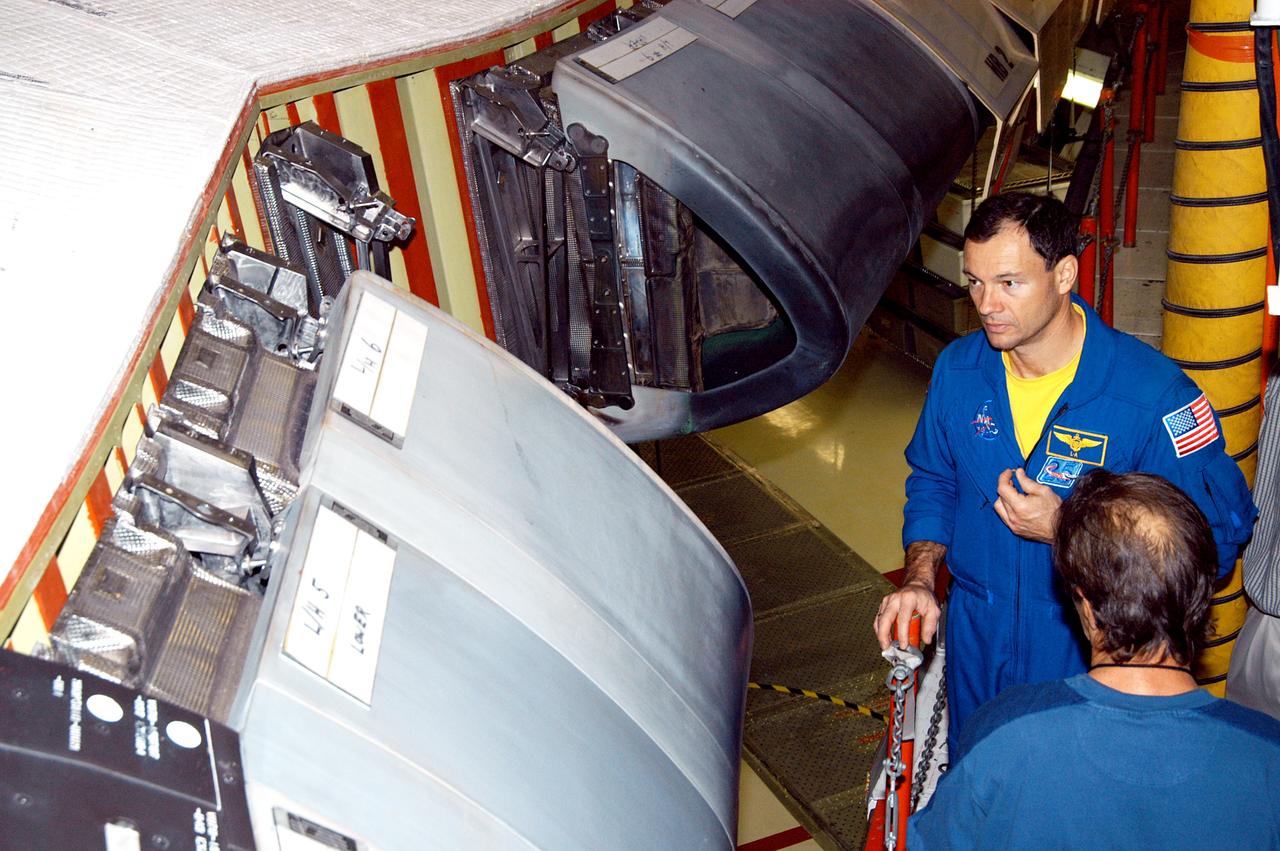
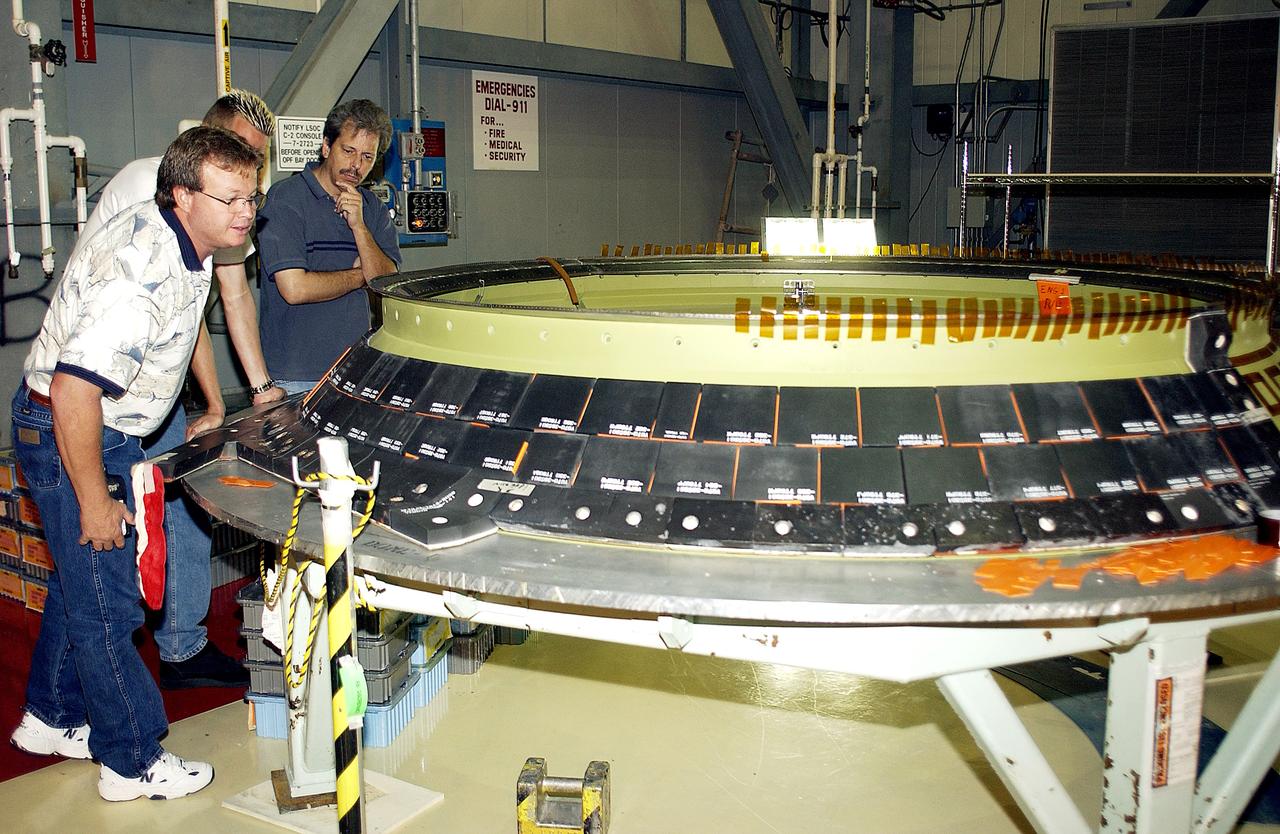
KENNEDY SPACE CENTER, FLA. - In the Orbiter Processing Facility, astronaut Michael E. Lopez-Alegria looks at the Reinforced Carbon Carbon panels used on the leading edge of the wing of the orbiters. He and engineers from around the Agency are on a fact-finding tour for improving the RCC panels used on the wing leading edge.  The gray carbon composite RCC panels have sufficient strength to withstand the aerodynamic forces experienced during launch and reentry, which can reach as high as 800 pounds per square foot.  The operating range of RCC is from minus 250º F to about 3,000º F, the temperature produced by friction with the atmosphere during reentry.
KENNEDY SPACE CENTER, FLA. - In the Orbiter Processing Facility, astronaut Michael E. Lopez-Alegria looks at the Reinforced Carbon Carbon panels used on the leading edge of the wing of the orbiters. He and engineers from around the Agency are on a fact-finding tour for improving the RCC panels used on the wing leading edge. The gray carbon composite RCC panels have sufficient strength to withstand the aerodynamic forces experienced during launch and reentry, which can reach as high as 800 pounds per square foot. The operating range of RCC is from minus 250º F to about 3,000º F, the temperature produced by friction with the atmosphere during reentry.
KENNEDY SPACE CENTER, FLA. - In the Orbiter Processing Facility, United Space Alliance worker Mike Hyatt (above) completes installation of a Reinforced Carbon Carbon (RCC) panel onto the leading edge of the wing of the orbiter Atlantis.  The gray carbon composite RCC panels have sufficient strength to withstand the aerodynamic forces experienced during launch and reentry, which can reach as high as 800 pounds per square foot. The operating range of RCC is from minus 250º F to about 3,000º F, the temperature produced by friction with the atmosphere during reentry.
KENNEDY SPACE CENTER, FLA. - In the Orbiter Processing Facility, United Space Alliance worker Mike Hyatt (above) completes installation of a Reinforced Carbon Carbon (RCC) panel onto the leading edge of the wing of the orbiter Atlantis. The gray carbon composite RCC panels have sufficient strength to withstand the aerodynamic forces experienced during launch and reentry, which can reach as high as 800 pounds per square foot. The operating range of RCC is from minus 250º F to about 3,000º F, the temperature produced by friction with the atmosphere during reentry.
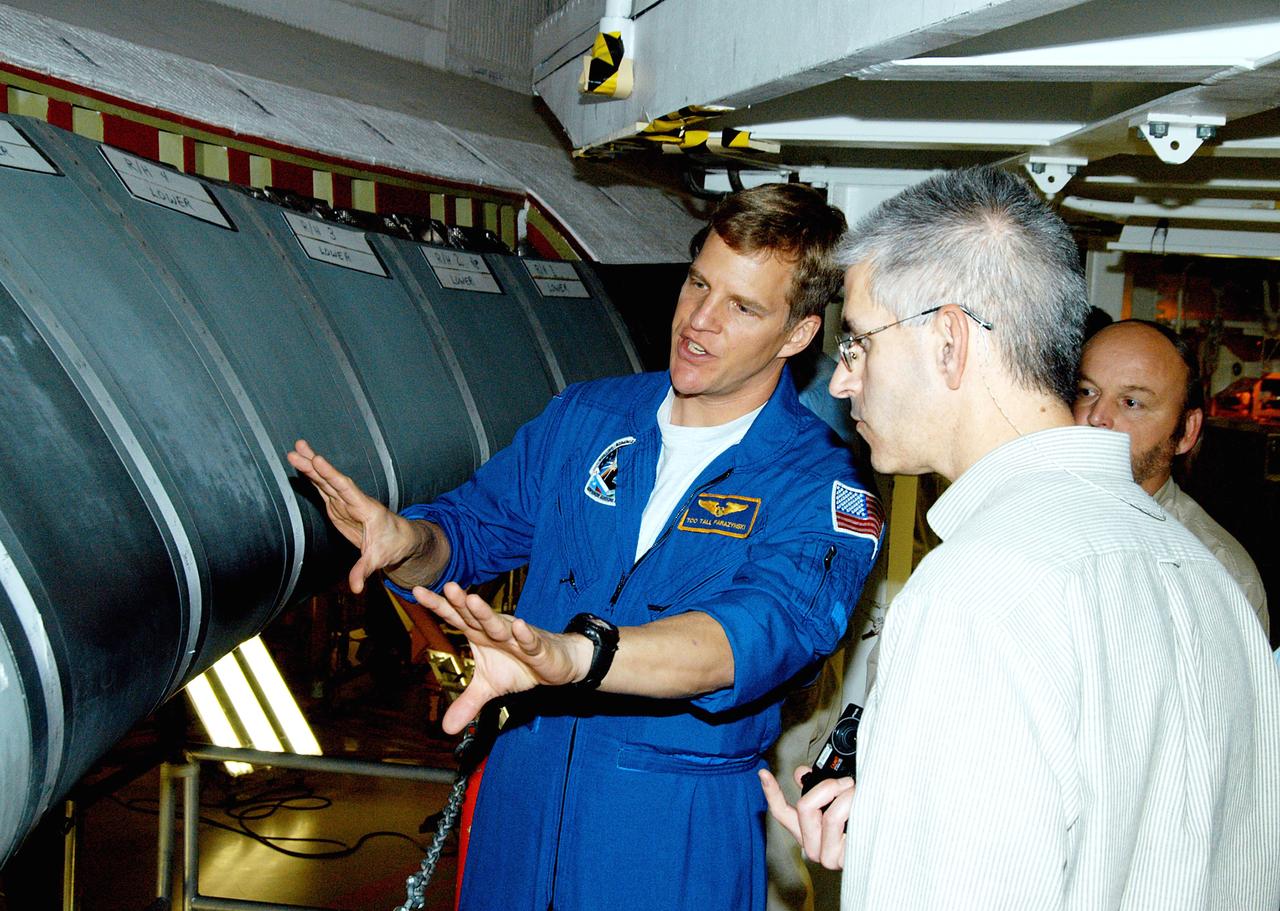
KENNEDY SPACE CENTER, FLA. -  In the Orbiter Processing Facility, astronaut Scott E. Parazynski discusses the Reinforced Carbon Carbon panels used on the leading edge of the wing of the orbiters.  With him are engineers from around the Agency who are working on improving the RCC panels used on the wing leading edge. The gray carbon composite RCC panels have sufficient strength to withstand the aerodynamic forces experienced during launch and reentry, which can reach as high as 800 pounds per square foot.  The operating range of RCC is from minus 250º F to about 3,000º F, the temperature produced by friction with the atmosphere during reentry.
KENNEDY SPACE CENTER, FLA. - In the Orbiter Processing Facility, astronaut Scott E. Parazynski discusses the Reinforced Carbon Carbon panels used on the leading edge of the wing of the orbiters. With him are engineers from around the Agency who are working on improving the RCC panels used on the wing leading edge. The gray carbon composite RCC panels have sufficient strength to withstand the aerodynamic forces experienced during launch and reentry, which can reach as high as 800 pounds per square foot. The operating range of RCC is from minus 250º F to about 3,000º F, the temperature produced by friction with the atmosphere during reentry.
KENNEDY SPACE CENTER, FLA. -  In the Orbiter Processing Facility, United Space Alliance workers Mike Hyatt (left), Saul Ngy (center) and Jerry Belt (right) prepare to install a Reinforced Carbon Carbon (RCC) panel to the leading edge of the wing of the orbiter Atlantis.  The gray carbon composite RCC panels have sufficient strength to withstand the aerodynamic forces experienced during launch and reentry, which can reach as high as 800 pounds per square foot.  The operating range of RCC is from minus 250º F to about 3,000º F, the temperature produced by friction with the atmosphere during reentry.
KENNEDY SPACE CENTER, FLA. - In the Orbiter Processing Facility, United Space Alliance workers Mike Hyatt (left), Saul Ngy (center) and Jerry Belt (right) prepare to install a Reinforced Carbon Carbon (RCC) panel to the leading edge of the wing of the orbiter Atlantis. The gray carbon composite RCC panels have sufficient strength to withstand the aerodynamic forces experienced during launch and reentry, which can reach as high as 800 pounds per square foot. The operating range of RCC is from minus 250º F to about 3,000º F, the temperature produced by friction with the atmosphere during reentry.
KENNEDY SPACE CENTER, FLA. - In the Orbiter Processing Facility, Jerry Belt, with United Space Alliance, checks a spar attachment on the wing of the orbiter Atlantis before installing Reinforced Carbon Carbon (RCC) panels on the wing.  The spars - floating joints - reduce loading on the panels caused by wing deflections.  The gray carbon composite RCC panels have sufficient strength to withstand the aerodynamic forces experienced during launch and reentry, which can reach as high as 800 pounds per square foot.  The operating range of RCC is from minus 250º F to about 3,000º F, the temperature produced by friction with the atmosphere during reentry.
KENNEDY SPACE CENTER, FLA. - In the Orbiter Processing Facility, Jerry Belt, with United Space Alliance, checks a spar attachment on the wing of the orbiter Atlantis before installing Reinforced Carbon Carbon (RCC) panels on the wing. The spars - floating joints - reduce loading on the panels caused by wing deflections. The gray carbon composite RCC panels have sufficient strength to withstand the aerodynamic forces experienced during launch and reentry, which can reach as high as 800 pounds per square foot. The operating range of RCC is from minus 250º F to about 3,000º F, the temperature produced by friction with the atmosphere during reentry.
KENNEDY SPACE CENTER, FLA. - In the Orbiter Processing Facility, United Space Alliance worker Mike Hyatt (above) finishes installing a Reinforced Carbon Carbon (RCC) panel to the leading edge of the wing of the orbiter Atlantis.  The gray carbon composite RCC panels have sufficient strength to withstand the aerodynamic forces experienced during launch and reentry, which can reach as high as 800 pounds per square foot.  The operating range of RCC is from minus 250º F to about 3,000º F, the temperature produced by friction with the atmosphere during reentry.
KENNEDY SPACE CENTER, FLA. - In the Orbiter Processing Facility, United Space Alliance worker Mike Hyatt (above) finishes installing a Reinforced Carbon Carbon (RCC) panel to the leading edge of the wing of the orbiter Atlantis. The gray carbon composite RCC panels have sufficient strength to withstand the aerodynamic forces experienced during launch and reentry, which can reach as high as 800 pounds per square foot. The operating range of RCC is from minus 250º F to about 3,000º F, the temperature produced by friction with the atmosphere during reentry.
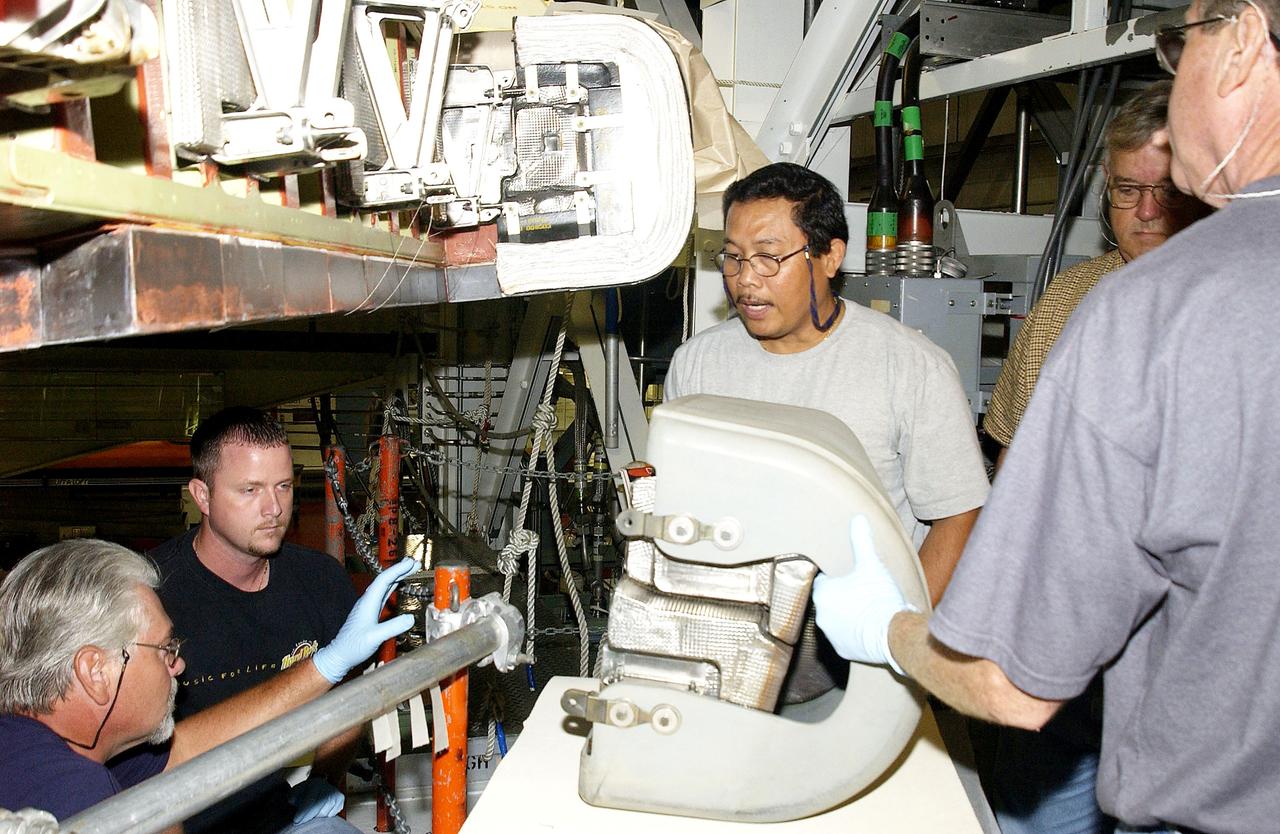
KENNEDY SPACE CENTER, FLA. - In the Orbiter Processing Facility, United Space Alliance workers, from center, left to right, Saul Ngy, Jerry Belt and Mike Hyatt, prepare to attach a Reinforced Carbon Carbon (RCC) panel (on the table) to the leading edge of the wing of the orbiter Atlantis.  The gray carbon composite RCC panels have sufficient strength to withstand the aerodynamic forces experienced during launch and reentry, which can reach as high as 800 pounds per square foot. The operating range of RCC is from minus 250º F to about 3,000º F, the temperature produced by friction with the atmosphere during reentry.
KENNEDY SPACE CENTER, FLA. - In the Orbiter Processing Facility, United Space Alliance workers, from center, left to right, Saul Ngy, Jerry Belt and Mike Hyatt, prepare to attach a Reinforced Carbon Carbon (RCC) panel (on the table) to the leading edge of the wing of the orbiter Atlantis. The gray carbon composite RCC panels have sufficient strength to withstand the aerodynamic forces experienced during launch and reentry, which can reach as high as 800 pounds per square foot. The operating range of RCC is from minus 250º F to about 3,000º F, the temperature produced by friction with the atmosphere during reentry.
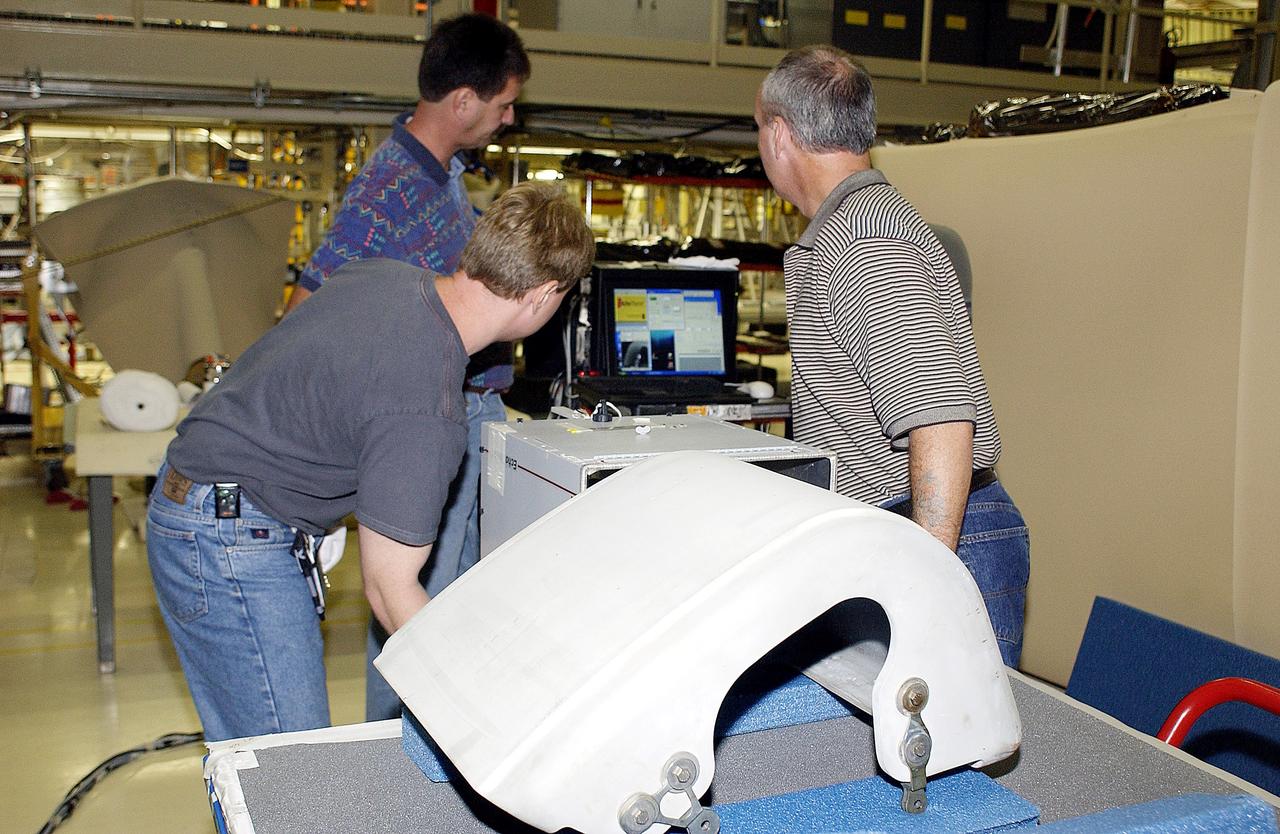
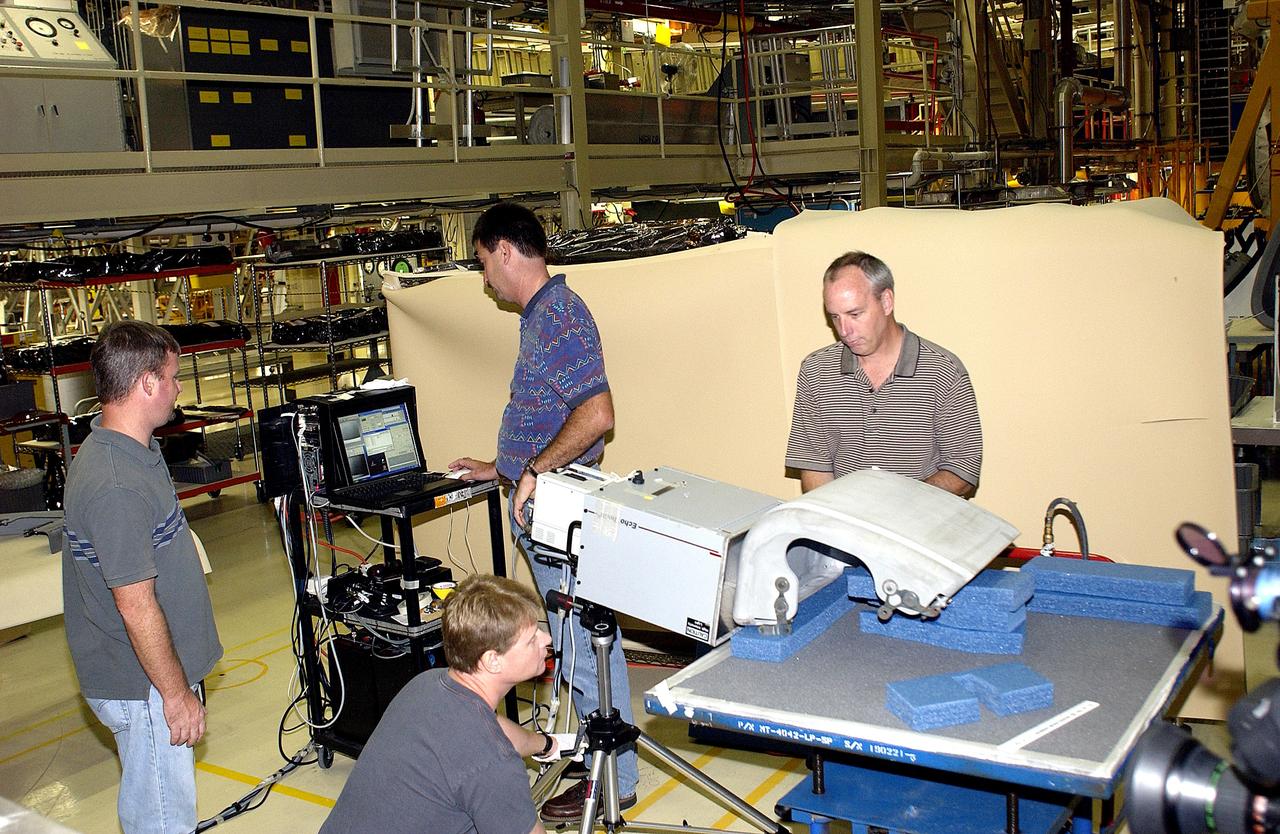
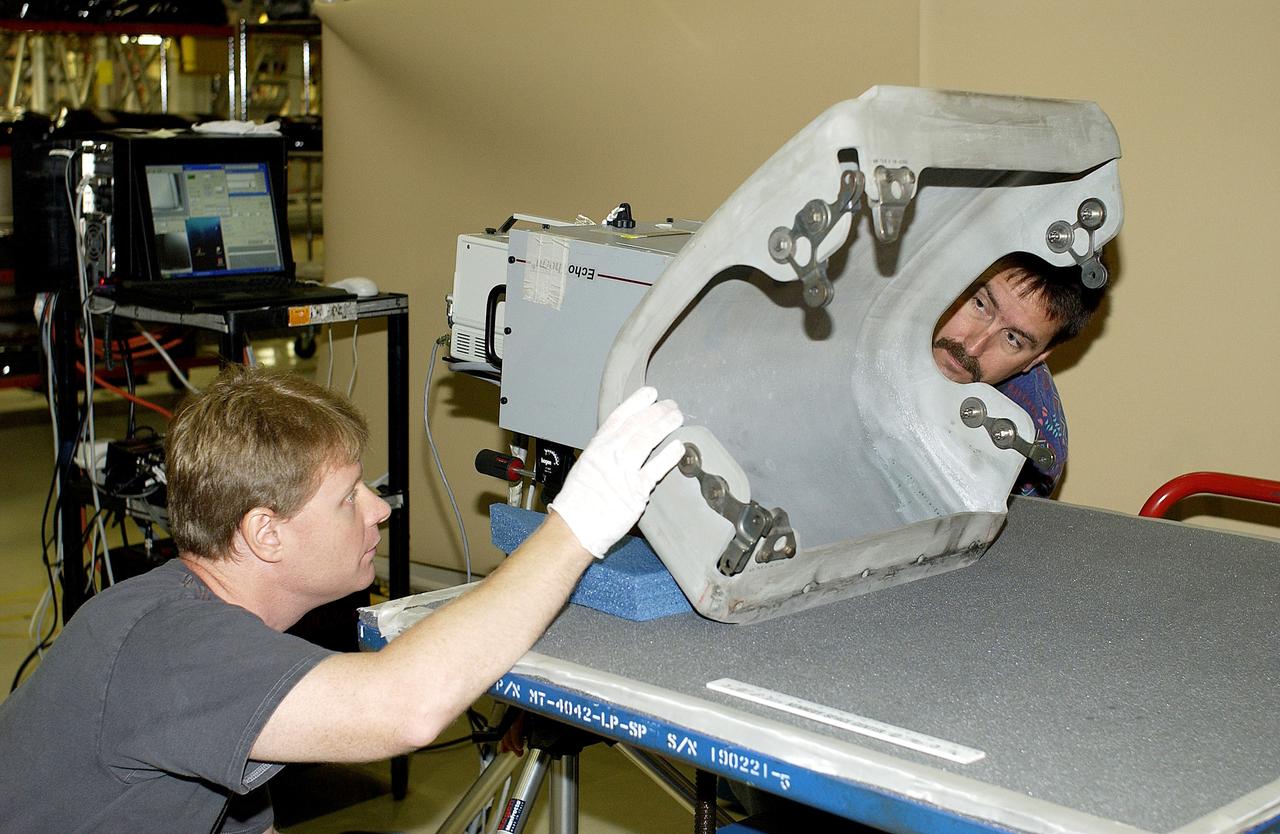
KENNEDY SPACE CENTER, FLA. - In the Orbiter Processing Facility, United Space Alliance workers Jim Landy (front), Dan Phillips and Dan Kenna watch a monitor showing results of flash thermography on the Reinforced Carbon Carbon panel on the table (foreground).  Attached to the leading edge of the wing of the orbiters,  the gray carbon composite RCC panels have sufficient strength to withstand the aerodynamic forces experienced during launch and reentry, which can reach as high as 800 pounds per square foot.  The operating range of RCC is from minus 250º F to about 3,000º F, the temperature produced by friction with the atmosphere during reentry.
KENNEDY SPACE CENTER, FLA. - In the Orbiter Processing Facility, United Space Alliance workers Jim Landy (front), Dan Phillips and Dan Kenna watch a monitor showing results of flash thermography on the Reinforced Carbon Carbon panel on the table (foreground). Attached to the leading edge of the wing of the orbiters, the gray carbon composite RCC panels have sufficient strength to withstand the aerodynamic forces experienced during launch and reentry, which can reach as high as 800 pounds per square foot. The operating range of RCC is from minus 250º F to about 3,000º F, the temperature produced by friction with the atmosphere during reentry.
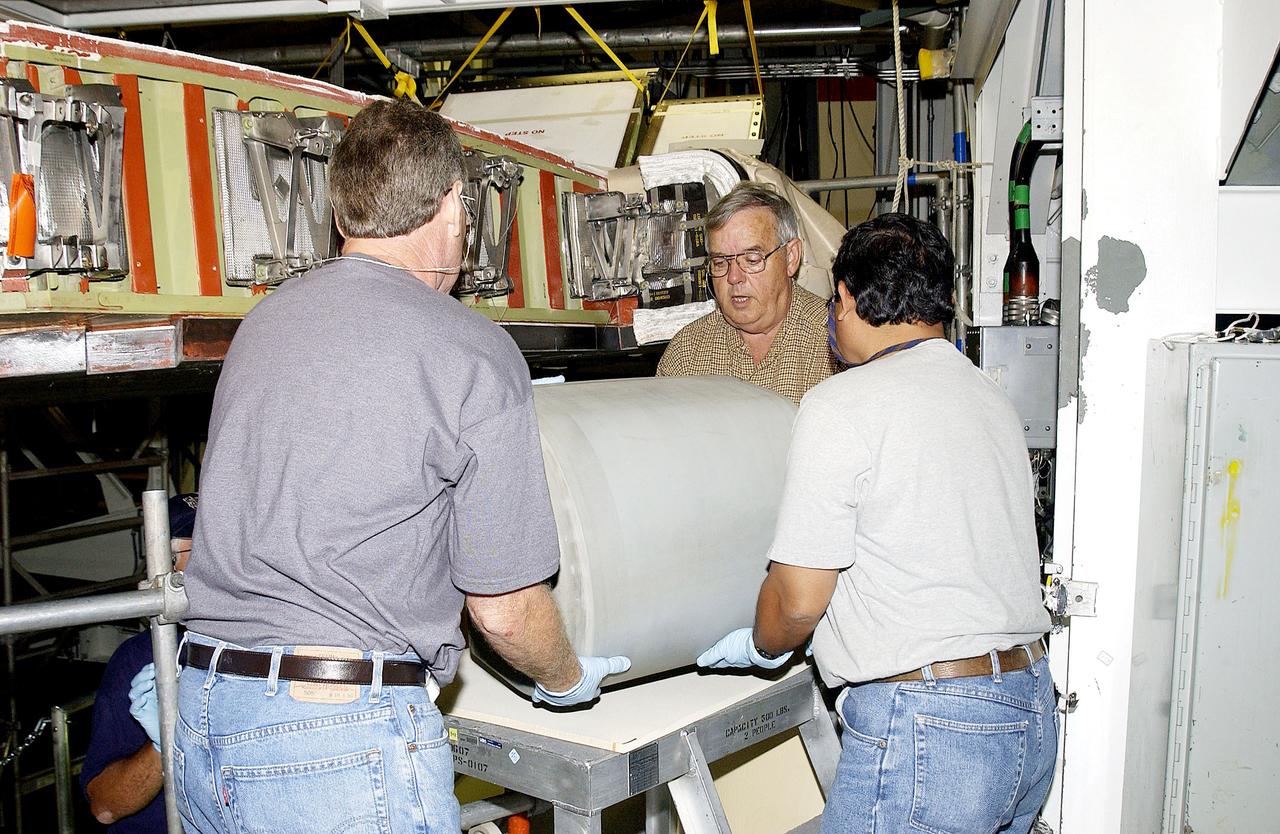
KENNEDY SPACE CENTER, FLA. - In the Orbiter Processing Facility, United Space Alliance workers Mike Hyatt (left) Saul Ngy (center) and Jerry Belt (right) lift a Reinforced Carbon Carbon (RCC) panel to attach onto the leading edge of the wing of the orbiter Atlantis.  The gray carbon composite RCC panels have sufficient strength to withstand the aerodynamic forces experienced during launch and reentry, which can reach as high as 800 pounds per square foot.  The operating range of RCC is from minus 250º F to about 3,000º F, the temperature produced by friction with the atmosphere during reentry.
KENNEDY SPACE CENTER, FLA. - In the Orbiter Processing Facility, United Space Alliance workers Mike Hyatt (left) Saul Ngy (center) and Jerry Belt (right) lift a Reinforced Carbon Carbon (RCC) panel to attach onto the leading edge of the wing of the orbiter Atlantis. The gray carbon composite RCC panels have sufficient strength to withstand the aerodynamic forces experienced during launch and reentry, which can reach as high as 800 pounds per square foot. The operating range of RCC is from minus 250º F to about 3,000º F, the temperature produced by friction with the atmosphere during reentry.
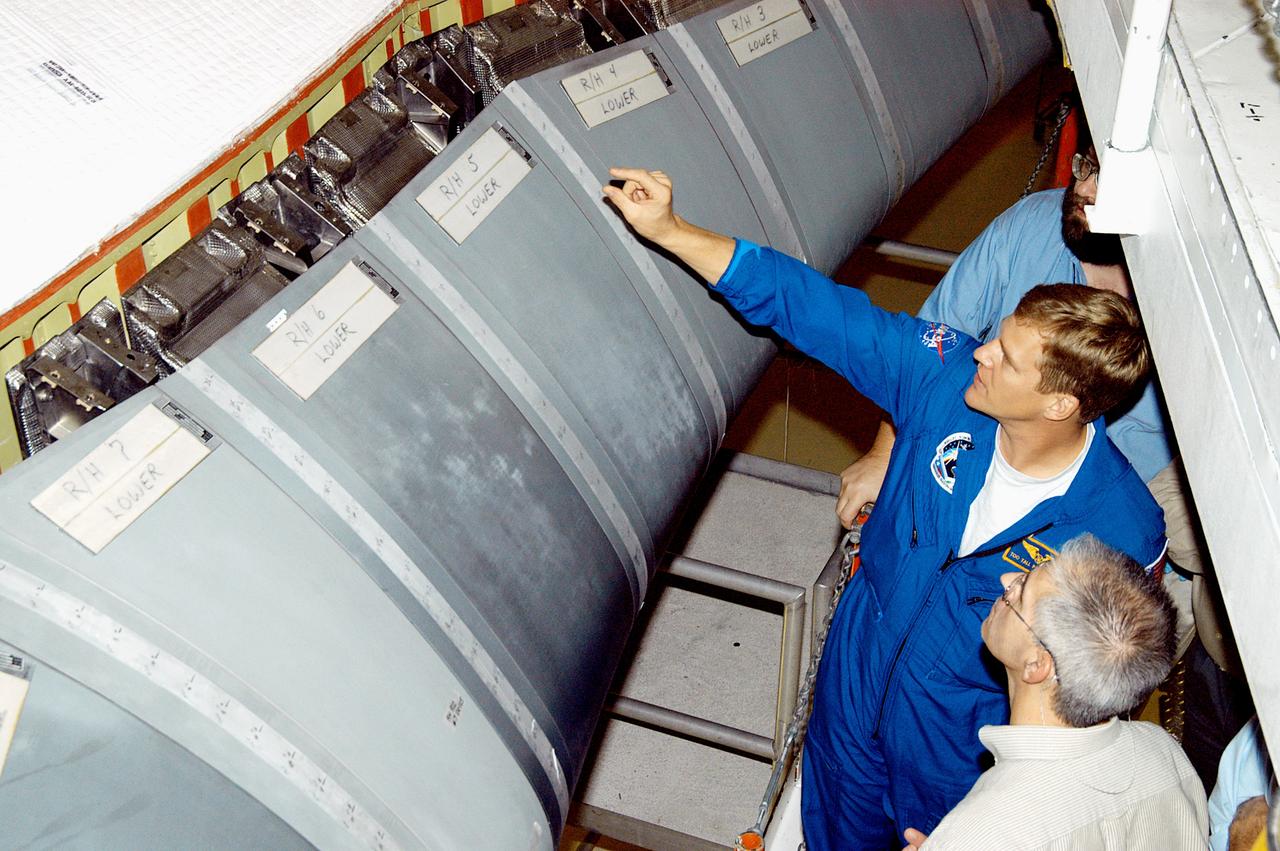
KENNEDY SPACE CENTER, FLA. -  In the Orbiter Processing Facility, astronaut Scott E. Parazynski points to the Reinforced Carbon Carbon panels used on the leading edge of the wing of the orbiters. With Parazynski are engineers from around the Agency who are working on improving the RCC panels used on the wing leading edge.  The gray carbon composite RCC panels have sufficient strength to withstand the aerodynamic forces experienced during launch and reentry, which can reach as high as 800 pounds per square foot.  The operating range of RCC is from minus 250º F to about 3,000º F, the temperature produced by friction with the atmosphere during reentry.
KENNEDY SPACE CENTER, FLA. - In the Orbiter Processing Facility, astronaut Scott E. Parazynski points to the Reinforced Carbon Carbon panels used on the leading edge of the wing of the orbiters. With Parazynski are engineers from around the Agency who are working on improving the RCC panels used on the wing leading edge. The gray carbon composite RCC panels have sufficient strength to withstand the aerodynamic forces experienced during launch and reentry, which can reach as high as 800 pounds per square foot. The operating range of RCC is from minus 250º F to about 3,000º F, the temperature produced by friction with the atmosphere during reentry.
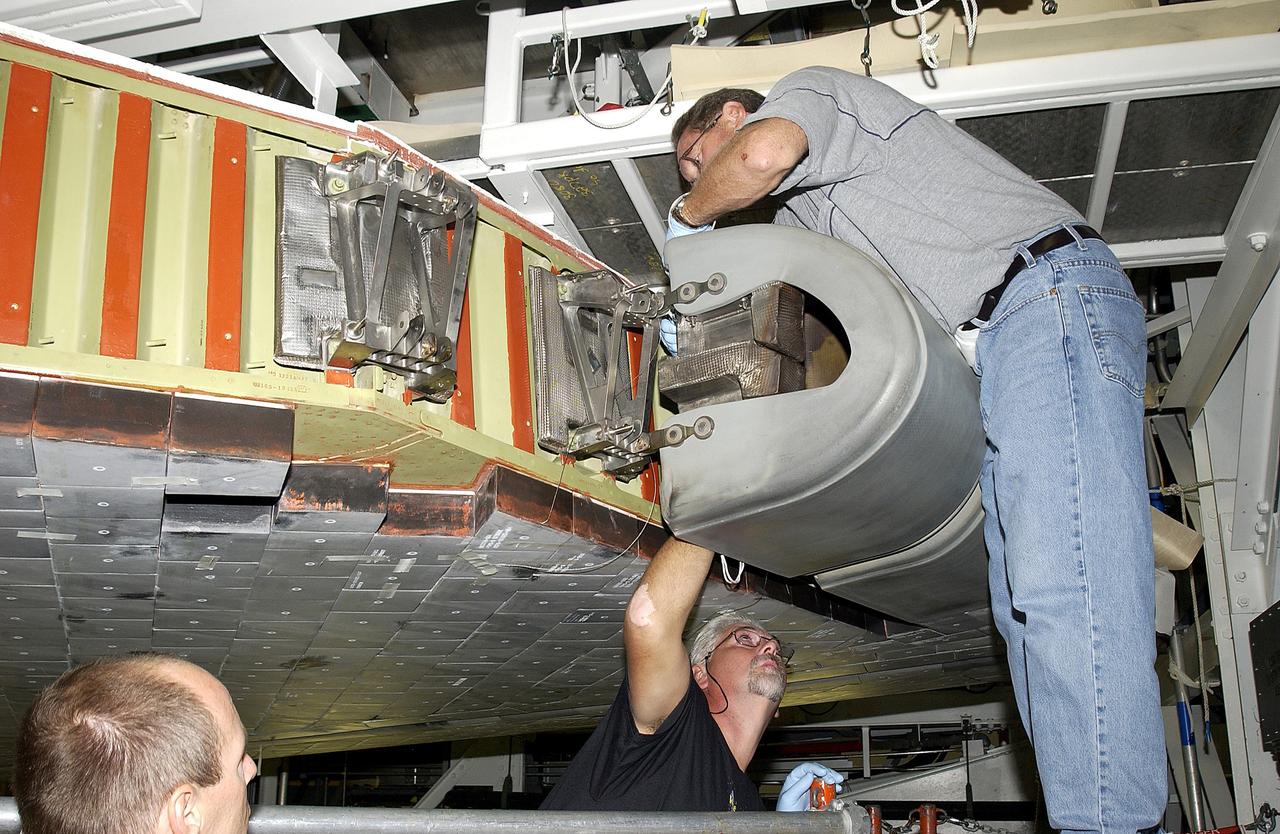
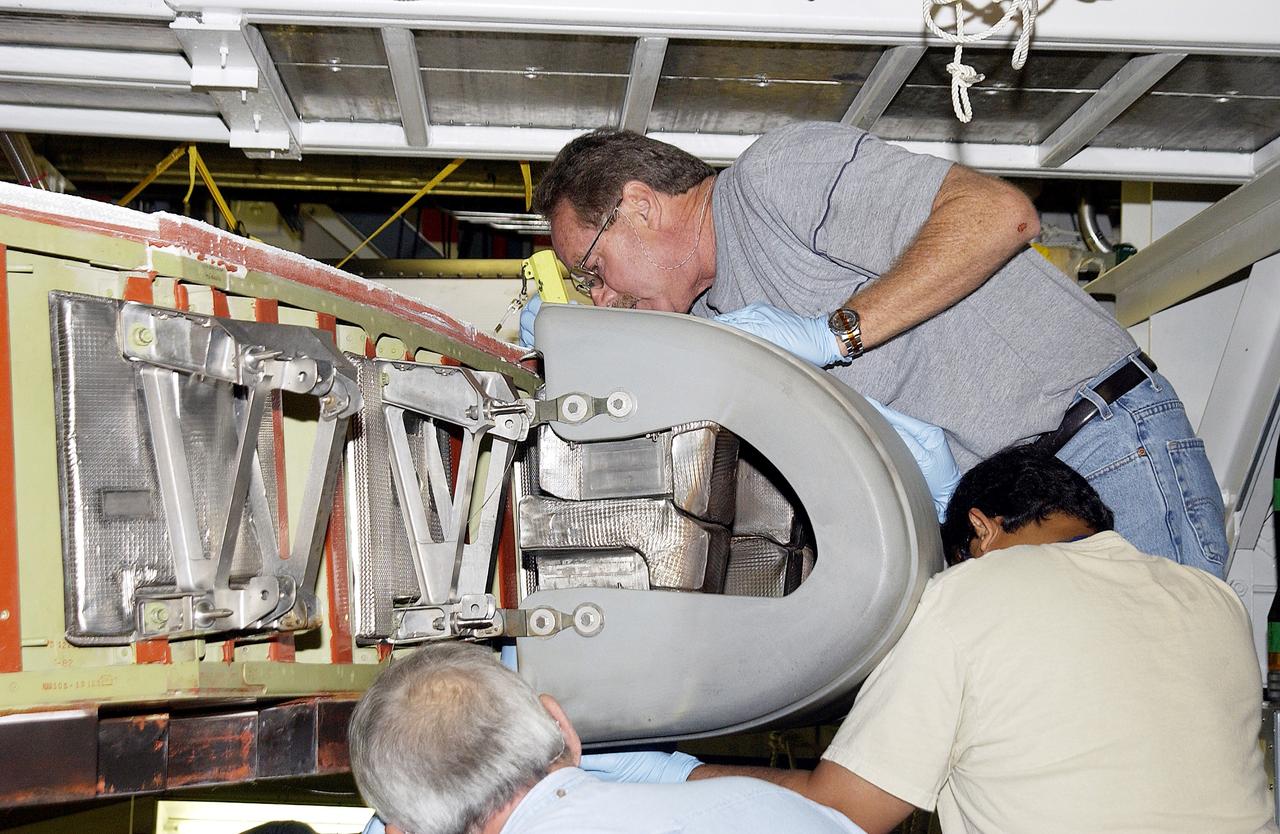
KENNEDY SPACE CENTER, FLA. - In the Orbiter Processing Facility, United Space Alliance workers Mike Hyatt (above) and Saul Ngy (below right) finish installing a Reinforced Carbon Carbon (RCC) panel to the leading edge of the wing of the orbiter Atlantis.  The gray carbon composite RCC panels have sufficient strength to withstand the aerodynamic forces experienced during launch and reentry, which can reach as high as 800 pounds per square foot.  The operating range of RCC is from minus 250º F to about 3,000º F, the temperature produced by friction with the atmosphere during reentry.
KENNEDY SPACE CENTER, FLA. - In the Orbiter Processing Facility, United Space Alliance workers Mike Hyatt (above) and Saul Ngy (below right) finish installing a Reinforced Carbon Carbon (RCC) panel to the leading edge of the wing of the orbiter Atlantis. The gray carbon composite RCC panels have sufficient strength to withstand the aerodynamic forces experienced during launch and reentry, which can reach as high as 800 pounds per square foot. The operating range of RCC is from minus 250º F to about 3,000º F, the temperature produced by friction with the atmosphere during reentry.
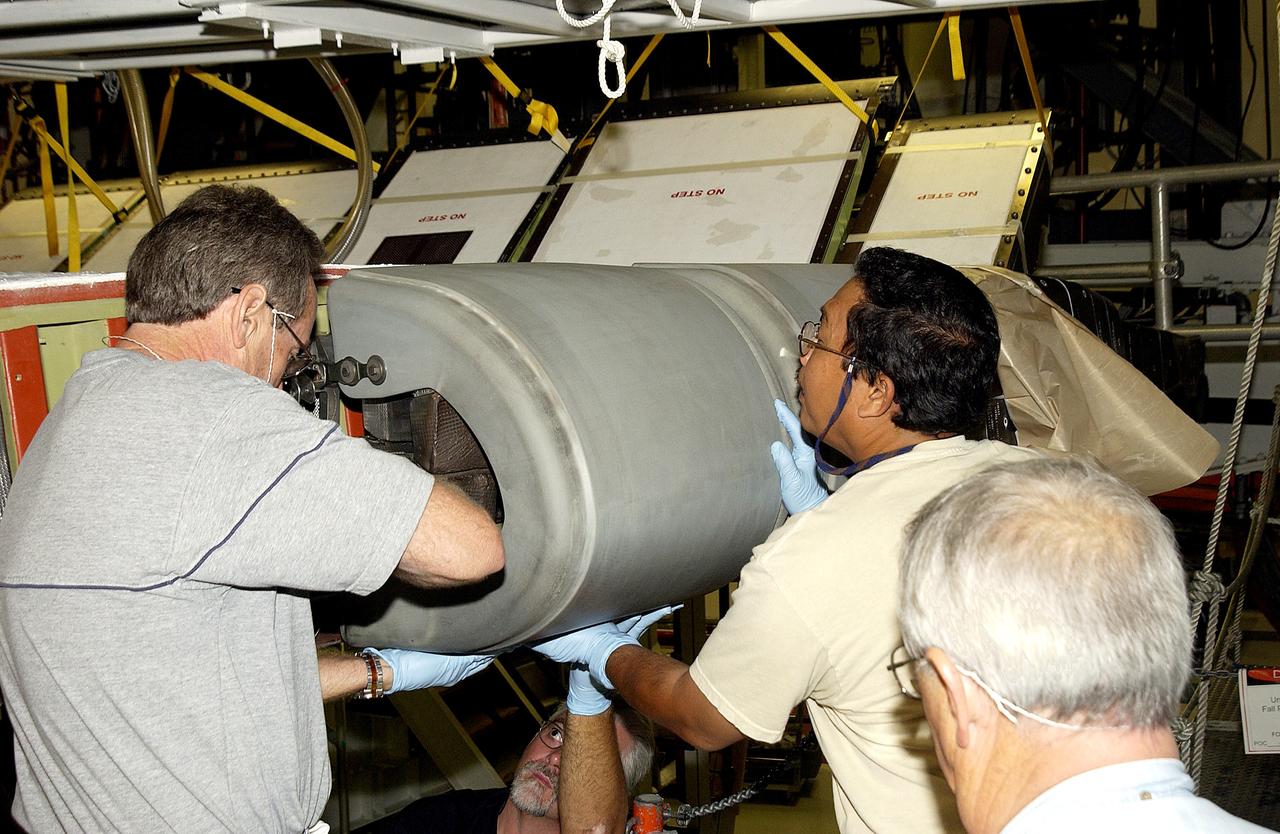
KENNEDY SPACE CENTER, FLA. -  In the Orbiter Processing Facility, United Space Alliance workers  Mike Hyatt (above),  Saul Ngy (right) and Jerry Belt (below) install a Reinforced Carbon Carbon (RCC) panel to the leading edge of the wing of the orbiter Atlantis.  The gray carbon composite RCC panels have sufficient strength to withstand the aerodynamic forces experienced during launch and reentry, which can reach as high as 800 pounds per square foot.  The operating range of RCC is from minus 250º F to about 3,000º F, the temperature produced by friction with the atmosphere during reentry.
KENNEDY SPACE CENTER, FLA. - In the Orbiter Processing Facility, United Space Alliance workers Mike Hyatt (above), Saul Ngy (right) and Jerry Belt (below) install a Reinforced Carbon Carbon (RCC) panel to the leading edge of the wing of the orbiter Atlantis. The gray carbon composite RCC panels have sufficient strength to withstand the aerodynamic forces experienced during launch and reentry, which can reach as high as 800 pounds per square foot. The operating range of RCC is from minus 250º F to about 3,000º F, the temperature produced by friction with the atmosphere during reentry.
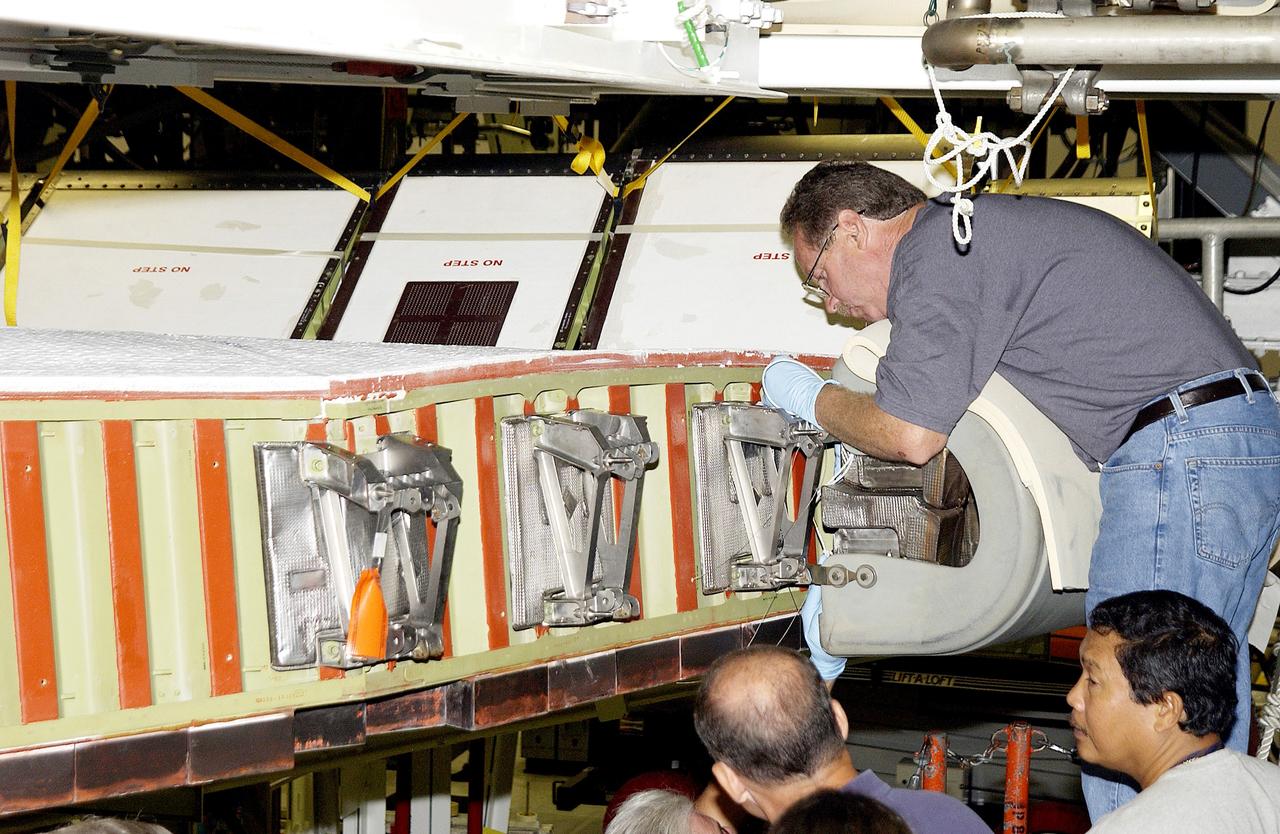
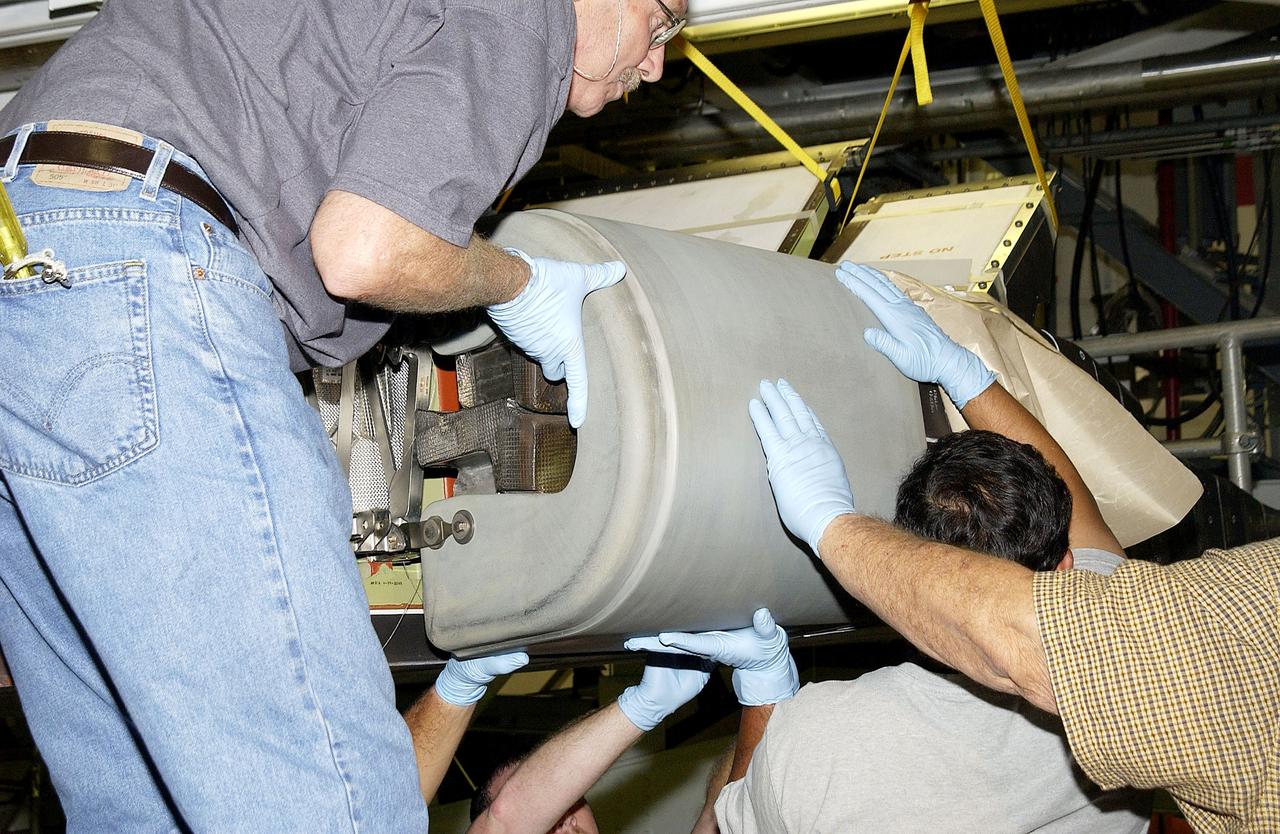
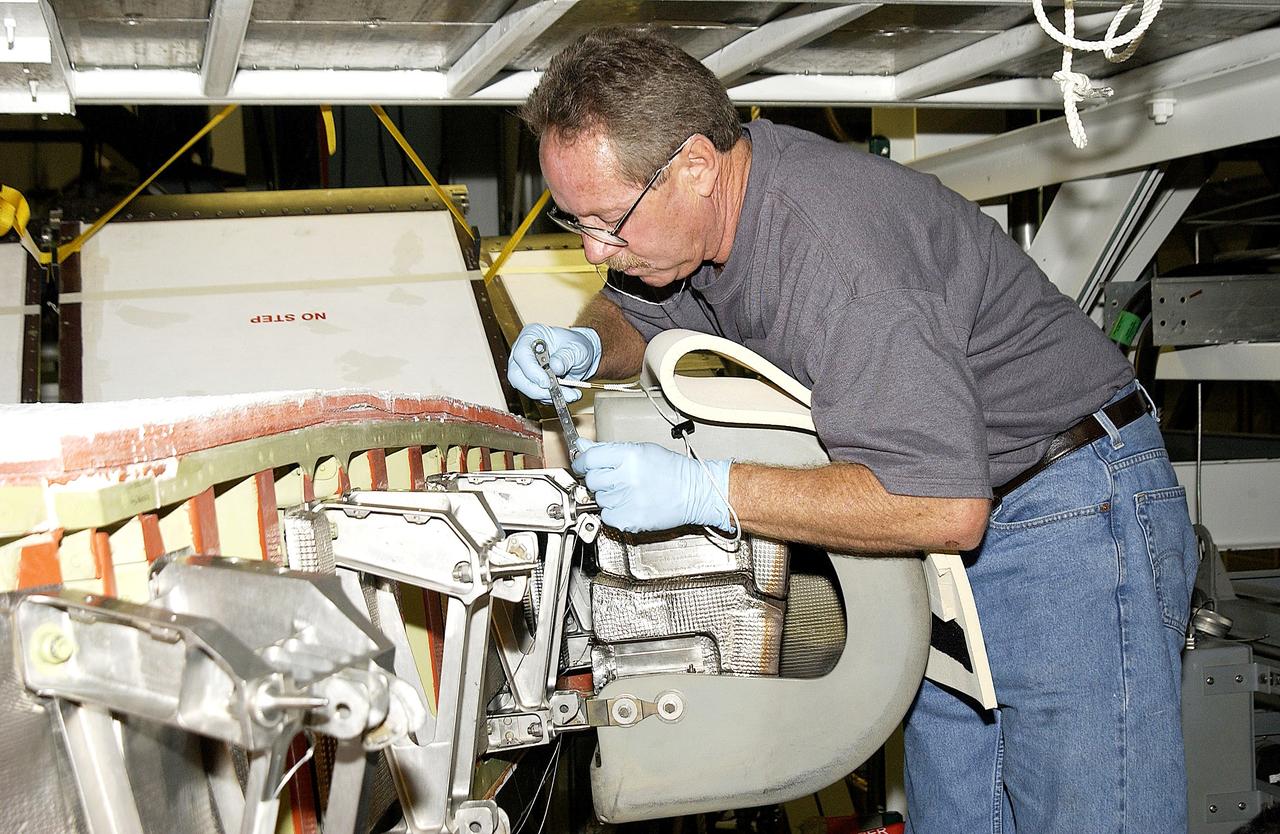
KENNEDY SPACE CENTER, FLA. -  In the Orbiter Processing Facility, United Space Alliance worker Mike Hyatt attaches a Reinforced Carbon Carbon (RCC) panel onto the leading edge of the wing of the orbiter Atlantis.  The gray carbon composite RCC panels have sufficient strength to withstand the aerodynamic forces experienced during launch and reentry, which can reach as high as 800 pounds per square foot. The operating range of RCC is from minus 250º F to about 3,000º F, the temperature produced by friction with the atmosphere during reentry.
KENNEDY SPACE CENTER, FLA. - In the Orbiter Processing Facility, United Space Alliance worker Mike Hyatt attaches a Reinforced Carbon Carbon (RCC) panel onto the leading edge of the wing of the orbiter Atlantis. The gray carbon composite RCC panels have sufficient strength to withstand the aerodynamic forces experienced during launch and reentry, which can reach as high as 800 pounds per square foot. The operating range of RCC is from minus 250º F to about 3,000º F, the temperature produced by friction with the atmosphere during reentry.
KENNEDY SPACE CENTER, FLA. -  In the Orbiter Processing Facility, United Space Alliance worker Mike Hyatt (right) attaches a Reinforced Carbon Carbon (RCC) panel onto the leading edge of the wing of the orbiter Atlantis.  The gray carbon composite RCC panels have sufficient strength to withstand the aerodynamic forces experienced during launch and reentry, which can reach as high as 800 pounds per square foot. The operating range of RCC is from minus 250º F to about 3,000º F, the temperature produced by friction with the atmosphere during reentry.
KENNEDY SPACE CENTER, FLA. - In the Orbiter Processing Facility, United Space Alliance worker Mike Hyatt (right) attaches a Reinforced Carbon Carbon (RCC) panel onto the leading edge of the wing of the orbiter Atlantis. The gray carbon composite RCC panels have sufficient strength to withstand the aerodynamic forces experienced during launch and reentry, which can reach as high as 800 pounds per square foot. The operating range of RCC is from minus 250º F to about 3,000º F, the temperature produced by friction with the atmosphere during reentry.
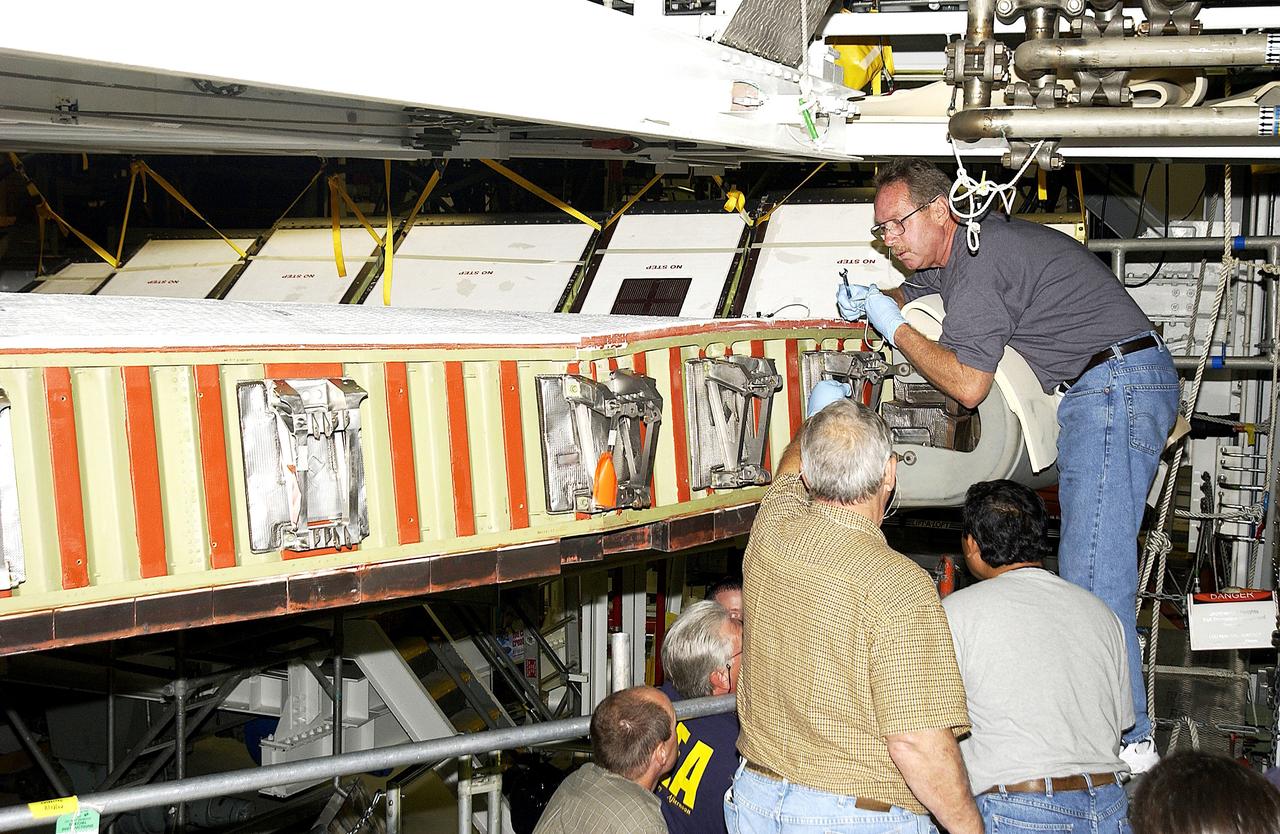
KENNEDY SPACE CENTER, FLA. - In the Orbiter Processing Facility, United Space Alliance workers Dan Kenna and Jim Landy prepare to examine a Reinforced Carbon Carbon panel using flash thermography.  Attached to the leading edge of the wing of the orbiters,  the gray carbon composite RCC panels have sufficient strength to withstand the aerodynamic forces experienced during launch and reentry, which can reach as high as 800 pounds per square foot.  The operating range of RCC is from minus 250º F to about 3,000º F, the temperature produced by friction with the atmosphere during reentry.
KENNEDY SPACE CENTER, FLA. - In the Orbiter Processing Facility, United Space Alliance workers Dan Kenna and Jim Landy prepare to examine a Reinforced Carbon Carbon panel using flash thermography. Attached to the leading edge of the wing of the orbiters, the gray carbon composite RCC panels have sufficient strength to withstand the aerodynamic forces experienced during launch and reentry, which can reach as high as 800 pounds per square foot. The operating range of RCC is from minus 250º F to about 3,000º F, the temperature produced by friction with the atmosphere during reentry.
KENNEDY SPACE CENTER, FLA. - In the Orbiter Processing Facility, United Space Alliance workers (left to right) Jim Landy, Dan Phillips, Paul Ogletree and Dan Kenna check results of flash thermography on the Reinforced Carbon Carbon panel on the table (foreground).  Attached to the leading edge of the wing of the orbiters,  the gray carbon composite RCC panels have sufficient strength to withstand the aerodynamic forces experienced during launch and reentry, which can reach as high as 800 pounds per square foot.  The operating range of RCC is from minus 250º F to about 3,000º F, the temperature produced by friction with the atmosphere during reentry.
KENNEDY SPACE CENTER, FLA. - In the Orbiter Processing Facility, United Space Alliance workers (left to right) Jim Landy, Dan Phillips, Paul Ogletree and Dan Kenna check results of flash thermography on the Reinforced Carbon Carbon panel on the table (foreground). Attached to the leading edge of the wing of the orbiters, the gray carbon composite RCC panels have sufficient strength to withstand the aerodynamic forces experienced during launch and reentry, which can reach as high as 800 pounds per square foot. The operating range of RCC is from minus 250º F to about 3,000º F, the temperature produced by friction with the atmosphere during reentry.
KENNEDY SPACE CENTER, FLA. - In the Orbiter Processing Facility, United Space Alliance workers Mike Hyatt (left) Jerry Belt (center), and Saul Ngy (right), lift a Reinforced Carbon Carbon (RCC) panel they will attach to the leading edge of the wing of the orbiter Atlantis.  The gray carbon composite RCC panels have sufficient strength to withstand the aerodynamic forces experienced during launch and reentry, which can reach as high as 800 pounds per square foot.  The operating range of RCC is from minus 250º F to about 3,000º F, the temperature produced by friction with the atmosphere during reentry.
KENNEDY SPACE CENTER, FLA. - In the Orbiter Processing Facility, United Space Alliance workers Mike Hyatt (left) Jerry Belt (center), and Saul Ngy (right), lift a Reinforced Carbon Carbon (RCC) panel they will attach to the leading edge of the wing of the orbiter Atlantis. The gray carbon composite RCC panels have sufficient strength to withstand the aerodynamic forces experienced during launch and reentry, which can reach as high as 800 pounds per square foot. The operating range of RCC is from minus 250º F to about 3,000º F, the temperature produced by friction with the atmosphere during reentry.
KENNEDY SPACE CENTER, FLA. - In the Orbiter Processing Facility, United Space Alliance workers share the task of examining  a Reinforced Carbon Carbon panel using flash thermography.  From left are Paul Ogletree, Jim Landy (kneeling), Dan Phillips and Dan Kenna.  Attached to the leading edge of the wing of the orbiters,  the gray carbon composite RCC panels have sufficient strength to withstand the aerodynamic forces experienced during launch and reentry, which can reach as high as 800 pounds per square foot.  The operating range of RCC is from minus 250º F to about 3,000º F, the temperature produced by friction with the atmosphere during reentry.
KENNEDY SPACE CENTER, FLA. - In the Orbiter Processing Facility, United Space Alliance workers share the task of examining a Reinforced Carbon Carbon panel using flash thermography. From left are Paul Ogletree, Jim Landy (kneeling), Dan Phillips and Dan Kenna. Attached to the leading edge of the wing of the orbiters, the gray carbon composite RCC panels have sufficient strength to withstand the aerodynamic forces experienced during launch and reentry, which can reach as high as 800 pounds per square foot. The operating range of RCC is from minus 250º F to about 3,000º F, the temperature produced by friction with the atmosphere during reentry.
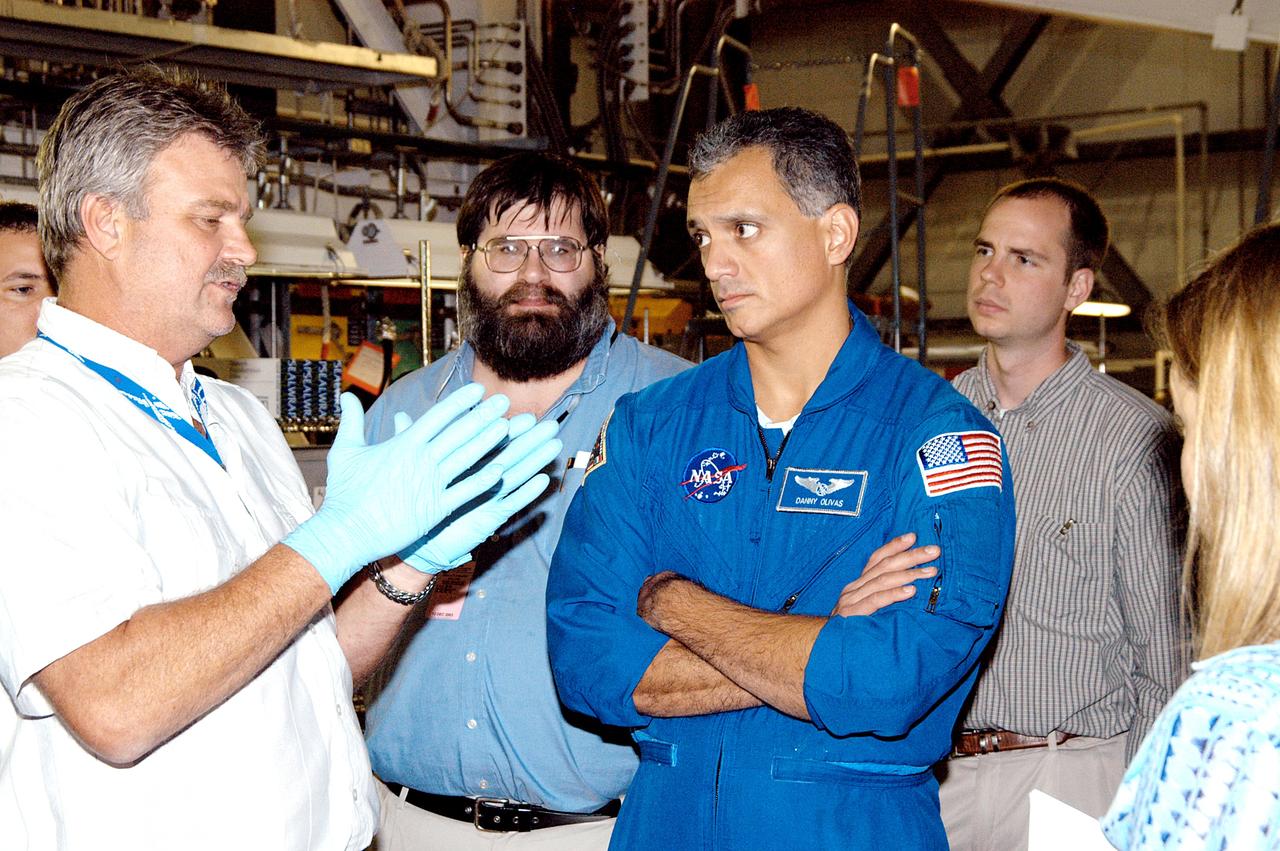
KENNEDY SPACE CENTER, FLA. -  - In the Orbiter Processing Facility astronaut Danny Olivas listens to Greg Grantham (left) talking about the Reinforced Carbon Carbon panels used on the leading edge of the wing of the orbiters.  Behind Olivas are engineers from around the Agency who are working on improving the RCC panels used on the wing leading edge. The gray carbon composite RCC panels have sufficient strength to withstand the aerodynamic forces experienced during launch and reentry, which can reach as high as 800 pounds per square foot.  The operating range of RCC is from minus 250º F to about 3,000º F, the temperature produced by friction with the atmosphere during reentry.
KENNEDY SPACE CENTER, FLA. - - In the Orbiter Processing Facility astronaut Danny Olivas listens to Greg Grantham (left) talking about the Reinforced Carbon Carbon panels used on the leading edge of the wing of the orbiters. Behind Olivas are engineers from around the Agency who are working on improving the RCC panels used on the wing leading edge. The gray carbon composite RCC panels have sufficient strength to withstand the aerodynamic forces experienced during launch and reentry, which can reach as high as 800 pounds per square foot. The operating range of RCC is from minus 250º F to about 3,000º F, the temperature produced by friction with the atmosphere during reentry.
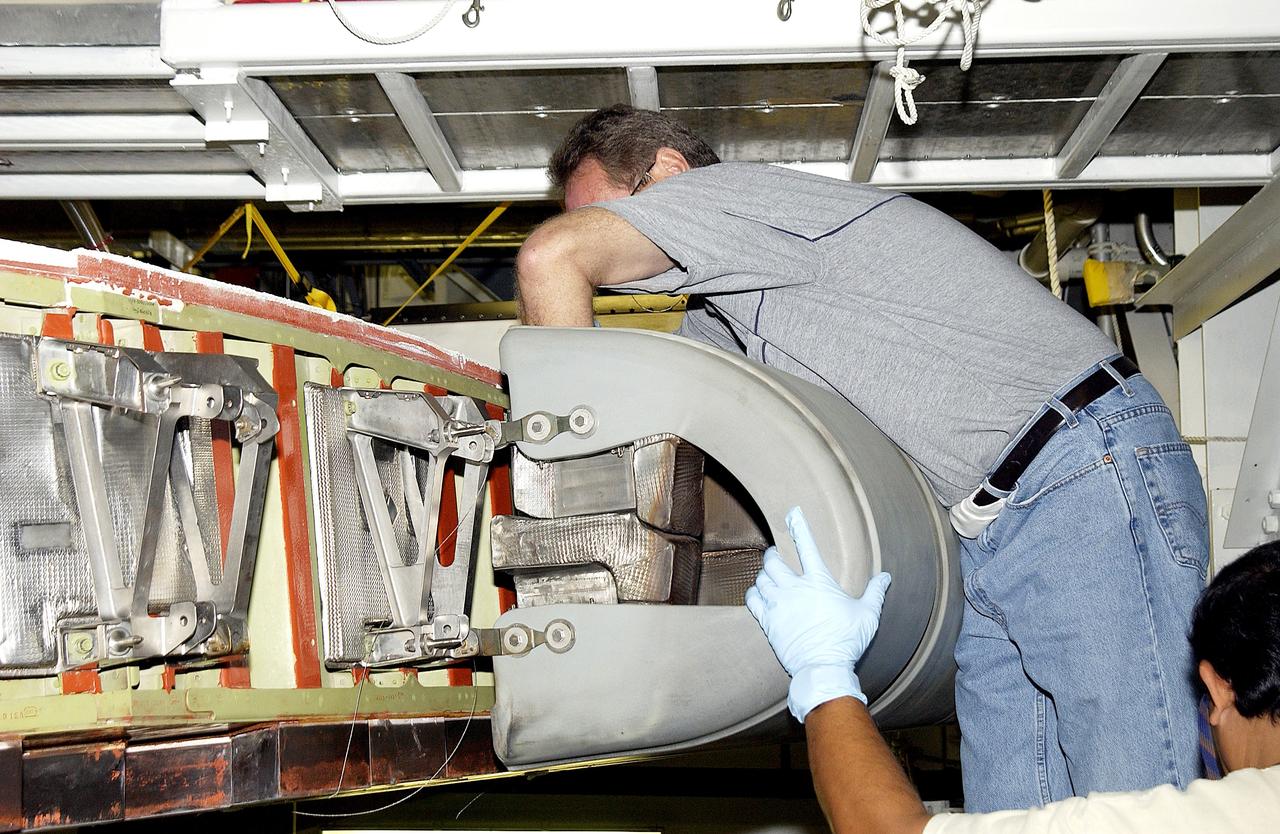
KENNEDY SPACE CENTER, FLA. -  In the Orbiter Processing Facility, United Space Alliance worker Mike Hyatt (above) attaches a Reinforced Carbon Carbon (RCC) panel onto the leading edge of the wing of the orbiter Atlantis.  The gray carbon composite RCC panels have sufficient strength to withstand the aerodynamic forces experienced during launch and reentry, which can reach as high as 800 pounds per square foot.  The operating range of RCC is from minus 250º F to about 3,000º F, the temperature produced by friction with the atmosphere during reentry.
KENNEDY SPACE CENTER, FLA. - In the Orbiter Processing Facility, United Space Alliance worker Mike Hyatt (above) attaches a Reinforced Carbon Carbon (RCC) panel onto the leading edge of the wing of the orbiter Atlantis. The gray carbon composite RCC panels have sufficient strength to withstand the aerodynamic forces experienced during launch and reentry, which can reach as high as 800 pounds per square foot. The operating range of RCC is from minus 250º F to about 3,000º F, the temperature produced by friction with the atmosphere during reentry.
KENNEDY SPACE CENTER, FLA. - In the Orbiter Processing Facility,  Jim Landy, NDE specialist with United Space Alliance (USA), watches a monitor off-screen to examine a Reinforced Carbon Carbon panel using flash thermography.  Attached to the leading edge of the wing of the orbiters,  the gray carbon composite RCC panels have sufficient strength to withstand the aerodynamic forces experienced during launch and reentry, which can reach as high as 800 pounds per square foot.  The operating range of RCC is from minus 250º F to about 3,000º F, the temperature produced by friction with the atmosphere during reentry.
KENNEDY SPACE CENTER, FLA. - In the Orbiter Processing Facility, Jim Landy, NDE specialist with United Space Alliance (USA), watches a monitor off-screen to examine a Reinforced Carbon Carbon panel using flash thermography. Attached to the leading edge of the wing of the orbiters, the gray carbon composite RCC panels have sufficient strength to withstand the aerodynamic forces experienced during launch and reentry, which can reach as high as 800 pounds per square foot. The operating range of RCC is from minus 250º F to about 3,000º F, the temperature produced by friction with the atmosphere during reentry.
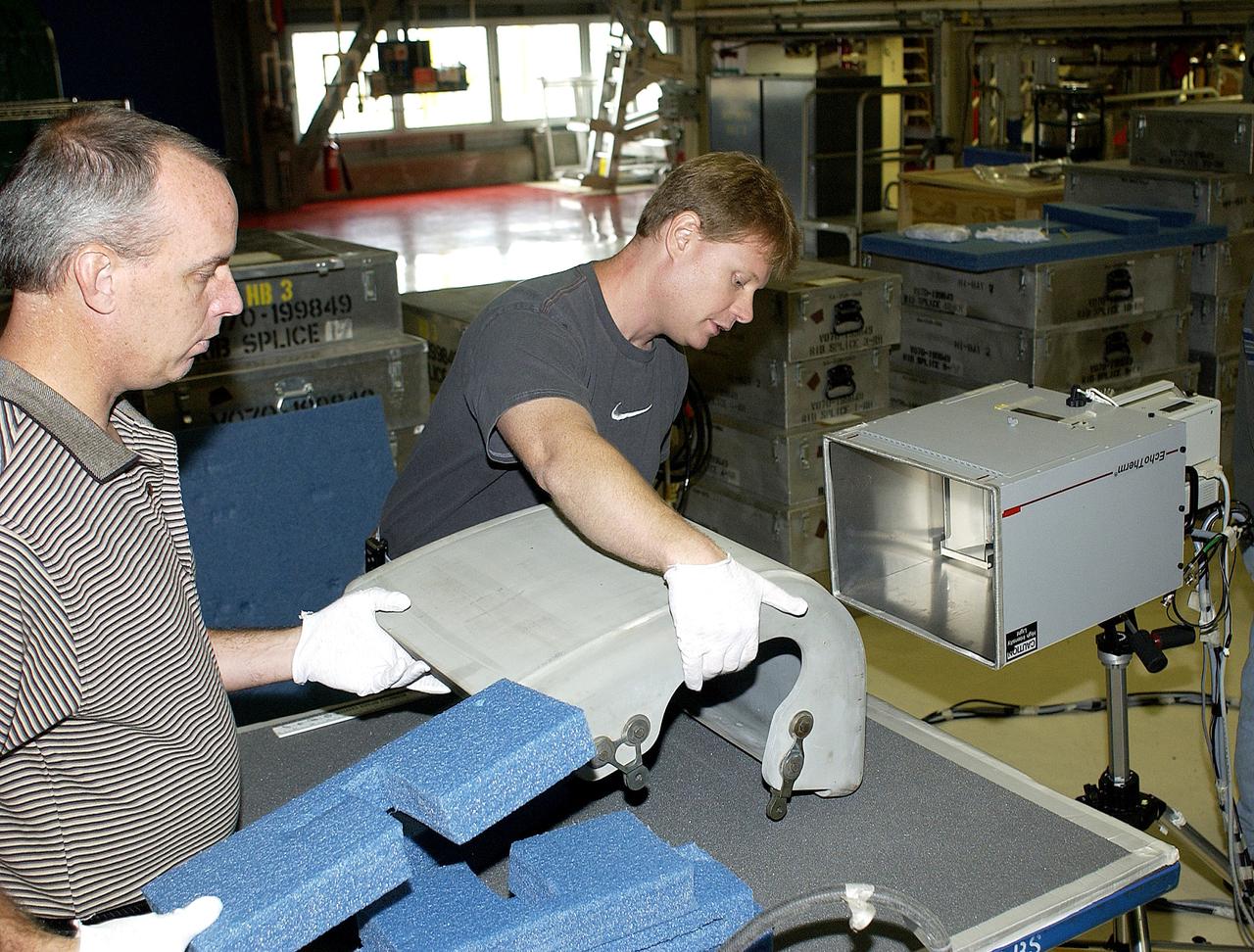
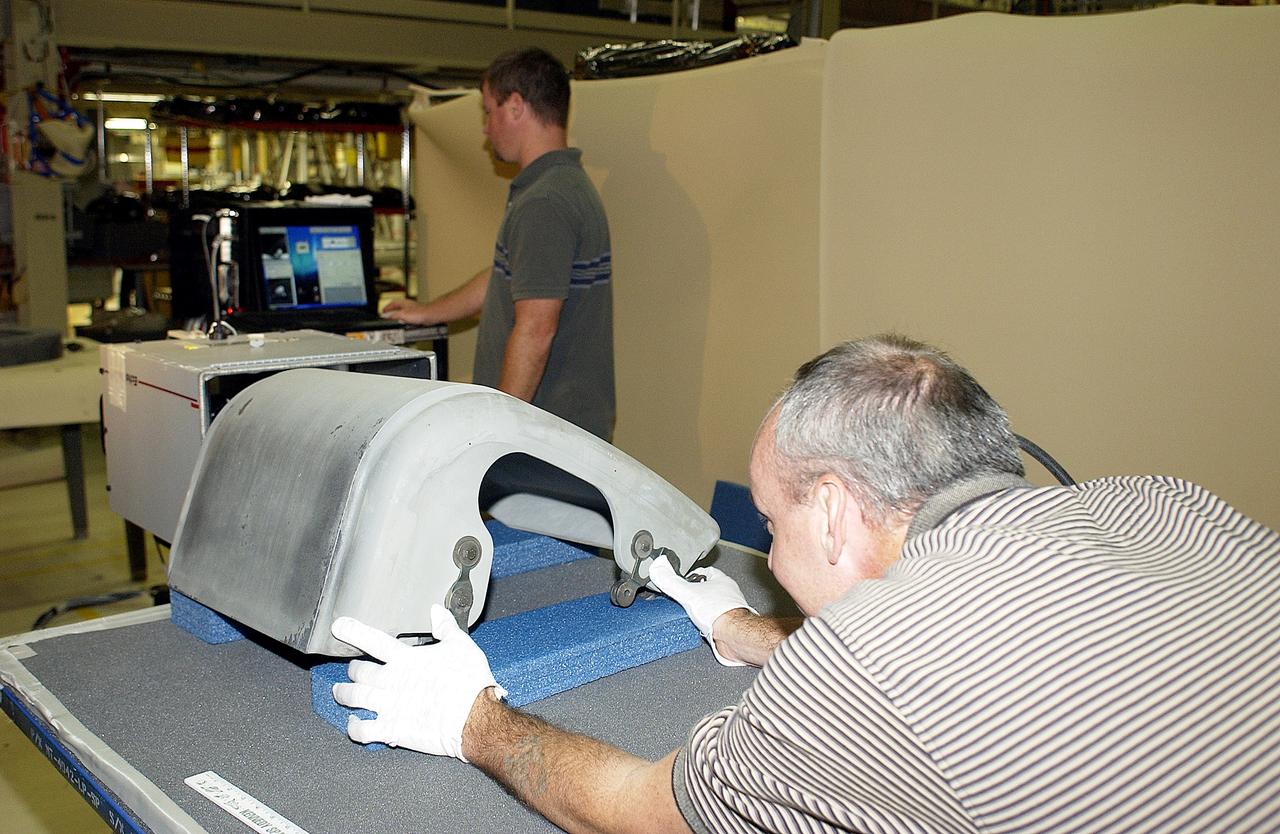
KENNEDY SPACE CENTER, FLA. -  In the Orbiter Processing Facility, United Space Alliance worker Dan Kenna (right) positions a Reinforced Carbon Carbon panel on the table to perform flash thermography.  In the background, Paul Ogletree observes the monitor.  Attached to the leading edge of the wing of the orbiters,  the gray carbon composite RCC panels have sufficient strength to withstand the aerodynamic forces experienced during launch and reentry, which can reach as high as 800 pounds per square foot.  The operating range of RCC is from minus 250º F to about 3,000º F, the temperature produced by friction with the atmosphere during reentry.
KENNEDY SPACE CENTER, FLA. - In the Orbiter Processing Facility, United Space Alliance worker Dan Kenna (right) positions a Reinforced Carbon Carbon panel on the table to perform flash thermography. In the background, Paul Ogletree observes the monitor. Attached to the leading edge of the wing of the orbiters, the gray carbon composite RCC panels have sufficient strength to withstand the aerodynamic forces experienced during launch and reentry, which can reach as high as 800 pounds per square foot. The operating range of RCC is from minus 250º F to about 3,000º F, the temperature produced by friction with the atmosphere during reentry.
KENNEDY SPACE CENTER, FLA. -  In the Orbiter Processing Facility,  Jim Landy (left), NDE specialist with United Space Alliance (USA), prepares to examine a Reinforced Carbon Carbon panel using flash thermography.  Helping out, at right, is Dan Phillips, also with USA.  Attached to the leading edge of the wing of the orbiters,  the gray carbon composite RCC panels have sufficient strength to withstand the aerodynamic forces experienced during launch and reentry, which can reach as high as 800 pounds per square foot.  The operating range of RCC is from minus 250º F to about 3,000º F, the temperature produced by friction with the atmosphere during reentry.
KENNEDY SPACE CENTER, FLA. - In the Orbiter Processing Facility, Jim Landy (left), NDE specialist with United Space Alliance (USA), prepares to examine a Reinforced Carbon Carbon panel using flash thermography. Helping out, at right, is Dan Phillips, also with USA. Attached to the leading edge of the wing of the orbiters, the gray carbon composite RCC panels have sufficient strength to withstand the aerodynamic forces experienced during launch and reentry, which can reach as high as 800 pounds per square foot. The operating range of RCC is from minus 250º F to about 3,000º F, the temperature produced by friction with the atmosphere during reentry.
KENNEDY SPACE CENTER, FLA. - In the Orbiter Processing Facility, United Space Alliance workers (left to right) Jim Landy, Paul Ogletree, Dan Kenna and Dan Phillips check results of flash thermography on the Reinforced Carbon Carbon panel on the table (foreground).  Attached to the leading edge of the wing of the orbiters,  the gray carbon composite RCC panels have sufficient strength to withstand the aerodynamic forces experienced during launch and reentry, which can reach as high as 800 pounds per square foot.  The operating range of RCC is from minus 250º F to about 3,000º F, the temperature produced by friction with the atmosphere during reentry.
KENNEDY SPACE CENTER, FLA. - In the Orbiter Processing Facility, United Space Alliance workers (left to right) Jim Landy, Paul Ogletree, Dan Kenna and Dan Phillips check results of flash thermography on the Reinforced Carbon Carbon panel on the table (foreground). Attached to the leading edge of the wing of the orbiters, the gray carbon composite RCC panels have sufficient strength to withstand the aerodynamic forces experienced during launch and reentry, which can reach as high as 800 pounds per square foot. The operating range of RCC is from minus 250º F to about 3,000º F, the temperature produced by friction with the atmosphere during reentry.
M-1 model of reentry body  in 3.5ft Hypersonic Wind Tunnel throat
ARC-1962-A-29007
ISS040-E-098591 (17 Aug. 2014) --- One of the Expedition 40 crew members aboard the International Space Station recorded this image of the Orbital Sciences Corporation's Cygnus cargo carrier spacecraft breaking up in Earth's atmosphere after being released from the orbital outpost. The breakup started around 13:22 GMT on Aug. 17, 2014 and this photo was taken at 13:23:44 GMT.
Cygnus 2 reentry
ISS040-E-098592 (17 Aug. 2014) --- One of the Expedition 40 crew members aboard the International Space Station recorded this image of the Orbital Sciences Corporation's Cygnus cargo carrier spacecraft breaking up in Earth's atmosphere after being released from the orbital outpost. The breakup started around 13:22 GMT on Aug. 17, 2014 and this photo was taken at 13:23:45 GMT.
Cygnus 2 reentry
ISS040-E-098571 (17 Aug. 2014) --- One of the Expedition 40 crew members aboard the International Space Station recorded this image of the Orbital Sciences Corporation's Cygnus cargo carrier spacecraft breaking up in Earth's atmosphere after being released from the orbital outpost. The breakup started around 13:22 GMT on Aug. 17, 2014 and this photo was taken at 13:23:32 GMT.
Cygnus 2 reentry
S69-15592 (27 Dec. 1968) --- This Apollo 8 re-entry photograph was taken by U.S. Air Force Airborne Lightweight Optical Tracking System (ALOTS) camera mounted on a KC-135-A aircraft flown at 40,000 feet altitude. Apollo 8, with astronauts Frank Borman, James A. Lovell Jr., and William A. Anders aboard, splashed down at 10:51 a.m. (EST) Dec. 27, 1968, in the central Pacific approximately 1,000 miles south-southwest of Hawaii.
Apollo 8 reentry photograph
As part of the project FIRE study, technicians ready materials to be subjected to high temperatures that will simulate the effects of re-entry heating. Tests of various space capsule materials for Project FIRE were conducted. Photographed in the 9 X 6 Foot Thermal Structures Tunnel. Photograph published in Winds of Change, 75th Anniversary NASA publication, by James Schultz (page 78). Photograph also published in Engineer in Charge: A History of the Langley Aeronautical Laboratory, 1917-1958 by James R. Hansen (page 476).  Also Published in the book " A Century at Langley" by Joseph Chambers. Pg. 92
Project FIRE Flight Investigation Reentry Environment- Winds of Change
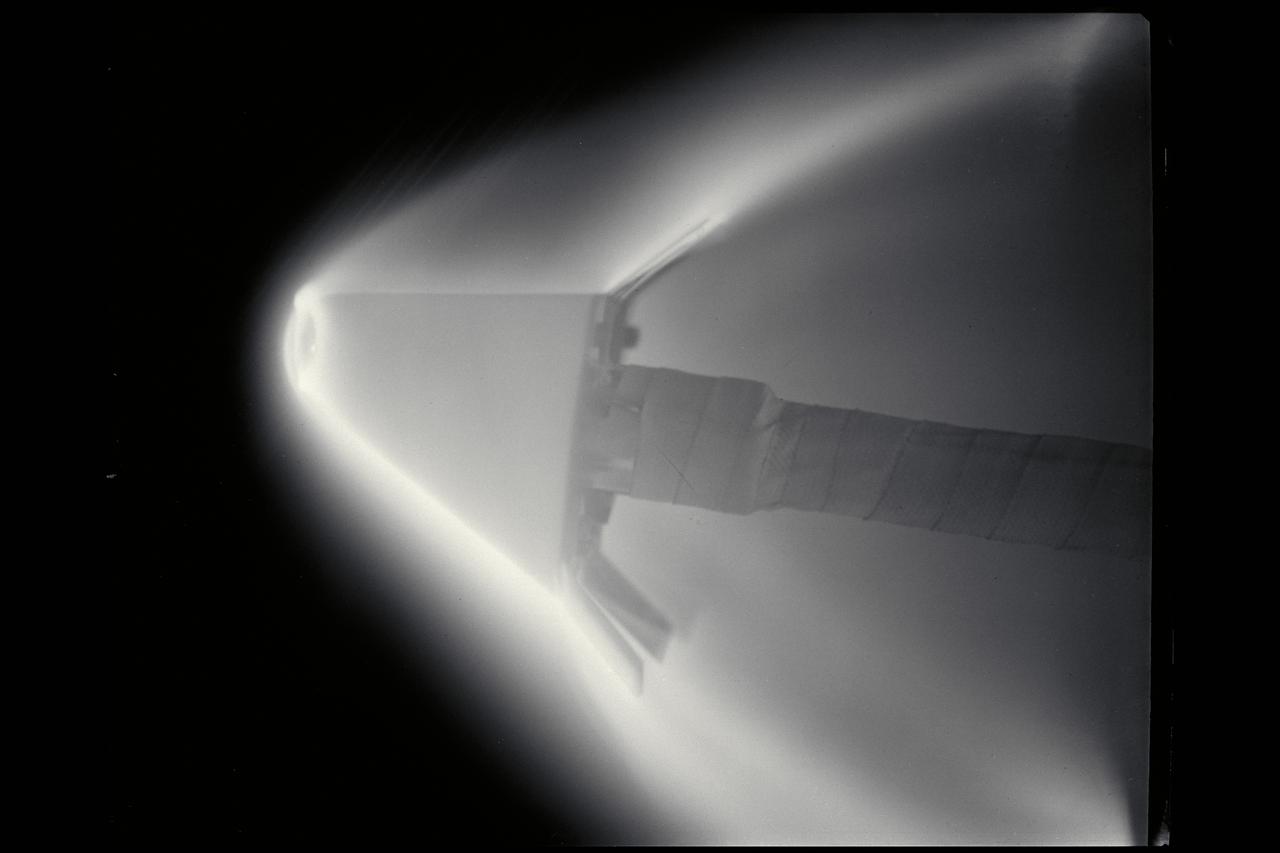
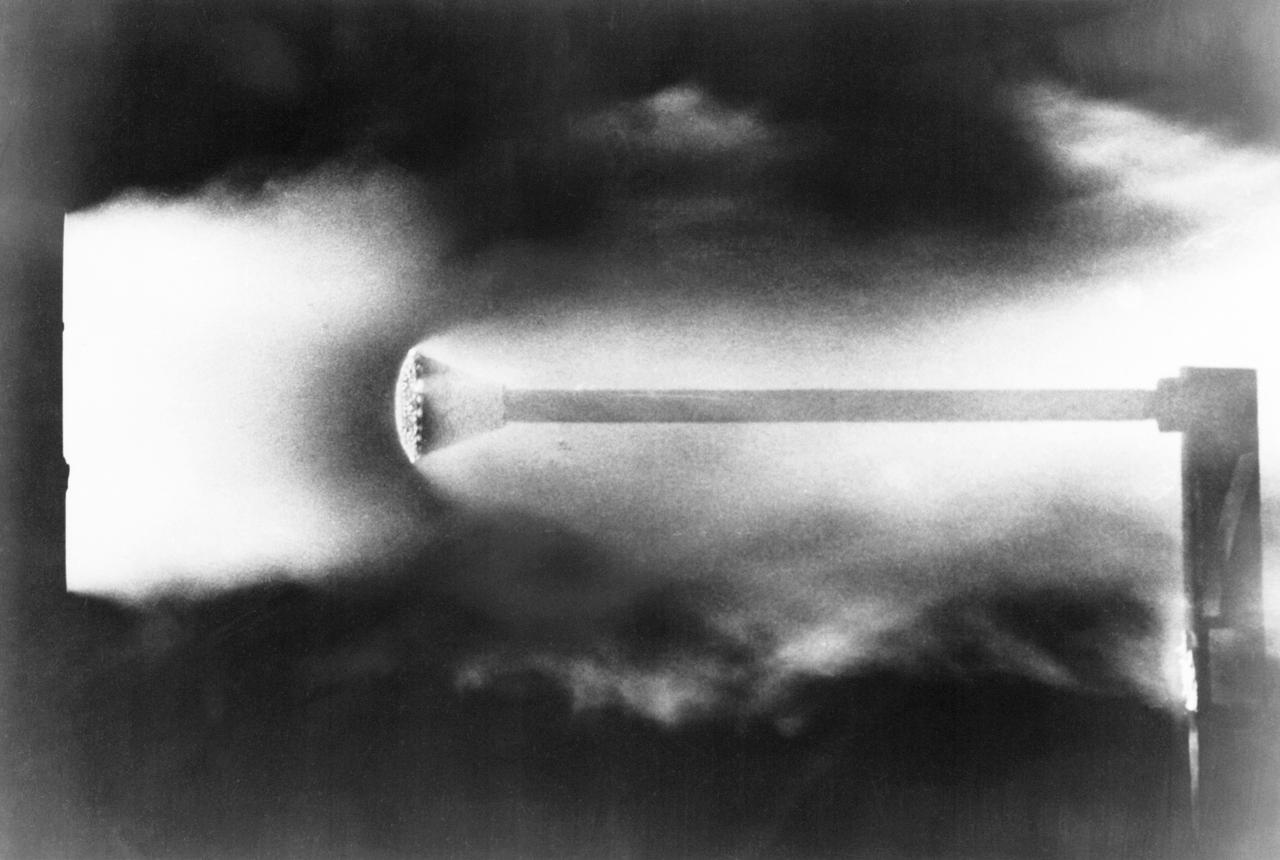
M-1 reentry body test model in high enthalpy (heat function) air stream
ARC-1960-A-26378
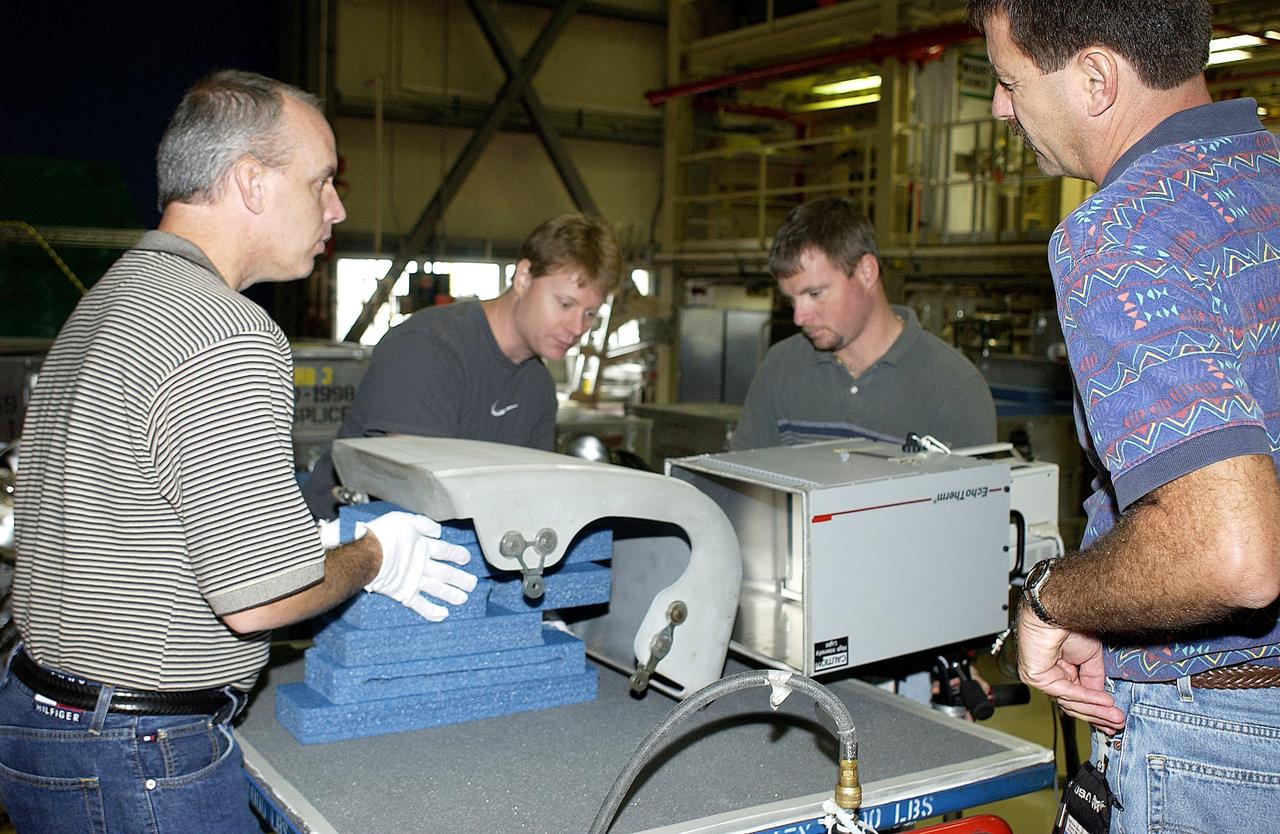
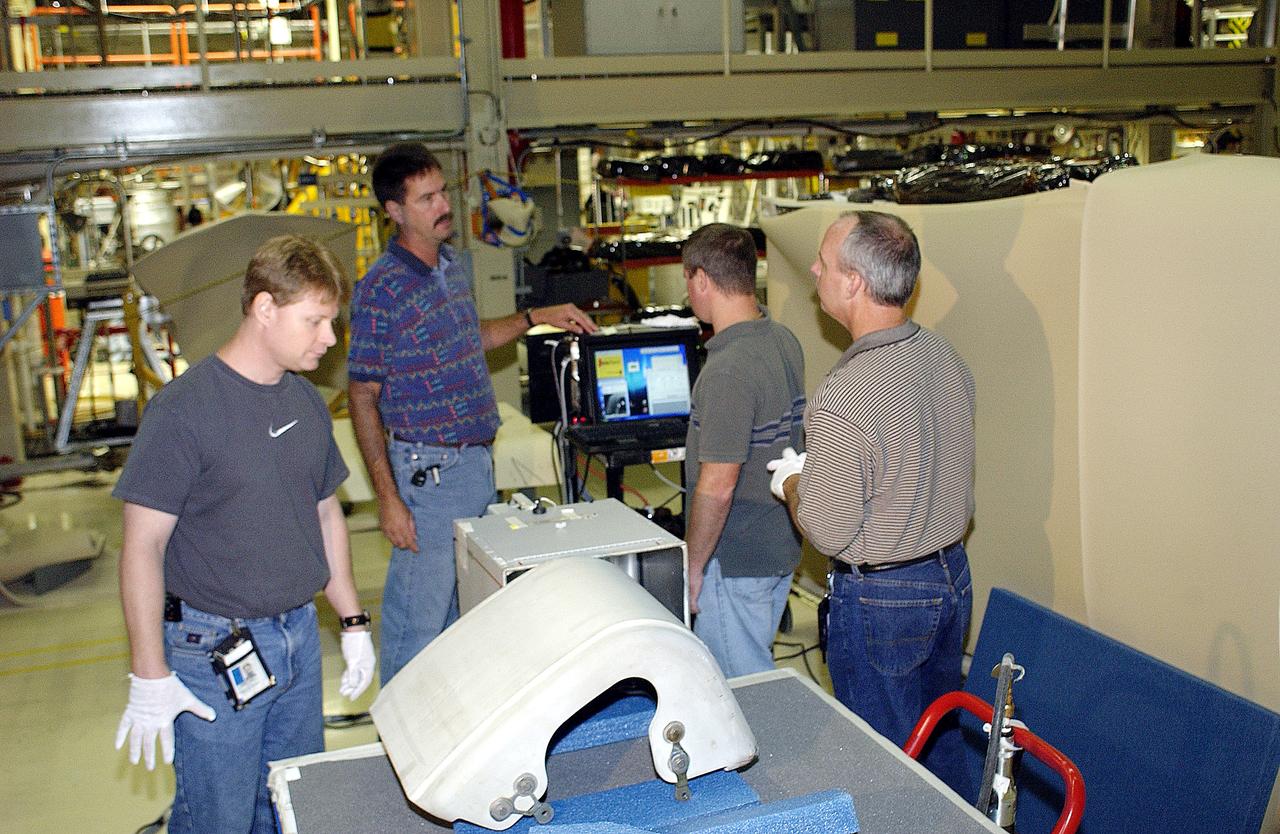
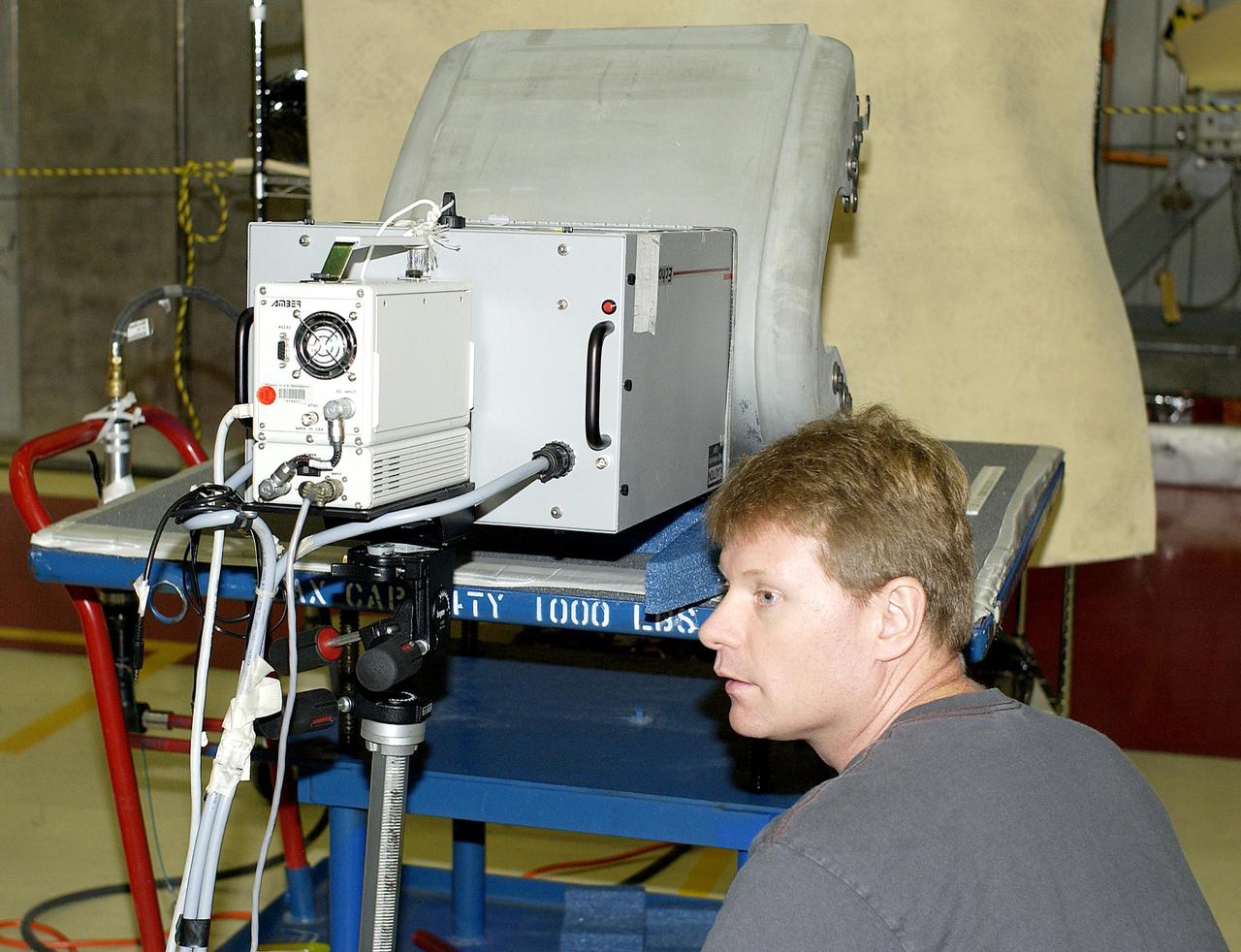
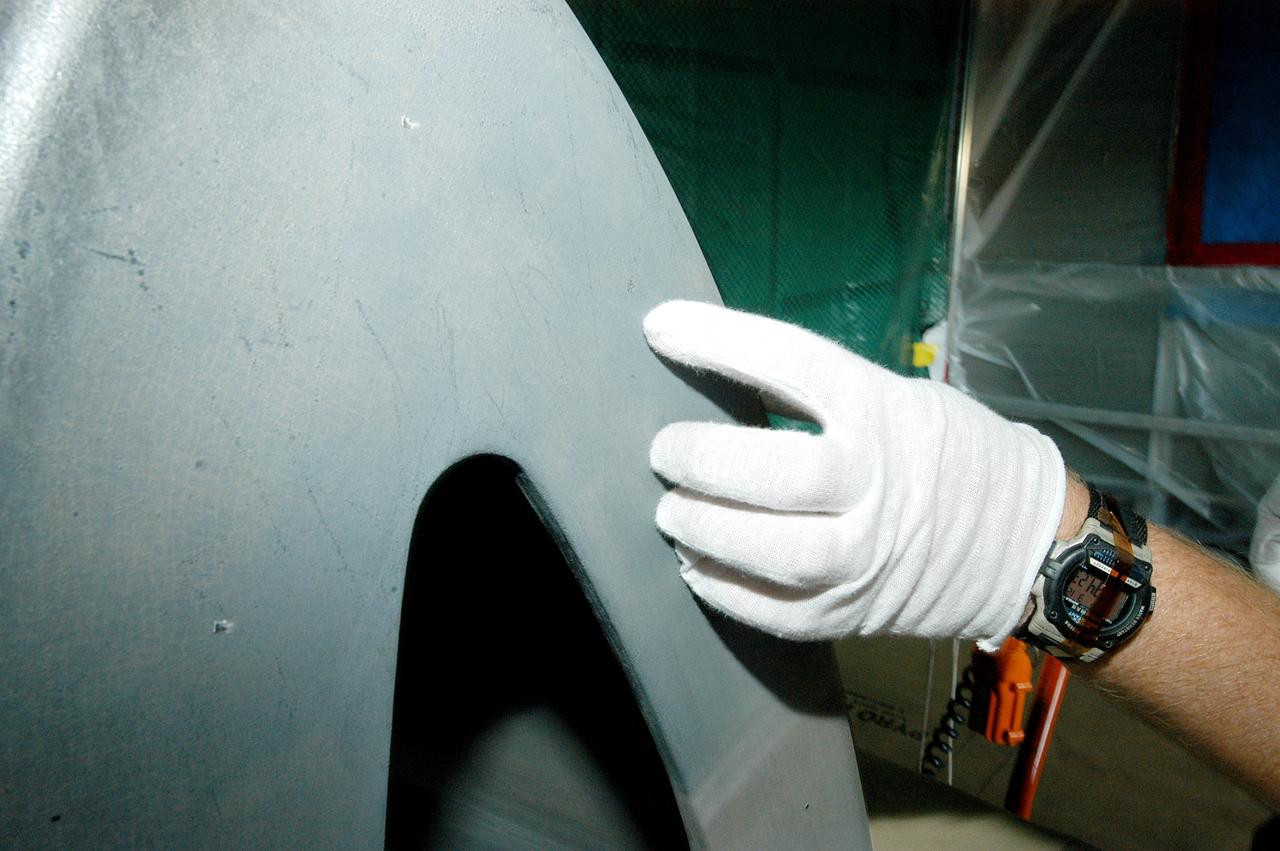
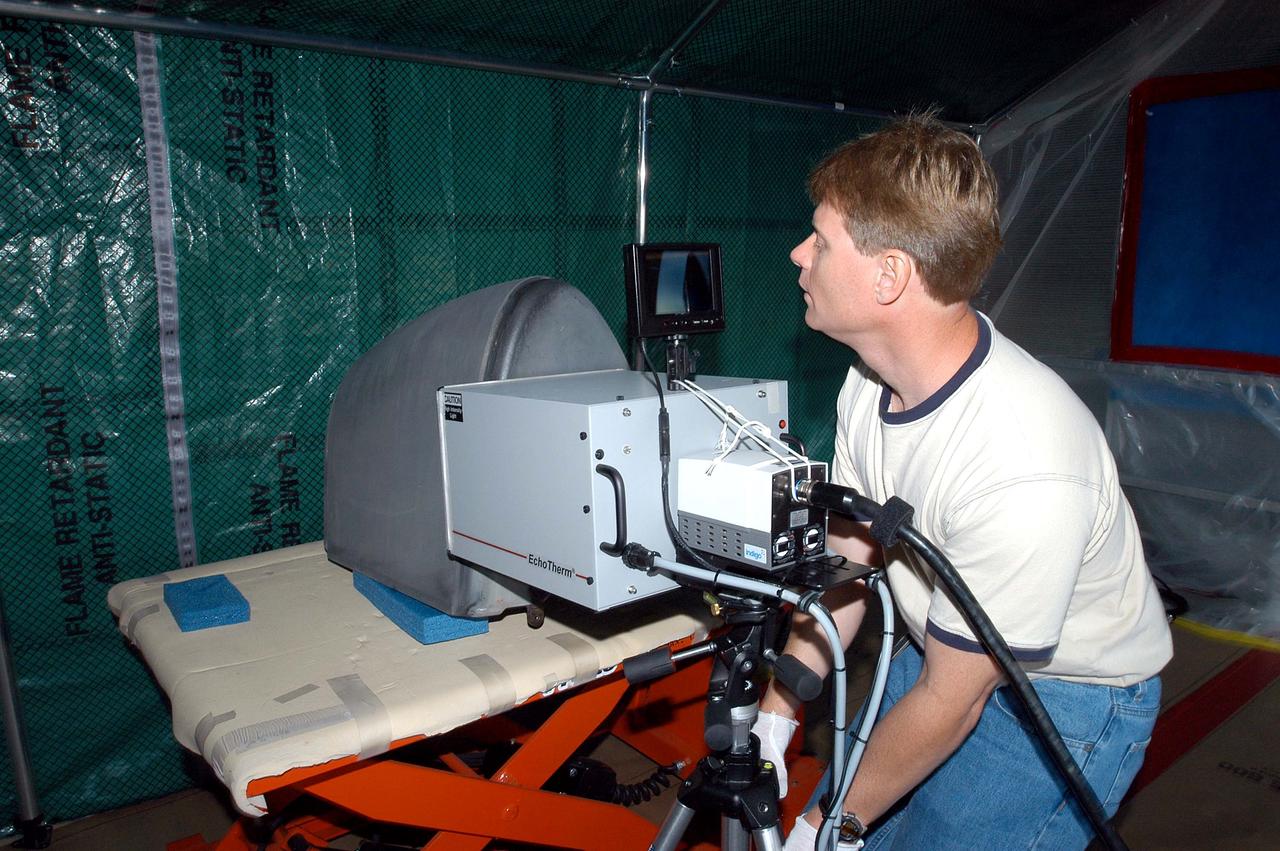
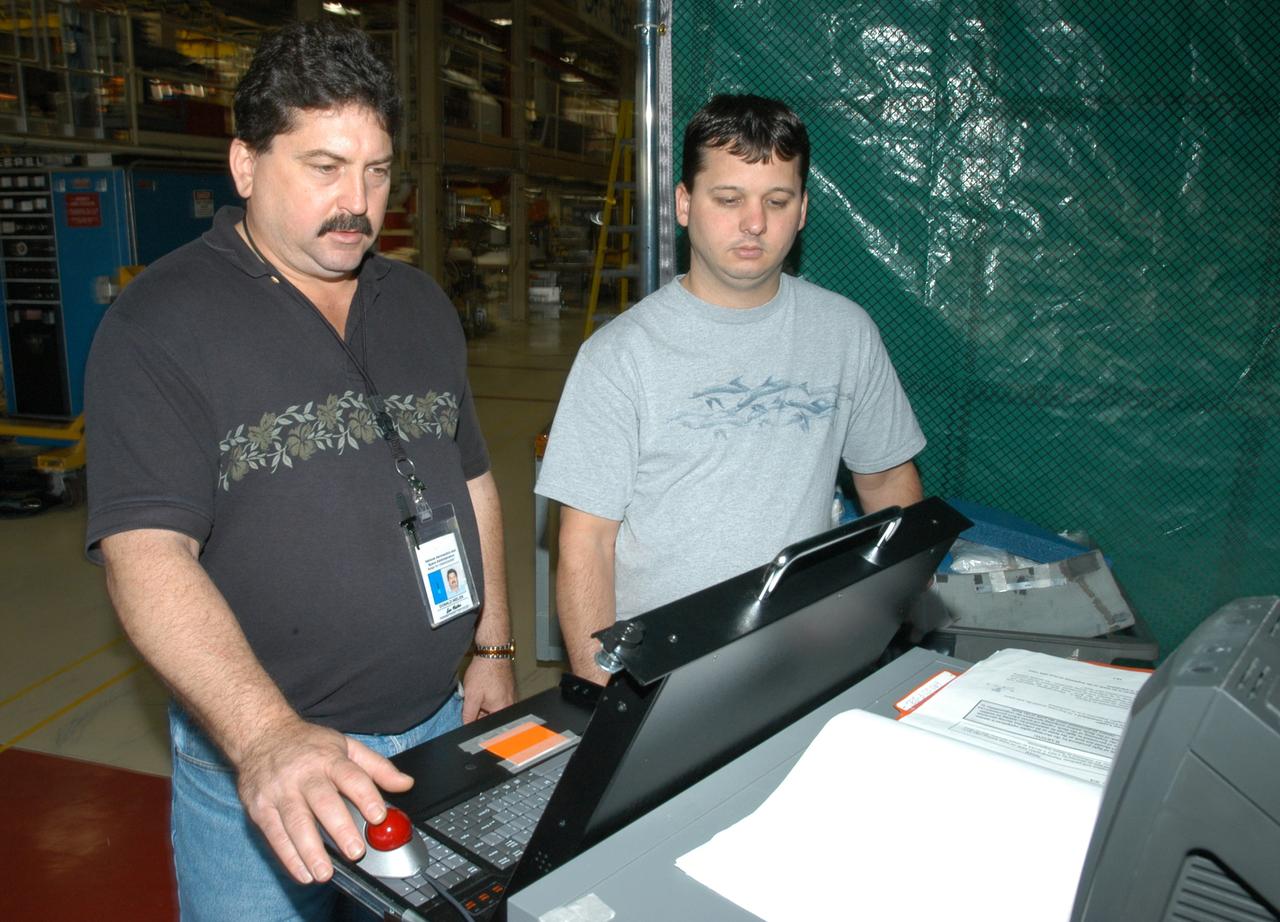
KENNEDY SPACE CENTER, FLA. -  Jim Landy, NDE specialist with USA, points to   an area of a Reinforced Carbon Carbon panel just examined using flash thermography. A relatively new procedure at KSC, thermography uses high intensity light to heat areas of the panels. The panels are then immediately scanned with an infrared camera. As the panels cool, any internal flaws are revealed. The gray carbon composite RCC panels are attached to the leading edge of the wing of the orbiters.  They have sufficient strength to withstand the aerodynamic forces experienced during launch and reentry, which can reach as high as 800 pounds per square foot.  The operating range of RCC is from minus 250º F to about 3,000º F, the temperature produced by friction with the atmosphere during reentry.  The panels will be installed on the orbiter Discovery, designated  for the first Return to Flight mission, STS-114.
KENNEDY SPACE CENTER, FLA. - Jim Landy, NDE specialist with USA, points to an area of a Reinforced Carbon Carbon panel just examined using flash thermography. A relatively new procedure at KSC, thermography uses high intensity light to heat areas of the panels. The panels are then immediately scanned with an infrared camera. As the panels cool, any internal flaws are revealed. The gray carbon composite RCC panels are attached to the leading edge of the wing of the orbiters. They have sufficient strength to withstand the aerodynamic forces experienced during launch and reentry, which can reach as high as 800 pounds per square foot. The operating range of RCC is from minus 250º F to about 3,000º F, the temperature produced by friction with the atmosphere during reentry. The panels will be installed on the orbiter Discovery, designated for the first Return to Flight mission, STS-114.
KENNEDY SPACE CENTER, FLA. -  Jim Landy, NDE specialist with United Space Alliance (USA), examines a Reinforced Carbon Carbon panel using flash thermography.  A relatively new procedure at KSC, thermography uses high intensity light to heat areas of the panels. The panels are then immediately scanned with an infrared camera. As the panels cool, any internal flaws are revealed. The gray carbon composite RCC panels are attached to the leading edge of the wing of the orbiters.  They have sufficient strength to withstand the aerodynamic forces experienced during launch and reentry, which can reach as high as 800 pounds per square foot.  The operating range of RCC is from minus 250º F to about 3,000º F, the temperature produced by friction with the atmosphere during reentry.  The panels will be installed on the orbiter Discovery, designated for the first Return to Flight mission, STS-114.
KENNEDY SPACE CENTER, FLA. - Jim Landy, NDE specialist with United Space Alliance (USA), examines a Reinforced Carbon Carbon panel using flash thermography. A relatively new procedure at KSC, thermography uses high intensity light to heat areas of the panels. The panels are then immediately scanned with an infrared camera. As the panels cool, any internal flaws are revealed. The gray carbon composite RCC panels are attached to the leading edge of the wing of the orbiters. They have sufficient strength to withstand the aerodynamic forces experienced during launch and reentry, which can reach as high as 800 pounds per square foot. The operating range of RCC is from minus 250º F to about 3,000º F, the temperature produced by friction with the atmosphere during reentry. The panels will be installed on the orbiter Discovery, designated for the first Return to Flight mission, STS-114.
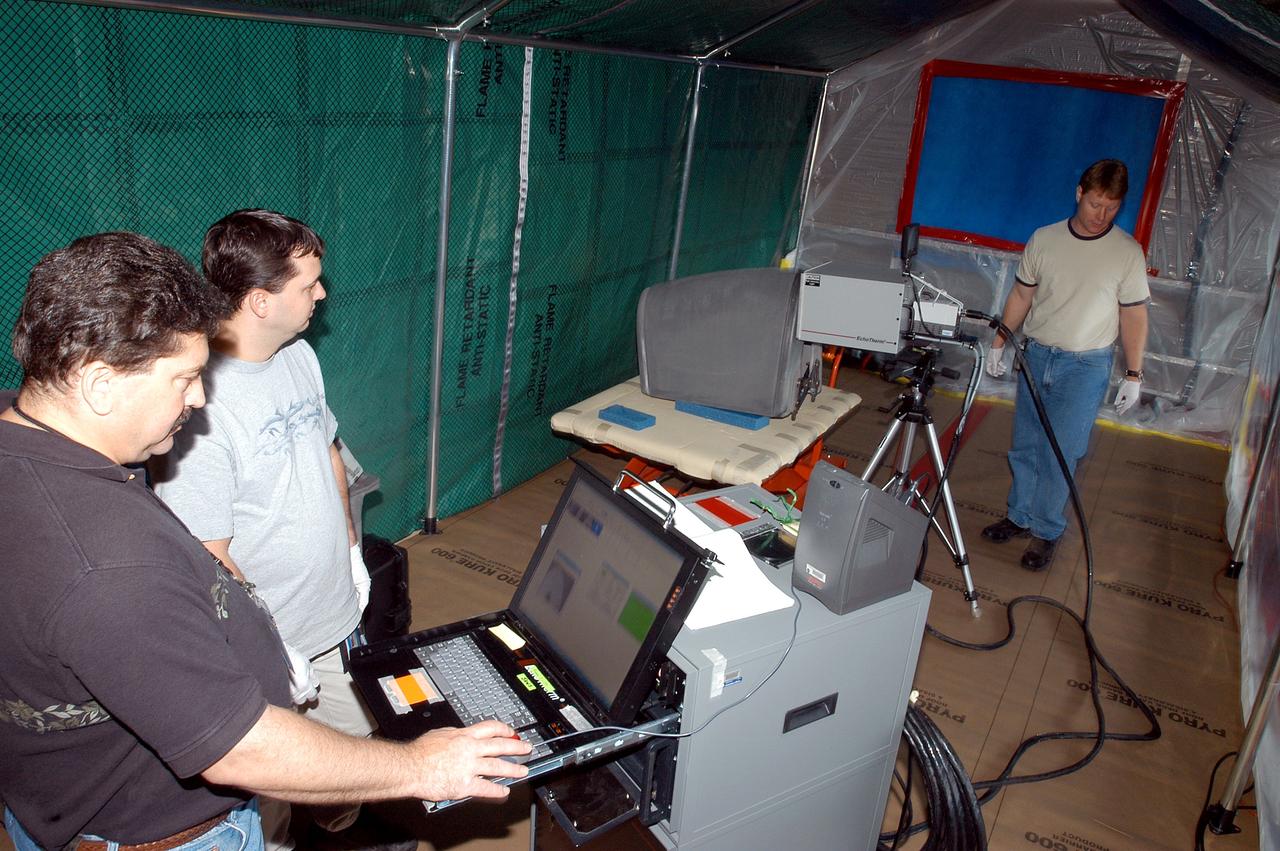
KENNEDY SPACE CENTER, FLA. -  Dan Phillips (left) and Donald Nielen, with United Space Alliance, watch a monitor as  Jim Landy, NDE specialist with USA, prepares to examine a Reinforced Carbon Carbon panel (on the table, center) using flash thermography.  A relatively new procedure at KSC, thermography uses high intensity light to heat areas of the panels. The panels are then immediately scanned with an infrared camera. As the panels cool, any internal flaws are revealed. The gray carbon composite RCC panels are attached to the leading edge of the wing of the orbiters.  They have sufficient strength to withstand the aerodynamic forces experienced during launch and reentry, which can reach as high as 800 pounds per square foot.  The operating range of RCC is from minus 250º F to about 3,000º F, the temperature produced by friction with the atmosphere during reentry.  The panels will be installed on the orbiter Discovery, designated  for the first Return to Flight mission, STS-114.
KENNEDY SPACE CENTER, FLA. - Dan Phillips (left) and Donald Nielen, with United Space Alliance, watch a monitor as Jim Landy, NDE specialist with USA, prepares to examine a Reinforced Carbon Carbon panel (on the table, center) using flash thermography. A relatively new procedure at KSC, thermography uses high intensity light to heat areas of the panels. The panels are then immediately scanned with an infrared camera. As the panels cool, any internal flaws are revealed. The gray carbon composite RCC panels are attached to the leading edge of the wing of the orbiters. They have sufficient strength to withstand the aerodynamic forces experienced during launch and reentry, which can reach as high as 800 pounds per square foot. The operating range of RCC is from minus 250º F to about 3,000º F, the temperature produced by friction with the atmosphere during reentry. The panels will be installed on the orbiter Discovery, designated for the first Return to Flight mission, STS-114.
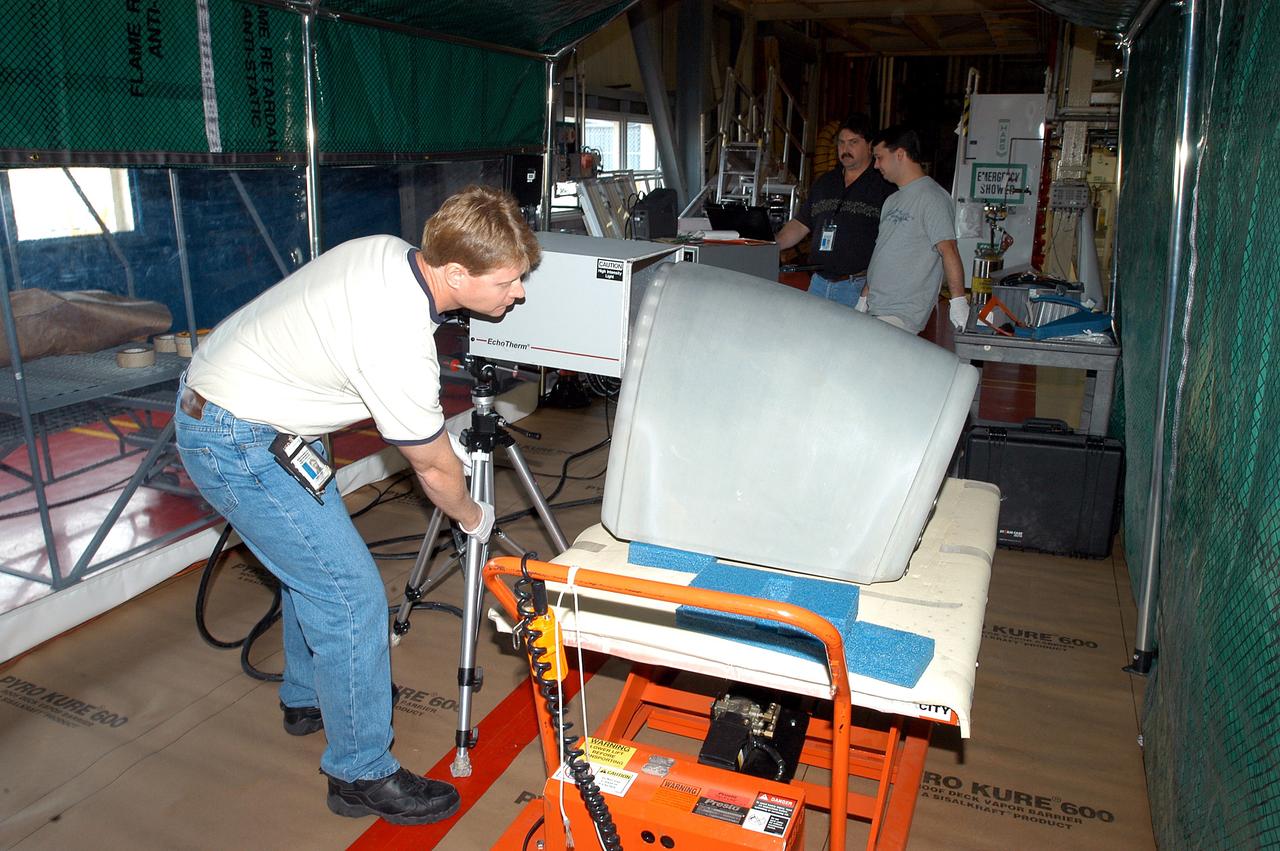
KENNEDY SPACE CENTER, FLA. -  Jim Landy, NDE specialist with United Space Alliance, sets up equipment to examine a Reinforced Carbon Carbon panel using flash thermography.  A relatively new procedure at KSC, thermography uses high intensity light to heat areas of the panels. The panels are then immediately scanned with an infrared camera. As the panels cool, any internal flaws are revealed. The gray carbon composite RCC panels are attached to the leading edge of the wing of the orbiters.  They have sufficient strength to withstand the aerodynamic forces experienced during launch and reentry, which can reach as high as 800 pounds per square foot.  The operating range of RCC is from minus 250º F to about 3,000º F, the temperature produced by friction with the atmosphere during reentry.  The panels will be installed on the orbiter Discovery, designated  for the first Return to Flight mission, STS-114.
KENNEDY SPACE CENTER, FLA. - Jim Landy, NDE specialist with United Space Alliance, sets up equipment to examine a Reinforced Carbon Carbon panel using flash thermography. A relatively new procedure at KSC, thermography uses high intensity light to heat areas of the panels. The panels are then immediately scanned with an infrared camera. As the panels cool, any internal flaws are revealed. The gray carbon composite RCC panels are attached to the leading edge of the wing of the orbiters. They have sufficient strength to withstand the aerodynamic forces experienced during launch and reentry, which can reach as high as 800 pounds per square foot. The operating range of RCC is from minus 250º F to about 3,000º F, the temperature produced by friction with the atmosphere during reentry. The panels will be installed on the orbiter Discovery, designated for the first Return to Flight mission, STS-114.
KENNEDY SPACE CENTER, FLA. -  Jim Landy, NDE specialist with United Space Alliance (USA), prepares equipment to examine a Reinforced Carbon Carbon panel using flash thermography.  A relatively new procedure at KSC, thermography uses high intensity light to heat areas of the panels. The panels are then immediately scanned with an infrared camera. As the panels cool, any internal flaws are revealed. The gray carbon composite RCC panels are attached to the leading edge of the wing of the orbiters.  They have sufficient strength to withstand the aerodynamic forces experienced during launch and reentry, which can reach as high as 800 pounds per square foot.  The operating range of RCC is from minus 250º F to about 3,000º F, the temperature produced by friction with the atmosphere during reentry. The panels will be installed on the orbiter Discovery, designated for the first Return to Flight mission, STS-114.
KENNEDY SPACE CENTER, FLA. - Jim Landy, NDE specialist with United Space Alliance (USA), prepares equipment to examine a Reinforced Carbon Carbon panel using flash thermography. A relatively new procedure at KSC, thermography uses high intensity light to heat areas of the panels. The panels are then immediately scanned with an infrared camera. As the panels cool, any internal flaws are revealed. The gray carbon composite RCC panels are attached to the leading edge of the wing of the orbiters. They have sufficient strength to withstand the aerodynamic forces experienced during launch and reentry, which can reach as high as 800 pounds per square foot. The operating range of RCC is from minus 250º F to about 3,000º F, the temperature produced by friction with the atmosphere during reentry. The panels will be installed on the orbiter Discovery, designated for the first Return to Flight mission, STS-114.
2.8% Ares I Acoustic Reentry Wind Tunnel Model in Ames 9X7ft Supersonic Wind Tunnel test-97-0193; model flying backwards in tunnel
ARC-2008-ACD08-0266-018
2.8% Ares I Acoustic Reentry Wind Tunnel Model in Ames 9X7ft Supersonic Wind Tunnel test-97-0193; model flying backwards in tunnel
ARC-2008-ACD08-0266-020
2.8% Ares I Acoustic Reentry Wind Tunnel Model in Ames 9X7ft Supersonic Wind Tunnel test-97-0193; model flying backwards in tunnel
ARC-2008-ACD08-0266-019
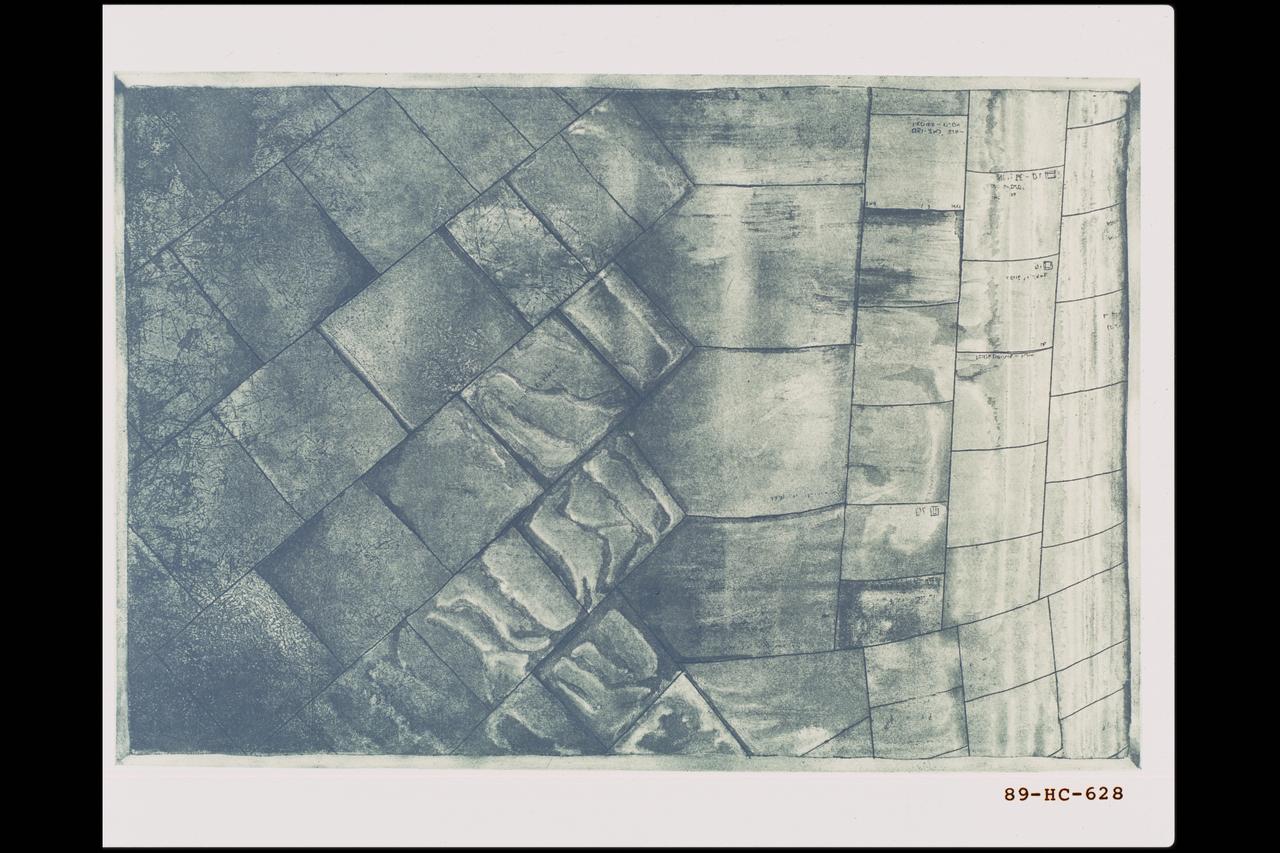
'Belly of the Bird' an etching by Deborah E. Deschner. Tiles underlining the Shuttle Columbia show the subtle ghostlike patterns touched on their surface during reentry.
ARC-2000-89-HC-628
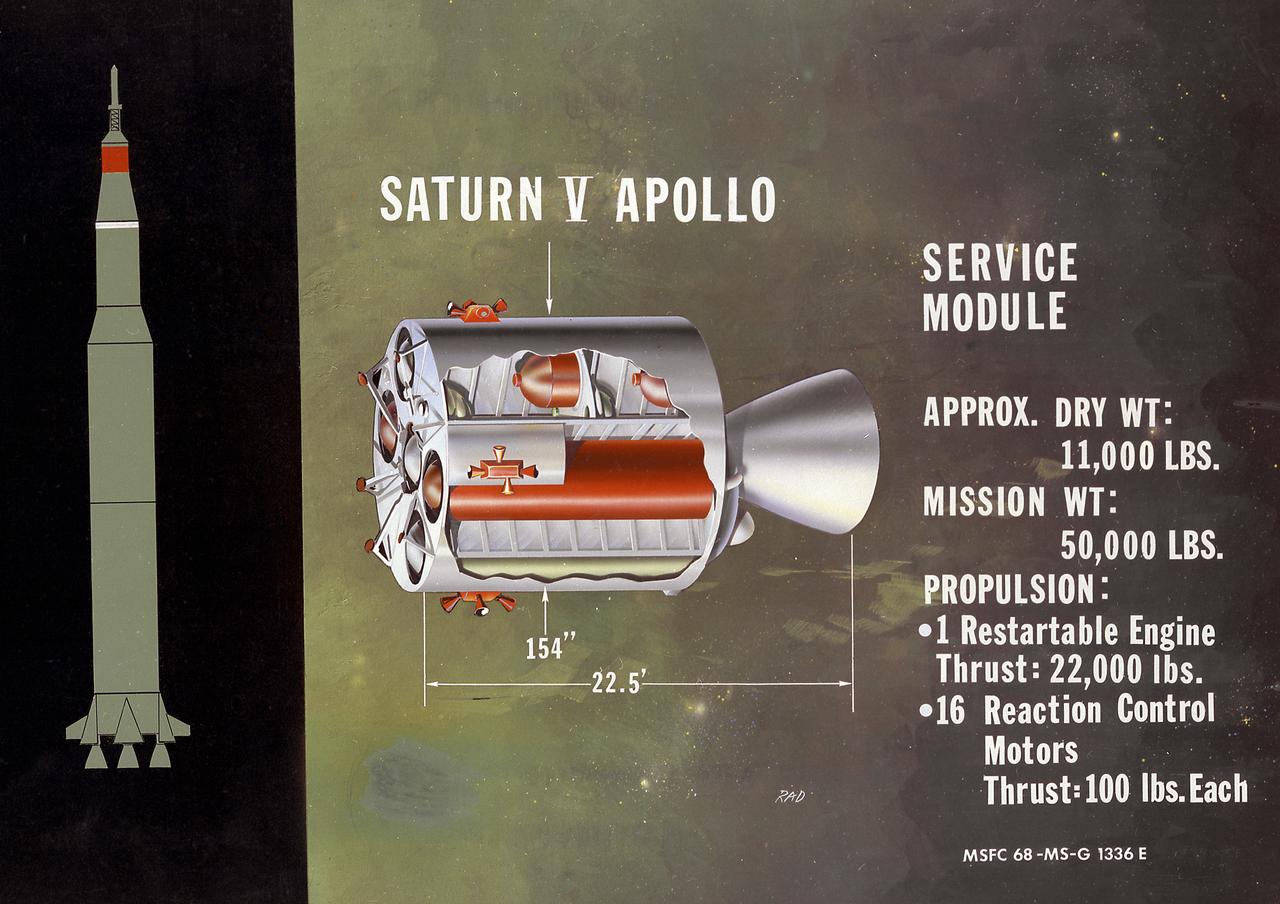
This is a cutaway illustration of the Saturn V service module configuration. Packed with plumbing and tanks, the service module was the command module's constant companion until just before reentry. All components not needed during the last few minutes of flight, and therefore requiring no protection against reentry heat, were transported in this module. It carried oxygen for most of the trip, fuel cells to generate electricity (along with the oxygen and hydrogen to run them); small engines to control pitch, roll, and yaw; and a large engine to propel the spacecraft into, and out of, lunar orbit.
Saturn Apollo Program
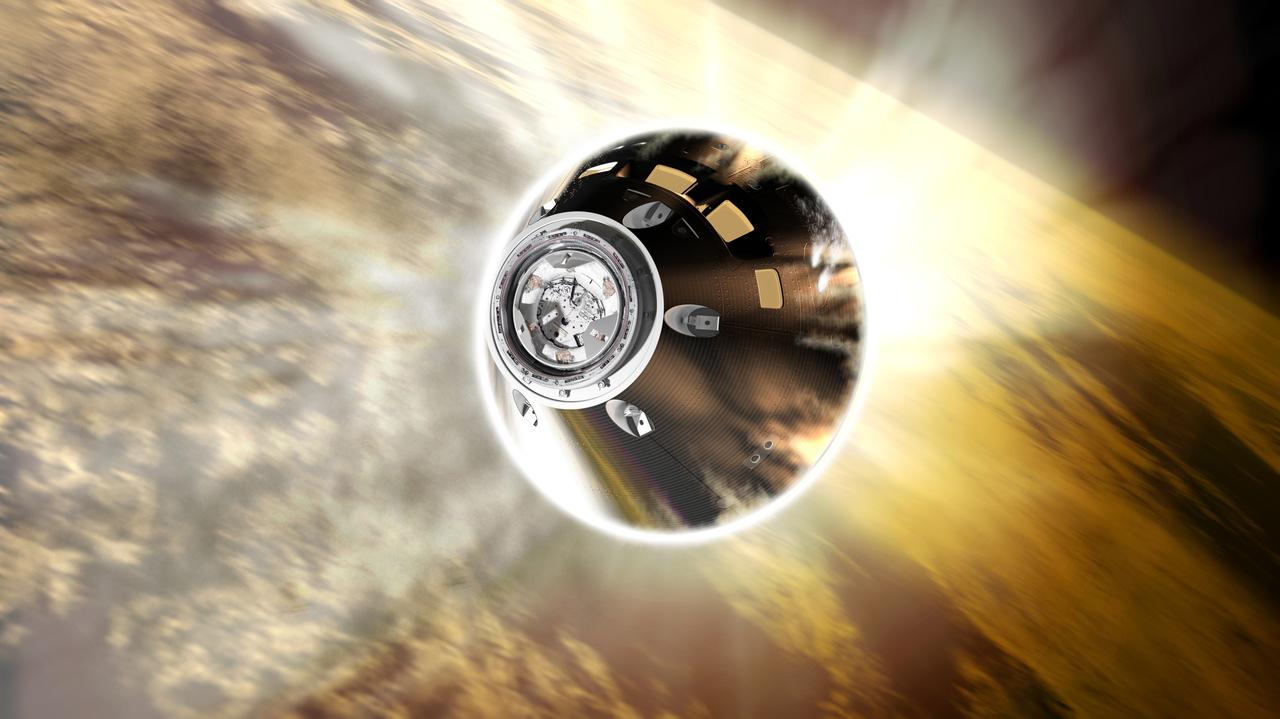
Artemis I will be the first integrated flight test of NASA’s deep space exploration system: the Orion spacecraft, Space Launch System (SLS) rocket and the ground systems at Kennedy Space Center in Cape Canaveral, Florida. The first in a series of increasingly complex missions, Artemis I will be an uncrewed flight that will provide a foundation for human deep space exploration, and demonstrate our commitment and capability to extend human existence to the Moon and beyond. During this flight, the uncrewed Orion spacecraft will launch on the most powerful rocket in the world and travel thousands of miles beyond the Moon, farther than any spacecraft built for humans has ever flown, over the course of about a three-week mission.
Artemis I artist's concept - reentry
Artemis I will be the first integrated flight test of NASA’s deep space exploration system: the Orion spacecraft, Space Launch System (SLS) rocket and the ground systems at Kennedy Space Center in Cape Canaveral, Florida. The first in a series of increasingly complex missions, Artemis I will be an uncrewed flight that will provide a foundation for human deep space exploration, and demonstrate our commitment and capability to extend human existence to the Moon and beyond. During this flight, the uncrewed Orion spacecraft will launch on the most powerful rocket in the world and travel thousands of miles beyond the Moon, farther than any spacecraft built for humans has ever flown, over the course of about a three-week mission.
Artemis I artist's concept - reentry
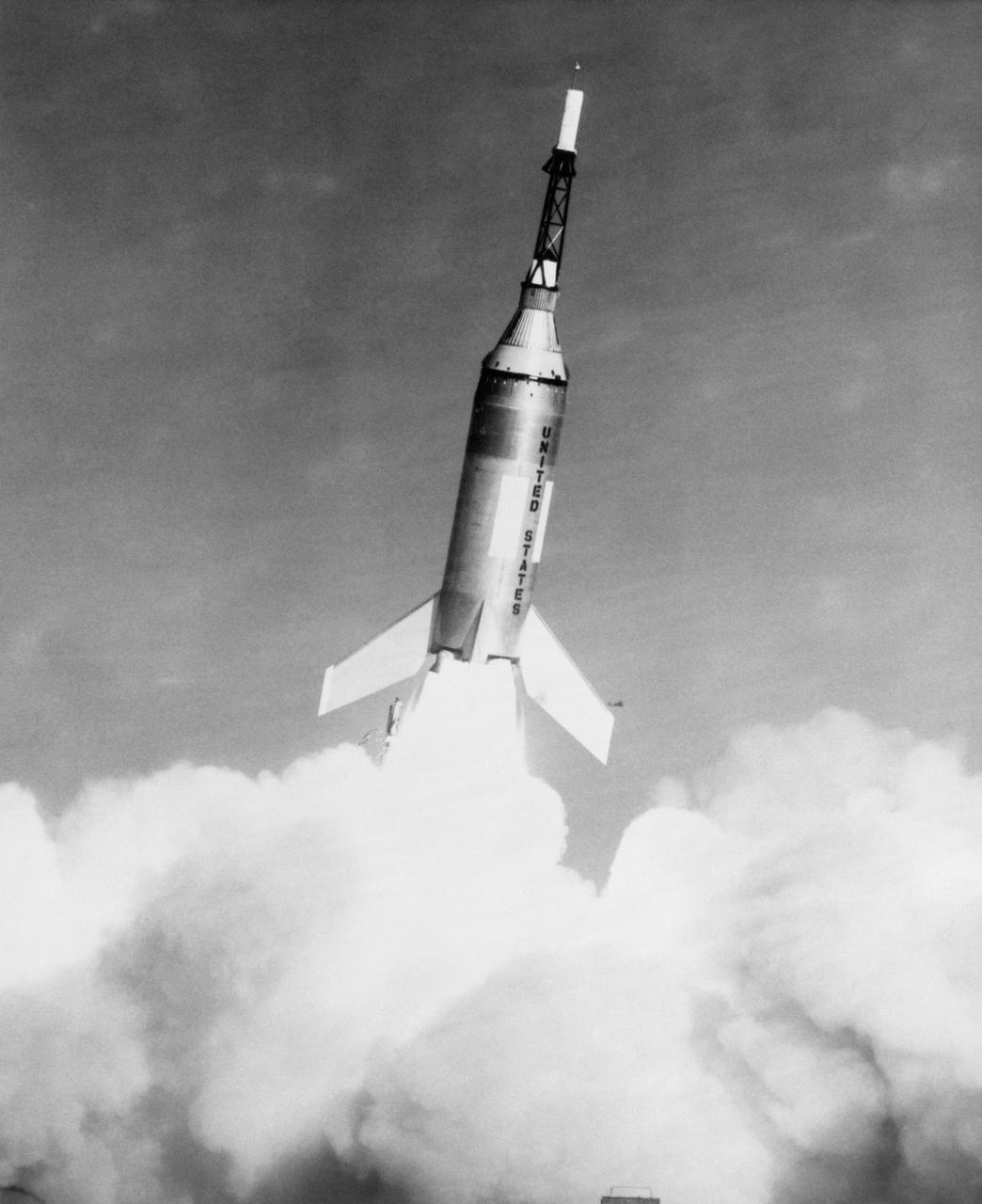
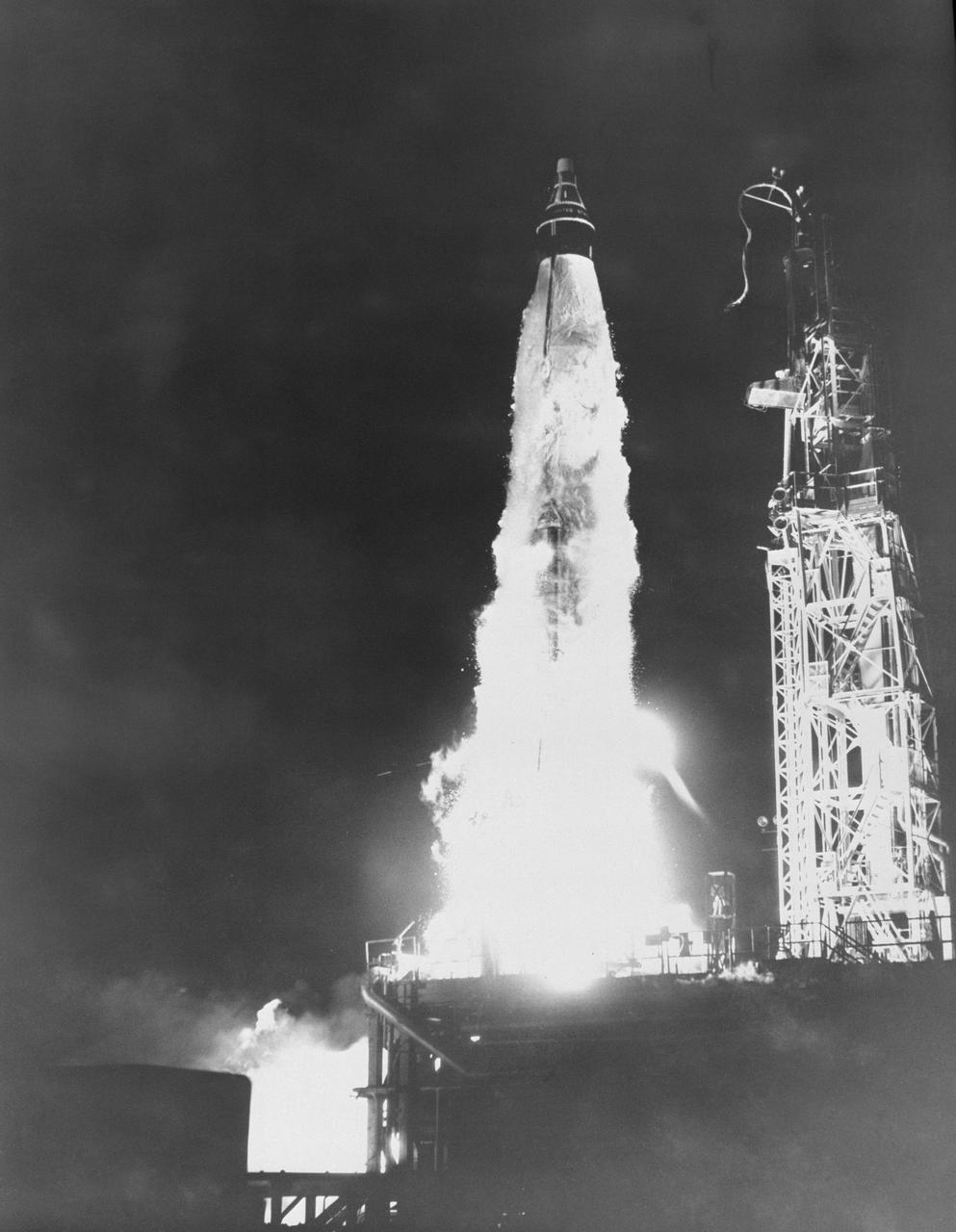
G61-00030 (4 Nov. 1959) --- Launch of Little Joe-2 from Wallops Island carrying Mercury spacecraft test article. The suborbital test flight of the Mercury capsule was to test the escape system. Vehicle functioned perfectly, but escape rocket ignited several seconds too late. Photo credit: NASA
LITTLE JOE 2 - LAUNCH VEHICLES - VA
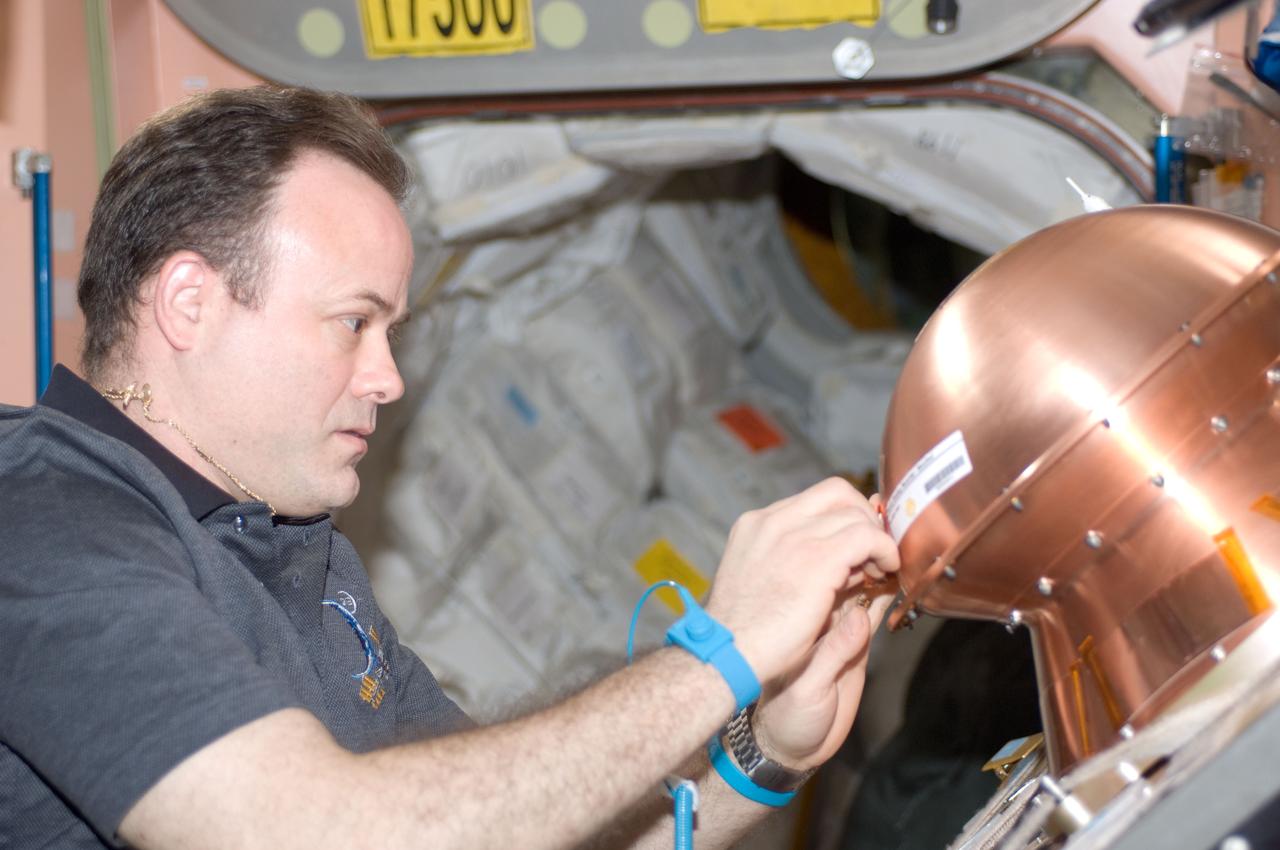
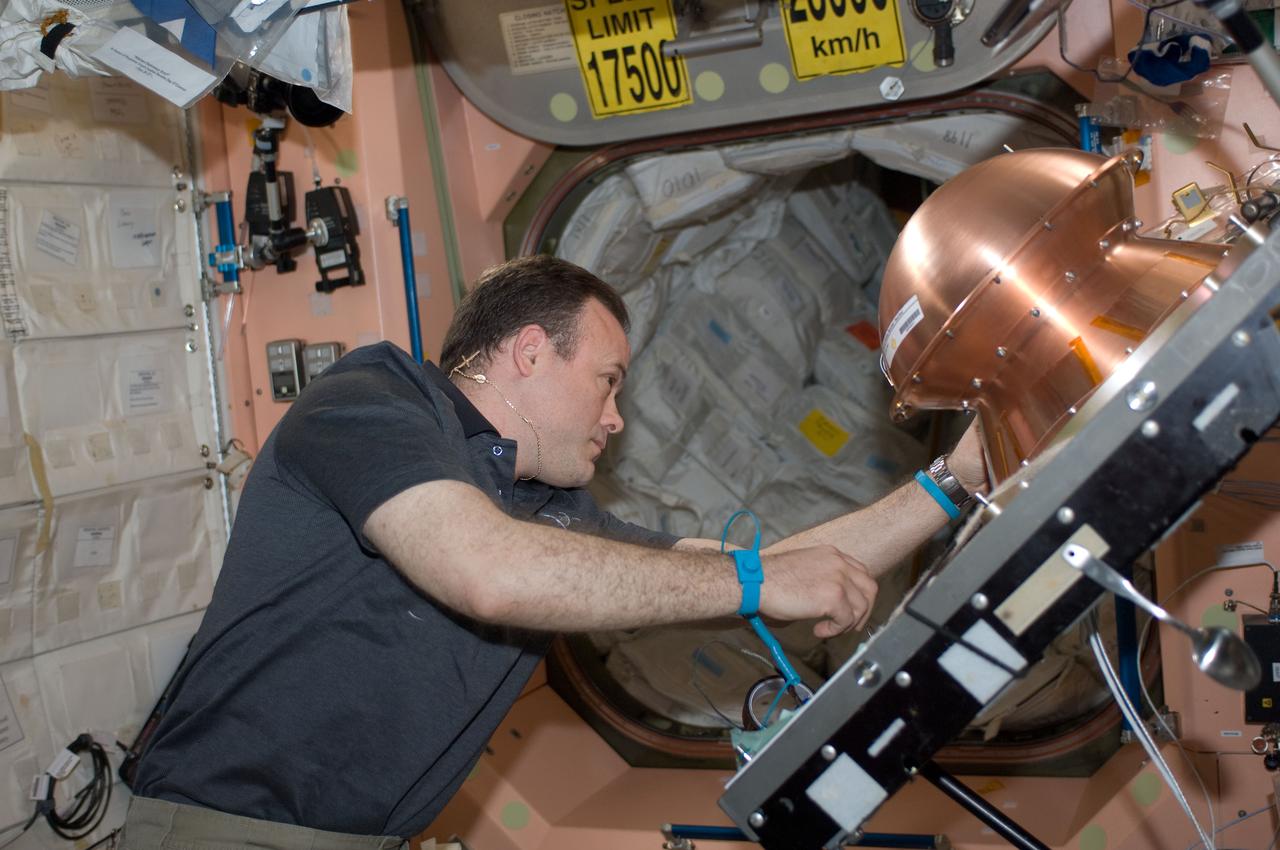
ISS028-E-008470 (19 June 2011) --- In the Unity node of the International Space Station, NASA astronaut Ron Garan, Expedition 28 flight engineer, prepares the Reentry Breakup Recorder (REBR) for installation in the Automated Transfer Vehicle-2 (ATV-2). The ATV-2 is scheduled to undock from the station on June 20, 2011. REBR data improves the understanding of vehicle breakup during reentry, allowing improvements in prediction of the breakup process, increasing the accuracy of estimated casualty expectations, and limiting premature deorbiting of space hardware. In the long term, this research assists in the development of a "black box" for commercial space transportation systems.
Expedition 28 FE Garan prepares the REBR for Installation in the ATV-2
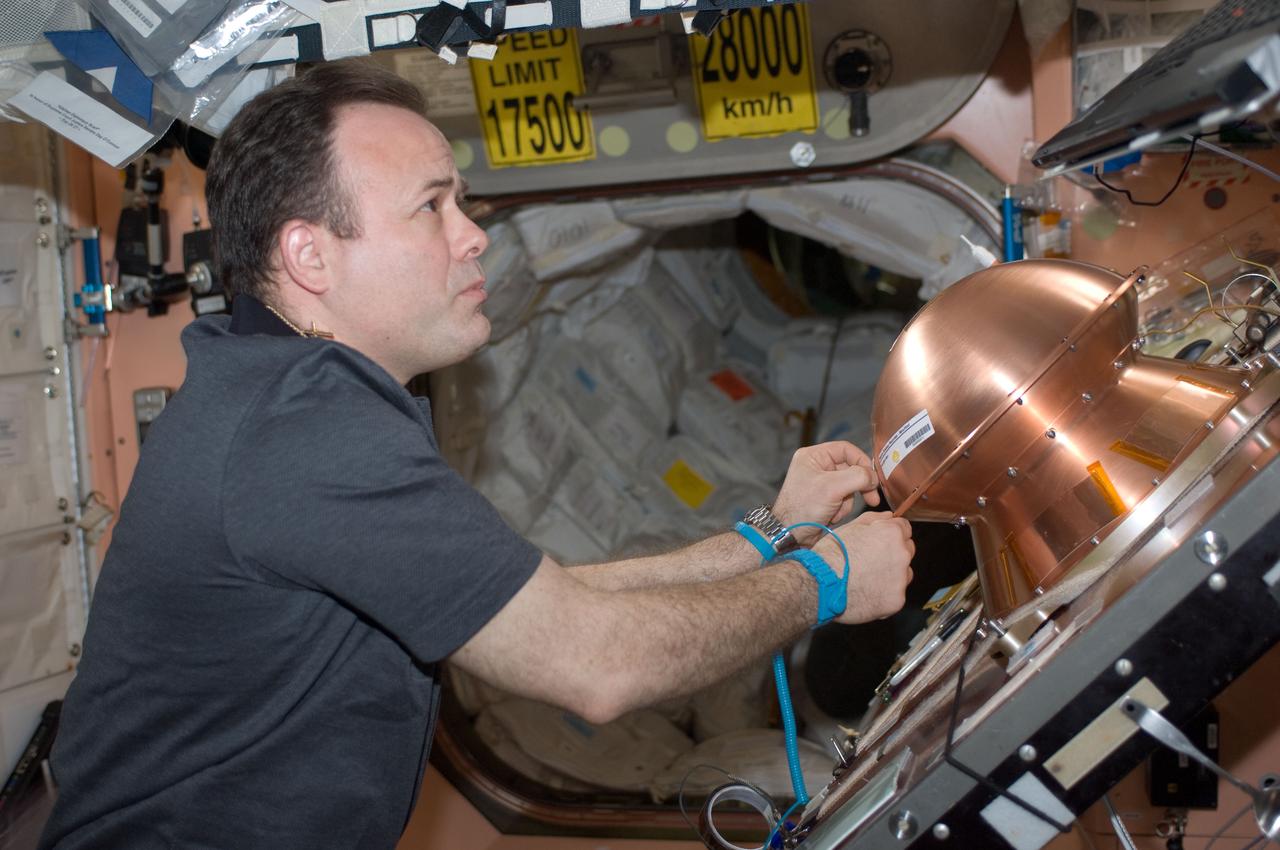
ISS028-E-008464 (19 June 2011) --- In the Unity node of the International Space Station, NASA astronaut Ron Garan, Expedition 28 flight engineer, prepares the Reentry Breakup Recorder (REBR) for installation in the Automated Transfer Vehicle-2 (ATV-2). The ATV-2 is scheduled to undock from the station on June 20, 2011. REBR data improves the understanding of vehicle breakup during reentry, allowing improvements in prediction of the breakup process, increasing the accuracy of estimated casualty expectations, and limiting premature deorbiting of space hardware. In the long term, this research assists in the development of a "black box" for commercial space transportation systems.
Expedition 28 FE Garan prepares the REBR for Installation in the ATV-2
 A hot jet research facility, used extensively in the design and development of the reentry heat shield on the Project Mercury spacecraft. The electrically-heated arc jet simulates the friction heating encountered by a space vehicle as it returns to the earth's atmosphere at high velocities. The arc jet was located in Langley's Structures Research Laboratory. It was capable of heating the air stream to about 9,000 degrees F. -- Published in Taken from an October 5, 1961 press release entitled:  Hot Jet Research Facility used in Reentry Studies will be demonstrated at NASA Open House, October 7.
Arc Furnace Mercury Capsule
ISS028-E-008463 (19 June 2011) --- In the Unity node of the International Space Station, NASA astronaut Ron Garan, Expedition 28 flight engineer, prepares the Reentry Breakup Recorder (REBR) for installation in the Automated Transfer Vehicle-2 (ATV-2). The ATV-2 is scheduled to undock from the station on June 20, 2011. REBR data improves the understanding of vehicle breakup during reentry, allowing improvements in prediction of the breakup process, increasing the accuracy of estimated casualty expectations, and limiting premature deorbiting of space hardware. In the long term, this research assists in the development of a "black box" for commercial space transportation systems.
Expedition 28 FE Garan prepares the REBR for Installation in the ATV-2
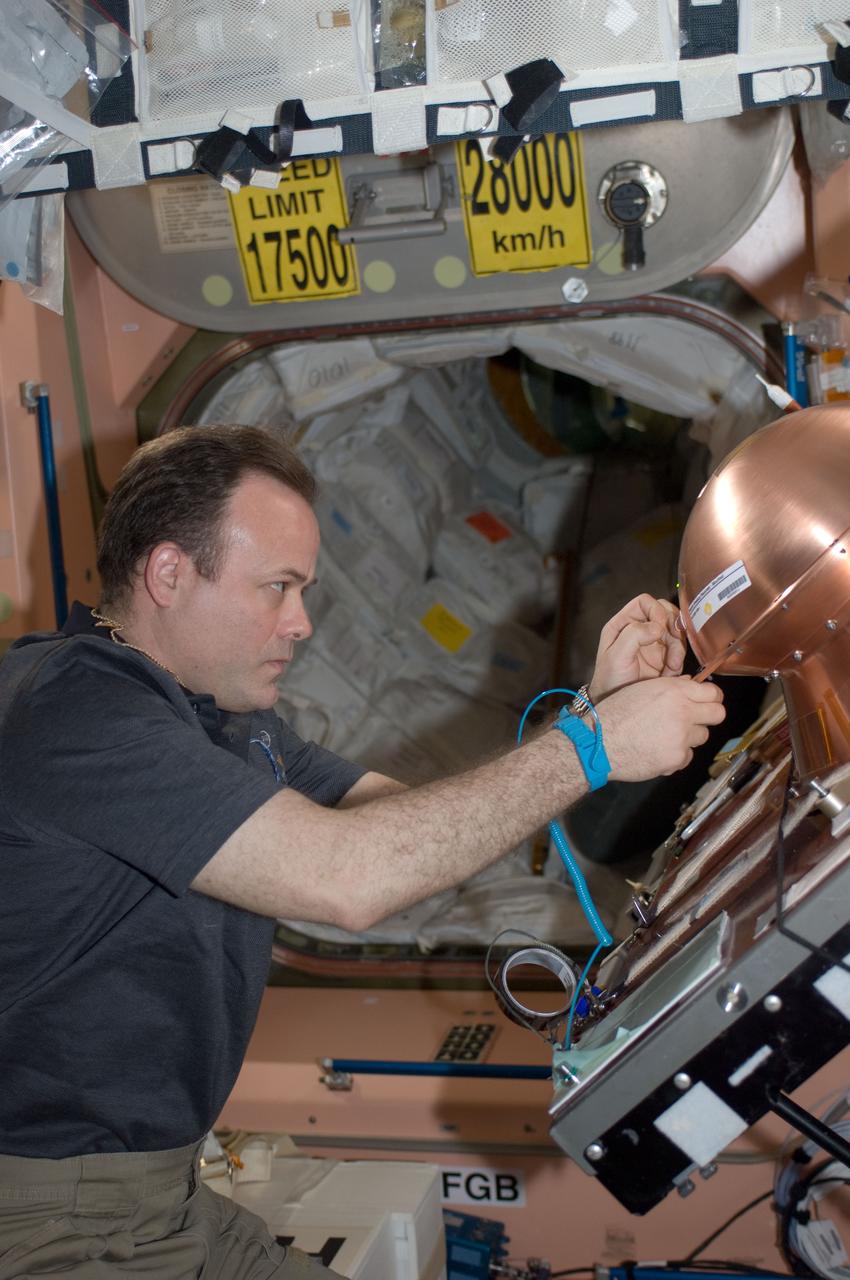
ISS028-E-008467 (19 June 2011) --- In the Unity node of the International Space Station, NASA astronaut Ron Garan, Expedition 28 flight engineer, prepares the Reentry Breakup Recorder (REBR) for installation in the Automated Transfer Vehicle-2 (ATV-2). The ATV-2 is scheduled to undock from the station on June 20, 2011. REBR data improves the understanding of vehicle breakup during reentry, allowing improvements in prediction of the breakup process, increasing the accuracy of estimated casualty expectations, and limiting premature deorbiting of space hardware. In the long term, this research assists in the development of a "black box" for commercial space transportation systems.
Expedition 28 FE Garan prepares the REBR for Installation in the ATV-2
KENNEDY SPACE CENTER, FLA. -  While Jay Beason (left), with United Space Alliance,  looks on, Jeremy Schwarz (front) and Tom Summers (behind), also with USA, place new tiles on the heat shield of main engine 1 for the orbiter Discovery.  A heat shield is a protective layer on a spacecraft designed to protect it from the high temperatures, usually those that result from aerobraking during reentry into the Earth’s atmosphere.
KENNEDY SPACE CENTER, FLA. - While Jay Beason (left), with United Space Alliance, looks on, Jeremy Schwarz (front) and Tom Summers (behind), also with USA, place new tiles on the heat shield of main engine 1 for the orbiter Discovery. A heat shield is a protective layer on a spacecraft designed to protect it from the high temperatures, usually those that result from aerobraking during reentry into the Earth’s atmosphere.
KENNEDY SPACE CENTER, FLA. -  United Space Alliance employees Jeremy Schwarz (left) and Chris Keeling install new tiles on the heat shield of main engine 1 for the orbiter Discovery.  A heat shield is a protective layer on a spacecraft designed to protect it from the high temperatures, usually those that result from aerobraking during reentry into the Earth’s atmosphere.
KENNEDY SPACE CENTER, FLA. - United Space Alliance employees Jeremy Schwarz (left) and Chris Keeling install new tiles on the heat shield of main engine 1 for the orbiter Discovery. A heat shield is a protective layer on a spacecraft designed to protect it from the high temperatures, usually those that result from aerobraking during reentry into the Earth’s atmosphere.
KENNEDY SPACE CENTER, FLA. -  United Space Alliance employees (from left) Daryl Burke, Jay Beason and Tom Summers check new tiles installed on the heat shield of main engine 1 for the orbiter Discovery.  A heat shield is a protective layer on a spacecraft designed to protect it from the high temperatures, usually those that result from aerobraking during reentry into the Earth’s atmosphere.
KENNEDY SPACE CENTER, FLA. - United Space Alliance employees (from left) Daryl Burke, Jay Beason and Tom Summers check new tiles installed on the heat shield of main engine 1 for the orbiter Discovery. A heat shield is a protective layer on a spacecraft designed to protect it from the high temperatures, usually those that result from aerobraking during reentry into the Earth’s atmosphere.
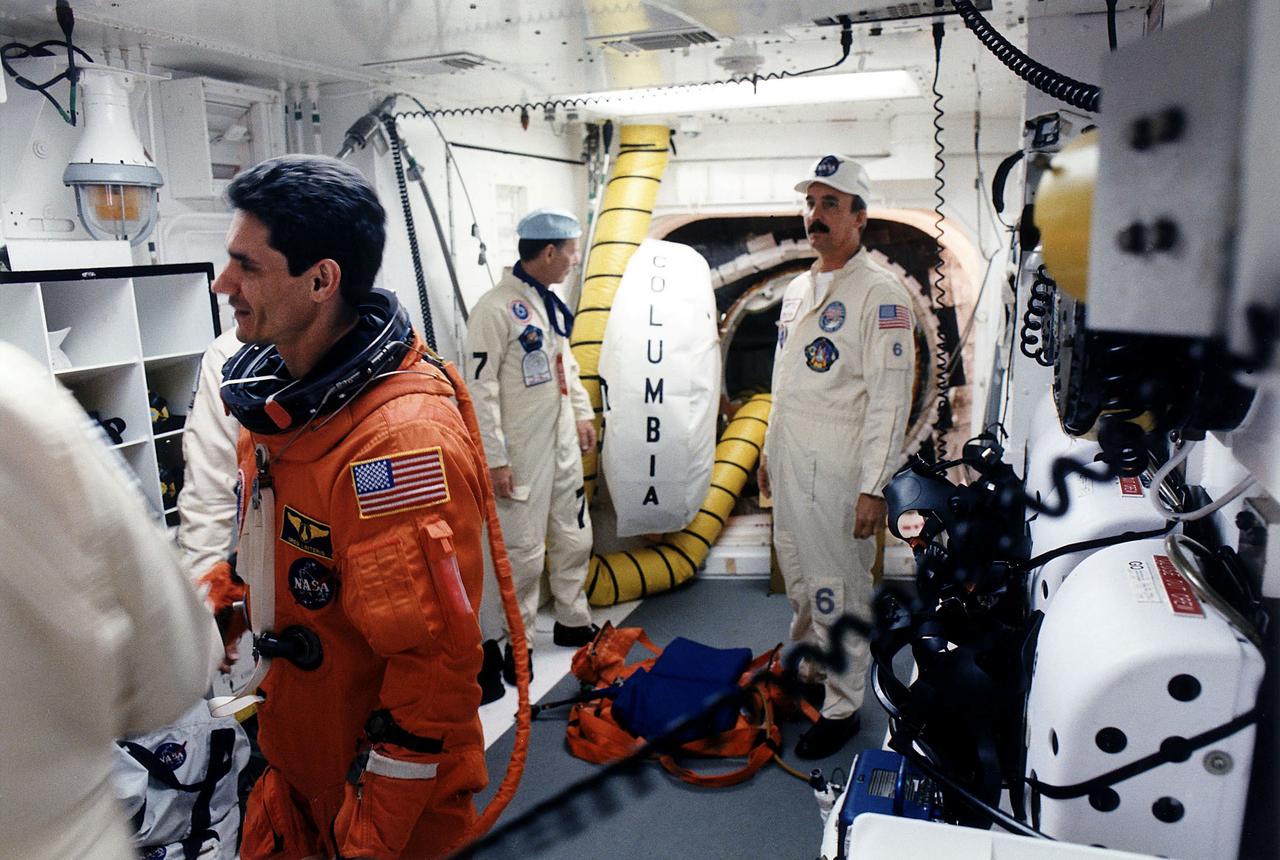
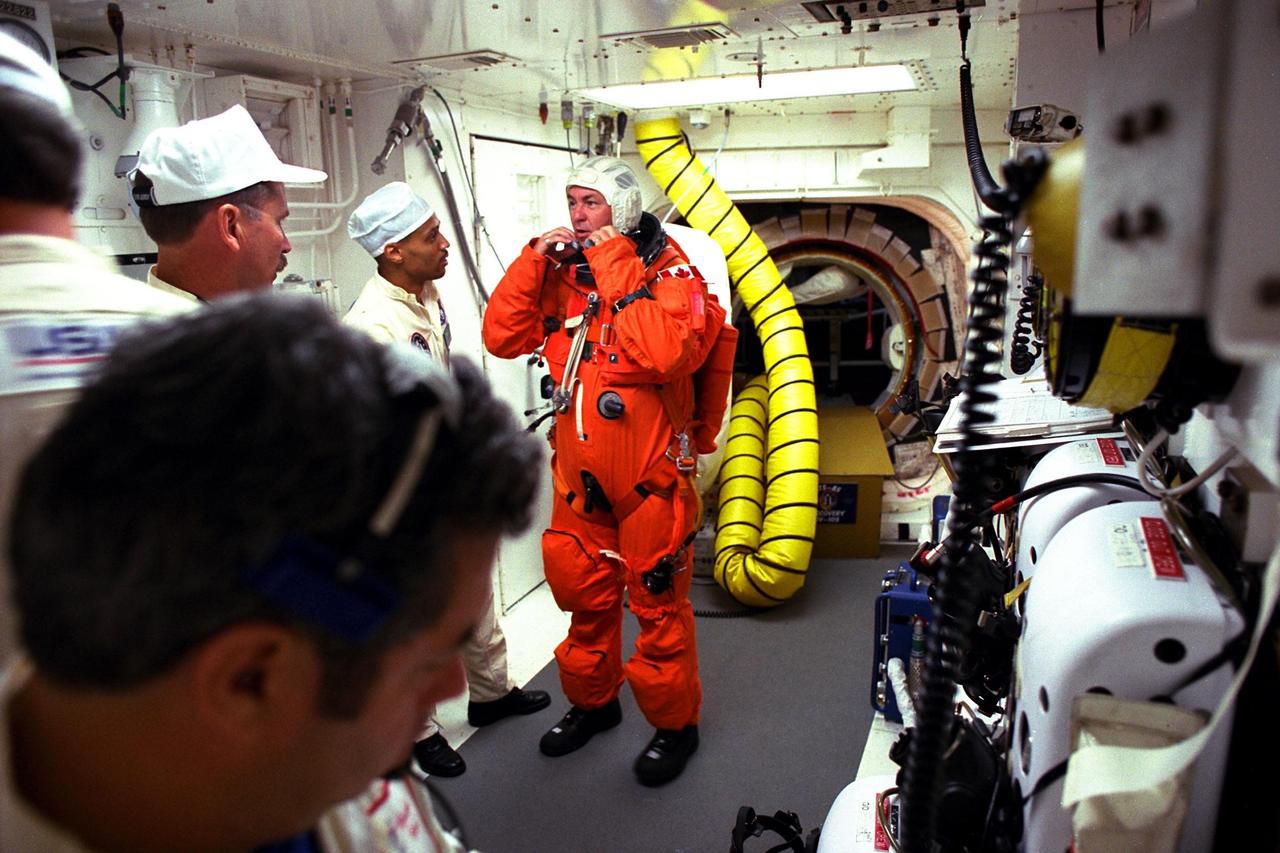
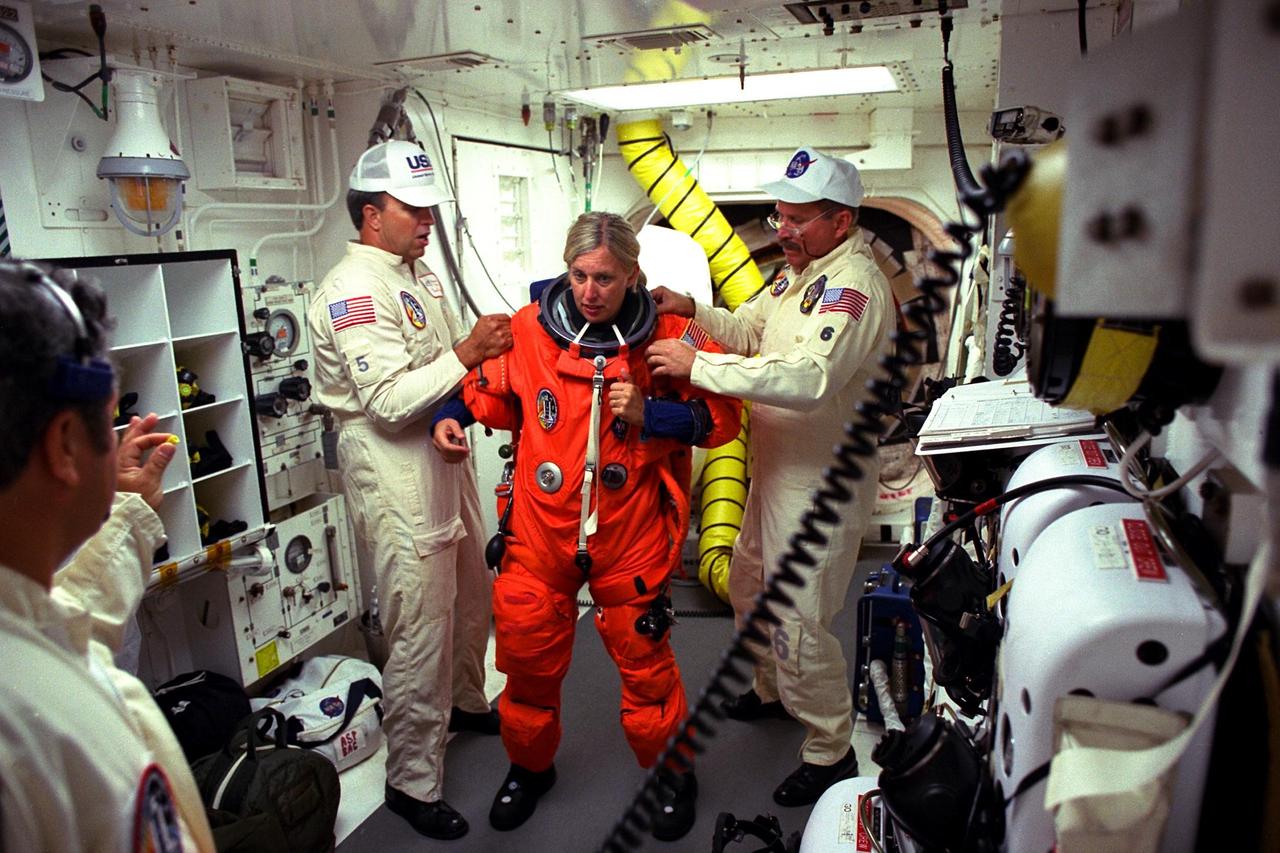
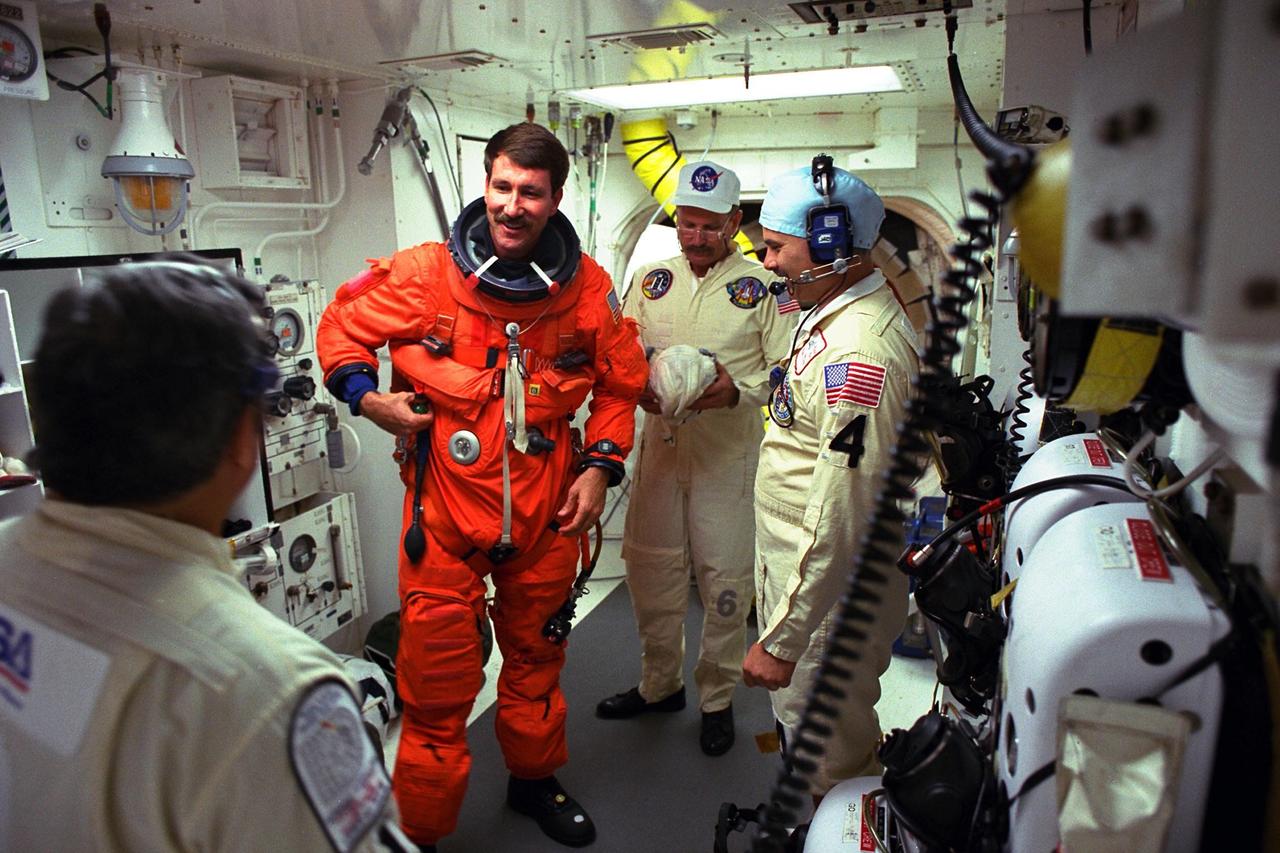
KENNEDY SPACE CENTER, FLA. - STS-83 Payload Specialist Gregory T. Linteris chats with White Room closeout crew members as he prepares to enter the Space Shuttle Columbia at Launch Pad 39A. Closeout crew workers Max Kandler (second from right) and Bob Saulnier wait to assist Linteris with his ascent/reentry suit.
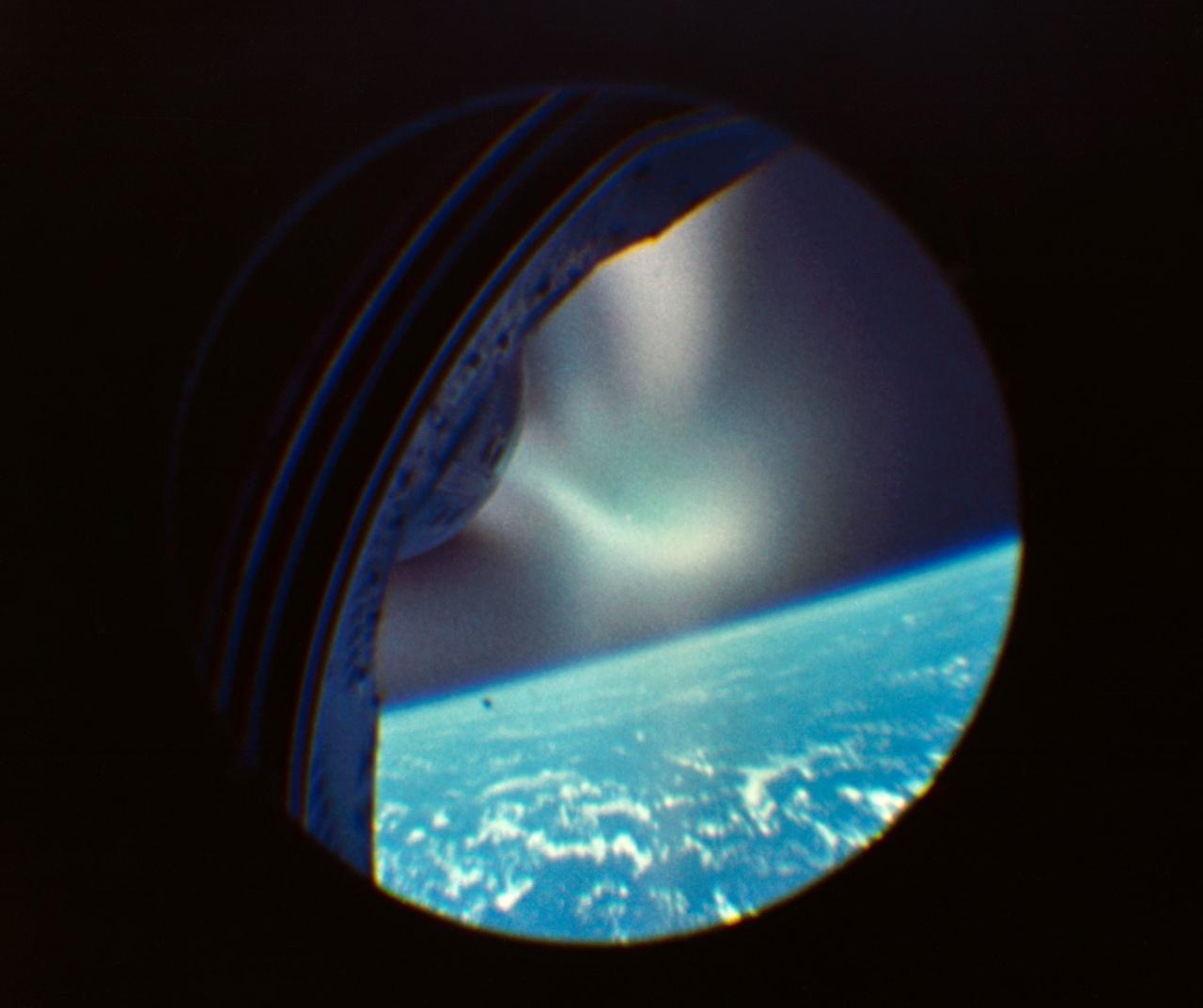
This photograph is an enlargement of a frame from a 16mm motion picture film which was mounted within the spacecraft to take film through the hatch window.             CAPE KENNEDY, FL                       CN
REENTRY - GEMINI-TITAN (GT)-2 - CAPE
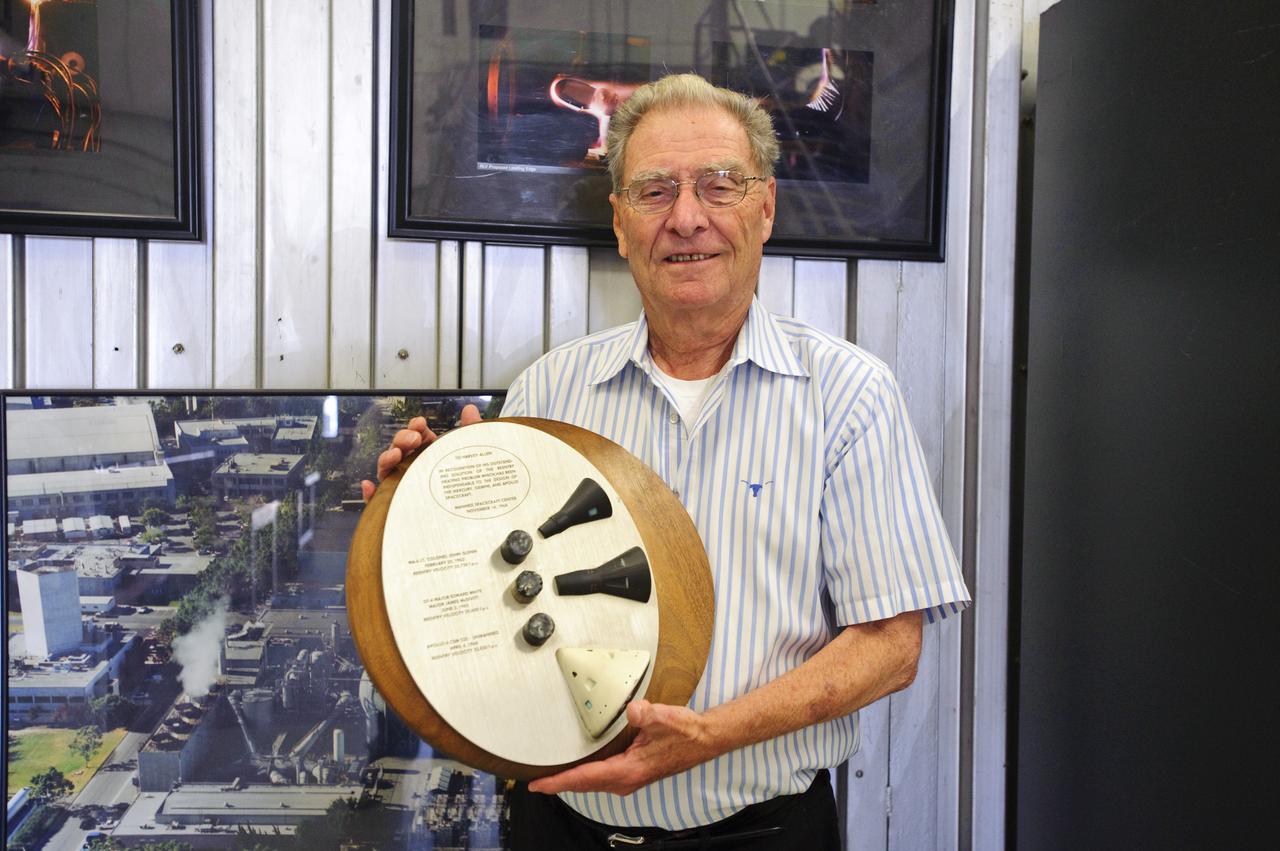
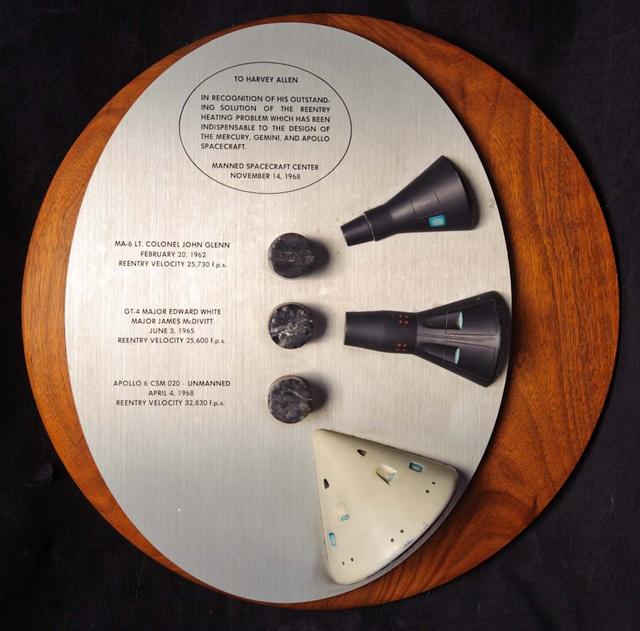
John W. 'Jack Boyd holds a plaque presented to Harvey Allen in recognition of his outstanding solution of the reentry heating problem which has been indispensable to the design of the Mercury, Gemini, and Apollo spacecraft  (Manned Spacecraft Center, November 14, 1968) Plaque contains samples of tested materials and models of spacecraft.
ARC-2009-ACD09-0141-001
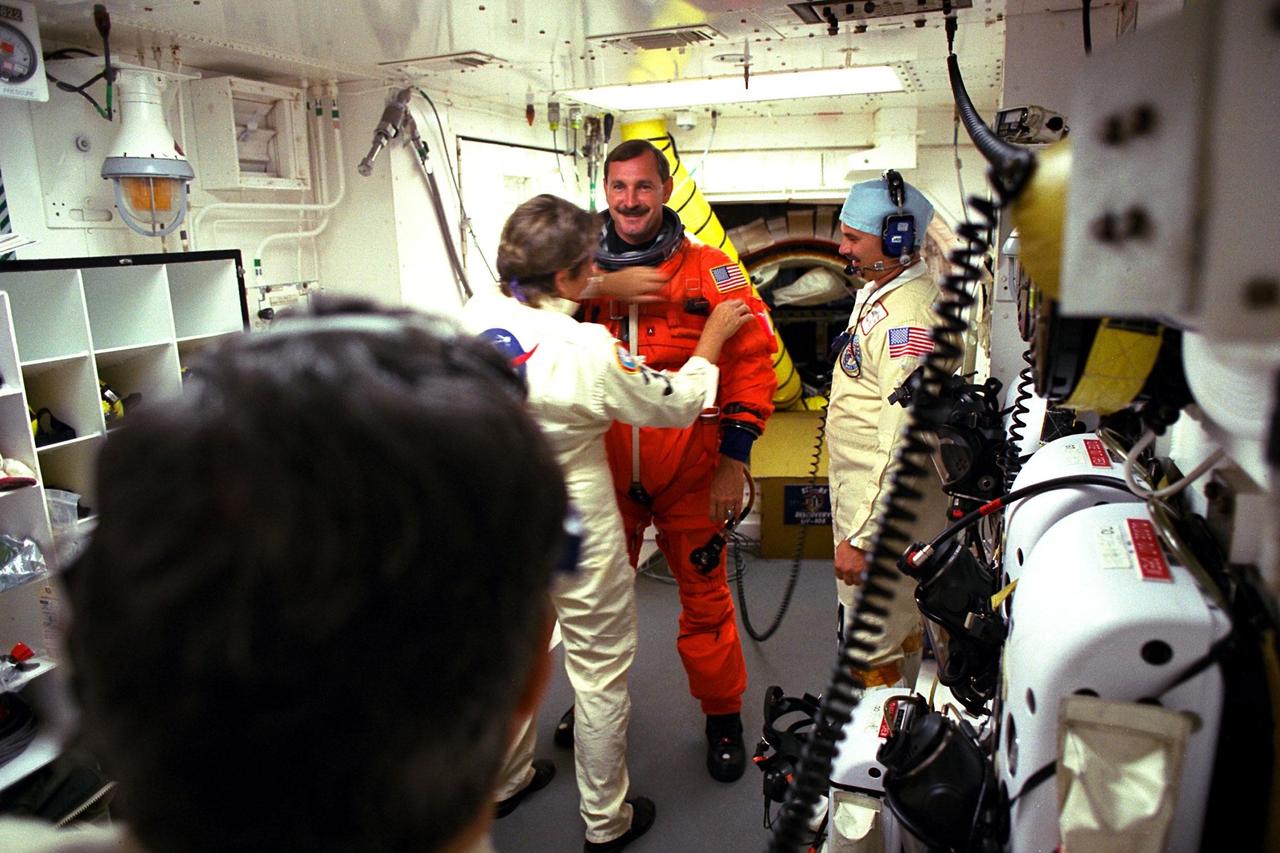
STS-85 Commander Curtis L. Brown, Jr. is assisted with his ascent/reentry flight suit by white room closeout crew members Jean Alexander (left) and Chris Meinert at Launch Pad 39A before he enters the crew cabin of the Space Shuttle orbiter Discovery
KSC-97PC1211
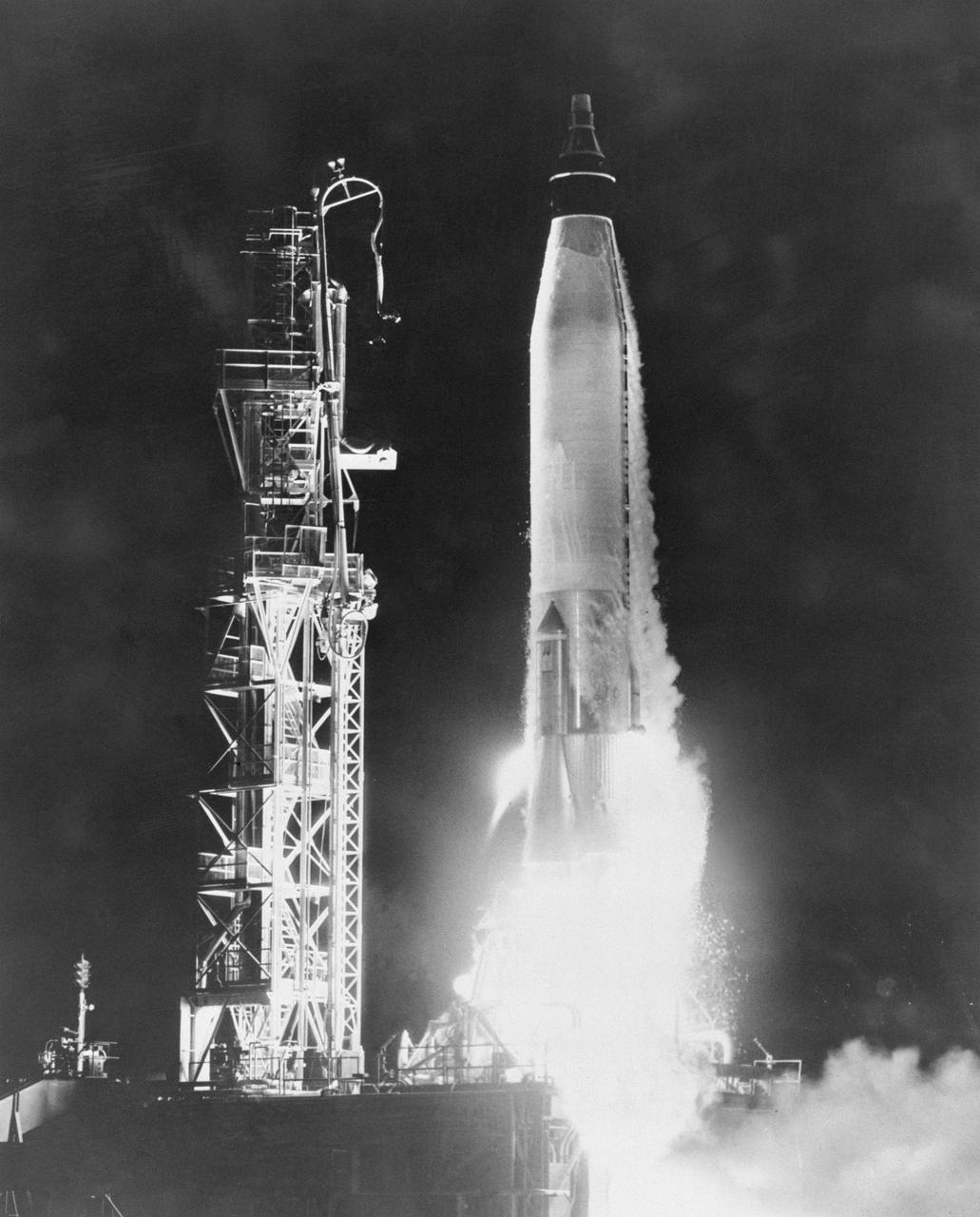
B59-00557 (9 Sept. 1959) --- U.S. Air Force photo of Big Joe launch vehicle after launching at Cape Canaveral, Florida, for a suborbital test of the Mercury capsule. The capsule was recovered successfully after the reentry test. Photo credit: NASA
b59-00557
art002e026149 (April 7, 2026) - NASA astronaut Christina Koch and CSA (Canadian Space Agency) astronaut Jeremy Hansen looking at the crew displays inside the Orion spacecraft. These screens are what the commander and pilot monitor during launch and reentry.
Life in Orion during the Artemis II Mission
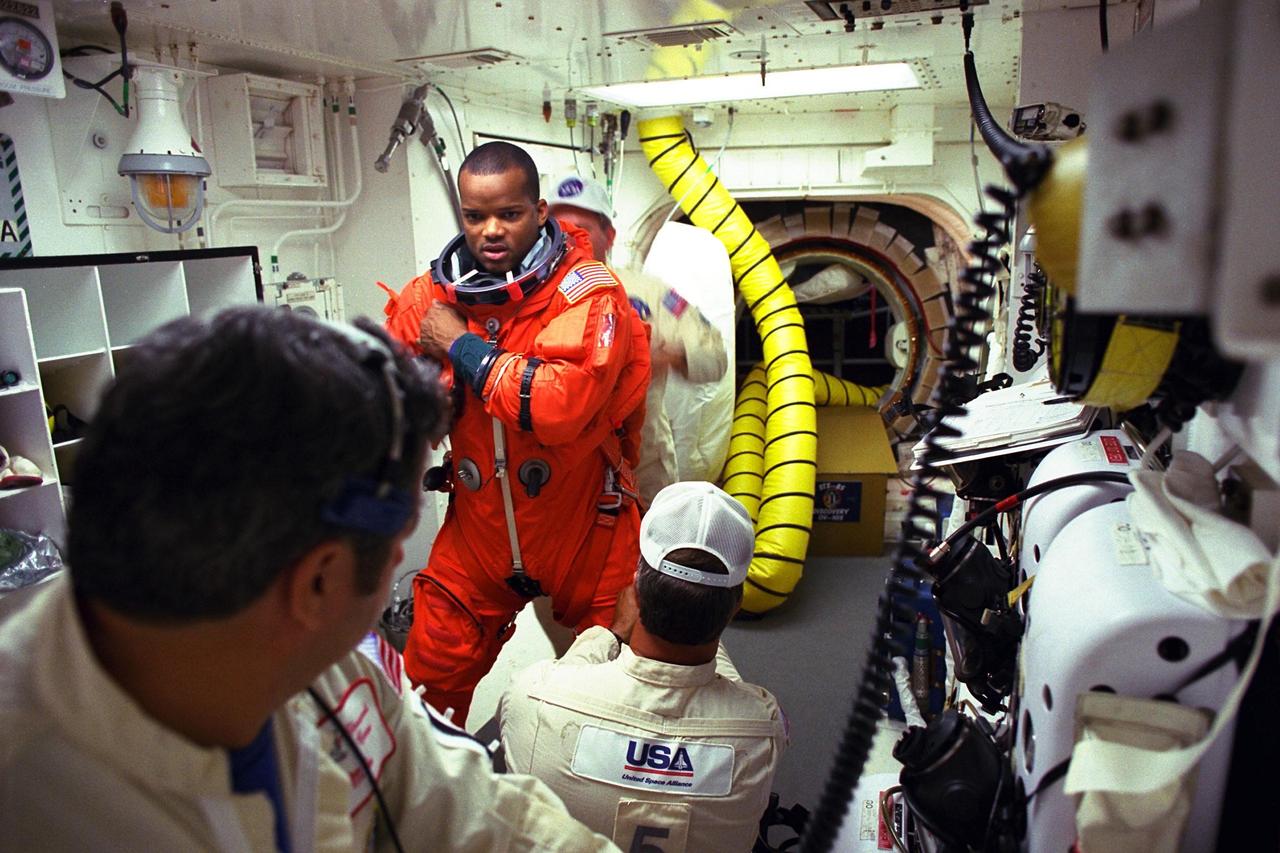
STS-85 Payload Specialist Bjarni V. Tryggvason is assisted with his ascent/reentry flight suit by white room closeout crew members Jack Burritt and Carlos Gillis at Launch Pad 39A before he enters the crew cabin of the Space Shuttle orbiter Discovery
KSC-97PC1214
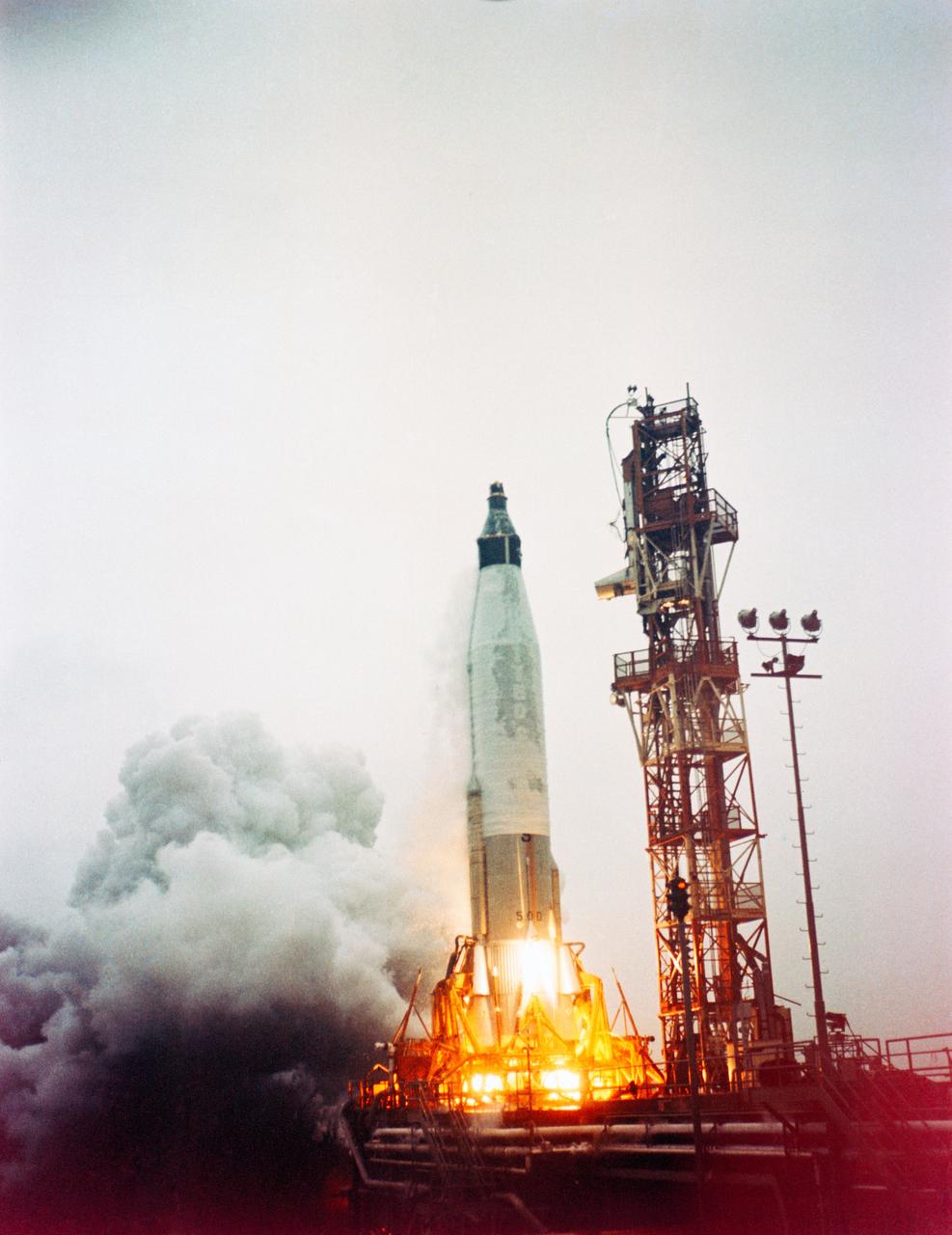
S61-01205 (29 July 1960) --- Launch of the unmanned Mercury Atlas-1 (MA-1) spacecraft for a suborbital test flight of the Mercury capsule reentry, which did not achieve orbit. The Atlas exploded 65 seconds after launch. Photo credit: NASA
LIFTOFF
L57-700 In the reentry flight path of this nose cone model of a Jupiter Intermediate range ballistic missile (IRBM) was tested in the Unitary Plan Wind Tunnel. Photograph published in Engineer in Charge: A History of the Langley Aeronautical Laboratory, 1917-1958 by James R. Hansen. Page 475.
IRBM in Unitary Plan Wind Tunnel
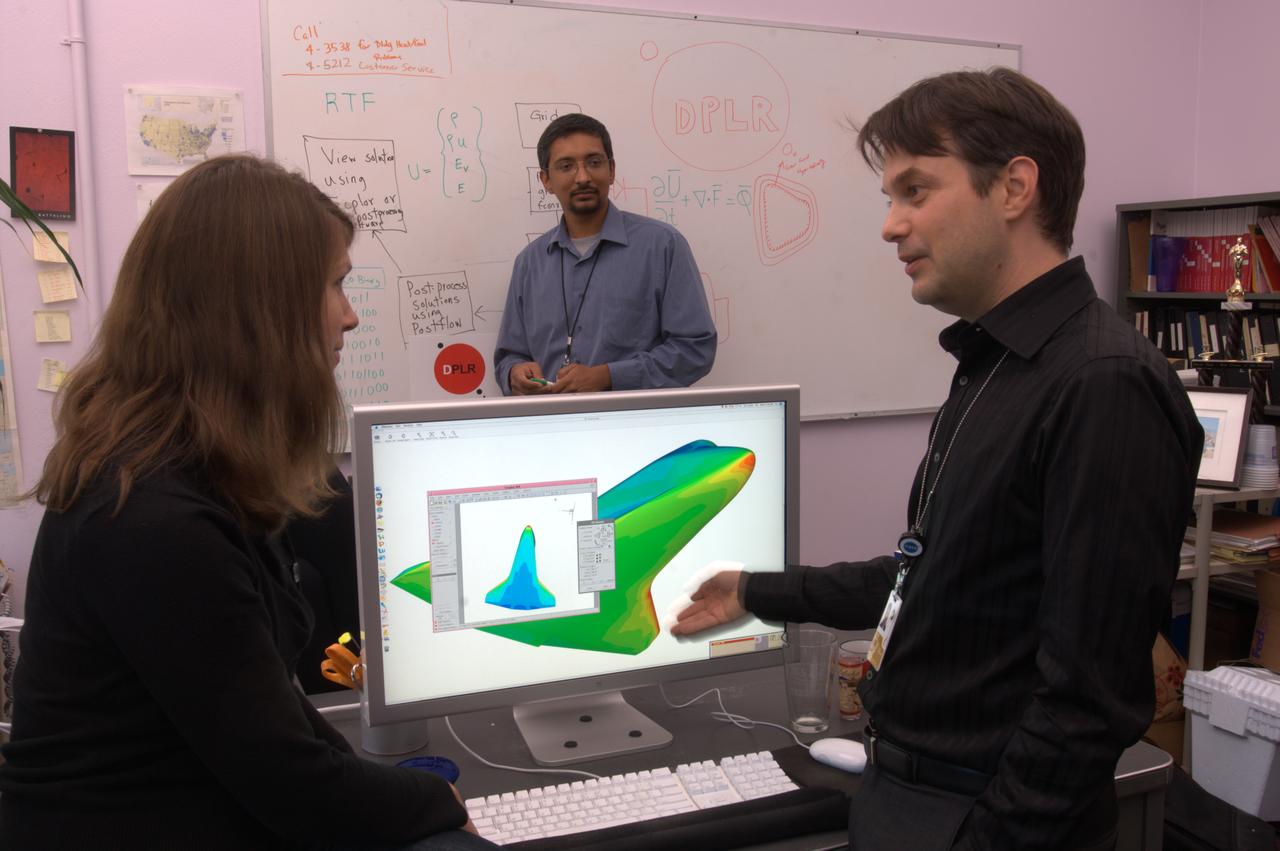
From left: Data Parallel Line Relaxation (DPLR) software team members Kerry Trumble, Deepak Bose and David Hash analyze and predict the extreme environments NASA's space shuttle experiences during its super high-speed reentry into Earth’s atmosphere.
ARC-2007-ACD07-0184-003
STS-85 Payload Commander N. Jan Davis is assisted with her ascent/reentry flight suit by white room closeout crew members Dave Law (left) and Jack Burritt at Launch Pad 39A before she enters the crew cabin of the Space Shuttle orbiter Discovery
KSC-97PC1215
A plaque presented to Harvey Allen in recognition of his outstanding solution of the reentry heating problem which has been indispensable to the design of the Mercury, Gemini, and Apollo spacecraft  (Manned Spacecraft Center, November 14, 1968) Plaque contains samples of tested materials and models of spacecraft.
ARC-2009-ACD09-0141-006
B59-00556 (9 Sept. 1959) --- U.S. Air Force photo of Big Joe launch vehicle after launching at Cape Canaveral, Florida, for a suborbital test of the Mercury capsule. The capsule was recovered successfully after the reentry test. Photo credit: NASA
Big Joe launch vehicle after launching at Cape Canaveral
STS-85 Mission Specialist Robert L. Curbeam, Jr. is assisted with his ascent/reentry flight suit by white room closeout crew members Mike Mangione (left foreground) and Dave Law at Launch Pad 39A before he enters the crew cabin of the Space Shuttle orbiter Discovery
KSC-97PC1216
STS-85 Pilot Kent V. Rominger visits with white room closeout crew members Mike Mangione (left foreground), Jack Burritt (center), and Chris Meinert at Launch Pad 39A as they assist him with his ascent/reentry flight suit before he enters the crew cabin of the Space Shuttle orbiter Discovery
KSC-97PC1213
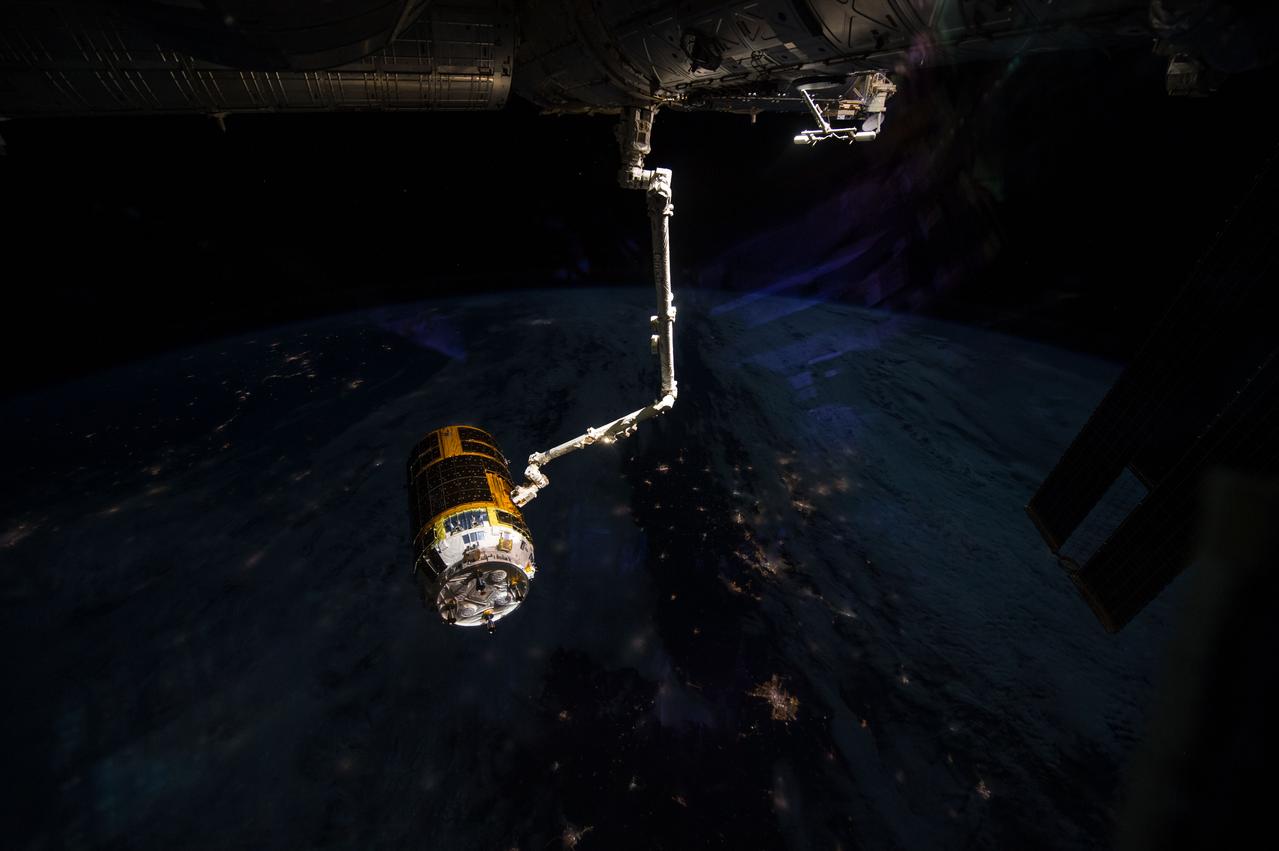
The unberthed Kounotori H-II Transfer Vehicle 5 (HTV-5) is grappled by the Canadarm2 Space Station Remote Manipulator System (SSRMS) prior to its release for reentry. This image is part of a time lapse sequence (iss045e125963 through iss045e126960) taken at a rate of 12 frames per minute. Image was released by astronaut on social media.
Unberthed HTV-5 grappled by SSRMS
KENNEDY SPACE CENTER, FLA. -  Dan Phillips (left) and Donald Nielen, with United Space Alliance, look at the results of flash thermography on a Reinforced Carbon Carbon panel.  A relatively new procedure at KSC, thermography uses high intensity light to heat areas of the panels. The panels are then immediately scanned with an infrared camera. As the panels cool, any internal flaws are revealed. The gray carbon composite RCC panels are attached to the leading edge of the wing of the orbiters.  They have sufficient strength to withstand the aerodynamic forces experienced during launch and reentry, which can reach as high as 800 pounds per square foot.  The operating range of RCC is from minus 250º F to about 3,000º F, the temperature produced by friction with the atmosphere during reentry.  The panels will be installed on the orbiter Discovery, designated  for the first Return to Flight mission, STS-114.
KSC-04pd0448
KENNEDY SPACE CENTER, FLA. -  Jim Landy, NDE specialist with USA, looks closely at an area of a Reinforced Carbon Carbon panel just examined using flash thermography. A relatively new procedure at KSC, thermography uses high intensity light to heat areas of the panels. The panels are then immediately scanned with an infrared camera. As the panels cool, any internal flaws are revealed. The gray carbon composite RCC panels are attached to the leading edge of the wing of the orbiters.  They have sufficient strength to withstand the aerodynamic forces experienced during launch and reentry, which can reach as high as 800 pounds per square foot.  The operating range of RCC is from minus 250º F to about 3,000º F, the temperature produced by friction with the atmosphere during reentry.  The panels will be installed on the orbiter Discovery, designated for the first Return to Flight mission, STS-114.
KSC-04pd0450
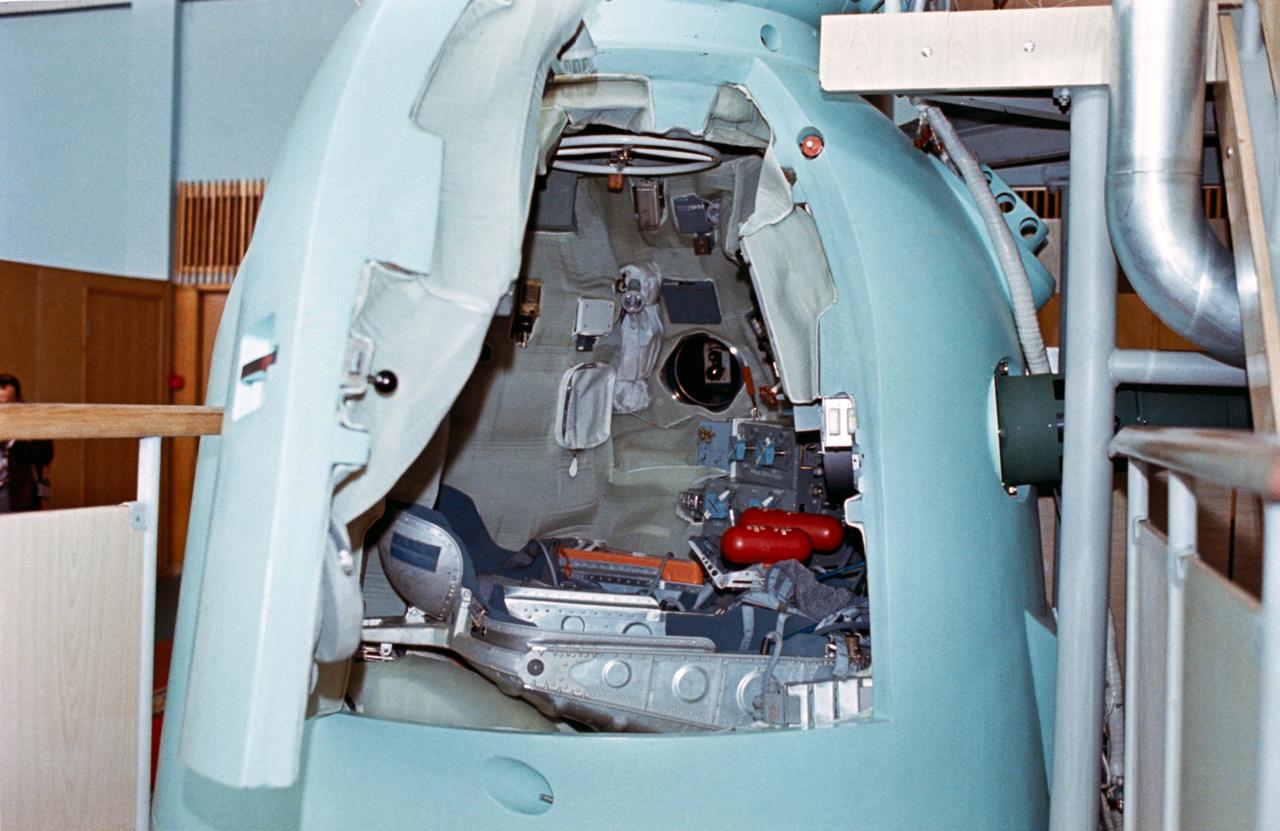
S74-24677 (June 1974) --- A close-up view of the descent vehicle of the Soyuz spacecraft training mock-up on display at the Cosmonuat Training Center (Star City) near Moscow. The open hatch reveals the interior arrangement of the middle section of the Soviet spacecraft. The first (fore) section of the Soyuz is called the orbital module; and the third (aft) section is the instrument-assembly module. The joint U.S.-USSR Apollo-Soyuz docking mission in Earth orbit is scheduled for the summer of 1975.
Close-up view of descent vehicle of Soyuz spacecraft training mock-up
Disant view of 53P Progress burn up over the Earth's surface as seen by the Expedition 40 crew.
53P Progress burn up
STS064-06-028 (9-20 Sept. 1994) --- On the space shuttle Discovery's flight deck, two thirds of the crew prepare for one of four hard efforts (in a two-day period) to de-orbit and complete the extended spaceflight.  Manning the commander's station and wearing one of the launch and entry suits is astronaut Richard N. Richards, STS-64 mission commander. At the pilot's station is astronaut Susan J. Helms, mission specialist. Astronaut L. Blaine Hammond, pilot, is at left foreground, and astronaut Carl J. Meade, mission specialist, is at left background in the hatch leading to the middeck. Photo credit: NASA or National Aeronautics and Space Administration
STS-64 crew prepare to de-orbit and complete extended mission
STS062-41-025 (18 March 1994)  --- Astronaut Andrew M. Allen monitors Columbia's systems from the pilot's station during the entry phase of the STS-62 mission.  The fast-speed 35mm film highlights the many controls and displays and the cathode ray tubes on the forward flight deck.
Astronaut Andrew Allen monitors Columbia's systems from pilots station
S67-49447 (9 Nov. 1967) --- Close-up view of the charred heat shield of the Apollo Spacecraft 017 Command Module aboard the USS Bennington. The damage was caused by the extreme heat of reentry. The carrier Bennington was the prime recovery ship for the Apollo 4 (Spacecraft 017/Saturn 501) unmanned, Earth-orbital space mission. Splashdown occurred at 3:37 p.m. (EST), Nov. 9, 1967, 934 nautical miles northwest of Honolulu, Hawaii.
APOLLO SPACECRAFT 017 - RECOVERY - ATLANTIC