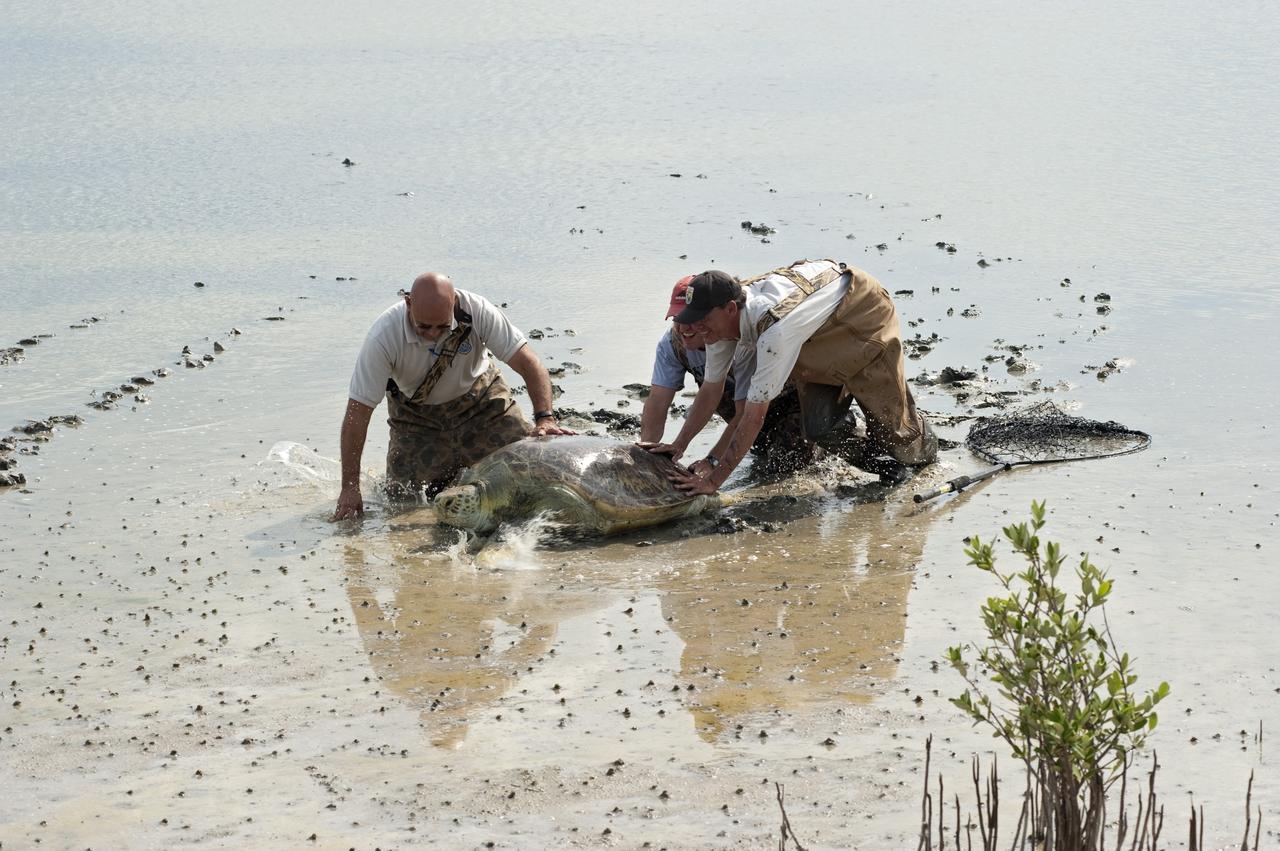
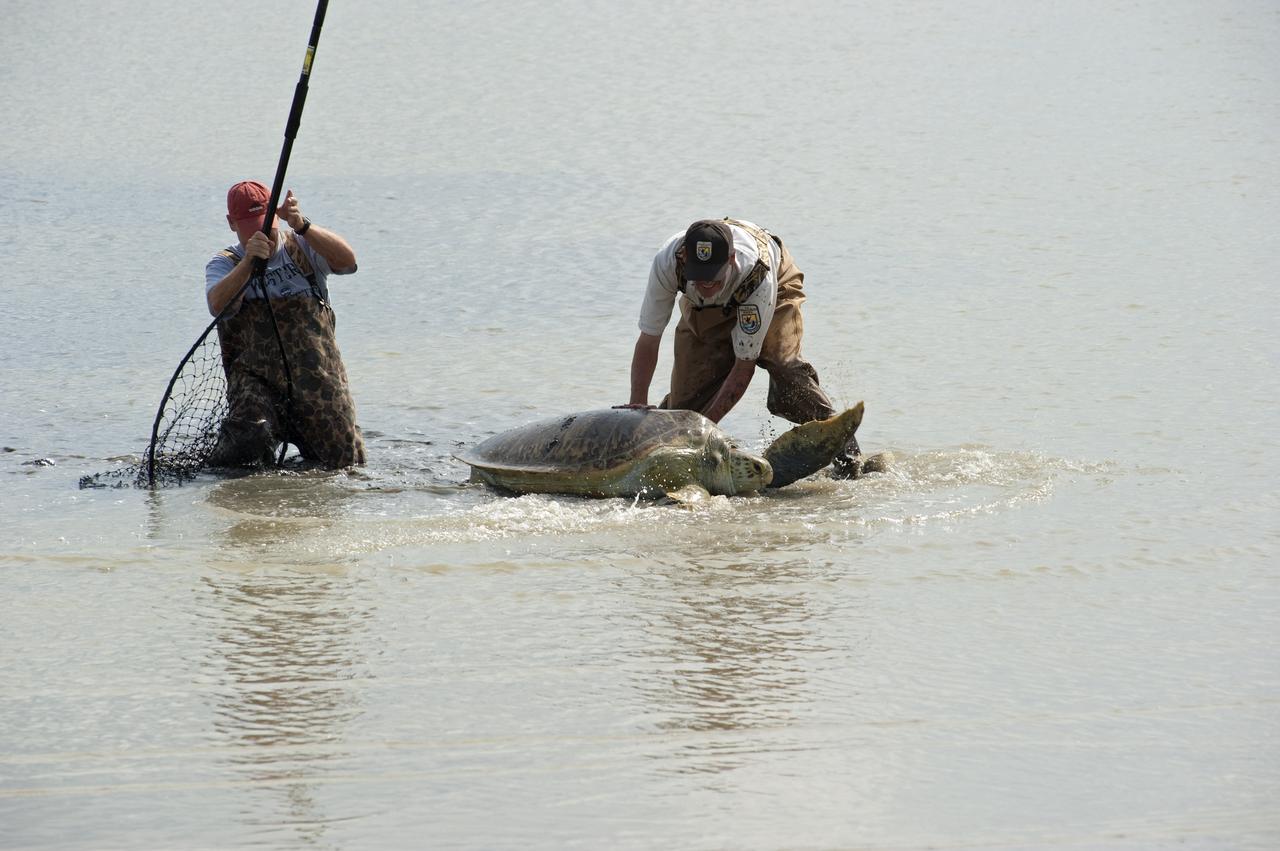
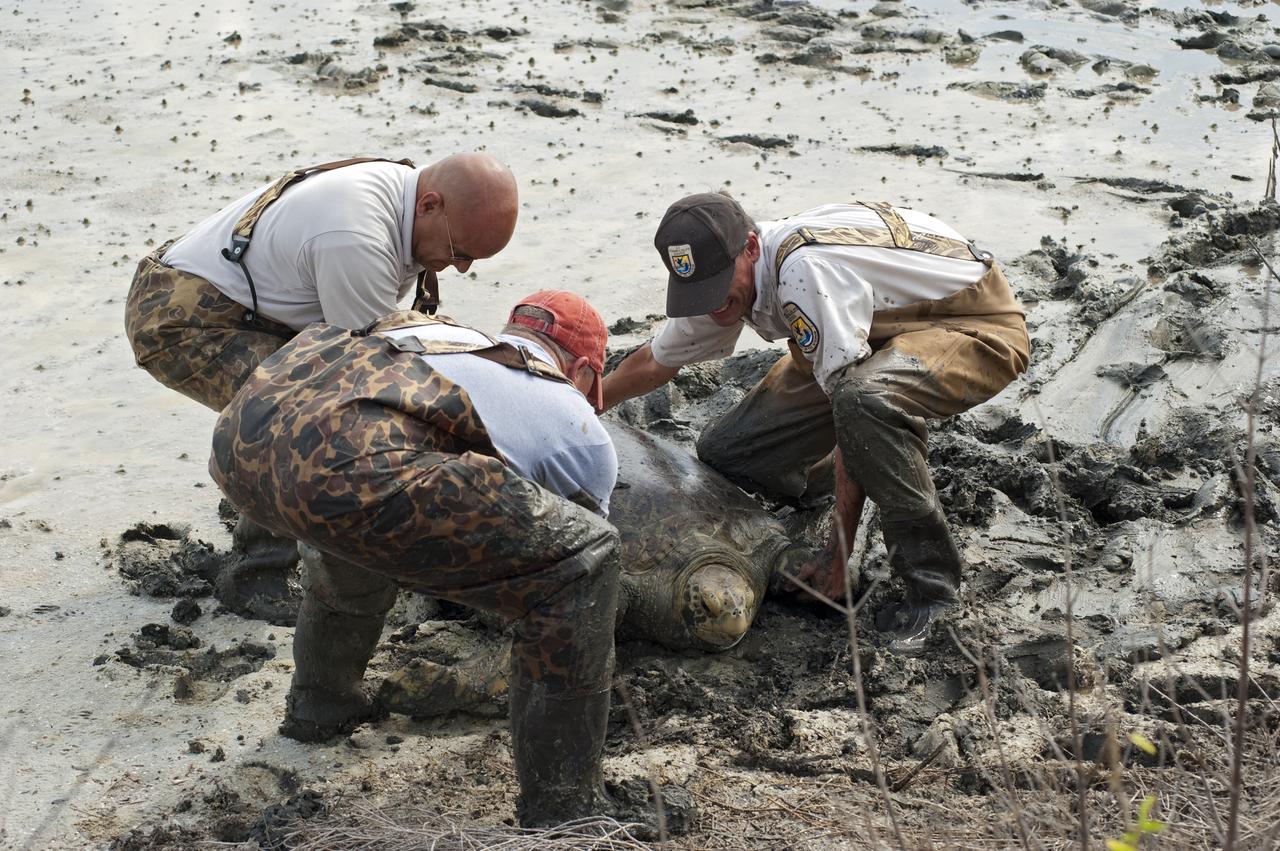
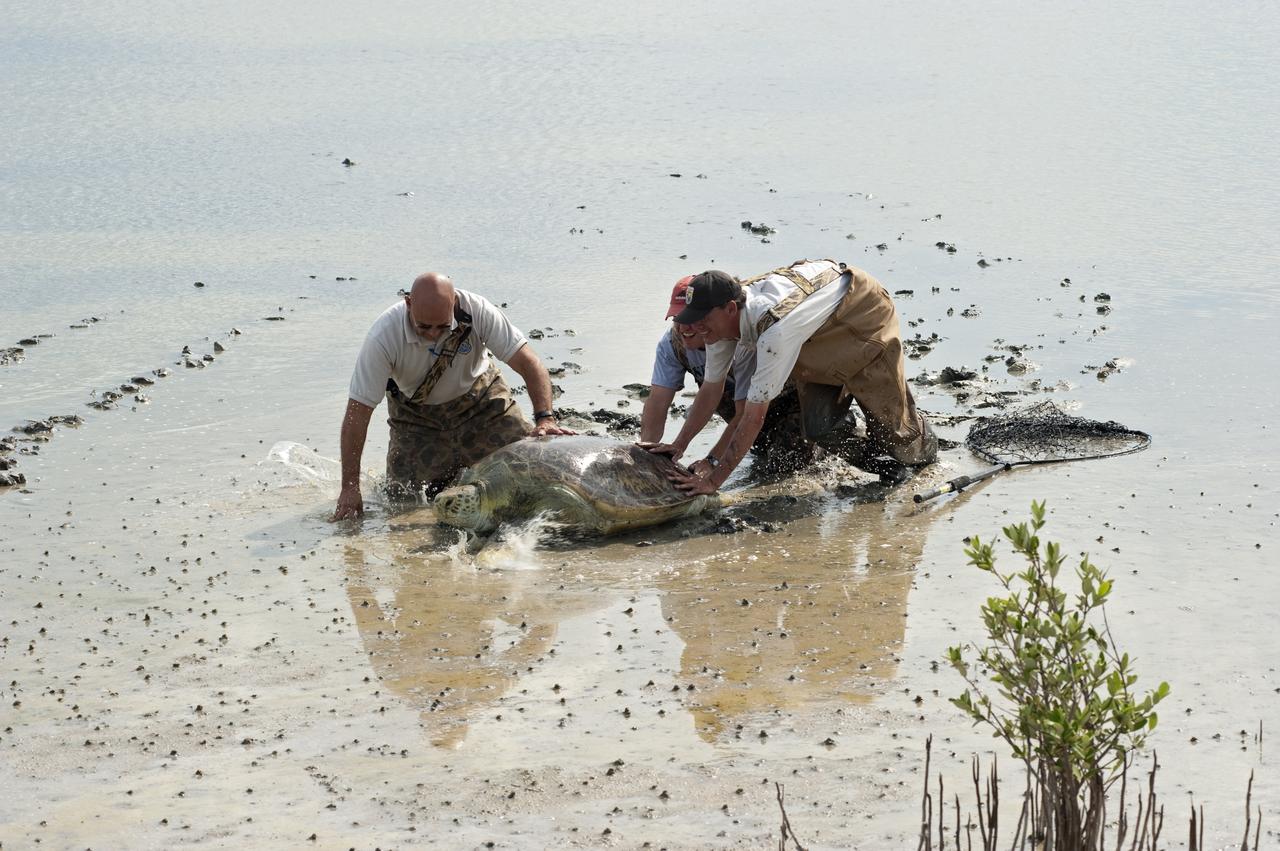
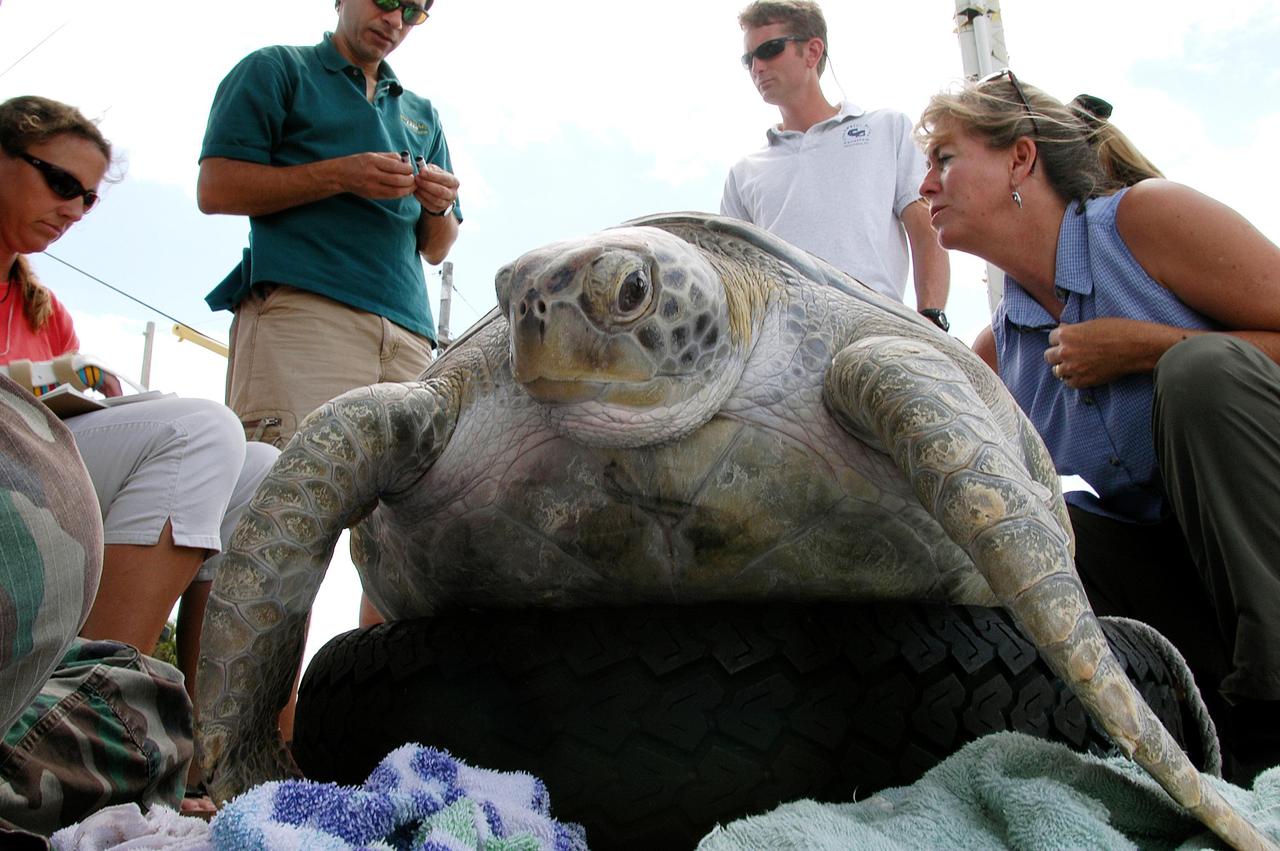
CAPE CANAVERAL, Fla. -- Harold Morrow with the U.S. Fish and Wildlife Service (FWS), left, Eric Reyier with Innovative Health Applications LLC and James Lyon with FWS help a green sea turtle move into deeper water at the Merritt Island National Wildlife Refuge in Florida. The female turtle, weighing about 350 pounds, became stuck on an impoundment in fresh water near NASA Kennedy Space Center's Launch Pad 39A. Kennedy shares a boundary with the refuge, which is a habitat for more than 310 species of birds, 25 mammals, 117 fish and 65 amphibians and reptiles. Photo credit: NASA/Carl Winebarger
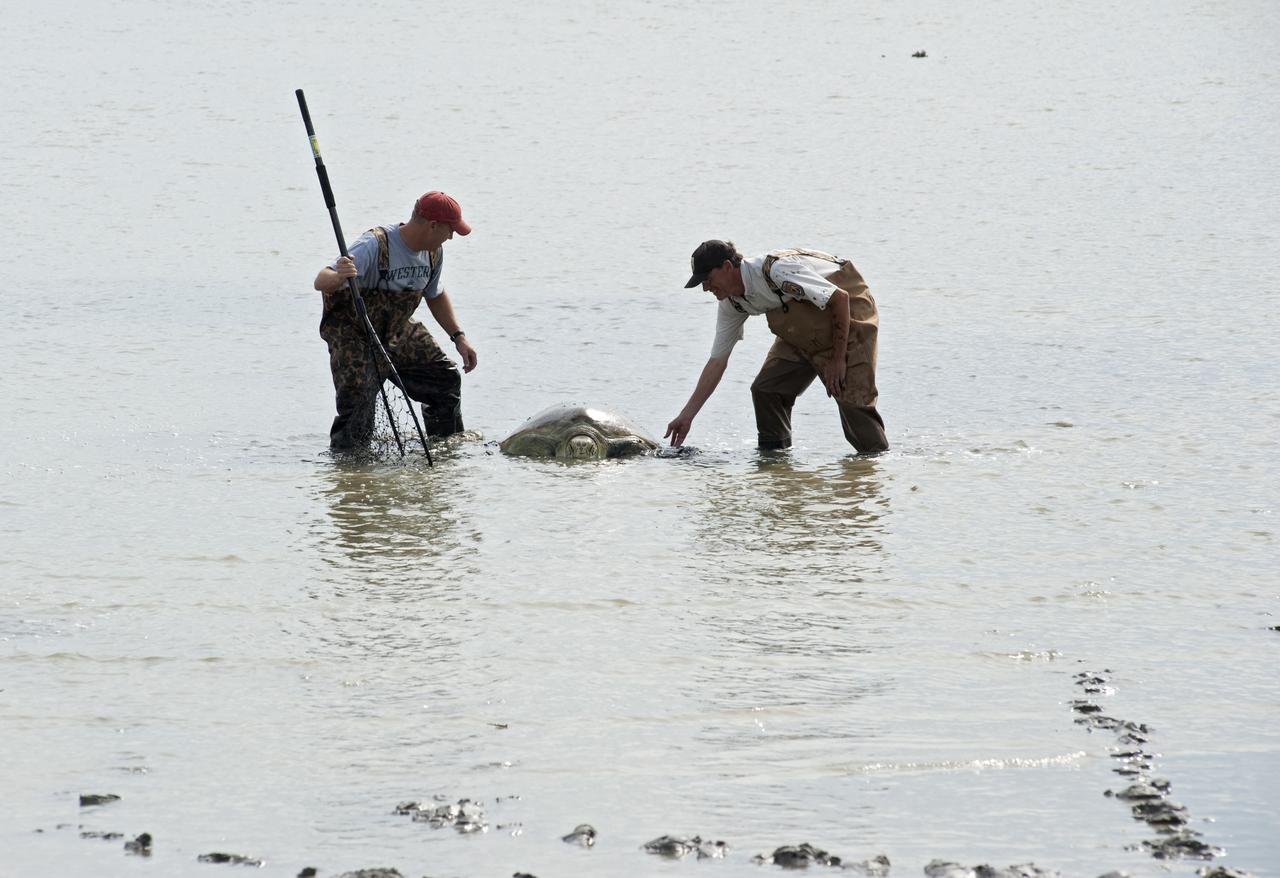
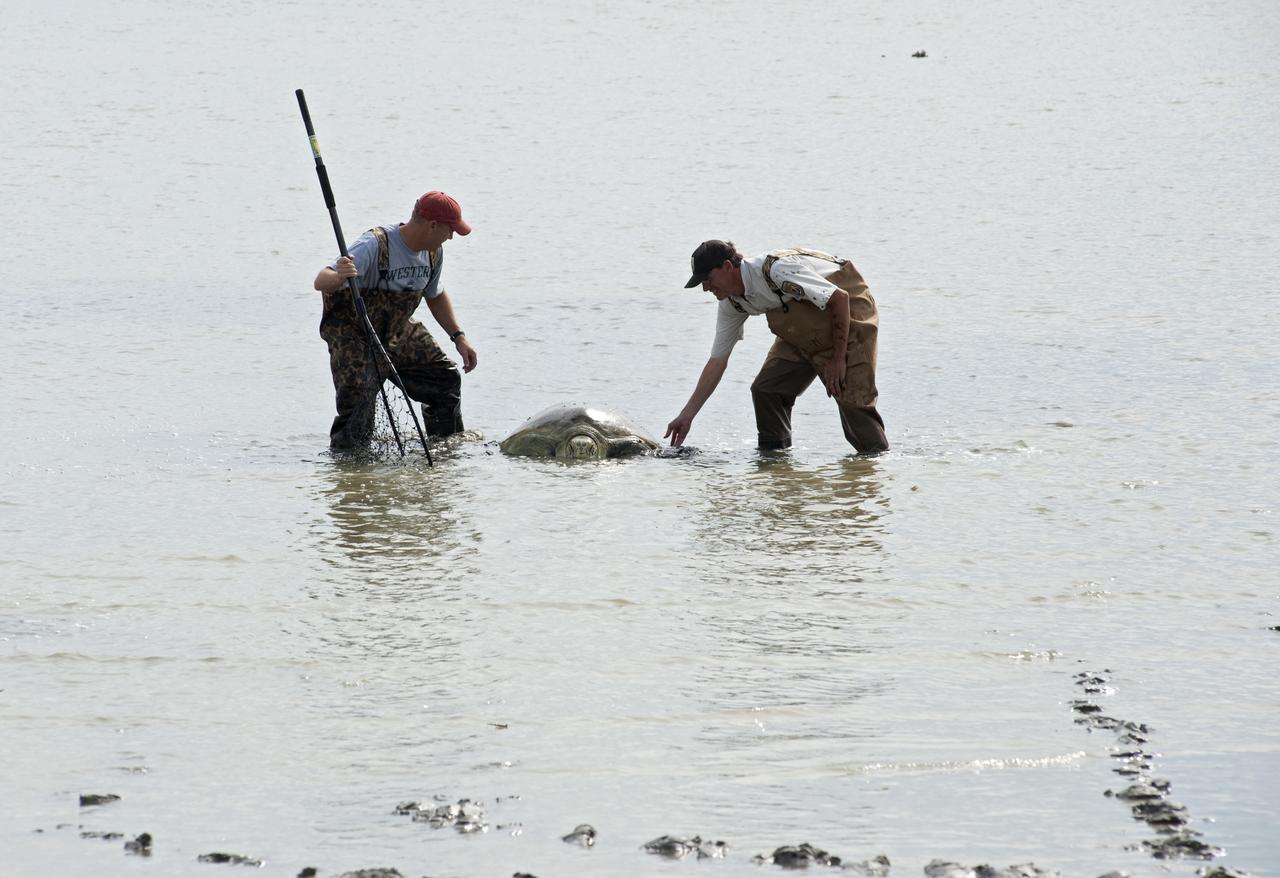
CAPE CANAVERAL, Fla. -- Eric Reyier with Innovative Health Applications LLC, left, and James Lyon with the U.S. Fish and Wildlife Service (FWS) help a green sea turtle move into deeper water at the Merritt Island National Wildlife Refuge in Florida. The female turtle, weighing about 350 pounds, became stuck on an impoundment in fresh water near NASA Kennedy Space Center's Launch Pad 39A. The refuge, located on Kennedy property, is a habitat for more than 310 species of birds, 25 mammals, 117 fish and 65 amphibians and reptiles. Photo credit: NASA/Carl Winebarger
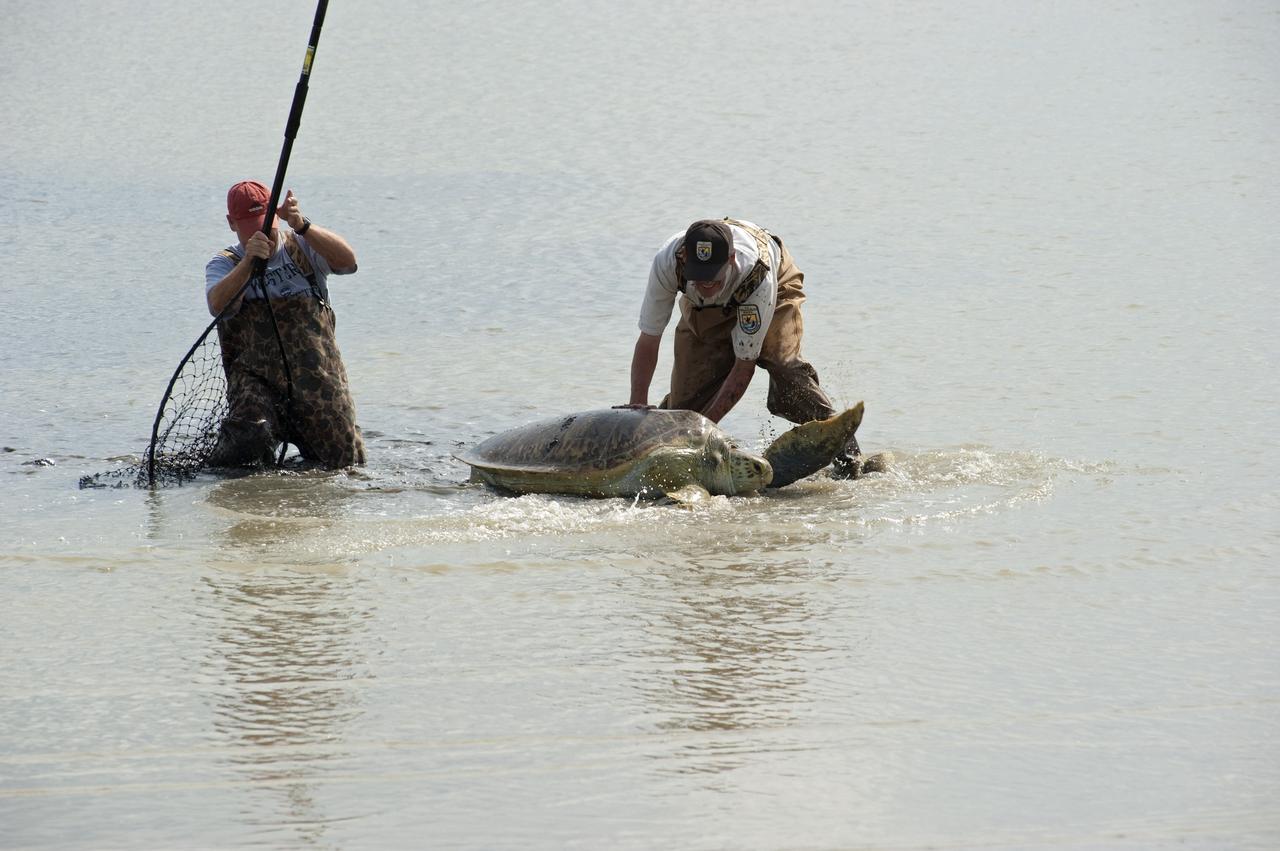
CAPE CANAVERAL, Fla. -- Eric Reyier with Innovative Health Applications LLC, left, and James Lyon with the U.S. Fish and Wildlife Service (FWS) help a green sea turtle move into deeper water at the Merritt Island National Wildlife Refuge in Florida. The female turtle, weighing about 350 pounds, became stuck on an impoundment in fresh water near NASA Kennedy Space Center's Launch Pad 39A. The refuge, located on Kennedy property, is a habitat for more than 310 species of birds, 25 mammals, 117 fish and 65 amphibians and reptiles. Photo credit: NASA/Carl Winebarger
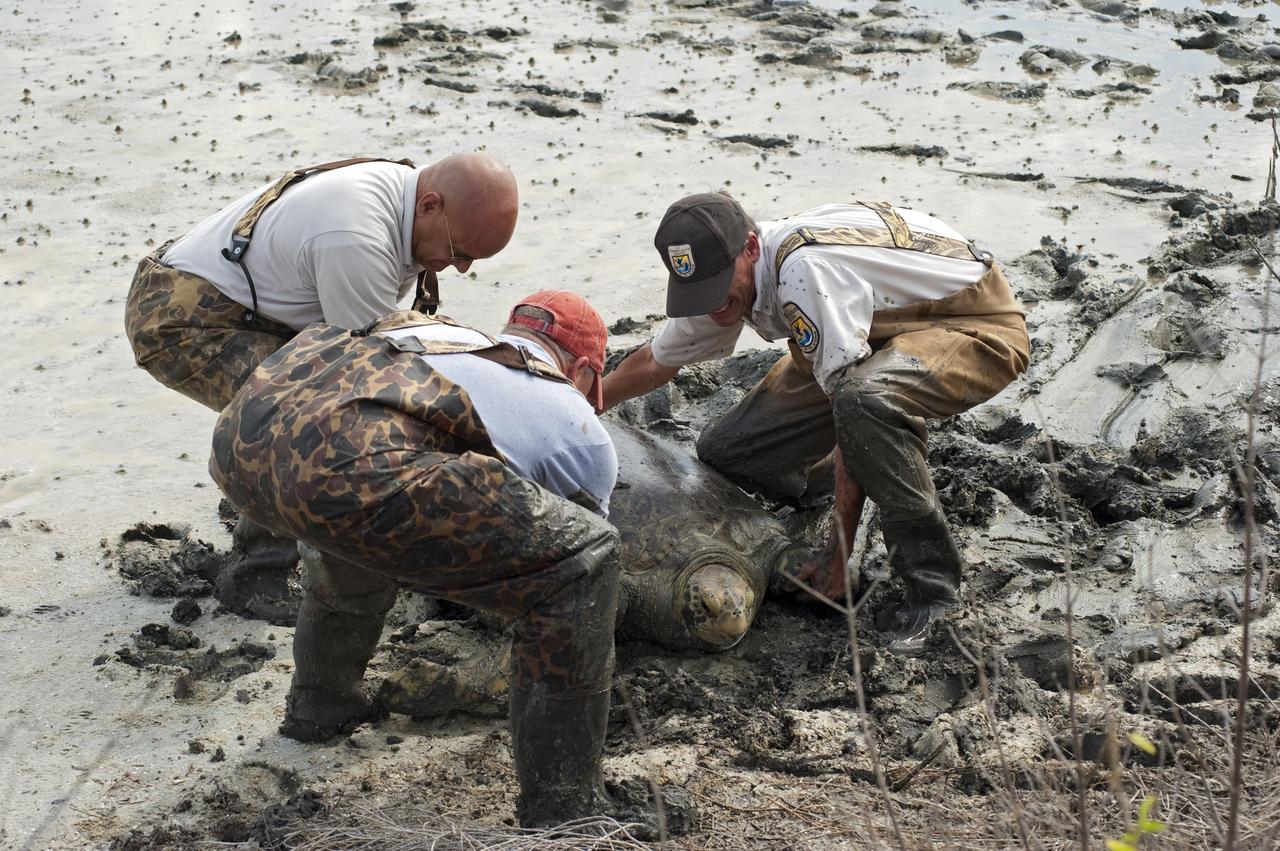
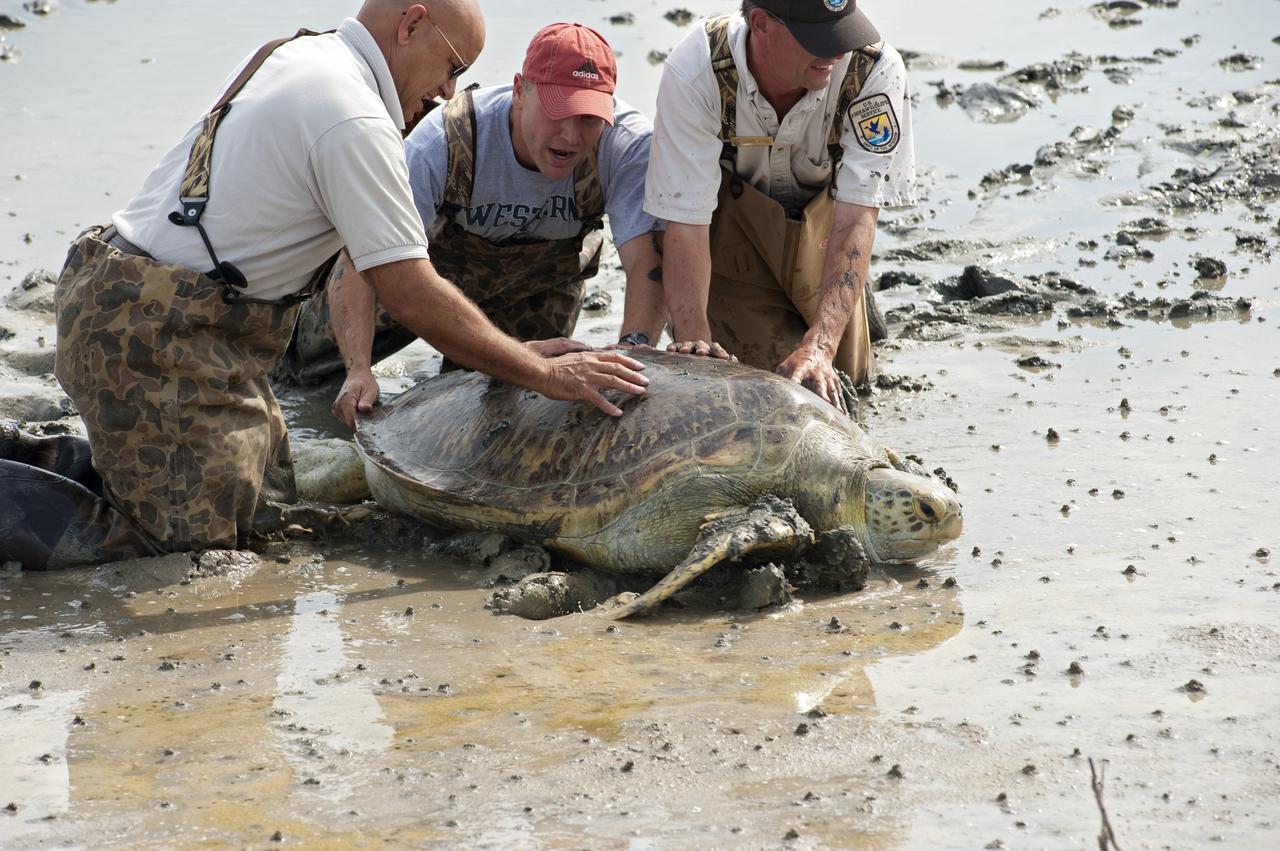
CAPE CANAVERAL, Fla. -- Workers from the U.S. Fish and Wildlife Service (FWS) and Innovative Health Applications LLC help a green sea turtle move into deeper water at the Merritt Island National Wildlife Refuge in Florida. The female turtle, weighing about 350 pounds, became stuck on an impoundment in fresh water near NASA Kennedy Space Center's Launch Pad 39A. The refuge, located on Kennedy property, is a habitat for more than 310 species of birds, 25 mammals, 117 fish and 65 amphibians and reptiles. Photo credit: NASA/Carl Winebarger
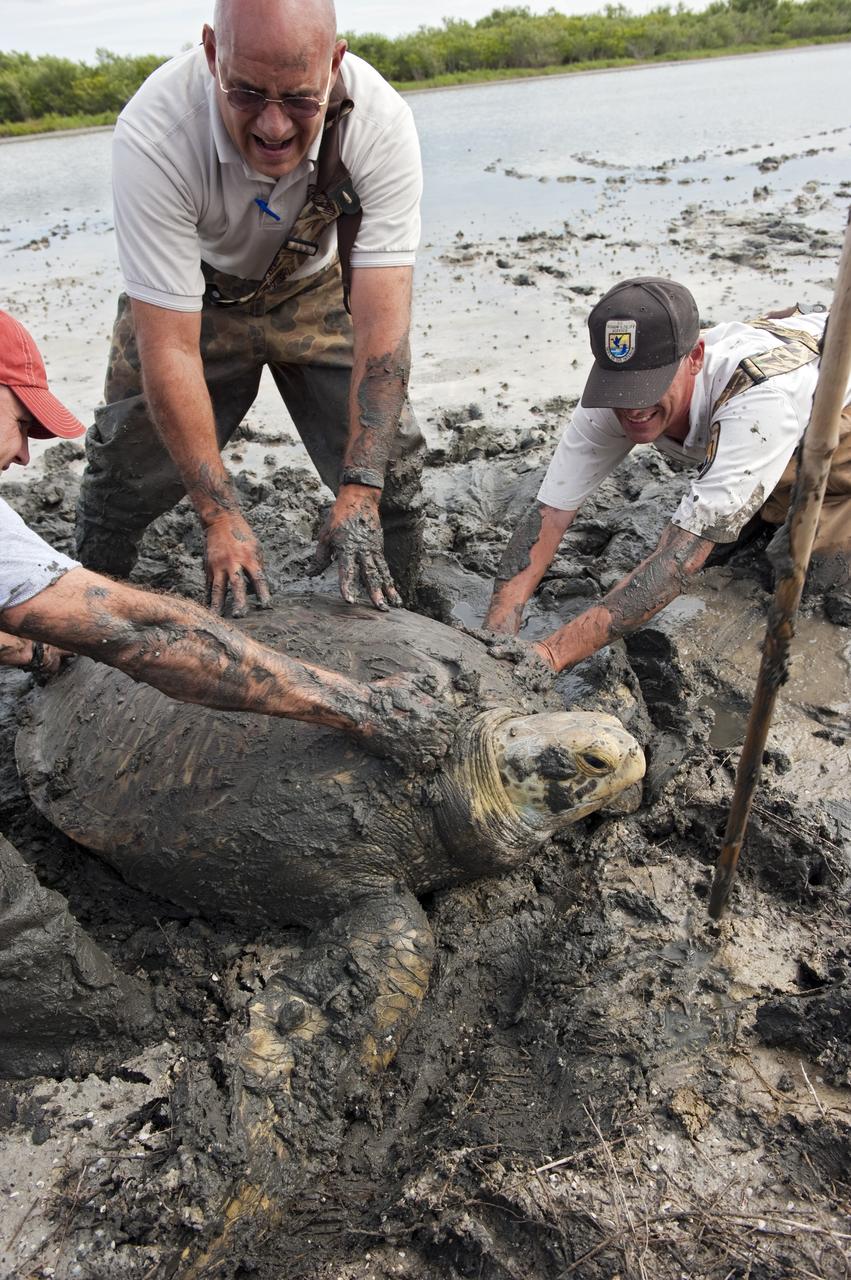
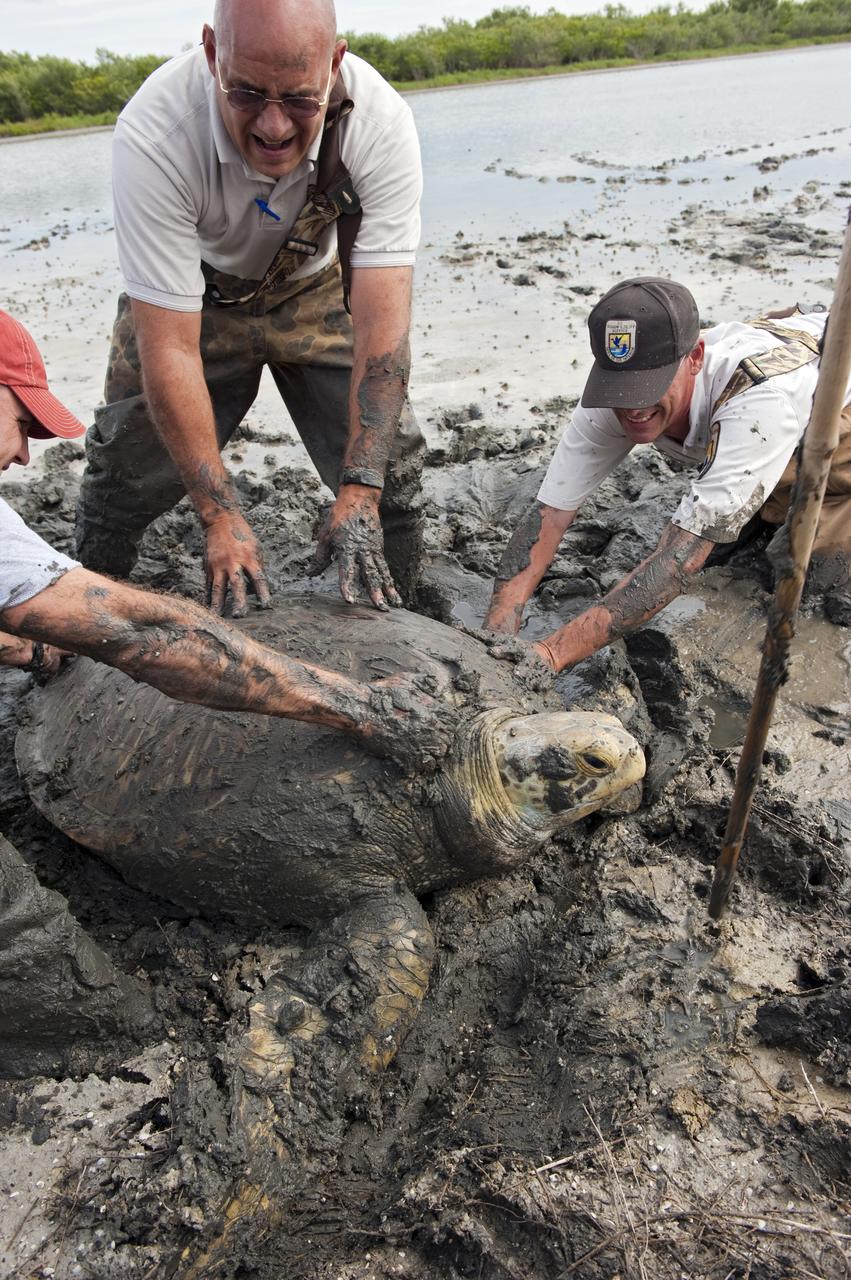
CAPE CANAVERAL, Fla. -- Eric Reyier with Innovative Health Applications LLC, left, along with Harold Morrow and James Lyon with the U.S. Fish and Wildlife Service (FWS) help a green sea turtle move into deeper water at the Merritt Island National Wildlife Refuge in Florida. The female turtle, weighing in at about 350 pounds, became stuck on an impoundment in fresh water near NASA Kennedy Space Center's Launch Pad 39A. The refuge, located on Kennedy property, is a habitat for more than 310 species of birds, 25 mammals, 117 fish and 65 amphibians and reptiles. Photo credit: NASA/Carl Winebarger
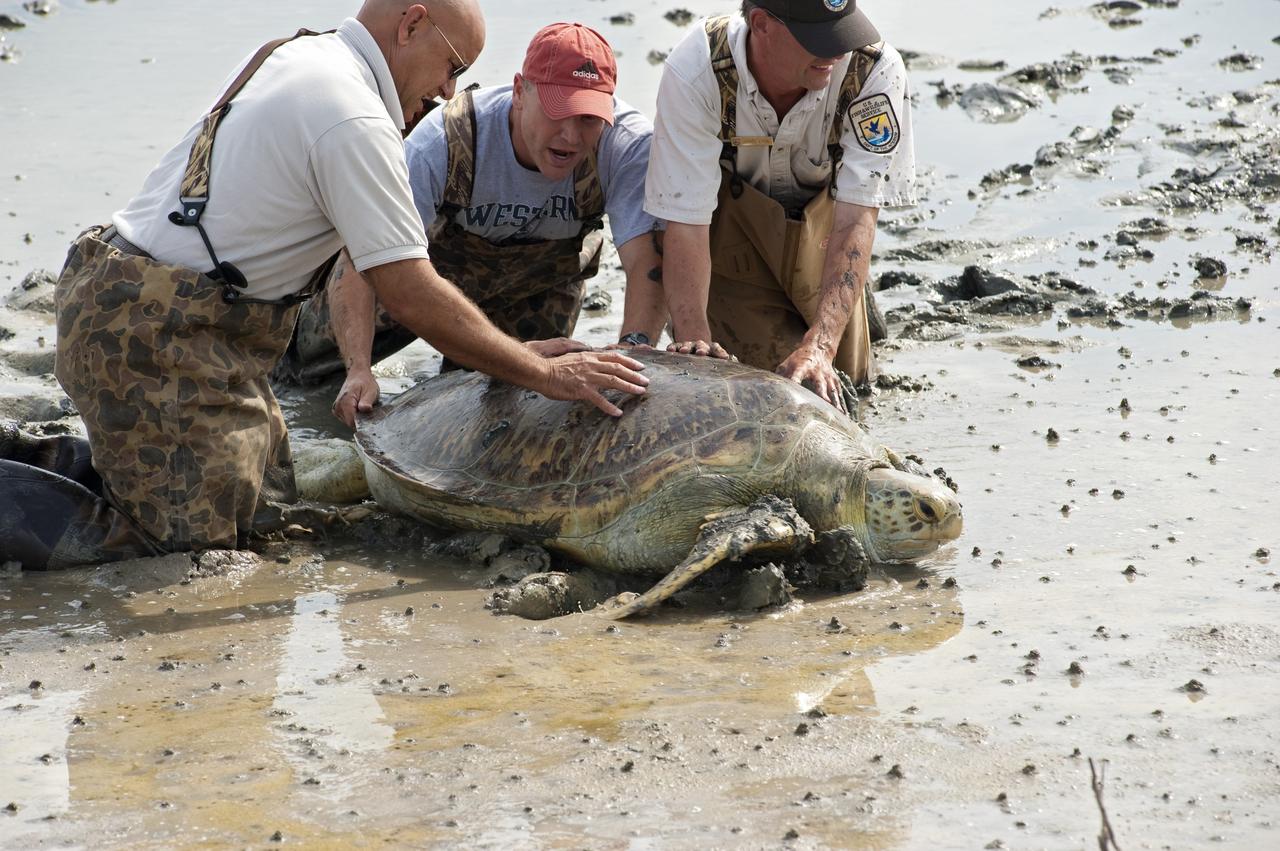
CAPE CANAVERAL, Fla. -- Harold Morrow with the U.S. Fish and Wildlife Service (FWS), left, Eric Reyier with Innovative Health Applications LLC and James Lyon with FWS help a green sea turtle move into deeper water at the Merritt Island National Wildlife Refuge in Florida. The female turtle, weighing about 350 pounds, became stuck on an impoundment in fresh water near NASA Kennedy Space Center's Launch Pad 39A. The refuge, located on Kennedy property, is a habitat for more than 310 species of birds, 25 mammals, 117 fish and 65 amphibians and reptiles. Photo credit: NASA/Carl Winebarger
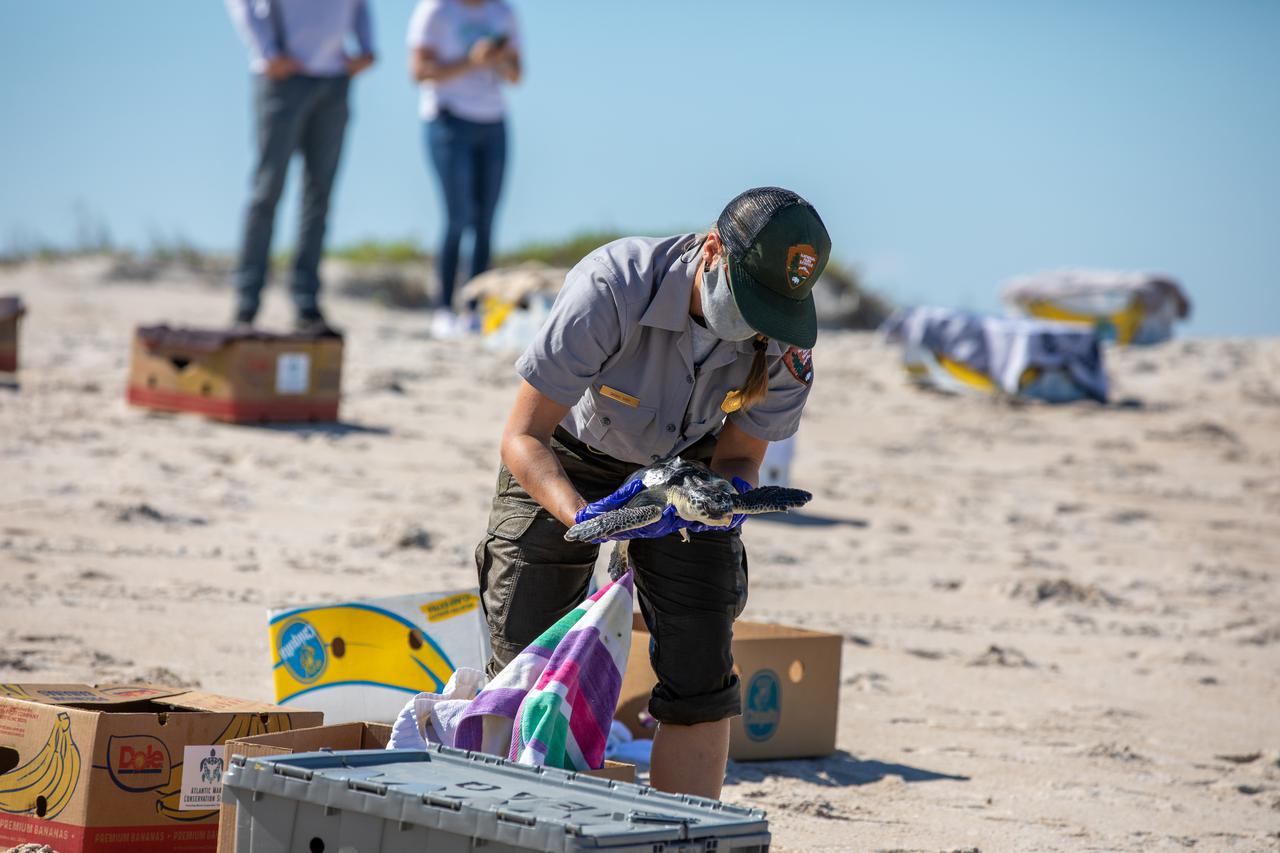
Staff with NASA, the National Park Service, Herndon Solutions Group, the center’s environmental services contractor, and others, prepare to release Kemp’s ridley sea turtles into the Atlantic Ocean at the Canaveral National Seashore near Kennedy Space Center on Feb. 26, 2021. The rescued and rehabilitated turtles were flown from aquatic centers in Massachusetts and New York to the Launch and Landing Facility, managed by Space Florida. NASA, U.S. Fish and Wildlife Service, NOAA Fisheries, Space Florida, and Herndon Solutions Group provided support. The Turtles Fly Too organization provided the flight to Kennedy. All marine turtle footage/images was obtained with the approval of the Florida Fish and Wildlife Conservation Commission (FWC) under conditions not harmful to marine turtles. Footage was acquired while conducting authorized conservation activities pursuant to: FWC 2021 Consent Permit, MTP-21-005 and MTP-21-114.
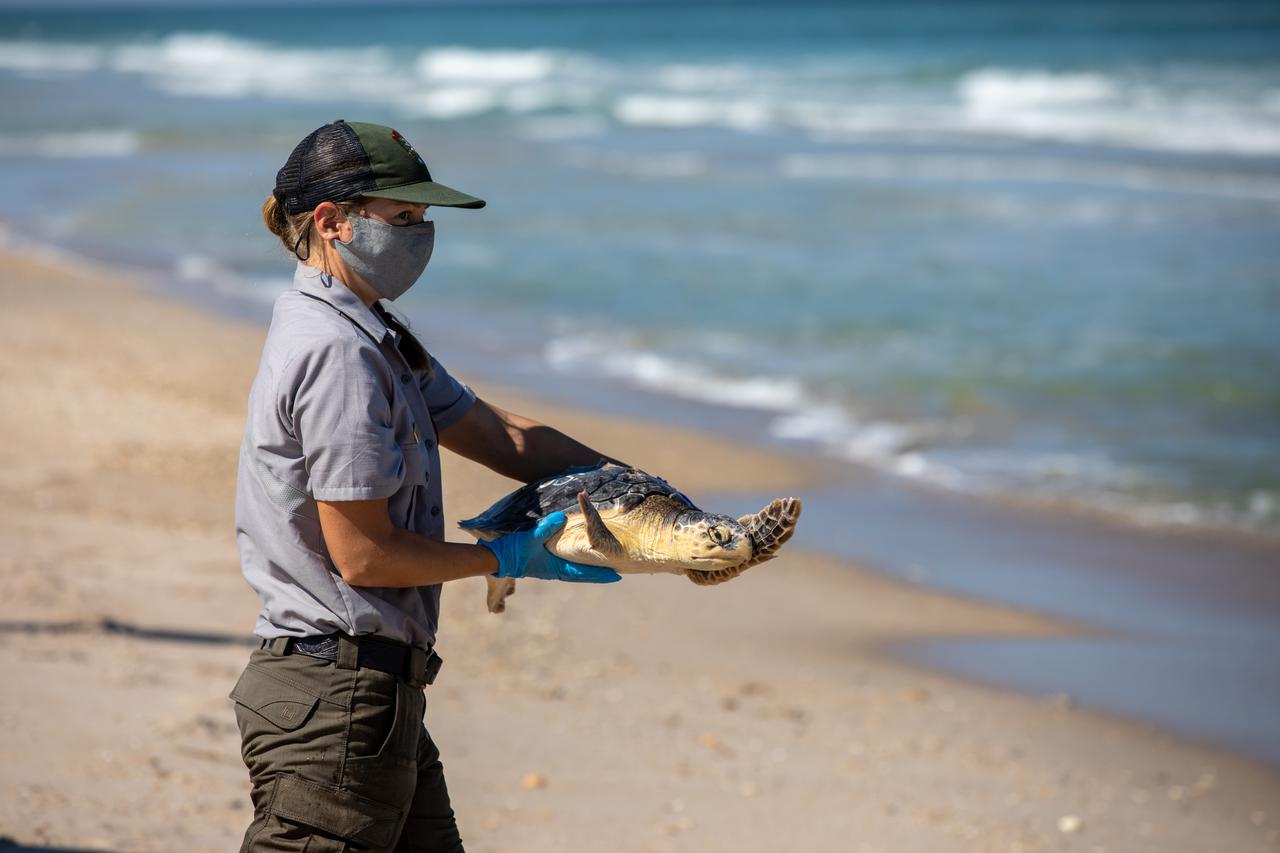
A National Park Service staff member prepares to release a Kemp’s ridley sea turtle into the Atlantic Ocean at the Canaveral National Seashore near Kennedy Space Center on Feb. 26, 2021. The rescued and rehabilitated turtles were flown from aquatic centers in Massachusetts and New York to the Launch and Landing Facility, managed by Space Florida. NASA, U.S. Fish and Wildlife Service, NOAA Fisheries, Space Florida, and Herndon Solutions Group provided support. The Turtles Fly Too organization provided the flight to Kennedy. All marine turtle footage/images was obtained with the approval of the Florida Fish and Wildlife Conservation Commission (FWC) under conditions not harmful to marine turtles. Footage was acquired while conducting authorized conservation activities pursuant to: FWC 2021 Consent Permit, MTP-21-005 and MTP-21-114.
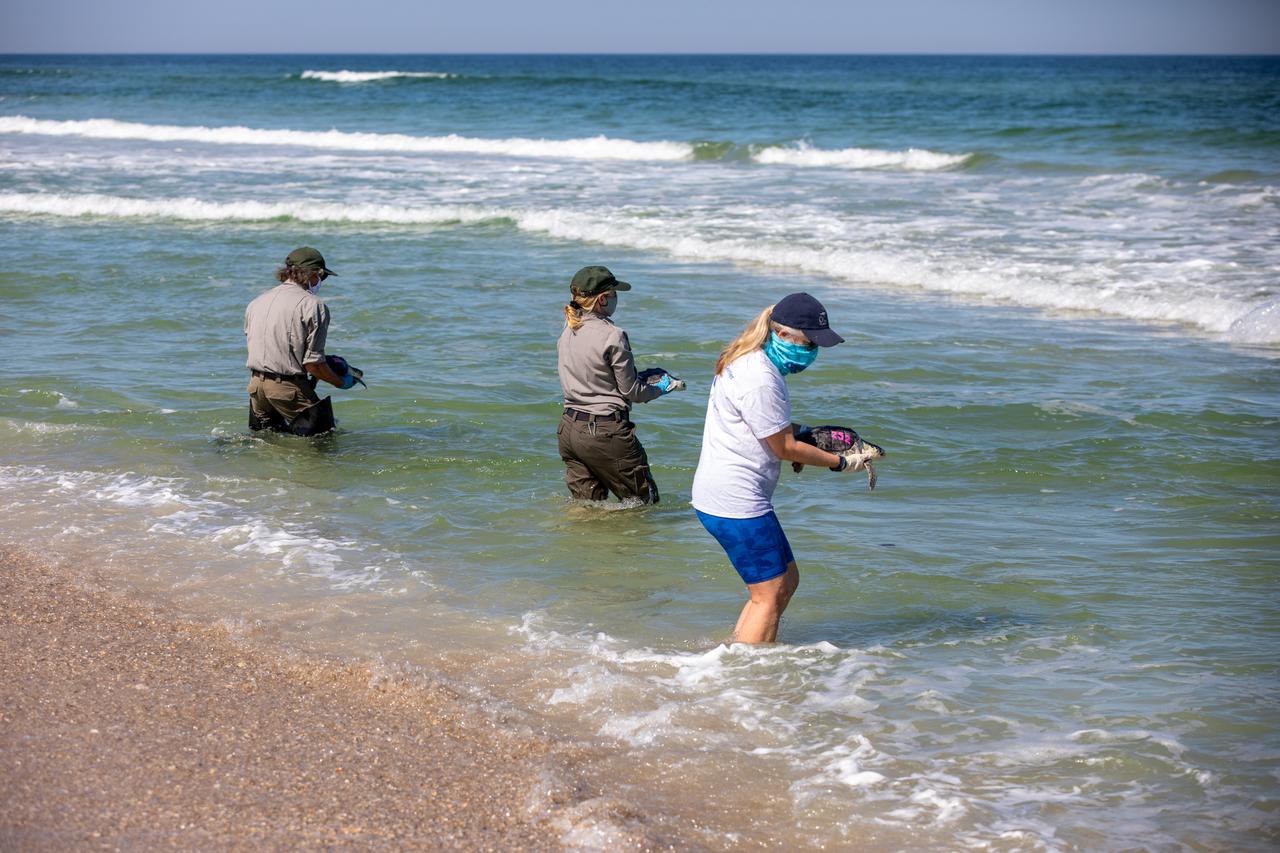
Staff with NASA, the National Park Service, Herndon Solutions Group, the center’s environmental services contractor, and others, prepare to release Kemp’s ridley sea turtles into the Atlantic Ocean at the Canaveral National Seashore near Kennedy Space Center on Feb. 26, 2021. The rescued and rehabilitated turtles were flown from aquatic centers in Massachusetts and New York to the Launch and Landing Facility, managed by Space Florida. NASA, U.S. Fish and Wildlife Service, NOAA Fisheries, Space Florida, and Herndon Solutions Group provided support. The Turtles Fly Too organization provided the flight to Kennedy. All marine turtle footage/images was obtained with the approval of the Florida Fish and Wildlife Conservation Commission (FWC) under conditions not harmful to marine turtles. Footage was acquired while conducting authorized conservation activities pursuant to: FWC 2021 Consent Permit, MTP-21-005 and MTP-21-114.
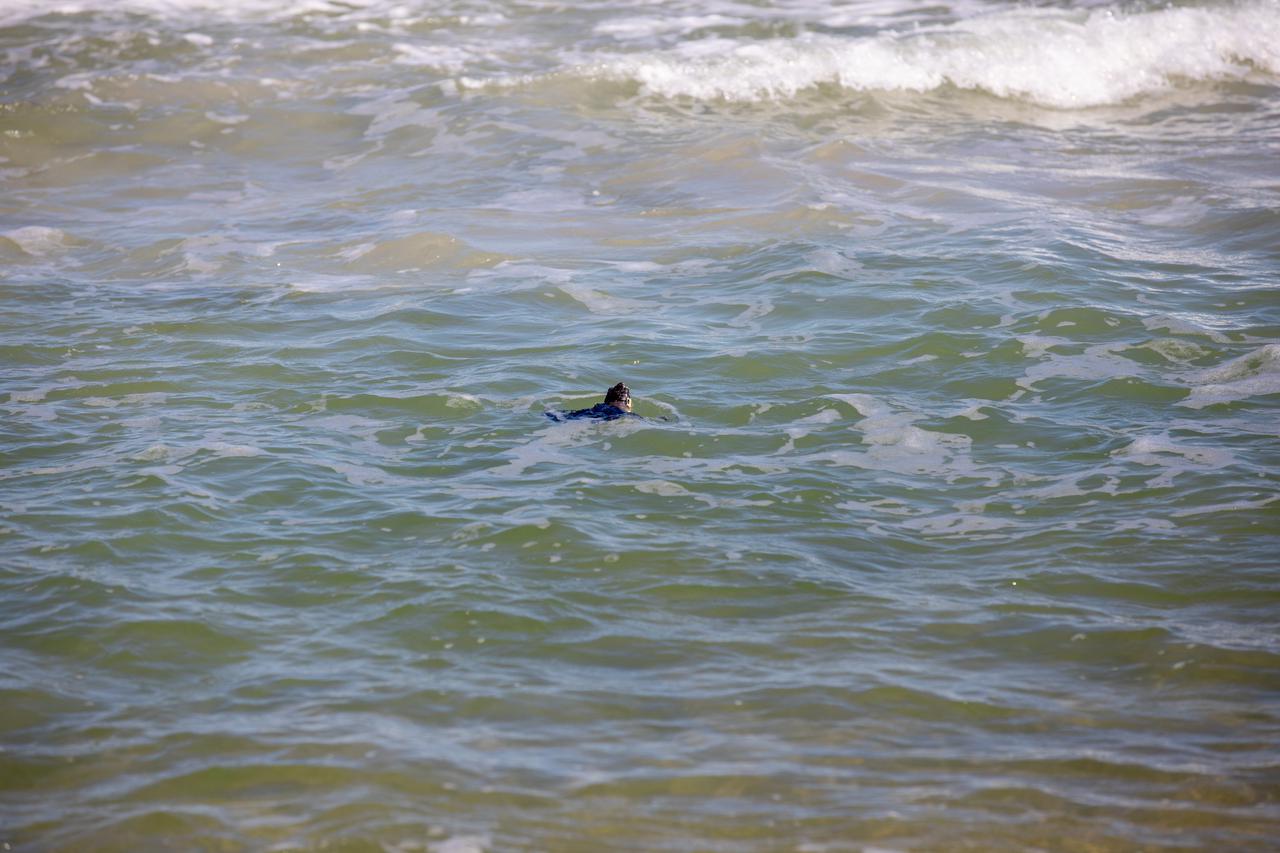
A Kemp’s ridley sea turtle swims in the surf after it is released into the Atlantic Ocean at the Canaveral National Seashore near Kennedy Space Center on Feb. 26, 2021. The rescued and rehabilitated turtles were flown from aquatic centers in Massachusetts and New York to the Launch and Landing Facility, managed by Space Florida. NASA, U.S. Fish and Wildlife Service, NOAA Fisheries, Space Florida, and Herndon Solutions Group provided support. The Turtles Fly Too organization provided the flight to Kennedy. All marine turtle footage/images was obtained with the approval of the Florida Fish and Wildlife Conservation Commission (FWC) under conditions not harmful to marine turtles. Footage was acquired while conducting authorized conservation activities pursuant to: FWC 2021 Consent Permit, MTP-21-005 and MTP-21-114.
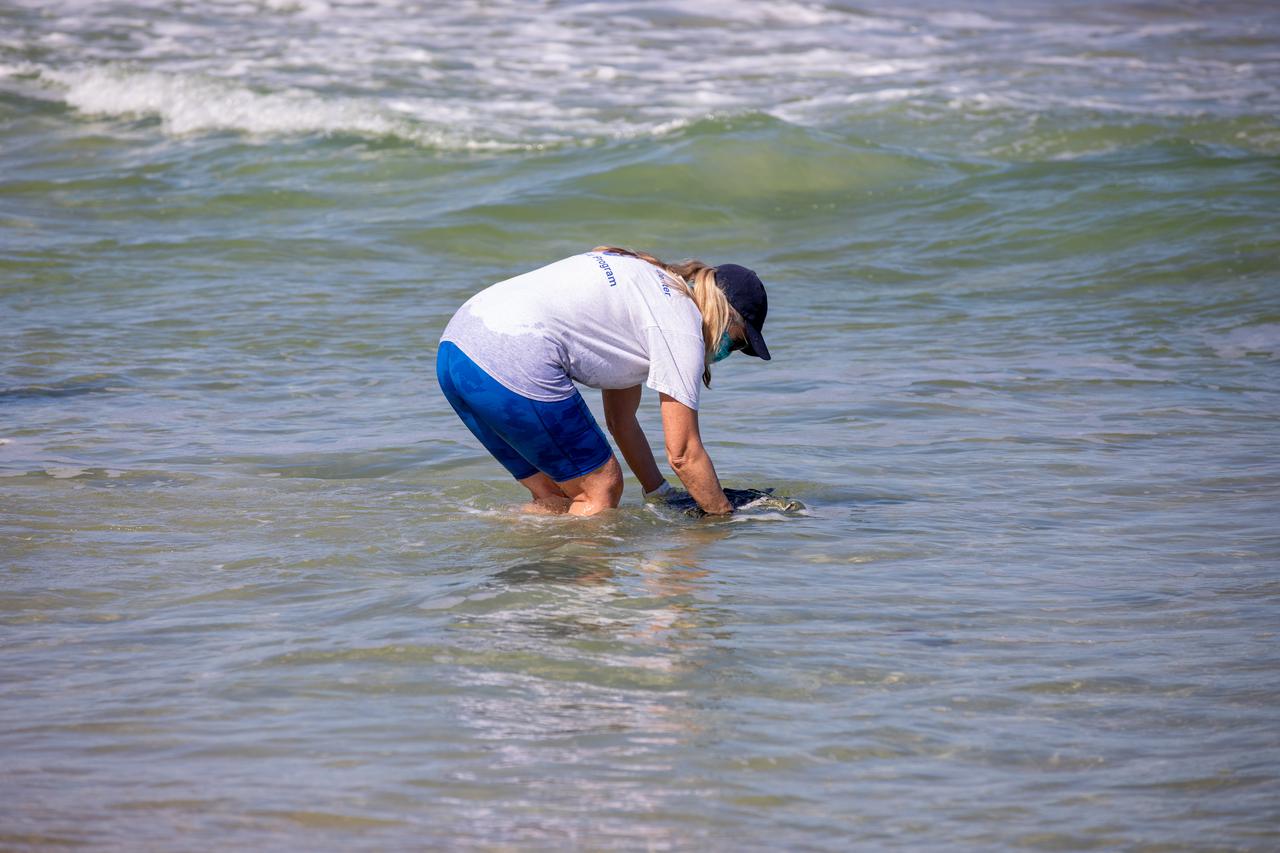
A biologist with Herndon Solutions Group, the center’s environmental services contractor, releases a Kemp’s ridley sea turtle into the Atlantic Ocean at the Canaveral National Seashore near Kennedy Space Center on Feb. 26, 2021. The rescued and rehabilitated turtles were flown from aquatic centers in Massachusetts and New York to the Launch and Landing Facility, managed by Space Florida. NASA, U.S. Fish and Wildlife Service, NOAA Fisheries, Space Florida, and Herndon Solutions Group provided support. The Turtles Fly Too organization provided the flight to Kennedy. All marine turtle footage/images was obtained with the approval of the Florida Fish and Wildlife Conservation Commission (FWC) under conditions not harmful to marine turtles. Footage was acquired while conducting authorized conservation activities pursuant to: FWC 2021 Consent Permit, MTP-21-005 and MTP-21-114.
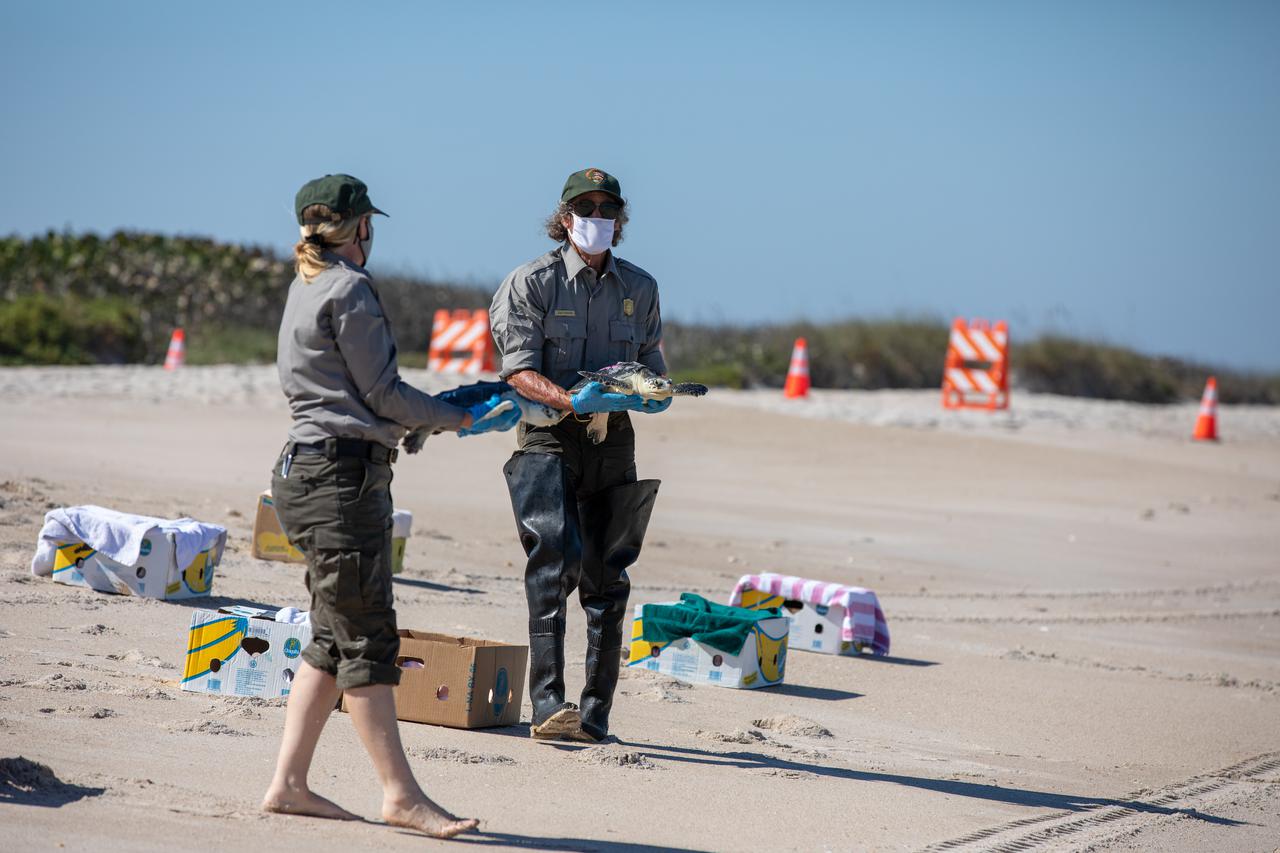
Staff with NASA, the National Park Service, Herndon Solutions Group, the center’s environmental services contractor, and others, prepare to release Kemp’s ridley sea turtles into the Atlantic Ocean at the Canaveral National Seashore near Kennedy Space Center on Feb. 26, 2021. The rescued and rehabilitated turtles were flown from aquatic centers in Massachusetts and New York to the Launch and Landing Facility, managed by Space Florida. NASA, U.S. Fish and Wildlife Service, NOAA Fisheries, Space Florida, and Herndon Solutions Group provided support. The Turtles Fly Too organization provided the flight to Kennedy. All marine turtle footage/images was obtained with the approval of the Florida Fish and Wildlife Conservation Commission (FWC) under conditions not harmful to marine turtles. Footage was acquired while conducting authorized conservation activities pursuant to: FWC 2021 Consent Permit, MTP-21-005 and MTP-21-114.
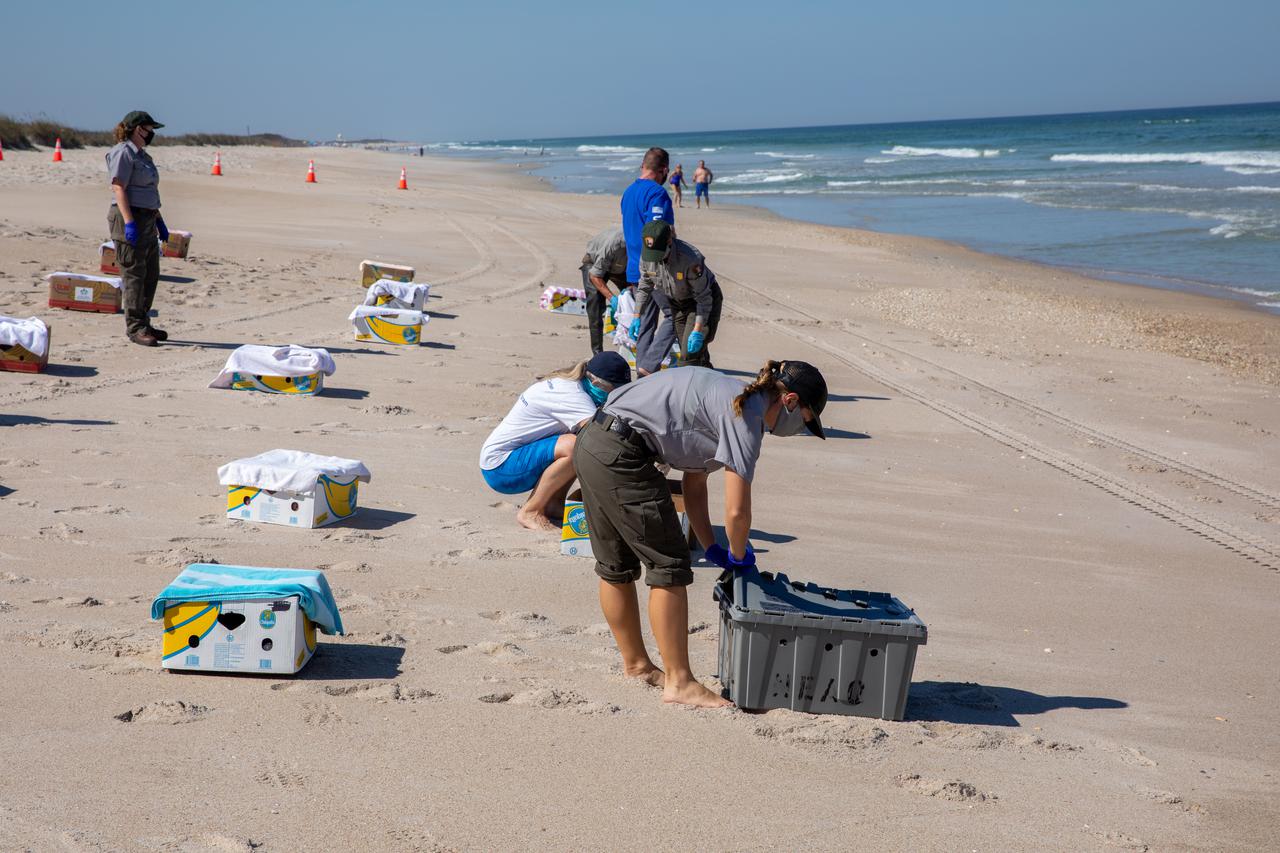
Staff with NASA, the National Park Service, Herndon Solutions Group, the center’s environmental services contractor, and others, prepare to release Kemp’s ridley sea turtles into the Atlantic Ocean at the Canaveral National Seashore near Kennedy Space Center on Feb. 26, 2021. The rescued and rehabilitated turtles were flown from aquatic centers in Massachusetts and New York to the Launch and Landing Facility, managed by Space Florida. NASA, U.S. Fish and Wildlife Service, NOAA Fisheries, Space Florida, and Herndon Solutions Group provided support. The Turtles Fly Too organization provided the flight to Kennedy. All marine turtle footage/images was obtained with the approval of the Florida Fish and Wildlife Conservation Commission (FWC) under conditions not harmful to marine turtles. Footage was acquired while conducting authorized conservation activities pursuant to: FWC 2021 Consent Permit, MTP-21-005 and MTP-21-114.
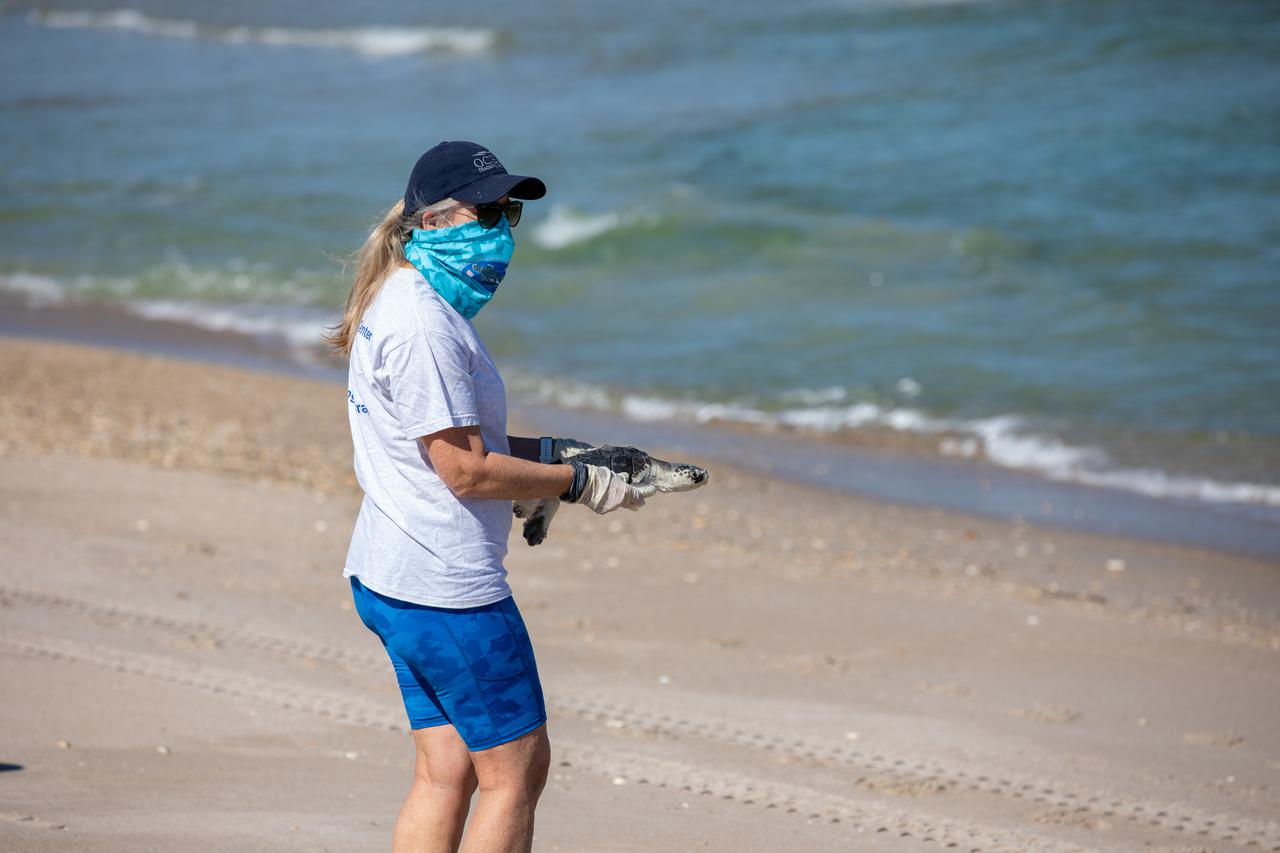
A biologist with Herndon Solutions Group, the center’s environmental services contractor, prepares to release Kemp’s ridley sea turtles into the Atlantic Ocean at the Canaveral National Seashore near Kennedy Space Center on Feb. 26, 2021. The rescued and rehabilitated turtles were flown from aquatic centers in Massachusetts and New York to the Launch and Landing Facility, managed by Space Florida. NASA, U.S. Fish and Wildlife Service, NOAA Fisheries, Space Florida, and Herndon Solutions Group provided support. The Turtles Fly Too organization provided the flight to Kennedy. All marine turtle footage/images was obtained with the approval of the Florida Fish and Wildlife Conservation Commission (FWC) under conditions not harmful to marine turtles. Footage was acquired while conducting authorized conservation activities pursuant to: FWC 2021 Consent Permit, MTP-21-005 and MTP-21-114.
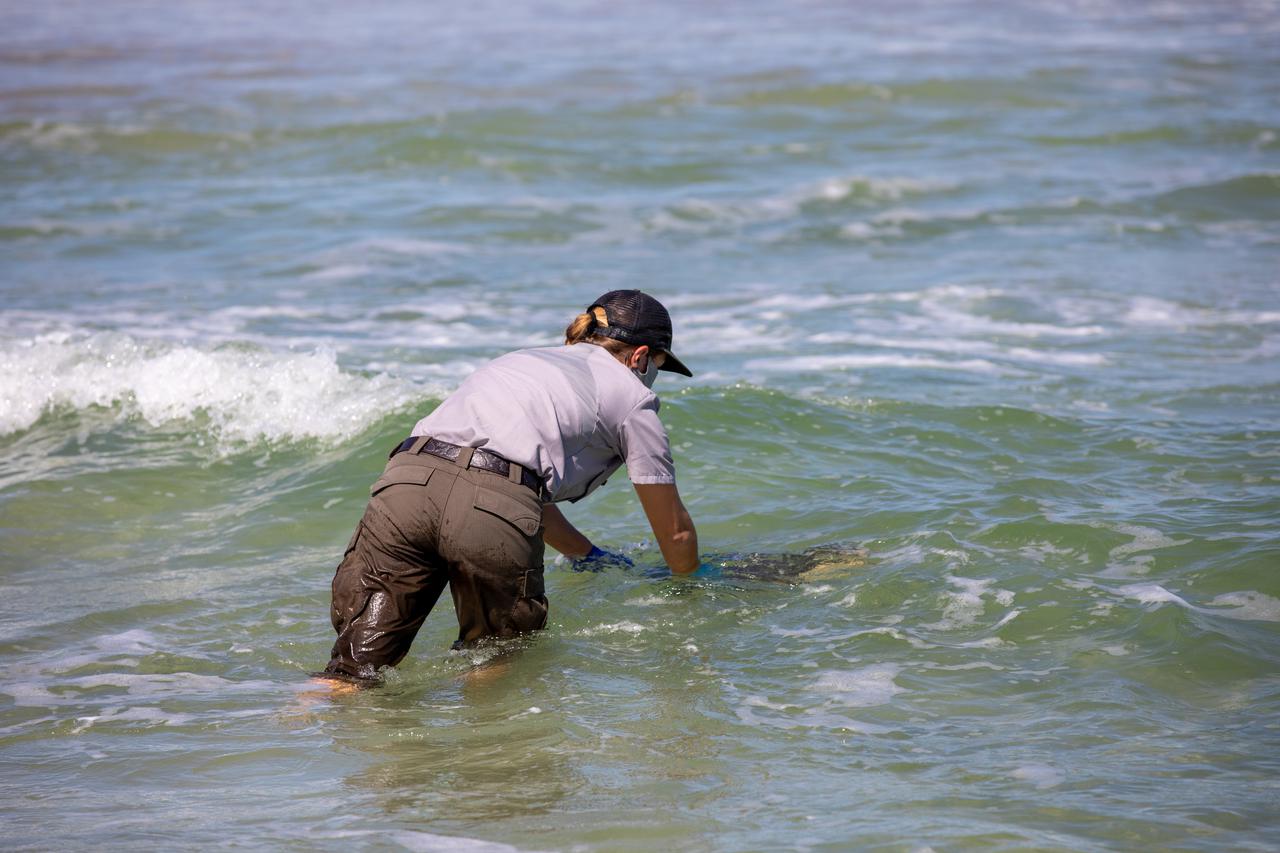
A National Park Service staff member releases a Kemp’s ridley sea turtle into the Atlantic Ocean at the Canaveral National Seashore near Kennedy Space Center on Feb. 26, 2021. The rescued and rehabilitated turtles were flown from aquatic centers in Massachusetts and New York to the Launch and Landing Facility, managed by Space Florida. NASA, U.S. Fish and Wildlife Service, NOAA Fisheries, Space Florida, and Herndon Solutions Group provided support. The Turtles Fly Too organization provided the flight to Kennedy. All marine turtle footage/images was obtained with the approval of the Florida Fish and Wildlife Conservation Commission (FWC) under conditions not harmful to marine turtles. Footage was acquired while conducting authorized conservation activities pursuant to: FWC 2021 Consent Permit, MTP-21-005 and MTP-21-114.
LOGGERHEAD SEA TURTLE RESCUE FOR RELEASE - MINWR
LOGGERHEAD SEA TURTLE RESCUE FOR RELEASE - MINWR
LOGGERHEAD SEA TURTLE RESCUE FOR RELEASE - MINWR
LOGGERHEAD SEA TURTLE RESCUE FOR RELEASE - MINWR
LOGGERHEAD SEA TURTLE RESCUE FOR RELEASE - MINWR
LOGGERHEAD SEA TURTLE RESCUE FOR RELEASE - MINWR

KSC WILDLIFE - TURTLE RELEASE FROM PLAYALINDA - GULF RESCUE OPS
KSC WILDLIFE - TURTLE RELEASE FROM PLAYALINDA - GULF RESCUE OPS

KSC WILDLIFE - TURTLE RELEASE FROM PLAYALINDA - GULF RESCUE OPS
KSC WILDLIFE - TURTLE RELEASE FROM PLAYALINDA - GULF RESCUE OPS

KSC WILDLIFE - TURTLE RELEASE FROM PLAYALINDA - GULF RESCUE OPS

KSC WILDLIFE - TURTLE RELEASE FROM PLAYALINDA - GULF RESCUE OPS
KSC WILDLIFE - TURTLE RELEASE FROM PLAYALINDA - GULF RESCUE OPS

KSC WILDLIFE - TURTLE RELEASE FROM PLAYALINDA - GULF RESCUE OPS

KSC WILDLIFE - TURTLE RELEASE FROM PLAYALINDA - GULF RESCUE OPS
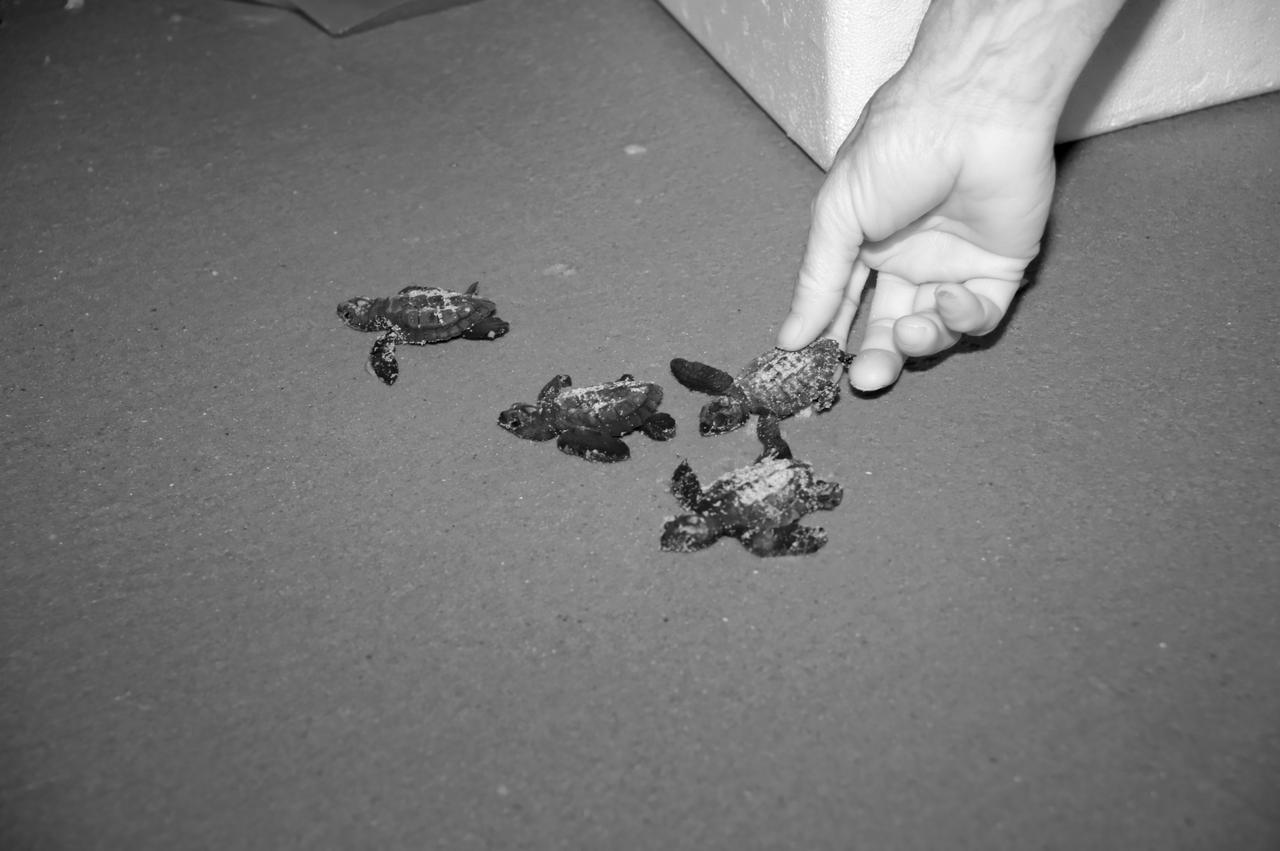
KSC WILDLIFE - TURTLE RELEASE FROM PLAYALINDA - GULF RESCUE OPS
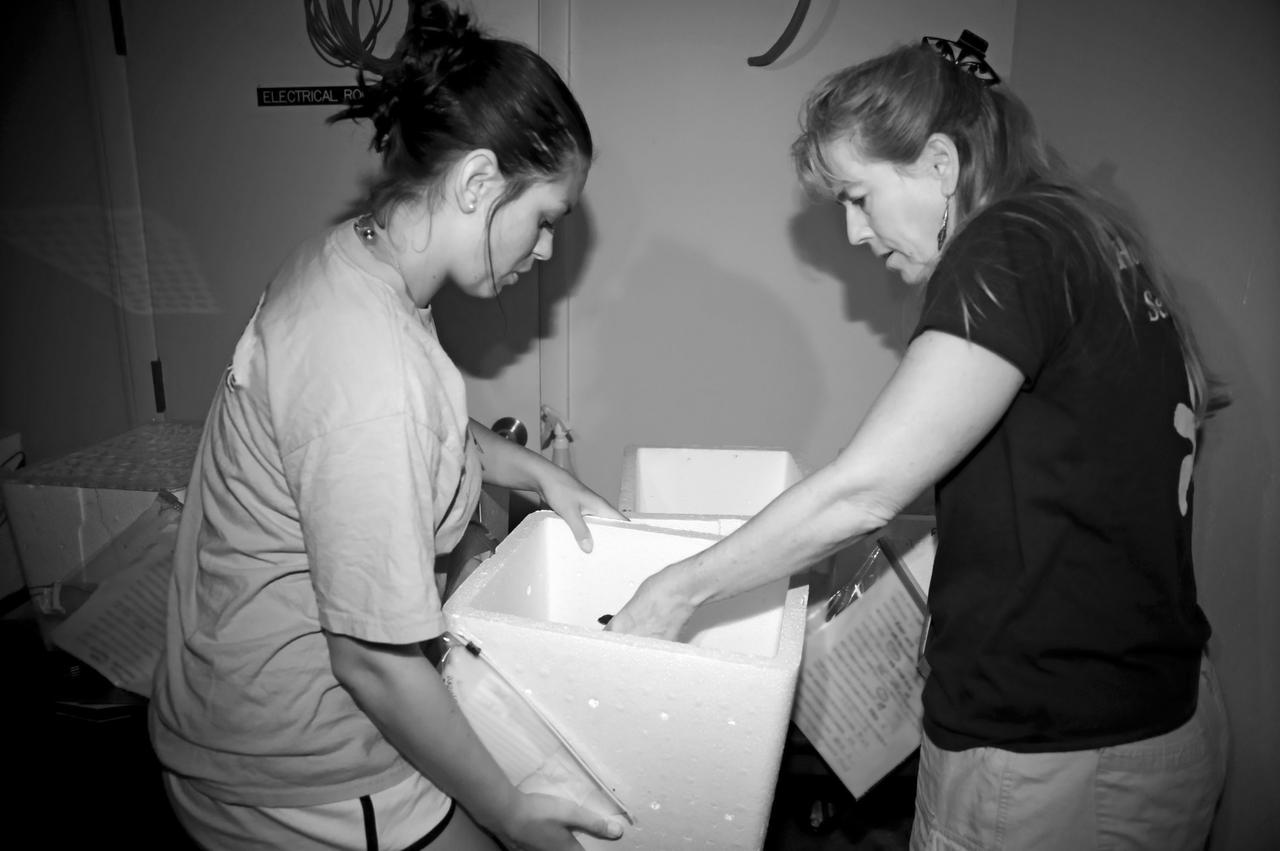
KSC WILDLIFE - TURTLE RELEASE FROM PLAYALINDA - GULF RESCUE OPS

KSC WILDLIFE - TURTLE RELEASE FROM PLAYALINDA - GULF RESCUE OPS
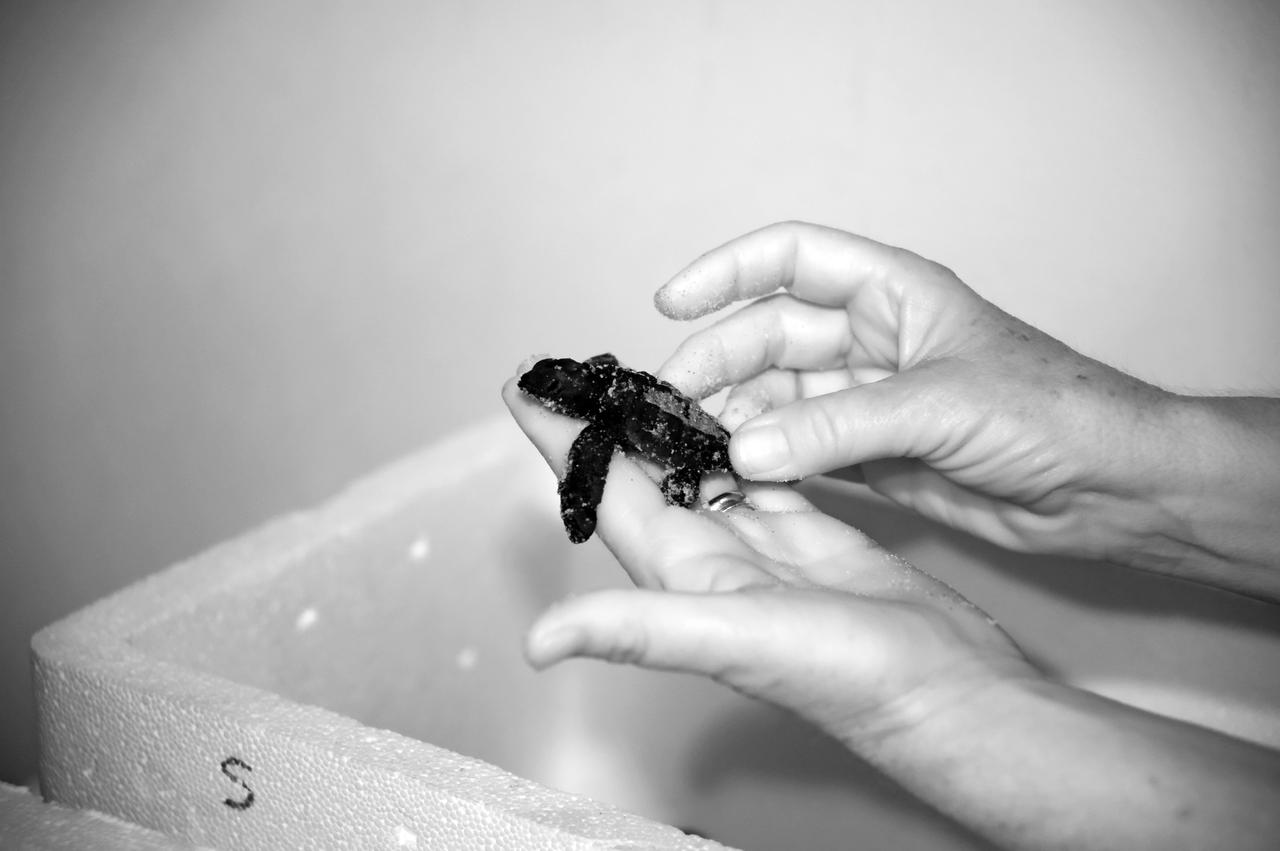
KSC WILDLIFE - TURTLE RELEASE FROM PLAYALINDA - GULF RESCUE OPS
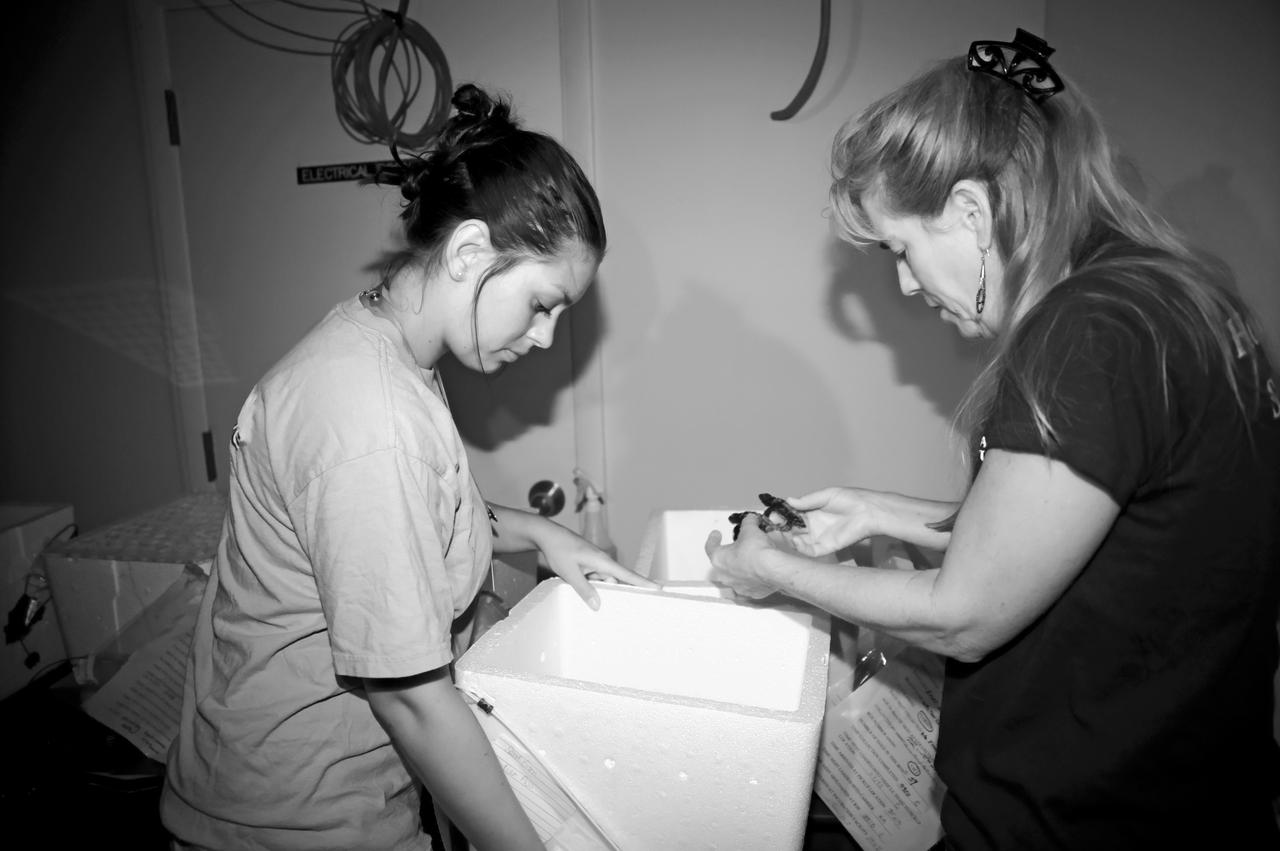
KSC WILDLIFE - TURTLE RELEASE FROM PLAYALINDA - GULF RESCUE OPS

KSC WILDLIFE - TURTLE RELEASE FROM PLAYALINDA - GULF RESCUE OPS

KSC WILDLIFE - TURTLE RELEASE FROM PLAYALINDA - GULF RESCUE OPS
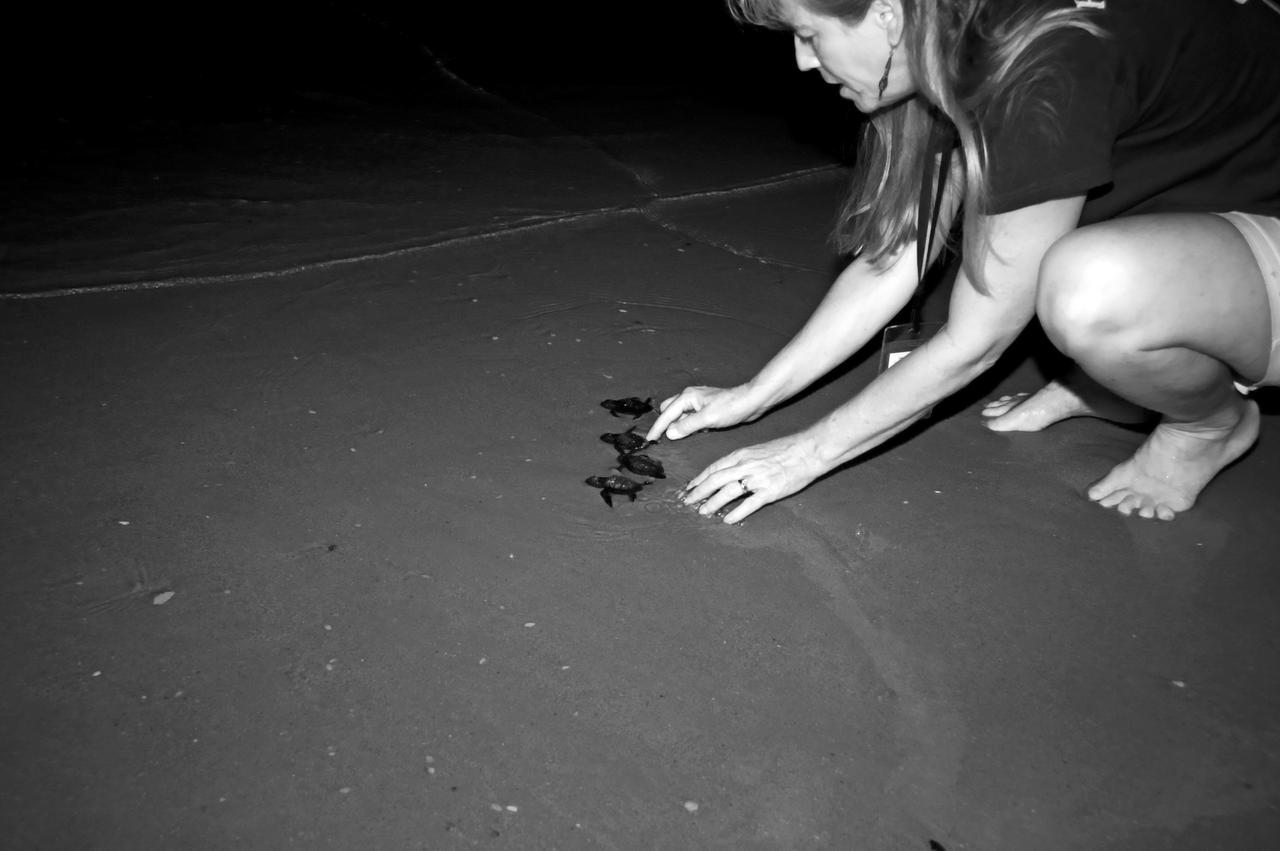
KSC WILDLIFE - TURTLE RELEASE FROM PLAYALINDA - GULF RESCUE OPS

KSC WILDLIFE - TURTLE RELEASE FROM PLAYALINDA - GULF RESCUE OPS

KSC WILDLIFE - TURTLE RELEASE FROM PLAYALINDA - GULF RESCUE OPS
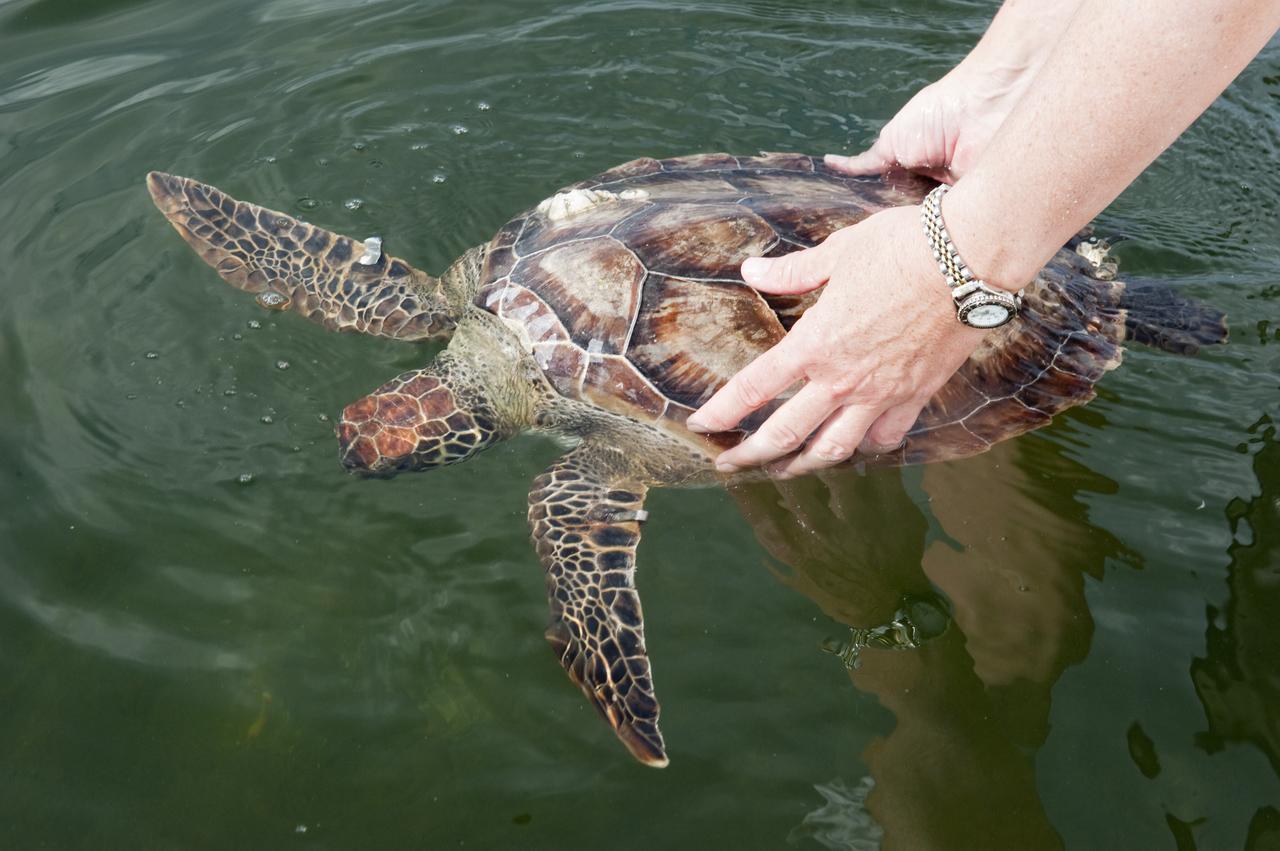
CAPE CANAVERAL, Fla. -- An endangered green sea turtle is released into the Mosquito Lagoon, which is part of Florida's Indian River. Workers with NASA's Kennedy Space Center, Innovative Health Applications and the Fish and Wildlife Conservation Commission rescued more than 300 turtles during this winter's frigid temperatures. Turtles that were stunned multiple times will be released in the Sebastian area of the Indian River, which often offers warmer water and could help prevent future stuns as winter progresses. NASA/Kim Shiflett
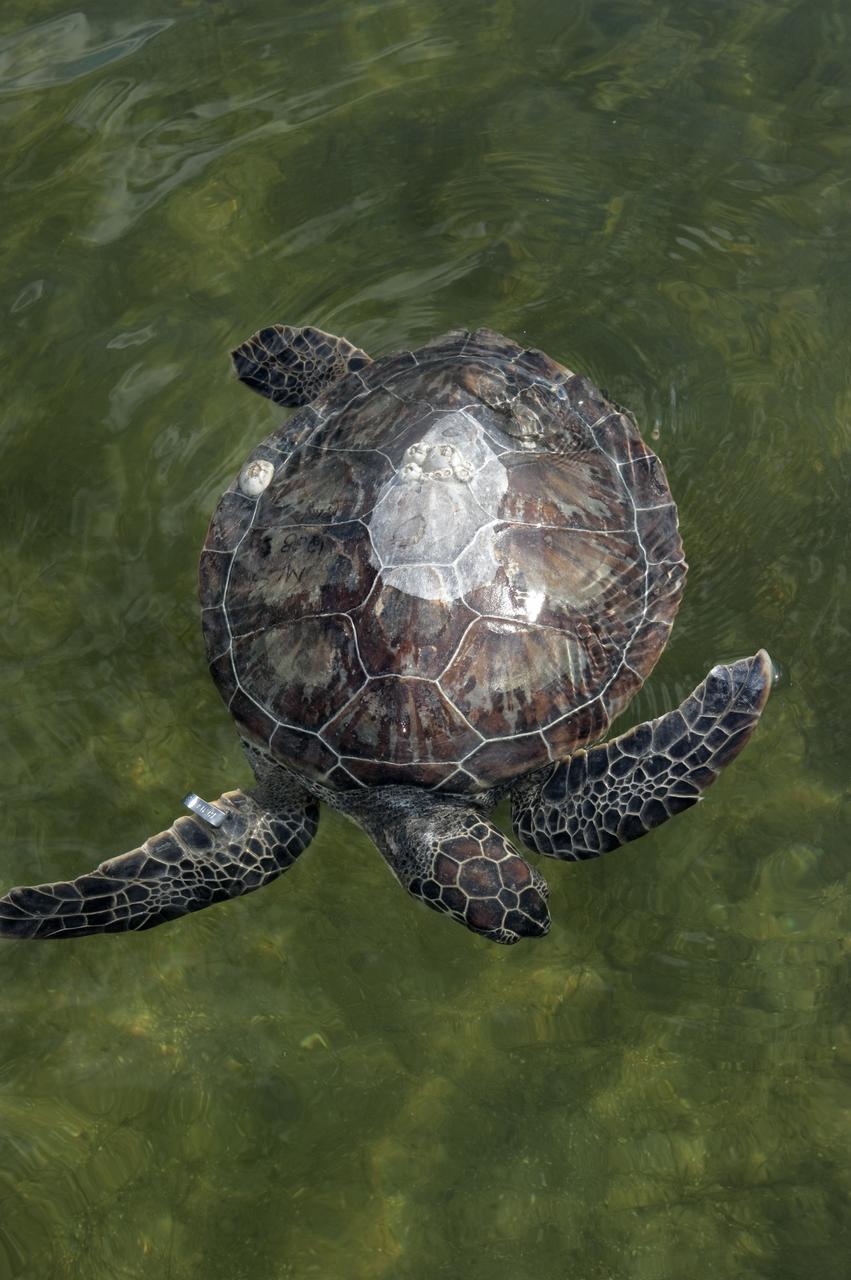
CAPE CANAVERAL, Fla. -- An endangered green sea turtle is released into the Mosquito Lagoon, which is part of Florida's Indian River. Workers with NASA's Kennedy Space Center, Innovative Health Applications and the Fish and Wildlife Conservation Commission rescued more than 300 turtles during this winter's frigid temperatures. Turtles that were stunned multiple times will be released in the Sebastian area of the Indian River, which often offers warmer water and could help prevent future stuns as winter progresses. NASA/Kim Shiflett
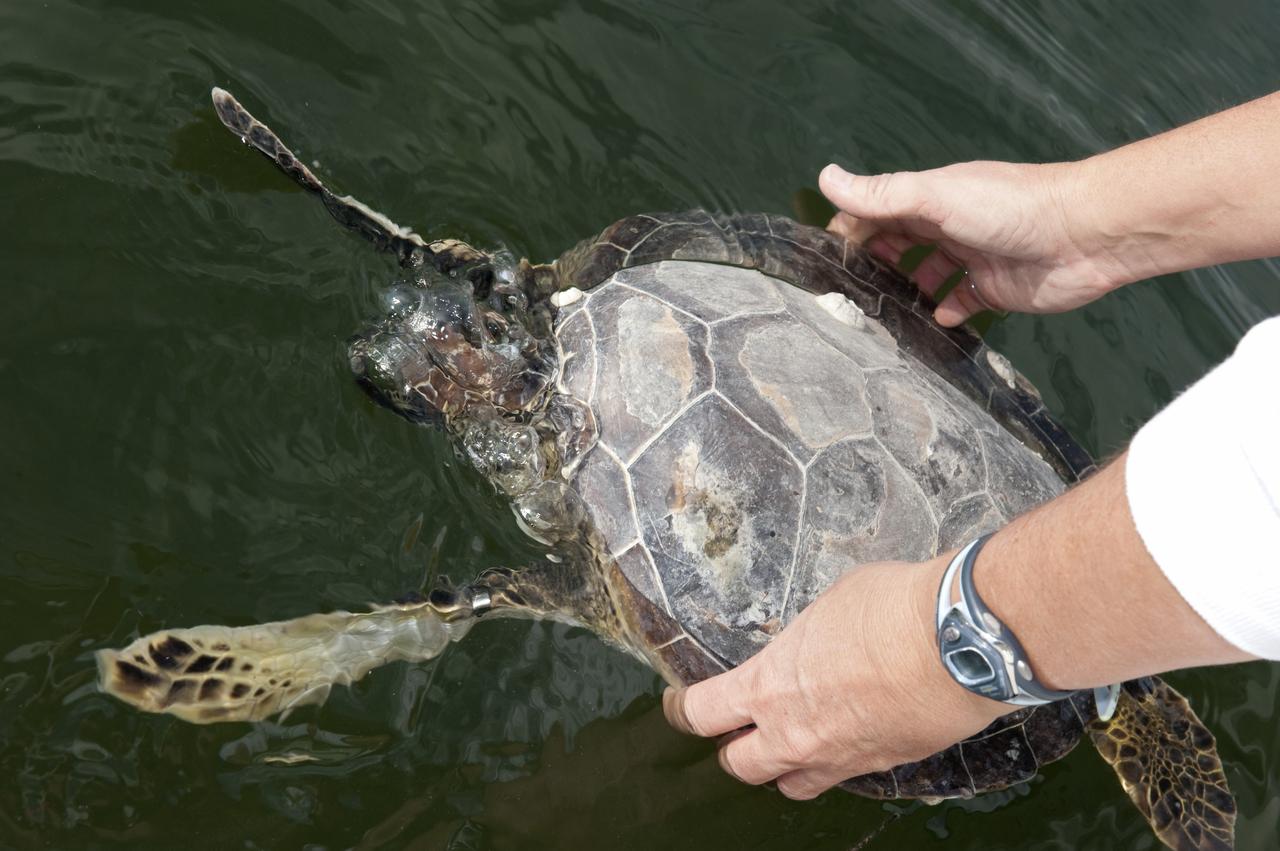
CAPE CANAVERAL, Fla. -- An endangered green sea turtle is released into the Mosquito Lagoon, which is part of Florida's Indian River. Workers with NASA's Kennedy Space Center, Innovative Health Applications and the Fish and Wildlife Conservation Commission rescued more than 300 turtles during this winter's frigid temperatures. Turtles that were stunned multiple times will be released in the Sebastian area of the Indian River, which often offers warmer water and could help prevent future stuns as winter progresses. NASA/Kim Shiflett
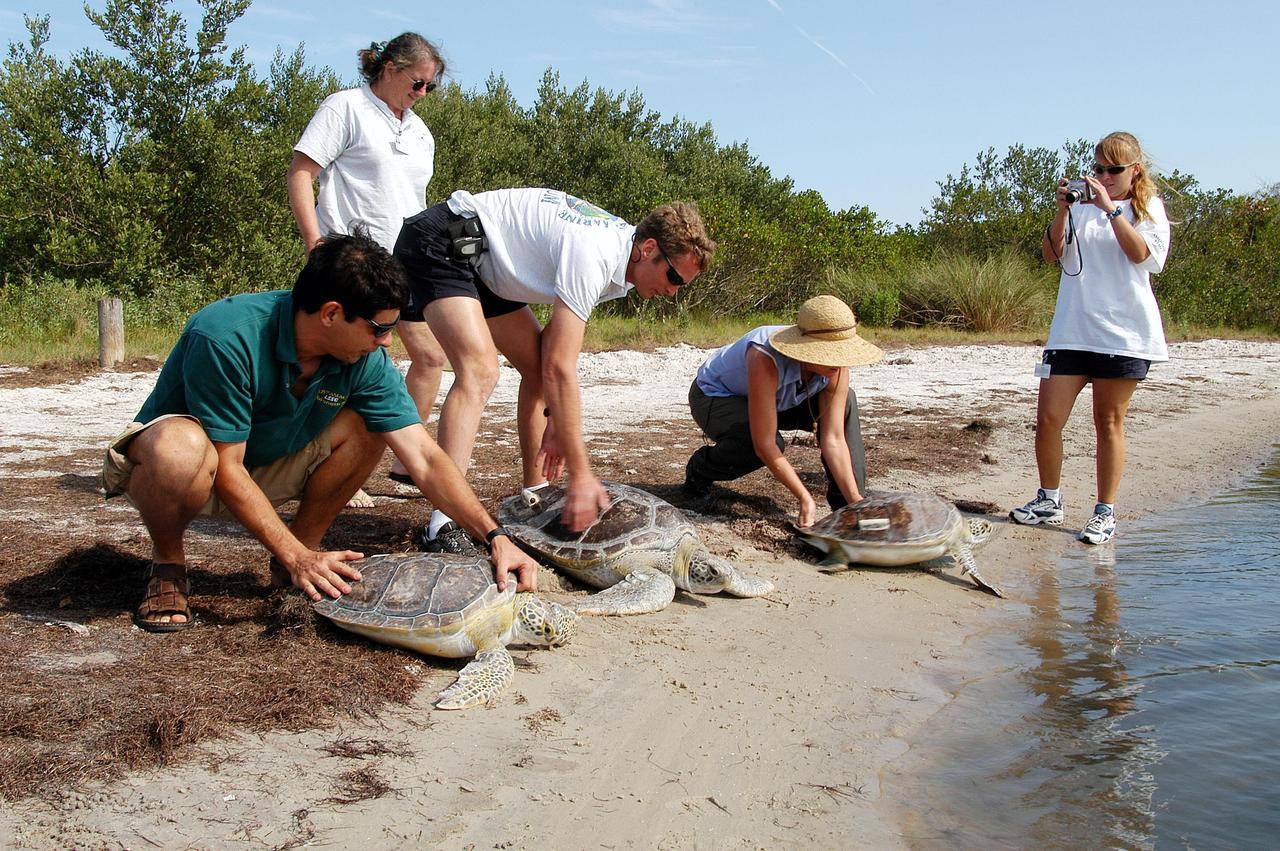
KENNEDY SPACE CENTER, FLA. - Three green sea turtles are being released into the Mosquito Lagoon at KSC. The turtles were rescued at KSC in January 2003, after being found stunned, impacted by the unseasonal cold temperatures experienced in Central Florida, and rehabilitated at the Clearwater Aquarium. They were fitted with sonic tracking devices.
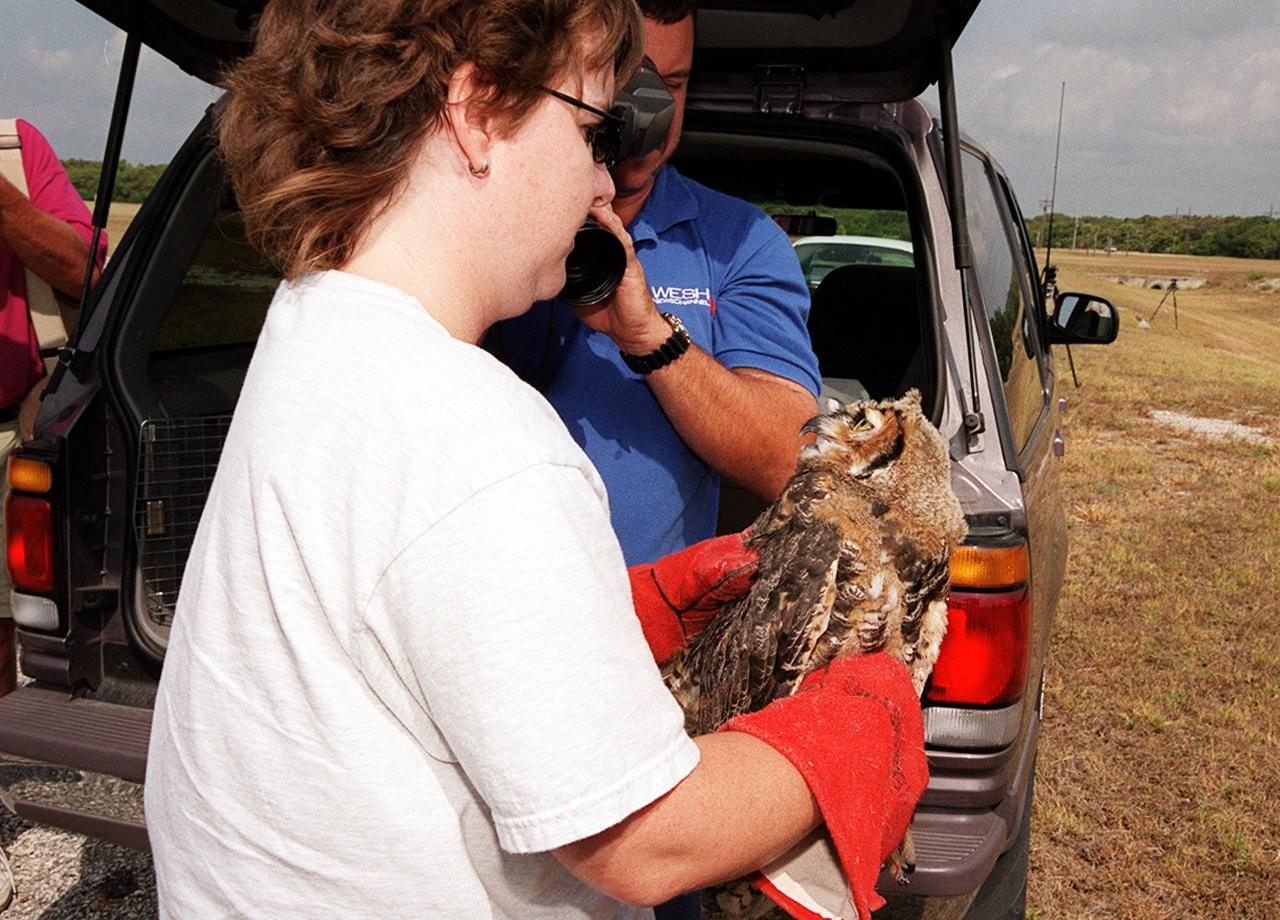
Eileen Olejarski, manager of Florida Wildlife Hospital, and Susan Small, director of the hospital, get ready to release two great horned owls at Complex 25/29 on Cape Canaveral Air Force Station . The owls, rescued after falling from their next inside a hangar at CCAFS in April, were treated at the hospital for injuries
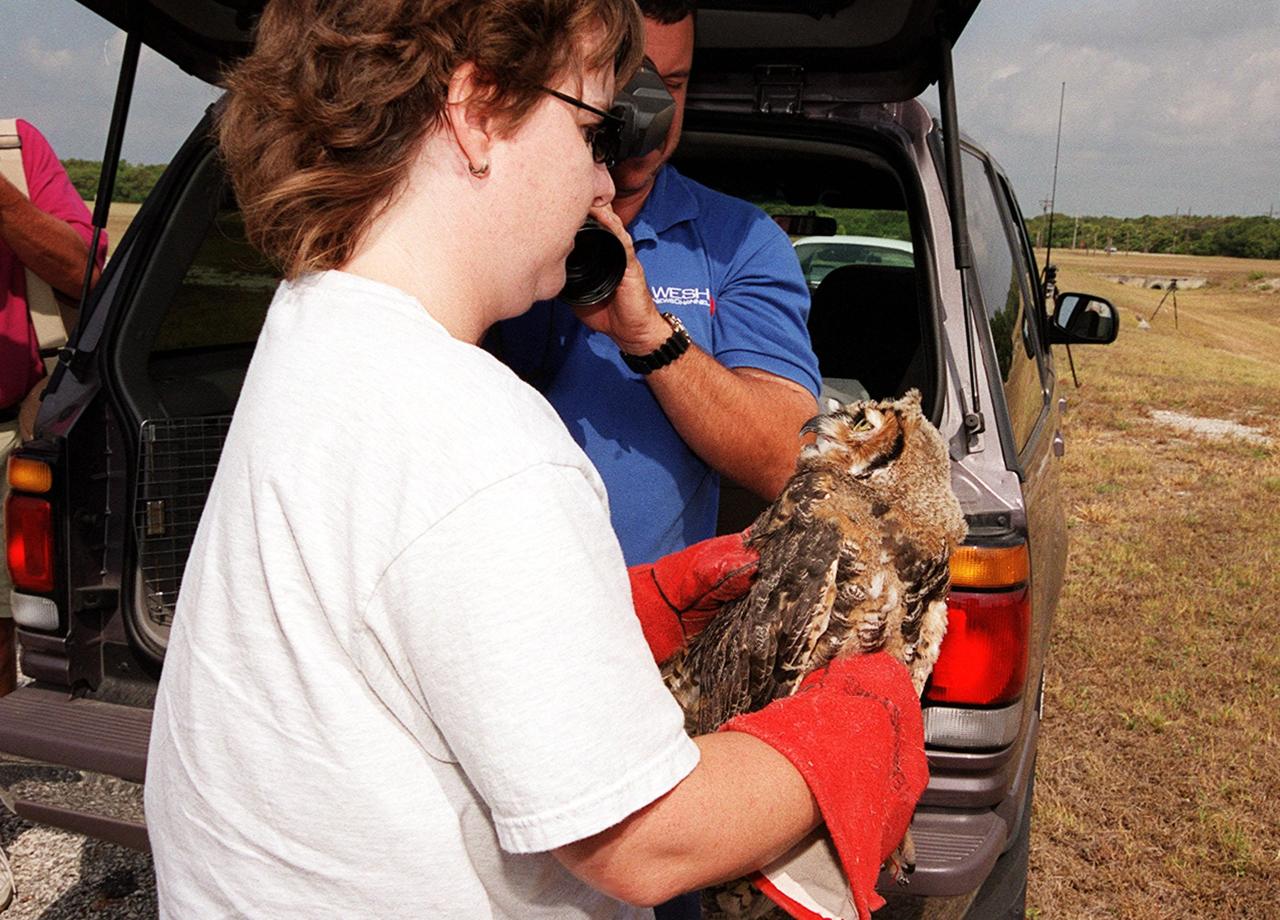
Eileen Olejarski, manager of Florida Wildlife Hospital, and Susan Small, director of the hospital, get ready to release two great horned owls at Complex 25/29 on Cape Canaveral Air Force Station . The owls, rescued after falling from their next inside a hangar at CCAFS in April, were treated at the hospital for injuries
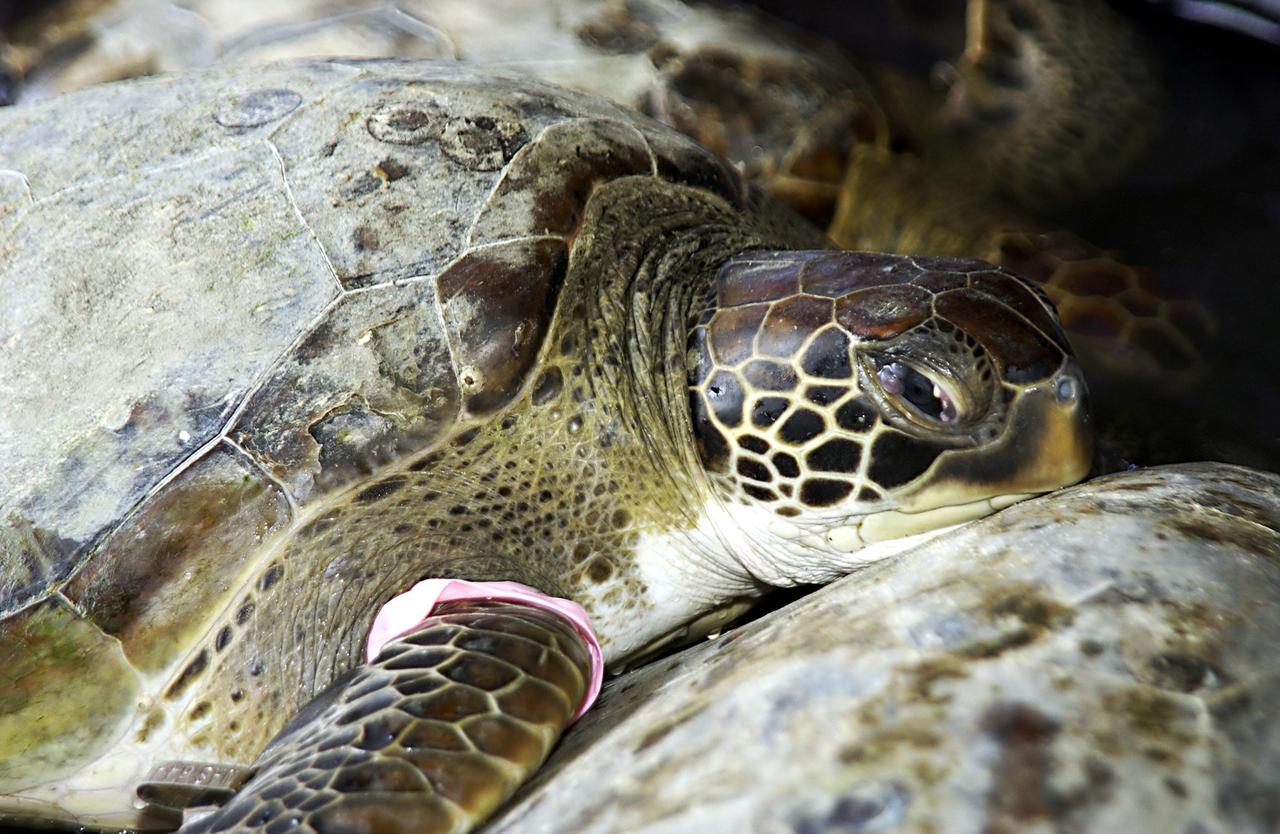
KENNEDY SPACE CENTER, FLA. - One of several sea turtles rescued from the Mosquito Lagoon is ready for release. The turtles were found stunned, impacted by the unseasonal cold temperatures experienced in Central Florida. The cooperative effort of KSC contractor Dynamac Corporation's Aquatics Program and the Merritt Island National Wildlife Refuge warmed the turtles and evaluated them for release. Most were tagged and one received the transmitter, provided by the University of Central Florida, for satellite tracking. The turtles were then transported in a skiff through the Haulover Canal to a location away from the main channel and released back into the Mosquito Lagoon.
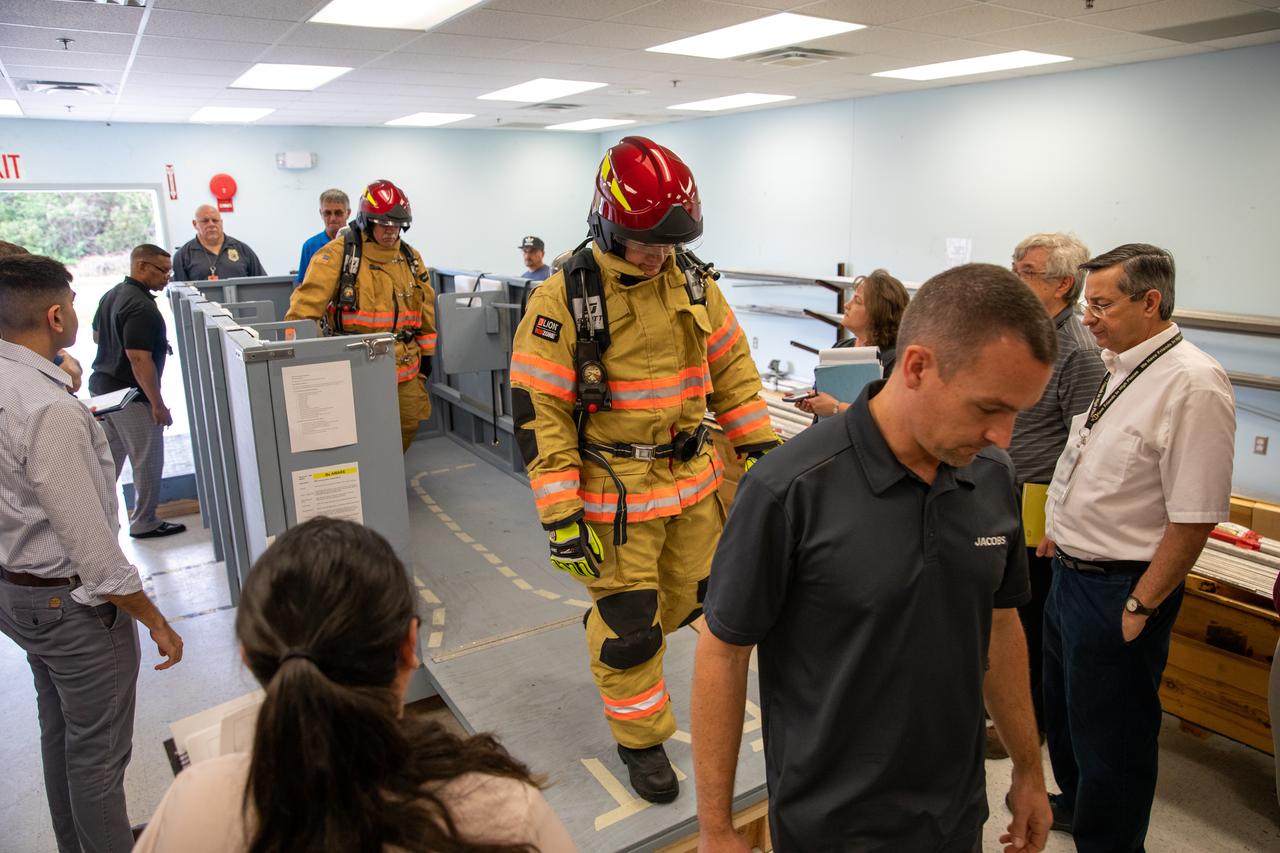
Members of NASA Kennedy Space Center’s Fire Rescue team walk through a mock-up of a launch pad escape basket on Feb. 19, 2020. Kennedy’s prime contractor Reynolds, Smith and Hill presented the mock-up to NASA, fire rescue personnel and other stakeholders at the Florida spaceport. The basket would be utilized at Launch Pad 39B in the unlikely event of an emergency at the pad requiring evacuation during crewed missions under the Artemis Program. The actual egress basket will be designed larger than ones used during the shuttle era in order to accommodate fire rescue crew, astronauts and closeout crew. During the presentation, a fire rescue team conducted a series of trial scenarios and addressed items such as basket release location, seat depth to accommodate firefighters in full gear, sequence of loading and more.
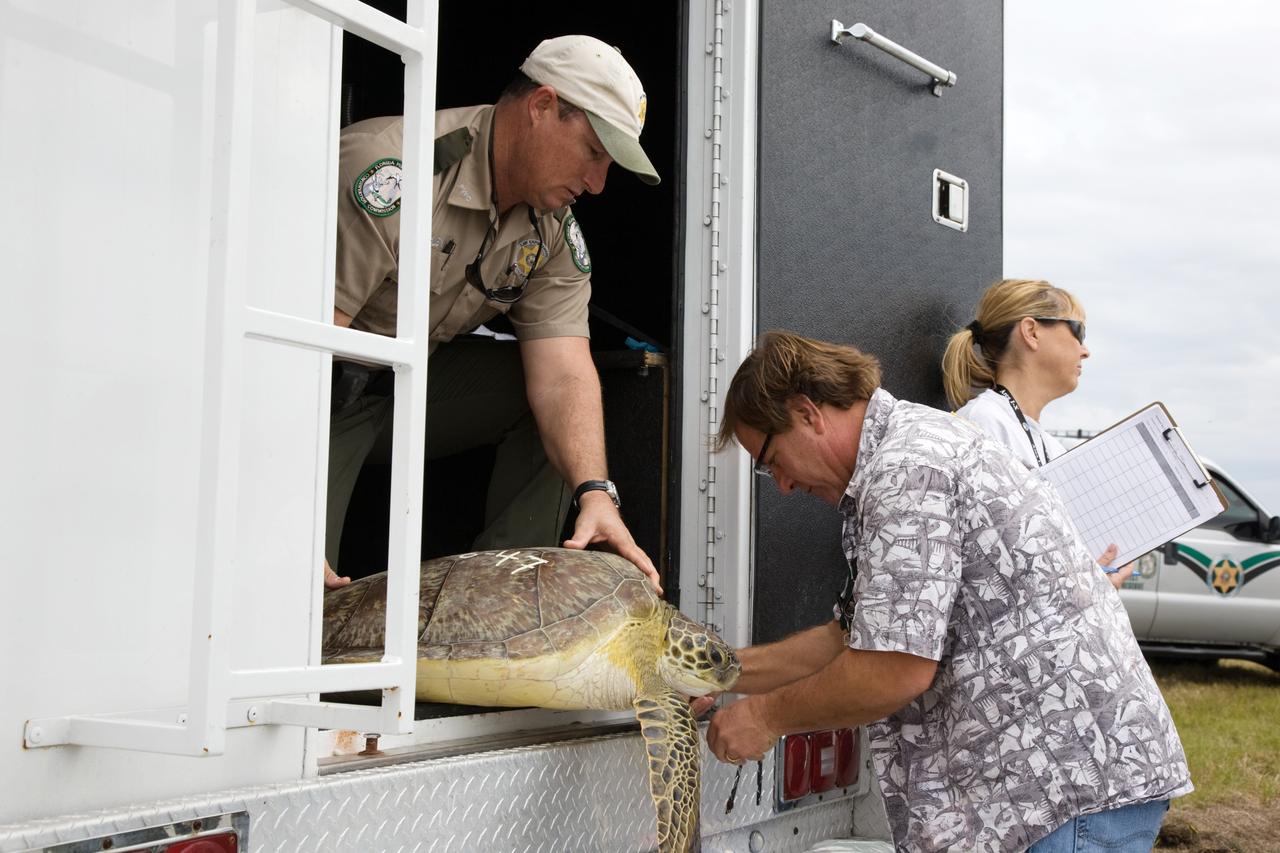
CAPE CANAVERAL, Fla. - An endangered green sea turtle is unloaded from a truck prior to its release into the waters of the Banana River at NASA's Kennedy Space Center in Florida. Wildlife personnel and volunteers are releasing groups of the federally protected turtles after nearly 2,000 of the animals were "stunned" by prolonged cold temperatures. Many of the turtles were rescued from the Mosquito Lagoon, with others coming from the Indian River Lagoon and Cocoa Beach. Biologists, environmentalists, wildlife experts and other volunteers joined forces with a massive rescue effort at the Merritt Island National Wildlife Refuge, where the turtles were identified, examined and transported to rehabilitation facilities throughout Florida and South Georgia. The animals stayed at these facilities until local waters warmed up to safe temperatures. Photo credit: NASA/Troy Cryder

Medical and fire-rescue personnel participate in the Artemis II mission emergency escape or egress verification and validation tests near Launch Complex 39 at NASA's Kennedy Space Center in Florida on Monday, Aug. 12, 2024. During the multi-day tests, members of the closeout crew, pad rescue team, and the Exploration Ground Systems Program practiced the process of getting in and out of the emergency egress baskets then down to the launch pad where they would be transported to emergency transport vehicles and driven to safety. Prior to this test and throughout the course of several months, teams conducted basket release demonstrations to validate the system.
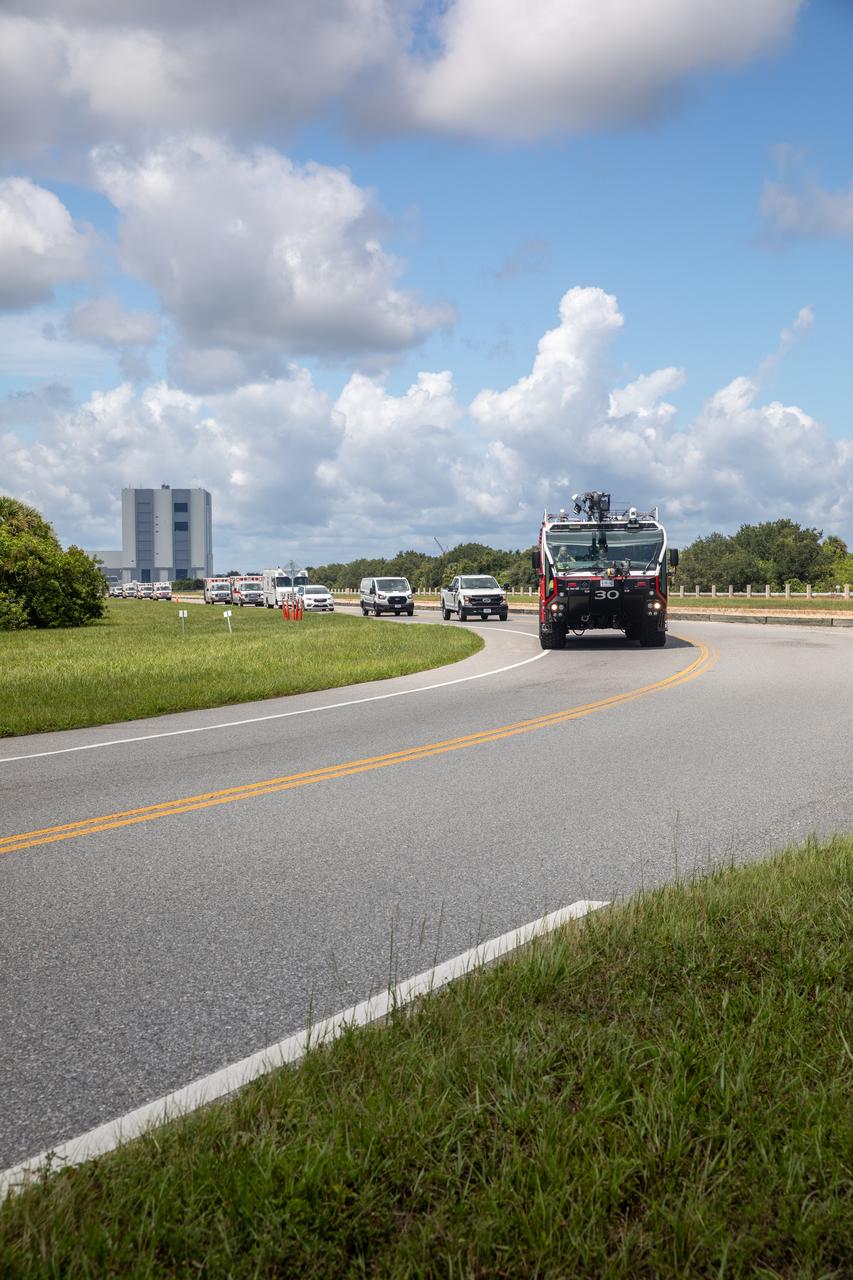
Medical and fire-rescue personnel participate in the Artemis II mission emergency escape or egress verification and validation tests near Launch Complex 39 at NASA's Kennedy Space Center in Florida on Monday, Aug. 12, 2024. During the multi-day tests, members of the closeout crew, pad rescue team, and the Exploration Ground Systems Program practiced the process of getting in and out of the emergency egress baskets then down to the launch pad where they would be transported to emergency transport vehicles and driven to safety. Prior to this test and throughout the course of several months, teams conducted basket release demonstrations to validate the system.
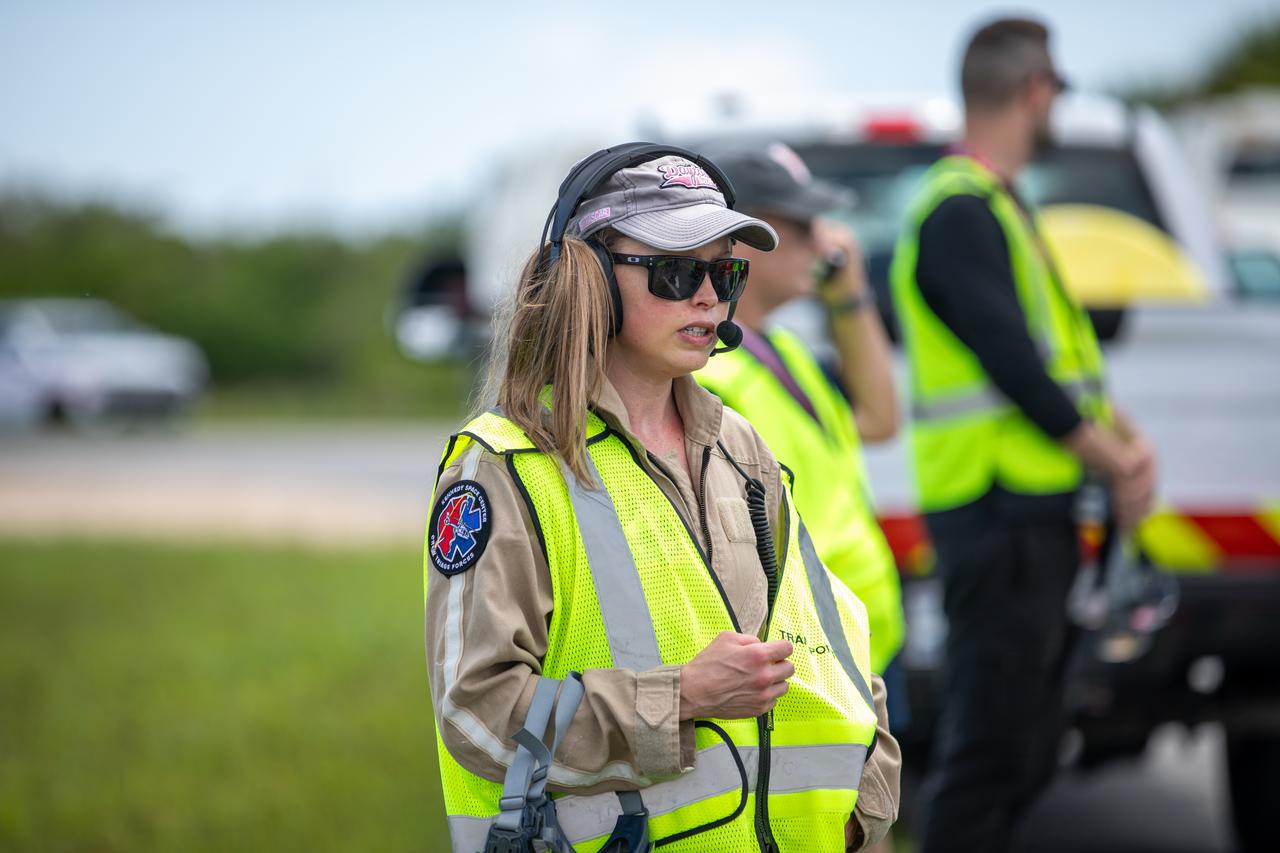
Medical and fire-rescue personnel participate in the Artemis II mission emergency escape or egress verification and validation tests near Launch Complex 39 at NASA's Kennedy Space Center in Florida on Monday, Aug. 12, 2024. During the multi-day tests, members of the closeout crew, pad rescue team, and the Exploration Ground Systems Program practiced the process of getting in and out of the emergency egress baskets then down to the launch pad where they would be transported to emergency transport vehicles and driven to safety. Prior to this test and throughout the course of several months, teams conducted basket release demonstrations to validate the system.
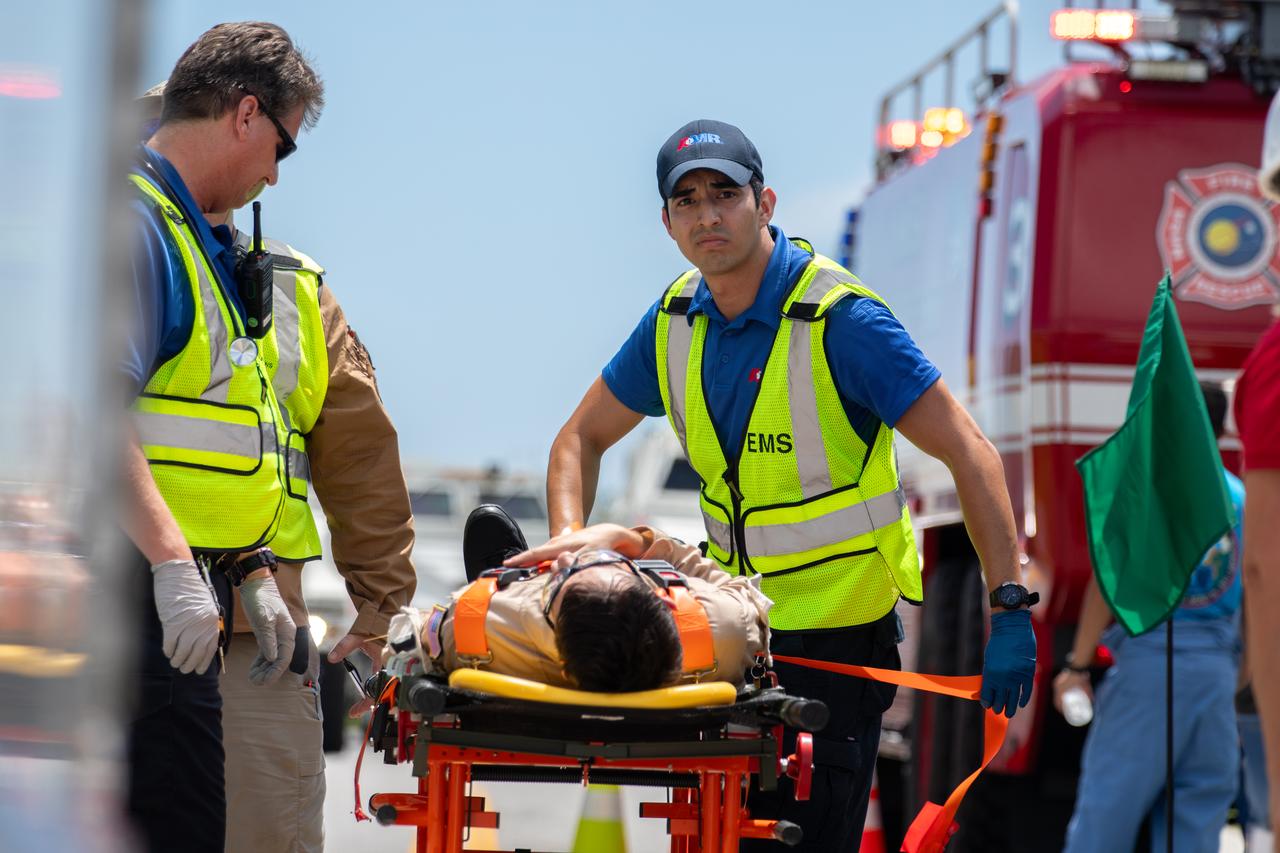
Medical and fire-rescue personnel participate in the Artemis II mission emergency escape or egress verification and validation tests near Launch Complex 39 at NASA's Kennedy Space Center in Florida on Monday, Aug. 12, 2024. During the multi-day tests, members of the closeout crew, pad rescue team, and the Exploration Ground Systems Program practiced the process of getting in and out of the emergency egress baskets then down to the launch pad where they would be transported to emergency transport vehicles and driven to safety. Prior to this test and throughout the course of several months, teams conducted basket release demonstrations to validate the system.
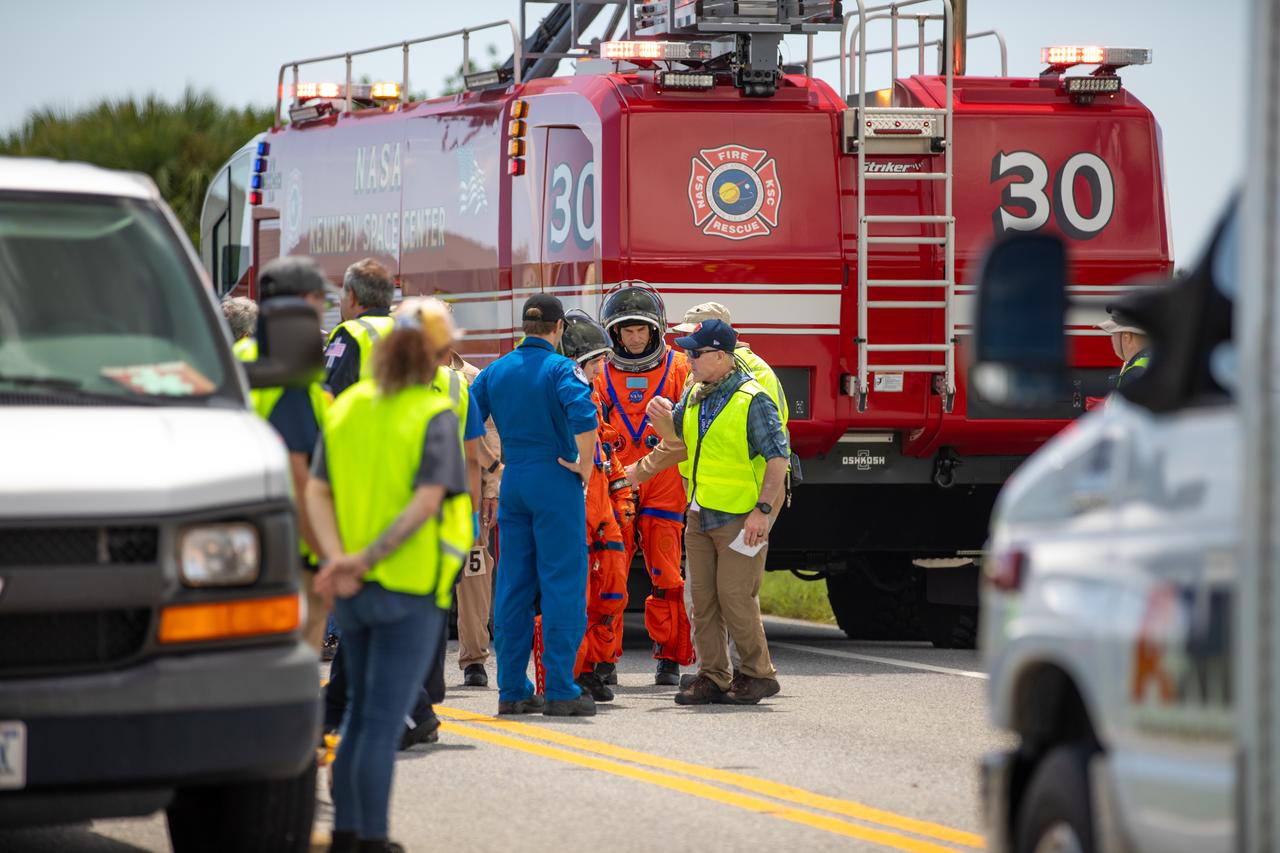
Medical, fire-rescue personnel, and simulated flight crew members participate in the Artemis II mission emergency escape or egress verification and validation tests near Launch Complex 39 at NASA's Kennedy Space Center in Florida on Monday, Aug. 12, 2024. During the multi-day tests, members of the closeout crew, pad rescue team, and the Exploration Ground Systems Program practiced the process of getting in and out of the emergency egress baskets then down to the launch pad where they would be transported to emergency transport vehicles and driven to safety. Prior to this test and throughout the course of several months, teams conducted basket release demonstrations to validate the system.
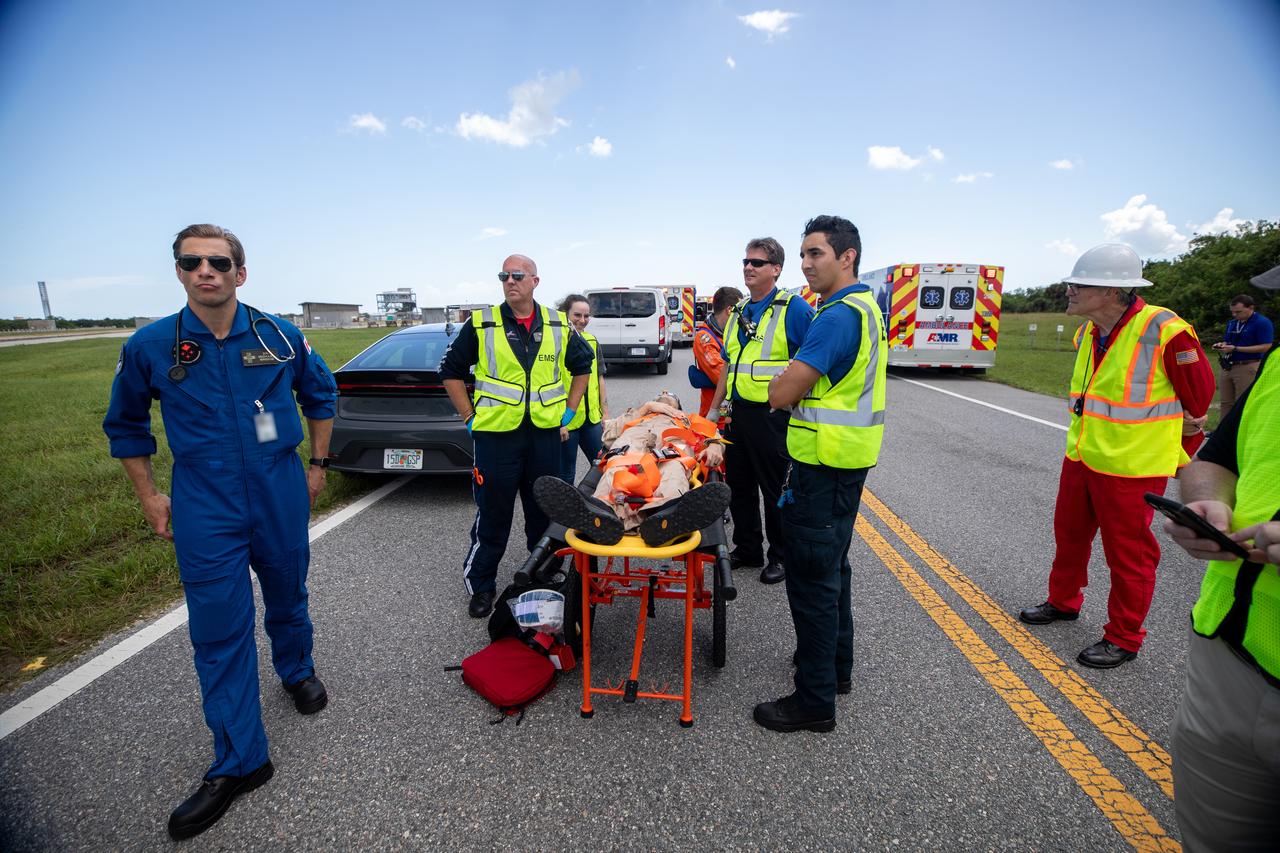
Medical, fire-rescue personnel, and simulated flight crew members participate in the Artemis II mission emergency escape or egress verification and validation tests near Launch Complex 39 at NASA's Kennedy Space Center in Florida on Monday, Aug. 12, 2024. During the multi-day tests, members of the closeout crew, pad rescue team, and the Exploration Ground Systems Program practiced the process of getting in and out of the emergency egress baskets then down to the launch pad where they would be transported to emergency transport vehicles and driven to safety. Prior to this test and throughout the course of several months, teams conducted basket release demonstrations to validate the system.
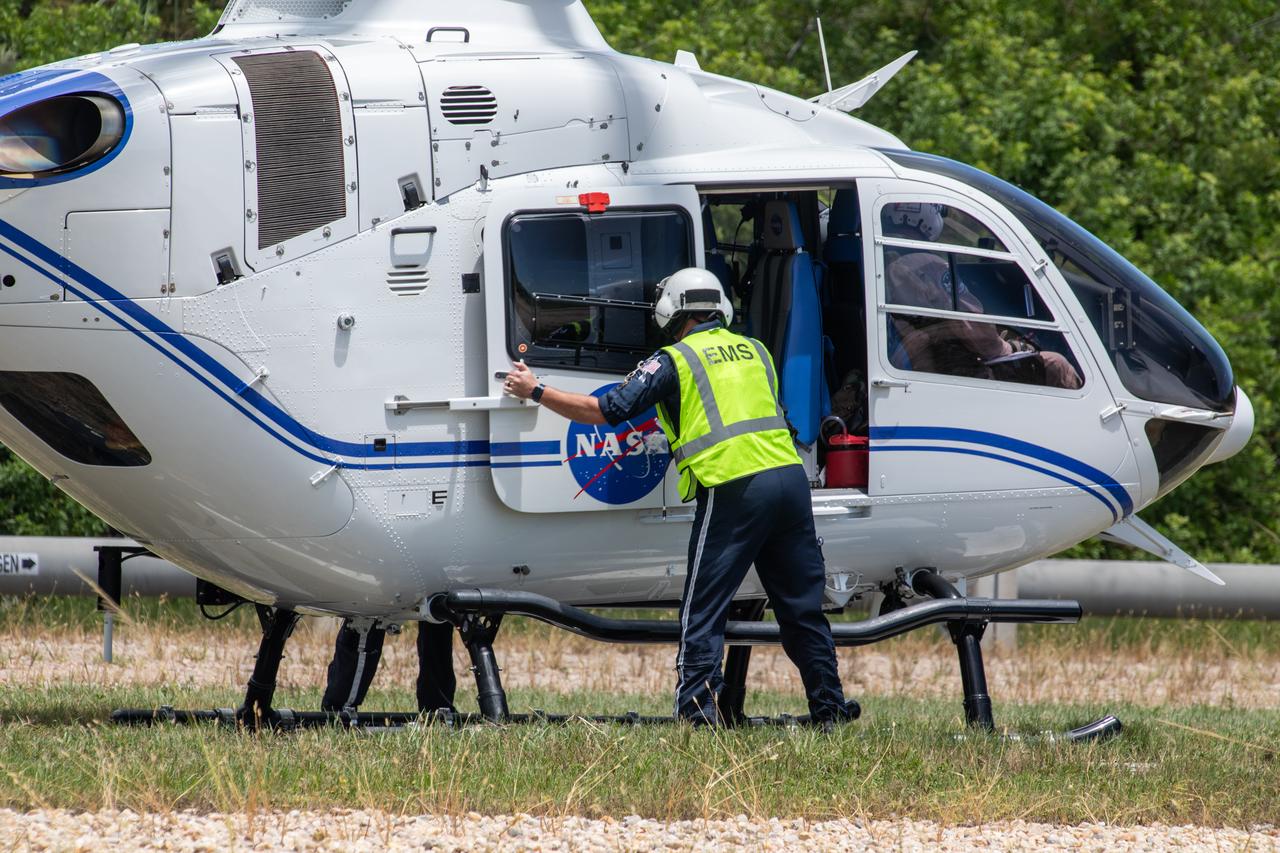
Medical and fire-rescue personnel participate in the Artemis II mission emergency escape or egress verification and validation tests near Launch Complex 39 at NASA's Kennedy Space Center in Florida on Monday, Aug. 12, 2024. During the multi-day tests, members of the closeout crew, pad rescue team, and the Exploration Ground Systems Program practiced the process of getting in and out of the emergency egress baskets then down to the launch pad where they would be transported to emergency transport vehicles and driven to safety. Prior to this test and throughout the course of several months, teams conducted basket release demonstrations to validate the system.
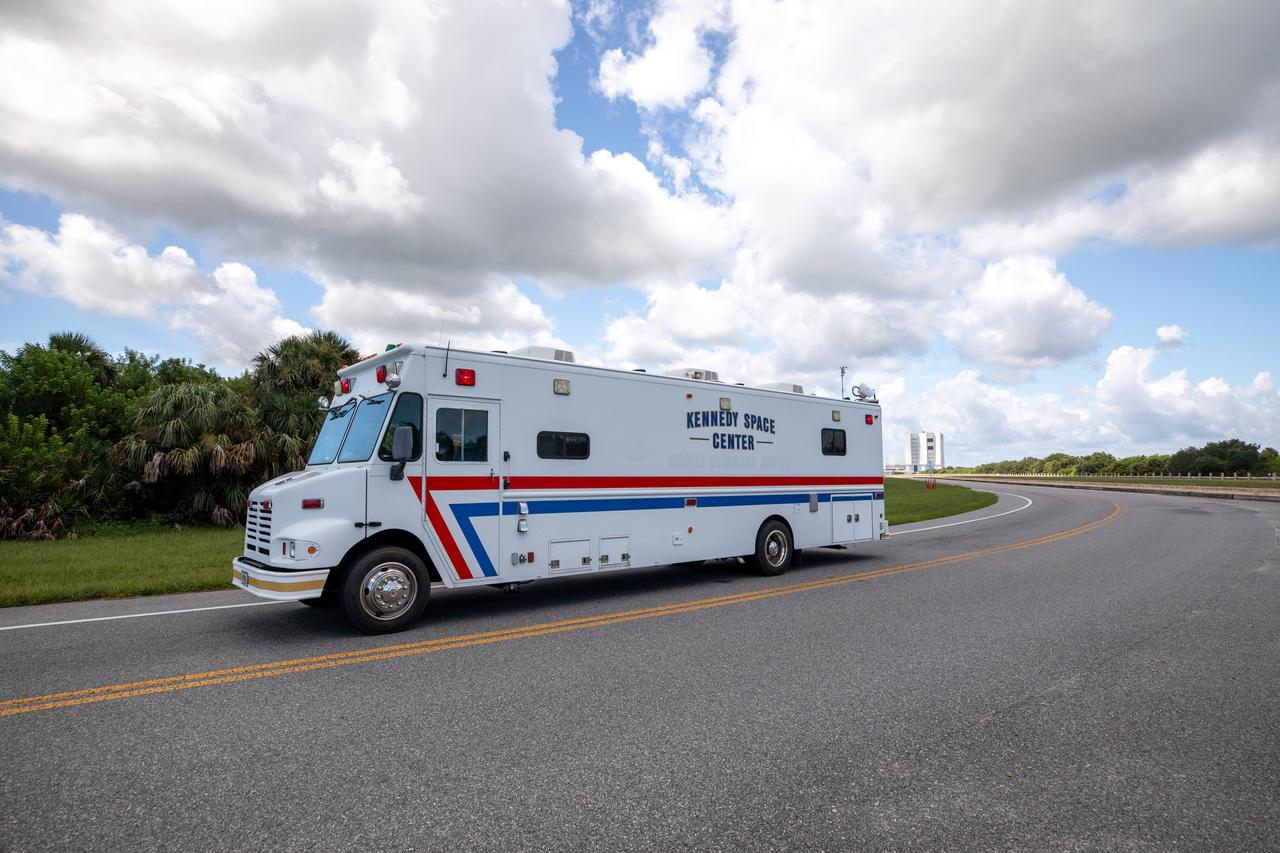
Medical and fire-rescue personnel participate in the Artemis II mission emergency escape or egress verification and validation tests near Launch Complex 39 at NASA's Kennedy Space Center in Florida on Monday, Aug. 12, 2024. During the multi-day tests, members of the closeout crew, pad rescue team, and the Exploration Ground Systems Program practiced the process of getting in and out of the emergency egress baskets then down to the launch pad where they would be transported to emergency transport vehicles and driven to safety. Prior to this test and throughout the course of several months, teams conducted basket release demonstrations to validate the system.
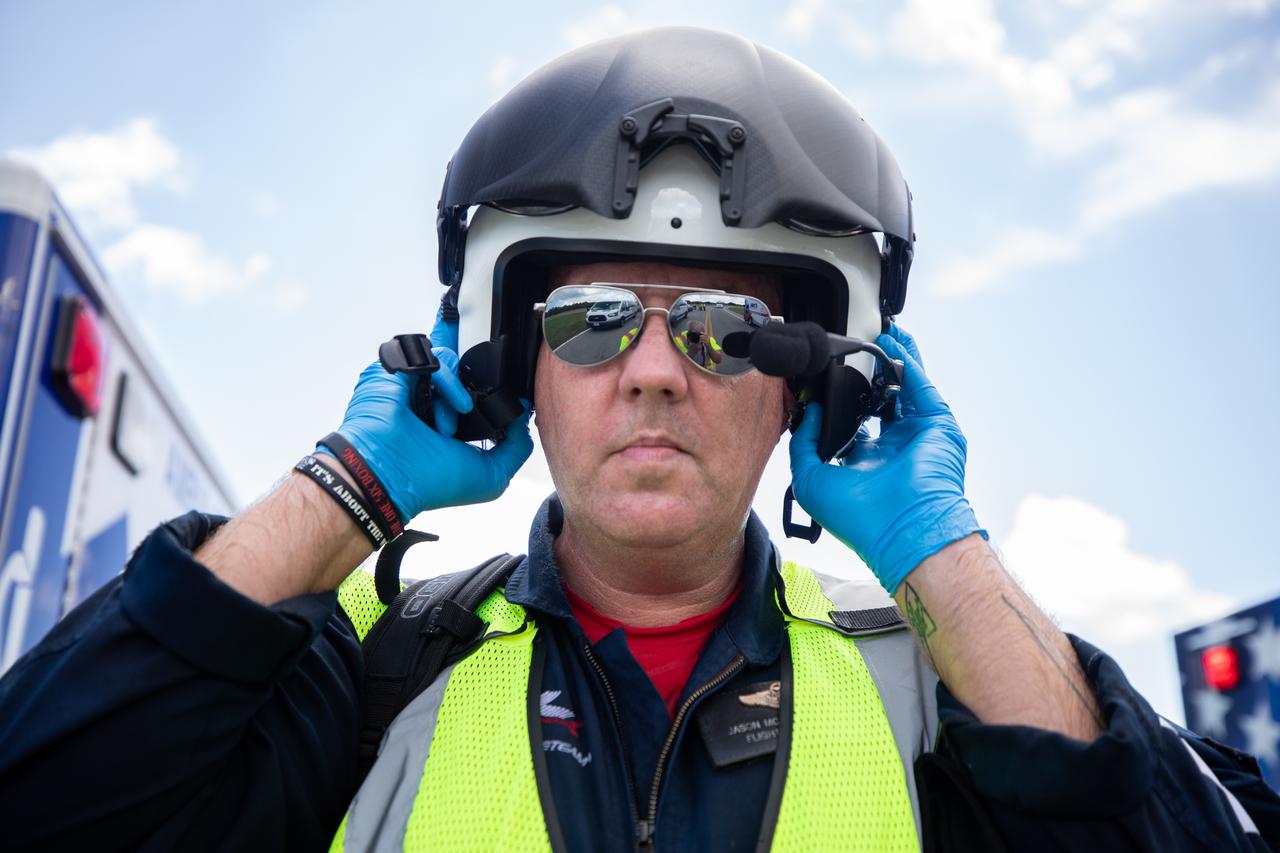
Medical and fire-rescue personnel participate in the Artemis II mission emergency escape or egress verification and validation tests near Launch Complex 39 at NASA's Kennedy Space Center in Florida on Monday, Aug. 12, 2024. During the multi-day tests, members of the closeout crew, pad rescue team, and the Exploration Ground Systems Program practiced the process of getting in and out of the emergency egress baskets then down to the launch pad where they would be transported to emergency transport vehicles and driven to safety. Prior to this test and throughout the course of several months, teams conducted basket release demonstrations to validate the system.
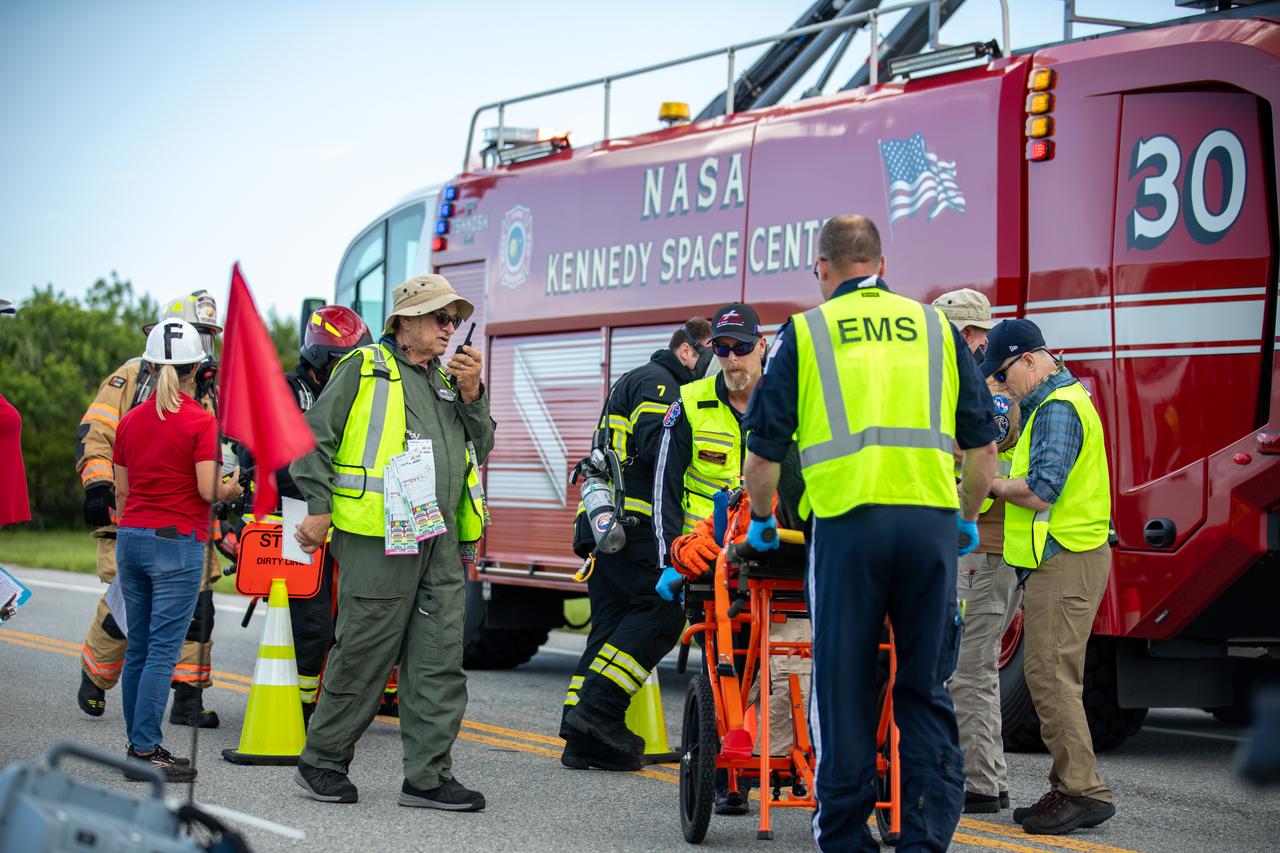
Medical and fire-rescue personnel participate in the Artemis II mission emergency escape or egress verification and validation tests near Launch Complex 39 at NASA's Kennedy Space Center in Florida on Monday, Aug. 12, 2024. During the multi-day tests, members of the closeout crew, pad rescue team, and the Exploration Ground Systems Program practiced the process of getting in and out of the emergency egress baskets then down to the launch pad where they would be transported to emergency transport vehicles and driven to safety. Prior to this test and throughout the course of several months, teams conducted basket release demonstrations to validate the system.
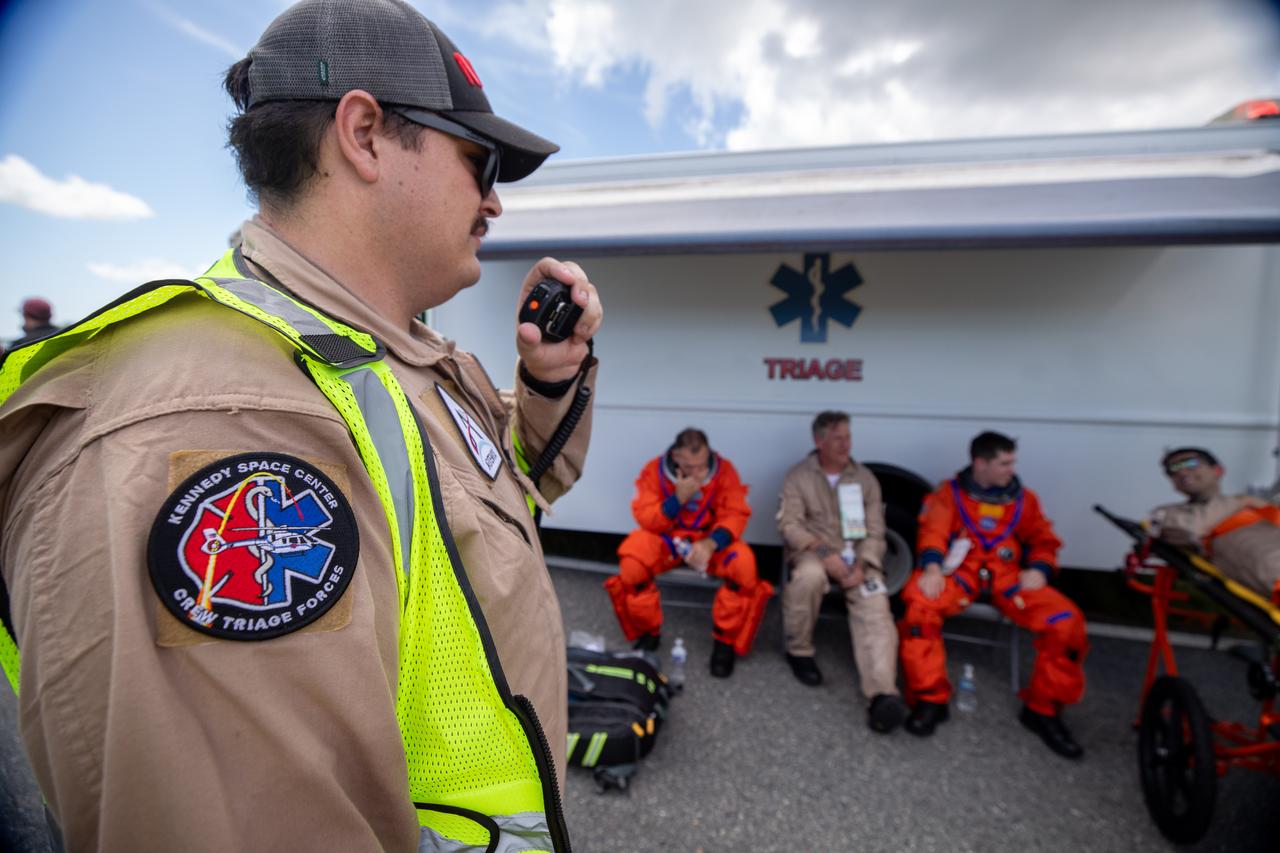
Medical and fire-rescue personnel participate in the Artemis II mission emergency escape or egress verification and validation tests near Launch Complex 39 at NASA's Kennedy Space Center in Florida on Monday, Aug. 12, 2024. During the multi-day tests, members of the closeout crew, pad rescue team, and the Exploration Ground Systems Program practiced the process of getting in and out of the emergency egress baskets then down to the launch pad where they would be transported to emergency transport vehicles and driven to safety. Prior to this test and throughout the course of several months, teams conducted basket release demonstrations to validate the system.
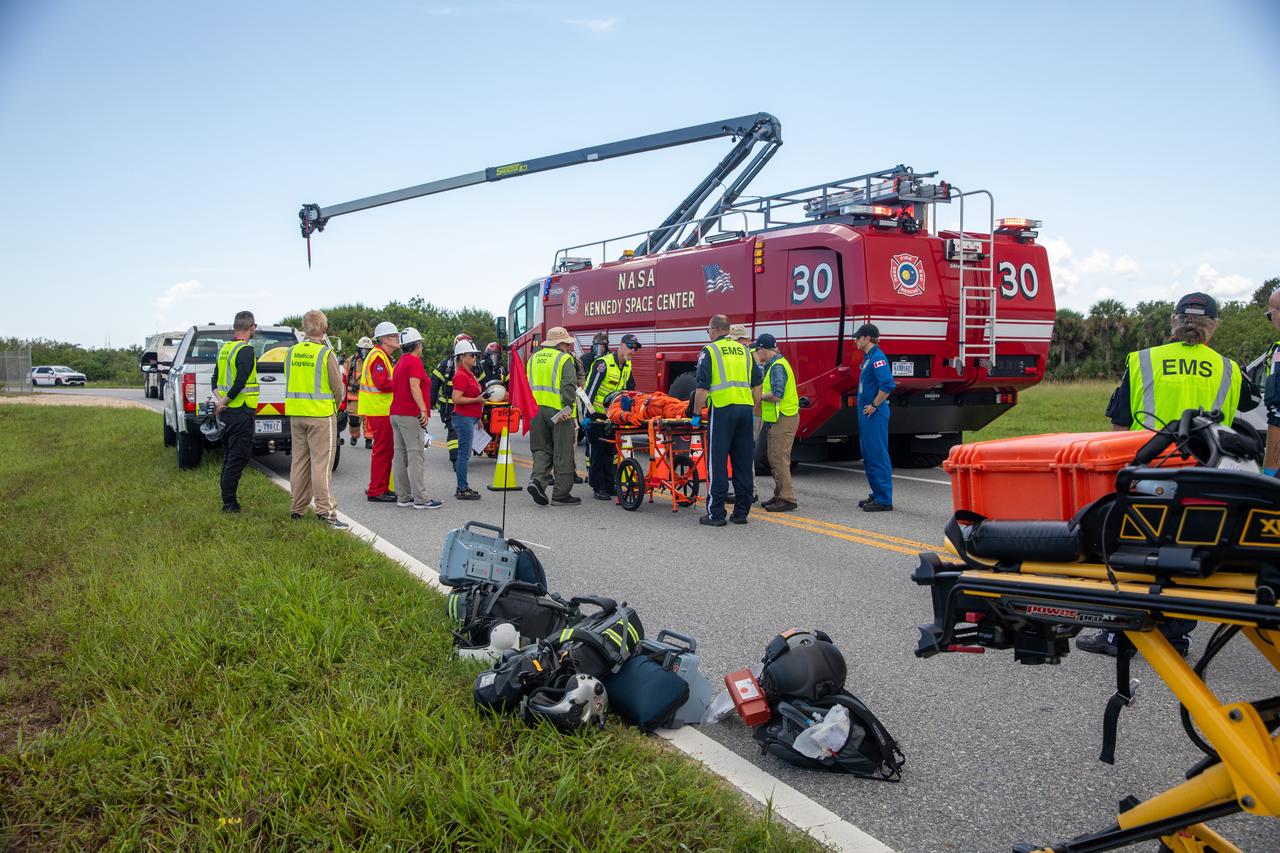
Medical, fire-rescue personnel, and simulated flight crew members participate in the Artemis II mission emergency escape or egress verification and validation tests near Launch Complex 39 at NASA's Kennedy Space Center in Florida on Monday, Aug. 12, 2024. During the multi-day tests, members of the closeout crew, pad rescue team, and the Exploration Ground Systems Program practiced the process of getting in and out of the emergency egress baskets then down to the launch pad where they would be transported to emergency transport vehicles and driven to safety. Prior to this test and throughout the course of several months, teams conducted basket release demonstrations to validate the system.
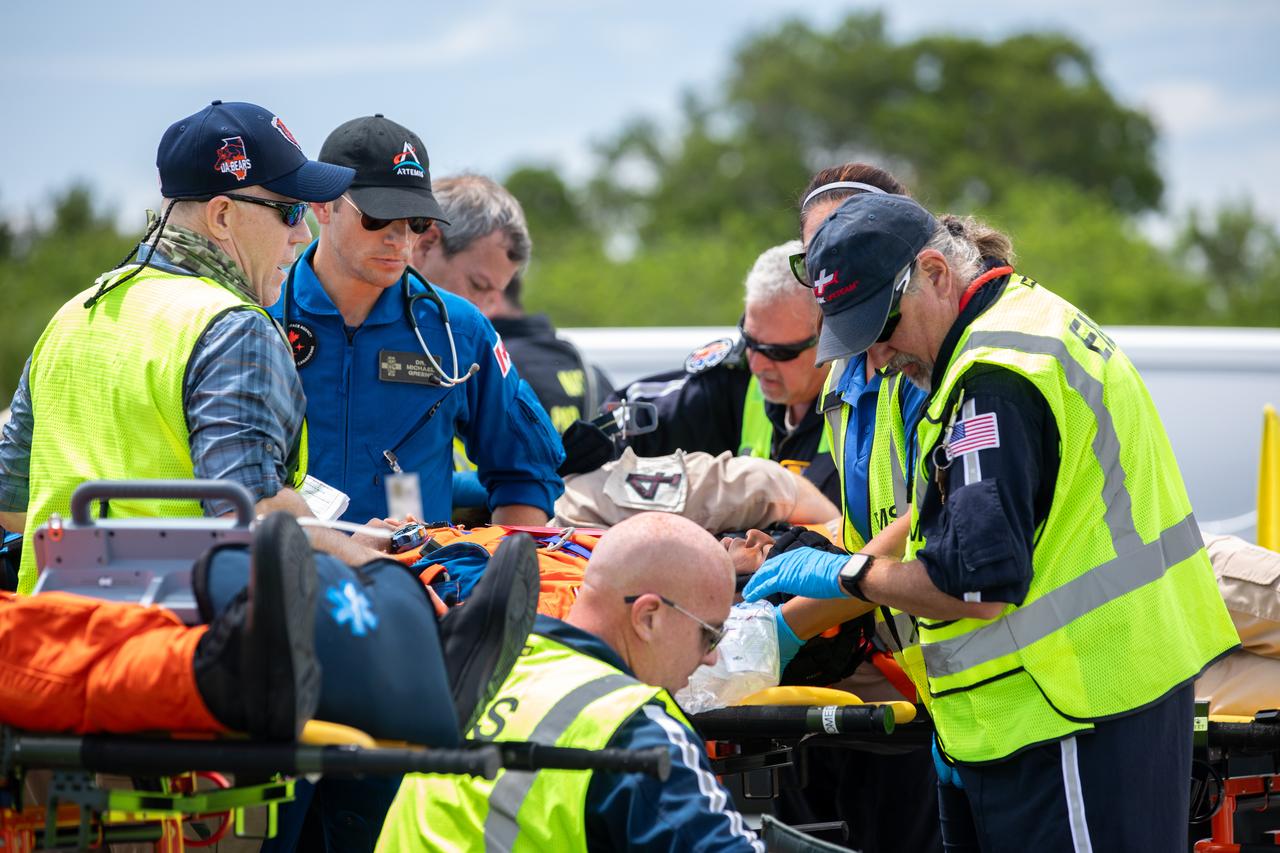
Medical, fire-rescue personnel, and simulated flight crew members participate in the Artemis II mission emergency escape or egress verification and validation tests near Launch Complex 39 at NASA's Kennedy Space Center in Florida on Monday, Aug. 12, 2024. During the multi-day tests, members of the closeout crew, pad rescue team, and the Exploration Ground Systems Program practiced the process of getting in and out of the emergency egress baskets then down to the launch pad where they would be transported to emergency transport vehicles and driven to safety. Prior to this test and throughout the course of several months, teams conducted basket release demonstrations to validate the system.
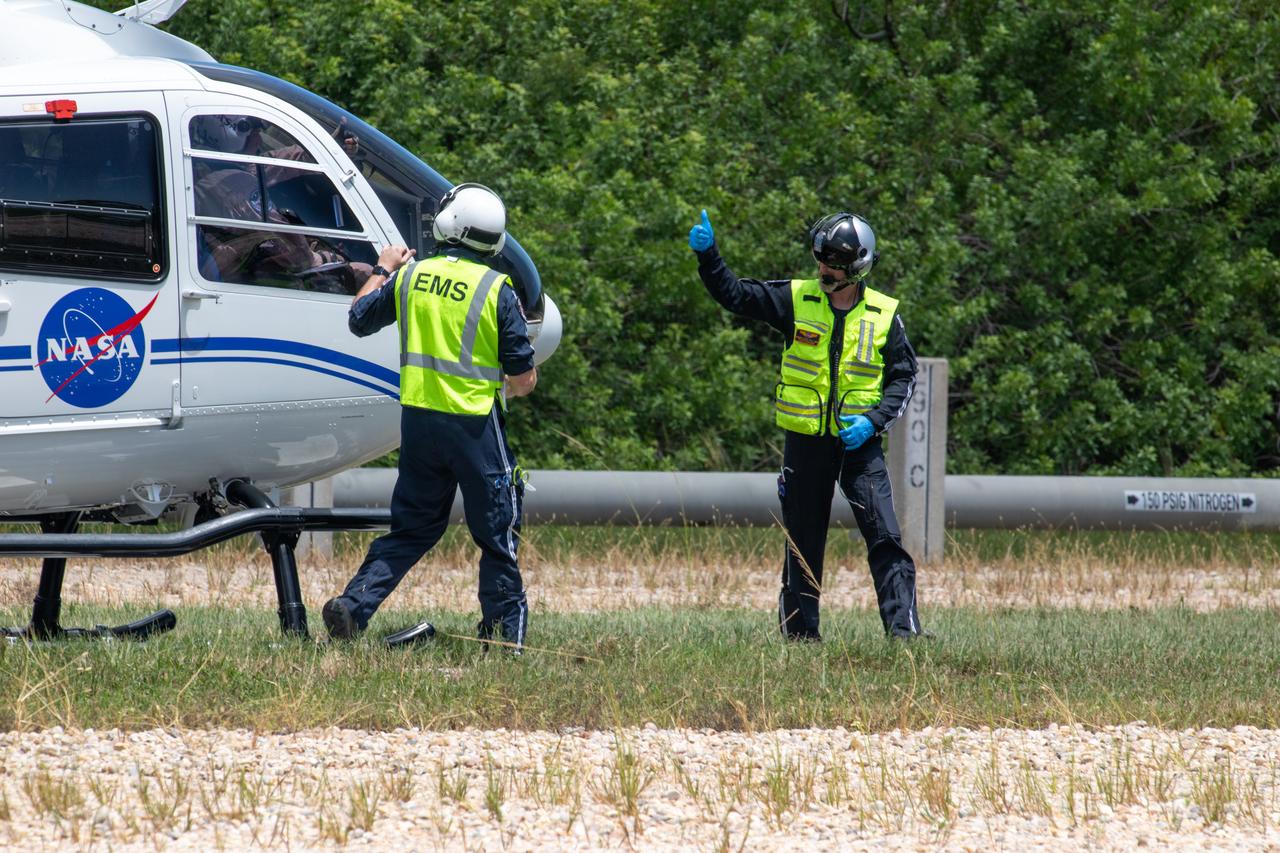
Medical and fire-rescue personnel participate in the Artemis II mission emergency escape or egress verification and validation tests near Launch Complex 39 at NASA's Kennedy Space Center in Florida on Monday, Aug. 12, 2024. During the multi-day tests, members of the closeout crew, pad rescue team, and the Exploration Ground Systems Program practiced the process of getting in and out of the emergency egress baskets then down to the launch pad where they would be transported to emergency transport vehicles and driven to safety. Prior to this test and throughout the course of several months, teams conducted basket release demonstrations to validate the system.
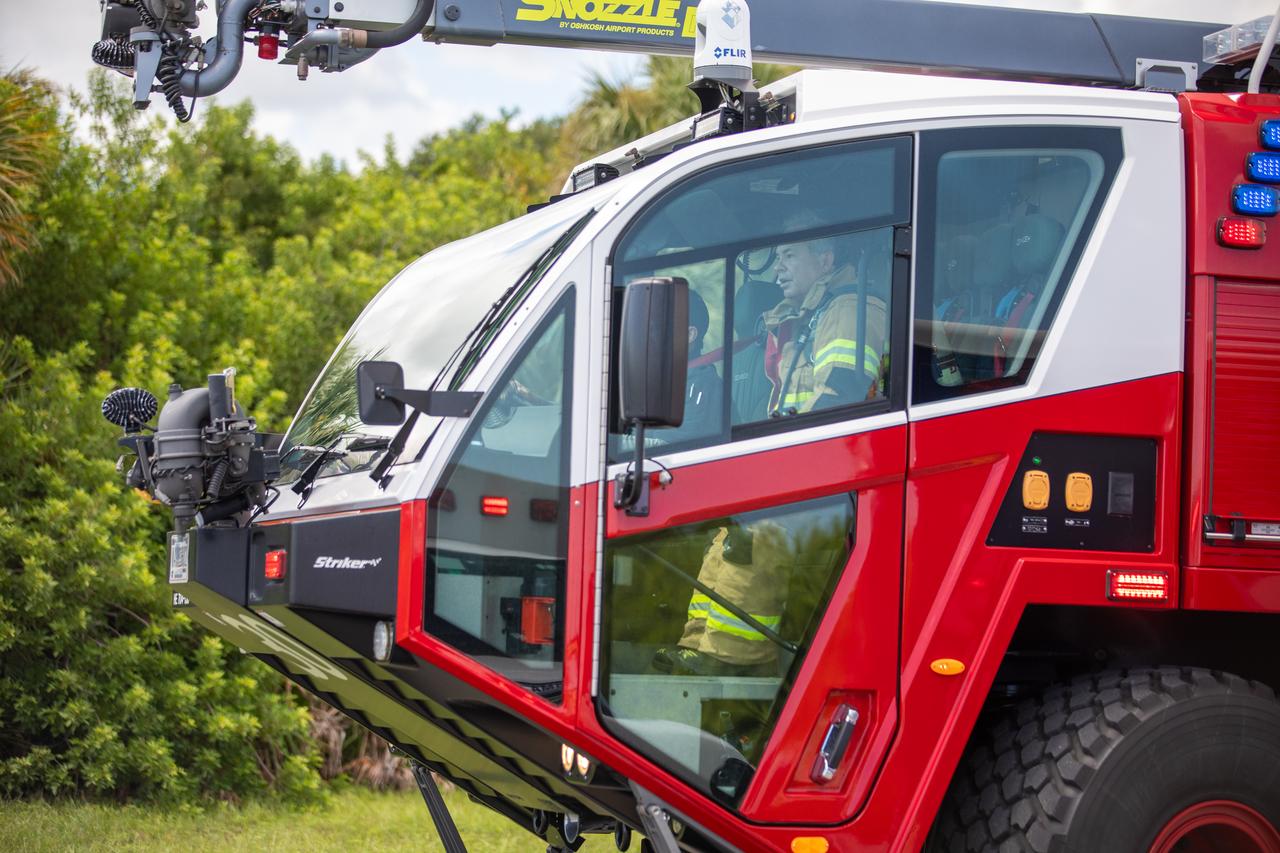
Medical and fire-rescue personnel participate in the Artemis II mission emergency escape or egress verification and validation tests near Launch Complex 39 at NASA's Kennedy Space Center in Florida on Monday, Aug. 12, 2024. During the multi-day tests, members of the closeout crew, pad rescue team, and the Exploration Ground Systems Program practiced the process of getting in and out of the emergency egress baskets then down to the launch pad where they would be transported to emergency transport vehicles and driven to safety. Prior to this test and throughout the course of several months, teams conducted basket release demonstrations to validate the system.

Medical, fire-rescue personnel, and simulated flight crew members participate in the Artemis II mission emergency escape or egress verification and validation tests near Launch Complex 39 at NASA's Kennedy Space Center in Florida on Monday, Aug. 12, 2024. During the multi-day tests, members of the closeout crew, pad rescue team, and the Exploration Ground Systems Program practiced the process of getting in and out of the emergency egress baskets then down to the launch pad where they would be transported to emergency transport vehicles and driven to safety. Prior to this test and throughout the course of several months, teams conducted basket release demonstrations to validate the system.
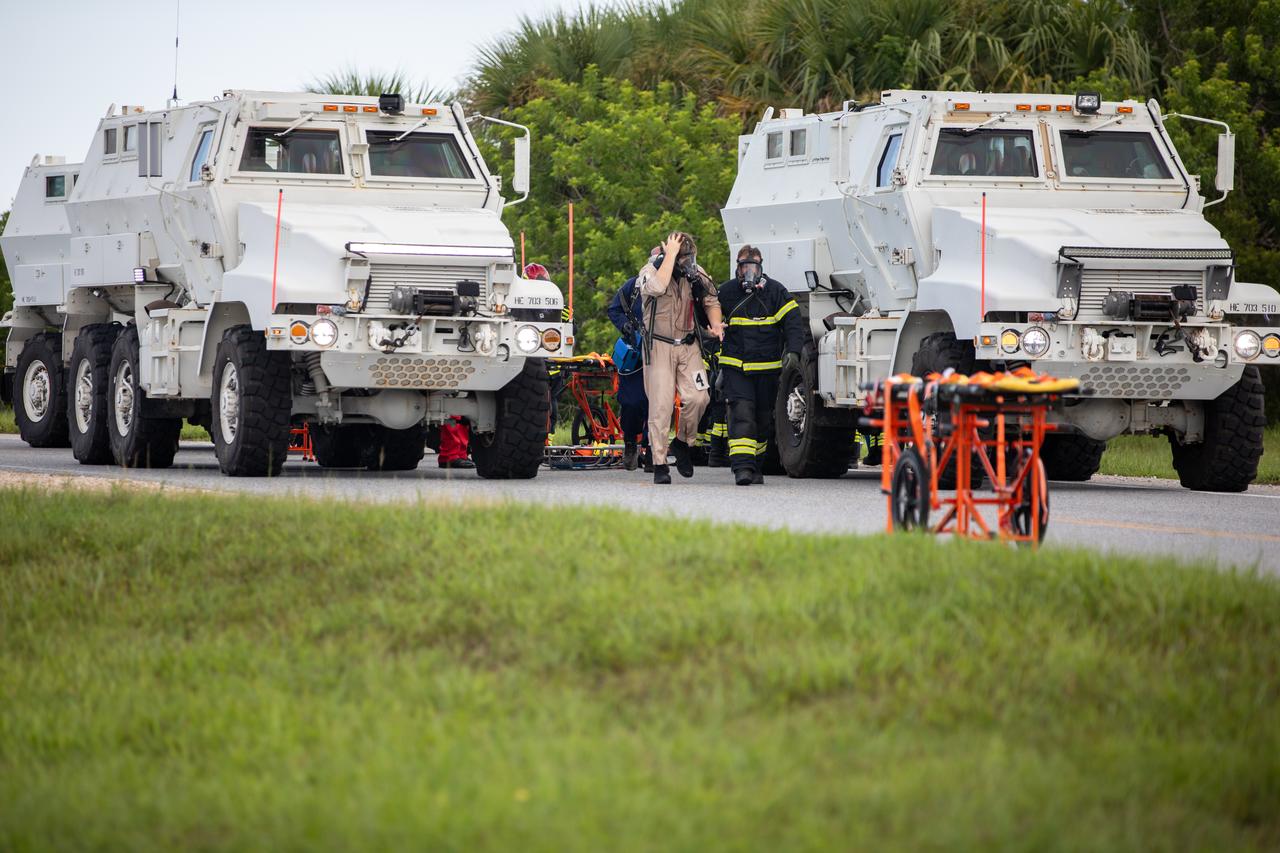
Medical and fire-rescue personnel participate in the Artemis II mission emergency escape or egress verification and validation tests near Launch Complex 39 at NASA's Kennedy Space Center in Florida on Monday, Aug. 12, 2024. During the multi-day tests, members of the closeout crew, pad rescue team, and the Exploration Ground Systems Program practiced the process of getting in and out of the emergency egress baskets then down to the launch pad where they would be transported to emergency transport vehicles and driven to safety. Prior to this test and throughout the course of several months, teams conducted basket release demonstrations to validate the system.
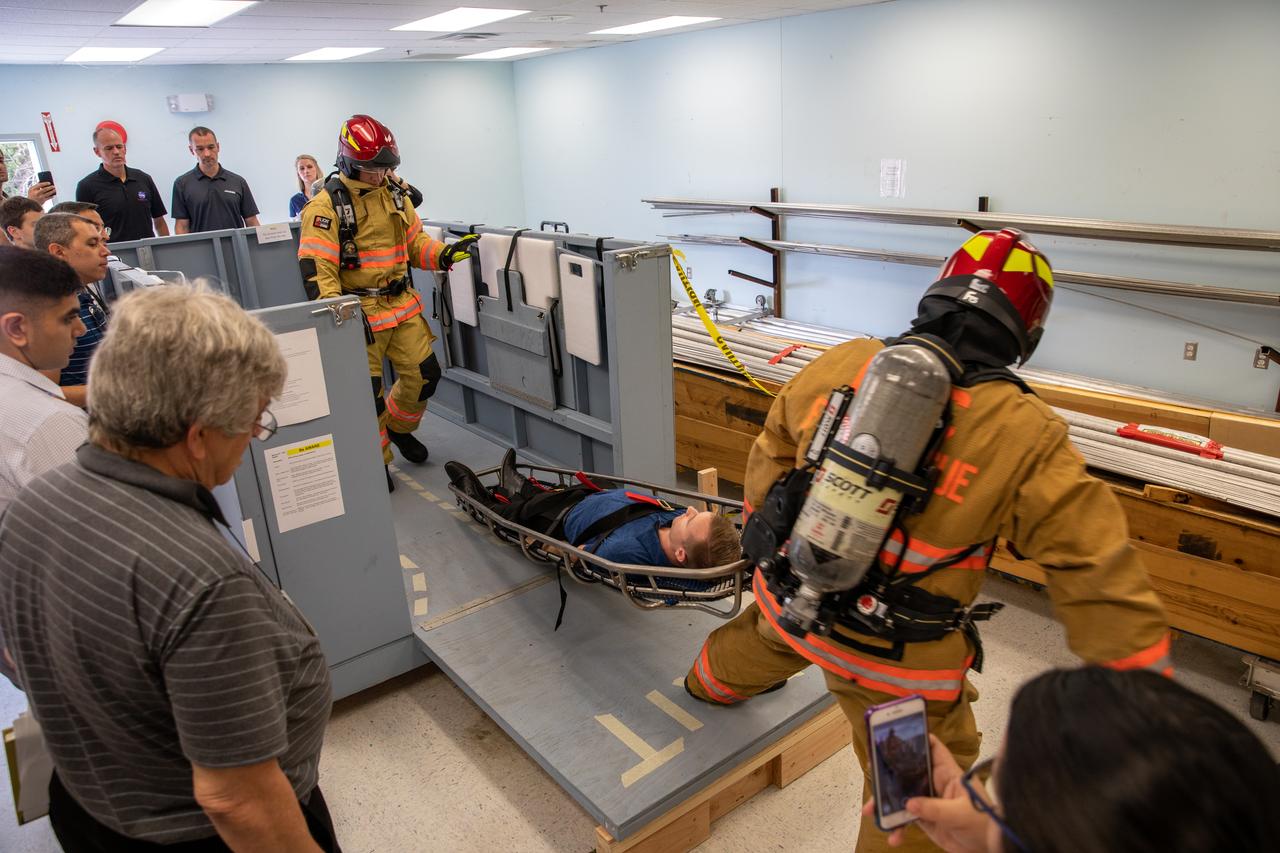
Members of NASA Kennedy Space Center’s Fire Rescue team conduct a series of trial scenarios in a mock-up of a launch pad escape basket on Feb. 19, 2020. Kennedy’s prime contractor Reynolds, Smith and Hill presented the mock-up to NASA, Kennedy Fire Rescue personnel and other stakeholders at the Florida spaceport. The basket would be utilized at Launch Pad 39B in the unlikely event of an emergency at the pad requiring evacuation during crewed missions under the Artemis Program. The actual egress basket will be designed larger than ones used during the shuttle era in order to accommodate fire rescue crew, astronauts and closeout crew. During the presentation, items such as basket release location, seat depth to accommodate firefighters in full gear, sequence of loading and more were addressed. Engineers will take what they learned during this presentation and discussion to advance the design of the pad egress system.
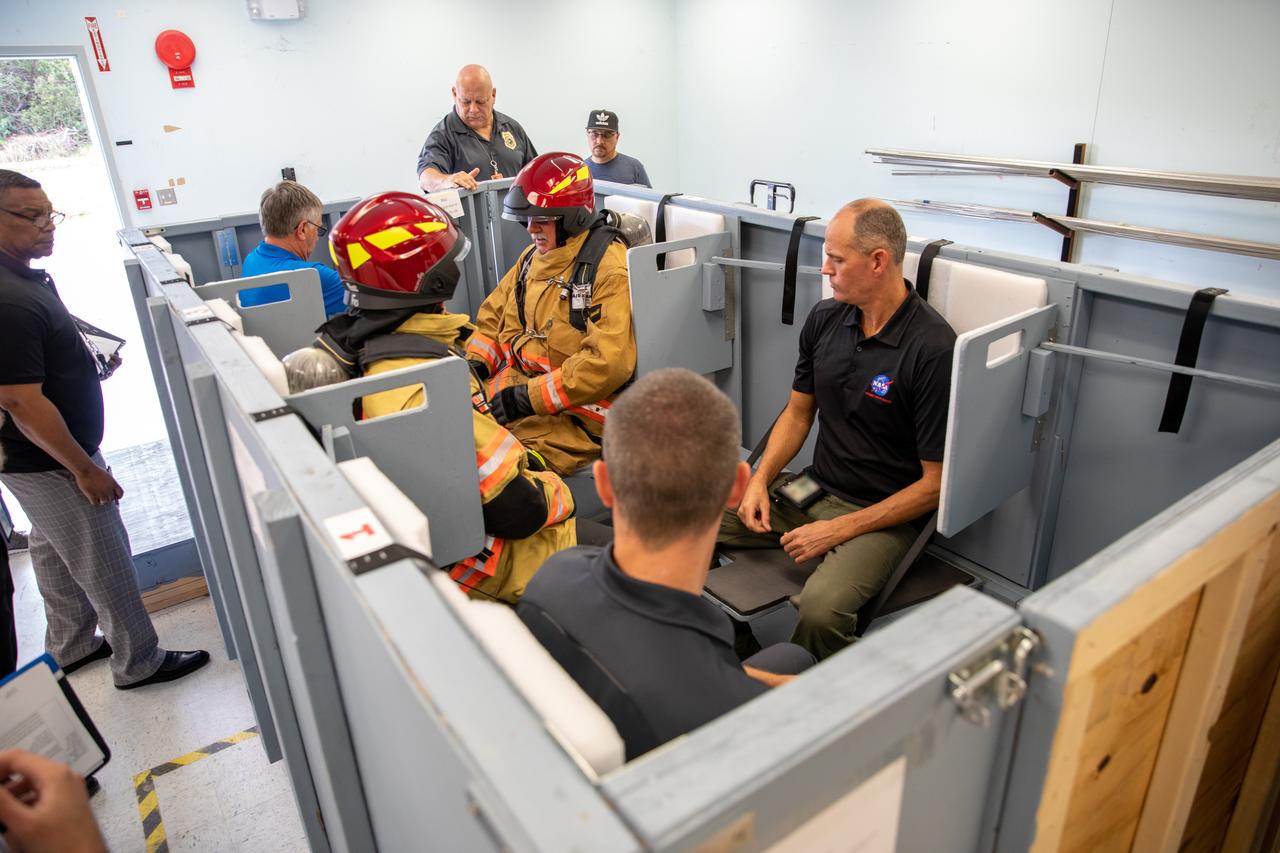
On Feb. 19, 2020, at NASA’s Kennedy Space Center in Florida, prime contractor Reynolds, Smith and Hill presents a mock-up of a launch pad escape basket to NASA, Kennedy Fire Rescue personnel and other stakeholders. The basket would be utilized at Launch Pad 39B in the unlikely event of an emergency at the pad requiring evacuation during crewed missions under the Artemis Program. The actual egress basket will be designed larger than ones used during the shuttle era in order to accommodate fire rescue crew, astronauts and closeout crew. During the presentation, a fire rescue team walked through a series of trial scenarios and addressed items such as basket release location, seat depth to accommodate firefighters in full gear, sequence of loading and more.
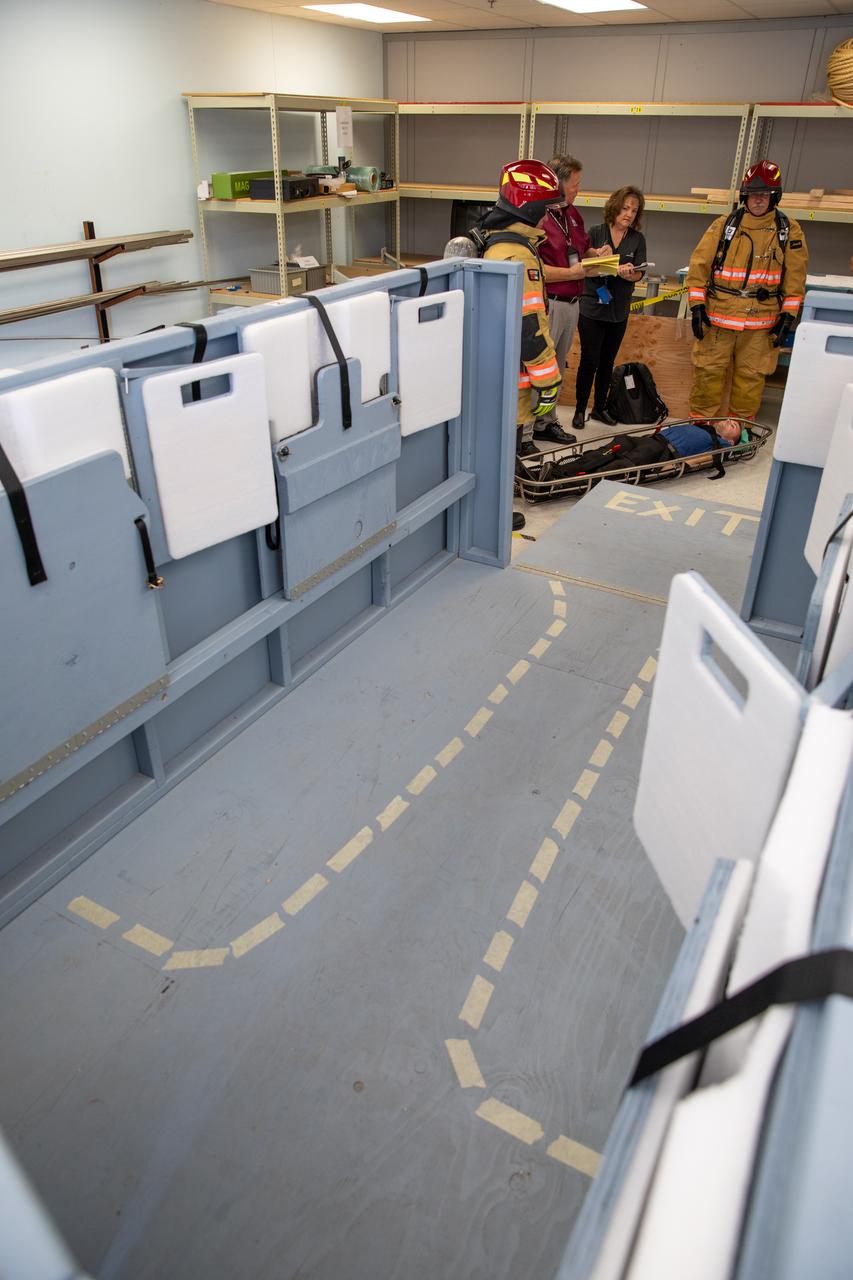
NASA Kennedy Space Center’s prime contractor Reynolds, Smith and Hill presents a mock-up of a launch pad escape basket to NASA, Kennedy Fire Rescue personnel and other stakeholders on Feb. 19, 2020. The basket would be utilized at the Florida spaceport’s Launch Pad 39B in the unlikely event of an emergency at the pad requiring evacuation during crewed missions under the Artemis Program. The actual egress basket will be designed larger than ones used during the shuttle era in order to accommodate fire rescue crew, astronauts and closeout crew. During the presentation, a fire rescue team walked through a series of trial scenarios and addressed items such as basket release location, seat depth to accommodate firefighters in full gear, sequence of loading and more.
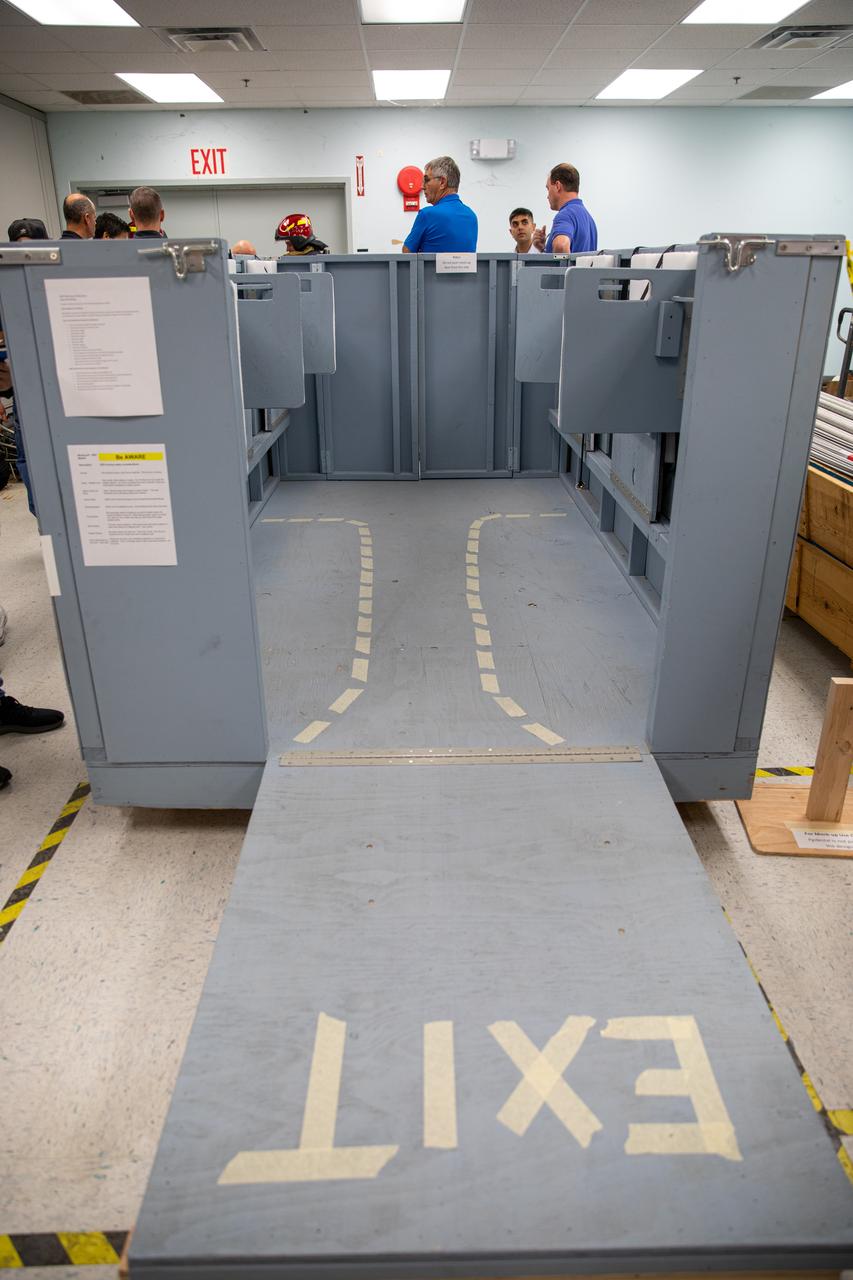
NASA Kennedy Space Center’s prime contractor Reynolds, Smith and Hill presents a mock-up of a launch pad escape basket to NASA, Kennedy Fire Rescue personnel and other stakeholders on Feb. 19, 2020. The basket would be utilized at the Florida spaceport’s Launch Pad 39B in the unlikely event of an emergency at the pad requiring evacuation during crewed missions under the Artemis Program. The actual egress basket will be designed larger than ones used during the shuttle era in order to accommodate fire rescue crew, astronauts and closeout crew. During the presentation, a fire rescue team walked through a series of trial scenarios and addressed items such as basket release location, seat depth to accommodate firefighters in full gear, sequence of loading and more.
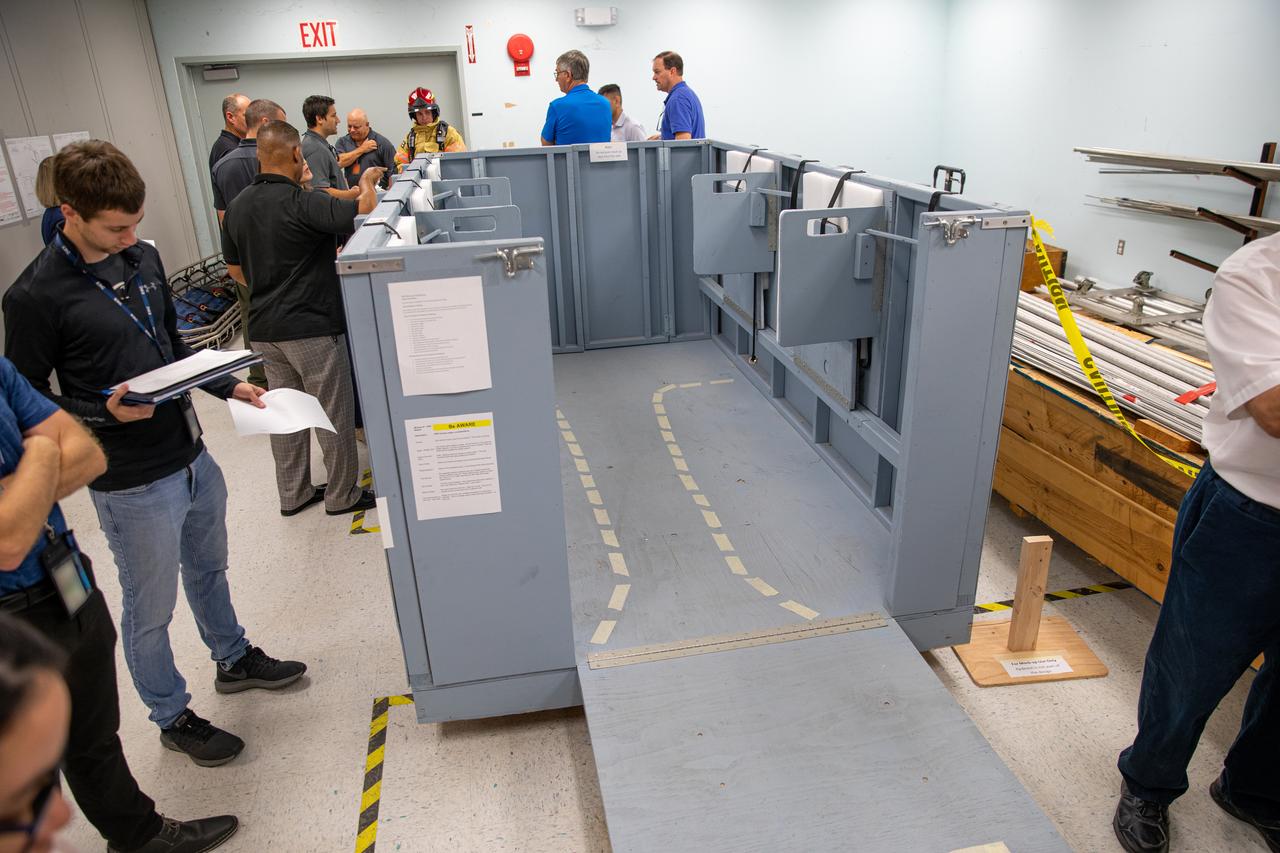
NASA Kennedy Space Center’s prime contractor Reynolds, Smith and Hill presents a mock-up of a launch pad escape basket to NASA, Kennedy Fire Rescue personnel and other stakeholders on Feb. 19, 2020. The basket would be utilized at the Florida spaceport’s Launch Pad 39B in the unlikely event of an emergency at the pad requiring evacuation during crewed missions under the Artemis Program. The actual egress basket will be designed larger than ones used during the shuttle era in order to accommodate fire rescue crew, astronauts and closeout crew. During the presentation, a fire rescue team walked through a series of trial scenarios and addressed items such as basket release location, seat depth to accommodate firefighters in full gear, sequence of loading and more.
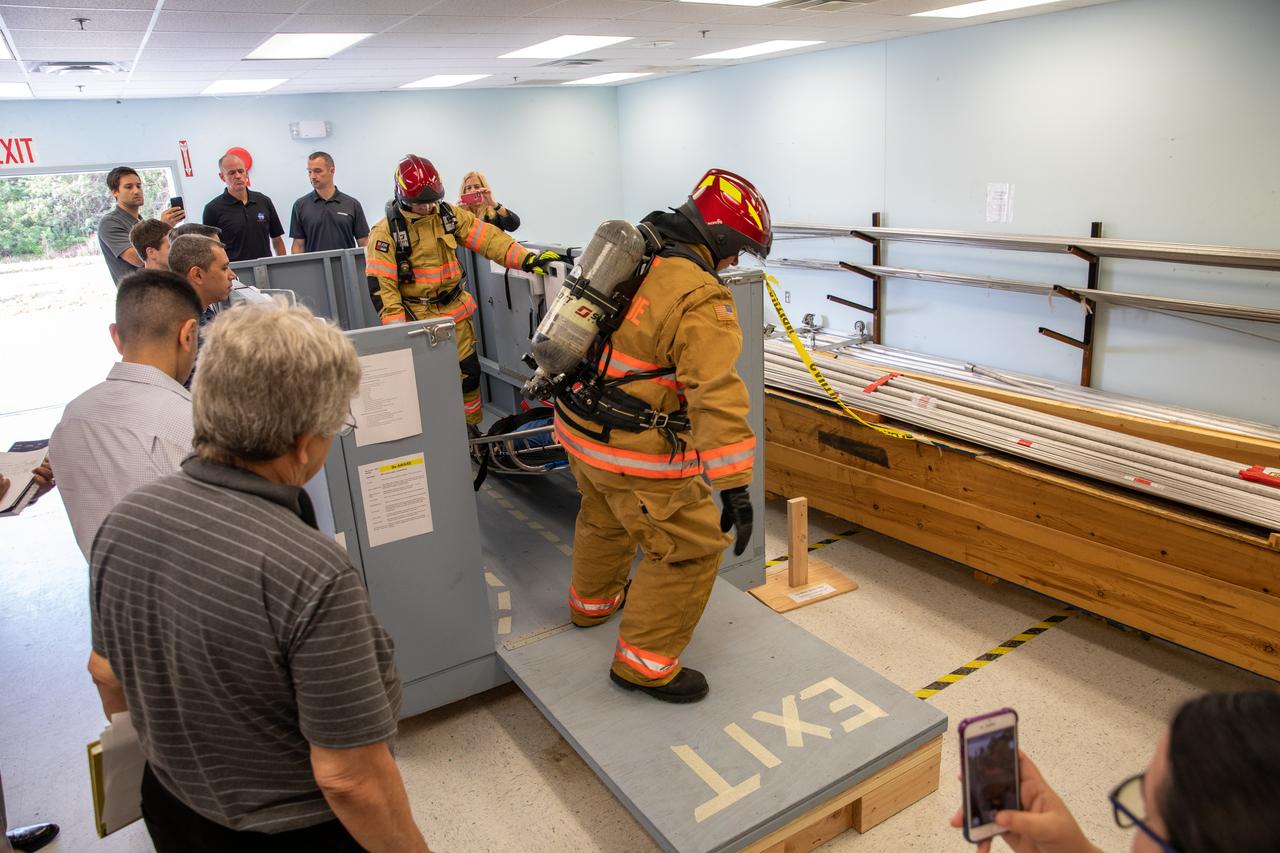
Members of NASA Kennedy Space Center’s Fire Rescue team conduct a series of trial scenarios in a mock-up of a launch pad escape basket on Feb. 19, 2020. Kennedy’s prime contractor Reynolds, Smith and Hill presented the mock-up to NASA, Kennedy Fire Rescue personnel and other stakeholders at the Florida spaceport. The basket would be utilized at Launch Pad 39B in the unlikely event of an emergency at the pad requiring evacuation during crewed missions under the Artemis Program. The actual egress basket will be designed larger than ones used during the shuttle era in order to accommodate fire rescue crew, astronauts and closeout crew. During the presentation, items such as basket release location, seat depth to accommodate firefighters in full gear, sequence of loading and more were addressed. Engineers will take what they learned during this presentation and discussion to advance the design of the pad egress system.
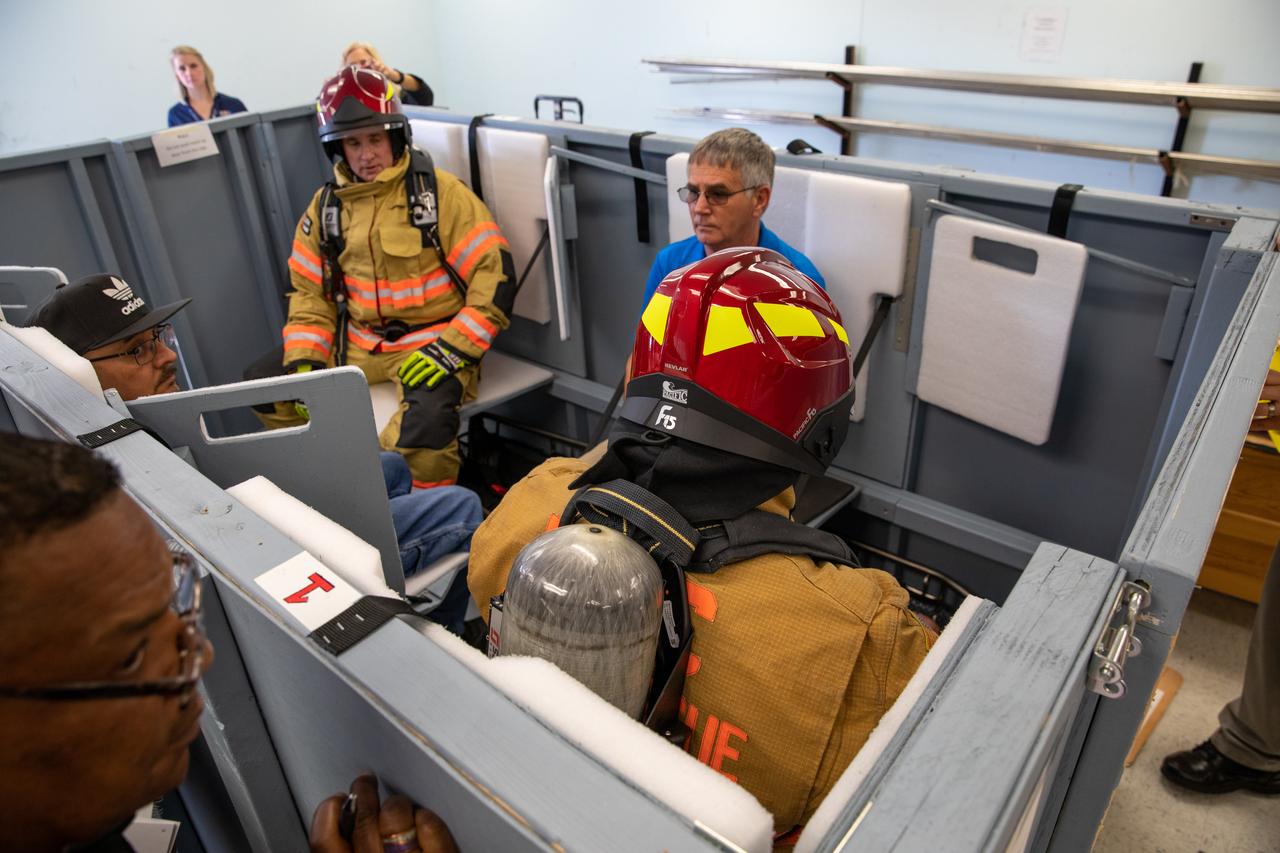
Members of NASA Kennedy Space Center’s Fire Rescue team conduct a series of trial scenarios in a mock-up of a launch pad escape basket on Feb. 19, 2020. Kennedy’s prime contractor Reynolds, Smith and Hill presented the mock-up to NASA, Kennedy Fire Rescue personnel and other stakeholders at the Florida spaceport. The basket would be utilized at Launch Pad 39B in the unlikely event of an emergency at the pad requiring evacuation during crewed missions under the Artemis Program. The actual egress basket will be designed larger than ones used during the shuttle era in order to accommodate fire rescue crew, astronauts and closeout crew. During the presentation, items such as basket release location, seat depth to accommodate firefighters in full gear, sequence of loading and more were addressed. Engineers will take what they learned during this presentation and discussion to advance the design of the pad egress system.
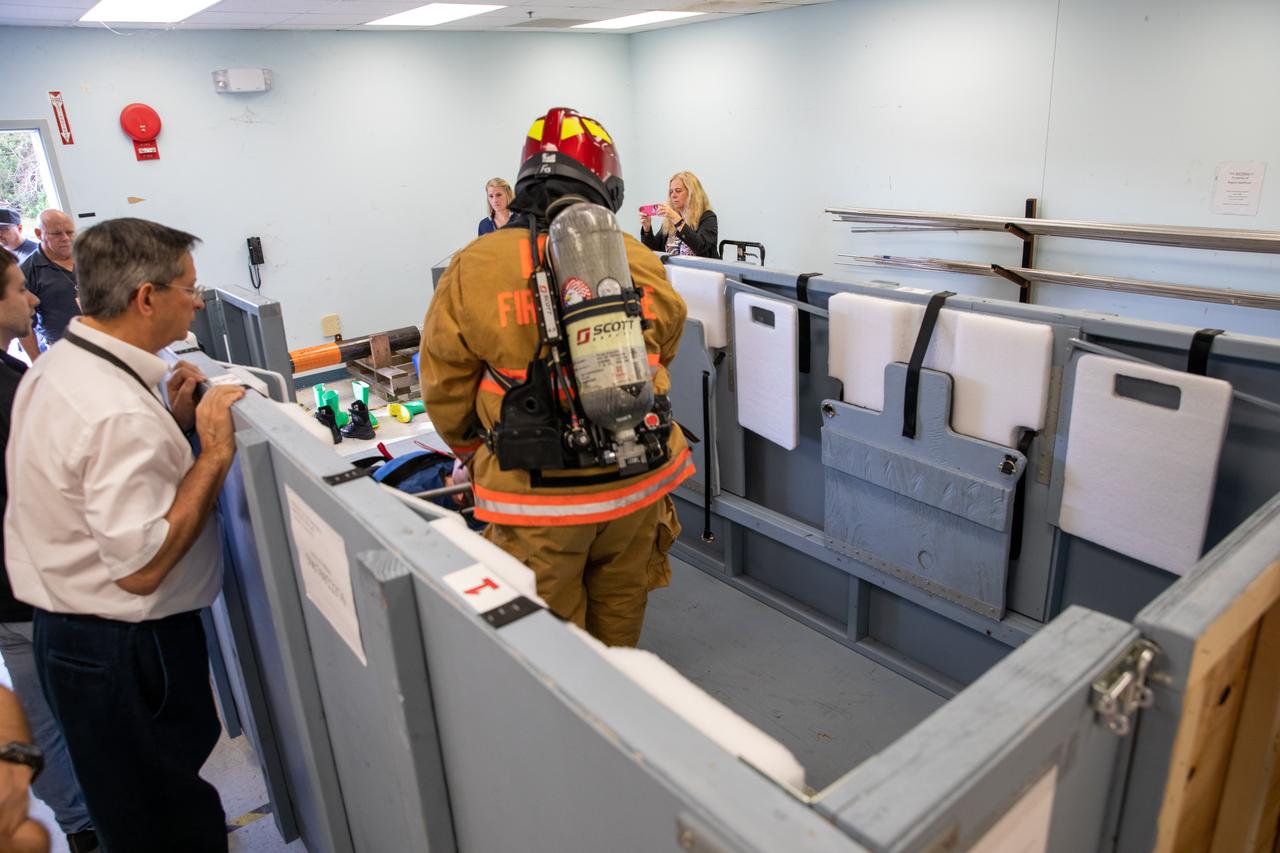
Members of NASA Kennedy Space Center’s Fire Rescue team conduct a series of trial scenarios in a mock-up of a launch pad escape basket on Feb. 19, 2020. Kennedy’s prime contractor Reynolds, Smith and Hill presented the mock-up to NASA, Kennedy Fire Rescue personnel and other stakeholders at the Florida spaceport. The basket would be utilized at Launch Pad 39B in the unlikely event of an emergency at the pad requiring evacuation during crewed missions under the Artemis Program. The actual egress basket will be designed larger than ones used during the shuttle era in order to accommodate fire rescue crew, astronauts and closeout crew. During the presentation, items such as basket release location, seat depth to accommodate firefighters in full gear, sequence of loading and more were addressed. Engineers will take what they learned during this presentation and discussion to advance the design of the pad egress system.
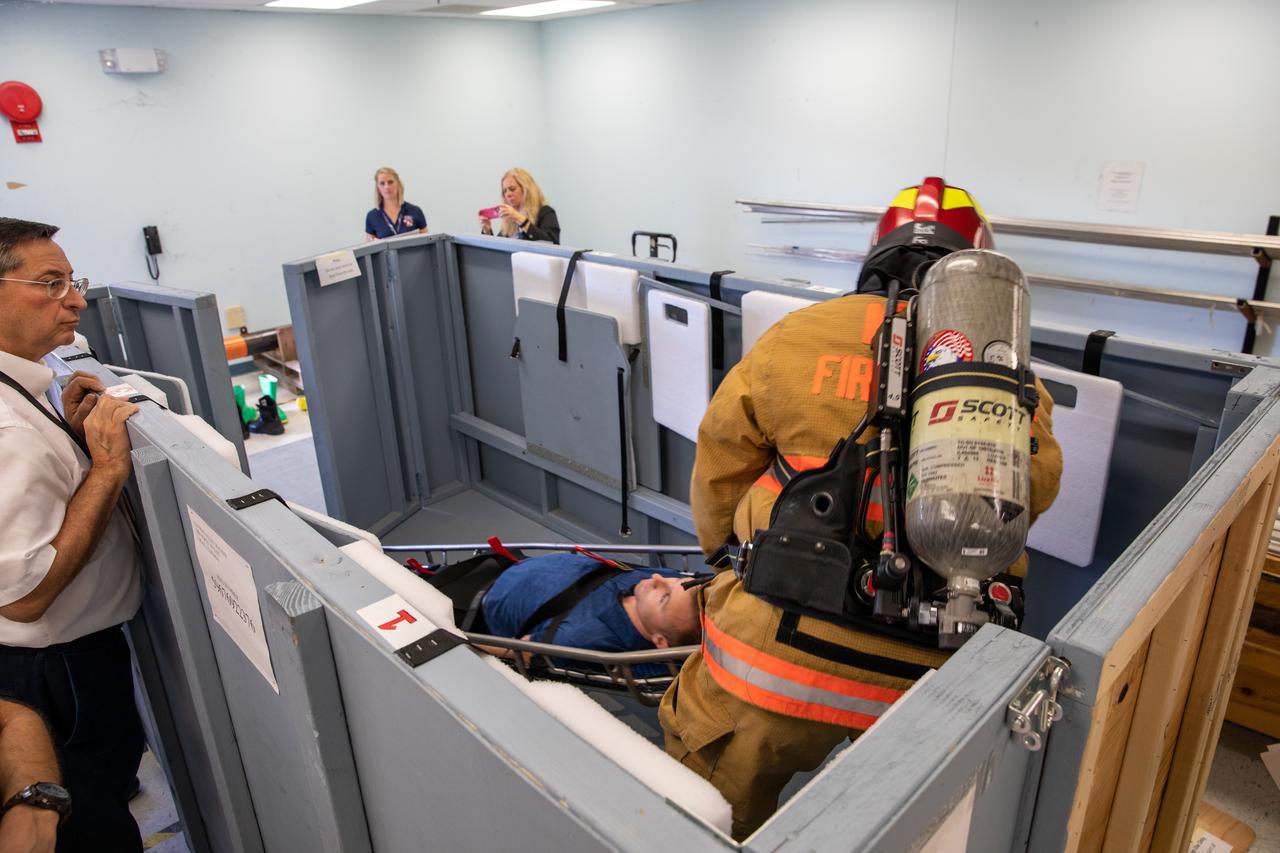
Members of NASA Kennedy Space Center’s Fire Rescue team participate in a series of trial scenarios in a mock-up of a launch pad escape basket on Feb. 19, 2020. Kennedy’s prime contractor Reynolds, Smith and Hill presented the mock-up to NASA, Kennedy Fire Rescue personnel and other stakeholders at the Florida spaceport. The basket would be utilized at Launch Pad 39B in the unlikely event of an emergency at the pad requiring evacuation during crewed missions under the Artemis Program. The actual egress basket will be designed larger than ones used during the shuttle era in order to accommodate fire rescue crew, astronauts and closeout crew. During the presentation, items such as basket release location, seat depth to accommodate firefighters in full gear, sequence of loading and more were addressed. Engineers will take what they learned during this presentation and discussion to advance the design of the pad egress system.
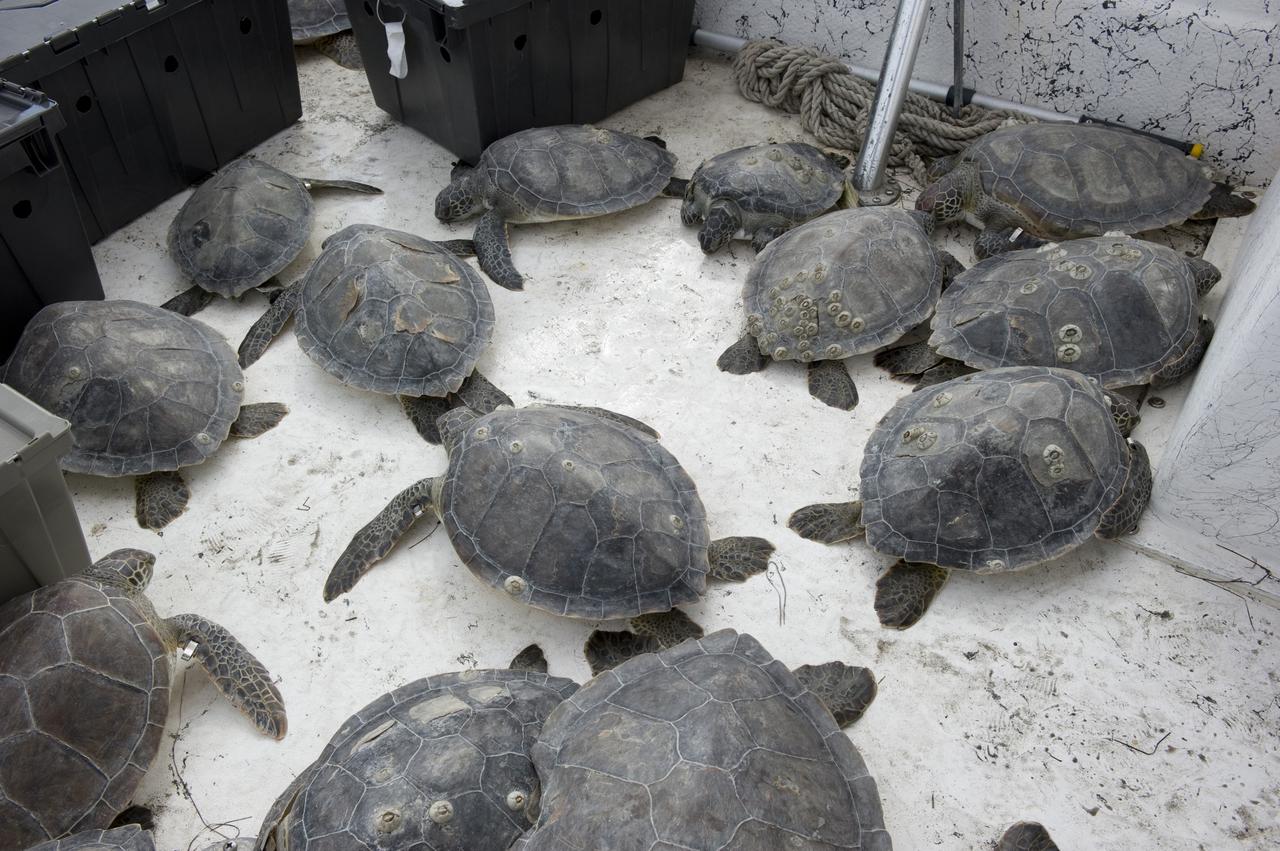
CAPE CANAVERAL, Fla. -- Several endangered green sea turtles that were "stunned" during two cold snaps in December 2010 are ready for release into the Mosquito Lagoon, which is part of Florida's Indian River. Workers with NASA's Kennedy Space Center, Innovative Health Applications and the Fish and Wildlife Conservation Commission rescued more than 300 turtles during this winter's frigid temperatures. Turtles that were stunned multiple times will be released in the Sebastian area of the Indian River, which often offers warmer water and could help prevent future stuns as winter progresses. NASA/Kim Shiflett
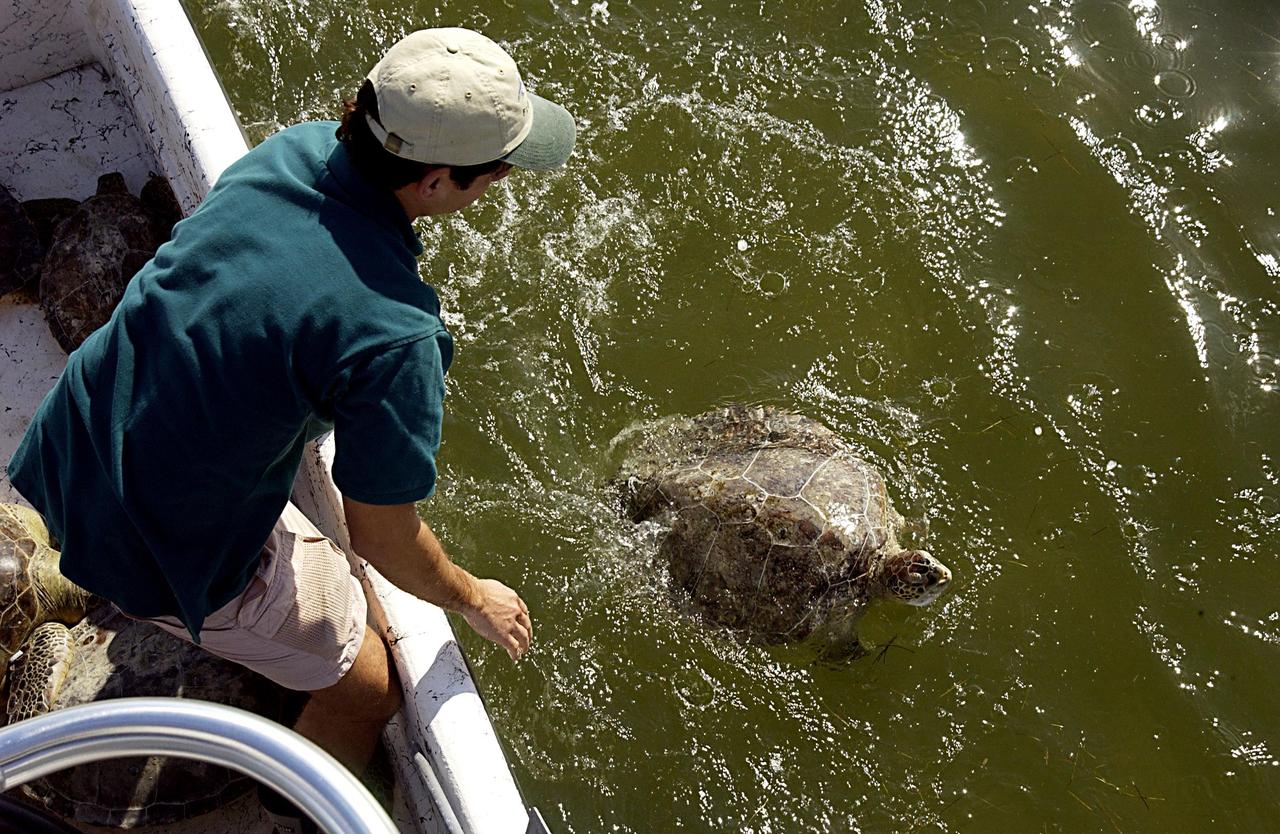
KENNEDY SPACE CENTER, FLA. - A worker watches as one of the rescued sea turtles swims away in Mosquito Lagoon. It is one of several turtles found stunned, impacted by the unseasonal cold temperatures experienced in Central Florida. The cooperative effort of KSC contractor Dynamac Corporation's Aquatics Program and the Merritt Island National Wildlife Refuge warmed the turtles and evaluated them for release. Most were tagged and the largest one received a transmitter, provided by the University of Central Florida, for satellite tracking. The turtles were then transported through the Haulover Canal to a location away from the main channel for release.
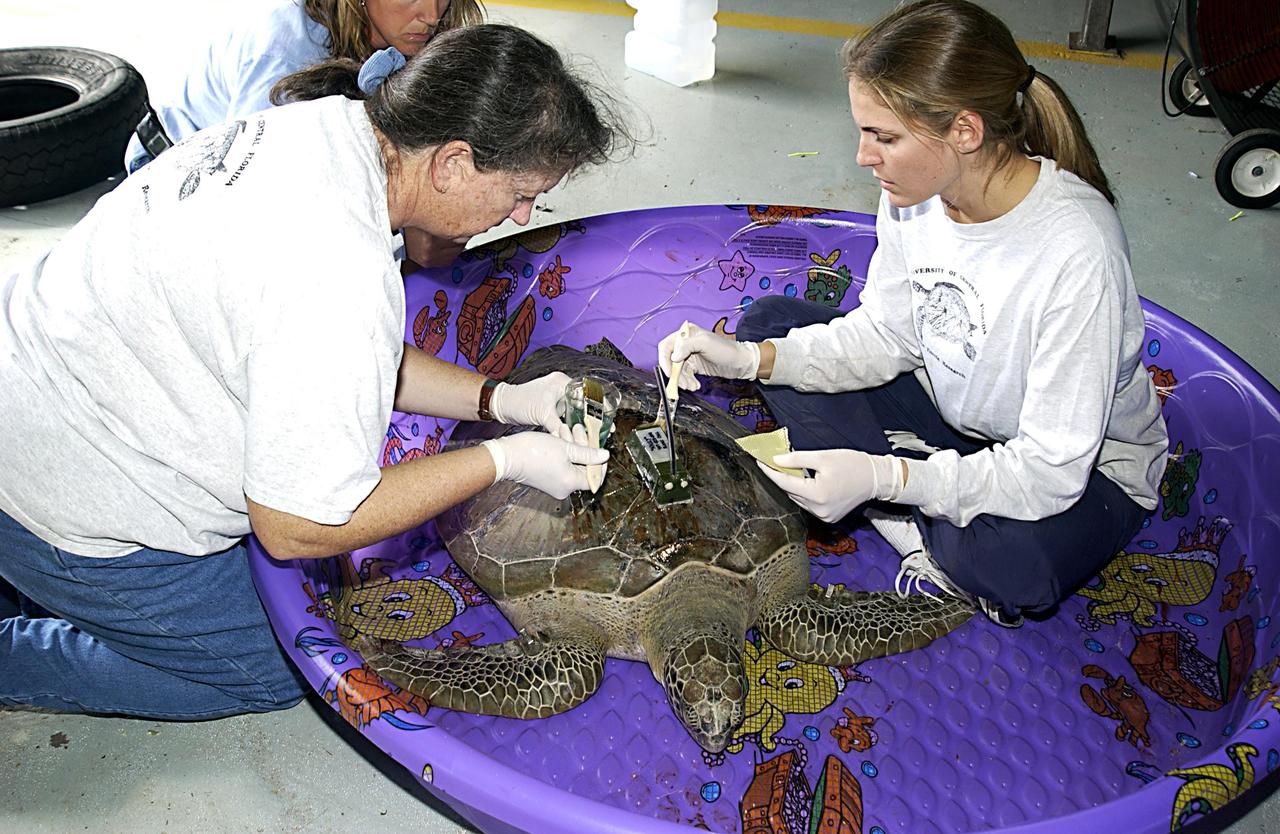
KENNEDY SPACE CENTER, FLA. - A sea turtle rescued from the Mosquito Lagoon is prepared to receive a transmitter on its back. Several turtles were found stunned, impacted by the unseasonal cold temperatures experienced in Central Florida. The cooperative effort of KSC contractor Dynamac Corporation's Aquatics Program and the Merritt Island National Wildlife Refuge warmed the turtles and evaluated them for release. Most were tagged and one received the transmitter, provided by the University of Central Florida, for satellite tracking. The turtles were then transported in a skiff through the Haulover Canal to a location away from the main channel and released into the Indian River Lagoon.
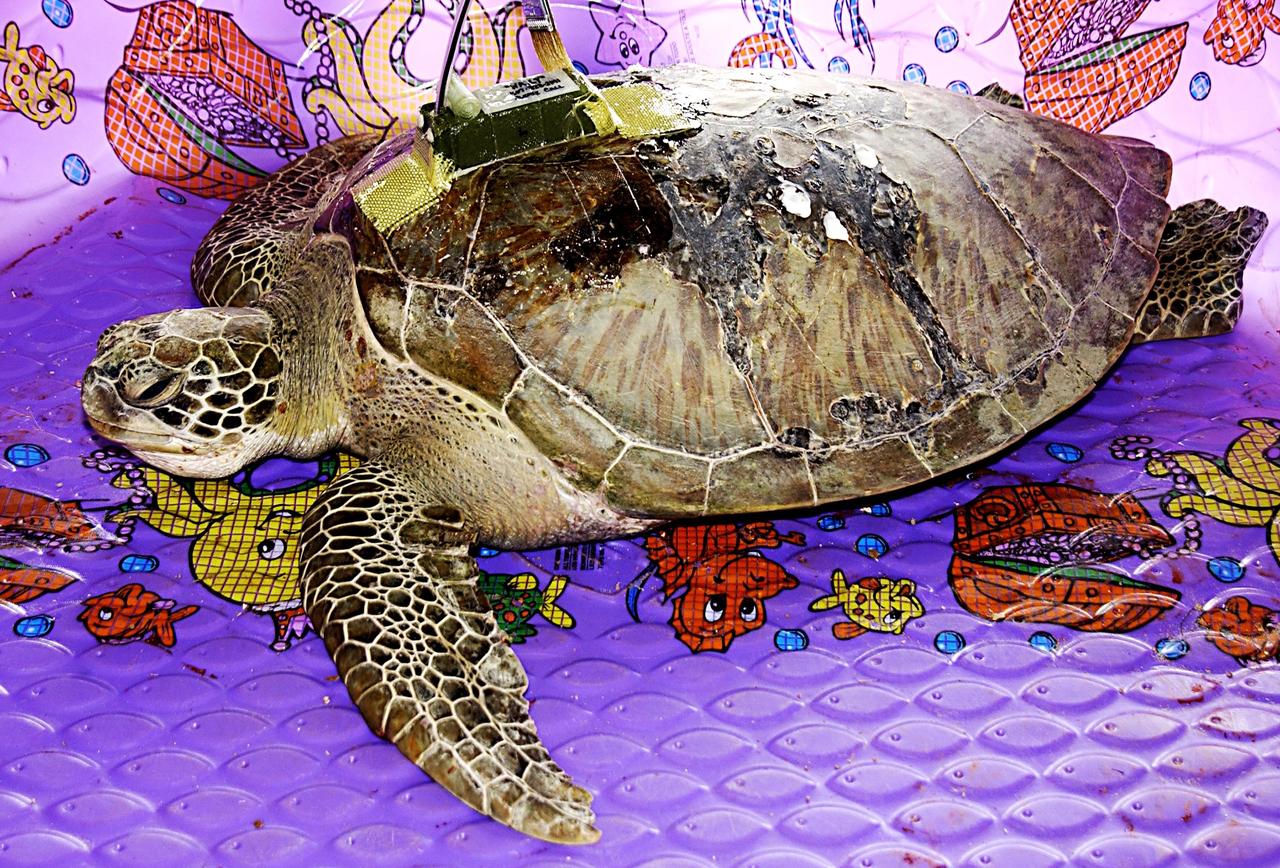
KENNEDY SPACE CENTER, FLA. -- A sea turtle rescued from the Mosquito Lagoon is seen with a transmitter recently attached to its back. Several turtles were found stunned, impacted by the unseasonal cold temperatures experienced in Central Florida. The cooperative effort of KSC contractor Dynamac Corporation's Aquatics Program and the Merritt Island National Wildlife Refuge warmed the turtles and evaluated them for release. Most were tagged and one received the transmitter, provided by the University of Central Florida, for satellite tracking. The turtles were then transported in a skiff through the Haulover Canal to a location away from the main channel and released back into the Mosquito Lagoon.
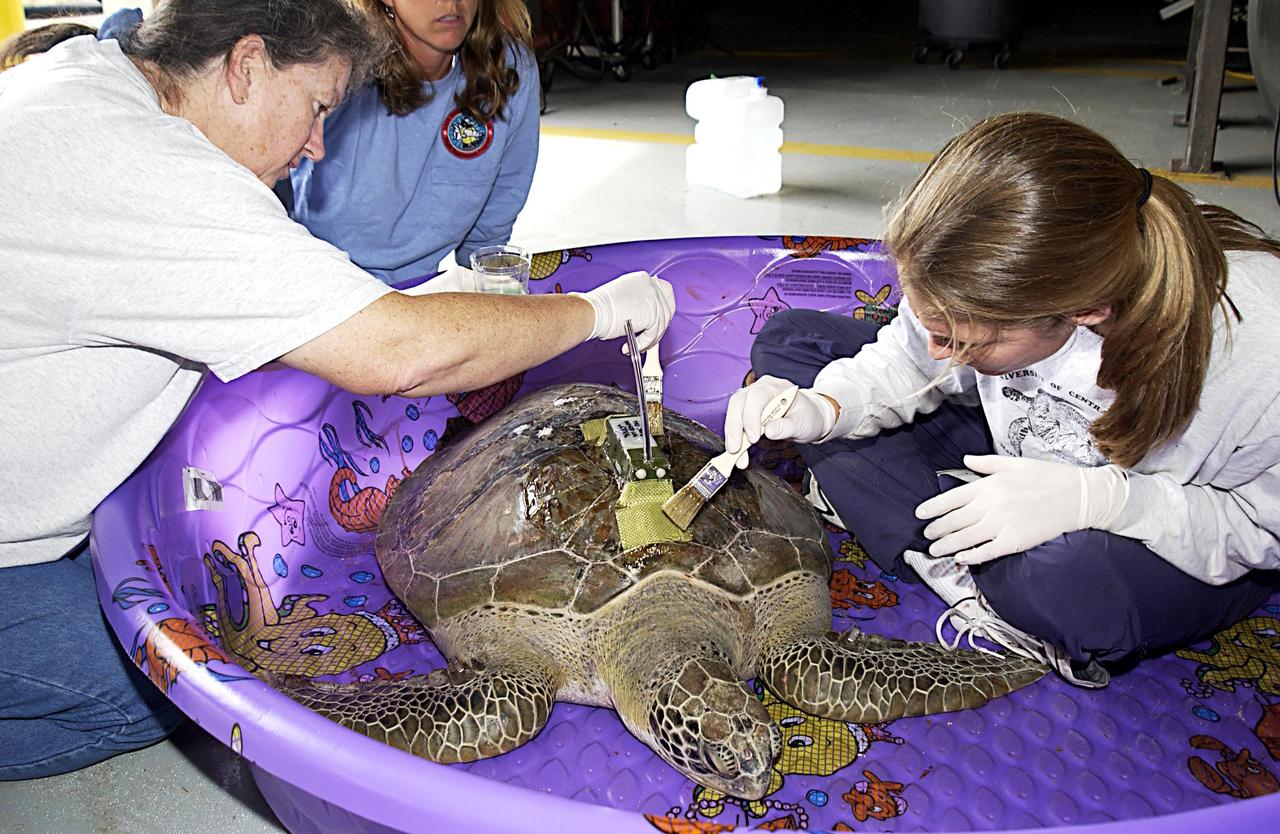
KENNEDY SPACE CENTER, FLA. -- A sea turtle rescued from the Mosquito Lagoon is prepared to receive a transmitter on its back. Several turtles were found stunned, impacted by the unseasonal cold temperatures experienced in Central Florida. The cooperative effort of KSC contractor Dynamac Corporation's Aquatics Program and the Merritt Island National Wildlife Refuge warmed the turtles and evaluated them for release. Most were tagged and one received the transmitter, provided by the University of Central Florida, for satellite tracking. The turtles were then transported in a skiff through the Haulover Canal to a location away from the main channel and released into the Indian River Lagoon.
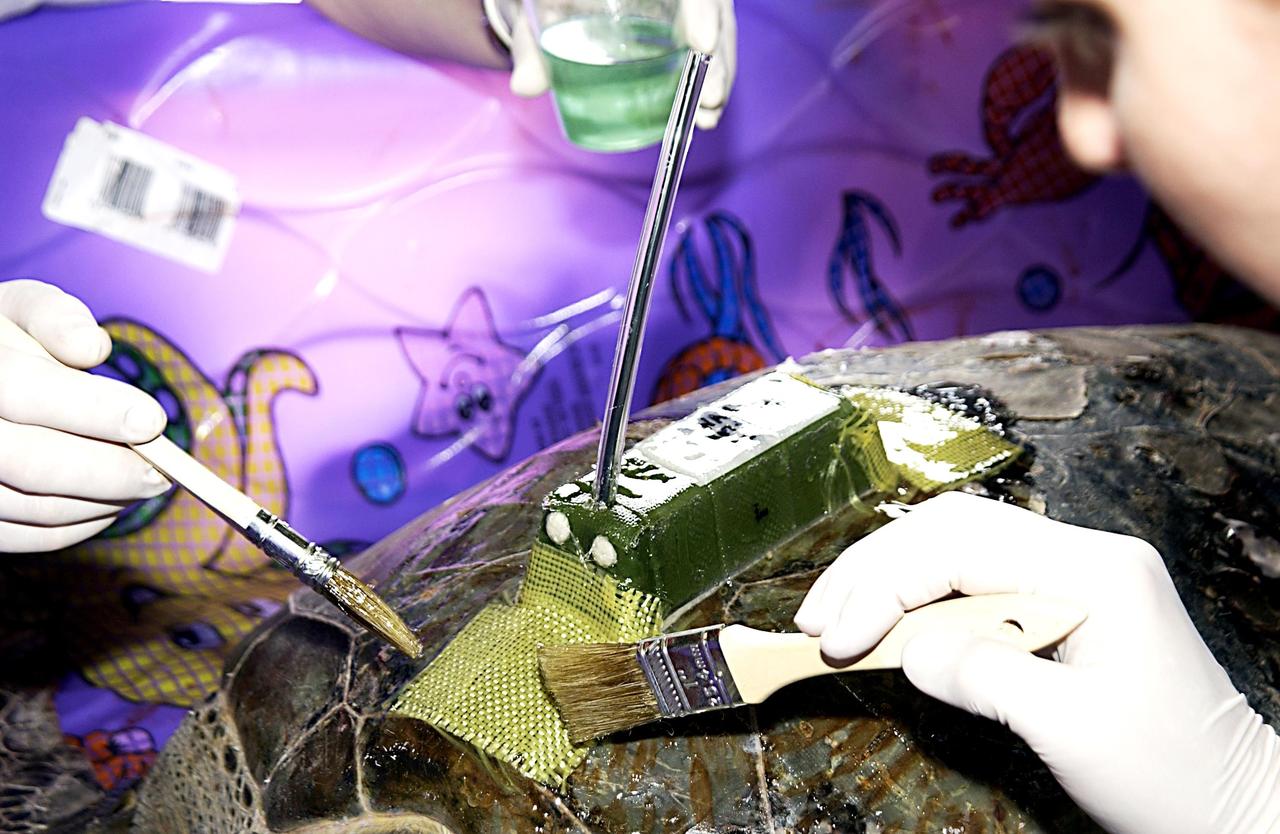
KENNEDY SPACE CENTER, FLA. -- This closeup shows the transmitter being attached to a sea turtle rescued from the Mosquito Lagoon. Several turtles were found stunned, impacted by the unseasonal cold temperatures experienced in Central Florida. The cooperative effort of KSC contractor Dynamac Corporation's Aquatics Program and the Merritt Island National Wildlife Refuge warmed the turtles and evaluated them for release. Most were tagged and one received the transmitter, provided by the University of Central Florida, for satellite tracking. The turtles were then transported in a skiff through the Haulover Canal to a location away from the main channel and released into the Indian River Lagoon.
KENNEDY SPACE CENTER, FLA. - A green sea turtle that was rescued at KSC in January 2003 and rehabilitated at the Clearwater Aquarium has been returned to KSC and fitted with a sonic tracking device before release back into its environment at Mosquito Lagoon at KSC. This turtle is one of three that were found stunned, impacted by the unseasonal cold temperatures experienced in Central Florida.

KENNEDY SPACE CENTER, FLA. - A green sea turtle that was rescued at KSC in January 2003 and rehabilitated at the Clearwater Aquarium is being released back into its environment at Mosquito Lagoon at KSC. It has been fitted with a sonic tracking device. This turtle is one of three that were found stunned, impacted by the unseasonal cold temperatures experienced in Central Florida.

KENNEDY SPACE CENTER, FLA. - A green sea turtle that was rescued at KSC in January 2003 and rehabilitated at the Clearwater Aquarium has been returned to KSC. It is being fitted with a sonic tracking device before release back into its environment at Mosquito Lagoon at KSC. This turtle is one of three that were found stunned, impacted by the unseasonal cold temperatures experienced in Central Florida.
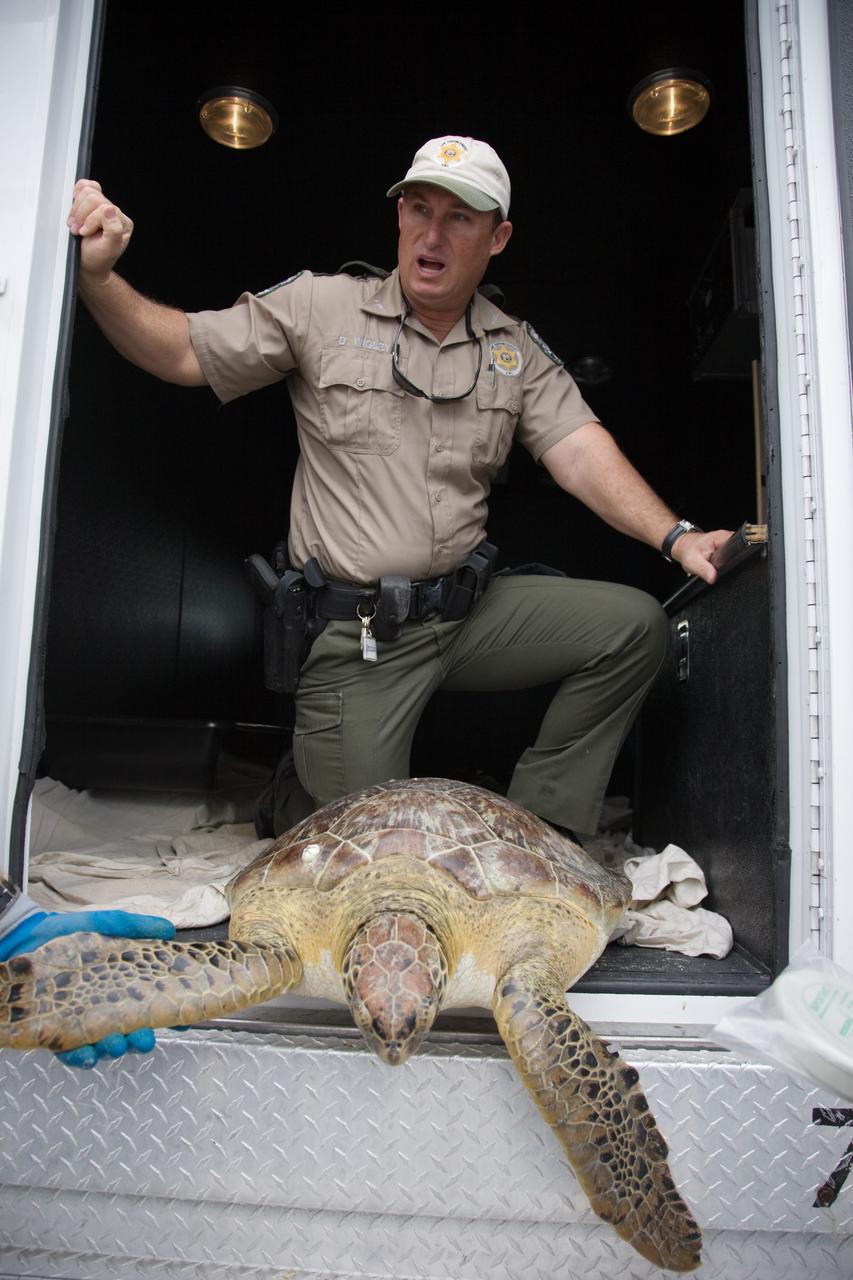
CAPE CANAVERAL, Fla. - A wildlife officer offers assistance as an endangered green sea turtle is prepared for release into the waters of the Banana River at NASA's Kennedy Space Center in Florida. The turtle was one of nearly 2,000 that were "stunned" by a recent drop in temperatures. Many of the turtles were rescued from the Mosquito Lagoon, with others coming from the Indian River Lagoon and Cocoa Beach. Biologists, environmentalists, wildlife experts and other volunteers joined forces with a massive rescue effort at the Merritt Island National Wildlife Refuge, where the turtles were identified, examined and transported to rehabilitation facilities throughout Florida and South Georgia. The animals stayed at these facilities until local waters warmed up to safe temperatures. Photo credit: NASA/Troy Cryder
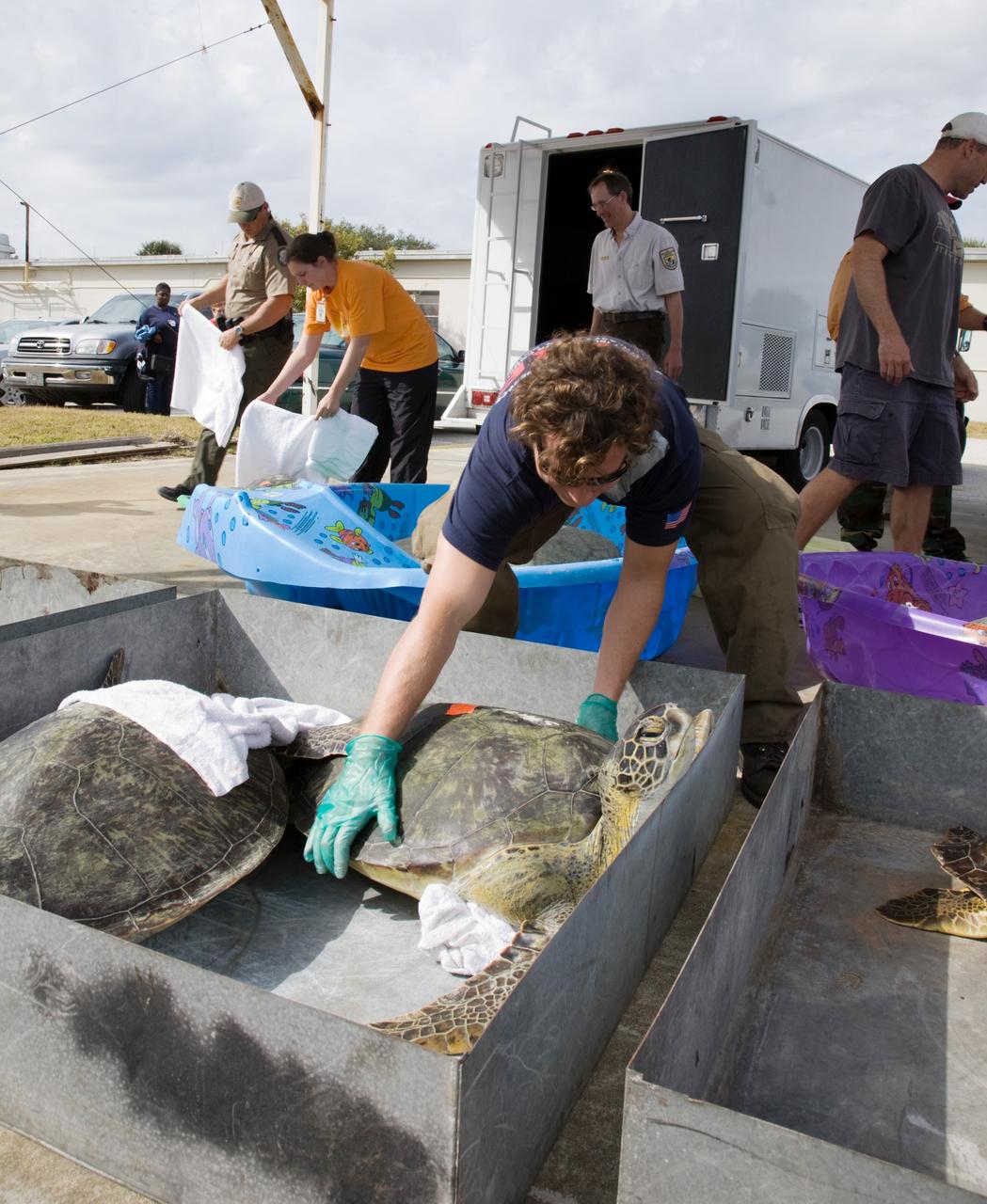
CAPE CANAVERAL, Fla. - Wildlife personnel prepare to release several endangered green sea turtles into the waters of the Banana River at NASA's Kennedy Space Center in Florida. The turtles were some of nearly 2,000 that were "stunned" by the recent drop in temperatures. Many of the turtles were rescued from the Mosquito Lagoon, with others coming from the Indian River Lagoon and Cocoa Beach. Biologists, environmentalists, wildlife experts and other volunteers joined forces with a massive rescue effort at the Merritt Island National Wildlife Refuge, where the turtles were identified, examined and transported to rehabilitation facilities throughout Florida and South Georgia. The animals stayed at these facilities until local waters warmed up to safe temperatures. Photo credit: NASA/Troy Cryder
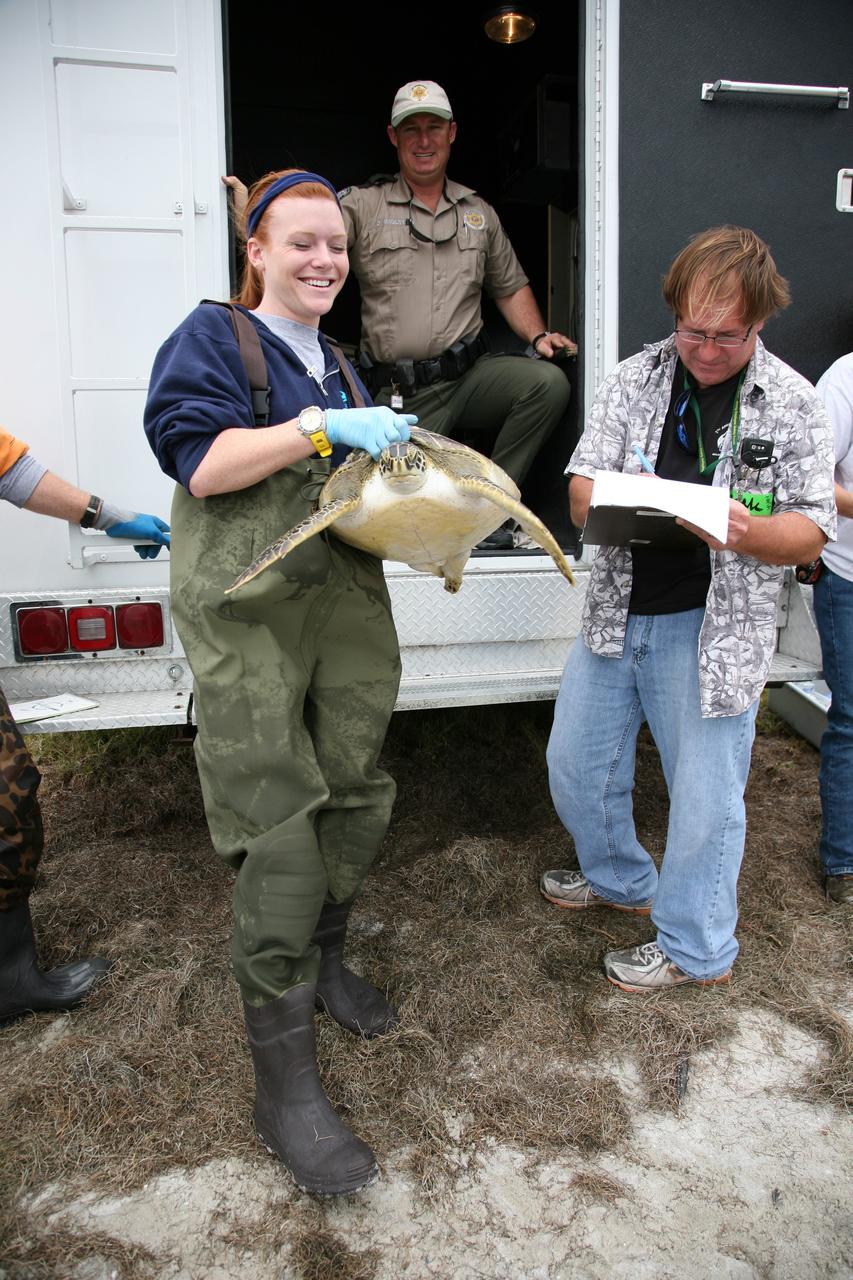
CAPE CANAVERAL, Fla. - Wildlife personnel carry an endangered green sea turtle away from a transport van prior to the animal's release into the Banana River at NASA's Kennedy Space Center in Florida. The turtle was one of nearly 2,000 that were "stunned" by a recent drop in temperatures. Many of the turtles were rescued from the Mosquito Lagoon, with others coming from the Indian River Lagoon and Cocoa Beach. Biologists, environmentalists, wildlife experts and other volunteers joined forces with a massive rescue effort at the Merritt Island National Wildlife Refuge, where the turtles were identified, examined and transported to rehabilitation facilities throughout Florida and South Georgia. The animals stayed at these facilities until local waters warmed up to safe temperatures. Photo credit: NASA/Troy Cryder
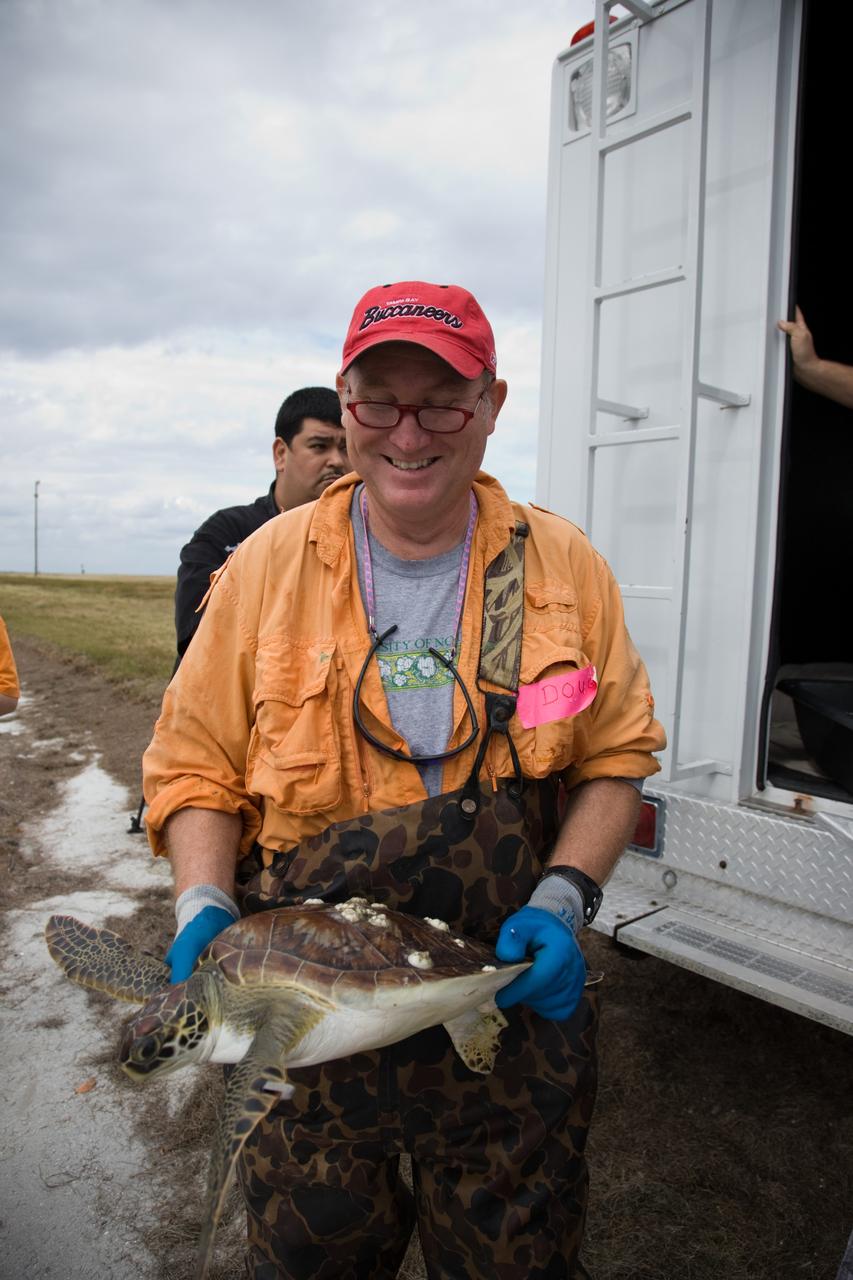
CAPE CANAVERAL, Fla. - Doug Scheidt, an employee of Innovative Health Applications at NASA's Kennedy Space Center in Florida, holds a juvenile green sea turtle prior to its release into the Banana River. The turtle was one of nearly 2,000 that were "stunned" by a recent drop in temperatures. Many of the turtles were rescued from the Mosquito Lagoon, with others coming from the Indian River Lagoon and Cocoa Beach. Biologists, environmentalists, wildlife experts and other volunteers joined forces with a massive rescue effort at the Merritt Island National Wildlife Refuge, where the turtles were identified, examined and transported to rehabilitation facilities throughout Florida and South Georgia. The animals stayed at these facilities until local waters warmed up to safe temperatures. Photo credit: NASA/Troy Cryder
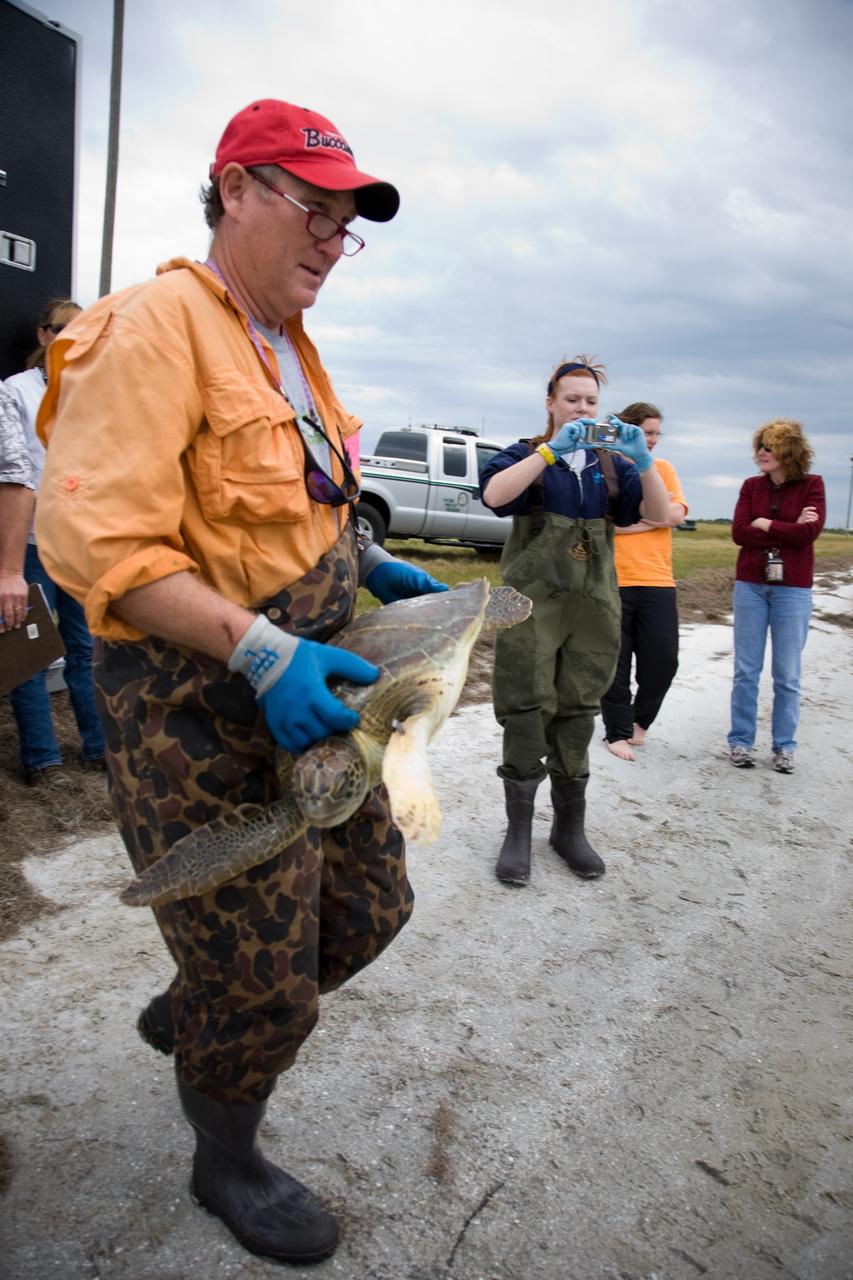
CAPE CANAVERAL, Fla. - Doug Scheidt, an employee of Innovative Health Applications at NASA's Kennedy Space Center in Florida, carries a green sea turtle to be released into the Banana River. The turtle was one of nearly 2,000 that were "stunned" by a recent drop in temperatures. Many of the turtles were rescued from the Mosquito Lagoon, with others coming from the Indian River Lagoon and Cocoa Beach. Biologists, environmentalists, wildlife experts and other volunteers joined forces with a massive rescue effort at the Merritt Island National Wildlife Refuge, where the turtles were identified, examined and transported to rehabilitation facilities throughout Florida and South Georgia. The animals stayed at these facilities until local waters warmed up to safe temperatures. Photo credit: NASA/Troy Cryder
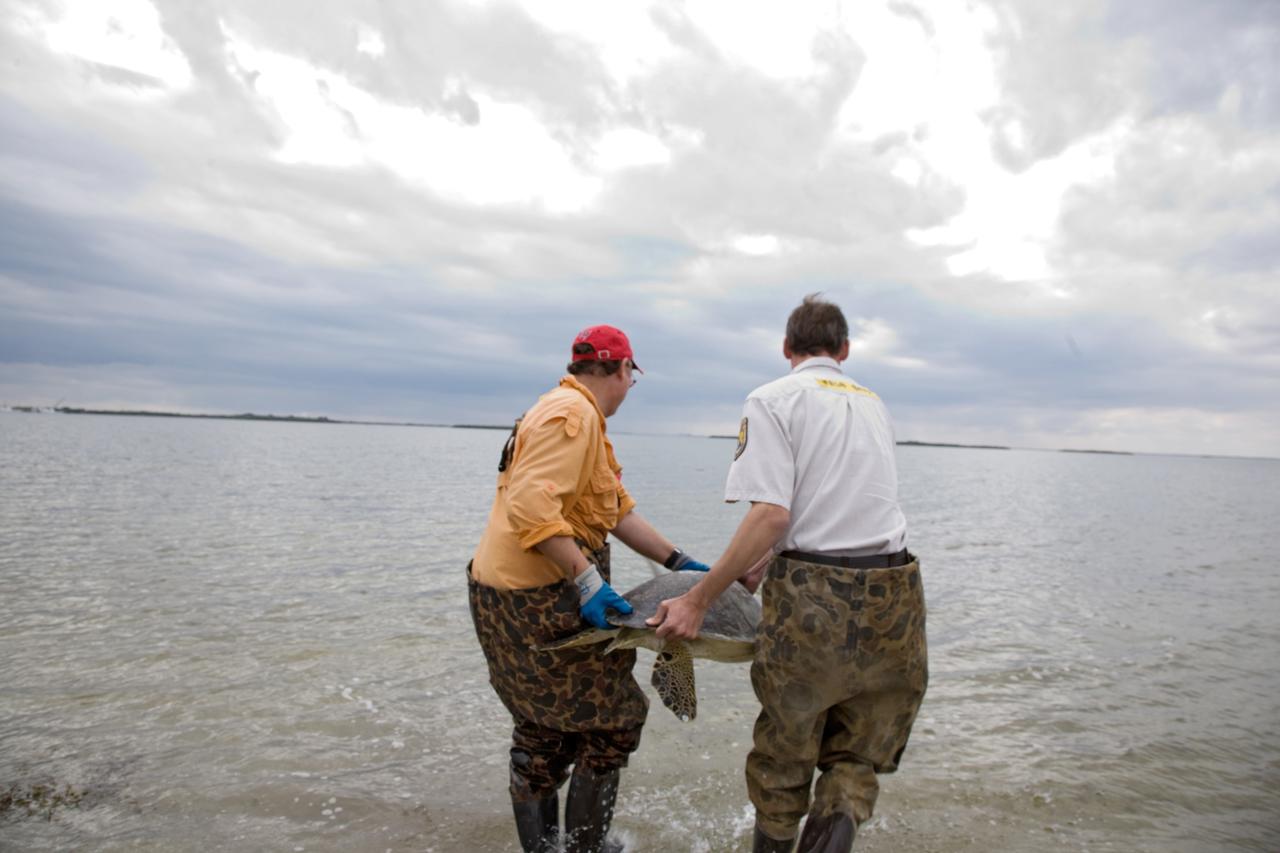
CAPE CANAVERAL, Fla. - Wildlife personnel carry an endangered green sea turtle toward the Banana River at NASA's Kennedy Space Center in Florida, ready to release the animal back into its usual environment. A recent cold snap left this turtle and nearly 2,000 others "stunned" and in need of help. Many of the turtles were rescued from the Mosquito Lagoon, with others coming from the Indian River Lagoon and Cocoa Beach. Biologists, environmentalists, wildlife experts and other volunteers joined forces with a massive rescue effort at the Merritt Island National Wildlife Refuge, where the turtles were identified, examined and transported to rehabilitation facilities throughout Florida and South Georgia. The animals stayed at these facilities until local waters warmed up to safe temperatures. Photo credit: NASA/Troy Cryder
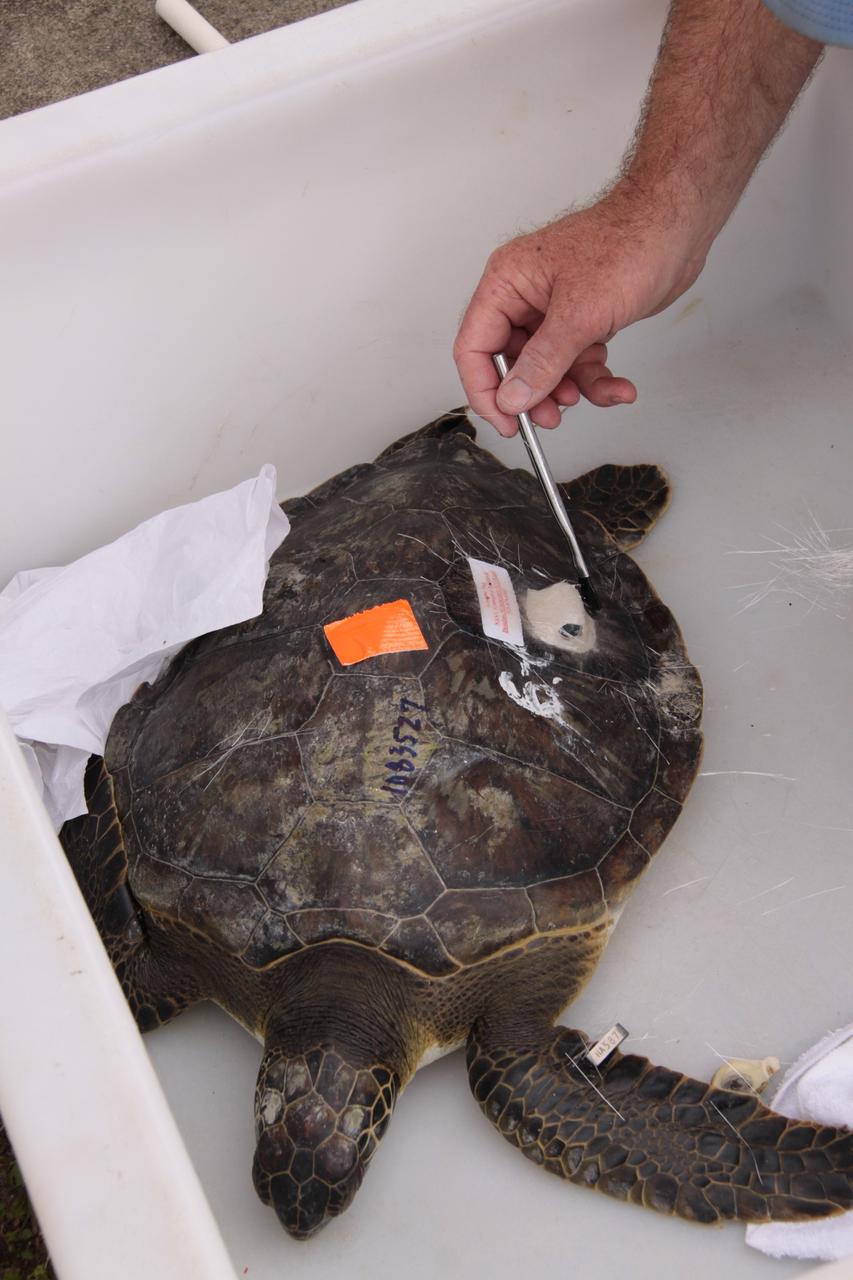
CAPE CANAVERAL, Fla. - An endangered green sea turtle awaits release as its shell is tagged with a tracking transmitter at Cape Canaveral Air Force Station in Florida. A recent cold snap left this turtle and nearly 2,000 others "stunned" and in need of help. Many of the turtles were rescued from the Mosquito Lagoon, with others coming from the Indian River Lagoon and Cocoa Beach. Biologists, environmentalists, wildlife experts and other volunteers joined forces with a massive rescue effort at the Merritt Island National Wildlife Refuge, where the turtles were identified, examined and transported to rehabilitation facilities throughout Florida and South Georgia. The animals stayed at these facilities until local waters warmed up to safe temperatures. Photo credit: NASA/Jack Pfaller
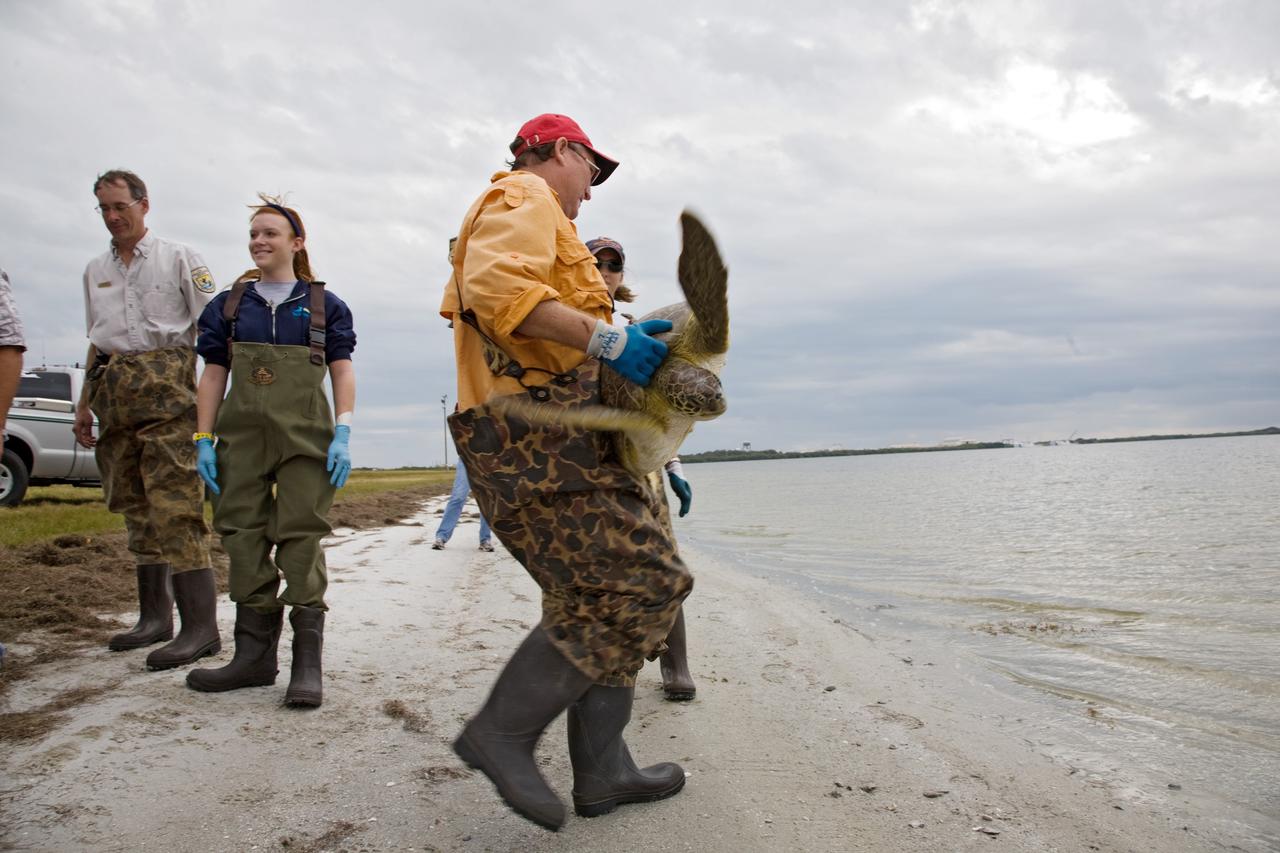
CAPE CANAVERAL, Fla. - A green sea turtle is carried toward the water's edge prior to the animal's release into the waters of the Banana River at NASA's Kennedy Space Center in Florida. The turtle was one of nearly 2,000 that were "stunned" by a recent drop in temperatures. Many of the turtles were rescued from the Mosquito Lagoon, with others coming from the Indian River Lagoon and Cocoa Beach. Biologists, environmentalists, wildlife experts and other volunteers joined forces with a massive rescue effort at the Merritt Island National Wildlife Refuge, where the turtles were identified, examined and transported to rehabilitation facilities throughout Florida and South Georgia. The animals stayed at these facilities until local waters warmed up to safe temperatures. Photo credit: NASA/Troy Cryder
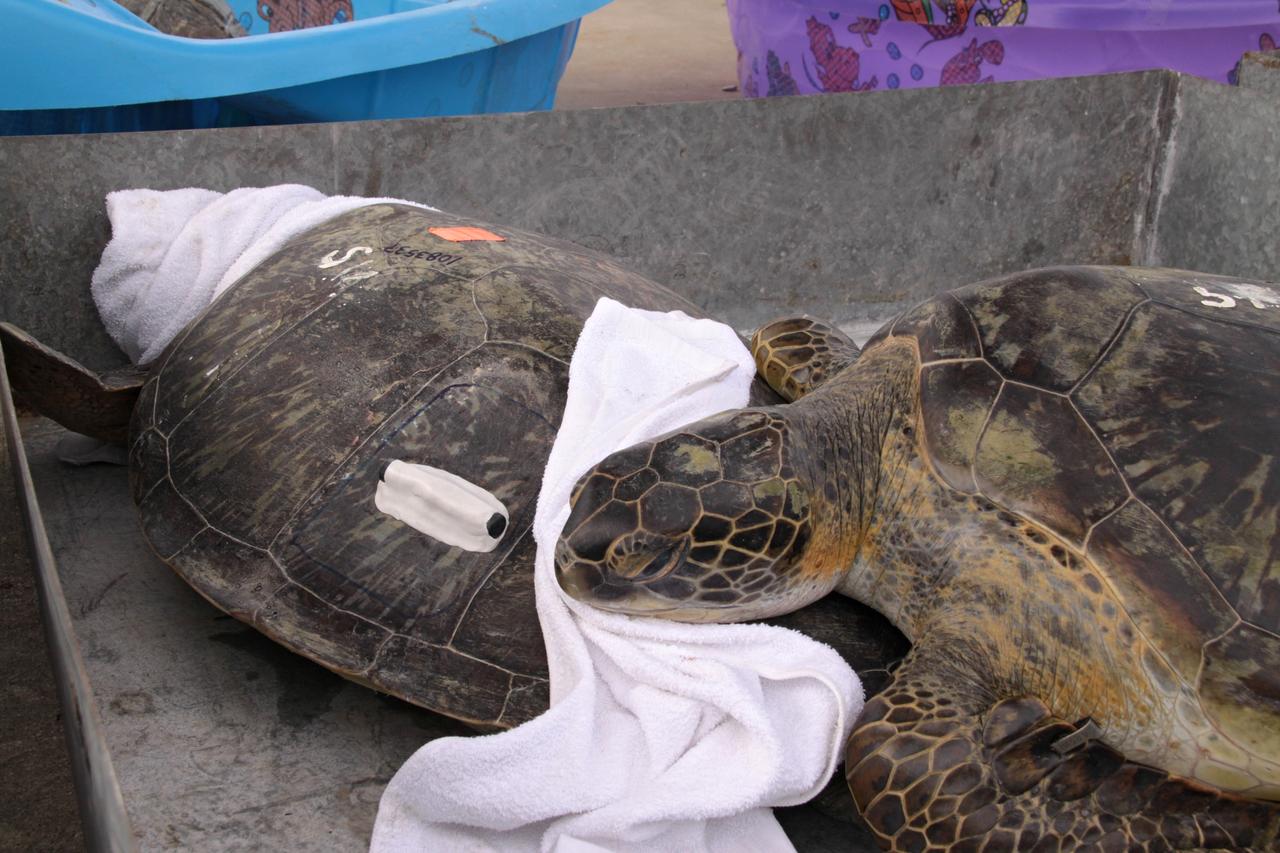
CAPE CANAVERAL, Fla. - A green sea turtle rests its head on a companion as the animals are tagged with tracking transmitters and prepared for release at Cape Canaveral Air Force Station in Florida. The turtles were some of nearly 2,000 that were "stunned" by the recent drop in temperatures. Many of the turtles were rescued from the Mosquito Lagoon, with others coming from the Indian River Lagoon and Cocoa Beach. Biologists, environmentalists, wildlife experts and other volunteers joined forces with a massive rescue effort at the Merritt Island National Wildlife Refuge, where the turtles were identified, examined and transported to rehabilitation facilities throughout Florida and South Georgia. The animals stayed at these facilities until local waters warmed up to safe temperatures. Photo credit: NASA/Jack Pfaller
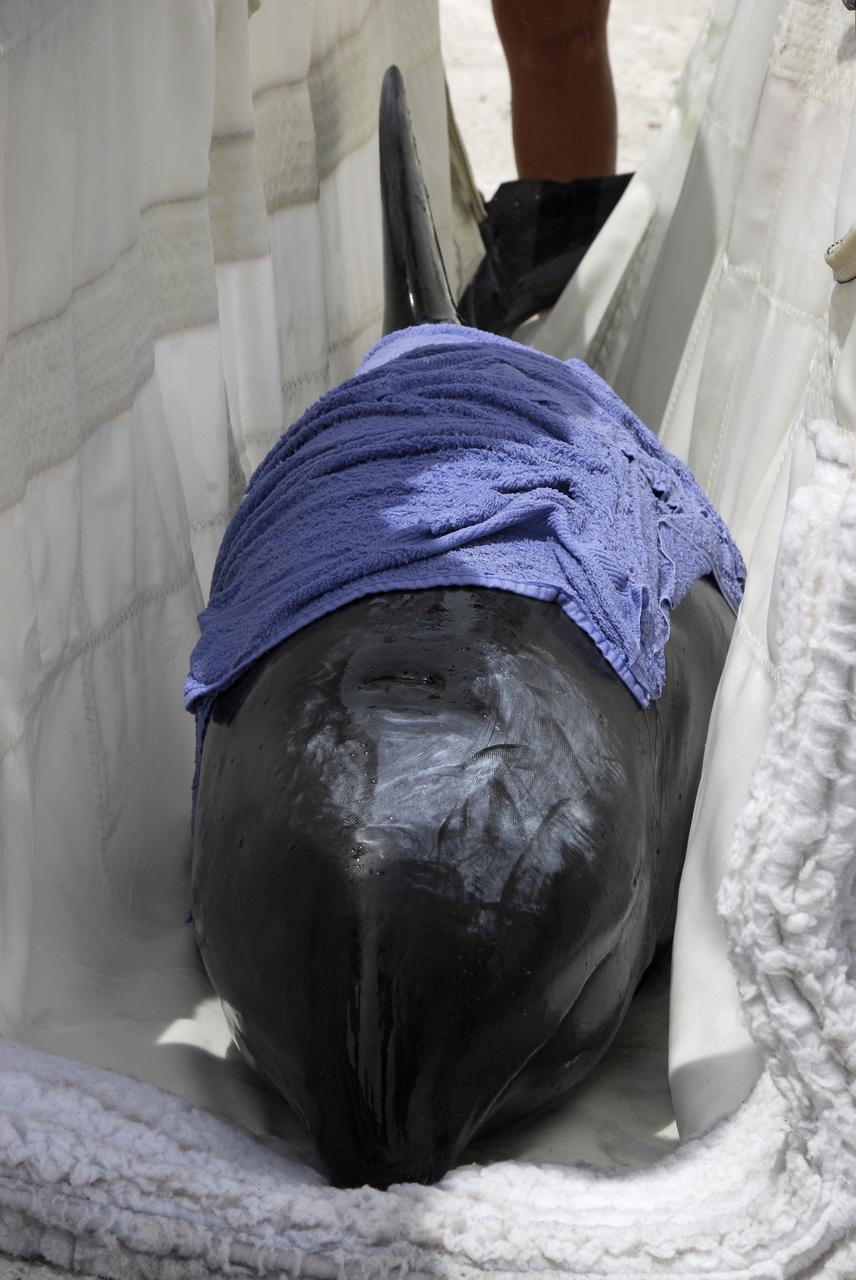
CAPE CANAVERAL, Fla. – This close-up shows the stranded Melon-Headed Whale being carried on a sling to a waiting truck. The whale was found beached south of Launch Pad 39A at NASA's Kennedy Space Center near Cape Canaveral Air Force Station. Workers from Kennedy, a veterinarian and representatives from the Hubbs/Sea World Research Institute share in the rescue. After assessment by veterinarians at Sea World, the whale will be transported to a whale rescue center in the Panhandle for rehabilitation and release. The Melon-Headed Whale lives well off-shore in all the world's tropical and sub-tropical oceans. At the northern fringes of its range, it may also be found in the warm currents of temperate waters, such as Florida. It is closely related to the Pygmy Killer Whale and the Pilot Whales. Its primary diet is squid. Photo credit: NASA/Kim Shiflett
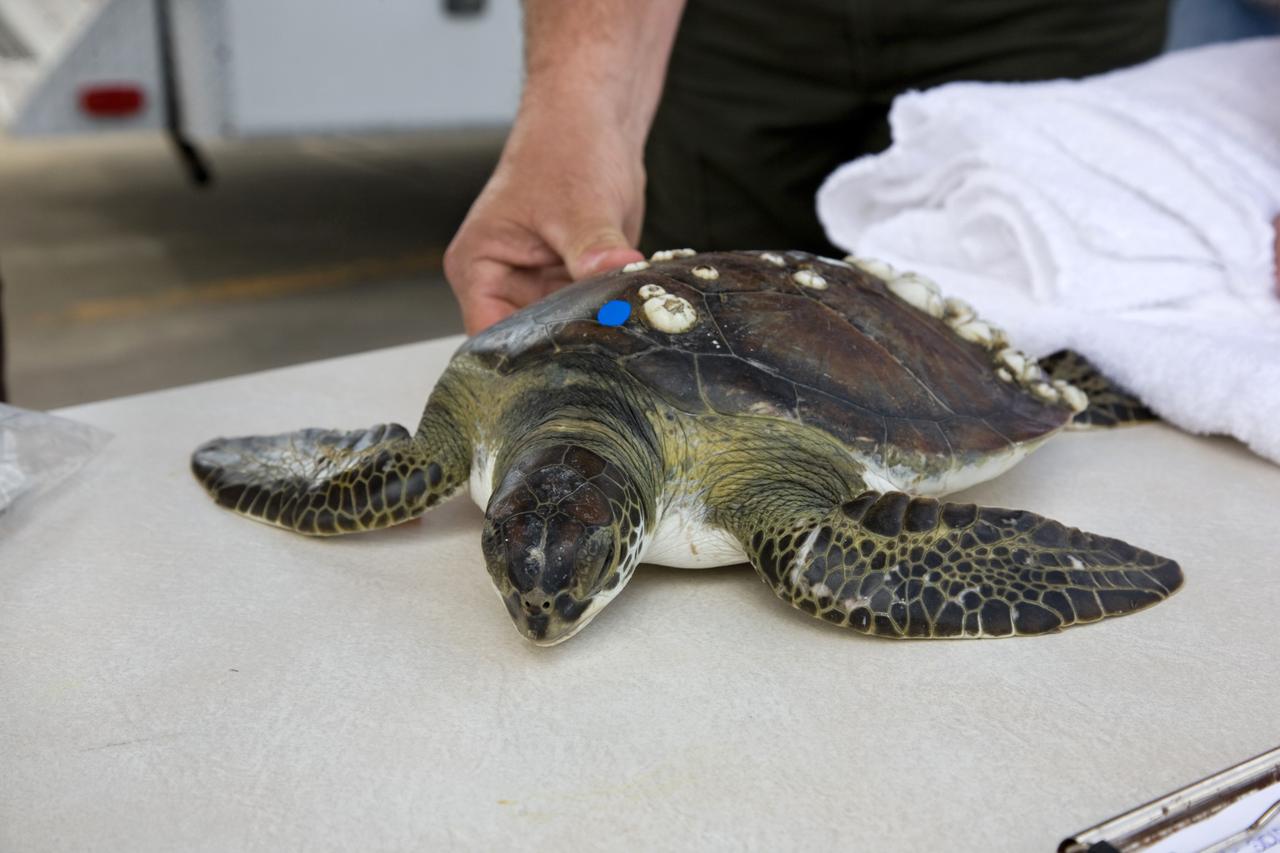
CAPE CANAVERAL, Fla. - A juvenile green sea turtle is prepared for its release into the waters of the Banana River at NASA's Kennedy Space Center in Florida. The turtle was one of nearly 2,000 that were "stunned" by the recent drop in temperatures. Many of the turtles were rescued from the Mosquito Lagoon, with others coming from the Indian River Lagoon and Cocoa Beach. Biologists, environmentalists, wildlife experts and other volunteers joined forces with a massive rescue effort at the Merritt Island National Wildlife Refuge, where the turtles were identified, examined and transported to rehabilitation facilities throughout Florida and South Georgia. The animals stayed at these facilities until local waters warmed up to safe temperatures. Photo credit: NASA/Troy Cryder
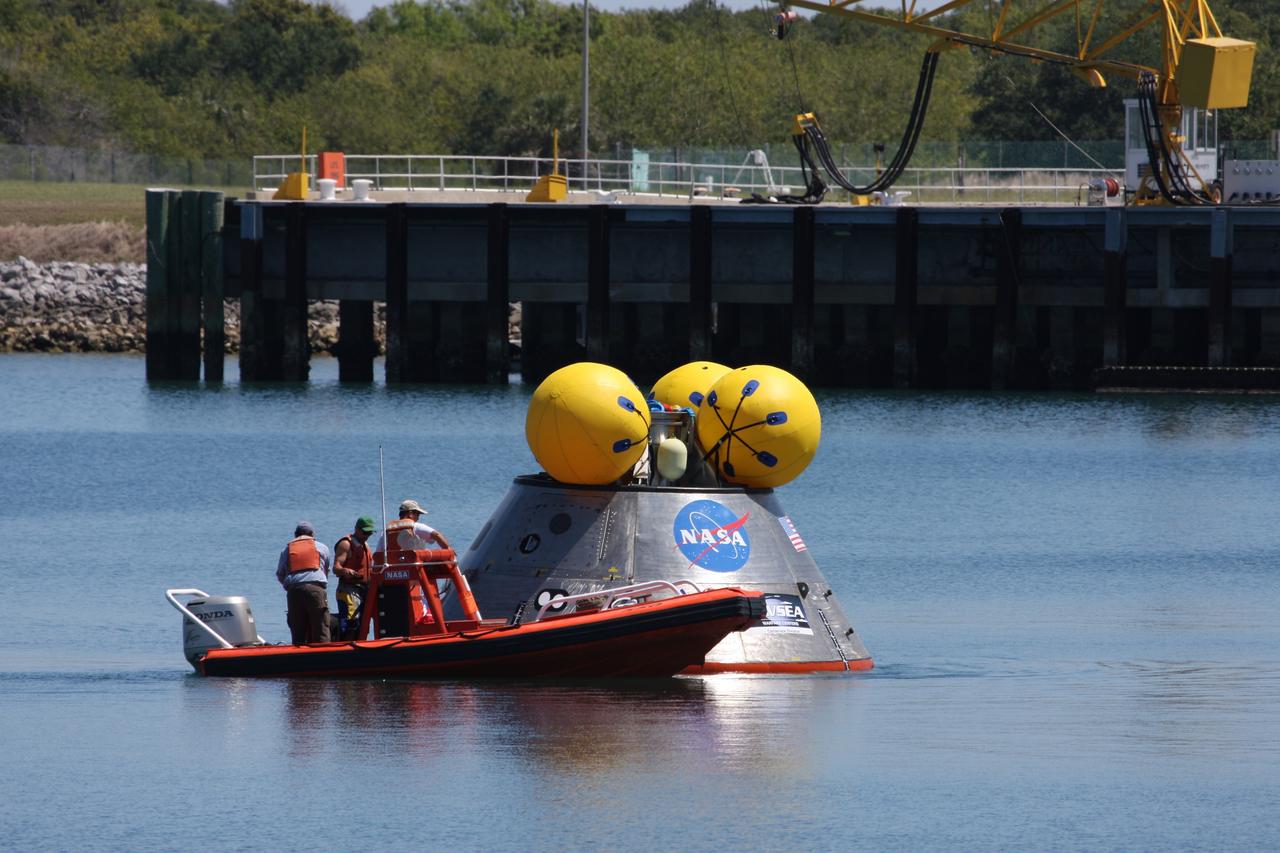
CAPE CANAVERAL, Fla. – Members of the 920th Rescue Wing get ready to release a flotation collar around the mockup Orion crew exploration vehicle at the Trident Basin at Port Canaveral, Fla. On top of Orion are additional flotation devices. The goal of the operation, dubbed the Post-landing Orion Recovery Test, or PORT, is to determine what kind of motion astronauts can expect after landing, as well as outside conditions for recovery teams. Orion is targeted to begin carrying humans to the International Space Station in 2015 and to the moon by 2020. Orion, along with the Ares I and V rockets and the Altair lunar lander, are part of the Constellation Program. Photo credit: NASA/Dimitri Gerondidakis
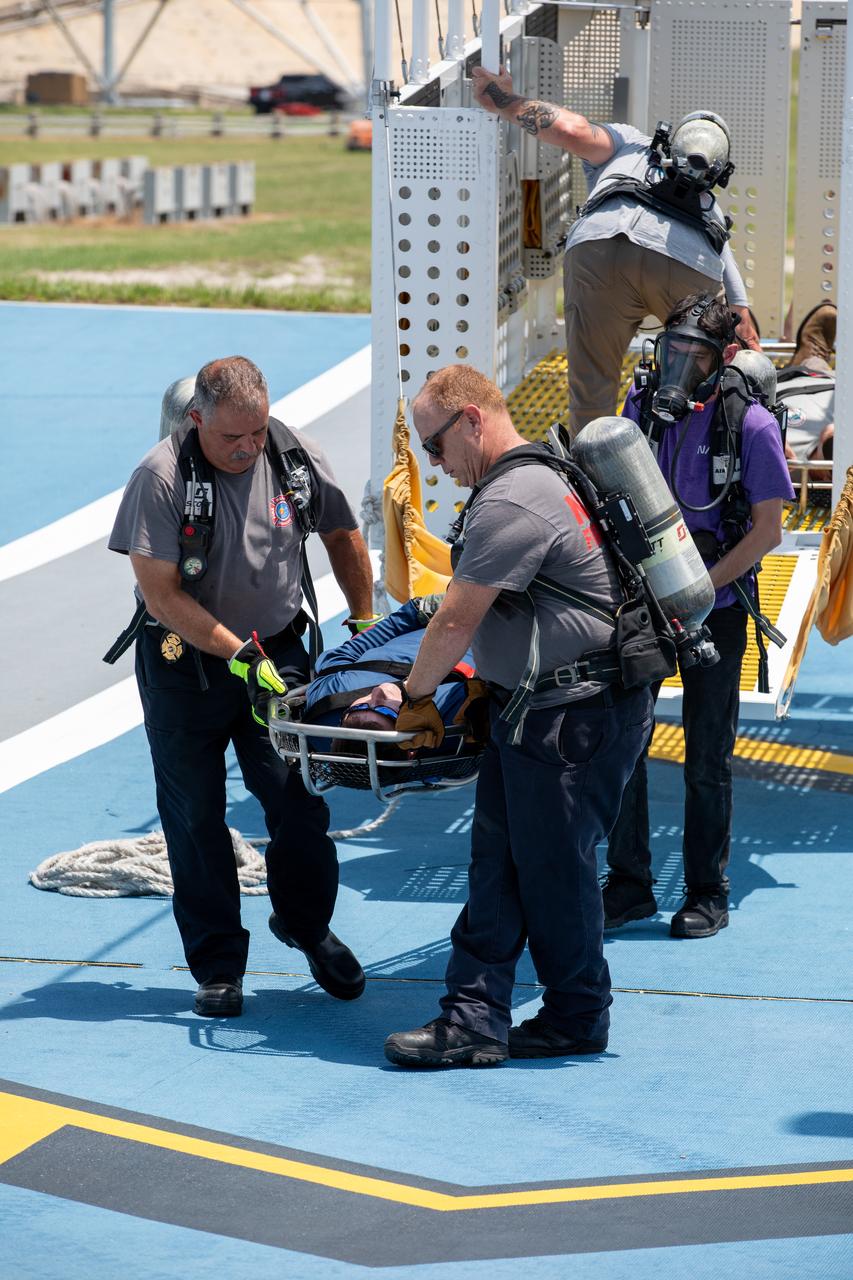
Teams at NASA’s Kennedy Space Center in Florida practice the Artemis mission emergency escape or egress procedures during a series of integrated system verification and validation tests at Launch Complex 39B on Friday, Aug. 9, 2024. Members of the closeout crew, pad rescue team, and the Exploration Ground Systems Program practiced the process of getting in and out of the emergency egress baskets then down to the launch pad where they would be transported to emergency transport vehicles and driven to safety. Prior to this test and throughout the course of several months, teams conducted several basket release demonstrations to validate the system.
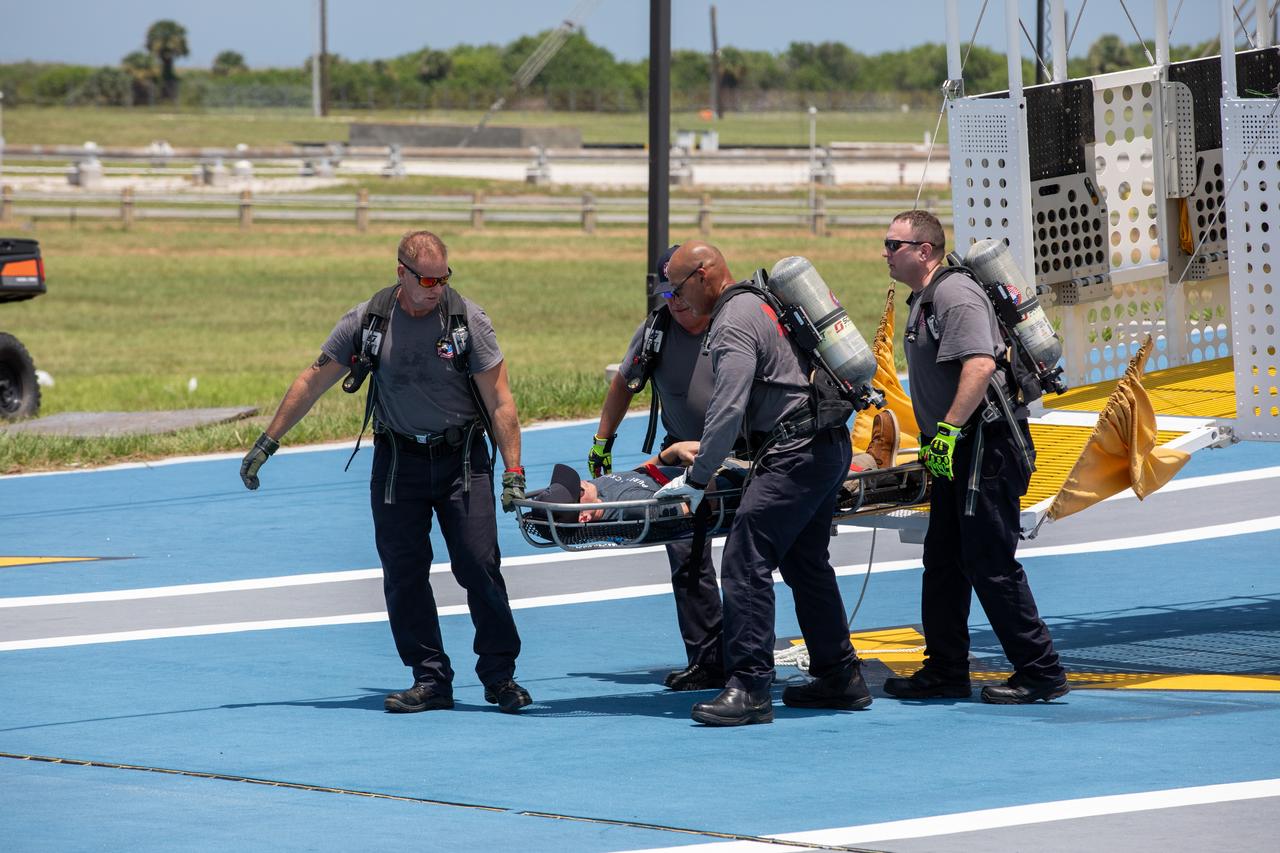
Teams at NASA’s Kennedy Space Center in Florida practice the Artemis mission emergency escape or egress procedures during a series of integrated system verification and validation tests at Launch Complex 39B on Friday, Aug. 9, 2024. Members of the closeout crew, pad rescue team, and the Exploration Ground Systems Program practiced the process of getting in and out of the emergency egress baskets then down to the launch pad where they would be transported to emergency transport vehicles and driven to safety. Prior to this test and throughout the course of several months, teams conducted several basket release demonstrations to validate the system.
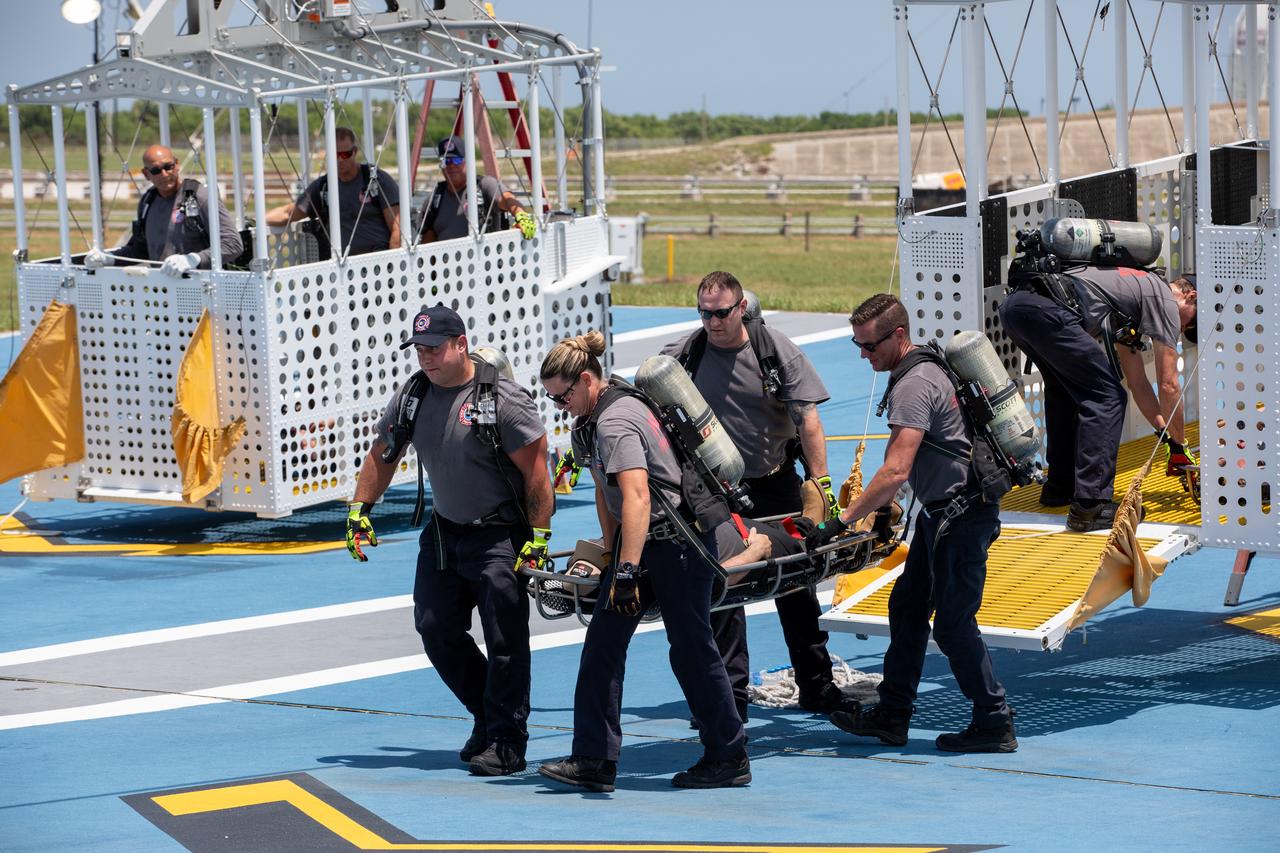
Teams at NASA’s Kennedy Space Center in Florida practice the Artemis mission emergency escape or egress procedures during a series of integrated system verification and validation tests at Launch Complex 39B on Friday, Aug. 9, 2024. Members of the closeout crew, pad rescue team, and the Exploration Ground Systems Program practiced the process of getting in and out of the emergency egress baskets then down to the launch pad where they would be transported to emergency transport vehicles and driven to safety. Prior to this test and throughout the course of several months, teams conducted several basket release demonstrations to validate the system.
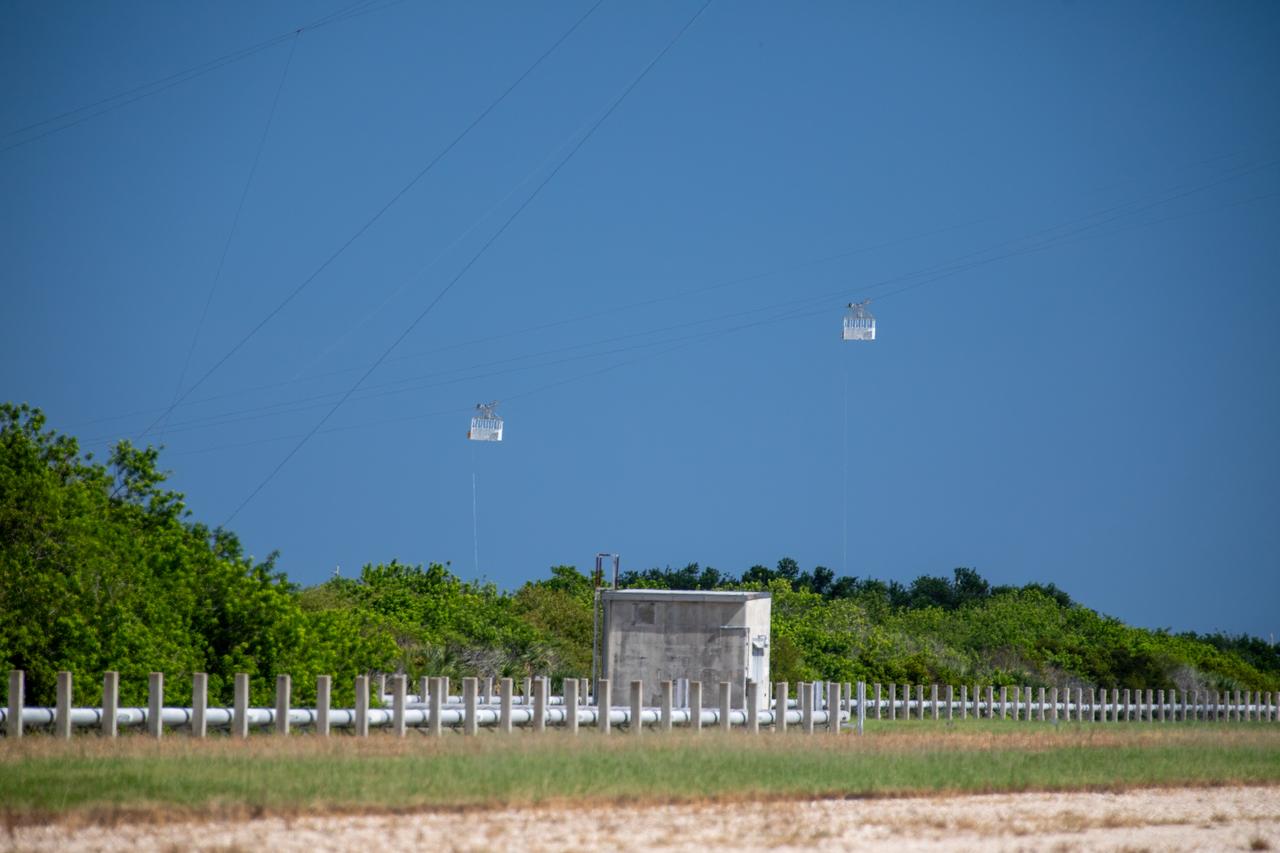
Teams at NASA’s Kennedy Space Center in Florida practice the Artemis mission emergency escape or egress procedures during a series of integrated system verification and validation tests at Launch Complex 39B on Monday, Aug. 12, 2024. Members of the closeout crew, pad rescue team, and the Exploration Ground Systems Program practiced the process of getting in and out of the emergency egress baskets then down to the launch pad where they would be transported to emergency transport vehicles and driven to safety. Prior to this test and throughout the course of several months, teams conducted basket release demonstrations to validate the system.