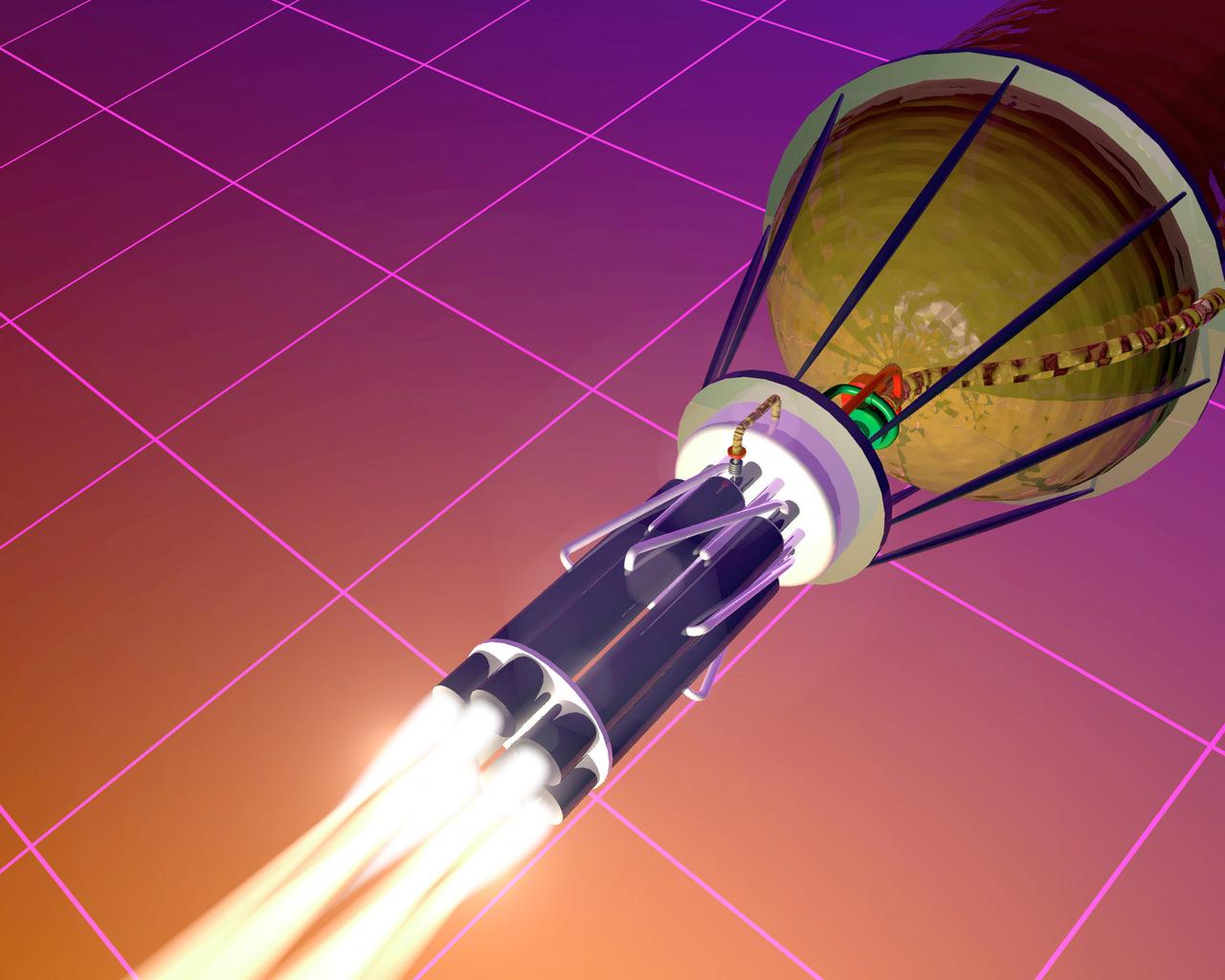
Pictured is an artist's concept of an advanced chemical propulsion system called Pulse Detonation. Long term technology research in this advanced propulsion system has the potential to dramatically change the way we think about space propulsion systems. This research is expected to significantly reduce the cost of space travel within the next 25 years.
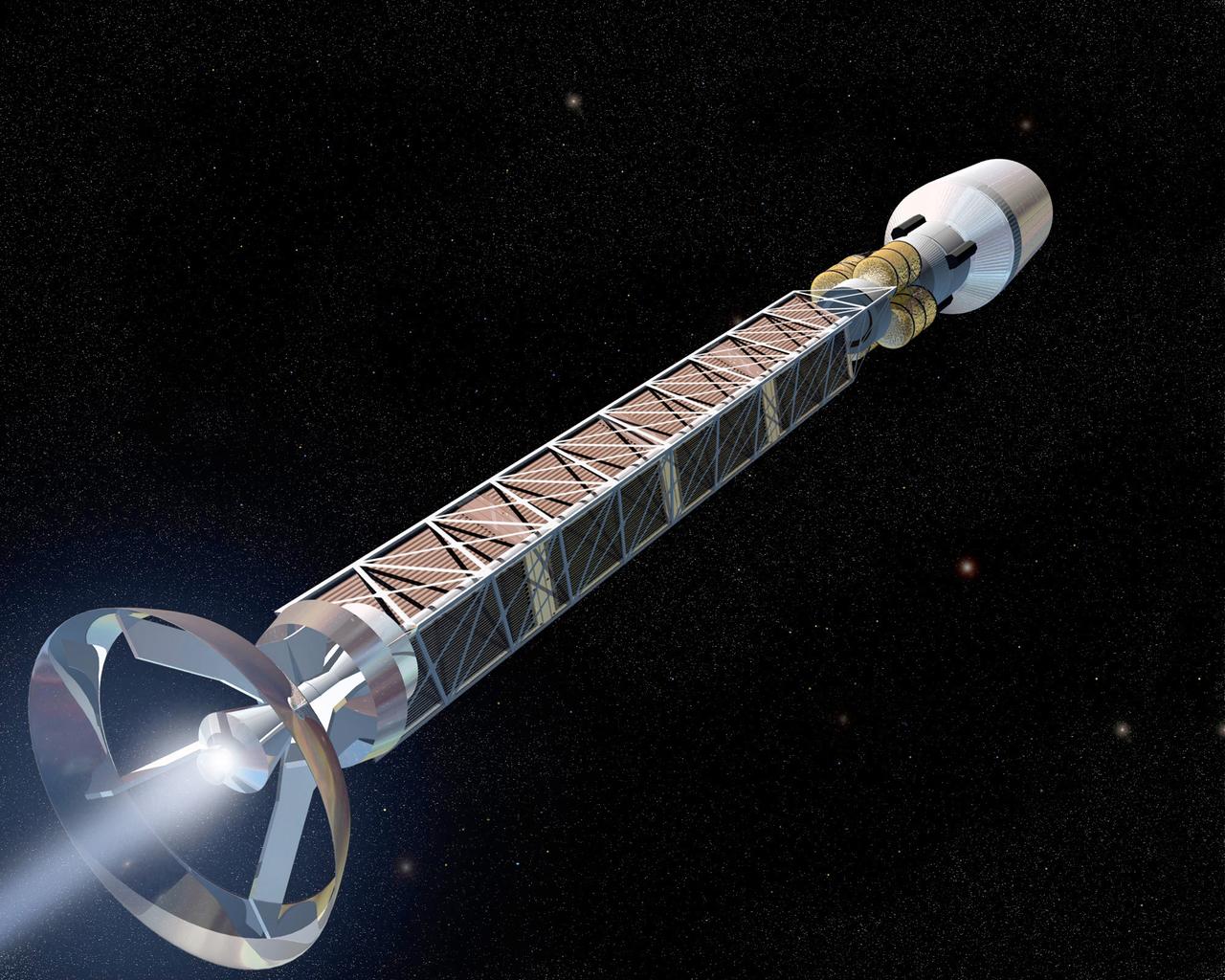
This is an artist's rendition of an antimatter propulsion system. Matter - antimatter arnihilation offers the highest possible physical energy density of any known reaction substance. It is about 10 billion times more powerful than that of chemical engergy such as hydrogen and oxygen combustion. Antimatter would be the perfect rocket fuel, but the problem is that the basic component of antimatter, antiprotons, doesn't exist in nature and has to manufactured. The process of antimatter development is on-going and making some strides, but production of this as a propulsion system is far into the future.
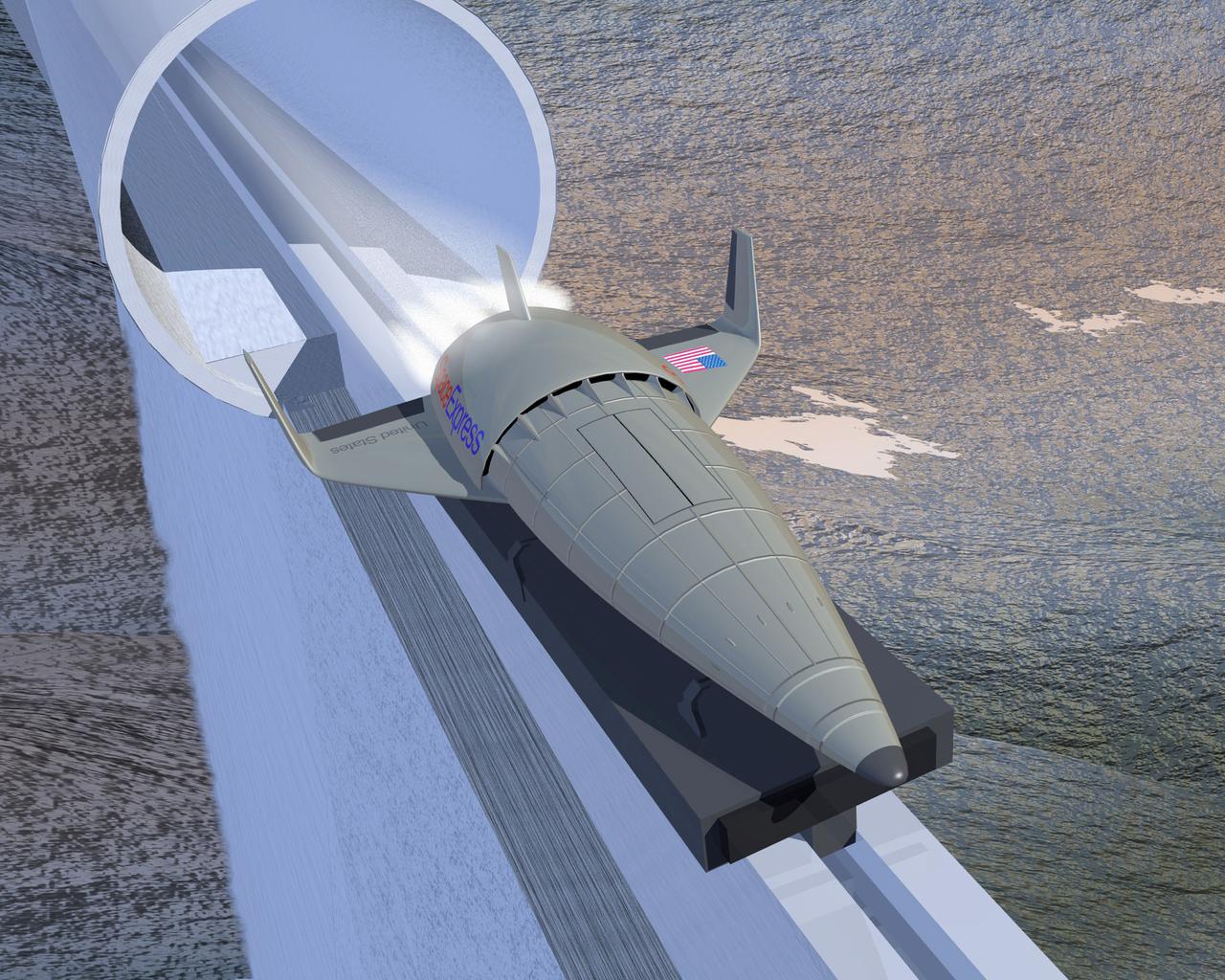
Pictured is an artist's concept of the Rocket Based Combined Cycle (RBCC) launch. The RBCC's overall objective is to provide a technology test bed to investigate critical technologies associated with opperational usage of these engines. The program will focus on near term technologies that can be leveraged to ultimately serve as the near term basis for Two Stage to Orbit (TSTO) air breathing propulsions systems and ultimately a Single Stage To Orbit (SSTO) air breathing propulsion system.
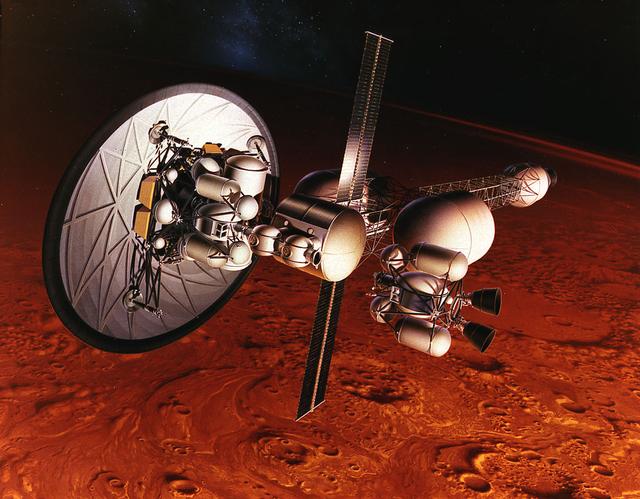
Originally investigated in the 1960's by Marshall Space Flight Center plarners as part of the Nuclear Energy for Rocket Vehicle Applications (NERVA) program, nuclear-thermal rocket propulsion has been more recently considered in spacecraft designs for interplanetary human exploration. This artist's concept illustrates a nuclear-thermal rocket with an aerobrake disk as it orbits Mars.
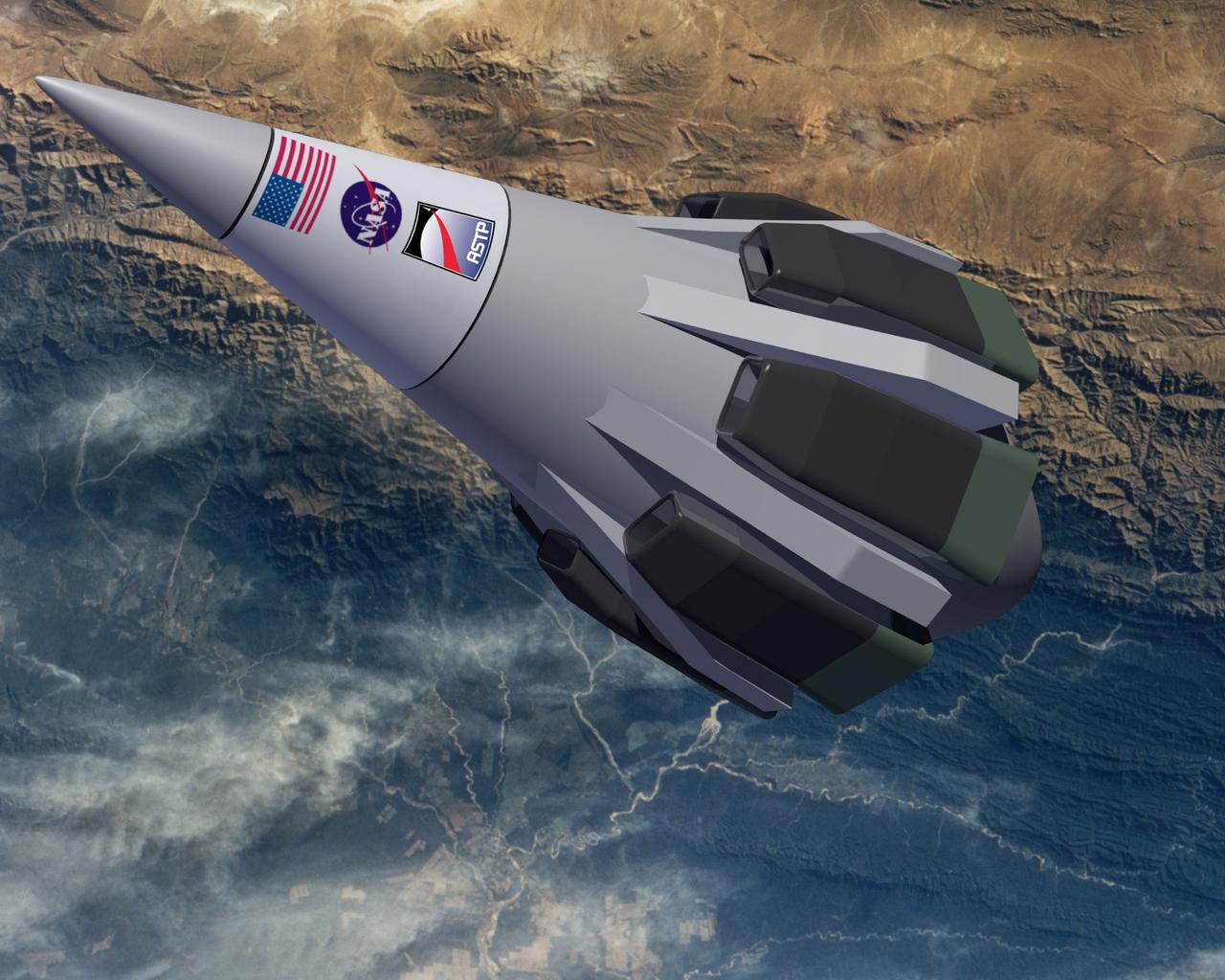
Pictured is an artist's concept of the Rocket Based Combined Cycle (RBCC) launch. The RBCC's overall objective is to provide a technology test bed to investigate critical technologies associated with opperational usage of these engines. The program will focus on near term technologies that can be leveraged to ultimately serve as the near term basis for Two Stage to Orbit (TSTO) air breathing propulsions systems and ultimately a Single Stage To Orbit (SSTO) air breathing propulsion system.
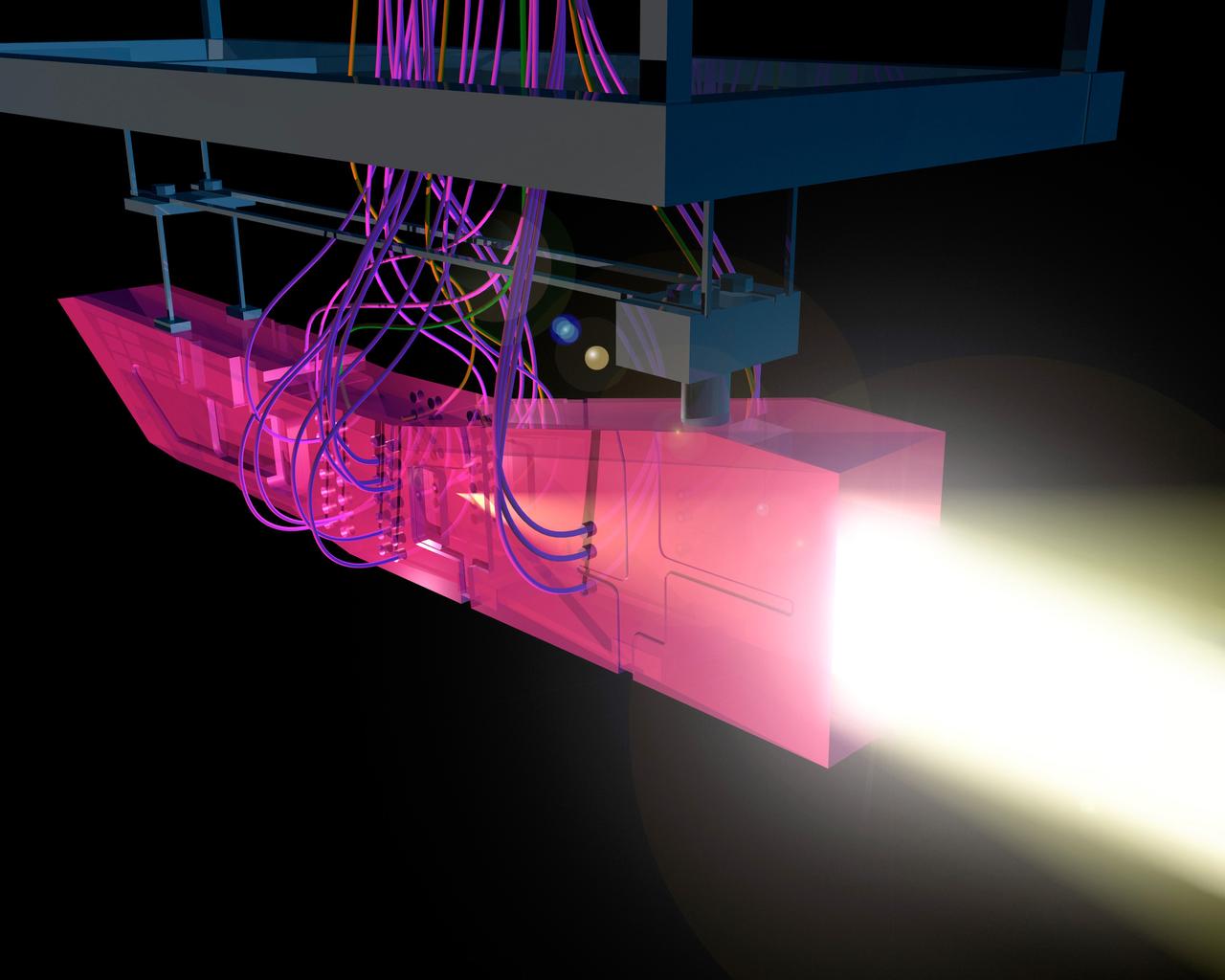
Pictured is a component of the Rocket Based Combined Cycle (RBCC) engine. This engine was designed to ultimately serve as the near term basis for Two Stage to Orbit (TSTO) air breathing propulsion systems and ultimately a Single Stage to Orbit (SSTO) air breathing propulsion system.
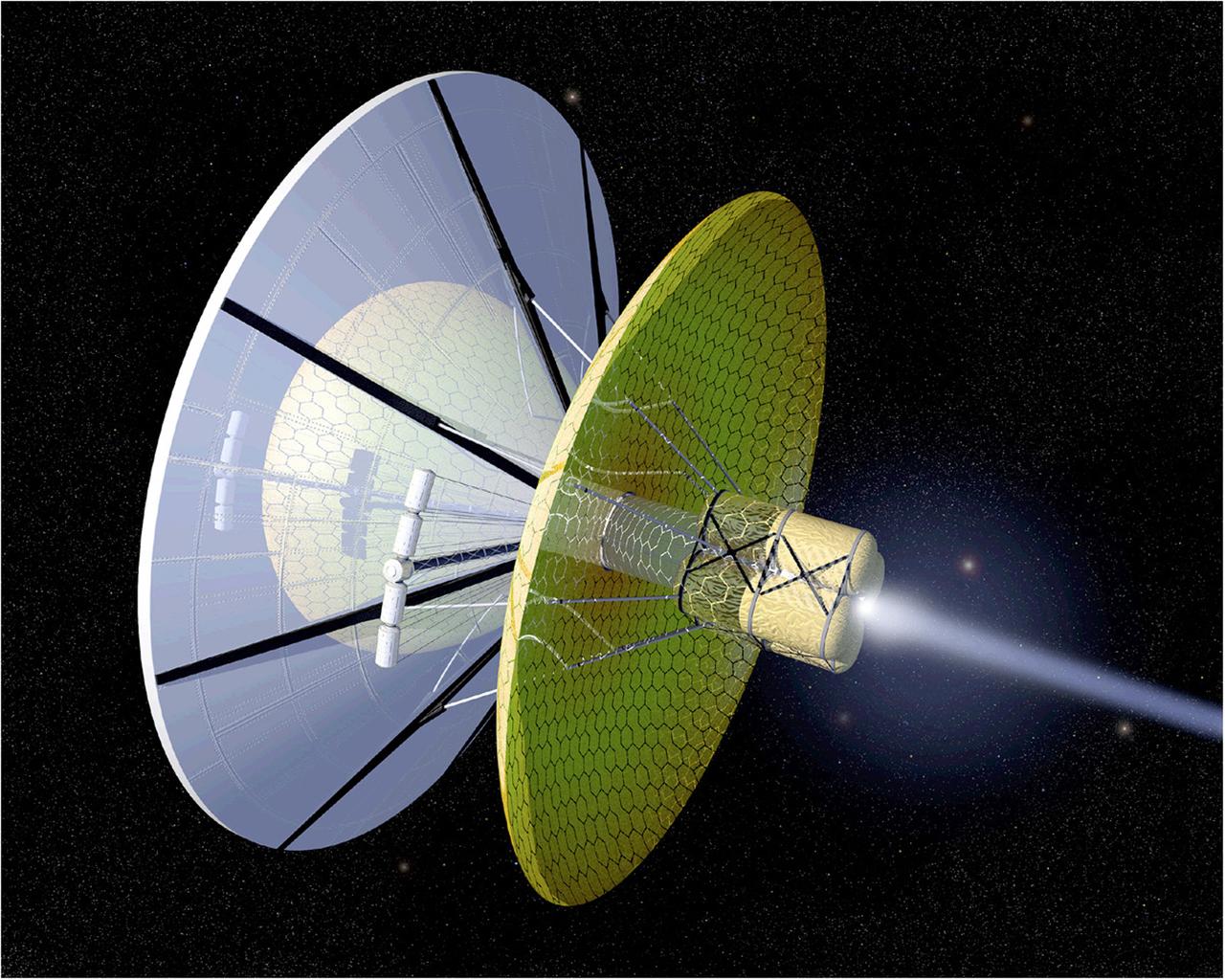
The Boussard Interstellar Ramjet engine concept uses interstellar hydrogen scooped up from its environment as the spacecraft passes by to provide propellant mass. The hydrogen is then ionized and then collected by an electromagentic field. In this image, an onboard laser is uded to heat the plasma, and the laser or electron beam is used to trigger fusion pulses thereby creating propulsion.
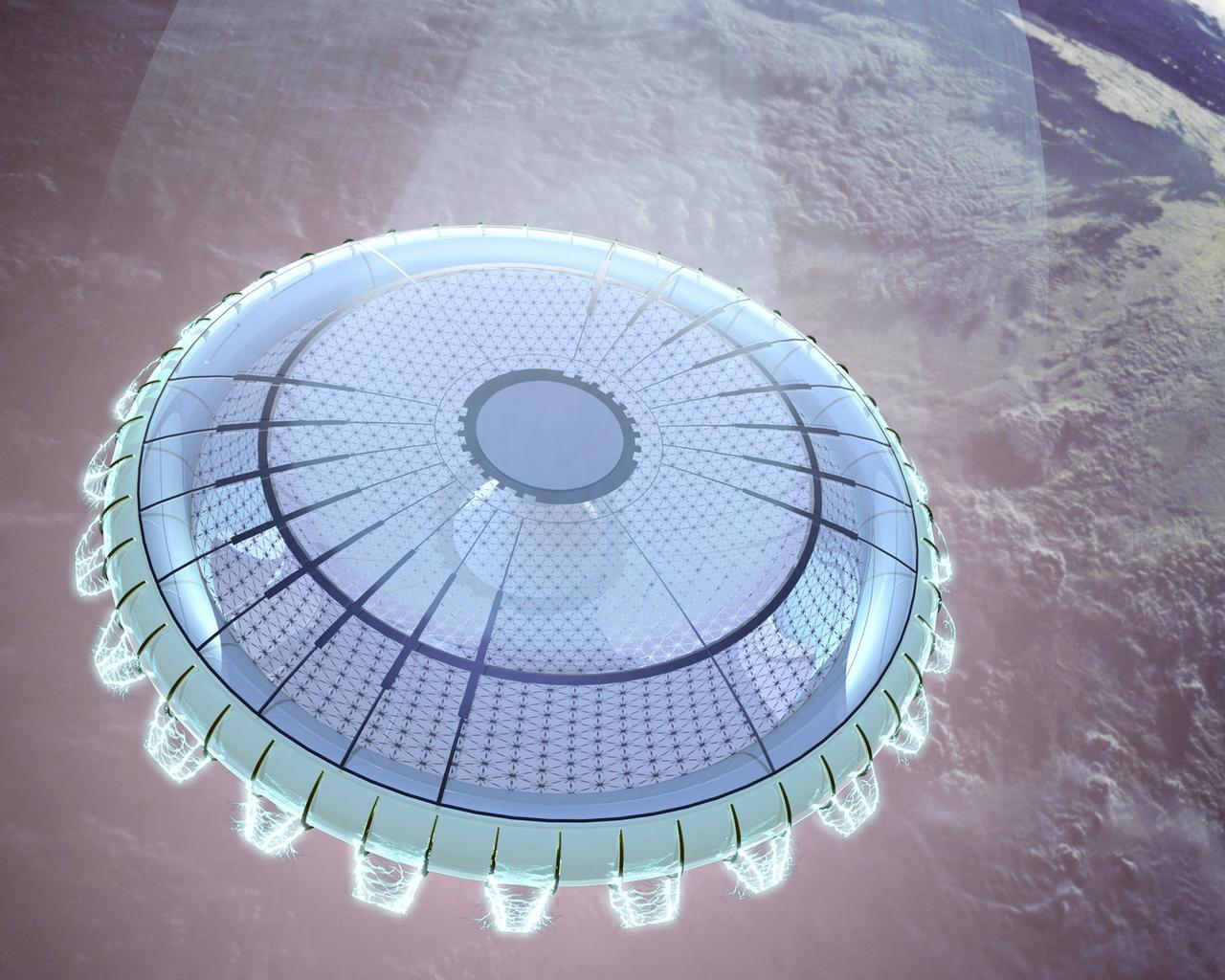
Looking like an alien space ship or a flying saucer the Microwave Lightcraft is an unconventional launch vehicle approach for delivering payload to orbit using power transmitted via microwaves. Microwaves re beamed from either a ground station or an orbiting solar power satellite to the lightcraft. The energy received breaks air molecules into a plasma and a magnetohydrodynamic fanjet provides the lifting force. Only a small amount of propellant is required for circulation, attitude control and deorbit.
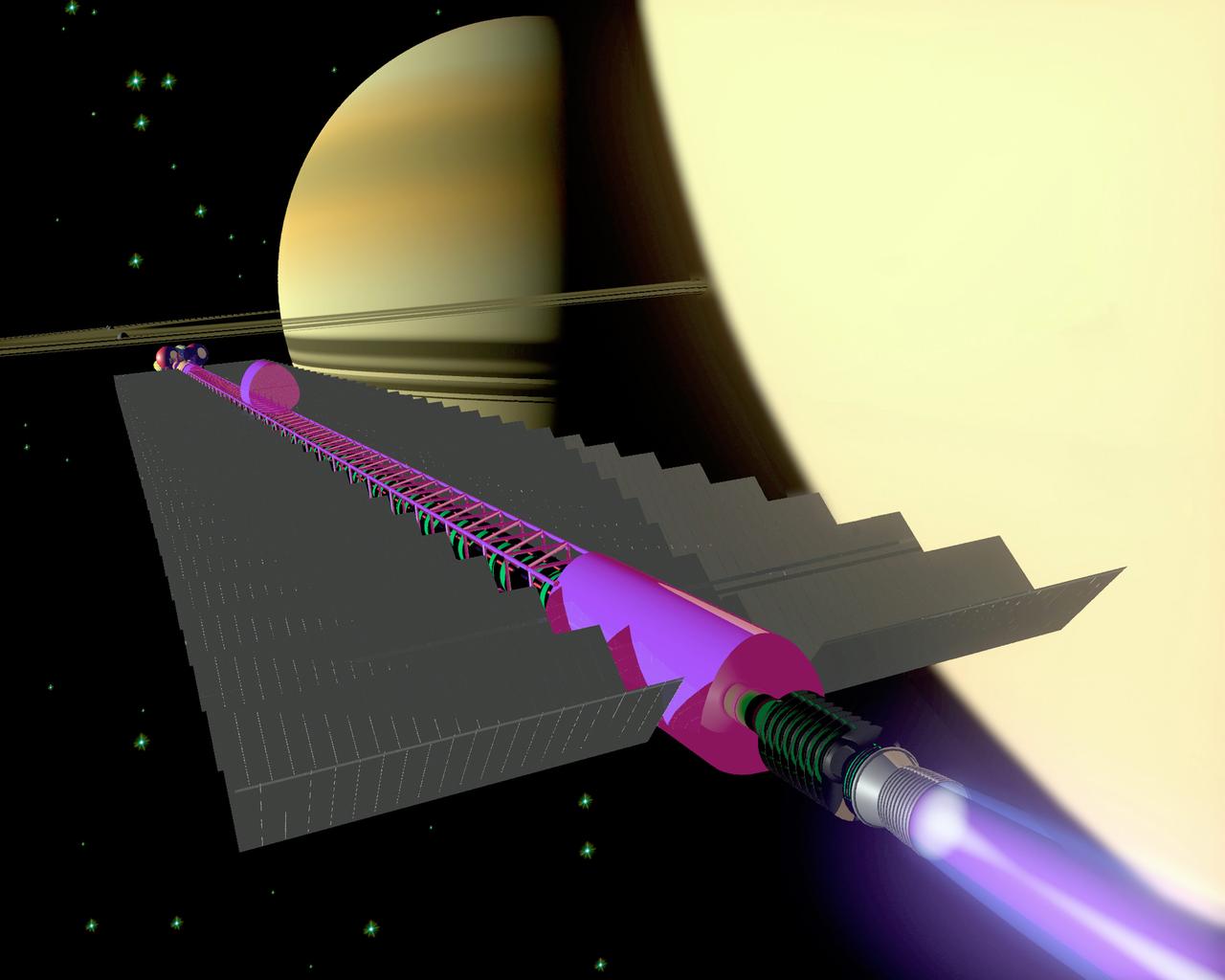
Travel to distant stars is a long-range goal of Marshall Space Flight Center's Advanced Concept Group. One of the many propulsion systems currently being studied is fusion power. The objective of this and many other alternative propulsion systems is to reduce the costs of space access and to reduce the travel time for planetary missions. One of the major factors is providing an alternate engery source for these missions. Pictured is an artist's concept of future interplanetary space flight using fusion power.
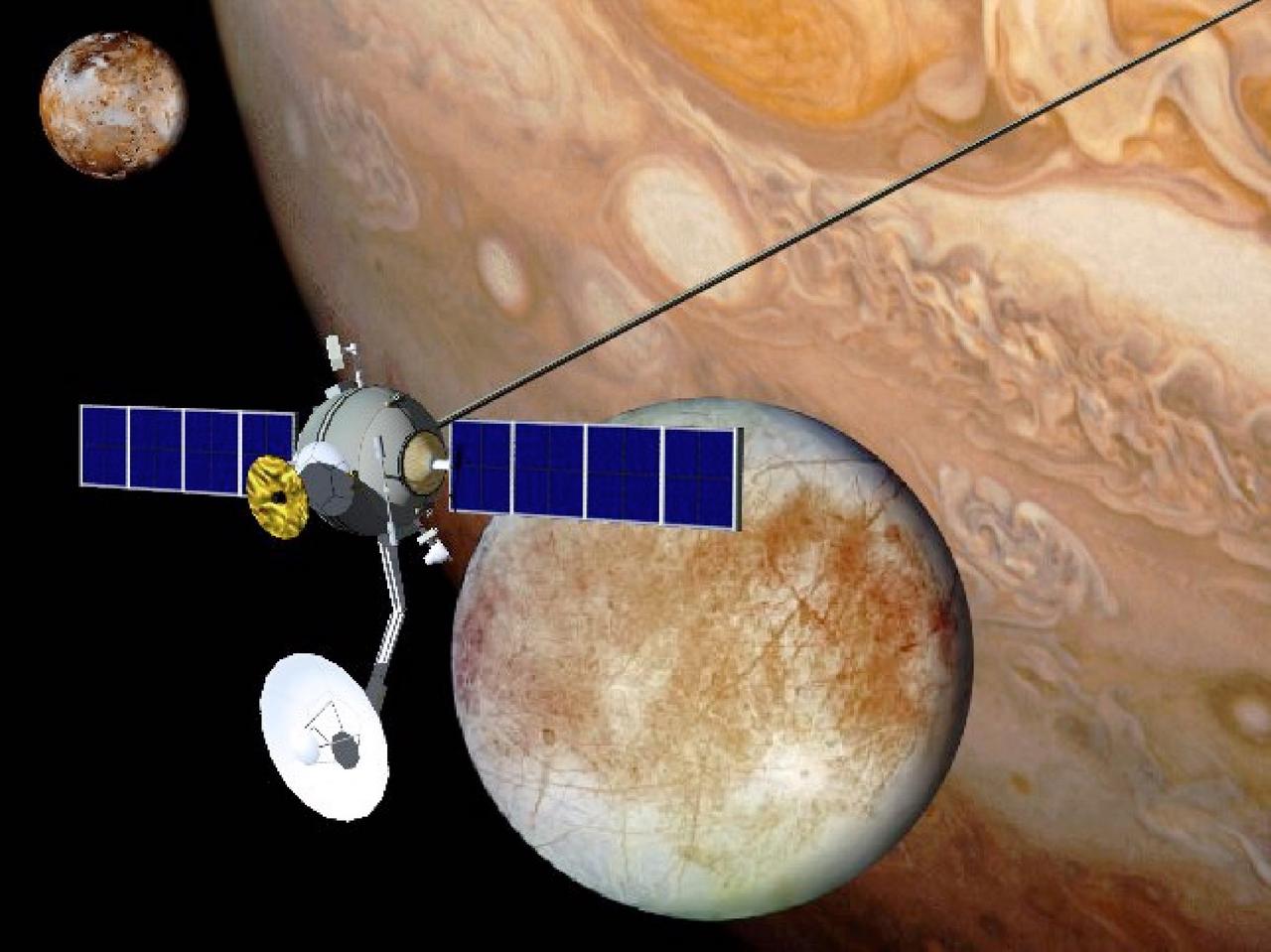
This is an artist's concept of an orbiting space vehicle in the Jovian system using an electrodynamic tether propellantless propulsion system. Electrodynamic tethers offer the potential to greatly extend and enhance future scientific missions to Jupiter and the Jovian system. Like Earth, Jupiter posses a strong magnetic field and a significant magnetosphere. This may make it feasible to operate electrodynamic tethers for propulsion and power generation.
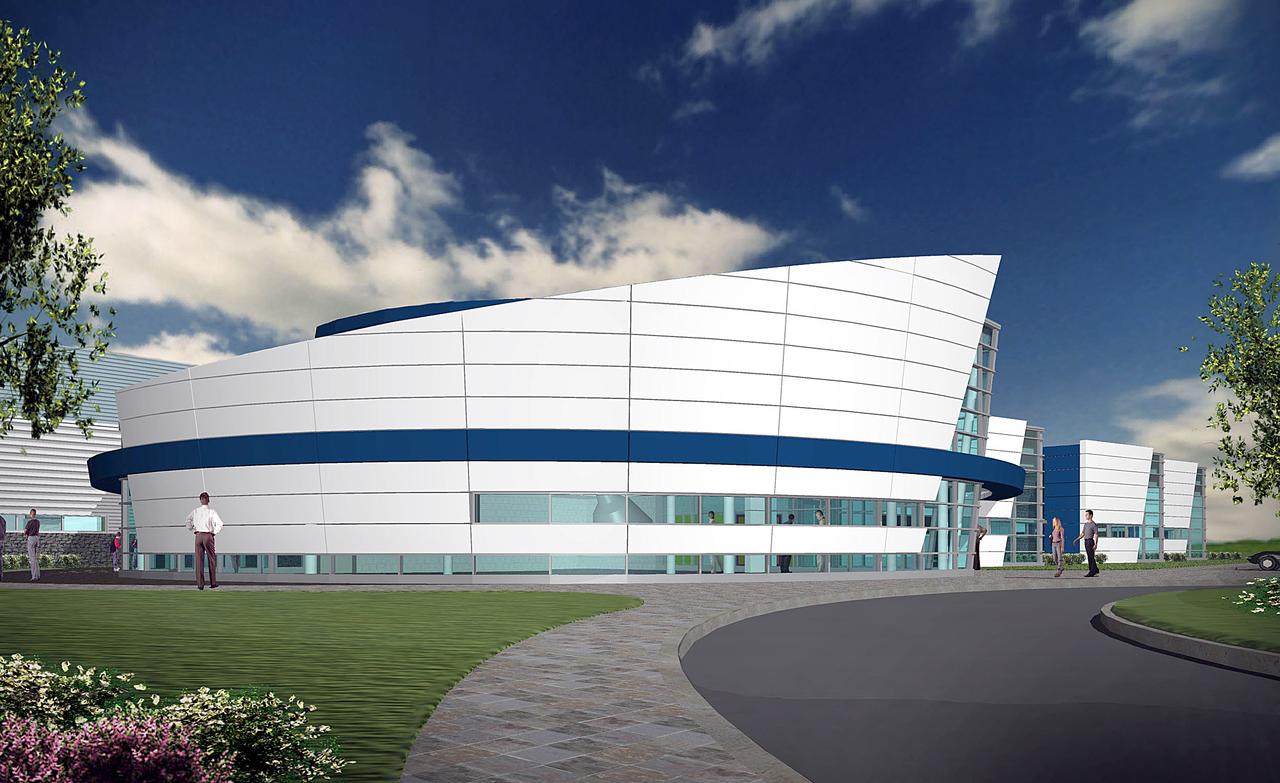
A new, world-class laboratory for research into future space transportation technologies is under construction at the Marshall Space Flight Center (MSFC) in Huntsville, AL. The state-of-the-art Propulsion Research Laboratory will serve as a leading national resource for advanced space propulsion research. Its purpose is to conduct research that will lead to the creation and development of irnovative propulsion technologies for space exploration. The facility will be the epicenter of the effort to move the U.S. space program beyond the confines of conventional chemical propulsion into an era of greatly improved access to space and rapid transit throughout the solar system. The Laboratory is designed to accommodate researchers from across the United States, including scientists and engineers from NASA, the Department of Defense, the Department of Energy, universities, and industry. The facility, with 66,000 square feet of useable laboratory space, will feature a high degree of experimental capability. Its flexibility will allow it to address a broad range of propulsion technologies and concepts, such as plasma, electromagnetic, thermodynamic, and propellantless propulsion. An important area of emphasis will be development and utilization of advanced energy sources, including highly energetic chemical reactions, solar energy, and processes based on fission, fusion, and antimatter. The Propulsion Research Laboratory is vital for developing the advanced propulsion technologies needed to open up the space frontier, and will set the stage of research that could revolutionize space transportation for a broad range of applications.
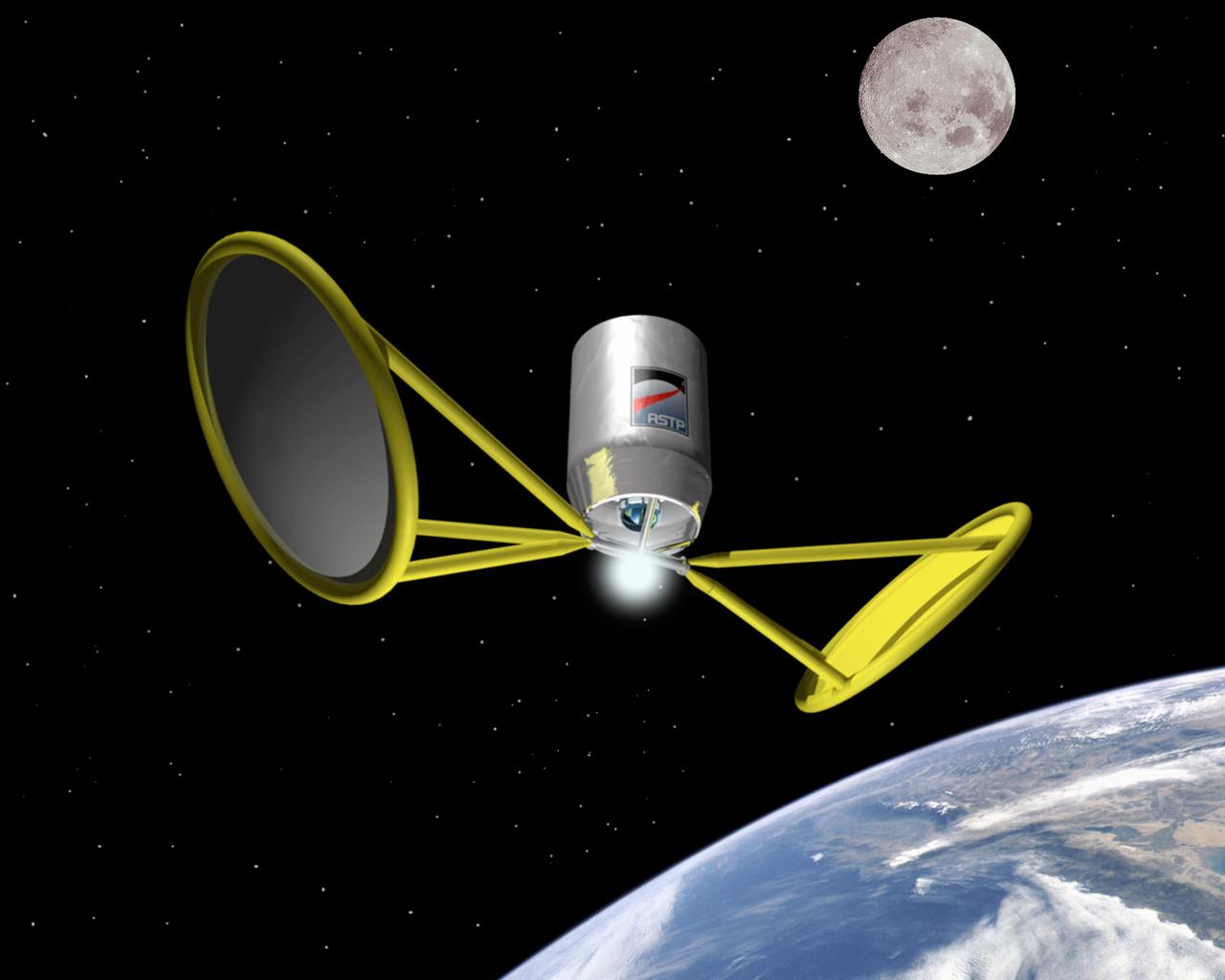
Harnessing the Sun's energy through Solar Thermal Propulsion will propel vehicles through space by significantly reducing weight, complexity, and cost while boosting performance over current conventional upper stages. Another solar powered system, solar electric propulsion, demonstrates ion propulsion is suitable for long duration missions. Pictured is an artist's concept of space flight using solar thermal propulsion.
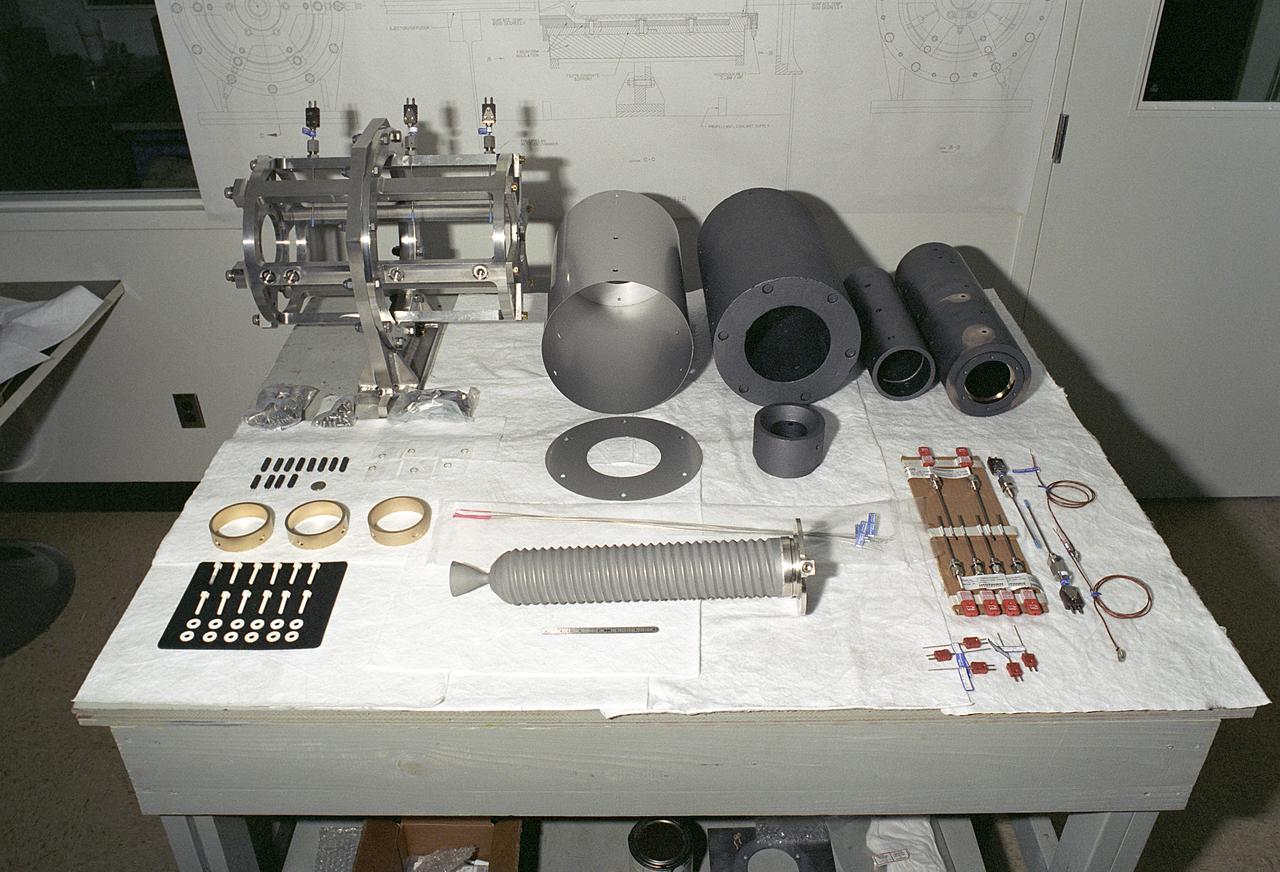
Researchers at the Marshall Space Flight Center (MSFC) have designed, fabricated, and tested the first solar thermal engine, a non-chemical rocket engine that produces lower thrust but has better thrust efficiency than a chemical combustion engine. This photograph shows components for the thermal propulsion engine being laid out prior to assembly. MSFC turned to solar thermal propulsion in the early 1990s due to its simplicity, safety, low cost, and commonality with other propulsion systems. As part of MSFC's Space Transportation Directorate, the Propulsion Research Center serves as a national resource for research of advanced, revolutionary propulsion technologies. The mission is to move the Nation's capabilities beyond the confines of conventional chemical propulsion into an era of aircraft-like access to Earth-orbit, rapid travel throughout the solar system, and exploration of interstellar space.
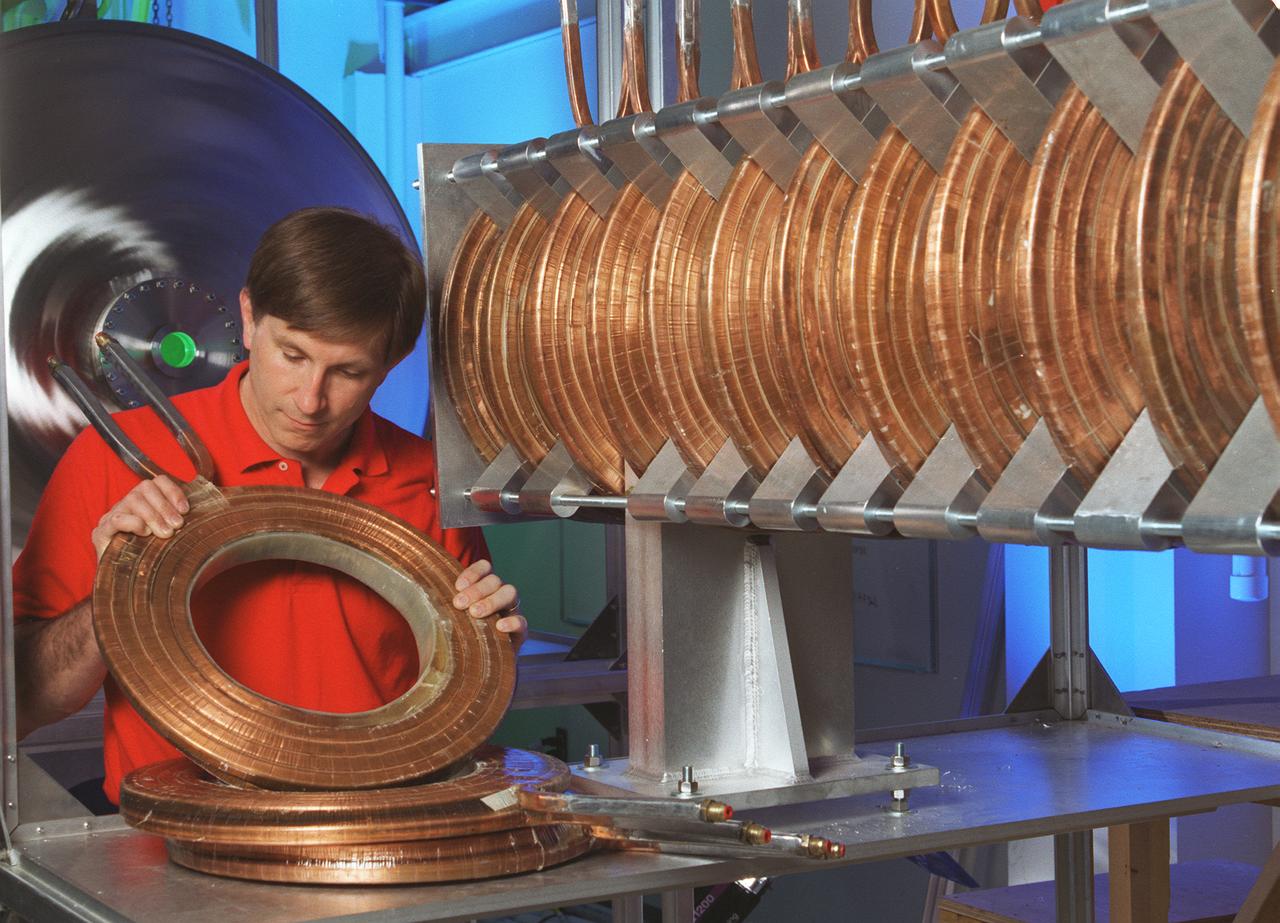
The Gasdynamic Mirror, or GDM, is an example of a magnetic mirror-based fusion propulsion system. Its design is primarily consisting of a long slender solenoid surrounding a vacuum chamber that contains plasma. The bulk of the fusion plasma is confined by magnetic field generated by a series of toroidal-shaped magnets in the center section of the device. the purpose of the GDM Fusion Propulsion Experiment is to confirm the feasibility of the concept and to demonstrate many of the operational characteristics of a full-size plasma can be confined within the desired physical configuration and still reman stable. This image shows an engineer from Propulsion Research Technologies Division at Marshall Space Flight Center inspecting solenoid magnets-A, an integrate part of the Gasdynamic Mirror Fusion Propulsion Engine Experiment.
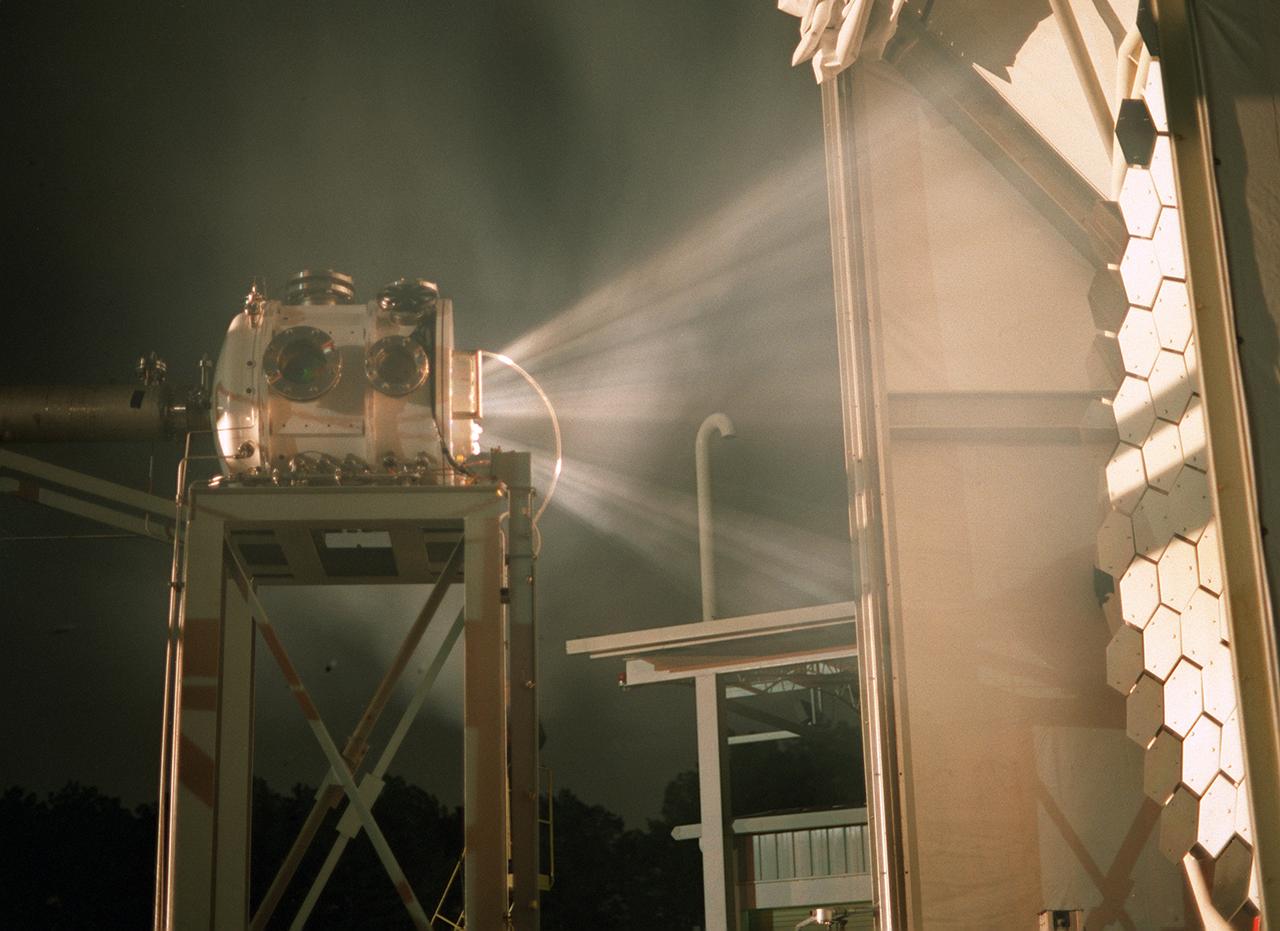
Researchers at the Marshall Space Flight Center (MSFC) have designed, fabricated, and tested the first solar thermal engine, a non-chemical rocket engine that produces lower thrust but has better thrust efficiency than a chemical combustion engine. MSFC turned to solar thermal propulsion in the early 1990s due to its simplicity, safety, low cost, and commonality with other propulsion systems. Solar thermal propulsion works by acquiring and redirecting solar energy to heat a propellant. The 20- by 24-ft heliostat mirror (not shown in this photograph) has a dual-axis control that keeps a reflection of the sunlight on the 18-ft diameter concentrator mirror, which then focuses the sunlight to a 4-in focal point inside the vacuum chamber. The focal point has 10 kilowatts of intense solar power. This image, taken during the test, depicts the light being concentrated into the focal point inside the vacuum chamber. As part of MSFC's Space Transportation Directorate, the Propulsion Research Center serves as a national resource for research of advanced, revolutionary propulsion technologies. The mission is to move the Nation's capabilities beyond the confines of conventional chemical propulsion into an era of aircraft-like access to Earth orbit, rapid travel throughout the solar system, and exploration of interstellar space.
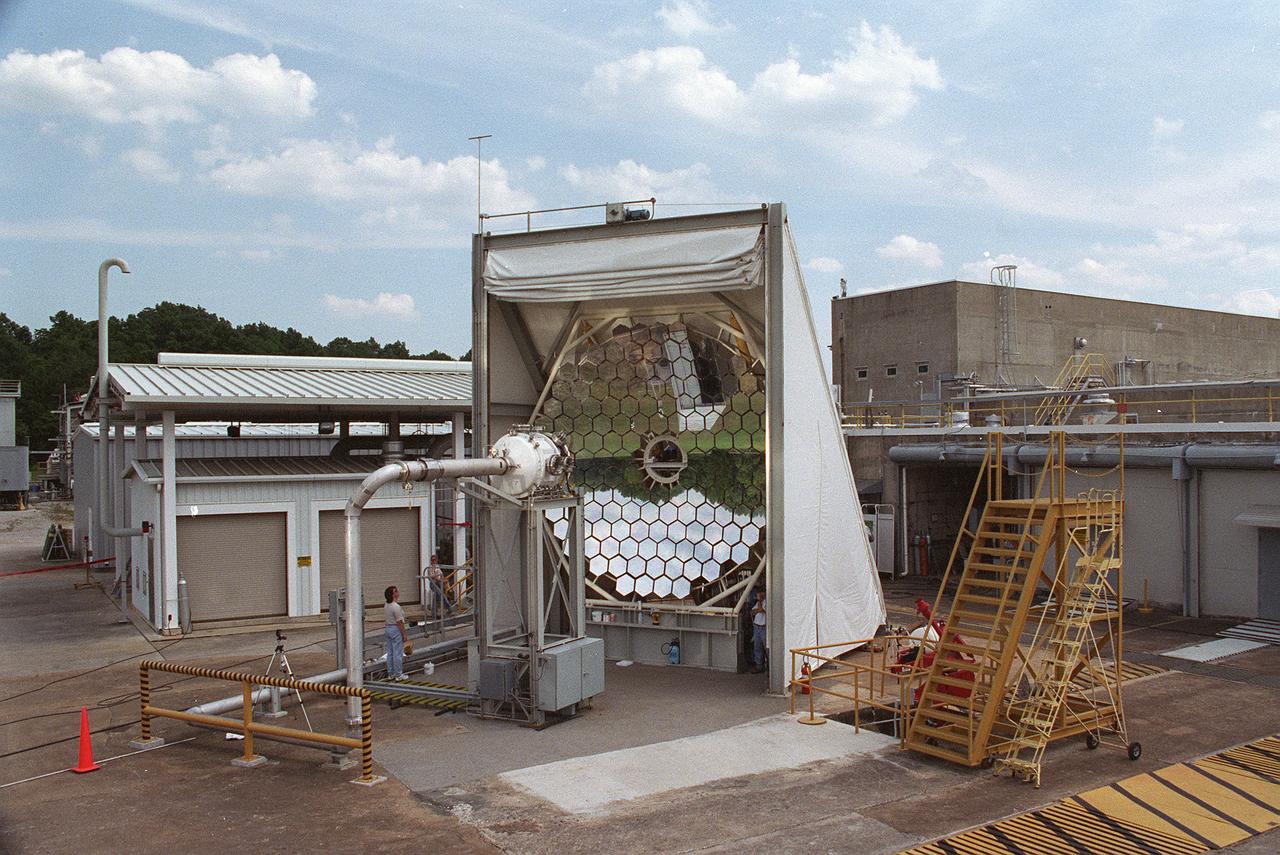
Researchers at the Marshall Space Flight Center (MSFC) have designed, fabricated and tested the first solar thermal engine, a non-chemical rocket engine that produces lower thrust but has better thrust efficiency than a chemical combustion engine. MSFC turned to solar thermal propulsion in the early 1990s due to its simplicity, safety, low cost, and commonality with other propulsion systems. Solar thermal propulsion works by acquiring and redirecting solar energy to heat a propellant. This photograph, taken at MSFC's Solar Thermal Propulsion Test Facility, shows a concentrator mirror, a combination of 144 mirrors forming this 18-ft diameter concentrator, and a vacuum chamber that houses the focal point. The 20- by 24-ft heliostat mirror (not shown in this photograph) has a dual-axis control that keeps a reflection of the sunlight on the 18-foot diameter concentrator mirror, which then focuses the sunlight to a 4-in focal point inside the vacuum chamber. The focal point has 10 kilowatts of intense solar power. As part of MSFC's Space Transportation Directorate, the Propulsion Research Center serves as a national resource for research of advanced, revolutionary propulsion technologies. The mission is to move the Nation's capabilities beyond the confines of conventional chemical propulsion into an era of aircraft-like access to Earth-orbit, rapid travel throughout the solar system, and exploration of interstellar space.
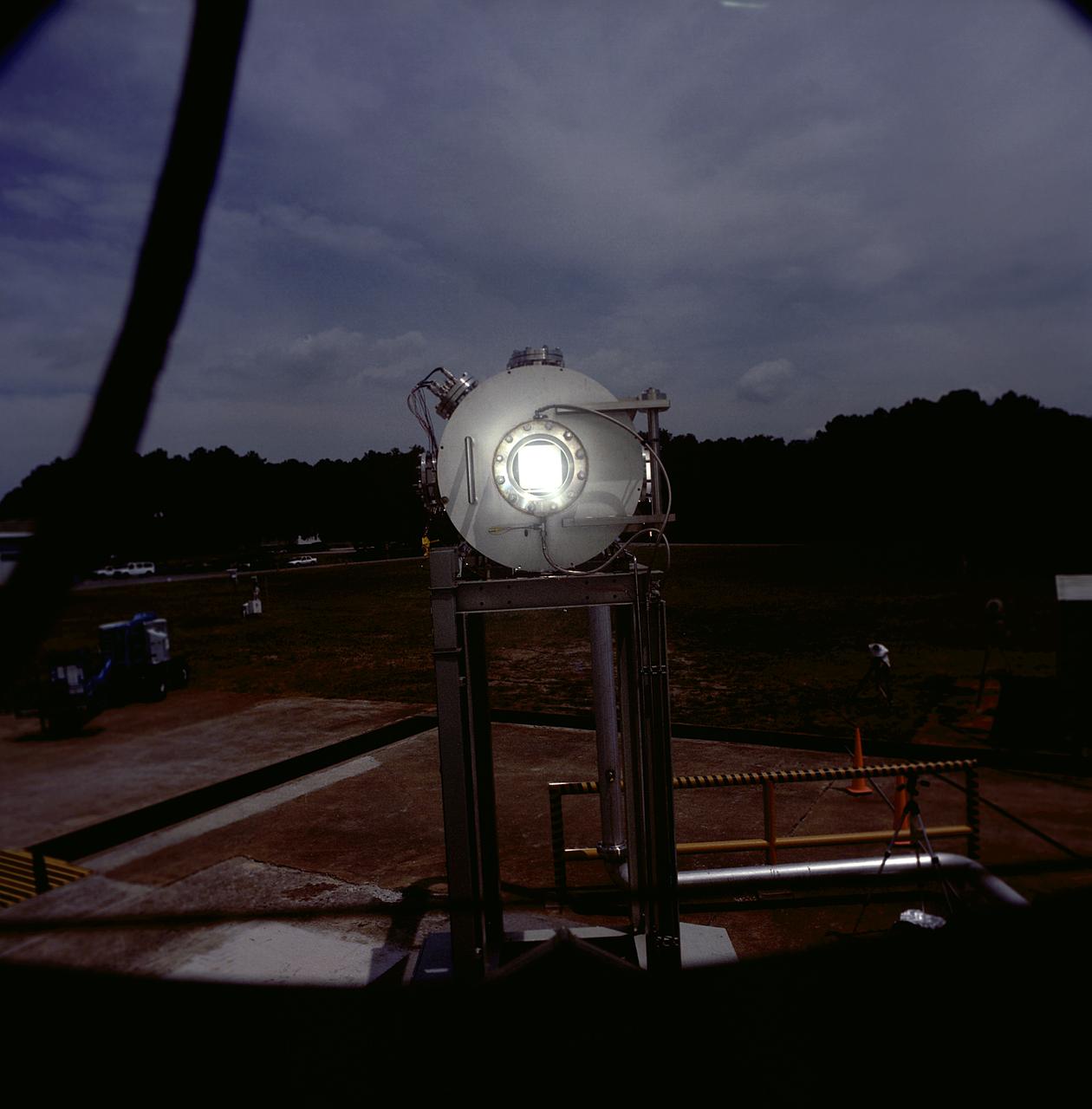
Researchers at the Marshall Space Flight Center (MSFC) have designed, fabricated, and tested the first solar thermal engine, a non-chemical rocket engine that produces lower thrust but has better thrust efficiency than a chemical combustion engine. MSFC turned to solar thermal propulsion in the early 1990s due to its simplicity, safety, low cost, and commonality with other propulsion systems. Solar thermal propulsion works by acquiring and redirecting solar energy to heat a propellant. The 20- by 24-ft heliostat mirror (not shown in this photograph) has dual-axis control that keeps a reflection of the sunlight on an 18-ft diameter concentrator mirror, which then focuses the sunlight to a 4-in focal point inside the vacuum chamber. The focal point has 10 kilowatts of intense solar power. This photograph is a close-up view of a 4-in focal point inside the vacuum chamber at the MSFC Solar Thermal Propulsion Test facility. As part of MSFC's Space Transportation Directorate, the Propulsion Research Center serves as a national resource for research of advanced, revolutionary propulsion technologies. The mission is to move the Nation's capabilities beyond the confines of conventional chemical propulsion into an era of aircraft-like access to Earth orbit, rapid travel throughout the solar system, and exploration of interstellar space.
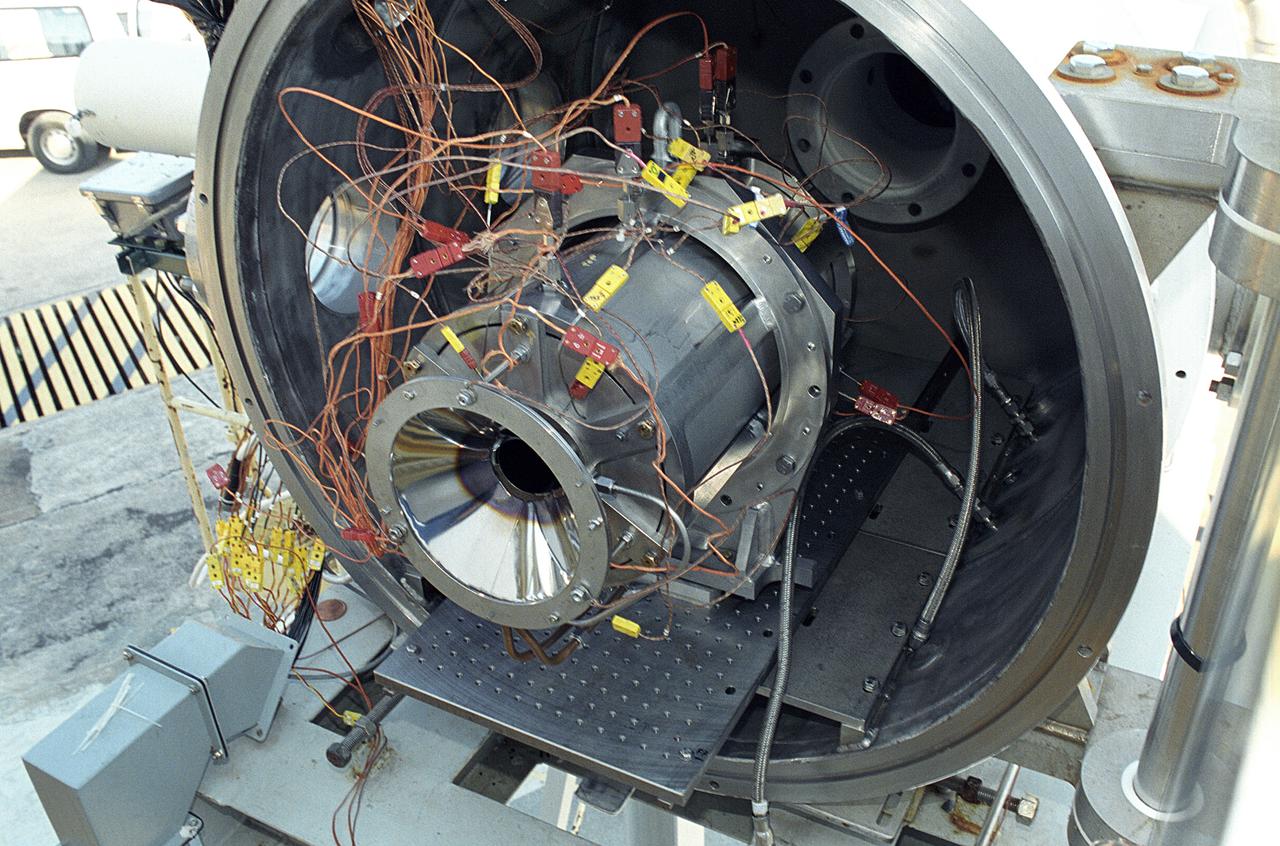
Researchers at the Marshall Space Flight Center (MSFC) have designed, fabricated, and tested the first solar thermal engine, a non-chemical rocket engine that produces lower thrust but has better thrust efficiency than a chemical combustion engine. MSFC turned to solar thermal propulsion in the early 1990s due to its simplicity, safety, low cost, and commonality with other propulsion systems. Solar thermal propulsion works by acquiring and redirecting solar energy to heat a propellant. This photograph shows a fully assembled solar thermal engine placed inside the vacuum chamber at the test facility prior to testing. The 20- by 24-ft heliostat mirror (not shown in this photograph) has a dual-axis control that keeps a reflection of the sunlight on the 18-ft diameter concentrator mirror, which then focuses the sunlight to a 4-in focal point inside the vacuum chamber. The focal point has 10 kilowatts of intense solar power. As part of MSFC's Space Transportation Directorate, the Propulsion Research Center serves as a national resource for research of advanced, revolutionary propulsion technologies. The mission is to move theNation's capabilities beyond the confines of conventional chemical propulsion into an era of aircraft-like access to Earth orbit, rapid travel throughout the solar system, and exploration of interstellar space.
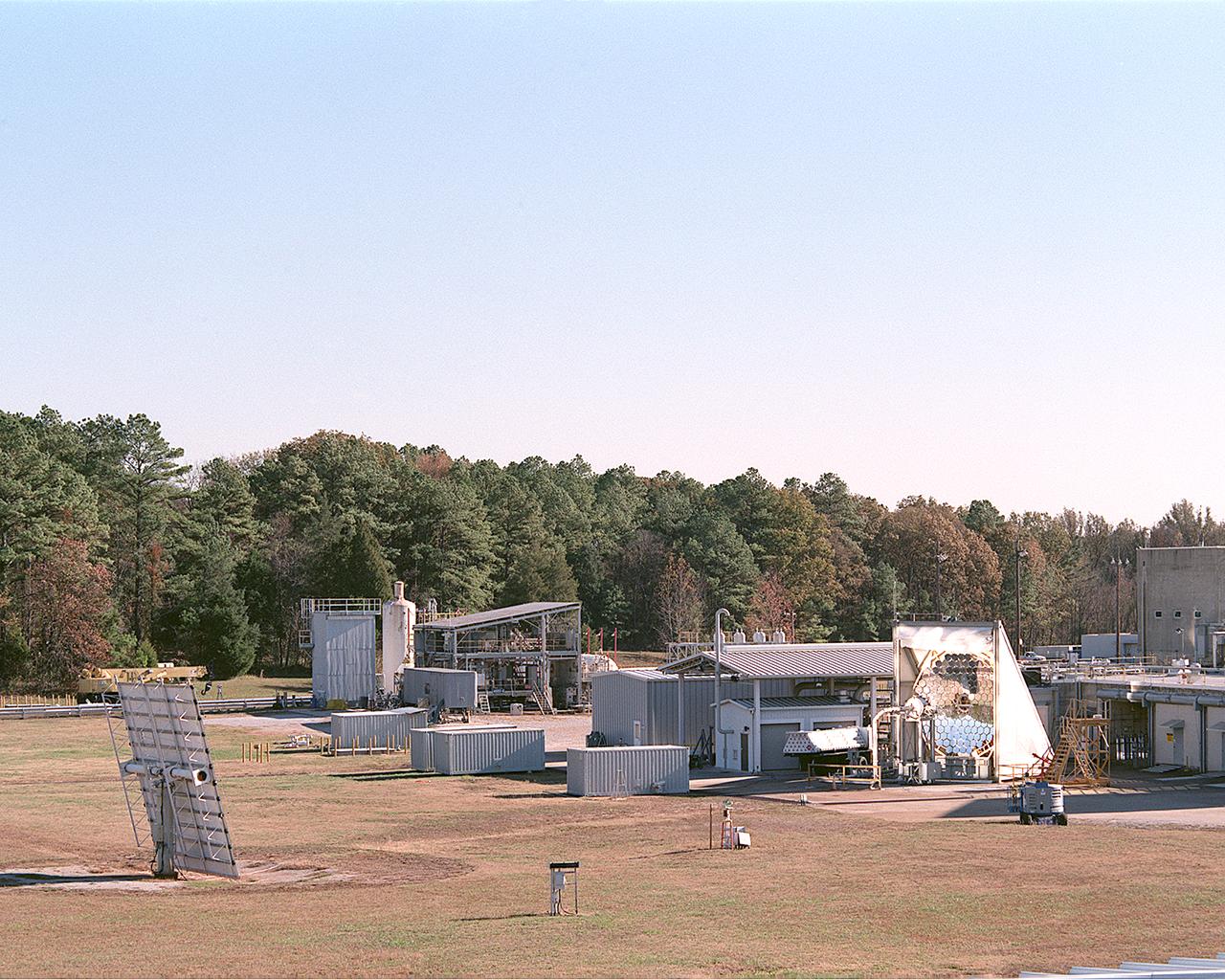
This photograph shows an overall view of the Solar Thermal Propulsion Test Facility at the Marshall Space Flight Center (MSFC). The 20-by 24-ft heliostat mirror, shown at the left, has dual-axis control that keeps a reflection of the sunlight on an 18-ft diameter concentrator mirror (right). The concentrator mirror then focuses the sunlight to a 4-in focal point inside the vacuum chamber, shown at the front of concentrator mirror. Researchers at MSFC have designed, fabricated, and tested the first solar thermal engine, a non-chemical rocket engine that produces lower thrust but has better thrust efficiency than chemical a combustion engine. MSFC turned to solar thermal propulsion in the early 1990s due to its simplicity, safety, low cost, and commonality with other propulsion systems. Solar thermal propulsion works by acquiring and redirecting solar energy to heat a propell nt. As part of MSFC's Space Transportation Directorate, the Propulsion Research Center serves as a national resource for research of advanced, revolutionary propulsion technologies. The mission is to move the Nation's capabilities beyond the confines of conventional chemical propulsion into an era of aircraft-like access to Earth-orbit, rapid travel throughout the solar system, and exploration of interstellar space.
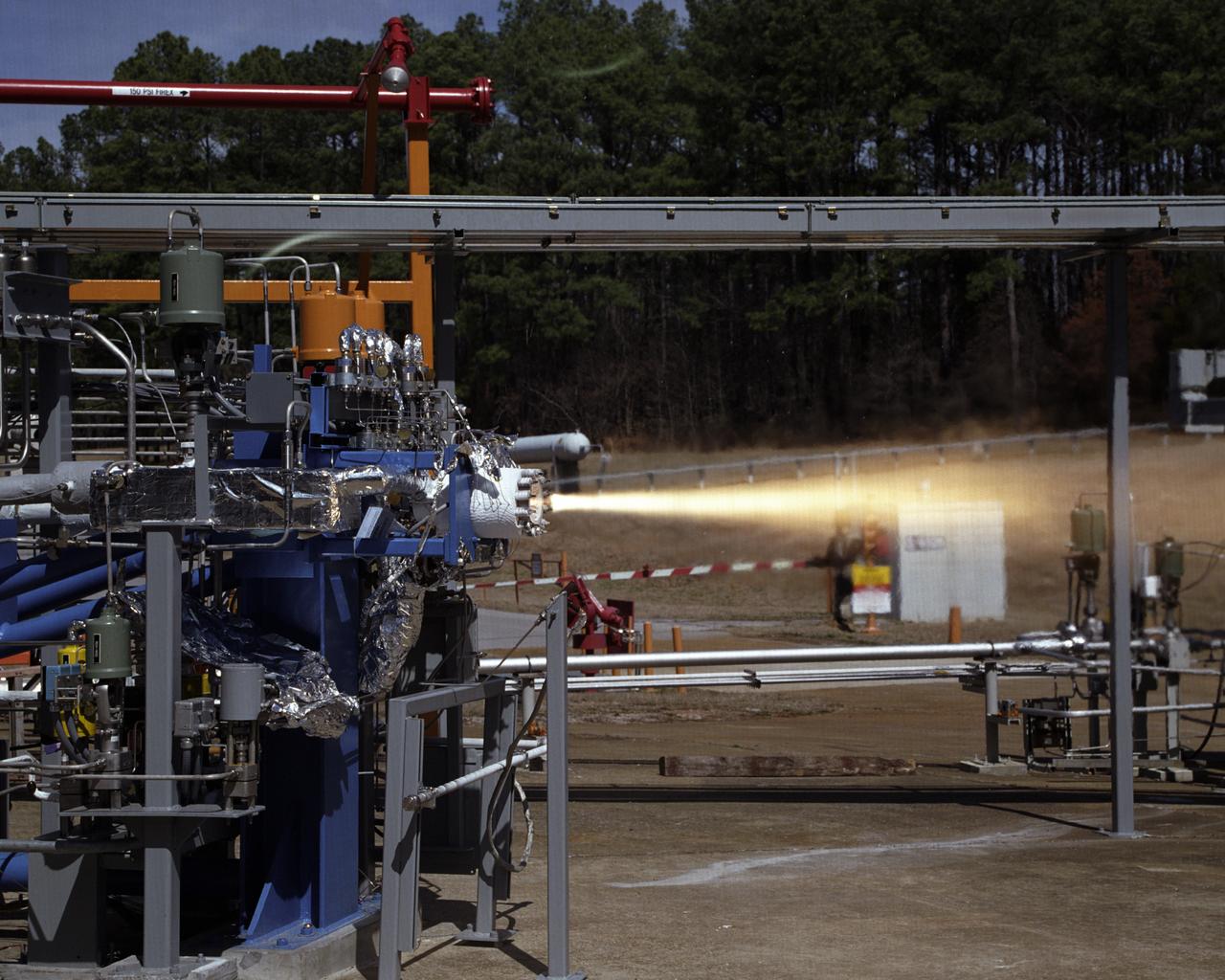
Engineers at the Marshall Space Flight Center (MSFC) have begun a series of engine tests on a new breed of space propulsion: a Reaction Control Engine developed for the Space Launch Initiative (SLI). The engine, developed by TRW Space and Electronics of Redondo Beach, California, is an auxiliary propulsion engine designed to maneuver vehicles in orbit. It is used for docking, reentry, attitude control, and fine-pointing while the vehicle is in orbit. The engine uses nontoxic chemicals as propellants, a feature that creates a safer environment for ground operators, lowers cost, and increases efficiency with less maintenance and quicker turnaround time between missions. Testing includes 30 hot-firings. This photograph shows the first engine test performed at MSFC that includes SLI technology. Another unique feature of the Reaction Control Engine is that it operates at dual thrust modes, combining two engine functions into one engine. The engine operates at both 25 and 1,000 pounds of force, reducing overall propulsion weight and allowing vehicles to easily maneuver in space. The low-level thrust of 25 pounds of force allows the vehicle to fine-point maneuver and dock while the high-level thrust of 1,000 pounds of force is used for reentry, orbit transfer, and coarse positioning. SLI is a NASA-wide research and development program, managed by the MSFC, designed to improve safety, reliability, and cost effectiveness of space travel for second generation reusable launch vehicles.
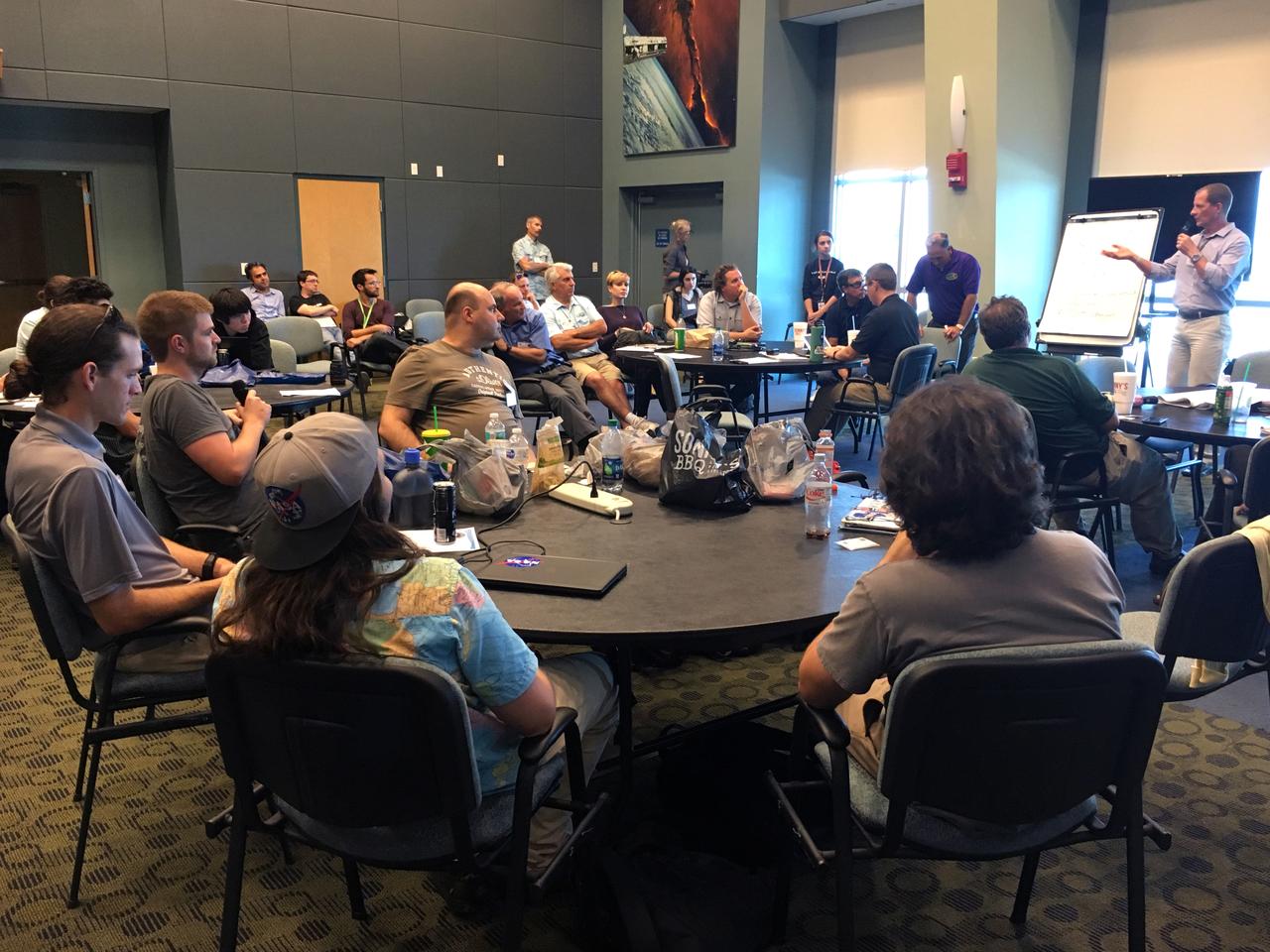
Scientists in the Exploration Research and Technology Directorate brainstorm innovative approaches to food production with industry representatives at the Space Station Processing Facility at NASA's Kennedy Space Center in Florida.
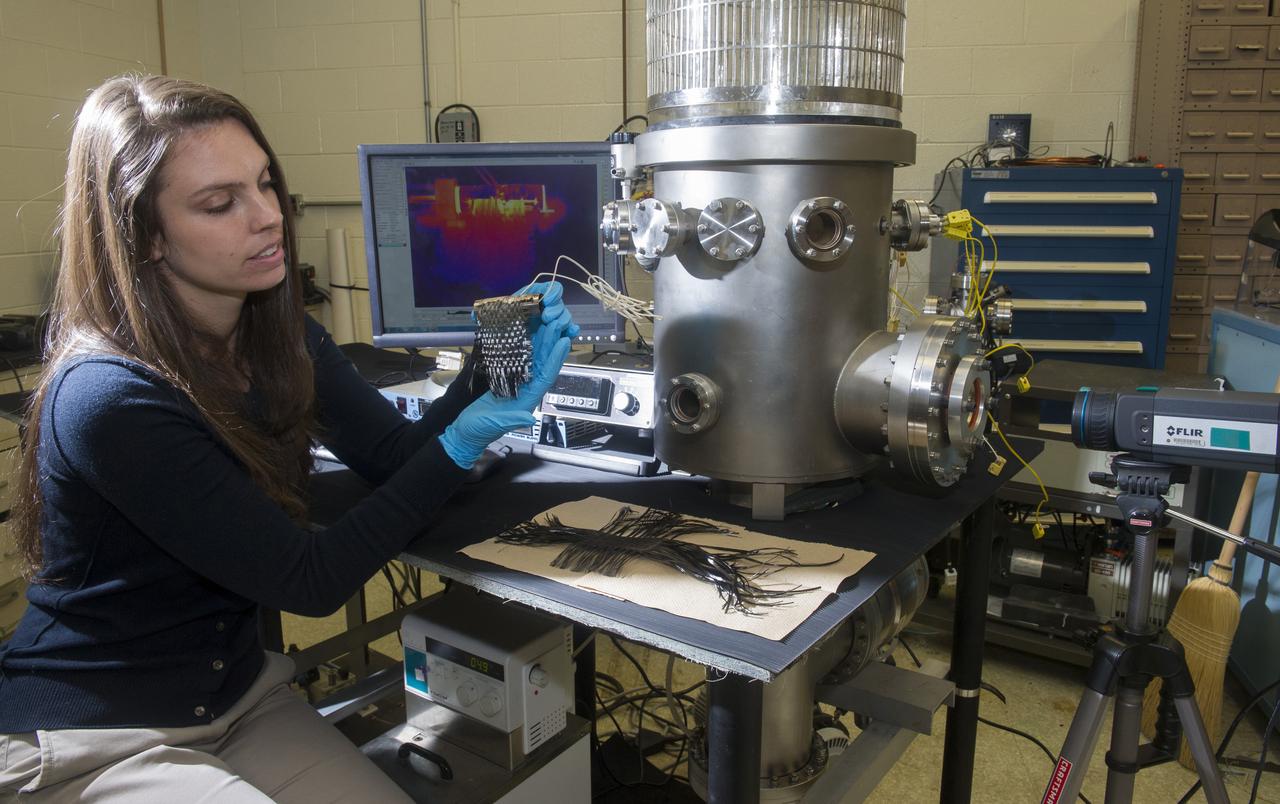
NASA SPACE TECHNOLOGY RESEARCH FELLOWSHIP (NSTRF) STUDENT BRIANA TOMBOULIAN AT THE 2013 MSFC RADIATOR FACILITY SHOWING A TEST ARTICLE
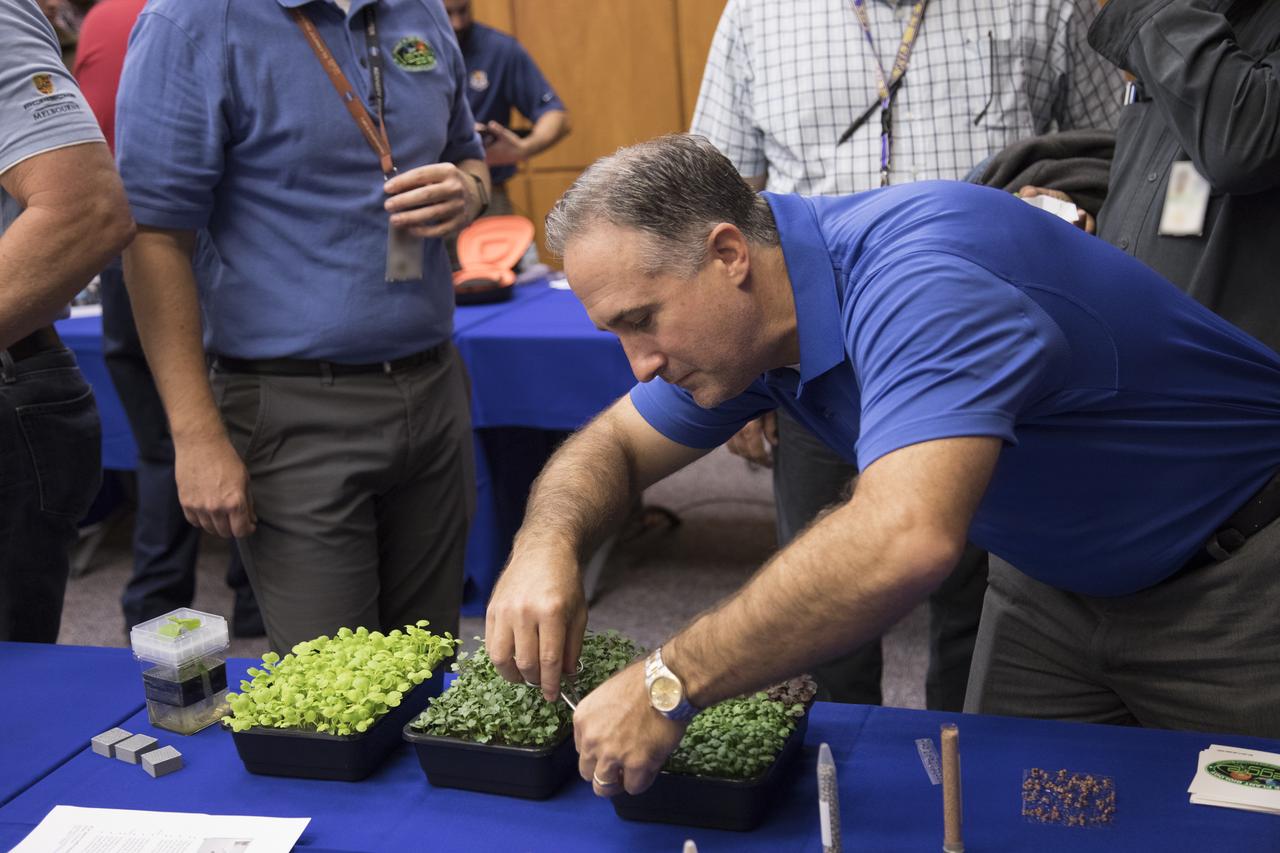
Trent Smith, a project manager in the ISS Exploration Research and Technology Program, displays microgreens grown in the same space dirt (arcillite) that is used in the plant pillows for the Veggie plant growth system on the International Space Station and in a 3-D-printed plastic matrix during the 2017 Innovation Expo showcase at NASA's Kennedy Space Center in Florida. The purpose of the annual two-day event is to help foster innovation and creativity among the Kennedy workforce. The event included several keynote speakers, training opportunities, an innovation showcase and the KSC Kickstart competition.
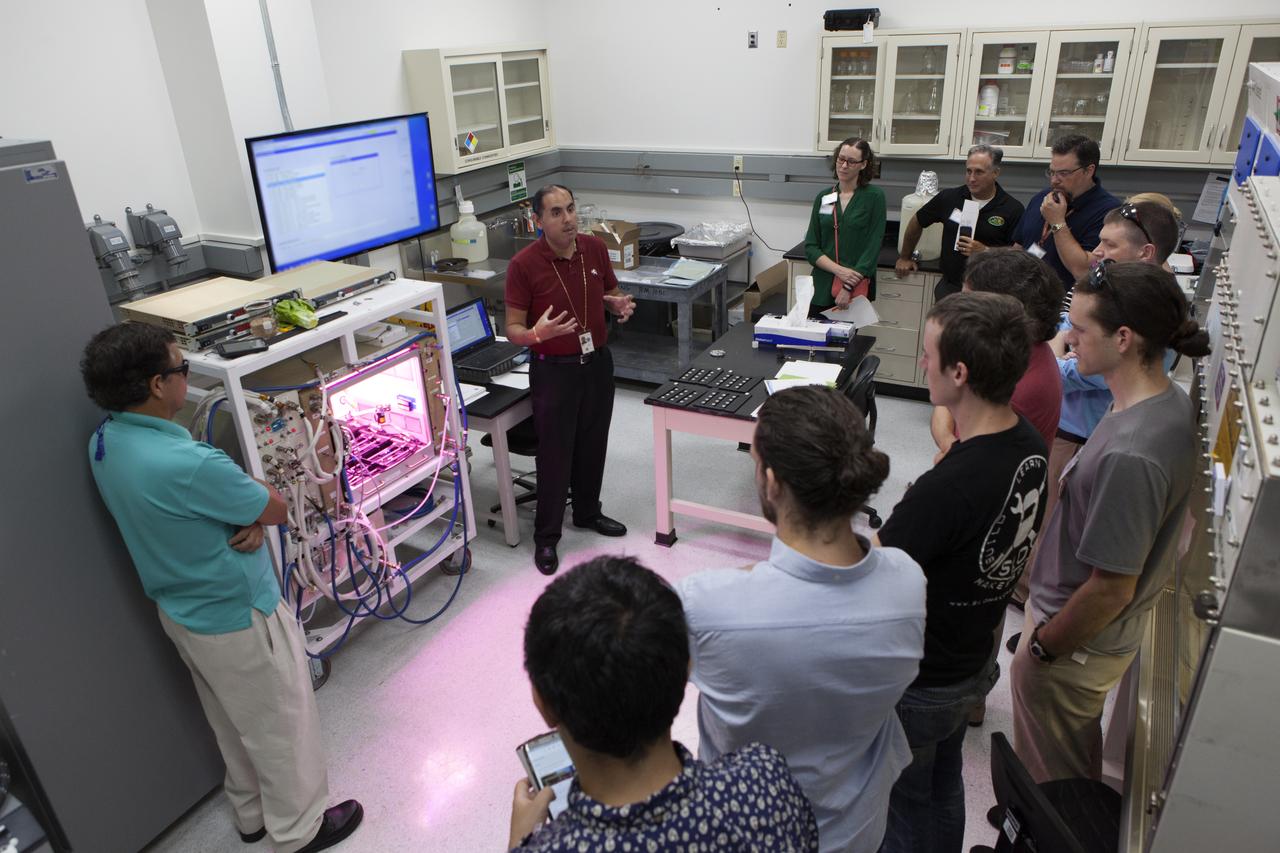
Bryan Onate, Advanced Plant Habitat project manager, with the Exploration Research and Technology Directorate, brainstorms innovative approaches to food production with industry representatives inside a laboratory at the Space Station Processing Facility at NASA's Kennedy Space Center in Florida.
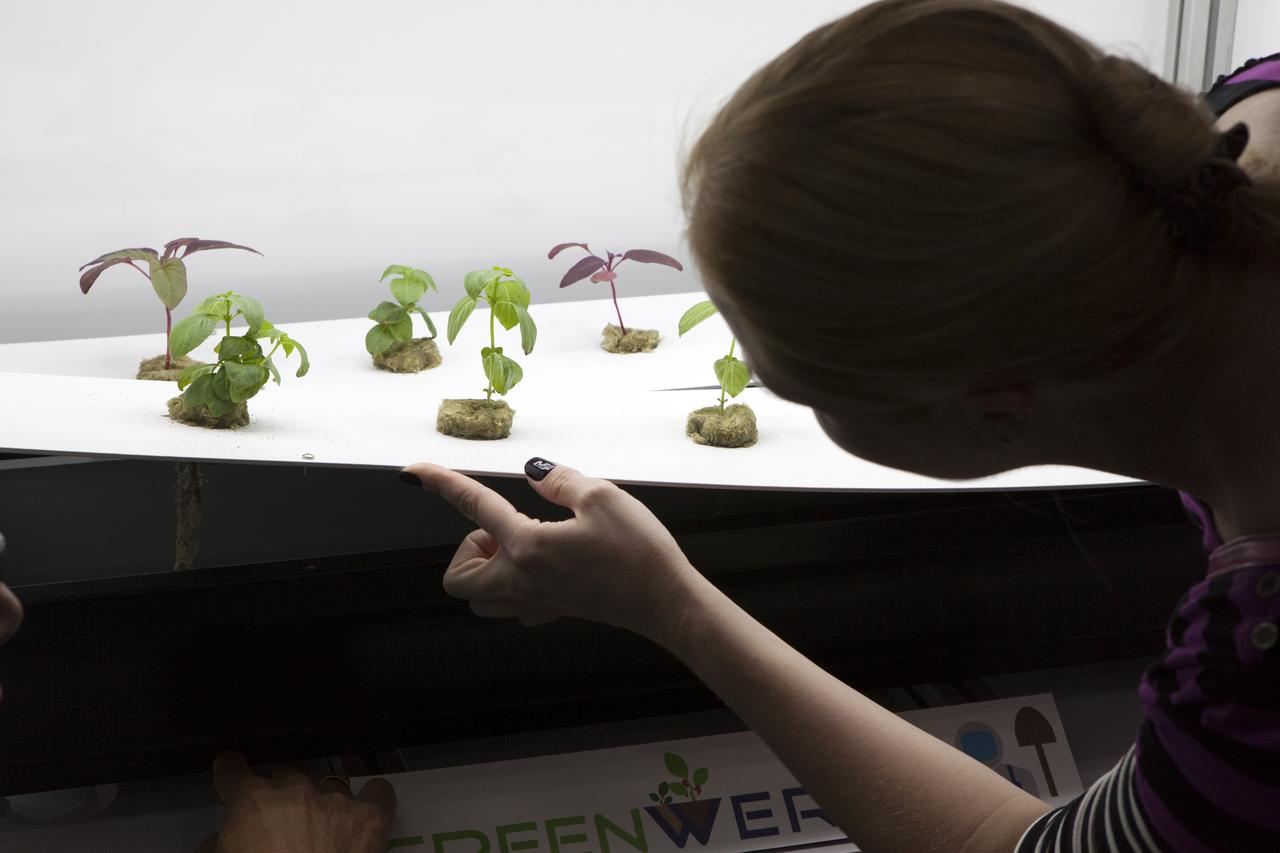
During a brainstorming session on innovative approaches to food production, an industry participant looks at plants growing inside a laboratory in the Space Station Processing Facility at NASA's Kennedy Space Center in Florida. The workshop was hosted by the Exploration Research and Technology Directorate.
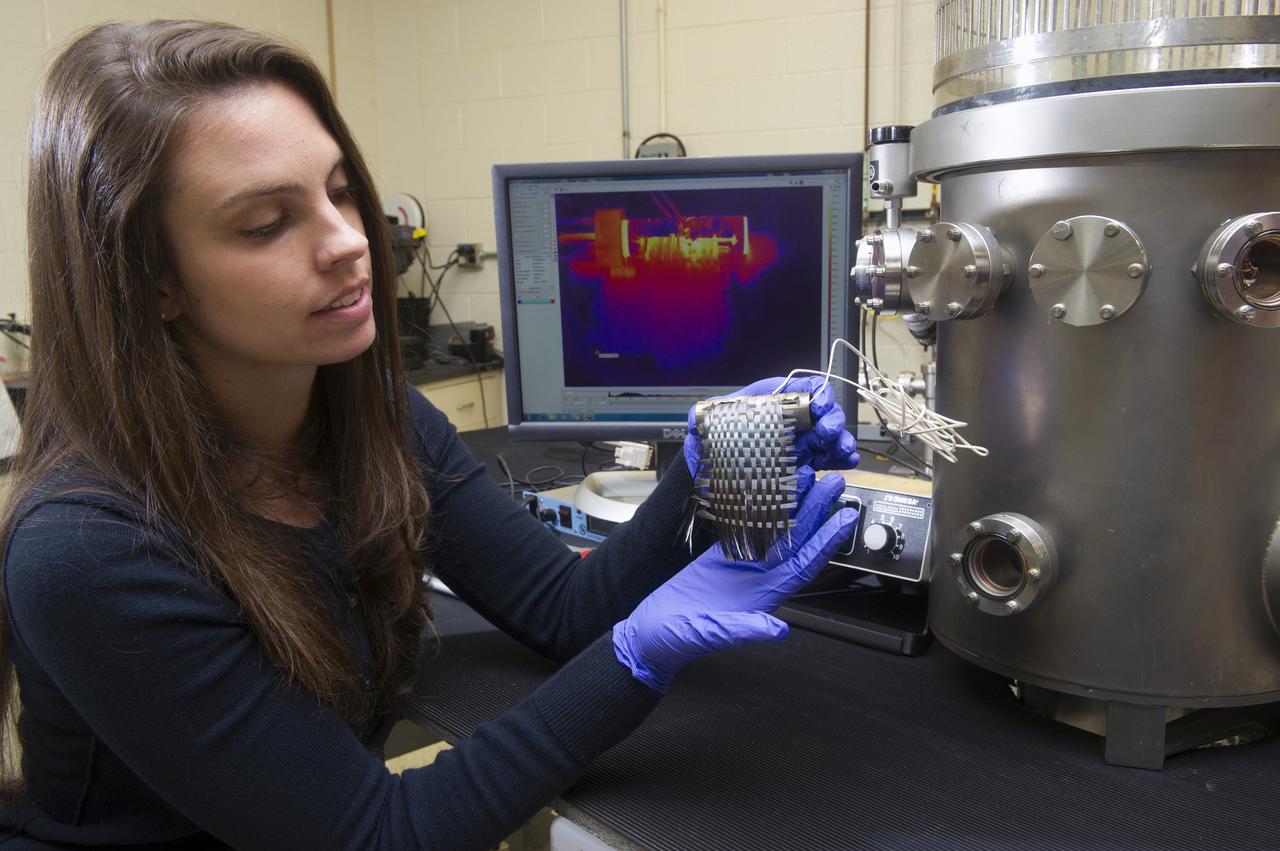
NASA SPACE TECHNOLOGY RESEARCH FELLOWSHIP (NSTRF) STUDENT BRIANA TOMBOULIAN AT THE 2013 MSFC RADIATOR FACILITY WITH A CARBON FIBER TEST ARTICLE
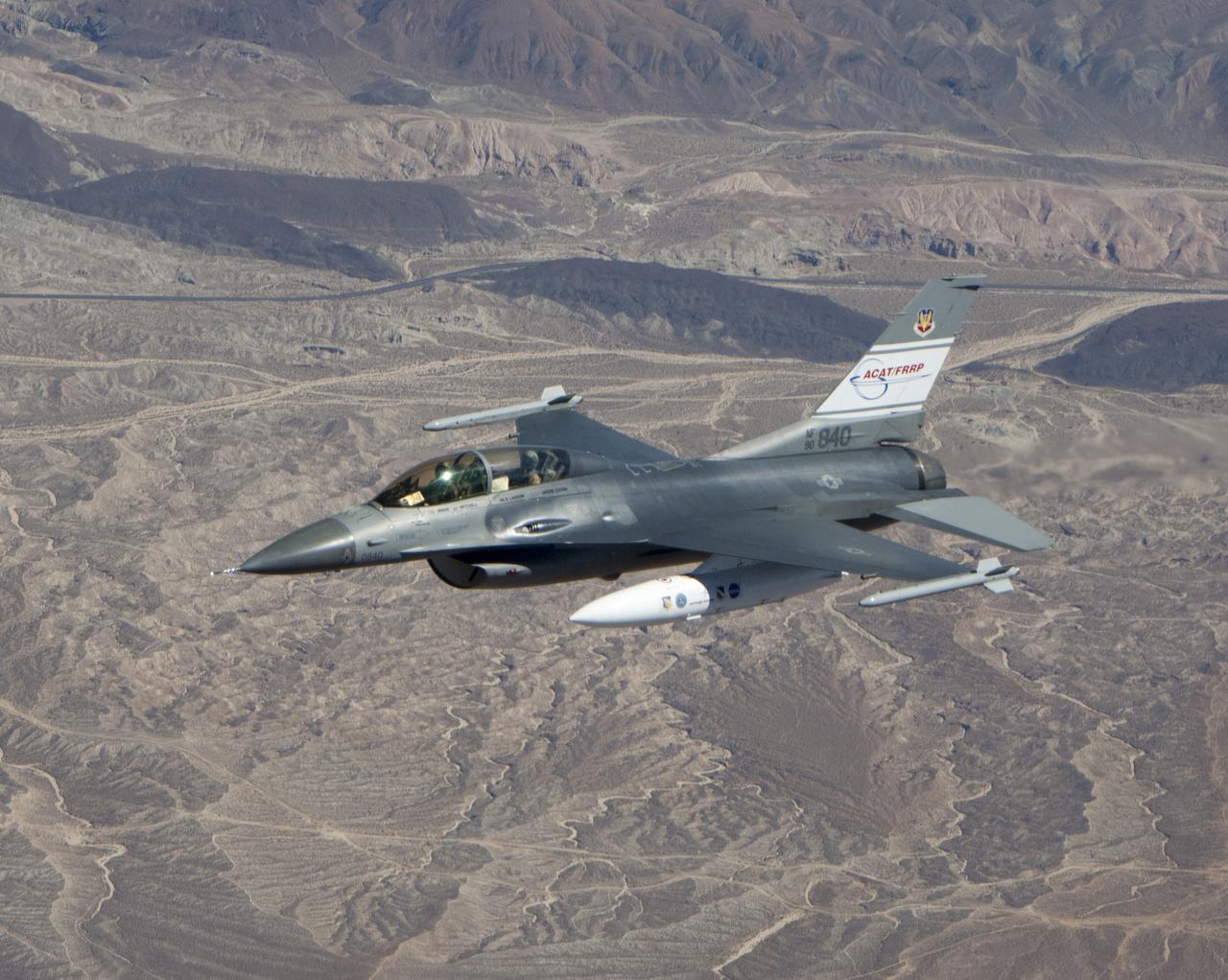
The U.S. Air Force's F-16D Automatic Collision Avoidance Technology, or ACAT, aircraft was used by NASA's Armstrong Flight Research Center and the Air Force Research Laboratory to develop and test collision avoidance technologies.
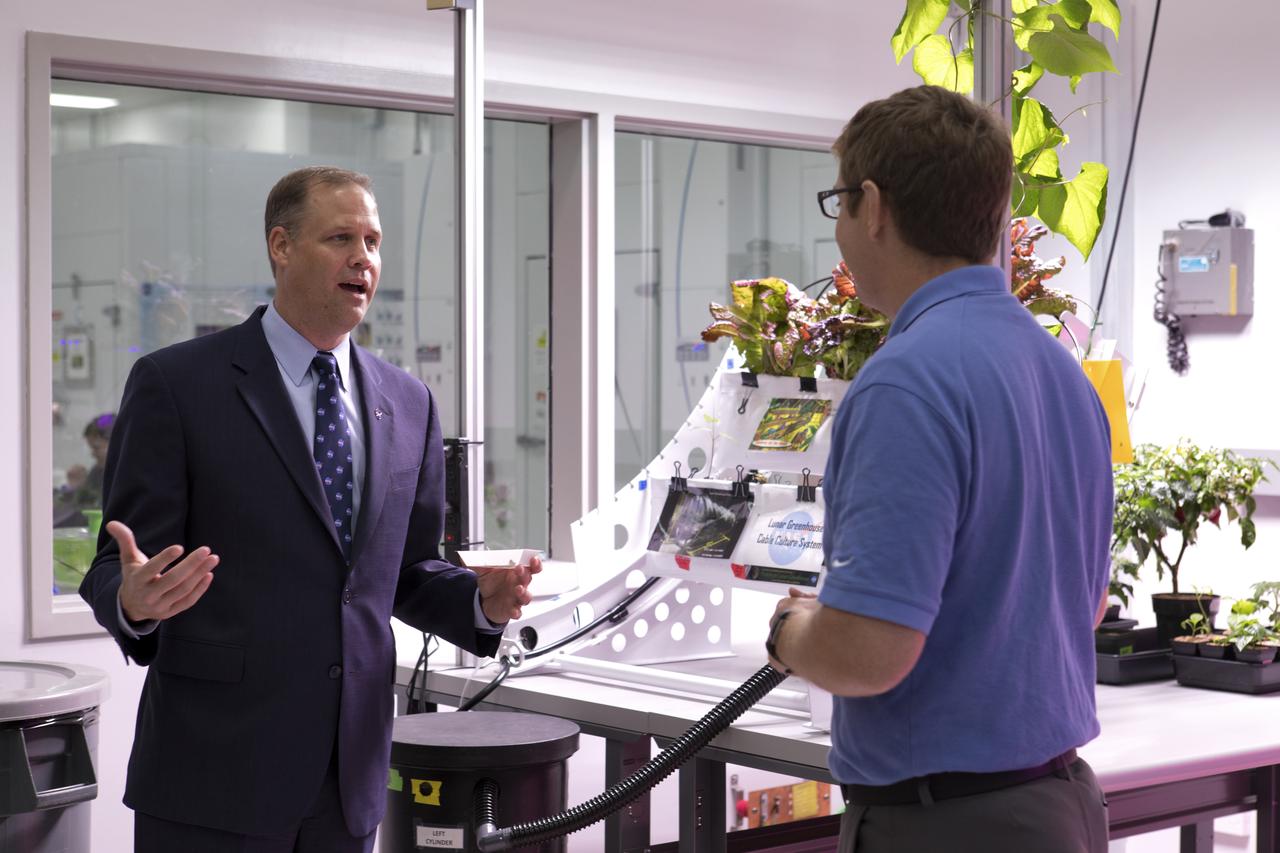
NASA Administrator Jim Bridenstine, at left, speaks to Matt Romeyn, a project scientist, during a tour of a plant research laboratory inside the Space Station Processing Facility (SSPF) at NASA's Kennedy Space Center in Florida, on Aug. 7, 2018. Bridenstine received updates on research and technology accomplishments during his visit to the SSPF.
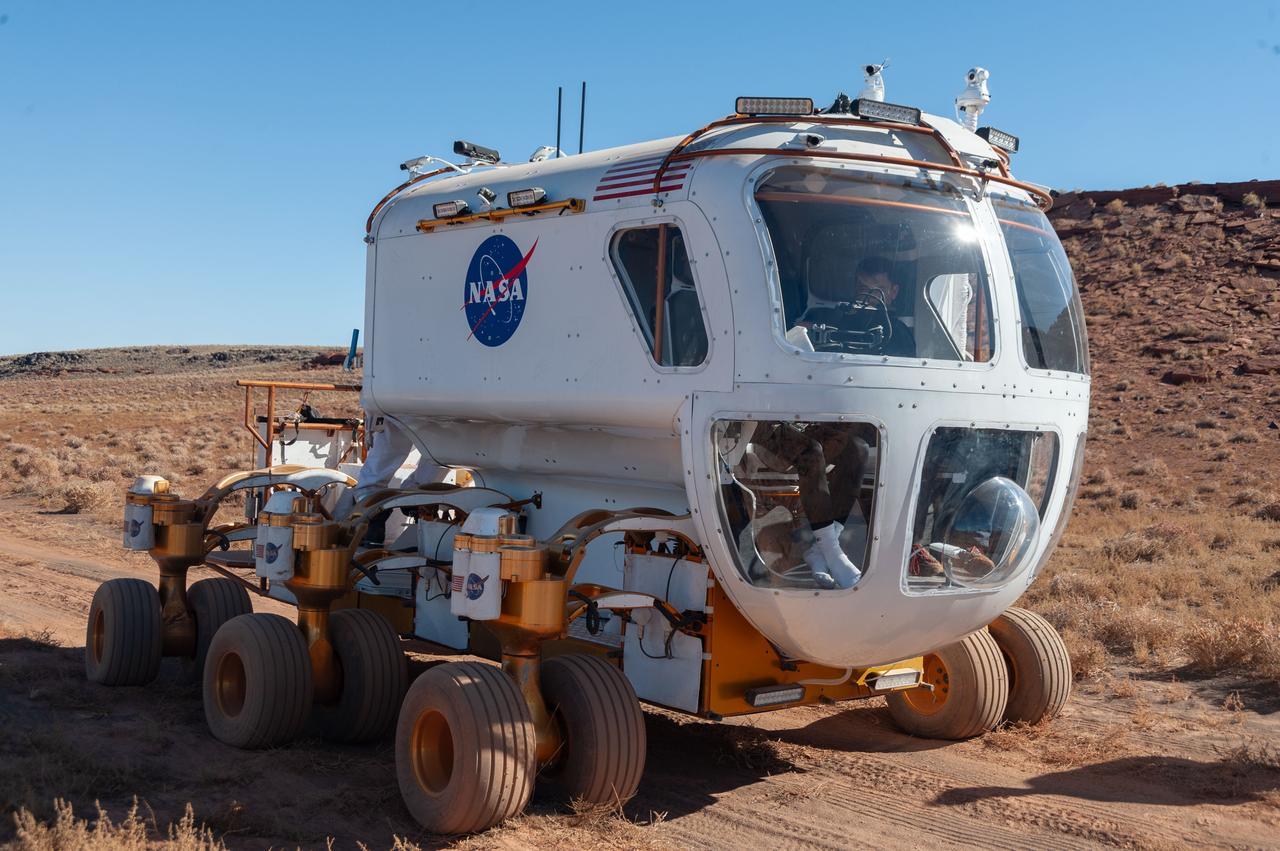
A front view of the Lunar Electric Rover (LER) during the Desert Research and Technology Studies (RATS) remote field test at Black Point Lava Flow, Arizona in 2008.
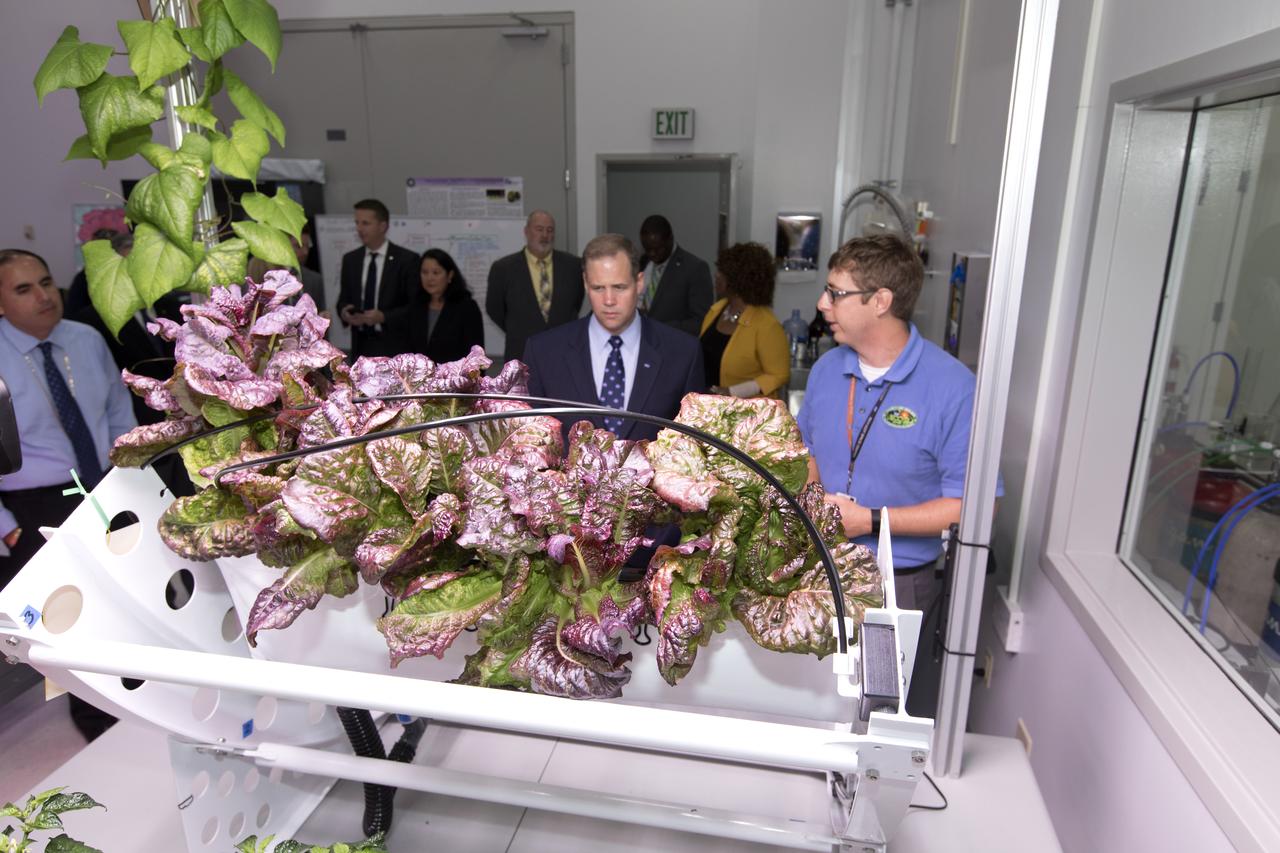
NASA Administrator Jim Bridenstine, center, tours a plant research laboratory inside the Space Station Processing Facility (SSPF) at NASA's Kennedy Space Center in Florida, on Aug. 7, 2018. To the right of Bridenstine is Matt Romeyn, project scientist. Behind him, second from left is Josie Burnett, director of Exploration Research and Technology. To Burnett's right is Ronnie Lawson, deputy director of Exploration Research and Technology. Behind Bridenstine is Barbara Brown, chief technologist. Bridenstine received updates on research and technology accomplishments during his visit to the SSPF.
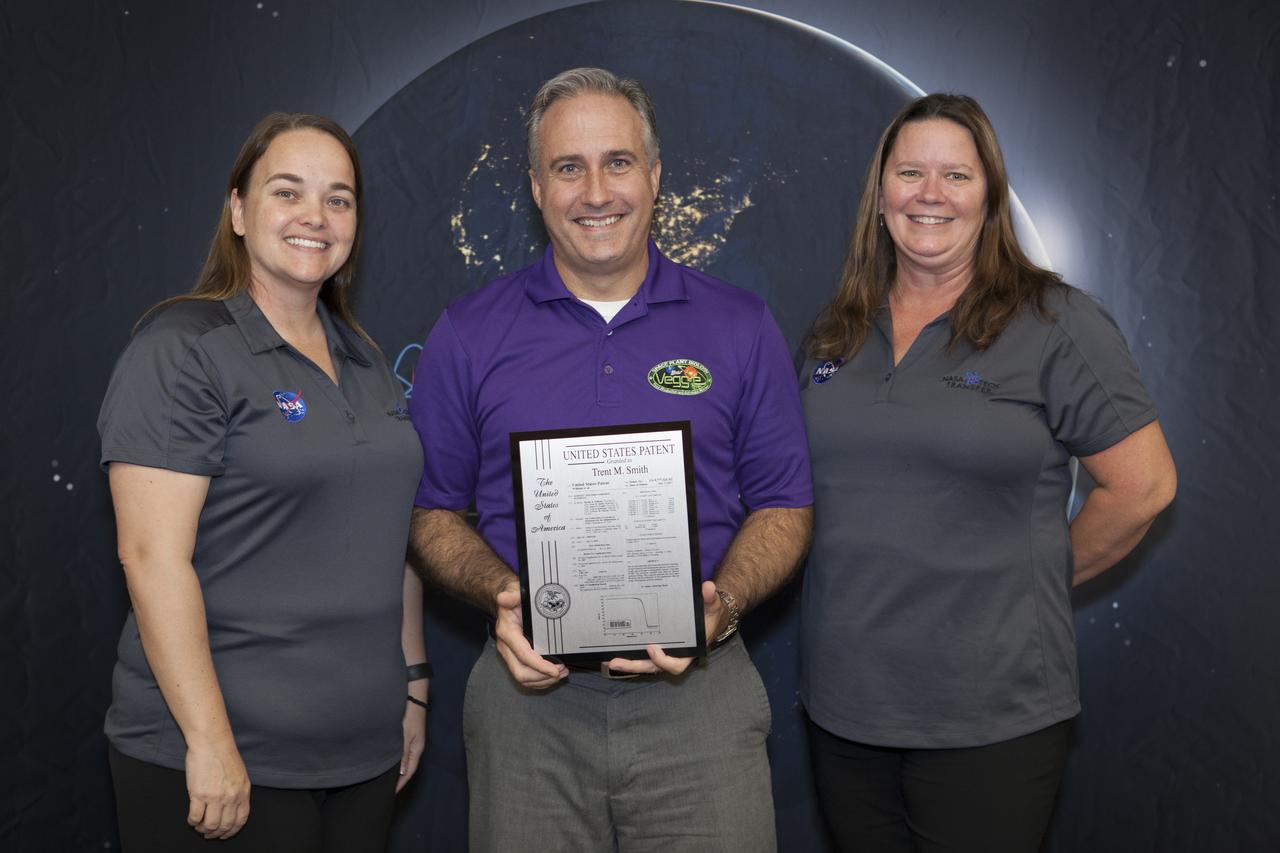
Trent Smith, project manager in the ISS Exploration Research and Technology Program, displays the U.S. Patent plaque he received during a ceremony at the 2017 Innovation Expo at NASA's Kennedy Space Center in Florida. The purpose of the annual two-day expo is to help foster innovation and creativity among the Kennedy workforce. The event included several keynote speakers, training opportunities, an innovation showcase and the KSC Kickstart competition.
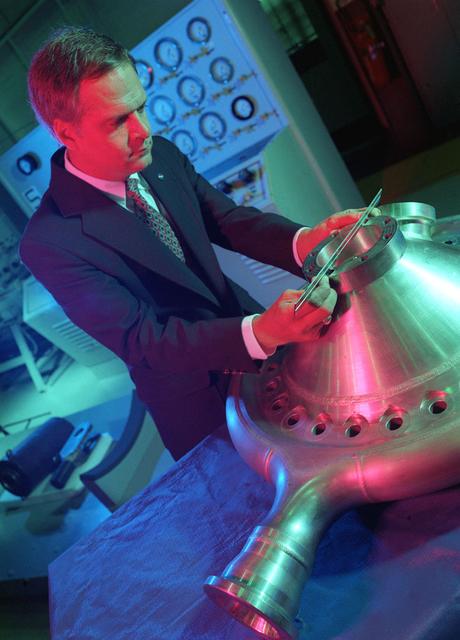
Research to lower the cost of thrust chamber assembly is conducted by Marshall scientist to significantly reduce the costs associated with thrust chamber/injector development and fabrication.
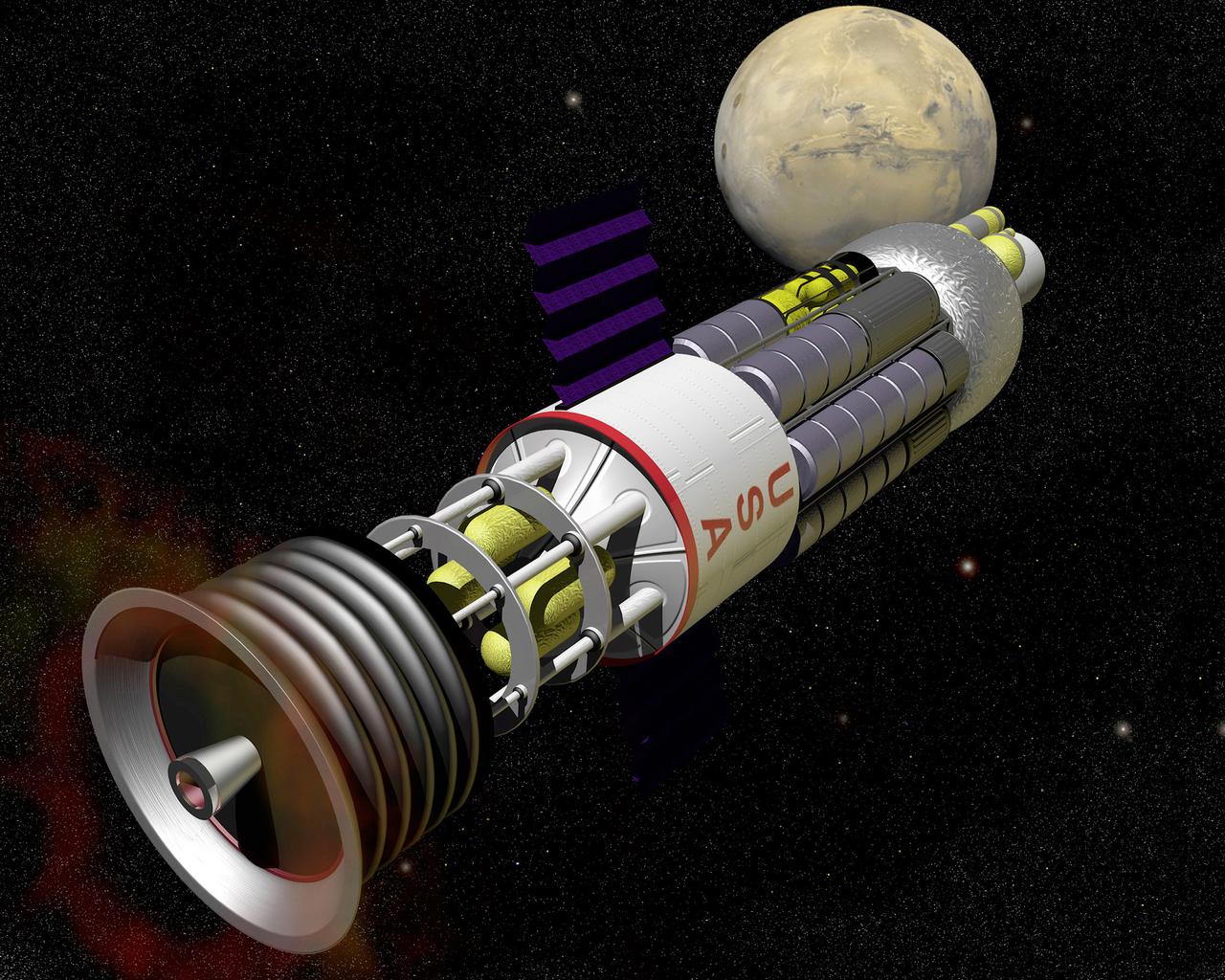
In the 1960's U.S. Government laboratories, under Project Orion, investigated a pulsed nuclear fission propulsion system. Small nuclear pulse units would be sequentially discharged from the aft end of the vehicle. A blast shield and shock absorber system would protect the crew and convert the shock loads into a continuous propulsive force.
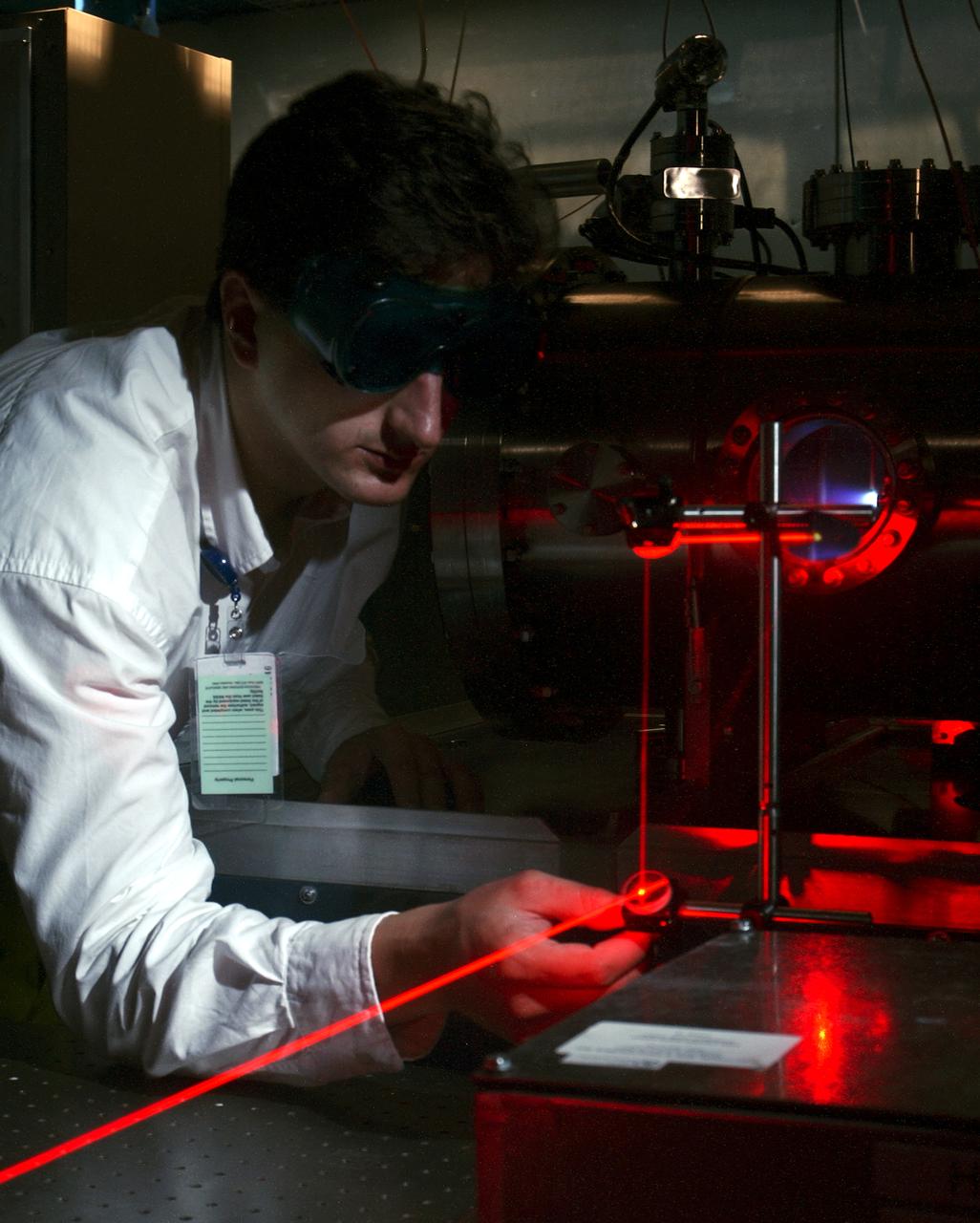
Dr. Tom Markusic, a propulsion research engineer at the Marshall Space Flight Center (MSFC), adjusts a diagnostic laser while a pulsed plasma thruster (PPT) fires in a vacuum chamber in the background. NASA/MSFC's Propulsion Research Center (PRC) is presently investigating plasma propulsion for potential use on future nuclear-powered spacecraft missions, such as human exploration of Mars.
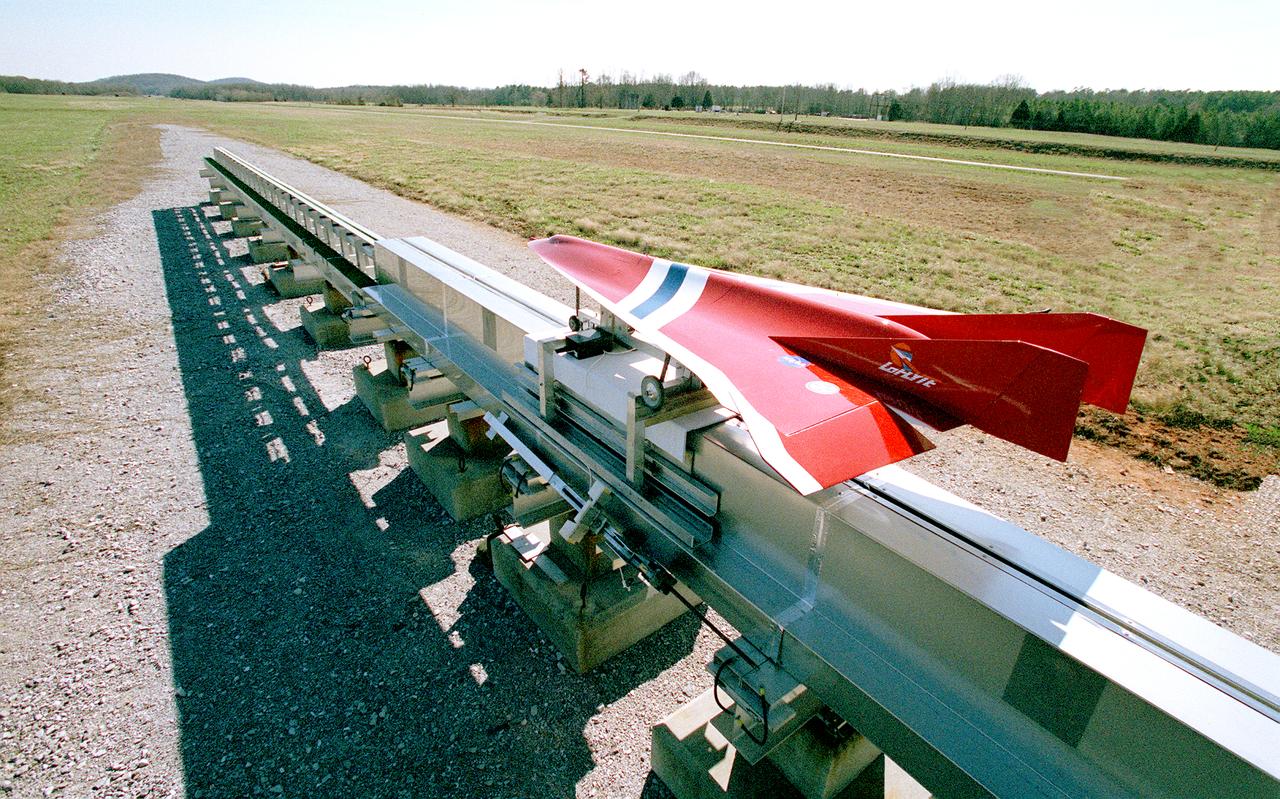
Engineers at the Marshall Space Flight Center (MSFC) have been testing Magnetic Launch Assist Systems, formerly known as Magnetic Levitation (MagLev) technologies. To launch spacecraft into orbit, a Magnetic Launch Assist system would use magnetic fields to levitate and accelerate a vehicle along a track at a very high speed. Similar to high-speed trains and roller coasters that use high-strength magnets to lift and propel a vehicle a couple of inches above a guideway, the launch-assist system would electromagnetically drive a space vehicle along the track. A full-scale, operational track would be about 1.5-miles long and capable of accelerating a vehicle to 600 mph in 9.5 seconds. This photograph shows a subscale model of an airplane running on the experimental track at MSFC during the demonstration test. This track is an advanced linear induction motor. Induction motors are common in fans, power drills, and sewing machines. Instead of spinning in a circular motion to turn a shaft or gears, a linear induction motor produces thrust in a straight line. Mounted on concrete pedestals, the track is 100-feet long, about 2-feet wide, and about 1.5- feet high. The major advantages of launch assist for NASA launch vehicles is that it reduces the weight of the take-off, the landing gear, the wing size, and less propellant resulting in significant cost savings. The US Navy and the British MOD (Ministry of Defense) are planning to use magnetic launch assist for their next generation aircraft carriers as the aircraft launch system. The US Army is considering using this technology for launching target drones for anti-aircraft training.
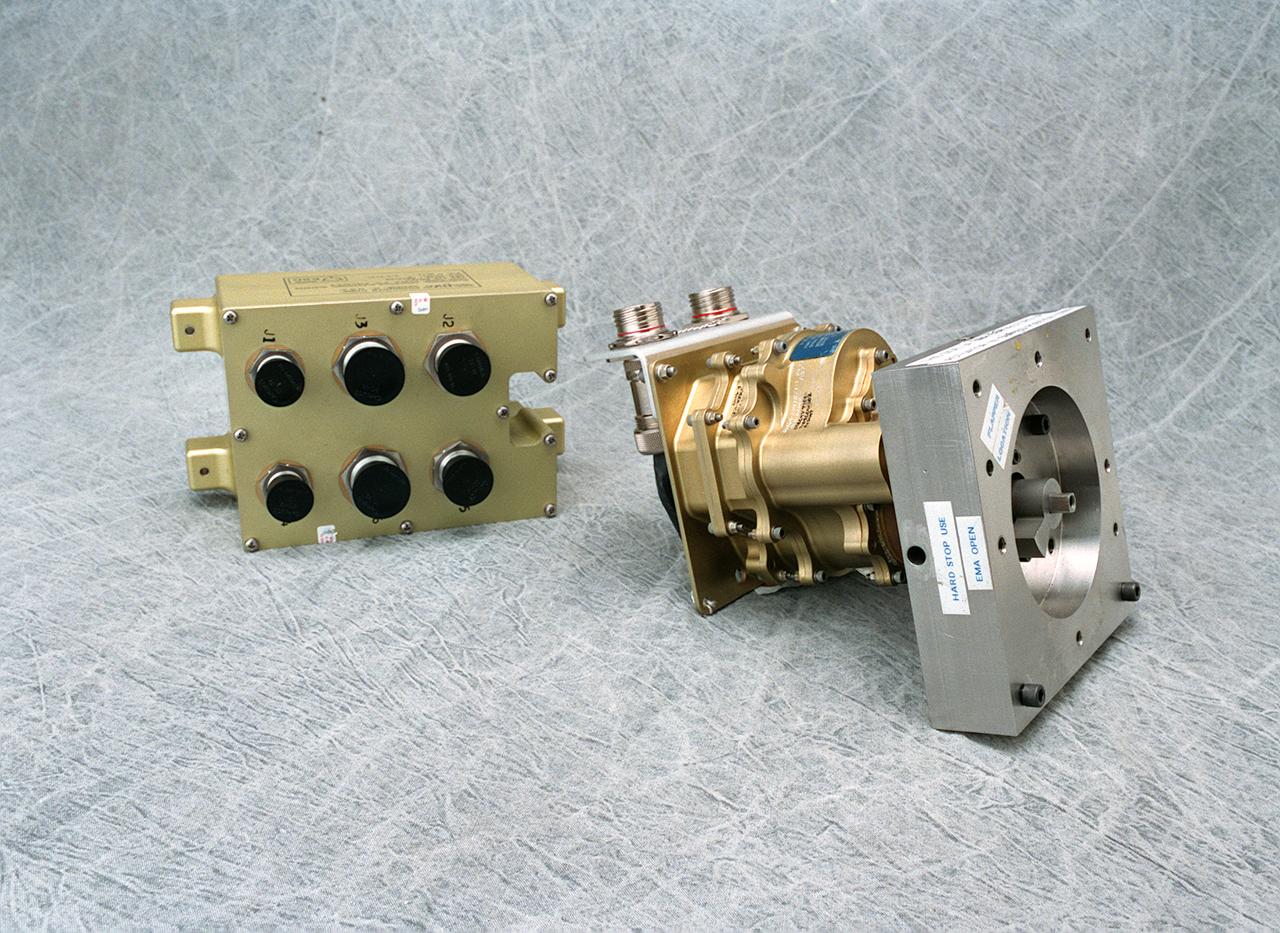
The electro-mechanical actuator, a new electronics technology, is an electronic system that provides the force needed to move valves that control the flow of propellant to the engine. It is proving to be advantageous for the main propulsion system plarned for a second generation reusable launch vehicle. Hydraulic actuators have been used successfully in rocket propulsion systems. However, they can leak when high pressure is exerted on such a fluid-filled hydraulic system. Also, hydraulic systems require significant maintenance and support equipment. The electro-mechanical actuator is proving to be low maintenance and the system weighs less than a hydraulic system. The electronic controller is a separate unit powering the actuator. Each actuator has its own control box. If a problem is detected, it can be replaced by simply removing one defective unit. The hydraulic systems must sustain significant hydraulic pressures in a rocket engine regardless of demand. The electro-mechanical actuator utilizes power only when needed. A goal of the Second Generation Reusable Launch Vehicle Program is to substantially improve safety and reliability while reducing the high cost of space travel. The electro-mechanical actuator was developed by the Propulsion Projects Office of the Second Generation Reusable Launch Vehicle Program at the Marshall Space Flight Center.
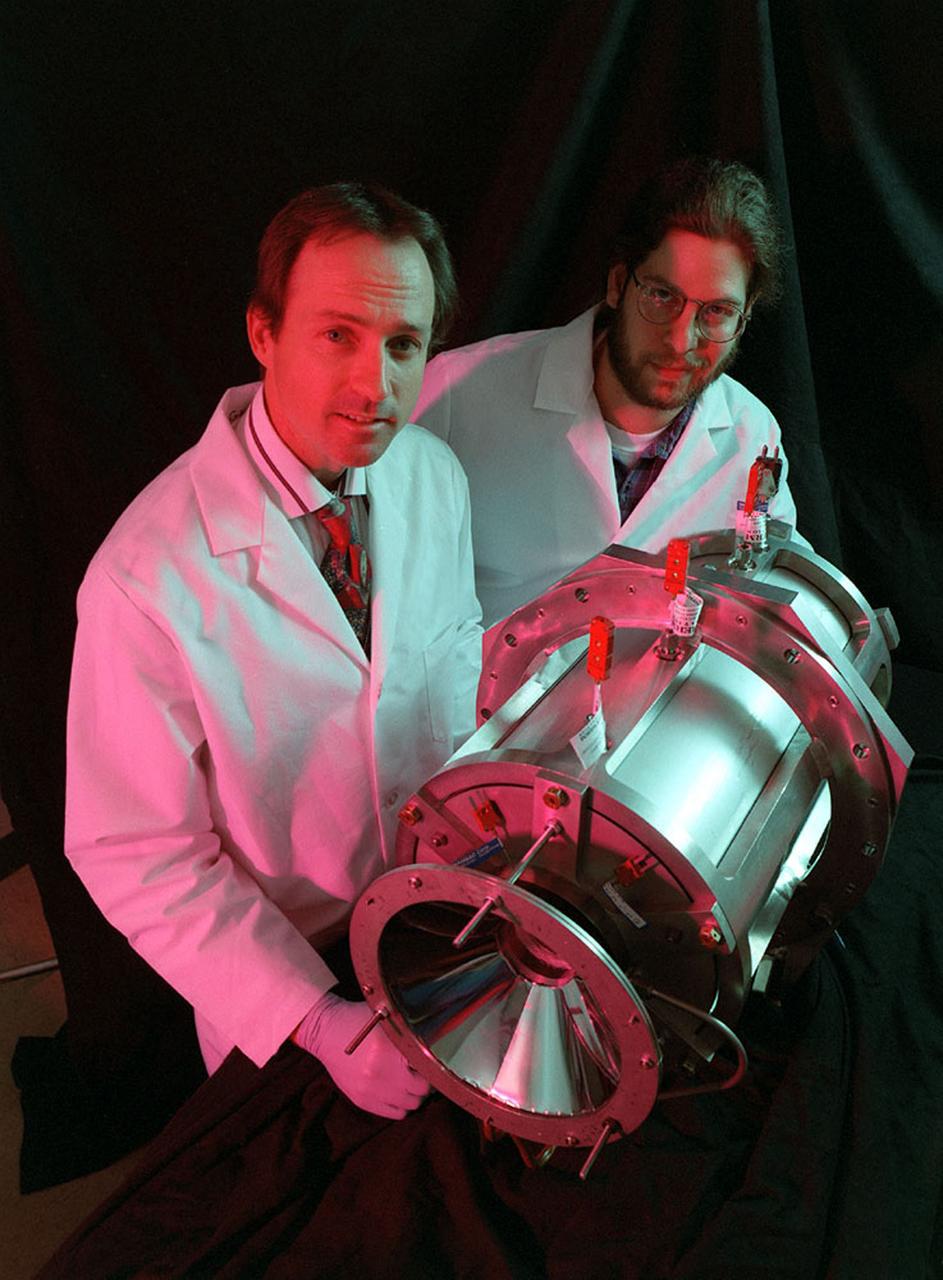
The Direct Gain Solar Thermal Engine was designed with no moving parts. The concept of Solar Thermal Propulsion Research uses focused solar energy from an inflatable concentrator (a giant magnifying glass) to heat a propellant (hydrogen) and allows thermal expansion through the nozzle for low thrust without chemical combustion. Energy limitations and propellant weight associated with traditional combustion engines are non-existant with this concept. The Direct Gain Solar Thermal Engine would be used for moving from a lower orbit to an upper synchronous orbit.
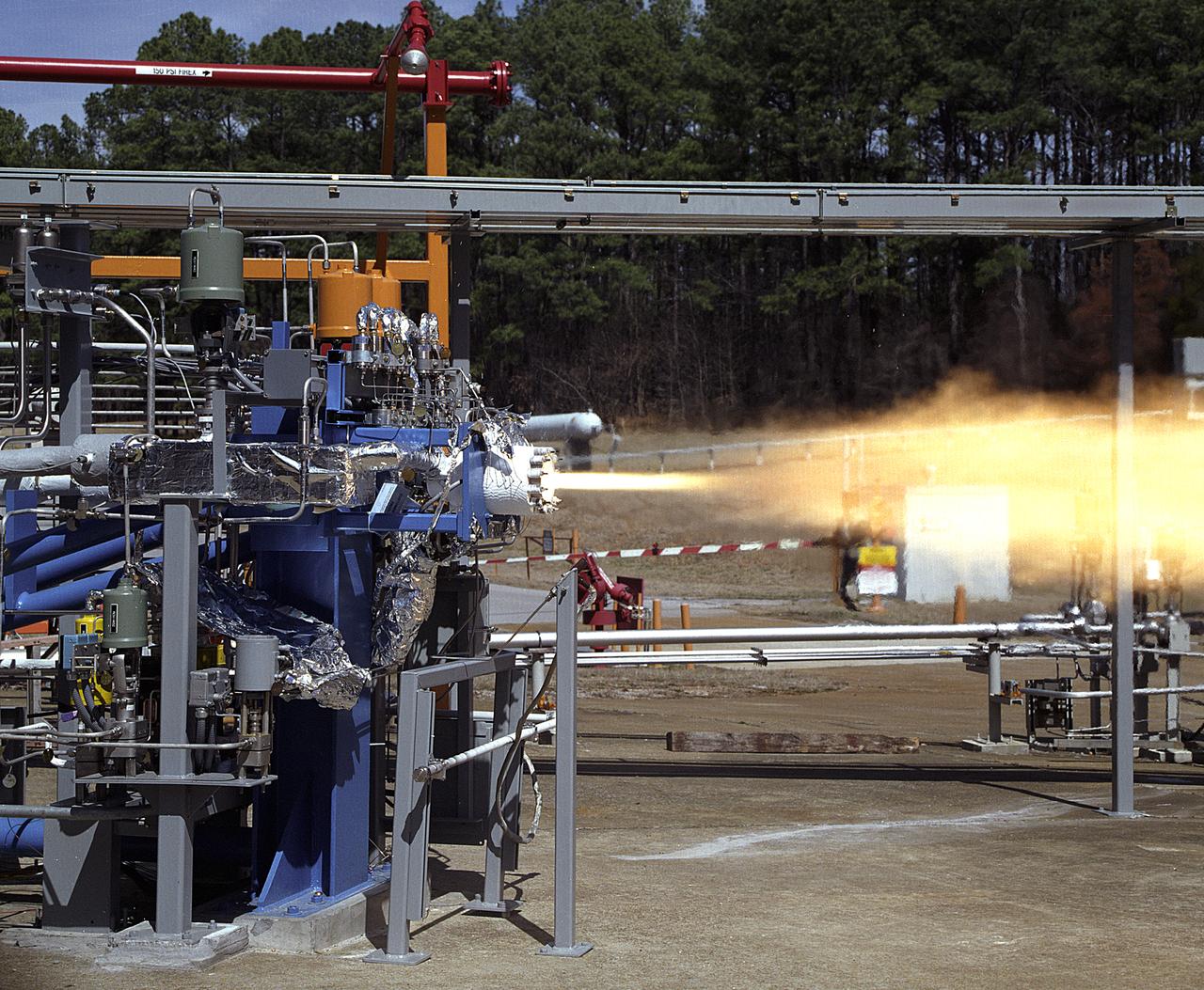
NASA's Marshall Space Flight Center (MSFC) in Huntsville, Alabama, has begun a series of engine tests on the Reaction Control Engine developed by TRW Space and Electronics for NASA's Space Launch Initiative (SLI). SLI is a technology development effort aimed at improving the safety, reliability, and cost effectiveness of space travel for reusable launch vehicles. The engine in this photo, the first engine tested at MSFC that includes SLI technology, was tested for two seconds at a chamber pressure of 185 pounds per square inch absolute (psia). Propellants used were liquid oxygen as an oxidizer and liquid hydrogen as fuel. Designed to maneuver vehicles in orbit, the engine is used as an auxiliary propulsion system for docking, reentry, fine-pointing, and orbit transfer while the vehicle is in orbit. The Reaction Control Engine has two unique features. It uses nontoxic chemicals as propellants, which creates a safer environment with less maintenance and quicker turnaround time between missions, and it operates in dual thrust modes, combining two engine functions into one engine. The engine operates at both 25 and 1,000 pounds of force, reducing overall propulsion weight and allowing vehicles to easily maneuver in space. The force of low level thrust allows the vehicle to fine-point maneuver and dock, while the force of the high level thrust is used for reentry, orbital transfer, and course positioning.
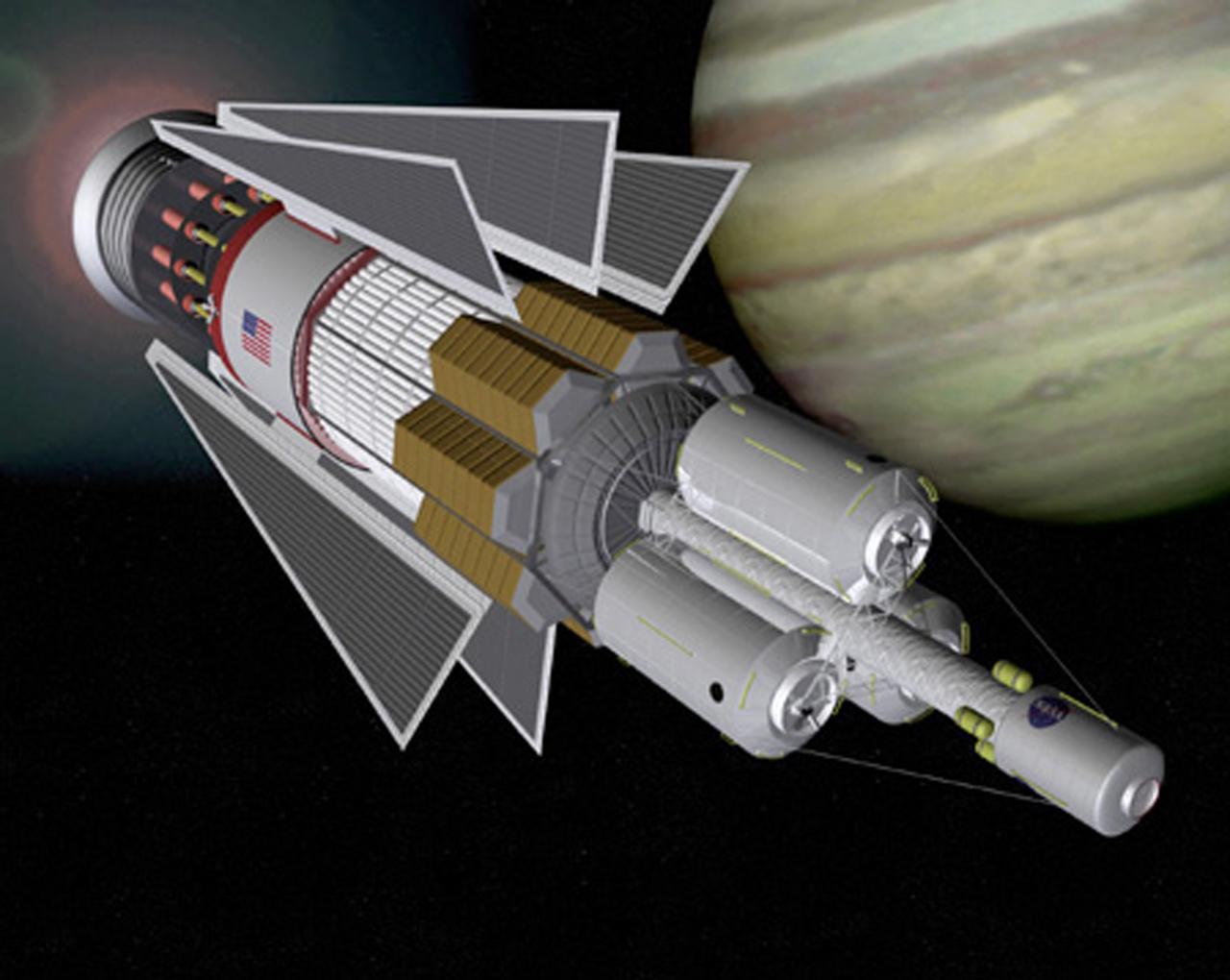
In the 1960's U.S. Government laboratories, under Project Orion, investigated a pulsed nuclear fission propulsion system. Based on Project Orion, an interplanetary vehicle using pulsed fission propulsion would incorporate modern technologies for momentum transfer, thermal management, and habitation design.
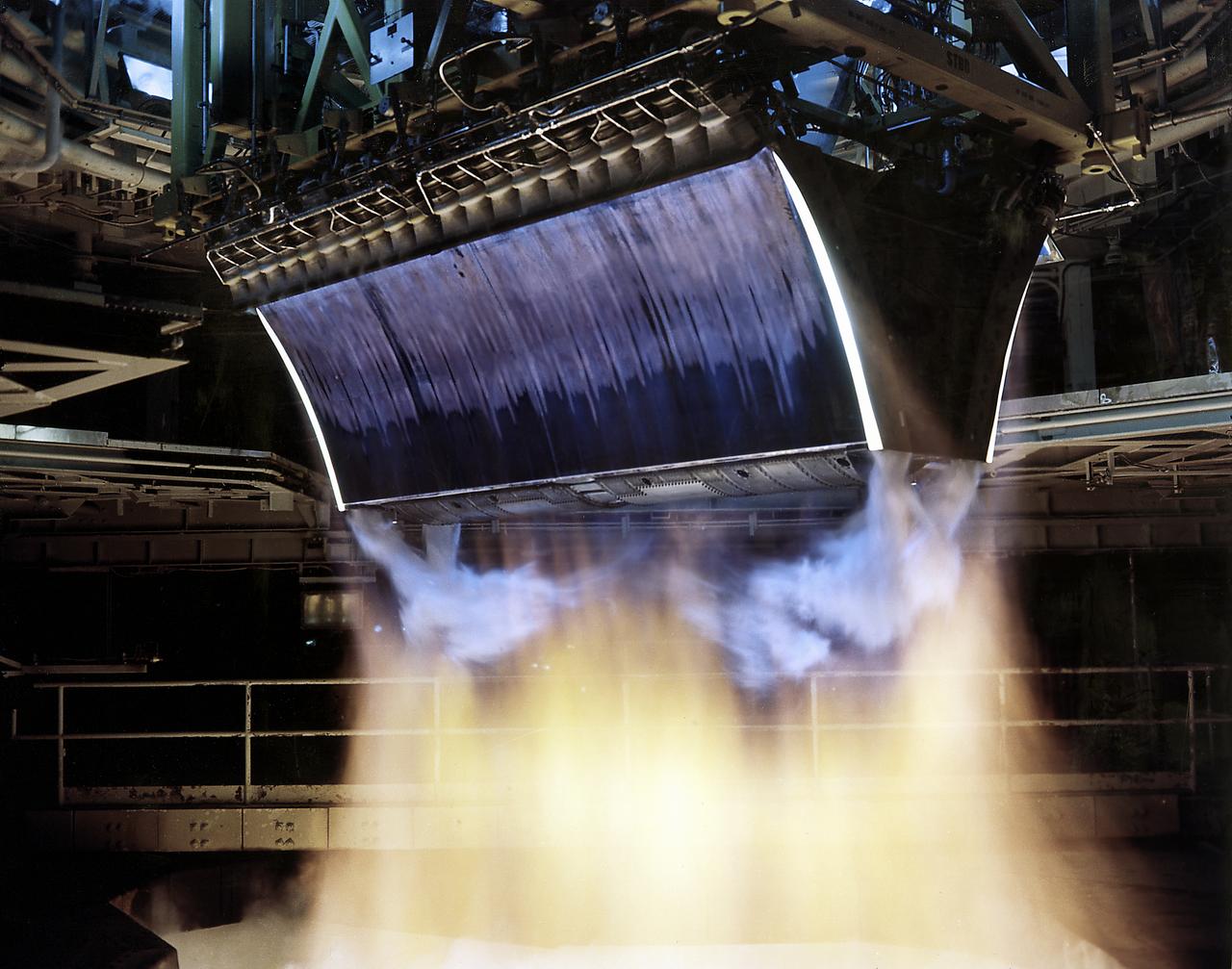
The test of twin Linear Aerospike XRS-2200 engines, originally built for the X-33 program, was performed on August 6, 2001 at NASA's Sternis Space Center, Mississippi. The engines were fired for the planned 90 seconds and reached a planned maximum power of 85 percent. NASA's Second Generation Reusable Launch Vehicle Program , also known as the Space Launch Initiative (SLI), is making advances in propulsion technology with this third and final successful engine hot fire, designed to test electro-mechanical actuators. Information learned from this hot fire test series about new electro-mechanical actuator technology, which controls the flow of propellants in rocket engines, could provide key advancements for the propulsion systems for future spacecraft. The Second Generation Reusable Launch Vehicle Program, led by NASA's Marshall Space Flight Center in Huntsville, Alabama, is a technology development program designed to increase safety and reliability while reducing costs for space travel. The X-33 program was cancelled in March 2001.
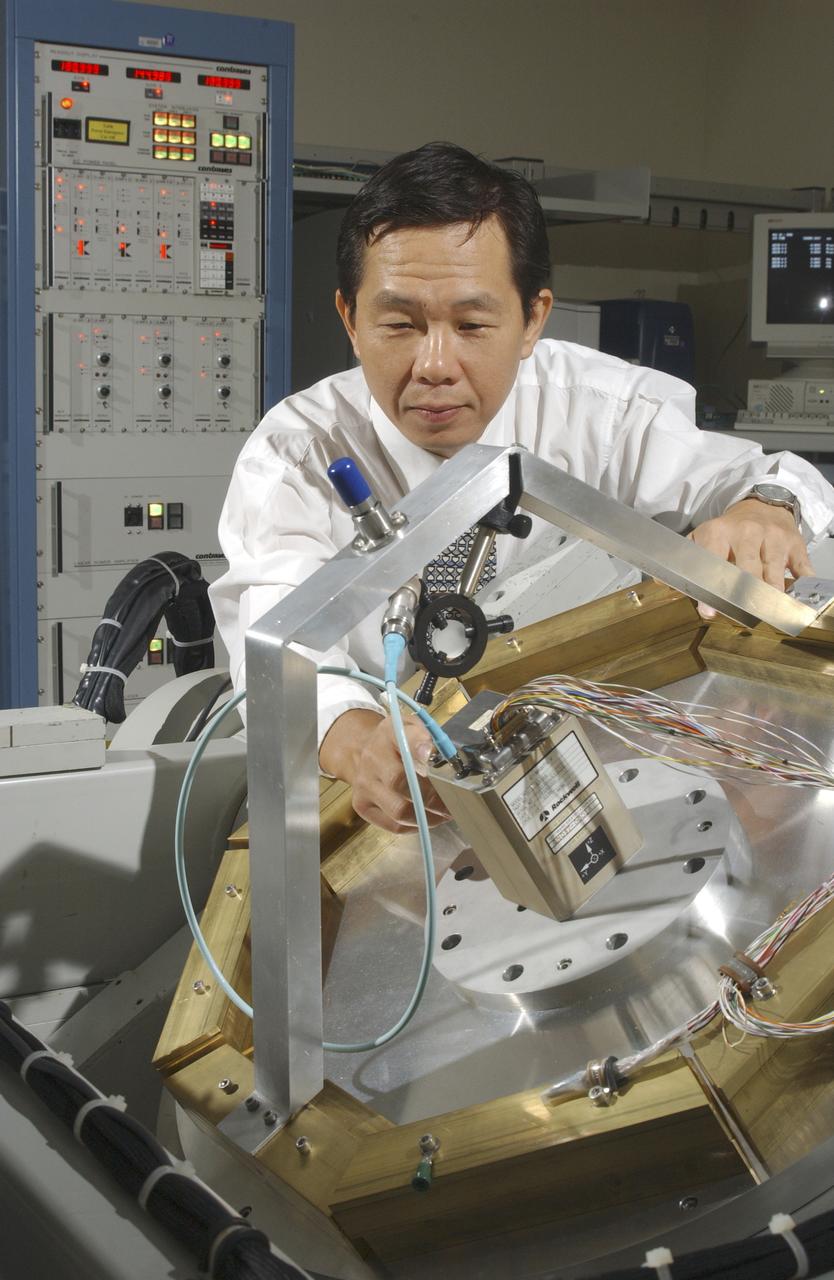
An array of components in a laboratory at NASA's Marshall Space Flight Center (MSFC) is being tested by the Flight Mechanics Office to develop an integrated navigation system for the second generation reusable launch vehicle. The laboratory is testing Global Positioning System (GPS) components, a satellite-based location and navigation system, and Inertial Navigation System (INS) components, sensors on a vehicle that determine angular velocity and linear acceleration at various points. The GPS and INS components work together to provide a space vehicle with guidance and navigation, like the push of the OnStar button in your car assists you with directions to a specific address. The integration will enable the vehicle operating system to track where the vehicle is in space and define its trajectory. The use of INS components for navigation is not new to space technology. The Space Shuttle currently uses them. However, the Space Launch Initiative is expanding the technology to integrate GPS and INS components to allow the vehicle to better define its position and more accurately determine vehicle acceleration and velocity. This advanced technology will lower operational costs and enhance the safety of reusable launch vehicles by providing a more comprehensive navigation system with greater capabilities. In this photograph, Dr. Jason Chuang of MSFC inspects an INS component in the laboratory.
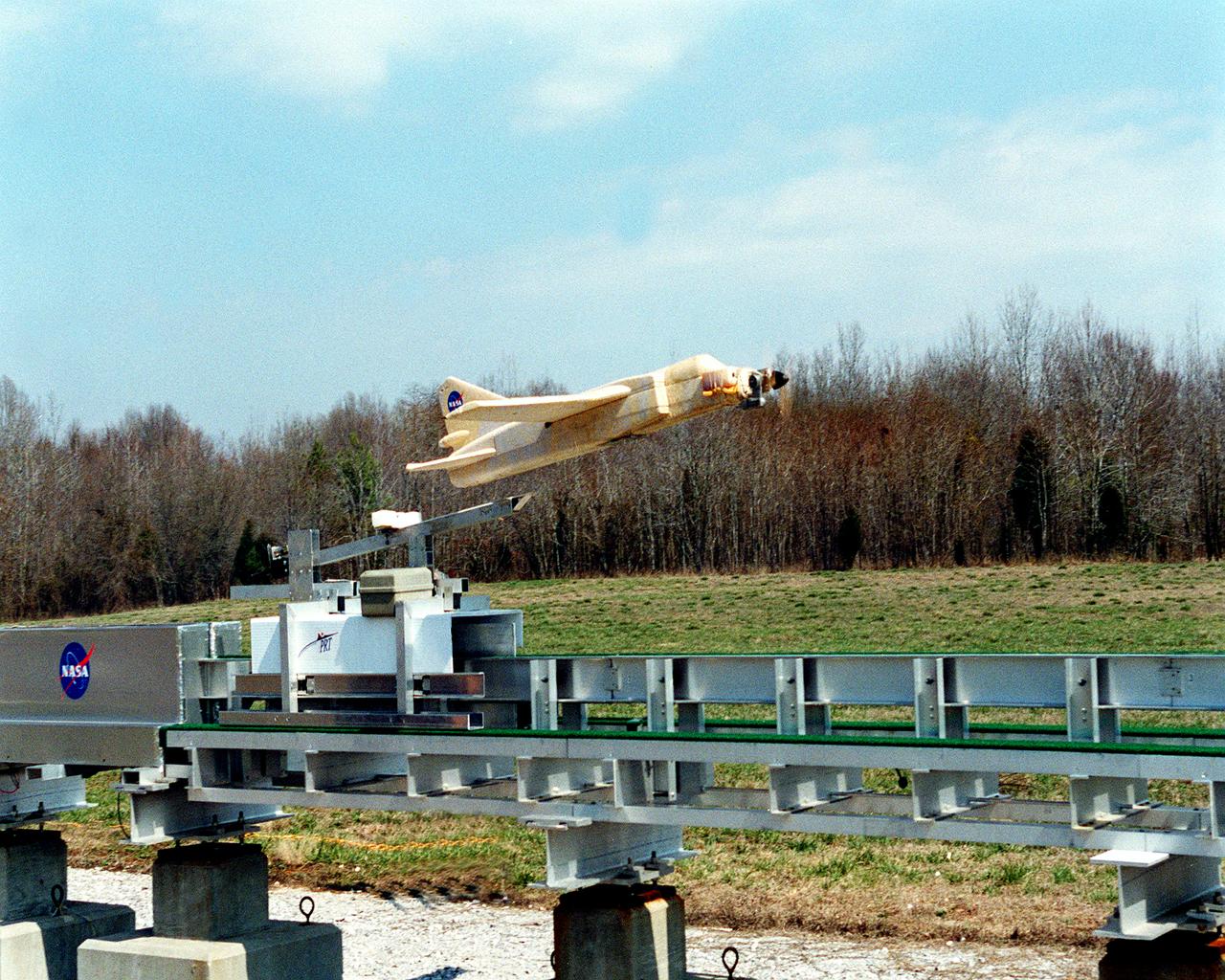
This image shows a 1/9 subscale model vehicle clearing the Magnetic Launch Assist System, formerly referred to as the Magnetic Levitation (MagLev), test track during a demonstration test conducted at the Marshall Space Flight Center (MSFC). Engineers at MSFC have developed and tested Magnetic Launch Assist technologies. To launch spacecraft into orbit, a Magnetic Launch Assist System would use magnetic fields to levitate and accelerate a vehicle along a track at very high speeds. Similar to high-speed trains and roller coasters that use high-strength magnets to lift and propel a vehicle a couple of inches above a guideway, a launch-assist system would electromagnetically drive a space vehicle along the track. A full-scale, operational track would be about 1.5-miles long and capable of accelerating a vehicle to 600 mph in 9.5 seconds. This track is an advanced linear induction motor. Induction motors are common in fans, power drills, and sewing machines. Instead of spinning in a circular motion to turn a shaft or gears, a linear induction motor produces thrust in a straight line. Mounted on concrete pedestals, the track is 100-feet long, about 2-feet wide and about 1.5-feet high. The major advantages of launch assist for NASA launch vehicles is that it reduces the weight of the take-off, the landing gear, the wing size, and less propellant resulting in significant cost savings. The US Navy and the British MOD (Ministry of Defense) are planning to use magnetic launch assist for their next generation aircraft carriers as the aircraft launch system. The US Army is considering using this technology for launching target drones for anti-aircraft training.
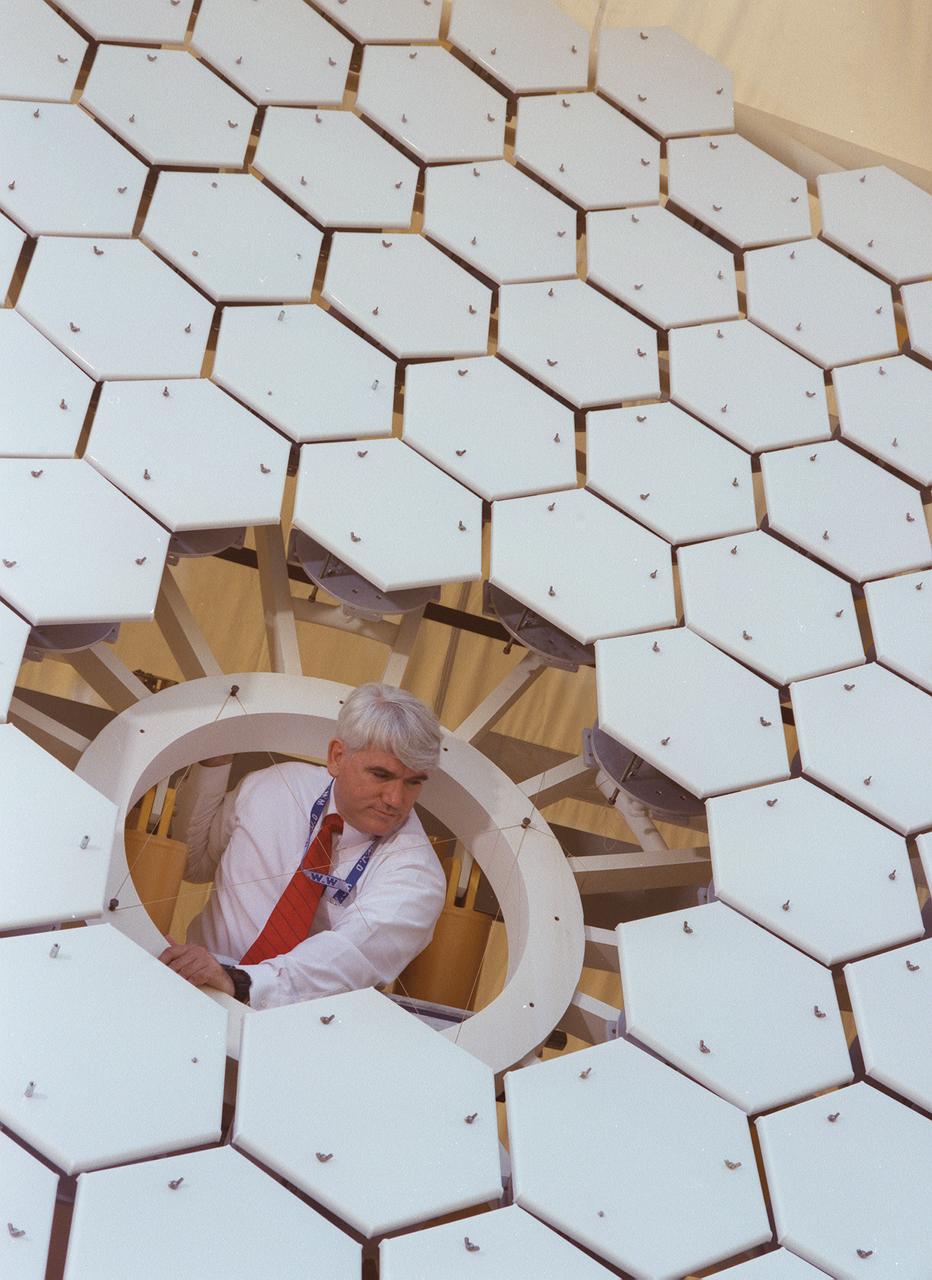
A team of engineers at Marshall Space Flight Center (MSFC) has designed, fabricated, and tested the first solar thermal engine, a non-chemical rocket that produces lower thrust but has better thrust efficiency than the chemical combustion engines. This segmented array of mirrors is the solar concentrator test stand at MSFC for firing the thermal propulsion engines. The 144 mirrors are combined to form an 18-foot diameter array concentrator. The mirror segments are aluminum hexagons that have the reflective surface cut into it by a diamond turning machine, which is developed by MSFC Space Optics Manufacturing Technology Center.
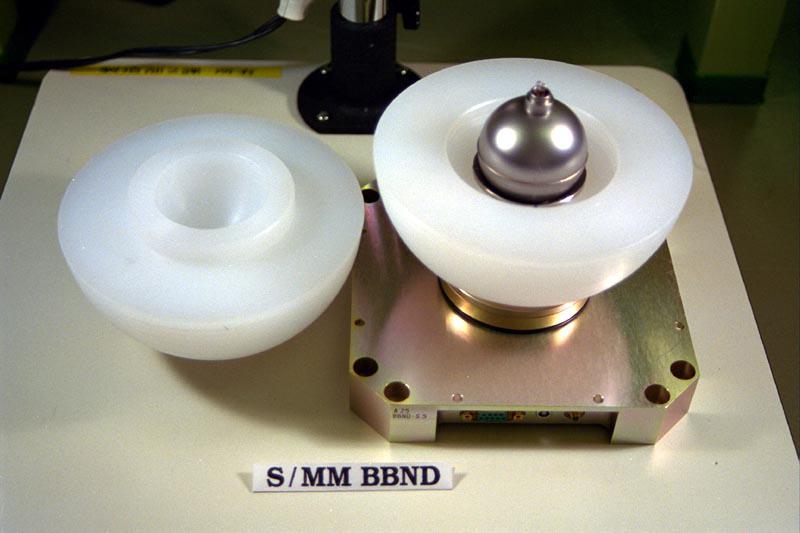
The Bonner Ball Neutron Detector measures neutron radiation. Neutrons are uncharged atomic particles that have the ability to penetrate living tissues, harming human beings in space. The Bonner Ball Neutron Detector is one of three radiation experiments during Expedition Two. The others are the Phantom Torso and Dosimetric Mapping.
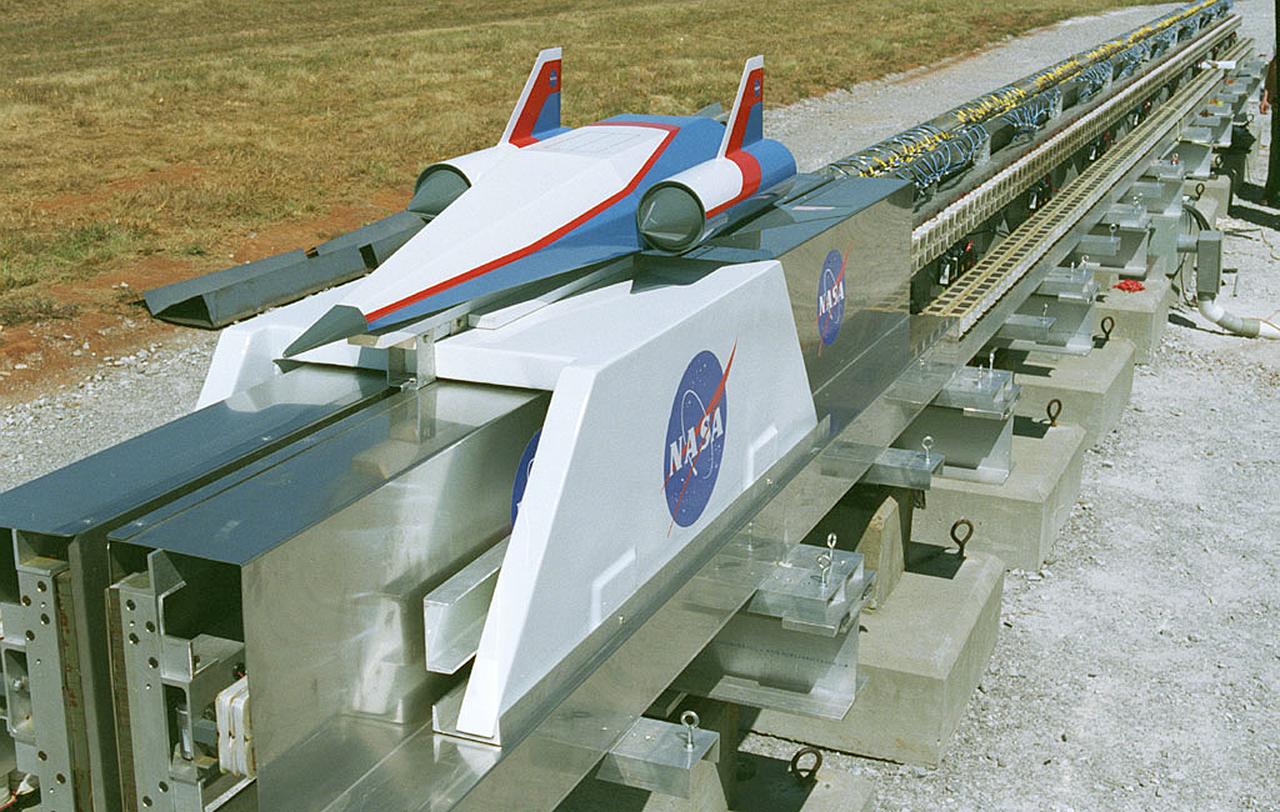
In this photograph, a futuristic spacecraft model sits atop a carrier on the Magnetic Launch Assist System, formerly known as the Magnetic Levitation (MagLev) System, experimental track at the Marshall Space Flight Center (MSFC). Engineers at MSFC have developed and tested Magnetic Launch Assist technologies that would use magnetic fields to levitate and accelerate a vehicle along a track at very high speeds. Similar to high-speed trains and roller coasters that use high-strength magnets to lift and propel a vehicle a couple of inches above a guideway, a Magnetic Launch Assist system would electromagnetically drive a space vehicle along the track. A full-scale, operational track would be about 1.5-miles long and capable of accelerating a vehicle to 600 mph in 9.5 seconds. This track is an advanced linear induction motor. Induction motors are common in fans, power drills, and sewing machines. Instead of spinning in a circular motion to turn a shaft or gears, a linear induction motor produces thrust in a straight line. Mounted on concrete pedestals, the track is 100-feet long, about 2-feet wide, and about 1.5-feet high. The major advantages of launch assist for NASA launch vehicles is that it reduces the weight of the take-off, the landing gear, the wing size, and less propellant resulting in significant cost savings. The US Navy and the British MOD (Ministry of Defense) are planning to use magnetic launch assist for their next generation aircraft carriers as the aircraft launch system. The US Army is considering using this technology for launching target drones for anti-aircraft training.
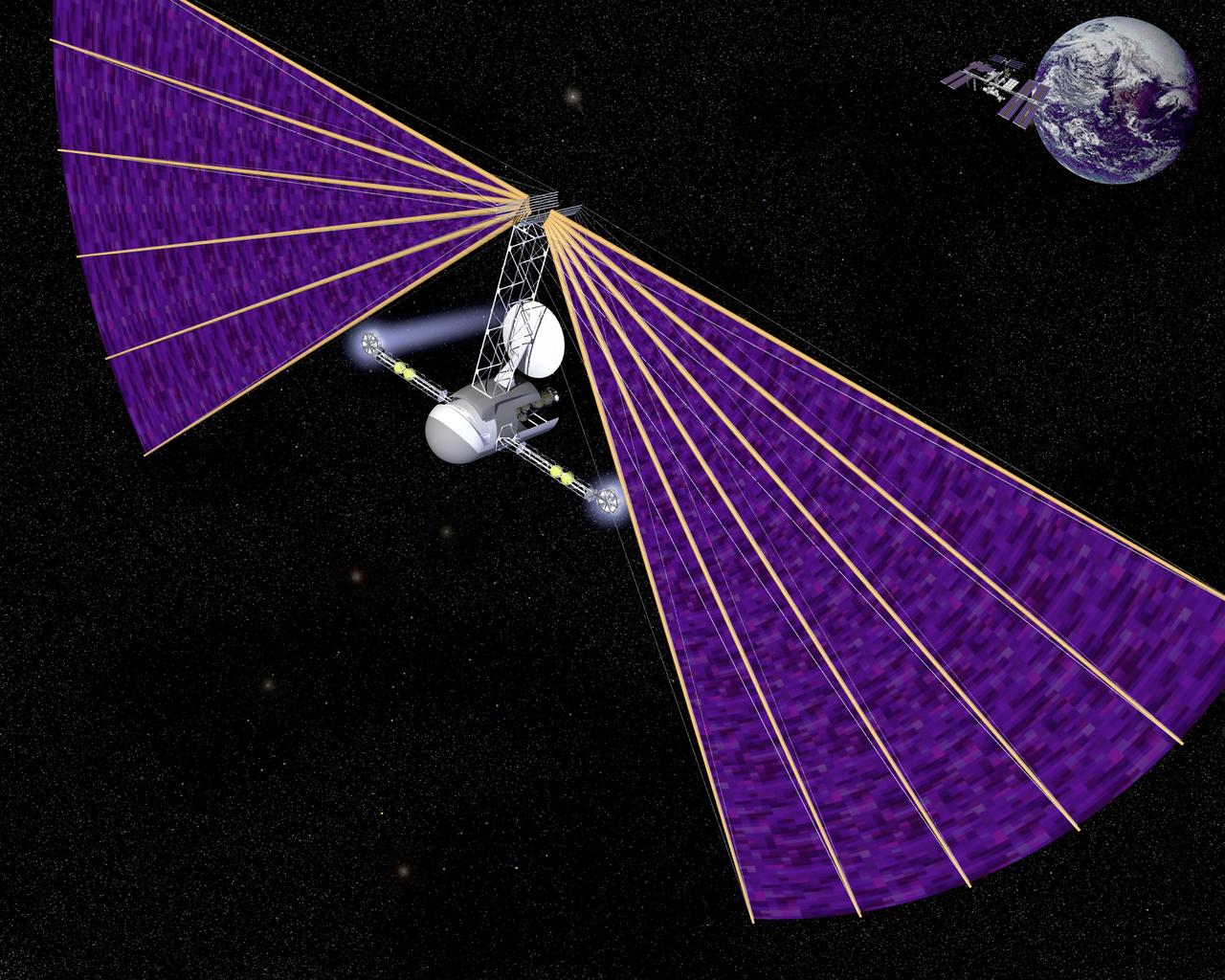
Concept of a vehicle journeys from Earth to Mars propelled by thrusters powered by electricity from photovoltaic cells on its large fan shaped sails
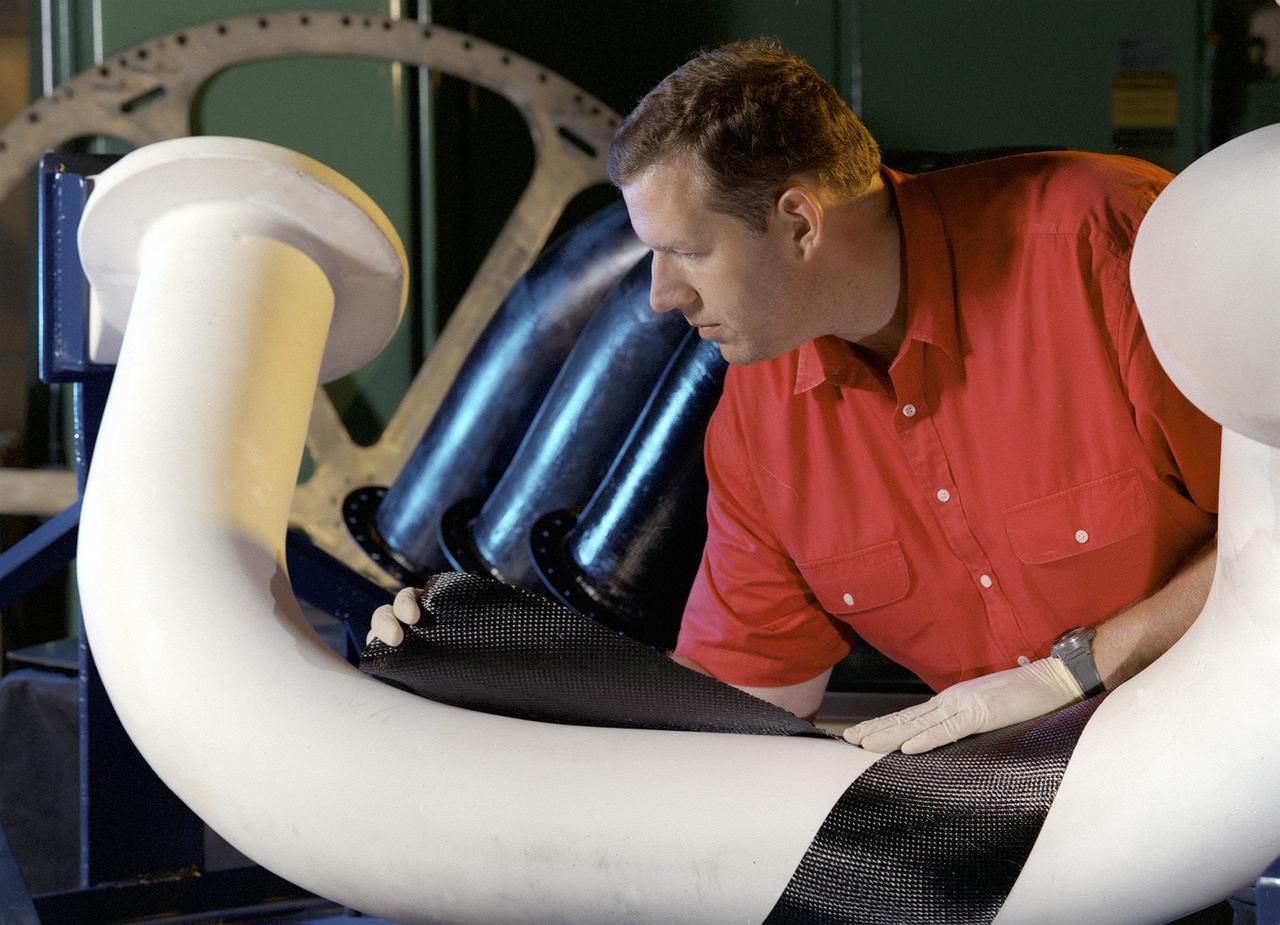
Engineers at Marshall Space Flight Center (MSFC) in Huntsville, Alabama, are working with industry partners to develop a new generation of more cost-efficient space vehicles. Lightweight fuel tanks and components under development will be the critical elements in tomorrow's reusable launch vehicles and will tremendously curb the costs of getting to space. In this photo, Tom DeLay, a materials processes engineer for MSFC, uses a new graphite epoxy technology to create lightweight cryogenic fuel lines for futuristic reusable launch vehicles. He is wrapping a water-soluble mandrel, or mold, with a graphite fabric coated with an epoxy resin. Once wrapped, the pipe will be vacuum-bagged and autoclave-cured. The disposable mold will be removed to reveal a thin-walled fuel line. In addition to being much lighter and stronger than metal, this material won't expand or contract as much in the extreme temperatures encountered by launch vehicles.
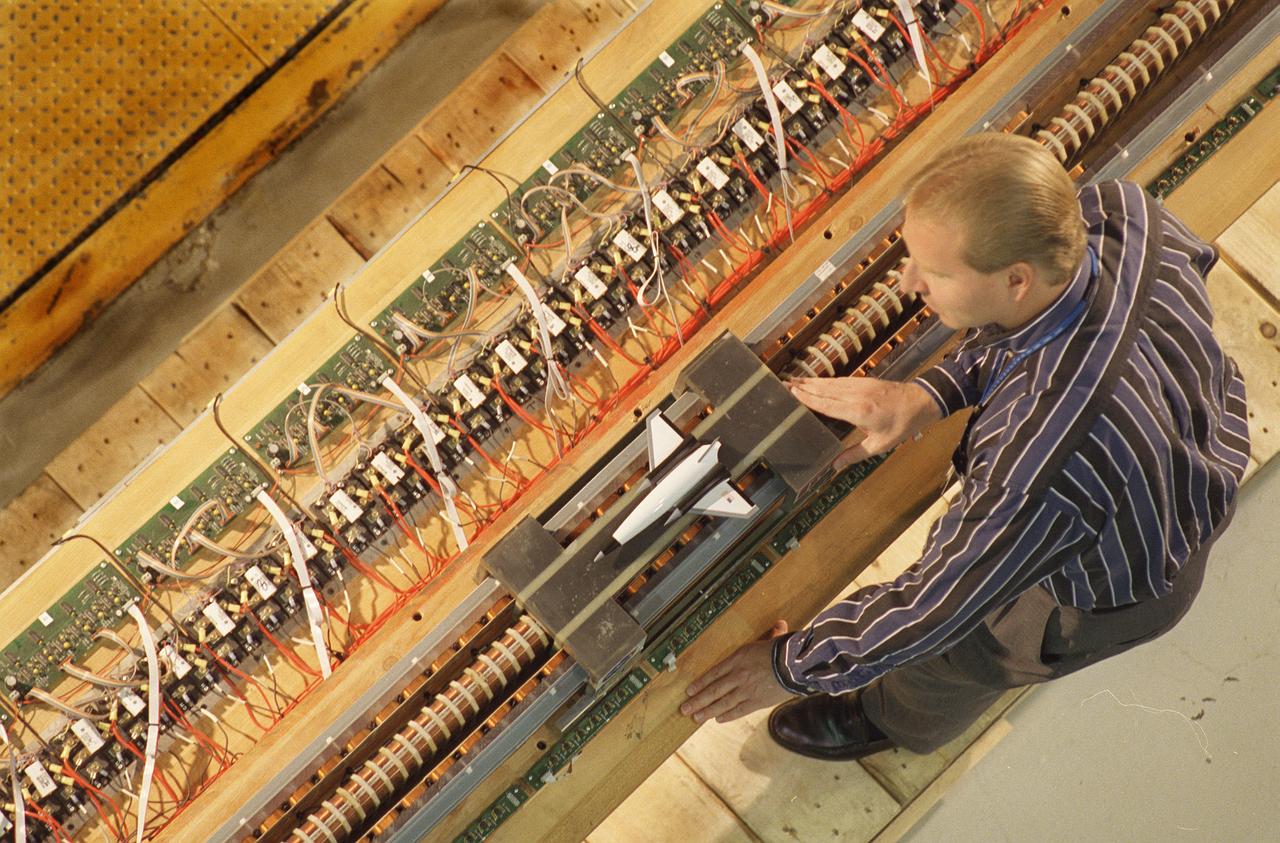
Marshall Space Flight Center’s (MSFC’s) Advanced Space Transportation Program has developed the Magnetic Launch Assist System, formerly known as the Magnetic Levitation (MagLev) technology that could give a space vehicle a running start to break free from Earth’s gravity. A Magnetic Launch Assist system would use magnetic fields to levitate and accelerate a vehicle along a track at speeds up to 600 mph. The vehicle would shift to rocket engines for launch into orbit. Similar to high-speed trains and roller coasters that use high-strength magnets to lift and propel a vehicle a couple of inches above a guideway, a Magnetic Launch Assist system would electromagnetically propel a space vehicle along the track. The tabletop experimental track for the system shown in this photograph is 44-feet long, with 22-feet of powered acceleration and 22-feet of passive braking. A 10-pound carrier with permanent magnets on its sides swiftly glides by copper coils, producing a levitation force. The track uses a linear synchronous motor, which means the track is synchronized to turn the coils on just before the carrier comes in contact with them, and off once the carrier passes. Sensors are positioned on the side of the track to determine the carrier’s position so the appropriate drive coils can be energized. MSFC engineers have conducted tests on the indoor track and a 50-foot outdoor track. The major advantages of launch assist for NASA launch vehicles is that it reduces the weight of the take-off, the landing gear, the wing size, and less propellant resulting in significant cost savings. The US Navy and the British MOD (Ministry of Defense) are planning to use magnetic launch assist for their next generation aircraft carriers as the aircraft launch system. The US Army is considering using this technology for launching target drones for anti-aircraft training.
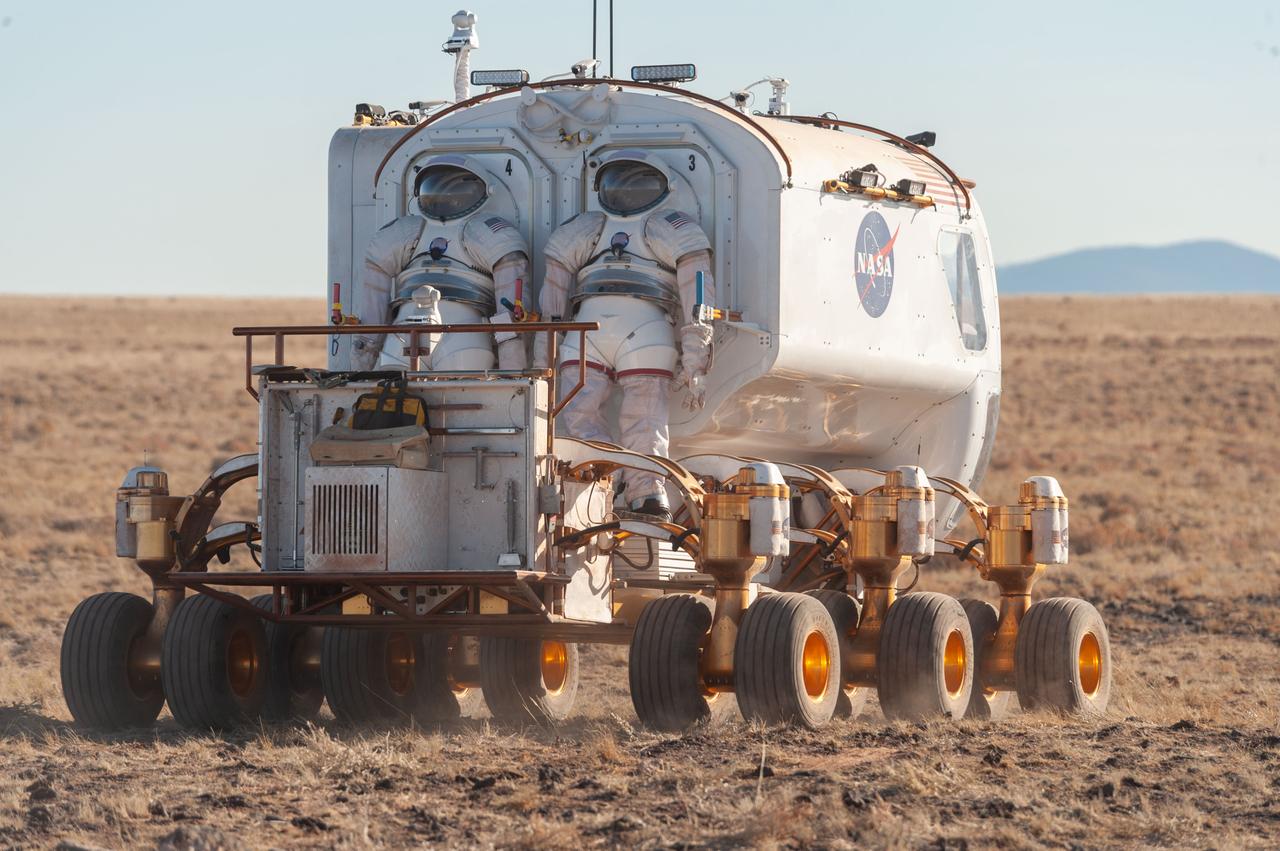
A back view of the Lunar Electric Rover (LER) during the Desert Research and Technology Studies (RATS) remote field test at Black Point Lava Flow, Arizona in 2008. Two Mark III spacesuits are visibly mounted on the LER suit port.

Dr. Luz M. Calle, a principal investigator for corrosion research at NASA’s Kennedy Space Center, examines microcapsules under a microscope Dec. 12, 2018. Microencapsulation is a way to create smart coatings or paint capable of indicating, resisting, and repairing corrosion. Smart coatings are being developed as alternatives to corrosion protection technologies that are not environmentally friendly.
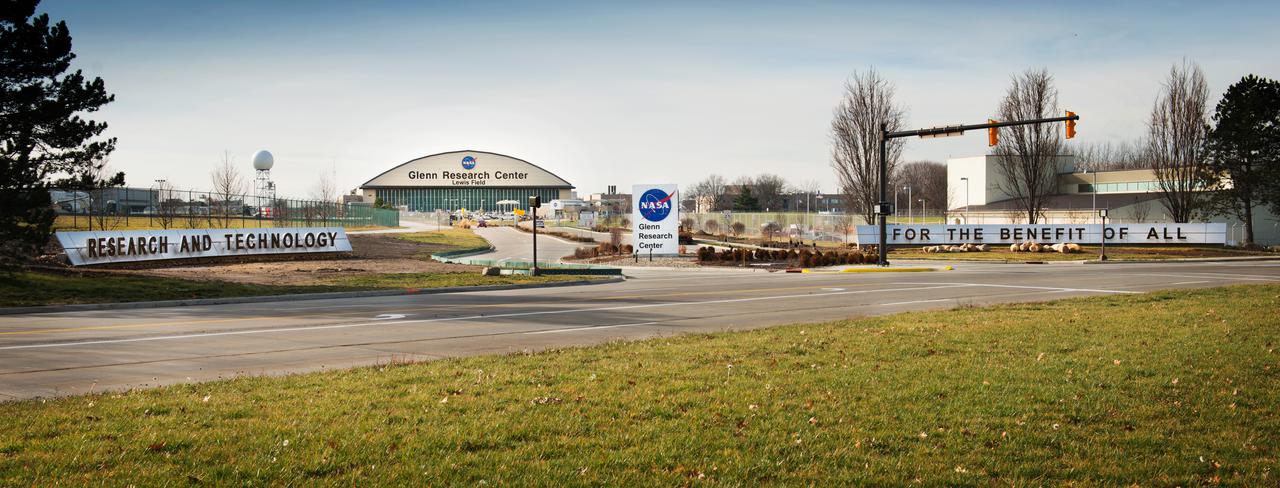
Main Entrance of NASA Glenn Research Center at Brookpark Road and NASA Parkway. The signs read: Research and Technology For The Benefit Of All.
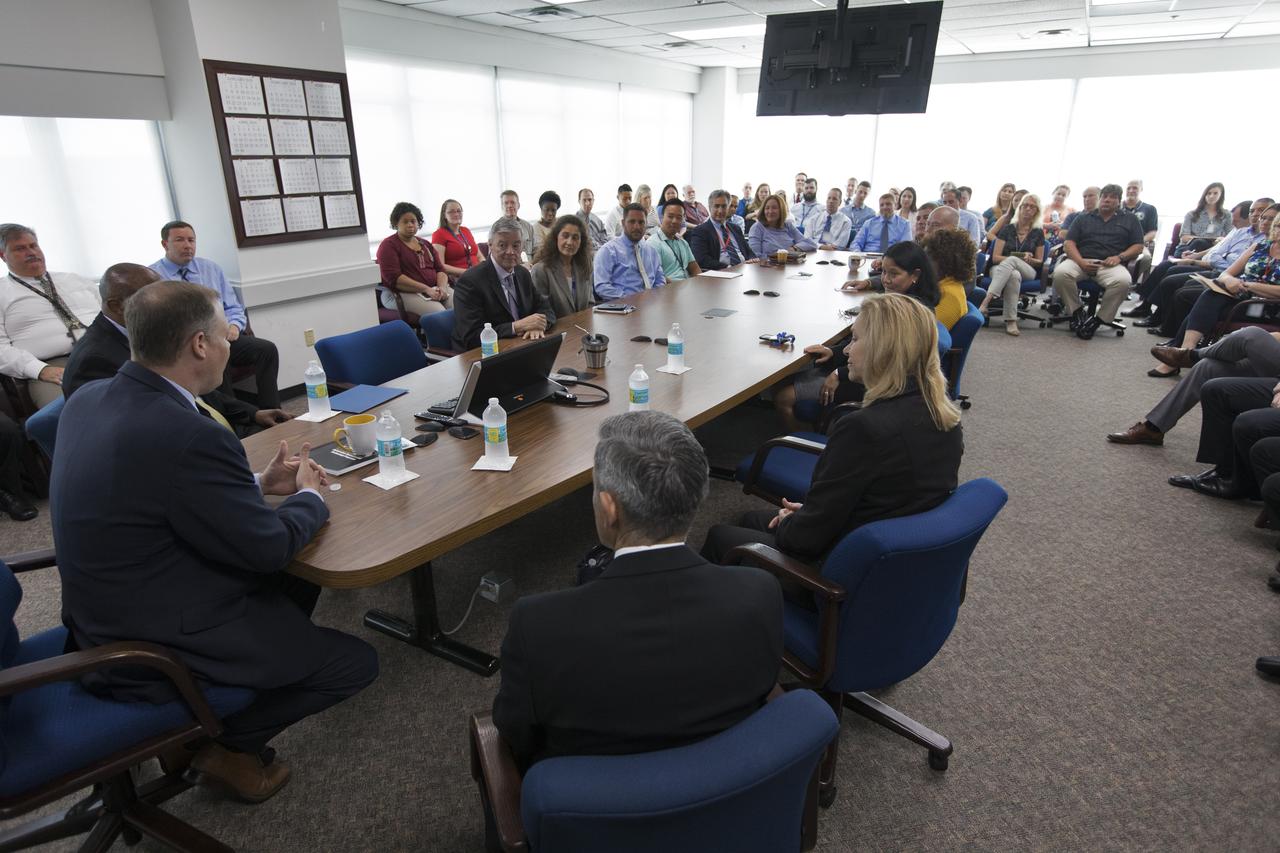
NASA Administrator Jim Bridenstine, seated at left, talks with workers in the Exploration Research and Technology directorate inside the Space Station Processing Facility at NASA's Kennedy Space Center in Florida, on Aug. 7, 2018. Seated to his right are Kennedy Center Director Bob Cabana, Deputy Center Director Janet Petro, and Josie Burnett, director of Exploration Research and Technology.
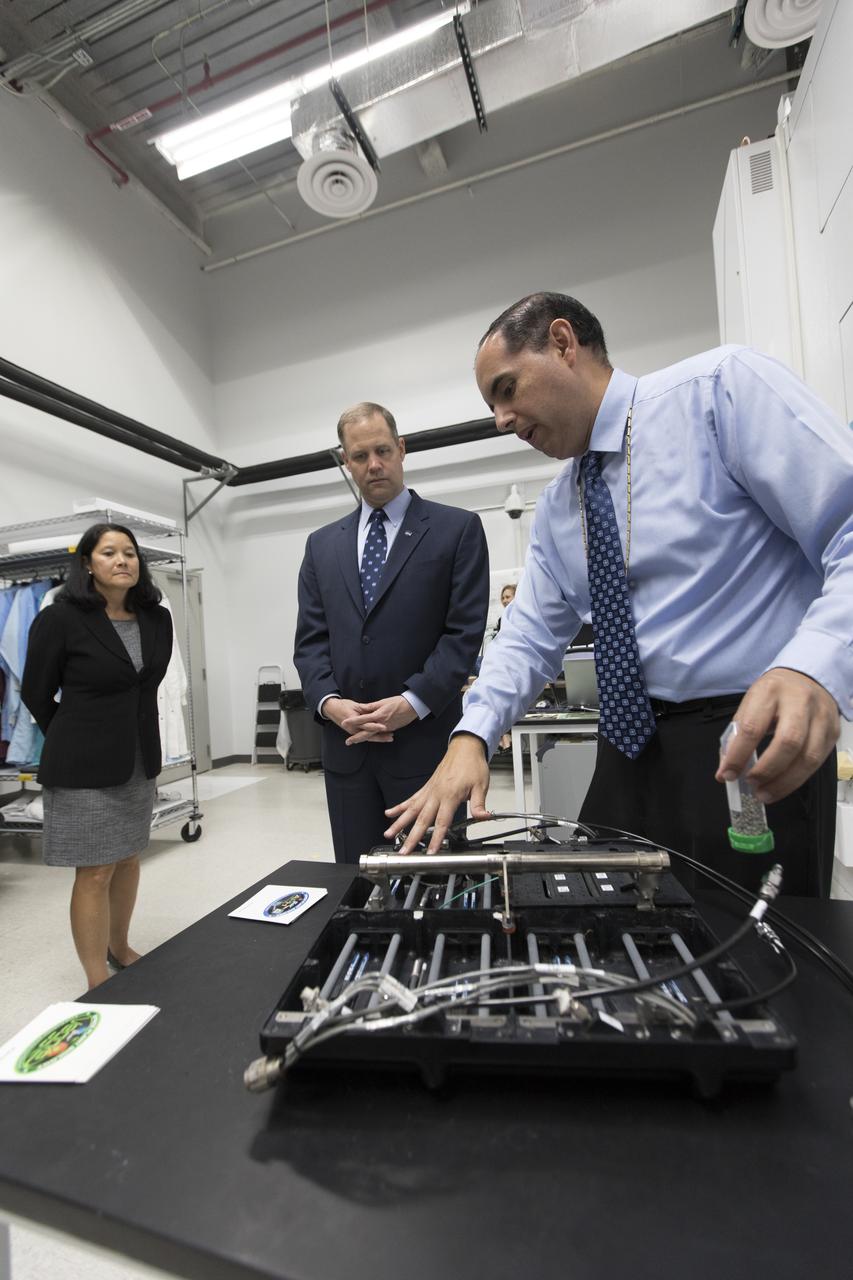
NASA Administrator Jim Bridenstine, center, tours the Space Station Processing Facility at NASA's Kennedy Space Center in Florida, on Aug. 7, 2018. At right, Bryan Onate, Advanced Plant Habitat (APH) project manager, explains a component of the APH cooling system. At left is Josie Burnett, director of Exploration Research and Technology. Bridenstine also received updates on research and technology accomplishments.
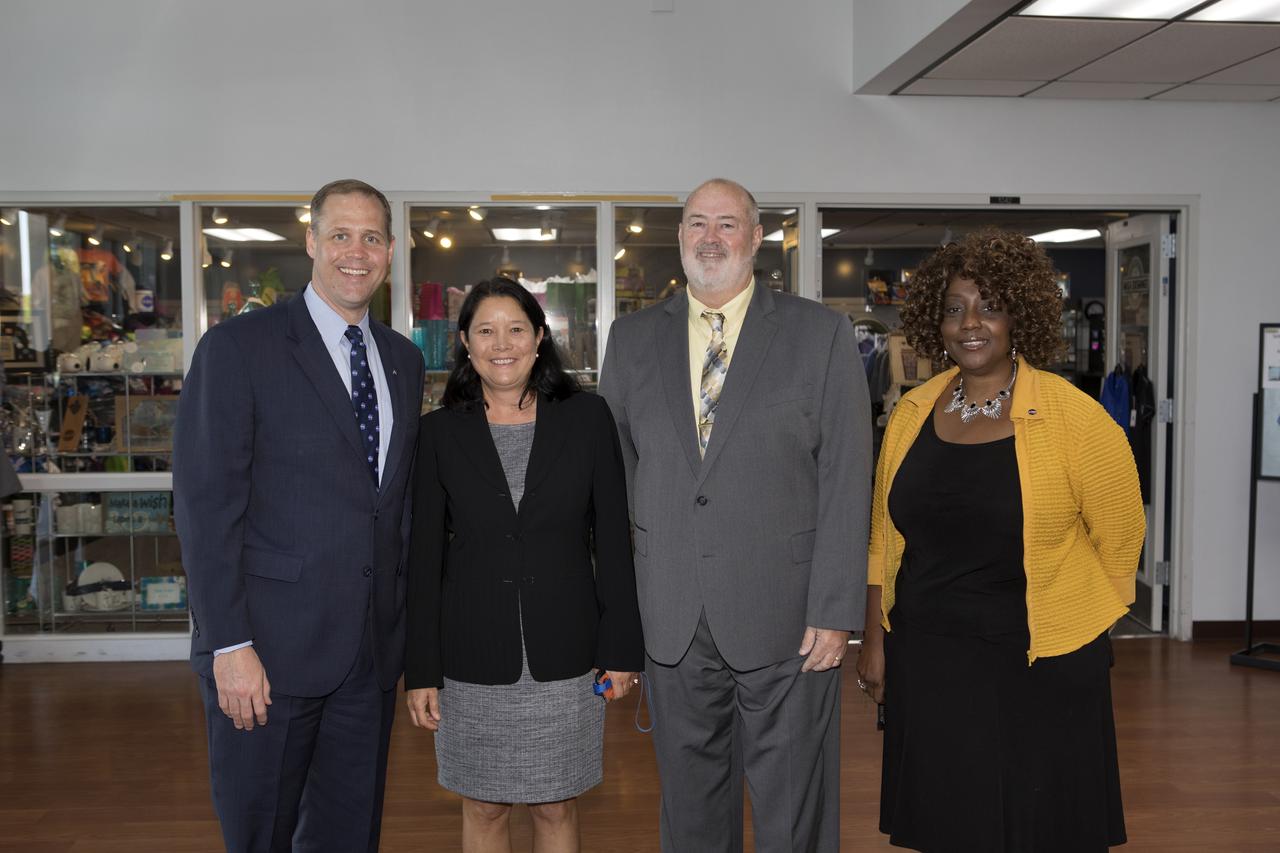
NASA Administrator Jim Bridenstine, far left, tours the Space Station Processing Facility at NASA's Kennedy Space Center in Florida, on Aug. 7, 2018. With Bridenstine, are, from left, Josie Burnett, director of Exploration Research and Technology; Ronnie Lawson, deputy director; and Barbara Brown, chief technologist. Bridenstine received updates on research and technology accomplishments.
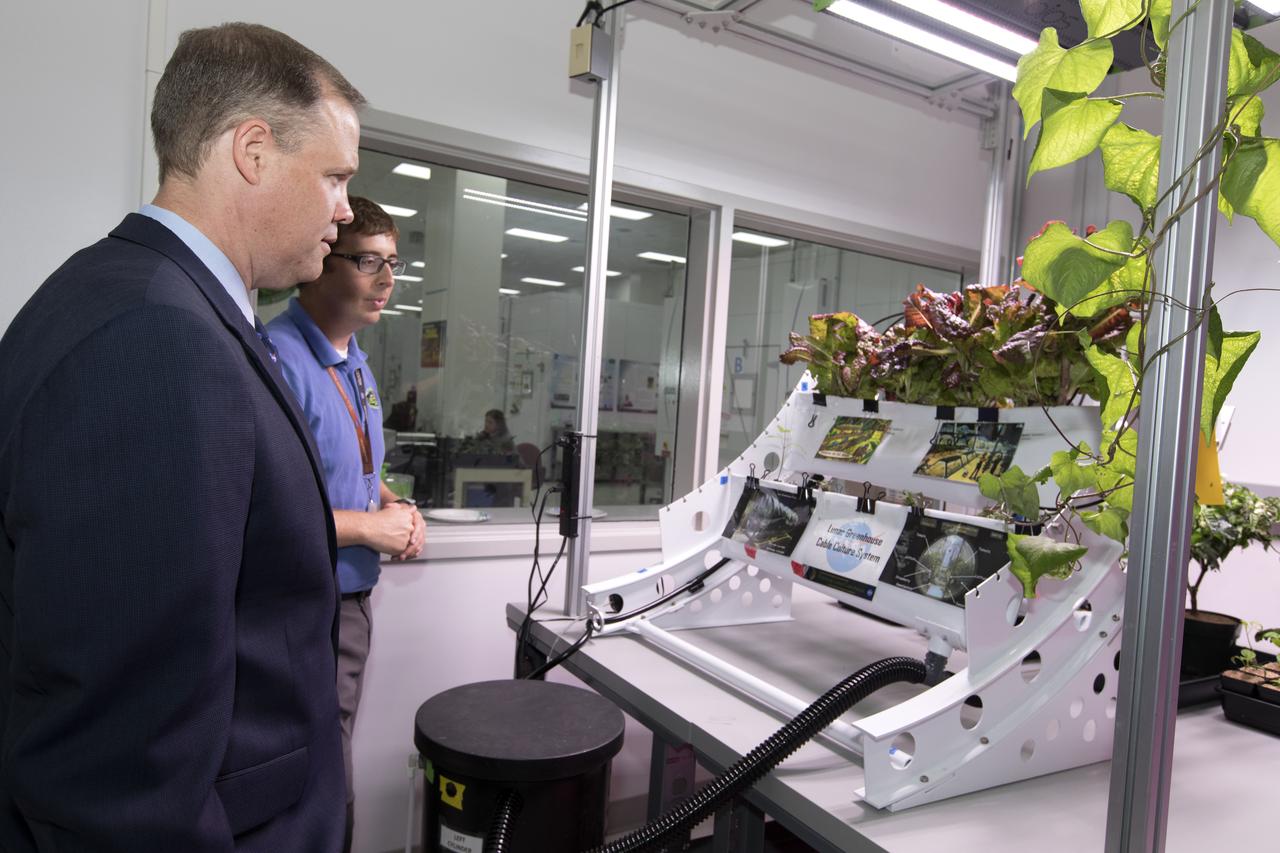
NASA Administrator Jim Bridenstine, at left, tours a plant research laboratory inside the Space Station Processing Facility (SSPF) at NASA's Kennedy Space Center in Florida, on Aug. 7, 2018. At right is Matt Romeyn, project scientist. Bridenstine received updates on research and technology accomplishments during his visit to the SSPF.
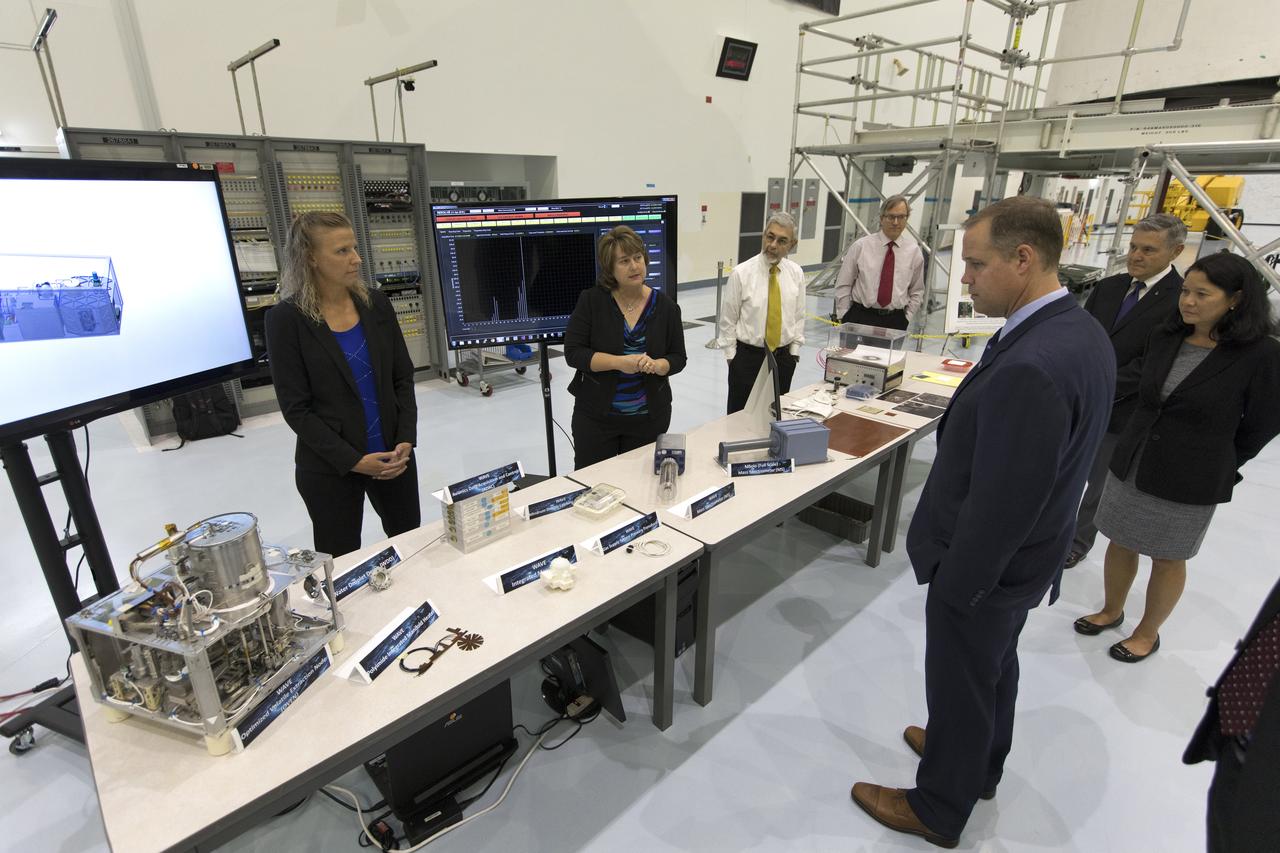
NASA Administrator Jim Bridenstine, at right, tours the high bay inside the Space Station Processing Facility (SSPF) at NASA's Kennedy Space Center in Florida, on Aug. 7, 2018. To his right are Josie Burnett, director of Exploration Research and Technology, and Kennedy Space Center Director Bob Cabana. Behind the exhibit table, from left, are Dr. Janine Captain, a chemist in the Applied Physics Laboratory; Dr. Jackie Quinn, environmental engineer; Carlos Calle, lead scientist in the Electrostatic and Surface Physics Laboratory; and Dr. Robert Youngquist, lead, Applied Physics Laboratory. Bridenstine received updates on research and technology accomplishments during his visit to the SSPF.
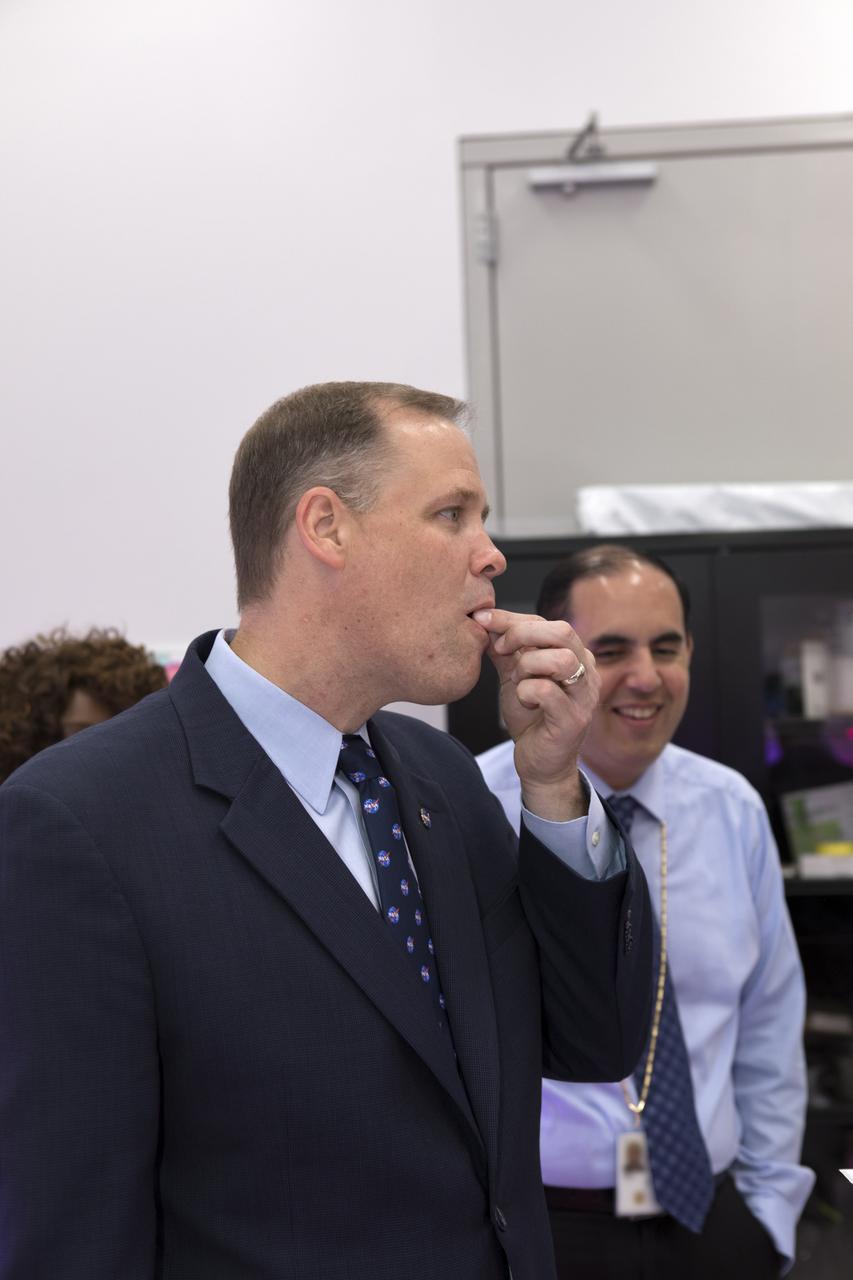
NASA Administrator Jim Bridenstine, left, tours a plant research laboratory and samples a microgreen inside the Space Station Processing Facility (SSPF) at NASA's Kennedy Space Center in Florida, on Aug. 7, 2018. Behind Bridenstine is Bryan Onate, Advanced Plant Habitat project manager. Bridenstine received updates on research and technology accomplishments during his visit to the SSPF.
NASA Administrator Jim Bridenstine, at right, tours the high bay inside the Space Station Processing Facility (SSPF), on Aug. 7, 2018, at NASA's Kennedy Space Center in Florida. From left, Carlos Calle, lead scientist in the Electrostatic and Surface Physics Laboratory, and Dr. Robert Youngquist, lead, Applied Physics Laboratory, explain electrostatic dust shield technology. Bridenstine also received updates on research and technology accomplishments during his visit to the SSPF.
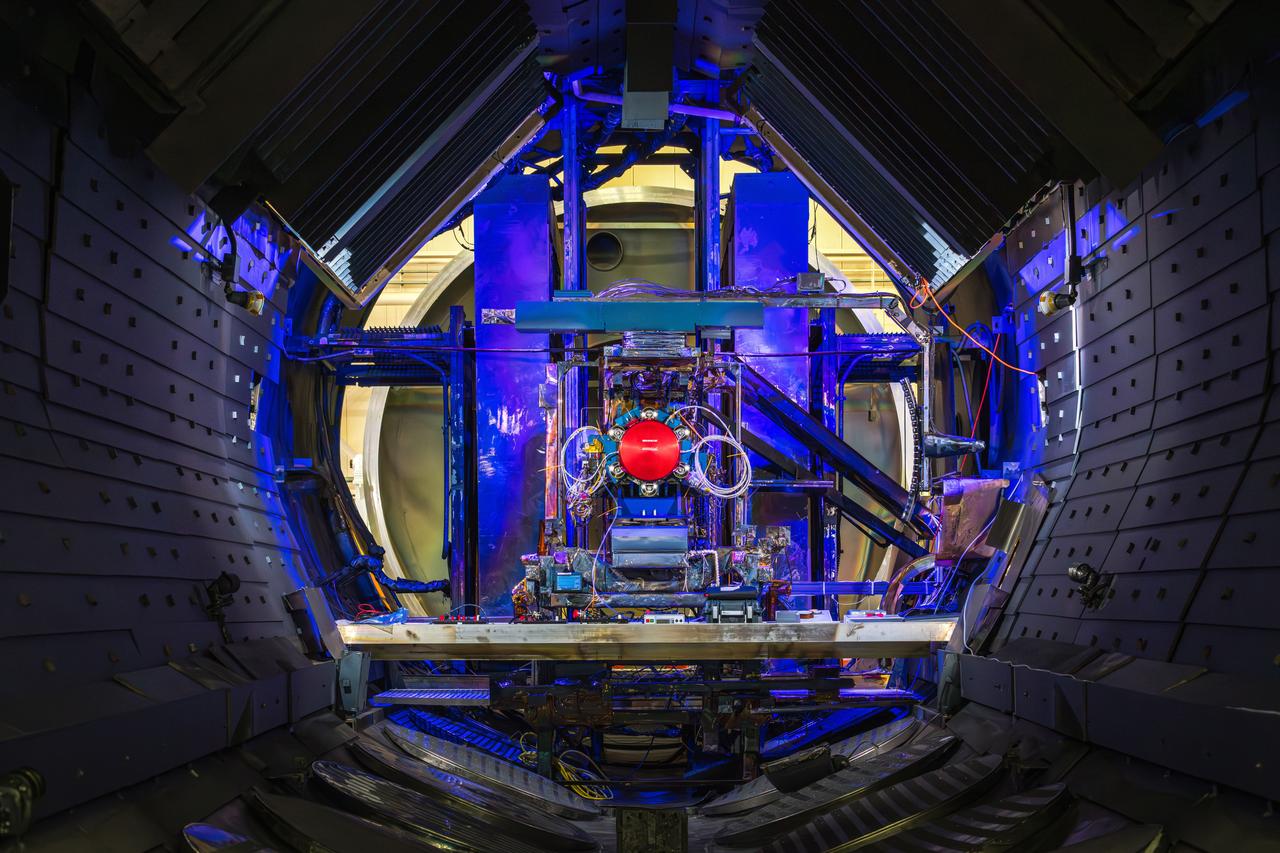
NASA Glenn Research Center has received the first of three Advanced Electric Propulsion System (AEPS) thrusters for the Gateway lunar space station. Built by L3Harris Technologies, the thruster will undergo testing before integration with Gateway’s Power and Propulsion Element, launching with the HALO module ahead of Artemis IV.
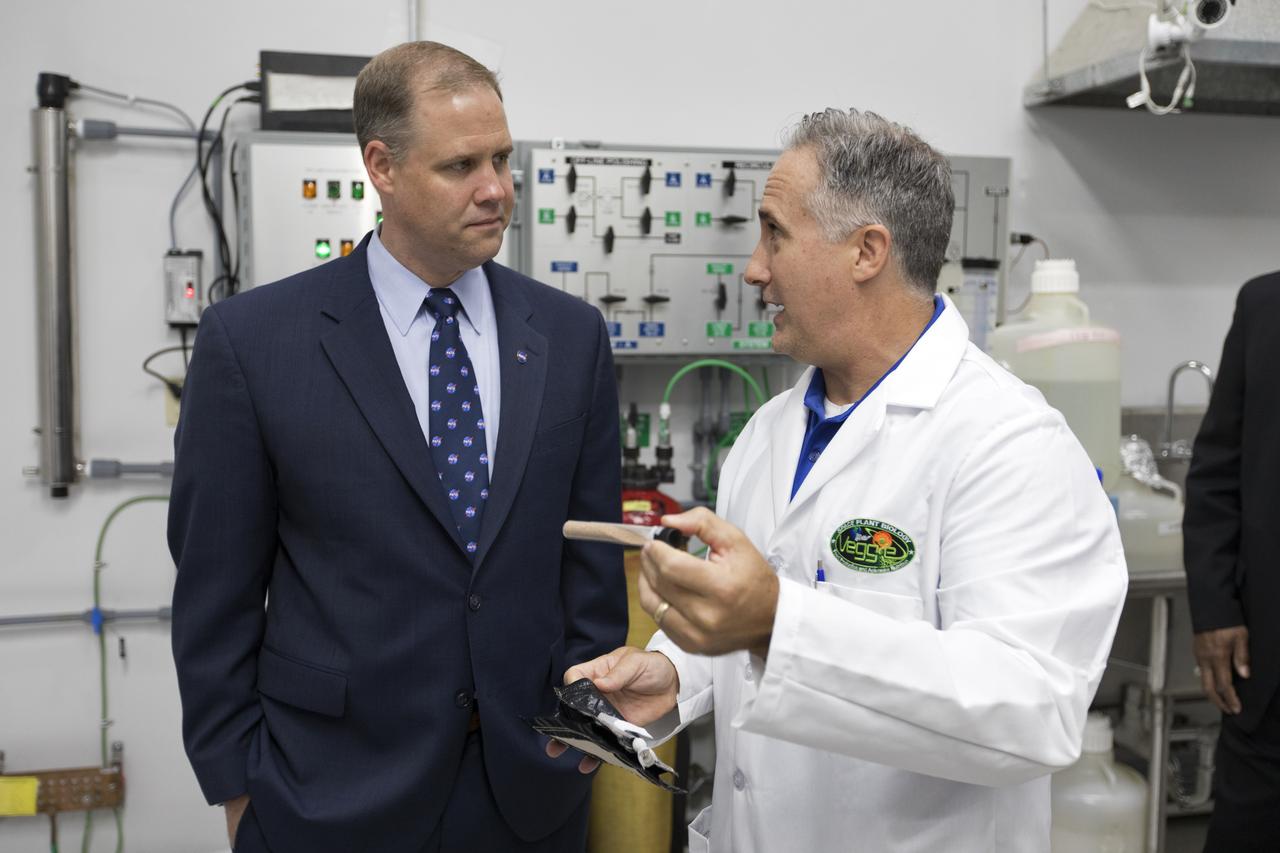
NASA Administrator Jim Bridenstine, at left, tours the Space Station Processing Facility at NASA's Kennedy Space Center in Florida, on Aug. 7, 2018. At right, Trent Smith, Veggie project manager, displays a seed packet and plant pillow for the Veggie plant growth system. Bridenstine also received updates on research and technology accomplishments.
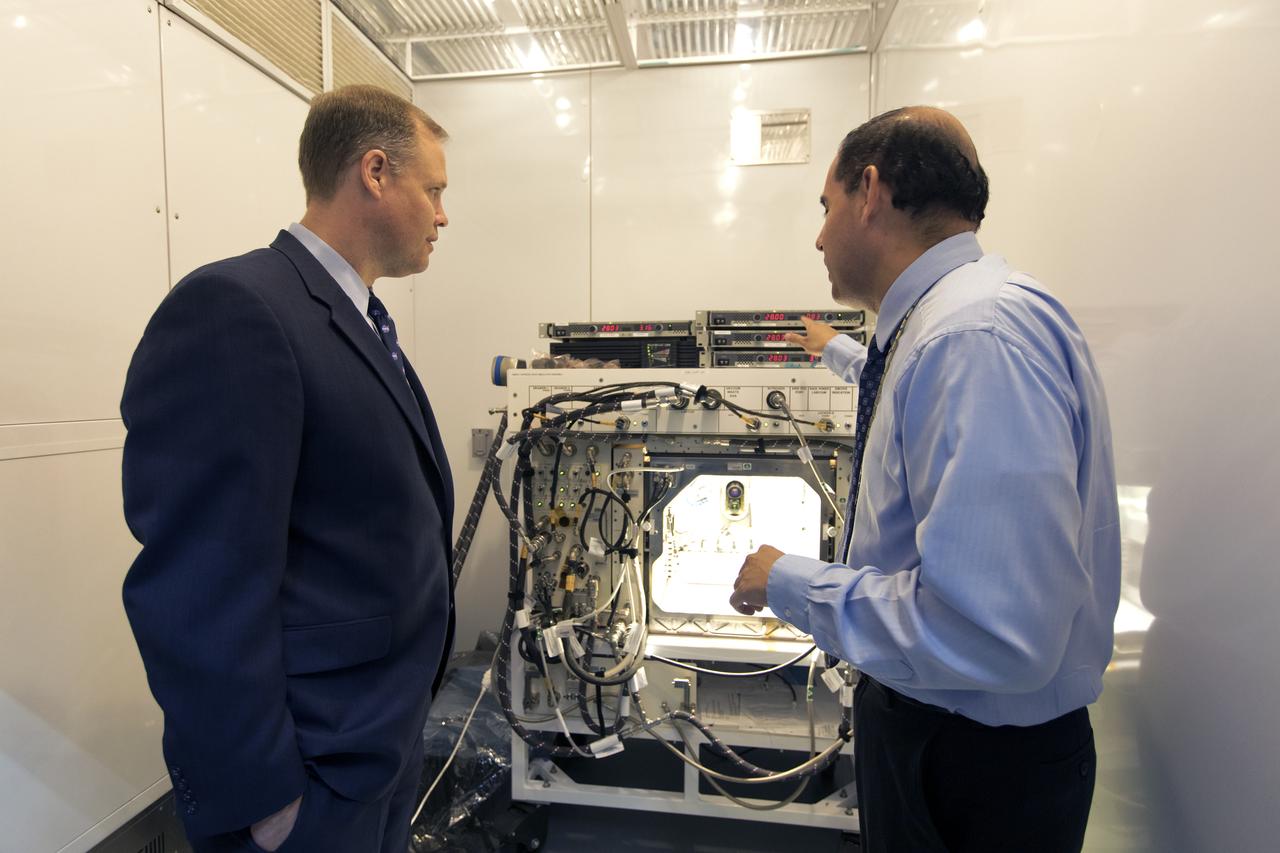
NASA Administrator Jim Bridenstine, left, tours the Space Station Processing Facility at NASA's Kennedy Space Center in Florida, on Aug. 7, 2018. Bryan Onate, at right, Advanced Plant Habitat (APH) project manager, explains a component of the APH control system. Bridenstine also received updates on research and technology accomplishments.
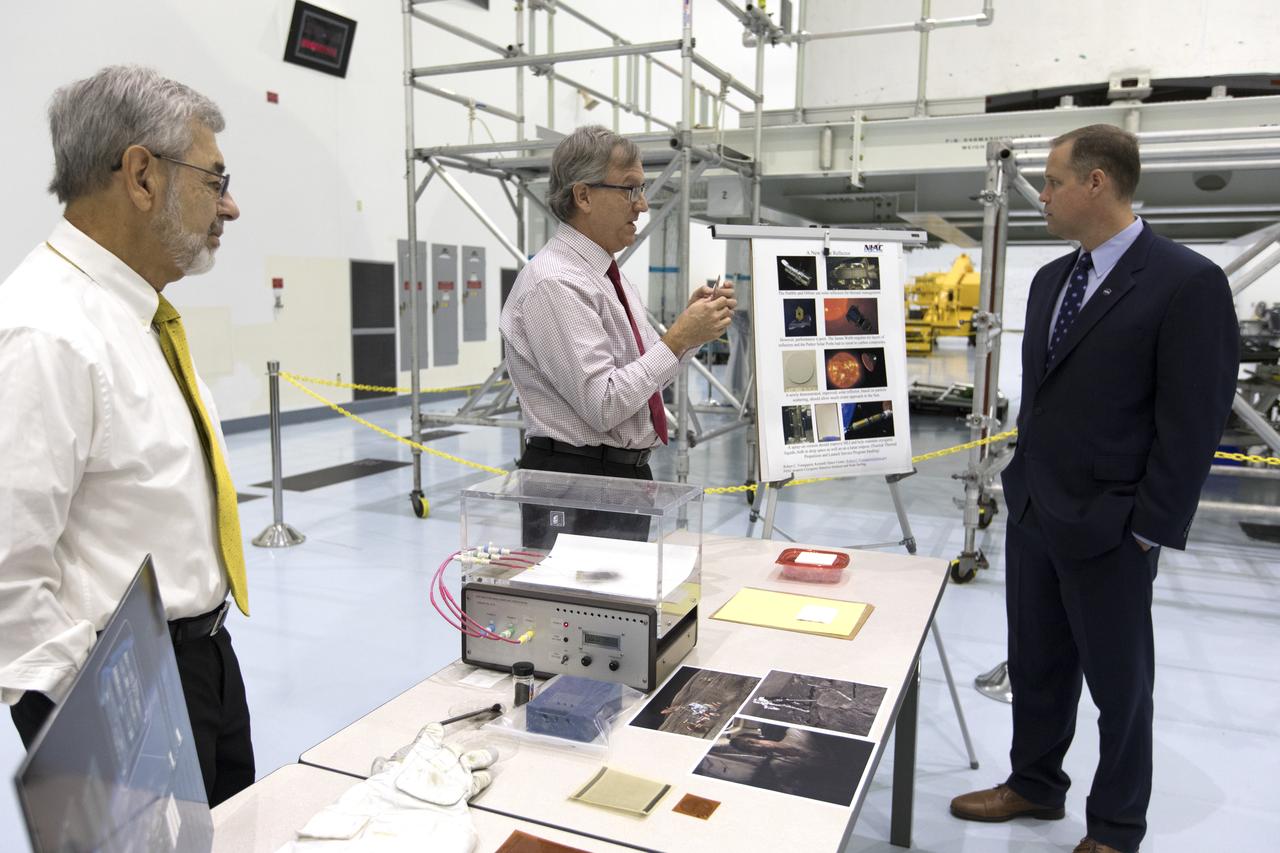
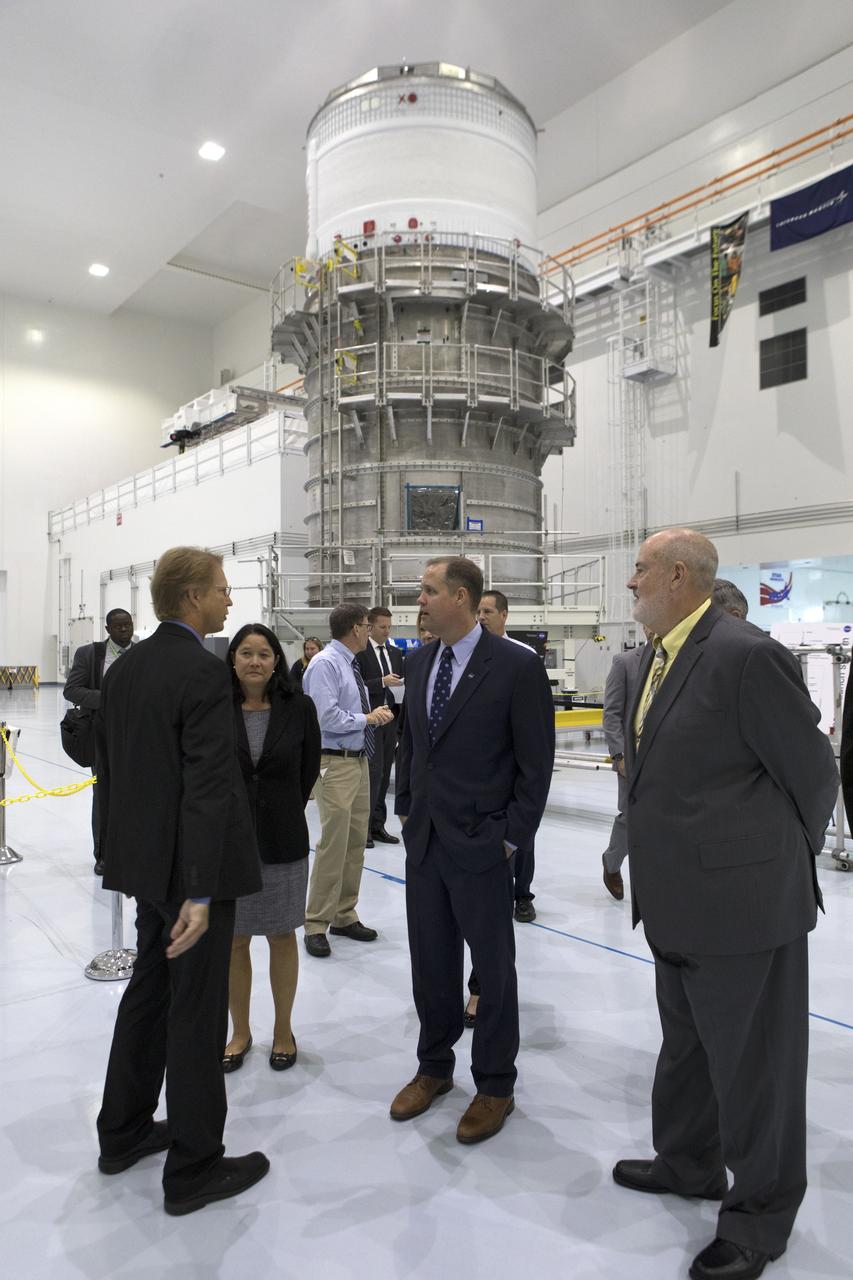
NASA Administrator Jim Bridenstine, center, tours the high bay inside the Space Station Processing Facility (SSPF) at NASA's Kennedy Space Center in Florida, on Aug. 7, 2018. To his left is Josie Burnett, director of Exploration Research and Technology. To his right is Ronnie Lawson, deputy director of Exploration Research and Technology. Behind them is the Interim Cryogenic Propulsion Stage, which will connect between the Orion spacecraft and the upper part of NASA's Space Launch System. It is being stored in the SSPF. Bridenstine also received updates on research and technology accomplishments during his visit to the SSPF.
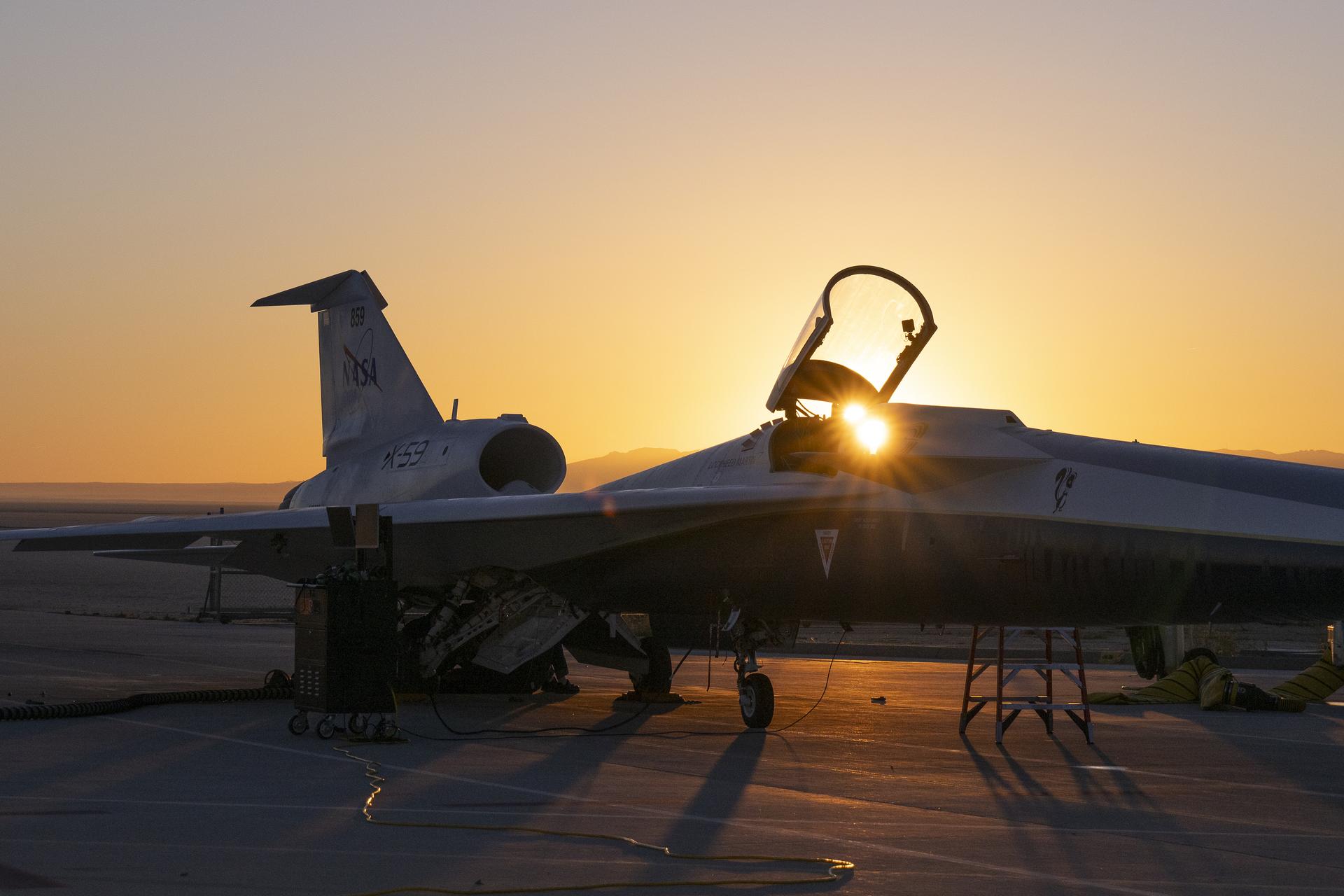
NASA’s X-59 quiet supersonic research aircraft during engine run testing on Thursday, March 12, 2026, at NASA’s Armstrong Flight Research Center in Edwards, California. Engineers and technicians monitored the aircraft’s systems as the engine powered up, gathering data to verify performance and prepare the X-59 for its next series of experimental flights. The X-59 will support NASA’s Quesst mission, which aims to demonstrate technology that can reduce the loud sonic booms of supersonic flight.
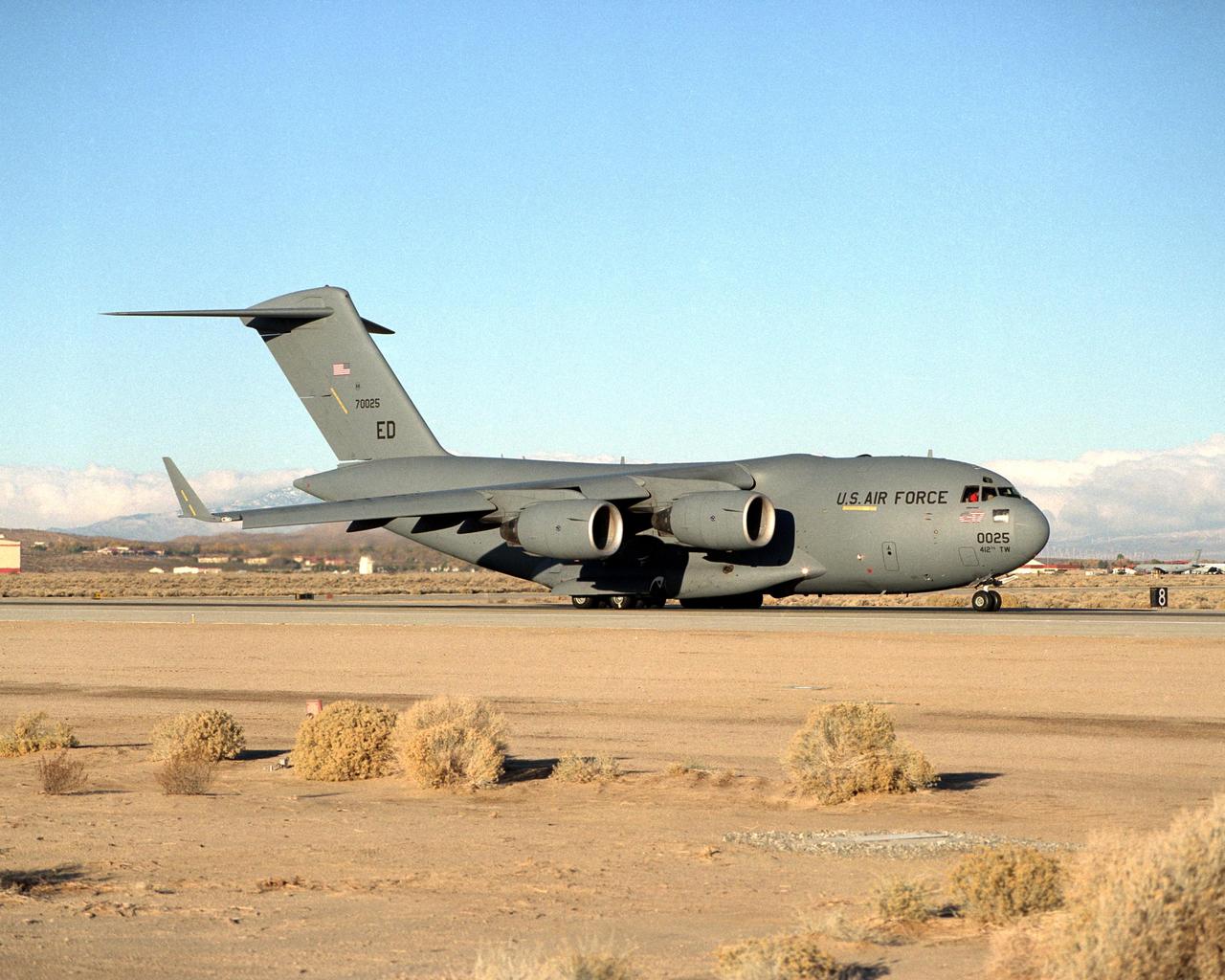
The Air Force provided a C-17 Globemaster III for use in the Vehicle Integrated Propulsion Research (VIPR) effort. Researchers are using the airplane for ground testing of new engine health monitoring technologies.

Josie Burnett, director or Exploration Research and Technology Programs, speaks to Kennedy Space Center employees about plans for the coming year. The event took place in the Lunar Theater at the Kennedy Space Center Visitor Complex’s Apollo Saturn V Center. The year will be highlighted with NASA's partners preparing test flights for crewed missions to the International Space Station as part of the agency's Commercial Crew Program and six launches by the Launch Services Program. Exploration Ground Systems will be completing facilities to support the Space Launch System rocket and Orion spacecraft. Exploration Research and Technology Programs will continue to provide supplies to the space station launched as part of the Commercial Resupply Services effort.
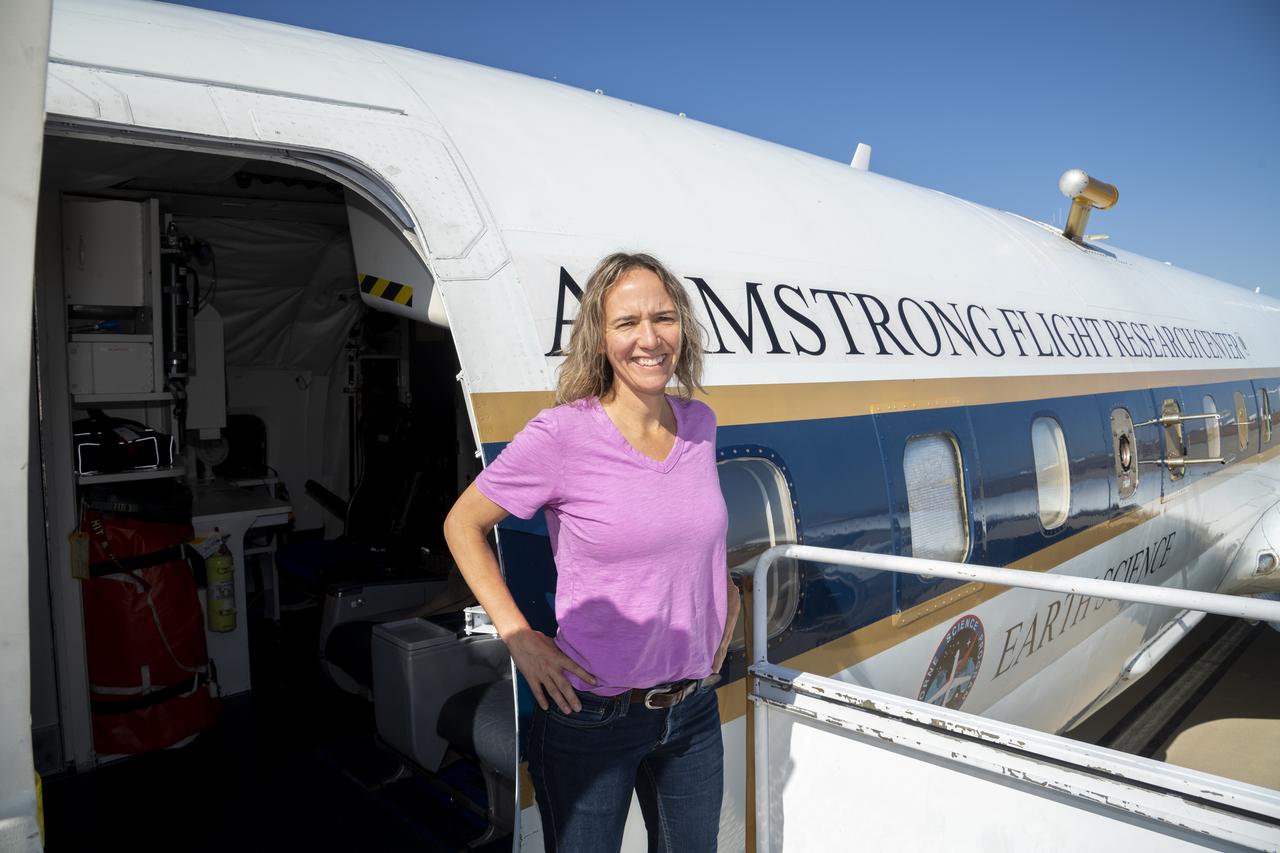
NASA’s Student Airborne Research Program invites Dr. Ann Marie Carlton, Professor of Chemistry at the University of California, Irvine and White House Office of Science and Technology Policy fellow, to fly aboard the DC-8 to measure air quality on June 23, 2022.
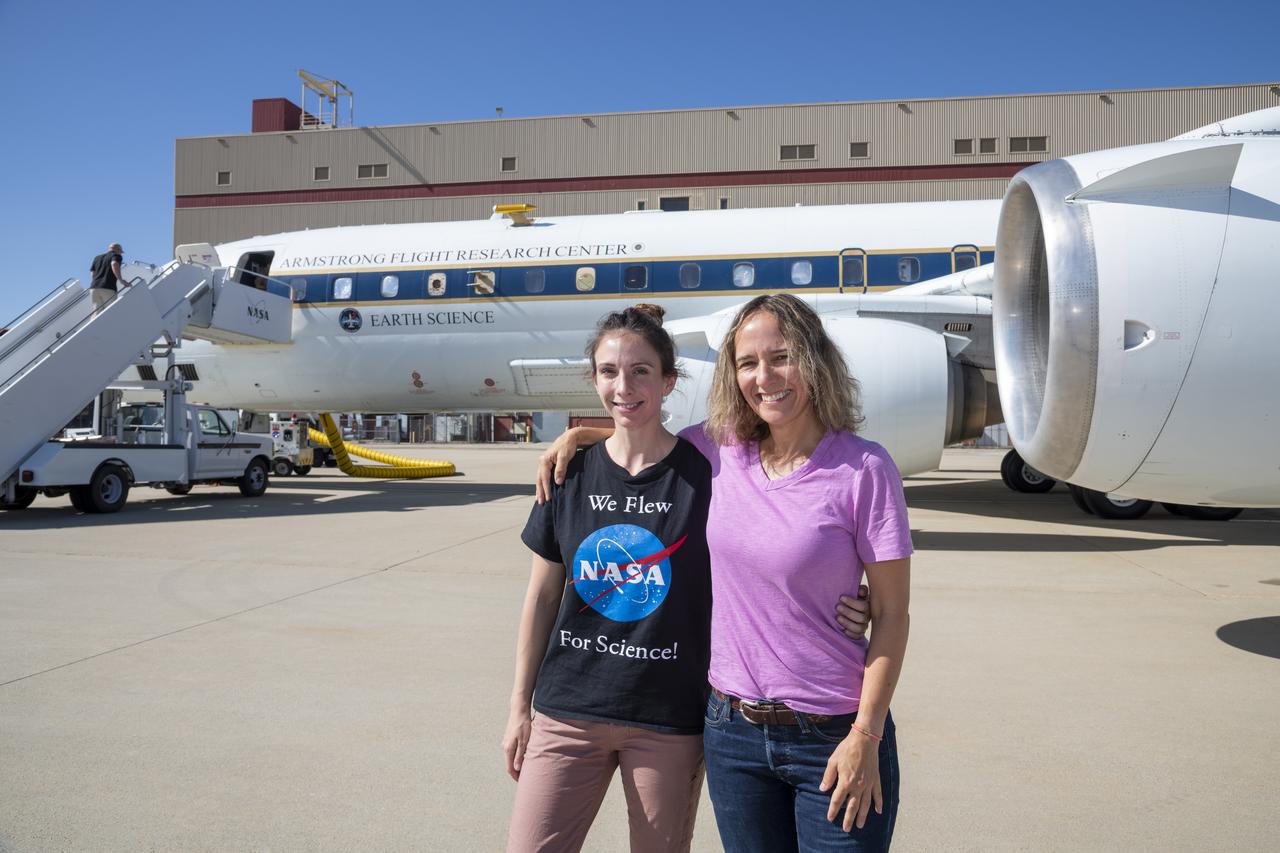
NASA Student Airborne Research Program Manager, Dr. Brenna Biggs and Professor of Chemistry at the University of California, Irvine and White House Office of Science and Technology Policy fellow, Dr. Ann Marie Carlton pose in front of the DC-8 on June 23, 2022.
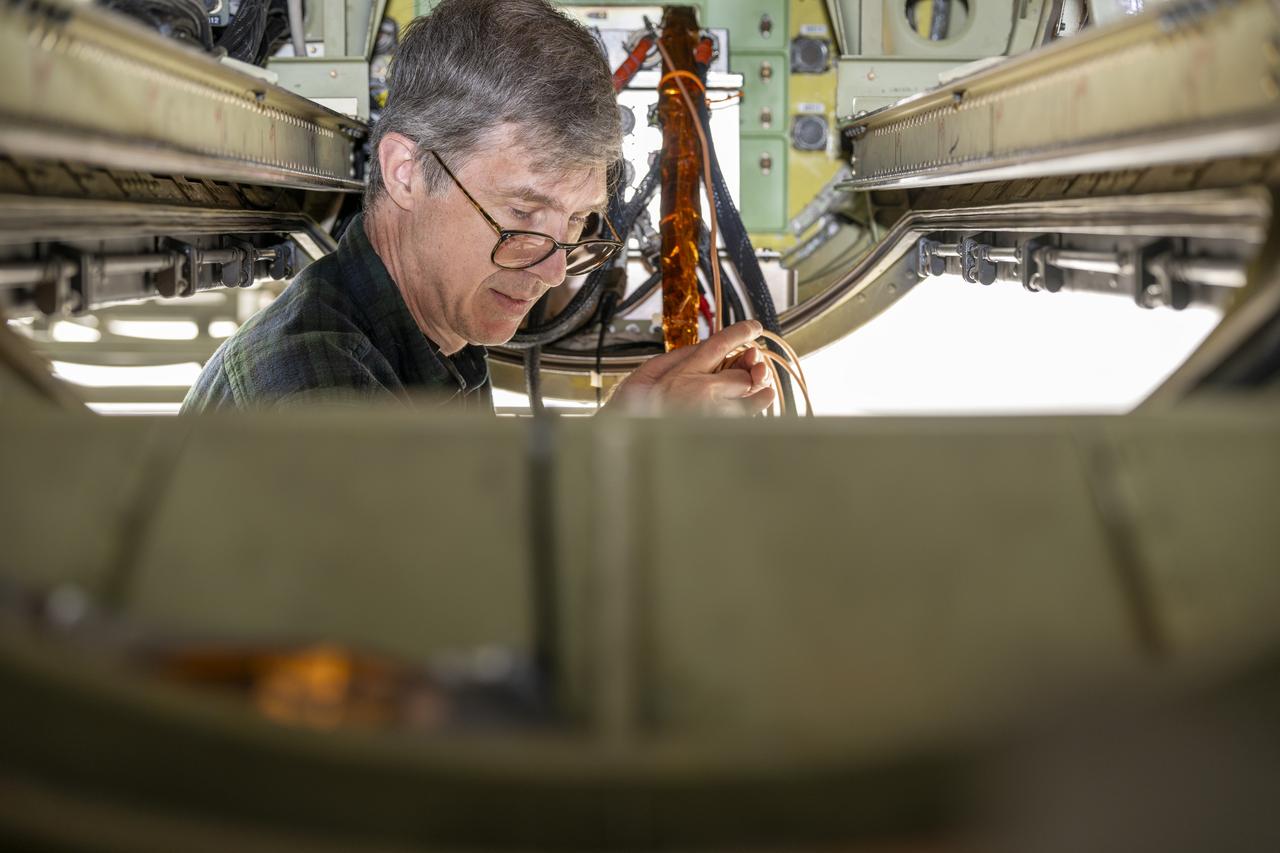
Dr. John Woodward, of the National Institute of Standards and Technology and co-investigator on the airborne Lunar Spectral Irradiance (air-LUSI) mission, prepares the instrument for upload onto the ER-2 aircraft in March 2025 at NASA’s Armstrong Flight Research Center in Edwards, California.
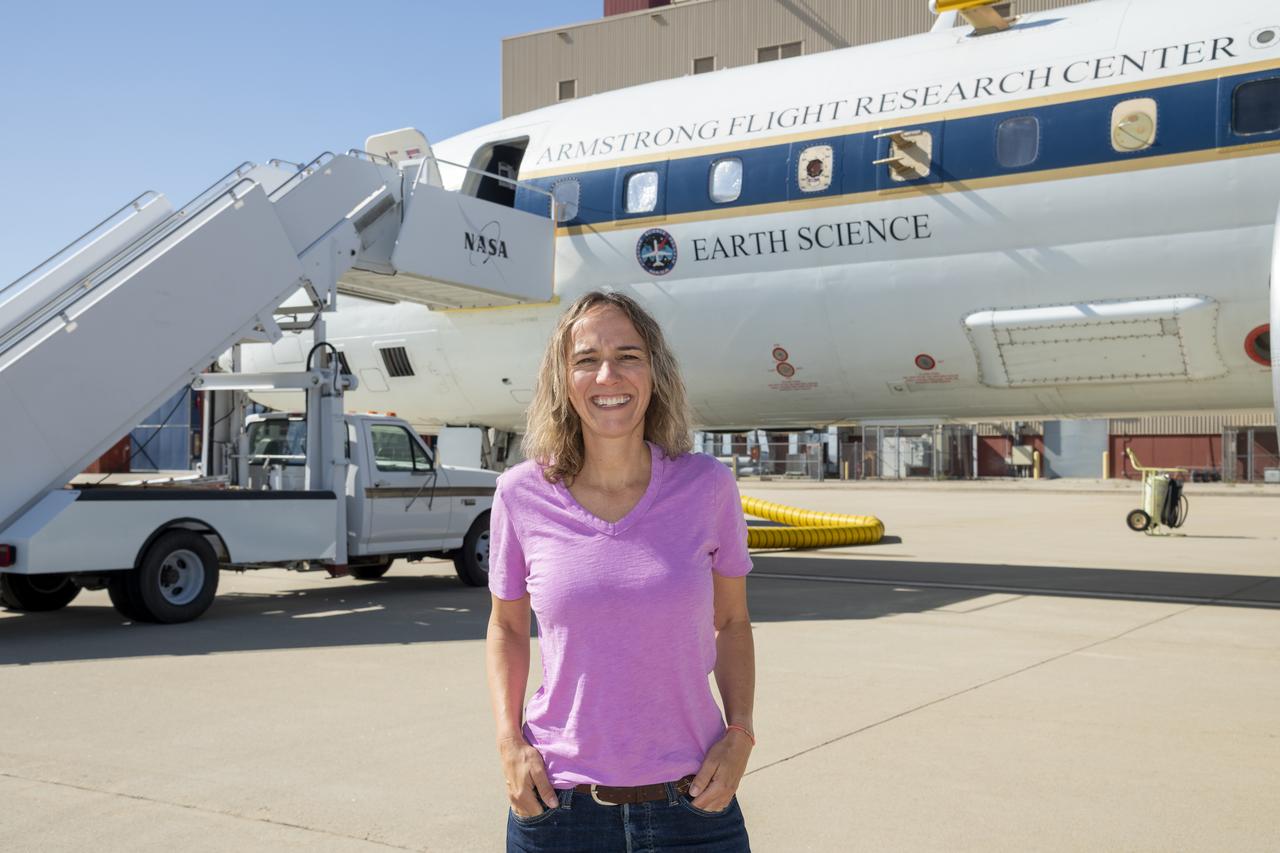
NASA’s Student Airborne Research Program invites Dr. Ann Marie Carlton, Professor of Chemistry at the University of California, Irvine and White House Office of Science and Technology Policy fellow, to fly aboard the DC-8 to measure air quality on June 23, 2022.
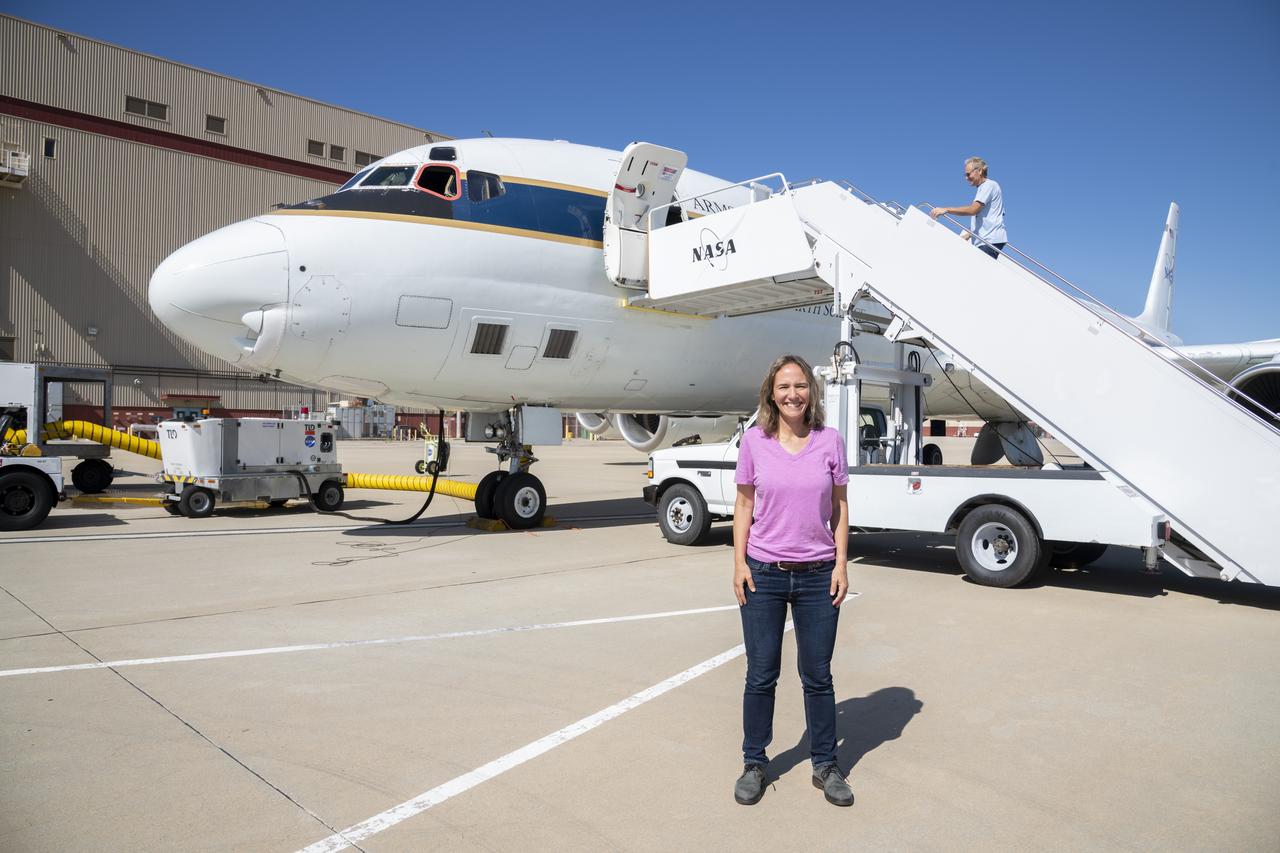
NASA’s Student Airborne Research Program invites Dr. Ann Marie Carlton, Professor of Chemistry at the University of California, Irvine and White House Office of Science and Technology Policy fellow, to fly aboard the DC-8 to measure air quality on June 23, 2022.
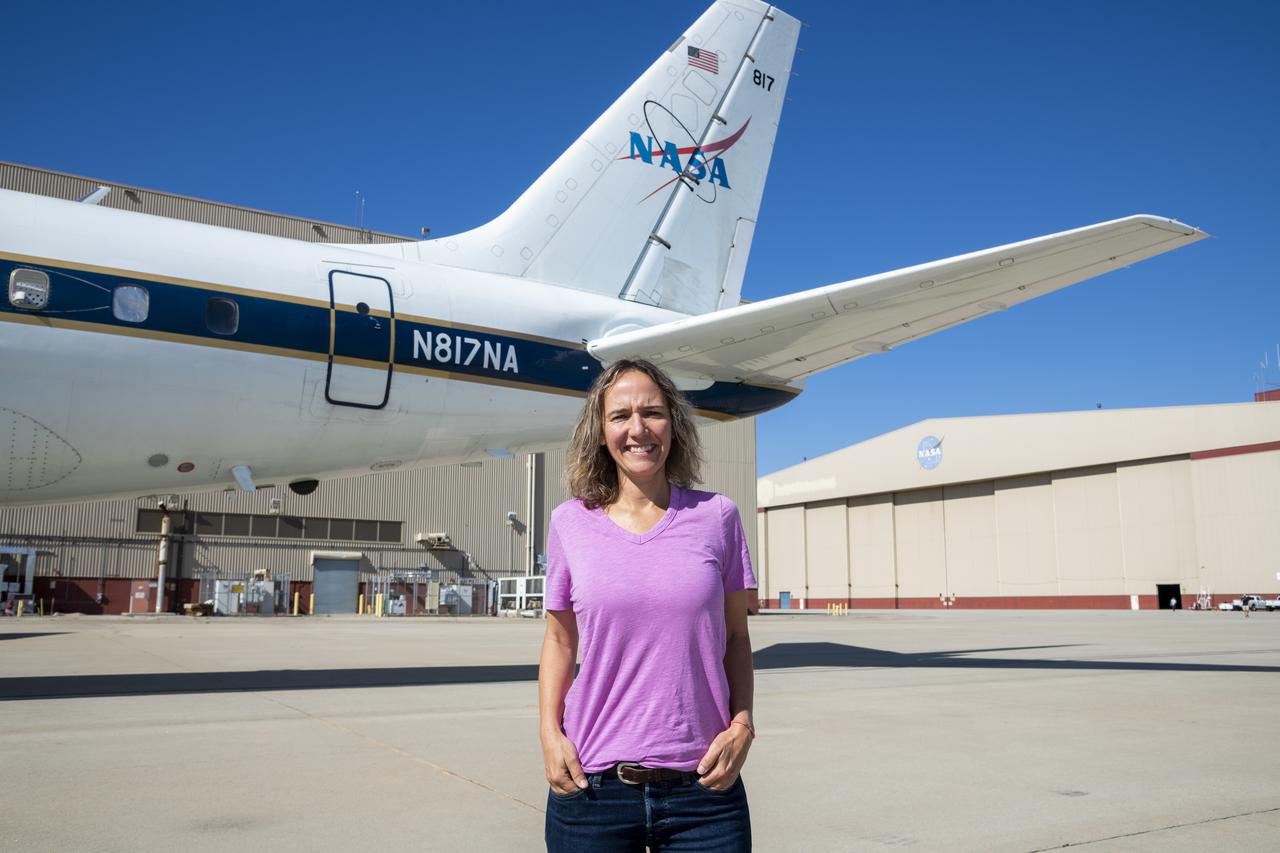
NASA’s Student Airborne Research Program invites Dr. Ann Marie Carlton, Professor of Chemistry at the University of California, Irvine and White House Office of Science and Technology Policy fellow, to fly aboard the DC-8 to measure air quality on June 23, 2022.
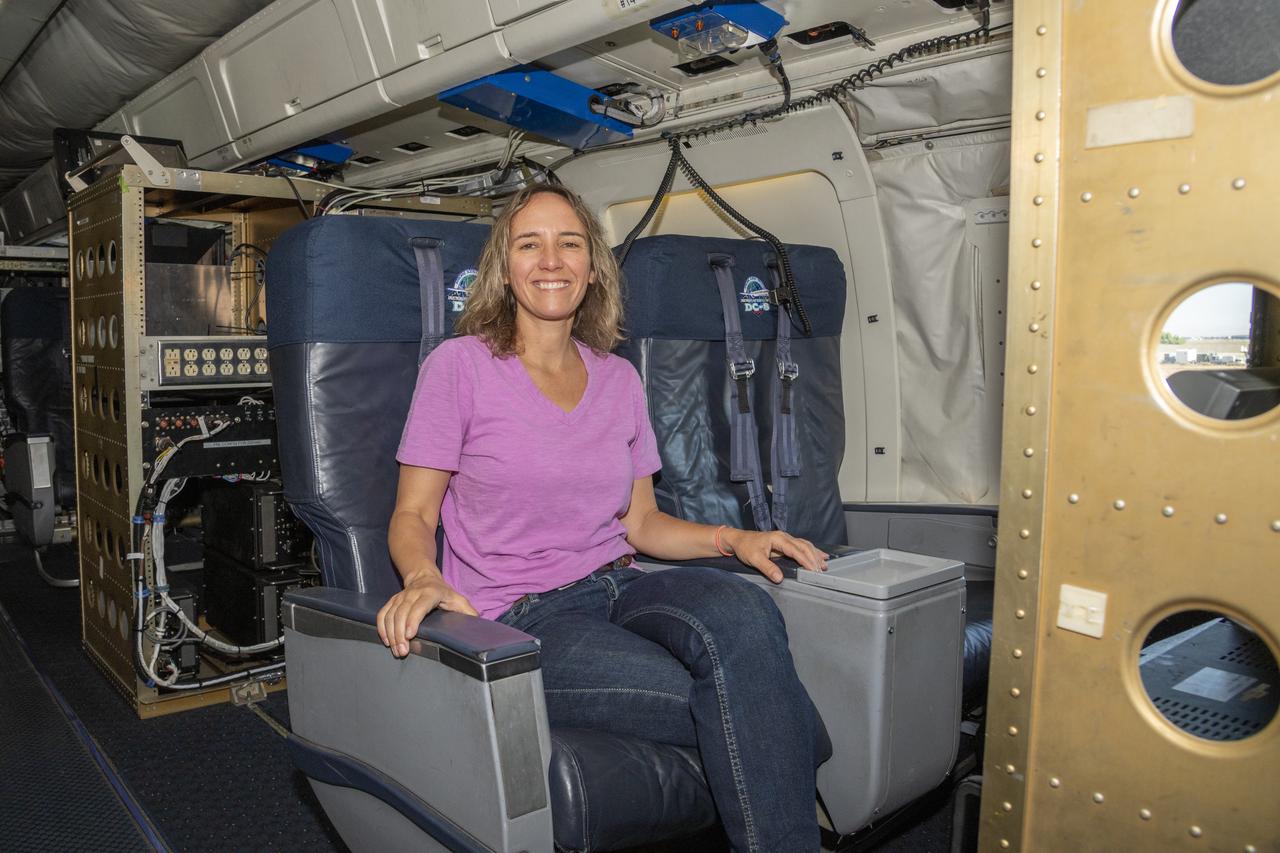
NASA’s Student Airborne Research Program invites Dr. Ann Marie Carlton, Professor of Chemistry at the University of California, Irvine and White House Office of Science and Technology Policy fellow, to fly aboard the DC-8 to measure air quality on June 23, 2022.
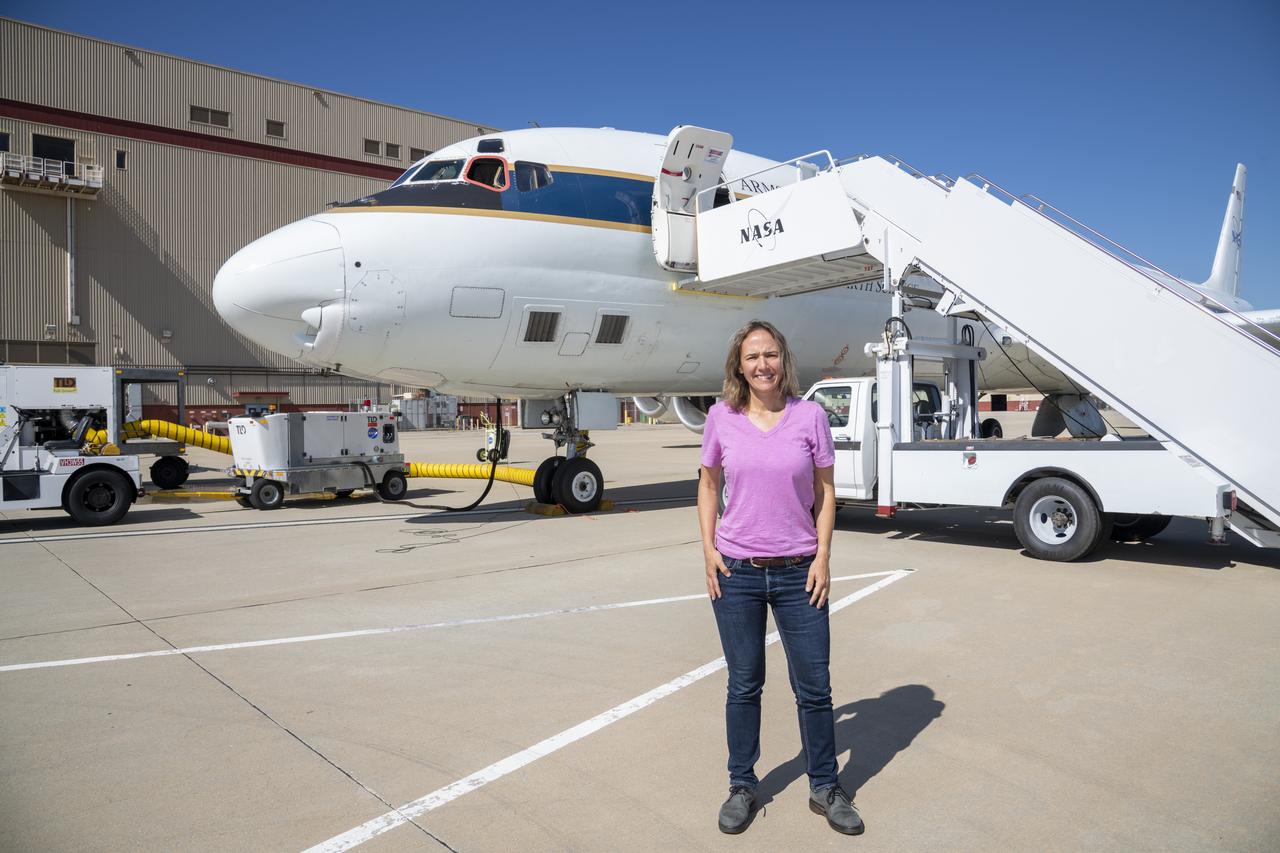
NASA’s Student Airborne Research Program invites Dr. Ann Marie Carlton, Professor of Chemistry at the University of California, Irvine and White House Office of Science and Technology Policy fellow, to fly aboard the DC-8 to measure air quality on June 23, 2022.
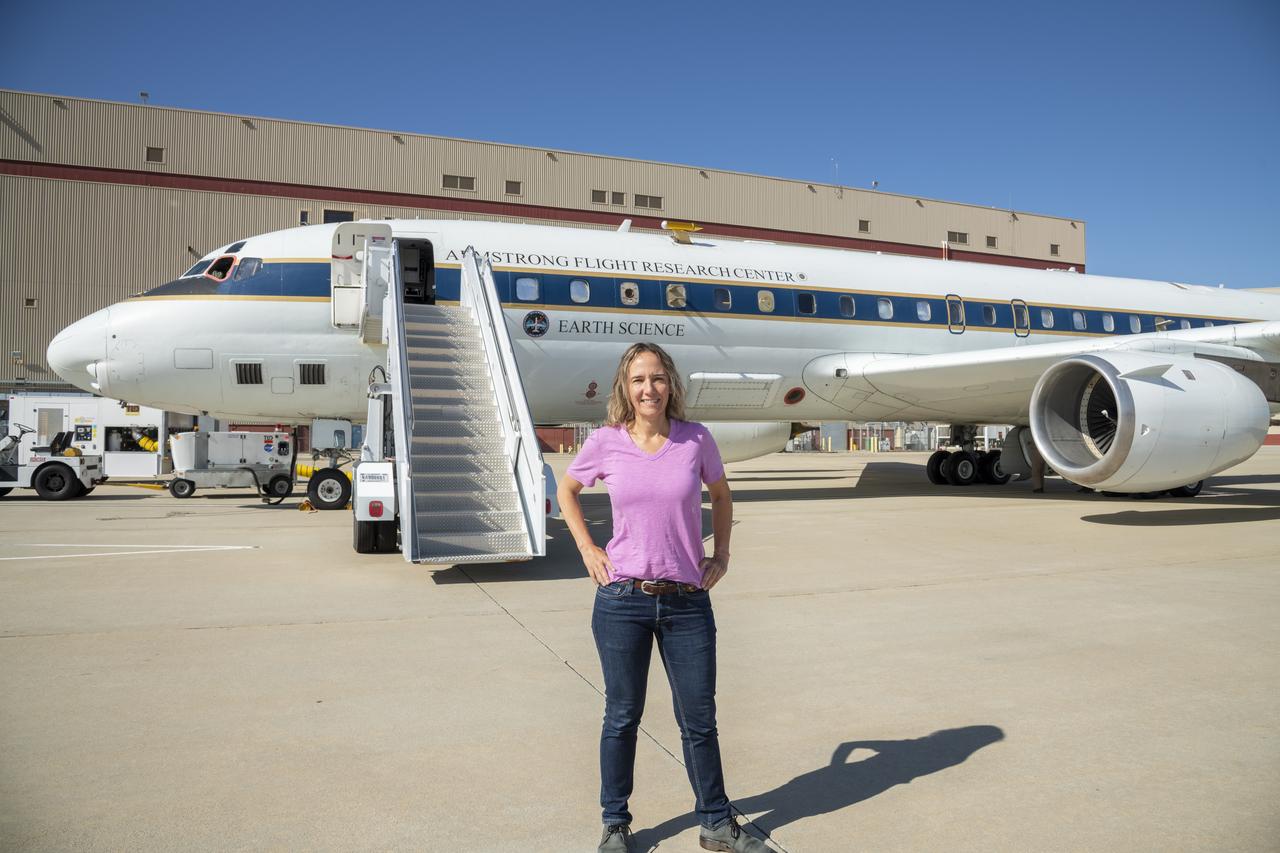
NASA’s Student Airborne Research Program invites Dr. Ann Marie Carlton, Professor of Chemistry at the University of California, Irvine and White House Office of Science and Technology Policy fellow, to fly aboard the DC-8 to measure air quality on June 23, 2022.
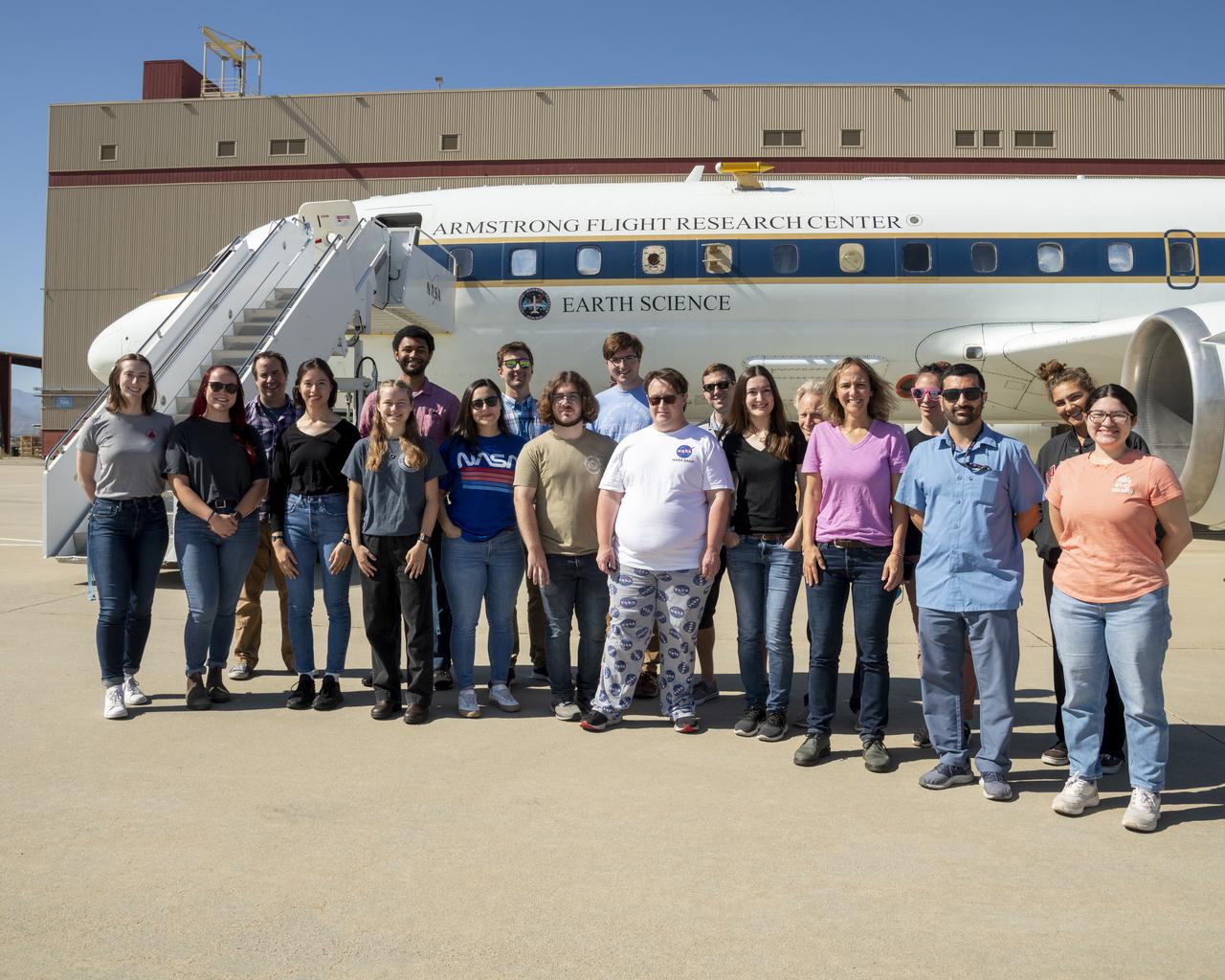
NASA’s Student Airborne Research Program invites Dr. Ann Marie Carlton, Professor of Chemistry at the University of California, Irvine and White House Office of Science and Technology Policy fellow, to fly aboard the DC-8 to measure air quality on June 23, 2022.
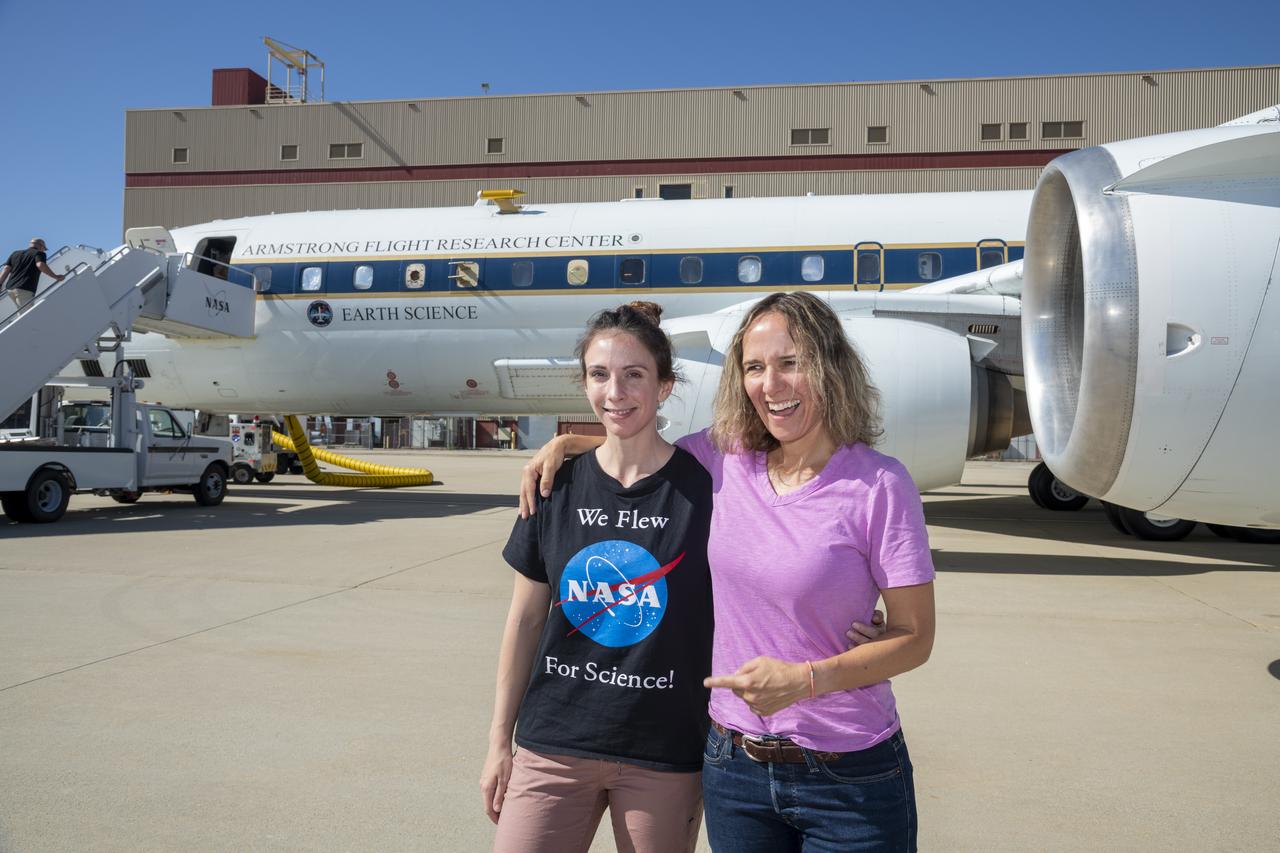
NASA Student Airborne Research Program Manager, Dr. Brenna Biggs and Professor of Chemistry at the University of California, Irvine and White House Office of Science and Technology Policy fellow, Dr. Ann Marie Carlton pose in front of the DC-8 on June 23, 2022.
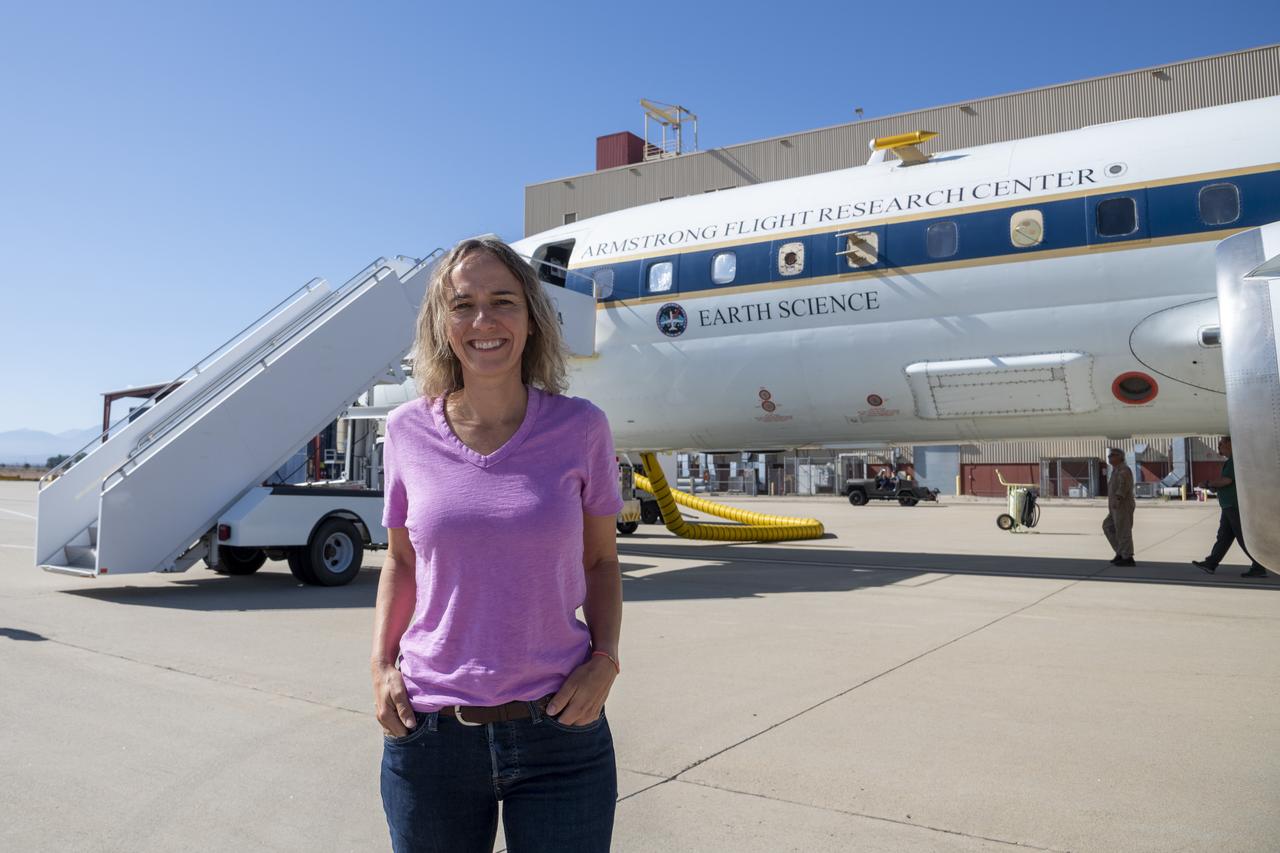
NASA’s Student Airborne Research Program invites Dr. Ann Marie Carlton, Professor of Chemistry at the University of California, Irvine and White House Office of Science and Technology Policy fellow, to fly aboard the DC-8 to measure air quality on June 23, 2022.
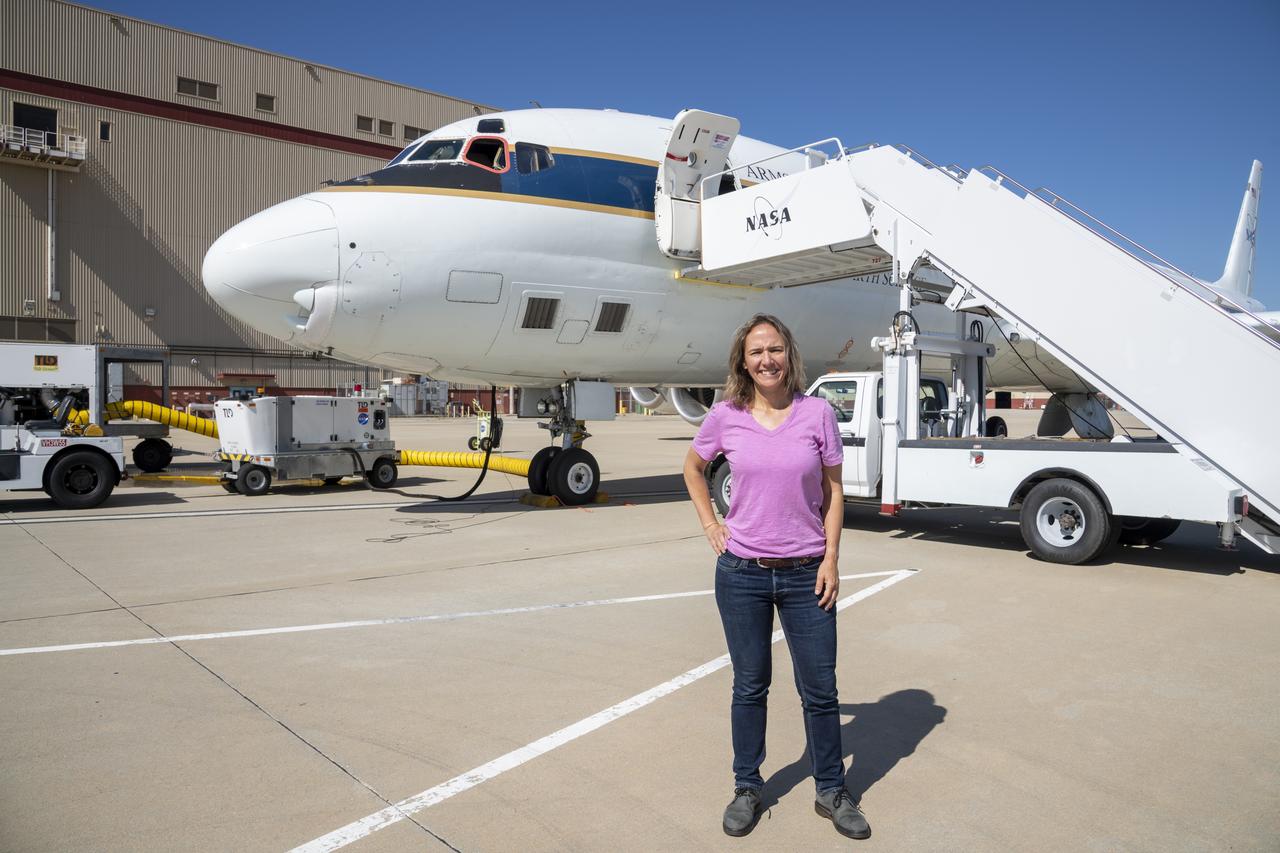
NASA’s Student Airborne Research Program invites Dr. Ann Marie Carlton, Professor of Chemistry at the University of California, Irvine and White House Office of Science and Technology Policy fellow, to fly aboard the DC-8 to measure air quality on June 23, 2022.
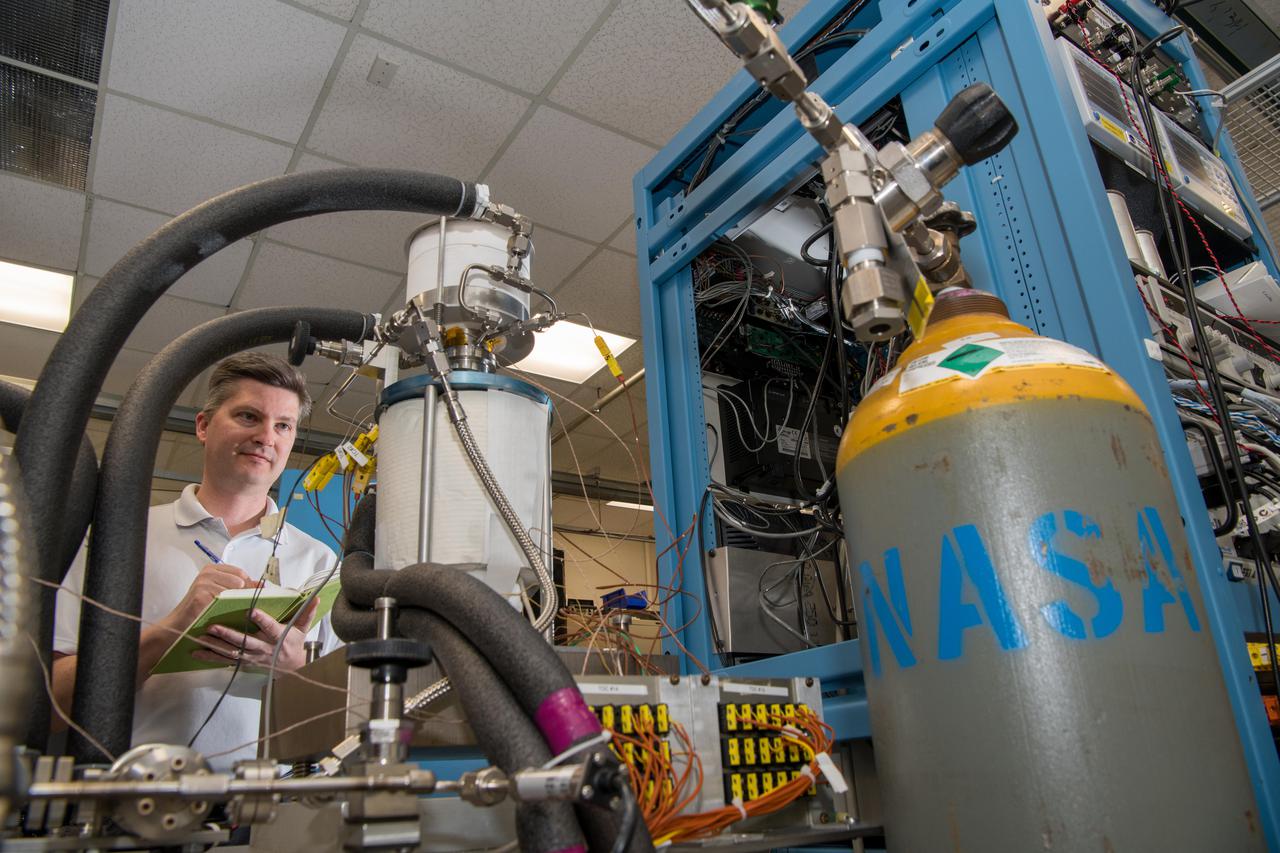
Glenn’s Technology Demonstration Convertor (TDC) #13, a free-piston Stirling power convertor, achieved a milestone of 14 years of maintenance-free operation in the Stirling Research Laboratory in building 301. This technology is proving our capability to power spacecraft on longer-duration future scientific missions.
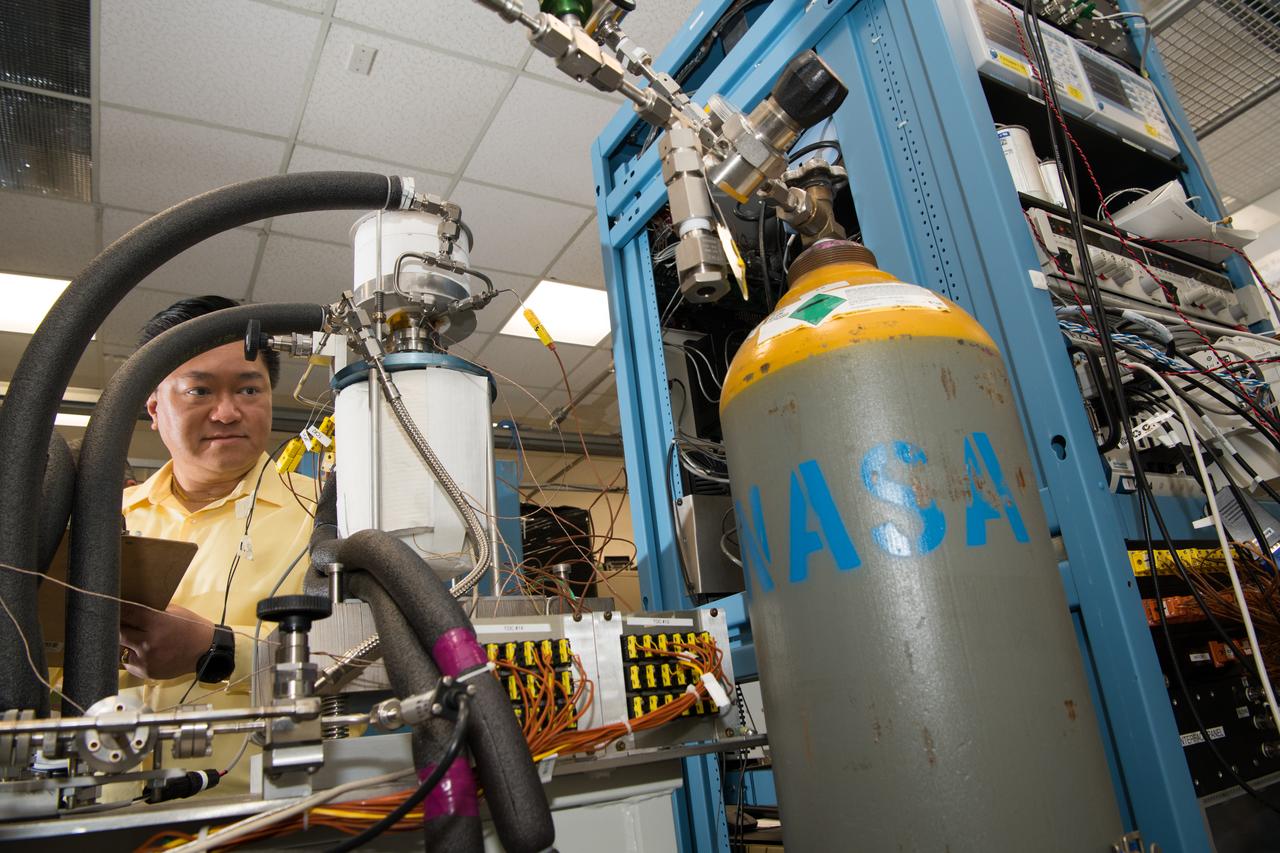
Glenn’s Technology Demonstration Convertor (TDC) #13, a free-piston Stirling power convertor, achieved a milestone of 14 years of maintenance-free operation in the Stirling Research Laboratory in building 301. This technology is proving our capability to power spacecraft on longer-duration future scientific missions.
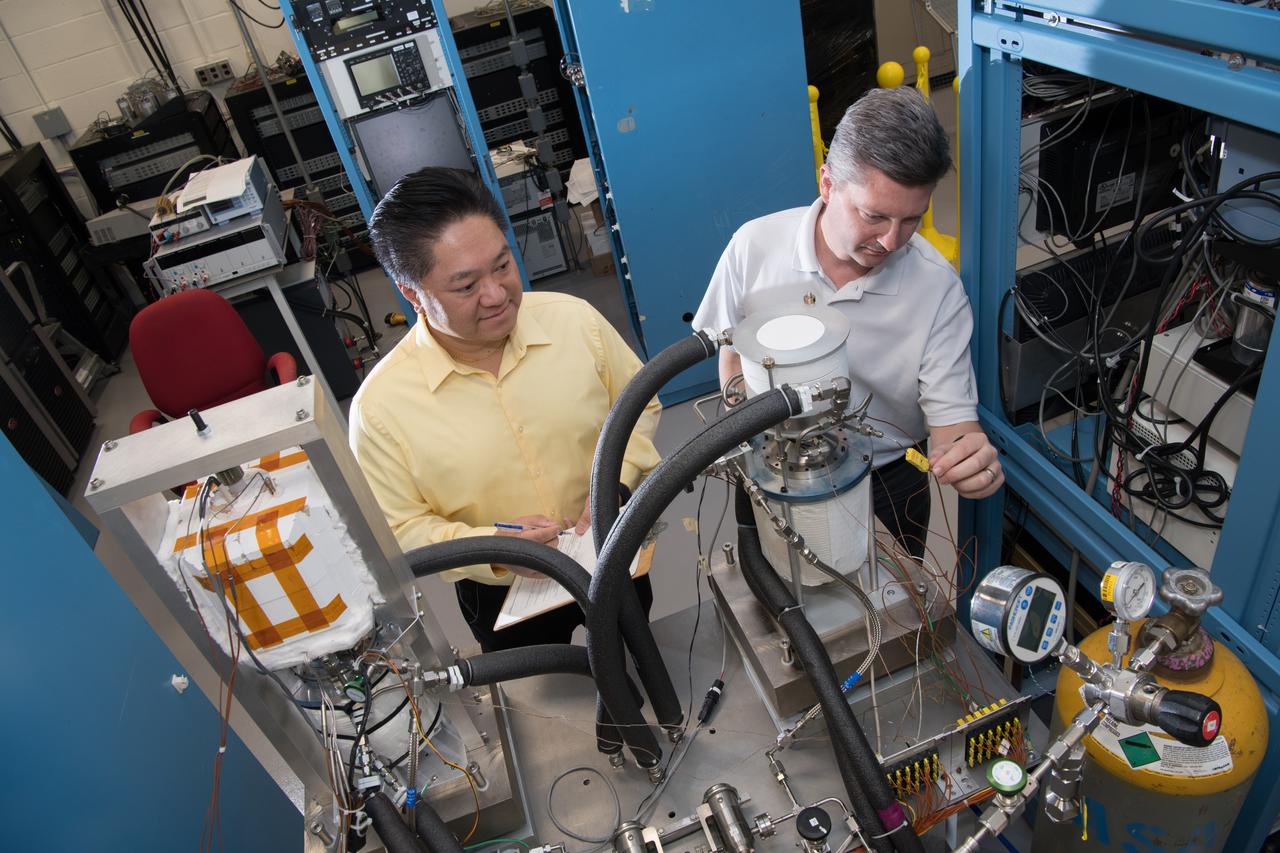
Glenn’s Technology Demonstration Convertor (TDC) #13, a free-piston Stirling power convertor, achieved a milestone of 14 years of maintenance-free operation in the Stirling Research Laboratory in building 301. This technology is proving our capability to power spacecraft on longer-duration future scientific missions.
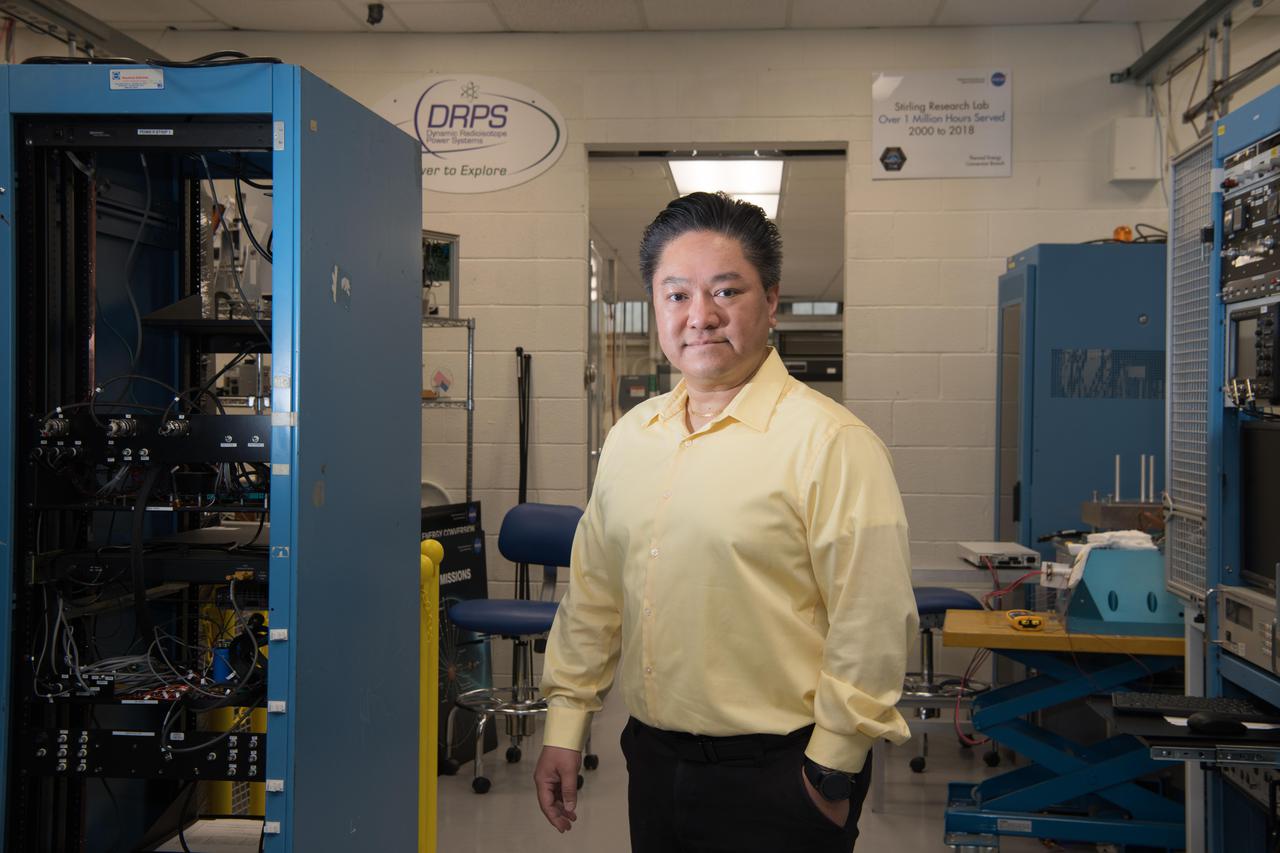
Glenn’s Technology Demonstration Convertor (TDC) #13, a free-piston Stirling power convertor, achieved a milestone of 14 years of maintenance-free operation in the Stirling Research Laboratory in building 301. This technology is proving our capability to power spacecraft on longer-duration future scientific missions.
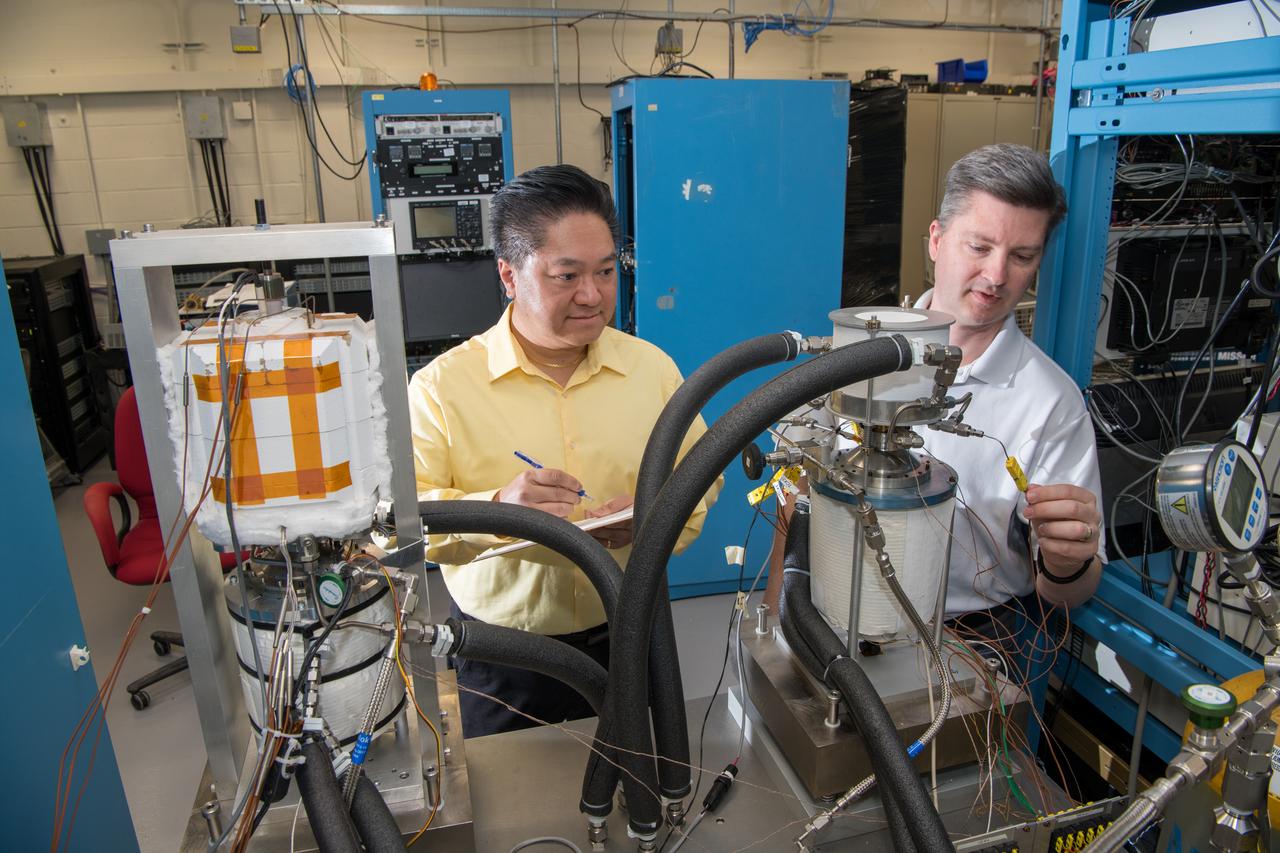
Glenn’s Technology Demonstration Convertor (TDC) #13, a free-piston Stirling power convertor, achieved a milestone of 14 years of maintenance-free operation in the Stirling Research Laboratory in building 301. This technology is proving our capability to power spacecraft on longer-duration future scientific missions.
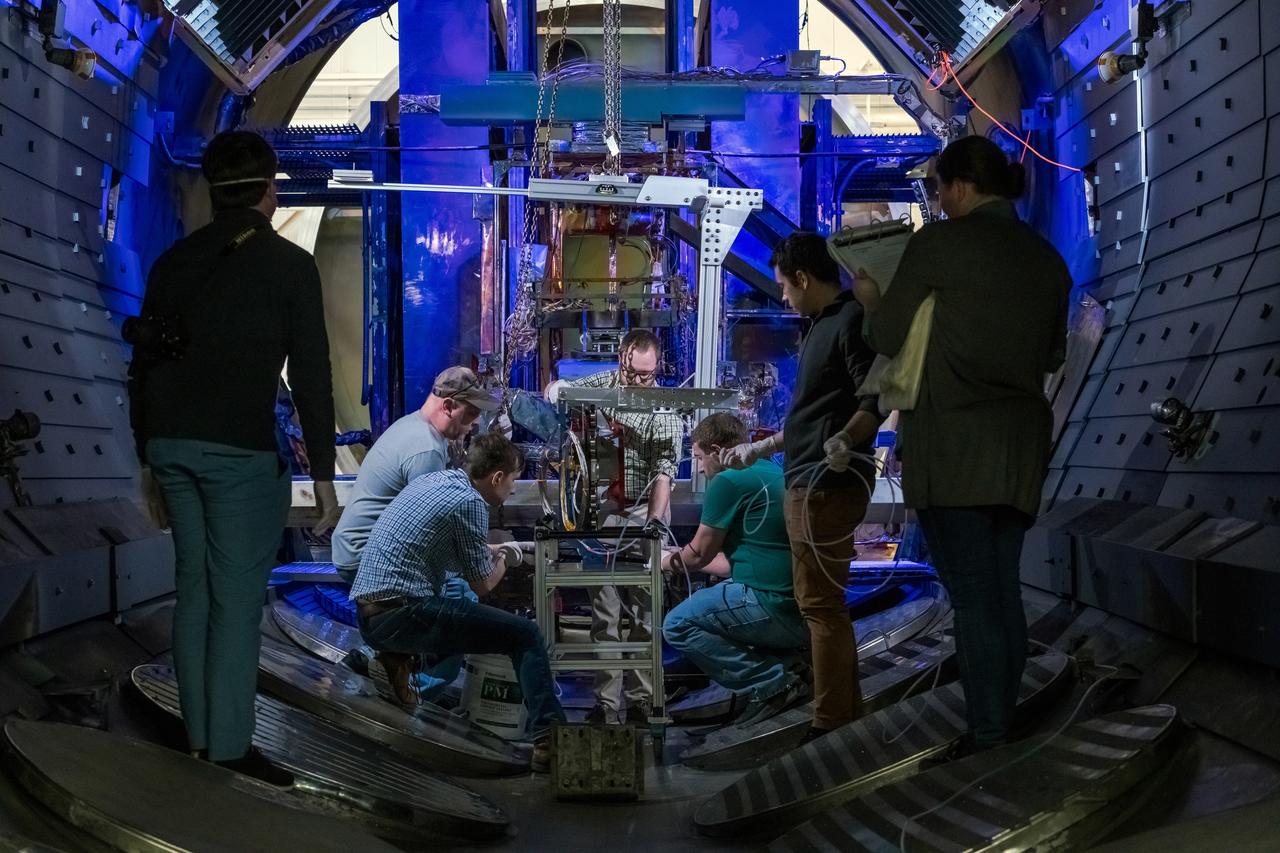
NASA Glenn Research Center has received the first of three Advanced Electric Propulsion System (AEPS) thrusters for the Gateway lunar space station. Built by L3Harris Technologies, the thruster will undergo testing before integration with Gateway’s Power and Propulsion Element, launching with the HALO module ahead of Artemis IV.

NASA Glenn Research Center has received the first of three Advanced Electric Propulsion System (AEPS) thrusters for the Gateway lunar space station. Built by L3Harris Technologies, the thruster will undergo testing before integration with Gateway’s Power and Propulsion Element, launching with the HALO module ahead of Artemis IV.
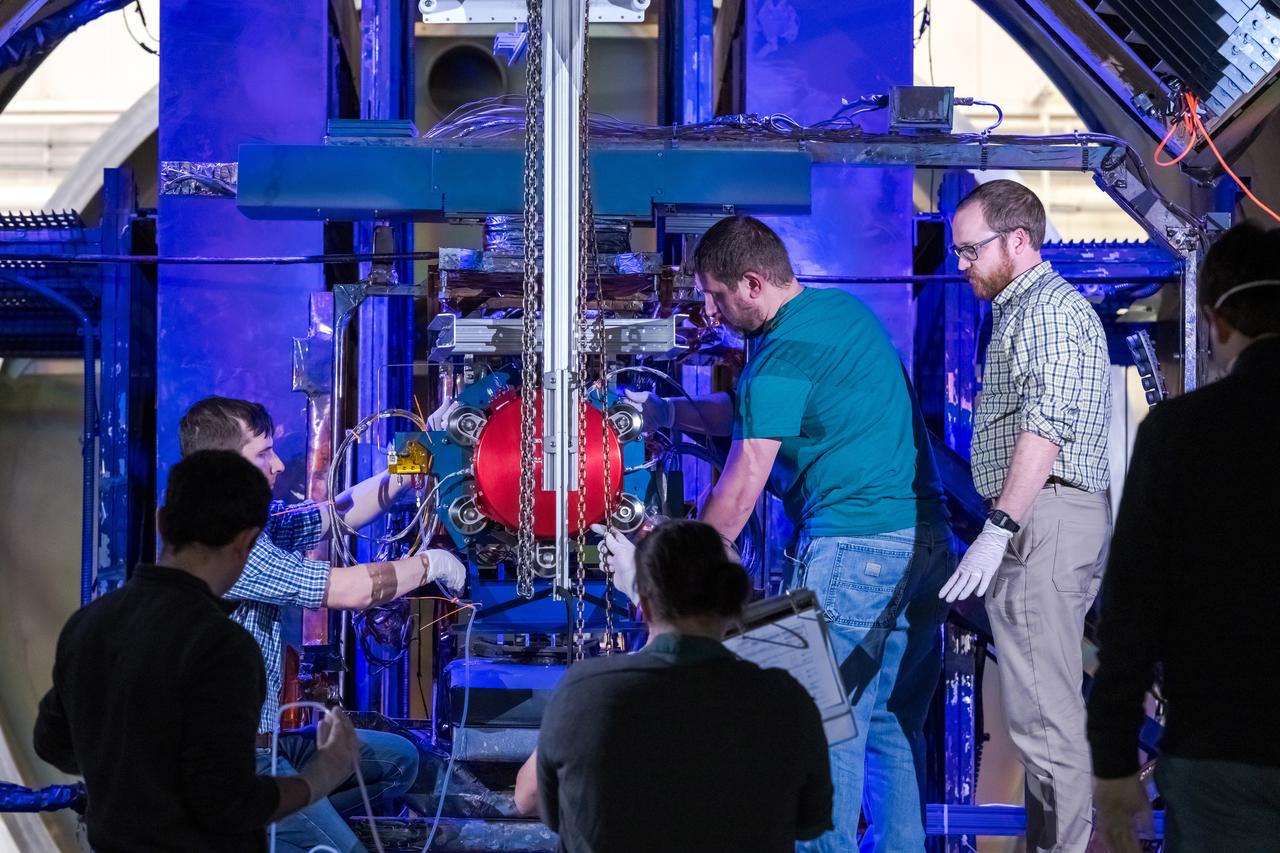
NASA Glenn Research Center has received the first of three Advanced Electric Propulsion System (AEPS) thrusters for the Gateway lunar space station. Built by L3Harris Technologies, the thruster will undergo testing before integration with Gateway’s Power and Propulsion Element, launching with the HALO module ahead of Artemis IV.
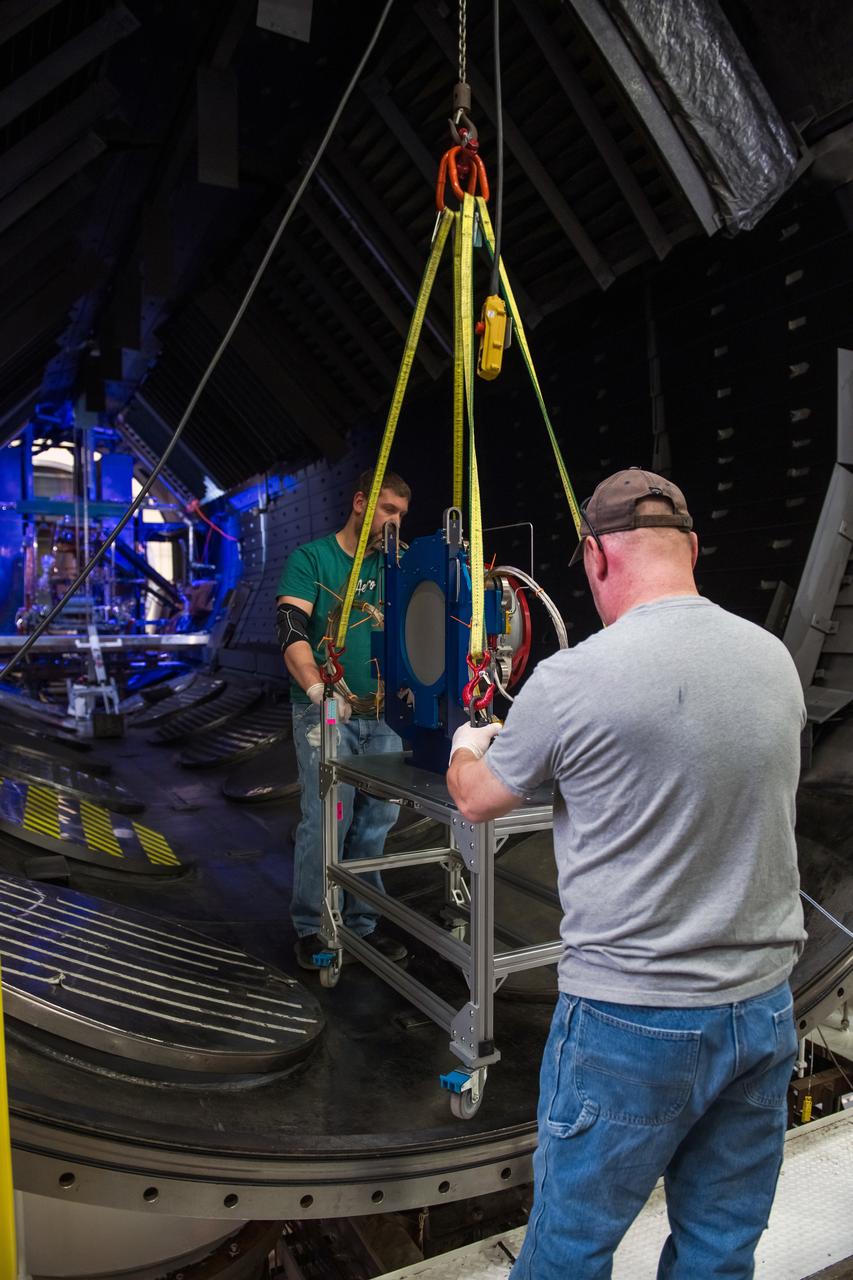
NASA Glenn Research Center has received the first of three Advanced Electric Propulsion System (AEPS) thrusters for the Gateway lunar space station. Built by L3Harris Technologies, the thruster will undergo testing before integration with Gateway’s Power and Propulsion Element, launching with the HALO module ahead of Artemis IV.

NASA Glenn Research Center has received the first of three Advanced Electric Propulsion System (AEPS) thrusters for the Gateway lunar space station. Built by L3Harris Technologies, the thruster will undergo testing before integration with Gateway’s Power and Propulsion Element, launching with the HALO module ahead of Artemis IV.
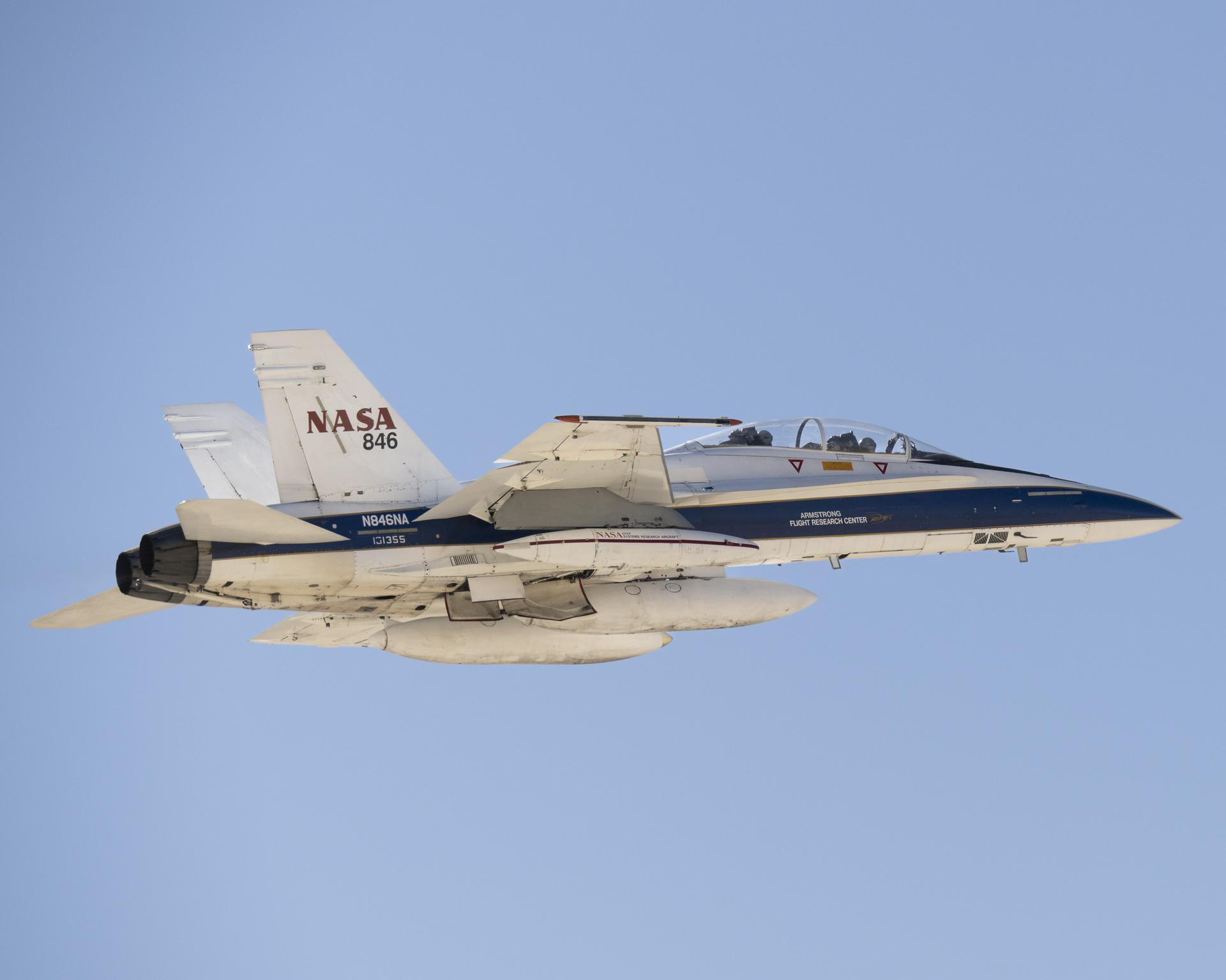
A NASA F/A-18 research aircraft flies near NASA’s Armstrong Flight Research Center in Edwards, California, on Feb. 24, 2025, testing a commercial precision landing technology for future space missions. The Psionic Space Navigation Doppler Lidar (PSNDL) system is installed in a pod located under the right wing of the aircraft.
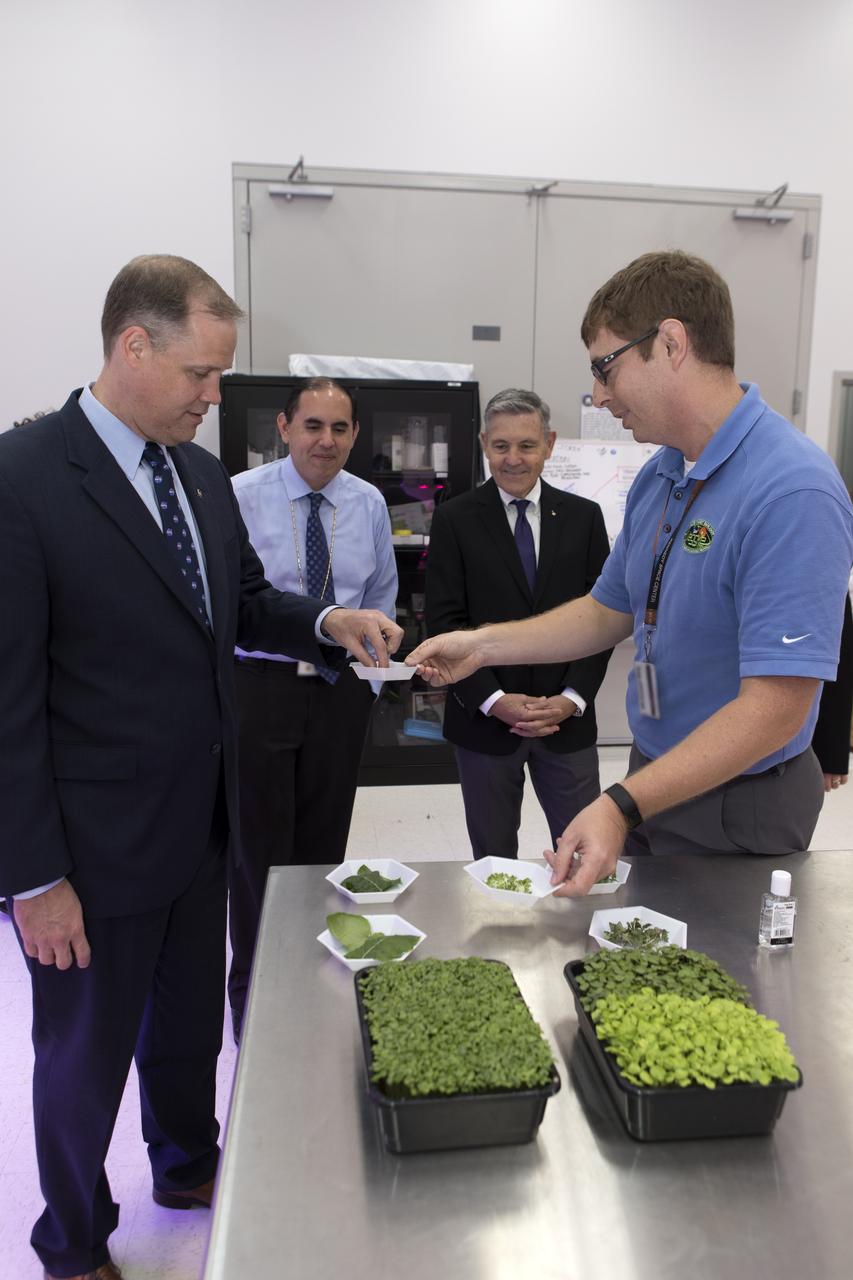
NASA Administrator Jim Bridenstine, far left, tours a plant research laboratory inside the Space Station Processing Facility (SSPF) at NASA's Kennedy Space Center in Florida, on Aug. 7, 2018. Bridenstine selects a microgreen to sample from Matt Romeyn, project scientist. Behind Bridenstine, from left, are Bryan Onate, Advanced Plant Habitat project manager, and Kennedy Space Center Director Bob Cabana. Bridenstine received updates on research and technology accomplishments during his visit to the SSPF.
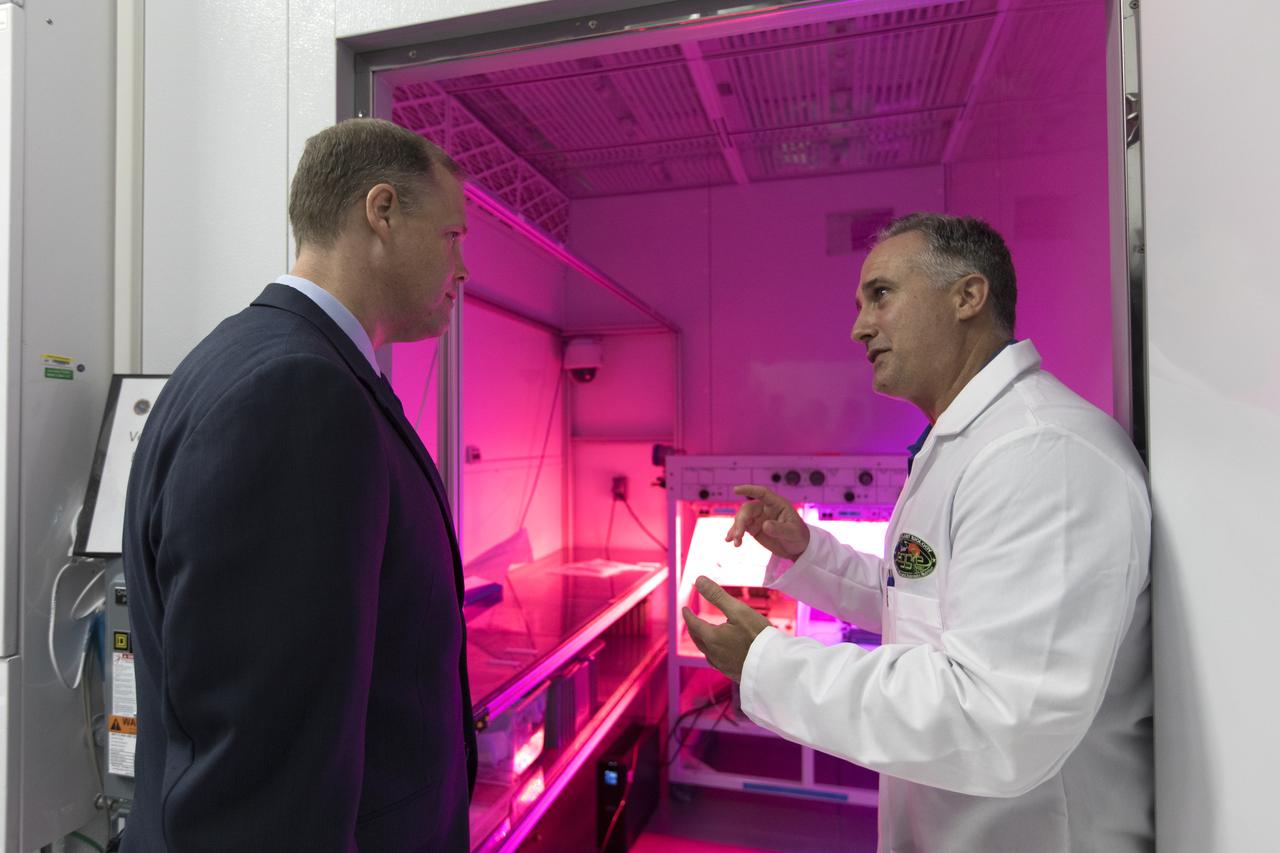
NASA Administrator Jim Bridenstine, at left, tours the Space Station Processing Facility at NASA's Kennedy Space Center in Florida, on Aug. 7, 2018. At right, Trent Smith, Veggie project manager, provides an update on the Veggie plant growth system on the International Space Station, and the control system in the laboratory. Bridenstine also received updates on research and technology accomplishments.
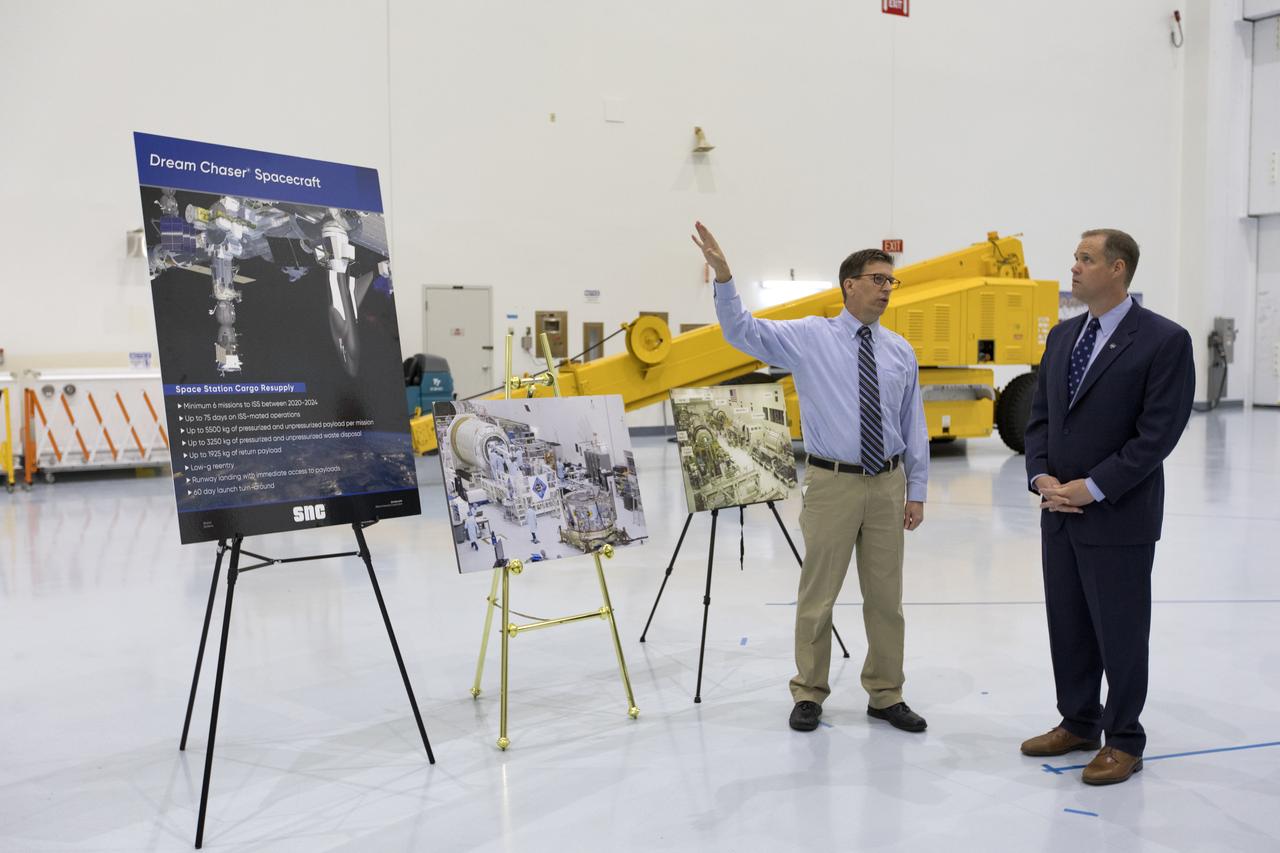
During a tour of the high bay in the Space Station Processing Facility (SSPF) at NASA's Kennedy Space Center in Florida, on Aug. 7, 2018, NASA Administrator Jim Bridenstine, hears about progress made on Sierra Nevada Corporation's Dream Chaser spacecraft. Dream Chaser will take cargo to the International Space Station. Bridenstine also received updates on research and technology accomplishments during his visit to the SSPF.
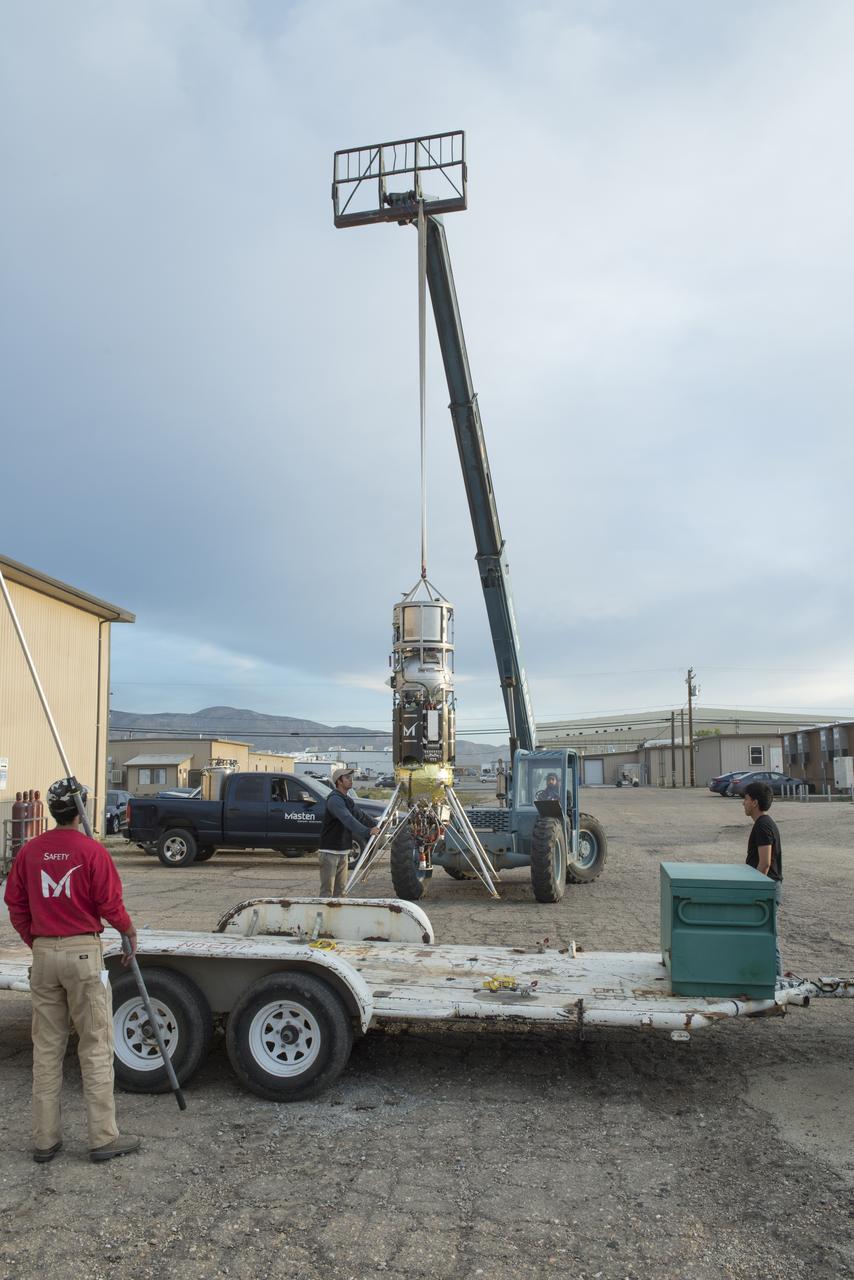
Masten Space Systems’ technician making adjustments to NASA’s autonomous landing technologies payload on Masten’s Xodiac rocket.
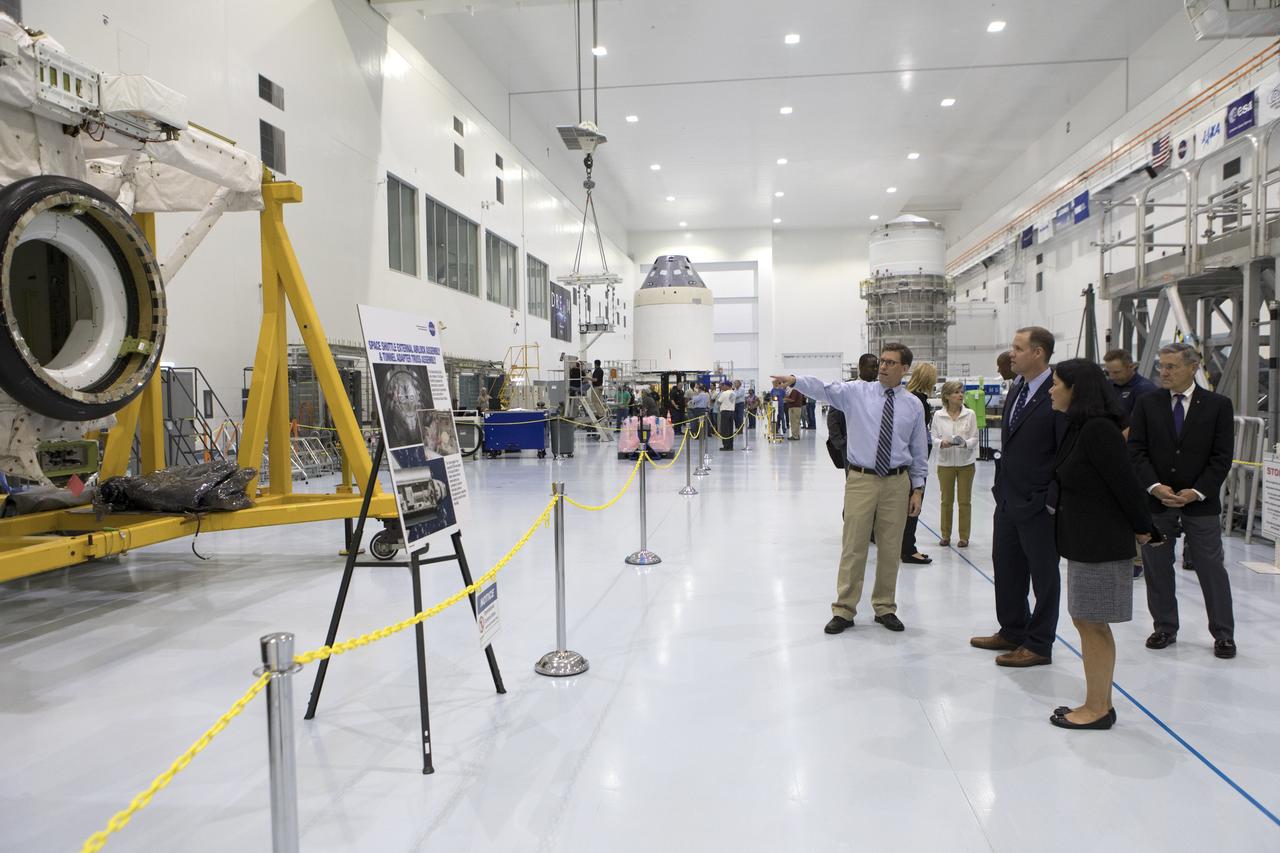
NASA Administrator Jim Bridenstine, second from right, views space hardware in the high bay inside the Space Station Processing Facility (SSPF), on Aug. 7, 2018, at NASA's Kennedy Space Center in Florida. To his right is Josie Burnett, director of Exploration Research and Technology. Behind them, at right is the Interim Cryogenic Propulsion Stage, which will connect between the Orion spacecraft and the upper part of NASA's Space Launch System. In the center is a mockup of the Orion spacecraft. Bridenstine received updates on research and technology accomplishments during his visit to the SSPF.
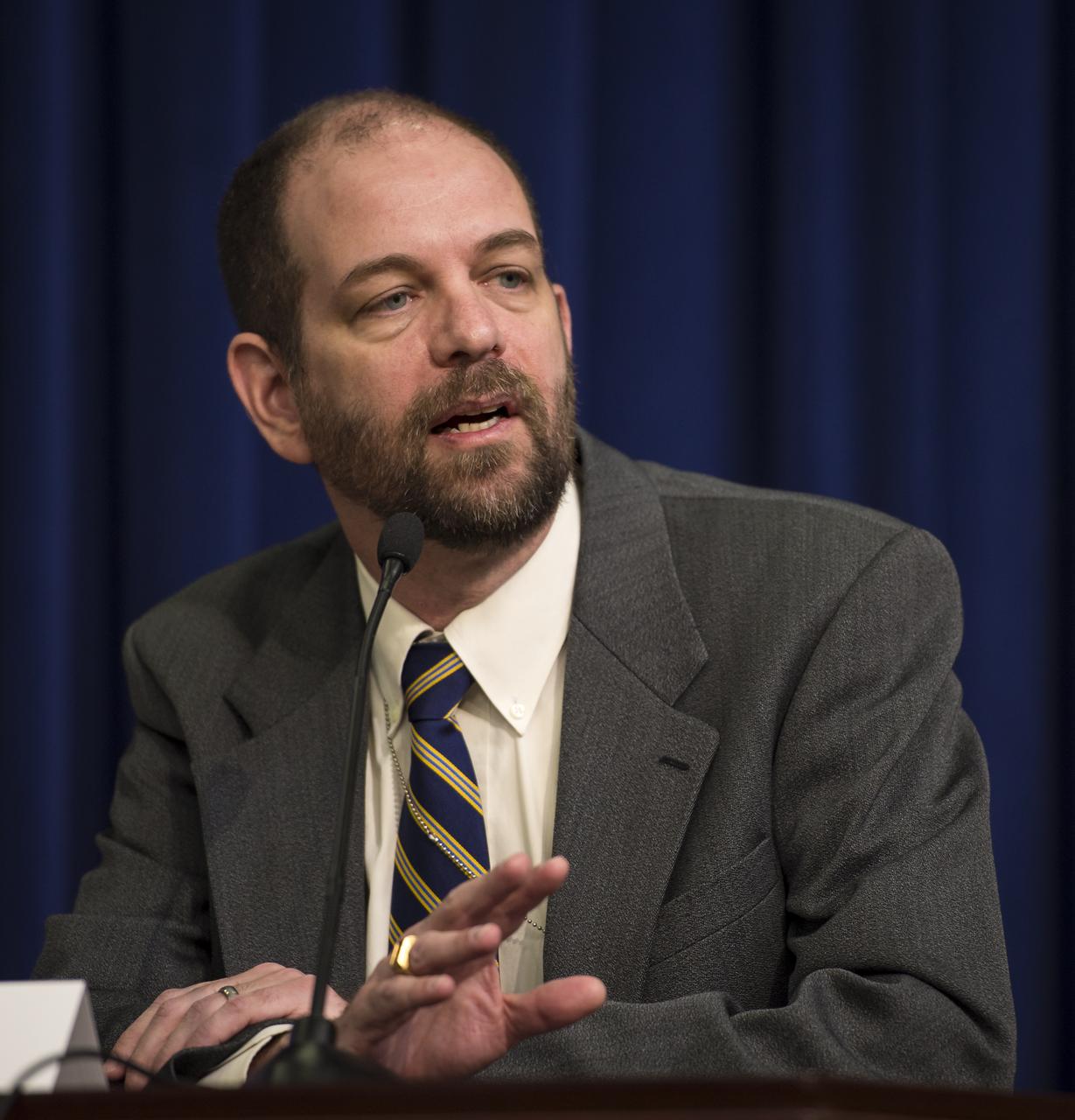
Defense Advanced Research Projects Agency (DARPA) Gill Pratt speaks at the annual White House State of Science, Technology, Engineering, and Math (SoSTEM) address, Wednesday, Jan. 29, 2014, in the South Court Auditorium in the Eisenhower Executive Office Building on the White House complex in Washington. Photo Credit: (NASA/Bill Ingalls)
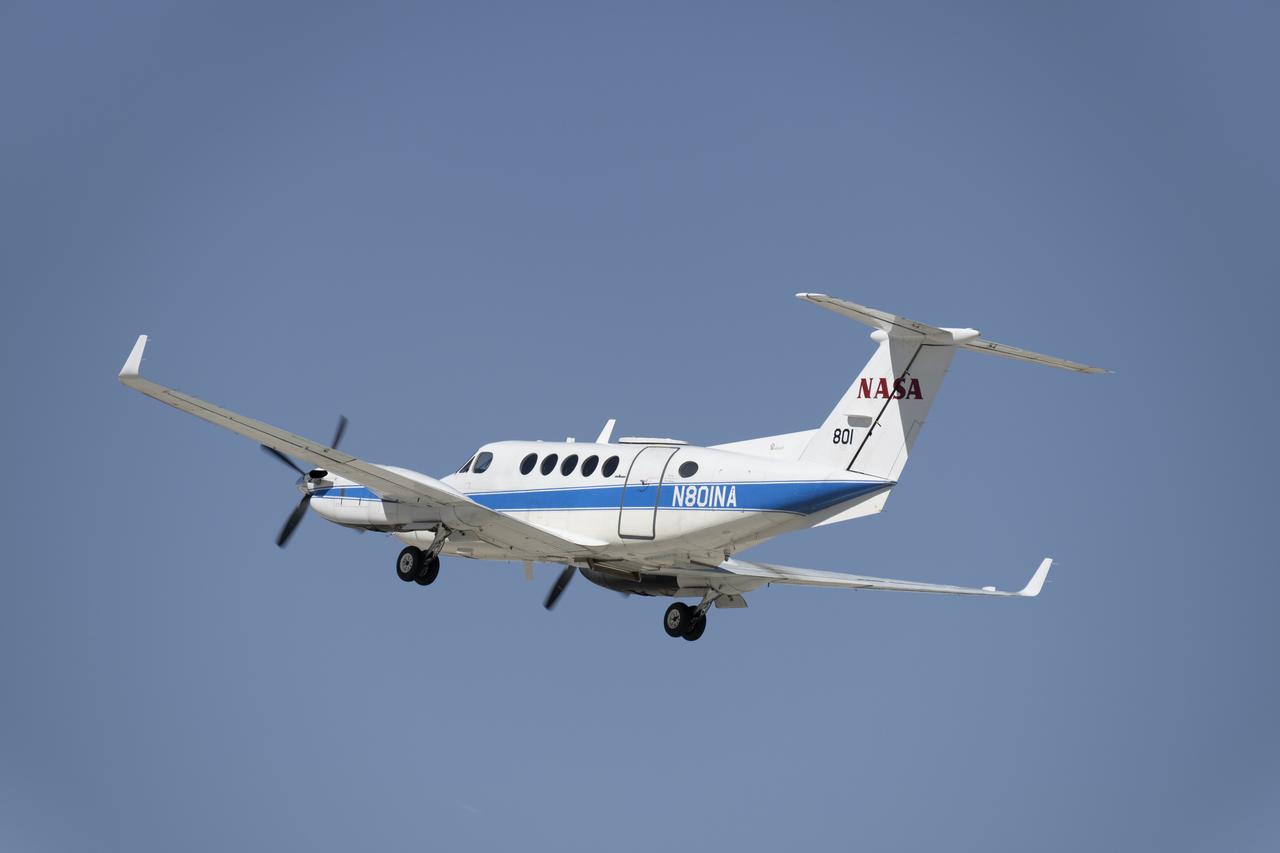
NASA’s B200 King Air aircraft – based at NASA’s Armstrong Flight Research Center in Edwards, California – ascends to support a prescribed burn in Geneva State Forest, about 100 miles south of Montgomery, Alabama, on March 17, 2025. The effort is part of NASA’s multi-year FireSense project, which aims to test technology that predicts fire and smoke behavior. This data could eventually benefit the U.S. Forest Service as well as local, state, and other federal wildland fire agencies.
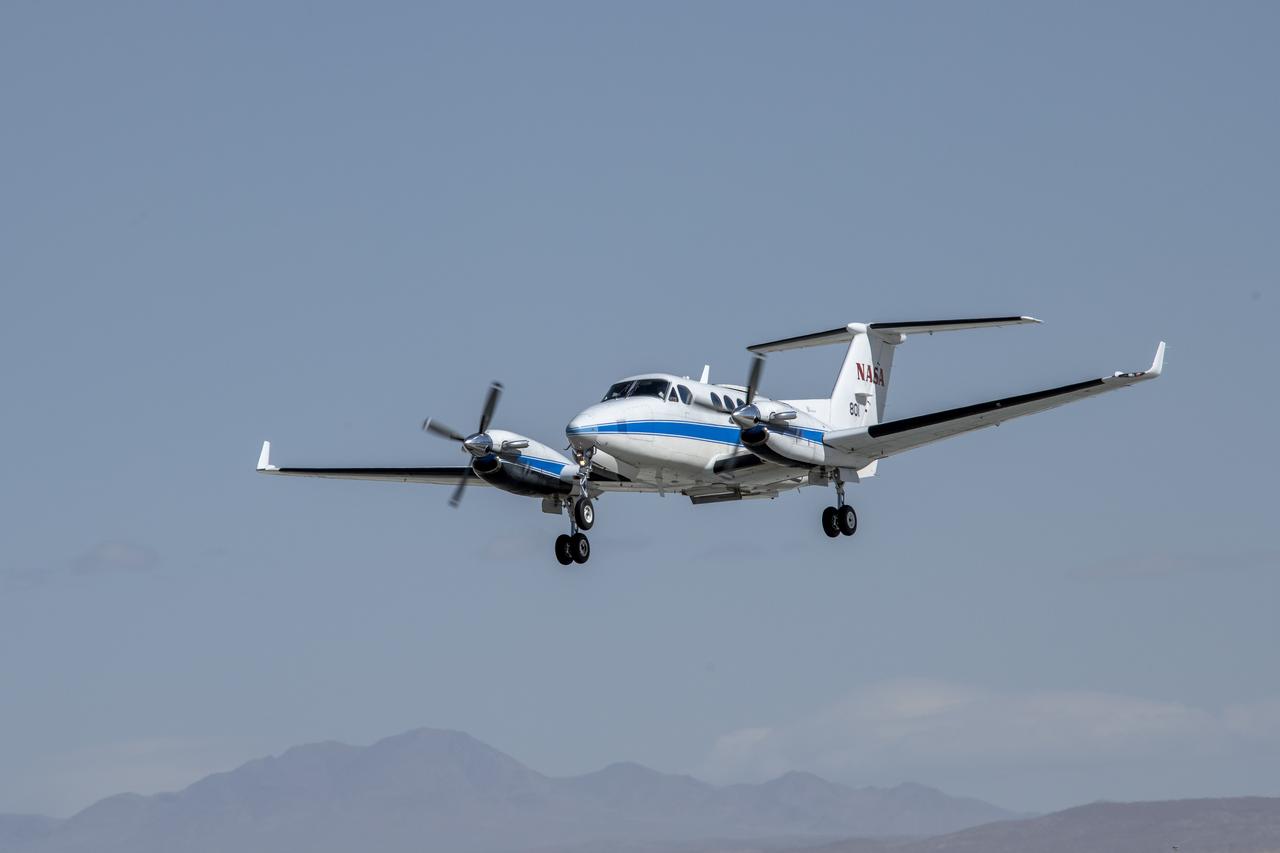
NASA’s B200 King Air aircraft – based at NASA’s Armstrong Flight Research Center in Edwards, California – ascends to support a prescribed burn in Geneva State Forest, about 100 miles south of Montgomery, Alabama, on March 17, 2025. The effort is part of NASA’s multi-year FireSense project, which aims to test technology that predicts fire and smoke behavior. This data could eventually benefit the U.S. Forest Service as well as local, state, and other federal wildland fire agencies.

The DC-8 flies low for the last time over NASA’s Armstrong Flight Research Center in Edwards, California, before it retires to Idaho State University in Pocatello, Idaho. The DC-8 will provide real-world experience to train future aircraft technicians at the college’s Aircraft Maintenance Technology Program.
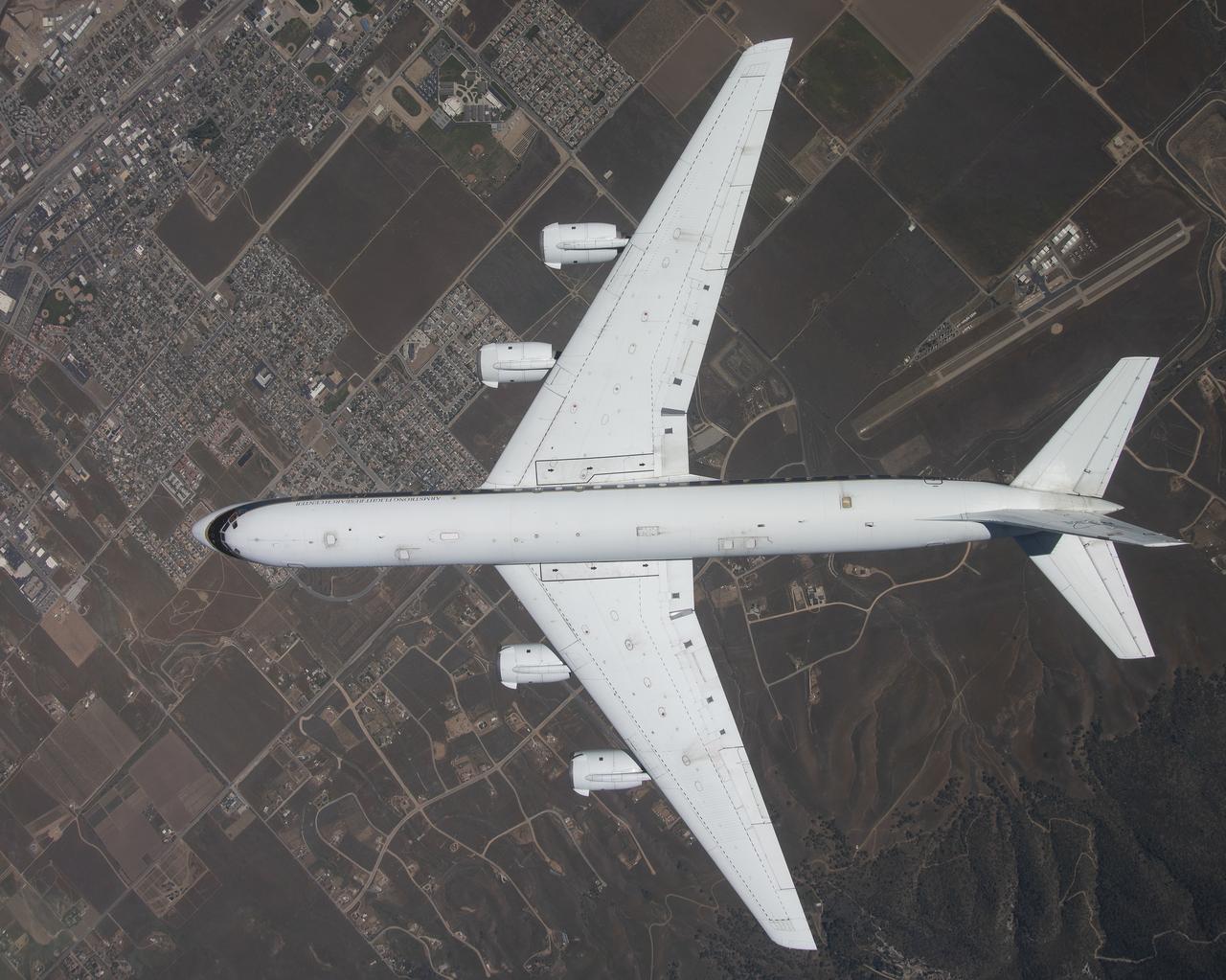
The DC-8 is shown overhead during its final flight from NASA’s Armstrong Flight Research Center Building 703 in Palmdale, California, before it retires to Idaho State University in Pocatello, Idaho. The DC-8 will provide real-world experience to train future aircraft technicians at the college’s Aircraft Maintenance Technology Program.
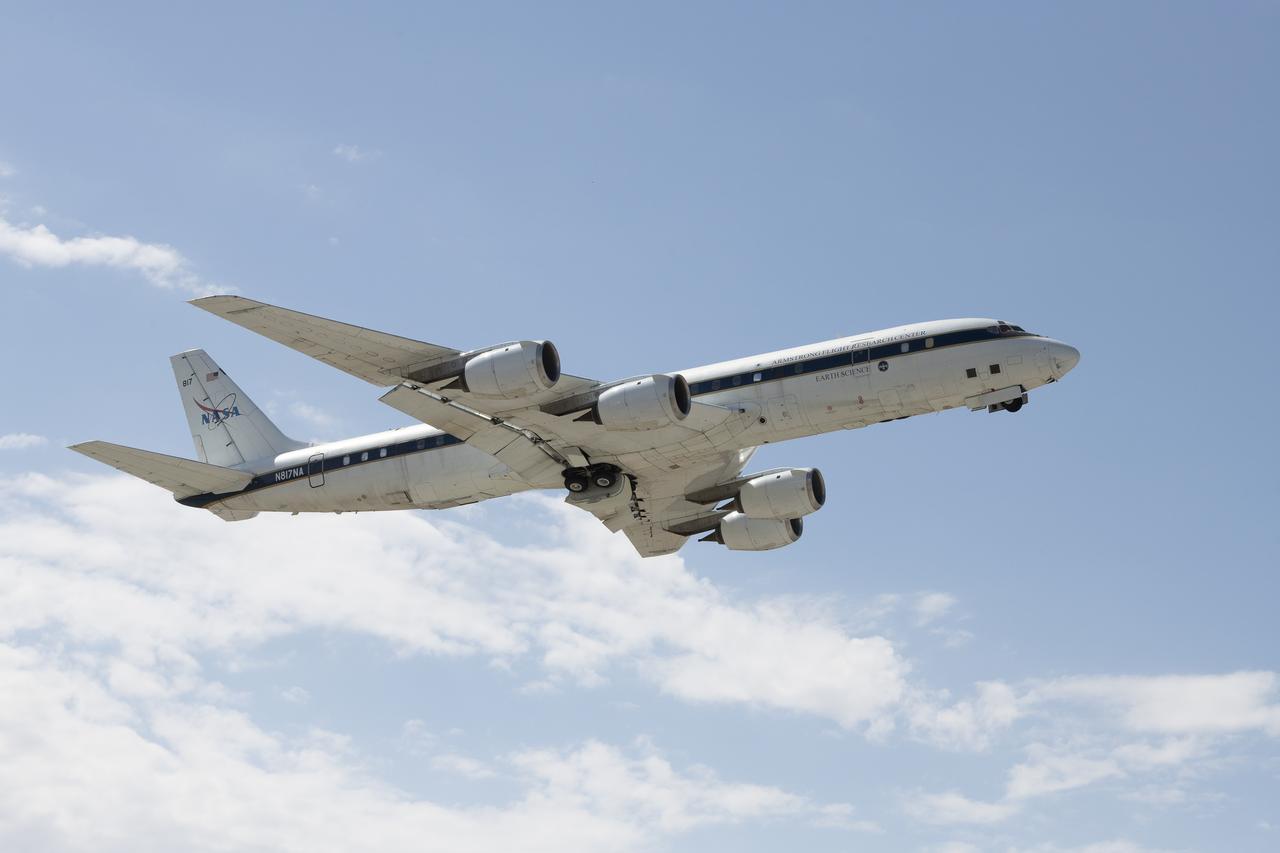
The DC-8 ascents during its final flight before it is retired from NASA’s Armstrong Flight Research Center Building 703 in Palmdale, California, to Idaho State University in Pocatello, Idaho. The DC-8 will provide real-world experience to train future aircraft technicians at the college’s Aircraft Maintenance Technology Program.