KENNEDY SPACE CENTER, FLA. - In the Remote Manipulator System lab, United Space Alliance technicians Jake Senior and Todd Dugan work on the Orbiter Boom Sensor System. The OBSS is undergoing final checkout and testing in the lab prior to being transferred to the Orbiter Processing Facility for installation on Space Shuttle Discovery. The 50-foot-long OBSS will be attached to the Remote Manipulator System, or Shuttle arm, and is one of the new safety measures for Return to Flight, equipping the orbiter with cameras and laser systems to inspect the Shuttle's Thermal Protection System while in space. Discovery is slated to fly mission STS-114 once Space Shuttle launches resume. The launch planning window is May 12 to June 3, 2005.
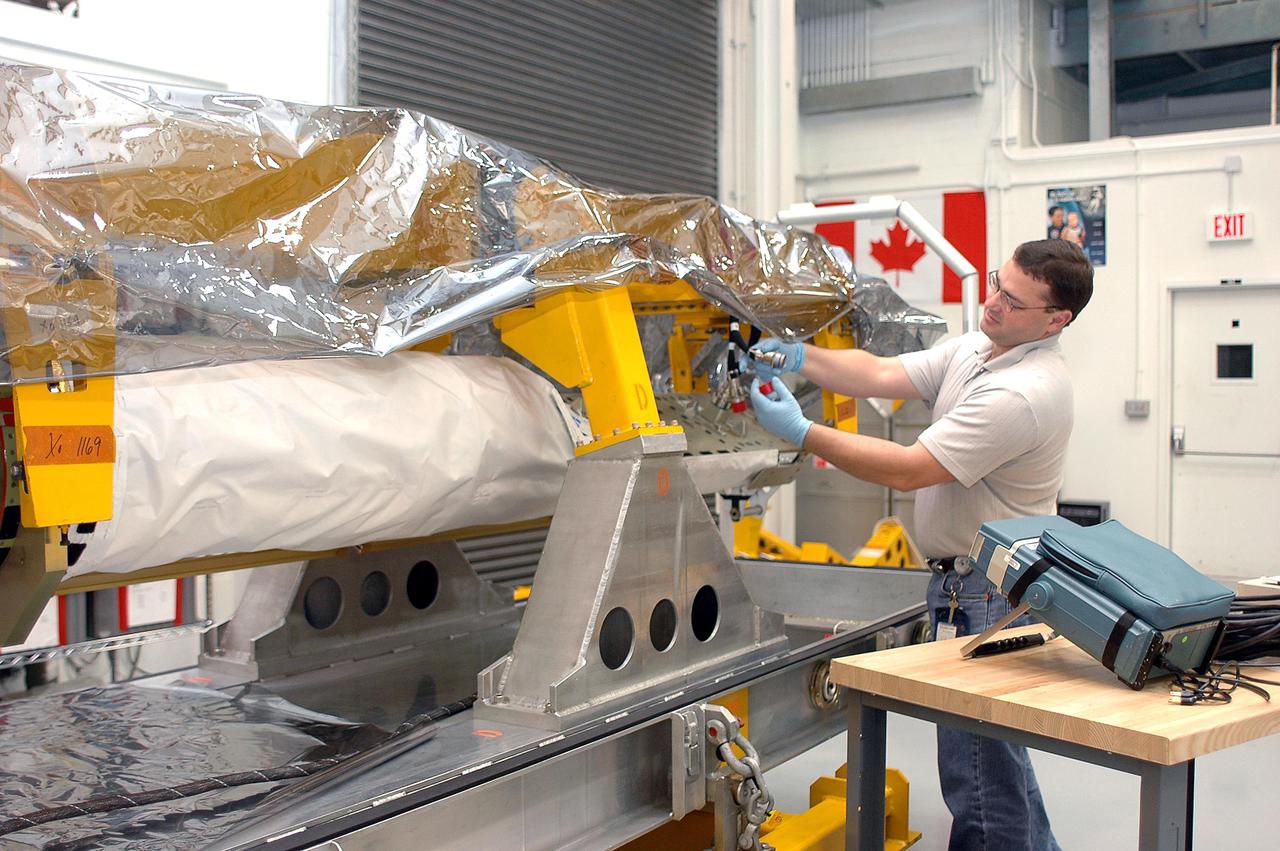
KENNEDY SPACE CENTER, FLA. - In the Remote Manipulator System lab, United Space Alliance technician Todd Dugan works on the Orbiter Boom Sensor System. The OBSS is undergoing final checkout and testing in the lab prior to being transferred to the Orbiter Processing Facility for installation on Space Shuttle Discovery. The 50-foot-long OBSS will be attached to the Remote Manipulator System, or Shuttle arm, and is one of the new safety measures for Return to Flight, equipping the orbiter with cameras and laser systems to inspect the Shuttle's Thermal Protection System while in space. Discovery is slated to fly mission STS-114 once Space Shuttle launches resume. The launch planning window is May 12 to June 3, 2005.
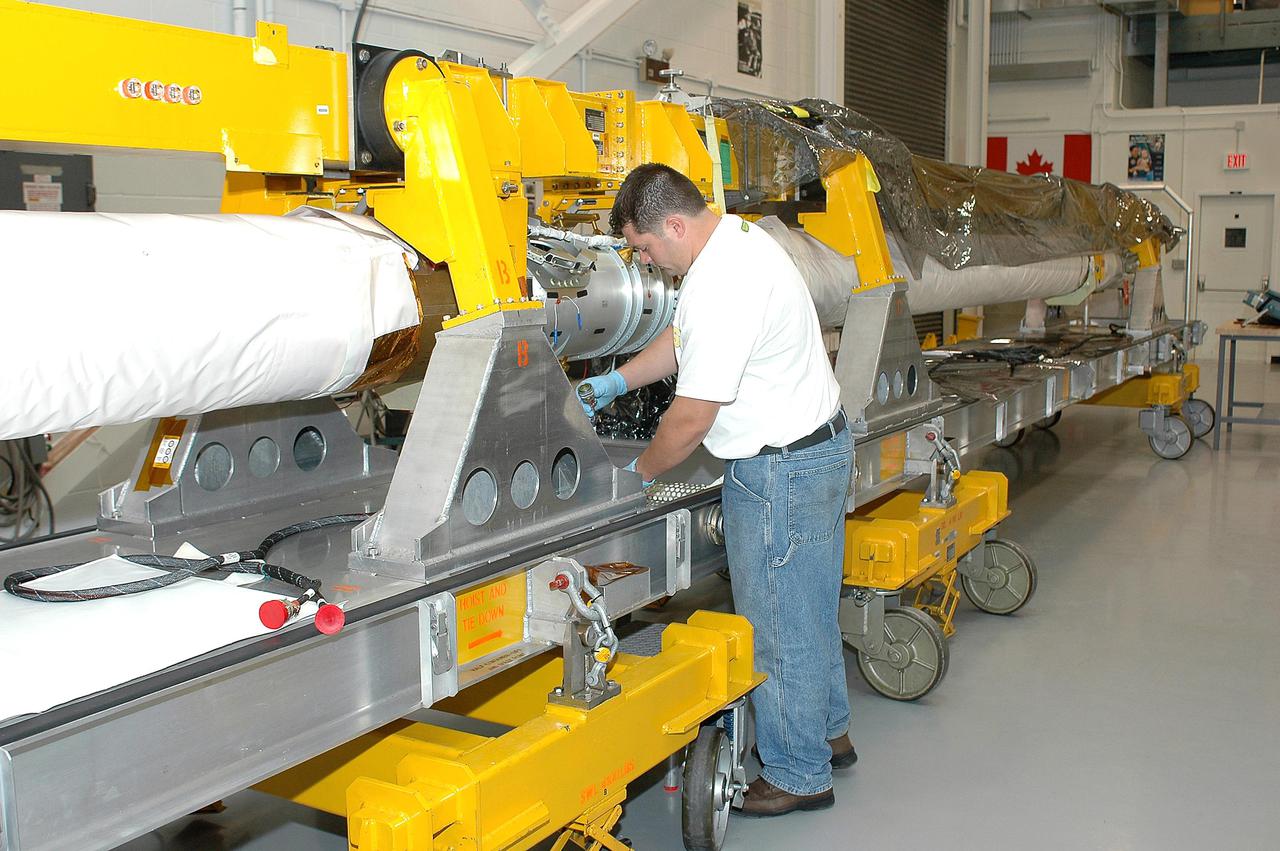
KENNEDY SPACE CENTER, FLA. - Jake Senior, United Space Alliance technician, prepares the Orbiter Boom Sensor System in the Remote Manipulator System lab for testing. The OBSS is undergoing final checkout and testing in the lab prior to being transferred to the Orbiter Processing Facility for installation on Space Shuttle Discovery. The 50-foot-long OBSS will be attached to the Remote Manipulator System, or Shuttle arm, and is one of the new safety measures for Return to Flight, equipping the orbiter with cameras and laser systems to inspect the Shuttle's Thermal Protection System while in space. Discovery is slated to fly mission STS-114 once Space Shuttle launches resume. The launch planning window is May 12 to June 3, 2005.
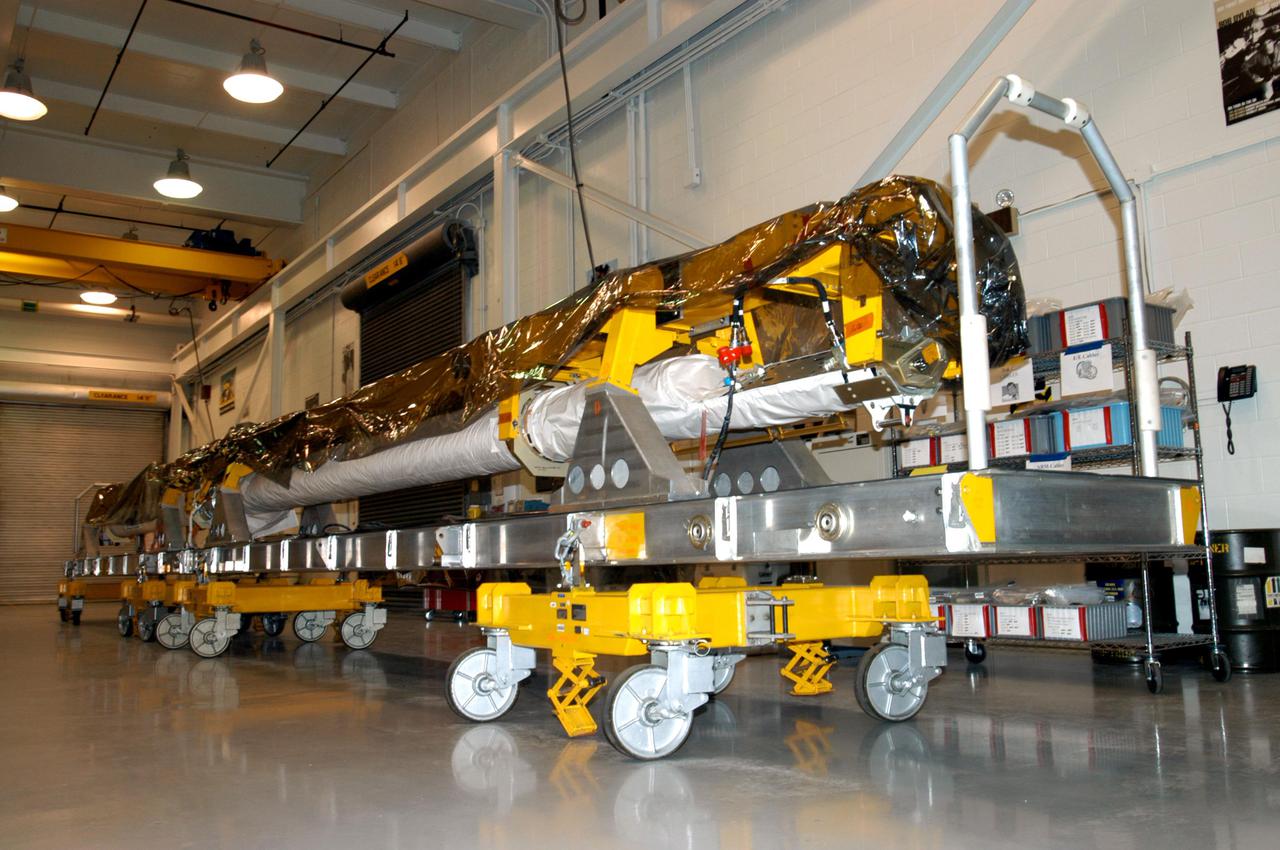
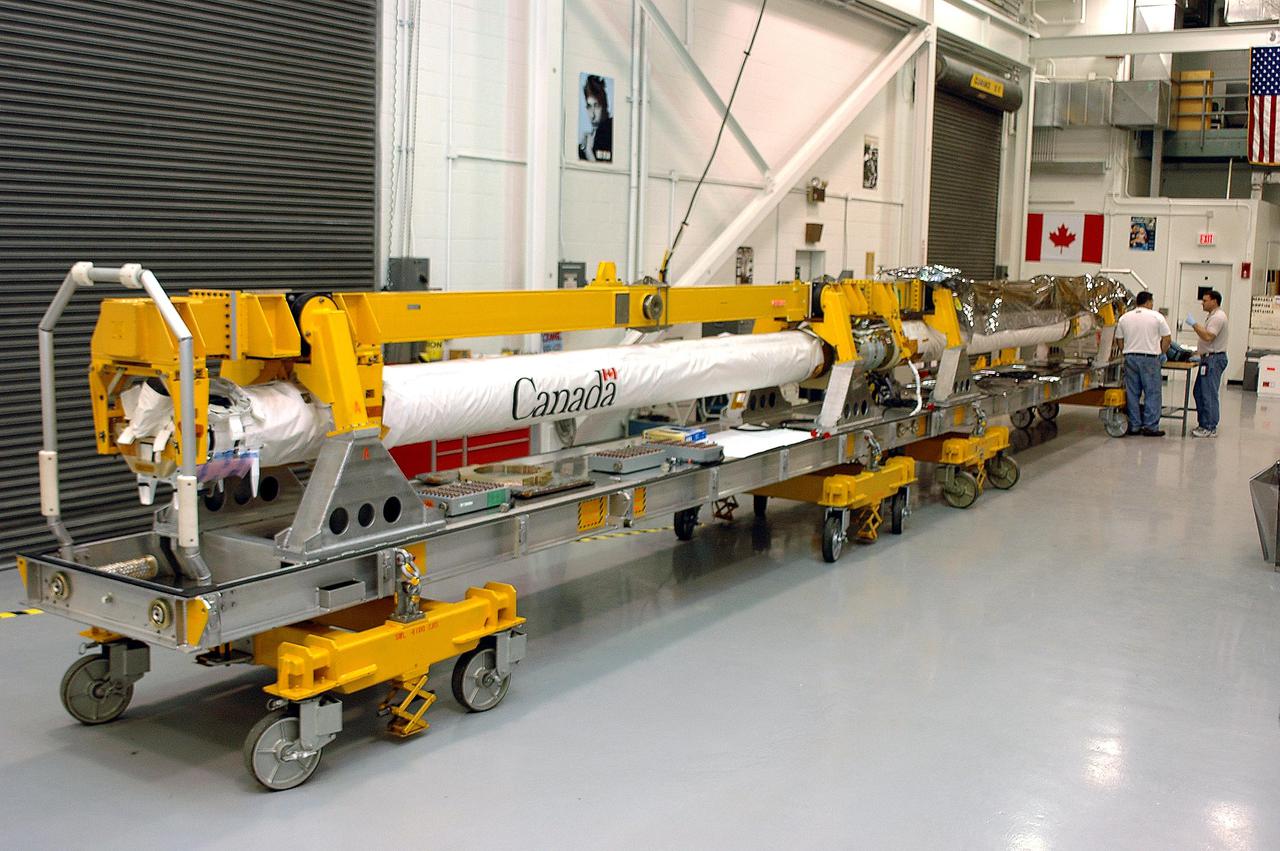
KENNEDY SPACE CENTER, FLA. - The assembled Orbiter Boom Sensor System sits in the Remote Manipulator System lab inside the Vehicle Assembly Building. The OBSS will undergo final checkout and testing in the lab prior to being transferred to the Orbiter Processing Facility for installation on Space Shuttle Discovery. The 50-foot-long OBSS will be attached to the Remote Manipulator System, or Shuttle arm, and is one of the new safety measures for Return to Flight, equipping the orbiter with cameras and laser systems to inspect the Shuttle’s Thermal Protection System while in space. Discovery is slated to fly Return to Flight mission STS-114 once Space Shuttle launches resume. The launch planning window is May 12 to June 3, 2005.
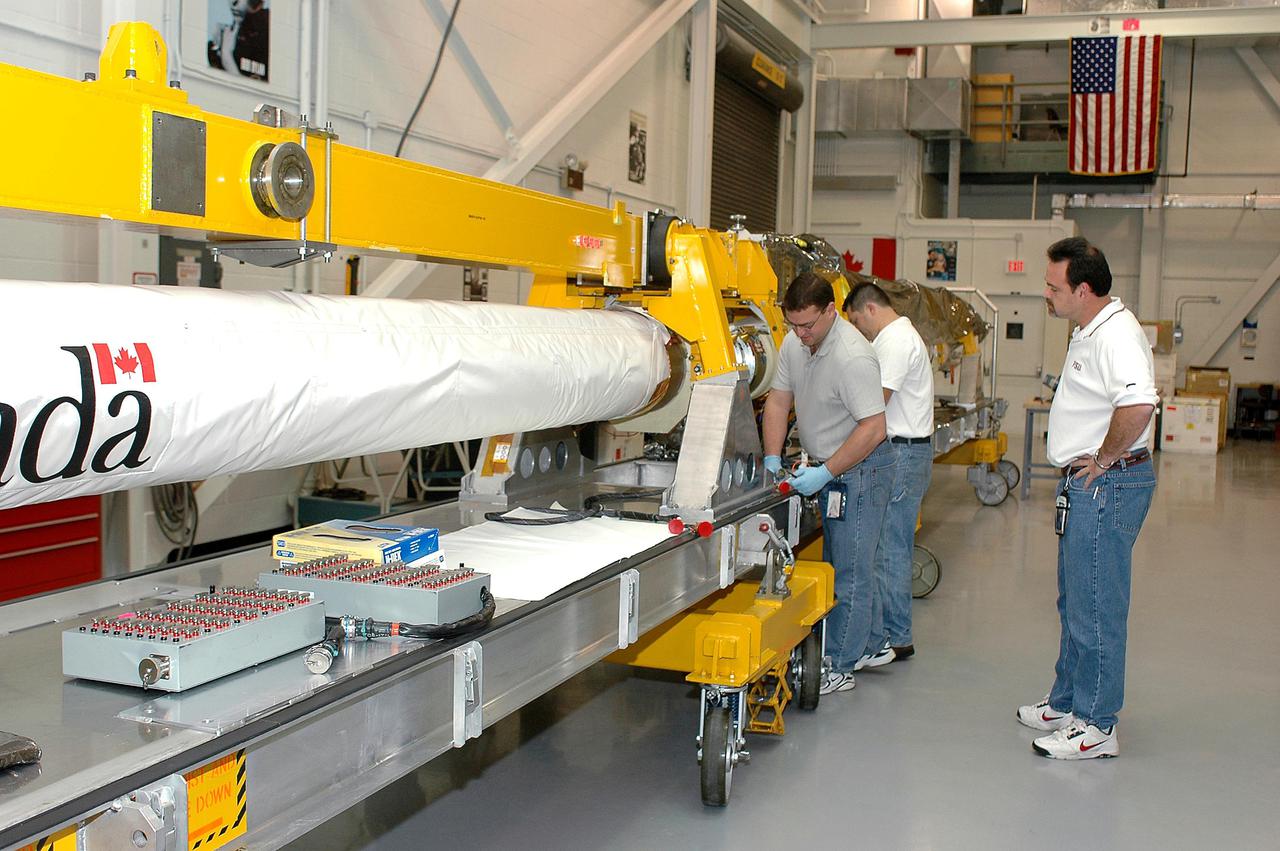
KENNEDY SPACE CENTER, FLA. - United Space Alliance technicians Todd Dugan and Jake Senior (at left) work on the Orbiter Boom Sensor System in the Remote Manipulator System lab while USA engineer Ron Kennedy (right) looks on. The OBSS is undergoing final checkout and testing in the lab prior to being transferred to the Orbiter Processing Facility for installation on Space Shuttle Discovery. The 50-foot-long OBSS will be attached to the Remote Manipulator System, or Shuttle arm, and is one of the new safety measures for Return to Flight, equipping the orbiter with cameras and laser systems to inspect the Shuttle's Thermal Protection System while in space. Discovery is slated to fly mission STS-114 once Space Shuttle launches resume. The launch planning window is May 12 to June 3, 2005.
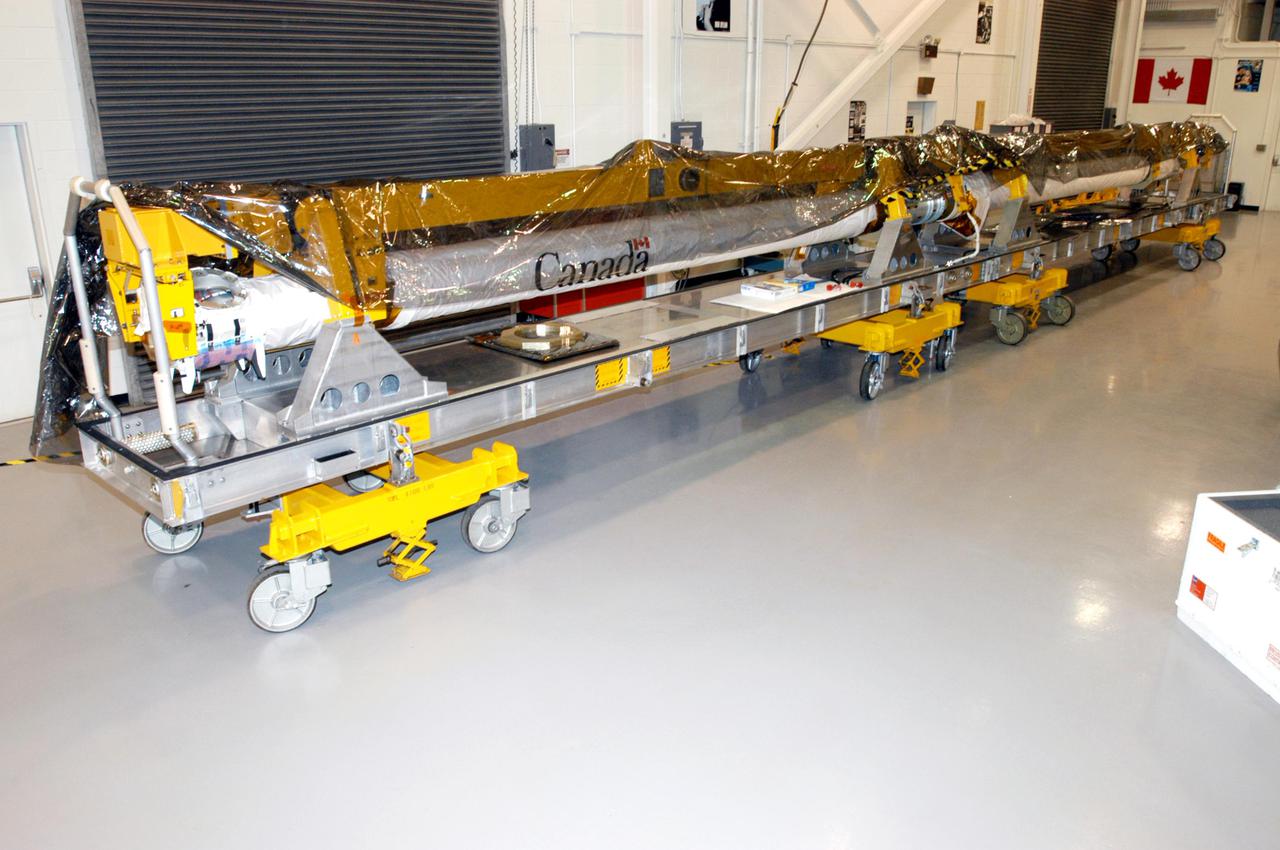
KENNEDY SPACE CENTER, FLA. - The assembled Orbiter Boom Sensor System sits in the Remote Manipulator System lab inside the Vehicle Assembly Building. The OBSS will undergo final checkout and testing in the lab prior to being transferred to the Orbiter Processing Facility for installation on Space Shuttle Discovery. The 50-foot-long OBSS will be attached to the Remote Manipulator System, or Shuttle arm, and is one of the new safety measures for Return to Flight, equipping the orbiter with cameras and laser systems to inspect the Shuttle’s Thermal Protection System while in space. Discovery is slated to fly Return to Flight mission STS-114 once Space Shuttle launches resume. The launch planning window is May 12 to June 3, 2005.
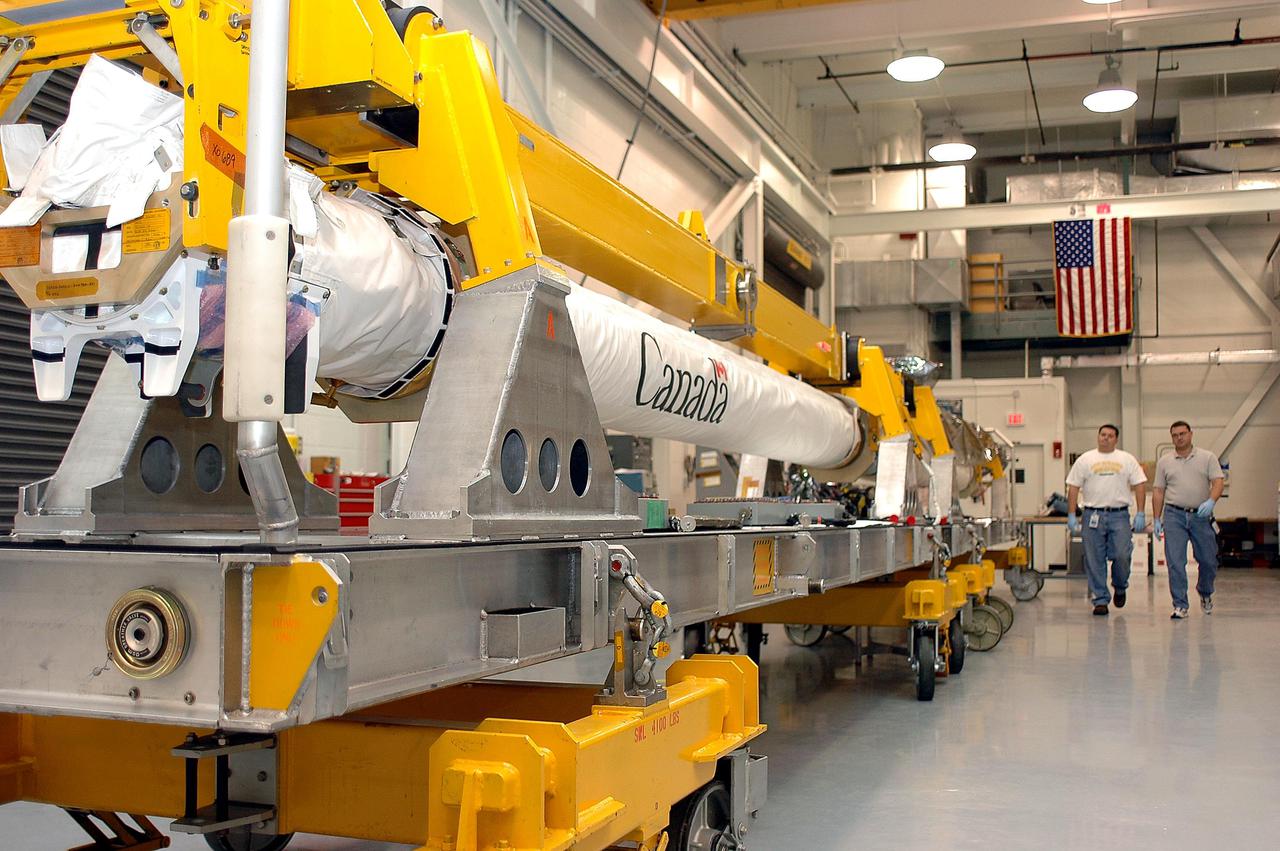
KENNEDY SPACE CENTER, FLA. - In the Remote Manipulator System lab, United Space Alliance technicians Jake Senior and Todd Dugan walk the length of the Orbiter Boom Sensor System during work on the boom. The OBSS is undergoing final checkout and testing in the lab prior to being transferred to the Orbiter Processing Facility for installation on Space Shuttle Discovery. The 50-foot-long OBSS will be attached to the Remote Manipulator System, or Shuttle arm, and is one of the new safety measures for Return to Flight, equipping the orbiter with cameras and laser systems to inspect the Shuttle's Thermal Protection System while in space. Discovery is slated to fly mission STS-114 once Space Shuttle launches resume. The launch planning window is May 12 to June 3, 2005.
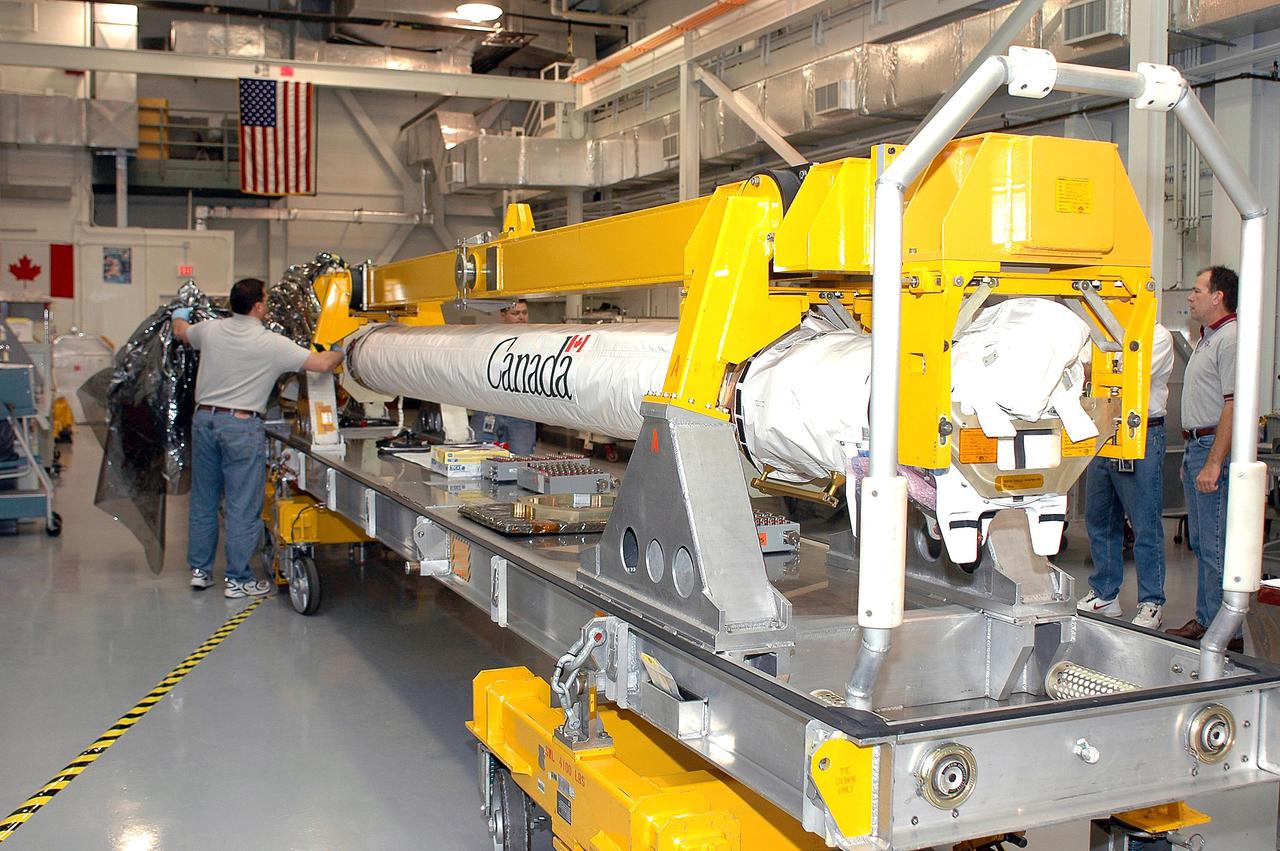
KENNEDY SPACE CENTER, FLA. - Todd Dugan, United Space Alliance technician, removes the cover from the Orbiter Boom Sensor System in the Remote Manipulator System lab. The OBSS is undergoing final checkout and testing in the lab prior to being transferred to the Orbiter Processing Facility for installation on Space Shuttle Discovery. The 50-foot-long OBSS will be attached to the Remote Manipulator System, or Shuttle arm, and is one of the new safety measures for Return to Flight, equipping the orbiter with cameras and laser systems to inspect the Shuttle's Thermal Protection System while in space. Discovery is slated to fly mission STS-114 once Space Shuttle launches resume. The launch planning window is May 12 to June 3, 2005.
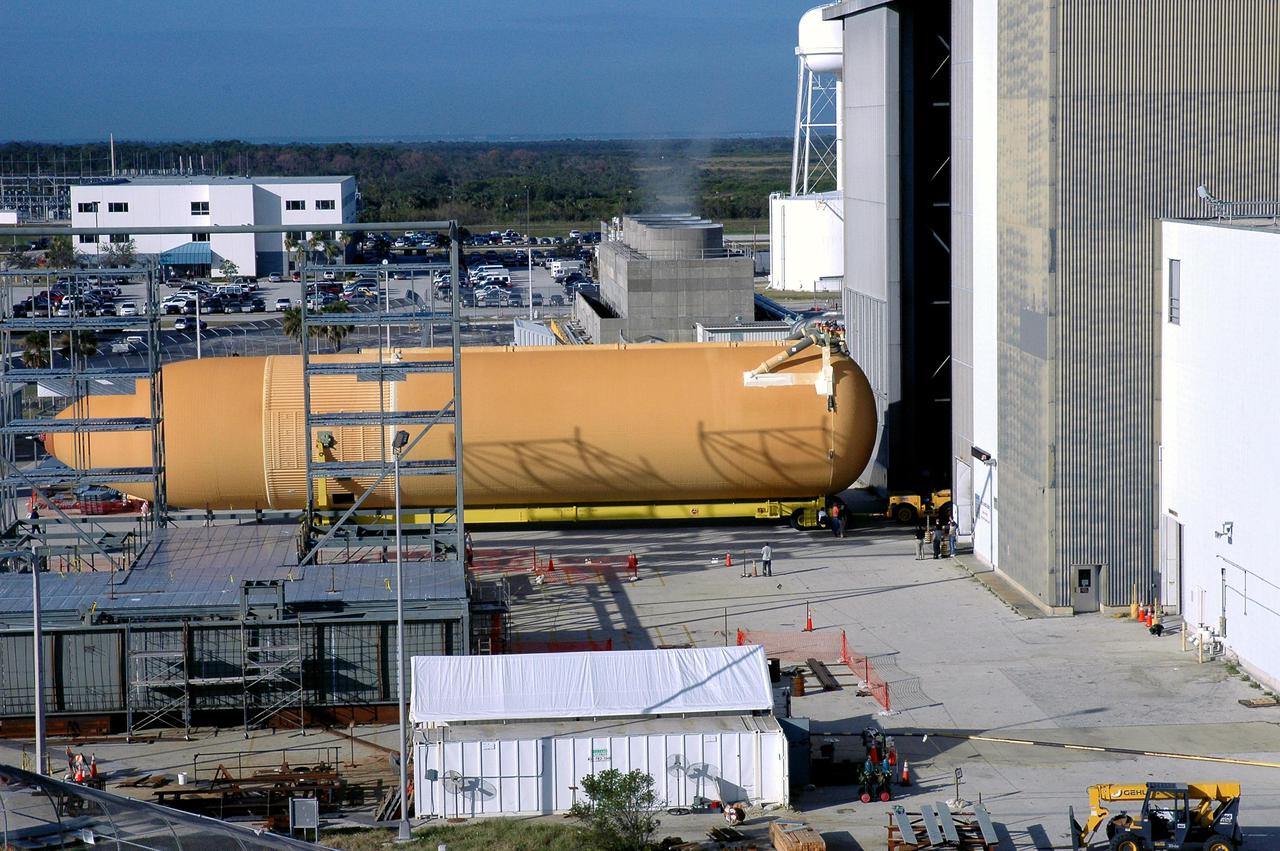
KENNEDY SPACE CENTER, FLA. - Viewed from the roof of the Launch Control Center in the Launch Complex 39 Area, the newly redesigned External Tank is seen moving into the Vehicle Assembly Building. In the transfer aisle of the VAB, the tank will be raised from a horizontal to a vertical position, then lifted high up into a storage cell, or “checkout cell,” where it will undergo inspections of the mechanical, electrical and thermal protection systems. New processing activities resulting from re-design of the tank include inspection of the bipod heater and External Tank separation camera, which includes charging the camera batteries. The tank will be then prepared for mating to the Solid Rocket Boosters. When preparations are complete, the tank will be lifted from the checkout cell, moved across the transfer aisle and into High Bay 1, where it will be lowered and attached to the boosters, which are sitting on the Mobile Launch Platform. The tank is designated for the Return to Flight mission, STS-114, targeted for a launch opportunity beginning in May. The seven-member Discovery crew will fly to the International Space Station primarily to test and evaluate new procedures for flight safety, including Space Shuttle inspection and repair techniques.

KENNEDY SPACE CENTER, FLA. - The newly redesigned External Tank, designated for use on Return to Flight mission STS-114, moves slowly toward its destination, the dock at the Launch Complex 39 Area Turn Basin, propelled by two tugboats. At left in the background is Launch Pad 39A. The External Tank arrived safely early this morning at Port Canaveral, Fla., after an approximately 900-mile journey at sea. It departed from the Michoud Assembly Facility in New Orleans Dec. 31 and was transported on the Pegasus, NASA’s specially designed barge, pulled by Solid Rocket Booster retrieval ship Liberty Star. At the port, the barge was then hooked up to the tugs for the last part of the journey to the Turn Basin. Next, the External Tank will be off-loaded from the barge and transported to the Vehicle Assembly Building for its final checkout and mating to the twin Solid Rocket Boosters and orbiter Discovery. NASA and Lockheed Martin Corp. spent nearly two years modifying the 15-story, bronze-colored tank to make it safer for liftoff. Among dozens of changes is a redesigned forward bipod fitting -- a design that meets the recommendation of the Columbia Accident Investigation Board to reduce the risk to the Space Shuttle from falling debris during ascent. STS-114 is targeted for a launch opportunity beginning in May. The seven-member Discovery crew will fly to the International Space Station primarily to test and evaluate new procedures for flight safety, including Space Shuttle inspection and repair techniques.
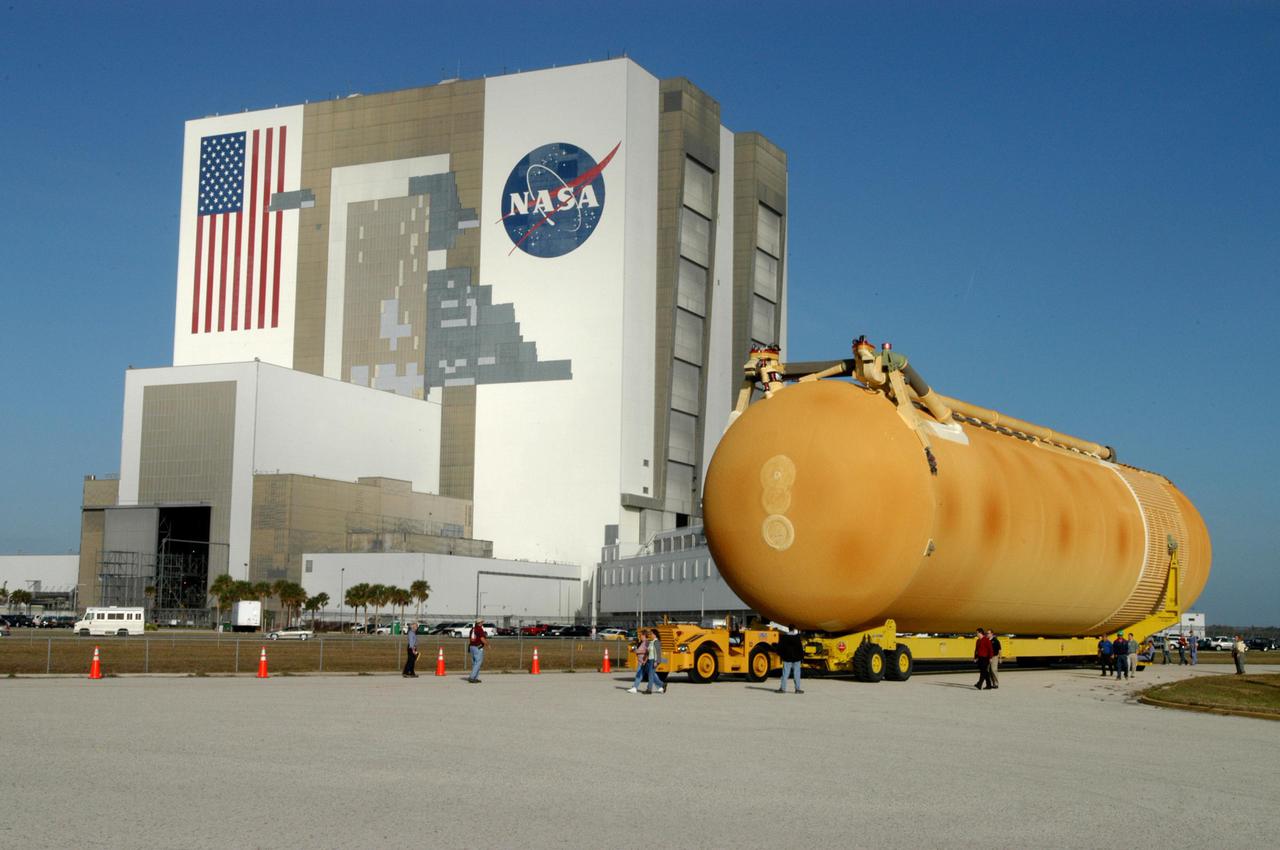
KENNEDY SPACE CENTER, FLA. - The newly redesigned External Tank is slowly moved from the dock in the Launch Complex 39 Area Turn Basin on its way to the Vehicle Assembly Building, seen at left. The tank arrived Jan. 5 after a 900-mile sea voyage aboard NASA’s specially designed barge, Pegasus, from the Michoud Assembly Facility in New Orleans. In the transfer aisle of the VAB, the tank will be raised from a horizontal to a vertical position, then lifted high up into a storage cell, or “checkout cell,” where it will undergo inspections of the mechanical, electrical and thermal protection systems. New processing activities resulting from re-design of the tank include inspection of the bipod heater and External Tank separation camera, which includes charging the camera batteries. The tank will be then prepared for mating to the Solid Rocket Boosters. When preparations are complete, the tank will be lifted from the checkout cell, moved across the transfer aisle and into High Bay 1, where it will be lowered and attached to the boosters, which are sitting on the Mobile Launch Platform. The tank is designated for the Return to Flight mission, STS-114, targeted for a launch opportunity beginning in May. The seven-member Discovery crew will fly to the International Space Station primarily to test and evaluate new procedures for flight safety, including Space Shuttle inspection and repair techniques.
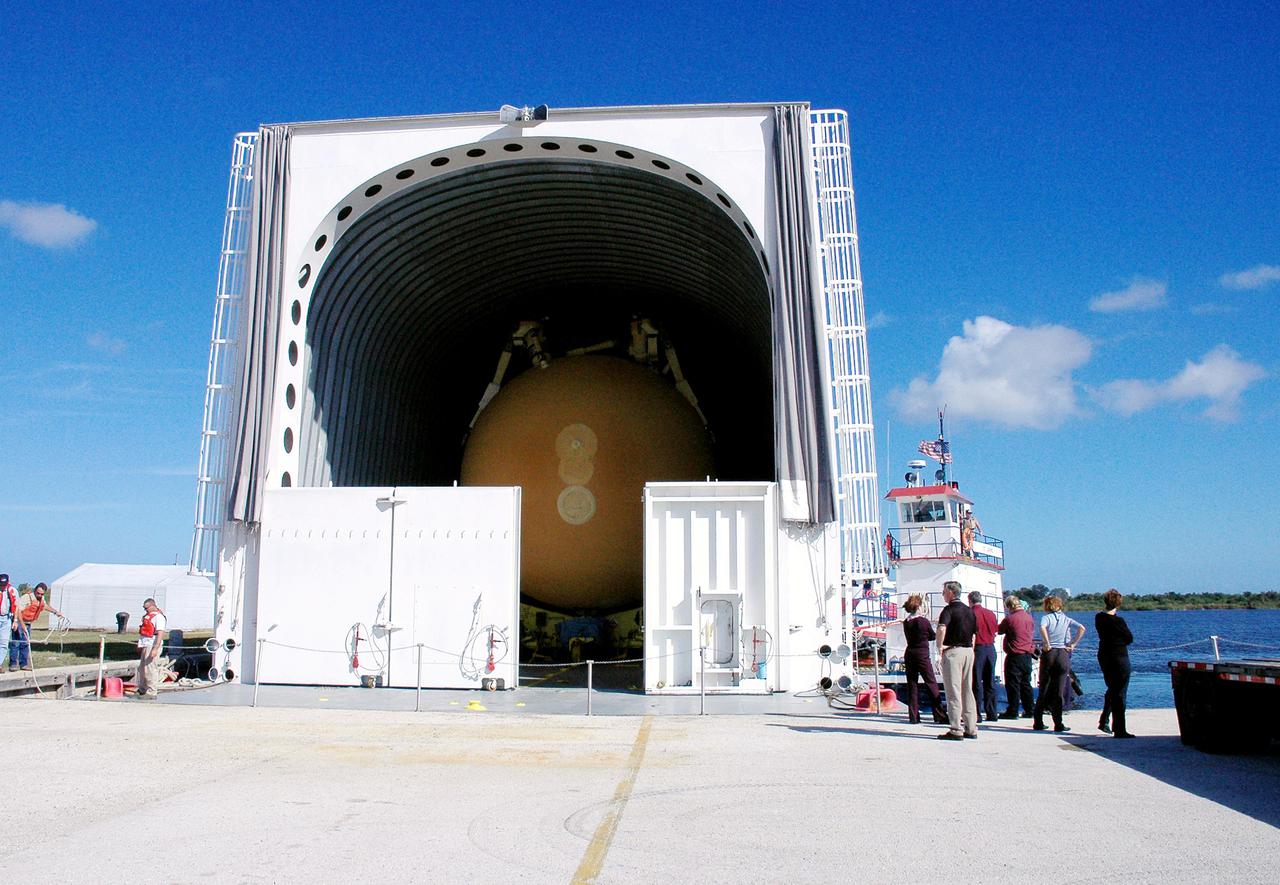
KENNEDY SPACE CENTER, FLA. - The barge carrying the newly redesigned External Tank (ET), designated for use on Return to Flight mission STS-114, is finally docked at the Launch Complex 39 Area Turn Basin. The ET can be seen inside the barge. The External Tank arrived safely early this morning at Port Canaveral, Fla., after an approximately 900-mile journey at sea. It departed from the Michoud Assembly Facility in New Orleans Dec. 31 and was transported on the Pegasus, NASA’s specially designed barge, pulled by Solid Rocket Booster retrieval ship Liberty Star. At the port, the barge was then hooked up to the tugs for the last part of the journey. Next, the External Tank will be off-loaded from the barge and transported to the Vehicle Assembly Building for its final checkout and mating to the twin Solid Rocket Boosters and orbiter Discovery. NASA and Lockheed Martin Corp. spent nearly two years modifying the 15-story, bronze-colored tank to make it safer for liftoff. Among dozens of changes is a redesigned forward bipod fitting -- a design that meets the recommendation of the Columbia Accident Investigation Board to reduce the risk to the Space Shuttle from falling debris during ascent. STS-114 is targeted for a launch opportunity beginning in May. The seven-member Discovery crew will fly to the International Space Station primarily to test and evaluate new procedures for flight safety, including Space Shuttle inspection and repair techniques.
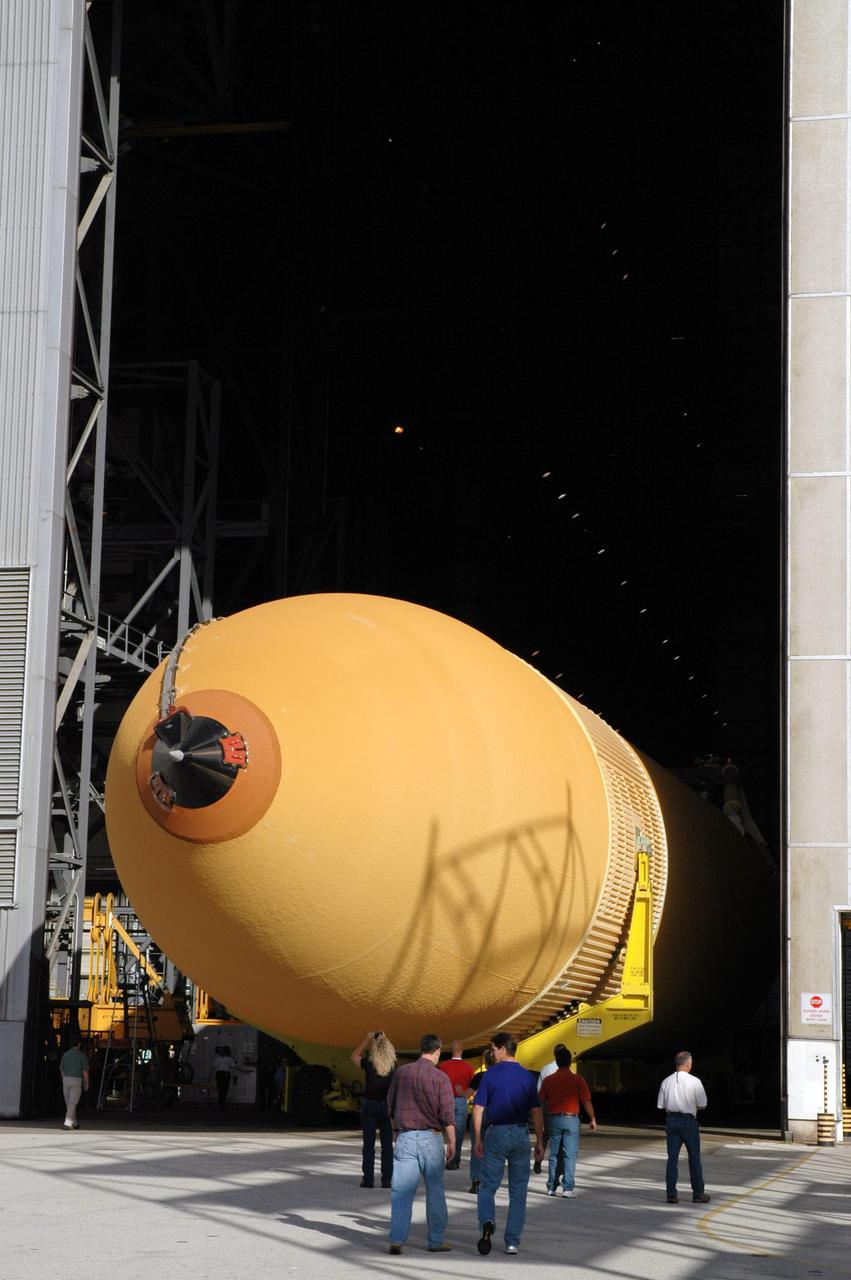
KENNEDY SPACE CENTER, FLA. - Accompanied by KSC employees, the newly redesigned External Tank rolls into the Vehicle Assembly Building. The tank arrived Jan. 5 after a 900-mile sea voyage aboard NASA’s specially designed barge, Pegasus, from the Michoud Assembly Facility in New Orleans. In the transfer aisle of the VAB, the tank will be raised from a horizontal to a vertical position, then lifted high up into a storage cell, or “checkout cell,” where it will undergo inspections of the mechanical, electrical and thermal protection systems. New processing activities resulting from re-design of the tank include inspection of the bipod heater and External Tank separation camera, which includes charging the camera batteries. The tank will be then prepared for mating to the Solid Rocket Boosters. When preparations are complete, the tank will be lifted from the checkout cell, moved across the transfer aisle and into High Bay 1, where it will be lowered and attached to the boosters, which are sitting on the Mobile Launch Platform. The tank is designated for the Return to Flight mission, STS-114, targeted for a launch opportunity beginning in May. The seven-member Discovery crew will fly to the International Space Station primarily to test and evaluate new procedures for flight safety, including Space Shuttle inspection and repair techniques.
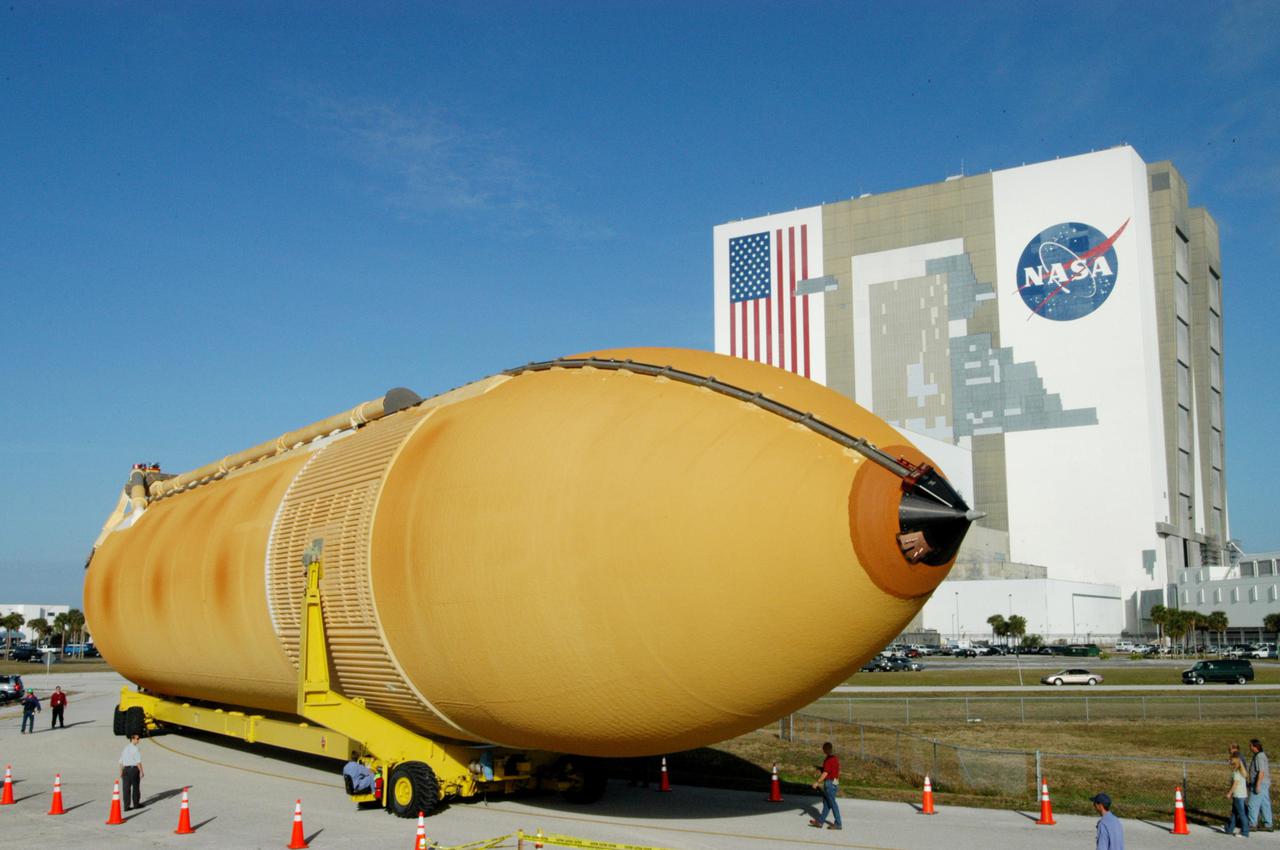
KENNEDY SPACE CENTER, FLA. - The newly redesigned External Tank turns the corner of the Launch Complex 39 Area Turn Basin parking area on its way to the Vehicle Assembly Building, seen at right. The tank arrived Jan. 5 after a 900-mile sea voyage aboard NASA’s specially designed barge, Pegasus, from the Michoud Assembly Facility in New Orleans. In the transfer aisle of the VAB, the tank will be raised from a horizontal to a vertical position, then lifted high up into a storage cell, or “checkout cell,” where it will undergo inspections of the mechanical, electrical and thermal protection systems. New processing activities resulting from re-design of the tank include inspection of the bipod heater and External Tank separation camera, which includes charging the camera batteries. The tank will be then prepared for mating to the Solid Rocket Boosters. When preparations are complete, the tank will be lifted from the checkout cell, moved across the transfer aisle and into High Bay 1, where it will be lowered and attached to the boosters, which are sitting on the Mobile Launch Platform. The tank is designated for the Return to Flight mission, STS-114, targeted for a launch opportunity beginning in May. The seven-member Discovery crew will fly to the International Space Station primarily to test and evaluate new procedures for flight safety, including Space Shuttle inspection and repair techniques.

KENNEDY SPACE CENTER, FLA. - Media view the newly redesigned External Tank after its off-loading from the barge that carried it from the Michoud Assembly Facility in New Orleans. The tank is being transported to the Vehicle Assembly Building. In the transfer aisle of the VAB, the tank will be raised from a horizontal to a vertical position, then lifted high up into a storage cell, or “checkout cell,” where it will undergo inspections of the mechanical, electrical and thermal protection systems. New processing activities resulting from re-design of the tank include inspection of the bipod heater and External Tank separation camera, which includes charging the camera batteries. The tank will be then prepared for mating to the Solid Rocket Boosters. When preparations are complete, the tank will be lifted from the checkout cell, moved across the transfer aisle and into High Bay 1, where it will be lowered and attached to the boosters, which are sitting on the Mobile Launch Platform. The tank is designated for the Return to Flight mission, STS-114, targeted for a launch opportunity beginning in May. The seven-member Discovery crew will fly to the International Space Station primarily to test and evaluate new procedures for flight safety, including Space Shuttle inspection and repair techniques.
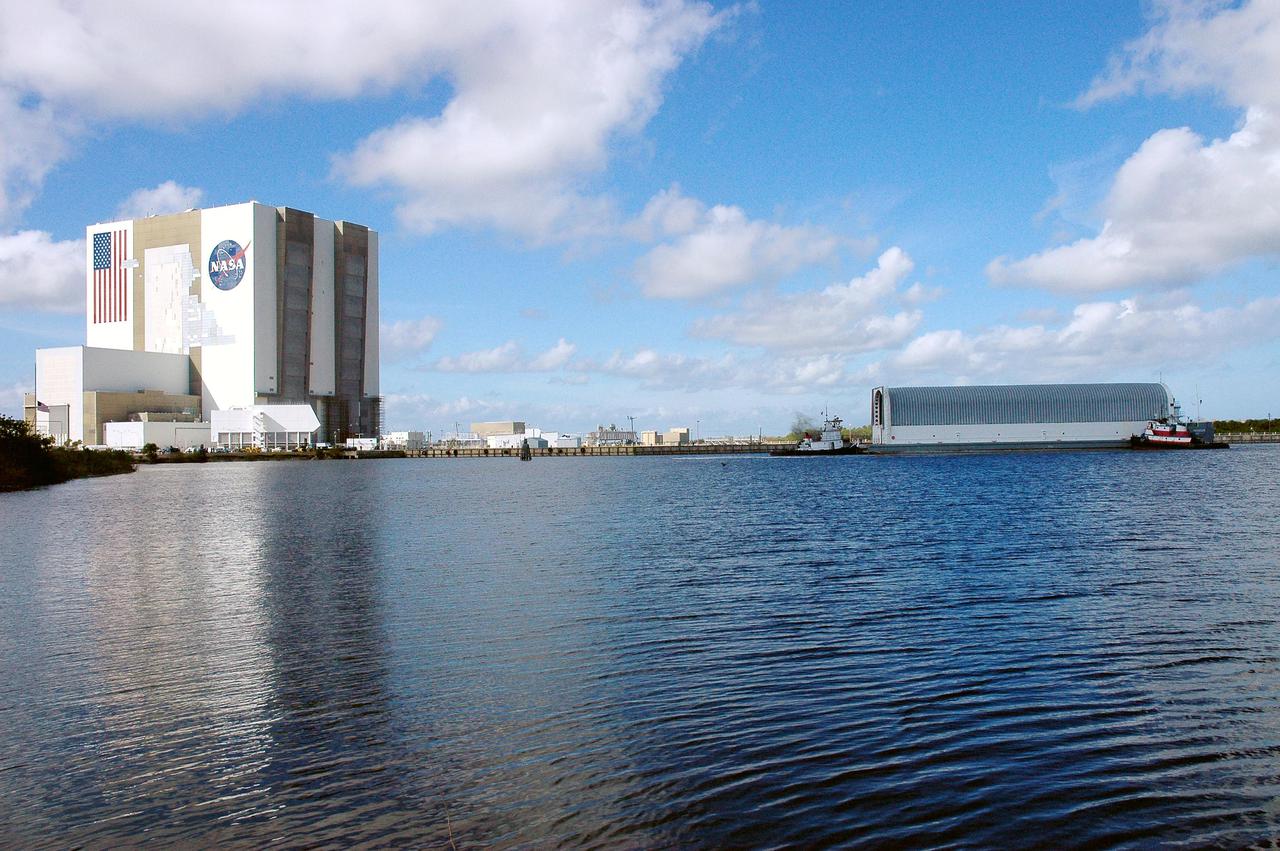
KENNEDY SPACE CENTER, FLA. - The barge carrying the newly redesigned External Tank, designated for use on Return to Flight mission STS-114, is towed toward the Launch Complex 39 Area Turn Basin at Kennedy. At left is the Vehicle Assembly Building. The barge arrived after an approximately 900-mile journey at sea from the Michoud Assembly Facility in New Orleans. It left the facility Dec. 31 on the Pegasus, NASA’s specially designed barge, towed by Solid Rocket Booster retrieval ship Liberty Star. At Port Canaveral, the barge was then hooked up to the tugs for the last part of the journey. Next, the External Tank will be off-loaded from the barge and transported to the Vehicle Assembly Building for its final checkout and mating to the twin Solid Rocket Boosters and orbiter Discovery. NASA and Lockheed Martin Corp. spent nearly two years modifying the 15-story, bronze-colored tank to make it safer for liftoff. Among dozens of changes is a redesigned forward bipod fitting -- a design that meets the recommendation of the Columbia Accident Investigation Board to reduce the risk to the Space Shuttle from falling debris during ascent. STS-114 is targeted for a launch opportunity beginning in May. The seven-member Discovery crew will fly to the International Space Station primarily to test and evaluate new procedures for flight safety, including Space Shuttle inspection and repair techniques.
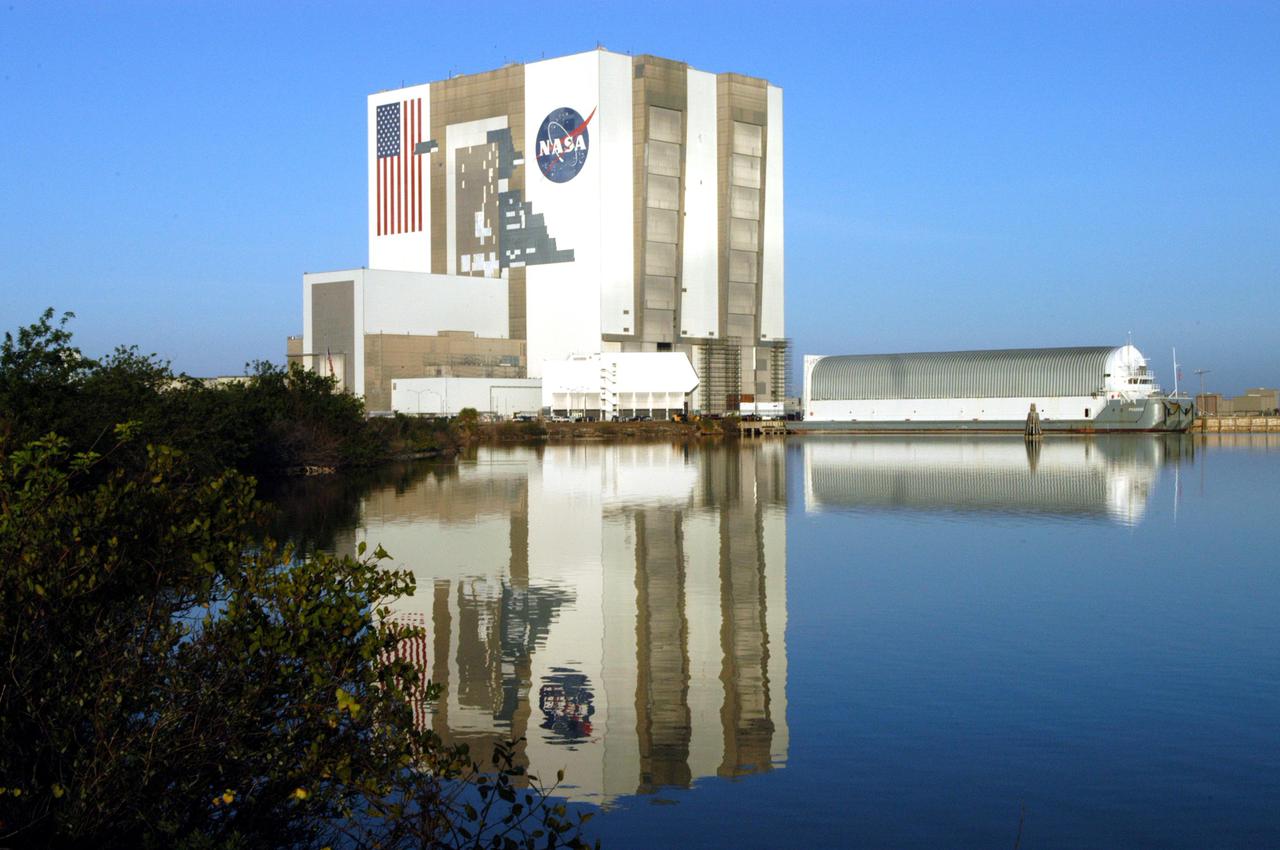
KENNEDY SPACE CENTER, FLA. - NASA’s specially designed barge, Pegasus, is docked in the Launch Complex 39 Area Turn Basin with its cargo of the newly redesigned External Tank. The barge was towed from the Michoud Assembly Facility in New Orleans. The tank will be off-loaded and transported to the Vehicle Assembly Building, seen at left of the barge. In the transfer aisle of the VAB, the tank will be raised from a horizontal to a vertical position, then lifted high up into a storage cell, or “checkout cell,” where it will undergo inspections of the mechanical, electrical and thermal protection systems. New processing activities resulting from re-design of the tank include inspection of the bipod heater and External Tank separation camera, which includes charging the camera batteries. The tank will be then prepared for mating to the Solid Rocket Boosters. When preparations are complete, the tank will be lifted from the checkout cell, moved across the transfer aisle and into High Bay 1, where it will be lowered and attached to the boosters, which are sitting on the Mobile Launch Platform. The tank is designated for the Return to Flight mission, STS-114, targeted for a launch opportunity beginning in May. The seven-member Discovery crew will fly to the International Space Station primarily to test and evaluate new procedures for flight safety, including Space Shuttle inspection and repair techniques.
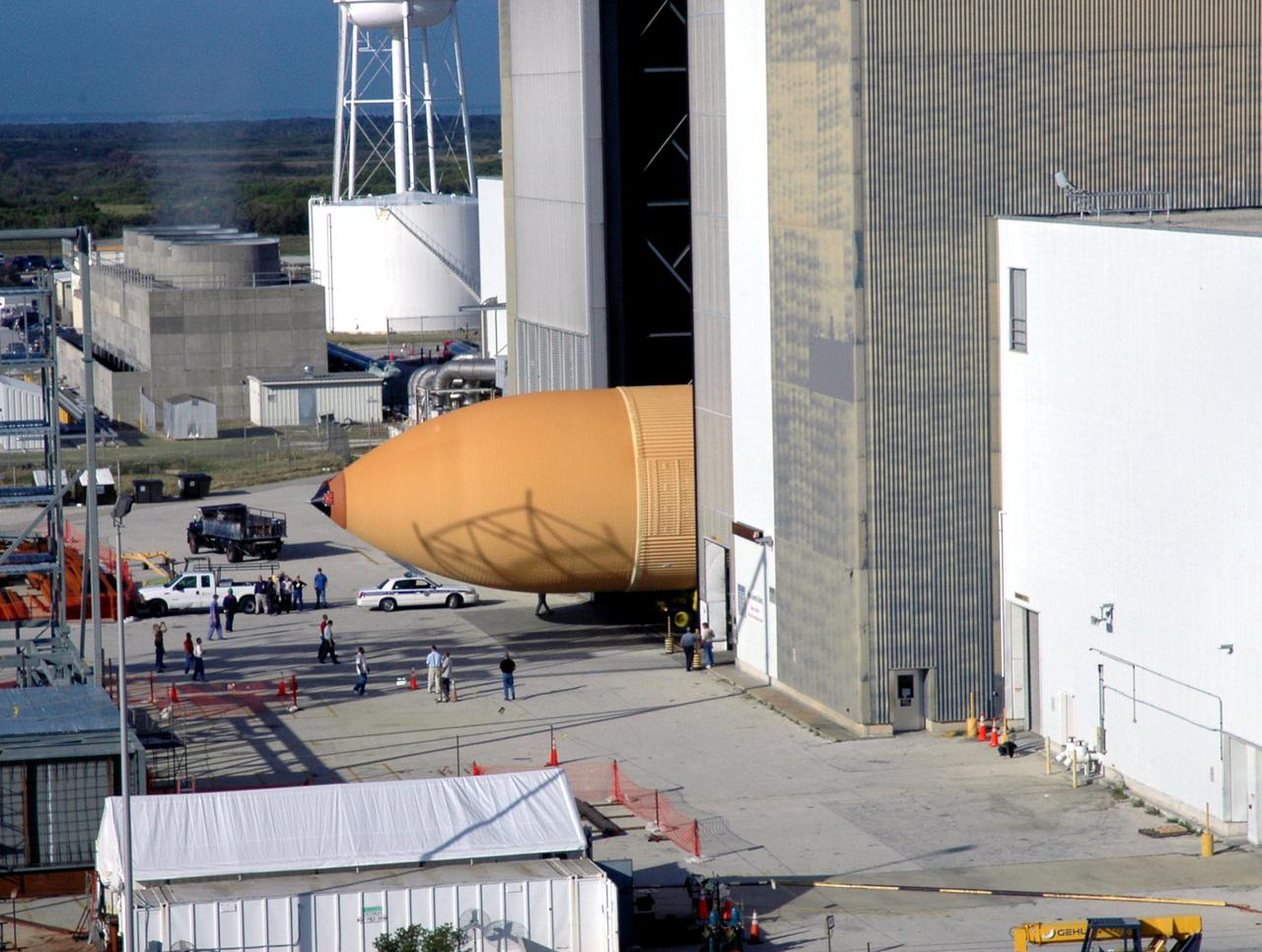
KENNEDY SPACE CENTER, FLA. - Viewed from the roof of the Launch Control Center in the Launch Complex 39 Area, the newly redesigned External Tank disappears into the Vehicle Assembly Building. In the transfer aisle of the VAB, the tank will be raised from a horizontal to a vertical position, then lifted high up into a storage cell, or “checkout cell,” where it will undergo inspections of the mechanical, electrical and thermal protection systems. New processing activities resulting from re-design of the tank include inspection of the bipod heater and External Tank separation camera, which includes charging the camera batteries. The tank will be then prepared for mating to the Solid Rocket Boosters. When preparations are complete, the tank will be lifted from the checkout cell, moved across the transfer aisle and into High Bay 1, where it will be lowered and attached to the boosters, which are sitting on the Mobile Launch Platform. The tank is designated for the Return to Flight mission, STS-114, targeted for a launch opportunity beginning in May. The seven-member Discovery crew will fly to the International Space Station primarily to test and evaluate new procedures for flight safety, including Space Shuttle inspection and repair techniques.
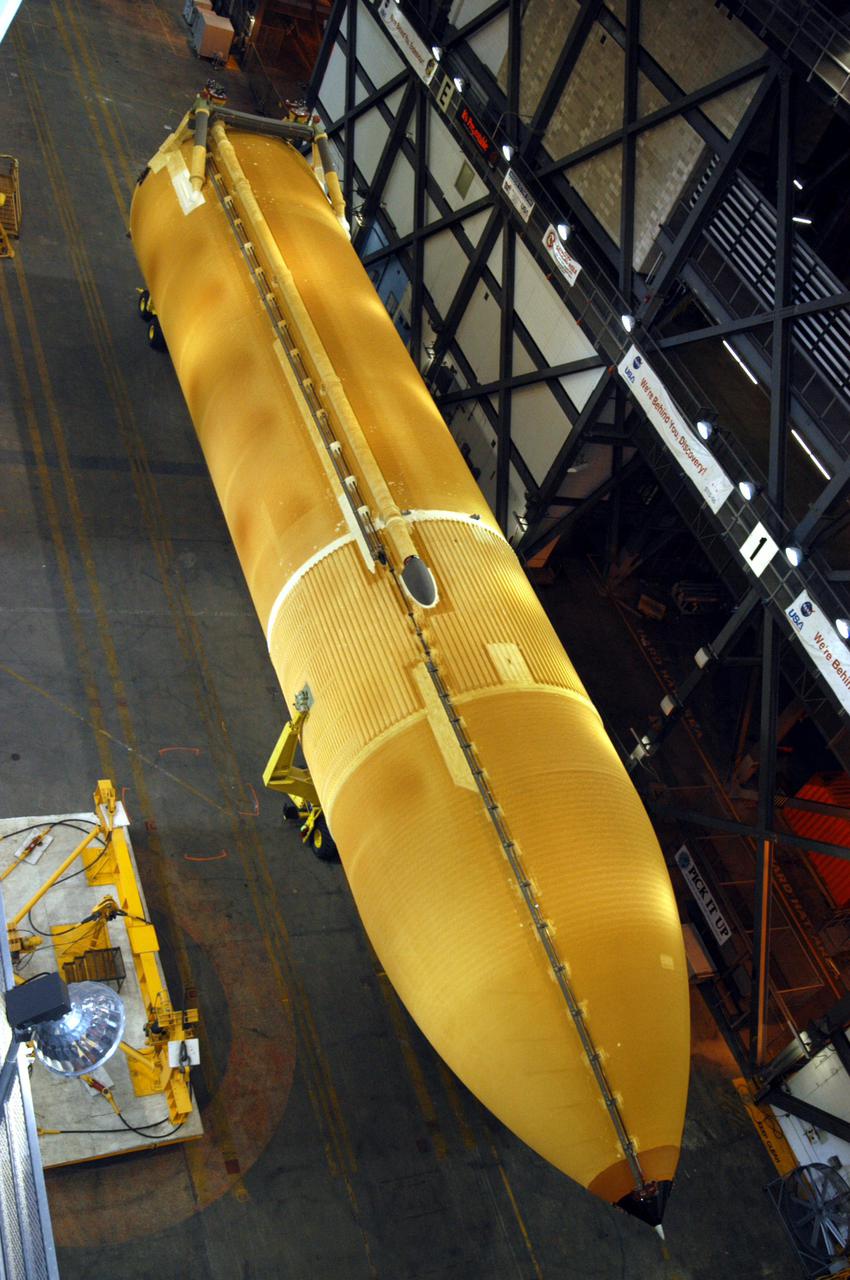
KENNEDY SPACE CENTER, FLA. - Inside the Vehicle Assembly Building, the redesigned External Tank to be used on Return to Flight mission STS-114 waits in the transfer aisle after its move from the barge in the Launch Complex 39 Area Turn Basin. The tank will be raised from a horizontal to a vertical position, then lifted high up into a storage cell, or “checkout cell,” where it will undergo inspections of the mechanical, electrical and thermal protection systems. New processing activities resulting from redesign of the tank include inspection of the bipod heater and External Tank separation camera, which includes charging the camera batteries. The tank will be then prepared for mating to the Solid Rocket Boosters. When preparations are complete, the tank will be lifted from the checkout cell, moved across the transfer aisle and into High Bay 1, where it will be lowered and attached to the boosters, which are sitting on the Mobile Launch Platform.
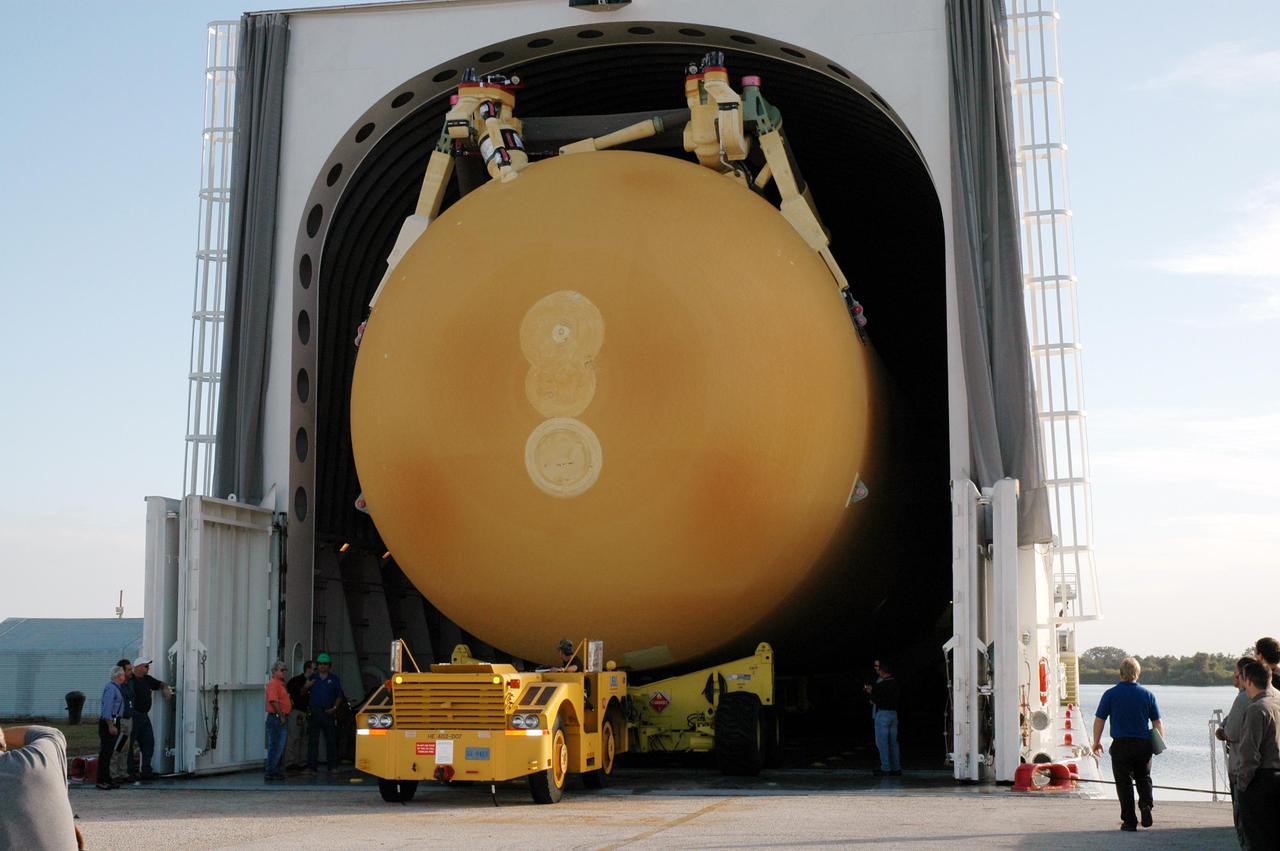
KENNEDY SPACE CENTER, FLA. - Media view the newly redesigned External Tank as a transporter begins off-loading it from the barge that carried it from the Michoud Assembly Facility in New Orleans. The tank is being transported to the Vehicle Assembly Building. In the transfer aisle of the VAB, the tank will be raised from a horizontal to a vertical position, then lifted high up into a storage cell, or “checkout cell,” where it will undergo inspections of the mechanical, electrical and thermal protection systems. New processing activities resulting from re-design of the tank include inspection of the bipod heater and External Tank separation camera, which includes charging the camera batteries. The tank will be then prepared for mating to the Solid Rocket Boosters. When preparations are complete, the tank will be lifted from the checkout cell, moved across the transfer aisle and into High Bay 1, where it will be lowered and attached to the boosters, which are sitting on the Mobile Launch Platform. The tank is designated for the Return to Flight mission, STS-114, targeted for a launch opportunity beginning in May. The seven-member Discovery crew will fly to the International Space Station primarily to test and evaluate new procedures for flight safety, including Space Shuttle inspection and repair techniques.
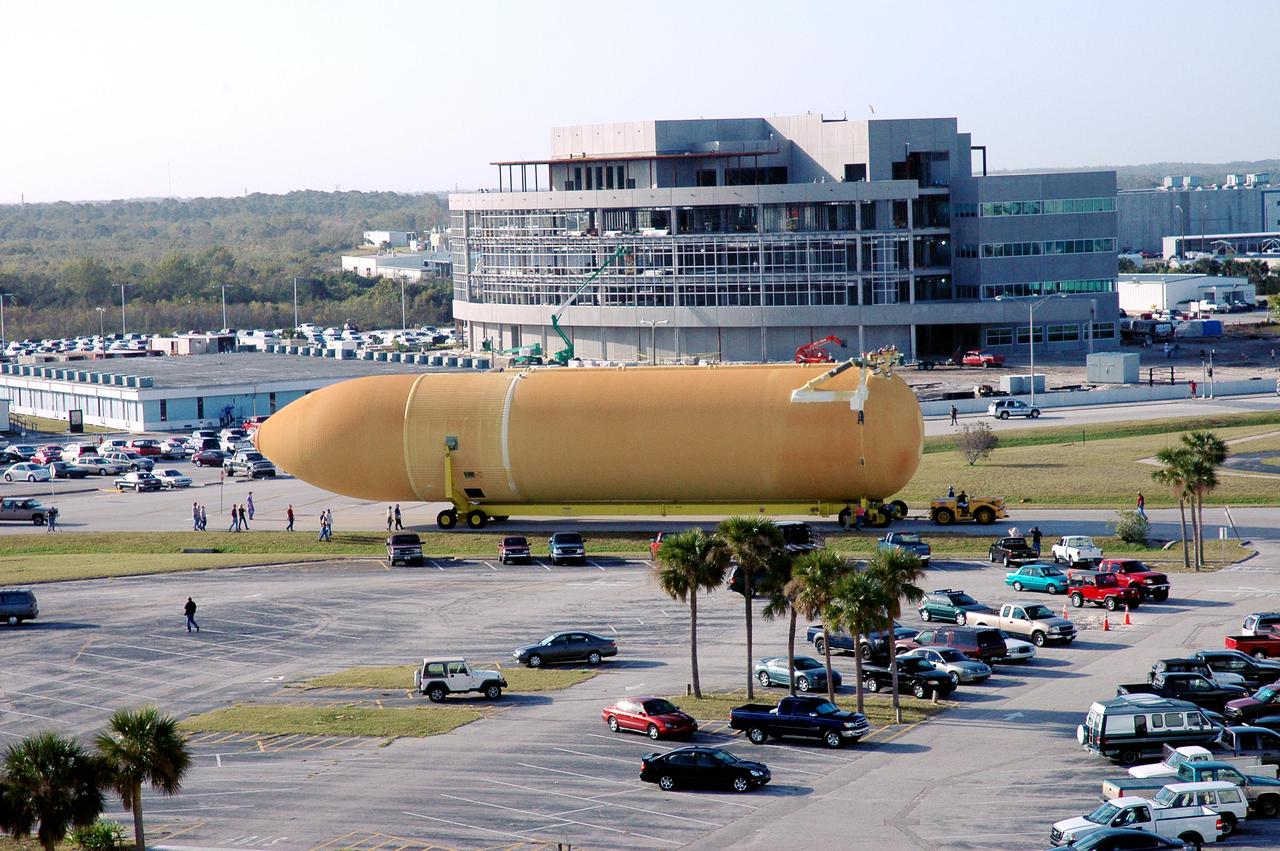
KENNEDY SPACE CENTER, FLA. - Viewed from the roof of the Launch Control Center in the Launch Complex 39 Area, the newly redesigned External Tank is seen moving past the parking area on its way to the Vehicle Assembly Building. Behind the tank is Operations Support Building II, currently under construction. In the transfer aisle of the VAB, the tank will be raised from a horizontal to a vertical position, then lifted high up into a storage cell, or “checkout cell,” where it will undergo inspections of the mechanical, electrical and thermal protection systems. New processing activities resulting from re-design of the tank include inspection of the bipod heater and External Tank separation camera, which includes charging the camera batteries. The tank will be then prepared for mating to the Solid Rocket Boosters. When preparations are complete, the tank will be lifted from the checkout cell, moved across the transfer aisle and into High Bay 1, where it will be lowered and attached to the boosters, which are sitting on the Mobile Launch Platform. The tank is designated for the Return to Flight mission, STS-114, targeted for a launch opportunity beginning in May. The seven-member Discovery crew will fly to the International Space Station primarily to test and evaluate new procedures for flight safety, including Space Shuttle inspection and repair techniques.
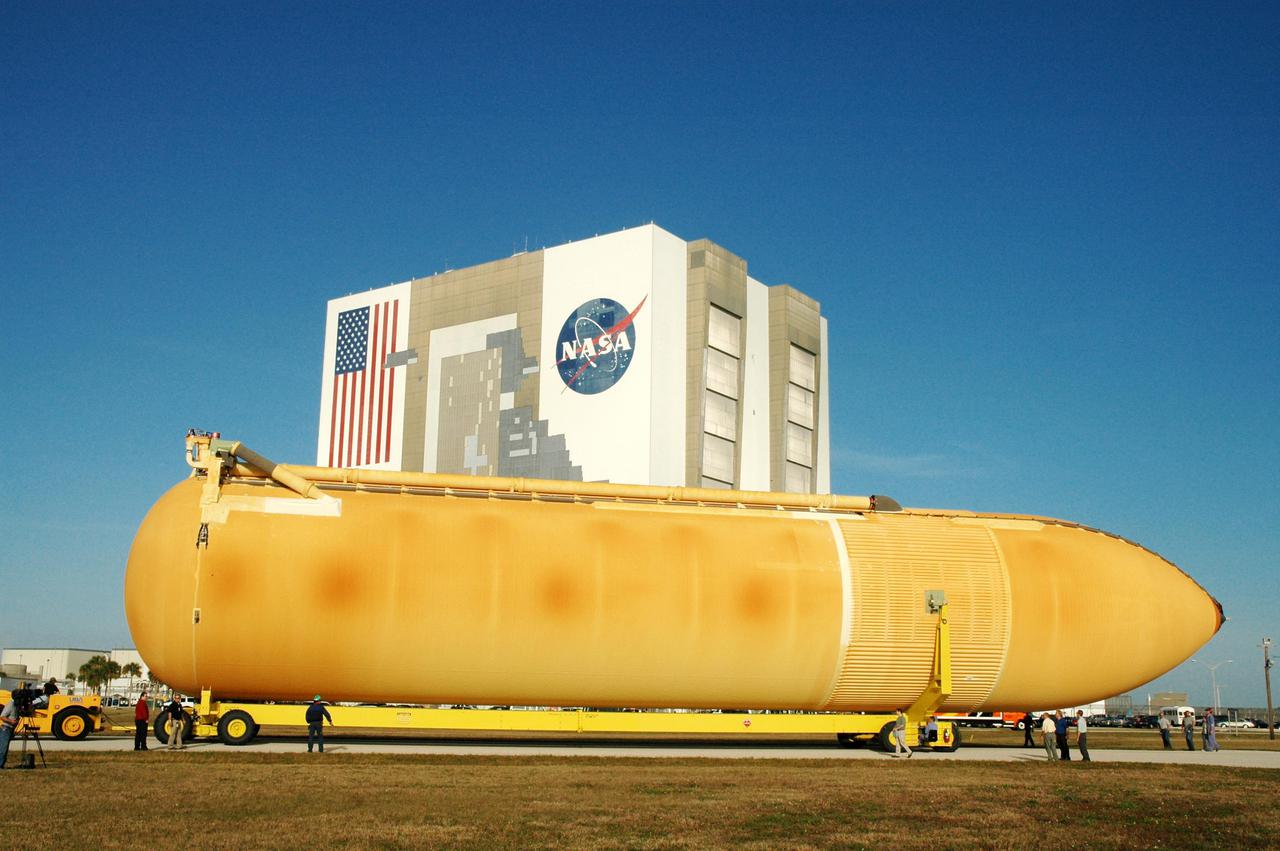
KENNEDY SPACE CENTER, FLA. - The newly redesigned External Tank wends its way through the parking area at the Launch Complex 39 Area Turn Basin on its way to the Vehicle Assembly Building, seen behind it. The tank arrived Jan. 5 after a 900-mile sea voyage aboard NASA’s specially designed barge, Pegasus, from the Michoud Assembly Facility in New Orleans. In the transfer aisle of the VAB, the tank will be raised from a horizontal to a vertical position, then lifted high up into a storage cell, or “checkout cell,” where it will undergo inspections of the mechanical, electrical and thermal protection systems. New processing activities resulting from re-design of the tank include inspection of the bipod heater and External Tank separation camera, which includes charging the camera batteries. The tank will be then prepared for mating to the Solid Rocket Boosters. When preparations are complete, the tank will be lifted from the checkout cell, moved across the transfer aisle and into High Bay 1, where it will be lowered and attached to the boosters, which are sitting on the Mobile Launch Platform. The tank is designated for the Return to Flight mission, STS-114, targeted for a launch opportunity beginning in May. The seven-member Discovery crew will fly to the International Space Station primarily to test and evaluate new procedures for flight safety, including Space Shuttle inspection and repair techniques.
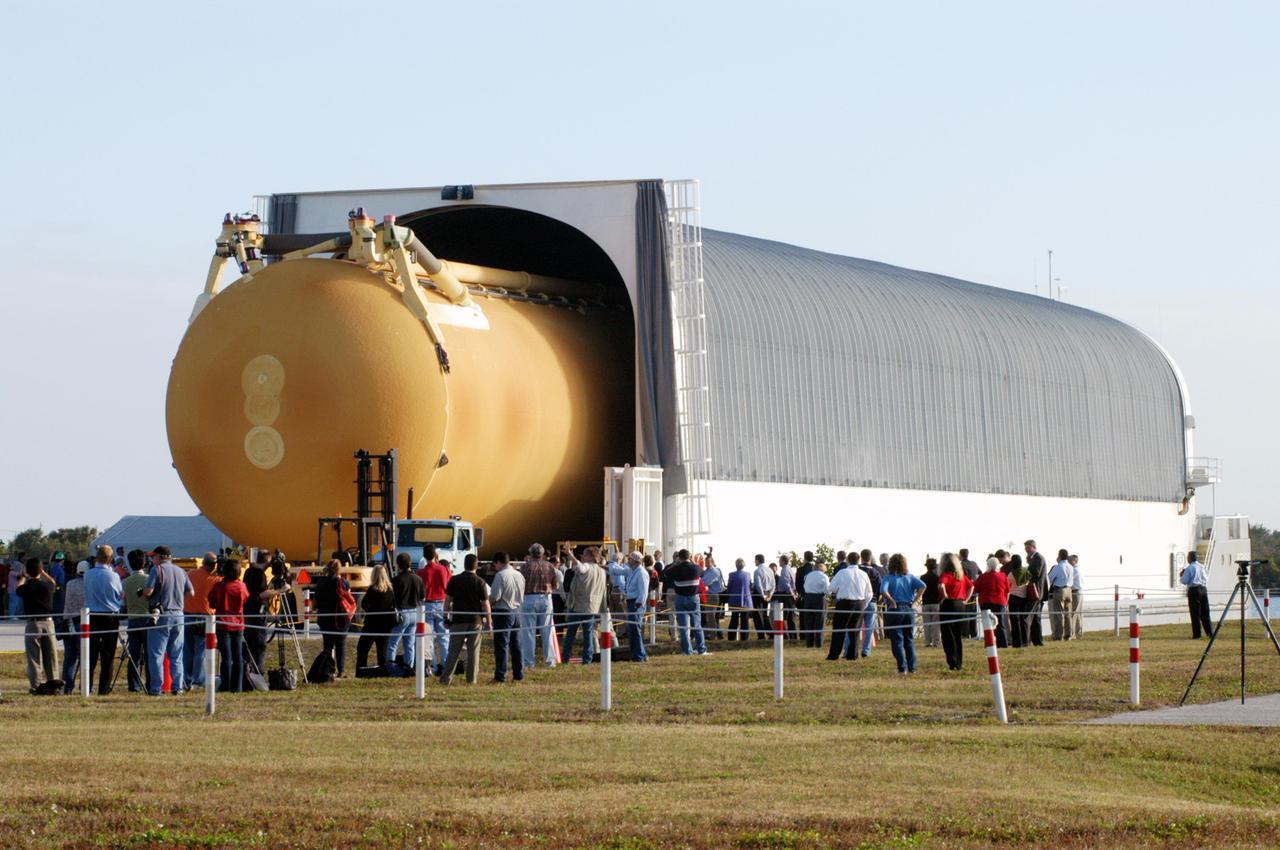
KENNEDY SPACE CENTER, FLA. - Media view the newly redesigned External Tank as it is off-loaded from the barge that carried it from the Michoud Assembly Facility in New Orleans. The tank is being transported to the Vehicle Assembly Building. In the transfer aisle of the VAB, the tank will be raised from a horizontal to a vertical position, then lifted high up into a storage cell, or “checkout cell,” where it will undergo inspections of the mechanical, electrical and thermal protection systems. New processing activities resulting from re-design of the tank include inspection of the bipod heater and External Tank separation camera, which includes charging the camera batteries. The tank will be then prepared for mating to the Solid Rocket Boosters. When preparations are complete, the tank will be lifted from the checkout cell, moved across the transfer aisle and into High Bay 1, where it will be lowered and attached to the boosters, which are sitting on the Mobile Launch Platform. The tank is designated for the Return to Flight mission, STS-114, targeted for a launch opportunity beginning in May. The seven-member Discovery crew will fly to the International Space Station primarily to test and evaluate new procedures for flight safety, including Space Shuttle inspection and repair techniques.
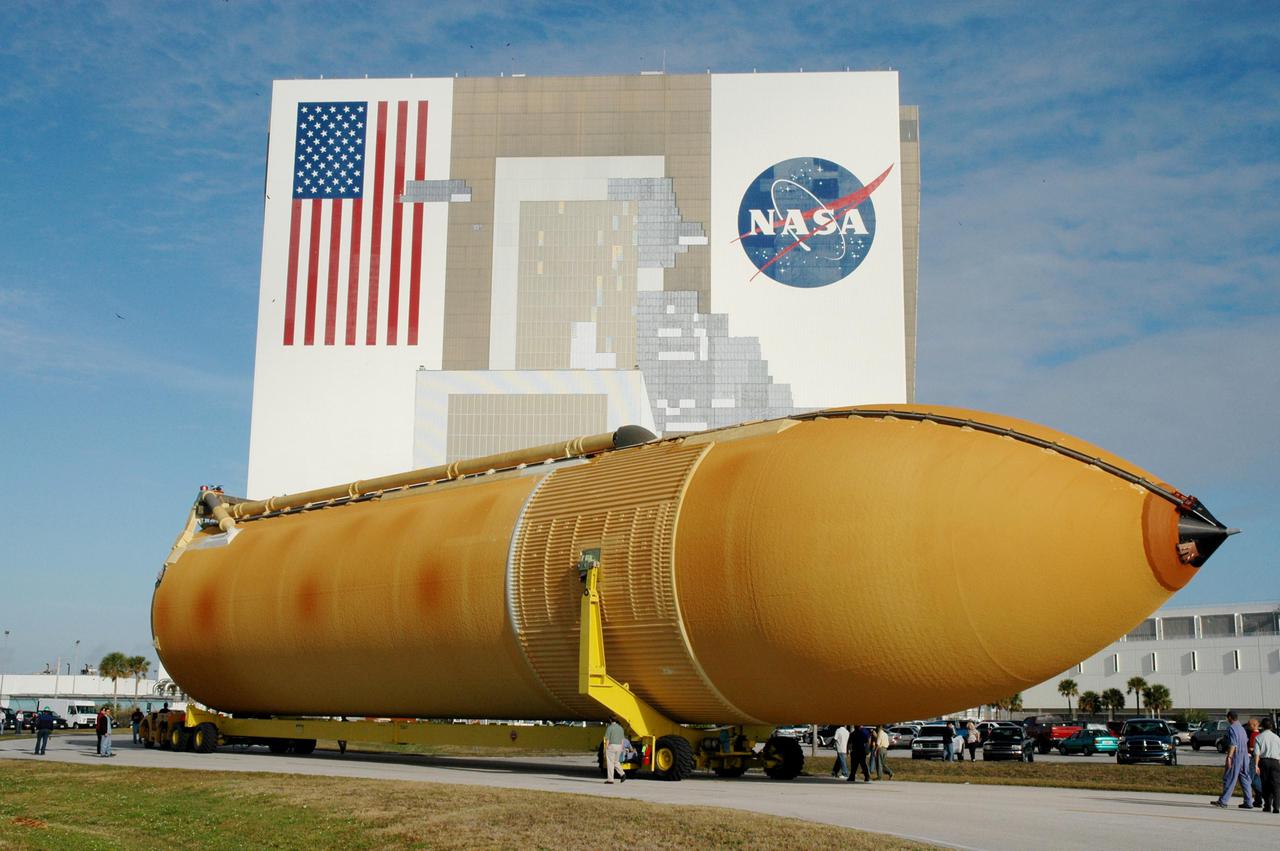
KENNEDY SPACE CENTER, FLA. - The newly redesigned External Tank moves closer to its destination, the Vehicle Assembly Building, seen behind it. The tank arrived Jan. 5 after a 900-mile sea voyage aboard NASA’s specially designed barge, Pegasus, from the Michoud Assembly Facility in New Orleans. In the transfer aisle of the VAB, the tank will be raised from a horizontal to a vertical position, then lifted high up into a storage cell, or “checkout cell,” where it will undergo inspections of the mechanical, electrical and thermal protection systems. New processing activities resulting from re-design of the tank include inspection of the bipod heater and External Tank separation camera, which includes charging the camera batteries. The tank will be then prepared for mating to the Solid Rocket Boosters. When preparations are complete, the tank will be lifted from the checkout cell, moved across the transfer aisle and into High Bay 1, where it will be lowered and attached to the boosters, which are sitting on the Mobile Launch Platform. The tank is designated for the Return to Flight mission, STS-114, targeted for a launch opportunity beginning in May. The seven-member Discovery crew will fly to the International Space Station primarily to test and evaluate new procedures for flight safety, including Space Shuttle inspection and repair techniques.
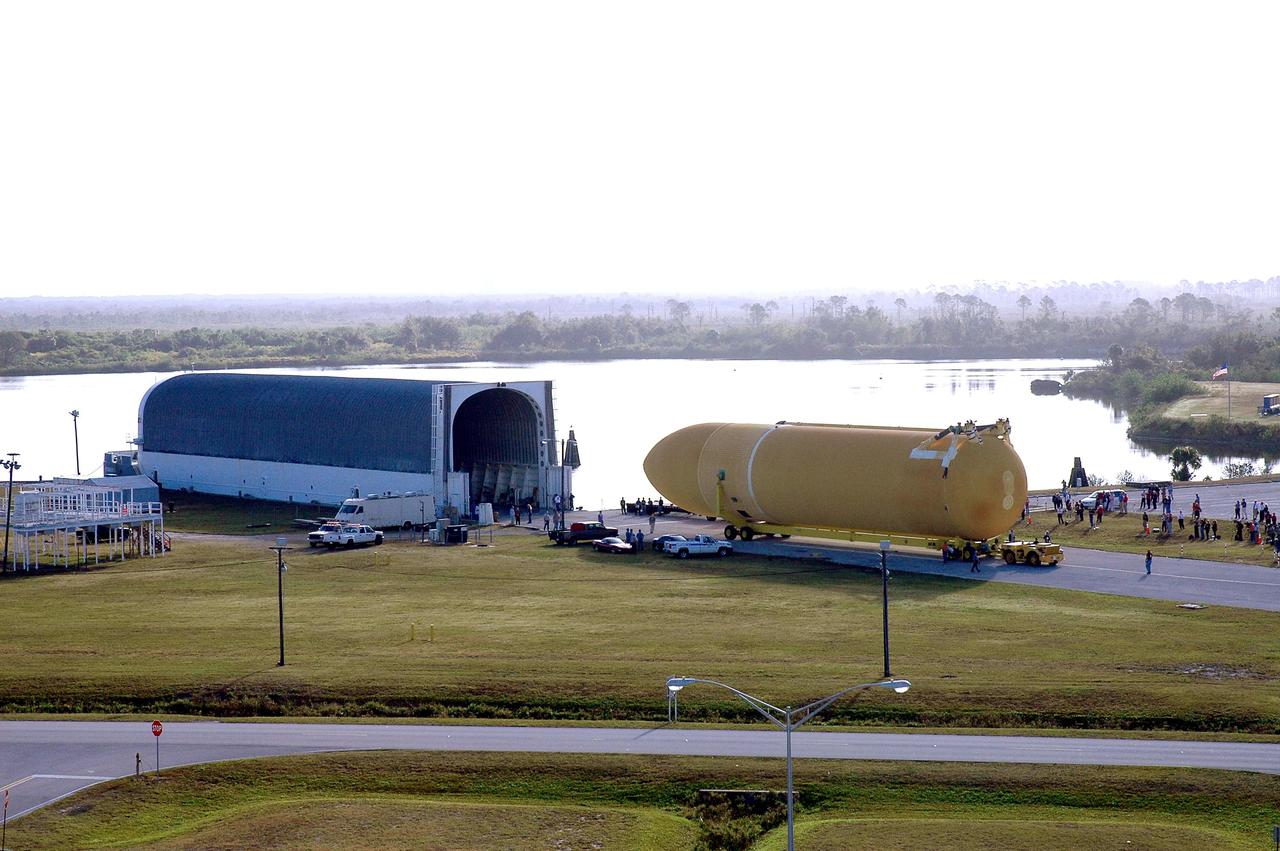
KENNEDY SPACE CENTER, FLA. - Viewed from the roof of the Launch Control Center, the newly redesigned External Tank is seen after being off-loaded from NASA’s specially designed barge, Pegasus, which delivered it from the Michoud Assembly Facility in New Orleans. The tank is being transferred to the Vehicle Assembly Building. In the transfer aisle of the VAB, the tank will be raised from a horizontal to a vertical position, then lifted high up into a storage cell, or “checkout cell,” where it will undergo inspections of the mechanical, electrical and thermal protection systems. New processing activities resulting from re-design of the tank include inspection of the bipod heater and External Tank separation camera, which includes charging the camera batteries. The tank will be then prepared for mating to the Solid Rocket Boosters. When preparations are complete, the tank will be lifted from the checkout cell, moved across the transfer aisle and into High Bay 1, where it will be lowered and attached to the boosters, which are sitting on the Mobile Launch Platform. The tank is designated for the Return to Flight mission, STS-114, targeted for a launch opportunity beginning in May. The seven-member Discovery crew will fly to the International Space Station primarily to test and evaluate new procedures for flight safety, including Space Shuttle inspection and repair techniques.
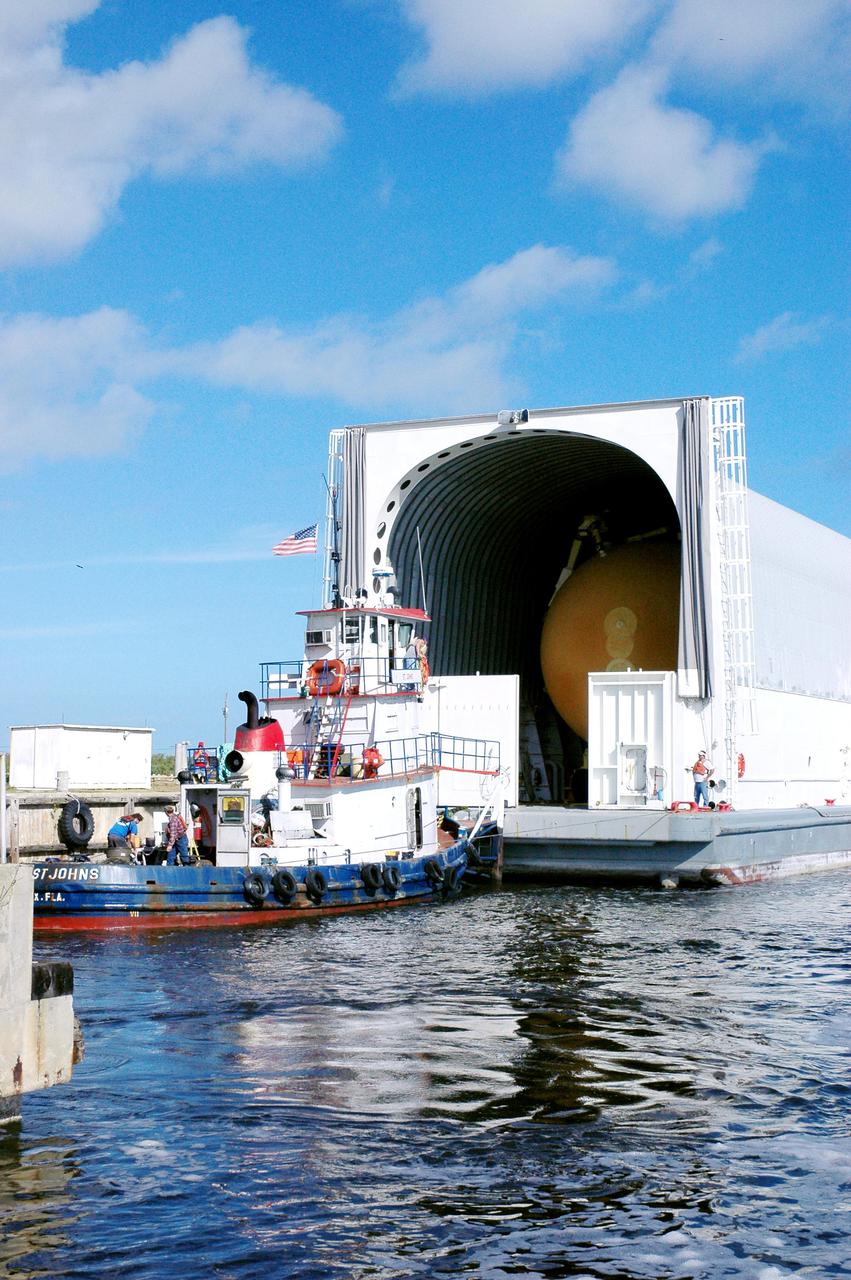
KENNEDY SPACE CENTER, FLA. - Tugboats maneuver the barge carrying the newly redesigned External Tank (ET), designated for use on Return to Flight mission STS-114, closer to the dock at the Launch Complex 39 Area Turn Basin. The ET can be seen inside the barge. The External Tank arrived safely early this morning at Port Canaveral, Fla., after an approximately 900-mile journey at sea. It departed from the Michoud Assembly Facility in New Orleans Dec. 31 and was transported on the Pegasus, NASA’s specially designed barge, pulled by Solid Rocket Booster retrieval ship Liberty Star. At the port, the barge was then hooked up to the tugs for the last part of the journey to the Turn Basin. Next, the External Tank will be off-loaded from the barge and transported to the Vehicle Assembly Building for its final checkout and mating to the twin Solid Rocket Boosters and orbiter Discovery. NASA and Lockheed Martin Corp. spent nearly two years modifying the 15-story, bronze-colored tank to make it safer for liftoff. Among dozens of changes is a redesigned forward bipod fitting -- a design that meets the recommendation of the Columbia Accident Investigation Board to reduce the risk to the Space Shuttle from falling debris during ascent. STS-114 is targeted for a launch opportunity beginning in May. The seven-member Discovery crew will fly to the International Space Station primarily to test and evaluate new procedures for flight safety, including Space Shuttle inspection and repair techniques.
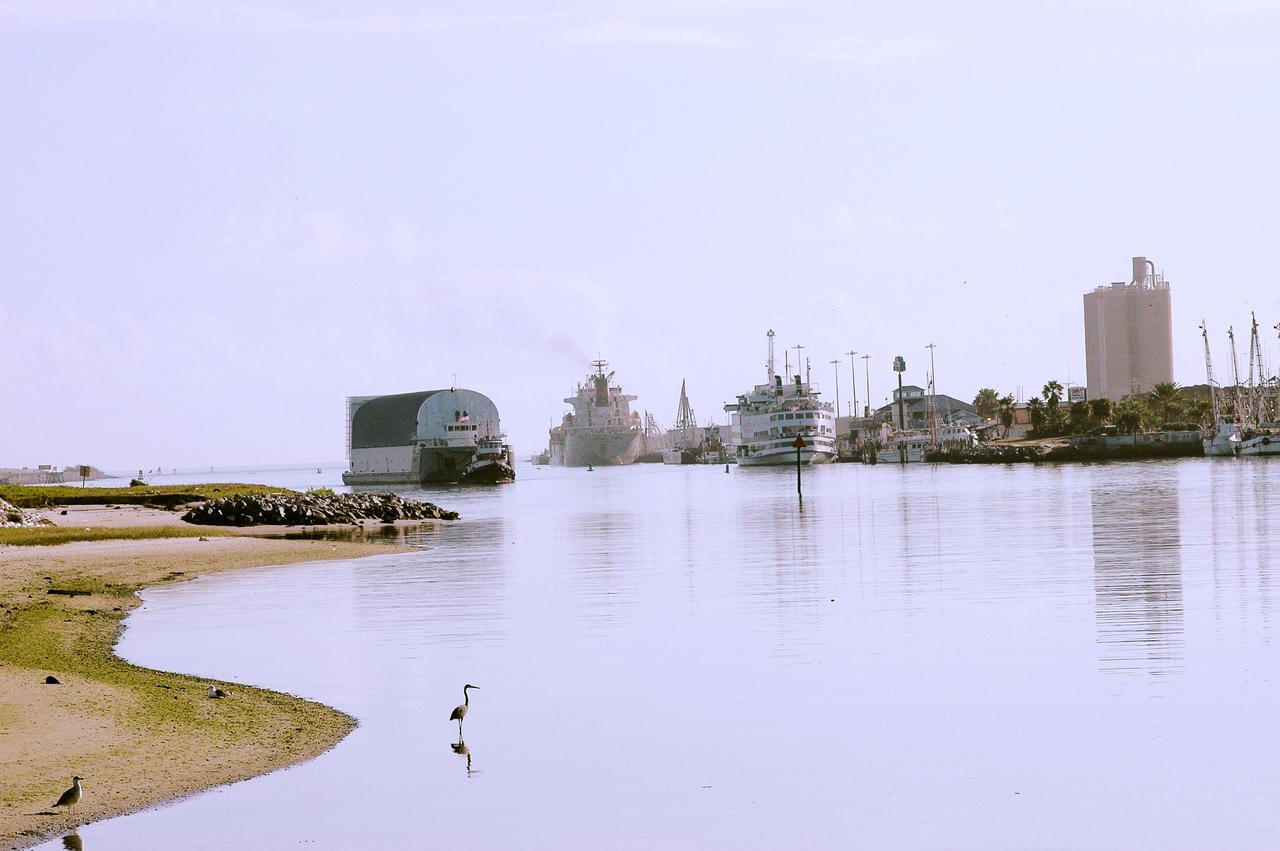
KENNEDY SPACE CENTER, FLA. - The barge carrying the newly redesigned External Tank, designated for use on Return to Flight mission STS-114, passes cruise ships as it enters Port Canaveral, Fla. The barge arrived after an approximately 900-mile journey at sea from the Michoud Assembly Facility in New Orleans. It left the facility Dec. 31 on the Pegasus, NASA’s specially designed barge, towed by Solid Rocket Booster retrieval ship Liberty Star. At Port Canaveral, the barge was then hooked up to the tugs for the last part of the journey to the Launch Complex 39 Area Turn Basin at Kennedy. Next, the External Tank will be off-loaded from the barge and transported to the Vehicle Assembly Building for its final checkout and mating to the twin Solid Rocket Boosters and orbiter Discovery. NASA and Lockheed Martin Corp. spent nearly two years modifying the 15-story, bronze-colored tank to make it safer for liftoff. Among dozens of changes is a redesigned forward bipod fitting -- a design that meets the recommendation of the Columbia Accident Investigation Board to reduce the risk to the Space Shuttle from falling debris during ascent. STS-114 is targeted for a launch opportunity beginning in May. The seven-member Discovery crew will fly to the International Space Station primarily to test and evaluate new procedures for flight safety, including Space Shuttle inspection and repair techniques.
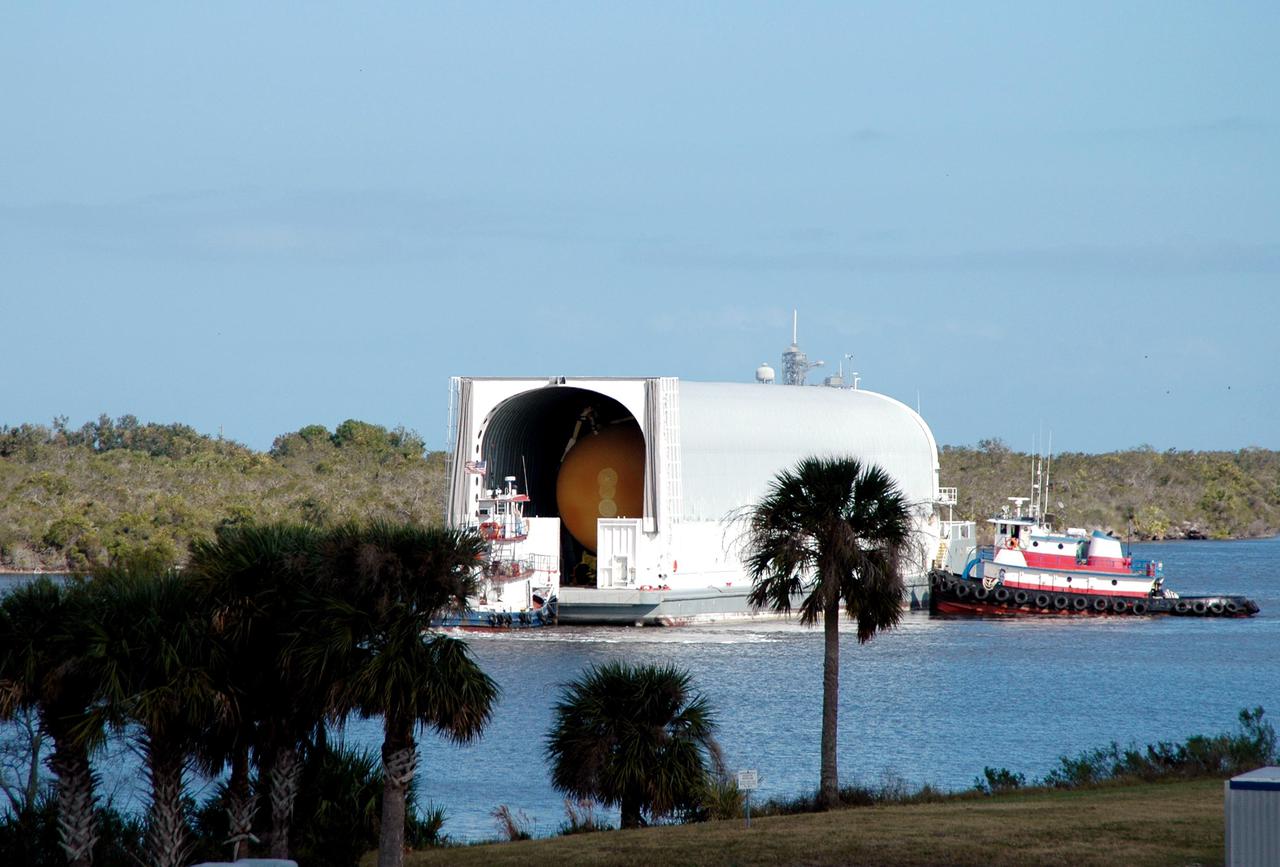
KENNEDY SPACE CENTER, FLA. - A tugboat maneuvers the barge carrying the newly redesigned External Tank (ET), designated for use on Return to Flight mission STS-114, toward the dock at the Launch Complex 39 Area Turn Basin. The ET can be seen inside the barge. The External Tank arrived safely early this morning at Port Canaveral, Fla., after an approximately 900-mile journey at sea. It departed from the Michoud Assembly Facility in New Orleans Dec. 31 and was transported on the Pegasus, NASA’s specially designed barge, pulled by Solid Rocket Booster retrieval ship Liberty Star. At the port, the barge was then hooked up to the tugs for the last part of the journey to the Turn Basin. Next, the External Tank will be off-loaded from the barge and transported to the Vehicle Assembly Building for its final checkout and mating to the twin Solid Rocket Boosters and orbiter Discovery. NASA and Lockheed Martin Corp. spent nearly two years modifying the 15-story, bronze-colored tank to make it safer for liftoff. Among dozens of changes is a redesigned forward bipod fitting -- a design that meets the recommendation of the Columbia Accident Investigation Board to reduce the risk to the Space Shuttle from falling debris during ascent. STS-114 is targeted for a launch opportunity beginning in May. The seven-member Discovery crew will fly to the International Space Station primarily to test and evaluate new procedures for flight safety, including Space Shuttle inspection and repair techniques.
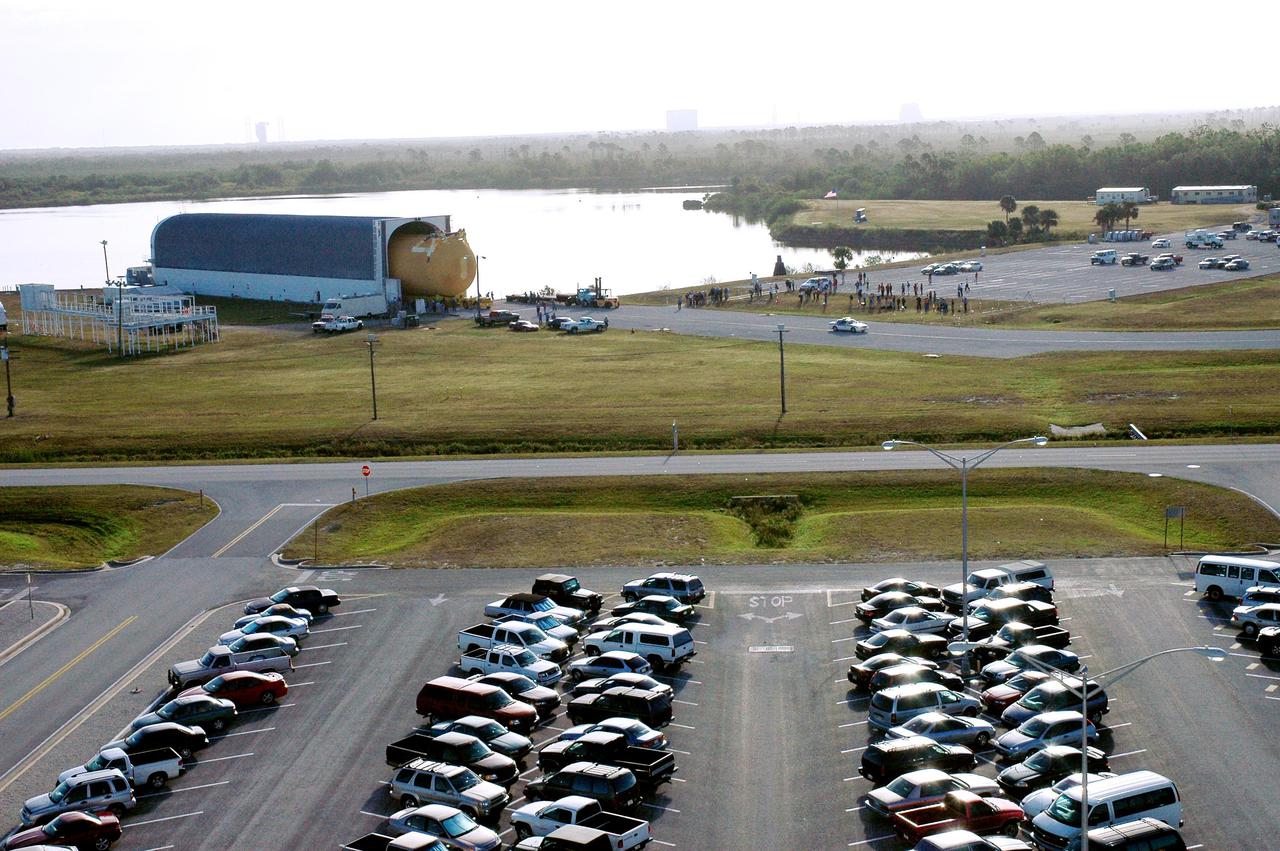
KENNEDY SPACE CENTER, FLA. - Viewed from the top of the Launch Control Center, the newly redesigned External Tank is seen moving out of NASA’s specially designed barge, Pegasus, which delivered it from the Michoud Assembly Facility in New Orleans. The tank is being transferred to the Vehicle Assembly Building. In the transfer aisle of the VAB, the tank will be raised from a horizontal to a vertical position, then lifted high up into a storage cell, or “checkout cell,” where it will undergo inspections of the mechanical, electrical and thermal protection systems. New processing activities resulting from re-design of the tank include inspection of the bipod heater and External Tank separation camera, which includes charging the camera batteries. The tank will be then prepared for mating to the Solid Rocket Boosters. When preparations are complete, the tank will be lifted from the checkout cell, moved across the transfer aisle and into High Bay 1, where it will be lowered and attached to the boosters, which are sitting on the Mobile Launch Platform. The tank is designated for the Return to Flight mission, STS-114, targeted for a launch opportunity beginning in May. The seven-member Discovery crew will fly to the International Space Station primarily to test and evaluate new procedures for flight safety, including Space Shuttle inspection and repair techniques.
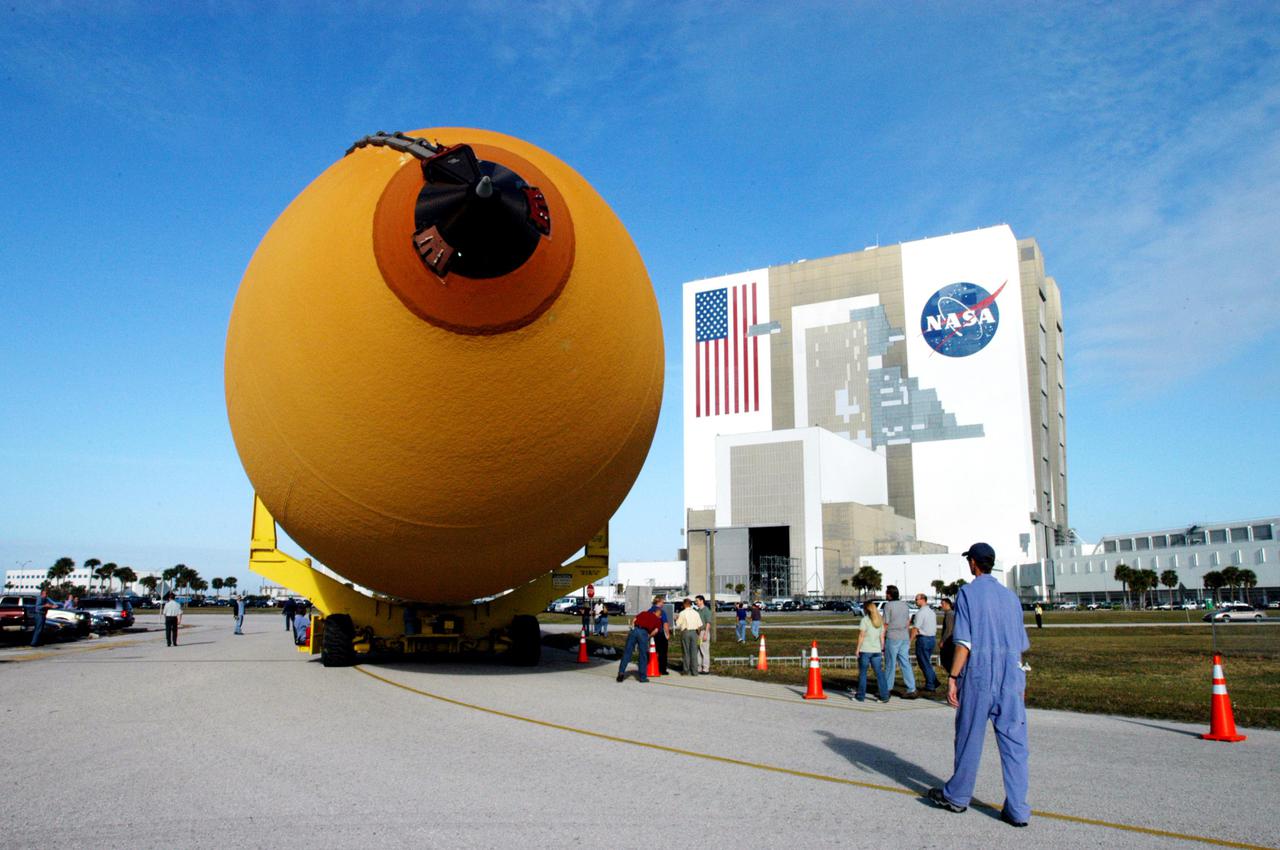
KENNEDY SPACE CENTER, FLA. - The newly redesigned External Tank slowly moves toward the Vehicle Assembly Building, seen at right. The tank arrived Jan. 5 after a 900-mile sea voyage aboard NASA’s specially designed barge, Pegasus, from the Michoud Assembly Facility in New Orleans. In the transfer aisle of the VAB, the tank will be raised from a horizontal to a vertical position, then lifted high up into a storage cell, or “checkout cell,” where it will undergo inspections of the mechanical, electrical and thermal protection systems. New processing activities resulting from re-design of the tank include inspection of the bipod heater and External Tank separation camera, which includes charging the camera batteries. The tank will be then prepared for mating to the Solid Rocket Boosters. When preparations are complete, the tank will be lifted from the checkout cell, moved across the transfer aisle and into High Bay 1, where it will be lowered and attached to the boosters, which are sitting on the Mobile Launch Platform. The tank is designated for the Return to Flight mission, STS-114, targeted for a launch opportunity beginning in May. The seven-member Discovery crew will fly to the International Space Station primarily to test and evaluate new procedures for flight safety, including Space Shuttle inspection and repair techniques.
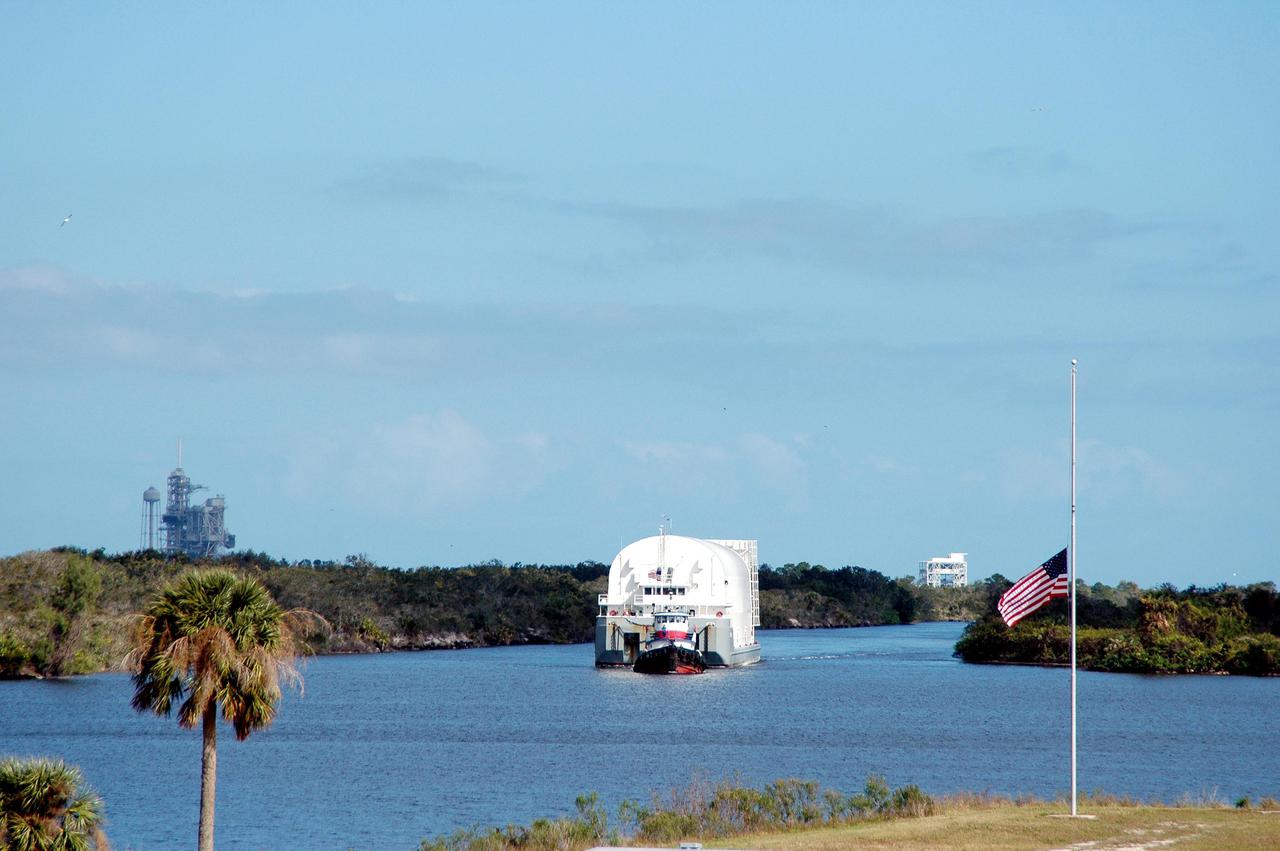
KENNEDY SPACE CENTER, FLA. - The newly redesigned External Tank, designated for use on Return to Flight mission STS-114, moves slowly toward its destination, the dock at the Launch Complex 39 Area Turn Basin, propelled by two tugboats. At left in the background is Launch Pad 39A. The External Tank arrived safely early this morning at Port Canaveral, Fla., after an approximately 900-mile journey at sea. It departed from the Michoud Assembly Facility in New Orleans Dec. 31 and was transported on the Pegasus, NASA’s specially designed barge, pulled by Solid Rocket Booster retrieval ship Liberty Star. At the port, the barge was then hooked up to the tugs for the last part of the journey to the Turn Basin. Next, the External Tank will be off-loaded from the barge and transported to the Vehicle Assembly Building for its final checkout and mating to the twin Solid Rocket Boosters and orbiter Discovery. NASA and Lockheed Martin Corp. spent nearly two years modifying the 15-story, bronze-colored tank to make it safer for liftoff. Among dozens of changes is a redesigned forward bipod fitting -- a design that meets the recommendation of the Columbia Accident Investigation Board to reduce the risk to the Space Shuttle from falling debris during ascent. STS-114 is targeted for a launch opportunity beginning in May. The seven-member Discovery crew will fly to the International Space Station primarily to test and evaluate new procedures for flight safety, including Space Shuttle inspection and repair techniques.
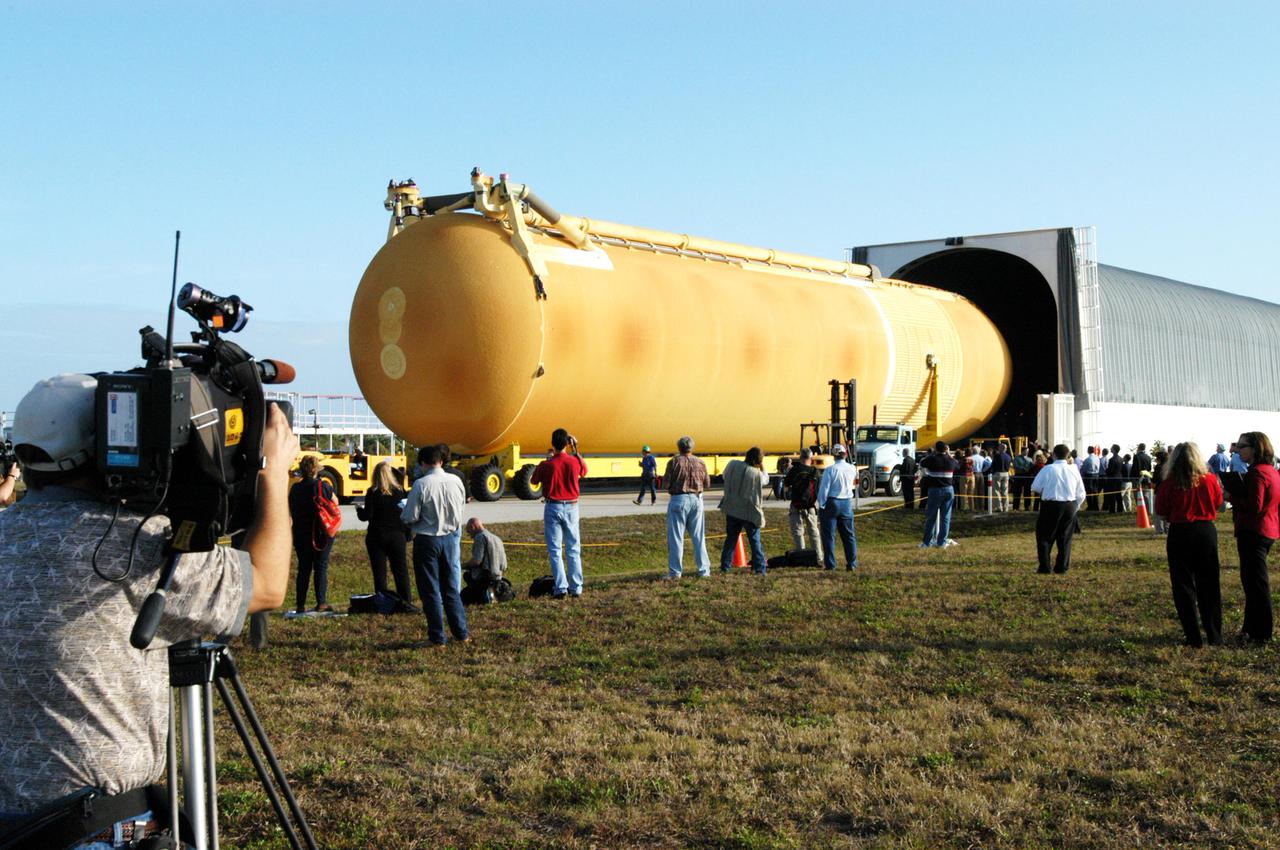
KENNEDY SPACE CENTER, FLA. - Media view the newly redesigned External Tank as it is off-loaded from the barge that carried it from the Michoud Assembly Facility in New Orleans. The tank is being transported to the Vehicle Assembly Building. The tank arrived Jan. 5 after a 900-mile sea voyage aboard NASA’s specially designed barge, Pegasus, from the Michoud Assembly Facility in New Orleans. In the transfer aisle of the VAB, the tank will be raised from a horizontal to a vertical position, then lifted high up into a storage cell, or “checkout cell,” where it will undergo inspections of the mechanical, electrical and thermal protection systems. New processing activities resulting from re-design of the tank include inspection of the bipod heater and External Tank separation camera, which includes charging the camera batteries. The tank will be then prepared for mating to the Solid Rocket Boosters. When preparations are complete, the tank will be lifted from the checkout cell, moved across the transfer aisle and into High Bay 1, where it will be lowered and attached to the boosters, which are sitting on the Mobile Launch Platform. The tank is designated for the Return to Flight mission, STS-114, targeted for a launch opportunity beginning in May. The seven-member Discovery crew will fly to the International Space Station primarily to test and evaluate new procedures for flight safety, including Space Shuttle inspection and repair techniques.
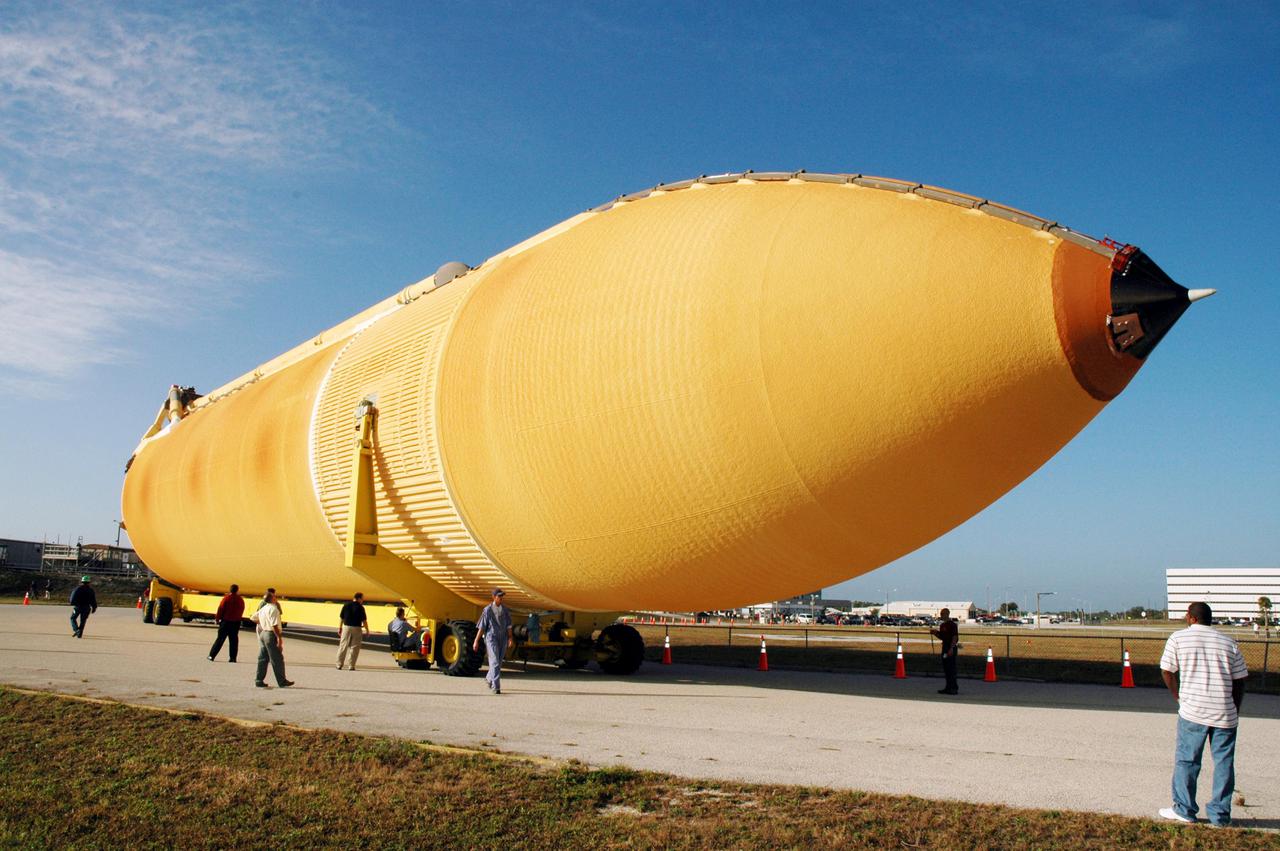
KENNEDY SPACE CENTER, FLA. - The newly redesigned External Tank turns the corner of the Launch Complex 39 Area Turn Basin parking area on its way to the Vehicle Assembly Building, seen at right. The tank arrived Jan. 5 after a 900-mile sea voyage aboard NASA’s specially designed barge, Pegasus, from the Michoud Assembly Facility in New Orleans. In the transfer aisle of the VAB, the tank will be raised from a horizontal to a vertical position, then lifted high up into a storage cell, or “checkout cell,” where it will undergo inspections of the mechanical, electrical and thermal protection systems. New processing activities resulting from re-design of the tank include inspection of the bipod heater and External Tank separation camera, which includes charging the camera batteries. The tank will be then prepared for mating to the Solid Rocket Boosters. When preparations are complete, the tank will be lifted from the checkout cell, moved across the transfer aisle and into High Bay 1, where it will be lowered and attached to the boosters, which are sitting on the Mobile Launch Platform. The tank is designated for the Return to Flight mission, STS-114, targeted for a launch opportunity beginning in May. The seven-member Discovery crew will fly to the International Space Station primarily to test and evaluate new procedures for flight safety, including Space Shuttle inspection and repair techniques.
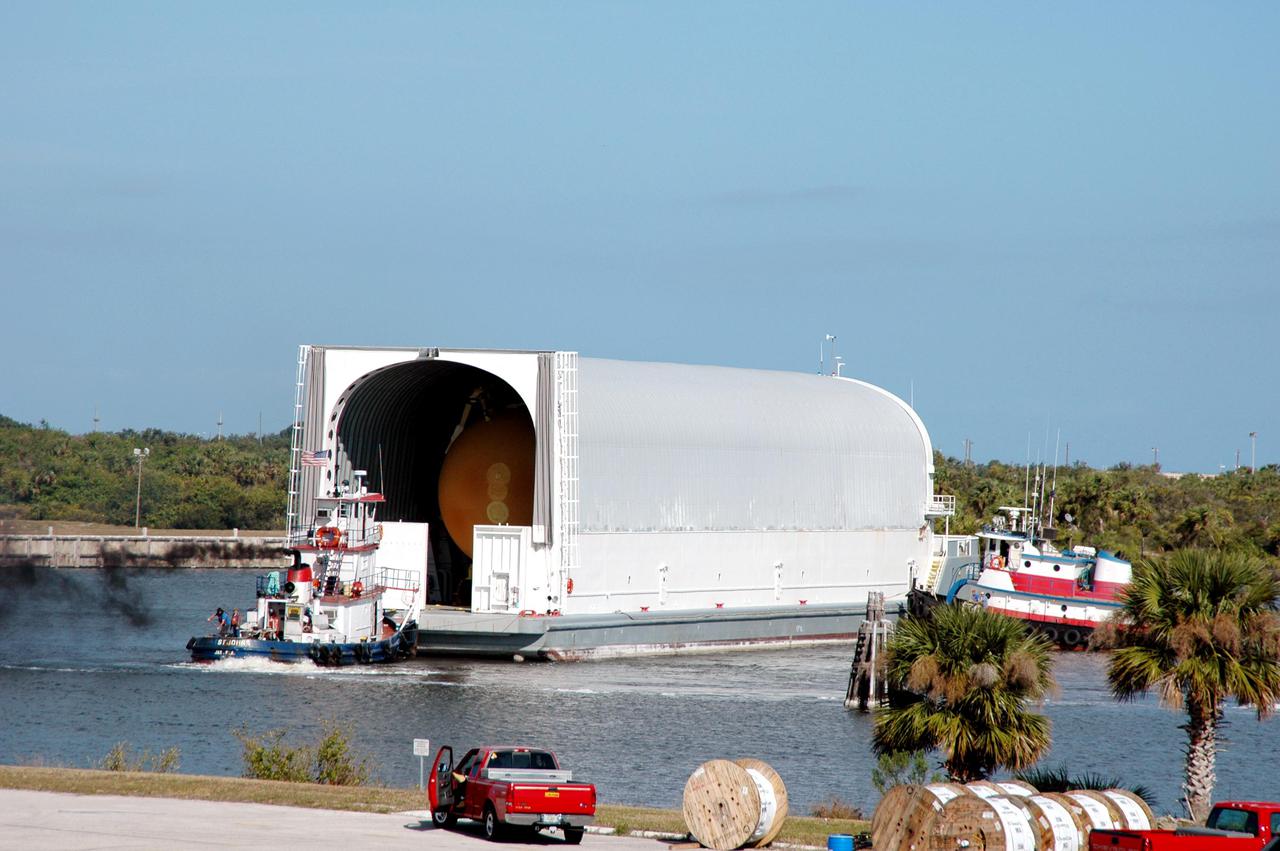
KENNEDY SPACE CENTER, FLA. - Tugboats maneuver the barge carrying the newly redesigned External Tank (ET), designated for use on Return to Flight mission STS-114, closer to the dock at the Launch Complex 39 Area Turn Basin. The ET can be seen inside the barge. The External Tank arrived safely early this morning at Port Canaveral, Fla., after an approximately 900-mile journey at sea. It departed from the Michoud Assembly Facility in New Orleans Dec. 31 and was transported on the Pegasus, NASA’s specially designed barge, pulled by Solid Rocket Booster retrieval ship Liberty Star. At the port, the barge was then hooked up to the tugs for the last part of the journey to the Turn Basin. Next, the External Tank will be off-loaded from the barge and transported to the Vehicle Assembly Building for its final checkout and mating to the twin Solid Rocket Boosters and orbiter Discovery. NASA and Lockheed Martin Corp. spent nearly two years modifying the 15-story, bronze-colored tank to make it safer for liftoff. Among dozens of changes is a redesigned forward bipod fitting -- a design that meets the recommendation of the Columbia Accident Investigation Board to reduce the risk to the Space Shuttle from falling debris during ascent. STS-114 is targeted for a launch opportunity beginning in May. The seven-member Discovery crew will fly to the International Space Station primarily to test and evaluate new procedures for flight safety, including Space Shuttle inspection and repair techniques.
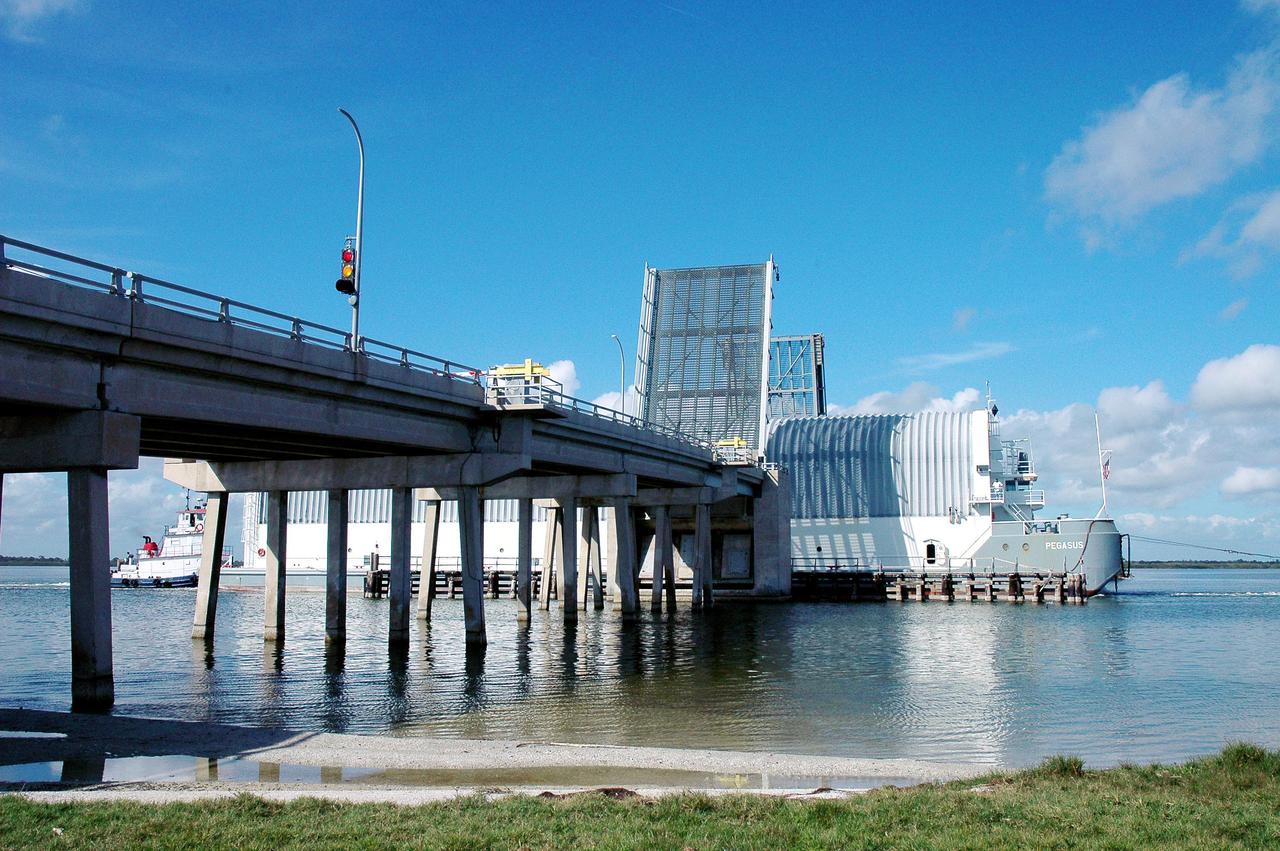
KENNEDY SPACE CENTER, FLA. - The tugboat towing the barge carrying the newly redesigned External Tank, designated for use on Return to Flight mission STS-114, passes through a drawbridge on its voyage to the Launch Complex 39 Area Turn Basin at Kennedy. The barge arrived after an approximately 900-mile journey at sea from the Michoud Assembly Facility in New Orleans. It left the facility Dec. 31 on the Pegasus, NASA’s specially designed barge, towed by Solid Rocket Booster retrieval ship Liberty Star. At Port Canaveral, the barge was then hooked up to the tugs for the last part of the journey to the Launch Complex 39 Area Turn Basin at Kennedy. Next, the External Tank will be off-loaded from the barge and transported to the Vehicle Assembly Building for its final checkout and mating to the twin Solid Rocket Boosters and orbiter Discovery. NASA and Lockheed Martin Corp. spent nearly two years modifying the 15-story, bronze-colored tank to make it safer for liftoff. Among dozens of changes is a redesigned forward bipod fitting -- a design that meets the recommendation of the Columbia Accident Investigation Board to reduce the risk to the Space Shuttle from falling debris during ascent. STS-114 is targeted for a launch opportunity beginning in May. The seven-member Discovery crew will fly to the International Space Station primarily to test and evaluate new procedures for flight safety, including Space Shuttle inspection and repair techniques.
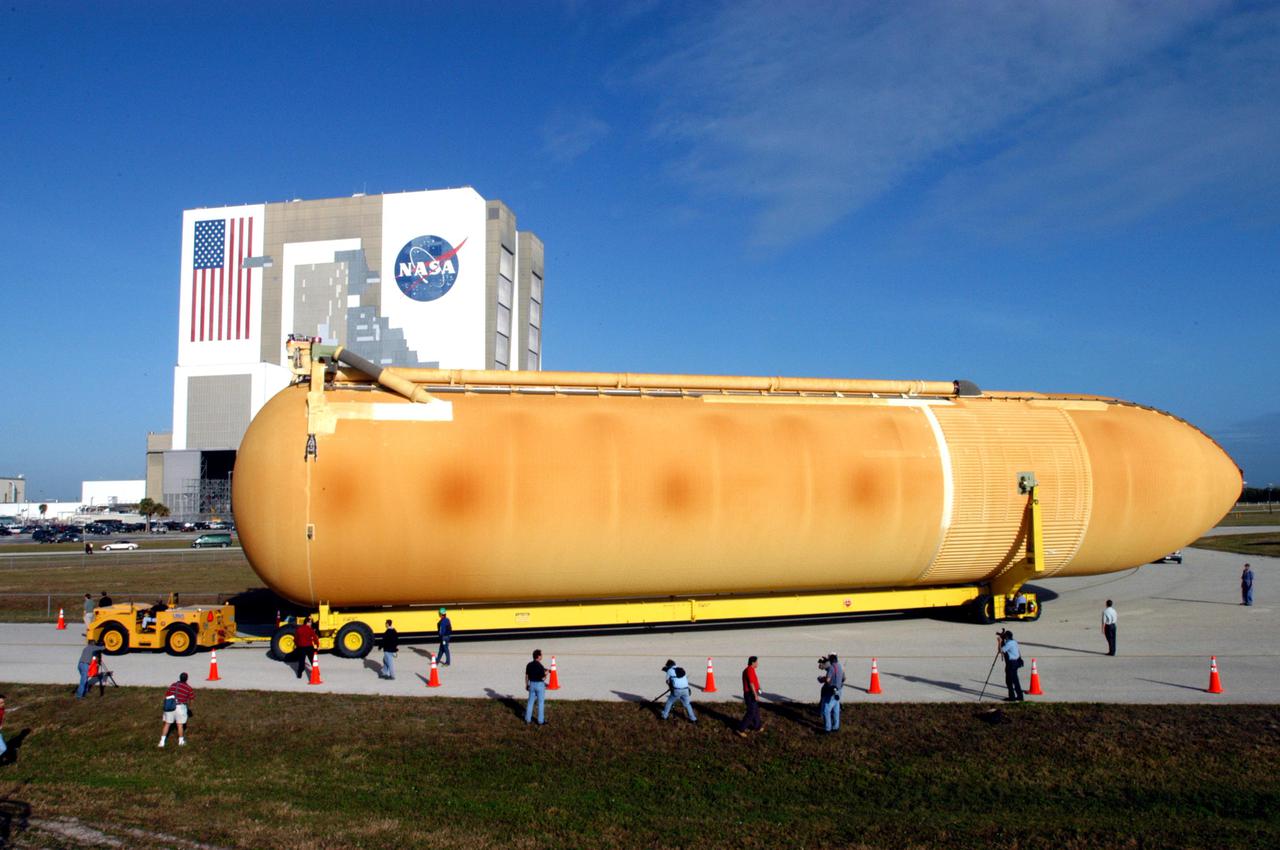
KENNEDY SPACE CENTER, FLA. - KSC employees accompany the newly redesigned External Tank as it wends its way through the parking area at the Launch Complex 39 Area Turn Basin. The tank is being moved to the Vehicle Assembly Building, seen behind it. The tank arrived Jan. 5 after a 900-mile sea voyage aboard NASA’s specially designed barge, Pegasus, from the Michoud Assembly Facility in New Orleans. In the transfer aisle of the VAB, the tank will be raised from a horizontal to a vertical position, then lifted high up into a storage cell, or “checkout cell,” where it will undergo inspections of the mechanical, electrical and thermal protection systems. New processing activities resulting from re-design of the tank include inspection of the bipod heater and External Tank separation camera, which includes charging the camera batteries. The tank will be then prepared for mating to the Solid Rocket Boosters. When preparations are complete, the tank will be lifted from the checkout cell, moved across the transfer aisle and into High Bay 1, where it will be lowered and attached to the boosters, which are sitting on the Mobile Launch Platform. The tank is designated for the Return to Flight mission, STS-114, targeted for a launch opportunity beginning in May. The seven-member Discovery crew will fly to the International Space Station primarily to test and evaluate new procedures for flight safety, including Space Shuttle inspection and repair techniques.
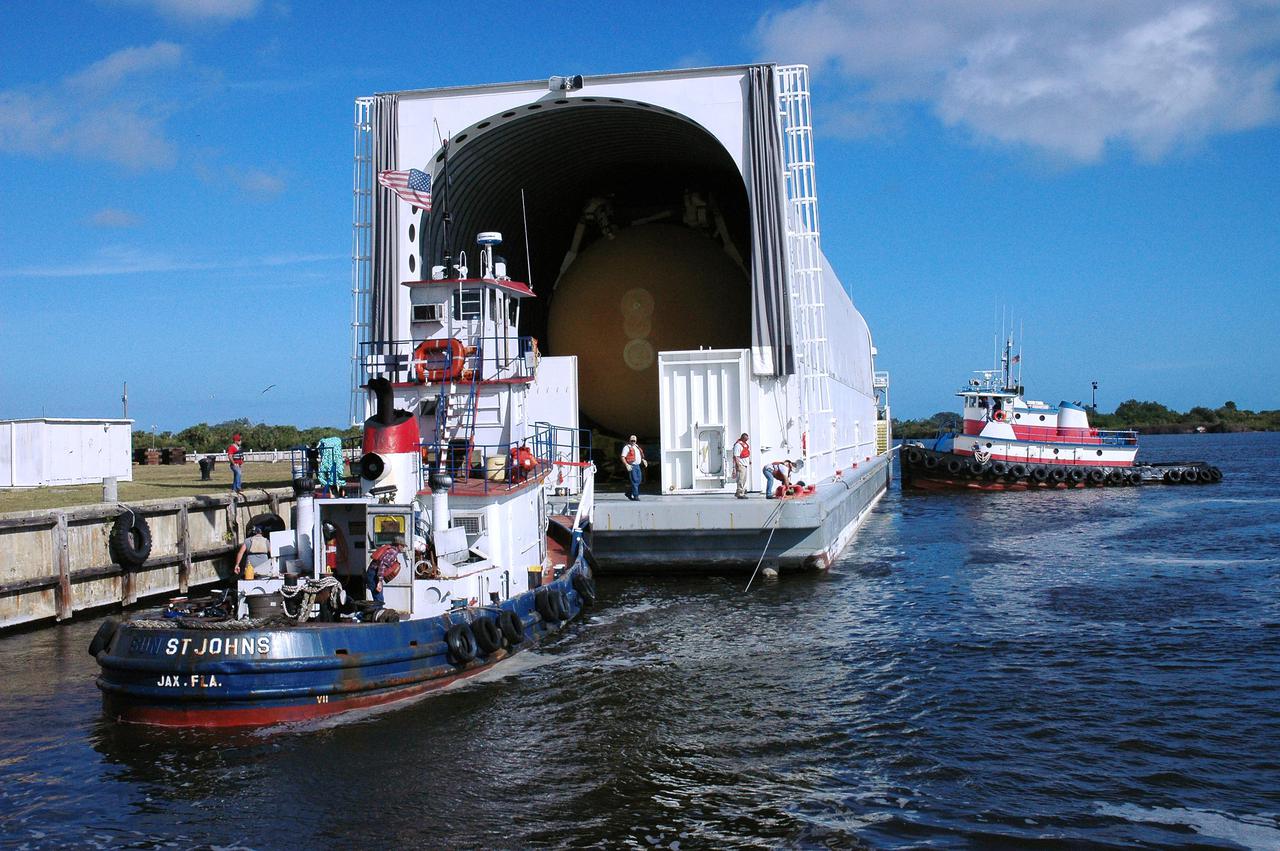
KENNEDY SPACE CENTER, FLA. - Tugboats maneuver the barge carrying the newly redesigned External Tank (ET), designated for use on Return to Flight mission STS-114, closer to the dock at the Launch Complex 39 Area Turn Basin. The ET can be seen inside the barge. The External Tank arrived safely early this morning at Port Canaveral, Fla., after an approximately 900-mile journey at sea. It departed from the Michoud Assembly Facility in New Orleans Dec. 31 and was transported on the Pegasus, NASA’s specially designed barge, pulled by Solid Rocket Booster retrieval ship Liberty Star. At the port, the barge was then hooked up to the tugs for the last part of the journey. Next, the External Tank will be off-loaded from the barge and transported to the Vehicle Assembly Building for its final checkout and mating to the twin Solid Rocket Boosters and orbiter Discovery. NASA and Lockheed Martin Corp. spent nearly two years modifying the 15-story, bronze-colored tank to make it safer for liftoff. Among dozens of changes is a redesigned forward bipod fitting -- a design that meets the recommendation of the Columbia Accident Investigation Board to reduce the risk to the Space Shuttle from falling debris during ascent. STS-114 is targeted for a launch opportunity beginning in May. The seven-member Discovery crew will fly to the International Space Station primarily to test and evaluate new procedures for flight safety, including Space Shuttle inspection and repair techniques.
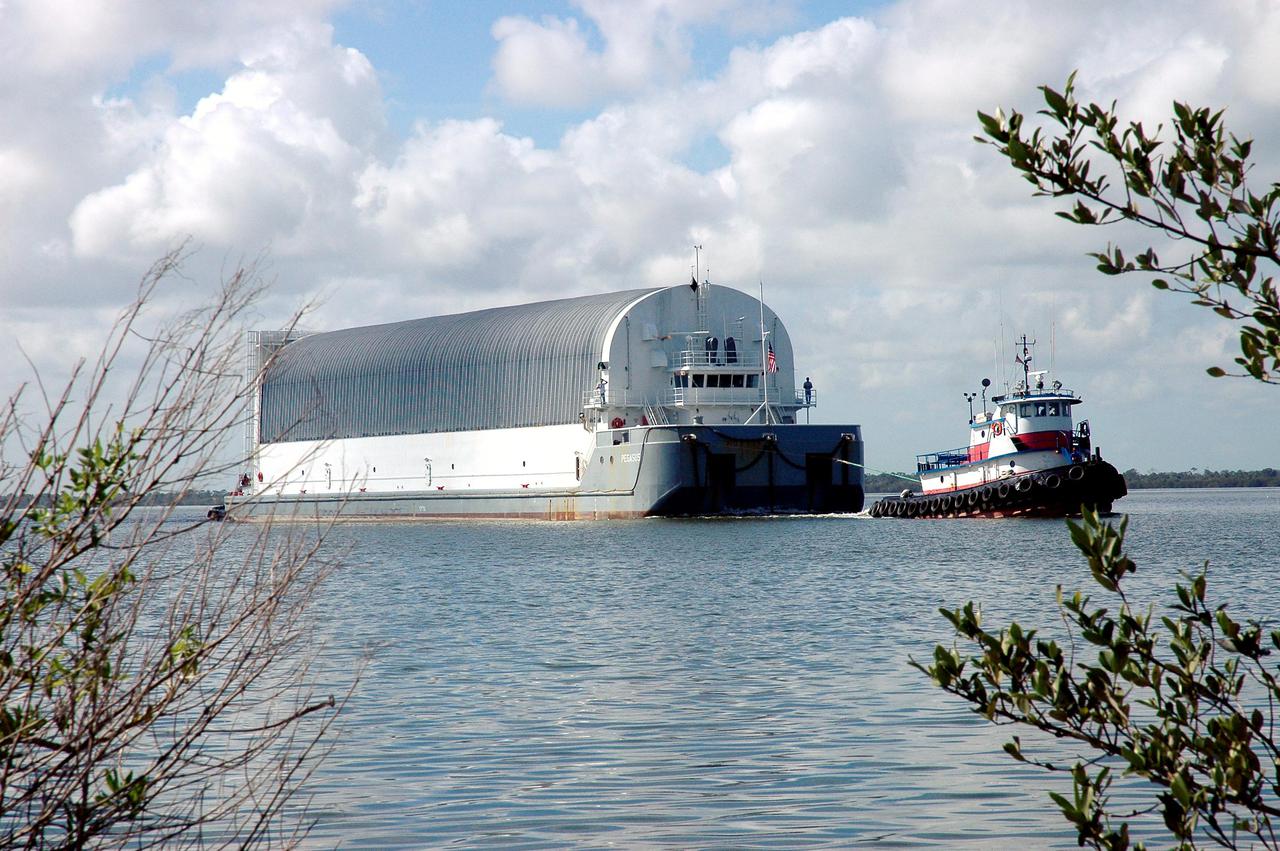
KENNEDY SPACE CENTER, FLA. - A tugboat tows the barge carrying the newly redesigned External Tank, designated for use on Return to Flight mission STS-114, to the dock at the Launch Complex 39 Area Turn Basin at Kennedy. The barge arrived after an approximately 900-mile journey at sea from the Michoud Assembly Facility in New Orleans. It left the facility Dec. 31 on the Pegasus, NASA’s specially designed barge, towed by Solid Rocket Booster retrieval ship Liberty Star. At Port Canaveral, the barge was then hooked up to the tugs for the last part of the journey to the Launch Complex 39 Area Turn Basin at Kennedy. Next, the External Tank will be off-loaded from the barge and transported to the Vehicle Assembly Building for its final checkout and mating to the twin Solid Rocket Boosters and orbiter Discovery. NASA and Lockheed Martin Corp. spent nearly two years modifying the 15-story, bronze-colored tank to make it safer for liftoff. Among dozens of changes is a redesigned forward bipod fitting -- a design that meets the recommendation of the Columbia Accident Investigation Board to reduce the risk to the Space Shuttle from falling debris during ascent. STS-114 is targeted for a launch opportunity beginning in May. The seven-member Discovery crew will fly to the International Space Station primarily to test and evaluate new procedures for flight safety, including Space Shuttle inspection and repair techniques.
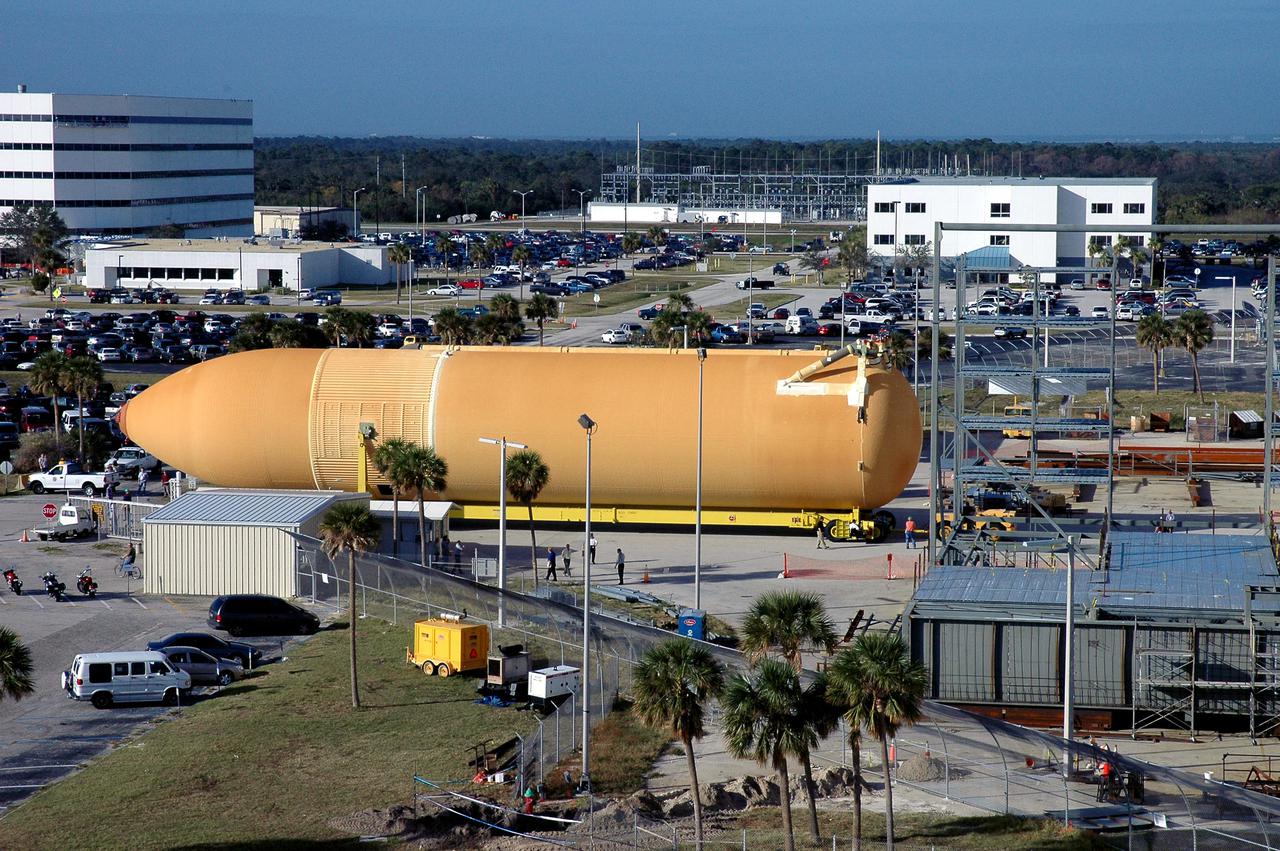
KENNEDY SPACE CENTER, FLA. - Viewed from the roof of the Launch Control Center in the Launch Complex 39 Area, the newly redesigned External Tank is seen moving along the roadway on its way to the Vehicle Assembly Building. In the background, at left, is the Operations Support Building I. In the transfer aisle of the VAB, the tank will be raised from a horizontal to a vertical position, then lifted high up into a storage cell, or “checkout cell,” where it will undergo inspections of the mechanical, electrical and thermal protection systems. New processing activities resulting from re-design of the tank include inspection of the bipod heater and External Tank separation camera, which includes charging the camera batteries. The tank will be then prepared for mating to the Solid Rocket Boosters. When preparations are complete, the tank will be lifted from the checkout cell, moved across the transfer aisle and into High Bay 1, where it will be lowered and attached to the boosters, which are sitting on the Mobile Launch Platform. The tank is designated for the Return to Flight mission, STS-114, targeted for a launch opportunity beginning in May. The seven-member Discovery crew will fly to the International Space Station primarily to test and evaluate new procedures for flight safety, including Space Shuttle inspection and repair techniques.
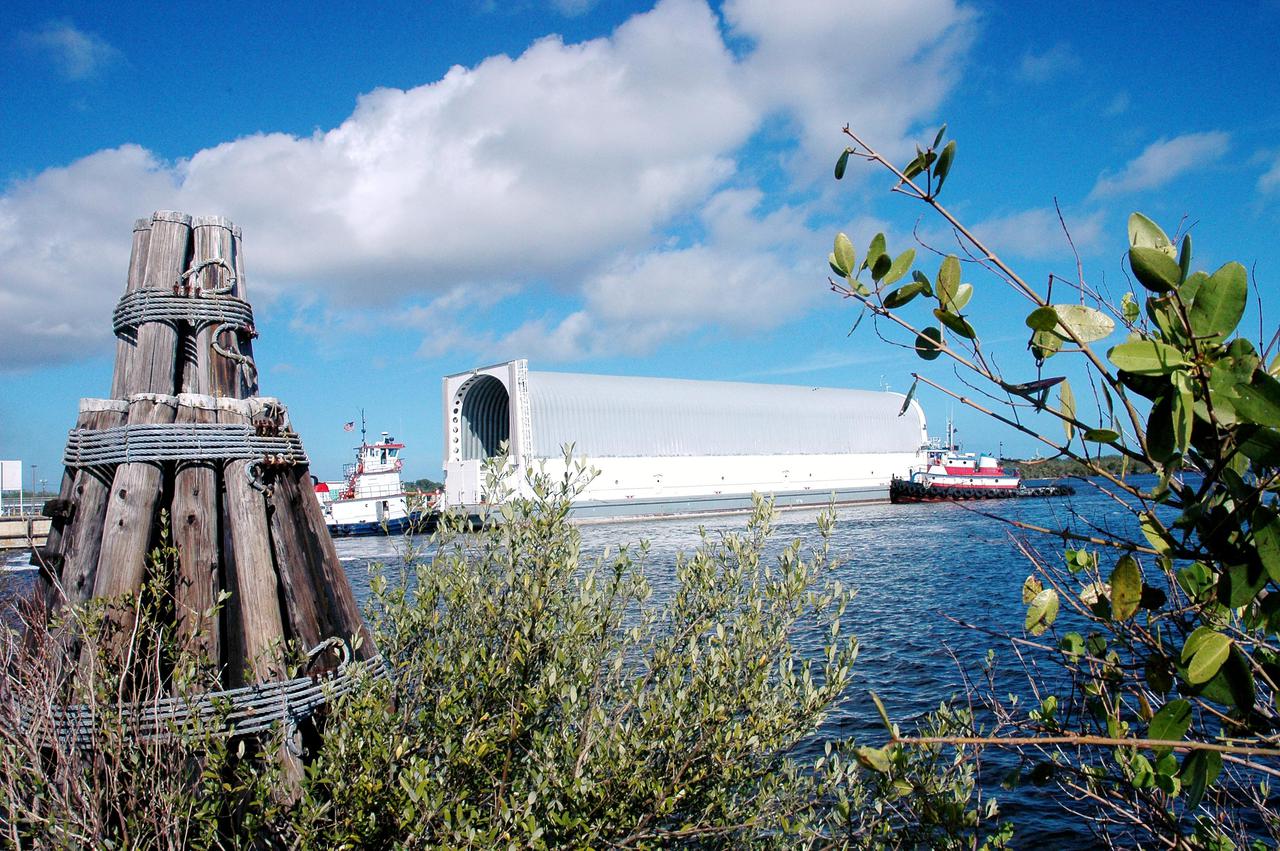
KENNEDY SPACE CENTER, FLA. - - Tugboats maneuver the barge carrying the newly redesigned External Tank, designated for use on Return to Flight mission STS-114, toward the dock at the Launch Complex 39 Area Turn Basin at Kennedy. The barge arrived after an approximately 900-mile journey at sea from the Michoud Assembly Facility in New Orleans. It left the facility Dec. 31 on the Pegasus, NASA’s specially designed barge, towed by Solid Rocket Booster retrieval ship Liberty Star. At Port Canaveral, the barge was then hooked up to the tugs for the last part of the journey. Next, the External Tank will be off-loaded from the barge and transported to the Vehicle Assembly Building for its final checkout and mating to the twin Solid Rocket Boosters and orbiter Discovery. NASA and Lockheed Martin Corp. spent nearly two years modifying the 15-story, bronze-colored tank to make it safer for liftoff. Among dozens of changes is a redesigned forward bipod fitting -- a design that meets the recommendation of the Columbia Accident Investigation Board to reduce the risk to the Space Shuttle from falling debris during ascent. STS-114 is targeted for a launch opportunity beginning in May. The seven-member Discovery crew will fly to the International Space Station primarily to test and evaluate new procedures for flight safety, including Space Shuttle inspection and repair techniques.
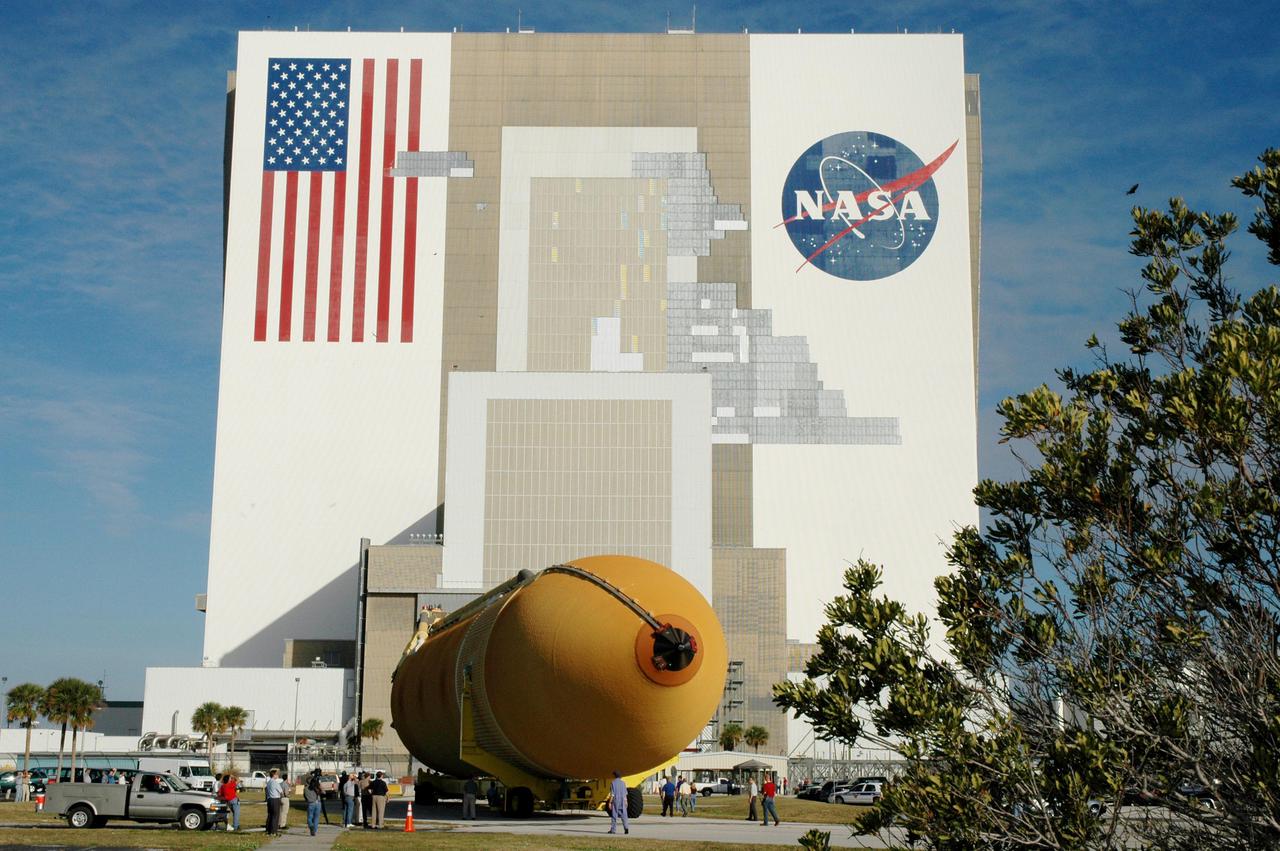
KENNEDY SPACE CENTER, FLA. - The newly redesigned External Tank heads for the open doors of the Vehicle Assembly Building, seen behind it. The tank arrived Jan. 5 after a 900-mile sea voyage aboard NASA’s specially designed barge, Pegasus, from the Michoud Assembly Facility in New Orleans. In the transfer aisle of the VAB, the tank will be raised from a horizontal to a vertical position, then lifted high up into a storage cell, or “checkout cell,” where it will undergo inspections of the mechanical, electrical and thermal protection systems. New processing activities resulting from re-design of the tank include inspection of the bipod heater and External Tank separation camera, which includes charging the camera batteries. The tank will be then prepared for mating to the Solid Rocket Boosters. When preparations are complete, the tank will be lifted from the checkout cell, moved across the transfer aisle and into High Bay 1, where it will be lowered and attached to the boosters, which are sitting on the Mobile Launch Platform. The tank is designated for the Return to Flight mission, STS-114, targeted for a launch opportunity beginning in May. The seven-member Discovery crew will fly to the International Space Station primarily to test and evaluate new procedures for flight safety, including Space Shuttle inspection and repair techniques.
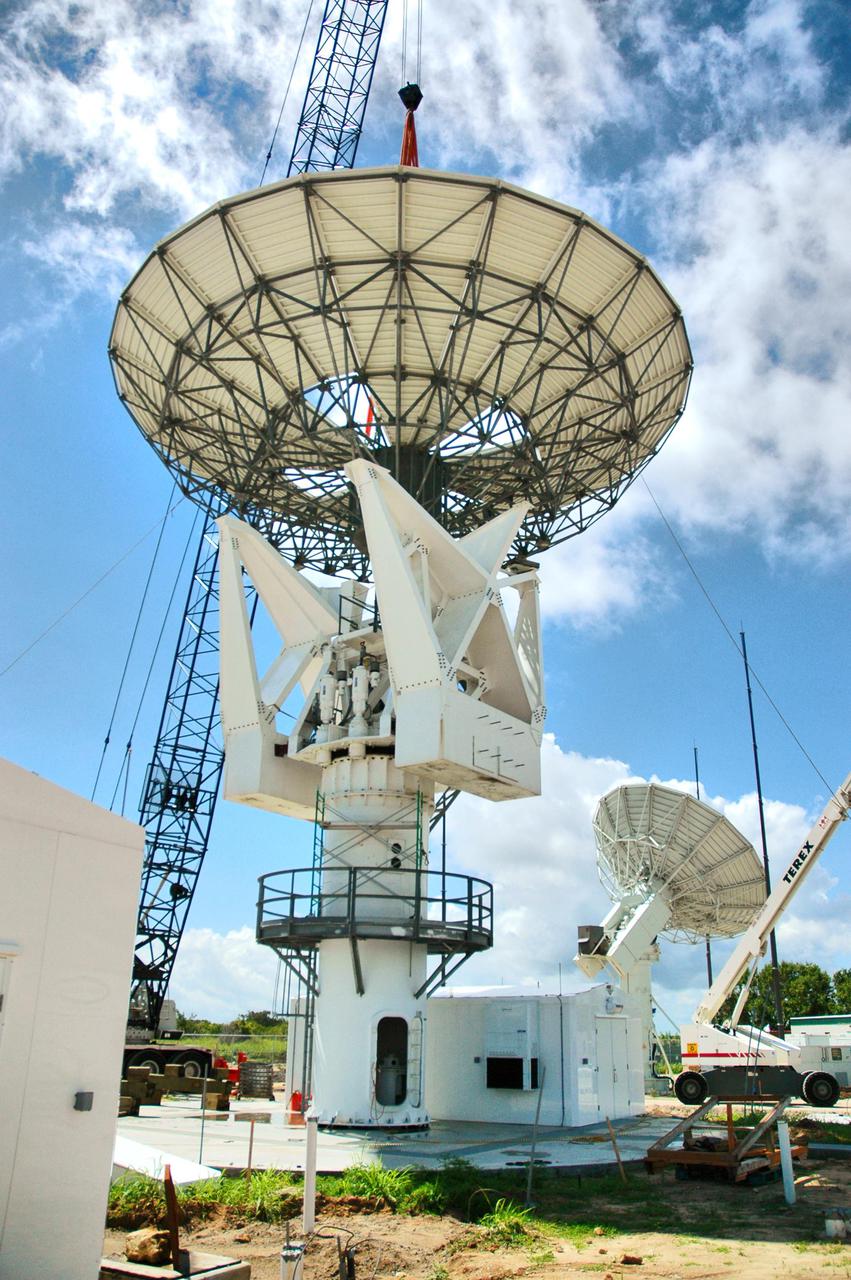
KENNEDY SPACE CENTER, FLA. - At a radar site on North Merritt Island, Fla., the 50-foot C-band radar antenna dish is lowered toward the top of the support structure. It will be placed on the counterweights installed there. The radar will be used for Shuttle missions to track the launches and observe possible debris coming from the Shuttle. It will be used for the first time on STS-114. The launch window for the first Return to Flight mission is July 13 to July 31.
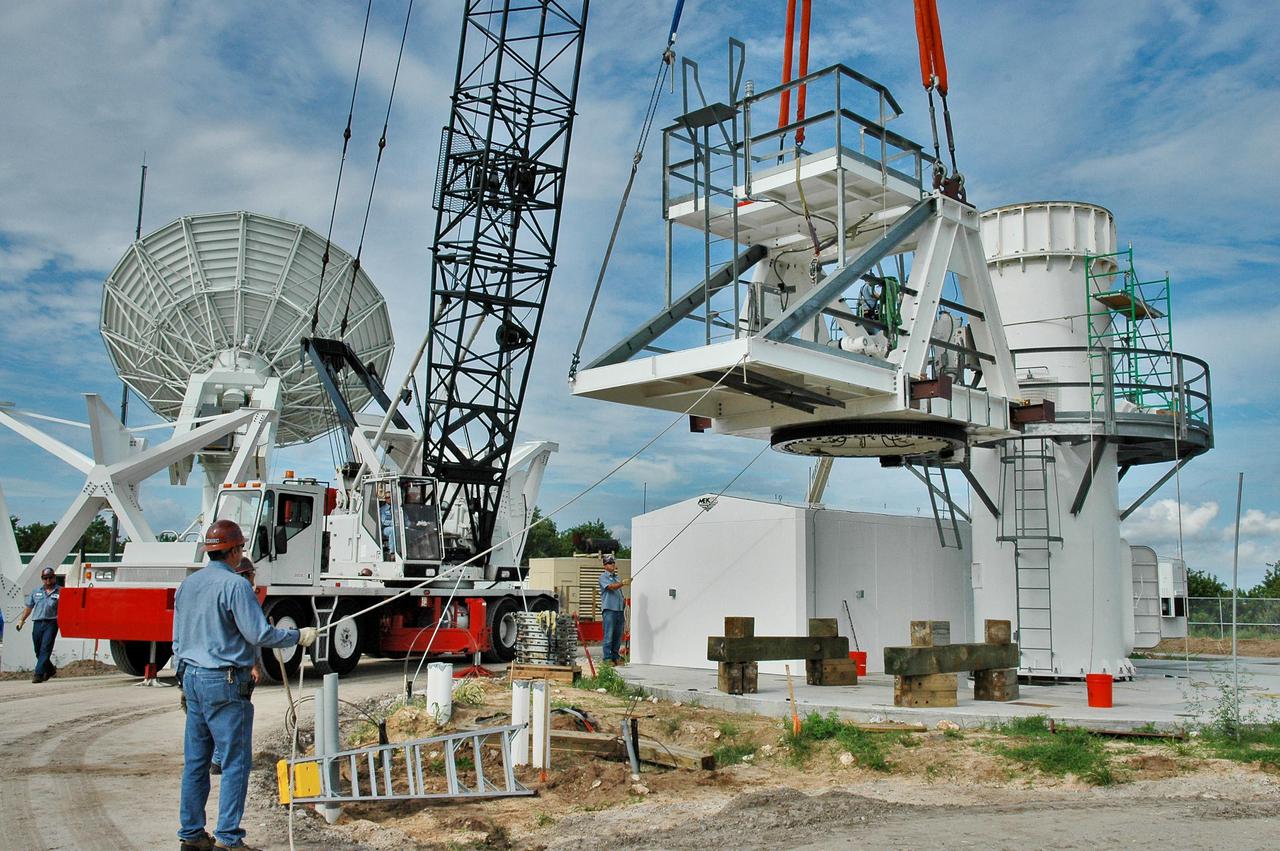
KENNEDY SPACE CENTER, FLA. - On a radar site on North Merritt Island, Fla., a crane lifts part of the structure to be added to the support base for a 50-foot C-band radar antenna. The radar will be used for Shuttle missions to track the launches and observe possible debris coming from the Shuttle. It will be used for the first time on STS-114. The launch window for the first Return to Flight mission is July 13 to July 31.
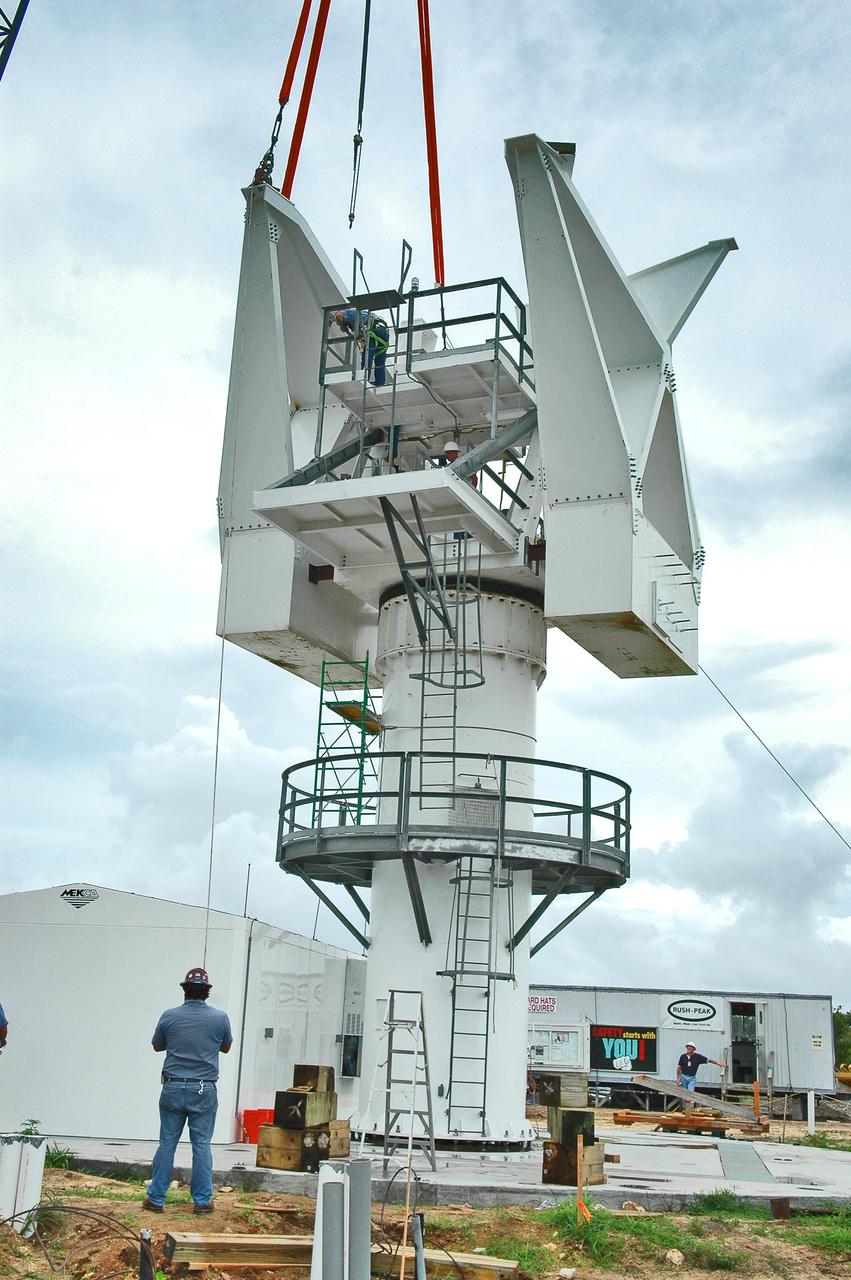
KENNEDY SPACE CENTER, FLA. - At a radar site on North Merritt Island, Fla., the second counterweight (left side) is moved into place on the support structure for a 50-foot C-band radar antenna dish. The radar will be used for Shuttle missions to track the launches and observe possible debris coming from the Shuttle. It will be used for the first time on STS-114. The launch window for the first Return to Flight mission is July 13 to July 31.
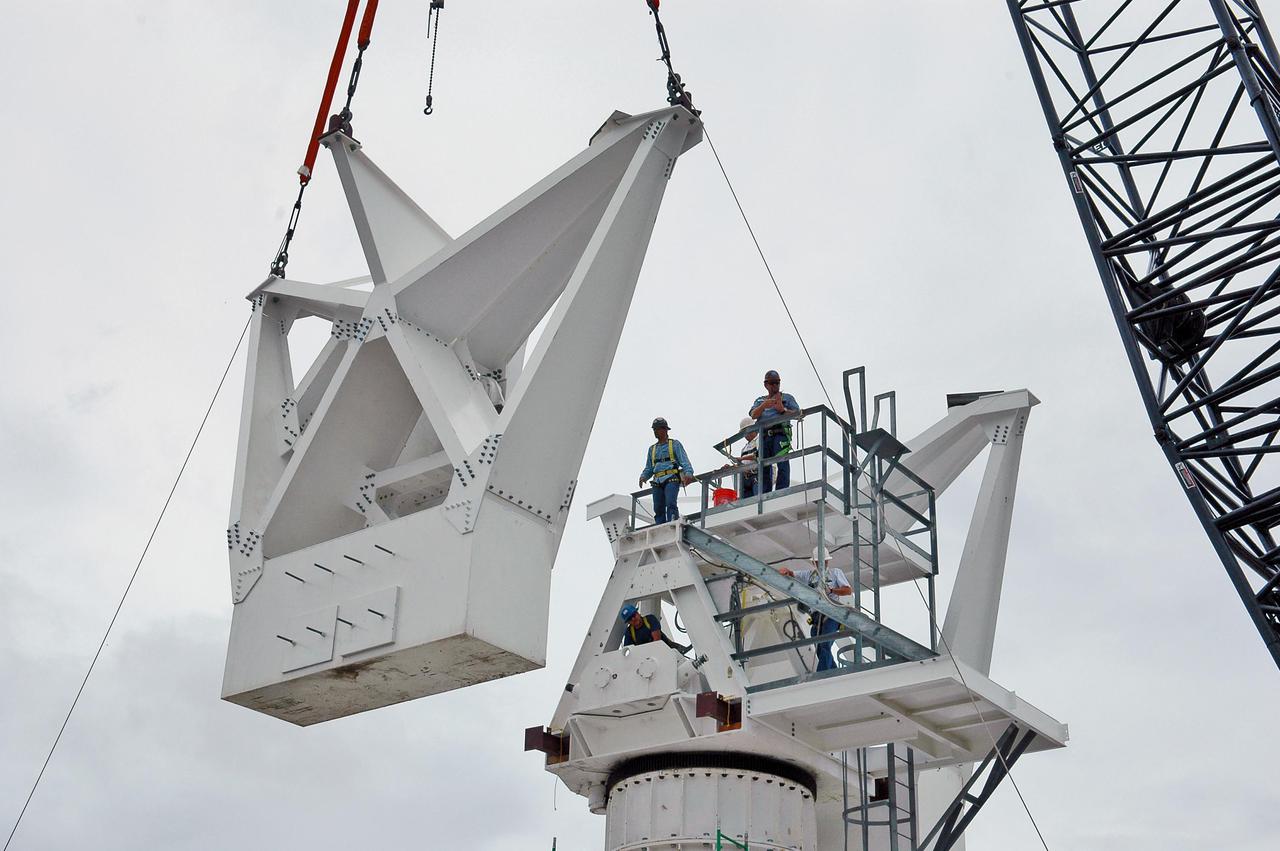
KENNEDY SPACE CENTER, FLA. - Work is underway on a radar site on North Merritt Island, Fla., constructing the support base for a 50-foot C-band radar antenna. The radar will be used for Shuttle missions to track the launches and observe possible debris coming from the Shuttle. It will be used for the first time on STS-114. The launch window for the first Return to Flight mission is July 13 to July 31.
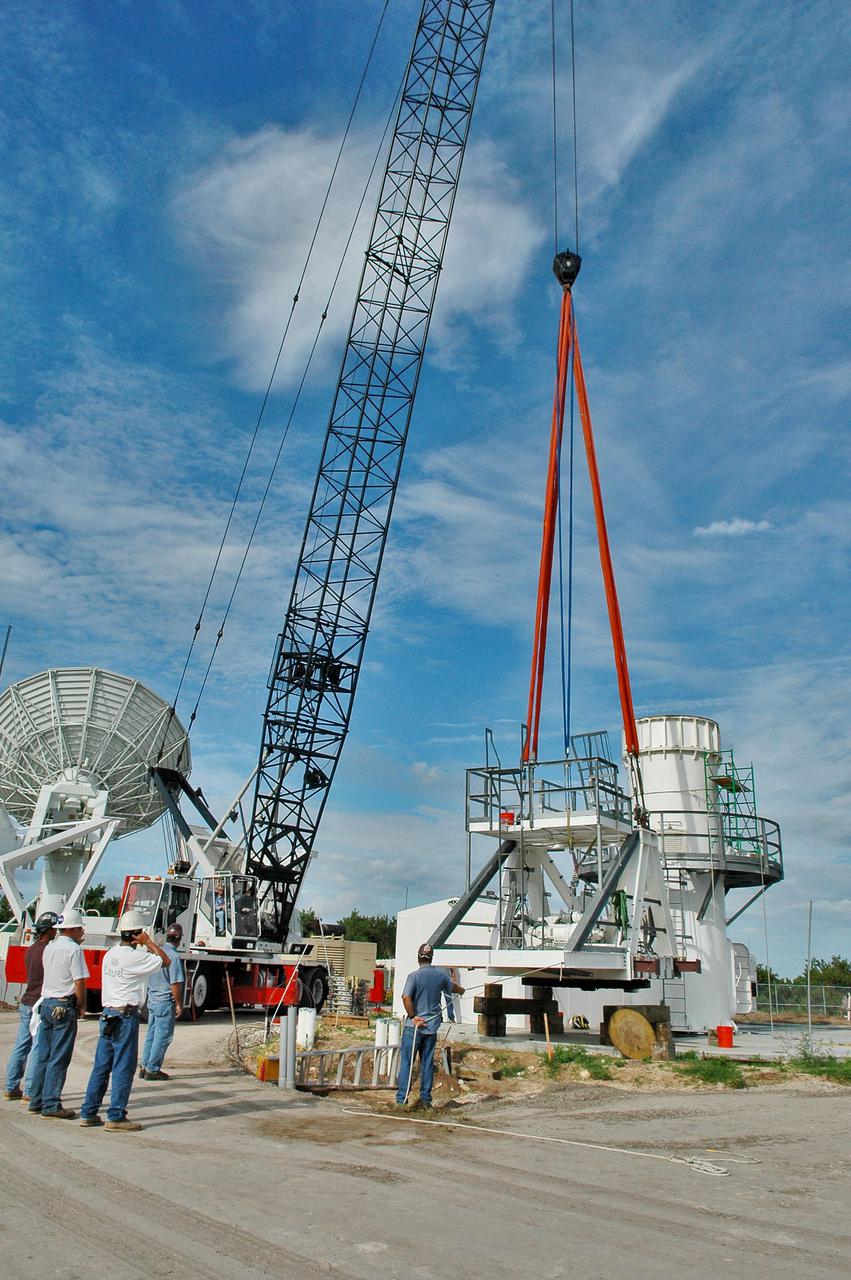
KENNEDY SPACE CENTER, FLA. - At a radar site on North Merritt Island, Fla., the second counterweight is being lifted for installation on the support structure (right) for a 50-foot C-band radar antenna dish. The radar will be used for Shuttle missions to track the launches and observe possible debris coming from the Shuttle. It will be used for the first time on STS-114. The launch window for the first Return to Flight mission is July 13 to July 31.
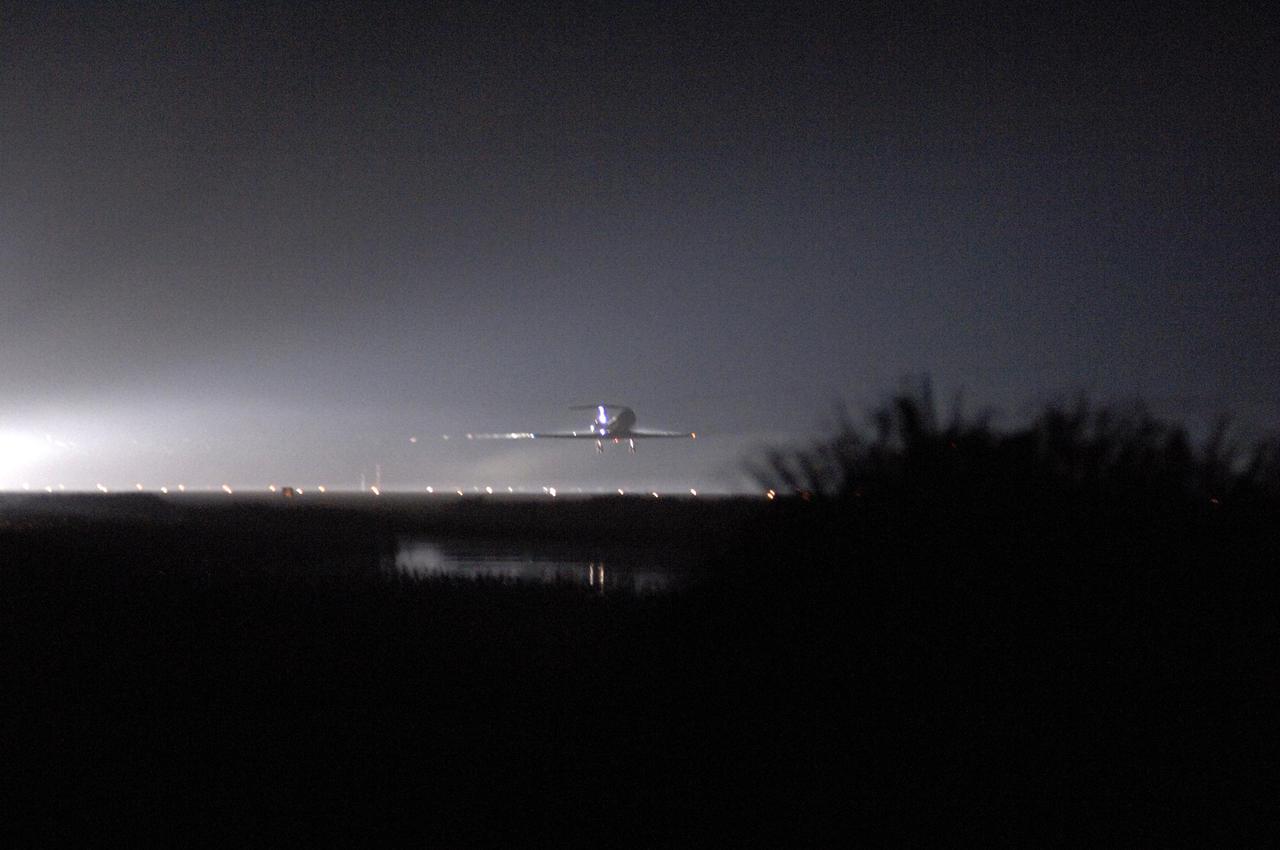
KENNEDY SPACE CENTER, FLA. - In the pre-dawn hours, the Shuttle Training Aircraft (STA) approaches the runway on NASA Kennedy Space Center’s Shuttle Landing Facility. The STA was in the air to observe flying conditions for the pending landing of Space Shuttle Discovery to conclude Return to Flight mission STS-114. The landing was postponed until Aug. 9.
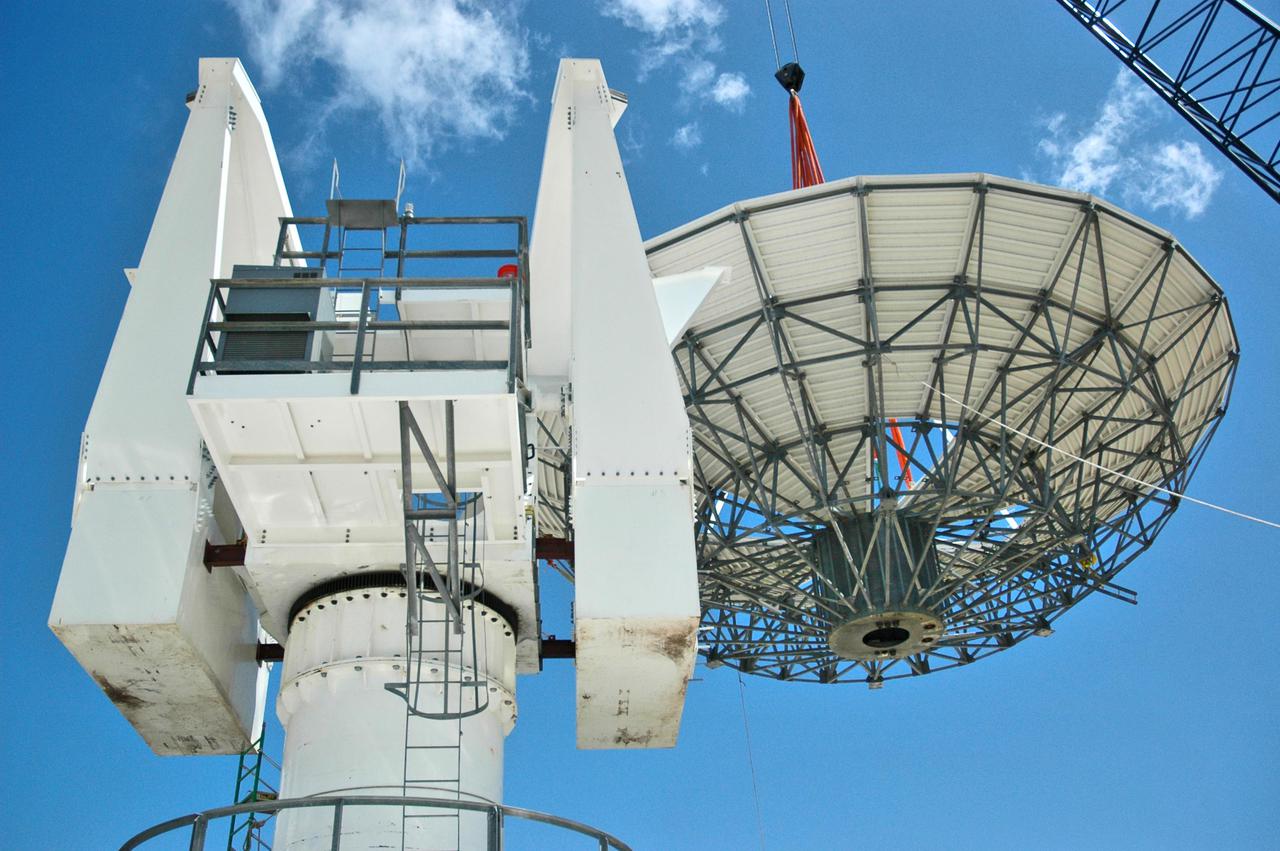
KENNEDY SPACE CENTER, FLA. - At a radar site on North Merritt Island, Fla., the 50-foot C-band radar antenna dish is lifted above the support structure, where it will be installed on top. The radar will be used for Shuttle missions to track the launches and observe possible debris coming from the Shuttle. It will be used for the first time on STS-114. The launch window for the first Return to Flight mission is July 13 to July 31.
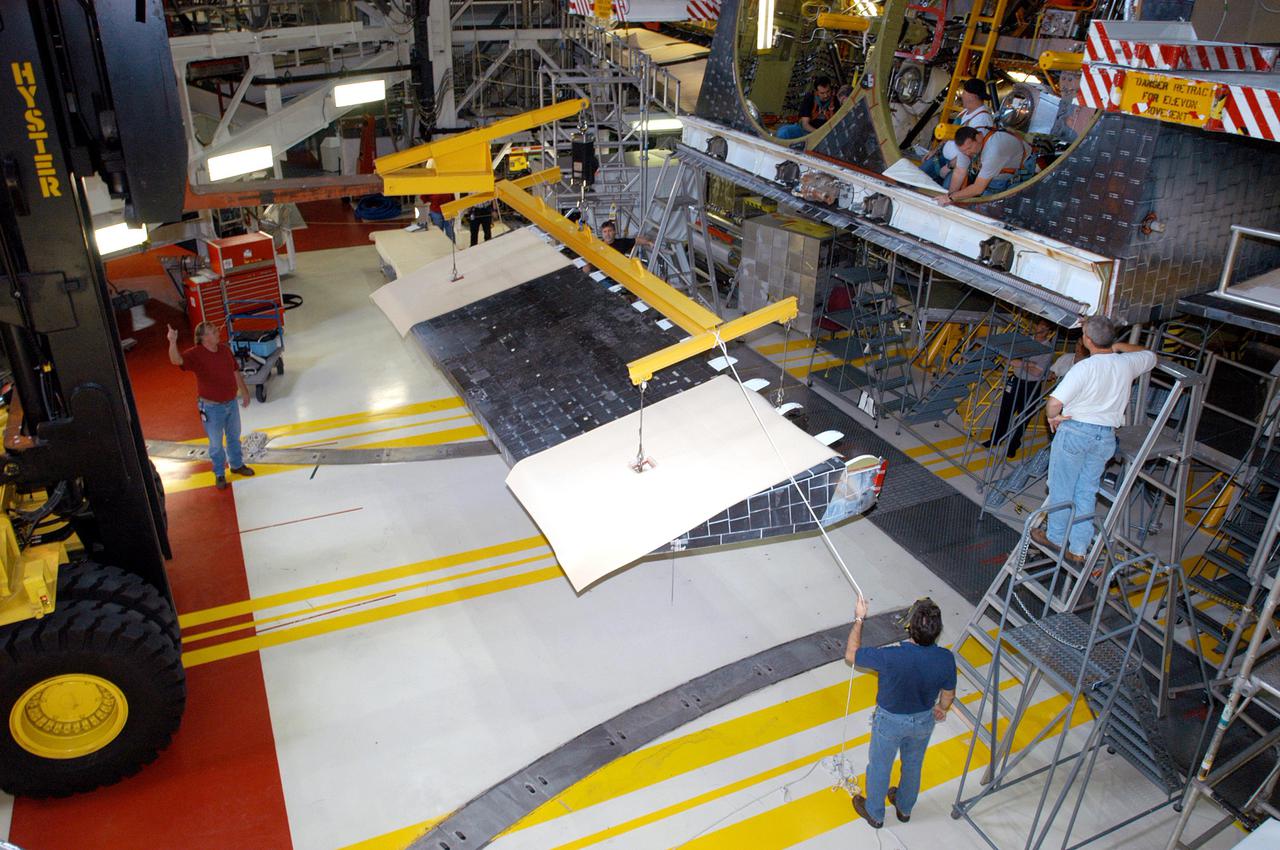
KENNEDY SPACE CENTER, FLA. - In the Orbiter Processing Facility, workers help guide the body flap toward the orbiter Atlantis for installation. The body flap is an aluminum structure consisting of ribs, spars, skin panels and a trailing edge assembly. It thermally shields the three Space Shuttle Main Engines during entry and provides the orbiter with pitch control trim during its atmospheric flight after entry. Atlantis is being processed for its mission, designated STS-121, this summer to the International Space Station. The launch planning window is July 12 - August 3.
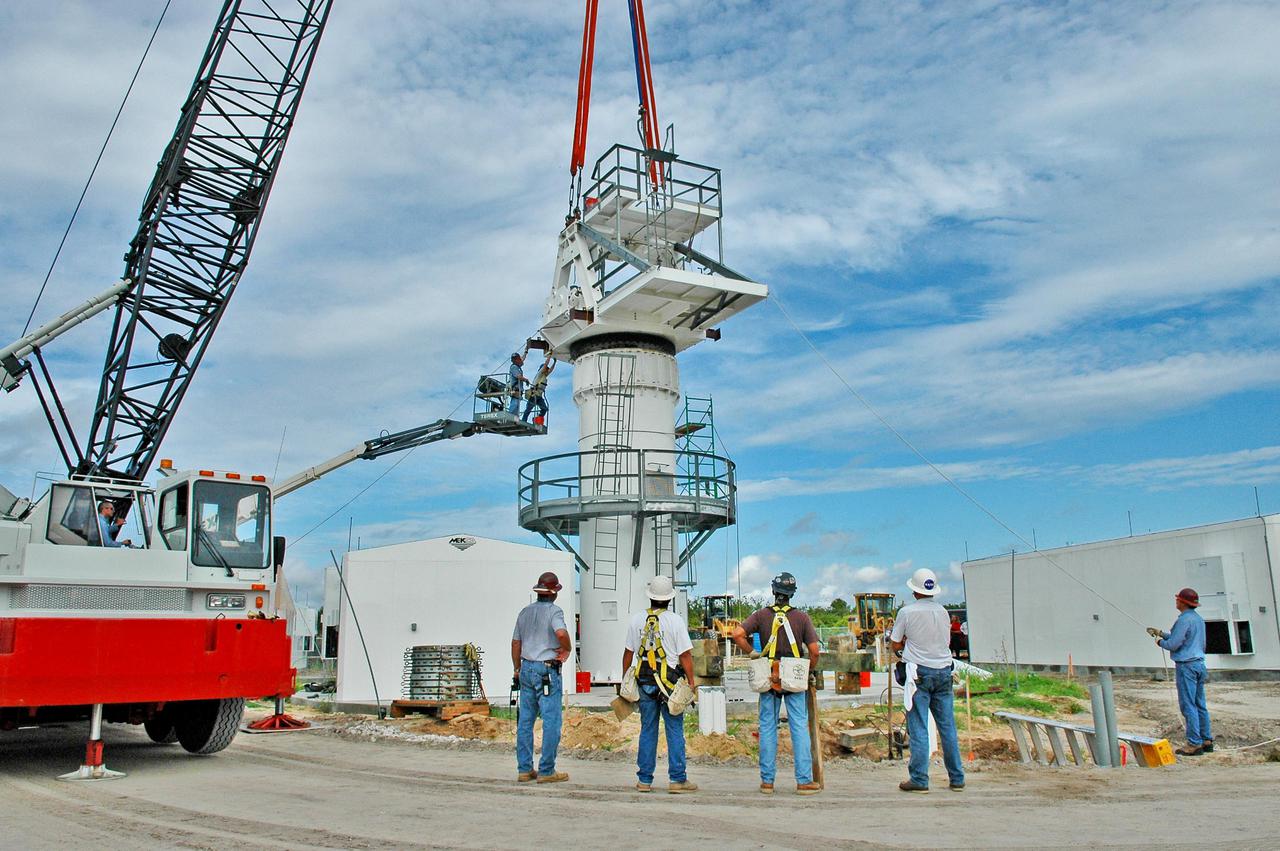
KENNEDY SPACE CENTER, FLA. - Workers secure an upper section of the support base for a 50-foot C-band radar antenna being erected on a radar site on North Merritt Island, Fla. The radar will be used for Shuttle missions to track the launches and observe possible debris coming from the Shuttle. It will be used for the first time on STS-114. The launch window for the first Return to Flight mission is July 13 to July 31.
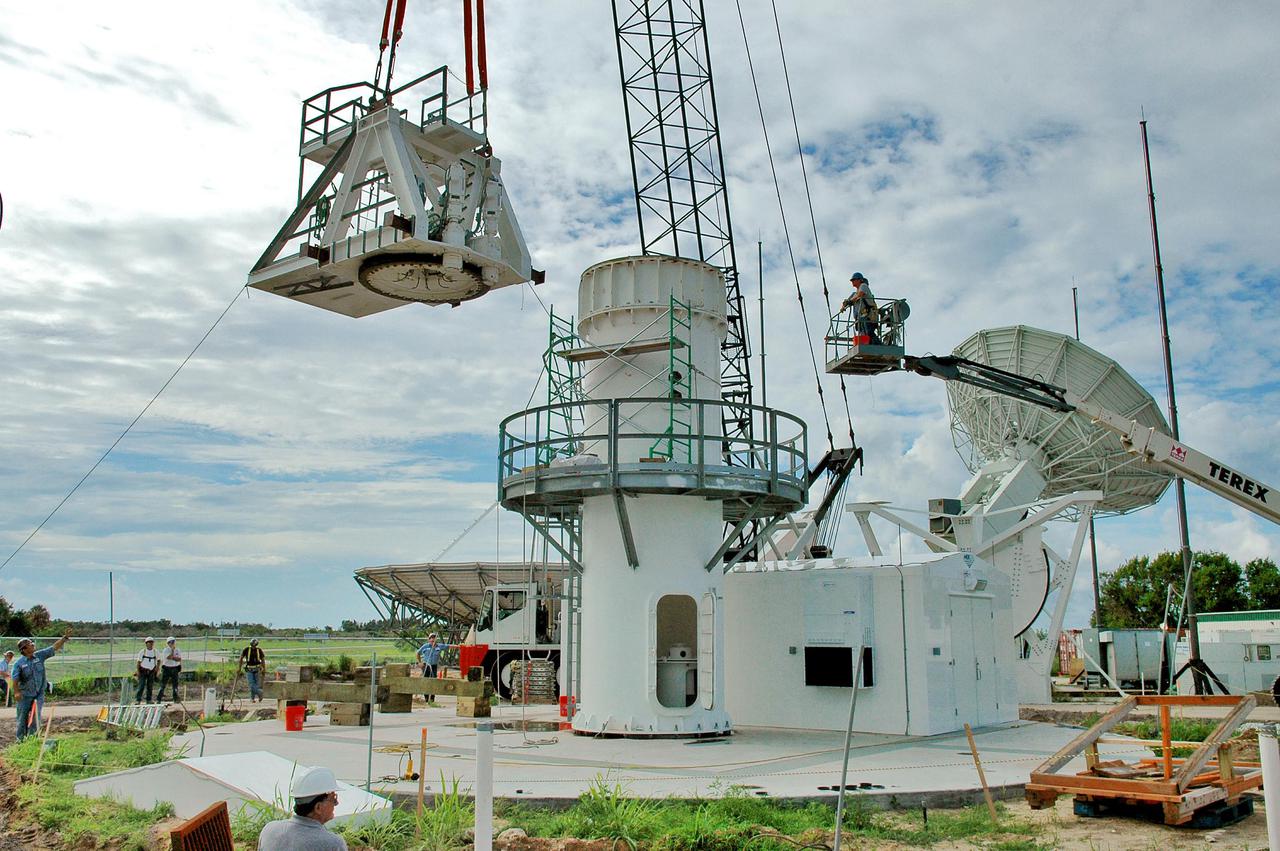
KENNEDY SPACE CENTER, FLA. - On a radar site on North Merritt Island, Fla., part of the structure for the support base for a 50-foot C-band radar antenna is put in position. The radar will be used for Shuttle missions to track the launches and observe possible debris coming from the Shuttle. It will be used for the first time on STS-114. The launch window for the first Return to Flight mission is July 13 to July 31.
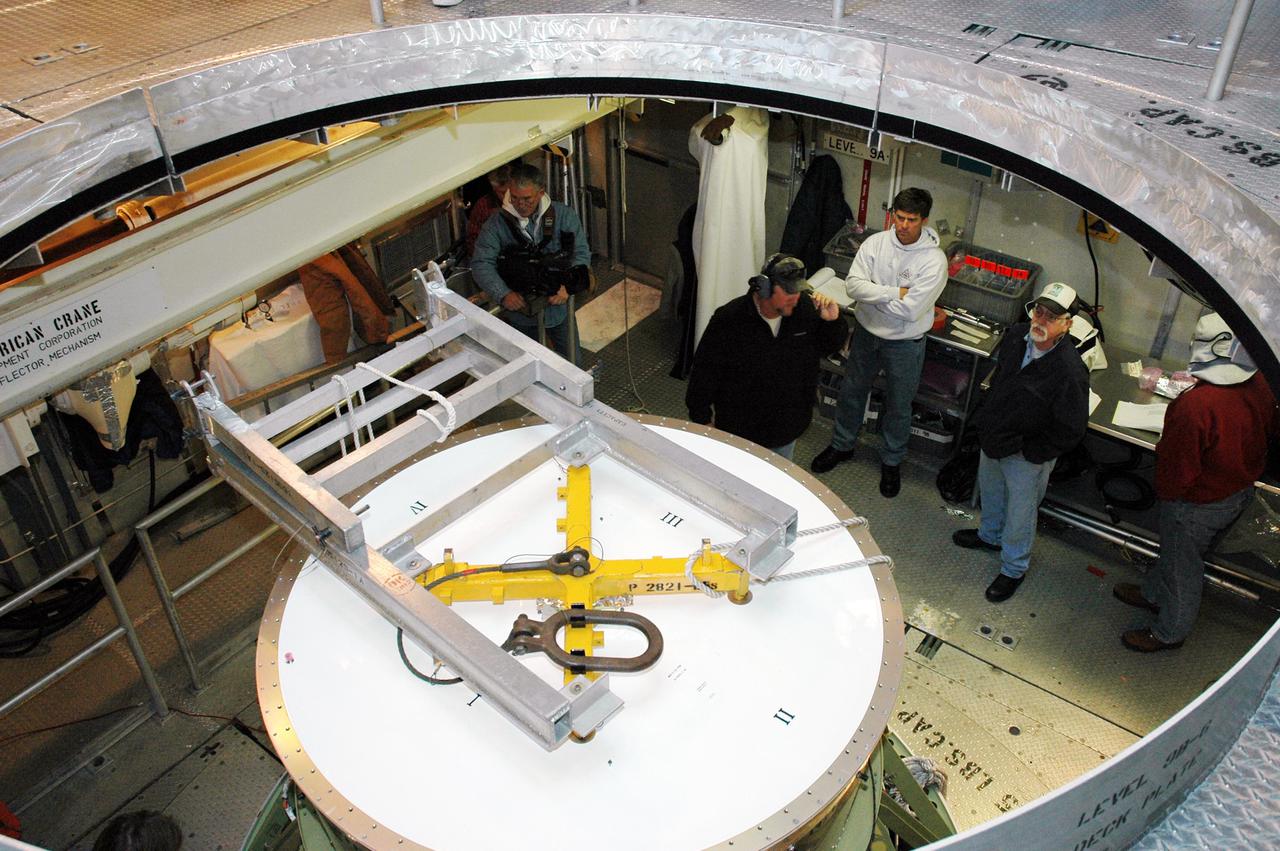
KENNEDY SPACE CENTER, FLA. - In the mobile service tower on Pad 17-B, Cape Canaveral Air Force Station, Fla., Boeing technicians prepare to remove the second stage from the Boeing Delta II rocket that will launch the Deep Impact spacecraft. Removal of the second stage will allow workers to then remove the rocket’s inter-stage adapter, which was found to be faulty during a review of launch vehicle hardware. It will be replaced and the second stage re-installed within a few days. Launch of Deep Impact is now scheduled no earlier than Jan. 12.
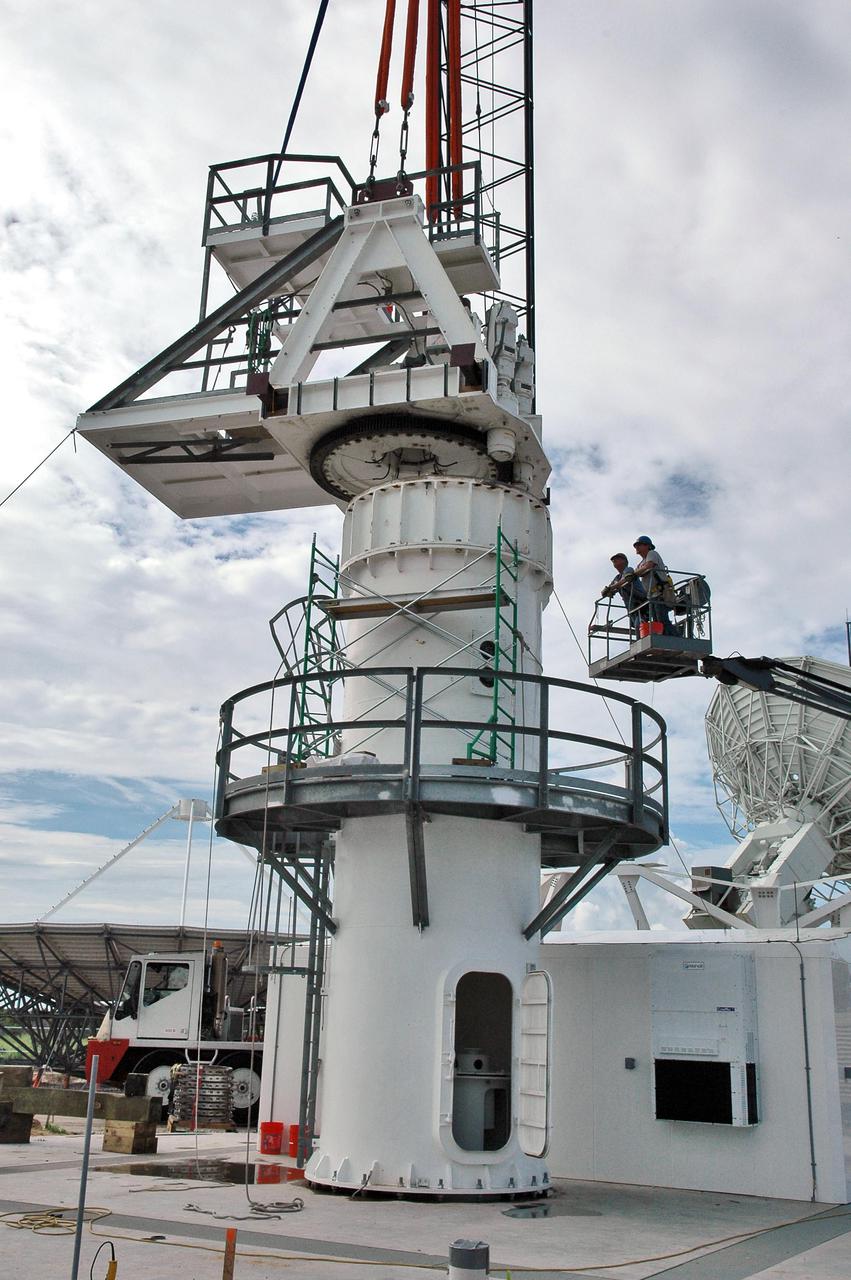
KENNEDY SPACE CENTER, FLA. - On a radar site on North Merritt Island, Fla., part of the structure for the support base for a 50-foot C-band radar antenna is put in position.The radar will be used for Shuttle missions to track the launches and observe possible debris coming from the Shuttle. It will be used for the first time on STS-114. The launch window for the first Return to Flight mission is July 13 to July 31.
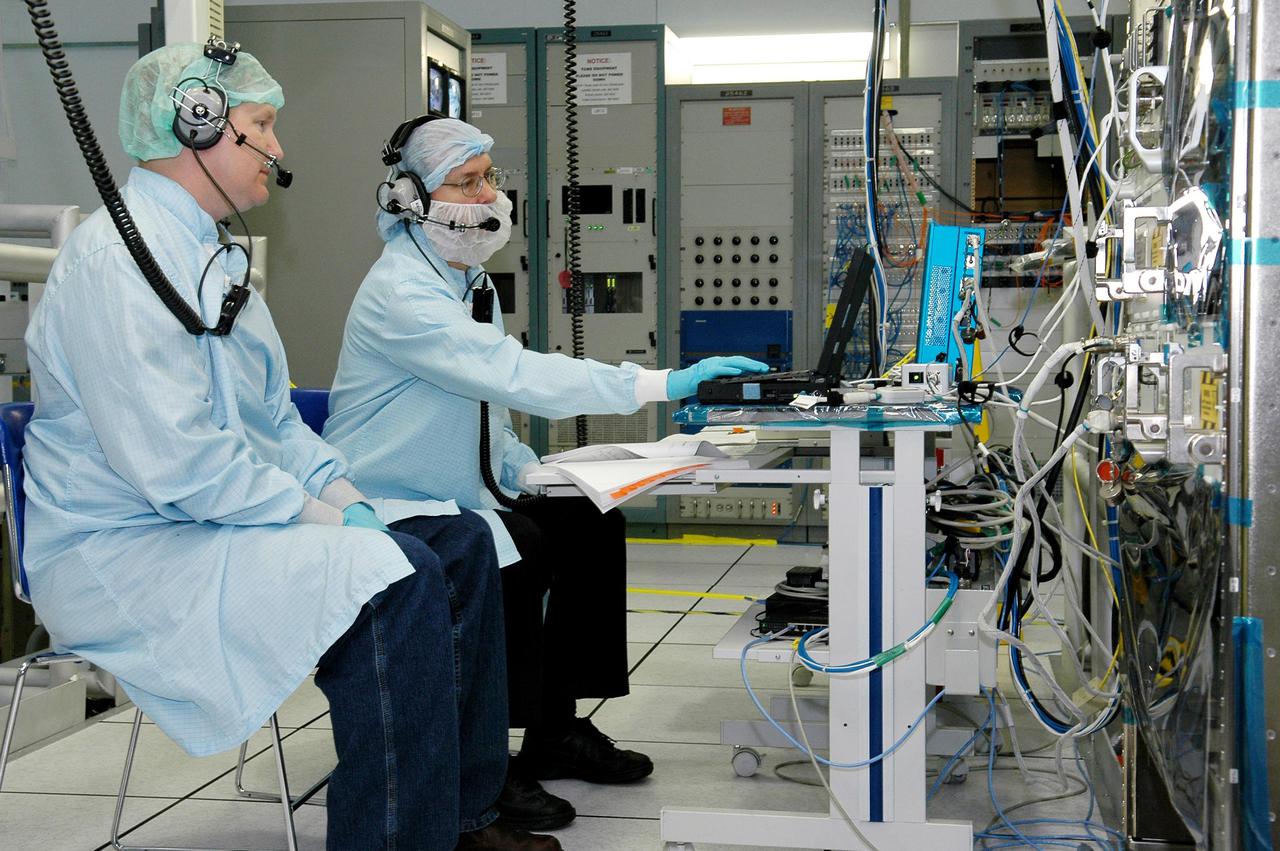
KENNEDY SPACE CENTER, FLA. - - In the Space Station Processing Facility, Gaschen Geissen and Elton Witt, with Lockheed Martin, monitor the Payload Test and Checkout System for the Human Research Facility (HRF) Rack -2 payload. The HRF-2 is scheduled to fly on Return to Flight Space Shuttle mission STS-114. The HRF-2 will deliver additional biomedical instrumentation and research capability to the International Space Station. HRF Rack 1 contains an ultrasound unit and gas analyzer system and has been operational in the U.S. Lab since May 2001. HRF-2 will also be installed in the U. S. Lab and will provide structural, power, thermal, command and data handling, and communication and tracking interfaces between the HRF biomedical instrumentation and the U. S. Lab.
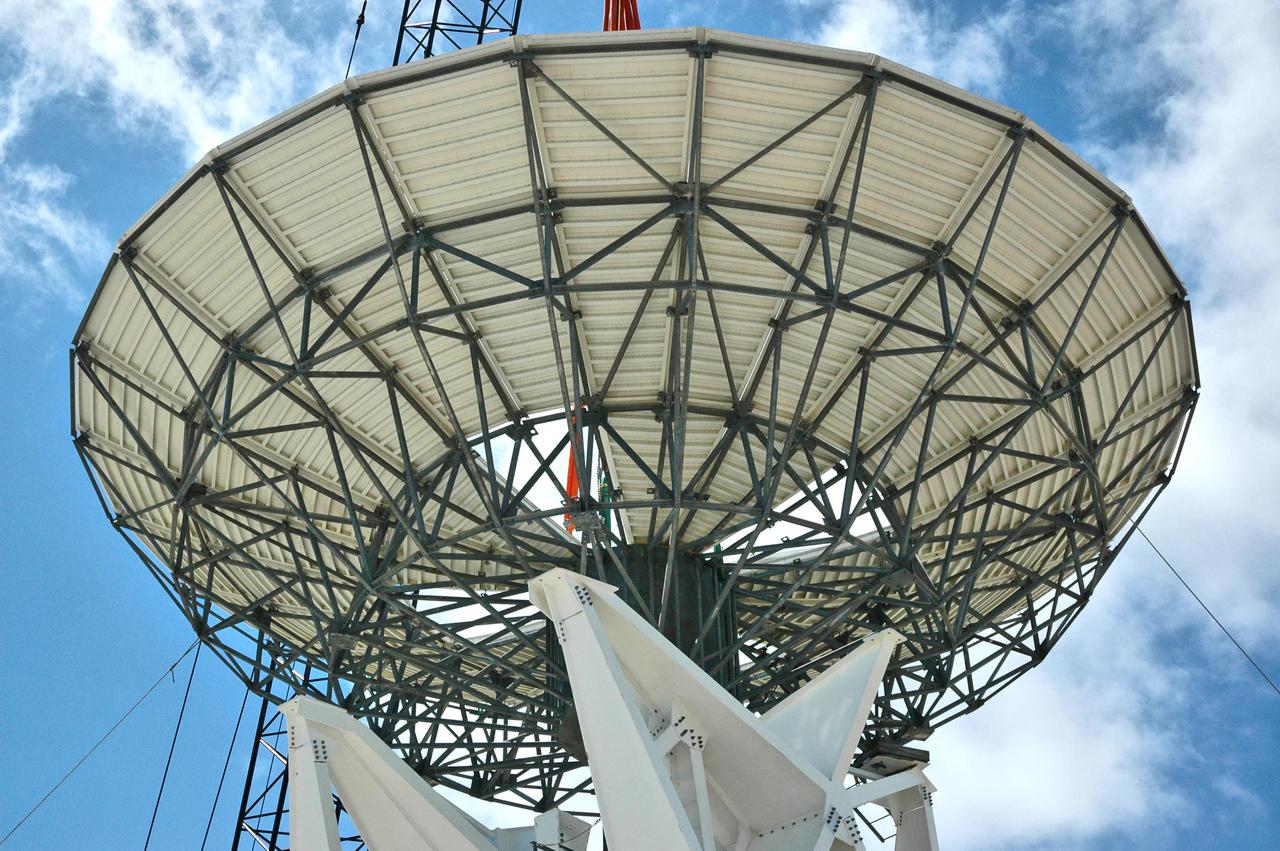
KENNEDY SPACE CENTER, FLA. - At a radar site on North Merritt Island, Fla., the 50-foot C-band radar antenna dish is lowered toward the top of the support structure. It will be placed on the counterweights installed there. The radar will be used for Shuttle missions to track the launches and observe possible debris coming from the Shuttle. It will be used for the first time on STS-114. The launch window for the first Return to Flight mission is July 13 to July 31.
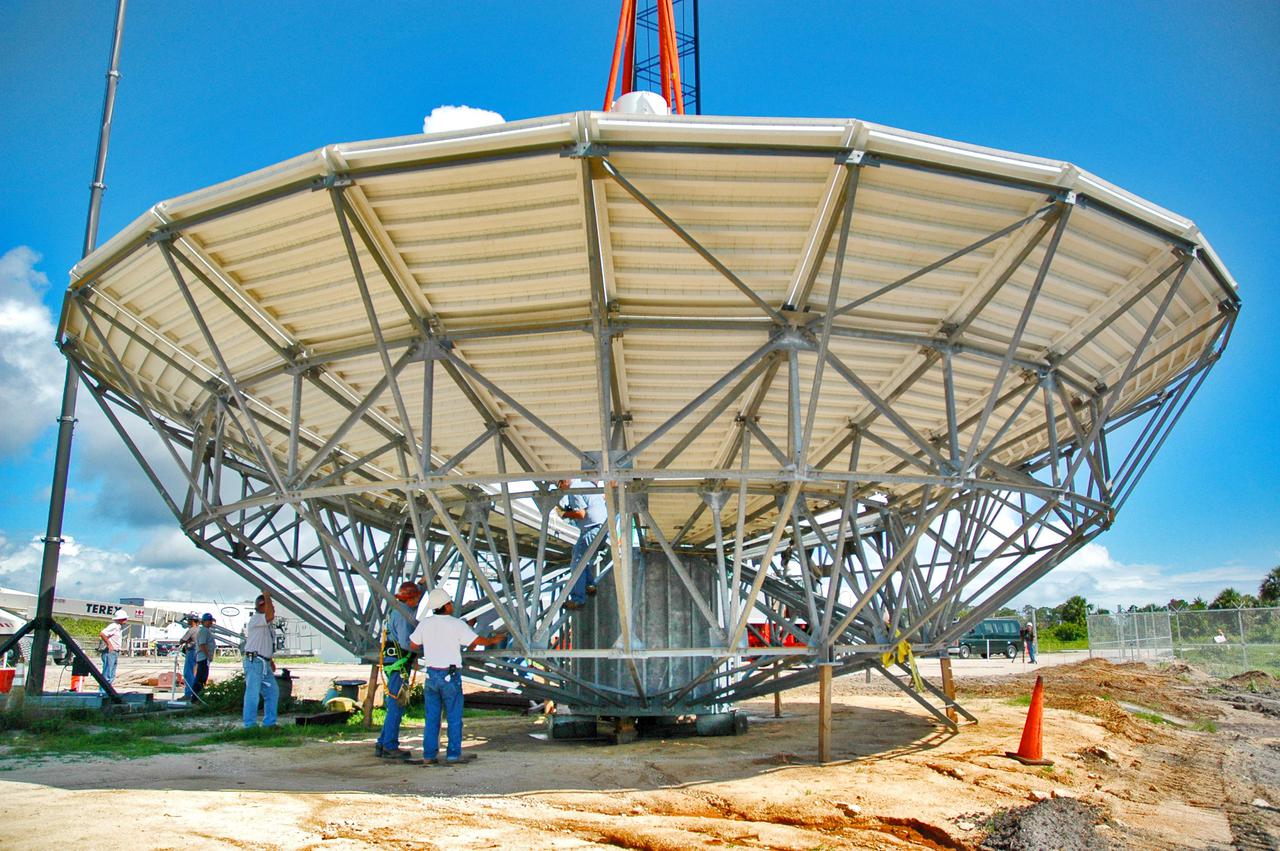
KENNEDY SPACE CENTER, FLA. - At a radar site on North Merritt Island, Fla., the 50-foot C-band radar antenna dish is prepared to be lifted onto the top of a support structure. The radar will be used for Shuttle missions to track the launches and observe possible debris coming from the Shuttle. It will be used for the first time on STS-114. The launch window for the first Return to Flight mission is July 13 to July 31.
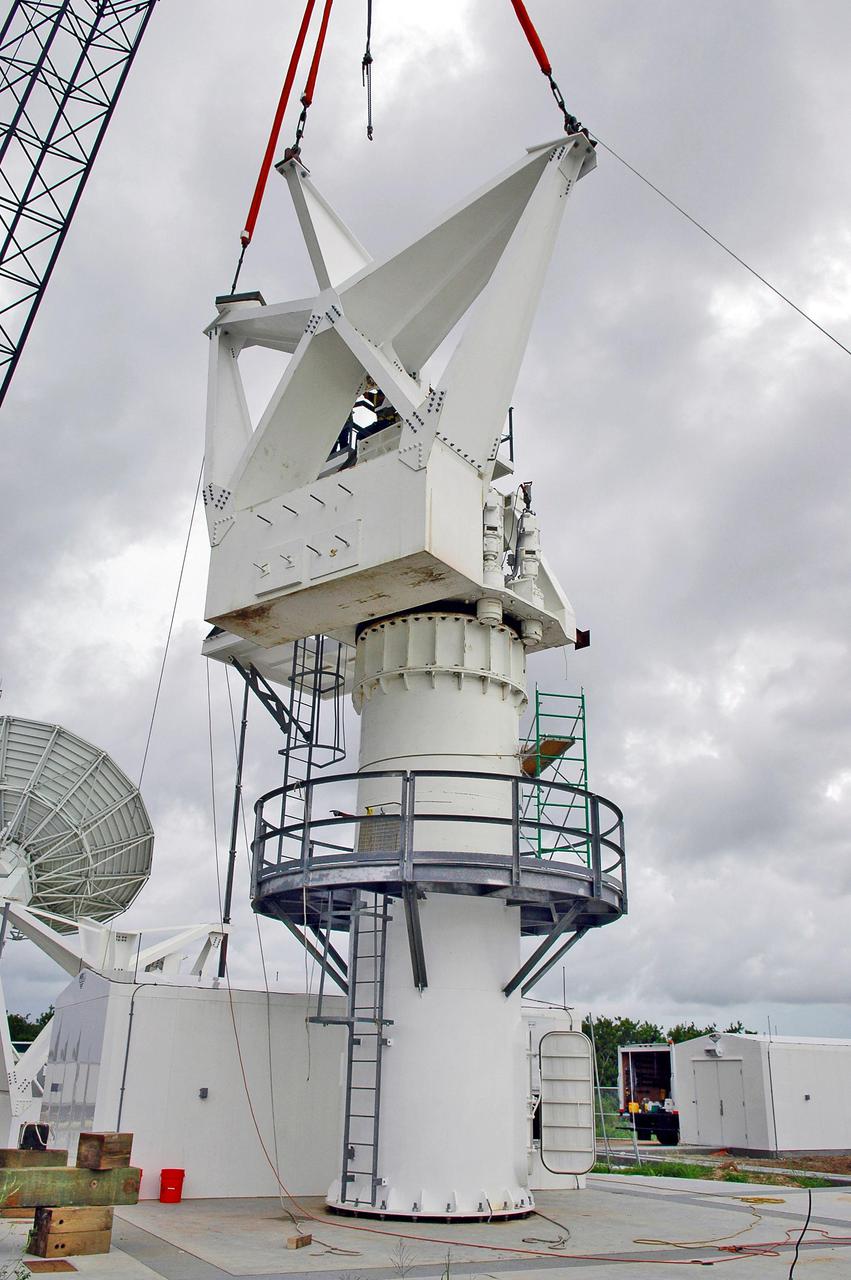
KENNEDY SPACE CENTER, FLA. - At a radar site on North Merritt Island, Fla., one of two counterweights is lifted into place on a support structure for a 50-foot C-band radar antenna dish. The radar will be used for Shuttle missions to track the launches and observe possible debris coming from the Shuttle. It will be used for the first time on STS-114. The launch window for the first Return to Flight mission is July 13 to July 31.
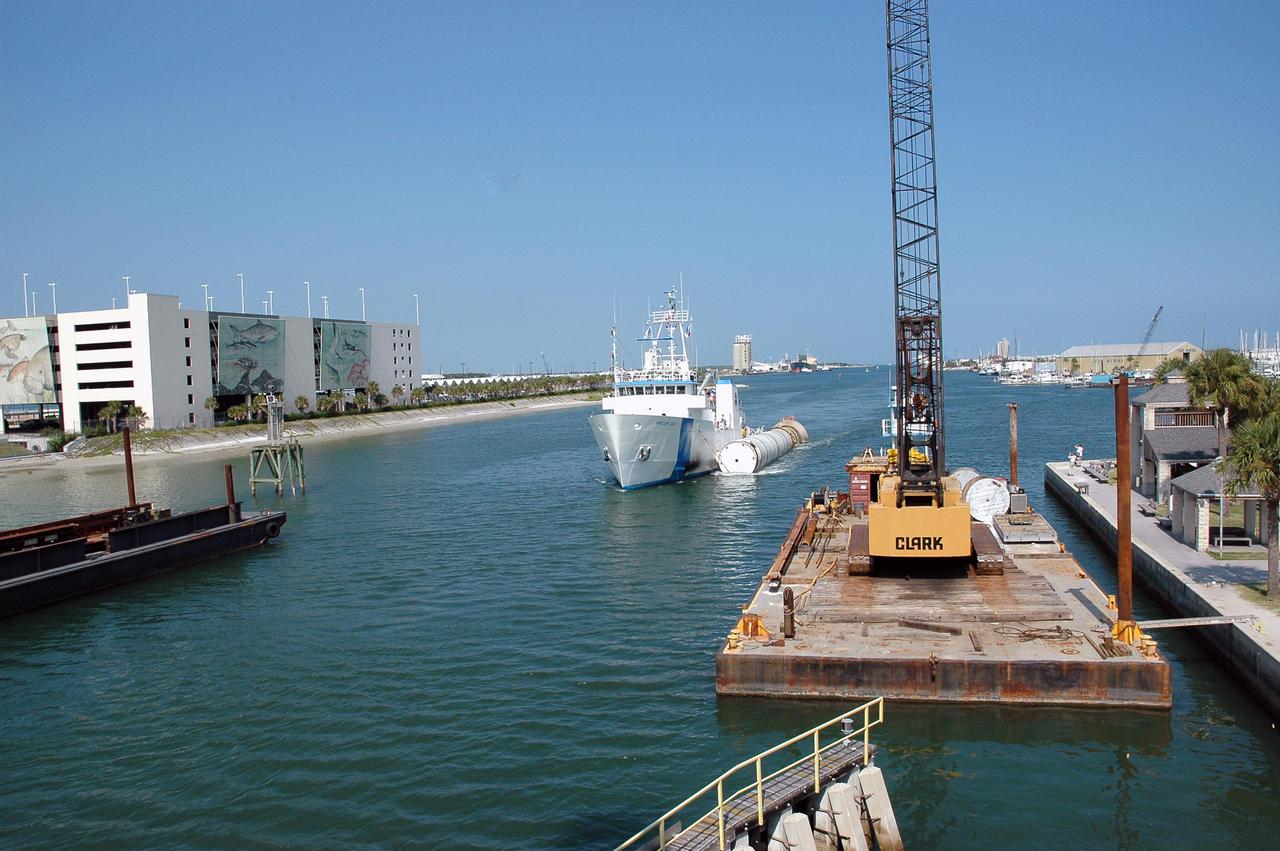
KENNEDY SPACE CENTER, FLA. - The solid rocket booster recovery ship Freedom Star makes its way through Port Canaveral with a spent solid rocket booster (SRB) from the STS-114 launch on July 26 in tow. The SRBs are the largest solid propellant motors ever flown and the first designed for reuse. After a Shuttle is launched, the SRBs are jettisoned at two minutes, seven seconds into the flight. At six minutes and 44 seconds after liftoff, the spent SRBs, weighing about 165,000 lb., have slowed their descent speed to about 62 mph and splashdown takes place in a predetermined area. They are retrieved from the Atlantic Ocean by special recovery vessels and returned for refurbishment and eventual reuse on future Shuttle flights. Once at Hangar AF, the SRBs are unloaded onto a hoisting slip and mobile gantry cranes lift them onto tracked dollies where they are safed and undergo their first washing.
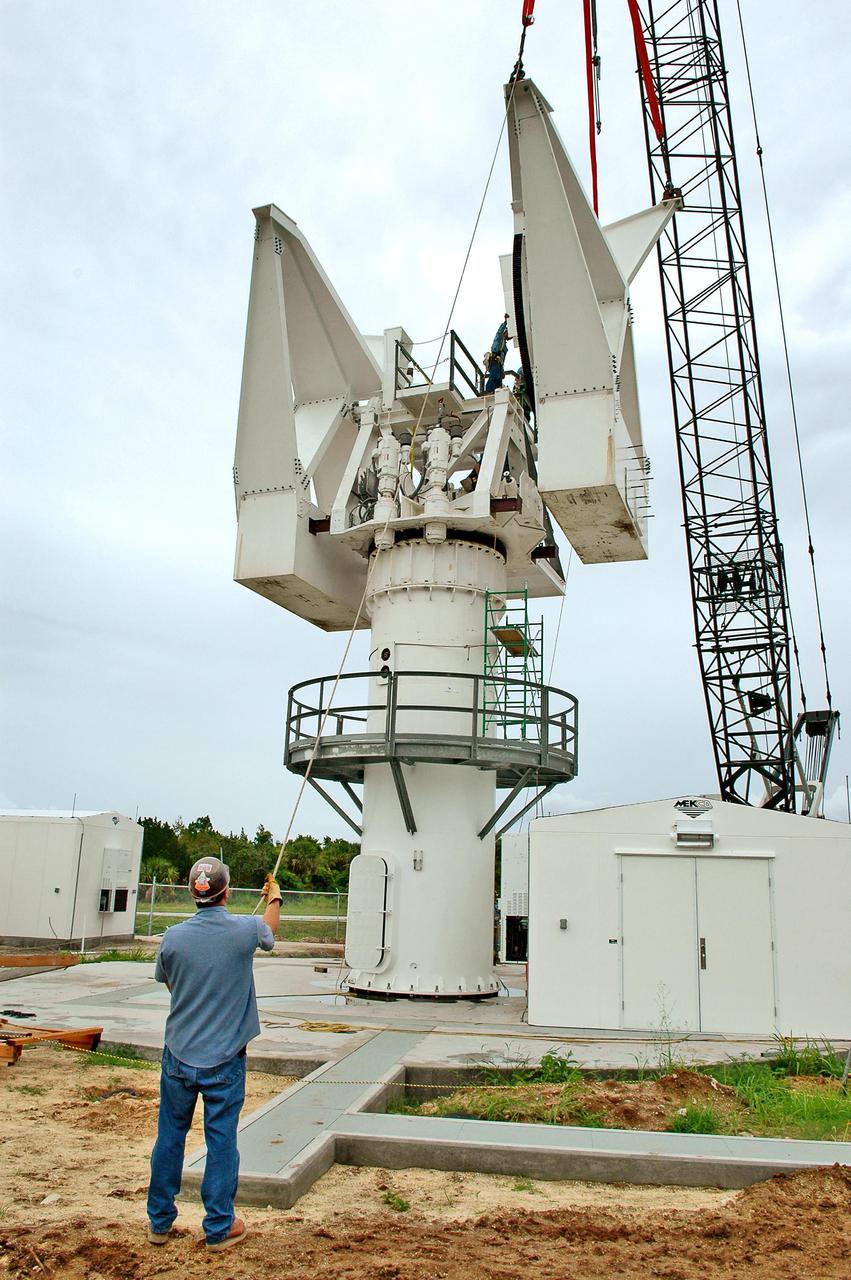
KENNEDY SPACE CENTER, FLA. - At a radar site on North Merritt Island, Fla., the second counterweight (right side) is lifted into place on the support structure for a 50-foot C-band radar antenna dish. The radar will be used for Shuttle missions to track the launches and observe possible debris coming from the Shuttle. It will be used for the first time on STS-114. The launch window for the first Return to Flight mission is July 13 to July 31.
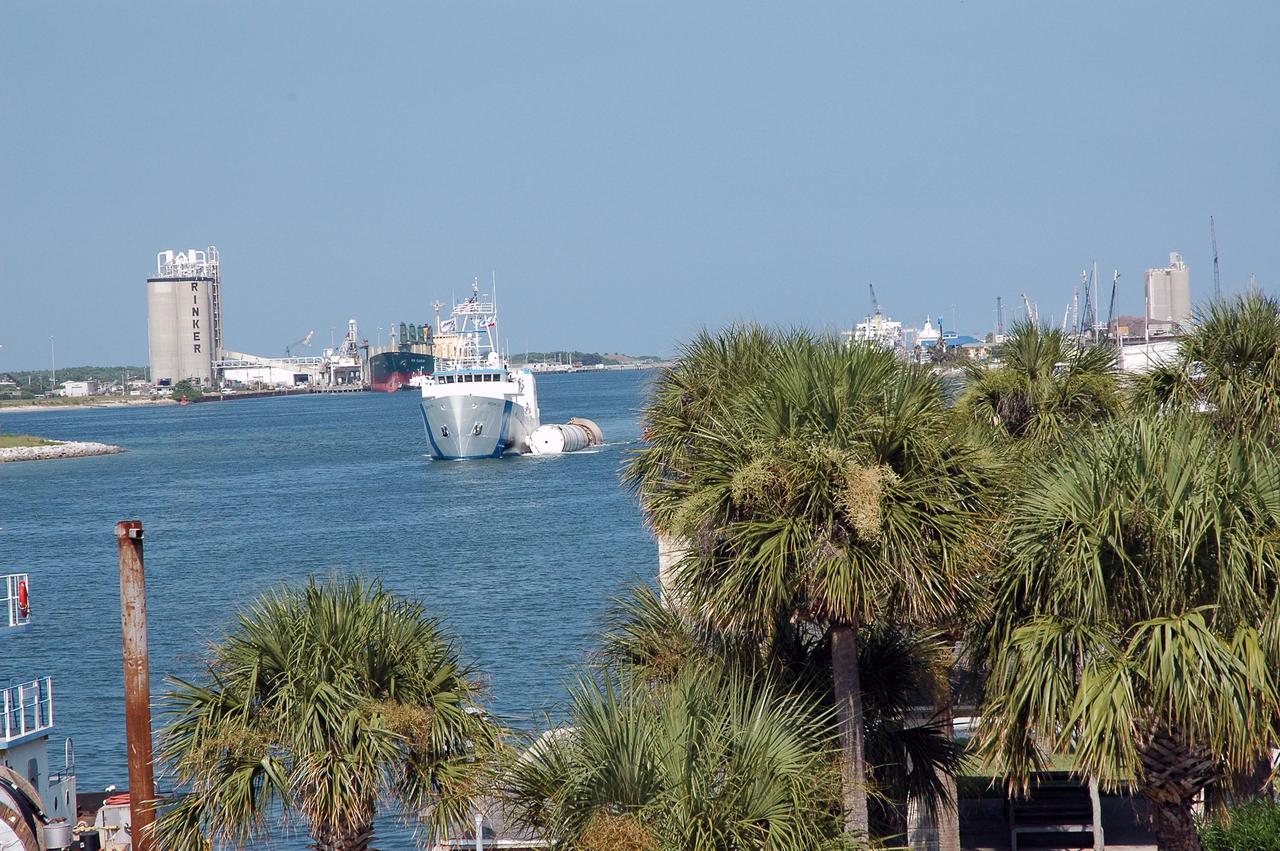
KENNEDY SPACE CENTER, FLA. - The solid rocket booster recovery ship Freedom Star enters Port Canaveral with a spent solid rocket booster (SRB) from the STS-114 launch on July 26 in tow. The SRBs are the largest solid propellant motors ever flown and the first designed for reuse. After a Shuttle is launched, the SRBs are jettisoned at two minutes, seven seconds into the flight. At six minutes and 44 seconds after liftoff, the spent SRBs, weighing about 165,000 lb., have slowed their descent speed to about 62 mph and splashdown takes place in a predetermined area. They are retrieved from the Atlantic Ocean by special recovery vessels and returned for refurbishment and eventual reuse on future Shuttle flights. Once at Hangar AF, the SRBs are unloaded onto a hoisting slip and mobile gantry cranes lift them onto tracked dollies where they are safed and undergo their first washing.
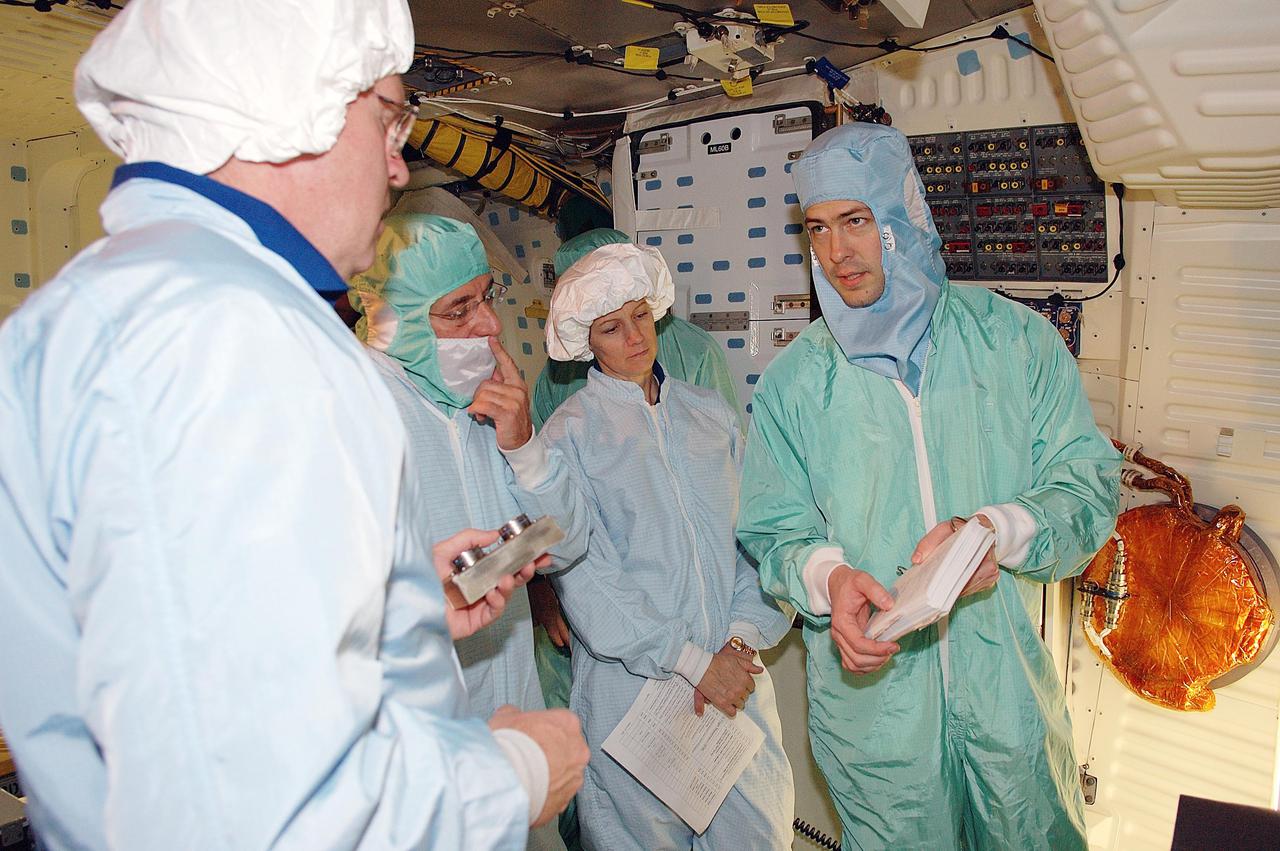
KENNEDY SPACE CENTER, FLA. - Steve Contella (right), an engineer with Johnson Space Center, reviews data with STS-114 Mission Specialists Andrew Thomas and Charles Camarda and Commander Eileen Collins. STS-114 crew members are familiarizing themselves with elements in the mid-body and upper deck of the orbiter Discovery, as part of Crew Equipment Interface Test (CEIT) activities. During CEIT, the crew has an opportunity to get a hands-on look at the orbiter and equipment they will be working with on the mission. Return to Flight Mission STS-114 will carry the Multi-Purpose Logistics Module Raffaello, filled with supplies for the International Space Station, and a replacement Control Moment Gyroscope. Launch of STS-114 has a launch window of May 12 to June 3.
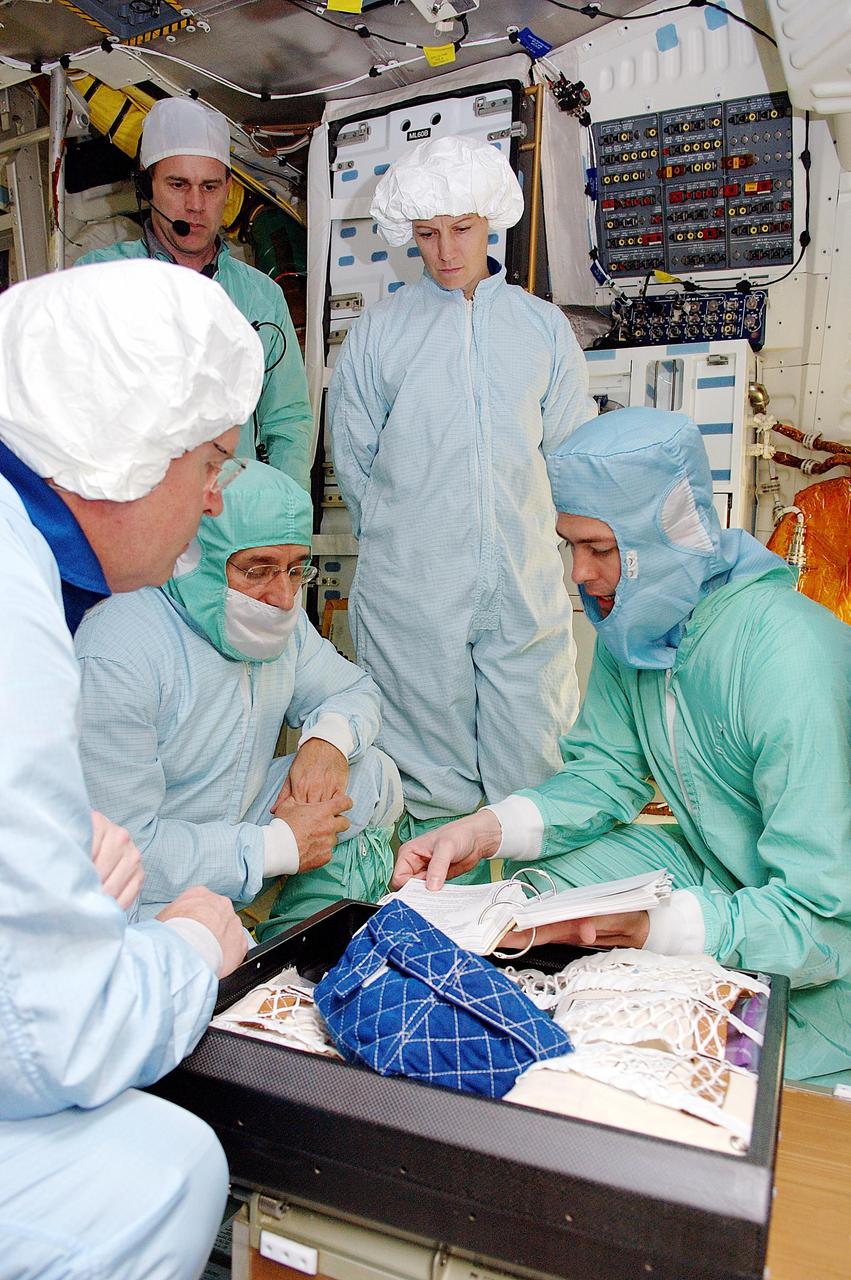
KENNEDY SPACE CENTER, FLA. - STS-114 crew members familiarize themselves with elements in the mid-body and upper deck of the orbiter Discovery, as part of Crew Equipment Interface Test (CEIT) activities. At left is Mission Specialist Andrew Thomas; kneeling in center is Mission Specialist Charles Camarda; standing in center is Commander Eileen Collins. At right is Steve Contella, an engineer with Johnson Space Center. During CEIT, the crew has an opportunity to get a hands-on look at the orbiter and equipment they will be working with on the mission. Return to Flight Mission STS-114 will carry the Multi-Purpose Logistics Module Raffaello, filled with supplies for the International Space Station, and a replacement Control Moment Gyroscope. Launch of STS-114 has a launch window of May 12 to June 3.
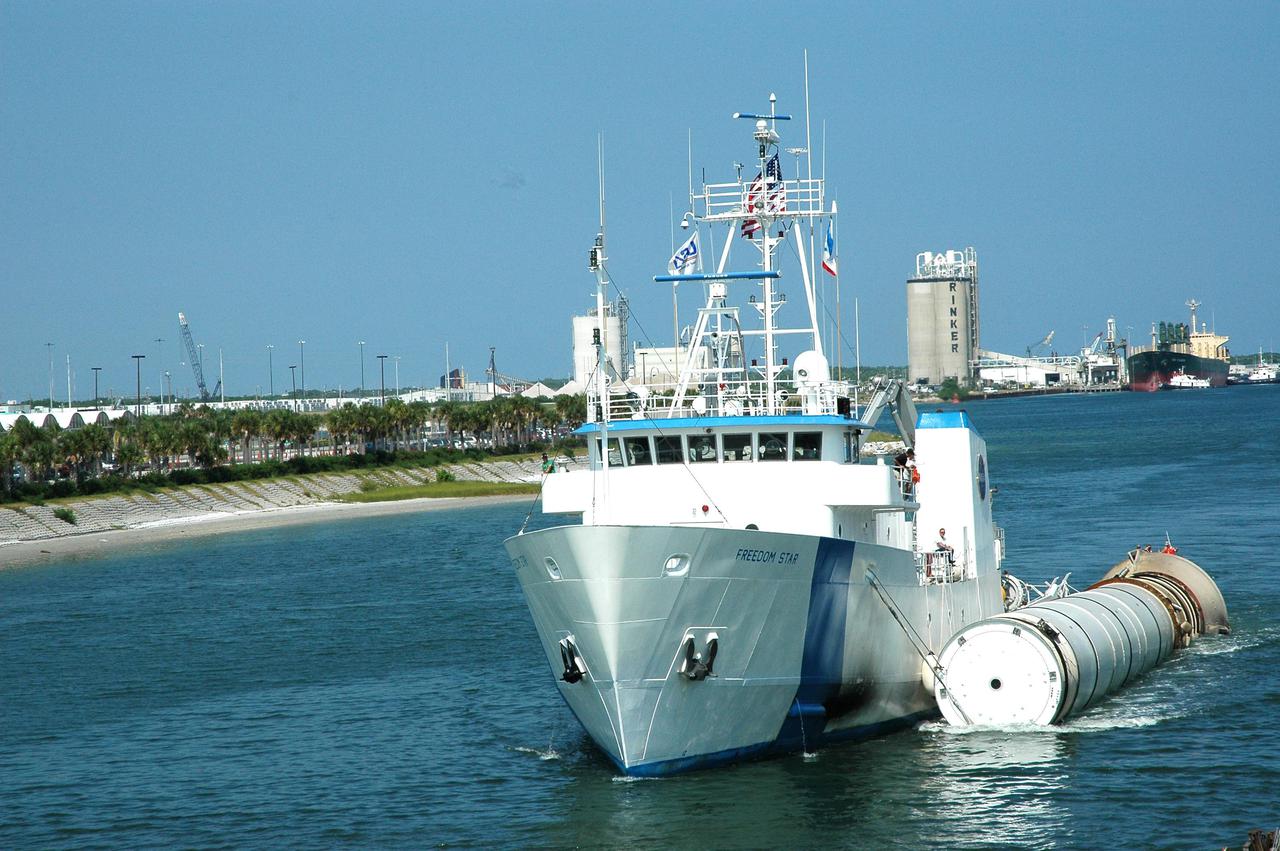
KENNEDY SPACE CENTER, FLA. - The solid rocket booster recovery ship Freedom Star travels through Port Canaveral with a spent solid rocket booster (SRB) from the STS-114 launch on July 26 in tow. The SRBs are the largest solid propellant motors ever flown and the first designed for reuse. After a Shuttle is launched, the SRBs are jettisoned at two minutes, seven seconds into the flight. At six minutes and 44 seconds after liftoff, the spent SRBs, weighing about 165,000 lb., have slowed their descent speed to about 62 mph and splashdown takes place in a predetermined area. They are retrieved from the Atlantic Ocean by special recovery vessels and returned for refurbishment and eventual reuse on future Shuttle flights. Once at Hangar AF, the SRBs are unloaded onto a hoisting slip and mobile gantry cranes lift them onto tracked dollies where they are safed and undergo their first washing.
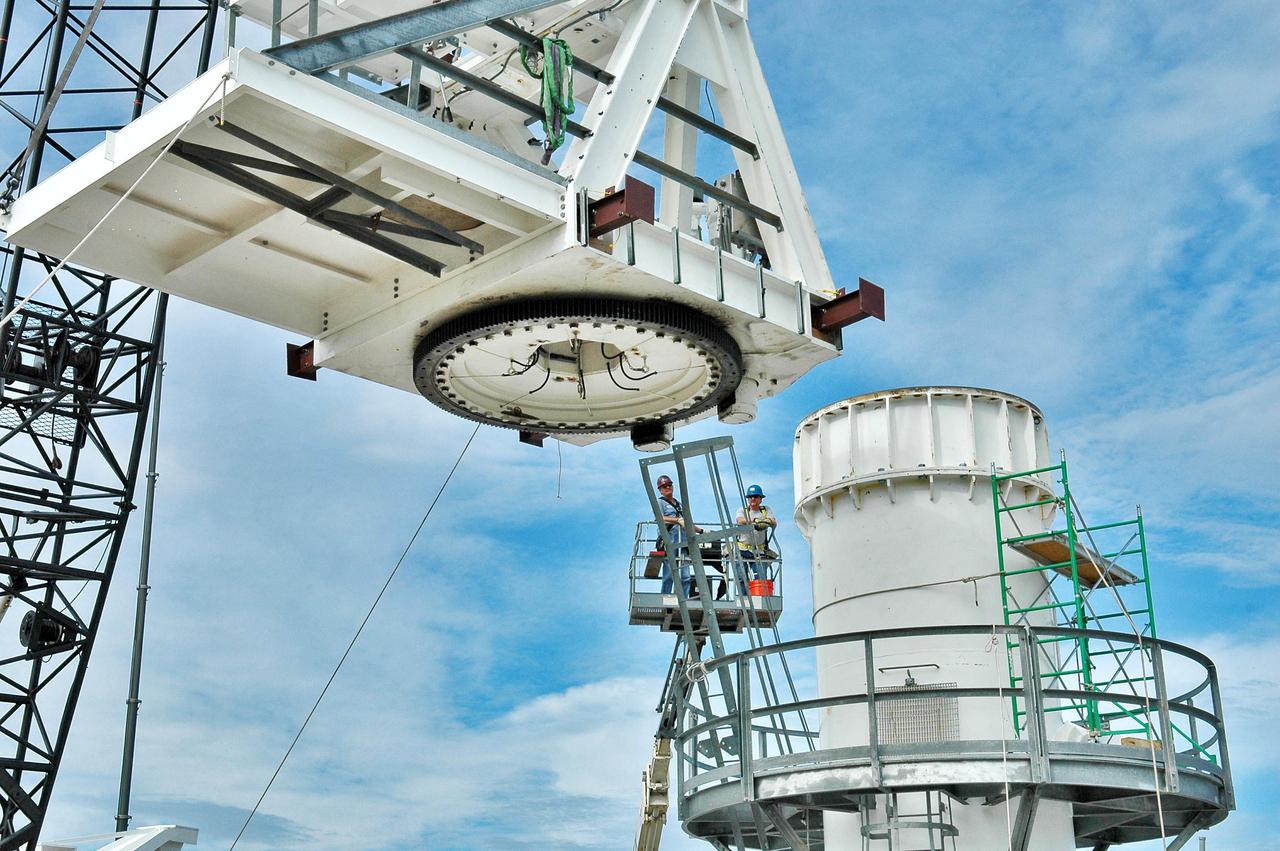
KENNEDY SPACE CENTER, FLA. - On a radar site on North Merritt Island, Fla., part of the structure to be added to the support base for a 50-foot C-band radar antenna is moved closer to the base. The radar will be used for Shuttle missions to track the launches and observe possible debris coming from the Shuttle. It will be used for the first time on STS-114. The launch window for the first Return to Flight mission is July 13 to July 31.
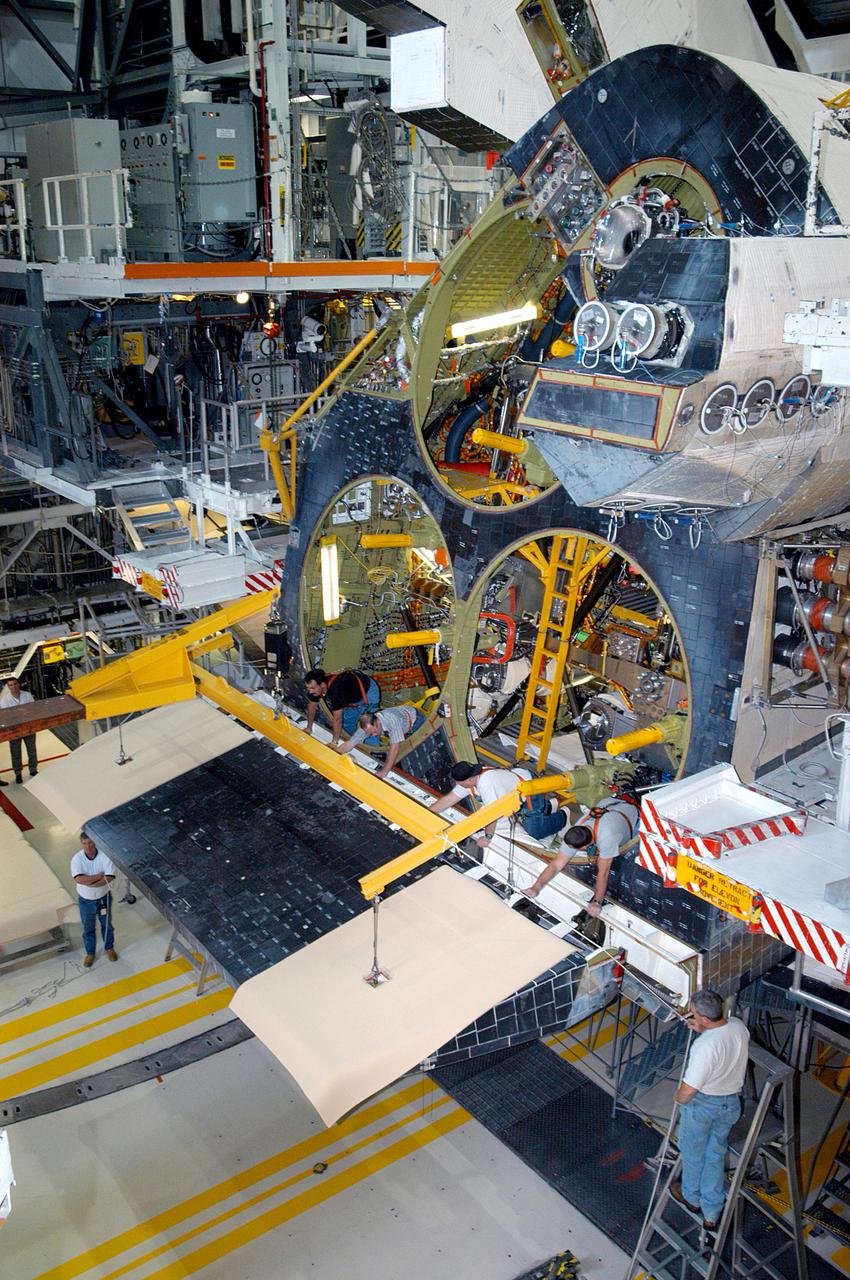
KENNEDY SPACE CENTER, FLA. - In the Orbiter Processing Facility, workers inside the openings for the Space Shuttle Main Engines reach out to install the body flap, suspended behind the orbiter Atlantis. The body flap is an aluminum structure consisting of ribs, spars, skin panels and a trailing edge assembly. It thermally shields the three Space Shuttle Main Engines during entry and provides the orbiter with pitch control trim during its atmospheric flight after entry. Atlantis is being processed for its mission, designated STS-121, this summer to the International Space Station. The launch planning window is July 12 - August 3.
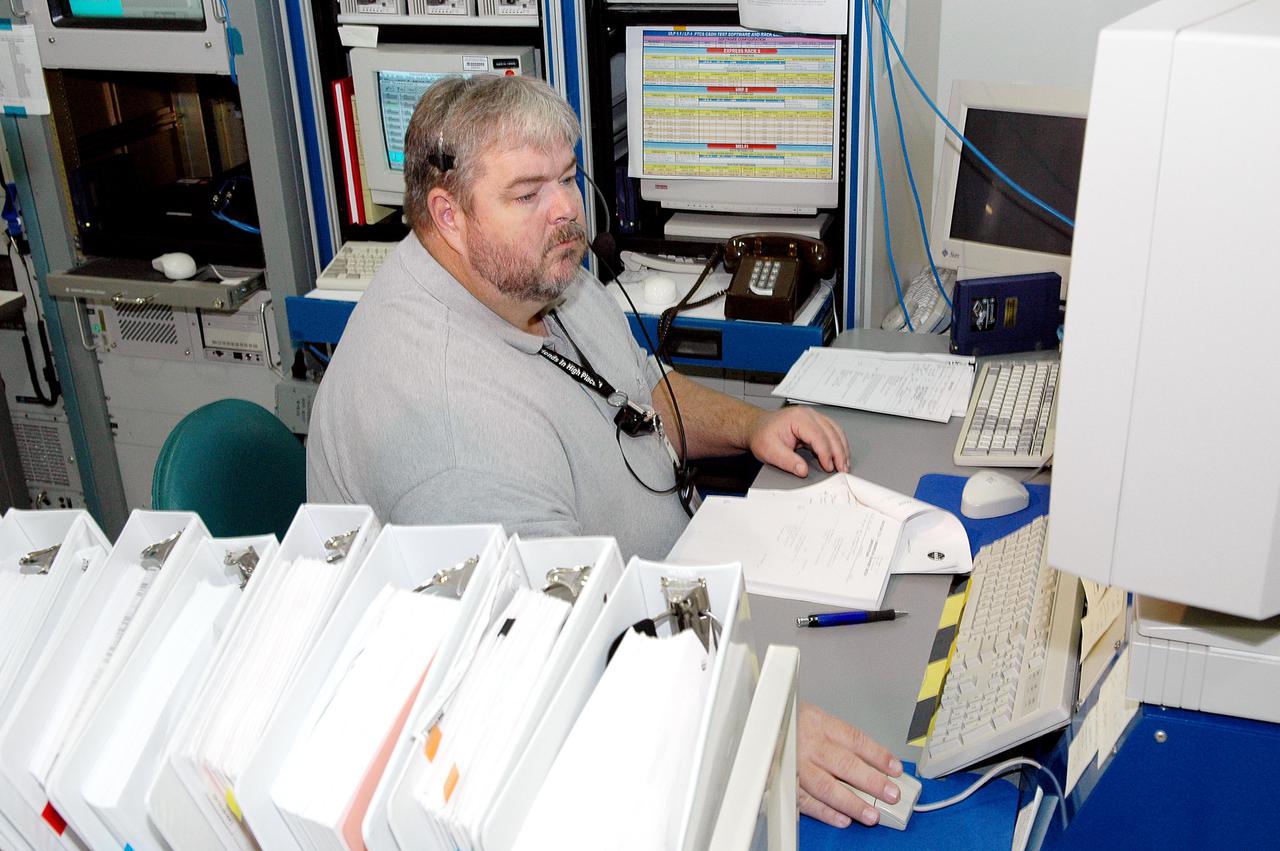
KENNEDY SPACE CENTER, FLA. - Joe Mounts, with Boeing, monitors the Payload Test and Checkout System for the Human Research Facility (HRF) Rack -2 payload. The HRF-2 is scheduled to fly on Return to Flight Space Shuttle mission STS-114. The HRF-2 will deliver additional biomedical instrumentation and research capability to the International Space Station. HRF Rack 1 contains an ultrasound unit and gas analyzer system and has been operational in the U.S. Lab since May 2001. HRF-2 will also be installed in the U. S. Lab and will provide structural, power, thermal, command and data handling, and communication and tracking interfaces between the HRF biomedical instrumentation and the U. S. Lab.
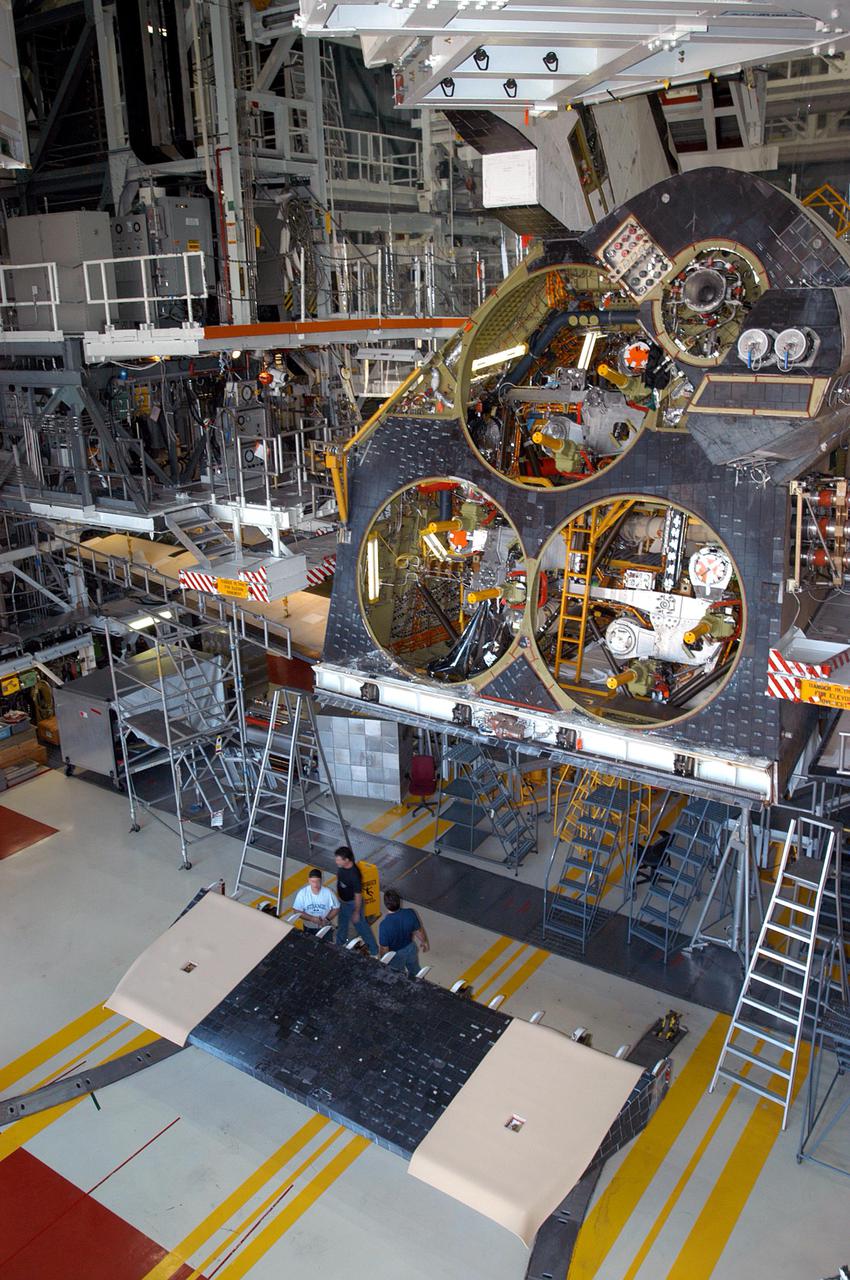
KENNEDY SPACE CENTER, FLA. - In the Orbiter Processing Facility, workers on the floor get ready to install the body flap on the orbiter Atlantis, behind them. The body flap is an aluminum structure consisting of ribs, spars, skin panels and a trailing edge assembly. It thermally shields the three Space Shuttle Main Engines during entry and provides the orbiter with pitch control trim during its atmospheric flight after entry. Atlantis is being processed for its mission, designated STS-121, this summer to the International Space Station. The launch planning window is July 12 - August 3.
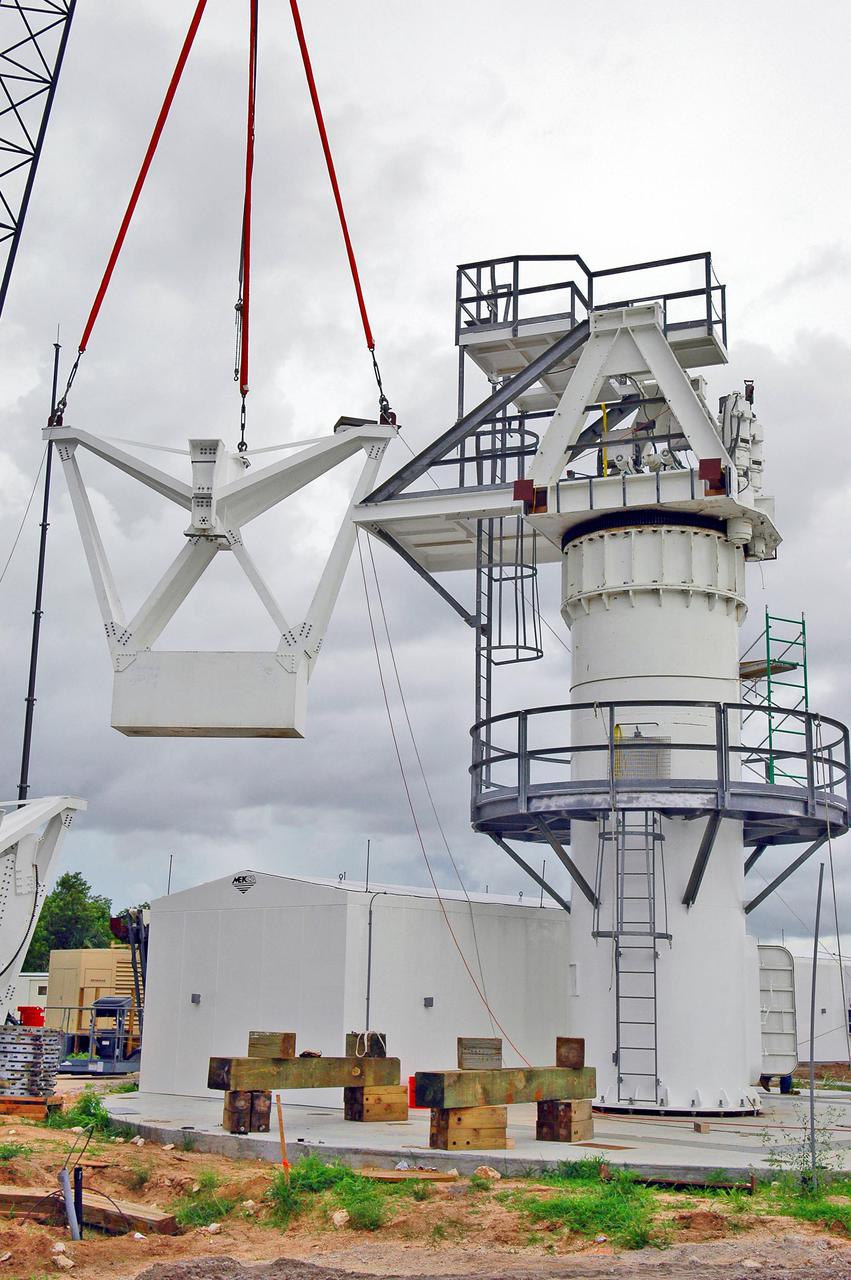
KENNEDY SPACE CENTER, FLA. - At a radar site on North Merritt Island, Fla., one of two counterweights is being lifted for installation on a support structure (right) for a 50-foot C-band radar antenna dish. The radar will be used for Shuttle missions to track the launches and observe possible debris coming from the Shuttle. It will be used for the first time on STS-114. The launch window for the first Return to Flight mission is July 13 to July 31.
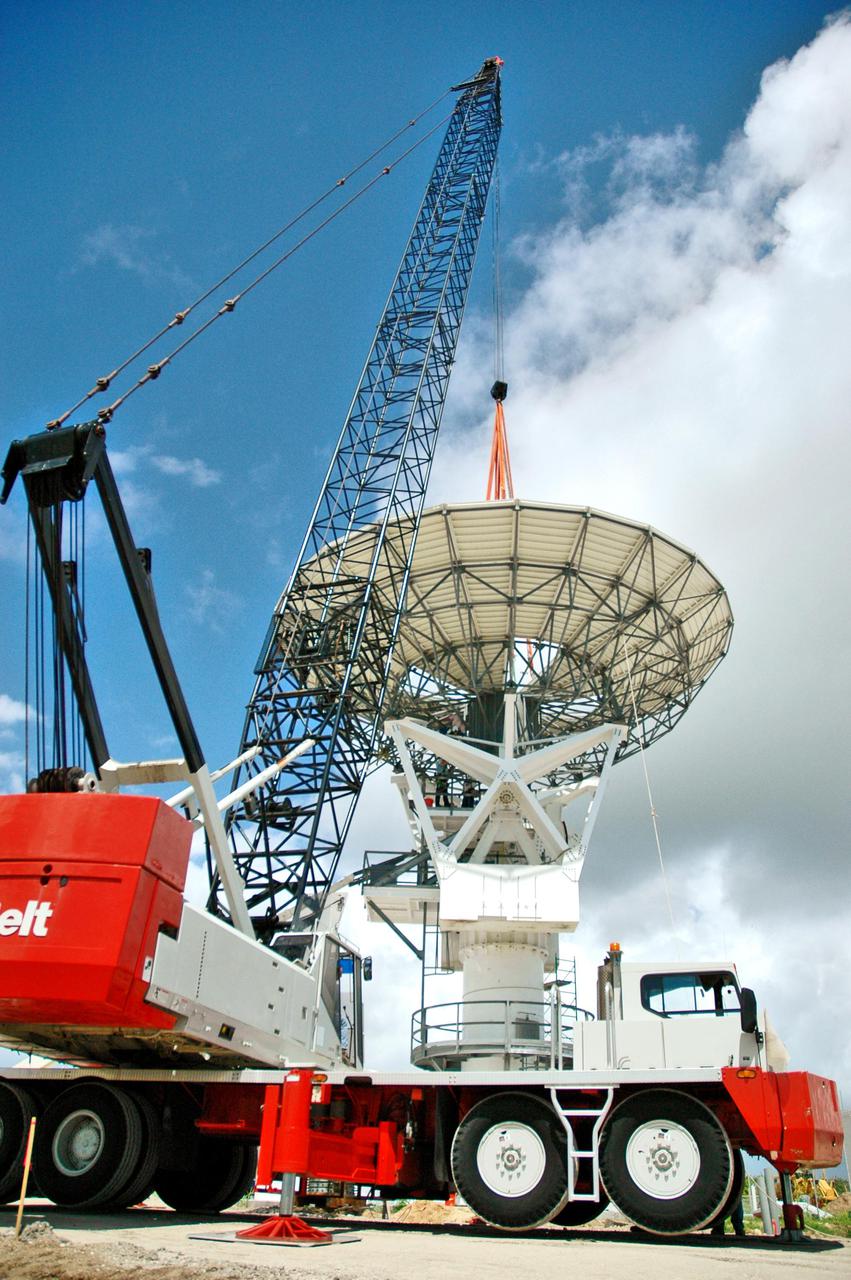
KENNEDY SPACE CENTER, FLA. - At a radar site on North Merritt Island, Fla., the 50-foot C-band radar antenna dish is lowered toward the top of the support structure. It will be placed on the counterweights installed there. The radar will be used for Shuttle missions to track the launches and observe possible debris coming from the Shuttle. It will be used for the first time on STS-114. The launch window for the first Return to Flight mission is July 13 to July 31.
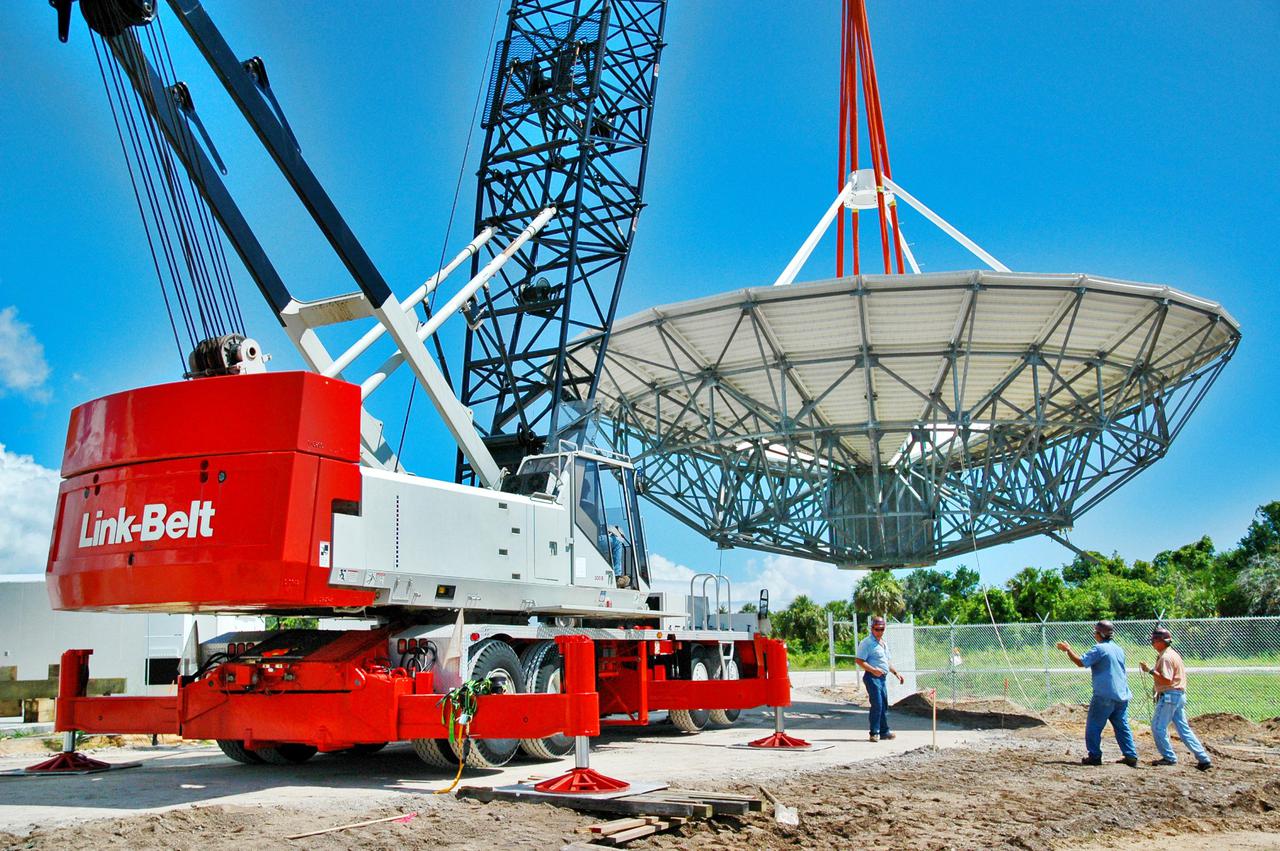
KENNEDY SPACE CENTER, FLA. - At a radar site on North Merritt Island, Fla., the 50-foot C-band radar antenna dish is lifted off the ground. It will be placed onto the top of a support structure.The radar will be used for Shuttle missions to track the launches and observe possible debris coming from the Shuttle. It will be used for the first time on STS-114. The launch window for the first Return to Flight mission is July 13 to July 31.
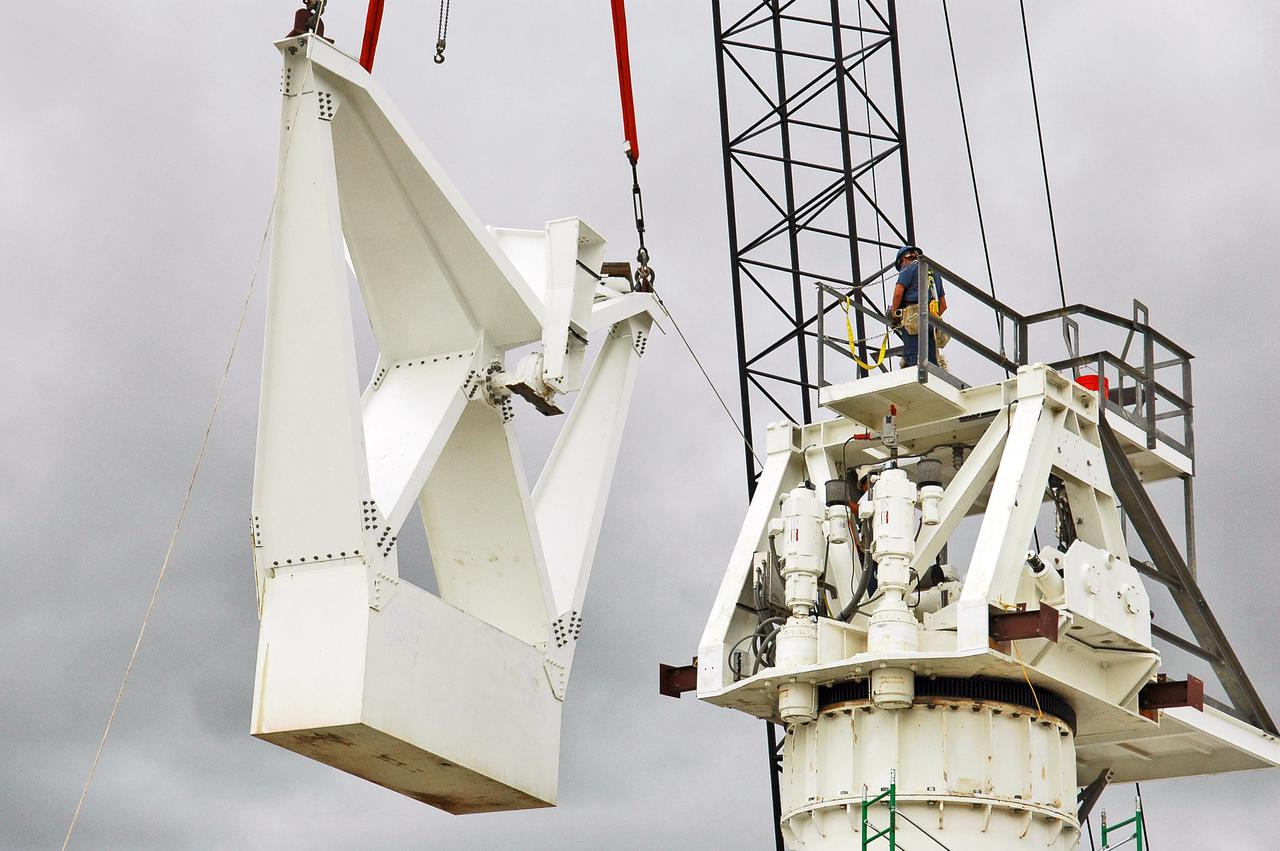
KENNEDY SPACE CENTER, FLA. - At a radar site on North Merritt Island, Fla., one of two counterweights is being lifted for installation on a support structure (right) for a 50-foot C-band radar antenna dish. The radar will be used for Shuttle missions to track the launches and observe possible debris coming from the Shuttle. It will be used for the first time on STS-114. The launch window for the first Return to Flight mission is July 13 to July 31.
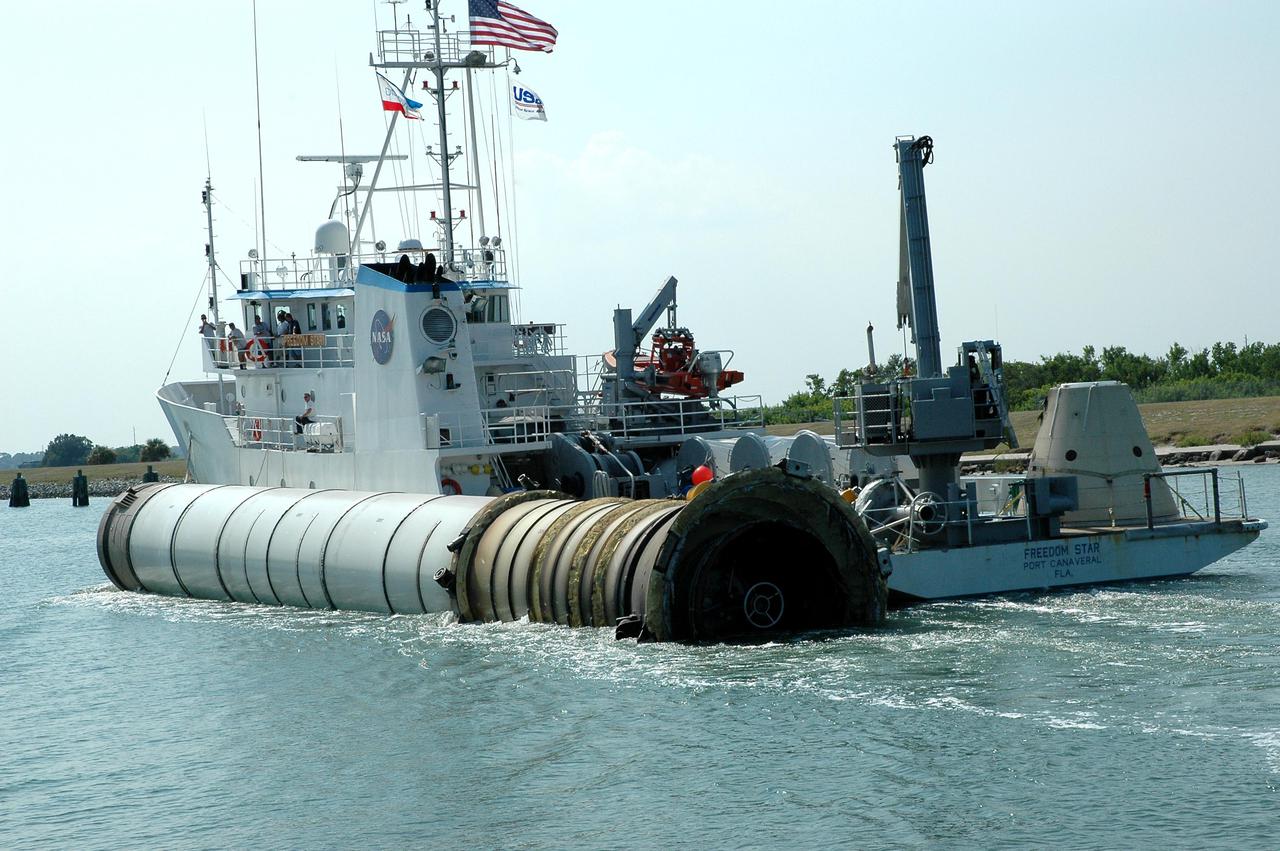
KENNEDY SPACE CENTER, FLA. - Kennedy Space Center employees on the solid rocket booster recovery ship Freedom Star acknowledge photographers awaiting their arrival at Port Canaveral. The ship, with a spent solid rocket booster (SRB) from the STS-114 launch on July 26 in tow, is headed for Hangar AF on Cape Canaveral Air Force Station. The SRBs are the largest solid propellant motors ever flown and the first designed for reuse. After a Shuttle is launched, the SRBs are jettisoned at two minutes, seven seconds into the flight. At six minutes and 44 seconds after liftoff, the spent SRBs, weighing about 165,000 lb., have slowed their descent speed to about 62 mph and splashdown takes place in a predetermined area. They are retrieved from the Atlantic Ocean by special recovery vessels and returned for refurbishment and eventual reuse on future Shuttle flights. Once at Hangar AF, the SRBs are unloaded onto a hoisting slip and mobile gantry cranes lift them onto tracked dollies where they are safed and undergo their first washing.
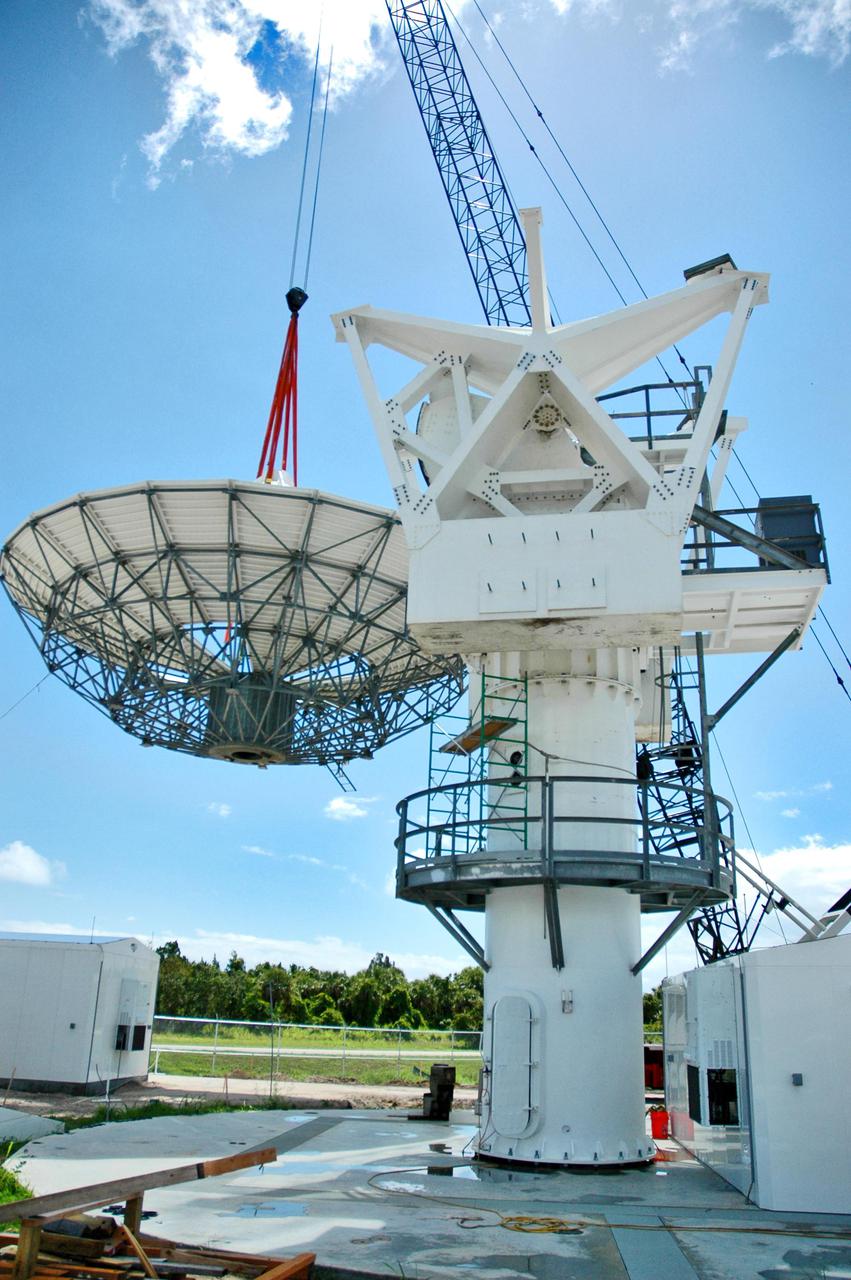
KENNEDY SPACE CENTER, FLA. - At a radar site on North Merritt Island, Fla., the 50-foot C-band radar antenna dish is lifted next to the support structure, where it will be installed on top. It will be placed onto the top of a support structure.The radar will be used for Shuttle missions to track the launches and observe possible debris coming from the Shuttle. It will be used for the first time on STS-114. The launch window for the first Return to Flight mission is July 13 to July 31.
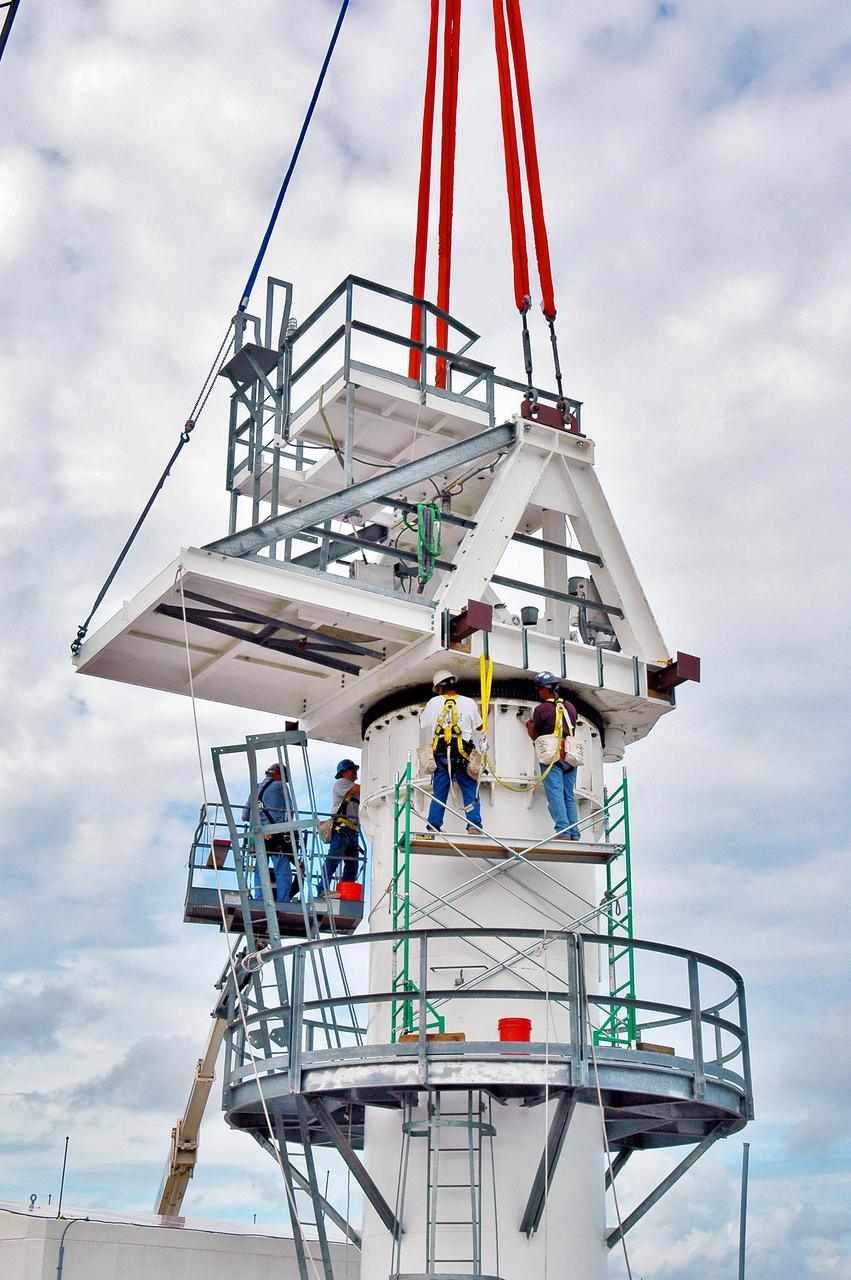
KENNEDY SPACE CENTER, FLA. - Workers secure an upper section of the support base for a 50-foot C-band radar antenna being erected on a radar site on North Merritt Island, Fla. The radar will be used for Shuttle missions to track the launches and observe possible debris coming from the Shuttle. It will be used for the first time on STS-114. The launch window for the first Return to Flight mission is July 13 to July 31.
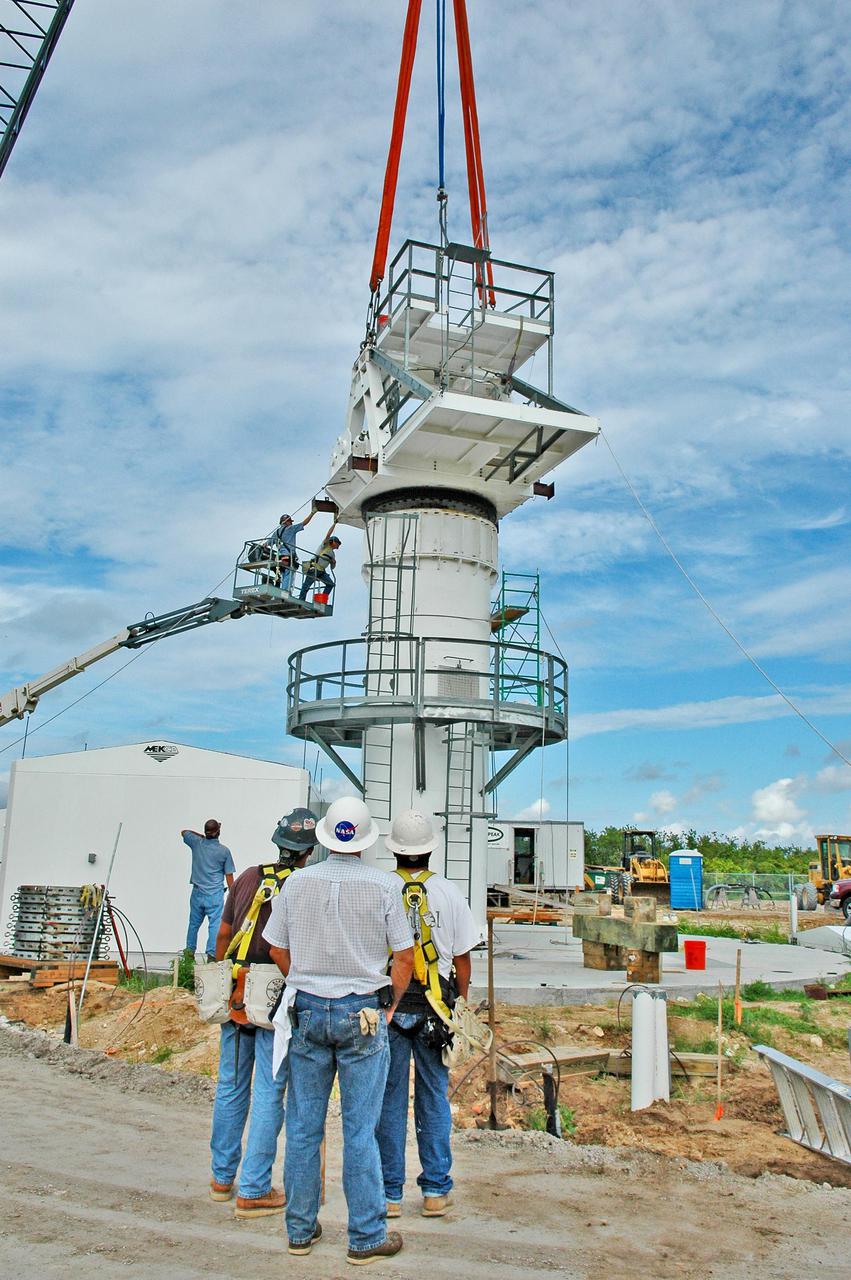
KENNEDY SPACE CENTER, FLA. - Workers start securing an upper section of the support base for a 50-foot C-band radar antenna being erected on a radar site on North Merritt Island, Fla. The radar will be used for Shuttle missions to track the launches and observe possible debris coming from the Shuttle. It will be used for the first time on STS-114. The launch window for the first Return to Flight mission is July 13 to July 31.
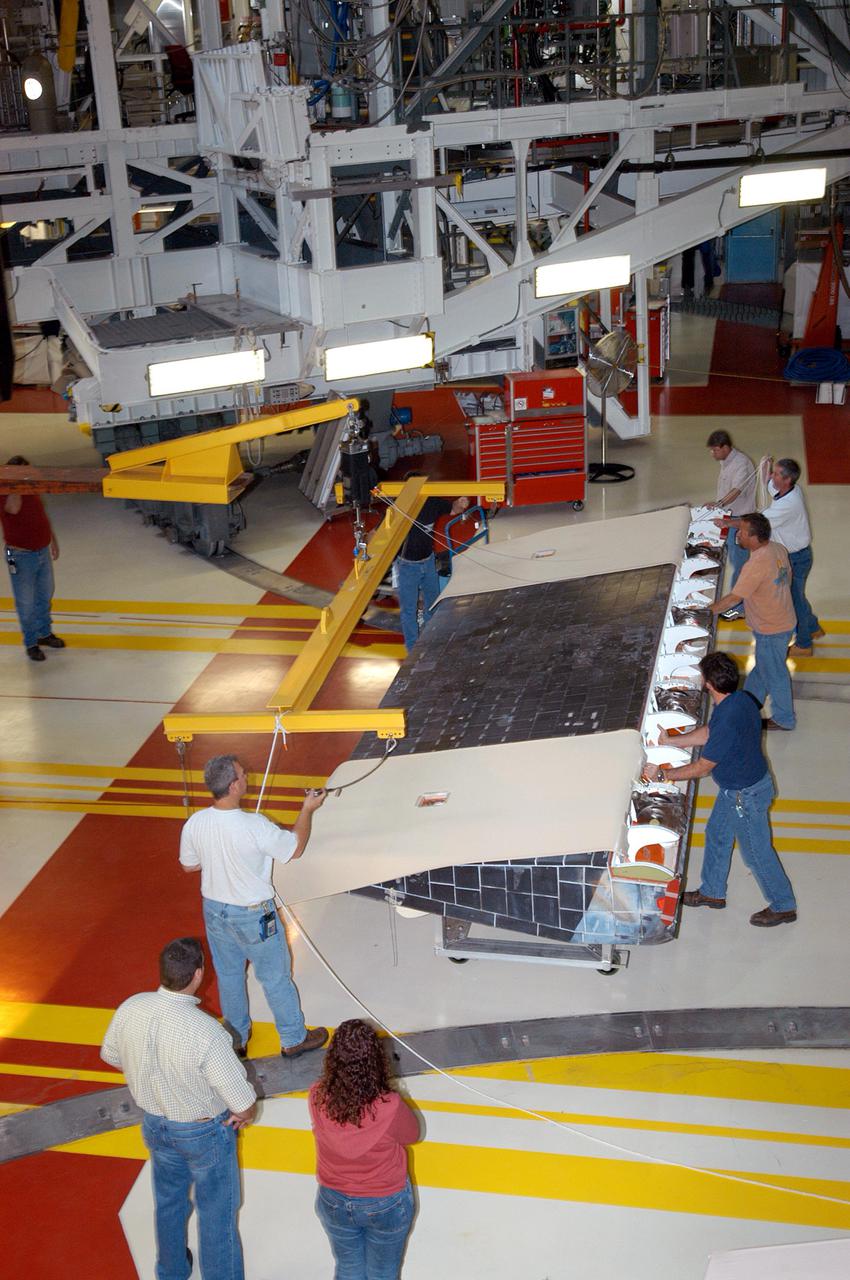
KENNEDY SPACE CENTER, FLA. - In the Orbiter Processing Facility, workers on the floor prepare to attach a crane to the body flap for the orbiter Atlantis. The crane will lift the body flap for installation on the orbiter. The body flap is an aluminum structure consisting of ribs, spars, skin panels and a trailing edge assembly. It thermally shields the three Space Shuttle Main Engines during entry and provides the orbiter with pitch control trim during its atmospheric flight after entry. Atlantis is being processed for its mission, designated STS-121, this summer to the International Space Station. The launch planning window is July 12 - August 3.
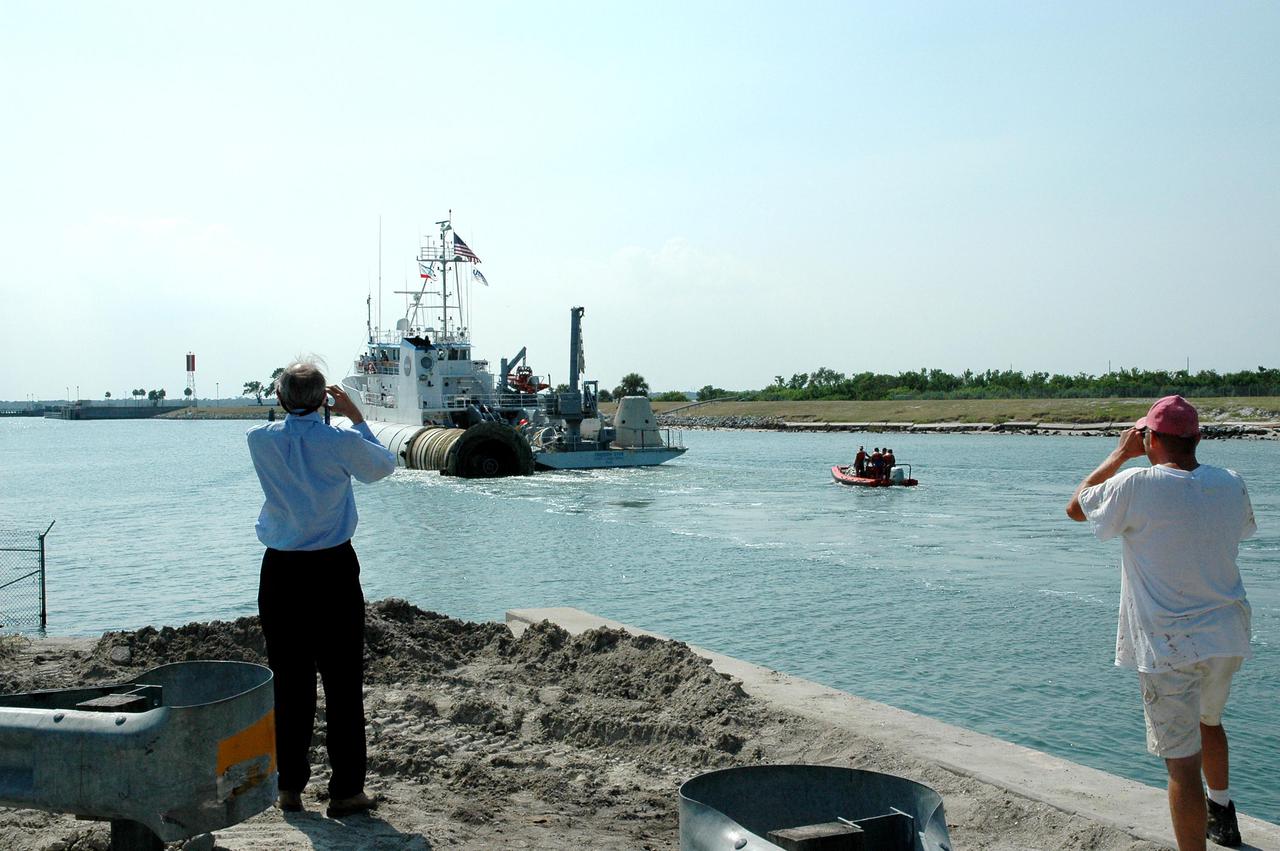
KENNEDY SPACE CENTER, FLA. - Photographers capture the solid rocket booster recovery ship Freedom Star, with a spent solid rocket booster (SRB) from the STS-114 launch on July 26 in tow, as it makes it way through Port Canaveral to Hangar AF on the Cape Canaveral Air Force Station. The SRBs are the largest solid propellant motors ever flown and the first designed for reuse. After a Shuttle is launched, the SRBs are jettisoned at two minutes, seven seconds into the flight. At six minutes and 44 seconds after liftoff, the spent SRBs, weighing about 165,000 lb., have slowed their descent speed to about 62 mph and splashdown takes place in a predetermined area. They are retrieved from the Atlantic Ocean by special recovery vessels and returned for refurbishment and eventual reuse on future Shuttle flights. Once at Hangar AF, the SRBs are unloaded onto a hoisting slip and mobile gantry cranes lift them onto tracked dollies where they are safed and undergo their first washing.