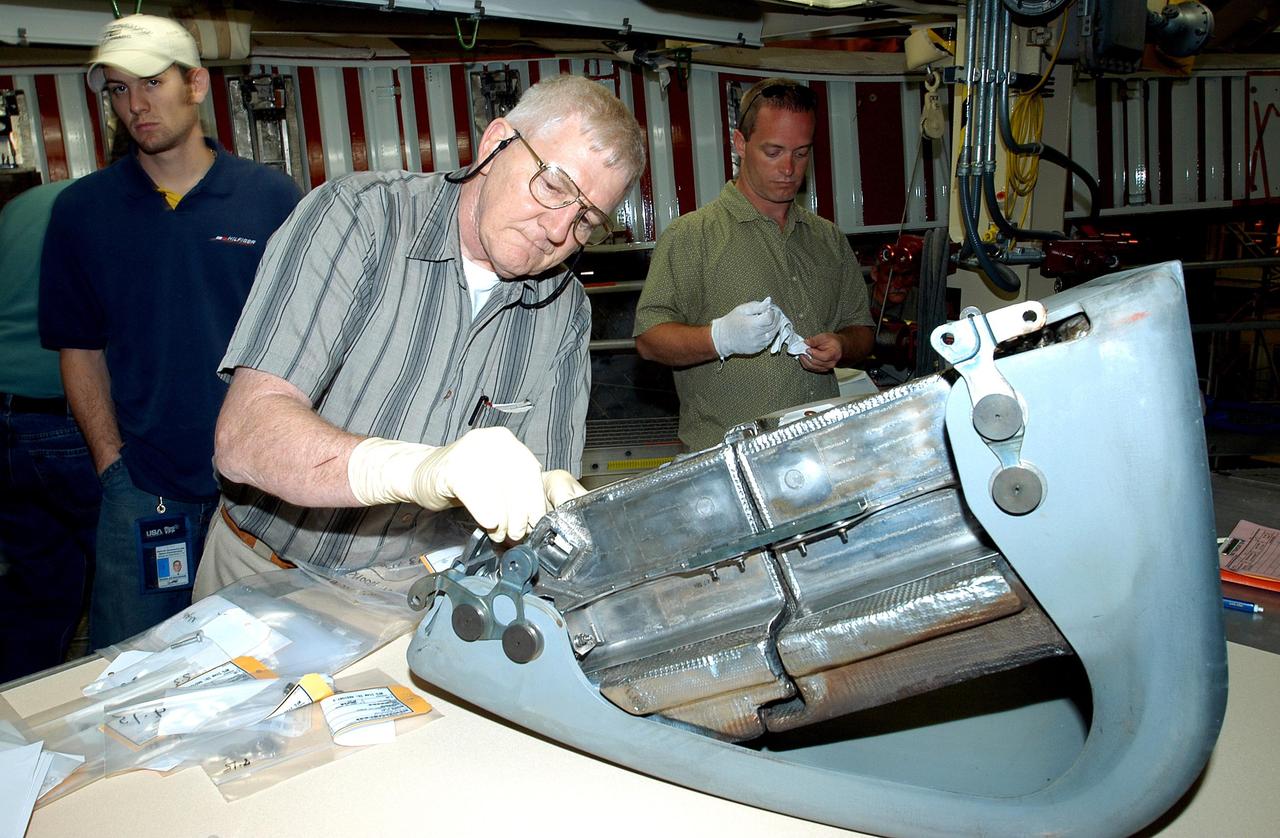
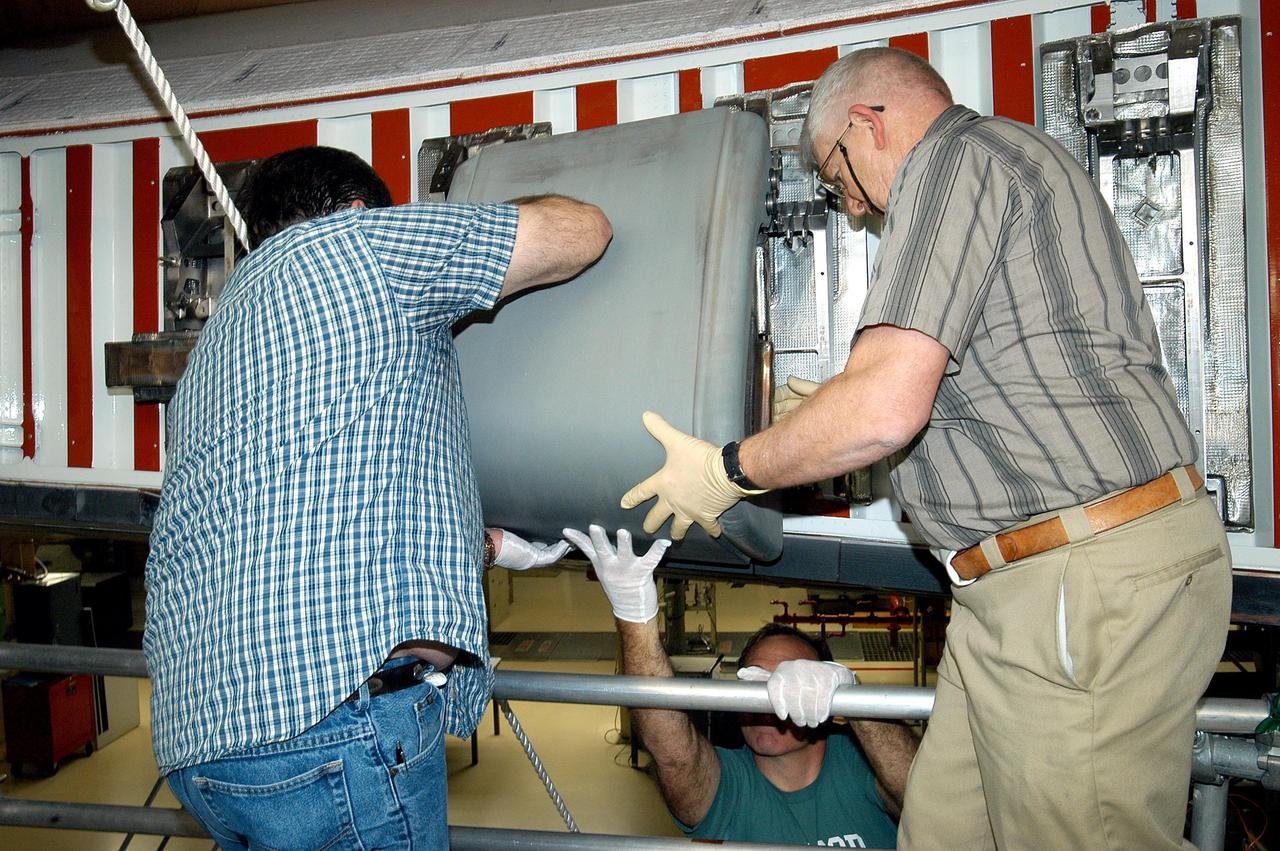
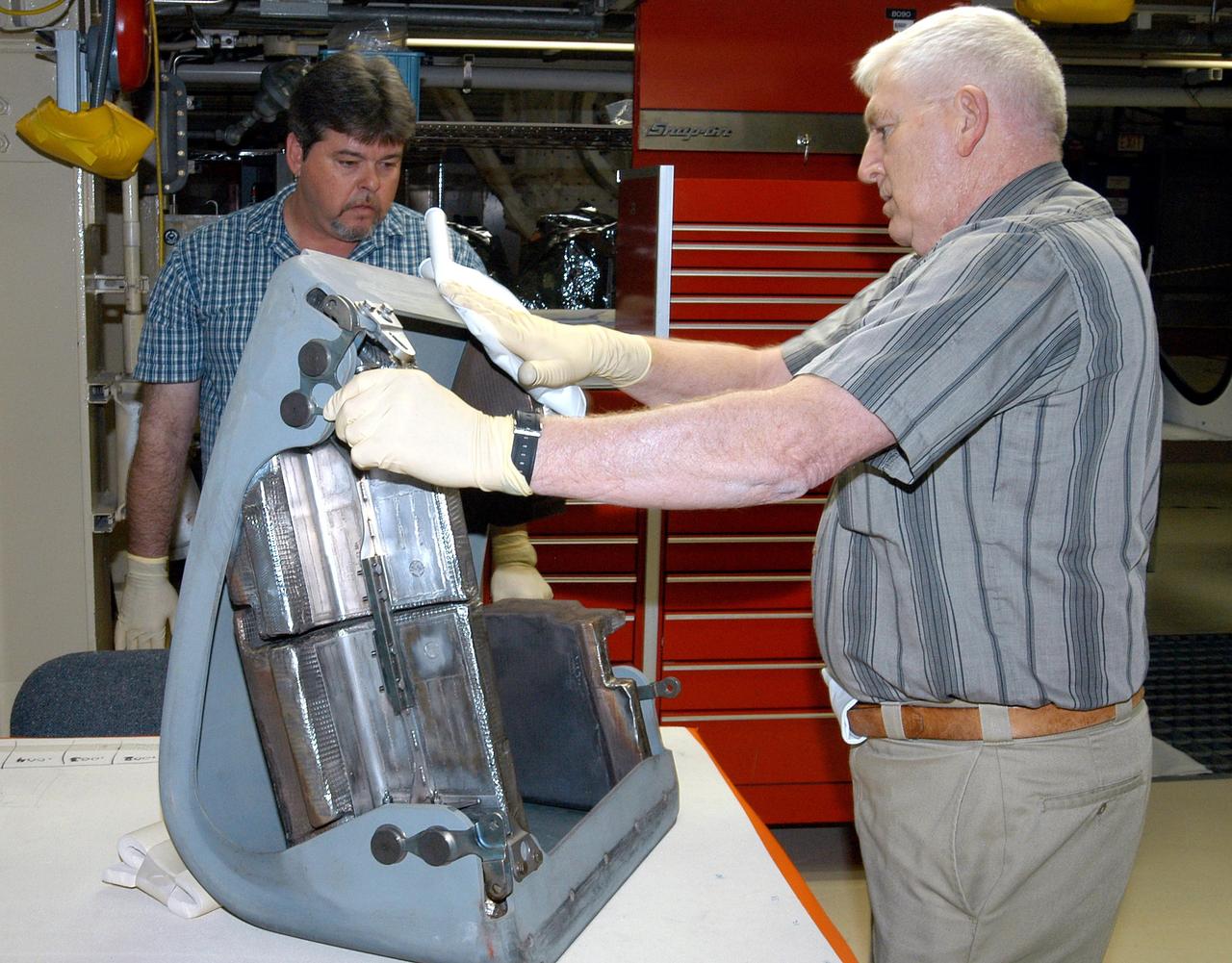
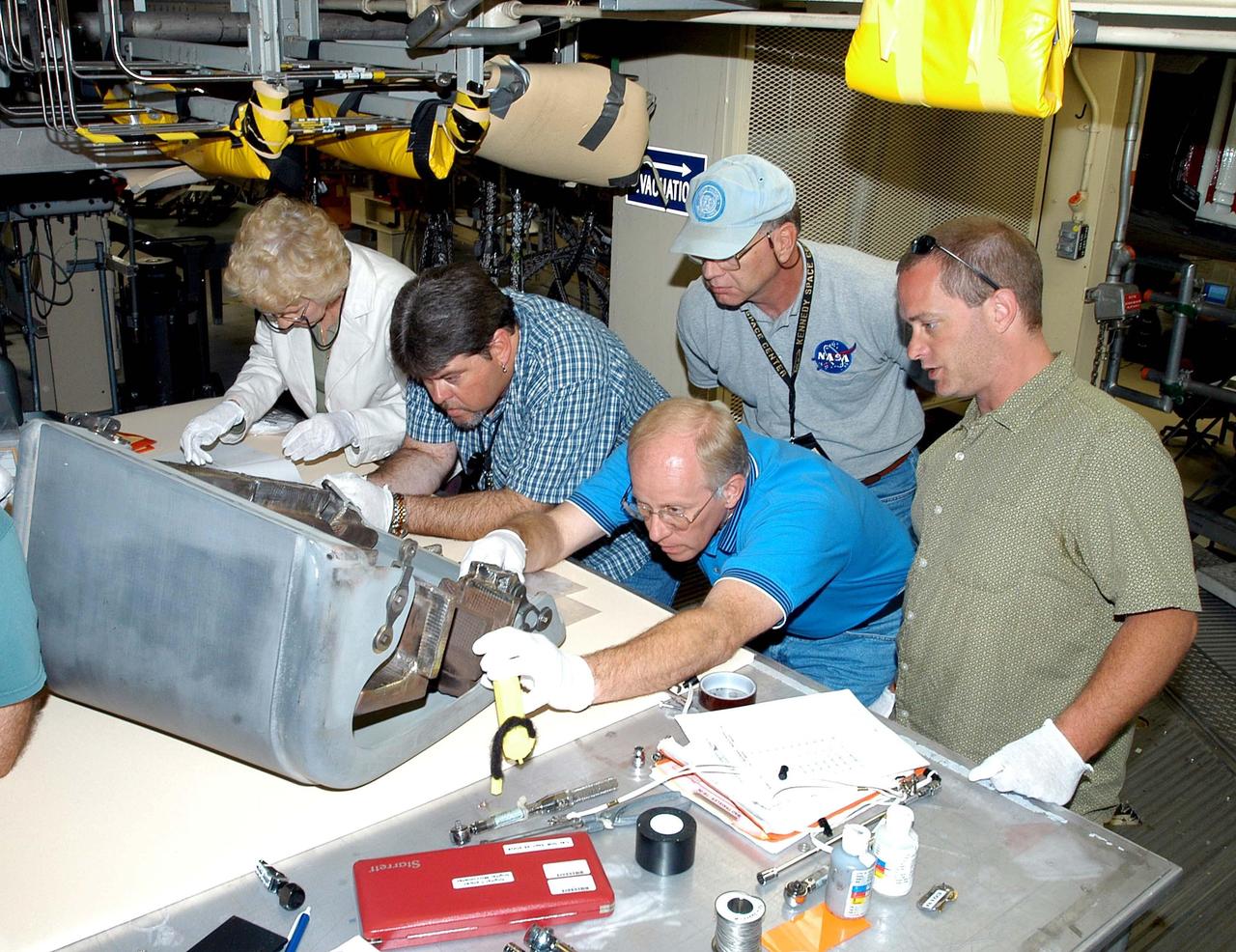
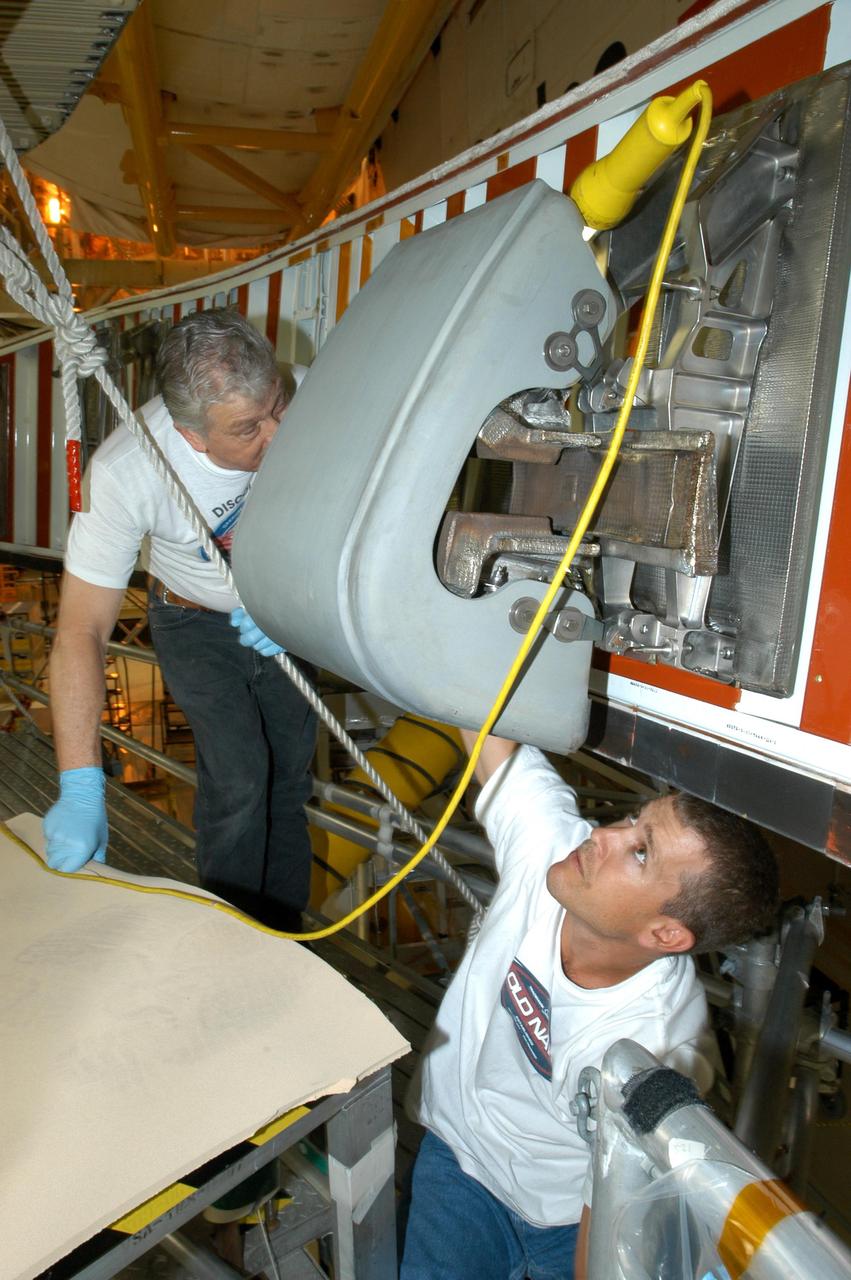
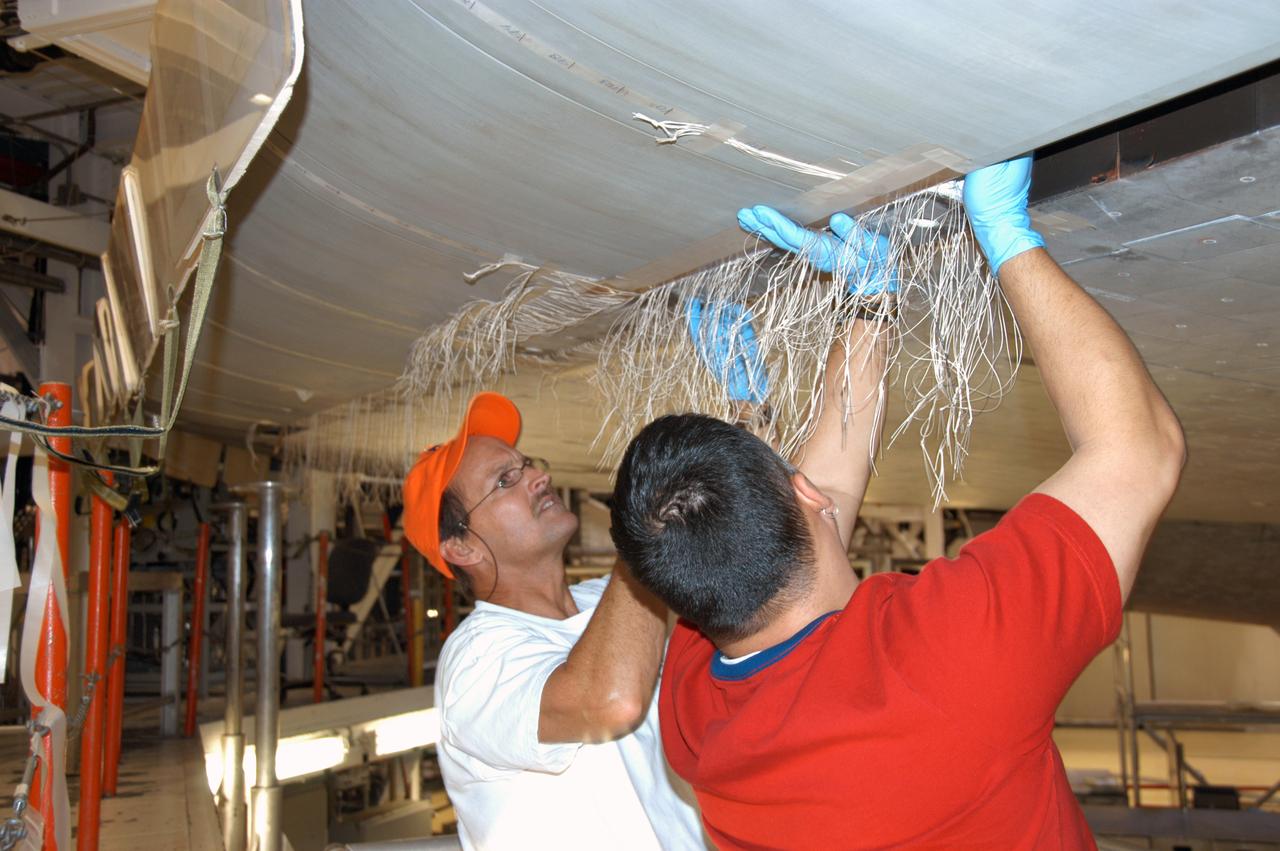
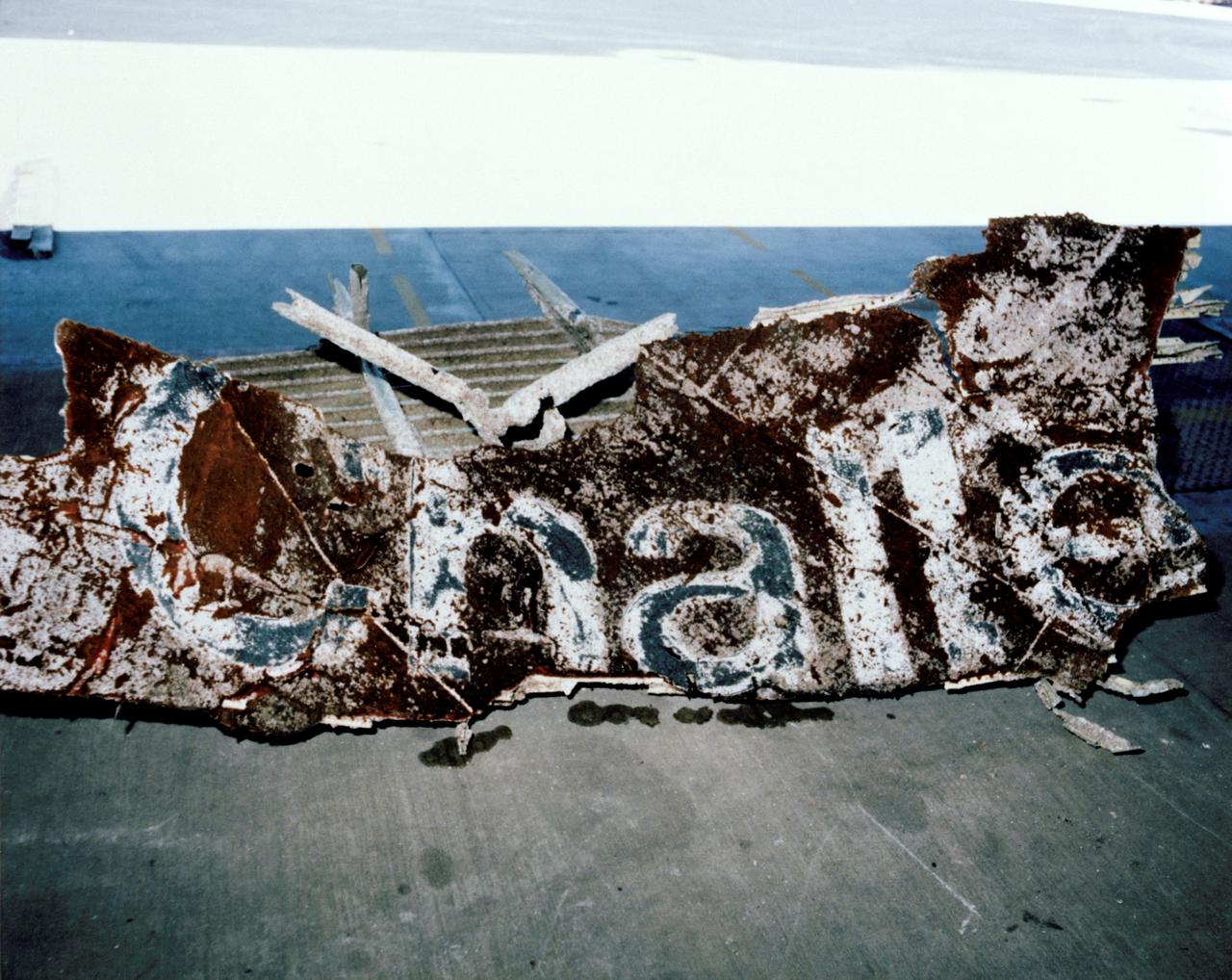
51L-10187 (18 April 1986) --- A 9'7" x 16' segment of Challenger's right wing is unloaded at the Logistics Facility after being off-loaded from the rescue and salvage ship USS Opportune. It was located and recovered by Navy divers from the Opportune about 12 nautical miles northeast of Cape Canaveral in 70 feet of water. Photo credit: NASA
Segment of Challenger's right wing unloaded at KSC Logistics Facility
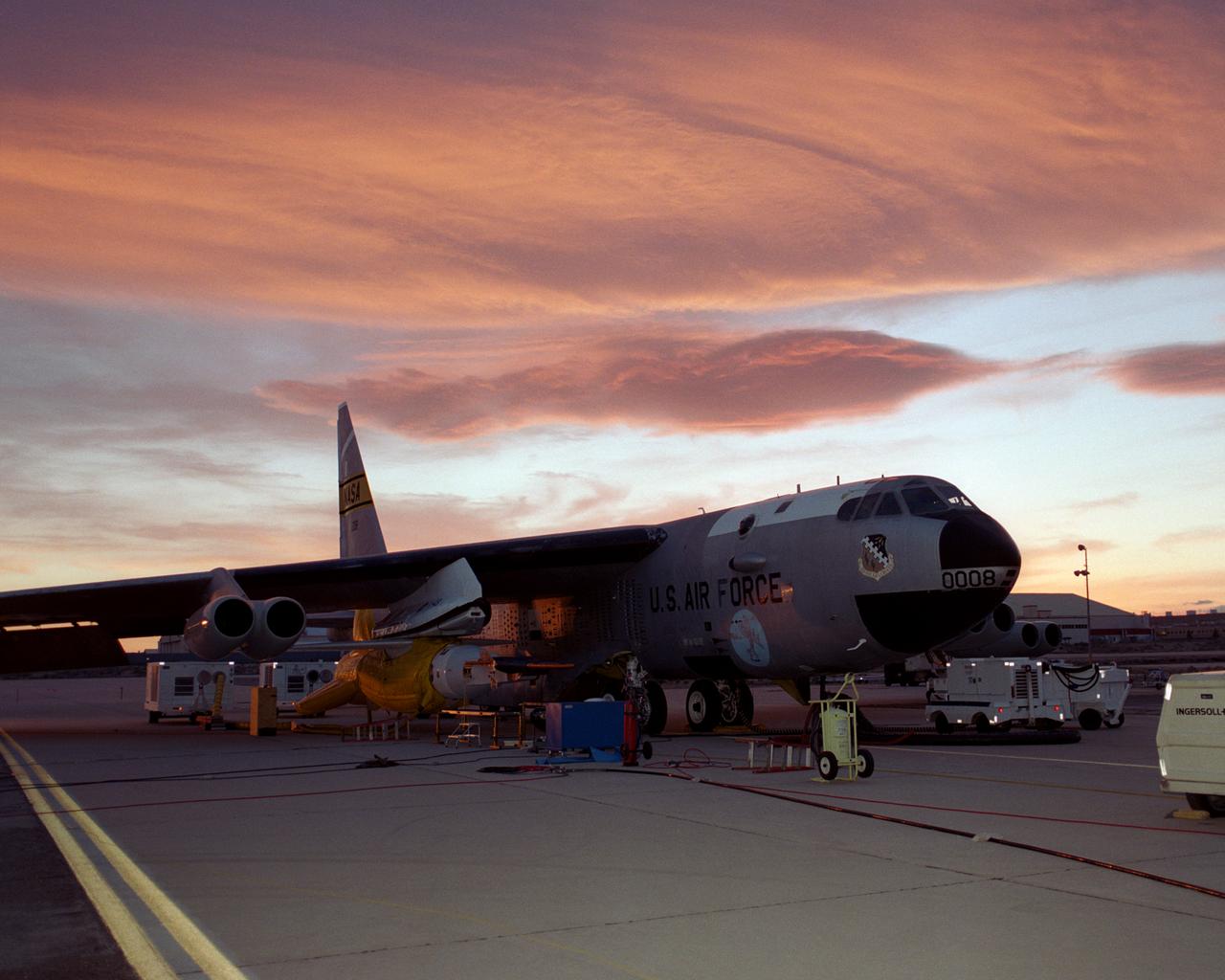
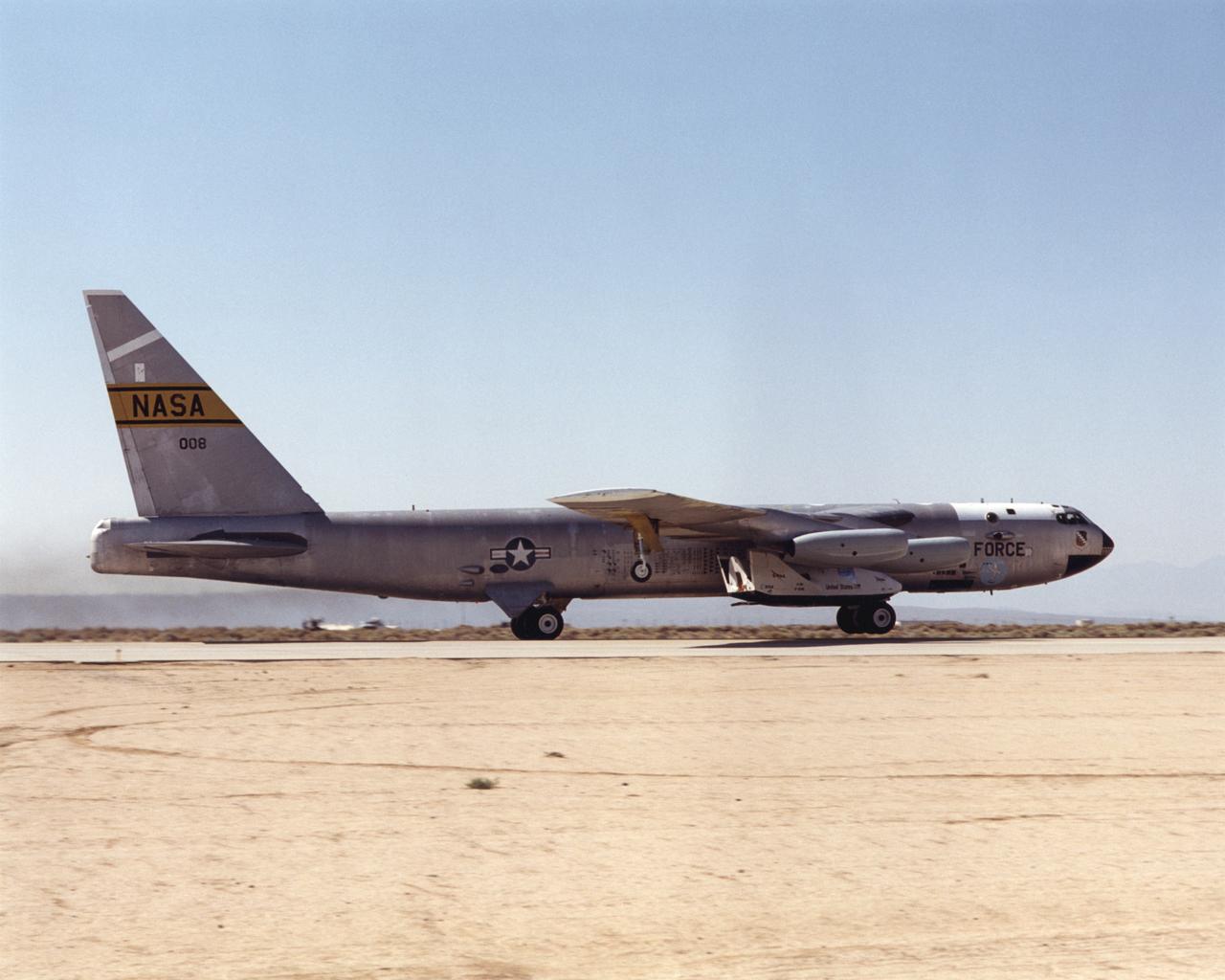
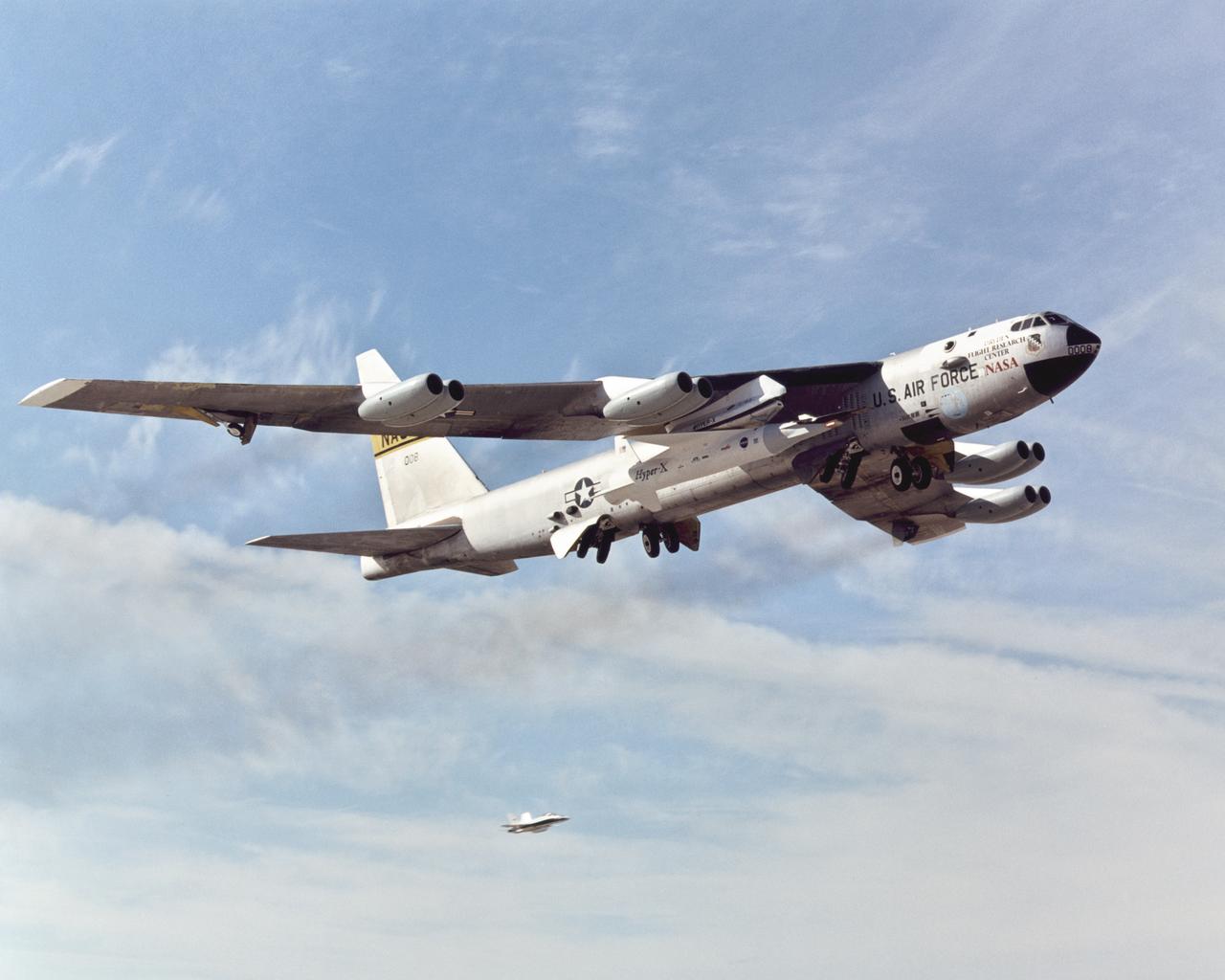
NASA's B-52B launch aircraft at sunset with the second X-43A hypersonic research vehicle attached to a modified Pegasus rocket under its right wing.
NASA's B-52B launch aircraft at sunset with the second X-43A hypersonic research vehicle attached to a modified Pegasus rocket under its right wing
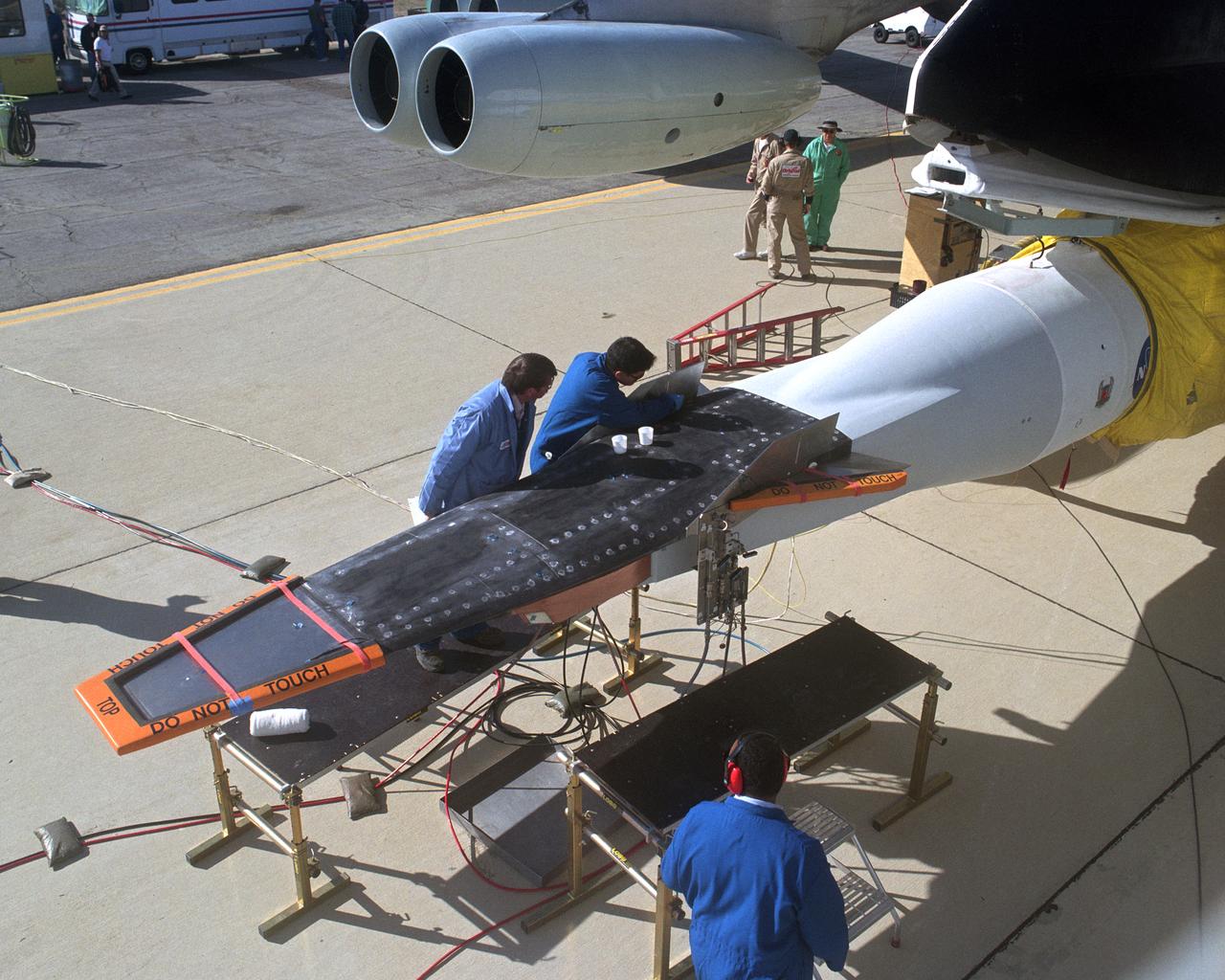
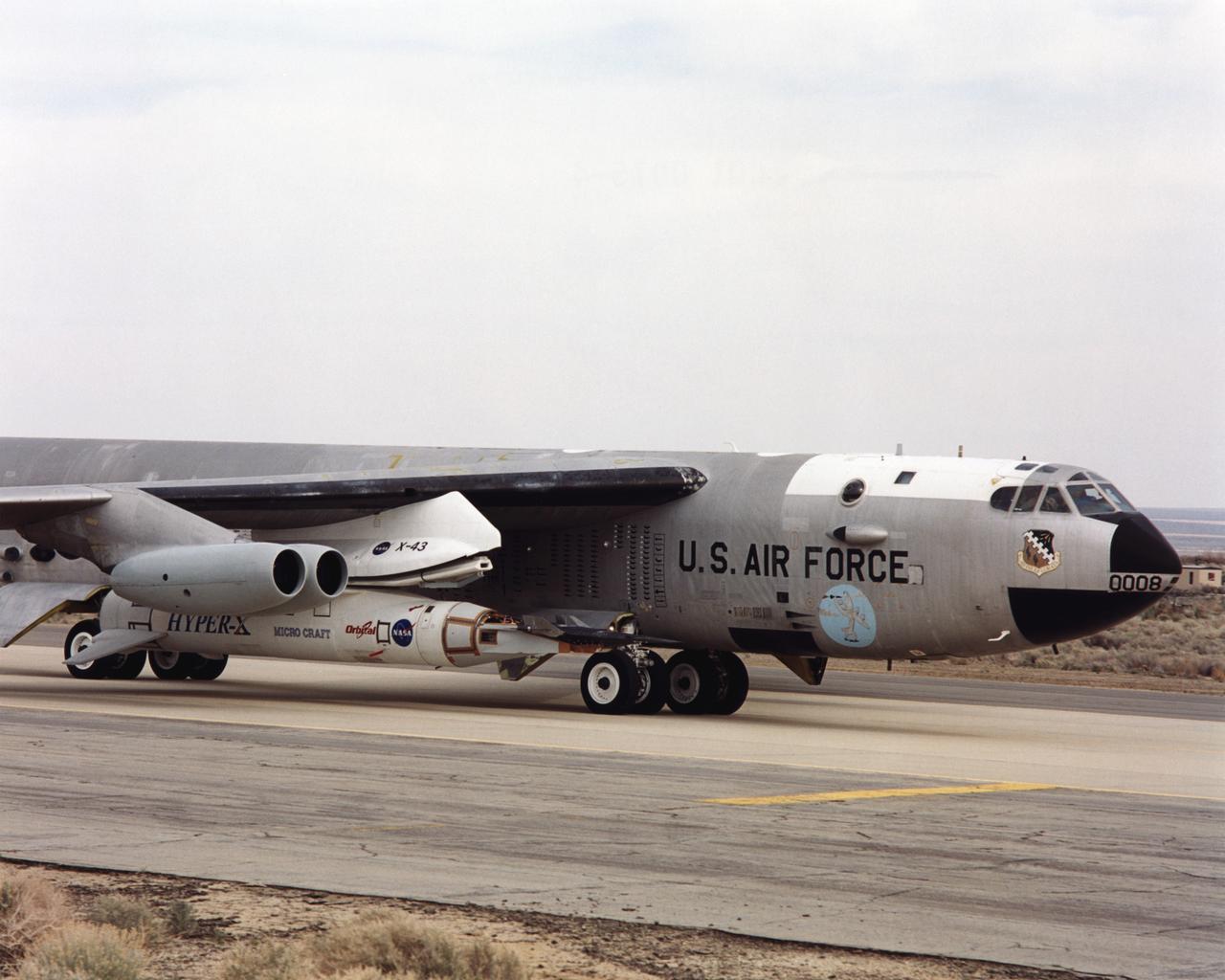
The second X-43A hypersonic research vehicle, mounted under the right wing of the B-52B launch aircraft, viewed from the B-52 cockpit. The crew is working on closing out the research vehicle, preparing it for flight.
The second X-43A hypersonic research vehicle, mounted under the right wing of the B-52B launch aircraft, viewed from the B-52 cockpit
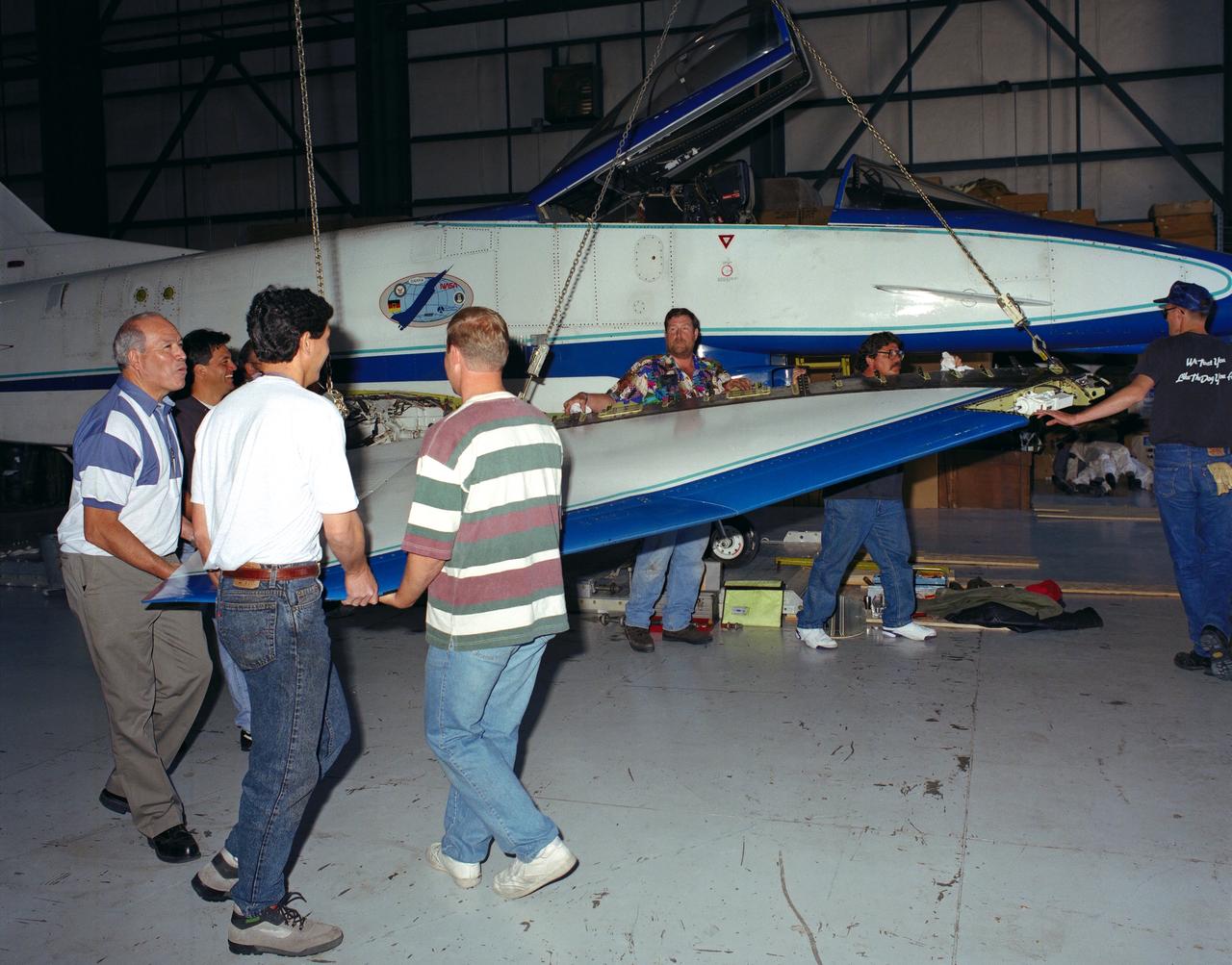
U.S. and German personnel of the X-31 Enhanced Fighter Maneuverability Technology Demonstrator aircraft program removing the right wing of the aircraft, which was ferried from Edwards Air Force Base, California, to Europe on May 22, 1995 aboard an Air Force Reserve C-5 transport.  The X-31, based at the NASA Dryden Flight Research Center was ferried to Europe and flown in the Paris Air Show in June. The wing of the X-31 was removed on May 18, 1995, to allow the aircraft to fit inside the C-5 fuselage. Officials of the X-31 project used Manching, Germany, as a staging base to prepare the aircraft for the flight demonstration.  At the air show, the X-31 demonstrated the value of using thrust vectoring (directing engine exhaust flow) coupled with advanced flight control systems to provide controlled flight at very high angles of attack. The aircraft arrived back at Edwards in a Air Force Reserve C-5 on June 25, 1995 and off loaded at Dryden June 27.  The X-31 aircraft was developed jointly by Rockwell International's North American Aircraft Division (now part of Boeing) and Daimler-Benz Aerospace (formerly Messerschmitt-Bolkow-Blohm), under sponsorship by the U.S. Department of Defense and the German Federal Ministry of Defense.
X-31 wing removal
With the X-43A and its booster rocket tucked under its right wing, NASA's venerable B-52B mothership climbs out after takeoff on its final research mission.
With the X-43A and its booster rocket tucked under its right wing, NASA's venerable B-52B mothership climbs out after takeoff on its final research mission
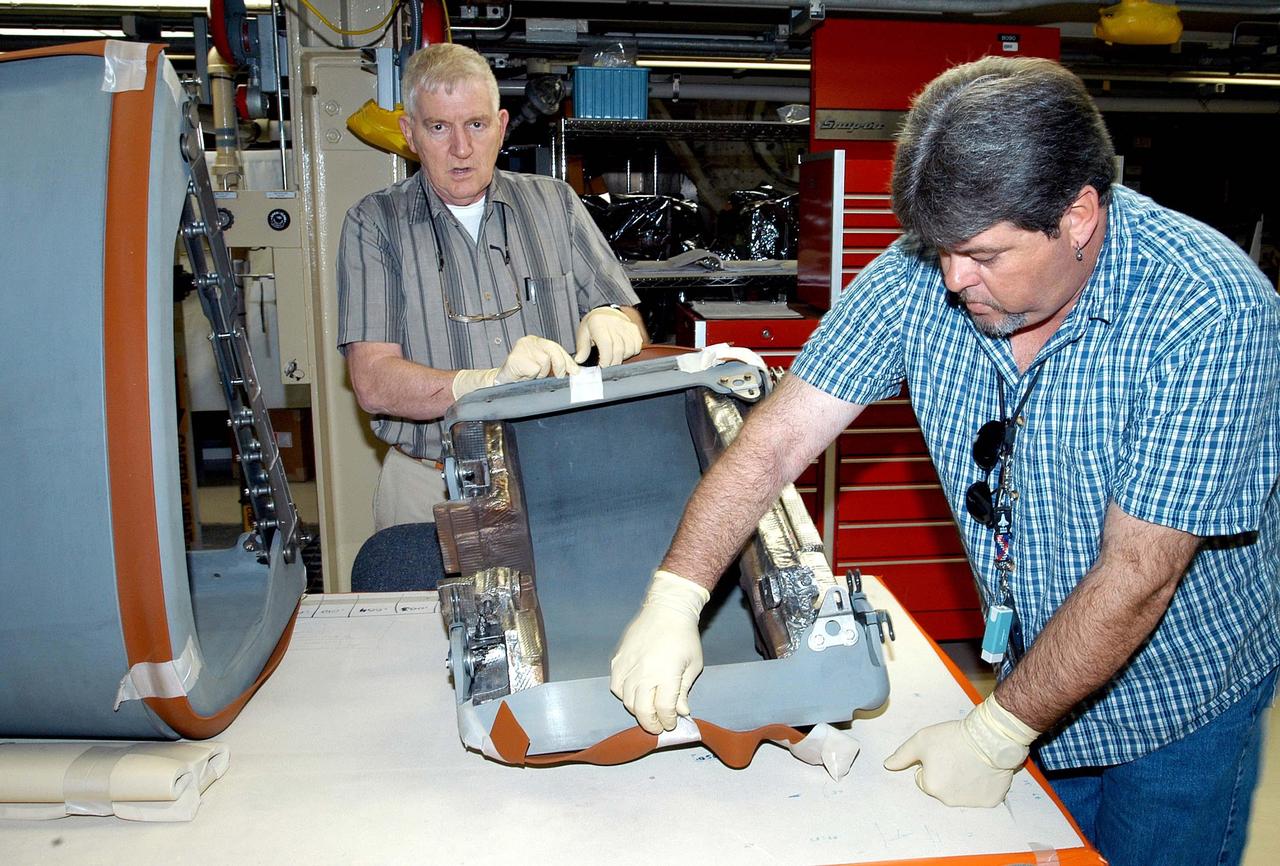
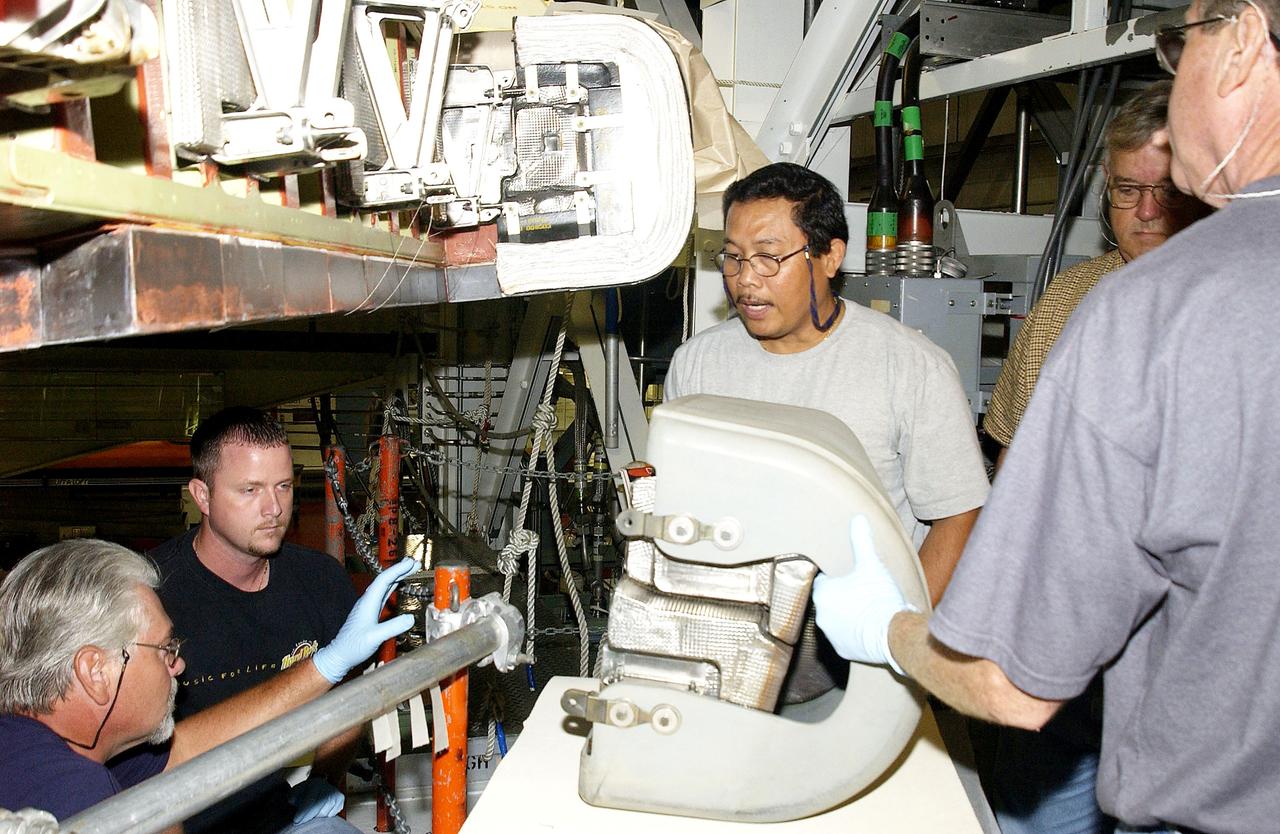
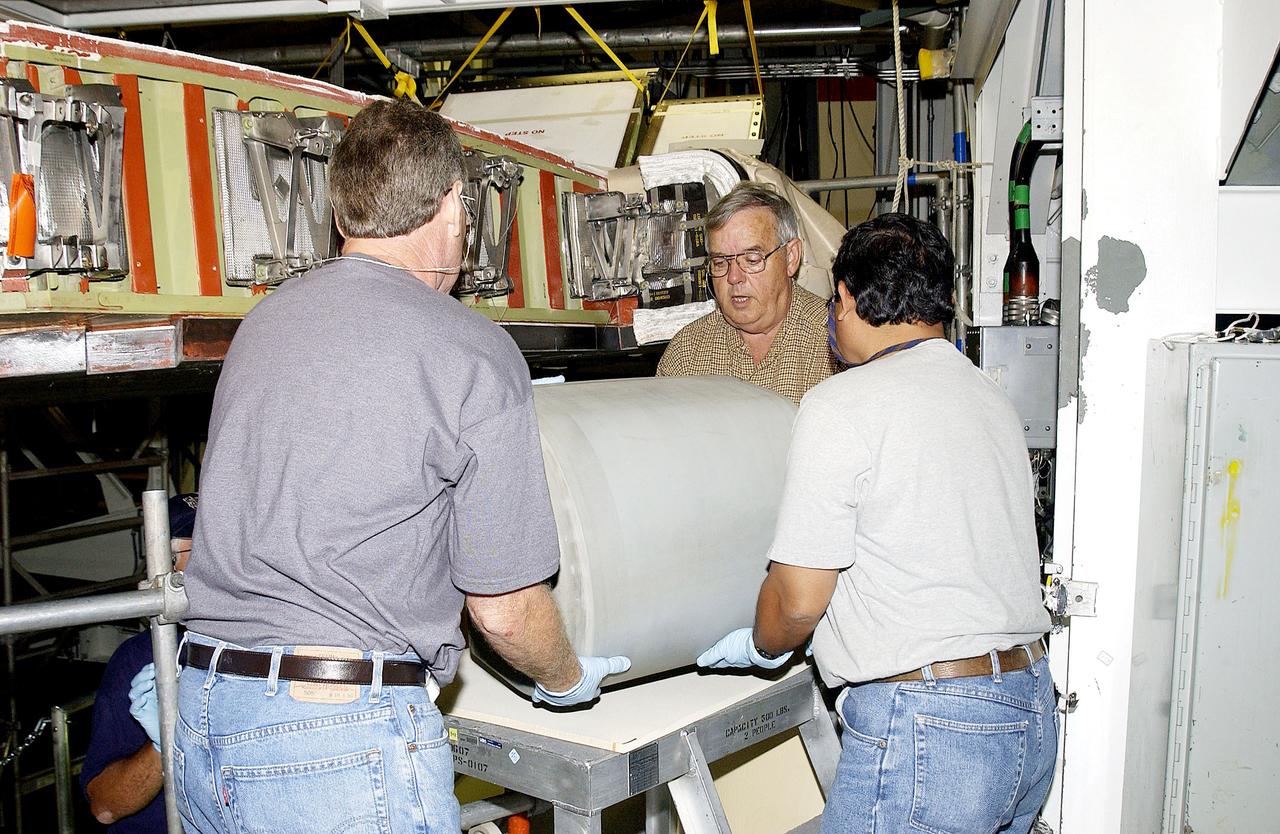
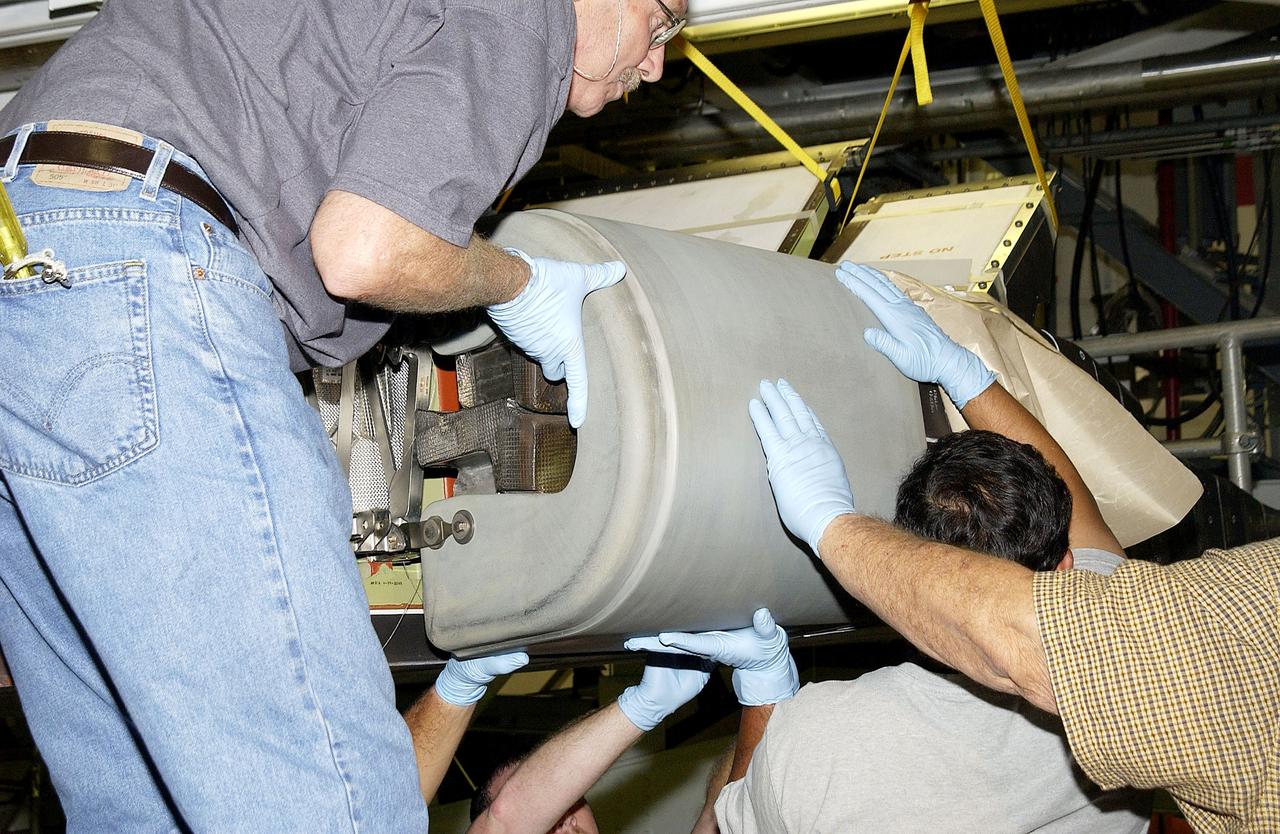
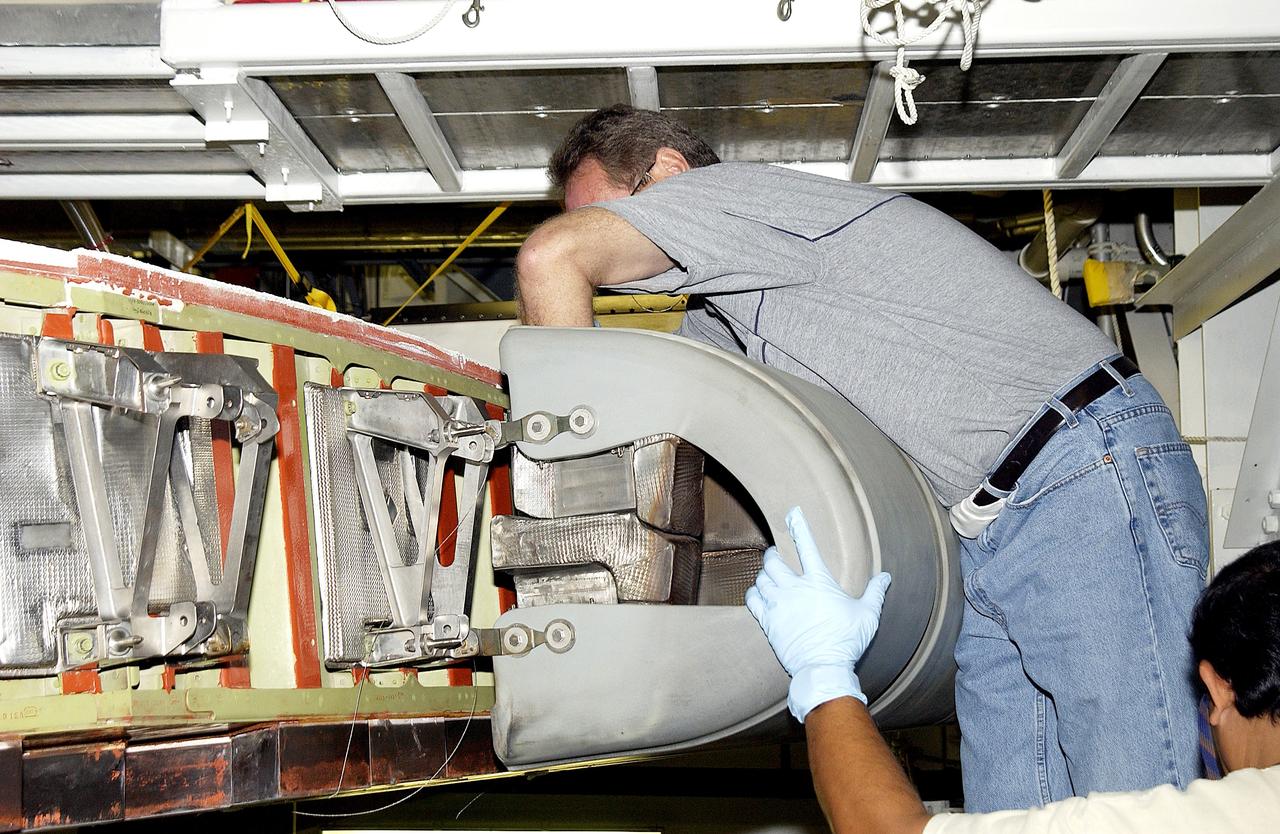
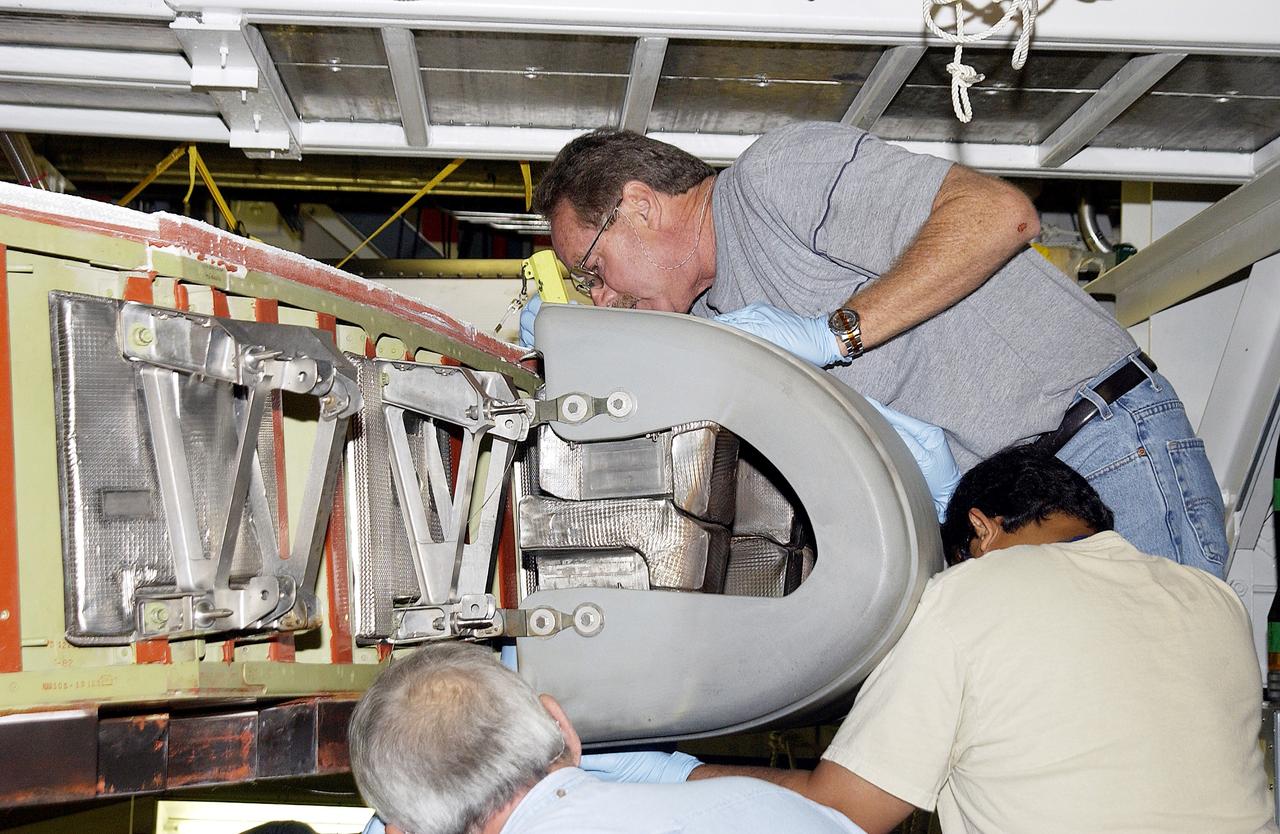
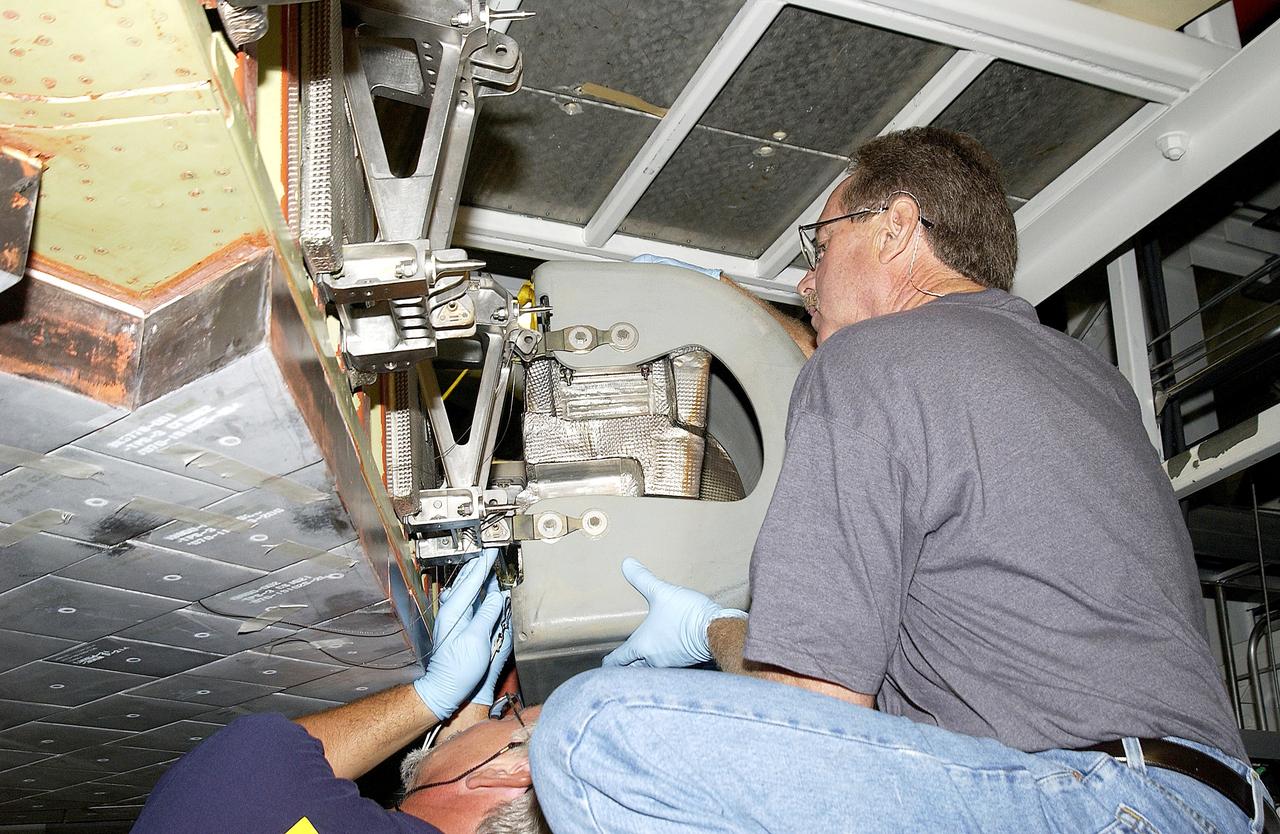
KENNEDY SPACE CENTER, FLA. - In the Orbiter Processing Facility, Mike Hyatt (left) and Saul Ngy (right), with United Space Alliance, finish installing a spar on the wing of the orbiter Atlantis.  Reinforced Carbon Carbon (RCC) panels are mechanically attached to the wing with a series of floating joints - spars - to reduce loading on the panels caused by wing deflections. The aluminum and the metallic attachments are protected from exceeding temperature limits by internal insulation.
KENNEDY SPACE CENTER, FLA. - In the Orbiter Processing Facility, Mike Hyatt (left) and Saul Ngy (right), with United Space Alliance, finish installing a spar on the wing of the orbiter Atlantis. Reinforced Carbon Carbon (RCC) panels are mechanically attached to the wing with a series of floating joints - spars - to reduce loading on the panels caused by wing deflections. The aluminum and the metallic attachments are protected from exceeding temperature limits by internal insulation.
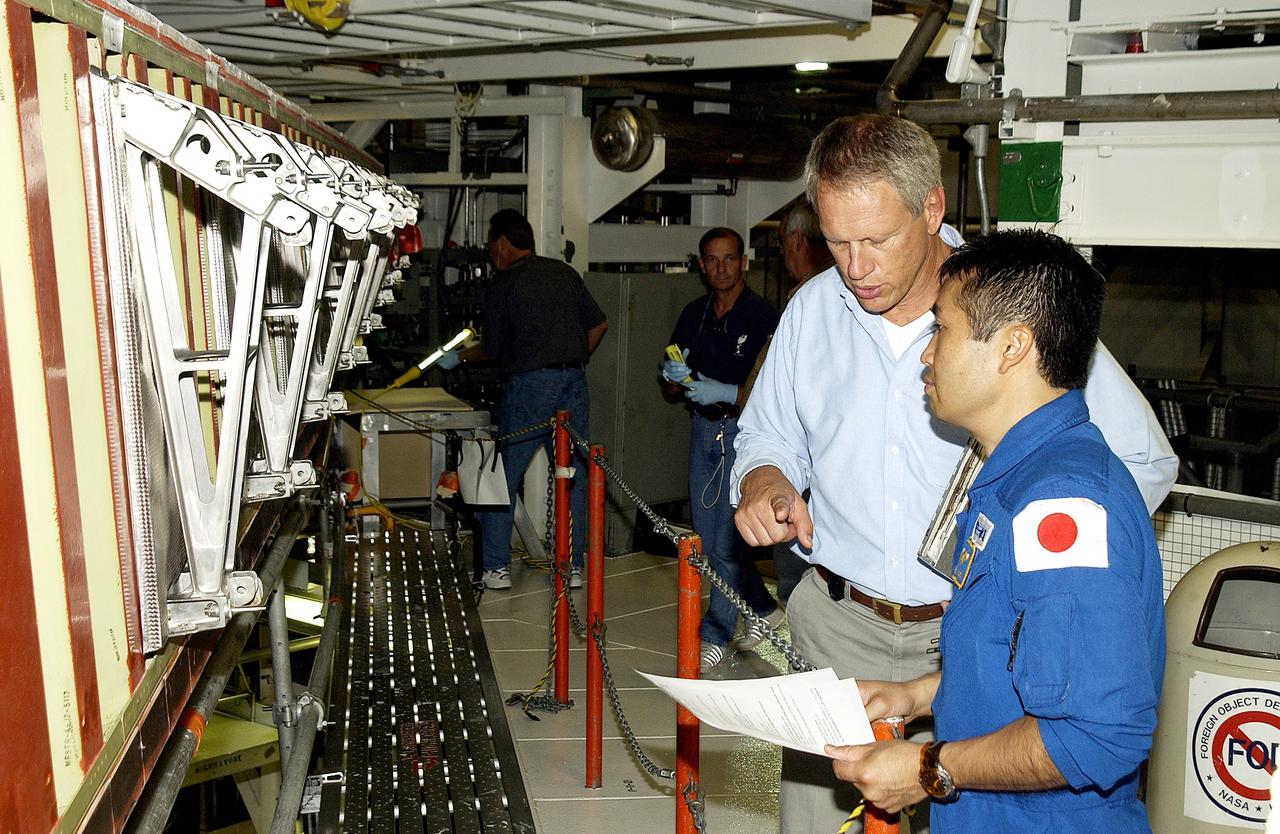
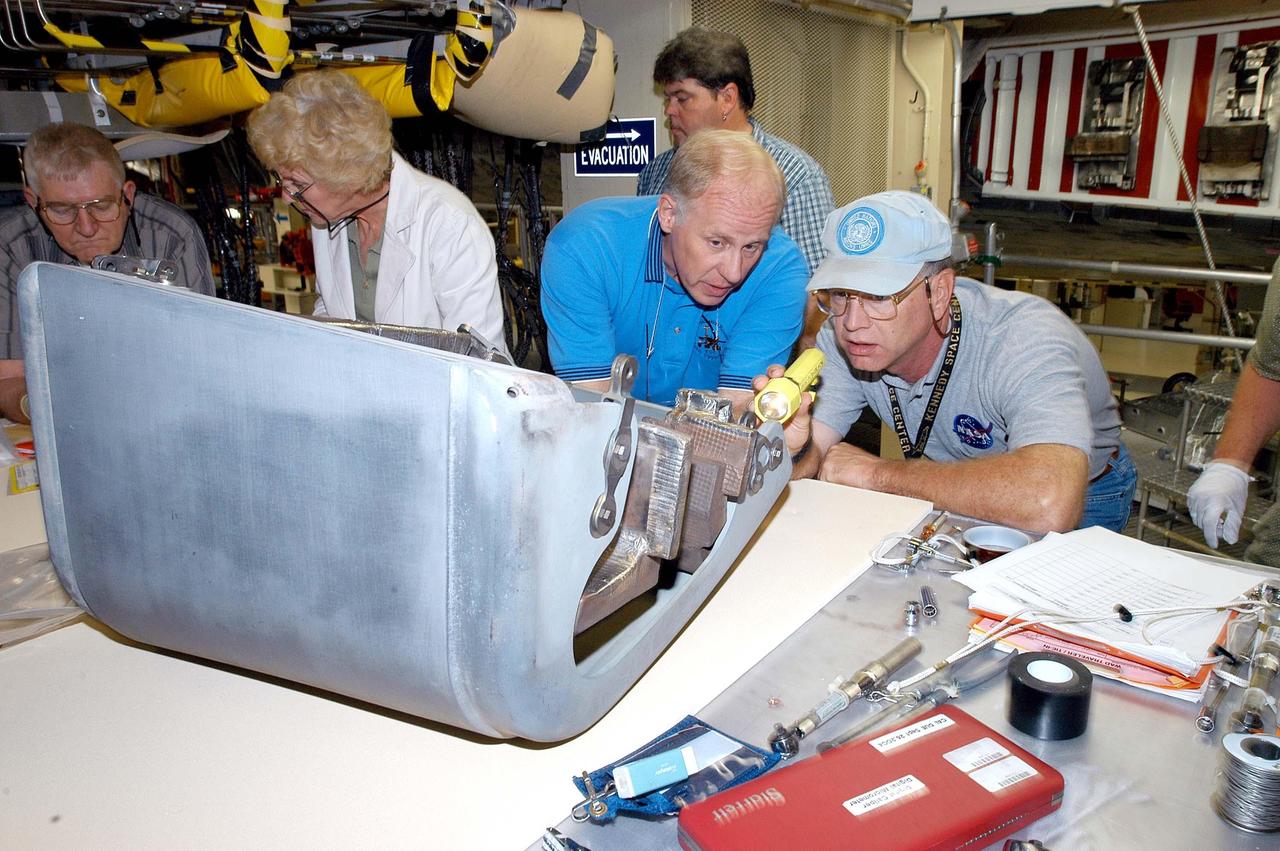
KENNEDY SPACE CENTER, FLA. - Japanese astronaut Koichi Wakata (right) listens to William Gaetjens, with the Vehicle Integration Test Team (VITT), who is providing details about the spar installation (left) on the wing of the orbiter Atlantis.  Reinforced Carbon Carbon (RCC) panels are mechanically attached to the wing via the spars - a series of floating joints - to reduce loading on the panels caused by wing deflections. The aluminum and the metallic attachments are protected from exceeding temperature limits by internal insulation.
KENNEDY SPACE CENTER, FLA. - Japanese astronaut Koichi Wakata (right) listens to William Gaetjens, with the Vehicle Integration Test Team (VITT), who is providing details about the spar installation (left) on the wing of the orbiter Atlantis. Reinforced Carbon Carbon (RCC) panels are mechanically attached to the wing via the spars - a series of floating joints - to reduce loading on the panels caused by wing deflections. The aluminum and the metallic attachments are protected from exceeding temperature limits by internal insulation.
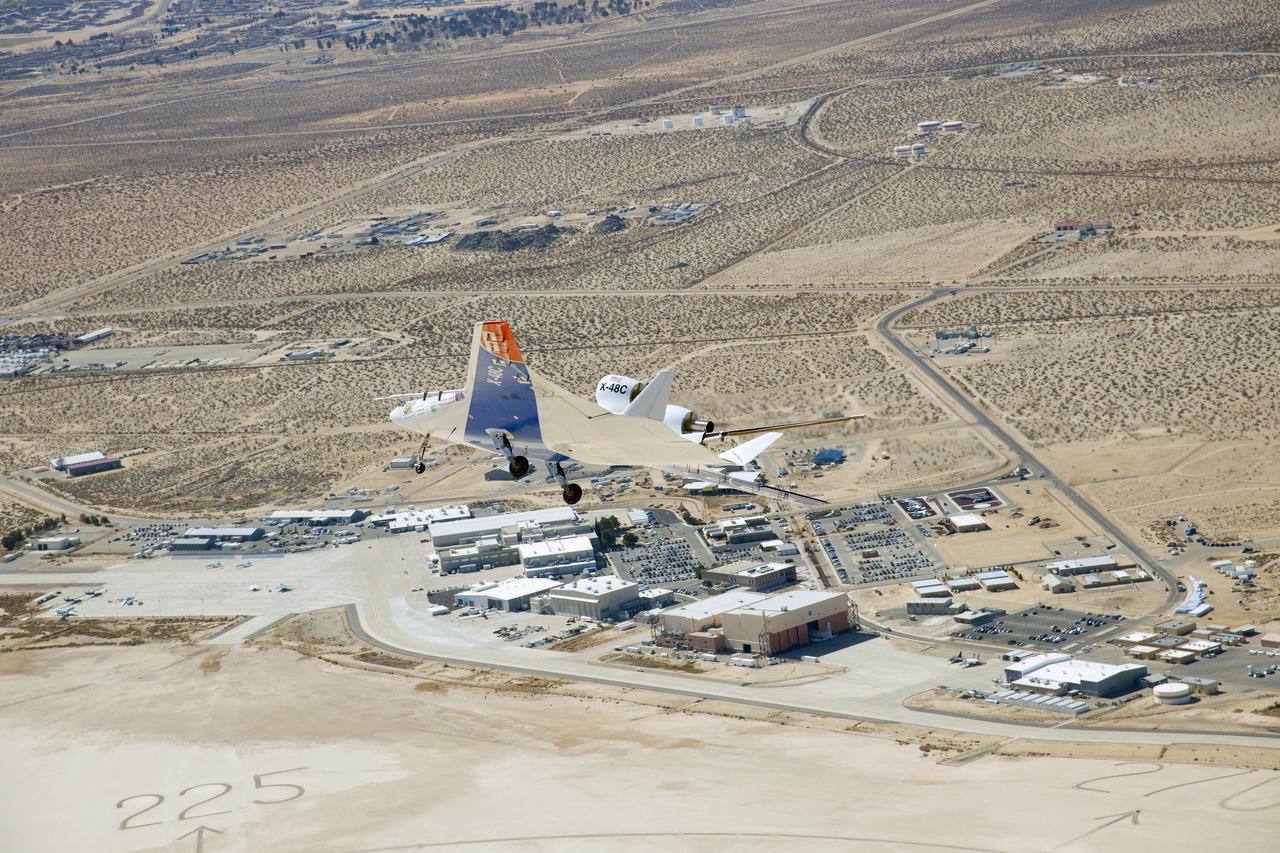
The X-48C Hybrid Wing Body research aircraft banked right over NASA's Dryden Flight Research Center at Edwards, CA during one of the sub-scale aircraft's final test flights on Feb. 28, 2013.
X-48C Banks over Dryden Flight Research Center
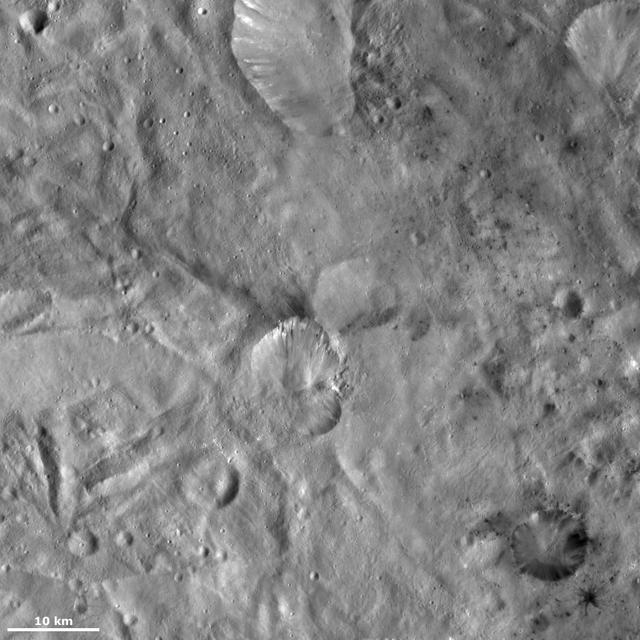
This image from NASA Dawn spacecraft of asteroid Vesta shows Helena crater, which is the crater that resembles the shape of a butterfly wings center, and Laelia crater bottom right.
Helena and Laelia Craters
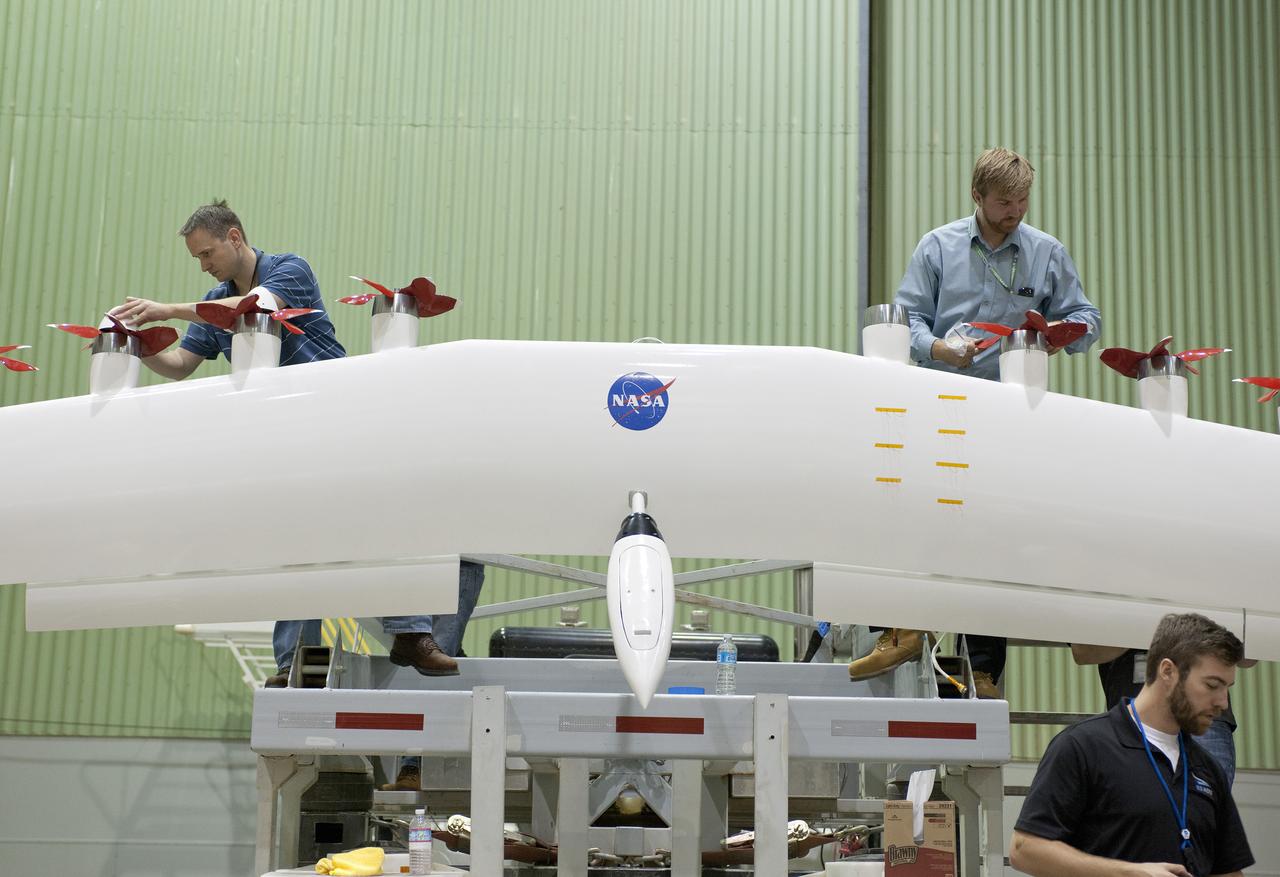
Engineers work on a wing with electric motors that is part of an integrated experimental testbed. From left are Sean Clarke, left, Kurt Papathakis at upper right and Anthony Cash in the foreground.
Piloted, Electric Propulsion-Powered Experimental Aircraft Underway
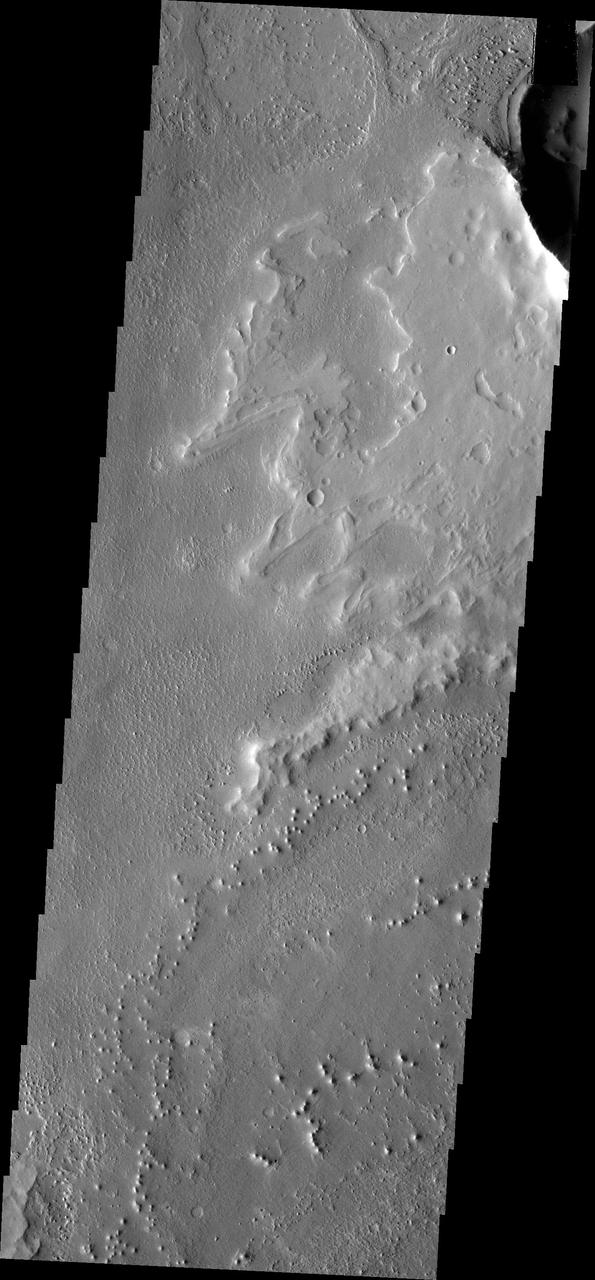
Do you see what I see in this image from NASA Mars Odyssey spacecraft? The higher elevations in this image look like a dragon. It is facing to the left, and the small crater IS NOT the eye. The large plateau on the right is the wing of the dragon.
THEMIS Art #121
In combined data from ESA Herschel and NASA Spitzer telescopes, irregular distribution of dust in the Small Magellanic Cloud becomes clear. A stream of dust extends to left, known as the galaxy wing, and a bar of star formation appears to right.
A Dwarf Galaxy Star Bar and Dusty Wing
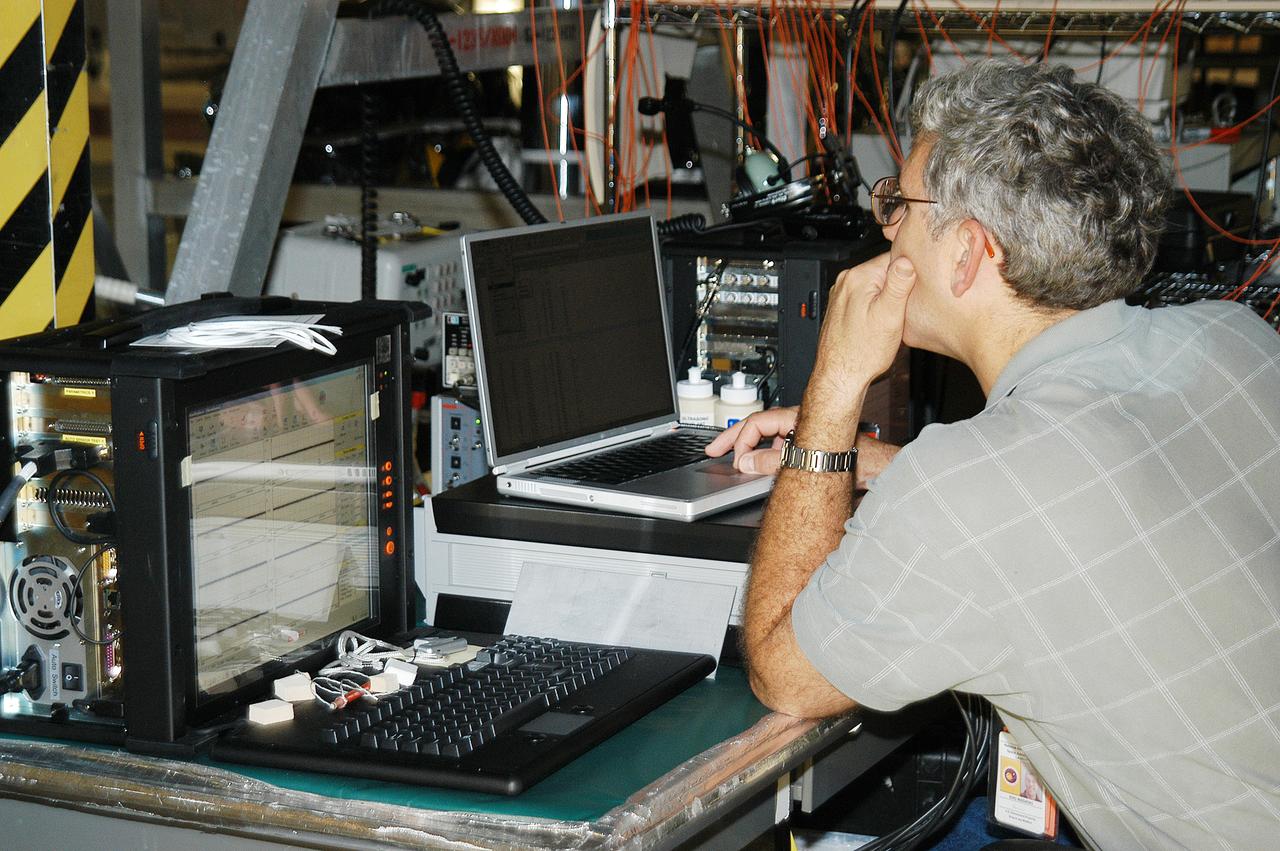
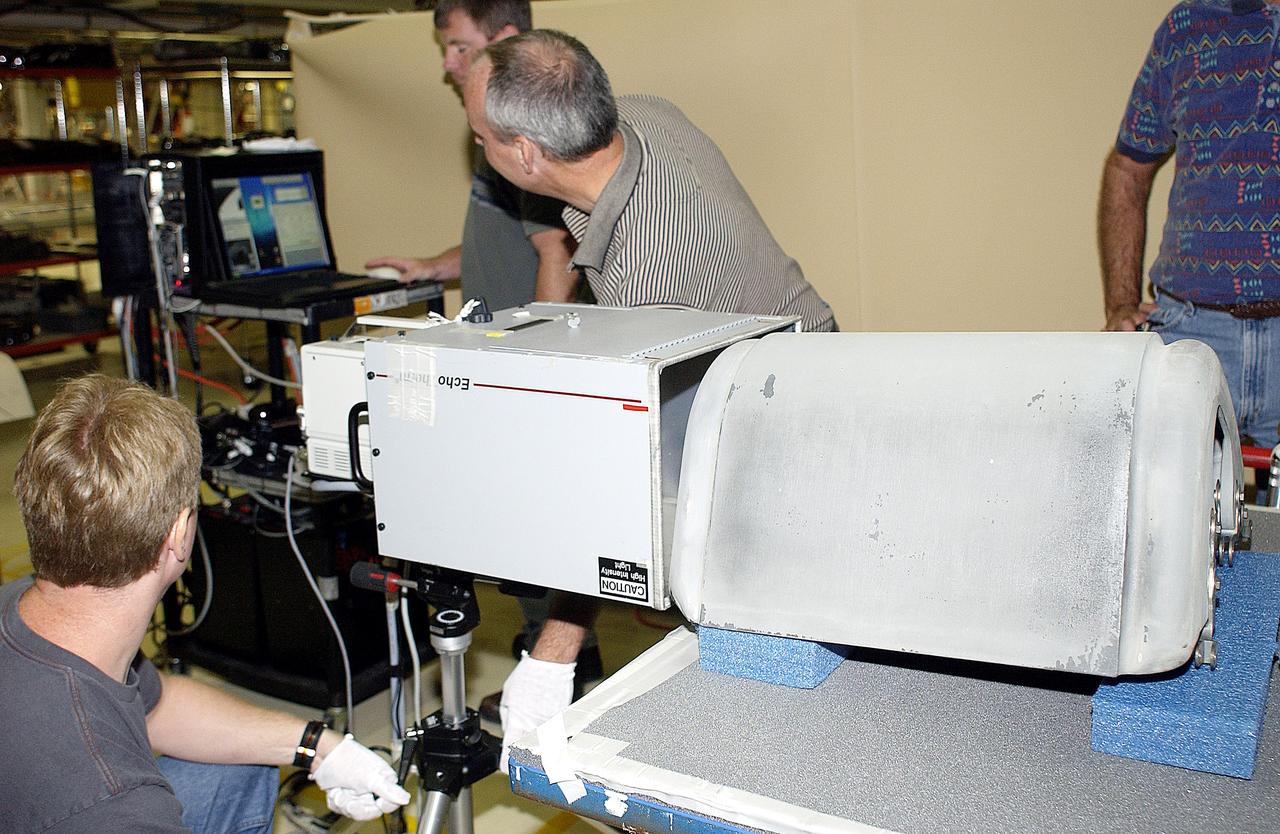
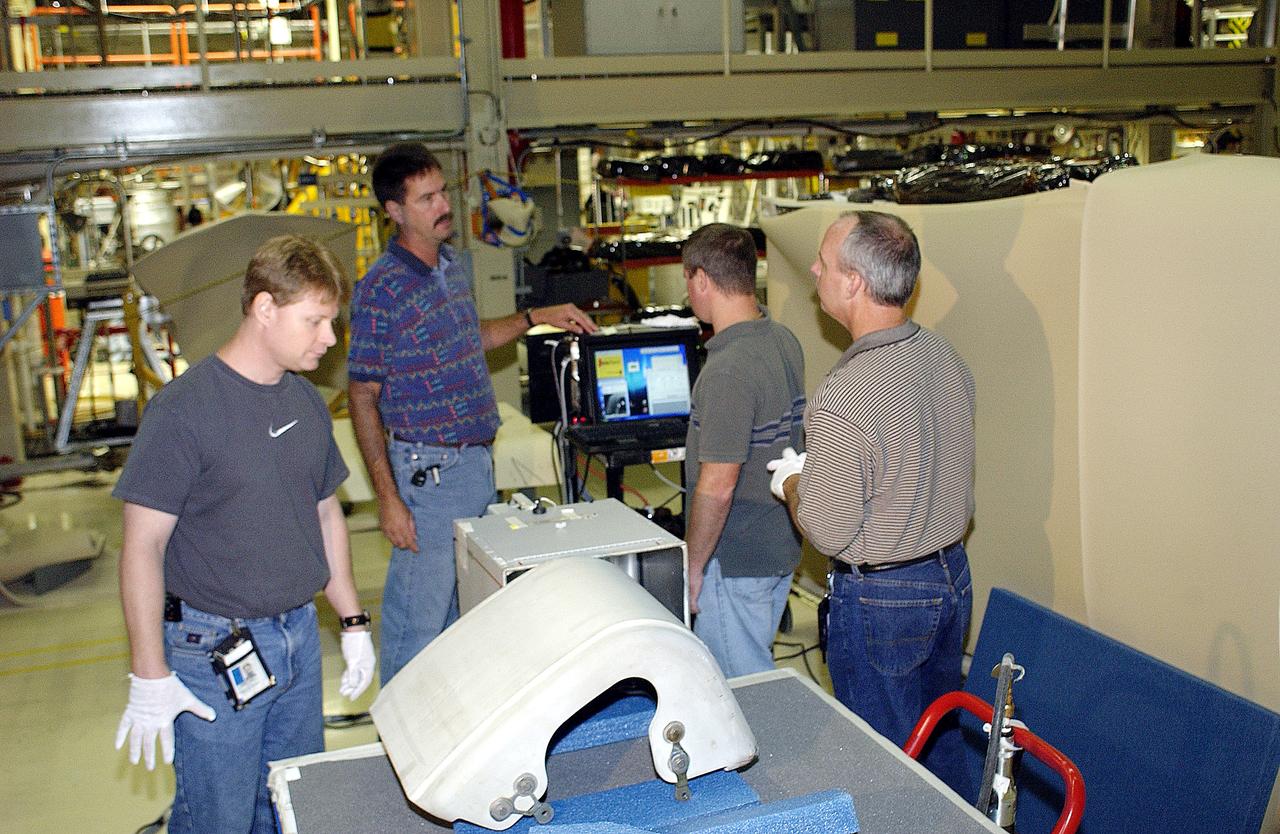
KENNEDY SPACE CENTER, FLA. -  In the Orbiter Processing Facility, Bill Prosser (left) and Eric Madaras, NASA-Langley Research Center, and Jim McGee (right), The Boeing Company, Huntington Beach, Calif., conduct impulse tests on the right wing leading edge (WLE) of Space Shuttle Endeavour. The tests monitor how sound impulses propagate through the WLE area.  The data collected will be analyzed to explore the possibility of adding new instrumentation to the wing that could automatically detect debris or micrometeroid impacts on the Shuttle while in flight.  The study is part of the initiative ongoing at KSC and around the agency to return the orbiter fleet to flight status.
KENNEDY SPACE CENTER, FLA. - In the Orbiter Processing Facility, Bill Prosser (left) and Eric Madaras, NASA-Langley Research Center, and Jim McGee (right), The Boeing Company, Huntington Beach, Calif., conduct impulse tests on the right wing leading edge (WLE) of Space Shuttle Endeavour. The tests monitor how sound impulses propagate through the WLE area. The data collected will be analyzed to explore the possibility of adding new instrumentation to the wing that could automatically detect debris or micrometeroid impacts on the Shuttle while in flight. The study is part of the initiative ongoing at KSC and around the agency to return the orbiter fleet to flight status.
KENNEDY SPACE CENTER, FLA.  -  The Stafford-Covey Return to Flight Task Group (SCTG) inspects debris in the Columbia Debris Hangar.   At right is the model of the left wing that has been used during recovery operations.  Chairing the task group are Richard O. Covey, former Space Shuttle commander, and Thomas P. Stafford (third from right, foreground), Apollo commander.  Chartered by NASA Administrator Sean O’Keefe, the task group will perform an independent assessment of NASA’s implementation of the final recommendations by the Columbia Accident Investigation Board.
KENNEDY SPACE CENTER, FLA. - The Stafford-Covey Return to Flight Task Group (SCTG) inspects debris in the Columbia Debris Hangar. At right is the model of the left wing that has been used during recovery operations. Chairing the task group are Richard O. Covey, former Space Shuttle commander, and Thomas P. Stafford (third from right, foreground), Apollo commander. Chartered by NASA Administrator Sean O’Keefe, the task group will perform an independent assessment of NASA’s implementation of the final recommendations by the Columbia Accident Investigation Board.
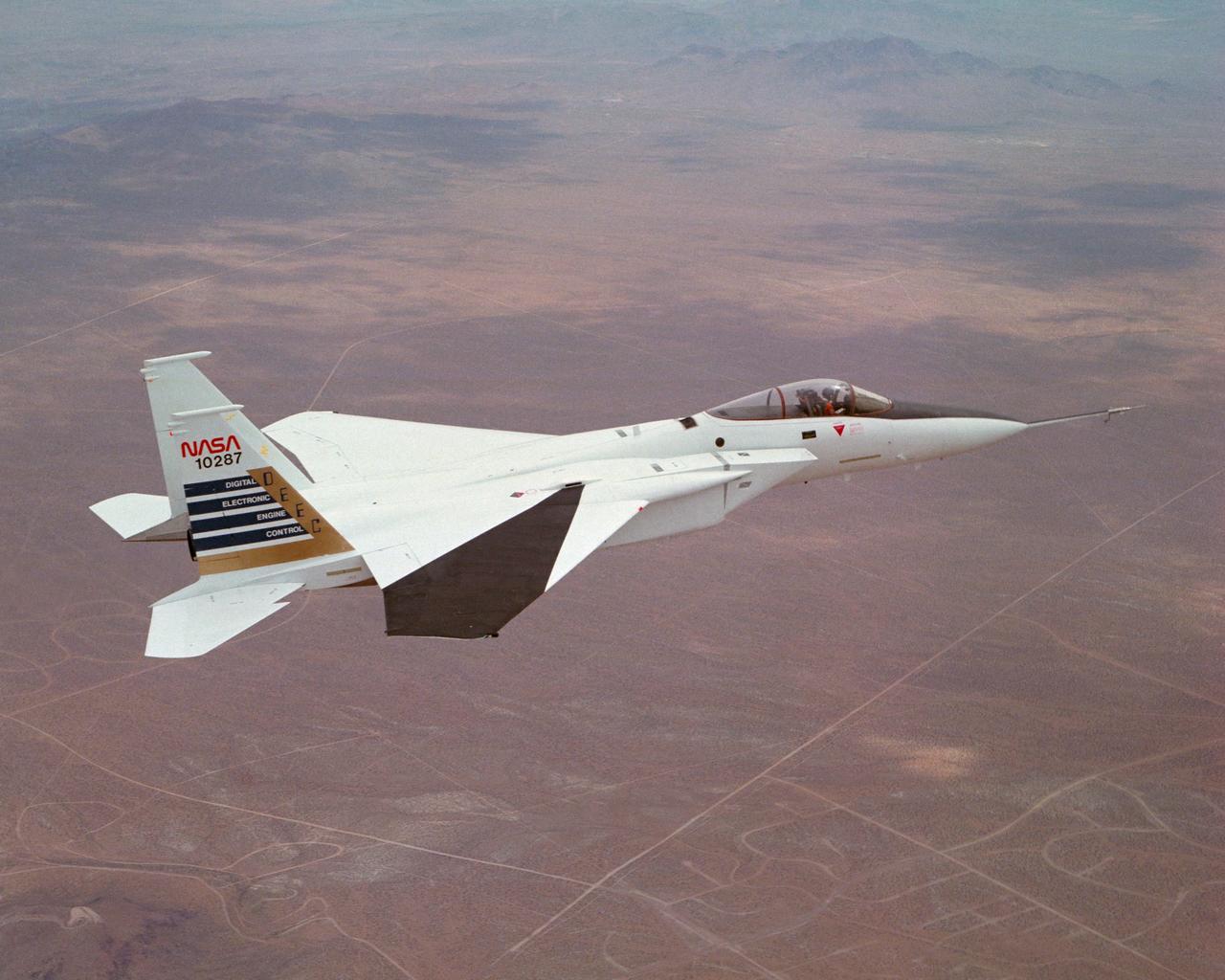
Digital Electronic Engine Control F-15A #287 in flight over California City. Note wing deflection measurement system on right wing.
Digital Electronic Engine Control F-15A #287 in flight over California City, CA.
Event: SEG 410 Main Wing A Lockheed Martin technician works on the installation of wiring on the trailing edge structure of the right side of the X-59’s wing. The aircraft, under construction at Lockheed Martin Skunk Works in Palmdale, California, will demonstrate the ability to fly supersonic while reducing the loud sonic boom to a quiet sonic thump.
SEG 410 Main Wing
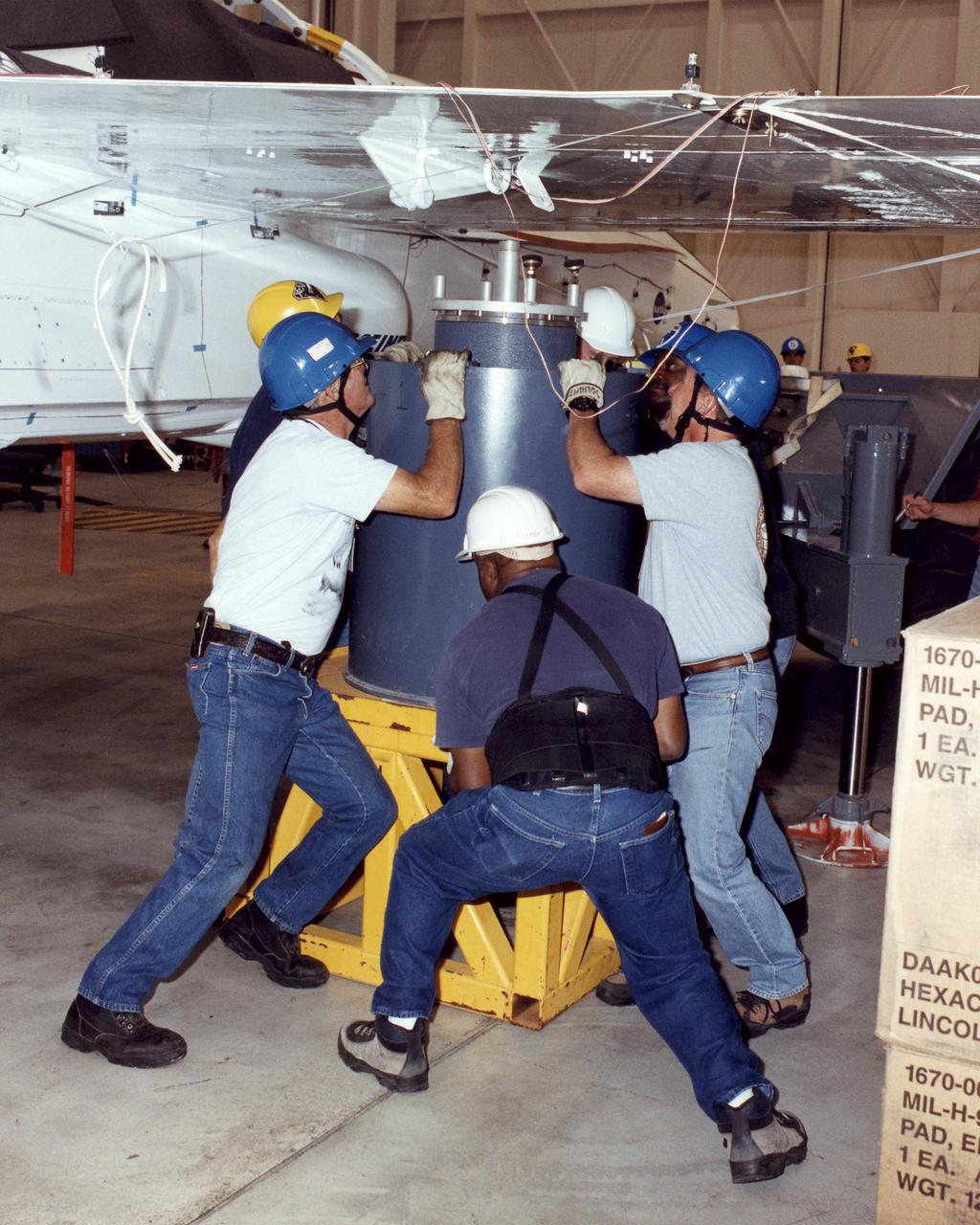
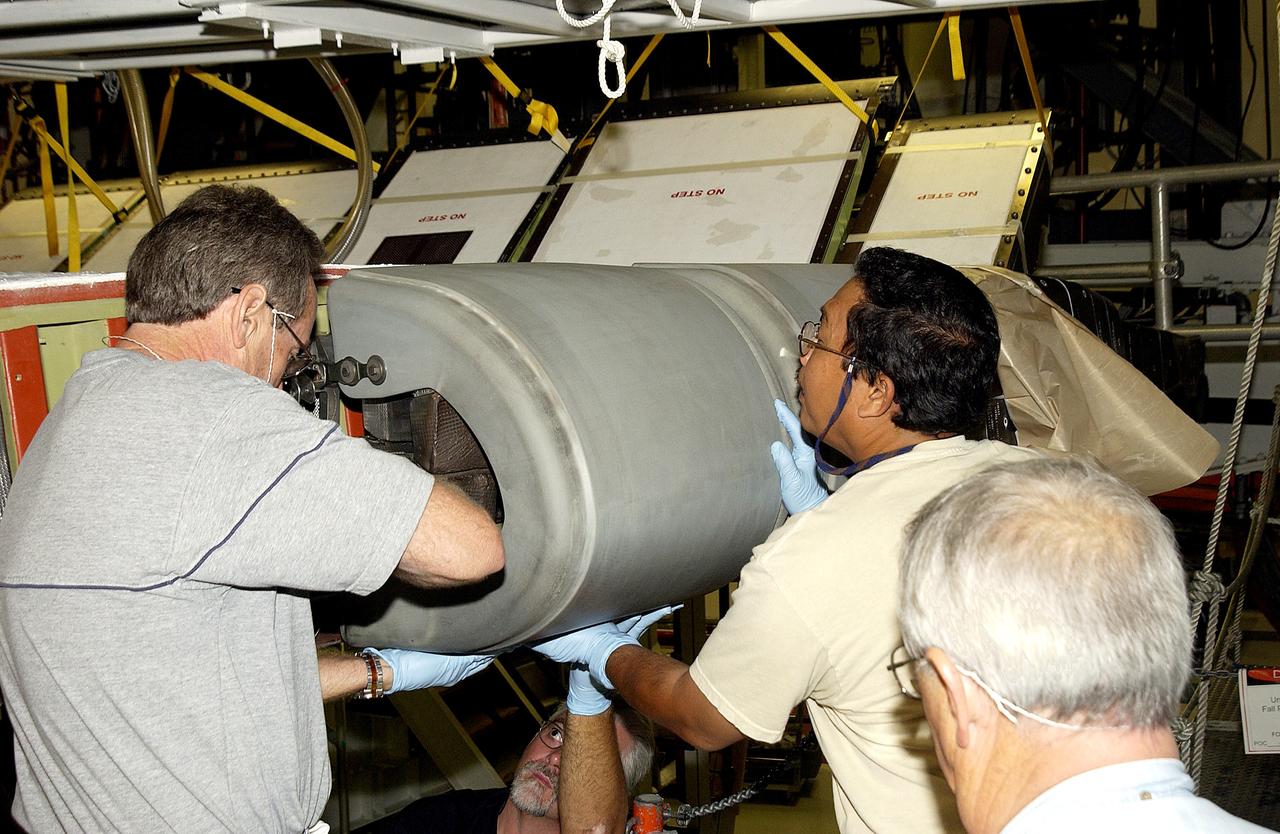
NASA Dryden technicians (Dave Dennis, Freddy Green and Jeff Doughty) position a support cylinder under the right wing of the Active Aeroelastic Wing F/A-18 test aircraft prior to ground vibration tests.
EC02-0203-14
KENNEDY SPACE CENTER, FLA. -  In the Orbiter Processing Facility, Bill Prosser (left) and Eric Madaras, NASA-Langley Research Center, conduct impulse tests on the right wing leading edge (WLE) of Space Shuttle Endeavour. The tests monitor how sound impulses propagate through the WLE area.  The data collected will be analyzed to explore the possibility of adding new instrumentation to the wing that could automatically detect debris or micrometeroid impacts on the Shuttle while in flight.  The study is part of the initiative ongoing at KSC and around the agency to return the orbiter fleet to flight status.
KENNEDY SPACE CENTER, FLA. - In the Orbiter Processing Facility, Bill Prosser (left) and Eric Madaras, NASA-Langley Research Center, conduct impulse tests on the right wing leading edge (WLE) of Space Shuttle Endeavour. The tests monitor how sound impulses propagate through the WLE area. The data collected will be analyzed to explore the possibility of adding new instrumentation to the wing that could automatically detect debris or micrometeroid impacts on the Shuttle while in flight. The study is part of the initiative ongoing at KSC and around the agency to return the orbiter fleet to flight status.
KENNEDY SPACE CENTER, FLA. -  In the Orbiter Processing Facility, Eric Madaras (left), NASA-Langley Research Center, and Jim McGee, The Boeing Company, Huntington Beach, Calif., conduct impulse tests on the right wing leading edge (WLE) of Space Shuttle Endeavour. The tests monitor how sound impulses propagate through the WLE area.  The data collected will be analyzed to explore the possibility of adding new instrumentation to the wing that could automatically detect debris or micrometeroid impacts on the Shuttle while in flight.  The study is part of the initiative ongoing at KSC and around the agency to return the orbiter fleet to flight status.
KENNEDY SPACE CENTER, FLA. - In the Orbiter Processing Facility, Eric Madaras (left), NASA-Langley Research Center, and Jim McGee, The Boeing Company, Huntington Beach, Calif., conduct impulse tests on the right wing leading edge (WLE) of Space Shuttle Endeavour. The tests monitor how sound impulses propagate through the WLE area. The data collected will be analyzed to explore the possibility of adding new instrumentation to the wing that could automatically detect debris or micrometeroid impacts on the Shuttle while in flight. The study is part of the initiative ongoing at KSC and around the agency to return the orbiter fleet to flight status.
The X-57 distributed electric aircraft wing that will fly in the final configuration of the flight tests completed its testing at NASA's Armstrong Flight Research Center in California. The test above researched the wing's structure under stress of 120% of the design limit. Tests increased confidence in the wing's durability and calibrated installed strain gauges for inflight load monitoring of the wing. From left to right are Eric Miller, Tony Cash, Welsey Li, Shun-fat Lung and Ashante Jordan.
NASA Armstrong Prepares for X-57 Flight Tests
NASA employees Broderic J. Gonzalez, left, and David W. Shank, right, install pieces of a 7-foot wing model in preparation for testing in the 14-by-22-Foot Subsonic Wind Tunnel at NASA's Langley Research Center in Hampton, Virginia, in May 2025. The lessons learned from this testing will be shared with the public to support advanced air mobility aircraft development.
NASA Tests Advanced Air Mobility Aircraft Wing in Langley Wind Tunnel
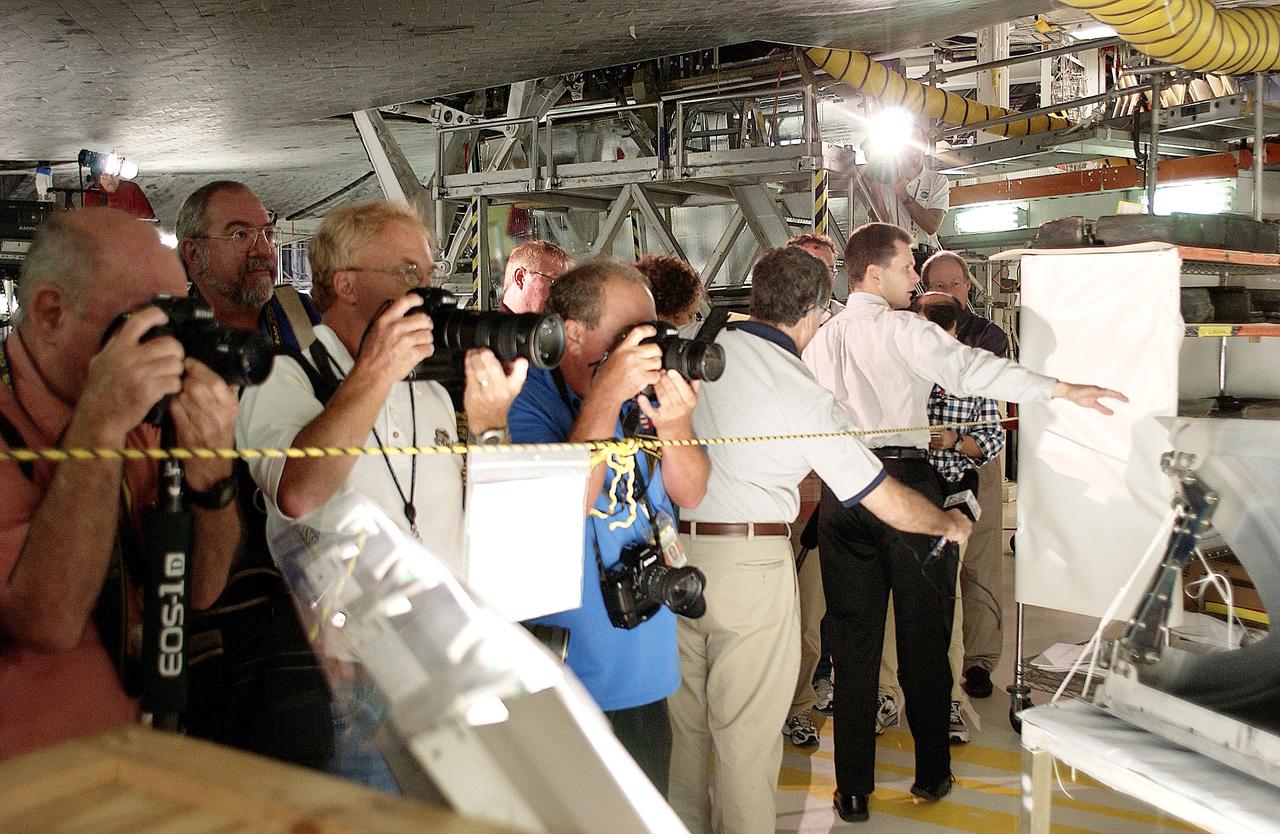
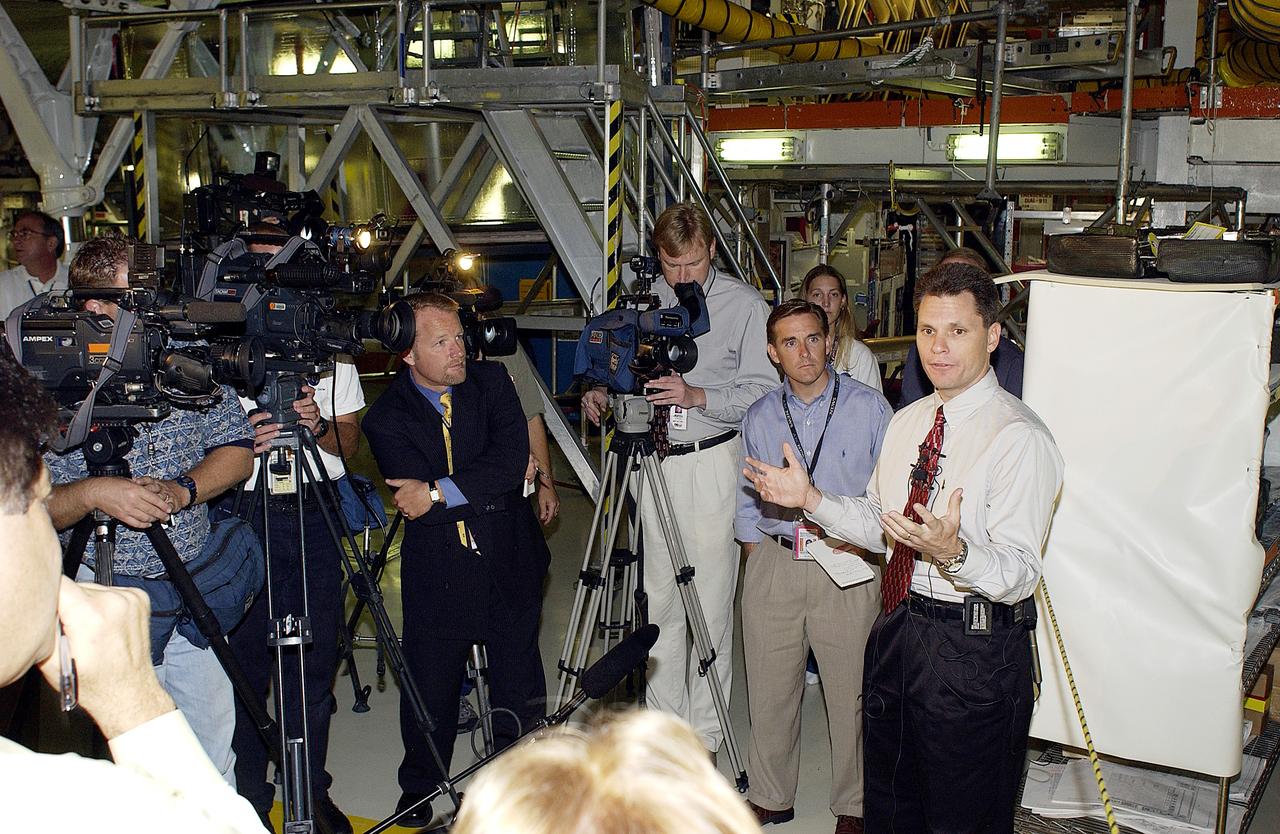
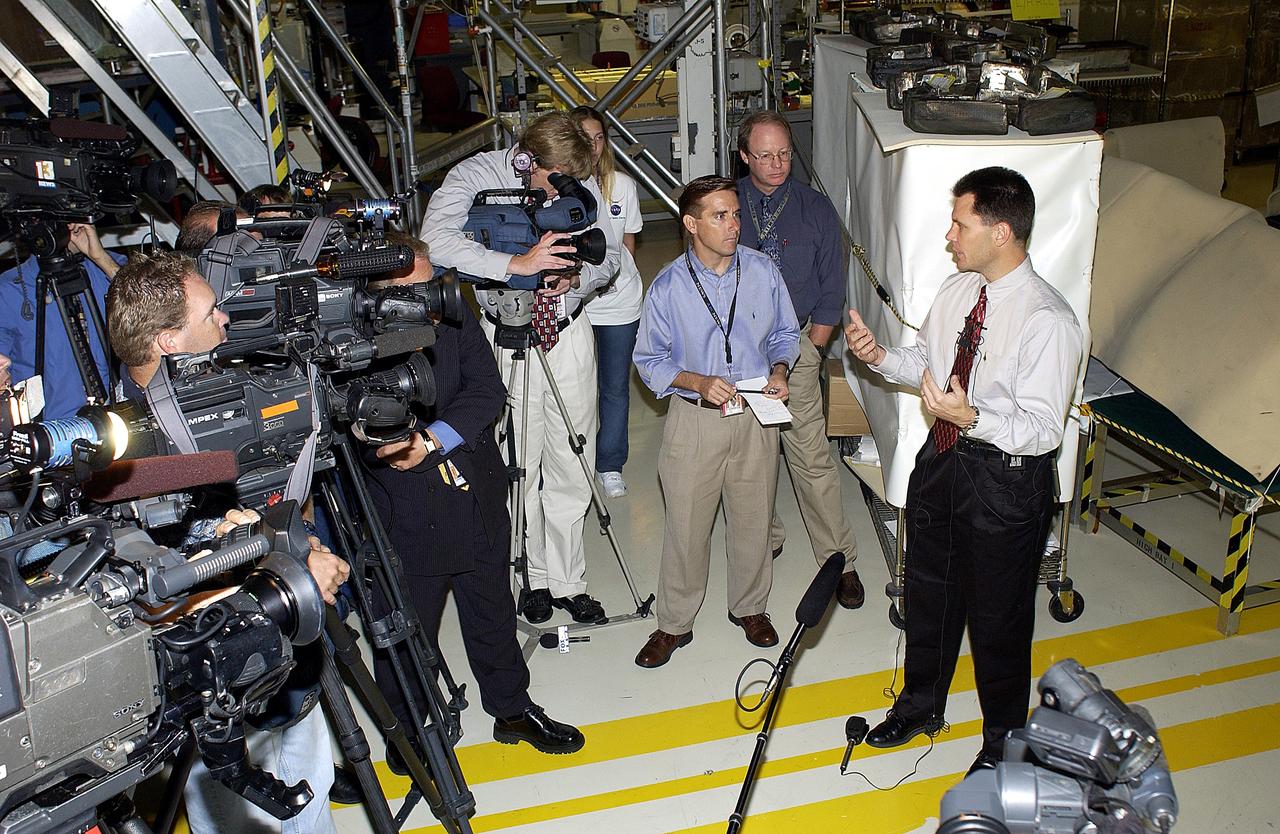
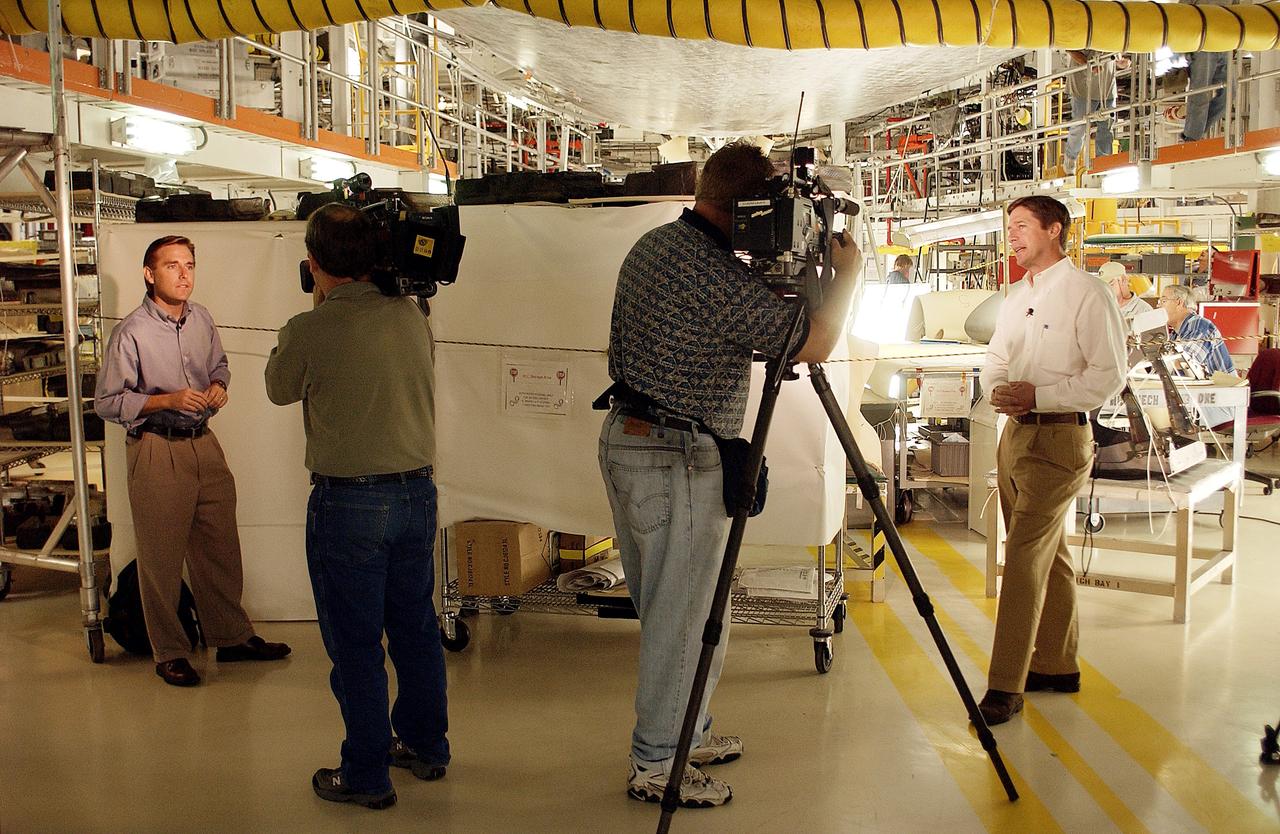
KENNEDY SPACE CENTER, FLA. -  In the Orbiter Processing Facility,  while a few photographers (left) set up for photos, NASA Vehicle Manager Scott Thurston (right, with arm extended) talks about the Reinforced Carbon-Carbon panel at right.   The media was invited to see the orbiter Atlantis as it is being prepared for Return to Flight.  Both local and national reporters representing print and TV networks were able to see work in progress on Atlantis, including the reinstallation of the Reinforced Carbon-Carbon panels on the orbiter’s wing leading edge; wiring inspections; and checks of the engines in the Orbital Maneuvering System.
KENNEDY SPACE CENTER, FLA. - In the Orbiter Processing Facility, while a few photographers (left) set up for photos, NASA Vehicle Manager Scott Thurston (right, with arm extended) talks about the Reinforced Carbon-Carbon panel at right. The media was invited to see the orbiter Atlantis as it is being prepared for Return to Flight. Both local and national reporters representing print and TV networks were able to see work in progress on Atlantis, including the reinstallation of the Reinforced Carbon-Carbon panels on the orbiter’s wing leading edge; wiring inspections; and checks of the engines in the Orbital Maneuvering System.
KENNEDY SPACE CENTER, FLA. -  In the Orbiter Processing Facility, while a few photographers (left) set up for photos of a Reinforced Carbon-Carbon panel at far right, NASA Vehicle Manager Scott Thurston (right) talks to other media.   The media was invited to see the orbiter Atlantis as it is being prepared for Return to Flight.  Both local and national reporters representing print and TV networks were able to see work in progress on Atlantis, including the reinstallation of the Reinforced Carbon-Carbon panels on the orbiter’s wing leading edge; wiring inspections; and checks of the engines in the Orbital Maneuvering System.
KENNEDY SPACE CENTER, FLA. - In the Orbiter Processing Facility, while a few photographers (left) set up for photos of a Reinforced Carbon-Carbon panel at far right, NASA Vehicle Manager Scott Thurston (right) talks to other media. The media was invited to see the orbiter Atlantis as it is being prepared for Return to Flight. Both local and national reporters representing print and TV networks were able to see work in progress on Atlantis, including the reinstallation of the Reinforced Carbon-Carbon panels on the orbiter’s wing leading edge; wiring inspections; and checks of the engines in the Orbital Maneuvering System.
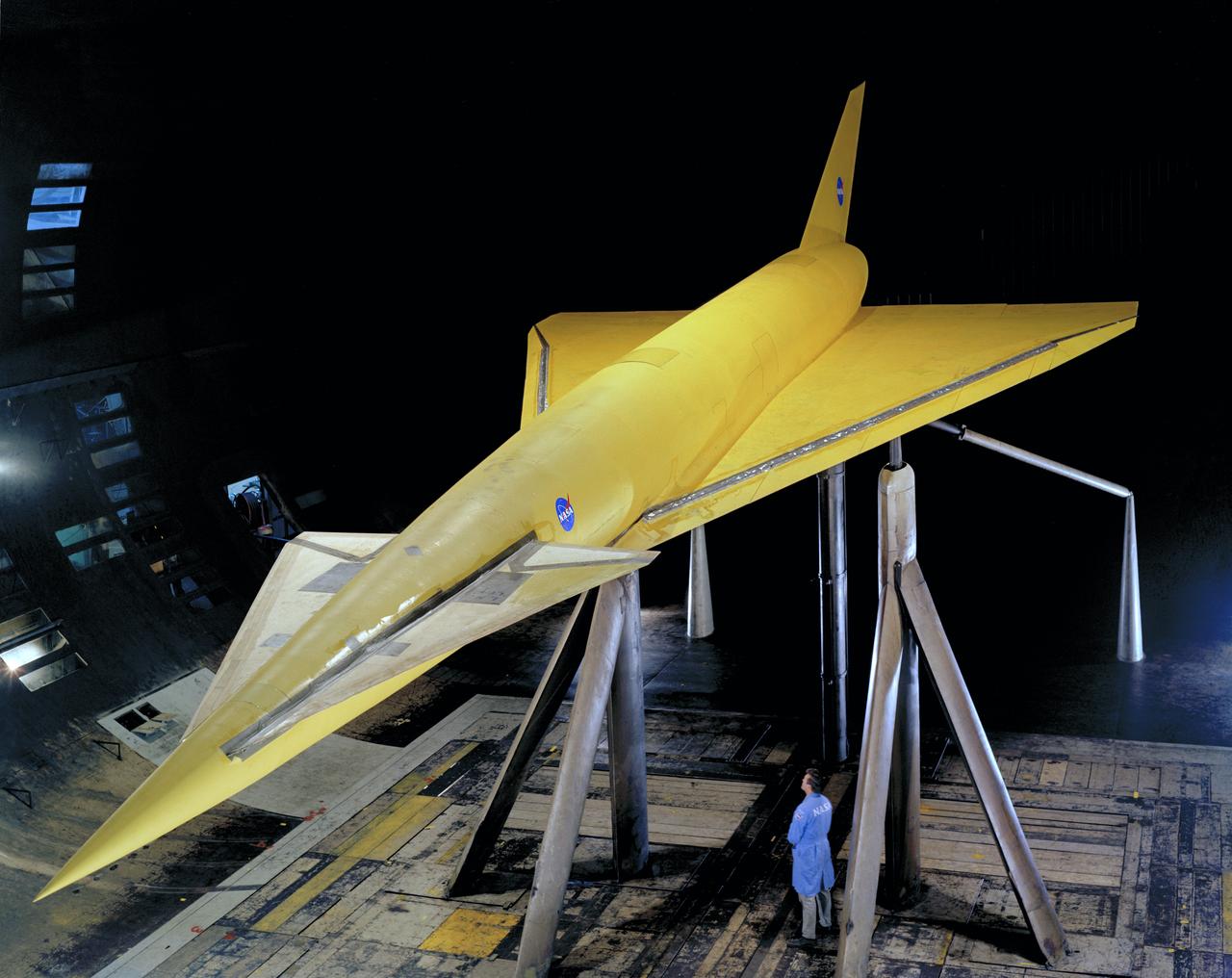
High 3/4 top front view of model in Ames 40x80 foot wind tunnel. Bob Bishop in lower right. Delta Wing with Conard.
Hypersonic Transport Model
KENNEDY SPACE CENTER, FLA. -  In the Orbiter Processing Facility, United Space Alliance technician Jim Burgess (right) works on the first Reinforced Carbon-Carbon panel to be installed on the left wing leading edge on Discovery.  At left is USA technician Dave Fuller.  The RCC panels are mechanically attached to the wing with spars, a series of floating joints to reduce loading on the panels caused by wing deflections.  Discovery has been named as the orbiter to fly on the first Return to Flight mission, STS-114.
KSC-04pd0530
KENNEDY SPACE CENTER, FLA. -  In the Orbiter Processing Facility, United Space Alliance technicians Jim Burgess (left) and Dave Fuller (right) prepare the first Reinforced Carbon-Carbon panel for installation on the left wing leading edge on Discovery. The RCC panels are mechanically attached to the wing with spars, a series of floating joints to reduce loading on the panels caused by wing deflections. Discovery has been named as the orbiter to fly on the first Return to Flight mission, STS-114.
KSC-04pd0528
KENNEDY SPACE CENTER, FLA. -  In the Orbiter Processing Facility, United Space Alliance technicians Dave Fuller (left) and Jim Burgess (right) lift the first Reinforced Carbon-Carbon panel toward the left wing leading edge of Discovery for installation. The RCC panels are mechanically attached to the wing with spars, a series of floating joints to reduce loading on the panels caused by wing deflections.  Discovery has been named as the orbiter to fly on the first Return to Flight mission, STS-114.
KSC-04pd0536
KENNEDY SPACE CENTER, FLA. -  In the Orbiter Processing Facility, United Space Alliance technicians Jim Burgess (left)  and Dave Fuller (right) carry the first Reinforced Carbon-Carbon panel toward the left wing leading edge of Discovery for installation.  The RCC panels are mechanically attached to the wing with spars, a series of floating joints to reduce loading on the panels caused by wing deflections. Discovery has been named as the orbiter to fly on the first Return to Flight mission, STS-114.
KSC-04pd0535
KENNEDY SPACE CENTER, FLA. -  In the Orbiter Processing Facility, Danny Wyatt, NASA Quality Assurance specialist, and John Legere (right), NASA Quality Assurance specialist, examine the first Reinforced Carbon-Carbon panel to be installed on the left wing leading edge on Discovery. The RCC panels are mechanically attached to the wing with spars, a series of floating joints to reduce loading on the panels caused by wing deflections. Discovery has been named as the orbiter to fly on the first Return to Flight mission, STS-114.
KSC-04pd0532
KENNEDY SPACE CENTER, FLA. -  In the Orbiter Processing Facility, United Space Alliance technicians Dave Fuller (left) and Jim Burgess (right) lift into place the first Reinforced Carbon-Carbon panel toward the left wing leading edge of Discovery for installation. The RCC panels are mechanically attached to the wing with spars, a series of floating joints to reduce loading on the panels caused by wing deflections. Discovery has been named as the orbiter to fly on the first Return to Flight mission, STS-114.
KSC-04pd0537
KENNEDY SPACE CENTER, FLA. -  In the Orbiter Processing Facility, United Space Alliance technician Jim Burgess (right) works on the first Reinforced Carbon-Carbon panel to be installed on the left wing leading edge on Discovery.  At left is USA technician Dave Fuller.  The RCC panels are mechanically attached to the wing with spars, a series of floating joints to reduce loading on the panels caused by wing deflections. Discovery has been named as the orbiter to fly on the first Return to Flight mission, STS-114.
KSC-04pd0529
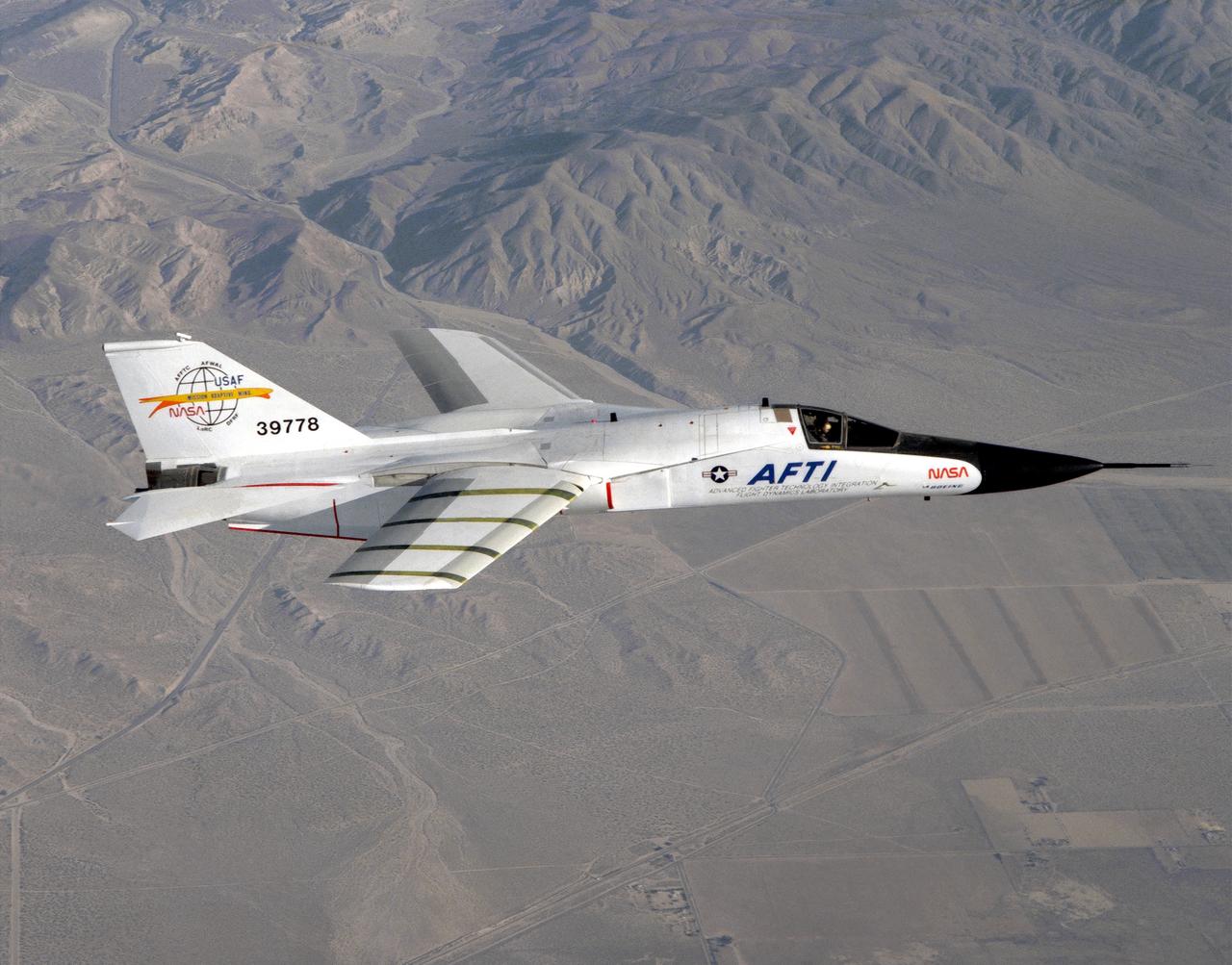
This photograph shows a modified General Dynamics AFTI/F-111A Aardvark with supercritical mission adaptive wings (MAW) installed. The four dark bands on the right wing are the locations of pressure orifices used to measure surface pressures and shock locations on the MAW. The El Paso Mountains and Red Rock Canyon State Park Califonia, about 30 miles northwest of Edwards Air Force Base, are seen directly in the background.  With the phasing out of the TACT program came a renewed effort by the Air Force Flight Dynamics Laboratory to extend supercritical wing technology to a higher level of performance. In the early 1980s the supercritical wing on the F-111A aircraft was replaced with a wing built by Boeing Aircraft Company System called a “mission adaptive wing” (MAW), and a joint NASA and Air Force program called Advanced Fighter Technology Integration (AFTI) was born.
EC85-33205-07
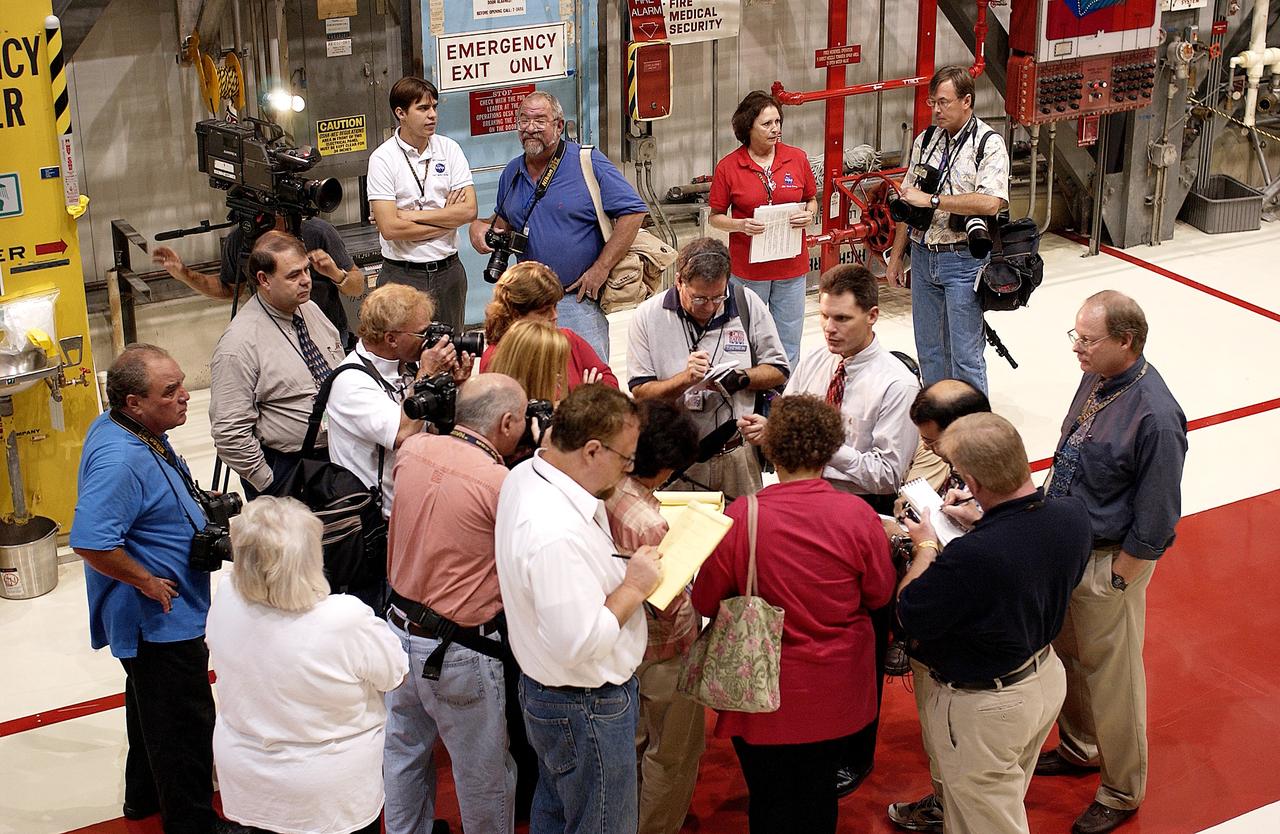
KENNEDY SPACE CENTER, FLA. -   The media gather around NASA Vehicle Manager Scott Thurston (white shirt, right) who talks about some of the work being done on the orbiter Atlantis as it is being prepared for Return to Flight in the Orbiter Processing Facility.   Both local and national reporters representing print and TV networks were able to see work in progress on Atlantis, including the reinstallation of the Reinforced Carbon-Carbon panels on the orbiter’s wing leading edge; wiring inspections; and checks of the engines in the Orbital Maneuvering System.
KENNEDY SPACE CENTER, FLA. - The media gather around NASA Vehicle Manager Scott Thurston (white shirt, right) who talks about some of the work being done on the orbiter Atlantis as it is being prepared for Return to Flight in the Orbiter Processing Facility. Both local and national reporters representing print and TV networks were able to see work in progress on Atlantis, including the reinstallation of the Reinforced Carbon-Carbon panels on the orbiter’s wing leading edge; wiring inspections; and checks of the engines in the Orbital Maneuvering System.
KENNEDY SPACE CENTER, FLA. -   NASA Vehicle Manager Scott Thurston (right)  talks to the media in the Orbiter Processing Facility.  The media was invited to see the orbiter Atlantis as it is being prepared for Return to Flight.  Both local and national reporters representing print and TV networks were able to see work in progress on Atlantis, including the reinstallation of the Reinforced Carbon-Carbon panels on the orbiter’s wing leading edge; wiring inspections; and checks of the engines in the Orbital Maneuvering System.  will be available to discuss the work and answer questions.
KENNEDY SPACE CENTER, FLA. - NASA Vehicle Manager Scott Thurston (right) talks to the media in the Orbiter Processing Facility. The media was invited to see the orbiter Atlantis as it is being prepared for Return to Flight. Both local and national reporters representing print and TV networks were able to see work in progress on Atlantis, including the reinstallation of the Reinforced Carbon-Carbon panels on the orbiter’s wing leading edge; wiring inspections; and checks of the engines in the Orbital Maneuvering System. will be available to discuss the work and answer questions.
KENNEDY SPACE CENTER, FLA. -   NASA Vehicle Manager Scott Thurston (right)  talks to the media in the Orbiter Processing Facility .  The media was invited to see the orbiter Atlantis as it is being prepared for Return to Flight.  Both local and national reporters representing print and TV networks were able to see work in progress on Atlantis, including the reinstallation of the Reinforced Carbon-Carbon panels on the orbiter’s wing leading edge; wiring inspections; and checks of the engines in the Orbital Maneuvering System.
KENNEDY SPACE CENTER, FLA. - NASA Vehicle Manager Scott Thurston (right) talks to the media in the Orbiter Processing Facility . The media was invited to see the orbiter Atlantis as it is being prepared for Return to Flight. Both local and national reporters representing print and TV networks were able to see work in progress on Atlantis, including the reinstallation of the Reinforced Carbon-Carbon panels on the orbiter’s wing leading edge; wiring inspections; and checks of the engines in the Orbital Maneuvering System.
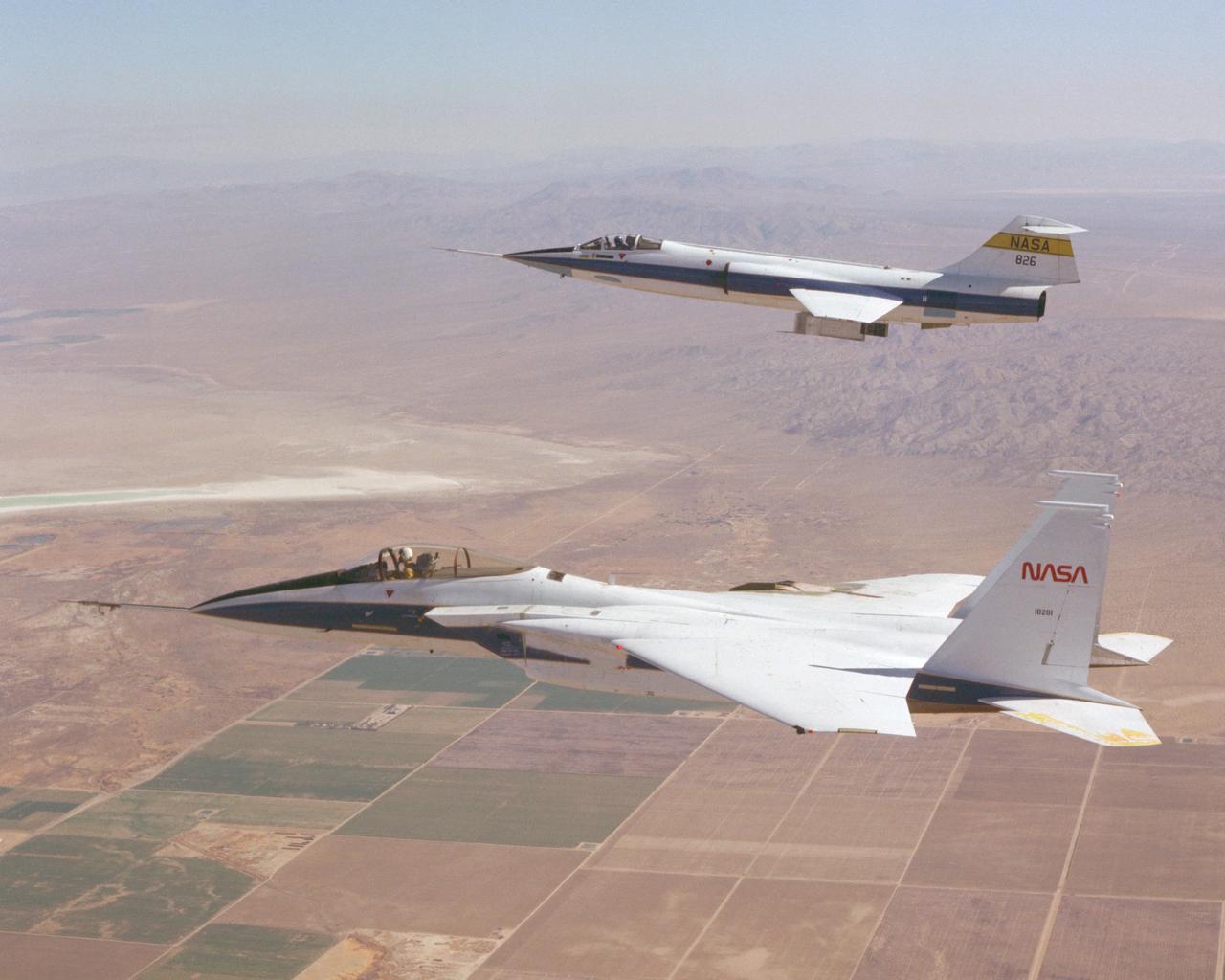
F-15 #281 and F-104 #826 fly in formation during Space Shuttle tile testing. Note the tiles mounted on the right wing of the F-15 and the centerline test fixture of the F-104.
F-15 #281 and F-104 #826 fly in formation during Space Shuttle tile testing.
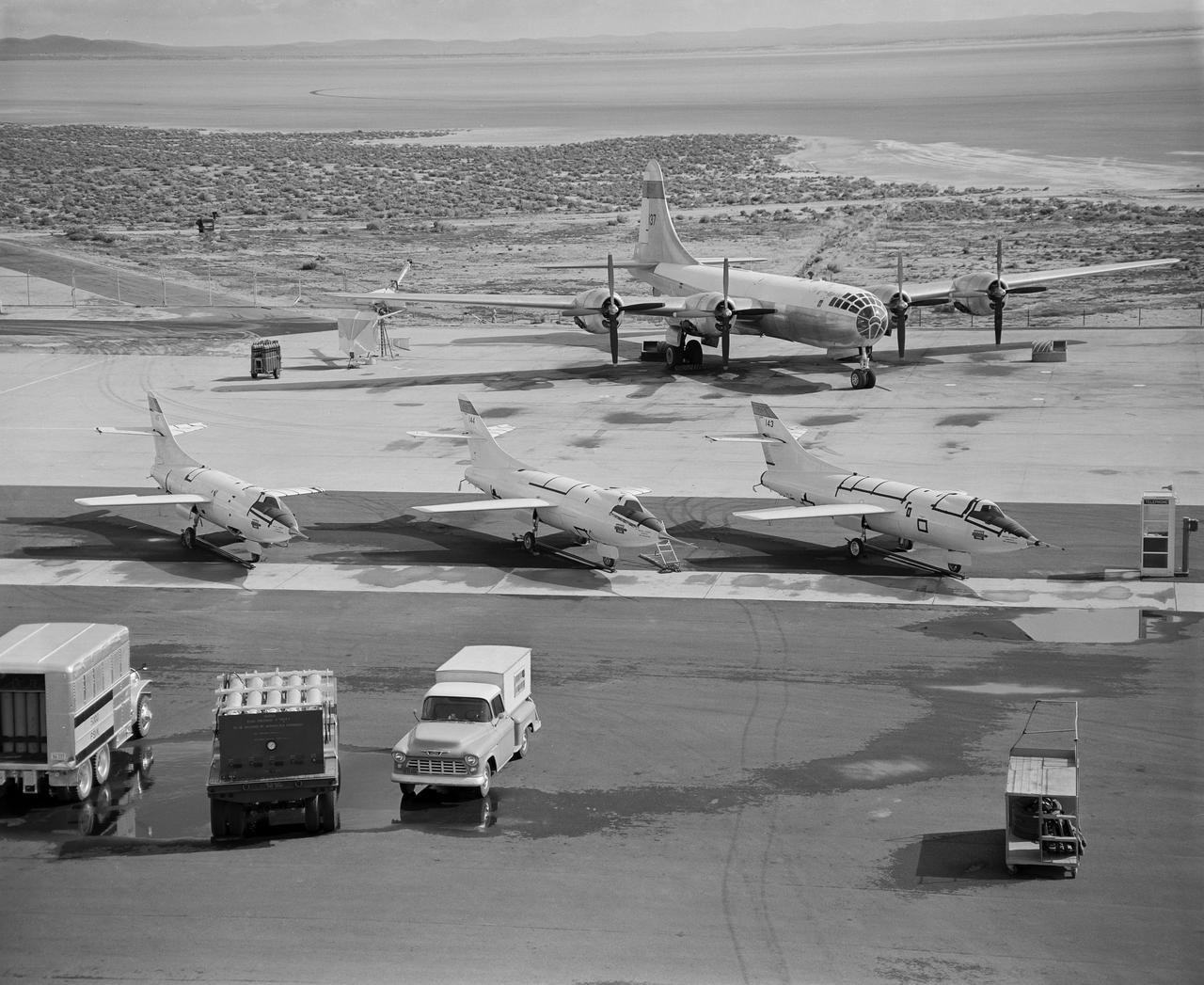
Behind three Douglas D-558-IIs is the B-29 launch aircraft. Under its right wing is the world’s first ground-based reaction control system motion simulator.
A Full Flightline at Armstrong
KENNEDY SPACE CENTER, FLA. -  In the Orbiter Processing Facility, several workers check out the first Reinforced Carbon-Carbon panel to be installed on the left wing leading edge on Discovery.  Second from right is Danny Wyatt, NASA Quality Assurance specialist; on the left is Dave Fuller, technician; behind Wyatt is John Legere, NASA Quality Assurance specialist.   The RCC panels are mechanically attached to the wing with spars, a series of floating joints to reduce loading on the panels caused by wing deflections. The T-seals between each wing leading edge panel allow for lateral motion and thermal expansion differences between the RCC and the orbiter wing.  Discovery has been named as the orbiter to fly on the first Return to Flight mission, STS-114.
KSC-04pd0531
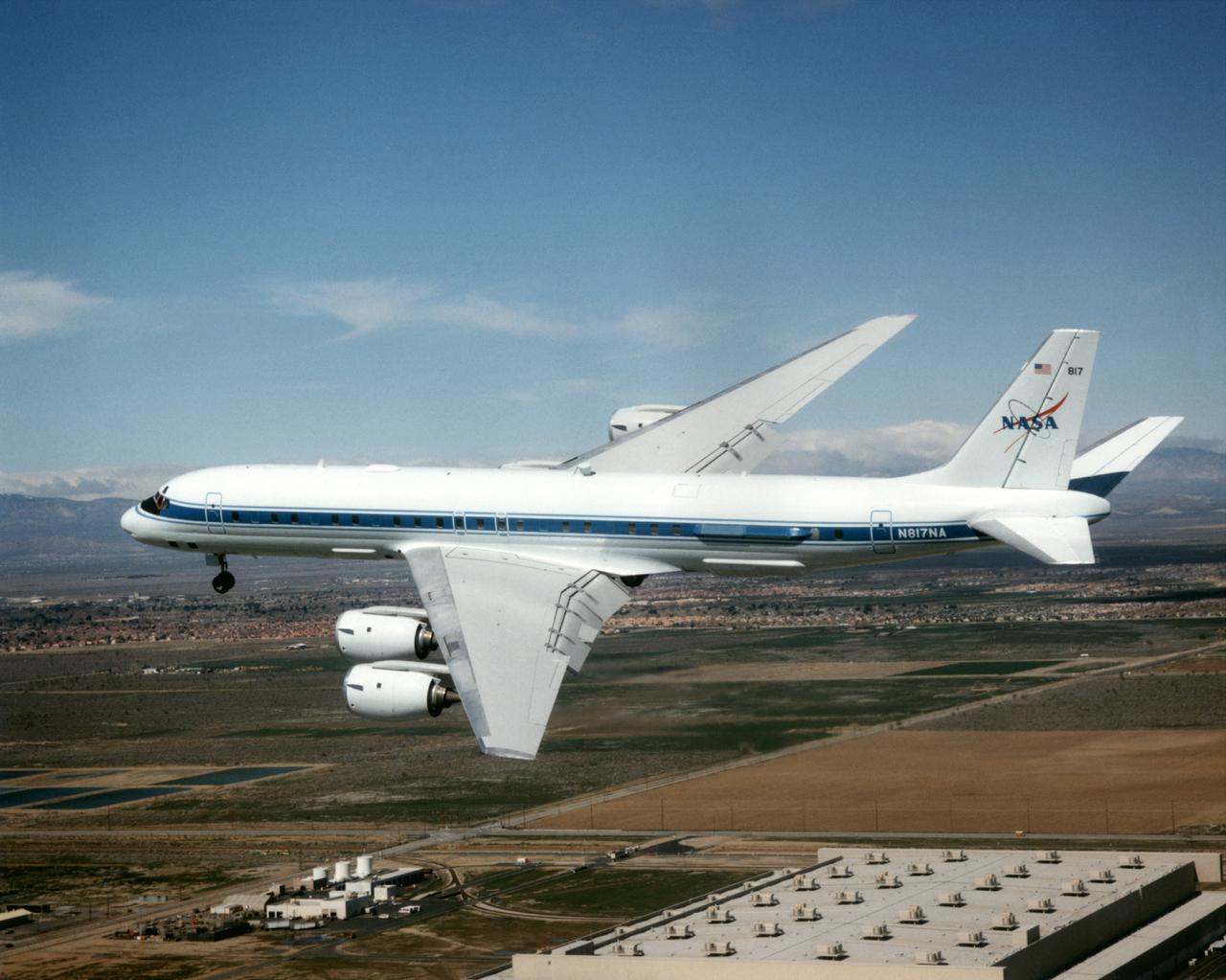
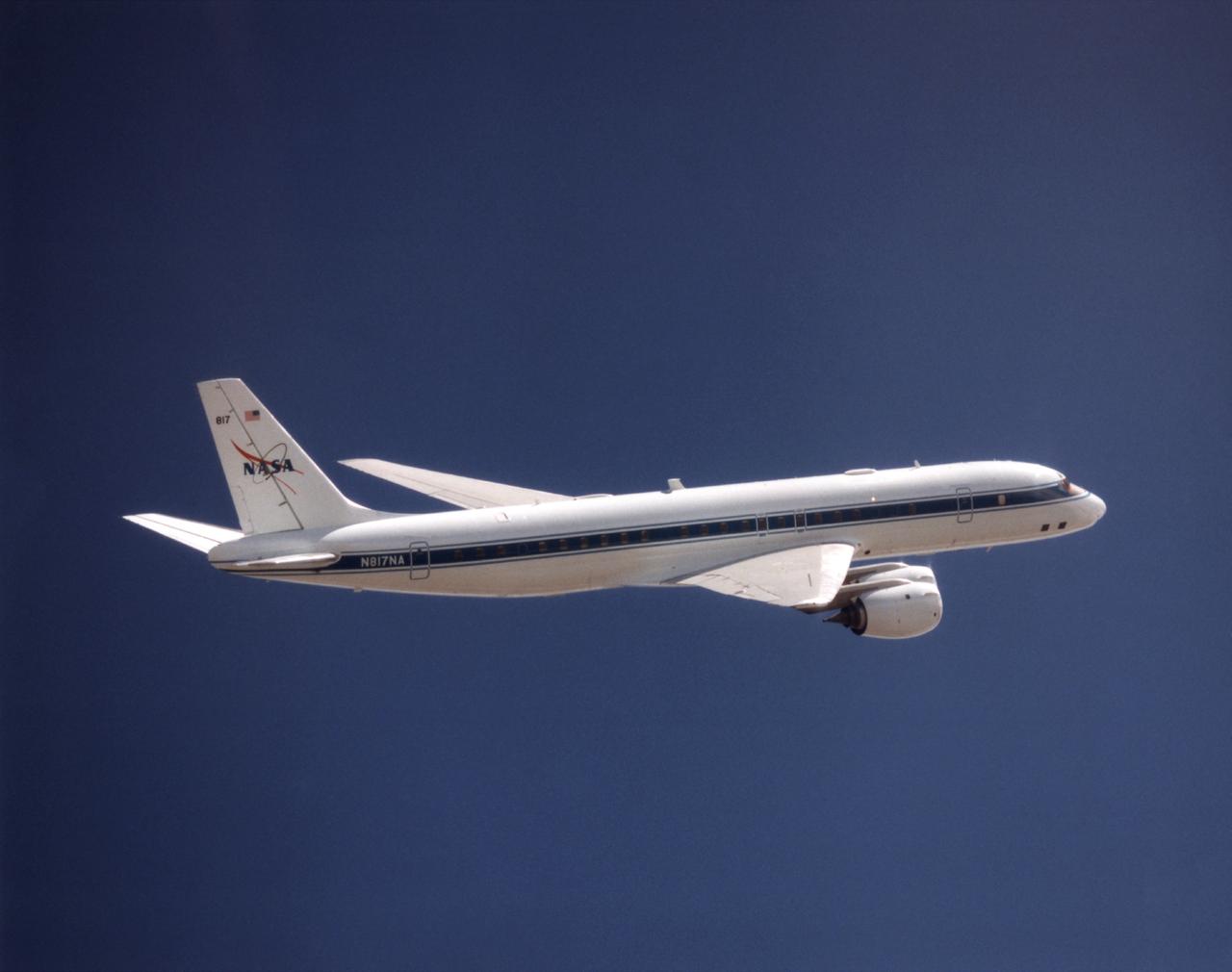
NASA's DC-8 Airborne Science platform shown against a background of a dark blue sky on February 20, 1998. The aircraft is shown from the right rear, slightly above its plane, with the right wing in the foreground and the left wing and horizontal tail in the background. The former airliner is a "dash-72" model and has a range of 5,400 miles. The craft can stay airborne for 12 hours and has an operational speed range between 300 and 500 knots. The research flights are made at between 500 and 41,000 feet. The aircraft can carry up to 30,000 lbs of research/science payload equipment installed in 15 mission-definable spaces.
DC-8 Airborne Laboratory in flight
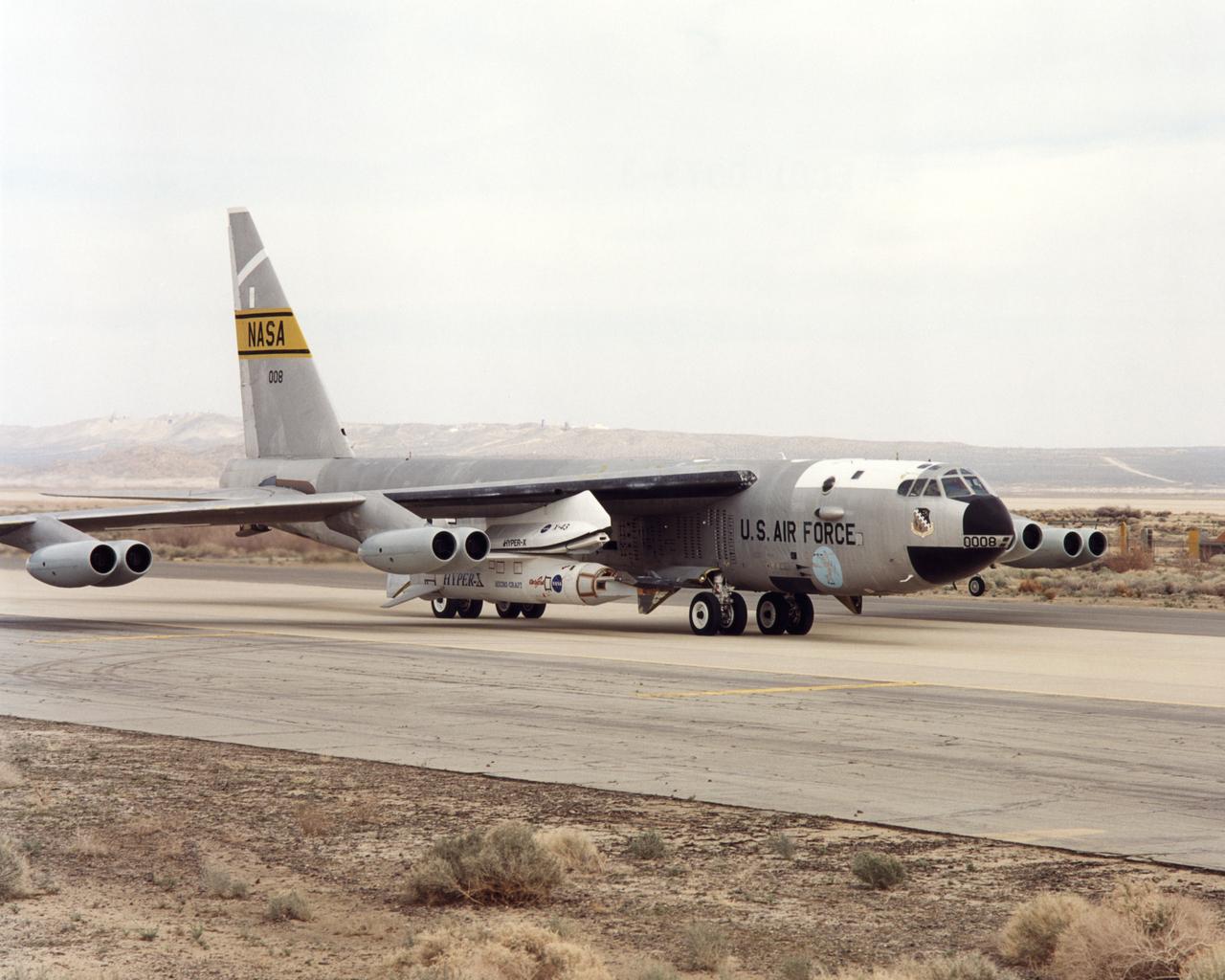
As part of a combined systems test conducted by NASA Dryden Flight Research Center, NASA's NB-52B carrier aircraft rolls down a taxiway at Edwards Air Force Base with the X-43A hypersonic research aircraft and its modified Pegasus® booster rocket attached to a pylon under its right wing. The taxi test was one of the last major milestones in the Hyper-X research program before the first X-43A flight. The X-43A flights will be the first actual flight tests of an aircraft powered by a revolutionary supersonic-combustion ramjet ("scramjet") engine capable of operating at hypersonic speeds (above Mach 5, or five times the speed of sound). The 12-foot, unpiloted research vehicle was developed and built by MicroCraft Inc., Tullahoma, Tenn., under NASA contract. The booster was built by Orbital Sciences Corp., Dulles, Va. After being air-launched from NASA's venerable NB-52 mothership, the booster will accelerate the X-43A to test speed and altitude. The X-43A will then separate from the rocket and fly a pre-programmed trajectory, conducting aerodynamic and propulsion experiments until it descends into the Pacific Ocean. Three research flights are planned, two at Mach 7 and one at Mach 10.
NASA's NB-52B carrier aircraft rolls down a taxiway with the X-43A hypersonic research aircraft and its modified Pegasus® booster rocket attached to a pylon under its right wing.
NASA's NB-52B carrier aircraft rolls down a taxiway at Edwards Air Force Base with the X-43A hypersonic research aircraft and its modified Pegasus® booster rocket slung from a pylon under its right wing. Part of a combined systems test conducted by NASA's Dryden Flight Research Center at Edwards, the taxi test was one of the last major milestones in the Hyper-X research program before the first X-43A flight. The X-43A flights will be the first actual flight tests of an aircraft powered by a revolutionary supersonic-combustion ramjet ("scramjet") engine capable of operating at hypersonic speeds (above Mach 5, or five times the speed of sound). The 12-foot, unpiloted research vehicle was developed and built by MicroCraft Inc., Tullahoma, Tenn., under NASA contract. The booster was built by Orbital Sciences Corp., Dulles, Va.,After being air-launched from NASA's venerable NB-52 mothership, the booster will accelerate the X-43A to test speed and altitude. The X-43A will then separate from the rocket and fly a pre-programmed trajectory, conducting aerodynamic and propulsion experiments until it descends into the Pacific Ocean. Three research flights are planned, two at Mach 7 and one at Mach 10, with the first tentatively scheduled for late spring to early summer, 2001.
NASA's NB-52B carrier aircraft rolls down a taxiway with the X-43A hypersonic research aircraft and its modified Pegasus® booster rocket slung from a pylon under its right wing
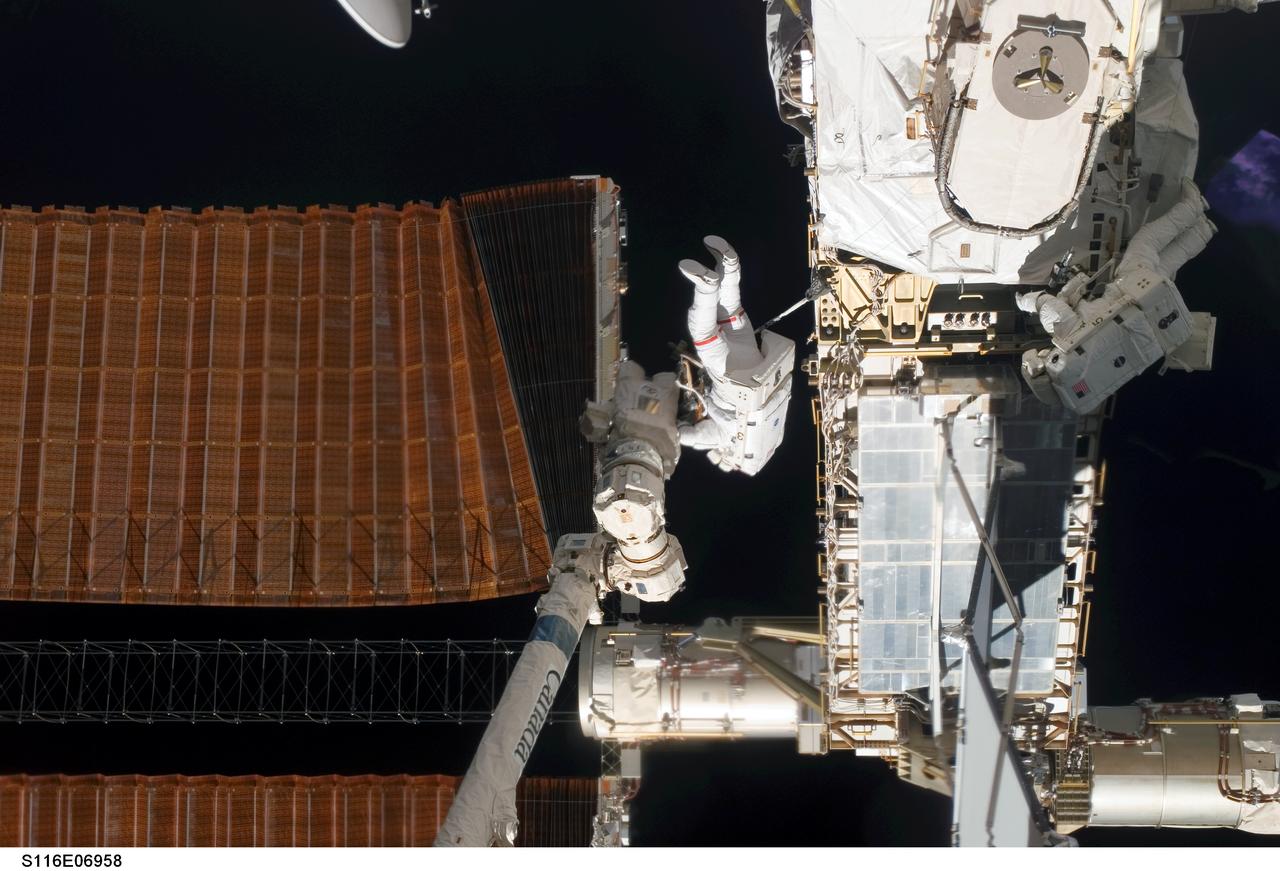
S116-E-06958 (18 Dec. 2006) --- Astronaut Robert L. Curbeam Jr. (center) and European Space Agency (ESA) astronaut Christer Fuglesang (right), both STS-116 mission specialists, work with the port overhead solar array wing on the International Space Station's P6 truss during the mission's fourth session of extravehicular activity (EVA). The spacewalkers used specially-prepared, tape-insulated tools, to guide the array wing neatly inside its blanket box during the 6-hour, 38-minute spacewalk.
STS-116 MS Curbeam and Fuglesang work with port OVHD SAW on the P6 Truss during EVA-4
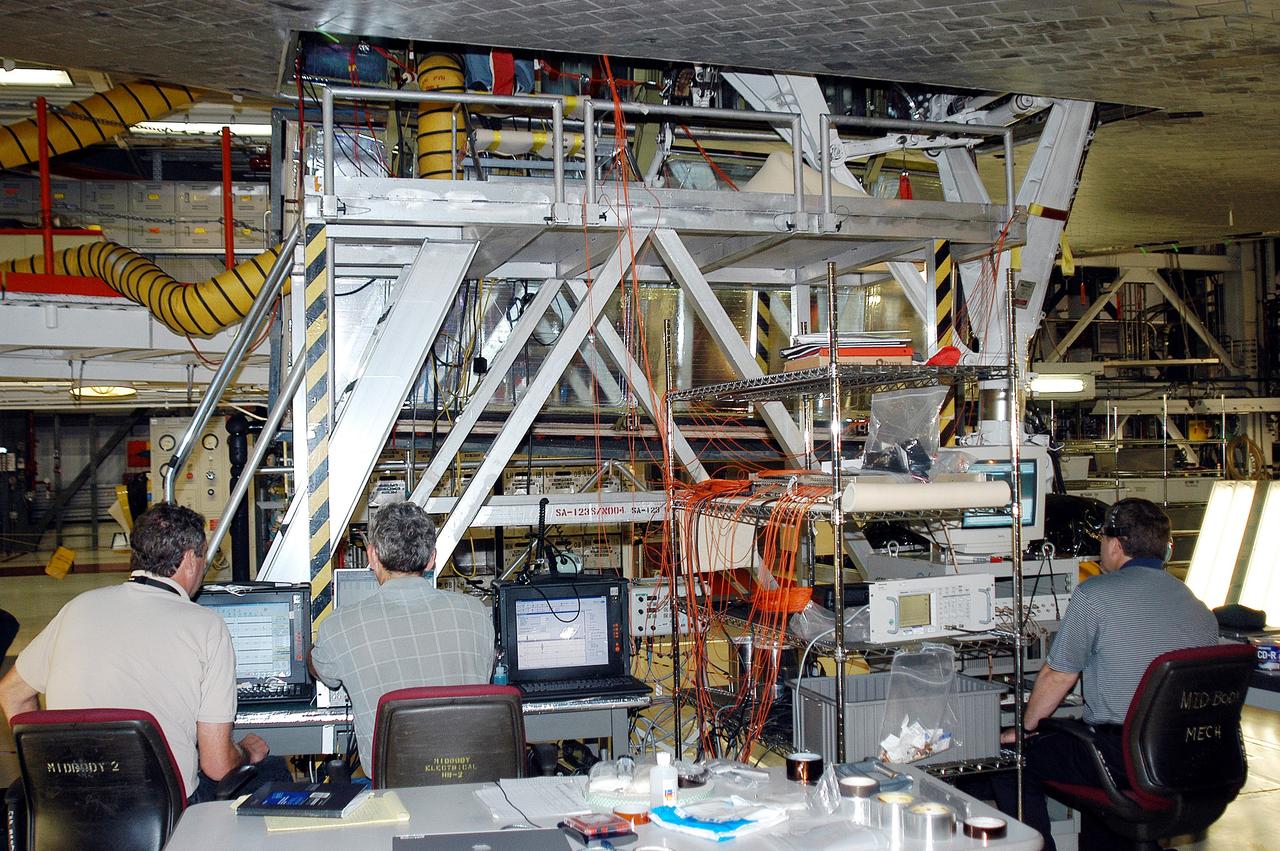
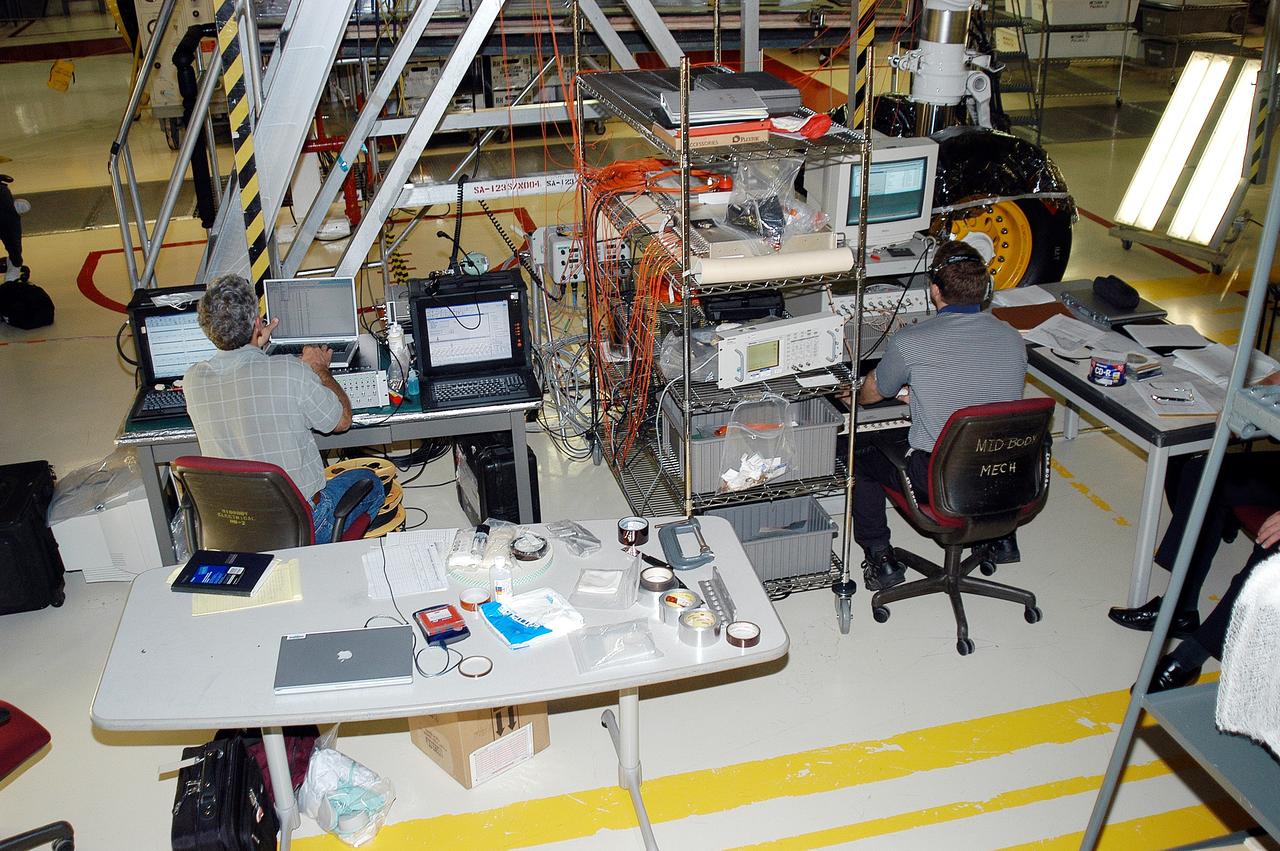
In the Orbiter Processing Facility, Eric Madaras, NASA-Langley Research Center, conducts impulse tests on the right wing leading edge (WLE) of Space Shuttle Endeavour. The tests monitor how sound impulses propagate through the WLE area. The data collected will be analyzed to explore the possibility of adding new instrumentation to the wing that could automatically detect debris or micrometeroid impacts on the Shuttle while in flight. The study is part of the initiative ongoing at KSC and around the agency to return the orbiter fleet to flight status.
Endeavour Impulse Tests
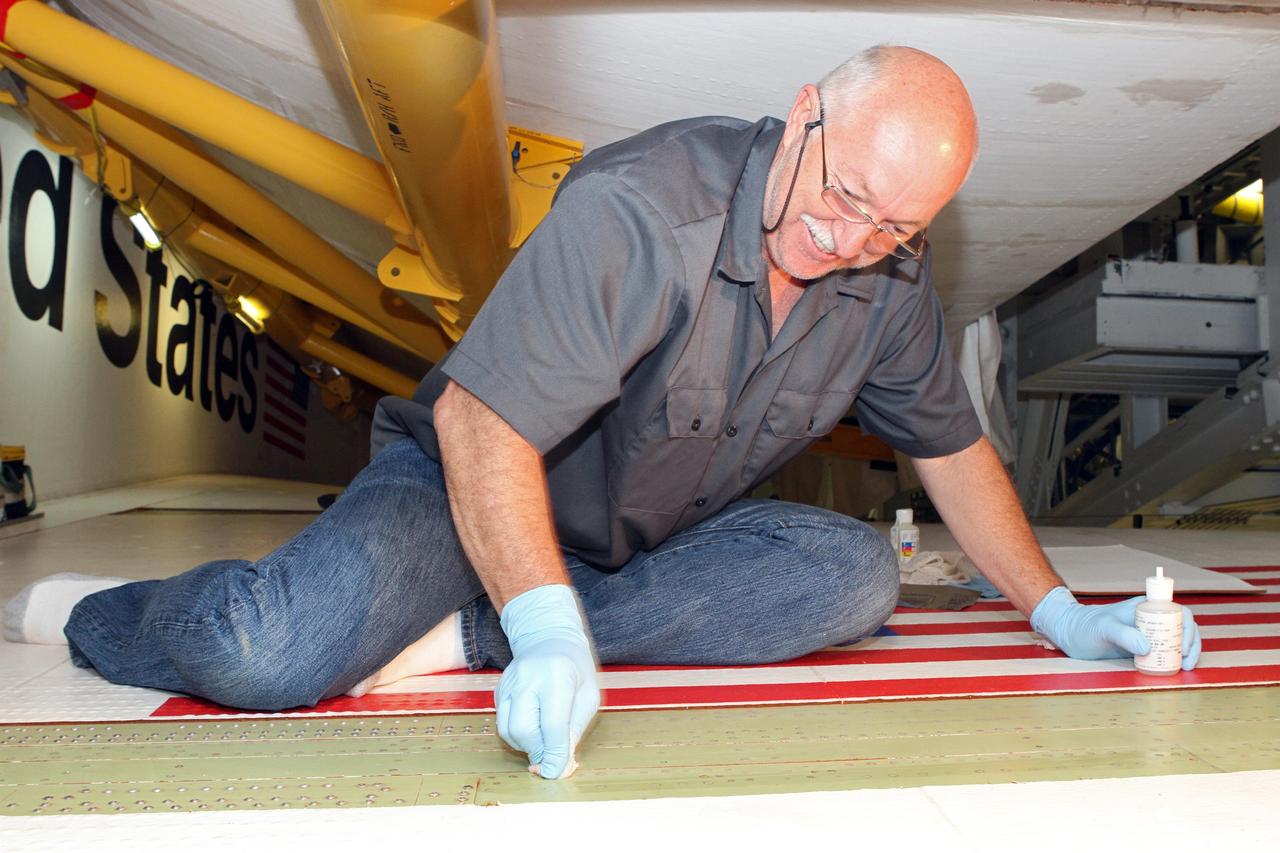
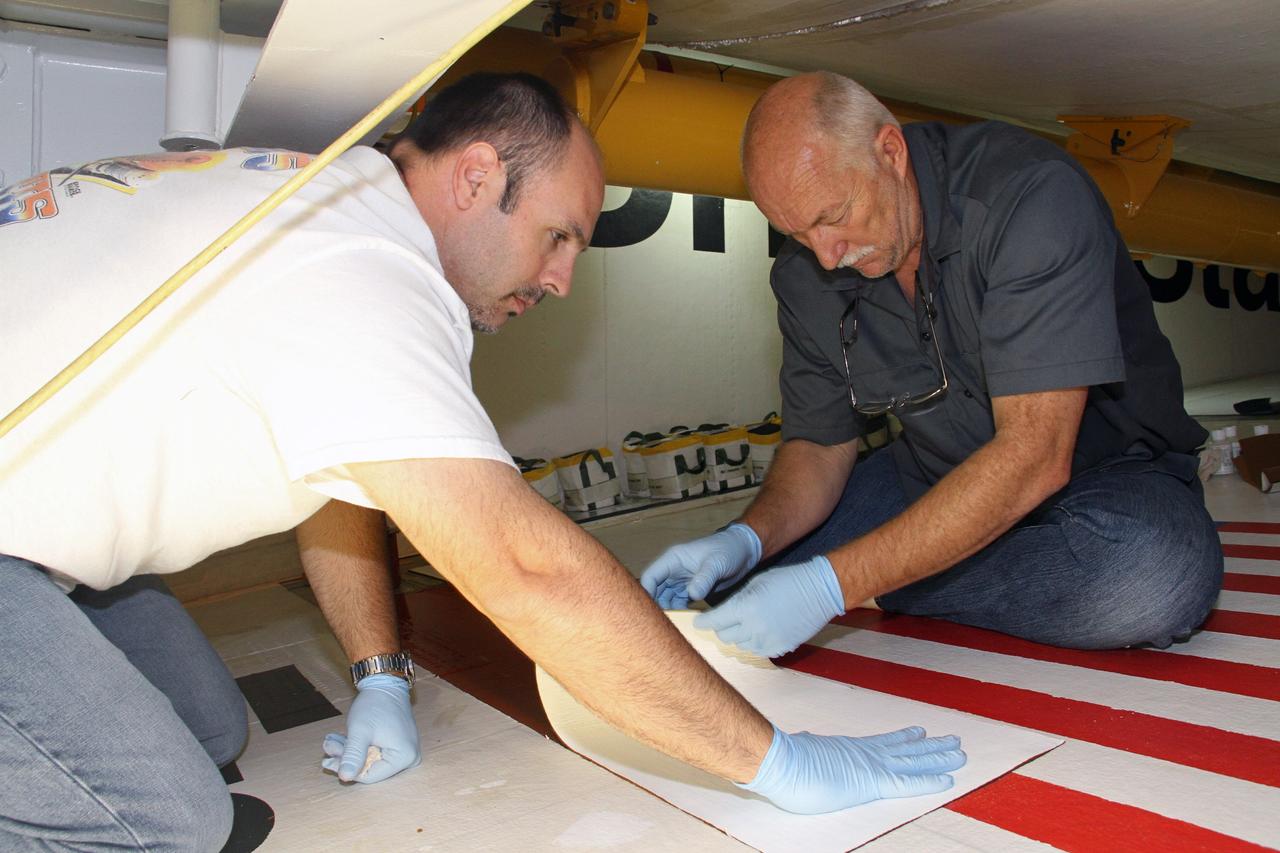
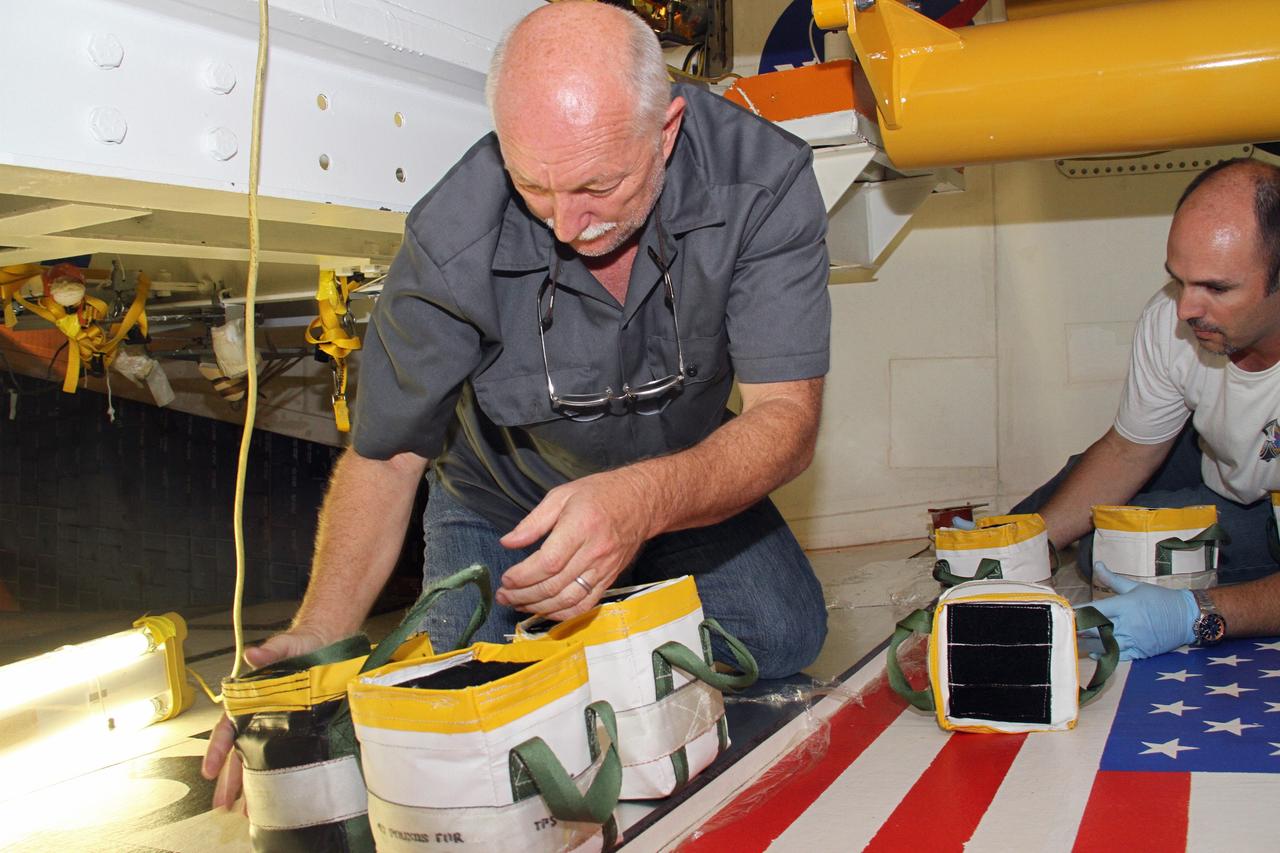
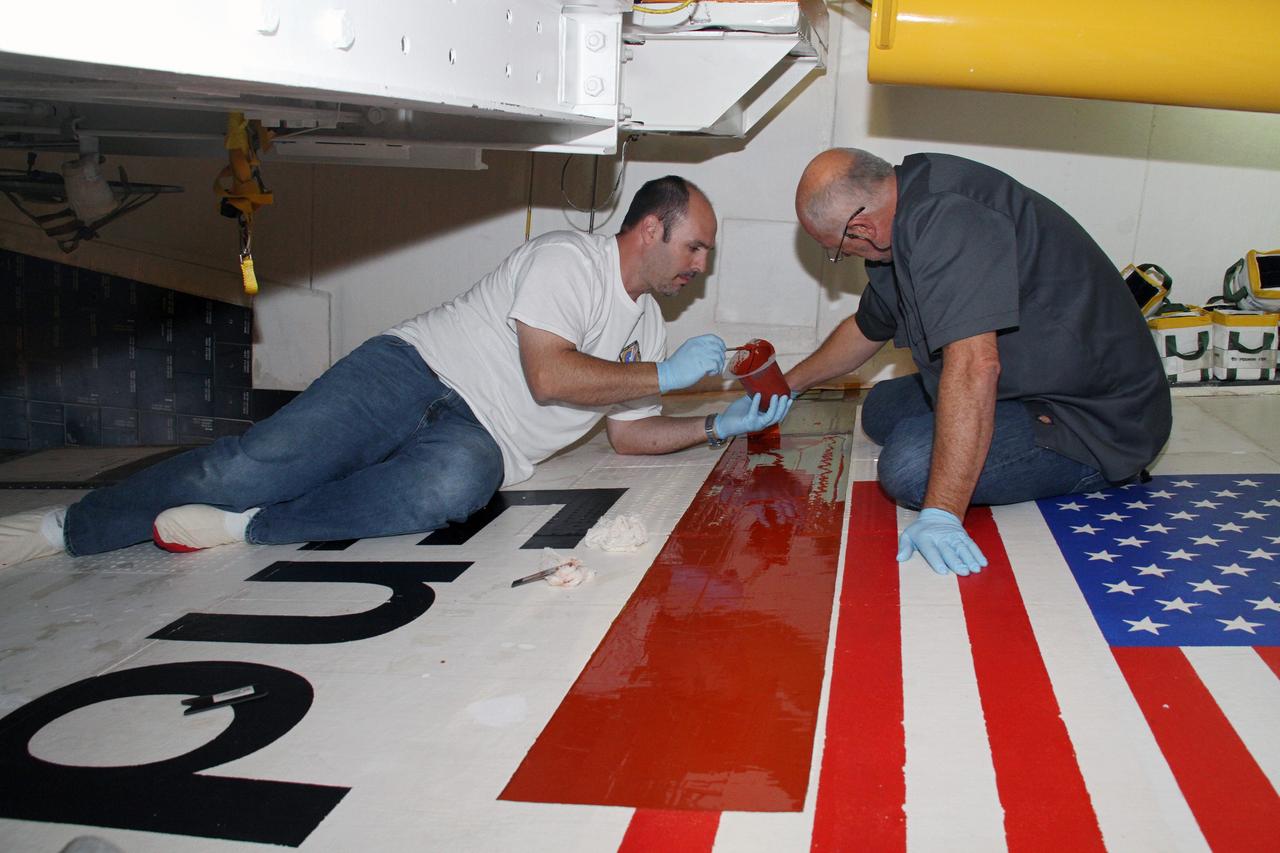
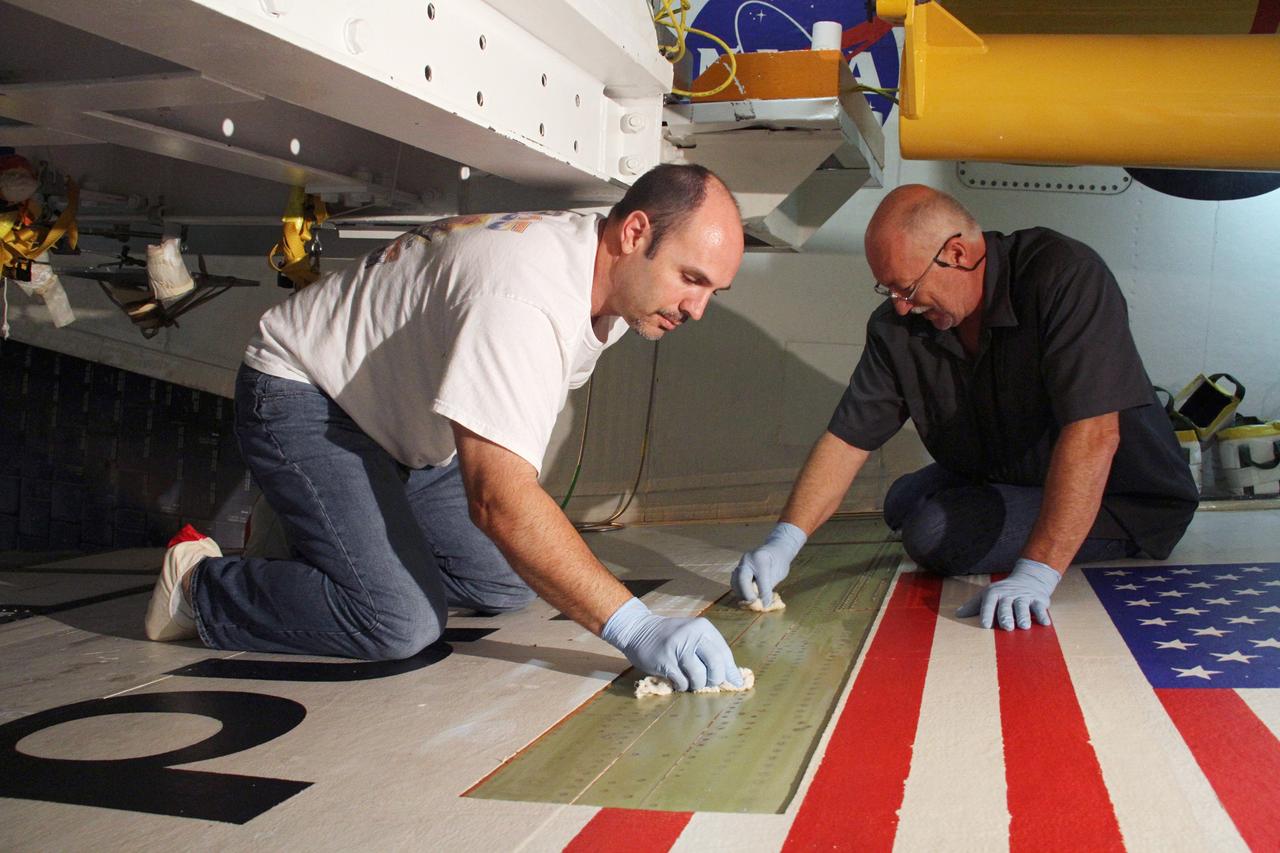
CAPE CANAVERAL, Fla. – Inside Orbiter Processing Facility-2 at NASA's Kennedy Space Center in Florida, Mike Williams, a thermal protection system technician with United Space Alliance, crouches on space shuttle Endeavour's right wing as he prepares the wing surface for tile bonding.    Ongoing transition and retirement activities are preparing the spacecraft for public display at the California Science Center in Los Angeles. Endeavour flew 25 missions during its 19-year career. Photo credit: NASA/Cory Huston
KSC-2012-1937
The X-38, mounted beneath the right wing of NASA's B-52, climbed from the runway at Edwards Air Force Base for the seventh free flight test of the X-38, July 10, 2001. The X-38 was released at 37,500 feet and completed a thirteen minute glide flight to a landing on Rogers Dry Lake.
NASA's B-52 takes the X-38 aloft for the seventh free flight of the program, July 10, 2001
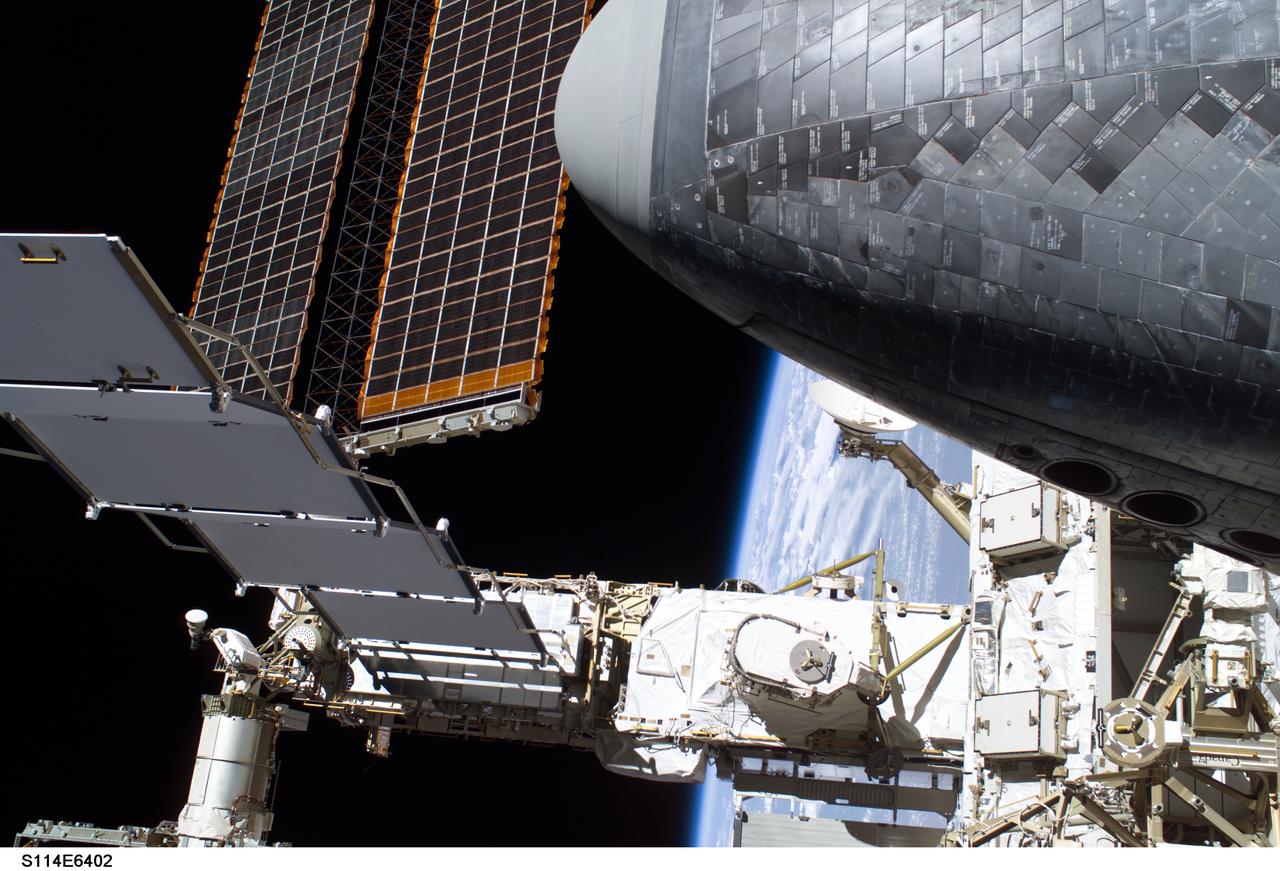
Photograph documenting the  P6 Truss Solar Array Wing (SAW), Mast Canisters, Photovoltaic (PV) Radiator and Solar Array Blanket Boxes (SABB) as seen by the STS-114 crew during the third of three Extravehicular Activities (EVAs) of the mission. Part of the orbiter Discovery's nosecone is visible in the upper right of the frame.
P6 Truss solar array, SABB and PV Radiator seen during EVA 3
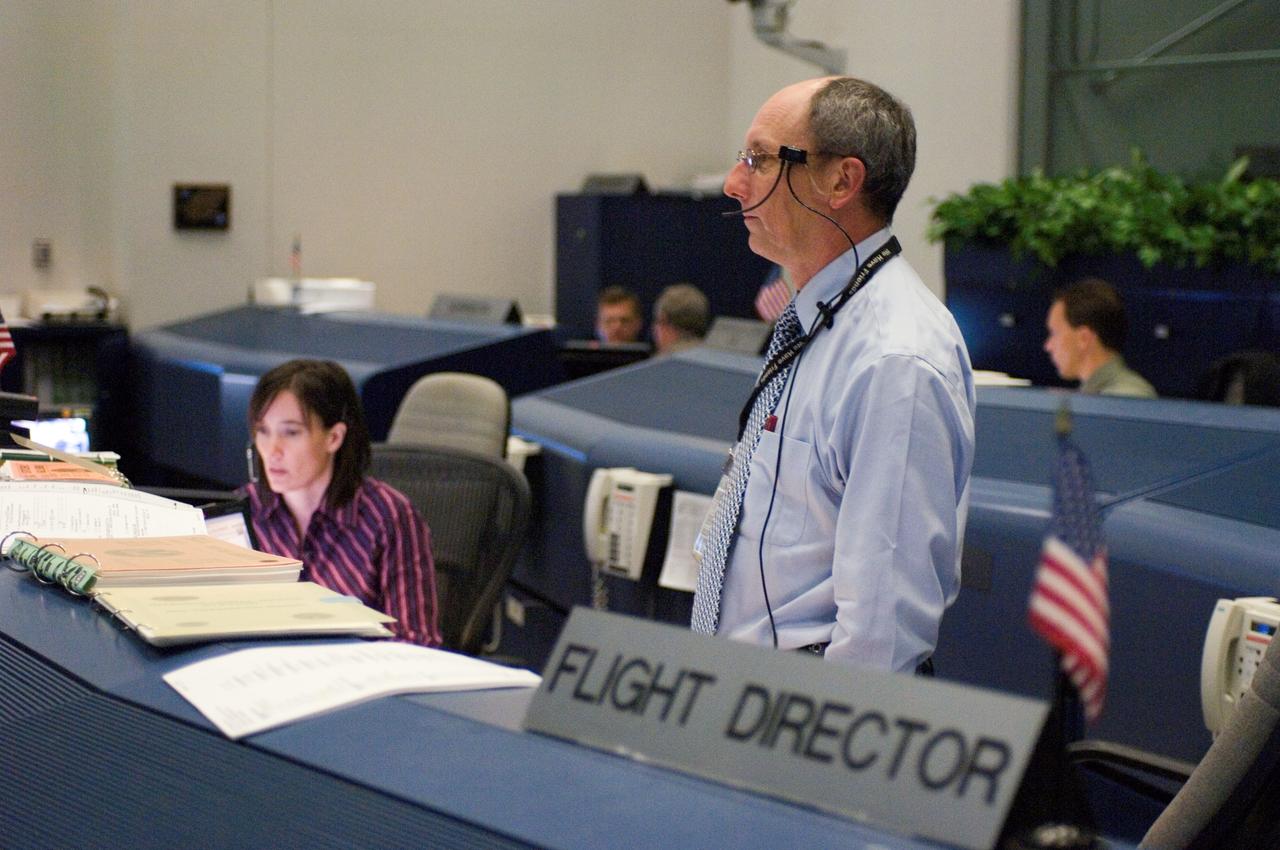
JSC2006-E-39881 (10 Sept. 2006) --- In the Shuttle (White) Flight Control Room of Houston's Mission Control Center, flight director Paul Dye (right) and spacecraft communicator (CAPCOM) Megan McArthur monitor data during the STS-115 inspection of the wings' leading edge and nose cap of the Space Shuttle Atlantis.
Coverage of STS-115 Mission Control during launch
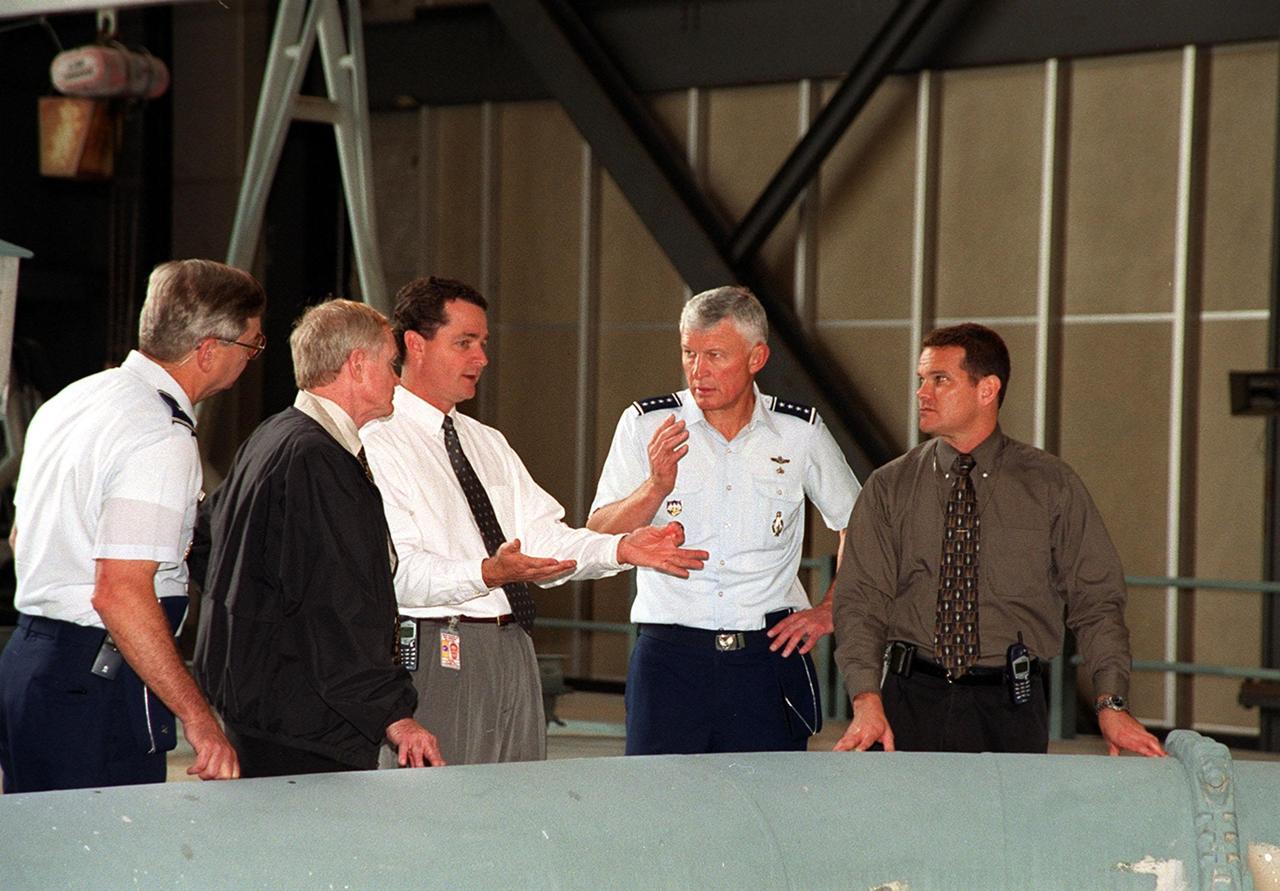
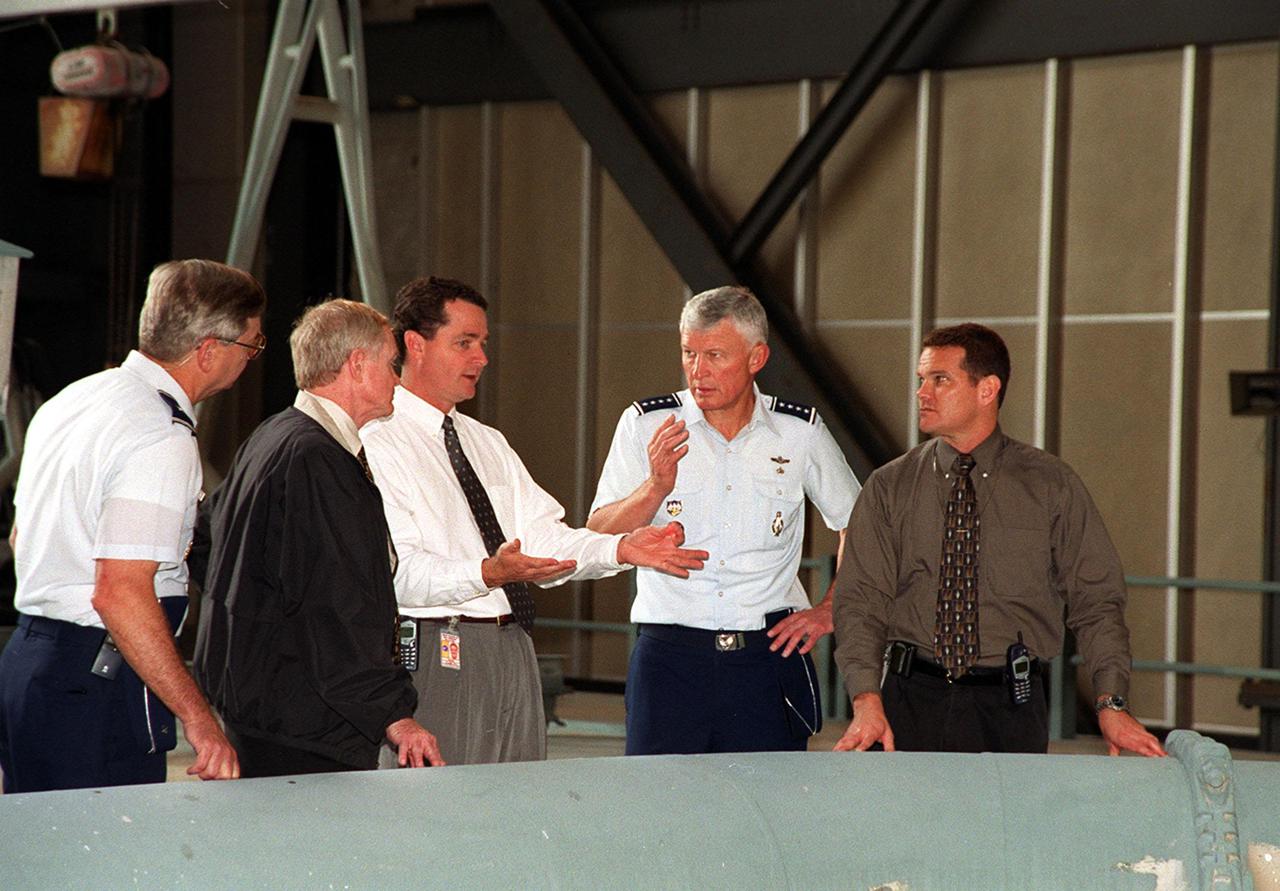
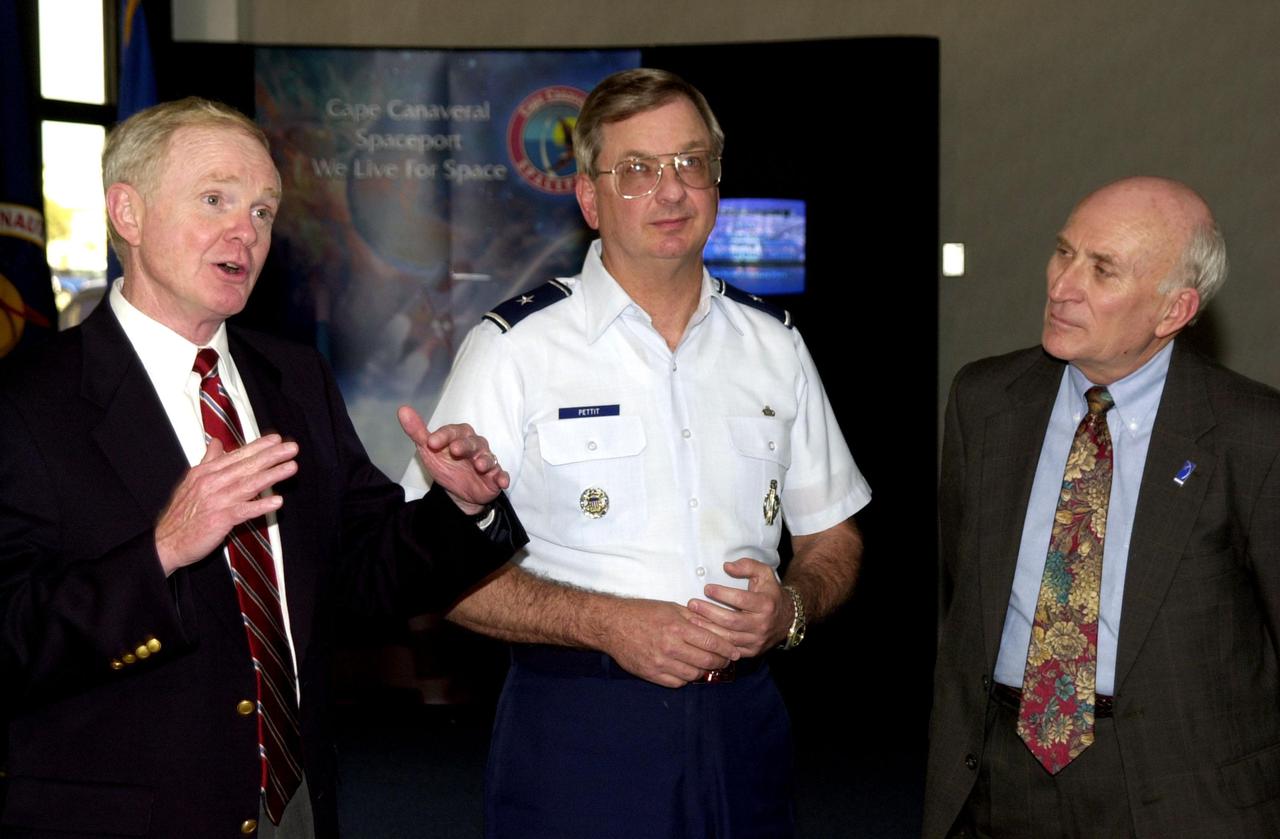
Inside the Vehicle Assembly Building, Director of Shuttle Processing relates information about the launch process to (left to right) Brig. Gen. Donald Pettit, Commander of the 45th Space Wing, Cape Canaveral; Roy Bridges, KSC’s Center Director; King; Gen. Ralph Everhart, Commander, Space Command; and Dave Rainer
KSC-01PP-0379
Inside the Vehicle Assembly Building, Director of Shuttle Processing relates information about the launch process to (left to right) Brig. Gen. Donald Pettit, Commander of the 45th Space Wing, Cape Canaveral; Roy Bridges, KSC’s Center Director; King; Gen. Ralph Everhart, Commander, Space Command; and Dave Rainer
KSC01pp0379
Gen. Ralph Everhart, Commander, Space Command (left); Center Director Roy Bridges (middle); and Brig. Gen. Donald Pettit (right), Commander, 45th Space Wing, pose for the camera while on the crawler-transporter at Launch Pad 39B. Behind them is Space Shuttle Discovery, which rolled out to the pad earlier in the day
KSC-01pp0374
CAPE CANAVERAL, Fla. – Jeremy Schwarz, left, quality assurance technician, and Mike Williams, right, a thermal protection system technician, both with United Space Alliance, affix a section of tile to the right wing of space shuttle Endeavour at NASA's Kennedy Space Center in Florida.    Ongoing transition and retirement activities are preparing the spacecraft for public display at the California Science Center in Los Angeles. Endeavour flew 25 missions during its 19-year career. Photo credit: NASA/Cory Huston
KSC-2012-1942
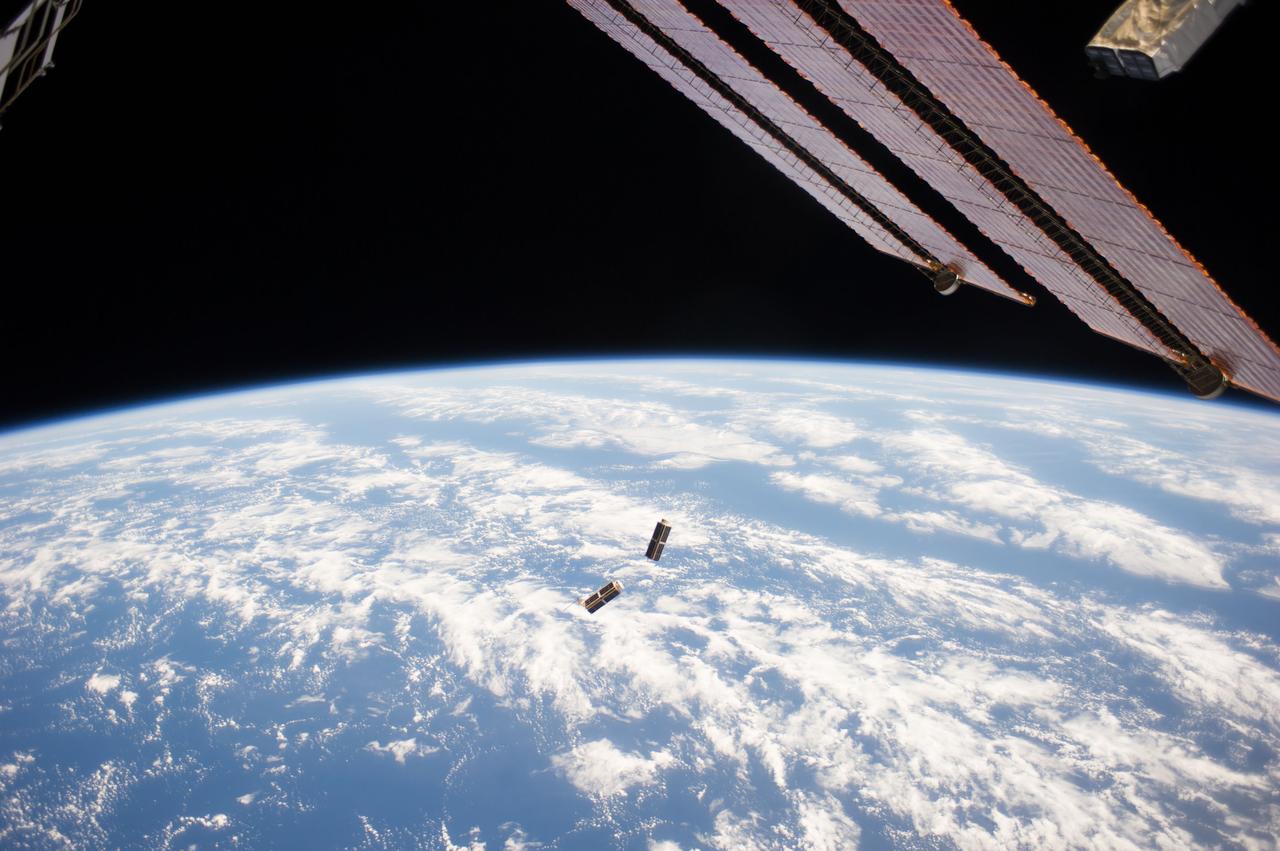
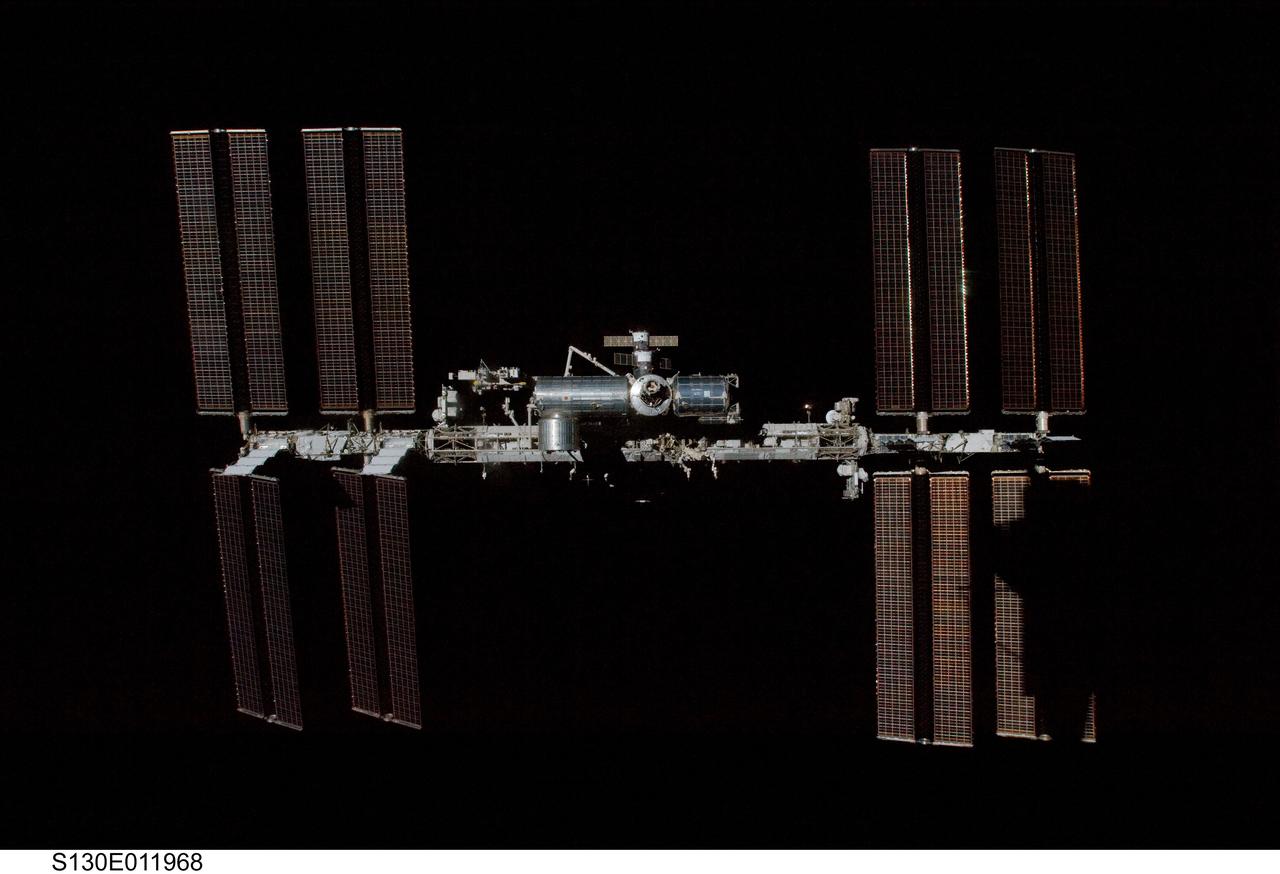
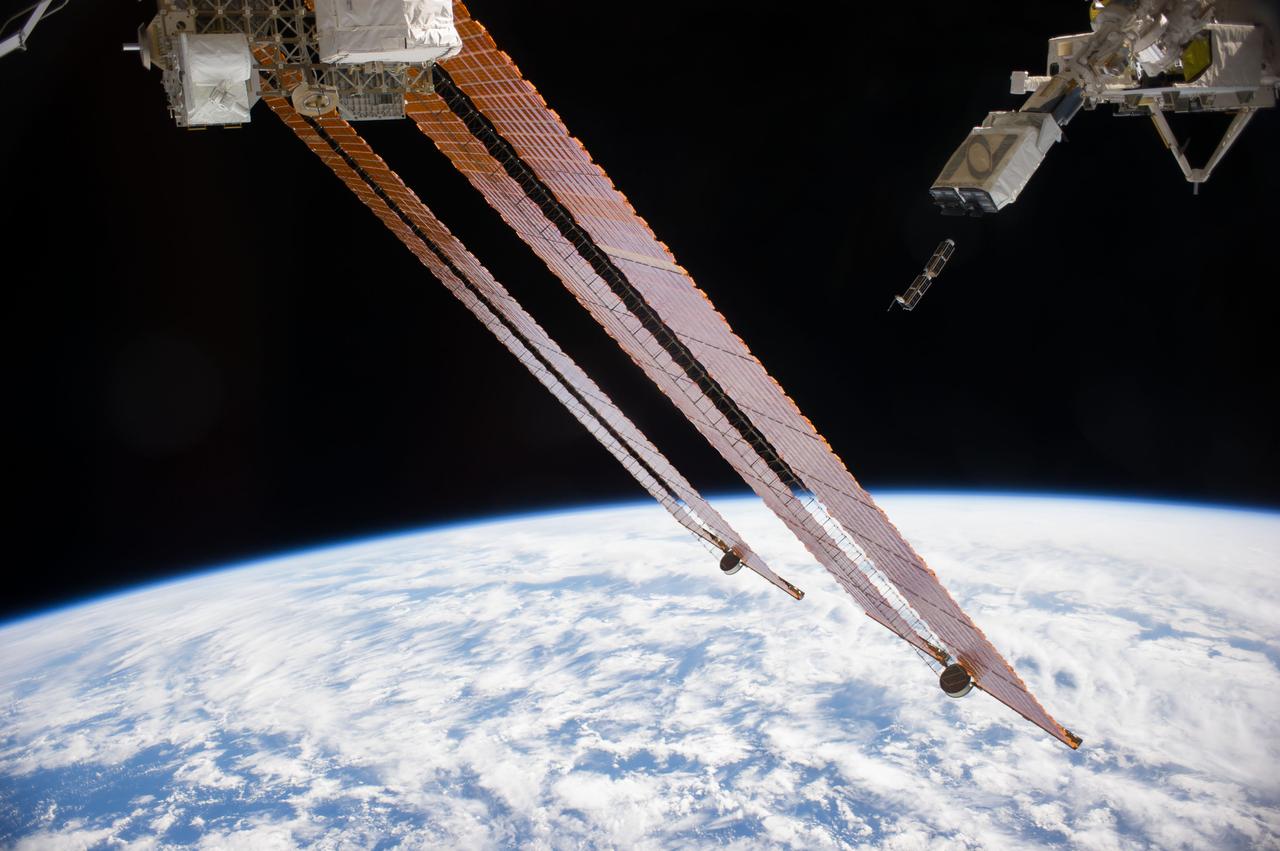
ISS040-E-103545 (19 Aug. 2014) --- In the grasp of the Japanese robotic arm, the CubeSat deployer (mostly out of frame, upper right) releases a pair of NanoRacks CubeSat miniature satellites (center). The Planet Labs Dove satellites that were carried to the International Space Station aboard the Orbital Sciences Cygnus commercial cargo craft are being deployed between Aug. 19 and Aug. 25. A section of the station solar array wings is at top right. A blue and white part of Earth and the blackness of space provide the backdrop for the scene.
Nanoracks CUBESAT launcher operations
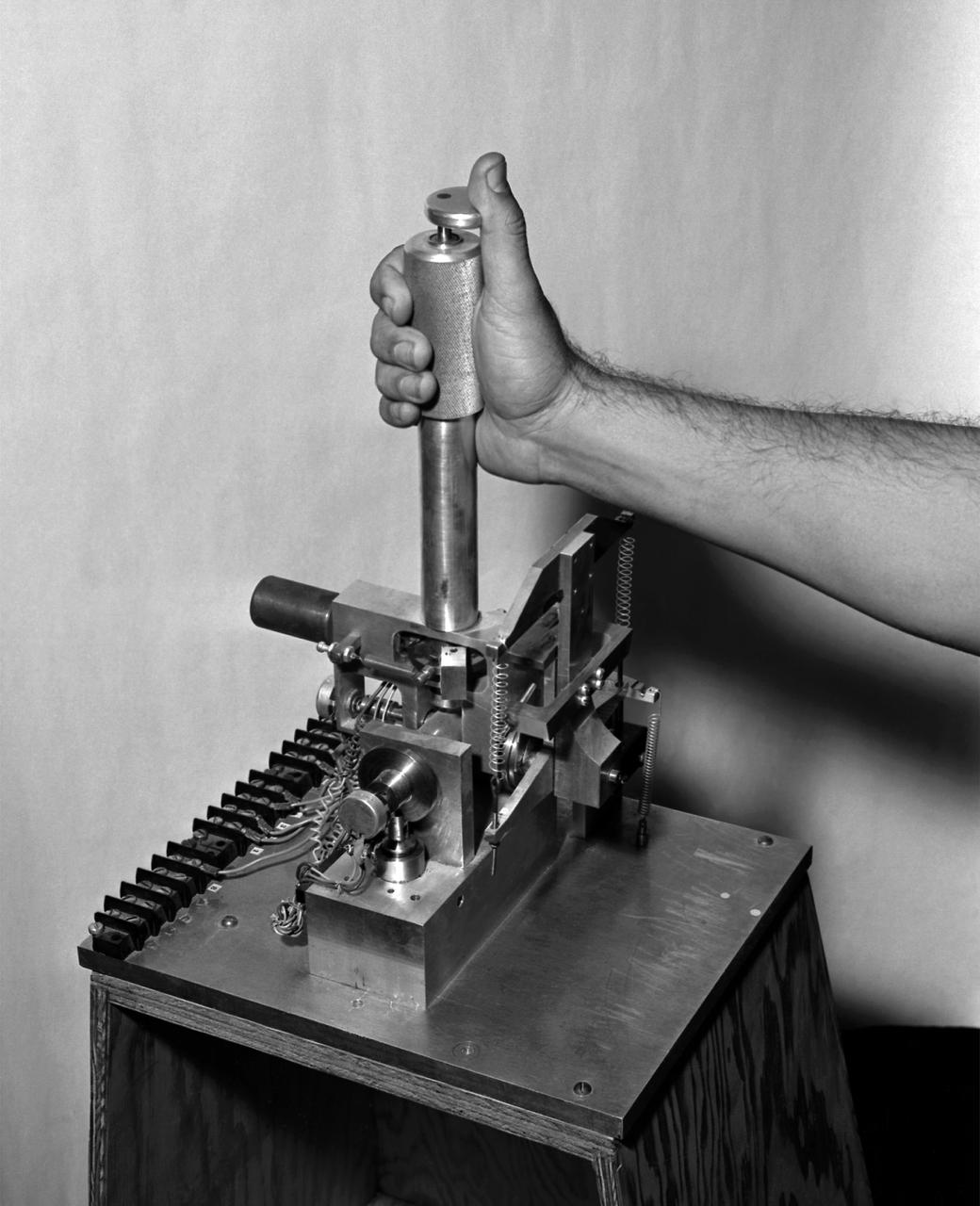
A photo of the control stick used on the Iron Cross Attitude Simulator. Although it resembled today's desktop computer flight sticks, its operation was different. As with a standard control stick, moving it back and forth raised and lowered the nose resulting in changes in pitch. Moving the stick to the right or left raised or lowered the wing, resulted in changes in roll. This control stick had a third axis, not found in standard control sticks. Twisting the stick to the right or left caused the airplane's nose to move horizontally in the same direction, resulting in changes in yaw.
E-2633
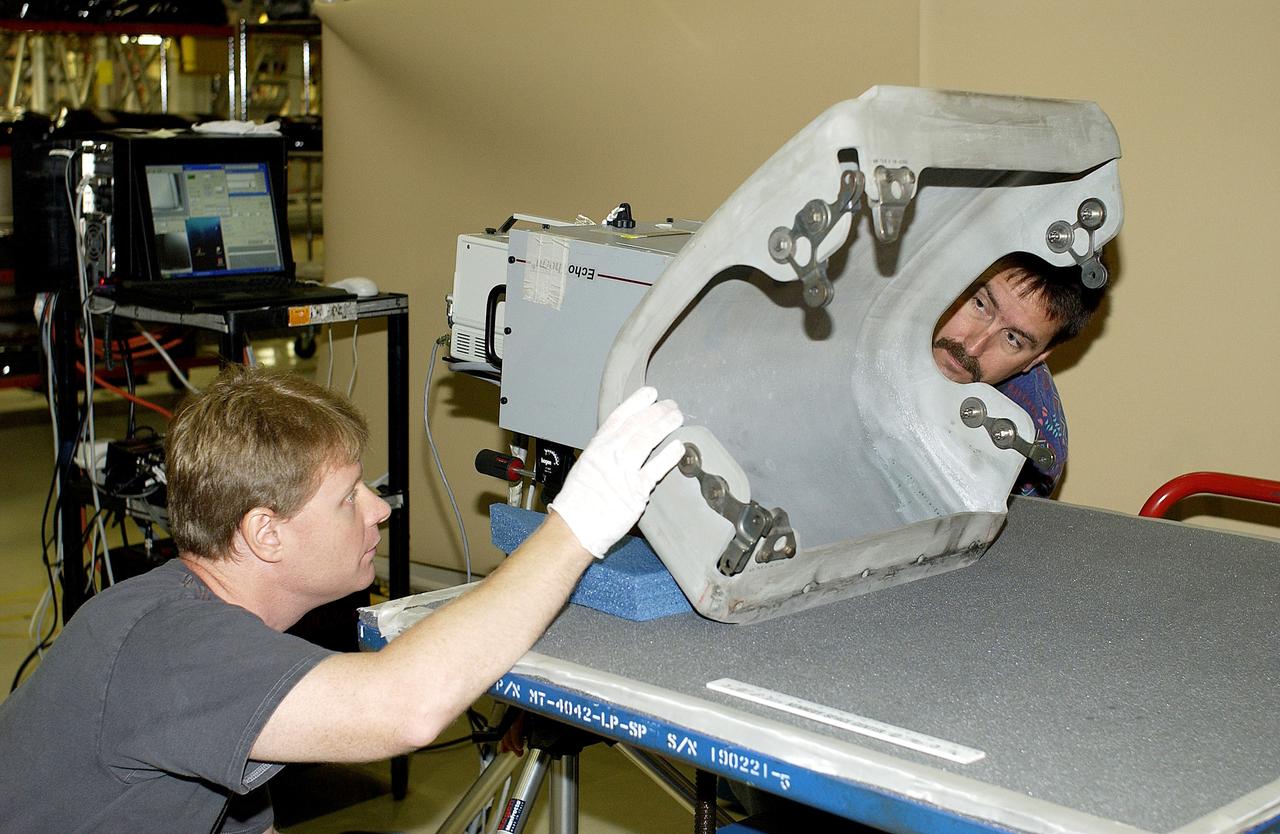
KENNEDY SPACE CENTER, FLA. - In the Orbiter Processing Facility, United Space Alliance workers (left to right) Jim Landy, Dan Phillips, Paul Ogletree and Dan Kenna check results of flash thermography on the Reinforced Carbon Carbon panel on the table (foreground).  Attached to the leading edge of the wing of the orbiters,  the gray carbon composite RCC panels have sufficient strength to withstand the aerodynamic forces experienced during launch and reentry, which can reach as high as 800 pounds per square foot.  The operating range of RCC is from minus 250º F to about 3,000º F, the temperature produced by friction with the atmosphere during reentry.
KENNEDY SPACE CENTER, FLA. - In the Orbiter Processing Facility, United Space Alliance workers (left to right) Jim Landy, Dan Phillips, Paul Ogletree and Dan Kenna check results of flash thermography on the Reinforced Carbon Carbon panel on the table (foreground). Attached to the leading edge of the wing of the orbiters, the gray carbon composite RCC panels have sufficient strength to withstand the aerodynamic forces experienced during launch and reentry, which can reach as high as 800 pounds per square foot. The operating range of RCC is from minus 250º F to about 3,000º F, the temperature produced by friction with the atmosphere during reentry.
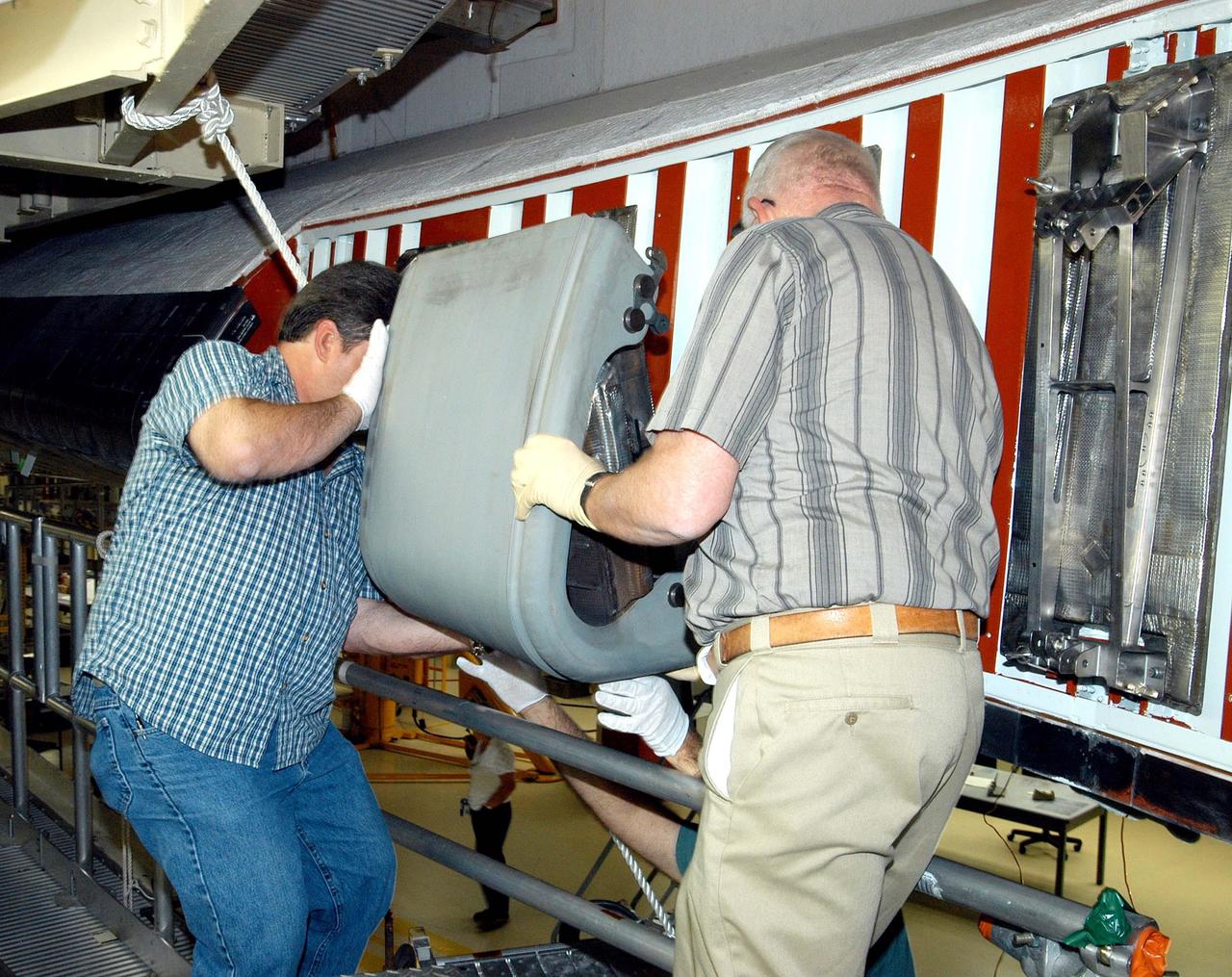
KENNEDY SPACE CENTER, FLA. - In the Orbiter Processing Facility, United Space Alliance workers Mike Hyatt (above) and Saul Ngy (below right) finish installing a Reinforced Carbon Carbon (RCC) panel to the leading edge of the wing of the orbiter Atlantis.  The gray carbon composite RCC panels have sufficient strength to withstand the aerodynamic forces experienced during launch and reentry, which can reach as high as 800 pounds per square foot.  The operating range of RCC is from minus 250º F to about 3,000º F, the temperature produced by friction with the atmosphere during reentry.
KENNEDY SPACE CENTER, FLA. - In the Orbiter Processing Facility, United Space Alliance workers Mike Hyatt (above) and Saul Ngy (below right) finish installing a Reinforced Carbon Carbon (RCC) panel to the leading edge of the wing of the orbiter Atlantis. The gray carbon composite RCC panels have sufficient strength to withstand the aerodynamic forces experienced during launch and reentry, which can reach as high as 800 pounds per square foot. The operating range of RCC is from minus 250º F to about 3,000º F, the temperature produced by friction with the atmosphere during reentry.
KENNEDY SPACE CENTER, FLA. - In the Orbiter Processing Facility, United Space Alliance workers (left to right) Jim Landy, Paul Ogletree, Dan Kenna and Dan Phillips check results of flash thermography on the Reinforced Carbon Carbon panel on the table (foreground).  Attached to the leading edge of the wing of the orbiters,  the gray carbon composite RCC panels have sufficient strength to withstand the aerodynamic forces experienced during launch and reentry, which can reach as high as 800 pounds per square foot.  The operating range of RCC is from minus 250º F to about 3,000º F, the temperature produced by friction with the atmosphere during reentry.
KENNEDY SPACE CENTER, FLA. - In the Orbiter Processing Facility, United Space Alliance workers (left to right) Jim Landy, Paul Ogletree, Dan Kenna and Dan Phillips check results of flash thermography on the Reinforced Carbon Carbon panel on the table (foreground). Attached to the leading edge of the wing of the orbiters, the gray carbon composite RCC panels have sufficient strength to withstand the aerodynamic forces experienced during launch and reentry, which can reach as high as 800 pounds per square foot. The operating range of RCC is from minus 250º F to about 3,000º F, the temperature produced by friction with the atmosphere during reentry.
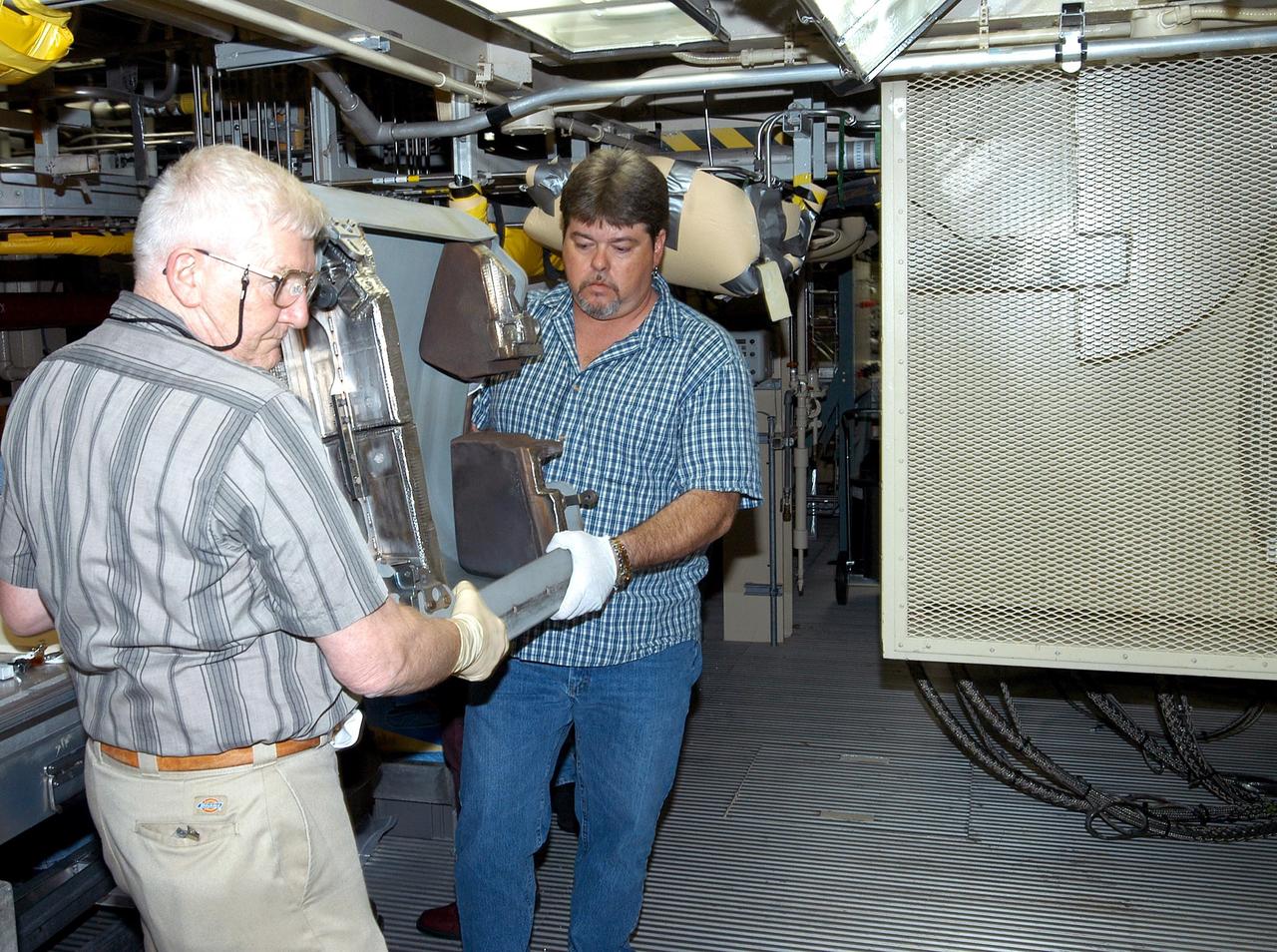
KENNEDY SPACE CENTER, FLA. - In the Orbiter Processing Facility, United Space Alliance workers Mike Hyatt (left) Jerry Belt (center), and Saul Ngy (right), lift a Reinforced Carbon Carbon (RCC) panel they will attach to the leading edge of the wing of the orbiter Atlantis.  The gray carbon composite RCC panels have sufficient strength to withstand the aerodynamic forces experienced during launch and reentry, which can reach as high as 800 pounds per square foot.  The operating range of RCC is from minus 250º F to about 3,000º F, the temperature produced by friction with the atmosphere during reentry.
KENNEDY SPACE CENTER, FLA. - In the Orbiter Processing Facility, United Space Alliance workers Mike Hyatt (left) Jerry Belt (center), and Saul Ngy (right), lift a Reinforced Carbon Carbon (RCC) panel they will attach to the leading edge of the wing of the orbiter Atlantis. The gray carbon composite RCC panels have sufficient strength to withstand the aerodynamic forces experienced during launch and reentry, which can reach as high as 800 pounds per square foot. The operating range of RCC is from minus 250º F to about 3,000º F, the temperature produced by friction with the atmosphere during reentry.
KENNEDY SPACE CENTER, FLA. -  In the Orbiter Processing Facility, United Space Alliance worker Mike Hyatt (right) attaches a Reinforced Carbon Carbon (RCC) panel onto the leading edge of the wing of the orbiter Atlantis.  The gray carbon composite RCC panels have sufficient strength to withstand the aerodynamic forces experienced during launch and reentry, which can reach as high as 800 pounds per square foot. The operating range of RCC is from minus 250º F to about 3,000º F, the temperature produced by friction with the atmosphere during reentry.
KENNEDY SPACE CENTER, FLA. - In the Orbiter Processing Facility, United Space Alliance worker Mike Hyatt (right) attaches a Reinforced Carbon Carbon (RCC) panel onto the leading edge of the wing of the orbiter Atlantis. The gray carbon composite RCC panels have sufficient strength to withstand the aerodynamic forces experienced during launch and reentry, which can reach as high as 800 pounds per square foot. The operating range of RCC is from minus 250º F to about 3,000º F, the temperature produced by friction with the atmosphere during reentry.
KENNEDY SPACE CENTER, FLA. -  In the Orbiter Processing Facility,  Jim Landy (left), NDE specialist with United Space Alliance (USA), prepares to examine a Reinforced Carbon Carbon panel using flash thermography.  Helping out, at right, is Dan Phillips, also with USA.  Attached to the leading edge of the wing of the orbiters,  the gray carbon composite RCC panels have sufficient strength to withstand the aerodynamic forces experienced during launch and reentry, which can reach as high as 800 pounds per square foot.  The operating range of RCC is from minus 250º F to about 3,000º F, the temperature produced by friction with the atmosphere during reentry.
KENNEDY SPACE CENTER, FLA. - In the Orbiter Processing Facility, Jim Landy (left), NDE specialist with United Space Alliance (USA), prepares to examine a Reinforced Carbon Carbon panel using flash thermography. Helping out, at right, is Dan Phillips, also with USA. Attached to the leading edge of the wing of the orbiters, the gray carbon composite RCC panels have sufficient strength to withstand the aerodynamic forces experienced during launch and reentry, which can reach as high as 800 pounds per square foot. The operating range of RCC is from minus 250º F to about 3,000º F, the temperature produced by friction with the atmosphere during reentry.
KENNEDY SPACE CENTER, FLA. -  In the Orbiter Processing Facility, United Space Alliance workers  Mike Hyatt (above),  Saul Ngy (right) and Jerry Belt (below) install a Reinforced Carbon Carbon (RCC) panel to the leading edge of the wing of the orbiter Atlantis.  The gray carbon composite RCC panels have sufficient strength to withstand the aerodynamic forces experienced during launch and reentry, which can reach as high as 800 pounds per square foot.  The operating range of RCC is from minus 250º F to about 3,000º F, the temperature produced by friction with the atmosphere during reentry.
KENNEDY SPACE CENTER, FLA. - In the Orbiter Processing Facility, United Space Alliance workers Mike Hyatt (above), Saul Ngy (right) and Jerry Belt (below) install a Reinforced Carbon Carbon (RCC) panel to the leading edge of the wing of the orbiter Atlantis. The gray carbon composite RCC panels have sufficient strength to withstand the aerodynamic forces experienced during launch and reentry, which can reach as high as 800 pounds per square foot. The operating range of RCC is from minus 250º F to about 3,000º F, the temperature produced by friction with the atmosphere during reentry.
KENNEDY SPACE CENTER, FLA. - Local Central Florida television reporters Phil Robertson (left), with WFTV, and Dan Billow (right), with WESH, tape commentaries after a media tour of the Orbiter Processing Facility.  The media was invited to see the orbiter Atlantis as it is being prepared for Return to Flight.  Both local and national reporters representing print and TV networks were able to see work in progress on Atlantis, including the reinstallation of the Reinforced Carbon-Carbon panels on the orbiter’s wing leading edge; wiring inspections; and checks of the engines in the Orbital Maneuvering System.
KENNEDY SPACE CENTER, FLA. - Local Central Florida television reporters Phil Robertson (left), with WFTV, and Dan Billow (right), with WESH, tape commentaries after a media tour of the Orbiter Processing Facility. The media was invited to see the orbiter Atlantis as it is being prepared for Return to Flight. Both local and national reporters representing print and TV networks were able to see work in progress on Atlantis, including the reinstallation of the Reinforced Carbon-Carbon panels on the orbiter’s wing leading edge; wiring inspections; and checks of the engines in the Orbital Maneuvering System.
KENNEDY SPACE CENTER, FLA. - In the Orbiter Processing Facility, United Space Alliance workers Mike Hyatt (left) Saul Ngy (center) and Jerry Belt (right) lift a Reinforced Carbon Carbon (RCC) panel to attach onto the leading edge of the wing of the orbiter Atlantis.  The gray carbon composite RCC panels have sufficient strength to withstand the aerodynamic forces experienced during launch and reentry, which can reach as high as 800 pounds per square foot.  The operating range of RCC is from minus 250º F to about 3,000º F, the temperature produced by friction with the atmosphere during reentry.
KENNEDY SPACE CENTER, FLA. - In the Orbiter Processing Facility, United Space Alliance workers Mike Hyatt (left) Saul Ngy (center) and Jerry Belt (right) lift a Reinforced Carbon Carbon (RCC) panel to attach onto the leading edge of the wing of the orbiter Atlantis. The gray carbon composite RCC panels have sufficient strength to withstand the aerodynamic forces experienced during launch and reentry, which can reach as high as 800 pounds per square foot. The operating range of RCC is from minus 250º F to about 3,000º F, the temperature produced by friction with the atmosphere during reentry.
KENNEDY SPACE CENTER, FLA. - In the Orbiter Processing Facility, United Space Alliance workers, from center, left to right, Saul Ngy, Jerry Belt and Mike Hyatt, prepare to attach a Reinforced Carbon Carbon (RCC) panel (on the table) to the leading edge of the wing of the orbiter Atlantis.  The gray carbon composite RCC panels have sufficient strength to withstand the aerodynamic forces experienced during launch and reentry, which can reach as high as 800 pounds per square foot. The operating range of RCC is from minus 250º F to about 3,000º F, the temperature produced by friction with the atmosphere during reentry.
KENNEDY SPACE CENTER, FLA. - In the Orbiter Processing Facility, United Space Alliance workers, from center, left to right, Saul Ngy, Jerry Belt and Mike Hyatt, prepare to attach a Reinforced Carbon Carbon (RCC) panel (on the table) to the leading edge of the wing of the orbiter Atlantis. The gray carbon composite RCC panels have sufficient strength to withstand the aerodynamic forces experienced during launch and reentry, which can reach as high as 800 pounds per square foot. The operating range of RCC is from minus 250º F to about 3,000º F, the temperature produced by friction with the atmosphere during reentry.
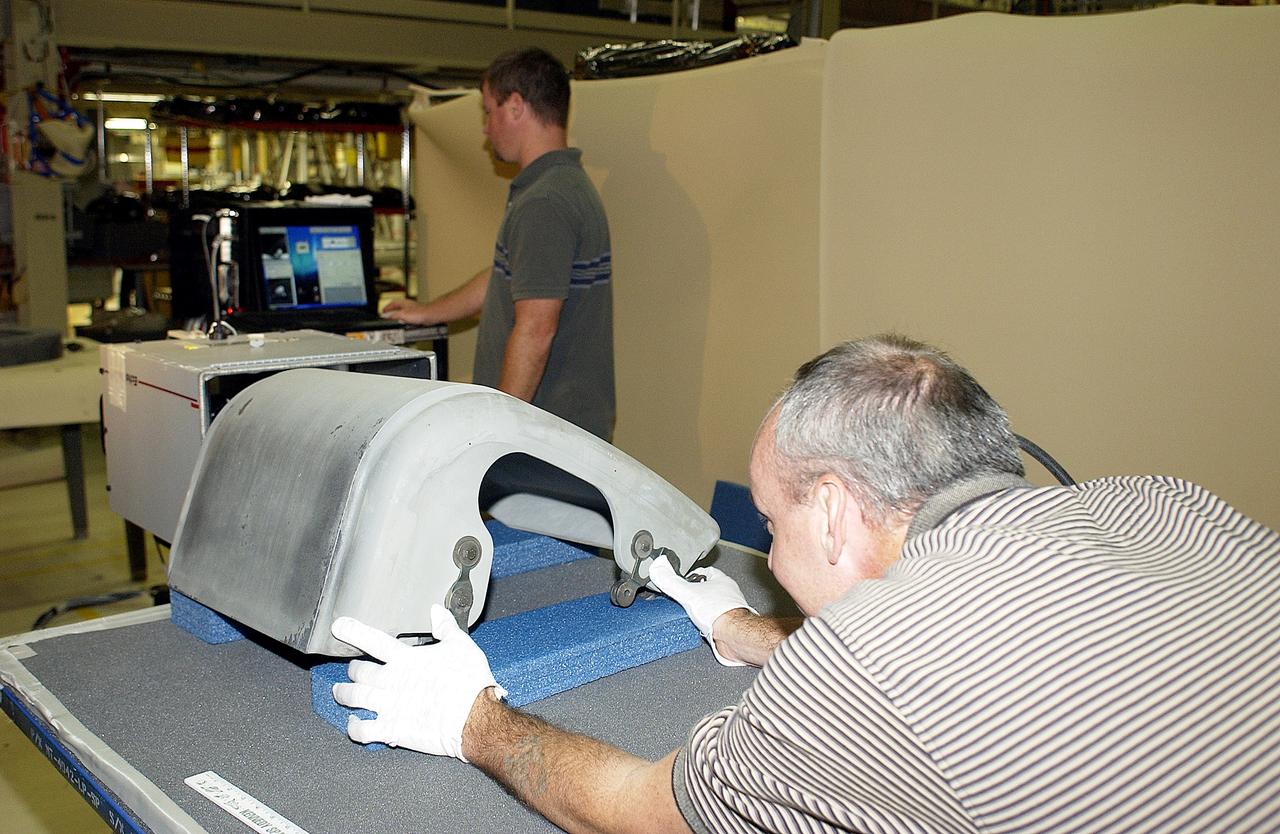
KENNEDY SPACE CENTER, FLA. -  In the Orbiter Processing Facility, United Space Alliance worker Dan Kenna (right) positions a Reinforced Carbon Carbon panel on the table to perform flash thermography.  In the background, Paul Ogletree observes the monitor.  Attached to the leading edge of the wing of the orbiters,  the gray carbon composite RCC panels have sufficient strength to withstand the aerodynamic forces experienced during launch and reentry, which can reach as high as 800 pounds per square foot.  The operating range of RCC is from minus 250º F to about 3,000º F, the temperature produced by friction with the atmosphere during reentry.
KENNEDY SPACE CENTER, FLA. - In the Orbiter Processing Facility, United Space Alliance worker Dan Kenna (right) positions a Reinforced Carbon Carbon panel on the table to perform flash thermography. In the background, Paul Ogletree observes the monitor. Attached to the leading edge of the wing of the orbiters, the gray carbon composite RCC panels have sufficient strength to withstand the aerodynamic forces experienced during launch and reentry, which can reach as high as 800 pounds per square foot. The operating range of RCC is from minus 250º F to about 3,000º F, the temperature produced by friction with the atmosphere during reentry.
KENNEDY SPACE CENTER, FLA. -  In the Orbiter Processing Facility, United Space Alliance workers Mike Hyatt (left), Saul Ngy (center) and Jerry Belt (right) prepare to install a Reinforced Carbon Carbon (RCC) panel to the leading edge of the wing of the orbiter Atlantis.  The gray carbon composite RCC panels have sufficient strength to withstand the aerodynamic forces experienced during launch and reentry, which can reach as high as 800 pounds per square foot.  The operating range of RCC is from minus 250º F to about 3,000º F, the temperature produced by friction with the atmosphere during reentry.
KENNEDY SPACE CENTER, FLA. - In the Orbiter Processing Facility, United Space Alliance workers Mike Hyatt (left), Saul Ngy (center) and Jerry Belt (right) prepare to install a Reinforced Carbon Carbon (RCC) panel to the leading edge of the wing of the orbiter Atlantis. The gray carbon composite RCC panels have sufficient strength to withstand the aerodynamic forces experienced during launch and reentry, which can reach as high as 800 pounds per square foot. The operating range of RCC is from minus 250º F to about 3,000º F, the temperature produced by friction with the atmosphere during reentry.
The DC-8 Airborne Laboratory in a left banking turn above the airport at Palmdale, California. The right wing is silhouetted against the blue sky, while the left wing contrasts with the desert terrain. The former airliner is a "dash-72" model and has a range of 5,400 miles. The craft can stay airborne for 12 hours and has an operational speed range between 300 and 500 knots. The research flights are made at between 500 and 41,000 feet. The aircraft can carry up to 30,000 lbs of research/science payload equipment installed in 15 mission-definable spaces.
DC-8 Airborne Laboratory in flight over Palmdale, CA
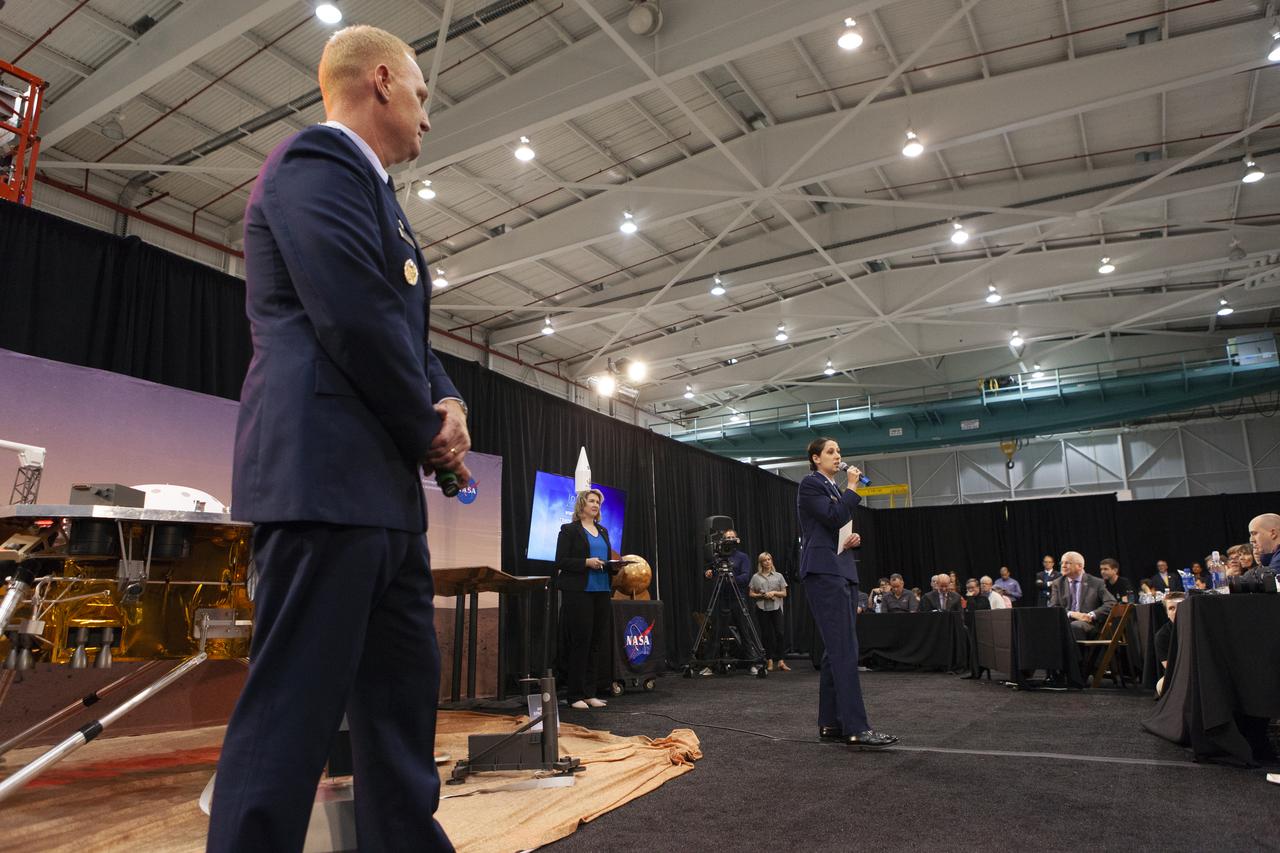
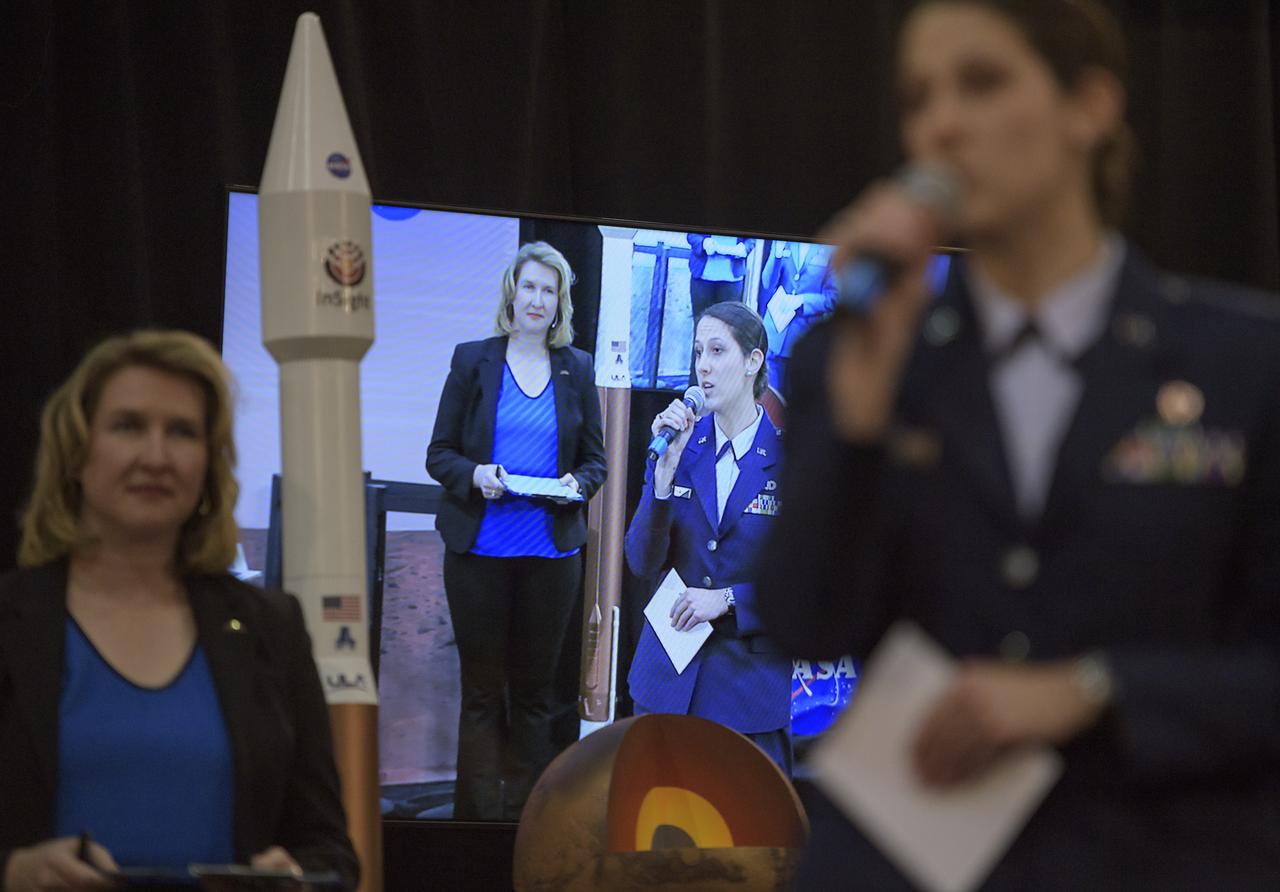
During a prelaunch briefing at Vandenberg Air Force Base in California, Col. Michael Hough, Commander 30th Space Wing (left), and 1st Lt. Kristina Williams, 30th Space Wing Weather Officer (right), speak to members of the media. The presentation focused on NASA's Interior Exploration using Seismic Investigations, Geodesy and Heat Transport, or InSight, Mars lander. InSight is scheduled for liftoff May 5, 2018, atop a United Launch Alliance (ULA) Atlas V rocket from Space Launch Complex 3 at Vandenberg. The spacecraft will be the first mission to look deep beneath the Martian surface studying the planet's interior by measuring its heat output and listen for marsquakes.
InSight Prelaunch Overview
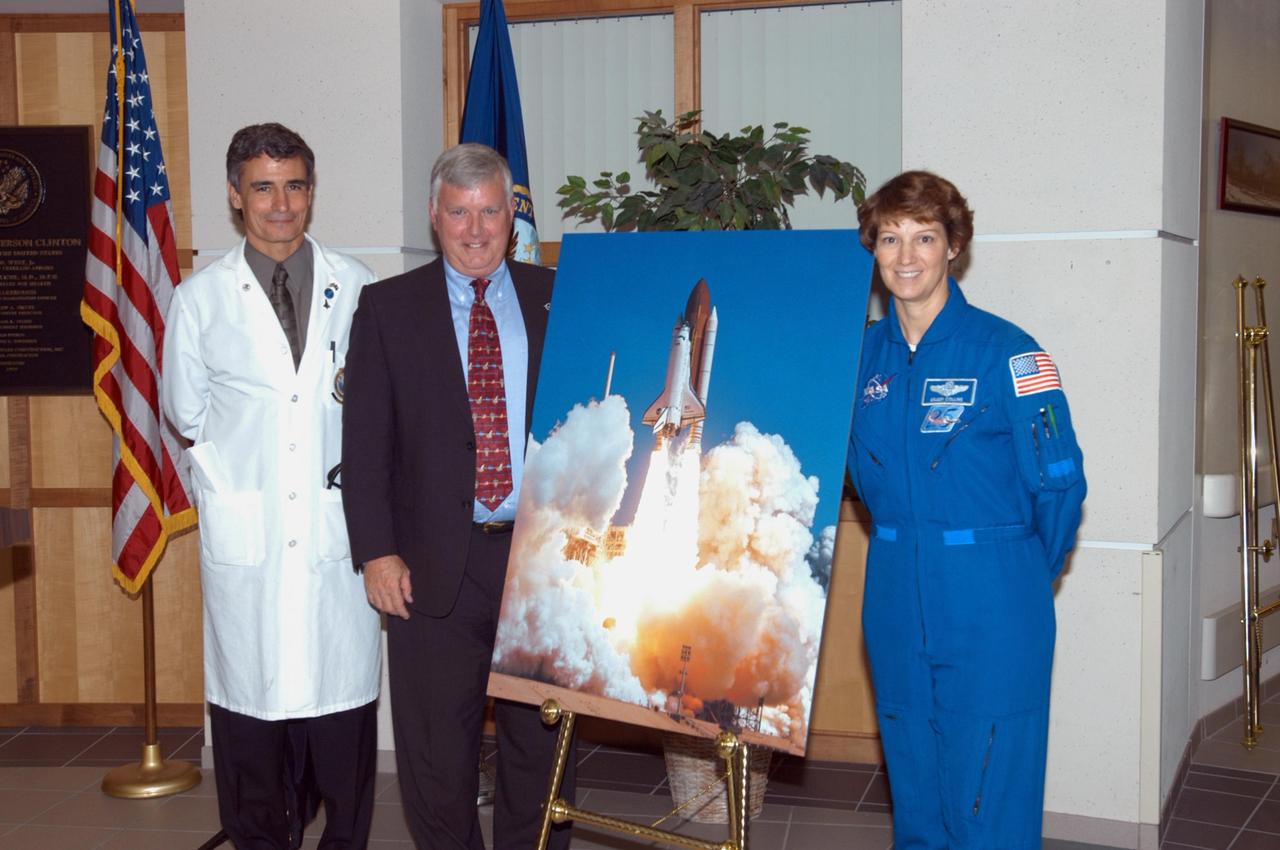
KENNEDY SPACE CENTER, FLA. -   STS-114 Mission Commander Eileen Collins (left) is greeted at the entrance to the V.A. Outpatient Clinic in Viera, Fla., by Dr. Thomas Howard (center), chief medical officer, and Dr. Michael Doukas (right), chief of staff with the Orlando V.A. Medical Center.  Collins is participating in the dedication of a hospital wing in honor of space shuttle Discovery, to be known as the Discovery wing.  Collins and her crew have returned to Florida especially for a celebration in the KSC Visitor Complex of the successful return to flight mission that launched July 26 of this year.
KSC-05pd2377
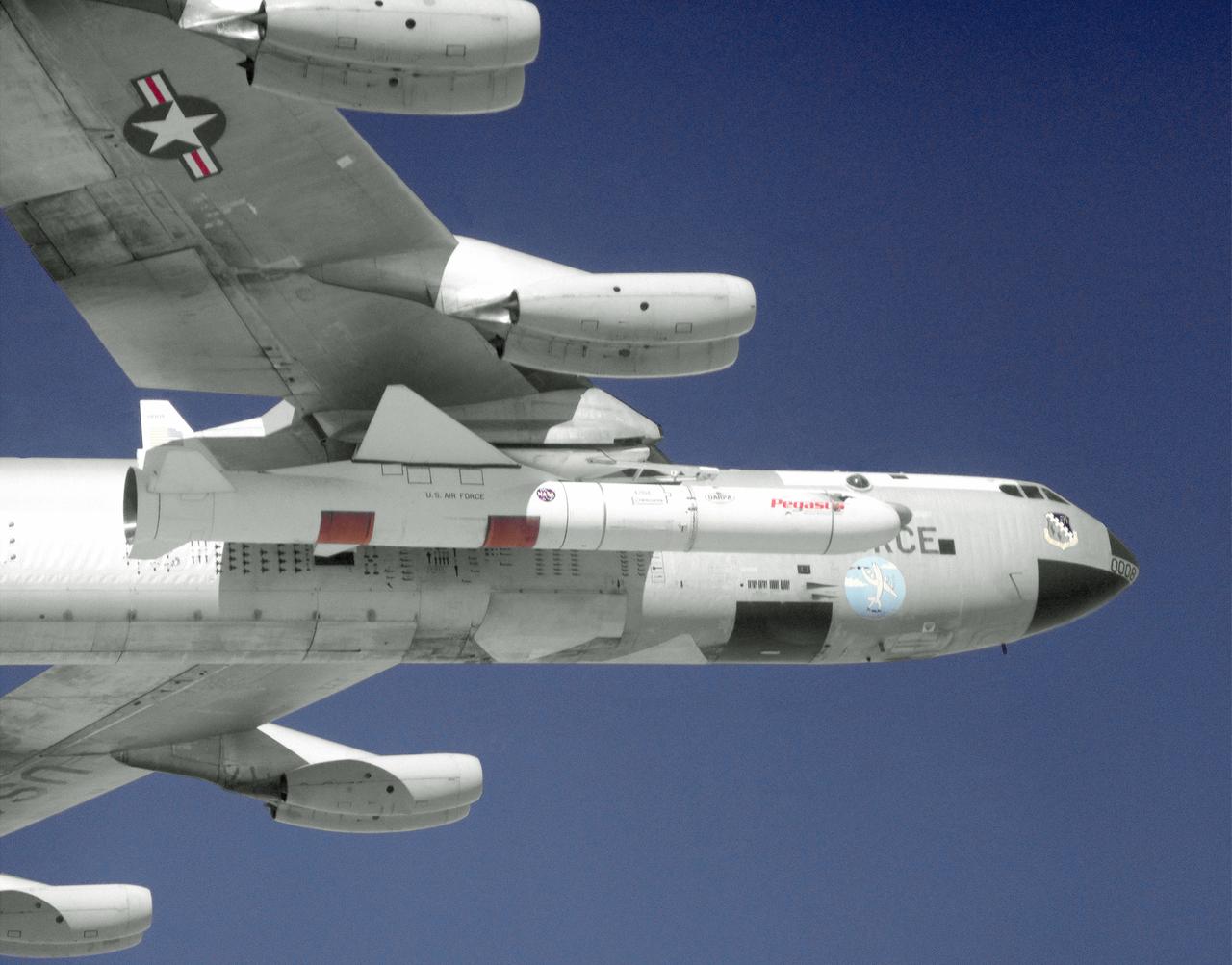
The Pegasus air-launched space booster is carried aloft under the right wing of NASA's B-52 carrier aircraft on its first captive flight from the Dryden Flight Research Center, Edwards, California. The first of two scheduled captive flights was completed on November 9, 1989. Pegasus is used to launch satellites into low-earth orbits cheaply. In 1997, a Pegasus rocket booster was also modified to test a hypersonic experiment (PHYSX). An experimental "glove," installed on a section of its wing, housed hundreds of temperature and pressure sensors that sent hypersonic flight data to ground tracking facilities during the experiment’s flight.
Pegasus Mated to B-52 Mothership - First Flight
KENNEDY SPACE CENTER, FLA. -   At the V.A. Outpatient Clinic in Viera, Fla., Center Director Jim Kennedy (center) and STS-114 Commander Eileen Collins (right) stand next to the space shuttle Discovery launch photo presented to Dr. Thomas Howard (far left) as part of the dedication of a hospital wing in honor of space shuttle Discovery, to be known as the Discovery wing. Howard is chief medical officer of the clinic. Collins and her crew have returned to Florida especially for a celebration in the KSC Visitor Complex of the successful return to flight mission that launched July 26 of this year.
KSC-05pd2382
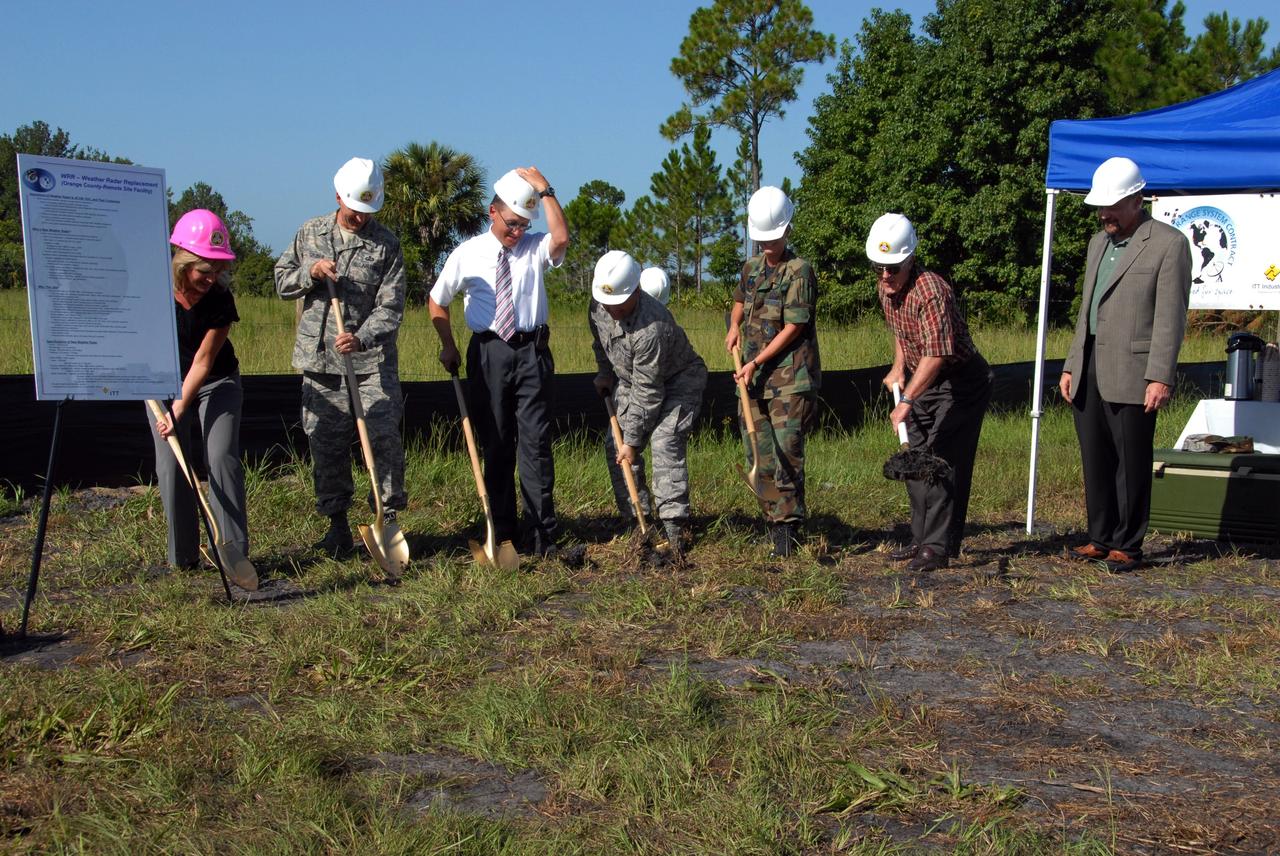
CAPE CANAVERAL, Fla. -   Breaking ground in a mock ceremony for a new weather radar site are (left to right) Project Lead Kim Gwaltney, with SLRSC; 45th Space Wing Operations Group Commander Col. Bernard Gruber;  Range Systems Support Manager Walt Danewood; Lt. Col. Stacy Exum with the 45th Space Wing; Lt. Col. Jennifer Alexander with the 45th Space Wing; Harry Earl with Heard Construction and Pat Carr, SLRSC program director with ITT.  The site will be used by NASA's Kennedy Space Center, the 45th Space Wing and their customers. The weather radar is essential in issuing lightning and other severe weather warnings and vital in evaluating lightning launch commit criteria.  The new radar, replacing what was installed 25 years ago, includes Doppler capability to detect winds and identify the type, size and number of precipitation particles.  The site is ideally distant from the launch pads and has unobstructed views of Cape Canaveral Air Force Station and Kennedy.  Photo credit: NASA/Amanda Diller
KSC-08pd2302
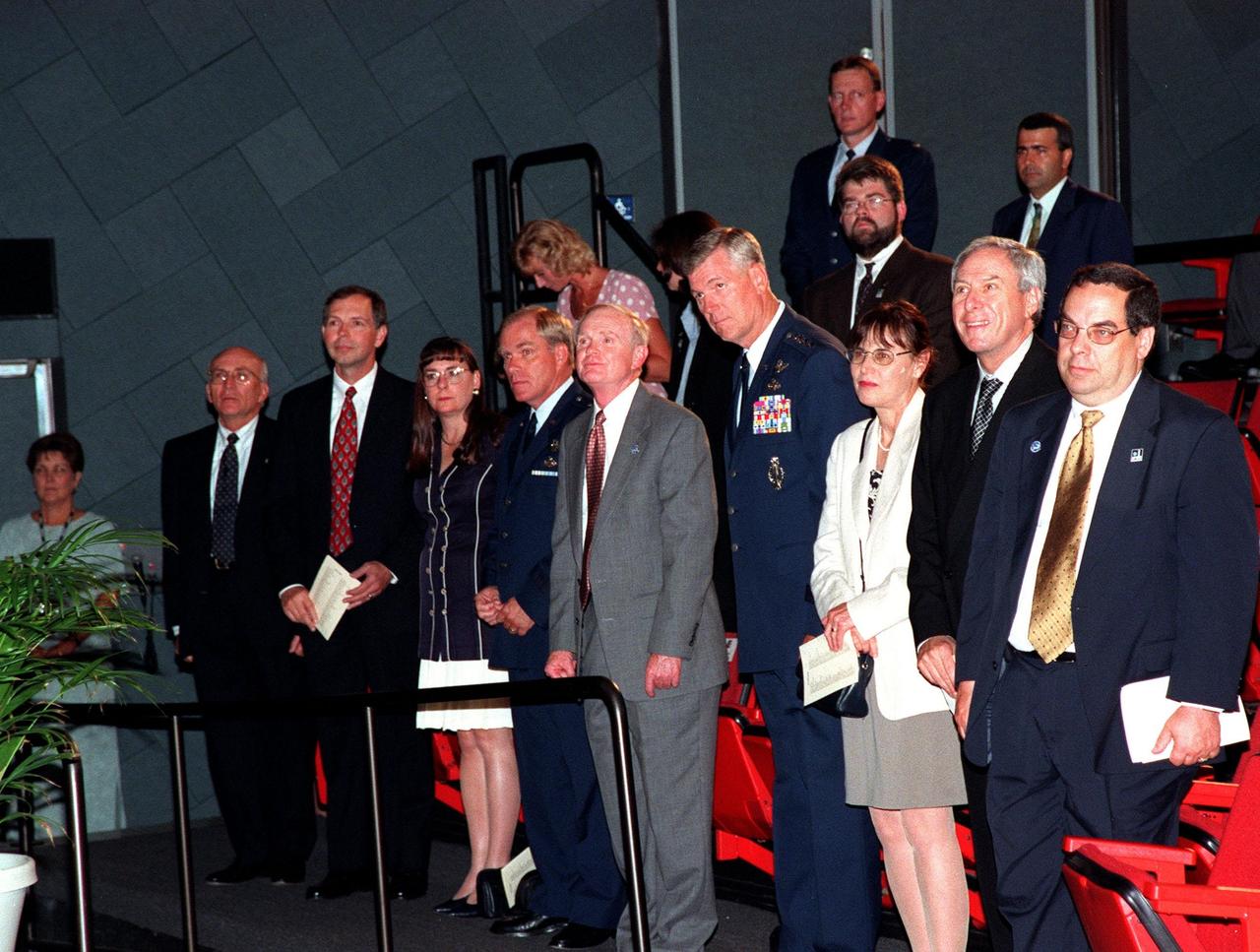
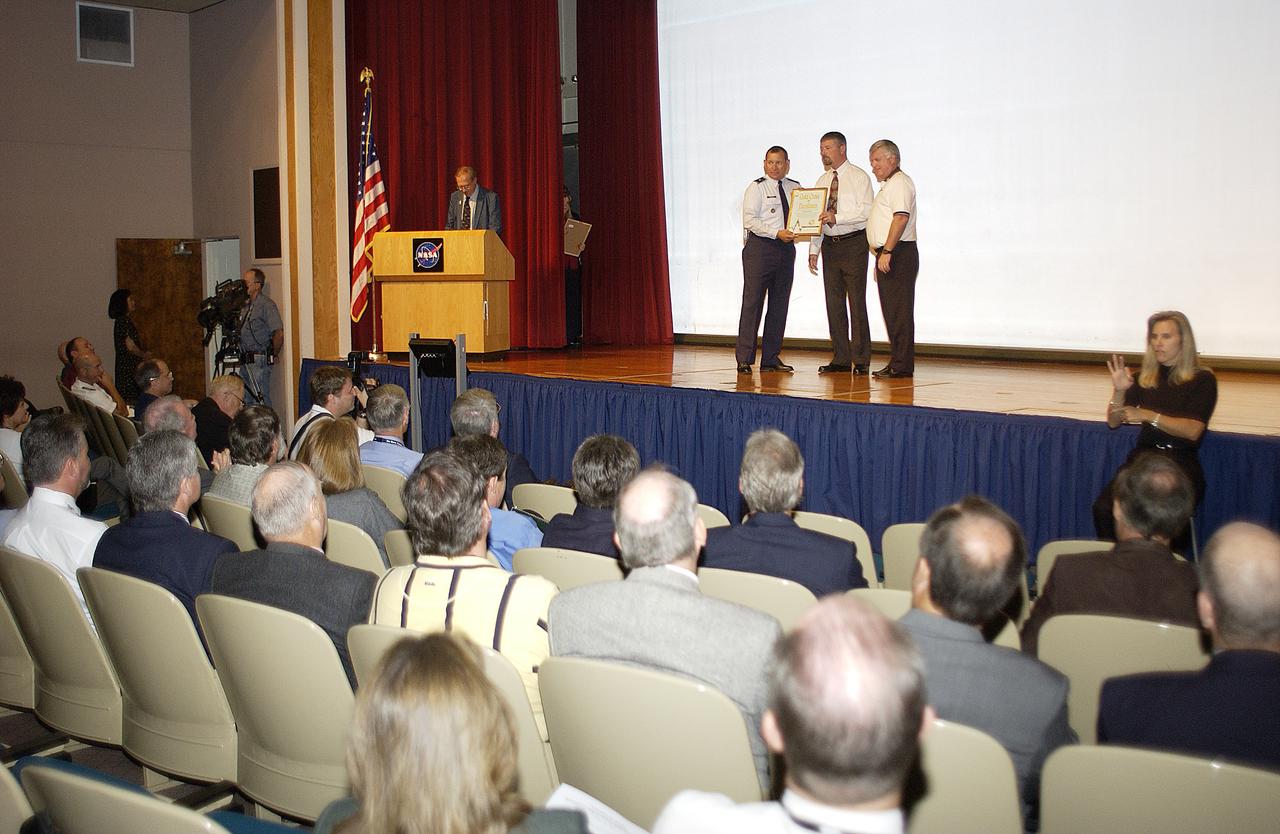
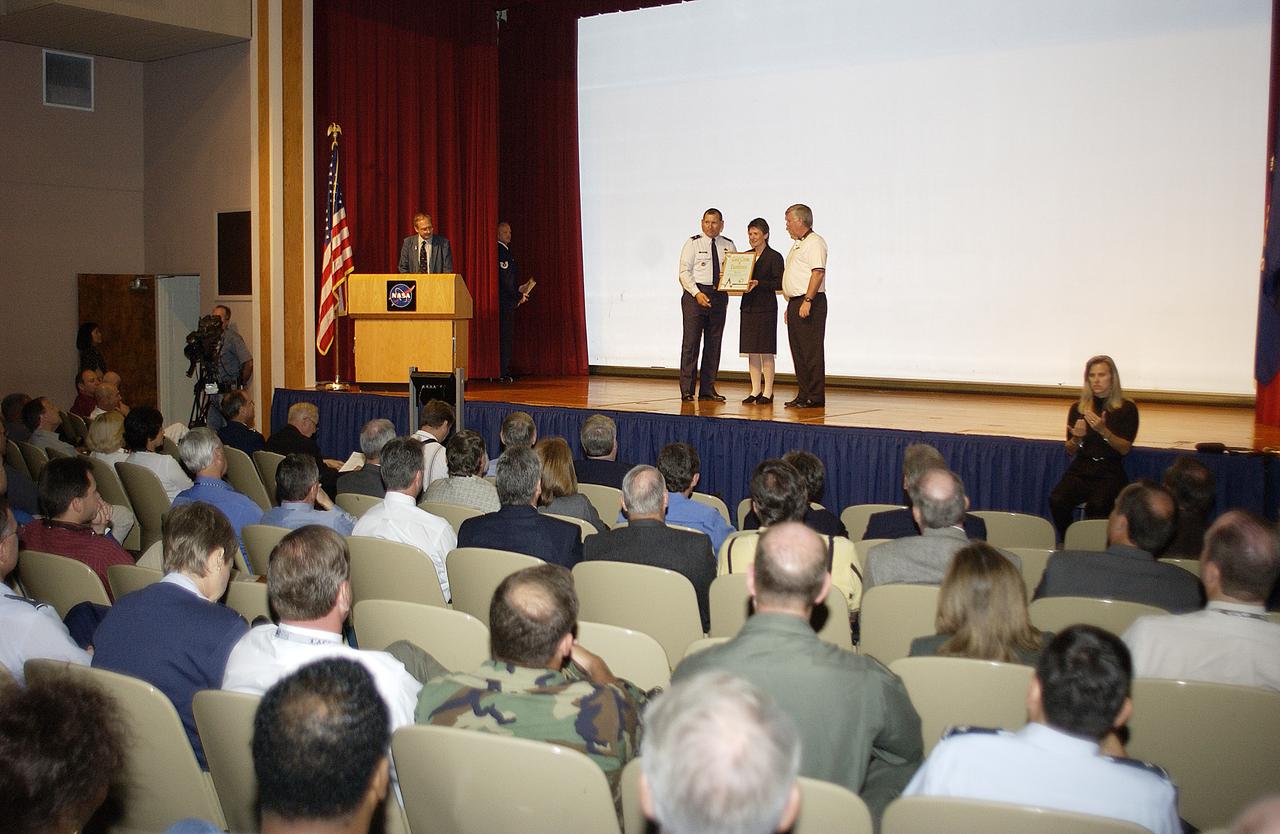
At a special presentation in the IMAX 2 Theater in the Kennedy Space Center Visitor Complex, the Hammer Award is presented to Kennedy Space Center and the 45th Space Wing. Among the attendees in the audience are (center) Center Director Roy D. Bridges Jr., flanked by (at left) Commander of the 45th Space Wing Brig. Gen. F. Randall Starbuck and (at right) Commander of the Air Force Space Command General Richard B. Myers. Standing second from right is NASA Administrator Daniel S. Goldin. At the far right is Morley Winograd, director of the National Partnership for Reinventing Government, who presented the award. The Hammer Award is Vice President Al Gore's special recognition of teams of federal employees who have made significant contributions in support of the principles of the National Partnership for Reinventing Government. This Hammer Award acknowledges the accomplishments of a joint NASA and Air Force team that established the Joint Base Operations and Support Contract (J-BOSC) Source Evaluation Board (SEB). Ed Gormel and Chris Fairey, co-chairs of the SEB, accepted the awards for the SEB. The team developed and implemented the acquisition strategy for establishing a single set of base operations and support service requirements for KSC, Cape Canaveral Air Station and Patrick Air Force Base
KSC-99pp0838
CAPE CANAVERAL, Fla. – Jeremy Schwarz, left, quality assurance technician, and Mike Williams, right, a thermal protection system technician, both with United Space Alliance, apply adhesive to space shuttle Endeavour's right wing. The work is being done in preparation for tile bonding. Endeavour is inside Orbiter Processing Facility-2 at NASA's Kennedy Space Center in Florida.    Ongoing transition and retirement activities are preparing the spacecraft for public display at the California Science Center in Los Angeles. Endeavour flew 25 missions during its 19-year career. Photo credit: NASA/Cory Huston
KSC-2012-1940
In the White Room, STS-97 Mission Specialist Joseph Tanner prepares for entry into Space Shuttle Endeavour with the help of the Closeout Crew, Mike Birkenseher (left), Travis Thompson (right, foreground) and Jack Burritt (right, background). Space Shuttle Endeavour is targeted to launch Nov. 30 at 10:06 p.m. EST for the six construction flight to the International Space Station. Endeavour is transporting the P6 Integrated Truss Structure that comprises Solar Array Wing-3 and the Integrated Electronic Assembly, to provide power to the Space Station. After the 11-day mission, which includes three spacewalks, it is expected to land at KSC Dec. 11 at 6:19 p.m. EST
KSC00pp1821
In the White Room, STS-97 Mission Specialist Joseph Tanner prepares for entry into Space Shuttle Endeavour with the help of the Closeout Crew, Mike Birkenseher (left), Travis Thompson (right, foreground) and Jack Burritt (right, background). Space Shuttle Endeavour is targeted to launch Nov. 30 at 10:06 p.m. EST for the six construction flight to the International Space Station. Endeavour is transporting the P6 Integrated Truss Structure that comprises Solar Array Wing-3 and the Integrated Electronic Assembly, to provide power to the Space Station. After the 11-day mission, which includes three spacewalks, it is expected to land at KSC Dec. 11 at 6:19 p.m. EST
KSC-00pp1821
CAPE CANAVERAL, Fla. – Mike Williams, left, a thermal protection system technician, and Jeremy Schwarz, right, quality assurance technician, both with United Space Alliance, set weights atop a newly installed section of tile on the right wing of space shuttle Endeavour at NASA's Kennedy Space Center in Florida. The weights will hold the section in place while the adhesive hardens beneath.    Ongoing transition and retirement activities are preparing the spacecraft for public display at the California Science Center in Los Angeles. Endeavour flew 25 missions during its 19-year career. Photo credit: NASA/Cory Huston
KSC-2012-1943
CAPE CANAVERAL, Fla. – Jeremy Schwarz, left, quality assurance technician, and Mike Williams, right, a thermal protection system technician, both with United Space Alliance, prepare the right wing of space shuttle Endeavour for tile bonding. Endeavour is inside Orbiter Processing Facility-2 at NASA's Kennedy Space Center in Florida.    Ongoing transition and retirement activities are preparing the spacecraft for public display at the California Science Center in Los Angeles. Endeavour flew 25 missions during its 19-year career. Photo credit: NASA/Cory Huston
KSC-2012-1938
CAPE CANAVERAL, Fla. – Mike Williams, a thermal protection system technician with United Space Alliance, arranges weights atop a freshly installed section of tile on the right wing of space shuttle Endeavour at NASA's Kennedy Space Center in Florida. The weights will hold the section in place while the adhesive hardens beneath.    Ongoing transition and retirement activities are preparing the spacecraft for public display at the California Science Center in Los Angeles. Endeavour flew 25 missions during its 19-year career. Photo credit: NASA/Cory Huston
KSC-2012-1944
Taking part in the First Florida Space Summit on the future of space as it relates to the State of Florida are (left to right) Lt. Governor Frank Brogan, 45th Space Wing Commander Brig. Gen. Donald Pettit, and Center Director Roy Bridges, who moderated the discussion. The event, held at the Kennedy Space Center Visitor Complex, also included Senator Bob Graham, Senator Connie Mack, State Senator Patsy Kurth, Representative Dave Weldon, and heads of aerospace companies
KSC00pp0063
Participants in the First Florida Space Summit take part in a discussion on the future of space as it relates to the State of Florida. The discussion, held at the Kennedy Space Center Visitor Complex, was moderated by Center Director Roy Bridges. Seated (left to right) are Representative Jim Davis, Secretary of Transportation Tom Barry and Rick Stephens, who represented The Boeing Company. The event also included Senator Bob Graham, Senator Connie Mack, Representative Dave Weldon, 45th Space Wing Commander Brig. Gen. Donald Pettit and heads of aerospace companies
KSC00pp0060
Brig. Gen. J. Gregory Pavlovich (left), 45th Space Wing, and Center Director Jim Kennedy (right) present one of several individual safety awards given on Spaceport Super Safety and Health Day.  An annual event at KSC and Cape Canaveral Air Force Station,  Spaceport Super Safety and Health Day is dedicated to reinforcing safe and healthful behaviors in the workforce.
Spaceport Super Safety and Health Day
KENNEDY SPACE CENTER, FLA. -- Participants in the First Florida Space Summit take part in a discussion on the future of space as it relates to the State of Florida.  The discussion was moderated by Center Director Roy Bridges.  Seated (left to right) are Rick Stephens, The Boeing Company; State Senator Patsy Kurth; David Rossi, SPACEHAB; The event also included Senator Bob Graham, Senator Connie Mack, Representative Dave Weldon, 45th Space Wing Commander Brig. Gen. Donald Pettit, and heads of aerospace companies.
KSC00pp0061
KENNEDY SPACE CENTER, FLA. - After a ribbon cutting at the formal opening of a Customer Service office at the Cape Canaveral Spaceport, Center Director Roy Bridges (left) offers a few comments.  With him are Brig. Gen. Donald P. Pettit (center)l, commander of the 45th Space Wing, and Executive Director of the Cape Canaveral Spaceport Management Office Ed Gormel (right)
KSC-02pd-0042
1st Lieutenant Kristina Williams, weather officer, 30th Space Wing, Vandenberg Air Force Base, right, discusses NASA's InSight mission during a prelaunch media briefing, Thursday, May 3, 2018, at Vandenberg Air Force Base in California. InSight, short for Interior Exploration using Seismic Investigations, Geodesy and Heat Transport, is a Mars lander designed to study the "inner space" of Mars: its crust, mantle, and core. Photo Credit: (NASA/Bill Ingalls)
InSight Prelaunch Briefing
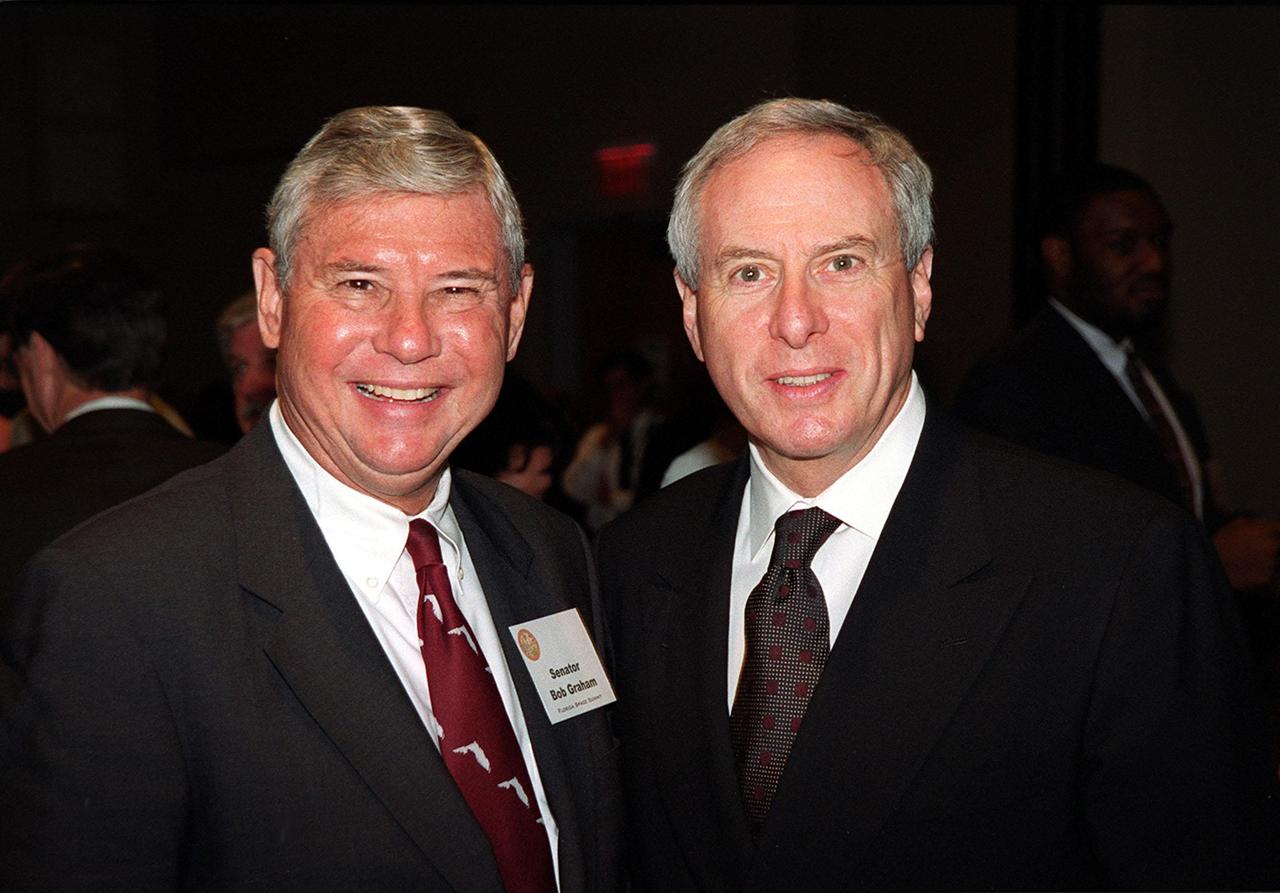
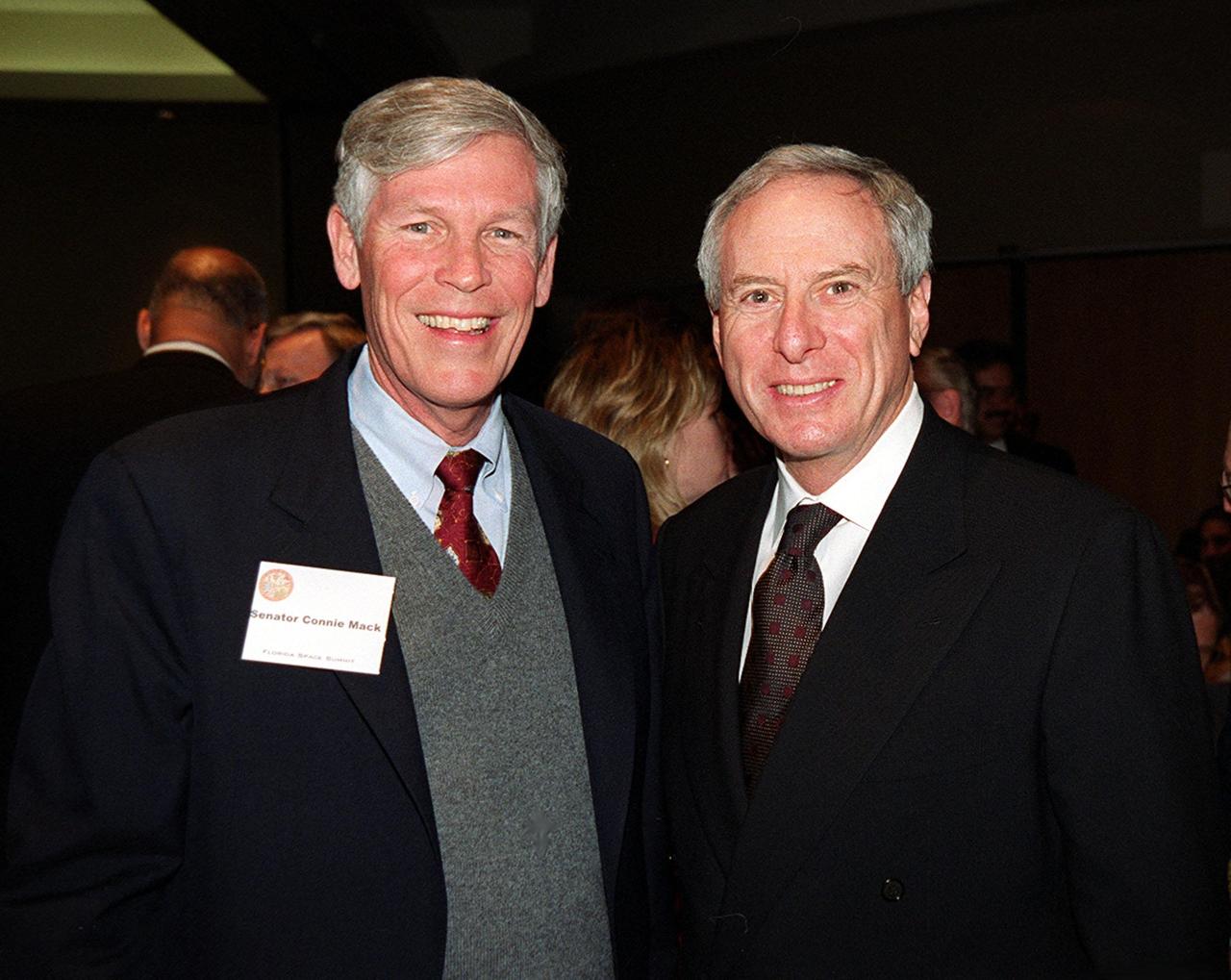
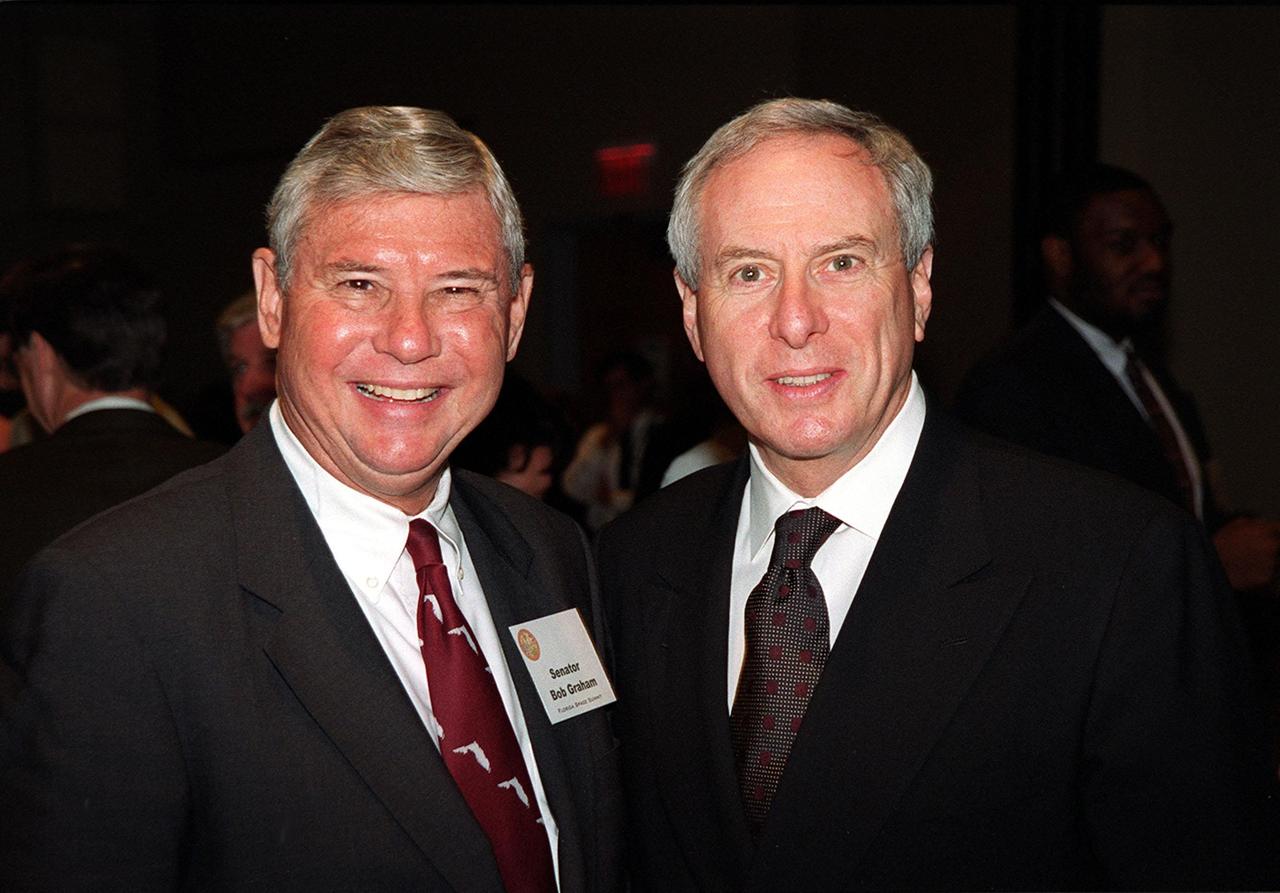
Senator Bob Graham (left), Center Director Roy Bridges (center) and Senator Connie Mack (right) take a break during the First Florida Space Summit, held at the Kennedy Space Center Visitor Complex. The summit featured key state officials and aerospace companies discussing the future of space as it relates to the State of Florida. Moderated by Bridges, the event also included State Senator Patsy Kurth, Representative Dave Weldon, and 45th Space Wing Commander Brig. Gen. Donald Pettit
KSC-00pp0064
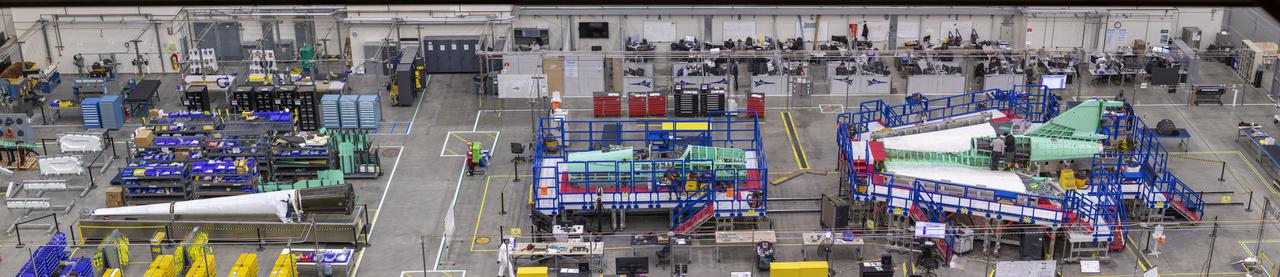
This overhead shot of the X-59 Quiet SuperSonic Technology or QueSST aircraft shows the assembly progress of the vehicle during Spring 2021.  Pictured here you can see the nose (far left) which will later be mounted to the middle section in the photo known as the fuselage and the last section is the wing and tail in the far right of the photo.  Lockheed Martin Photography By Garry Tice 1011 Lockheed Way, Palmdale, Ca. 93599 Event: Manufacture Area From Above Date: 3/30/2021
Manufacture Area From Above
Senator Bob Graham (left) and NASA Administrator Dan Goldin (right) are two of the participants in the First Florida Space Summit, held at the Kennedy Space Center Visitor Complex. The event, featuring a discussion on the future of space as it relates to the State of Florida and moderated by Center Director Roy Bridges, included other participants such as Senator Connie Mack, Rep. Dave Weldon, 45th Space Wing Commander Brig. Gen. Donald Pettit and heads of aerospace companies
KSC00pp0057
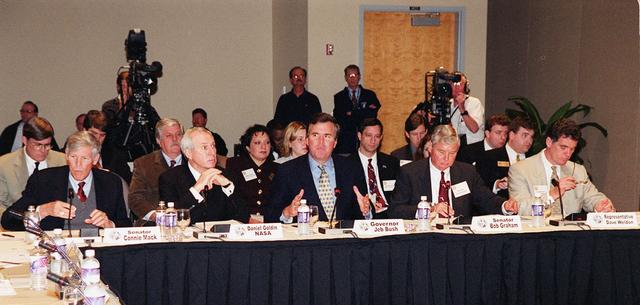
Participants in the First Florida Space Summit take part in a discussion on the future of space as it relates to the State of Florida. Held at the Kennedy Space Center Visitor Complex, the discussion was moderated by Center Director Roy Bridges. Seated (left to right) are Senator Connie Mack, NASA Administrator, Governor Jeb Bush, Senator Bob Graham and Representative Dave Weldon. The event also included 45th Space Wing Commander Brig. Gen. Donald Pettit and heads of aerospace companies
KSC00pp0059
Dave King (far right), director of Shuttle Processing , explains part of the launch process to (from left) Dave Rainer; Brig. Gen. Donald Pettit, Commander of the 45th Space Wing, Cape Canaveral; Roy Bridges, KSC’s Center Director; and Gen. Ralph Everhart, Commander, Space Command , who are touring the Vehicle Assembly Building
KSC01pp0382
KENNEDY SPACE CENTER, FLA. --   In Orbiter Processing Facility bay 2, technicians Jesus Rodrigues (left) and James Johnson install a leading edge subsystem carrier panel on the right wing of Endeavour.  The orbiter is scheduled for mission STS-118, targeted for launch on June 28.  The mission will be the 22nd flight to the International Space Station, carrying another starboard array, S5, for installation.  Photo credit: NASA/George Shelton
KSC-07pd0136
STS103-301-016 (19 - 27 December 1999)---From Discovery's altitude of 330 nautical miles, nearly all of Florida and the coast of the Gulf of Mexico as far west as New Orleans are visible in this image.  Parts of the   shuttle's structure are visible at the bottom of the image, including the right wing, one of the orbital maneuvering system (OMS) pods, and the vertical stabilizer.
Earth observations taken during the STS-103 mission
S135-E-007744 (14 July 2011) --- One of the STS-135 Atlantis crewmembers took this photo of the Southern Lights or Aurora Australis while visiting the International Space Station on July 14, 2011. Part of the orbiter boom sensor system (OBSS) is seen, as it was attached on the end of the shuttle's robotic arm (out of frame). A part of the port side wing of the shuttle is at right. Photo credit: NASA
Earth Observations taken by the STS-135 Crew
STS-122 Mission Specialist Leland Melvin, right, talks with members of the space shuttle close out crew underneath the wing of the space shuttle Atlantis.  Atlantis landed at the Shuttle Landing Facility, 9:07a.m., Wednesday, Feb. 20, 2008 at Kennedy Space Center, Fla. completing delivery of the European Space Agency’s (ESA) Columbus laboratory to the International Space Station. Photo Credit: (NASA/Bill Ingalls)
200802200004HQ Space Shuttle Atlantis (STS-122) Lands
Incoming KSC Director James W. Kennedy (left) and departing KSC Director Roy D. Bridges Jr. (center) view the new sign on the NASA Causeway naming the bridge for Bridges who is leaving KSC to become the director of NASA's Langley Research Center, Hampton, Va. At right is the 45th Space Wing Commander Brig. Gen. J. Gregory Pavlovich. The bridge spans the Banana River on the NASA Causeway and connects Kennedy Space Center and Cape Canaveral Air Force Station.
Roy D. Bridges Bridge
ISS040-E-103327 (20 Aug. 2014) --- In the grasp of the Japanese robotic arm, the CubeSat deployer (upper right) is about to release a pair of NanoRacks CubeSat miniature satellites. The Planet Labs Dove satellites that were carried to the International Space Station aboard the Orbital Sciences Cygnus commercial cargo craft are being deployed between Aug. 19 and Aug. 25.  A section of the station solar array wings is at center. A blue and white part of Earth and the blackness of space provide the backdrop for the scene.
Nanoracks CUBESAT launcher operations
This rear view of the right wing load hardware shows the setup for testing a F/A-18E from the Naval Air Systems Command (NAVAIR) in Patuxent River, Maryland. The aircraft is in NASA's Armstrong Flight Research Center Flight Loads Laboratory in Edwards, California, for the center's biggest load calibrations tests. This testing is needed before the aircraft can serve as a test vehicle for determining if it can safely manage maneuvers and proposed upgrades.
NAVAIR F/A-18E Undergoes Loads Testing at NASA Armstrong
KENNEDY SPACE CENTER, FLA. -- In the Orbiter Processing Facility, technicians Mike McCall (left) and Jake Jacobson install a reinforced carbon carbon panel on the right wing of Space Shuttle Discovery. The next flight planned for Discovery is the STS-114 mission on Logistics Flight 1 to deliver supplies and equipment, as well as the external stowage platform, to the International Space Station. STS-114 will be the mission that returns the Space Shuttle to flight status and is scheduled for no earlier than March 2005.
KSC-04pd1129
Participants in the First Florida Space Summit take part in a discussion on the future of space as it relates to the State of Florida. The discussion, held at the Kennedy Space Center Visitor Complex, was moderated by Center Director Roy Bridges. Seated (left to right) are Representative Jim Davis, Secretary of Transportation Tom Barry and Rick Stephens, who represented The Boeing Company. The event also included Senator Bob Graham, Senator Connie Mack, Representative Dave Weldon, 45th Space Wing Commander Brig. Gen. Donald Pettit and heads of aerospace companies
KSC-00pp0060
Senator Connie Mack (left) NASA Administrator Dan Goldin (right) are two of the participants in the First Florida Space Summit, held at the Kennedy Space Center Visitor Complex. The event, featuring a discussion on the future of space as it relates to the State of Florida and moderated by Center Director Roy Bridges, included other participants such as Senator Bob Graham, Rep. Dave Weldon, 45th Space Wing Commander Brig. Gen. Donald Pettit and heads of aerospace companies
KSC-00pp0058
KENNEDY SPACE CENTER, FLA. - In the RLV Hangar, Shuttle Test Director Steve Altemus (right), a member of the Columbia Reconstruction Project Team, explains the fixture which holds the leading edge panels recovered from the left wing of Space Shuttle Columbia to NASA Administrator Sean O'Keefe (left). To date, more than 70,000 items have been delivered to KSC for use in the ongoing mishap investigation.
KSC-03pd1306