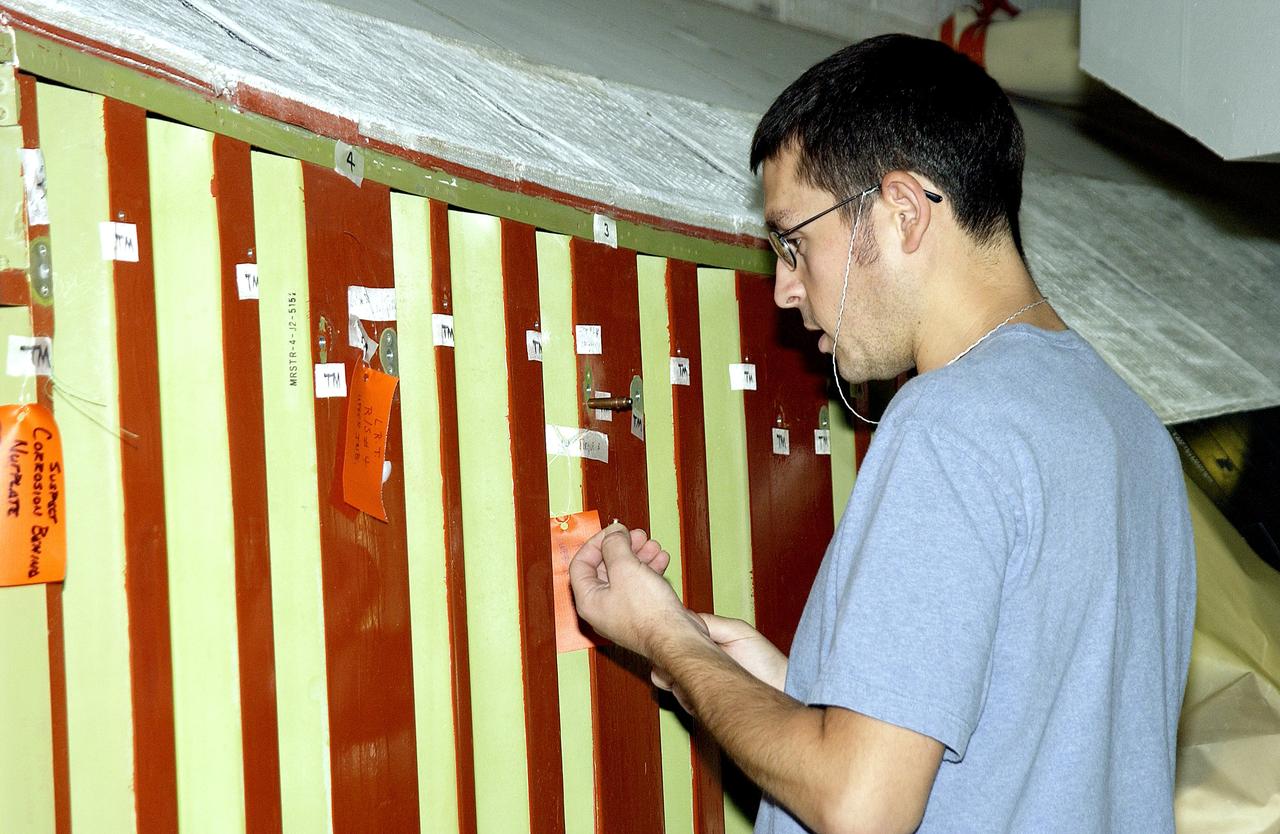
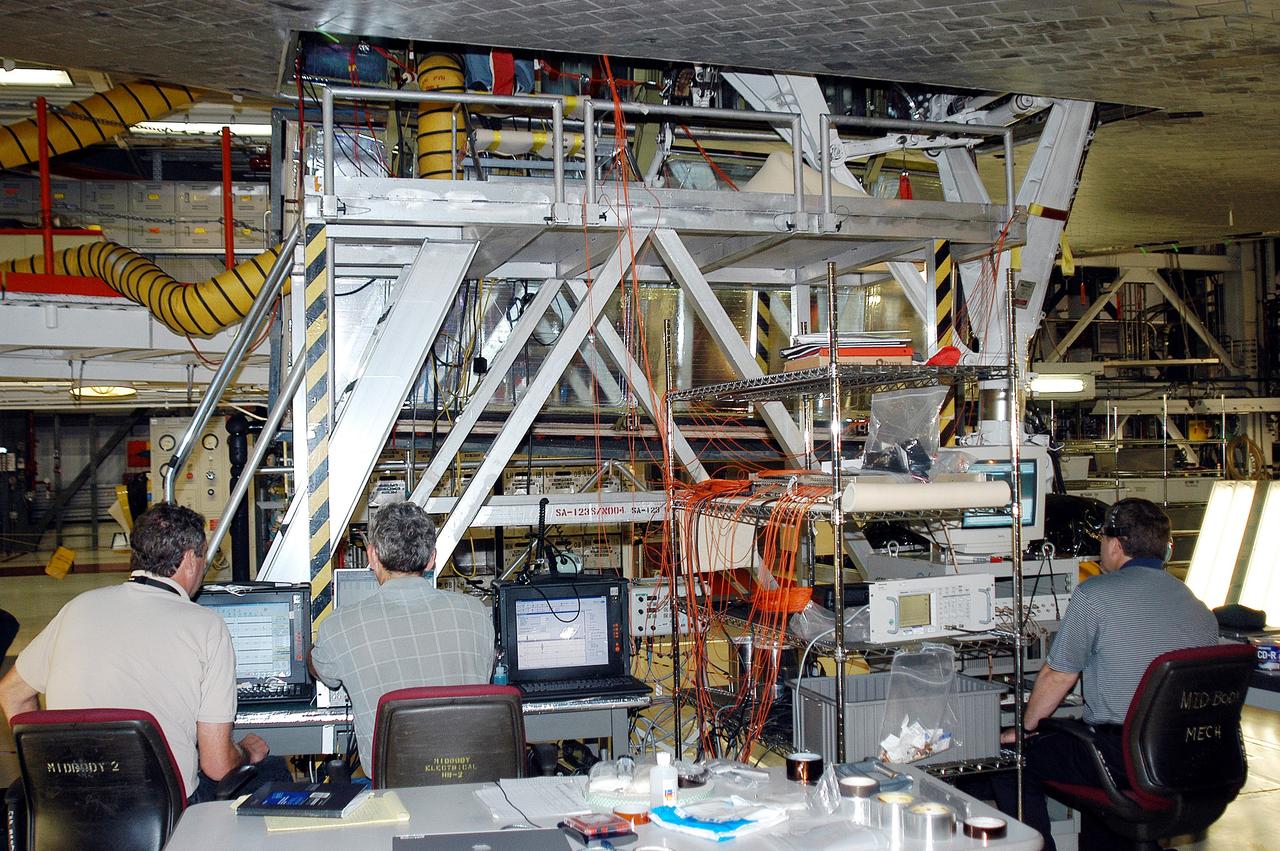
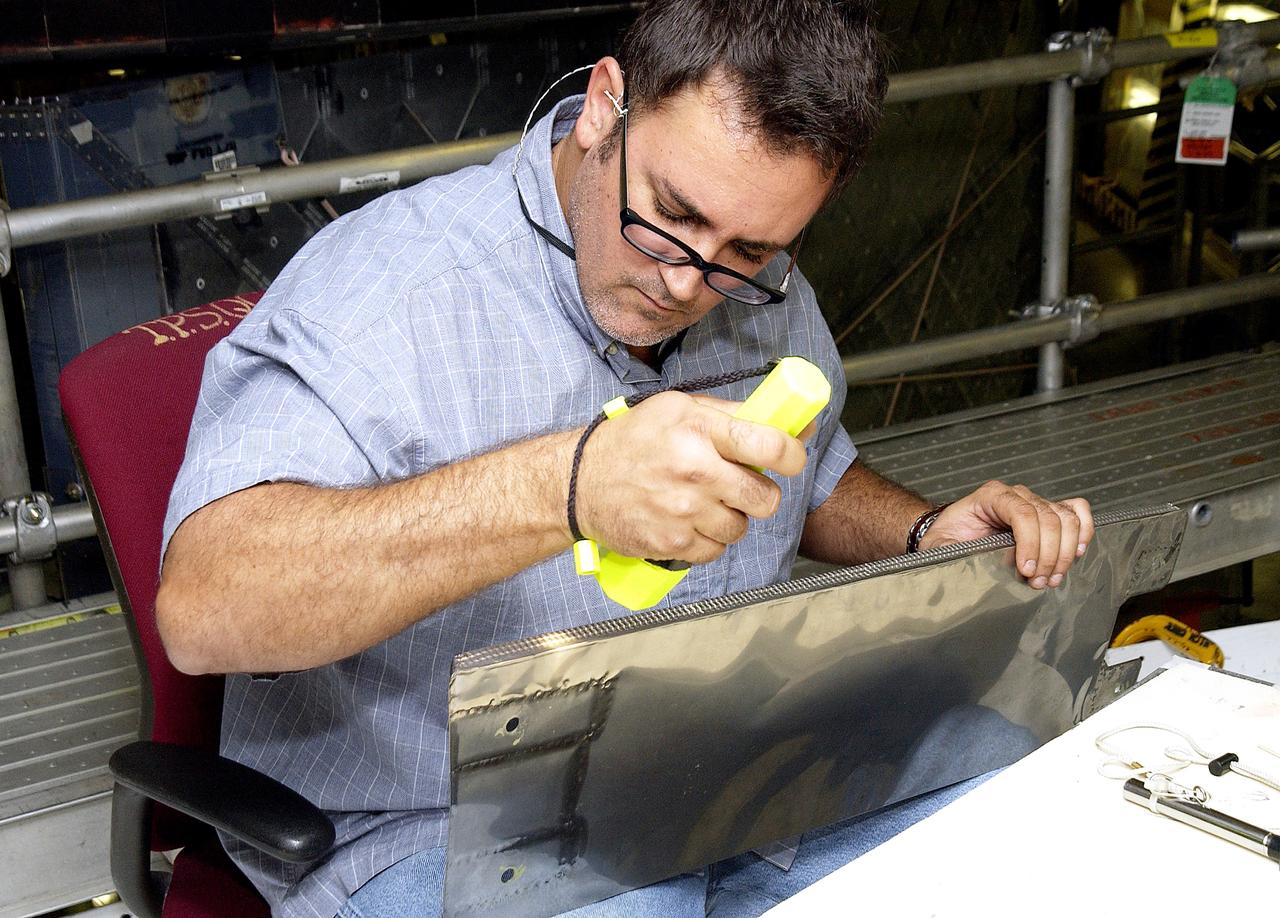
Return to Flight ( RTF ) flow line Air Test
GRC-2004-C-01042
ASTRONAUT STEVE ROBINSON  & @ COMUMBIA IN N-258 W/RTF (Return to Flight) TEAMS Arc Jet Facilities with Frank Hue and other personnel.
ARC-2005-ACD05-0191-034
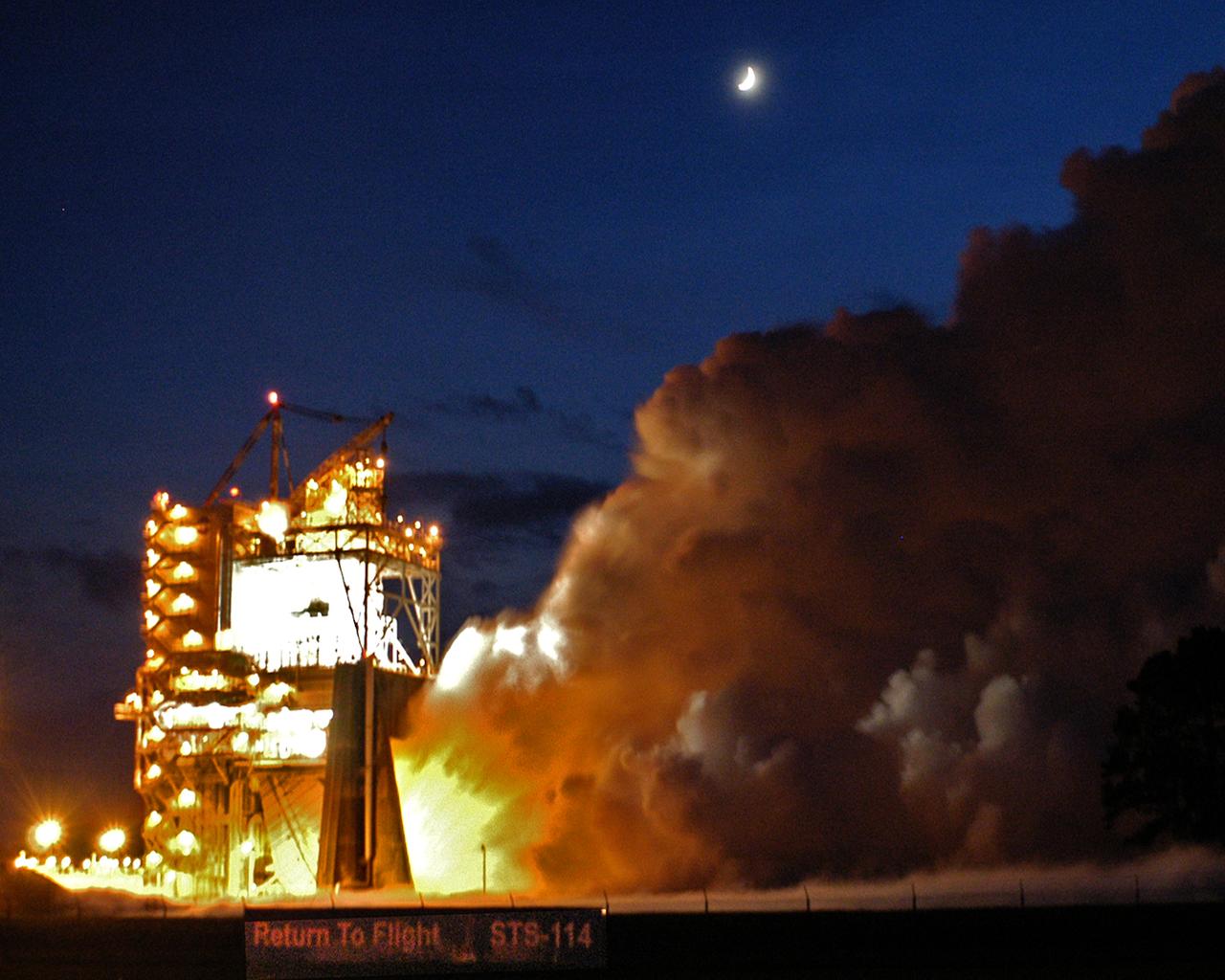
The Space Shuttle's Main Engine (SSME) reached another milestone Aug. 19, 2004, when a successful flight acceptance test was conducted at NASA Stennis Space Center (SSC). The engine tested was the final of three engines that will carry the next Space Shuttle into orbit. The engine will be shipped to NASA Kennedy Space Center in Florida for installation on Space Shuttle Discovery for STS-114, NASA's Return to Flight mission. The engine test, which began about 8:10 p.m. CDT, ran for 520 seconds (8 minutes), the length of time it takes for the Space Shuttle to reach orbit.
Final RTF SSME test at A2 test stand
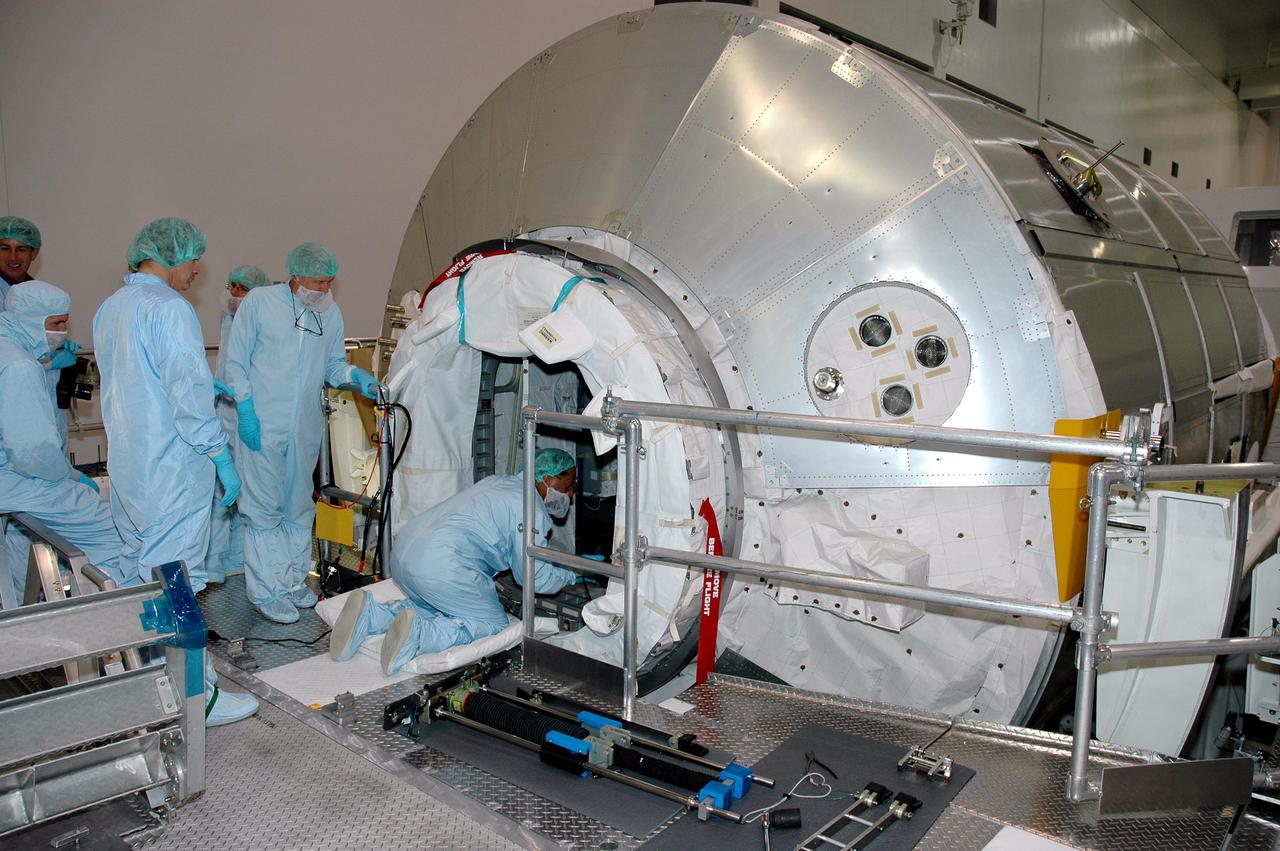
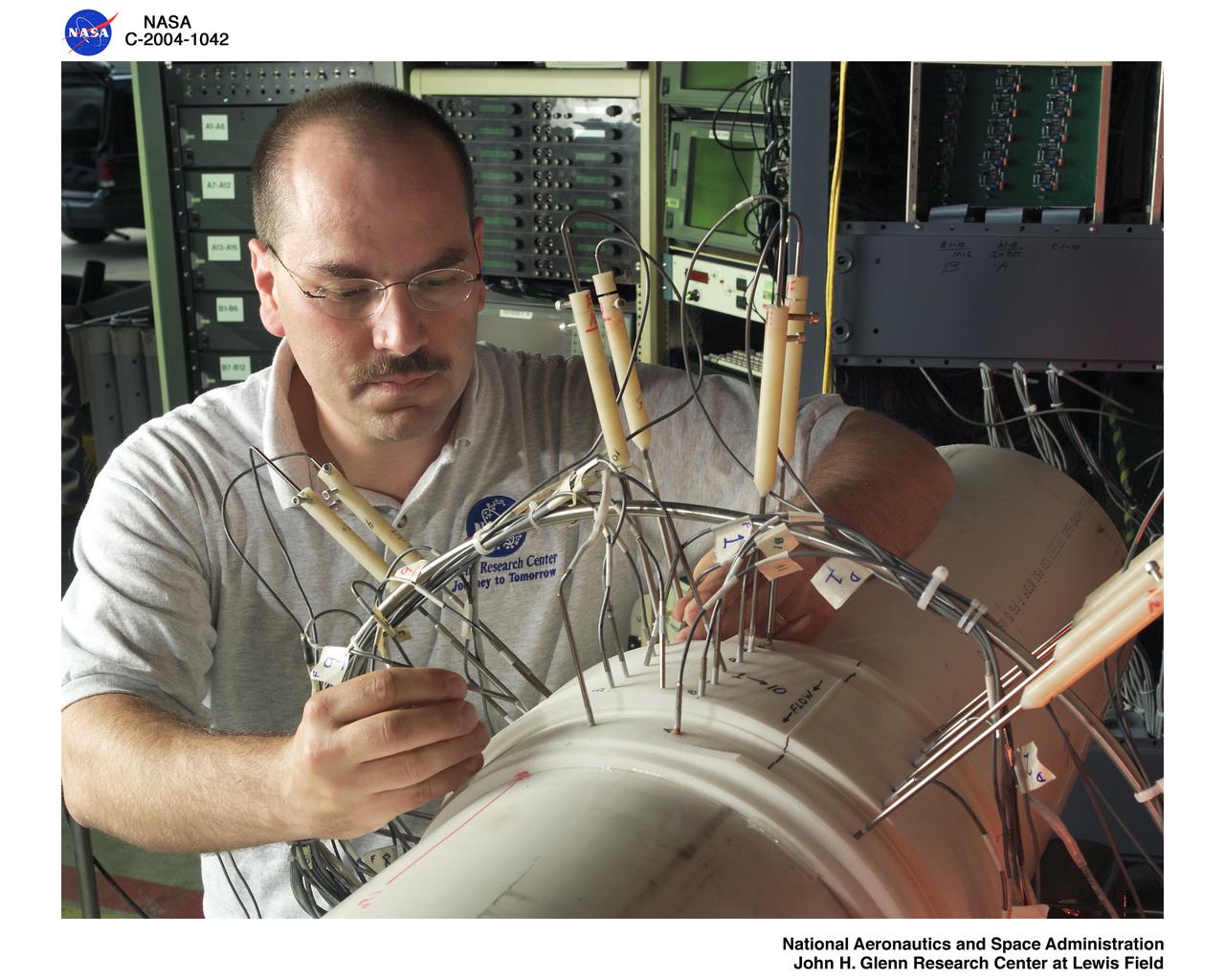
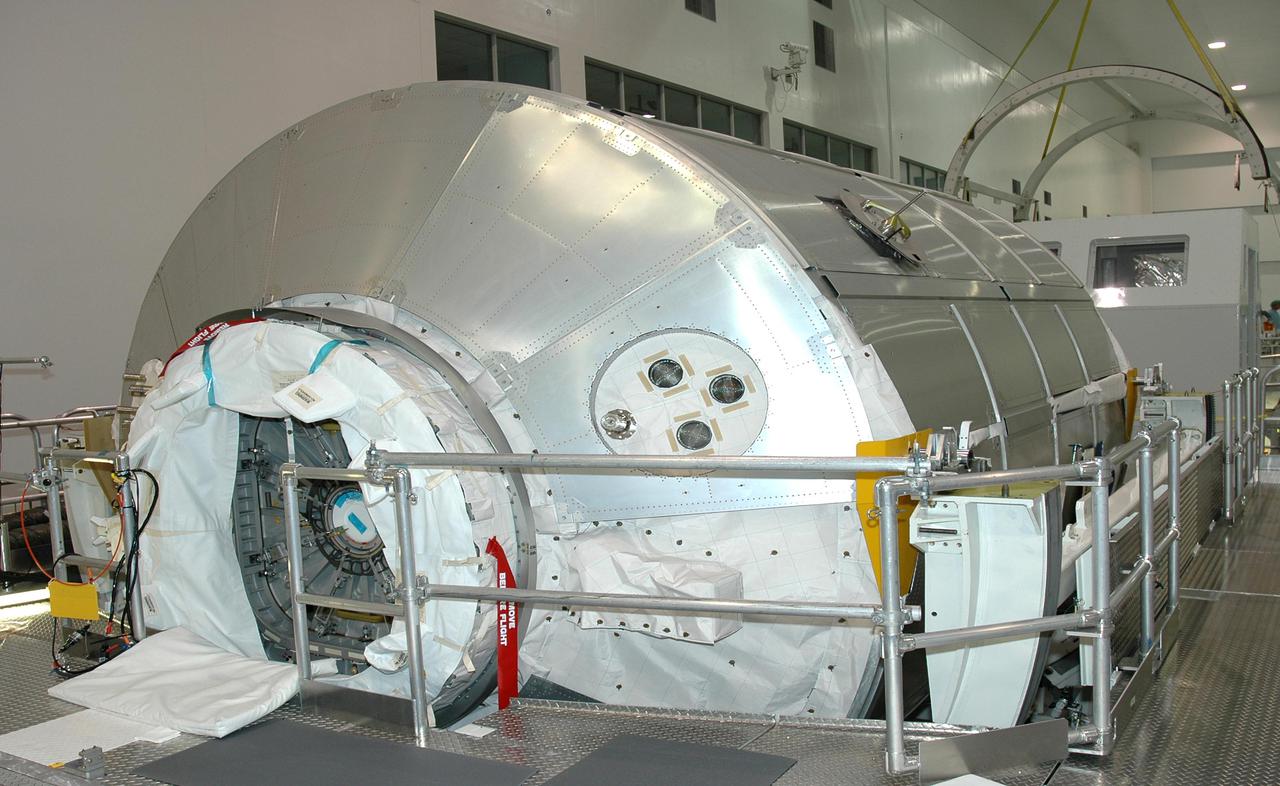
KENNEDY SPACE CENTER, FLA. -- In the Space Station Processing Facility,  Italian-built Multi-Purpose Logistics Module Raffaello is closed and ready for transfer to a payload canister and trip to Launch Complex 39B for transfer to Space Shuttle Discovery.  The module will travel to the International Space Station aboard Space Shuttle Discovery’s Return to Flight mission STS-114.  Raffaello carries 12 racks of cargo, including food, clothing, spare parts and research equipment, to the Station.  Shuttle Discovery is targeted for launch in a window extending May 15 through June 3.
KSC-05pd-0715
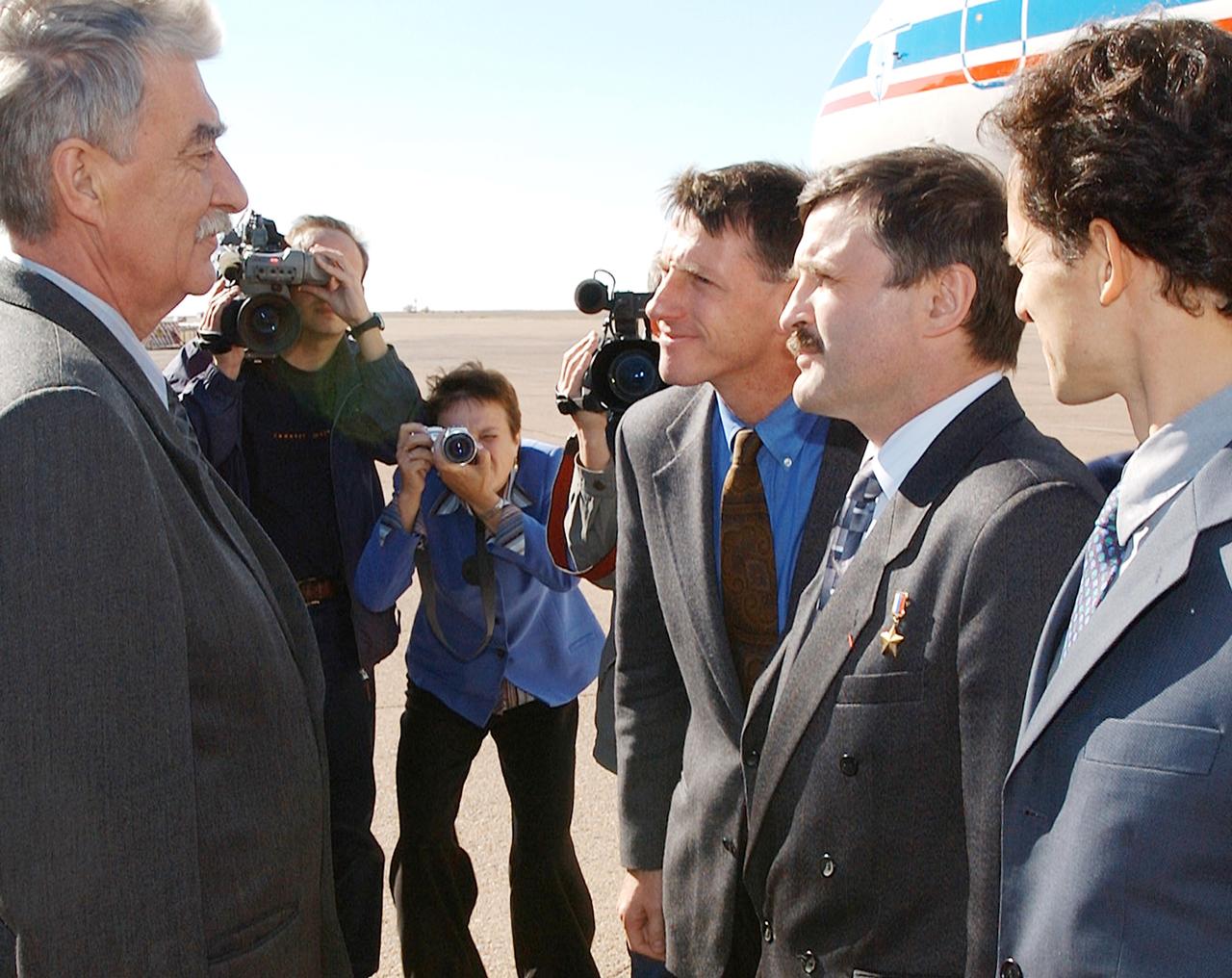
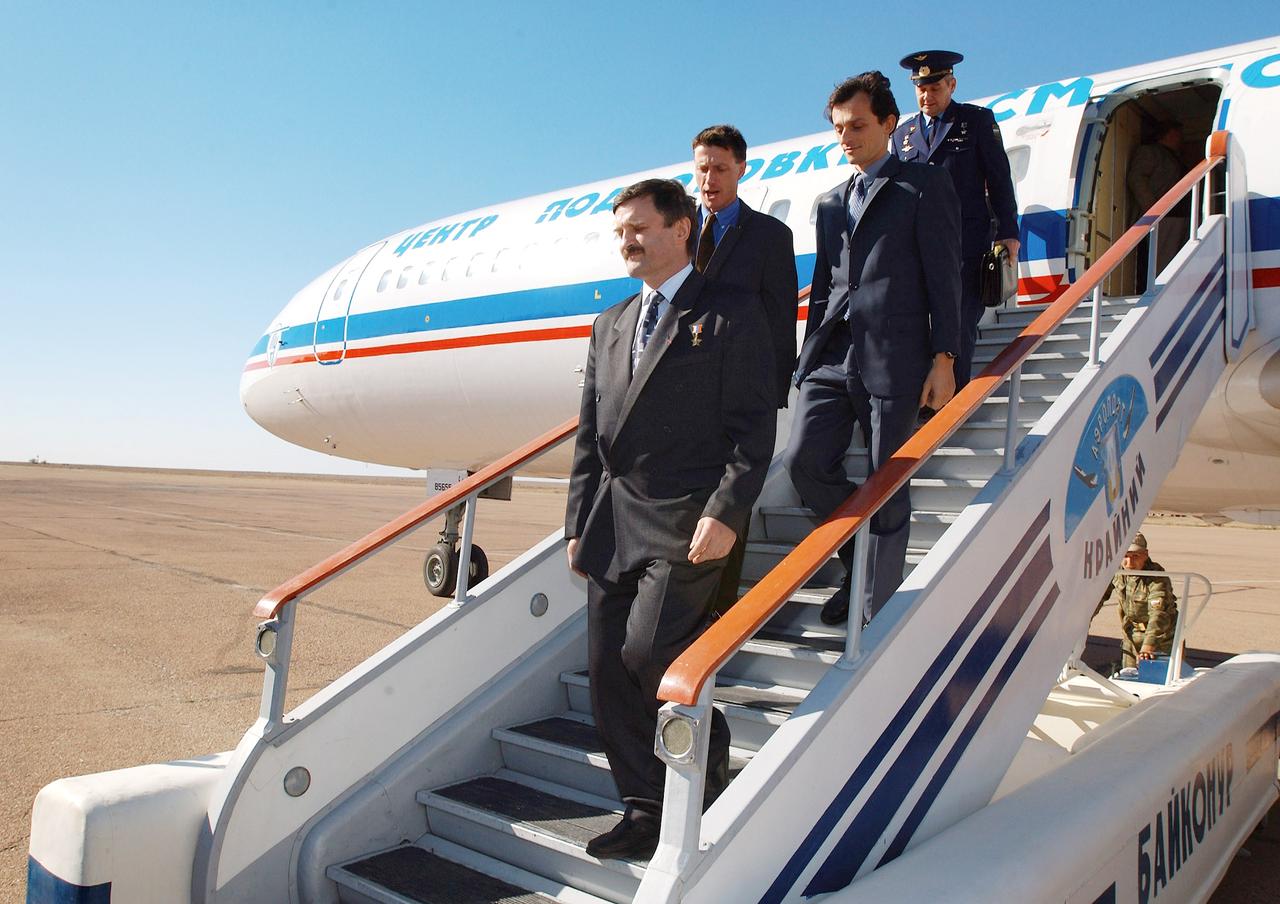
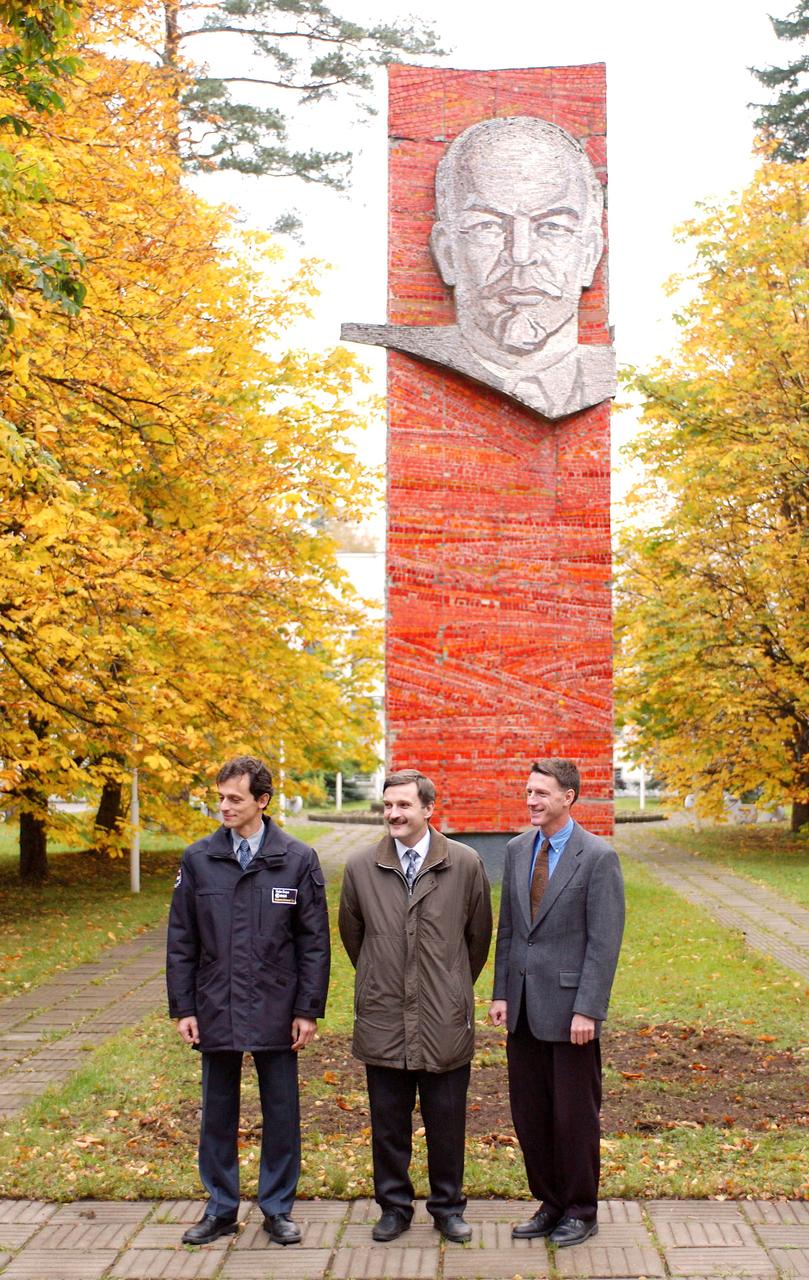
Baikonur, Kazakhstan -  (Left to right) Expedition 8 Soyuz Commander and Flight Engineer Alexander Kaleri, Expedition 8 Commander Michael Foale, European Space Agency Astronaut Pedro Duque of Spain and Valery Korzun, chief of Cosmonauts, arrive in Baikonur.  Expedition 8 is scheduled to launch from the Baikonur Cosmodrome in Kazakhstan on Oct. 18 on board a Soyuz rocket to the International Space Station.  Photo Credit: "NASA/Bill Ingalls"
KSC-03pd2793
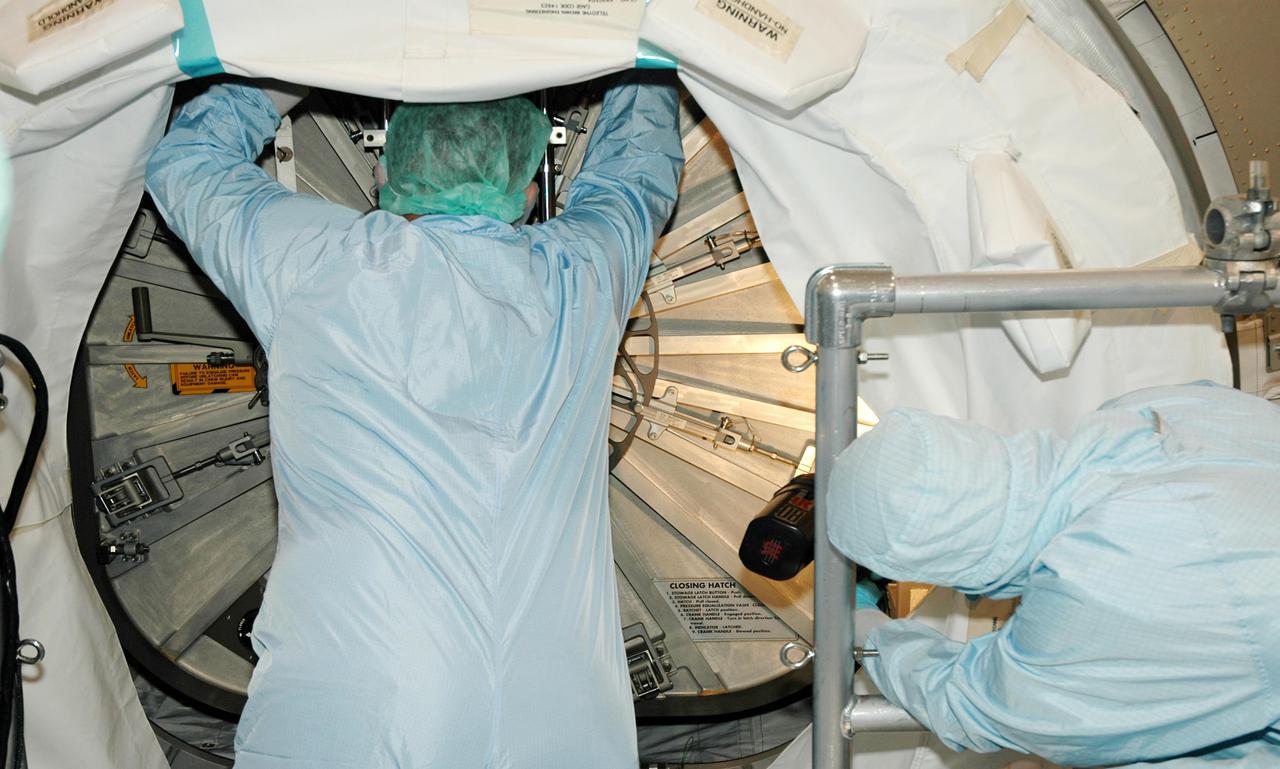
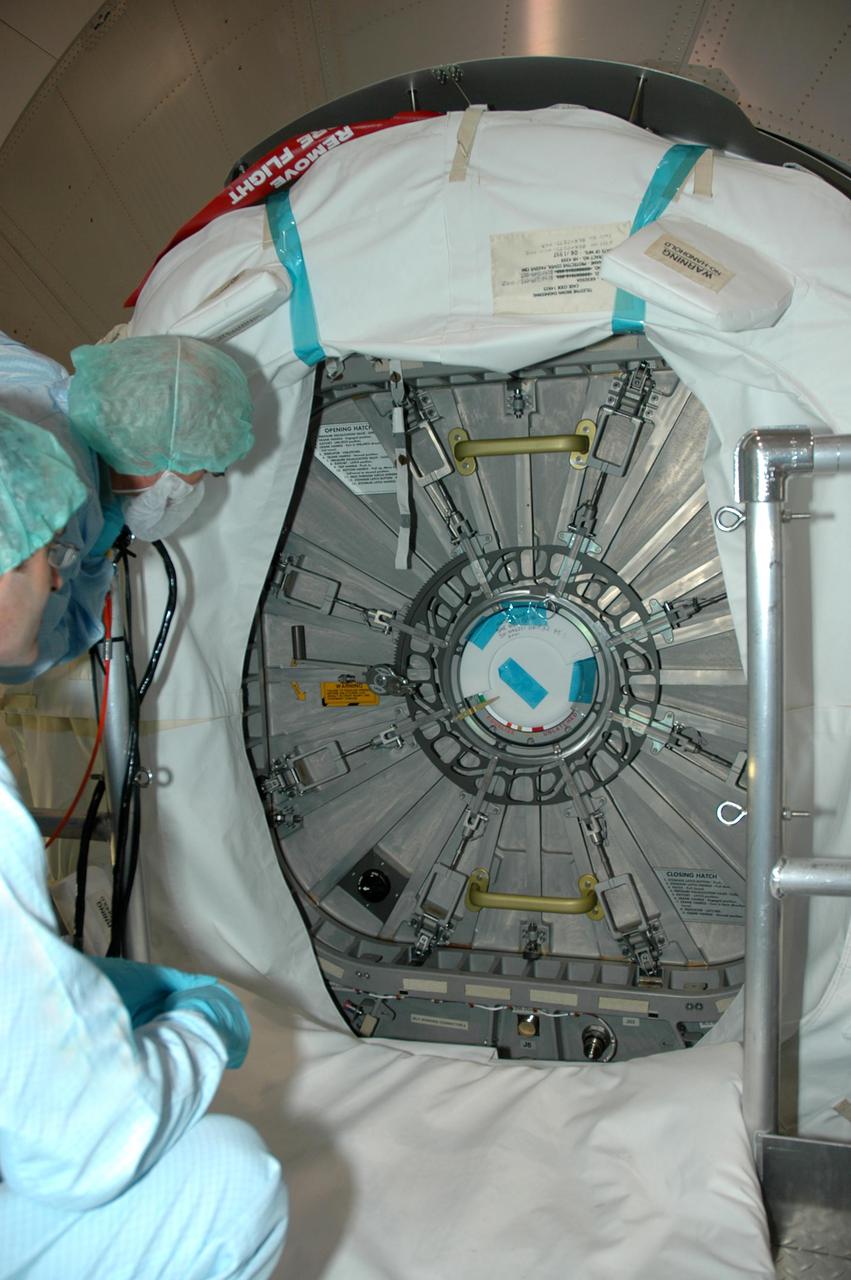
KENNEDY SPACE CENTER, FLA. -- Workers in the Space Station Processing Facility close the hatch for flight on Italian-built Multi-Purpose Logistics Module Raffaello, a significant milestone on the road to Return to Flight.    The module will travel to the International Space Station aboard Space Shuttle Discovery’s Return to Flight mission STS-114.  Raffaello carries 12 racks of cargo, including food, clothing, spare parts and research equipment, to the Station.  Shuttle Discovery is targeted for launch in a window extending May 15 through June 3.
KSC-05pd-0712
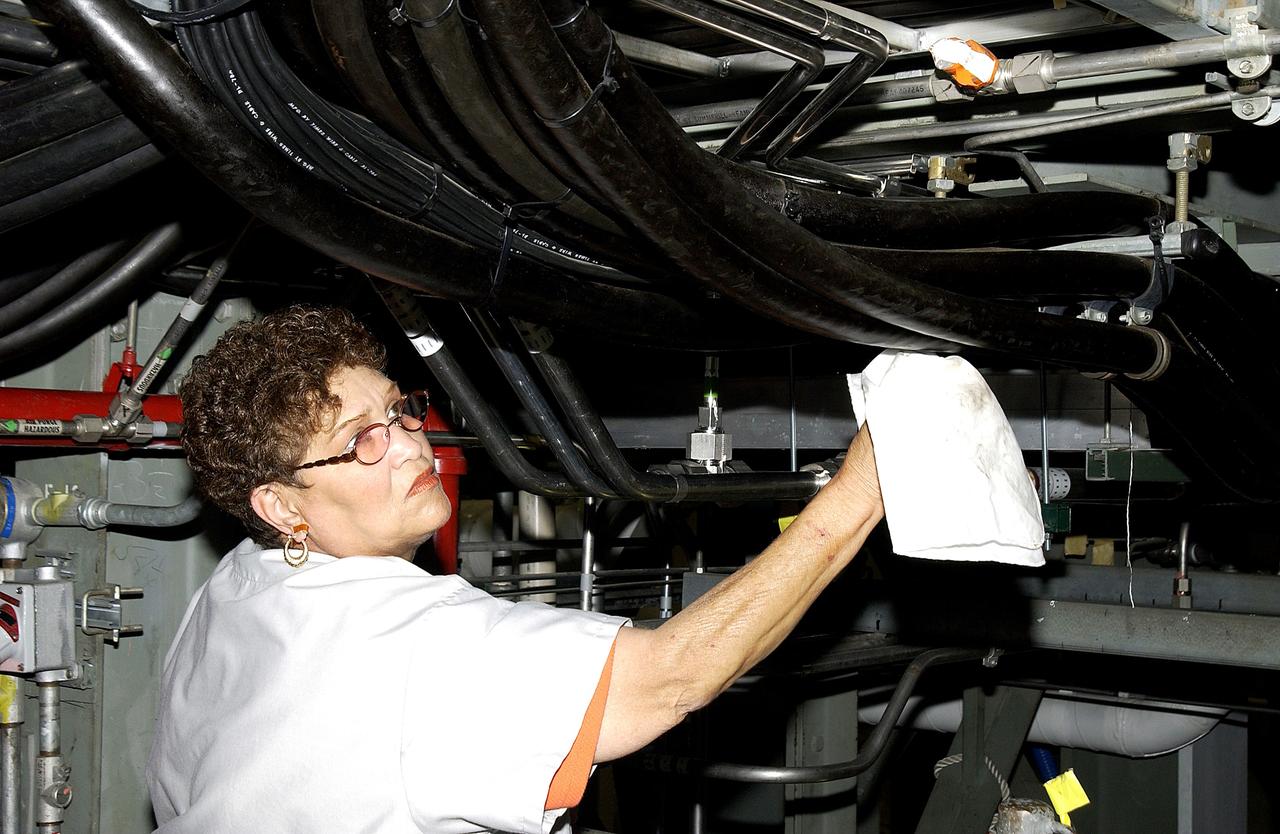
KENNEDY SPACE CENTER, FLA. - A KSC employee wipes down some of the hoses of the ground support equipment in the Orbiter Processing Facility (OPF) where Space Shuttle Atlantis is being processed for flight.  Preparations are under way for the next launch of Atlantis on mission STS-114, a utilization and logistics flight to the International Space Station.
KENNEDY SPACE CENTER, FLA. - A KSC employee wipes down some of the hoses of the ground support equipment in the Orbiter Processing Facility (OPF) where Space Shuttle Atlantis is being processed for flight. Preparations are under way for the next launch of Atlantis on mission STS-114, a utilization and logistics flight to the International Space Station.
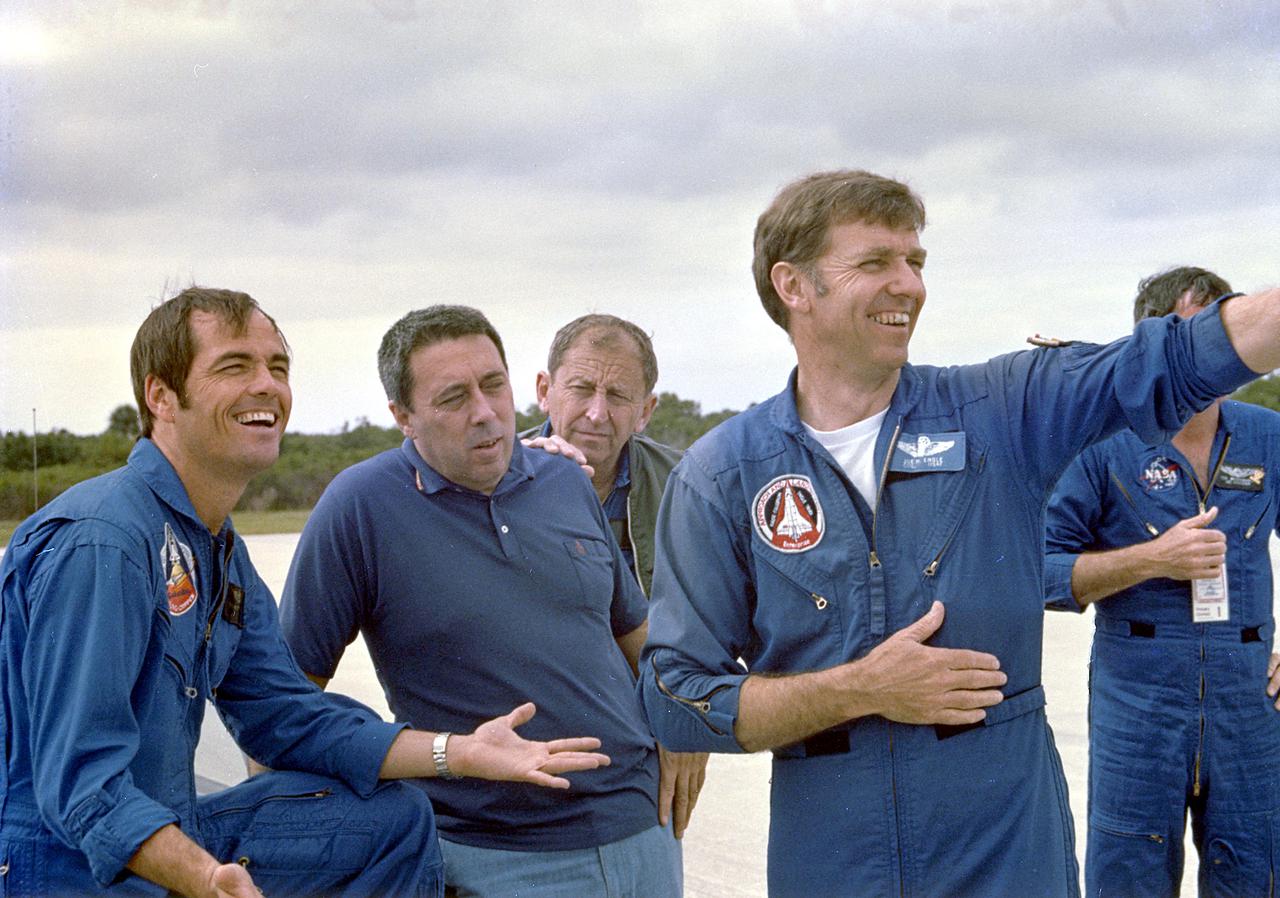
KENNEDY SPACE CENTER, FLA. -  Astronaut Robert Crippen, left, relaxed despite the 'scrub' of the Space Shuttle launch on April 10, is joined at the Shuttle Landing Facility on April 11 by (from left) George Abbey, flight operations director; Joseph Algrantic, chief of Aircraft OPERATIONS Division, both with Johnson Space Center; and astronaut Joe Engle.  Crippen and Young spent part of the day between the 'scrub' and the successful launch on April 12 in Shuttle landing practice, using a specially modified Grumman Airstream jet aircraft.
KSC-81pc-0388
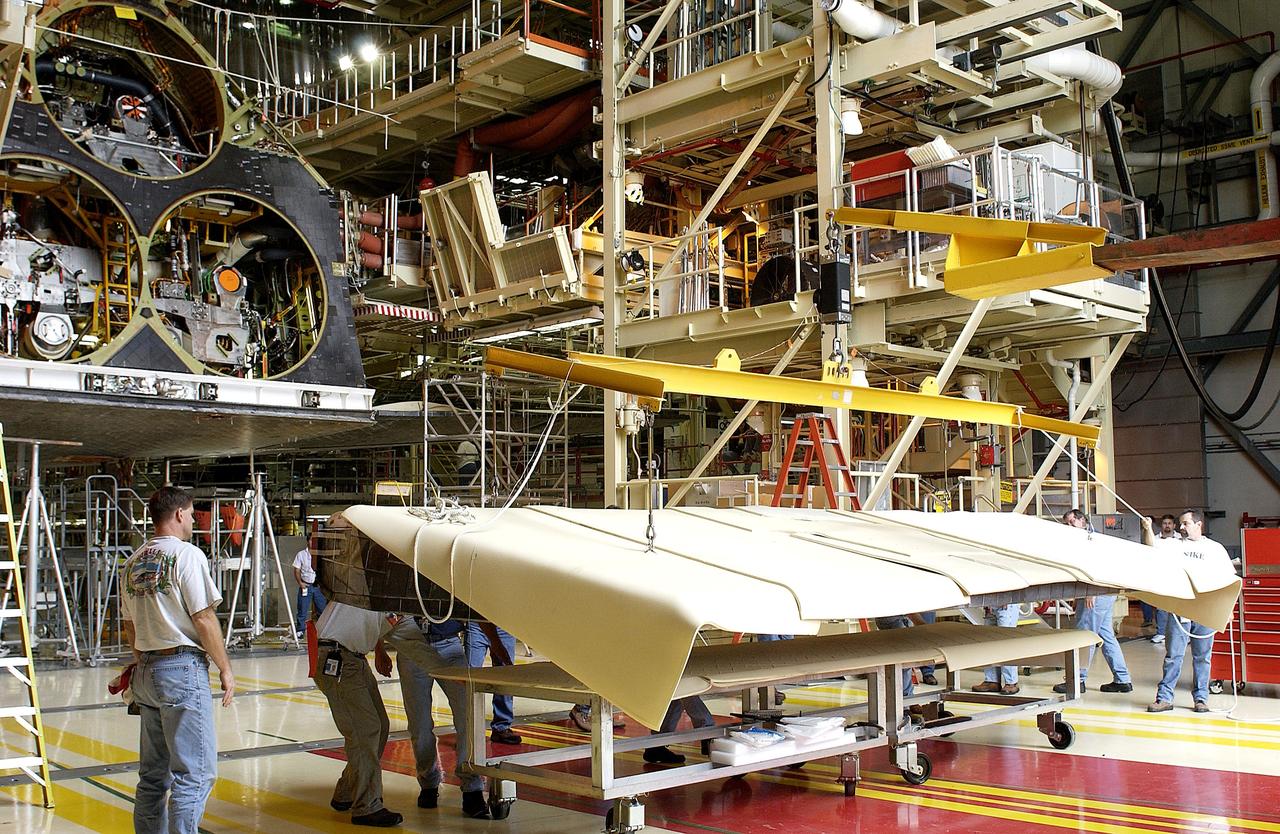
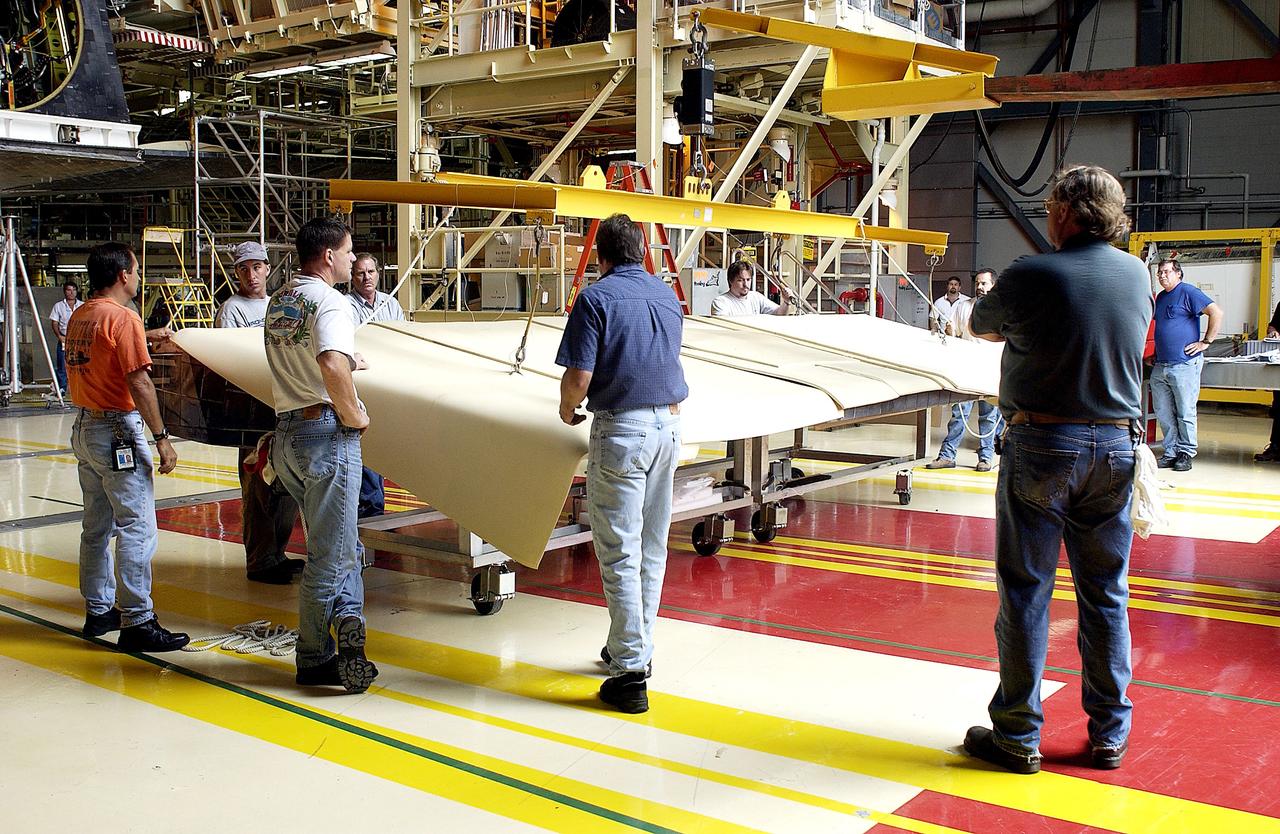
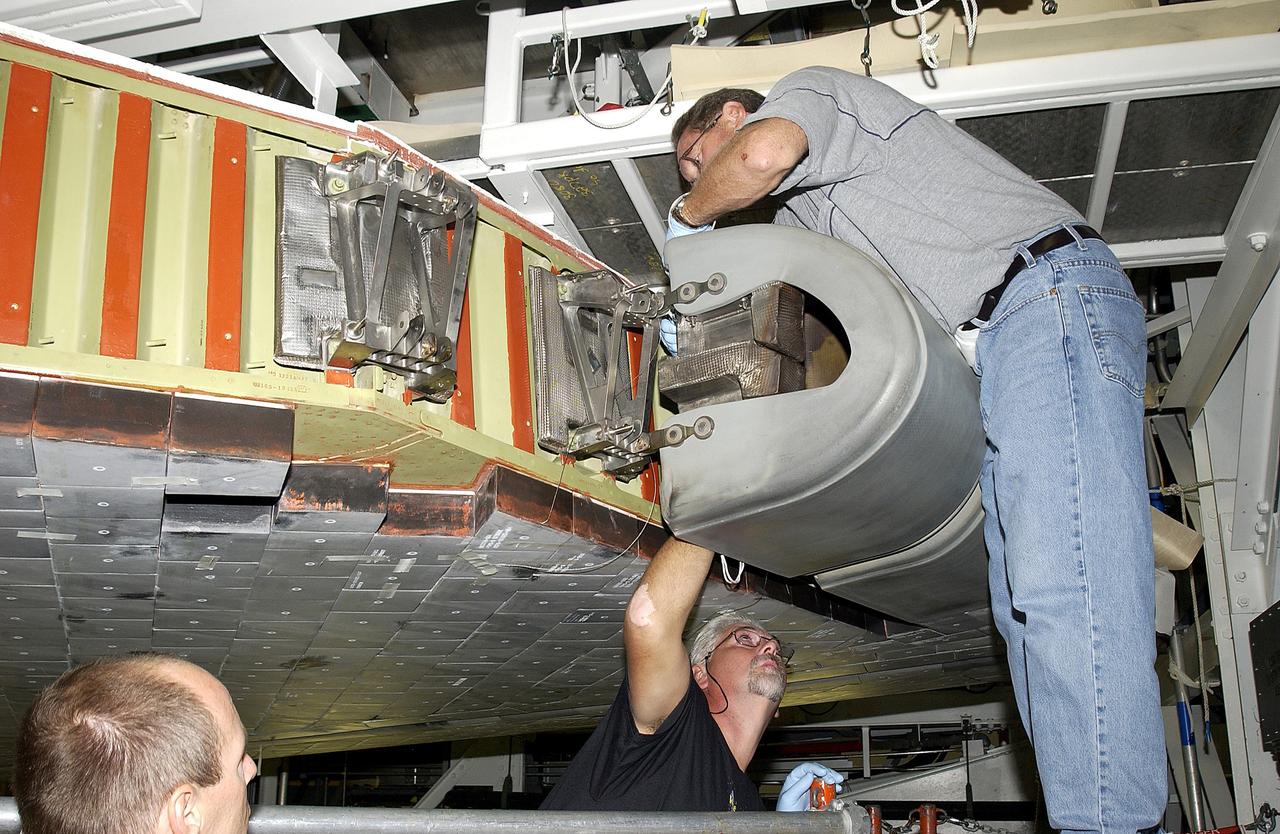
KENNEDY SPACE CENTER, FLA. -   Workers in the Orbiter Processing Facility get ready to lift and install the rear body flap on orbiter Discovery.  The body flap, which is temporarily under protective covering, attaches below the main engines.
KENNEDY SPACE CENTER, FLA. - Workers in the Orbiter Processing Facility get ready to lift and install the rear body flap on orbiter Discovery. The body flap, which is temporarily under protective covering, attaches below the main engines.
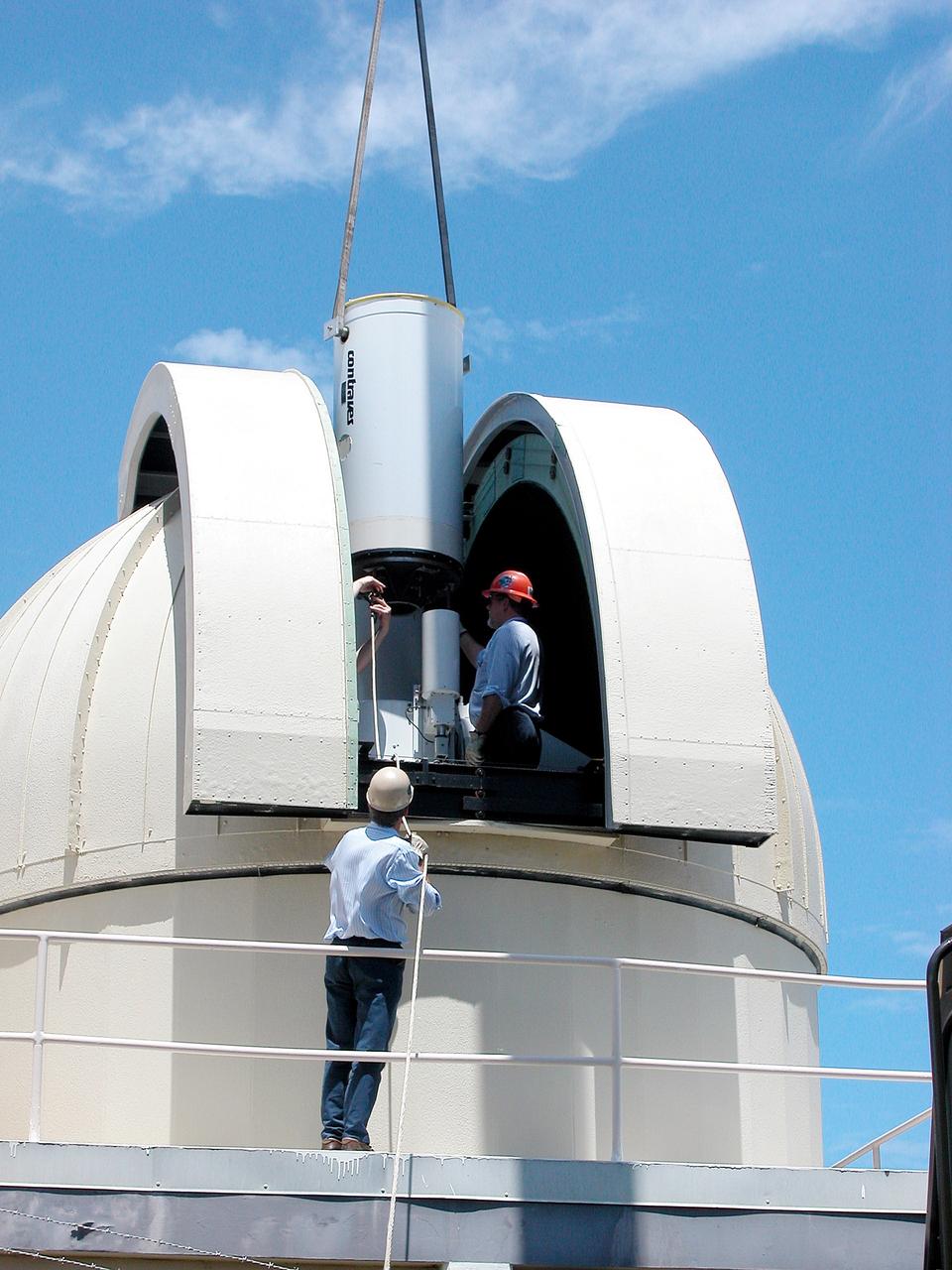
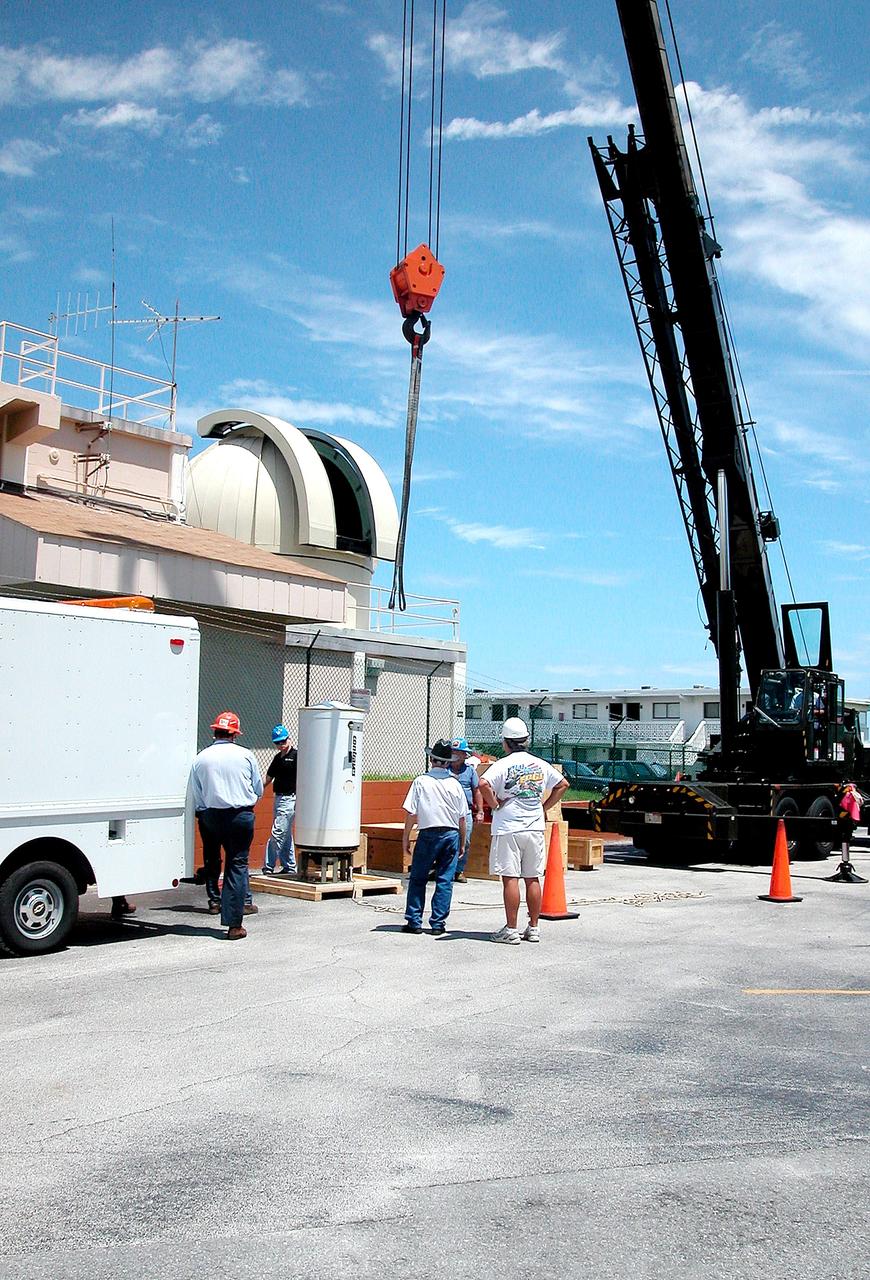
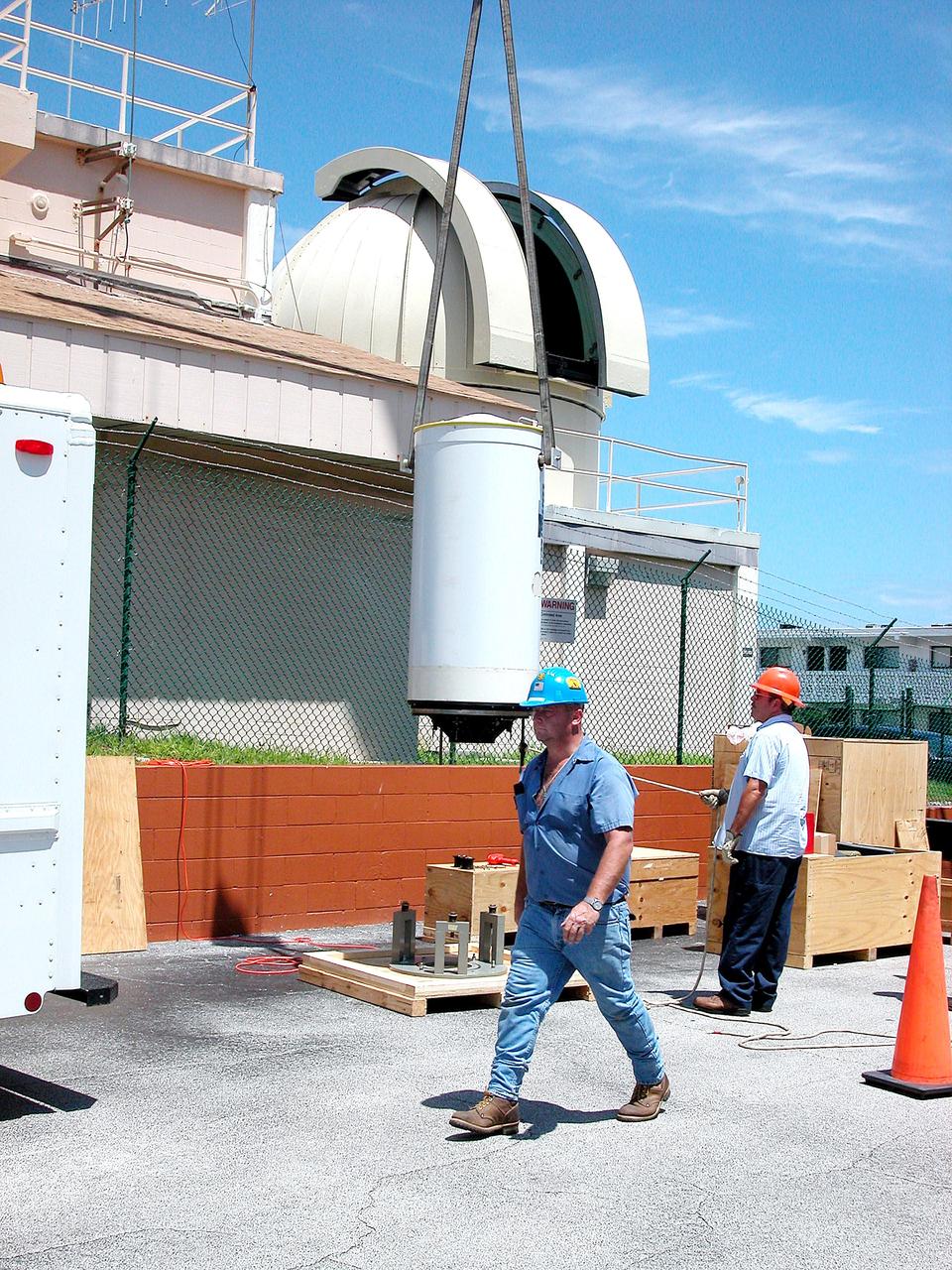
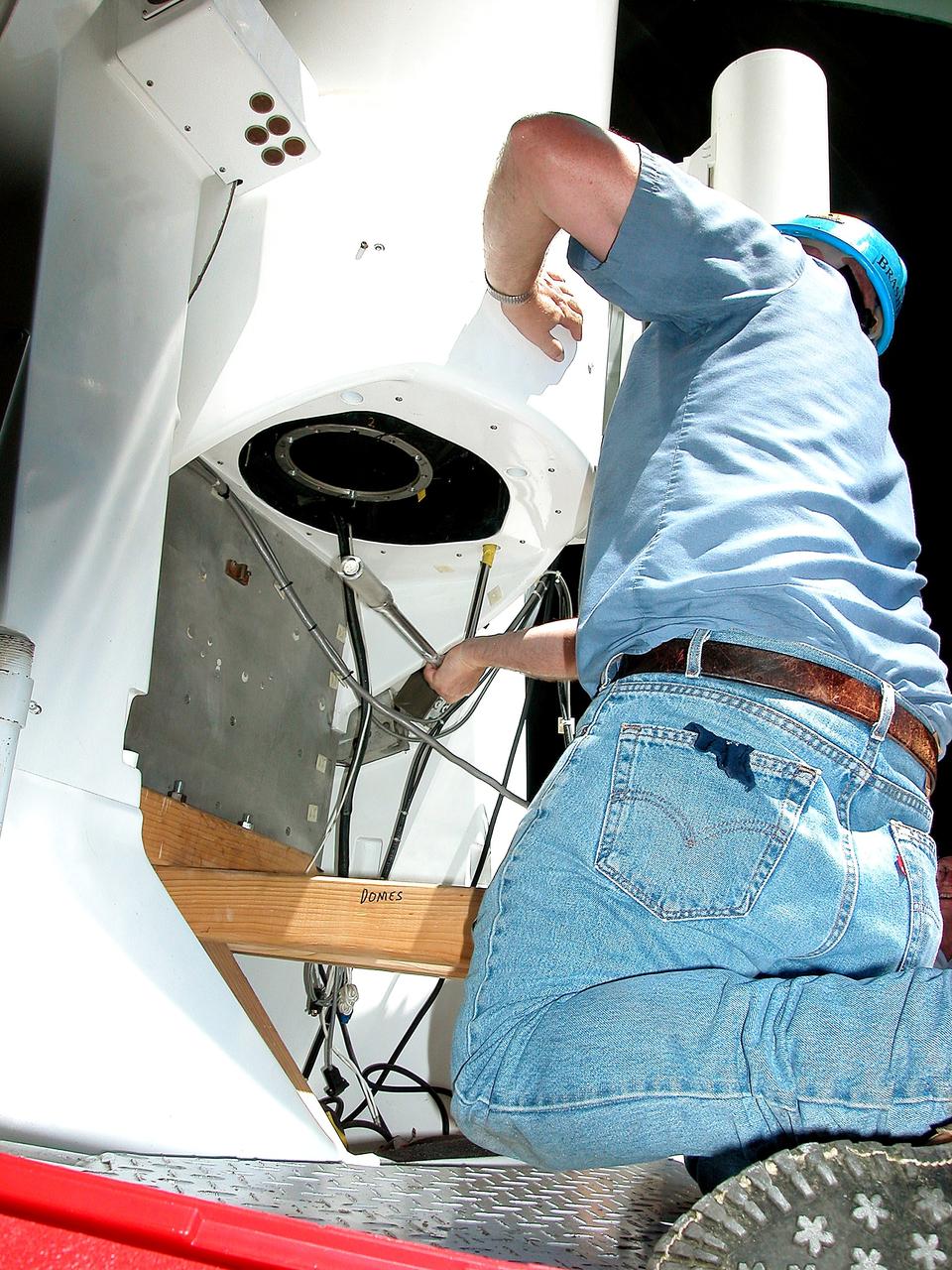
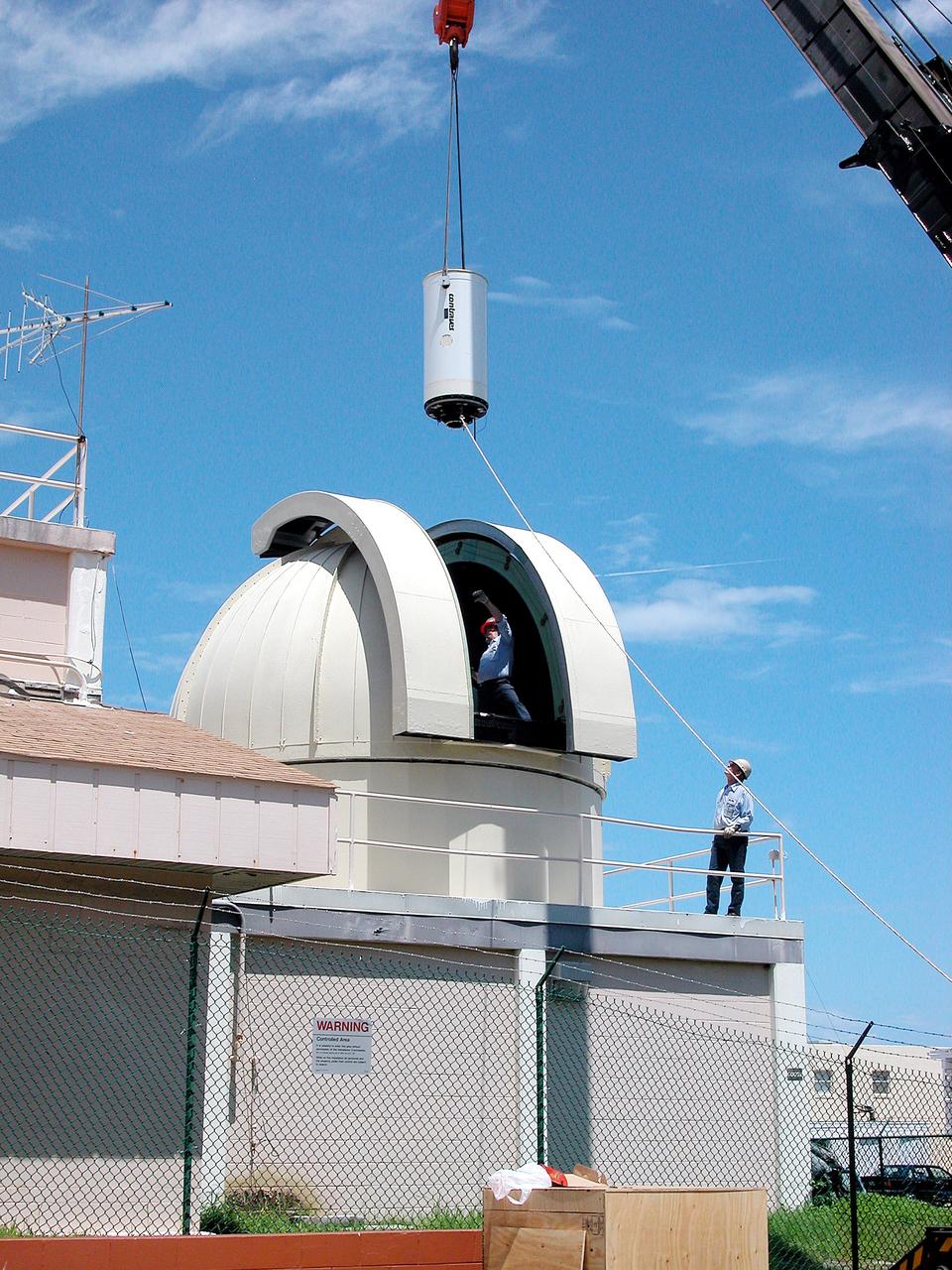
KENNEDY SPACE CENTER, FLA. -  In Cocoa Beach, Fla., a new five-meter telescope is lifted up to the dome for installation.  The tracking telescope is part of the Distant Object Attitude Measurement System (DOAMS) that provides optical support for launches from KSC and Cape Canaveral.
KENNEDY SPACE CENTER, FLA. - In Cocoa Beach, Fla., a new five-meter telescope is lifted up to the dome for installation. The tracking telescope is part of the Distant Object Attitude Measurement System (DOAMS) that provides optical support for launches from KSC and Cape Canaveral.
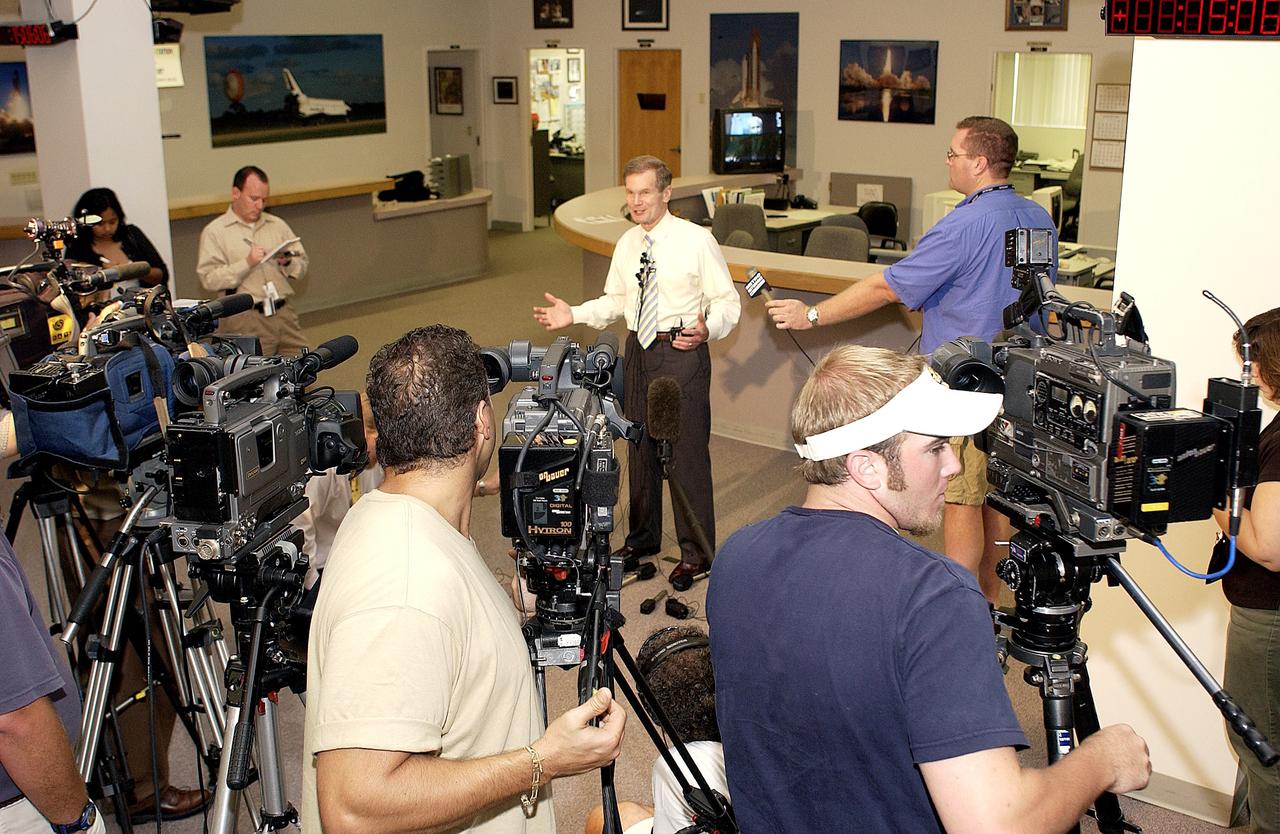
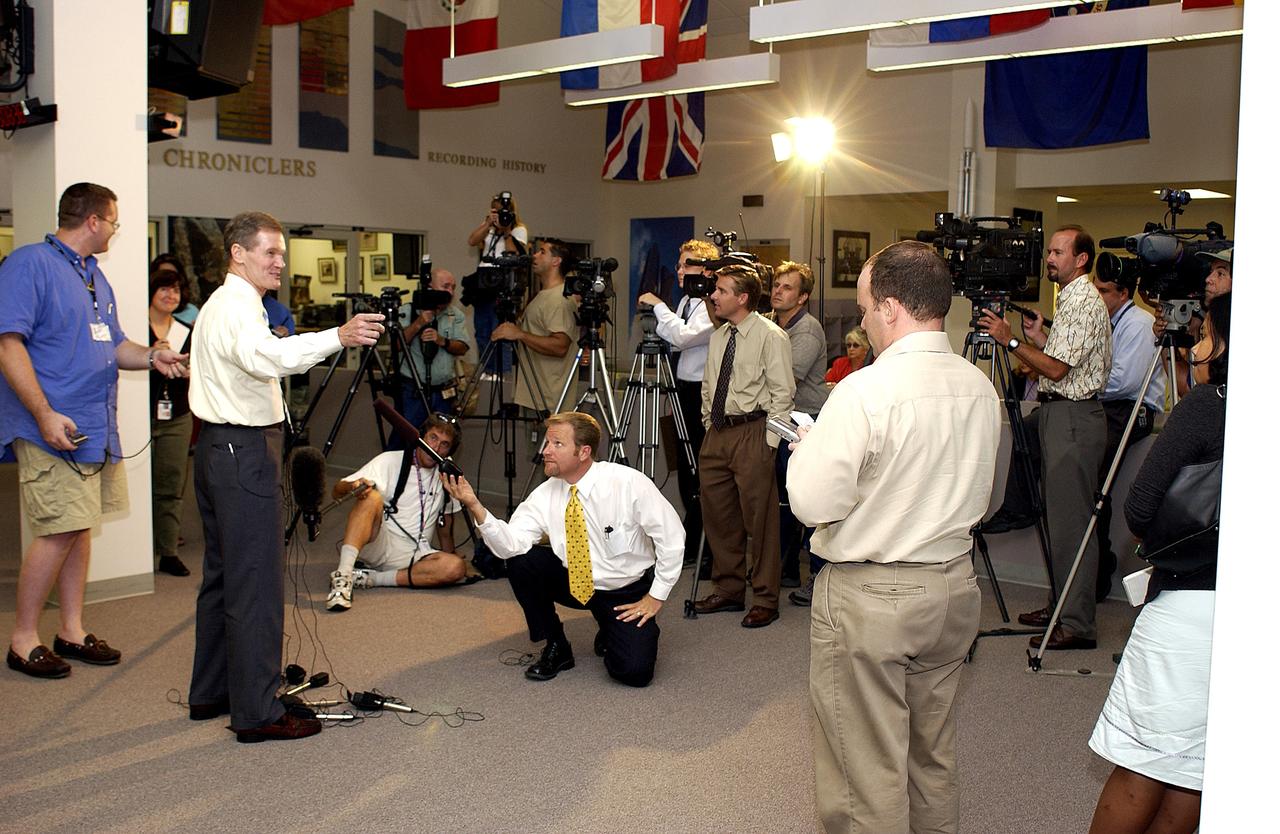
KENNEDY SPACE CENTER, FLA. - Sen. Bill Nelson talks to the media at the NASA KSC News Center about the Columbia Accident Investigation Board report released today.
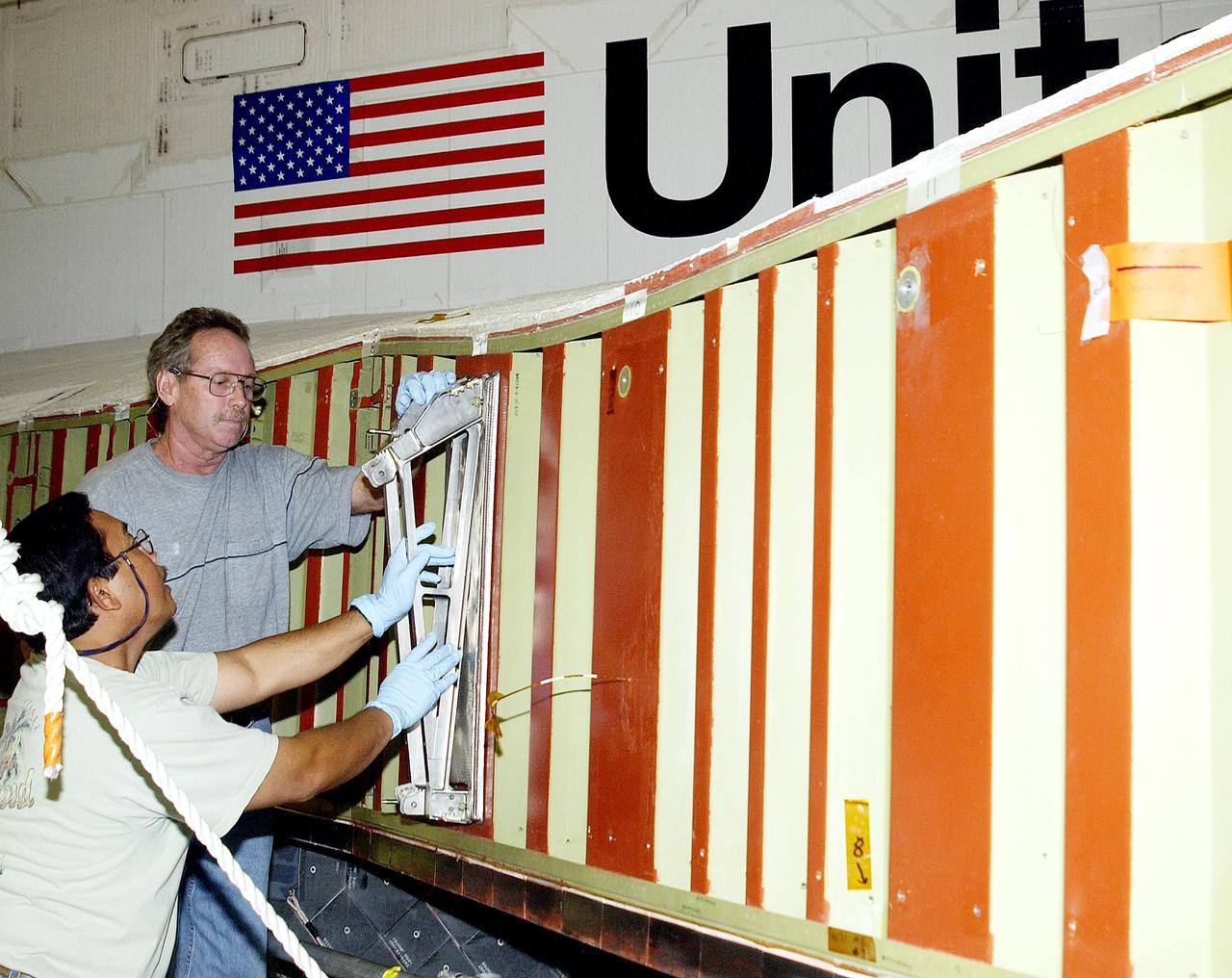
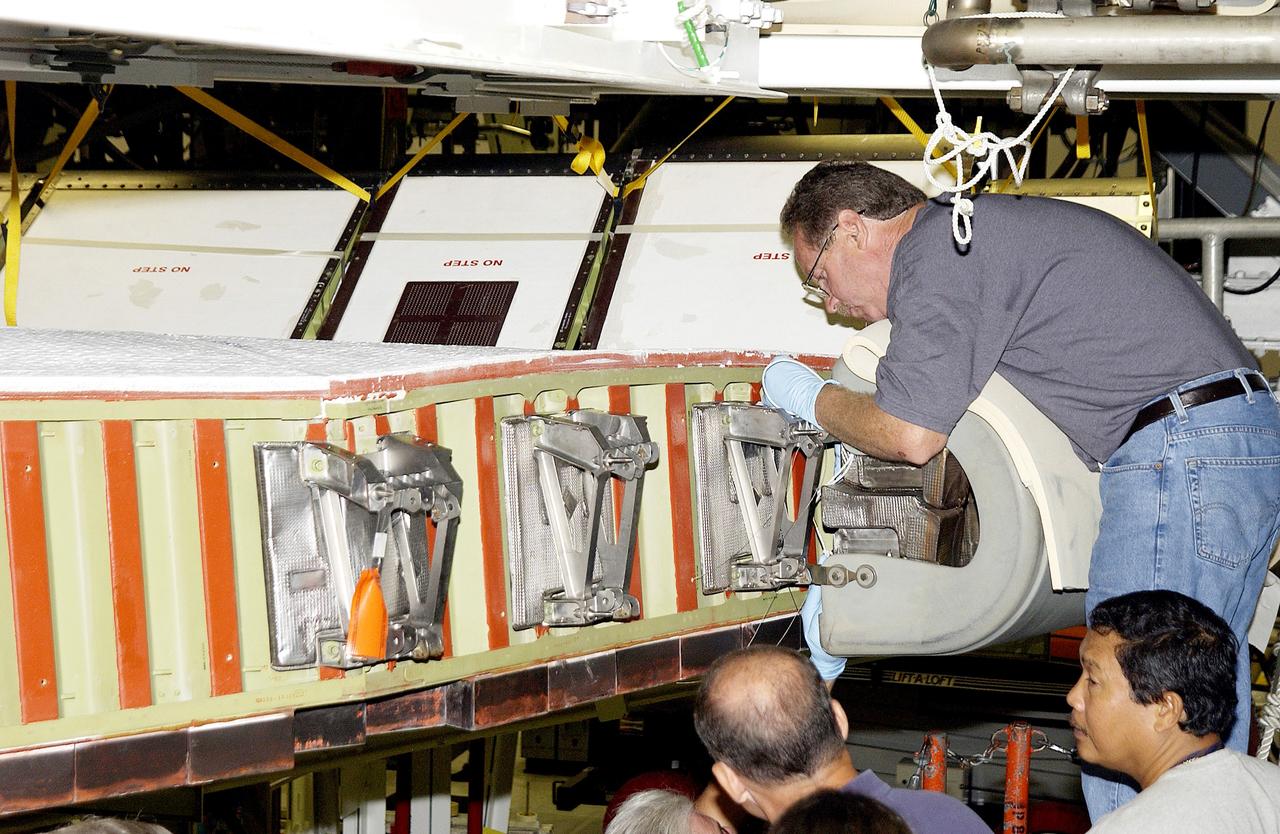
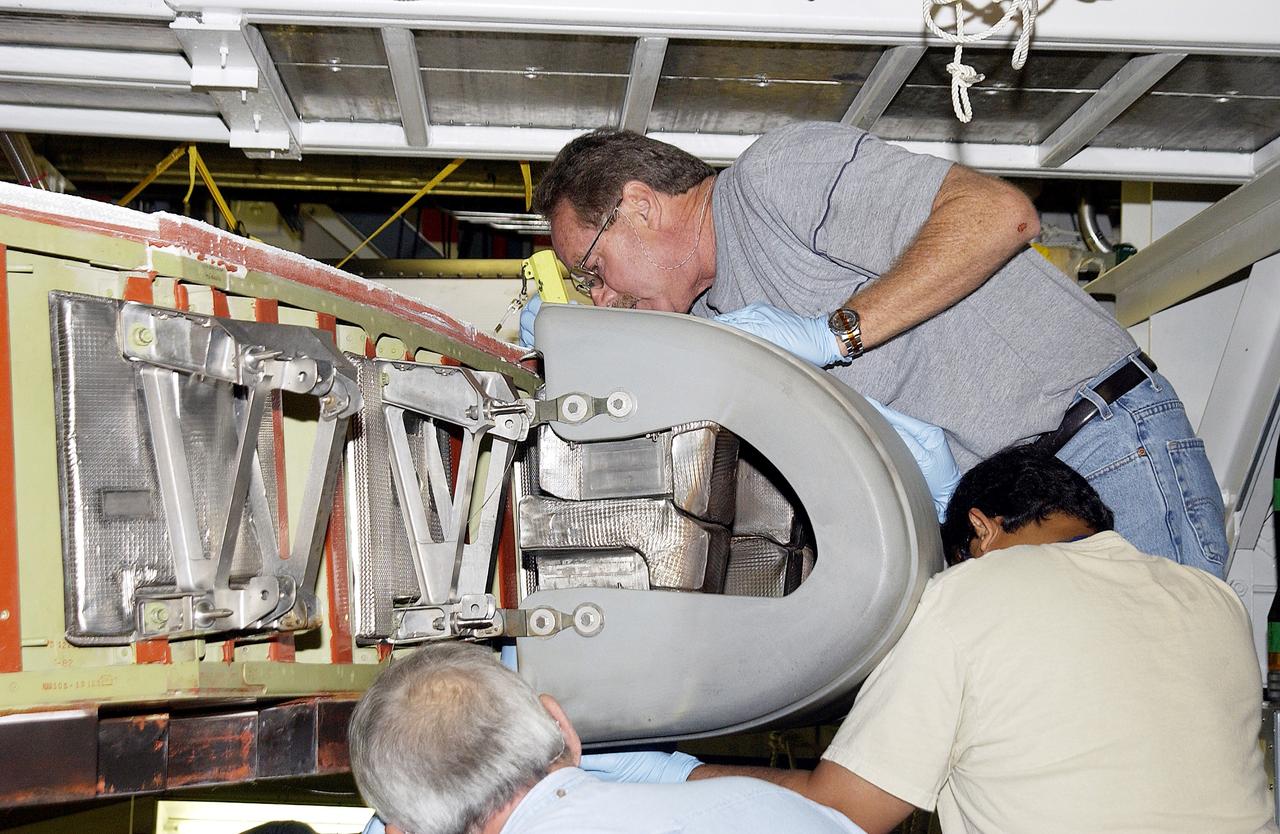
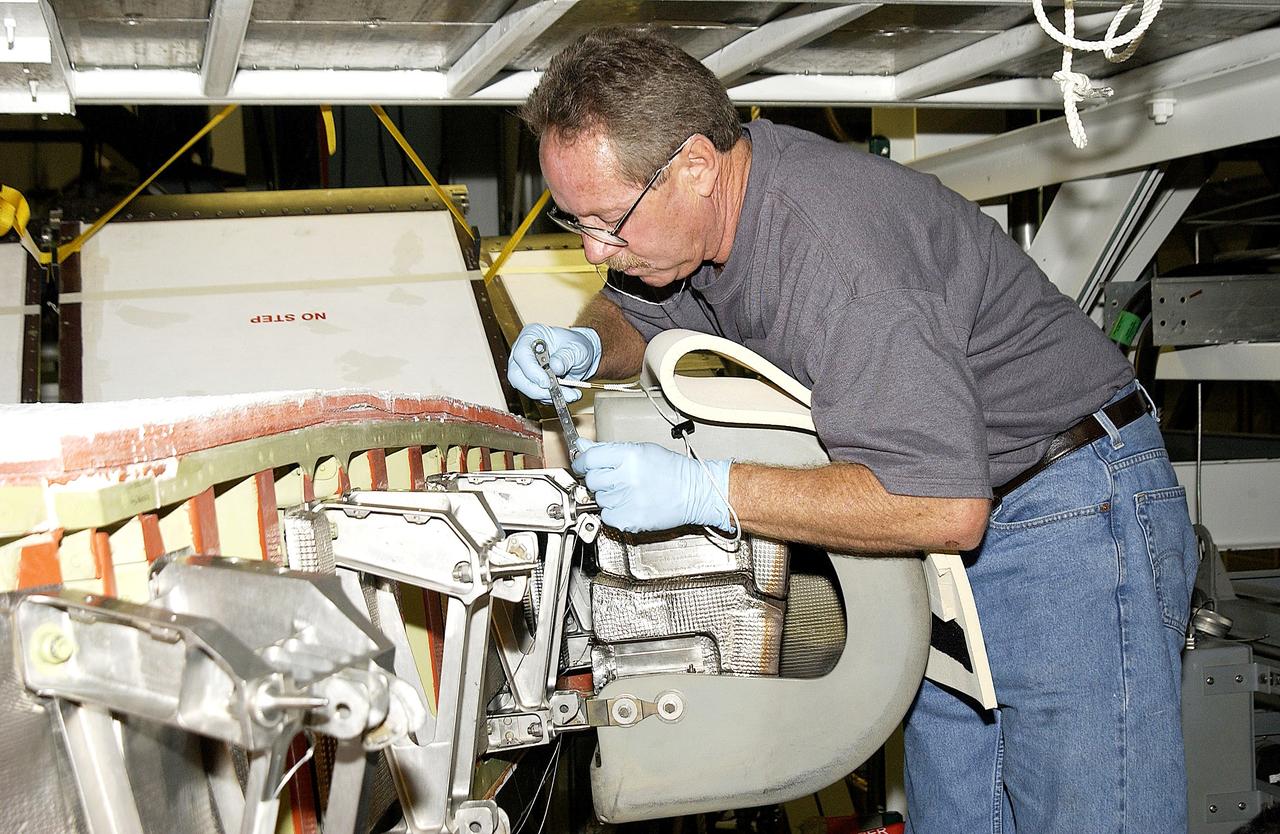
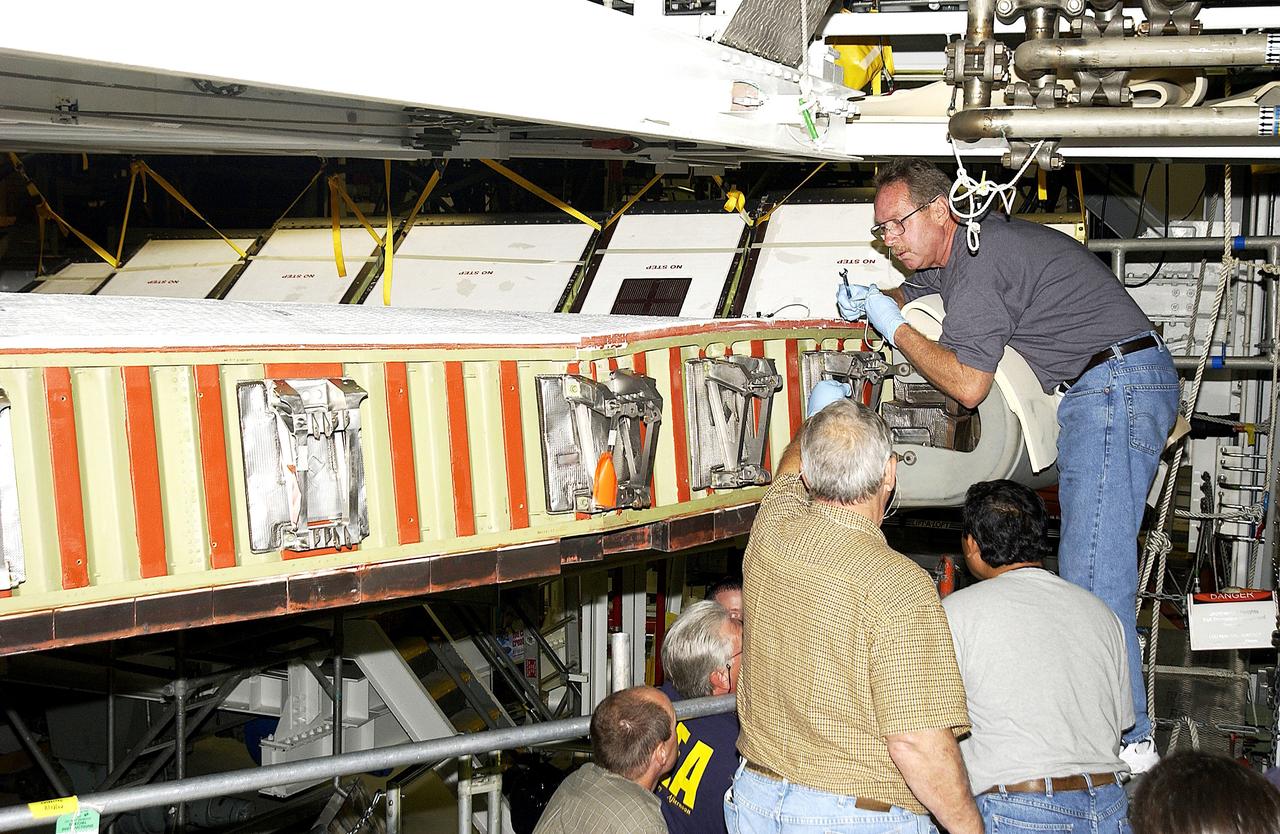
KENNEDY SPACE CENTER, FLA. -  In the Orbiter Processing Facility, Mike Hyatt, with United Space Alliance, installs a spar on the wing of the orbiter Atlantis.  Reinforced Carbon Carbon (RCC) panels are mechanically attached to the wing with a series of floating joints - spars - to reduce loading on the panels caused by wing deflections. The aluminum and the metallic attachments are protected from exceeding temperature limits by internal insulation.
KENNEDY SPACE CENTER, FLA. - In the Orbiter Processing Facility, Mike Hyatt, with United Space Alliance, installs a spar on the wing of the orbiter Atlantis. Reinforced Carbon Carbon (RCC) panels are mechanically attached to the wing with a series of floating joints - spars - to reduce loading on the panels caused by wing deflections. The aluminum and the metallic attachments are protected from exceeding temperature limits by internal insulation.
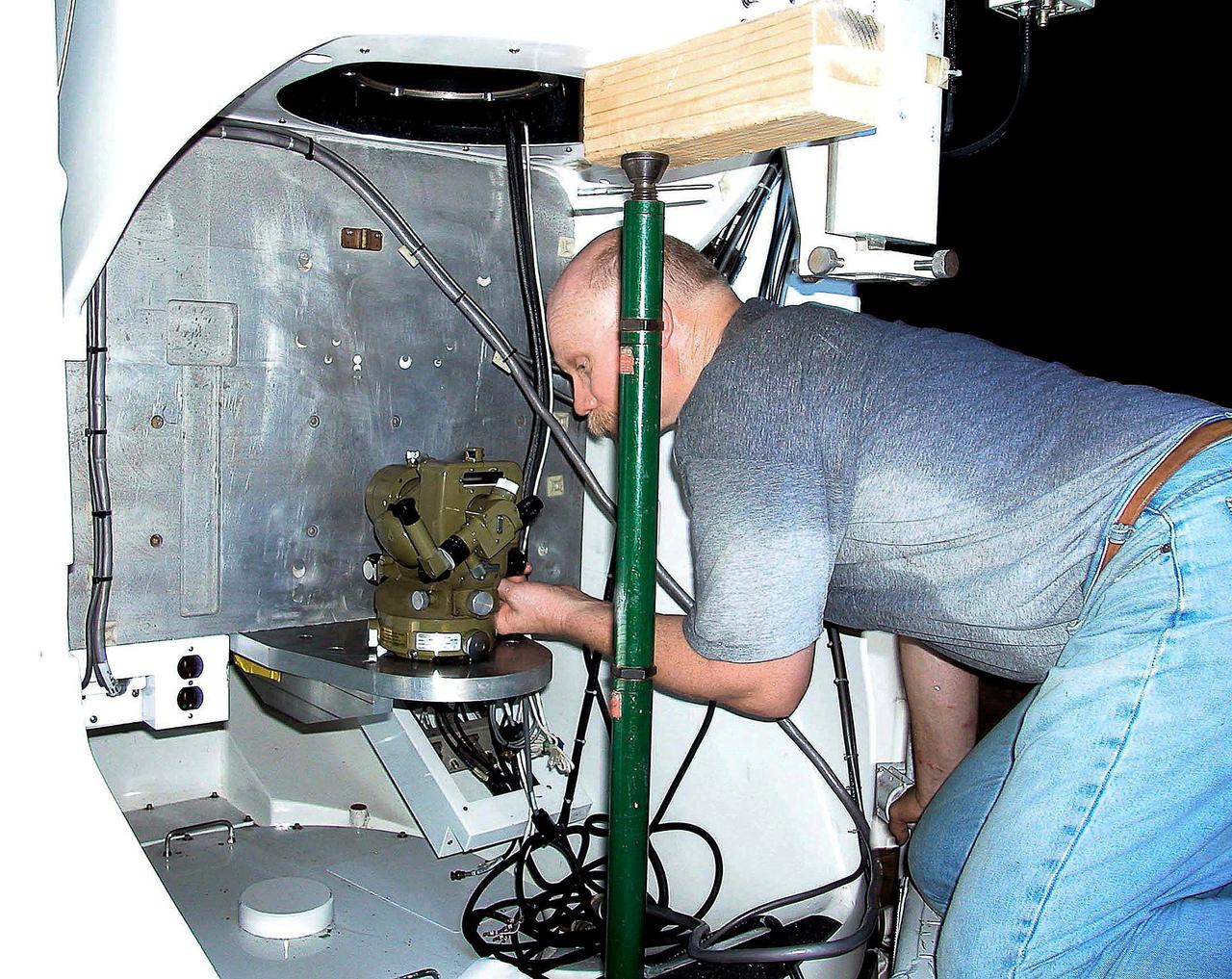
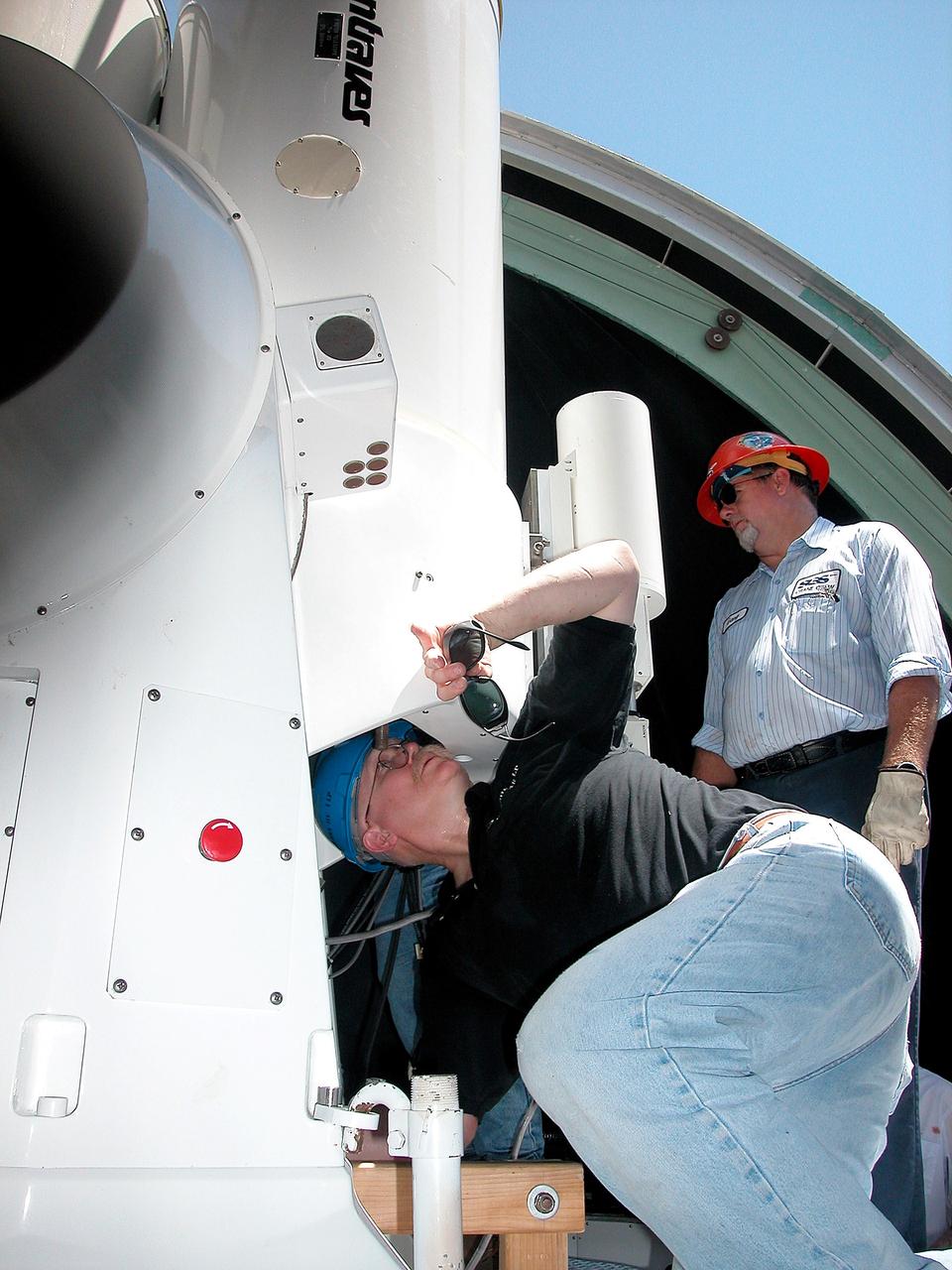
KENNEDY SPACE CENTER, FLA. -  A worker calibrates the thermolite level on a newly installed five-meter focal length telescope in Cocoa Beach, Fla.  The tracking telescope is part of the Distant Object Attitude Measurement System (DOAMS) that provides optical support for launches from KSC and Cape Canaveral.
KSC-03pd2682
KENNEDY SPACE CENTER, FLA. -- In the Space Station Processing Facility,  Italian-built Multi-Purpose Logistics Module Raffaello is closed and ready for transfer to a payload canister and trip to Launch Complex 39B for transfer to Space Shuttle Discovery.  The module will travel to the International Space Station aboard Space Shuttle Discovery’s Return to Flight mission STS-114.  Raffaello carries 12 racks of cargo, including food, clothing, spare parts and research equipment, to the Station.  Shuttle Discovery is targeted for launch in a window extending May 15 through June 3.
KSC-05pd-0714
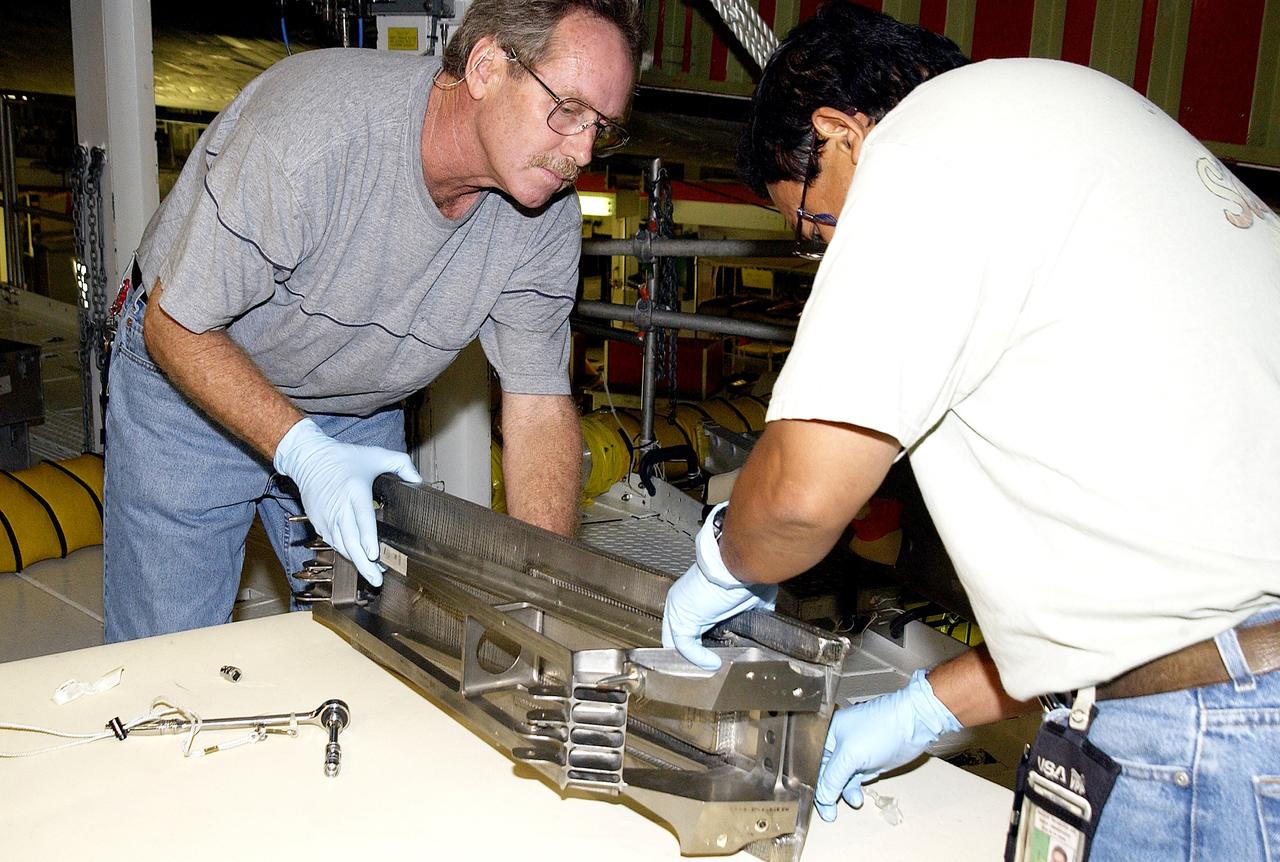
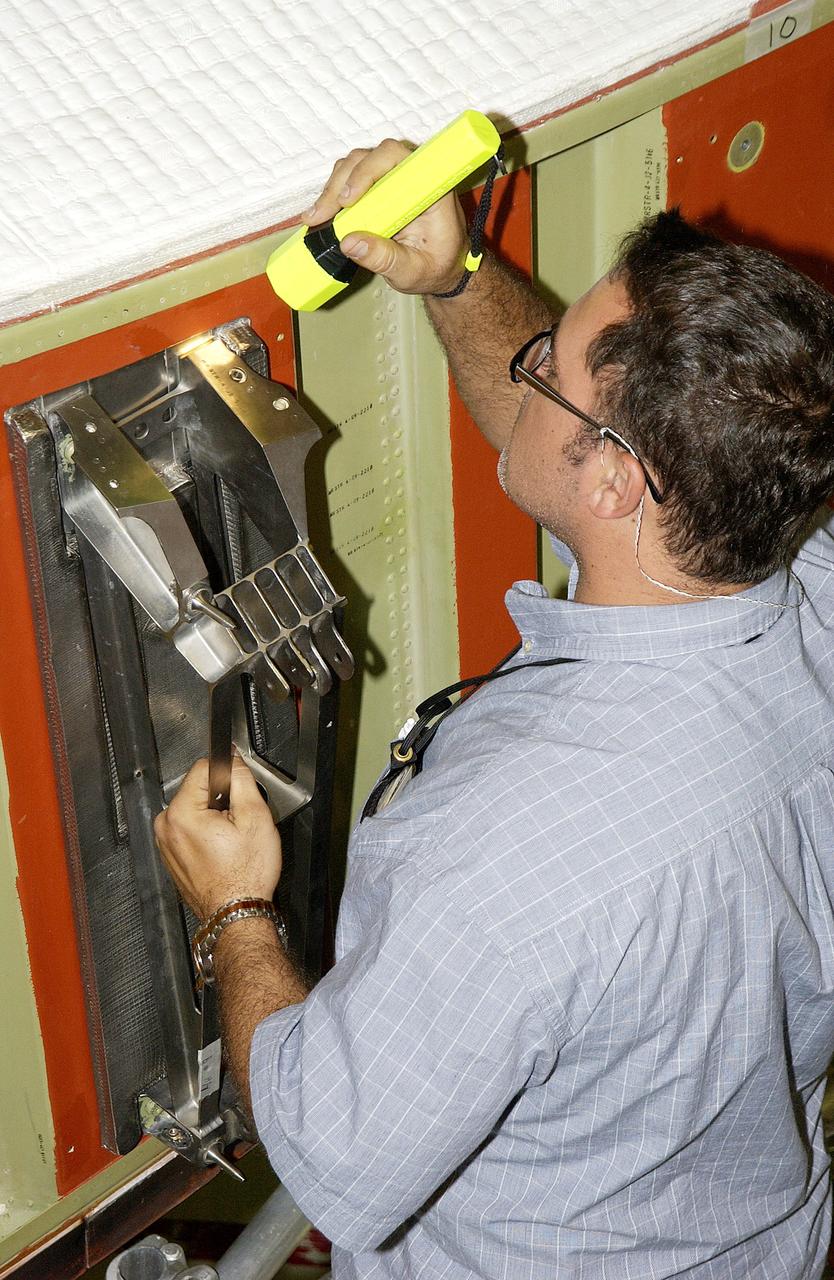
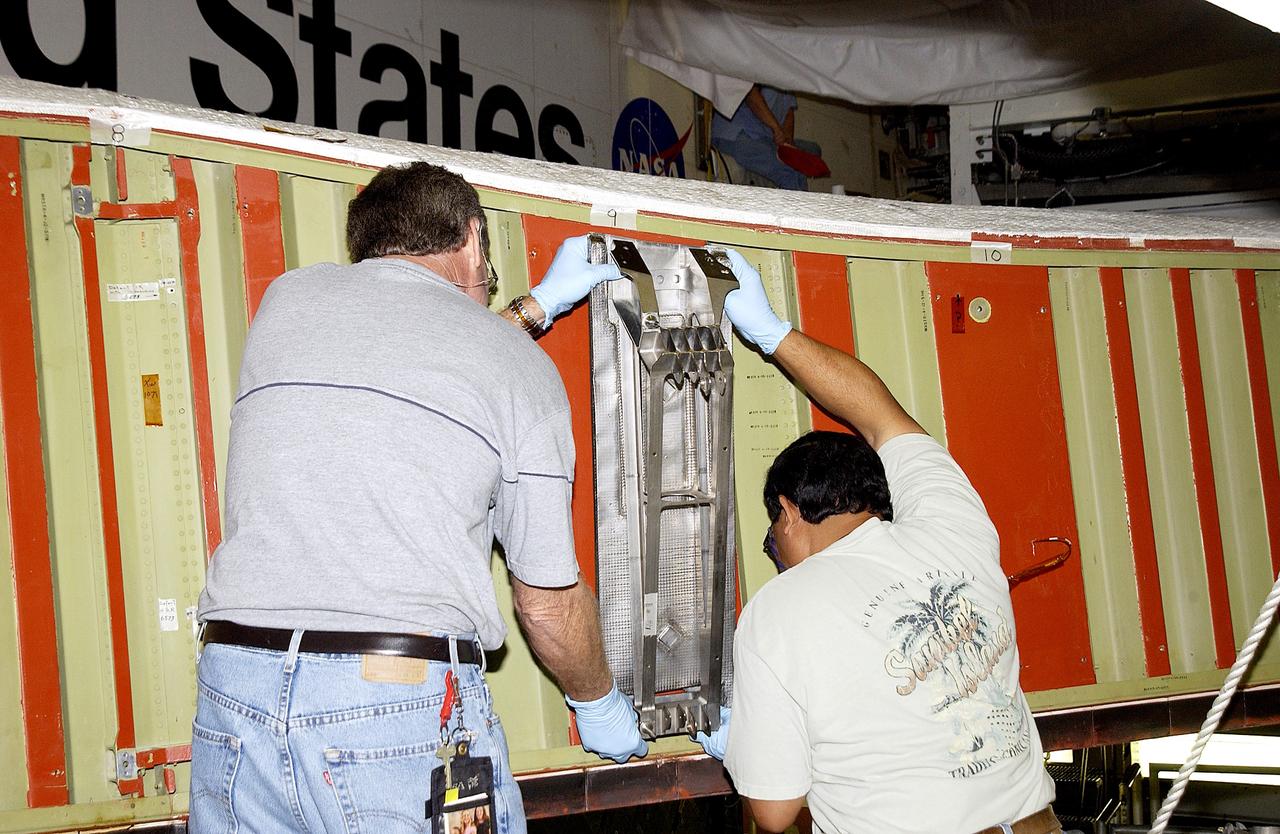
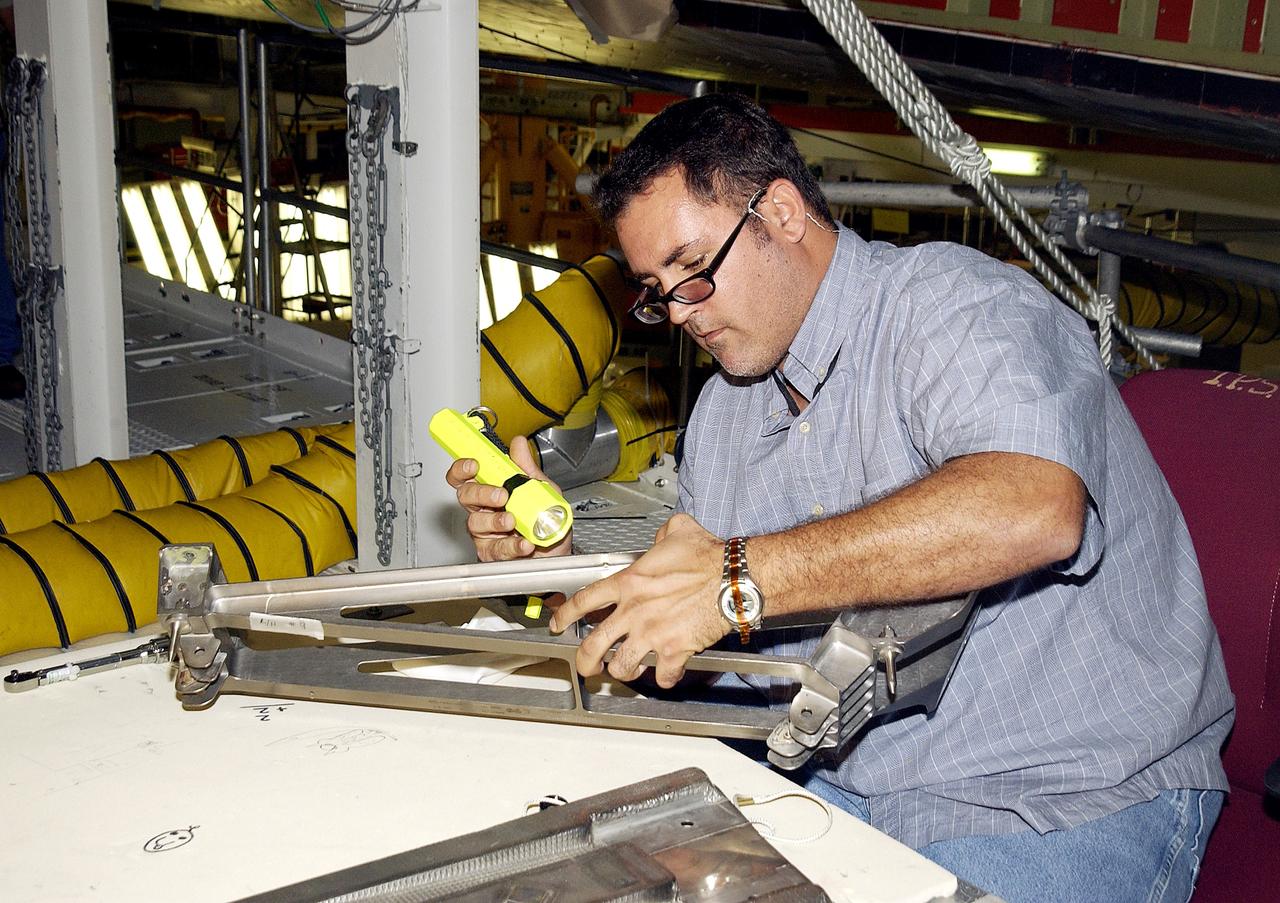
KENNEDY SPACE CENTER, FLA. - In the Orbiter Processing Facility, John Newport, with United Space Alliance, inspects a spar to be installed on the wing of the orbiter Atlantis.  Reinforced Carbon Carbon (RCC) panels are mechanically attached to the wing with a series of floating joints - spars - to reduce loading on the panels caused by wing deflections. The aluminum and the metallic attachments are protected from exceeding temperature limits by internal insulation.
KENNEDY SPACE CENTER, FLA. - In the Orbiter Processing Facility, John Newport, with United Space Alliance, inspects a spar to be installed on the wing of the orbiter Atlantis. Reinforced Carbon Carbon (RCC) panels are mechanically attached to the wing with a series of floating joints - spars - to reduce loading on the panels caused by wing deflections. The aluminum and the metallic attachments are protected from exceeding temperature limits by internal insulation.
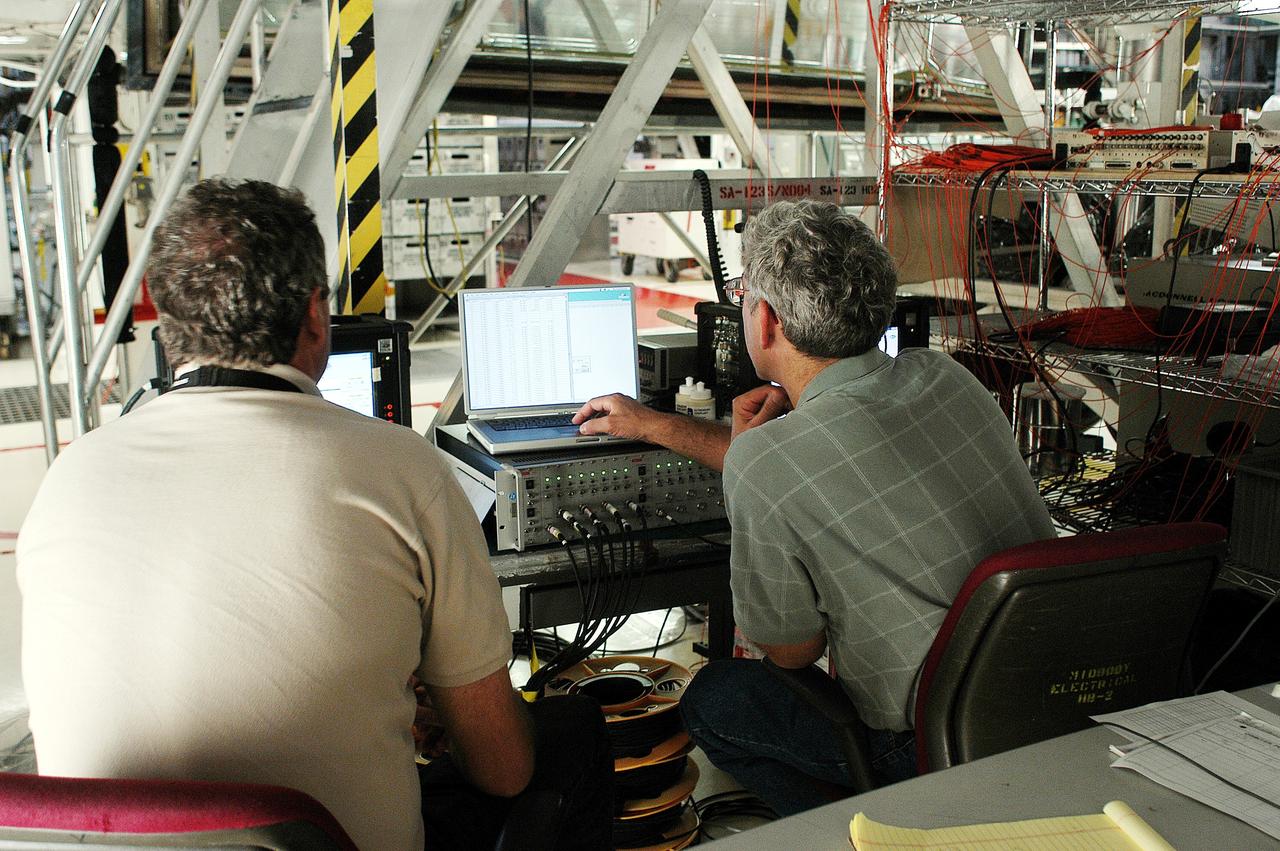
KENNEDY SPACE CENTER, FLA. -  In the Orbiter Processing Facility, Bill Prosser (left) and Eric Madaras, NASA-Langley Research Center, and Jim McGee (right), The Boeing Company, Huntington Beach, Calif., conduct impulse tests on the right wing leading edge (WLE) of Space Shuttle Endeavour. The tests monitor how sound impulses propagate through the WLE area.  The data collected will be analyzed to explore the possibility of adding new instrumentation to the wing that could automatically detect debris or micrometeroid impacts on the Shuttle while in flight.  The study is part of the initiative ongoing at KSC and around the agency to return the orbiter fleet to flight status.
KENNEDY SPACE CENTER, FLA. - In the Orbiter Processing Facility, Bill Prosser (left) and Eric Madaras, NASA-Langley Research Center, and Jim McGee (right), The Boeing Company, Huntington Beach, Calif., conduct impulse tests on the right wing leading edge (WLE) of Space Shuttle Endeavour. The tests monitor how sound impulses propagate through the WLE area. The data collected will be analyzed to explore the possibility of adding new instrumentation to the wing that could automatically detect debris or micrometeroid impacts on the Shuttle while in flight. The study is part of the initiative ongoing at KSC and around the agency to return the orbiter fleet to flight status.
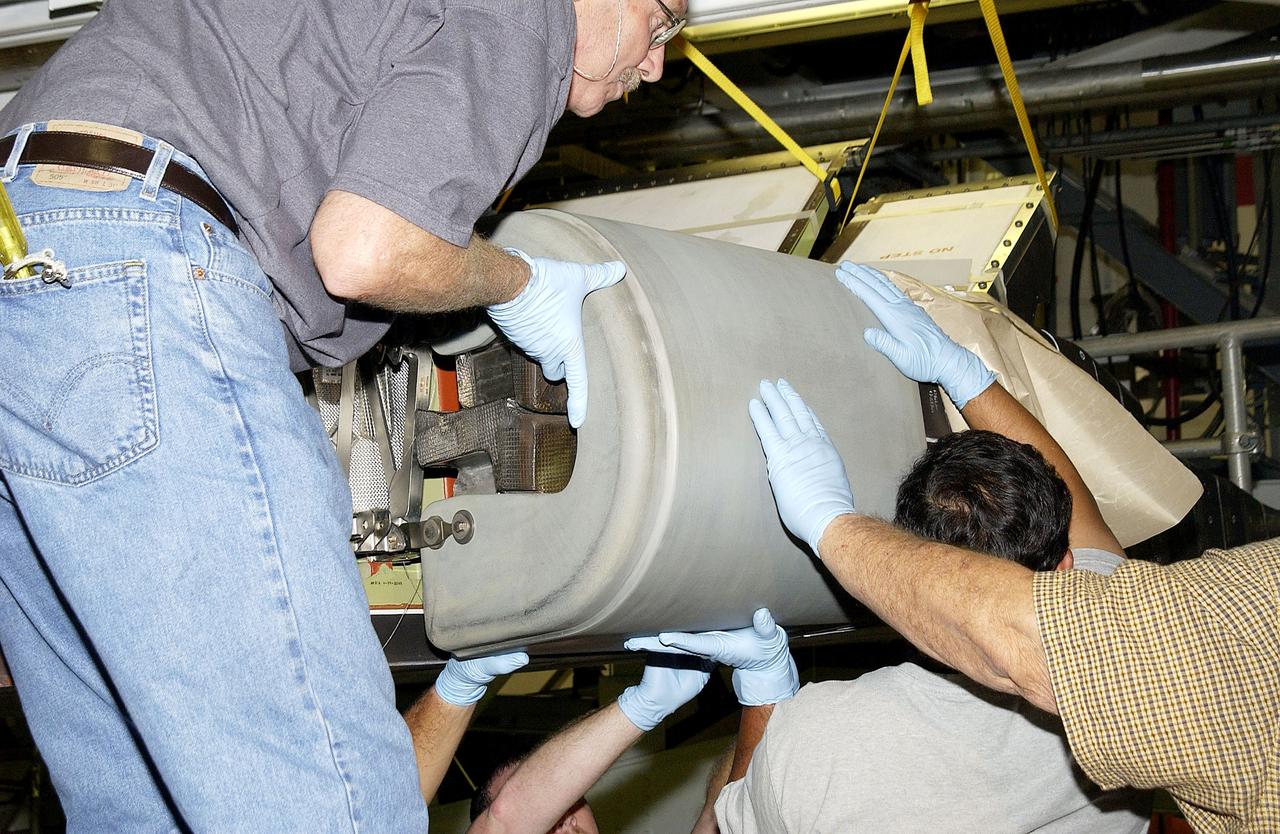
KENNEDY SPACE CENTER, FLA. - In the Orbiter Processing Facility, United Space Alliance workers Mike Hyatt (above) and Saul Ngy (below right) finish installing a Reinforced Carbon Carbon (RCC) panel to the leading edge of the wing of the orbiter Atlantis.  The gray carbon composite RCC panels have sufficient strength to withstand the aerodynamic forces experienced during launch and reentry, which can reach as high as 800 pounds per square foot.  The operating range of RCC is from minus 250º F to about 3,000º F, the temperature produced by friction with the atmosphere during reentry.
KENNEDY SPACE CENTER, FLA. - In the Orbiter Processing Facility, United Space Alliance workers Mike Hyatt (above) and Saul Ngy (below right) finish installing a Reinforced Carbon Carbon (RCC) panel to the leading edge of the wing of the orbiter Atlantis. The gray carbon composite RCC panels have sufficient strength to withstand the aerodynamic forces experienced during launch and reentry, which can reach as high as 800 pounds per square foot. The operating range of RCC is from minus 250º F to about 3,000º F, the temperature produced by friction with the atmosphere during reentry.
KENNEDY SPACE CENTER, FLA. -   Workers in the Orbiter Processing Facility get ready to lift and install the rear body flap on orbiter Discovery.  The body flap, which is temporarily under protective covering, attaches below the main engines.
KENNEDY SPACE CENTER, FLA. - Workers in the Orbiter Processing Facility get ready to lift and install the rear body flap on orbiter Discovery. The body flap, which is temporarily under protective covering, attaches below the main engines.
KENNEDY SPACE CENTER, FLA. - In the Orbiter Processing Facility, the rear body flap is lifted into place on the orbiter Discovery.  The body flap, which is temporarily under protective covering,  attaches below the main engines.
KENNEDY SPACE CENTER, FLA. - In the Orbiter Processing Facility, the rear body flap is lifted into place on the orbiter Discovery. The body flap, which is temporarily under protective covering, attaches below the main engines.
KENNEDY SPACE CENTER, FLA. - In the Orbiter Processing Facility, United Space Alliance workers Mike Hyatt (left) Jerry Belt (center), and Saul Ngy (right), lift a Reinforced Carbon Carbon (RCC) panel they will attach to the leading edge of the wing of the orbiter Atlantis.  The gray carbon composite RCC panels have sufficient strength to withstand the aerodynamic forces experienced during launch and reentry, which can reach as high as 800 pounds per square foot.  The operating range of RCC is from minus 250º F to about 3,000º F, the temperature produced by friction with the atmosphere during reentry.
KENNEDY SPACE CENTER, FLA. - In the Orbiter Processing Facility, United Space Alliance workers Mike Hyatt (left) Jerry Belt (center), and Saul Ngy (right), lift a Reinforced Carbon Carbon (RCC) panel they will attach to the leading edge of the wing of the orbiter Atlantis. The gray carbon composite RCC panels have sufficient strength to withstand the aerodynamic forces experienced during launch and reentry, which can reach as high as 800 pounds per square foot. The operating range of RCC is from minus 250º F to about 3,000º F, the temperature produced by friction with the atmosphere during reentry.
KENNEDY SPACE CENTER, FLA. -- Workers in the Space Station Processing Facility take final measurements flight on Italian-built Multi-Purpose Logistics Module Raffaello as they prepare to close the hatch for flight, a significant milestone on the road to Return to Flight.   The module will travel to the International Space Station aboard Space Shuttle Discovery’s Return to Flight mission STS-114.  Raffaello carries 12 racks of cargo, including food, clothing, spare parts and research equipment, to the Station.  Shuttle Discovery is targeted for launch in a window extending May 15 through June 3.
KSC-05pd-0711
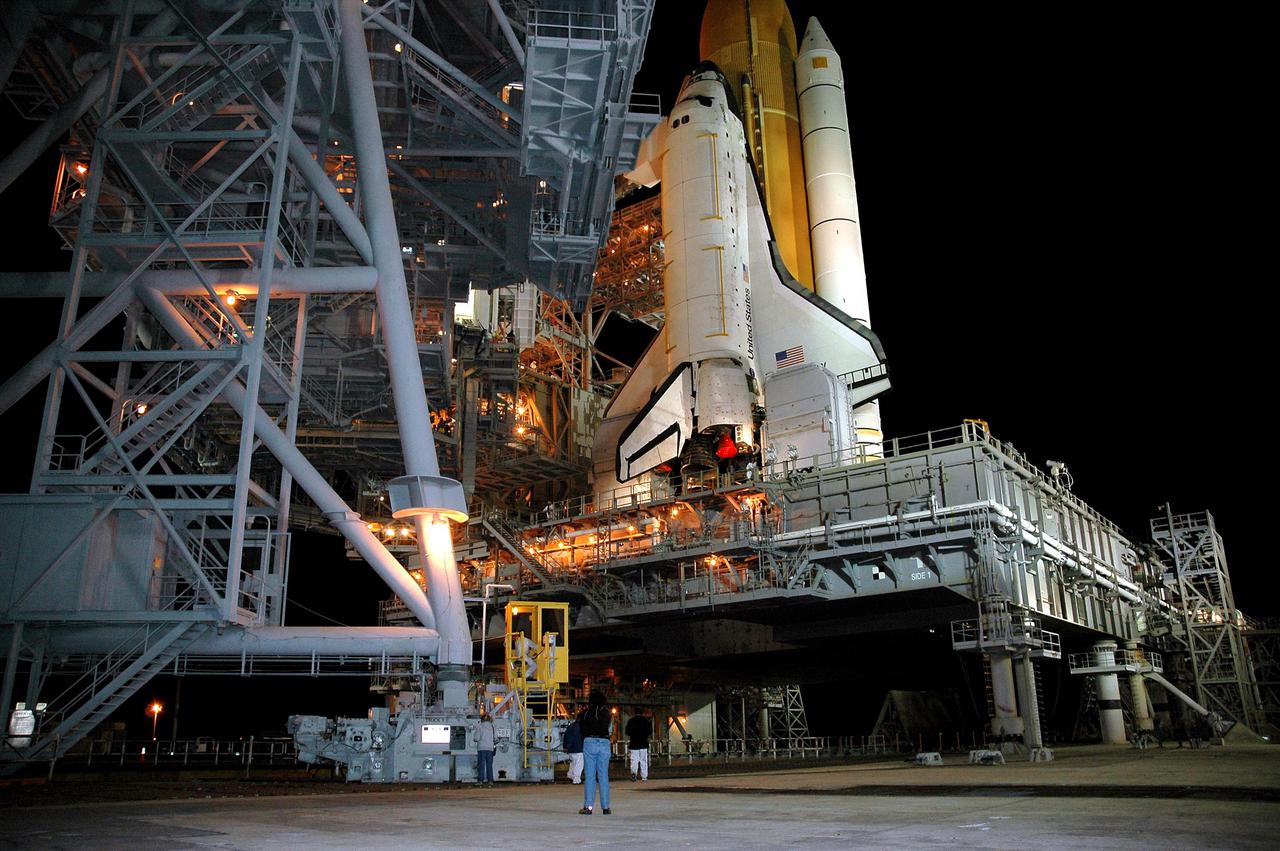
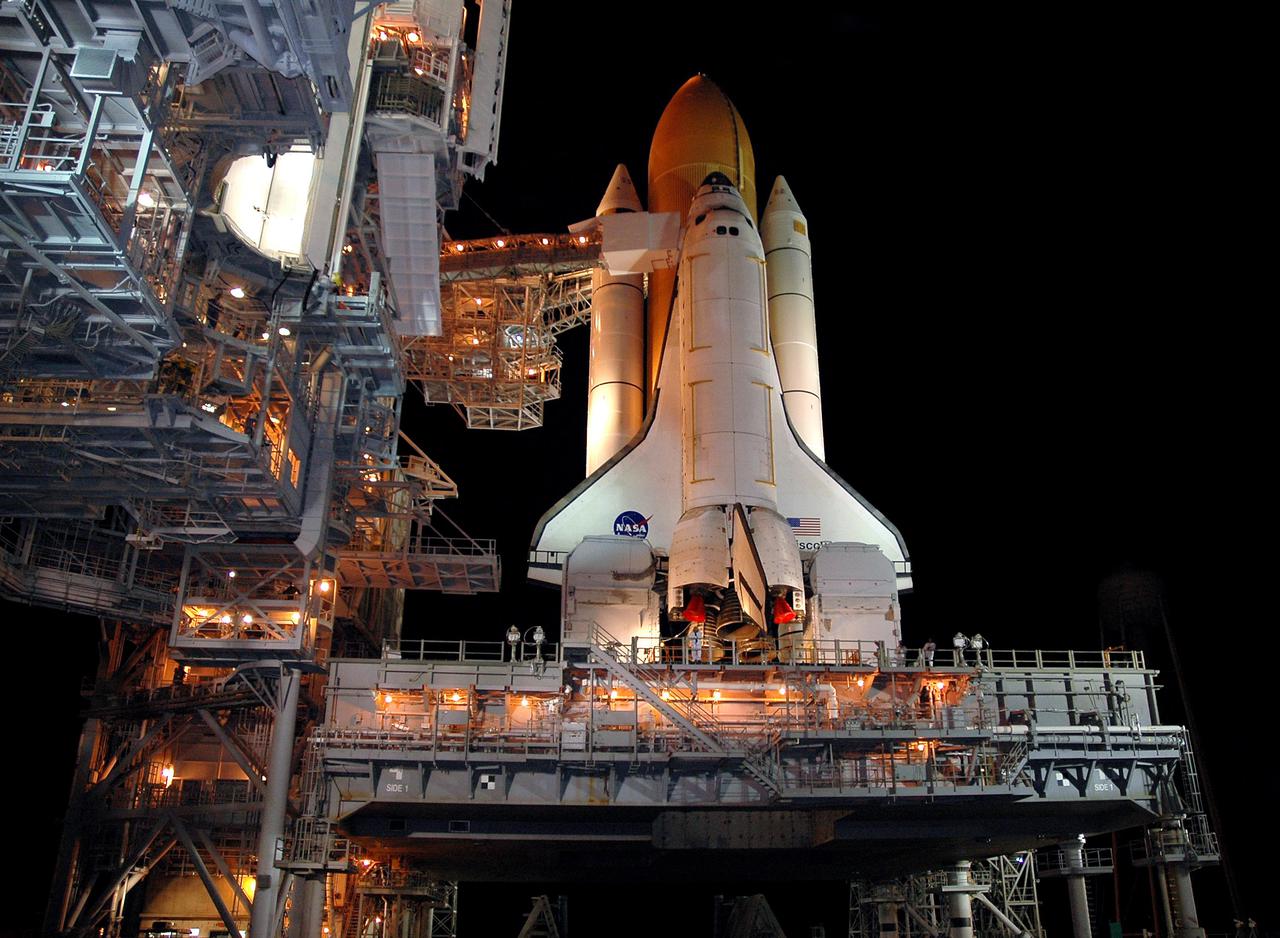
KENNEDY SPACE CENTER, FLA. -- The Rotating Service Structure is rolled back at Launch Pad 39B revealing Space Shuttle Discovery.  A propellant-loading test of Discovery's External Tank (ET) is scheduled for April 14. During the test, the tank will be filled to launch levels with ultra-cold hydrogen and oxygen propellants, known as 'cryogenics.' The test is designed to evaluate how the tank, orbiter, Solid Rocket Boosters and ground systems are performing under full 'cryo-load.' Throughout testing, engineers will observe the effectiveness of key safety modifications made to the External Tank. NASA’s Return to Flight mission, STS-114 on Space Shuttle Discovery, is targeted for launch on May 15 with a launch window that extends to June 3.
KSC-05pd-0708
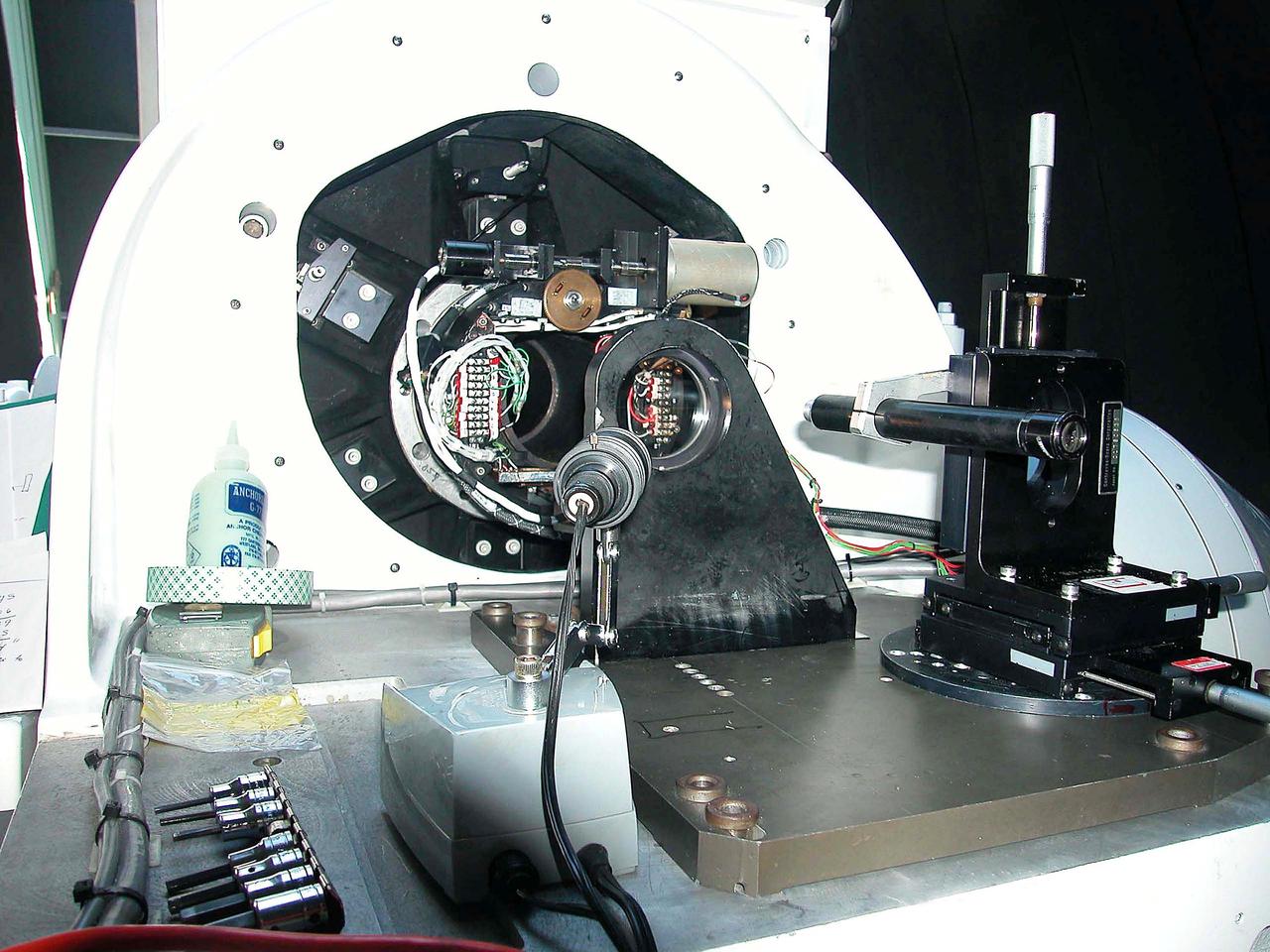
KENNEDY SPACE CENTER, FLA. -    The focus barrel is installed  on a newly installed five-meter focal length telescope in Cocoa Beach, Fla.  The tracking telescope is part of the Distant Object Attitude Measurement System (DOAMS) that provides optical support for launches from KSC and Cape Canaveral.
KSC-03pd2686
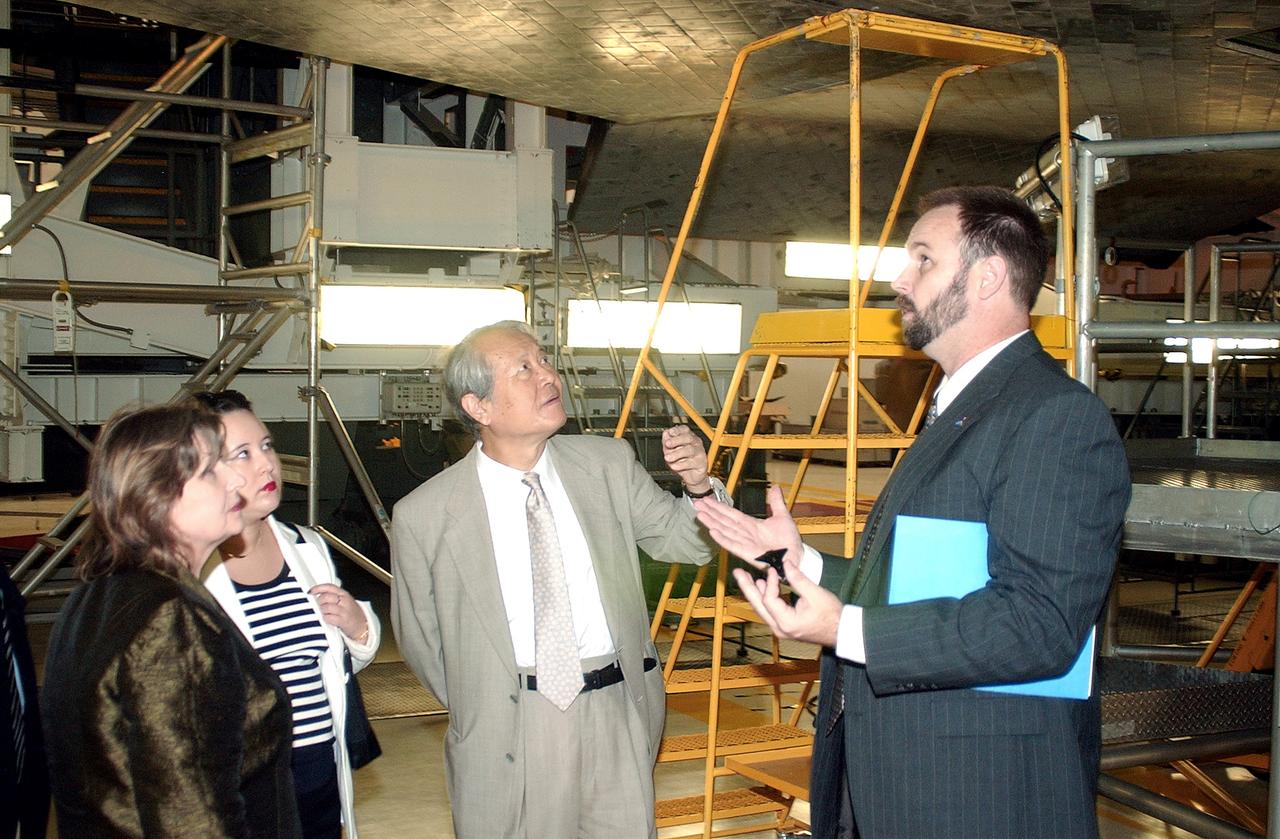
KENNEDY SPACE CENTER, FLA. - NASA Manager Steve Cain explains aspects of Space Shuttle processing to Consul General of Japan Ko Kodaira and his family in the Orbiter Processing Facility during their visit to Kennedy Space Center (KSC). From left are Kodaira's wife Marie, his daughter Reiko, Kodaira, and Cain, Senior Future International Space Station Element Manager. Kodaira is touring the facilities at KSC at the invitation of the local office of the National Space Development Agency of Japan (NASDA) to acquaint him with KSC's unique processing capabilities.
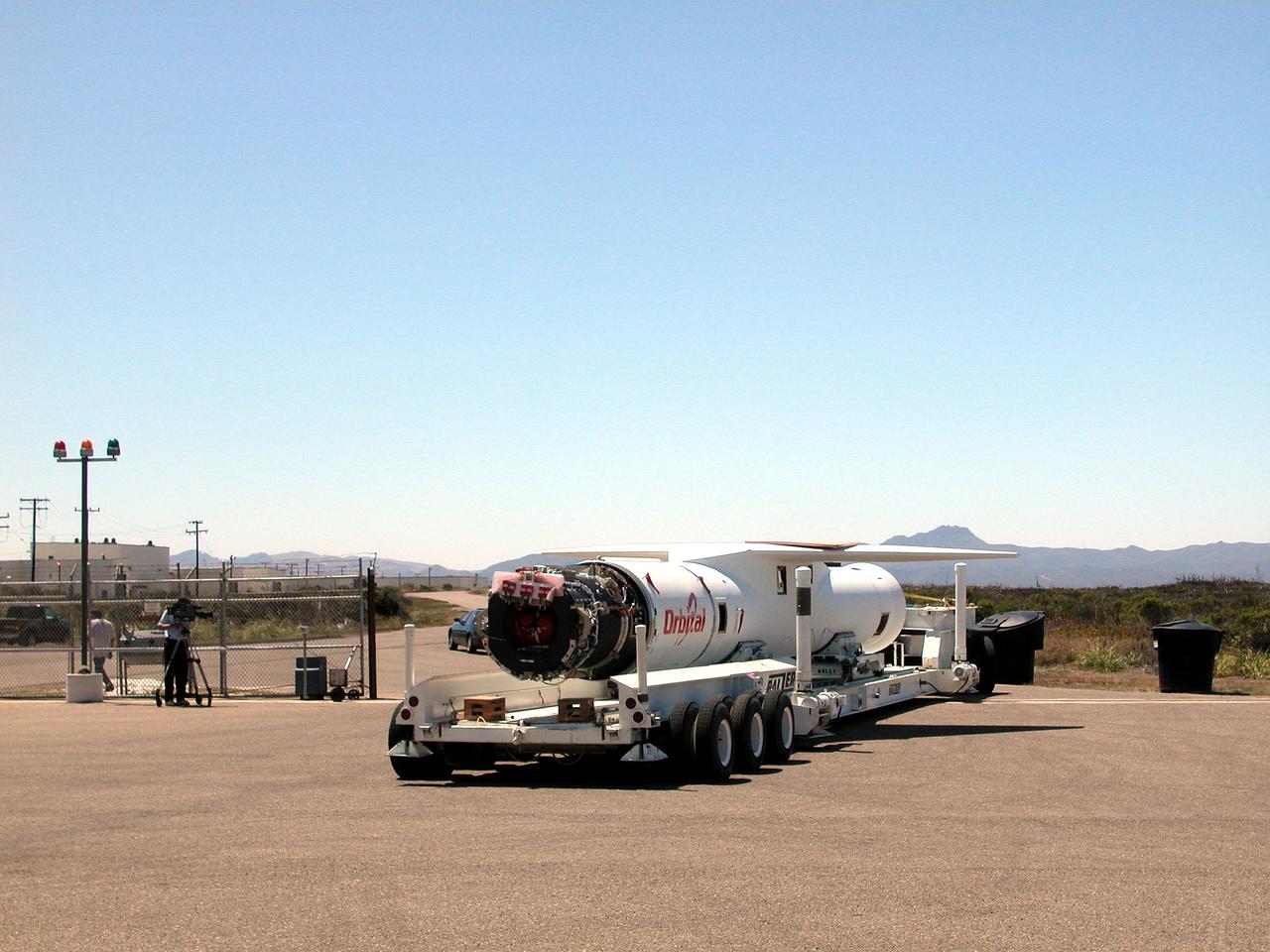
VANDENBERG AIR FORCE BASE, CALIF. - At Vandenberg Air Force Base, Calif., the Pegasus launch vehicle is moved toward its hangar. The Pegasus will carry the SciSat-1 spacecraft in a 400-mile-high polar orbit to investigate processes that control the distribution of ozone in the upper atmosphere. The data from the satellite will provide Canadian and international scientists with improved measurements relating to global ozone processes and help policymakers assess existing environmental policy and develop protective measures for improving the health of our atmosphere, preventing further ozone depletion. The mission is designed to last two years.
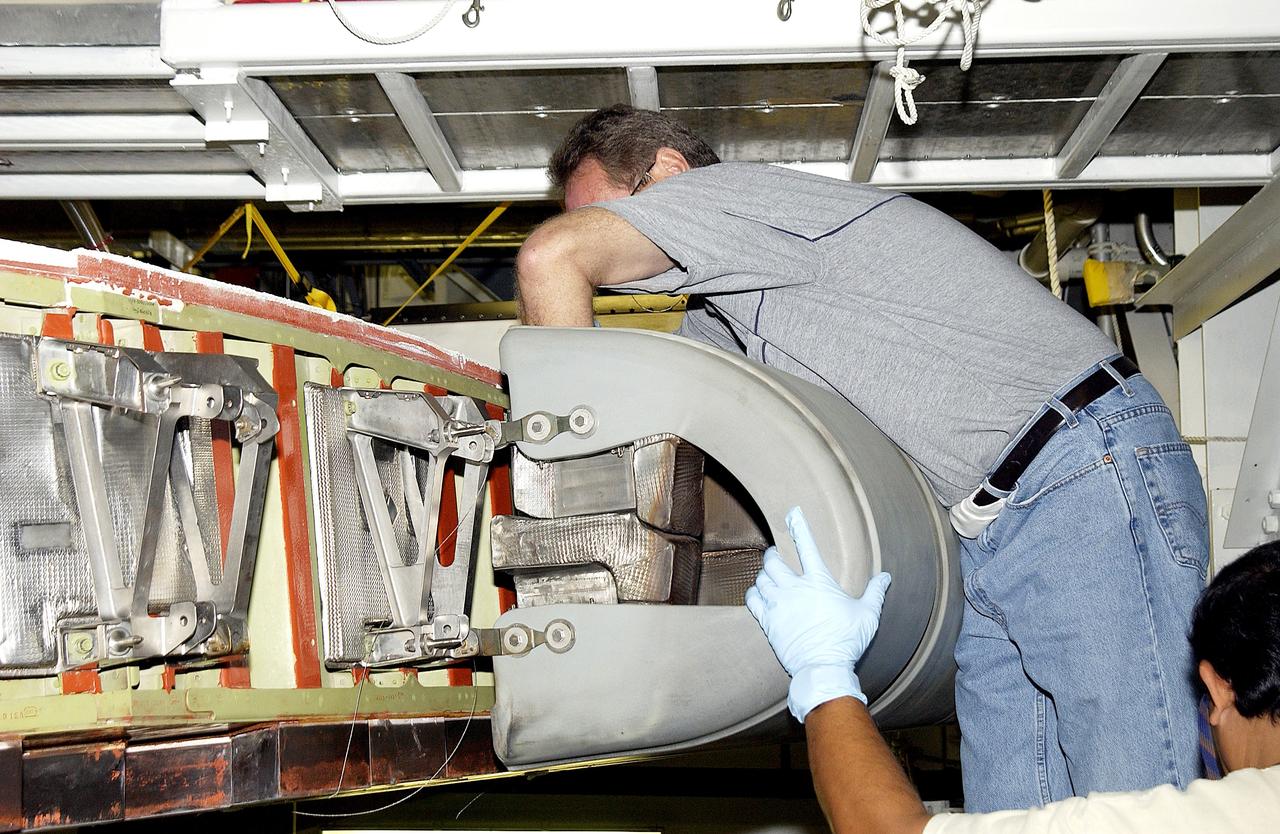
KENNEDY SPACE CENTER, FLA. - In the Orbiter Processing Facility, United Space Alliance worker Mike Hyatt (above) finishes installing a Reinforced Carbon Carbon (RCC) panel to the leading edge of the wing of the orbiter Atlantis.  The gray carbon composite RCC panels have sufficient strength to withstand the aerodynamic forces experienced during launch and reentry, which can reach as high as 800 pounds per square foot.  The operating range of RCC is from minus 250º F to about 3,000º F, the temperature produced by friction with the atmosphere during reentry.
KENNEDY SPACE CENTER, FLA. - In the Orbiter Processing Facility, United Space Alliance worker Mike Hyatt (above) finishes installing a Reinforced Carbon Carbon (RCC) panel to the leading edge of the wing of the orbiter Atlantis. The gray carbon composite RCC panels have sufficient strength to withstand the aerodynamic forces experienced during launch and reentry, which can reach as high as 800 pounds per square foot. The operating range of RCC is from minus 250º F to about 3,000º F, the temperature produced by friction with the atmosphere during reentry.
KENNEDY SPACE CENTER, FLA. - In Cocoa Beach, Fla., a new five-meter telescope is lifted up to the dome for installation.  The tracking telescope is part of the Distant Object Attitude Measurement System (DOAMS) that provides optical support for launches from KSC and Cape Canaveral.
KENNEDY SPACE CENTER, FLA. - In Cocoa Beach, Fla., a new five-meter telescope is lifted up to the dome for installation. The tracking telescope is part of the Distant Object Attitude Measurement System (DOAMS) that provides optical support for launches from KSC and Cape Canaveral.
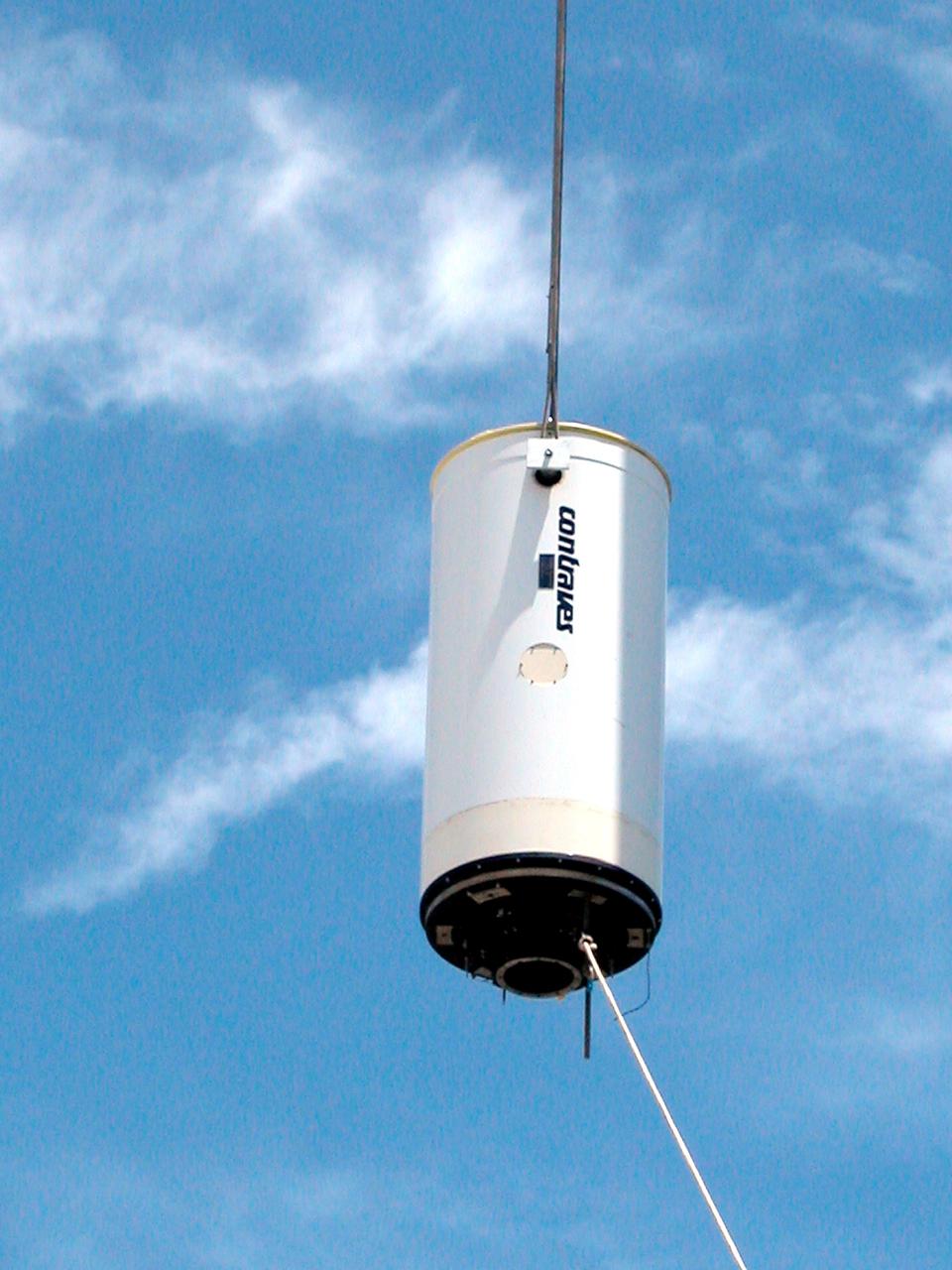
KENNEDY SPACE CENTER, FLA. - In Cocoa Beach, Fla., a new five-meter telescope is lowered toward the dome for installation.  The tracking telescope is part of the Distant Object Attitude Measurement System (DOAMS) that provides optical support for launches from KSC and Cape Canaveral.
KENNEDY SPACE CENTER, FLA. - In Cocoa Beach, Fla., a new five-meter telescope is lowered toward the dome for installation. The tracking telescope is part of the Distant Object Attitude Measurement System (DOAMS) that provides optical support for launches from KSC and Cape Canaveral.
KENNEDY SPACE CENTER, FLA. - In the Orbiter Processing Facility, John Newport, with United Space Alliance, inspects spar installation on the wing of the orbiter Atlantis.  Reinforced Carbon Carbon (RCC) panels are mechanically attached to the wing with a series of floating joints - spars - to reduce loading on the panels caused by wing deflections. The aluminum and the metallic attachments are protected from exceeding temperature limits by internal insulation.
KENNEDY SPACE CENTER, FLA. - In the Orbiter Processing Facility, John Newport, with United Space Alliance, inspects spar installation on the wing of the orbiter Atlantis. Reinforced Carbon Carbon (RCC) panels are mechanically attached to the wing with a series of floating joints - spars - to reduce loading on the panels caused by wing deflections. The aluminum and the metallic attachments are protected from exceeding temperature limits by internal insulation.
KENNEDY SPACE CENTER, FLA. - In the Orbiter Processing Facility, Mike Hyatt (left) and Saul Ngy (right), with United Space Alliance, finish installing a spar on the wing of the orbiter Atlantis.  Reinforced Carbon Carbon (RCC) panels are mechanically attached to the wing with a series of floating joints - spars - to reduce loading on the panels caused by wing deflections. The aluminum and the metallic attachments are protected from exceeding temperature limits by internal insulation.
KENNEDY SPACE CENTER, FLA. - In the Orbiter Processing Facility, Mike Hyatt (left) and Saul Ngy (right), with United Space Alliance, finish installing a spar on the wing of the orbiter Atlantis. Reinforced Carbon Carbon (RCC) panels are mechanically attached to the wing with a series of floating joints - spars - to reduce loading on the panels caused by wing deflections. The aluminum and the metallic attachments are protected from exceeding temperature limits by internal insulation.
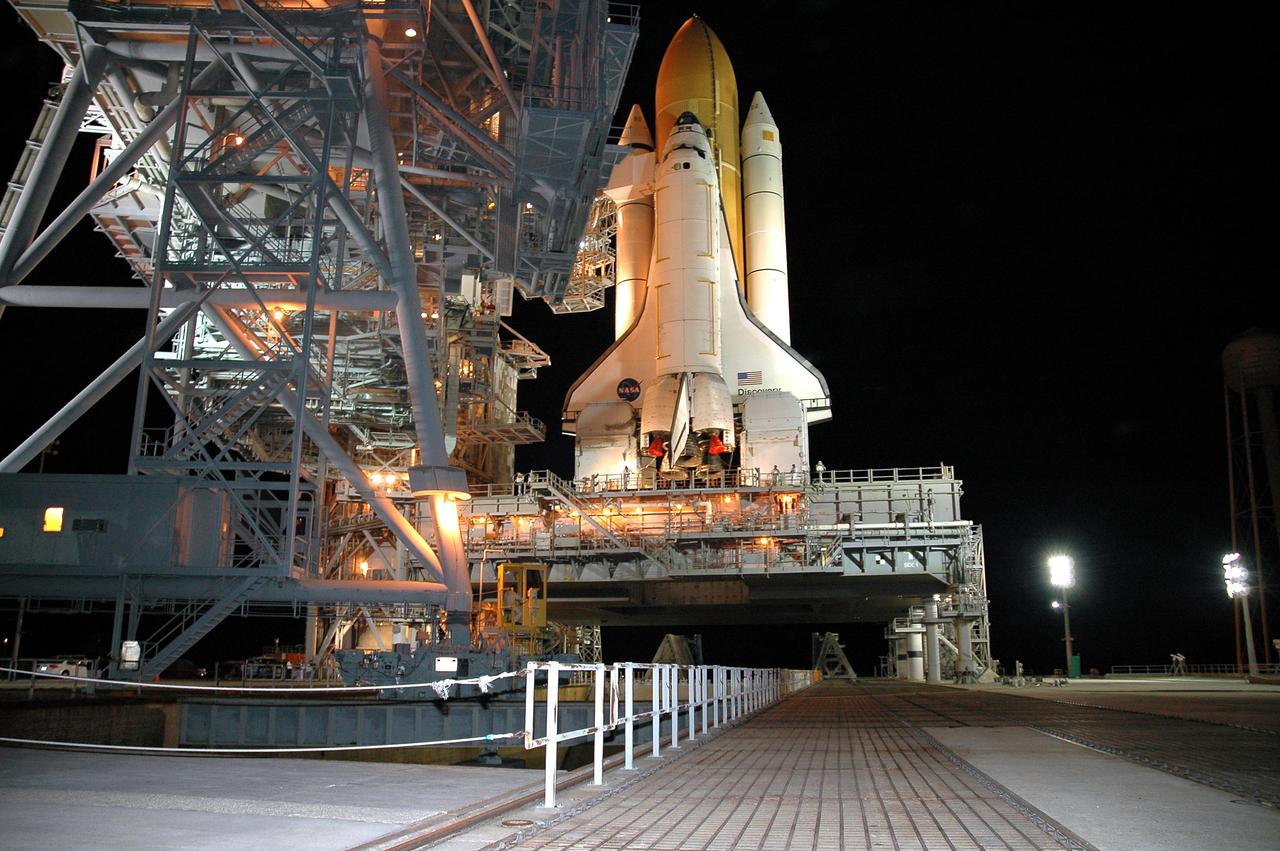
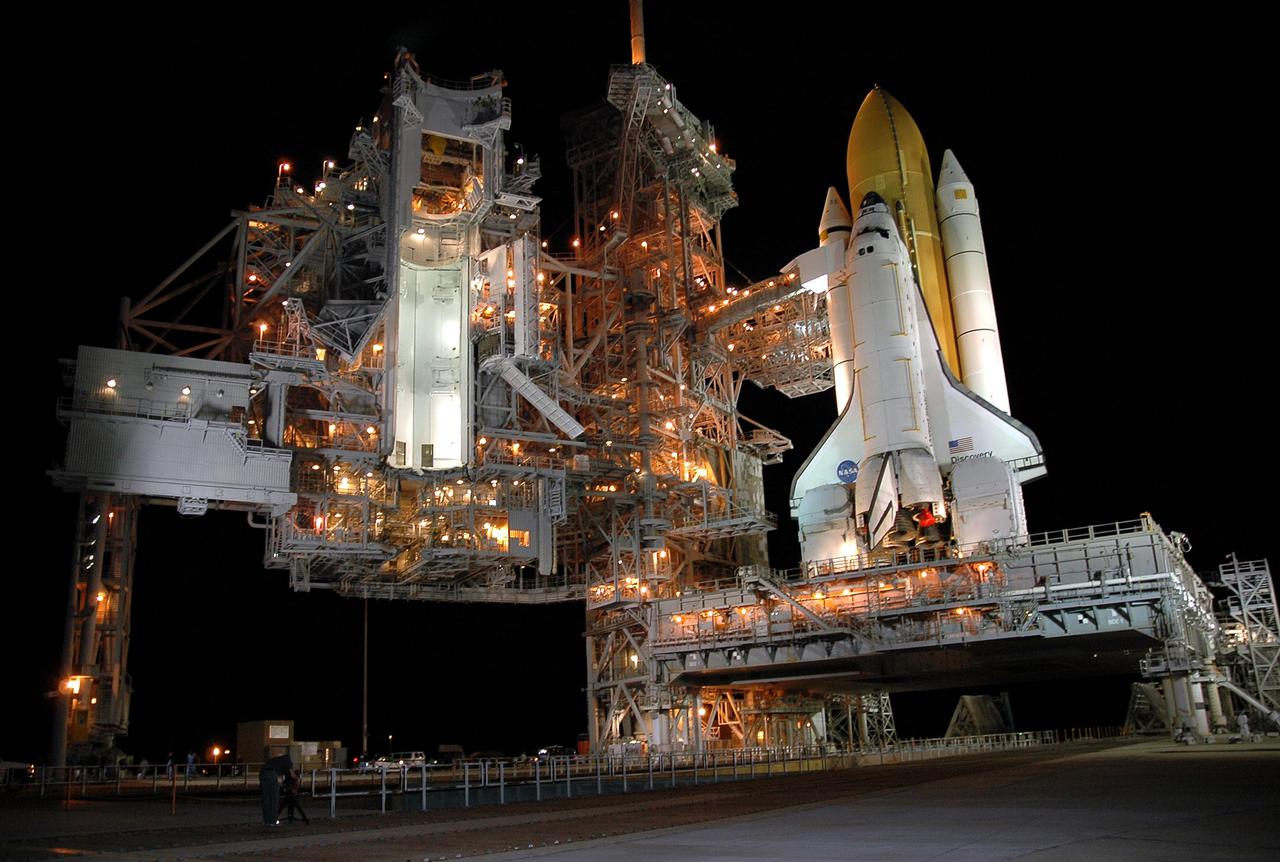
KENNEDY SPACE CENTER, FLA. -- The xenon lights on Launch Pad 39B illuminate Space Shuttle Discovery following the rollback of the Rotating Service Structure. A propellant-loading test of Discovery's External Tank (ET) is scheduled for April 14. During the test, the tank will be filled to launch levels with ultra-cold hydrogen and oxygen propellants, known as 'cryogenics.' The test is designed to evaluate how the tank, orbiter, Solid Rocket Boosters and ground systems are performing under full 'cryo-load.' Throughout testing, engineers will observe the effectiveness of key safety modifications made to the External Tank. NASA’s Return to Flight mission, STS-114 on Space Shuttle Discovery, is targeted for launch on May 15 with a launch window that extends to June 3.
KSC-05pd-0709
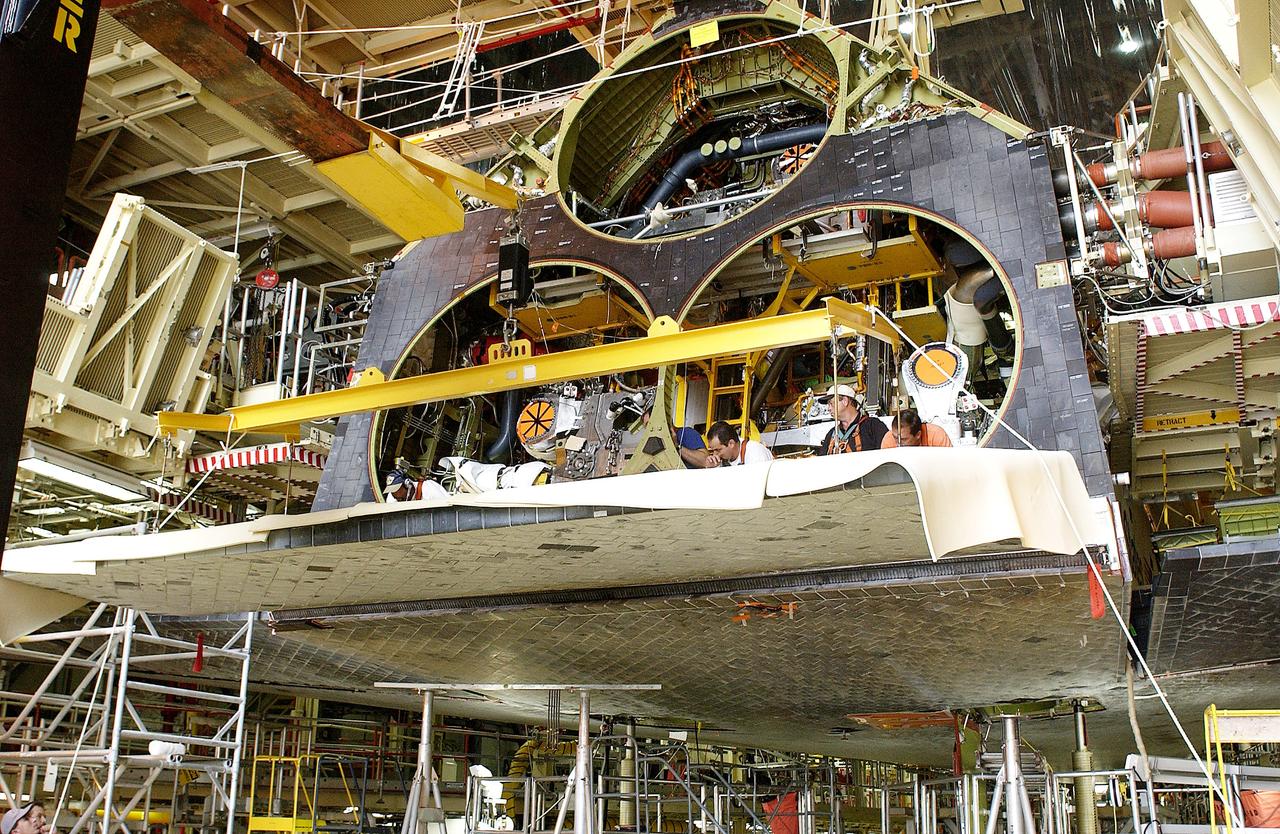
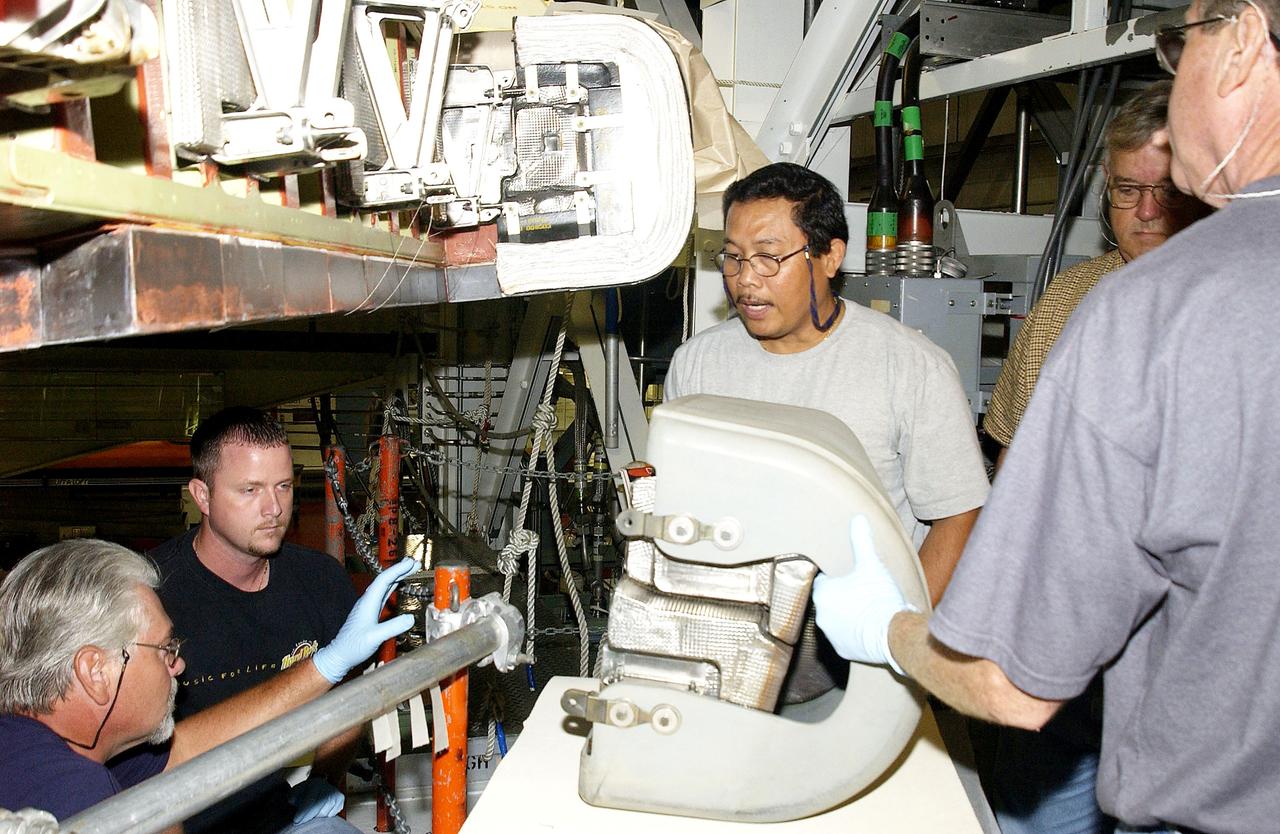
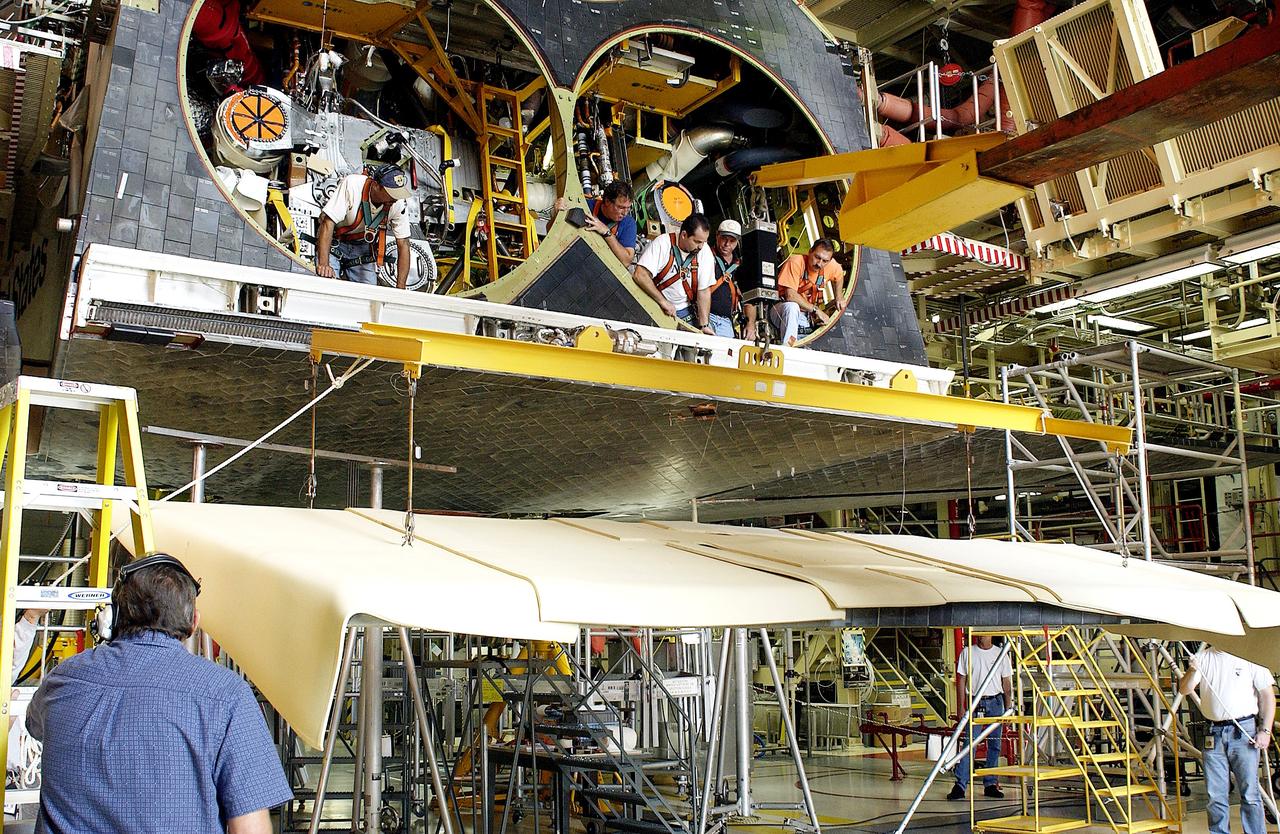
KENNEDY SPACE CENTER, FLA. - In the Orbiter Processing Facility, workers look down from spaces allotted for the main engines as the rear body flap is lifted for installation on the orbiter Discovery.  The body flap, which is temporarily under protective covering, attaches below the main engines.
KENNEDY SPACE CENTER, FLA. - In the Orbiter Processing Facility, workers look down from spaces allotted for the main engines as the rear body flap is lifted for installation on the orbiter Discovery. The body flap, which is temporarily under protective covering, attaches below the main engines.
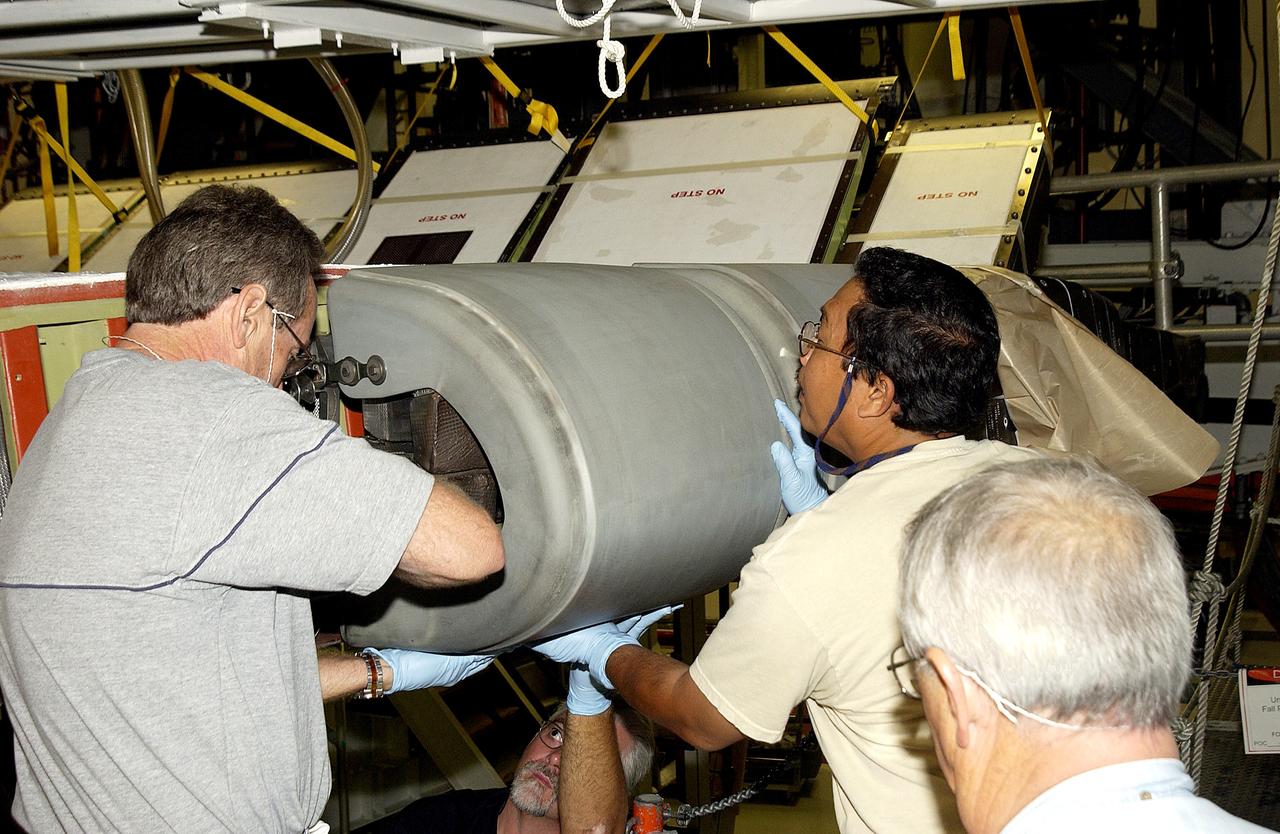
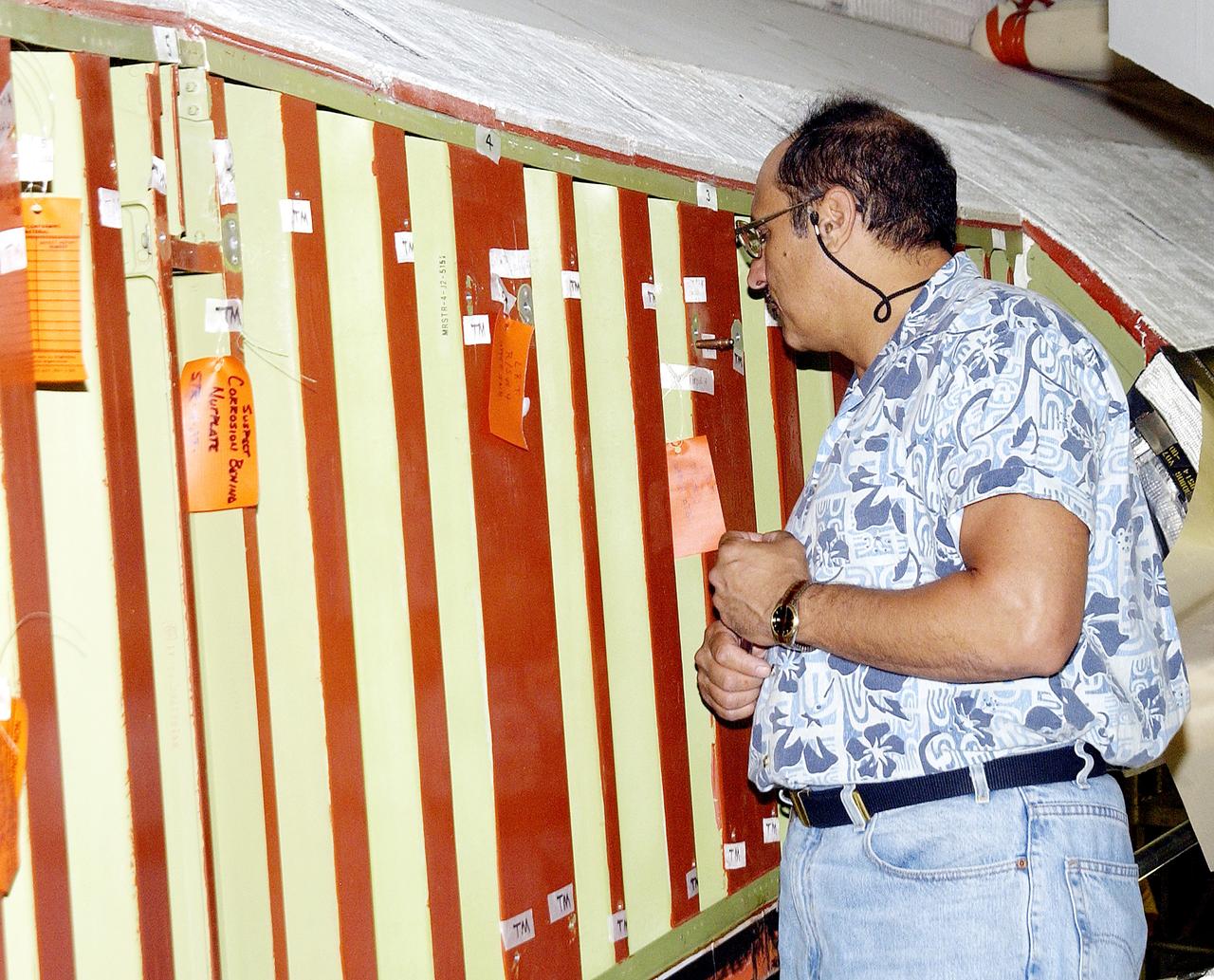
KENNEDY SPACE CENTER, FLA. - In the Orbiter Processing Facility (OPF), a United Space Alliance technician examines the attachment points for the spars on the exterior of a wing of Space Shuttle Atlantis. Reinforced Carbon Carbon (RCC) panels are mechanically attached to the wing with a series of floating joints - spars - to reduce loading on the panels caused by wing deflections. The aluminum and the metallic attachments are protected from exceeding temperature limits by internal insulation.  The next launch of Atlantis will be on mission STS-114, a utilization and logistics flight to the International Space Station.
KENNEDY SPACE CENTER, FLA. - In the Orbiter Processing Facility (OPF), a United Space Alliance technician examines the attachment points for the spars on the exterior of a wing of Space Shuttle Atlantis. Reinforced Carbon Carbon (RCC) panels are mechanically attached to the wing with a series of floating joints - spars - to reduce loading on the panels caused by wing deflections. The aluminum and the metallic attachments are protected from exceeding temperature limits by internal insulation. The next launch of Atlantis will be on mission STS-114, a utilization and logistics flight to the International Space Station.
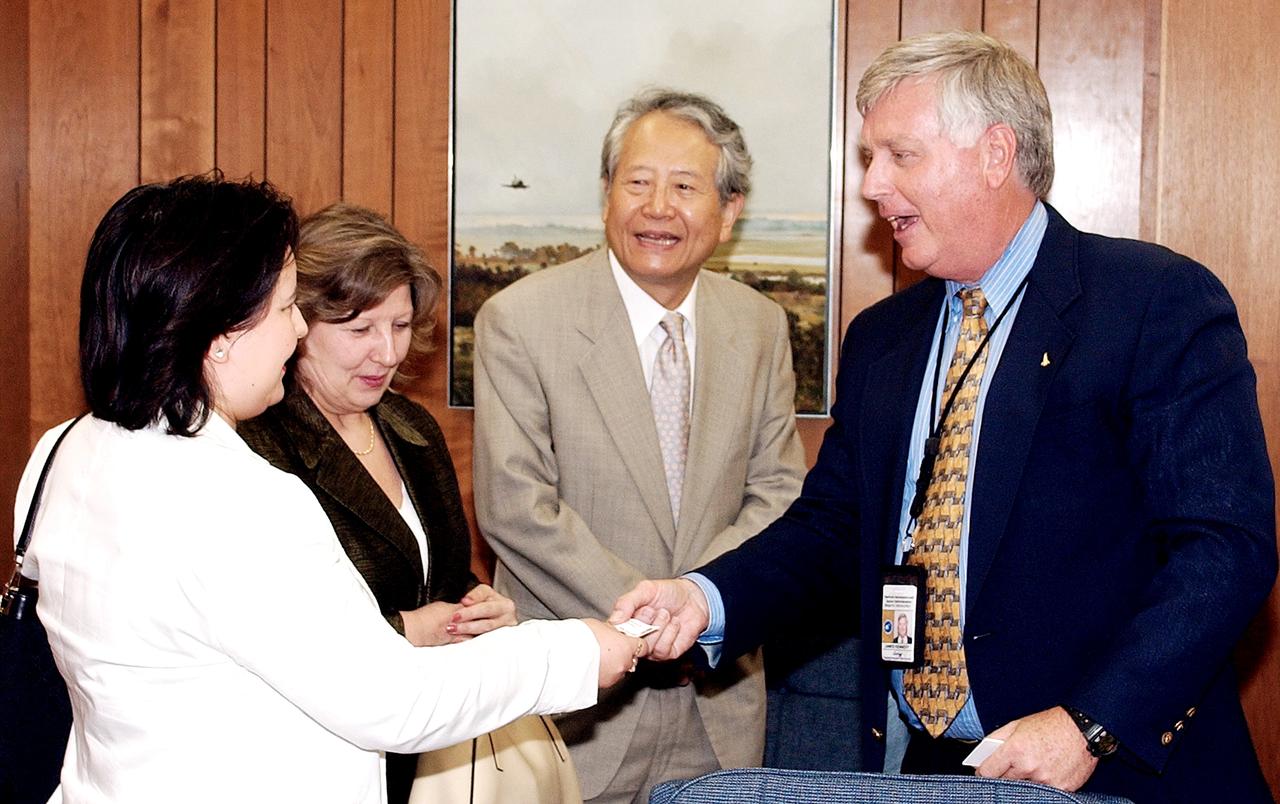
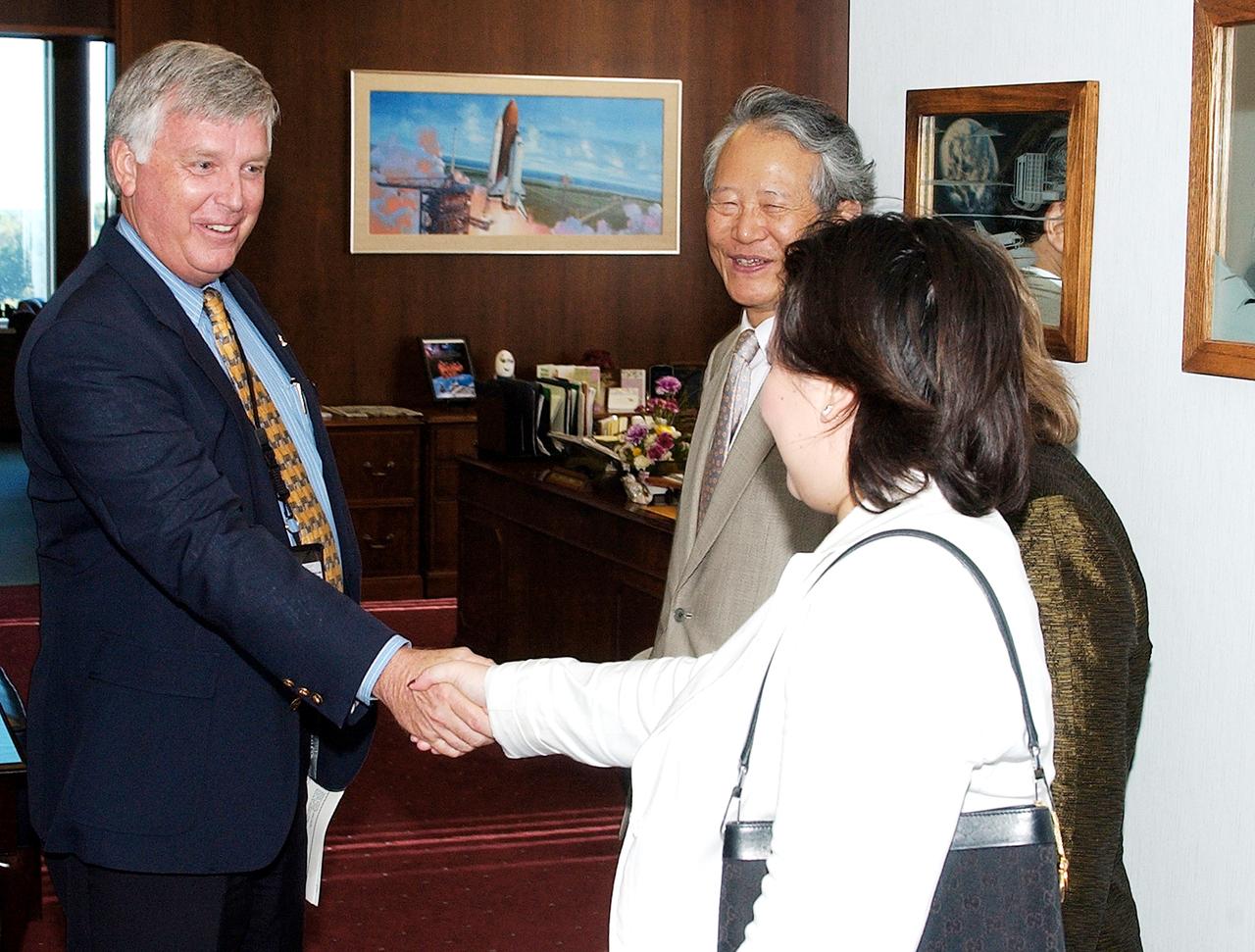
KENNEDY SPACE CENTER, FLA. - KSC Director James W. Kennedy receives Consul General of Japan Ko Kodaira and his family in his office in Headquarters Building during their visit to Kennedy Space Center (KSC).  From left are Kennedy, Kodaira, his wife Marie (partially hidden), and his daughter Reiko. Kodaira is touring the facilities at KSC at the invitation of the local office of the National Space Development Agency of Japan (NASDA) to acquaint him with KSC's unique processing capabilities.
KENNEDY SPACE CENTER, FLA. - KSC Director James W. Kennedy receives Consul General of Japan Ko Kodaira and his family in his office in Headquarters Building during their visit to Kennedy Space Center (KSC). From left are Kennedy, Kodaira, his wife Marie (partially hidden), and his daughter Reiko. Kodaira is touring the facilities at KSC at the invitation of the local office of the National Space Development Agency of Japan (NASDA) to acquaint him with KSC's unique processing capabilities.
KENNEDY SPACE CENTER, FLA. -  In the Orbiter Processing Facility, United Space Alliance worker Mike Hyatt (right) attaches a Reinforced Carbon Carbon (RCC) panel onto the leading edge of the wing of the orbiter Atlantis.  The gray carbon composite RCC panels have sufficient strength to withstand the aerodynamic forces experienced during launch and reentry, which can reach as high as 800 pounds per square foot. The operating range of RCC is from minus 250º F to about 3,000º F, the temperature produced by friction with the atmosphere during reentry.
KENNEDY SPACE CENTER, FLA. - In the Orbiter Processing Facility, United Space Alliance worker Mike Hyatt (right) attaches a Reinforced Carbon Carbon (RCC) panel onto the leading edge of the wing of the orbiter Atlantis. The gray carbon composite RCC panels have sufficient strength to withstand the aerodynamic forces experienced during launch and reentry, which can reach as high as 800 pounds per square foot. The operating range of RCC is from minus 250º F to about 3,000º F, the temperature produced by friction with the atmosphere during reentry.
KENNEDY SPACE CENTER, FLA. - In the Orbiter Processing Facility, John Newport, with United Space Alliance, inspects a piece of equipment for spar installation on the wing of the orbiter Atlantis.  Reinforced Carbon Carbon (RCC) panels are mechanically attached to the wing with a series of floating joints - spars - to reduce loading on the panels caused by wing deflections. The aluminum and the metallic attachments are protected from exceeding temperature limits by internal insulation.
KENNEDY SPACE CENTER, FLA. - In the Orbiter Processing Facility, John Newport, with United Space Alliance, inspects a piece of equipment for spar installation on the wing of the orbiter Atlantis. Reinforced Carbon Carbon (RCC) panels are mechanically attached to the wing with a series of floating joints - spars - to reduce loading on the panels caused by wing deflections. The aluminum and the metallic attachments are protected from exceeding temperature limits by internal insulation.
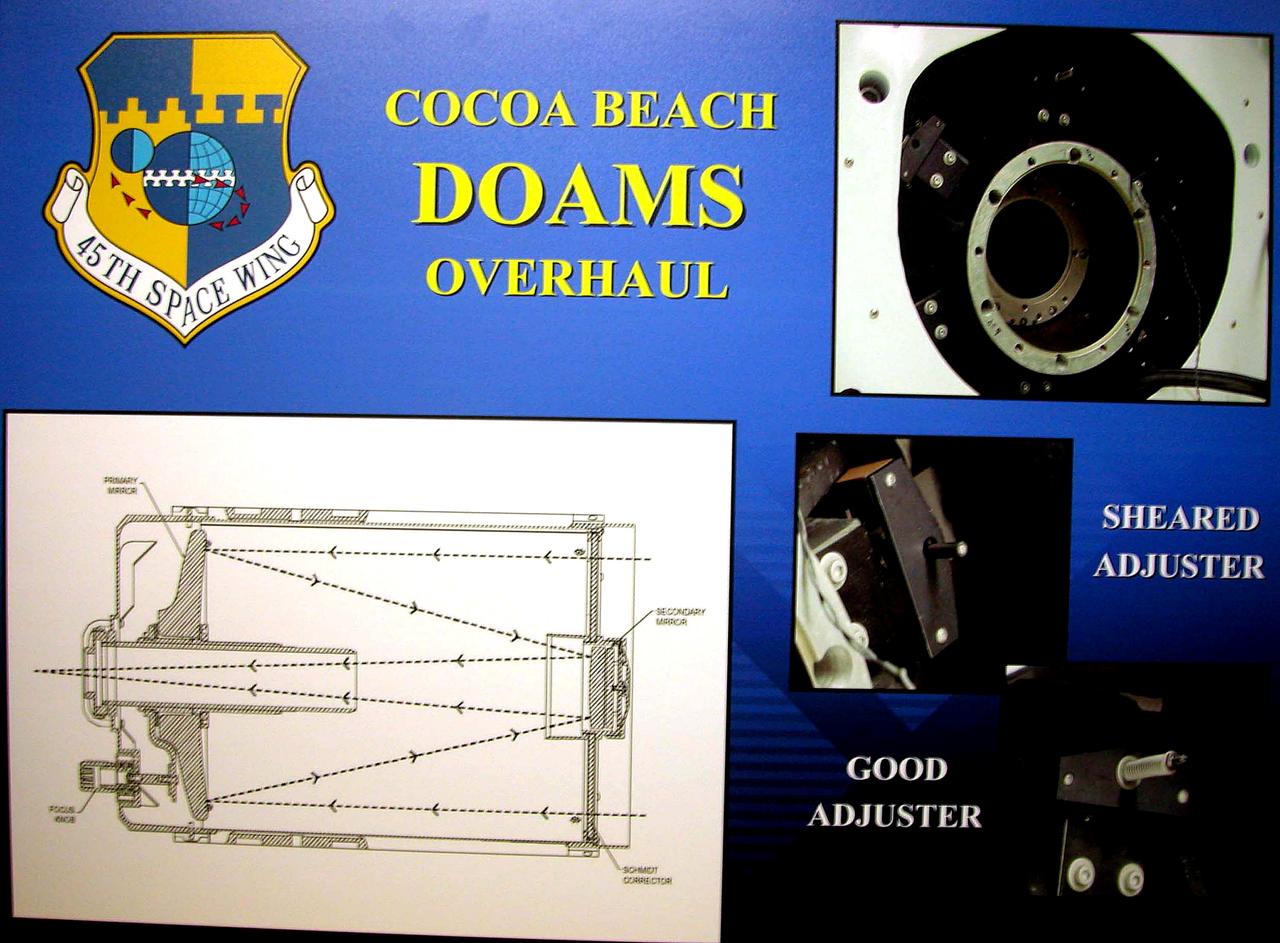
KENNEDY SPACE CENTER, FLA. - This storyboard shows a diagram of the telescope design and photos for a new five-meter focal length scope.   The tracking telescope is part of the Distant Object Attitude Measurement System (DOAMS) in Cocoa Beach, Fla.,  that provides optical support for launches from KSC and Cape Canaveral.
KSC-03pd2681
KENNEDY SPACE CENTER, FLA. - Sen. Bill Nelson talks to the media at the NASA KSC News Center about the Columbia Accident Investigation Board report released today.
KENNEDY SPACE CENTER, FLA. -    A film camera is set in place  on a newly installed five-meter focal length telescope in Cocoa Beach, Fla.  The tracking telescope is part of the Distant Object Attitude Measurement System (DOAMS) that provides optical support for launches from KSC and Cape Canaveral.
KSC-03pd2685
KENNEDY SPACE CENTER, FLA. - In the Orbiter Processing Facility (OPF), a United Space Alliance technician examines the attachment points for the spars on the exterior of a wing of Space Shuttle Atlantis. Reinforced Carbon Carbon (RCC) panels are mechanically attached to the wing with a series of floating joints - spars - to reduce loading on the panels caused by wing deflections. The aluminum and the metallic attachments are protected from exceeding temperature limits by internal insulation.  The next launch of Atlantis will be on mission STS-114, a utilization and logistics flight to the International Space Station.
KENNEDY SPACE CENTER, FLA. - In the Orbiter Processing Facility (OPF), a United Space Alliance technician examines the attachment points for the spars on the exterior of a wing of Space Shuttle Atlantis. Reinforced Carbon Carbon (RCC) panels are mechanically attached to the wing with a series of floating joints - spars - to reduce loading on the panels caused by wing deflections. The aluminum and the metallic attachments are protected from exceeding temperature limits by internal insulation. The next launch of Atlantis will be on mission STS-114, a utilization and logistics flight to the International Space Station.
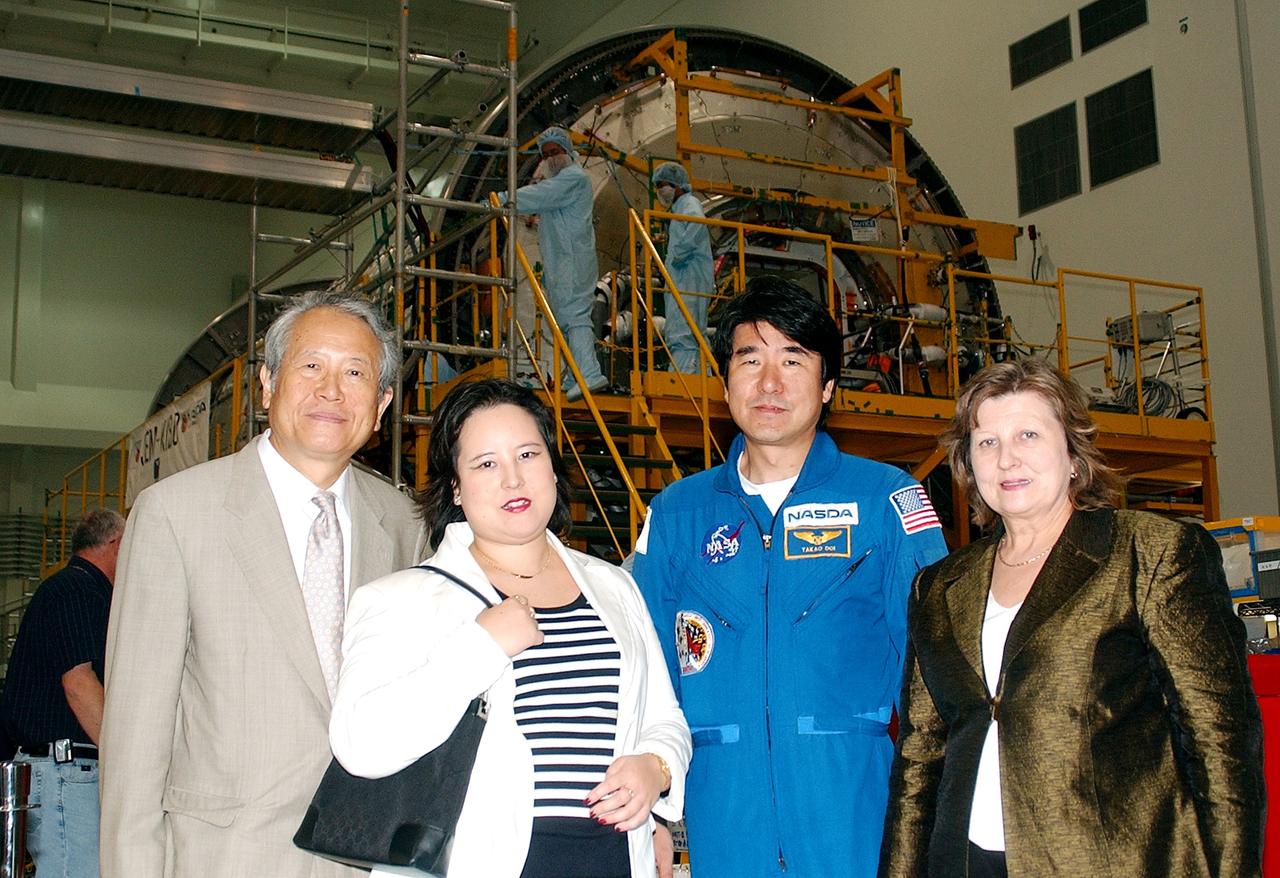
KENNEDY SPACE CENTER, FLA. - From left, the Consul General of Japan Ko Kodaira, his daughter Reiko, astronaut Dr. Takao Doi, and Kodaira's wife Marie pause for a photograph in the Space Station Processing Facility during their visit to Kennedy Space Center (KSC). Doi represented Japan on Space Shuttle mission STS-87, the fourth U.S Microgravity Payload flight.  Kodaira is touring the facilities at KSC at the invitation of the local office of the National Space Development Agency of Japan (NASDA) to acquaint him with KSC's unique processing capabilities.
KENNEDY SPACE CENTER, FLA. - From left, the Consul General of Japan Ko Kodaira, his daughter Reiko, astronaut Dr. Takao Doi, and Kodaira's wife Marie pause for a photograph in the Space Station Processing Facility during their visit to Kennedy Space Center (KSC). Doi represented Japan on Space Shuttle mission STS-87, the fourth U.S Microgravity Payload flight. Kodaira is touring the facilities at KSC at the invitation of the local office of the National Space Development Agency of Japan (NASDA) to acquaint him with KSC's unique processing capabilities.
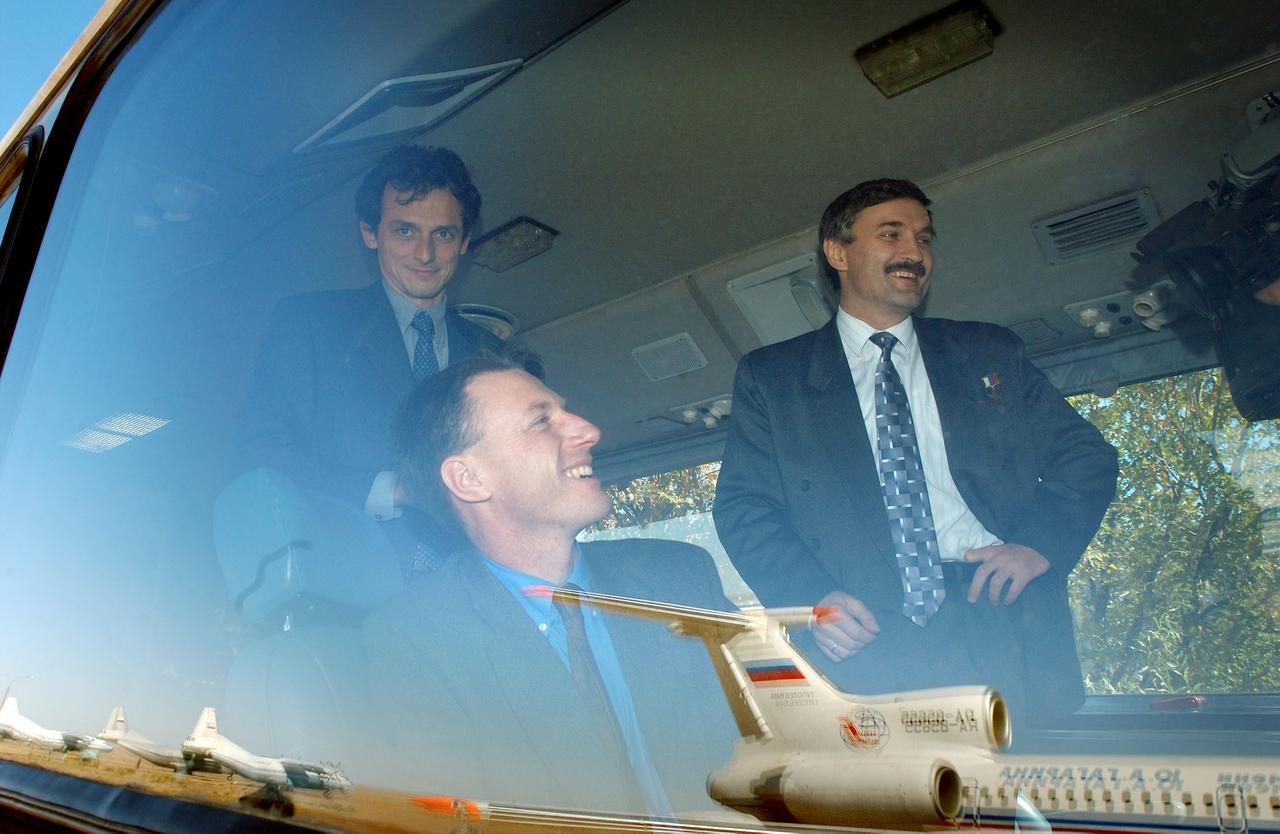
Baikonur, Kazakhstan -  (Left to right) European Space Agency Astronaut Pedro Duque of Spain, Expedition 8 Commander Michael Foale, and Expedition 8 Soyuz Commander and Flight Engineer Alexander Kaleri gather on the bus after the flight down from Moscow to Baikonur, Kazakhstan. Expedition 8 is scheduled to launch from the Baikonur Cosmodrome in Kazakhstan on Oct. 18 on board a Soyuz rocket to the International Space Station.  Photo Credit: "NASA/Bill Ingalls"
KSC-03pd2795
KENNEDY SPACE CENTER, FLA. -  Mike Hyatt (left) and Saul Ngy, technicians with United Space Alliance, install a spar on the wing of the orbiter Atlantis.  The Reinforced Carbon Carbon (RCC) panels are mechanically attached to the wing with a series of floating joints - spars - to reduce loading on the panels caused by wing deflections. The aluminum and the metallic attachments are protected from exceeding temperature limits by internal insulation.
KENNEDY SPACE CENTER, FLA. - Mike Hyatt (left) and Saul Ngy, technicians with United Space Alliance, install a spar on the wing of the orbiter Atlantis. The Reinforced Carbon Carbon (RCC) panels are mechanically attached to the wing with a series of floating joints - spars - to reduce loading on the panels caused by wing deflections. The aluminum and the metallic attachments are protected from exceeding temperature limits by internal insulation.
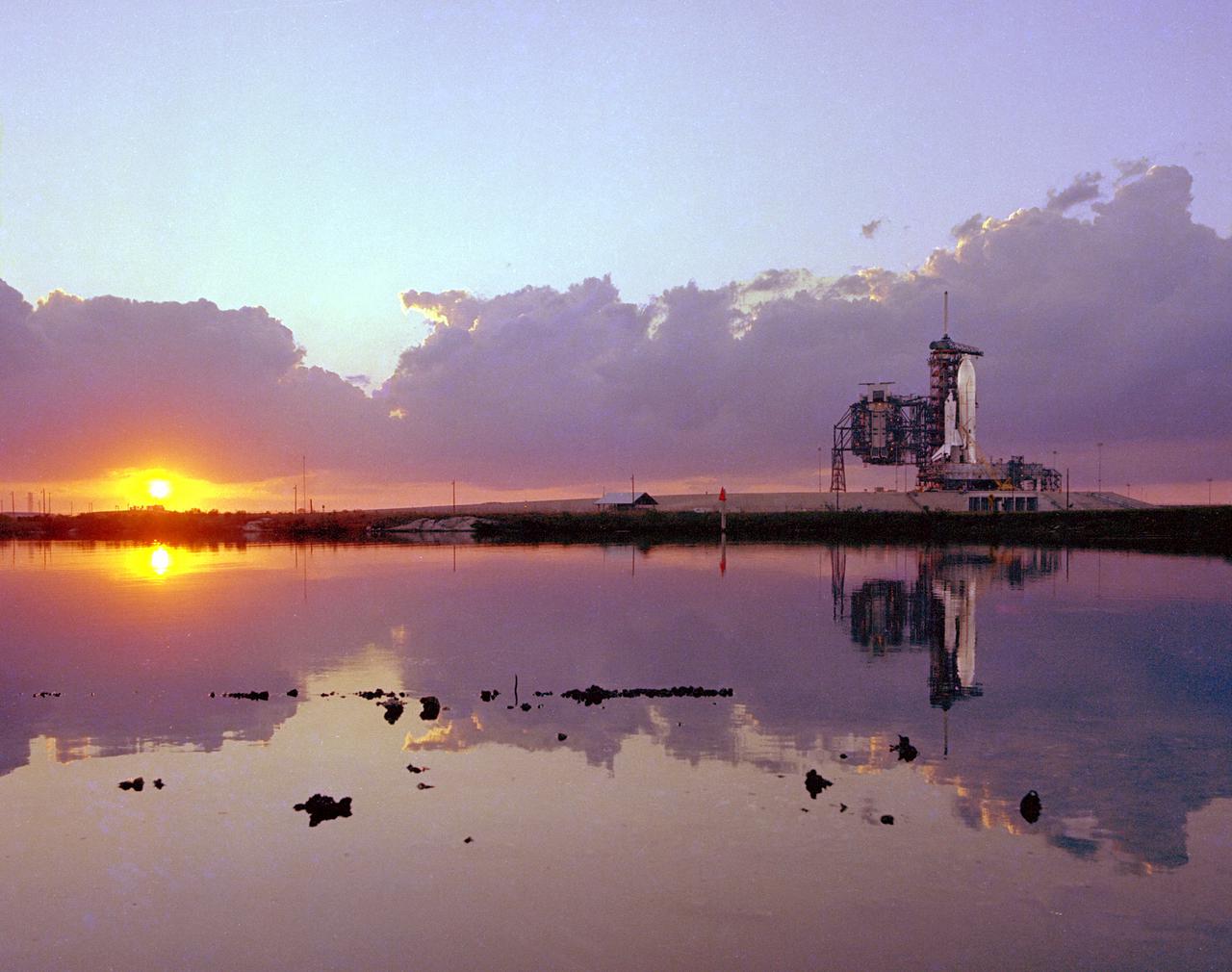
KENNEDY SPACE CENTER, FLA. -  Dramatically reflected by the waters of the extensive lagoonal sysem adjacent to Launch Pad A, the Space Shuttle, the world's first reusable space vehicle, is lighted by spotlights and the setting sun on the evening prior to Flight Readiness Firing of the orbiter Columbia's main engines.  The 20-second firing was a milestone procedure in flight preparation of the world's first reusable space vehicle.
KSC-81pc-0092
KENNEDY SPACE CENTER, FLA. -  In the Orbiter Processing Facility, United Space Alliance worker Mike Hyatt (above) attaches a Reinforced Carbon Carbon (RCC) panel onto the leading edge of the wing of the orbiter Atlantis.  The gray carbon composite RCC panels have sufficient strength to withstand the aerodynamic forces experienced during launch and reentry, which can reach as high as 800 pounds per square foot.  The operating range of RCC is from minus 250º F to about 3,000º F, the temperature produced by friction with the atmosphere during reentry.
KENNEDY SPACE CENTER, FLA. - In the Orbiter Processing Facility, United Space Alliance worker Mike Hyatt (above) attaches a Reinforced Carbon Carbon (RCC) panel onto the leading edge of the wing of the orbiter Atlantis. The gray carbon composite RCC panels have sufficient strength to withstand the aerodynamic forces experienced during launch and reentry, which can reach as high as 800 pounds per square foot. The operating range of RCC is from minus 250º F to about 3,000º F, the temperature produced by friction with the atmosphere during reentry.
KENNEDY SPACE CENTER, FLA. - KSC Director James W. Kennedy receives Consul General of Japan Ko Kodaira and his family in his office in Headquarters Building during their visit to Kennedy Space Center (KSC). From left are Kodaira's daughter Reiko, his wife Marie, Kodaira, and Kennedy. Kodaira is touring the facilities at KSC at the invitation of the local office of the National Space Development Agency of Japan (NASDA) to acquaint him with KSC's unique processing capabilities.
KENNEDY SPACE CENTER, FLA. -  Workers in the Orbiter Processing Facility get ready to lift and install the rear body flap on orbiter Discovery.  The body flap, which is temporarily under protective covering, attaches below the main engines.
KENNEDY SPACE CENTER, FLA. - Workers in the Orbiter Processing Facility get ready to lift and install the rear body flap on orbiter Discovery. The body flap, which is temporarily under protective covering, attaches below the main engines.
KENNEDY SPACE CENTER, FLA. - In Cocoa Beach, Fla., a new five-meter telescope is lowered into the dome for installation.  The tracking telescope is part of the Distant Object Attitude Measurement System (DOAMS) that provides optical support for launches from KSC and Cape Canaveral.
KENNEDY SPACE CENTER, FLA. - In Cocoa Beach, Fla., a new five-meter telescope is lowered into the dome for installation. The tracking telescope is part of the Distant Object Attitude Measurement System (DOAMS) that provides optical support for launches from KSC and Cape Canaveral.
KENNEDY SPACE CENTER, FLA. - In the Orbiter Processing Facility, United Space Alliance worker Mike Hyatt (above) completes installation of a Reinforced Carbon Carbon (RCC) panel onto the leading edge of the wing of the orbiter Atlantis.  The gray carbon composite RCC panels have sufficient strength to withstand the aerodynamic forces experienced during launch and reentry, which can reach as high as 800 pounds per square foot. The operating range of RCC is from minus 250º F to about 3,000º F, the temperature produced by friction with the atmosphere during reentry.
KENNEDY SPACE CENTER, FLA. - In the Orbiter Processing Facility, United Space Alliance worker Mike Hyatt (above) completes installation of a Reinforced Carbon Carbon (RCC) panel onto the leading edge of the wing of the orbiter Atlantis. The gray carbon composite RCC panels have sufficient strength to withstand the aerodynamic forces experienced during launch and reentry, which can reach as high as 800 pounds per square foot. The operating range of RCC is from minus 250º F to about 3,000º F, the temperature produced by friction with the atmosphere during reentry.
KENNEDY SPACE CENTER, FLA. - In the Orbiter Processing Facility, Mike Hyatt (above) and Saul Ngy (below), with United Space Alliance, install a spar on the wing of the orbiter Atlantis.  Reinforced Carbon Carbon (RCC) panels are mechanically attached to the wing with a series of floating joints - spars - to reduce loading on the panels caused by wing deflections. The aluminum and the metallic attachments are protected from exceeding temperature limits by internal insulation.
KENNEDY SPACE CENTER, FLA. - In the Orbiter Processing Facility, Mike Hyatt (above) and Saul Ngy (below), with United Space Alliance, install a spar on the wing of the orbiter Atlantis. Reinforced Carbon Carbon (RCC) panels are mechanically attached to the wing with a series of floating joints - spars - to reduce loading on the panels caused by wing deflections. The aluminum and the metallic attachments are protected from exceeding temperature limits by internal insulation.
KENNEDY SPACE CENTER, FLA. -  In the Orbiter Processing Facility, Bill Prosser (left) and Eric Madaras, NASA-Langley Research Center, conduct impulse tests on the right wing leading edge (WLE) of Space Shuttle Endeavour. The tests monitor how sound impulses propagate through the WLE area.  The data collected will be analyzed to explore the possibility of adding new instrumentation to the wing that could automatically detect debris or micrometeroid impacts on the Shuttle while in flight.  The study is part of the initiative ongoing at KSC and around the agency to return the orbiter fleet to flight status.
KENNEDY SPACE CENTER, FLA. - In the Orbiter Processing Facility, Bill Prosser (left) and Eric Madaras, NASA-Langley Research Center, conduct impulse tests on the right wing leading edge (WLE) of Space Shuttle Endeavour. The tests monitor how sound impulses propagate through the WLE area. The data collected will be analyzed to explore the possibility of adding new instrumentation to the wing that could automatically detect debris or micrometeroid impacts on the Shuttle while in flight. The study is part of the initiative ongoing at KSC and around the agency to return the orbiter fleet to flight status.
Baikonur, Kazakhstan -  Victor Grin (left), a member of the Russian State Commission, greets (left to right) Expedition 8 Commander Michael Foale, Expedition 8 Soyuz Commander and Flight Engineer Alexander Kaleri and European Space Agency Astronaut Pedro Duque of Spain. Expedition 8 is scheduled to launch from the Baikonur Cosmodrome in Kazakhstan on Oct.18 on board a Soyuz rocket to the International Space Station.  Photo Credit: "NASA/Bill Ingalls"
KSC-03pd2794
KENNEDY SPACE CENTER, FLA. -  In the Orbiter Processing Facility, United Space Alliance workers  Mike Hyatt (above),  Saul Ngy (right) and Jerry Belt (below) install a Reinforced Carbon Carbon (RCC) panel to the leading edge of the wing of the orbiter Atlantis.  The gray carbon composite RCC panels have sufficient strength to withstand the aerodynamic forces experienced during launch and reentry, which can reach as high as 800 pounds per square foot.  The operating range of RCC is from minus 250º F to about 3,000º F, the temperature produced by friction with the atmosphere during reentry.
KENNEDY SPACE CENTER, FLA. - In the Orbiter Processing Facility, United Space Alliance workers Mike Hyatt (above), Saul Ngy (right) and Jerry Belt (below) install a Reinforced Carbon Carbon (RCC) panel to the leading edge of the wing of the orbiter Atlantis. The gray carbon composite RCC panels have sufficient strength to withstand the aerodynamic forces experienced during launch and reentry, which can reach as high as 800 pounds per square foot. The operating range of RCC is from minus 250º F to about 3,000º F, the temperature produced by friction with the atmosphere during reentry.
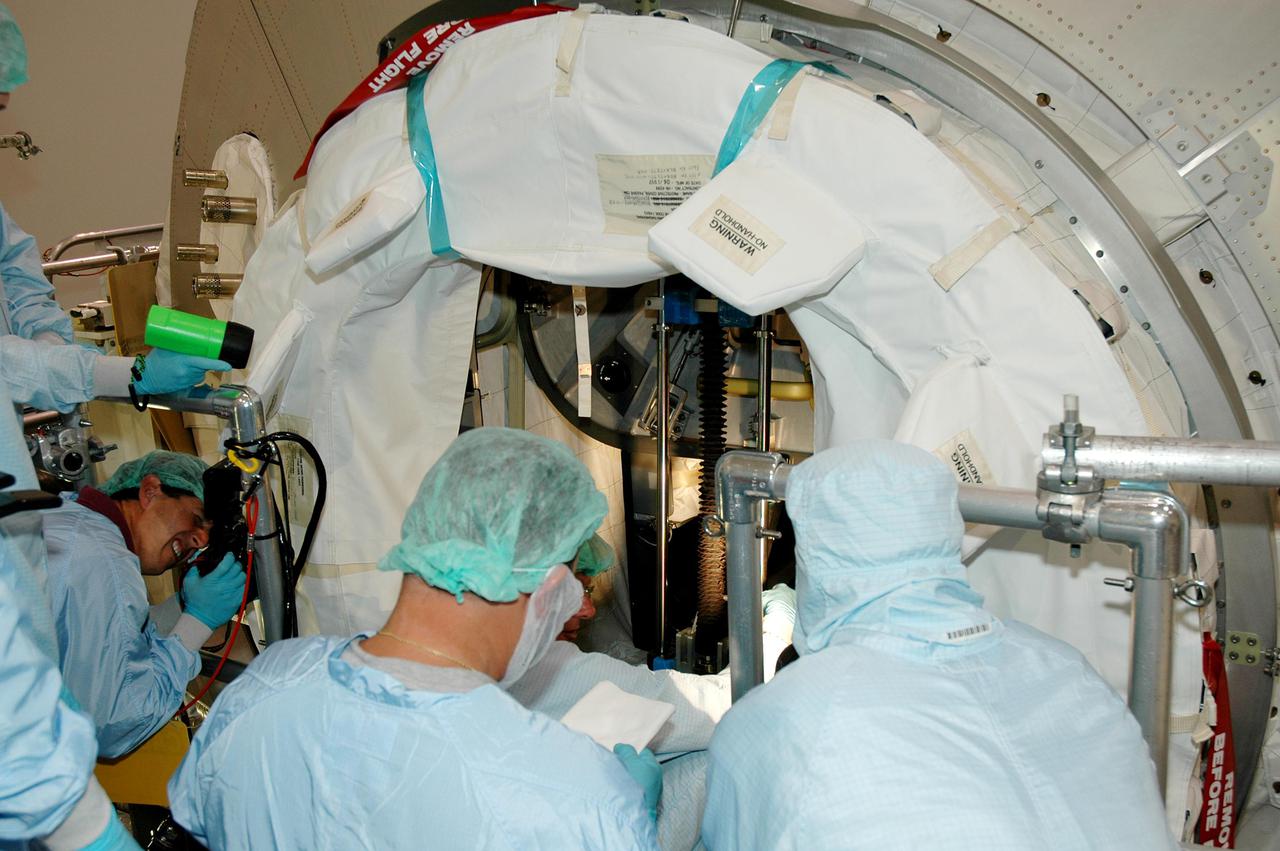
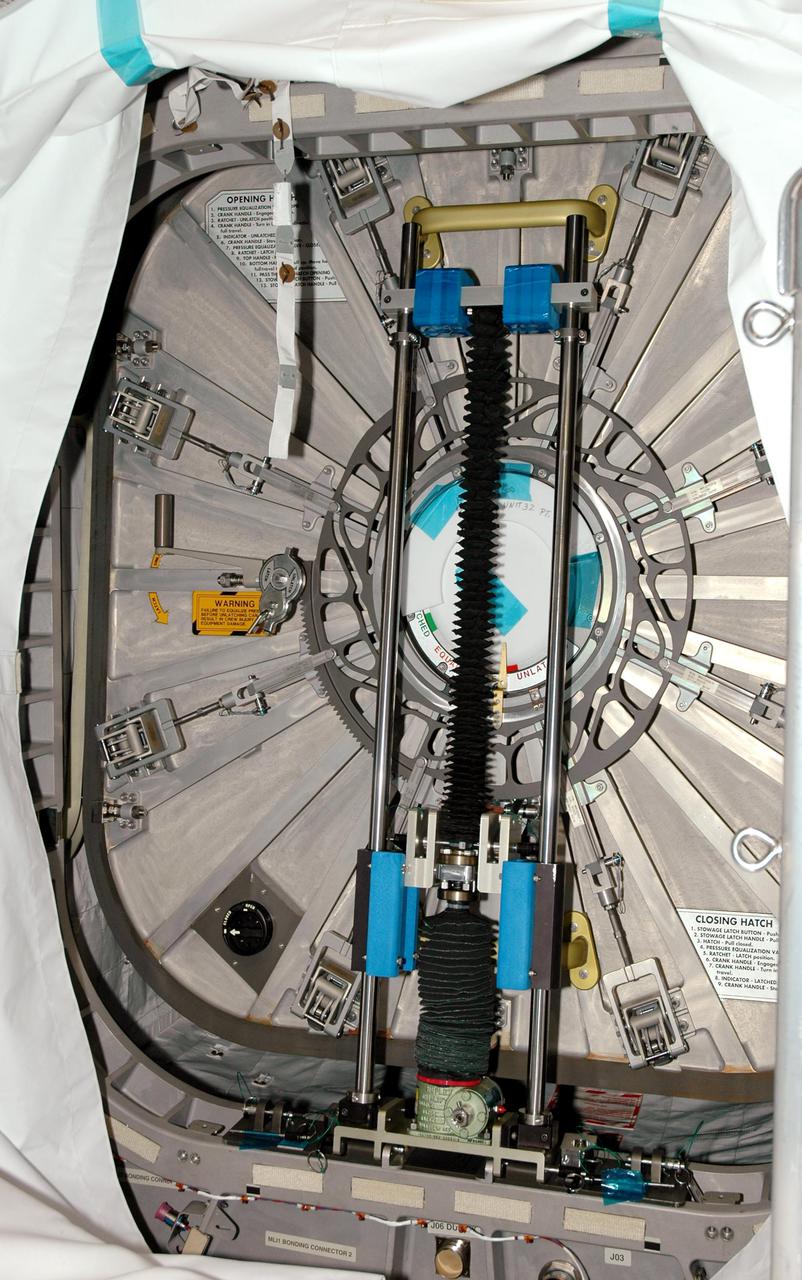
KENNEDY SPACE CENTER, FLA. -- In the Space Station Processing Facility, the hatch door on Italian-built Multi-Purpose Logistics Module Raffaello is closed, a significant milestone on the road to Return to Flight.  The module will travel to the International Space Station aboard Space Shuttle Discovery’s Return to Flight mission STS-114.  Raffaello carries 12 racks of cargo, including food, clothing, spare parts and research equipment, to the Station.  Shuttle Discovery is targeted for launch in a window extending May 15 through June 3.
KSC-05pd-0713
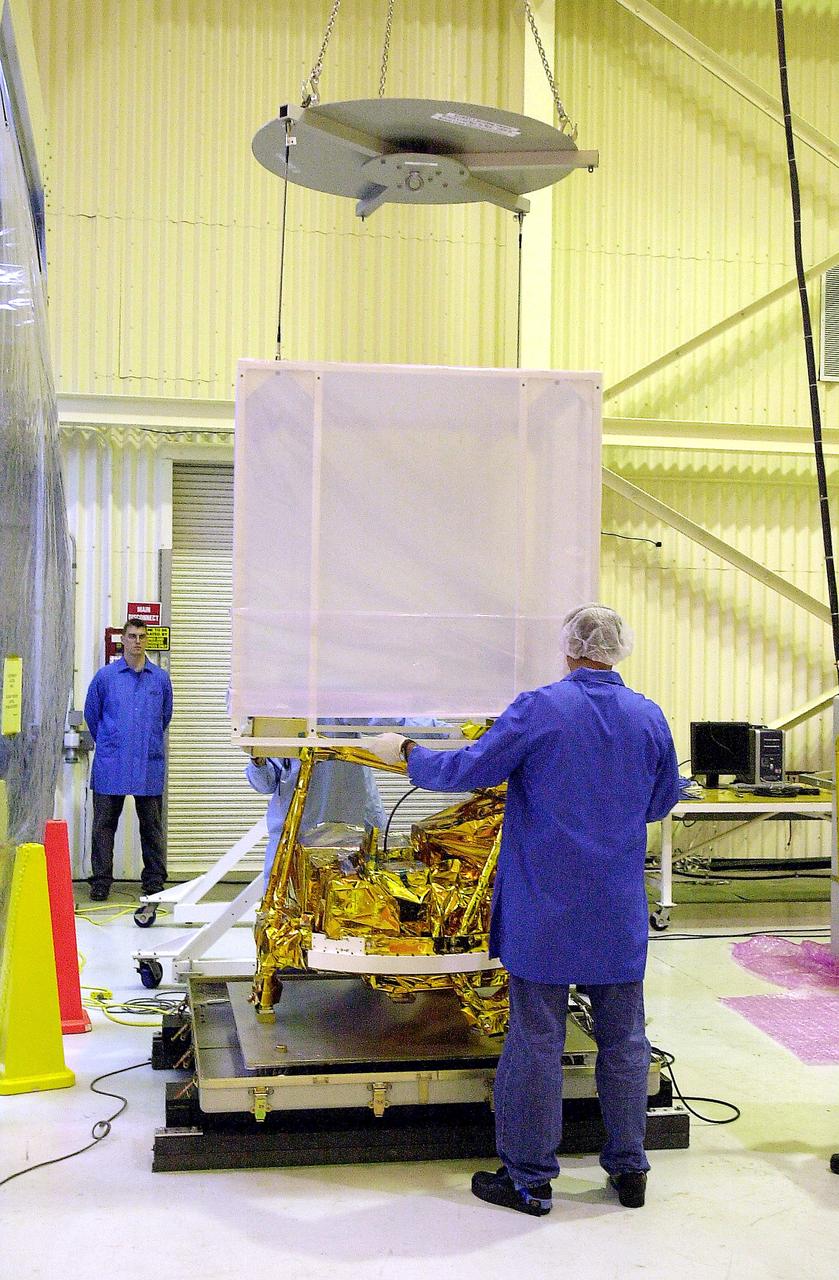
VANDENBERG AIR FORCE BASE, CALIF.- The cover is being lifted off SciSat-1 spacecraft at Vandenberg Air Force Base, Calif.   Sci-Sat, which will undergo instrument checkout and spacecraft functional testing, weighs approximately 330 pounds and after launch will be placed in a 400-mile-high polar orbit to investigate processes that control the distribution of ozone in the upper atmosphere. The data from the satellite will provide Canadian and international scientists with improved measurements relating to global ozone processes and help policymakers assess existing environmental policy and develop protective measures for improving the health of our atmosphere, preventing further ozone depletion. The mission is designed to last two years.
VANDENBERG AIR FORCE BASE, CALIF.- The cover is being lifted off SciSat-1 spacecraft at Vandenberg Air Force Base, Calif. Sci-Sat, which will undergo instrument checkout and spacecraft functional testing, weighs approximately 330 pounds and after launch will be placed in a 400-mile-high polar orbit to investigate processes that control the distribution of ozone in the upper atmosphere. The data from the satellite will provide Canadian and international scientists with improved measurements relating to global ozone processes and help policymakers assess existing environmental policy and develop protective measures for improving the health of our atmosphere, preventing further ozone depletion. The mission is designed to last two years.
KENNEDY SPACE CENTER, FLA. - In the Orbiter Processing Facility, United Space Alliance workers Mike Hyatt (left) Saul Ngy (center) and Jerry Belt (right) lift a Reinforced Carbon Carbon (RCC) panel to attach onto the leading edge of the wing of the orbiter Atlantis.  The gray carbon composite RCC panels have sufficient strength to withstand the aerodynamic forces experienced during launch and reentry, which can reach as high as 800 pounds per square foot.  The operating range of RCC is from minus 250º F to about 3,000º F, the temperature produced by friction with the atmosphere during reentry.
KENNEDY SPACE CENTER, FLA. - In the Orbiter Processing Facility, United Space Alliance workers Mike Hyatt (left) Saul Ngy (center) and Jerry Belt (right) lift a Reinforced Carbon Carbon (RCC) panel to attach onto the leading edge of the wing of the orbiter Atlantis. The gray carbon composite RCC panels have sufficient strength to withstand the aerodynamic forces experienced during launch and reentry, which can reach as high as 800 pounds per square foot. The operating range of RCC is from minus 250º F to about 3,000º F, the temperature produced by friction with the atmosphere during reentry.
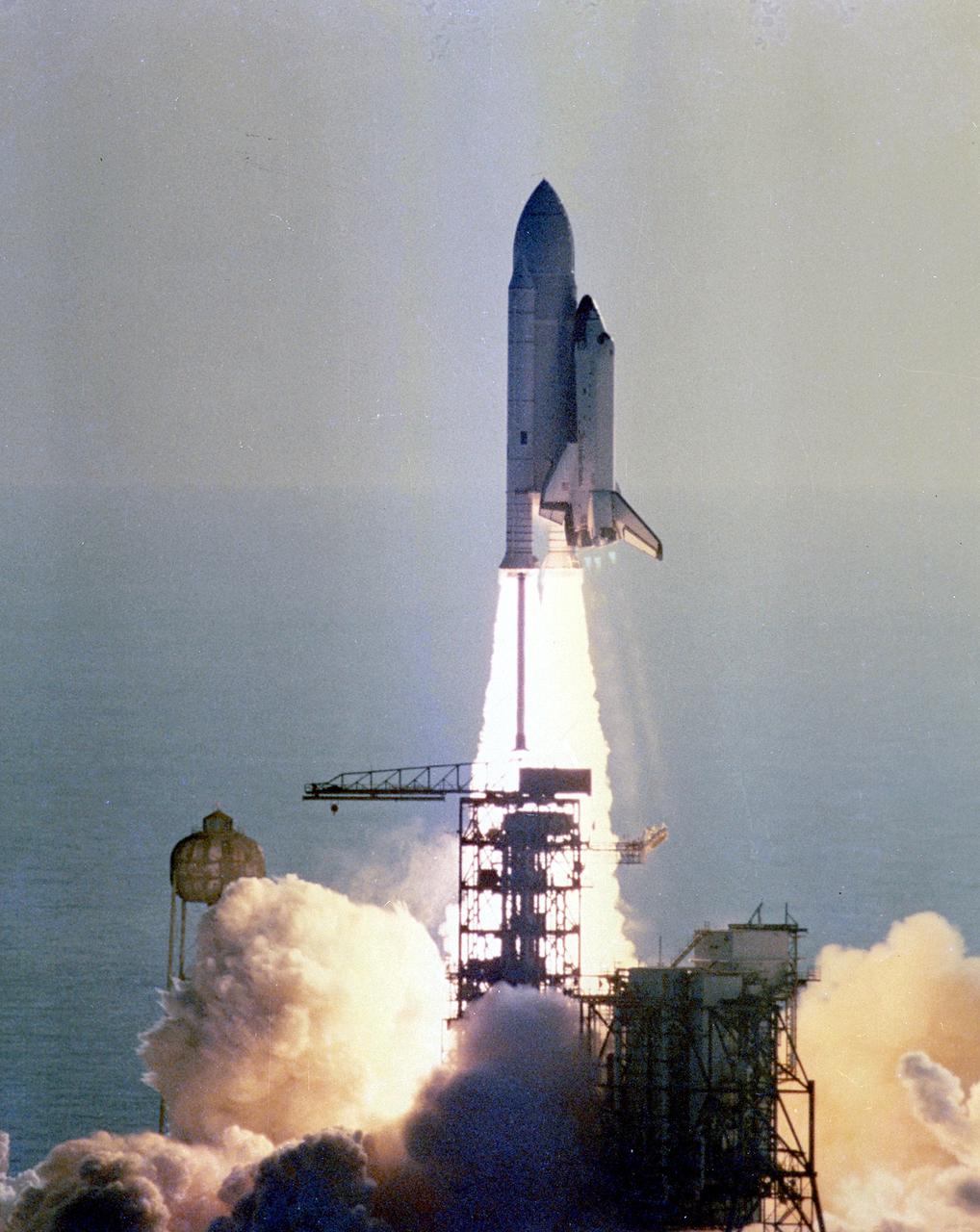
KENNEDY SPACE CENTER, FLA. -- The Space Shuttle Columbia rises off Pad 39A a few seconds past 7 a.m. on April 12, 1981 — the dawn of a new age in spaceflight.  Onboard, astronauts John Young and Bob Crippen ride toward orbit following a successful liftoff of the first Space Shuttle mission.  Mission plans call for the Columbia to remain in orbit for about 54 hours, during which astronauts Young and Criipen will perform a series of checkout activities designed to test the Space Shuttle's systems in space for the first time.  The Columbia is scheduled to glide to an airplane-like landing at Edwards Air Force Base, Calif.
KSC-81pc-0352
KENNEDY SPACE CENTER, FLA. -- Workers in the Space Station Processing Facility prepare to close the hatch for flight on Italian-built Multi-Purpose Logistics Module Raffaello,  a significant milestone on the road to Return to Flight.  The module will travel to the International Space Station aboard Space Shuttle Discovery’s Return to Flight mission STS-114.  Raffaello carries 12 racks of cargo, including food, clothing, spare parts and research equipment, to the Station.  Shuttle Discovery is targeted for launch in a window extending May 15 through June 3.
KSC-05pd-0710
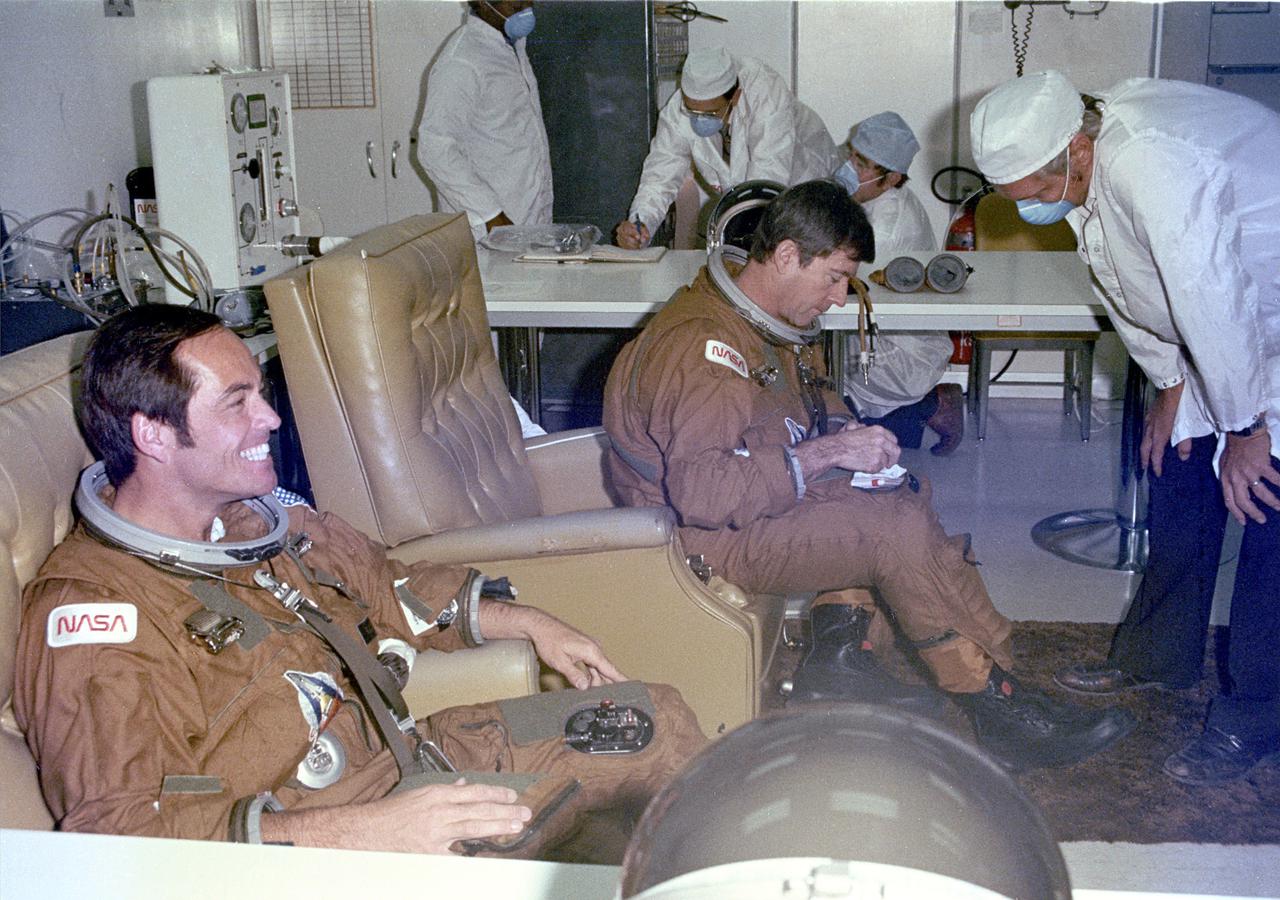
KENNEDY SPACE CENTER, FLA. -  Technicians assist prime crew astronauts John Young (right) and Bob Crippen (left) in suit-up operations in KSC's Operations and Checkout Building on the morning of Columbia's successful liftoff on the Space Shuttle's first orbital flight.
KSC-81pc-0346
KENNEDY SPACE CENTER, FLA. -  The Space Shuttle Columbia rises off Pad 39A a few seconds past 7 a.m. on April 12, 1981 — the dawn of a new age in spaceflight. Onboard, astronauts John Young and Bob Crippen ride toward orbit following a successful liftoff of the first Space Shuttle mission. Mission plans call for the Columbia to remain in orbit for about 54 hours, during which astronauts Young and Criipen will perform a series of checkout activities designed to test the Space Shuttle's systems in space for the first time. The Columbia is scheduled to glide to an airplane-like landing at Edwards Air Force Base, Calif.
KSC-81pc-0405
KENNEDY SPACE CENTER, FLA. - Technician Saul Ngy, with United Space Alliance, prepares to install a spar on the wing of the orbiter Atlantis.  The Reinforced Carbon Carbon (RCC) panels are mechanically attached to the wing with a series of floating joints - spars - to reduce loading on the panels caused by wing deflections. The aluminum and the metallic attachments are protected from exceeding temperature limits by internal insulation.
KENNEDY SPACE CENTER, FLA. - Technician Saul Ngy, with United Space Alliance, prepares to install a spar on the wing of the orbiter Atlantis. The Reinforced Carbon Carbon (RCC) panels are mechanically attached to the wing with a series of floating joints - spars - to reduce loading on the panels caused by wing deflections. The aluminum and the metallic attachments are protected from exceeding temperature limits by internal insulation.
KENNEDY SPACE CENTER, FLA. - In the Orbiter Processing Facility, Jerry Belt, with United Space Alliance, checks a spar attachment on the wing of the orbiter Atlantis before installing Reinforced Carbon Carbon (RCC) panels on the wing.  The spars - floating joints - reduce loading on the panels caused by wing deflections.  The gray carbon composite RCC panels have sufficient strength to withstand the aerodynamic forces experienced during launch and reentry, which can reach as high as 800 pounds per square foot.  The operating range of RCC is from minus 250º F to about 3,000º F, the temperature produced by friction with the atmosphere during reentry.
KENNEDY SPACE CENTER, FLA. - In the Orbiter Processing Facility, Jerry Belt, with United Space Alliance, checks a spar attachment on the wing of the orbiter Atlantis before installing Reinforced Carbon Carbon (RCC) panels on the wing. The spars - floating joints - reduce loading on the panels caused by wing deflections. The gray carbon composite RCC panels have sufficient strength to withstand the aerodynamic forces experienced during launch and reentry, which can reach as high as 800 pounds per square foot. The operating range of RCC is from minus 250º F to about 3,000º F, the temperature produced by friction with the atmosphere during reentry.
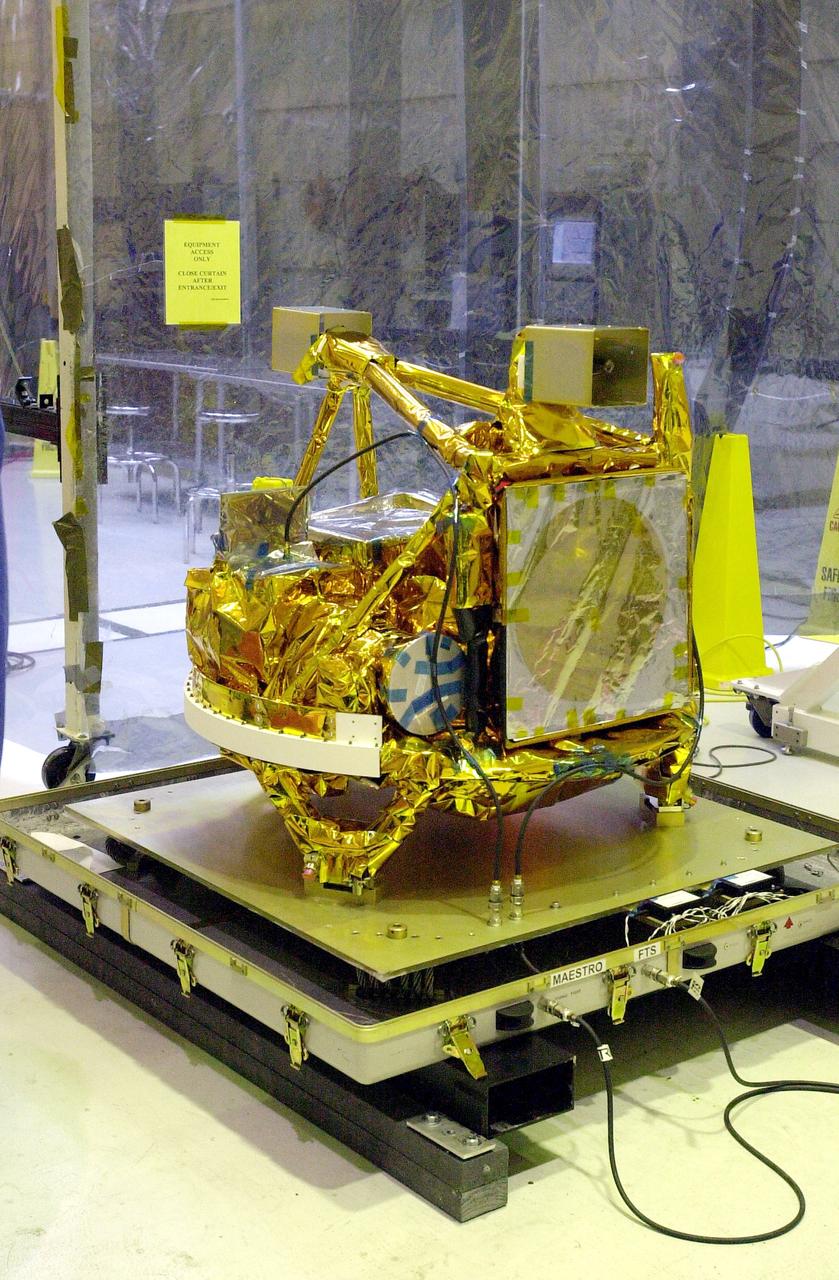
VANDENBERG AIR FORCE BASE, CALIF. - The SciSat-1 spacecraft is revealed at Vandenberg Air Force Base, Calif.   Sci-Sat, which will undergo instrument checkout and spacecraft functional testing, weighs approximately 330 pounds and after launch will be placed in a 400-mile-high polar orbit to investigate processes that control the distribution of ozone in the upper atmosphere. The data from the satellite will provide Canadian and international scientists with improved measurements relating to global ozone processes and help policymakers assess existing environmental policy and develop protective measures for improving the health of our atmosphere, preventing further ozone depletion. The mission is designed to last two years.
VANDENBERG AIR FORCE BASE, CALIF. - The SciSat-1 spacecraft is revealed at Vandenberg Air Force Base, Calif. Sci-Sat, which will undergo instrument checkout and spacecraft functional testing, weighs approximately 330 pounds and after launch will be placed in a 400-mile-high polar orbit to investigate processes that control the distribution of ozone in the upper atmosphere. The data from the satellite will provide Canadian and international scientists with improved measurements relating to global ozone processes and help policymakers assess existing environmental policy and develop protective measures for improving the health of our atmosphere, preventing further ozone depletion. The mission is designed to last two years.
KENNEDY SPACE CENTER, FLA. -  Mike Hyatt (left) and Saul Ngy, technicians with United Space Alliance, prepare to install a spar on the wing of the orbiter Atlantis.  The Reinforced Carbon Carbon (RCC) panels are mechanically attached to the wing with a series of floating joints - spars - to reduce loading on the panels caused by wing deflections. The aluminum and the metallic attachments are protected from exceeding temperature limits by internal insulation.
KENNEDY SPACE CENTER, FLA. - Mike Hyatt (left) and Saul Ngy, technicians with United Space Alliance, prepare to install a spar on the wing of the orbiter Atlantis. The Reinforced Carbon Carbon (RCC) panels are mechanically attached to the wing with a series of floating joints - spars - to reduce loading on the panels caused by wing deflections. The aluminum and the metallic attachments are protected from exceeding temperature limits by internal insulation.
KENNEDY SPACE CENTER, FLA. - In the Orbiter Processing Facility, John Newport, with United Space Alliance, inspects the wing of the orbiter Atlantis before installing a spar. Reinforced Carbon Carbon (RCC) panels are mechanically attached to the wing with a series of floating joints - spars - to reduce loading on the panels caused by wing deflections. The aluminum and the metallic attachments are protected from exceeding temperature limits by internal insulation.
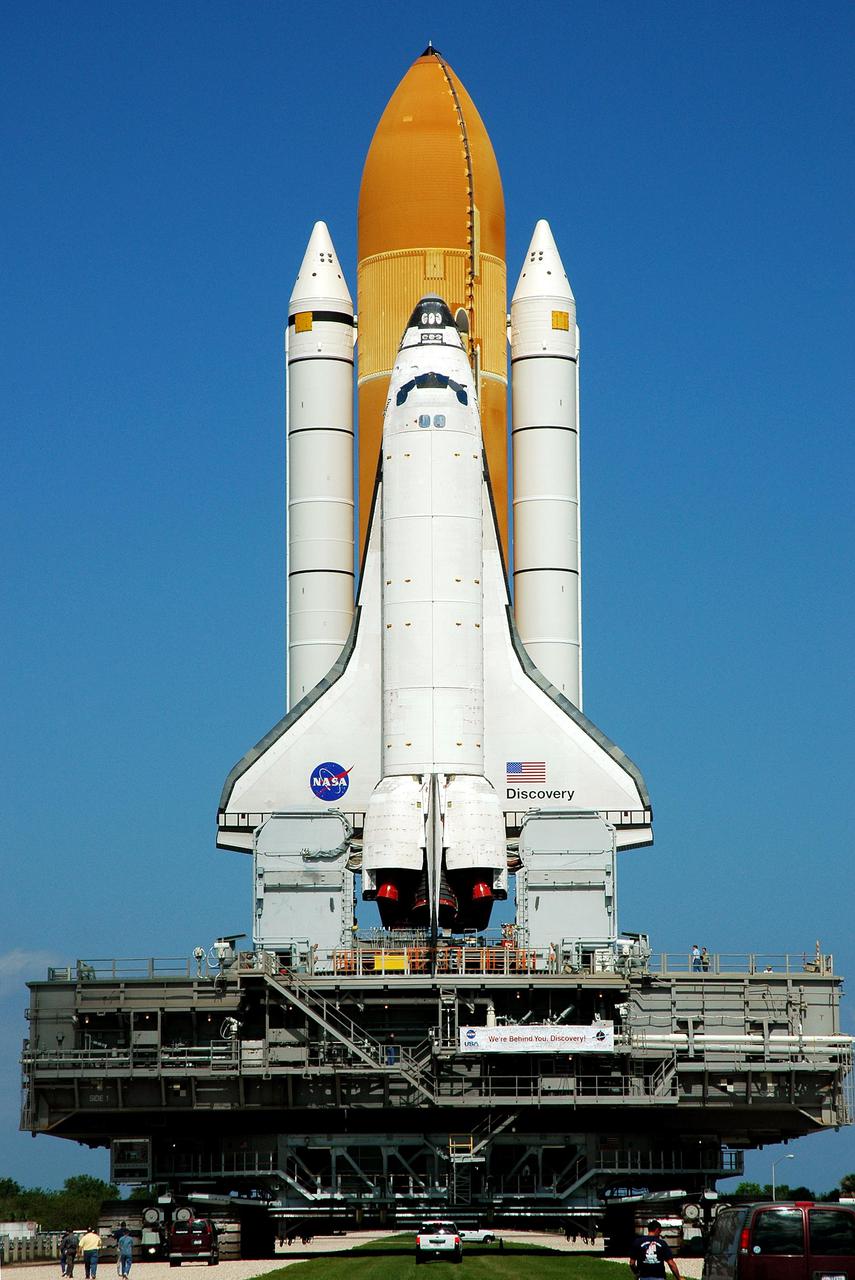
KENNEDY SPACE CENTER, FLA. -- Space Shuttle Discovery, atop a Mobile Launcher Platform (MLP), crawls toward Launch Complex 39B. First motion out of the Vehicle Assembly Building occurred at 2:04 p.m. EDT. The rollout marks a major milestone in the Space Shuttle Program’s Return to Flight. The MLP is moved by the Crawler-Transporter underneath, which stands 20 feet high, 131 feet long and 114 feet wide. It moves on eight tracks, each containing 57 shoes, or cleats, weighing one ton each. Loaded with the Space Shuttle, the Crawler can move at a maximum speed of approximately 1 mile an hour. A leveling system in the Crawler keeps the Shuttle vertical while negotiating the 5 percent grade leading to the top of the launch pad. Launch of Discovery on its Return to Flight mission, STS-114, is targeted for May 15 with a launch window that extends to June 3. During its 12-day mission, Discovery’s seven-person crew will test new hardware and techniques to improve Shuttle safety, as well as deliver supplies to the International Space Station.
KSC-05pd-0718
KENNEDY SPACE CENTER, FLA. -   The thermolite level is in place on a newly installed five-meter focal length telescope in Cocoa Beach, Fla.  The tracking telescope is part of the Distant Object Attitude Measurement System (DOAMS) that provides optical support for launches from KSC and Cape Canaveral.
KSC-03pd2683
KENNEDY SPACE CENTER, FLA. -    Collimation setup is underway on a newly installed five-meter focal length telescope in Cocoa Beach, Fla.  The tracking telescope is part of the Distant Object Attitude Measurement System (DOAMS) that provides optical support for launches from KSC and Cape Canaveral.
KSC-03pd2684
KENNEDY SPACE CENTER, FLA. -   The fixture is set up for collimation on the newly installed five-meter focal length telescope in Cocoa Beach, Fla.  The tracking telescope is part of the Distant Object Attitude Measurement System (DOAMS) that provides optical support for launches from KSC and Cape Canaveral.
KSC-03pd2687
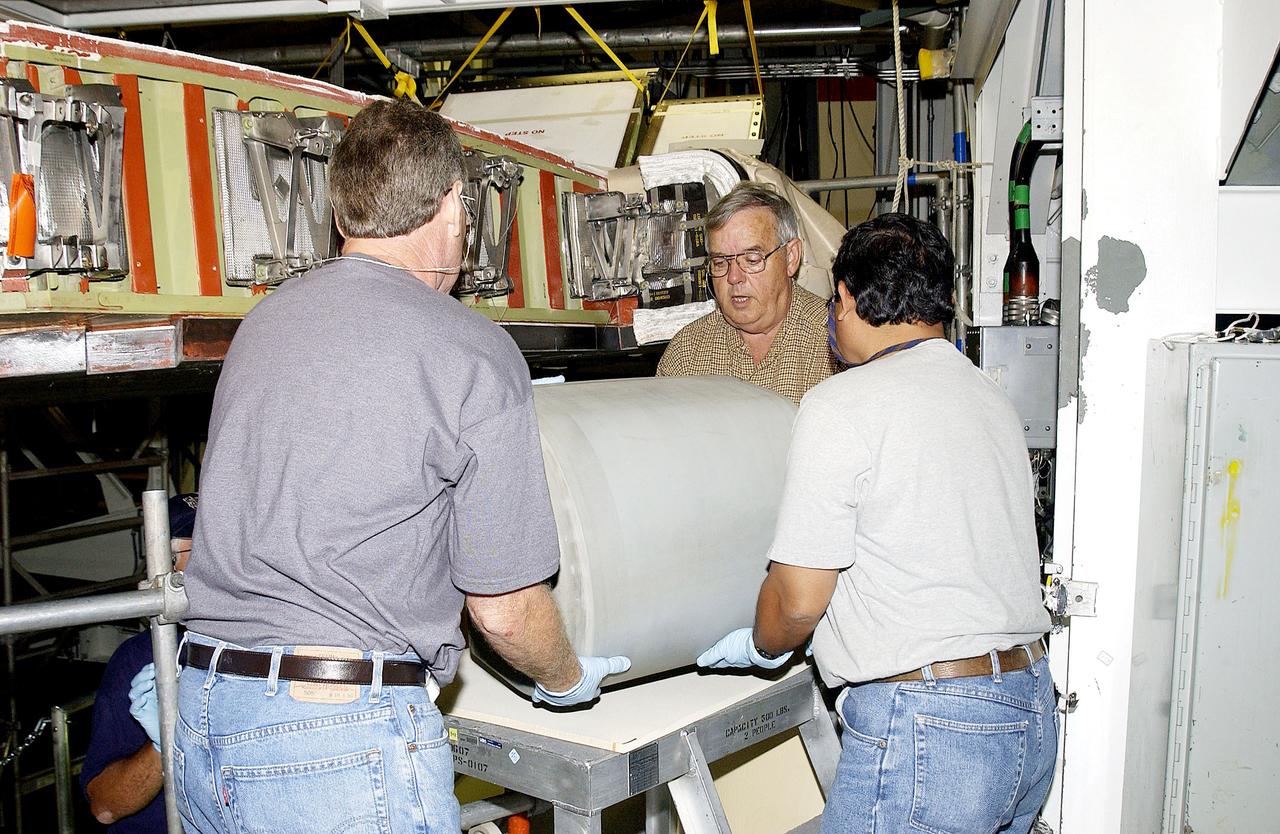
KENNEDY SPACE CENTER, FLA. - In the Orbiter Processing Facility, United Space Alliance workers, from center, left to right, Saul Ngy, Jerry Belt and Mike Hyatt, prepare to attach a Reinforced Carbon Carbon (RCC) panel (on the table) to the leading edge of the wing of the orbiter Atlantis.  The gray carbon composite RCC panels have sufficient strength to withstand the aerodynamic forces experienced during launch and reentry, which can reach as high as 800 pounds per square foot. The operating range of RCC is from minus 250º F to about 3,000º F, the temperature produced by friction with the atmosphere during reentry.
KENNEDY SPACE CENTER, FLA. - In the Orbiter Processing Facility, United Space Alliance workers, from center, left to right, Saul Ngy, Jerry Belt and Mike Hyatt, prepare to attach a Reinforced Carbon Carbon (RCC) panel (on the table) to the leading edge of the wing of the orbiter Atlantis. The gray carbon composite RCC panels have sufficient strength to withstand the aerodynamic forces experienced during launch and reentry, which can reach as high as 800 pounds per square foot. The operating range of RCC is from minus 250º F to about 3,000º F, the temperature produced by friction with the atmosphere during reentry.
KENNEDY SPACE CENTER, FLA. -In the Orbiter Processing Facility (OPF), a United Space Alliance technician examines the attachment points for the spars on the exterior of a wing of Space Shuttle Atlantis. Reinforced Carbon Carbon (RCC) panels are mechanically attached to the wing with a series of floating joints - spars - to reduce loading on the panels caused by wing deflections. The aluminum and the metallic attachments are protected from exceeding temperature limits by internal insulation.  The next launch of Atlantis will be on mission STS-114, a utilization and logistics flight to the International Space Station.
KENNEDY SPACE CENTER, FLA. -In the Orbiter Processing Facility (OPF), a United Space Alliance technician examines the attachment points for the spars on the exterior of a wing of Space Shuttle Atlantis. Reinforced Carbon Carbon (RCC) panels are mechanically attached to the wing with a series of floating joints - spars - to reduce loading on the panels caused by wing deflections. The aluminum and the metallic attachments are protected from exceeding temperature limits by internal insulation. The next launch of Atlantis will be on mission STS-114, a utilization and logistics flight to the International Space Station.
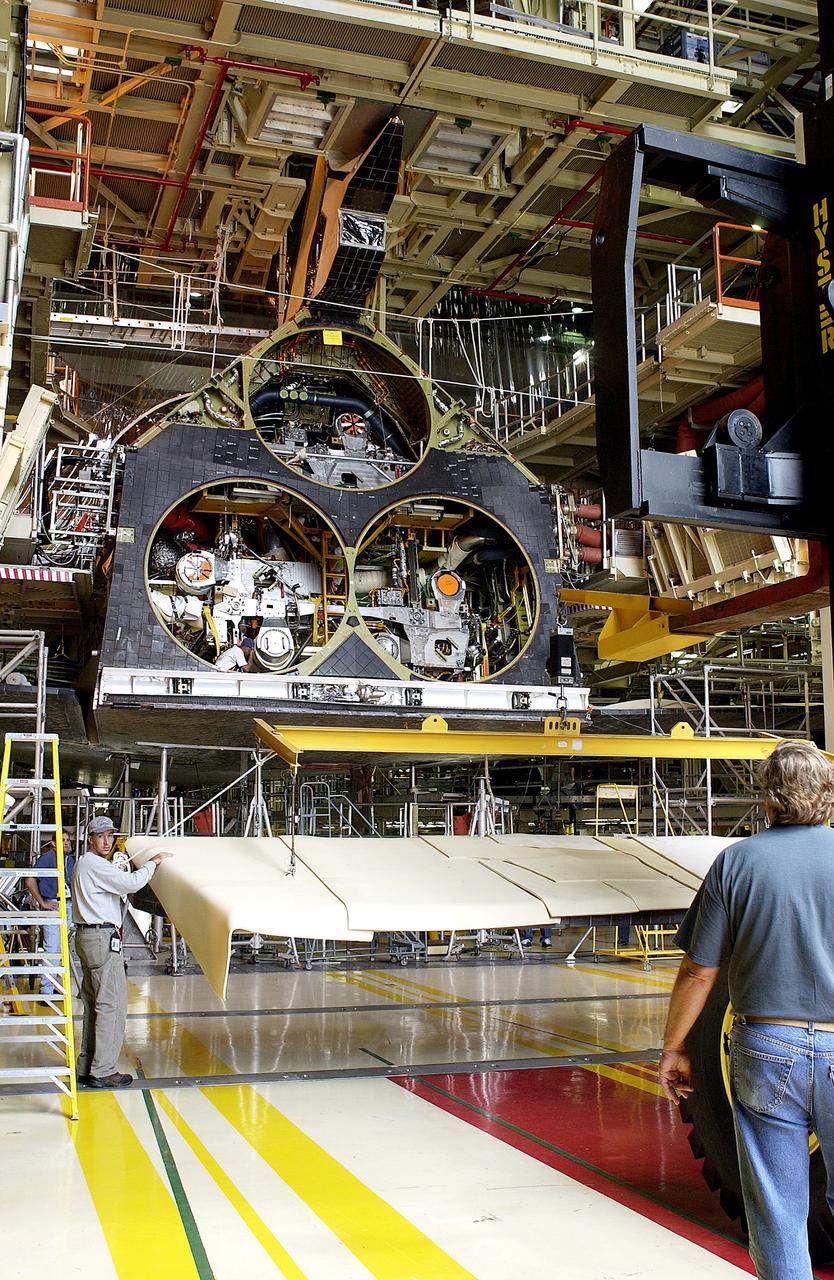
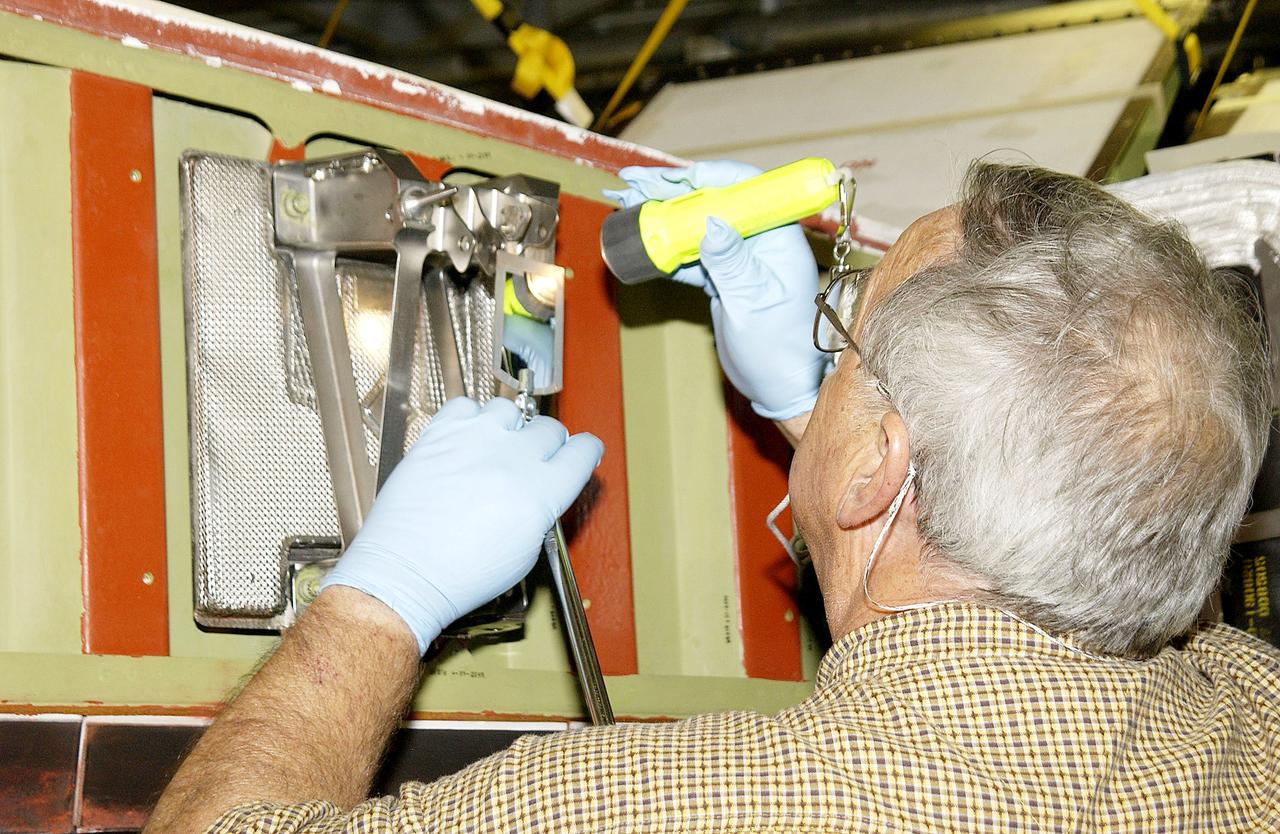
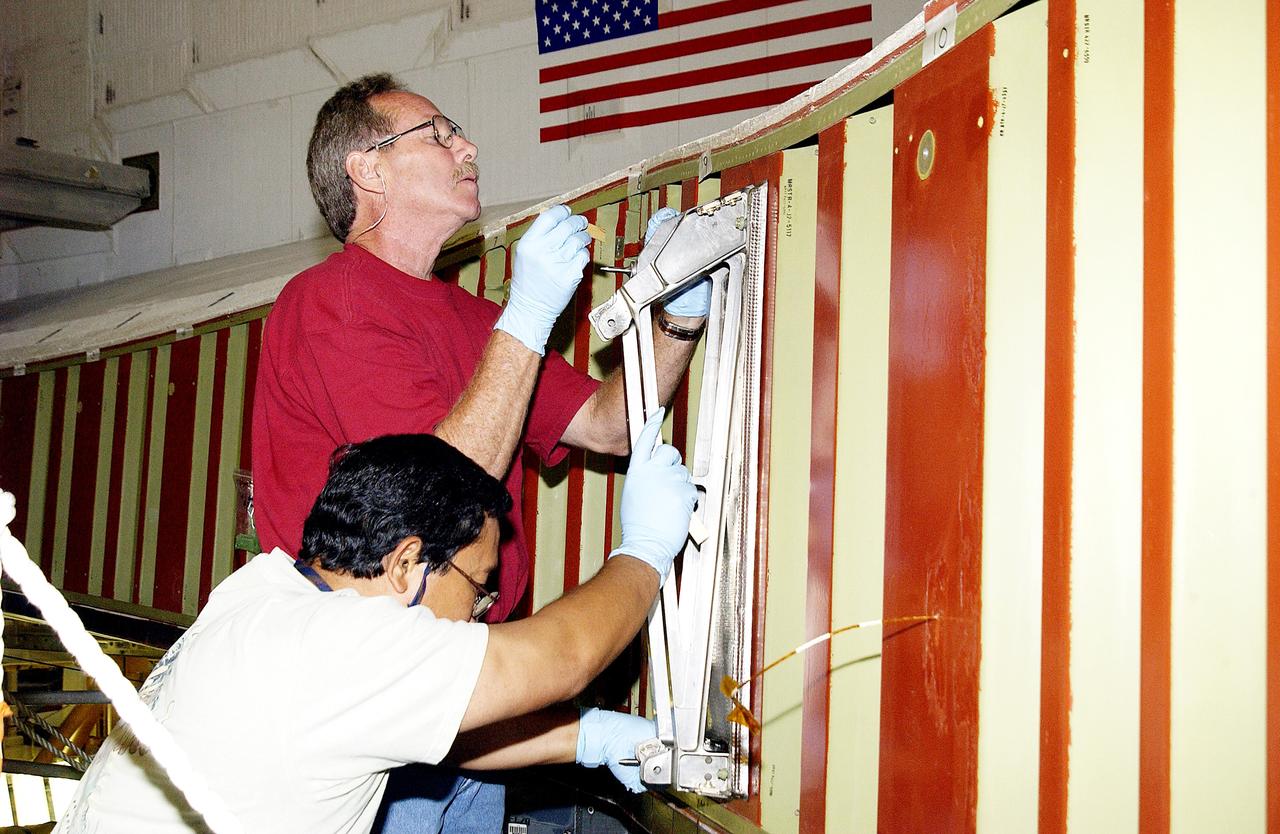
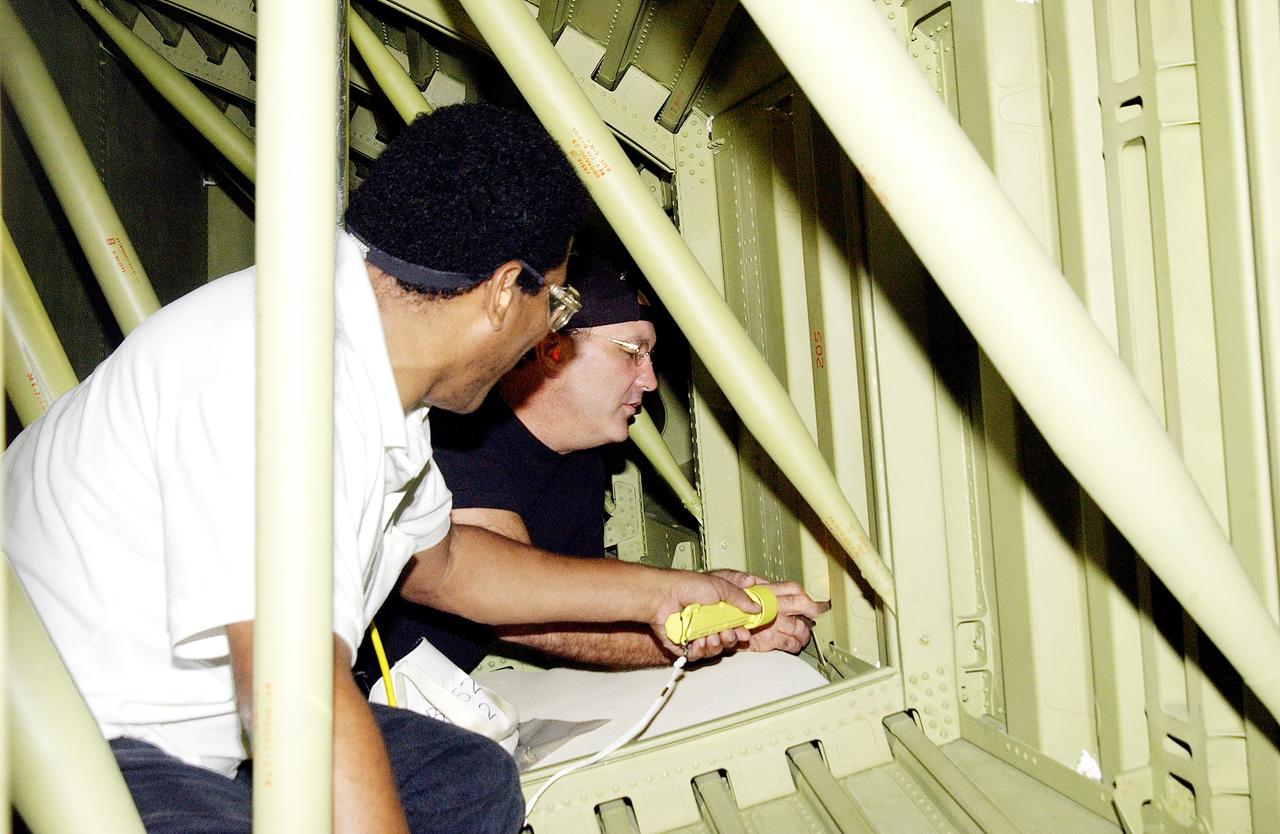
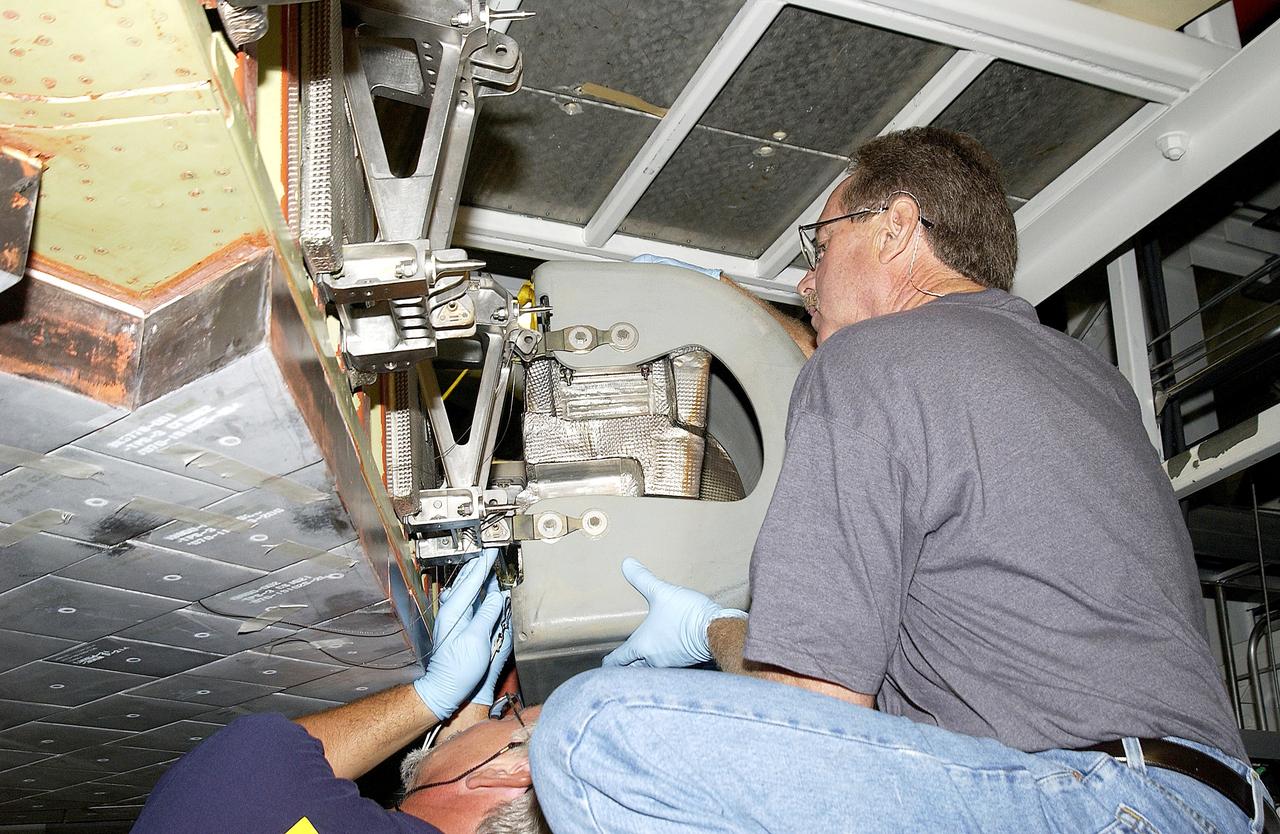
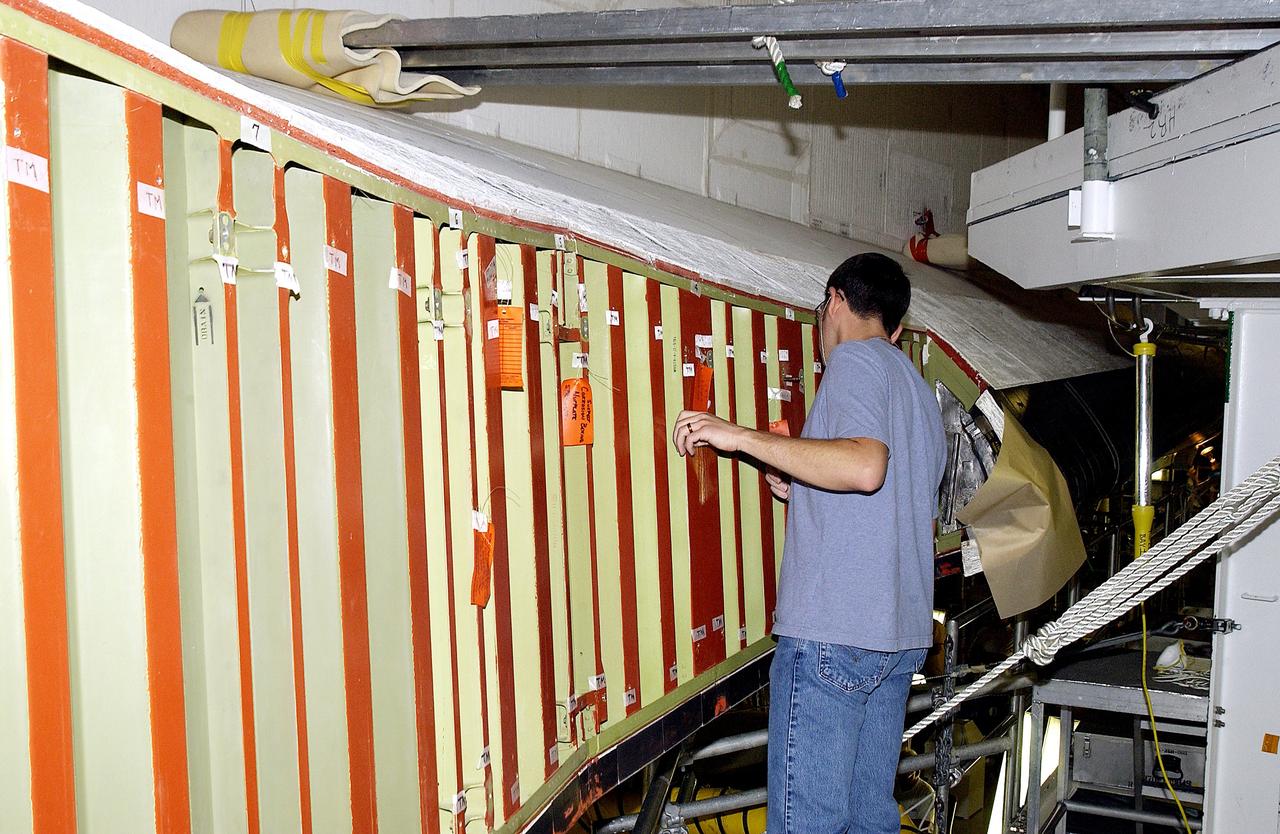
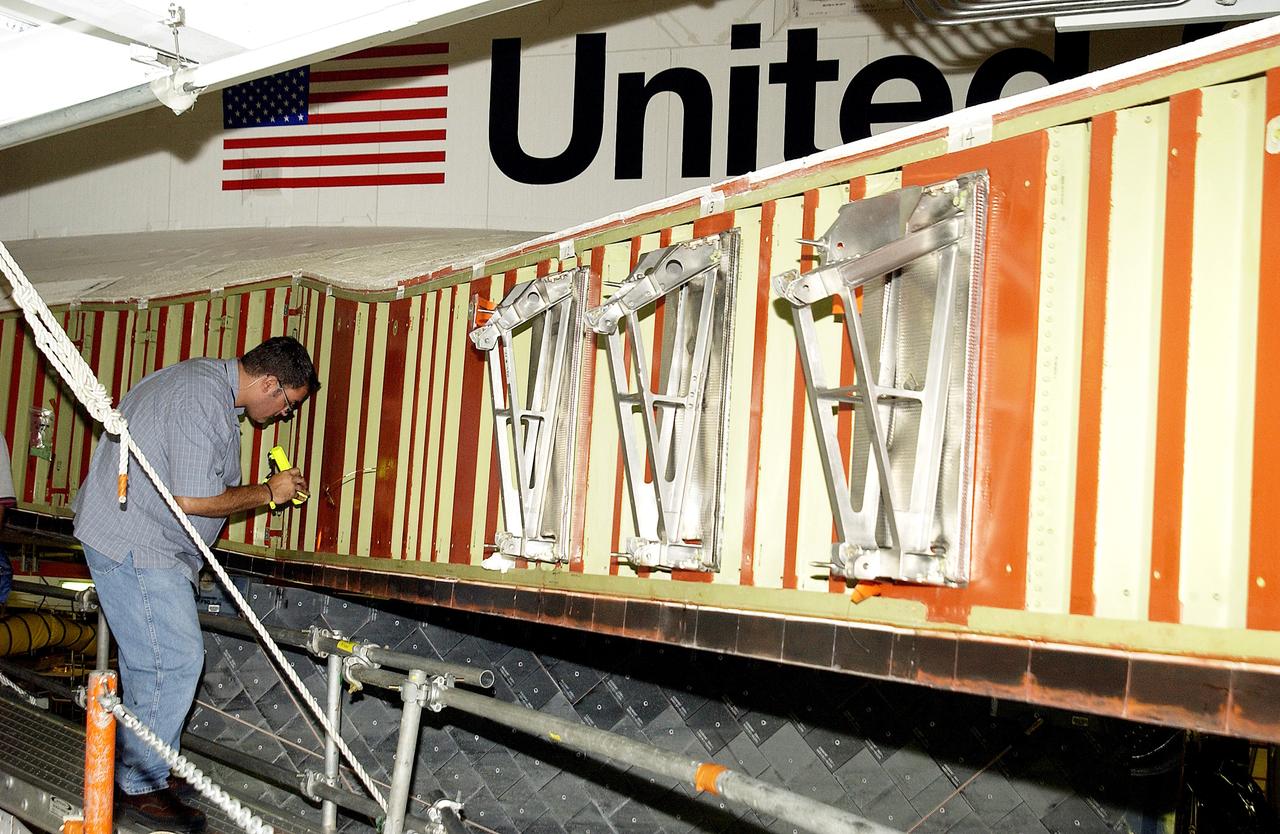
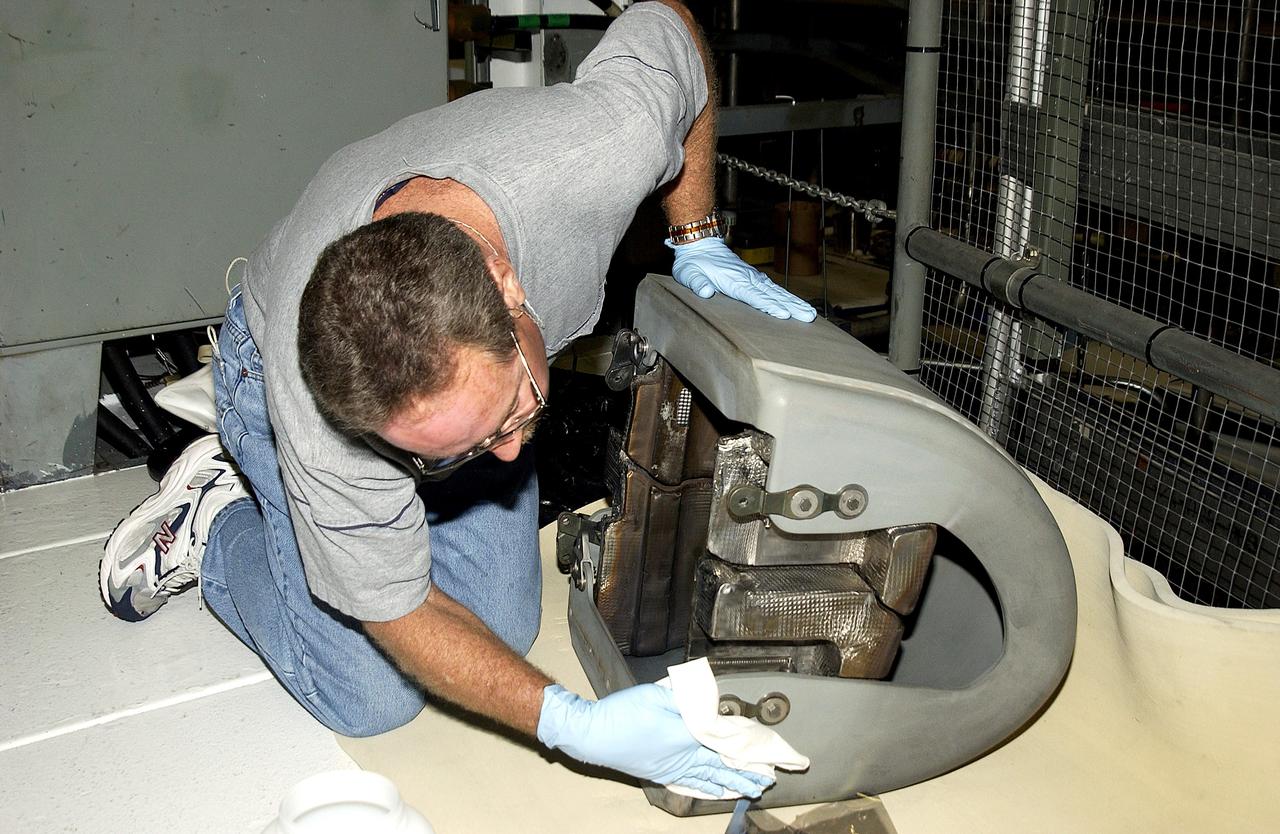
KENNEDY SPACE CENTER, FLA. - In the Orbiter Processing Facility (OPF), United Space Alliance technicians replace the attachment points for the spars on the interior of a wing of Space Shuttle Atlantis. Reinforced Carbon Carbon (RCC) panels are mechanically attached to the wing with a series of floating joints - spars - to reduce loading on the panels caused by wing deflections. The aluminum and the metallic attachments are protected from exceeding temperature limits by internal insulation.  The next launch of Atlantis will be on mission STS-114, a utilization and logistics flight to the International Space Station.
KENNEDY SPACE CENTER, FLA. - In the Orbiter Processing Facility (OPF), United Space Alliance technicians replace the attachment points for the spars on the interior of a wing of Space Shuttle Atlantis. Reinforced Carbon Carbon (RCC) panels are mechanically attached to the wing with a series of floating joints - spars - to reduce loading on the panels caused by wing deflections. The aluminum and the metallic attachments are protected from exceeding temperature limits by internal insulation. The next launch of Atlantis will be on mission STS-114, a utilization and logistics flight to the International Space Station.
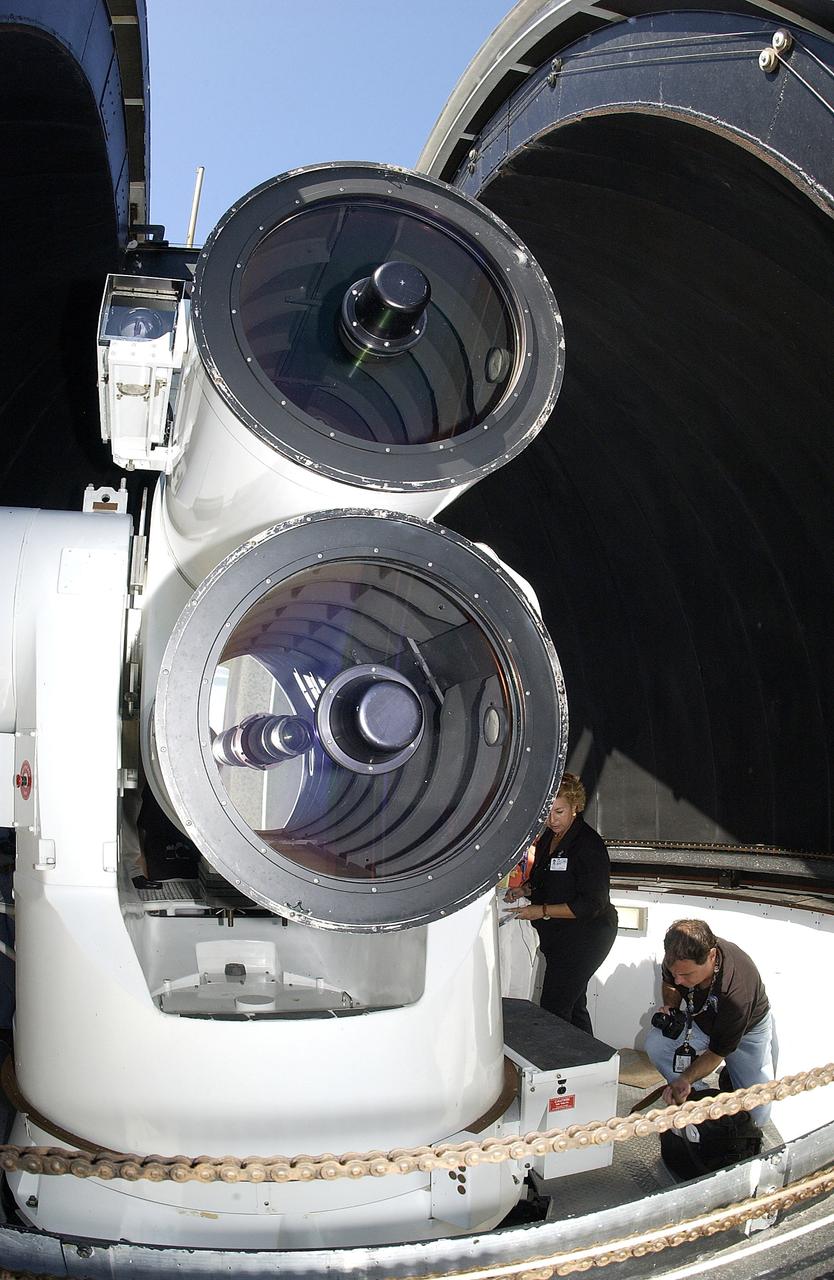
KENNEDY SPACE CENTER, FLA. -  A worker looks at a five-meter (focal length) telescope being removed for repair.  Part of the Distant Object Attitude Measurement System (DOAMS) in Cocoa Beach, Fla., the tracking telescope provides optical support for launches from KSC and Cape Canaveral. .
KENNEDY SPACE CENTER, FLA. - A worker looks at a five-meter (focal length) telescope being removed for repair. Part of the Distant Object Attitude Measurement System (DOAMS) in Cocoa Beach, Fla., the tracking telescope provides optical support for launches from KSC and Cape Canaveral. .
KENNEDY SPACE CENTER, FLA. -- The Rotating Service Structure is rolled back at Launch Pad 39B revealing Space Shuttle Discovery.  A propellant-loading test of Discovery's External Tank (ET) is scheduled for April 14. During the test, the tank will be filled to launch levels with ultra-cold hydrogen and oxygen propellants, known as 'cryogenics.' The test is designed to evaluate how the tank, orbiter, Solid Rocket Boosters and ground systems are performing under full 'cryo-load.' Throughout testing, engineers will observe the effectiveness of key safety modifications made to the External Tank. NASA’s Return to Flight mission, STS-114 on Space Shuttle Discovery, is targeted for launch on May 15 with a launch window that extends to June 3.
KSC-05pd-0707
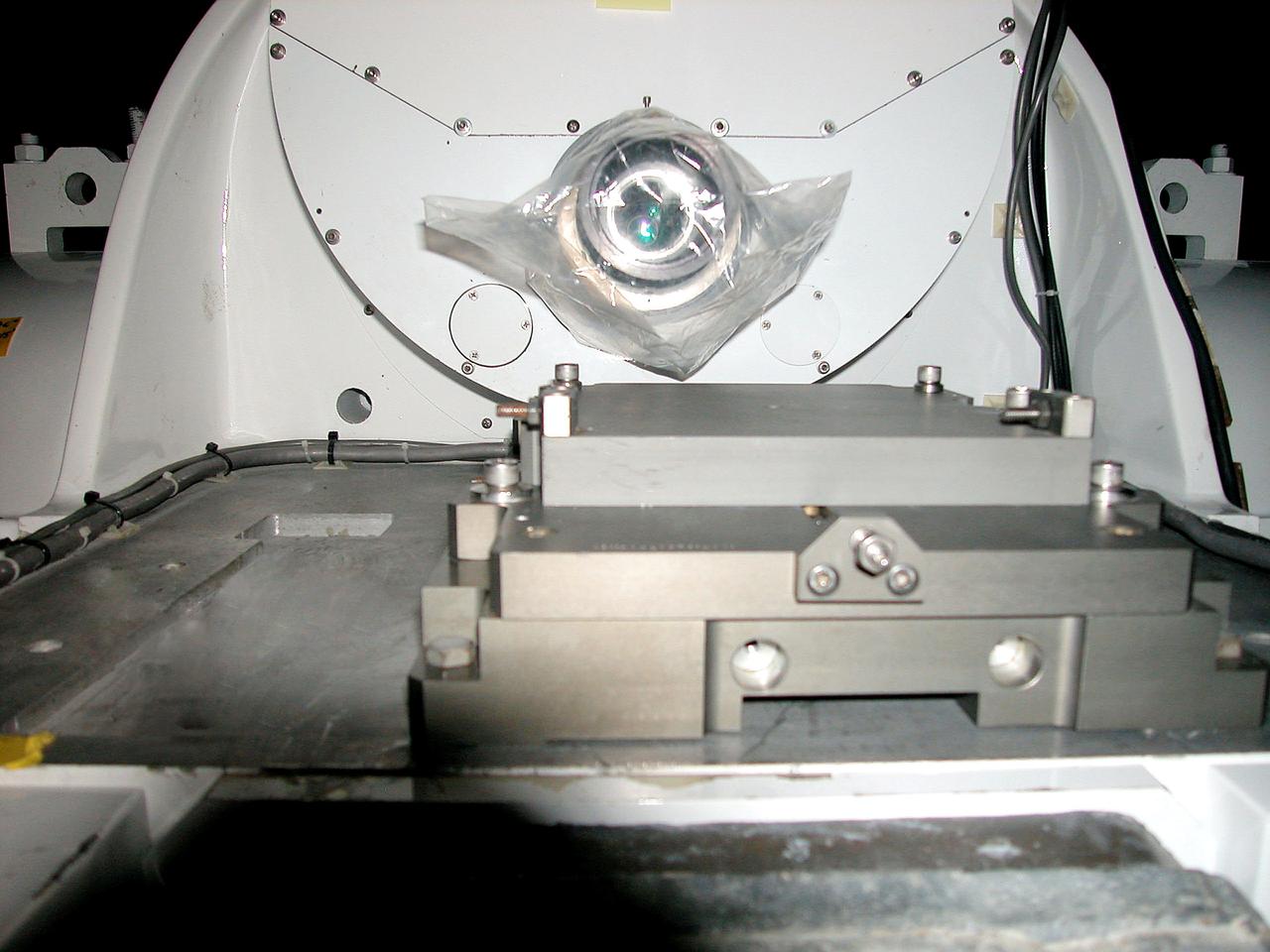
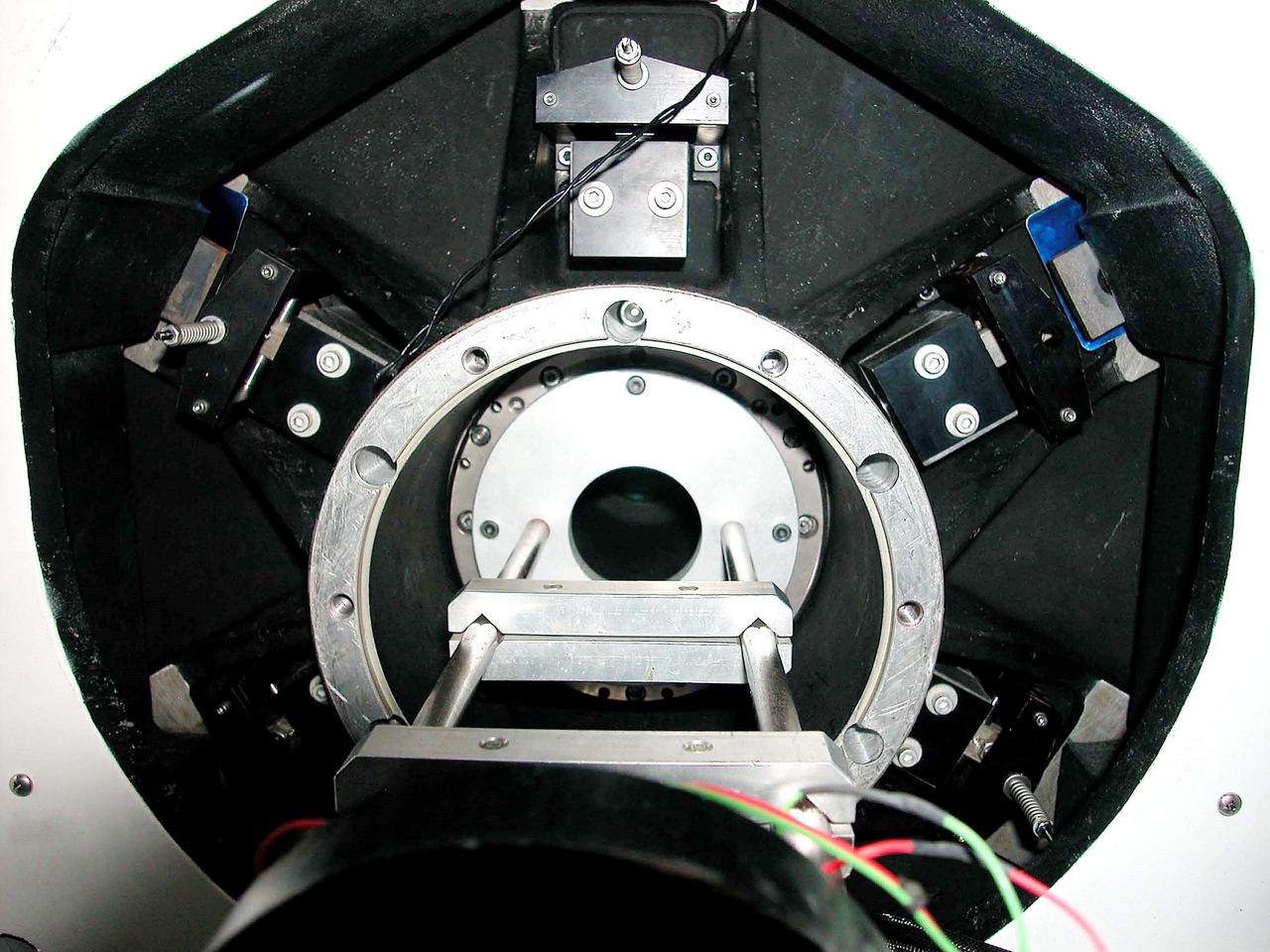
KENNEDY SPACE CENTER, FLA. -  Viewed here is part of the tracking telescope that provides optical support for launches from KSC and Cape Canaveral.  The telescope is part of the Distant Object Attitude Measurement System (DOAMS), which includes improved tracking cameras and long-range optical tracking systems that will be used to capture ascent imagery during the return to flight of the Space Shuttle.
KSC-03pd2784
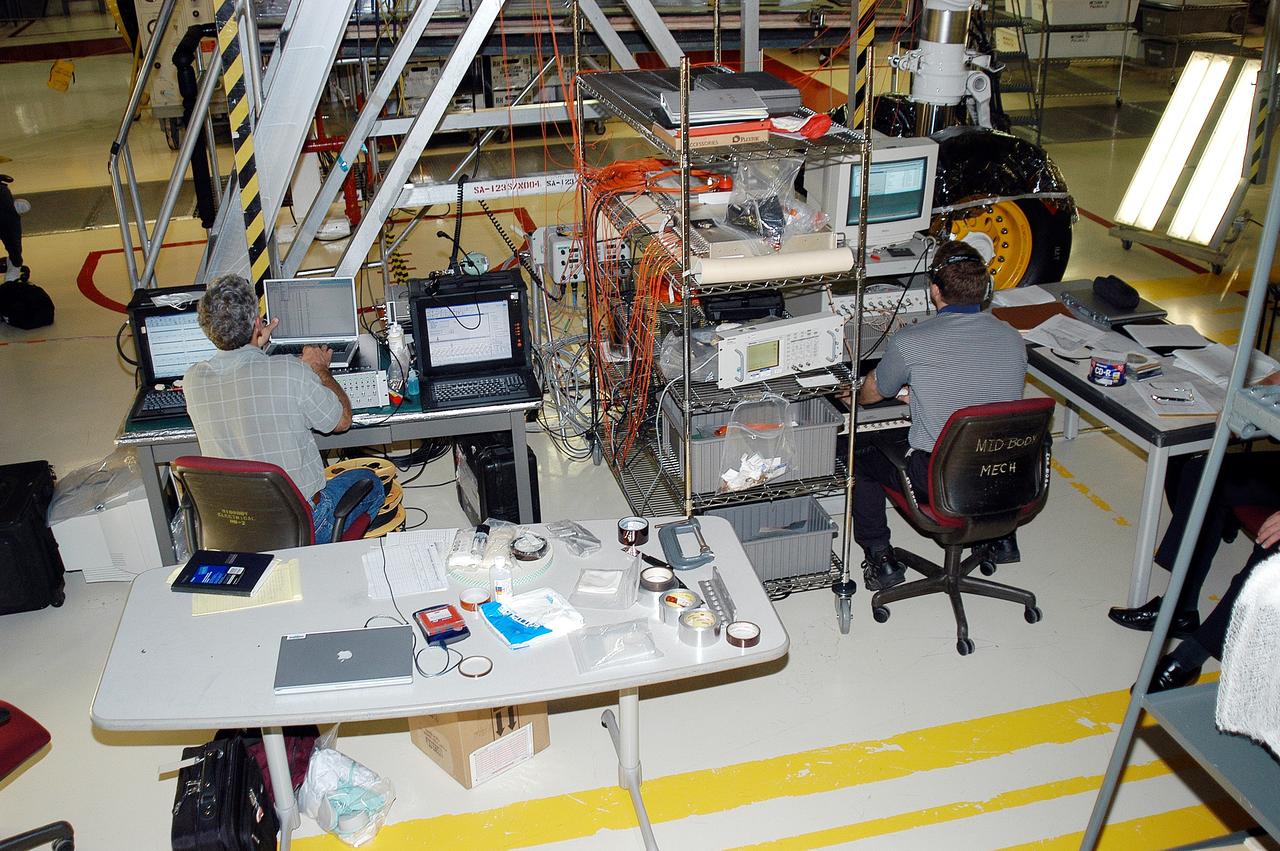
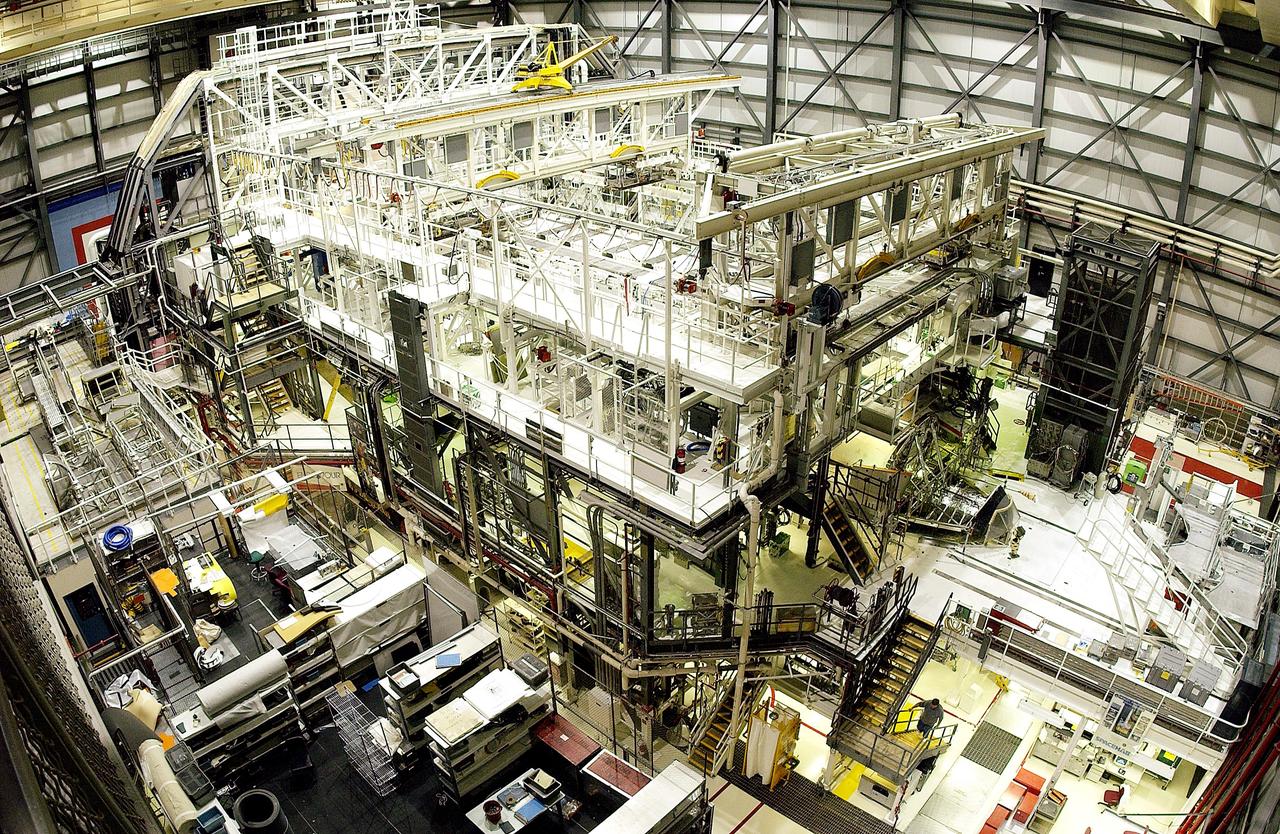
KENNEDY SPACE CENTER, FLA. - This bird's-eye view of a high bay in the Orbiter Processing Facility (OPF) shows Space Shuttle Atlantis surrounded by the standard platforms and equipment required to process a Space Shuttle orbiter for flight.  The high bay is 197 feet (60 meters) long, 150 feet (46 meters) wide, 95 feet (29 meters) high, and encompasses a 29,000-square-foot (2,694-meter) area.  Platforms, a main access bridge, and two rolling bridges with trucks provide access to various parts of the orbiter. The next mission scheduled for Atlantis is STS-114, a utilization and logistics flight to the International Space Station.
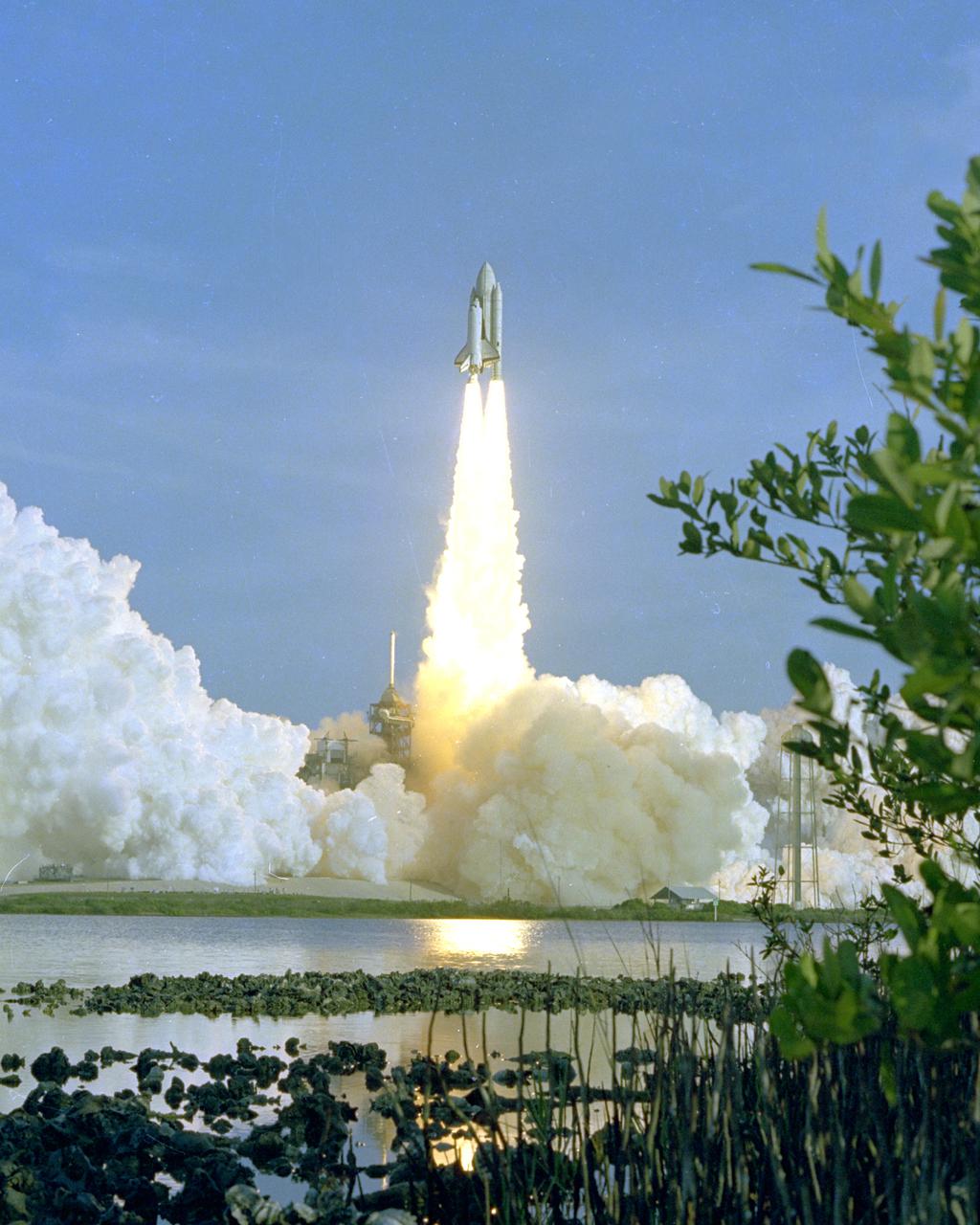
KENNEDY SPACE CENTER, FLA. - This bird's-eye view of a high bay in the Orbiter Processing Facility (OPF) shows Space Shuttle Atlantis surrounded by the standard platforms and equipment required to process a Space Shuttle orbiter for flight. The high bay is 197 feet (60 meters) long, 150 feet (46 meters) wide, 95 feet (29 meters) high, and encompasses a 29,000-square-foot (2,694-meter) area. Platforms, a main access bridge, and two rolling bridges with trucks provide access to various parts of the orbiter. The next mission scheduled for Atlantis is STS-114, a utilization and logistics flight to the International Space Station.
KENNEDY SPACE CENTER, FLA. -  In Cocoa Beach, Fla., a new five-meter telescope sits on a pallet waiting to be lifted up to the dome above and installed.  The tracking telescope is part of the Distant Object Attitude Measurement System (DOAMS) that provides optical support for launches from KSC and Cape Canaveral.
KENNEDY SPACE CENTER, FLA. - In Cocoa Beach, Fla., a new five-meter telescope sits on a pallet waiting to be lifted up to the dome above and installed. The tracking telescope is part of the Distant Object Attitude Measurement System (DOAMS) that provides optical support for launches from KSC and Cape Canaveral.
KENNEDY SPACE CENTER, FLA. -  In the Orbiter Processing Facility, United Space Alliance worker Mike Hyatt looks over a Reinforced Carbon Carbon (RCC) panel that will be attached to the leading edge of the wing of the orbiter Atlantis.  The gray carbon composite RCC panels have sufficient strength to withstand the aerodynamic forces experienced during launch and reentry, which can reach as high as 800 pounds per square foot.  The operating range of RCC is from minus 250º F to about 3,000º F, the temperature produced by friction with the atmosphere during reentry.
KENNEDY SPACE CENTER, FLA. - In the Orbiter Processing Facility, United Space Alliance worker Mike Hyatt looks over a Reinforced Carbon Carbon (RCC) panel that will be attached to the leading edge of the wing of the orbiter Atlantis. The gray carbon composite RCC panels have sufficient strength to withstand the aerodynamic forces experienced during launch and reentry, which can reach as high as 800 pounds per square foot. The operating range of RCC is from minus 250º F to about 3,000º F, the temperature produced by friction with the atmosphere during reentry.
KENNEDY SPACE CENTER, FLA. -  In the Orbiter Processing Facility, United Space Alliance workers Mike Hyatt (left), Saul Ngy (center) and Jerry Belt (right) prepare to install a Reinforced Carbon Carbon (RCC) panel to the leading edge of the wing of the orbiter Atlantis.  The gray carbon composite RCC panels have sufficient strength to withstand the aerodynamic forces experienced during launch and reentry, which can reach as high as 800 pounds per square foot.  The operating range of RCC is from minus 250º F to about 3,000º F, the temperature produced by friction with the atmosphere during reentry.
KENNEDY SPACE CENTER, FLA. - In the Orbiter Processing Facility, United Space Alliance workers Mike Hyatt (left), Saul Ngy (center) and Jerry Belt (right) prepare to install a Reinforced Carbon Carbon (RCC) panel to the leading edge of the wing of the orbiter Atlantis. The gray carbon composite RCC panels have sufficient strength to withstand the aerodynamic forces experienced during launch and reentry, which can reach as high as 800 pounds per square foot. The operating range of RCC is from minus 250º F to about 3,000º F, the temperature produced by friction with the atmosphere during reentry.
KENNEDY SPACE CENTER, FLA. -- The Rotating Service Structure is rolled back at Launch Pad 39B revealing Space Shuttle Discovery.  A propellant-loading test of Discovery's External Tank (ET) is scheduled for April 14. During the test, the tank will be filled to launch levels with ultra-cold hydrogen and oxygen propellants, known as 'cryogenics.' The test is designed to evaluate how the tank, orbiter, Solid Rocket Boosters and ground systems are performing under full 'cryo-load.' Throughout testing, engineers will observe the effectiveness of key safety modifications made to the External Tank. NASA’s Return to Flight mission, STS-114 on Space Shuttle Discovery, is targeted for launch on May 15 with a launch window that extends to June 3.
KSC-05pd-0706
Star City, Russia -  Expedition 8 Commander Michael Foale (right) and Expedition 8 Soyuz Commander and Flight Engineer Alexander Kaleri  (center) are joined by European Space Agency Astronaut Pedro Duque of Spain at the Gagarin Cosmonaut Training Center outside Moscow to pose for pictures prior to their departure for the Baikonur Cosmodrome in Kazakhstan for the October 18th launch on a Soyuz rocket to the International Space Station.  Photo Credit: "NASA/Bill Ingalls"
KSC-03pd2792
KENNEDY SPACE CENTER, FLA. -  In the Orbiter Processing Facility, United Space Alliance worker Mike Hyatt attaches a Reinforced Carbon Carbon (RCC) panel onto the leading edge of the wing of the orbiter Atlantis.  The gray carbon composite RCC panels have sufficient strength to withstand the aerodynamic forces experienced during launch and reentry, which can reach as high as 800 pounds per square foot. The operating range of RCC is from minus 250º F to about 3,000º F, the temperature produced by friction with the atmosphere during reentry.
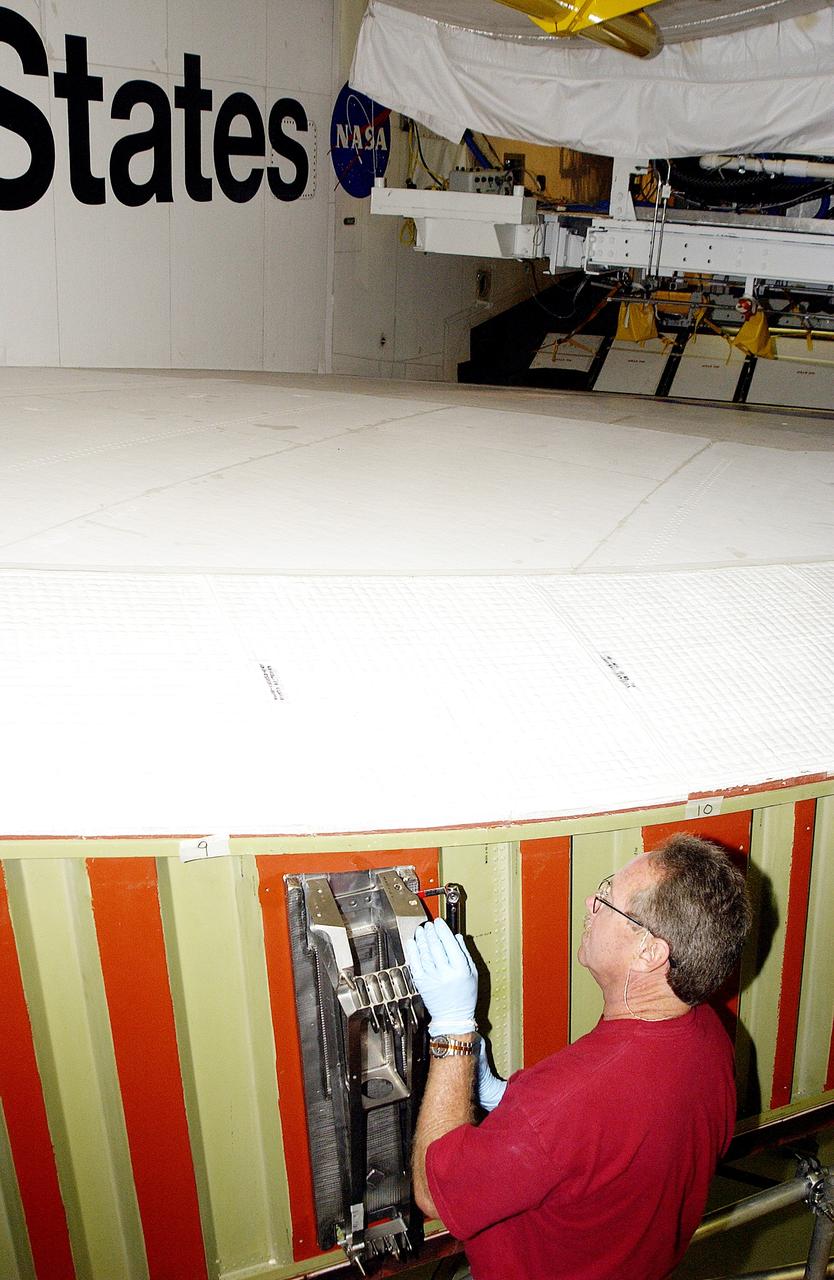
KENNEDY SPACE CENTER, FLA. - In the Orbiter Processing Facility, United Space Alliance worker Mike Hyatt attaches a Reinforced Carbon Carbon (RCC) panel onto the leading edge of the wing of the orbiter Atlantis. The gray carbon composite RCC panels have sufficient strength to withstand the aerodynamic forces experienced during launch and reentry, which can reach as high as 800 pounds per square foot. The operating range of RCC is from minus 250º F to about 3,000º F, the temperature produced by friction with the atmosphere during reentry.
KENNEDY SPACE CENTER, FLA. -  The master assembler, crane crew, removes a five-meter telescope in Cocoa Beach, Fla., for repair.  The tracking telescope is part of the Distant Object Attitude Measurement System (DOAMS) that provides optical support for launches from KSC and Cape Canaveral.
KENNEDY SPACE CENTER, FLA. - The master assembler, crane crew, removes a five-meter telescope in Cocoa Beach, Fla., for repair. The tracking telescope is part of the Distant Object Attitude Measurement System (DOAMS) that provides optical support for launches from KSC and Cape Canaveral.
KENNEDY SPACE CENTER, FLA. -  In the Orbiter Processing Facility, Eric Madaras (left), NASA-Langley Research Center, and Jim McGee, The Boeing Company, Huntington Beach, Calif., conduct impulse tests on the right wing leading edge (WLE) of Space Shuttle Endeavour. The tests monitor how sound impulses propagate through the WLE area.  The data collected will be analyzed to explore the possibility of adding new instrumentation to the wing that could automatically detect debris or micrometeroid impacts on the Shuttle while in flight.  The study is part of the initiative ongoing at KSC and around the agency to return the orbiter fleet to flight status.
KENNEDY SPACE CENTER, FLA. - In the Orbiter Processing Facility, Eric Madaras (left), NASA-Langley Research Center, and Jim McGee, The Boeing Company, Huntington Beach, Calif., conduct impulse tests on the right wing leading edge (WLE) of Space Shuttle Endeavour. The tests monitor how sound impulses propagate through the WLE area. The data collected will be analyzed to explore the possibility of adding new instrumentation to the wing that could automatically detect debris or micrometeroid impacts on the Shuttle while in flight. The study is part of the initiative ongoing at KSC and around the agency to return the orbiter fleet to flight status.
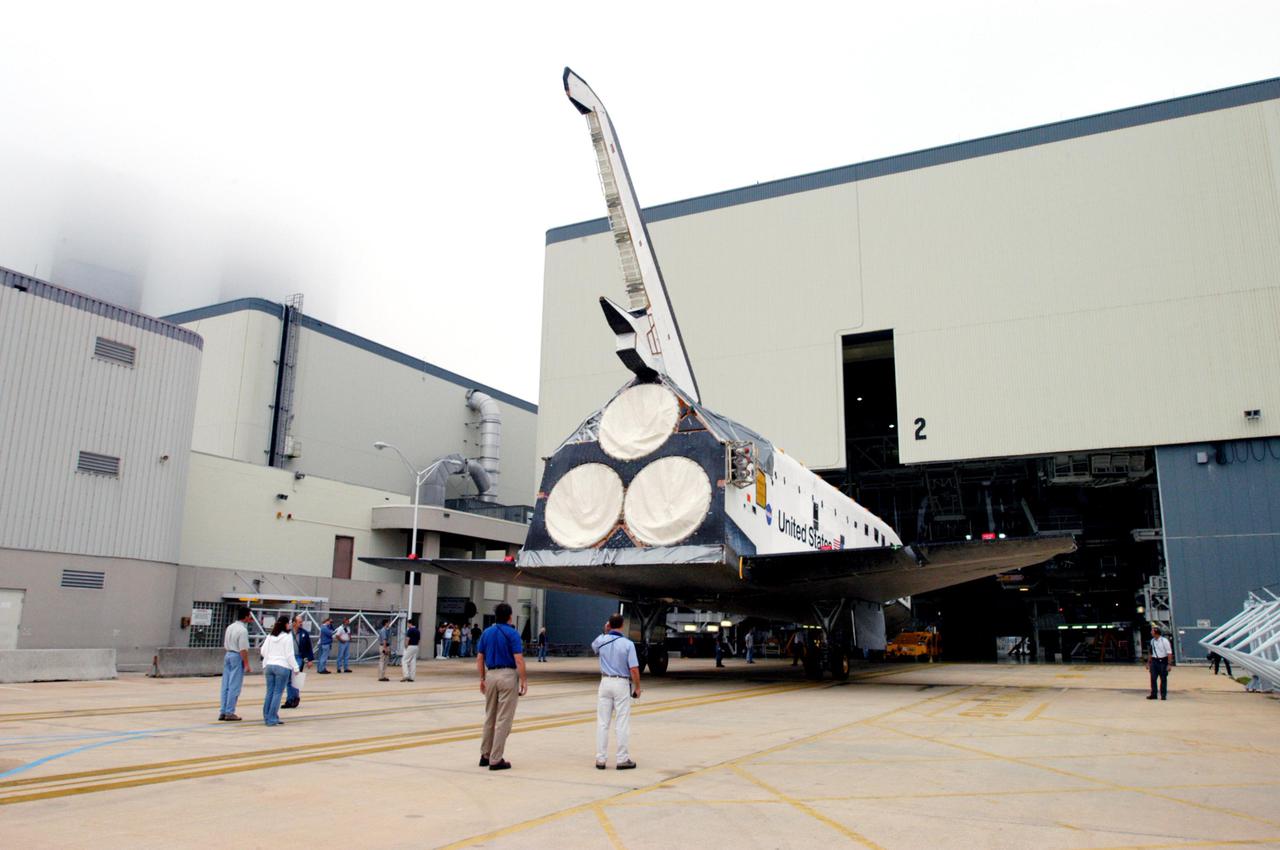
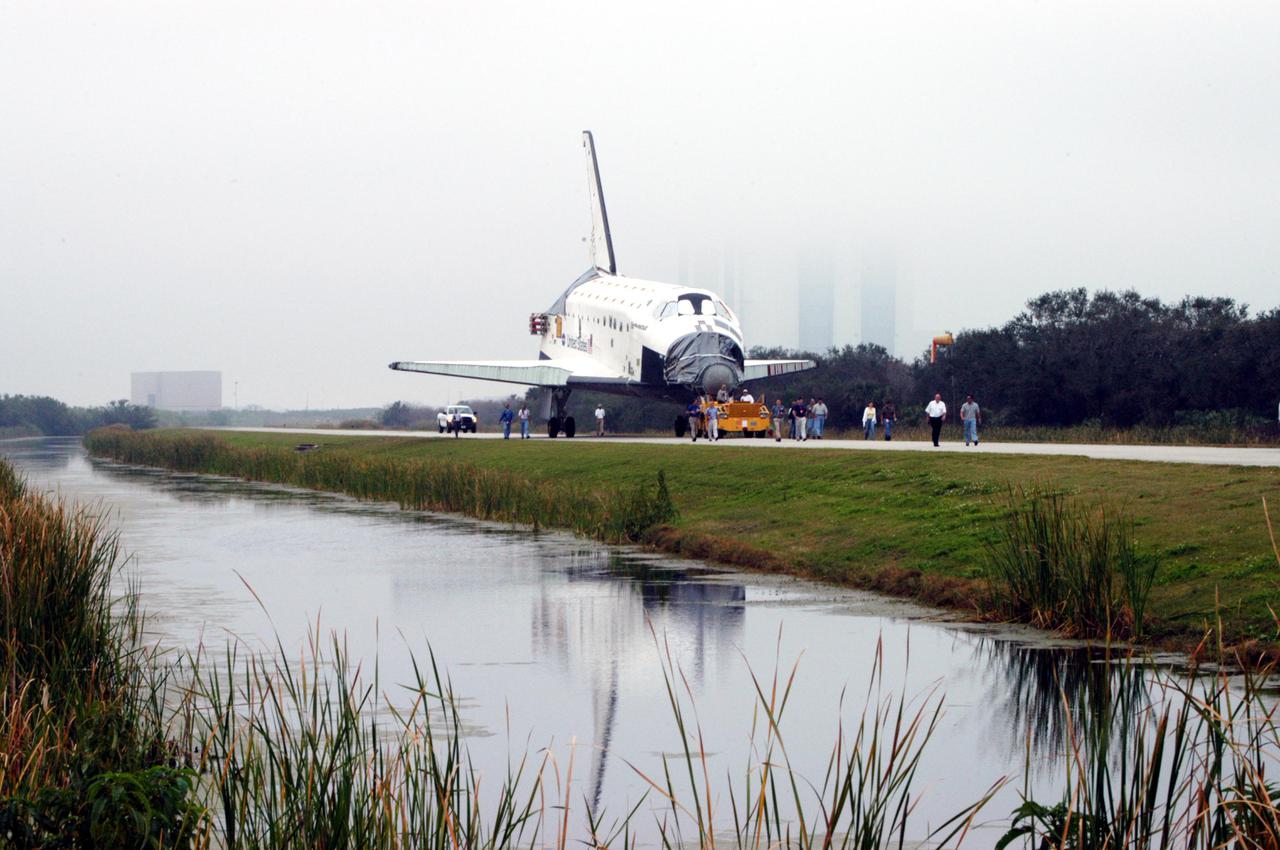
KENNEDY SPACE CENTER, FLA.  - The orbiter Endeavour rolls out of the Orbiter Processing Facility.  It is being moved to Florida Space Authority’s Reusable Launch Vehicle hangar for temporary storage.  It left the Orbiter Processing Facility (OPF) to allow work to be performed in the OPF that can only be accomplished while the bay is empty.  Work scheduled in the OPF includes modifications to the bay and platform validation in the bay.   Endeavour will remain in the hangar for approximately 30 days, then return to the OPF.  Endeavour was pulled out of service in December 2003 for Orbiter Major Modification (OMM).  OMMs are scheduled at regular intervals to enhance safety and performance, infuse new technology, and, in this case, perform RTF modifications.
KSC-05pd-0301
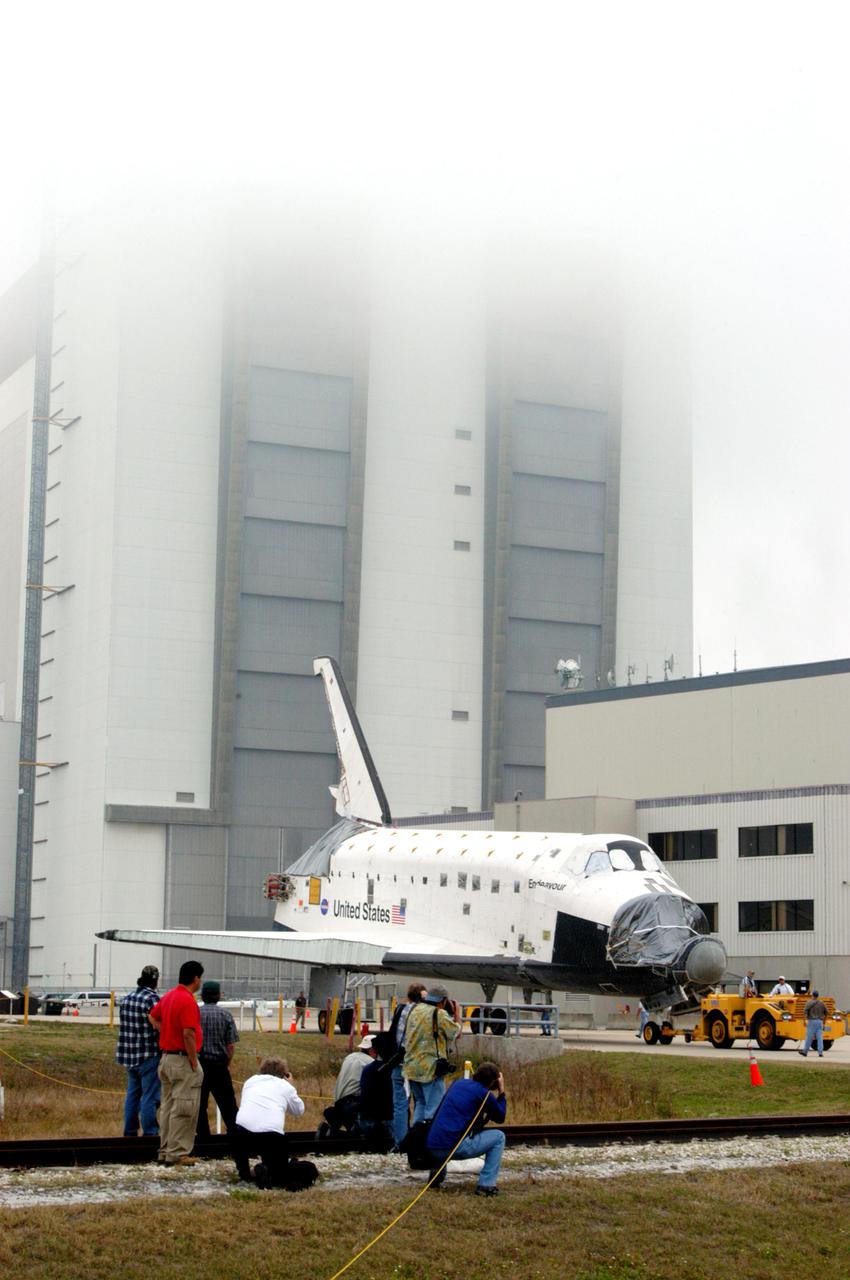
KENNEDY SPACE CENTER, FLA.  - Workers watch as the orbiter Endeavour rolls past the Vehicle Assembly Building on its way to Florida Space Authority’s Reusable Launch Vehicle hangar for temporary storage.  Endeavour is being moved from the Orbiter Processing Facility (OPF) to allow work to be performed in the OPF that can only be accomplished while the bay is empty.  Work scheduled in the OPF includes modifications to the bay and platform validation in the bay.   Endeavour will remain in the hangar for approximately 30 days, then return to the OPF.  Endeavour was pulled out of service in December 2003 for Orbiter Major Modification (OMM).  OMMs are scheduled at regular intervals to enhance safety and performance, infuse new technology, and, in this case, perform RTF modifications.
KSC-05pd-0302
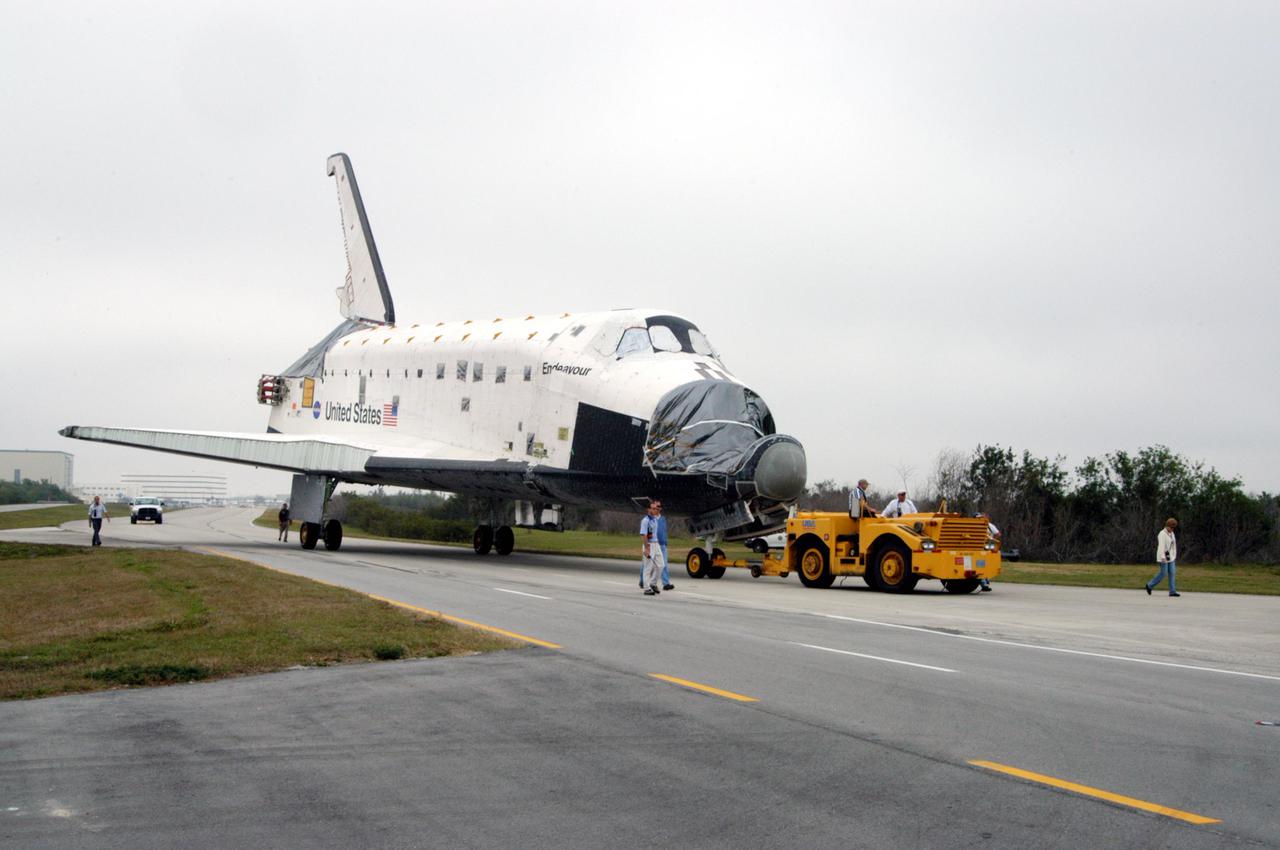
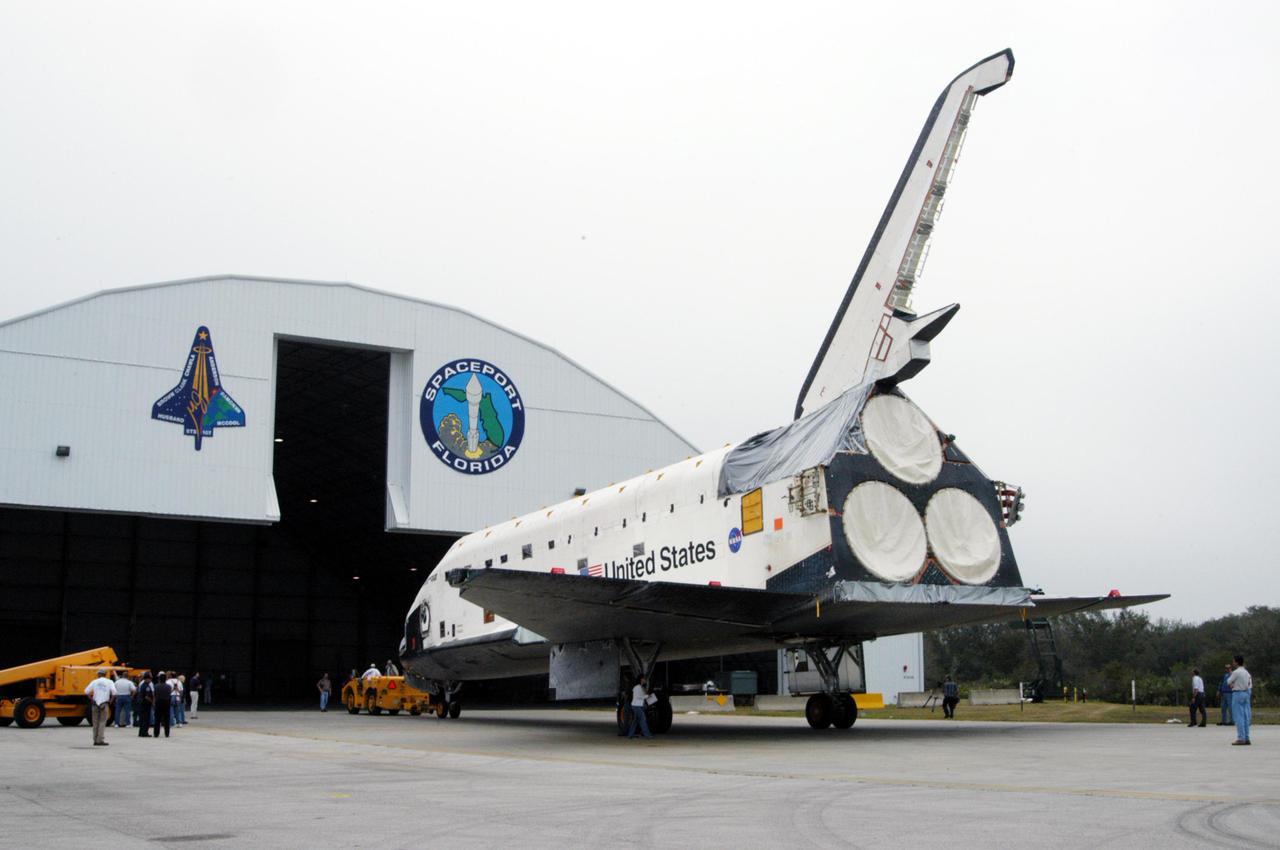
KENNEDY SPACE CENTER, FLA.  - The orbiter Endeavour is towed into Florida Space Authority’s Reusable Launch Vehicle hangar for temporary storage.  Endeavour is being moved from the Orbiter Processing Facility (OPF) to allow work to be performed in the OPF that can only be accomplished while the bay is empty.   Work scheduled in the OPF includes modifications to the bay and platform validation in the bay.   Endeavour will remain in the hangar for approximately 30 days, then return to the OPF.  Endeavour was pulled out of service in December 2003 for Orbiter Major Modification (OMM).  OMMs are scheduled at regular intervals to enhance safety and performance, infuse new technology, and, in this case, perform RTF modifications.
KSC-05pd-0306
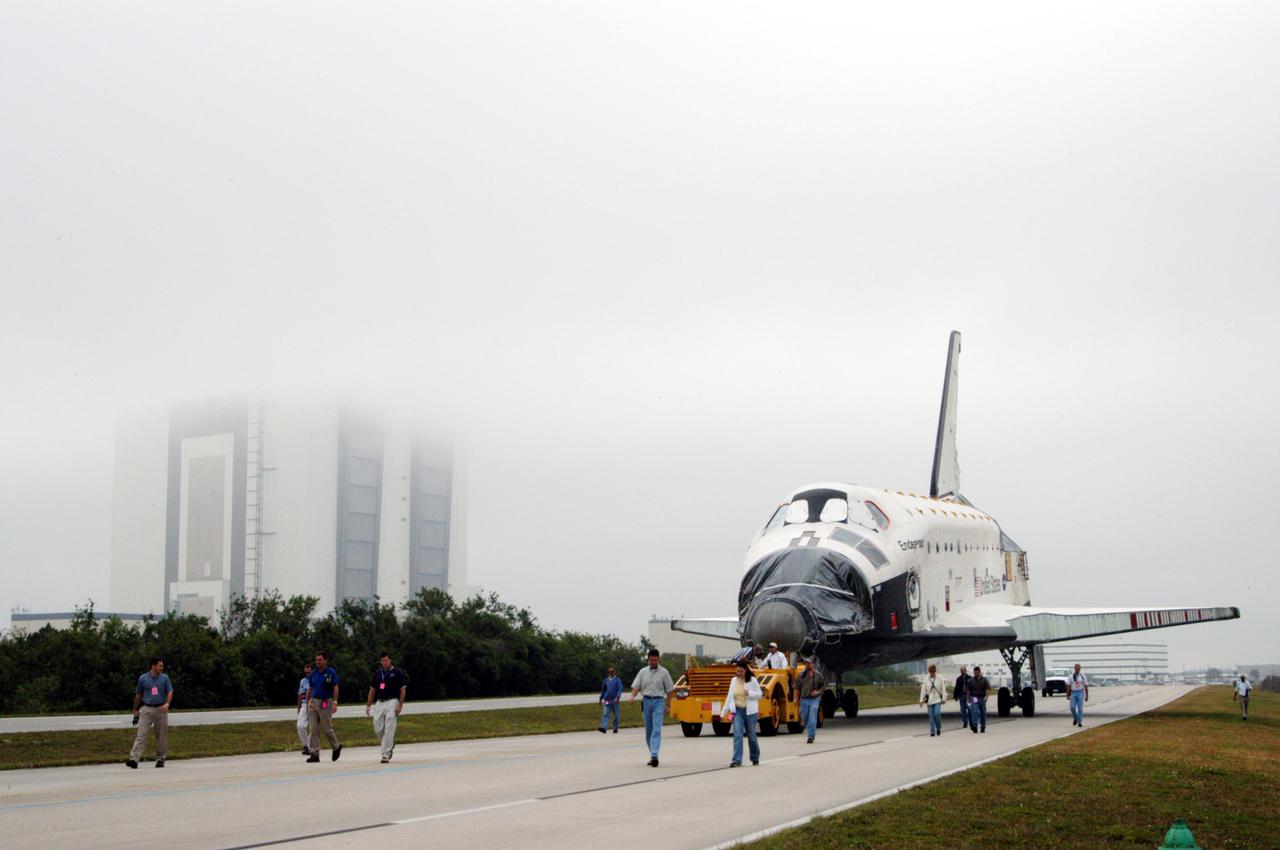
KENNEDY SPACE CENTER, FLA.  - - The orbiter Endeavour is being towed to Florida Space Authority’s Reusable Launch Vehicle hangar for temporary storage.  Endeavour is being moved from the Orbiter Processing Facility (OPF) to allow work to be performed in the OPF that can only be accomplished while the bay is empty.  Work scheduled in the OPF includes modifications to the bay and platform validation in the bay.   Endeavour will remain in the hangar for approximately 30 days, then return to the OPF.  Endeavour was pulled out of service in December 2003 for Orbiter Major Modification (OMM).  OMMs are scheduled at regular intervals to enhance safety and performance, infuse new technology, and, in this case, perform RTF modifications.
KSC-05pd-0304
KENNEDY SPACE CENTER, FLA.  - Workers accompany the orbiter Endeavour as it rolls past the Vehicle Assembly Building on its way to Florida Space Authority’s Reusable Launch Vehicle hangar for temporary storage.  Endeavour is being moved from the Orbiter Processing Facility (OPF) to allow work to be performed in the OPF that can only be accomplished while the bay is empty.  Work scheduled in the OPF includes modifications to the bay and platform validation in the bay.   Endeavour will remain in the hangar for approximately 30 days, then return to the OPF.  Endeavour was pulled out of service in December 2003 for Orbiter Major Modification (OMM).  OMMs are scheduled at regular intervals to enhance safety and performance, infuse new technology, and, in this case, perform RTF modifications.
KSC-05pd-0303
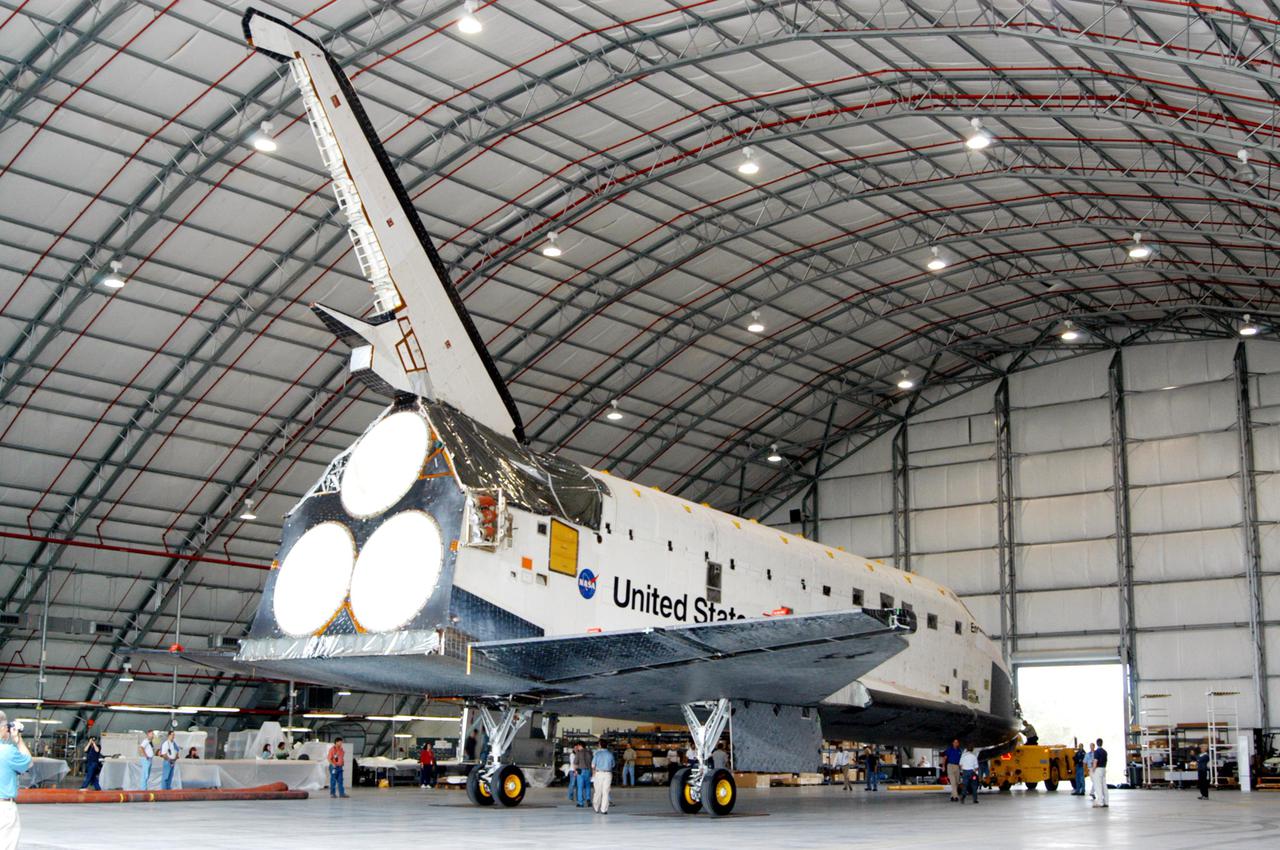
KENNEDY SPACE CENTER, FLA.  - The orbiter Endeavour arrives inside Florida Space Authority’s Reusable Launch Vehicle hangar where it is being held for temporary storage.  Endeavour was moved from the Orbiter Processing Facility (OPF) to allow work to be performed in the OPF that can only be accomplished while the bay is empty.   Work scheduled in the OPF includes modifications to the bay and platform validation in the bay.   Endeavour will remain in the hangar for approximately 30 days, then return to the OPF.  Endeavour was pulled out of service in December 2003 for Orbiter Major Modification (OMM).  OMMs are scheduled at regular intervals to enhance safety and performance, infuse new technology, and, in this case, perform RTF modifications.
KSC-05pd-0307
KENNEDY SPACE CENTER, FLA.  - - With workers accompanying it, the orbiter Endeavour is being towed to Florida Space Authority’s Reusable Launch Vehicle hangar for temporary storage.  Endeavour is being moved from the Orbiter Processing Facility (OPF) to allow work to be performed in the OPF that can only be accomplished while the bay is empty.  Work scheduled in the OPF includes modifications to the bay and platform validation in the bay.   Endeavour will remain in the hangar for approximately 30 days, then return to the OPF.  Endeavour was pulled out of service in December 2003 for Orbiter Major Modification (OMM).  OMMs are scheduled at regular intervals to enhance safety and performance, infuse new technology, and, in this case, perform RTF modifications.
KSC-05pd-0305
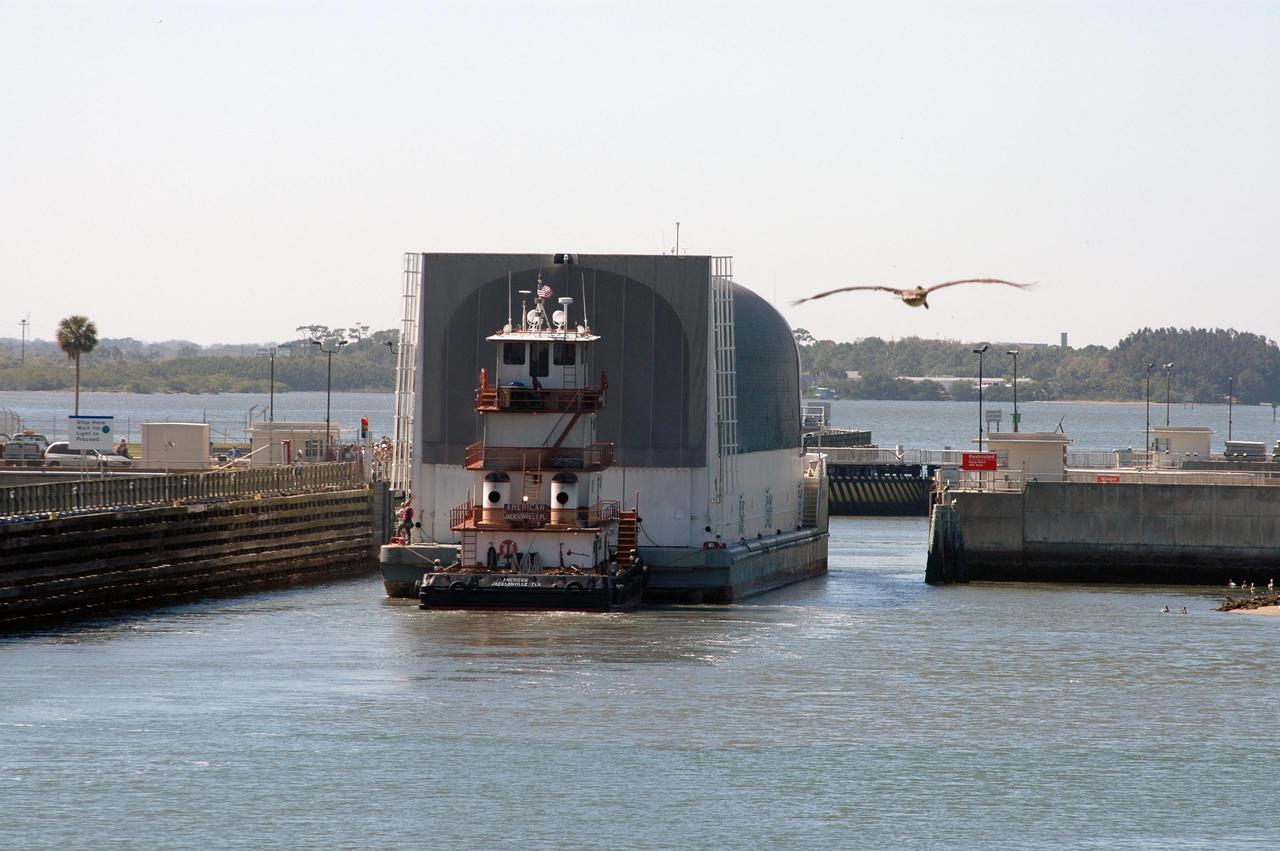
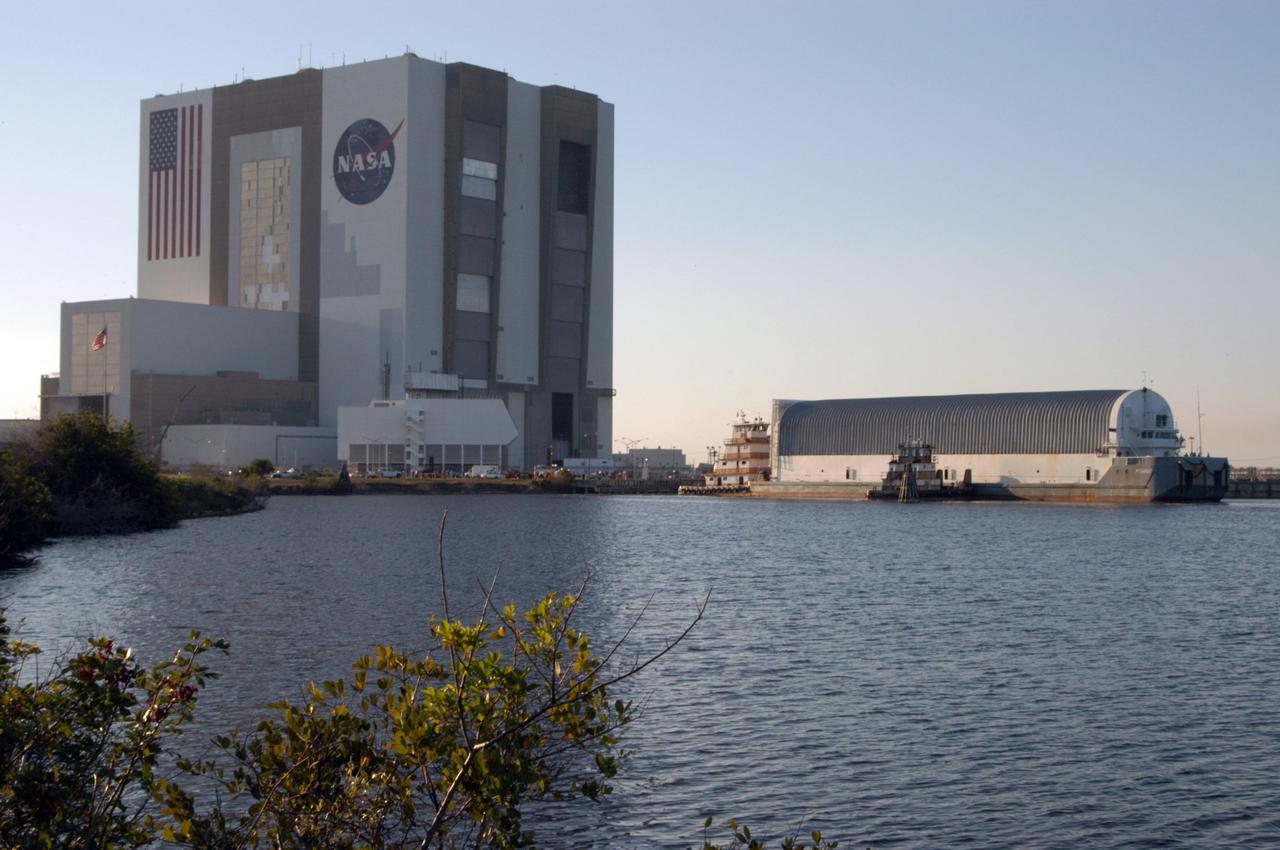
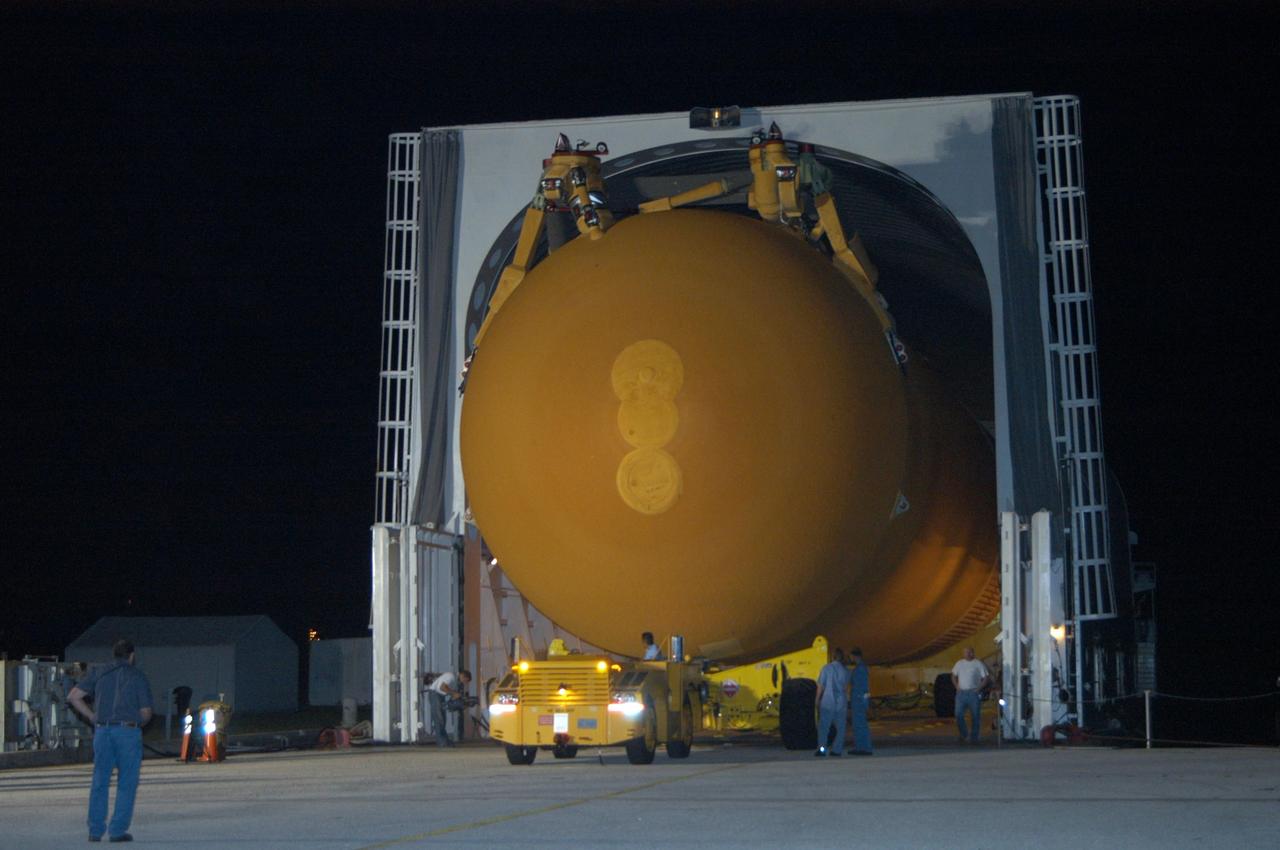
KENNEDY SPACE CENTER, FLA.  - The Pegasus barge traverses the locks at Port Canaveral, as it nears the end of its journey from the Michoud Assembly Facility in New Orleans to Kennedy Space Center.  The barge carries the redesigned external fuel tank that will launch Space Shuttle Discovery on the next shuttle mission, STS-121.  After off-loading, the tank will be moved into the Vehicle Assembly Building and lifted into a checkout cell for further work. The tank, designated ET-119, will fly with many major safety changes, including the removal of the protuberance air load ramps. A large piece of foam from a ramp came off during the last shuttle launch in July 2005. The ramps were removed to eliminate a potential source of damaging debris to the space shuttle.  The next launch of Discovery is scheduled for May 2006.
KSC-06pd0404
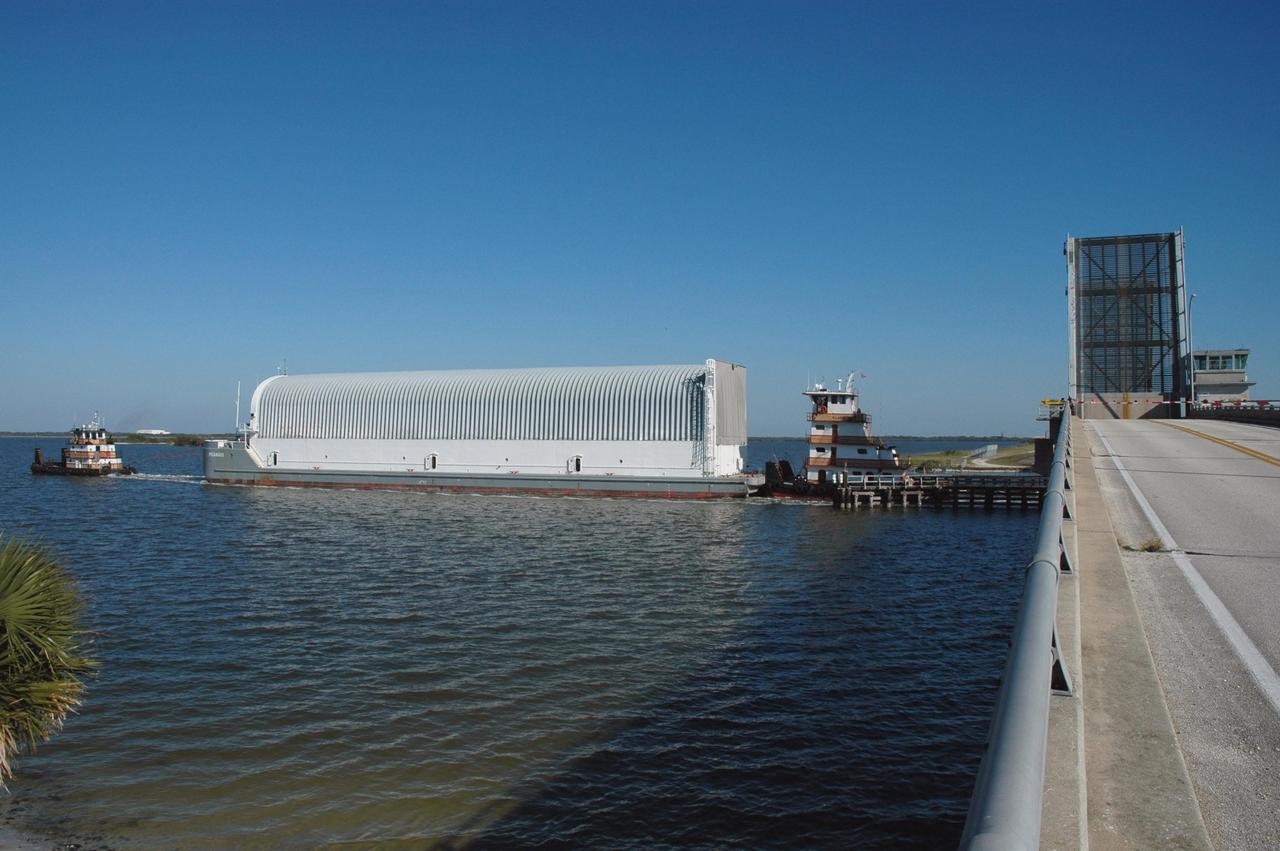
KENNEDY SPACE CENTER, FLA.  - The Pegasus barge passes under the Roy D. Bridges Bridge in the Banana River, as it nears the end of its journey from the Michoud Assembly Facility in New Orleans to Kennedy Space Center.  The barge carries the redesigned external fuel tank that will launch Space Shuttle Discovery on the next shuttle mission, STS-121.  After off-loading, the tank will be moved into the Vehicle Assembly Building and lifted into a checkout cell for further work. The tank, designated ET-119, will fly with many major safety changes, including the removal of the protuberance air load ramps. A large piece of foam from a ramp came off during the last shuttle launch in July 2005. The ramps were removed to eliminate a potential source of damaging debris to the space shuttle.  The next launch of Discovery is scheduled for May 2006.
KSC-06pd0405
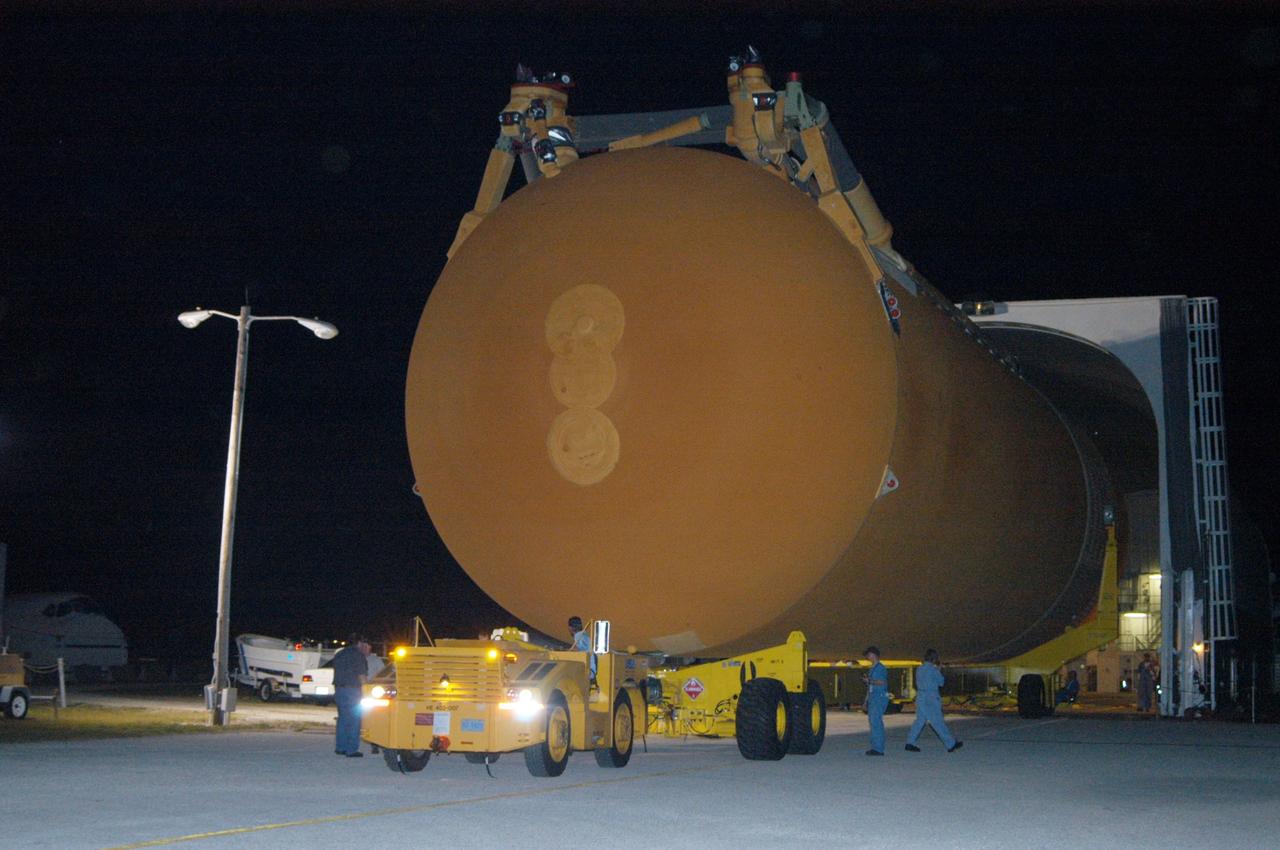
KENNEDY SPACE CENTER, FLA.  - Technicians monitor the redesigned external fuel tank that will launch Space Shuttle Discovery on the next shuttle mission, STS-121, as it is moved to the Vehicle Assembly Building in the background. The Pegasus barge delivered the tank from the Michoud Assembly Facility in New Orleans to NASA's Kennedy Space Center. Once in the VAB, the tank will be lifted into a checkout cell for further work. The tank, designated ET-119, will fly with many major safety changes, including the removal of the protuberance air load ramps. A large piece of foam from a ramp came off during the last shuttle launch in July 2005. The ramps were removed to eliminate a potential source of damaging debris to the space shuttle.  The next launch of Discovery is scheduled for May 2006.
KSC-06pd0412
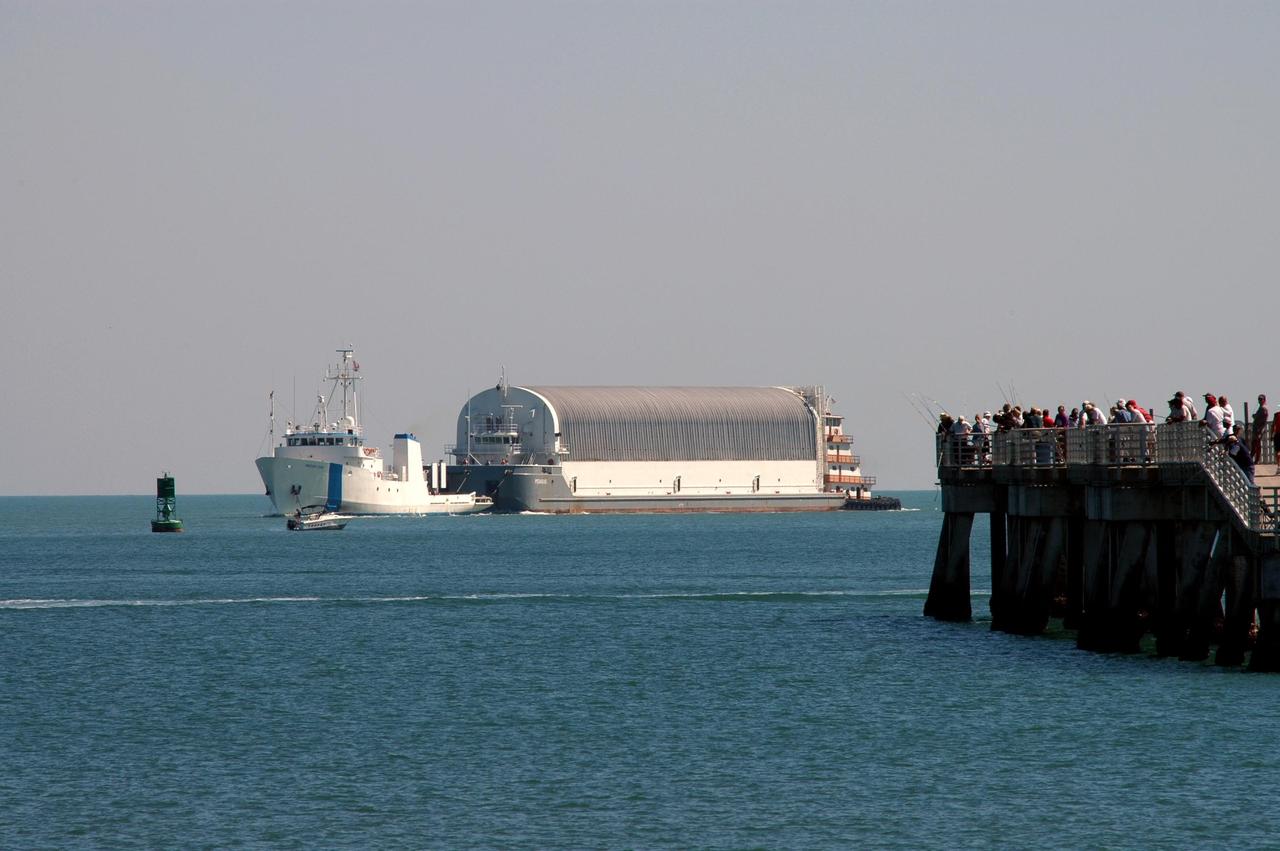
KENNEDY SPACE CENTER, FLA.  - Towed by the Freedom Star, the Pegasus barge enters Port Canaveral, the last leg of its journey from the Michoud Assembly Facility in New Orleans to Kennedy Space Center.  The barge carries the redesigned external fuel tank that will launch Space Shuttle Discovery on the next shuttle mission, STS-121.  After off-loading, the tank will be moved into the Vehicle Assembly Building and lifted into a checkout cell for further work. The tank, designated ET-119, will fly with many major safety changes, including the removal of the protuberance air load ramps. A large piece of foam from a ramp came off during the last shuttle launch in July 2005. The ramps were removed to eliminate a potential source of damaging debris to the space shuttle.  The next launch of Discovery is scheduled for May 2006.
KSC-06pd0401
KENNEDY SPACE CENTER, FLA. - In NASA Kennedy Space Center's Vehicle Assembly Building, a crane has been attached to the newly delivered external tank, which is resting on a transporter in the transfer aisle. Designated ET-119, the 154-foot tank will be raised to vertical and lifted into a checkout cell for further work. The tank, which will launch space shuttle Discovery on mission STS-121, will fly with many major safety changes, including the removal of the protuberance air load ramps. A large piece of foam from a ramp came off during the last shuttle launch in July 2005. The ramps were removed to eliminate a potential source of damaging debris to the space shuttle. The next launch of Discovery is scheduled for May 2006. Photo credit: NASA/Jim Grossmann
KSC-06pd0418a
KENNEDY SPACE CENTER, FLA. - In NASA Kennedy Space Center's Vehicle Assembly Building, the newly delivered external tank is lifted off its transporter. Designated ET-119, the 154-foot tank is being raised to vertical and then will be lifted into a checkout cell for further work. The tank, which will launch space shuttle Discovery on mission STS-121, will fly with many major safety changes, including the removal of the protuberance air load ramps. A large piece of foam from a ramp came off during the last shuttle launch in July 2005. The ramps were removed to eliminate a potential source of damaging debris to the space shuttle. The next launch of Discovery is scheduled for May 2006. Photo credit: NASA/Jim Grossmann
KSC-06pd0419a
KENNEDY SPACE CENTER, FLA.  - The redesigned external fuel tank that will launch Space Shuttle Discovery on the next shuttle mission, STS-121, arrives safely in the transfer aisle of the Vehicle Assembly Building. The Pegasus barge delivered the tank from the Michoud Assembly Facility in New Orleans to NASA's Kennedy Space Center. Next, the tank will be lifted into a checkout cell for further work. The tank, designated ET-119, will fly with many major safety changes, including the removal of the protuberance air load ramps. A large piece of foam from a ramp came off during the last shuttle launch in July 2005. The ramps were removed to eliminate a potential source of damaging debris to the space shuttle.  The next launch of Discovery is scheduled for May 2006.
KSC-06pd0413
KENNEDY SPACE CENTER, FLA.  - The Freedom Star tows the Pegasus barge to the entrance of Port Canaveral, the last leg of its journey from the Michoud Assembly Facility in New Orleans to Kennedy Space Center.  The barge carries the redesigned external fuel tank that will launch Space Shuttle Discovery on the next shuttle mission, STS-121.  After off-loading, the tank will be moved into the Vehicle Assembly Building and lifted into a checkout cell for further work. The tank, designated ET-119, will fly with many major safety changes, including the removal of the protuberance air load ramps. A large piece of foam from a ramp came off during the last shuttle launch in July 2005. The ramps were removed to eliminate a potential source of damaging debris to the space shuttle.  The next launch of Discovery is scheduled for May 2006.
KSC-06pd0400
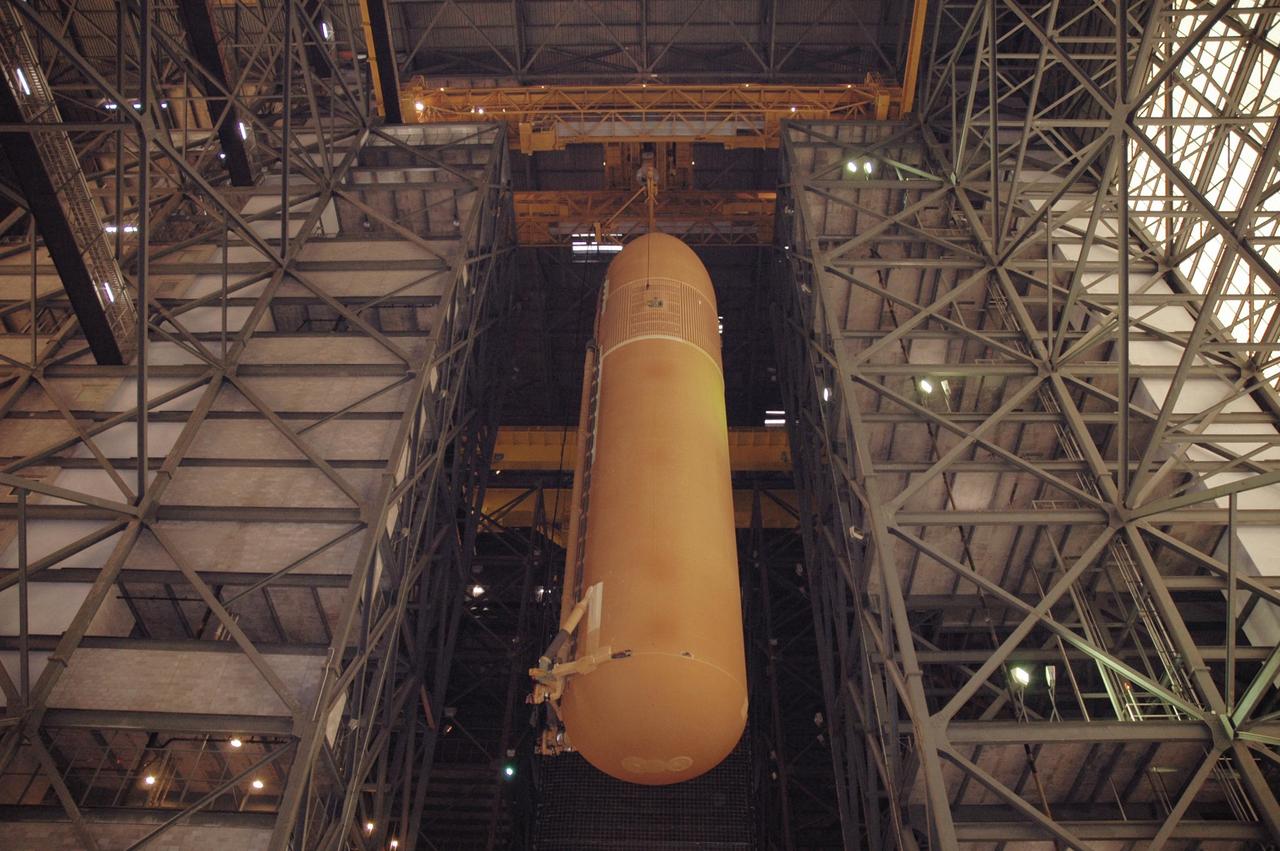
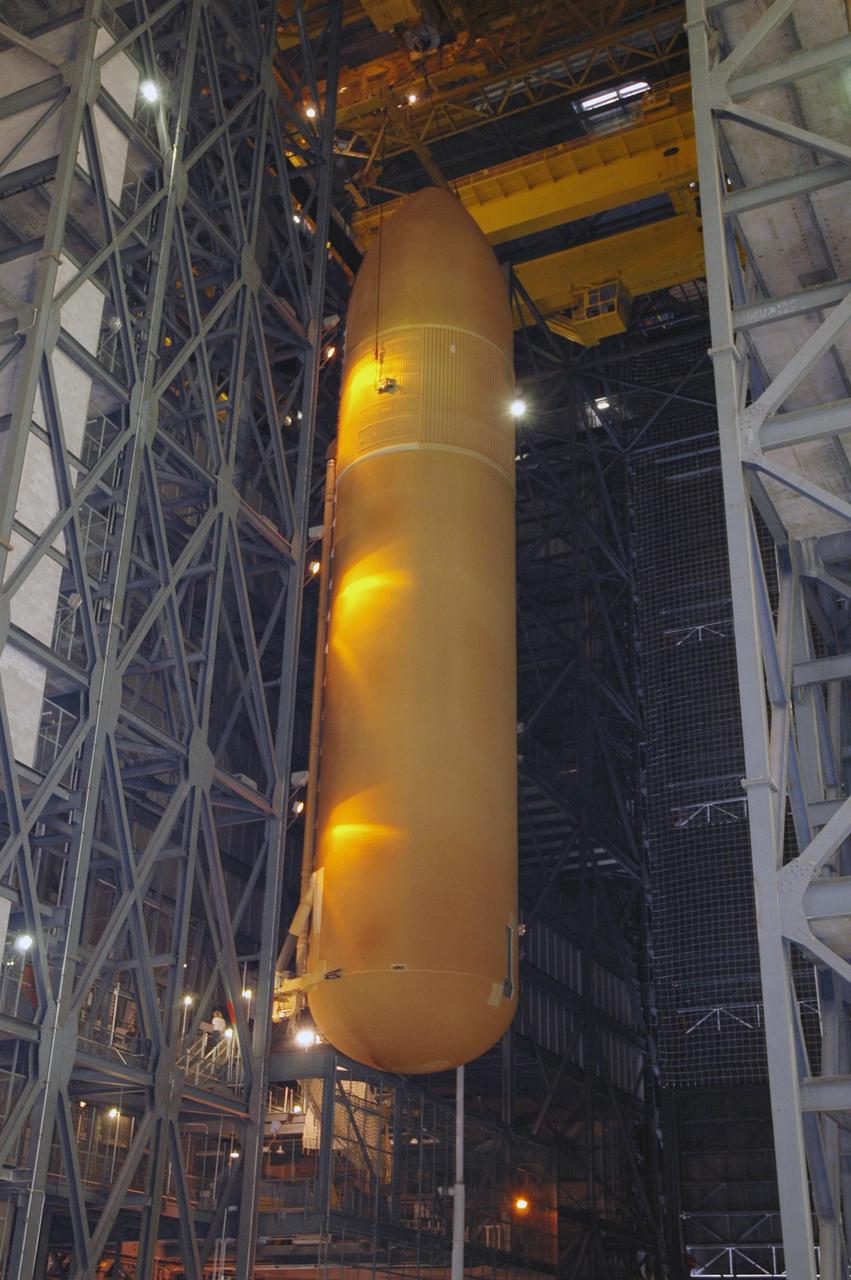
KENNEDY SPACE CENTER, FLA. - In NASA Kennedy Space Center's Vehicle Assembly Building, the newly delivered external tank is lifted high into the upper regions.  It will be moved over a crossbeam into a checkout cell for further work.  Designated ET-119, the 154-foot tank will be lifted into a checkout cell for further work. The tank, which will launch space shuttle Discovery on mission STS-121, will fly with many major safety changes, including the removal of the protuberance air load ramps. A large piece of foam from a ramp came off during the last shuttle launch in July 2005. The ramps were removed to eliminate a potential source of damaging debris to the space shuttle. The next launch of Discovery is scheduled for May 2006. Photo credit: NASA/Jim Grossmann
KSC-06pd0425