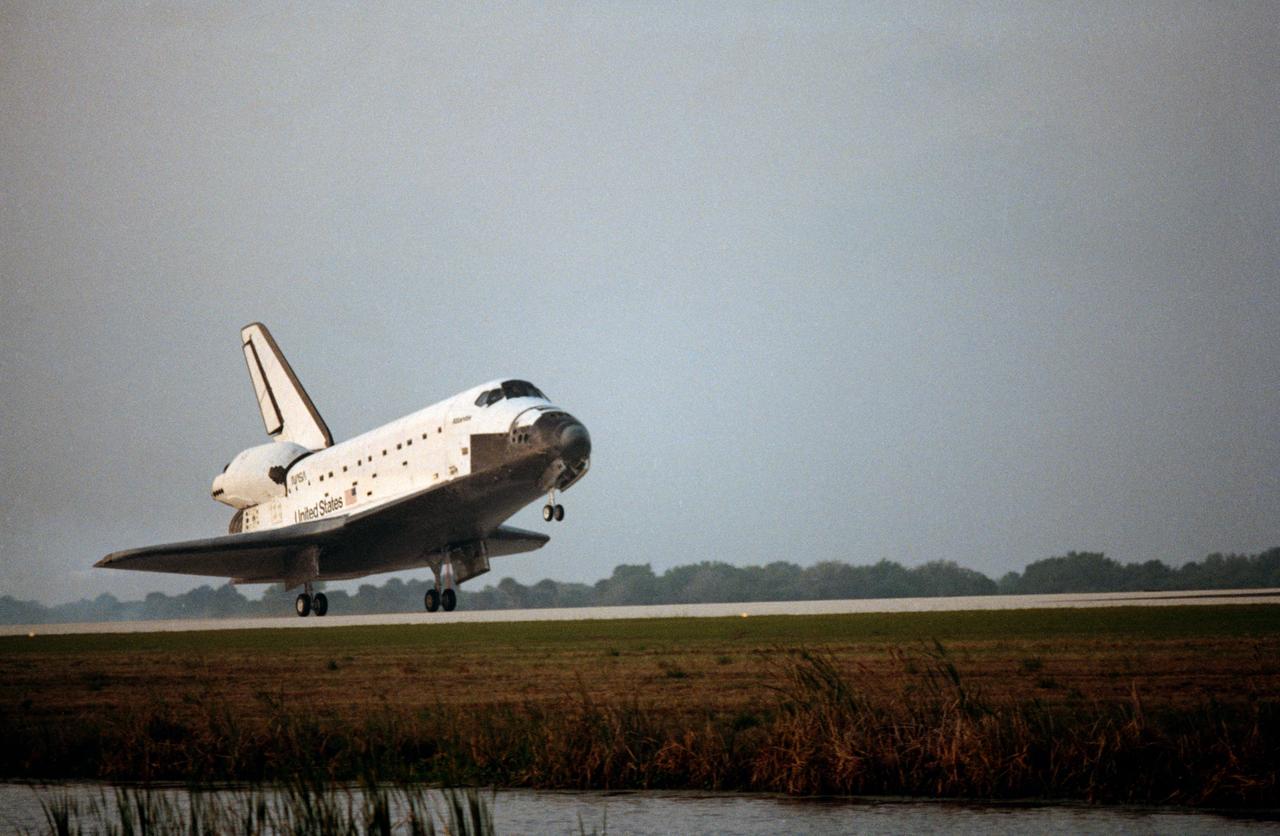
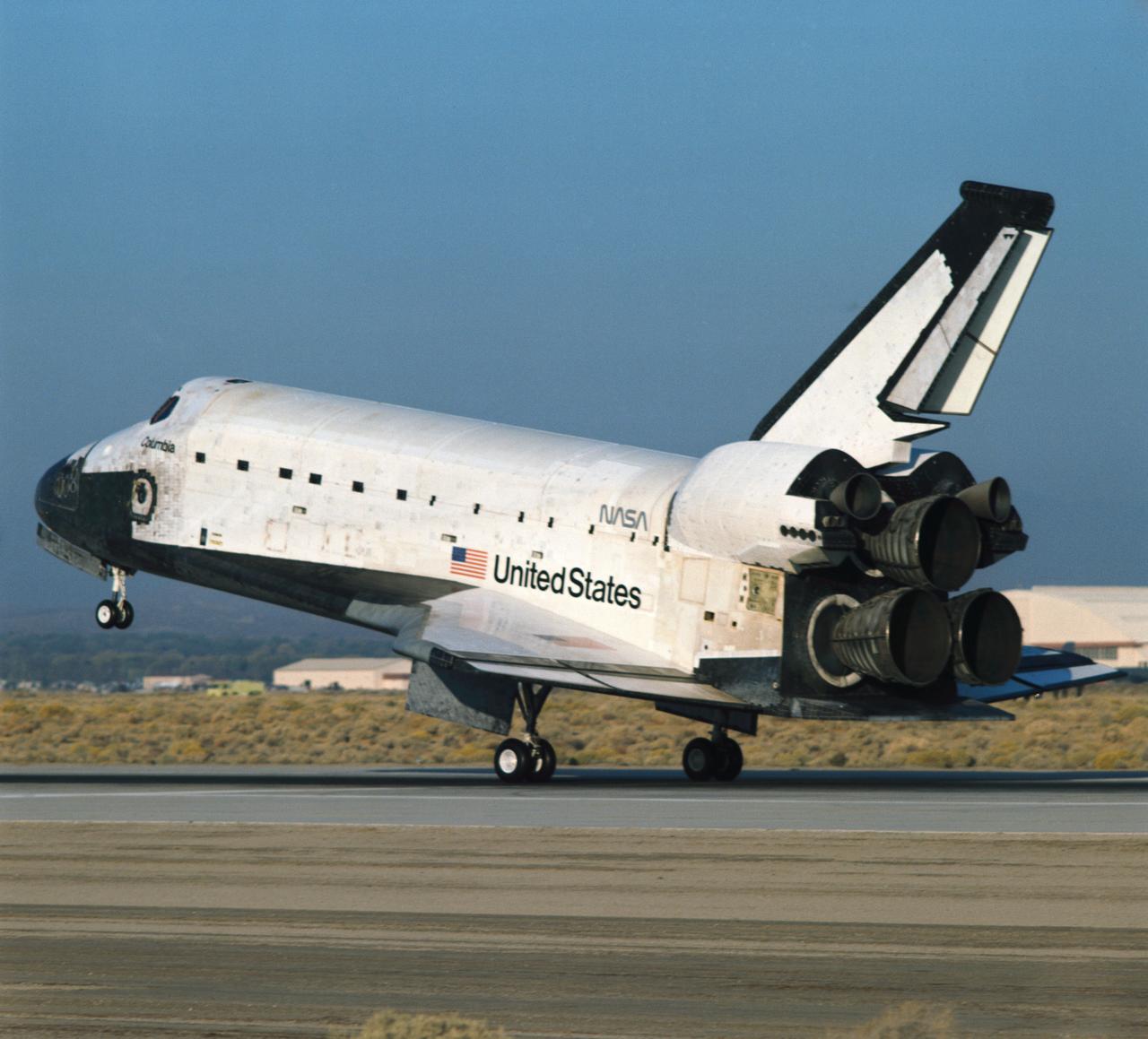
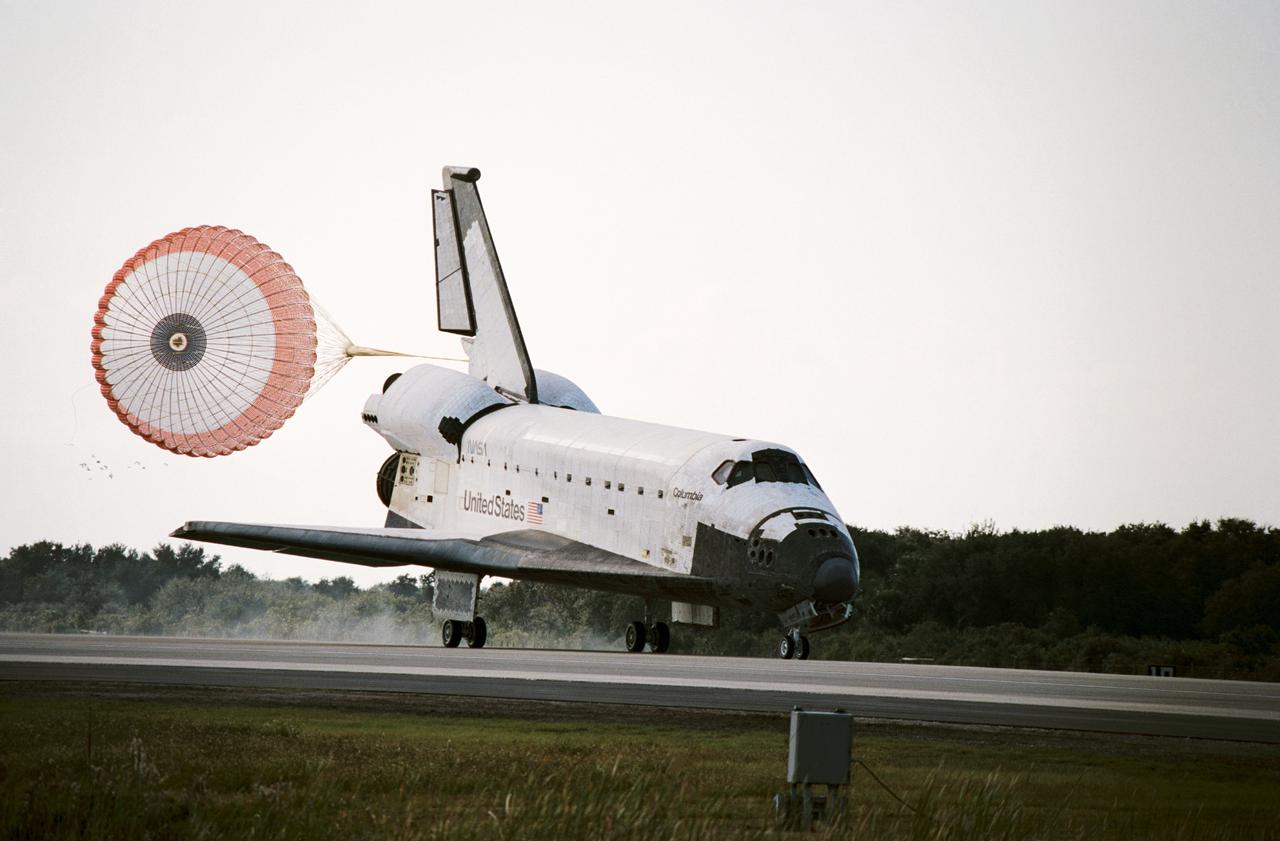
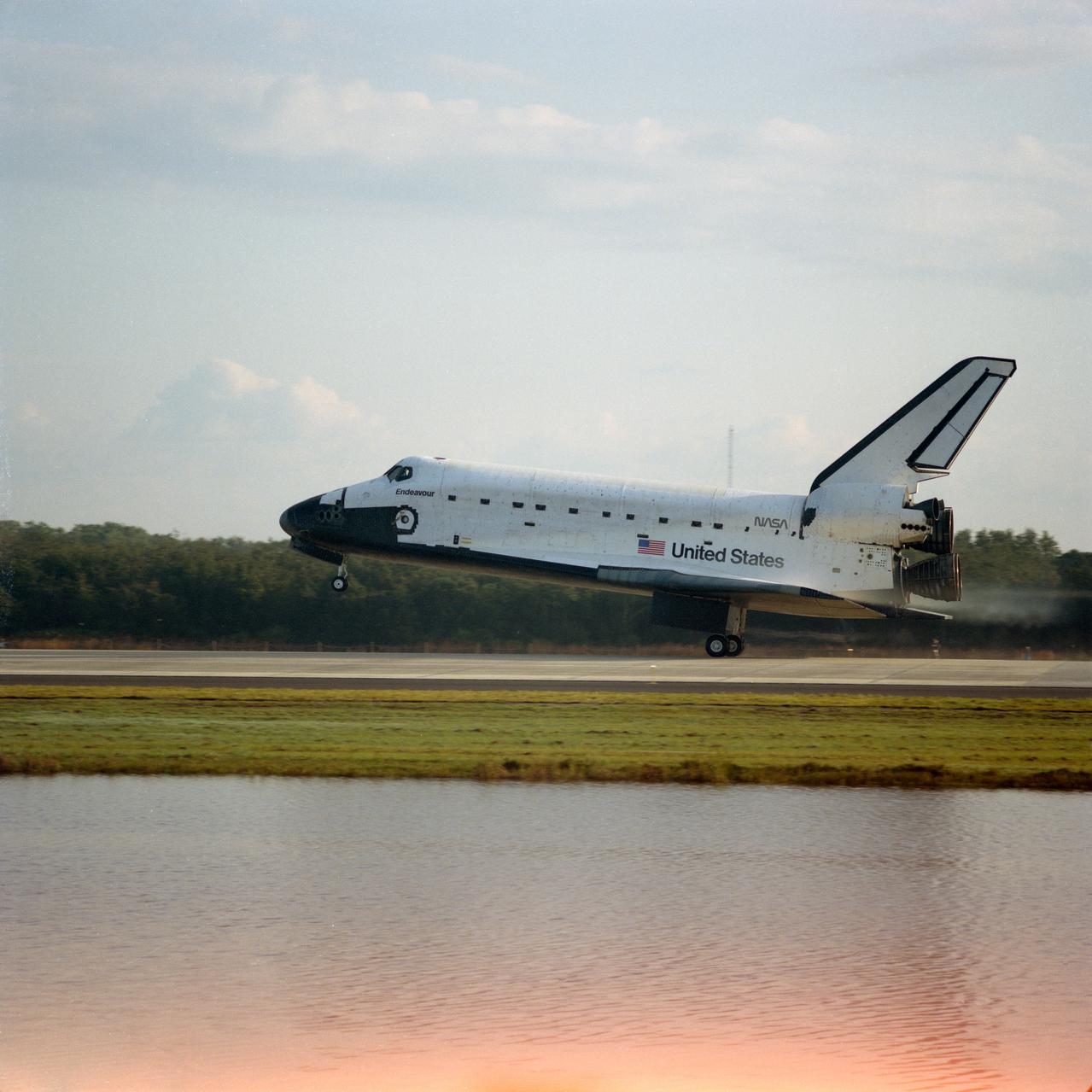
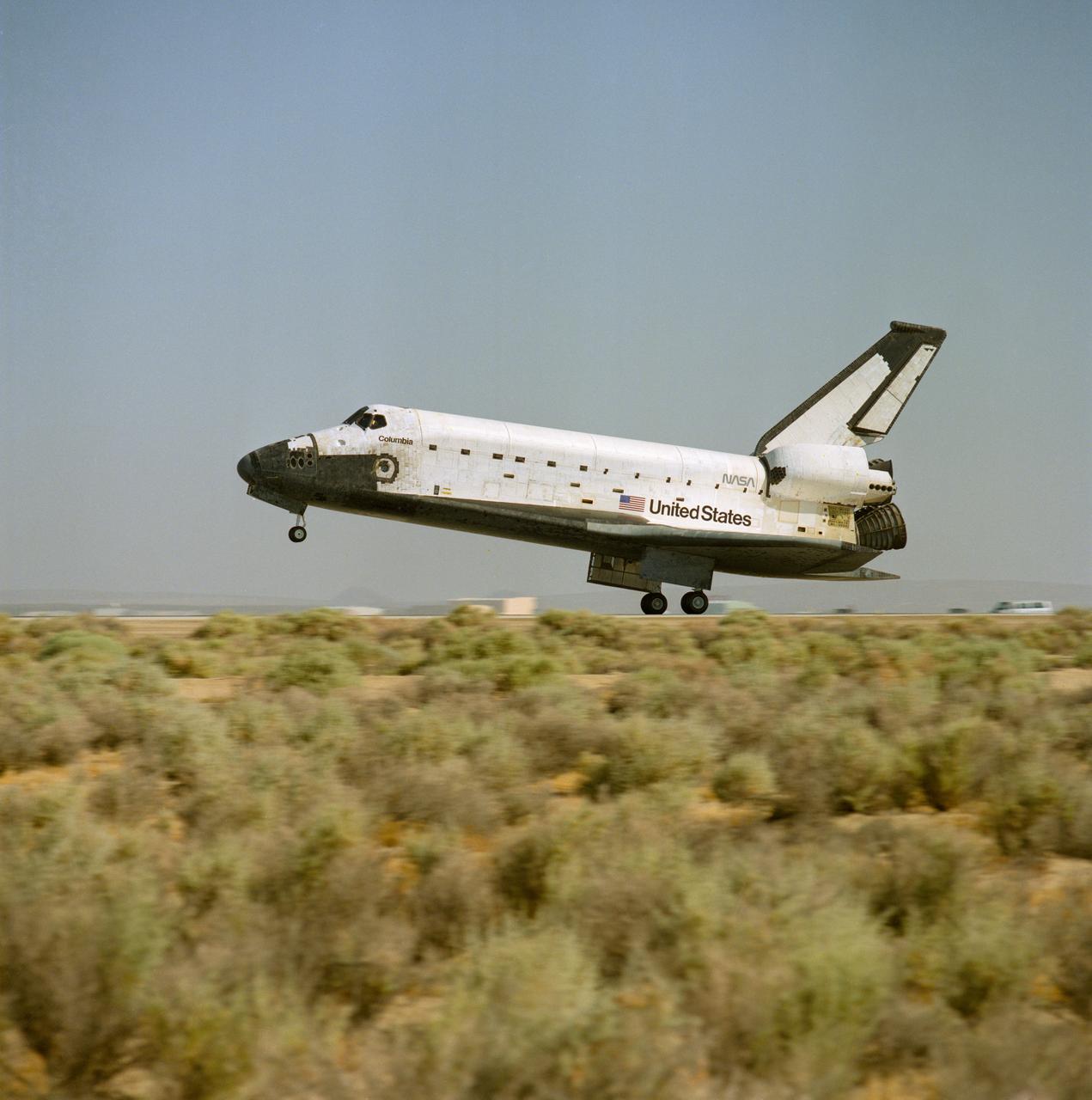
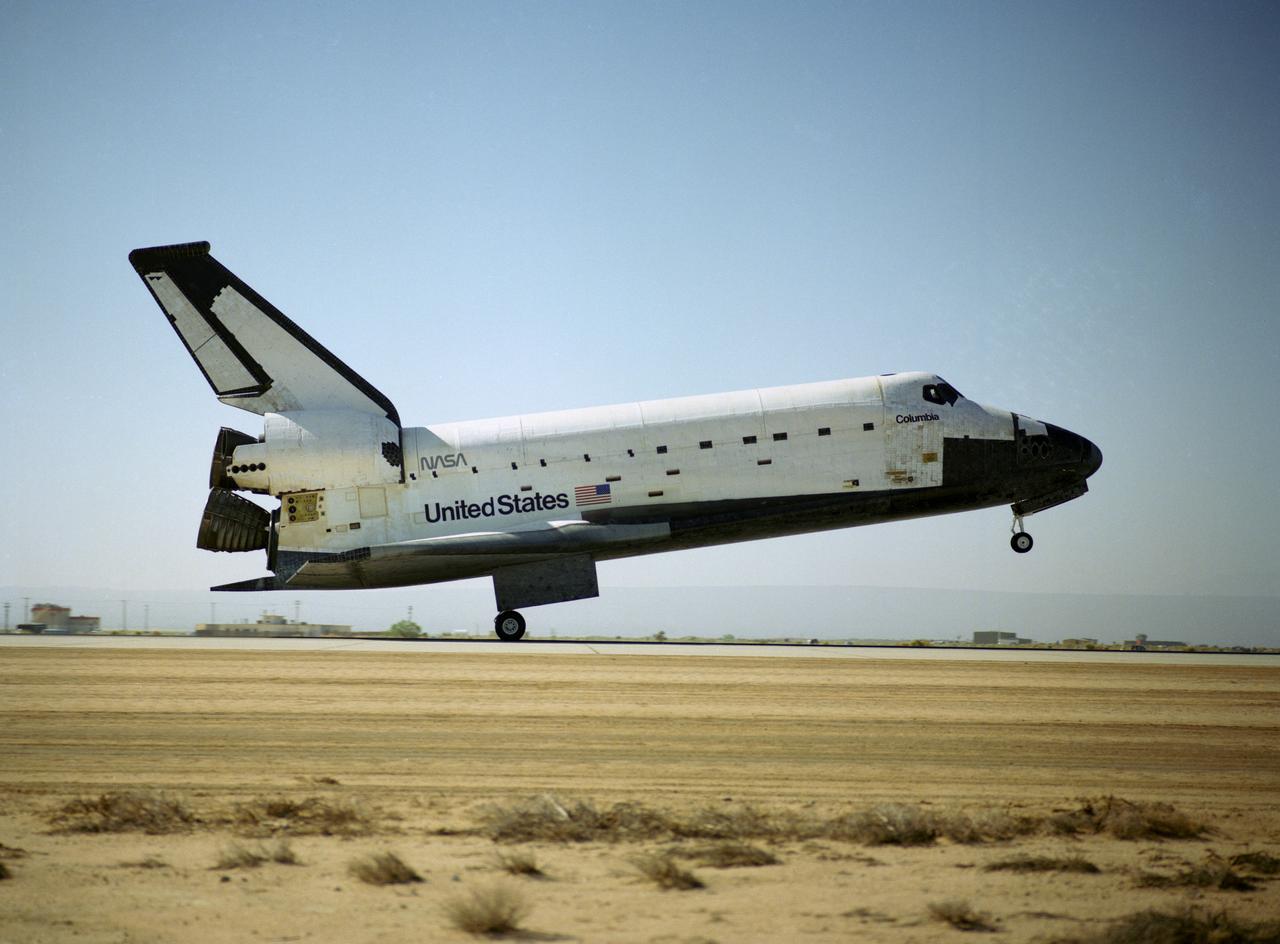
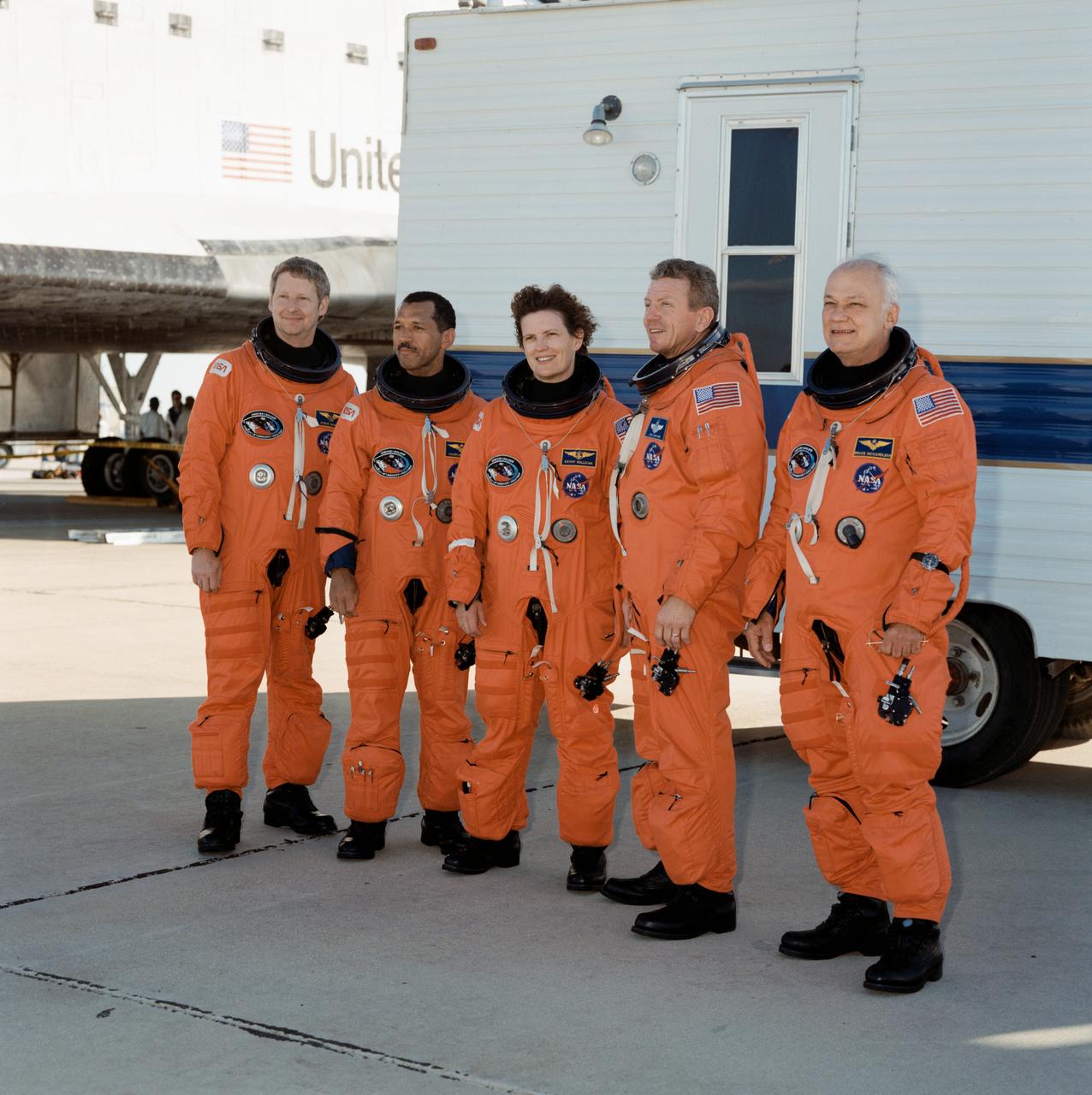
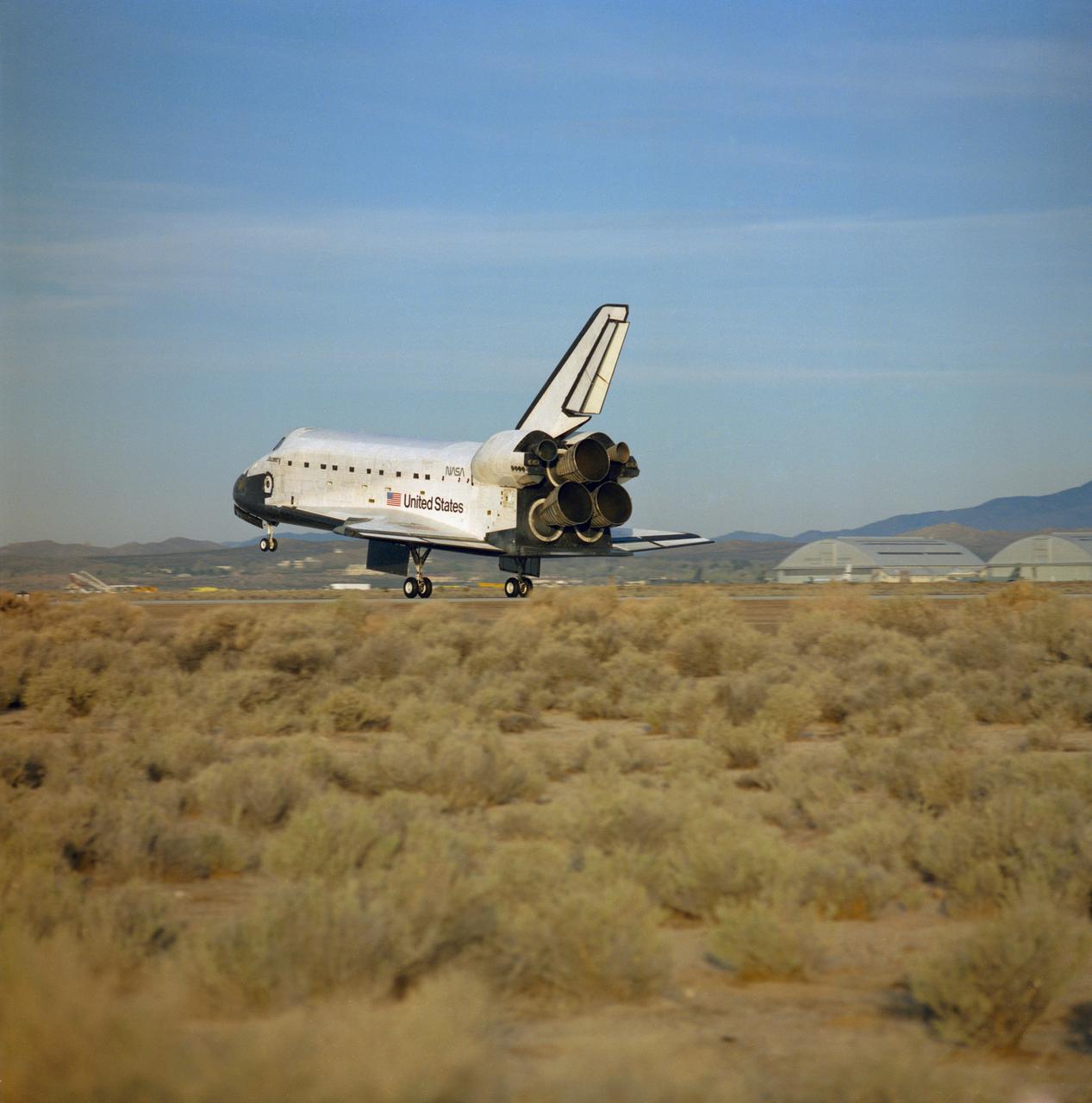
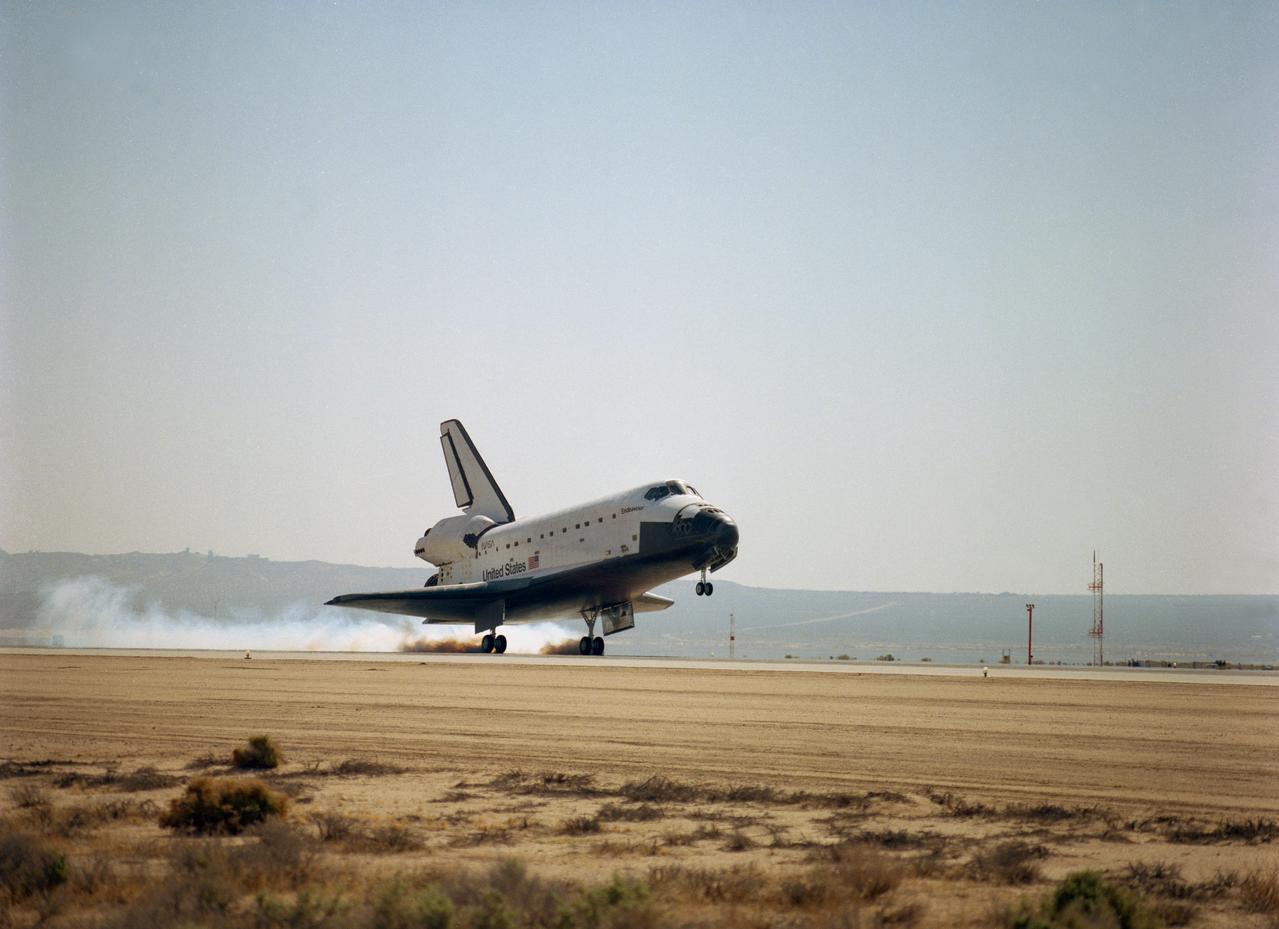
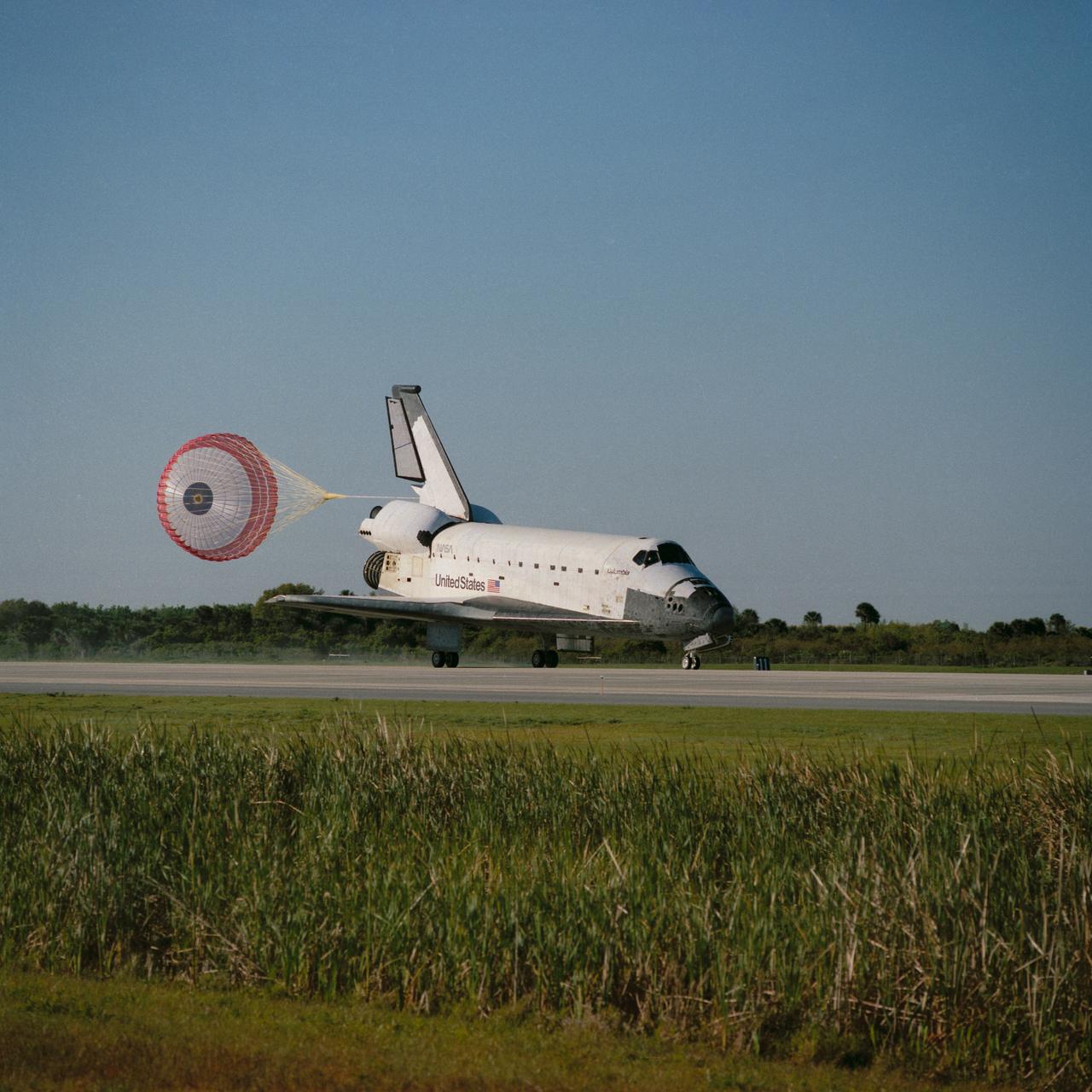
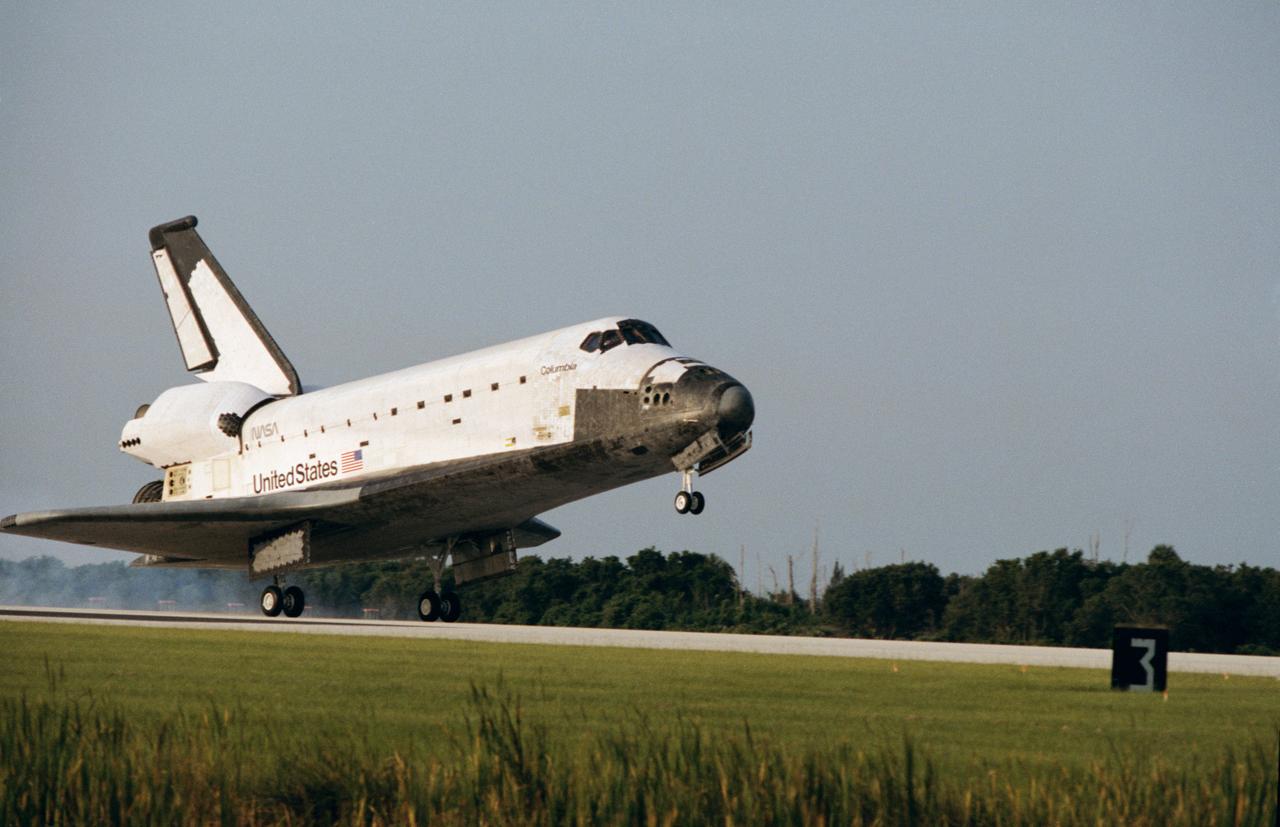
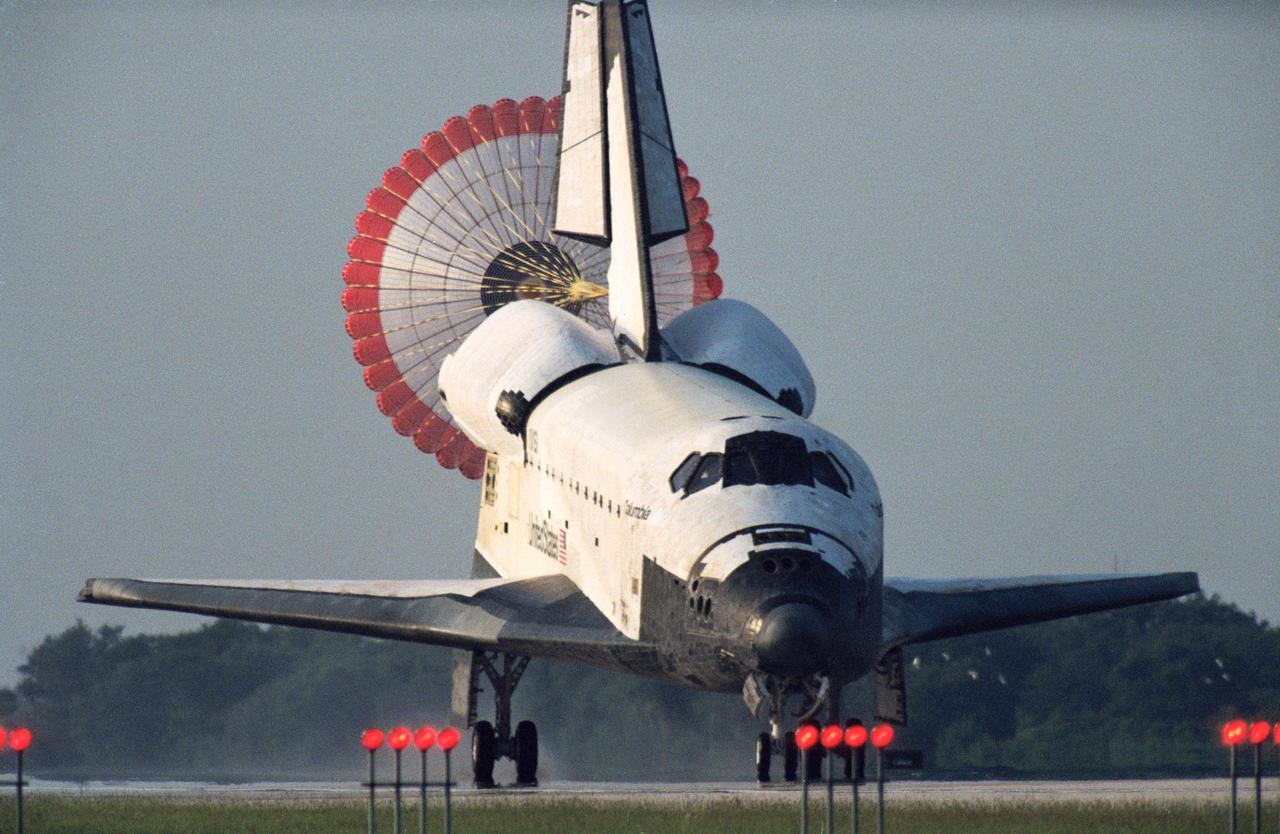
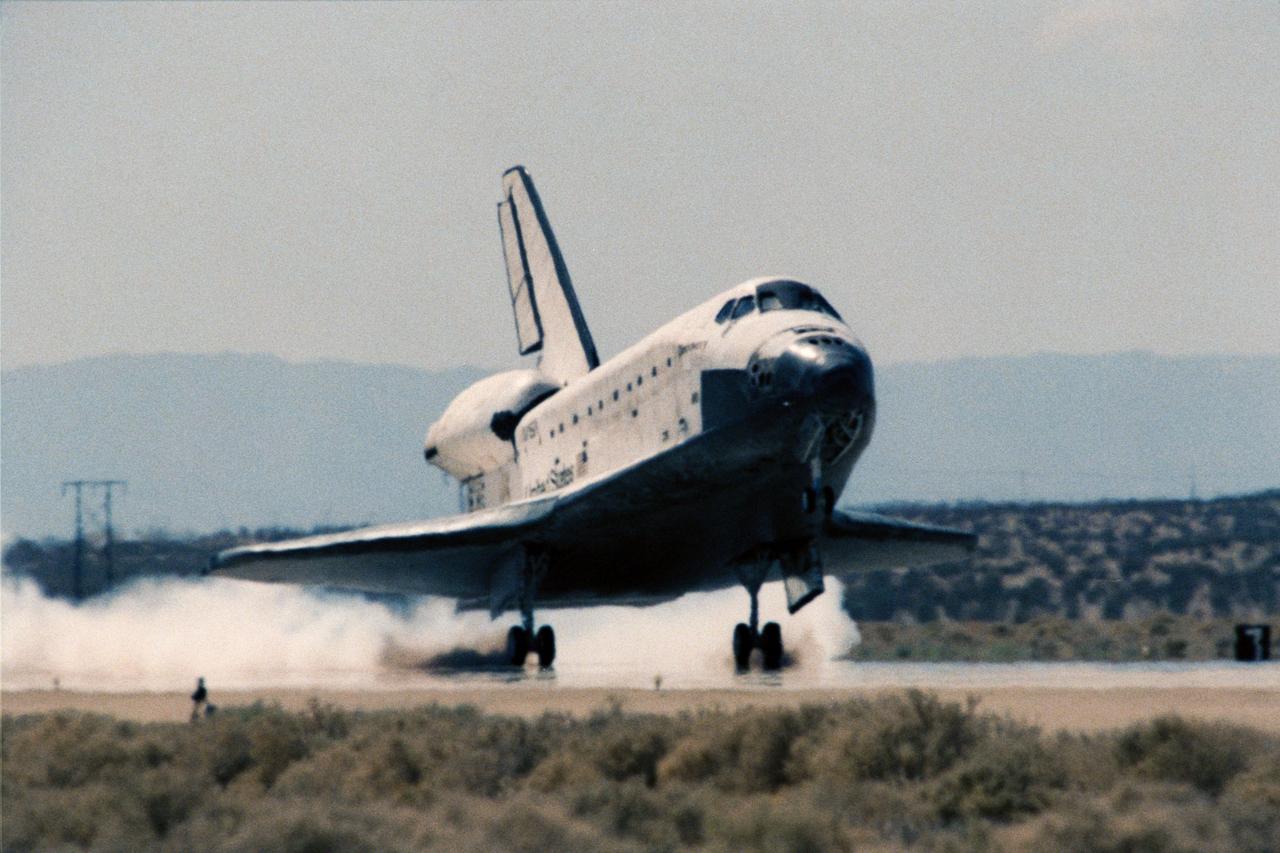
STS-50 Columbia's, Orbiter Vehicle (OV) 102's, main landing gear touches down on runway 33 at the Kennedy Space Center (KSC) Shuttle Landing Facility (SLF) producing a small cloud of dust. Landing occurred at 7:42 am (Eastern Daylight Time (EDT)). In this view of the OV-102's starboard side, the nose landing gear (NLG) continues to ride above the runway surface. Florida vegetation, a runway sign, and runway lights appear in the foreground.
STS-50 Columbia, Orbiter Vehicle (OV) 102, lands on runway 33 at KSC SLF
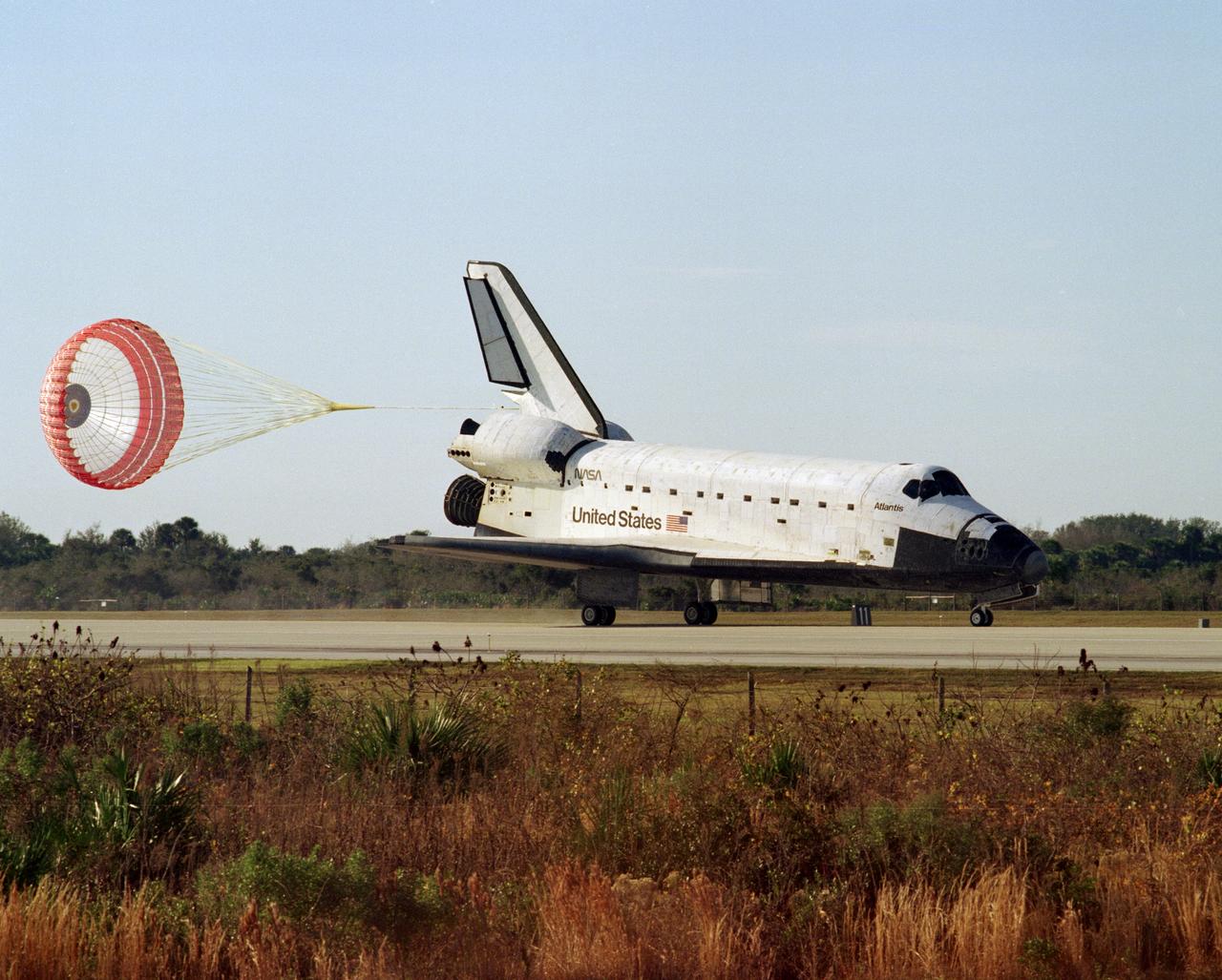
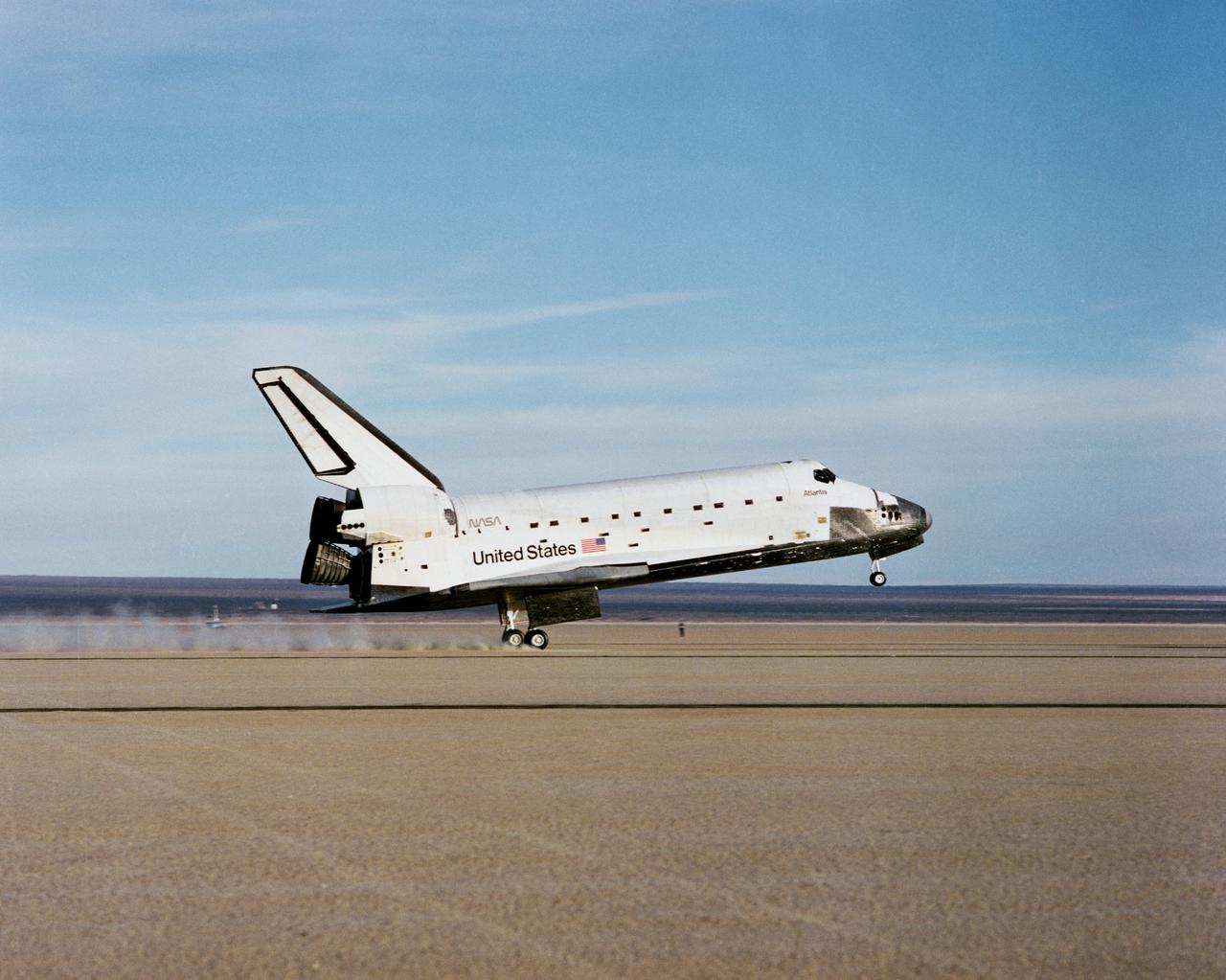
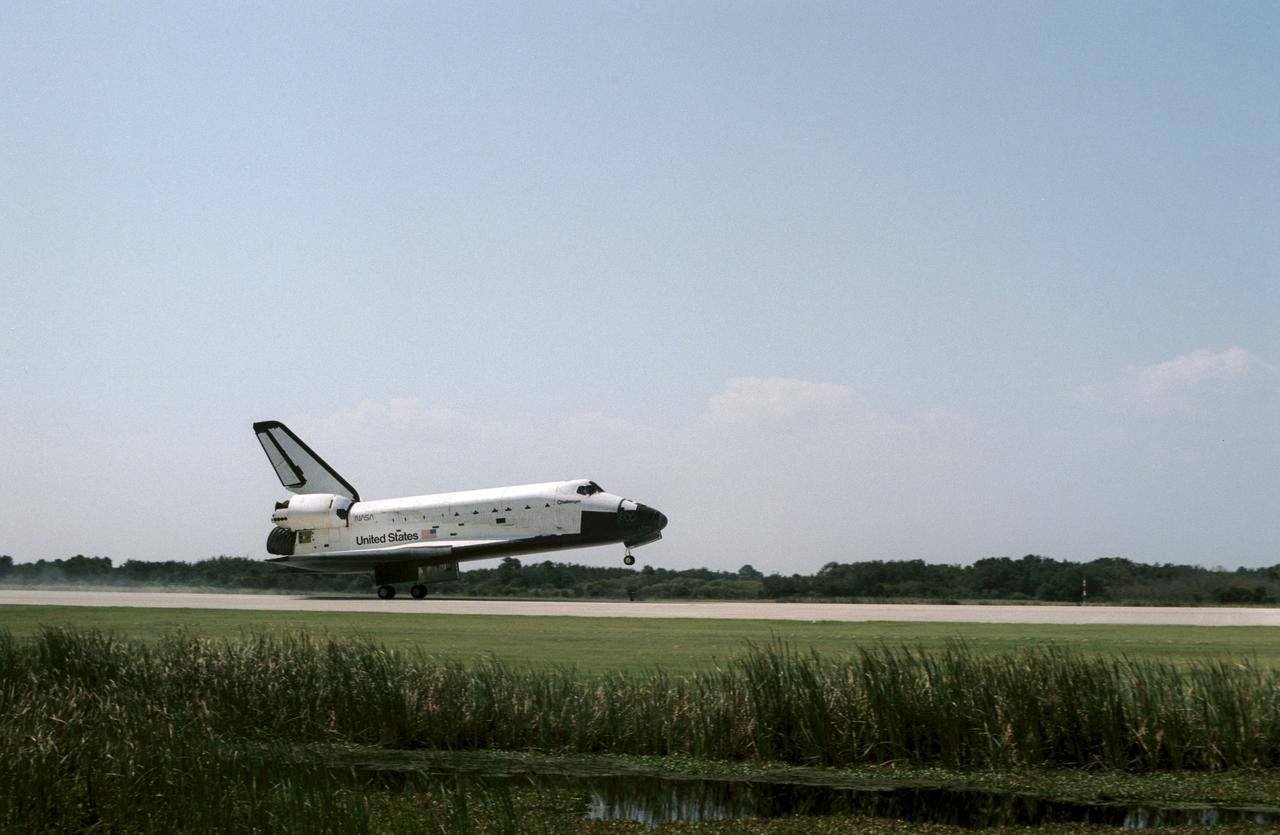
STS038-S-041 (20 Nov 1990) --- STS-38 Atlantis, Orbiter Vehicle (OV) 104, lands on runway 33 at Kennedy Space Center (KSC) Shuttle Landing Facility (SLF). The main landing gear (MLG) has just touched down on the runway surface as the nose landing gear (NLG) glides above it. The Department of Defense (DOD)-devoted mission came to an end (with complete wheel stop) at 4:43:37 pm (Eastern Standard Time (EST)).
STS-38 Atlantis, Orbiter Vehicle (OV) 104, lands on runway 33 at KSC SLF
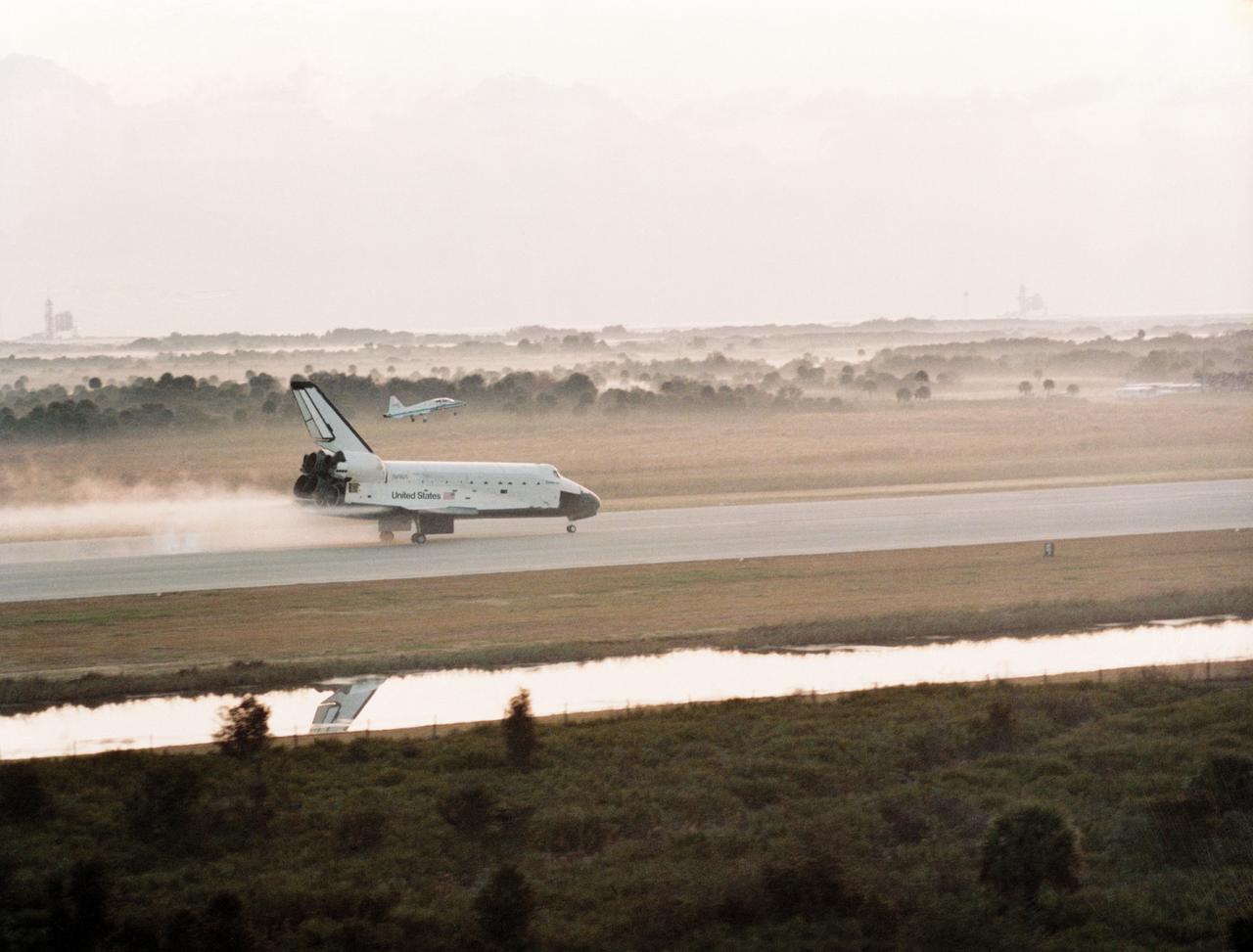
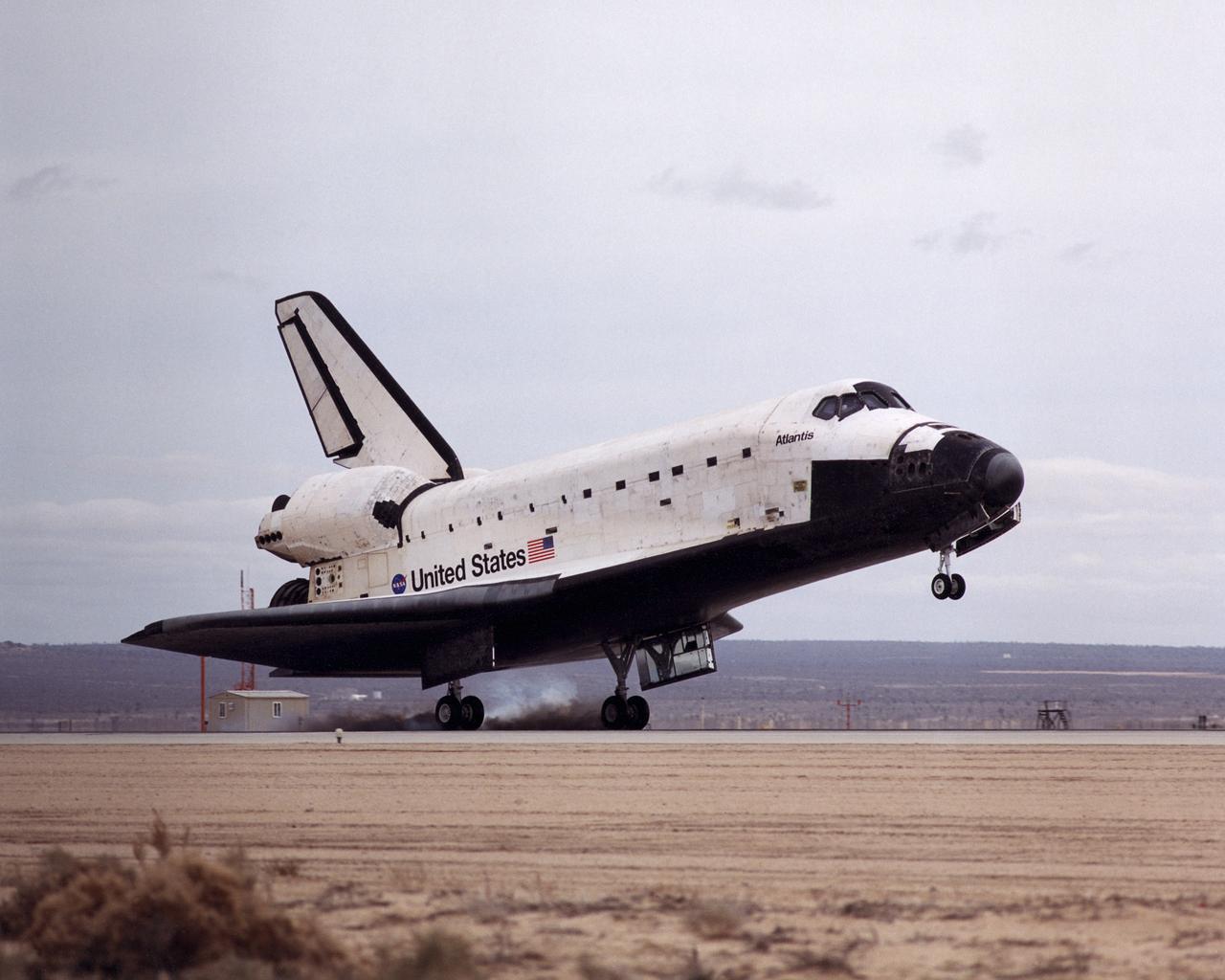
STS-45 Atlantis, Orbiter Vehicle (OV) 104, lands on concrete runway 33 at the Kennedy Space Center's (KSC's) Shuttle Landing Facility (SLF). The main landing gear (MLG) touched down at 6:23:06 am (Eastern Standard Time (EST)) in the early morning Florida fog as seen in these views. The deployed nose landing gear (NLG) rides above the runway before wheel stop.
STS-45 Atlantis, Orbiter Vehicle (OV) 104, lands on runway 33 at KSC SLF
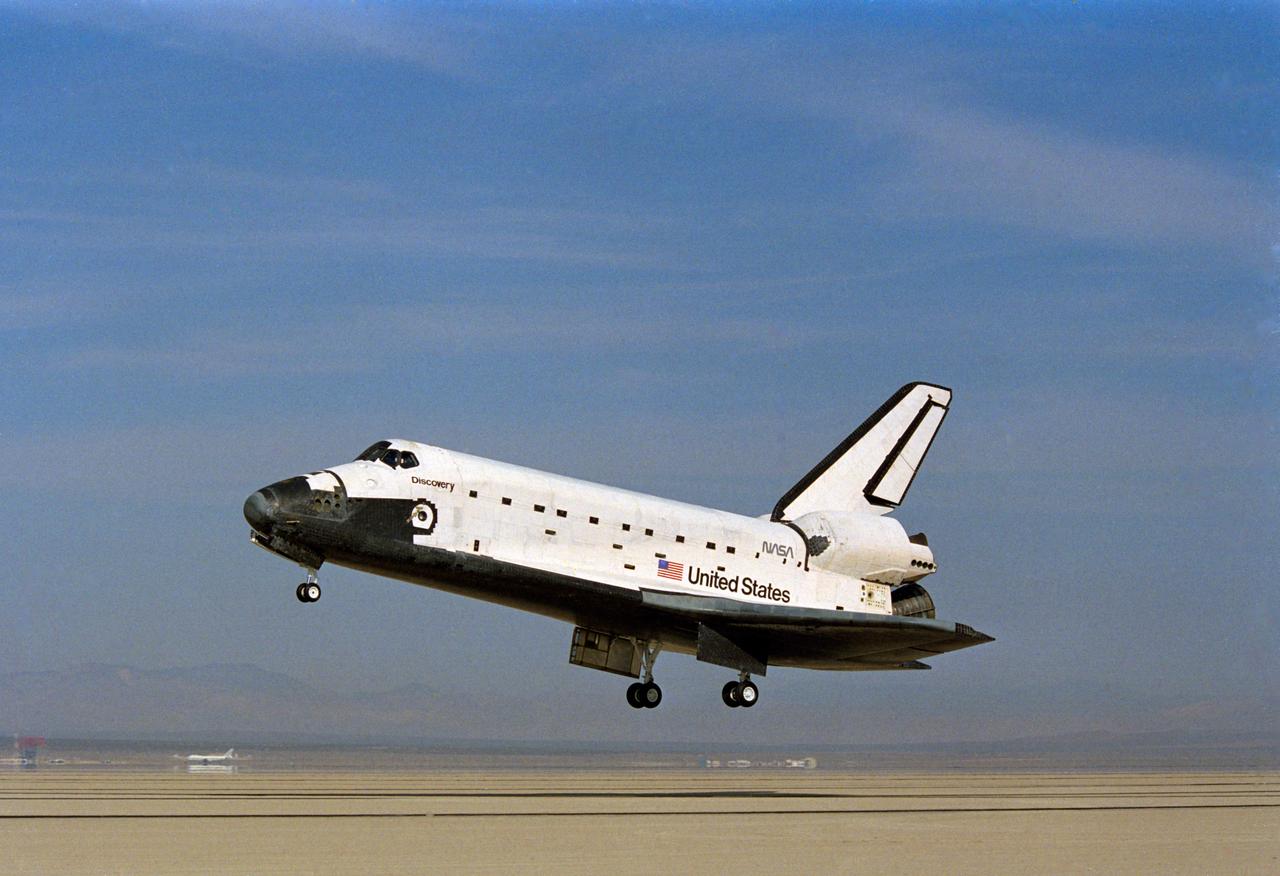
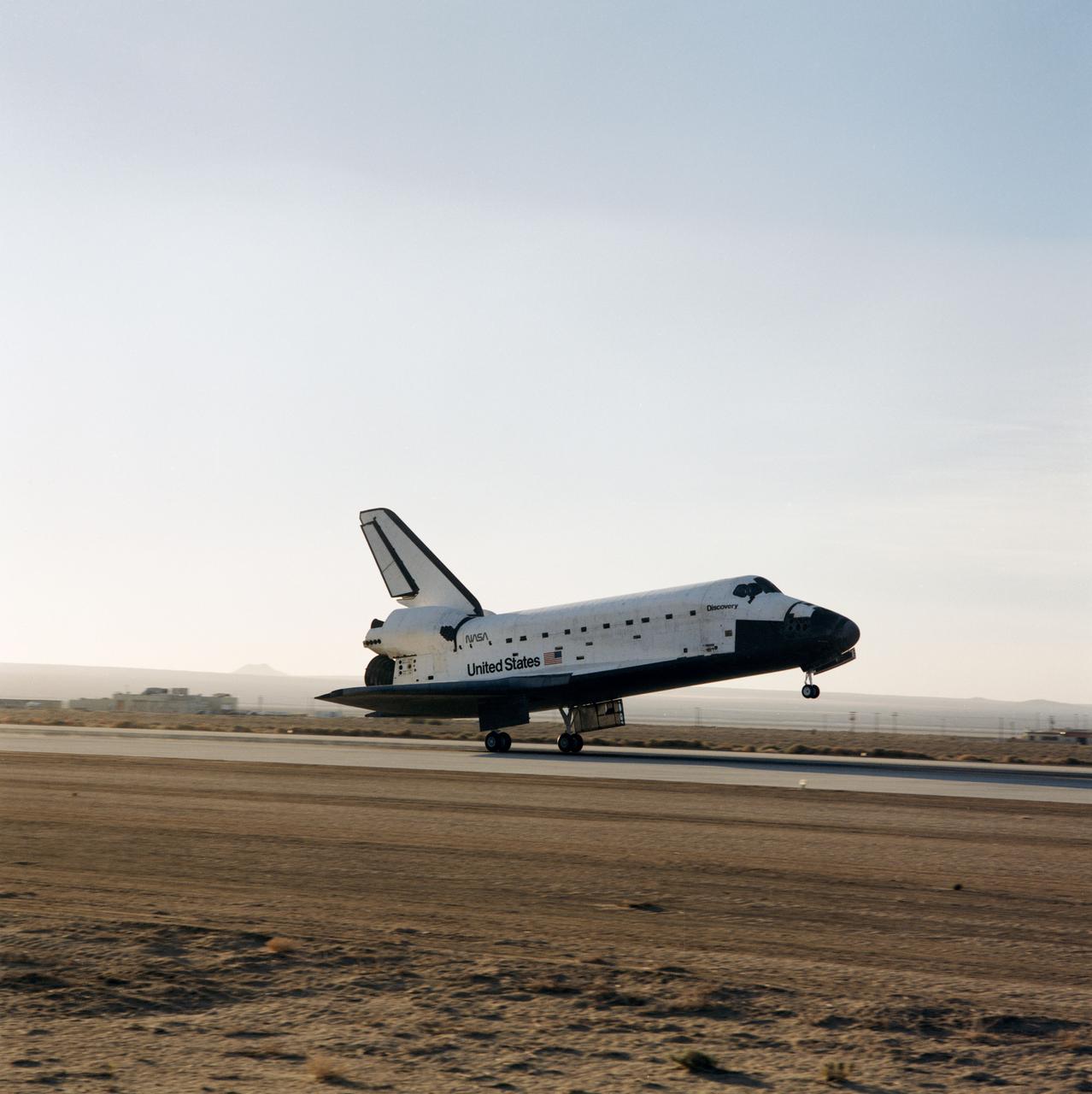
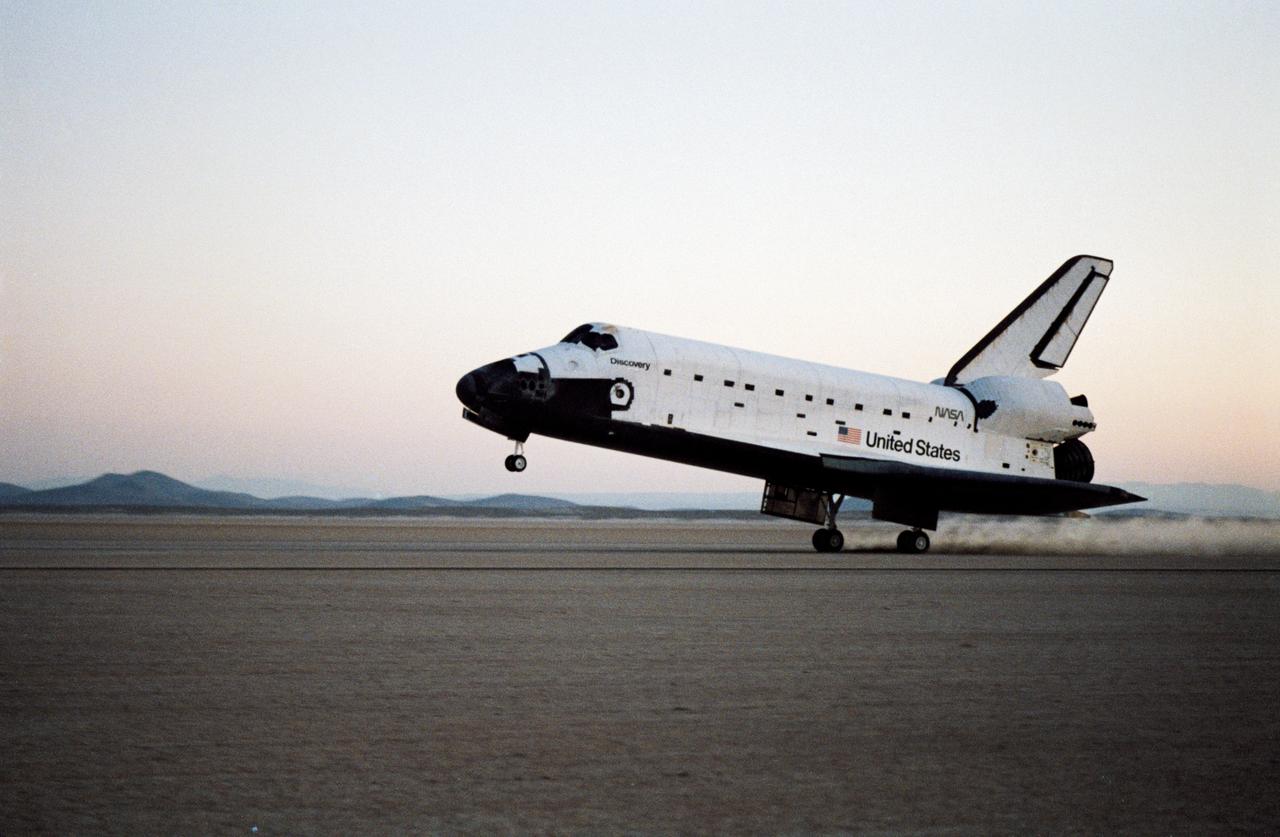
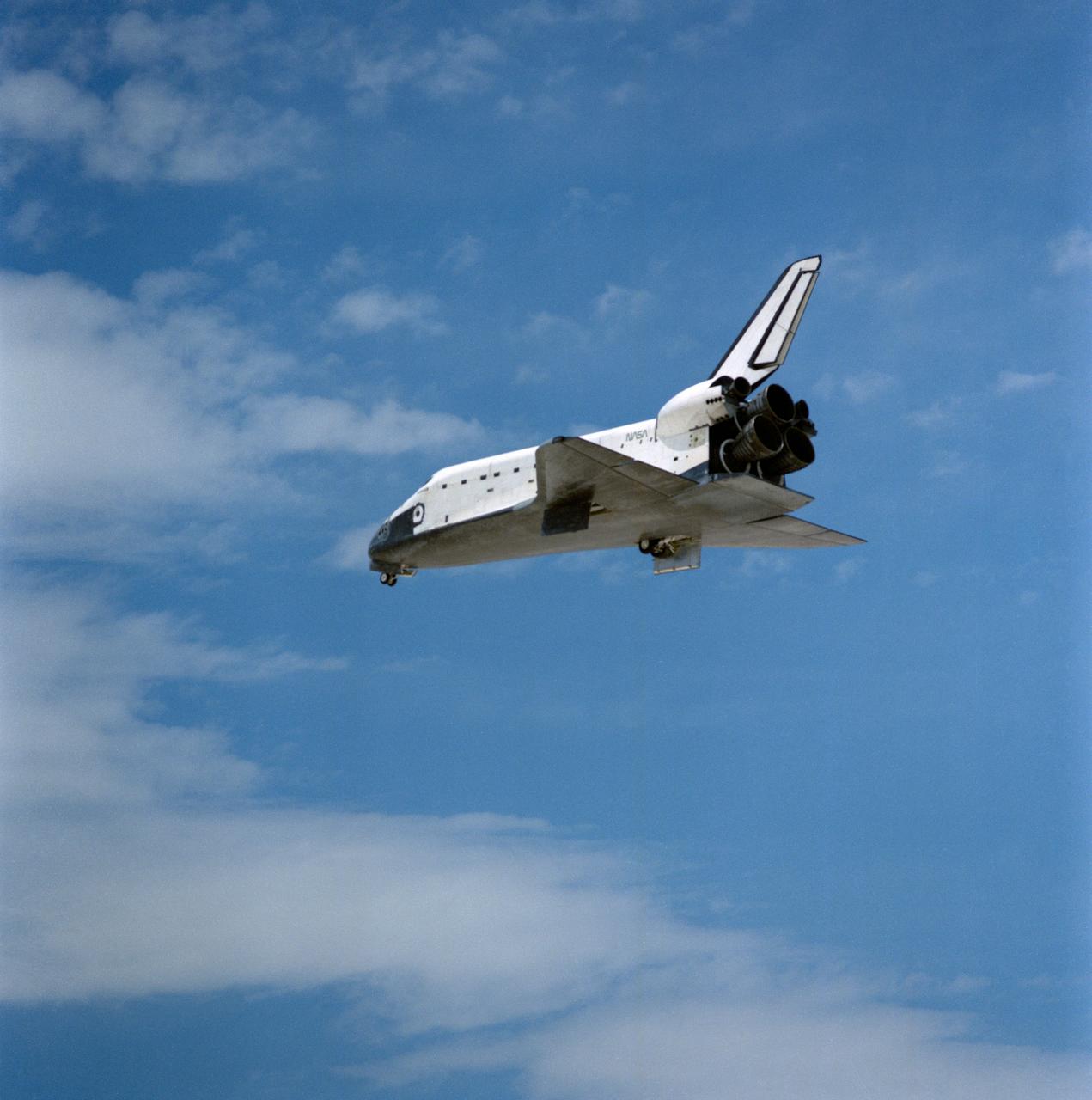
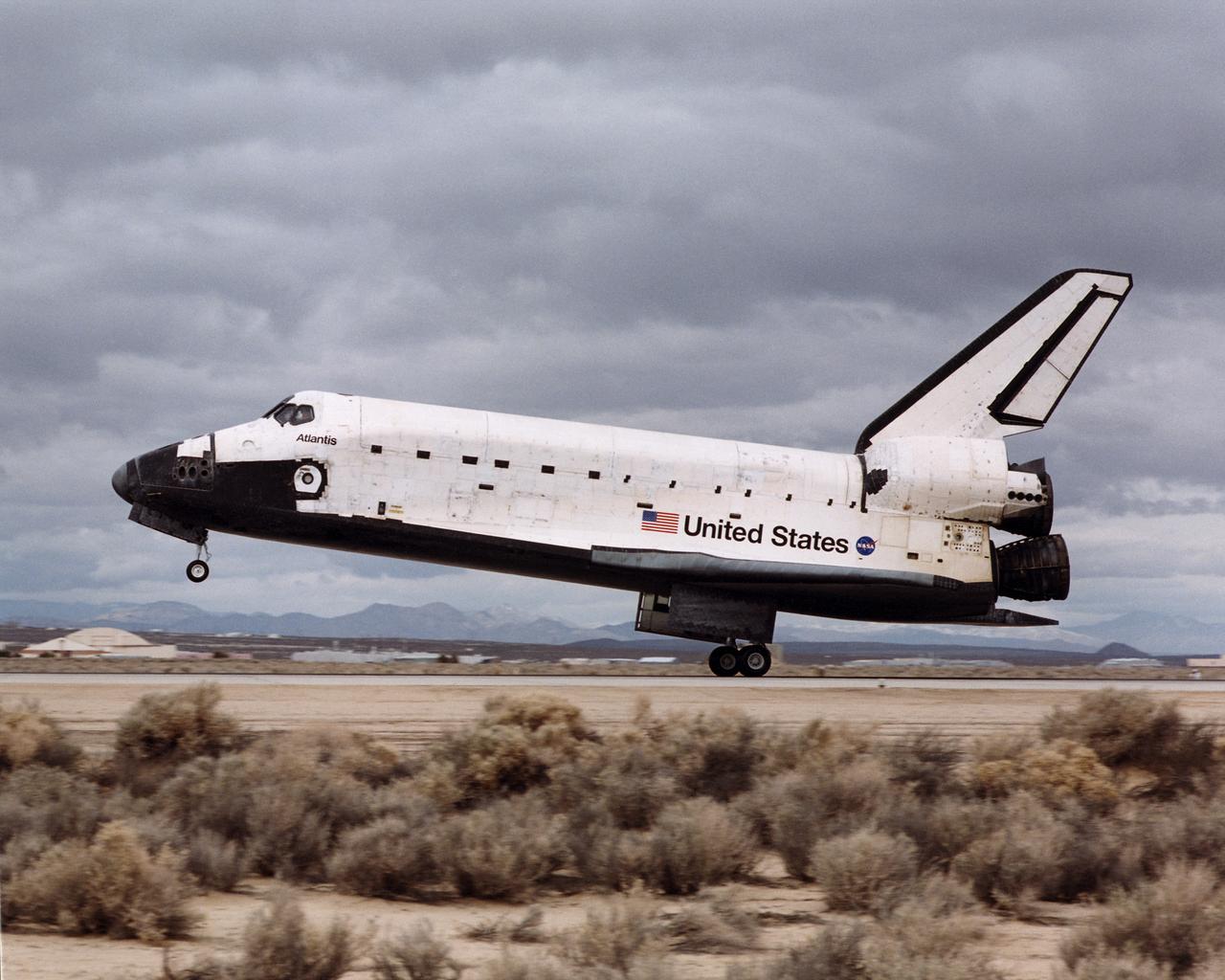
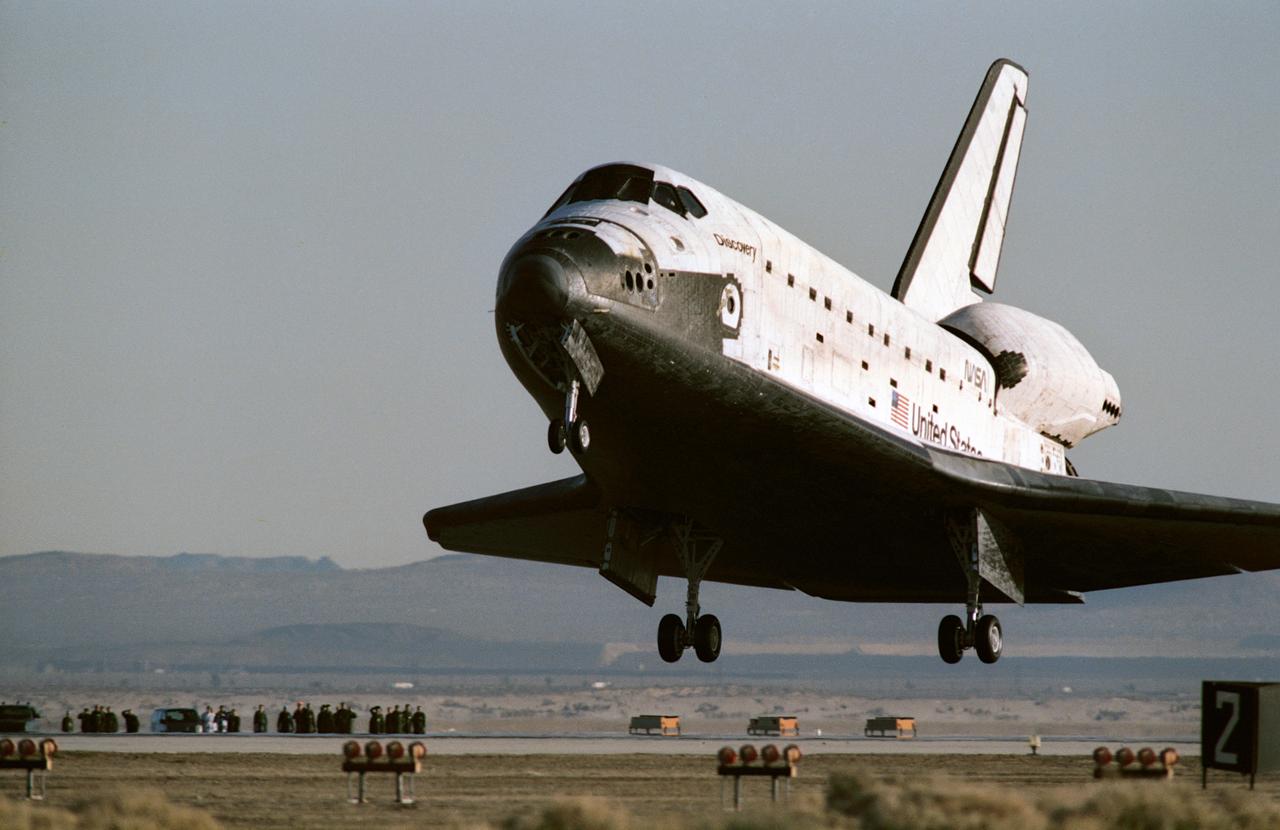
STS-26 Discovery, Orbiter Vehicle (OV) 103, with nose landing gear (NLG) and main landing gear (MLG) deployed glides above dry lakebed runway 17 at Edwards Air Force Base (EAFB), California. This profile view shows OV-103's port side just before MLG touchdown.
STS-26 Discovery, OV-103, with landing gear deployed glides above EAFB runway
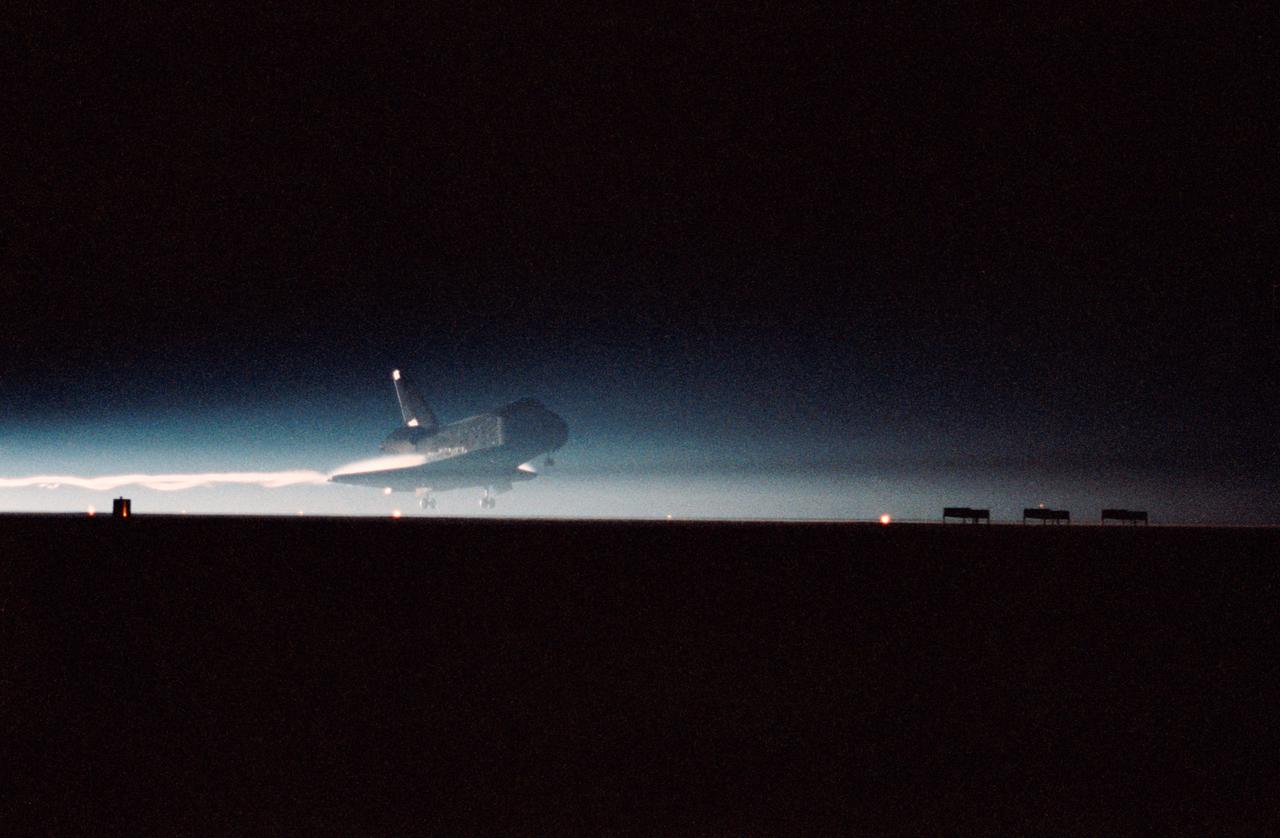
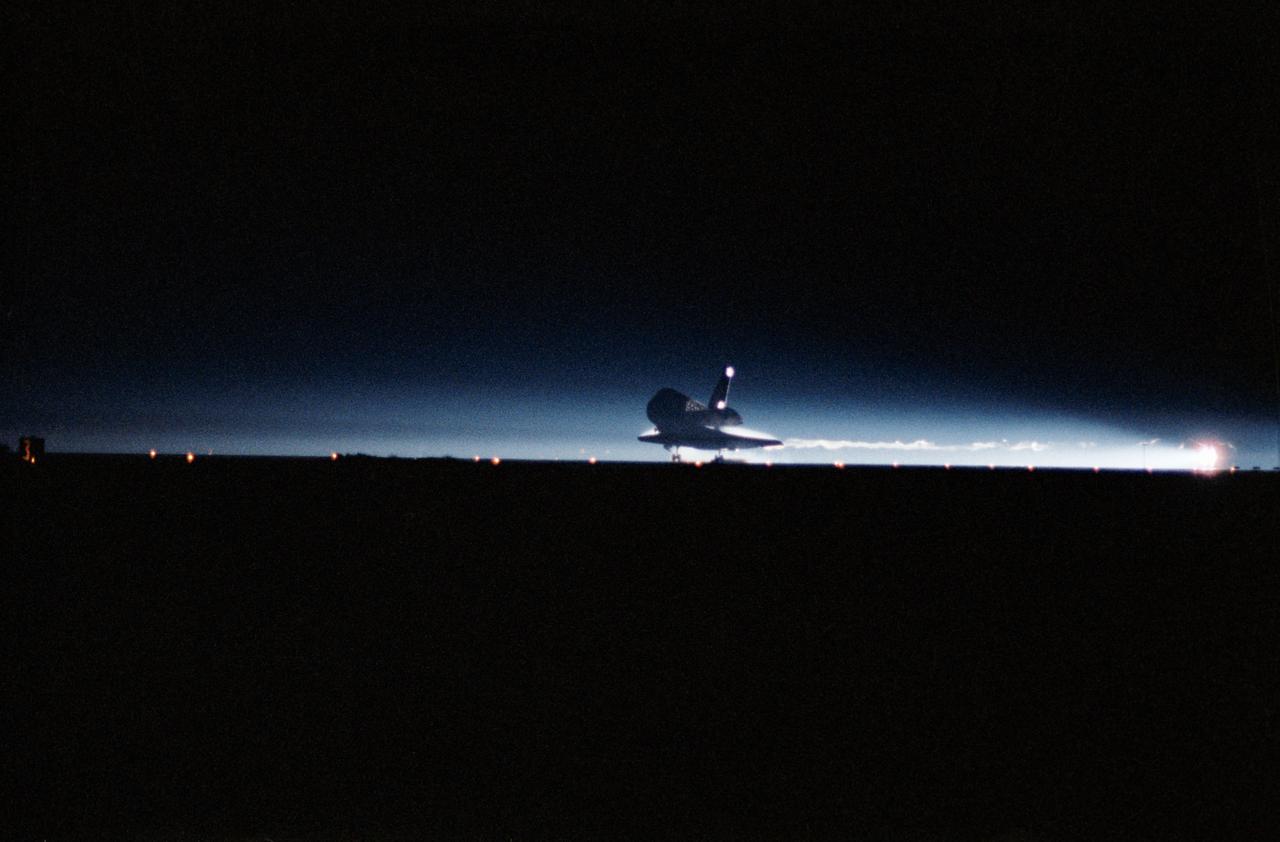
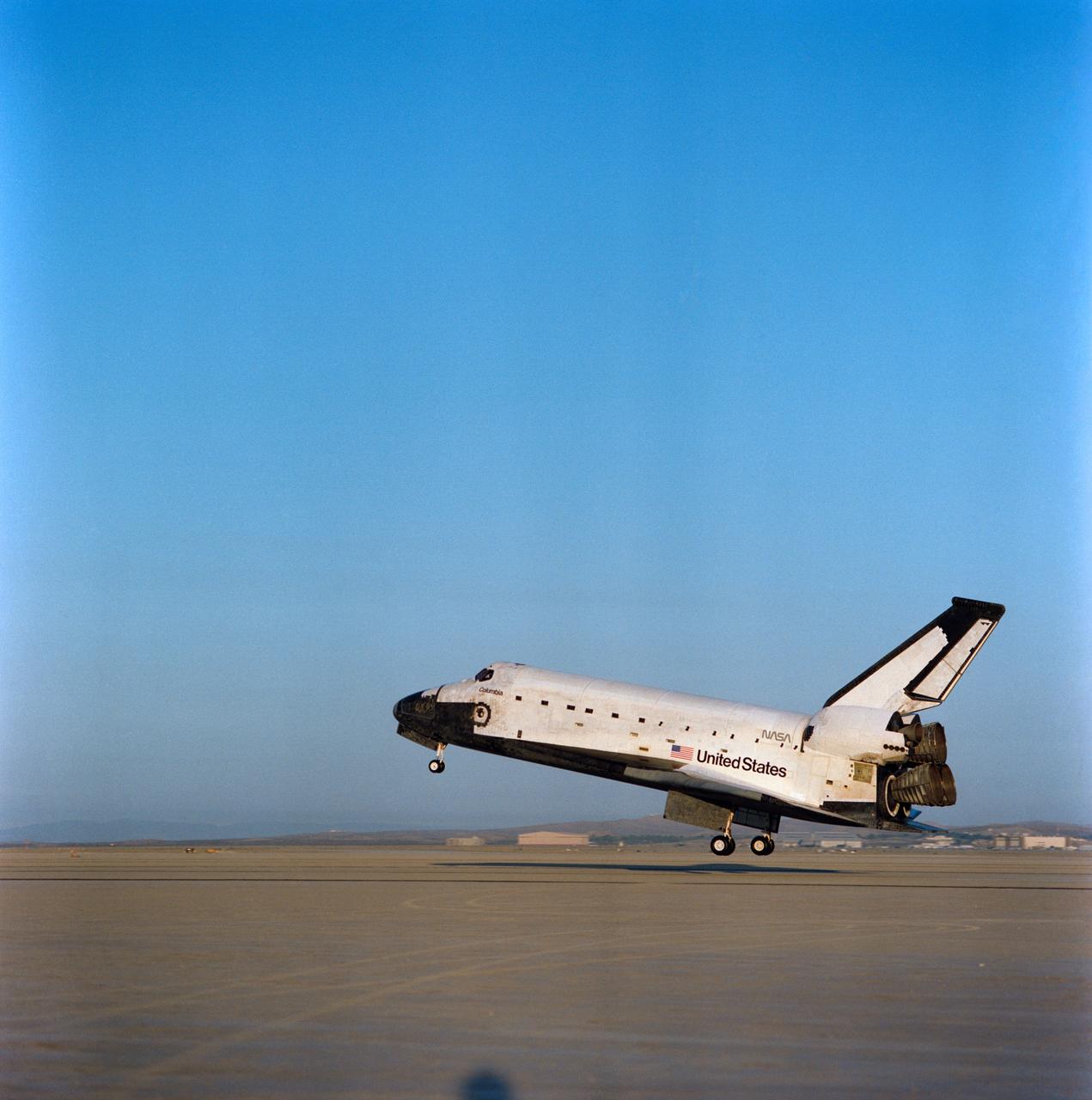
STS-32 Columbia, Orbiter Vehicle (OV) 102, is captured as its main landing gear (MLG) touches down on runway 22 at Edwards Air Force Base (EAFB), California, in the early morning darkness. The night landing ended a record 11-day mission in space. Moments later, at 1:36:38 am Pacific Standard Time (PST), OV-102 came to a complete stop, having logged 4,509,972 miles in flight.
STS-32 Columbia, OV-102, makes night landing on runway 22 at EAFB, California
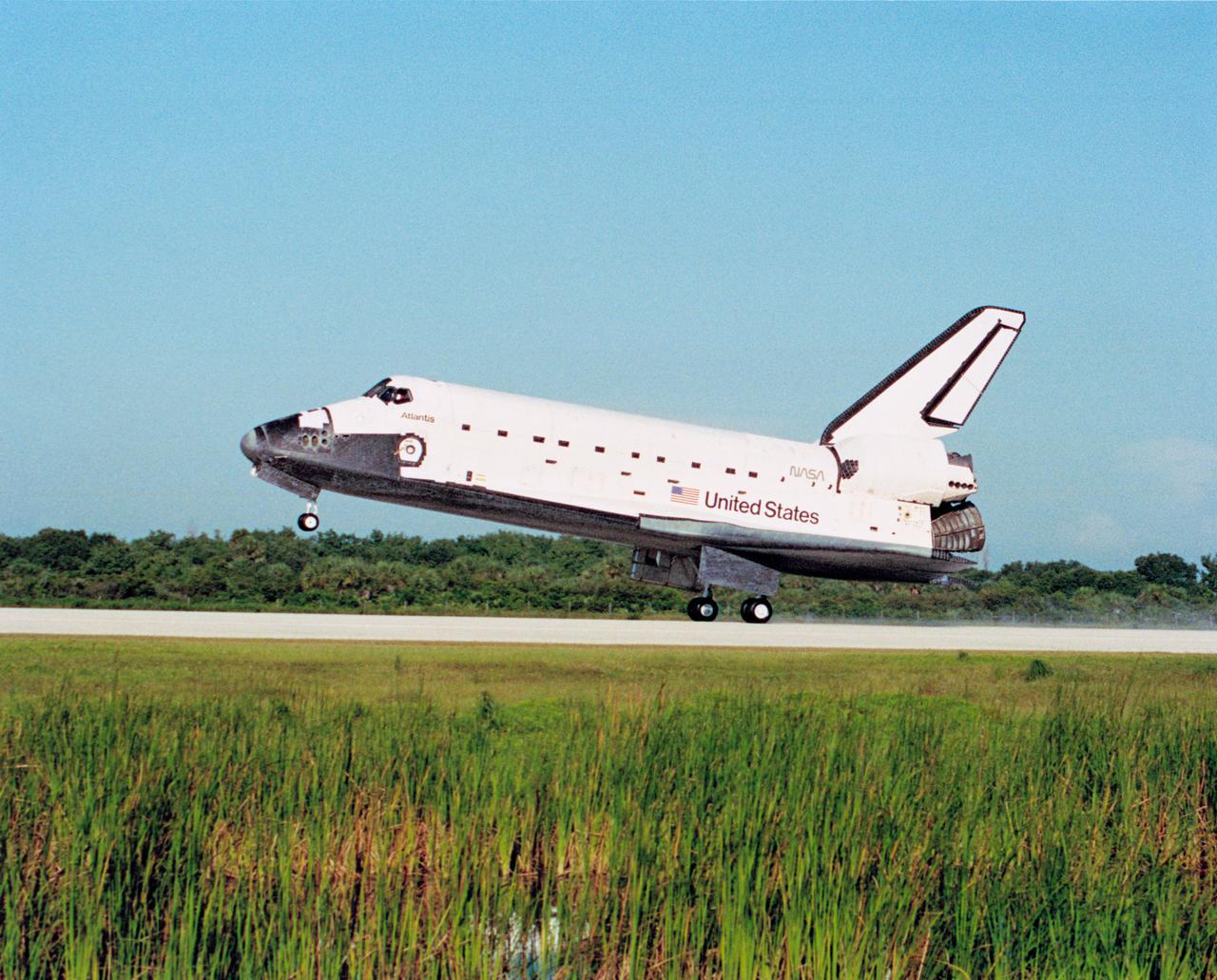
STS-43 Atlantis, Orbiter Vehicle (OV) 104, lands on runway 15 at the Kennedy Space Center's (KSC's) Shuttle Landing Facility (SLF). The main landing gear (MLG) touched down at 8:23:25 am (Eastern Daylight Time (EDT)). OV-104 glides toward wheel stop as the nose landing gear (NLG) rides above the runway.
STS-43 Atlantis, Orbiter Vehicle (OV) 104, lands on runway 15 at KSC's SLF
STS029-S-063 (18 March 1989) --- Discovery's main landing gear touches down on Runway 22 at Edwards Air Force Base in California following a successful five-day mission in Earth orbit.  Onboard the spacecraft were Astronauts Michael L. Coats, John E. Blaha, James F. Buchli, Robert C. Springer and James P. Bagian.  Wheels came to a stop at 6:36:40 a.m. (PST), March 18, 1989.
STS-29 Discovery, OV-103, lands on Edwards AFB concrete runway 22
STS031-S-135 (29 April 1990) --- The Space Shuttle Discovery makes a smooth landing on the runway at Edwards Air Force Base to complete a highly successful five-day mission. It was an Earth orbital flight during which the Hubble Space Telescope (HST) was sent toward its 15-year mission.  Landing was completed at 6:51 a.m. (PDT), April 29, 1990.  Inside the spacecraft for STS-31 were Astronauts Loren J. Shriver, Charles F. Bolden, Bruce McCandless II, Kathryn D. Sullivan and Steven A. Hawley.
STS-31 Discovery, Orbiter Vehicle (OV) 103, lands on EAFB concrete runway 22
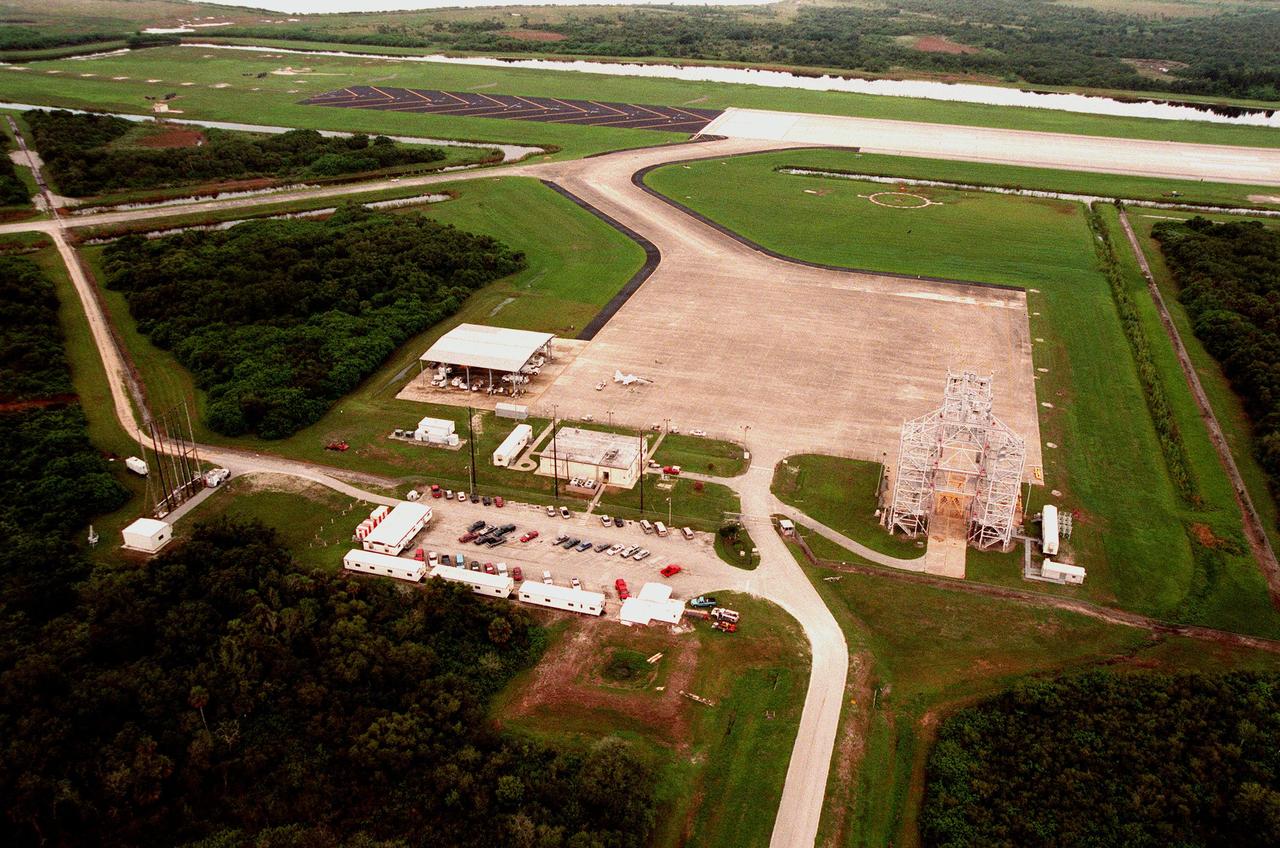
From the air over KSC can be seen the Shuttle Landing Facility. Orbiter landings at the Kennedy Space Center are made on one of the largest runways in the world. The runway is located 3.2 km (2 miles) northwest of the Vehicle Assembly Building and is 4,572 meters (15,000ft) long and 91.4 meters (300ft) wide -- about as wide as the length of a football field. It has 305 meters (1000ft) of paved overruns at each end and the paving thickness is 40.6cm (15 inches) at the center. At left in the photo is the Aircraft Ground Equipment Shed; in the center is the Landing Aids Control Building (LACB) which supports landing operations and houses operations personnel. Located at the northeast corner of the parking apron is the Mate/Demate device (MDD) used to raise and lower the orbiter from its 747 carrier aircraft during ferry operations. The open-truss steel structure is equipped with hoists, adapters and movable platforms for access to certain orbiter components and equipment. It also is equipped with lightning protection devices. The MDD is 45.7 meters (150ft) long, 28.3 meters (93ft) wide and 32 meters (105ft) high. On the landing area in front of the SLF is a T-38 jet airplane.
KSC-98PC-1040
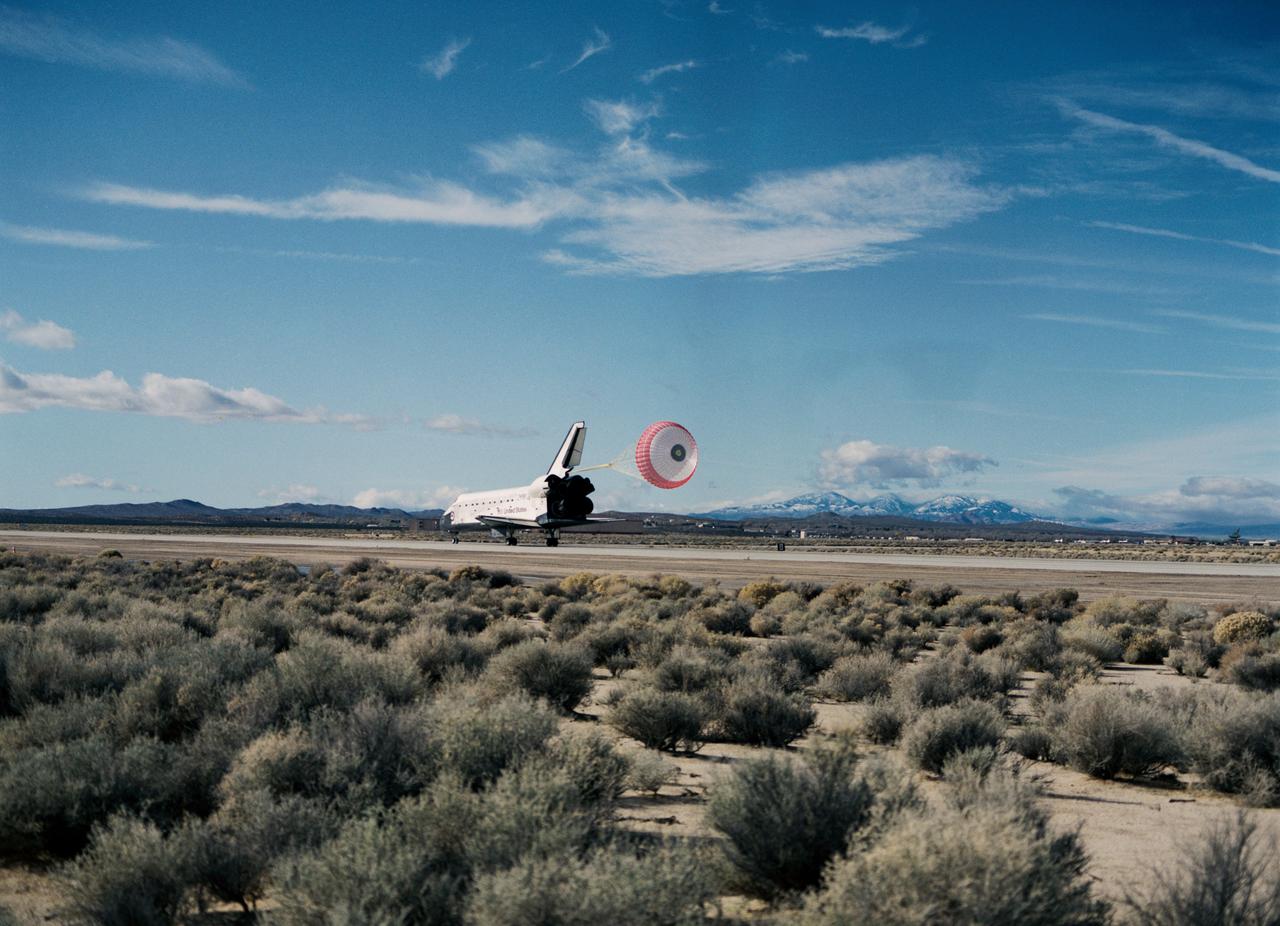
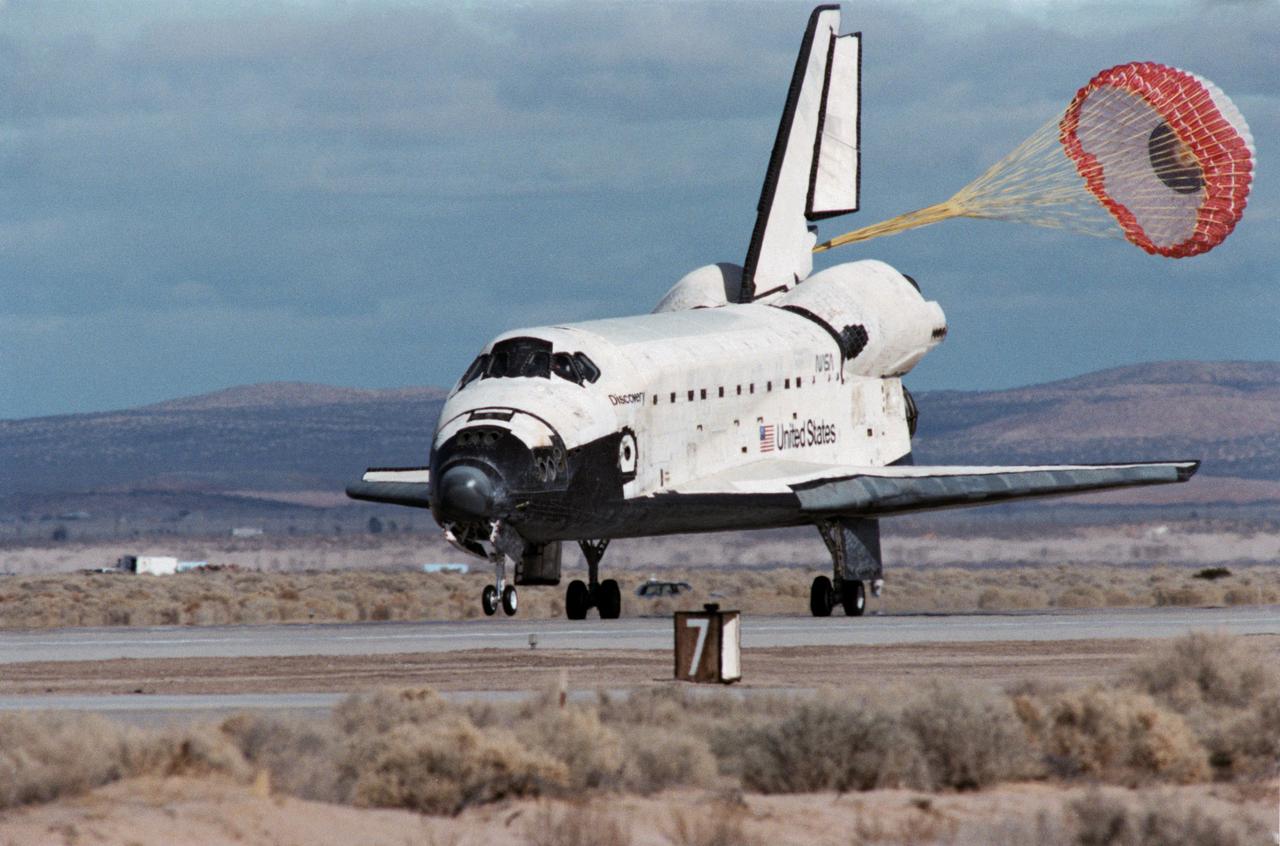
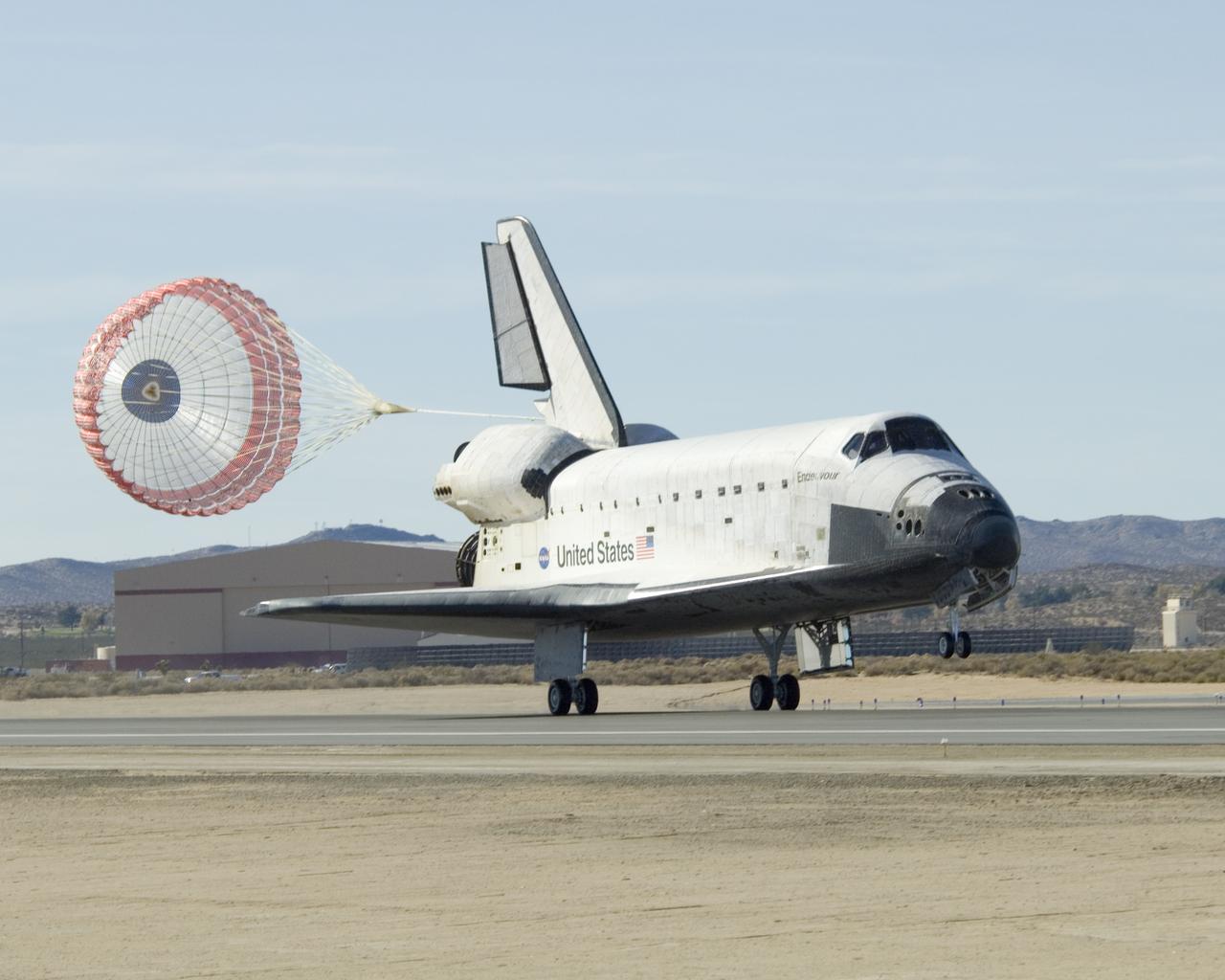
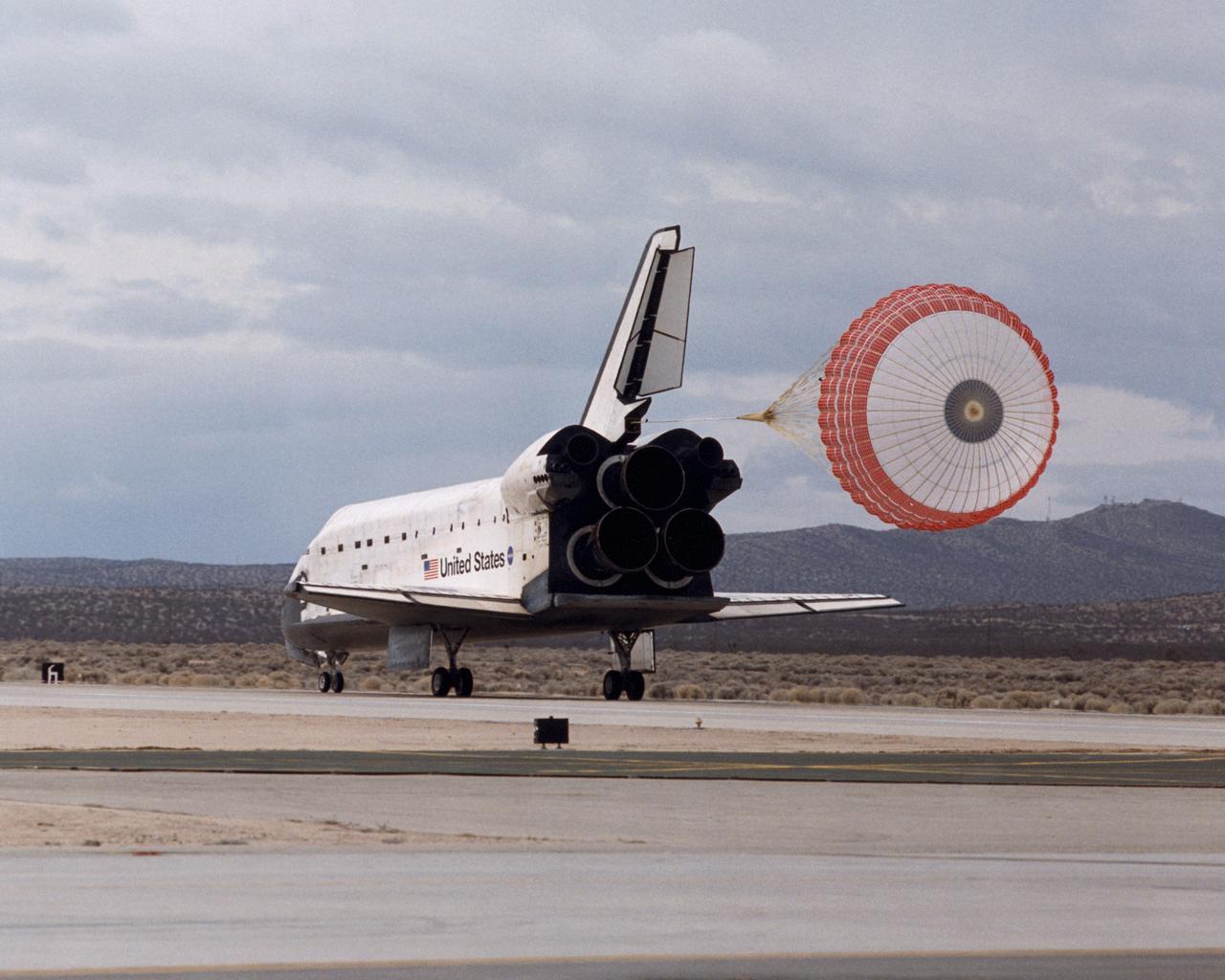
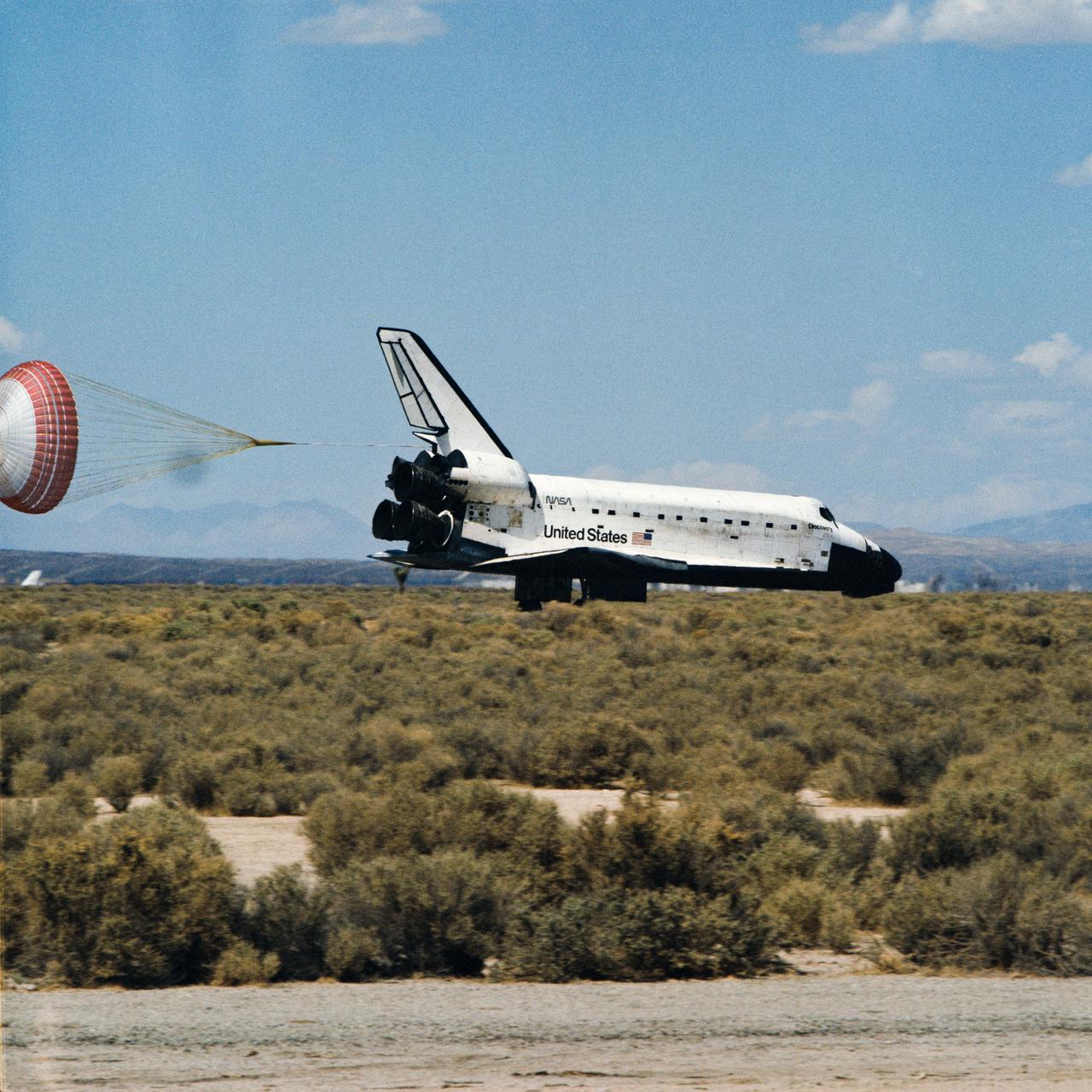
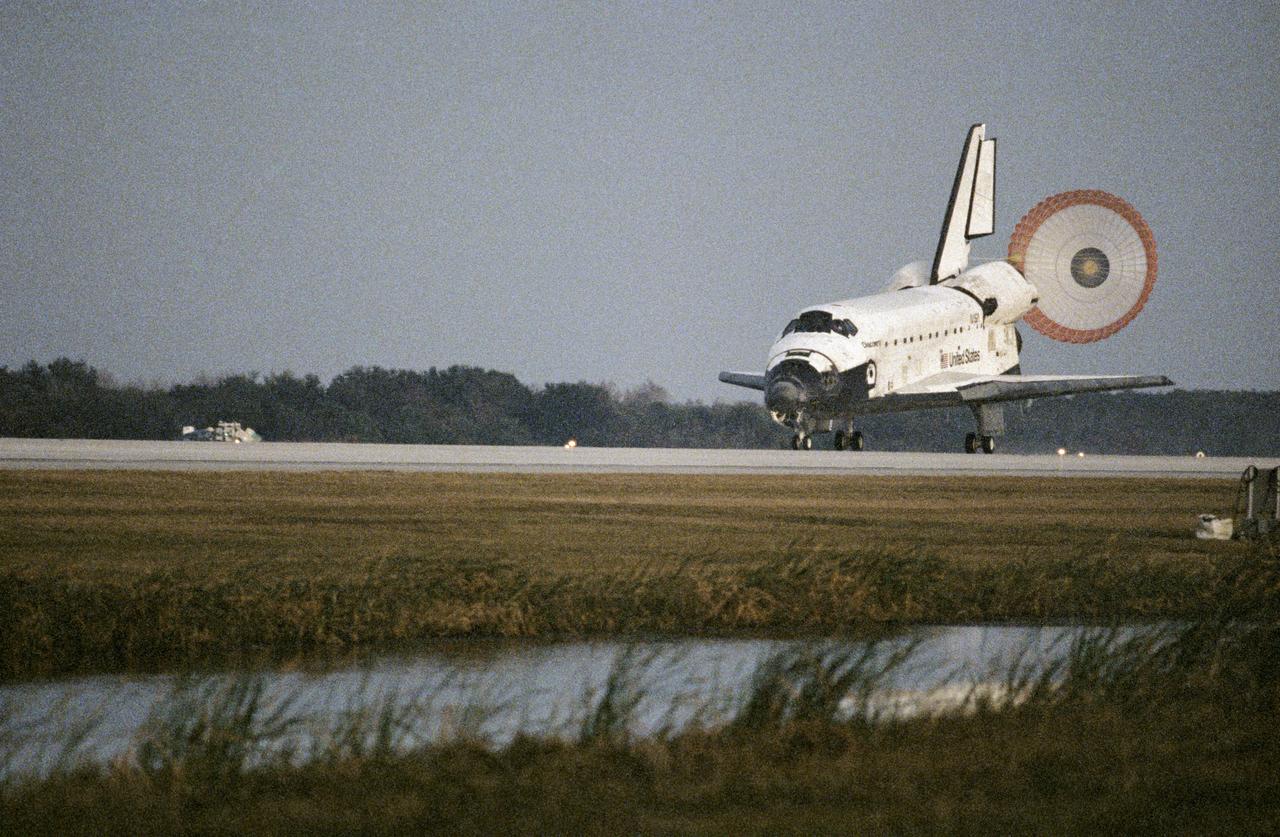
STS-53 Discovery, Orbiter Vehicle (OV) 103, is slowed by a red, white, and blue drag chute during its landing on concrete runway 22 at Edwards Air Force Base (EAFB), California. Main landing gear (MLG) touchdown occurred at 12:43:17 pm (Pacific Standard Time (PST)). This aft view of OV-103 shows the drag chute deployed from its compartment at the base of the vertical tail, the speedbrake/rudder flaps open, and the space shuttle main engines (SSMEs). Both MLG and nose landing gear (NLG) ride along the runway surface. Desert scrub brush appears in the foreground and mountains are seen in the background.
STS-53 Discovery, Orbiter Vehicle (OV) 103, lands on runway 22 at EAFB, Calif
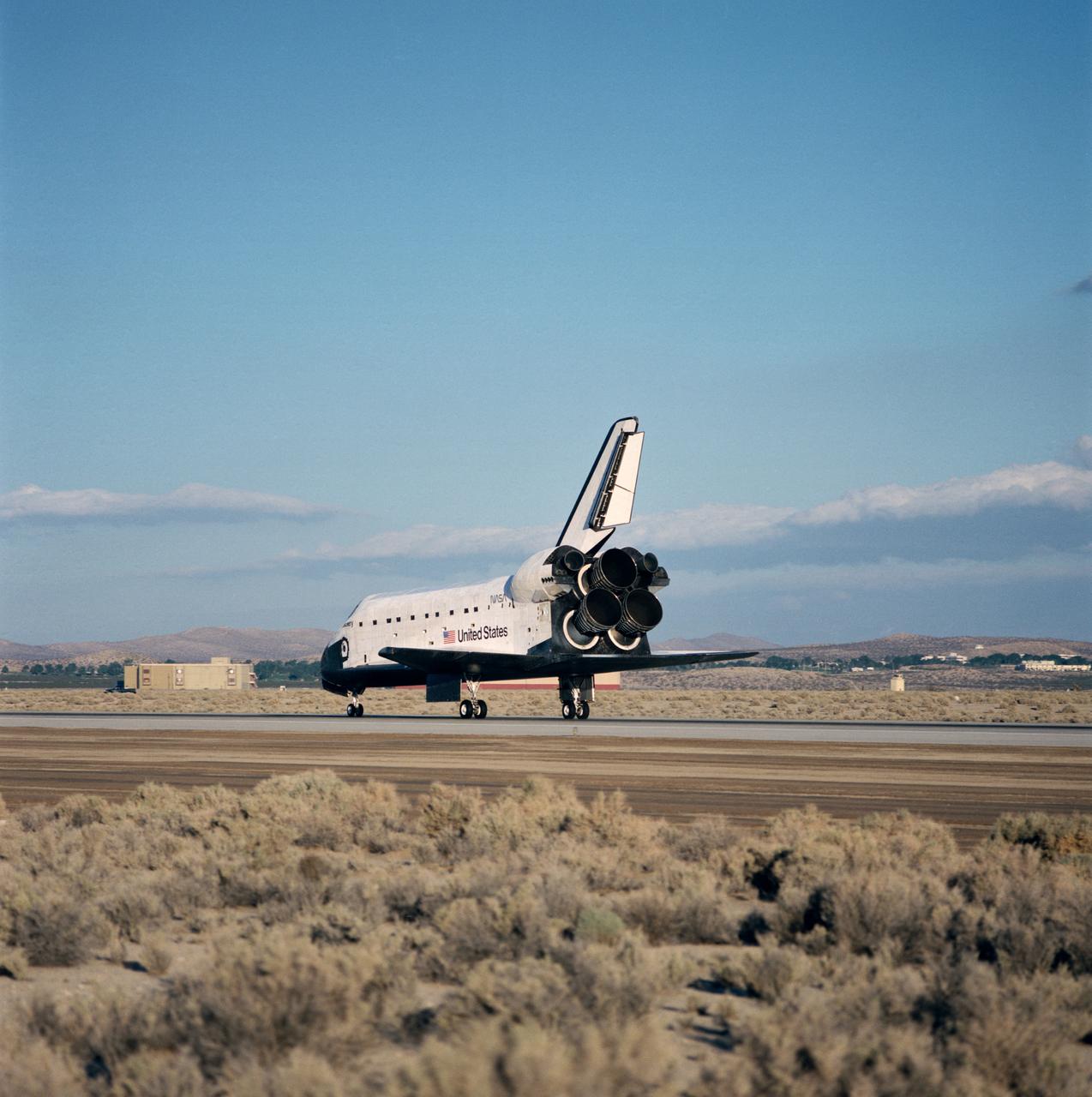
STS-31 Discovery, Orbiter Vehicle (OV) 103, rolls along concrete runway 22 at Edwards Air Force Base (EAFB), California, after nose landing gear (NLG) and main landing gear (MLG) touchdown. This view looks down OV-103's port side from the space shuttle main engines (SSMEs) to the nose section. The SSMEs are gimbaled to their descent position and the rudder/speedbrake is deployed on the vertical stabilizer. Wheel stop occurred at 6:51 am (Pacific Daylight Time (PDT)). In the distance EAFB facilities are visible.
STS-31 Discovery, Orbiter Vehicle (OV) 103, lands on EAFB concrete runway 22
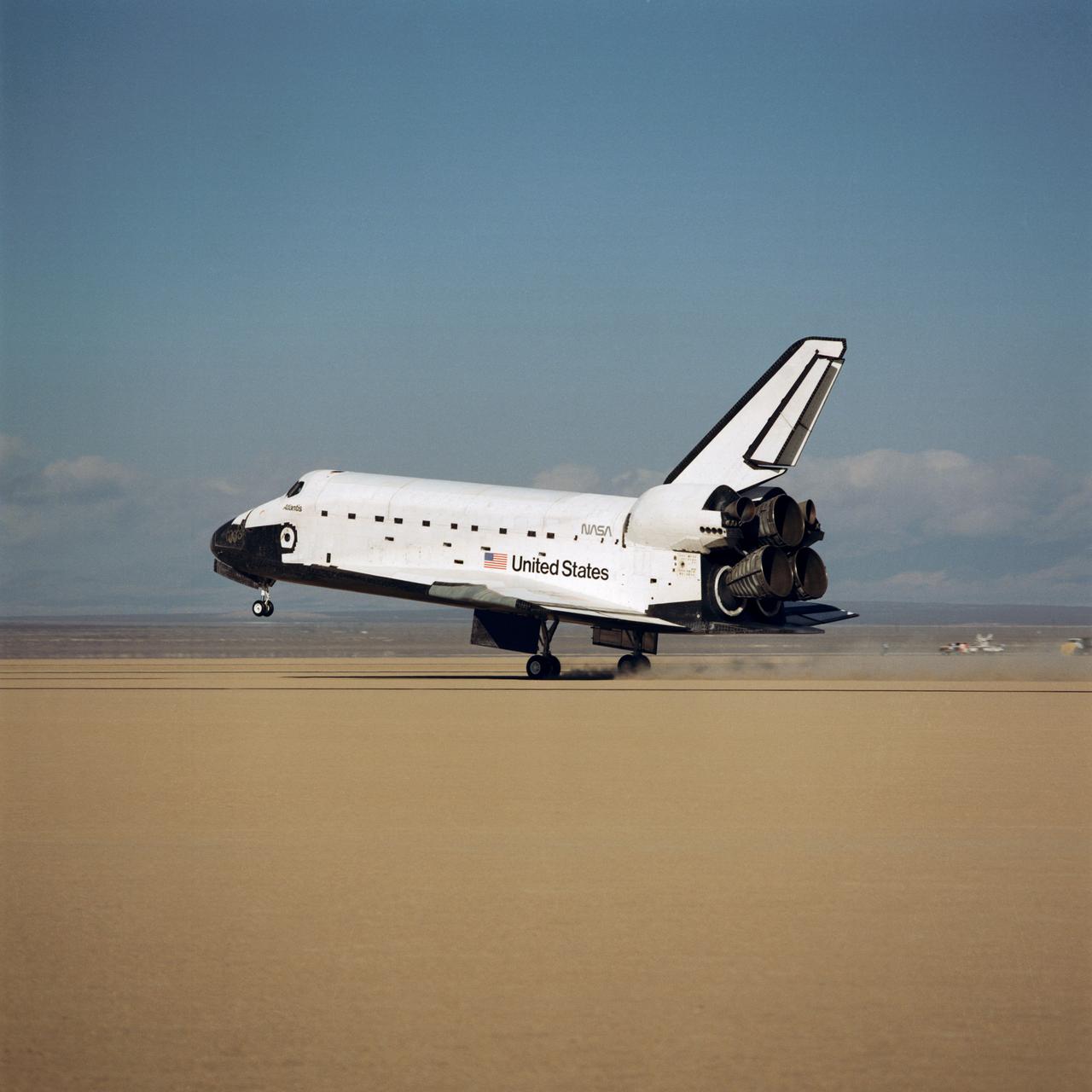
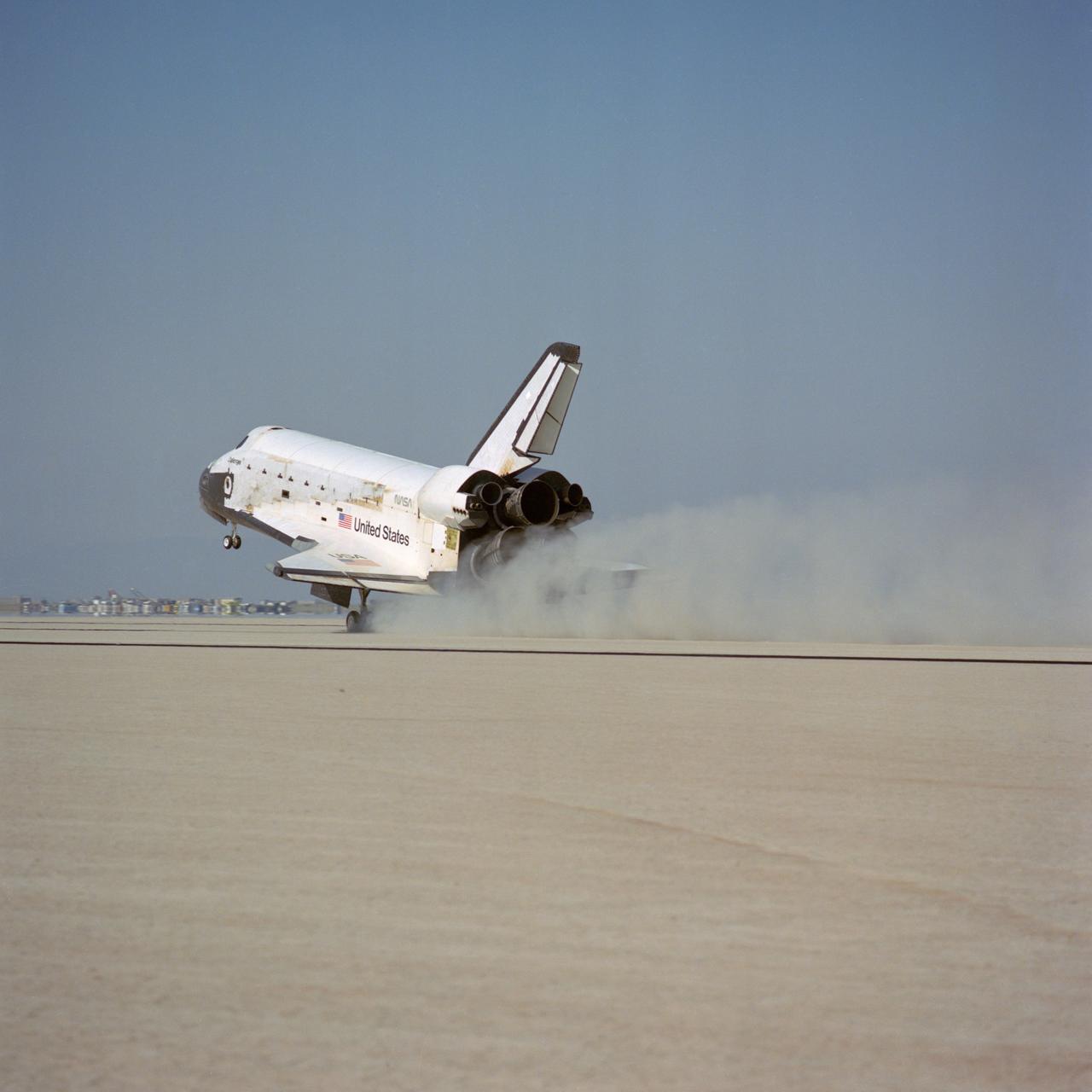
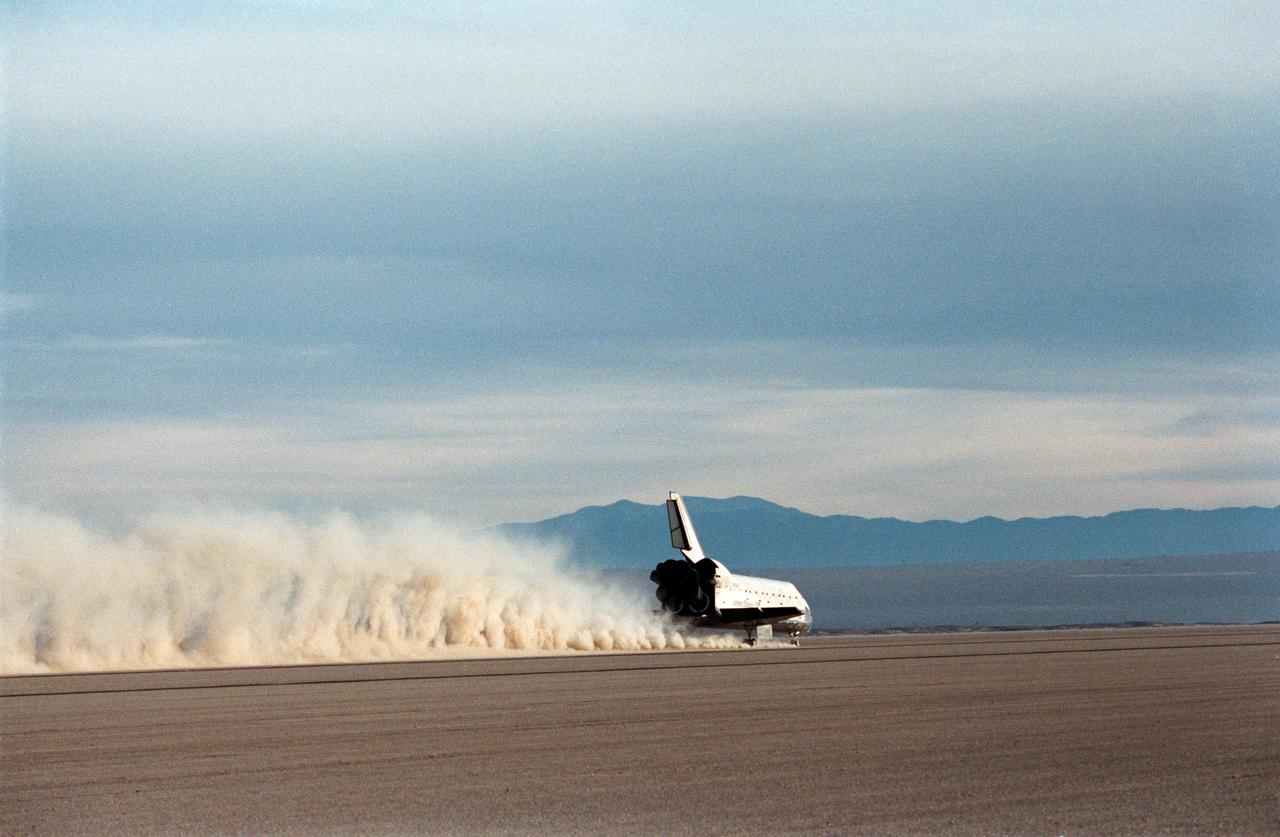
STS-34 Atlantis, Orbiter Vehicle (OV) 104, main landing gear (MLG) touches down on Runway 23 dry lake bed at Edwards Air Force Base (EAFB), California. The nose landing gear rides above runway before touchdown as the MLG wheels produce a cloud of dust. OV-104's port side profile is captured as it glides by at a speed of approximately 195 knots (224 miles per hour). The tail section with deployed speedbrake/rudder and space shuttle main engines (SSMEs) are visible.
STS-34 Atlantis, OV-104, touches down on runway 23 at EAFB, California
STS053-S-085 (9 Dec. 1992) --- The drag chute on the space shuttle Discovery is partially deployed during landing on Runway 22 at Edwards Air Force Base. The landing ended an eight-day space mission for the STS-53 crew. Main gear touchdown occurred at 12:43:17 p.m. (PST) on Dec. 9, 1992. Onboard were astronauts David M. Walker, Robert D. Cabana, Guion S. Bluford Jr., James S. Voss and Michael R.U. (Rich) Clifford.
STS-53 Discovery, Orbiter Vehicle (OV) 103, lands on runway 22 at EAFB, Calif
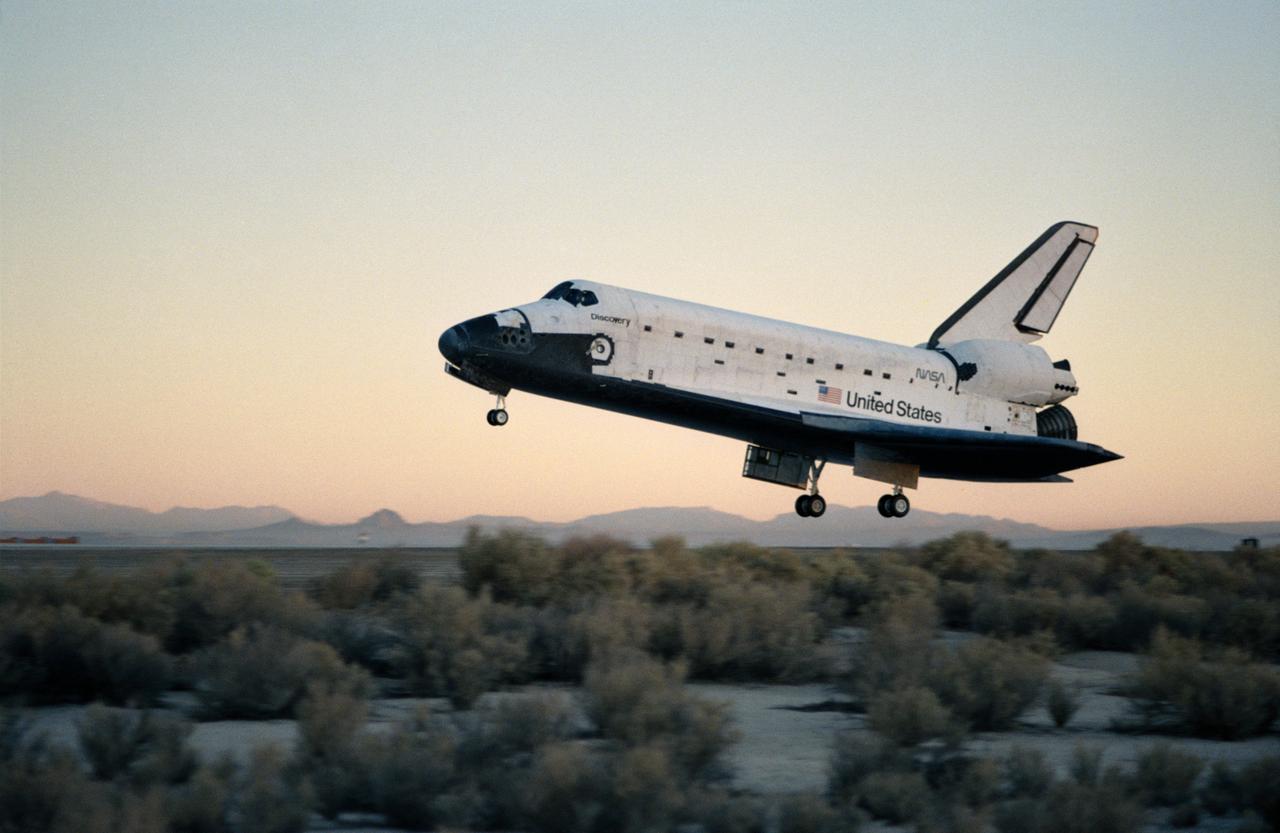
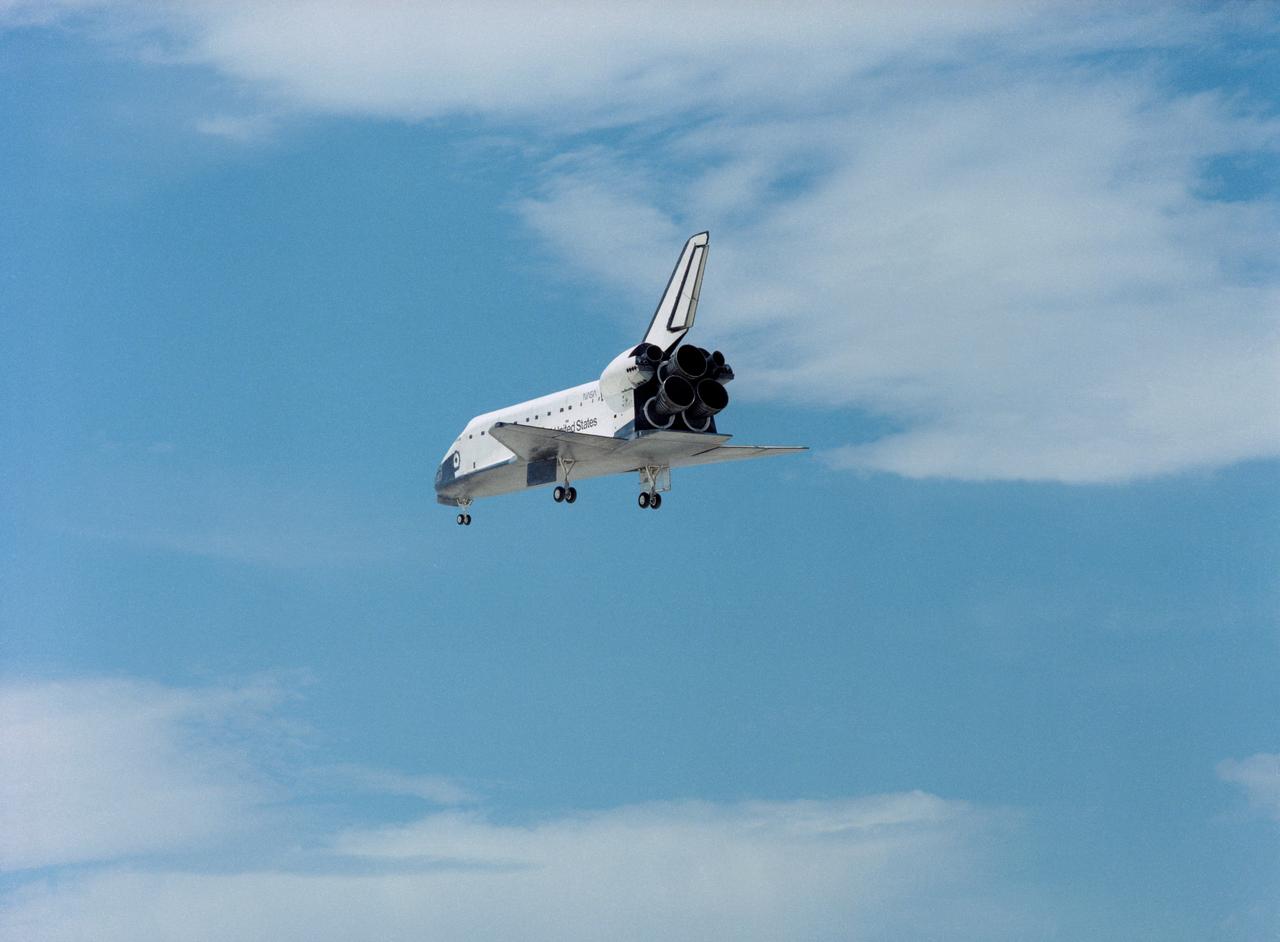
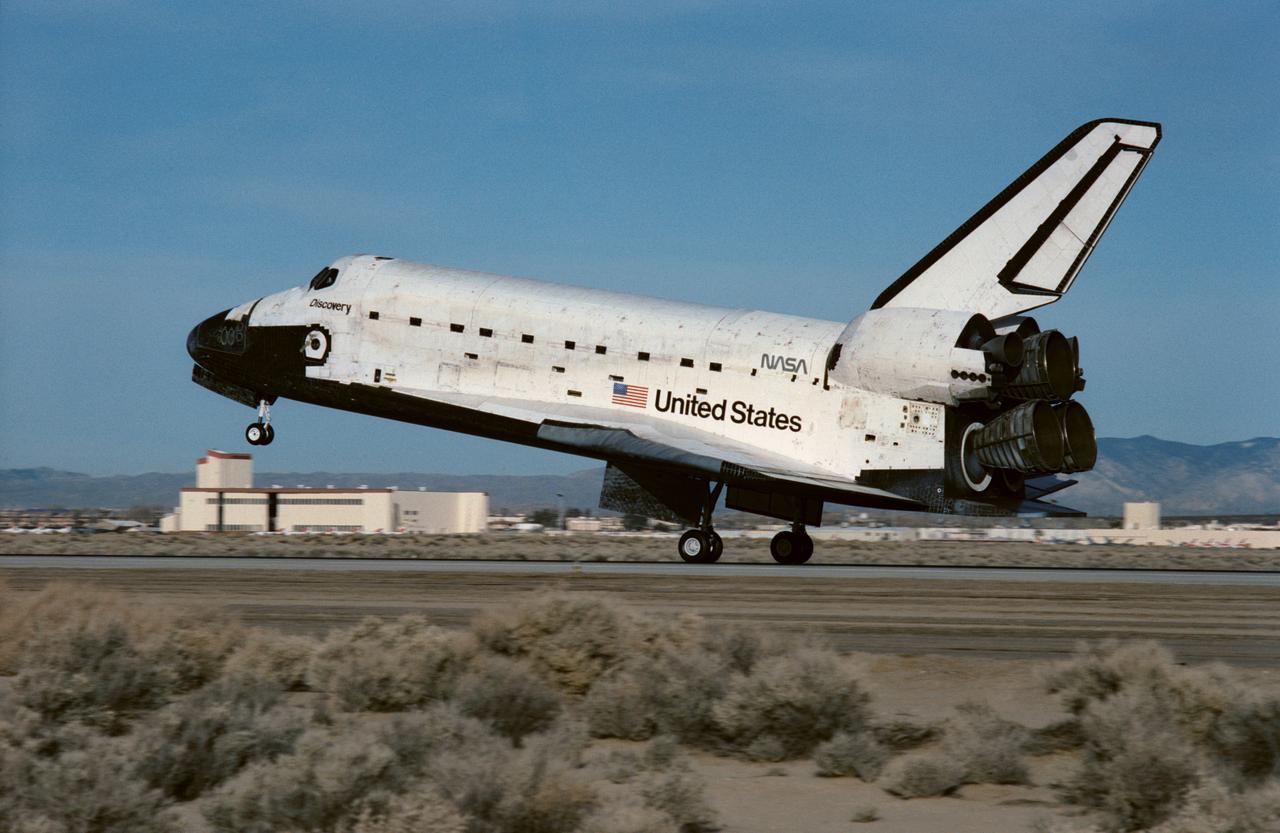
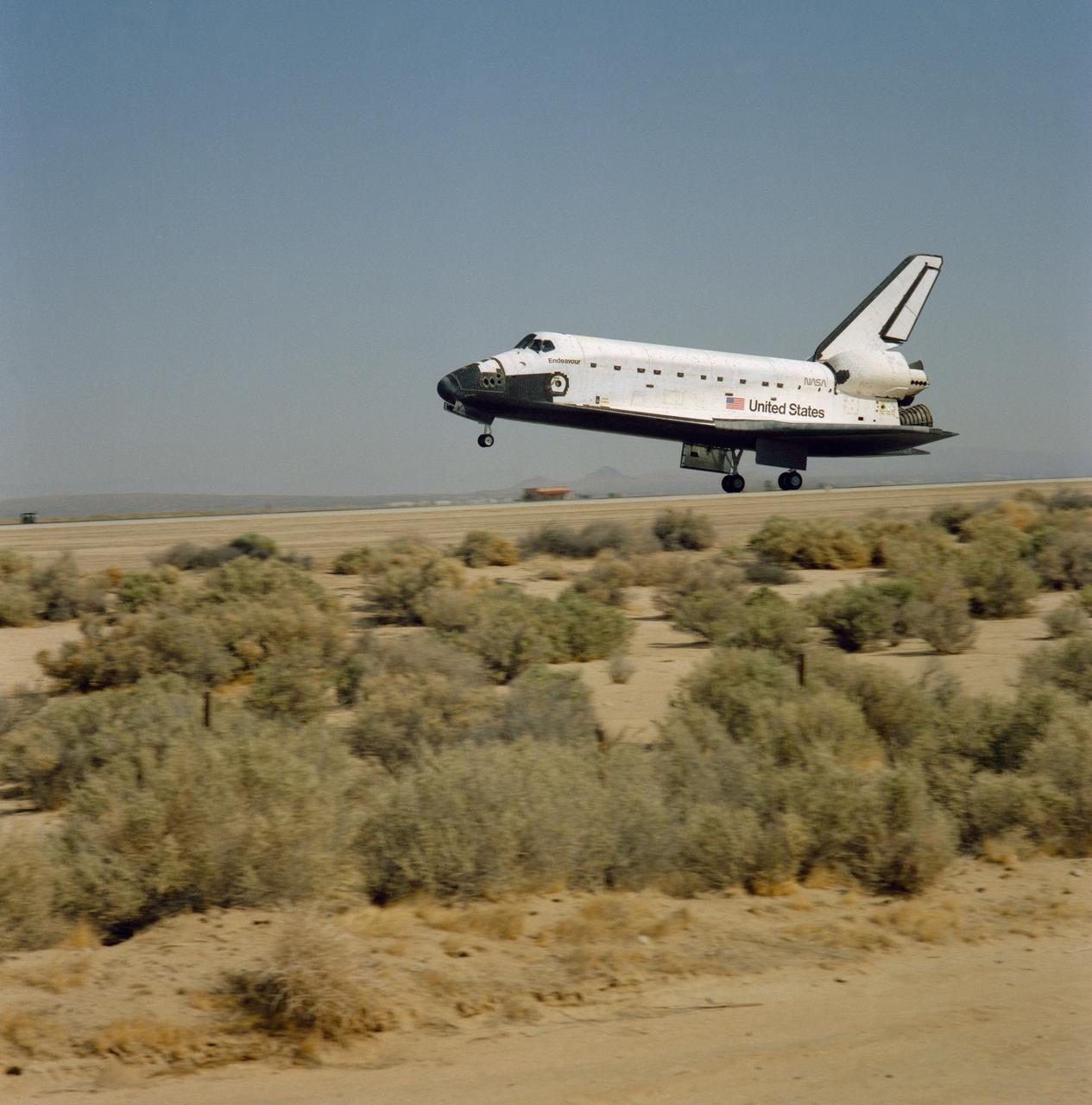
STS-41 Discovery, Orbiter Vehicle (OV) 103, with nose landing gear (NLG) and main landing gear (MLG) deployed, glides over concrete runway 22 at Edwards Air Force Base (EAFB), California, prior to touchdown.
STS-41 Discovery, OV-103, glides over concrete runway 22 at EAFB, California
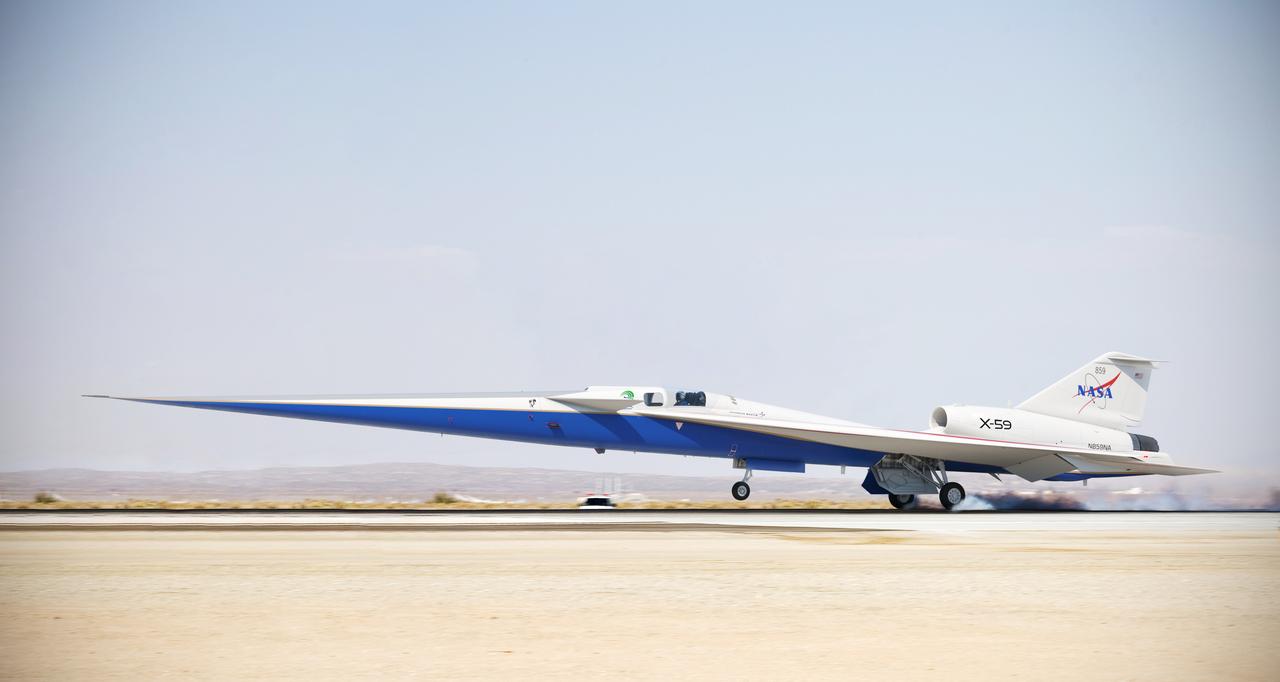
Artist illustration of the X-59 landing on the runway.
X59_Landing_001-new-update-Aug
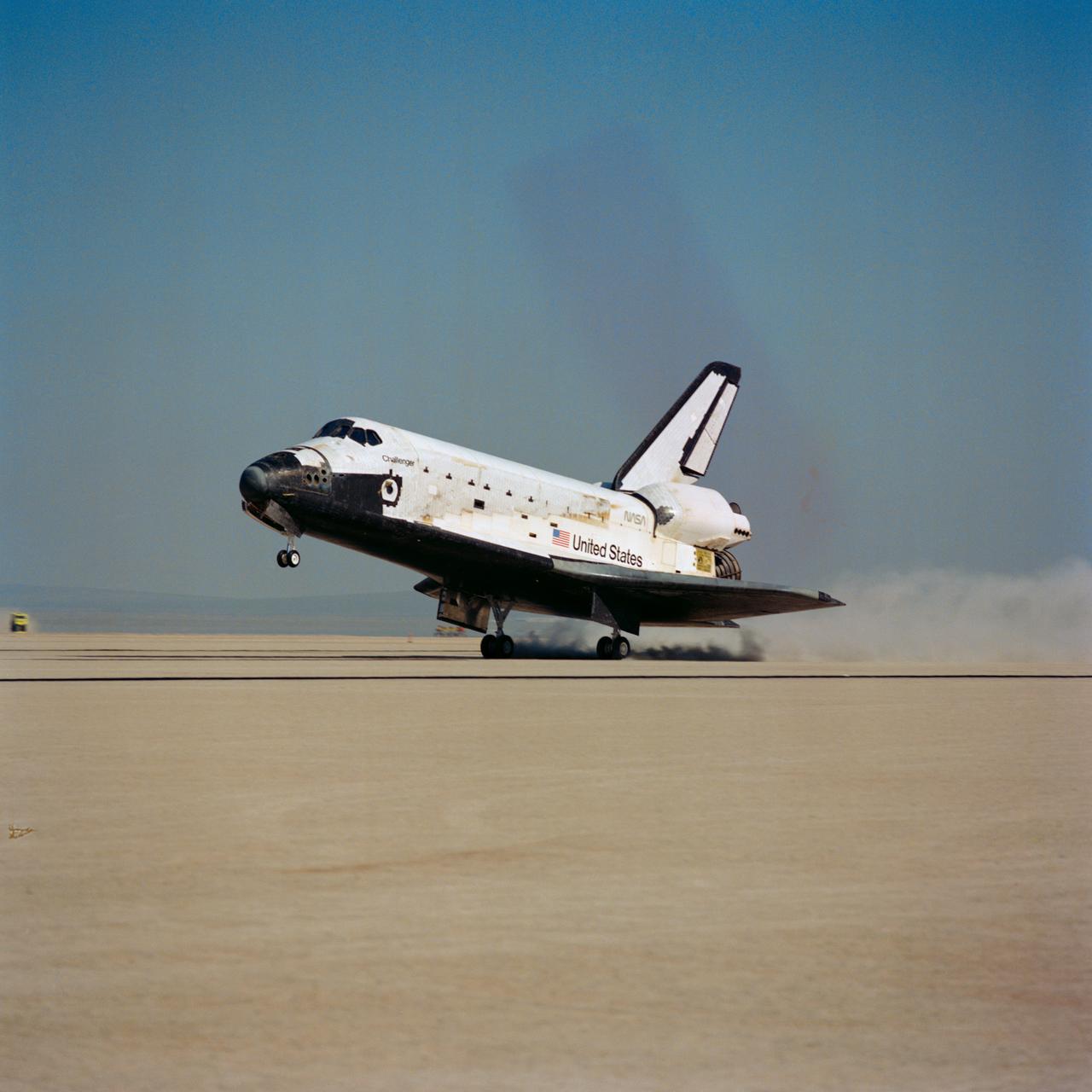
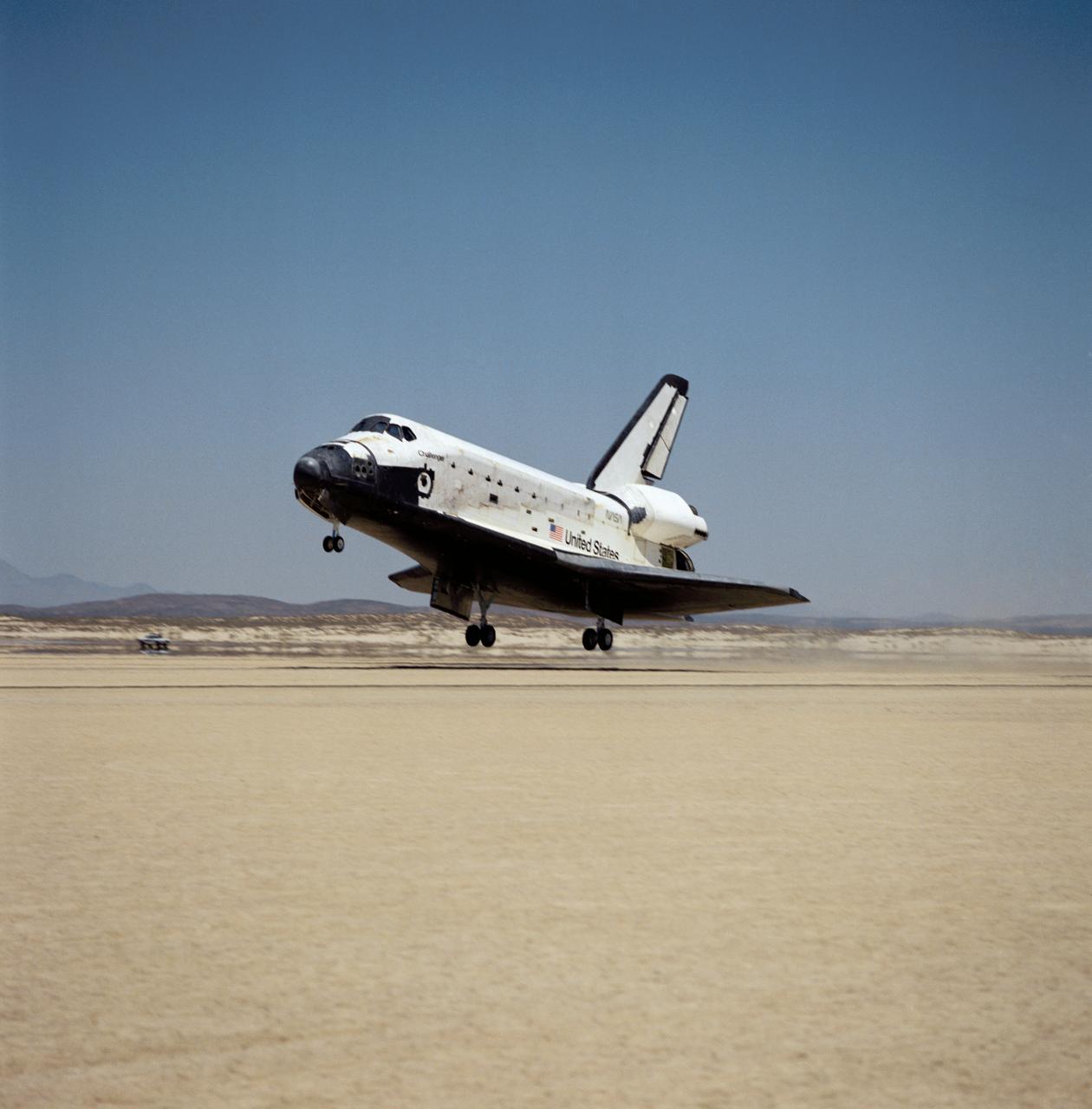
Shuttle Challenger lands on Runway 17 at Edwards at end of 51-B mission. The photo is a rear view of the shuttle landing gear touching the runway, with clouds of dirt trailing behind it. The nose gear is still in the air (071); Side view of the Challenger landing gear touching the runway (072).
Shuttle Challenger landing on Runway 17 at Edwards at end of 51-B mission
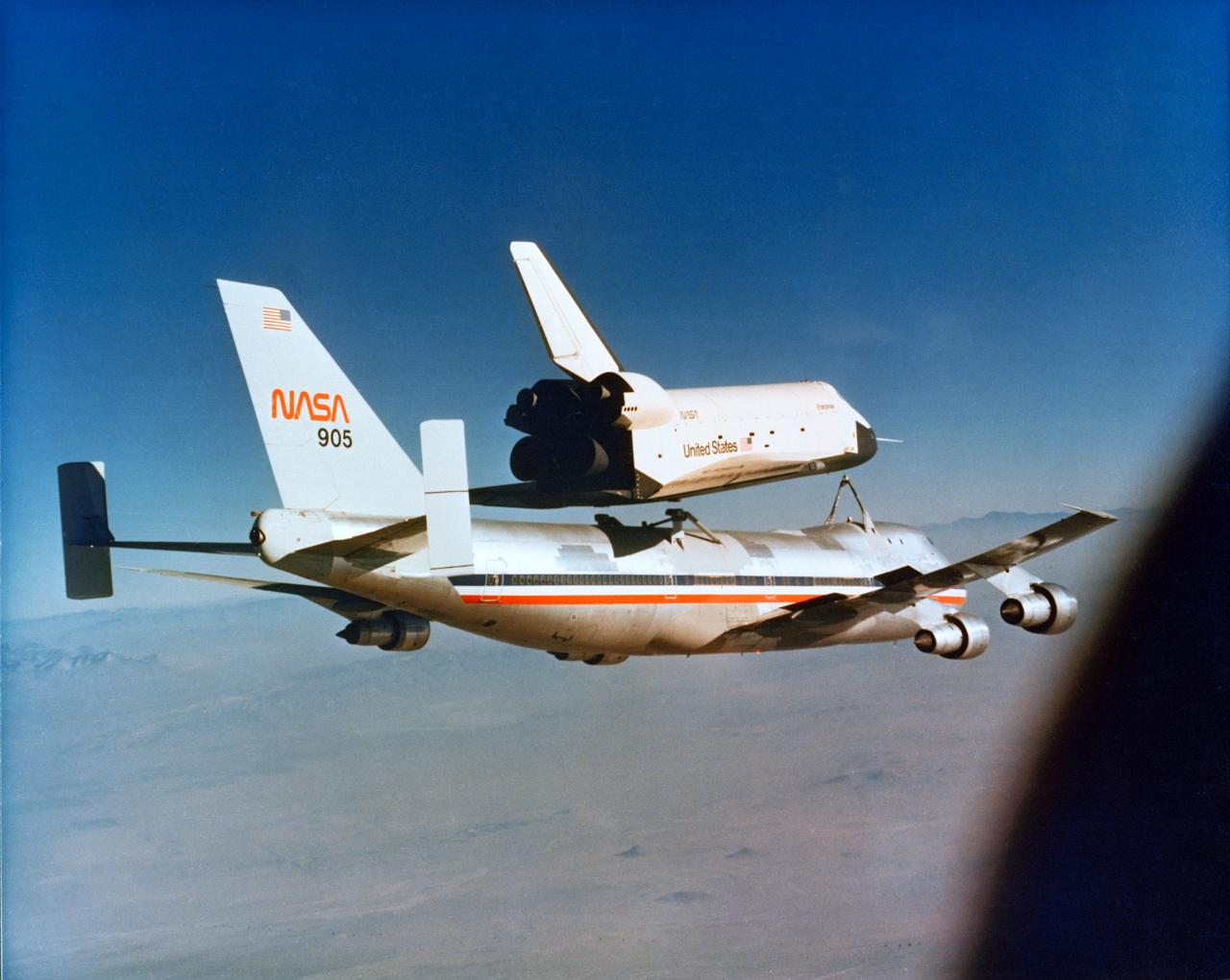
Photography from Shuttle ALT FF-5.        S77-30393:  ALT Fr. 3258, a higher-up shot of the Enterprise approaching runway for landing.     EAFB, CA
Approach & Landing Test (ALT) - Shuttle Free-Flight (FF)-5 - Edwards AFB (EAFB), CA
S84-27717 (11 Feb 1984) --- A chase plane gets a "front row" position to view the touchdown of the total landing gear of the Space Shuttle Challenger as the reusable spacecraft makes NASA's first landing on the runway at the Kennedy Space Center's (KSC) landing facility.  This photograph was taken from another T-38 chase plane.
Landing - Shuttle Challenger - STS-41B Mission - KSC
STS58-S-126 (1 Nov 1993) --- The Space Shuttle Columbia is about to touch down on the runway at Edwards Air Force Base (EAFB) in California.  The landing, which occurred at 7:06 a.m. (PST), November 1, 1993, completed a two week mission in space devoted to medical research.  Onboard the spacecraft were astronauts John E. Blaha, Richard A. Searfoss, Rhea Seddon, Shannon W. Lucid, David A. Wolf and William S. McArthur along with payload specialist Martin J. Fettman, DVM.
Landing of STS-58 Orbiter Columbia at Edwards Air Force Base
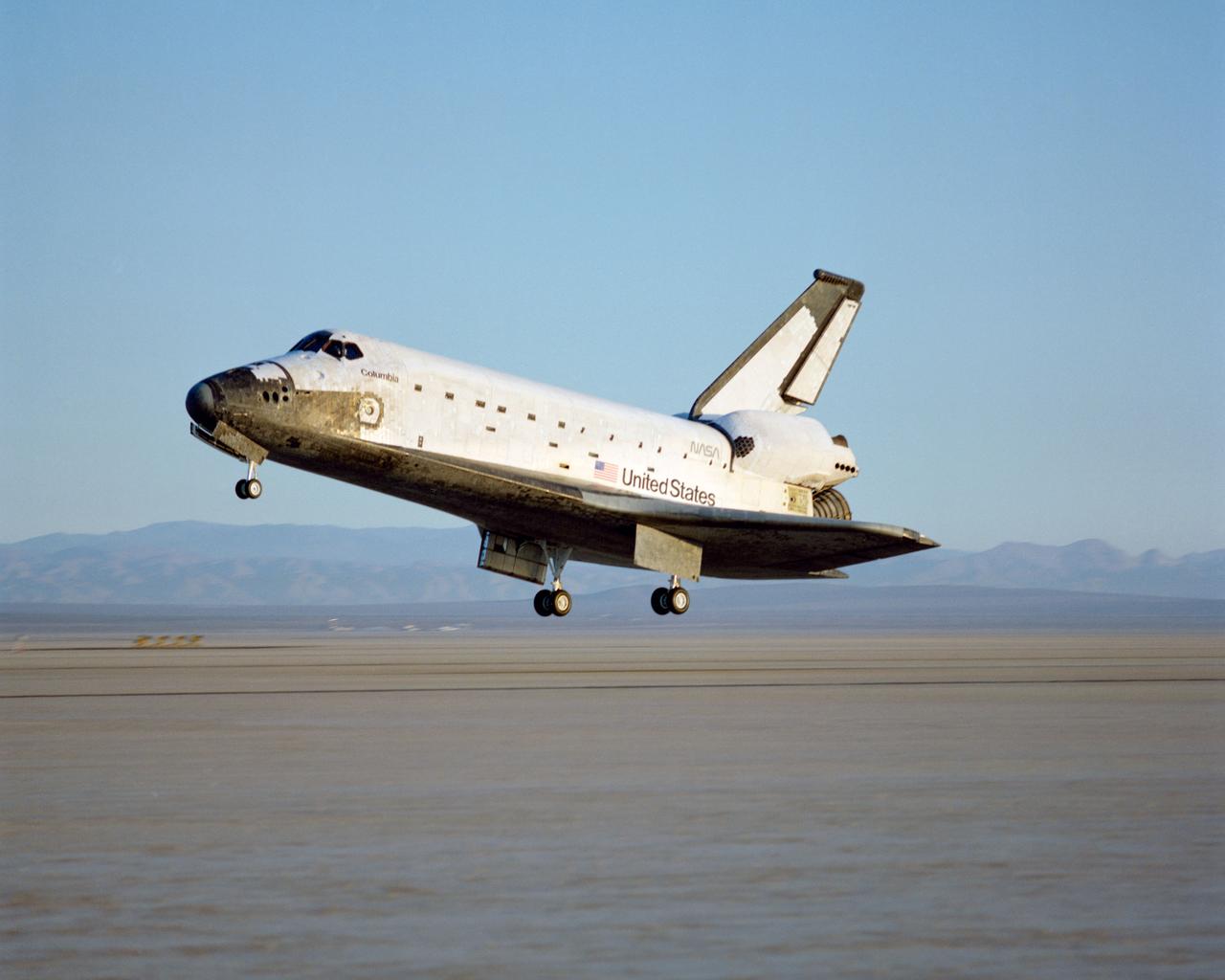
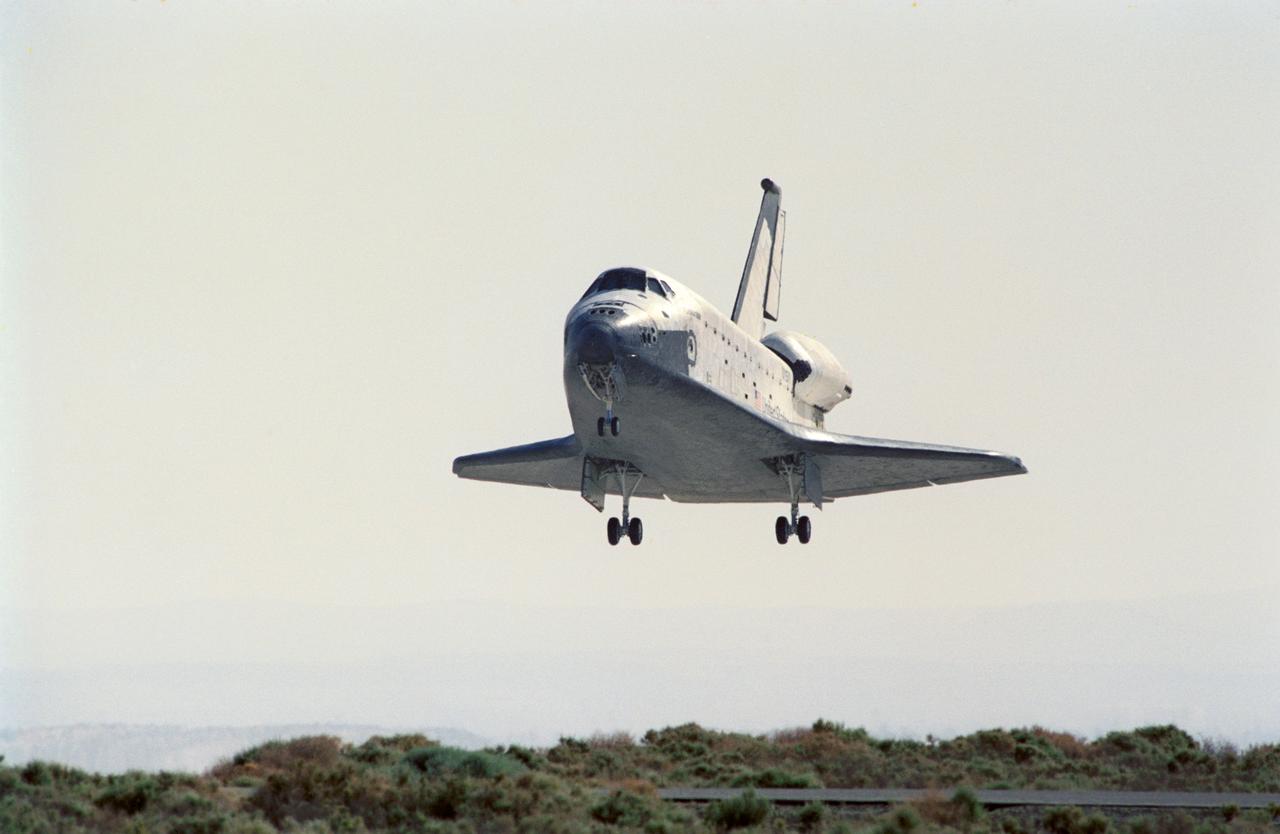
STS-28 Columbia, Orbiter Vehicle (OV) 102, approaches Runway 17 dry lake bed at Edwards Air Force Base (EAFB) California and is photographed just moments before main landing gear (MLG) touchdown. In the distance, are peaks of Southern California mountain range.
STS-28 Columbia, OV-102, landing at Edwards Air Force Base (EAFB) California
Space Shuttle Atlantis landed at 12:33 p.m. February 20, 2001, on the runway at Edwards Air Force Base, California, where NASA's Dryden Flight Research Center is located. The mission, which began February 7, logged 5.3 million miles as the shuttle orbited earth while delivering the Destiny science laboratory to the International Space Station. Inclement weather conditions in Florida prompted the decision to land Atlantis at Edwards. The last time a space shuttle landed at Edwards was Oct. 24, 2000.
Space Shuttle Atlantis/STS-98 shortly before being towed to NASA's Dryden Flight Research Center
STS-41 Discovery, Orbiter Vehicle (OV) 103, with nose landing gear (NLG) and main landing gear (MLG) deployed, glides over concrete runway 22 at Edwards Air Force Base (EAFB), California, prior to touchdown.
STS-41 Discovery, OV-103, glides over concrete runway 22 at EAFB, California
51I-S-225 (3 September 1985) --- The Space Shuttle Discovery lands on September 3, 1985 on Runway 23, Edwards Air Force Base, CA, to successfully complete the 51-I mission.
Landing of the Shuttle Discovery and end of STS 51-I mission
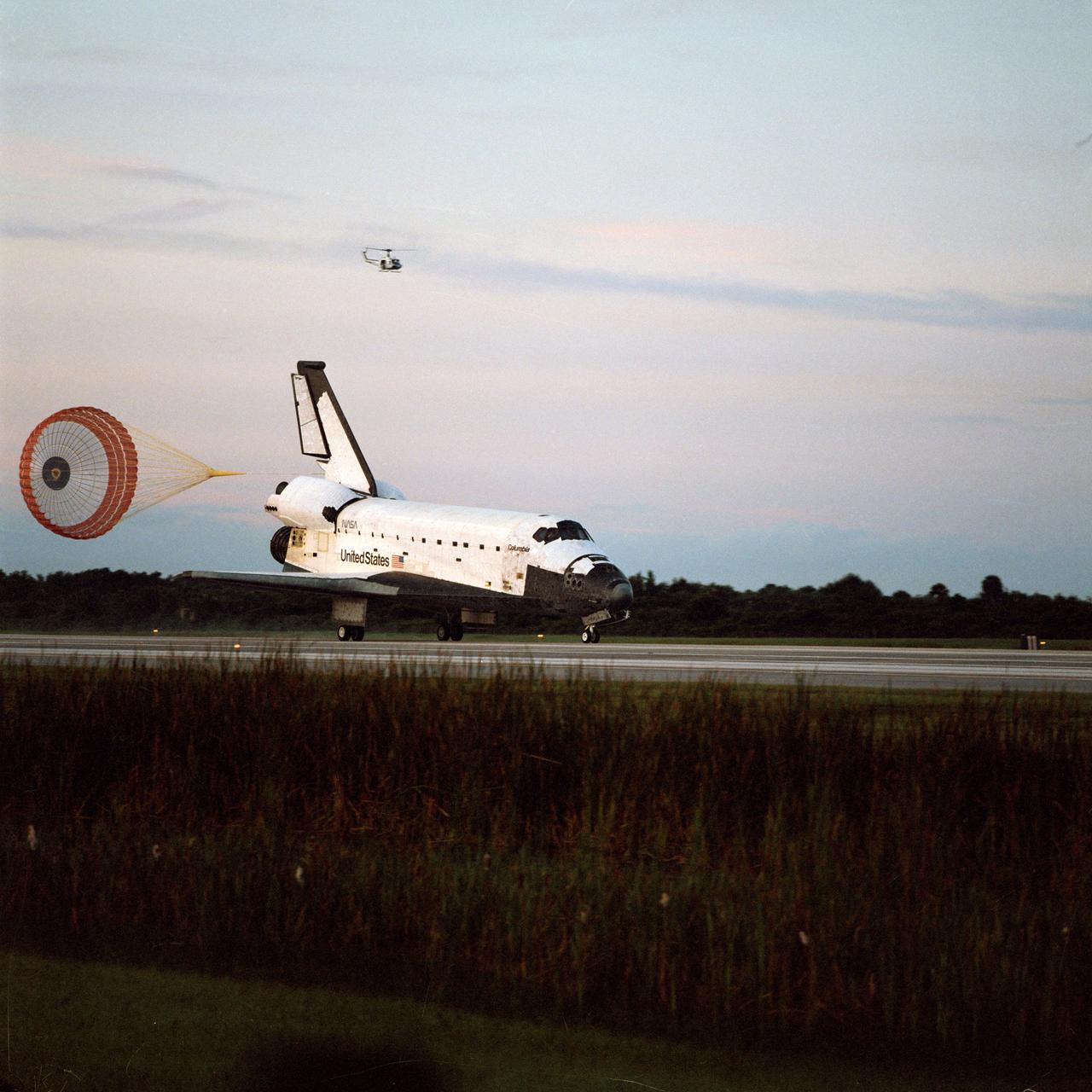
The Space Shuttle Columbia, Orbiter Vehicle (OV) 102, its drag chute fully deployed, completes a record duration mission as it lands on Runway 33 at the Kennedy Space Center (KSC) Shuttle Landing Facility (SLF). A helicopter flying overhead observes as OV-102's nose landing gear (NLG) and main landing gear (MLG) roll along the runway. Landing occurred at 6:38 am (Eastern Daylight Time (EDT)). STS-65 mission duration was 14 days 17 hours and 56 minutes. Onboard were six NASA astronauts and a Japanese payload specialist who conducted experiments in support of the International Microgravity Laboratory 2 (IML-2) during the mission.
STS-65 Columbia, OV-102, with drag chute deployed lands at KSC SLF
The Space Shuttle Challenger lands at Kennedy Space Center (KSC) at the end of the STS 41-G mission. The main landing gear has already touched down in this view, but the nose gear is still in the air (90232); Front view through tall grass of the Challenger making its landing at KSC (90233); Close-up side view of the Challenger making its landing at KSC (90234); Aerial view of the Challenger making its final approach to the runway to land at KSC (90235).
Space Shuttle Challenger landing at Kennedy Space Center at end of STS 41-G
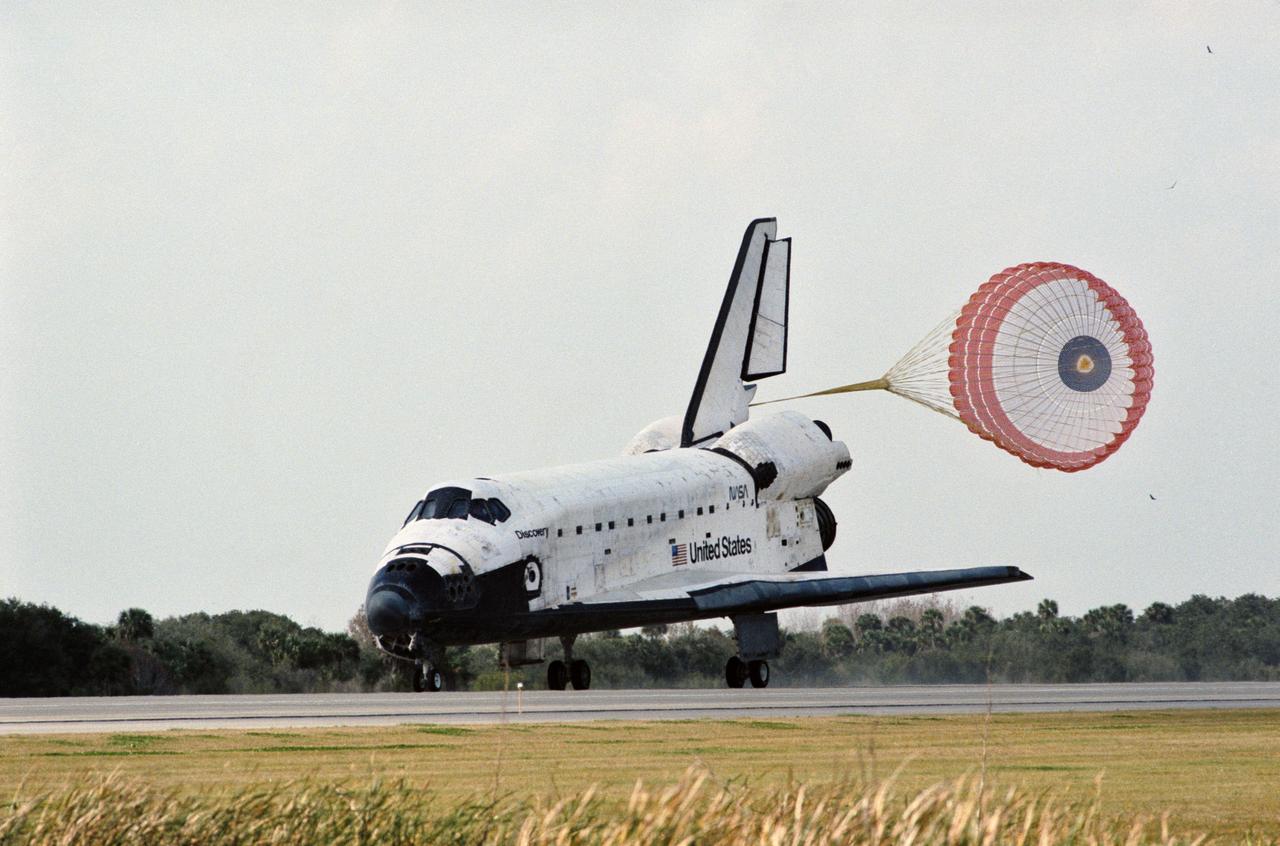
STS063-S-015 (11 Feb. 1995) --- The Space Shuttle Discovery deploys its drag chute on Runway 15 at the Kennedy Space Center's (KSC) Shuttle Landing Facility as it wraps up an eight-day mission.  Touchdown occurred at 6:50:19 a.m. (EST), February 11, 1995.  Onboard the Space Shuttle Discovery were astronauts James D. Wetherbee, mission commander; Eileen M. Collins, pilot; Bernard A. Harris Jr., payload commander; mission specialists C. Michael Foale, Janice E. Voss, and cosmonaut Vladimir G. Titov.
Landing of STS-63 Discovery at KSC
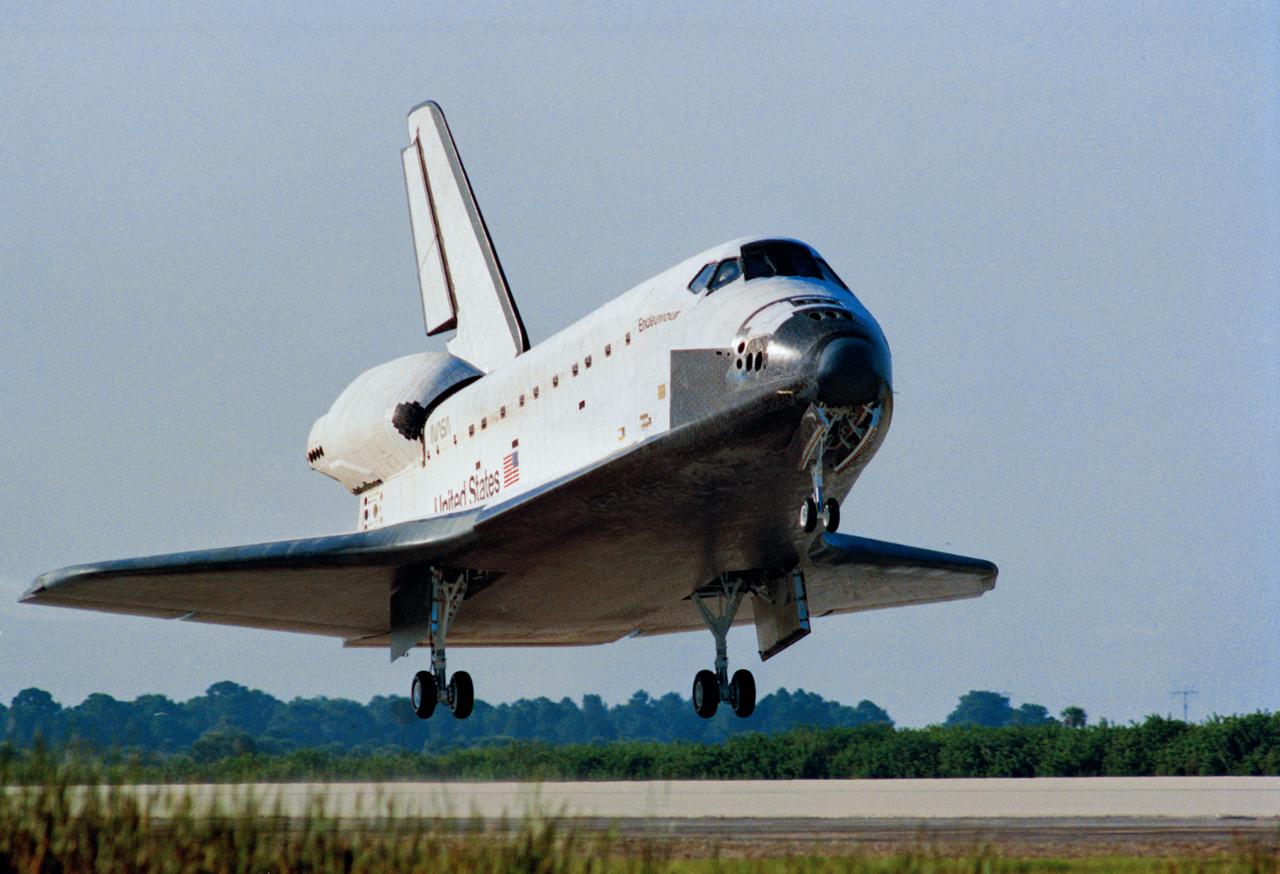
STS047-S-116 (20 Sept 1992) --- The Space Shuttle Endeavour prepares to land on the Kennedy Space Center's Shuttle landing facility runway.  The successful landing marked the completion of an eight-day Earth-orbital mission for the orbiter, its seven-member crew and the Spacelab-J payload.  Landing occurred at 8:53 a.m.  (EDT), September 20, 1992.  Onboard the spacecraft were astronauts Robert L. Gibson, Curtis L. Brown Jr., Mark C. Lee, Jerome (Jay) Apt, N. Jan Davis and Mae C. Jemison, along with Japanese payload specialist Dr. Mamoru Mohri.
STS-47 Endeavour, Orbiter Vehicle (OV) 105, landing sequence at KSC SLF
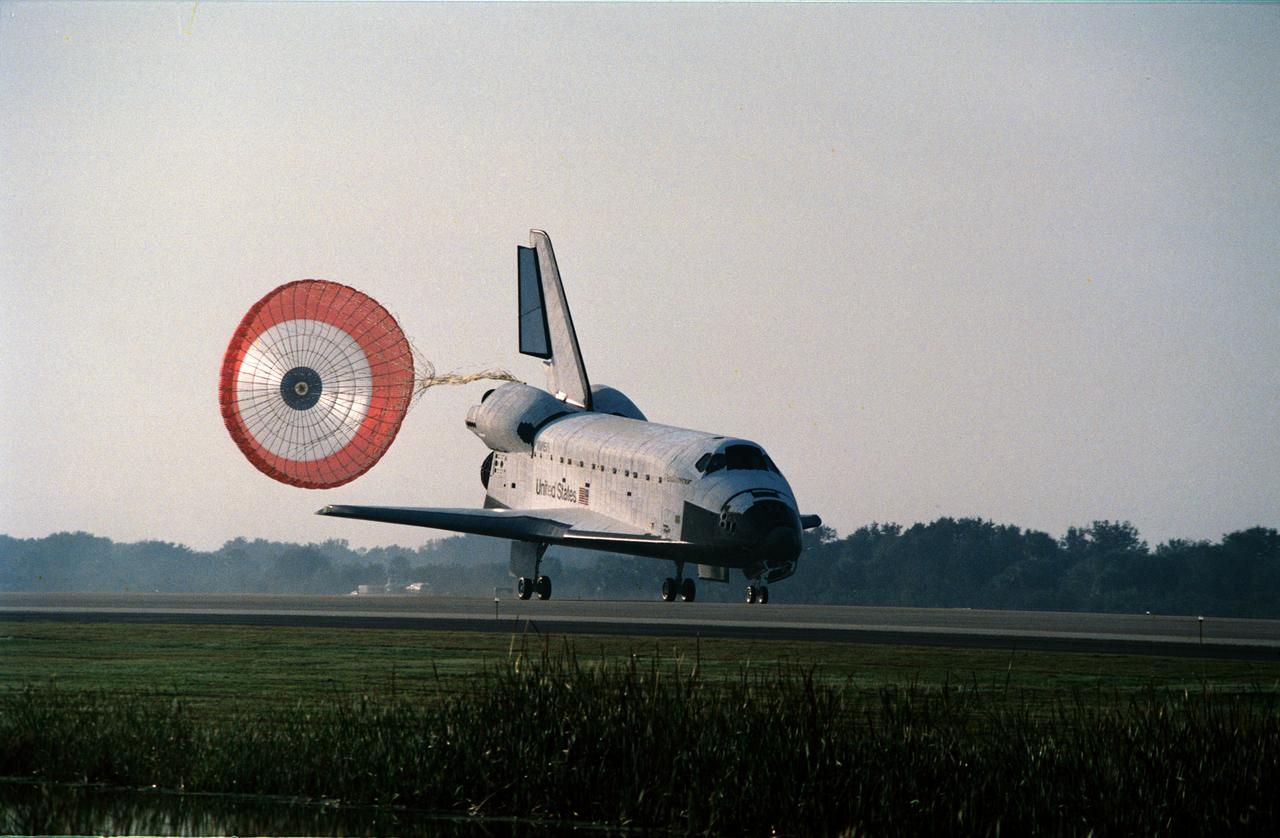
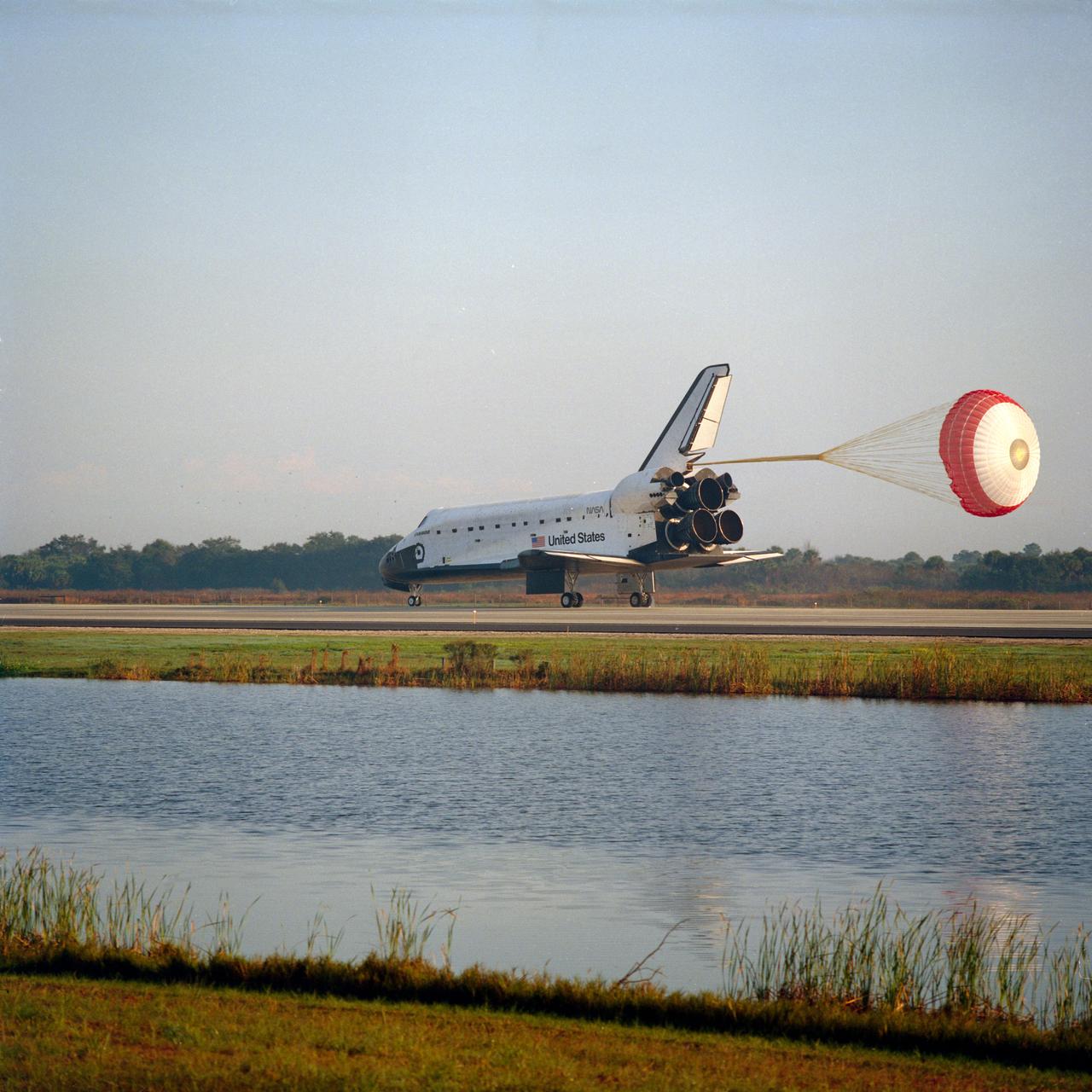
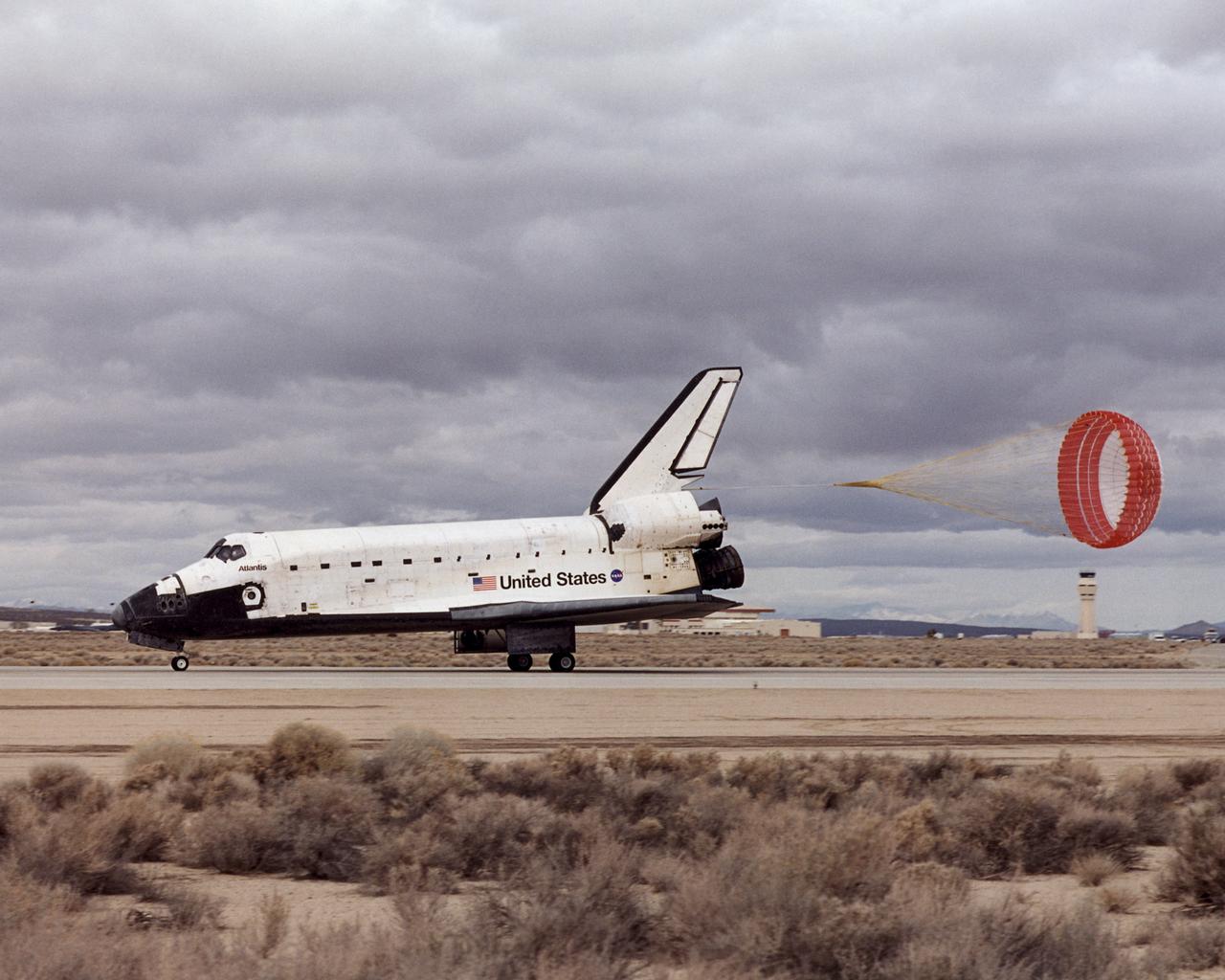
STS050-S-105 (9 July 1992) --- The main drag chute on the Space Shuttle Columbia is fully deployed soon after the Space Shuttle touches down at the Kennedy Space Center (KSC) landing facility.  Landing occurred at 7:42 a.m. (EDT).  Seven crew members, including five astronauts and two scientists from the private sector spent 14 days in space supporting the U.S. Microgravity Laboratory (USML-1).  This marks the first time for usage of the parachute system for a KSC landing and the second occurrence in the program.
STS-50 Columbia, OV-102, landing with drag chute deploy at KSC SLF runway 33
STS64-S-094 (20 Sept. 1994) --- The space shuttle Discovery, with a crew of six NASA astronauts aboard, touches down on Runway 04 at Edwards Air Force Base (EAFB), completing a 10-day, 22-hour and 50-minute mission.  Following a de-orbit engine firing at 1:14 p.m. (PDT), Sept. 20, 1994. Touchdown was at 2:12:59 p.m., and the nose wheel touched down at 2:13:03 p.m., with wheel stop at 2:13:52 p.m. Bad weather in Florida called for an "eleventh hour" shift to the California landing site. Onboard for the flight, whose mission was to study Earth's atmosphere and to test tools and procedures for the International Space Station, were astronauts Richard N. Richards, L. Blaine Hammond Jr., Mark C. Lee, Carl J. Meade, Susan J. Helms and Jerry M. Linenger. Photo credit: NASA or National Aeronautics and Space Administration
STS-64 landing view
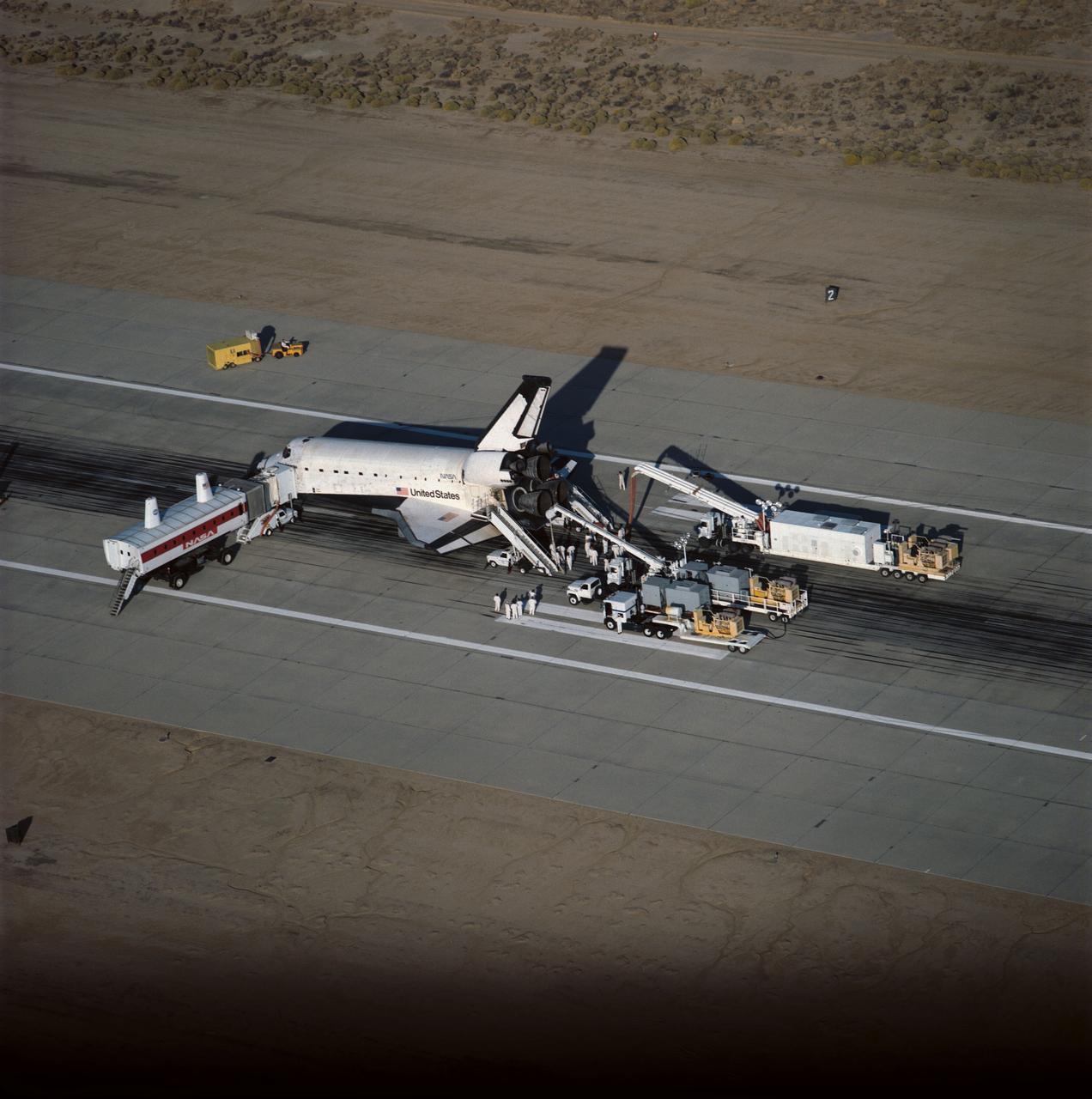
STS058-S-129 (1 Nov 1993) --- This busy scene on the runway at Edwards Air Force Base (EAFB) was taken less than an hour following the landing of the Space Shuttle Columbia.  The touchdown, which had occurred at 7:06 a.m. (PST), November 1, 1993, completed a two week mission in space devoted to medical research.  The array of hardware and workers includes personnel and equipment designed to make the area safe.  At far left is the Crew Transport Vehicle (CTV).  Still onboard the spacecraft were astronauts John E. Blaha, Richard A. Searfoss, Rhea Seddon, Shannon W. Lucid, David A. Wolf and William S. McArthur, along with payload specialist Martin J. Fettman, DVM.
STS-58 post landing scene as orbiter is serviced
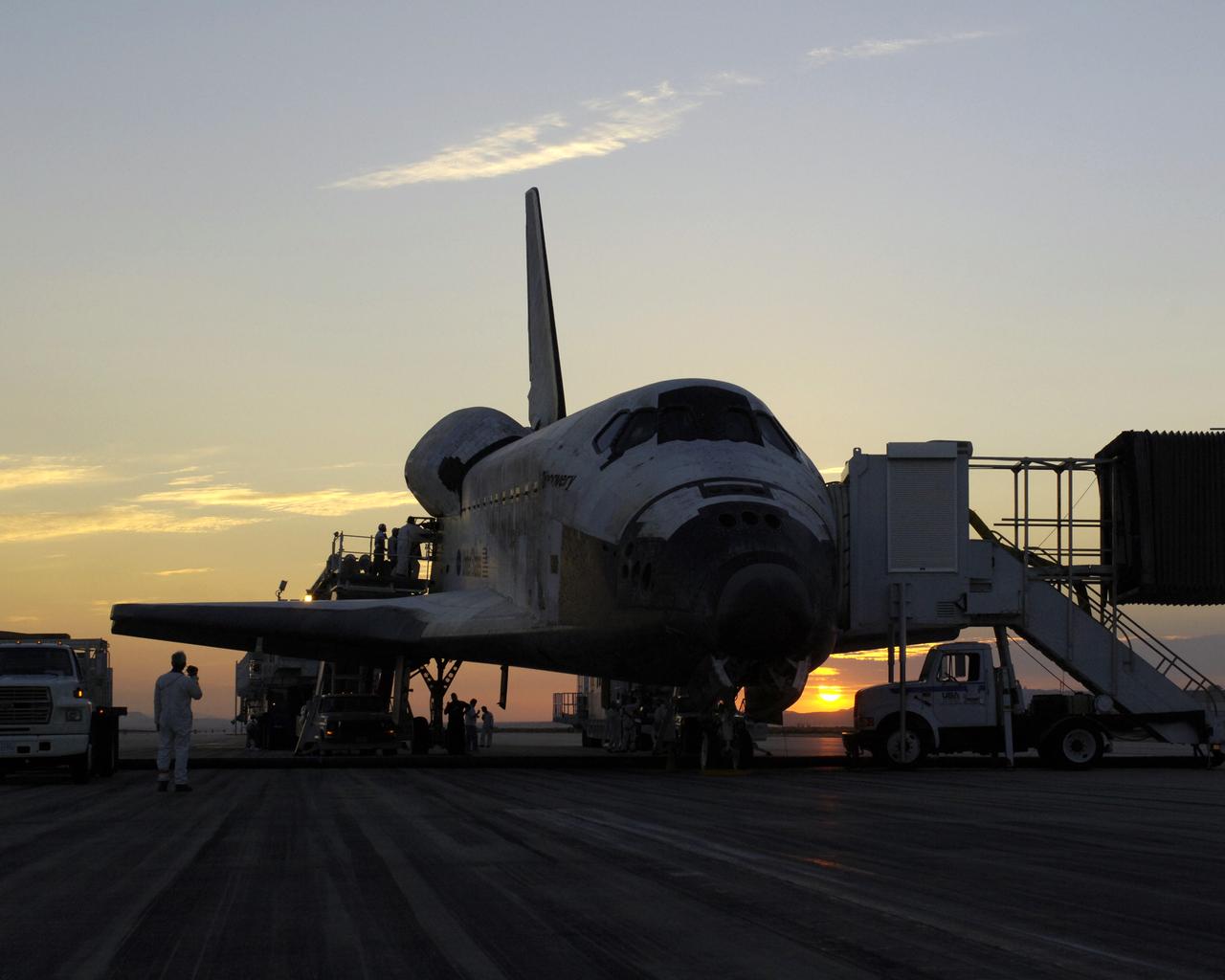
The sun rises on the Space Shuttle Discovery as it rests on the runway at Edwards Air Force Base, California, after a safe landing August 9, 2005 to complete the STS-114 mission. Space Shuttle Discovery landed safely at NASA's Dryden Flight Research Center at Edwards Air Force Base in California at 5:11:22 a.m. PDT this morning, following the very successful 14-day STS-114 return to flight mission.  During their two weeks in space, Commander Eileen Collins and her six crewmates tested out new safety procedures and delivered supplies and equipment the International Space Station.  Discovery spent two weeks in space, where the crew demonstrated new methods to inspect and repair the Shuttle in orbit. The crew also delivered supplies, outfitted and performed maintenance on the International Space Station. A number of these tasks were conducted during three spacewalks.  In an unprecedented event, spacewalkers were called upon to remove protruding gap fillers from the heat shield on Discovery's underbelly. In other spacewalk activities, astronauts installed an external platform onto the Station's Quest Airlock and replaced one of the orbital outpost's Control Moment Gyroscopes.  Inside the Station, the STS-114 crew conducted joint operations with the Expedition 11 crew. They unloaded fresh supplies from the Shuttle and the Raffaello Multi-Purpose Logistics Module. Before Discovery undocked, the crews filled Raffeallo with unneeded items and returned to Shuttle payload bay.  Discovery launched on July 26 and spent almost 14 days on orbit.
The sun rises on the Space Shuttle Discovery as it rests on the runway at Edwards Air Force Base, California, after a safe landing August 9, 2005
The sun rises on the Space Shuttle Discovery as it rests on the runway at Edwards Air Force Base, California, after a safe landing August 9, 2005 to complete the STS-114 mission. Space Shuttle Discovery landed safely at NASA's Dryden Flight Research Center at Edwards Air Force Base in California at 5:11:22 a.m. PDT this morning, following the very successful 14-day STS-114 return to flight mission.  During their two weeks in space, Commander Eileen Collins and her six crewmates tested out new safety procedures and delivered supplies and equipment the International Space Station.  Discovery spent two weeks in space, where the crew demonstrated new methods to inspect and repair the Shuttle in orbit. The crew also delivered supplies, outfitted and performed maintenance on the International Space Station. A number of these tasks were conducted during three spacewalks.  In an unprecedented event, spacewalkers were called upon to remove protruding gap fillers from the heat shield on Discovery's underbelly. In other spacewalk activities, astronauts installed an external platform onto the Station's Quest Airlock and replaced one of the orbital outpost's Control Moment Gyroscopes.  Inside the Station, the STS-114 crew conducted joint operations with the Expedition 11 crew. They unloaded fresh supplies from the Shuttle and the Raffaello Multi-Purpose Logistics Module. Before Discovery undocked, the crews filled Raffeallo with unneeded items and returned to Shuttle payload bay.  Discovery launched on July 26 and spent almost 14 days on orbit.
The sun rises on the Space Shuttle Discovery as it rests on the runway at Edwards Air Force Base, California, after a safe landing August 9, 2005
STS058-S-128 (1 Nov 1993) --- The nose gear of the Space Shuttle Columbia is about to touch down on the runway at Edwards Air Force Base (EAFB) in California.  The landing, which occurred at 7:06 a.m. (PST), November 1, 1993, completed a two week mission in space devoted to medical research.  Onboard the spacecraft were astronauts John E. Blaha, Richard A. Searfoss, Rhea Seddon, Shannon W. Lucid, David A. Wolf and William S. McArthur along with payload specialist Martin J. Fettman, DVM.
The landing of STS-58 Columbia, OV-102, at Edwards Air Force Base
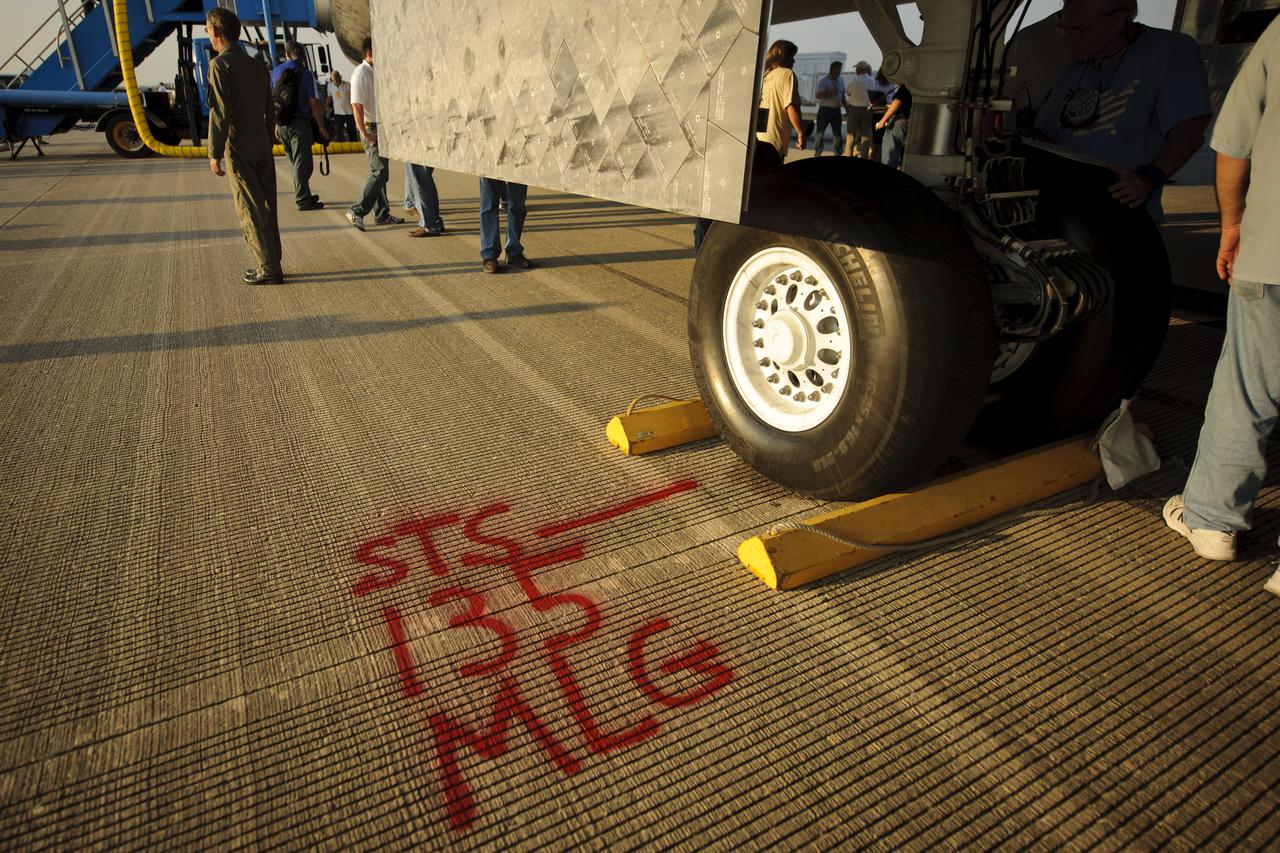
The runway of the Shuttle Landing Facility (SLF) is marked to show where the main landing gear wheels stopped for the space shuttle Atlantis (STS-135) shortly after it landed early Thursday morning, July 21, 2011, in Cape Canaveral, Fla. Overall, Atlantis spent 307 days in space and traveled nearly 126 million miles during its 33 flights. Atlantis, the fourth orbiter built, launched on its first mission on Oct. 3, 1985. Photo Credit: (NASA/Bill Ingalls)
STS-135 Atlantis Landing
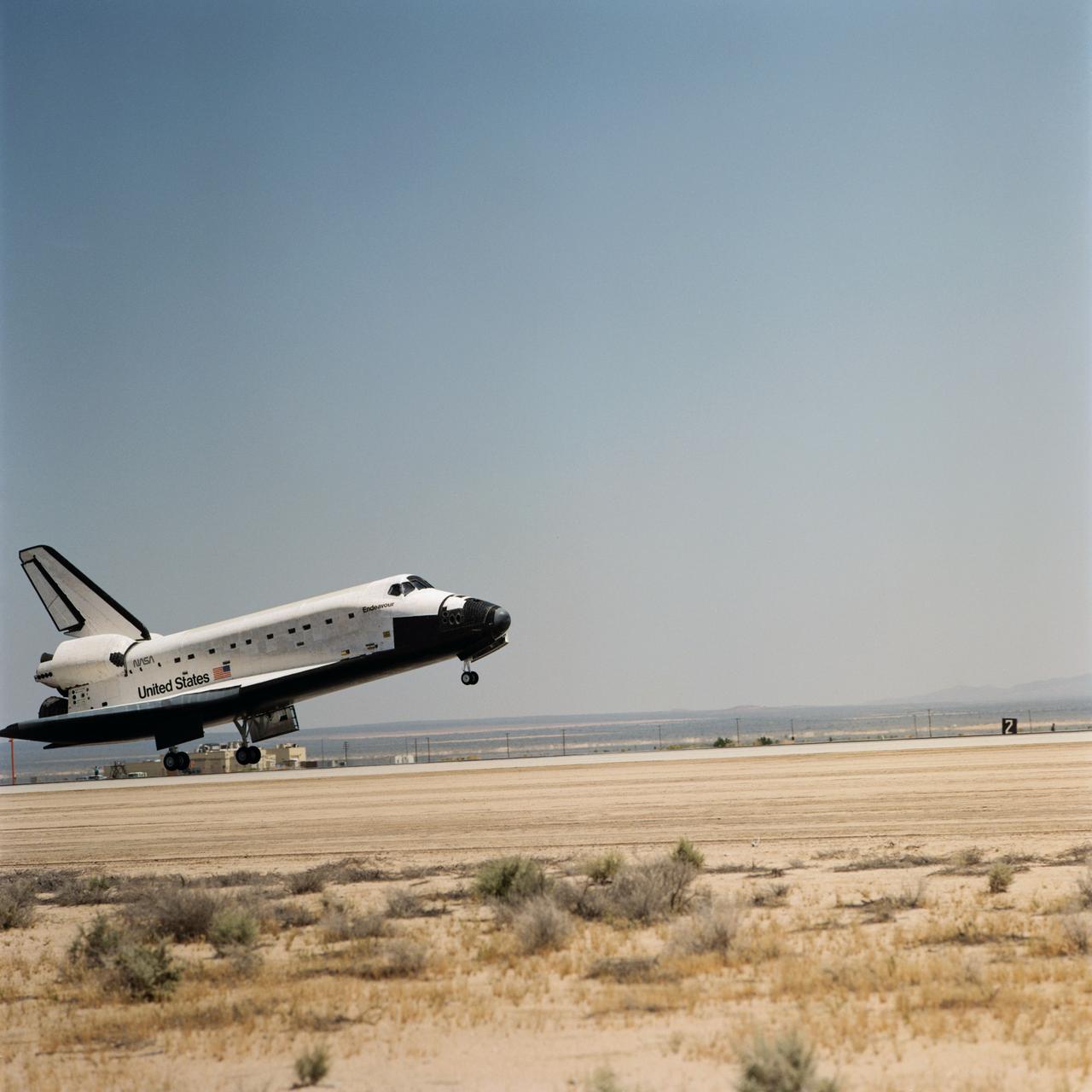
STS049-S-325 (16 May 1992) --- The main landing gear of Endeavour is just about to touch down at Edwards Air Force Base to draw to an end NASA's nine-day STS-49 mission. Crewmembers onboard were astronauts Daniel C. Brandenstein, mission commander; Kevin P. Chilton, pilot; and Thomas D. Akers, Richard J. Hieb, Bruce E. Melnick, Kathryn C. Thornton and Pierre J. Thout, all mission specialists.  Landing occurred at 1:36:38 p.m. (PDT), May 16, 1992.
STS-49 Endeavour, OV-105, landing on concrete runway 22 at EAFB, California
STS052-S-099 (1 Nov. 1992) --- This three-quarter front view shows the Space Shuttle Columbia just after deployment of the drag chute during landing at KSC's Shuttle Landing Facility. Onboard were a crew of five NASA astronauts and a Canadian payload specialist. Landing occurred at 9:05:53 a.m. (EST), November 1, 1992. Crewmembers are astronauts James D. Wetherbee, Michael A. Baker, Tamara E. Jernigan, Charles L. (Lacy) Veach and William M. Shepherd along with payload specialist Steven G.  MacLean. The photo was taken with a 35mm camera.
STS-52 Columbia, Orbiter Vehicle (OV) 102, lands on runway 33 at KSC SLF
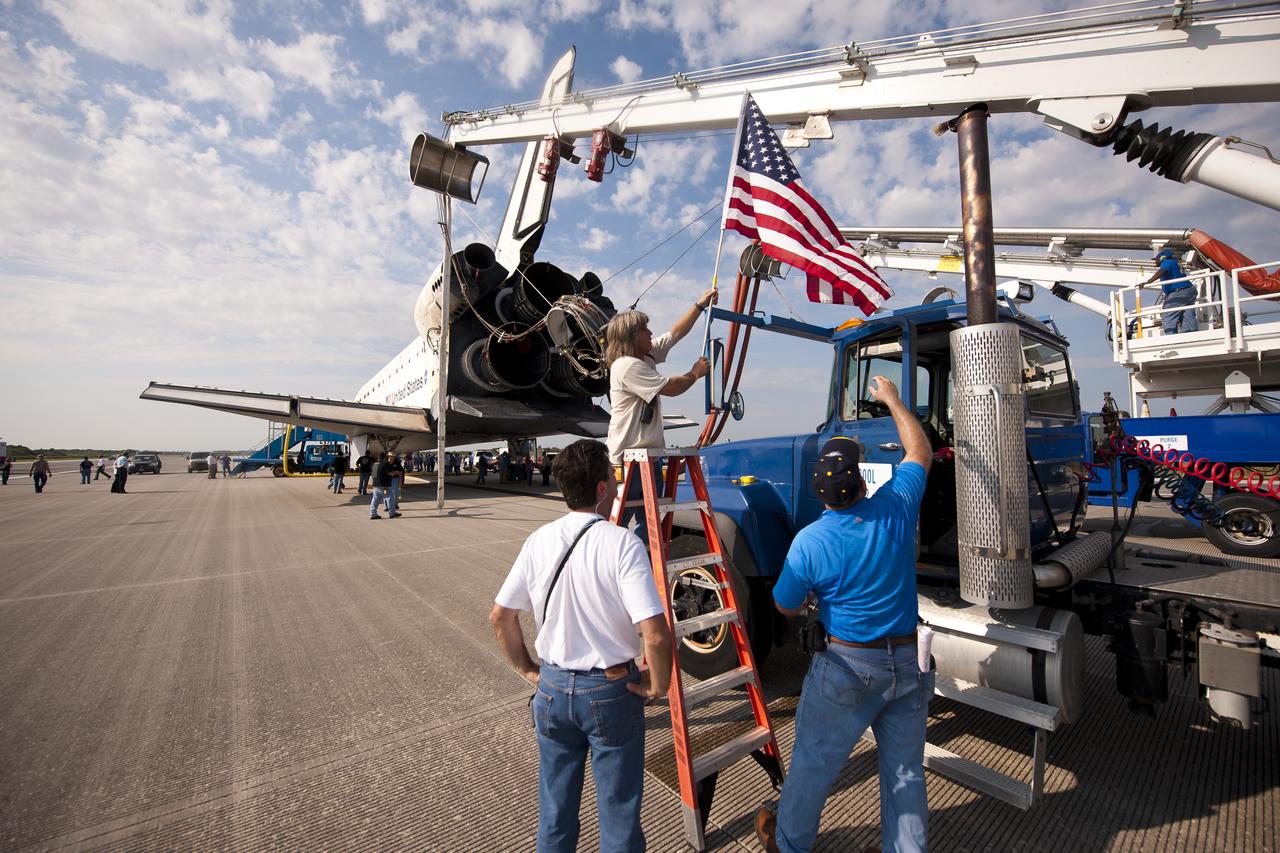
NASA and contractor personnel mount American flags to support vehicles near the space shuttle Atlantis at the Kennedy Space Center Shuttle Landing Facility (SLF) shortly after Atlantis (STS-135) landed early Thursday morning, July 21, 2011, in Cape Canaveral, Fla. The runway is marked to show where the nose landing gear wheels stopped. Overall, Atlantis spent 307 days in space and traveled nearly 126 million miles during its 33 flights. Atlantis, the fourth orbiter built, launched on its first mission on Oct. 3, 1985. Photo Credit: (NASA/Bill Ingalls)
STS-135 Atlantis Landing
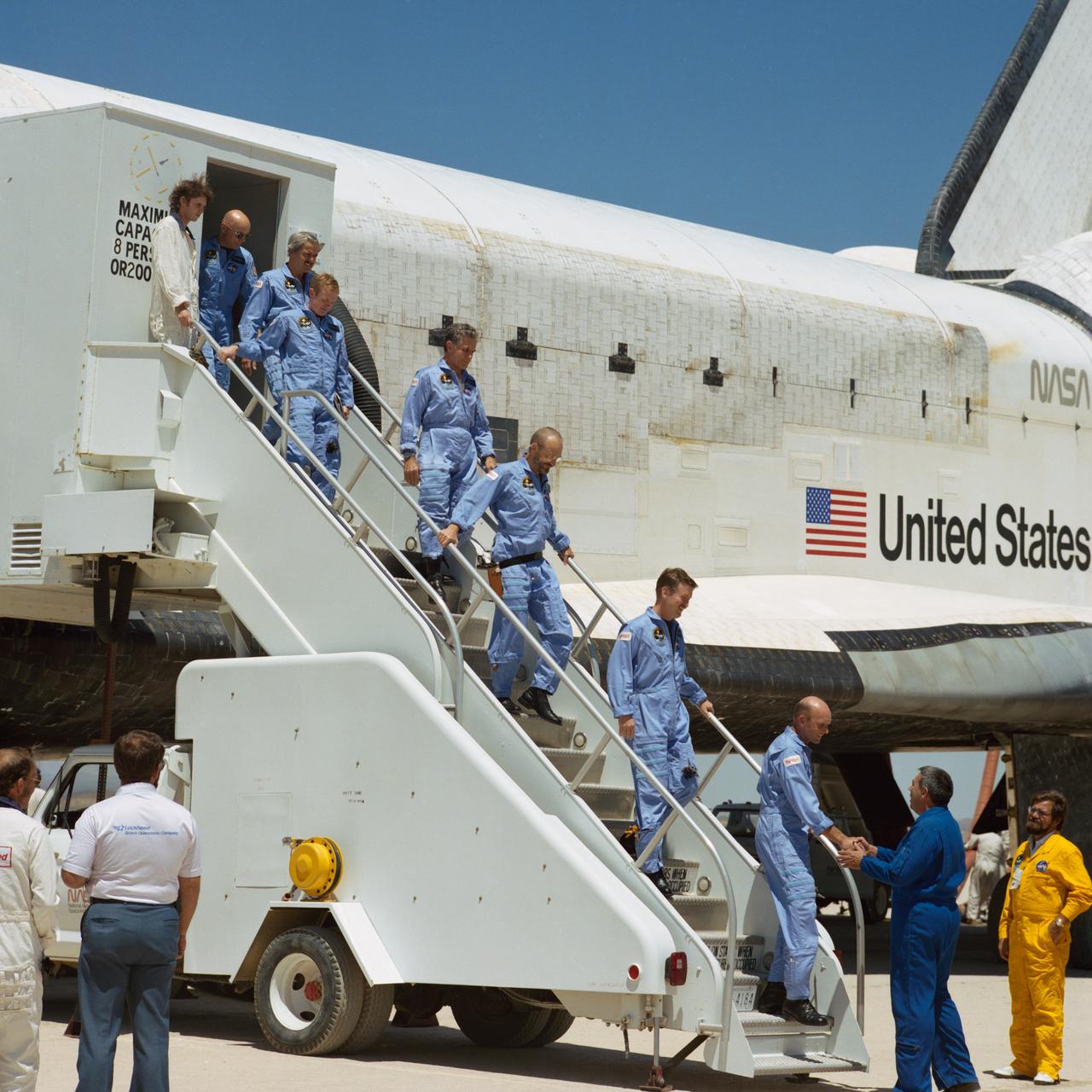
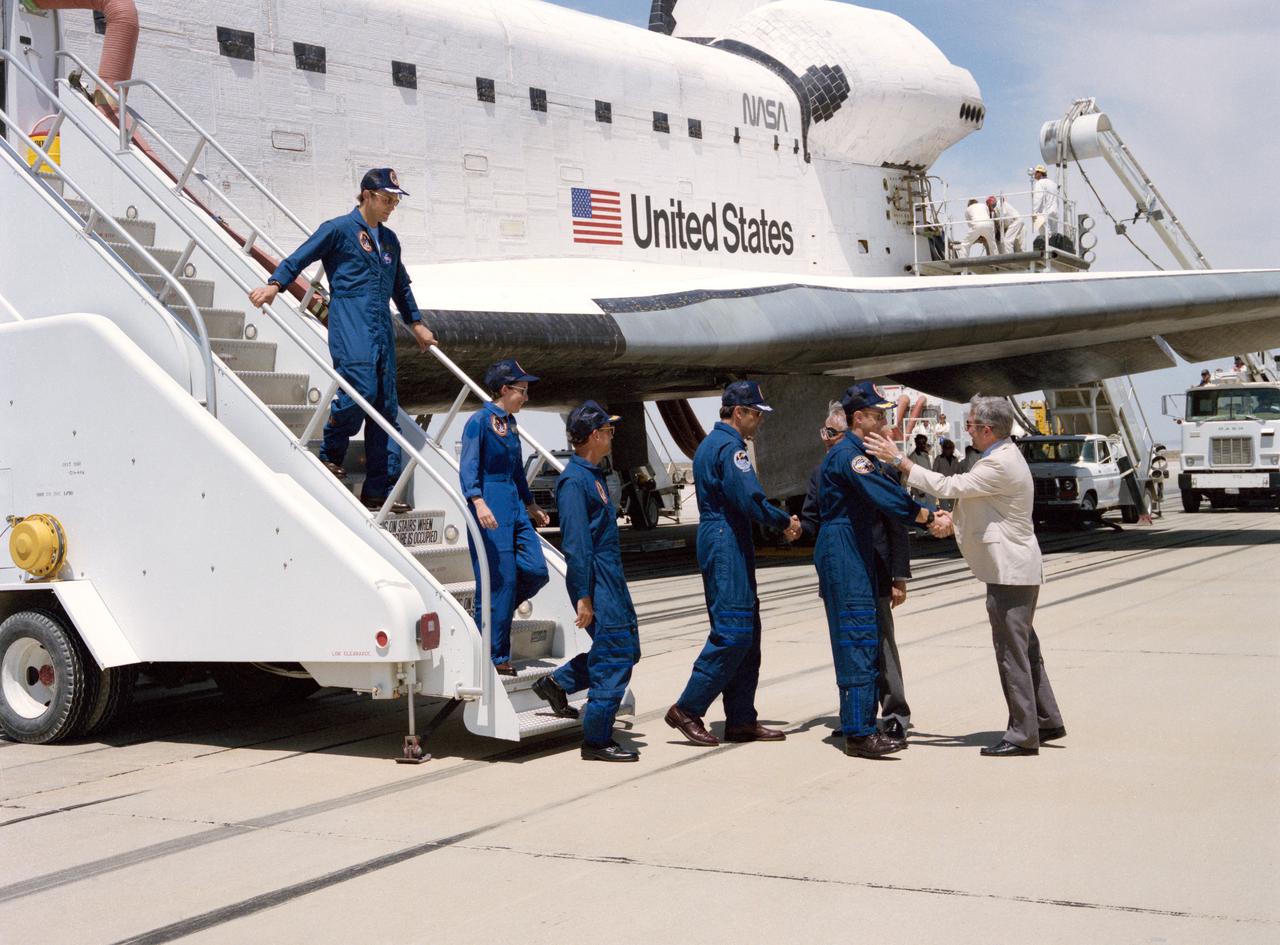
51F-S-162 (6 Aug 1985) ---Mission Operations Director George W.S. Abbey, right, shakes hands with Astronaut C. Gordon Fullerton, as the seven-member 51F crew descends from its "home" for eight days.  Other Challenger  crewmembers egressing the spacecraft are, left to right, F. Story Musgrave, mission  specialist; John-David Bartoe, payload specialist; Roy D. Bridges, Jr., Karl J. Henize, mission specialist; Loren W. Acton,  payload specialist; and Anthony W. England, mission specicalist.  Fullerton, commander, earlier successfully landed Challenger on a Mojave desert dry lake bed.  Three years ago, Fullerton was pilot of STS-3, on which the Columbia's scheduled Edwards landing was moved to New Mexico because of weather and runway  conditions here.
STS 51-F crew egress the orbiter and are greeted by George Abbey
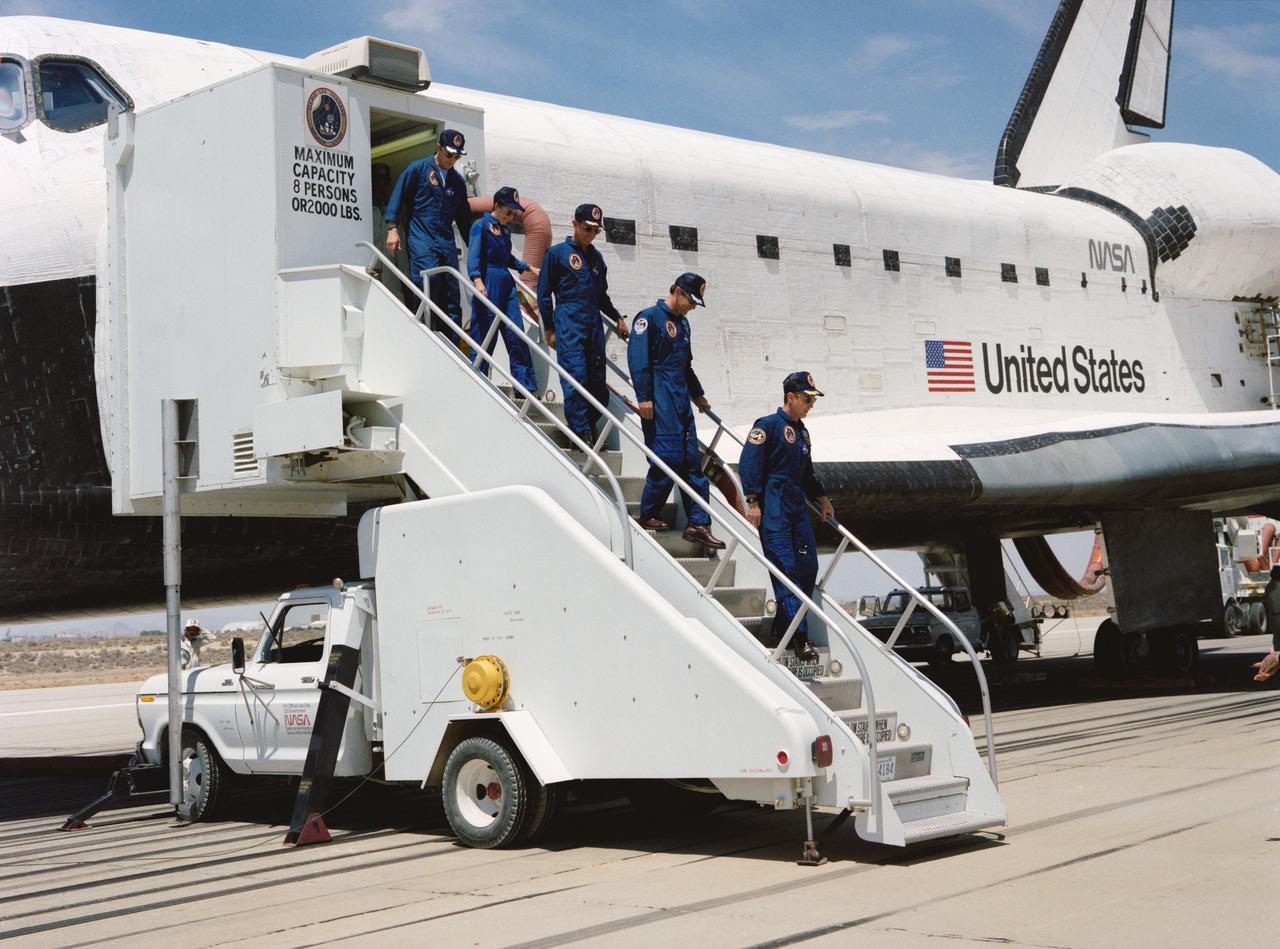
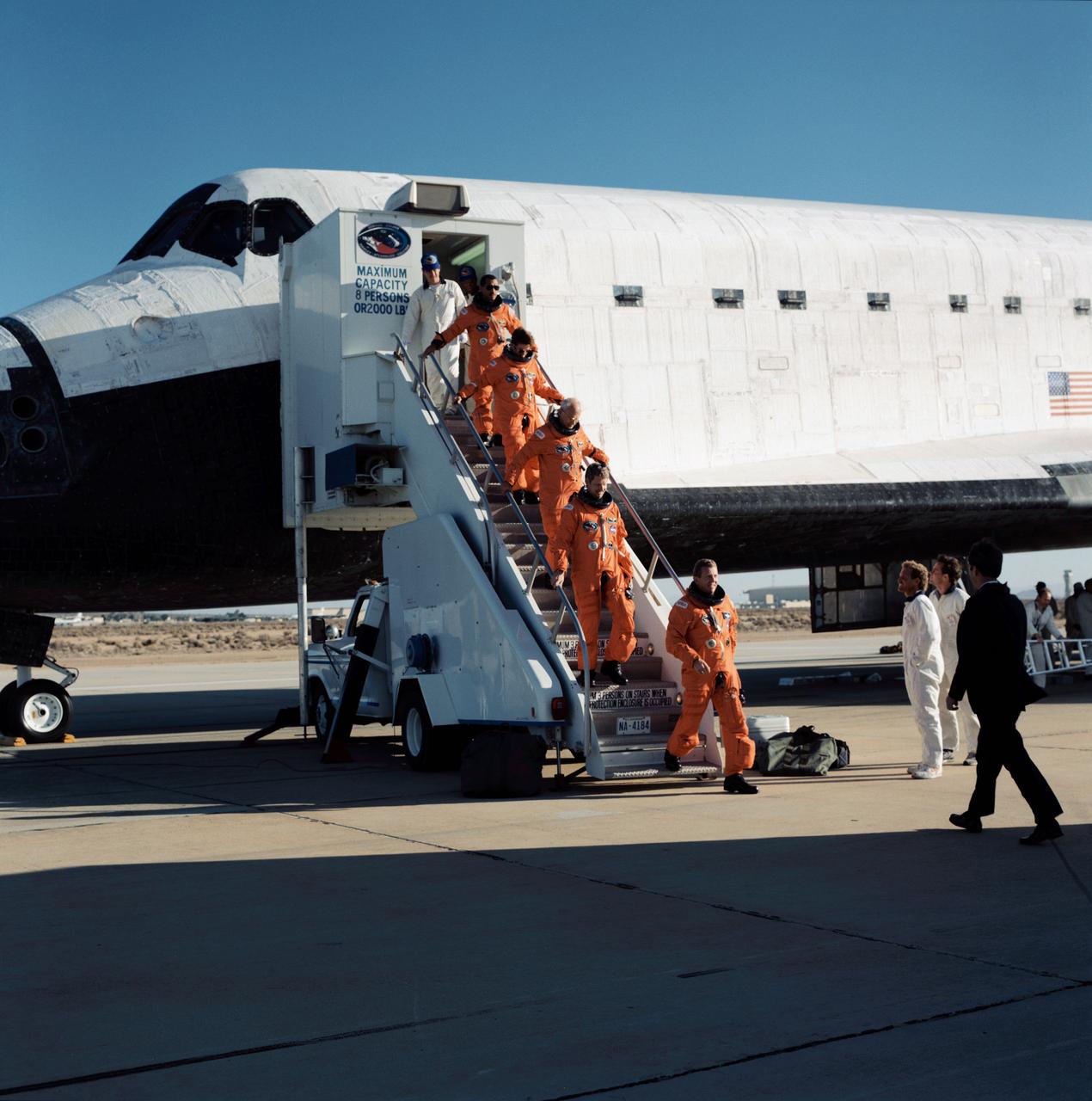
STS030-S-132 (8 May 1989) --- Crewmembers who spent just over four full days in space aboard Space Shuttle Atlantis egress their temporary home for a welcome meeting with terra firma. Pictured, from bottom of steps to top, are astronauts David M. Walker, Ronald J. Grabe, Norman E. Thagard, Mary L. Cleave and Mark C. Lee.  Minutes earlier, the spacecraft?s landing gear came to a stop at 12:44:33 P.M. (PDT), 8 May 1989.  It landed on runway 22, a concrete facility, like a number of other NASA flights.  Still others have landed on unpaved dry lakebed stripes.
STS-30 crew egresses OV-104 via stairway at Edwards Air Force Base (EAFB)
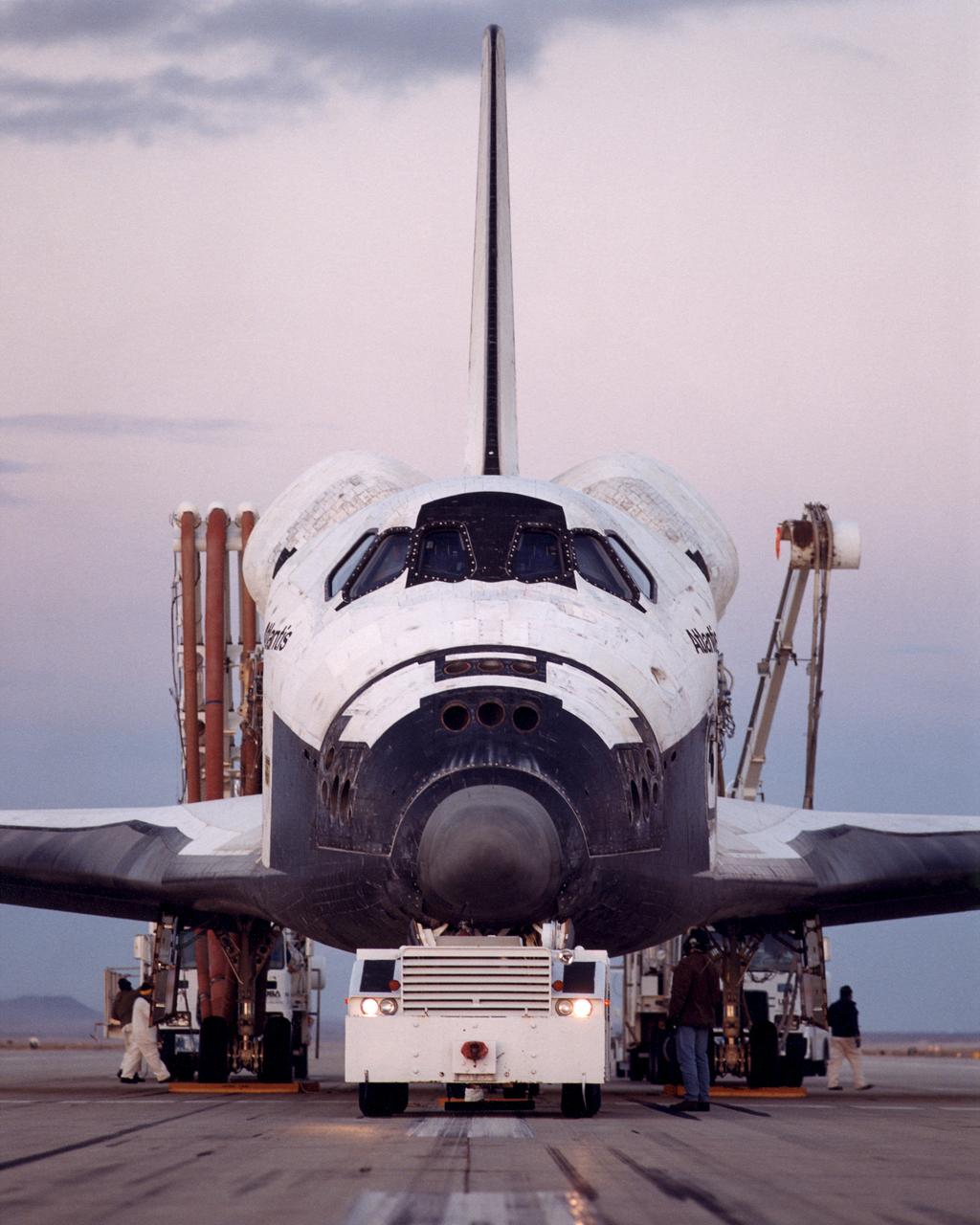
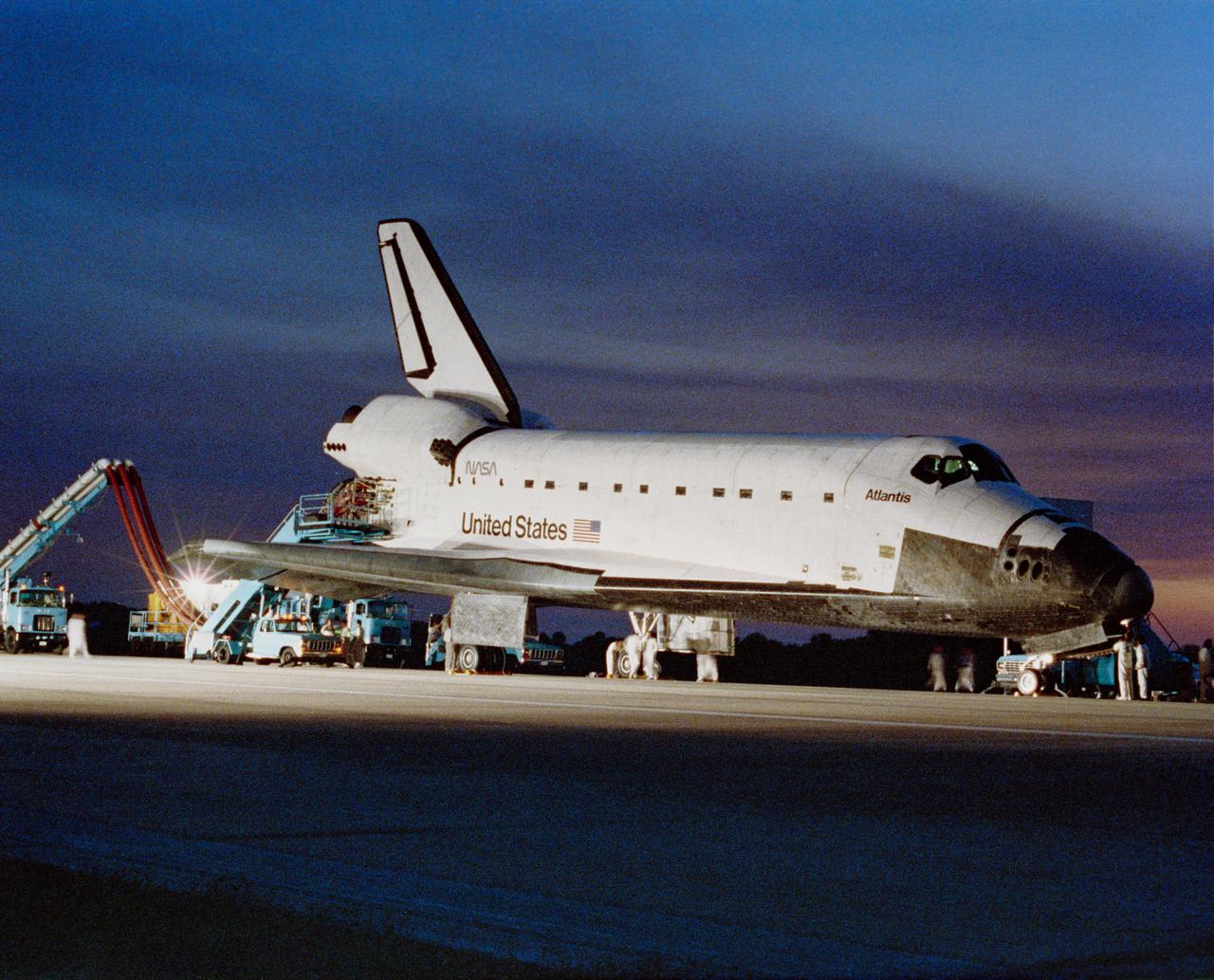
Spotlights illuminate Atlantis, Orbiter Vehicle (OV) 104, during safing operations at the Kennedy Space Center's (KSC's) Shuttle Landing Facility (SLF). OV-104 parked on runway 33 is serviced by KSC ground crews. STS-38, a Department of Defense (DOD)-devoted mission, came to an end (with complete wheel stop) at 4:43:37 pm (Eastern Standard Time (EST)).
STS-38 Atlantis, OV-104, during safing operations after KSC SLF landing
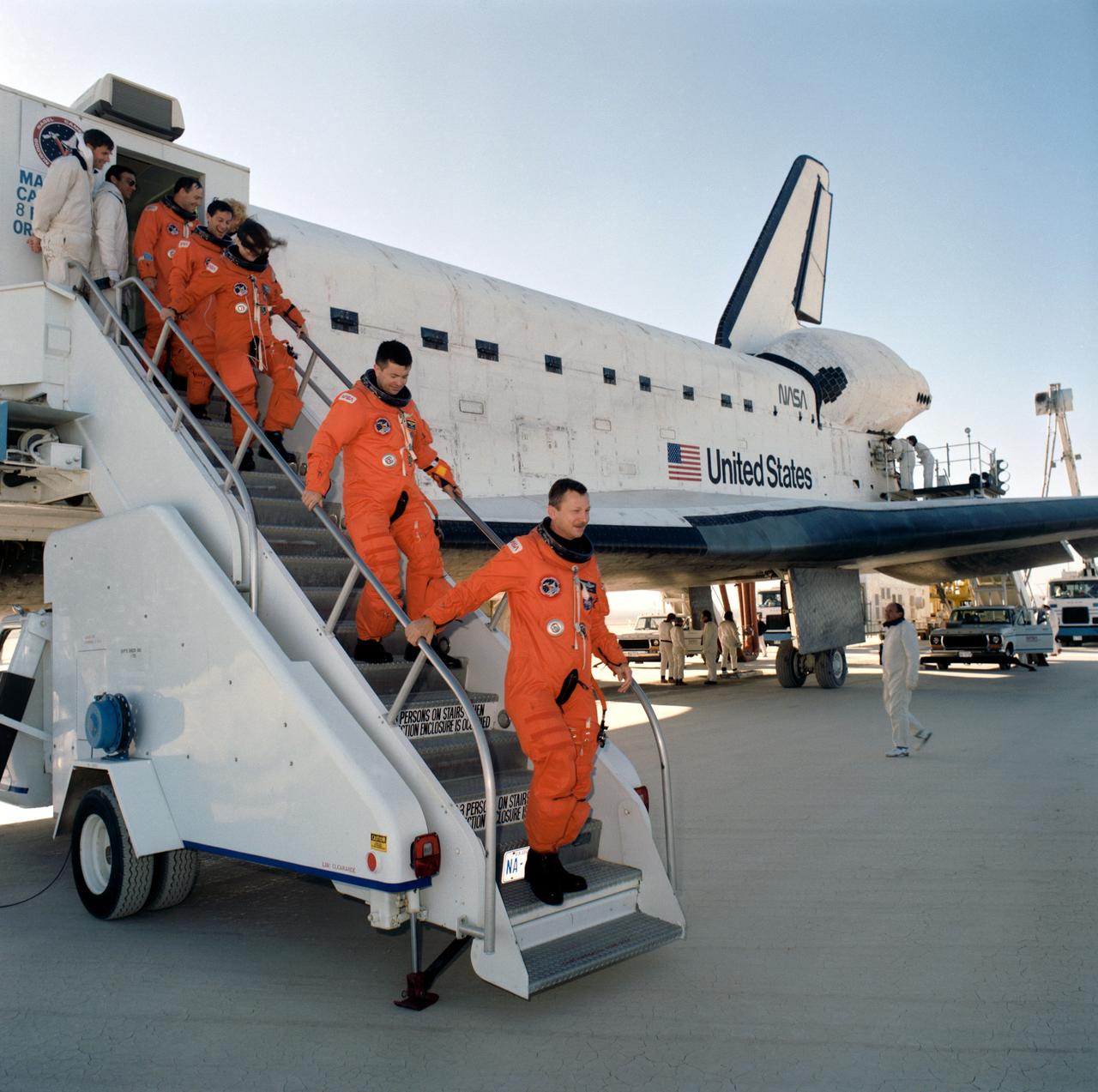
STS037-S-087 (11 April 1991) --- STS-37 crewmembers egress Atlantis via mobile stairway after landing on runway 33 dry lake bed at Edwards Air Force Base. Leading the  crewmembers down the stairway is mission commander Steven R. Nagel. He is followed by pilot Kenneth D. Cameron, Mission Specialists Linda M. Godwin, Jerome Apt and Jerry L. Ross.
STS-37 crewmembers egress OV-104 via stairway after landing at EAFB
STS054-S-100 (19 Jan 1993) --- The drag chute is fully deployed as the Space Shuttle Endeavour rolls toward wheelstop at KSC's Shuttle landing facility. Landing occurred at 8:38 a.m. (EST), Jan. 19, 1993.  Onboard for the six-day mission were astronauts John H. Casper, mission commander, Donald R. McMonagle, pilot, Gregory J. Harbaugh, Mario Runco Jr. and Susan J. Helms, mission specialists.
STS-54 Endeavour, Orbiter Vehicle (OV) 105, lands on runway 33 at KSC's SLF
STS054-S-101 (19 Jan 1993) --- The drag chute is just about to be released as the Space Shuttle Endeavour rolls toward wheelstop at KSC's Shuttle landing facility. Landing occurred at 8:38 a.m. (EST), Jan. 19, 1993.  Onboard for the six-day mission were astronauts John H. Casper, mission commander, Donald R. McMonagle, pilot, Gregory J. Harbaugh, Mario Runco Jr. and Susan J. Helms, mission specialists.
STS-54 Endeavour, Orbiter Vehicle (OV) 105, lands on runway 33 at KSC's SLF
STS054-S-098 (19 Jan 1993) --- This ground-level side view shows the Space Shuttle Endeavour during main landing gear touchdown at KSC's Shuttle Landing Facility to successfully complete a six day Earth-orbital mission.  Landing occurred at 8:38 a.m. (EST), Jan. 19, 1993.  Onboard were astronauts John H. Casper, mission commander; Donald R. McMonagle, pilot; Gregory J. Harbaugh, Mario Runco Jr. and Susan J. Helms, mission specialists.
STS-54 Endeavour, Orbiter Vehicle (OV) 105, lands on runway 33 at KSC's SLF
STS030-S-131 (8 May 1989) --- Crewmembers who spent just over four full days in space aboard Space Shuttle Atlantis egress their temporary home for a welcome meeting with terra firma. Astronaut David M. Walker, mission commander, shakes hands with Rear Admiral Richard H. Truly, acting NASA Administrator.  Astronaut Ronald J. Grabe (center frame), pilot, is greeted by Dale D. Myers, Deputy Administrator.  Pictured behind Grabe, from bottom of steps to top, are astronauts Norman E. Thagard, Mary L. Cleave and Mark C. Lee, all mission specialists.  Minutes earlier, the spacecraft?s landing gear came to a stop at 12:44:33 P.M. (PDT), 8 May 1989.  It landed on runway 22, a concrete facility, like a number of other NASA flights.  Still others have landed on unpaved dry lakebed stripes.
STS-30 crew egressing OV-104 is greeted by NASA administrators at EAFB
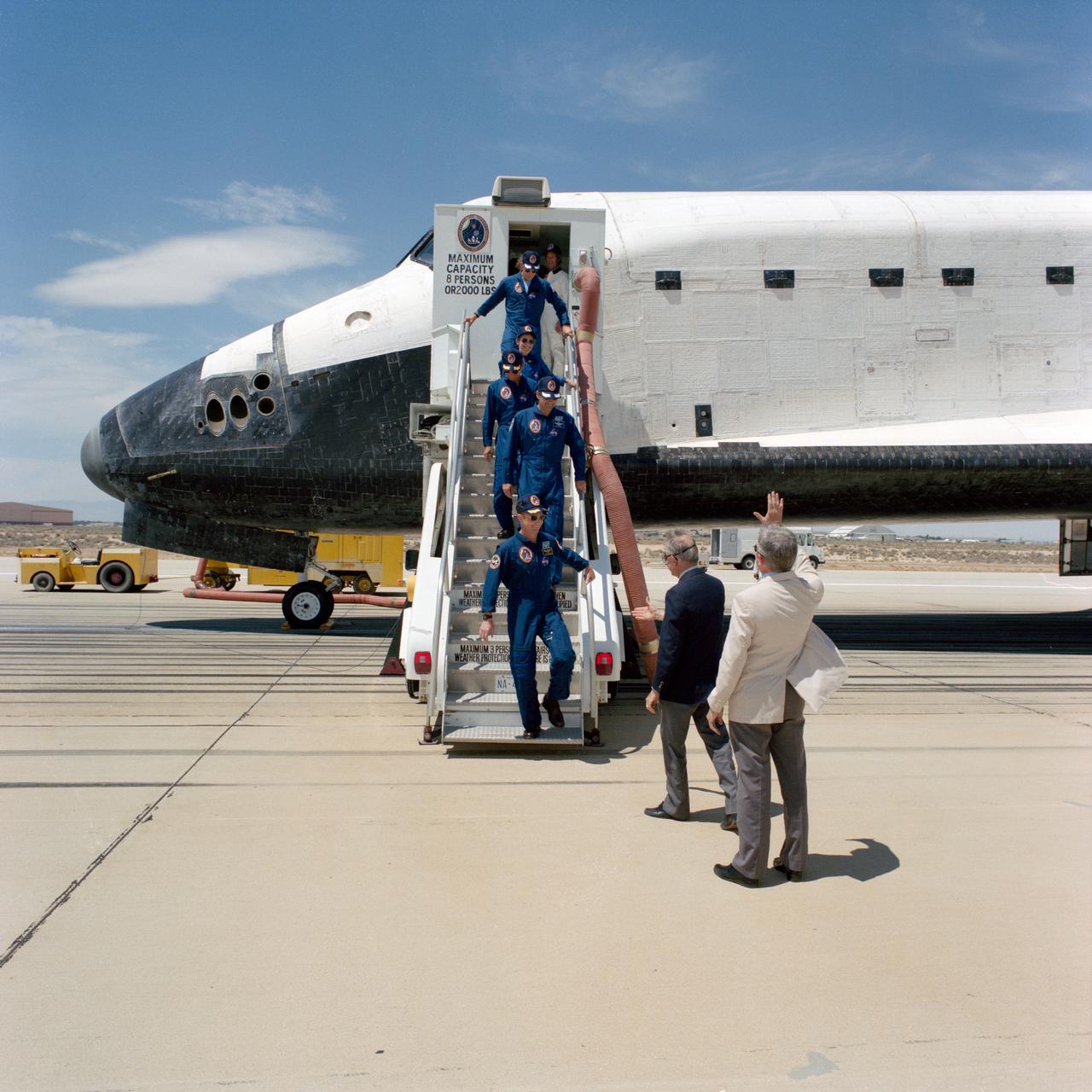
STS030-S-137 (8 May 1989) --- Crewmembers who spent four full days in space aboard Space Shuttle Atlantis egress their temporary home for a welcome meeting with terra firma. Pictured, from bottom of steps to top, are Astronauts David M.Walker, Ronald J. Grabe, Norman E. Thagard, Mary L. Cleave and Mark C. Lee. Rear Admiral Richard H. Truly (foreground), acting NASA Administrator, and Dale D. Myers, Deputy Administrator of NASA, await to greet the crewmembers.  Minutes earlier, the spacecraft's landing gear came to a stop at 12:44:33 p.m. (PDT), 8 May 1989.  It landed on Runway 22, a concrete facility, like a number of other NASA flights.  Still others have landed on unpaved dry lake bed strips.
STS-30 crew egresses OV-104 via stairway at Edwards Air Force Base (EAFB)
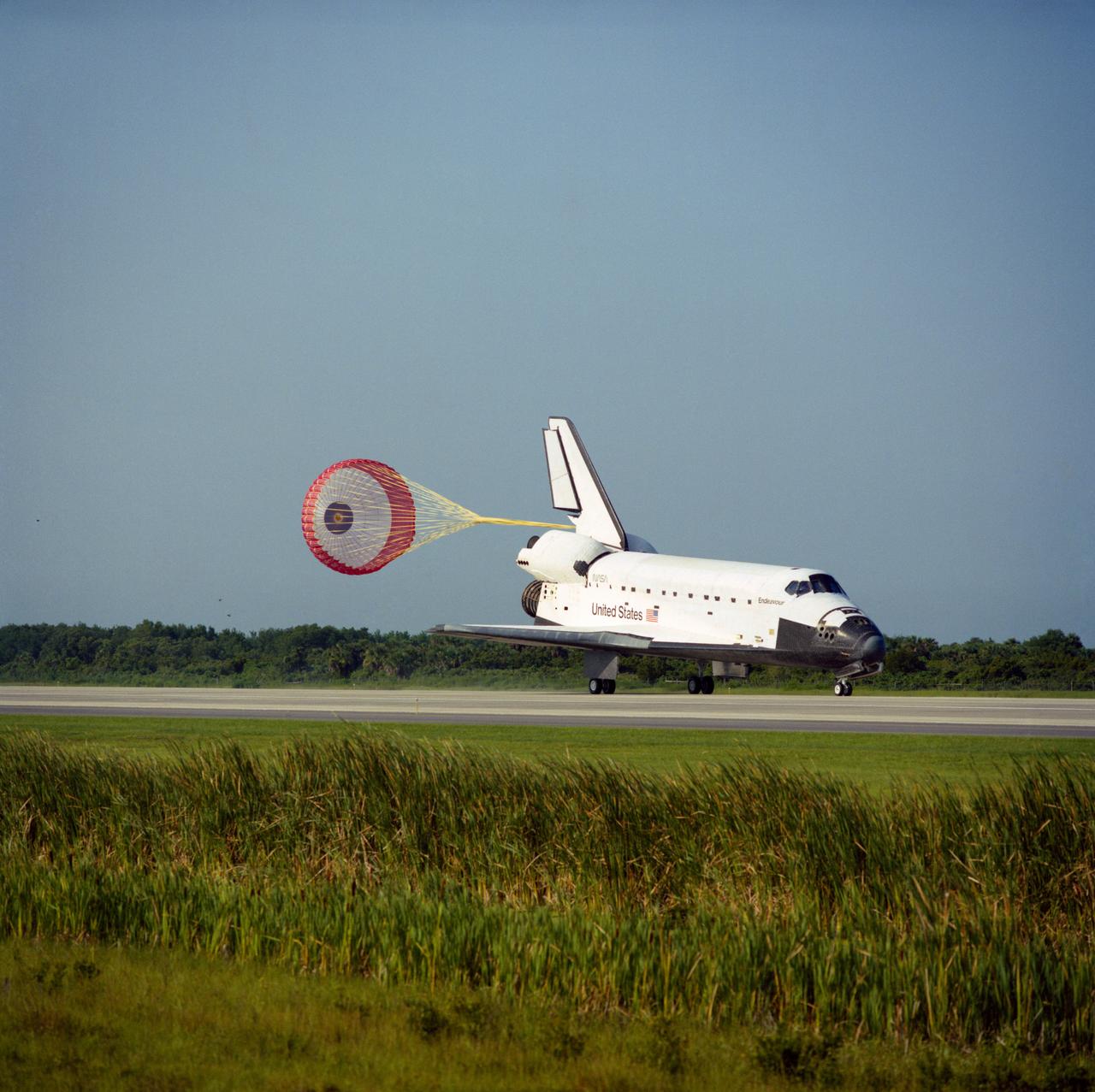
Space Shuttle Endeavour's drag chute deploys as it rolls down Runway 04-L at Edwards AFB moments after landing on Nov. 30, 2008.
Space Shuttle Endeavour's drag chute deploys as it rolls down Runway 04-L at Edwards AFB moments after landing on Nov. 30, 2008
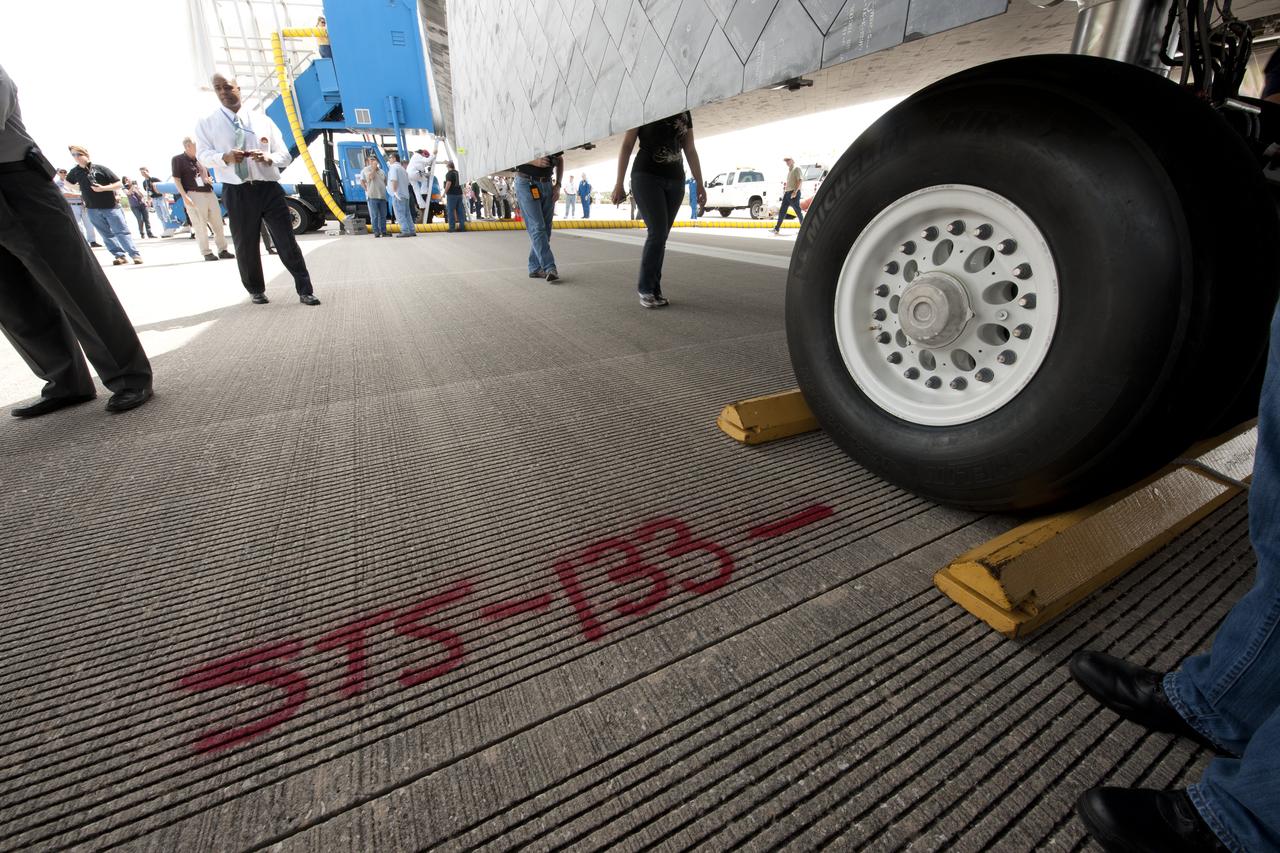
The runway of the Shuttle Landing Facility (SLF) is marked to show where the wheels stopped for the space shuttle Discovery (STS-133) shortly after it landed, Wednesday, March 9, 2011, at Kennedy Space Center in Cape Canaveral, Fla., completing its 39th and final flight.  Since 1984, Discovery flew 39 missions, spent 365 days in space, orbited Earth 5,830 times and traveled 148,221,675 miles.  Photo credit: (NASA/Bill Ingalls)
Discovery STS-133 Mission Landing
51B-S-071 (6 May 1985) --- The Space Shuttle Challenger lands on Runway 17 at Edwards Air Force Base to complete a week in space for its seven-member crew and a variety of payload.  The vehicle stopped at 9:12:05 a.m. (PDT), May 6, 1985.  Onboard were astronauts Robert F. Overmyer, Frederick D. Gregory, Don L. Lind, Norman E. Thagard and William E. Thornton of National Aeronautics and Space Administration (NASA); and payload specialists Lodewijk van den Berg and Taylor G. Wang.
Shuttle Challenger landing on Runway 17 at Edwards at end of 51-B mission
STS-32 Columbia, Orbiter Vehicle (OV) 102, is captured as its main landing gear (MLG) touches down on runway 22 at Edwards Air Force Base (EAFB), California, in the early morning darkness. The night landing ended a record 11-day mission in space. Moments later, at 1:36:38 am Pacific Standard Time (PST), OV-102 came to a complete stop, having logged 4,509,972 miles in flight.
STS-32 Columbia, OV-102, makes night landing on runway 22 at EAFB, California
STS-32 Columbia, Orbiter Vehicle (OV) 102, is captured as its main landing gear (MLG) touches down on runway 22 at Edwards Air Force Base (EAFB), California, in the early morning darkness. The night landing ended a record 11-day mission in space. Moments later, at 1:36:38 am Pacific Standard Time (PST), OV-102 came to a complete stop, having logged 4,509,972 miles in flight.
STS-32 Columbia, OV-102, makes night landing on runway 22 at EAFB, California
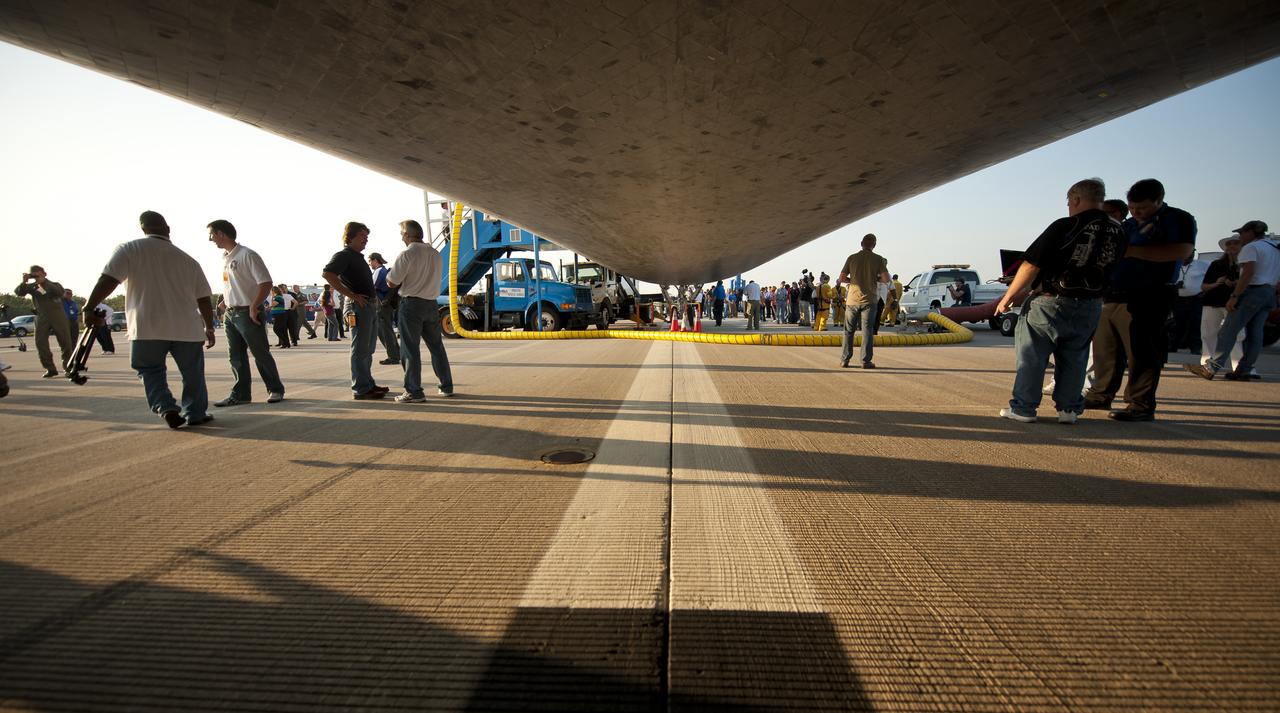
A view looking forward underneath the space shuttle Atlantis on the Shuttle Landing Facility (SLF) runway at NASA Kennedy Space Center shortly after it landed with the STS-135 crew, completing its 13-day mission to the International Space Station (ISS) and the final flight of the Space Shuttle Program, early Thursday morning, July 21, 2011, in Cape Canaveral, Fla. Overall, Atlantis spent 307 days in space and traveled nearly 126 million miles during its 33 flights. Atlantis, the fourth orbiter built, launched on its first mission on Oct. 3, 1985. Photo Credit: (NASA/Bill Ingalls)
STS-135 Atlantis Landing
STS081-S-010 (22 Jan. 1997) --- A drag chute is deployed as the Space Shuttle Atlantis rolls toward a wheels stopped mode on Runway 33 at the Kennedy Space Center (KSC) to conclude the fifth Shuttle-Mir docking mission.  Coming to a halt at 9:22:44 a.m. (EST), January 22, the mission also accomplished the return of astronaut John E. Blaha, cosmonaut guest researcher, who had been aboard Russia's Mir Space Station complex since mid September 1996.  Blaha was replaced by Jerry M. Linenger during the five days of joint activities of the Mir-22 and STS-81 crew members while Atlantis and Mir were docked in Earth-orbit.  At main gear touchdown, the mission's duration was 10 days, 4 hours and 55 minutes.  This was the 34th space shuttle landing at KSC.  The crew aboard at landing included astronauts Michael A. Baker, commander; Brent W. Jett, Jr., pilot; Blaha; and mission specialists Marsha S. Ivins, Peter J. K. (Jeff) Wisoff and John M. Grunsfeld.
The landing of STS-81 Atlantis, OV-104, on a runway at KSC's SLF
STS081-S-008 (22 Jan. 1997) --- The Space Shuttle Atlantis touches down on Runway 33 at the Kennedy Space Center (KSC) to conclude the fifth Shuttle-Mir docking mission.  Coming to a halt at 9:22:44 a.m. (EST), January 22, the mission also accomplished the return of astronaut John E. Blaha, cosmonaut guest researcher, who had been aboard Russia's Mir Space Station complex since mid September 1996. Blaha was replaced by Jerry M. Linenger during the five days of joint activities of the Mir-22 and STS-81 crewmembers while Atlantis and Mir were docked in Earth-orbit. At main gear touchdown, the mission's duration was 10 days, 4 hours and 55 minutes. This was the 34th space shuttle landing at KSC.  The crew aboard at landing included astronauts Michael A. Baker, commander; Brent W. Jett, Jr., pilot; Blaha; and mission specialists Marsha S. Ivins, Peter J. K. (Jeff) Wisoff and John M. Grunsfeld.
The landing of STS-81 Atlantis, OV-104, on a runway at KSC's SLF
STS049-S-269 (16 May 1992) --- The seven crewmembers of STS-49 pose near Endeavour for a post-flight shot soon after getting their feet on terra firma following nine days in Earth orbit.  Left to right are astronauts Richard J.  Hieb, Kevin P. Chilton, Daniel C. Brandenstein, Thomas D. Akers, Pierre J. Thuot, Kathryn C. Thornton and Bruce E. Melnick.  Brandenstein was mission commander; Chilton, pilot; and the others, mission specialists.
STS-49 crew poses for group portrait on EAFB runway 22 after OV-105 landing
STS040-S-174 (14 June 1991) --- The Space Shuttle Columbia is only moments away from touchdown on Runway 22 at Edwards Air Force Base in California.  The landing completes a successful nine-day Spacelab Life Sciences (SLS-1) mission, the first ever devoted exclusively to life sciences research.  Onboard the spacecraft were astronauts Bryan D. O'Connor, Sidney M. Gutierrez, Rhea Seddon, James P. Bagian and Tamara E. Jernigan; and payload specialists F. Drew Gaffney and Millie Hughes-Fulford.  Landing occurred at 8:39:11 a.m. (PDT), June 14, 1991.
STS-40 Columbia, OV-102, glides towards a landing on runway 22 at EAFB, Calif
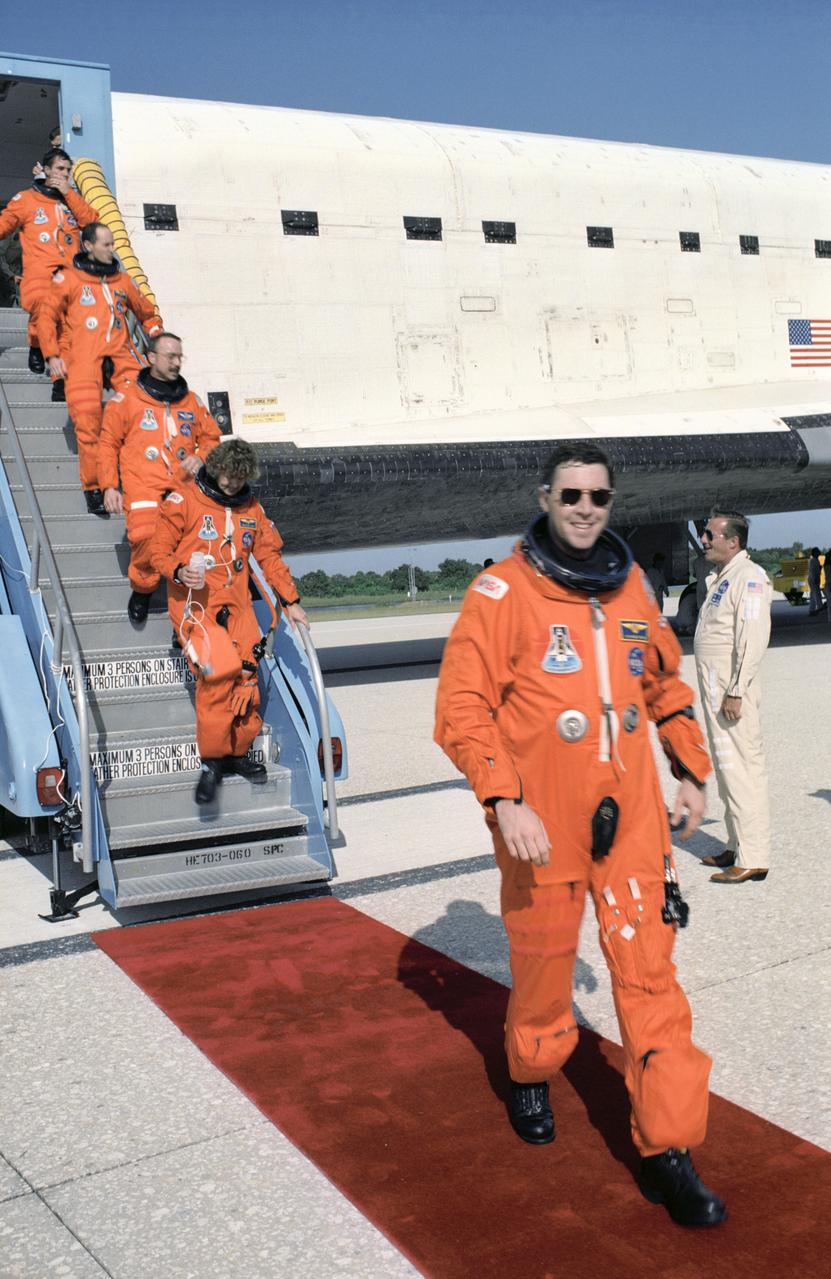
STS043-S-145 (11 Aug 1991) --- STS-43 crewmembers, wearing launch and entry suits (LESs), egress Atlantis, Orbiter Vehicle (OV) 104, via mobile stairway after landing on runway 15 at the Kennedy Space Center (KSC) Shuttle Landing Facility (SLF). Leading the crew and the first to step onto the red carpet is Pilot Michael A. Baker. He is followed by Mission Specialist (MS) Shannon W. Lucid, MS James C. Adamson, MS G. David Low, and Commander John E. Blaha. OV-104's fuselage is visible in the background.
STS-43 crewmembers egress Atlantis, OV-104, after landing at KSC runway 15
STS030-S-128 (8 May 1989) --- Space Shuttle Atlantis? landing gear has just appeared and the spacecraft, with five astronaut crewmembers aboard, heads for a smooth landing on runway 22 at Edwards Air Force Base in southern California.  Onboard the spacecraft were astronauts David M. Walker, Ronald J. Grabe, Norman E. Thagard, Mary L. Cleave and Mark C. Lee.  The crew spend just over four full days in space, having released the Magellan spacecraft toward Venus on the first day.
STS-30 Atlantis, OV-104, landing approach to runway 22 at EAFB, California
STS040-S-175 (14 June 1991) --- The main landing gear of the Space Shuttle Columbia touches down, on Runway 22 at Edwards Air Force Base in California, to complete a successful nine-day mission.  The Spacelab Life Sciences (SLS-1) mission was the first ever devoted exclusively to life sciences research.  Onboard the spacecraft were astronauts Bryan D. O'Connor, Sidney M. Gutierrez, Rhea Seddon, James P. Bagian and Tamara E. Jernigan; and payload specialists F. Drew Gaffney and Millie Hughes-Fulford.  Landing occurred at 8:39:11 a.m. (PDT), June 14, 1991.
STS-40 Columbia, OV-102, lands on concrete runway 22 at EAFB, California
STS040-S-176 (14 June 1991) --- The main landing gear of the Space Shuttle Columbia touches down, on Runway 22 at Edwards Air Force Base in California, to complete a successful nine-day mission.  The Spacelab Life Sciences (SLS-1) mission was the first ever devoted exclusively to life sciences research.  Onboard the spacecraft were astronauts Bryan D. O'Connor, Sidney M. Gutierrez, Rhea Seddon, James P. Bagian and Tamara E. Jernigan; and payload specialists F. Drew Gaffney and Millie Hughes-Fulford.  Landing occurred at 8:39:11 a.m.  (PDT), June 14, 1991.
STS-40 Columbia, OV-102, lands on concrete runway 22 at EAFB, California
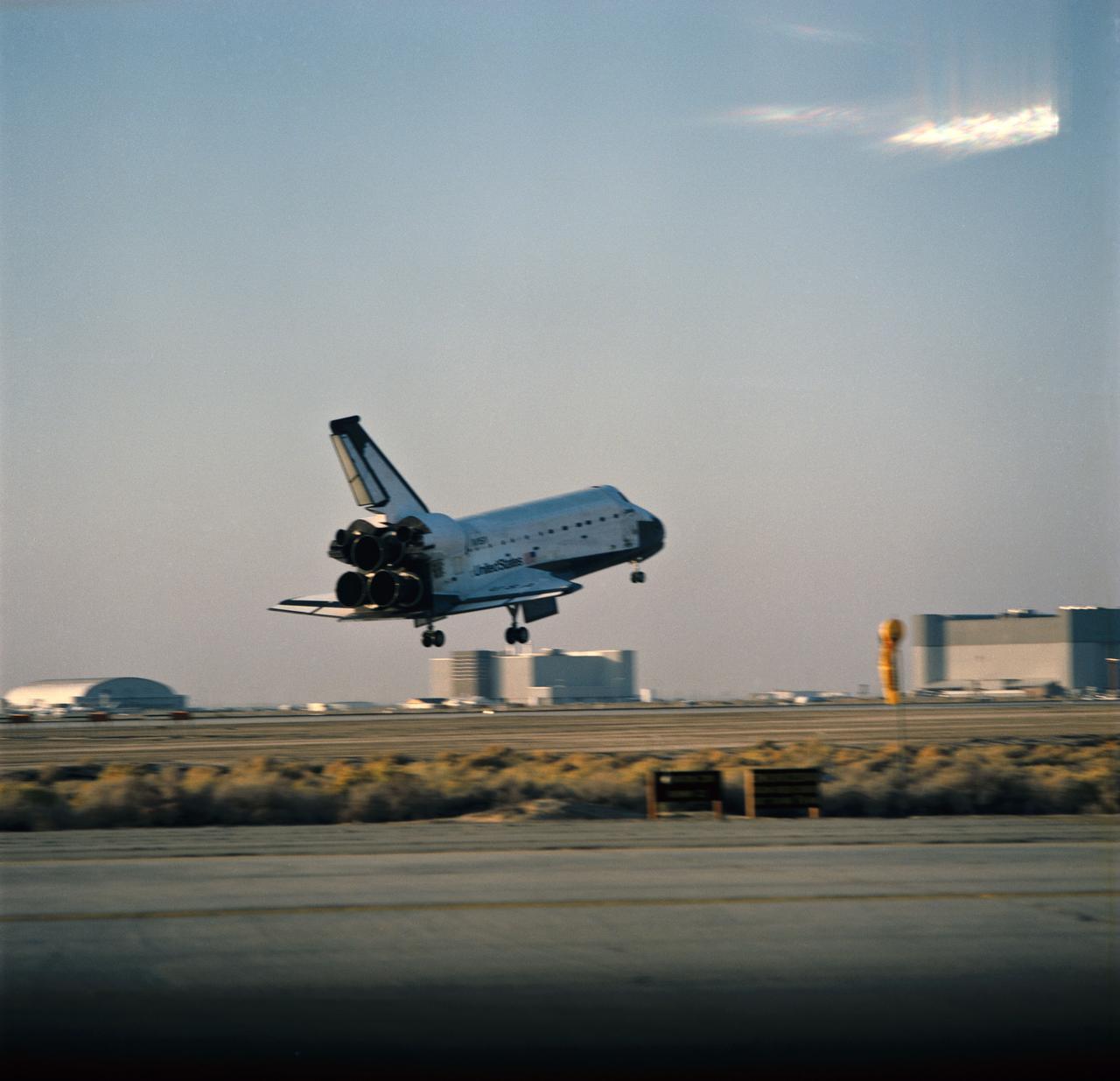
STS029-S-064 (18 Mar 1989) --- A rear view photographed from the ground just after Discovery's main landing gear touches down on Runway 22 at Edwards Air Force Base in California following a successful five-day mission in Earth orbit.  Onboard the spacecraft were Astronauts Michael L. Coats, John E. Blaha, James F. Buchli, Robert C. Springer and James P. Bagian.  Wheels came to a stop at 6:36:40 a.m. (PST), March 18, 1989.
STS-29 Discovery, OV-103, lands on Edwards AFB concrete runway 22
STS030-S-124 (8 May 1989) --- Its landing gear fully deployed, Space Shuttle Atlantis is lined up for its approach to Runway 22 at Edwards Air Force Base in southern California.  Minutes later, at 12:44:33 (PDT), the spacecraft's wheels had come to a complete stop, marking the successful conclusion for the four-day STS-30 mission. Onboard were astronauts David M. Walker, Ronald J. Grabe, Norman E. Thagard, Mary L. Cleave and Mark C. Lee.
STS-30 Atlantis, OV-104, landing approach to runway 22 at EAFB, California
STS031-S-130 (29 April 1990) --- The astronauts of STS-31 pose for a quick photo near the Space Shuttle Discovery following a smooth landing on the runway at Edwards Air Force Base to complete a highly successful five-day mission.  Pictured, left to right, are Astronauts Steven A. Hawley, Charles F. Bolden Jr., Kathryn D. Sullivan, Loren J. Shriver, and Bruce McCandless II.  Theirs was an Earth orbital flight during which the Hubble Space Telescope (HST) was sent toward its 15-year mission.
STS-31 crew poses on EAFB concrete runway after egressing OV-103
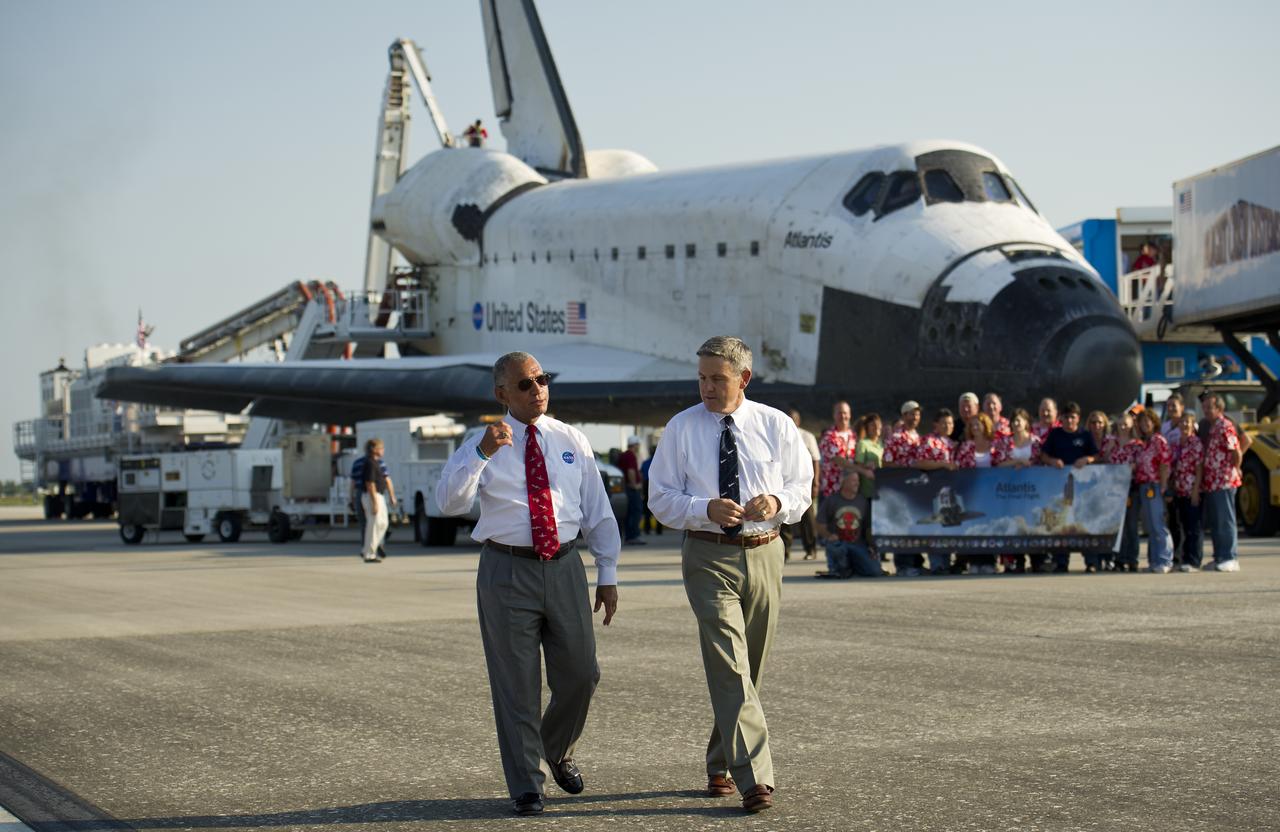
NASA Administrator Charles Bolden, left, and NASA Kennedy Space center Director Robert Cabana walk along the Shuttle Landing Facility (SLF) runway at NASA Kennedy Space Center shortly after the space shuttle Atlantis (STS-135) landed, completing its 13-day mission to the International Space Station (ISS) and the final flight of the Space Shuttle Program, early Thursday morning, July 21, 2011, in Cape Canaveral, Fla. Overall, Atlantis spent 307 days in space and traveled nearly 126 million miles during its 33 flights. Atlantis, the fourth orbiter built, launched on its first mission on Oct. 3, 1985. Photo Credit: (NASA/Bill Ingalls)
STS-135 Atlantis Landing
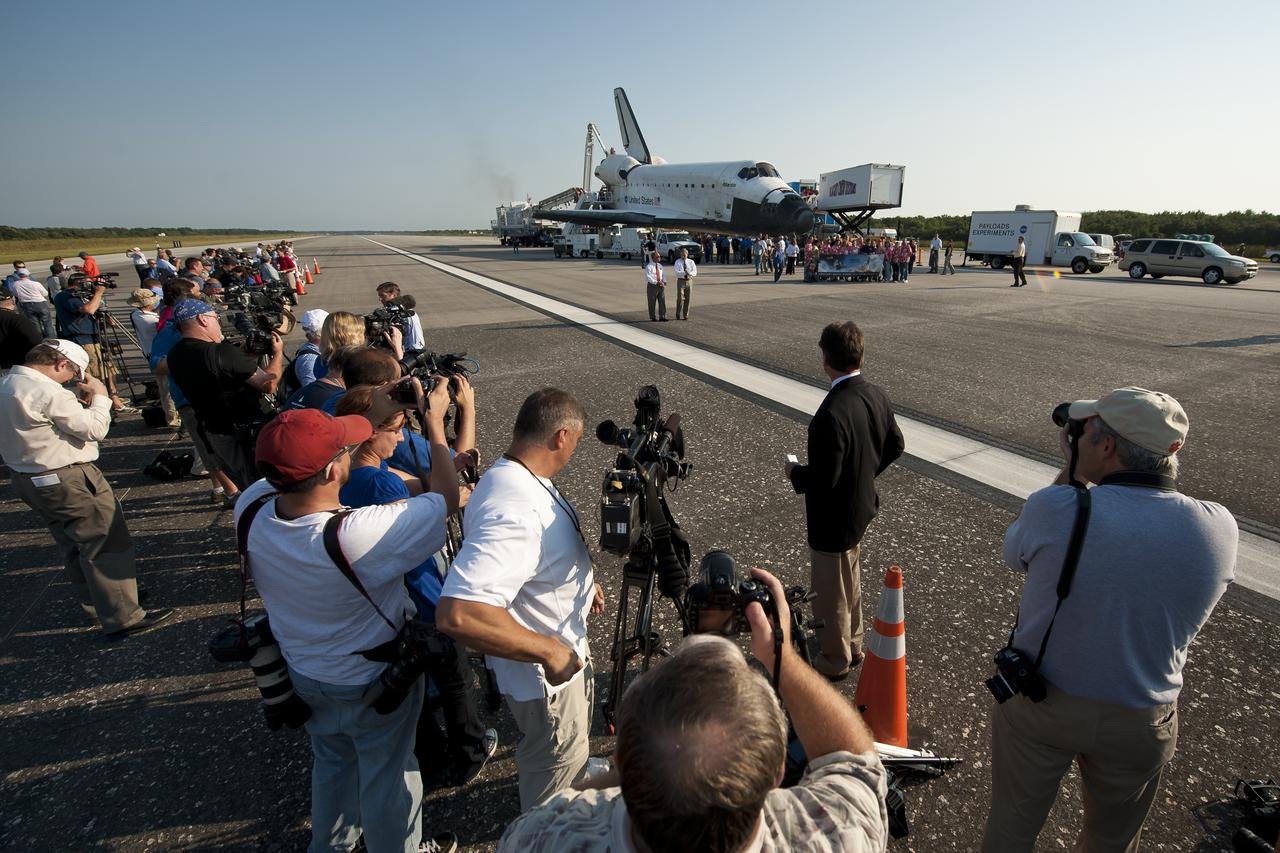
NASA Administrator Charles Bolden, left, and NASA Kennedy Space center Director Robert Cabana walk along the Shuttle Landing Facility (SLF) runway at NASA Kennedy Space Center as members of teh media prepare to ask them questions shortly after the space shuttle Atlantis (STS-135) landed, completing its 13-day mission to the International Space Station (ISS) and the final flight of the Space Shuttle Program, early Thursday morning, July 21, 2011, in Cape Canaveral, Fla. Overall, Atlantis spent 307 days in space and traveled nearly 126 million miles during its 33 flights. Atlantis, the fourth orbiter built, launched on its first mission on Oct. 3, 1985. Photo Credit: (NASA/Bill Ingalls)
STS-135 Atlantis Landing
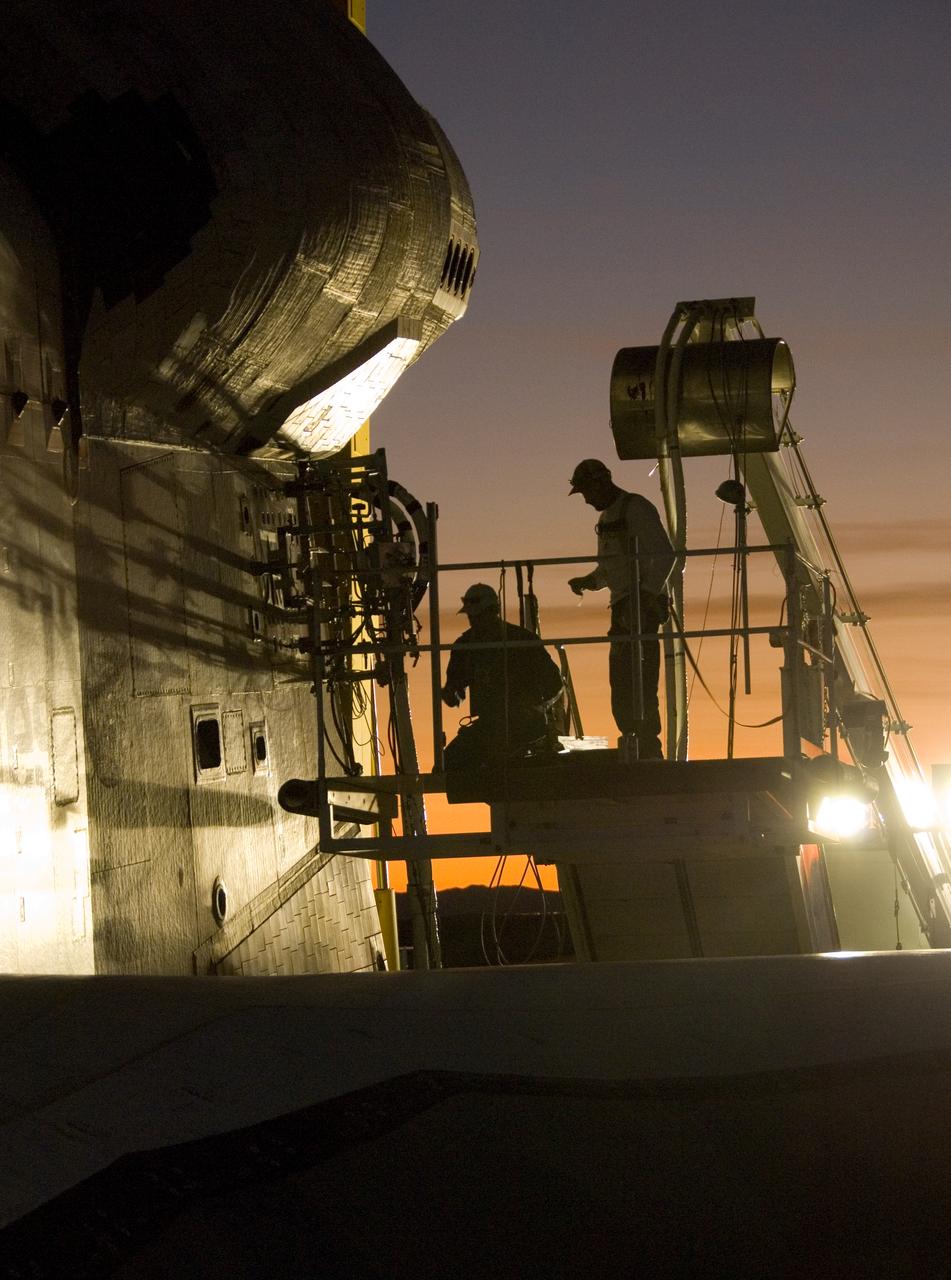
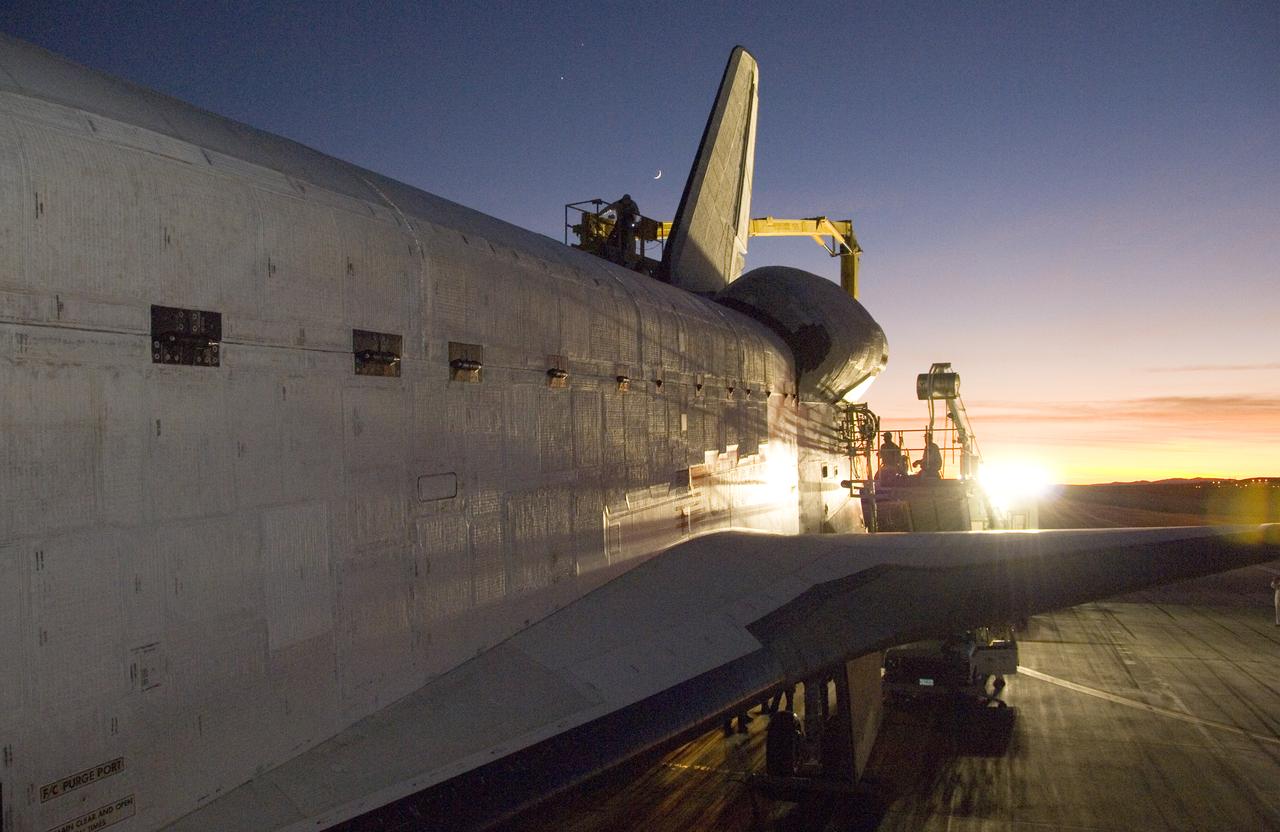
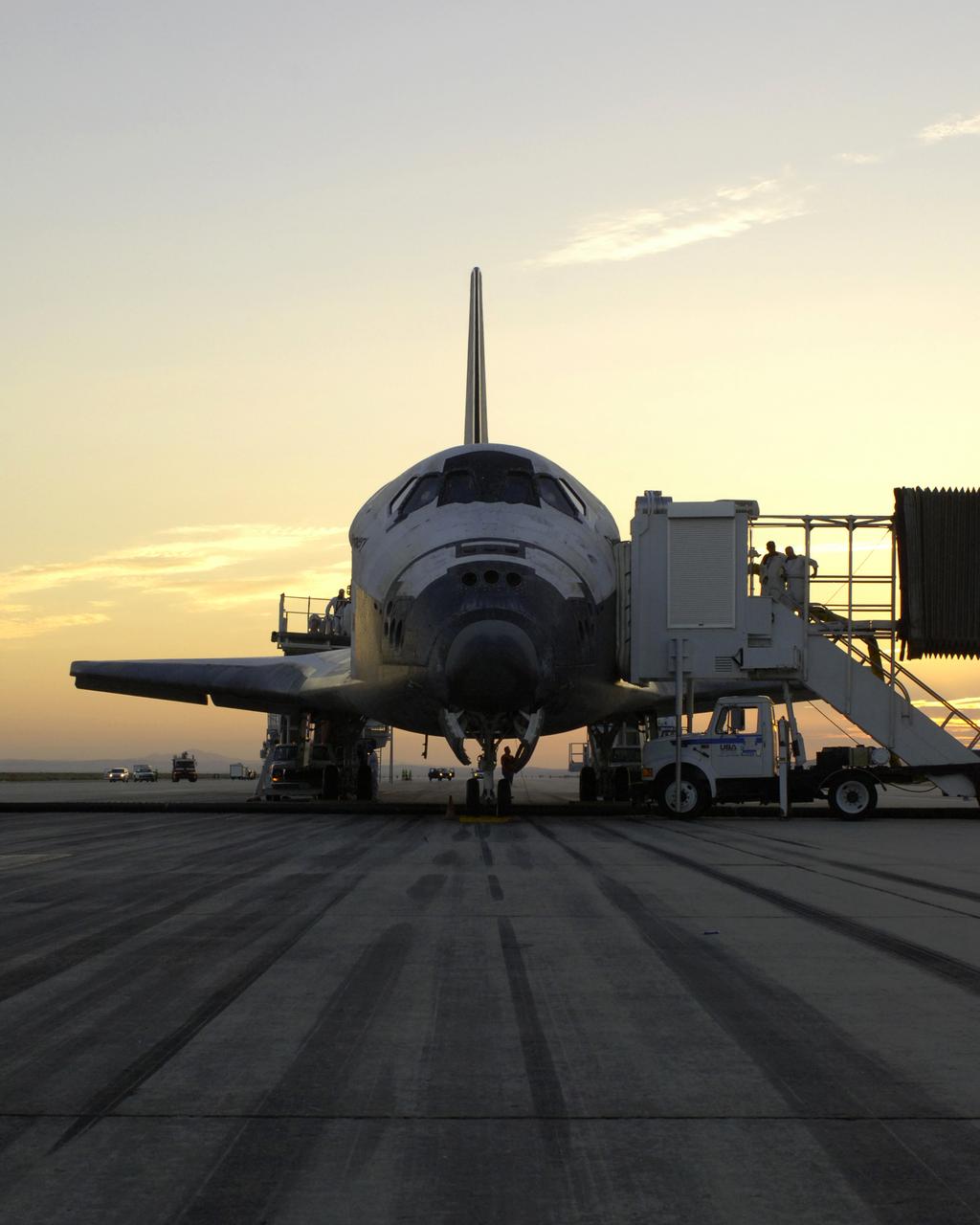
As dusk settles over Edwards Air Force Base, NASA technicians hook up various ground-support systems before shuttle Endeavour is towed off the landing runway.
As dusk settles over Edwards Air Force Base, NASA technicians hook up various ground-support systems before shuttle Endeavour is towed off the landing runway
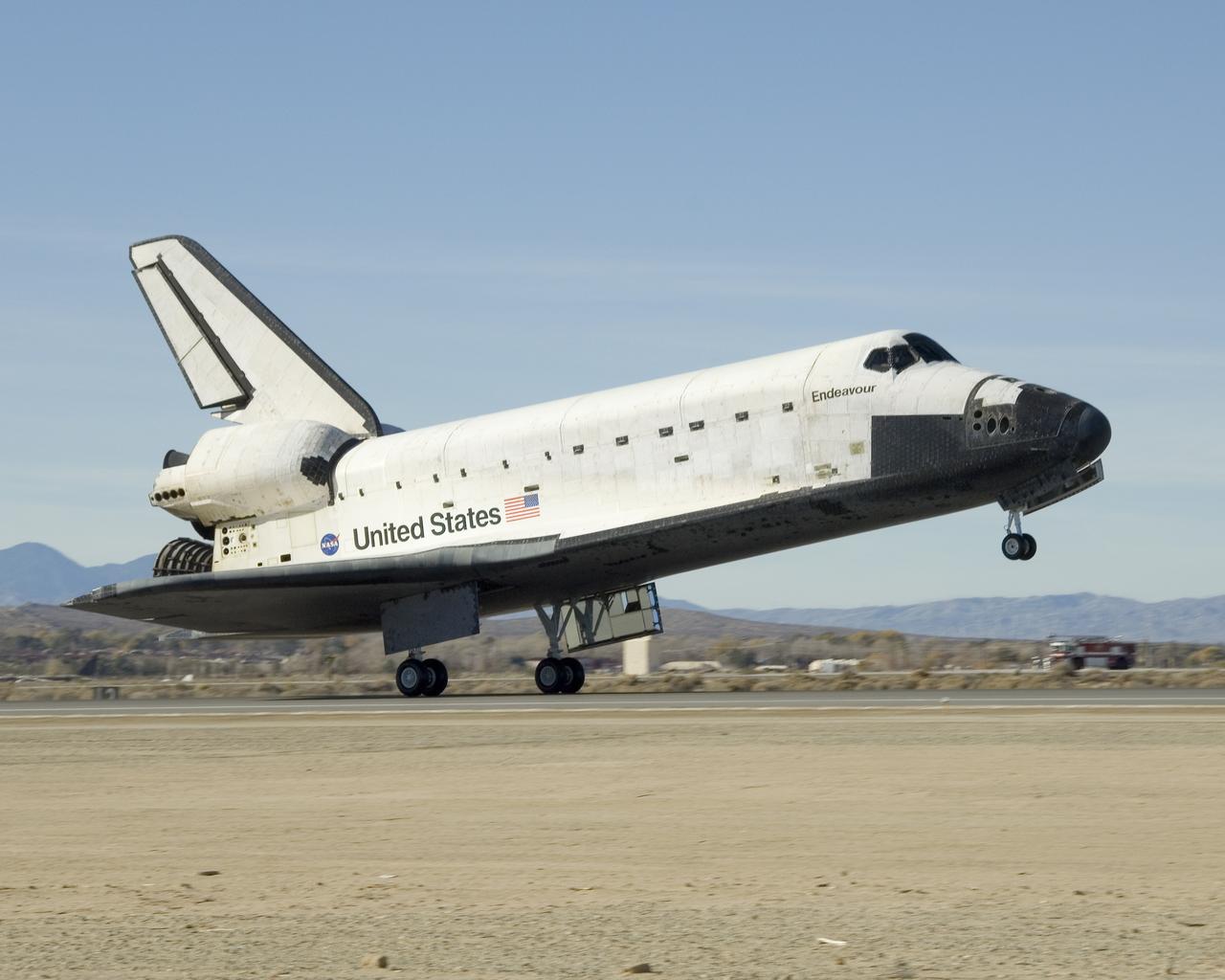
Space Shuttle Endeavour rolls out after landing on runway 04-L at Edwards Air Force Base, ending mission STS-126 to the International Space Station Nov. 30, 2008.
Space Shuttle Endeavour rolls out after landing on runway 04-L at Edwards AFB, ending mission STS-126 to the International Space Station Nov. 30, 2008
The setting sun casts long shadows over shuttle Endeavour as technicians prepare to tow the orbiter from the Edwards Air Force Base runway after landing Nov. 30.
he setting sun casts long shadows over shuttle Endeavour as technicians prepare to tow the orbiter from the Edwards AFB runway after landing Nov. 30
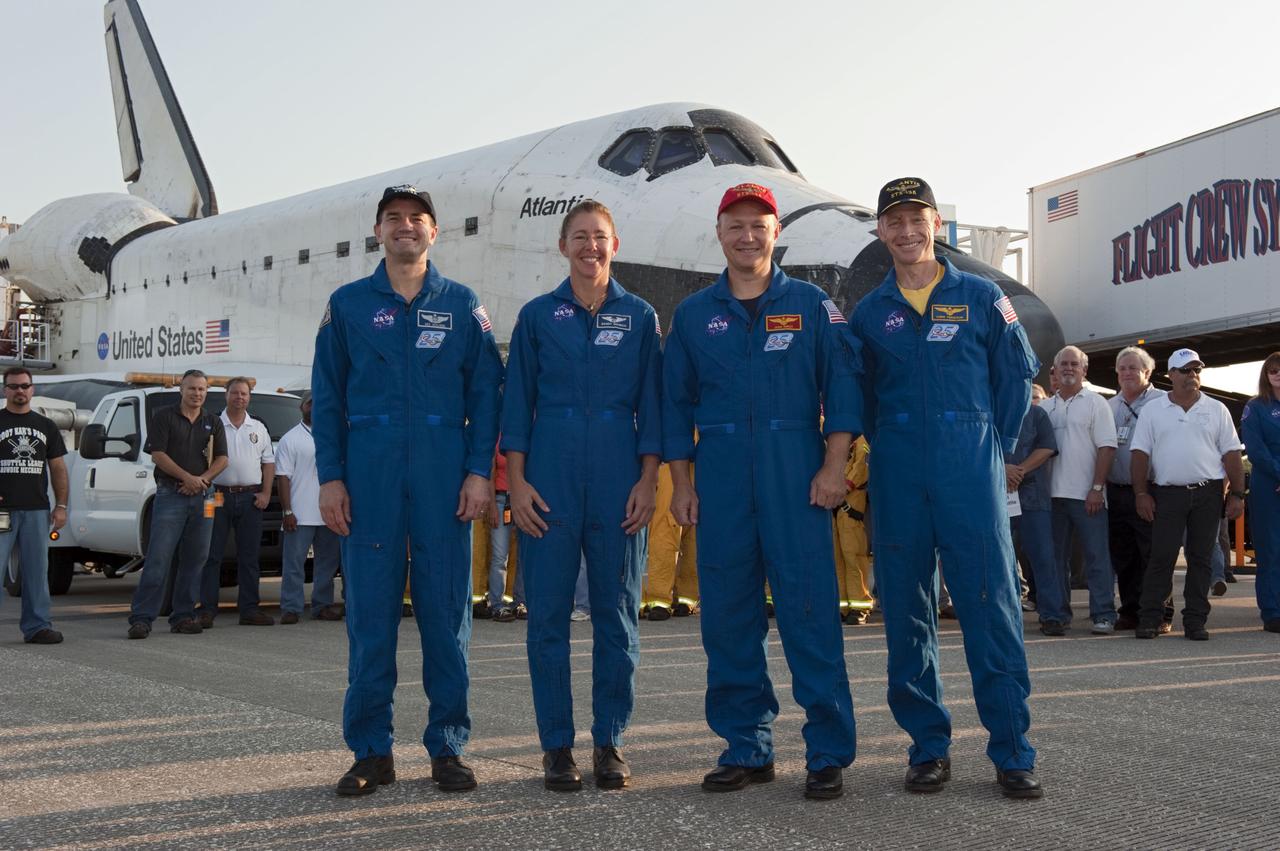
STS135-S-214 (21 July 2011) --- The final four astronauts of NASA's Space Shuttle Program stand proudly in front of space shuttle Atlantis, the remarkable spacecraft that took them on the STS-135 mission to the International Space Station. From right, are NASA astronauts Chris Ferguson, commander; Doug Hurley, pilot; Sandy Magnus and Rex Walheim, both mission specialists. The crew returned to Earth on the Shuttle Landing Facility's Runway 15 at NASA's Kennedy Space Center in Florida at 5:57 a.m. (EDT) on July 21, 2011. Atlantis' final return from space completed a 13-day, 5.2-million-mile journey to the International Space Station. STS-135 delivered spare parts, equipment and supplies in the Raffaello multi-purpose logistics module that will sustain station operations for the next year. STS-135 was the 33rd and final flight for Atlantis, which has spent 307 days in space, orbited Earth 4,848 times and traveled 125,935,769 miles.
STS-135 Crew on Runway after the Final Landing of Atlantis
STS057-S-082 (1 July 1993) --- The drag chute on the Space Shuttle Endeavour is fully deployed in this scene on Runway 33 (KSC's Shuttle Landing Facility) as the spacecraft successfully completes a ten-day mission in Earth orbit.  Official mission duration was nine days, twenty-three hours, forty-four minutes and fifty-five seconds.  Main gear touchdown occurred at 8:52:16 (EDT), July 1, 1993.  Onboard Endeavour for the landing were six NASA astronauts and the European Retrievable Carrier (EURECA) spacecraft.  Crewmembers were astronauts Ronald J. Grabe, Brian Duffy, G. David Low, Nancy J. Sherlock, Peter J. K. (Jeff) Wisoff and Janice E. Voss.
STS-57 Endeavour, OV-105, with drag chute deployed lands on KSC SLF runway 33
STS042-S-094 (30 Jan 1992) --- Space Shuttle Discovery lands on Runway 22 at Edwards Air Force Base in southern California to complete an eight-day mission.  Main gear touchdown occurred at 8:07:18 a.m. (PST), Jan. 30, 1992.  The crewmembers aboard Discovery for the first International Microgravity Laboratory (IML-1) mission were astronauts Ronald J. Grabe, mission commander;  Stephen S. Oswald, pilot;  Norman E. Thagard, payload commander;  and David C. Hilmers and William F. Readdy, both mission specialists;  and payload specialists Roberta L. Bondar of Canada and Ulf Merbold, representing the European Space Agency (ESA).
STS-42 Discovery, Orbiter Vehicle (OV) 103, lands on runway 22 at EAFB, Calif
Space Shuttle Atlantis landed at 12:33 p.m. February 20, 2001, on the runway at Edwards Air Force Base, California, where NASA's Dryden Flight Research Center is located. The mission, which began February 7, logged 5.3 million miles as the shuttle orbited earth while delivering the Destiny science laboratory to the International Space Station. Inclement weather conditions in Florida prompted the decision to land Atlantis at Edwards. The last time a space shuttle landed at Edwards was Oct. 24, 2000.
Space Shuttle Atlantis landing at 12:33 p.m. February 20, 2001, on the runway at Edwards Air Force Base, California, where NASA's Dryden Flight Research Center is located
Space Shuttle Atlantis landed at 12:33 p.m. February 20, 2001, on the runway at Edwards Air Force Base, California, where NASA's Dryden Flight Research Center is located. The mission, which began February 7, logged 5.3 million miles as the shuttle orbited earth while delivering the Destiny science laboratory to the International Space Station. Inclement weather conditions in Florida prompted the decision to land Atlantis at Edwards. The last time a space shuttle landed at Edwards was Oct. 24, 2000.
Space Shuttle Atlantis landing at 12:33 p.m. February 20, 2001, on the runway at Edwards Air Force Base, California, where NASA's Dryden Flight Research Center is located
Space Shuttle Atlantis landed at 12:33 p.m. February 20 on the runway at Edwards Air Force Base, California, where NASA's Dryden Flight Research Center is located. The mission, which began February 7, logged 5.3 million miles as the shuttle orbited earth while delivering the Destiny science laboratory to the International Space Station. Inclement weather conditions in Florida prompted the decision to land Atlantis at Edwards. The last time a space shuttle landed at Edwards was Oct. 24, 2000.
Space Shuttle Atlantis landing at 12:33 p.m. February 20, 2001, on the runway at Edwards Air Force Base, California, where NASA's Dryden Flight Research Center is located
Space Shuttle Atlantis landed at 12:33 p.m. February 20, 2001, on the runway at Edwards Air Force Base, California, where NASA's Dryden Flight Research Center is located. The mission, which began February 7, logged 5.3 million miles as the shuttle orbited earth while delivering the Destiny science laboratory to the International Space Station. Inclement weather conditions in Florida prompted the decision to land Atlantis at Edwards. The last time a space shuttle landed at Edwards was Oct. 24, 2000.
Space Shuttle Atlantis landing at 12:33 p.m. February 20, 2001, on the runway at Edwards Air Force Base, California, where NASA's Dryden Flight Research Center is located
STS64-S-073 (20 Sept. 1994) --- The drag chute for the space shuttle Discovery is deployed as NASA's most-heavily flown spacecraft completes a 10-day, 22-hour and 50-minute mission.  Discovery, with a crew of six NASA astronauts aboard, fired its de-orbit engine at 1:14 p.m. (PDT), Sept. 20, 1994. Touchdown was at 2:12:59 p.m. and the nose wheel touched down at 2:13:03 p.m., with wheel stop at 2:13:52 p.m. Bad weather in Florida called for an "eleventh hour" shift to the California landing site. Onboard for the flight, whose mission was to study Earth's atmosphere and to test tools and procedures for the International Space Station (ISS), were astronauts Richard N. Richards, L. Blaine Hammond, Mark C. Lee, Carl J. Meade, Susan J. Helms and Jerry M. Linenger. Photo credit: NASA or National Aeronautics and Space Administration
STS-64 landing view
51F-S-160 (6 Aug 1985) --- The Space Shuttle Challenger is moments away from touchdown on the dry lake bed at Edwards Air Force Base in California in this ground-level view. The early afternoon landing brought to a successful  close eight days in space for seven  crewmembers and a battery of scientific experiments aboard.
Landing of the Shuttle Challenger at Edwards AFB and end of STS 51-F mission
STS061-S-071 (13 Dec 1993) --- A rear view of the Space Shuttle Endeavour as it touches down on the Shuttle Landing Facility at Kennedy Space Center (KSC), at 05:25:57:27 GMT (12:26 a.m. EST) December 13, 1993.  Onboard the spacecraft were Richard O. Covey, mission commander; Kenneth D. Bowersox, pilot; mission specialists Thomas D. Akers; Jeffrey A. Hoffman; F. Story Musgrave; Kathryn C. Thornton and Swiss scientist Claude Nicollier.  This is the second night landing at KSC in the history of the Shuttle Program.
Landing of STS-61 Shuttle Endeavour at Kennedy Space Center
STS062-S-029 (18 March 1994) --- The drag chute on the Space Shuttle Columbia is deployed as the spacecraft rolls down the Shuttle landing facility at Kennedy Space Center (KSC).  The scene followed almost 14 days in earth orbit for five NASA astronauts and a variety of experiments.  Touchdown occurred at 8:09 a.m. (EST), March 18, 1994.  Thirteen days, 23 hours and 16 minutes were logged by the crew members -- astronauts John H. Casper, Andrew M. Allen, Marsha S. Ivins, Pierre J. Thuot and Charles D. (Sam) Gemar.
Landing of the STS-62 Space Shuttle Columbia at Kennedy Space Center
STS059-S-107 (20 April 1994) --- The main landing gear of the Space Shuttle Endeavour touches down at Edwards Air Force Base to complete the 11-day STS-59/SRL-1 mission.  Landing occurred at 9:54 a.m. (PDT), April 20, 1994.  Mission duration was 11 days, 5 hours, 49 minutes.  Guiding Endeavour to a landing was astronaut Sidney M. Gutierrez, STS-59 commander.  His crew was Kevin P. Chilton, Linda M. Godwin, Jerome (Jay) Apt, Michael R. (Rich) Clifford and Thomas D. Jones.
Landing of STS-59 Shuttle Endeavour at Edwards Air Force Base
STS031-S-129 (29 April 1990) --- The astronauts of STS-31 egress the Space Shuttle Discovery following a smooth landing on the runway at Edwards Air Force Base to complete a highly successful five-day mission.  Approaching from the far right to greet the crew is Dr. William B. Lenoir, NASA's Acting Associate Administrator for Space Flight.  Leading the way down the steps is astronaut Loren J. Shriver, mission commander, followed by (in order from bottom of steps) astronauts Steven A. Hawley, Bruce McCandless II and Kathryn D. Sullivan, all mission specialists; and Charles F. Bolden Jr., pilot.  Theirs was an Earth-orbital flight during which the Hubble Space Telescope (HST) was sent toward its 15-year mission.
STS-31 crew egresses Discovery, OV-103, via stairway after EAFB landing
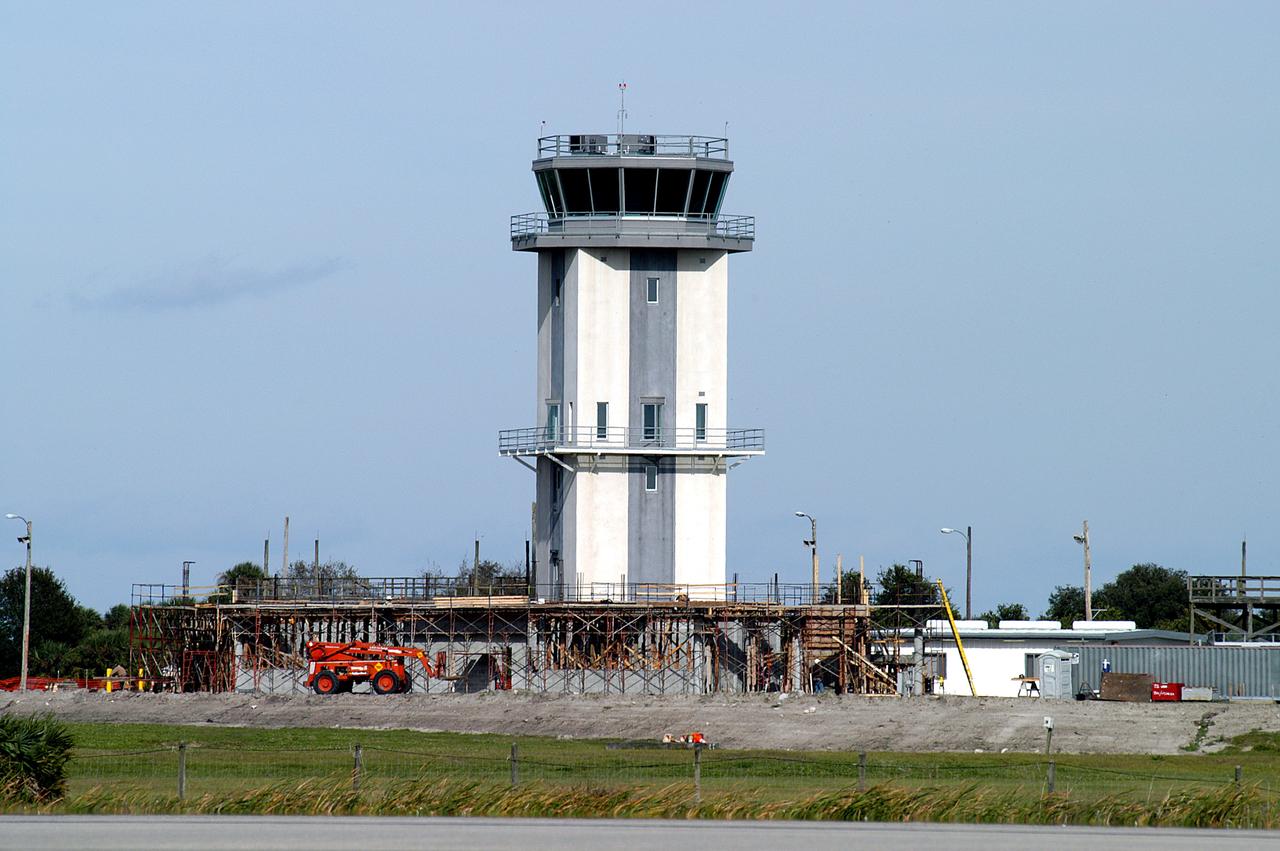
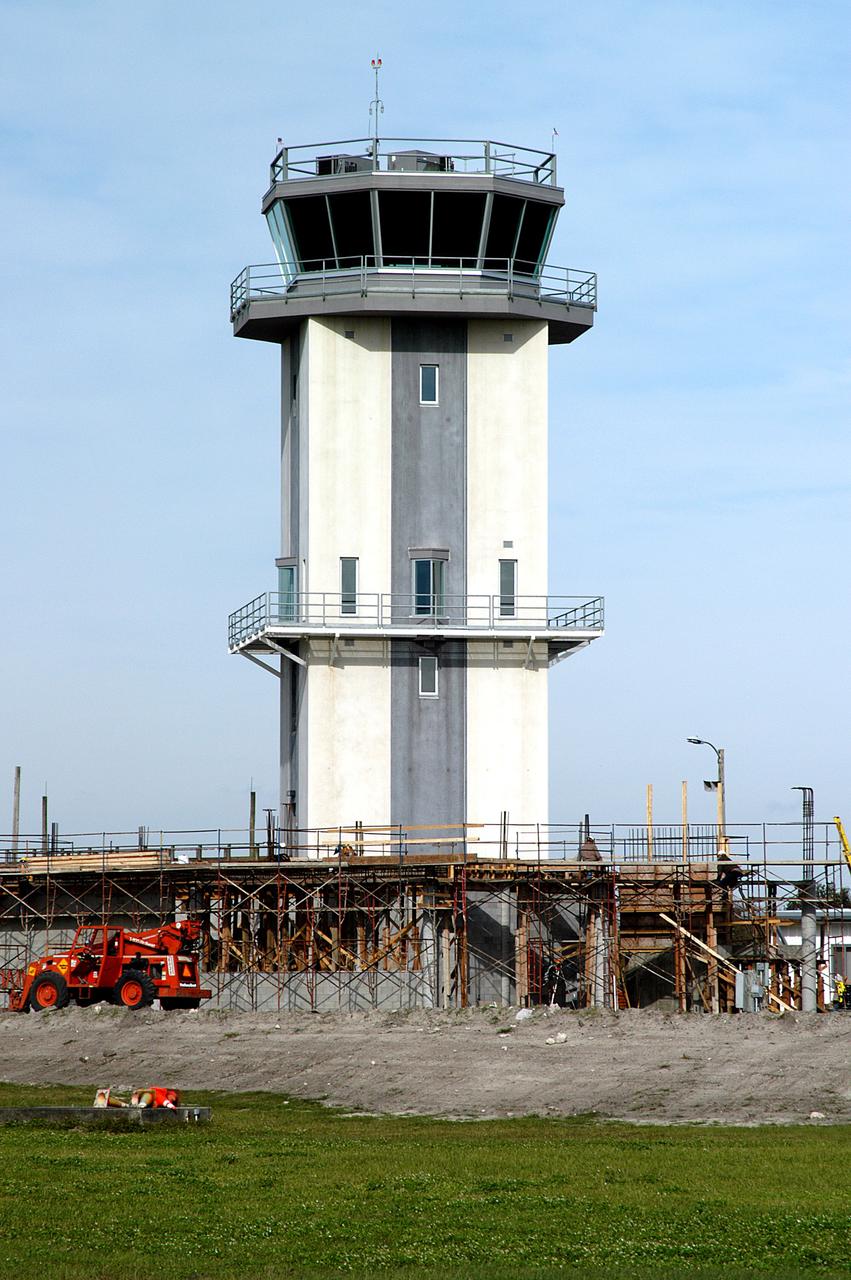
KENNEDY SPACE CENTER, FLA. -- A new control tower is nearing completion at the KSC Shuttle Landing Facility.  It will replace the old tower in use since 1987.   The old tower stands only 20 feet above the runway surface, too low to see the launch pads to the east. During nighttime landing operations, those inside the tower have been hindered by the eight-billion candlepower xenon lights that illuminate the runway.  The new control tower is built atop an existing mound, rising nearly 100 feet over the midpoint of the runway.  The height gives controllers a spectacular 360-degree view of NASA-KSC and northern Brevard County. The new facility will also replace the SLF Operations Building. The operations building is home to the Military Radar Unit that monitors NASA-KSC airspace 24 hours a day, as well as runway light controls, navigational aids, weather and wind speed instrumentation, and gate controls. In the new tower, the computer displays will be fully modernized to Federal Aviation Administration standards with touch-screen technology. Construction on the new facility began in February 2003 and is nearly ready for occupancy. Only some final inspections and approvals remain. A support building and Public Affairs viewing deck, to be used for observing future landing operations, will be added and are already in work.
KENNEDY SPACE CENTER, FLA. -- A new control tower is nearing completion at the KSC Shuttle Landing Facility. It will replace the old tower in use since 1987. The old tower stands only 20 feet above the runway surface, too low to see the launch pads to the east. During nighttime landing operations, those inside the tower have been hindered by the eight-billion candlepower xenon lights that illuminate the runway. The new control tower is built atop an existing mound, rising nearly 100 feet over the midpoint of the runway. The height gives controllers a spectacular 360-degree view of NASA-KSC and northern Brevard County. The new facility will also replace the SLF Operations Building. The operations building is home to the Military Radar Unit that monitors NASA-KSC airspace 24 hours a day, as well as runway light controls, navigational aids, weather and wind speed instrumentation, and gate controls. In the new tower, the computer displays will be fully modernized to Federal Aviation Administration standards with touch-screen technology. Construction on the new facility began in February 2003 and is nearly ready for occupancy. Only some final inspections and approvals remain. A support building and Public Affairs viewing deck, to be used for observing future landing operations, will be added and are already in work.
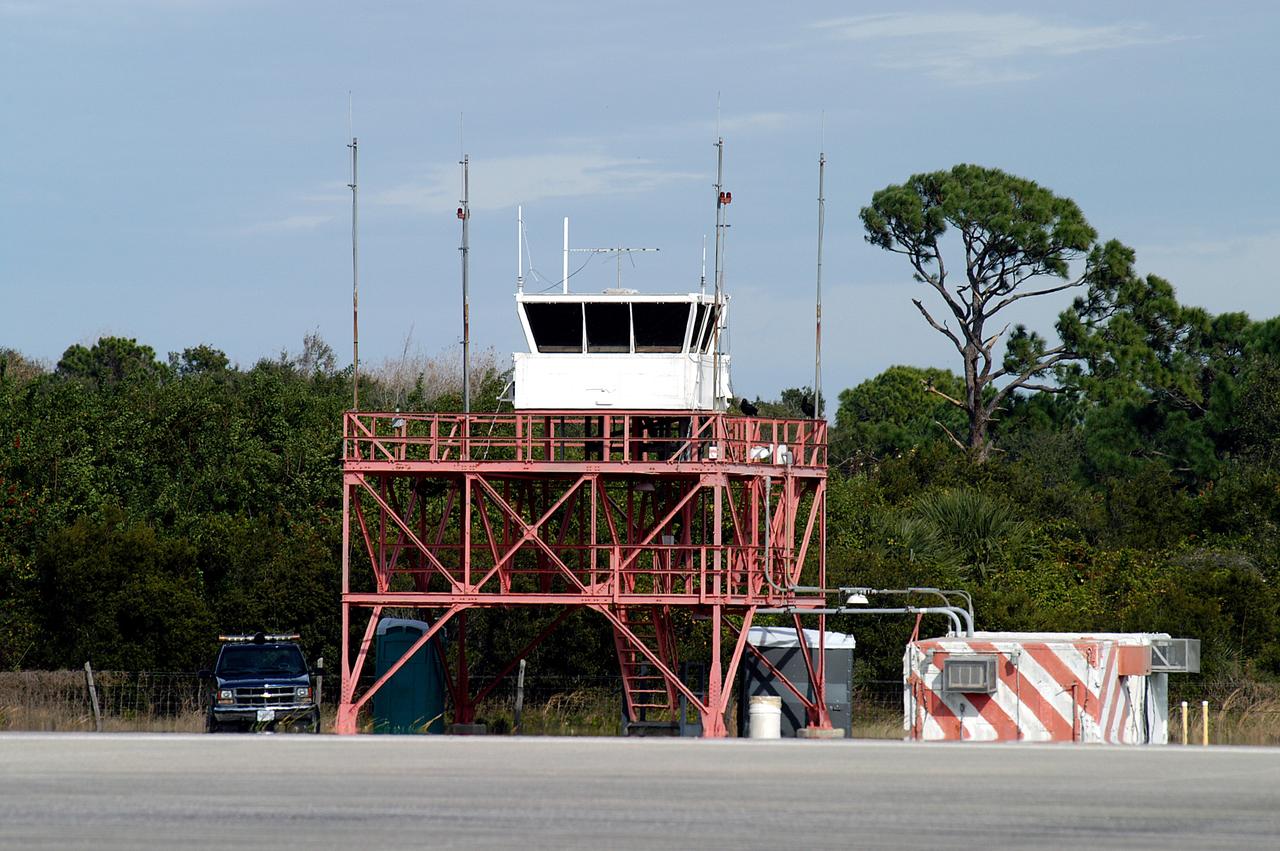
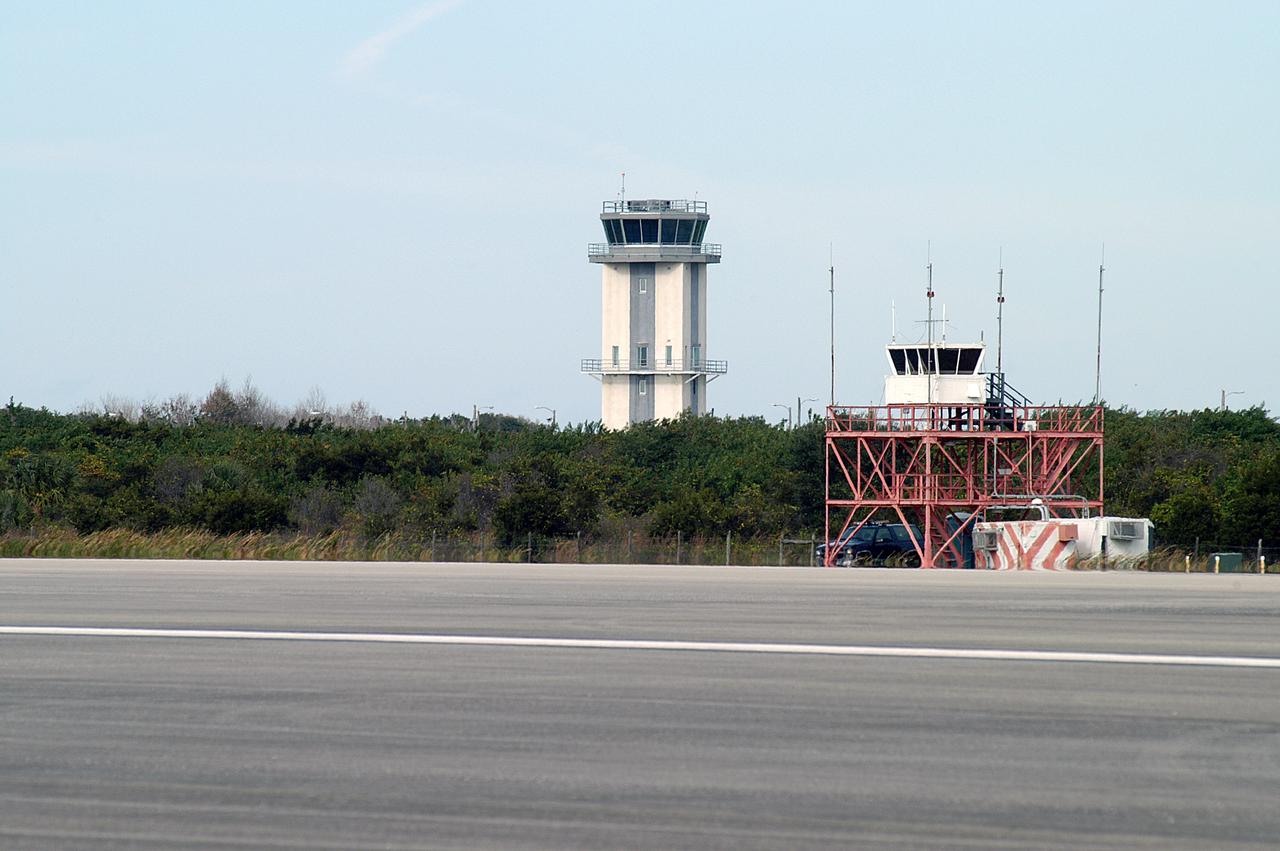
KENNEDY SPACE CENTER, FLA. -- Two control towers are seen at the edge of the KSC Shuttle Landing Facility, the old one in front and the nearly completed new tower in back.  The old tower stands only 20 feet above the runway surface, too low to see the launch pads to the east. During nighttime landing operations, those inside the tower have been hindered by the eight-billion candlepower xenon lights that illuminate the runway.  The new control tower is built atop an existing mound, rising nearly 100 feet over the midpoint of the runway.  The height gives controllers a spectacular 360-degree view of NASA-KSC and northern Brevard County. The new facility will also replace the SLF Operations Building. The operations building is home to the Military Radar Unit that monitors NASA-KSC airspace 24 hours a day, as well as runway light controls, navigational aids, weather and wind speed instrumentation, and gate controls. In the new tower, the computer displays will be fully modernized to Federal Aviation Administration standards with touch-screen technology. Construction on the new facility began in February 2003 and is nearly ready for occupancy. Only some final inspections and approvals remain. A support building and Public Affairs viewing deck, to be used for observing future landing operations, will be added and are already in work.
KENNEDY SPACE CENTER, FLA. -- Two control towers are seen at the edge of the KSC Shuttle Landing Facility, the old one in front and the nearly completed new tower in back. The old tower stands only 20 feet above the runway surface, too low to see the launch pads to the east. During nighttime landing operations, those inside the tower have been hindered by the eight-billion candlepower xenon lights that illuminate the runway. The new control tower is built atop an existing mound, rising nearly 100 feet over the midpoint of the runway. The height gives controllers a spectacular 360-degree view of NASA-KSC and northern Brevard County. The new facility will also replace the SLF Operations Building. The operations building is home to the Military Radar Unit that monitors NASA-KSC airspace 24 hours a day, as well as runway light controls, navigational aids, weather and wind speed instrumentation, and gate controls. In the new tower, the computer displays will be fully modernized to Federal Aviation Administration standards with touch-screen technology. Construction on the new facility began in February 2003 and is nearly ready for occupancy. Only some final inspections and approvals remain. A support building and Public Affairs viewing deck, to be used for observing future landing operations, will be added and are already in work.
KENNEDY SPACE CENTER, FLA. -- The existing control tower seen here at the edge of the KSC Shuttle Landing Facility is being replaced.  In use since 1987, the old tower stands only 20 feet above the runway surface, too low to see the launch pads to the east. During nighttime landing operations, those inside the tower have been hindered by the eight-billion candlepower xenon lights that illuminate the runway.  The new control tower is built atop an existing mound, rising nearly 100 feet over the midpoint of the runway.  The height gives controllers a spectacular 360-degree view of NASA-KSC and northern Brevard County. The new facility will also replace the SLF Operations Building. The operations building is home to the Military Radar Unit that monitors NASA-KSC airspace 24 hours a day, as well as runway light controls, navigational aids, weather and wind speed instrumentation, and gate controls. In the new tower, the computer displays will be fully modernized to Federal Aviation Administration standards with touch-screen technology. Construction on the new facility began in February 2003 and is nearly ready for occupancy. Only some final inspections and approvals remain. A support building and Public Affairs viewing deck, to be used for observing future landing operations, will be added and are already in work.
KENNEDY SPACE CENTER, FLA. -- The existing control tower seen here at the edge of the KSC Shuttle Landing Facility is being replaced. In use since 1987, the old tower stands only 20 feet above the runway surface, too low to see the launch pads to the east. During nighttime landing operations, those inside the tower have been hindered by the eight-billion candlepower xenon lights that illuminate the runway. The new control tower is built atop an existing mound, rising nearly 100 feet over the midpoint of the runway. The height gives controllers a spectacular 360-degree view of NASA-KSC and northern Brevard County. The new facility will also replace the SLF Operations Building. The operations building is home to the Military Radar Unit that monitors NASA-KSC airspace 24 hours a day, as well as runway light controls, navigational aids, weather and wind speed instrumentation, and gate controls. In the new tower, the computer displays will be fully modernized to Federal Aviation Administration standards with touch-screen technology. Construction on the new facility began in February 2003 and is nearly ready for occupancy. Only some final inspections and approvals remain. A support building and Public Affairs viewing deck, to be used for observing future landing operations, will be added and are already in work.
KENNEDY SPACE CENTER, FLA. -- A new control tower is nearing completion at the KSC Shuttle Landing Facility.  It will replace the old tower in use since 1987.   The old tower stands only 20 feet above the runway surface, too low to see the launch pads to the east. During nighttime landing operations, those inside the tower have been hindered by the eight-billion candlepower xenon lights that illuminate the runway.  The new control tower is built atop an existing mound, rising nearly 100 feet over the midpoint of the runway.  The height gives controllers a spectacular 360-degree view of NASA-KSC and northern Brevard County. The new facility will also replace the SLF Operations Building. The operations building is home to the Military Radar Unit that monitors NASA-KSC airspace 24 hours a day, as well as runway light controls, navigational aids, weather and wind speed instrumentation, and gate controls. In the new tower, the computer displays will be fully modernized to Federal Aviation Administration standards with touch-screen technology. Construction on the new facility began in February 2003 and is nearly ready for occupancy. Only some final inspections and approvals remain. A support building and Public Affairs viewing deck, to be used for observing future landing operations, will be added and are already in work.
KENNEDY SPACE CENTER, FLA. -- A new control tower is nearing completion at the KSC Shuttle Landing Facility. It will replace the old tower in use since 1987. The old tower stands only 20 feet above the runway surface, too low to see the launch pads to the east. During nighttime landing operations, those inside the tower have been hindered by the eight-billion candlepower xenon lights that illuminate the runway. The new control tower is built atop an existing mound, rising nearly 100 feet over the midpoint of the runway. The height gives controllers a spectacular 360-degree view of NASA-KSC and northern Brevard County. The new facility will also replace the SLF Operations Building. The operations building is home to the Military Radar Unit that monitors NASA-KSC airspace 24 hours a day, as well as runway light controls, navigational aids, weather and wind speed instrumentation, and gate controls. In the new tower, the computer displays will be fully modernized to Federal Aviation Administration standards with touch-screen technology. Construction on the new facility began in February 2003 and is nearly ready for occupancy. Only some final inspections and approvals remain. A support building and Public Affairs viewing deck, to be used for observing future landing operations, will be added and are already in work.
STS042-S-093  (30 Jan 1992) --- Space Shuttle Discovery is just about to ease down its main gear on Runway 22 at Edwards Air Force Base in southern California.  Main gear touchdown occurred at 8:07:18 a.m. (PST), Jan. 30, 1992.  The successful landing completed an eight-day mission for five NASA astronauts and two payload specialists supporting the first International Microgravity Laboratory (IML-1) mission.  Onboard were astronauts Ronald J. Grabe, mission commander; Stephen S. Oswald, pilot; Norman E. Thagard, payload commander; David C. Hilmers and William F. Readdy, both mission specialists; and payload specialists Roberta L. Bondar of Canada and Ulf Merbold, representing the European Space Agency (ESA).
STS-42 Discovery, Orbiter Vehicle (OV) 103, lands on runway 22 at EAFB, Calif
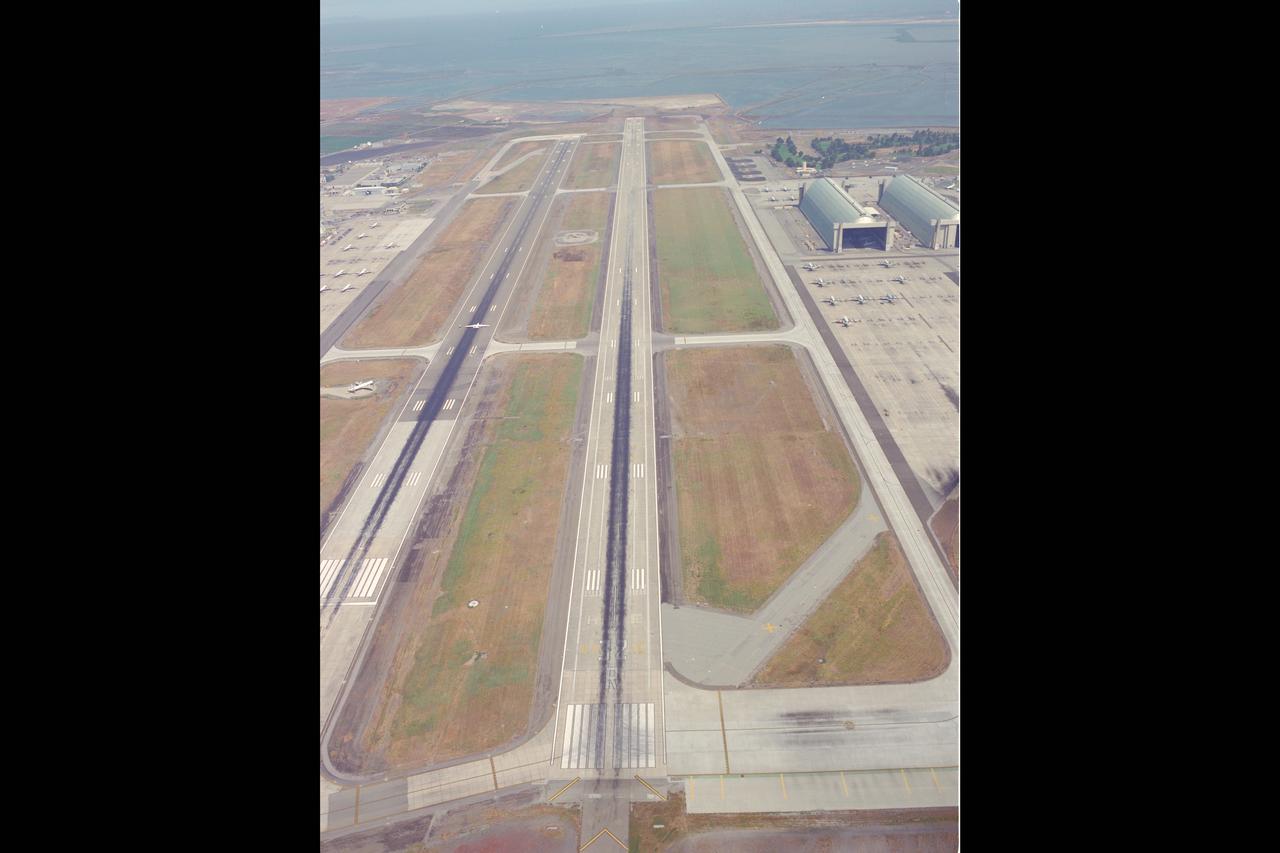
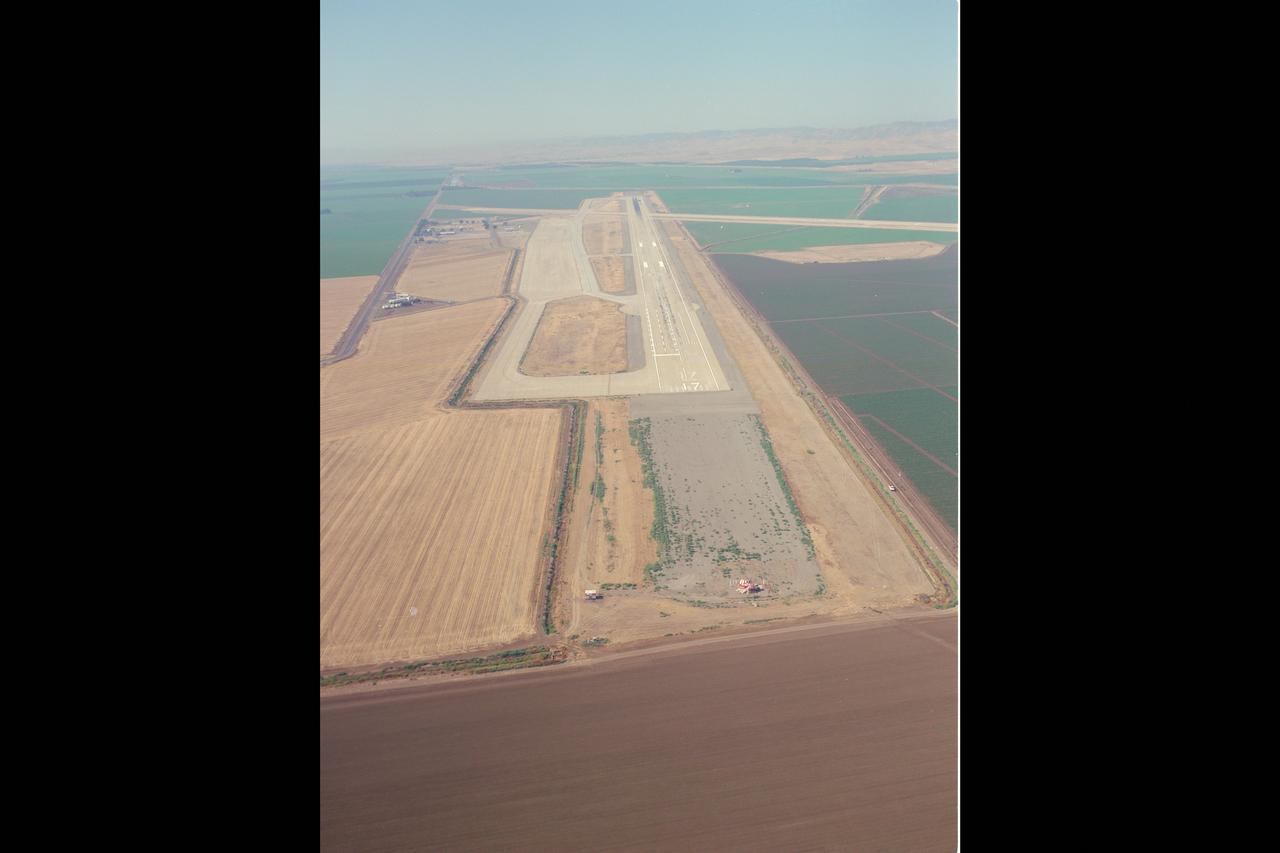
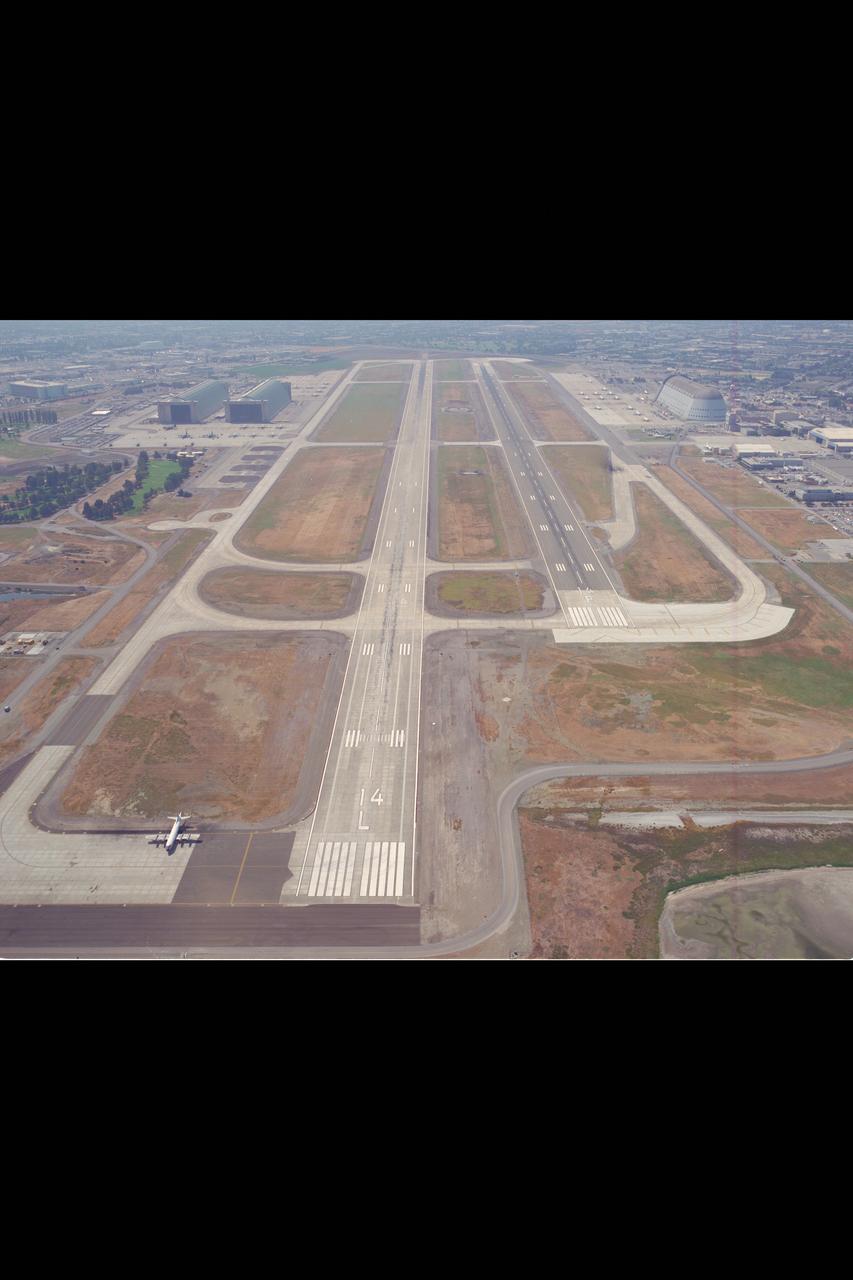
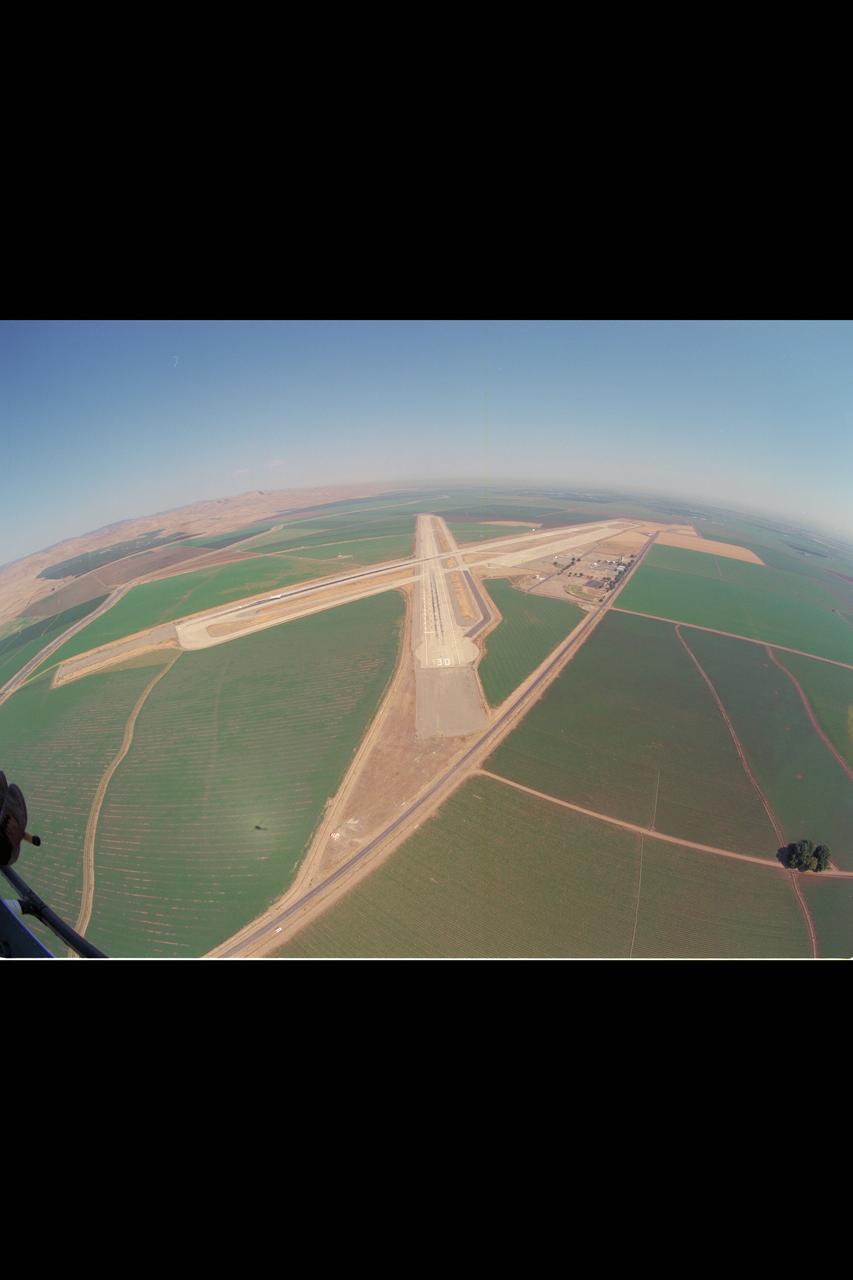
Crows Landing runway approach
ARC-1988-AC88-0443-25
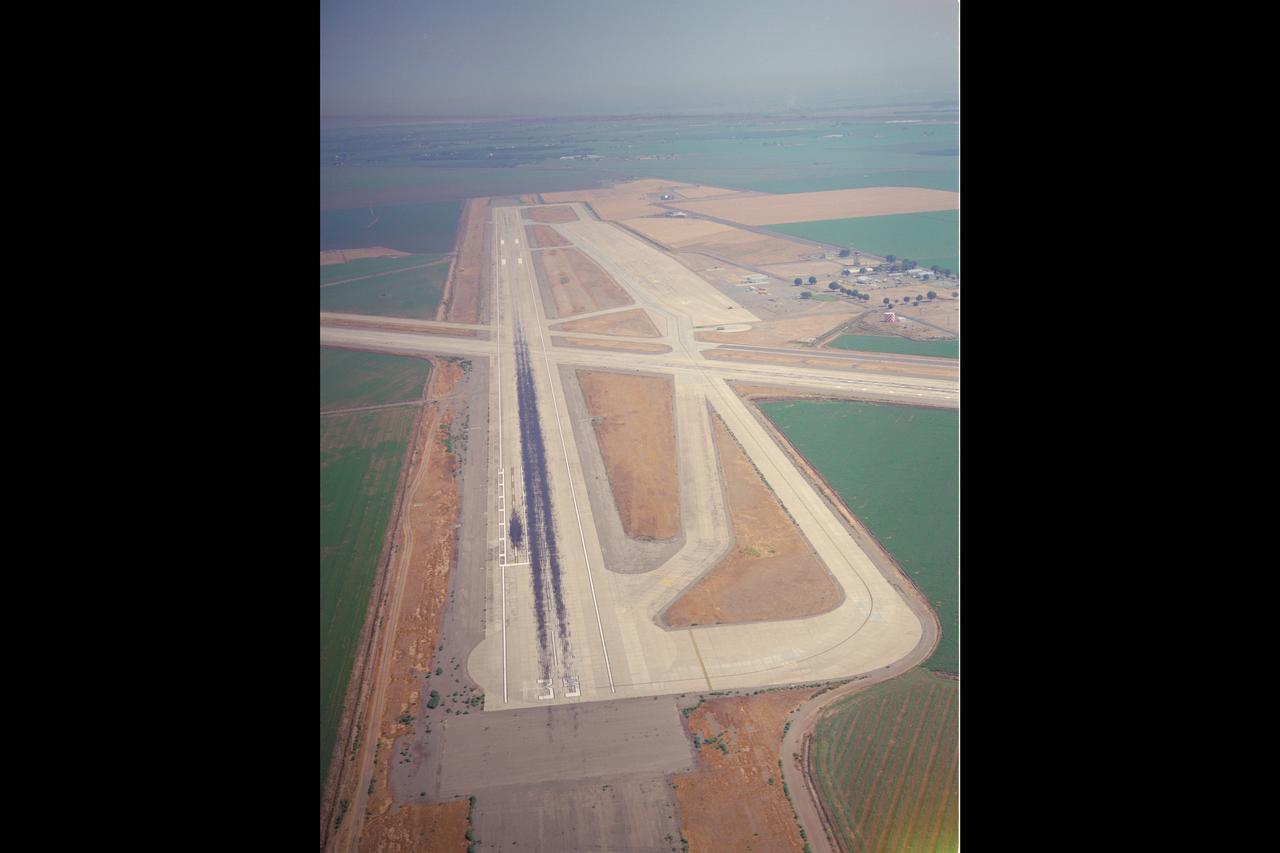
Crows Landing runway approach
ARC-1988-AC88-0443-76
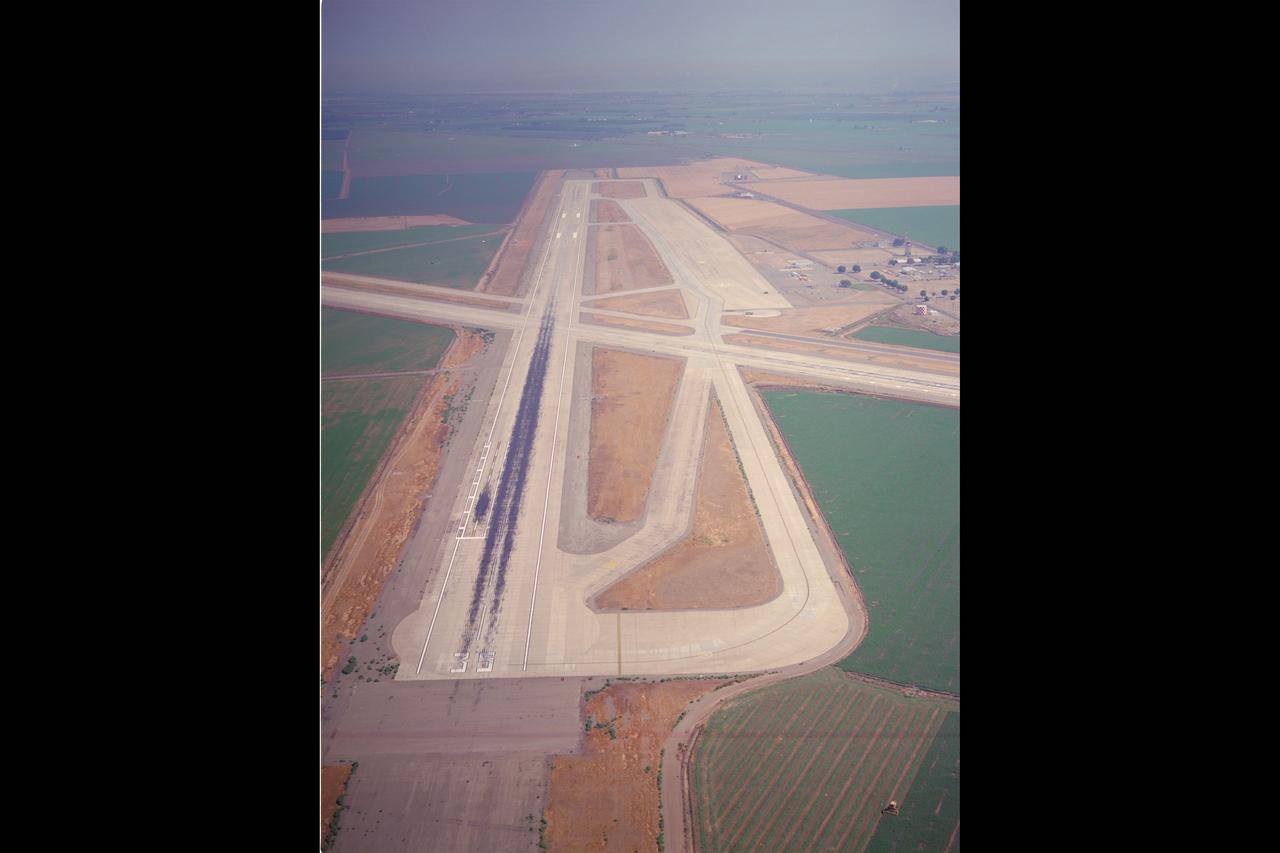
Crows Landing runway approach
ARC-1988-AC88-0443-52
Crows Landing runway approach
ARC-1988-AC88-0443-40
Crows Landing runway approach
ARC-1988-AC88-0443-8
Crows Landing runway approach
ARC-1988-AC88-0443-37
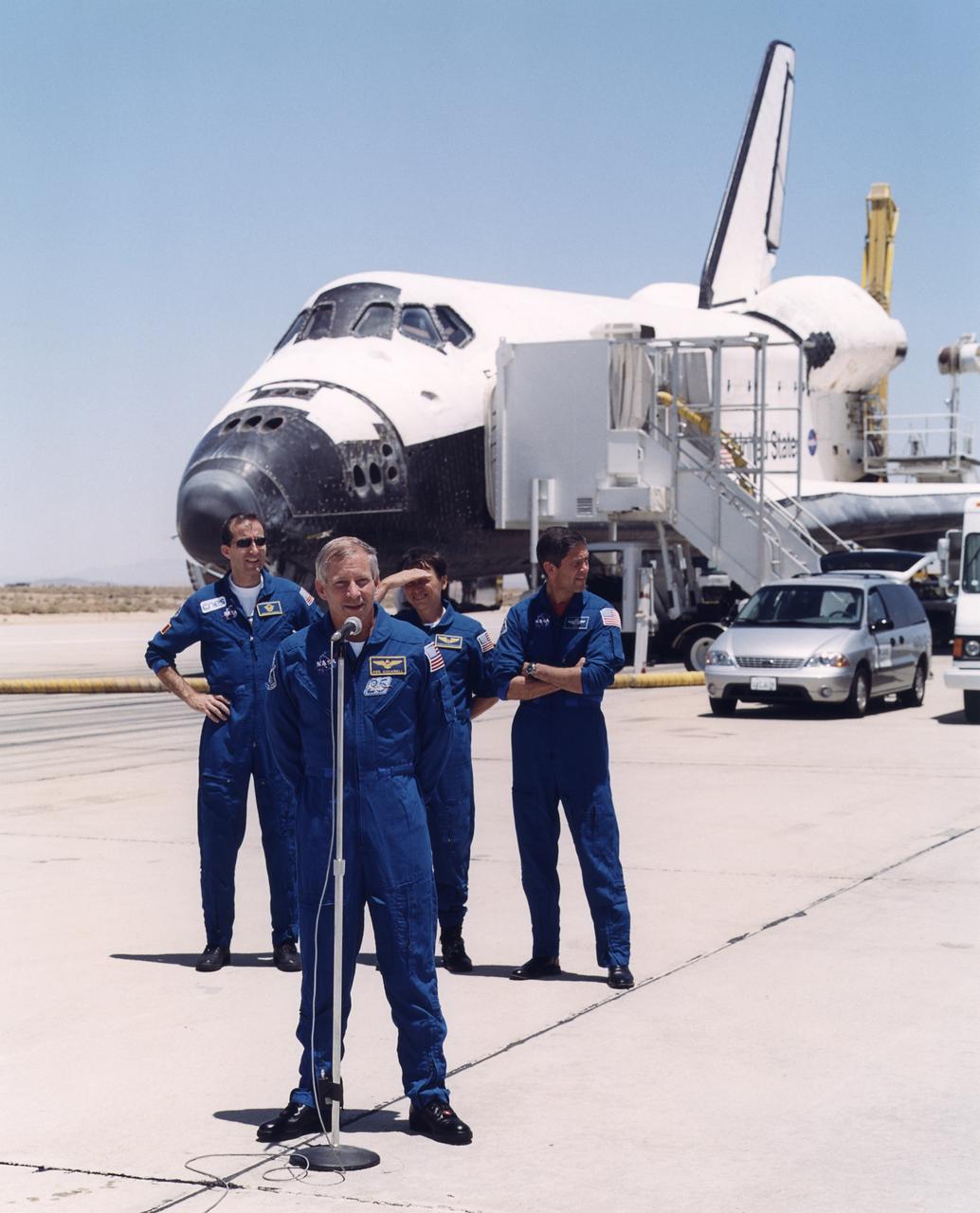
STS-111 commander Ken Cockrell greets dignitaries and recovery technicians on the runway at Edwards Air Force Base following the landing of the space shuttle Endeavour on June 19, 2002. Behind Cockrell are (from left) mission specialists Philippe Perrin and Franklin Chang-Diaz and Shuttle pilot Paul Lockhart.
STS-111 commander Ken Cockrell greets dignitaries and recovery technicians on the runway at Edwards Air Force Base following the landing of the space shuttle Endeavour on June 19, 2002. Behind Cockrell are (from left) mission specialists Philippe Perrin a
STS059-S-108 (20 April 1994) --- The main landing gear of the Space Shuttle Endeavour touches down at Edwards Air Force Base to complete the 11-day STS-59/SRL-1 mission.  Landing occurred at 9:54 a.m. (PDT), April 20, 1994.  Mission duration was 11 days, 5 hours, 49 minutes.  Guiding Endeavour to a landing was astronaut Sidney M. Gutierrez, STS-59 commander.  His crew was Kevin P. Chilton, Linda M. Godwin, Jerome (Jay) Apt, Michael R. (Rich) Clifford and Thomas D. Jones.
Landing of STS-59 Endeavour, OV-105, at Edwards Air Force Base
STS060-S-035 (11 Feb 1994) --- The drag chute for Space Shuttle Discovery is deployed on the Shuttle Landing Facility, marking an end to the eight-day STS-60 mission.  Landing occurred at 2:19:22 p.m. (EST).  Onboard were astronauts Charles F. Bolden Jr., Kenneth S. Reightler Jr., Franklin R. Chang-Diaz, N. Jan Davis and Ronald M. Sega along with Russian cosmonaut Sergei K. Krikalev.
Landing of STS-60 Space Shuttle Discovery at Kennedy Space Center
STS028-S-013 (13 Aug 1989) --- The Space Shuttle Columbia is captured on film just prior to main gear touchdown at Edwards Air Force Base in Southern California.  The landing marked a successful end to a five-day DOD-devoted mission.  Onboard the spacecraft were Astronauts Brewster H. Shaw Jr., Richard N. Richards, David C. Leestma, James C.  Adamson and Mark N. Brown.
STS-28 Columbia, OV-102, landing at Edwards Air Force Base (EAFB) California
STS027-S-014 (6 Dec. 1988) --- A 70mm camera records the landing of the space shuttle Atlantis on Rogers Dry Lake Bed near the Dryden Flight Research Facility in California. The wheels of the vehicle came to a stop at 3:36:53 p.m. (PST), marking the completion of a successful mission which involved five veteran NASA astronauts. Onboard for the four-day flight were astronauts Robert L. Gibson, Guy S. Gardner, Jerry L. Ross, Richard M. (Mike) Mullane and William M. Shepherd. Photo credit: NASA
STS-27 Atlantis, OV-104, lands at Edwards Air Force Base (EAFB), California
STS027-S-012 (6 Dec. 1988) --- A 70mm camera records the landing of the Space Shuttle Atlantis on Rogers Dry Lake Bed near the Dryden Flight Research Facility in California. The wheels of the vehicle came to a stop at 3:36:53 p.m. (PST), marking the completion of a successful mission which involved five veteran NASA astronauts. Onboard for the four-day flight were astronauts Robert L. Gibson, Guy S. Gardner, Jerry L. Ross, Richard M. (Mike) Mullane and William M. Shepherd.
STS-27 Atlantis, OV-104, lands at Edwards Air Force Base (EAFB), California
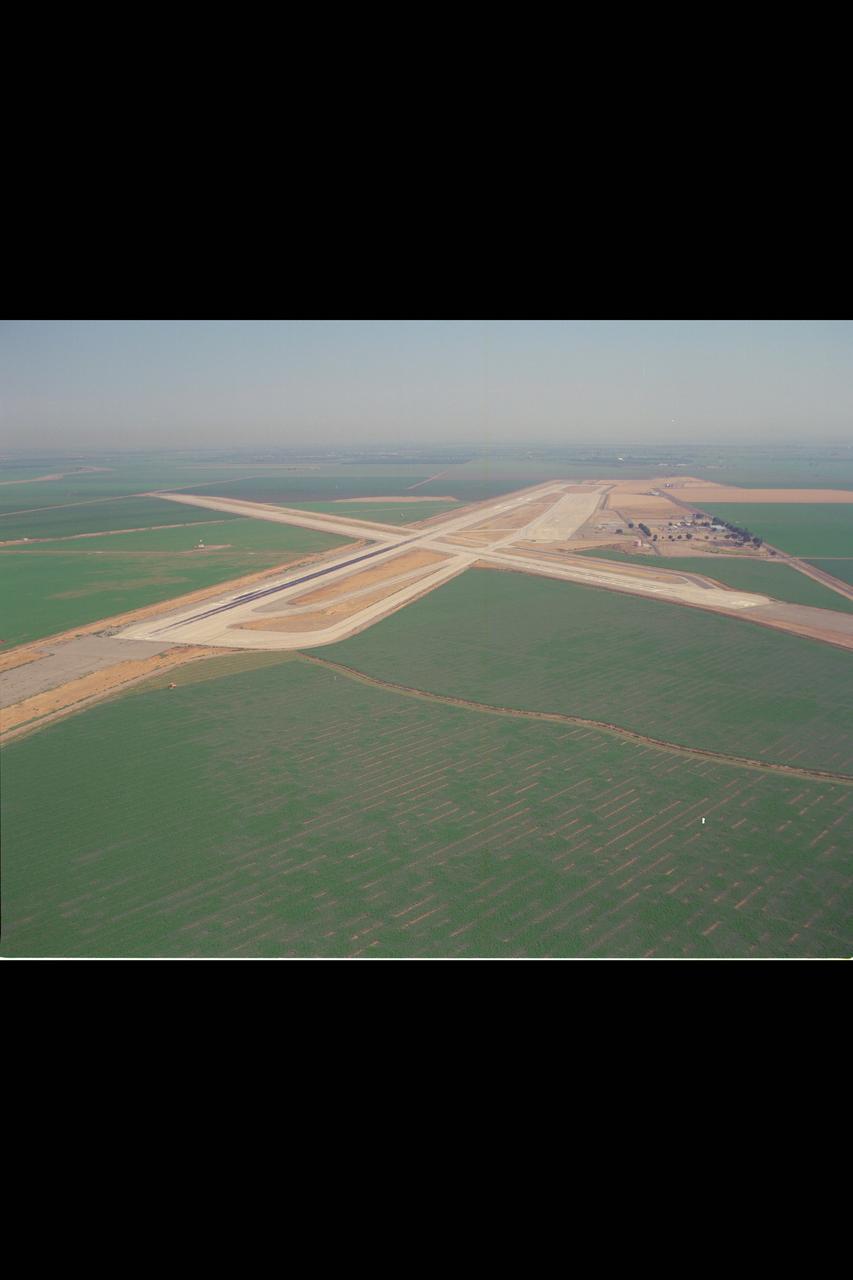
Crows Landing runway approach  (scanning the horizon)
ARC-1988-AC88-0443-35
PAO news release material for the 5th and final FF of the ALT series.   Precise moment of separation captured by camera from a T-38 chase plane.
Approach & Landing Test (ALT) - Shuttle - Public Affairs Office (PAO) News Release - Free-Flight (FF)-5 Photography