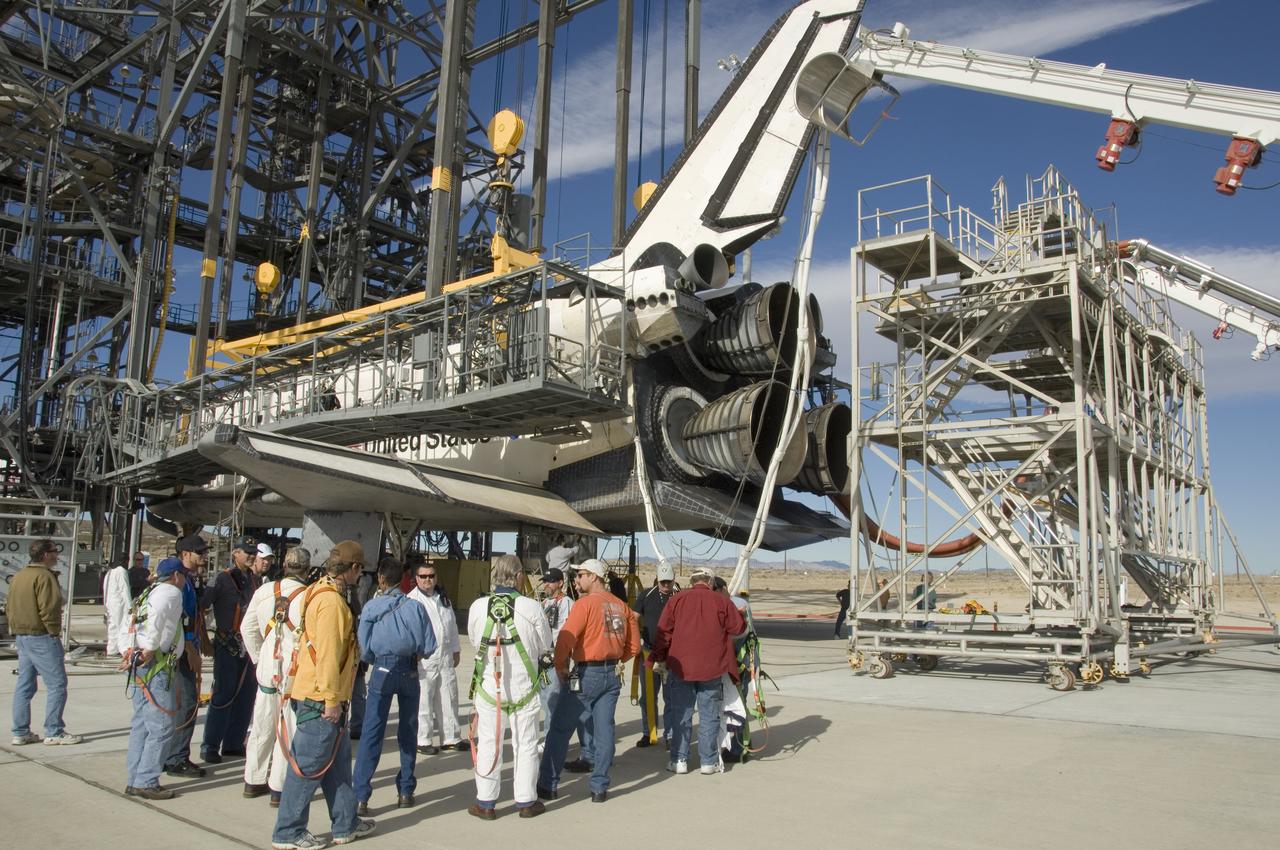
United Space Alliance technicians gather around the rear of Space Shuttle Endeavour for a safety briefing prior to moving the tail workstand around the shuttle's engines.
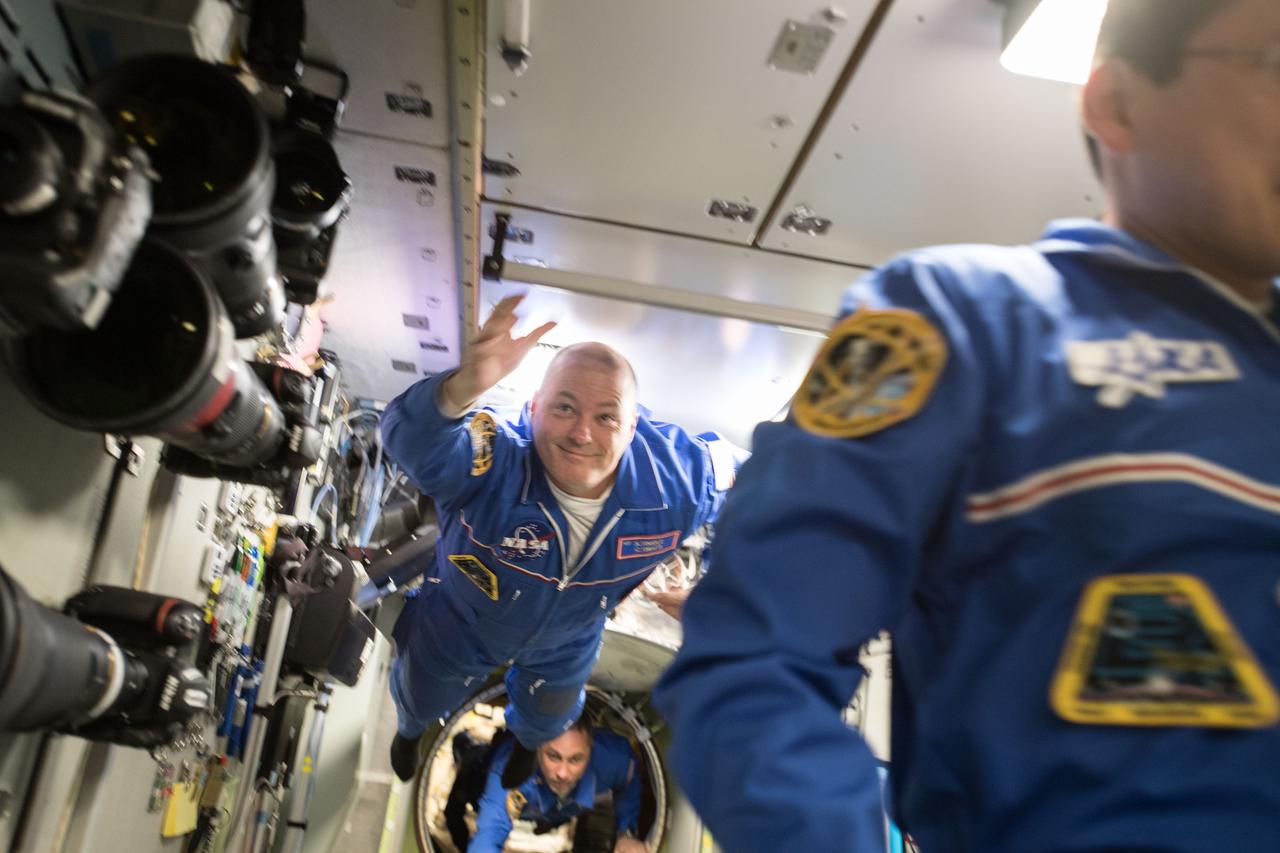
iss054e001441 (Dec. 19, 2017) --- Newly arrived Flight Engineers Scott Tingle and Anton Shkaplerov float into the Zvezda Service Module during an International Space Station tour and safety briefing.
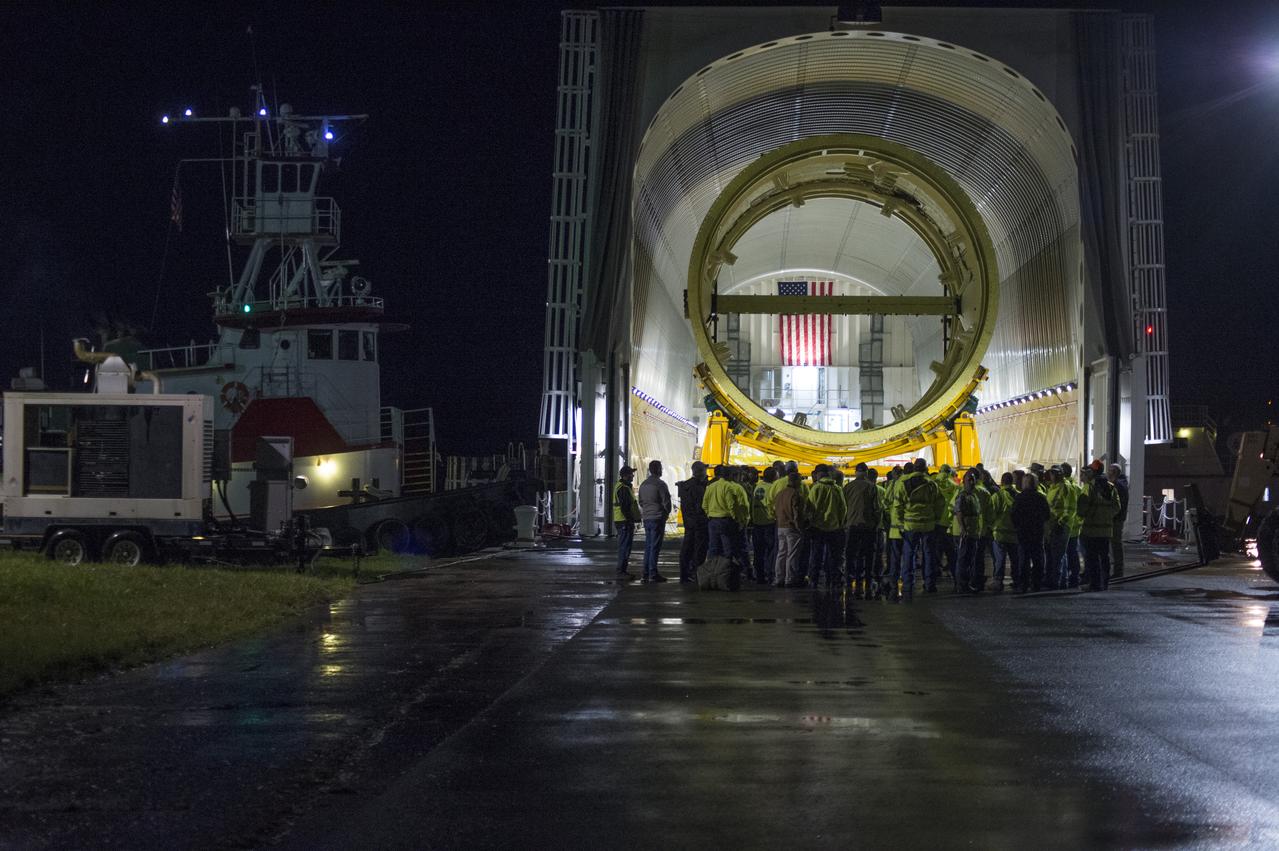
The SLS Stages Intertank Structural Test Assembly (STA) is rolling off the NASA Pegasus Barge at the MSFC Dock enroute to the MSFC 4619 Load Test Annex test facility for qualification testing. Members of MSFC Logistics Office and Move Team members gather for last minute instructions and safety briefing before off-loading STA hardware.
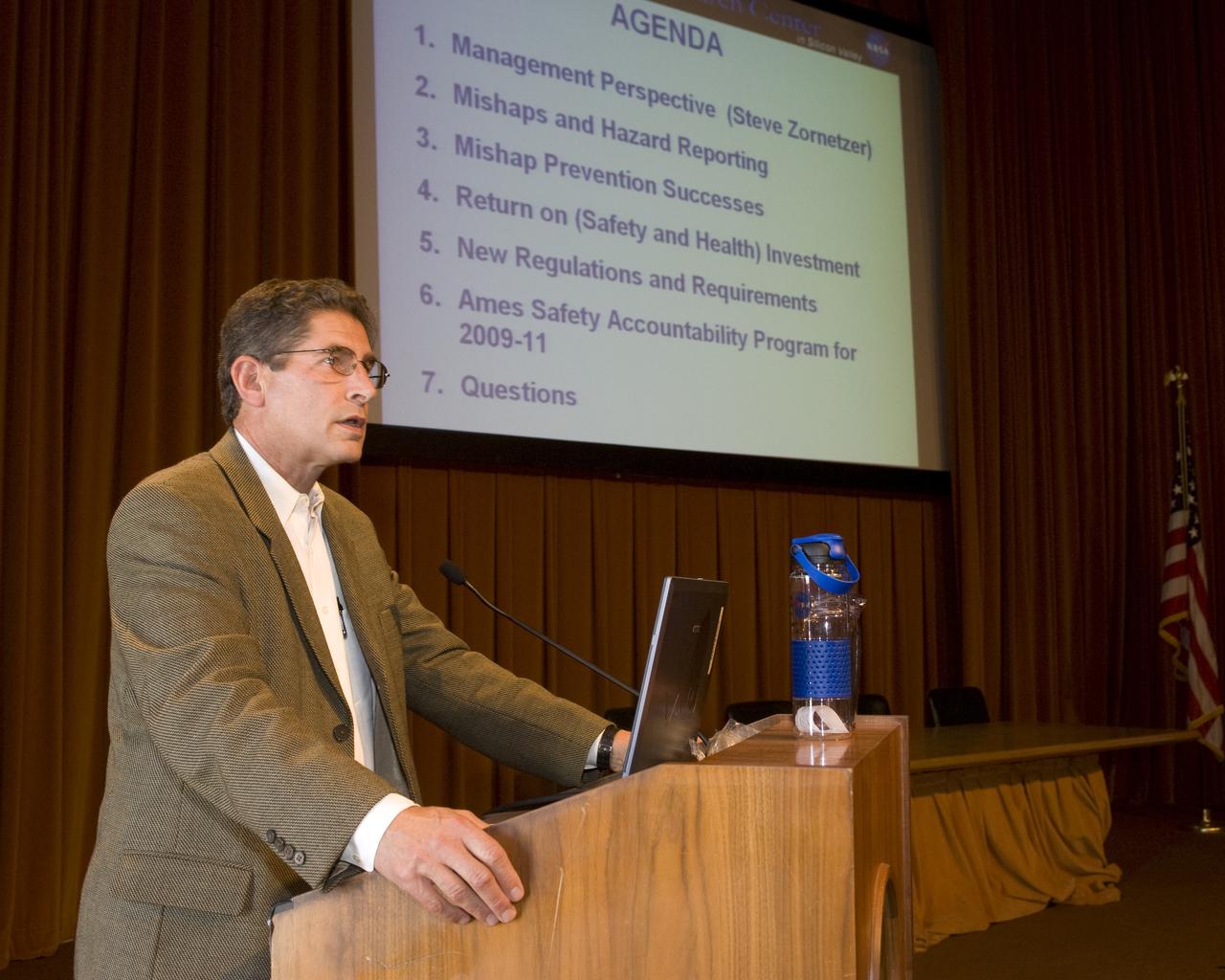
Safety Day Events 2008: Mandatory Supervisor's Safety briefing with Steve Zornetzer
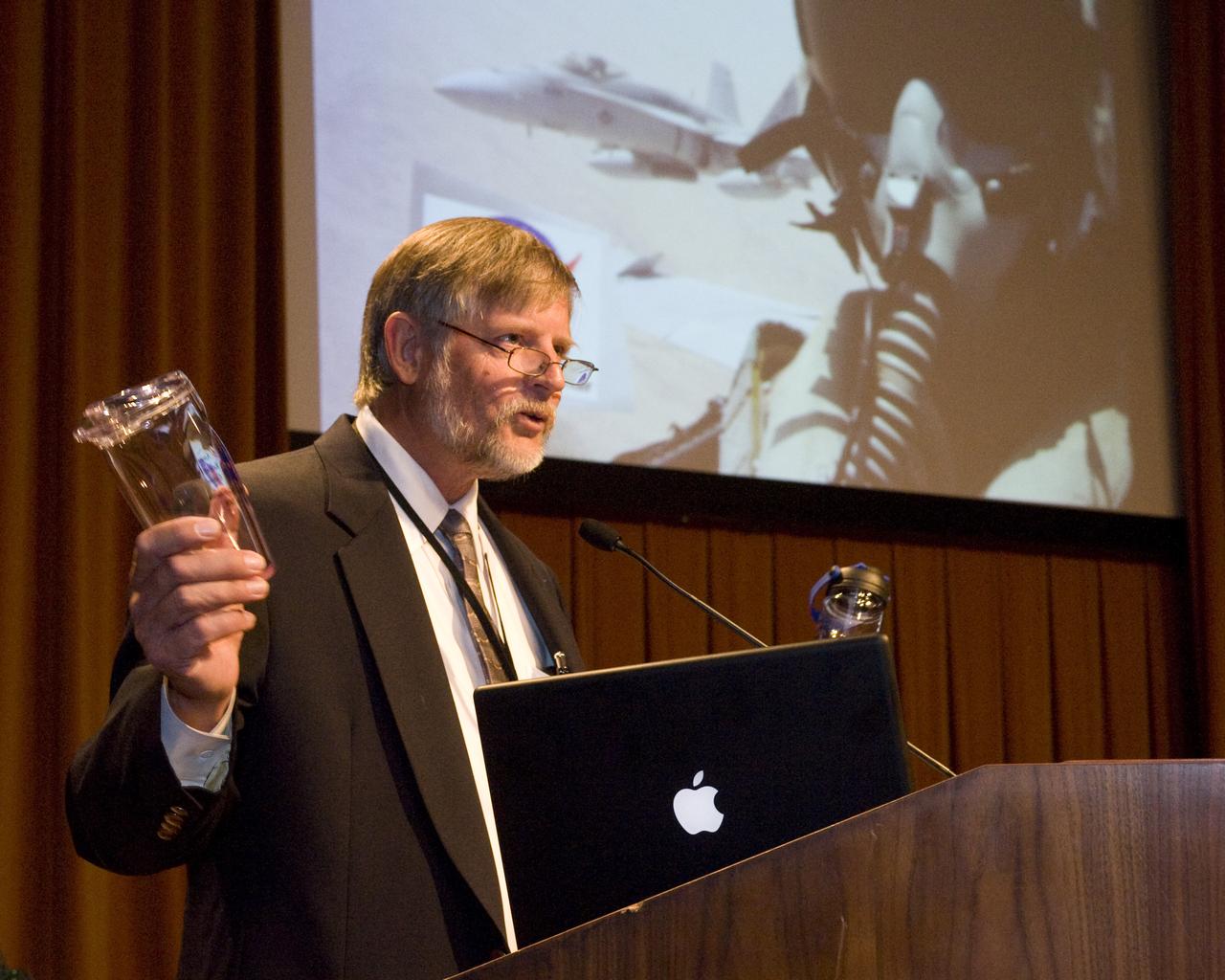
Safety Day Events 2008: Stan Phillips speaks at the open of the 10th annual Safety Awareness Week briefing in N-201.
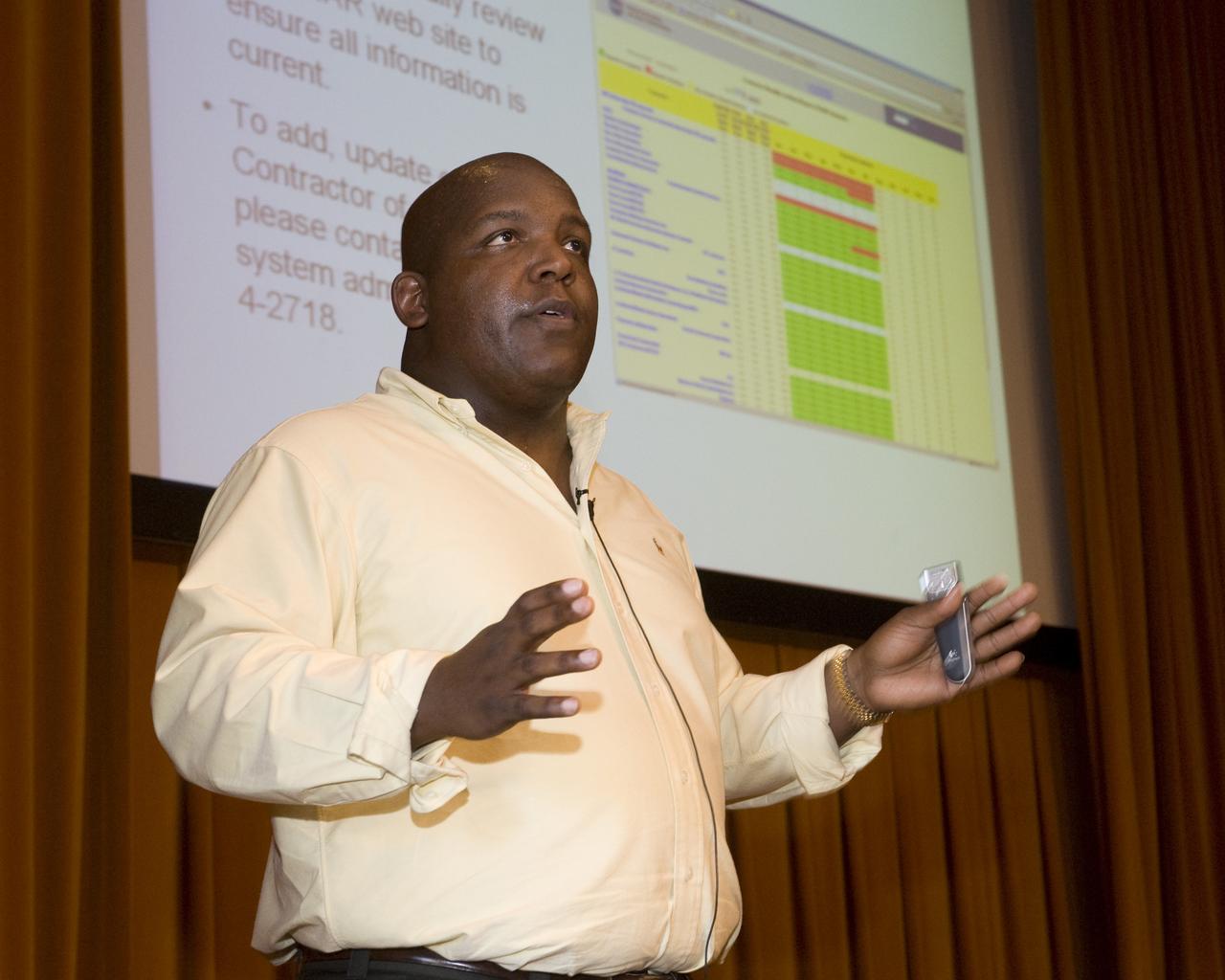
Safety Day Events 2008: Safety briefing for contracting officers, contracting offers' technical representatives and contract site managers.
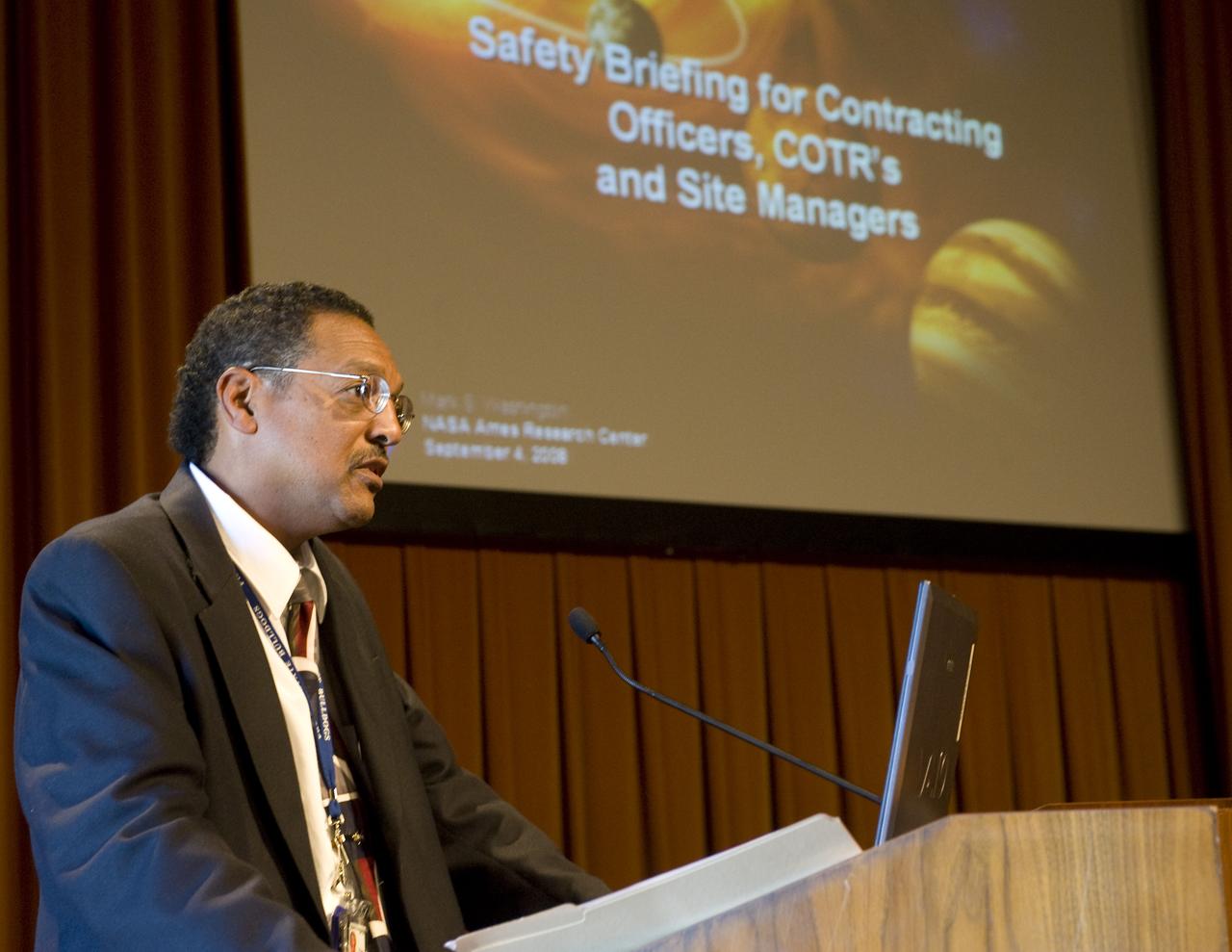
Safety Day Events 2008: Safety briefing for contracting officers, contracting offers' technical representatives and contract site managers. with Lew Braxton III
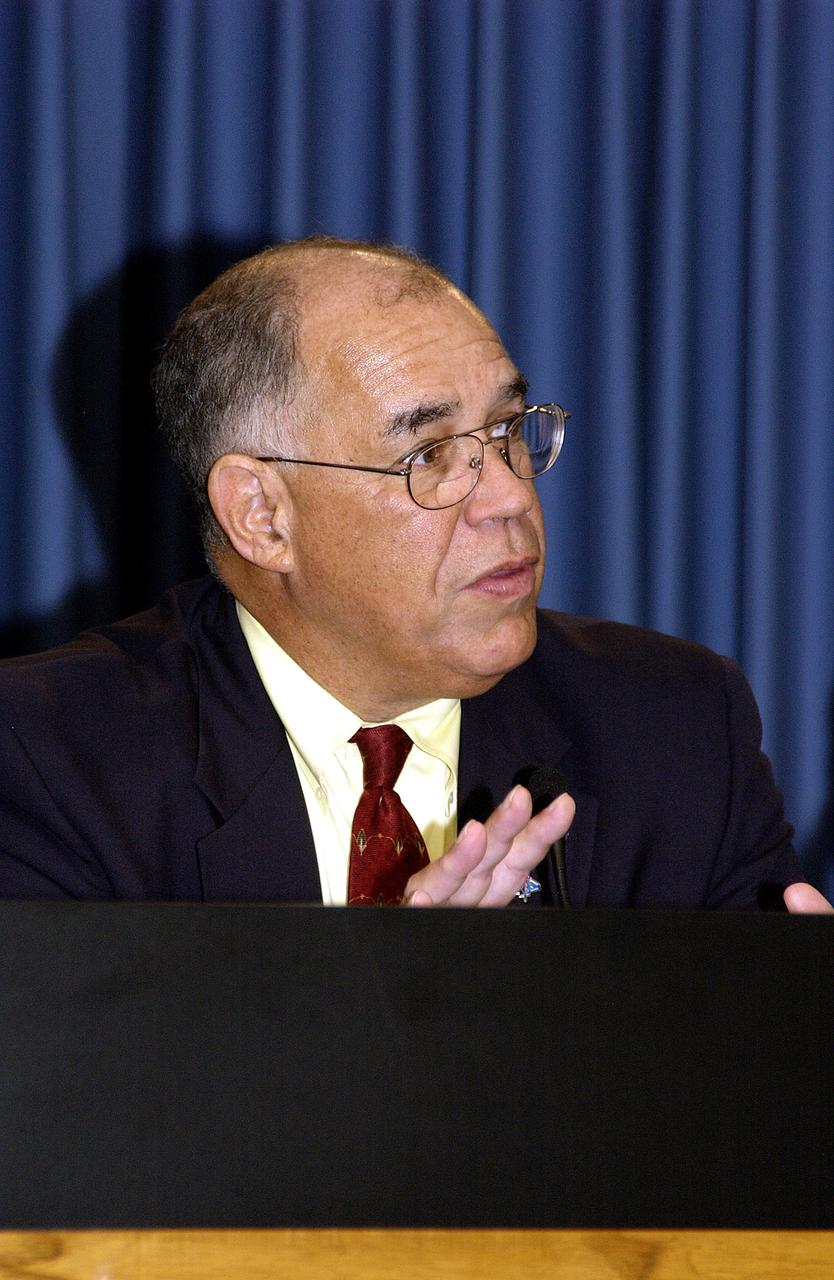
KENNEDY SPACE CENTER, FLA. - NASA Deputy Administrator Fred Gregory speaks at a media briefing at KSC. NASA officials discussed the agency’s human space flight program. Others on the panel were Associate Administrator for Space Flight Bill Readdy and Associate Administrator for Safety and Mission Assurance Bryan O’Connor.
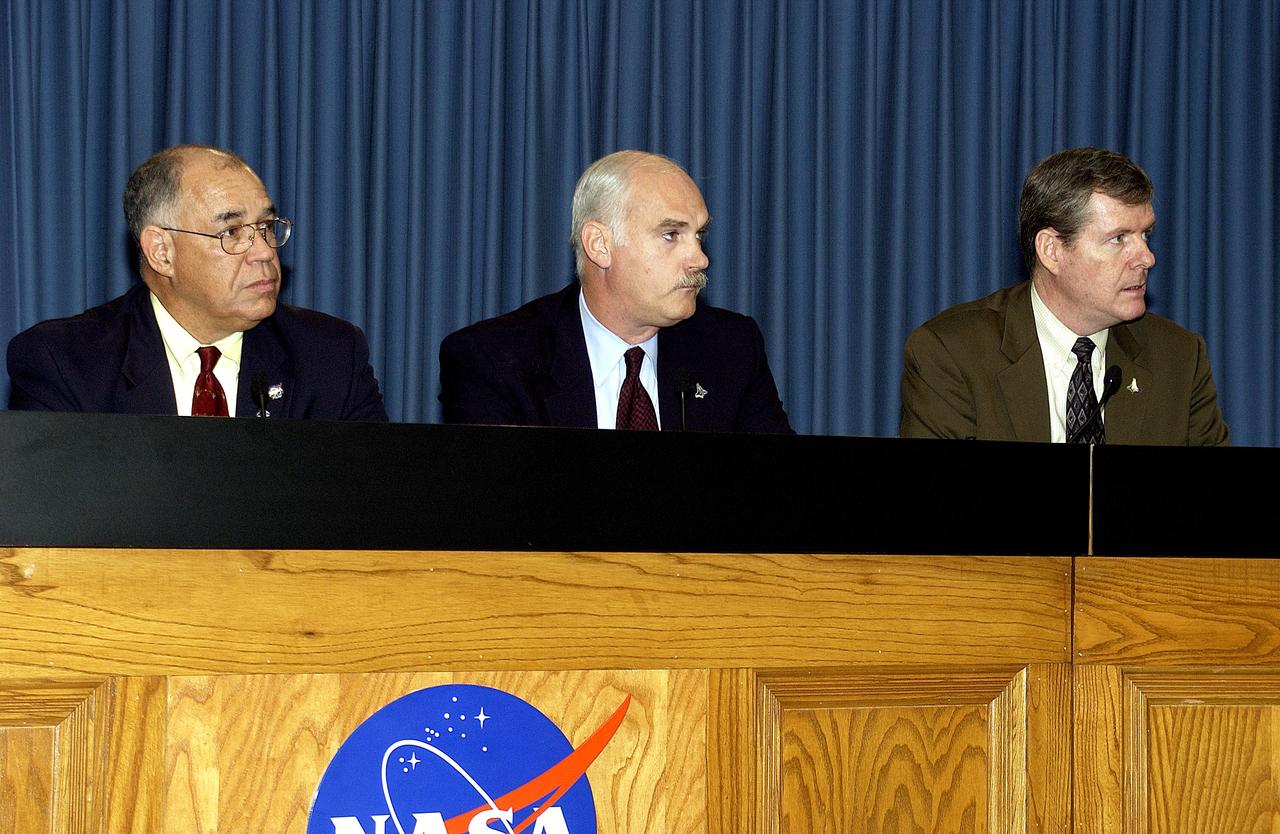
KENNEDY SPACE CENTER, FLA. - NASA officials brief the media at KSC about the agency’s human space flight program. On the panel (left to right) are NASA Deputy Administrator Fred Gregory, Associate Administrator for Space Flight Bill Readdy and Associate Administrator for Safety and Mission Assurance Bryan O’Connor.
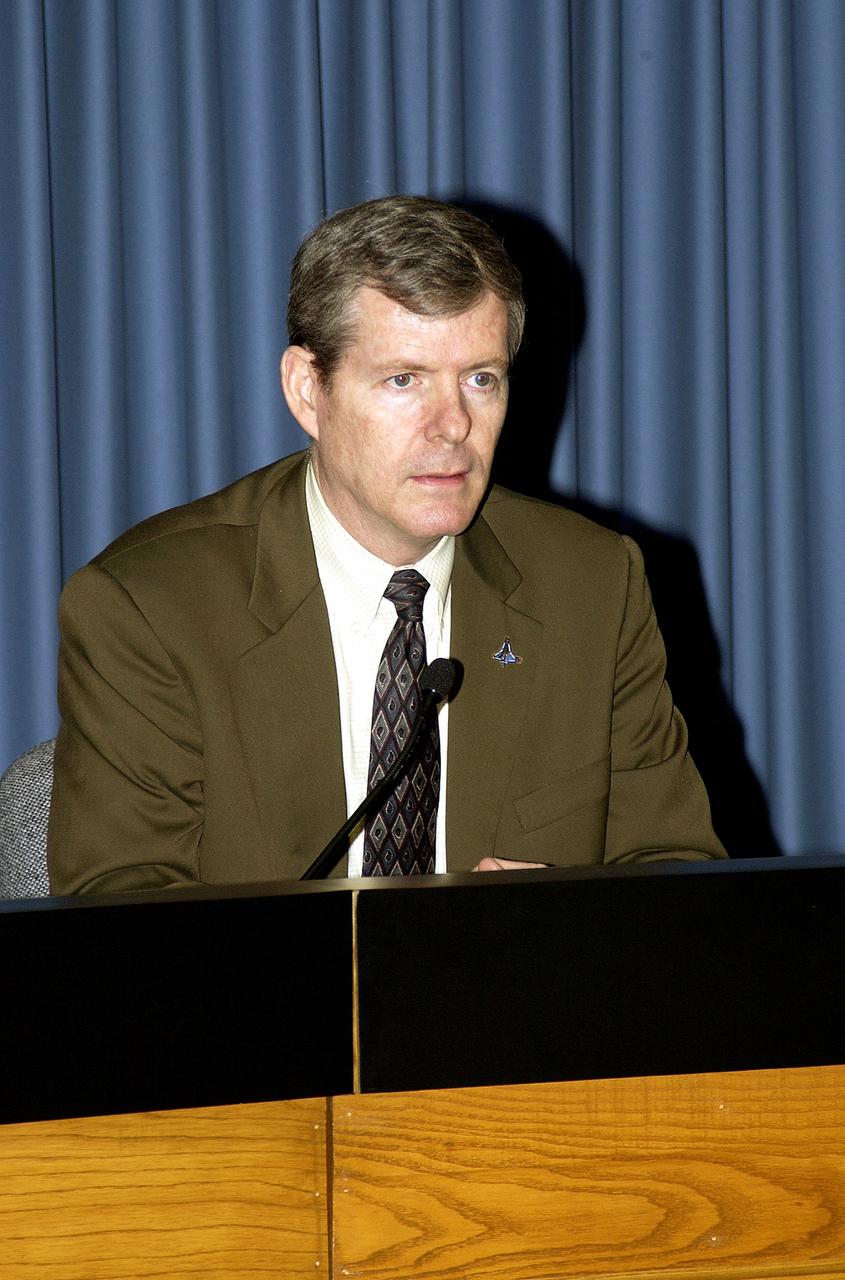
KENNEDY SPACE CENTER, FLA. - Associate Administrator for Safety and Mission Assurance Bryan O’Connor speaks at a media briefing at KSC. NASA officials discussed the agency’s human space flight program. Others on the panel were NASA Deputy Administrator Fred Gregory and Associate Administrator for Space Flight Bill Readdy
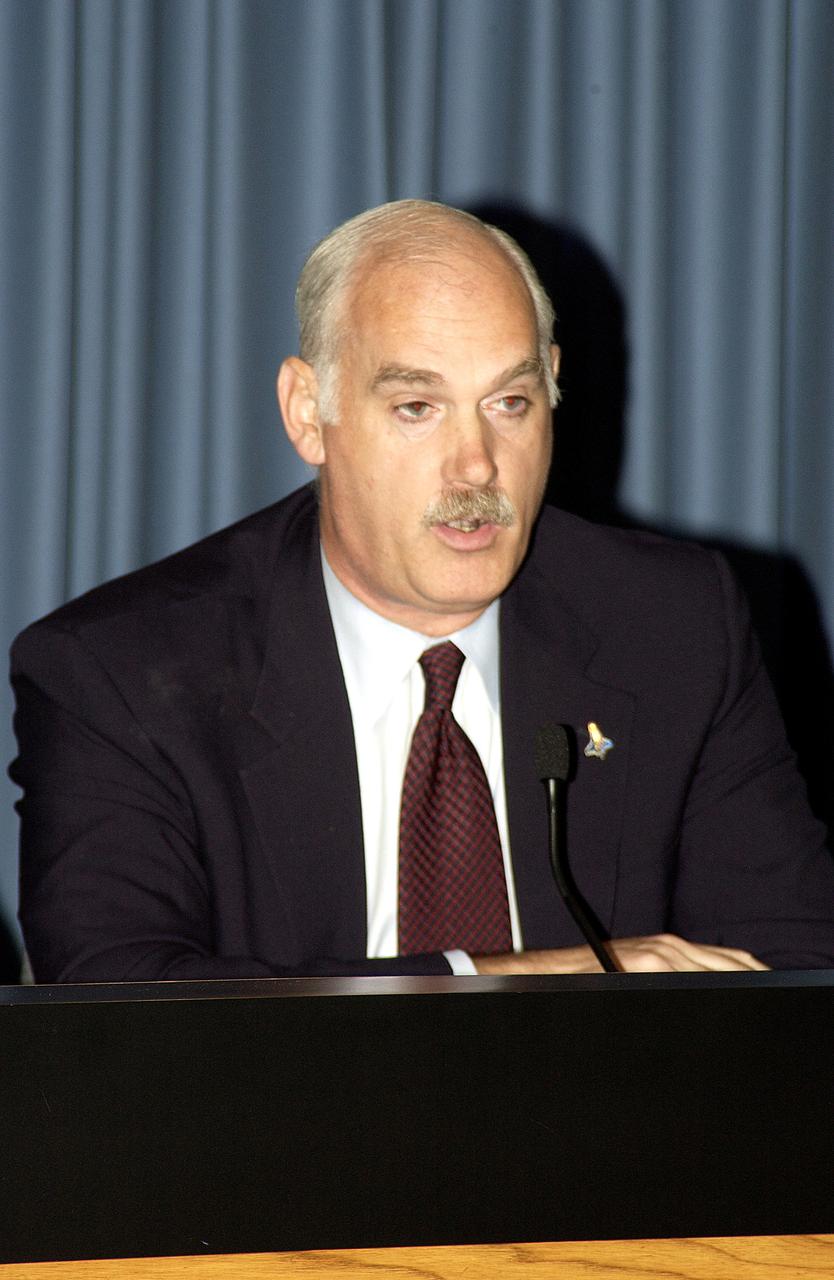
KENNEDY SPACE CENTER, FLA. - Associate Administrator for Space Flight Bill Readdy speaks at a media briefing at KSC. NASA officials discussed the agency’s human space flight program. Others on the panel were NASA Deputy Administrator Fred Gregory and Associate Administrator for Safety and Mission Assurance Bryan O’Connor.
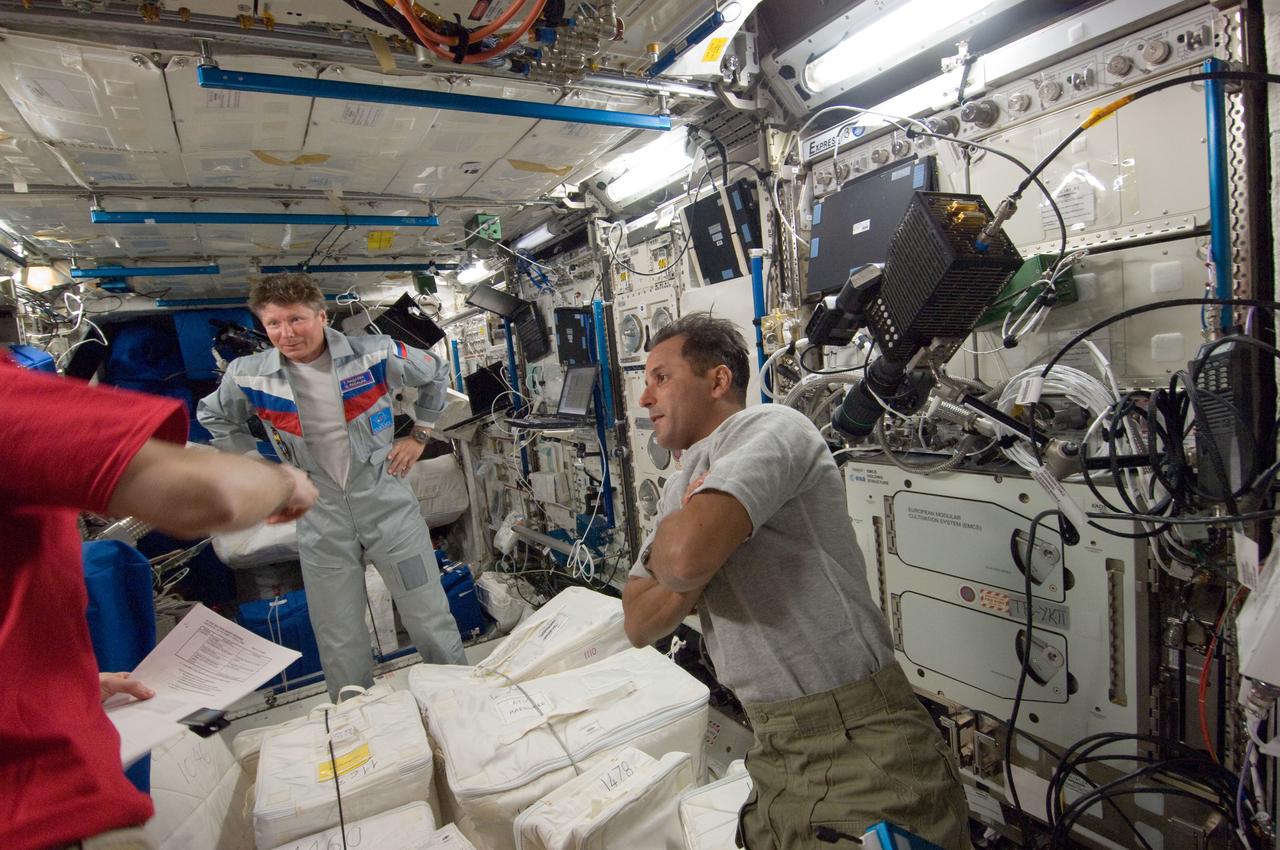
ISS031-E-081658 (17 May 2012) --- Russian cosmonaut Gennady Padalka (background) and NASA astronaut Joe Acaba, both Expedition 31 flight engineers, are pictured during a crew safety briefing in the Columbus laboratory to familiarize them with the potential hazards and available safety measures onboard the International Space Station. Russian cosmonaut Oleg Kononenko (mostly out of frame at left), commander, conducted the briefing. Out of frame are European Space Agency astronaut Andre Kuipers, NASA astronaut Don Pettit and Russian cosmonaut Sergei Revin, all flight engineers. The event took place shortly after Padalka, Revin and Acaba docked with the space station in their Soyuz TMA-04M spacecraft.
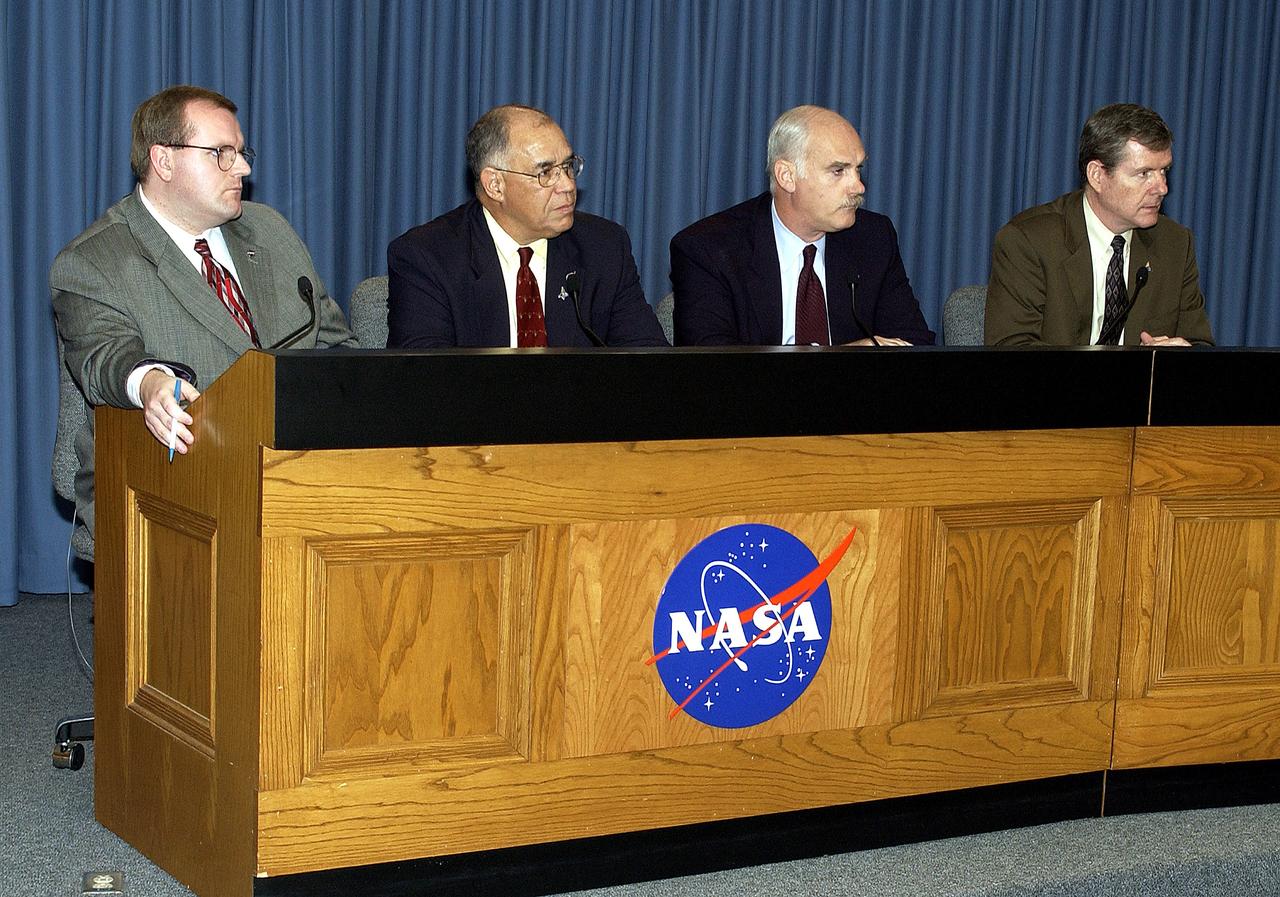
KENNEDY SPACE CENTER, FLA. - NASA officials brief the media at KSC about the agency’s human space flight program. At left is moderator Allard Beutel, with NASA Headquarters. Others on the panel (left to right) are NASA Deputy Administrator Fred Gregory, Associate Administrator for Space Flight Bill Readdy and Associate Administrator for Safety and Mission Assurance Bryan O’Connor.
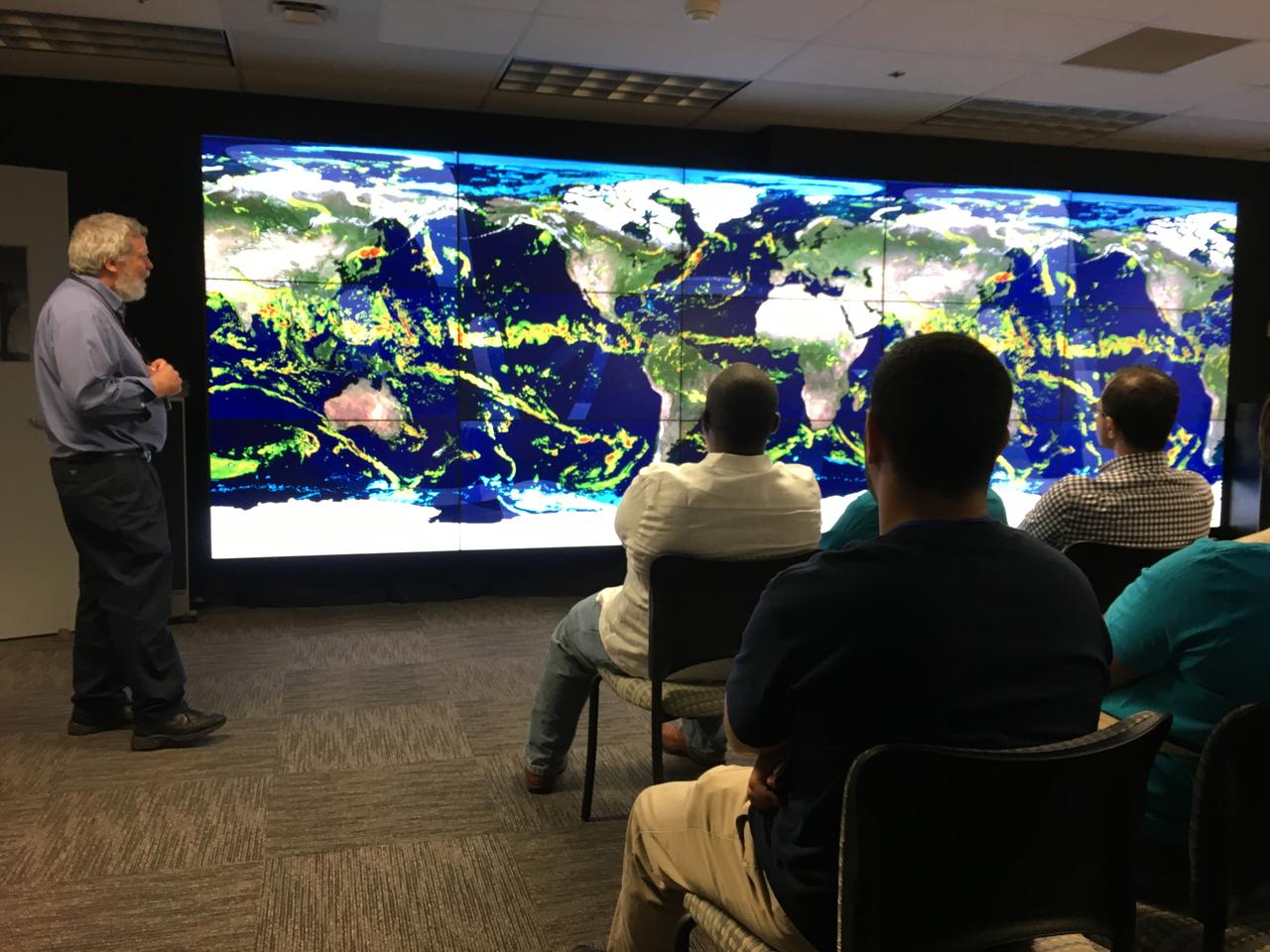
The Safety and Mission Assurance Directors from all NASA centers came together July 26-28, 2016 at Goddard Space Flight Center for their quarterly meeting. As part of the event, the attendees received a tour of the facilities and a briefing from the Goddard's Solar System Exploration Division Director Dr. Paul Mahaffy.
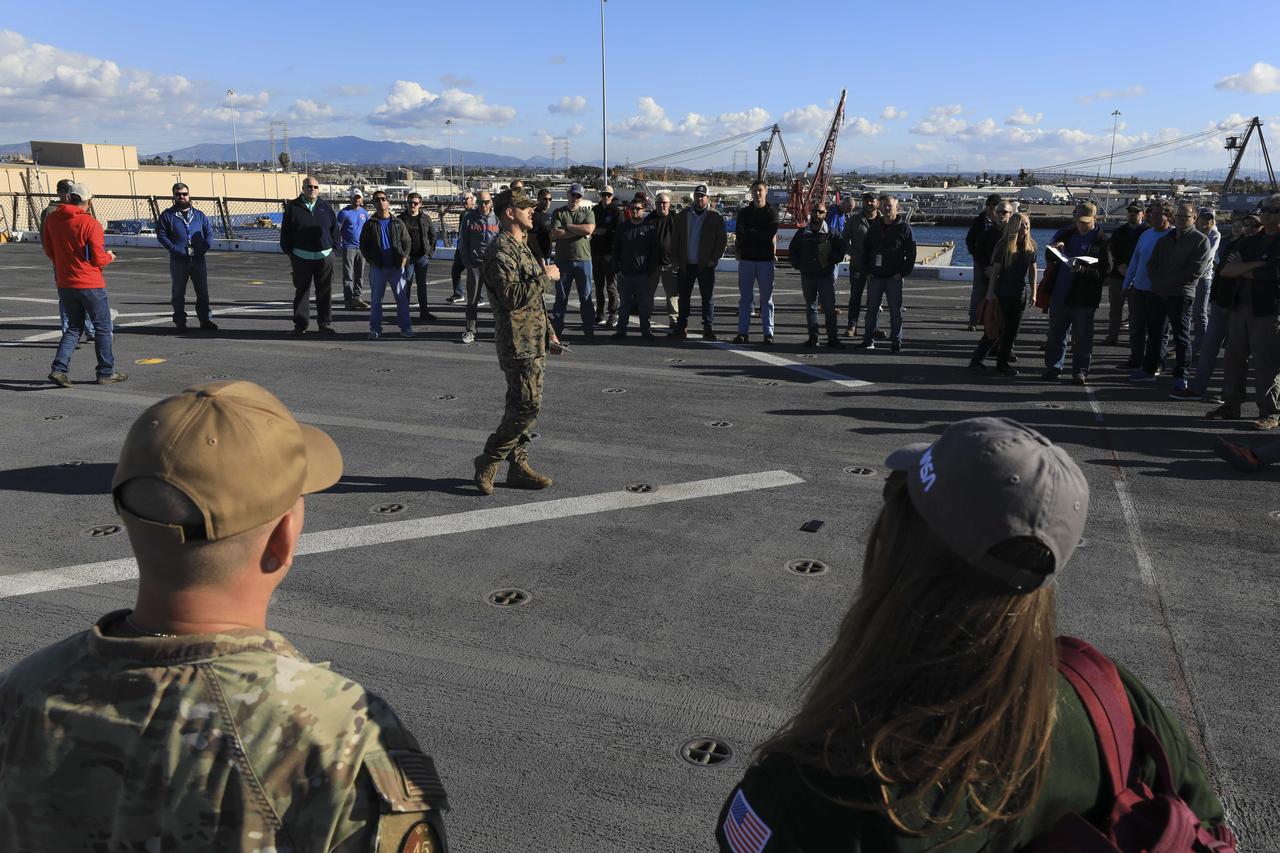
NASA and DOD members of the Artemis I recovery team listen to a safety briefing before going underway aboard the USS Portland (LPD 27). The team heads out to sea ahead of the Dec. 11 Orion splashdown in the Pacific Ocean.
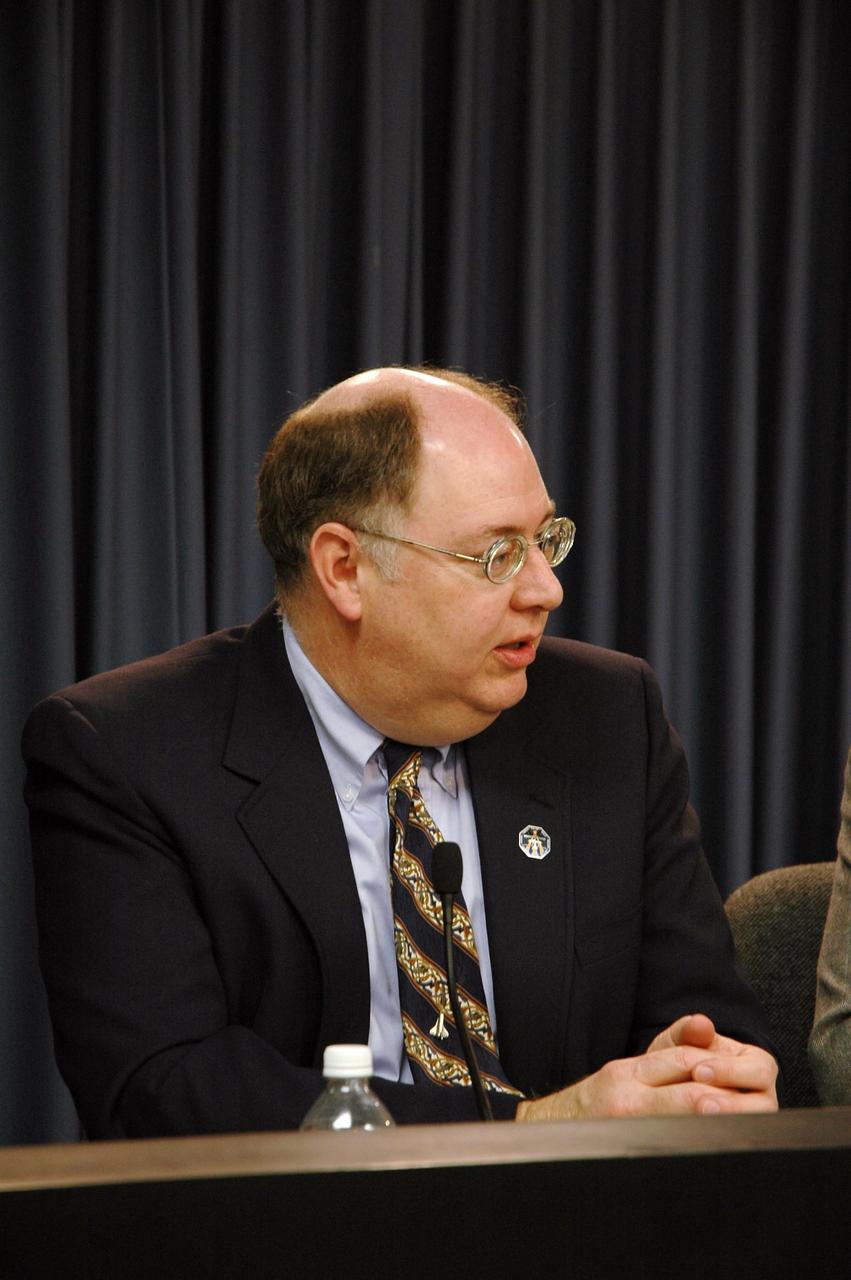
KENNEDY SPACE CENTER, FLA. - Space Shuttle Program Manager Wayne Hale answers a question from a reporter during a press conference. He and NASA Launch Director Mike Leinbach and STS-114 External Tank Tiger Team lead Tim Wilson, with the NASA Engineering & Safety Center, briefed the media about the Space Shuttle Program and mission STS-121 from the press site at NASA's Kennedy Space Center in Florida. Photo credit: NASA/Jack Pfaller
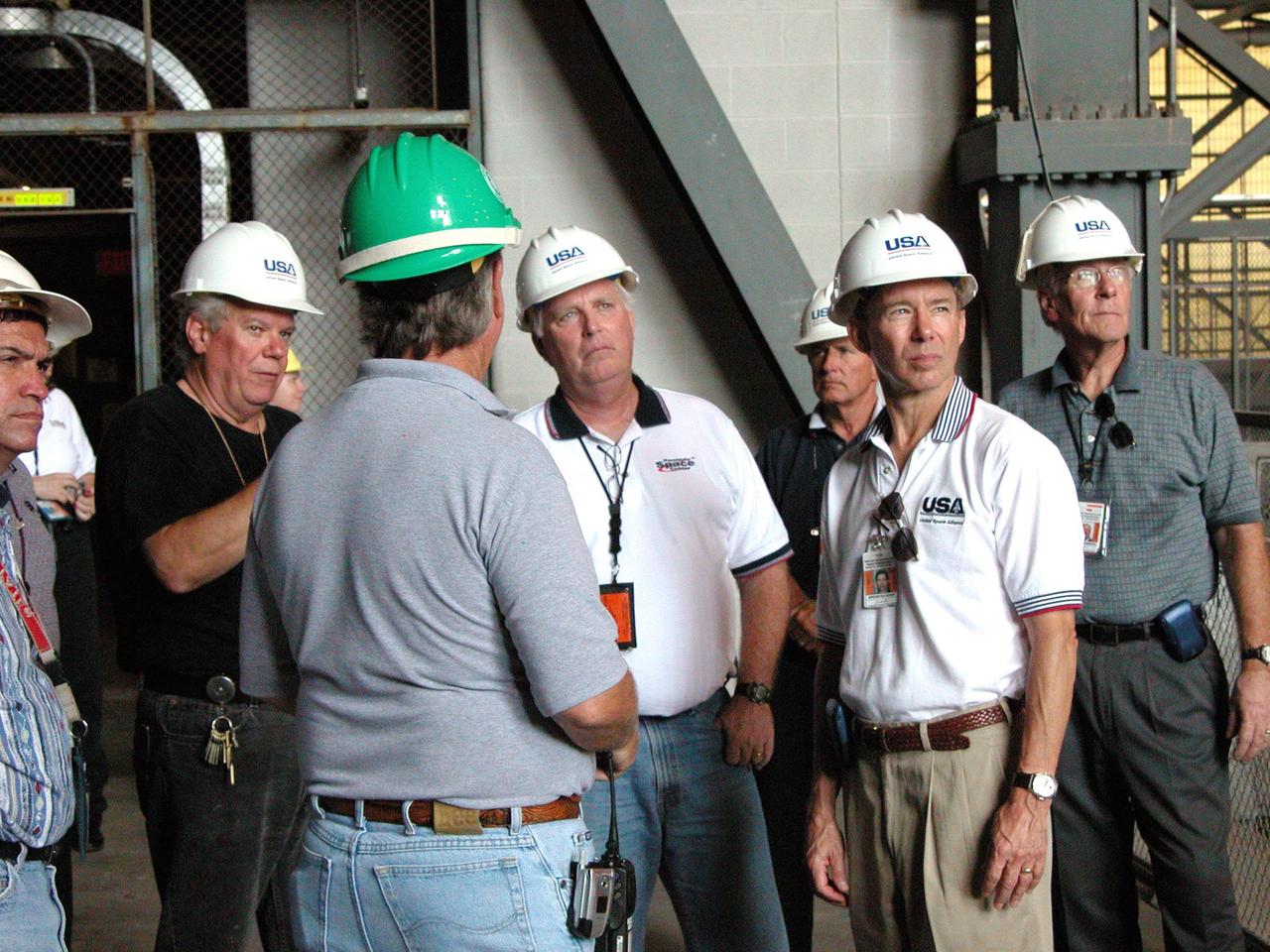
KENNEDY SPACE CENTER, FLA. - Members of the United Space Alliance (USA) safety team brief KSC Director Jim Kennedy (center), USA Chief Operating Officer Brewster Shaw (second from right), and USA Vice President Joe Hammond (right) following Hurricane Frances on damage sustained by KSC facilities. The storm's path over Florida took it through Cape Canaveral and KSC property during Labor Day weekend.
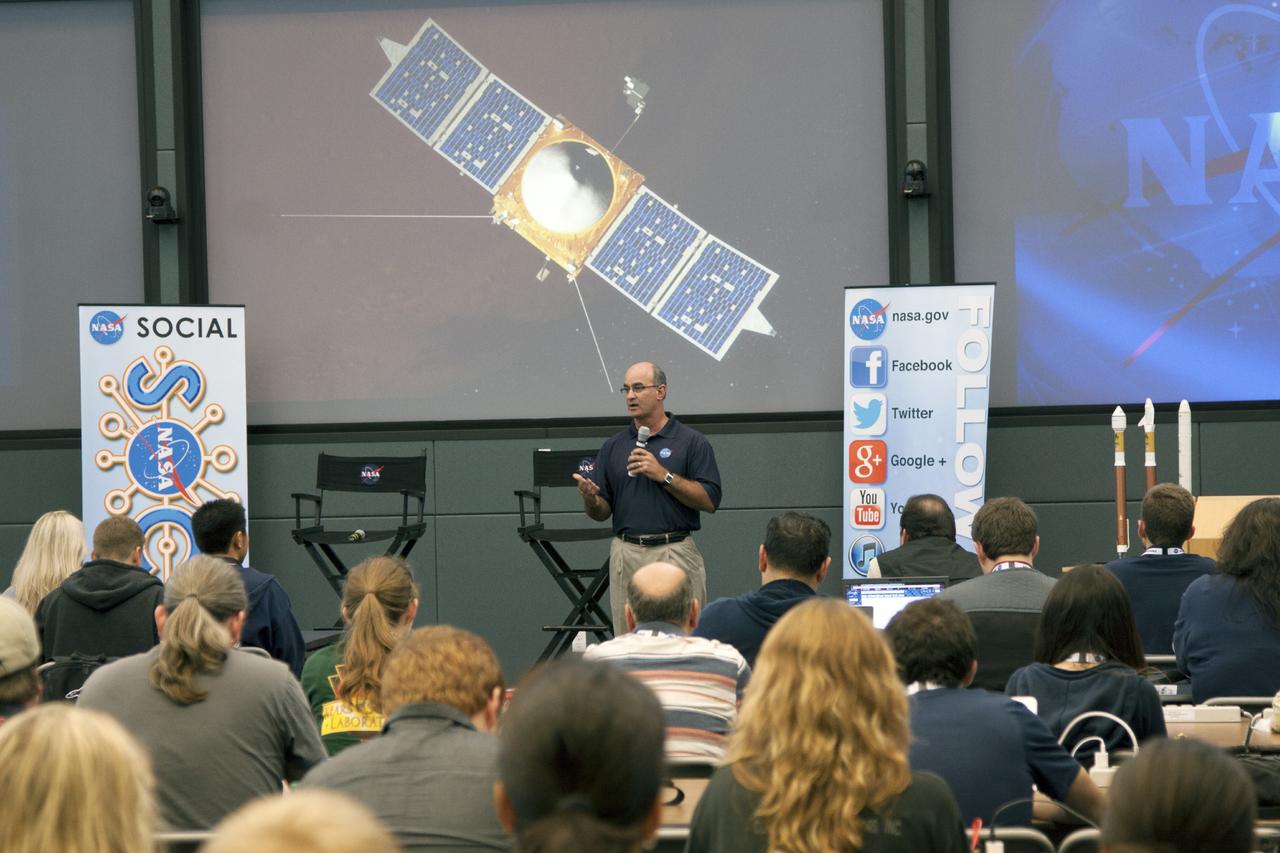
CAPE CANAVERAL, Fla. -- In the conference room of Operations Support Building II at NASA's Kennedy Space Center in Florida, social media participants listen to a briefing on future agency programs by Billy Stover, a NASA Commercial Crew Program Safety engineer. The social media participants gathered at the Florida spaceport for the launch of the Mars Atmosphere and Volatile Evolution, or MAVEN, spacecraft. Their visit included tours of key facilities and participating in presentations by key NASA leaders who updated the space agency's current efforts. Photo credit: NASA/Jim Grossman
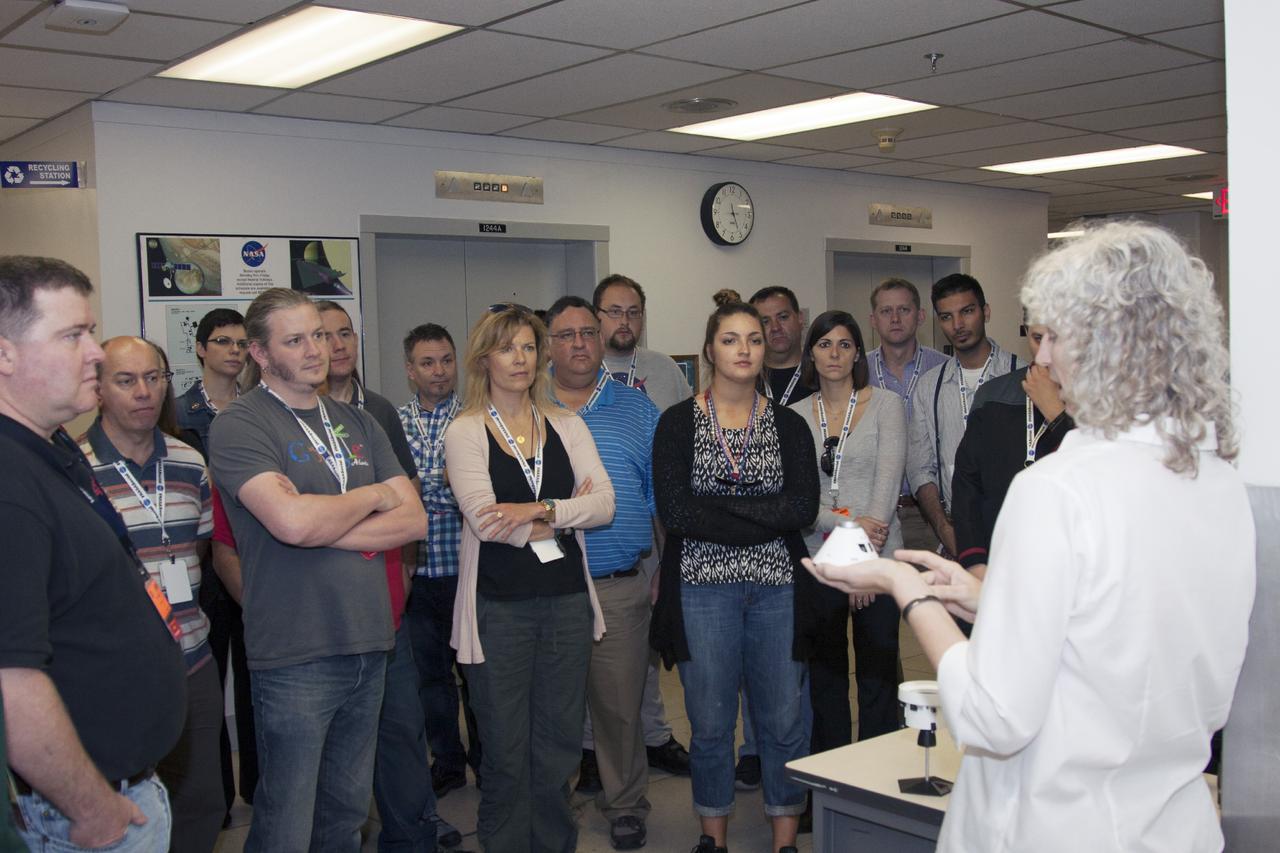
CAPE CANAVERAL, Fla. -- Social media participants are briefed on the Orion spacecraft by Sharolee Huet of NASA Operational Processing in Safety and Mission Assurance at NASA's Kennedy Space Center in Florida. The participants were on hand for the upcoming launch of the Mars Atmosphere and Volatile Evolution, or MAVEN, mission. Their visit included tours of key facilities at the Florida Spaceport and participating in presentations by key NASA leaders who updated the space agency's current efforts. Photo credit: NASA/Jim Grossman

S82-28456 (19 Feb. 1982) --- Astronauts Jack R. Lousma, left, STS-3 commander, and C. Gordon Fullerton, pilot, are briefed on emergency procedures at Launch Pad 39A by Buck Tomlinson, a safety instructor with Wackenhut Services, Inc. Also pictured is astronaut Daniel C. Brandenstein, STS-8 pilot. The men were at Kennedy Space Center (KSC) for participation in a countdown demonstration test (CDDT). Photo credit: NASA
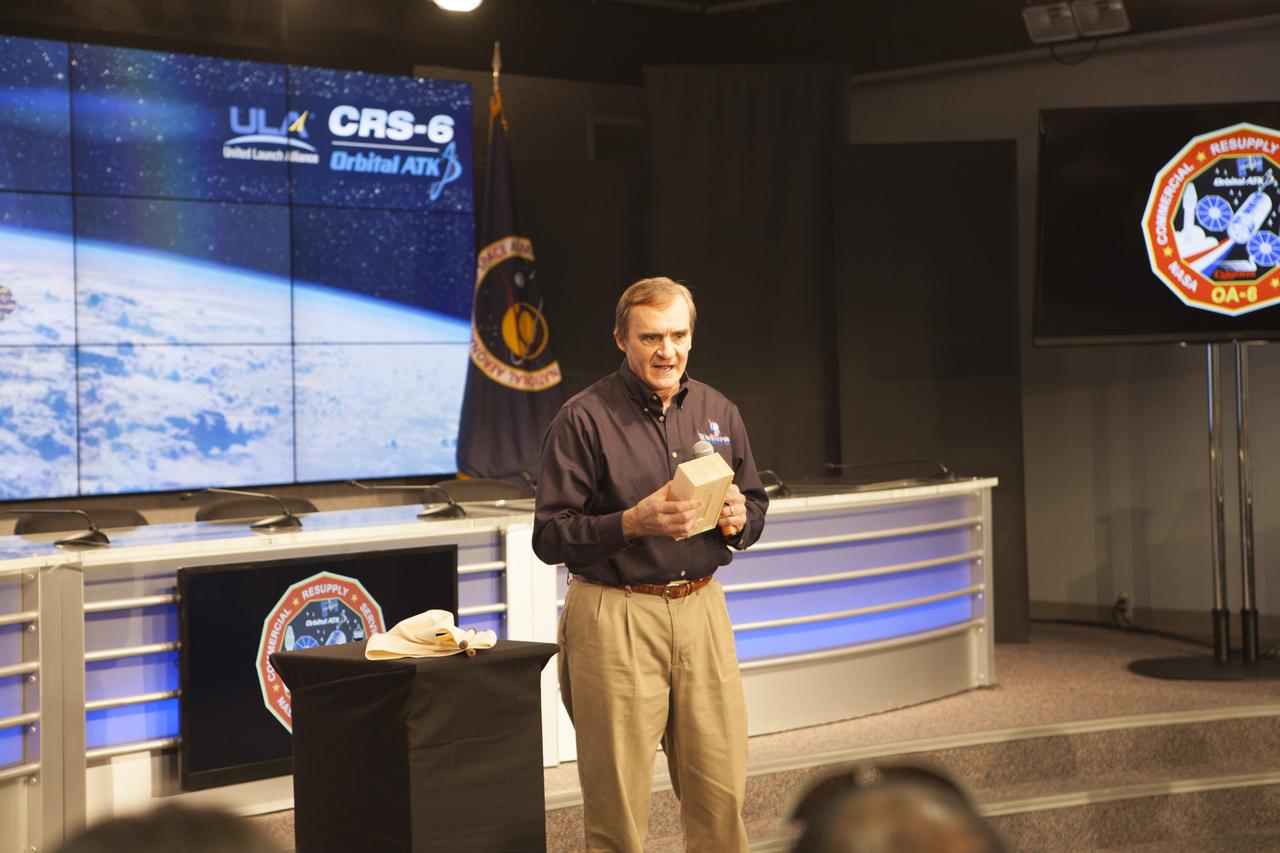
Gary Ruff, NASA project manager and co-investigator for the Spacecraft Fire Safety Demonstration Project, or Saffire, at the Glenn Research Center in Cleveland, speaks to members of the media in the Kennedy Space Center’s Press Site auditorium. The briefing focused on science research and technology work planned for the International Space Station, or ISS, following the arrival of a Cygnus spacecraft. The Cygnus is scheduled to be launched March 22 atop a United Launch Alliance Atlas V rocket on the Orbital ATK CRS-6 commercial resupply services mission.
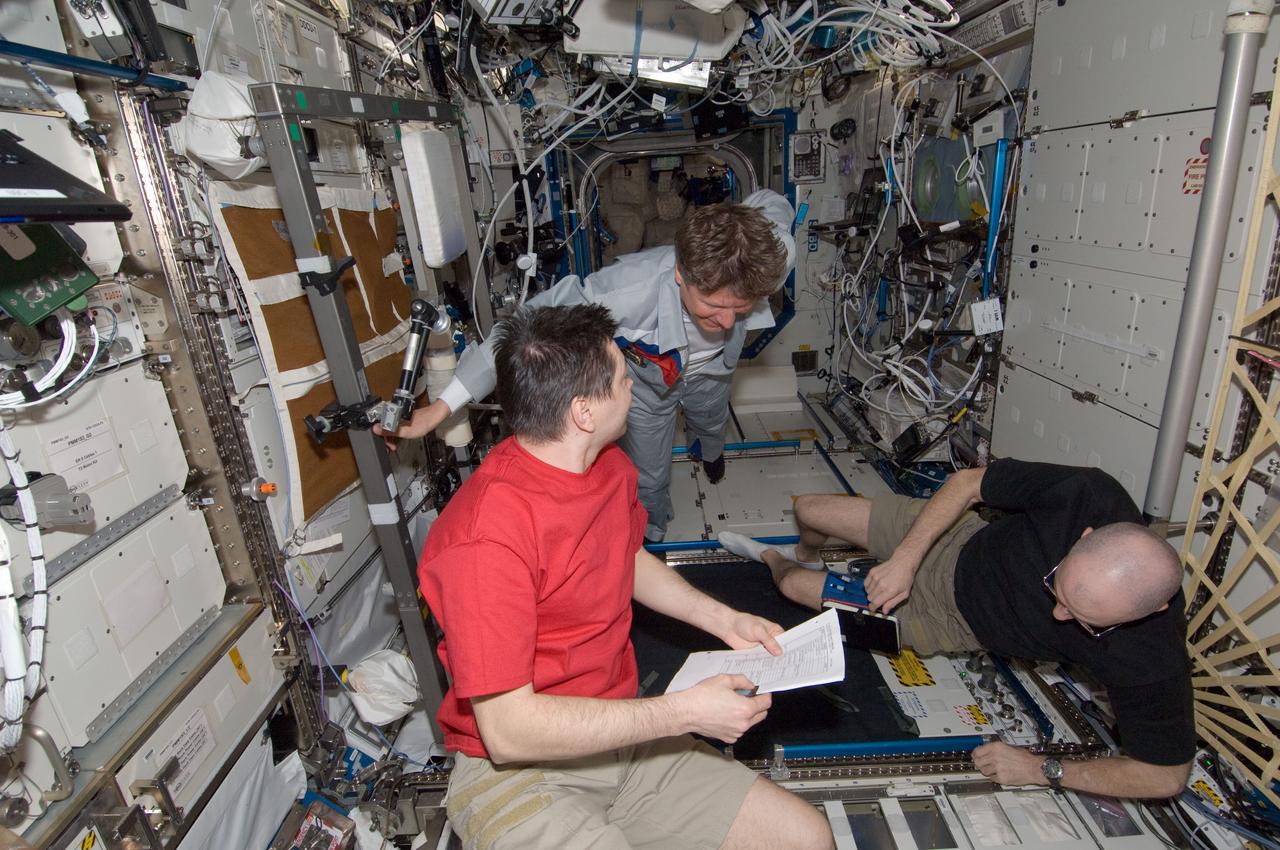
ISS031-E-081644 (17 May 2012) --- Russian cosmonaut Oleg Kononenko (left), Expedition 31 commander, conducts a crew safety briefing in the Destiny laboratory of the International Space Station shortly after Russian cosmonauts Gennady Padalka (center) and Sergei Revin (out of frame); along with NASA astronaut Joe Acaba (not pictured) docked with the space station in their Soyuz TMA-04M spacecraft. NASA astronaut Don Pettit, flight engineer, is at right.
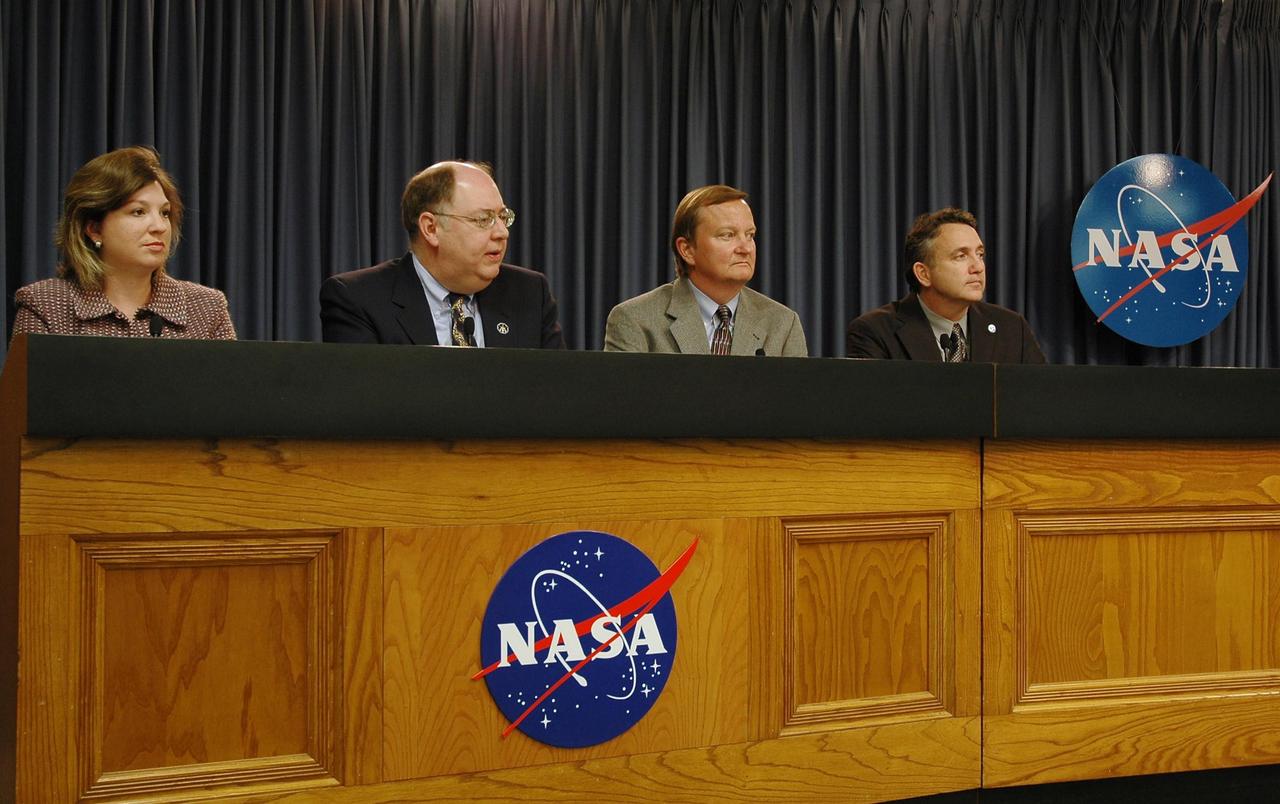
KENNEDY SPACE CENTER, FLA. - NASA managers brief the media about the Space Shuttle Program and mission STS-121 from the press site at NASA's Kennedy Space Center in Florida. Public Information Officer Jessica Rye moderated. Seated at her right are Space Shuttle Program Manager Wayne Hale, NASA Launch Director Mike Leinbach and STS-114 External Tank Tiger Team lead Tim Wilson, with the NASA Engineering & Safety Center. Photo credit: NASA/Jack Pfaller
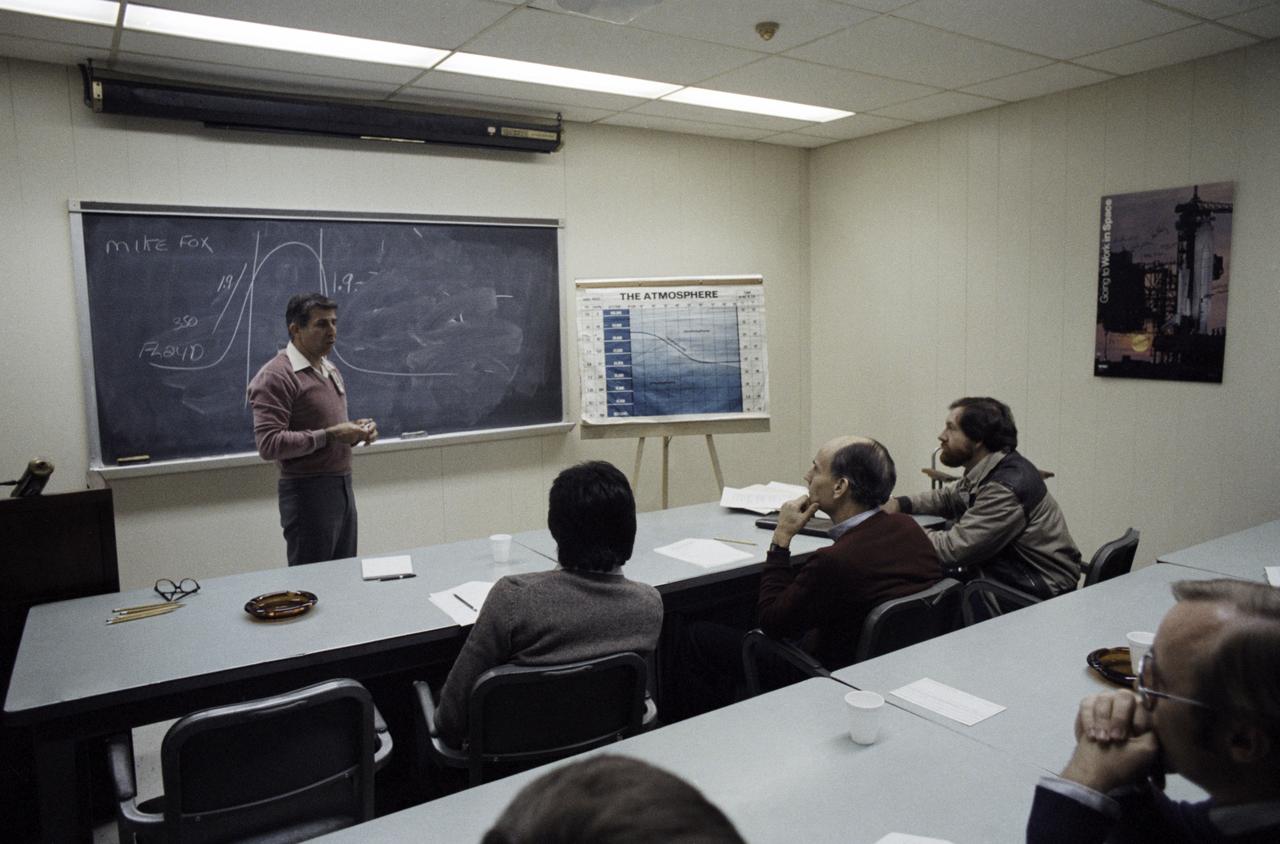
Senator Jake Garn (R., Utah), center on front row, listens to a briefing by Michael Fox, an Aeromedical Physiological Training Technician. Classroom activities in preparation for Vacuum Chamber Test. He is joined on the front row by Frank Martinez, a JSC safety diver and Jeff Bingham, the Senator's aide. 1. Senator E. J. "Jake" Garn Also available in 35mm CN
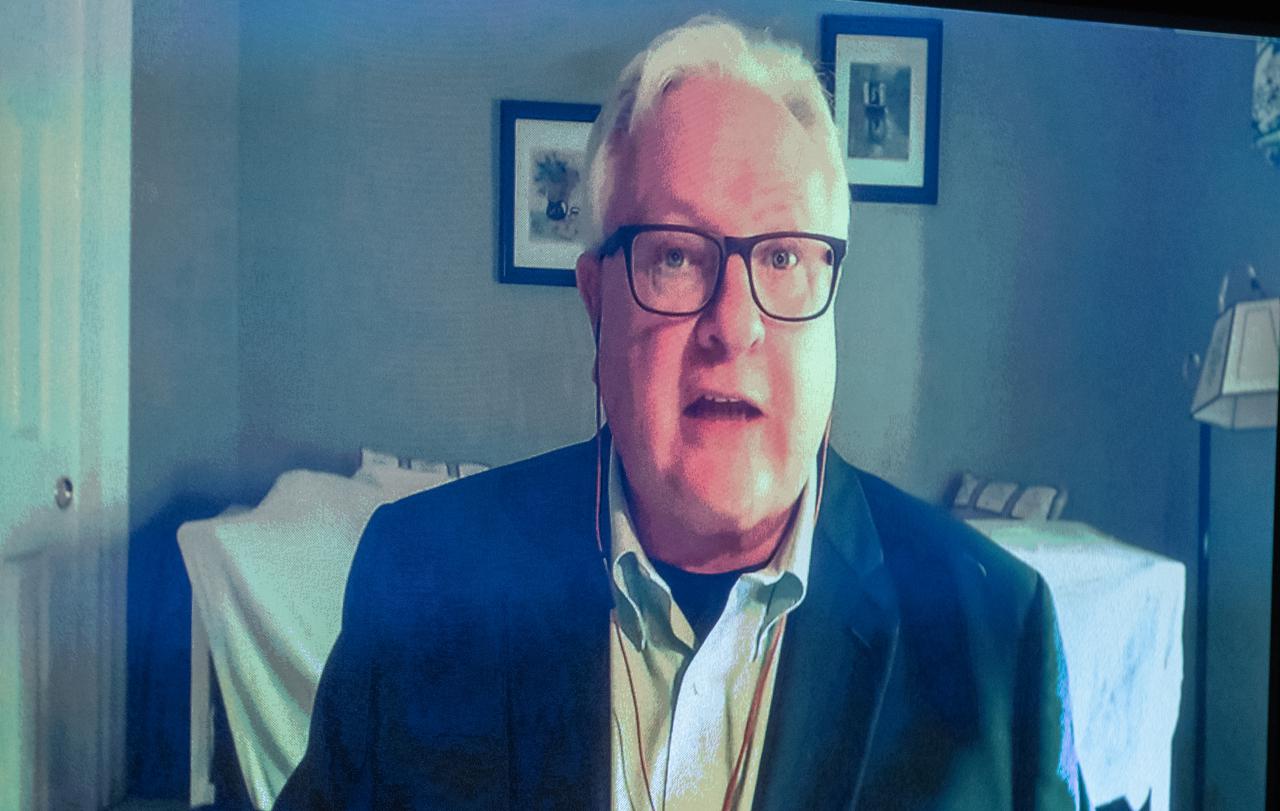
A science briefing for the National Oceanic and Atmospheric Administration’s (NOAA) Geostationary Operational Environmental Satellite-T (GOES-T) is held on Feb. 25, 2022, at NASA’s Kennedy Space Center in Florida. Dr. James “Jim Yoe, chief administrator, Joint Center for Satellite Data Assimilation, participates remotely in the briefing. GOES-T is scheduled to lift off on a United Launch Alliance Atlas V 541 rocket from Space Launch Complex 41 at Cape Canaveral Space Force Station in Florida on March 1, 2022, at 4:38 p.m. GOES-T is the third satellite in the GOES-R series that will continue to help meteorologists observe and predict local weather events that affect public safety. The launch is being managed by NASA’s Launch Services Program based at Kennedy Space Center in Florida, America’s multi-user spaceport.

A science briefing for the National Oceanic and Atmospheric Administration’s (NOAA) Geostationary Operational Environmental Satellite-T (GOES-T) is held on Feb. 25, 2022, at NASA’s Kennedy Space Center in Florida. Daniel Gall, Advanced Baseline Imager chief systems engineer, Space and Airborne Systems, L3 Harris Technologies, participates in the briefing. GOES-T is scheduled to lift off on a United Launch Alliance Atlas V 541 rocket from Space Launch Complex 41 at Cape Canaveral Space Force Station in Florida on March 1, 2022, at 4:38 p.m. GOES-T is the third satellite in the GOES-R series that will continue to help meteorologists observe and predict local weather events that affect public safety. The launch is being managed by NASA’s Launch Services Program based at Kennedy Space Center in Florida, America’s multi-user spaceport.
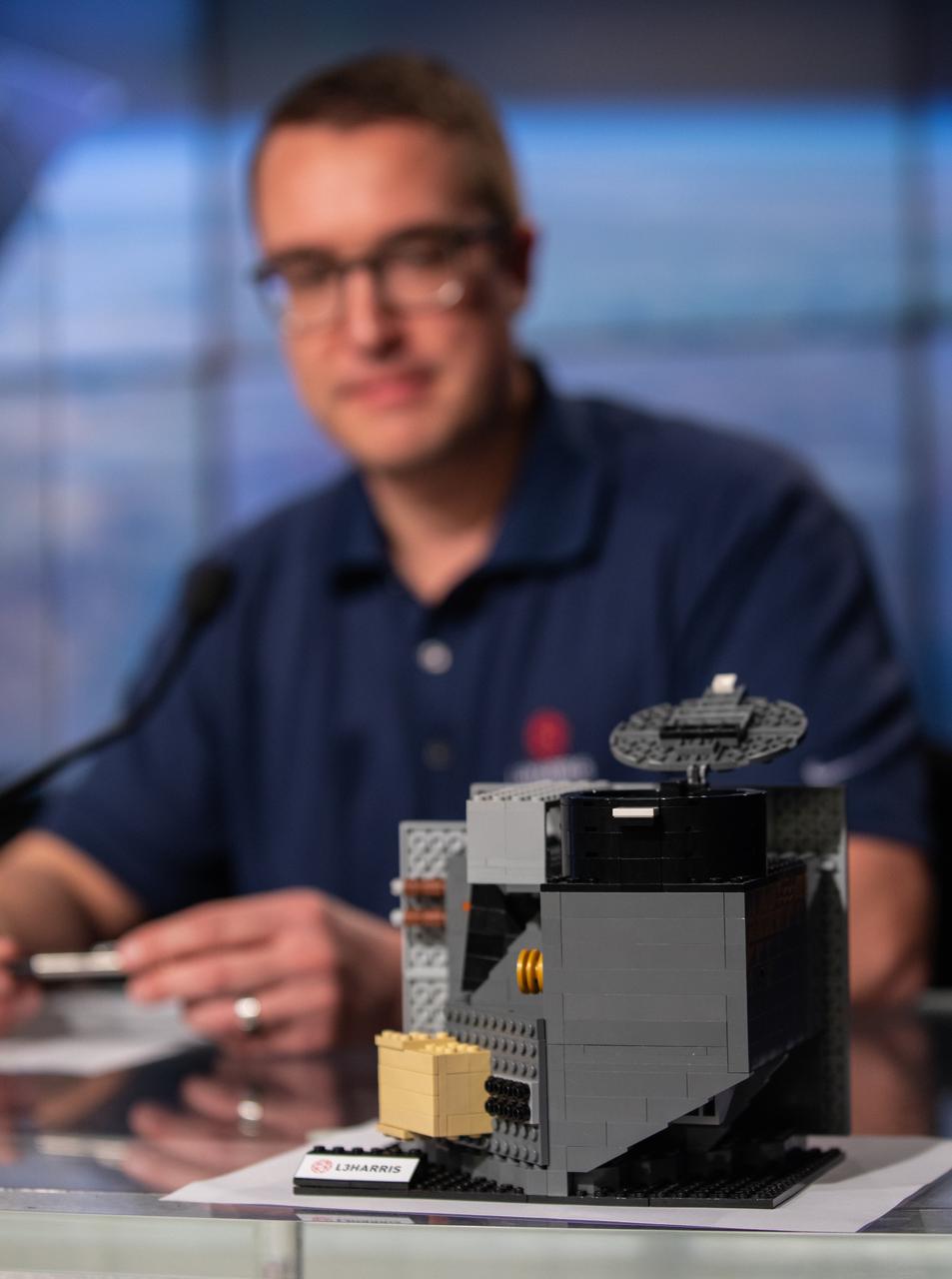
A science briefing for the National Oceanic and Atmospheric Administration’s (NOAA) Geostationary Operational Environmental Satellite-T (GOES-T) is held on Feb. 25, 2022, at NASA’s Kennedy Space Center in Florida. Daniel Gall, Advanced Baseline Imager chief systems engineer, Space and Airborne Systems, L3 Harris Technologies, participates in the briefing. GOES-T is scheduled to lift off on a United Launch Alliance Atlas V 541 rocket from Space Launch Complex 41 at Cape Canaveral Space Force Station in Florida on March 1, 2022, at 4:38 p.m. GOES-T is the third satellite in the GOES-R series that will continue to help meteorologists observe and predict local weather events that affect public safety. The launch is being managed by NASA’s Launch Services Program based at Kennedy Space Center in Florida, America’s multi-user spaceport.
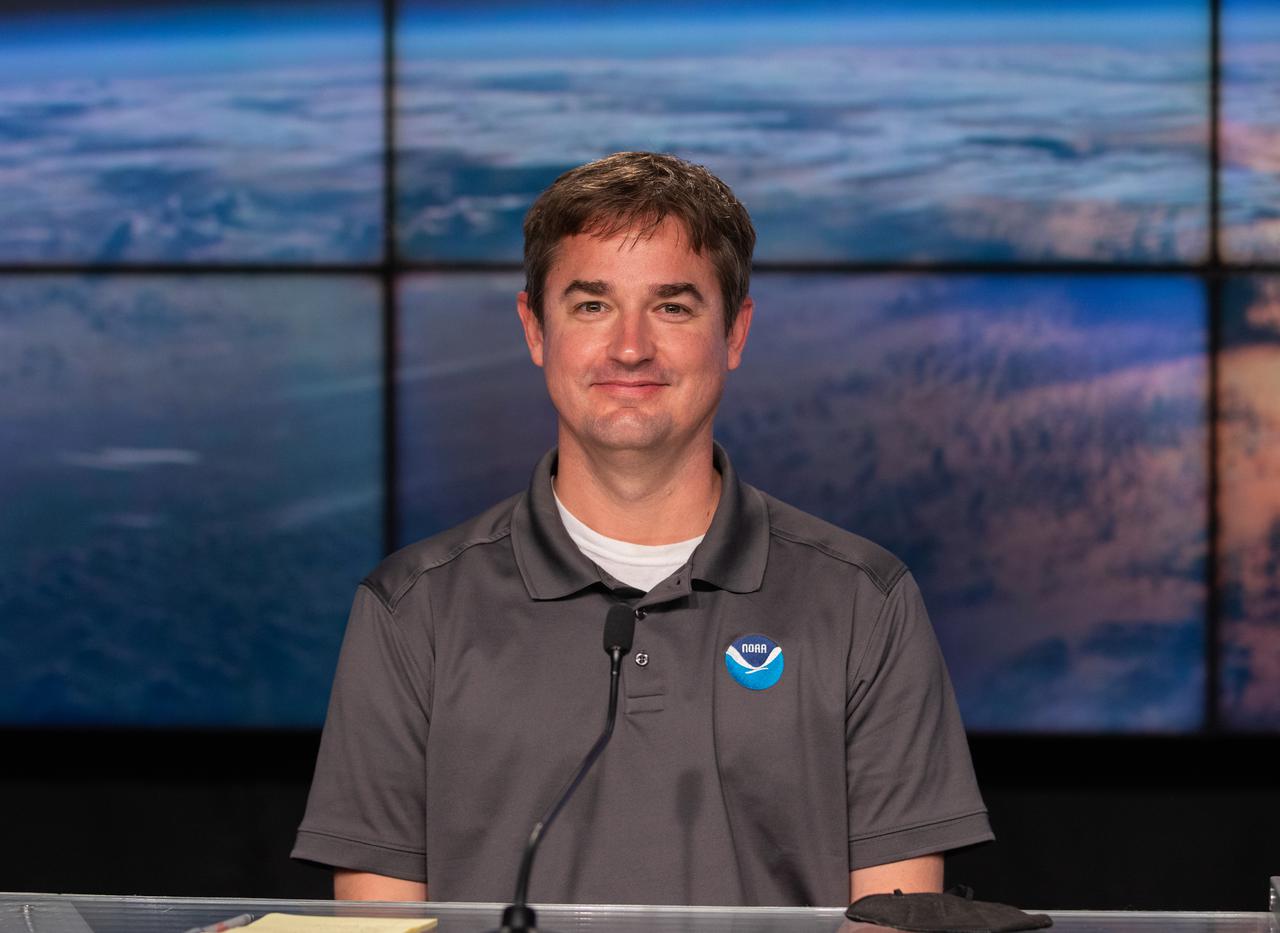
A science briefing for the National Oceanic and Atmospheric Administration’s (NOAA) Geostationary Operational Environmental Satellite-T (GOES-T) is held on Feb. 25, 2022, at NASA’s Kennedy Space Center in Florida. Dr. Dan Lindsey, GOES-R program scientist, NOAA, participates in the briefing. GOES-T is scheduled to lift off on a United Launch Alliance Atlas V 541 rocket from Space Launch Complex 41 at Cape Canaveral Space Force Station in Florida on March 1, 2022, at 4:38 p.m. GOES-T is the third satellite in the GOES-R series that will continue to help meteorologists observe and predict local weather events that affect public safety. The launch is being managed by NASA’s Launch Services Program based at Kennedy Space Center in Florida, America’s multi-user spaceport.
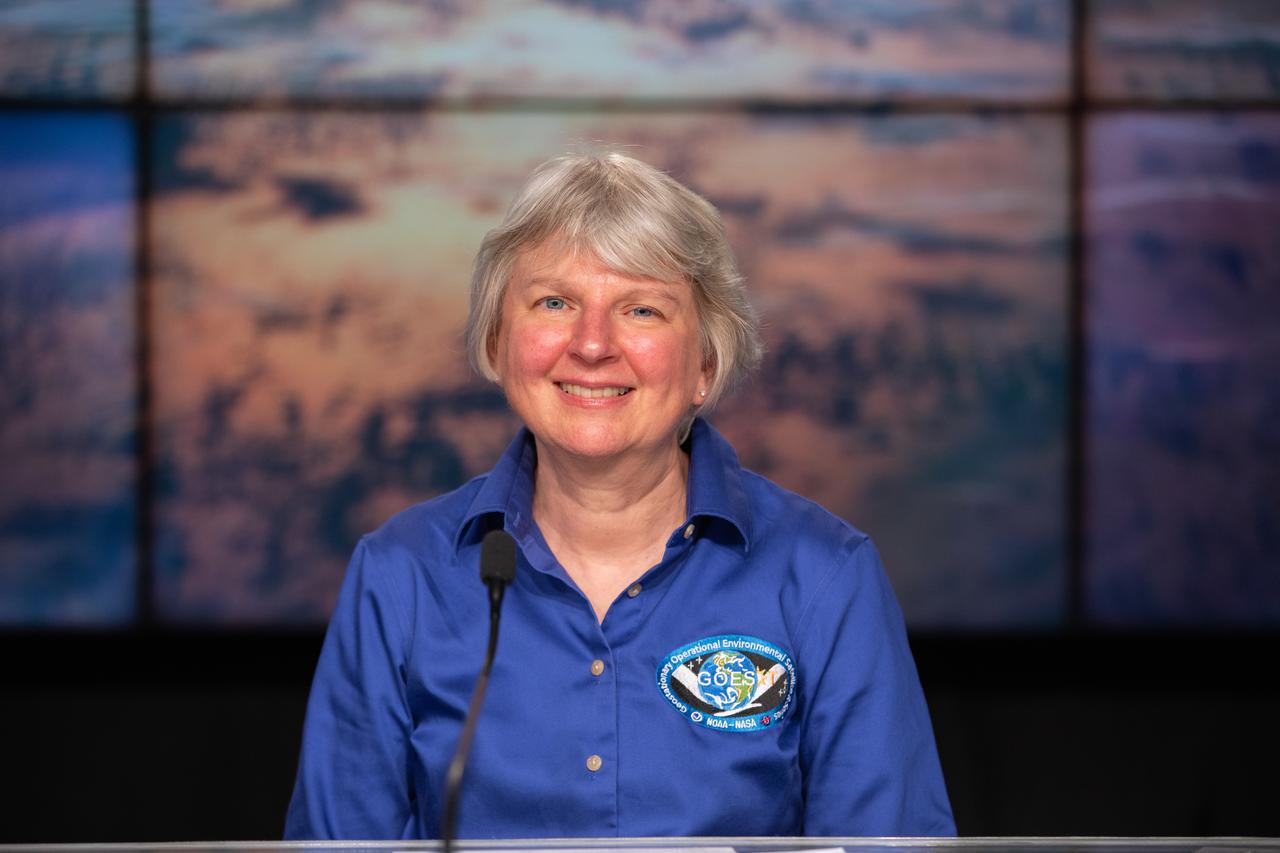
A science briefing for the National Oceanic and Atmospheric Administration’s (NOAA) Geostationary Operational Environmental Satellite-T (GOES-T) is held on Feb. 25, 2022, at NASA’s Kennedy Space Center in Florida. Candace Carlisle, GOES-R flight project manager, NASA’s Goddard Space Flight Center, participates in the briefing. GOES-T is scheduled to lift off on a United Launch Alliance Atlas V 541 rocket from Space Launch Complex 41 at Cape Canaveral Space Force Station in Florida on March 1, 2022, at 4:38 p.m. GOES-T is the third satellite in the GOES-R series that will continue to help meteorologists observe and predict local weather events that affect public safety. The launch is being managed by NASA’s Launch Services Program based at Kennedy Space Center in Florida, America’s multi-user spaceport.
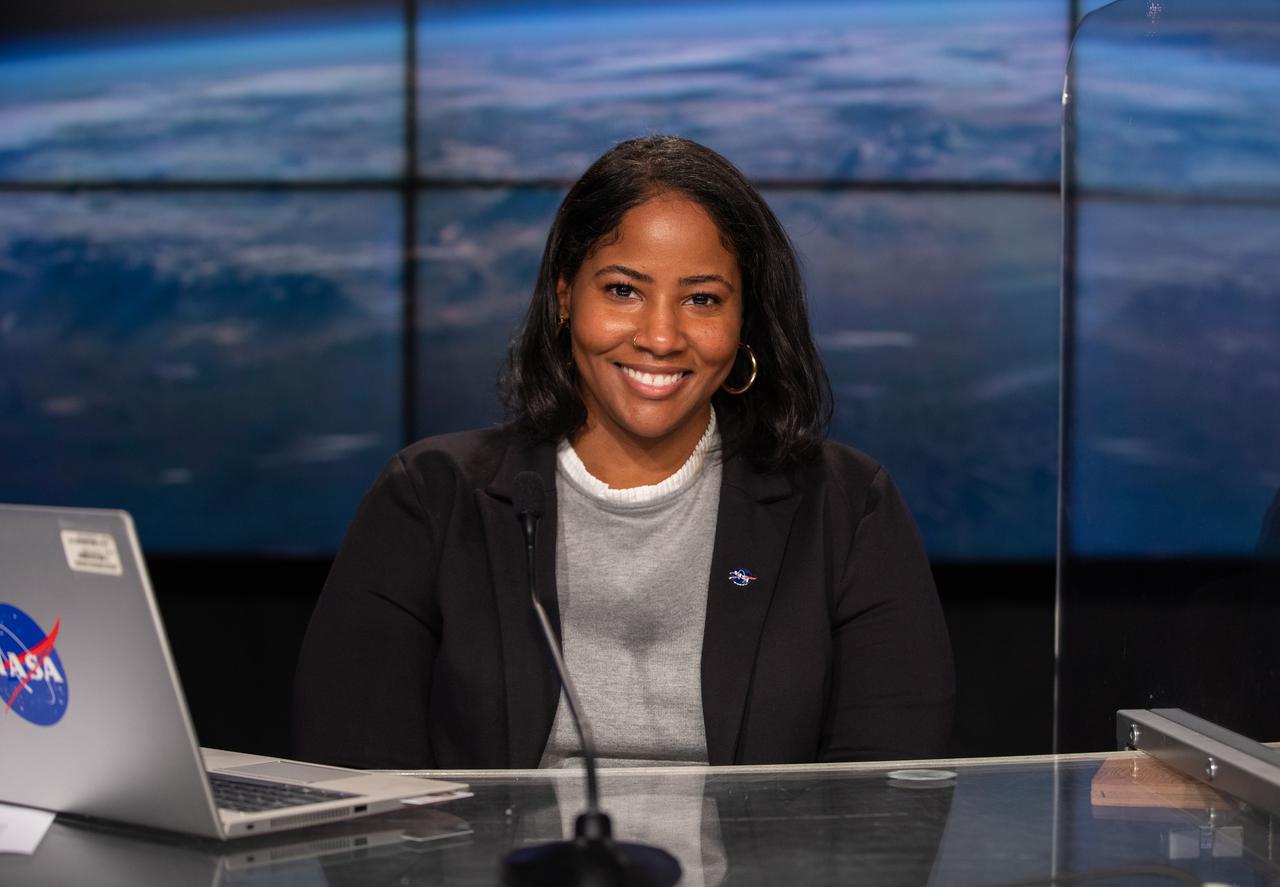
A science briefing for the National Oceanic and Atmospheric Administration’s (NOAA) Geostationary Operational Environmental Satellite-T (GOES-T) is held on Feb. 25, 2022, at NASA’s Kennedy Space Center in Florida. Tylar Greene, NASA Communications, moderates the briefing. GOES-T is scheduled to lift off on a United Launch Alliance Atlas V 541 rocket from Space Launch Complex 41 at Cape Canaveral Space Force Station in Florida on March 1, 2022, at 4:38 p.m. GOES-T is the third satellite in the GOES-R series that will continue to help meteorologists observe and predict local weather events that affect public safety. The launch is being managed by NASA’s Launch Services Program based at Kennedy Space Center in Florida, America’s multi-user spaceport.
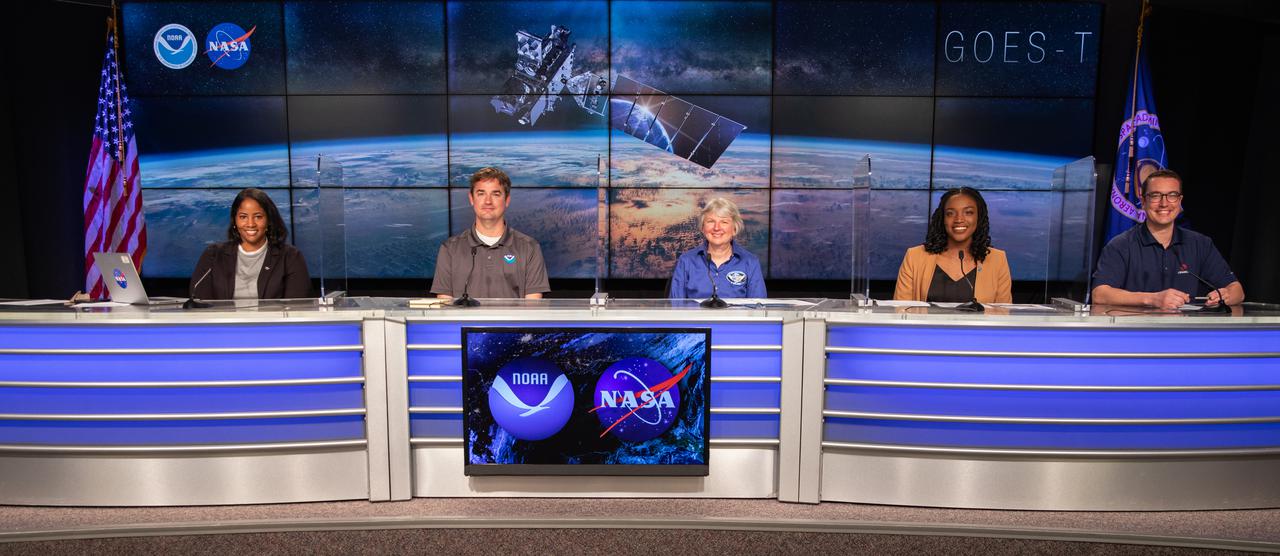
A science briefing for the National Oceanic and Atmospheric Administration’s (NOAA) Geostationary Operational Environmental Satellite-T (GOES-T) is held on Feb. 25, 2022, at NASA’s Kennedy Space Center in Florida. Participants from left, are Tylar Greene, briefing moderator, NASA Communications; Dr. Dan Lindsey, GOES-R program scientist, NOAA; Candace Carlisle, GOES-R flight project manager, NASA’s Goddard Space Flight Center; Tewa Kpulun, Geostationary Lightning Mapper science lead, Lockheed Martin; and Daniel Gall, Advanced Baseline Imager chief systems engineer, Space and Airborne Systems, L3 Harris Technologies, participates in the briefing. GOES-T is scheduled to lift off on a United Launch Alliance Atlas V 541 rocket from Space Launch Complex 41 at Cape Canaveral Space Force Station in Florida on March 1, 2022, at 4:38 p.m. GOES-T is the third satellite in the GOES-R series that will continue to help meteorologists observe and predict local weather events that affect public safety. The launch is being managed by NASA’s Launch Services Program based at Kennedy Space Center in Florida, America’s multi-user spaceport.
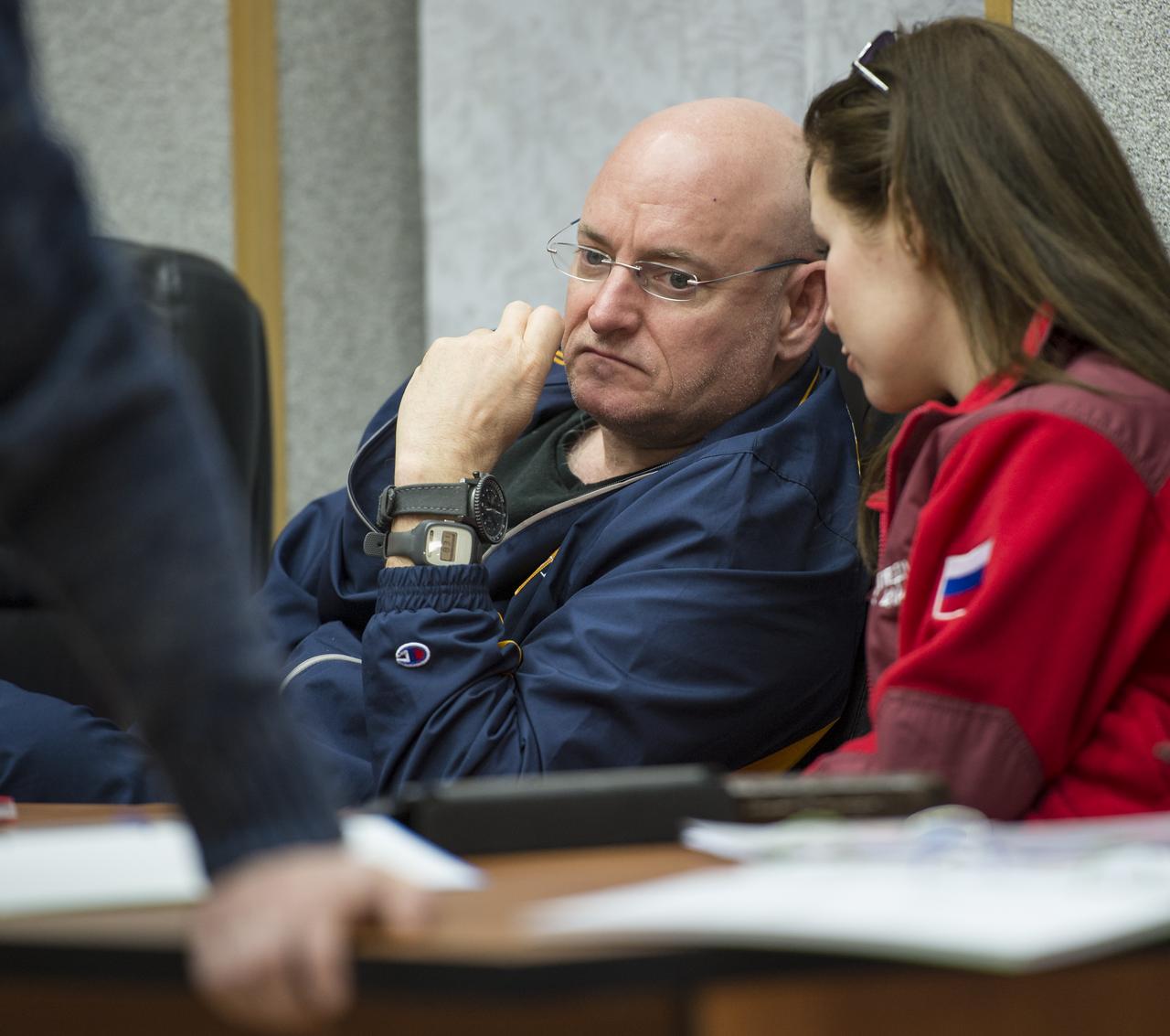
Expedition 43 NASA Astronaut Scott Kelly listens to an interpreter during an ISS Russian Segment Safety briefing, Thursday, March 19, 2015 at Cosmonaut Hotel in Baikonur, Kazakhstan. Kelly, and Russian Cosmonauts Gennady Padalka, and Mikhail Kornienko of the Russian Federal Space Agency (Roscosmos) are preparing for launch to the International Space Station in their Soyuz TMA-16M spacecraft from the Baikonur Cosmodrome in Kazakhstan March 28, Kazakh time. As the one-year crew, Kelly and Kornienko will return to Earth on Soyuz TMA-18M in March 2016. Photo Credit: (NASA/Bill Ingalls)
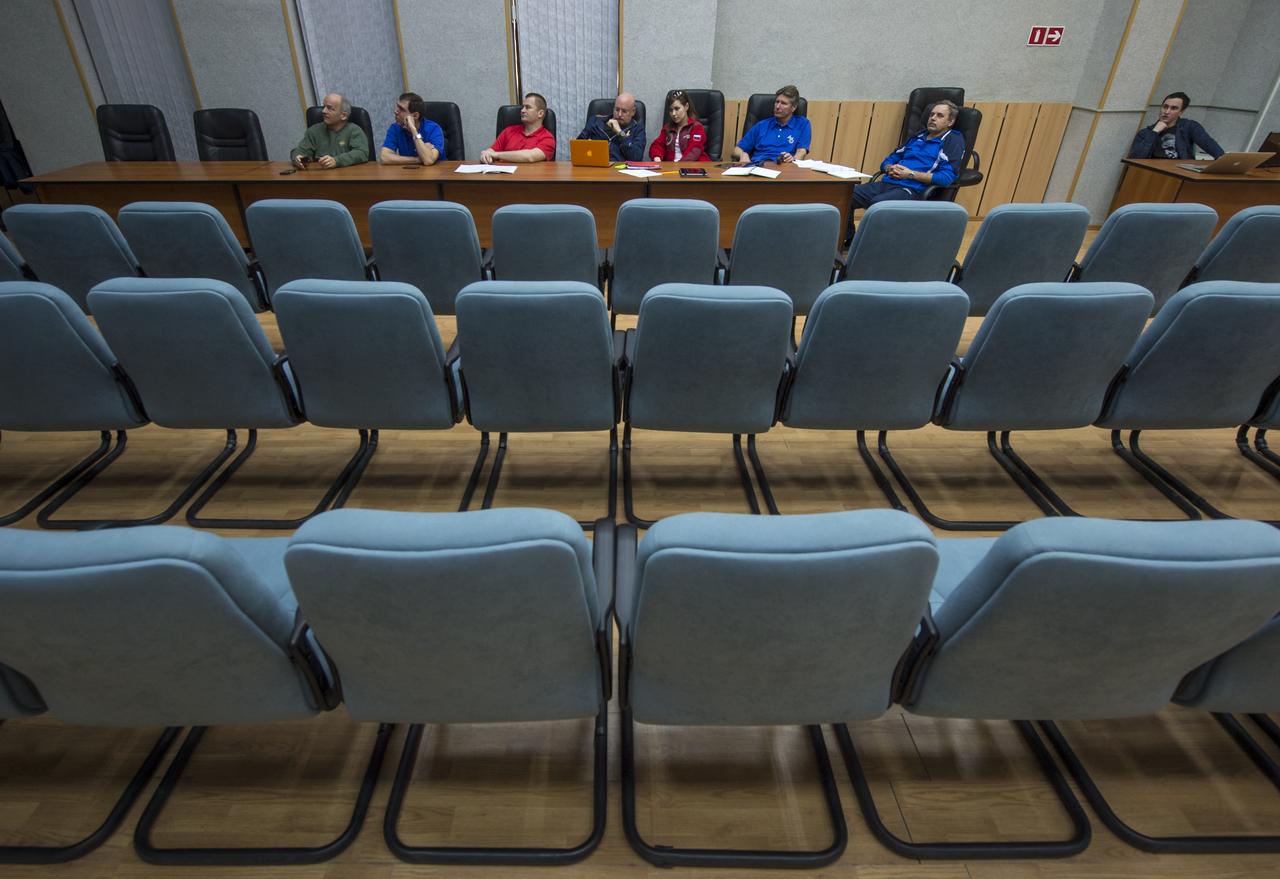
Expedition 43 backup crew members: Jeff Williams of NASA, left, Sergei Volkov, Alexey Ovchinin, of the Russian Federal Space Agency (Roscosmos), and prime crew members: NASA Astronaut Scott Kelly, Russian Cosmonauts Gennady Padalka, and Mikhail Kornienko of Roscosmos attend the ISS Russian Segment Safety briefing, Thursday, March 19, 2015 at Cosmonaut Hotel in Baikonur, Kazakhstan. Kelly, Padalka, and Kornienko are preparing for launch to the International Space Station in their Soyuz TMA-16M spacecraft from the Baikonur Cosmodrome in Kazakhstan March 28, Kazakh time. As the one-year crew, Kelly and Kornienko will return to Earth on Soyuz TMA-18M in March 2016. Photo Credit: (NASA/Bill Ingalls)
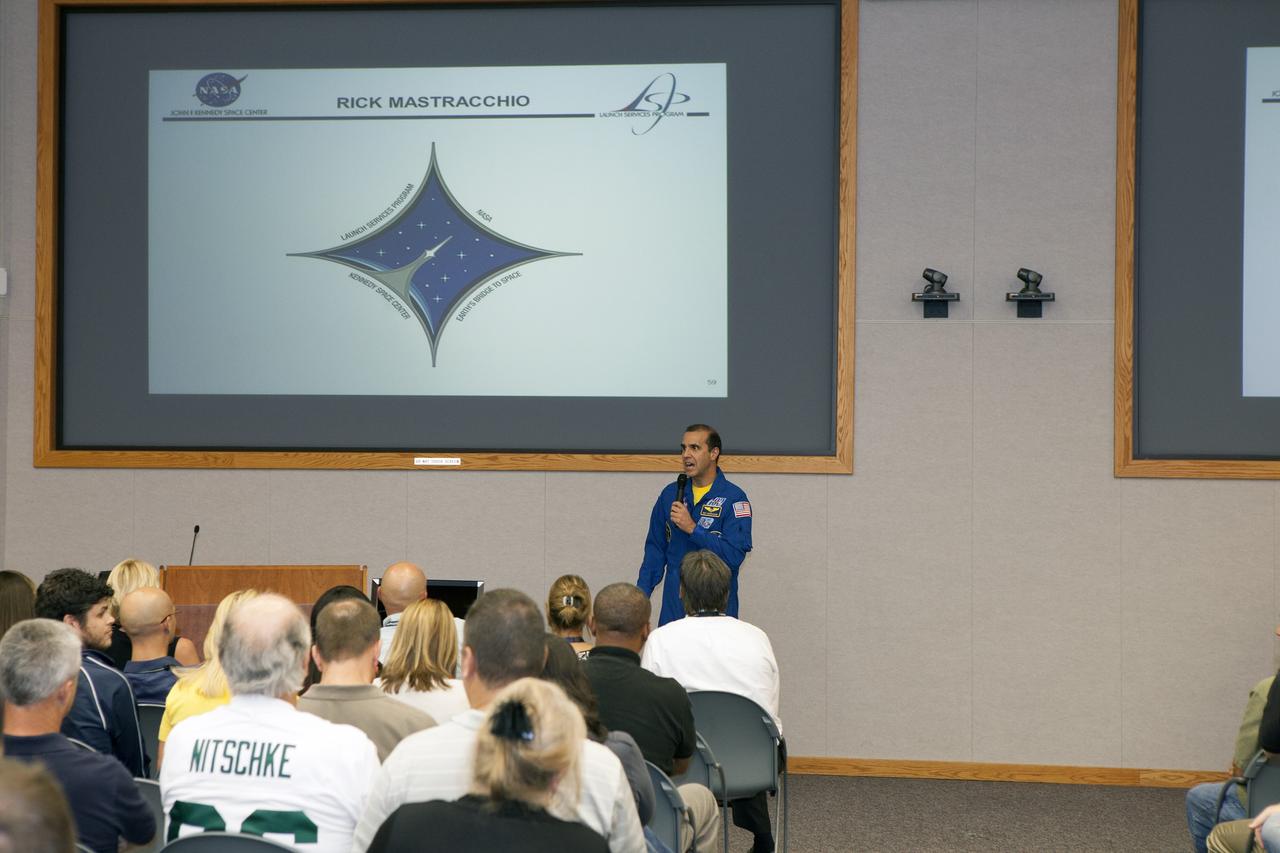
CAPE CANAVERAL, Fla. – NASA astronaut Rick Mastracchio takes questions on the execution of the Slosh experiment from employees attending the Launch Services Program's All Hands meeting in the Neil Armstrong Operations and Checkout Building Mission Briefing Room at NASA's Kennedy Space Center in Florida. An Expedition 38/39 crew member, Mastracchio launched to the station from the Baikonur Cosmodrome in Kazakhstan on Nov. 6, 2013, and returned to Earth on May 13, 2014, after 188 days in space. To read Mastracchio's biography, visit http://www.jsc.nasa.gov/Bios/htmlbios/mastracc.html. For more information on the Slosh experiment, visit http://www.nasa.gov/content/slosh-experiment-designed-to-improve-rocket-safety-efficiency/. Photo credit: NASA/Daniel Casper
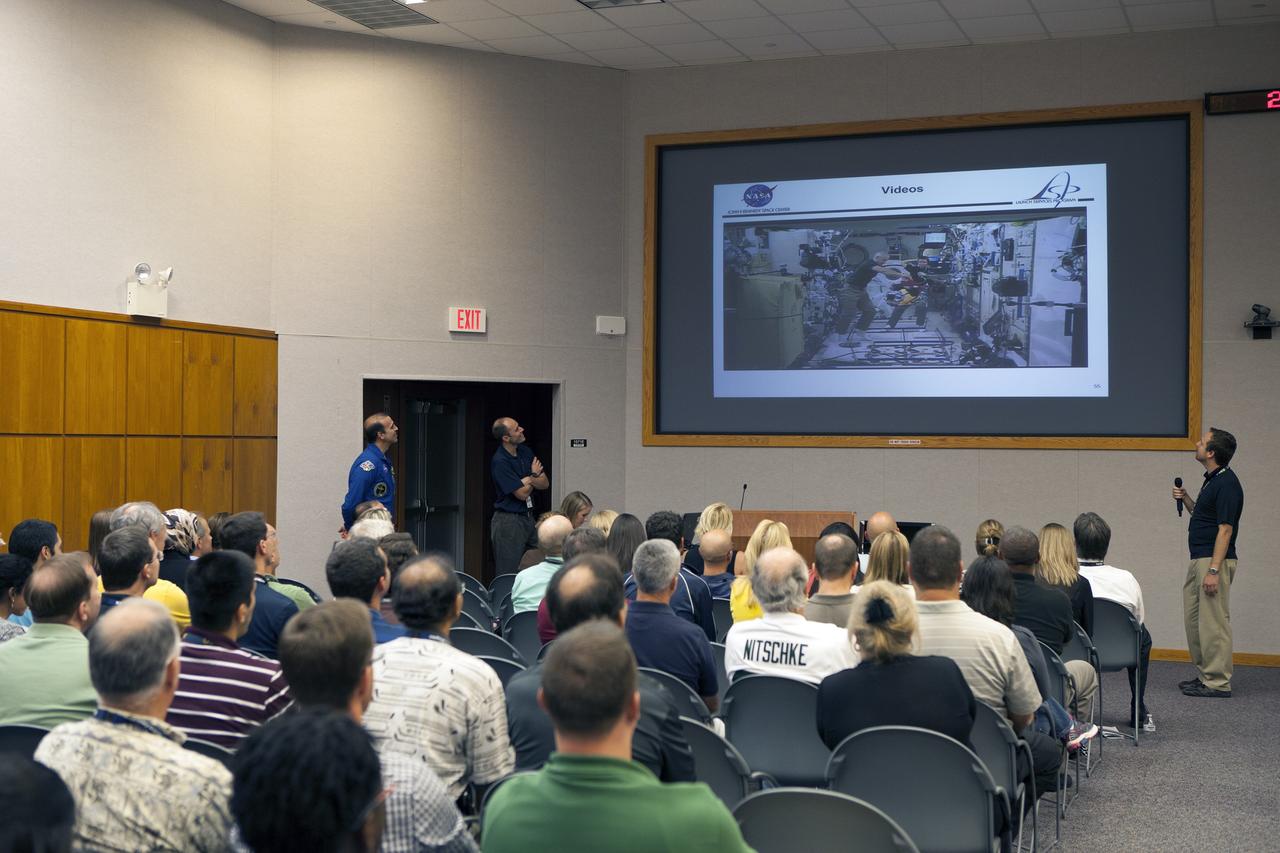
CAPE CANAVERAL, Fla. – NASA astronaut Rick Mastracchio, standing at left, illustrates the fine points of conducting the Slosh experiment on the International Space Station for employees attending the Launch Services Program's All Hands meeting in the Neil Armstrong Operations and Checkout Building Mission Briefing Room at NASA's Kennedy Space Center in Florida. An Expedition 38/39 crew member, Mastracchio launched to the station from the Baikonur Cosmodrome in Kazakhstan on Nov. 6, 2013, and returned to Earth on May 13, 2014, after 188 days in space. To read Mastracchio's biography, visit http://www.jsc.nasa.gov/Bios/htmlbios/mastracc.html. For more information on the Slosh experiment, visit http://www.nasa.gov/content/slosh-experiment-designed-to-improve-rocket-safety-efficiency/. Photo credit: NASA/Daniel Casper
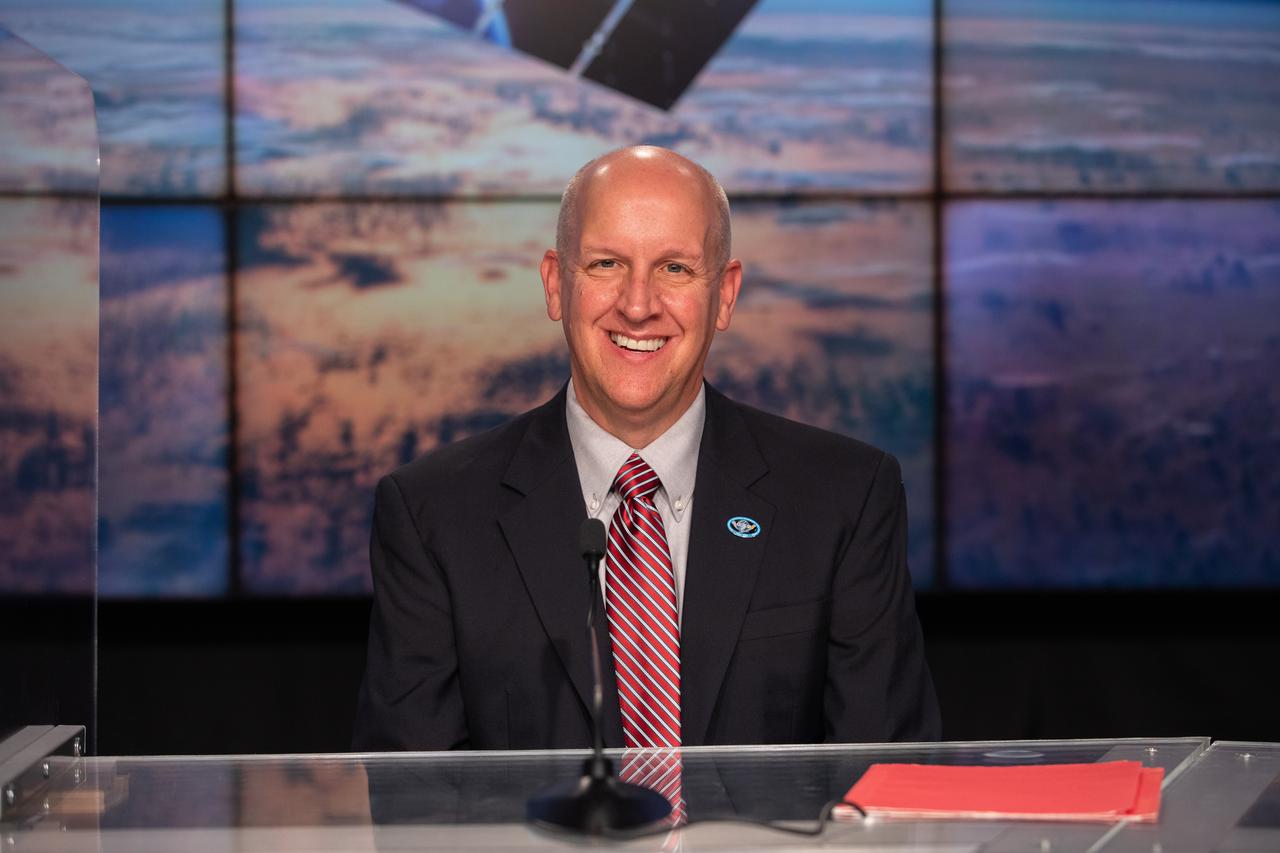
A prelaunch news conference for the National Oceanic and Atmospheric Administration’s (NOAA) Geostationary Operational Environmental Satellite-T (GOES-T) is held on Feb. 26, 2022, at NASA’s Kennedy Space Center in Florida. Tim Dunn, launch director for NASA’s Launch Services Program at Kennedy answers questions during the briefing. GOES-T is scheduled to lift off on a United Launch Alliance Atlas V 541 rocket from Space Launch Complex 41 at Cape Canaveral Space Force Station in Florida on March 1, 2022, at 4:38 p.m. GOES-T is the third satellite in the GOES-R series that will continue to help meteorologists observe and predict local weather events that affect public safety. The launch is being managed by NASA’s Launch Services Program based at Kennedy Space Center in Florida, America’s multi-user spaceport.
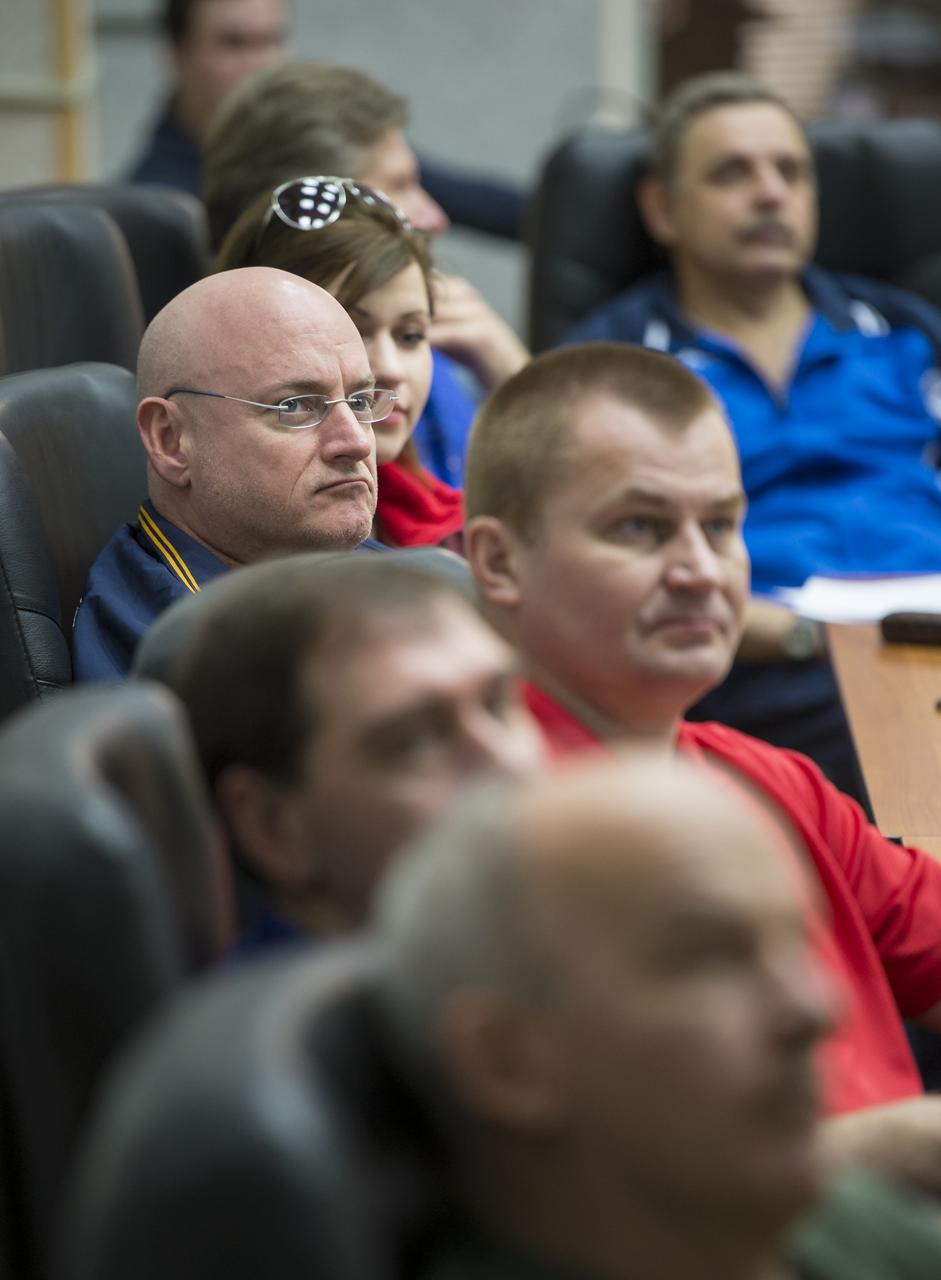
Expedition 43 NASA Astronaut Scott Kelly, left, along with fellow prime crew members: Russian Cosmonauts Gennady Padalka, and Mikhail Kornienko of the Russian Federal Space Agency (Roscosmos) and backup crew members Jeff Williams of NASA, Alexey Ovchinin, and Sergei Volkov of Roscosmos attend the ISS Russian Segment Safety briefing, Thursday, March 19, 2015 at Cosmonaut Hotel in Baikonur, Kazakhstan. Kelly, Padalka, and Kornienko are preparing for launch to the International Space Station in their Soyuz TMA-16M spacecraft from the Baikonur Cosmodrome in Kazakhstan March 28, Kazakh time. As the one-year crew, Kelly and Kornienko will return to Earth on Soyuz TMA-18M in March 2016. Photo Credit: (NASA/Bill Ingalls)
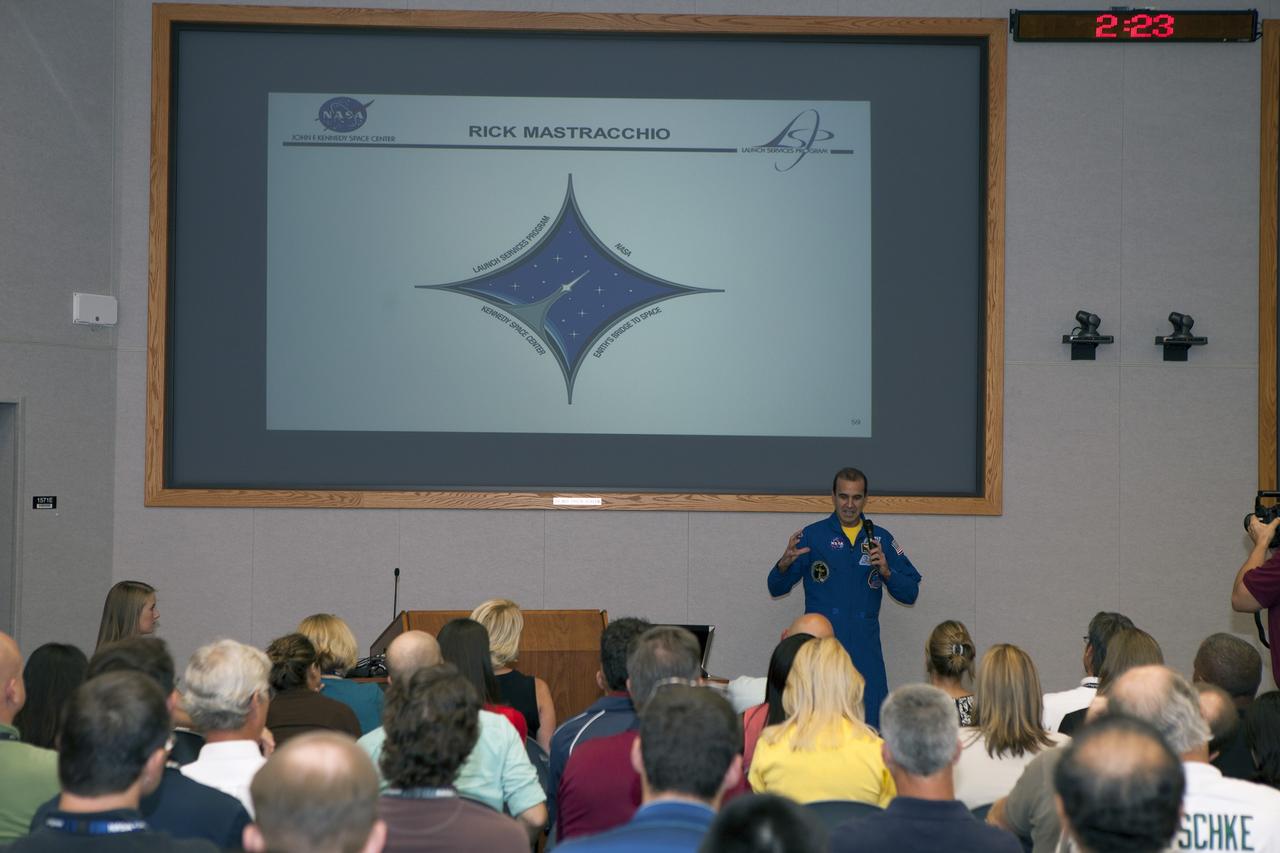
CAPE CANAVERAL, Fla. – NASA astronaut Rick Mastracchio recounts his experiences conducting the Slosh experiment on the International Space Station to employees attending the Launch Services Program's All Hands meeting in the Neil Armstrong Operations and Checkout Building Mission Briefing Room at NASA's Kennedy Space Center in Florida. An Expedition 38/39 crew member, Mastracchio launched to the station from the Baikonur Cosmodrome in Kazakhstan on Nov. 6, 2013, and returned to Earth on May 13, 2014, after 188 days in space. To read Mastracchio's biography, visit http://www.jsc.nasa.gov/Bios/htmlbios/mastracc.html. For more information on the Slosh experiment, visit http://www.nasa.gov/content/slosh-experiment-designed-to-improve-rocket-safety-efficiency/. Photo credit: NASA/Daniel Casper
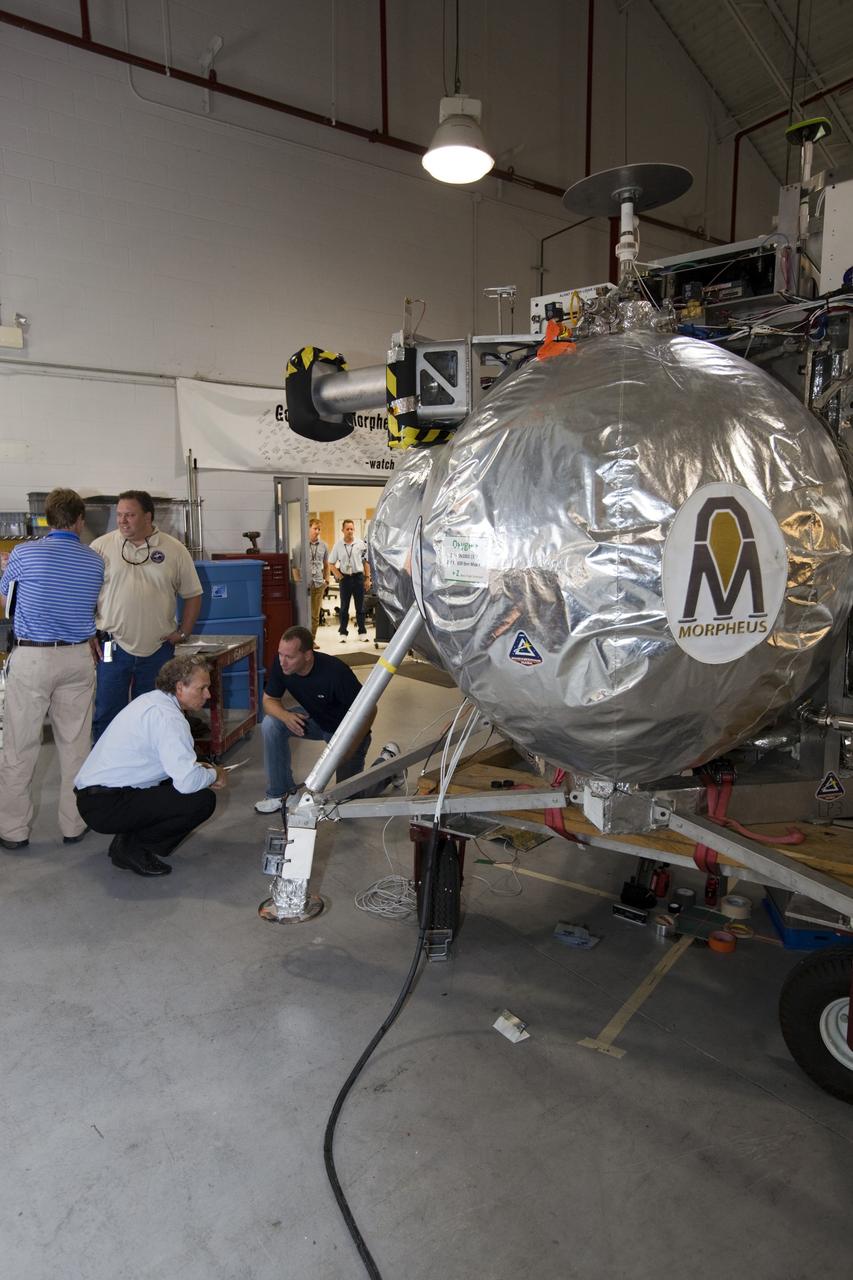
CAPE CANAVERAL, Fla. - Russell Romanella, director of Safety and Mission Assurance at NASA's Kennedy Space Center in Florida, kneeling on the left, is briefed on NASA's Morpheus lander, a vertical test bed vehicle. Morpheus is being checked out by technicians and engineers in a building at the Shuttle Landing Facility, or SLF, at Kennedy. Morpheus is designed to demonstrate new green propellant propulsion systems and autonomous landing and an Autonomous Landing and Hazard Avoidance Technology, or ALHAT, system. Checkout of the prototype lander has been ongoing at NASA’s Johnson Space Center in Houston in preparation for its first free flight. The SLF site will provide the lander with the kind of field necessary for realistic testing. Project Morpheus is one of 20 small projects comprising the Advanced Exploration Systems, or AES, program in NASA’s Human Exploration and Operations Mission Directorate. AES projects pioneer new approaches for rapidly developing prototype systems, demonstrating key capabilities and validating operational concepts for future human missions beyond Earth orbit. For more information on Project Morpheus, visit http://www.nasa.gov/centers/johnson/exploration/morpheus/index.html Photo credit: NASA/Dimitri Gerondidakis
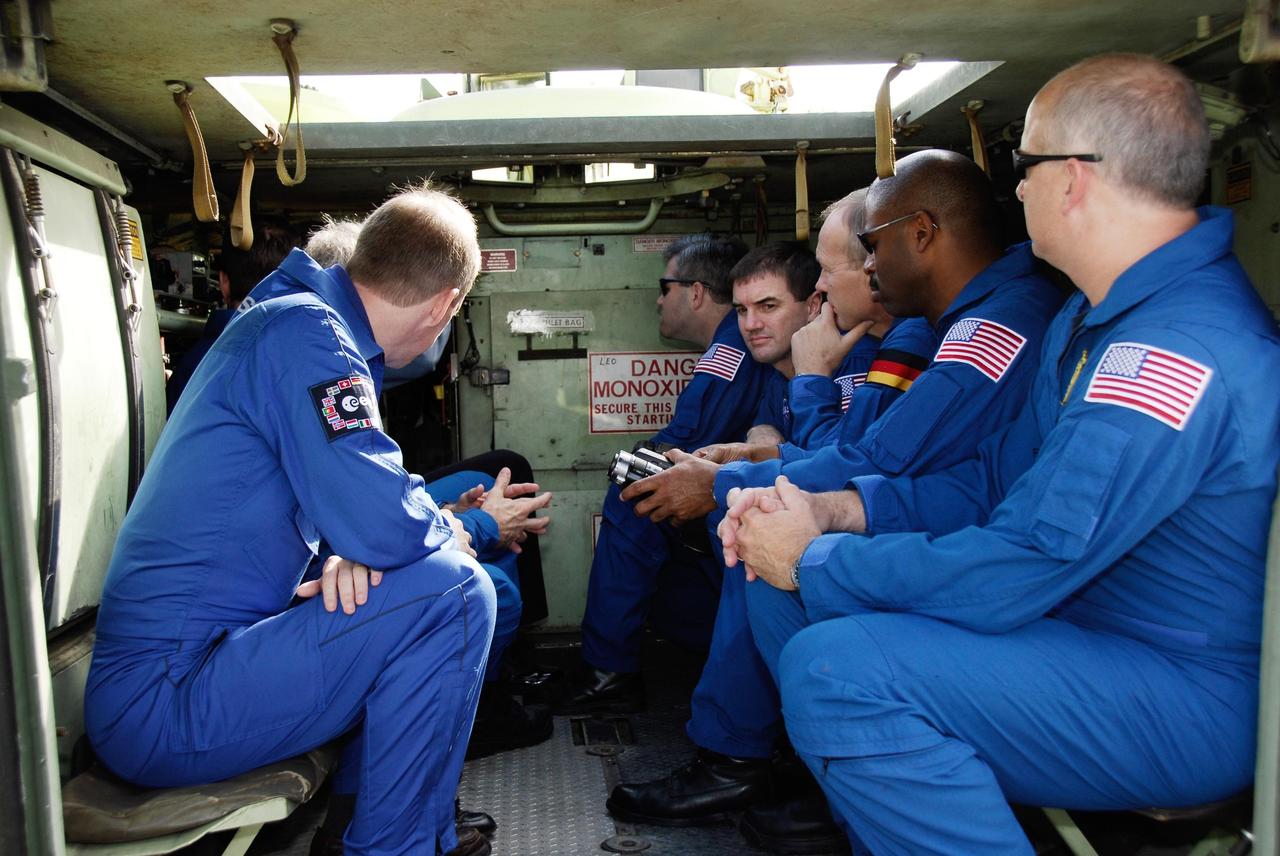
KENNEDY SPACE CENTER, FLA. -- Members of the STS-122 crew receive a briefing inside an M-113 armored personnel carrier near Launch Pad 39B. An M-113 will be available to transport the crew to safety in the event of an emergency on the pad before their launch. Seated on the bench at left is European Space Agency astronaut Frank De Winne, the backup for STS-122 Mission Specialist Leopold Eyharts. Seated on the bench at right, from back to front are Commander Steve Frick; Mission Specialists Rex Walheim, Hans Schlegel of the European Space Agency, and Leland Melvin; and Pilot Alan Poindexter. The crew is participating in Terminal Countdown Demonstration Test activities, a standard part of launch preparations. The TCDT provides astronauts and ground crews with equipment familiarization, emergency egress training and a simulated launch countdown. On mission STS-122, Atlantis will deliver the European Space Agency's Columbus module to the International Space Station. Columbus is a multifunctional, pressurized laboratory that will be permanently attached to U.S. Node 2, called Harmony, and will expand the research facilities aboard the station. Launch is targeted for Dec. 6. Photo credit: NASA/Kim Shiflett
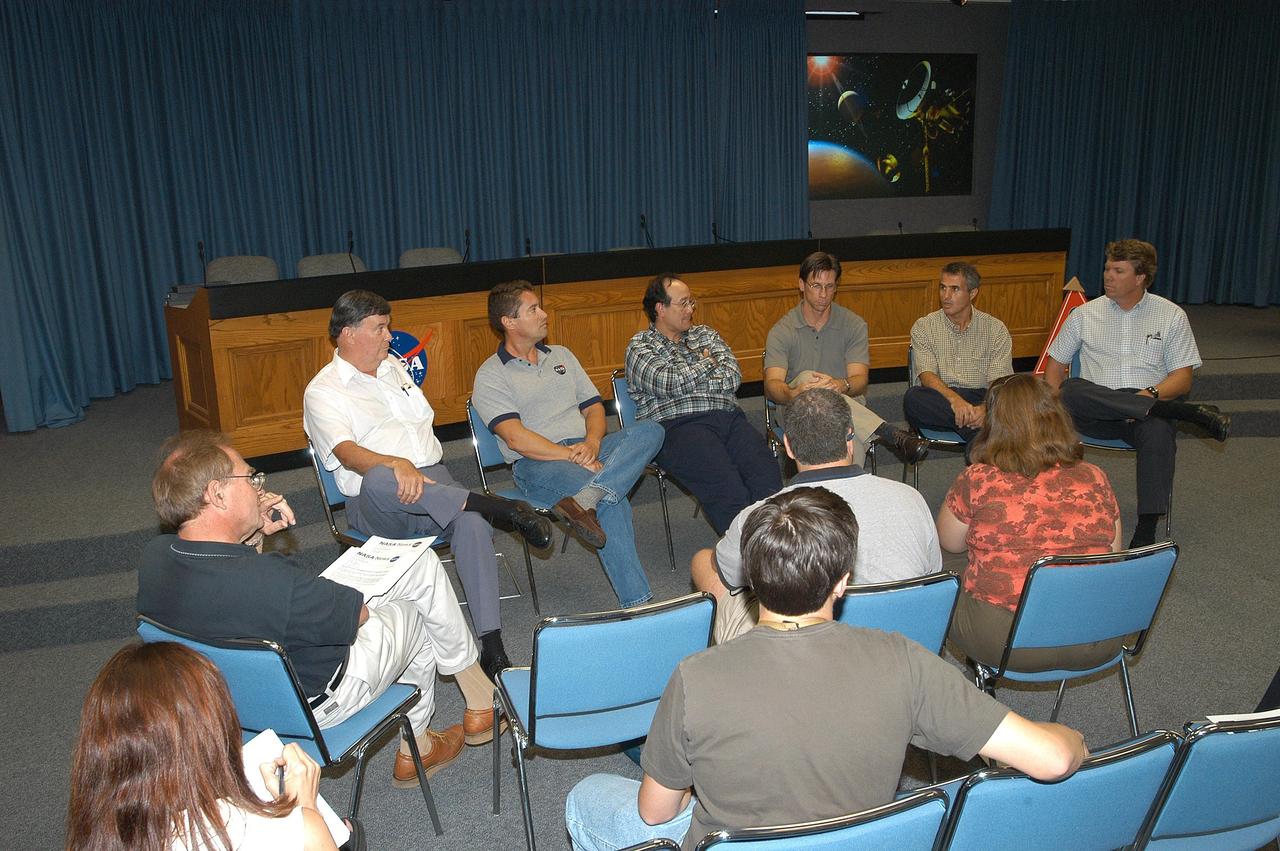
KENNEDY SPACE CENTER, FLA. - Reporters (bottom) take notes during an informal briefing concerning NASA’s Cassini spacecraft, launched aboard an Air Force Titan IV rocket from Cape Canaveral Air Force Station Oct. 15, 1997. Cassini launch team members seen here discussed the challenge and experience of preparing Cassini for launch, integrating it with the Titan IV rocket and the countdown events of launch day. Facing the camera (from left) are Ron Gillett, NASA Safety and Lead Federal Agency official; Omar Baez, mechanical and propulsion systems engineer; Ray Lugo, NASA launch manager; Chuck Dovale, chief, Avionics Branch; George Haddad, Integration and Ground Systems mechanical engineer; and Ken Carr, Cassini assistant launch site support manager. Approximately 10:36 p.m. EDT, June 30, the Cassini-Huygens spacecraft will arrive at Saturn. After nearly a seven-year journey, it will be the first mission to orbit Saturn. The international cooperative mission plans a four-year tour of Saturn, its rings, icy moons, magnetosphere, and Titan, the planet’s largest moon.
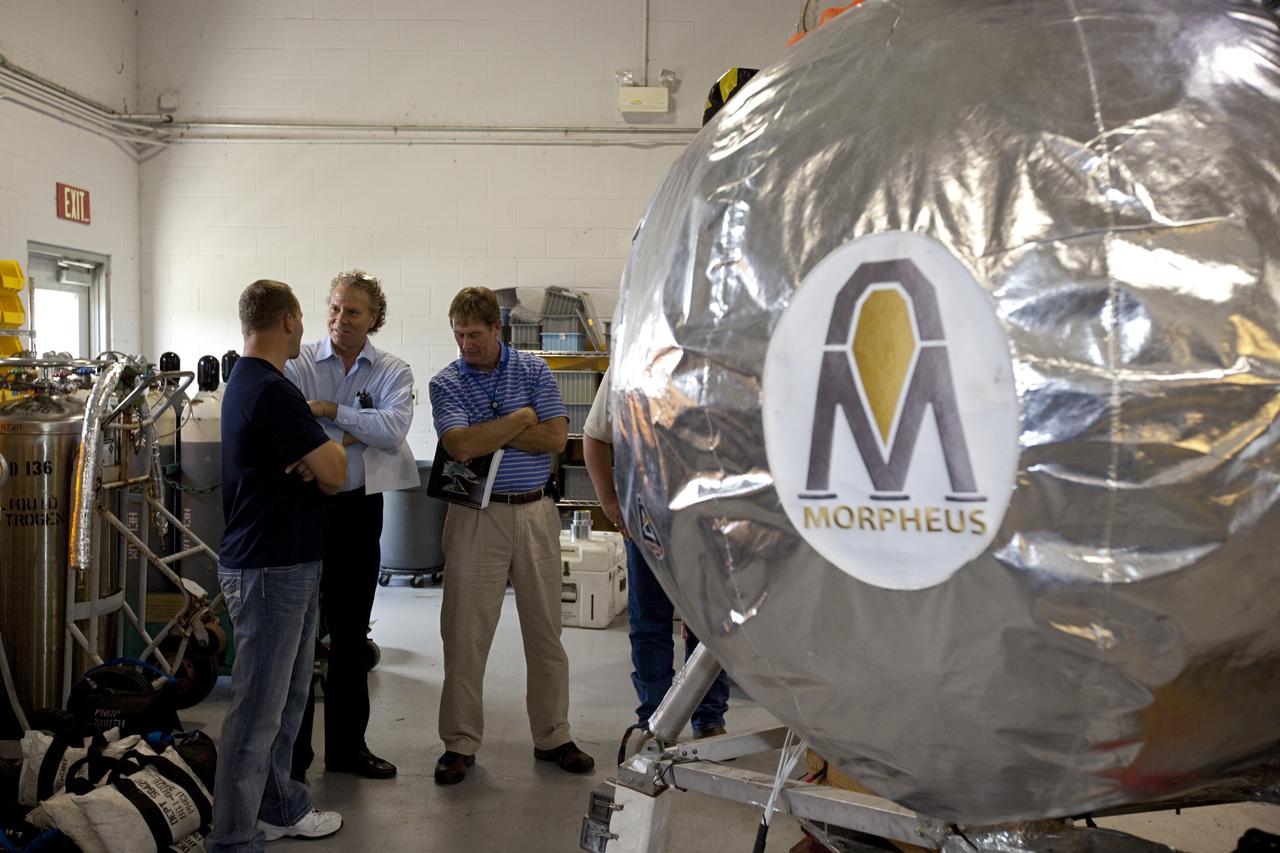
CAPE CANAVERAL, Fla. - Russell Romanella, director of Safety and Mission Assurance at NASA's Kennedy Space Center in Florida, center, is briefed on NASA's Morpheus lander, a vertical test bed vehicle. Morpheus is being checked out by technicians and engineers in a building at the Shuttle Landing Facility, or SLF, at Kennedy. Morpheus is designed to demonstrate new green propellant propulsion systems and autonomous landing and an Autonomous Landing and Hazard Avoidance Technology, or ALHAT, system. Checkout of the prototype lander has been ongoing at NASA’s Johnson Space Center in Houston in preparation for its first free flight. The SLF site will provide the lander with the kind of field necessary for realistic testing. Project Morpheus is one of 20 small projects comprising the Advanced Exploration Systems, or AES, program in NASA’s Human Exploration and Operations Mission Directorate. AES projects pioneer new approaches for rapidly developing prototype systems, demonstrating key capabilities and validating operational concepts for future human missions beyond Earth orbit. For more information on Project Morpheus, visit http://www.nasa.gov/centers/johnson/exploration/morpheus/index.html Photo credit: NASA/Dimitri Gerondidakis
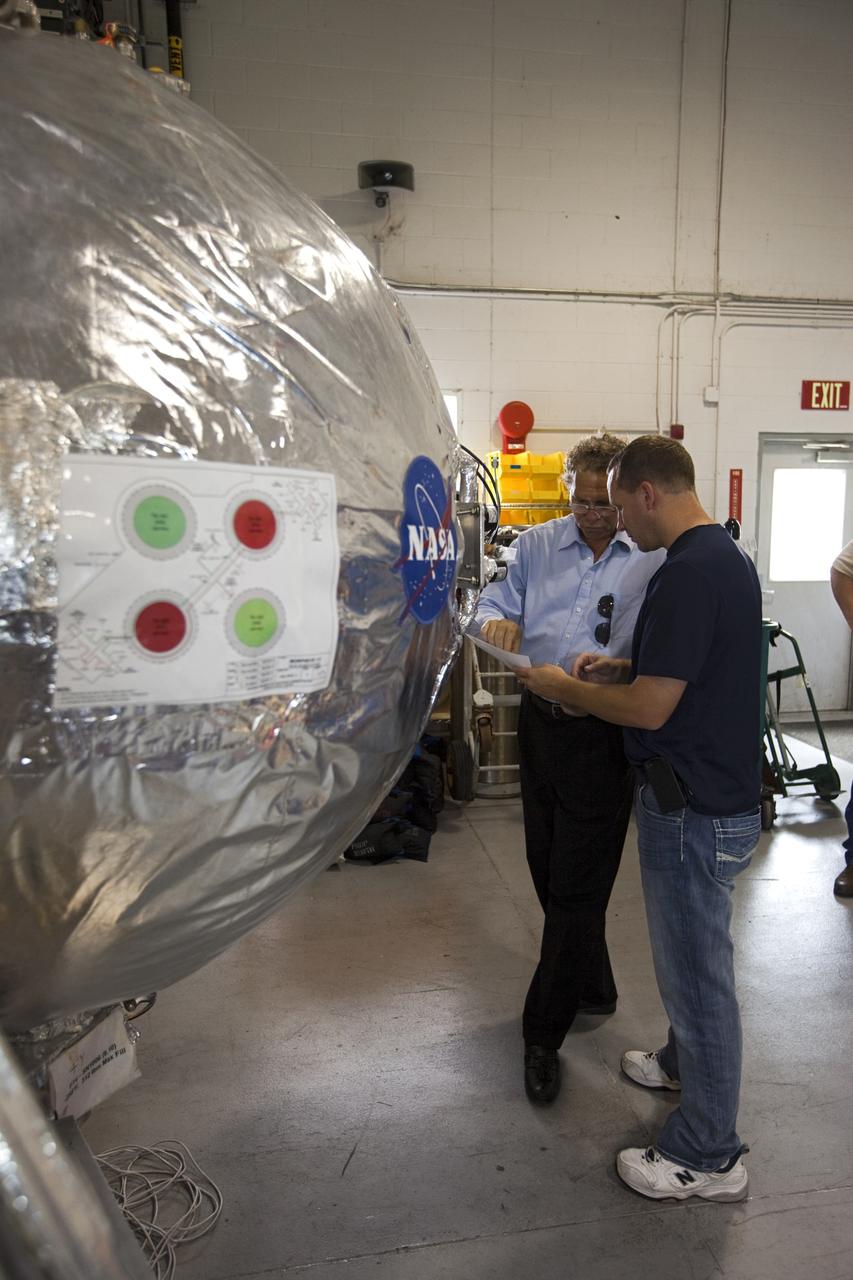
CAPE CANAVERAL, Fla. - Russell Romanella, director of Safety and Mission Assurance at NASA's Kennedy Space Center in Florida, left, is briefed on NASA's Morpheus lander, a vertical test bed vehicle. Morpheus is being checked out by technicians and engineers in a building at the Shuttle Landing Facility, or SLF, at Kennedy. Morpheus is designed to demonstrate new green propellant propulsion systems and autonomous landing and an Autonomous Landing and Hazard Avoidance Technology, or ALHAT, system. Checkout of the prototype lander has been ongoing at NASA’s Johnson Space Center in Houston in preparation for its first free flight. The SLF site will provide the lander with the kind of field necessary for realistic testing. Project Morpheus is one of 20 small projects comprising the Advanced Exploration Systems, or AES, program in NASA’s Human Exploration and Operations Mission Directorate. AES projects pioneer new approaches for rapidly developing prototype systems, demonstrating key capabilities and validating operational concepts for future human missions beyond Earth orbit. For more information on Project Morpheus, visit http://www.nasa.gov/centers/johnson/exploration/morpheus/index.html Photo credit: NASA/Dimitri Gerondidakis
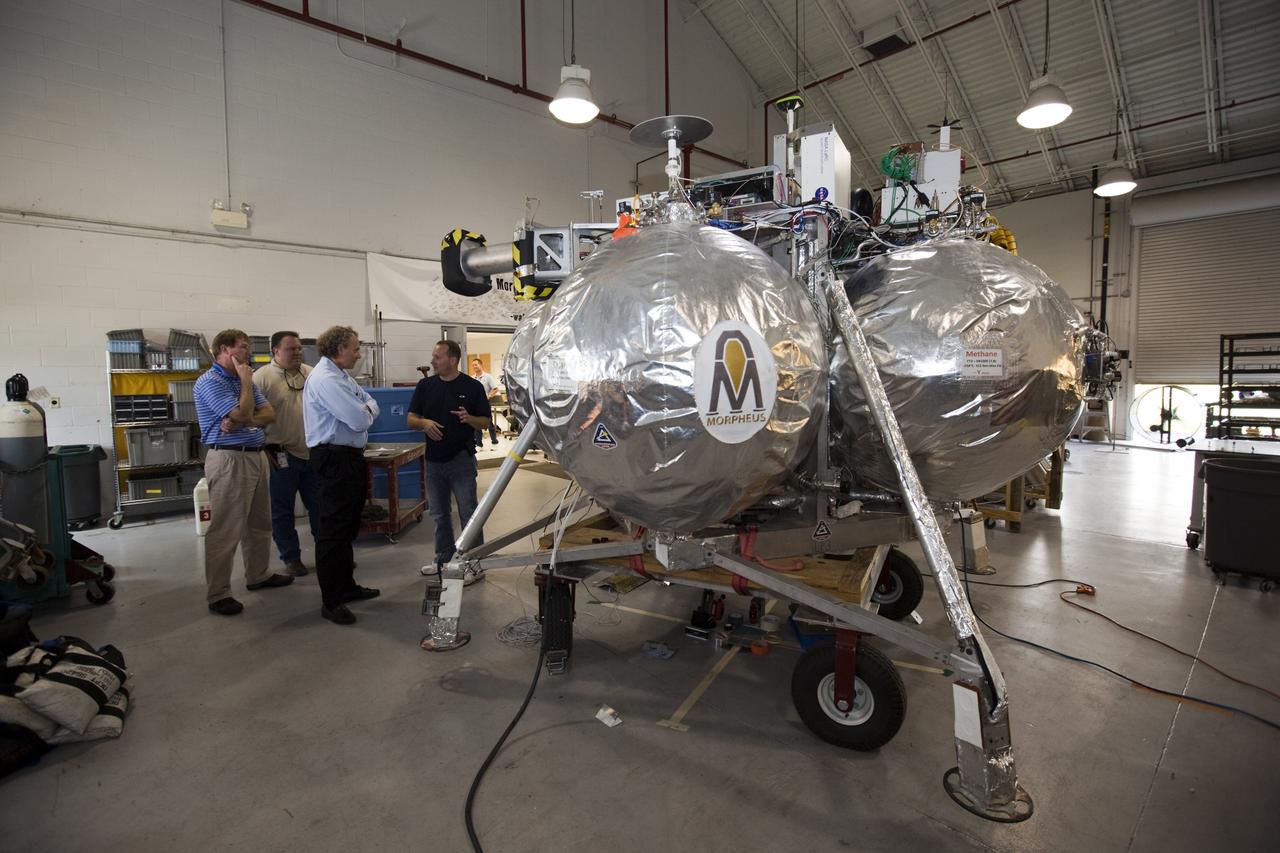
CAPE CANAVERAL, Fla. - Russell Romanella, director of Safety and Mission Assurance at NASA's Kennedy Space Center in Florida, right-center, is briefed on NASA's Morpheus lander, a vertical test bed vehicle. Morpheus is being checked out by technicians and engineers in a building at the Shuttle Landing Facility, or SLF, at Kennedy. Morpheus is designed to demonstrate new green propellant propulsion systems and autonomous landing and an Autonomous Landing and Hazard Avoidance Technology, or ALHAT, system. Checkout of the prototype lander has been ongoing at NASA’s Johnson Space Center in Houston in preparation for its first free flight. The SLF site will provide the lander with the kind of field necessary for realistic testing. Project Morpheus is one of 20 small projects comprising the Advanced Exploration Systems, or AES, program in NASA’s Human Exploration and Operations Mission Directorate. AES projects pioneer new approaches for rapidly developing prototype systems, demonstrating key capabilities and validating operational concepts for future human missions beyond Earth orbit. For more information on Project Morpheus, visit http://www.nasa.gov/centers/johnson/exploration/morpheus/index.html Photo credit: NASA/Dimitri Gerondidakis
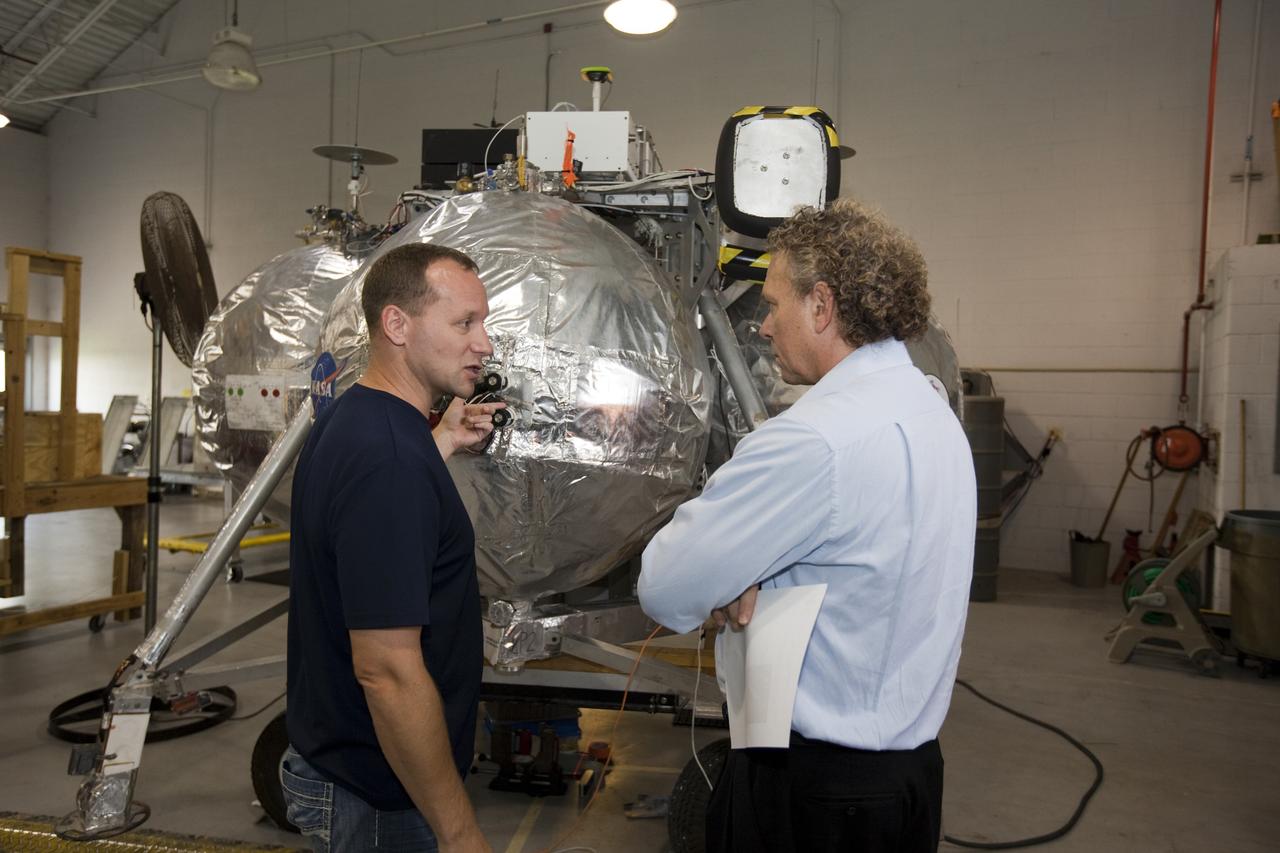
CAPE CANAVERAL, Fla. - Russell Romanella, director of Safety and Mission Assurance at NASA's Kennedy Space Center in Florida, right, is briefed on NASA's Morpheus lander, a vertical test bed vehicle. Morpheus is being checked out by technicians and engineers in a building at the Shuttle Landing Facility, or SLF, at Kennedy. Morpheus is designed to demonstrate new green propellant propulsion systems and autonomous landing and an Autonomous Landing and Hazard Avoidance Technology, or ALHAT, system. Checkout of the prototype lander has been ongoing at NASA’s Johnson Space Center in Houston in preparation for its first free flight. The SLF site will provide the lander with the kind of field necessary for realistic testing. Project Morpheus is one of 20 small projects comprising the Advanced Exploration Systems, or AES, program in NASA’s Human Exploration and Operations Mission Directorate. AES projects pioneer new approaches for rapidly developing prototype systems, demonstrating key capabilities and validating operational concepts for future human missions beyond Earth orbit. For more information on Project Morpheus, visit http://www.nasa.gov/centers/johnson/exploration/morpheus/index.html Photo credit: NASA/Dimitri Gerondidakis
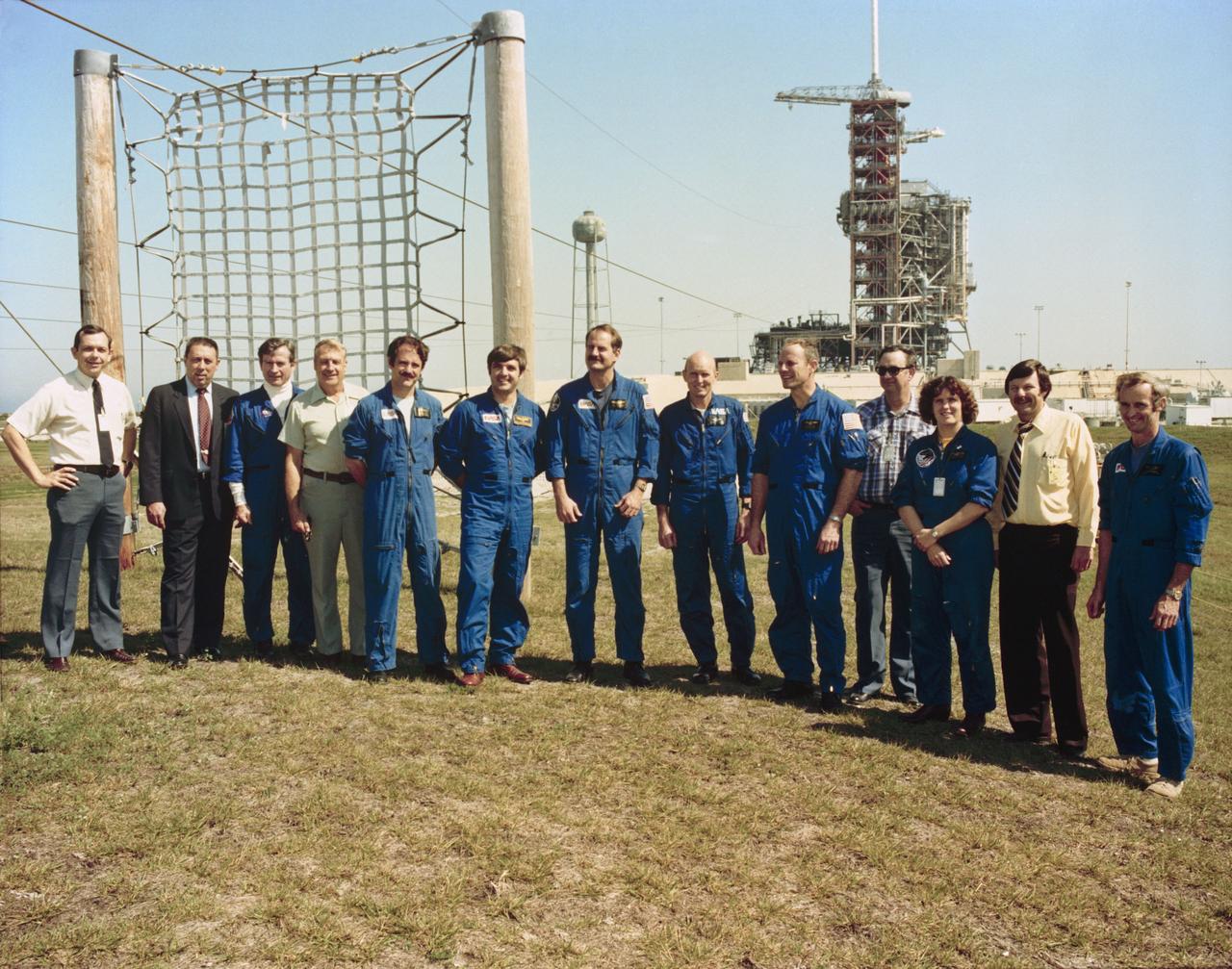
S82-28457 (19 Feb. 1982) --- Member of the JSC astronaut corps., STS-3 vehicle integration test (VIT) team and other personnel pose for a photograph at the completion of a countdown demonstration test (CDDT) and safety briefings at Launch Pad 39A, Kennedy Space Center (KSC). Participants are, from the left, Wilbur J. Etbauer, engineer with the VIT team; George W. S. Abbey, director of flight operations at JSC; astronaut John W. Young, chief of the astronaut office at JSC; Jack Fleming of Rockwell International; mission specialist-astronaut John M. Lounge; astronaut Daniel C. Brandenstein; mission specialist-astronaut James D. Van Hoften; astronauts C. Gordon Fullerton and Jack Lousma, prime crew for STS-3; Olan J. Bertrand, VIT team member; mission specialist-astronaut Kathryn D. Sullivan; Richard W. Nygren, head of the VIT team; and astronaut Donald E. Williams. The space shuttle Columbia is obscured by its service structure on Launch Pad 39A in the background. Part of slide-wire type emergency escape system is visible in the picture. Photo credit: NASA
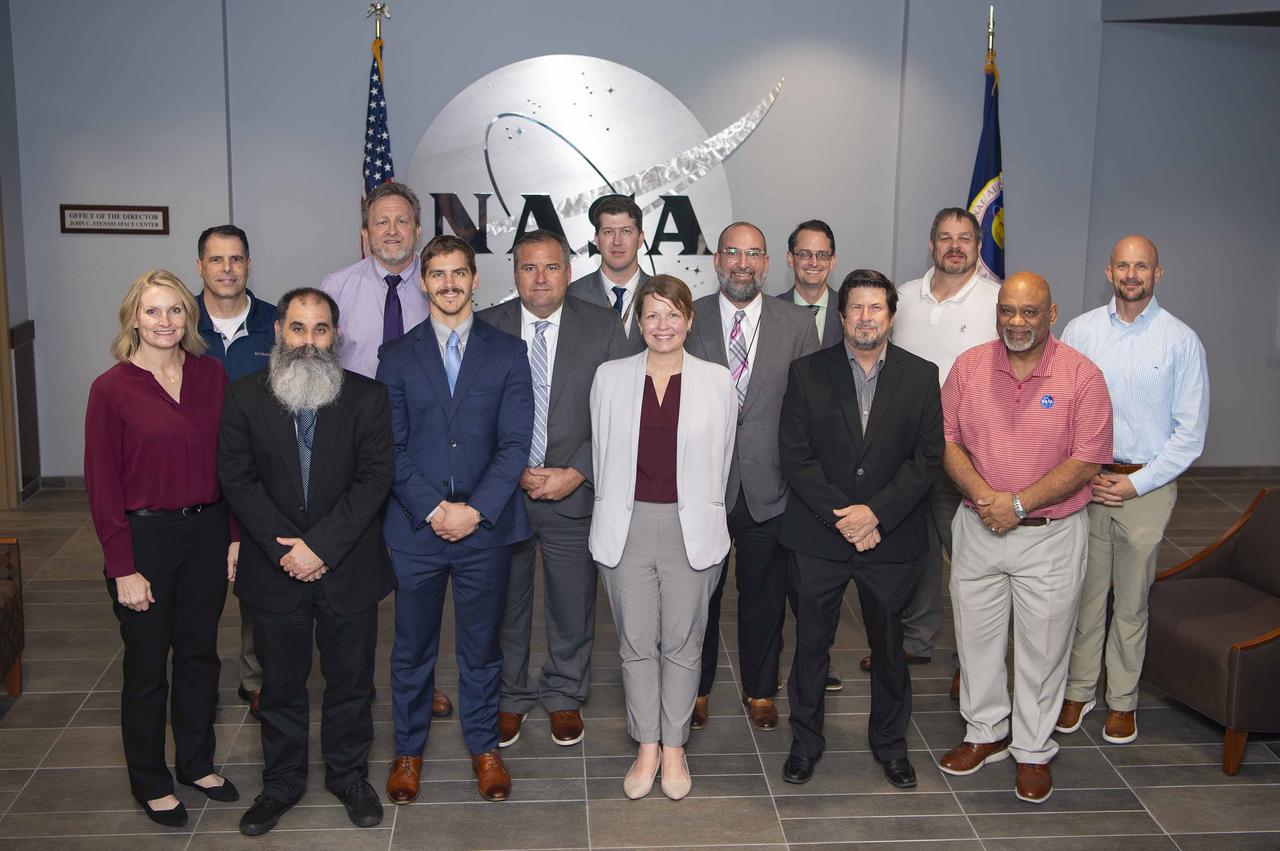
U.S. Navy officials visited with NASA Stennis leaders Nov. 13 for a meet-and-greet opportunity, also receiving an overview briefing about the work and operations of south Mississippi site. Participants in the gathering included (left to right): Anita Harrell, executive director of the NASA Shared Services Center; Joe Schuyler, director of the NASA Stennis Engineering and Test Directorate; Herschel Mims, a management support specialist with the Naval Oceanography Operations Command; Rodney McKellip, NASA Stennis associate director; Francis Prikasky, an electronics engineer and information technology administrator with the Naval Oceanographic Office; Robert Gavagnie, a contract specialist with the Naval Oceanographic Office; James “Brett” English, information systems security manager with the Naval Meteorology and Oceanography Command; Dr. Brooke Jones, head of the Ocean Forecasting Division for the Fleet Numerical Meteorology and Oceanography Center; Maxwell Williamson, a physical scientists with the Naval Oceanographic Office; Dr. Benjamin Phrampus, a research geophysicist with the Naval Research Laboratory; Gary Benton, director of the NASA Stennis Safety and Mission Assurance Directorate; Thom Rich, associate director of the NASA Stennis Center Operations Directorate; Ken Newton, director of service delivery for the NASA Shared Services Center; and Eli Ouder, director of the NASA Stennis/NASA Shared Services Center Office of Procurement.
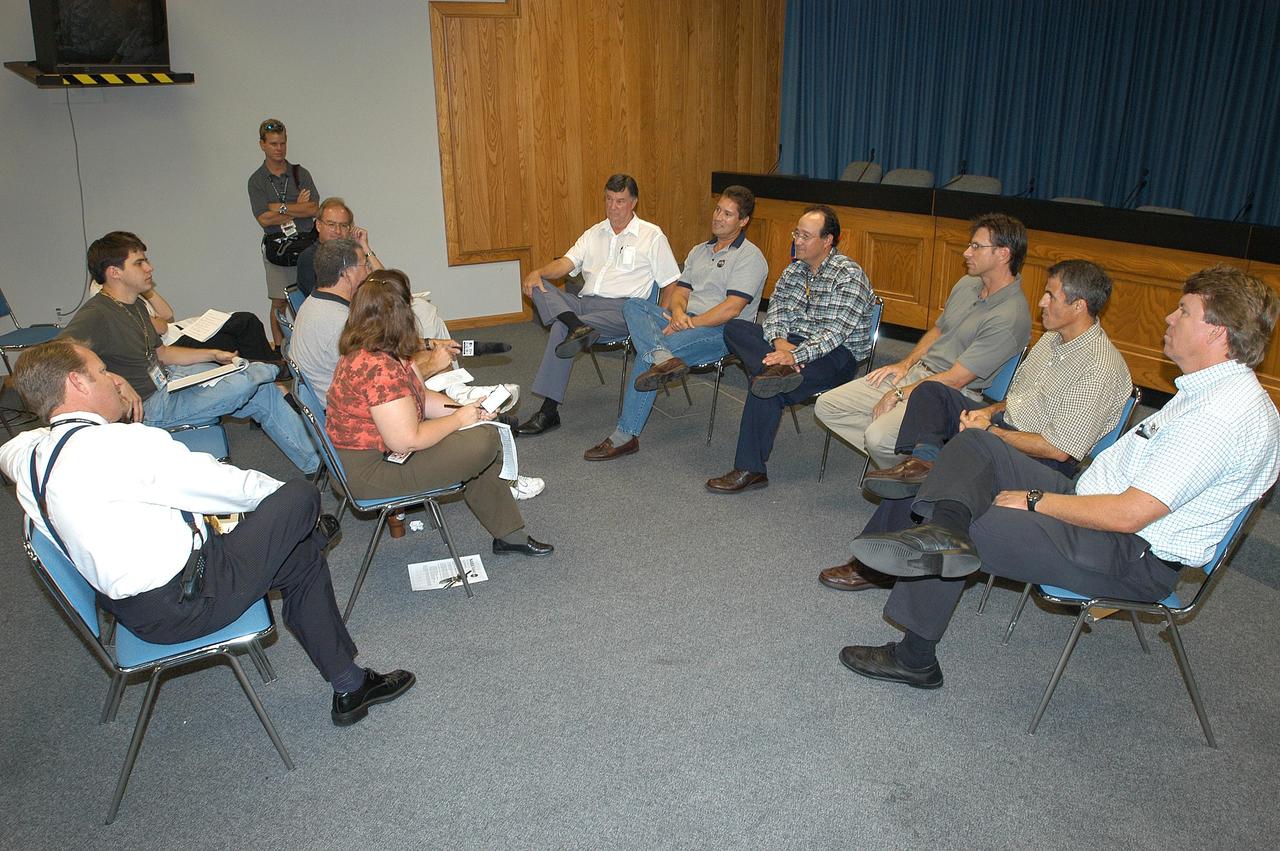
KENNEDY SPACE CENTER, FLA. - Reporters (left) take notes during an informal briefing concerning NASA’s Cassini spacecraft, launched aboard an Air Force Titan IV rocket from Cape Canaveral Air Force Station Oct. 15, 1997. Cassini launch team members at right discussed the challenge and experience of preparing Cassini for launch, integrating it with the Titan IV rocket and the countdown events of launch day. From left are Ron Gillett, NASA Safety and Lead Federal Agency official; Omar Baez, mechanical and propulsion systems engineer; Ray Lugo, NASA launch manager; Chuck Dovale, chief, Avionics Branch; George Haddad, Integration and Ground Systems mechanical engineer; and Ken Carr, Cassini assistant launch site support manager. Approximately 10:36 p.m. EDT, June 30, the Cassini-Huygens spacecraft will arrive at Saturn. After nearly a seven-year journey, it will be the first mission to orbit Saturn. The international cooperative mission plans a four-year tour of Saturn, its rings, icy moons, magnetosphere, and Titan, the planet’s largest moon.
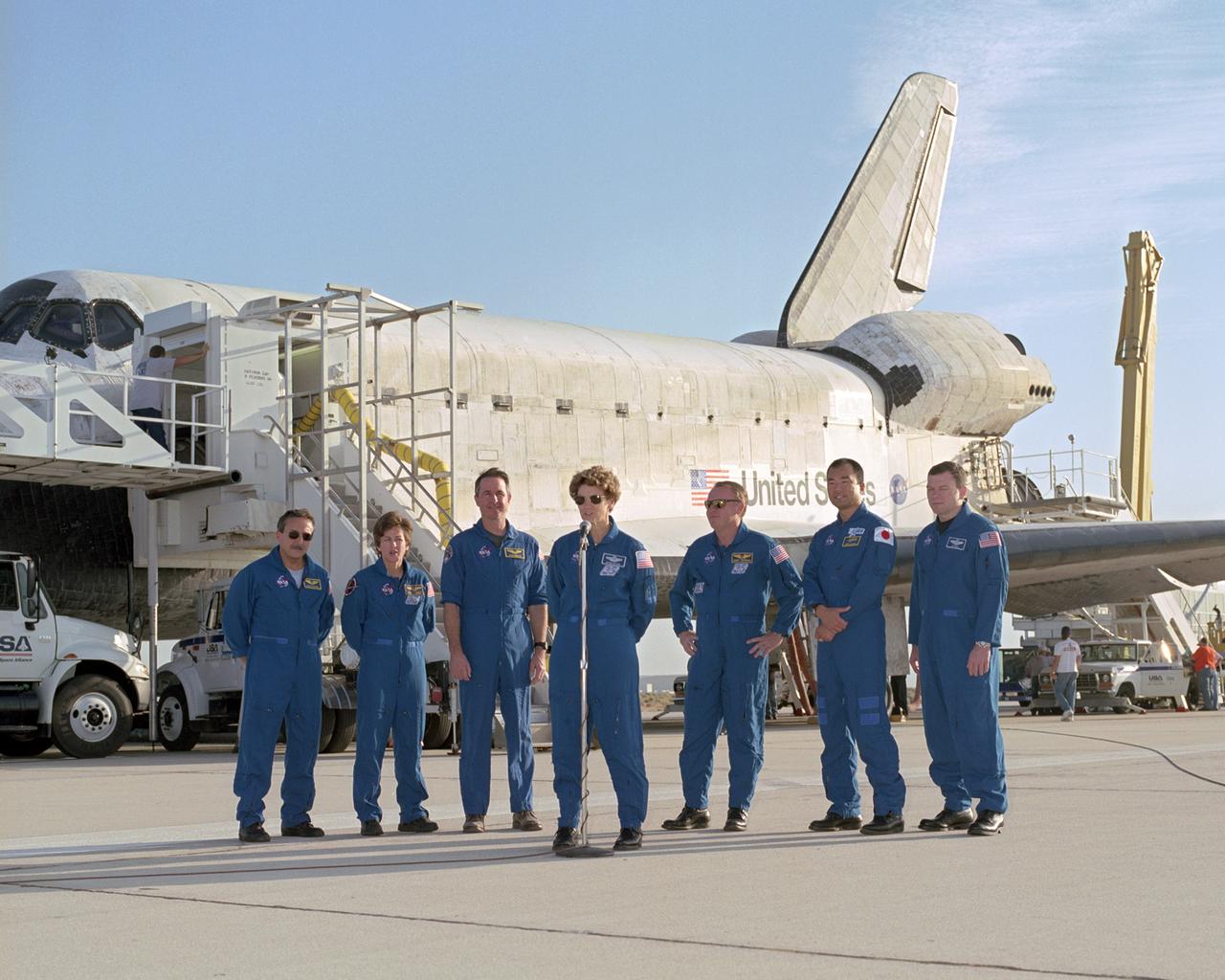
The crew of Space Shuttle mission STS-114 gathered for a press brief following landing at Edwards Air Force Base, California, 5:11 am, August 9, 2005. Left to right: Mission Specialists Charles Camarda, Wendy Lawrence and Stephen Robinson, Commander Eileen Collins at microphone, Mission Specialists Andrew Thomas and Soichi Noguchi, and Pilot James Kelly. Space Shuttle Discovery landed safely at NASA's Dryden Flight Research Center at Edwards Air Force Base in California at 5:11:22 a.m. PDT this morning, following the very successful 14-day STS-114 return to flight mission. During their two weeks in space, Commander Eileen Collins and her six crewmates tested out new safety procedures and delivered supplies and equipment the International Space Station. Discovery spent two weeks in space, where the crew demonstrated new methods to inspect and repair the Shuttle in orbit. The crew also delivered supplies, outfitted and performed maintenance on the International Space Station. A number of these tasks were conducted during three spacewalks. In an unprecedented event, spacewalkers were called upon to remove protruding gap fillers from the heat shield on Discovery's underbelly. In other spacewalk activities, astronauts installed an external platform onto the Station's Quest Airlock and replaced one of the orbital outpost's Control Moment Gyroscopes. Inside the Station, the STS-114 crew conducted joint operations with the Expedition 11 crew. They unloaded fresh supplies from the Shuttle and the Raffaello Multi-Purpose Logistics Module. Before Discovery undocked, the crews filled Raffeallo with unneeded items and returned to Shuttle payload bay. Discovery launched on July 26 and spent almost 14 days on orbit.
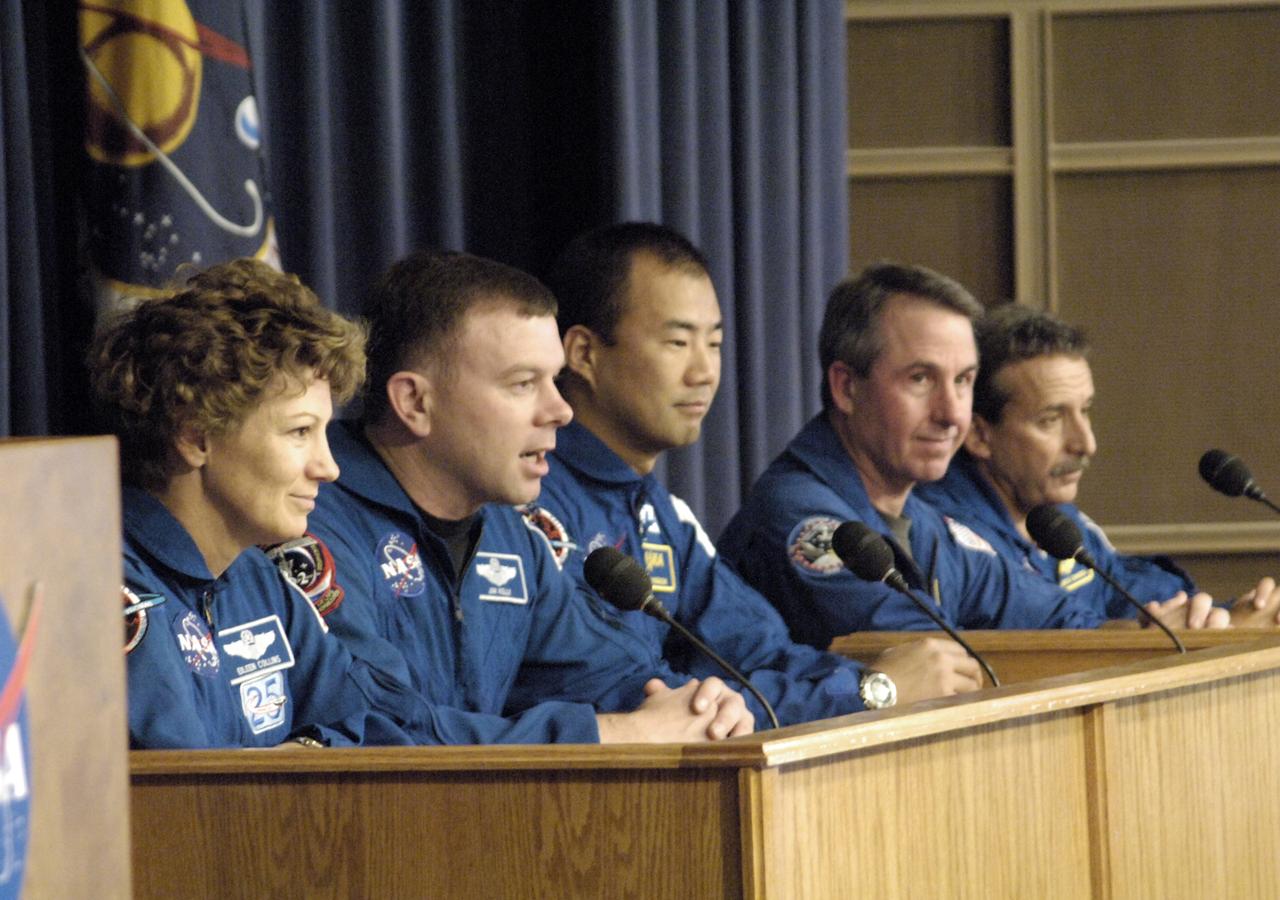
Pilot James Kelly answered a question at a briefing following the successful landing of the Space Shuttle Discovery at NASA DFRC on August 9, 2005. Commander Eileen Collins is on his right, mission specialists Soichi Noguchi, Andrew Thomas and Charles Camarda are to his left. Space Shuttle Discovery landed safely at NASA's Dryden Flight Research Center at Edwards Air Force Base in California at 5:11:22 a.m. PDT this morning, following the very successful 14-day STS-114 return to flight mission. During their two weeks in space, Commander Eileen Collins and her six crewmates tested out new safety procedures and delivered supplies and equipment the International Space Station. Discovery spent two weeks in space, where the crew demonstrated new methods to inspect and repair the Shuttle in orbit. The crew also delivered supplies, outfitted and performed maintenance on the International Space Station. A number of these tasks were conducted during three spacewalks. In an unprecedented event, spacewalkers were called upon to remove protruding gap fillers from the heat shield on Discovery's underbelly. In other spacewalk activities, astronauts installed an external platform onto the Station's Quest Airlock and replaced one of the orbital outpost's Control Moment Gyroscopes. Inside the Station, the STS-114 crew conducted joint operations with the Expedition 11 crew. They unloaded fresh supplies from the Shuttle and the Raffaello Multi-Purpose Logistics Module. Before Discovery undocked, the crews filled Raffeallo with unneeded items and returned to Shuttle payload bay. Discovery launched on July 26 and spent almost 14 days on orbit.