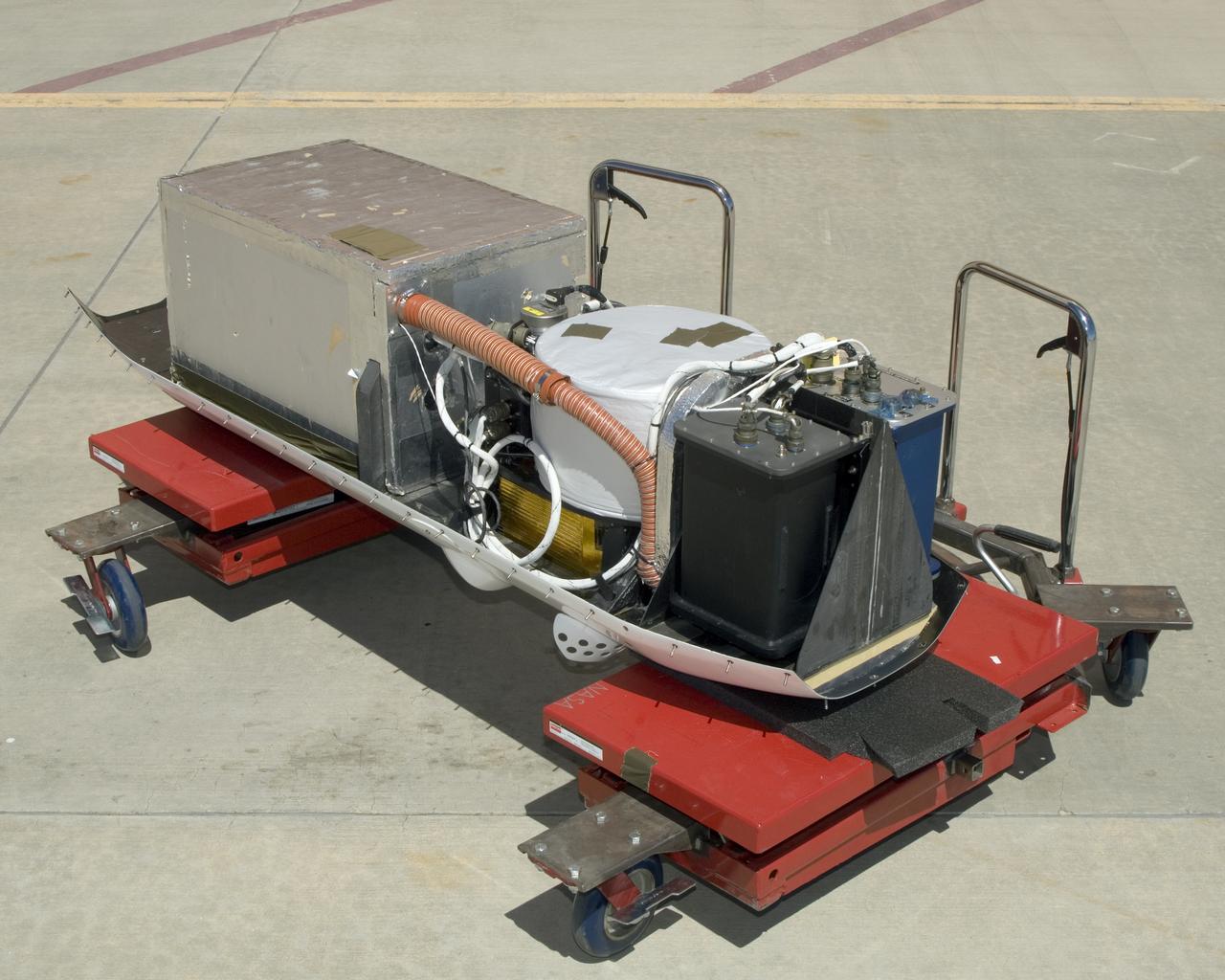
The instruments that make up the Ames Autonomous Module Scanner (AMS) that provided precise thermal-infrared imaging during the Western States Fire Mission in 2007 are detailed in this photo of the AMS as mounted on Ikhana's pod tray. The large foil-covered foam-insulated box at left covers the pressure vessel containing the data system computers and other electronics. The round white-topped assembly is the scan head, including the scan mirror, folded telescope, blackbody references, spectrometer and detectors. Two pressure boxes visible at the forward end of the tray contain the Applanix POS/AV precision navigation subsystem (black) and the power distributor including circuit breakers and ancillary wiring, scan motor controller and the blackbody reference temperature controller (blue).
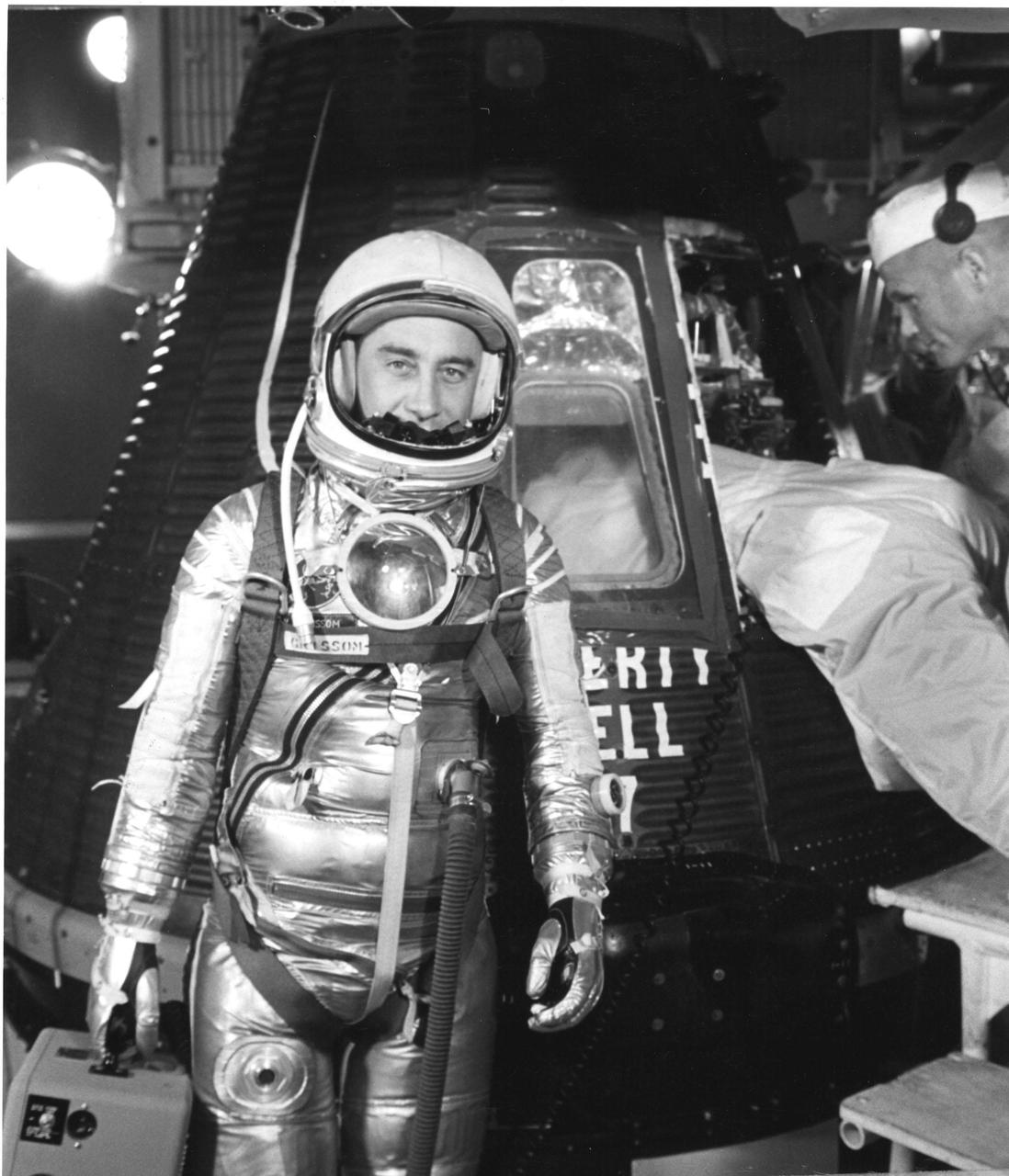
KENNEDY SPACE CENTER, FLA. -- READY FOR FLIGHT - On level three of gantry on pad 5, Project Mercury astronaut Virgil I. 'Gus' Grissom pauses briefly while a technician completes final adjustment in the Liberty Bell 7 spacecraft, which carried Grissom 118 miles into space on Friday, July 21, 1961. The craft's large trapezoidal observation window can be seen behind the pilot. The Pilot Observer Camera, which brought the astronaut's head and shoulders into view, was to reflect the lights on the flight events sequence panel through the 5-inch plexiglas parabolic mirror attached to Grissom's suit, to provide and accurately time record the pilot's voice communications, eye scan pattern and arm motions. The spacecraft sank on landing and has not been recovered. (NASA Photo)
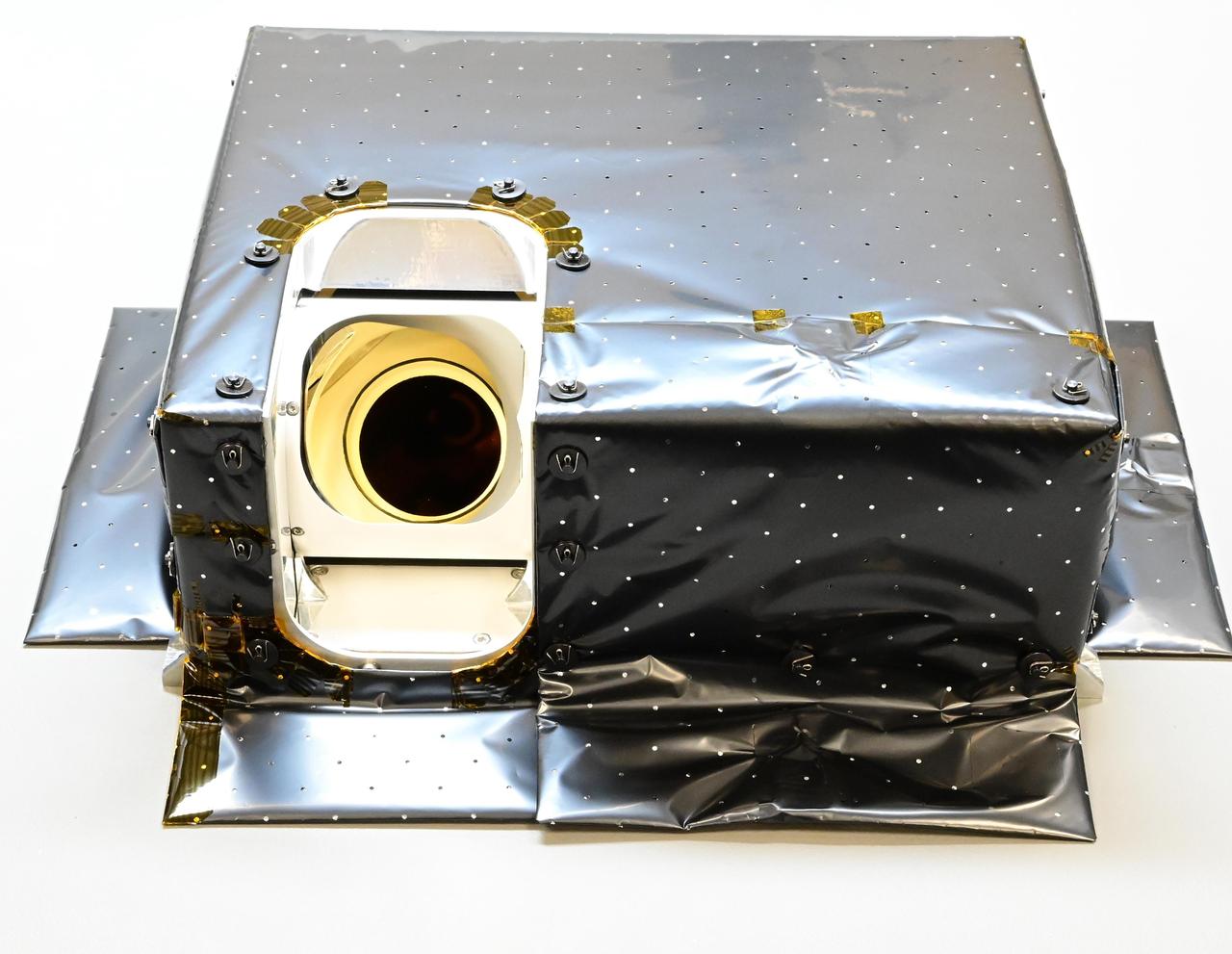
Seen here before being shipped from the U.K. to the U.S., the Lunar Thermal Mapper (LTM) is one of two instruments that will be carried by NASA's Lunar Trailblazer. Launching in 2023, the small spacecraft – measuring only about 11 feet (3.5 meters) wide with its solar panels fully deployed – will also carry the High-resolution Volatiles and Minerals Moon Mapper (HVM³). The two instruments will work together to help detect and map water on the Moon's surface to determine its abundance, location, form, and how and why it varies by location and time. In February 2023, LTM completed qualification for flight and calibration at the University of Oxford in England. The instrument will provide maps of lunar surface temperature from about minus 261 degrees Fahrenheit (minus 163 degrees Celsius) to 261 F (127 C) using four broad-band infrared channels covering wavelengths from 6.25 to 100 micrometers. The instrument also has 11 narrower infrared channels that are sensitive enough to detect and map small variations in the composition of silicate minerals that make up the rocks and soils of the Moon's surface. The instrument is shown here wrapped with a multilayer insulation blanket to assist with thermal control. Not covered by insulation is LTM's single "eye" – a scan mirror that can pivot down to look at the Moon's surface or outward into space for calibration purposes. The scan mirror collects a line of pixels at a time to form an image via the motion of the spacecraft. During vacuum testing the instrument viewed external targets that varied in temperature between minus 261 F (minus 163 C) and 243 F (117 C) so that it could be calibrated. The alignment, spectral, and radiometric (temperature) accuracy of LTM was checked both before and after the instrument was tested via vibration and cycling through thermal environments identical to what it will experience during launch and operation in lunar orbit. With these tests complete, the instrument was packed and shipped for integration with the Lunar Trailblazer spacecraft at Lockheed Martin Space in Colorado. https://photojournal.jpl.nasa.gov/catalog/PIA25831
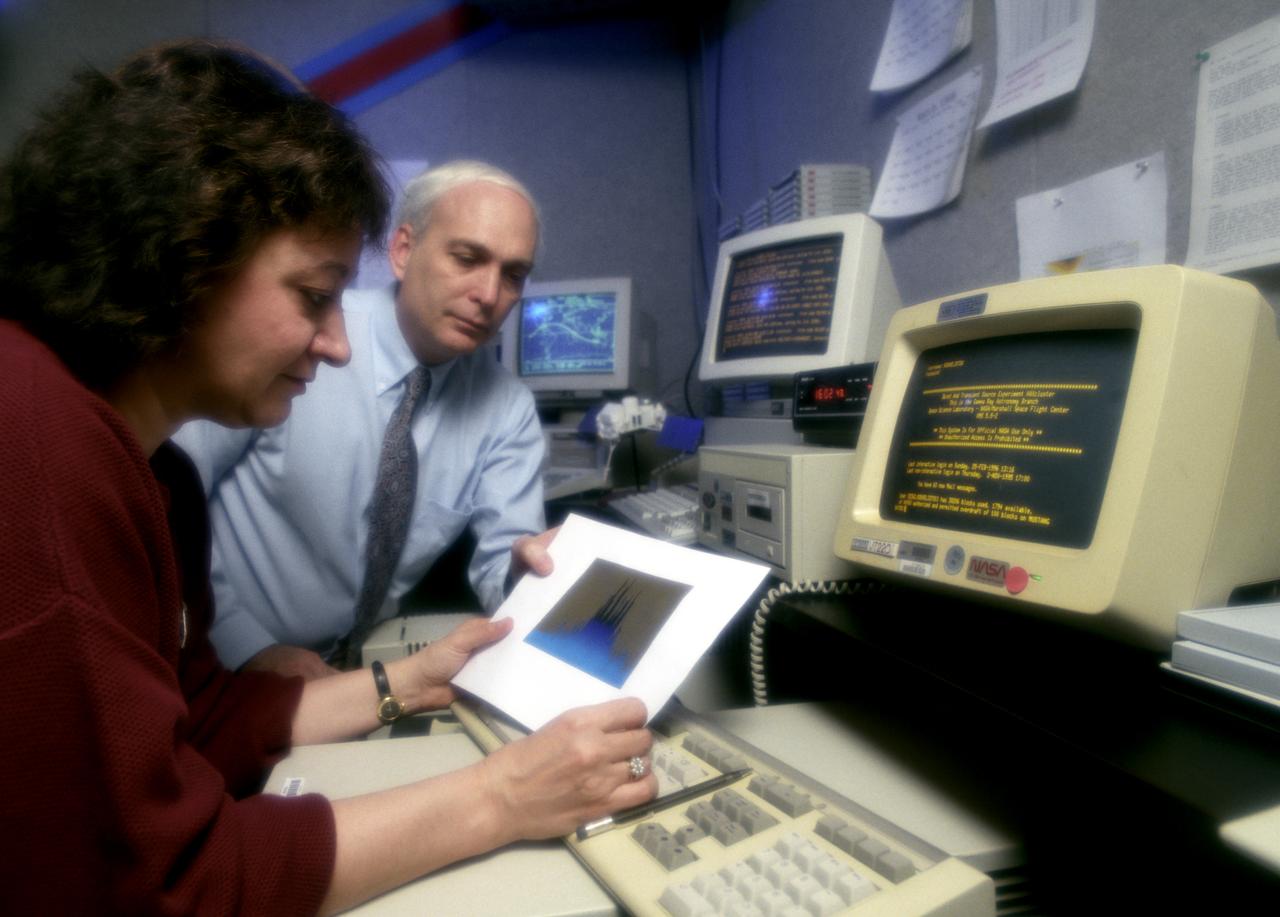
In this photograph, Dr. Gerald Fishman of the Marshall Space Flight Center (MSFC), a principal investigator of the Compton Gamma-Ray Observatory's (GRO's) instrument, the Burst and Transient Source Experiment (BATSE), and Dr. Chryssa Kouveliotou of Universities Space Research Associates review data from the BATSE. For nearly 9 years, GRO's Burst and Transient Source Experiment (BATSE), designed and built by the Marshall Space Flight Center, kept a blinking watch on the universe to alert scientist to the invisible, mysterious gamma-ray bursts. By studying gamma-rays from objects like black holes, pulsars, quasars, neutron stars, and other exotic objects, scientists could discover clues to the birth, evolution, and death of stars, galaxies, and the universe. The gamma-ray instrument was one of four major science instruments aboard the Compton. It consisted of eight detectors, or modules, located at each corner of the rectangular satellite to simultaneously scan the entire universe for bursts of gamma-rays ranging in duration from fractions of a second to minutes. Because gamma-rays are so powerful, they pass through conventional telescope mirrors. Instead of a mirror, the heart of each BATSE module was a large, flat, transparent crystal that generated a tiny flash of light when struck by a gamma-ray. With an impressive list of discoveries and diverse accomplishments, BATSE could claim to have rewritten astronomy textbooks. Launched aboard the Space Shuttle Orbiter Atlantis during the STS-35 mission in April 1991, the GRO reentered the Earth's atmosphere and ended its successful 9-year mission in June 2000.
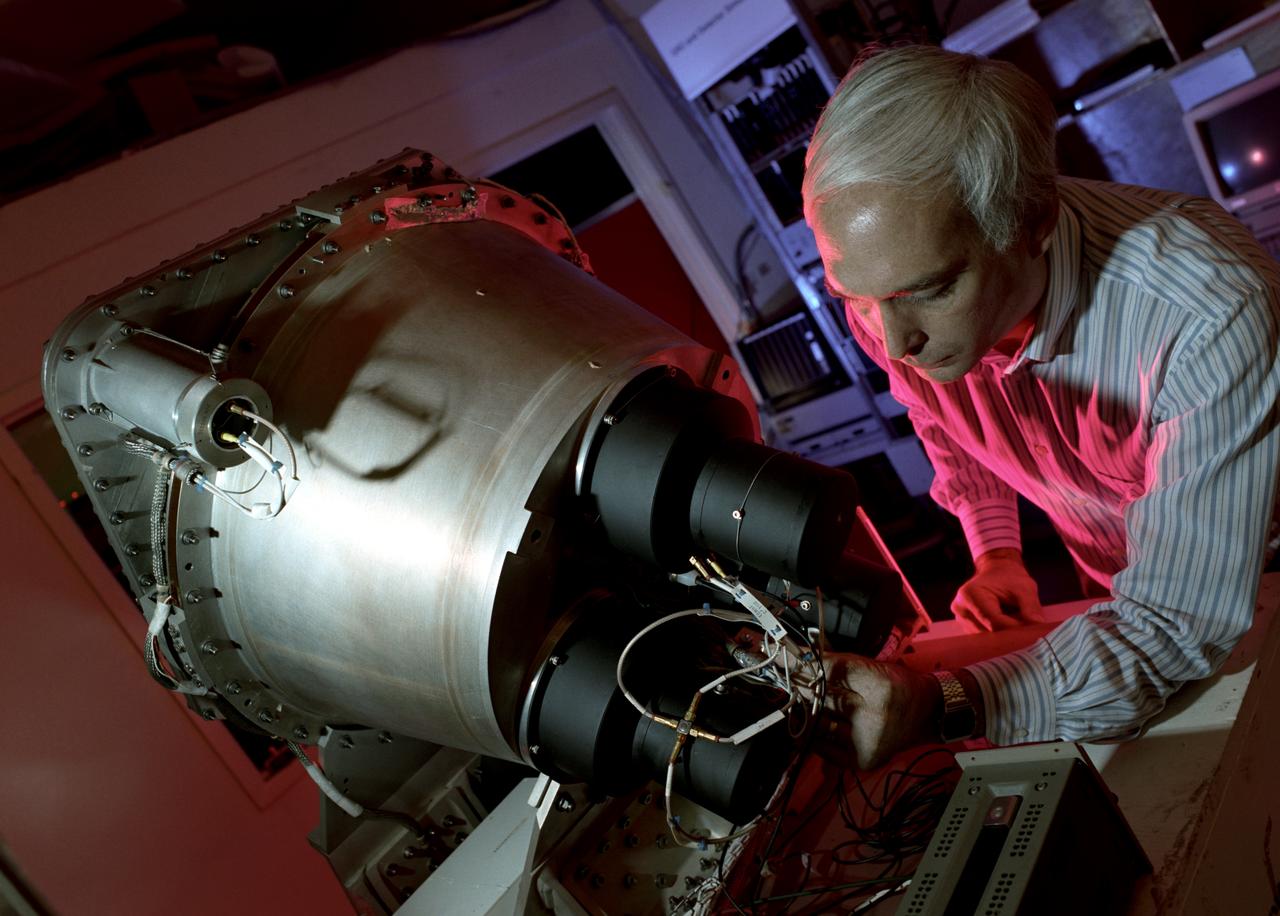
In this photograph, Dr. Gerald Fishman of the Marshall Space Flight Center (MSFC), a principal investigator of the Compton Gamma-Ray Observatory's (GRO's) instrument, the Burst and Transient Source Experiment (BATSE), works on the BATSE detector module. For nearly 9 years, GRO's BATSE, designed and built by MSFC, kept an unblinking watch on the universe to alert scientist to the invisible, mysterious gamma-ray bursts. By studying gamma-rays from objects like black holes, pulsars, quasars, neutron stars, and other exotic objects, scientists could discover clues to the birth, evolution, and death of star, galaxies, and the universe. The gamma-ray instrument was one of four major science instruments aboard the Compton. It consisted of eight detectors, or modules, located at each corner of the rectangular satellite to simultaneously scan the entire universe for bursts of gamma-rays ranging in duration from fractions of a second to minutes. Because gamma-rays are so powerful, they pass through conventional telescope mirrors. Instead of a mirror, the heart of each BATSE module was a large, flat, transparent crystal that generated a tiny flash of light when struck by a gamma-ray. With an impressive list of discoveries and diverse accomplishments, BATSE could claim to have rewritten astronomy textbooks. Launched aboard the Space Shuttle Orbiter Atlantis during the STS-35 mission in April 1991, the GRO reentered the Earth's atmosphere and ended its successful 9-year mission in June 2000.