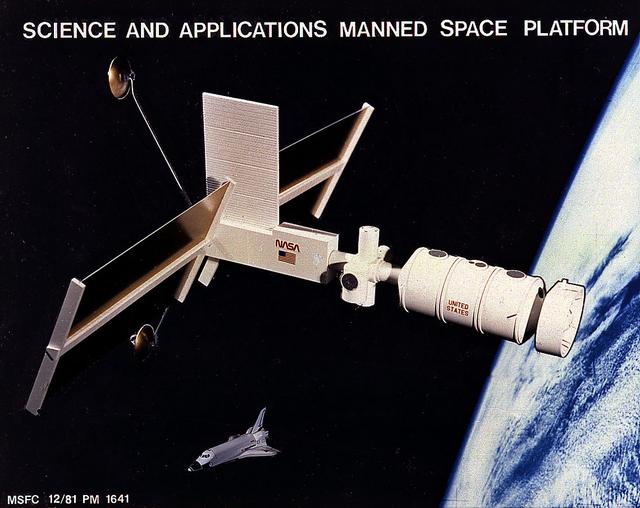
During 1980 and the first half of 1981, the Marshall Space Flight Center conducted studies concerned with a relatively low-cost, near-term, manned space platform to satisfy current user needs, yet capable of evolutionary growth to meet future needs. The Science and Application Manned Space Platform (SAMSP) studies were to serve as a test bed for developing scientific and operational capabilities required by later, more advanced manned platforms while accomplishing early science and operations. This concept illustrates a manned space platform.
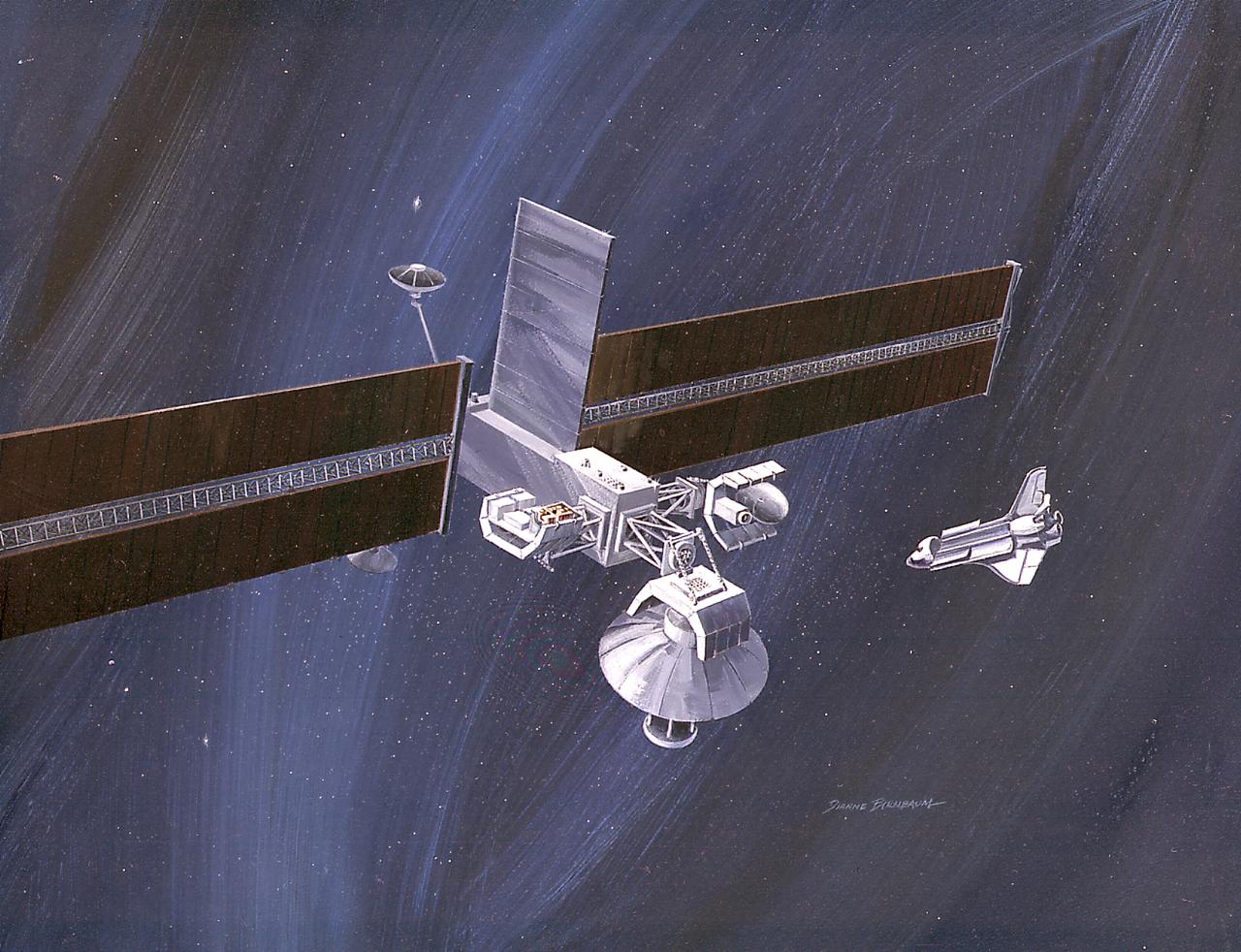
In the late 1970s, NASA, the Marshall Space Flight Center, and its contractors began focusing on designs for Shuttle-tended space platforms capable of extended periods in space and utilizing a variety of temporarily emplaced payloads. As a result, McDornell Douglas studied the Science and Applications Space Platform (SASP). The emphasis was placed on payloads that did not require a crewman's presence during normal operations. Most of the payloads would occupy one or more Spacelab-like pallets. This artist concept depicts the SASP.
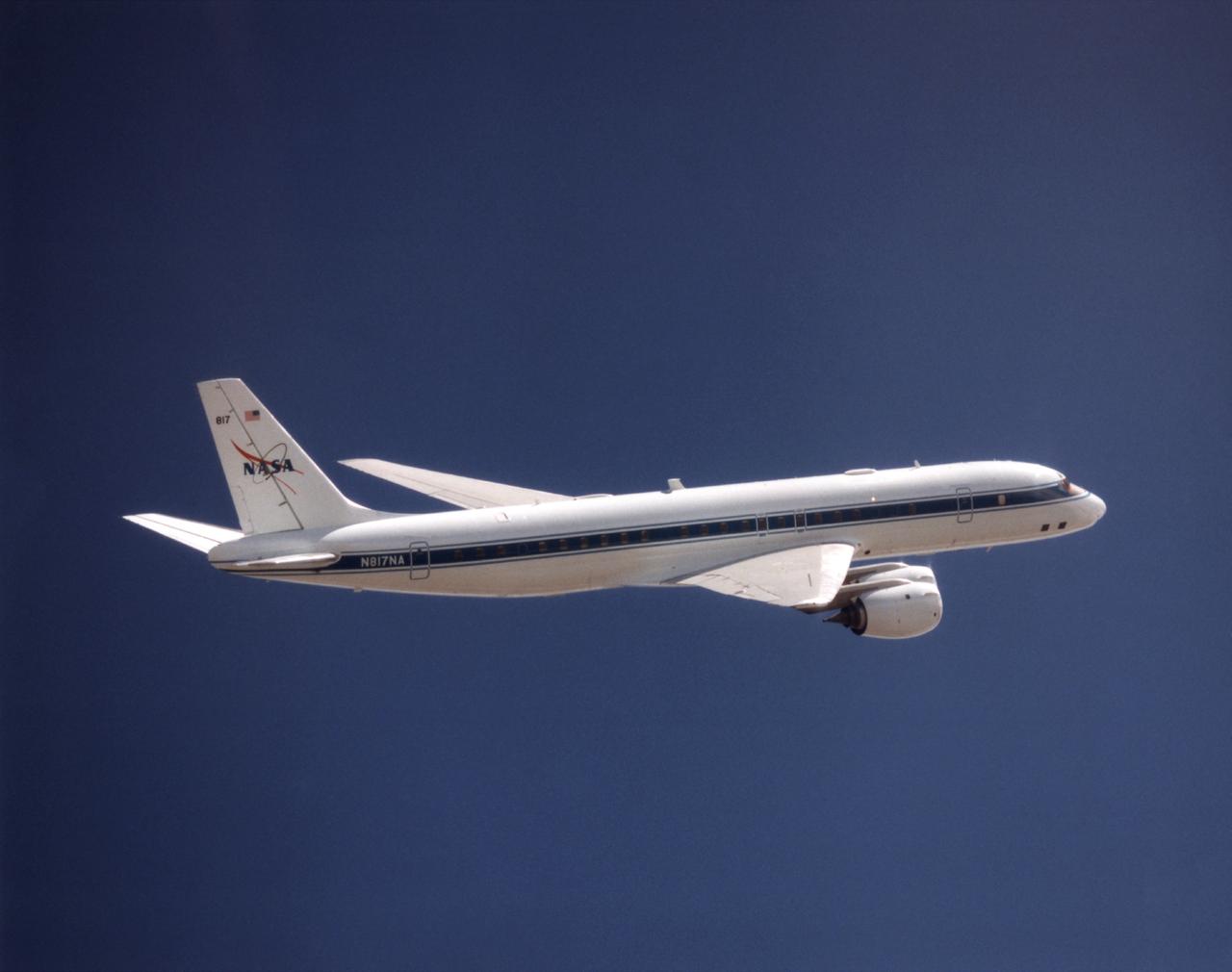
NASA's DC-8 Airborne Science platform shown against a background of a dark blue sky on February 20, 1998. The aircraft is shown from the right rear, slightly above its plane, with the right wing in the foreground and the left wing and horizontal tail in the background. The former airliner is a "dash-72" model and has a range of 5,400 miles. The craft can stay airborne for 12 hours and has an operational speed range between 300 and 500 knots. The research flights are made at between 500 and 41,000 feet. The aircraft can carry up to 30,000 lbs of research/science payload equipment installed in 15 mission-definable spaces.
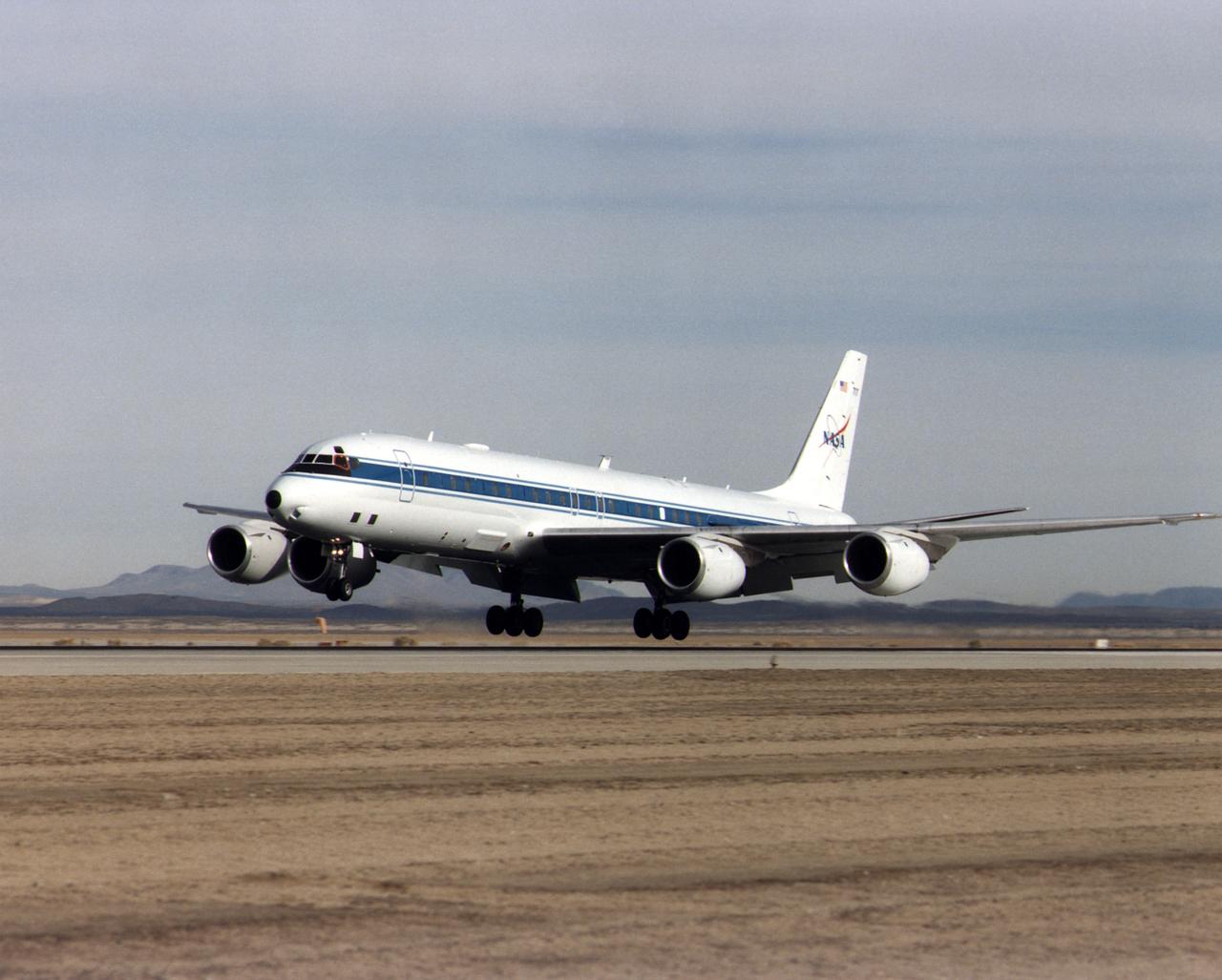
NASA's DC-8 Airborne Science platform landed at Edwards Air Force Base, California, to join the fleet of aircraft at NASA's Dryden Flight Research Center. The white aircraft with a blue stripe running horizontally from the nose to the tail is shown with its main landing gear just above the runway. The former airliner is a "dash-72" model and has a range of 5,400 miles. The craft can stay airborne for 12 hours and has an operational speed range between 300 and 500 knots. The research flights are made at between 500 and 41,000 feet. The aircraft can carry up to 30,000 lbs of research/science payload equipment installed in 15 mission-definable spaces.
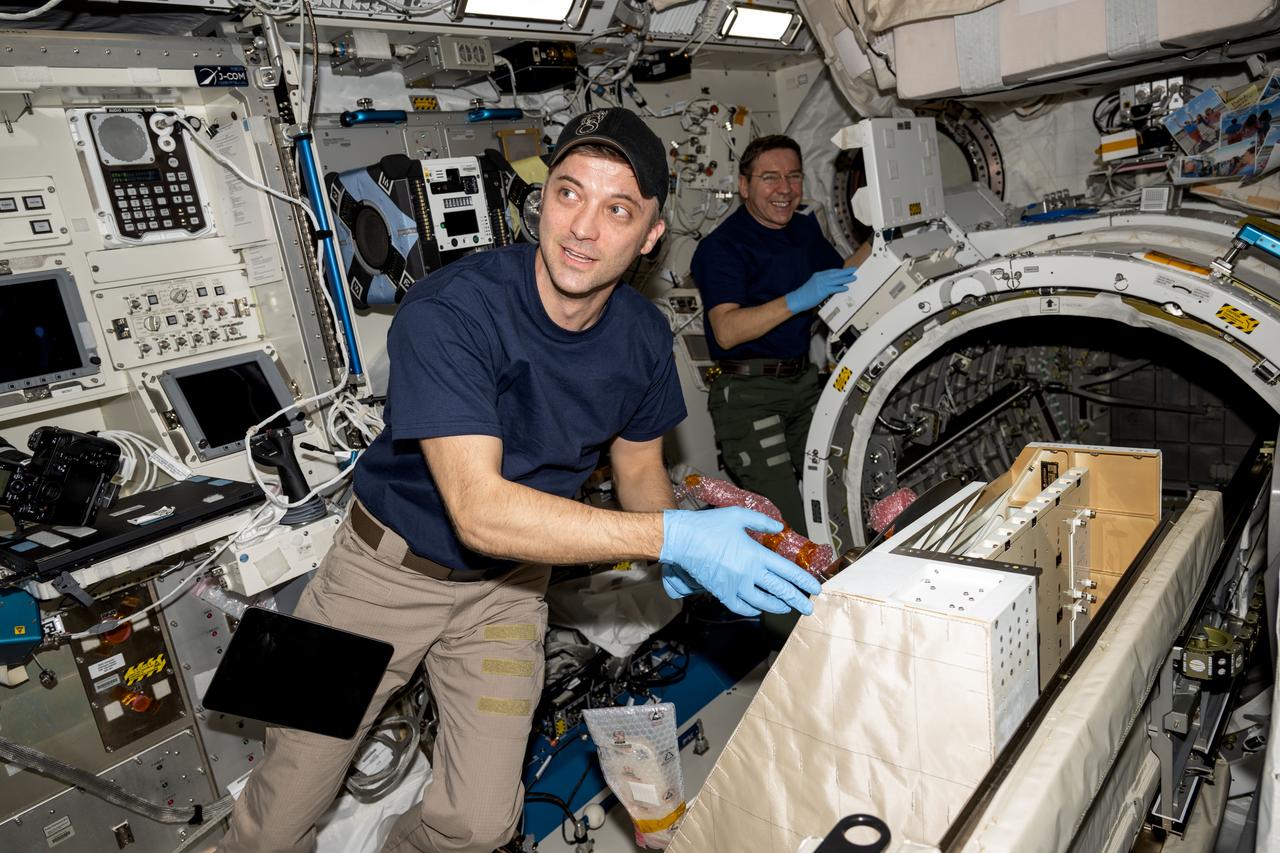
iss071e403564 (July 22, 2024) --- (From left) NASA astronauts Matthew Dominick and Mike Barratt, both Expedition 71 Flight Engineers, install the NanoRacks external platform inside the Kibo laboratory module's airlock. The platform from NanoRacks can host a variety of payloads placed outside the International Space Station and exposed to the external space environment for science experiments, technology demonstrations, and more.
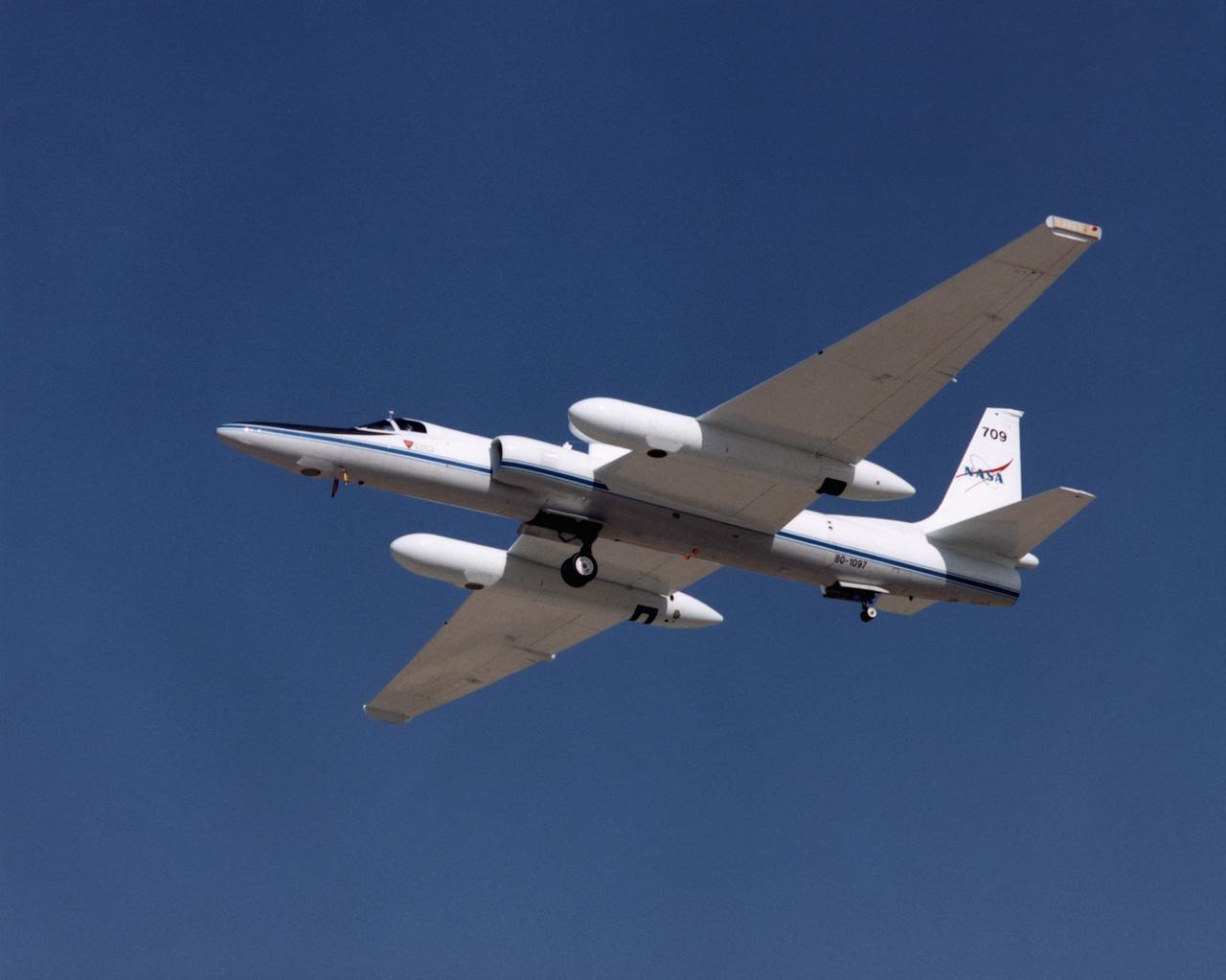
ER-2 tail number 709, was one of two Airborne Science ER-2s used as science platforms by Dryden. The aircraft were platforms for a variety of high-altitude science missions flown over various parts of the world. They were also used for earth science and atmospheric sensor research and development, satellite calibration and data validation.

ER-2 tail number 706, was one of two Airborne Science ER-2s used as science platforms by Dryden. The aircraft were platforms for a variety of high-altitude science missions flown over various parts of the world. They were also used for earth science and atmospheric sensor research and development, satellite calibration and data validation.
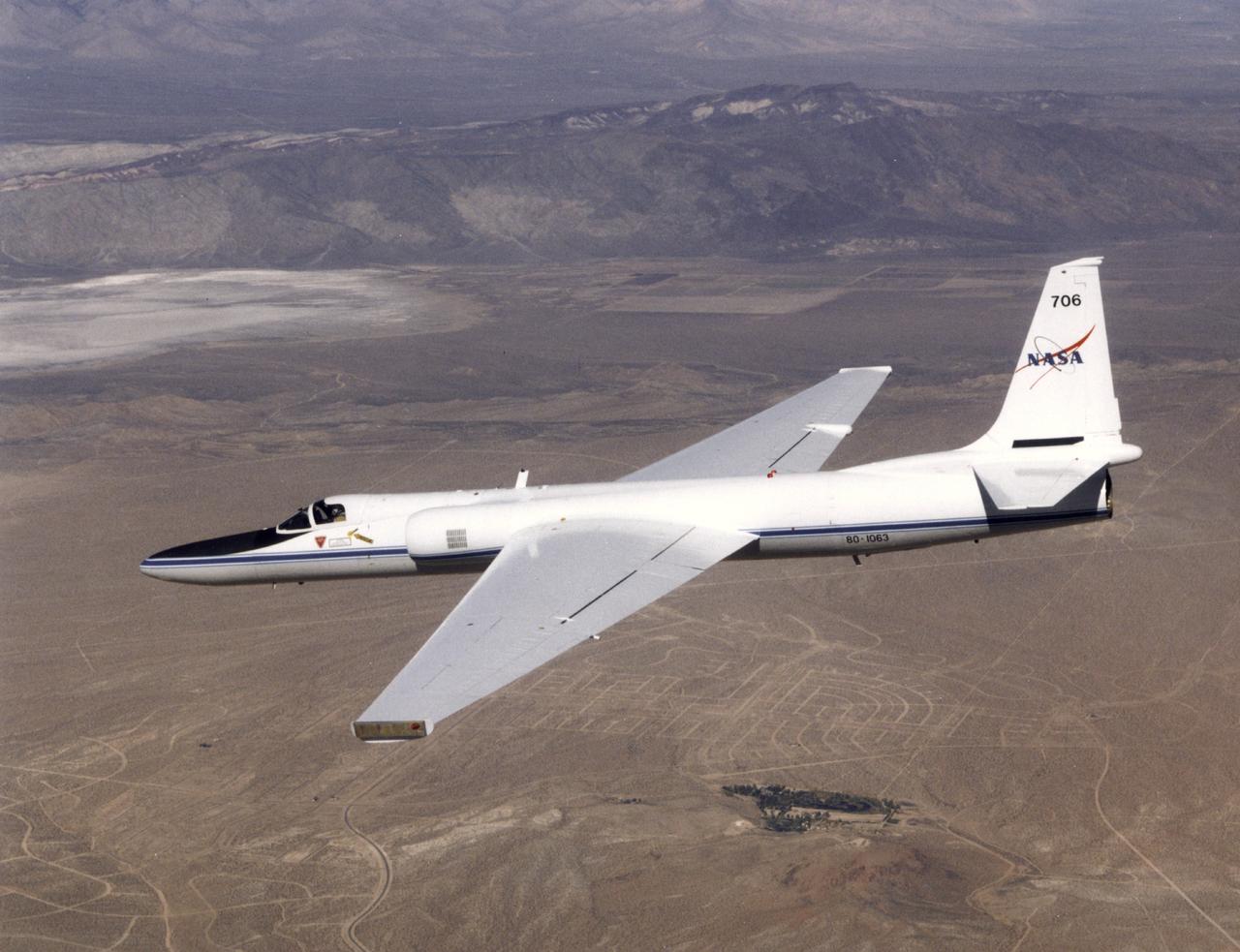
ER-2 tail number 706, was one of two Airborne Science ER-2s used as science platforms by Dryden. The aircraft were platforms for a variety of high-altitude science missions flown over various parts of the world. They were also used for earth science and atmospheric sensor research and development, satellite calibration and data validation.

ER-2 tail number 706, was one of two Airborne Science ER-2s used as science platforms by Dryden. The aircraft were platforms for a variety of high-altitude science missions flown over various parts of the world. They were also used for earth science and atmospheric sensor research and development, satellite calibration and data validation.
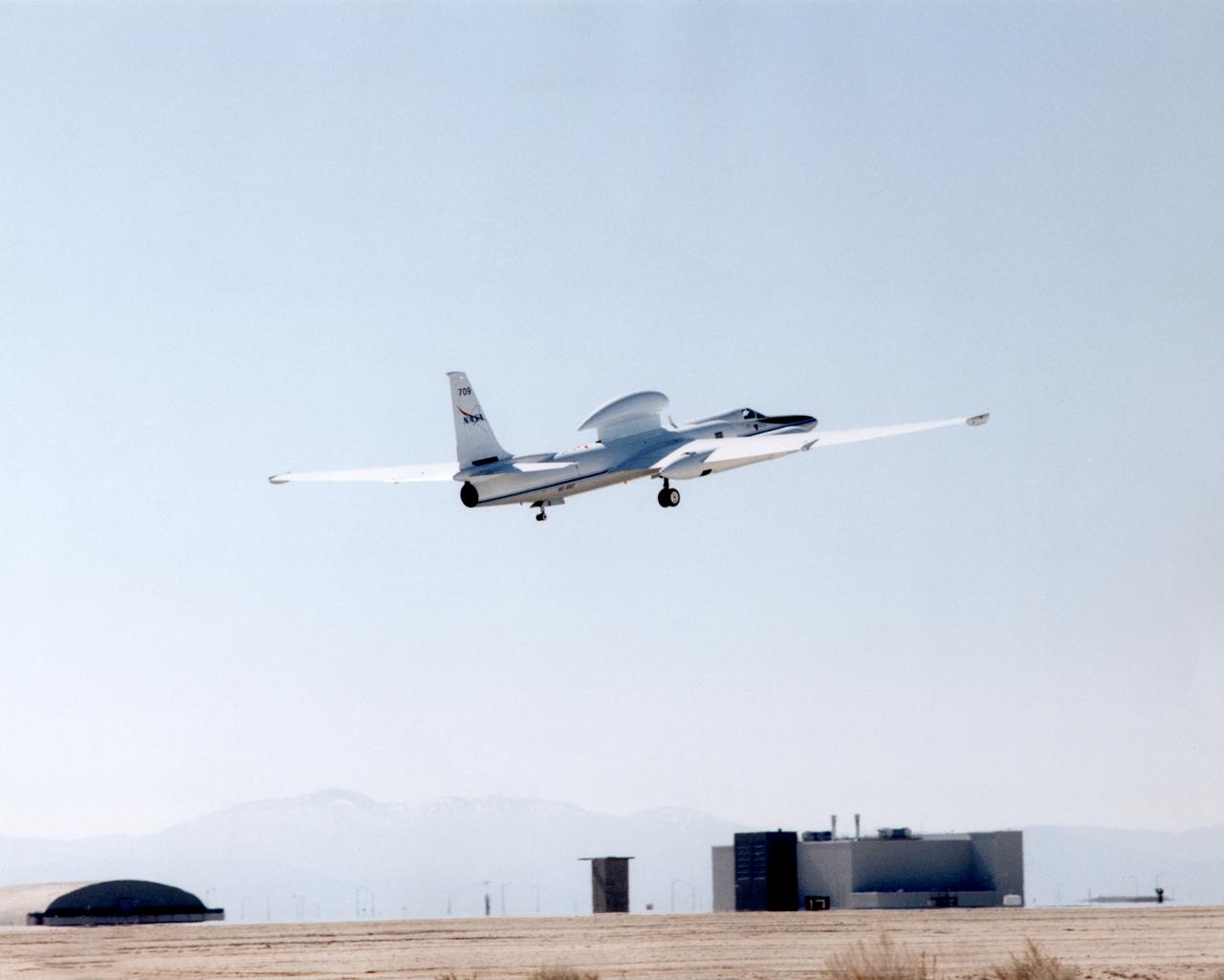
ER-2 tail number 709, was one of two Airborne Science ER-2s used as science platforms by Dryden. The aircraft were platforms for a variety of high-altitude science missions flown over various parts of the world. They were also used for earth science and atmospheric sensor research and development, satellite calibration and data validation.
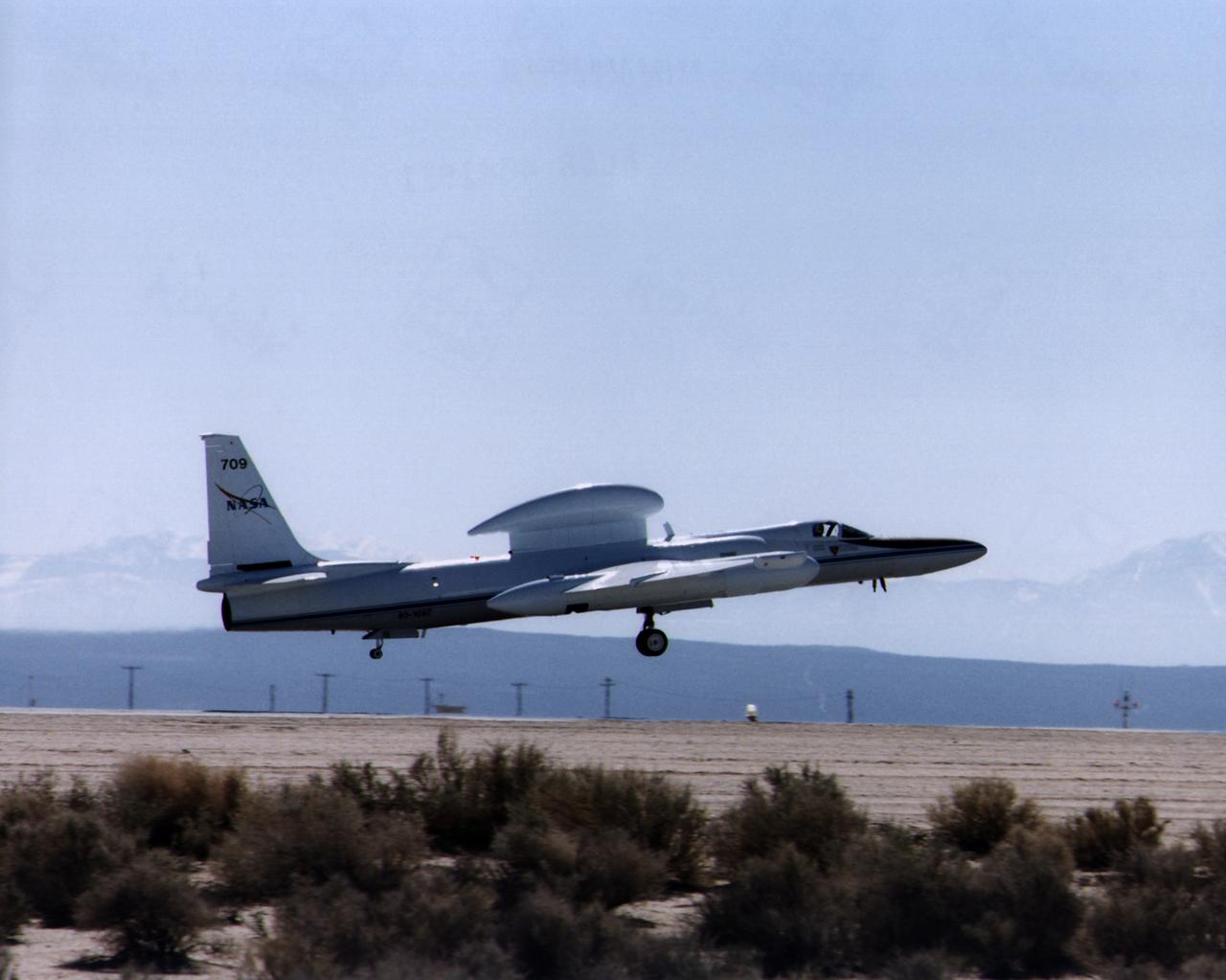
ER-2 tail number 709, was one of two Airborne Science ER-2s used as science platforms by Dryden. The aircraft were platforms for a variety of high-altitude science missions flown over various parts of the world. They were also used for earth science and atmospheric sensor research and development, satellite calibration and data validation.
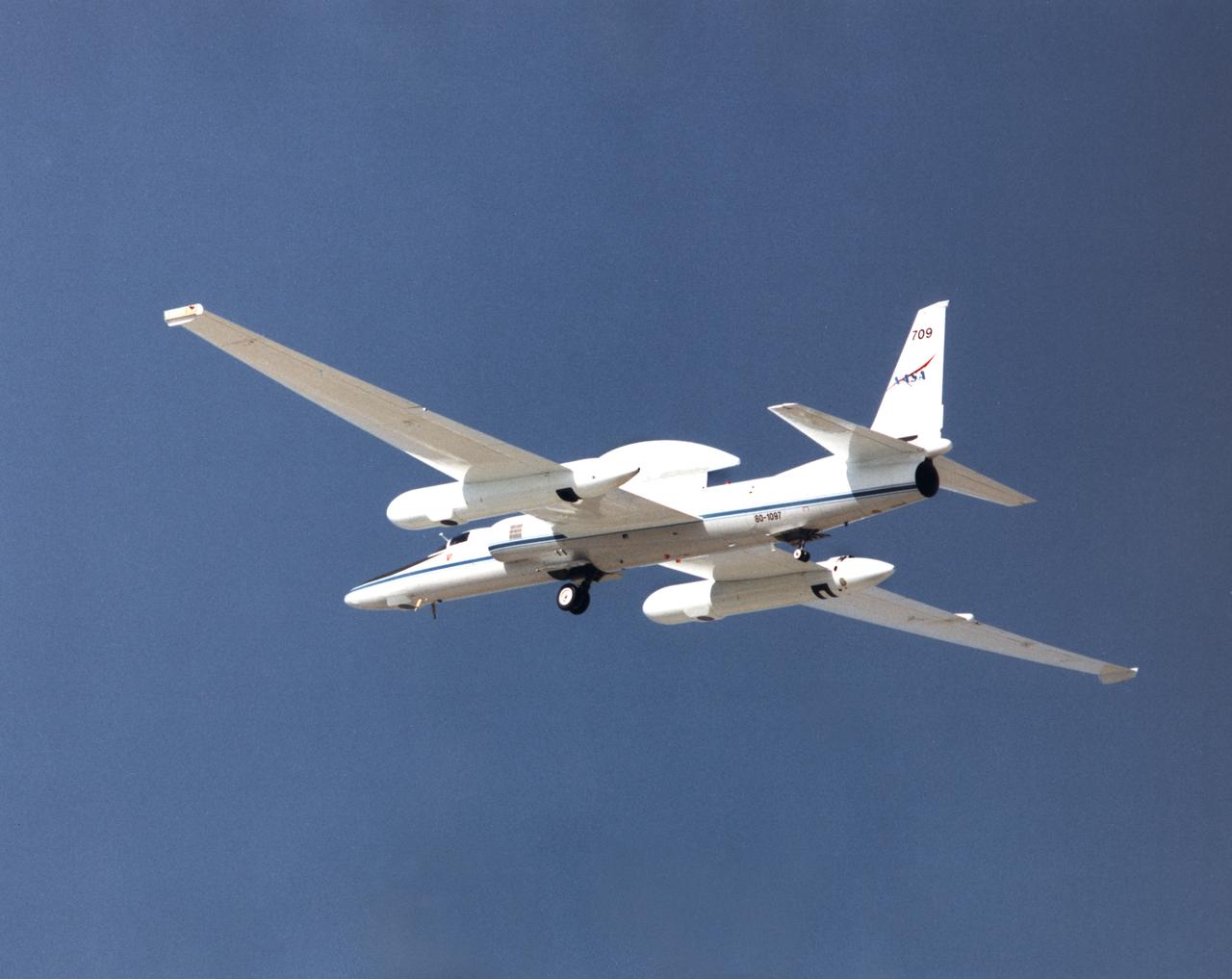
ER-2 tail number 709, was one of two Airborne Science ER-2s used as science platforms by Dryden. The aircraft were platforms for a variety of high-altitude science missions flown over various parts of the world. They were also used for earth science and atmospheric sensor research and development, satellite calibration and data validation.
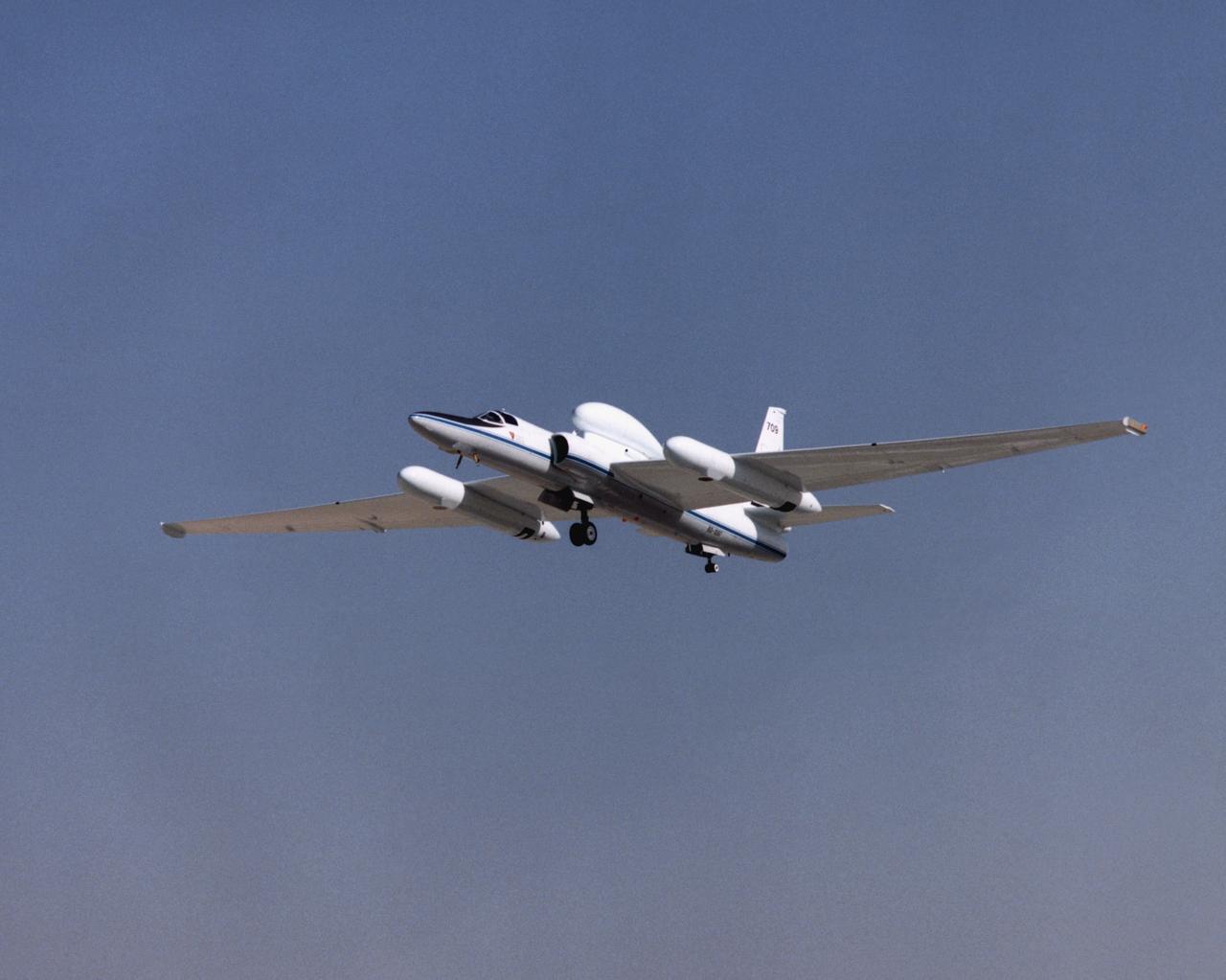
ER-2 tail number 709, was one of two Airborne Science ER-2s used as science platforms by Dryden. The aircraft were platforms for a variety of high-altitude science missions flown over various parts of the world. They were also used for earth science and atmospheric sensor research and development, satellite calibration and data validation.
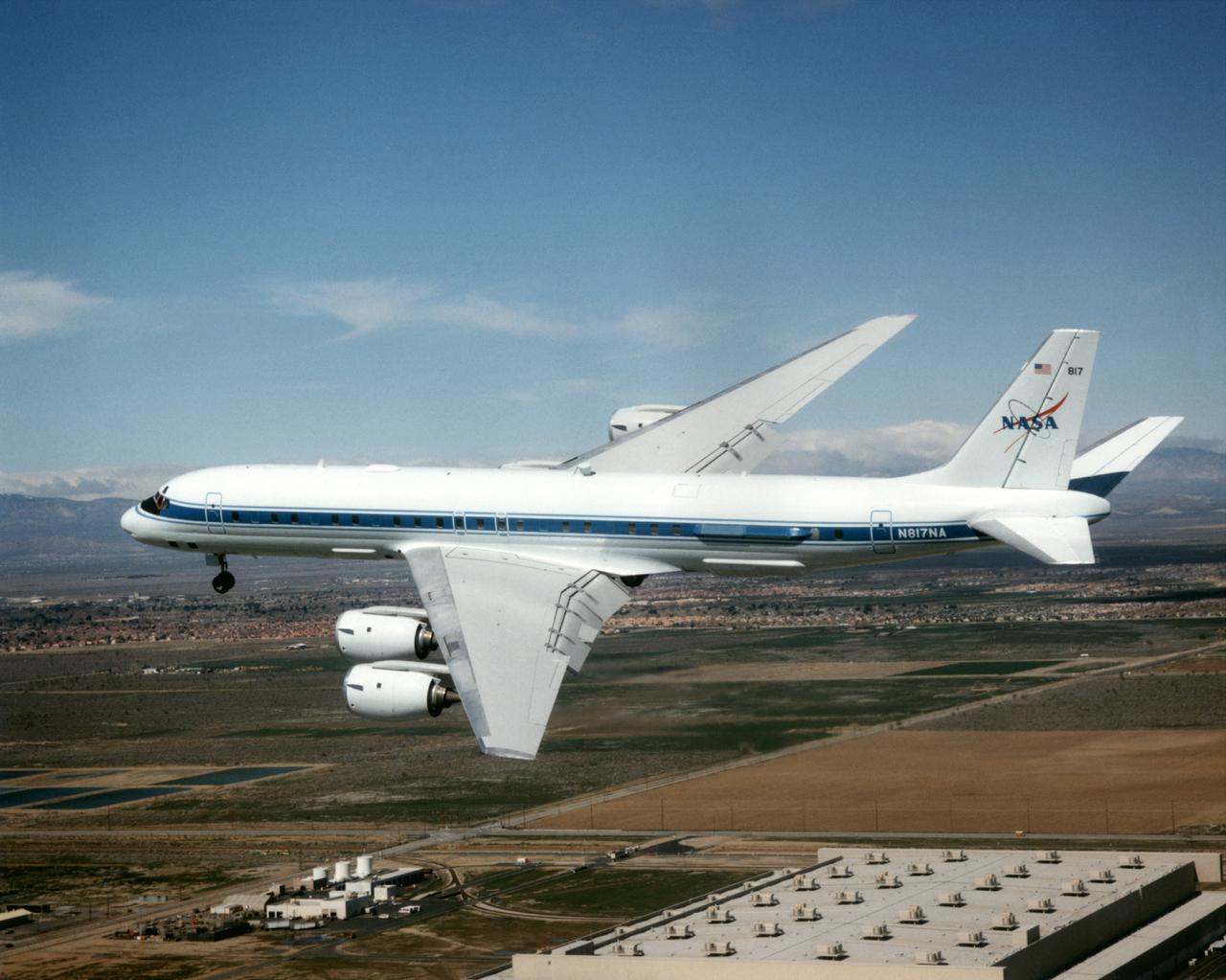
The DC-8 Airborne Laboratory in a left banking turn above the airport at Palmdale, California. The right wing is silhouetted against the blue sky, while the left wing contrasts with the desert terrain. The former airliner is a "dash-72" model and has a range of 5,400 miles. The craft can stay airborne for 12 hours and has an operational speed range between 300 and 500 knots. The research flights are made at between 500 and 41,000 feet. The aircraft can carry up to 30,000 lbs of research/science payload equipment installed in 15 mission-definable spaces.

NASA DC-8 airborne laboratory flying over Mint Canyon near the snow-covered San Gabriel Mountains of California. The mostly white aircraft is silhouetted against the darker mountains in the background.
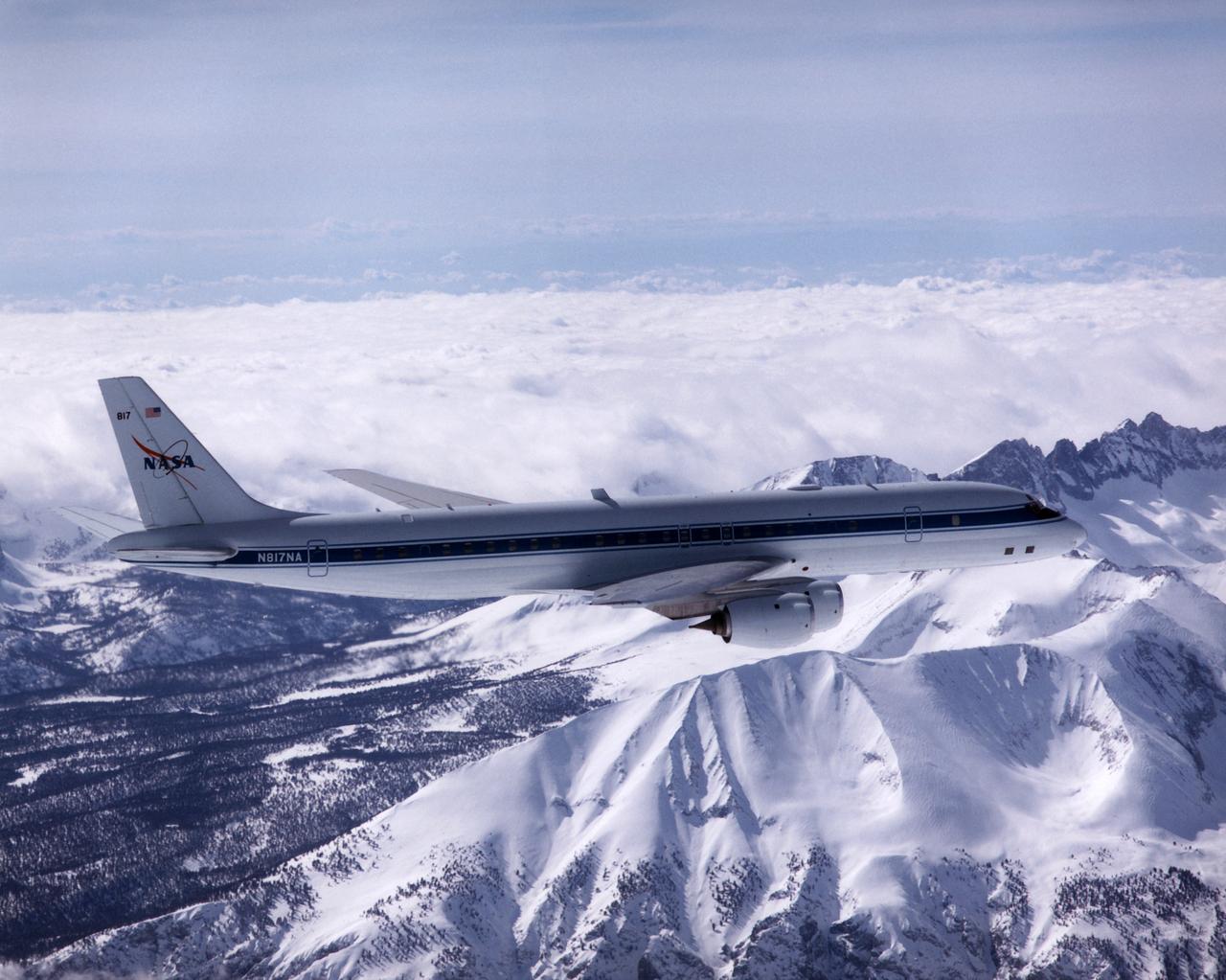
NASA's DC-8 Airborne Laboratory during a flight over the snow-covered Sierra Nevada Mountains. Over the past several years the DC-8 has conducted research missions in such diverse places as the Pacific in spring and Sweden in winter.
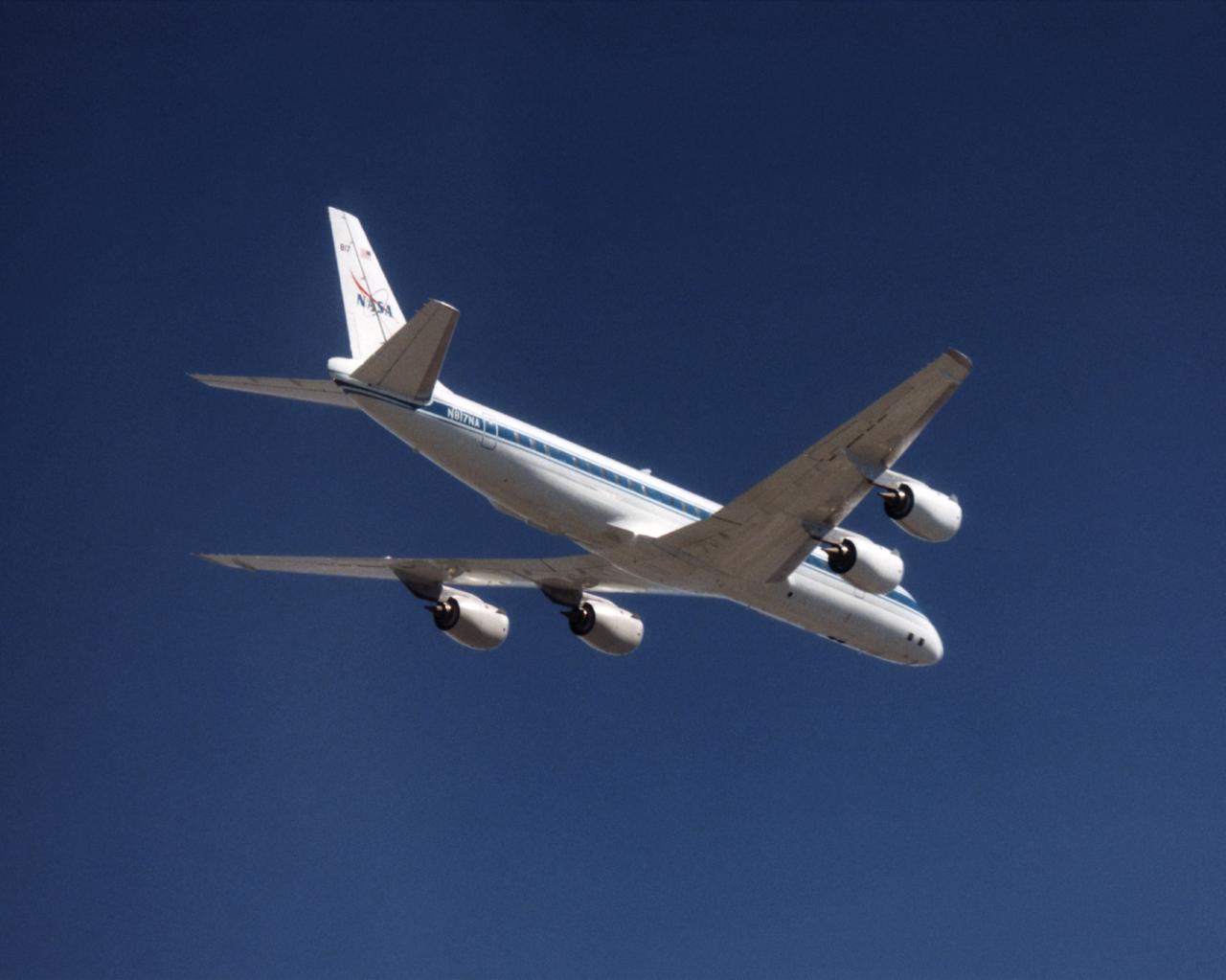
The NASA DC-8 in a right bank over the rugged Sierra Nevada Mountains. The former airliner is a "dash-72" model and has a range of 5,500 miles. The craft can stay airborne for 12 hours and has an operational speed range between 300 and 500 knots. The research flights are made at between 500 and 41,000 feet. The aircraft can carry up to 30,000 lbs of research/science payload equipment installed in 15 mission-definable spaces. In this photo, the aircraft is shown in flight from below, with the DC-8 silhouetted against a blue sky.
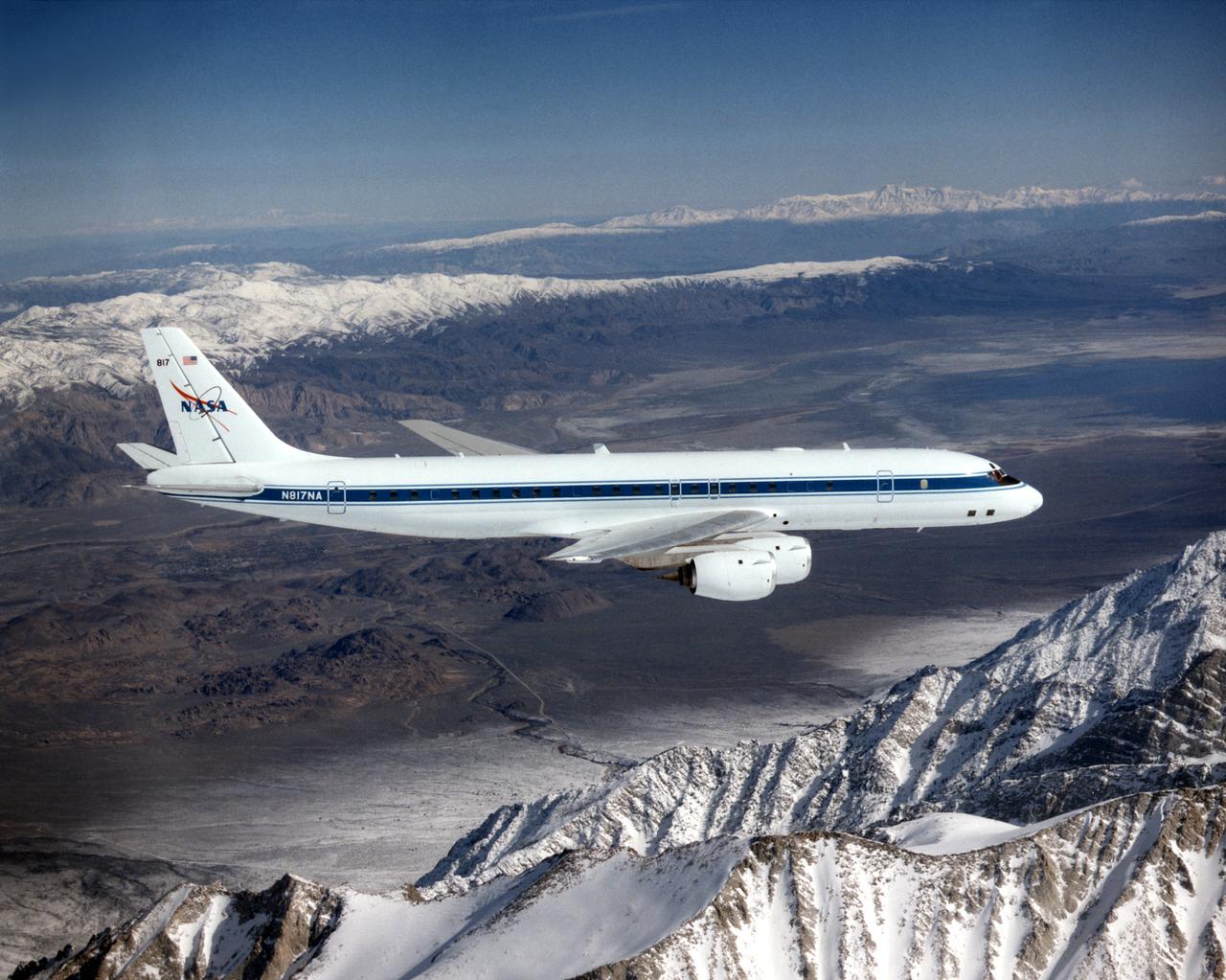
The DC-8 in flight near Lone Pine, Calif. In the foreground are the Sierra Nevada Mountains, covered with winter snow. In the distance are the White Mountains. The DC-8's fuselage is painted white with a dark blue stripe down the side. The wings are silver, while the engine pods are white. In this view of the airplane's right-hand side, only a few of its antennas are visible. The experimental payload can be as great as 30,000 pounds of equipment for gathering data of various sorts.
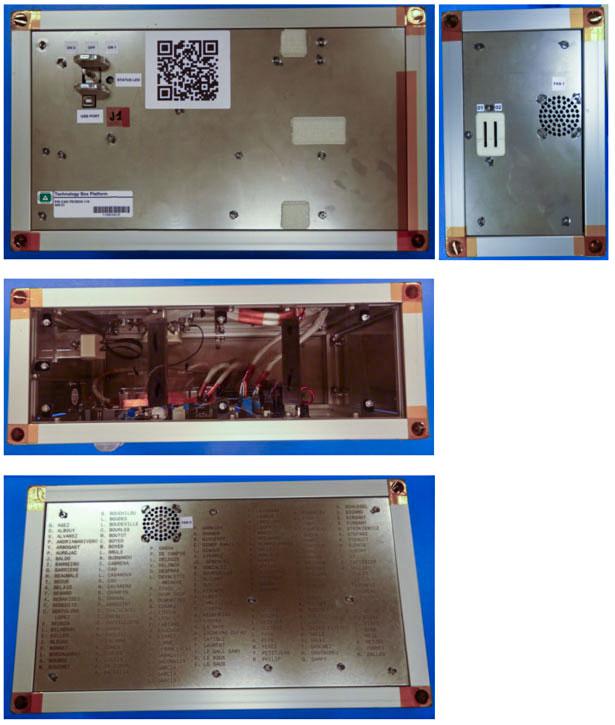
jsc2021e029746(7/13/2021) --- A preflight view of the TECHNOLOGY BOX platform. The main objective of Technology Box (Tetr’ISS) is to conduct experiments gathered in support equipment called ‘Platform’, to illustrate science principles based on physics and chemistry. For this mission Tetr’ISS contains the Chladni’s Figures experiment: a physical science experiment to observe the sound waves in 3D thanks to fine particles organized according to nodes and antinodes.
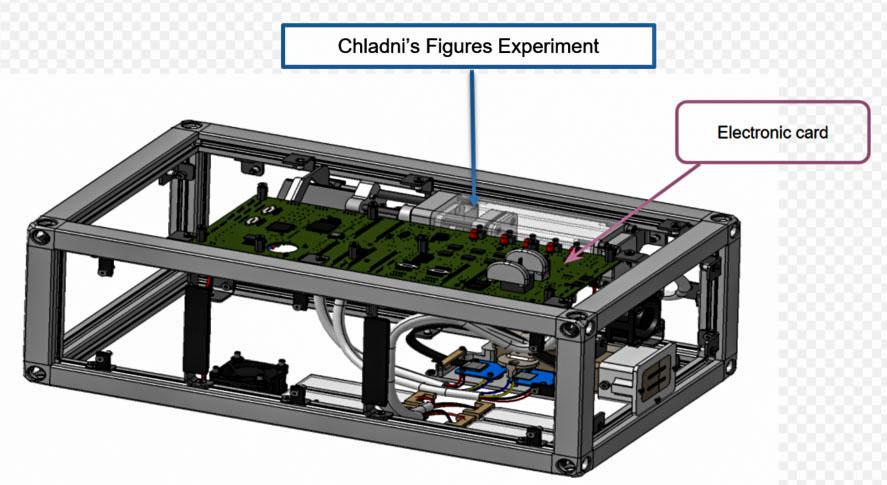
jsc2021e029744 (7/13/2021) --- A preflight view of the TECHNOLOGY BOX platform internal configuration without the walls. The main objective of Technology Box (Tetr’ISS) is to conduct experiments gathered in support equipment called ‘Platform’, to illustrate science principles based on physics and chemistry. For this mission Tetr’ISS contains the Chladni’s Figures experiment: a physical science experiment to observe the sound waves in 3D thanks to fine particles organized according to nodes and antinodes.
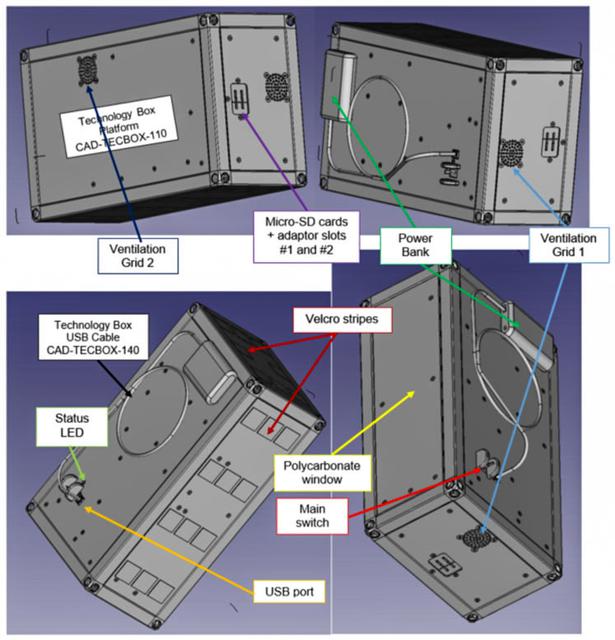
jsc2021e029745 (7/13/2021) --- A preflight view of the TECHNOLOGY BOX platform design. The main objective of Technology Box (Tetr’ISS) is to conduct experiments gathered in support equipment called ‘Platform’, to illustrate science principles based on physics and chemistry. For this mission Tetr’ISS contains the Chladni’s Figures experiment: a physical science experiment to observe the sound waves in 3D thanks to fine particles organized according to nodes and antinodes.
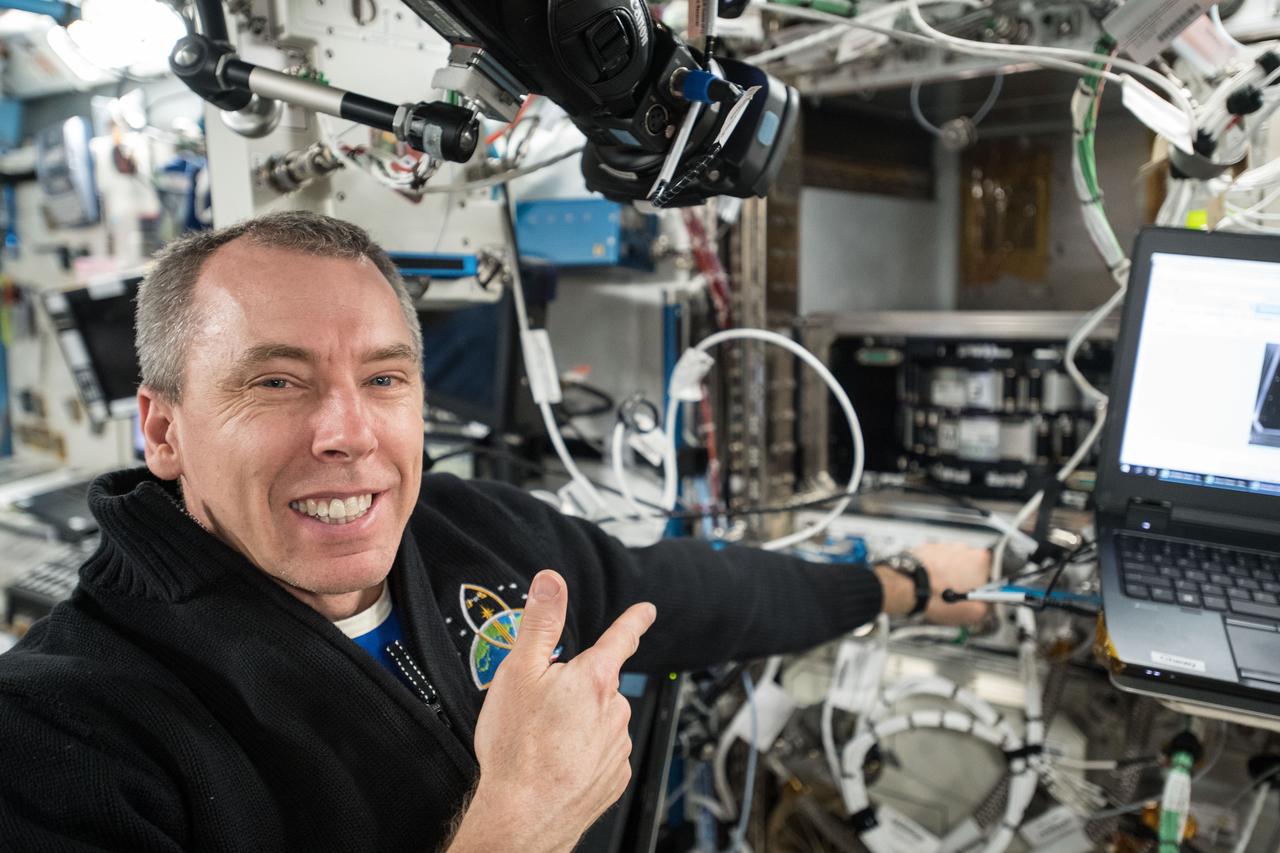
iss055e018689 (April 11, 2018) --- NASA astronaut Drew Feustel conducts science operations using the Multi-Use Variable-G Platform that enables research into smaller and microscopic organisms.
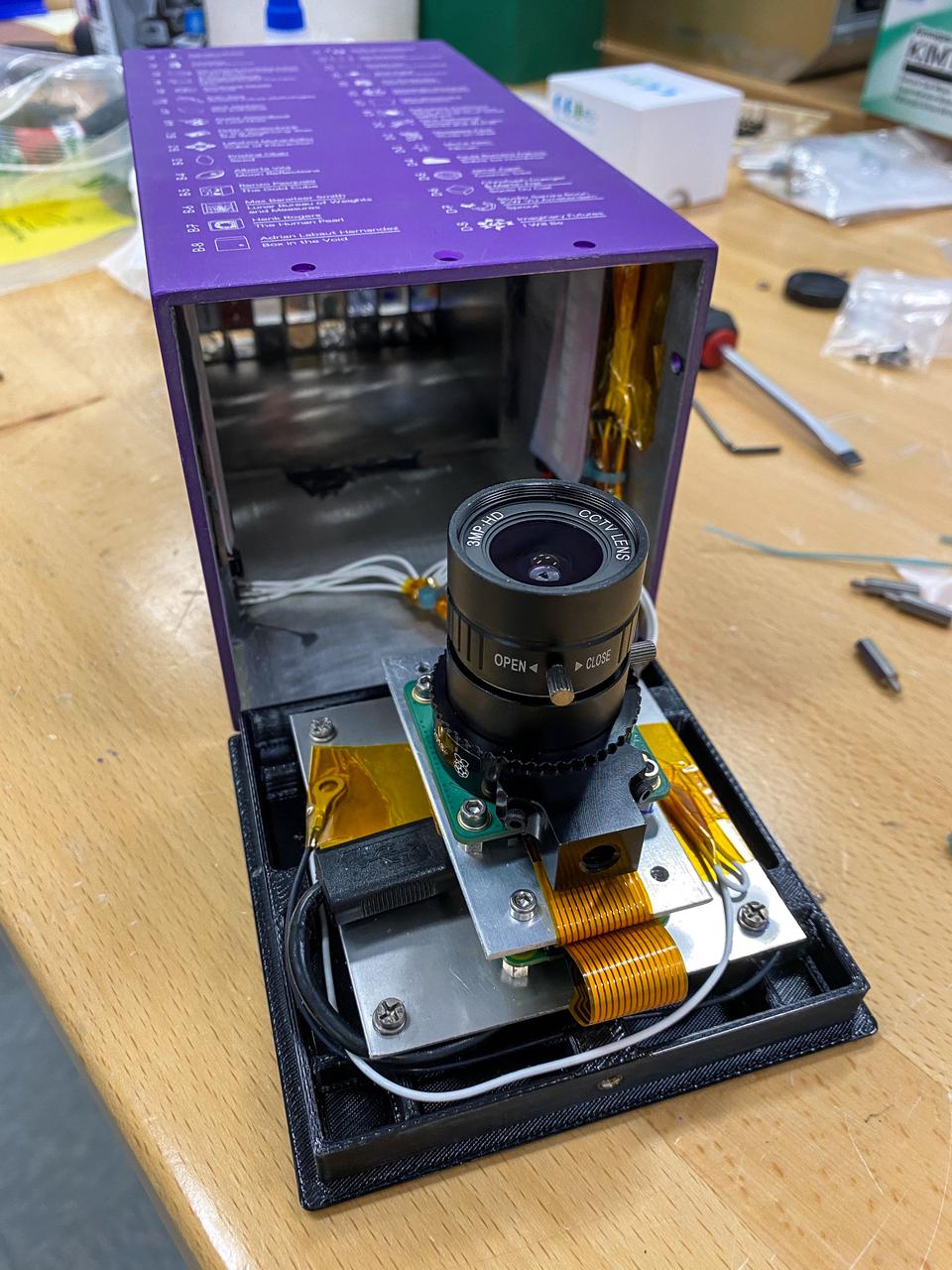
jsc2022e008878 (12/9/2021) --- A preflight view of the Moon Gallery payload. Moon Gallery evaluates the performance of a single-board computer platform with a high-quality camera in the space station’s radiation environment. Photos and videos taken with the camera become part of an art installation known as the Moon Gallery. The camera could be used in future space platforms and science hardware.
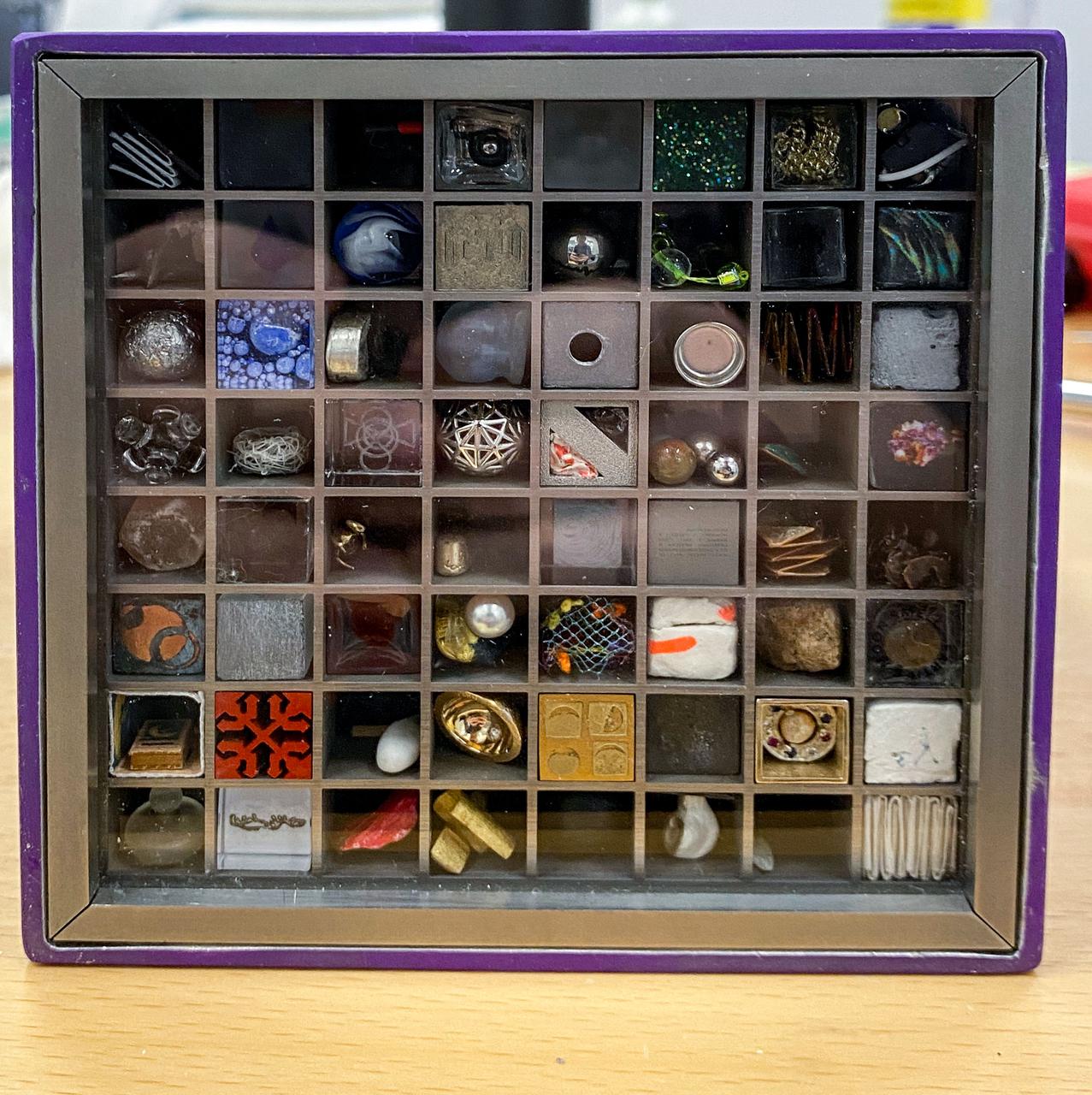
jsc2022e008880 (12/9/2021) --- A preflight view of the Moon Gallery payload. Moon Gallery evaluates the performance of a single-board computer platform with a high-quality camera in the space station’s radiation environment. Photos and videos taken with the camera become part of an art installation known as the Moon Gallery. The camera could be used in future space platforms and science hardware.
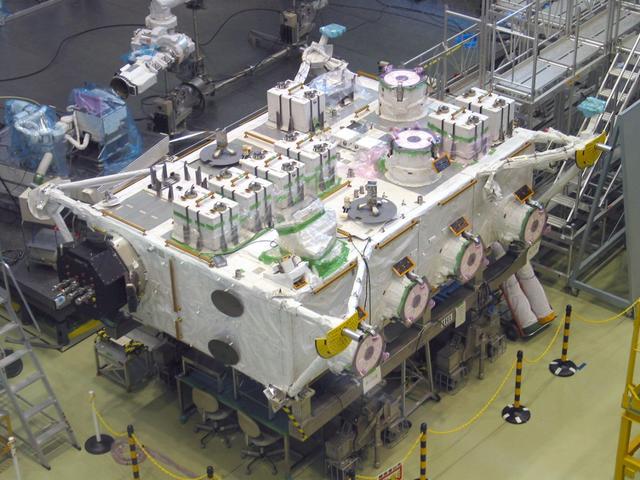
JSC2003-E-42544 (June 2003 ) --- The Exposed Facility (EF) of the Japanese Experiment Module (JEM), Japan's primary contribution to the International Space Station (ISS), is shown in a processing facility. The EF is a unique platform on the ISS that is located outside of the Pressurized Module and is continuously exposed to the space environment. Items positioned on the exterior platform focus on Earth observation as well as communication, scientific, engineering and materials science experiments. Photo Credit: NASA
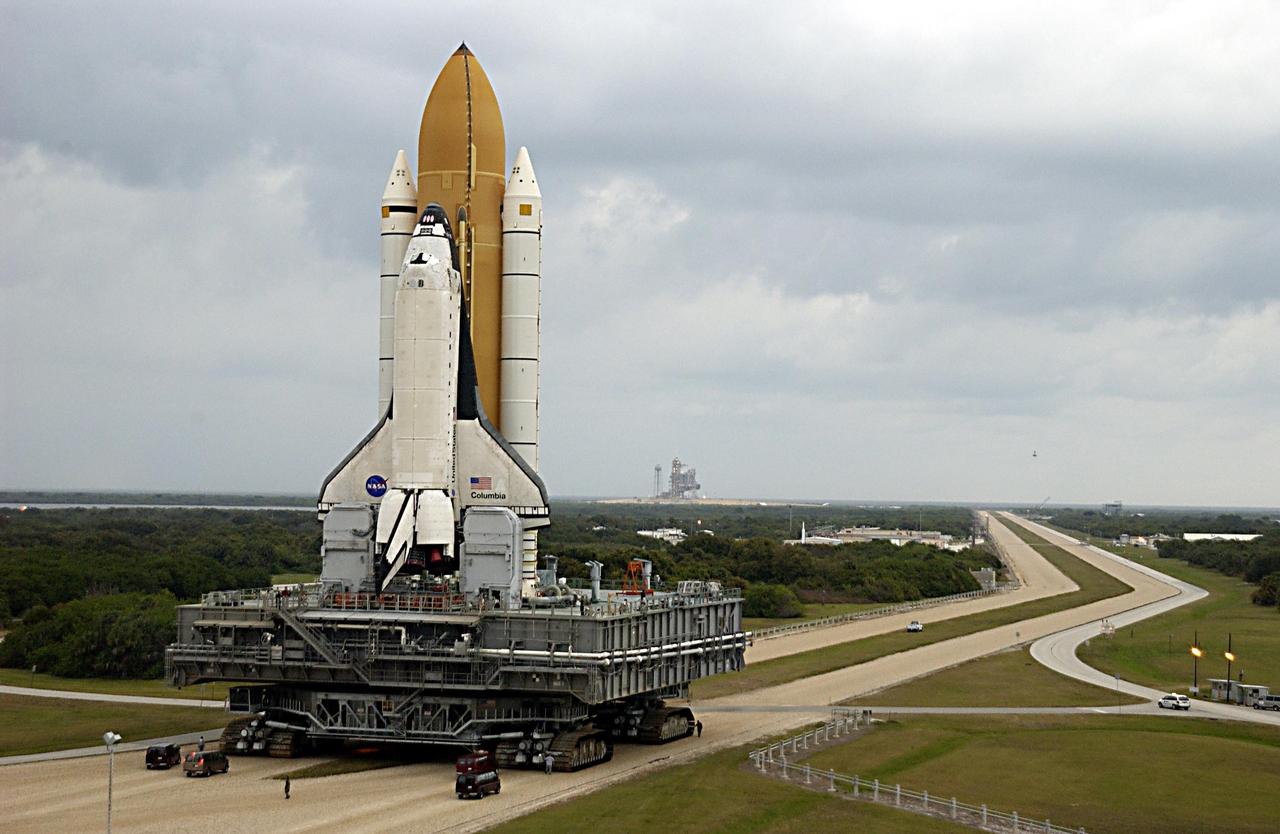
KENNEDY SPACE CENTER, FLA. -- Space Shuttle Columbia rolls towards Launch Pad 39A, sitting atop the Mobile Launcher Platform, which in turn is carried by the crawler-transporter underneath. The STS-107 research mission comprises experiments ranging from material sciences to life sciences (many rats), plus the Fast Reaction Experiments Enabling Science, Technology, Applications and Research (FREESTAR) that incorporates eight high priority secondary attached shuttle experiments. Mission STS-107 is scheduled to launch Jan. 16, 2003.
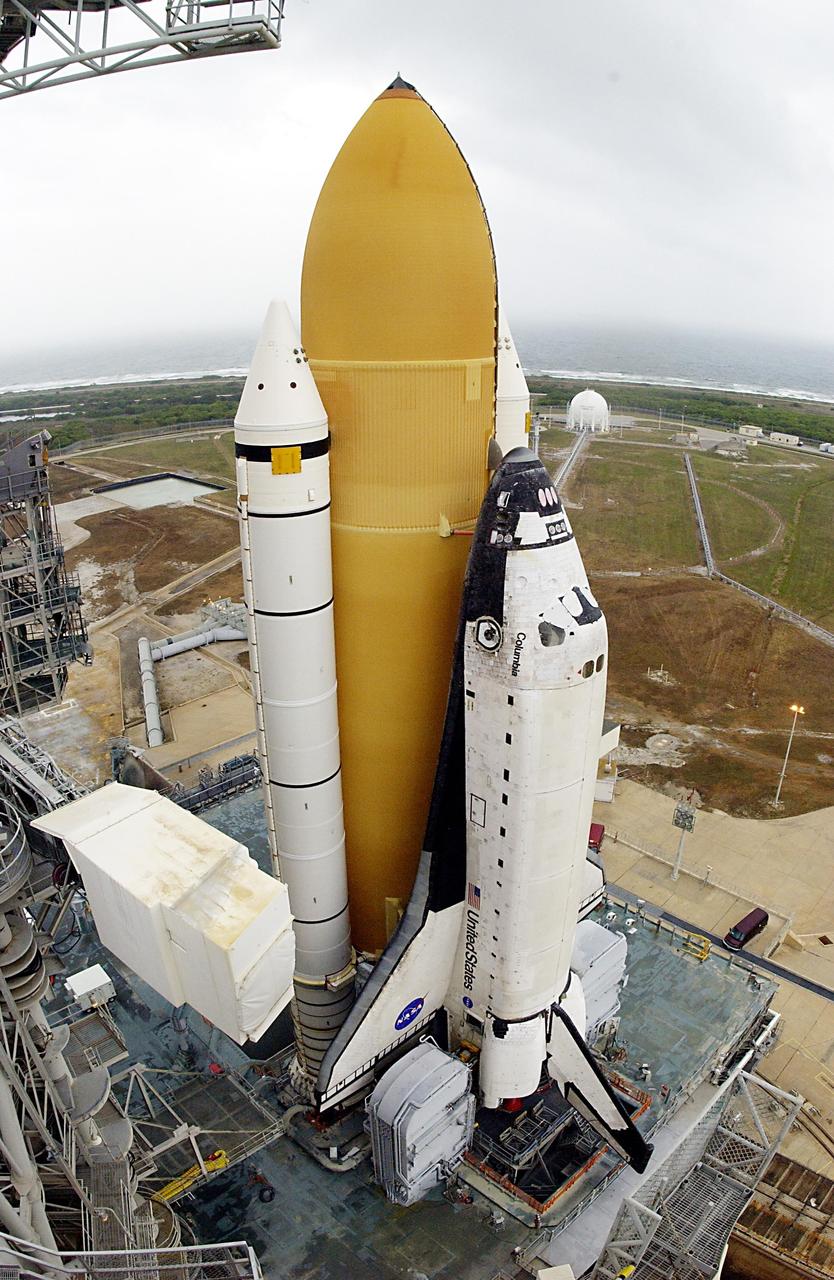
KENNEDY SPACE CENTER, FLA. -- Space Shuttle Columbia sits on Launch Pad 39A, atop the Mobile Launcher Platform. The STS-107 research mission comprises experiments ranging from material sciences to life sciences (many rats), plus the Fast Reaction Experiments Enabling Science, Technology, Applications and Research (FREESTAR) that incorporates eight high priority secondary attached shuttle experiments. Mission STS-107 is scheduled to launch Jan. 16, 2003.
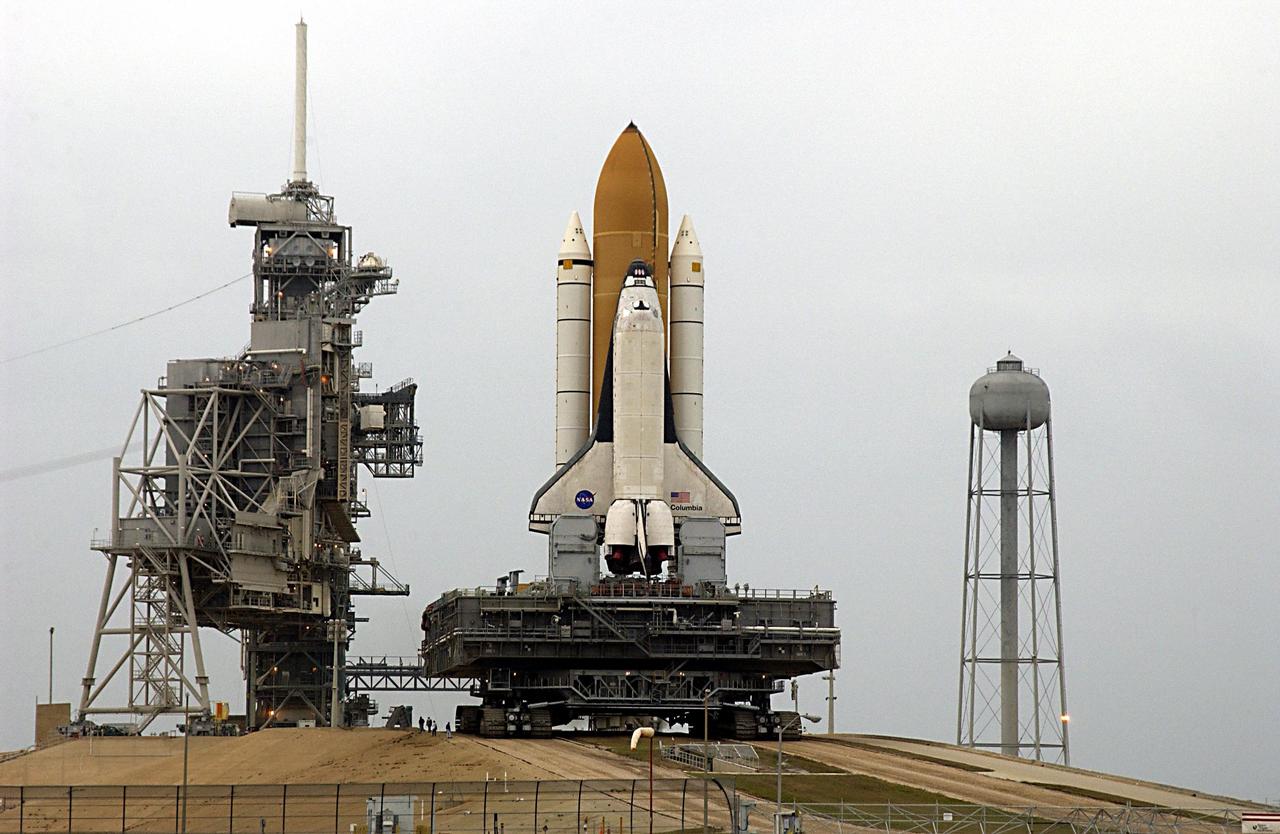
KENNEDY SPACE CENTER, FLA. -- Space Shuttle Columbia, atop the Mobile Launcher Platform, approaches the top of Launch Pad 39A where it will undergo preparations for launch. The STS-107 research mission comprises experiments ranging from material sciences to life sciences, plus the Fast Reaction Experiments Enabling Science, Technology, Applications and Research (FREESTAR) that incorporates eight high priority secondary attached shuttle experiments. Mission STS-107 is scheduled to launch Jan. 16, 2003.
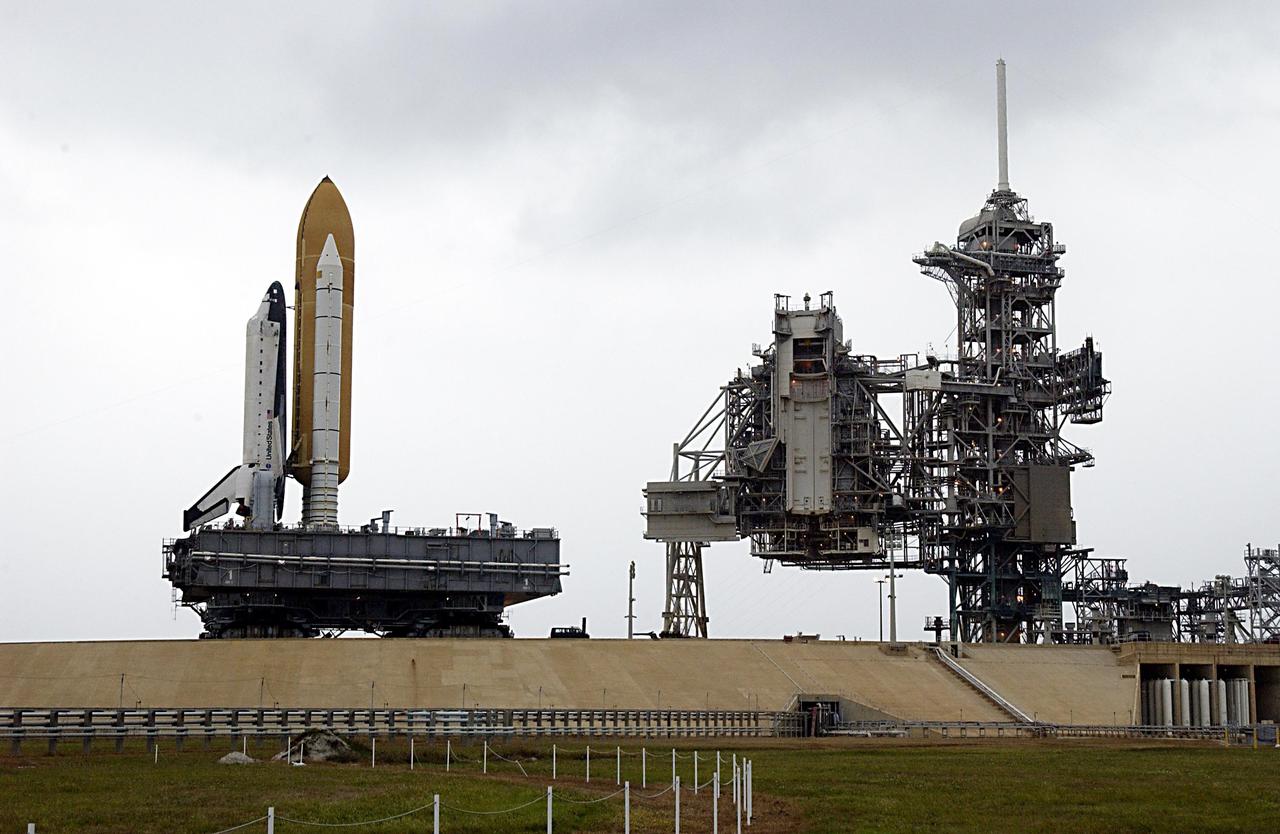
KENNEDY SPACE CENTER, FLA. -- Space Shuttle Columbia approaches Launch Pad 39A, sitting atop the Mobile Launcher Platform, which in turn is carried by the crawler-transporter underneath. The STS-107 research mission comprises experiments ranging from material sciences to life sciences (many rats), plus the Fast Reaction Experiments Enabling Science, Technology, Applications and Research (FREESTAR) that incorporates eight high priority secondary attached shuttle experiments. Mission STS-107 is scheduled to launch Jan. 16, 2003.
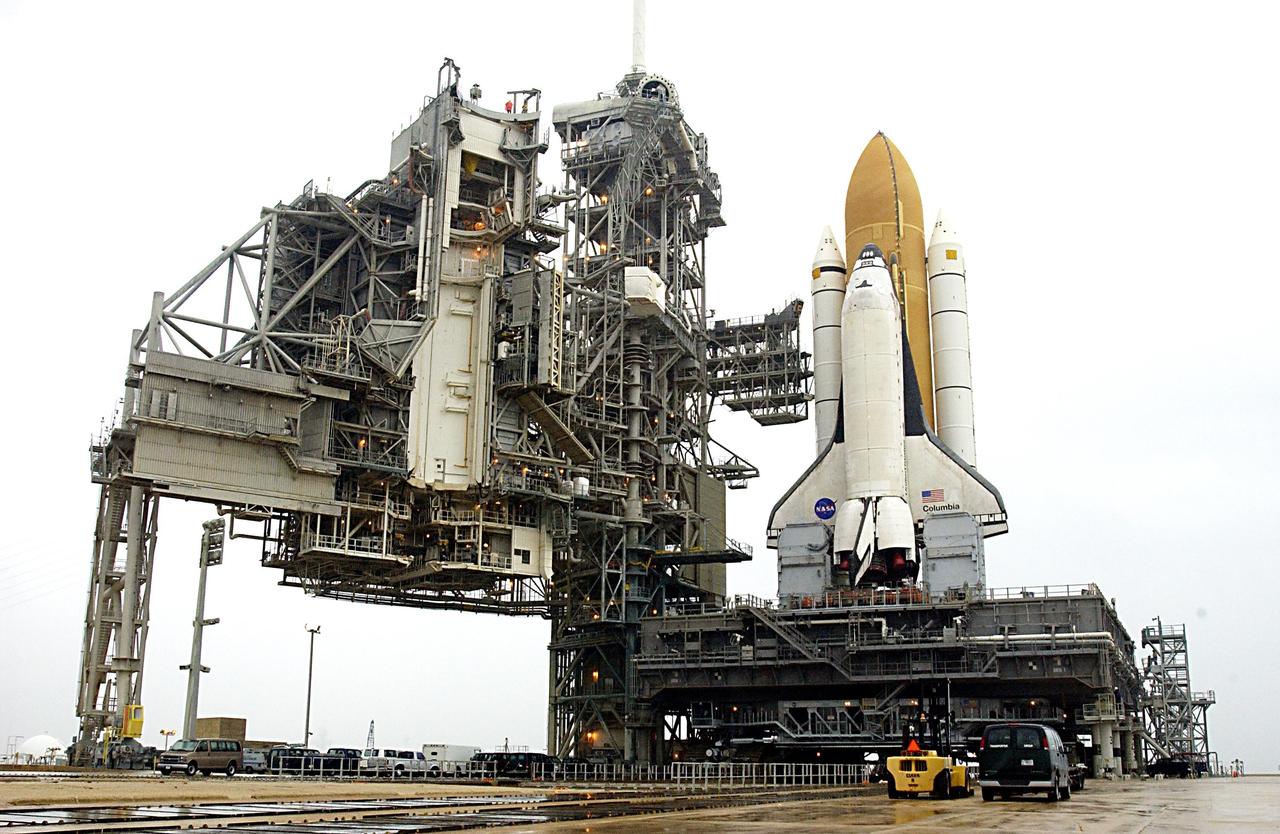
KENNEDY SPACE CENTER, FLA. -- Space Shuttle Columbia sits on Launch Pad 39A, atop the Mobile Launcher Platform. The STS-107 research mission comprises experiments ranging from material sciences to life sciences, plus the Fast Reaction Experiments Enabling Science, Technology, Applications and Research (FREESTAR) that incorporates eight high priority secondary attached shuttle experiments. Mission STS-107 is scheduled to launch Jan. 16, 2003.
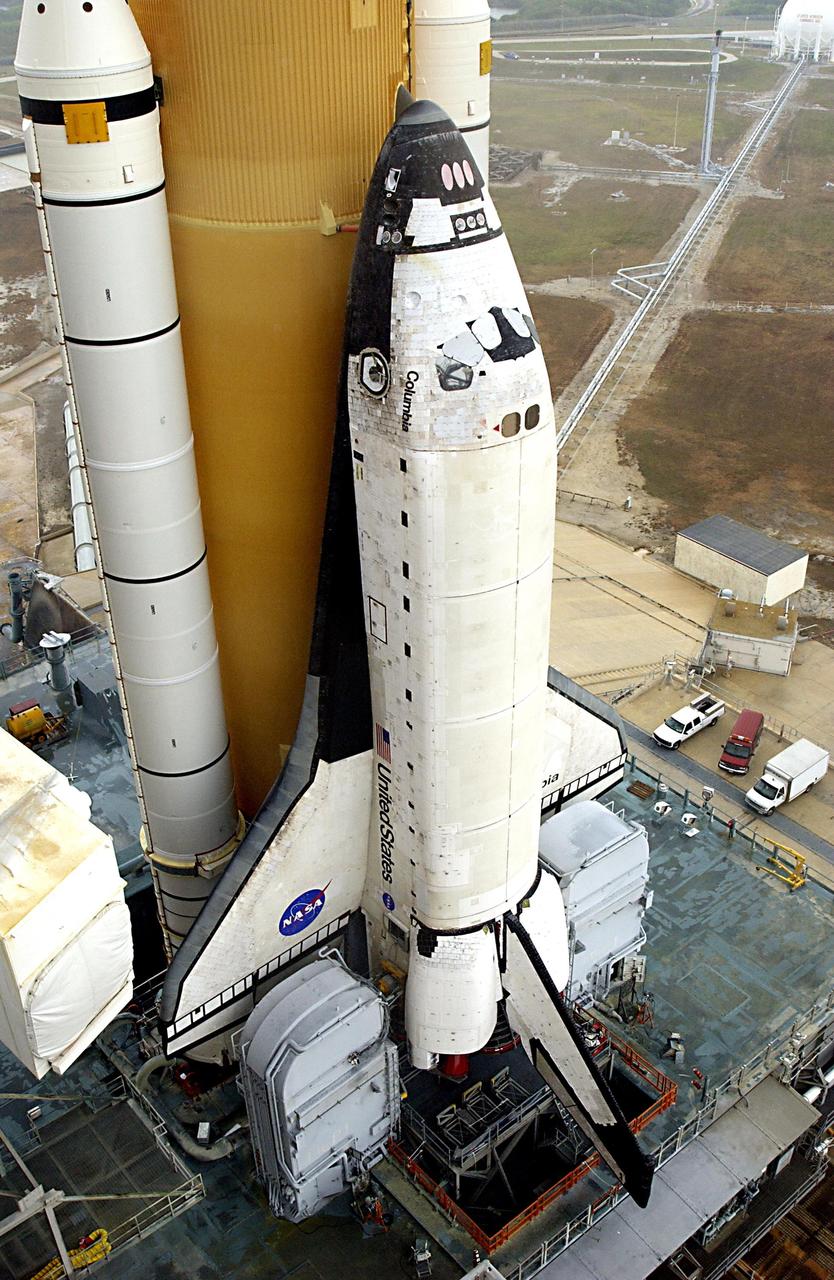
KENNEDY SPACE CENTER, FLA. -- Space Shuttle Columbia sits on Launch Pad 39A, atop the Mobile Launcher Platform. The STS-107 research mission comprises experiments ranging from material sciences to life sciences, plus the Fast Reaction Experiments Enabling Science, Technology, Applications and Research (FREESTAR) that incorporates eight high priority secondary attached shuttle experiments. Mission STS-107 is scheduled to launch Jan. 16, 2003.
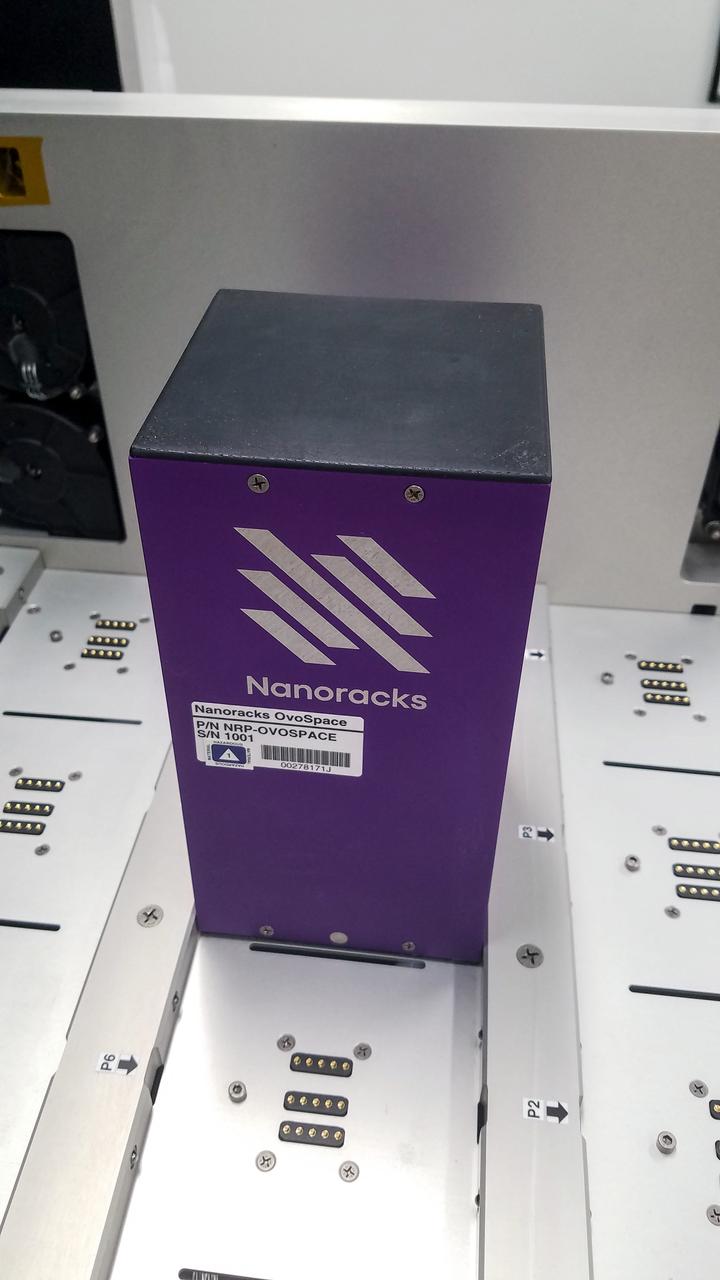
jsc2022e072966 (8/12/2022) --- A view of the OVOSPACE payload during a functional test. The science of the payload resides within the Nanoracks purple aluminum chassis. This chassis provides an interface to the Nanoracks Nanode platform. Nanode provides payloads with power and data throughout their time in space. Image courtesy of Nanoracks LLC.
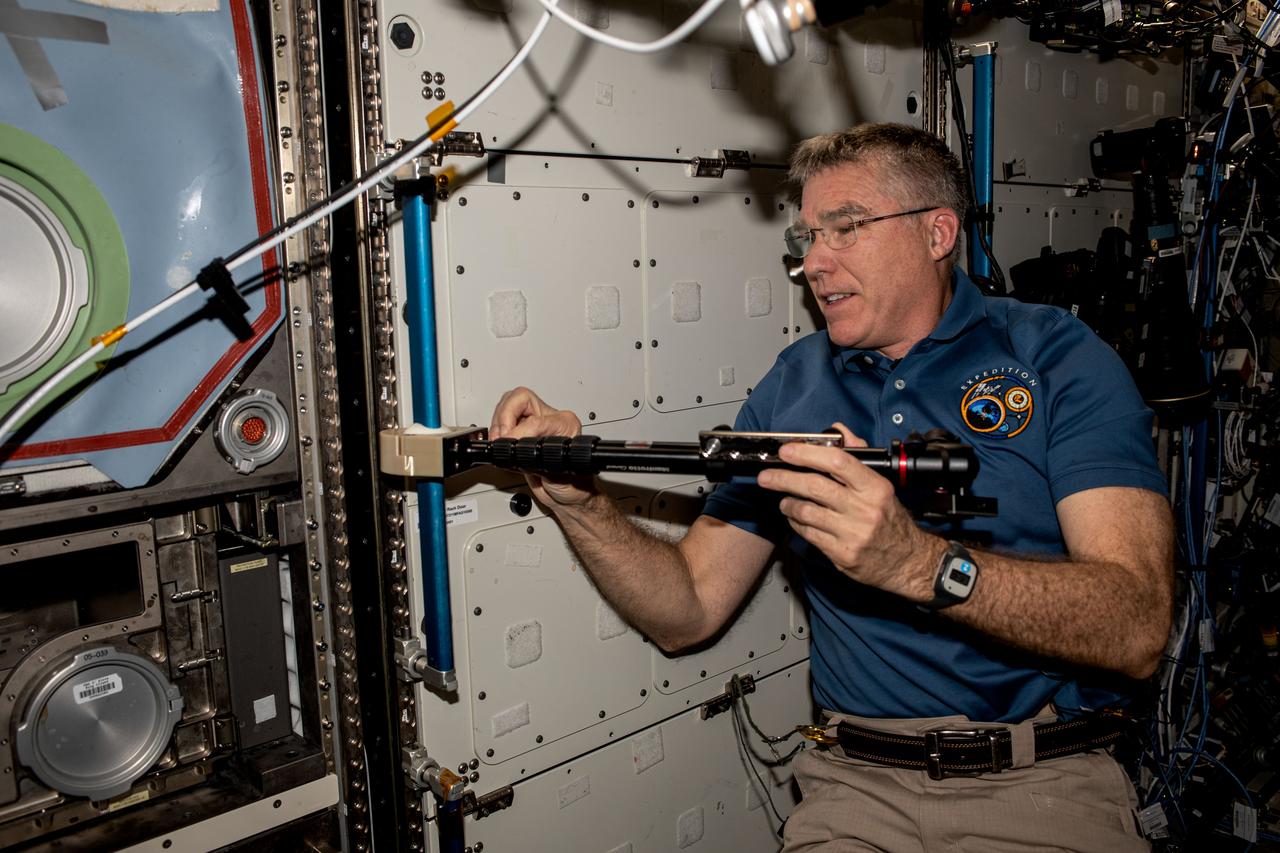
iss069e009790 (May 9, 2023) --- NASA astronaut and Expedition 69 Flight Engineer Stephen Bowen installs student-made hardware next to the Destiny laboratory module's Microgravity Science Glovebox to test a platform that improves the stability of cameras used to track targets on the ground or take images and video inside the International Space Station.
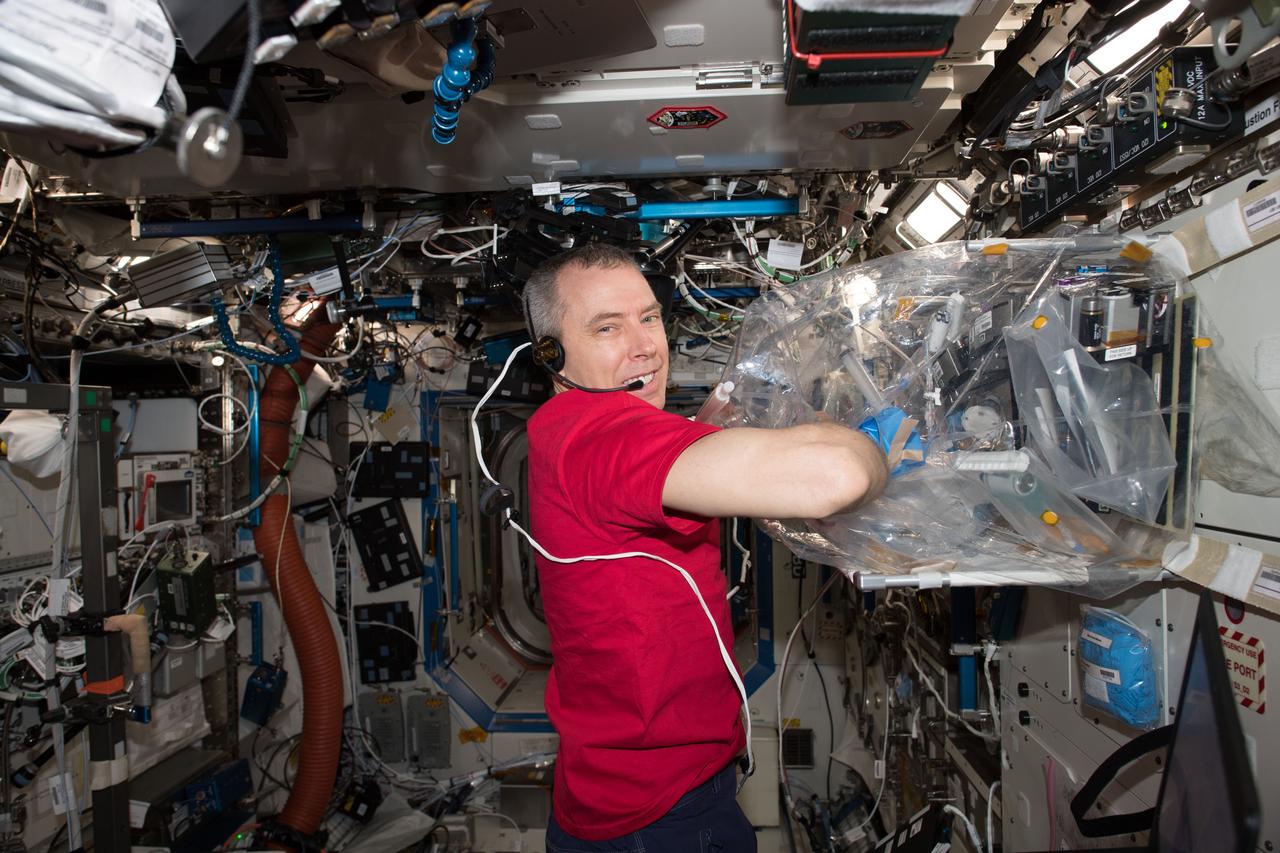
iss055e036790 (April 30, 2018) --- NASA astronaut Drew Feustel conducts science operations inside the Multi-use Variable-g Platform Module which enables research into how small organisms such as fruit flies, flatworms, plants, fish, cells, protein crystals and many others adapt to different types of gravity scenarios.
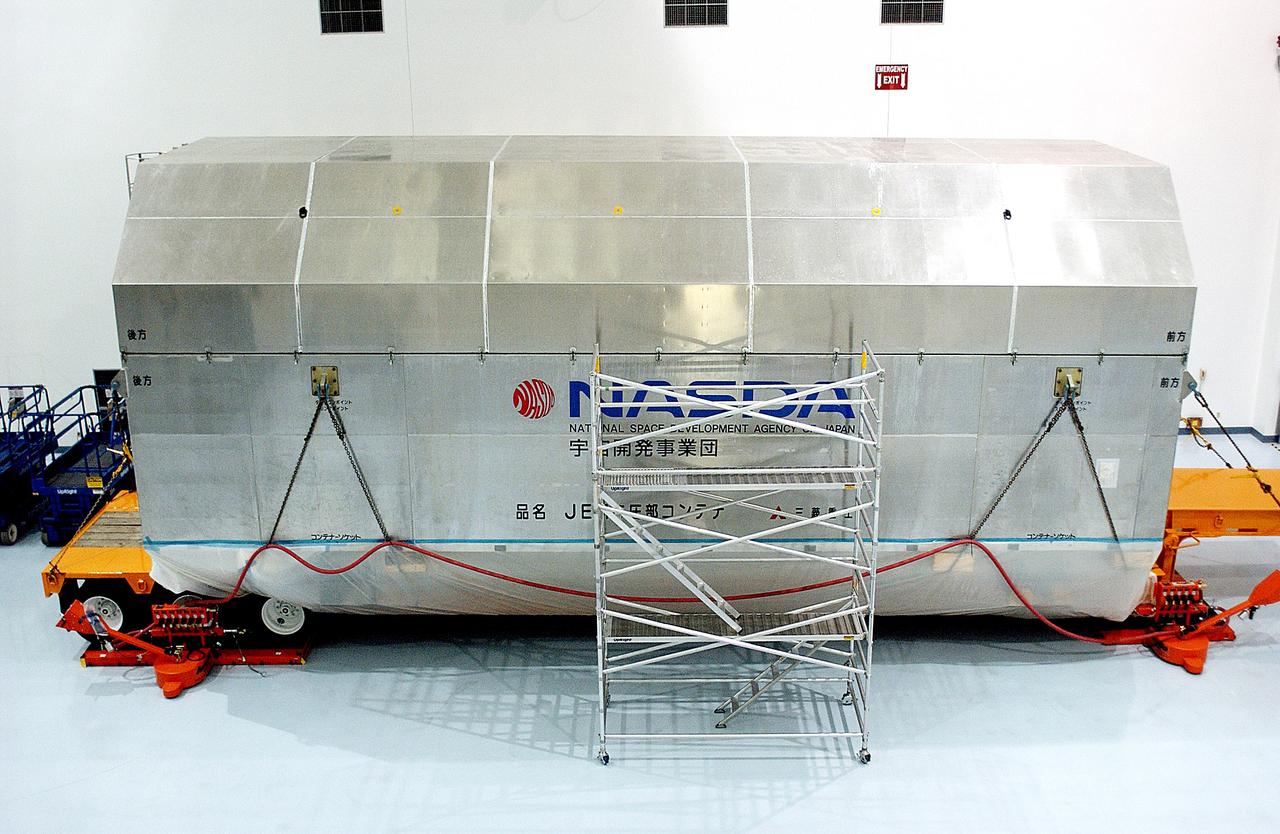
KENNEDY SPACE CENTER, FLA. - The container with the Japanese Experiment Module (JEM)’s pressurized module is inside the Space Station Processing Facility. The National Space Development Agency of Japan (NASDA) developed the laboratory at the Tsukuba Space Center near Tokyo. The Pressurized Module is the first element of the JEM, named "Kibo" (Hope), to be delivered to KSC. The JEM is Japan's primary contribution to the Station. It will enhance the unique research capabilities of the orbiting complex by providing an additional environment for astronauts to conduct science experiments. The JEM also includes an exposed facility (platform) for space environment experiments, a robotic manipulator system, and two logistics modules. The various JEM components will be assembled in space over the course of three Shuttle missions.
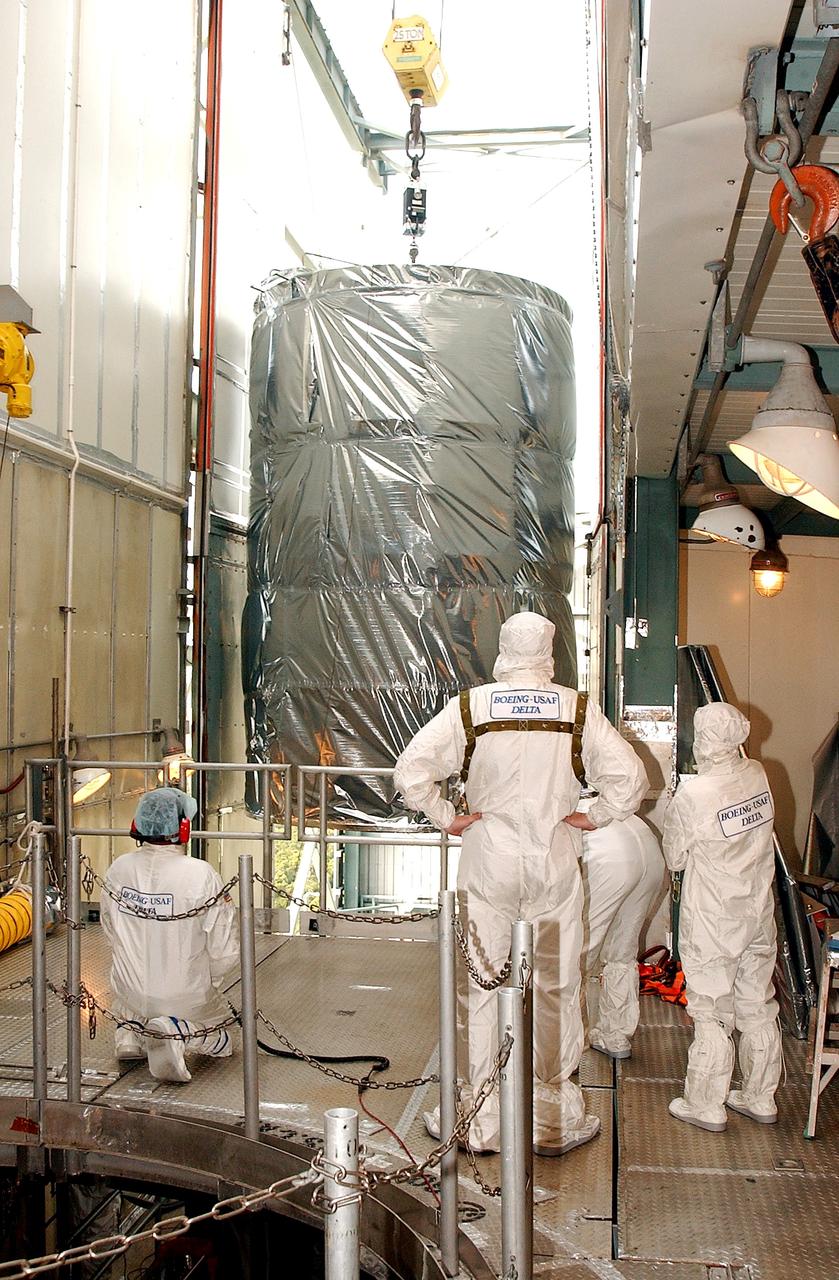
KENNEDY SPACE CENTER, FLA. - Workers on the mobile service tower on Launch Pad 17-B, Cape Canaveral Air Force Station, watch as the Space Infrared Telescope Facility (SIRTF) clears the platform. SIRTF will be attached to the Delta II rocket and encapsulated in its fairing before launch. Consisting of three cryogenically cooled science instruments and an 0.85-meter telescope, SIRTF is one of NASA’s largest infrared telescopes to be launched. It is the fourth and final element in NASA’s family of orbiting “Great Observatories.” SIRTF will obtain images and spectra by detecting the infrared energy, or heat, radiated by objects in space. Most of this infrared radiation is blocked by the Earth's atmosphere and cannot be observed from the ground.
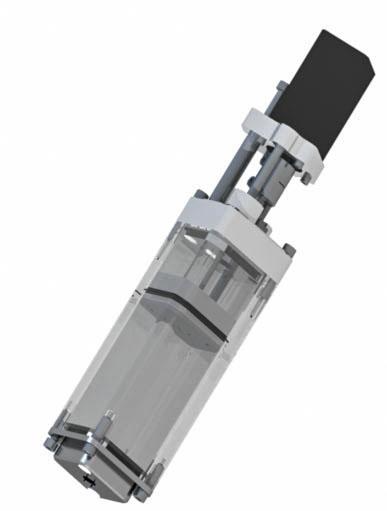
jsc2021e029741 (7/13/2021) --- A preflight illustration of the TECHNOLOGY BOX design of the Chladni's Figures experiment. The main objective of Technology Box (Tetr’ISS) is to conduct experiments gathered in support equipment called ‘Platform’, to illustrate science principles based on physics and chemistry. For this mission Tetr’ISS contains the Chladni’s Figures experiment: a physical science experiment to observe the sound waves in 3D thanks to fine particles organized according to nodes and antinodes.
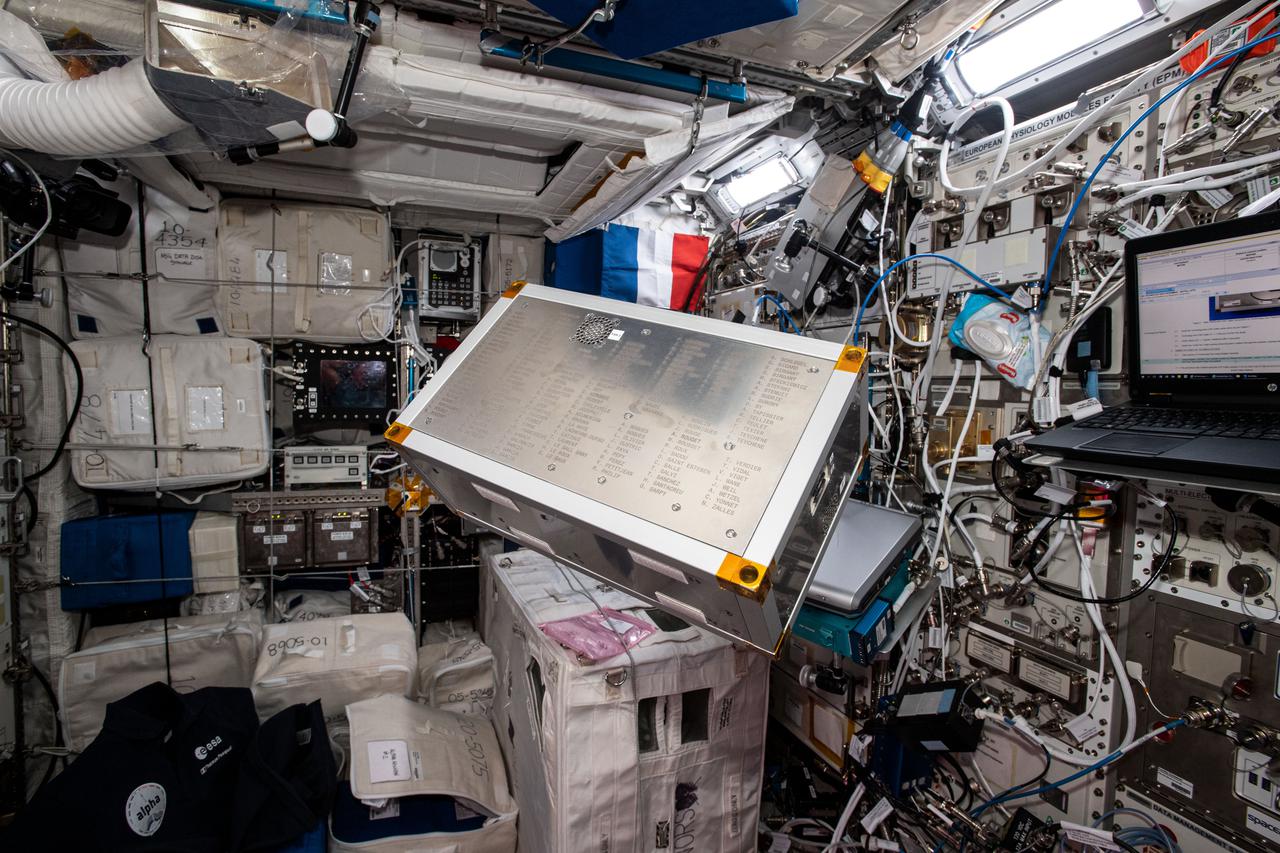
iss065e347840 (9/3/2021) --- A view of the technology Box investigation in the columbus module aboard the International Space Station (ISS). The main objective of Technology Box (Tetr’ISS) is to conduct experiments gathered in support equipment called ‘Platform’, to illustrate science principles based on physics and chemistry. For this mission Tetr’ISS contains the Chladni’s Figures experiment: a physical science experiment to observe the sound waves in 3D thanks to fine particles organized according to nodes and antinodes.
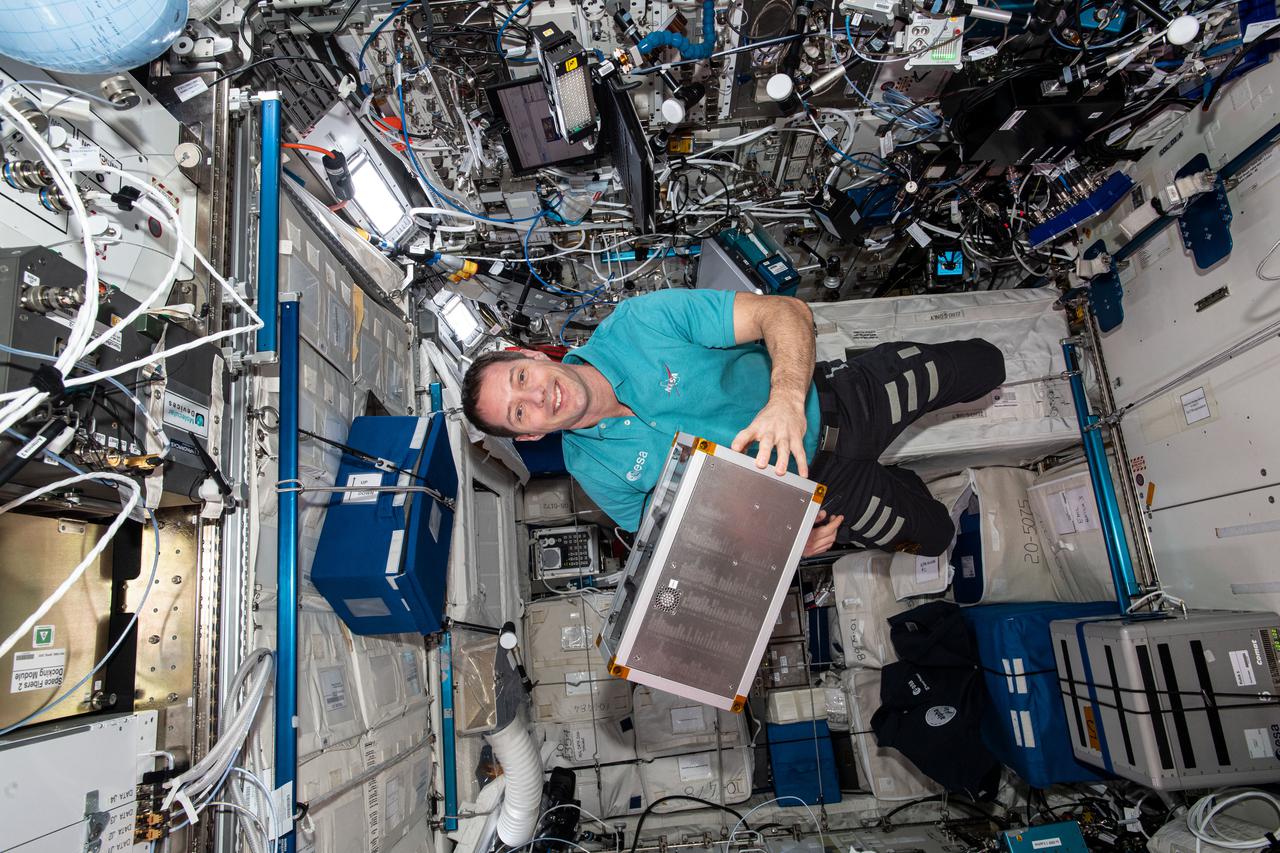
iss065e347821 (9/3/20210 --- European Space Agency (ESA) astronaut Thomas Pesquet is seen with the technology Box investigation in the columbus module aboard the International Space Station (ISS). The main objective of Technology Box (Tetr’ISS) is to conduct experiments gathered in support equipment called ‘Platform’, to illustrate science principles based on physics and chemistry. For this mission Tetr’ISS contains the Chladni’s Figures experiment: a physical science experiment to observe the sound waves in 3D thanks to fine particles organized according to nodes and antinodes.
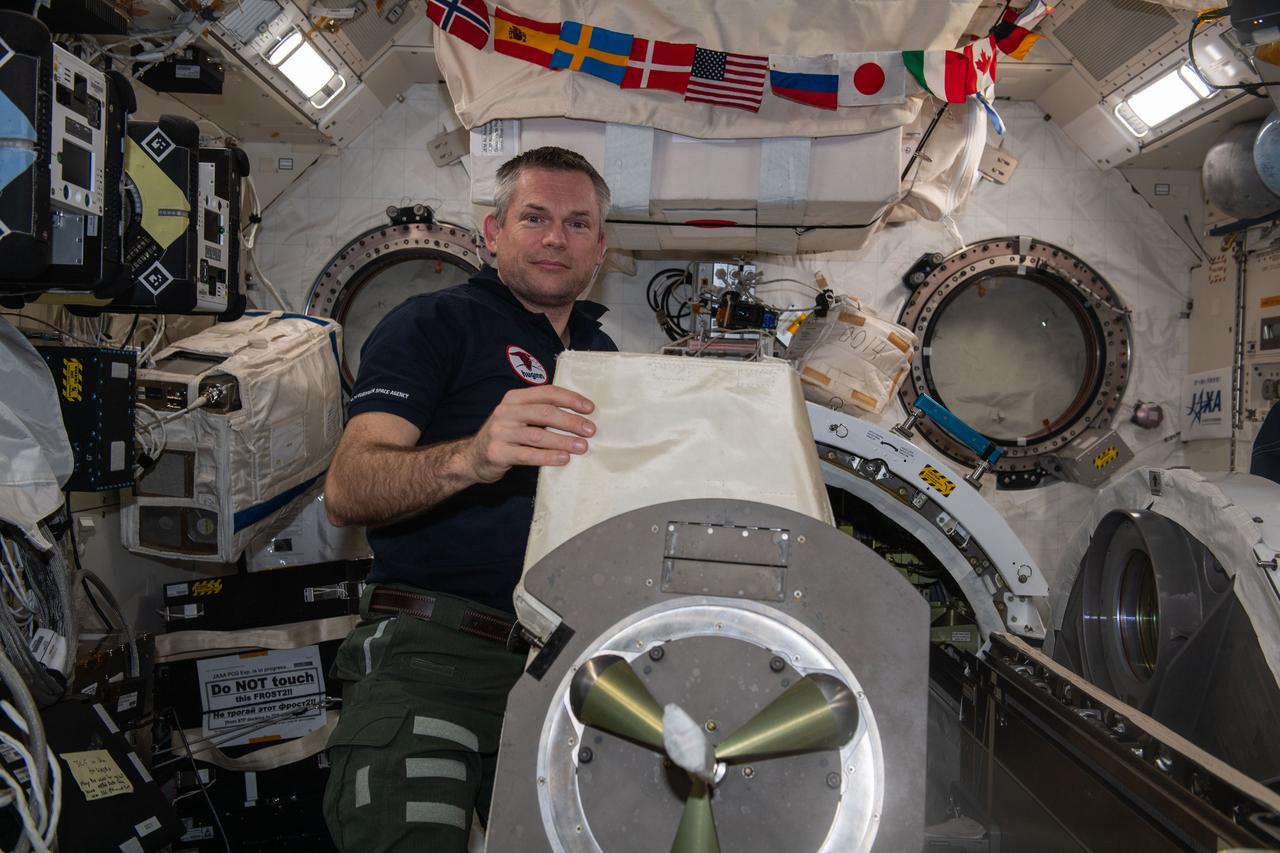
iss070e098166 (Feb. 22, 2024) --- ESA (European Space Agency) astronaut and Expedition 70 Commander Andreas Mogensen removes the multipurpose experiment platform (MPEP) from the Kibo laboratory module's airlock. External science payloads are attached to the MPEP which is then placed inside Kibo's airlock. Next, the airlock is depressurized before the Japanese robotic arm grapples the MPEP and places it on Kibo's Exposed Facility where external science experiments are deployed.
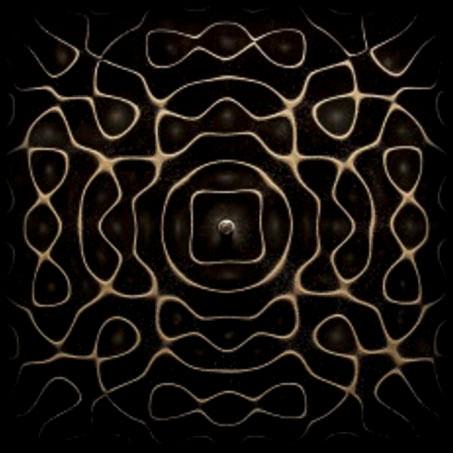
jsc2021e029743 (7/13/2021) --- A preflight view of the TECHNOLOGY BOX results of the Chladni’s Figures experiment on Earth . The main objective of Technology Box (Tetr’ISS) is to conduct experiments gathered in support equipment called ‘Platform’, to illustrate science principles based on physics and chemistry. For this mission Tetr’ISS contains the Chladni’s Figures experiment: a physical science experiment to observe the sound waves in 3D thanks to fine particles organized according to nodes and antinodes.

iss065e347908 (9/3/2021) --- A view of the technology Box investigation in the columbus module aboard the International Space Station (ISS). The main objective of Technology Box (Tetr’ISS) is to conduct experiments gathered in support equipment called ‘Platform’, to illustrate science principles based on physics and chemistry. For this mission Tetr’ISS contains the Chladni’s Figures experiment: a physical science experiment to observe the sound waves in 3D thanks to fine particles organized according to nodes and antinodes.
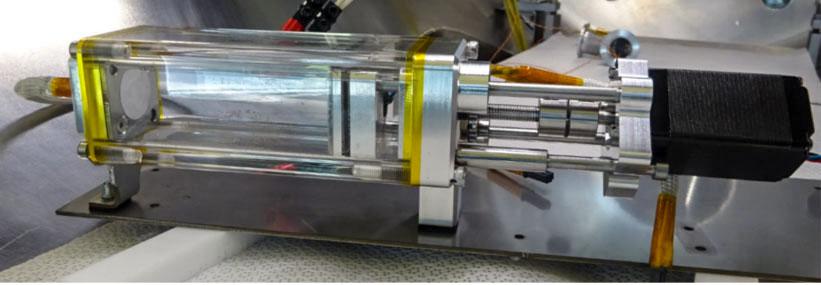
jsc2021e029742 (7/13/2021) --- A preflight photo of the TECHNOLOGY BOX design of the Chladni's Figures experiment. The main objective of Technology Box (Tetr’ISS) is to conduct experiments gathered in support equipment called ‘Platform’, to illustrate science principles based on physics and chemistry. For this mission Tetr’ISS contains the Chladni’s Figures experiment: a physical science experiment to observe the sound waves in 3D thanks to fine particles organized according to nodes and antinodes.
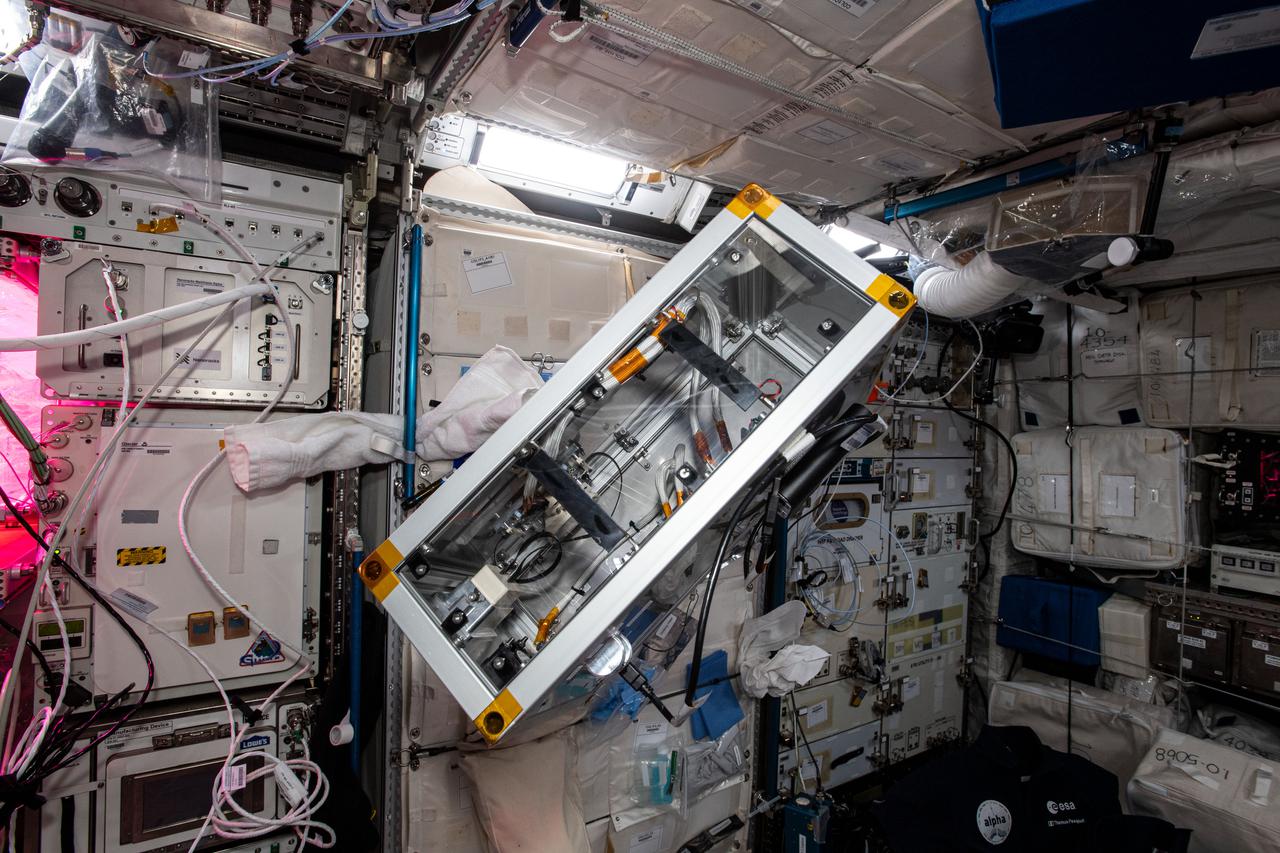
iss065e347847 (9/3/2021) --- A view of the technology Box investigation in the columbus module aboard the International Space Station (ISS). The main objective of Technology Box (Tetr’ISS) is to conduct experiments gathered in support equipment called ‘Platform’, to illustrate science principles based on physics and chemistry. For this mission Tetr’ISS contains the Chladni’s Figures experiment: a physical science experiment to observe the sound waves in 3D thanks to fine particles organized according to nodes and antinodes.
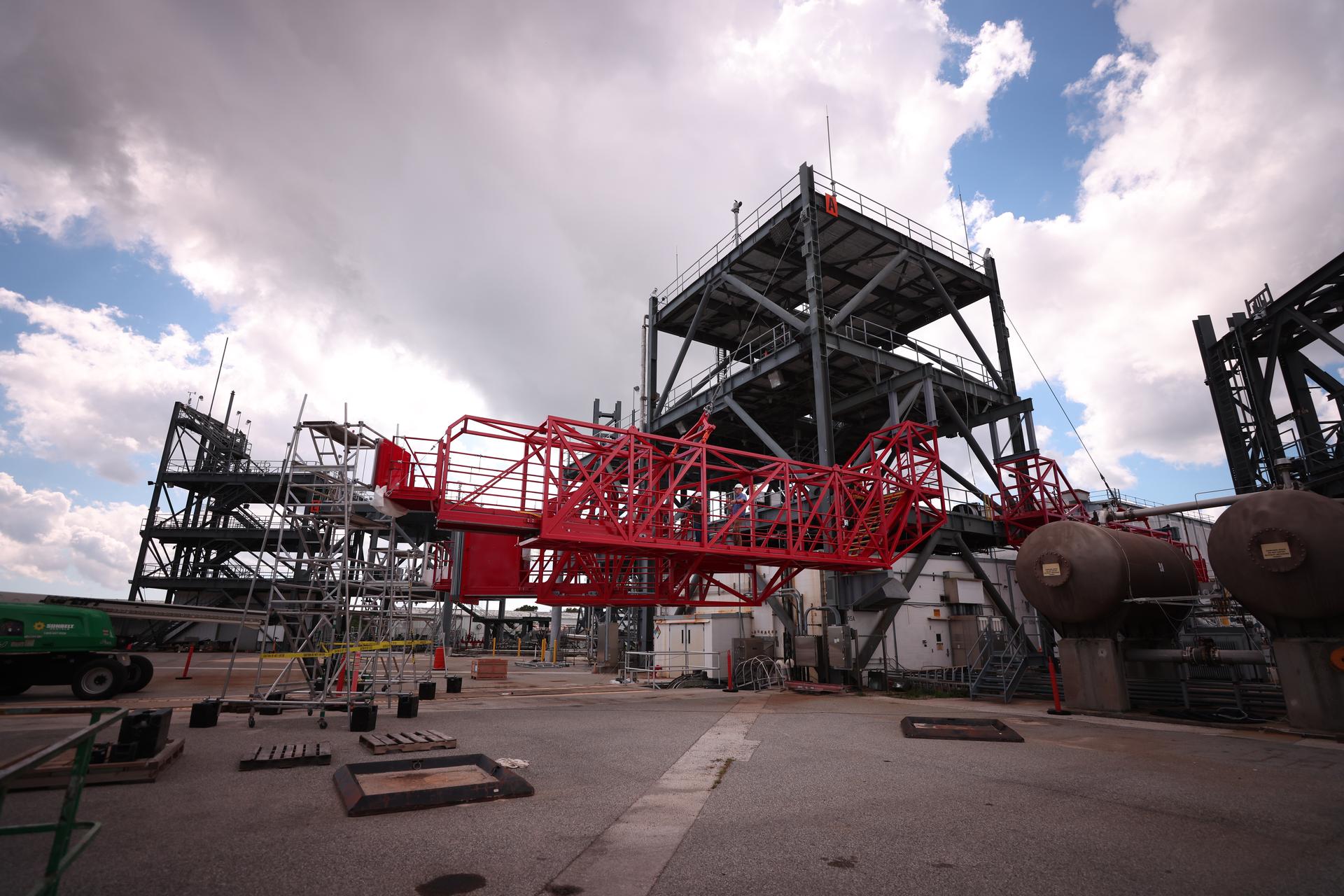
Crews test temporary contingency access platforms on the mobile launcher simulator tower on Wednesday, Oct. 29, 2025, at the Launch Equipment Test Facility at NASA’s Kennedy Space Center in Florida. The platforms will allow engineers to access the vehicle’s flight termination system on the rocket and the mobile launcher while at the pad rather than rolling back to the Vehicle Assembly Building to retest them. For Artemis II, four astronauts will venture around the Moon in early 2026, the first crewed mission on NASA’s path to establishing a long-term presence for science and exploration through Artemis.
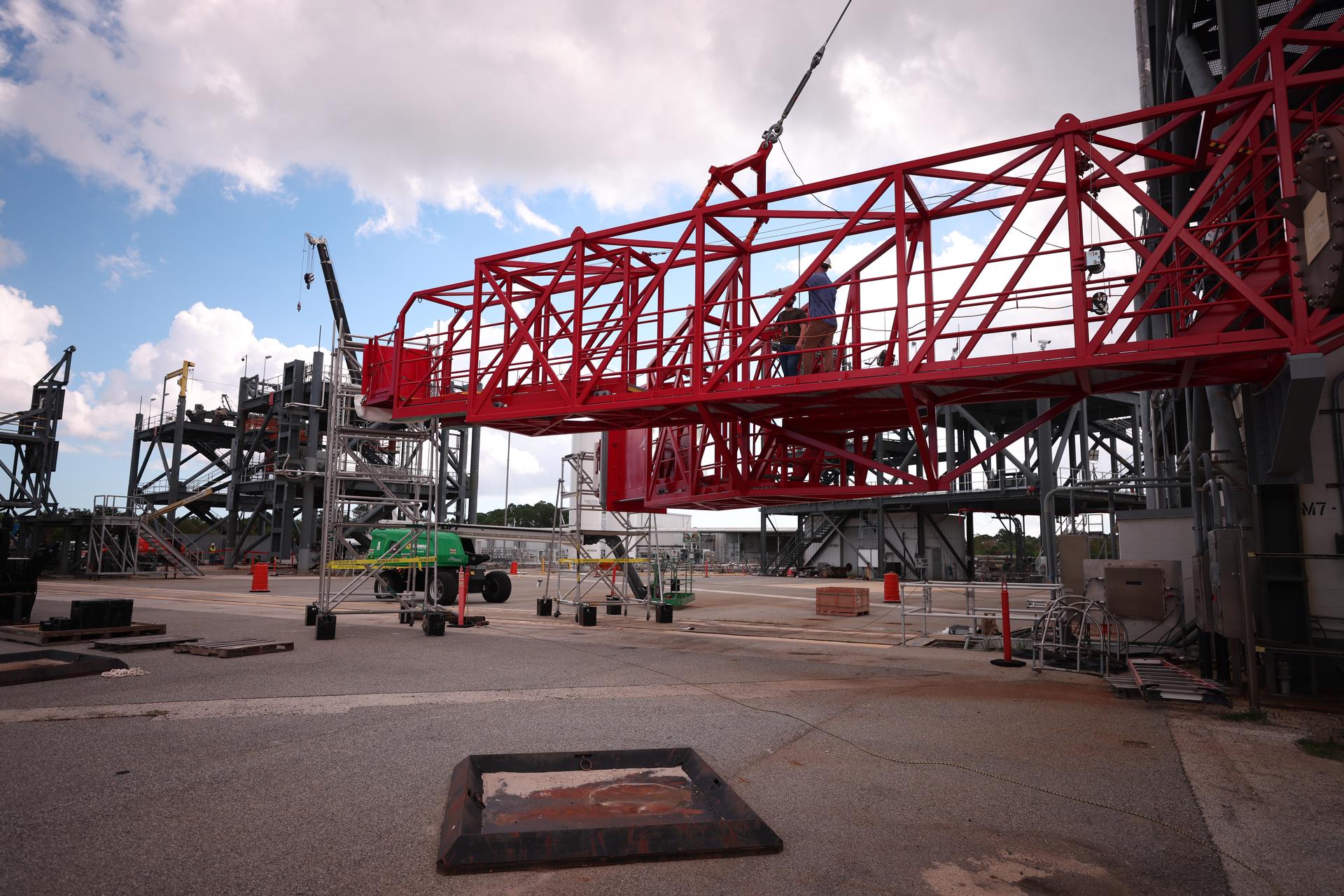
Crews test temporary contingency access platforms on the mobile launcher simulator tower on Wednesday, Oct. 29, 2025, at the Launch Equipment Test Facility at NASA’s Kennedy Space Center in Florida. The platforms will allow engineers to access the vehicle’s flight termination system on the rocket and the mobile launcher while at the pad rather than rolling back to the Vehicle Assembly Building to retest them. For Artemis II, four astronauts will venture around the Moon in early 2026, the first crewed mission on NASA’s path to establishing a long-term presence for science and exploration through Artemis.
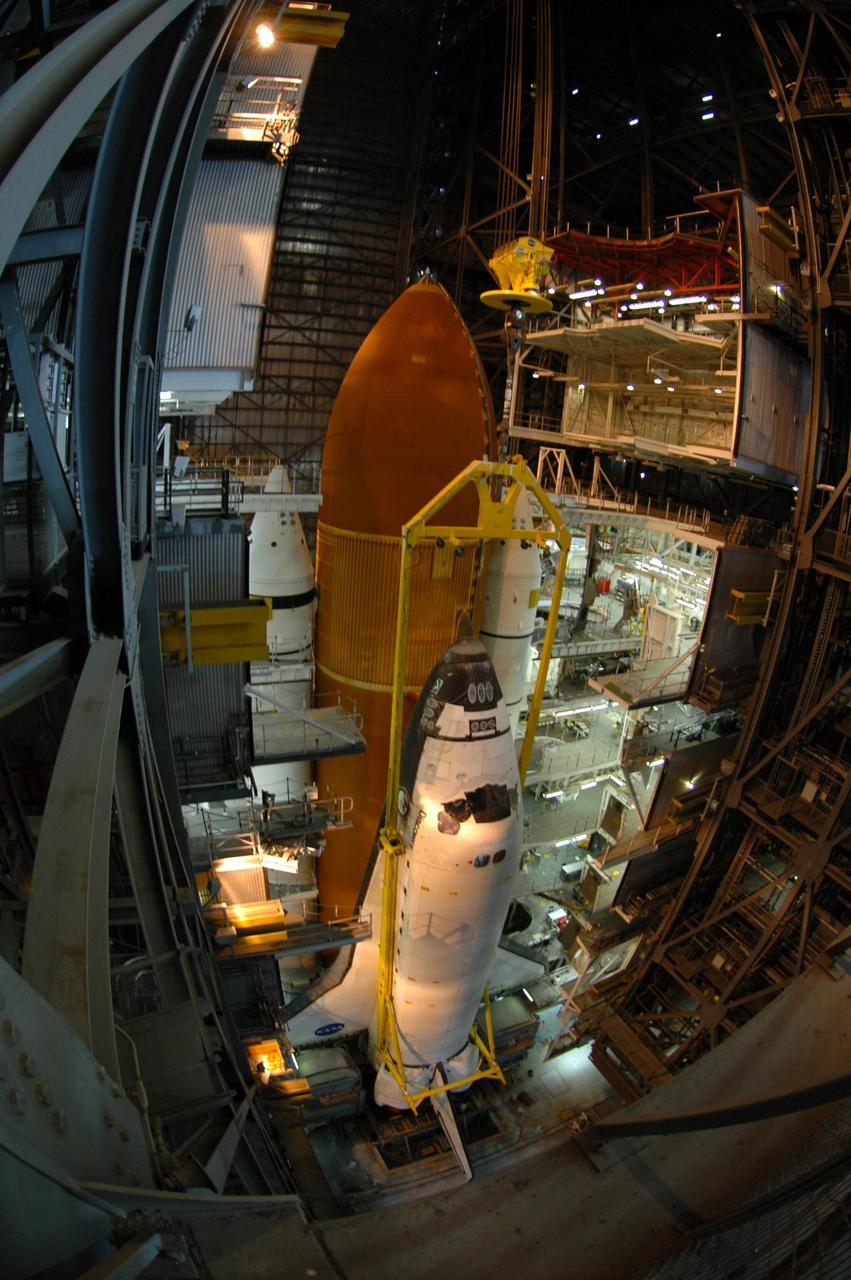
KENNEDY SPACE CENTER, FLA. -- A fish-eye view shows space shuttle Discovery after being lowered next to the external tank and solid rocket boosters already installed on the mobile launcher platform. Discovery is targeted for launch to the International Space Station for mission STS-120 on Oct. 23. The crew will be delivering and installing the Italian-built U.S. Node 2, named Harmony. The pressurized module will act as an internal connecting port and passageway to additional international science labs and cargo spacecraft. In addition to increasing the living and working space inside the station, it also will serve as a work platform outside for the station's robotic arm. Photo credit: NASA/Troy Cryder

KENNEDY SPACE CENTER, FLA. -- Inside the Vehicle Assembly Building, space shuttle Discovery is lowered into high bay 1. Below it is the external tank. Discovery will be mated with the external tank and solid rocket boosters waiting on the mobile launcher platform. Discovery is targeted for launch to the International Space Station for mission STS-120 on Oct. 23. The crew will be delivering and installing the Italian-built U.S. Node 2, named Harmony. The pressurized module will act as an internal connecting port and passageway to additional international science labs and cargo spacecraft. In addition to increasing the living and working space inside the station, it also will serve as a work platform outside for the station's robotic arm. Photo credit: NASA/Troy Cryder
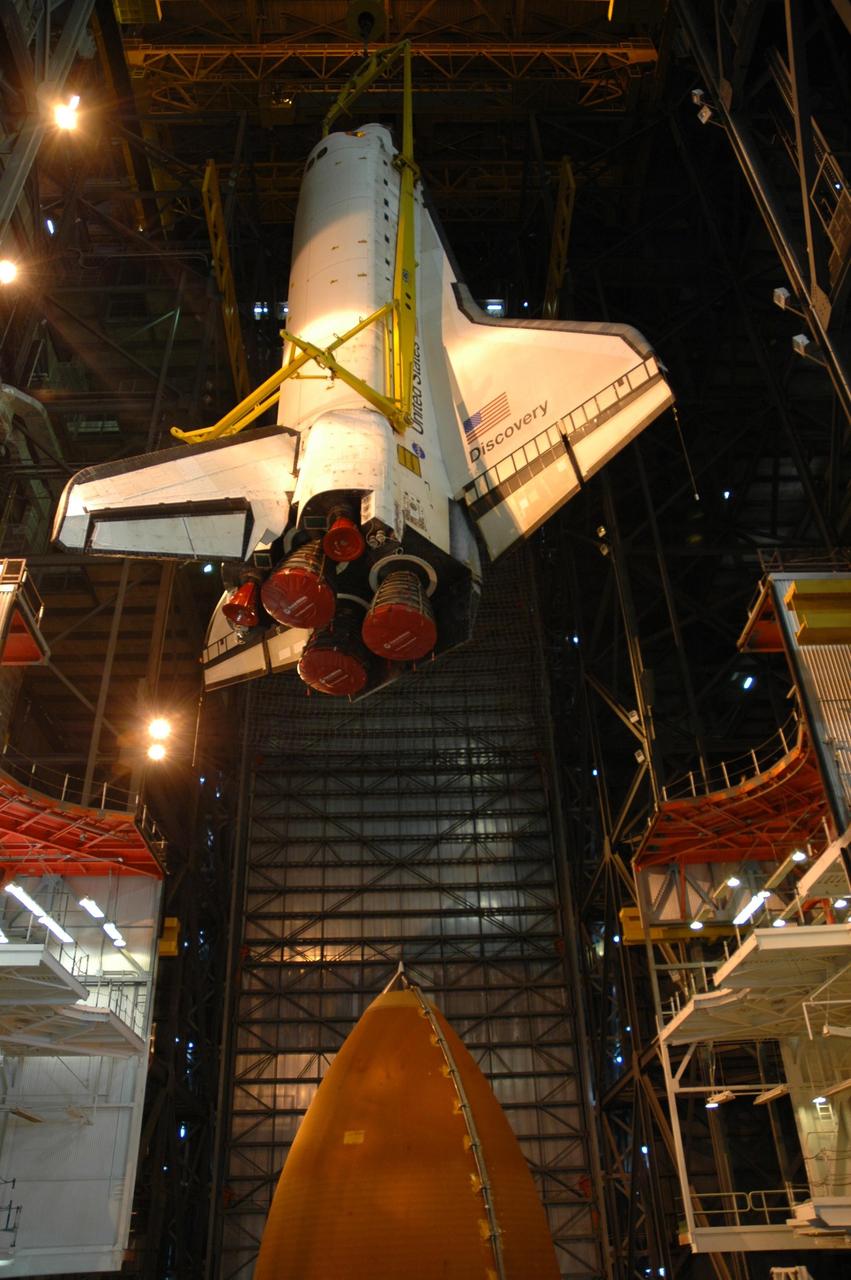
KENNEDY SPACE CENTER, FLA. -- Inside the Vehicle Assembly Building, space shuttle Discovery is lowered into high bay 1. Below it is the external tank. Discovery will be mated with the external tank and solid rocket boosters waiting on the mobile launcher platform. Discovery is targeted for launch to the International Space Station for mission STS-120 on Oct. 23. The crew will be delivering and installing the Italian-built U.S. Node 2, named Harmony. The pressurized module will act as an internal connecting port and passageway to additional international science labs and cargo spacecraft. In addition to increasing the living and working space inside the station, it also will serve as a work platform outside for the station's robotic arm. Photo credit: NASA/Troy Cryder
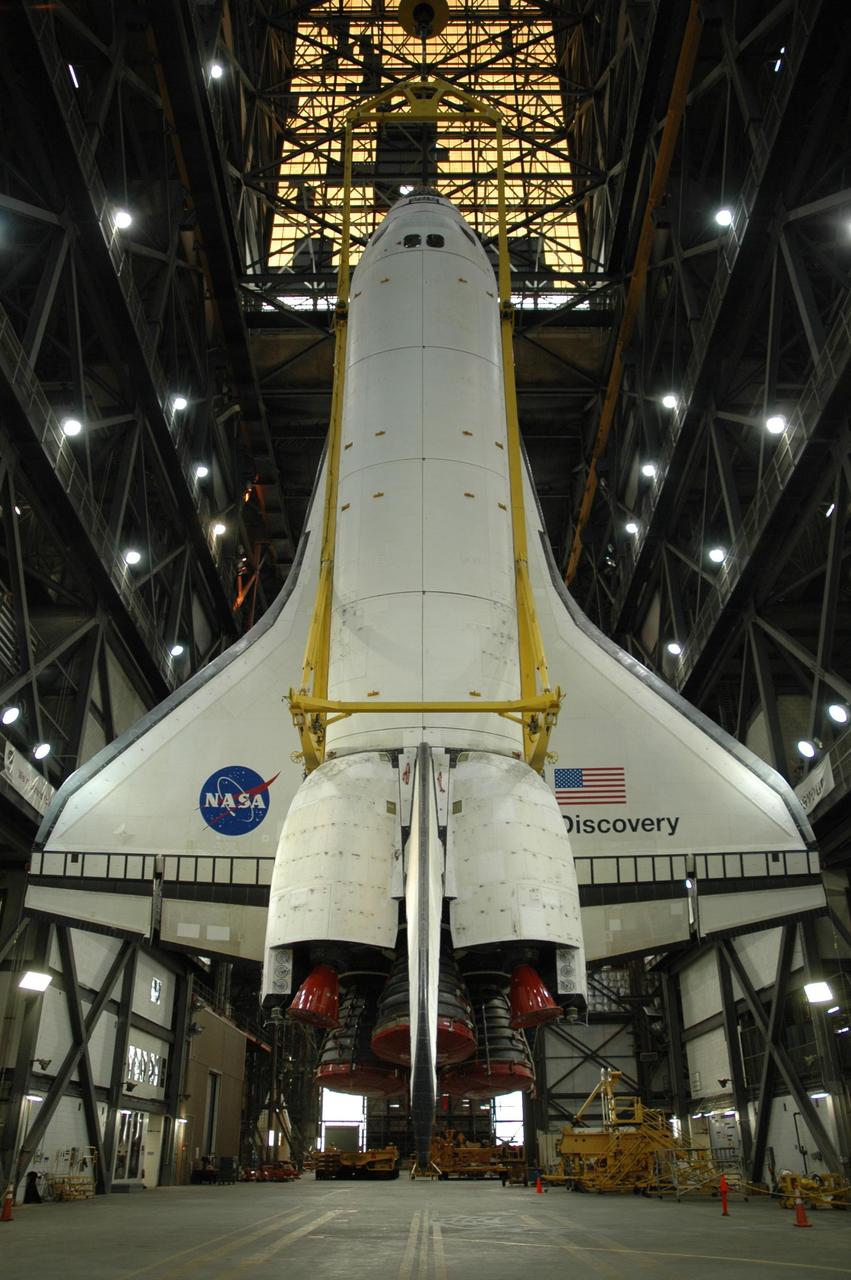
KENNEDY SPACE CENTER, FLA. -- Inside the Vehicle Assembly Building, space shuttle Discovery is ready to be lifted into high bay 1. In the bay, Discovery will be mated with the external tank and solid rocket boosters waiting on the mobile launcher platform. Discovery is targeted for launch to the International Space Station for mission STS-120 on Oct. 23. The crew will be delivering and installing the Italian-built U.S. Node 2, named Harmony. The pressurized module will act as an internal connecting port and passageway to additional international science labs and cargo spacecraft. In addition to increasing the living and working space inside the station, it also will serve as a work platform outside for the station's robotic arm. Photo credit: NASA/Troy Cryder
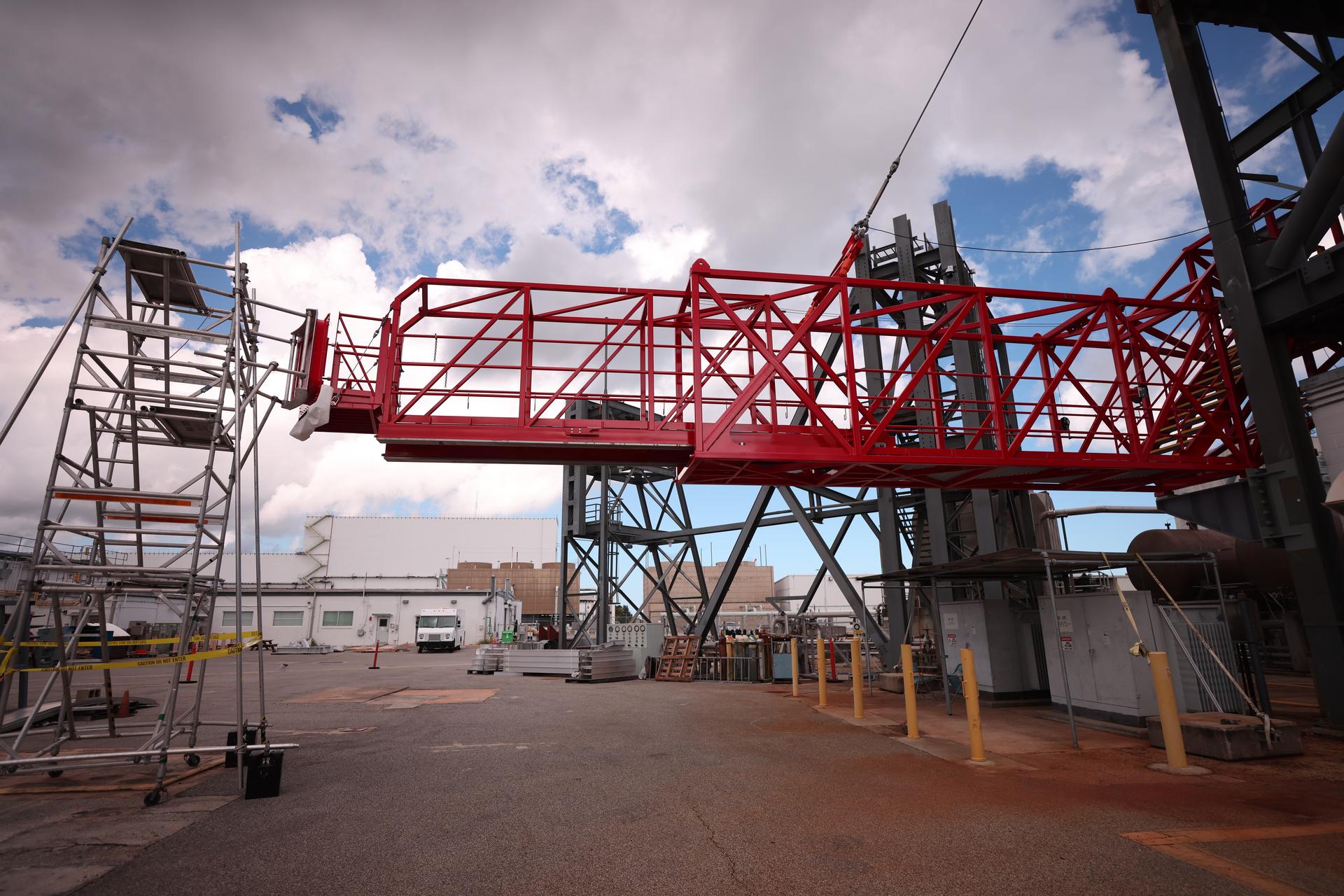
Crews test temporary contingency access platforms on the mobile launcher simulator tower on Wednesday, Oct. 29, 2025, at the Launch Equipment Test Facility at NASA’s Kennedy Space Center in Florida. The platforms will allow engineers to access the vehicle’s flight termination system on the rocket and the mobile launcher while at the pad rather than rolling back to the Vehicle Assembly Building to retest them. For Artemis II, four astronauts will venture around the Moon in early 2026, the first crewed mission on NASA’s path to establishing a long-term presence for science and exploration through Artemis.
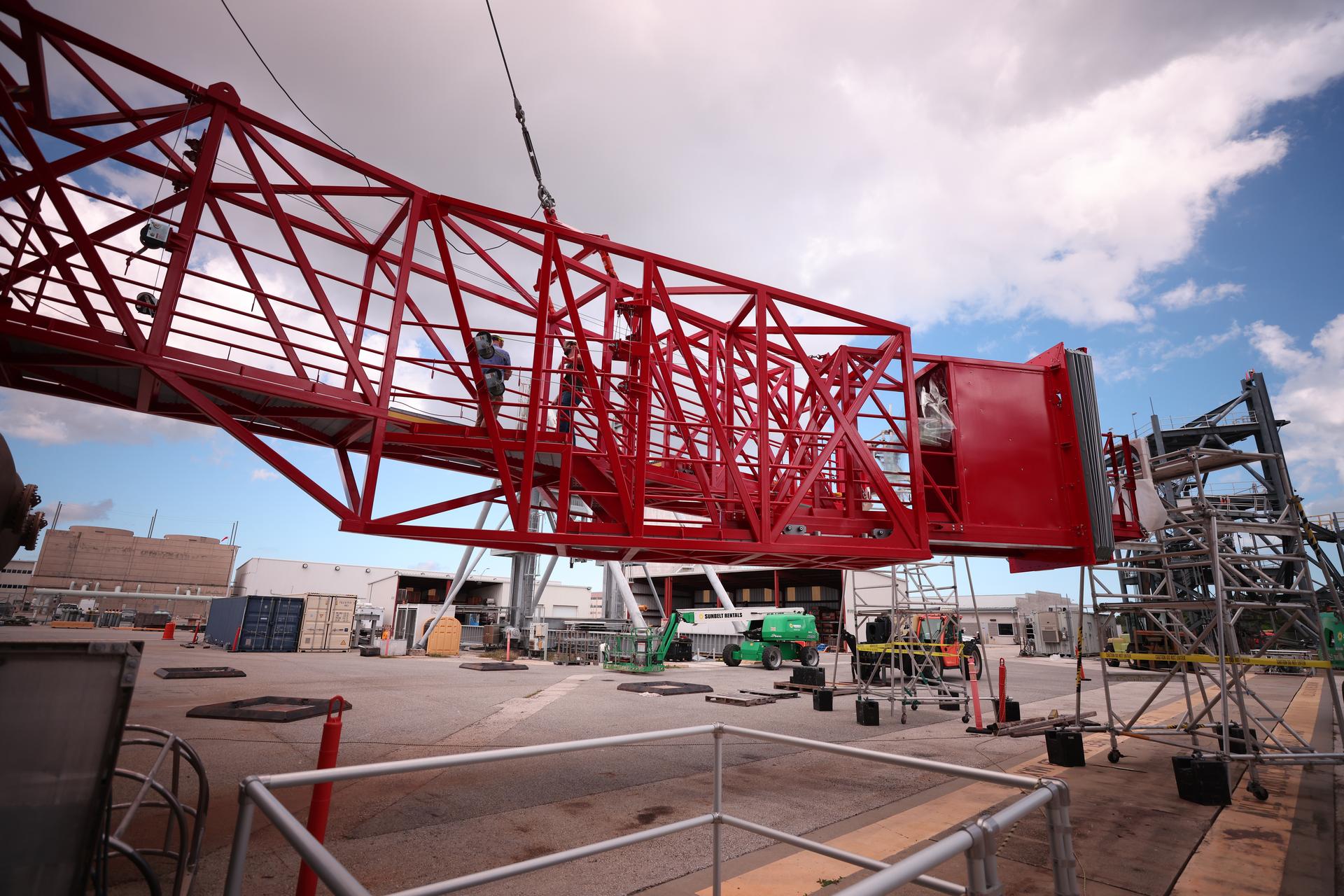
Crews test temporary contingency access platforms on the mobile launcher simulator tower on Wednesday, Oct. 29, 2025, at the Launch Equipment Test Facility at NASA’s Kennedy Space Center in Florida. The platforms will allow engineers to access the vehicle’s flight termination system on the rocket and the mobile launcher while at the pad rather than rolling back to the Vehicle Assembly Building to retest them. For Artemis II, four astronauts will venture around the Moon in early 2026, the first crewed mission on NASA’s path to establishing a long-term presence for science and exploration through Artemis.
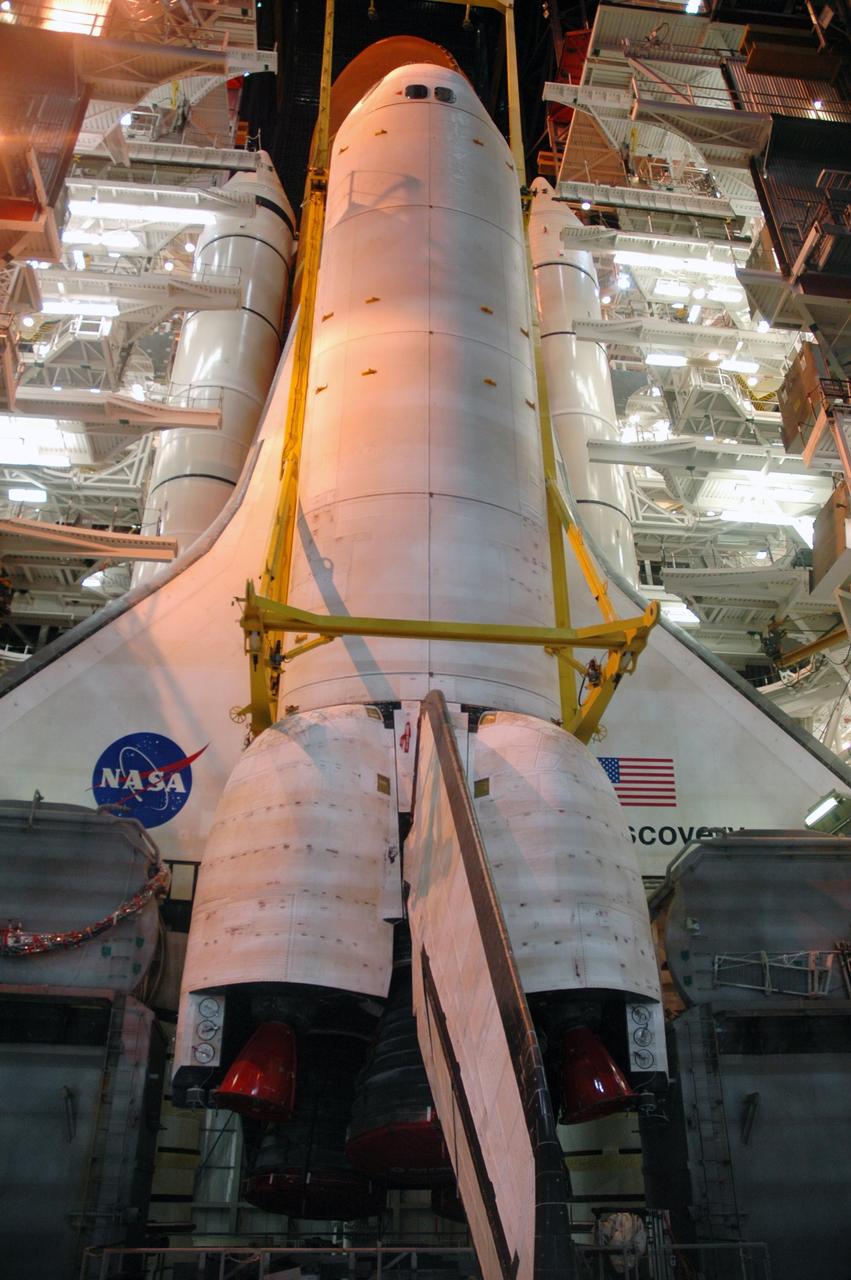
KENNEDY SPACE CENTER, FLA. -- Inside the Vehicle Assembly Building, space shuttle Discovery has been lowered next to the external tank and solid rocket boosters already installed on the mobile launcher platform. Discovery is targeted for launch to the International Space Station for mission STS-120 on Oct. 23. The crew will be delivering and installing the Italian-built U.S. Node 2, named Harmony. The pressurized module will act as an internal connecting port and passageway to additional international science labs and cargo spacecraft. In addition to increasing the living and working space inside the station, it also will serve as a work platform outside for the station's robotic arm. Photo credit: NASA/Troy Cryder
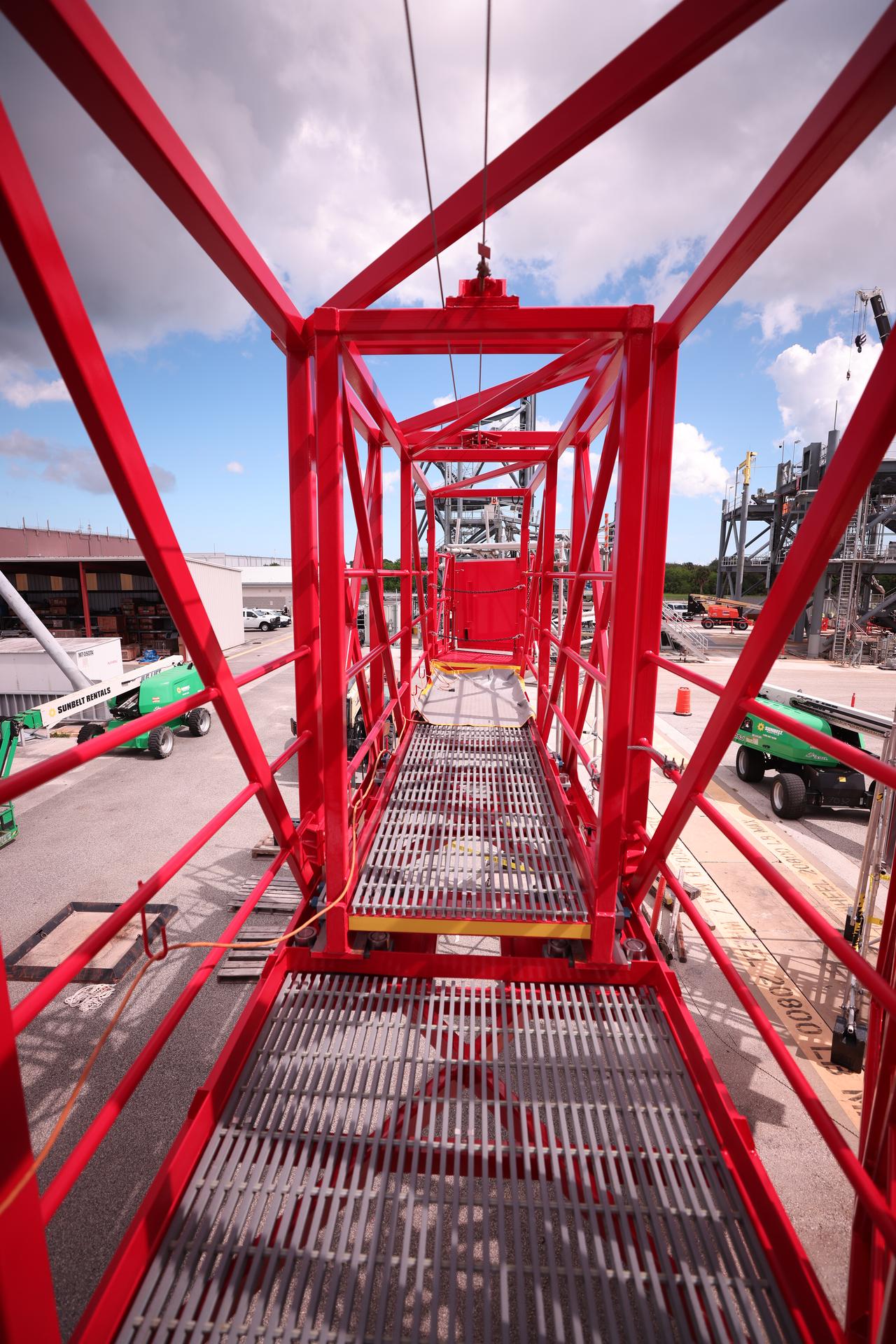
Crews test temporary contingency access platforms on the mobile launcher simulator tower on Wednesday, Oct. 29, 2025, at the Launch Equipment Test Facility at NASA’s Kennedy Space Center in Florida. The platforms will allow engineers to access the vehicle’s flight termination system on the rocket and the mobile launcher while at the pad rather than rolling back to the Vehicle Assembly Building to retest them. For Artemis II, four astronauts will venture around the Moon in early 2026, the first crewed mission on NASA’s path to establishing a long-term presence for science and exploration through Artemis.
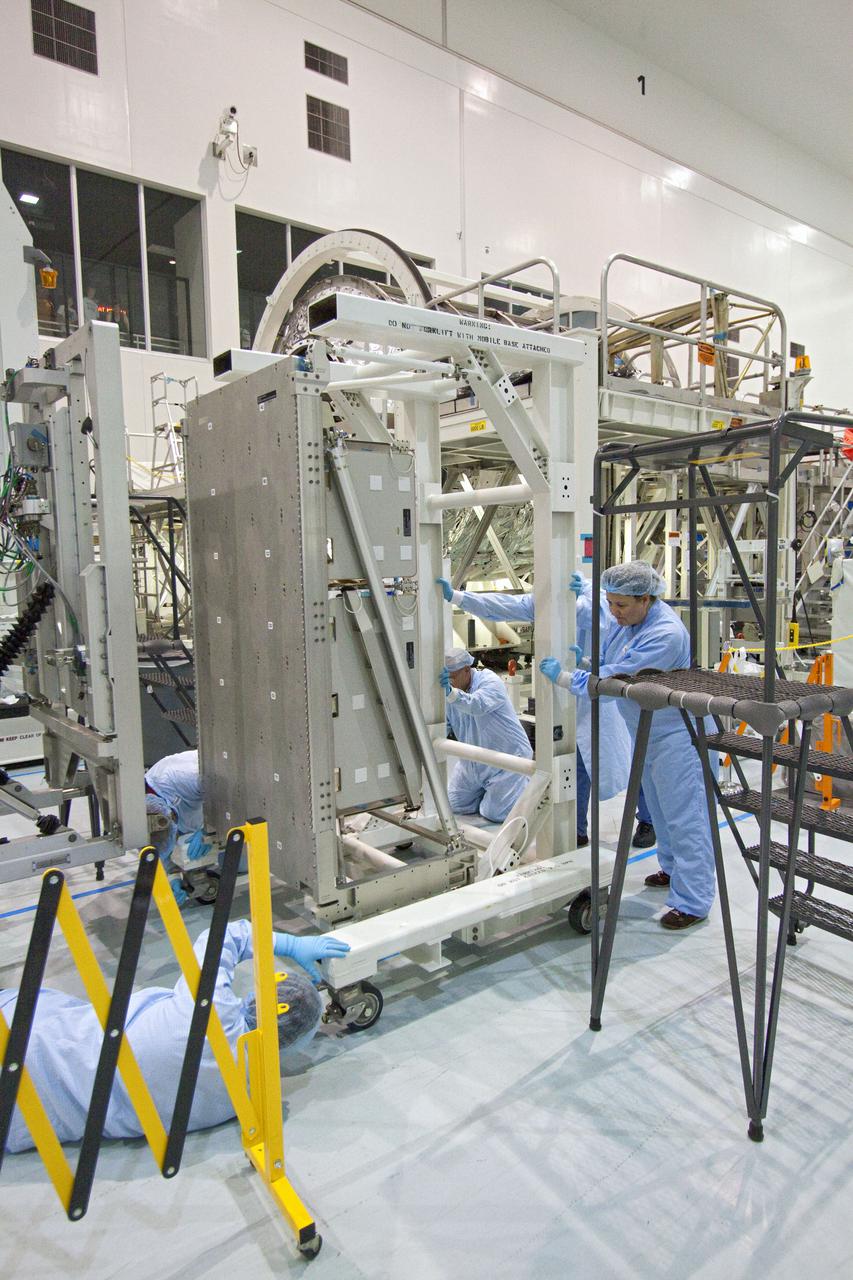
CAPE CANAVERAL, Fla. -- In the Space Station Processing Facility at NASA's Kennedy Space Center in Florida, workers prepare a resupply stowage platform prior to installation of cargo headed to the International Space Station. The stowage platforms will then be moved into the Permanent Multipurpose Module, or PMM. The PMM will be used to carry supplies and critical spare parts to the station. The module will be left behind so it can be used for microgravity experiments in fluid physics, materials science, biology and biotechnology. Space shuttle Discovery will deliver its payload to the station on the STS-133 mission. Launch is targeted for Nov. 1 at 4:33 p.m. EDT. Photo credit: NASA_Jack Pfaller
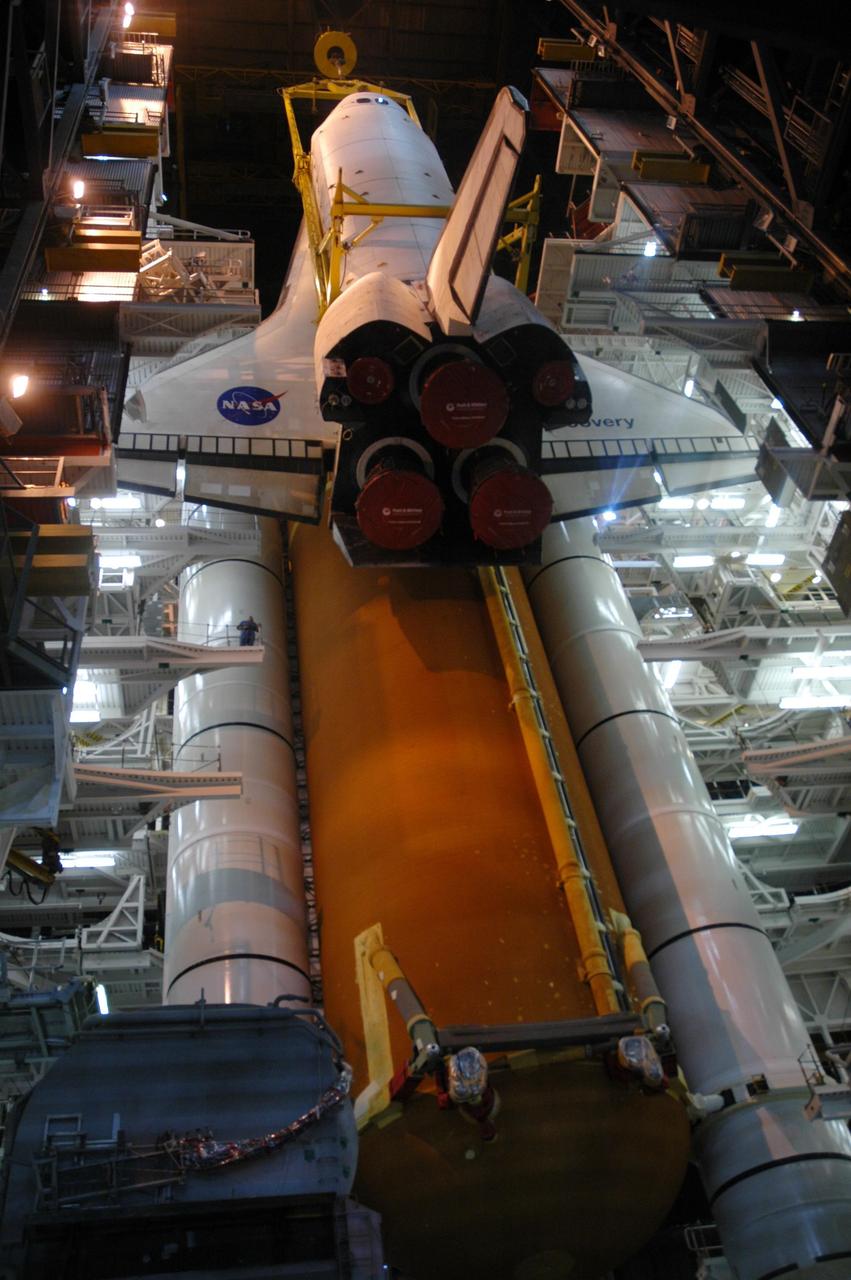
KENNEDY SPACE CENTER, FLA. -- Inside the Vehicle Assembly Building, space shuttle Discovery is lowered next to the external tank and solid rocket boosters already installed on the mobile launcher platform. Discovery is targeted for launch to the International Space Station for mission STS-120 on Oct. 23. The crew will be delivering and installing the Italian-built U.S. Node 2, named Harmony. The pressurized module will act as an internal connecting port and passageway to additional international science labs and cargo spacecraft. In addition to increasing the living and working space inside the station, it also will serve as a work platform outside for the station's robotic arm. Photo credit: NASA/Troy Cryder
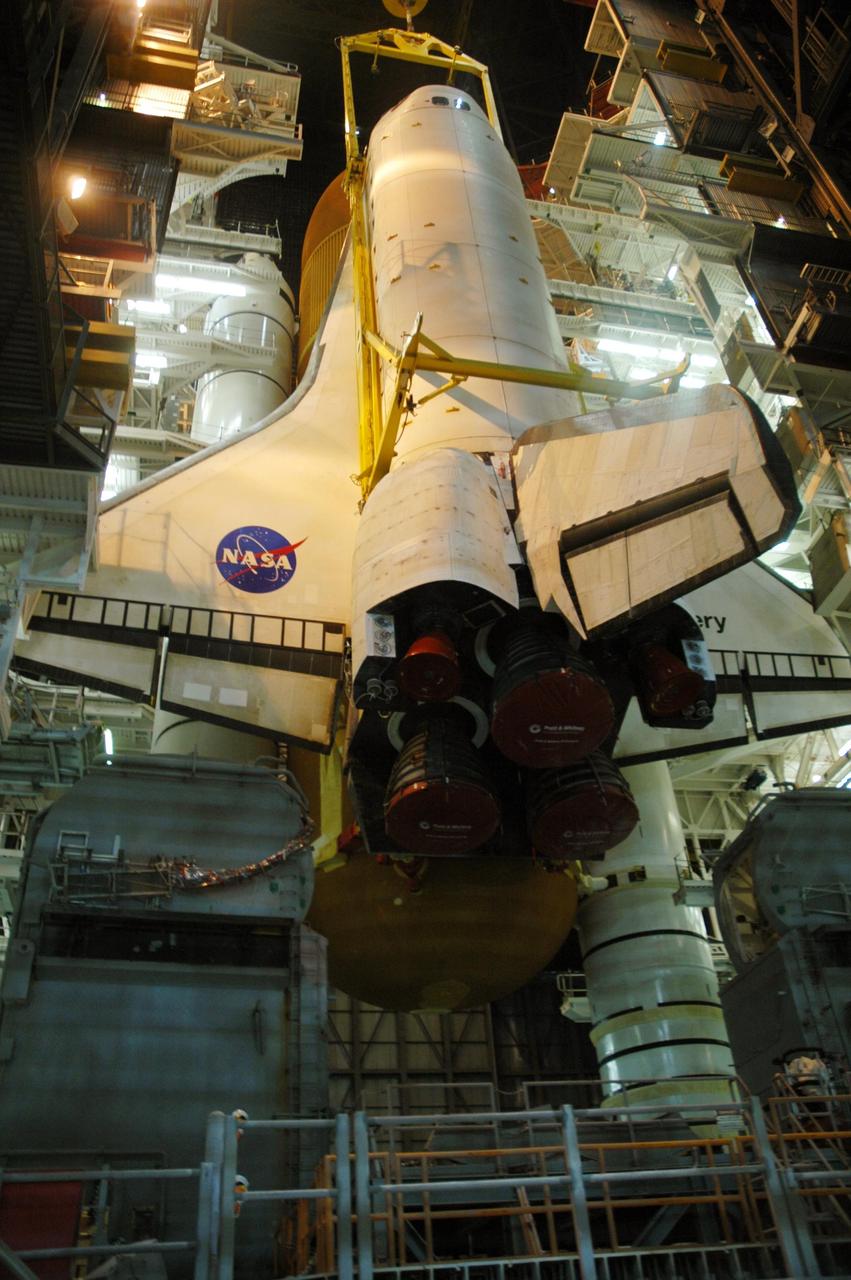
KENNEDY SPACE CENTER, FLA. -- Inside the Vehicle Assembly Building, space shuttle Discovery is lowered next to the external tank and solid rocket boosters already installed on the mobile launcher platform. Discovery is targeted for launch to the International Space Station for mission STS-120 on Oct. 23. The crew will be delivering and installing the Italian-built U.S. Node 2, named Harmony. The pressurized module will act as an internal connecting port and passageway to additional international science labs and cargo spacecraft. In addition to increasing the living and working space inside the station, it also will serve as a work platform outside for the station's robotic arm. Photo credit: NASA/Troy Cryder
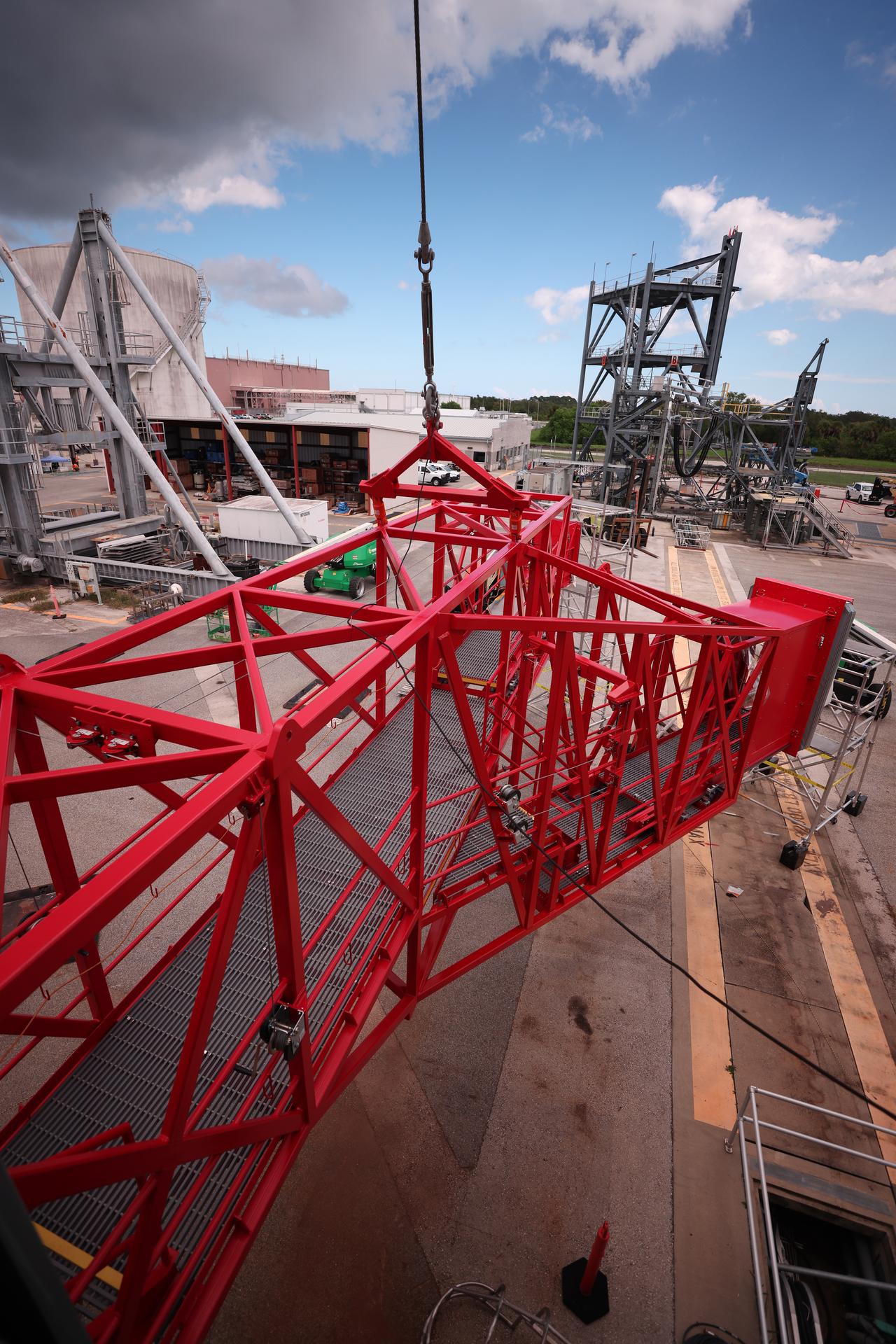
Crews test temporary contingency access platforms on the mobile launcher simulator tower on Wednesday, Oct. 29, 2025, at the Launch Equipment Test Facility at NASA’s Kennedy Space Center in Florida. The platforms will allow engineers to access the vehicle’s flight termination system on the rocket and the mobile launcher while at the pad rather than rolling back to the Vehicle Assembly Building to retest them. For Artemis II, four astronauts will venture around the Moon in early 2026, the first crewed mission on NASA’s path to establishing a long-term presence for science and exploration through Artemis.
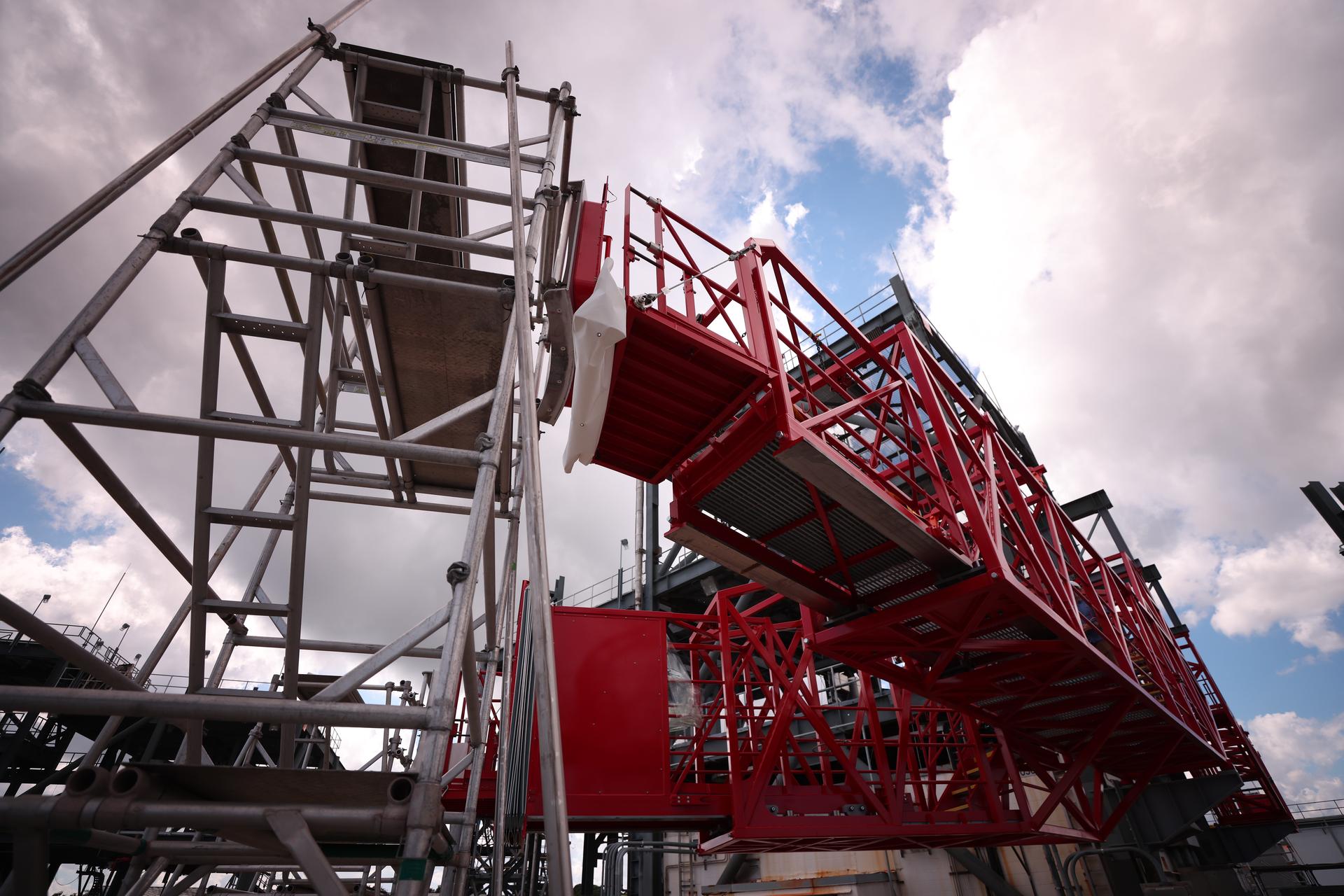
Crews test temporary contingency access platforms on the mobile launcher simulator tower on Wednesday, Oct. 29, 2025, at the Launch Equipment Test Facility at NASA’s Kennedy Space Center in Florida. The platforms will allow engineers to access the vehicle’s flight termination system on the rocket and the mobile launcher while at the pad rather than rolling back to the Vehicle Assembly Building to retest them. For Artemis II, four astronauts will venture around the Moon in early 2026, the first crewed mission on NASA’s path to establishing a long-term presence for science and exploration through Artemis.
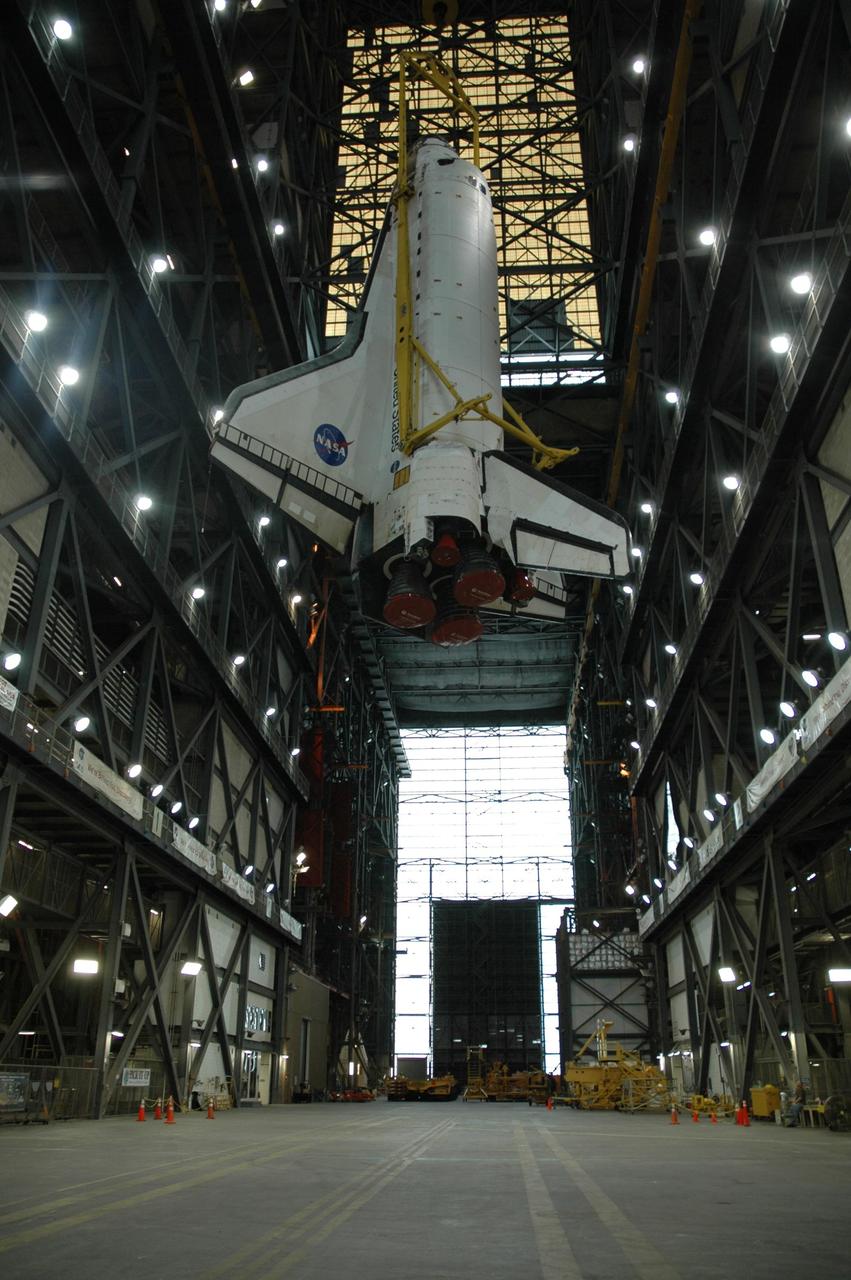
KENNEDY SPACE CENTER, FLA. -- Inside the Vehicle Assembly Building, space shuttle Discovery is lifted into the upper regions for transfer to high bay 1. In the bay, Discovery will be mated with the external tank and solid rocket boosters waiting on the mobile launcher platform. Discovery is targeted for launch to the International Space Station for mission STS-120 on Oct. 23. The crew will be delivering and installing the Italian-built U.S. Node 2, named Harmony. The pressurized module will act as an internal connecting port and passageway to additional international science labs and cargo spacecraft. In addition to increasing the living and working space inside the station, it also will serve as a work platform outside for the station's robotic arm. Photo credit: NASATroy Cryder
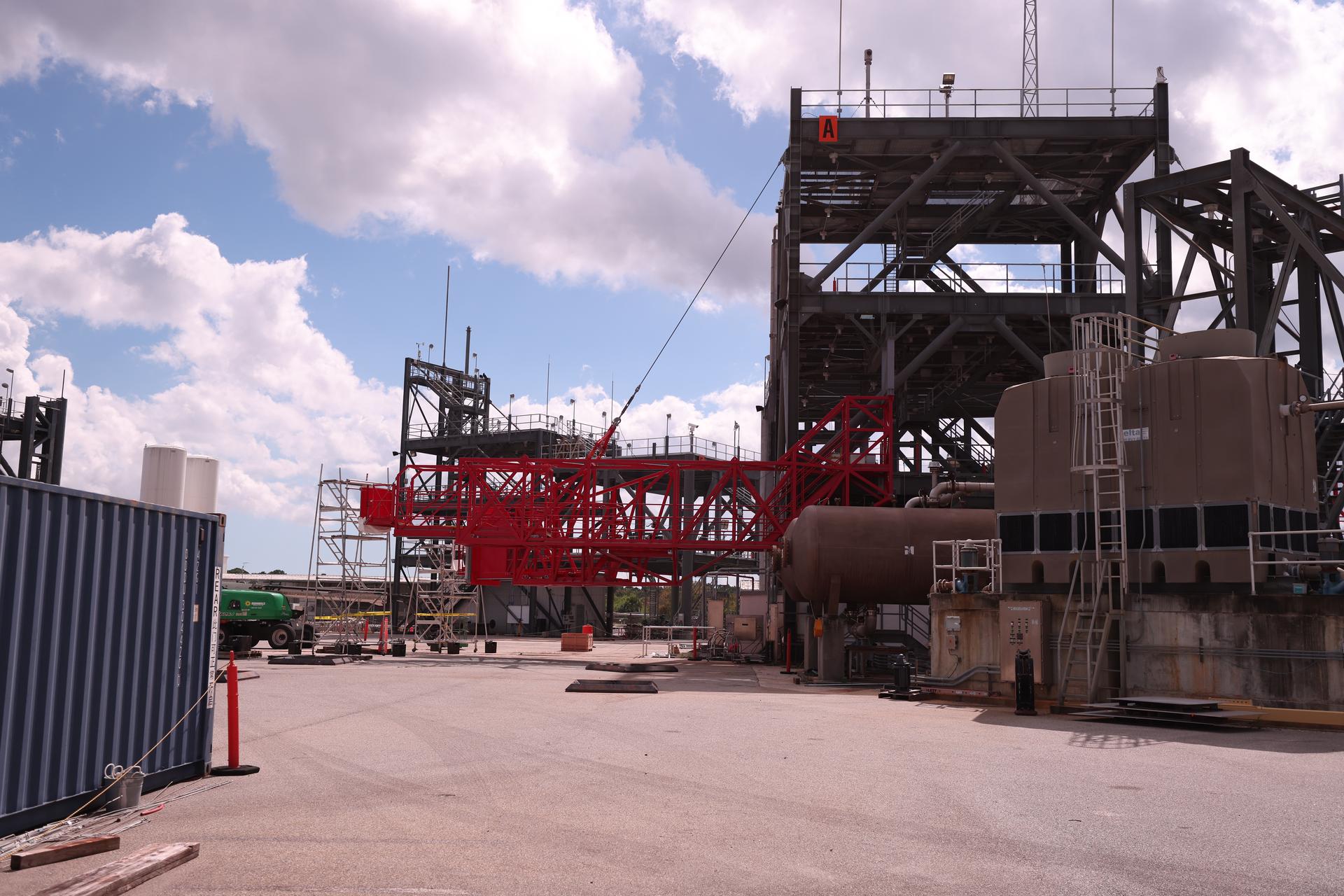
Crews test temporary contingency access platforms on the mobile launcher simulator tower on Wednesday, Oct. 29, 2025, at the Launch Equipment Test Facility at NASA’s Kennedy Space Center in Florida. The platforms will allow engineers to access the vehicle’s flight termination system on the rocket and the mobile launcher while at the pad rather than rolling back to the Vehicle Assembly Building to retest them. For Artemis II, four astronauts will venture around the Moon in early 2026, the first crewed mission on NASA’s path to establishing a long-term presence for science and exploration through Artemis.
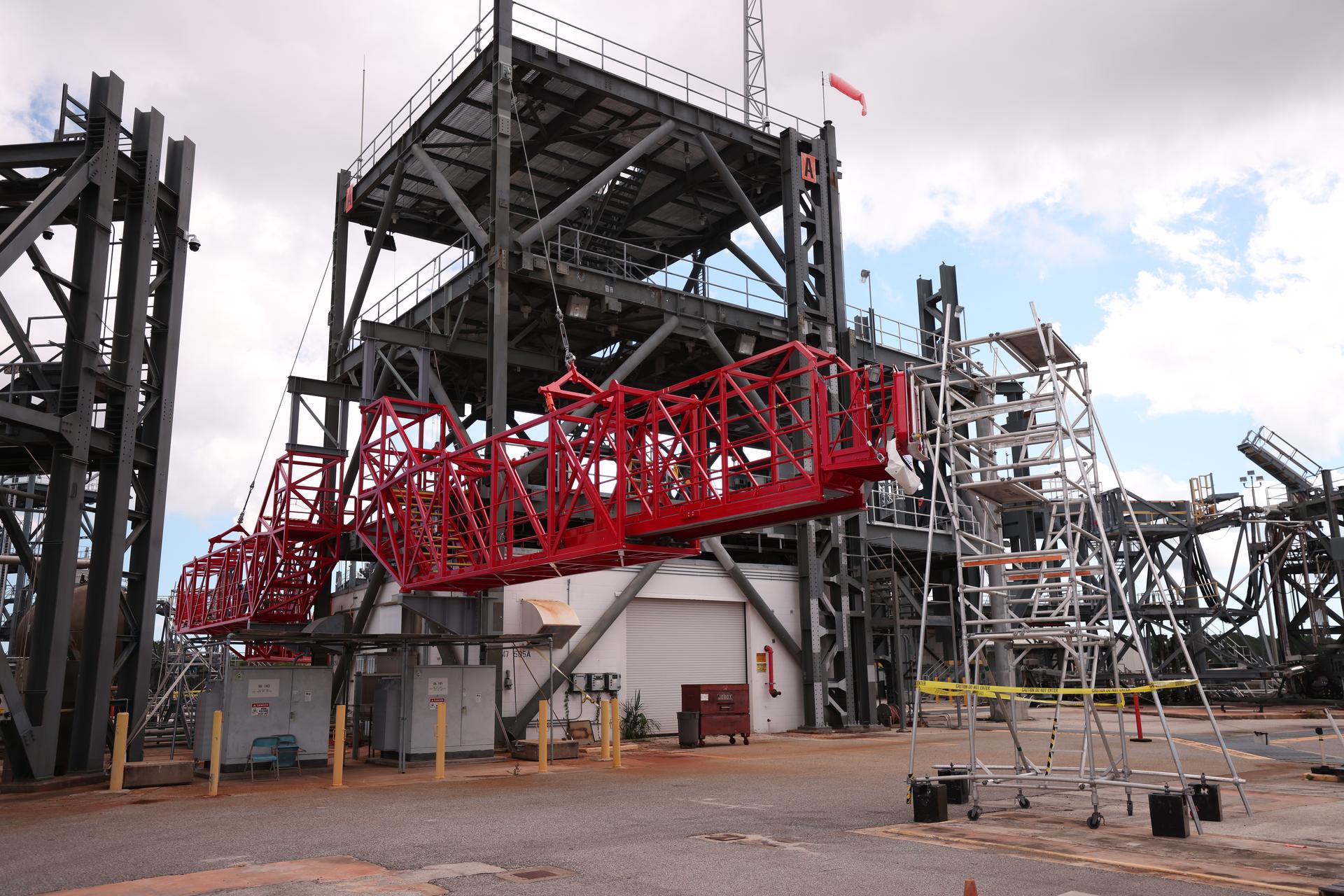
Crews test temporary contingency access platforms on the mobile launcher simulator tower on Wednesday, Oct. 29, 2025, at the Launch Equipment Test Facility at NASA’s Kennedy Space Center in Florida. The platforms will allow engineers to access the vehicle’s flight termination system on the rocket and the mobile launcher while at the pad rather than rolling back to the Vehicle Assembly Building to retest them. For Artemis II, four astronauts will venture around the Moon in early 2026, the first crewed mission on NASA’s path to establishing a long-term presence for science and exploration through Artemis.
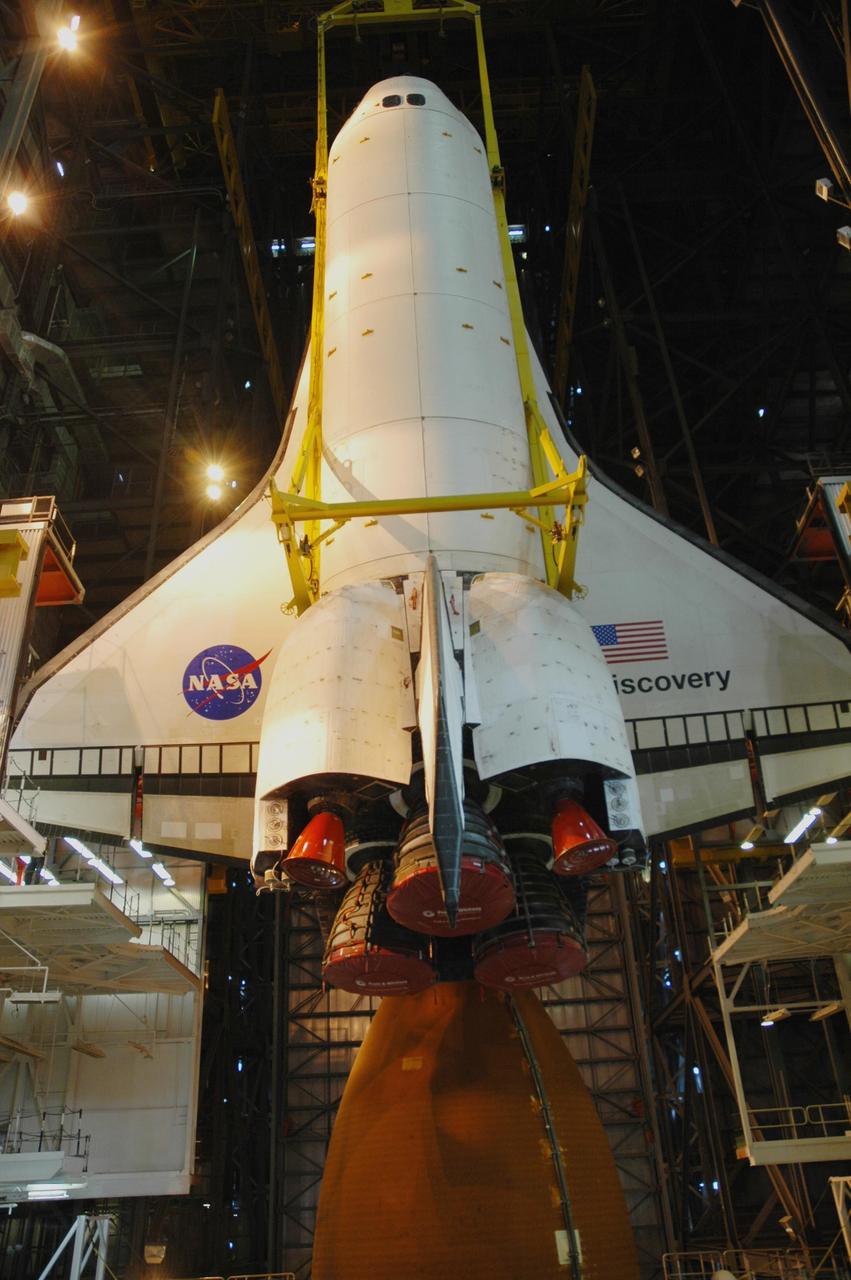
KENNEDY SPACE CENTER, FLA. -- Inside the Vehicle Assembly Building, space shuttle Discovery is lowered closer to the external tank in high bay 1. Discovery will be mated with the external tank and solid rocket boosters waiting on the mobile launcher platform. Discovery is targeted for launch to the International Space Station for mission STS-120 on Oct. 23. The crew will be delivering and installing the Italian-built U.S. Node 2, named Harmony. The pressurized module will act as an internal connecting port and passageway to additional international science labs and cargo spacecraft. In addition to increasing the living and working space inside the station, it also will serve as a work platform outside for the station's robotic arm. Photo credit: NASA/Troy Cryder
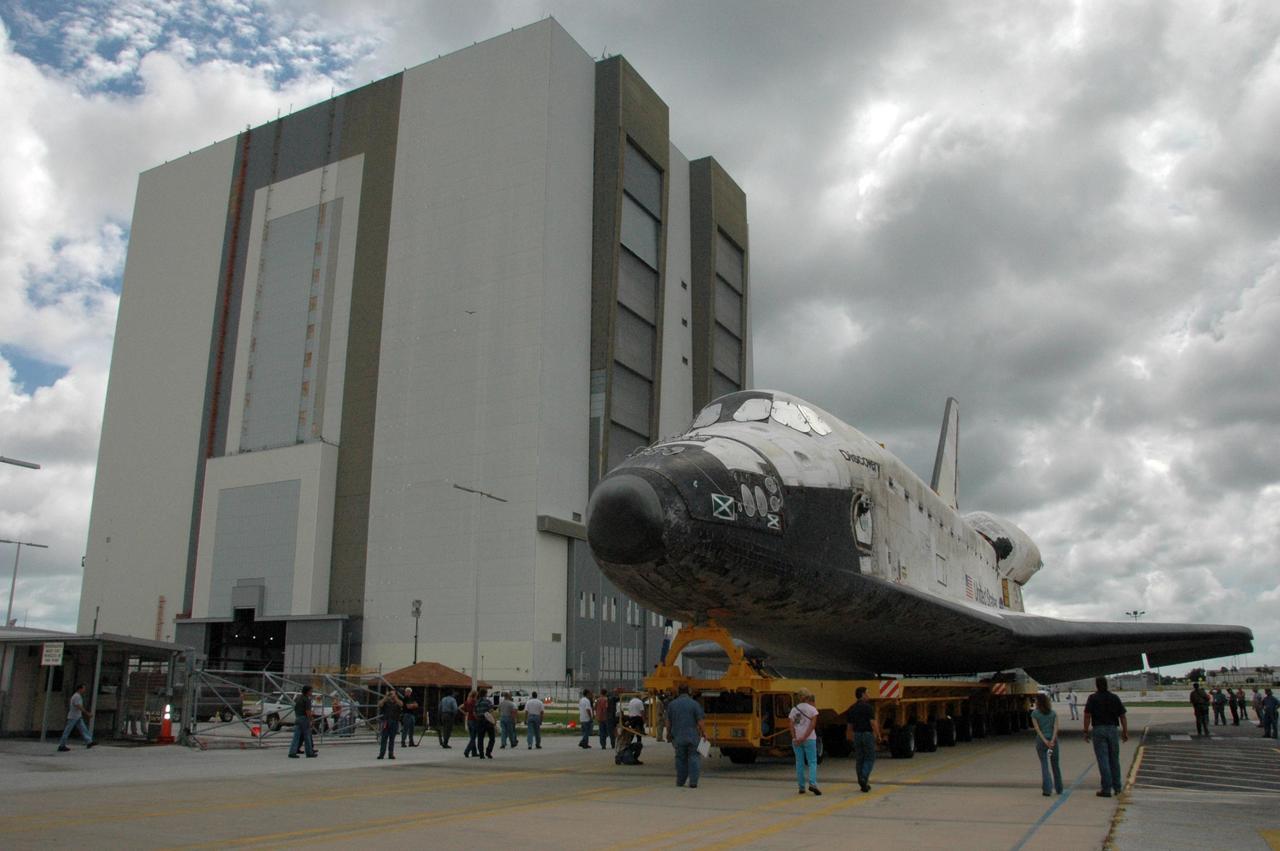
KENNEDY SPACE CENTER, FLA. -- On its transporter, Space shuttle Discovery rolls to the Vehicle Assembly Building, at left. In the VAB, the shuttle will be lifted and mated with the external tank and solid rocket boosters on the mobile launcher platform. Discovery is targeted for launch to the International Space Station for mission STS-120 on Oct. 23. The crew will be delivering and installing the Italian-built U.S. Node 2, named Harmony. The pressurized module will act as an internal connecting port and passageway to additional international science labs and cargo spacecraft. In addition to increasing the living and working space inside the station, it also will serve as a work platform outside for the station's robotic arm. Photo credit: NASA/Charisse Nahser
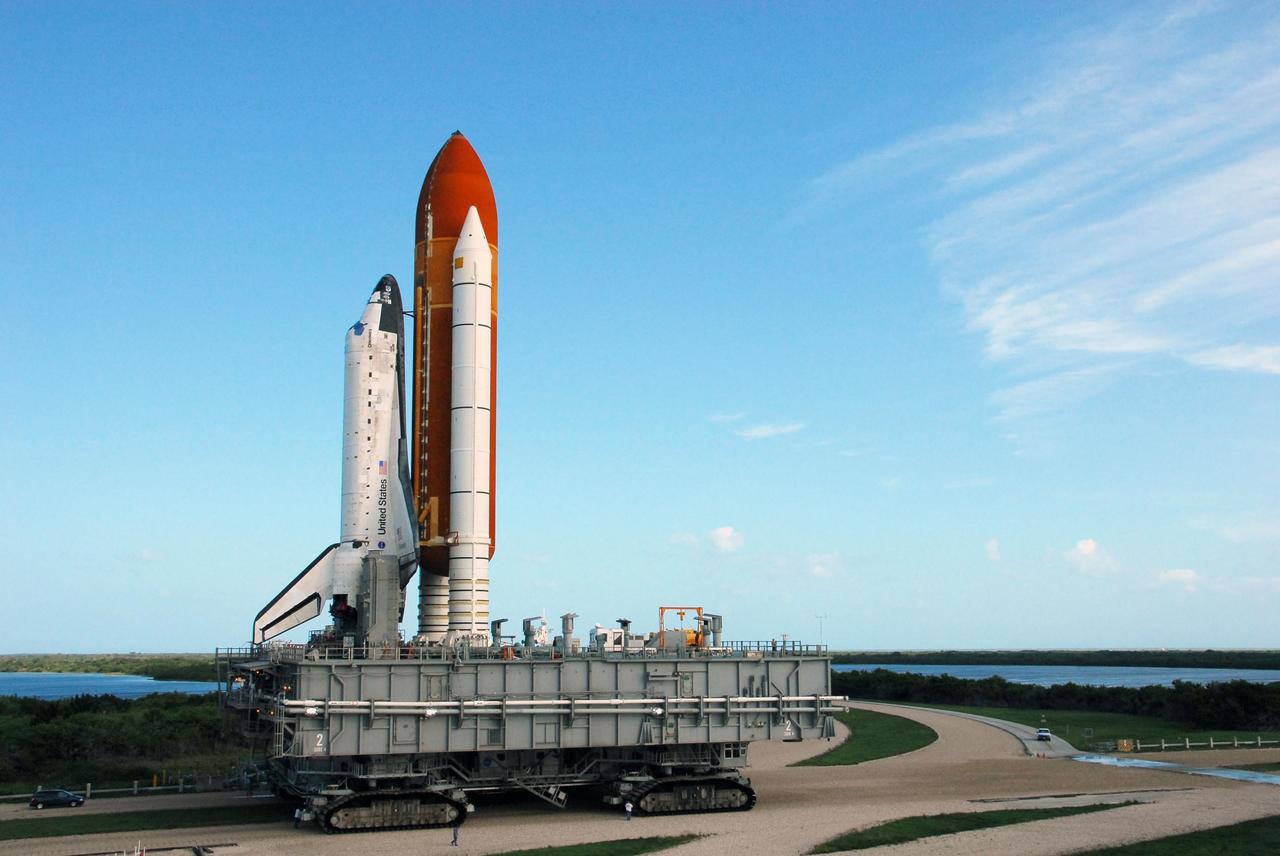
KENNEDY SPACE CENTER, FLA. -- The crawler transporter, moving Space Shuttle Discovery atop its mobile launch platform from the Vehicle Assembly Building, heads in the direction of Launch Pad 39A. The journey has reached the intersection in the crawlerway of the paths to Pad 39A and Pad 39B. First motion out of the VAB was at 6:47 a.m. EDT. The crawler transporter, mobile launch platform and unfueled space shuttle weigh a total of approximately 17.5 million pounds. Rollout is a milestone for Discovery's launch to the International Space Station on mission STS-120, targeted for Oct. 23. The crew will be delivering and installing the Italian-built U.S. Node 2, named Harmony. The pressurized module will act as an internal connecting port and passageway to additional international science labs and cargo spacecraft. In addition to increasing the living and working space inside the station, it also will serve as a work platform outside for the station's robotic arm. Photo credit: NASA/George Shelton
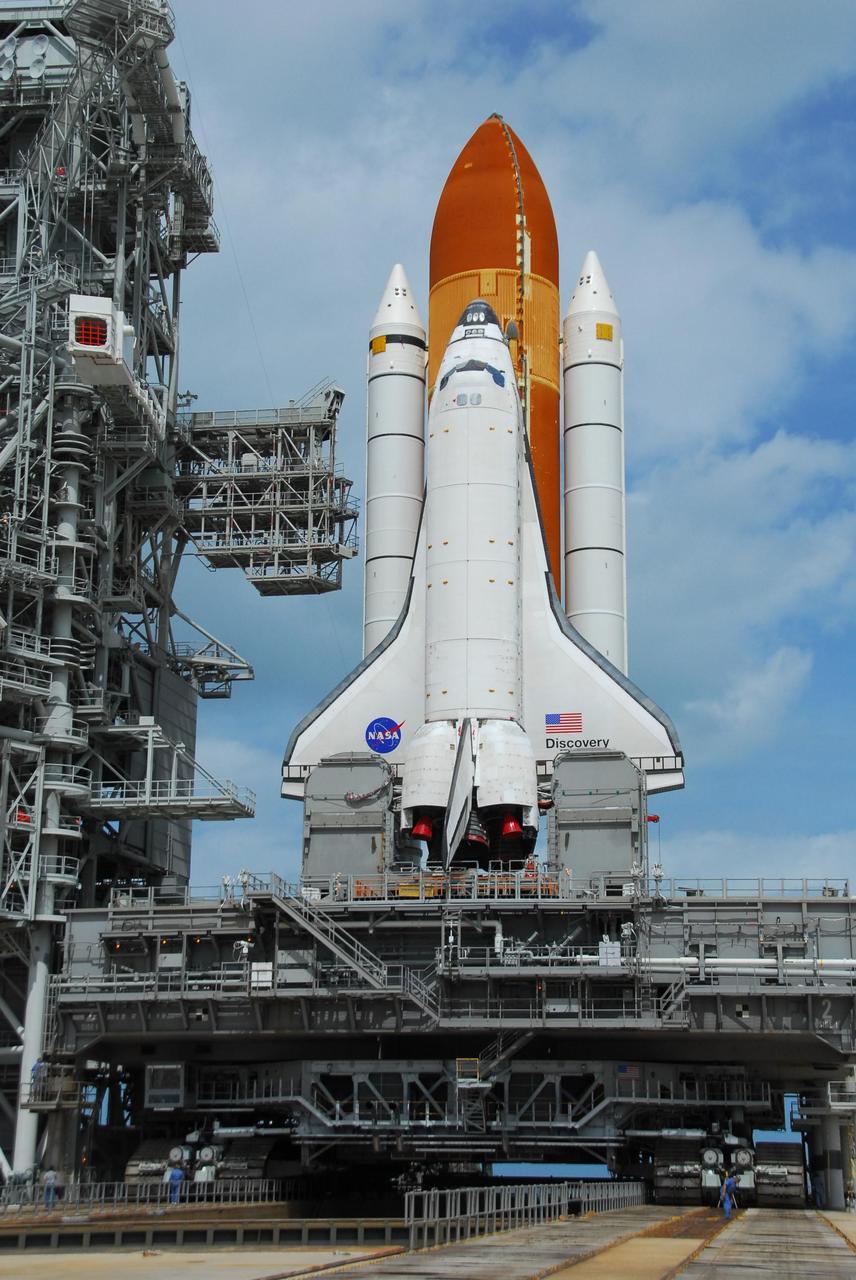
KENNEDY SPACE CENTER, FLA. -- Access platforms at Launch Pad 39A are moved into position against Space Shuttle Discovery atop a mobile launch platform. Discovery arrived at its seaside launch pad around noon and was hard down at 1:15 p.m. First motion out of the Vehicle Assembly Building was at 6:47 a.m. EDT. Rollout is a milestone for Discovery's launch to the International Space Station on mission STS-120, targeted for Oct. 23. The crew will be delivering and installing the Italian-built U.S. Node 2, named Harmony. The pressurized module will act as an internal connecting port and passageway to additional international science labs and cargo spacecraft. In addition to increasing the living and working space inside the station, it also will serve as a work platform outside for the station's robotic arm. Photo credit: NASA/George Shelton
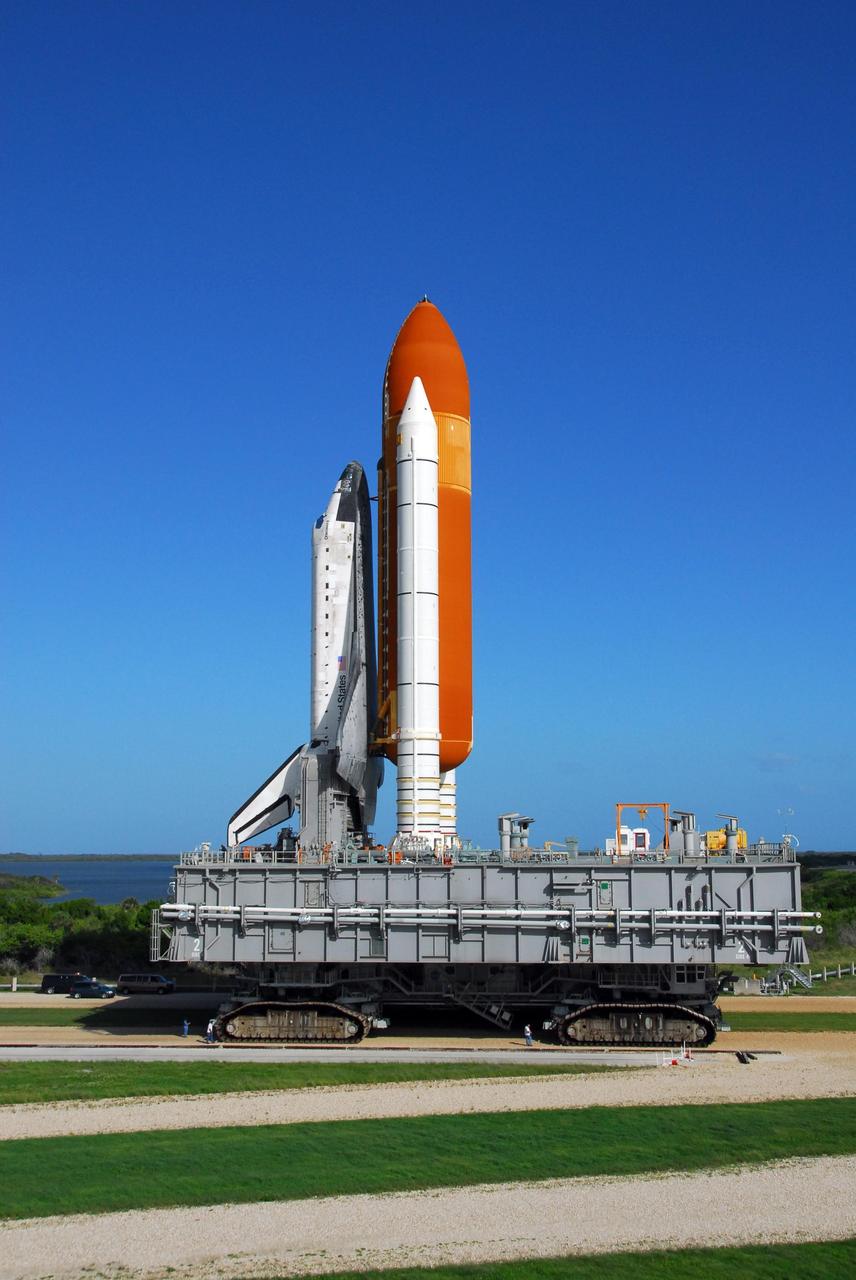
KENNEDY SPACE CENTER, FLA. -- The crawler transporter, moving Space Shuttle Discovery atop its mobile launch platform from the Vehicle Assembly Building, follows the path to Launch Pad 39A. The journey has reached the intersection in the crawlerway of the roads to Pad 39A and Pad 39B. First motion out of the VAB was at 6:47 a.m. EDT. The crawler transporter, mobile launch platform and unfueled space shuttle weigh a total of approximately 17.5 million pounds. Rollout is a milestone for Discovery's launch to the International Space Station on mission STS-120, targeted for Oct. 23. The crew will be delivering and installing the Italian-built U.S. Node 2, named Harmony. The pressurized module will act as an internal connecting port and passageway to additional international science labs and cargo spacecraft. In addition to increasing the living and working space inside the station, it also will serve as a work platform outside for the station's robotic arm. Photo credit: NASA/George Shelton
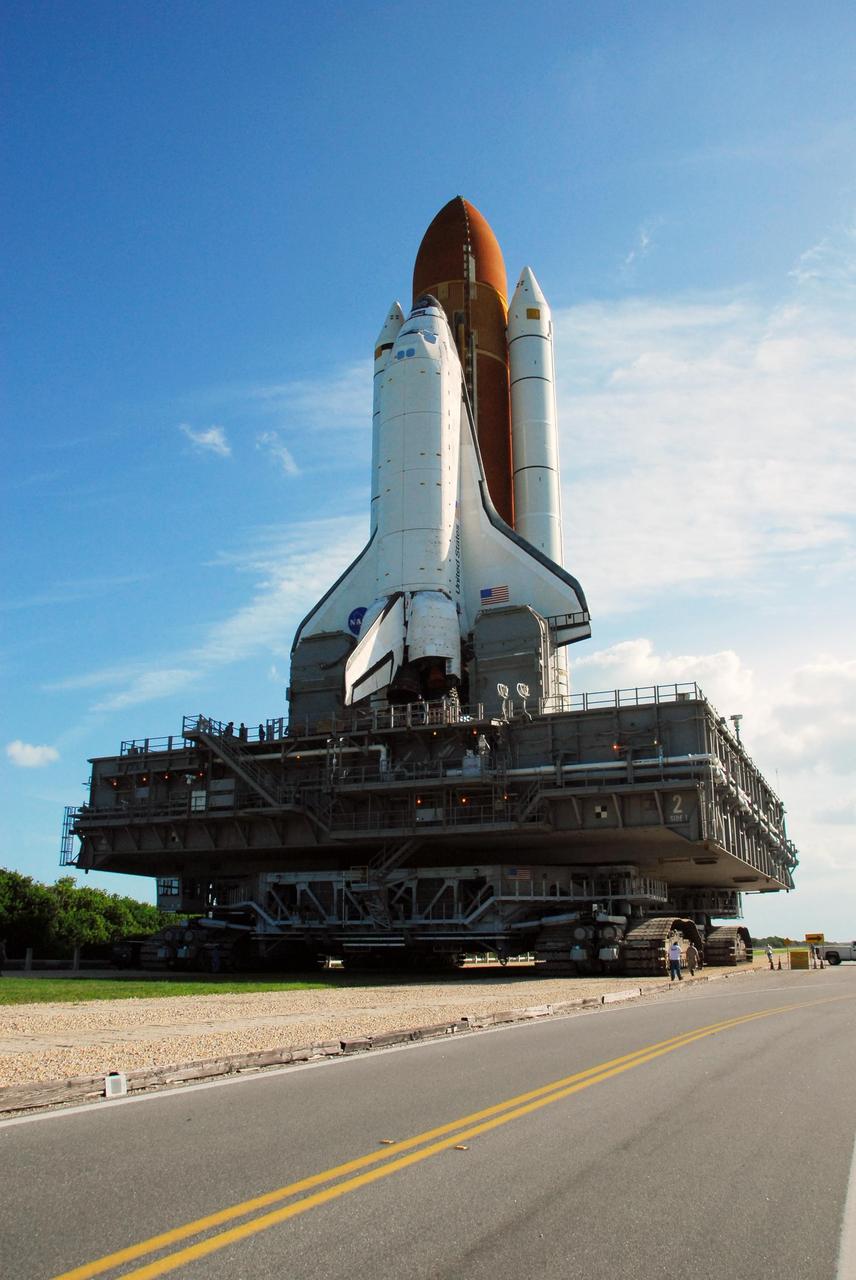
KENNEDY SPACE CENTER, FLA. -- A crawler transporter moves Space Shuttle Discovery, secured atop a mobile launch platform, along the crawlerway from the Vehicle Assembly Building to Launch Pad 39A on a balmy Florida morning. First motion out of the VAB was at 6:47 a.m. EDT. The crawler transporter, mobile launch platform and unfueled space shuttle weigh a total of approximately 17.5 million pounds. Rollout is a milestone for Discovery's launch to the International Space Station on mission STS-120, targeted for Oct. 23. The crew will be delivering and installing the Italian-built U.S. Node 2, named Harmony. The pressurized module will act as an internal connecting port and passageway to additional international science labs and cargo spacecraft. In addition to increasing the living and working space inside the station, it also will serve as a work platform outside for the station's robotic arm. Photo credit: NASA/George Shelton
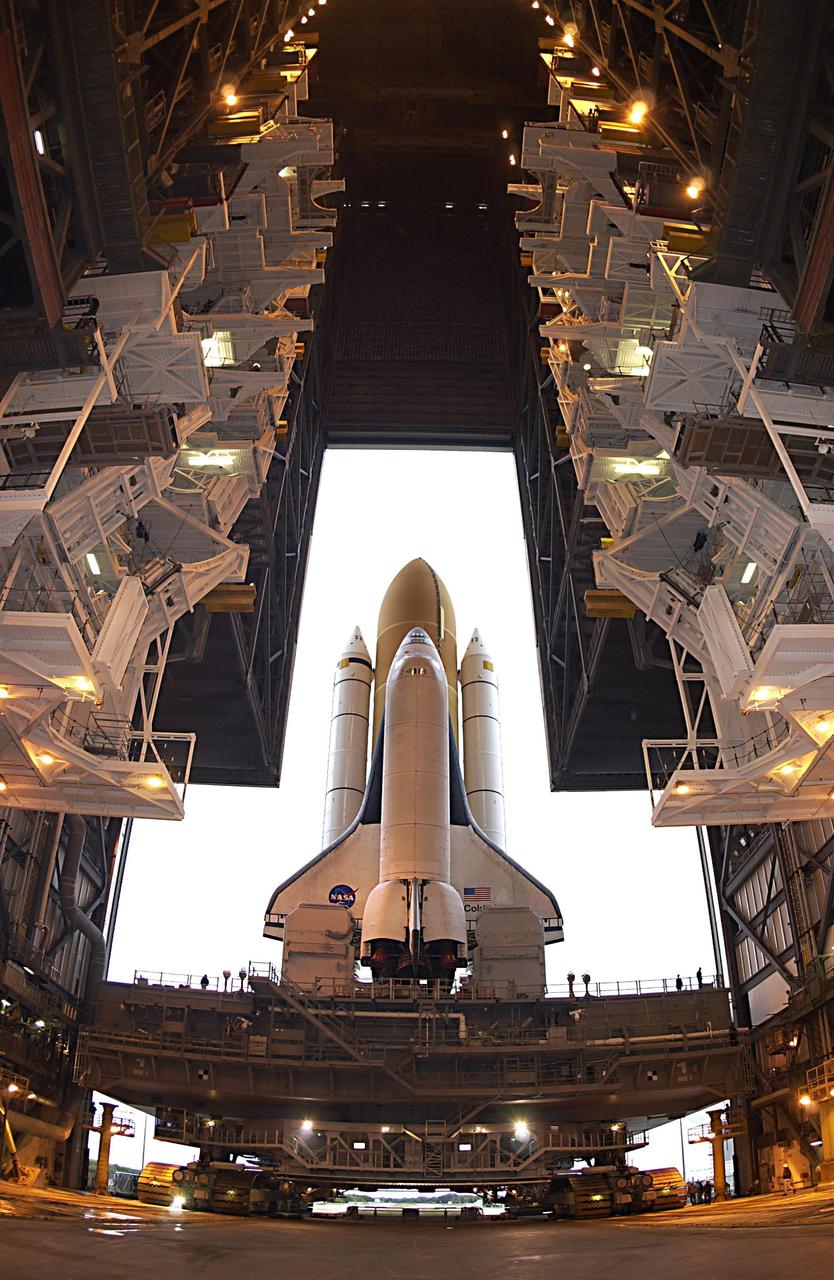
KENNEDY SPACE CENTER, FLA. -- Space Shuttle Columbia rolls out from the Vehicle Assembly Building on its way to Launch Pad 39A. Columbia sits atop the Mobile Launcher Platform, which in turn is carried by the crawler-transporter underneath for the long, slow journey to the pad. The STS-107 research mission comprises experiments ranging from material sciences to life sciences (many rats), plus the Fast Reaction Experiments Enabling Science, Technology, Applications and Research (FREESTAR) that incorporates eight high priority secondary attached shuttle experiments. Mission STS-107 is scheduled to launch Jan. 16, 2003.
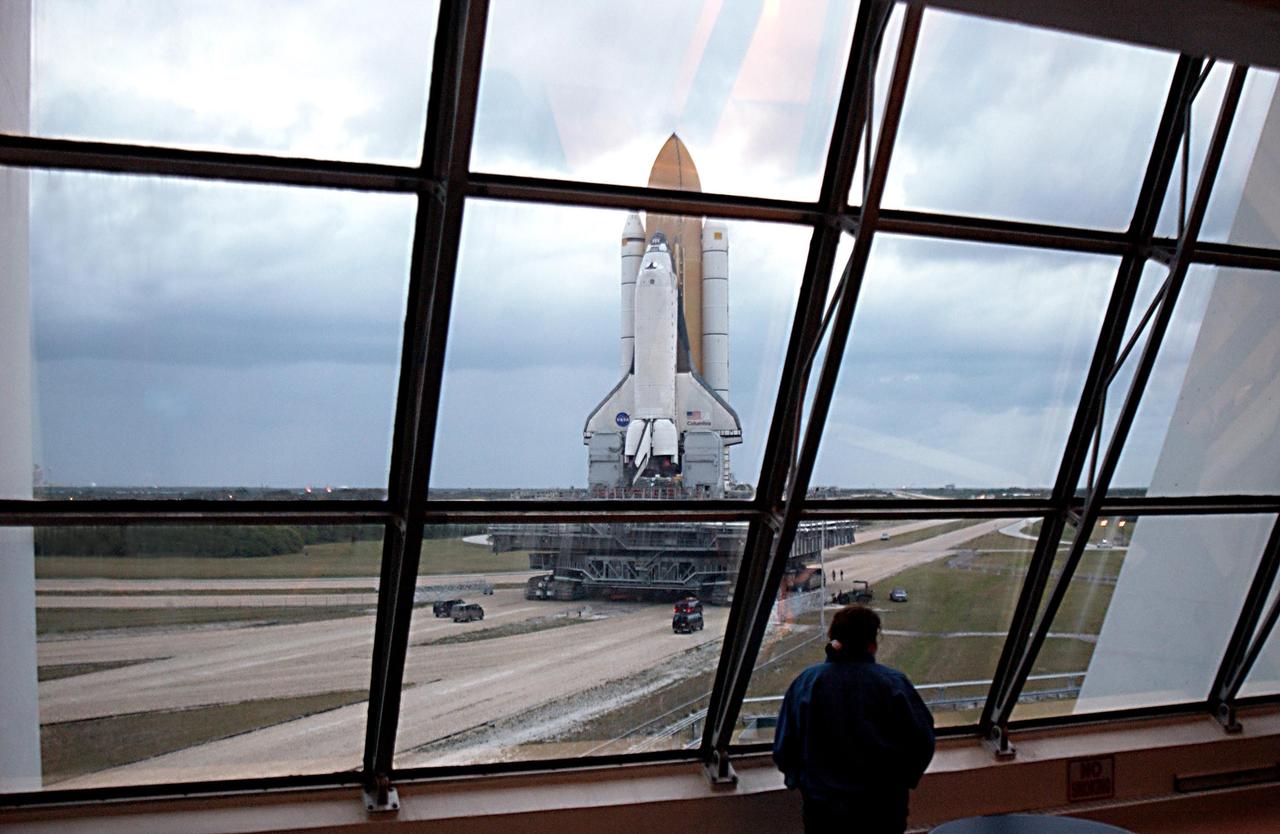
KENNEDY SPACE CENTER, FLA. -- A view from inside the Launch Control Center shows Space Shuttle Columbia rolling to Launch Pad 39A, sitting atop the Mobile Launcher Platform, which in turn is carried by the crawler-transporter underneath. The STS-107 research mission comprises experiments ranging from material sciences to life sciences (many rats), plus the Fast Reaction Experiments Enabling Science, Technology, Applications and Research (FREESTAR) that incorporates eight high priority secondary attached shuttle experiments. Mission STS-107 is scheduled to launch Jan. 16, 2003.

KENNEDY SPACE CENTER, FLA. -- Space Shuttle Columbia rolls out from the Vehicle Assembly Building on its way to Launch Pad 39A. Columbia sits atop the Mobile Launcher Platform, which in turn is carried by the crawler-transporter underneath for the long, slow journey to the pad. The STS-107 research mission comprises experiments ranging from material sciences to life sciences (many rats), plus the Fast Reaction Experiments Enabling Science, Technology, Applications and Research (FREESTAR) that incorporates eight high priority secondary attached shuttle experiments. Mission STS-107 is scheduled to launch Jan. 16, 2003.
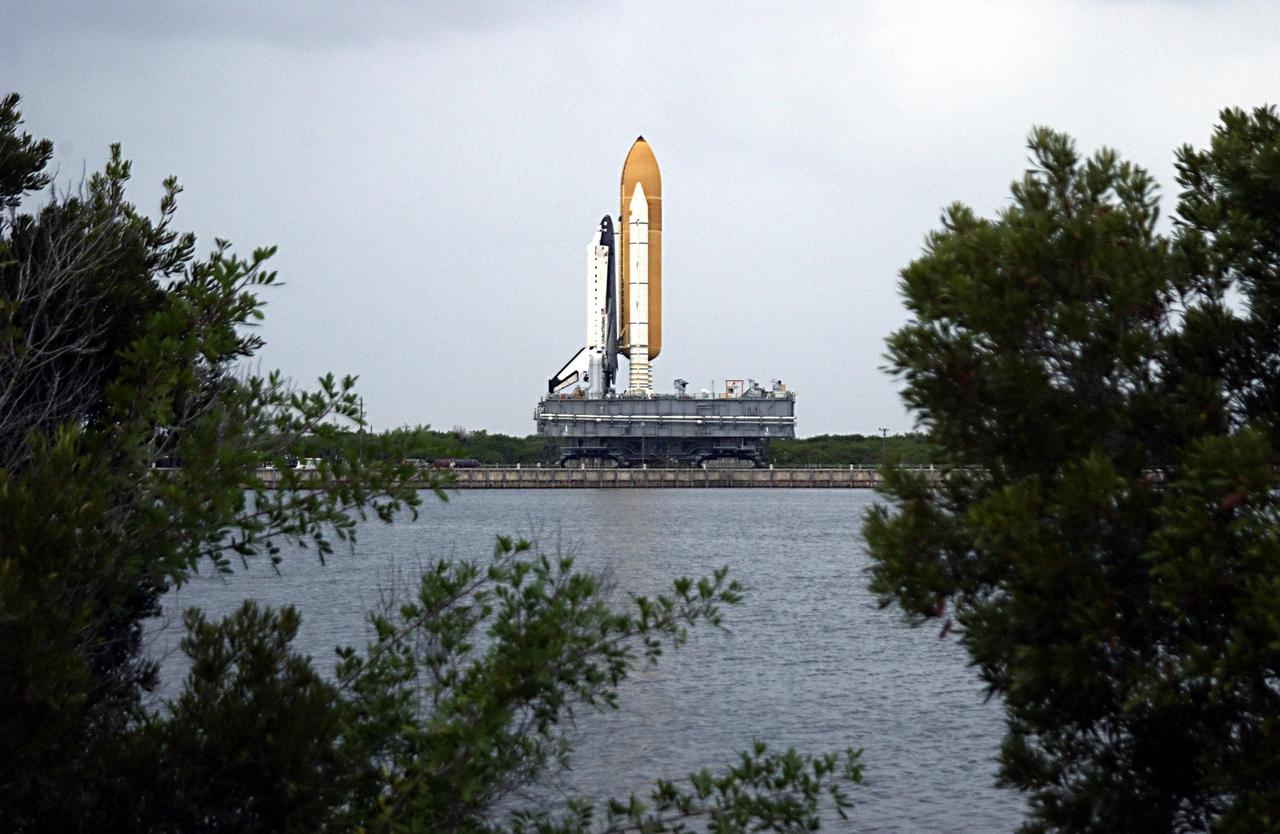
KENNEDY SPACE CENTER, FLA. -- Space Shuttle Columbia, framed by trees near the Banana River, rolls towards Launch Pad 39A, sitting atop the Mobile Launcher Platform, which in turn is carried by the crawler-transporter underneath. The STS-107 research mission comprises experiments ranging from material sciences to life sciences (many rats), plus the Fast Reaction Experiments Enabling Science, Technology, Applications and Research (FREESTAR) that incorporates eight high priority secondary attached shuttle experiments. Mission STS-107 is scheduled to launch Jan. 16, 2003.
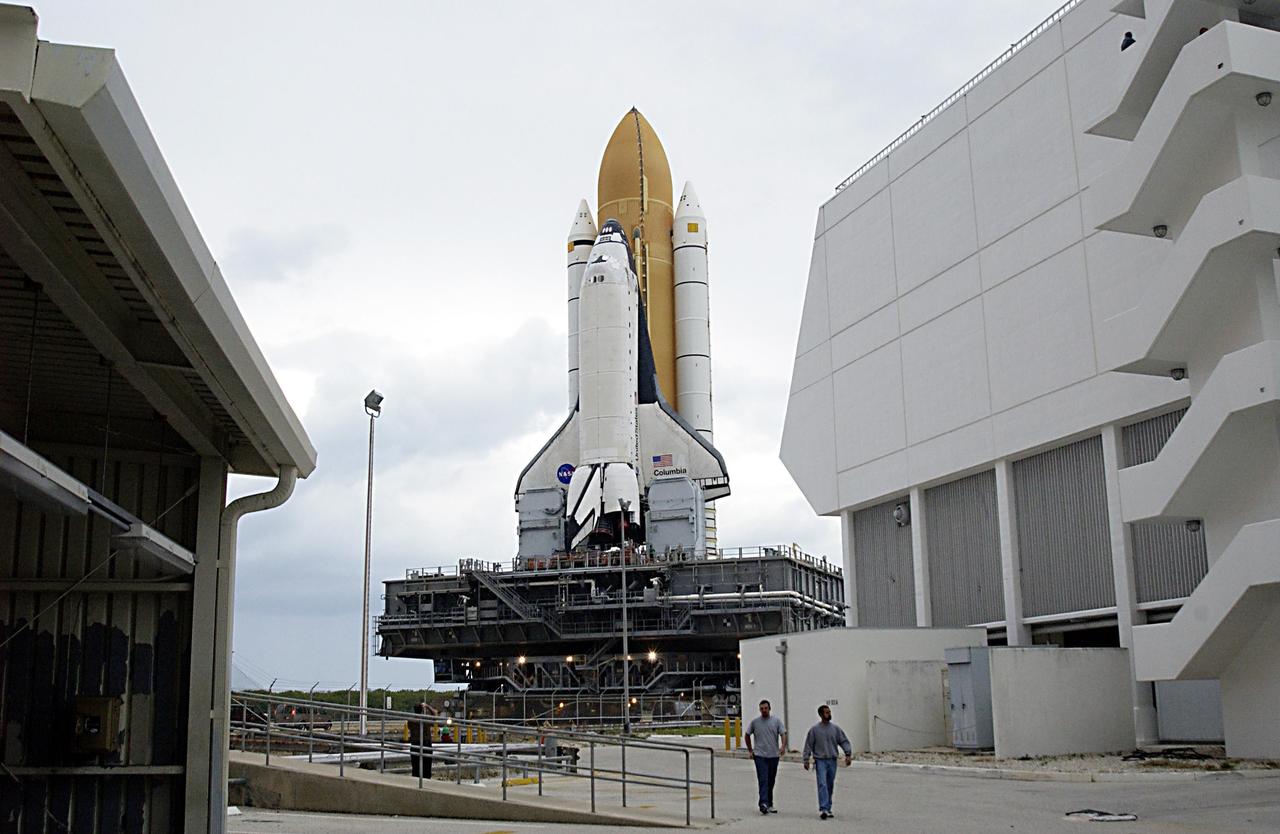
KENNEDY SPACE CENTER, FLA. -- Space Shuttle Columbia, sitting atop the Mobile Launcher Platform, which in turn is carried by the crawler-transporter underneath, makes the journey past the Launch Control Center on its way to Launch Pad 39A. The STS-107 research mission comprises experiments ranging from material sciences to life sciences (many rats), plus the Fast Reaction Experiments Enabling Science, Technology, Applications and Research (FREESTAR) that incorporates eight high priority secondary attached shuttle experiments. Mission STS-107 is scheduled to launch Jan. 16, 2003.

KENNEDY SPACE CENTER, FLA. -- Space Shuttle Columbia begins the trek from the Vehicle Assembly Building to Launch Pad 39A, sitting atop the Mobile Launcher Platform, which in turn is carried by the crawler-transporter underneath. The STS-107 research mission comprises experiments ranging from material sciences to life sciences (many rats), plus the Fast Reaction Experiments Enabling Science, Technology, Applications and Research (FREESTAR) that incorporates eight high priority secondary attached shuttle experiments. Mission STS-107 is scheduled to launch Jan. 16, 2003.

ER-2 tail number 809, is one of two Airborne Science ER-2s used as science platforms by Dryden. The aircraft are platforms for a variety of high-altitude science missions flown over various parts of the world. They are also used for earth science and atmospheric sensor research and development, satellite calibration and data validation. The ER-2s are capable of carrying a maximum payload of 2,600 pounds of experiments in a nose bay, the main equipment bay behind the cockpit, two wing-mounted superpods and small underbody and trailing edges. Most ER-2 missions last about six hours with ranges of about 2,200 nautical miles. The aircraft typically fly at altitudes above 65,000 feet. On November 19, 1998, the ER-2 set a world record for medium weight aircraft reaching an altitude of 68,700 feet. The aircraft is 63 feet long, with a wingspan of 104 feet. The top of the vertical tail is 16 feet above ground when the aircraft is on the bicycle-type landing gear. Cruising speeds are 410 knots, or 467 miles per hour, at altitude. A single General Electric F118 turbofan engine rated at 17,000 pounds thrust powers the ER-2.

ER-2 tail number 806, is one of two Airborne Science ER-2s used as science platforms by Dryden. The aircraft are platforms for a variety of high-altitude science missions flown over various parts of the world. They are also used for earth science and atmospheric sensor research and development, satellite calibration and data validation. The ER-2s are capable of carrying a maximum payload of 2,600 pounds of experiments in a nose bay, the main equipment bay behind the cockpit, two wing-mounted superpods and small underbody and trailing edges. Most ER-2 missions last about six hours with ranges of about 2,200 nautical miles. The aircraft typically fly at altitudes above 65,000 feet. On November 19, 1998, the ER-2 set a world record for medium weight aircraft reaching an altitude of 68,700 feet. The aircraft is 63 feet long, with a wingspan of 104 feet. The top of the vertical tail is 16 feet above ground when the aircraft is on the bicycle-type landing gear. Cruising speeds are 410 knots, or 467 miles per hour, at altitude. A single General Electric F-118 turbofan engine rated at 17,000 pounds thrust powers the ER-2.

ER-2 tail number 806, is one of two Airborne Science ER-2s used as science platforms by Dryden. The aircraft are platforms for a variety of high-altitude science missions flown over various parts of the world. They are also used for earth science and atmospheric sensor research and development, satellite calibration and data validation. The ER-2s are capable of carrying a maximum payload of 2,600 pounds of experiments in a nose bay, the main equipment bay behind the cockpit, two wing-mounted superpods and small underbody and trailing edges. Most ER-2 missions last about six hours with ranges of about 2,200 nautical miles. The aircraft typically fly at altitudes above 65,000 feet. On November 19, 1998, the ER-2 set a world record for medium weight aircraft reaching an altitude of 68,700 feet. The aircraft is 63 feet long, with a wingspan of 104 feet. The top of the vertical tail is 16 feet above ground when the aircraft is on the bicycle-type landing gear. Cruising speeds are 410 knots, or 467 miles per hour, at altitude. A single General Electric F-118 turbofan engine rated at 17,000 pounds thrust powers the ER-2.
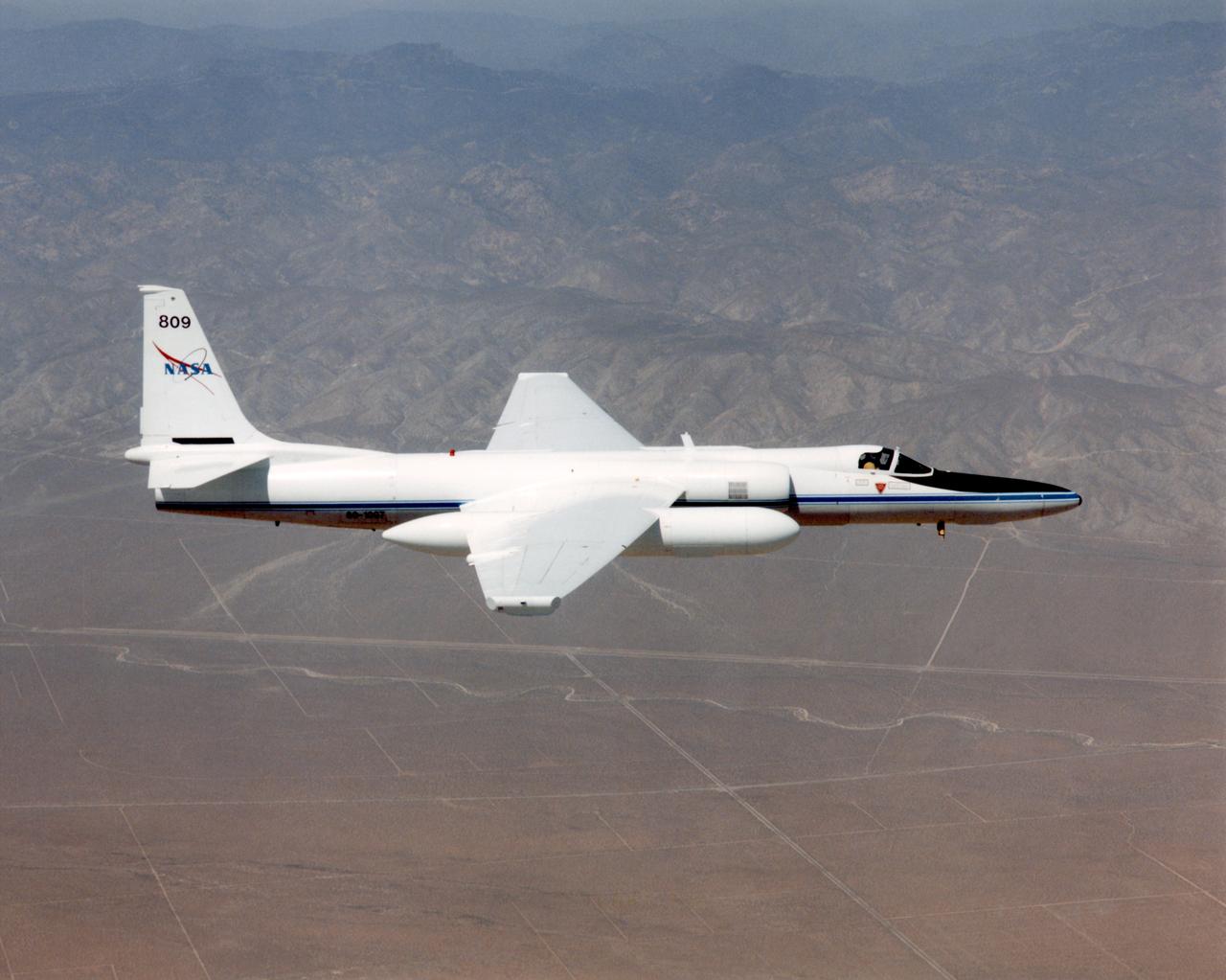
ER-2C tail number 809, was one of two Airborne Science ER-2Cs used as science platforms by Dryden. The aircraft were platforms for a variety of high-altitude science missions flown over various parts of the world. They were also used for earth science and atmospheric sensor research and development, satellite calibration and data validation. The ER-2Cs were capable of carrying a maximum payload of 2,600 pounds of experiments in a nose bay, the main equipment bay behind the cockpit, two wing-mounted superpods and small underbody and trailing edges. Most ER-2C missions lasted about six hours with ranges of about 2,200 nautical miles. The aircraft typically flew at altitudes above 65,000 feet. On November 19, 1998, the ER-2C set a world record for medium weight aircraft reaching an altitude of 68,700 feet. The aircraft was 63 feet long, with a wingspan of 104 feet. The top of the vertical tail was 16 feet above ground when the aircraft was on the bicycle-type landing gear. Cruising speeds were 410 knots, or 467 miles per hour, at altitude. A single General Electric F-118 turbofan engine rated at 17,000 pounds thrust powers the ER-2C.

ER-2 tail number 806, is one of two Airborne Science ER-2s used as science platforms by Dryden. The aircraft are platforms for a variety of high-altitude science missions flown over various parts of the world. They are also used for earth science and atmospheric sensor research and development, satellite calibration and data validation. The ER-2s are capable of carrying a maximum payload of 2,600 pounds of experiments in a nose bay, the main equipment bay behind the cockpit, two wing-mounted superpods and small underbody and trailing edges. Most ER-2 missions last about six hours with ranges of about 2,200 nautical miles. The aircraft typically fly at altitudes above 65,000 feet. On November 19, 1998, the ER-2 set a world record for medium weight aircraft reaching an altitude of 68,700 feet. The aircraft is 63 feet long, with a wingspan of 104 feet. The top of the vertical tail is 16 feet above ground when the aircraft is on the bicycle-type landing gear. Cruising speeds are 410 knots, or 467 miles per hour, at altitude. A single General Electric F-118 turbofan engine rated at 17,000 pounds thrust powers the ER-2.
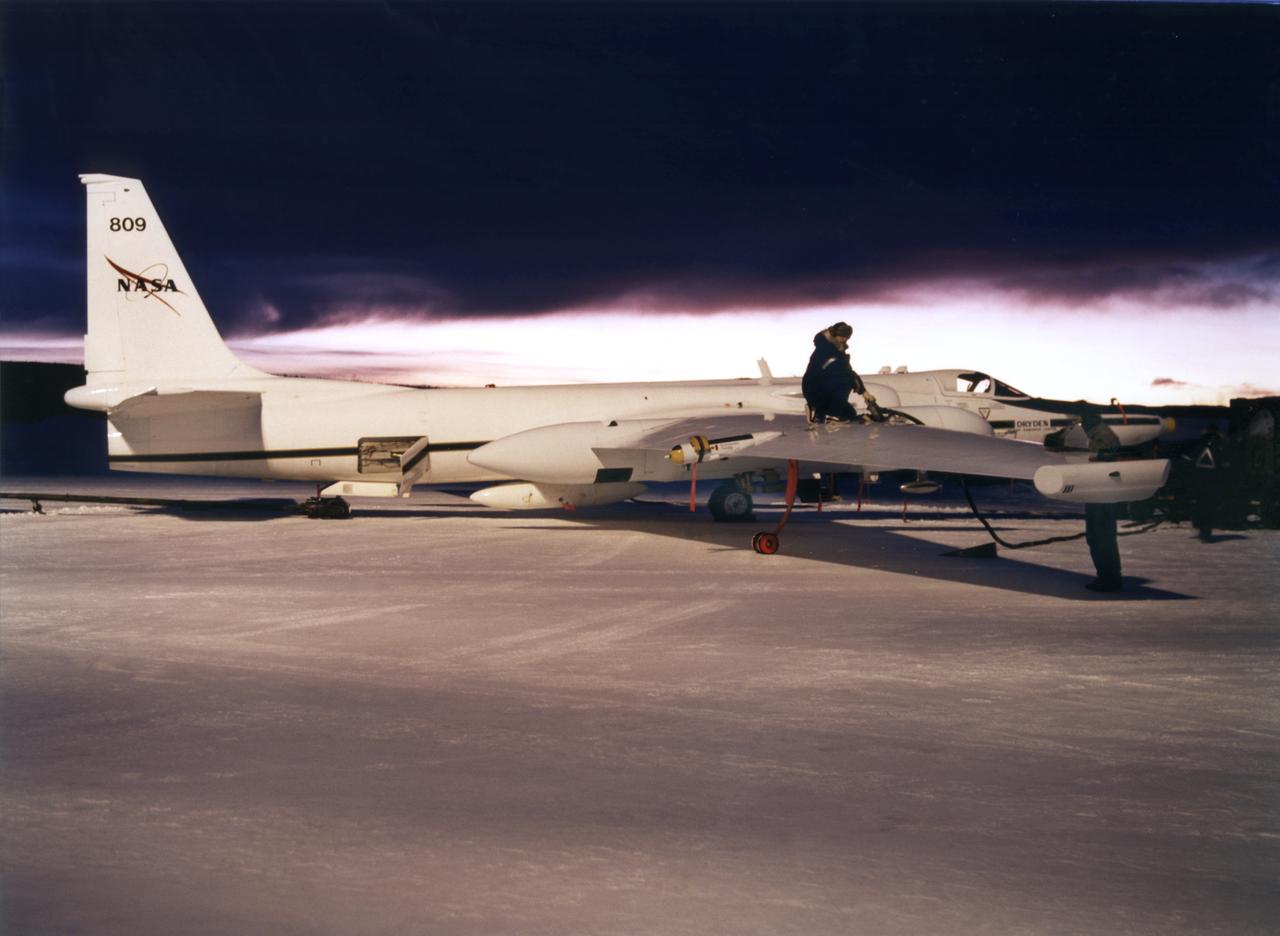
ER-2s bearing tail numbers 806 and 809 are used as airborne science platforms by NASA's Dryden Flight Research Center. The aircraft are platforms for a variety of high-altitude science missions flown over various parts of the world. They are also used for earth science and atmospheric sensor research and development, satellite calibration and data validation. The ER-2s are capable of carrying a maximum payload of 2,600 pounds of experiments in a nose bay, the main equipment bay behind the cockpit, two wing-mounted superpods and small underbody and trailing edges. Most ER-2 missions last about six hours with ranges of about 2,200 nautical miles. The aircraft typically fly at altitudes above 65,000 feet. On November 19, 1998, an ER-2 set a world record for medium weight aircraft reaching an altitude of 68,700 feet. The aircraft is 63 feet long, with a wingspan of 104 feet. The top of the vertical tail is 16 feet above ground when the aircraft is on the bicycle-type landing gear. Cruising speeds are 410 knots, or 467 miles per hour, at altitude. A single General Electric F-118 turbofan engine rated at 17,000 pounds thrust powers the ER-2.
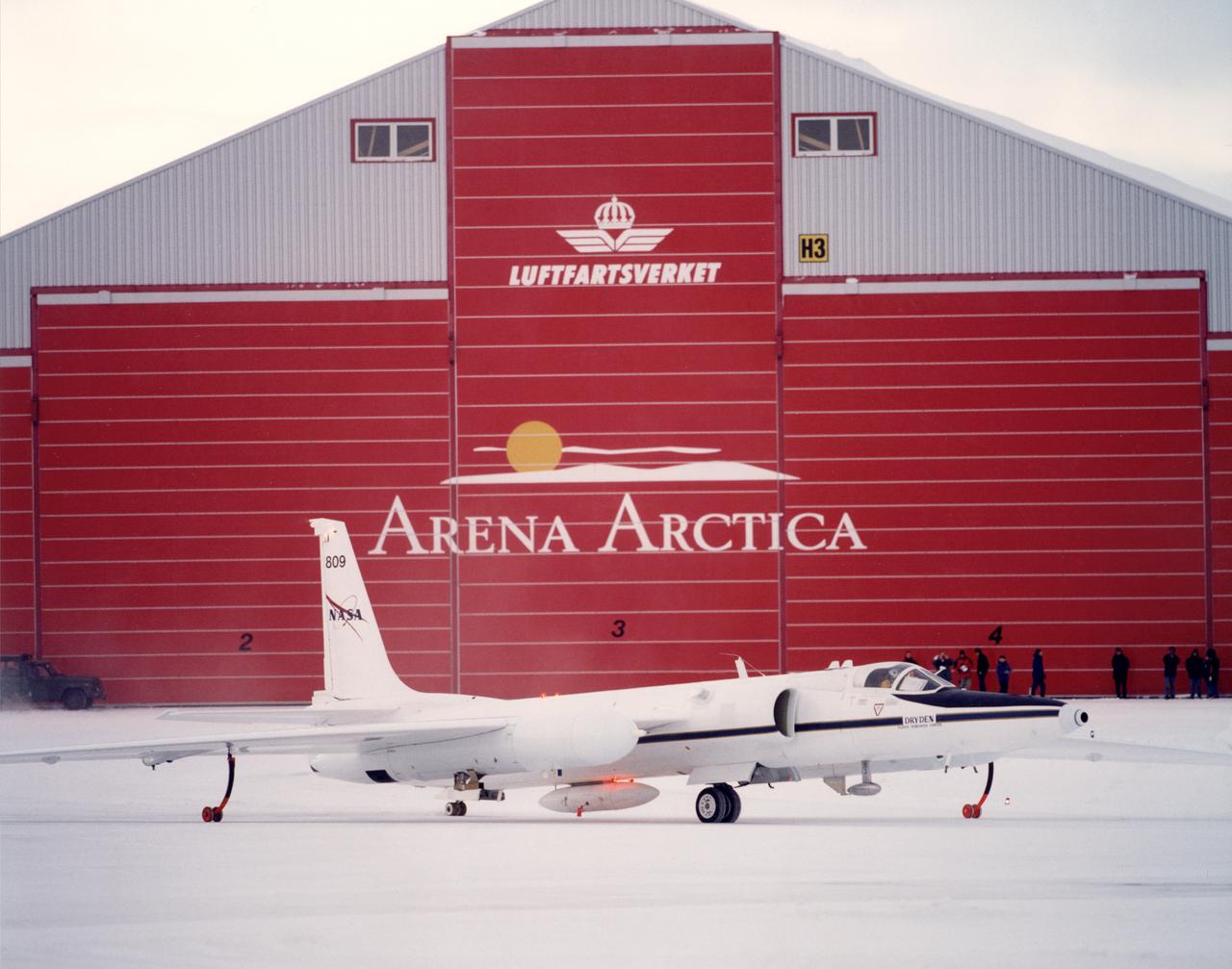
ER-2s bearing tail numbers 806 and 809 are used as airborne science platforms by NASA's Dryden Flight Research Center. The aircraft are platforms for a variety of high-altitude science missions flown over various parts of the world. They are also used for earth science and atmospheric sensor research and development, satellite calibration and data validation. The ER-2s are capable of carrying a maximum payload of 2,600 pounds of experiments in a nose bay, the main equipment bay behind the cockpit, two wing-mounted superpods and small underbody and trailing edges. Most ER-2 missions last about six hours with ranges of about 2,200 nautical miles. The aircraft typically fly at altitudes above 65,000 feet. On November 19, 1998, an ER-2 set a world record for medium weight aircraft reaching an altitude of 68,700 feet. The aircraft is 63 feet long, with a wingspan of 104 feet. The top of the vertical tail is 16 feet above ground when the aircraft is on the bicycle-type landing gear. Cruising speeds are 410 knots, or 467 miles per hour, at altitude. A single General Electric F-118 turbofan engine rated at 17,000 pounds thrust powers the ER-2.

ER-2s bearing tail numbers 806 and 809 are used as airborne science platforms by NASA's Dryden Flight Research Center. The aircraft are platforms for a variety of high-altitude science missions flown over various parts of the world. They are also used for earth science and atmospheric sensor research and development, satellite calibration and data validation. The ER-2s are capable of carrying a maximum payload of 2,600 pounds of experiments in a nose bay, the main equipment bay behind the cockpit, two wing-mounted superpods and small underbody and trailing edges. Most ER-2 missions last about six hours with ranges of about 2,200 nautical miles. The aircraft typically fly at altitudes above 65,000 feet. On November 19, 1998, an ER-2 set a world record for medium weight aircraft reaching an altitude of 68,700 feet. The aircraft is 63 feet long, with a wingspan of 104 feet. The top of the vertical tail is 16 feet above ground when the aircraft is on the bicycle-type landing gear. Cruising speeds are 410 knots, or 467 miles per hour, at altitude. A single General Electric F-118 turbofan engine rated at 17,000 pounds thrust powers the ER-2.
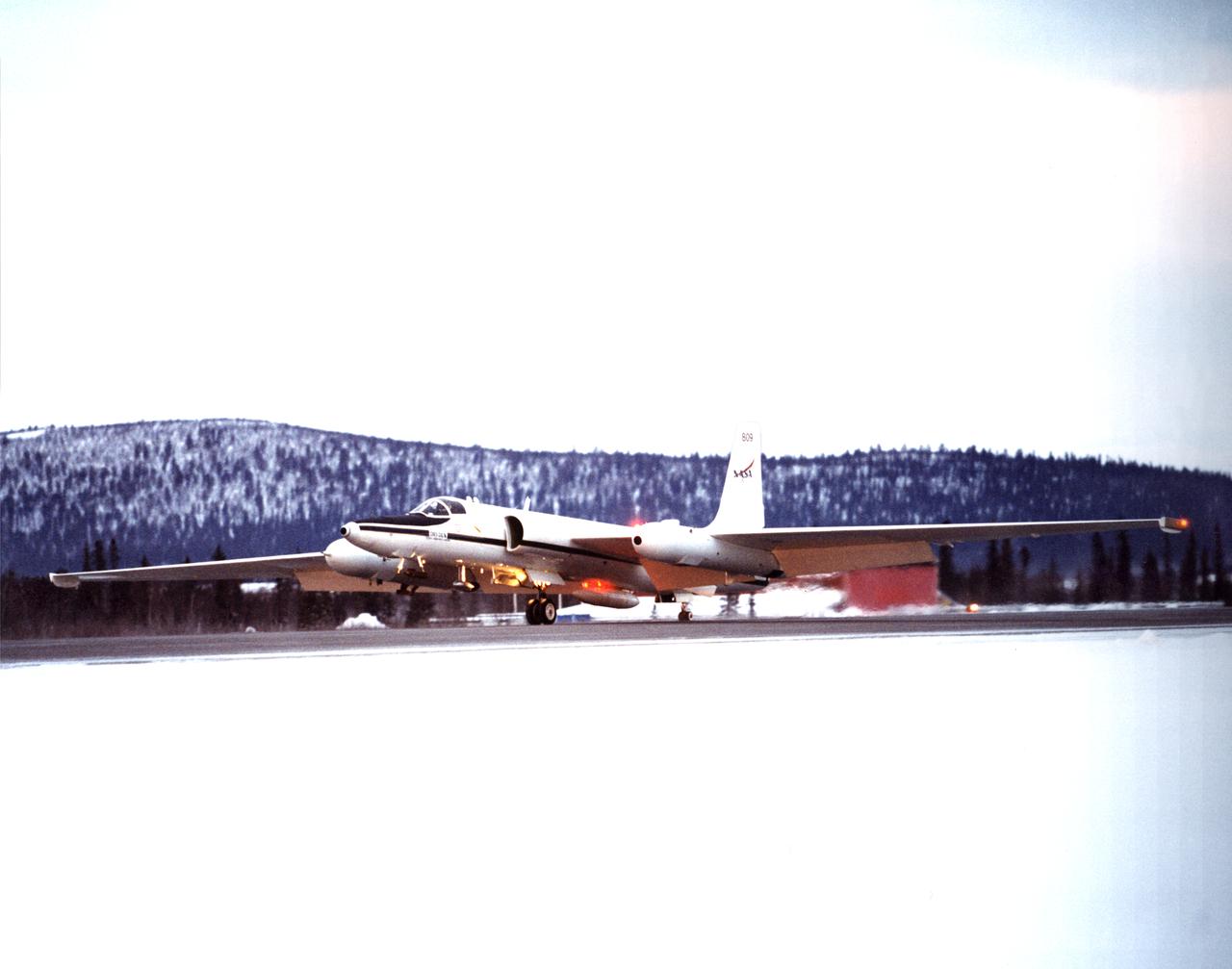
ER-2s bearing tail numbers 806 and 809 are used as airborne science platforms by NASA's Dryden Flight Research Center. The aircraft are platforms for a variety of high-altitude science missions flown over various parts of the world. They are also used for earth science and atmospheric sensor research and development, satellite calibration and data validation. The ER-2s are capable of carrying a maximum payload of 2,600 pounds of experiments in a nose bay, the main equipment bay behind the cockpit, two wing-mounted superpods and small underbody and trailing edges. Most ER-2 missions last about six hours with ranges of about 2,200 nautical miles. The aircraft typically fly at altitudes above 65,000 feet. On November 19, 1998, an ER-2 set a world record for medium weight aircraft reaching an altitude of 68,700 feet. The aircraft is 63 feet long, with a wingspan of 104 feet. The top of the vertical tail is 16 feet above ground when the aircraft is on the bicycle-type landing gear. Cruising speeds are 410 knots, or 467 miles per hour, at altitude. A single General Electric F-118 turbofan engine rated at 17,000 pounds thrust powers the ER-2.
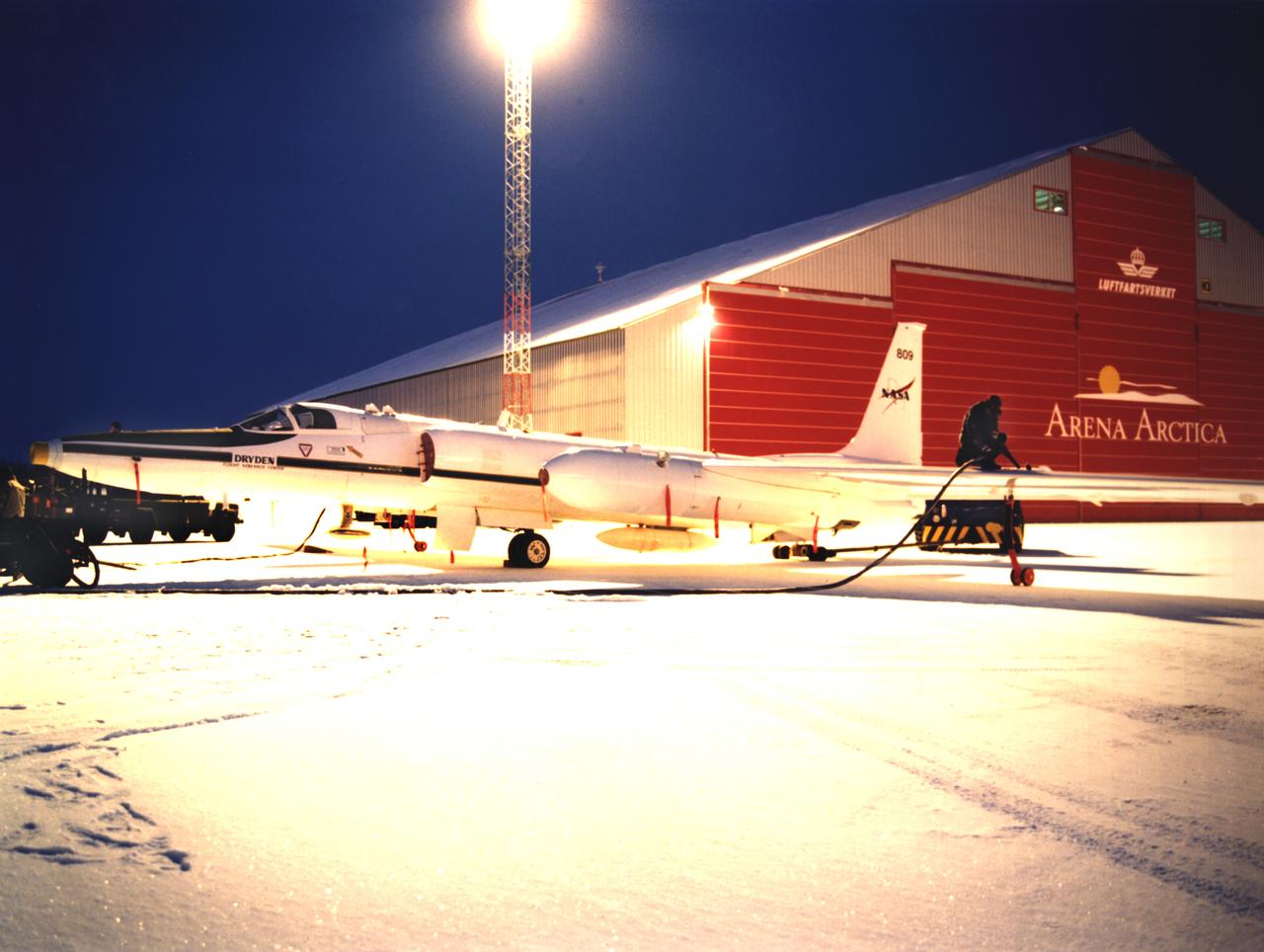
ER-2s bearing tail numbers 806 and 809 are used as airborne science platforms by NASA's Dryden Flight Research Center. The aircraft are platforms for a variety of high-altitude science missions flown over various parts of the world. They are also used for earth science and atmospheric sensor research and development, satellite calibration and data validation. The ER-2s are capable of carrying a maximum payload of 2,600 pounds of experiments in a nose bay, the main equipment bay behind the cockpit, two wing-mounted superpods and small underbody and trailing edges. Most ER-2 missions last about six hours with ranges of about 2,200 nautical miles. The aircraft typically fly at altitudes above 65,000 feet. On November 19, 1998, an ER-2 set a world record for medium weight aircraft reaching an altitude of 68,700 feet. The aircraft is 63 feet long, with a wingspan of 104 feet. The top of the vertical tail is 16 feet above ground when the aircraft is on the bicycle-type landing gear. Cruising speeds are 410 knots, or 467 miles per hour, at altitude. A single General Electric F-118 turbofan engine rated at 17,000 pounds thrust powers the ER-2.
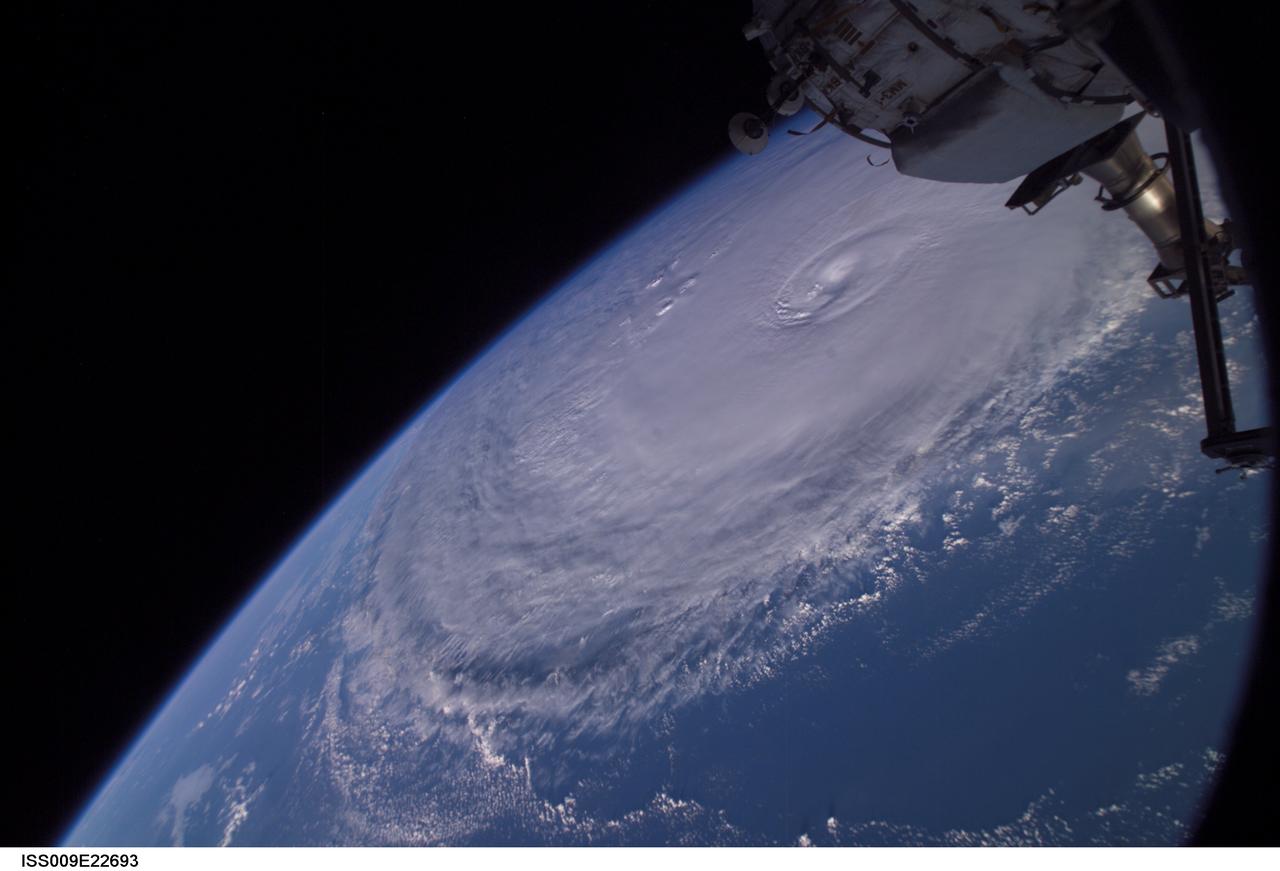
ISS009-E-22693 (14 September 2004) --- Hurricane Ivan was photographed as it churned in the Gulf of Mexico late Tuesday (23:06:23 GMT, Sept. 14) by astronaut Edward M. (Mike) Fincke aboard the International Space Station, 230 miles above Earth. At the time, Ivan was a category 4 hurricane with winds of 140 mph. Fincke, the NASA Station Science Officer, and Station Commander Gennady Padalka are in the final month of a six-month mission aboard the research platform.
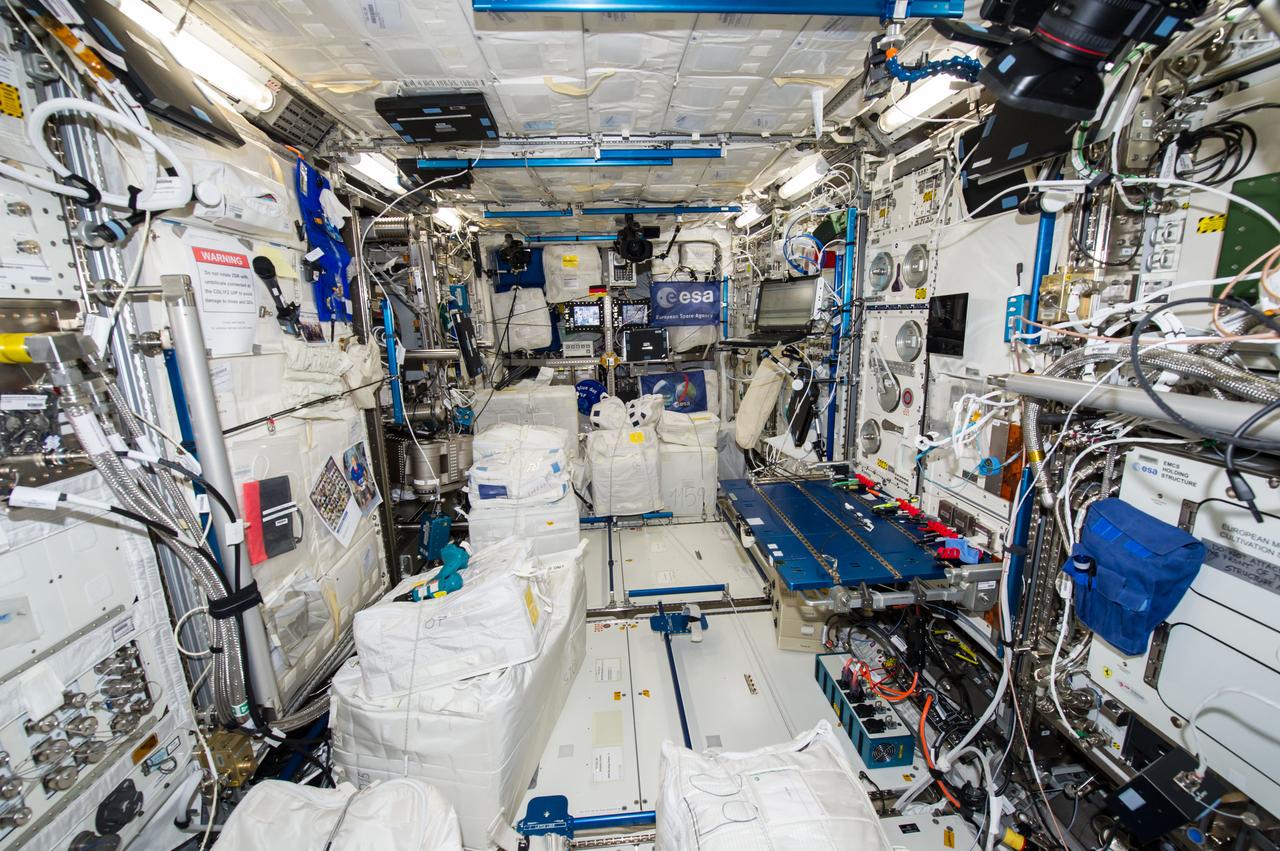
iss041e000170 (9/11/2020) --- A view of the Columbus Module aboard the International Space Stations (ISS). The Columbus laboratory is Europe’s largest contribution to the International Space Station. Columbus is a multifunctional pressurized laboratory permanently attached to the Harmony Module. The lab allows researchers on the ground, aided by the station’s crew, to conduct a wide variety of research in a weightless environment. In addition, experiments and applications can be conducted outside the module in the vacuum of space, thanks to four exterior mounting platforms that can accommodate external payloads in space science, Earth observation and technology.
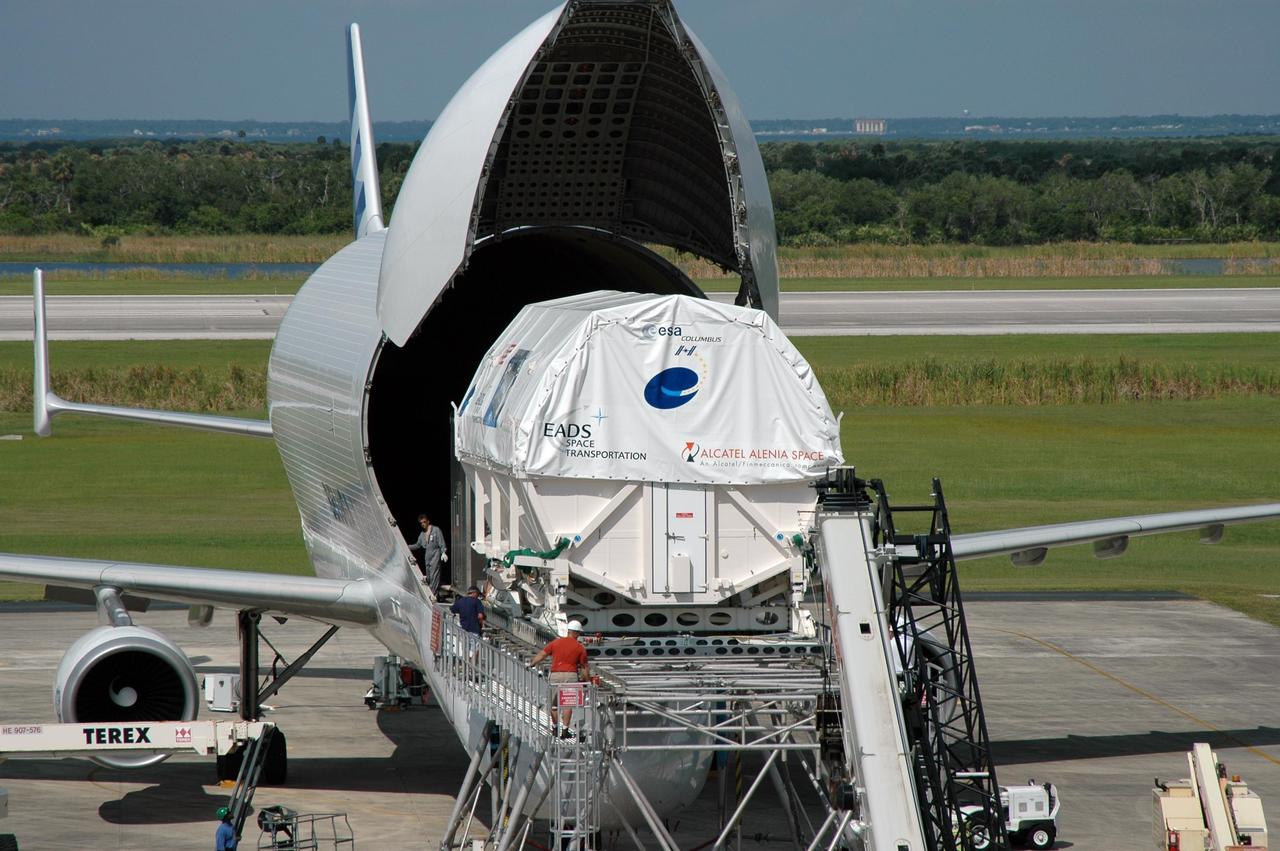
KENNEDY SPACE CENTER, FLA. - At the Shuttle Landing Facility, the European Space Agency's research laboratory, designated Columbus, slides out onto an Airbus Transport International platform. The module will be lifted onto a flat bed truck and transported to the Space Station Processing Facility. In the SSPF, the module will be prepared for delivery to the International Space Station on a future space shuttle mission. Columbus will expand the research facilities of the station and provide researchers with the ability to conduct numerous experiments in the area of life, physical and materials sciences. Photo credit: NASA/Jim Grossmann
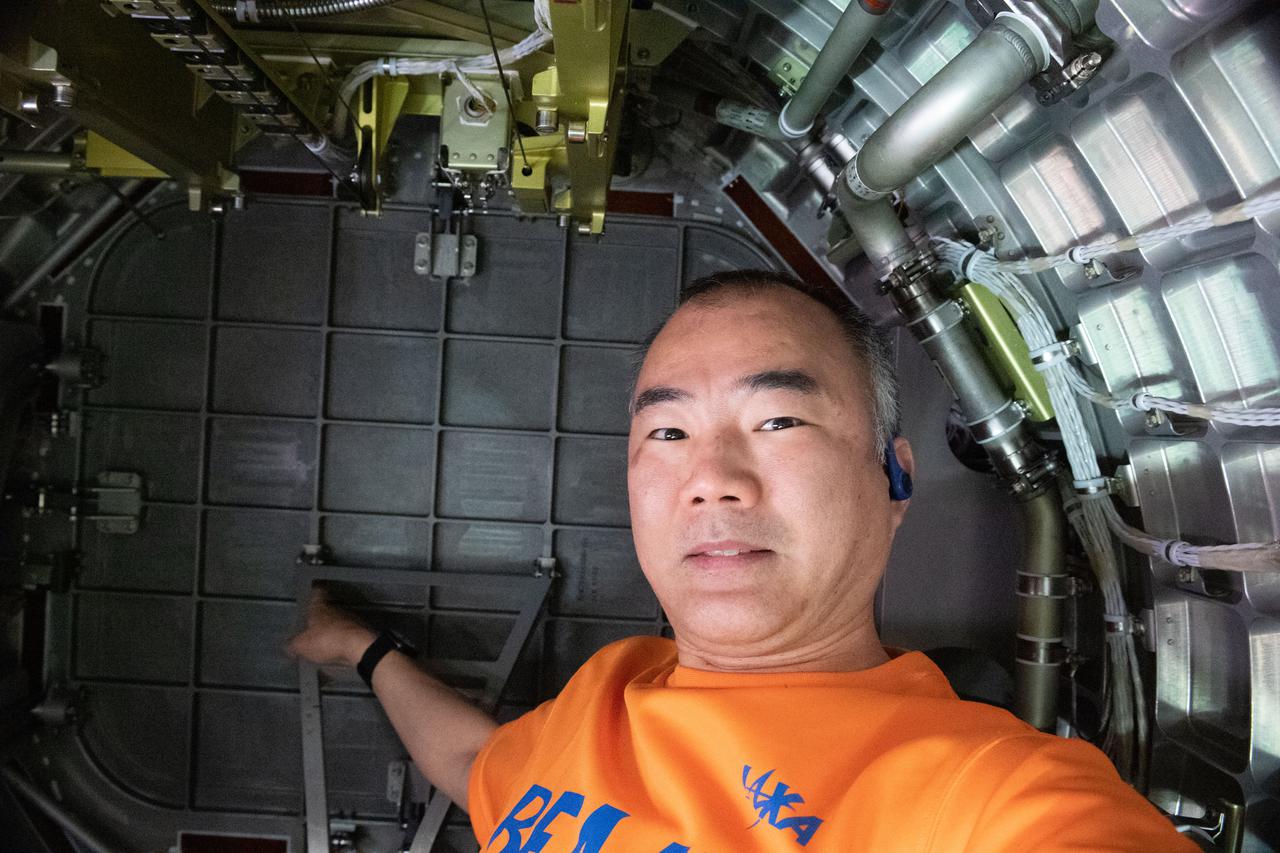
iss064e040776 (March 10, 2021) --- JAXA (Japan Aerospace Exploration Agency) astronaut Soichi Noguchi is pictured inside the Kibo laboratory module's airlock. Experiments and microsatellites, or CubeSats, are staged inside the airlock for deployment into the external environment of space. The airlock is then closed and depressurized before the Japanese robotic arm grapples the experiments and installs them on an external science platform outside Kibo. The CubeSats are ejected into Earth orbit from a small satellite deployer gripped at the end of the Japanese robotic arm.
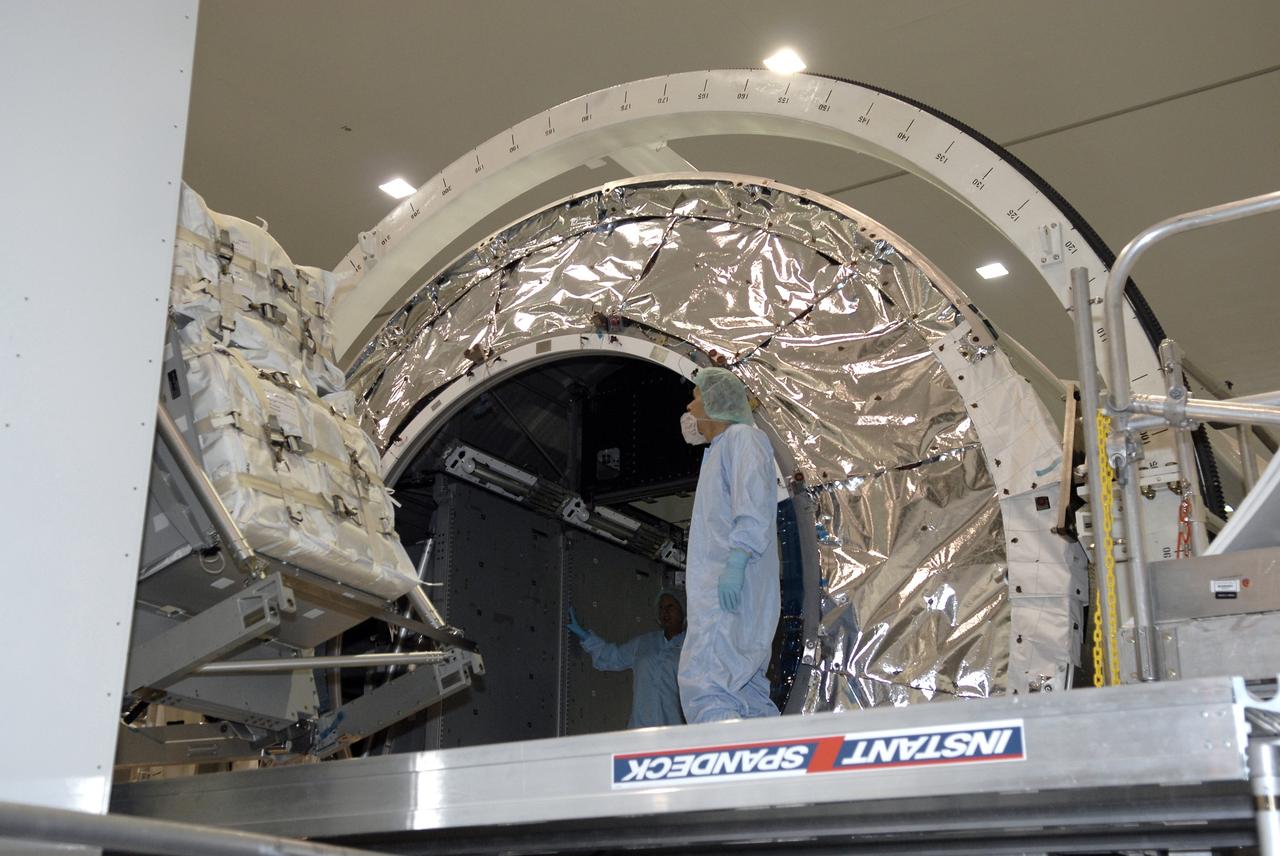
CAPE CANAVERAL, Fla. – In the Space Station Processing Facility at NASA's Kennedy Space Center in Florida, the rack insertion device moves the Resupply Stowage Platform, or RSP, toward the opening in the multi-purpose logistics module Leonardo. The module is part of the payload for space shuttle Discovery's STS-128 mission. Discovery will carry science and storage racks to the International Space Station . Launch of Discovery is targeted for Aug. 6. Photo credit: NASA/Kim Shiflett
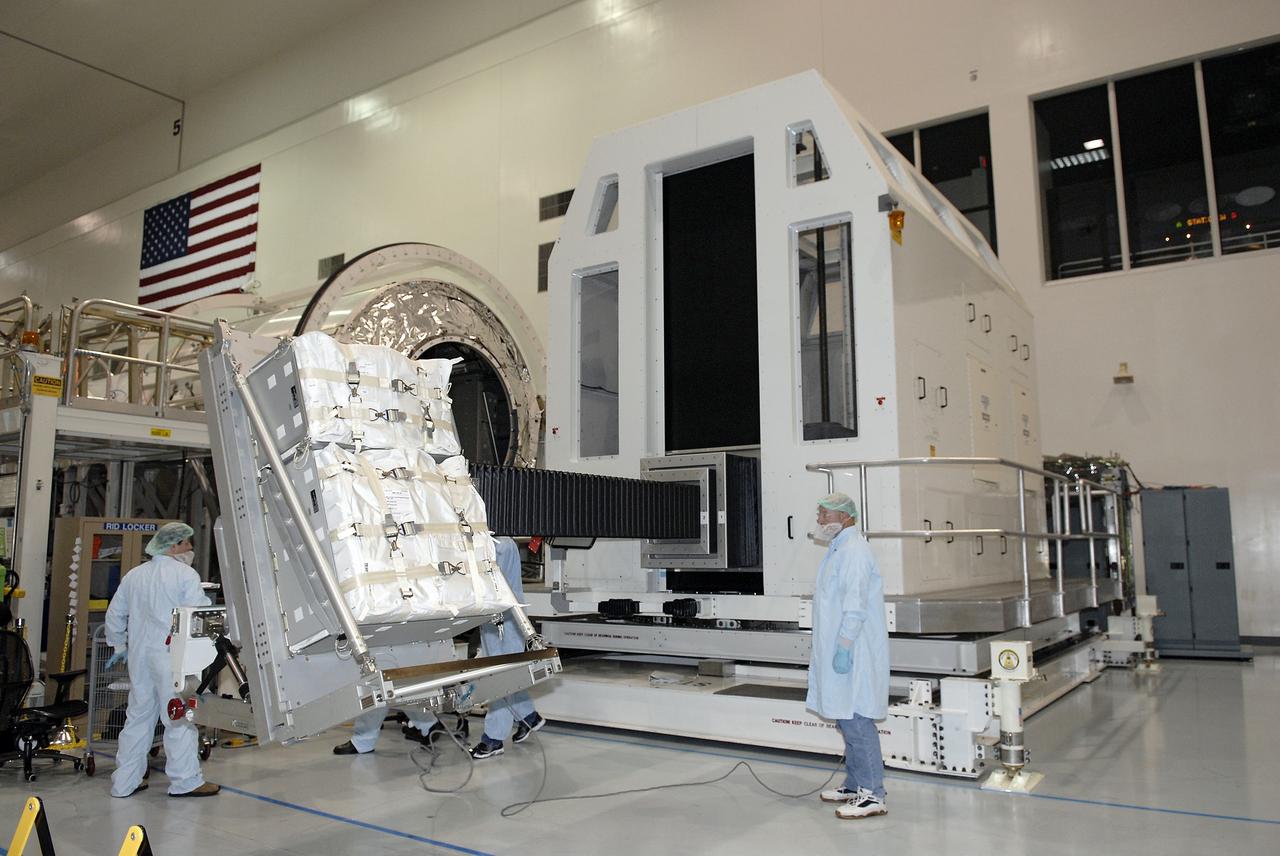
CAPE CANAVERAL, Fla. – In the Space Station Processing Facility at NASA's Kennedy Space Center in Florida, the rack insertion device lifts the Resupply Stowage Platform, or RSP, for installation in the multi-purpose logistics module Leonardo. The module is part of the payload for space shuttle Discovery's STS-128 mission. Discovery will carry science and storage racks to the International Space Station . Launch of Discovery is targeted for Aug. 6. Photo credit: NASA/Kim Shiflett
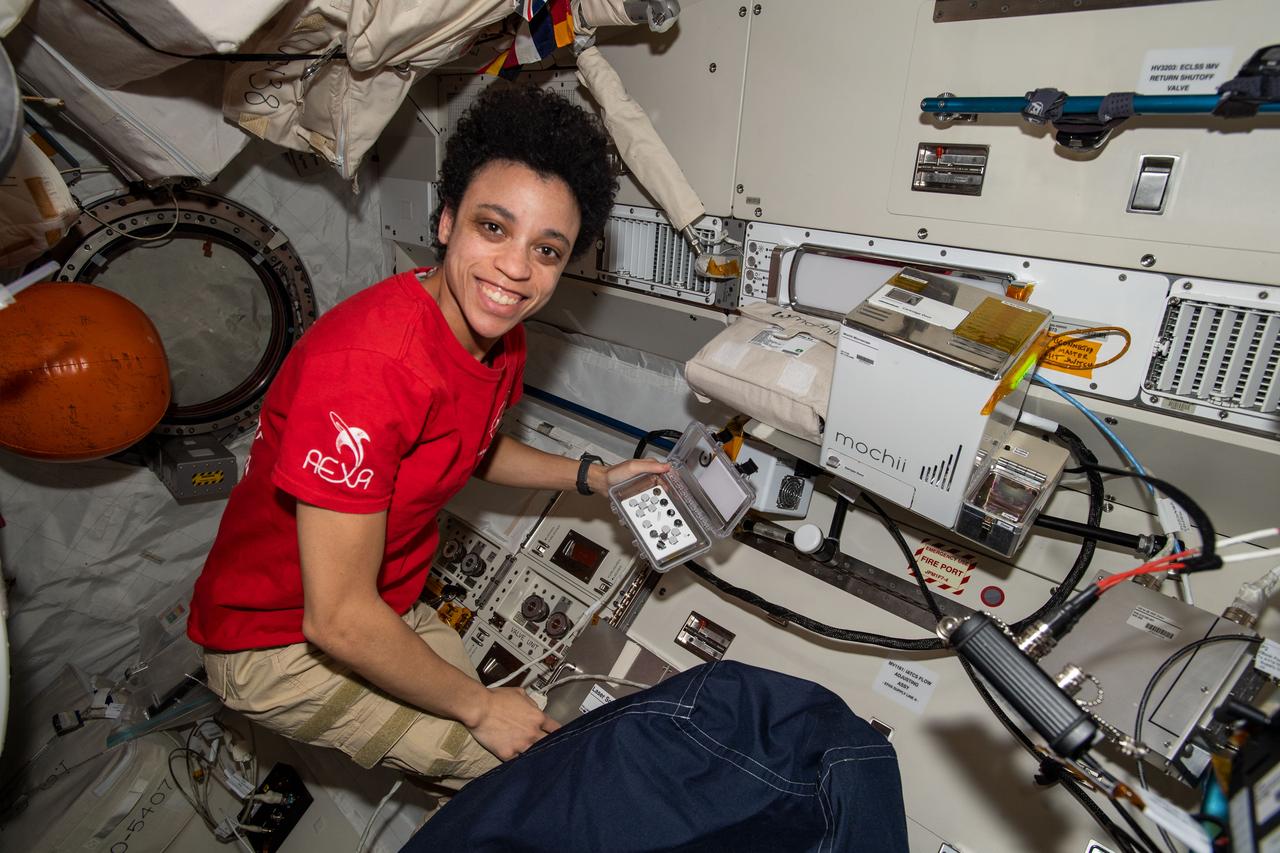
iss068e016422 (Oct. 12, 2022) --- NASA astronaut and Expedition 68 Flight Engineer Jessica Watkins works with Mochii, a miniature scanning electron microscope (SEM) with spectroscopy to conduct real-time, on-site imaging and compositional measurements of particles on the International Space Station (ISS). Such particles can cause vehicle and equipment malfunctions and threaten crew health, but currently, samples must be returned to Earth for analysis, leaving crew and vehicle at risk. Mochii also provides a powerful new analysis platform to support novel microgravity science and engineering.
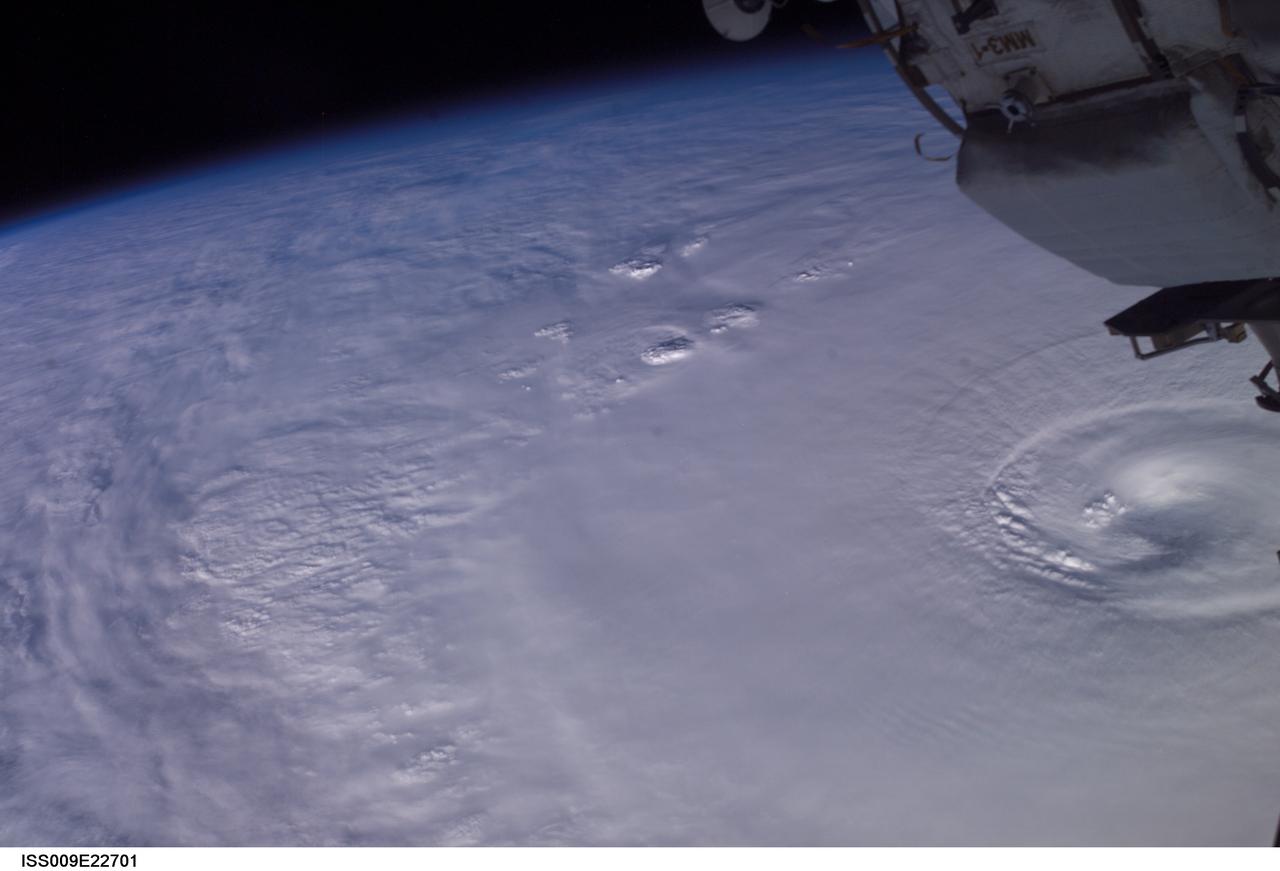
ISS009-E-22701 (14 September 2004) --- Hurricane Ivan was photographed as it churned in the Gulf of Mexico late Tuesday (23:06:56 GMT, Sept. 14) by astronaut Edward M. (Mike) Fincke aboard the International Space Station, 230 miles above Earth. At the time, Ivan was a category 4 hurricane with winds of 140 mph. Fincke, the NASA Station Science Officer, and Station Commander Gennady Padalka are in the final month of a six-month mission aboard the research platform.
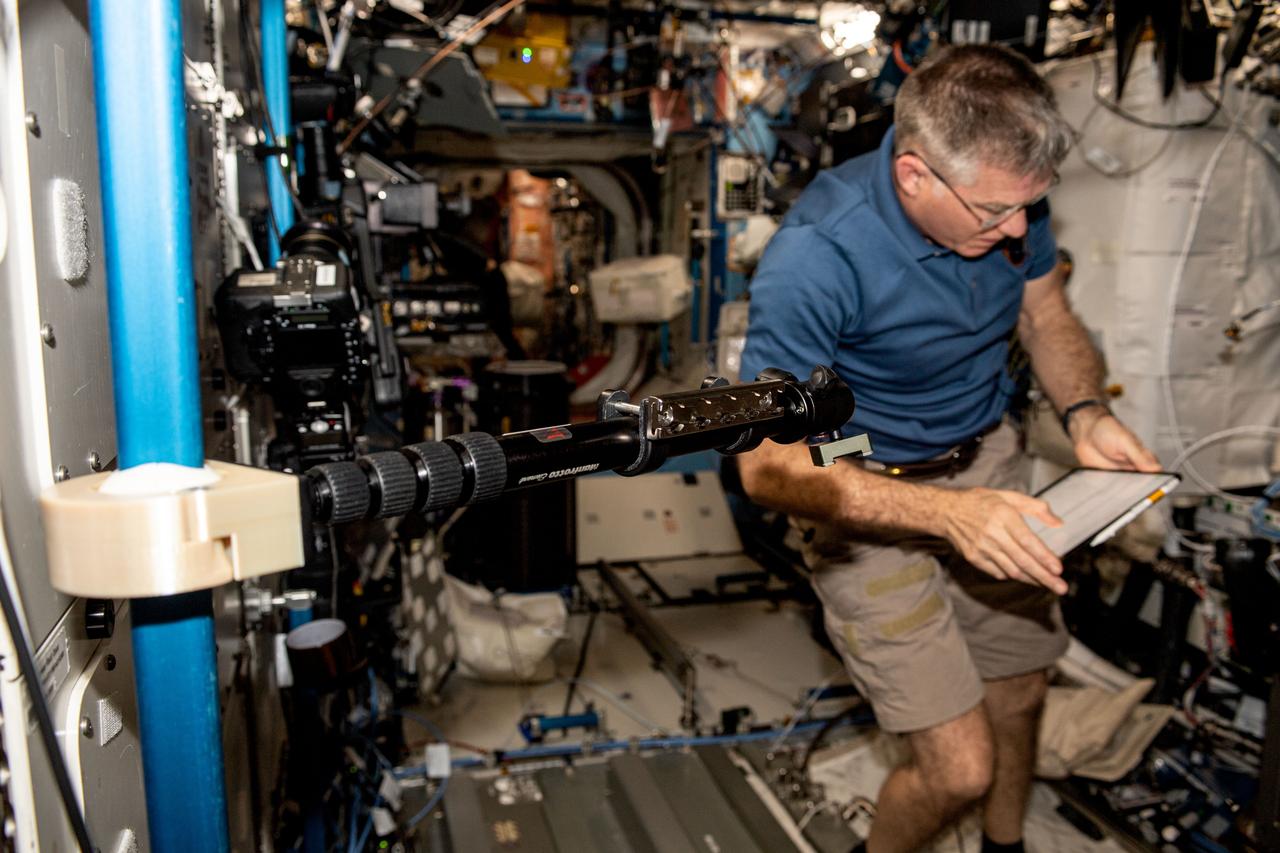
iss069e009786 (May 9, 2023) --- NASA astronaut and Expedition 69 Flight Engineer Stephen Bowen installs student-made hardware next to the Destiny laboratory module's Microgravity Science Glovebox. The High school students United with NASA to Create Hardware (HUNCH) Ball Clamp Monopod (HUNCH Ball Clamp Monopod) investigation tests a platform for holding cameras used to track targets on the ground or take images and video within space station modules
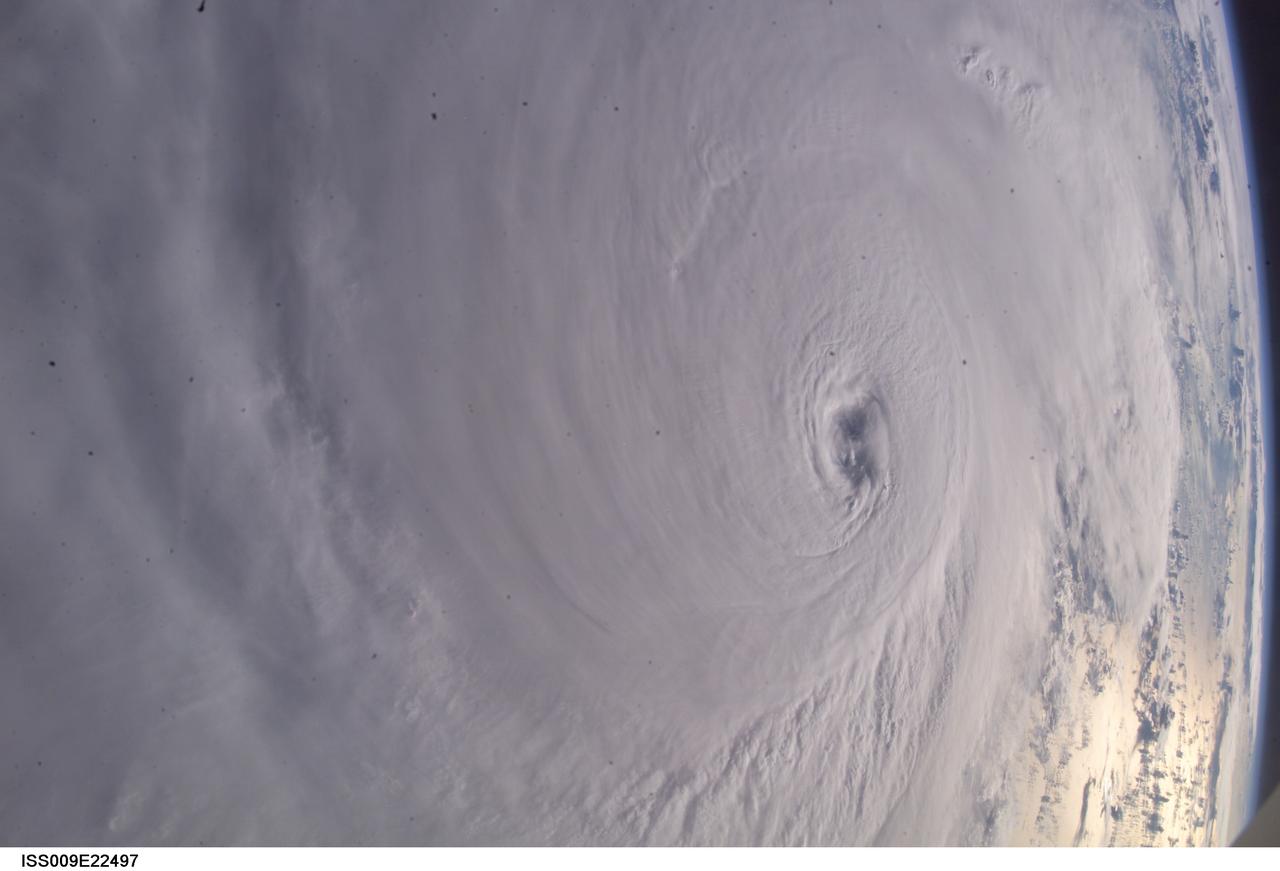
ISS009-E-22497 (13 September 2004) --- Hurricane Ivan was photographed as it entered the Gulf of Mexico late Monday (22:39:23 GMT, Sept. 13) by astronaut Edward M. (Mike) Fincke aboard the International Space Station, 230 miles above Earth. At the time, Ivan was a category 5 hurricane with winds of 160 mph. Fincke, the NASA Station Science Officer, and Station Commander Gennady Padalka are in the final month of a six-month mission aboard the research platform.
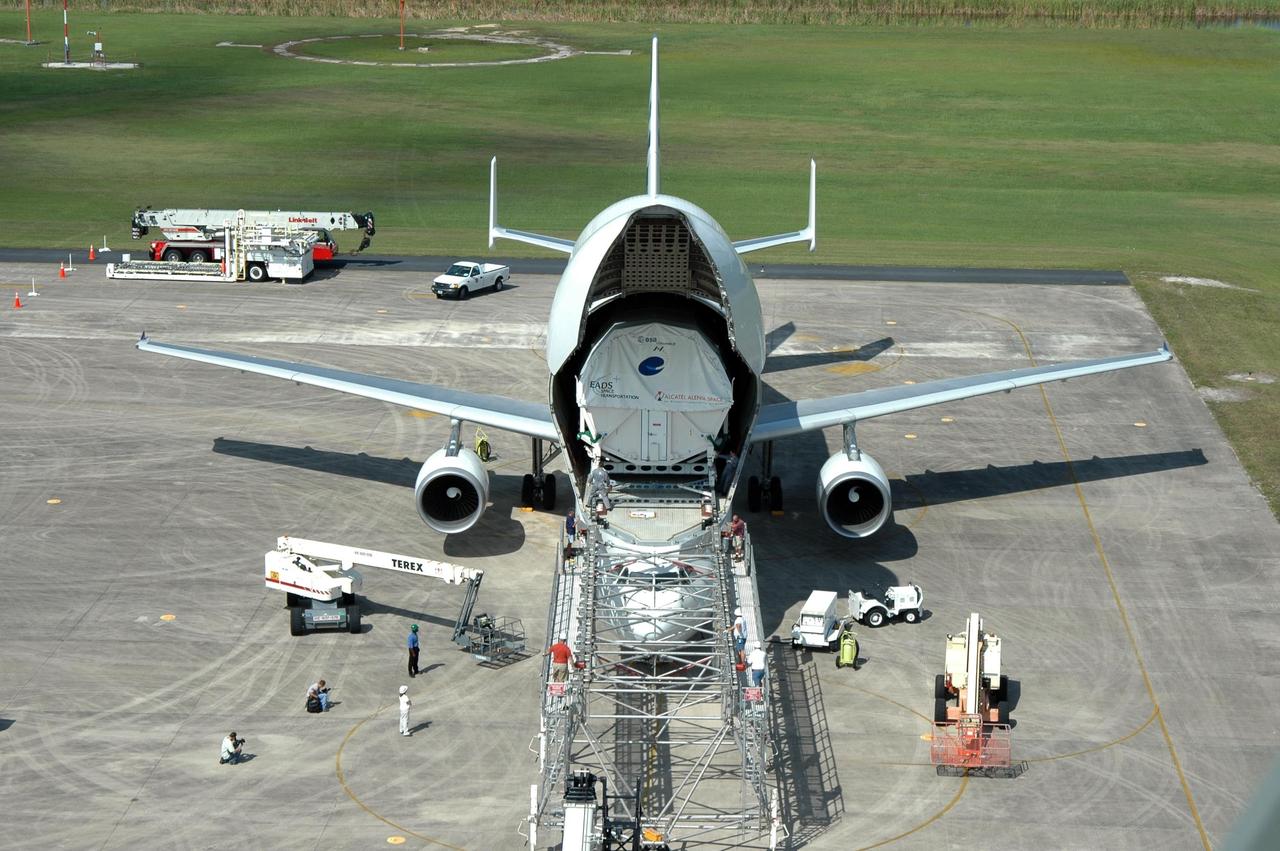
KENNEDY SPACE CENTER, FLA. - At the Shuttle Landing Facility, the European Space Agency's research laboratory, designated Columbus, is being offloaded onto an Airbus Transport International platform. The module will be lifted onto a flat bed truck and transported to the Space Station Processing Facility. There the module will be prepared for delivery to the International Space Station on a future space shuttle mission. Columbus will expand the research facilities of the station and provide researchers with the ability to conduct numerous experiments in the area of life, physical and materials sciences. Photo credit: NASA/Jim Grossmann
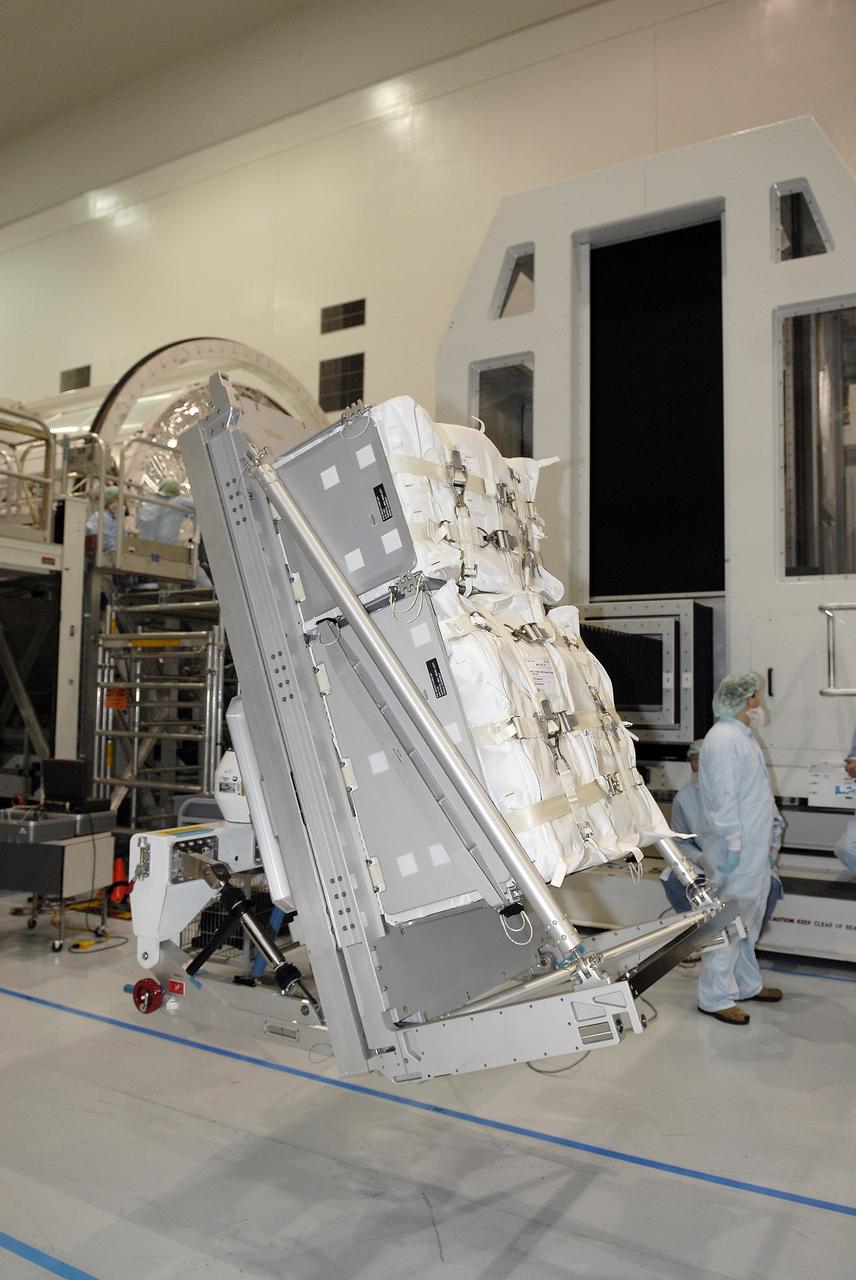
CAPE CANAVERAL, Fla. – In the Space Station Processing Facility at NASA's Kennedy Space Center in Florida, the Resupply Stowage Platform, or RSP, is ready for installation in the multi-purpose logistics module Leonardo. The module is part of the payload for space shuttle Discovery's STS-128 mission. Discovery will carry science and storage racks to the International Space Station . Launch of Discovery is targeted for Aug. 6. Photo credit: NASA/Kim Shiflett
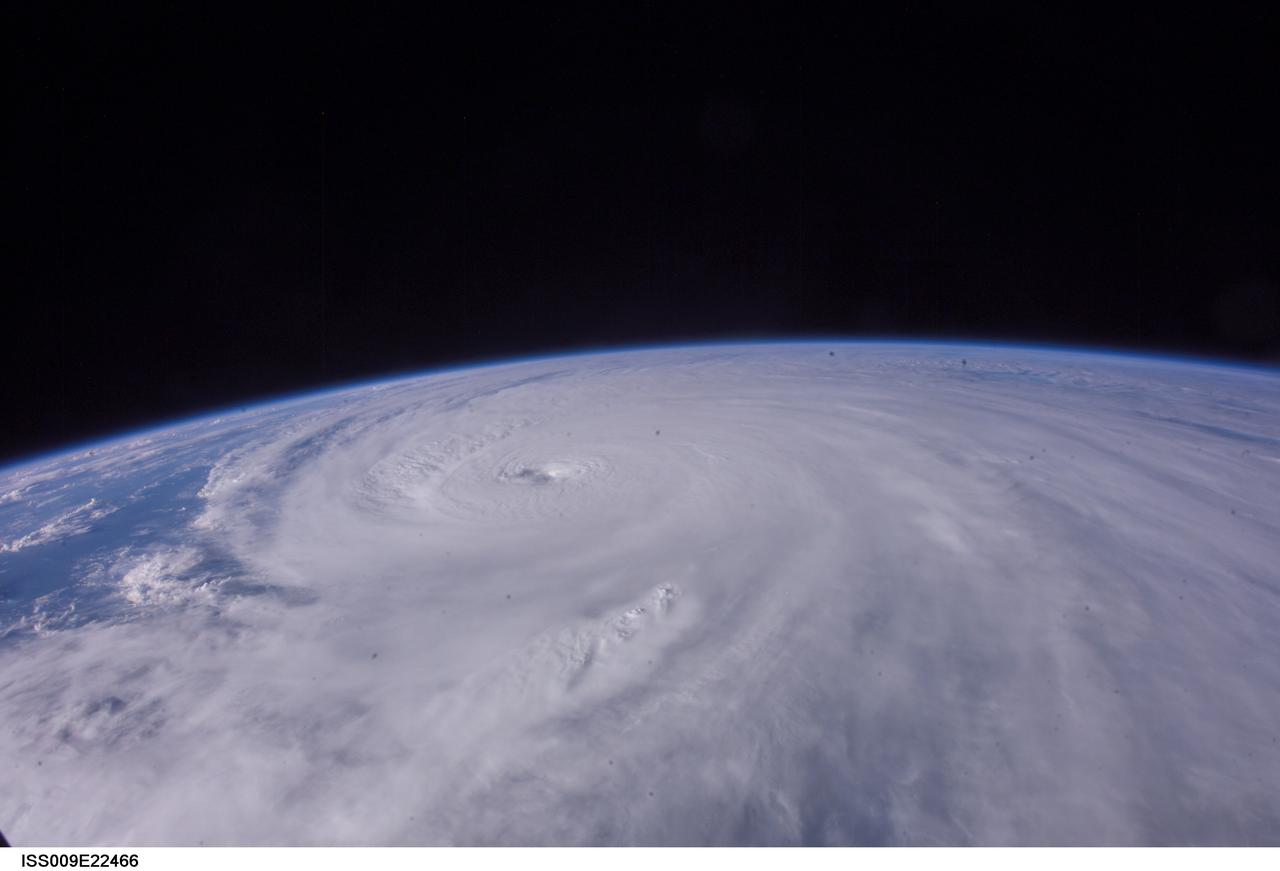
ISS009-E-22466 (13 September 2004) --- Hurricane Ivan was photographed as it entered the Gulf of Mexico late Monday (22:36:31 GMT, Sept. 13) by astronaut Edward M. (Mike) Fincke aboard the International Space Station, 230 miles above Earth. At the time, Ivan was a category 5 hurricane with winds of 160 mph. Fincke, the NASA Station Science Officer, and Station Commander Gennady Padalka are in the final month of a six-month mission aboard the research platform.
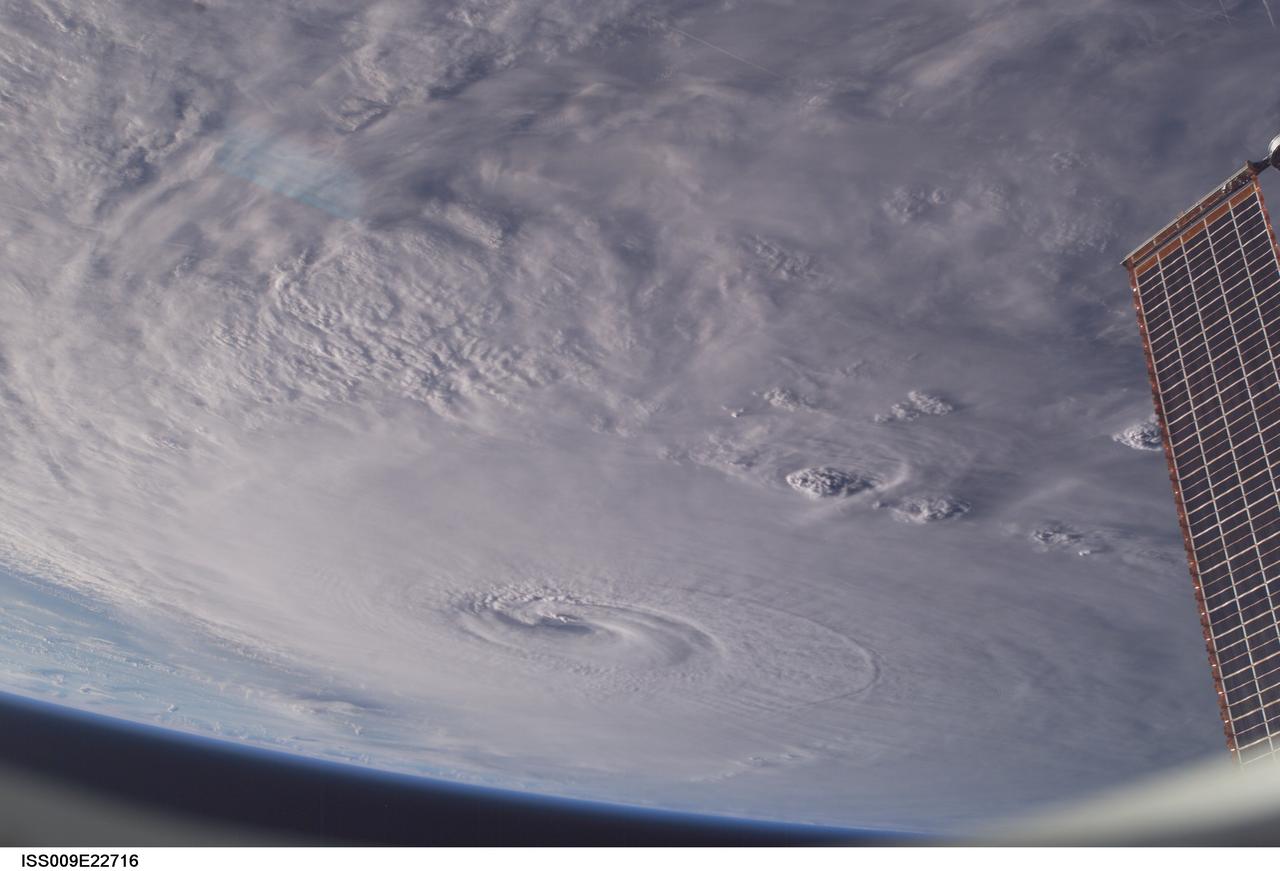
ISS009-E-22716 (14 September 2004) --- Hurricane Ivan was photographed as it churned in the Gulf of Mexico late Tuesday (23:09:41 GMT, Sept. 14) by astronaut Edward M. (Mike) Fincke aboard the International Space Station, 230 miles above Earth. At the time, Ivan was a category 4 hurricane with winds of 140 mph. Fincke, the NASA Station Science Officer, and Station Commander Gennady Padalka are in the final month of a six-month mission aboard the research platform.
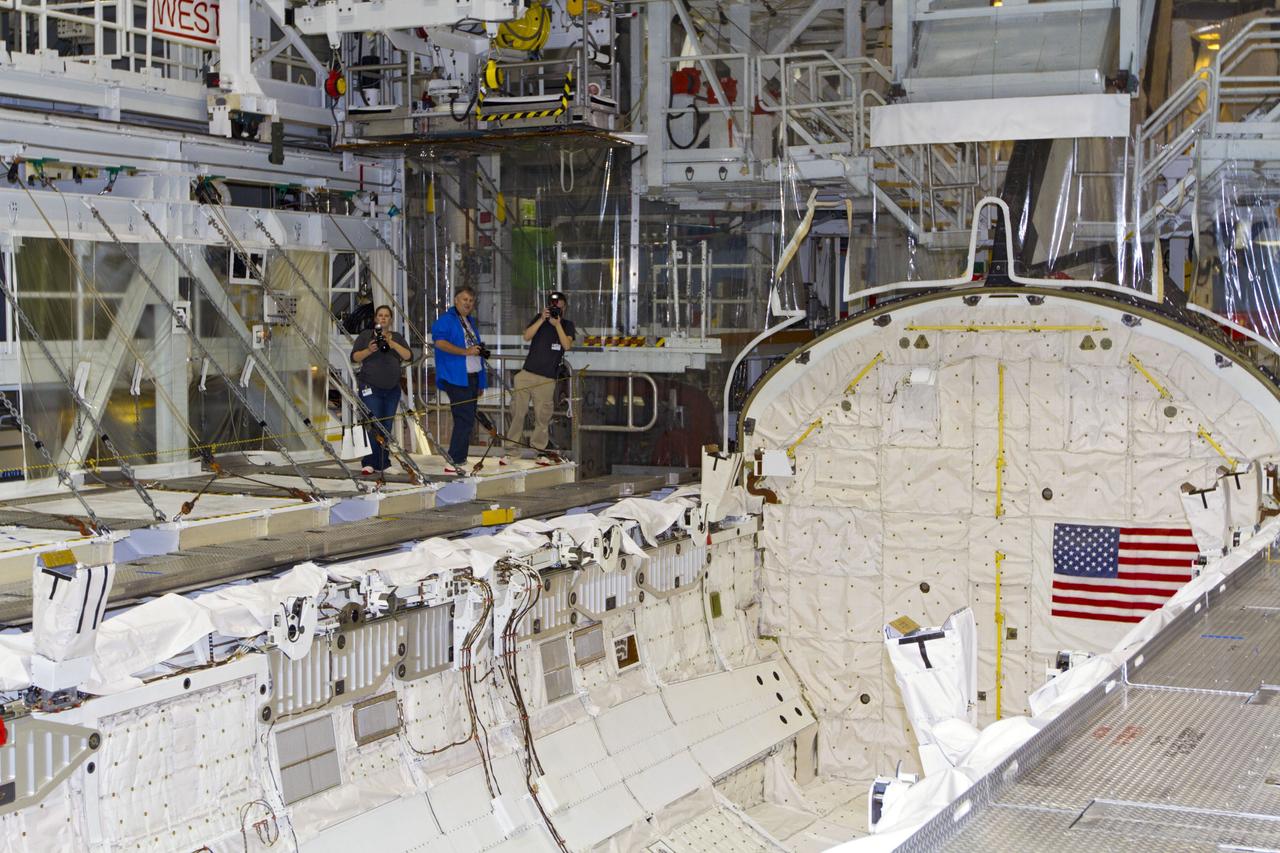
CAPE CANAVERAL, Fla. -- Positioned on a platform inside Orbiter Processing Facility-2 at NASA's Kennedy Space Center in Florida, members of the news media photograph space shuttle Endeavour's open payload bay. Ongoing transition and retirement activities are preparing the spacecraft for public display at the California Science Center in Los Angeles. Endeavour flew 25 missions during its 19-year career. Photo credit: NASA/Kim Shiflett
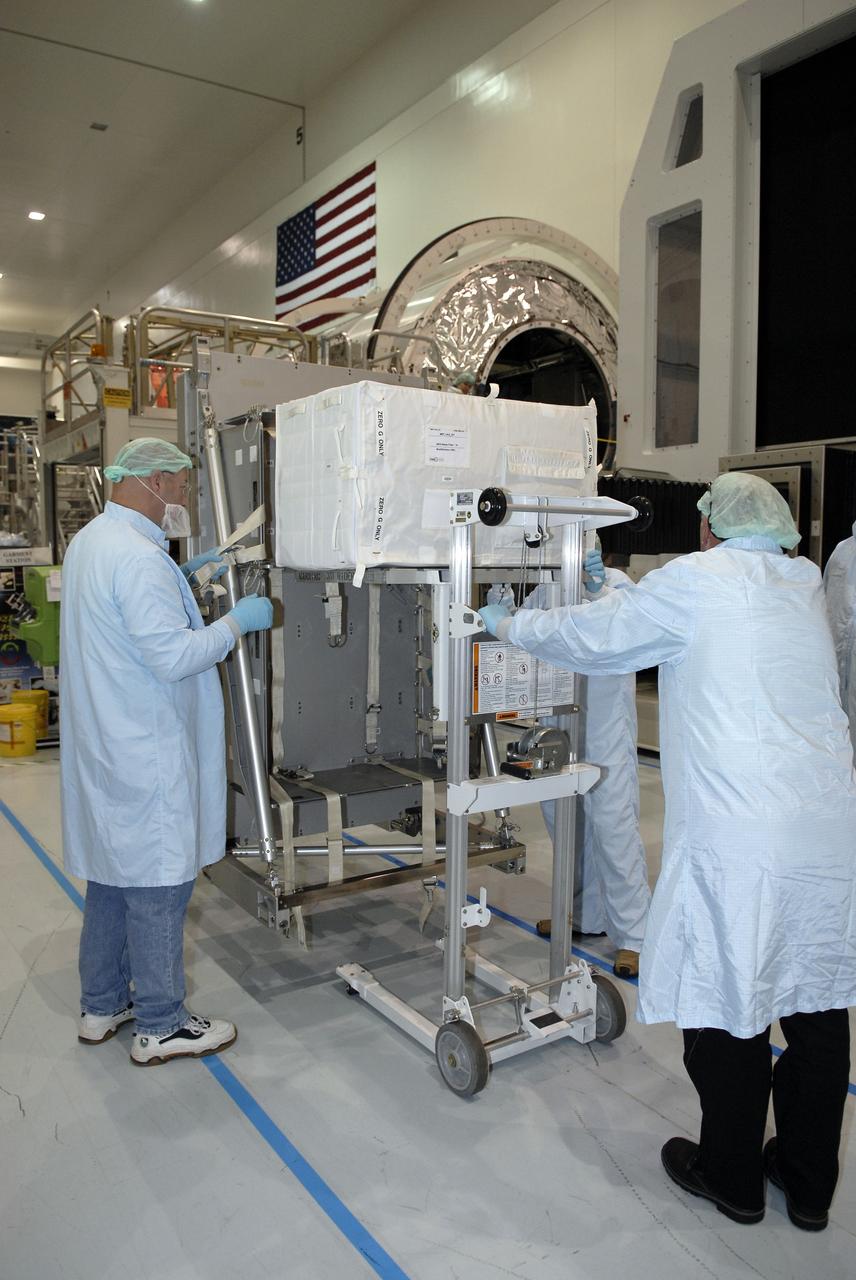
CAPE CANAVERAL, Fla. – In the Space Station Processing Facility at NASA's Kennedy Space Center in Florida, technicians maneuver the Resupply Stowage Platform, or RSP, toward the rack insertion device. The device will help install the RSP in the multi-purpose logistics module Leonardo. The module is part of the payload for space shuttle Discovery's STS-128 mission. Discovery will carry science and storage racks to the International Space Station . Launch of Discovery is targeted for Aug. 6. Photo credit: NASA/Kim Shiflett