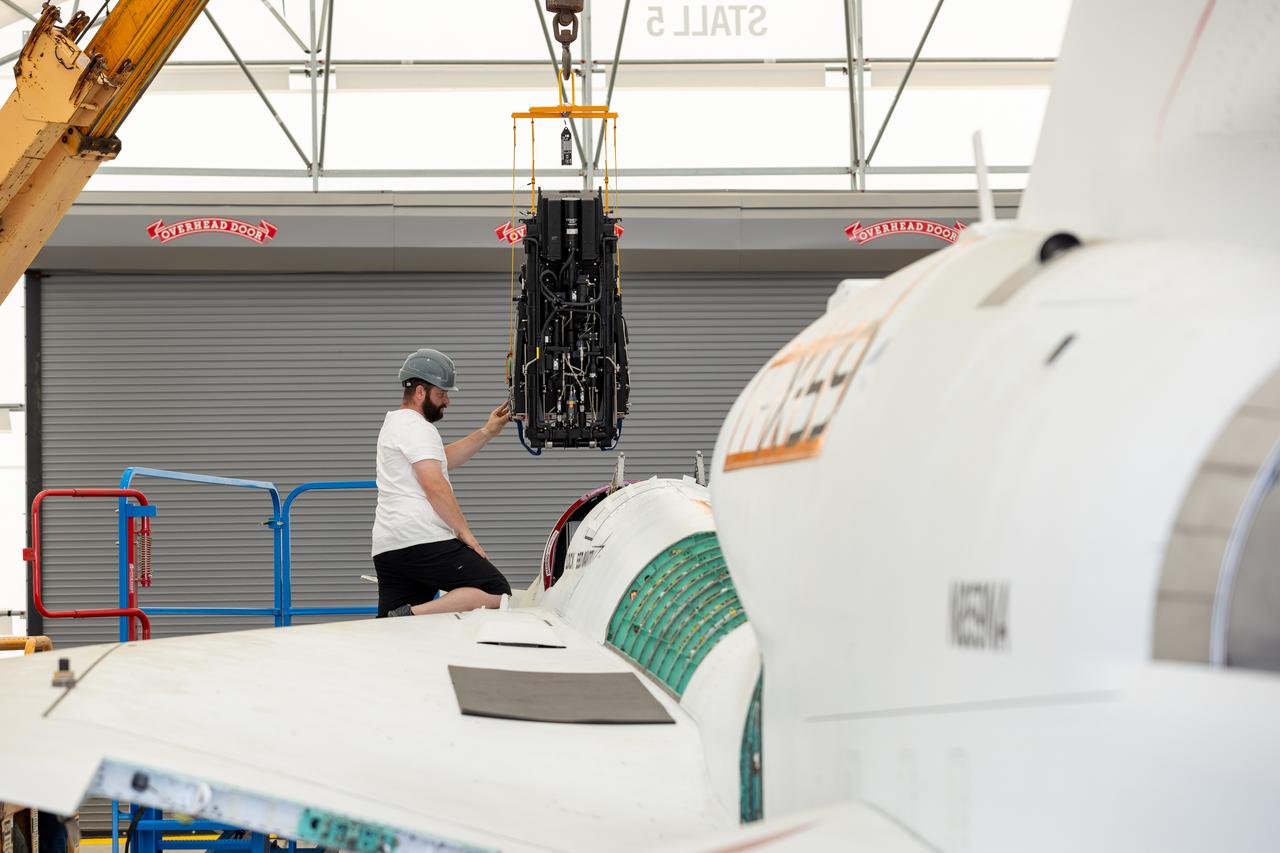
NASA Life Support Technician Mathew Sechler provides support as the X-59’s ejection seat is installed into the aircraft at Lockheed Martin Skunk Works’ facilities in Palmdale, California. Completion of the seat’s installation marks an integration milestone for the aircraft as it prepares for final ground tests.
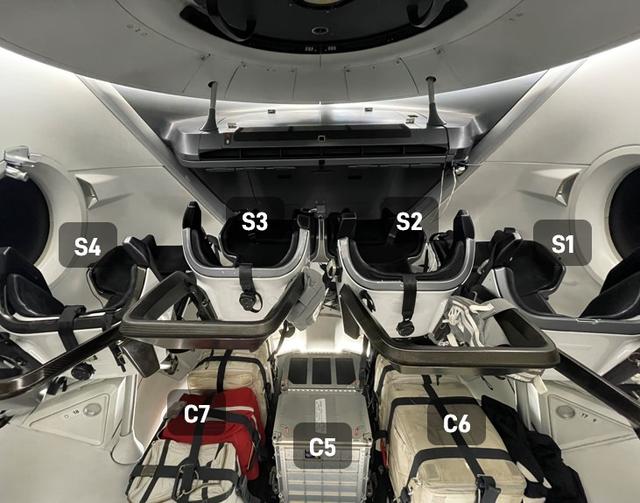
This is an interior image of a Dragon spacecraft representative of the Crew-8 spacecraft configuration ahead of launch. It shows four standard crew seats and three cargo locations below upon which the crew has the capability to build temporary seat structures for returning additional crew from station as needed. Since docking, the Crew-8 Dragon’s interior has been reconfigured to provide an emergency return capability for Expedition 72 crewmembers Butch Wilmore and Suni Williams in locations C7 and C5 until the Crew-9 Dragon arrives.
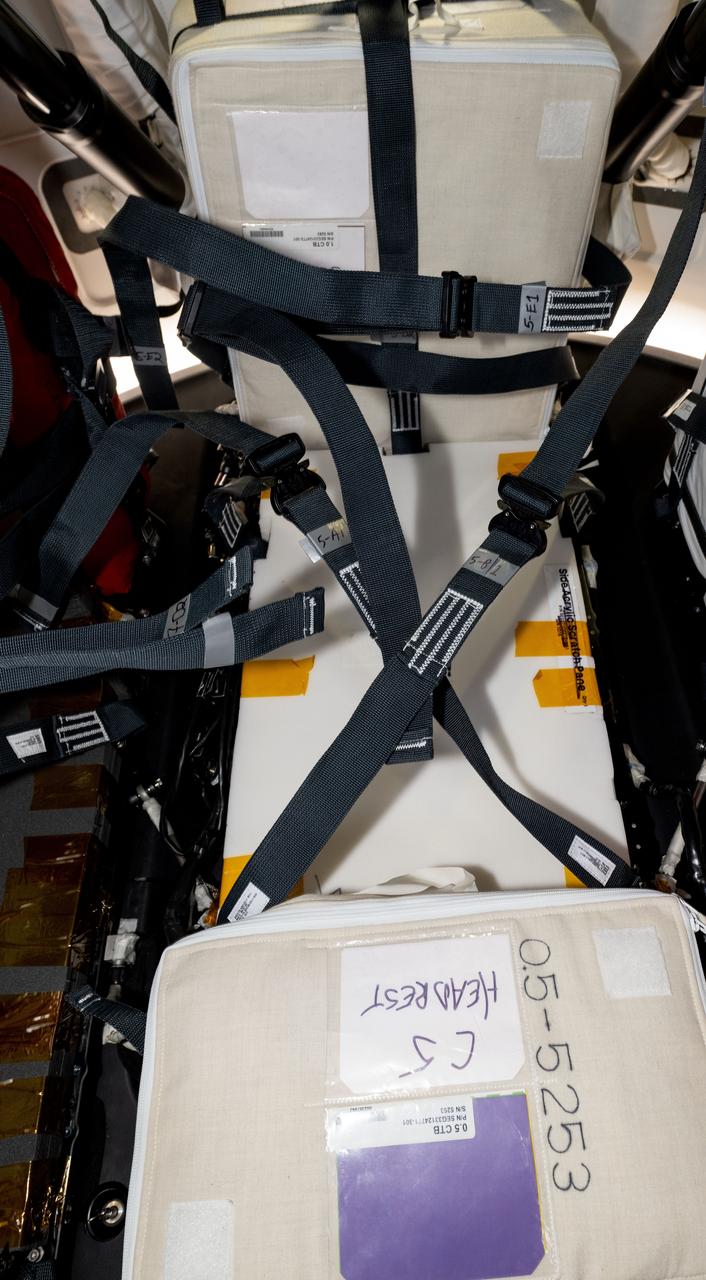
This image shows one of the temporary seat structures built and installed on the Crew-8 Dragon in cargo pallet locations C7 and C5 using foam, straps, and other station soft goods such as cushions.
Pan in the Driver Seat
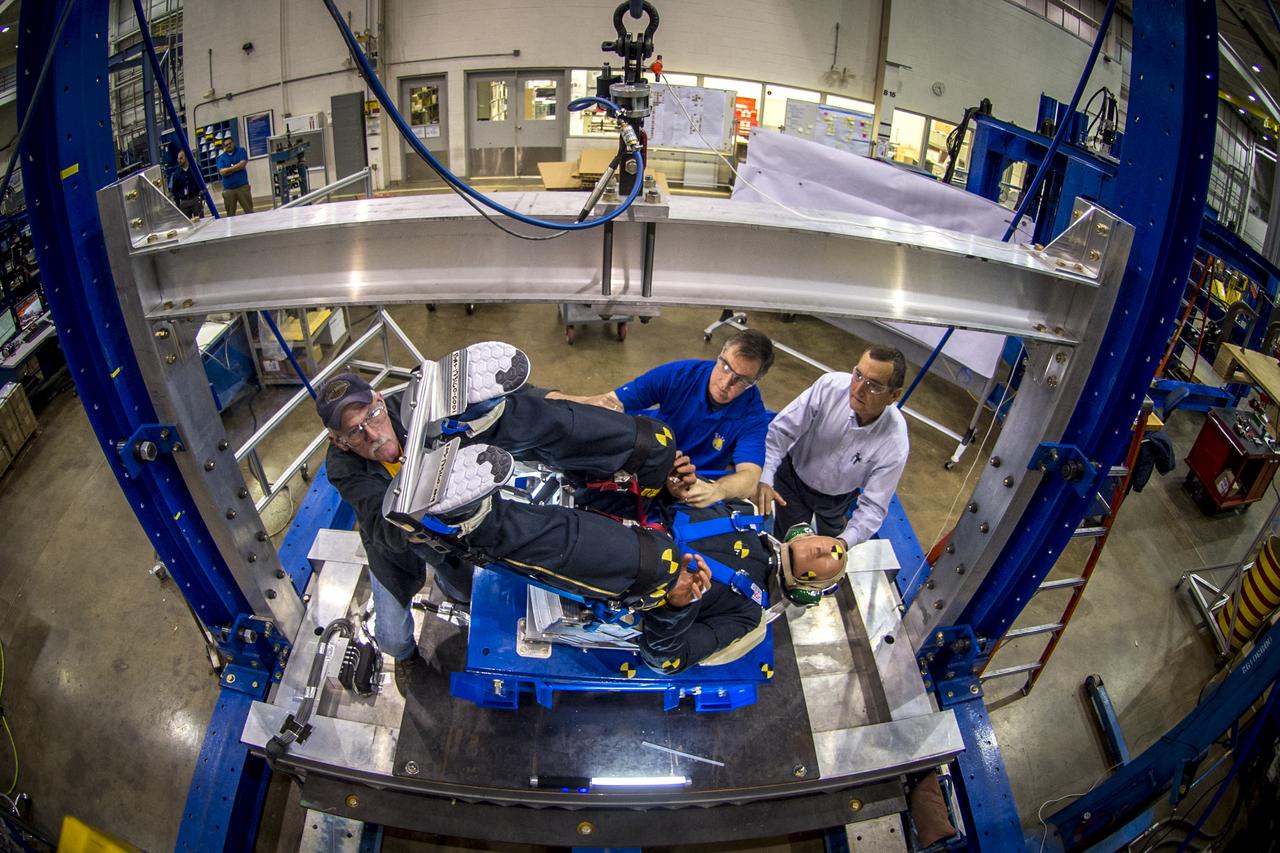
Engineers working with Boeing's CST-100 Starliner test the spacecraft's seat design in Mesa, Arizona, focusing on how the spacecraft seats would protect an astronaut's head, neck and spine during the 240-mile descent from the International Space Station. The company incorporated test dummies for a detailed analysis of impacts on a crew returning to earth. The human-sized dummies were equipped with sensitive instrumentation and secured in the seats for 30 drop tests at varying heights, angles, velocities and seat orientations in order to mimic actual landing conditions. High-speed cameras captured the footage for further analysis. The Starliner spacecraft is being developed in partnership with NASA's Commercial Crew Program.
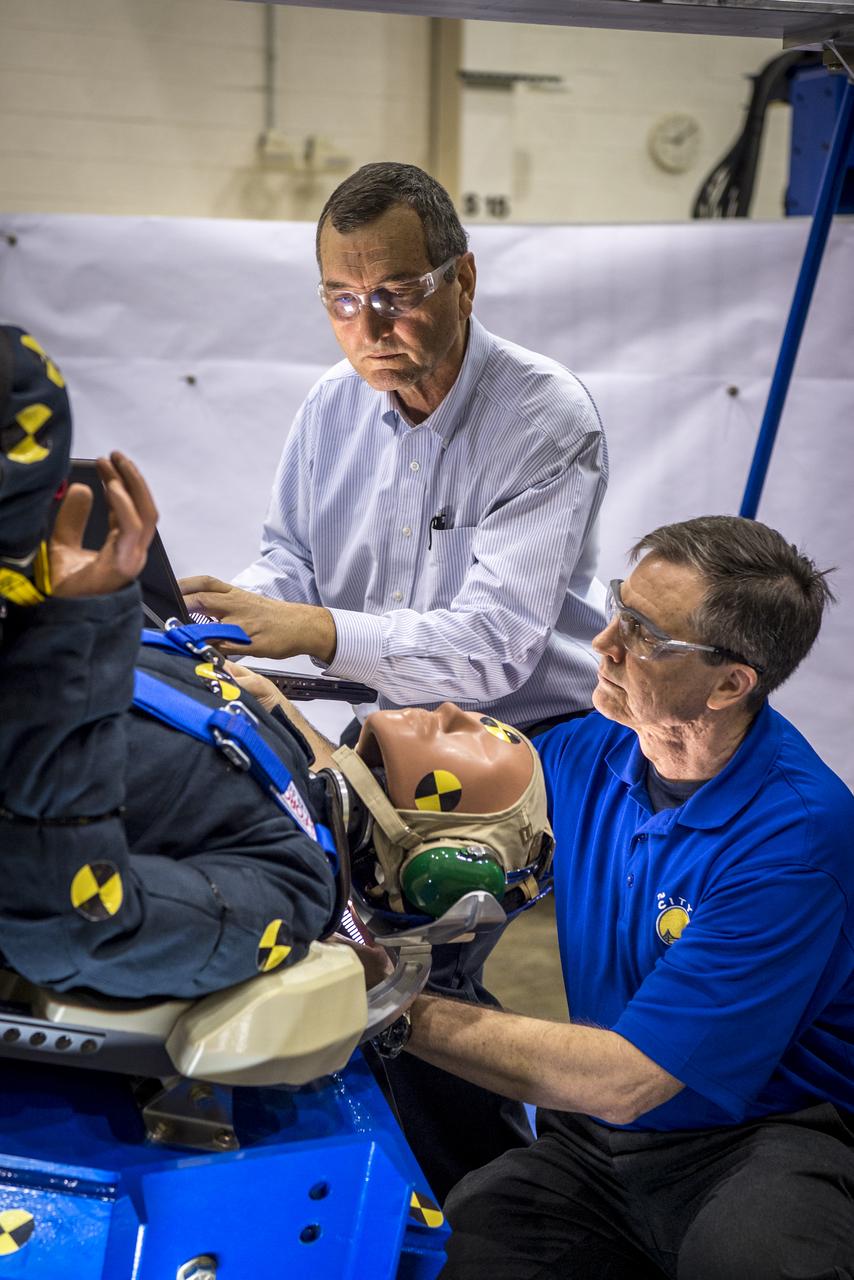
Engineers working with Boeing's CST-100 Starliner test the spacecraft's seat design in Mesa, Arizona, focusing on how the spacecraft seats would protect an astronaut's head, neck and spine during the 240-mile descent from the International Space Station. The company incorporated test dummies for a detailed analysis of impacts on a crew returning to earth. The human-sized dummies were equipped with sensitive instrumentation and secured in the seats for 30 drop tests at varying heights, angles, velocities and seat orientations in order to mimic actual landing conditions. High-speed cameras captured the footage for further analysis. The Starliner spacecraft is being developed in partnership with NASA's Commercial Crew Program.
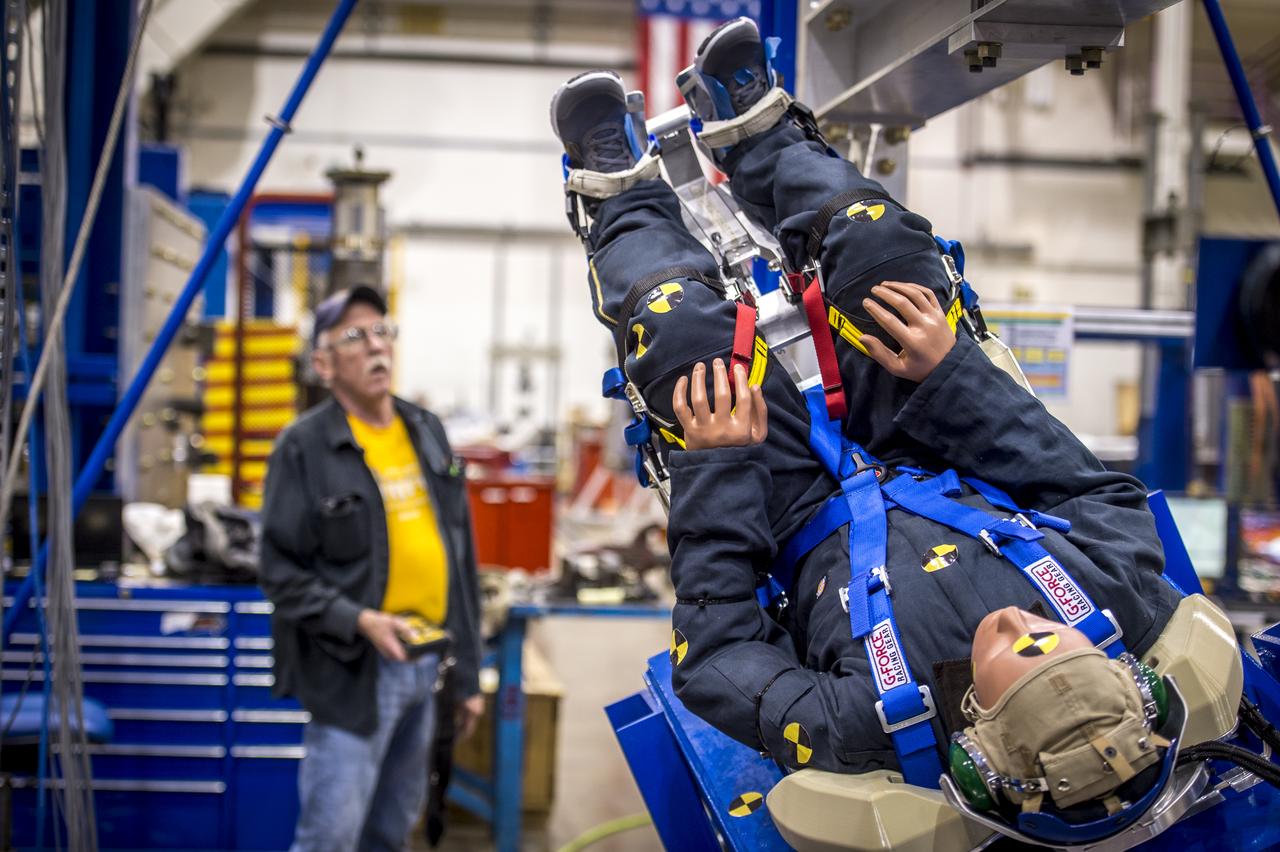
Engineers working with Boeing's CST-100 Starliner test the spacecraft's seat design in Mesa, Arizona, focusing on how the spacecraft seats would protect an astronaut's head, neck and spine during the 240-mile descent from the International Space Station. The company incorporated test dummies for a detailed analysis of impacts on a crew returning to earth. The human-sized dummies were equipped with sensitive instrumentation and secured in the seats for 30 drop tests at varying heights, angles, velocities and seat orientations in order to mimic actual landing conditions. High-speed cameras captured the footage for further analysis. The Starliner spacecraft is being developed in partnership with NASA's Commercial Crew Program.

Engineers working with Boeing's CST-100 Starliner test the spacecraft's seat design in Mesa, Arizona, focusing on how the spacecraft seats would protect an astronaut's head, neck and spine during the 240-mile descent from the International Space Station. The company incorporated test dummies for a detailed analysis of impacts on a crew returning to earth. The human-sized dummies were equipped with sensitive instrumentation and secured in the seats for 30 drop tests at varying heights, angles, velocities and seat orientations in order to mimic actual landing conditions. High-speed cameras captured the footage for further analysis. The Starliner spacecraft is being developed in partnership with NASA's Commercial Crew Program.
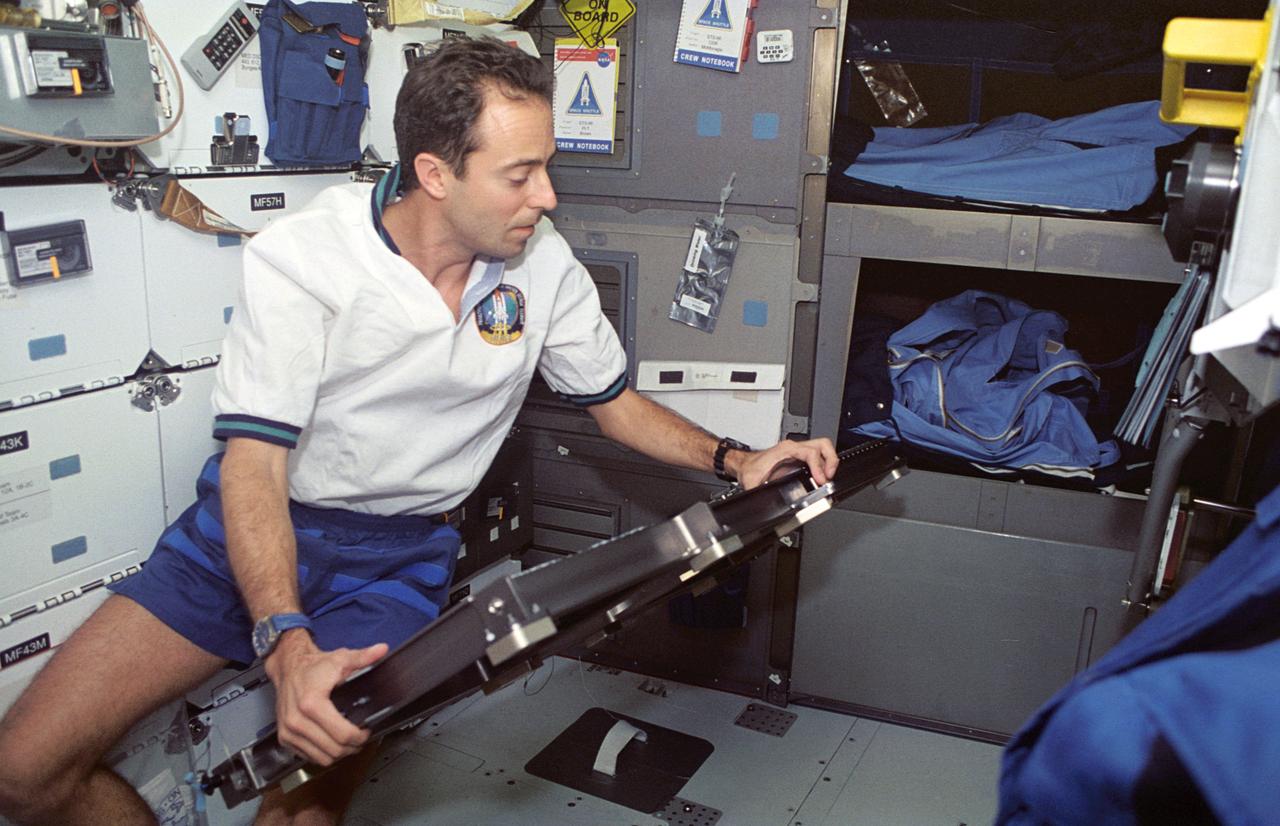
STS066-66-005 (3-14 Nov 1994) --- On the Space Shuttle Atlantis' flight deck, Jean-François Clervoy, mission specialist representing the European Space Agency (ESA), moves a platform for the recumbent seat device which was being evaluated for a future Space Shuttle flight. The platform is just part of the mid-deck arrangement designed to accommodate crew members when the Space Shuttle docks with Russia's Mir Space Station next year. Other crew members onboard Atlantis for the 11-day day Atmospheric Laboratory for Applications and Science (ATLAS-3) mission were astronauts Donald R. McMonagle, Curtis L. Brown, Jr., Ellen Ochoa, Scott E. Parazynski and Joseph R. Tanner.
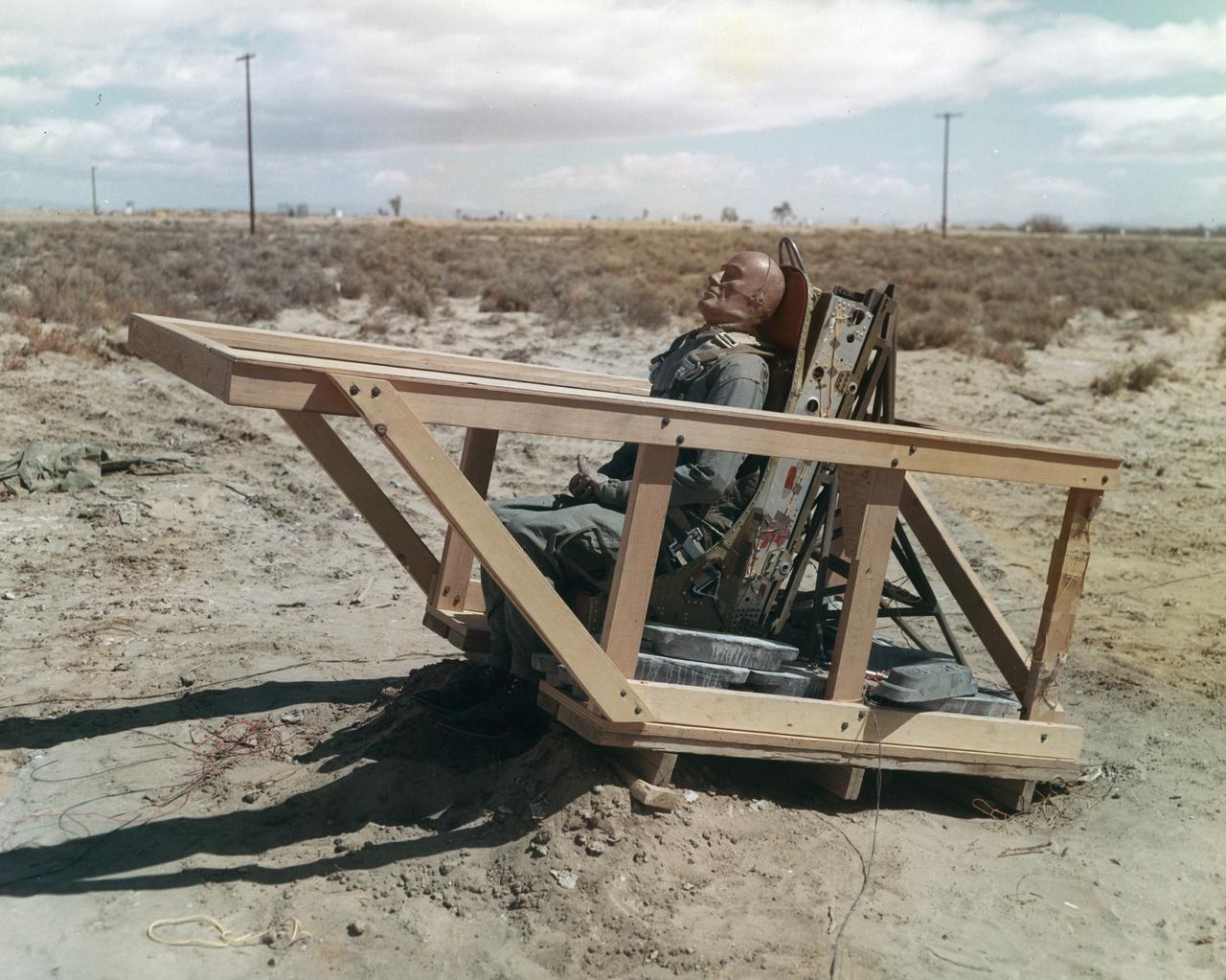
The M2-F1 was fitted with an ejection seat before the airtow flights began. The project selected the seat used in the T-37 as modified by the Weber Company to use a rocket rather than a ballistic charge for ejection. To test the ejection seat, the Flight Research Center's Dick Klein constructed a plywood mockup of the M2-F1's top deck and canopy. On the first firings, the test was unsuccessful, but on the final test the dummy in the seat landed safely. The M2-F1 ejection seat was later used in the two Lunar Landing Research Vehicles and the three Lunar Landing Training Vehicles. Three of them crashed, but in each case the pilot ejected from the vehicle successfully.
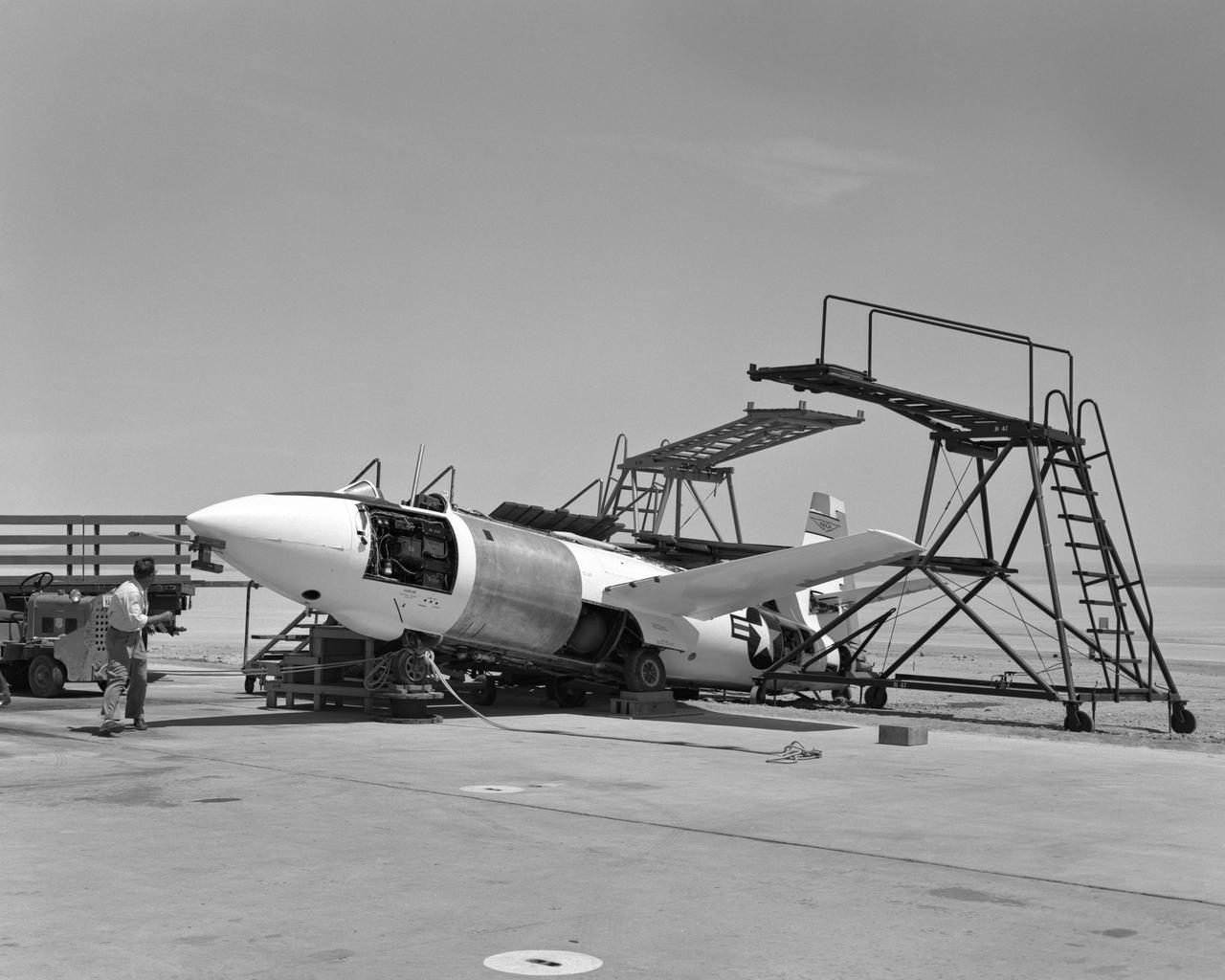
Bell X-1A ejection seat test setup
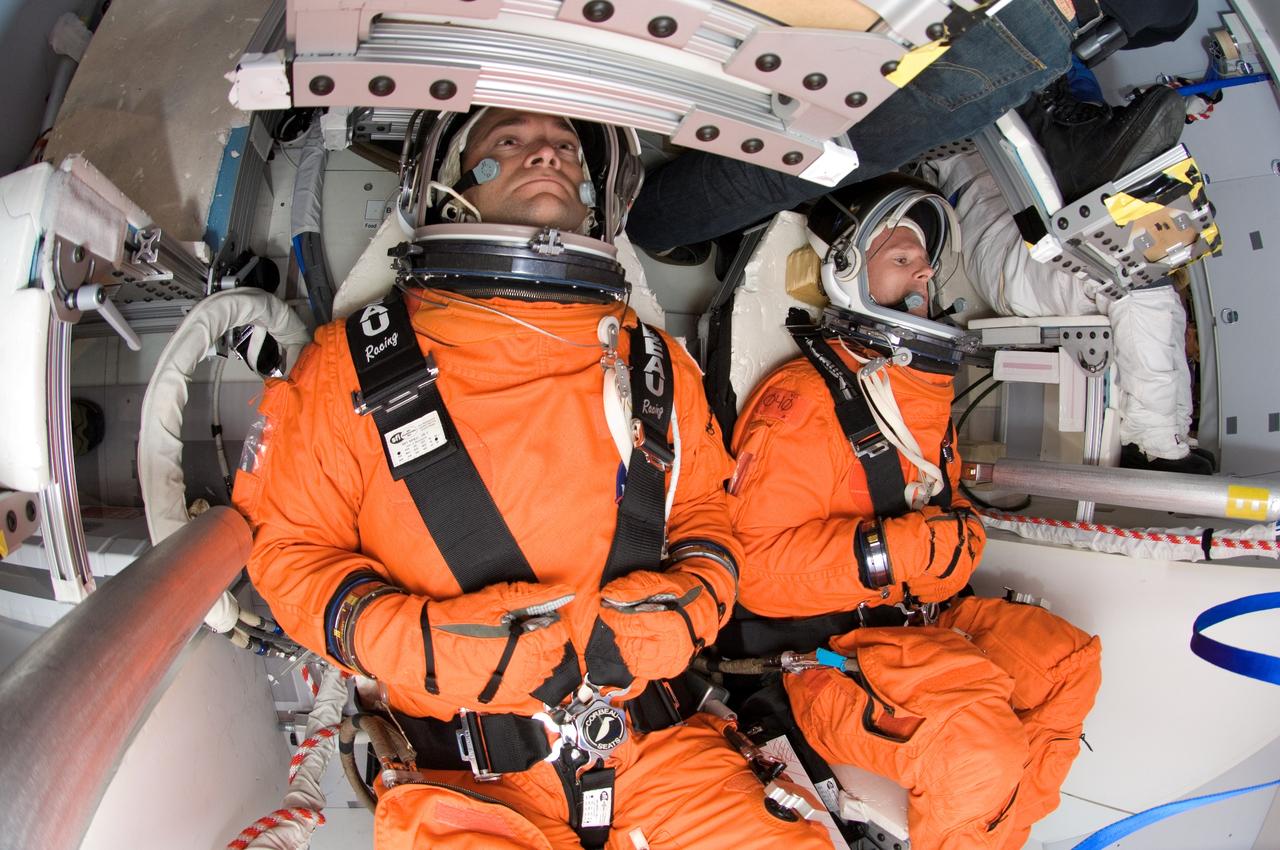
Photographic documentation of the CEV Seat Layout Evaluation taken in the Orion mockup located in bldg 9NW, Johnson Space Center (JSC). Test subjects in orange Launch and Entry Suit (LES) is visible in the seat.
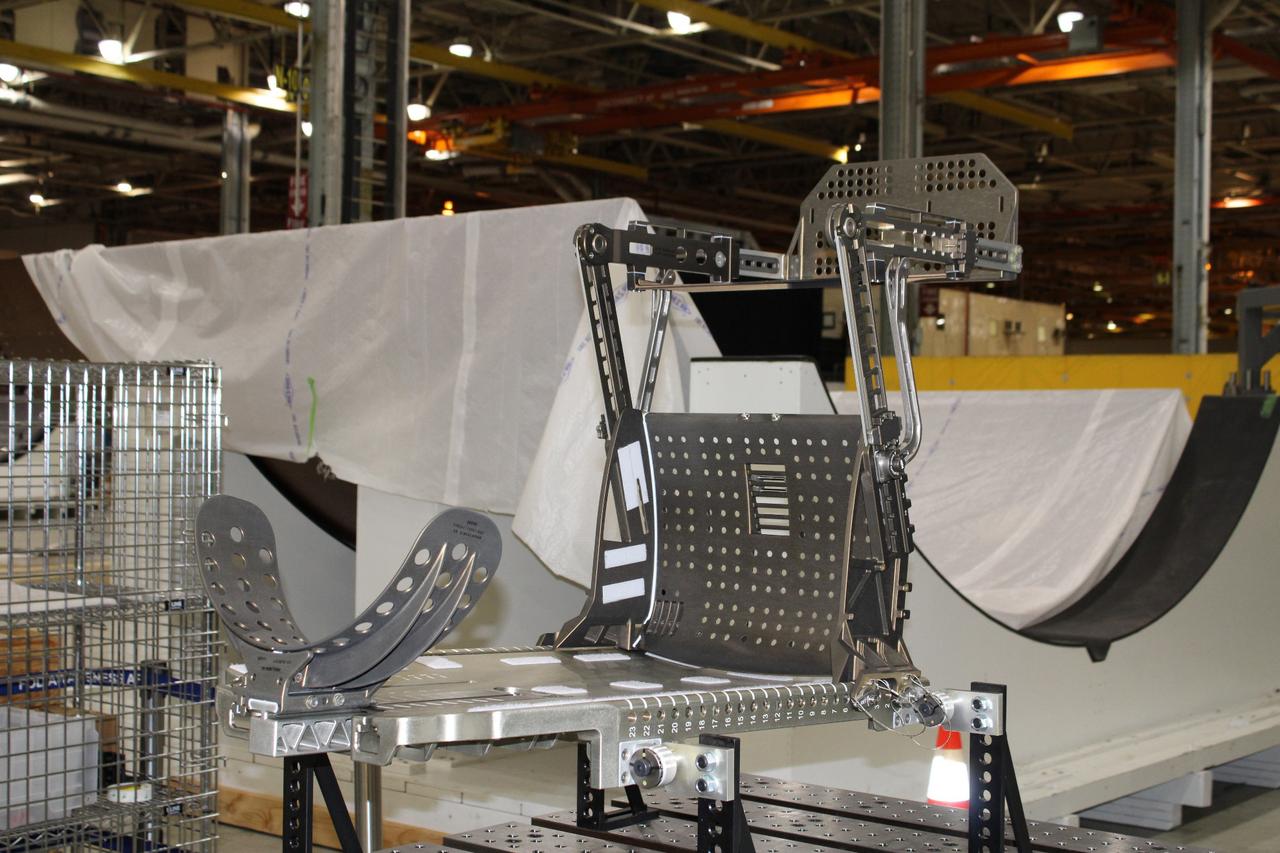
Lockheed Martin technicians at Michoud Assembly Facility in New Orleans complete the final assembly of the crew seat for the Artemis I flight on Sept. 23, 2020. The seat will hold a mass simulator and measure launch and landing loads during the flight which will see Orion travel 40,000 miles past the Moon. The seat will also be reused on Artemis II, Orion's first crewed flight.
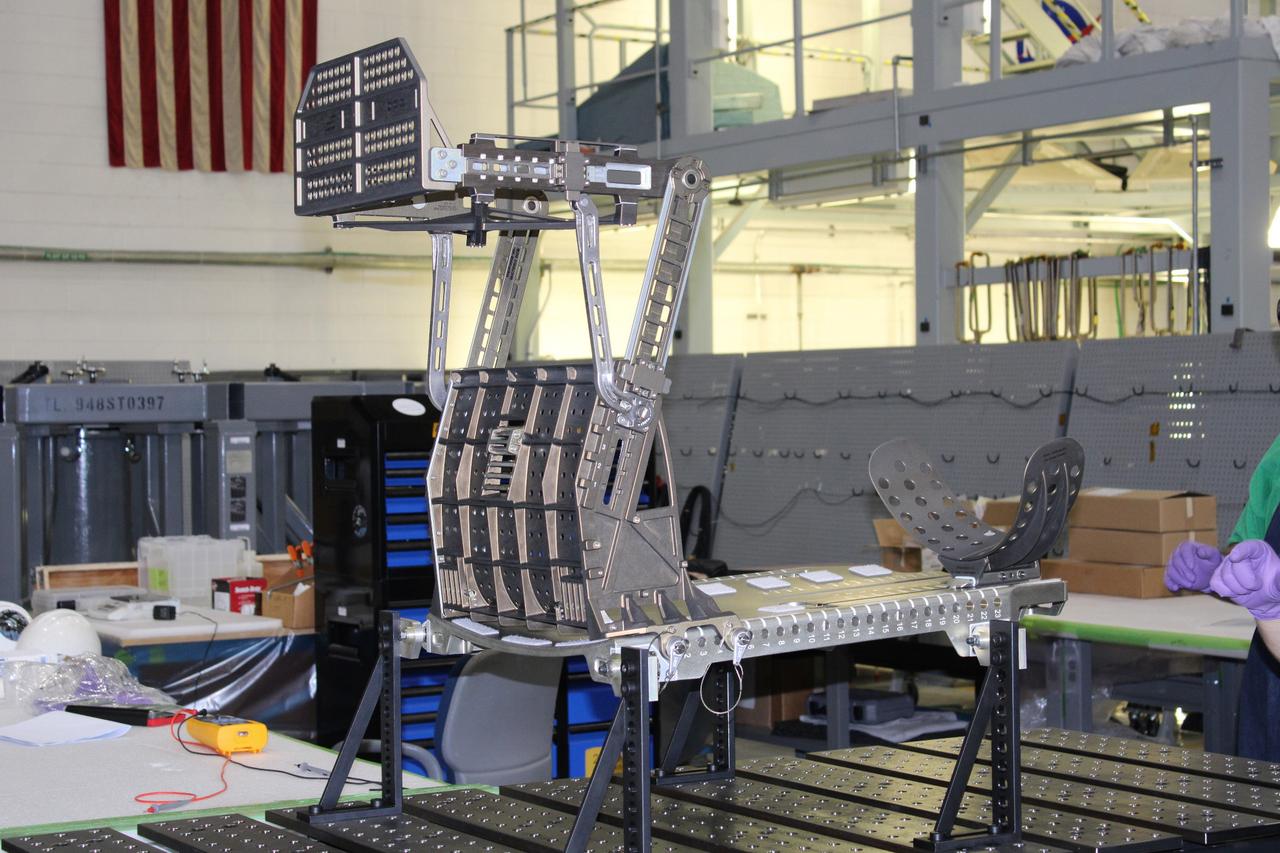
Lockheed Martin technicians at Michoud Assembly Facility in New Orleans complete the final assembly of the crew seat for the Artemis I flight on Sept. 23, 2020. The seat will hold a mass simulator and measure launch and landing loads during the flight which will see Orion travel 40,000 miles past the Moon. The seat will also be reused on Artemis II, Orion's first crewed flight.
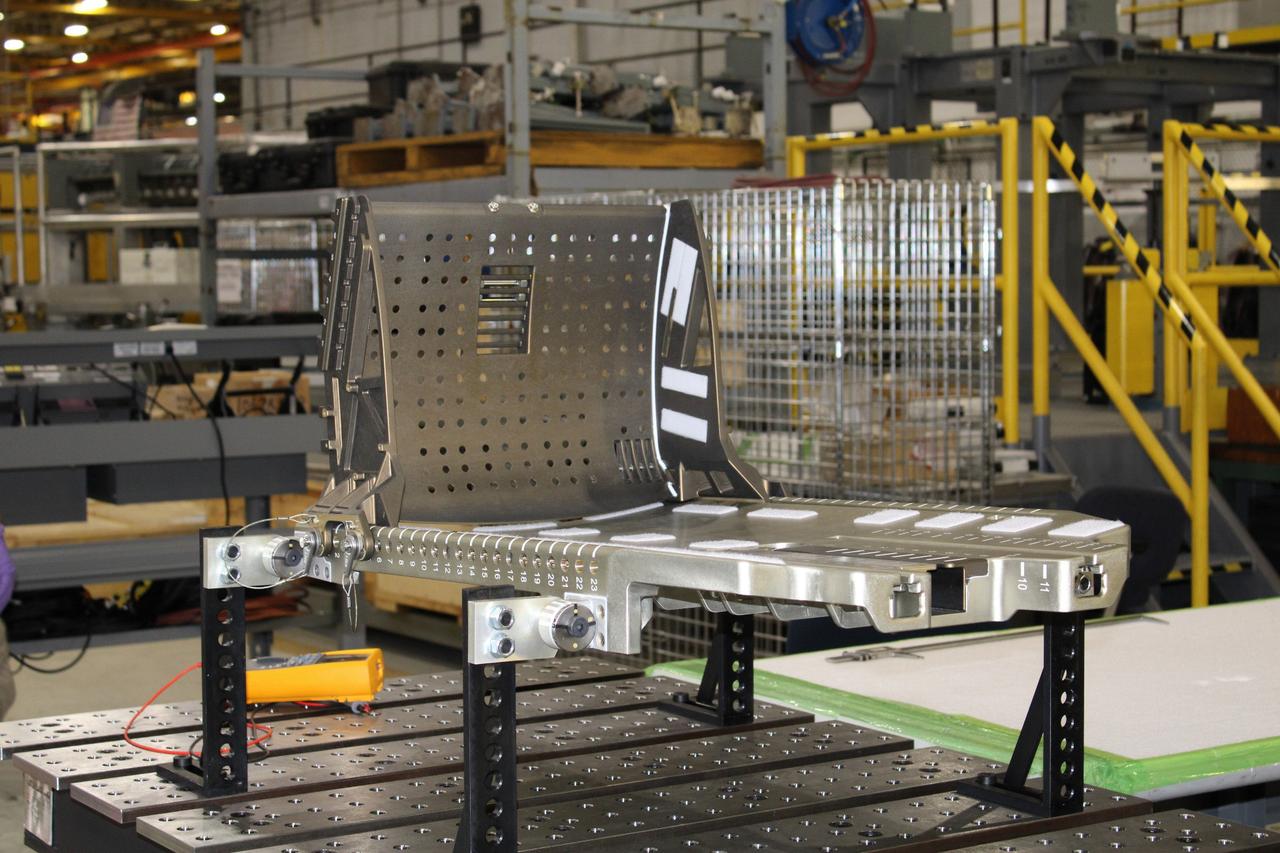
Lockheed Martin technicians at Michoud Assembly Facility in New Orleans complete the final assembly of the crew seat for the Artemis I flight on Sept. 23, 2020. The seat will hold a mass simulator and measure launch and landing loads during the flight which will see Orion travel 40,000 miles past the Moon. The seat will also be reused on Artemis II, Orion's first crewed flight.
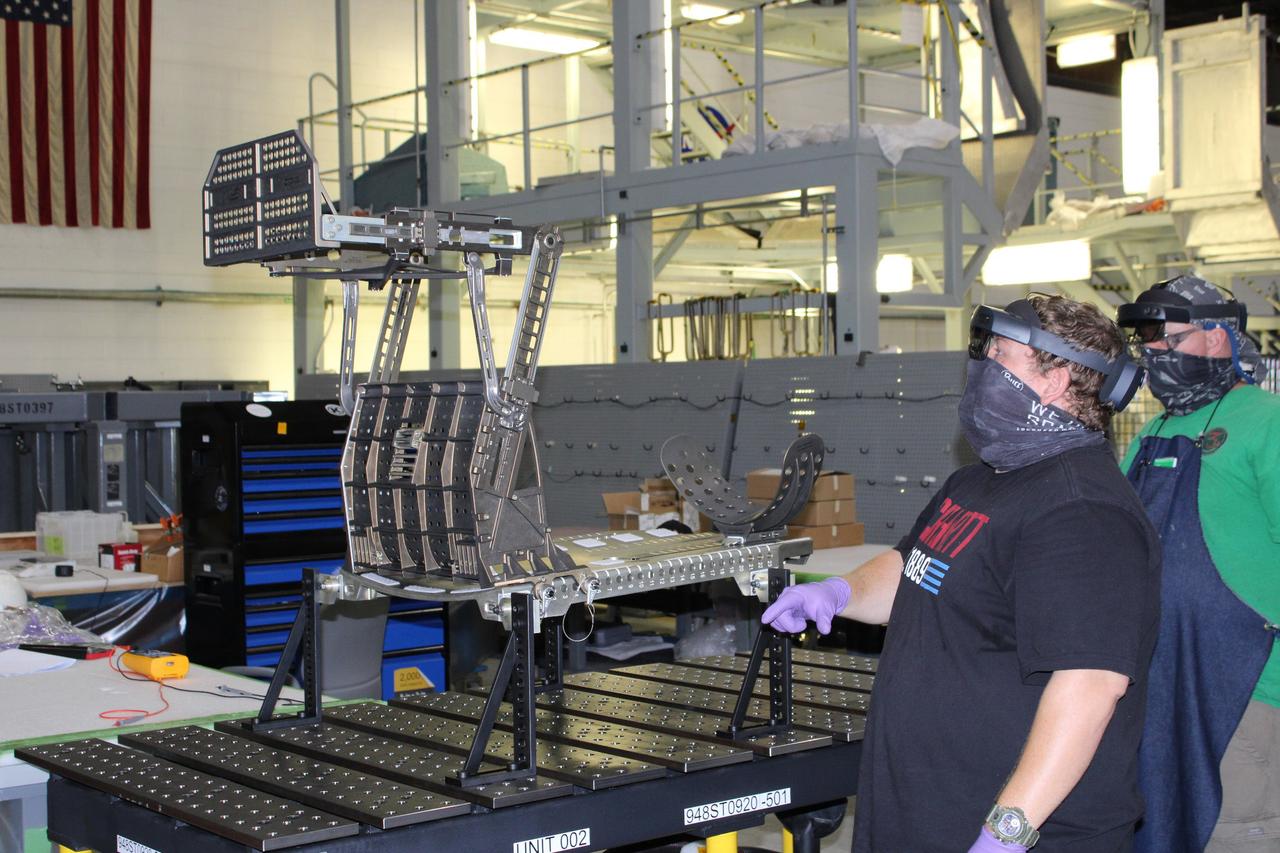
Lockheed Martin technicians at Michoud Assembly Facility in New Orleans complete the final assembly of the crew seat for the Artemis I flight on Sept. 23, 2020. The seat will hold a mass simulator and measure launch and landing loads during the flight which will see Orion travel 40,000 miles past the Moon. The seat will also be reused on Artemis II, Orion's first crewed flight.
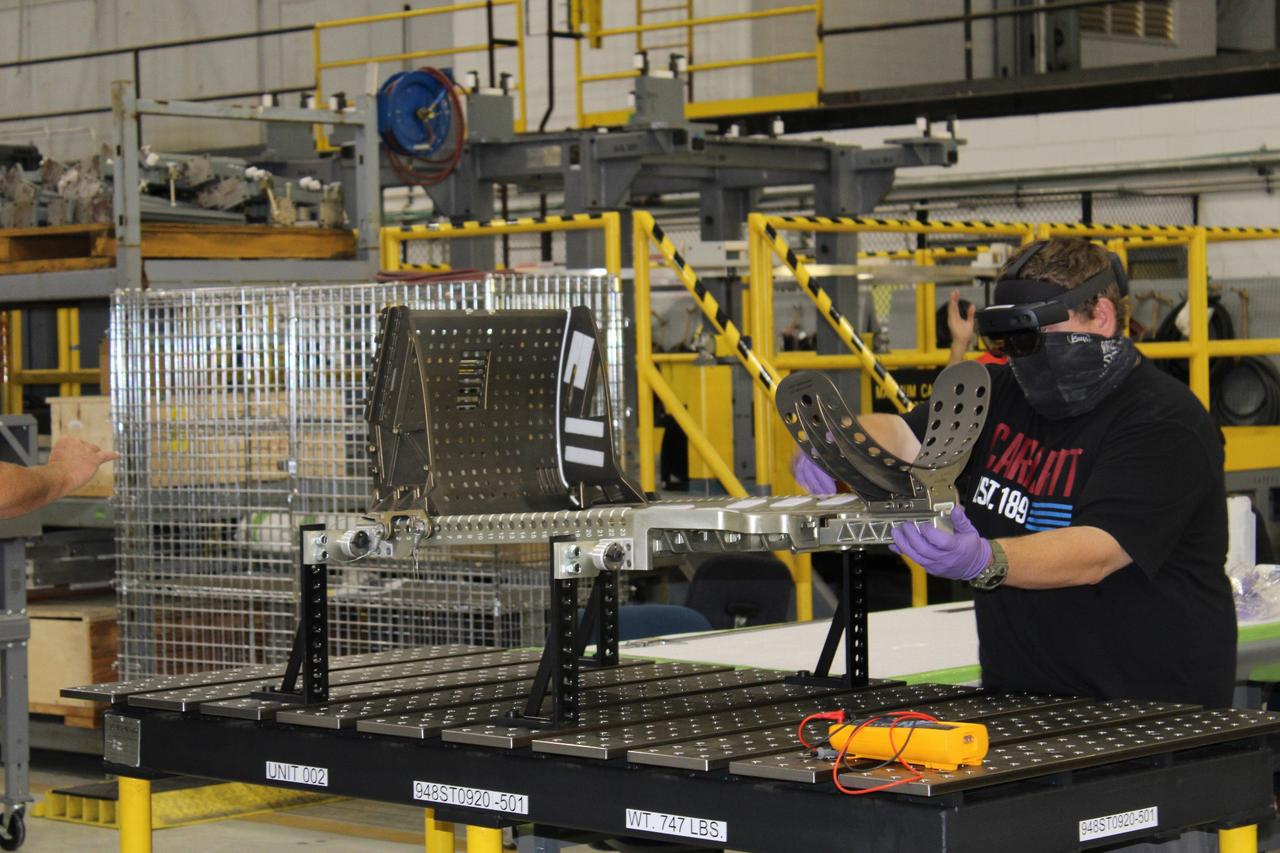
Lockheed Martin technicians at Michoud Assembly Facility in New Orleans complete the final assembly of the crew seat for the Artemis I flight on Sept. 23, 2020. The seat will hold a mass simulator and measure launch and landing loads during the flight which will see Orion travel 40,000 miles past the Moon. The seat will also be reused on Artemis II, Orion's first crewed flight.

Lockheed Martin technicians at Michoud Assembly Facility in New Orleans complete the final assembly of the crew seat for the Artemis I flight on Sept. 23, 2020. The seat will hold a mass simulator and measure launch and landing loads during the flight which will see Orion travel 40,000 miles past the Moon. The seat will also be reused on Artemis II, Orion's first crewed flight.
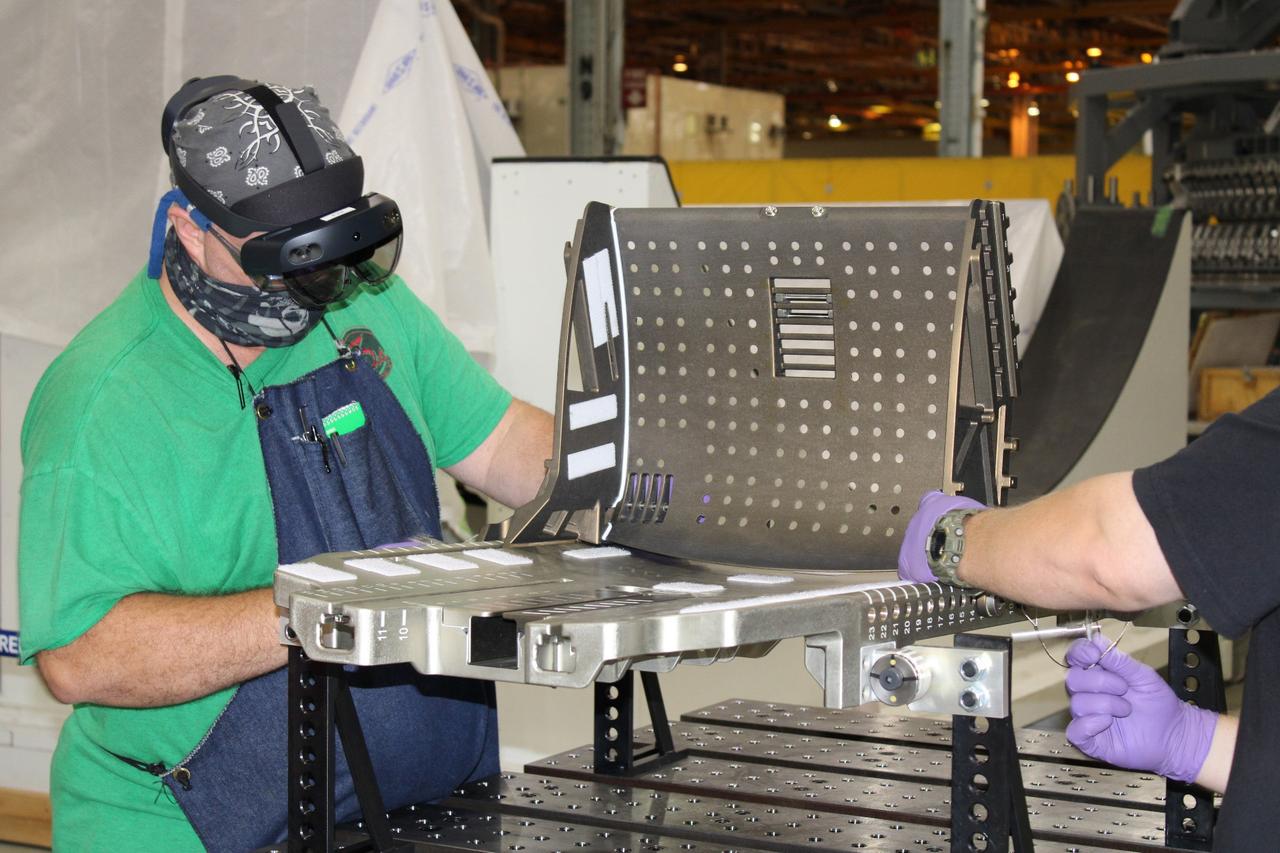
Lockheed Martin technicians at Michoud Assembly Facility in New Orleans complete the final assembly of the crew seat for the Artemis I flight on Sept. 23, 2020. The seat will hold a mass simulator and measure launch and landing loads during the flight which will see Orion travel 40,000 miles past the Moon. The seat will also be reused on Artemis II, Orion's first crewed flight.
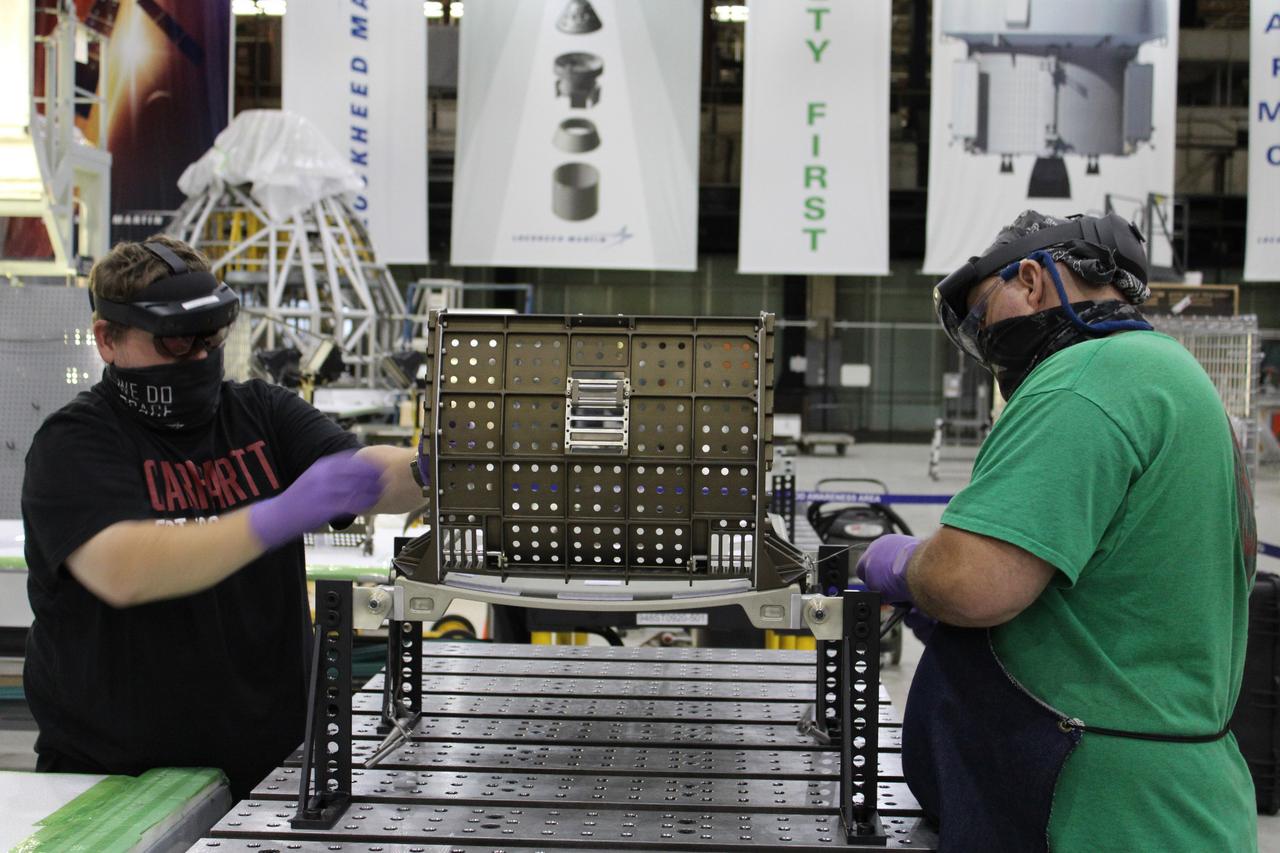
Lockheed Martin technicians at Michoud Assembly Facility in New Orleans complete the final assembly of the crew seat for the Artemis I flight on Sept. 23, 2020. The seat will hold a mass simulator and measure launch and landing loads during the flight which will see Orion travel 40,000 miles past the Moon. The seat will also be reused on Artemis II, Orion's first crewed flight.
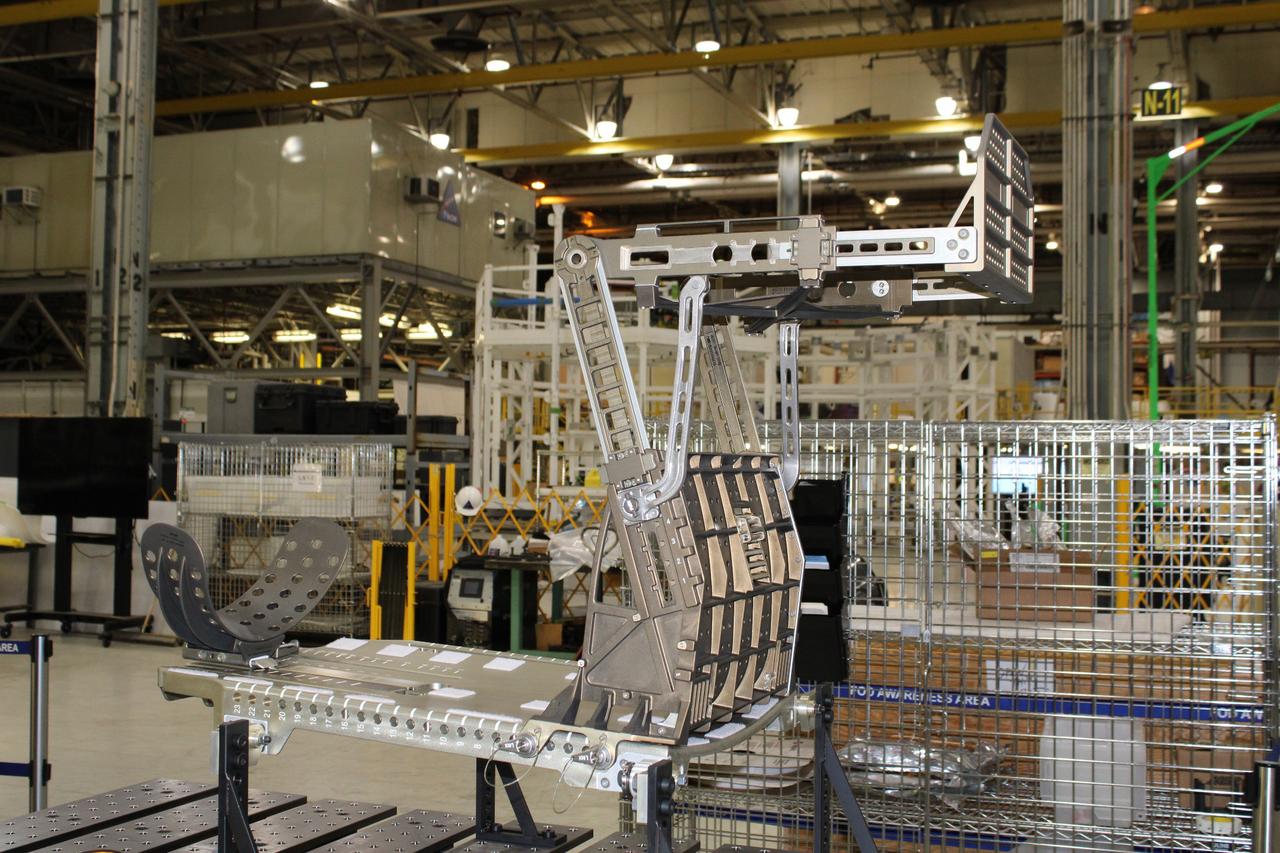
Lockheed Martin technicians at Michoud Assembly Facility in New Orleans complete the final assembly of the crew seat for the Artemis I flight on Sept. 23, 2020. The seat will hold a mass simulator and measure launch and landing loads during the flight which will see Orion travel 40,000 miles past the Moon. The seat will also be reused on Artemis II, Orion's first crewed flight.
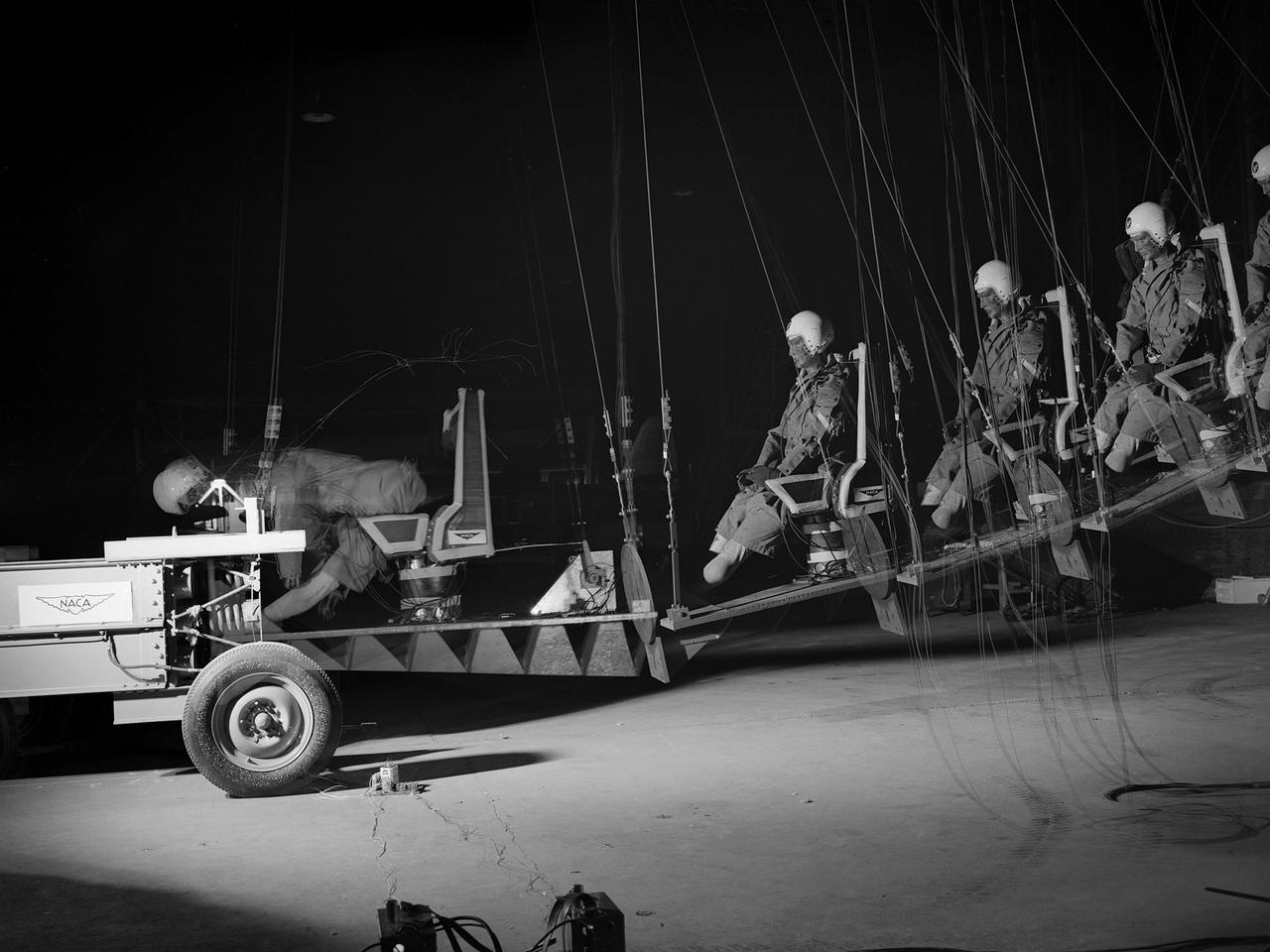
This time-lapse photograph shows the test of a pilot seat and restraint designed by researchers at the National Advisory Committee for Aeronautics (NACA) Lewis Flight Propulsion Laboratory. The laboratory had undertaken a multi-year investigation into the causes and preventative measures for fires resulting from low altitude aircraft crashes. The program was expanded in the mid-1950s to include the study of crash impact on passengers, new types of types of seat restraints, and better seat designs. The impact program began by purposely wrecking surplus transport Fairchild C-82 Packet and Piper Cub aircraft into barricades at the end of a test runway. Instrumented dummies and cameras were installed in the pilot and passenger areas. After determining the different loads experienced during a crash and the effects on the passengers, the NACA researchers began designing new types of seats and restraints. The result was an elastic seat that flexed upon impact, absorbing 75 percent of the loads before it slowly recoiled. This photograph shows the seats mounted on a pendulum with a large spring behind the platform to provide the jolt that mimicked the forces of a crash. The seat was constructed without any potentially damaging metal parts and included rubber-like material, an inflated back and arms, and a seat cushion. After the pendulum tests, the researchers compared the flexible seats to the rigid seats during a crash of a transport aircraft. They found the passengers in the rigid seats received 66 percent higher g-forces than the NACA-designed seats.

The back seat instrument panel on the NASA T-34C chase plane. In its role as a military trainer, the instructor pilot would ride in the back seat, while the student would be in the front seat. As a chase plane, the back seat would be occupied by a photographer. The aircraft was previously used at the Lewis Research Center in propulsion experiments involving turboprop engines, and was used as a chase aircraft at Dryden for smaller and slower research projects. Chase aircraft accompany research flights for photography and video purposes, and also as support for safety and research. At Dryden, the T-34 is used mainly for smaller remotely piloted vehicles which fly slower than NASA's F-18's, used for larger scale projects. This aircraft was returned to the U.S. Navy in May of 2002. The T-34C, built by Beech, carries a crew of 2 and is nicknamed the Mentor.
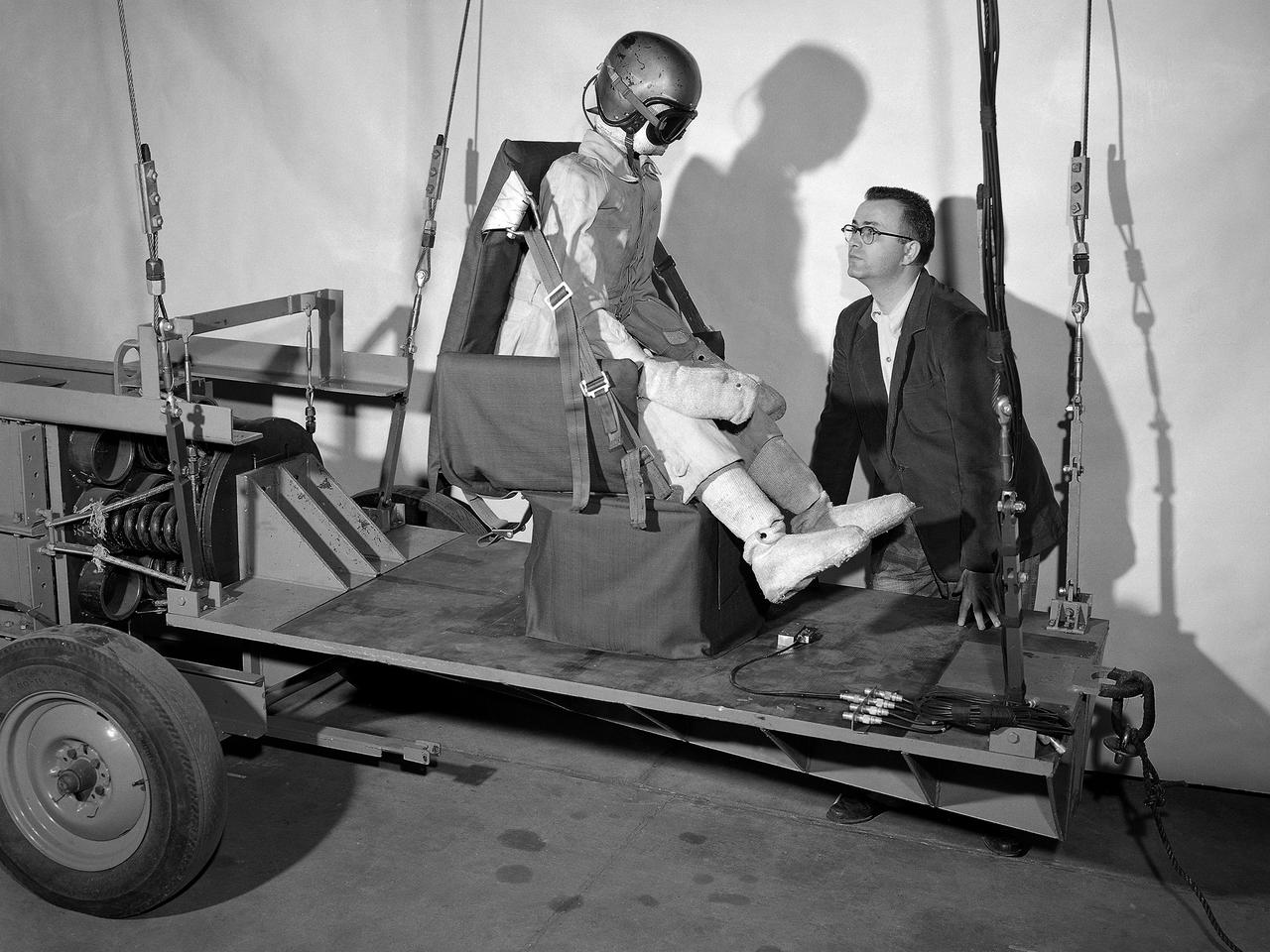
A researcher at the National Advisory Committee for Aeronautics (NACA) Lewis Flight Propulsion Laboratory prepares for a test of an NACA-designed aircraft seat. The laboratory had undertaken a multi-year investigation into the causes and prevention of fires on low altitude aircraft crashes. The program was expanded in the mid-1950s to include the study of impact on passengers, types of seat restraints, and seat design. The crash impact portion of the program began by purposely wrecking surplus Fairchild C-82 Packet and Piper Cub aircraft into barricades at the end of a test runway at the Ravenna Arsenal, located approximately 40 miles south of the Lewis lab in Cleveland. Instrumented dummies and cameras were installed in the pilot and passenger areas. After determining the different loads and their effects on the passengers, the NACA researchers began designing new types of seats and restraints. The result was an elastic seat that flexed upon impact, absorbing 75 percent of the loads before it slowly recoiled. This photograph shows the seats mounted on a pendulum with a large spring behind the platform to provide the jolt that mimicked the forces of a crash. The seat was constructed without any potentially damaging metal parts and included rubber-like material, an inflated back and arms, and a seat cushion. After the pendulum tests, the researchers compared the flexible seats to the rigid seats during a crash of a transport aircraft. They found the passengers in the rigid seats received 66 percent higher g-forces than the NACA-designed seats.

jsc2026e040448 (April 30, 2026) --- Roscosmos cosmonaut and SpaceX Crew-13 mission specialist Sergey Teteryatnikov is pictured in his pressure suit seated inside a mockup Dragon spacecraft during a preflight training session at the company's headquarters in Hawthorne, California. Credit: SpaceX

jsc2026e040449 (April 30, 2026) --- NASA astronaut and SpaceX Crew-13 commander Jessica Watkins is pictured in her pressure suit seated inside a mockup Dragon spacecraft during a preflight training session at the company's headquarters in Hawthorne, California. Credit: SpaceX
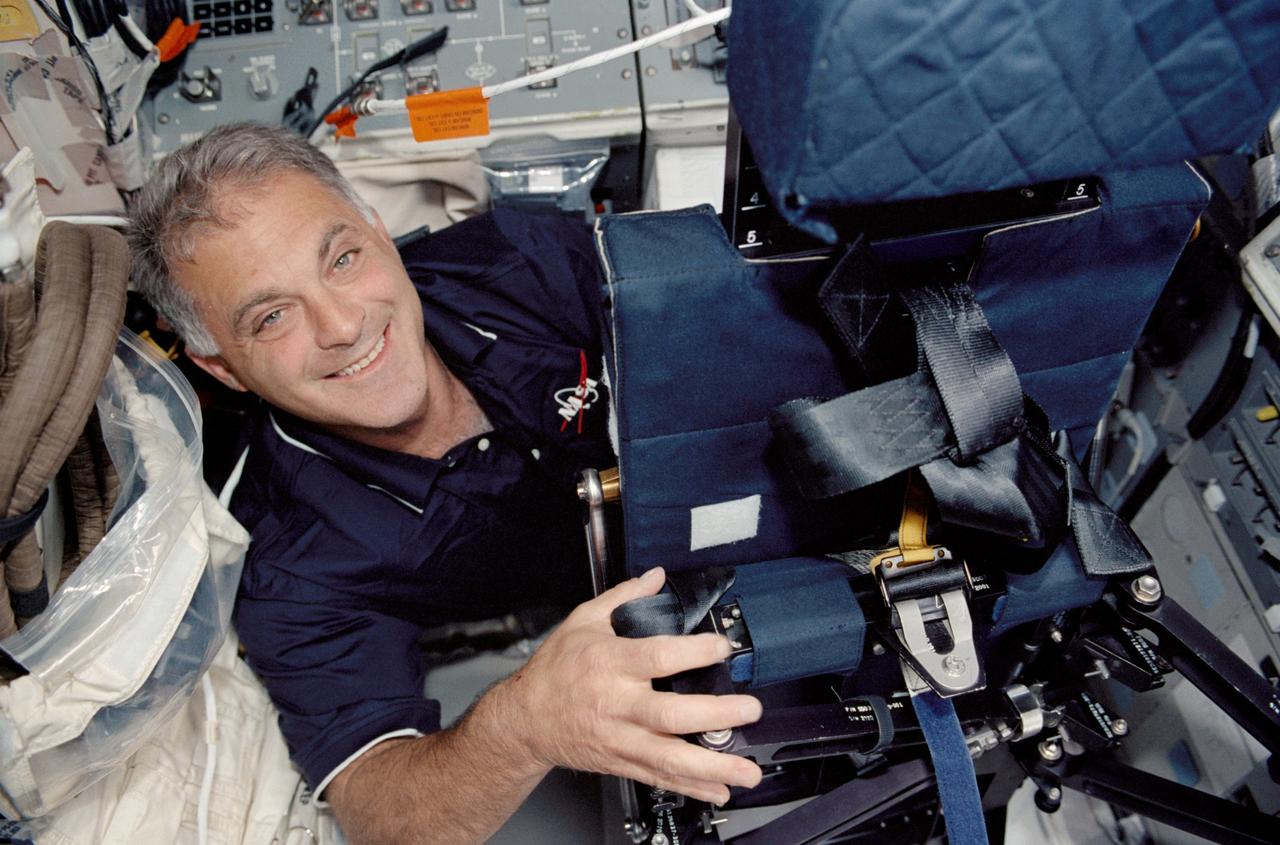
STS112-324-008 (7-18 October 2002) --- Astronaut David A. Wolf, STS-112 mission specialist, works with a temporary flight deck seat, used for launch and entry, on the Space Shuttle Atlantis.
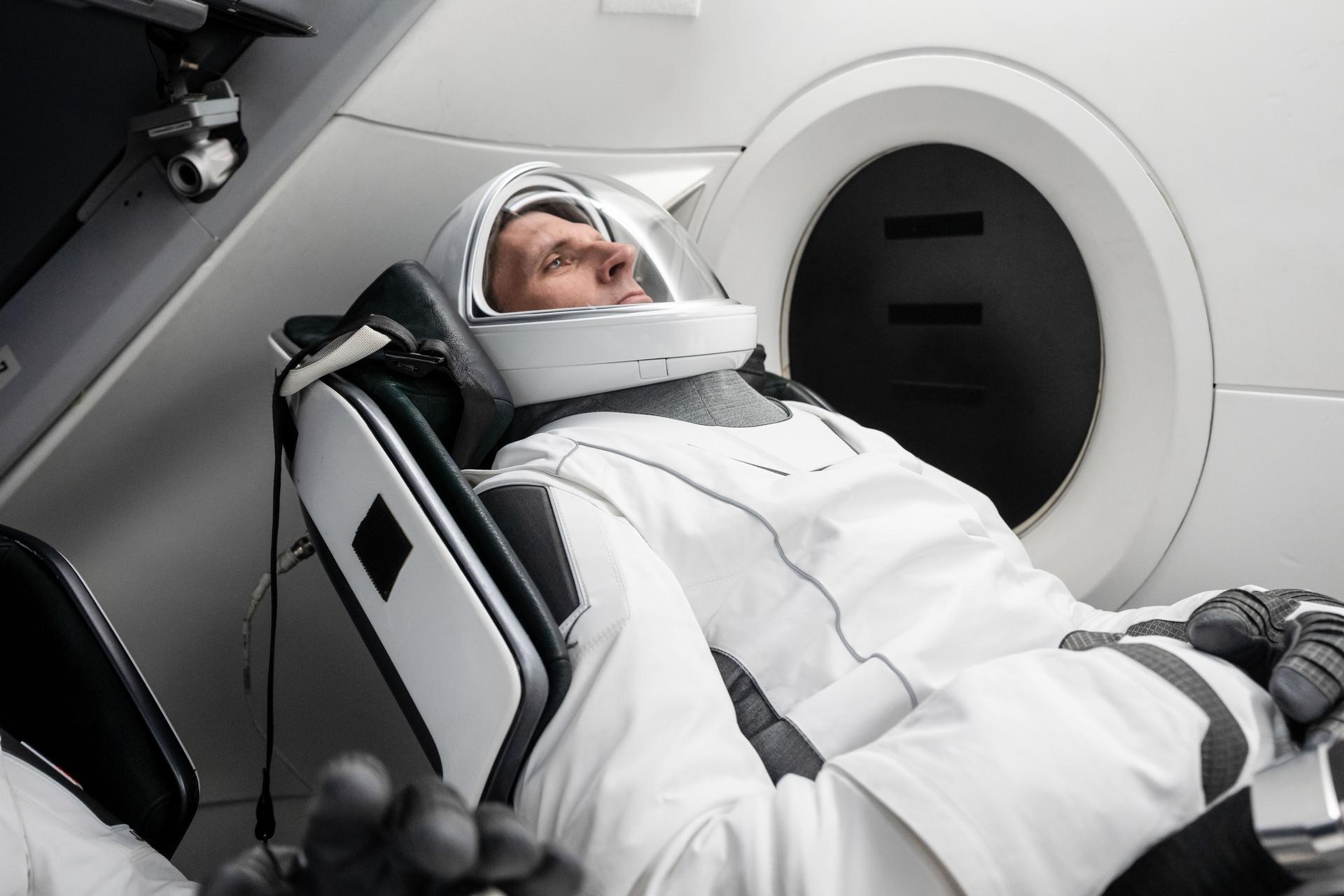
jsc2026e040447 (April 30, 2026) --- CSA (Canadian Space Agency) astronaut and SpaceX Crew-13 mission specialist Josh Kutryk is pictured in his pressure suit seated inside a mockup Dragon spacecraft during a preflight training session at the company's headquarters in Hawthorne, California. Credit: SpaceX
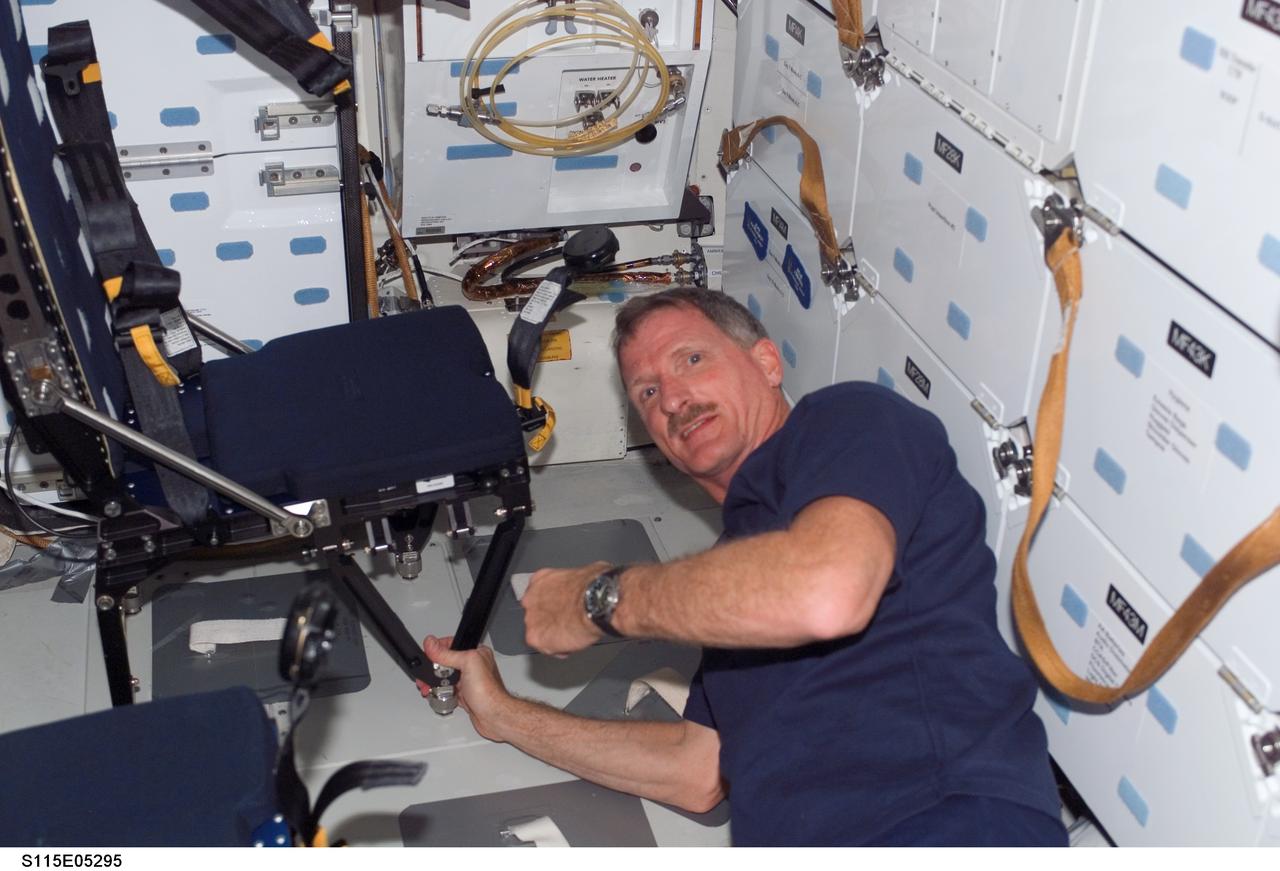
S115-E-05295 (9 Sept. 2006) --- Astronaut Joseph R. Tanner, STS-115 mission specialist, prepares to remove one of the launch and entry seats on mid deck of Atlantis soon after the crew reached Earth orbit. Atlantis and its crew will see a busy number of days before the mid deck seats get re-deployed for entry and landing.
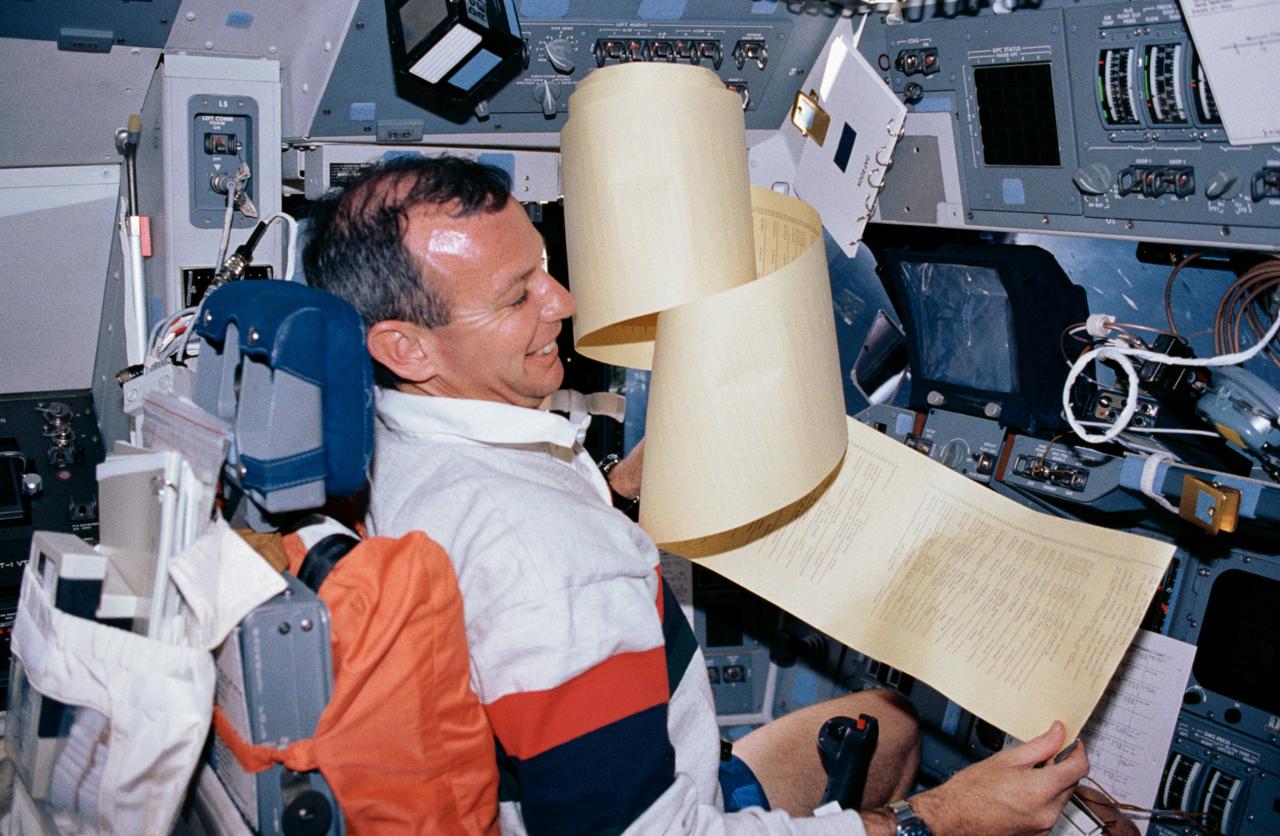
STS045-02-020 (24 March-2 April 1992) --- Brian Duffy, STS-45 pilot, struggles with a large volume of data printouts from the teleprinter system. He is seated at the commander's station on the flight deck of the Earth-orbiting Atlantis during the nine-day mission. This frame was taken with a 35mm camera.

jsc2026e040446 (April 30, 2026) --- The SpaceX Crew-13 members are pictured in their pressure suits seated inside a mockup Dragon spacecraft during a preflight training session at the company's headquarters in Hawthorne, California. From left are, Roscosmos Sergey Teteryatnikov, NASA astronauts Luke Delaney and Jessica Watkins, and CSA (Canadian Space Agency) astronaut Joshua Kutryk. Credit: SpaceX
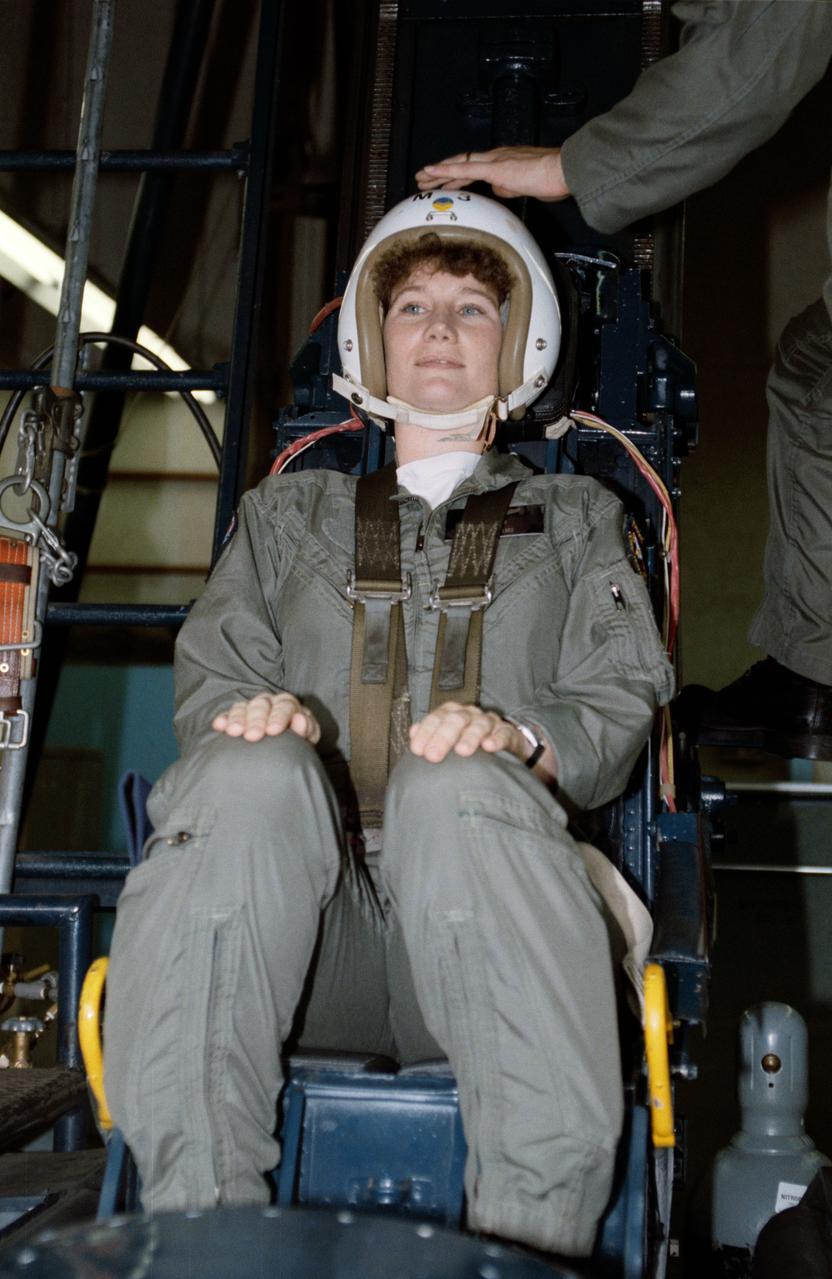
S90-45852 (29-31 July 1990) --- Susan J. Helms, one of 23 astronaut candidates who began a year's training and evaluation in July, participates in one of may sessions at a survival training course at Vance Air Force Base. This portion of the course is designed to familiarize the trainee with the "feel" of emergency ejection from a jet aircraft.
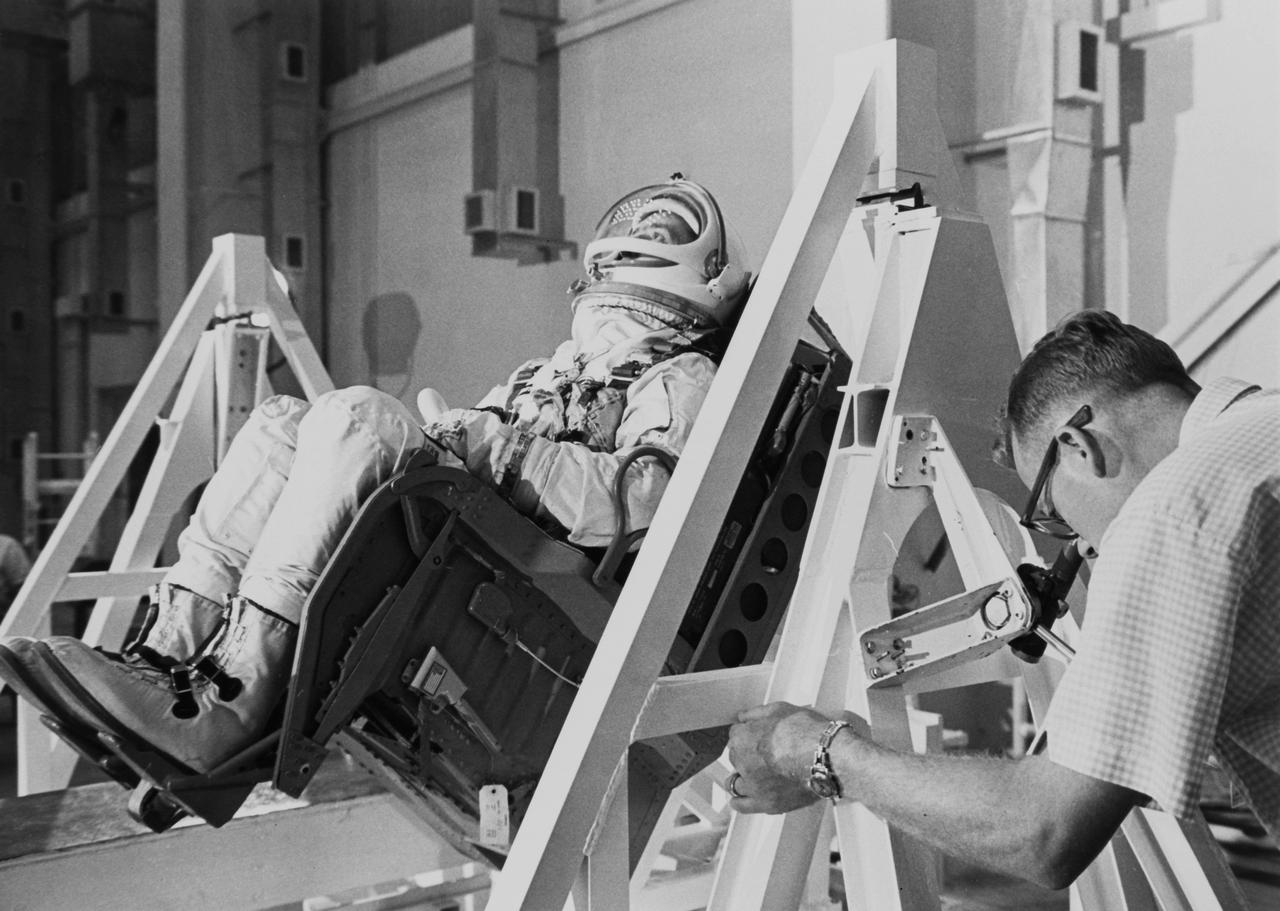
S65-19585 (21 May 1965) --- Astronaut James A. McDivitt, command pilot for the Gemini-Titan 4 prime crew, participates in a weight and balance test during a wet mock simulation exercise at Cape Kennedy, Florida. The two-man Gemini-4 mission, scheduled no earlier than June 3, 1965, will orbit Earth 62 times in four days. Astronaut Edward H. White II (out of frame) is the GT-4 prime crew pilot.
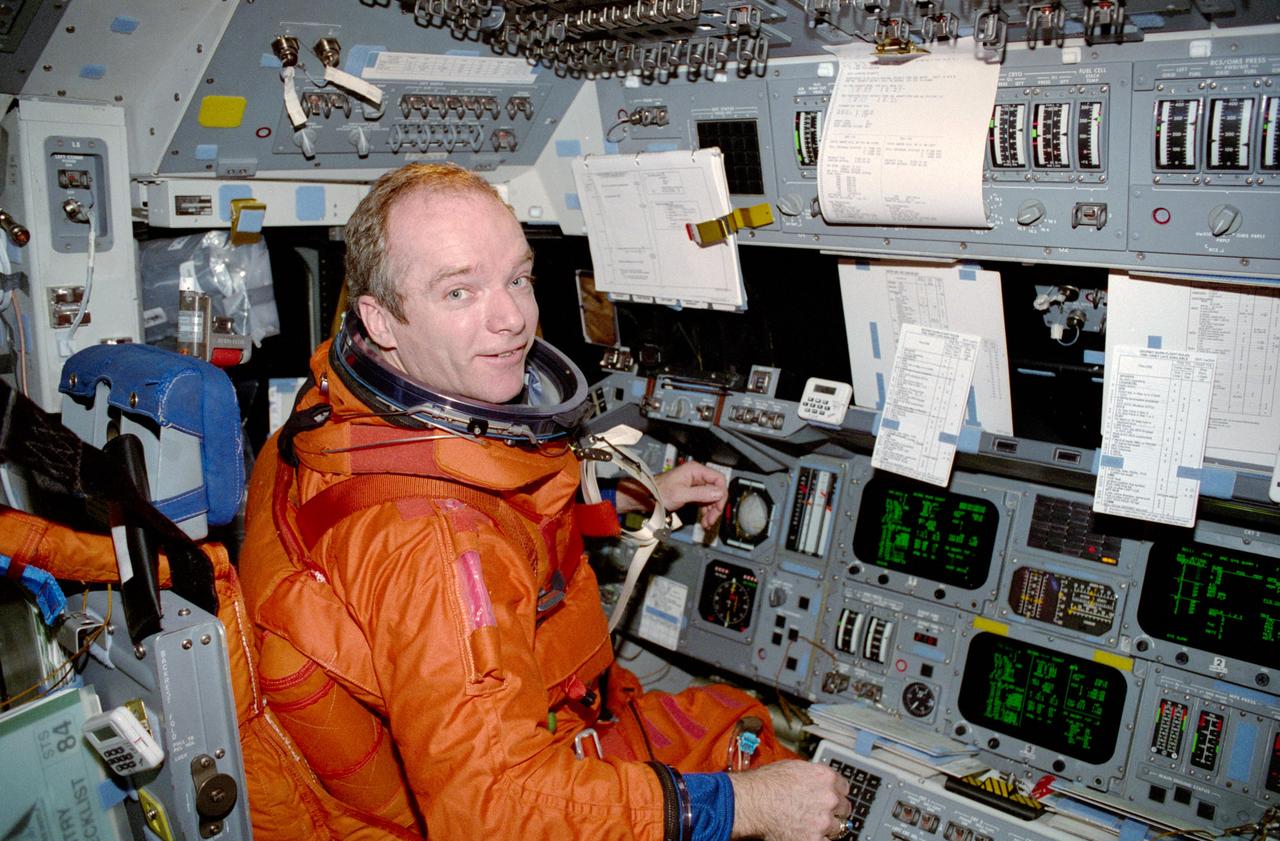
STS084-318-035 (15-24 May 1997) --- Attired in the partial pressure launch and entry garment, astronaut Charles J. Precourt, commander, performs final checkout procedures prior to the re-entry phase of the STS-84 mission. The photo was taken with a 35mm camera by one of the Space Shuttle Atlantis' rear station-seated crewmembers.
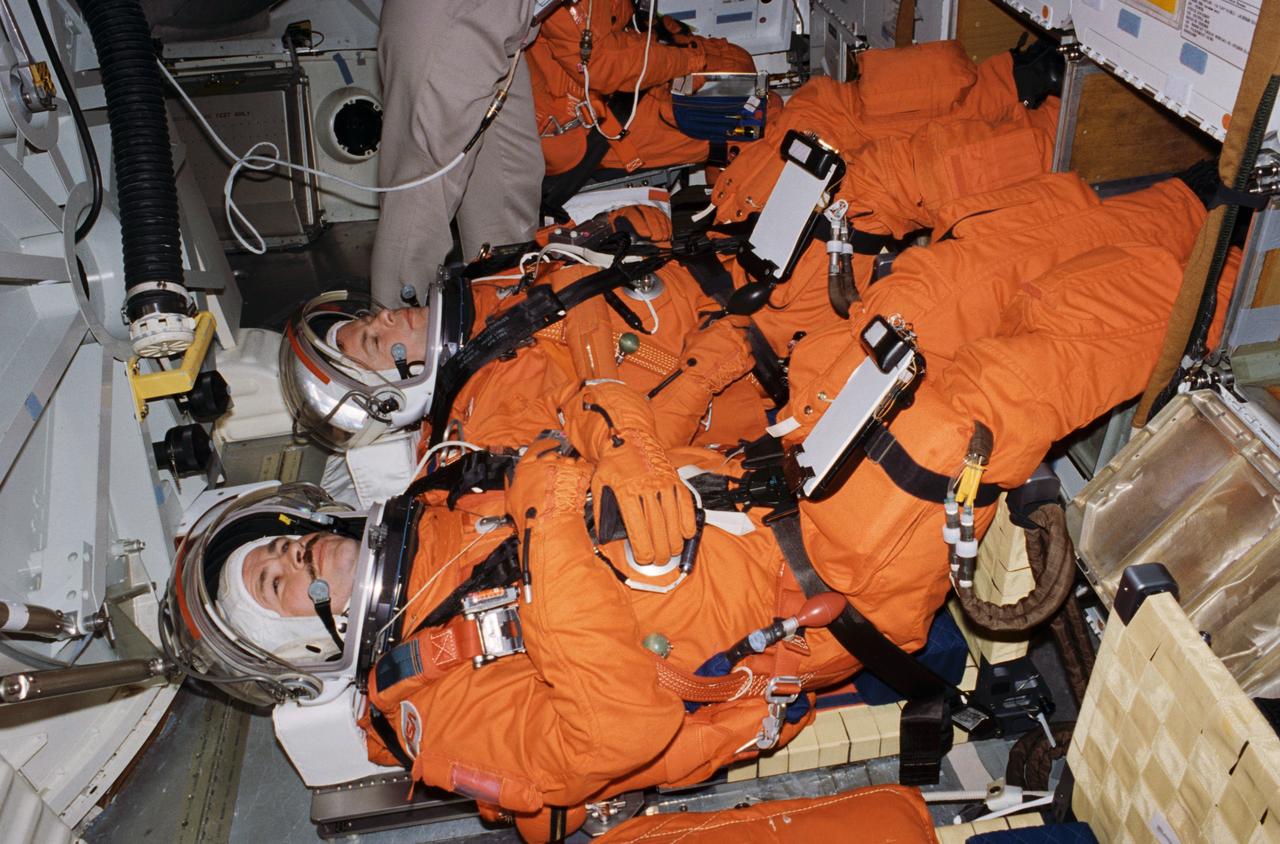
S94-47071 (Nov. 1994) --- In a Shuttle mockup trainer at the Johnson Space Center (JSC), two Russian cosmonauts assigned to Russia's Mir 19 mission check out hardware like that to be flown onboard NASA's Space Shuttle Atlantis, the spacecraft that will take the pair to their orbital destination. Anatoly Y. Solovyev, mission commander; and Nikolai M. Budarin (nearest camera), flight engineer, practice using the Recumbent Seating System (RSS). RSS has been manifest to be carried on the Space Shuttle Atlantis for the STS-71 mission. When Atlantis docks with the Mir space station in 1995, a NASA astronaut and two other Russian cosmonauts, who will have been onboard Mir for a long duration stay, will join the STS-71 crew for the return to Earth. Solovyev and Budarin will remain aboard Mir, to return to Earth later in one of Russia's Soyuz spacecraft.
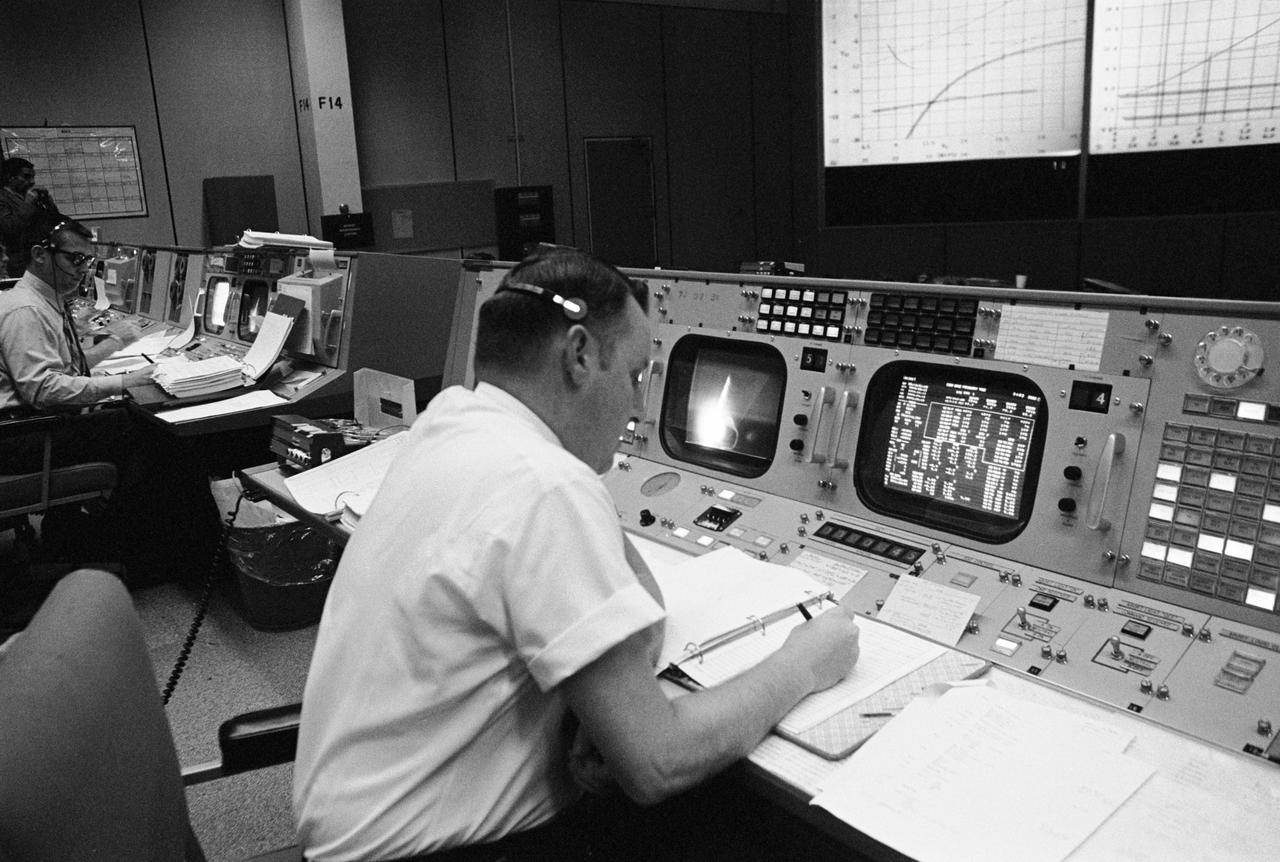
S68-55742 (21 Dec. 1968) --- Clifford E. Charlesworth, Apollo 8 "Green Team" flight director, is seated at his console in the Mission Operations Control Room in the Mission Control Center, Building 30, during the launch of the Apollo 8 (Spacecraft 103/Saturn 503) manned lunar orbit space mission.

STS032-30-024 (17 Jan 1990) --- Astronaut Daniel C. Brandenstein, STS-32 mission commander, holds up a card signed by friends in the astronaut office and around JSC. The commander celebrated his 47th birthday on January 17, 1990, about two thirds the way through an eleven-day mission in Earth orbit aboard Columbia. Brandenstein is seated at the commander's station.
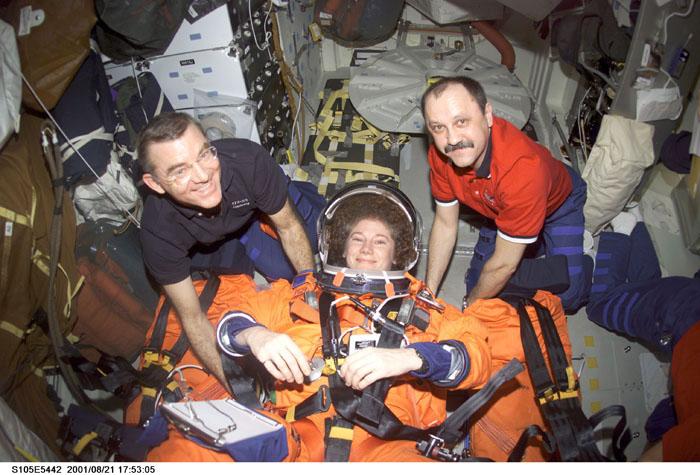
STS105-E-5442 (21 August 2001) --- As they near completion of their mission, the Expedition Two crew members prepare for the descent back to Earth. Astronaut James S. Voss (left), flight engineer, and cosmonaut Yury V. Usachev (right), mission commander, strap astronaut Susan J. Helms, flight engineer, into her seat on the mid deck of the Space Shuttle Discovery. Voss and Helms, representing NASA, and Usachev, representing Rosaviakosmos, are returning to Earth after completing their five-month assignment aboard the International Space Station (ISS). This image was recorded with a digital still camera.
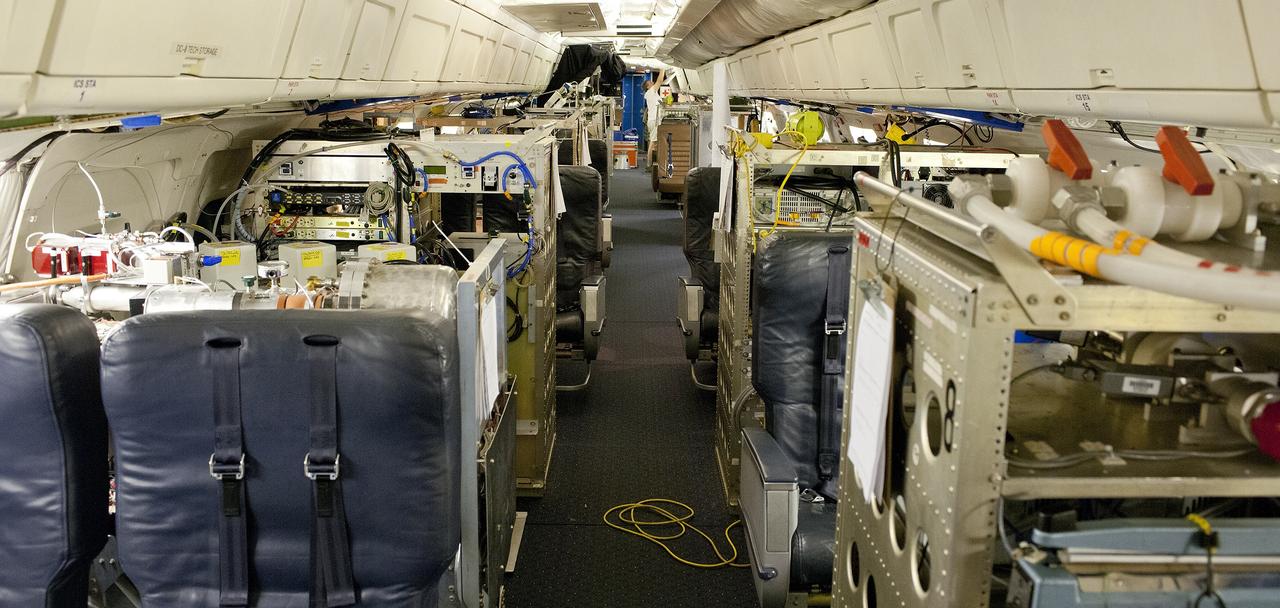
NASA's DC-8 flying laboratory is fully loaded with seats and instrument racks in preparation for NASA's 2013 SEAC4RS climate science mission.
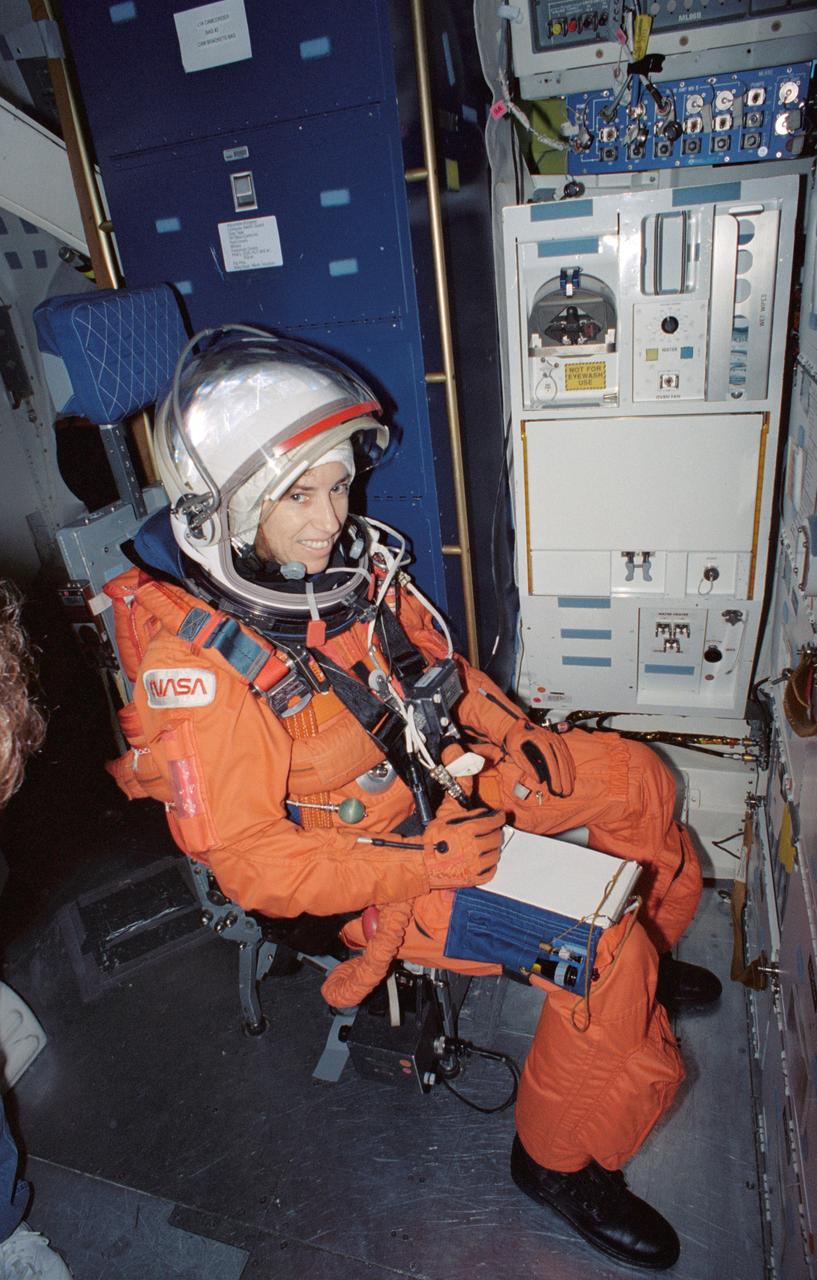
S94-40061 (23 June 1994) --- Secured in a collapsible seat on the middeck of a Shuttle trainer, astronaut Ellen Ochoa, payload commander, participates in a rehearsal of procedures to be followed during launch and entry phases of the scheduled November flight of STS-66. This rehearsal, held in the crew compartment trainer of the Johnson Space Center's (JSC) Shuttle Mockup and Integration Laboratory, was followed by a training session on emergency egress procedures. In November Ochoa will join four other NASA astronauts and a European mission specialist for a week and a half aboard the Space Shuttle Atlantis in Earth-orbit in support of the Atmospheric Laboratory for Applications and Science (ATLAS-3).
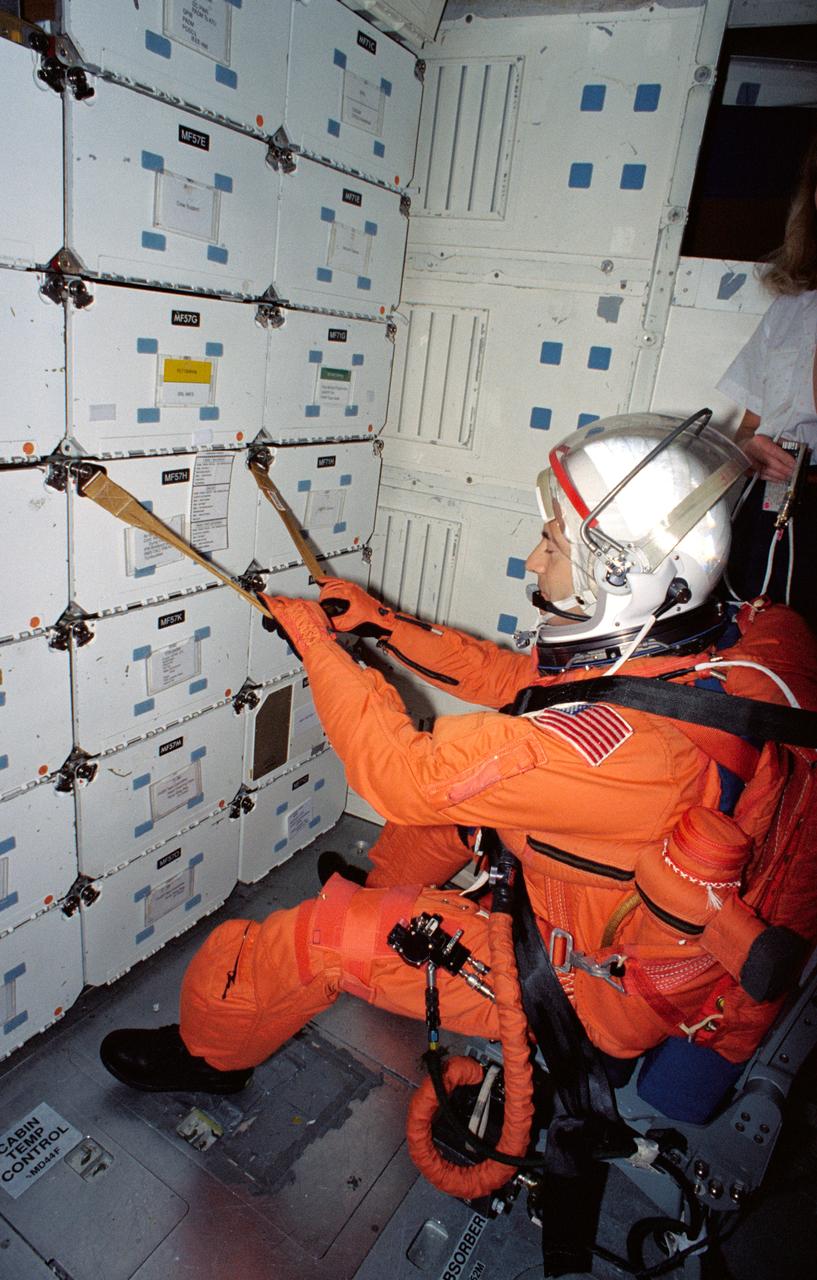
S94-40074 (23 June 1994) --- Astronaut Jean-Francois Clervoy, STS-66 international mission specialist, sits securely on a collapsible seat on the middeck of a Shuttle trainer during a rehearsal of procedures to be followed during launch and entry phases of his scheduled November flight. This rehearsal, held in the crew compartment trainer of the Johnson Space Center's (JSC) Shuttle Mockup and Integration Laboratory, was followed by a training session on emergency egress procedures. Clervoy, a European astronaut, will join five NASA astronauts for a week and a half aboard the Space Shuttle Atlantis in Earth-orbit in support of the Atmospheric Laboratory for Applications and Science (ATLAS-3).
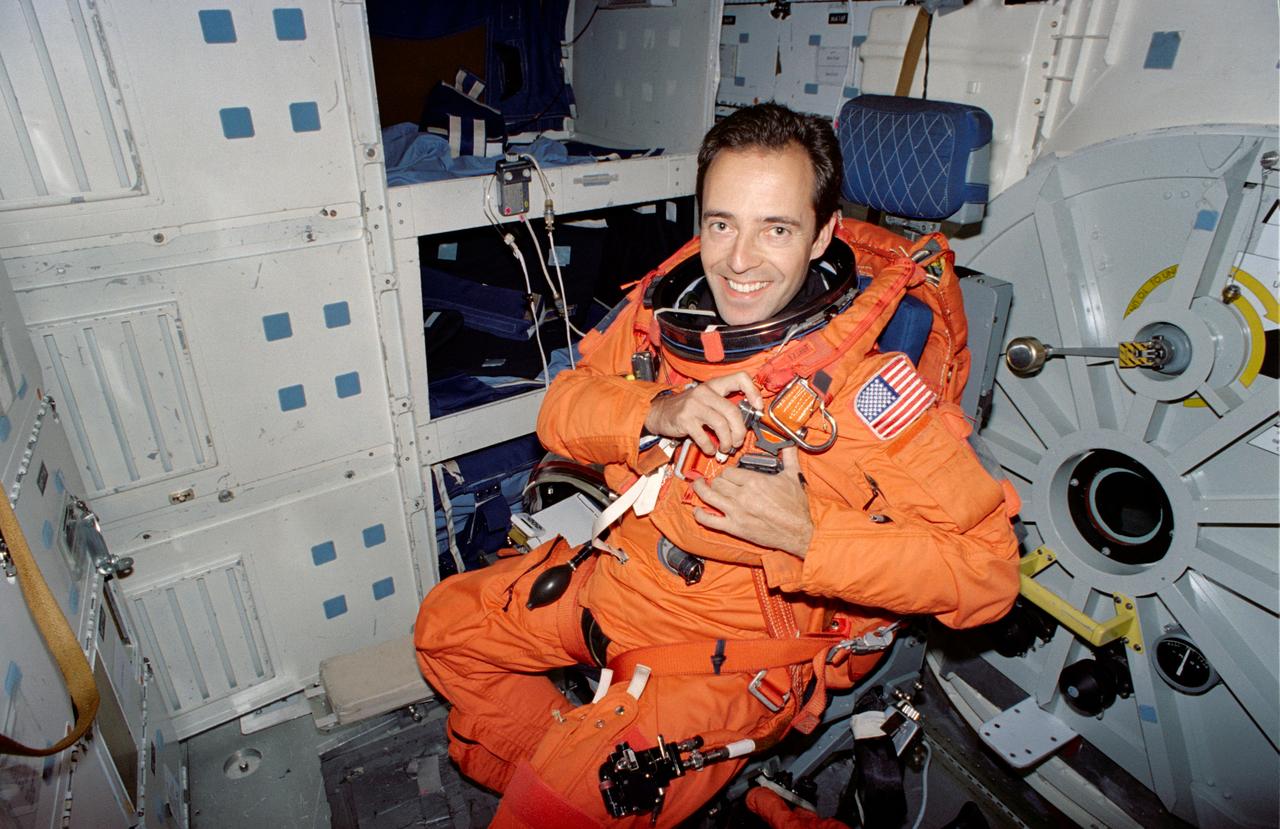
S94-40081 (23 June 1994) --- Wearing a training version of a partial pressure suit, Jean-Francois Clervoy, STS-66 international mission specialist, secures himself on a collapsible seat on the middeck of a Shuttle trainer during a rehearsal of procedures to be followed during launch and entry phases of his scheduled November flight. This rehearsal, held in the Crew Compartment Trainer (CCT) of the Johnson Space Center's (JSC) Shuttle Mockup and Integration Laboratory, was followed by a training session on emergency egress procedures. Clervoy, a European astronaut, will join five NASA astronauts for a week and a half aboard the Space Shuttle Atlantis in Earth-orbit in support of the Atmospheric Laboratory for Applications and Science (ATLAS-3).
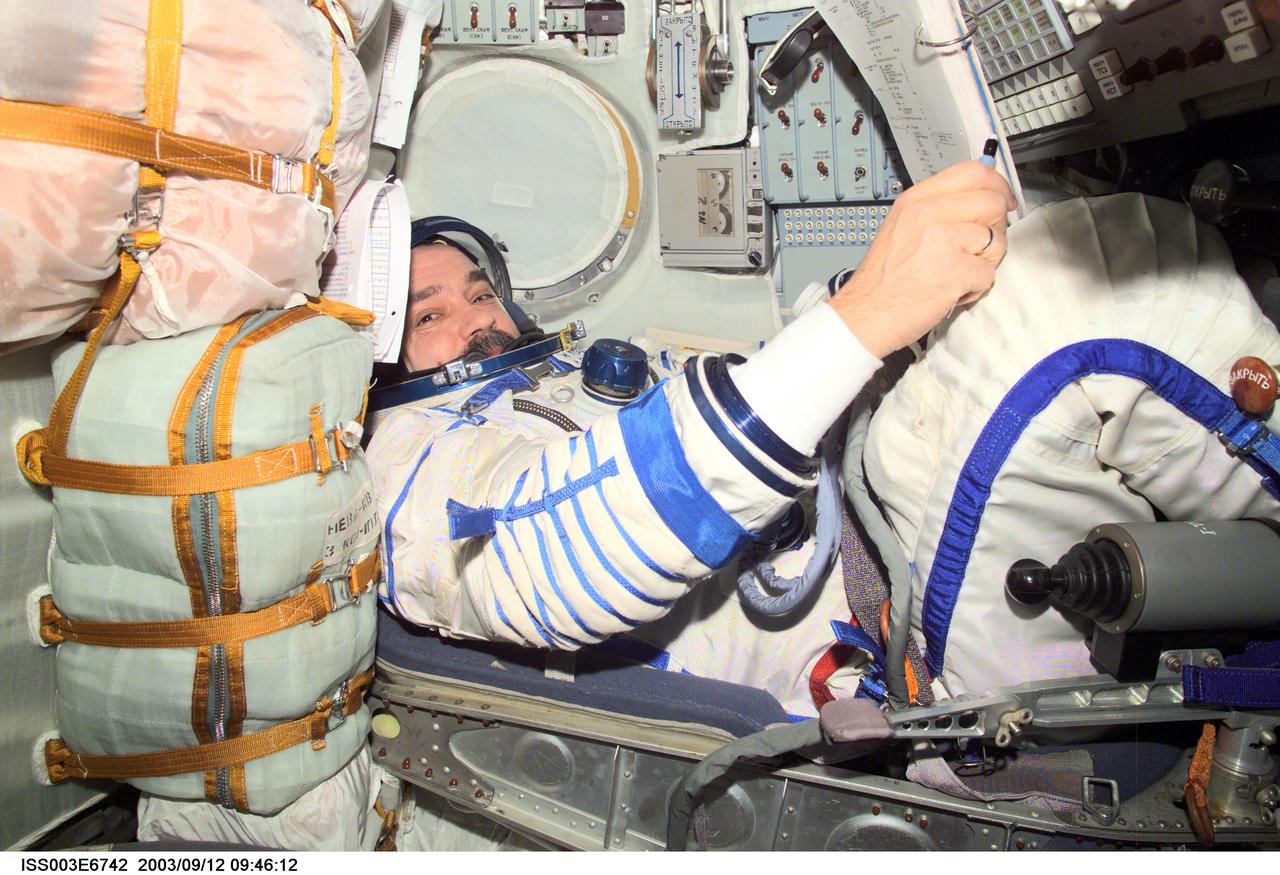
ISS003-E-6742 (October 2001) --- Cosmonaut Mikhail Tyurin, Expedition Three flight engineer, wearing a Russian Sokol suit, is seated in the Soyuz spacecraft that is docked to the International Space Station (ISS). This Soyuz return vehicle will be moved from the Earth-facing port of the Zarya module for the linkup to the new Pirs Docking Compartment. The move of the Soyuz will mark the first time the new Pirs, which arrived at the station September 17, 2001, will serve as a docking port. The Soyuz will be shifted to prepare for the arrival of a new Soyuz return craft, to be launched October 21, 2001 from the Baikonur Cosmodrome in Kazakhstan. The Soyuz can serve as a crew return vehicle at the station for a maximum of about six months. Tyurin represents Rosaviakosmos. This image was taken with a digital still camera.
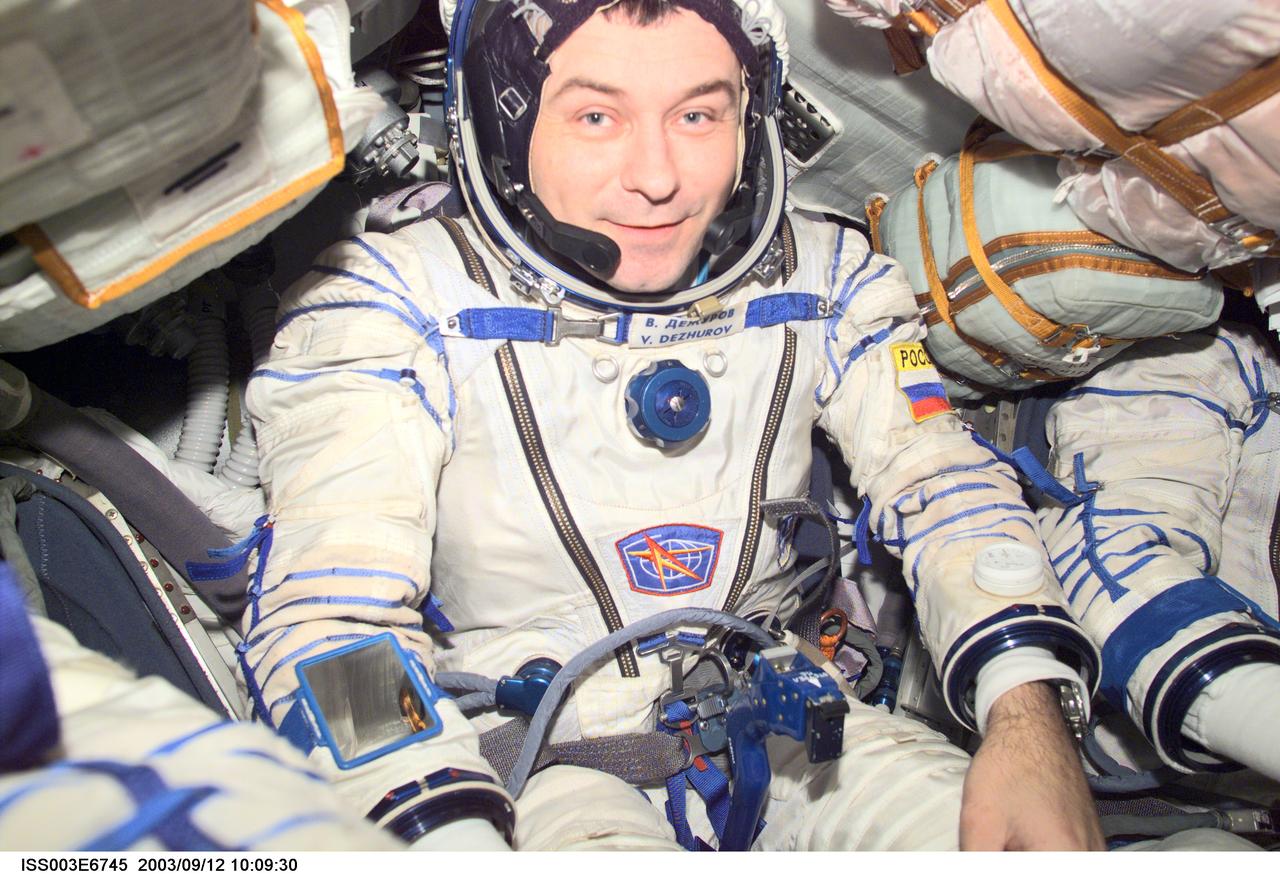
ISS003-E-6745 (October 2001) --- Cosmonaut Vladimir N. Dezhurov, Expedition Three flight engineer, wearing a Russian Sokol suit, is seated in the Soyuz spacecraft that is docked to the International Space Station (ISS). This Soyuz return vehicle will be moved from the Earth-facing port of the Zarya module for the linkup to the new Pirs Docking Compartment. The move of the Soyuz will mark the first time the new Pirs, which arrived at the station September 17, 2001, will serve as a docking port. The Soyuz will be shifted to prepare for the arrival of a new Soyuz return craft, to be launched October 21, 2001 from the Baikonur Cosmodrome in Kazakhstan. The Soyuz can serve as a crew return vehicle at the station for a maximum of about six months. Dezhurov represents Rosaviakosmos. This image was taken with a digital still camera.
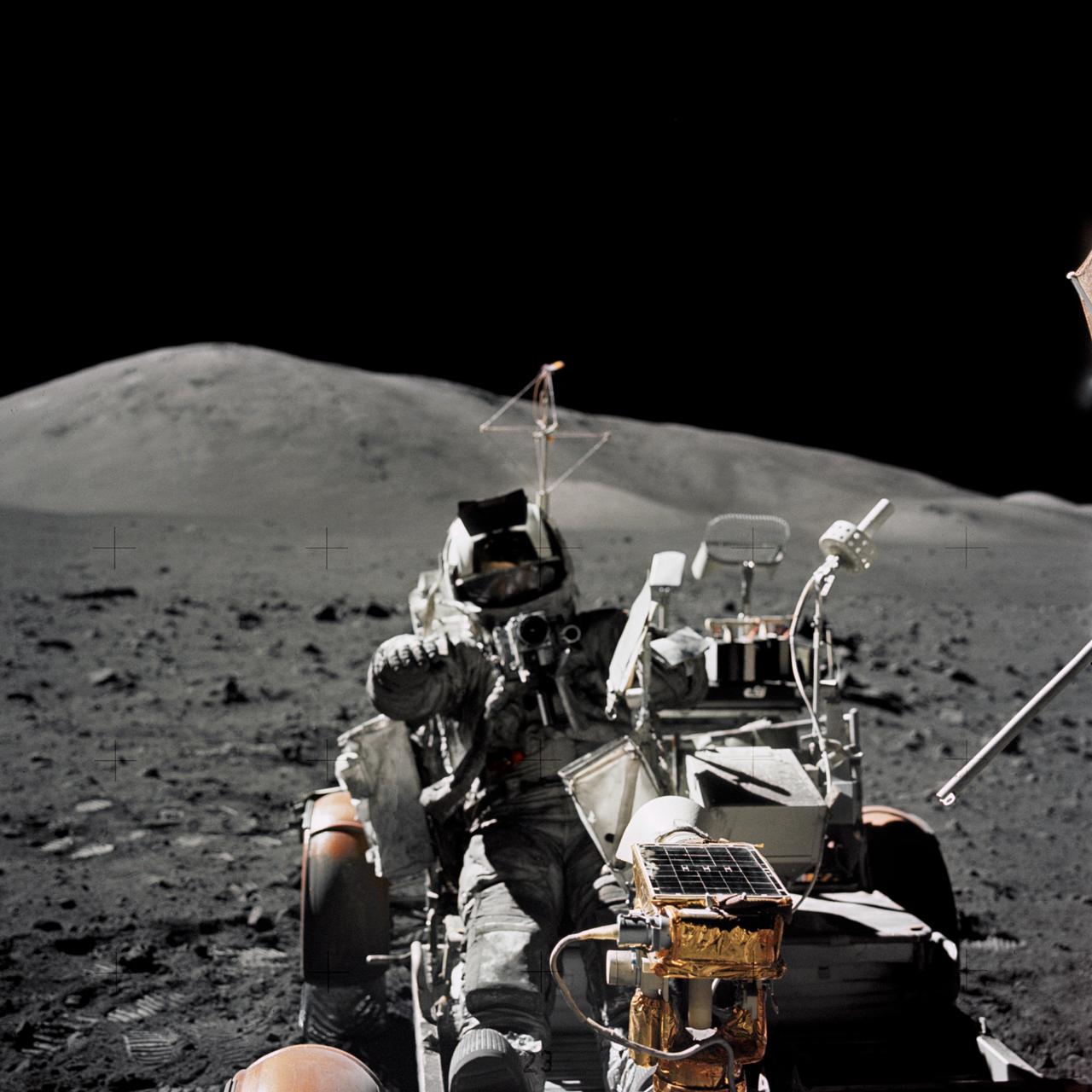
AS17-134-20454 (13 Dec. 1972) --- Scientist-astronaut Harrison H. Schmitt is photographed seated in the Lunar Roving Vehicle (LRV) at Station 9 (Van Serg Crater) during the third Apollo 17 extravehicular activity (EVA) at the Taurus-Littrow landing site. This photograph was taken by astronaut Eugene A. Cernan, commander. Schmitt, lunar module pilot, and Cernan explored the moon while astronaut Ronald E. Evans, command module pilot, remained with the Command and Service Modules in lunar orbit.
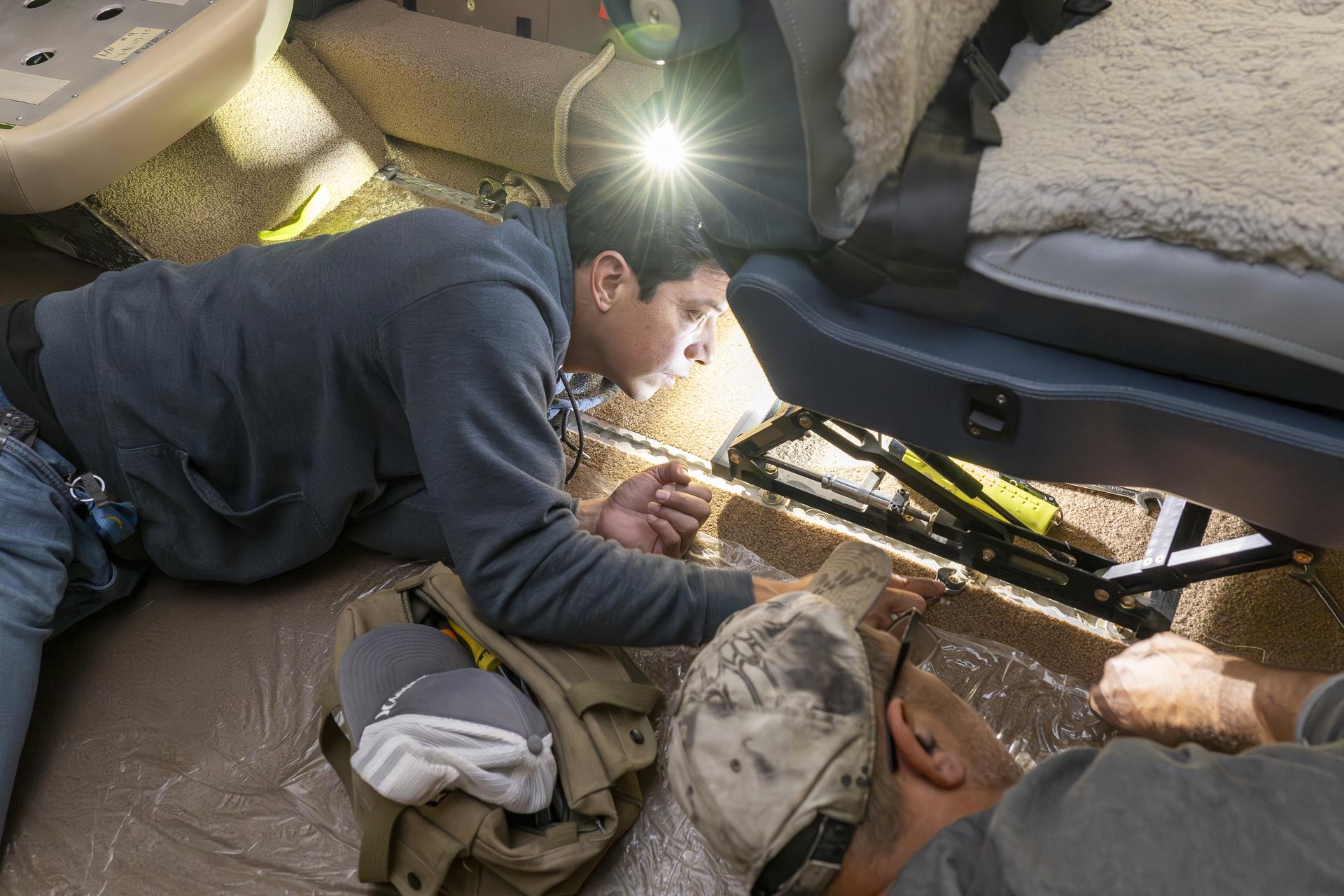
Manny Rodriguez, Gulfstream G-III aircraft crew chief, left, and Eric Apikian, aircraft mechanic, attach an instrumented seat onto a G-III on Wednesday, Jan. 7, 2026, at NASA’s Armstrong Flight Research Center in Edwards, California. The modifications prepare the aircraft to join three others flying at different altitudes to capture a complete view of the Orion spacecraft’s heat shield during Artemis II reentry. This effort is part of NASA’s Scientifically Calibrated In-Flight Imagery project.
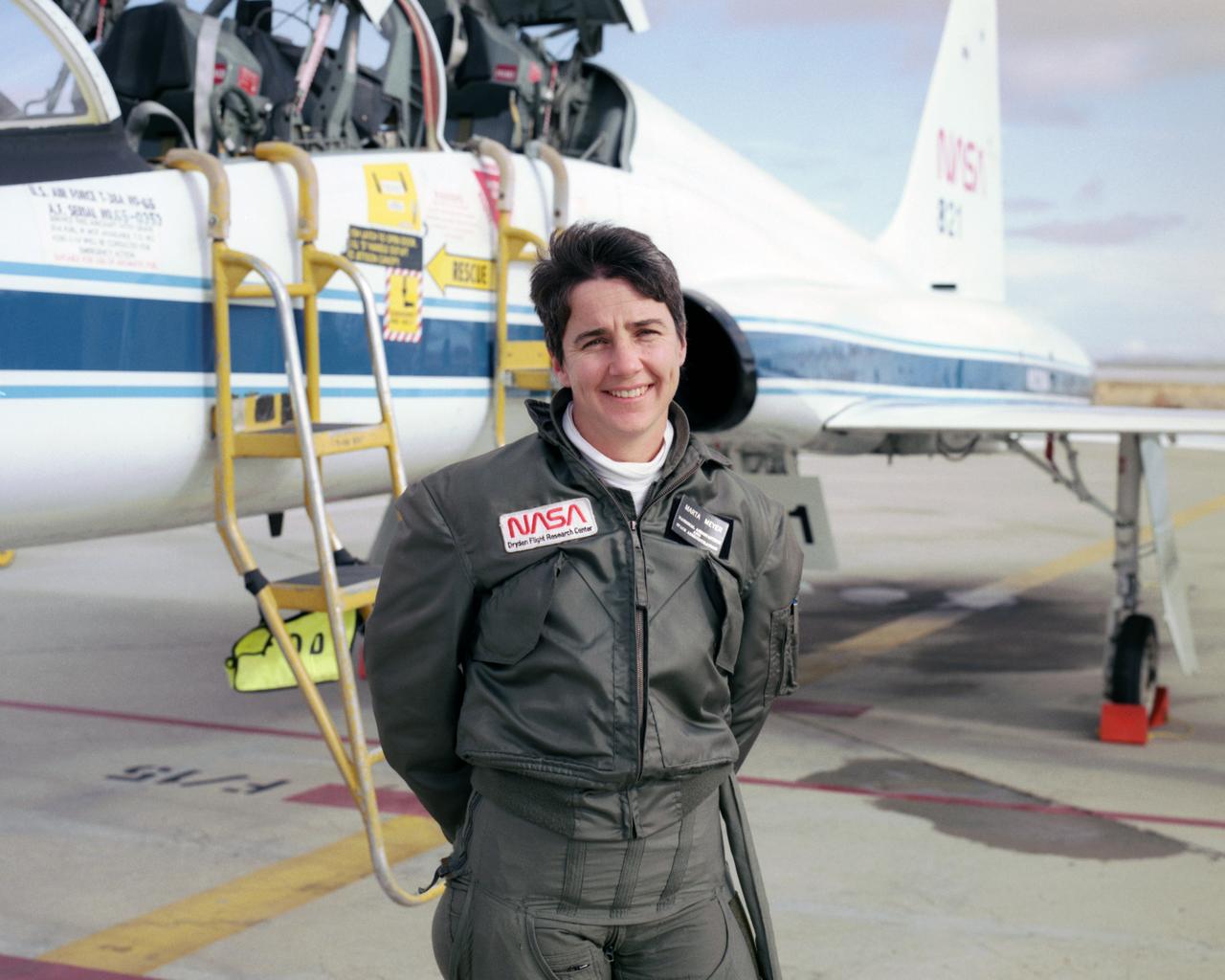
Marta Bohn-Meyer flew as a back-seat flight test engineer in this NASA T-38 mission support aircraft when this 1993 photo was taken.
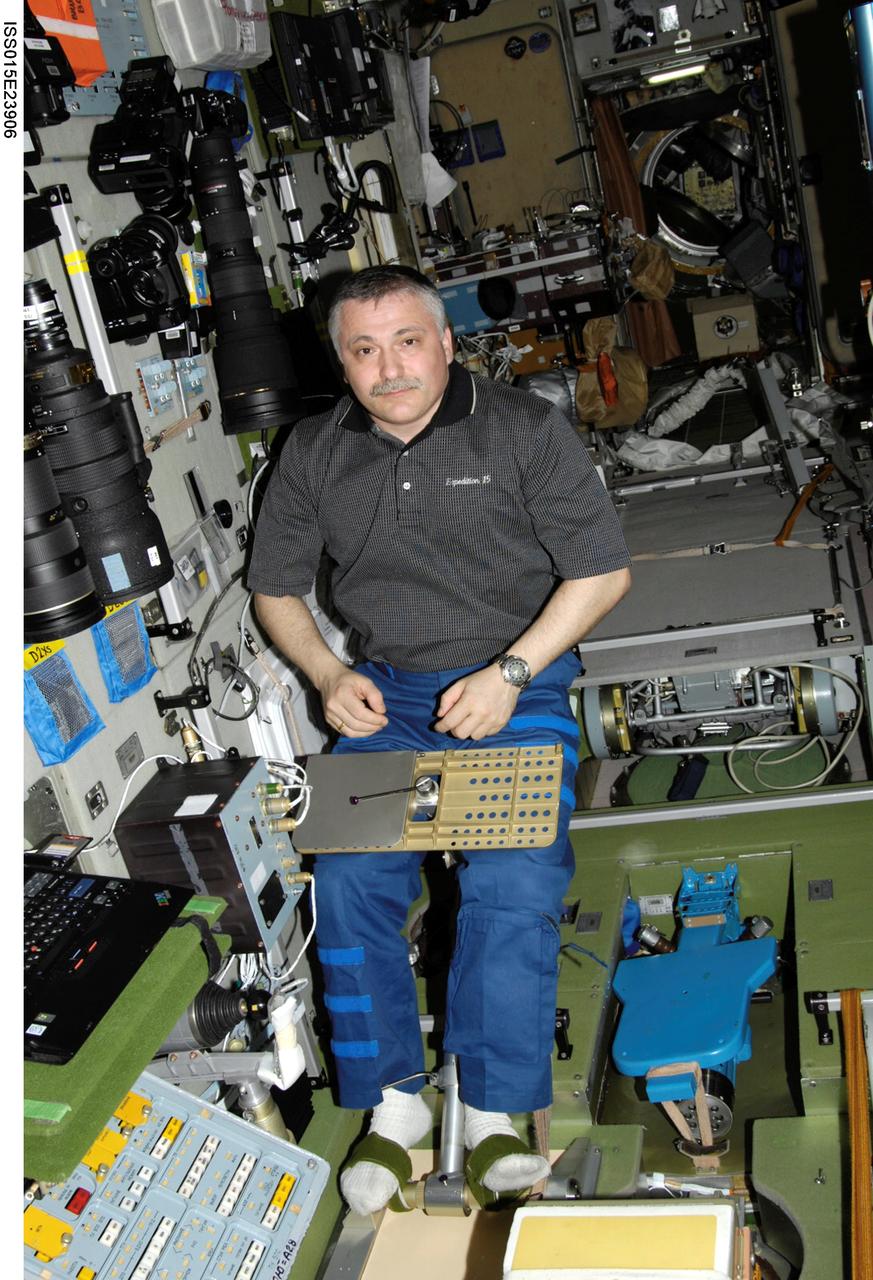
ISS015-E-23906 (24 Aug. 2007) --- Cosmonaut Fyodor N. Yurchikhin, Expedition 15 commander representing Russia's Federal Space Agency, works in the Zvezda Service Module of the International Space Station. Yurchikhin occupied an "operator seat", which is a portable chair that replicates a crewmember's anatomical back curvature.
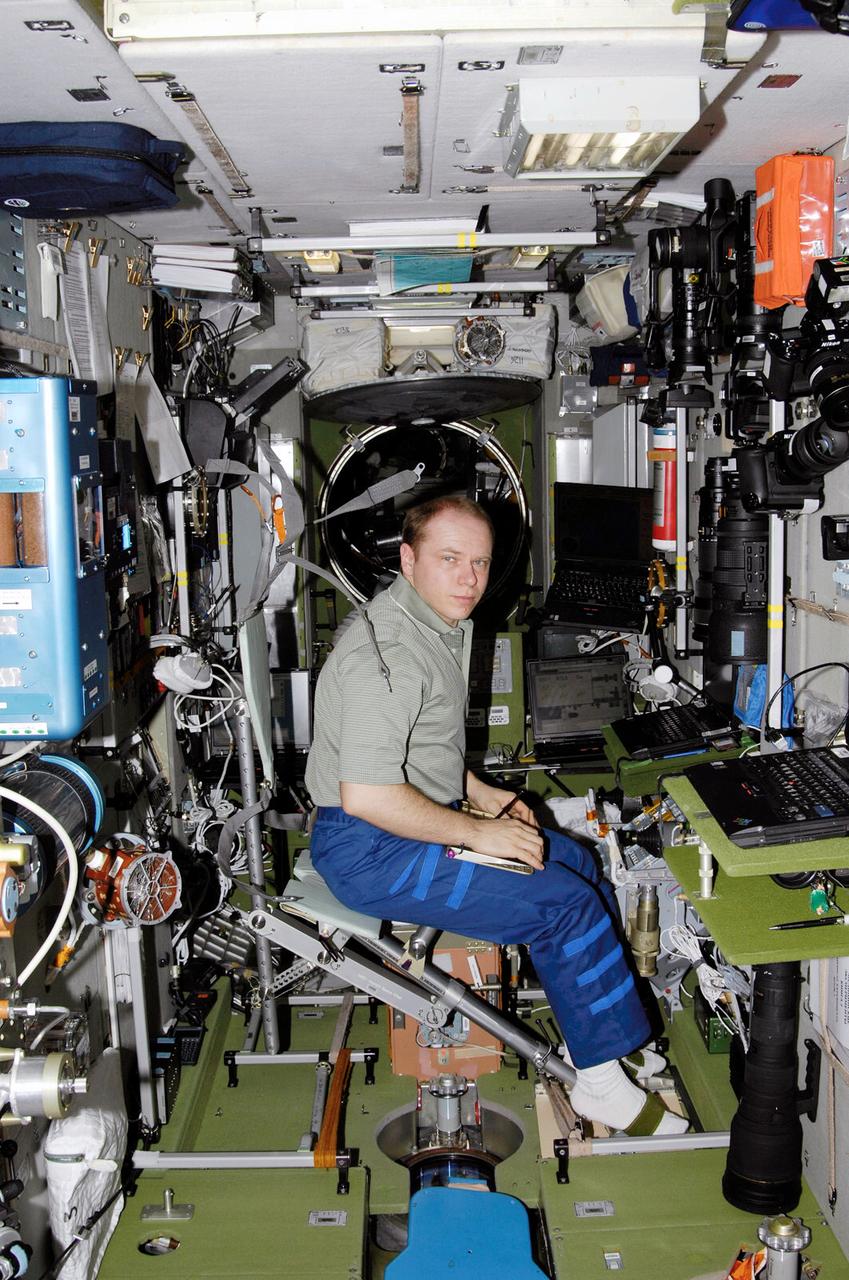
ISS015-E-23899 (24 Aug. 2007) --- Cosmonaut Oleg V. Kotov, Expedition 15 flight engineer representing Russia's Federal Space Agency, works in the Zvezda Service Module of the International Space Station. Kotov occupied an "operator seat", which is a portable chair that replicates a crewmember's anatomical back curvature.
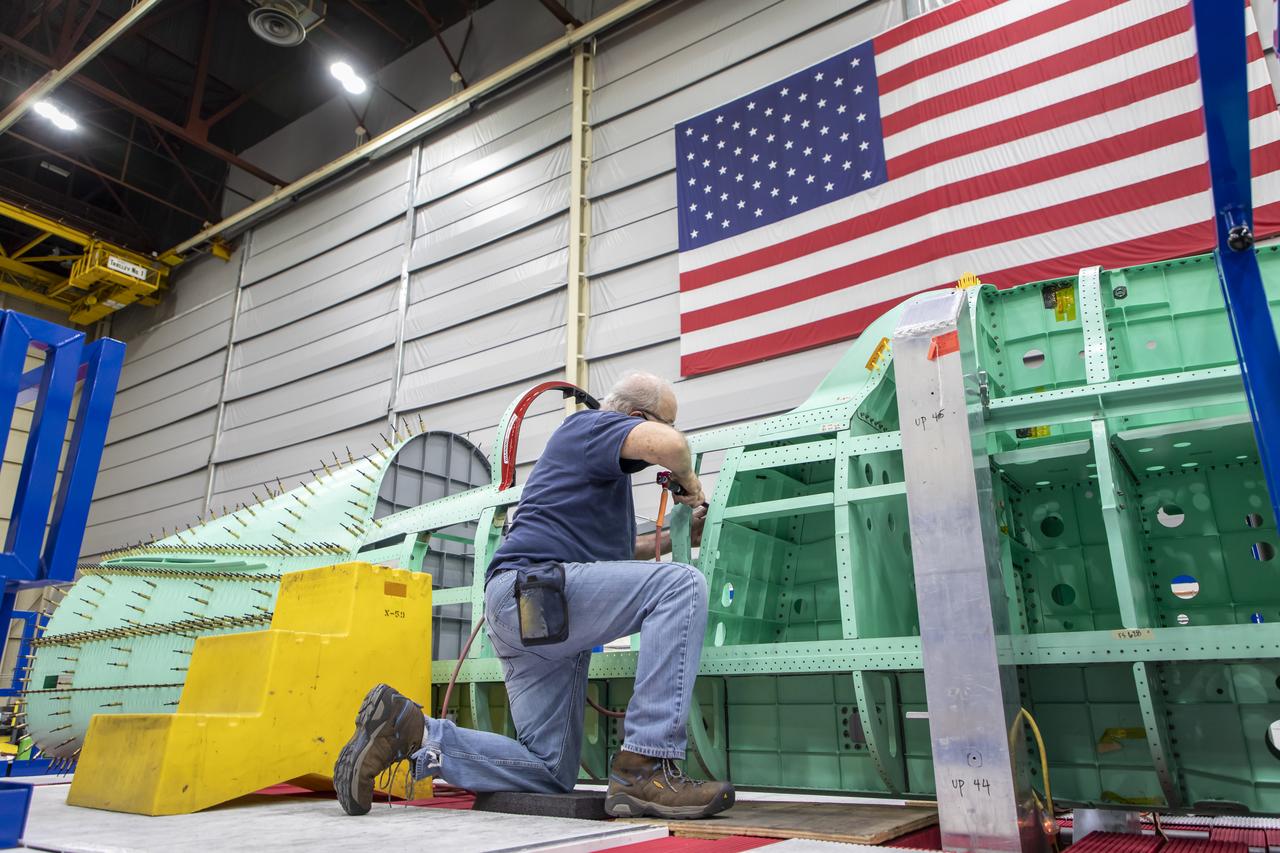
Event: SEG 210 Forebody A Lockheed Martin technician works on the ejection seat support structure and once complete, the ejection seat rails will be installed on the X-59 airplane. The aircraft, under construction at Lockheed Martin Skunk Works in Palmdale, California, will demonstrate the ability to fly supersonic while reducing the loud sonic boom to a quiet sonic thump.
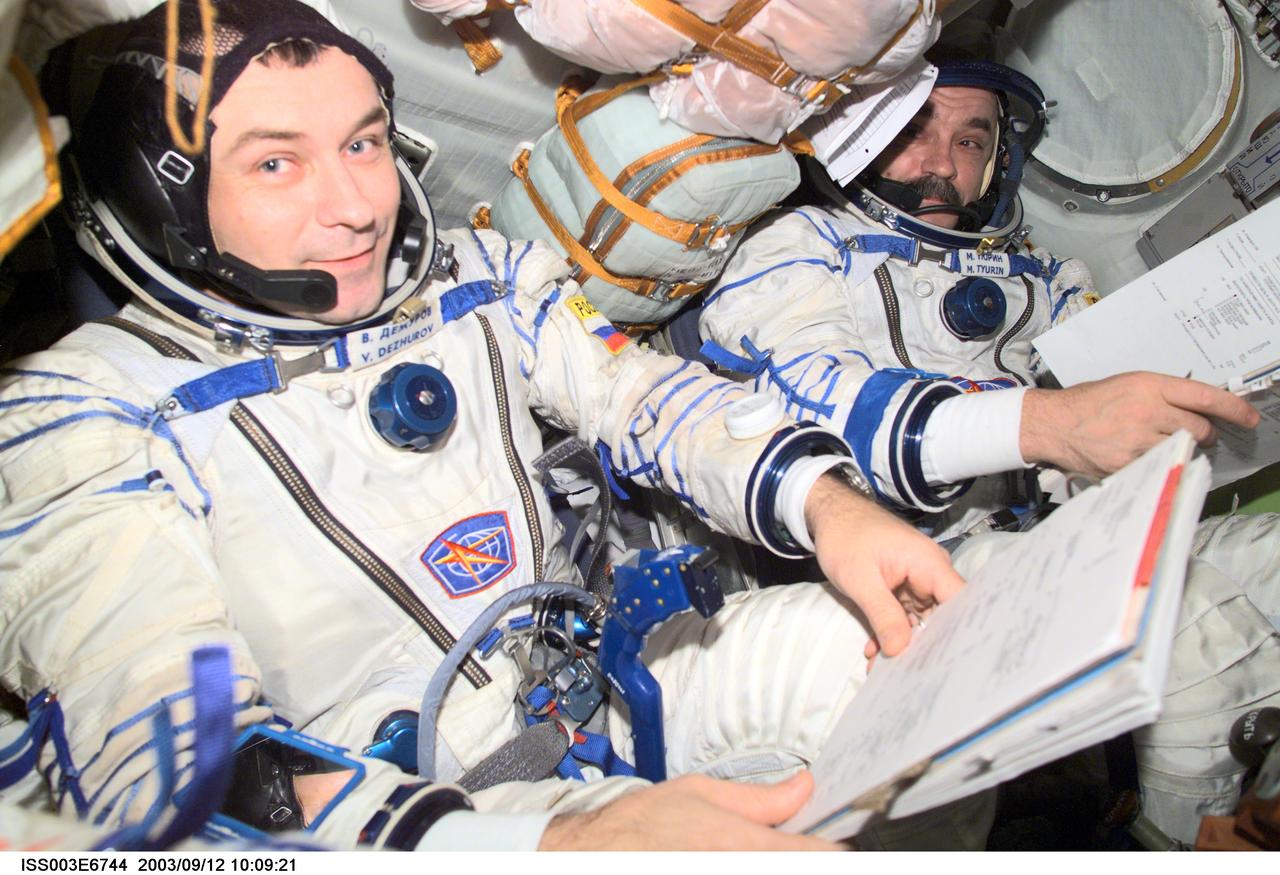
ISS003-E-6744 (October 2001) --- Cosmonauts Vladimir N. Dezhurov (left) and Mikhail Tyurin, both Expedition Three flight engineers, wearing Russian Sokol suits, are seated in the Soyuz spacecraft that is docked to the International Space Station (ISS). This Soyuz return vehicle will be moved from the Earth-facing port of the Zarya module for the linkup to the new Pirs Docking Compartment. The move of the Soyuz will mark the first time the new Pirs, which arrived at the station September 17, 2001, will serve as a docking port. The Soyuz will be shifted to prepare for the arrival of a new Soyuz return craft, to be launched October 21, 2001 from the Baikonur Cosmodrome in Kazakhstan. The Soyuz can serve as a crew return vehicle at the station for a maximum of about six months. Dezhurov and Tyurin represent Rosaviakosmos. This image was taken with a digital still camera.
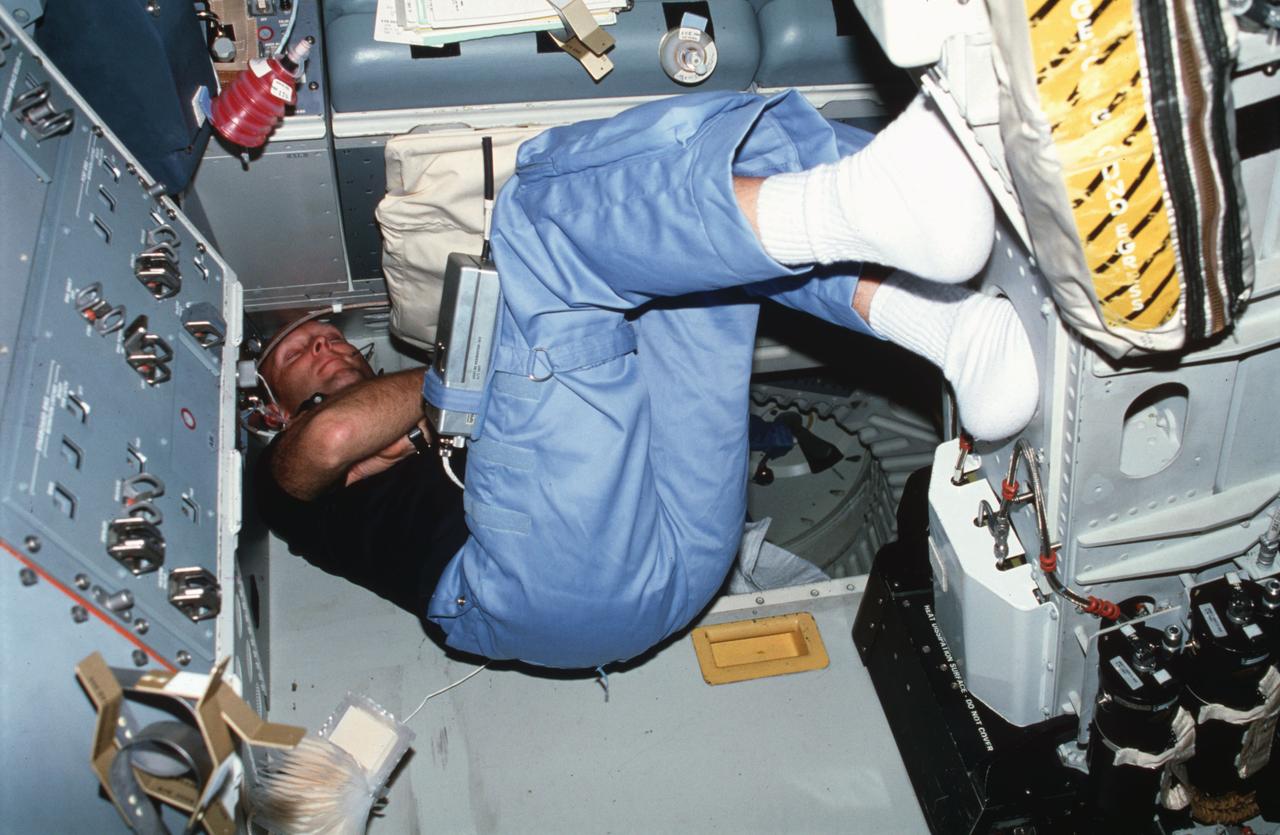
STS003-22-113 (24 March 1982) --- Astronaut Gordon Fullerton, STS-3 pilot, wearing communication kit assembly mini-headset (HDST), sleeps on aft flight deck resting his back against the floor and his feet against commander's ejection seat (S1) back. On-orbit station control panel A8 and payload station panel L15 appear above Fullerton. Special clips for holding notebooks open and beverage containers are velcroed on various panels. Photo credit: NASA
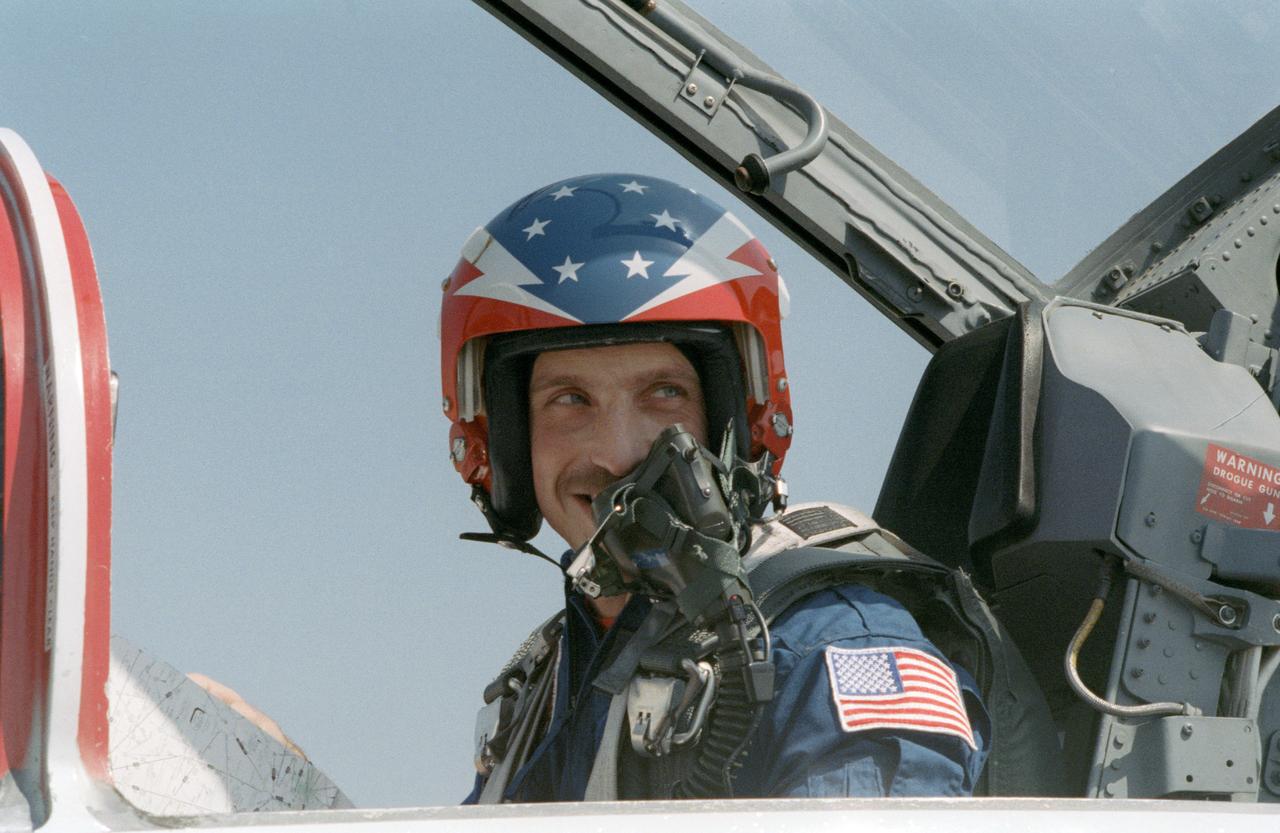
STS029-S-003 (10 March 1989) --- Astronaut James P. Bagian, STS-29 mission specialist, prepares to take a rear-seat ride in a NASA T-38 jet aircraft from Houston's Johnson Space Center to Florida's Kennedy Space Center. In three days, he and four fellow STS-29 crewmembers are scheduled to lift off aboard the Space Shuttle Discovery from Launch Pad 39B.
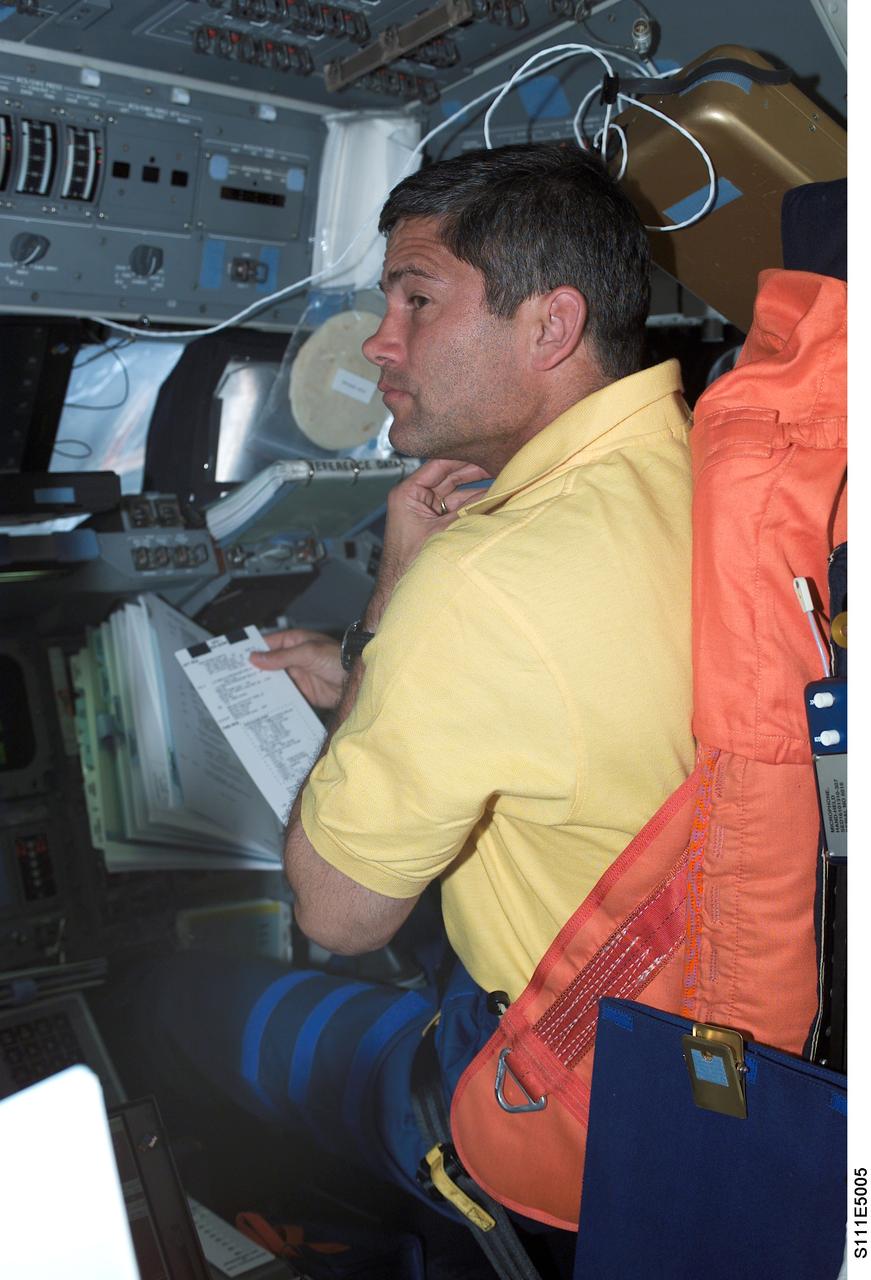
STS111-E-5005 (6 June 2002) --- Astronaut Paul S. Lockhart, STS-111 pilot, consults a check list on the day prior to rendezvous and docking operations between the Space Shuttle Endeavour and International Space Station (ISS). Lockhart, an alumnus of the 1996 astronaut candidate class marking his first space flight, is seated at the pilot's station on the shuttle's forward flight deck.
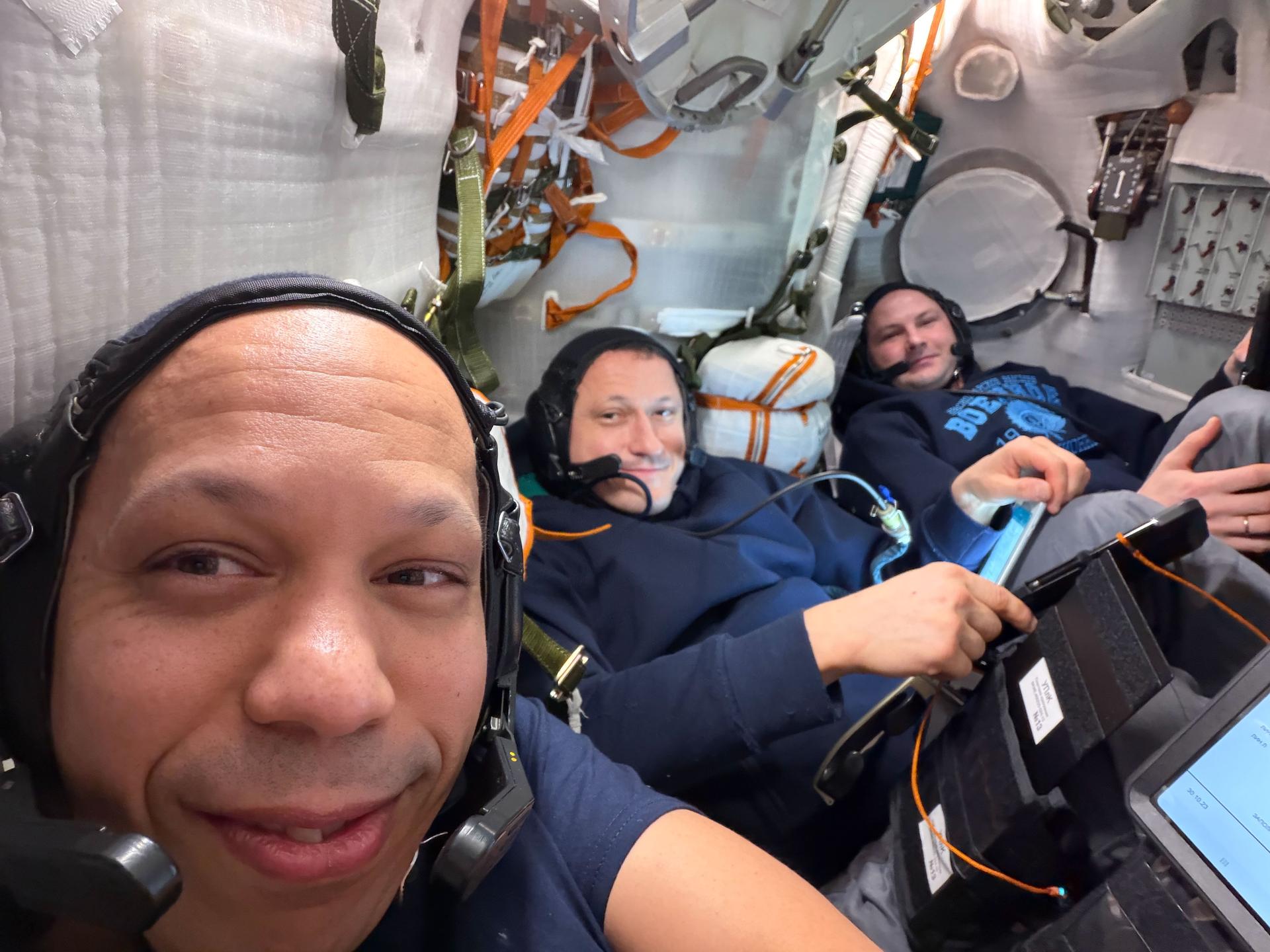
iss074e0835533 (July 23, 2026) --- From left, NASA astronaut Chris Williams and Roscosmos cosmonauts Sergey Kud‑Sverchkov and Sergei Mikaev are seated inside the Soyuz MS‑28 spacecraft docked to the International Space Station. The trio practiced and reviewed the landing procedures they would use a few days later, after undocking from the orbital outpost and parachuting to Earth aboard the Soyuz. Credit: NASA/Chris Williams

STS029-S-004 (10 March 1989) --- Astronaut James F. Buchli, STS-29 mission specialist, prepares to take a rear-seat ride in a NASA T-38 jet aircraft from Houston's Johnson Space Center to Florida's Kennedy Space Center. In three days, he and four fellow STS-29 crewmembers are scheduled to lift off aboard the Space Shuttle Discovery from Launch Pad 39B.

art002e014198 (April 6, 2026) – NASA astronaut and Artemis II Commander Reid Wiseman taking a moment during the seven-hour lunar observation period where the crew reported to the ground team their observations including color nuances, which will help enhance scientific understandings of the Moon. At the beginning of the window, as Orion approaches the Moon on the near side, the side we can see from Earth, people in parts of the eastern hemisphere can view some of the same features the astronauts will observe.
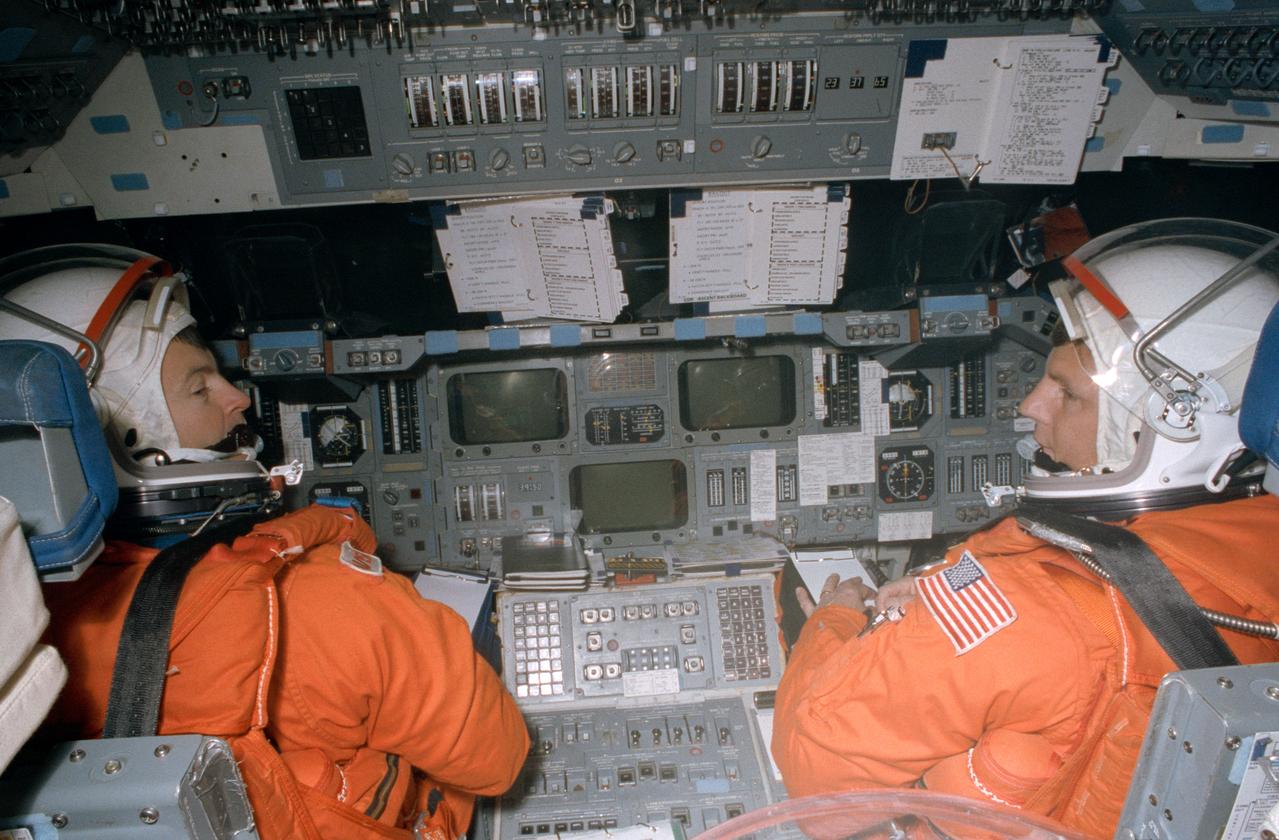
STS-56 Discovery, Orbiter Vehicle (OV) 103, Commander Kenneth Cameron, (left) and Pilot Stephen S. Oswald, wearing launch and entry suits (LESs) and launch and entry helmets (LEHs), are seated on the forward flight deck of the crew compartment trainer (CCT), a shuttle mockup. Cameron mans the commander station controls and Oswald the pilots station controls during an emergency egress (bailout) simulation. The view was taken from the aft flight deck looking forward and includes Cameron's and Oswald's profiles and the forward flight deck controls and checklists. The CCT is located in JSC's Mockup and Integration Laboratory (MAIL) Bldg 9NE.
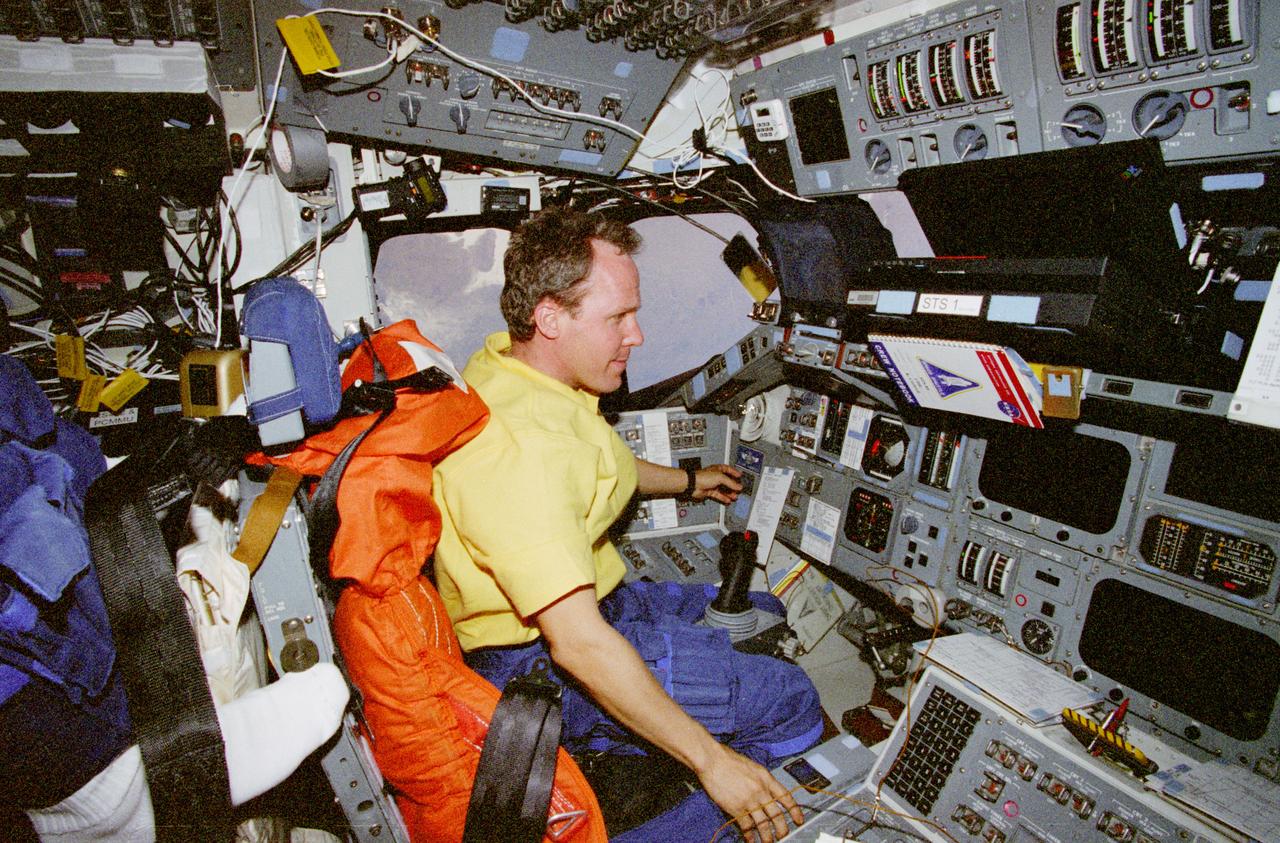
STS-80 Mission Specialist Tom Jones is seated in the flight deck commander's seat and conducts stationkeeping burns.
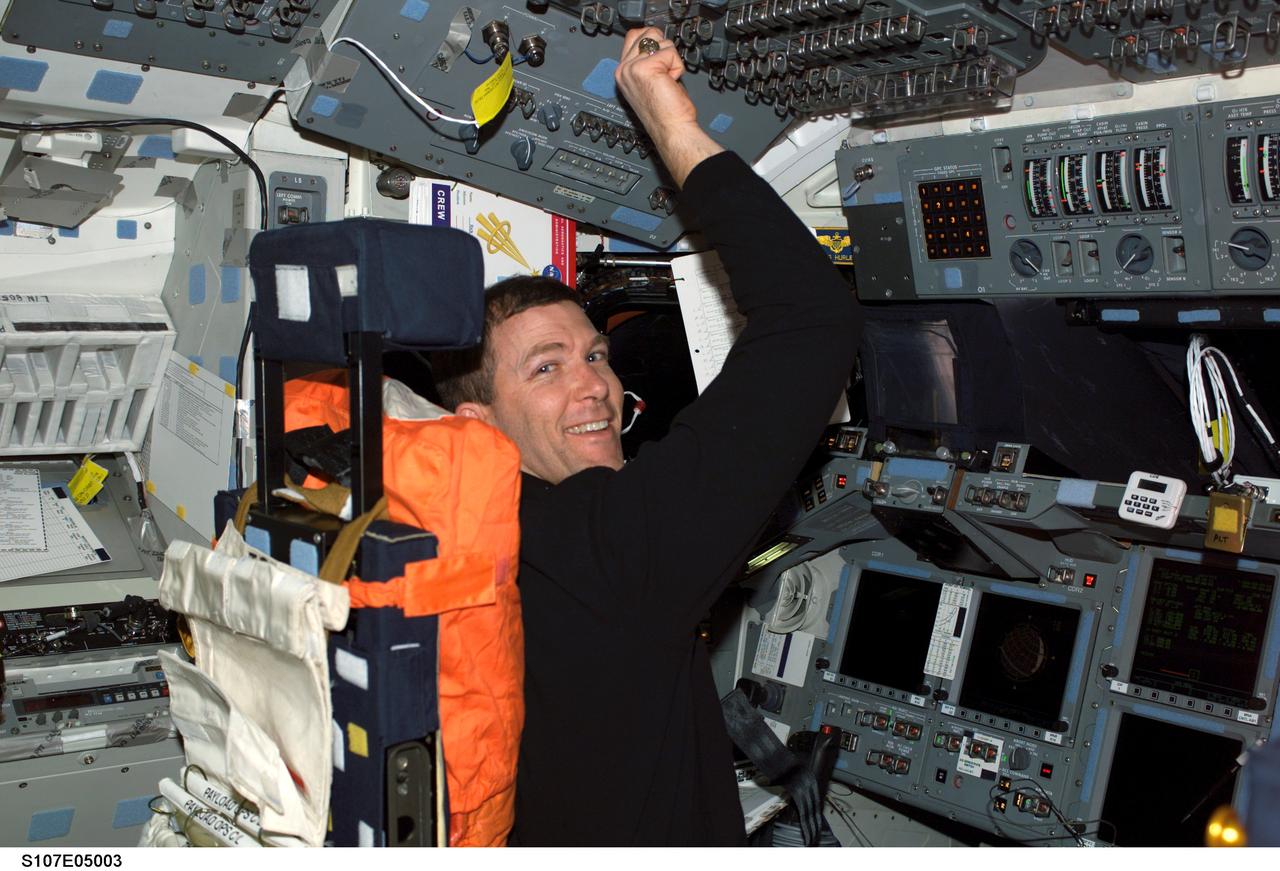
STS107-E-05003 (17 January 2003) --- Astronaut Rick D. Husband, STS-107 mission commander, occupies the commander’s station on the forward flight deck of the Earth-orbiting Space Shuttle Columbia.
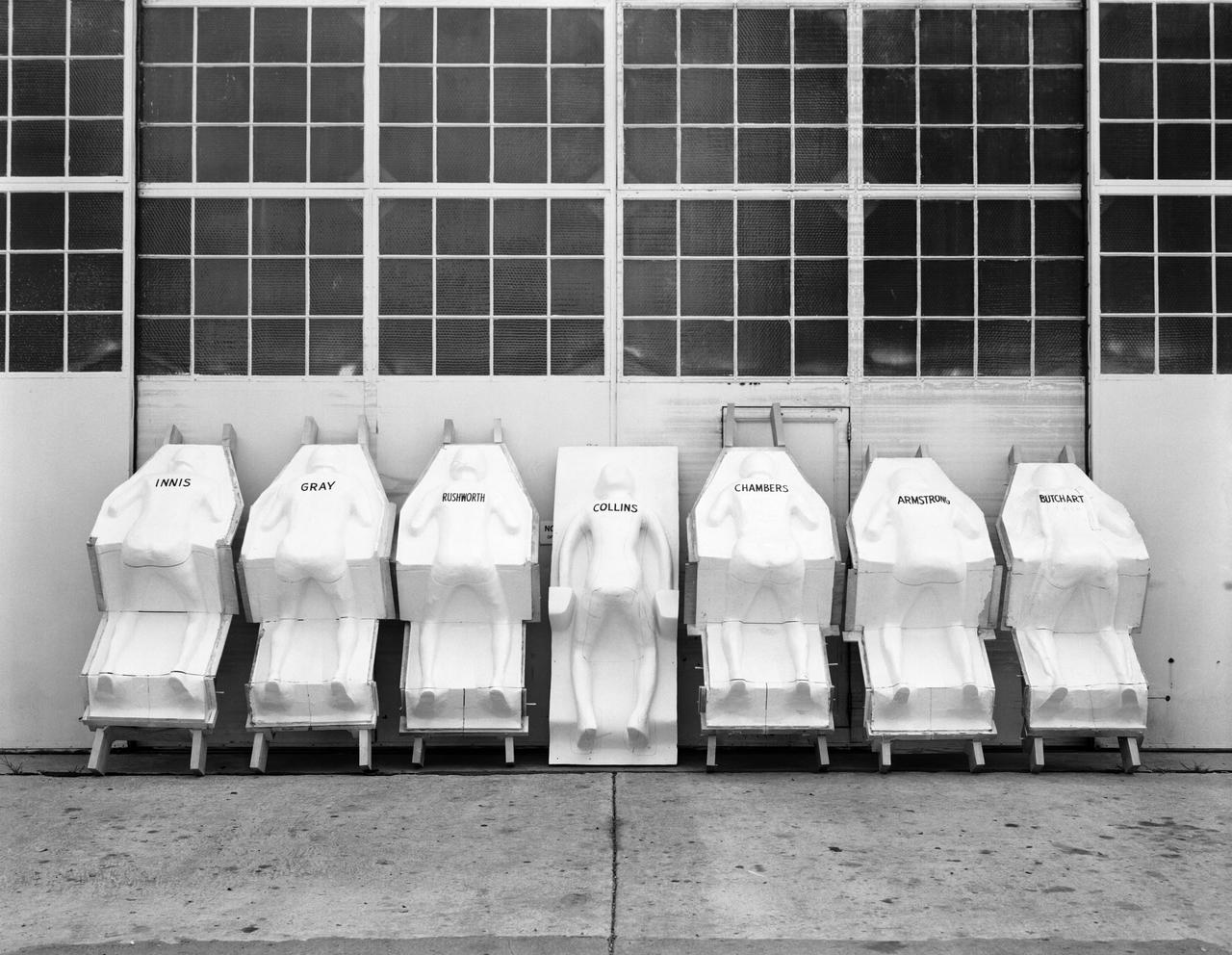
Molds for couches for test pilots, line the NASA Langley Research Centers model shop wall. The names of the test subjects (Langley employees) are written on the back. The couches are similar to those made for each astronaut and fitted into the Mercury capsules for manned spaceflight.
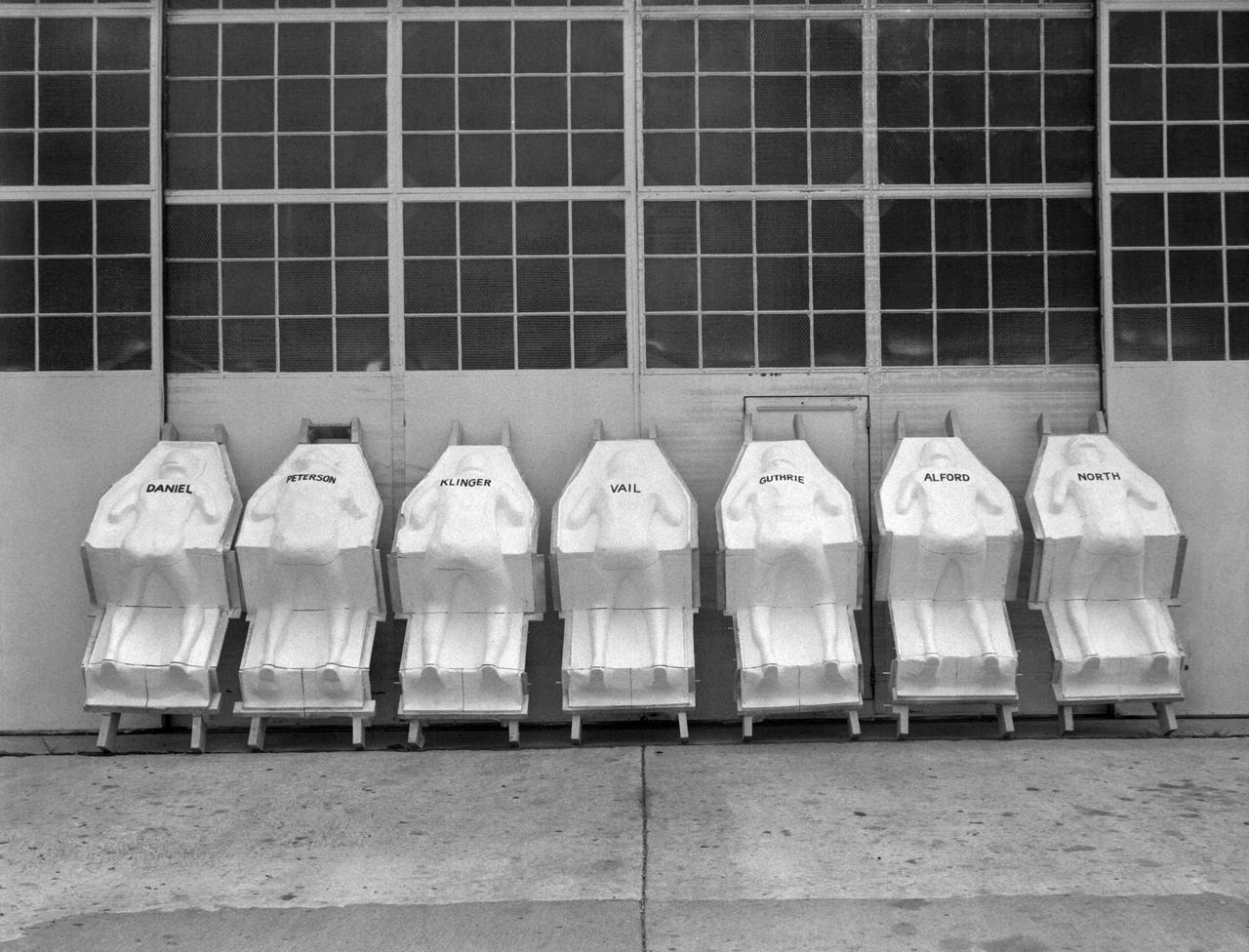
Molds for couches for test pilots, line the NASA Langley Research Centers model shop wall. The names of the test subjects (Langley employees) are written on the back. The couches are similar to those made for each astronaut and fitted into the Mercury capsules for manned spaceflight.
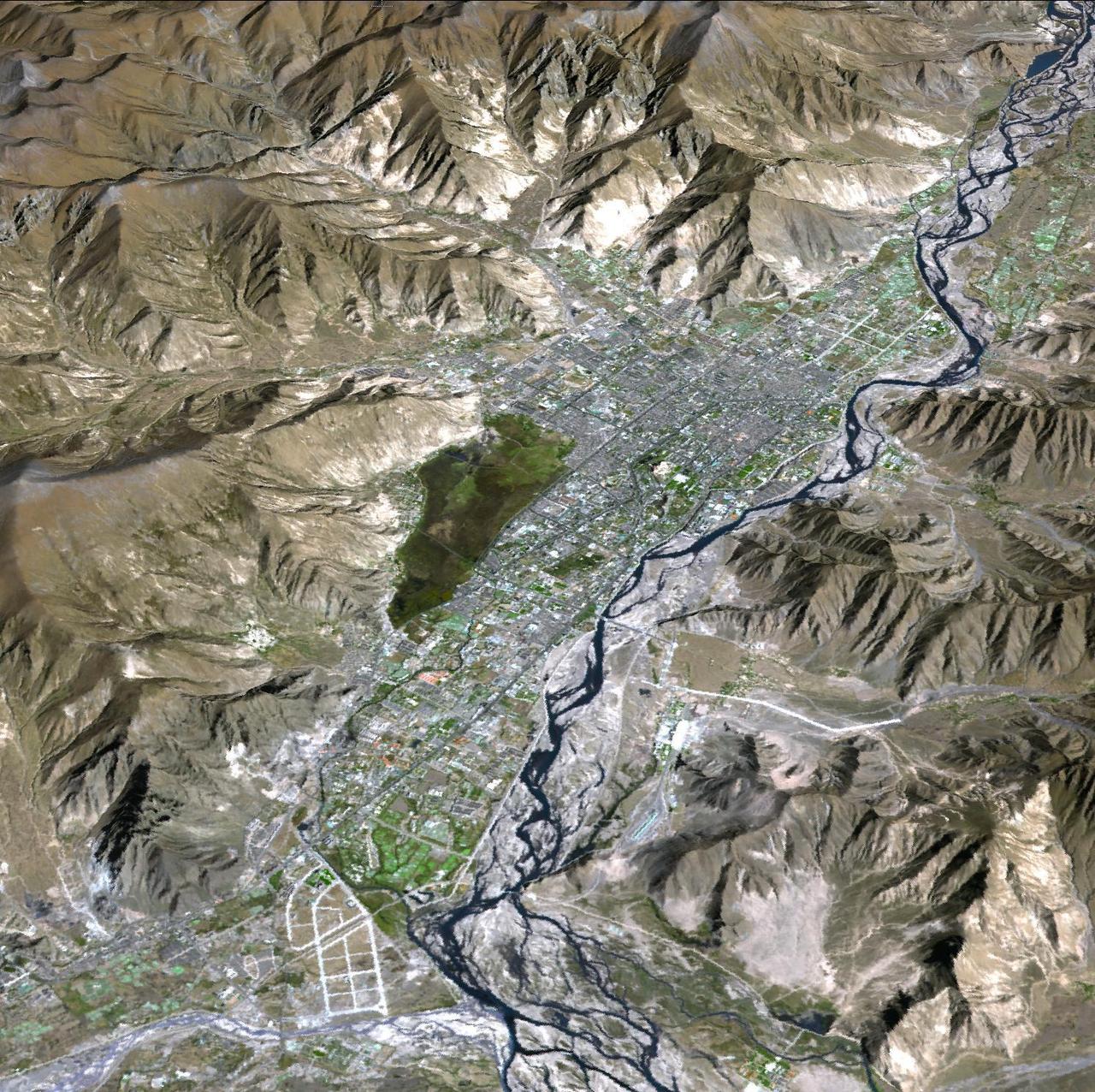
JPL Advanced Spaceborne Thermal Emission and Reflection Radiometer aboard NASA Terra satellite, shows Lhasa, the traditional seat of the Dalai Lama and capital of the Tibet Autonomous Region in China.
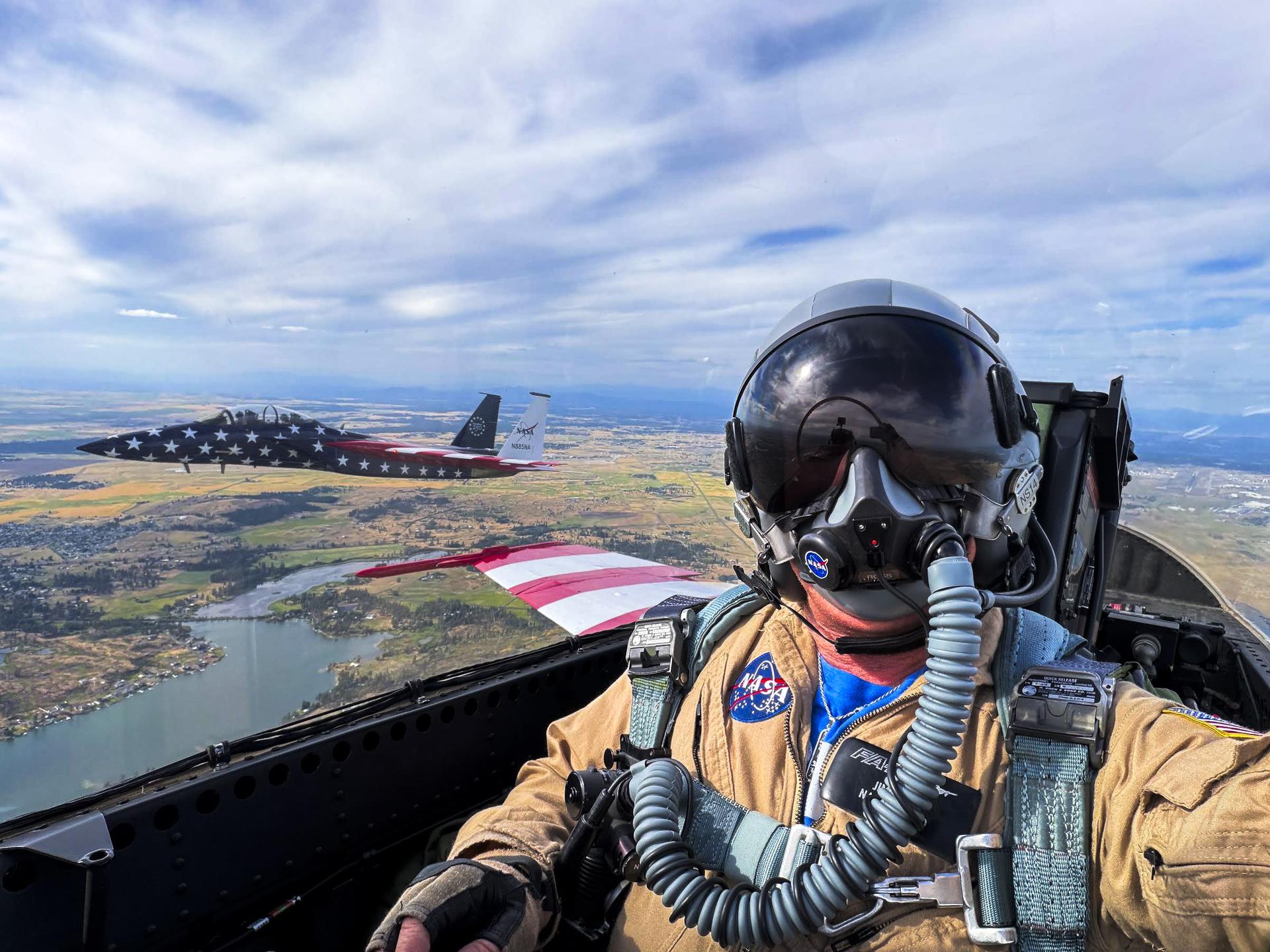
NASA photographer Jim Ross takes a selfie from the rear seat of a NASA F/A‑18 during a cross‑country flight from Spokane, Washington, to Washington, D.C., on Thursday, July 2, 2026. The agency’s F‑15, flying alongside the aircraft, is visible through the window. Both aircraft, from NASA’s Armstrong Flight Research Center in Edwards, California, participated in the Freedom 250 flyover with other NASA and military aircraft on Saturday, July 4, 2026.
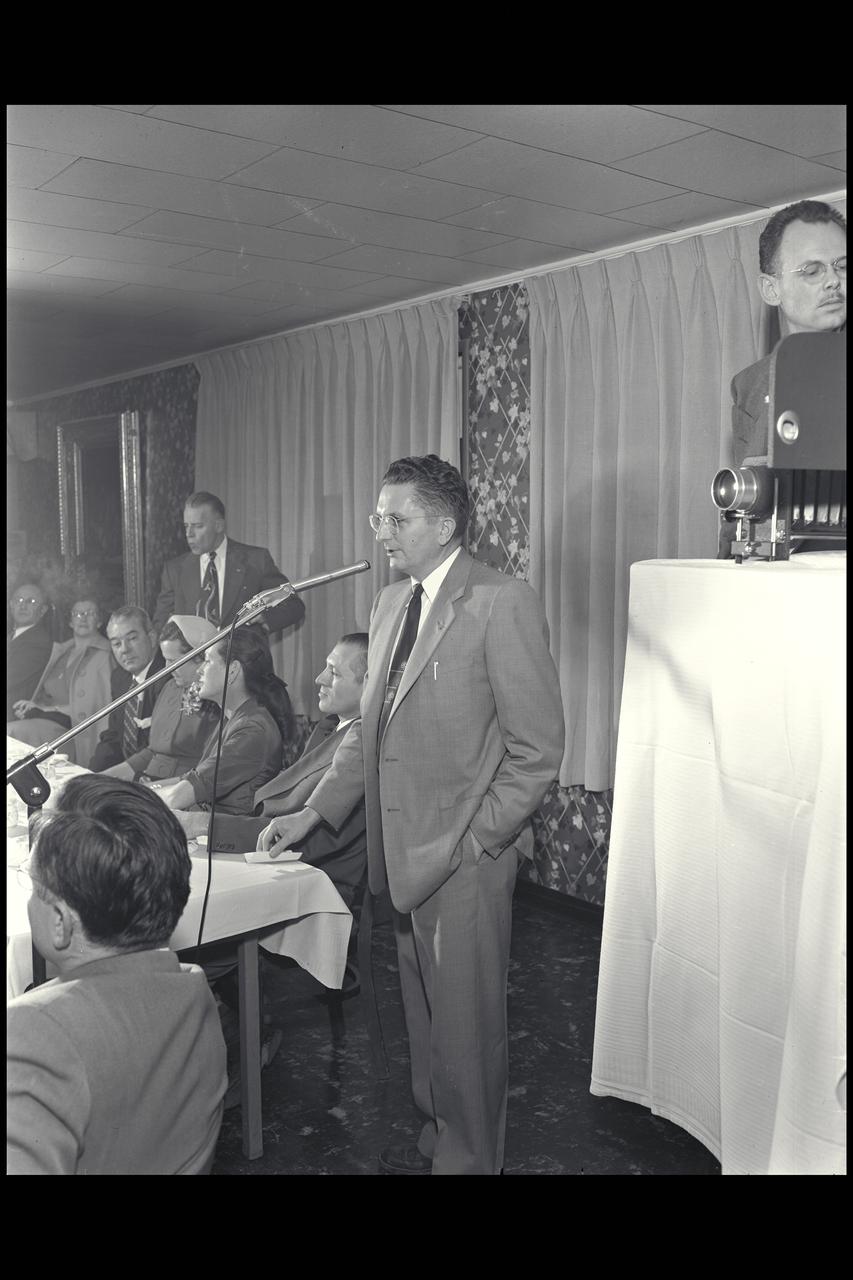
Harry J. Goett with Larry Clousing (seated next to him at head table) during William McAvoy (seat at middle of table) testimonial dinner. Publication: Atmosphere of Freedom; 60 yrs. of Ames - NASA SP
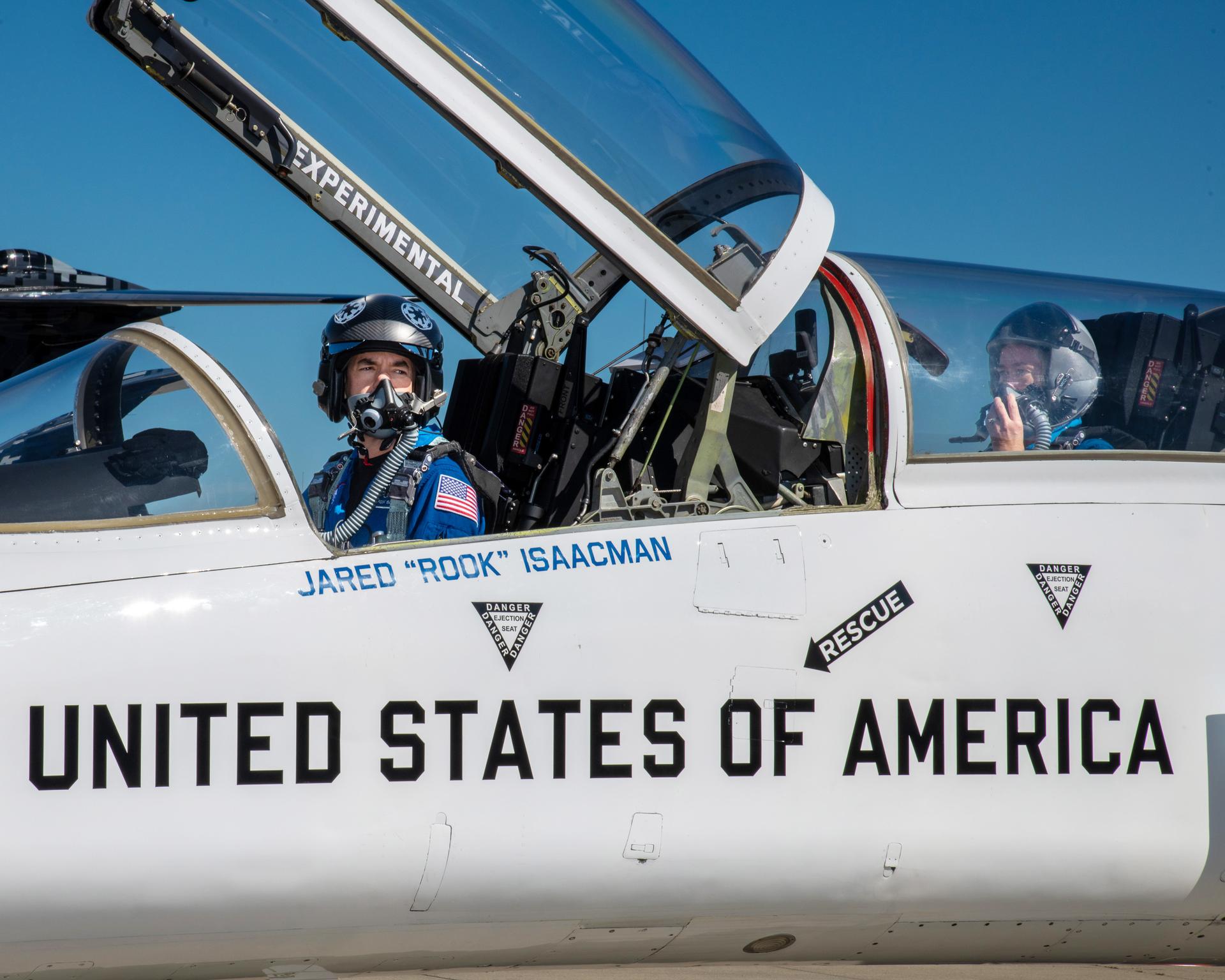
NASA Administrator Jared Isaacman is seen sitting in his jet ready to take off from Cleveland Hopkins Airport. Seated in the back seat is rider Heather Brown. This is part of the 2026 NASA Inspiration Tours

ISS004-E-10171 (20 April 2002) --- Astronaut Daniel W. Bursch, Expedition Four flight engineer, wearing a Russian Sokol suit, is seated in the Soyuz 3 spacecraft that is docked to the International Space Station (ISS). The Expedition Four crew undocked the Soyuz 3 capsule from the nadir docking port of the Zarya module of the ISS at 4:16 a.m. (CDT) and flew a short distance down the station for a redocking to the Pirs docking compartment at 4:37 a.m. (CDT) over Central Asia. The move was in preparation for the arrival of the new Soyuz 4 capsule on April 27, 2002, and a three-man “taxi” crew, Commander Yuri Gidzenko, who was a member of the first resident crew of the ISS; Flight Engineer Roberto Vittori of the European Space Agency (ESA); and South African space flight participant Mark Shuttleworth.
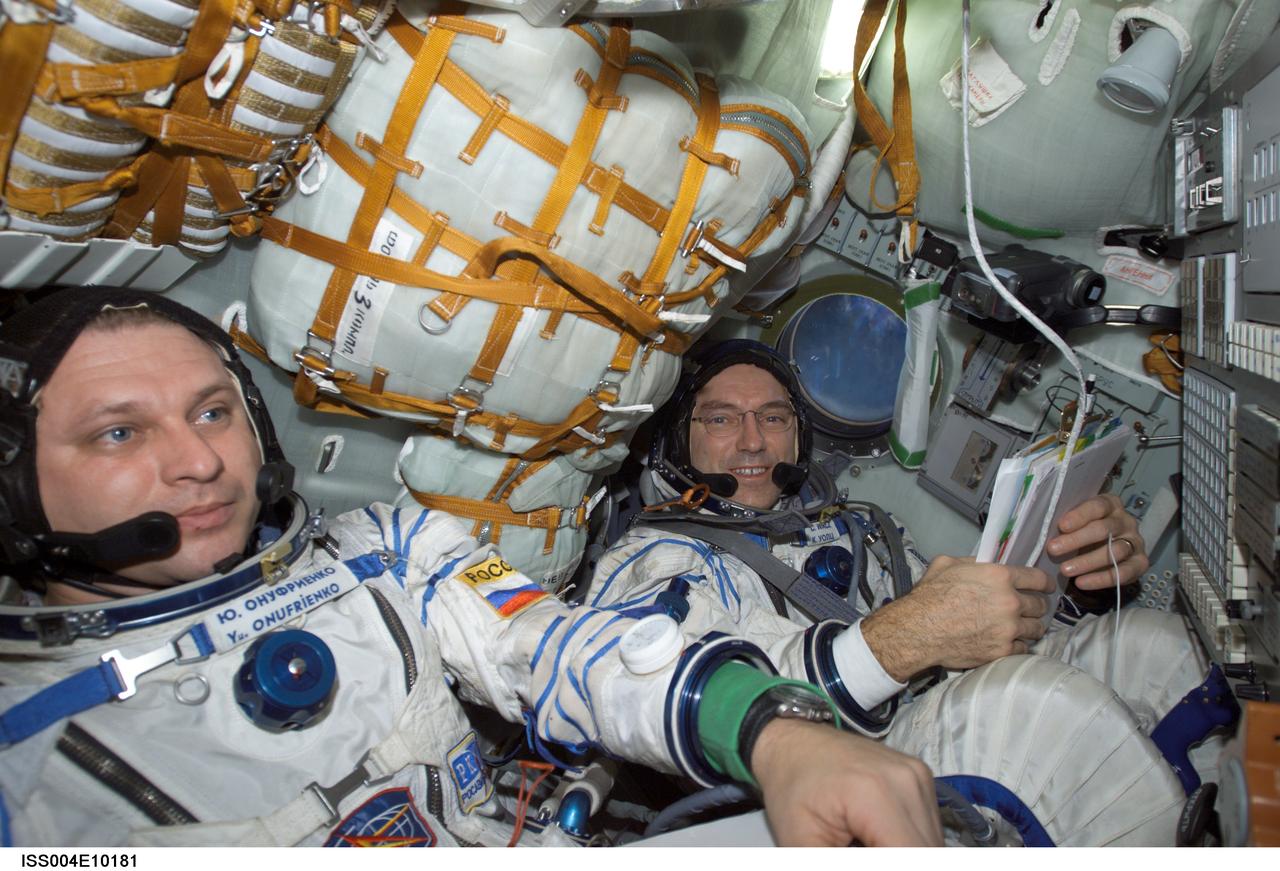
ISS004-E-10181 (20 April 2002) --- Cosmonaut Yury I. Onufrienko (left) and astronaut Carl E. Walz, Expedition Four mission commander and flight engineer, respectively, wearing Russian Sokol suits, are seated in the Soyuz 3 spacecraft that is docked to the International Space Station (ISS). The Expedition Four crew undocked the Soyuz 3 capsule from the nadir docking port of the Zarya module of the ISS at 4:16 a.m. (CDT) and flew a short distance down the station for a redocking to the Pirs docking compartment at 4:37 a.m. (CDT) over Central Asia. The move was in preparation for the arrival of the new Soyuz 4 capsule on April 27, 2002, and a three-man “taxi” crew, Commander Yuri Gidzenko, who was a member of the first resident crew of the ISS; Flight Engineer Roberto Vittori of the European Space Agency (ESA); and South African space flight participant Mark Shuttleworth.
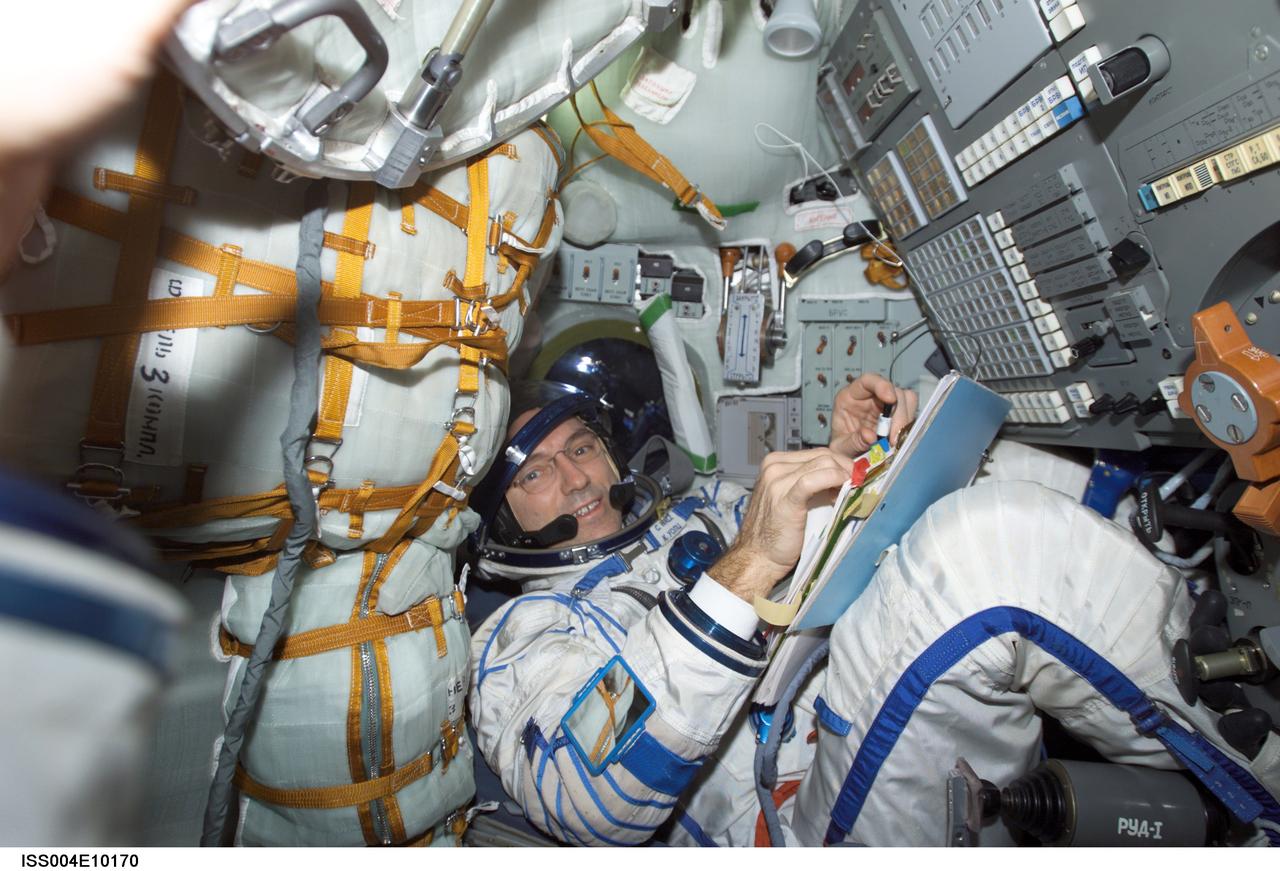
ISS004-E-10170 (20 April 2002) --- Astronaut Carl E. Walz, Expedition Four flight engineer, wearing a Russian Sokol suit, is seated in the Soyuz 3 spacecraft that is docked to the International Space Station (ISS). The Expedition Four crew undocked the Soyuz 3 capsule from the nadir docking port of the Zarya module of the ISS at 4:16 a.m. (CDT) and flew a short distance down the station for a redocking to the Pirs docking compartment at 4:37 a.m. (CDT) over Central Asia. The move was in preparation for the arrival of the new Soyuz 4 capsule on April 27, 2002, and a three-man “taxi” crew, Commander Yuri Gidzenko, who was a member of the first resident crew of the ISS; Flight Engineer Roberto Vittori of the European Space Agency (ESA); and South African space flight participant Mark Shuttleworth.
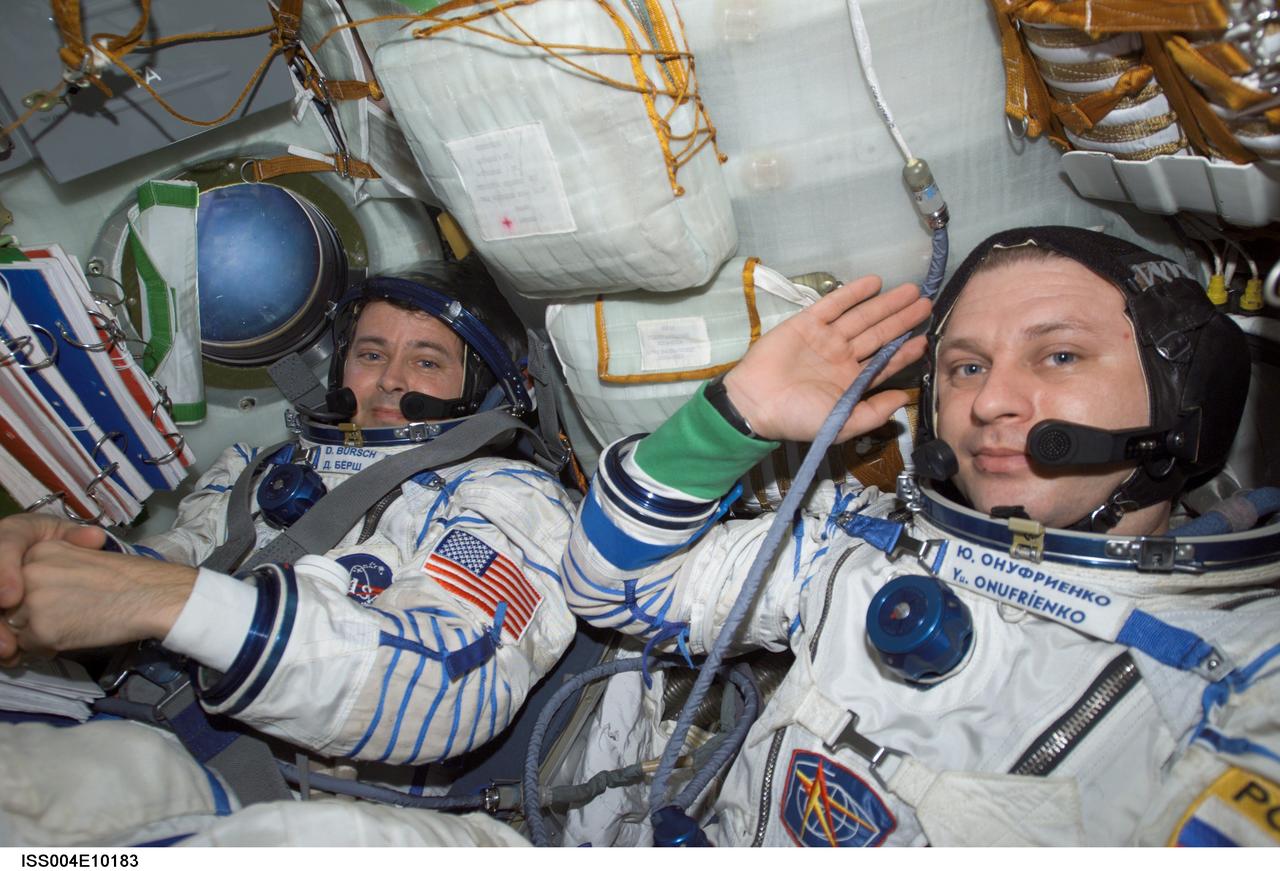
ISS004-E-10183 (20 April 2002) --- Astronaut Daniel W. Bursch (left) and cosmonaut Yury I. Onufrienko, Expedition Four flight engineer and mission commander, respectively, wearing Russian Sokol suits, are seated in the Soyuz 3 spacecraft that is docked to the International Space Station (ISS). The Expedition Four crew undocked the Soyuz 3 capsule from the nadir docking port of the Zarya module of the ISS at 4:16 a.m. (CDT) and flew a short distance down the station for a redocking to the Pirs docking compartment at 4:37 a.m. (CDT) over Central Asia. The move was in preparation for the arrival of the new Soyuz 4 capsule on April 27, 2002, and a three-man “taxi” crew, Commander Yuri Gidzenko, who was a member of the first resident crew of the ISS; Flight Engineer Roberto Vittori of the European Space Agency (ESA); and South African space flight participant Mark Shuttleworth.
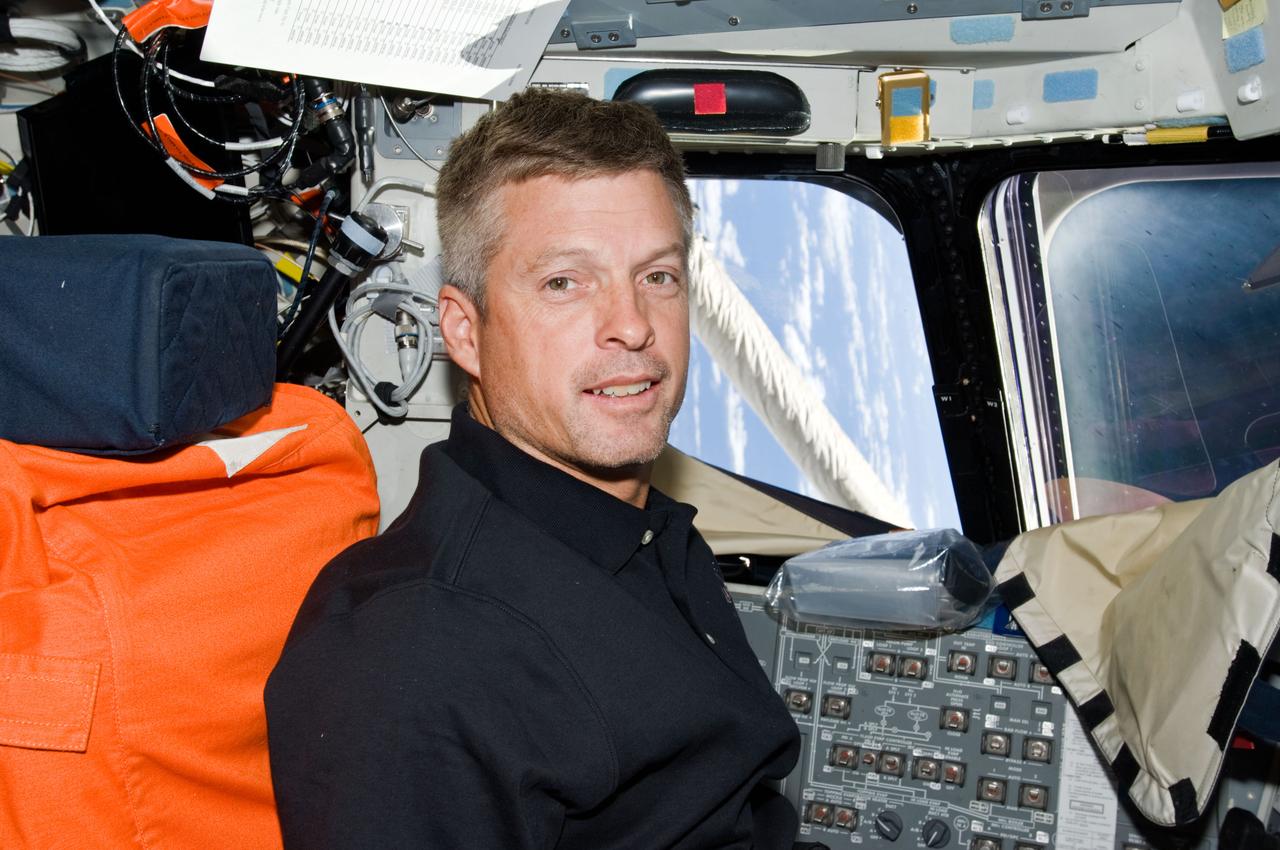
S119-E-010732 (26 March 2009) --- Astronaut Steve Swanson, STS-119 mission specialist, occupies the commander's station on the forward flight deck of Space Shuttle Discovery during flight day 12 activities.
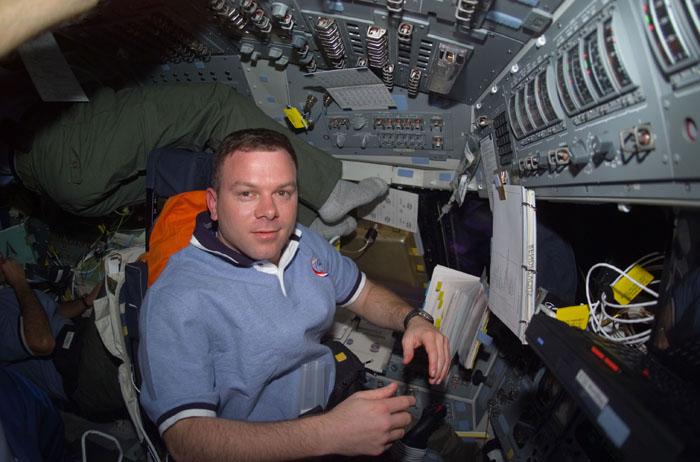
STS102-E-5075 (10 March 2001) --- Astronaut James M. Kelly, pilot, is about to be busy on Discovery's forward flight deck during rendezvous operations with the International Space Station (ISS). The photograph was recorded with a digital still camera.
![[21] ISO: 100 Aprt: F4 Shut: 125 Lens: 35 Exps: P Prog: Po ExpC: -1.3 Metr: Mtrx Fl s: Norm D md: S F md: S F ar: Spot Dist: 1.8m](https://images-assets.nasa.gov/image/s93e5057/s93e5057~medium.jpg)
[21] ISO: 100 Aprt: F4 Shut: 125 Lens: 35 Exps: P Prog: Po ExpC: -1.3 Metr: Mtrx Fl s: Norm D md: S F md: S F ar: Spot Dist: 1.8m
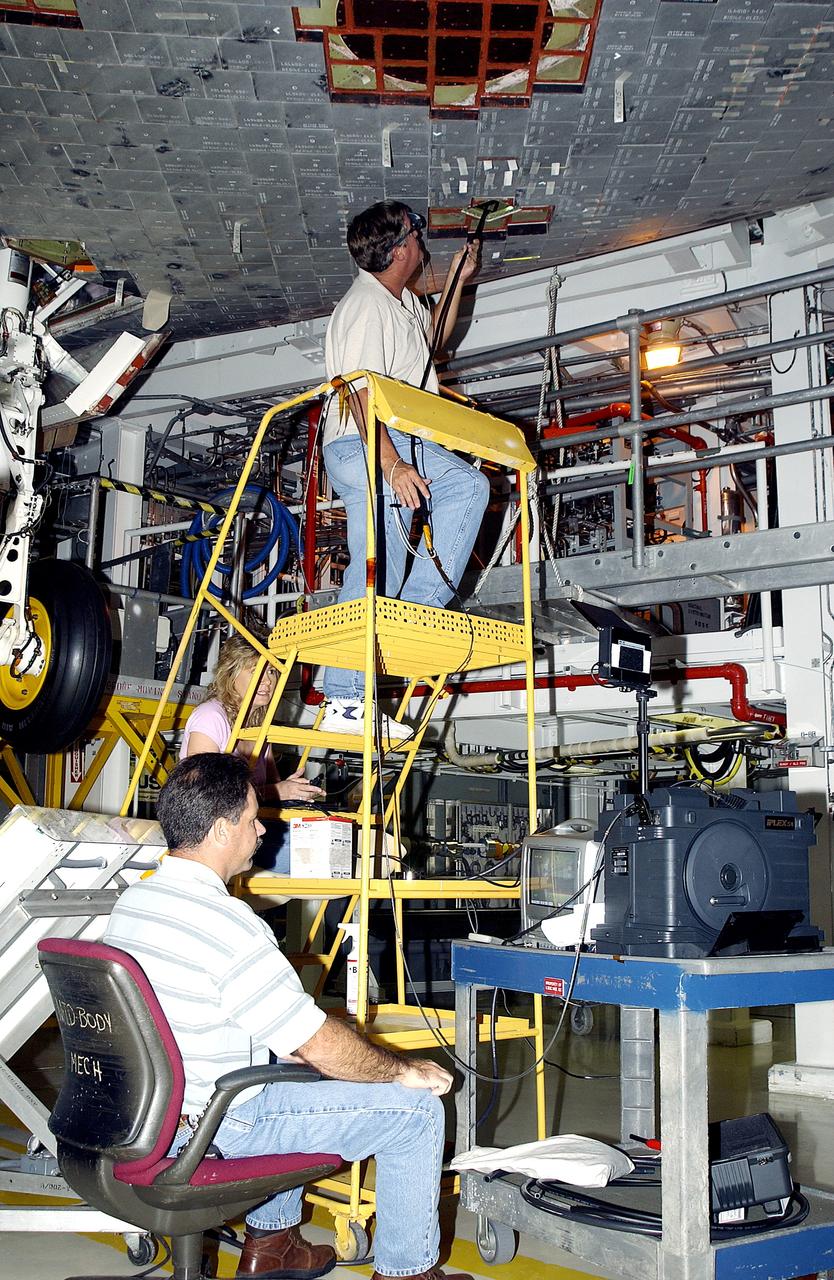
KENNEDY SPACE CENTER, FLA. - In the Orbiter Processing Facility, while Greg Harlow, with United Space Alliance (USA) (above) threads a camera under the tiles of the orbiter Endeavour, Peggy Ritchie, USA, (behind the stand) and NASA’s Richard Parker (seated) watch the images on a monitor to inspect for corrosion.
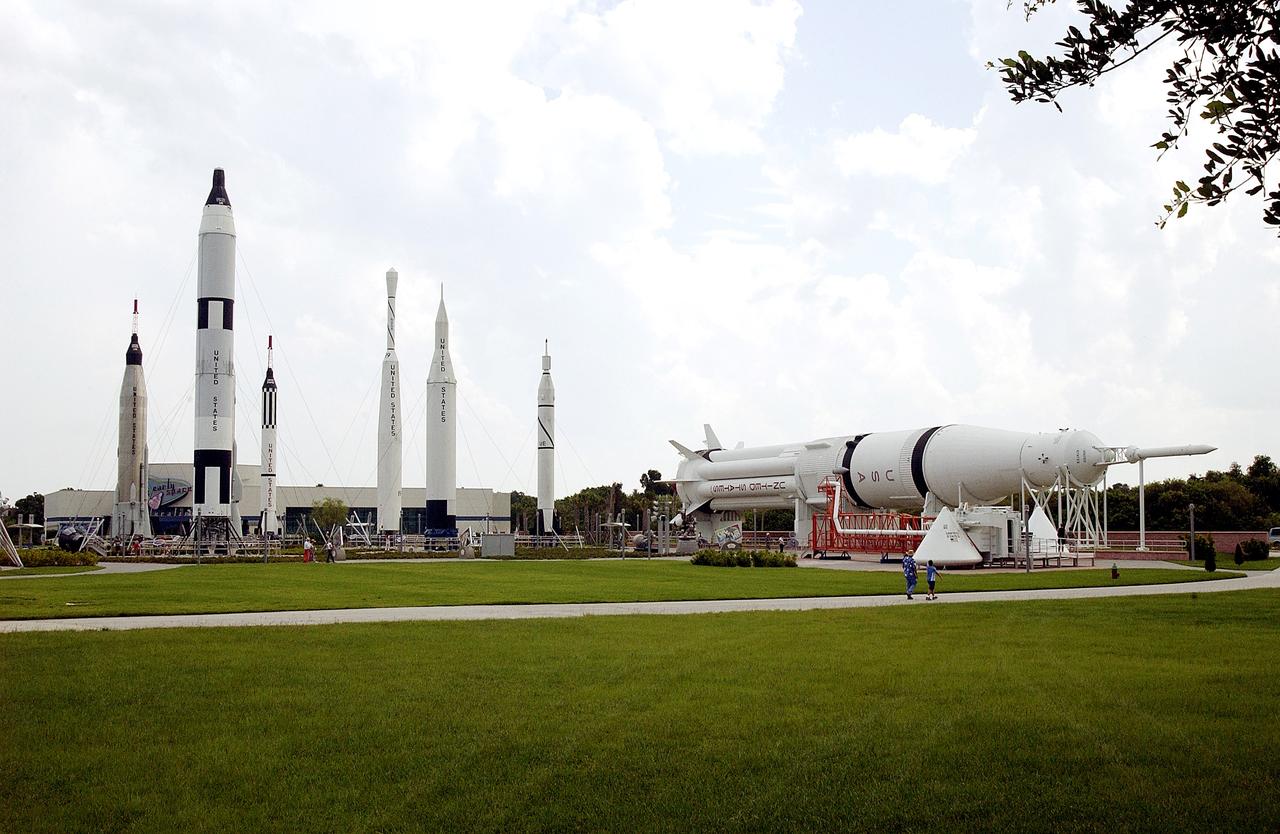
KENNEDY SPACE CENTER, FLA. - The Rocket Garden at the KSC Visitor Complex features eight authentic rockets from the past, including a Mercury-Atlas rocket. The garden also features a climb-in Mercury, Gemino and Apollo capsule replicas, seating pods and informative graphic elements.
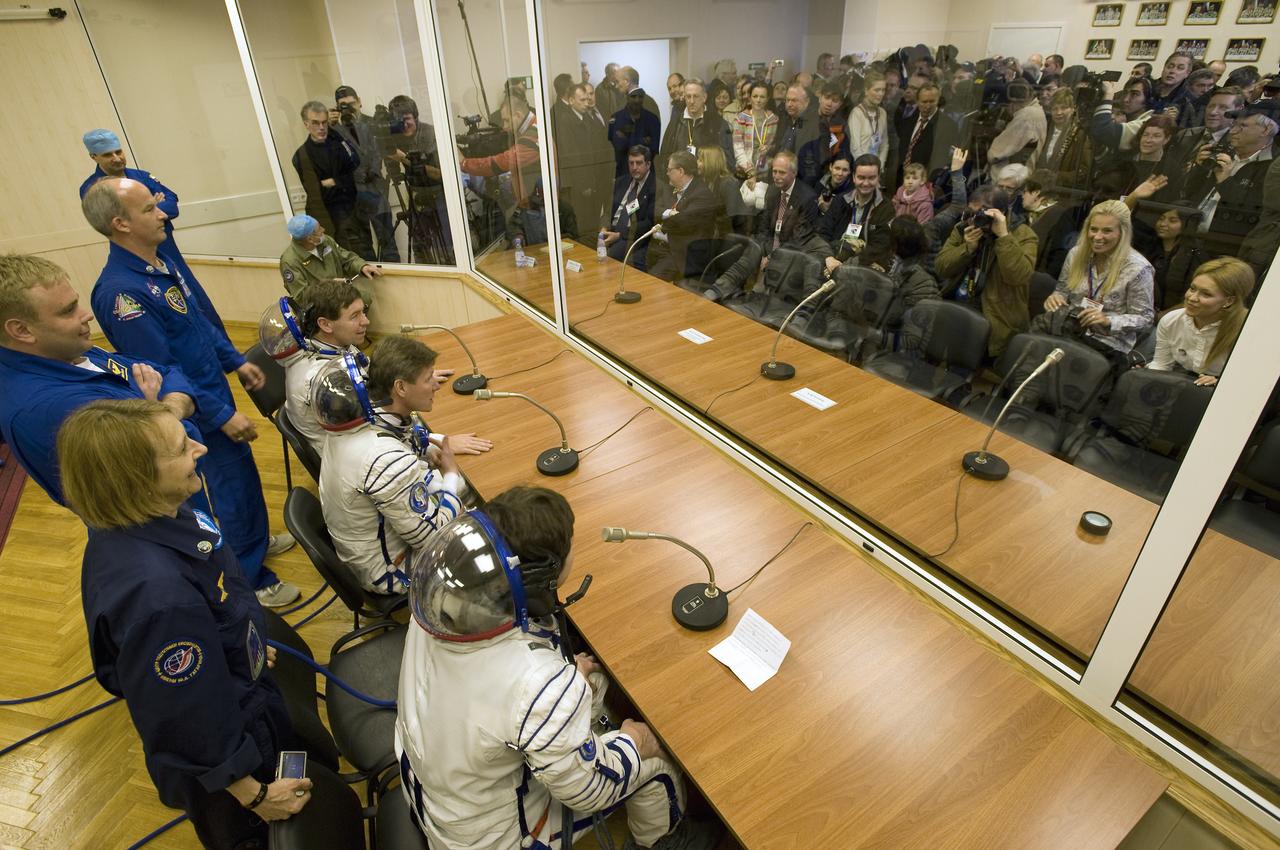
Spaceflight Participant Charles Simonyi, seated foreground, Expedition 19 Commander Gennady I. Padalka, seated center, Flight Engineer Michael R. Barratt, seated background, backup spaceflight participant Esther Dyson, standing foreground, backup Expedition 19 flight engineer Maxim Suraev, standing center, and backup commander Jeffrey Williams prepare to talk with space agency officials prior to the launch on Thursday, March 26, 2009 in Baikonur, Kazakhstan. Photo Credit: (NASA/Bill Ingalls)
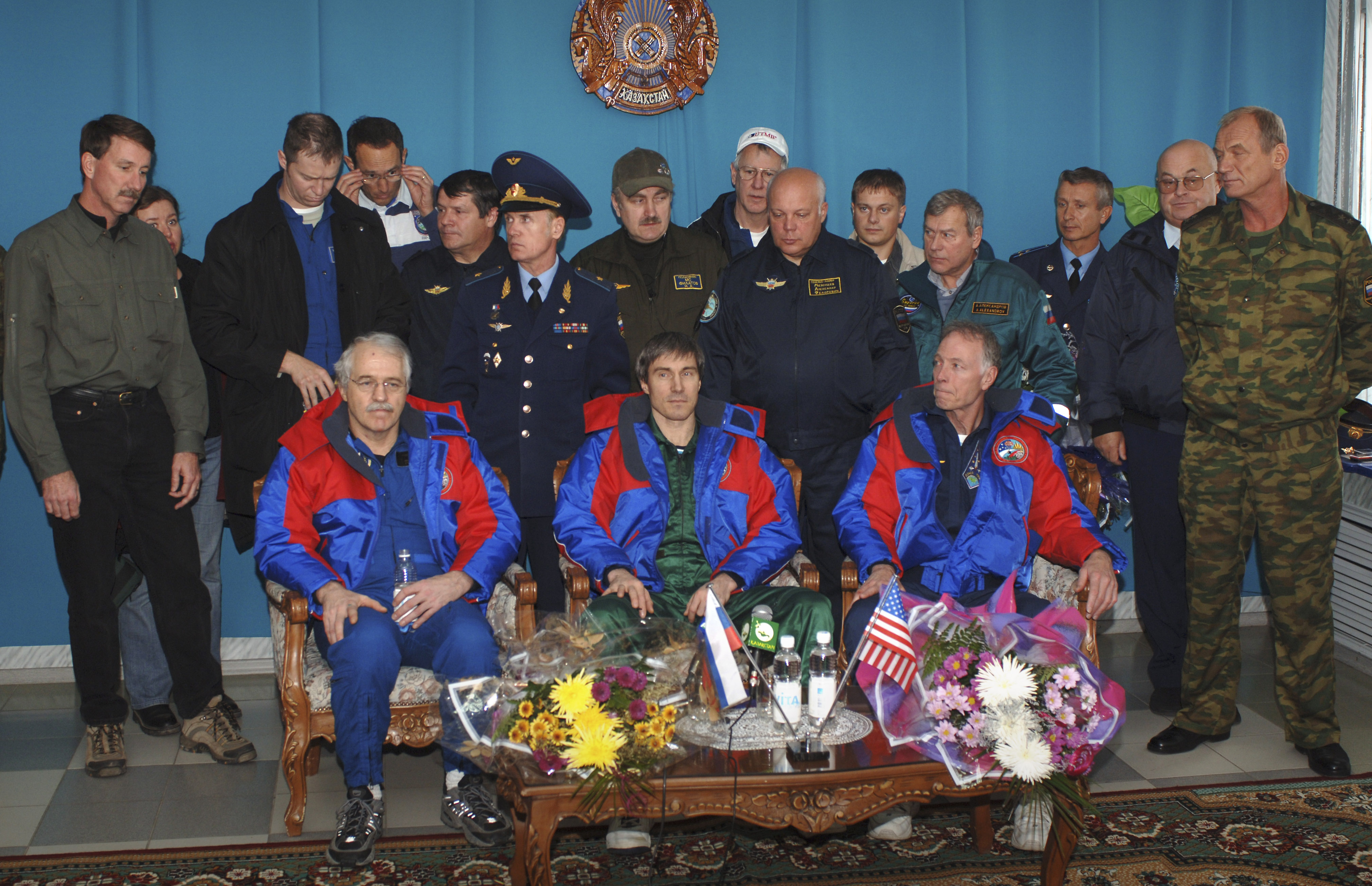
Members of the 11th expedition to the International Space Station, astronaut John Phillips, seated left, and Cosmonaut Sergei Krikalev, seated center, landed near Arlalyk, Kazakhstan Tuesday, Oct. 11 2005, after a six-month mission in orbit. Along with American businessman Greg Olsen, seated right, who visited the station for more than a week, Phillips and Krikalev returned to Earth aboard a Russian Soyuz spacecraft. Photo Credit: (NASA/Bill Ingalls)
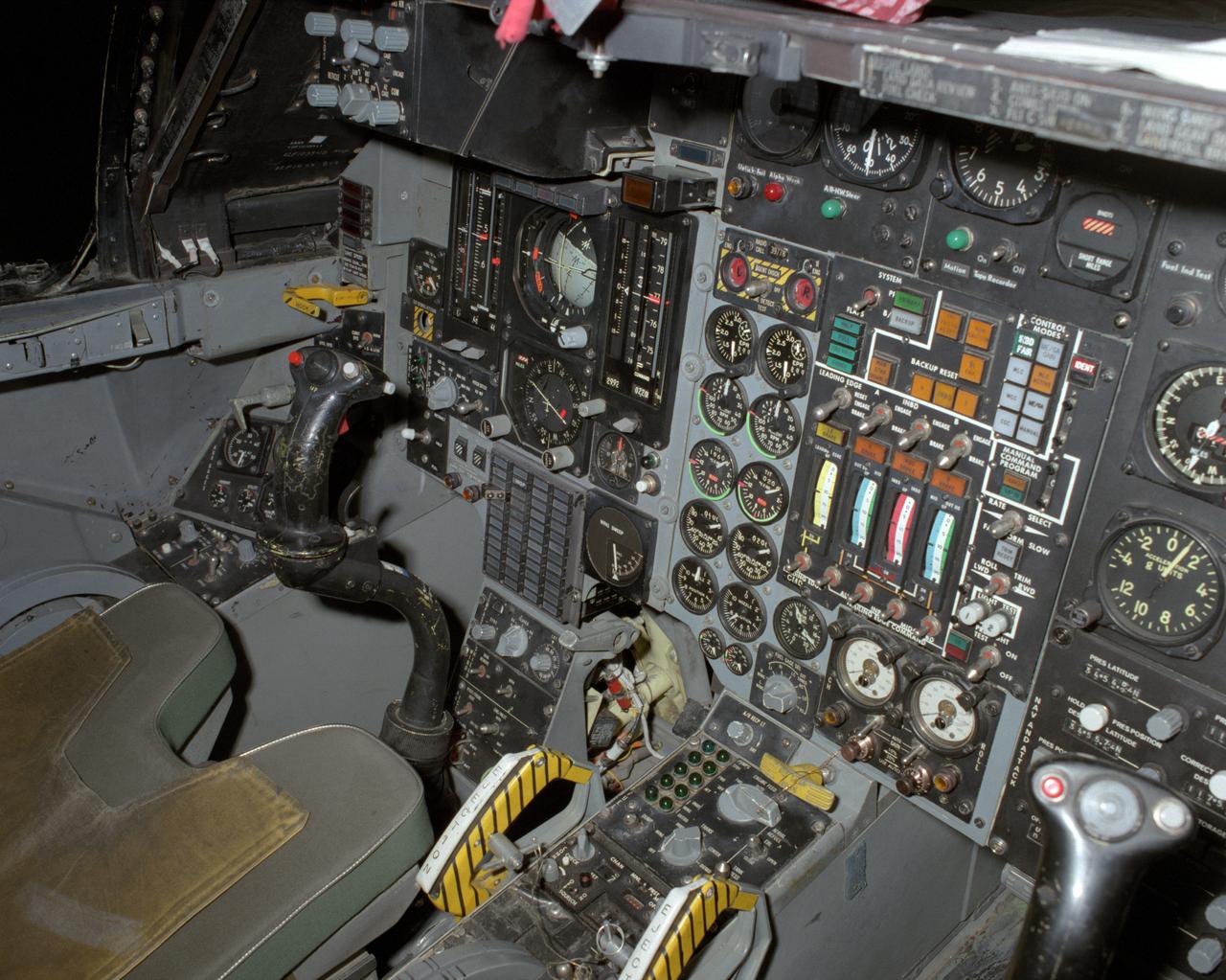
View of the left cockpit and pilot's seat of the F-111 MAW aircraft. Unlike most fighter aircraft of the time, the F-111 had side-by-side seating. The pilot sat on the left side, and the weapons systems officer on the right. Both had control sticks to fly the aircraft. The two yellow and black striped handles would be used in an emergency to eject the entire F-111 cockpit. The F-111 also did not have ejection seats, but used a capsule.
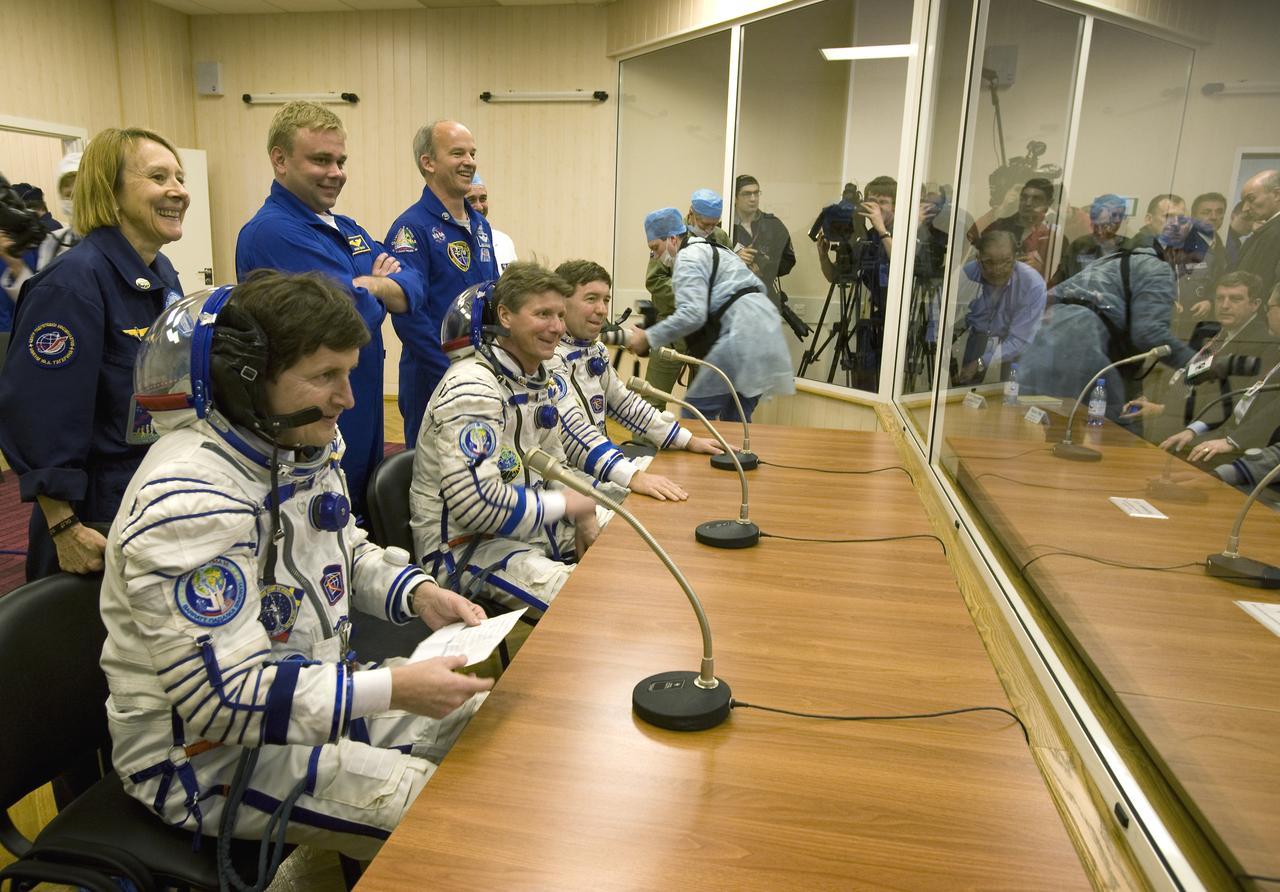
Spaceflight Participant Charles Simonyi, seated left, Expedition 19 Commander Gennady I. Padalka, seated center, Flight Engineer Michael R. Barratt, seated right, backup spaceflight participant Esther Dyson, standing left, backup Expedition 19 flight engineer Maxim Suraev, standing center, and backup commander Jeffrey Williams prepare to talk with space agency officials prior to the launch on Thursday, March 26, 2009 in Baikonur, Kazakhstan. Photo Credit: (NASA/Bill Ingalls)
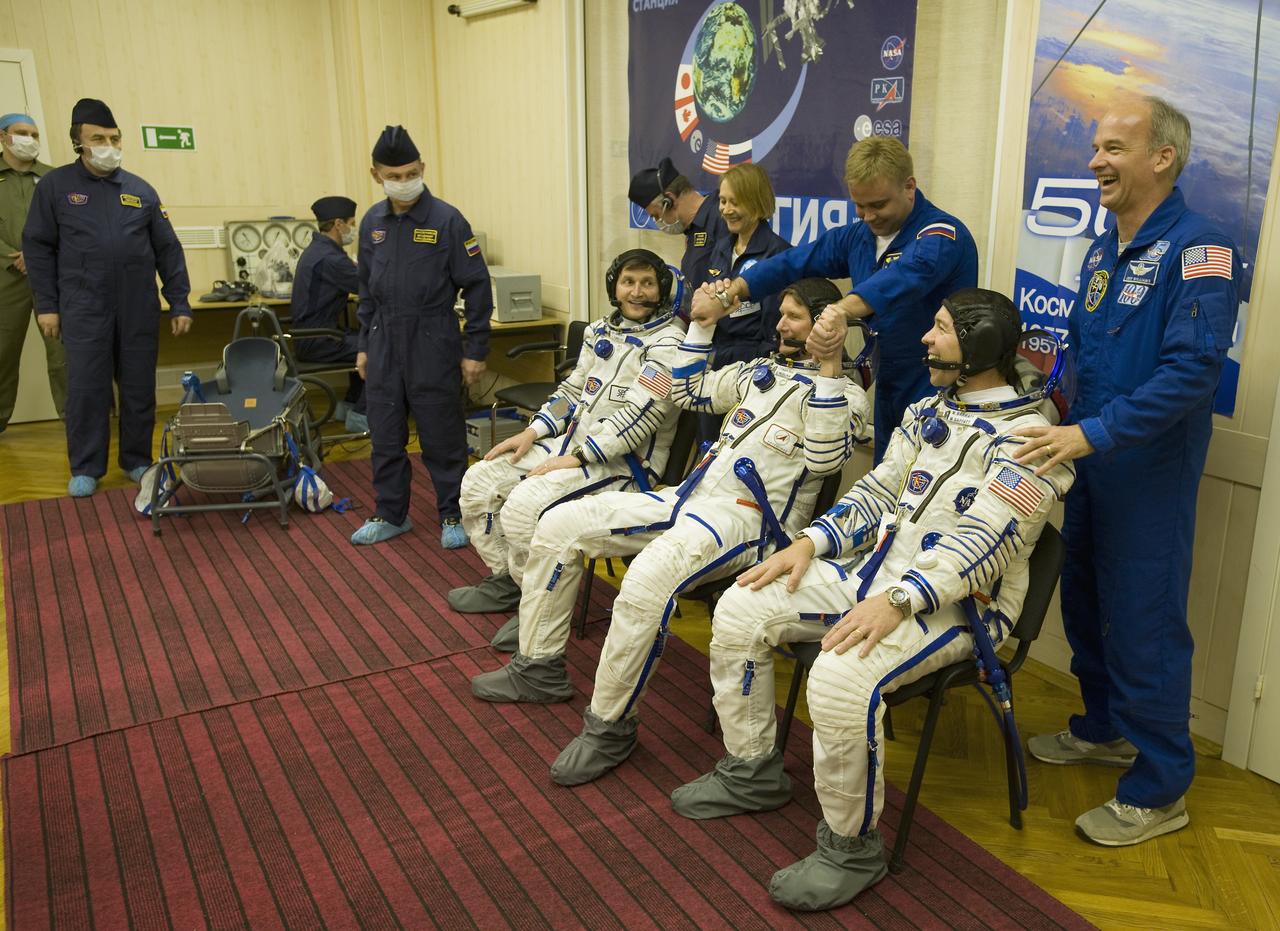
Spaceflight Participant Charles Simonyi, seated left, Expedition 19 Commander Gennady I. Padalka, seated center, Flight Engineer Michael R. Barratt, seated right, backup spaceflight participant Esther Dyson, standing left, backup Expedition 19 flight engineer Maxim Suraev, standing center, and backup commander Jeffrey Williams are seen in the suit up room at building 254 on Thursday, March 26, 2009 in Baikonur, Kazakhstan. Photo Credit: (NASA/Bill Ingalls)
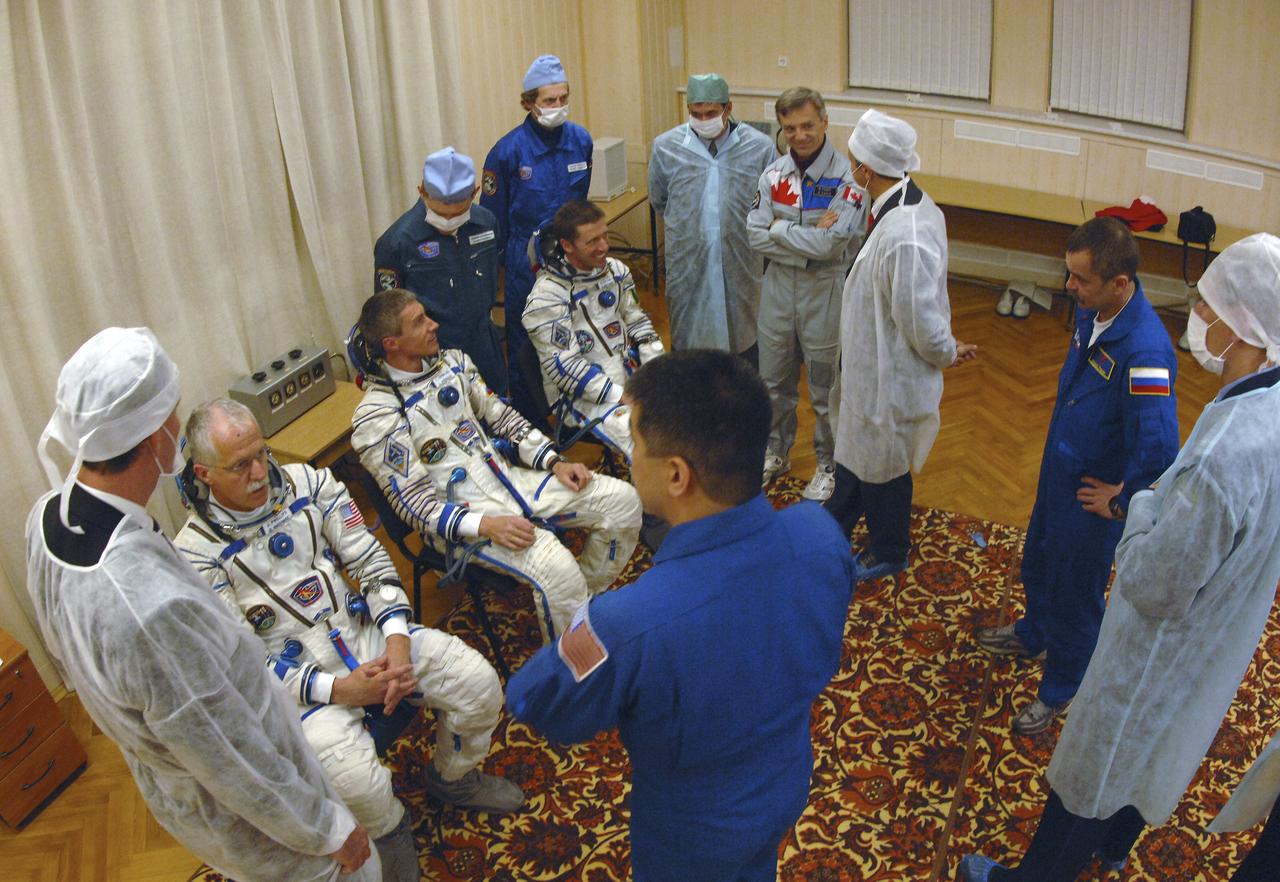
Expedition 11 Commander Sergei Krikalev, seated center, Flight Engineer and NASA Science Officer John Phillips, seated left and European Space Agency Astronaut Roberto Vittori, of Italy, seated right, relax prior to launch aboard the Soyuz TMA-6 spacecraft from the Baikonur Cosmodrome in Kazakhstan, Friday, April 15, 2005 for a two-day trip to the International Space Station. Photo Credit: (NASA/Bill Ingalls)
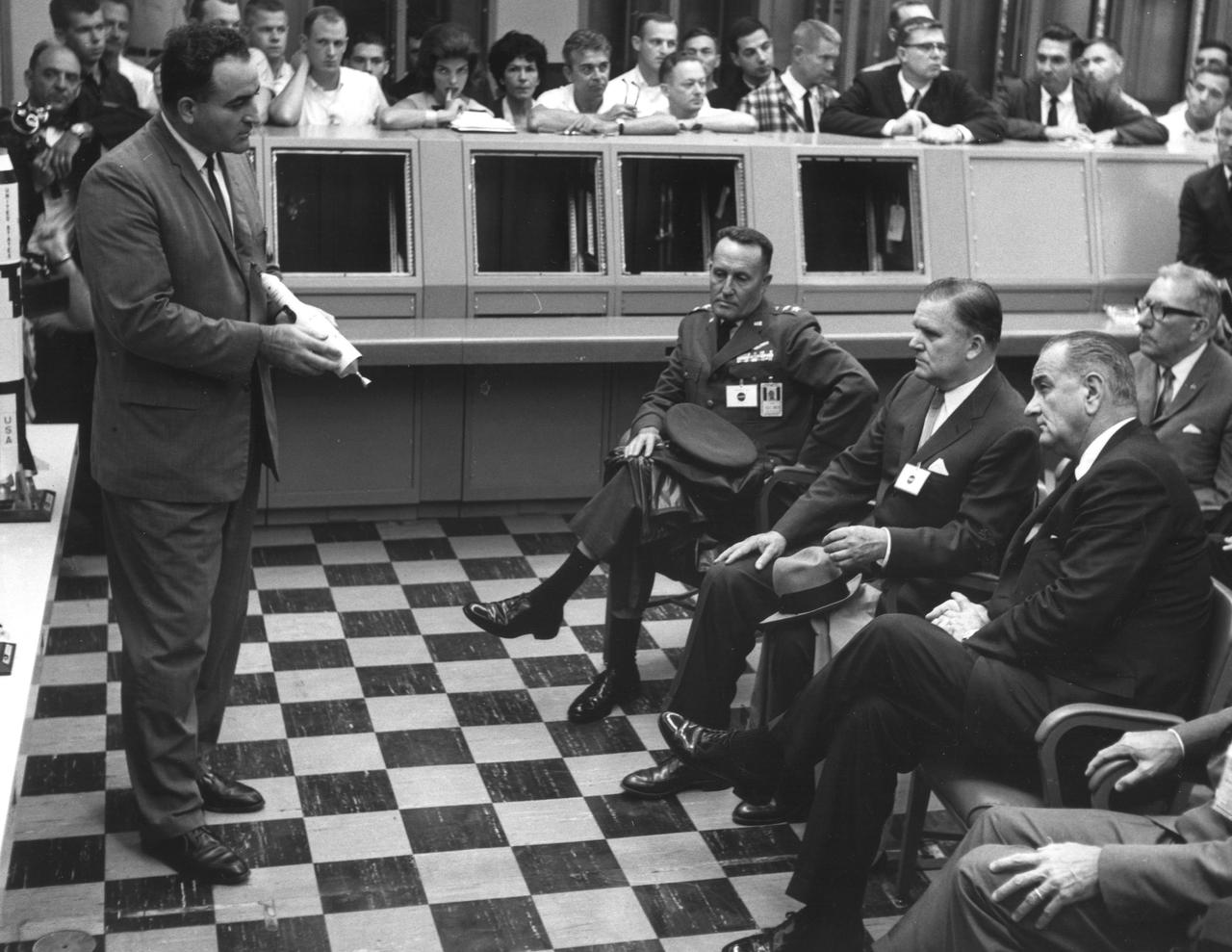
KENNEDY SPACE CENTER, FLA. -- President Lyndon B. Johnson (seated at right), NASA Administrator James T. Webb (seated, center) and Major General Vincent G. Huston (seated, left), commander, Air Force Eastern Test Range, are briefed by Rocco A. Petrone (left), director of Kennedy Space Center Launch Operations, during the Sept. 15, 1964 visit.
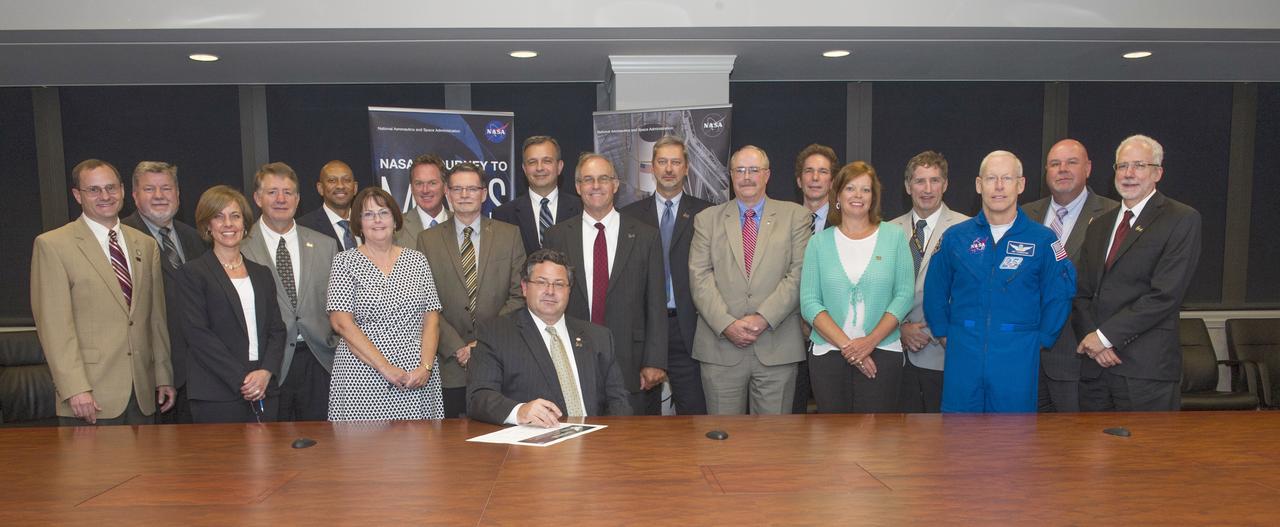
TODD MAY (SEATED) AND MEMBERS OF THE SLS CDR BOARD.
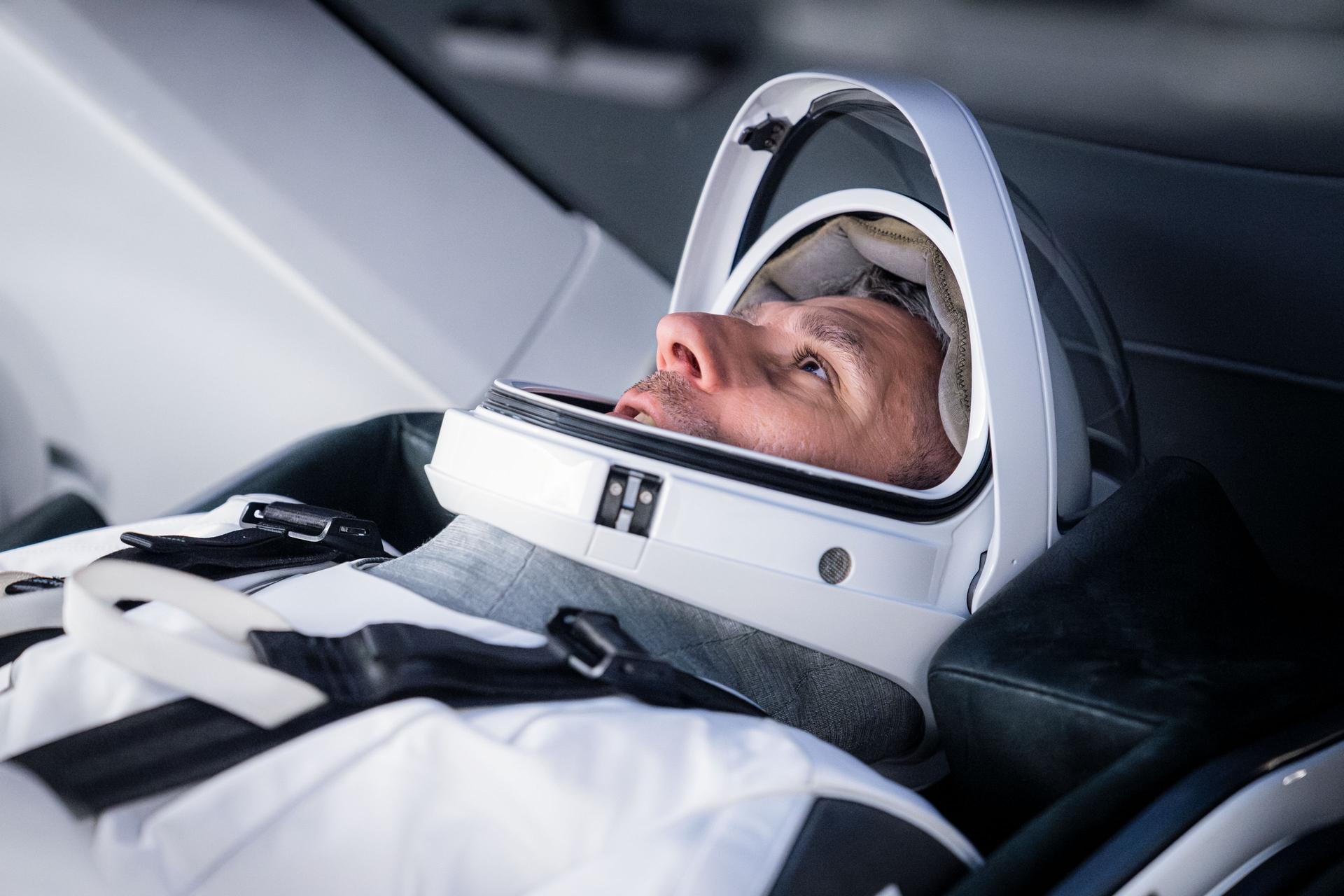
jsc2026e034346 (April 17, 2026) --- NASA astronaut and SpaceX Crew-13 Pilot Luke Delaney is pictured in his pressure suit and seated inside a SpaceX Dragon spacecraft during a training session at SpaceX headquarters in Hawthorne, California. Credit: SpaceX

jsc2026e034347 (April 17, 2026) --- Roscosmos cosmonaut and SpaceX Crew-13 Mission Specialist Sergey Teteryatnikov is pictured in his pressure suit and seated inside a SpaceX Dragon spacecraft during a training session at SpaceX headquarters in Hawthorne, California. Credit: SpaceX

jsc2026e034342 (April 17, 2026) --- CSA (Canadian Space Agency) astronaut and SpaceX Crew-13 Mission Specialist Joshua Kutryk is pictured in his pressure suit and seated inside a SpaceX Dragon spacecraft during a training session at SpaceX headquarters in Hawthorne, California. Credit: SpaceX
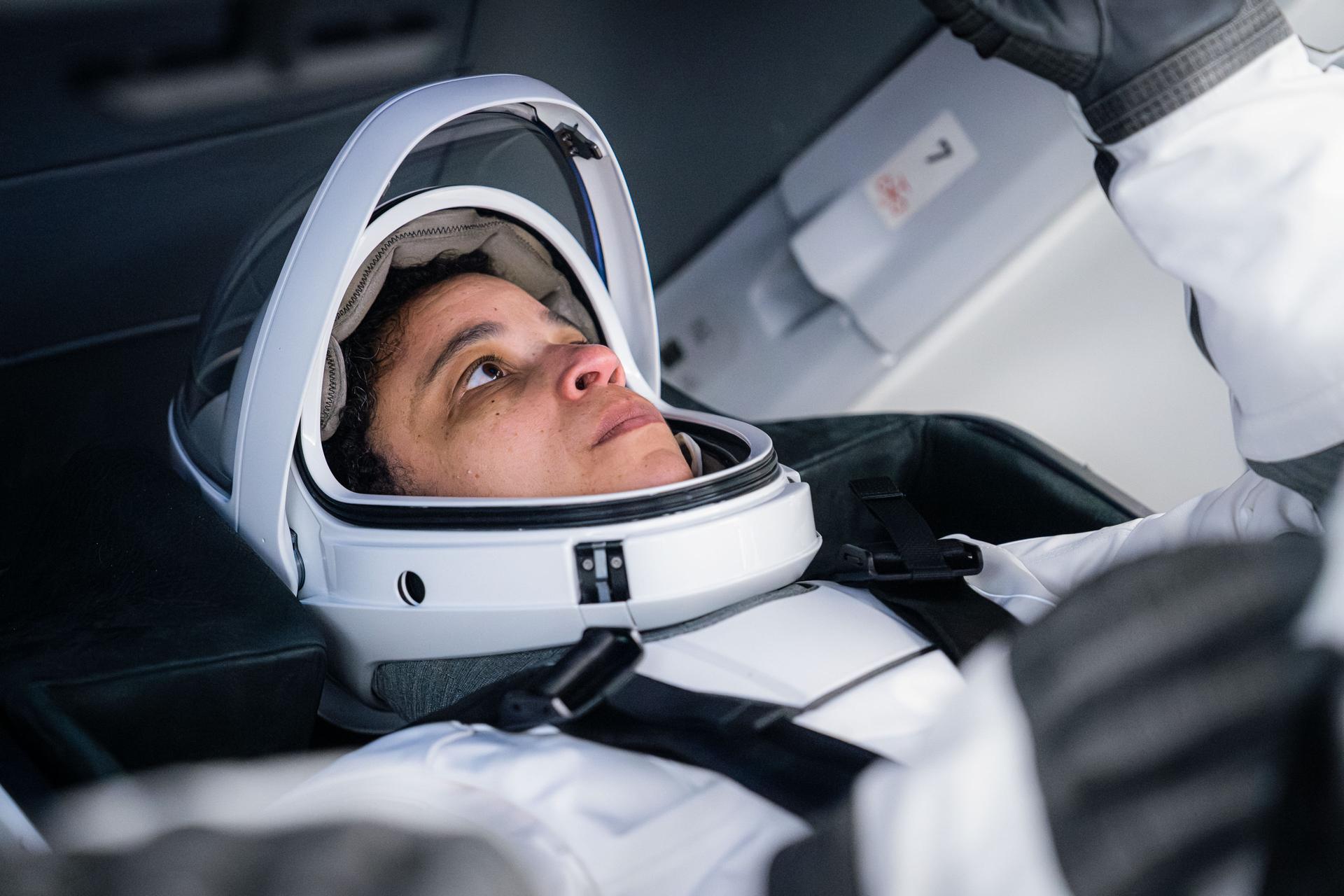
jsc2026e034344 (April 17, 2026) --- NASA astronaut and SpaceX Crew-13 Commander Jessica Watkins is pictured in her pressure suit and seated inside a SpaceX Dragon spacecraft during a training session at SpaceX headquarters in Hawthorne, California. Credit: SpaceX

jsc2026e034343 (April 17, 2026) --- NASA astronaut and SpaceX Crew-13 Commander Jessica Watkins is pictured in her pressure suit and seated inside a SpaceX Dragon spacecraft during a training session at SpaceX headquarters in Hawthorne, California. Credit: SpaceX
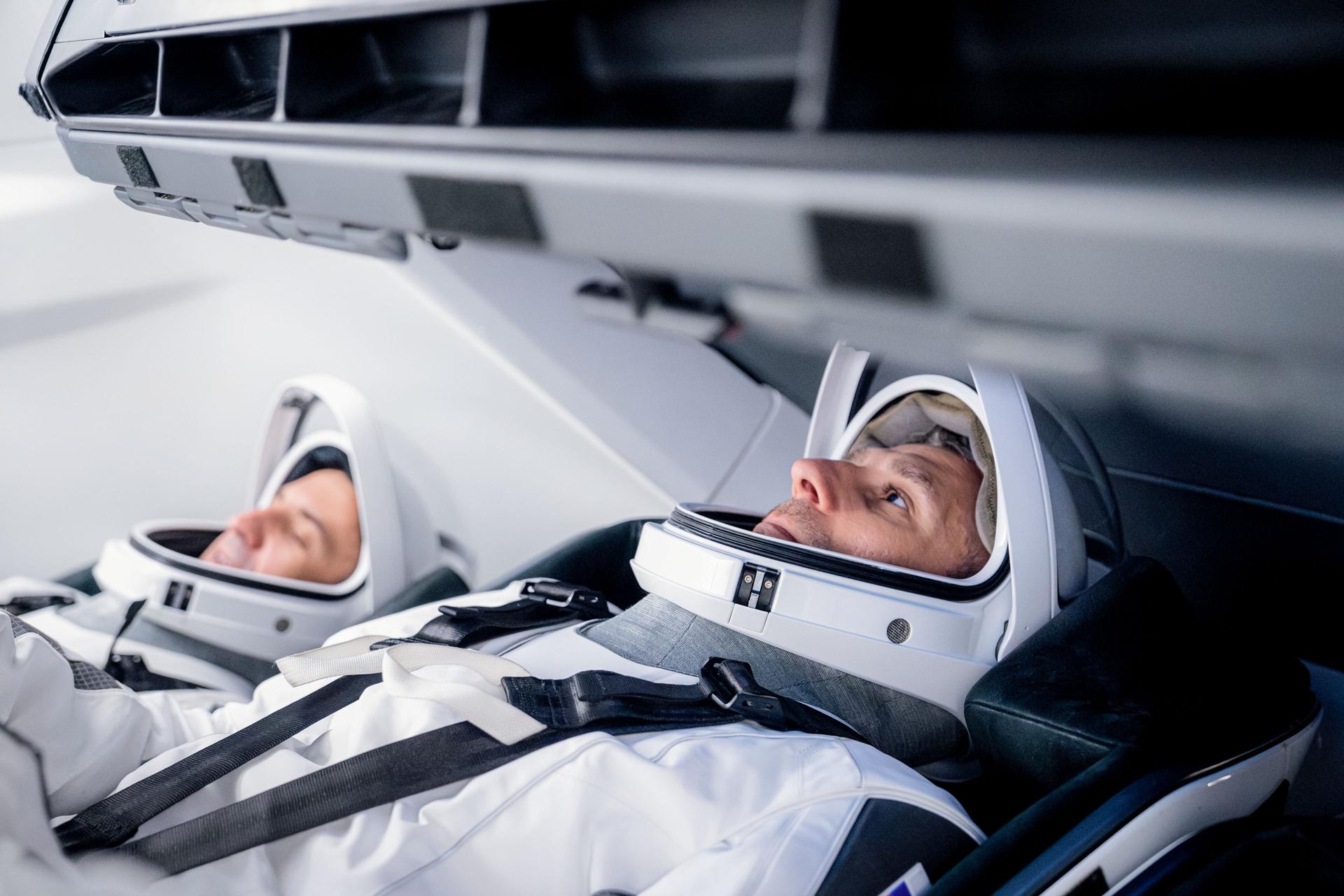
jsc2026e034351 (April 17, 2026) --- From left, SpaceX Crew-13 Mission Specialist Sergey Teteryatnikov of Roscosmos and Pilot Luke Delaney of NASA are seated inside a SpaceX Dragon spacecraft during a training session at SpaceX headquarters in Hawthorne, California. Credit: SpaceX

jsc2026e034349 (April 17, 2026) --- CSA (Canadian Space Agency) astronaut and SpaceX Crew-13 Mission Specialist Joshua Kutryk is pictured in his pressure suit and seated inside a SpaceX Dragon spaceraft during a training session at SpaceX headquarters in Hawthorne, California. Credit: SpaceX
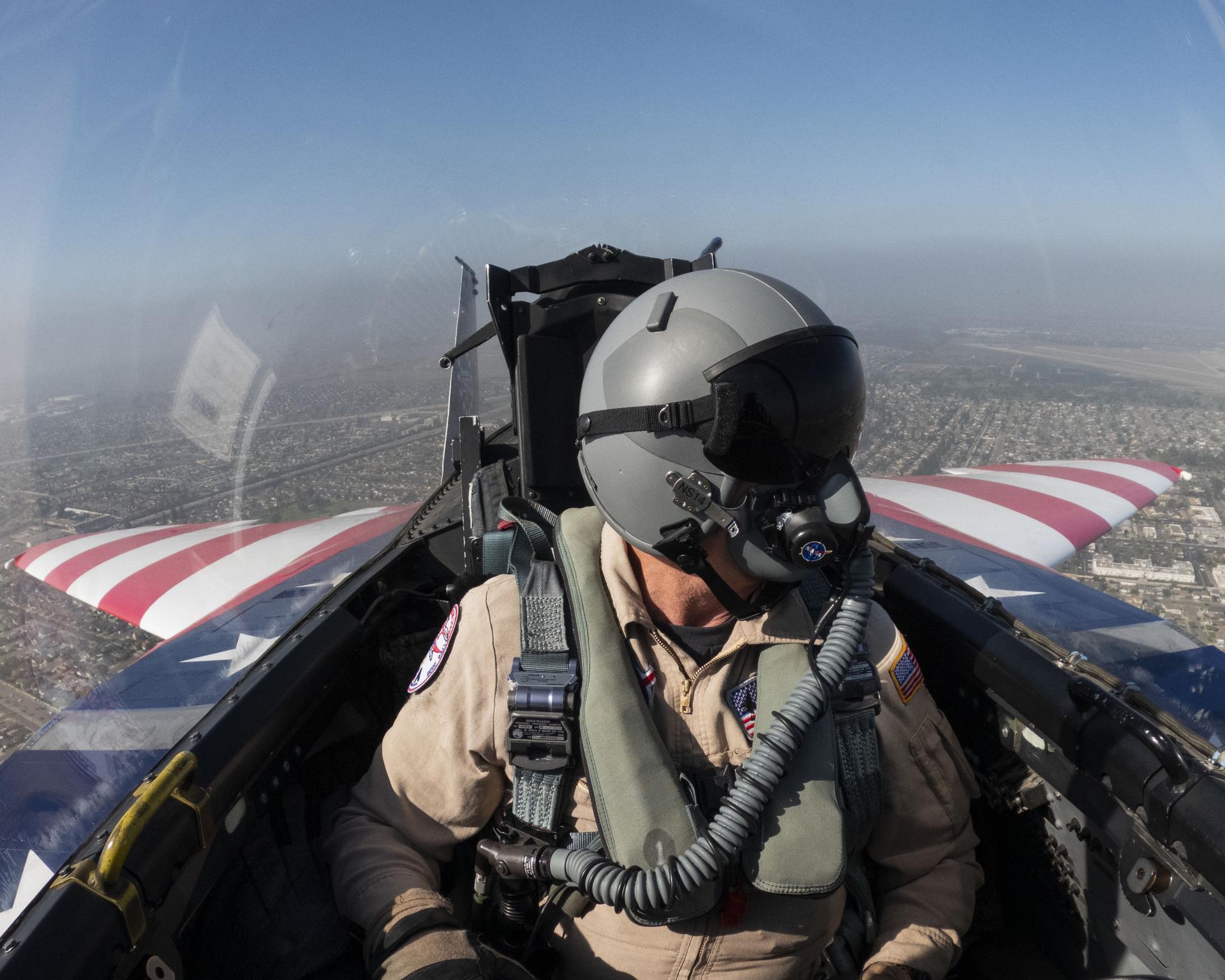
NASA photographer Jim Ross rides in the back seat of the agency’s newly painted F‑15, which honors America’s 250th birthday, during a transit flight to Huntington Beach, California, piloted by NASA test pilot Wayne Ringelberg, Thursday, Oct. 1, 2026. The aircraft will fly in the Pacific Airshow, Oct. 2-4.
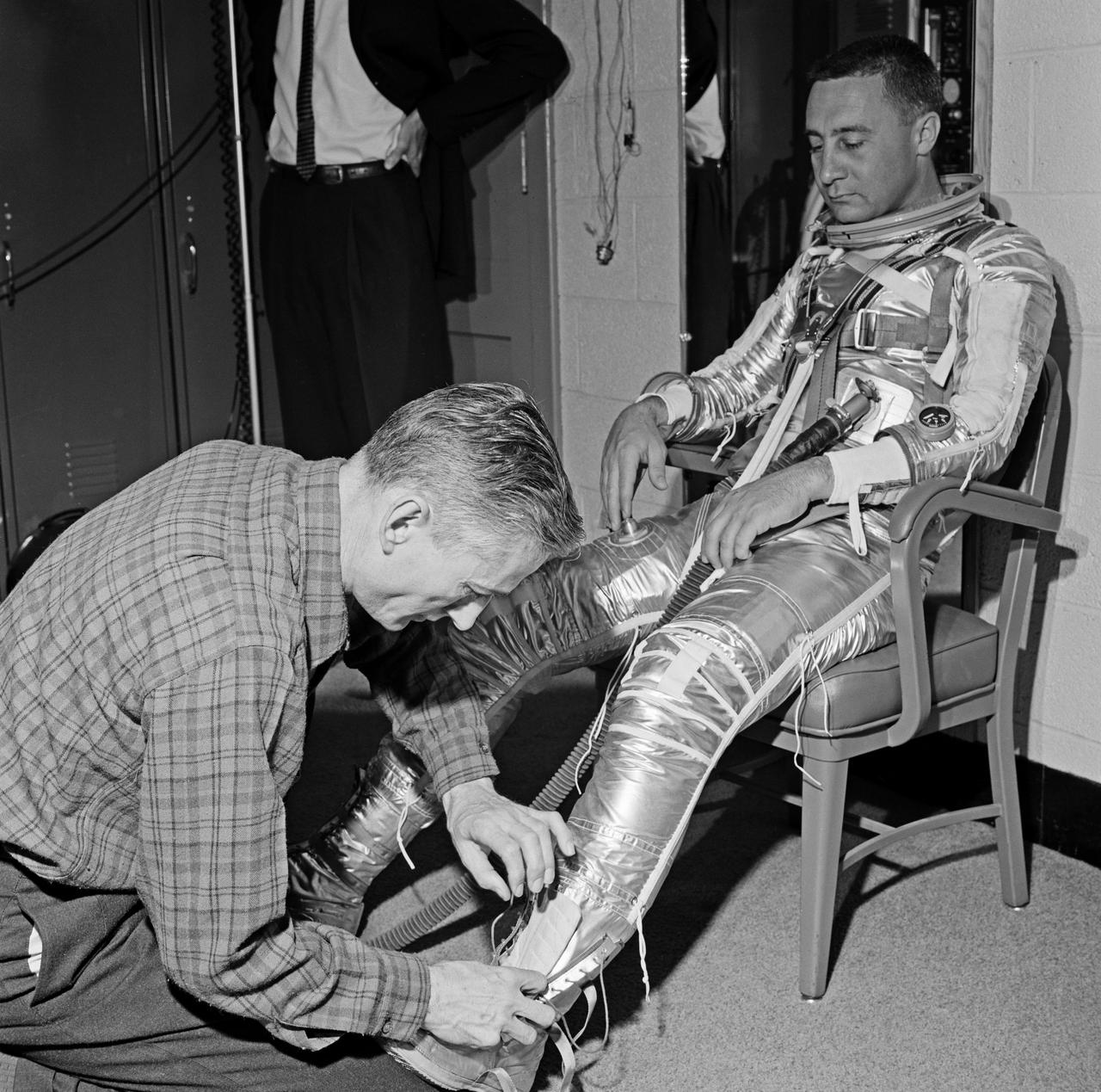
Gus Grissom trying on a Spacesuit; Seated with assistant; Seated with assistant putting on boots; Standing by mirror, name tag visible; Outside in suit, name tag visible. Mercury Project photo, 1961. Original negatives sent to Johnson Space Center when astronauts moved to that center. Photograph take on 03/27/1961.
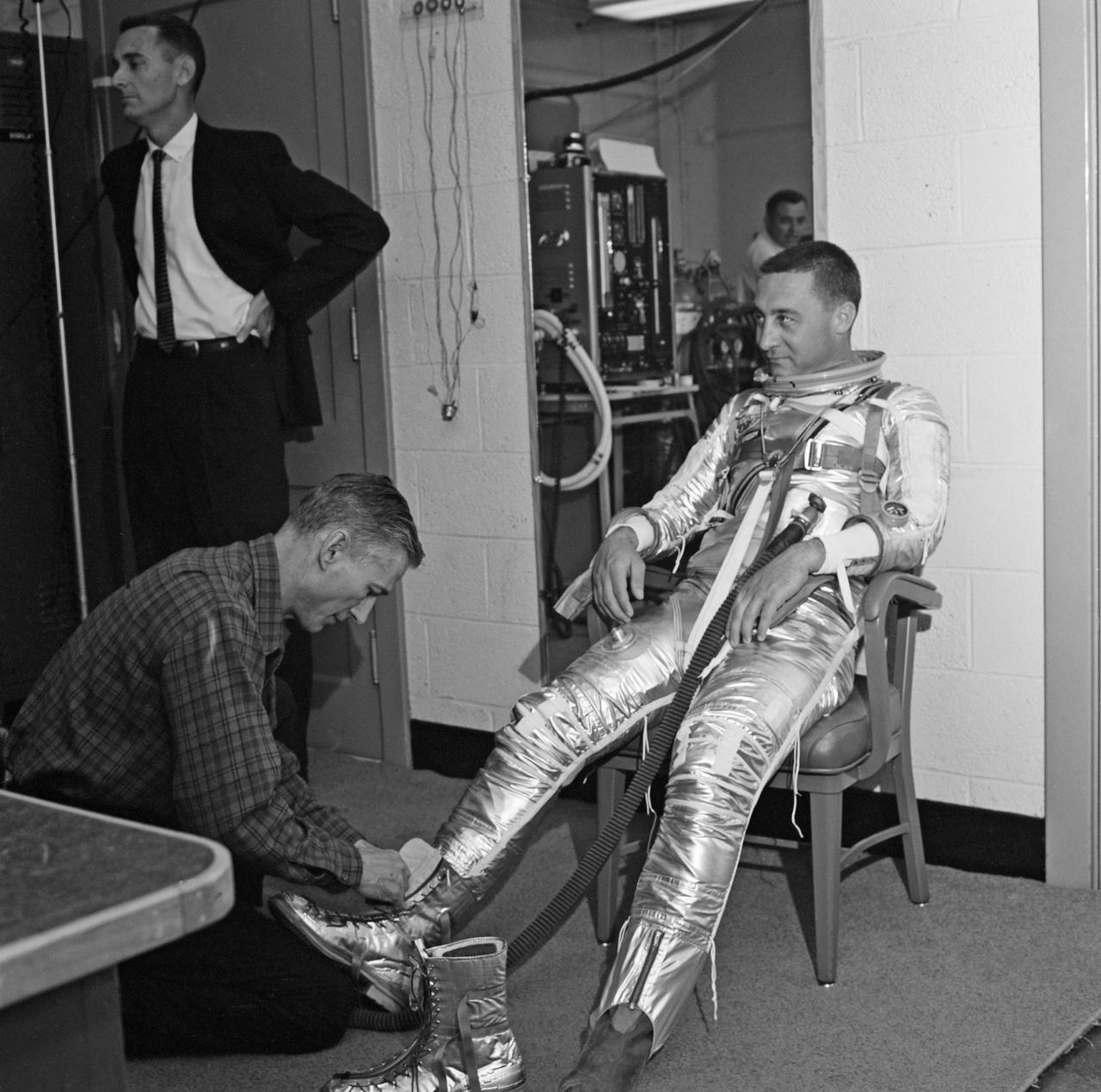
Gus Grissom trying on a Spacesuit; Seated with assistant; Seated with assistant putting on boots; Standing by mirror, name tag visible; Outside in suit, name tag visible. Mercury Project photo, 1961. Original negatives sent to Johnson Space Center when astronauts moved to that center. Photograph take on 03/27/1961.
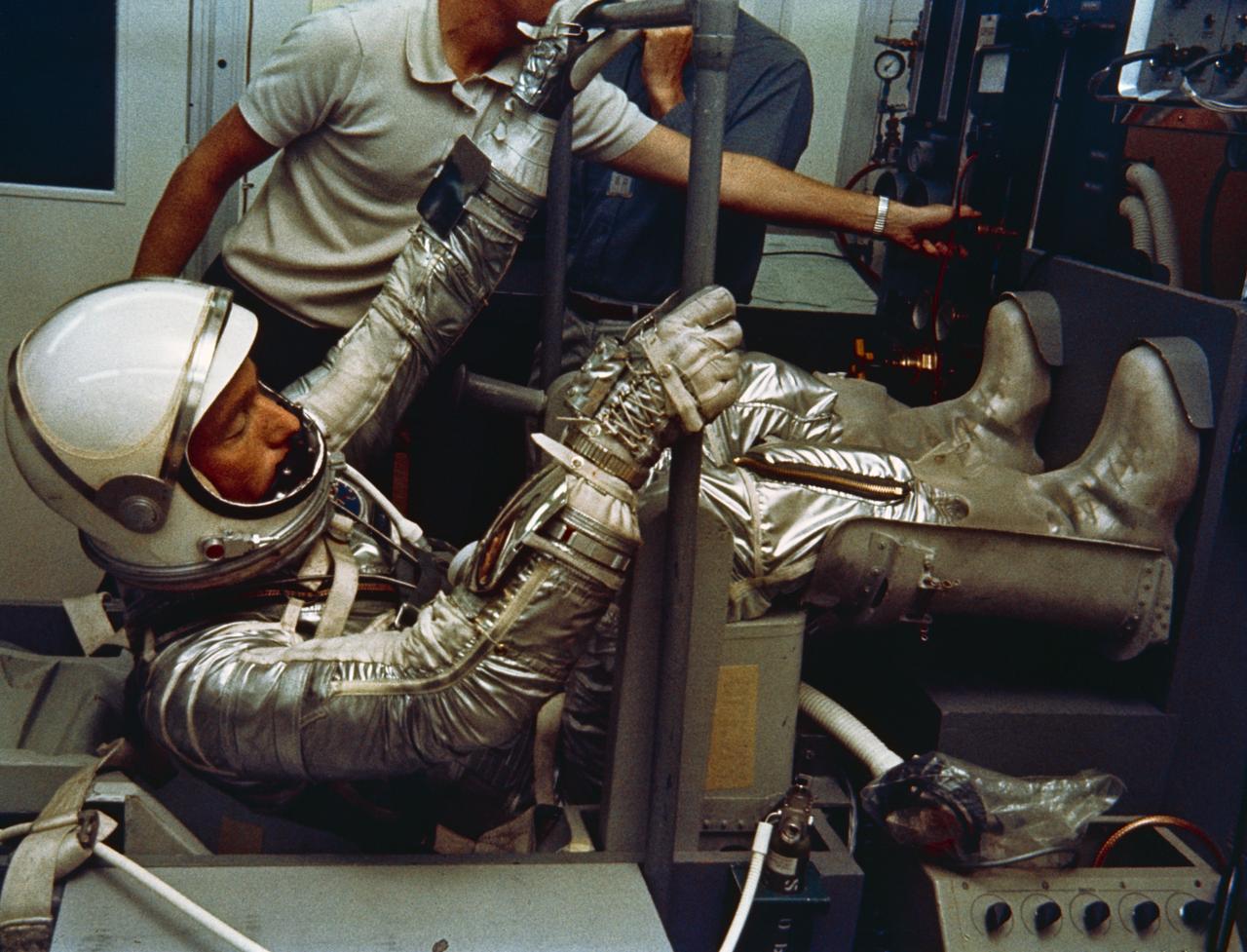
S65-24623 (May 1962) --- Astronaut M. Scott Carpenter, prime pilot for the Mercury-Atlas 7 (MA-7) flight, is seen in Hangar S crew quarters during a suiting exercise. Carpenter is seated in a mock-up of his pilot's seat while fully suited. Photo credit: NASA
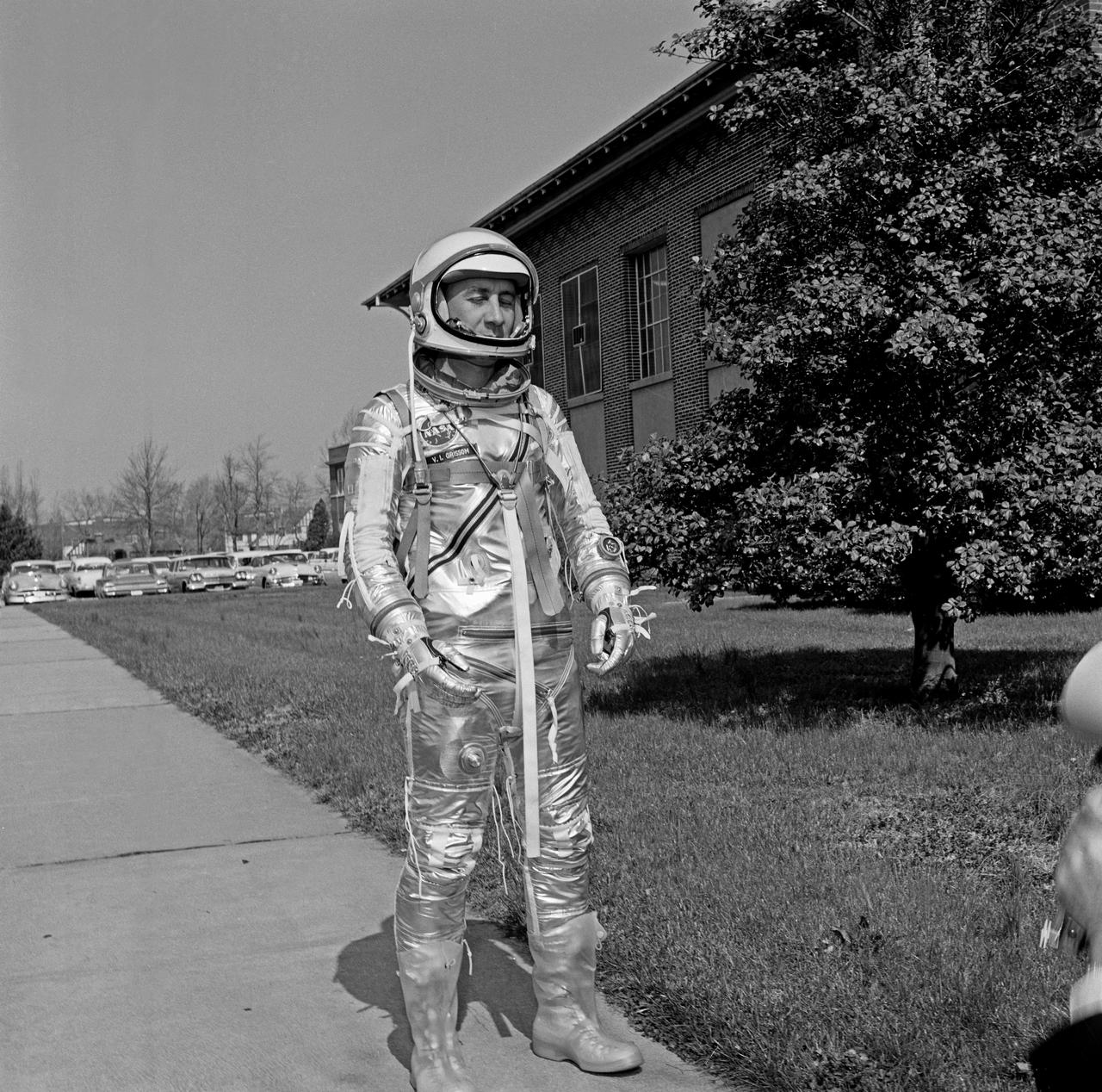
Gus Grissom trying on a Spacesuit; Seated with assistant; Seated with assistant putting on boots; Standing by mirror, name tag visible; Outside in suit, name tag visible. Mercury Project photo, 1961. Original negatives sent to Johnson Space Center when astronauts moved to that center. Photograph take on 03/27/1961.
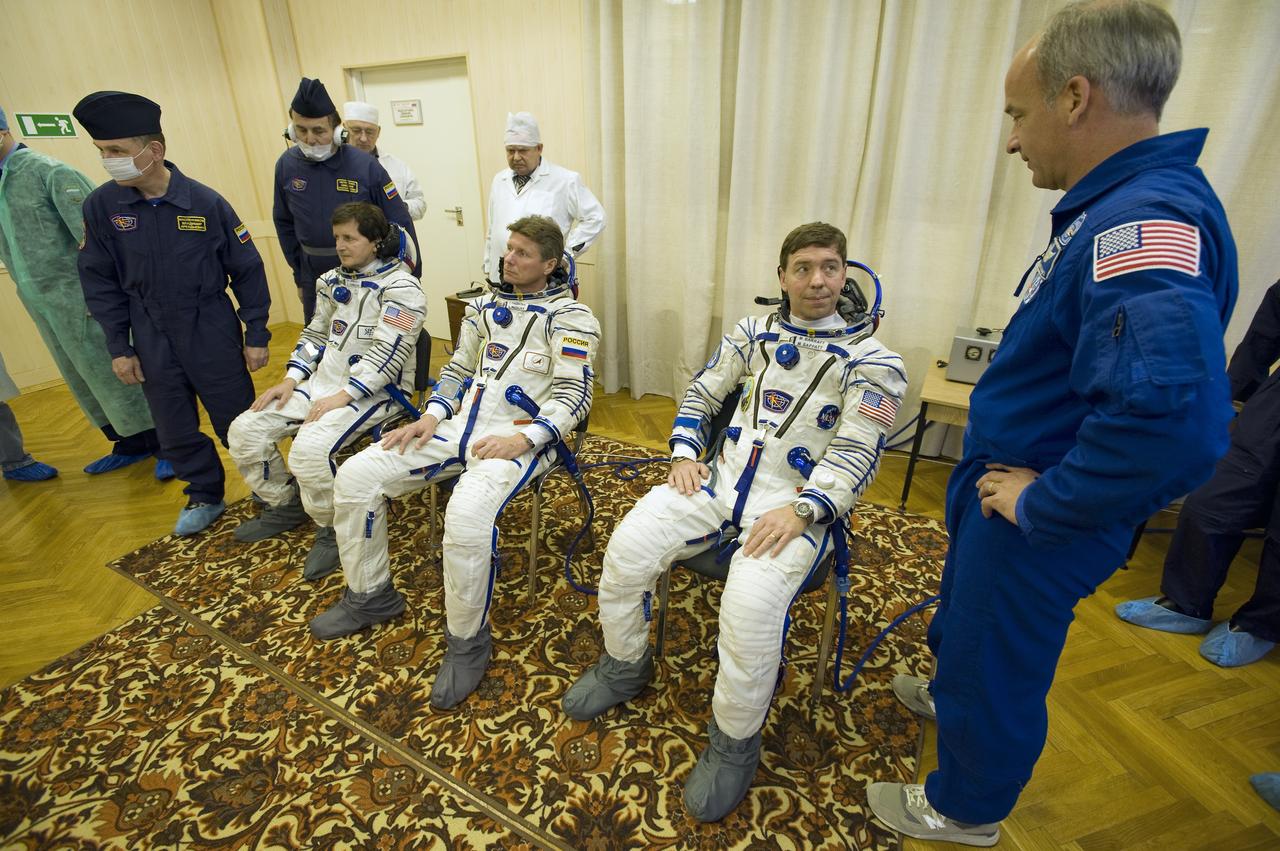
Spaceflight Participant Charles Simonyi, seated left, Expedition 19 Commander Gennady I. Padalka, seated center, and Flight Engineer Michael R. Barratt don their Russian Sokol suits in preparation for their Soyuz launch to the International Space Station on Thursday, March 26, 2009 in Baikonur, Kazakhstan. (Photo Credit: NASA/Bill Ingalls)
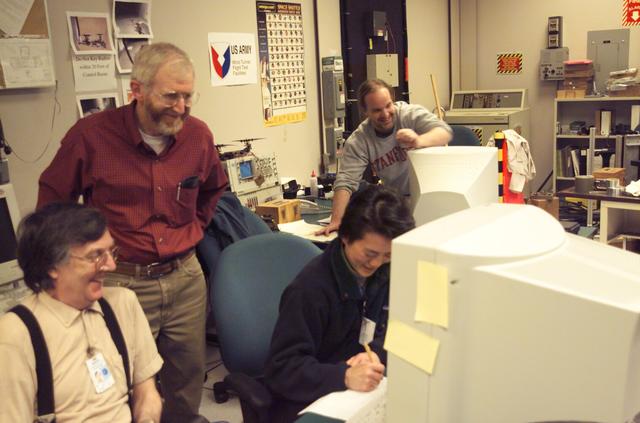
VSHAIP test in 7x10ft#1 W.T. (multiple model configruations) V-22 helicopter shipboard aerodynamic interaction program: L-R seated Allen Wadcox, (standind) Mark Betzina, seated in front of computer Gloria Yamauchi, in background Kurt Long.
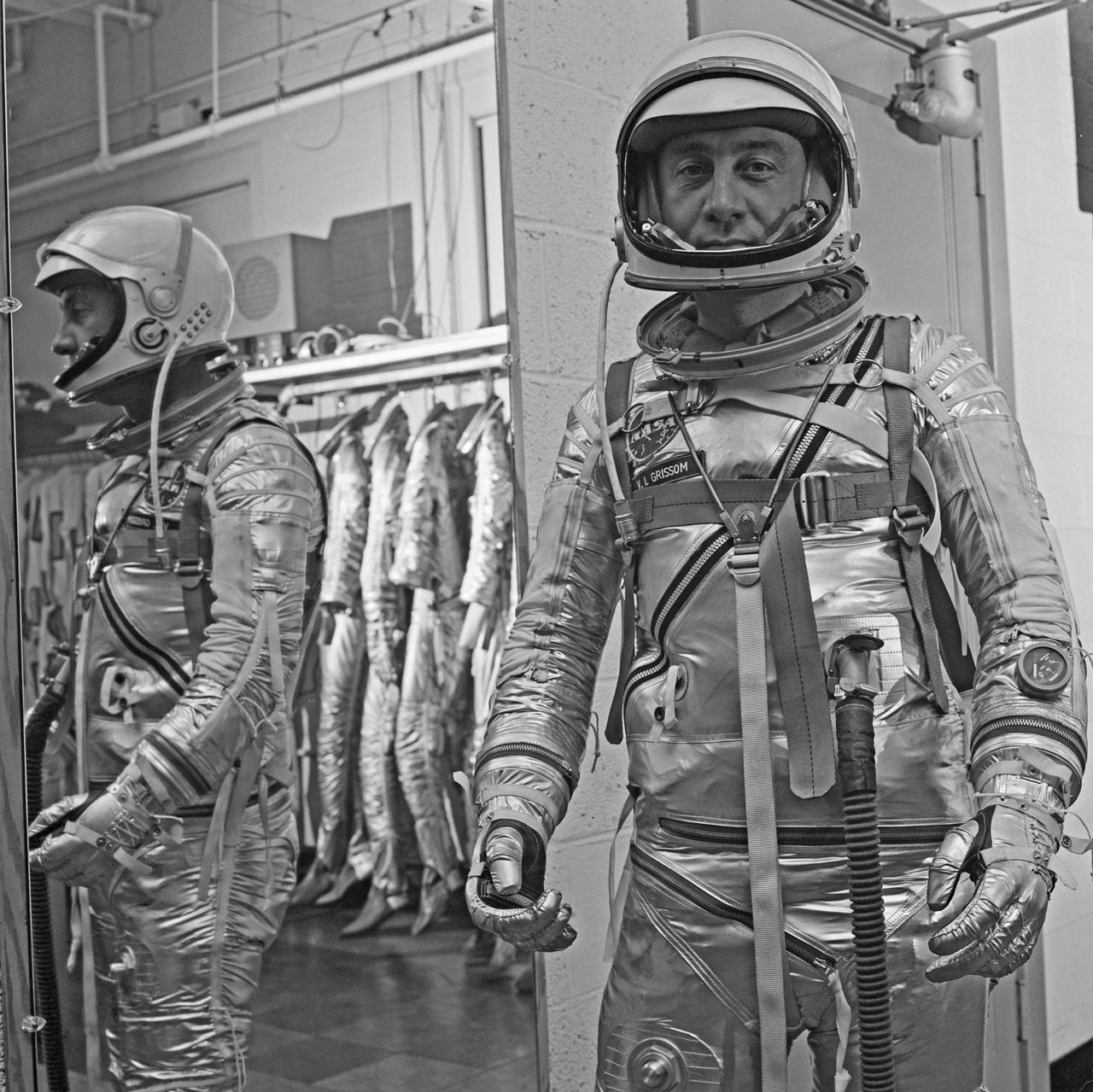
Gus Grissom trying on a Spacesuit; Seated with assistant; Seated with assistant putting on boots; Standing by mirror, name tag visible; Outside in suit, name tag visible. Mercury Project photo, 1961. Original negatives sent to Johnson Space Center when astronauts moved to that center. Photograph take on 03/27/1961.
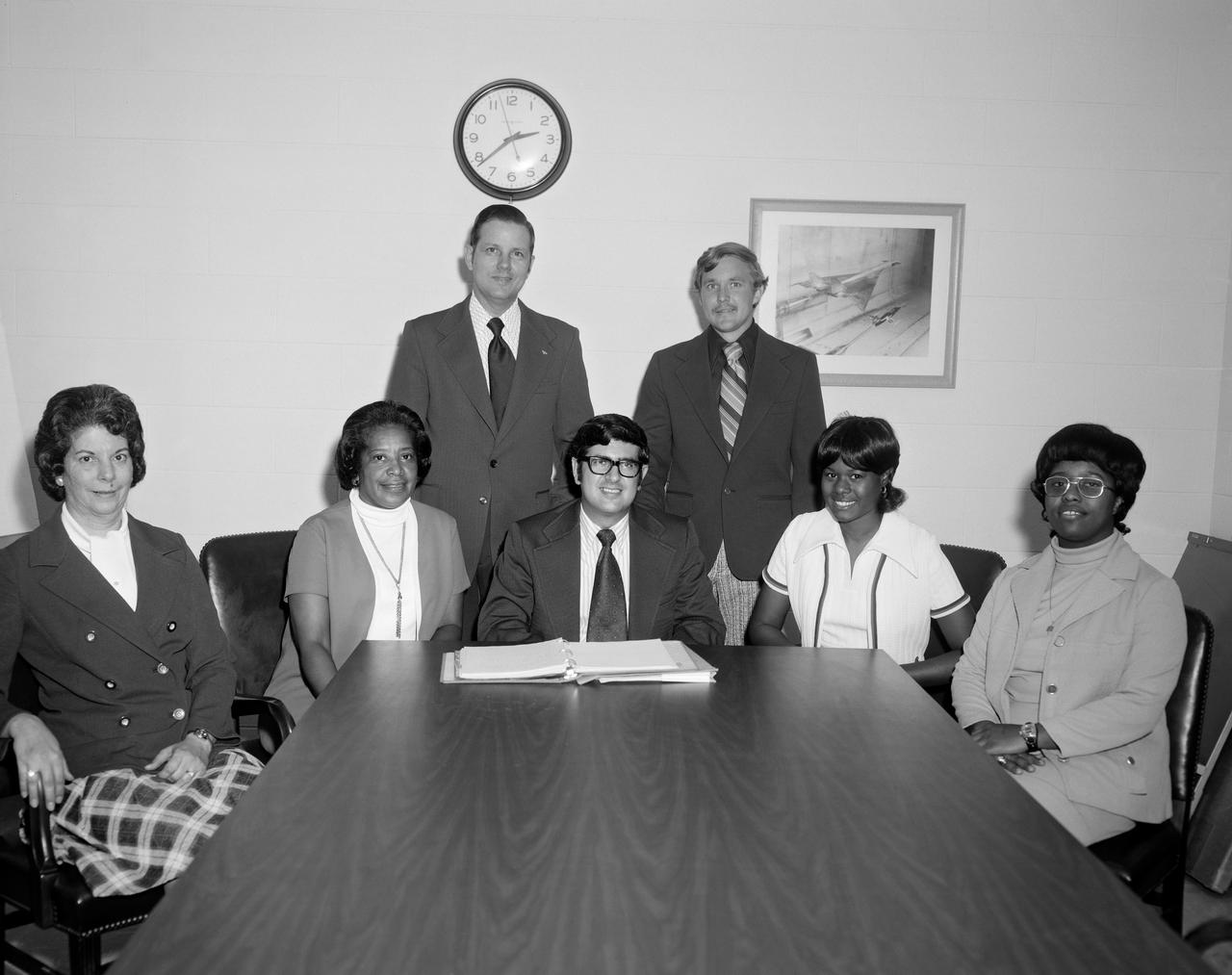
CAMPAIGN COMMITTEE: Frank V. Moore (seated center) has been named Director of the Center' s annual Combined Federal Campaign. Members of his campaign staff are (seated) Ernestine Martin, Mary Jackson, Gwendolyn Leach, Janet McKenzie. Standing are (from left) Willis C. Cross, James Ojiba.

An example of collaboration between NASA and the FAA, at NASA’s air traffic management laboratory near the Dallas/Ft. Worth International Airport in Texas, researchers Al Capps (seated) and Paul Borchers demonstrate tools that air traffic managers have been successfully testing since 2017 at the Charlotte Douglas International Airport in North Carolina to more efficiently direct departing traffic.