
This photo shows the second RS-25 engine attached to the core stage for NASA’s Space Launch System rocket for the agency’s Artemis I mission to the Moon. Engineers and technicians at NASA’s Michoud Assembly Facility in New Orleans structurally mated the second of four engines to the stage on Oct. 30 and are currently integrating the propulsion and electrical systems within the structure to complete the installation. Integration of the RS-25 engines to the recently completed core stage structure is a collaborative, multistep process for NASA and its partners Boeing, the core stage lead contractor, and Aerojet Rocketdyne, the RS-25 engines lead contractor. The four RS-25 engines for Artemis I are modified heritage flight hardware from the Space Shuttle Program, ensuring high performance and reliability to power NASA’s next generation lunar missions. Each engine also has a special identification number, and NASA keeps a history of which engines are used on each mission. The second engine, Engine 2045, has flown on several shuttle missions, including the mission that returned NASA astronaut John Glenn to space in 1998 as well as the first and only shuttle launch to occur on Independence Day in 2006. Offering more payload mass, volume capability and energy to speed missions through space, the SLS rocket, along with NASA’s Gateway in lunar orbit and Orion, is part of NASA’s backbone for deep space exploration and the Artemis lunar program. No other rocket is capable of carrying astronauts in Orion around the Moon in a single mission.

This photo shows the second RS-25 engine attached to the core stage for NASA’s Space Launch System rocket for the agency’s Artemis I mission to the Moon. Engineers and technicians at NASA’s Michoud Assembly Facility in New Orleans structurally mated the second of four engines to the stage on Oct. 30 and are currently integrating the propulsion and electrical systems within the structure to complete the installation. Integration of the RS-25 engines to the recently completed core stage structure is a collaborative, multistep process for NASA and its partners Boeing, the core stage lead contractor, and Aerojet Rocketdyne, the RS-25 engines lead contractor. The four RS-25 engines for Artemis I are modified heritage flight hardware from the Space Shuttle Program, ensuring high performance and reliability to power NASA’s next generation lunar missions. Each engine also has a special identification number, and NASA keeps a history of which engines are used on each mission. The second engine, Engine 2045, has flown on several shuttle missions, including the mission that returned NASA astronaut John Glenn to space in 1998 as well as the first and only shuttle launch to occur on Independence Day in 2006. Offering more payload mass, volume capability and energy to speed missions through space, the SLS rocket, along with NASA’s Gateway in lunar orbit and Orion, is part of NASA’s backbone for deep space exploration and the Artemis lunar program. No other rocket is capable of carrying astronauts in Orion around the Moon in a single mission.

This photo shows the second RS-25 engine attached to the core stage for NASA’s Space Launch System rocket for the agency’s Artemis I mission to the Moon. Engineers and technicians at NASA’s Michoud Assembly Facility in New Orleans structurally mated the second of four engines to the stage on Oct. 30 and are currently integrating the propulsion and electrical systems within the structure to complete the installation. Integration of the RS-25 engines to the recently completed core stage structure is a collaborative, multistep process for NASA and its partners Boeing, the core stage lead contractor, and Aerojet Rocketdyne, the RS-25 engines lead contractor. The four RS-25 engines for Artemis I are modified heritage flight hardware from the Space Shuttle Program, ensuring high performance and reliability to power NASA’s next generation lunar missions. Each engine also has a special identification number, and NASA keeps a history of which engines are used on each mission. The second engine, Engine 2045, has flown on several shuttle missions, including the mission that returned NASA astronaut John Glenn to space in 1998 as well as the first and only shuttle launch to occur on Independence Day in 2006. Offering more payload mass, volume capability and energy to speed missions through space, the SLS rocket, along with NASA’s Gateway in lunar orbit and Orion, is part of NASA’s backbone for deep space exploration and the Artemis lunar program. No other rocket is capable of carrying astronauts in Orion around the Moon in a single mission.

This photo shows the second RS-25 engine attached to the core stage for NASA’s Space Launch System rocket for the agency’s Artemis I mission to the Moon. Engineers and technicians at NASA’s Michoud Assembly Facility in New Orleans structurally mated the second of four engines to the stage on Oct. 30 and are currently integrating the propulsion and electrical systems within the structure to complete the installation. Integration of the RS-25 engines to the recently completed core stage structure is a collaborative, multistep process for NASA and its partners Boeing, the core stage lead contractor, and Aerojet Rocketdyne, the RS-25 engines lead contractor. The four RS-25 engines for Artemis I are modified heritage flight hardware from the Space Shuttle Program, ensuring high performance and reliability to power NASA’s next generation lunar missions. Each engine also has a special identification number, and NASA keeps a history of which engines are used on each mission. The second engine, Engine 2045, has flown on several shuttle missions, including the mission that returned NASA astronaut John Glenn to space in 1998 as well as the first and only shuttle launch to occur on Independence Day in 2006. Offering more payload mass, volume capability and energy to speed missions through space, the SLS rocket, along with NASA’s Gateway in lunar orbit and Orion, is part of NASA’s backbone for deep space exploration and the Artemis lunar program. No other rocket is capable of carrying astronauts in Orion around the Moon in a single mission.
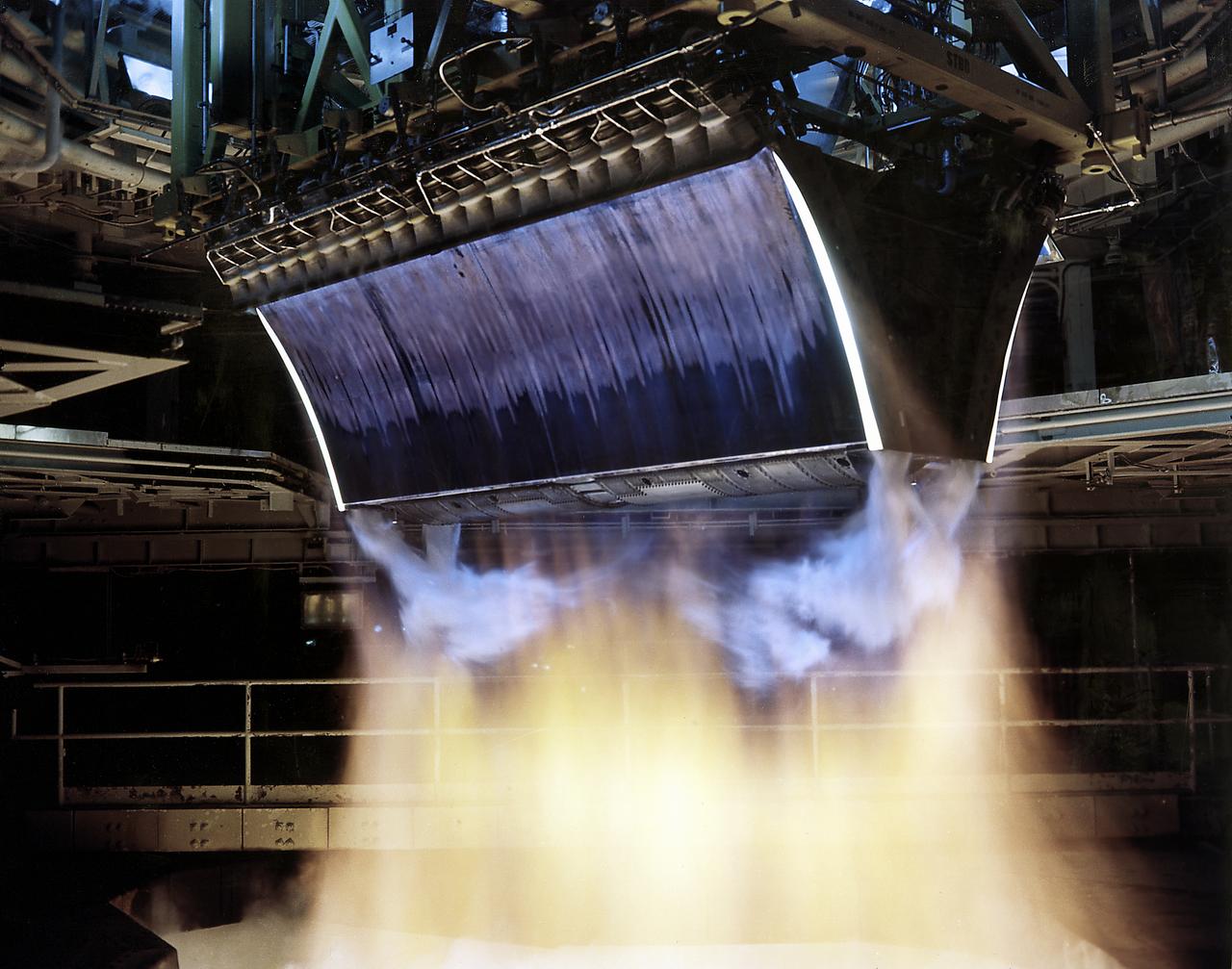
The test of twin Linear Aerospike XRS-2200 engines, originally built for the X-33 program, was performed on August 6, 2001 at NASA's Sternis Space Center, Mississippi. The engines were fired for the planned 90 seconds and reached a planned maximum power of 85 percent. NASA's Second Generation Reusable Launch Vehicle Program , also known as the Space Launch Initiative (SLI), is making advances in propulsion technology with this third and final successful engine hot fire, designed to test electro-mechanical actuators. Information learned from this hot fire test series about new electro-mechanical actuator technology, which controls the flow of propellants in rocket engines, could provide key advancements for the propulsion systems for future spacecraft. The Second Generation Reusable Launch Vehicle Program, led by NASA's Marshall Space Flight Center in Huntsville, Alabama, is a technology development program designed to increase safety and reliability while reducing costs for space travel. The X-33 program was cancelled in March 2001.
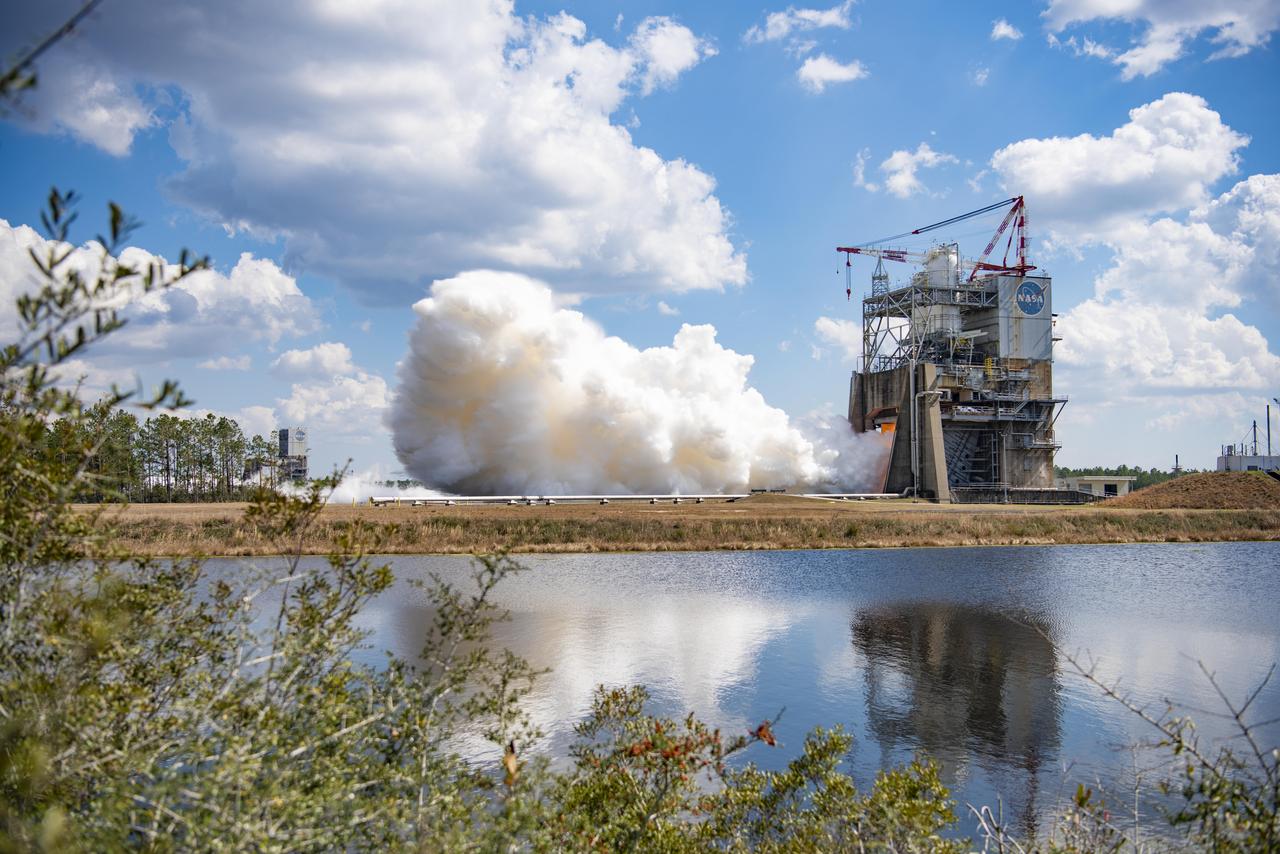
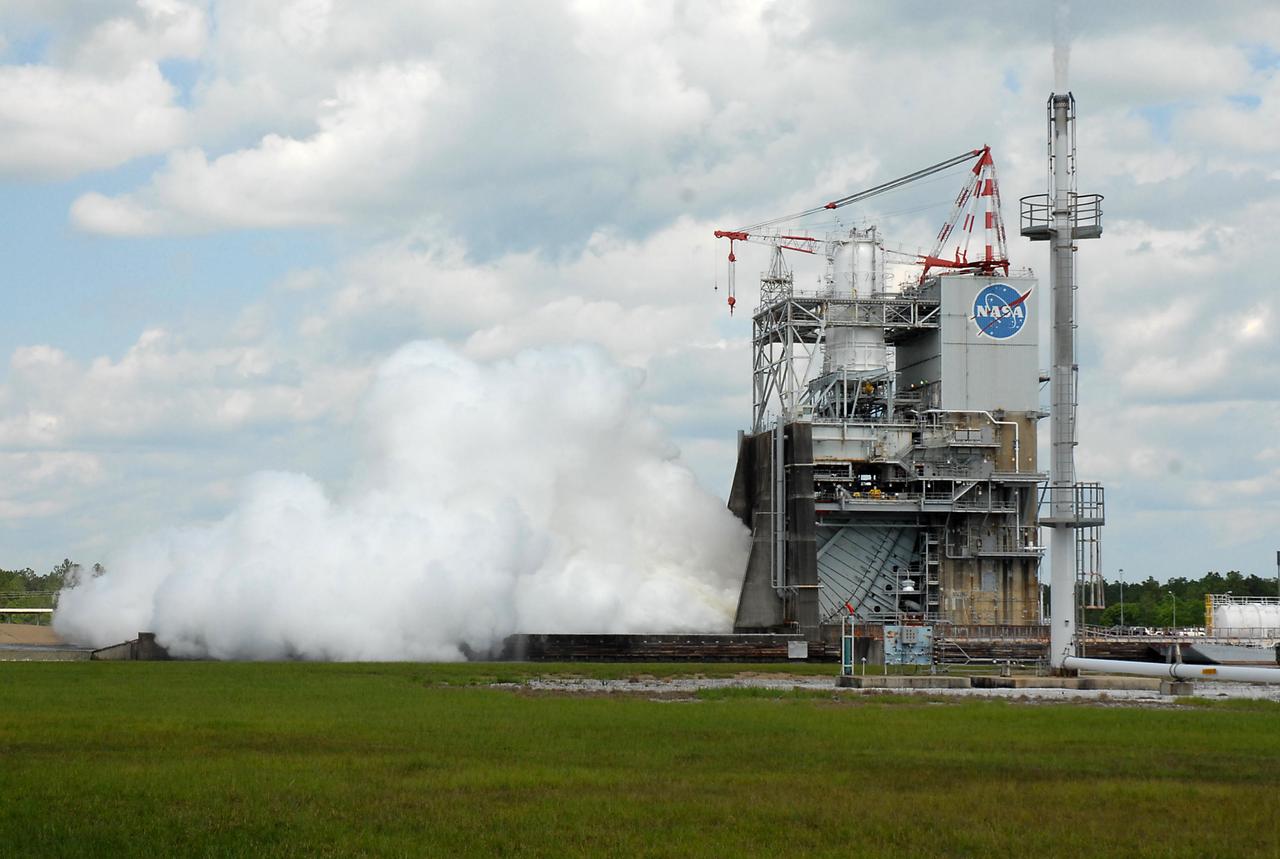
NASA conducts a full-duration RS-25 hot fire Feb. 23 on the Fred Haise Test Stand at NASA’s Stennis Space Center near Bay St. Louis, Mississippi, continuing a key test series for future Artemis flights of NASA’s SLS (Space Launch System) rocket. During the seventh test of the 12-test series, operators fired the certification engine for 550 seconds and up to a 113% power level. The hot fire followed installation of a second production engine nozzle that will provide additional performance data on the upgraded unit. The test series is the second, and final, series to certify restart production of the upgraded engines by lead contractor Aerojet Rocketdyne, an L3Harris Technologies company. New engines will help power NASA’s SLS rocket on Artemis missions to the Moon and beyond, beginning with Artemis V. NASA and Aerojet Rocketdyne modified 16 former space shuttle engines for use on Artemis missions I through IV. NASA completed an initial 12-test certification series with the upgraded components in June 2023. Four RS-25 engines fire simultaneously to help launch each SLS rocket, producing up to 2 million pounds of combined thrust.
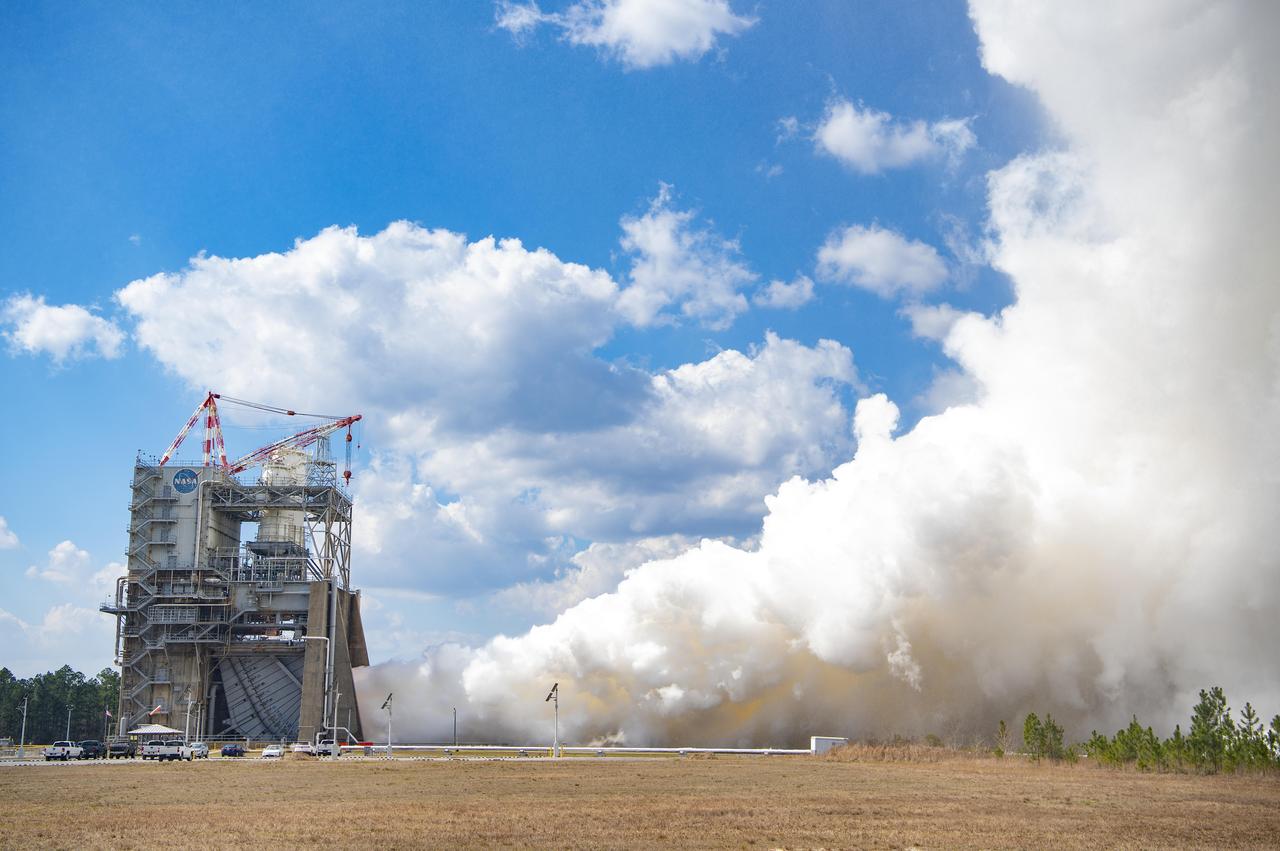
NASA conducts a full-duration RS-25 hot fire Feb. 23 on the Fred Haise Test Stand at NASA’s Stennis Space Center near Bay St. Louis, Mississippi, continuing a key test series for future Artemis flights of NASA’s SLS (Space Launch System) rocket. During the seventh test of the 12-test series, operators fired the certification engine for 550 seconds and up to a 113% power level. The hot fire followed installation of a second production engine nozzle that will provide additional performance data on the upgraded unit. The test series is the second, and final, series to certify restart production of the upgraded engines by lead contractor Aerojet Rocketdyne, an L3Harris Technologies company. New engines will help power NASA’s SLS rocket on Artemis missions to the Moon and beyond, beginning with Artemis V. NASA and Aerojet Rocketdyne modified 16 former space shuttle engines for use on Artemis missions I through IV. NASA completed an initial 12-test certification series with the upgraded components in June 2023. Four RS-25 engines fire simultaneously to help launch each SLS rocket, producing up to 2 million pounds of combined thrust.
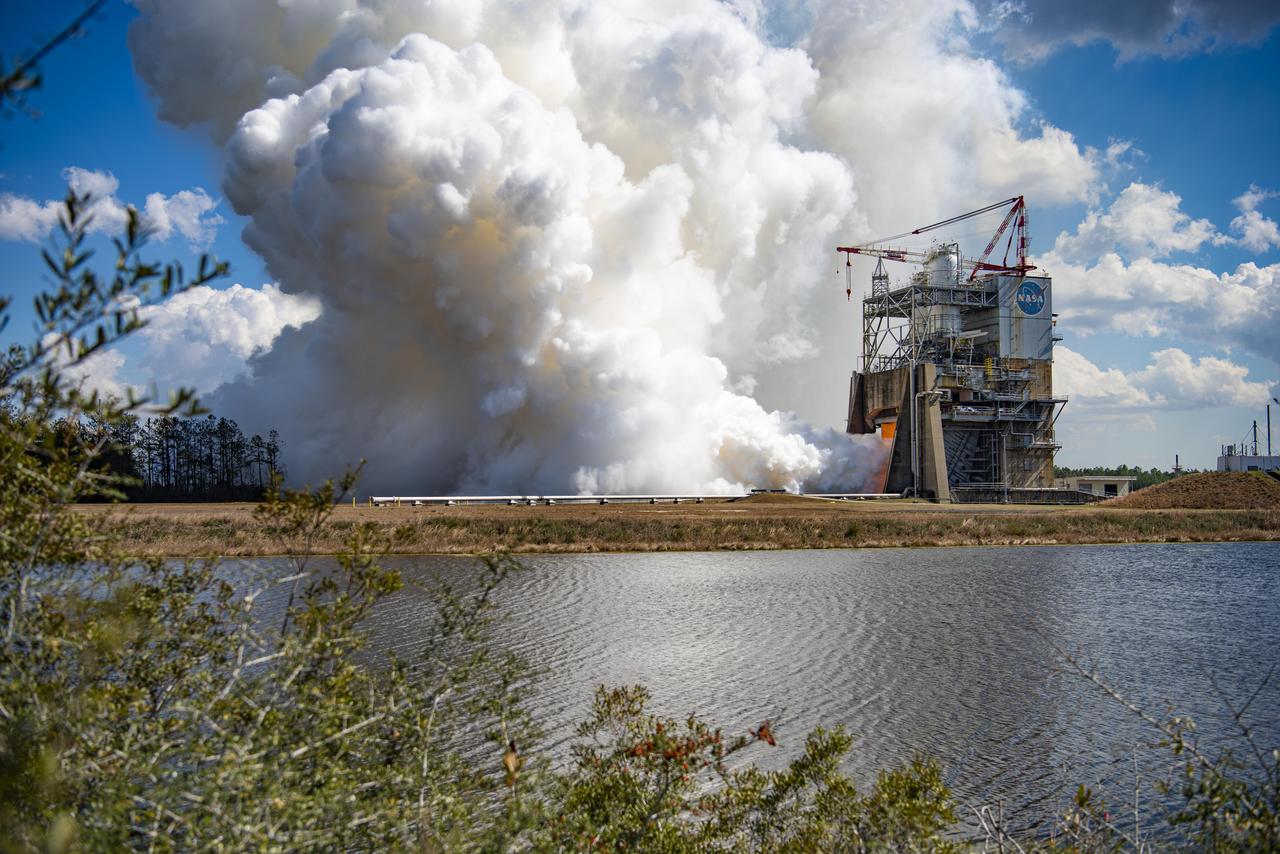
NASA conducts a full-duration RS-25 hot fire Feb. 23 on the Fred Haise Test Stand at NASA’s Stennis Space Center near Bay St. Louis, Mississippi, continuing a key test series for future Artemis flights of NASA’s SLS (Space Launch System) rocket. During the seventh test of the 12-test series, operators fired the certification engine for 550 seconds and up to a 113% power level. The hot fire followed installation of a second production engine nozzle that will provide additional performance data on the upgraded unit. The test series is the second, and final, series to certify restart production of the upgraded engines by lead contractor Aerojet Rocketdyne, an L3Harris Technologies company. New engines will help power NASA’s SLS rocket on Artemis missions to the Moon and beyond, beginning with Artemis V. NASA and Aerojet Rocketdyne modified 16 former space shuttle engines for use on Artemis missions I through IV. NASA completed an initial 12-test certification series with the upgraded components in June 2023. Four RS-25 engines fire simultaneously to help launch each SLS rocket, producing up to 2 million pounds of combined thrust.

NASA conducts a full-duration RS-25 hot fire Feb. 23 on the Fred Haise Test Stand at NASA’s Stennis Space Center near Bay St. Louis, Mississippi, continuing a key test series for future Artemis flights of NASA’s SLS (Space Launch System) rocket. During the seventh test of the 12-test series, operators fired the certification engine for 550 seconds and up to a 113% power level. The hot fire followed installation of a second production engine nozzle that will provide additional performance data on the upgraded unit. The test series is the second, and final, series to certify restart production of the upgraded engines by lead contractor Aerojet Rocketdyne, an L3Harris Technologies company. New engines will help power NASA’s SLS rocket on Artemis missions to the Moon and beyond, beginning with Artemis V. NASA and Aerojet Rocketdyne modified 16 former space shuttle engines for use on Artemis missions I through IV. NASA completed an initial 12-test certification series with the upgraded components in June 2023. Four RS-25 engines fire simultaneously to help launch each SLS rocket, producing up to 2 million pounds of combined thrust.
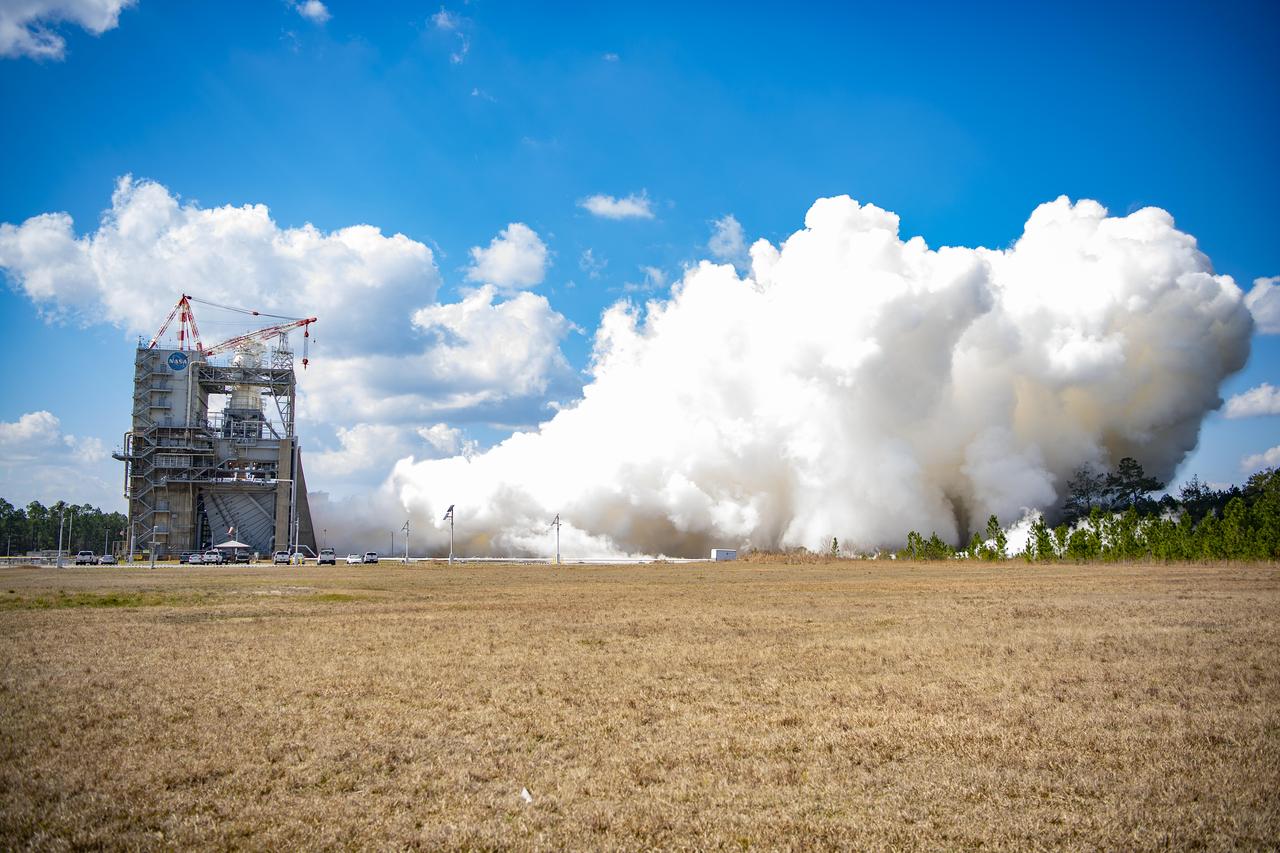
NASA conducts a full-duration RS-25 hot fire Feb. 23 on the Fred Haise Test Stand at NASA’s Stennis Space Center near Bay St. Louis, Mississippi, continuing a key test series for future Artemis flights of NASA’s SLS (Space Launch System) rocket. During the seventh test of the 12-test series, operators fired the certification engine for 550 seconds and up to a 113% power level. The hot fire followed installation of a second production engine nozzle that will provide additional performance data on the upgraded unit. The test series is the second, and final, series to certify restart production of the upgraded engines by lead contractor Aerojet Rocketdyne, an L3Harris Technologies company. New engines will help power NASA’s SLS rocket on Artemis missions to the Moon and beyond, beginning with Artemis V. NASA and Aerojet Rocketdyne modified 16 former space shuttle engines for use on Artemis missions I through IV. NASA completed an initial 12-test certification series with the upgraded components in June 2023. Four RS-25 engines fire simultaneously to help launch each SLS rocket, producing up to 2 million pounds of combined thrust.
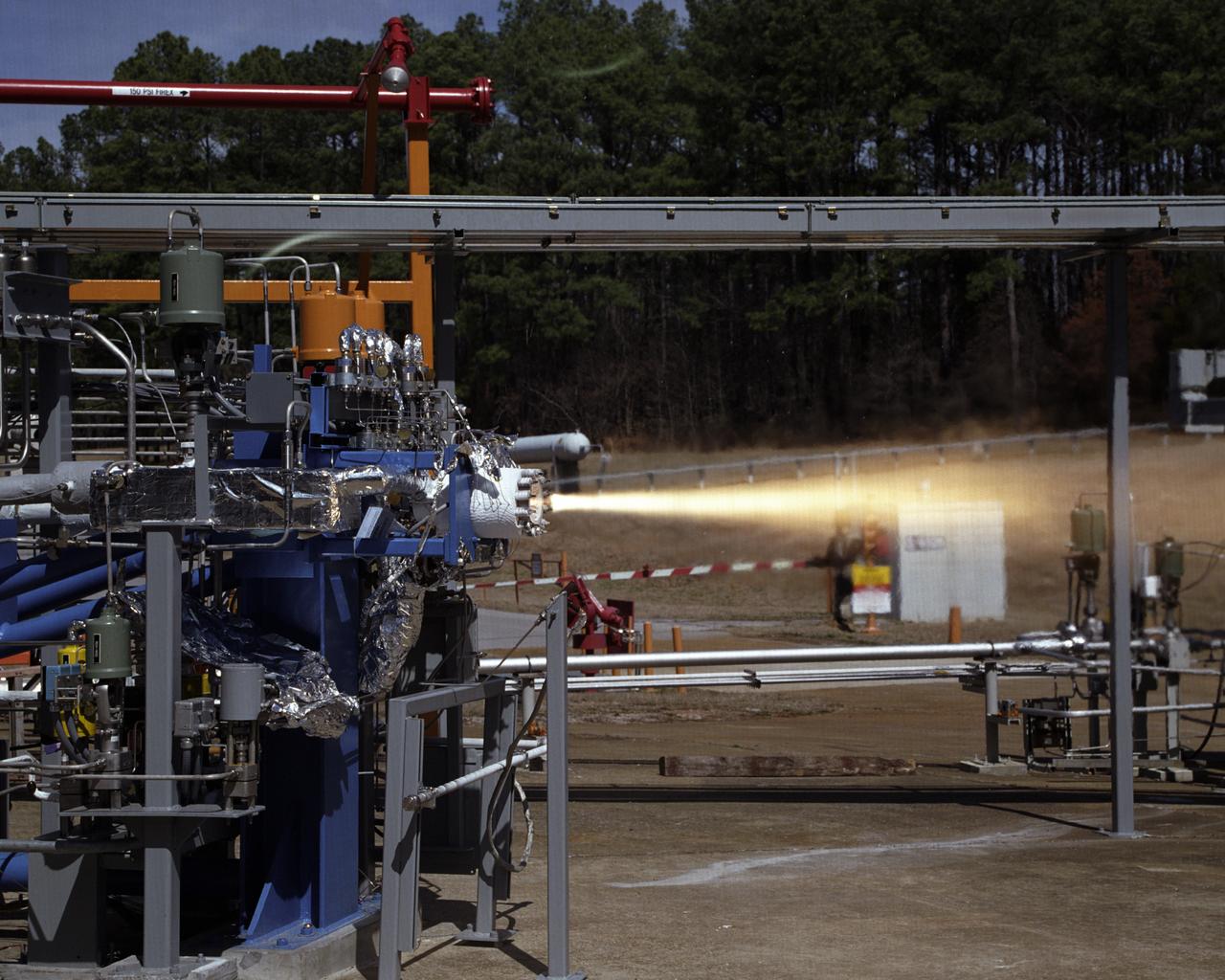
Engineers at the Marshall Space Flight Center (MSFC) have begun a series of engine tests on a new breed of space propulsion: a Reaction Control Engine developed for the Space Launch Initiative (SLI). The engine, developed by TRW Space and Electronics of Redondo Beach, California, is an auxiliary propulsion engine designed to maneuver vehicles in orbit. It is used for docking, reentry, attitude control, and fine-pointing while the vehicle is in orbit. The engine uses nontoxic chemicals as propellants, a feature that creates a safer environment for ground operators, lowers cost, and increases efficiency with less maintenance and quicker turnaround time between missions. Testing includes 30 hot-firings. This photograph shows the first engine test performed at MSFC that includes SLI technology. Another unique feature of the Reaction Control Engine is that it operates at dual thrust modes, combining two engine functions into one engine. The engine operates at both 25 and 1,000 pounds of force, reducing overall propulsion weight and allowing vehicles to easily maneuver in space. The low-level thrust of 25 pounds of force allows the vehicle to fine-point maneuver and dock while the high-level thrust of 1,000 pounds of force is used for reentry, orbit transfer, and coarse positioning. SLI is a NASA-wide research and development program, managed by the MSFC, designed to improve safety, reliability, and cost effectiveness of space travel for second generation reusable launch vehicles.

This photo shows the second RS-25 engine attached to the core stage for NASA’s Space Launch System rocket for the agency’s Artemis I mission to the Moon. Engineers and technicians at NASA’s Michoud Assembly Facility in New Orleans structurally mated the second of four engines to the stage on Oct. 30 and are currently integrating the propulsion and electrical systems within the structure to complete the installation. Integration of the RS-25 engines to the recently completed core stage structure is a collaborative, multistep process for NASA and its partners Boeing, the core stage lead contractor, and Aerojet Rocketdyne, the RS-25 engines lead contractor. The four RS-25 engines for Artemis I are modified heritage flight hardware from the Space Shuttle Program, ensuring high performance and reliability to power NASA’s next generation lunar missions. Each engine also has a special identification number, and NASA keeps a history of which engines are used on each mission. The second engine, Engine 2045, has flown on several shuttle missions, including the mission that returned NASA astronaut John Glenn to space in 1998 as well as the first and only shuttle launch to occur on Independence Day in 2006.
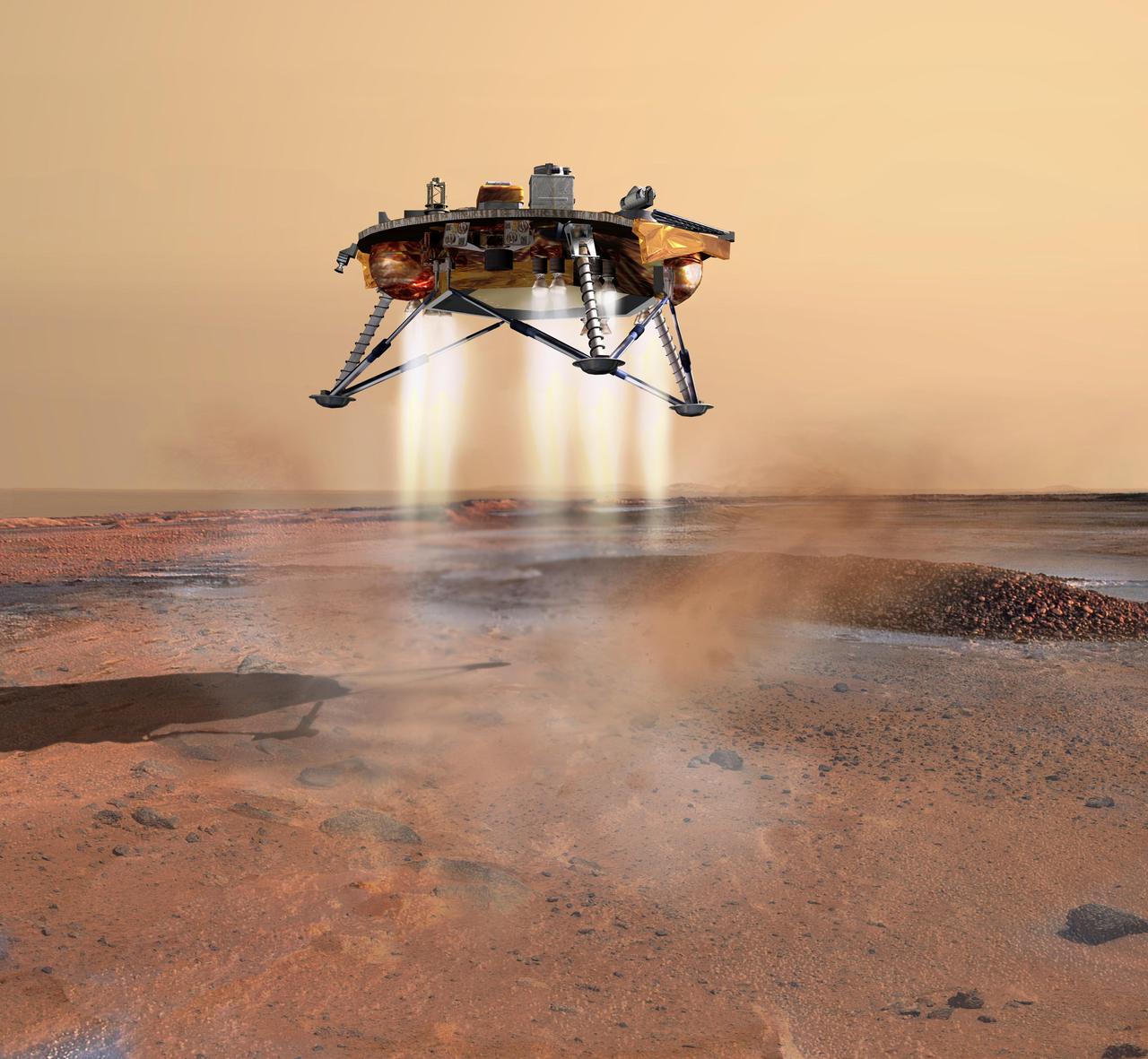
This artist concept depicts NASA Phoenix Mars Lander a moment before its 2008 touchdown on the arctic plains of Mars. Pulsed rocket engines control the spacecraft speed during the final seconds of descent.

These photos and videos show how technicians at NASA’s Michoud Assembly Facility in New Orleans installed the second of four RS-25 engines onto the core stage for the agency’s SLS (Space Launch System) rocket that will help power NASA’s first crewed Artemis mission to the Moon. Crews added the second engine, with the serial number E2047 in position one, to the stage Sept. 15. The serial number for the engine installed Sept. 11 in position two on the core stage is E2059. Engineers consider the engines to be “soft” mated to the rocket stage. Following soft mate of all four engines, technicians with NASA, Aerojet Rocketdyne, an L3Harris Technologies company and the RS-25 engines lead contractor, along with Boeing, the core stage lead contractor, will fully secure the engines to the stage and integrate the propulsion and electrical systems within the structure. All four RS-25 engines are located at the base of the core stage within the engine section. NASA is working to land the first woman and first person of color on the Moon under Artemis. SLS is part of NASA’s backbone for deep space exploration, along with Orion and the Gateway in orbit around the Moon. SLS is the only rocket that can send Orion, astronauts, and supplies to the Moon in a single mission.
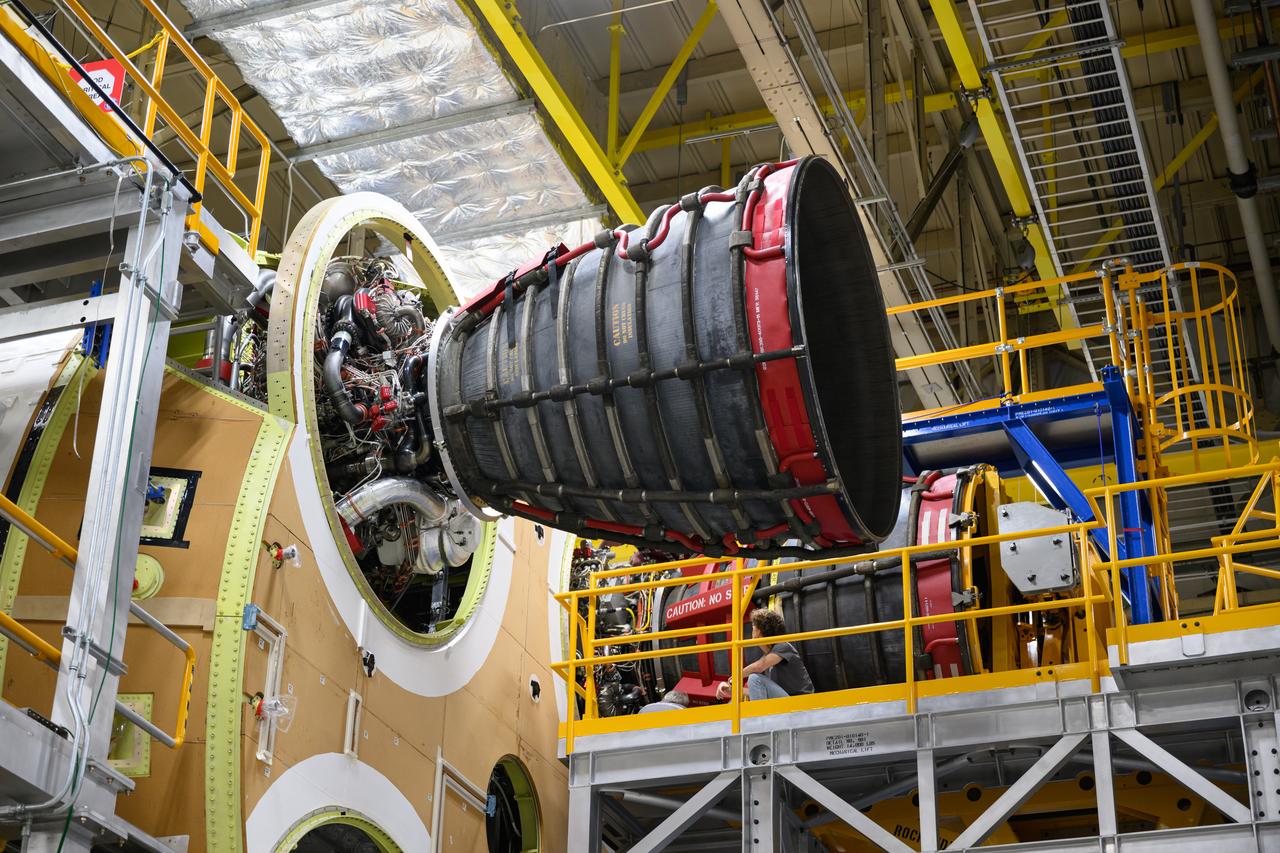
These photos and videos show how technicians at NASA’s Michoud Assembly Facility in New Orleans installed the second of four RS-25 engines onto the core stage for the agency’s SLS (Space Launch System) rocket that will help power NASA’s first crewed Artemis mission to the Moon. Crews added the second engine, with the serial number E2047 in position one, to the stage Sept. 15. The serial number for the engine installed Sept. 11 in position two on the core stage is E2059. Engineers consider the engines to be “soft” mated to the rocket stage. Following soft mate of all four engines, technicians with NASA, Aerojet Rocketdyne, an L3Harris Technologies company and the RS-25 engines lead contractor, along with Boeing, the core stage lead contractor, will fully secure the engines to the stage and integrate the propulsion and electrical systems within the structure. All four RS-25 engines are located at the base of the core stage within the engine section. NASA is working to land the first woman and first person of color on the Moon under Artemis. SLS is part of NASA’s backbone for deep space exploration, along with Orion and the Gateway in orbit around the Moon. SLS is the only rocket that can send Orion, astronauts, and supplies to the Moon in a single mission.
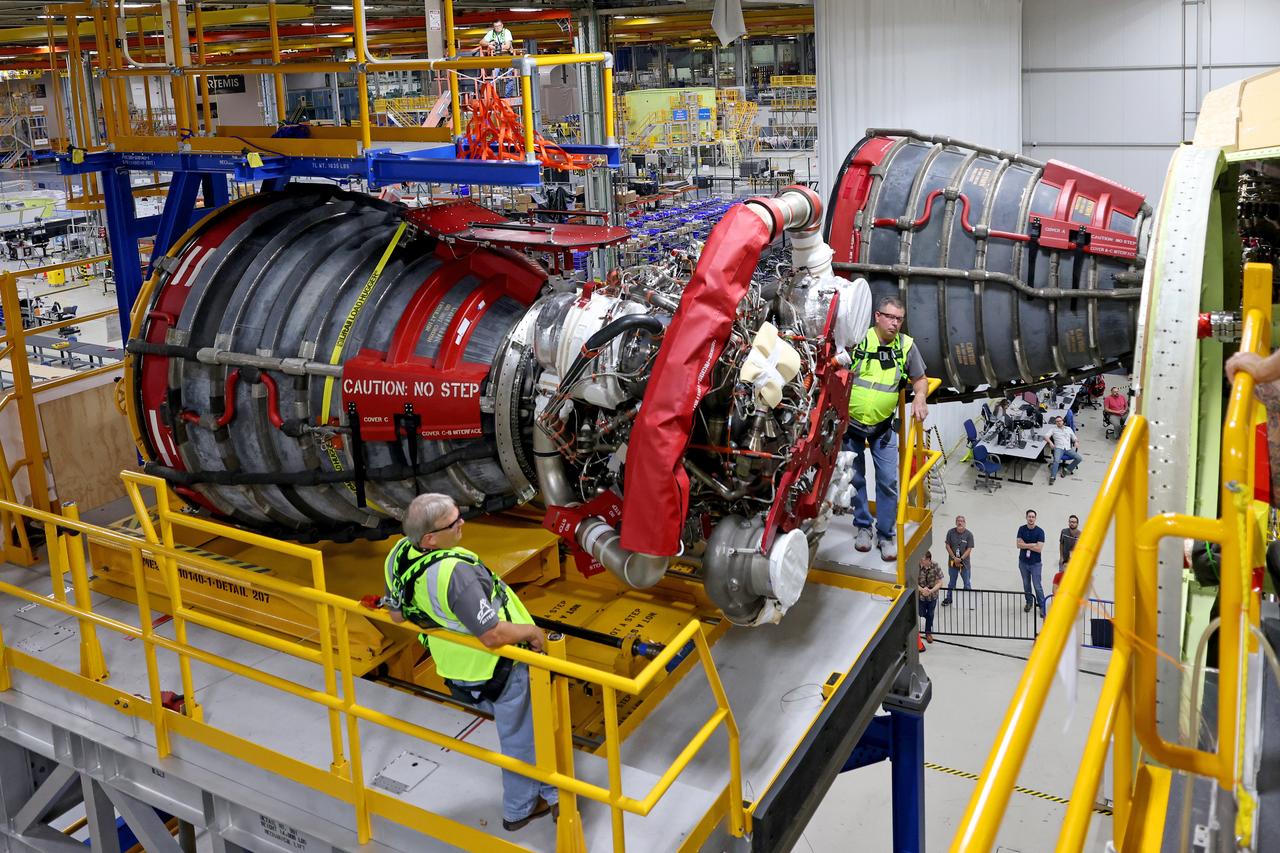
These photos and videos show how technicians at NASA’s Michoud Assembly Facility in New Orleans installed the second of four RS-25 engines onto the core stage for the agency’s SLS (Space Launch System) rocket that will help power NASA’s first crewed Artemis mission to the Moon. Crews added the second engine, with the serial number E2047 in position one, to the stage Sept. 15. The serial number for the engine installed Sept. 11 in position two on the core stage is E2059. Engineers consider the engines to be “soft” mated to the rocket stage. Following soft mate of all four engines, technicians with NASA, Aerojet Rocketdyne, an L3Harris Technologies company and the RS-25 engines lead contractor, along with Boeing, the core stage lead contractor, will fully secure the engines to the stage and integrate the propulsion and electrical systems within the structure. All four RS-25 engines are located at the base of the core stage within the engine section. NASA is working to land the first woman and first person of color on the Moon under Artemis. SLS is part of NASA’s backbone for deep space exploration, along with Orion and the Gateway in orbit around the Moon. SLS is the only rocket that can send Orion, astronauts, and supplies to the Moon in a single mission.
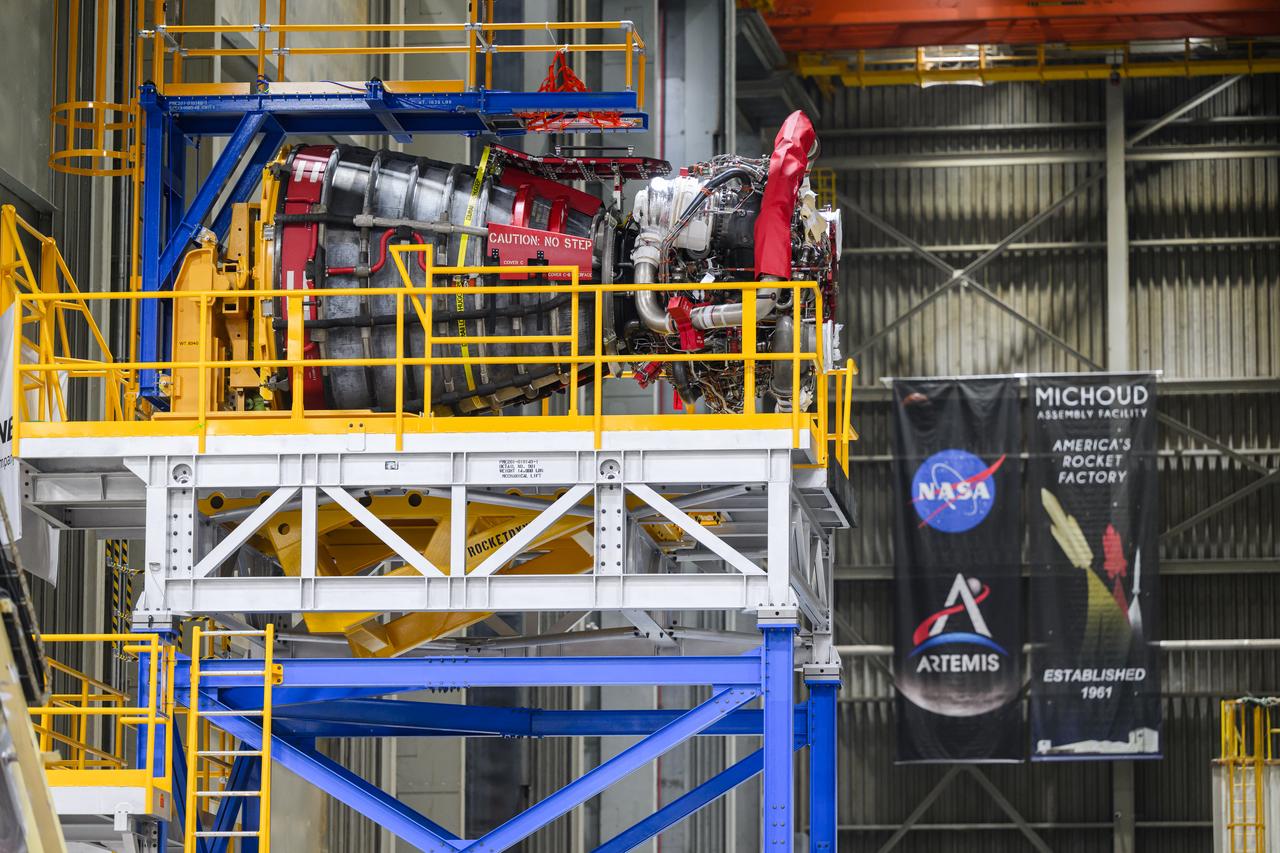
These photos and videos show how technicians at NASA’s Michoud Assembly Facility in New Orleans installed the second of four RS-25 engines onto the core stage for the agency’s SLS (Space Launch System) rocket that will help power NASA’s first crewed Artemis mission to the Moon. Crews added the second engine, with the serial number E2047 in position one, to the stage Sept. 15. The serial number for the engine installed Sept. 11 in position two on the core stage is E2059. Engineers consider the engines to be “soft” mated to the rocket stage. Following soft mate of all four engines, technicians with NASA, Aerojet Rocketdyne, an L3Harris Technologies company and the RS-25 engines lead contractor, along with Boeing, the core stage lead contractor, will fully secure the engines to the stage and integrate the propulsion and electrical systems within the structure. All four RS-25 engines are located at the base of the core stage within the engine section. NASA is working to land the first woman and first person of color on the Moon under Artemis. SLS is part of NASA’s backbone for deep space exploration, along with Orion and the Gateway in orbit around the Moon. SLS is the only rocket that can send Orion, astronauts, and supplies to the Moon in a single mission.
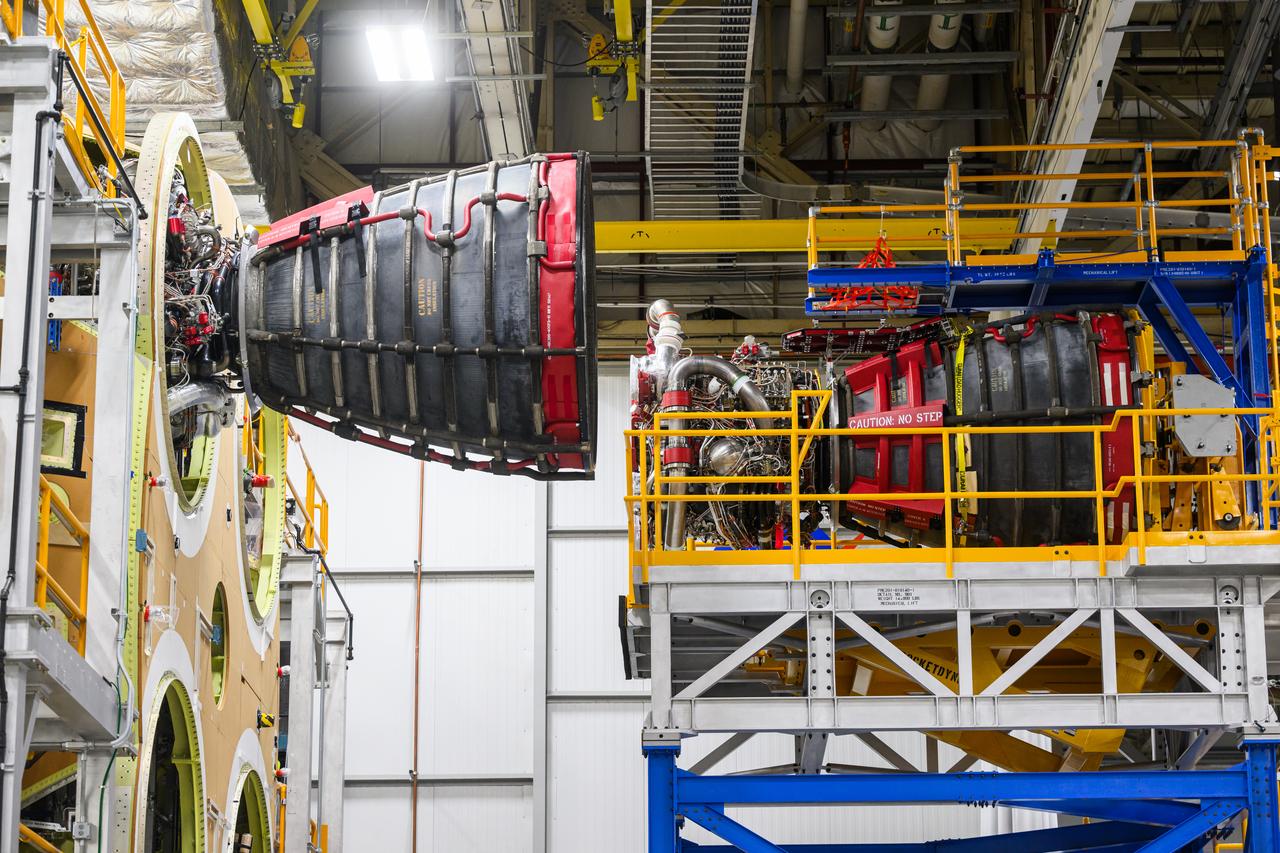
These photos and videos show how technicians at NASA’s Michoud Assembly Facility in New Orleans installed the second of four RS-25 engines onto the core stage for the agency’s SLS (Space Launch System) rocket that will help power NASA’s first crewed Artemis mission to the Moon. Crews added the second engine, with the serial number E2047 in position one, to the stage Sept. 15. The serial number for the engine installed Sept. 11 in position two on the core stage is E2059. Engineers consider the engines to be “soft” mated to the rocket stage. Following soft mate of all four engines, technicians with NASA, Aerojet Rocketdyne, an L3Harris Technologies company and the RS-25 engines lead contractor, along with Boeing, the core stage lead contractor, will fully secure the engines to the stage and integrate the propulsion and electrical systems within the structure. All four RS-25 engines are located at the base of the core stage within the engine section. NASA is working to land the first woman and first person of color on the Moon under Artemis. SLS is part of NASA’s backbone for deep space exploration, along with Orion and the Gateway in orbit around the Moon. SLS is the only rocket that can send Orion, astronauts, and supplies to the Moon in a single mission.

These photos show how technicians at NASA’s Michoud Assembly Facility in New Orleans installed the second of four RS-25 engines onto the core stage for the agency’s SLS (Space Launch System) rocket that will help power NASA’s first crewed Artemis mission to the Moon. Crews added the second engine, with the serial number E2047 in position one, to the stage Sept. 15. The serial number for the engine installed Sept. 11 in position two on the core stage is E2059. Engineers consider the engines to be “soft” mated to the rocket stage. Following soft mate of all four engines, technicians with NASA, Aerojet Rocketdyne, an L3Harris Technologies company and the RS-25 engines lead contractor, along with Boeing, the core stage lead contractor, will fully secure the engines to the stage and integrate the propulsion and electrical systems within the structure. All four RS-25 engines are located at the base of the core stage within the engine section. NASA is working to land the first woman and first person of color on the Moon under Artemis. SLS is part of NASA’s backbone for deep space exploration, along with Orion and the Gateway in orbit around the Moon. SLS is the only rocket that can send Orion, astronauts, and supplies to the Moon in a single mission.
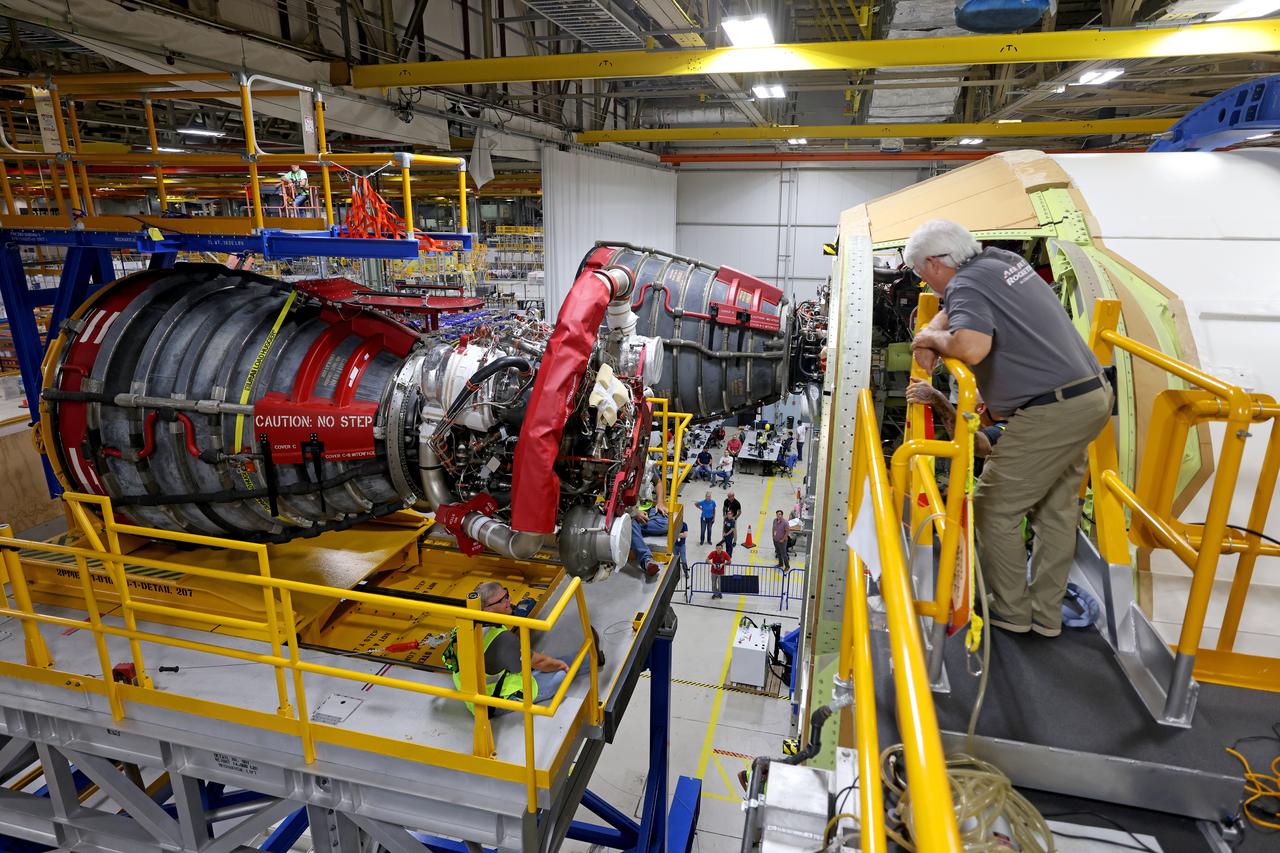
These photos and videos show how technicians at NASA’s Michoud Assembly Facility in New Orleans installed the second of four RS-25 engines onto the core stage for the agency’s SLS (Space Launch System) rocket that will help power NASA’s first crewed Artemis mission to the Moon. Crews added the second engine, with the serial number E2047 in position one, to the stage Sept. 15. The serial number for the engine installed Sept. 11 in position two on the core stage is E2059. Engineers consider the engines to be “soft” mated to the rocket stage. Following soft mate of all four engines, technicians with NASA, Aerojet Rocketdyne, an L3Harris Technologies company and the RS-25 engines lead contractor, along with Boeing, the core stage lead contractor, will fully secure the engines to the stage and integrate the propulsion and electrical systems within the structure. All four RS-25 engines are located at the base of the core stage within the engine section. NASA is working to land the first woman and first person of color on the Moon under Artemis. SLS is part of NASA’s backbone for deep space exploration, along with Orion and the Gateway in orbit around the Moon. SLS is the only rocket that can send Orion, astronauts, and supplies to the Moon in a single mission.
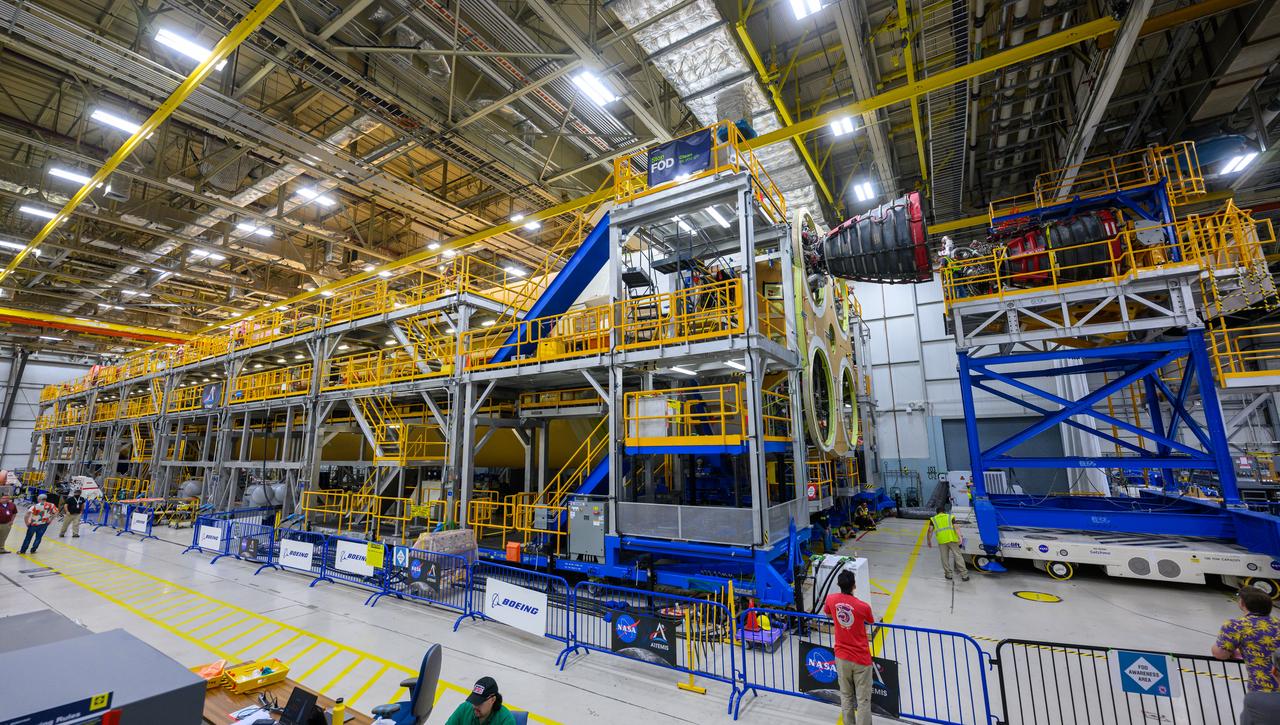
These photos and videos show how technicians at NASA’s Michoud Assembly Facility in New Orleans installed the second of four RS-25 engines onto the core stage for the agency’s SLS (Space Launch System) rocket that will help power NASA’s first crewed Artemis mission to the Moon. Crews added the second engine, with the serial number E2047 in position one, to the stage Sept. 15. The serial number for the engine installed Sept. 11 in position two on the core stage is E2059. Engineers consider the engines to be “soft” mated to the rocket stage. Following soft mate of all four engines, technicians with NASA, Aerojet Rocketdyne, an L3Harris Technologies company and the RS-25 engines lead contractor, along with Boeing, the core stage lead contractor, will fully secure the engines to the stage and integrate the propulsion and electrical systems within the structure. All four RS-25 engines are located at the base of the core stage within the engine section. NASA is working to land the first woman and first person of color on the Moon under Artemis. SLS is part of NASA’s backbone for deep space exploration, along with Orion and the Gateway in orbit around the Moon. SLS is the only rocket that can send Orion, astronauts, and supplies to the Moon in a single mission.
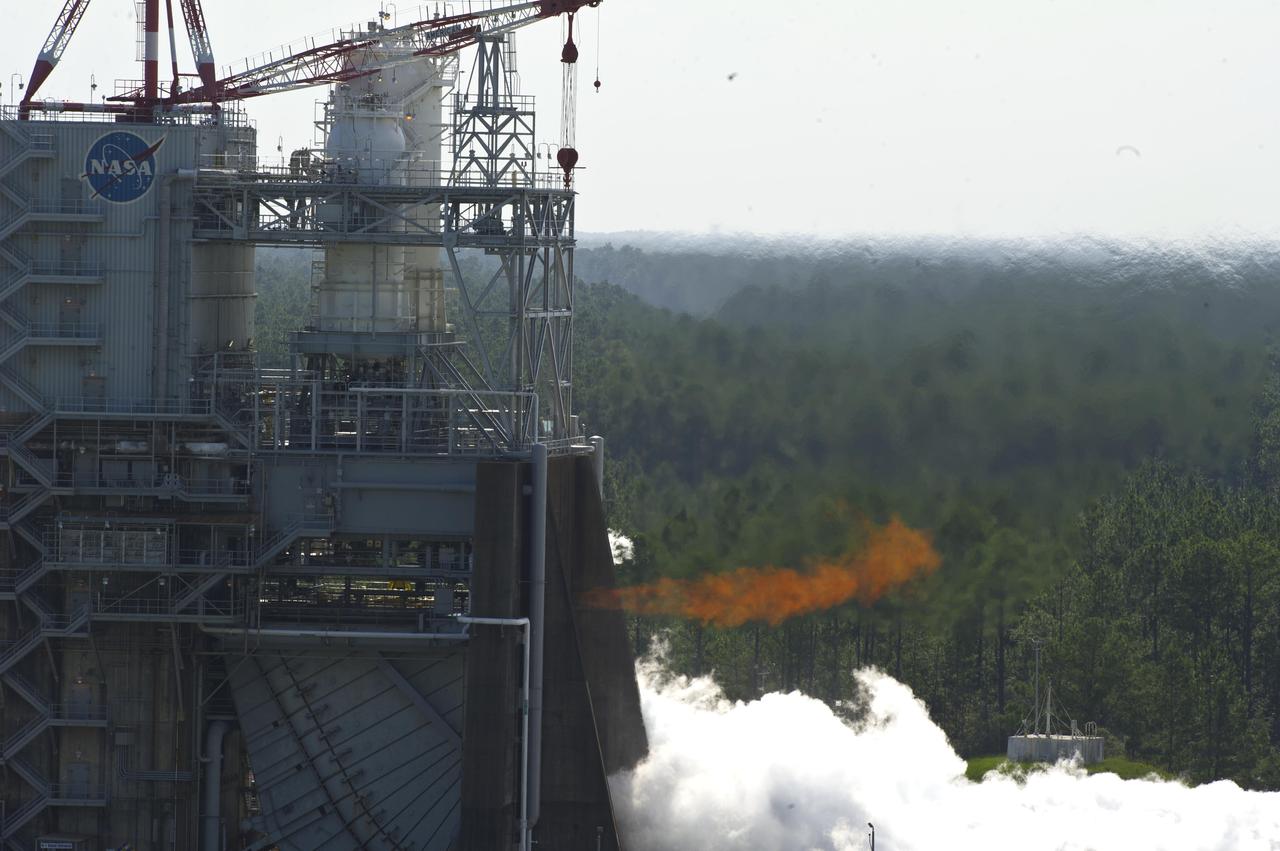
Just two weeks after setting a record with a long-duration test of the J-2X rocket engine powerpack assembly, NASA engineers at Stennis Space Center exceeded it. On July 24, 2012, engineers surpassed the earlier 1,150-second record with a 1,350-second test of the engine component on the A-1 Test Stand at Stennis.
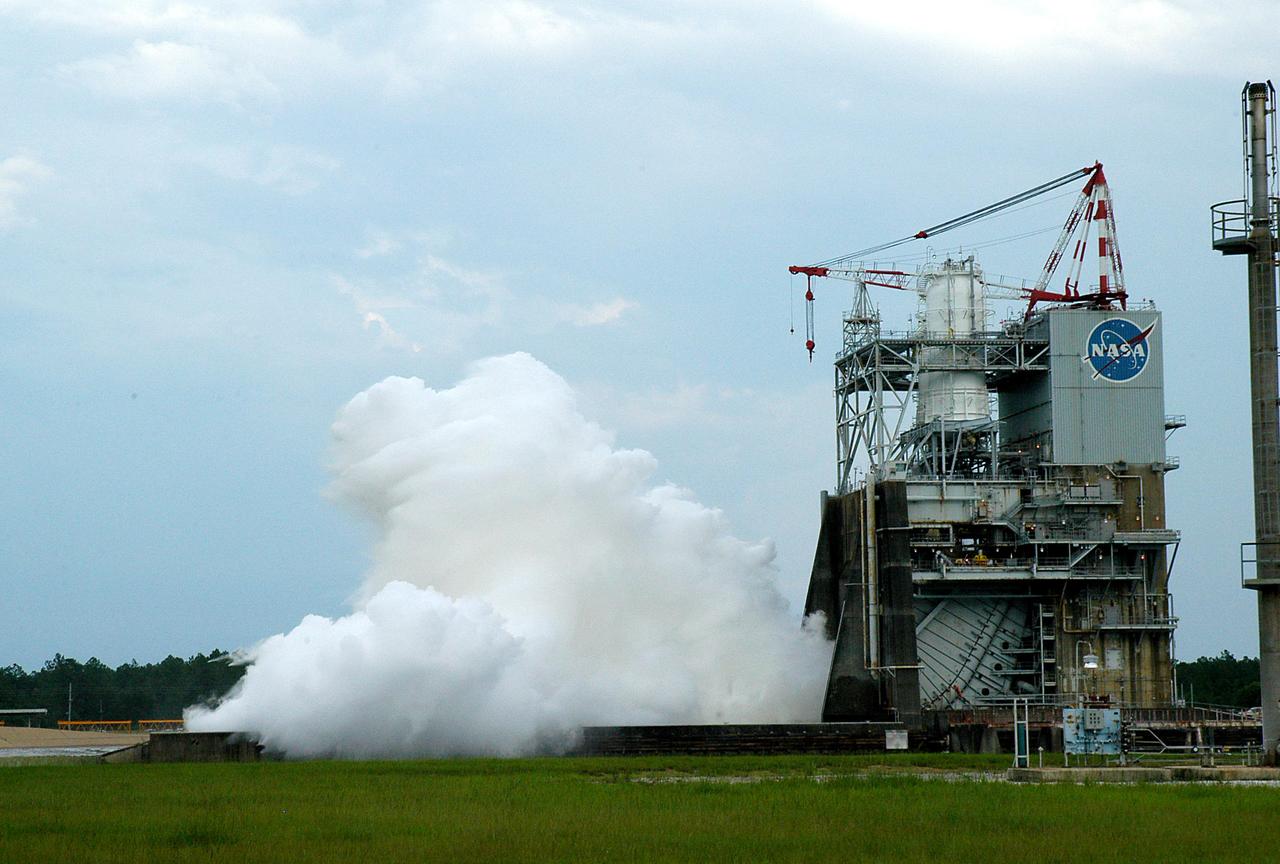
A plume of steam signals a successful engine start of the J-2X rocket engine on the A-3 Test Stand at Stennis Space Center on July 26. The 3.7-second test was the second on the next-generation engine, which is being developed for NASA by Pratt & Whitney Rocketdyne.
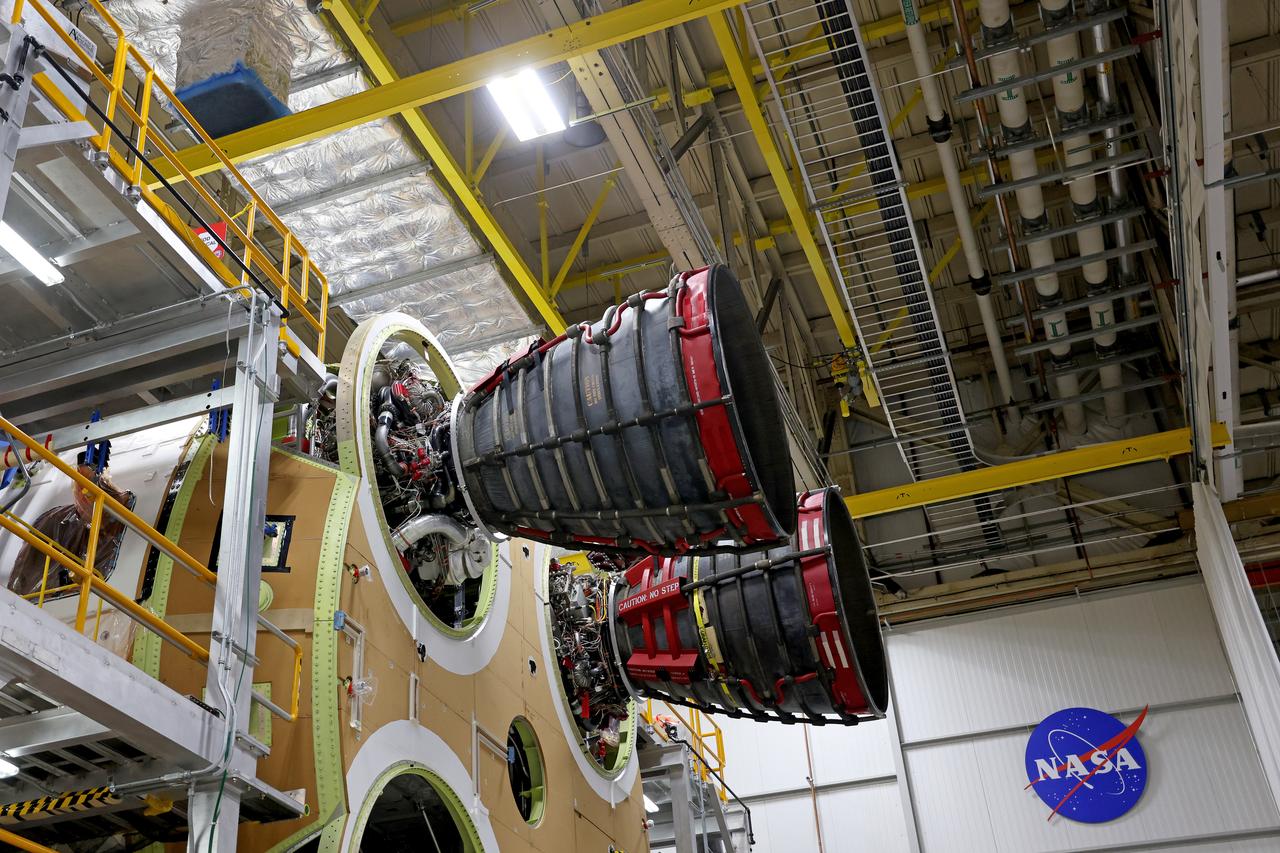
These photos and videos show how technicians at NASA’s Michoud Assembly Facility in New Orleans installed the second of four RS-25 engines onto the core stage for the agency’s SLS (Space Launch System) rocket that will help power NASA’s first crewed Artemis mission to the Moon. Crews added the second engine, with the serial number E2047 in position one, to the stage Sept. 15. The serial number for the engine installed Sept. 11 in position two on the core stage is E2059. Engineers consider the engines to be “soft” mated to the rocket stage. Following soft mate of all four engines, technicians with NASA, Aerojet Rocketdyne, an L3Harris Technologies company and the RS-25 engines lead contractor, along with Boeing, the core stage lead contractor, will fully secure the engines to the stage and integrate the propulsion and electrical systems within the structure. All four RS-25 engines are located at the base of the core stage within the engine section. NASA is working to land the first woman and first person of color on the Moon under Artemis. SLS is part of NASA’s backbone for deep space exploration, along with Orion and the Gateway in orbit around the Moon. SLS is the only rocket that can send Orion, astronauts, and supplies to the Moon in a single mission.
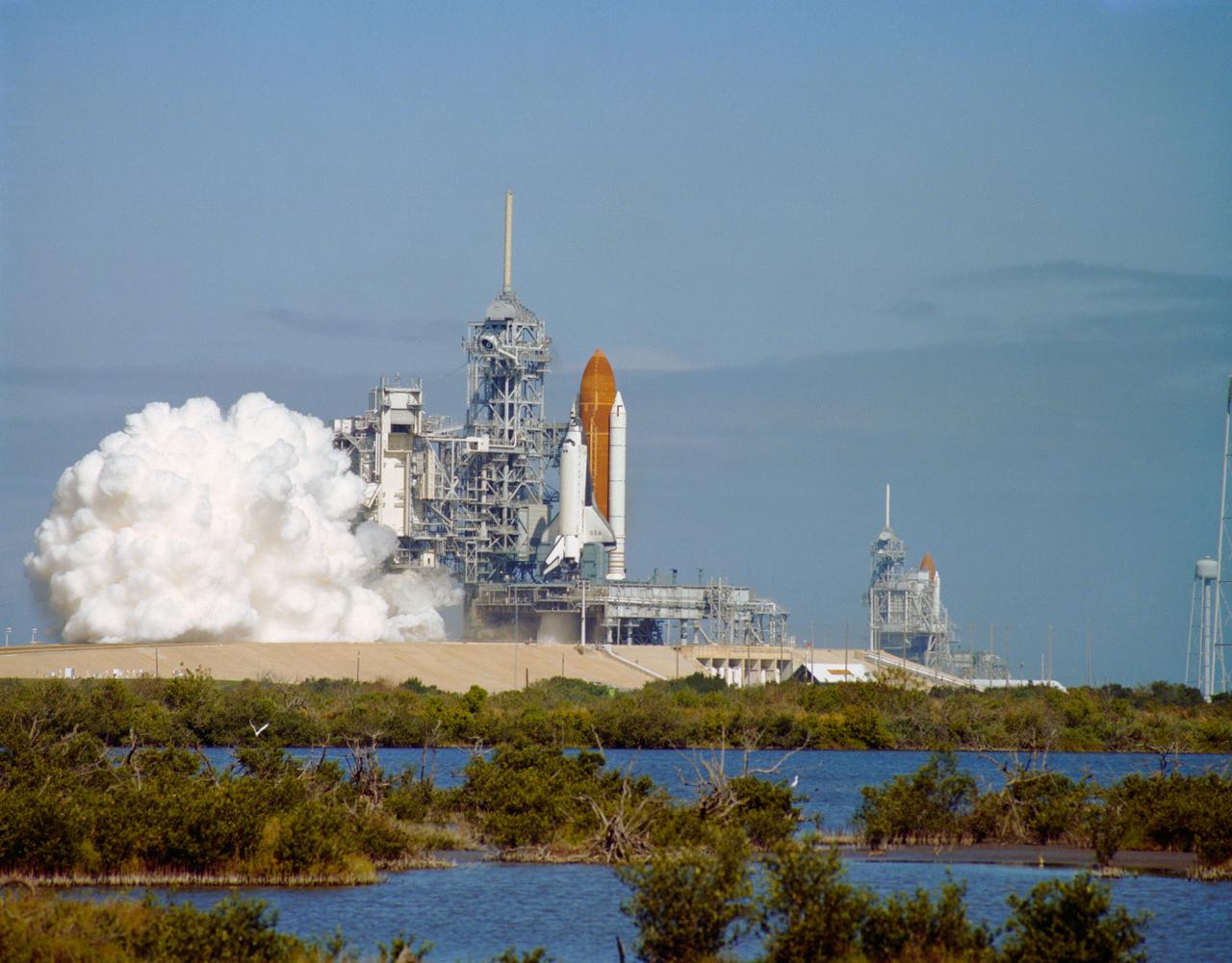
S93-31601 (March 1993) --- The second Space Shuttle launch attempt of 1993 comes to an abrupt halt when one of the three main engines on the orbiter Columbia shuts down at T -3 seconds, resulting in an on-the-pad abort of Mission STS-55. This was the first time in the post-Challenger era that a main engine shutdown has halted a Shuttle launch countdown, and only the third time in the history of the program. In 1984, STS-41D was scrubbed at T -4 seconds when the orbiter General Purpose Computer detected an anomaly in a main engine, and in 1985, STS-51F was halted at T -3 seconds due to a main engine malfunction that caused shutdown of all three engines. Columbia had been scheduled to lift off from Launch Pad 39B is the Space Shuttle Discovery, undergoing preparations for lift off on Mission STS-56.
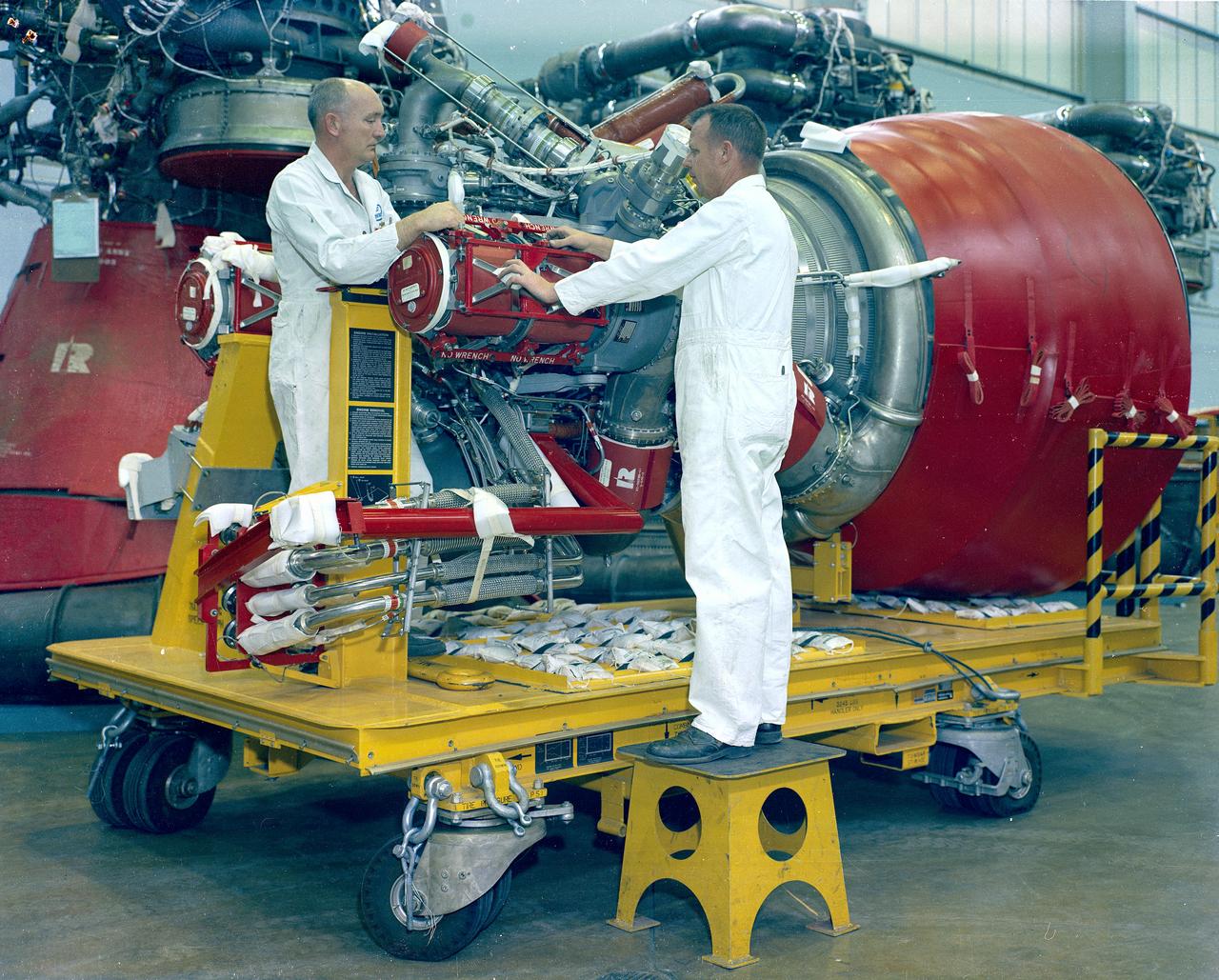
Pictured is a J-2 engine being processed at Marshall Space Flight Center (MSFC). A single J-2 engine was utilized on the S-IVB stage, the second stage of the Saturn IB and the third stage of the Saturn V vehicles, while a cluster of five J-2 engines powered the second (S-II) stage of the Saturn V launch vehicle. The Saturn V was designed, developed, and tested by engineers at MSFC.
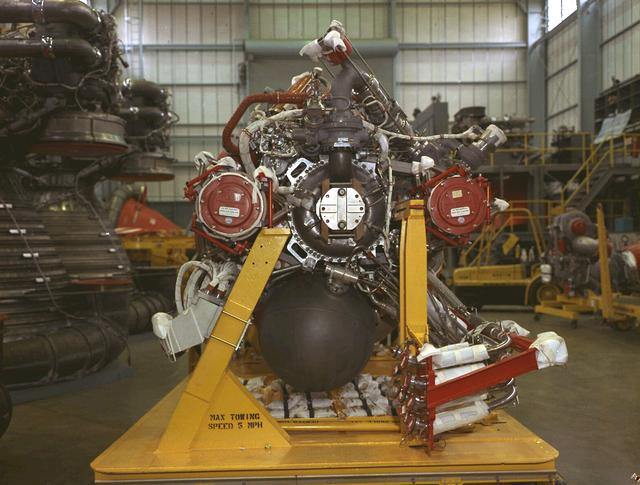
Pictured is a J-2 engine being processed at Marshall Space Flight Center (MSFC). A single J-2 engine was utilized on the S-IVB stage, the second stage of the Saturn IB and the third stage of the Saturn V vehicles, while a cluster of five J-2 engines powered the second (S-II) stage of the Saturn V launch vehicle. The Saturn V was designed, developed, and tested by engineers at MSFC.
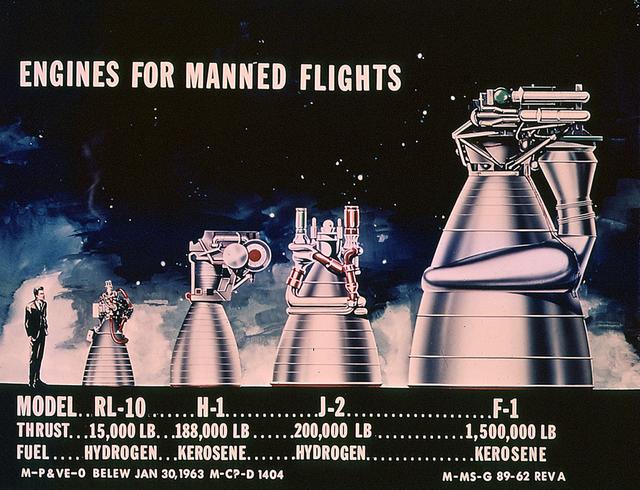
This drawing clearly shows the comparative sizes of the rocket engines used to launch the Saturn vehicles. The RL-10 and the H-1 engines were used to launch the Saturn I rockets. The J-2 engine was used on the second stage of Saturn IB and the second and third stages of Saturn V. The F-1 engine was used on the first stage of the Saturn V.
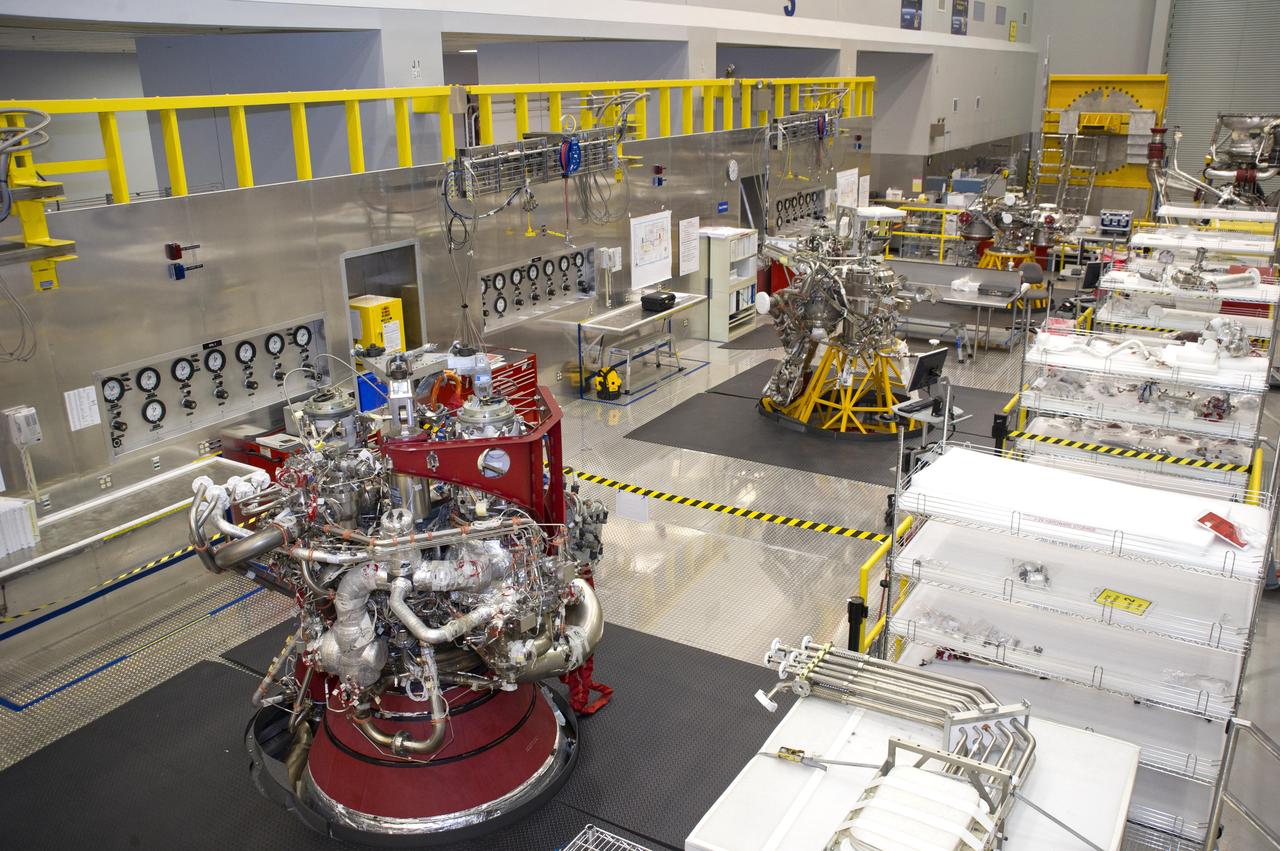
Two J-2X engines and a powerpack, developed for NASA by Pratt and Whitney Rocketdyne, sit side-by-side Oct. 11 at Stennis Space Center as work continues on the Space Launch System. Engine 10001 (far left) has been removed from the A-2 Test Stand after being hot-fire tested 21 times, for a total of 2,697 seconds. The engine is now undergoing a series of post-test inspections. A J-2X powerpack (center) has been removed from the A-1 Test Stand to receive additional instrumentation. So far, the powerpack been hot-fire tested 10 times, for a total of 4,162 seconds. Meanwhile, assembly on the second J-2X engine, known as Engine 10002 and located to the far right, has begun in earnest, with engine completion scheduled for this November. Engine 10002 is about 15 percent complete.
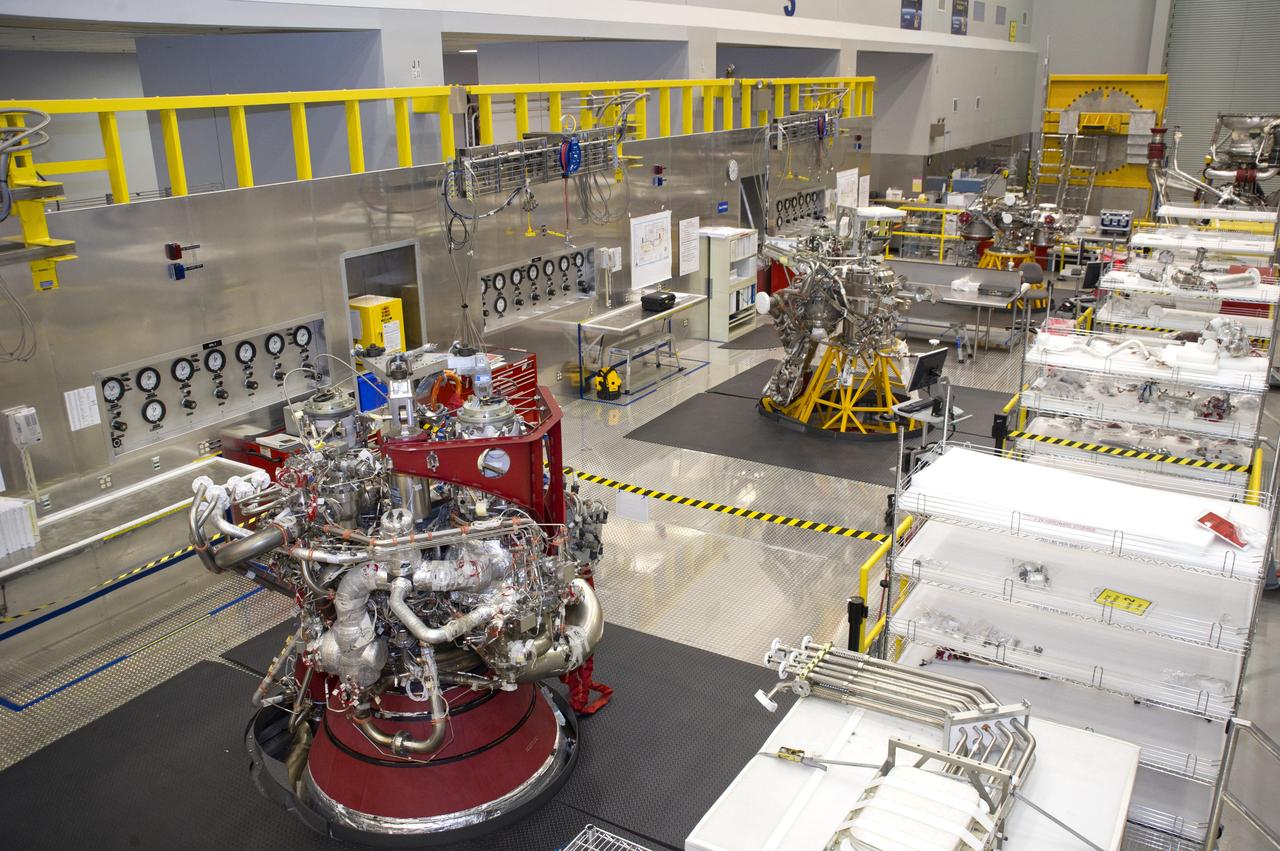
Two J-2X engines and a powerpack, developed for NASA by Pratt and Whitney Rocketdyne, sit side-by-side Oct. 11 at Stennis Space Center as work continues on the Space Launch System. Engine 10001 (far left) has been removed from the A-2 Test Stand after being hot-fire tested 21 times, for a total of 2,697 seconds. The engine is now undergoing a series of post-test inspections. A J-2X powerpack (center) has been removed from the A-1 Test Stand to receive additional instrumentation. So far, the powerpack been hot-fire tested 10 times, for a total of 4,162 seconds. Meanwhile, assembly on the second J-2X engine, known as Engine 10002 and located to the far right, has begun in earnest, with engine completion scheduled for this November. Engine 10002 is about 15 percent complete.
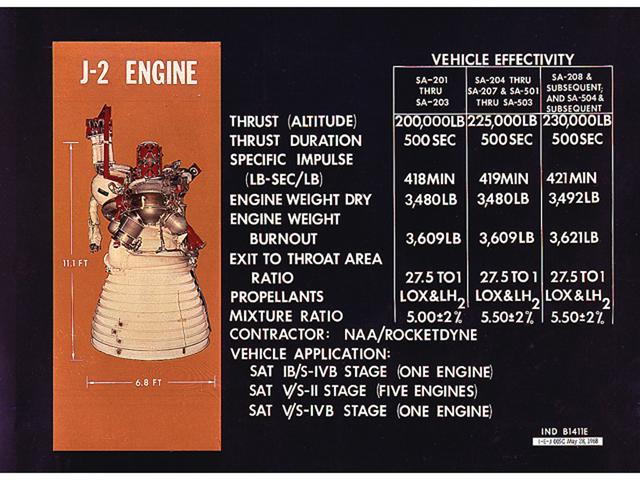
This chart is an illustration of J-2 Engine characteristics. A cluster of five J-2 engines powered the Saturn V S-II (second) stage with each engine providing a thrust of 200,000 pounds. A single J-2 engine powered the S-IVB stage, the Saturn IB second stage, and the Saturn V third stage. The engine was uprated to provide 230,000 pounds of thrust for the fourth Apollo Saturn V flight and subsequent missions. Burning liquid hydrogen as fuel and using liquid oxygen as the oxidizer, the cluster of five J-2 engines for the S-II stage burned over one ton of propellant per second, during about 6 1/2 minutes of operation, to take the vehicle to an altitude of about 108 miles and a speed of near orbital velocity, about 17,400 miles per hour.
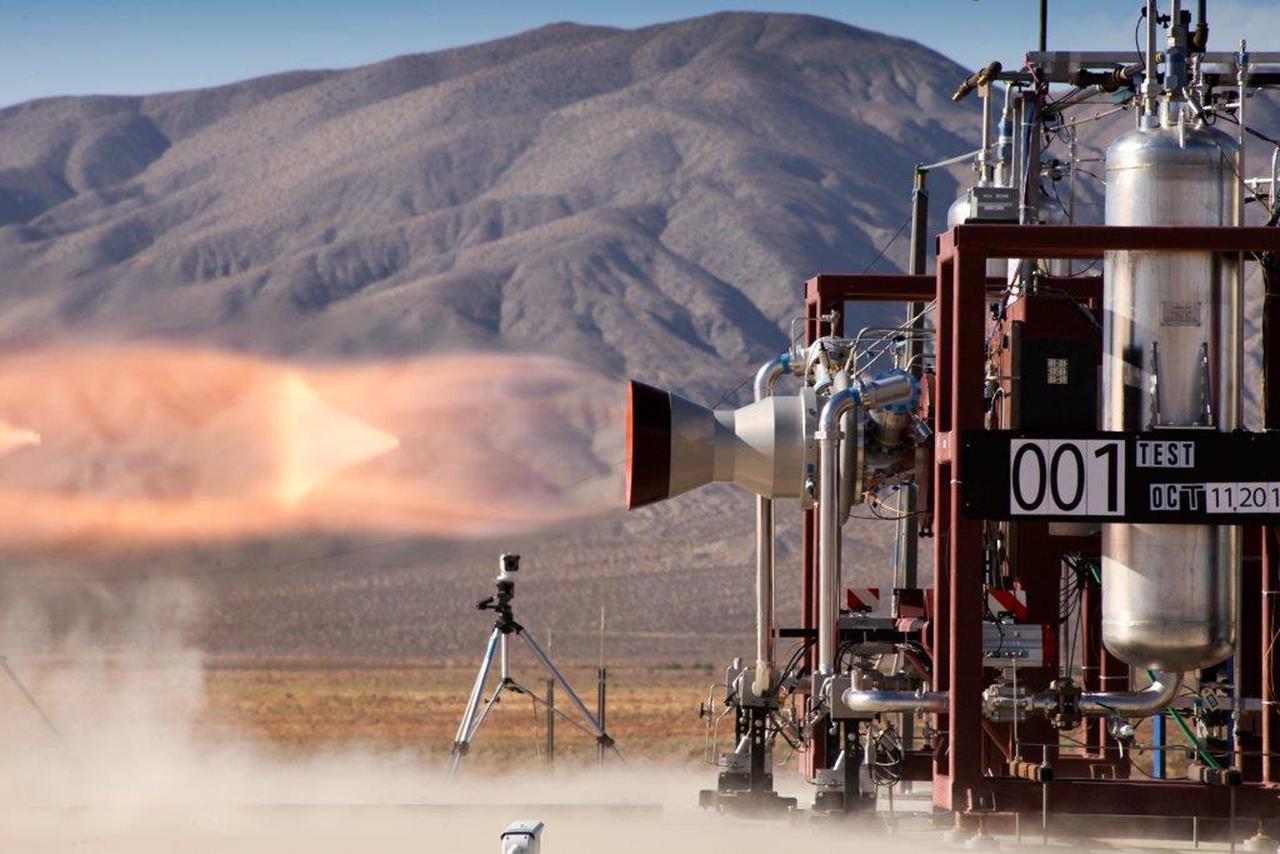
Boeing and Aerojet Rocketdyne have begun a series of developmental hot-fire tests with two launch abort engines similar to the ones that will be part of Boeing’s CST-100 Starliner service module, in the Mojave Desert in California. The engines, designed to maximize thrust build-up, while minimizing overshoot during start up, will be fired between half a second and 3 seconds each during the test campaign. If the Starliner’s four launch abort engines were used during an abort scenario, they would fire between 3 and 5.5. seconds, with enough thrust to get the spacecraft and its crew away from the rocket, before splashing down in the ocean under parachutes.
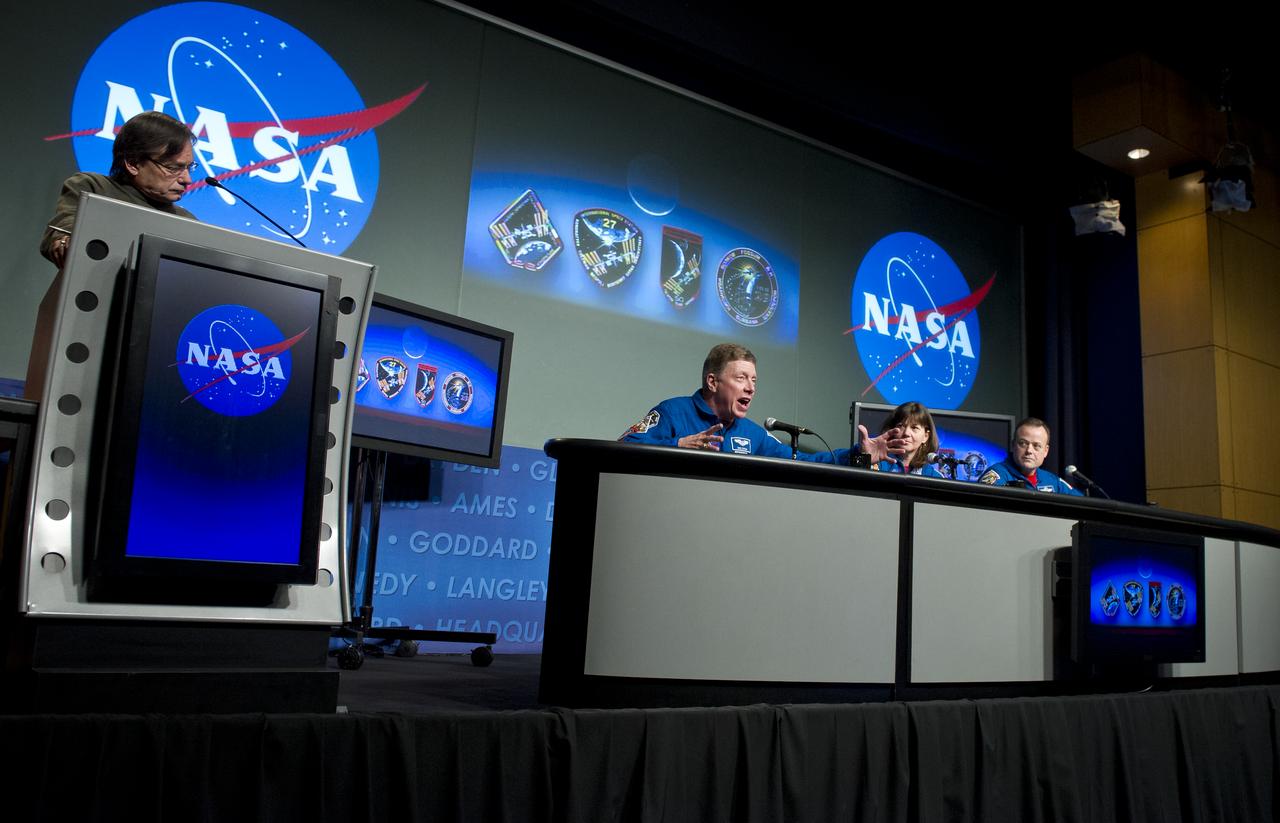
Mike Fossum, second from left, Expedition 28 flight engineer and Expedition 29 Commander, discusses his mission to the International Space Station during a visit to NASA Headquarters in Washington, Tuesday, Feb. 14, 2012. Seen with Fossum are astronauts Catherine Coleman, second from right, Expedition 26 & 27 flight engineer, and Ron Garan, Expedition 27 & 28 flight engineer. Photo Credit: (NASA/Carla Cioffi)
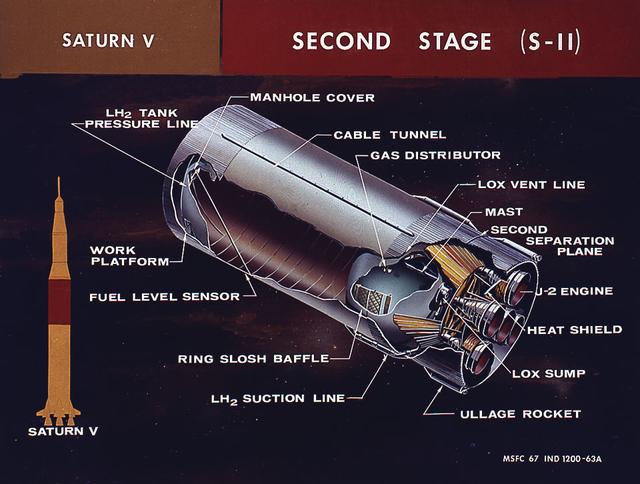
This cutaway illustration shows the Saturn V S-II (second) stage with callouts of major components. When the Saturn V first stage burns out and drops away, power for the Saturn was provided by the S-II (second) stage with five J-2 engines which produced a total of 1,150,000 pounds of thrust. Four outer engines are placed in a square pattern with gimbaling capability for control and guidance, with the fifth engine fixed rigidly in the center.
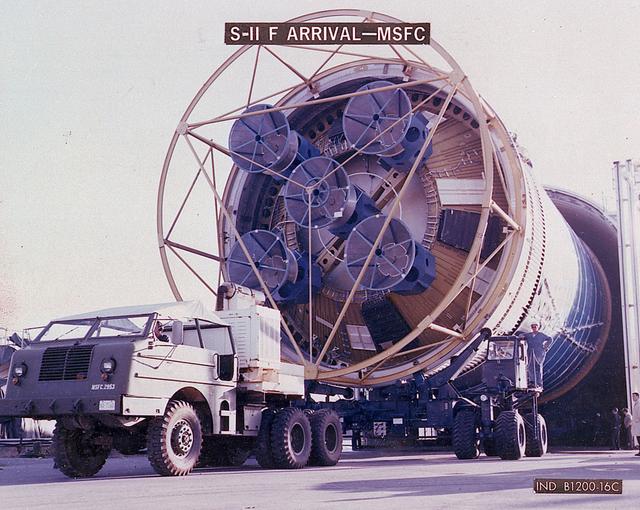
The business end of a Second Stage (S-II) slowly emerges from the shipping container as workers prepare to transport the Saturn V component to the testing facility at MSFC. The Second Stage (S-II) underwent vibration and engine firing tests. The towering 363-foot Saturn V was a multi-stage, multi-engine launch vehicle standing taller than the Statue of Liberty. Altogether, the Saturn V engines produced as much power as 85 Hoover Dams.
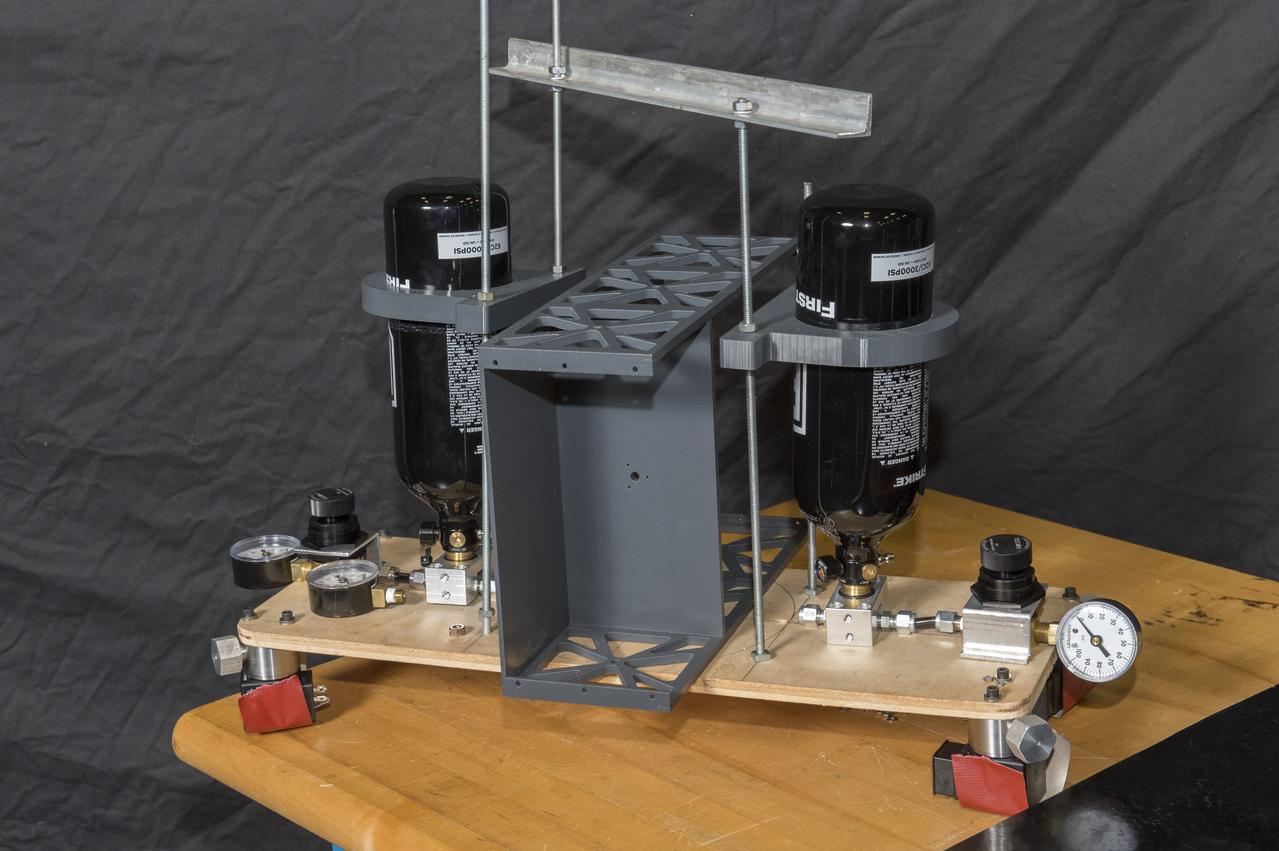
Second Generation Agile Engineering Prototype of Electric Sail 6U CubeSat Testbed Article
NASA engineers at Stennis Space Center conducted a 260-second test of the next-generation J-2X rocket engine June 13, 2012. As in a previous test, NASA engineers fired the engine at both secondary and primary modes to collect performance data.

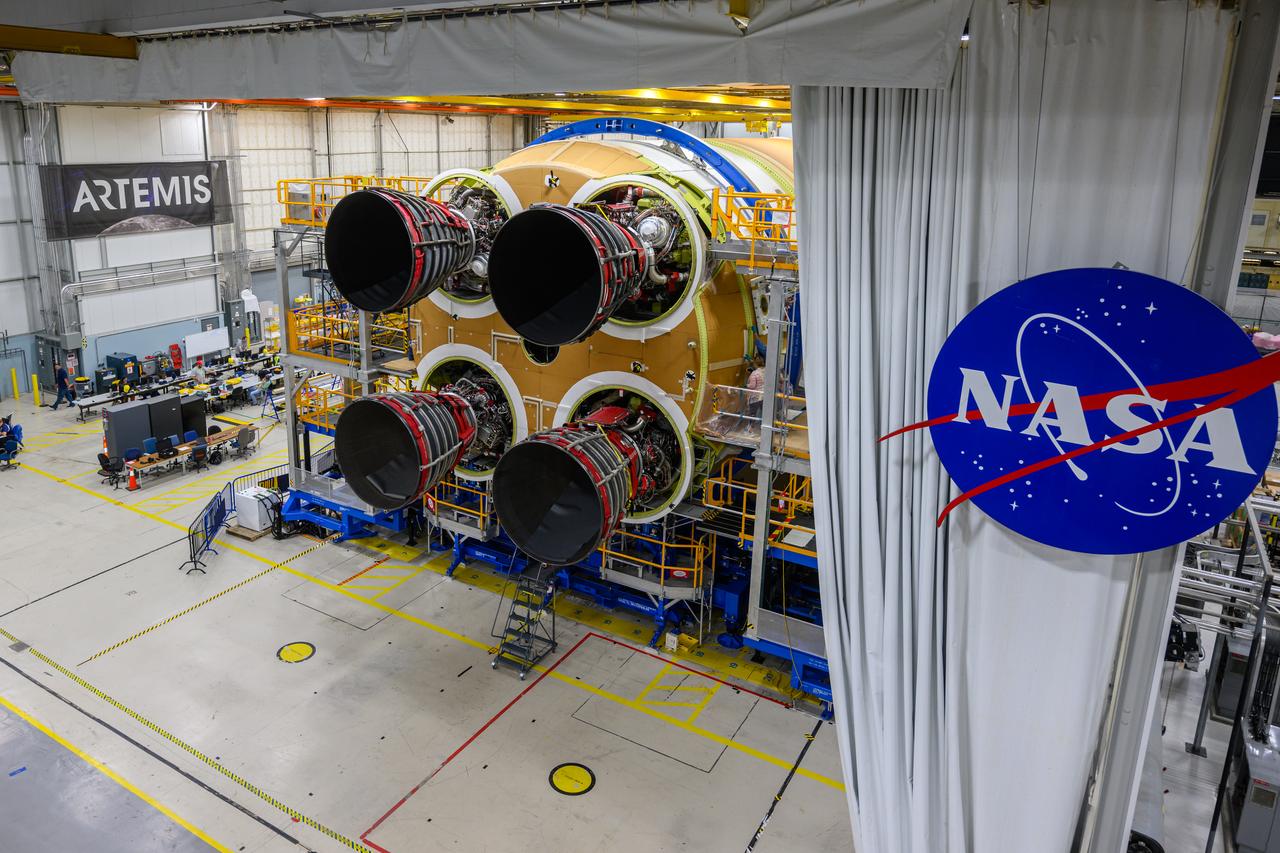
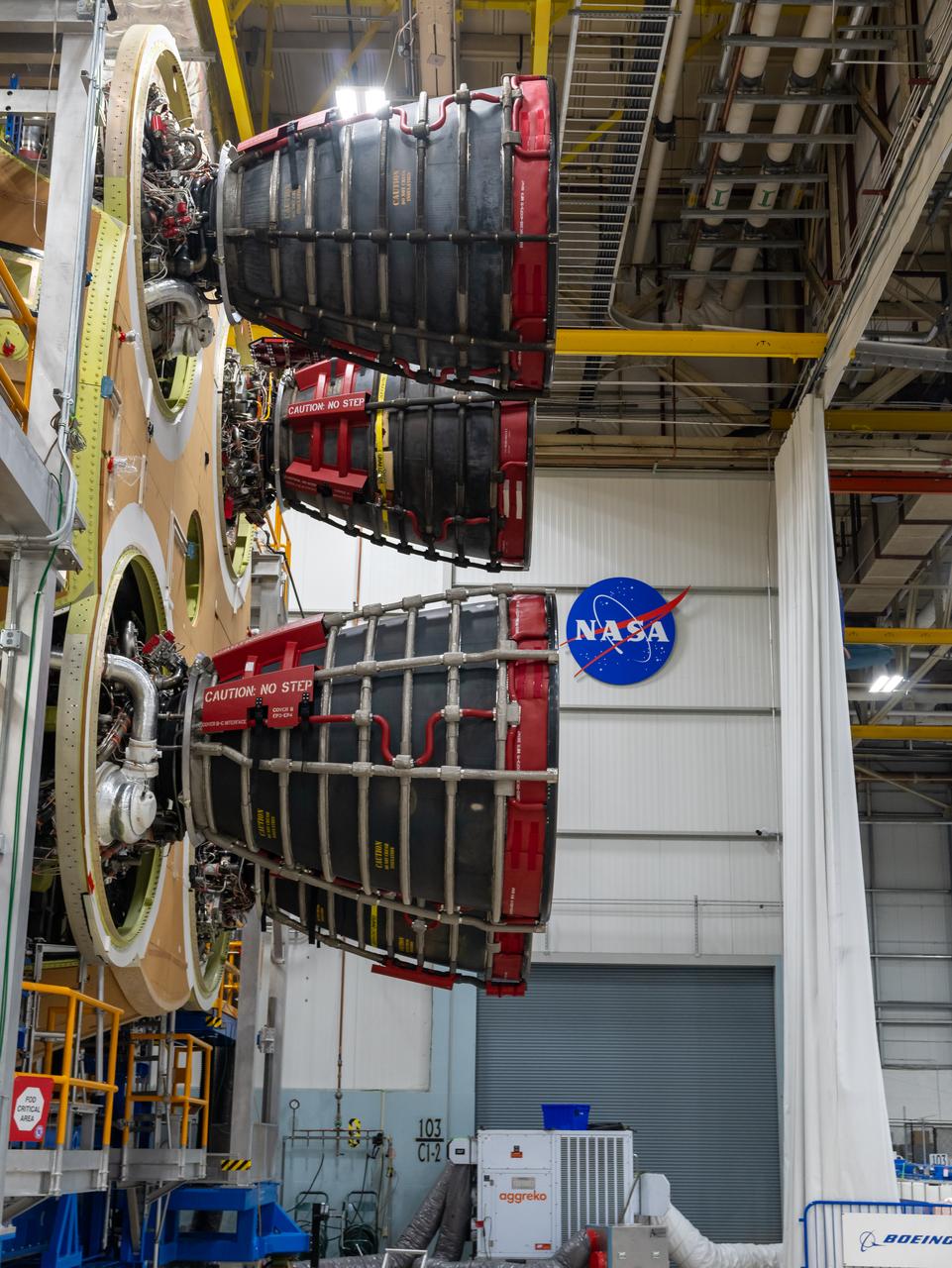
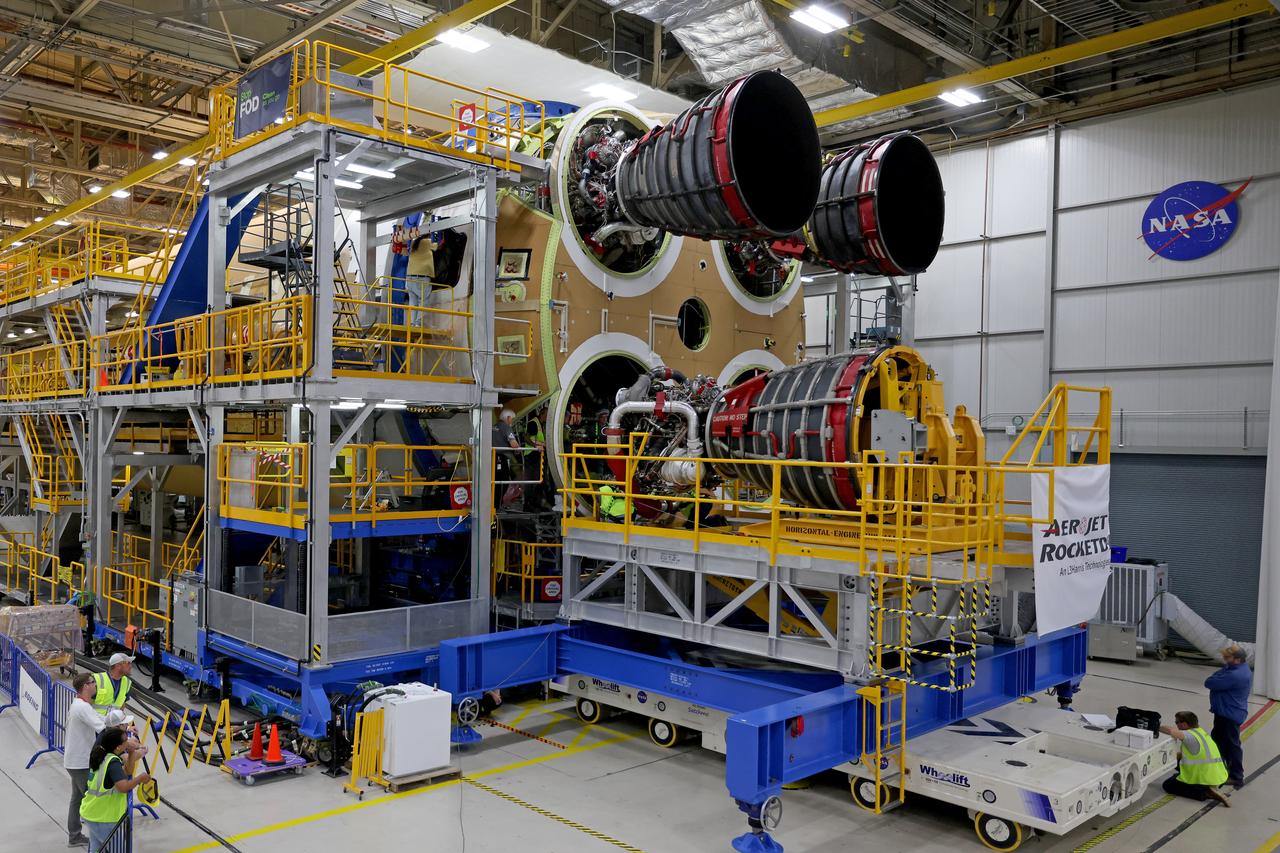
These photos and videos show how technicians at NASA’s Michoud Assembly Facility in New Orleans installed the third and fourth RS-25 engines onto the core stage for the agency’s SLS (Space Launch System) rocket that will help power NASA’s first crewed Artemis mission to the Moon. Technicians added the first engine to the SLS core stage Sept. 11. The second engine was installed onto the stage Sept. 15 with the third and fourth engines following Sept. 19 and Sept. 20. Engineers consider the engines to be “soft” mated to the rocket stage. Technicians with NASA, Aerojet Rocketdyne, an L3Harris Technologies company and the RS-25 engines lead contractor, along with Boeing, the core stage lead contractor, will now focus efforts on the complex tax of fully securing the engines to the stage and integrating the propulsion and electrical systems within the structure. NASA is working to land the first woman and first person of color on the Moon under Artemis. SLS is part of NASA’s backbone for deep space exploration, along with Orion and the Gateway in orbit around the Moon. SLS is the only rocket that can send Orion, astronauts, and supplies to the Moon in a single mission.

These photos and videos show how technicians at NASA’s Michoud Assembly Facility in New Orleans installed the third and fourth RS-25 engines onto the core stage for the agency’s SLS (Space Launch System) rocket that will help power NASA’s first crewed Artemis mission to the Moon. Technicians added the first engine to the SLS core stage Sept. 11. The second engine was installed onto the stage Sept. 15 with the third and fourth engines following Sept. 19 and Sept. 20. Engineers consider the engines to be “soft” mated to the rocket stage. Technicians with NASA, Aerojet Rocketdyne, an L3Harris Technologies company and the RS-25 engines lead contractor, along with Boeing, the core stage lead contractor, will now focus efforts on the complex tax of fully securing the engines to the stage and integrating the propulsion and electrical systems within the structure. NASA is working to land the first woman and first person of color on the Moon under Artemis. SLS is part of NASA’s backbone for deep space exploration, along with Orion and the Gateway in orbit around the Moon. SLS is the only rocket that can send Orion, astronauts, and supplies to the Moon in a single mission.

These photos and videos show how technicians at NASA’s Michoud Assembly Facility in New Orleans installed the third and fourth RS-25 engines onto the core stage for the agency’s SLS (Space Launch System) rocket that will help power NASA’s first crewed Artemis mission to the Moon. Technicians added the first engine to the SLS core stage Sept. 11. The second engine was installed onto the stage Sept. 15 with the third and fourth engines following Sept. 19 and Sept. 20. Engineers consider the engines to be “soft” mated to the rocket stage. Technicians with NASA, Aerojet Rocketdyne, an L3Harris Technologies company and the RS-25 engines lead contractor, along with Boeing, the core stage lead contractor, will now focus efforts on the complex tax of fully securing the engines to the stage and integrating the propulsion and electrical systems within the structure. NASA is working to land the first woman and first person of color on the Moon under Artemis. SLS is part of NASA’s backbone for deep space exploration, along with Orion and the Gateway in orbit around the Moon. SLS is the only rocket that can send Orion, astronauts, and supplies to the Moon in a single mission.

These photos and videos show how technicians at NASA’s Michoud Assembly Facility in New Orleans installed the third and fourth RS-25 engines onto the core stage for the agency’s SLS (Space Launch System) rocket that will help power NASA’s first crewed Artemis mission to the Moon. Technicians added the first engine to the SLS core stage Sept. 11. The second engine was installed onto the stage Sept. 15 with the third and fourth engines following Sept. 19 and Sept. 20. Engineers consider the engines to be “soft” mated to the rocket stage. Technicians with NASA, Aerojet Rocketdyne, an L3Harris Technologies company and the RS-25 engines lead contractor, along with Boeing, the core stage lead contractor, will now focus efforts on the complex tax of fully securing the engines to the stage and integrating the propulsion and electrical systems within the structure. NASA is working to land the first woman and first person of color on the Moon under Artemis. SLS is part of NASA’s backbone for deep space exploration, along with Orion and the Gateway in orbit around the Moon. SLS is the only rocket that can send Orion, astronauts, and supplies to the Moon in a single mission.
These photos and videos show how technicians at NASA’s Michoud Assembly Facility in New Orleans installed the third and fourth RS-25 engines onto the core stage for the agency’s SLS (Space Launch System) rocket that will help power NASA’s first crewed Artemis mission to the Moon. Technicians added the first engine to the SLS core stage Sept. 11. The second engine was installed onto the stage Sept. 15 with the third and fourth engines following Sept. 19 and Sept. 20. Engineers consider the engines to be “soft” mated to the rocket stage. Technicians with NASA, Aerojet Rocketdyne, an L3Harris Technologies company and the RS-25 engines lead contractor, along with Boeing, the core stage lead contractor, will now focus efforts on the complex tax of fully securing the engines to the stage and integrating the propulsion and electrical systems within the structure. NASA is working to land the first woman and first person of color on the Moon under Artemis. SLS is part of NASA’s backbone for deep space exploration, along with Orion and the Gateway in orbit around the Moon. SLS is the only rocket that can send Orion, astronauts, and supplies to the Moon in a single mission.

: These photos and videos show how technicians at NASA’s Michoud Assembly Facility in New Orleans installed the third and fourth RS-25 engines onto the core stage for the agency’s SLS (Space Launch System) rocket that will help power NASA’s first crewed Artemis mission to the Moon. Technicians added the first engine to the SLS core stage Sept. 11. The second engine was installed onto the stage Sept. 15 with the third and fourth engines following Sept. 19 and Sept. 20. Engineers consider the engines to be “soft” mated to the rocket stage. Technicians with NASA, Aerojet Rocketdyne, an L3Harris Technologies company and the RS-25 engines lead contractor, along with Boeing, the core stage lead contractor, will now focus efforts on the complex tax of fully securing the engines to the stage and integrating the propulsion and electrical systems within the structure. NASA is working to land the first woman and first person of color on the Moon under Artemis. SLS is part of NASA’s backbone for deep space exploration, along with Orion and the Gateway in orbit around the Moon. SLS is the only rocket that can send Orion, astronauts, and supplies to the Moon in a single mission.
These photos and videos show how technicians at NASA’s Michoud Assembly Facility in New Orleans installed the third and fourth RS-25 engines onto the core stage for the agency’s SLS (Space Launch System) rocket that will help power NASA’s first crewed Artemis mission to the Moon. Technicians added the first engine to the SLS core stage Sept. 11. The second engine was installed onto the stage Sept. 15 with the third and fourth engines following Sept. 19 and Sept. 20. Engineers consider the engines to be “soft” mated to the rocket stage. Technicians with NASA, Aerojet Rocketdyne, an L3Harris Technologies company and the RS-25 engines lead contractor, along with Boeing, the core stage lead contractor, will now focus efforts on the complex tax of fully securing the engines to the stage and integrating the propulsion and electrical systems within the structure. NASA is working to land the first woman and first person of color on the Moon under Artemis. SLS is part of NASA’s backbone for deep space exploration, along with Orion and the Gateway in orbit around the Moon. SLS is the only rocket that can send Orion, astronauts, and supplies to the Moon in a single mission.

These photos and videos show how technicians at NASA’s Michoud Assembly Facility in New Orleans installed the third and fourth RS-25 engines onto the core stage for the agency’s SLS (Space Launch System) rocket that will help power NASA’s first crewed Artemis mission to the Moon. Technicians added the first engine to the SLS core stage Sept. 11. The second engine was installed onto the stage Sept. 15 with the third and fourth engines following Sept. 19 and Sept. 20. Engineers consider the engines to be “soft” mated to the rocket stage. Technicians with NASA, Aerojet Rocketdyne, an L3Harris Technologies company and the RS-25 engines lead contractor, along with Boeing, the core stage lead contractor, will now focus efforts on the complex tax of fully securing the engines to the stage and integrating the propulsion and electrical systems within the structure. NASA is working to land the first woman and first person of color on the Moon under Artemis. SLS is part of NASA’s backbone for deep space exploration, along with Orion and the Gateway in orbit around the Moon. SLS is the only rocket that can send Orion, astronauts, and supplies to the Moon in a single mission.
These photos and videos show how technicians at NASA’s Michoud Assembly Facility in New Orleans installed the third and fourth RS-25 engines onto the core stage for the agency’s SLS (Space Launch System) rocket that will help power NASA’s first crewed Artemis mission to the Moon. Technicians added the first engine to the SLS core stage Sept. 11. The second engine was installed onto the stage Sept. 15 with the third and fourth engines following Sept. 19 and Sept. 20. Engineers consider the engines to be “soft” mated to the rocket stage. Technicians with NASA, Aerojet Rocketdyne, an L3Harris Technologies company and the RS-25 engines lead contractor, along with Boeing, the core stage lead contractor, will now focus efforts on the complex tax of fully securing the engines to the stage and integrating the propulsion and electrical systems within the structure. NASA is working to land the first woman and first person of color on the Moon under Artemis. SLS is part of NASA’s backbone for deep space exploration, along with Orion and the Gateway in orbit around the Moon. SLS is the only rocket that can send Orion, astronauts, and supplies to the Moon in a single mission.

These photos and videos show how technicians at NASA’s Michoud Assembly Facility in New Orleans installed the third and fourth RS-25 engines onto the core stage for the agency’s SLS (Space Launch System) rocket that will help power NASA’s first crewed Artemis mission to the Moon. Technicians added the first engine to the SLS core stage Sept. 11. The second engine was installed onto the stage Sept. 15 with the third and fourth engines following Sept. 19 and Sept. 20. Engineers consider the engines to be “soft” mated to the rocket stage. Technicians with NASA, Aerojet Rocketdyne, an L3Harris Technologies company and the RS-25 engines lead contractor, along with Boeing, the core stage lead contractor, will now focus efforts on the complex tax of fully securing the engines to the stage and integrating the propulsion and electrical systems within the structure. NASA is working to land the first woman and first person of color on the Moon under Artemis. SLS is part of NASA’s backbone for deep space exploration, along with Orion and the Gateway in orbit around the Moon. SLS is the only rocket that can send Orion, astronauts, and supplies to the Moon in a single mission.
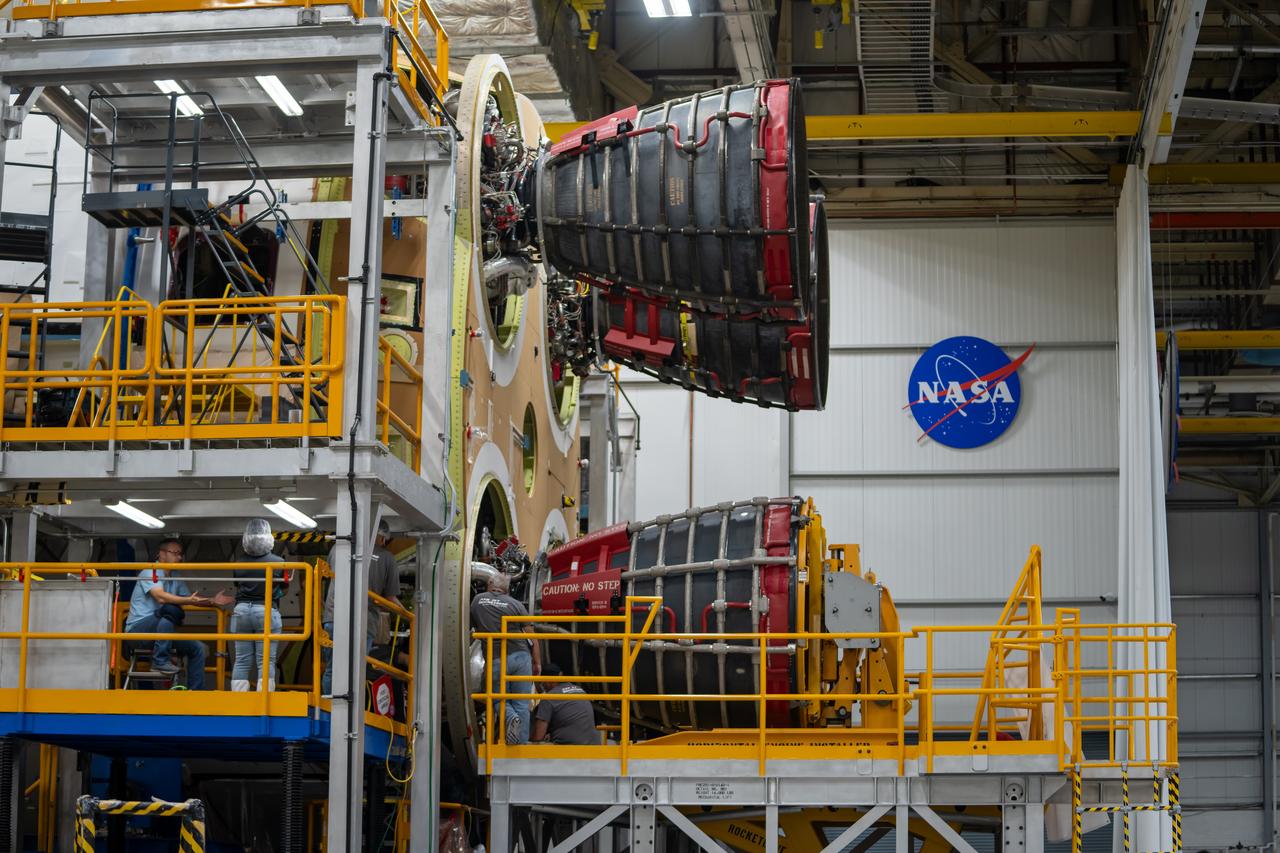
These photos and videos show how technicians at NASA’s Michoud Assembly Facility in New Orleans installed the third and fourth RS-25 engines onto the core stage for the agency’s SLS (Space Launch System) rocket that will help power NASA’s first crewed Artemis mission to the Moon. Technicians added the first engine to the SLS core stage Sept. 11. The second engine was installed onto the stage Sept. 15 with the third and fourth engines following Sept. 19 and Sept. 20. Engineers consider the engines to be “soft” mated to the rocket stage. Technicians with NASA, Aerojet Rocketdyne, an L3Harris Technologies company and the RS-25 engines lead contractor, along with Boeing, the core stage lead contractor, will now focus efforts on the complex tax of fully securing the engines to the stage and integrating the propulsion and electrical systems within the structure. NASA is working to land the first woman and first person of color on the Moon under Artemis. SLS is part of NASA’s backbone for deep space exploration, along with Orion and the Gateway in orbit around the Moon. SLS is the only rocket that can send Orion, astronauts, and supplies to the Moon in a single mission.
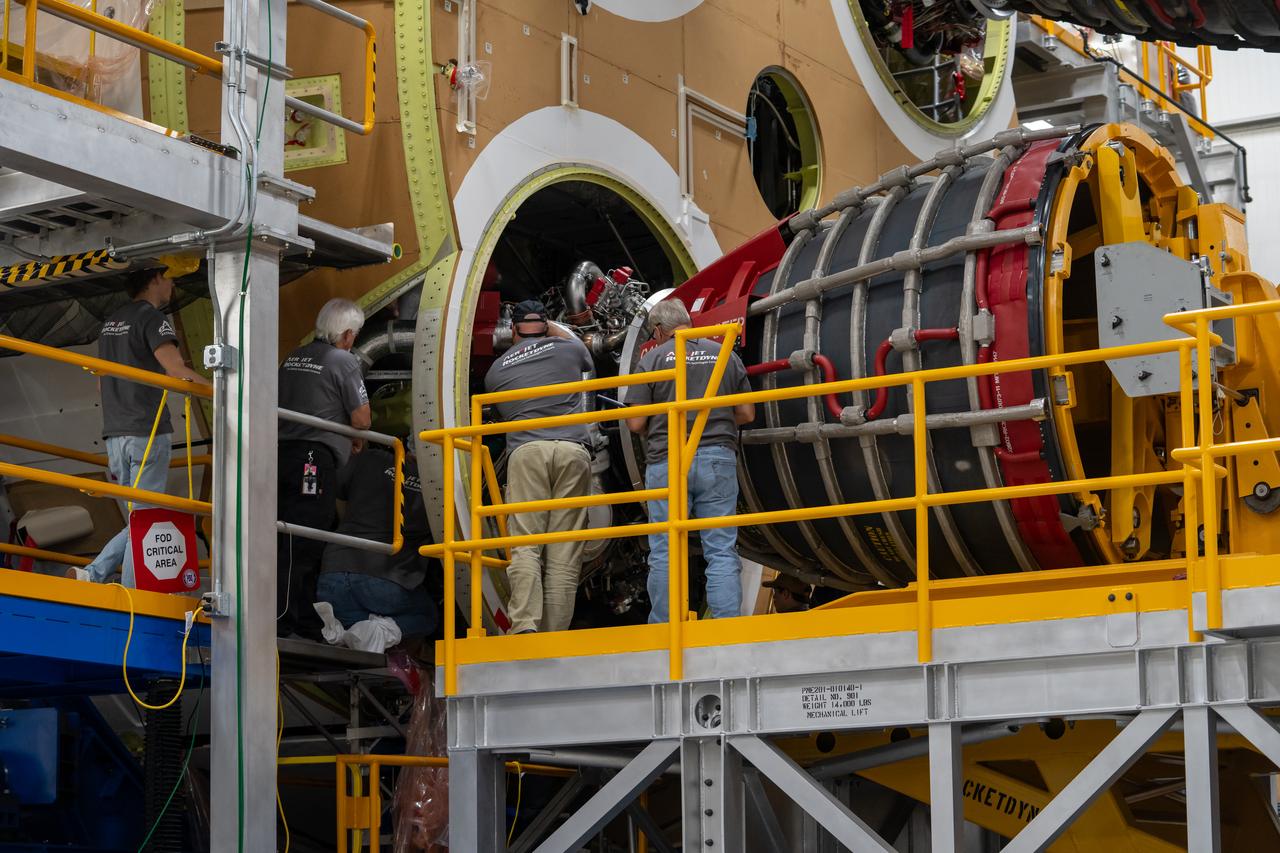
These photos and videos show how technicians at NASA’s Michoud Assembly Facility in New Orleans installed the third and fourth RS-25 engines onto the core stage for the agency’s SLS (Space Launch System) rocket that will help power NASA’s first crewed Artemis mission to the Moon. Technicians added the first engine to the SLS core stage Sept. 11. The second engine was installed onto the stage Sept. 15 with the third and fourth engines following Sept. 19 and Sept. 20. Engineers consider the engines to be “soft” mated to the rocket stage. Technicians with NASA, Aerojet Rocketdyne, an L3Harris Technologies company and the RS-25 engines lead contractor, along with Boeing, the core stage lead contractor, will now focus efforts on the complex tax of fully securing the engines to the stage and integrating the propulsion and electrical systems within the structure. NASA is working to land the first woman and first person of color on the Moon under Artemis. SLS is part of NASA’s backbone for deep space exploration, along with Orion and the Gateway in orbit around the Moon. SLS is the only rocket that can send Orion, astronauts, and supplies to the Moon in a single mission.
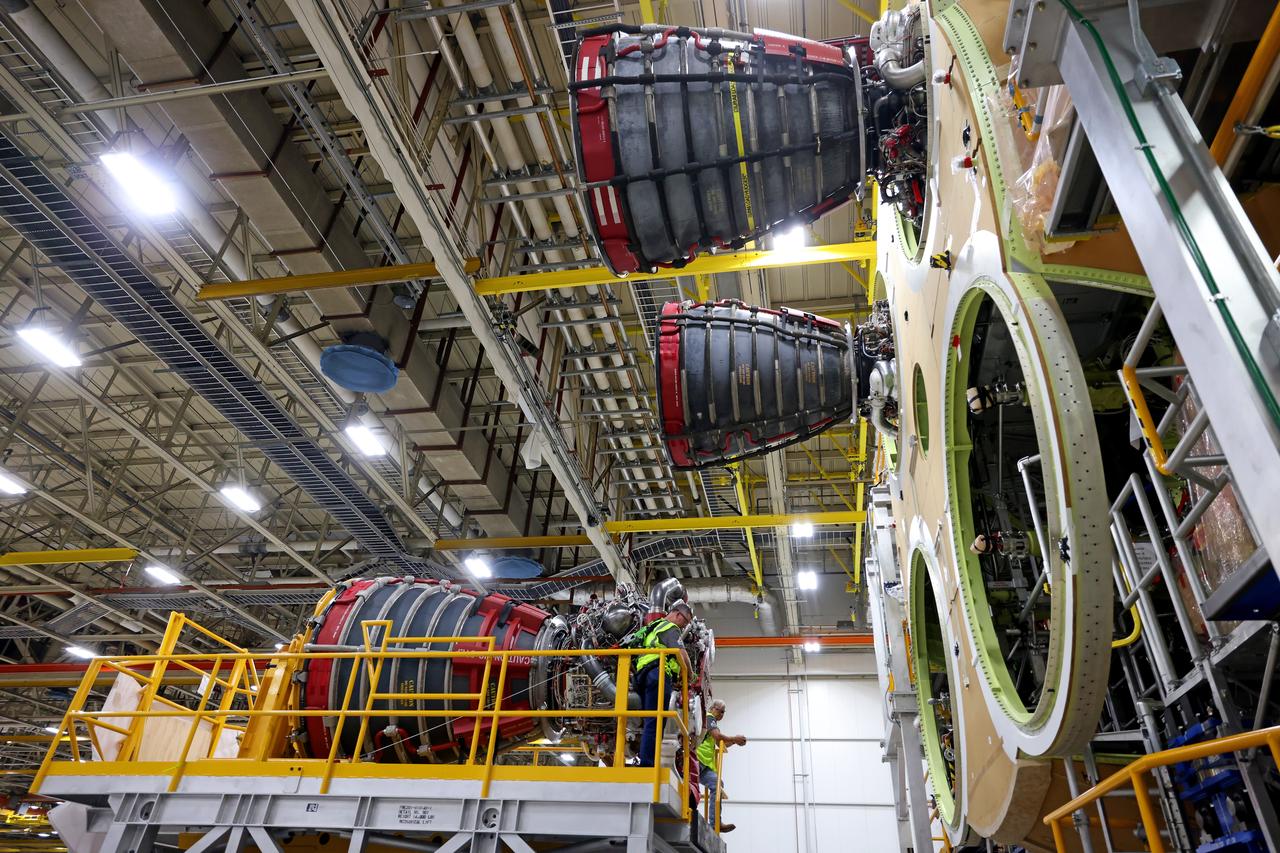
These photos and videos show how technicians at NASA’s Michoud Assembly Facility in New Orleans installed the third and fourth RS-25 engines onto the core stage for the agency’s SLS (Space Launch System) rocket that will help power NASA’s first crewed Artemis mission to the Moon. Technicians added the first engine to the SLS core stage Sept. 11. The second engine was installed onto the stage Sept. 15 with the third and fourth engines following Sept. 19 and Sept. 20. Engineers consider the engines to be “soft” mated to the rocket stage. Technicians with NASA, Aerojet Rocketdyne, an L3Harris Technologies company and the RS-25 engines lead contractor, along with Boeing, the core stage lead contractor, will now focus efforts on the complex tax of fully securing the engines to the stage and integrating the propulsion and electrical systems within the structure. NASA is working to land the first woman and first person of color on the Moon under Artemis. SLS is part of NASA’s backbone for deep space exploration, along with Orion and the Gateway in orbit around the Moon. SLS is the only rocket that can send Orion, astronauts, and supplies to the Moon in a single mission.
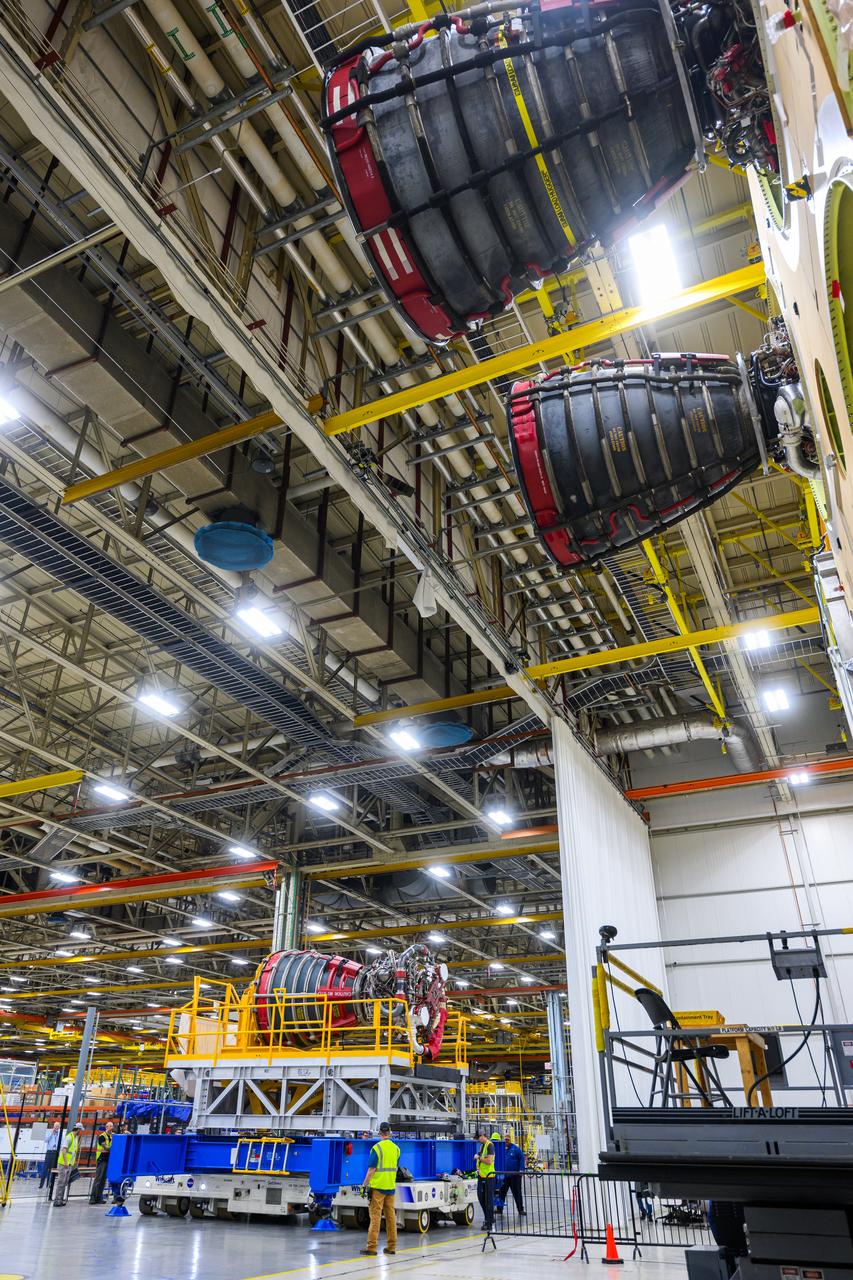
These photos and videos show how technicians at NASA’s Michoud Assembly Facility in New Orleans installed the third and fourth RS-25 engines onto the core stage for the agency’s SLS (Space Launch System) rocket that will help power NASA’s first crewed Artemis mission to the Moon. Technicians added the first engine to the SLS core stage Sept. 11. The second engine was installed onto the stage Sept. 15 with the third and fourth engines following Sept. 19 and Sept. 20. Engineers consider the engines to be “soft” mated to the rocket stage. Technicians with NASA, Aerojet Rocketdyne, an L3Harris Technologies company and the RS-25 engines lead contractor, along with Boeing, the core stage lead contractor, will now focus efforts on the complex tax of fully securing the engines to the stage and integrating the propulsion and electrical systems within the structure. NASA is working to land the first woman and first person of color on the Moon under Artemis. SLS is part of NASA’s backbone for deep space exploration, along with Orion and the Gateway in orbit around the Moon. SLS is the only rocket that can send Orion, astronauts, and supplies to the Moon in a single mission.
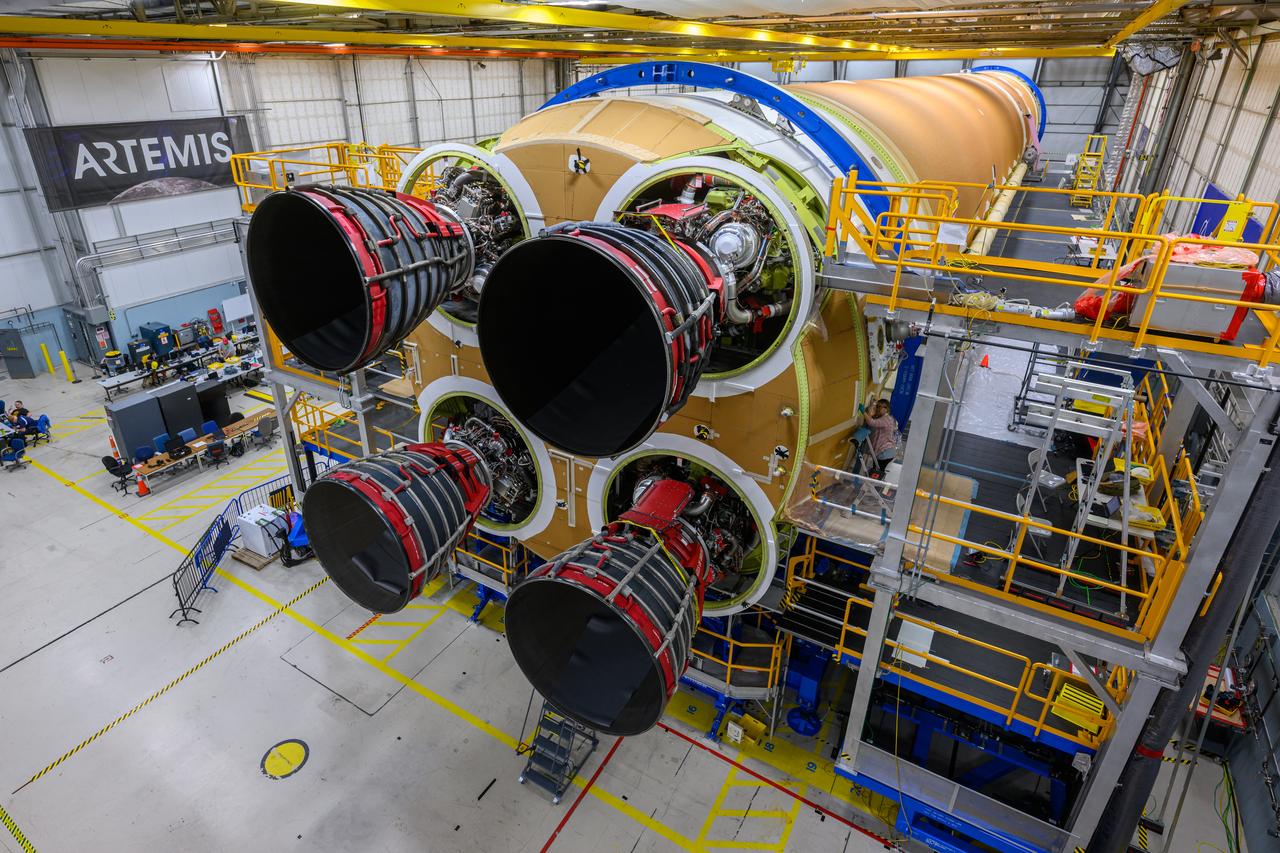
These photos and videos show how technicians at NASA’s Michoud Assembly Facility in New Orleans installed the third and fourth RS-25 engines onto the core stage for the agency’s SLS (Space Launch System) rocket that will help power NASA’s first crewed Artemis mission to the Moon. Technicians added the first engine to the SLS core stage Sept. 11. The second engine was installed onto the stage Sept. 15 with the third and fourth engines following Sept. 19 and Sept. 20. Engineers consider the engines to be “soft” mated to the rocket stage. Technicians with NASA, Aerojet Rocketdyne, an L3Harris Technologies company and the RS-25 engines lead contractor, along with Boeing, the core stage lead contractor, will now focus efforts on the complex tax of fully securing the engines to the stage and integrating the propulsion and electrical systems within the structure. NASA is working to land the first woman and first person of color on the Moon under Artemis. SLS is part of NASA’s backbone for deep space exploration, along with Orion and the Gateway in orbit around the Moon. SLS is the only rocket that can send Orion, astronauts, and supplies to the Moon in a single mission.
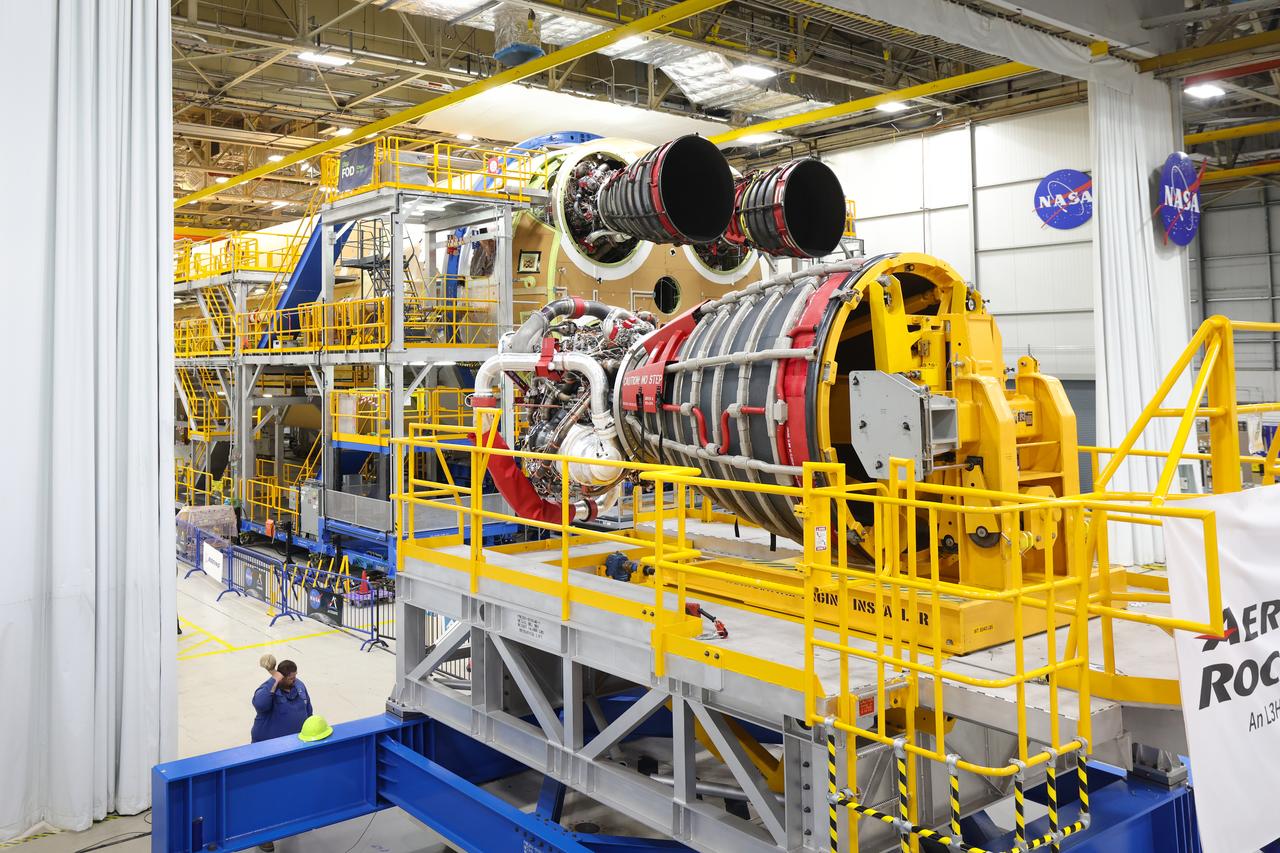
These photos and videos show how technicians at NASA’s Michoud Assembly Facility in New Orleans installed the third and fourth RS-25 engines onto the core stage for the agency’s SLS (Space Launch System) rocket that will help power NASA’s first crewed Artemis mission to the Moon. Technicians added the first engine to the SLS core stage Sept. 11. The second engine was installed onto the stage Sept. 15 with the third and fourth engines following Sept. 19 and Sept. 20. Engineers consider the engines to be “soft” mated to the rocket stage. Technicians with NASA, Aerojet Rocketdyne, an L3Harris Technologies company and the RS-25 engines lead contractor, along with Boeing, the core stage lead contractor, will now focus efforts on the complex tax of fully securing the engines to the stage and integrating the propulsion and electrical systems within the structure. NASA is working to land the first woman and first person of color on the Moon under Artemis. SLS is part of NASA’s backbone for deep space exploration, along with Orion and the Gateway in orbit around the Moon. SLS is the only rocket that can send Orion, astronauts, and supplies to the Moon in a single mission.
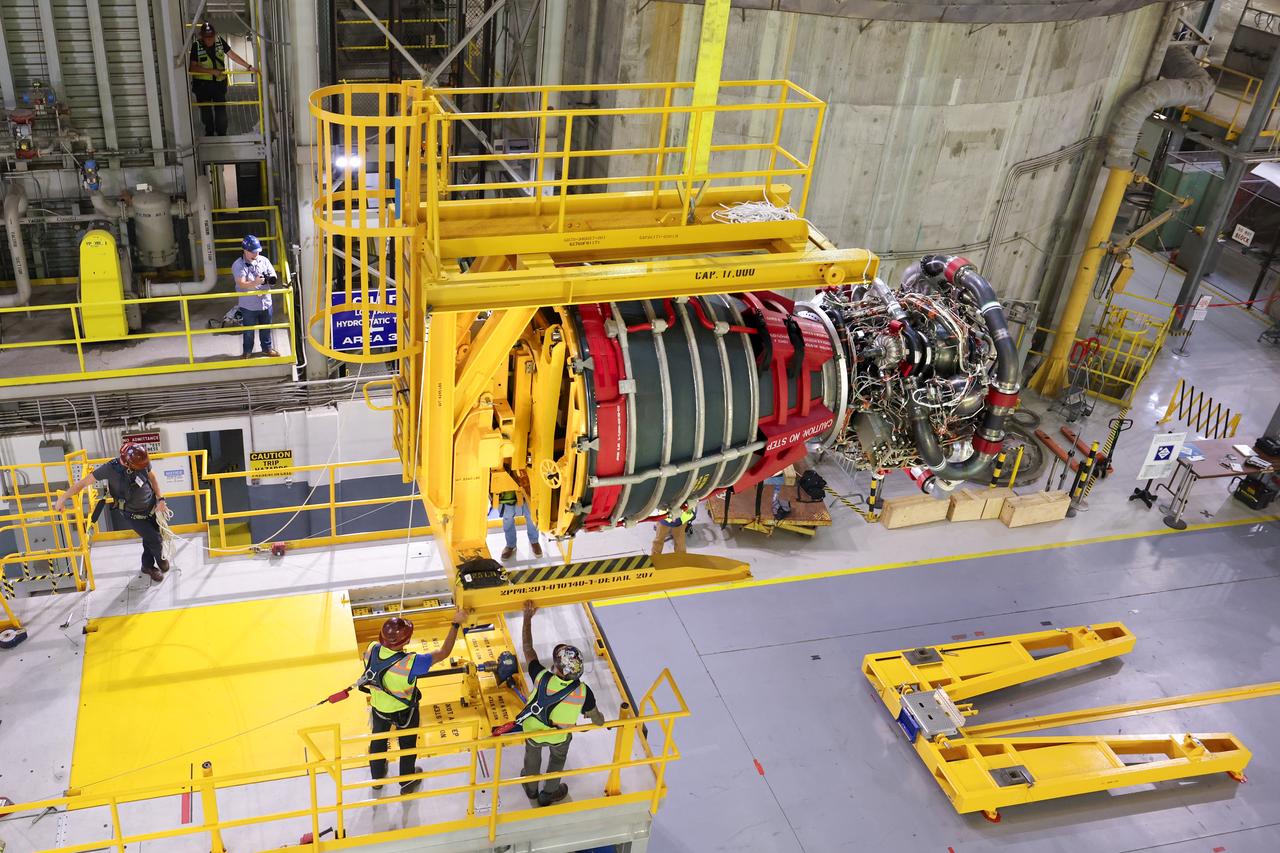
These photos and videos show how technicians at NASA’s Michoud Assembly Facility in New Orleans installed the third and fourth RS-25 engines onto the core stage for the agency’s SLS (Space Launch System) rocket that will help power NASA’s first crewed Artemis mission to the Moon. Technicians added the first engine to the SLS core stage Sept. 11. The second engine was installed onto the stage Sept. 15 with the third and fourth engines following Sept. 19 and Sept. 20. Engineers consider the engines to be “soft” mated to the rocket stage. Technicians with NASA, Aerojet Rocketdyne, an L3Harris Technologies company and the RS-25 engines lead contractor, along with Boeing, the core stage lead contractor, will now focus efforts on the complex tax of fully securing the engines to the stage and integrating the propulsion and electrical systems within the structure. NASA is working to land the first woman and first person of color on the Moon under Artemis. SLS is part of NASA’s backbone for deep space exploration, along with Orion and the Gateway in orbit around the Moon. SLS is the only rocket that can send Orion, astronauts, and supplies to the Moon in a single mission.

These photos and videos show how technicians at NASA’s Michoud Assembly Facility in New Orleans installed the third and fourth RS-25 engines onto the core stage for the agency’s SLS (Space Launch System) rocket that will help power NASA’s first crewed Artemis mission to the Moon. Technicians added the first engine to the SLS core stage Sept. 11. The second engine was installed onto the stage Sept. 15 with the third and fourth engines following Sept. 19 and Sept. 20. Engineers consider the engines to be “soft” mated to the rocket stage. Technicians with NASA, Aerojet Rocketdyne, an L3Harris Technologies company and the RS-25 engines lead contractor, along with Boeing, the core stage lead contractor, will now focus efforts on the complex tax of fully securing the engines to the stage and integrating the propulsion and electrical systems within the structure. NASA is working to land the first woman and first person of color on the Moon under Artemis. SLS is part of NASA’s backbone for deep space exploration, along with Orion and the Gateway in orbit around the Moon. SLS is the only rocket that can send Orion, astronauts, and supplies to the Moon in a single mission.
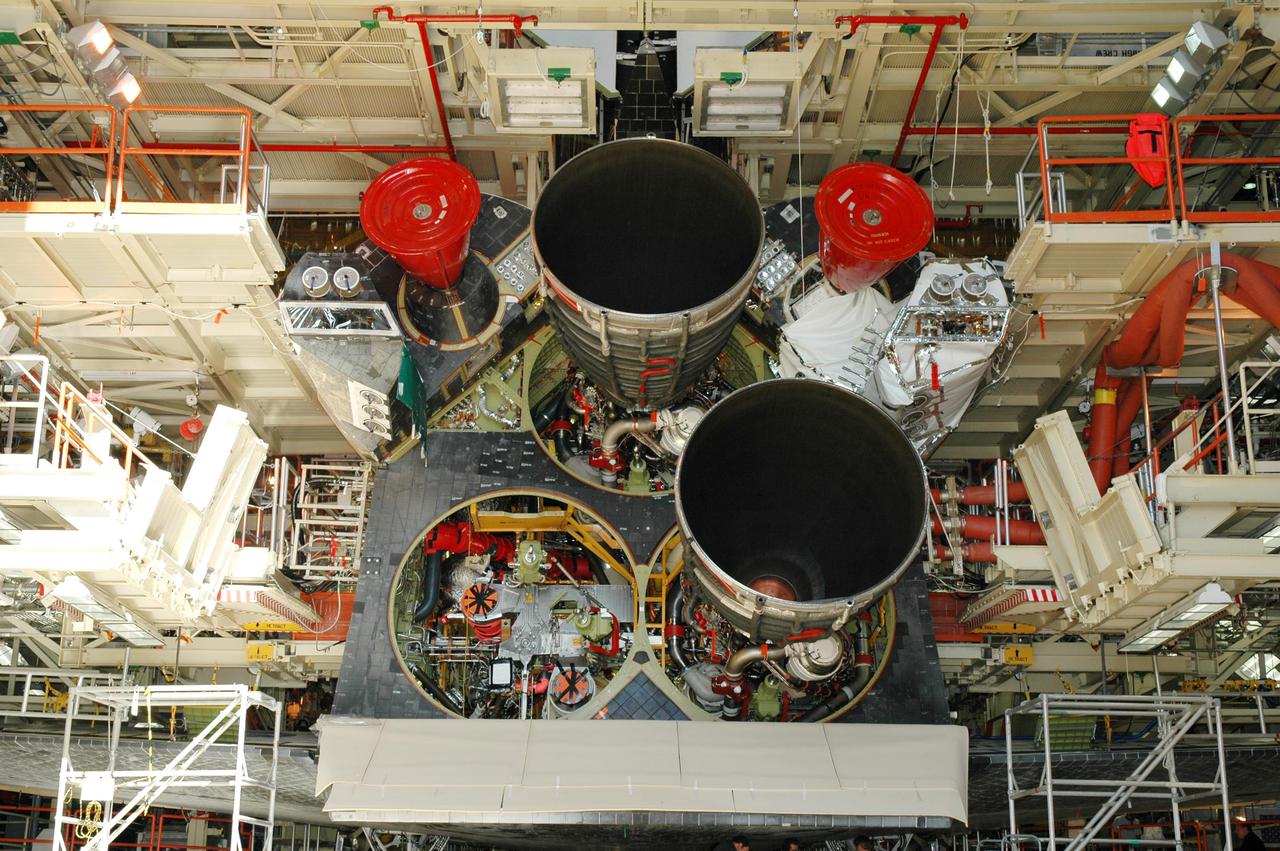
KENNEDY SPACE CENTER, FLA. - The second Space Shuttle Main Engine (SSME) has been installed on the orbiter Discovery in the Orbiter Processing Facility. Discovery is the vehicle designated for the Return to Flight mission STS-114. Overall, an SSME weighs approximately 7,000 pounds. An SSME operates at greater temperature extremes than any mechanical system in common use today. The liquid hydrogen fuel is -423 degrees Fahrenheit, the second coldest liquid on Earth. When the hydrogen is burned with liquid oxygen, the temperature in the engine's combustion chamber reaches +6000 degrees Fahrenheit -- that's higher than the boiling point of Iron. Each SSME is controlled by its own computer, which checks the health of the engines 50 times per second during countdown and ascent. The controller can shut an engine down if it detects a problem. The SSMEs are tested at Stennis Space Center in Mississippi.
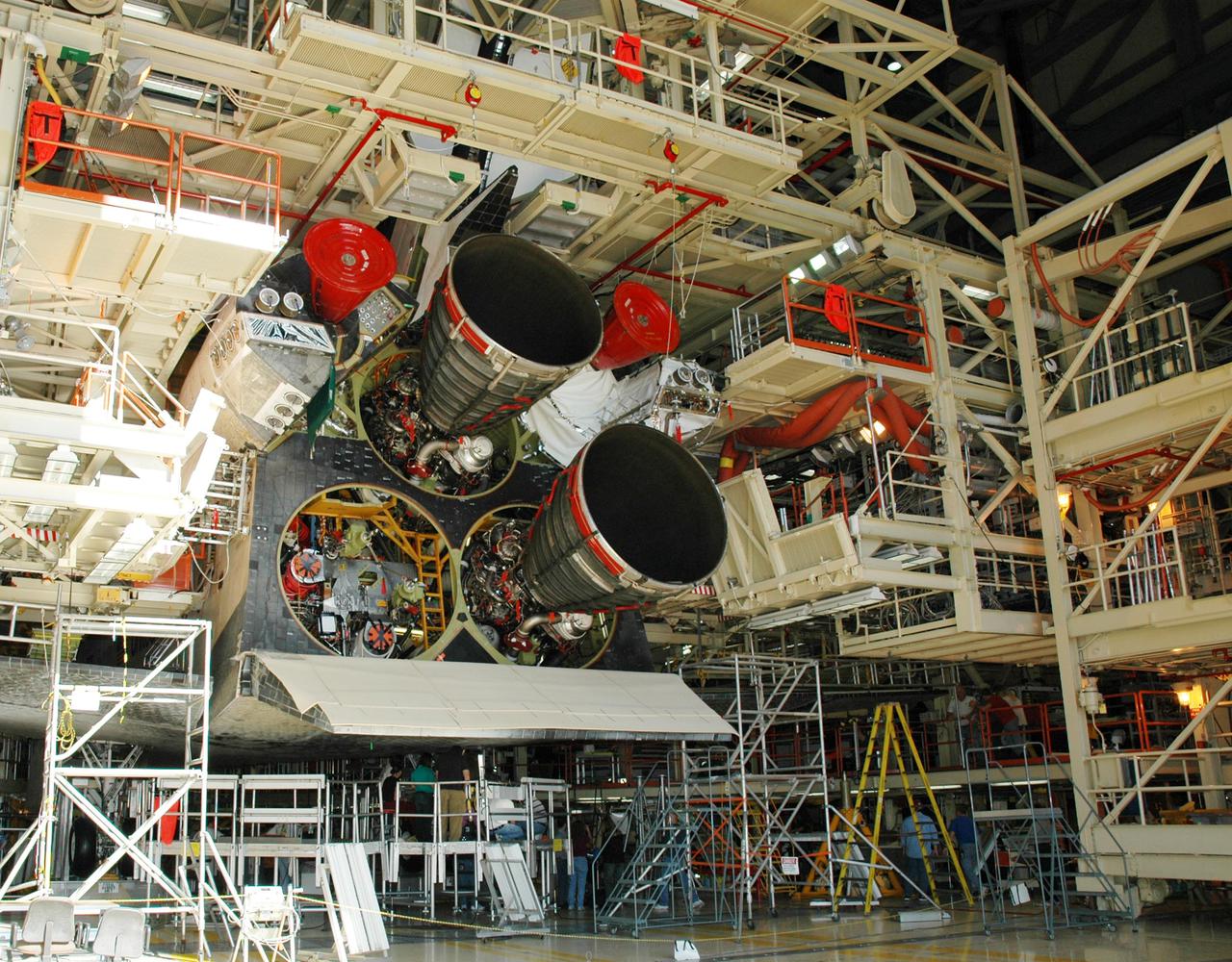
KENNEDY SPACE CENTER, FLA. - The second Space Shuttle Main Engine (SSME) has been installed on the orbiter Discovery in the Orbiter Processing Facility. Discovery is the vehicle designated for the Return to Flight mission STS-114. Overall, an SSME weighs approximately 7,000 pounds. An SSME operates at greater temperature extremes than any mechanical system in common use today. The liquid hydrogen fuel is -423 degrees Fahrenheit, the second coldest liquid on Earth. When the hydrogen is burned with liquid oxygen, the temperature in the engine's combustion chamber reaches +6000 degrees Fahrenheit -- that's higher than the boiling point of Iron. Each SSME is controlled by its own computer, which checks the health of the engines 50 times per second during countdown and ascent. The controller can shut an engine down if it detects a problem. The SSMEs are tested at Stennis Space Center in Mississippi.
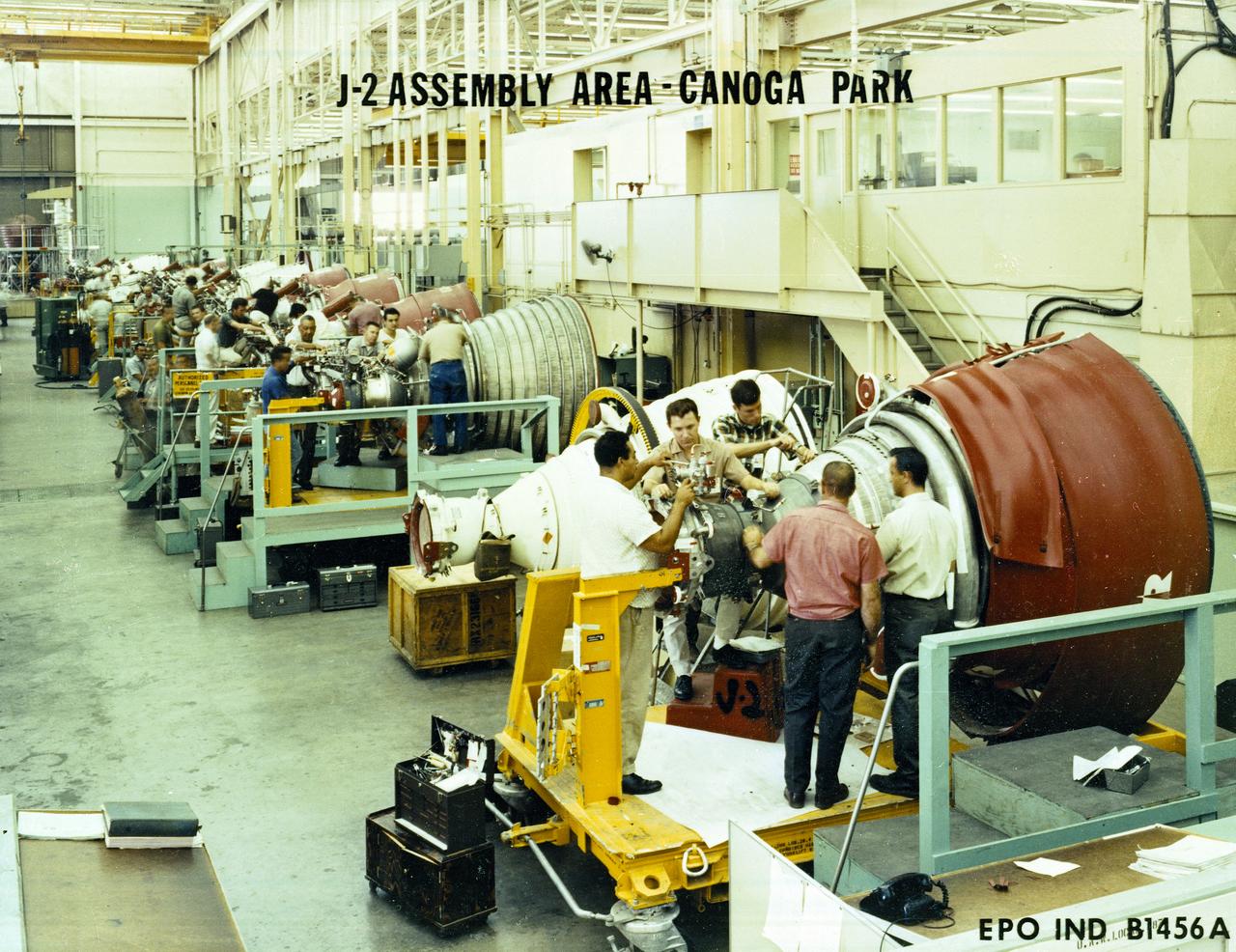
Workmen inspect a J-2 engine at Rocketdyne's Canoga Park, California production facility. The J-2, developed under the direction of the Marshall Space Flight Center, was propelled by liquid hydrogen and liquid oxygen. A single J-2 engine was used in the S-IVB stage (the second stage of the Saturn IB and third stage for the Saturn V) and a cluster of five J-2 engines was used to propel the second stage of the Saturn V, the S-II. Initially rated at 200,000 pounds of thrust, the J-2 engine was later uprated in the Saturn V program to 230,000 pounds.
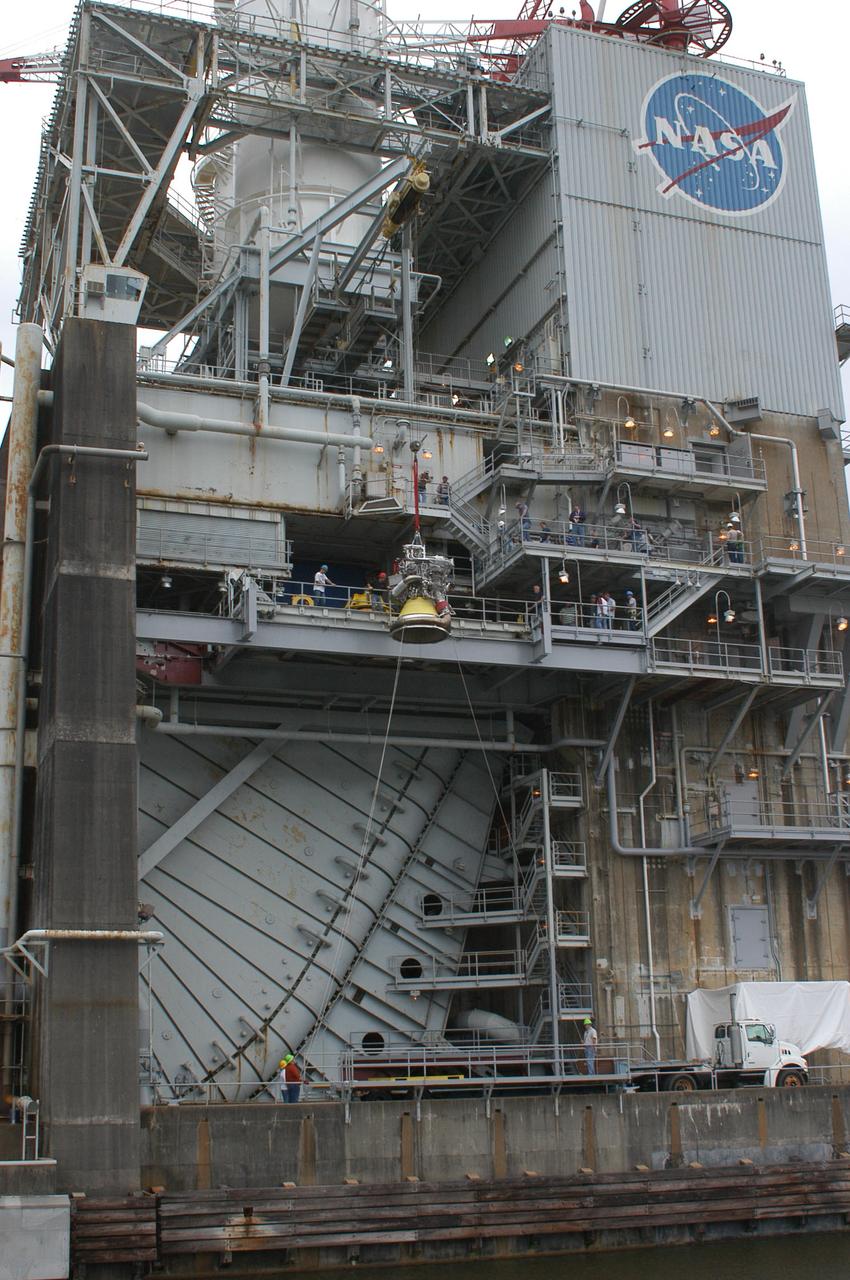
J-2X engine No. 10001 is returned March 8, 2012, to the A-2 Test Stand at Stennis Space Center for its second round of tests. The developmental engine underwent an initial series of tests last year. The J-2X engine is being built for NASA by Pratt & Whitney Rocketdyne.
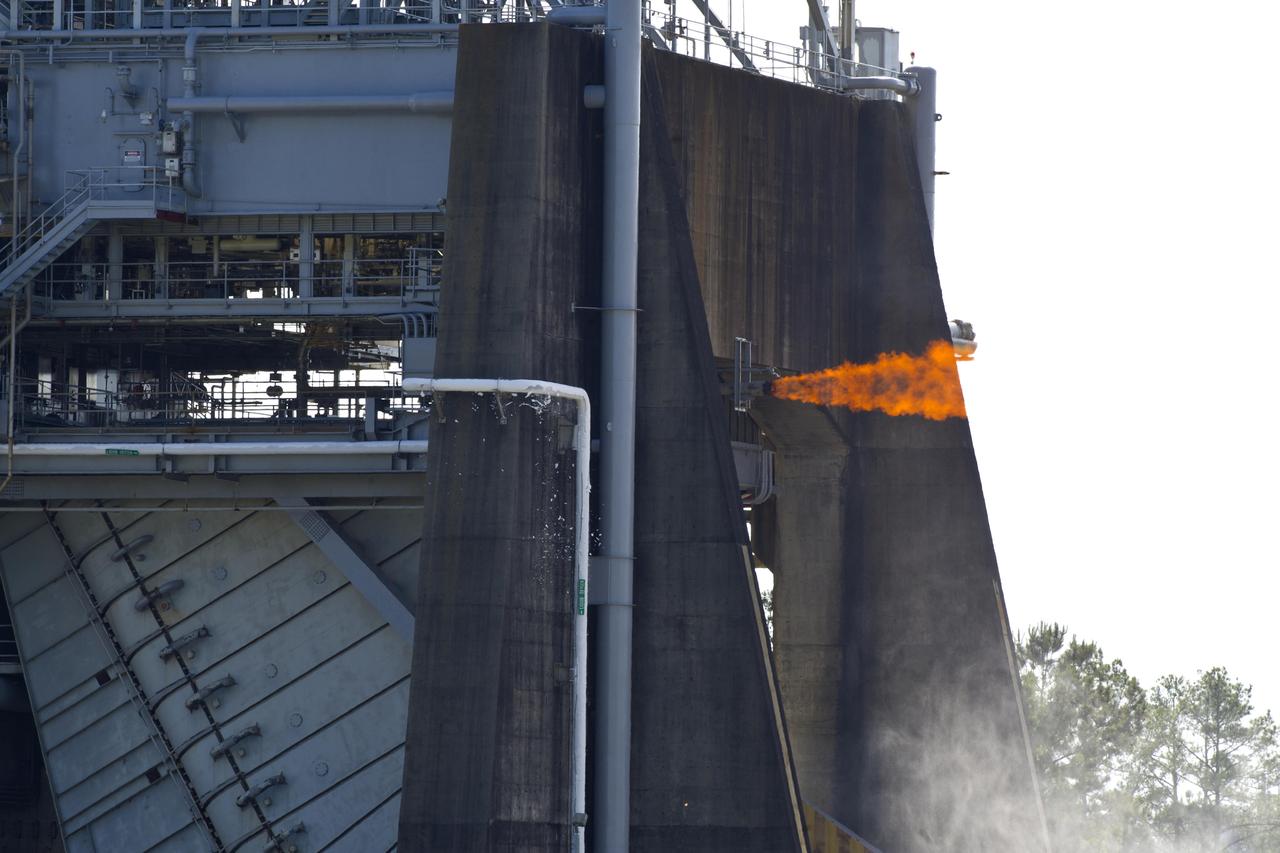
NASA conducted a 340-second test of the J-2X engine powerpack at Stennis Space Center on May 10, 2012, marking another step in development of the next-generation rocket engine. The powerpack is a system of components on the top portion of the J-2X engine.
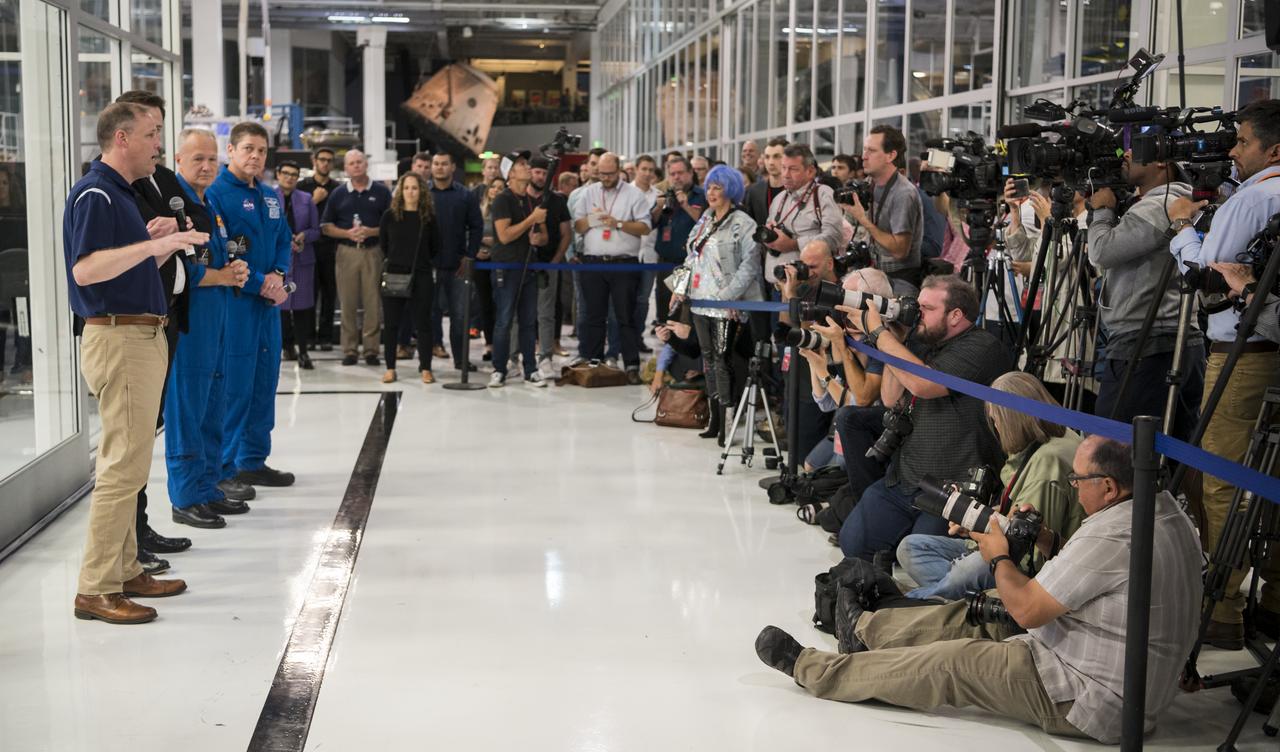
NASA Administrator Jim Bridenstine, left, speaks to press with SpaceX Chief Engineer Elon Musk, second from left, NASA astronaut Doug Hurley, second from right, and NASA astronaut Bob Behnken, at SpaceX Headquarters, Thursday, Oct. 10, 2019 in Hawthorne, CA. Photo credit: (NASA/Aubrey Gemignani)
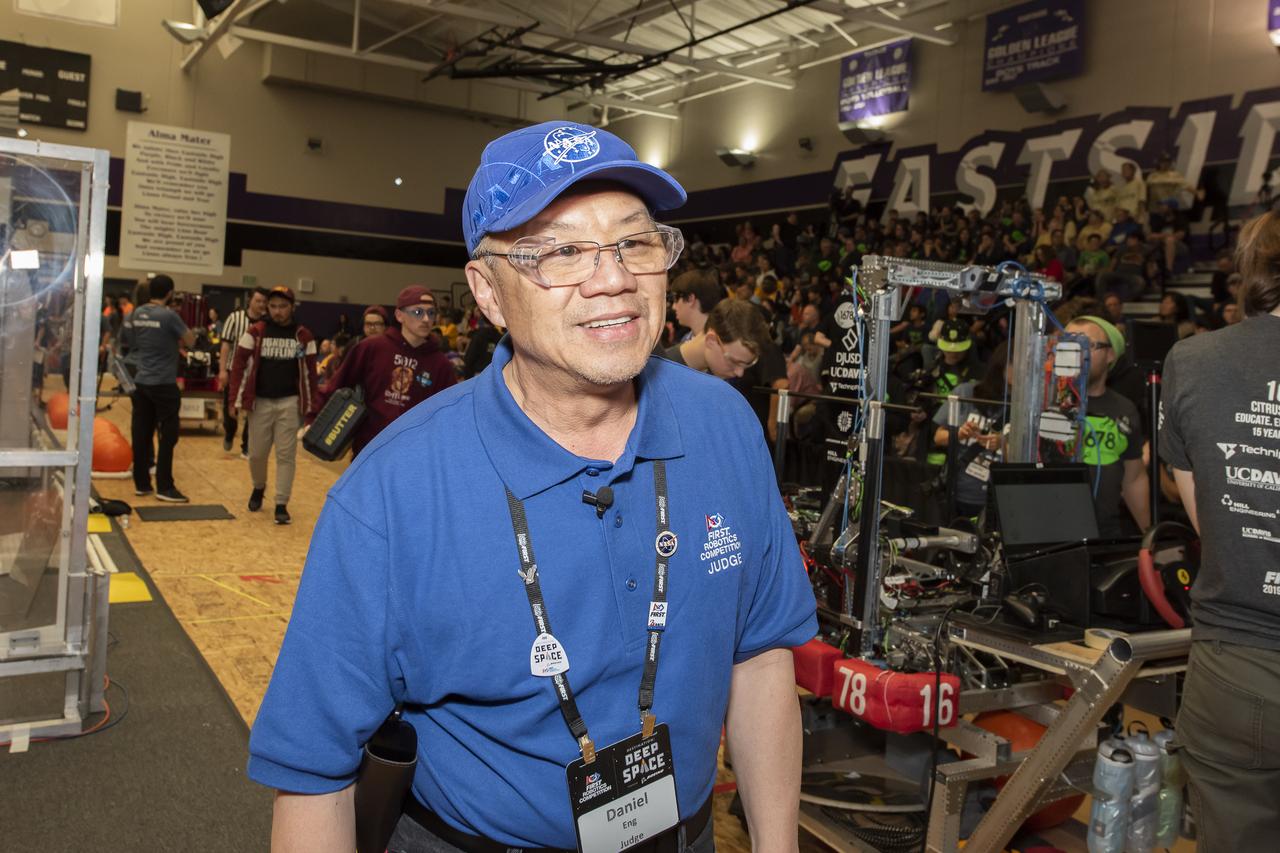
NASA Systems Engineer Daniel Eng serves his second year as a judge for the Aerospace Valley Robotics Competition at the Palmdale Aerospace Academy in Palmdale, California, in 2019.
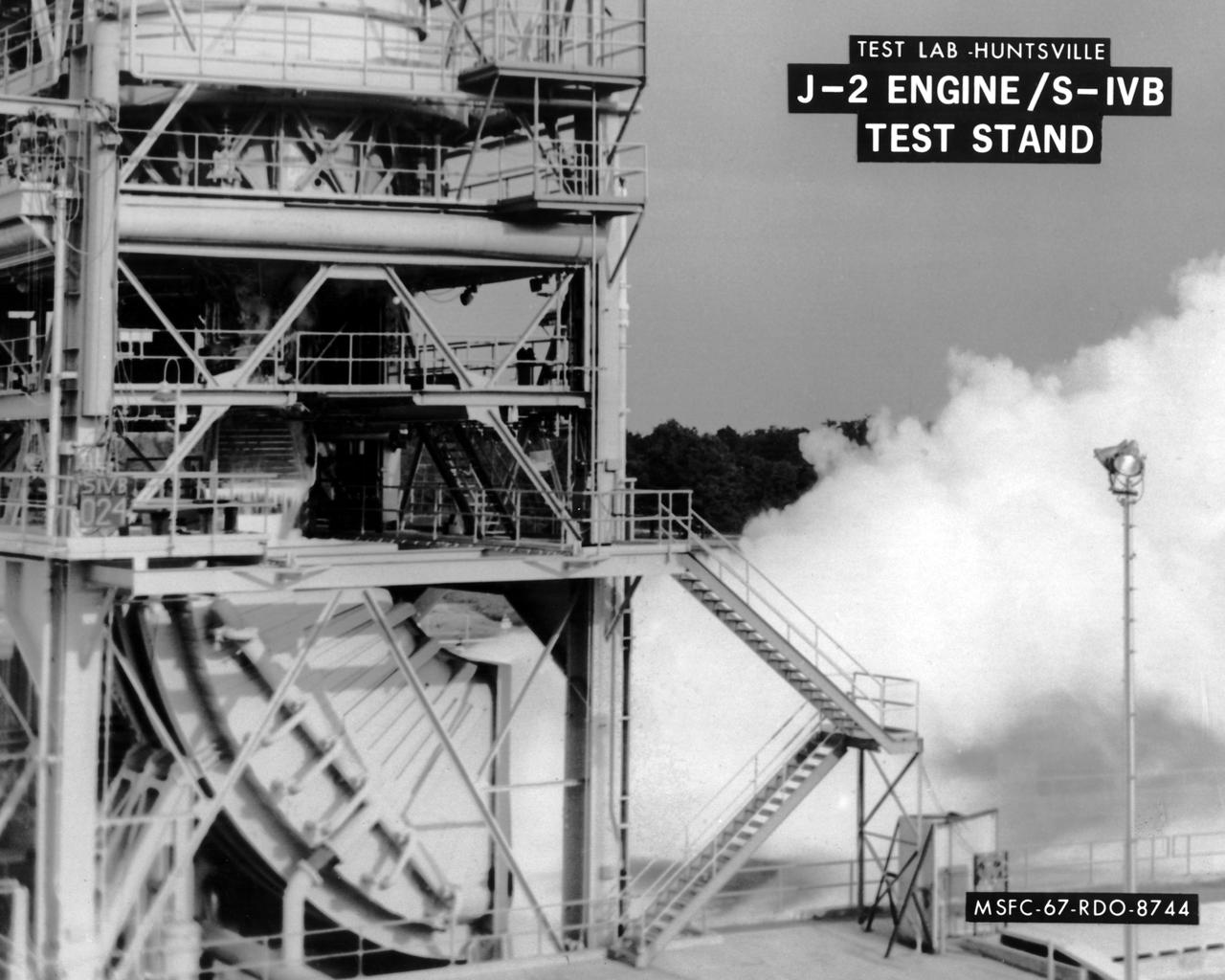
This image depicts the test firing of a J-2 engine in the S-IVB Test Stand at the Marshall Space Flight Center (MSFC). The J-2, developed by Rocketdyne under the direction of MSFC, was propelled by liquid hydrogen and liquid oxygen. A single J-2 was utilized in the S-IVB stage (the second stage for the Saturn IB and third stage for the Saturn V) and in a cluster of five for the second stage (S-II) of the Saturn V. Initially rated at 200,000 pounds of thrust, the engine was later upgraded in the Saturn V program to 230,000 pounds.
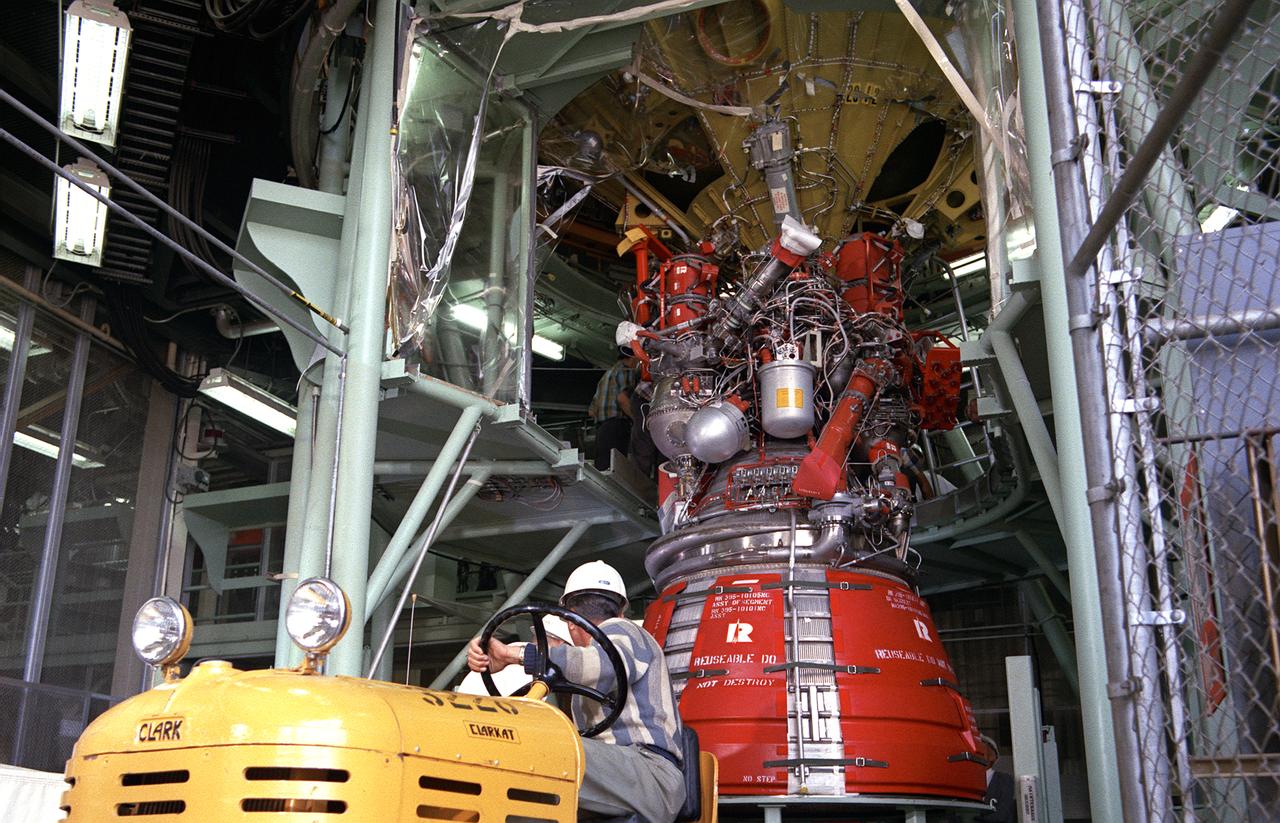
Workmen secure a J-2 engine onto the S-IVB (second) stage thrust structure. As part of Marshall Space Center's "building block" approach to the Saturn development, the S-IVB was utilized in the Saturn IBC launch vehicle as a second stage and the Saturn V launch vehicle as a third stage. The booster, built for NASA by McDornell Douglas Corporation, was powered by a single J-2 engine, initially capable of 200,000 pounds of thrust.
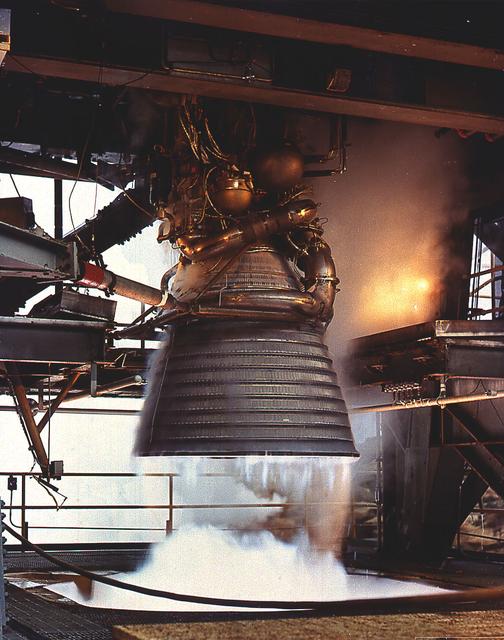
A J-2 engine undergoes static firing. The J-2, developed under the direction of the Marshall Space Flight Center, was propelled by liquid hydrogen and liquid oxygen. A single J-2 was utilized in the S-IVB stage (the second stage for the Saturn IB and third stage for the Saturn V) and in a cluster of five for the second stage (S-II) of the Saturn V. Initially rated at 200,000 pounds of thrust, the engine was later uprated in the Saturn V program to 230,000 pounds.
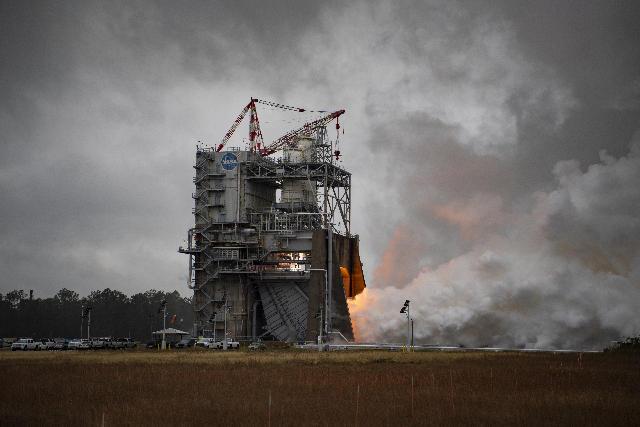
A hot fire at NASA’s Stennis Space Center on Nov. 15, 2023, marks the second test of the 12-test series. The NASA Stennis test team fires the certification engine for 500 seconds, or the same amount of time engines must fire to help launch the SLS (Space Launch System) rocket to space with astronauts aboard the Orion spacecraft.

Expedition 51 prime crew members, Flight Engineer Jack Fischer of NASA, left, and Soyuz Commander Fyodor Yurchikhin of Roscosmos, second left, are seen with Expedition 51 back up crew members, Soyuz Commander Sergey Ryazanskiy of Roscosmos, second from right, and Flight Engineer Randy Bresnik of NASA, right, during a press conference held at the Cosmonaut Hotel in Baikonur, Kazakhstan on Wednesday, April 19, 2017. The mission is set to launch April 20 from the Baikonur Cosmodrome. Photo Credit: (NASA/Aubrey Gemignani)
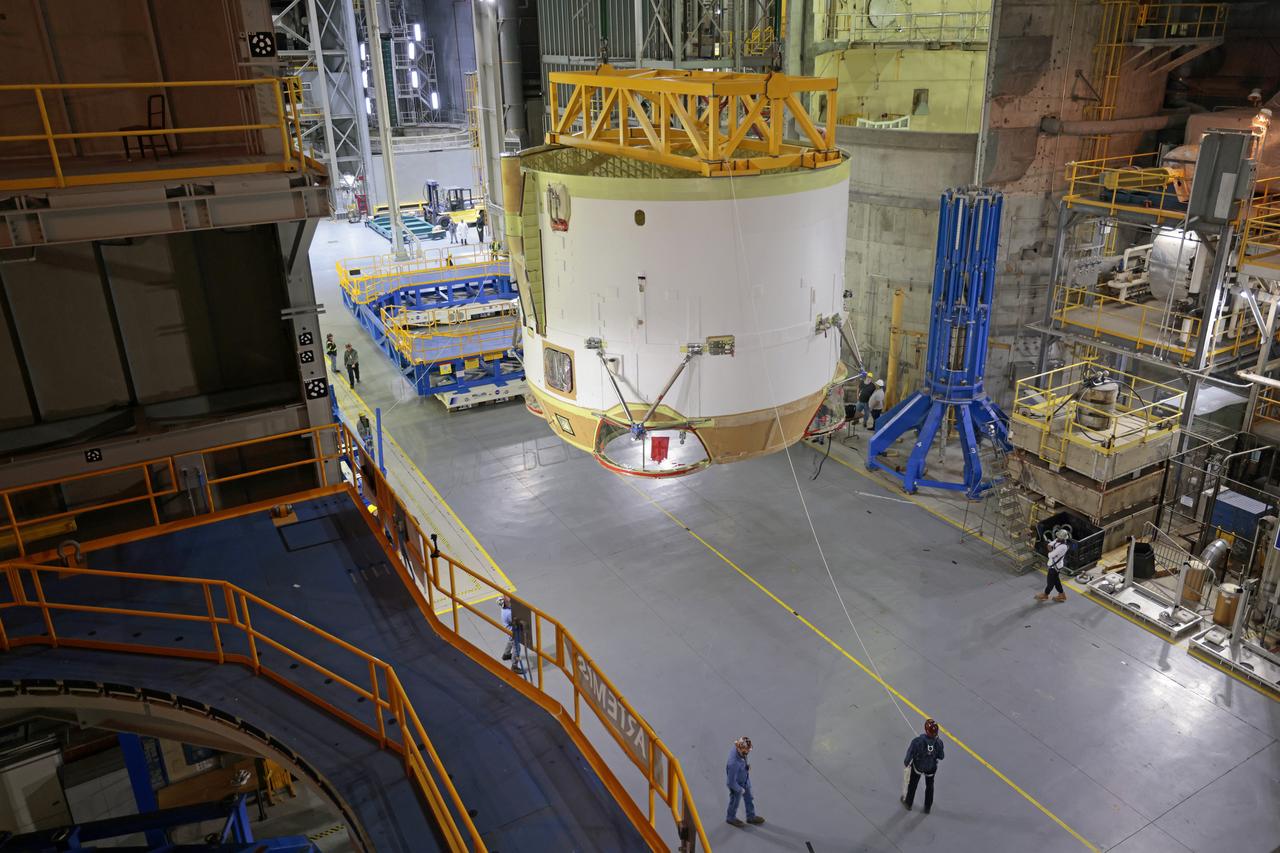
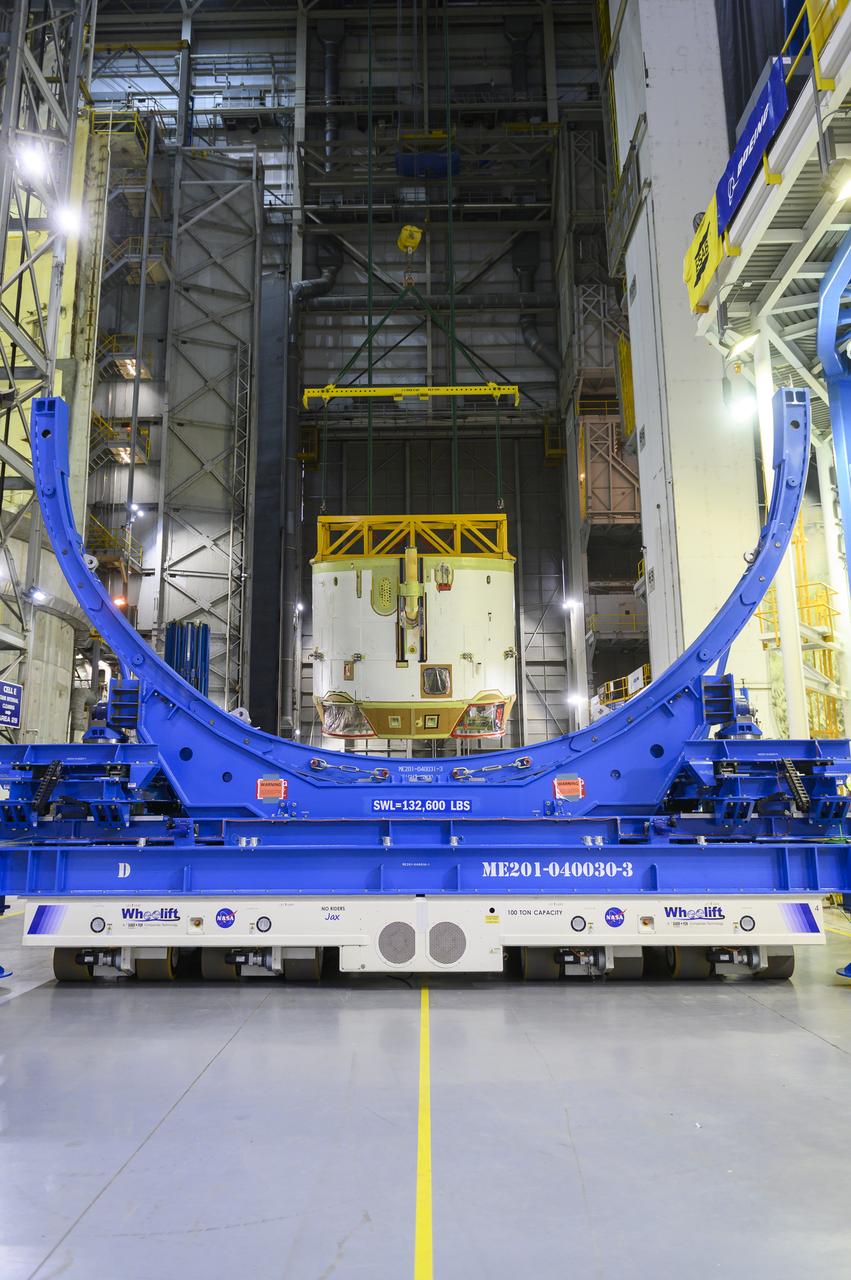
Technicians at NASA’s Michoud Assembly Facility in New Orleans flipped the engine section of NASA’s Space Launch System rocket for Artemis II from a vertical to a horizontal position Feb. 11. The flip, also known as a breakover, is in preparation for the final assembly and integration into the core stage for the second SLS rocket. The engine section is the bottom-most portion of the 212-foot-tall core stage and is one of the most complex and intricate portions of the rocket that will help power the first crewed Artemis mission to the Moon. It is the last of five elements that is needed to join the stage as one structure. In addition to its miles of cabling and hundreds of sensors, the engine section is a crucial attachment point for the four RS-25 engines and two solid rocket boosters that produce a combined 8.8 million pounds of thrust at liftoff and flight. Next, teams will move the engine section into the final assembly area where they will complete the join. After the join is complete, teams will begin to add each of the four RS-25 engines. The completely assembled stage with its four RS-25 engines will be shipped to NASA’s Kennedy Space Center in Florida later this year. The SLS rocket is the only rocket capable of carrying astronauts in Orion around the Moon in a single mission. Image credit: NASA/Michael DeMocker
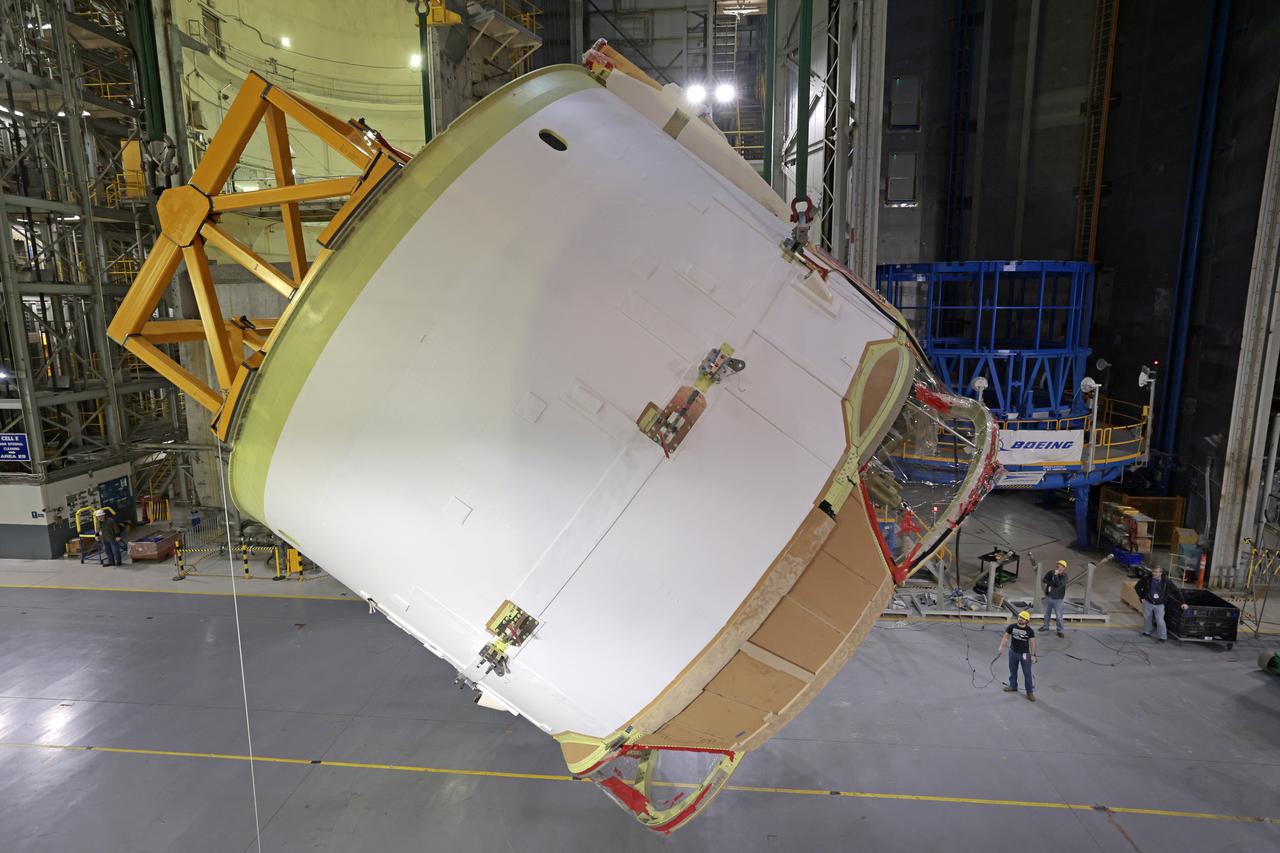
Technicians at NASA’s Michoud Assembly Facility in New Orleans flipped the engine section of NASA’s Space Launch System rocket for Artemis II from a vertical to a horizontal position Feb. 11. The flip, also known as a breakover, is in preparation for the final assembly and integration into the core stage for the second SLS rocket. The engine section is the bottom-most portion of the 212-foot-tall core stage and is one of the most complex and intricate portions of the rocket that will help power the first crewed Artemis mission to the Moon. It is the last of five elements that is needed to join the stage as one structure. In addition to its miles of cabling and hundreds of sensors, the engine section is a crucial attachment point for the four RS-25 engines and two solid rocket boosters that produce a combined 8.8 million pounds of thrust at liftoff and flight. Next, teams will move the engine section into the final assembly area where they will complete the join. After the join is complete, teams will begin to add each of the four RS-25 engines. The completely assembled stage with its four RS-25 engines will be shipped to NASA’s Kennedy Space Center in Florida later this year. The SLS rocket is the only rocket capable of carrying astronauts in Orion around the Moon in a single mission. Image credit: NASA/Michael DeMocker
Technicians at NASA’s Michoud Assembly Facility in New Orleans flipped the engine section of NASA’s Space Launch System rocket for Artemis II from a vertical to a horizontal position Feb. 11. The flip, also known as a breakover, is in preparation for the final assembly and integration into the core stage for the second SLS rocket. The engine section is the bottom-most portion of the 212-foot-tall core stage and is one of the most complex and intricate portions of the rocket that will help power the first crewed Artemis mission to the Moon. It is the last of five elements that is needed to join the stage as one structure. In addition to its miles of cabling and hundreds of sensors, the engine section is a crucial attachment point for the four RS-25 engines and two solid rocket boosters that produce a combined 8.8 million pounds of thrust at liftoff and flight. Next, teams will move the engine section into the final assembly area where they will complete the join. After the join is complete, teams will begin to add each of the four RS-25 engines. The completely assembled stage with its four RS-25 engines will be shipped to NASA’s Kennedy Space Center in Florida later this year. The SLS rocket is the only rocket capable of carrying astronauts in Orion around the Moon in a single mission. Image credit: NASA/Eric Bordelon

Technicians at NASA’s Michoud Assembly Facility in New Orleans flipped the engine section of NASA’s Space Launch System rocket for Artemis II from a vertical to a horizontal position Feb. 11. The flip, also known as a breakover, is in preparation for the final assembly and integration into the core stage for the second SLS rocket. The engine section is the bottom-most portion of the 212-foot-tall core stage and is one of the most complex and intricate portions of the rocket that will help power the first crewed Artemis mission to the Moon. It is the last of five elements that is needed to join the stage as one structure. In addition to its miles of cabling and hundreds of sensors, the engine section is a crucial attachment point for the four RS-25 engines and two solid rocket boosters that produce a combined 8.8 million pounds of thrust at liftoff and flight. Next, teams will move the engine section into the final assembly area where they will complete the join. After the join is complete, teams will begin to add each of the four RS-25 engines. The completely assembled stage with its four RS-25 engines will be shipped to NASA’s Kennedy Space Center in Florida later this year. The SLS rocket is the only rocket capable of carrying astronauts in Orion around the Moon in a single mission. Image credit: NASA/Michael DeMocker
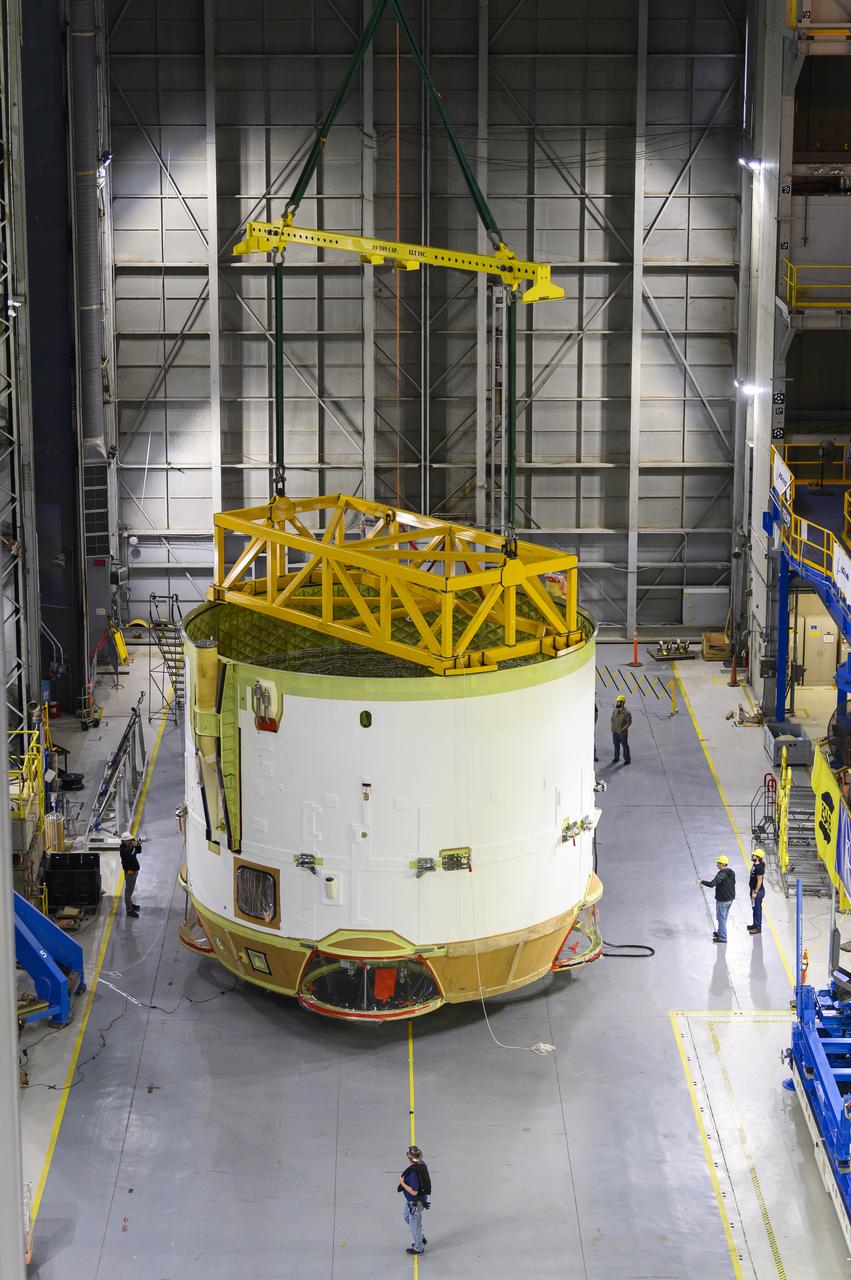
Technicians at NASA’s Michoud Assembly Facility in New Orleans flipped the engine section of NASA’s Space Launch System rocket for Artemis II from a vertical to a horizontal position Feb. 11. The flip, also known as a breakover, is in preparation for the final assembly and integration into the core stage for the second SLS rocket. The engine section is the bottom-most portion of the 212-foot-tall core stage and is one of the most complex and intricate portions of the rocket that will help power the first crewed Artemis mission to the Moon. It is the last of five elements that is needed to join the stage as one structure. In addition to its miles of cabling and hundreds of sensors, the engine section is a crucial attachment point for the four RS-25 engines and two solid rocket boosters that produce a combined 8.8 million pounds of thrust at liftoff and flight. Next, teams will move the engine section into the final assembly area where they will complete the join. After the join is complete, teams will begin to add each of the four RS-25 engines. The completely assembled stage with its four RS-25 engines will be shipped to NASA’s Kennedy Space Center in Florida later this year. The SLS rocket is the only rocket capable of carrying astronauts in Orion around the Moon in a single mission. Image credit: NASA/Eric Bordelon
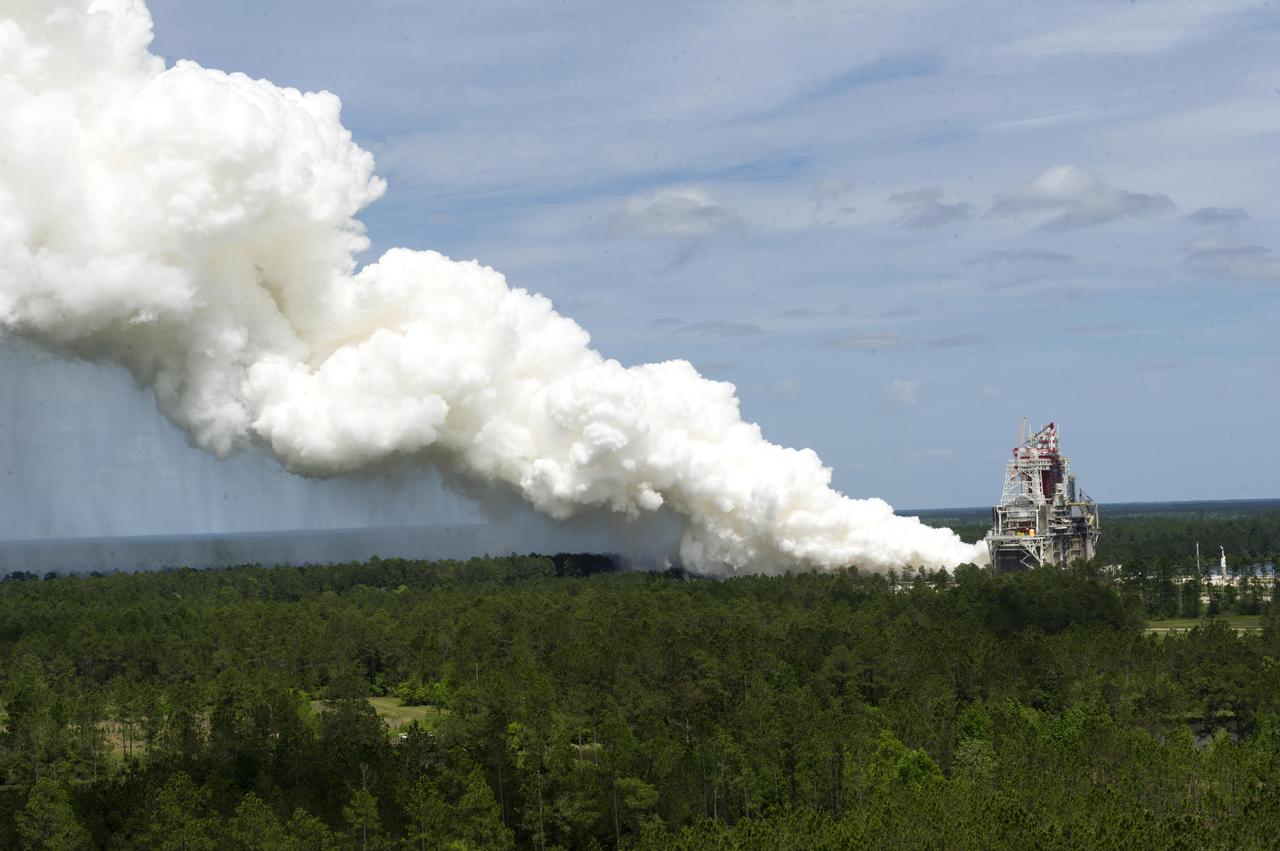
What better way to mark 50 years of rocket engine testing than with a rocket engine test? Stennis Space Center employees enjoyed a chance to view an RS-68 engine test at the B-1 Test Stand on April 19, almost 50 years to the day that the first test was conducted at the south Mississippi site in 1966. The test viewing was part of a weeklong celebration of the 50th year of rocket engine testing at Stennis. The first test at the site occurred April 23, 1966, with a 15-second firing of a Saturn V second stage prototype (S-II-C) on the A-2 Test Stand. The center subsequently tested Apollo rocket stages that carried humans to the moon and every main engine used to power 135 space shuttle missions. It currently tests engines for NASA’s new Space Launch System vehicle.
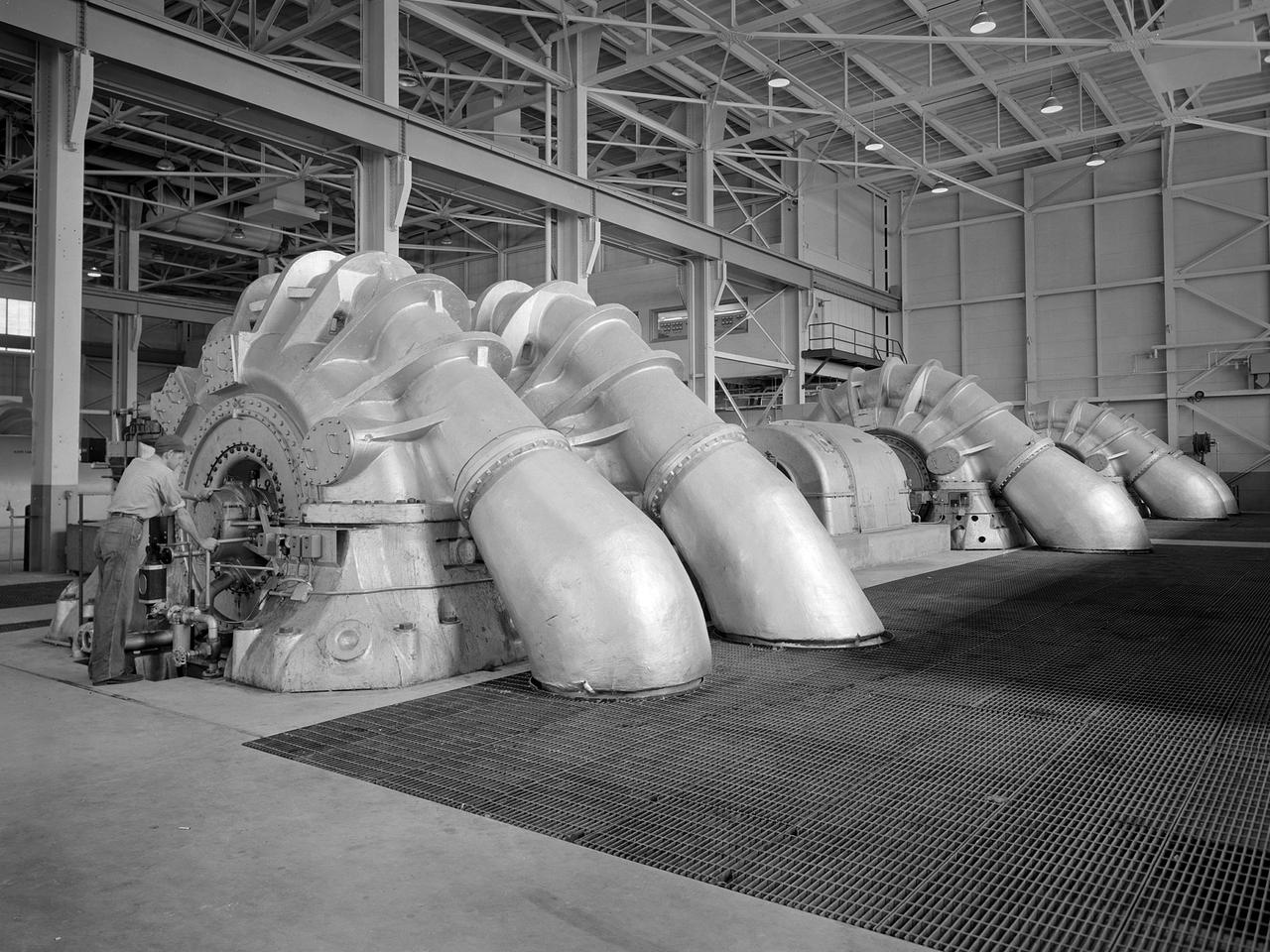
The Propulsion Systems Laboratory’s exhaust system was expanded in 1955 at the National Advisory Committee for Aeronautics (NACA) Lewis Flight Propulsion Laboratory. The facility contained two altitude chambers that were first used to study the increasingly-powerful jet engines of the early 1950s and the ramjets for missile programs such as Navaho and Bomarc. Later, the facility tested large rocket engines and a variety of turbofan engines. The exhaust system served two roles: reducing the density of the air in the test chambers to simulate high altitudes and removing the hot gases exhausted by the engines being tested. These tasks were accomplished by large Roots-Connersville exhauster equipment in the Equipment Building. The original configuration could exhaust the 3500° F gases at a rate of 100 pounds per second when the simulated altitude was 50,000 feet. In 1955, three years after operation started, a fourth line of exhausters was added. There were three centrifugal exhausters capable of supplying 166 pounds of air per second at the test chamber altitude of 50,000 feet or 384 pounds per second at 32,000 feet. These exhausters had two first-stage castings driven by a 10,000-horsepower motor; one second; one third; and one fourth-stage casting driven by a 16,500-horsepower motor. The total inlet volume of the exhausters is 1,650,000 cubic feet of gas per minute. The exhausters were continually improved and upgraded over the years.
A 15-second test of a Saturn V rocket stage on the A-2 Test Stand at Stennis Space Center ushered in the Space Age for south Mississippi. Fifty years later, Stennis has grown into the nation’s largest rocket engine test site, continuing to test rocket engines and stages that power the nation’s space program.
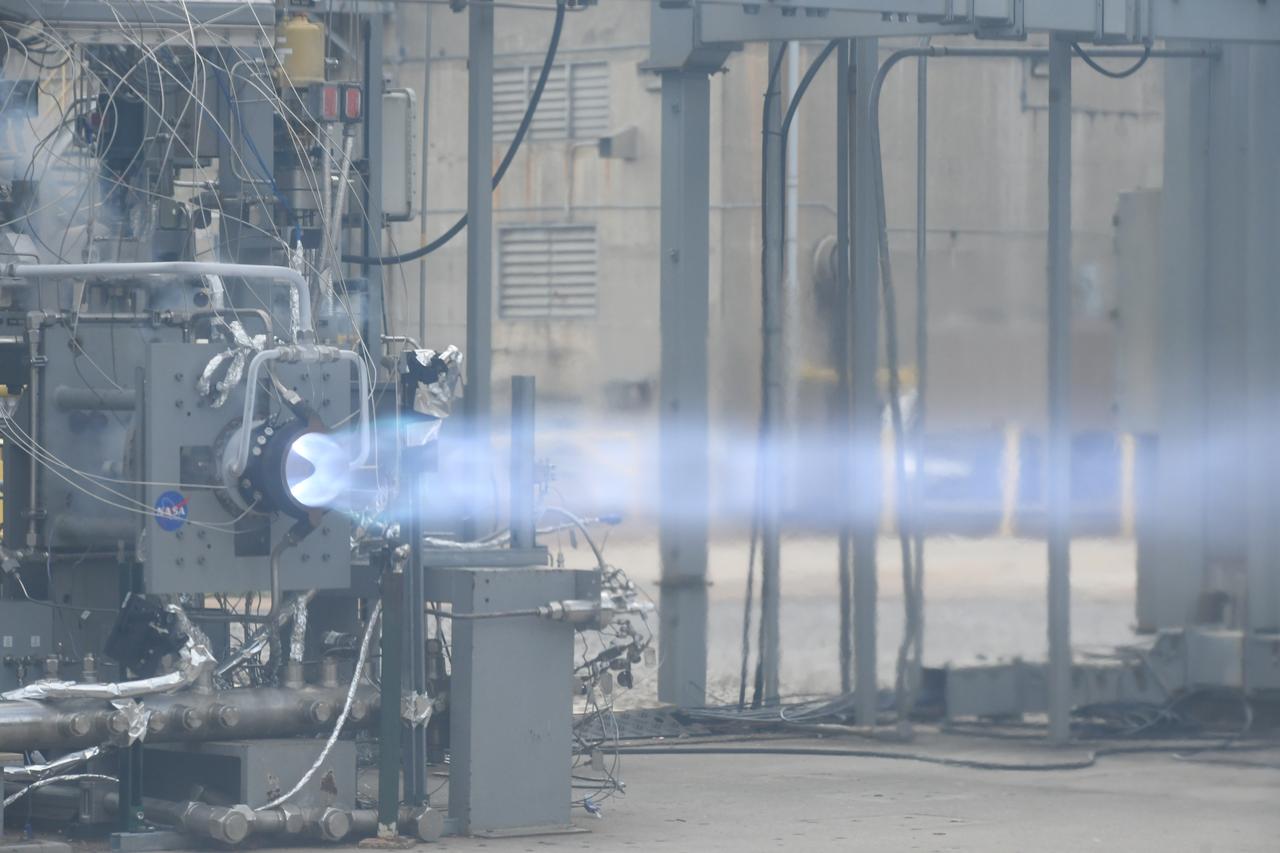
Engineers at NASA’s Marshall Space Flight Center in Huntsville, Alabama, conduct a successful, 251-second hot fire test of a full-scale Rotating Detonation Rocket Engine combustor in fall 2023, achieving more than 5,800 pounds of thrust.
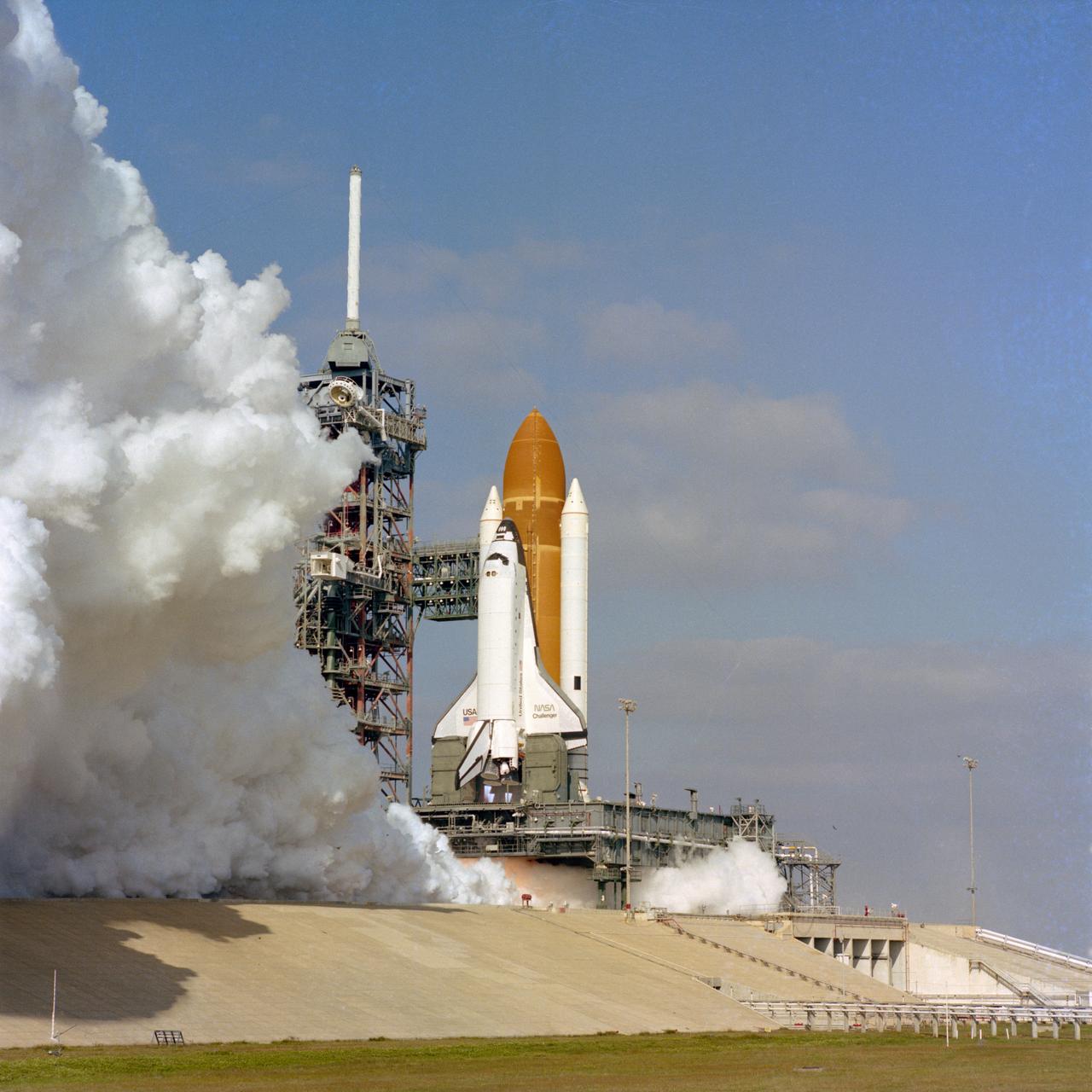
The Space shuttle orbiter Challenger is given a 20-second test firing of its new main engines on December 18, 1982 on pad 39A at the Kennedy Space Center. This test was the first time these engines ahd been tested in the clustered flight configuration.
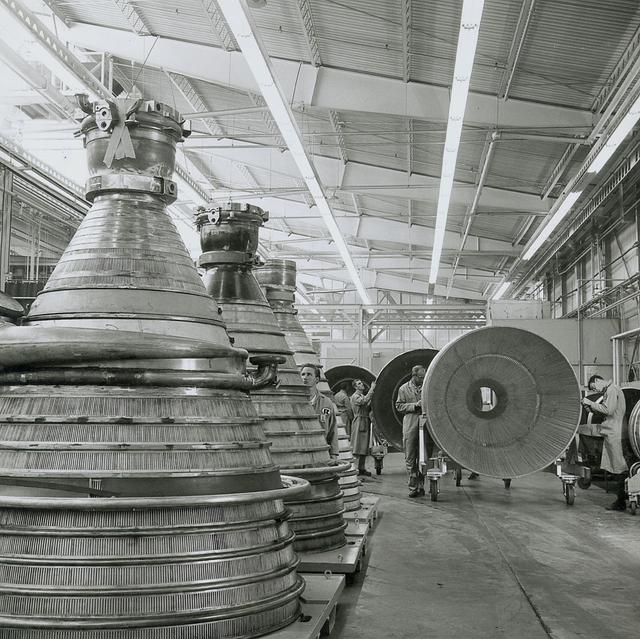
J-2 engines for the Saturn IB/Saturn V launch vehicles are lined up in the assembly area at Rocketdyne's manufacturing plant in Canoga Park, California. Five J-2 engines provided more than 1,000,000 pounds of thrust to accelerate the second stage toward a Moon trajectory.
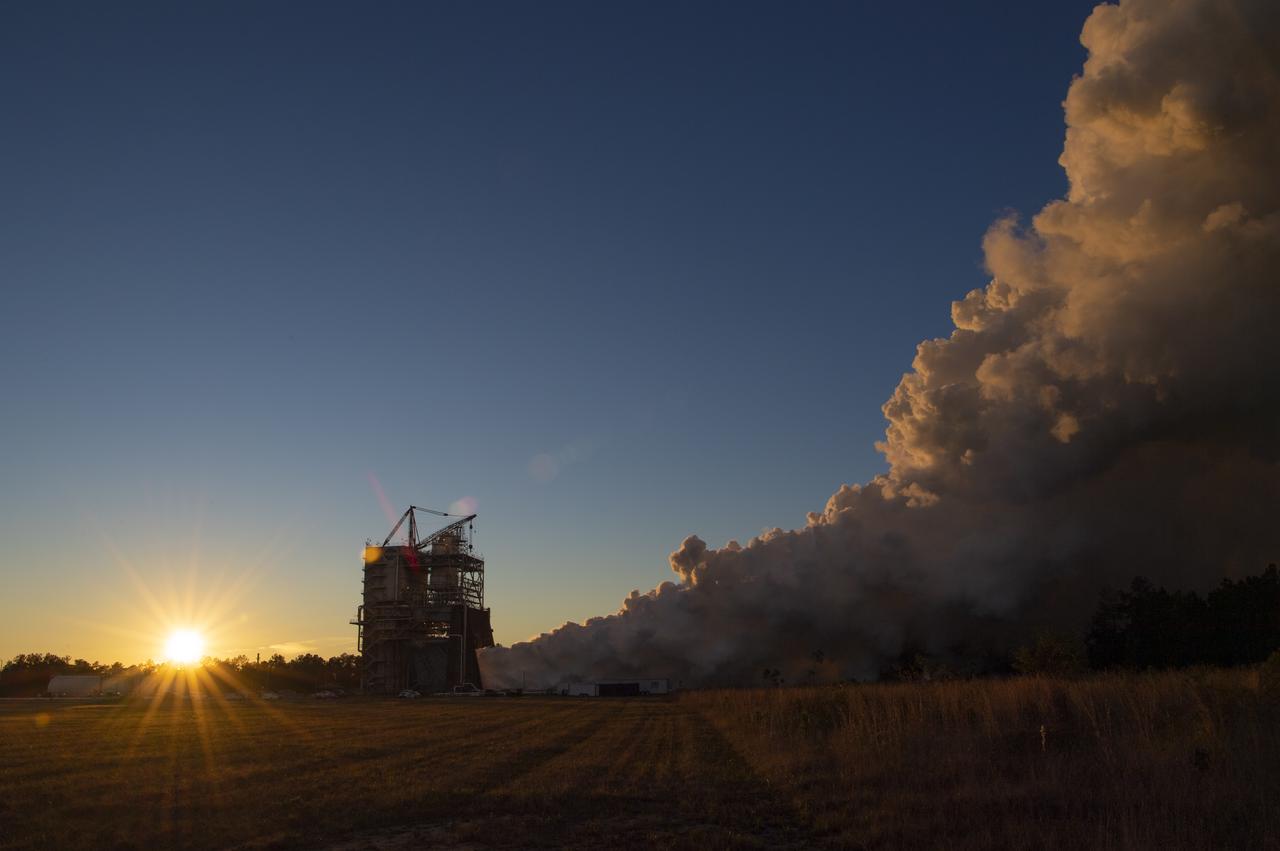
An RS-25 engine is fired at sunset on Nov. 15 on the A-1 test stand at Stennis Space Center. The 650-second duration test represents the time three such engines would need to fire to burn up propellant and power the rocket into orbit, even if the fourth shut down early during an SLS launch.
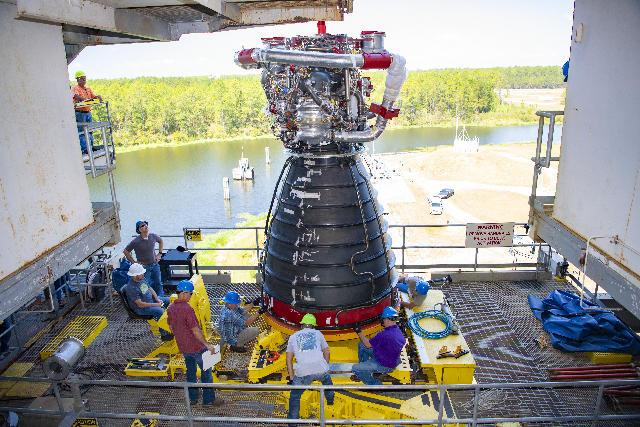
Once crews place the RS-25 engine on the engine vertical installer and it is attached to the Fred Haise Test Stand at NASA’s Stennis Space Center, the installer moves away, and technicians ensure all connections to the test facility are complete for the second certification test series to collect data for the final RS-25 design certification review.
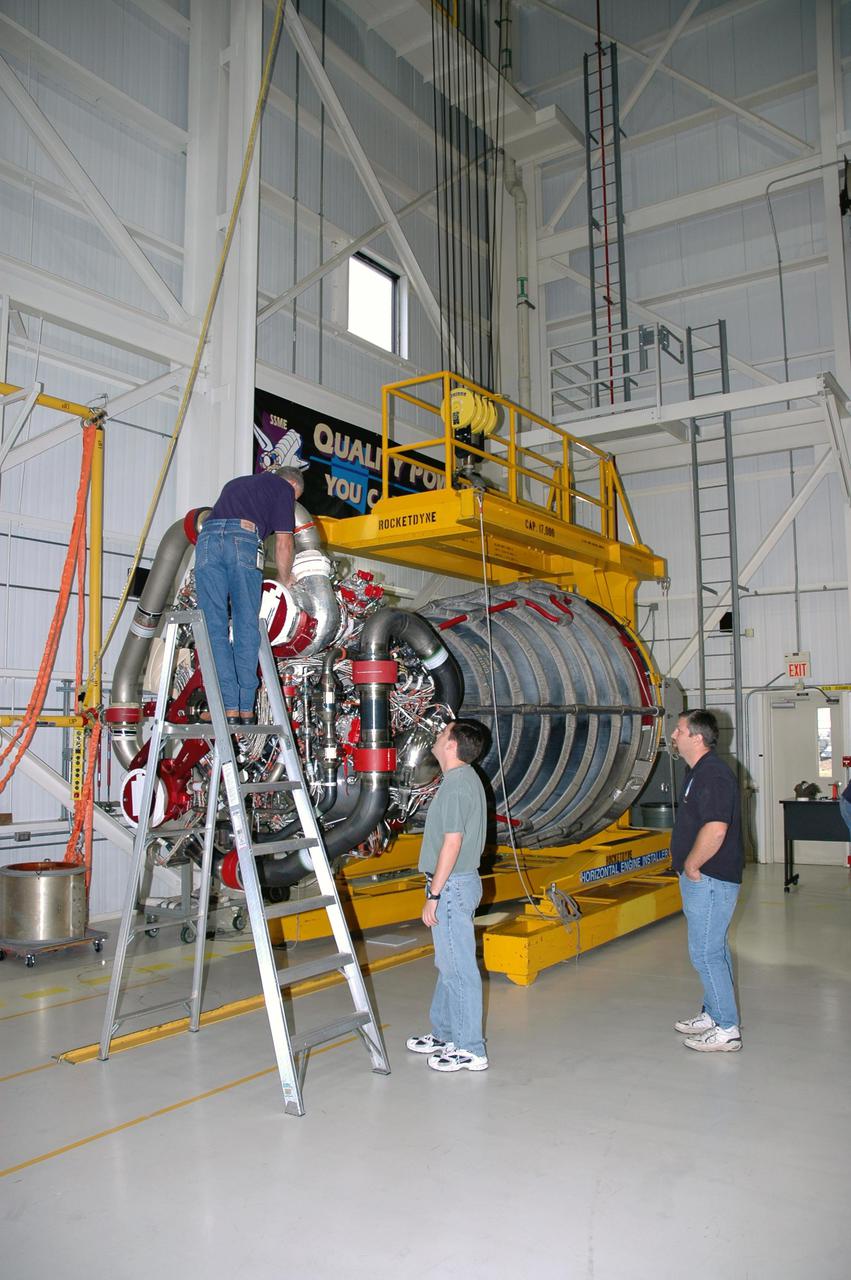
KENNEDY SPACE CENTER, FLA. - Workers in the Space Shuttle Main Engine (SSME) Shop prepare the engine for its move to the Hyster lift and transport to the Orbiter Processing Facility. There it will be installed in the orbiter Discovery for Return to Flight mission STS-114. This is the third SSME to be installed in Discovery. Overall, an SSME weighs approximately 7,000 pounds. An SSME operates at greater temperature extremes than any mechanical system in common use today. The liquid hydrogen fuel is -423 degrees Fahrenheit, the second coldest liquid on Earth. When the hydrogen is burned with liquid oxygen, the temperature in the engine's combustion chamber reaches +6000 degrees Fahrenheit -- higher than the boiling point of iron. Each SSME is controlled by its own computer, which checks the health of the engines 50 times per second during countdown and ascent. The controller can shut an engine down if it detects a problem.

This engineering image derives from 100 seconds of observing time on one of the three science instruments aboard the Space InfraRed Telescope Facility (SIRTF). SIRTF was launched on August 25, and opened up its focal plane to starlight on August 30. This image was obtained as part of the instrument power-on sequence on September 1, one week after launch and a full month before the telescope is expected to reach optimal operating temperature and focus. The stars and galaxies seen in this image already attest to the observatory's great sensitivity in the infrared and to its proper operation. The Space Infrared Telescope Facility (SIRTF) telescope was renamed the Spitzer Space Telescope on December 18, 2003, after the late Dr. Lyman Spitzer, in a contest which was open to the general public. http://photojournal.jpl.nasa.gov/catalog/PIA04724
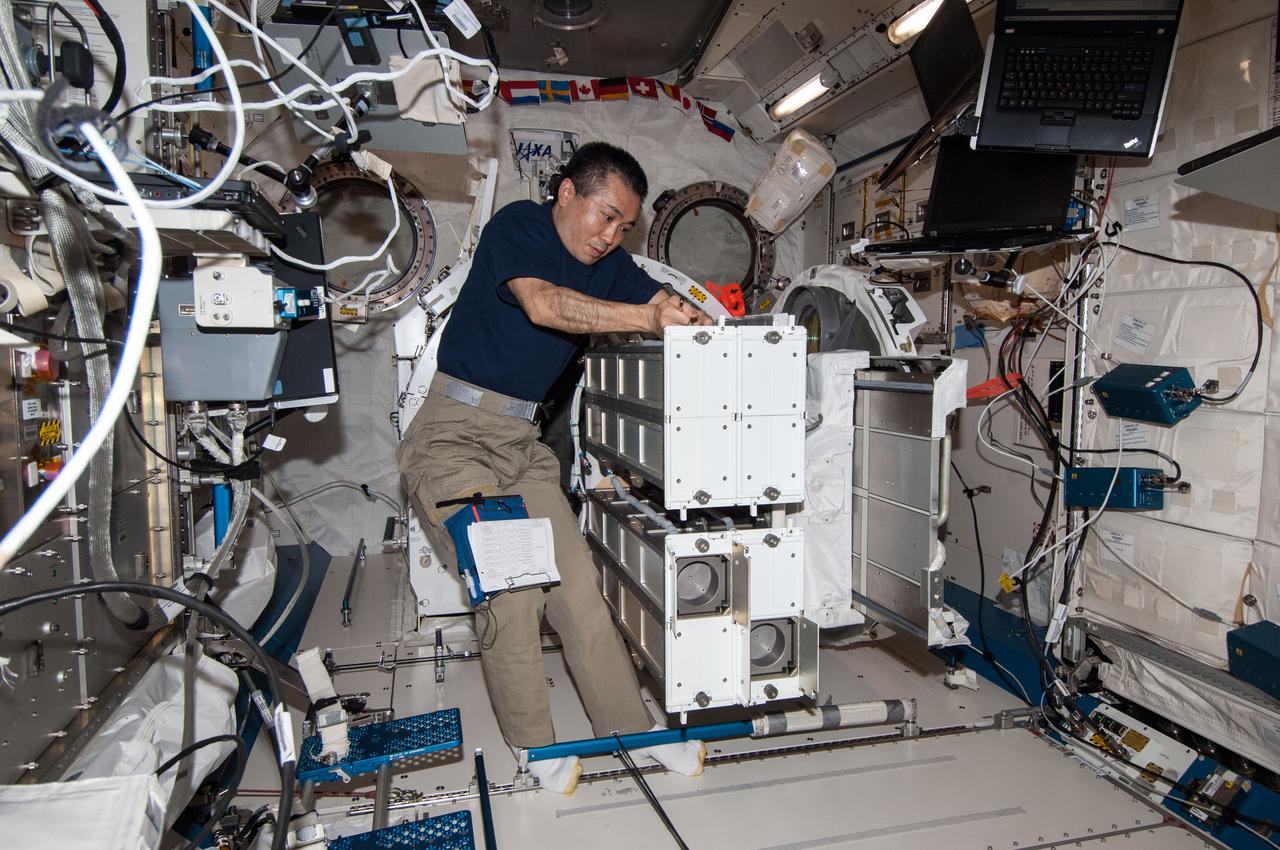
ISS038-E-053269 (19 Feb. 2014) --- In the International Space Station's Kibo laboratory, Japan Aerospace Exploration Agency astronaut Koichi Wakata, Expedition 38 flight engineer, prepares a second batch of NanoRacks CubeSats for deployment.
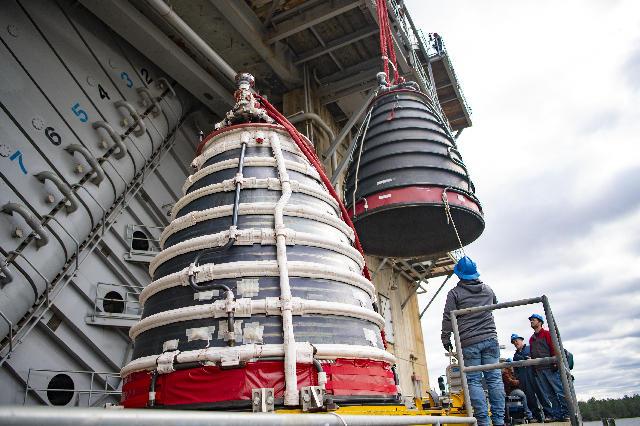
Teams at NASA’s Stennis Space Center install a second production nozzle, left, on Feb. 6 to gather additional performance data on the RS-25 certification engine at the Fred Haise Test Stand.
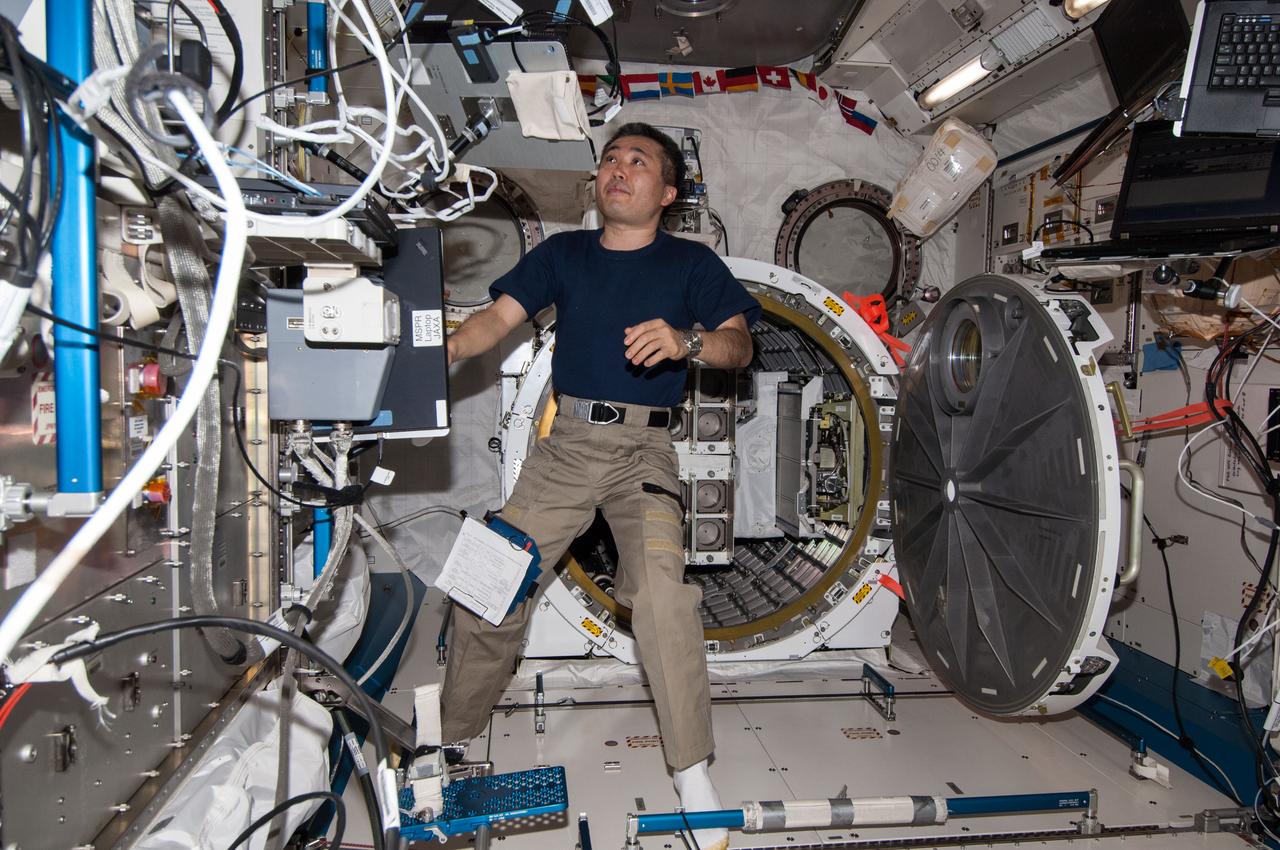
ISS038-E-053257 (19 Feb. 2014) --- In the International Space Station's Kibo laboratory, Japan Aerospace Exploration Agency astronaut Koichi Wakata, Expedition 38 flight engineer, prepares for the deployment of a second batch of NanoRacks CubeSats.
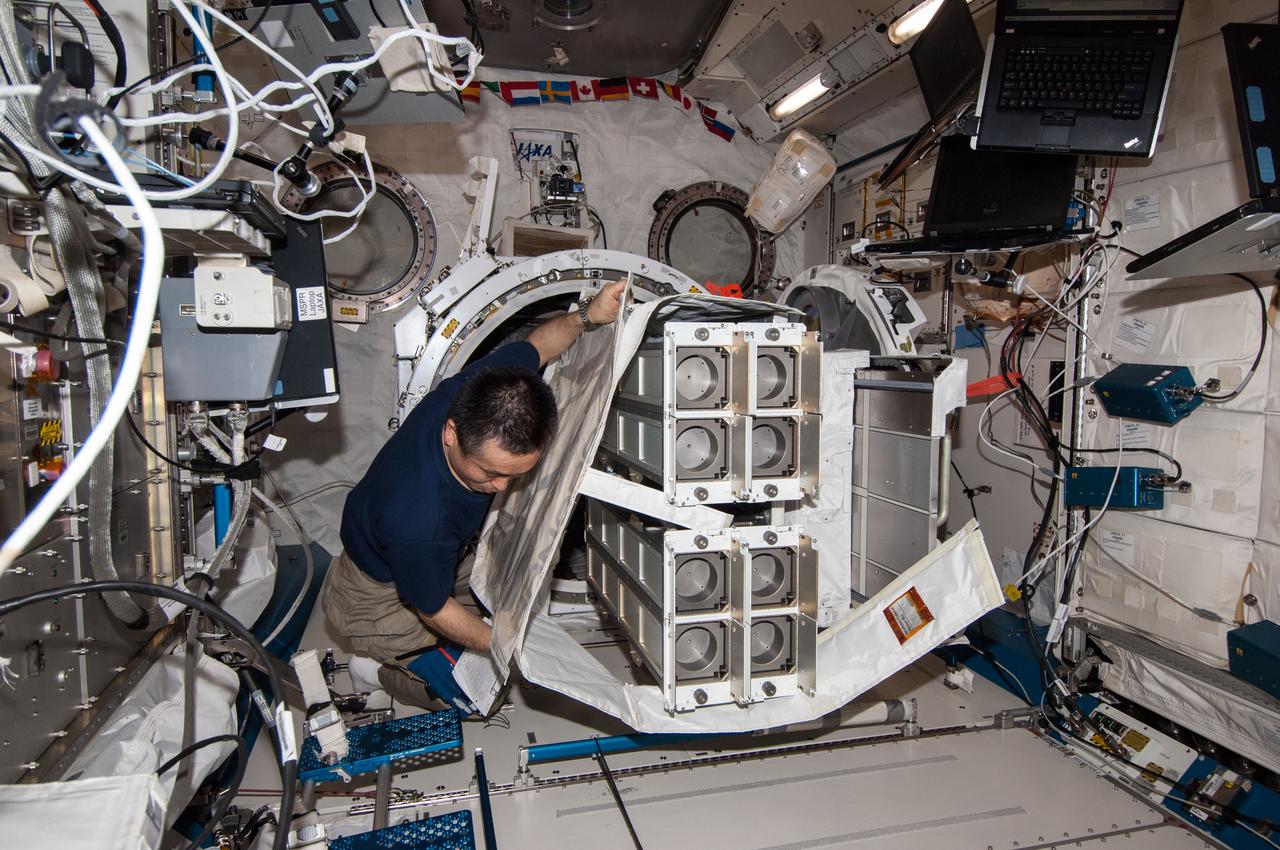
ISS038-E-053264 (19 Feb. 2014) --- In the International Space Station's Kibo laboratory, Japan Aerospace Exploration Agency astronaut Koichi Wakata, Expedition 38 flight engineer, prepares a second batch of NanoRacks CubeSats for deployment.
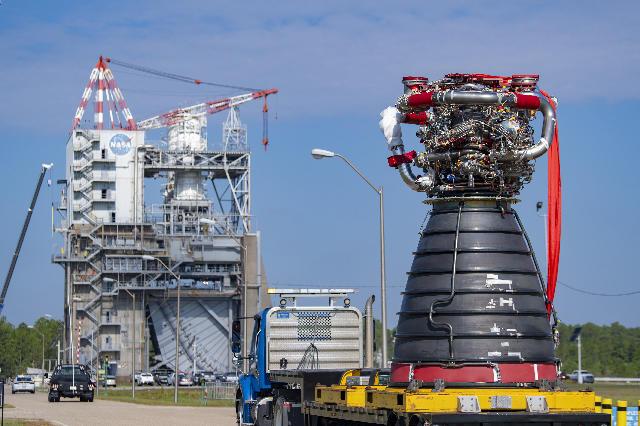
Crews bring RS-25 developmental engine E0525 to the Fred Haise Test Stand at NASA’s Stennis Space Center on Aug. 30 for the second and final certification test series.
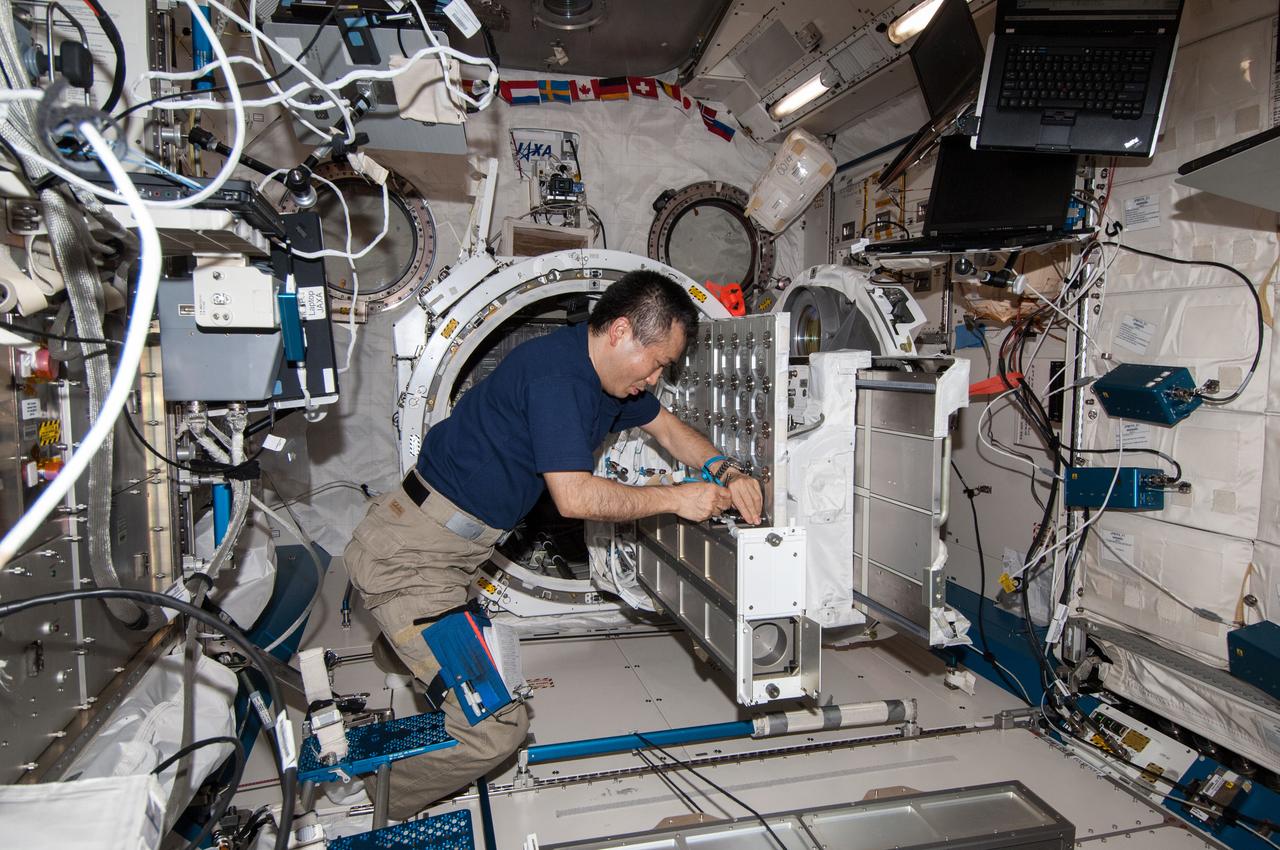
ISS038-E-053280 (19 Feb. 2014) --- In the International Space Station's Kibo laboratory, Japan Aerospace Exploration Agency astronaut Koichi Wakata, Expedition 38 flight engineer, prepares a second batch of NanoRacks CubeSats for deployment.
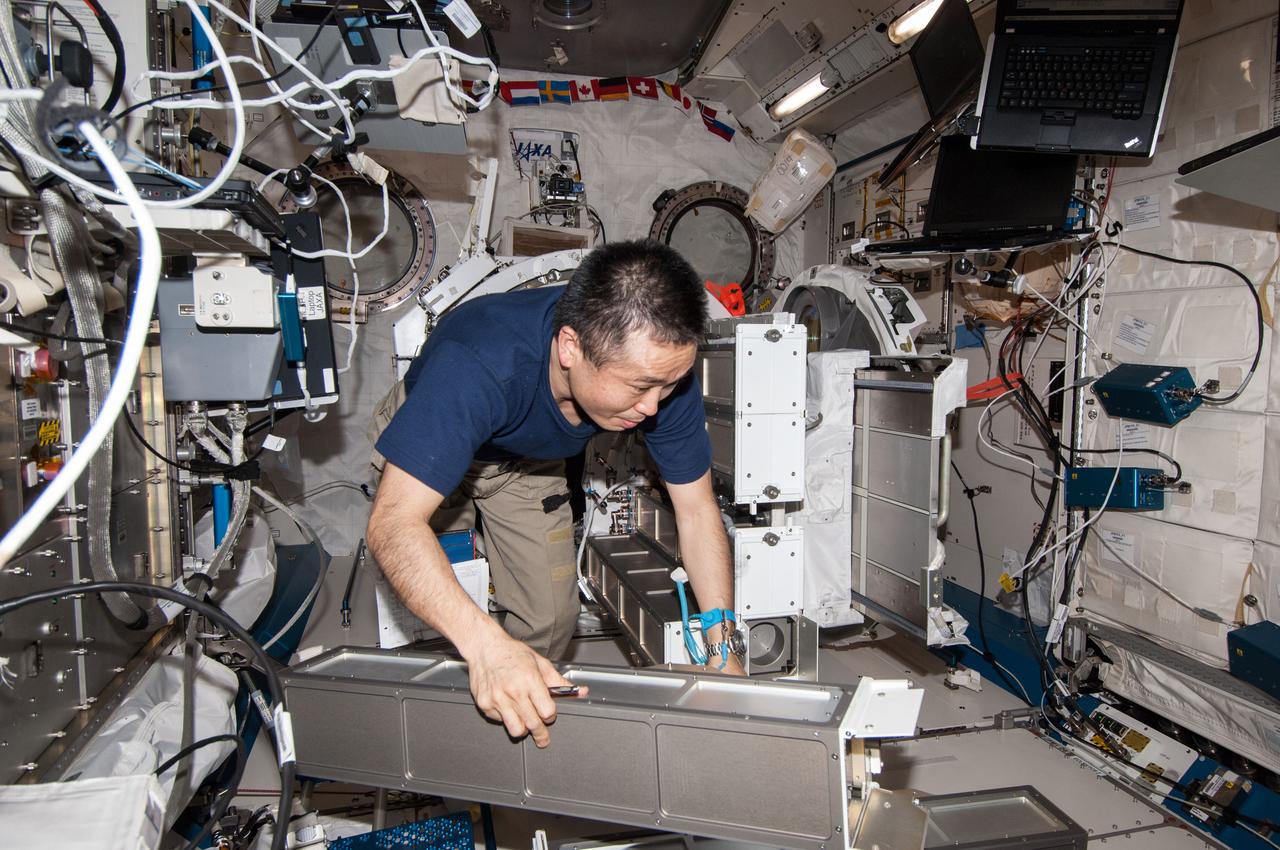
ISS038-E-053276 (19 Feb. 2014) --- In the International Space Station's Kibo laboratory, Japan Aerospace Exploration Agency astronaut Koichi Wakata, Expedition 38 flight engineer, prepares a second batch of NanoRacks CubeSats for deployment.
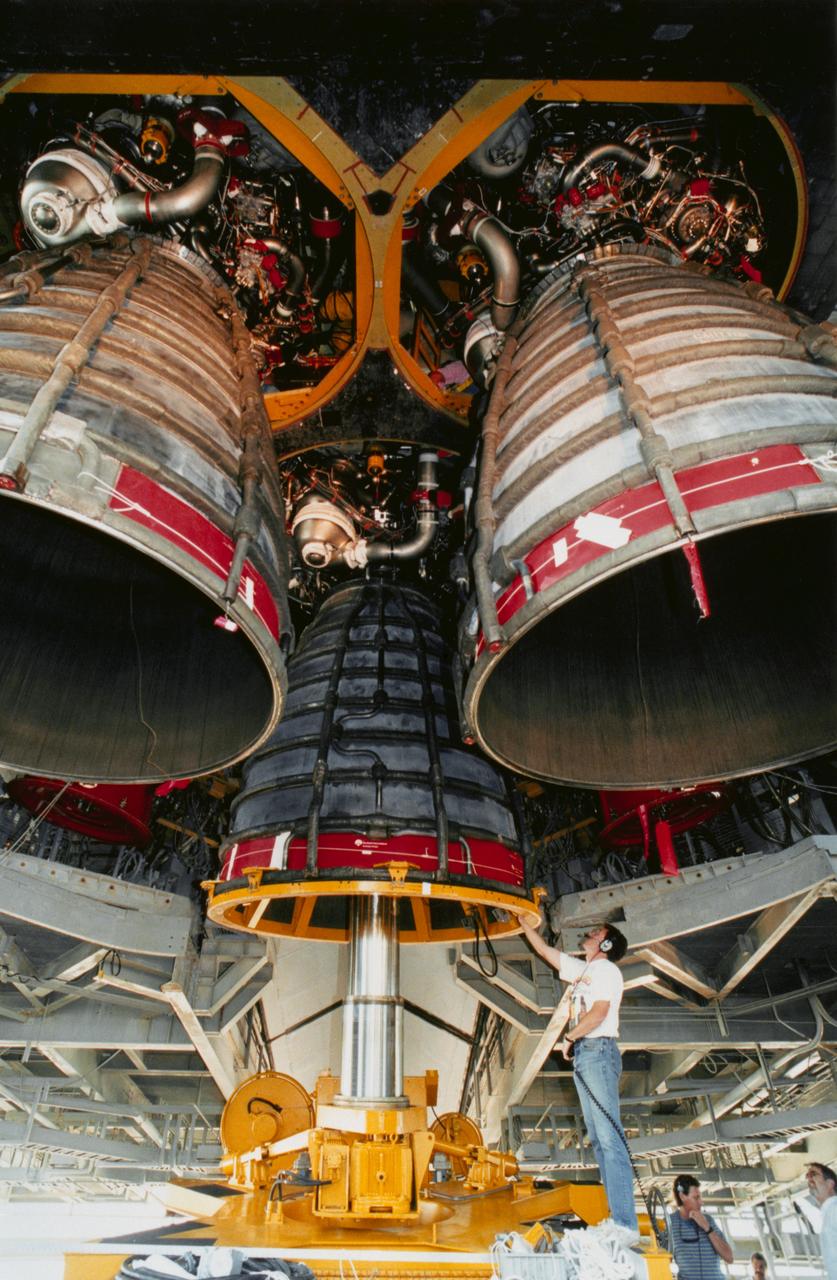
S93-43619 (18 Aug 1993) --- At Launch Pad 39B, work is under way to remove and replace the three main engines on the Space Shuttle Discovery. Here, Rocketdyne workers Jim Tibble (left), John Mooney and Ken Bair are assisting with the removal of the first engine, main engine no. 1, using the engine vertical installer. A failed sensor in main engine no. 2 led to the shutdown of all three engines three seconds before liftoff of mission STS-51 on August 12, 1993. Because it is difficult to perform the necessary inspections, refurbishment, and retesting of a fired engine on a vehicle at the pad, NASA opted to install a fresh set of engines on Discovery.
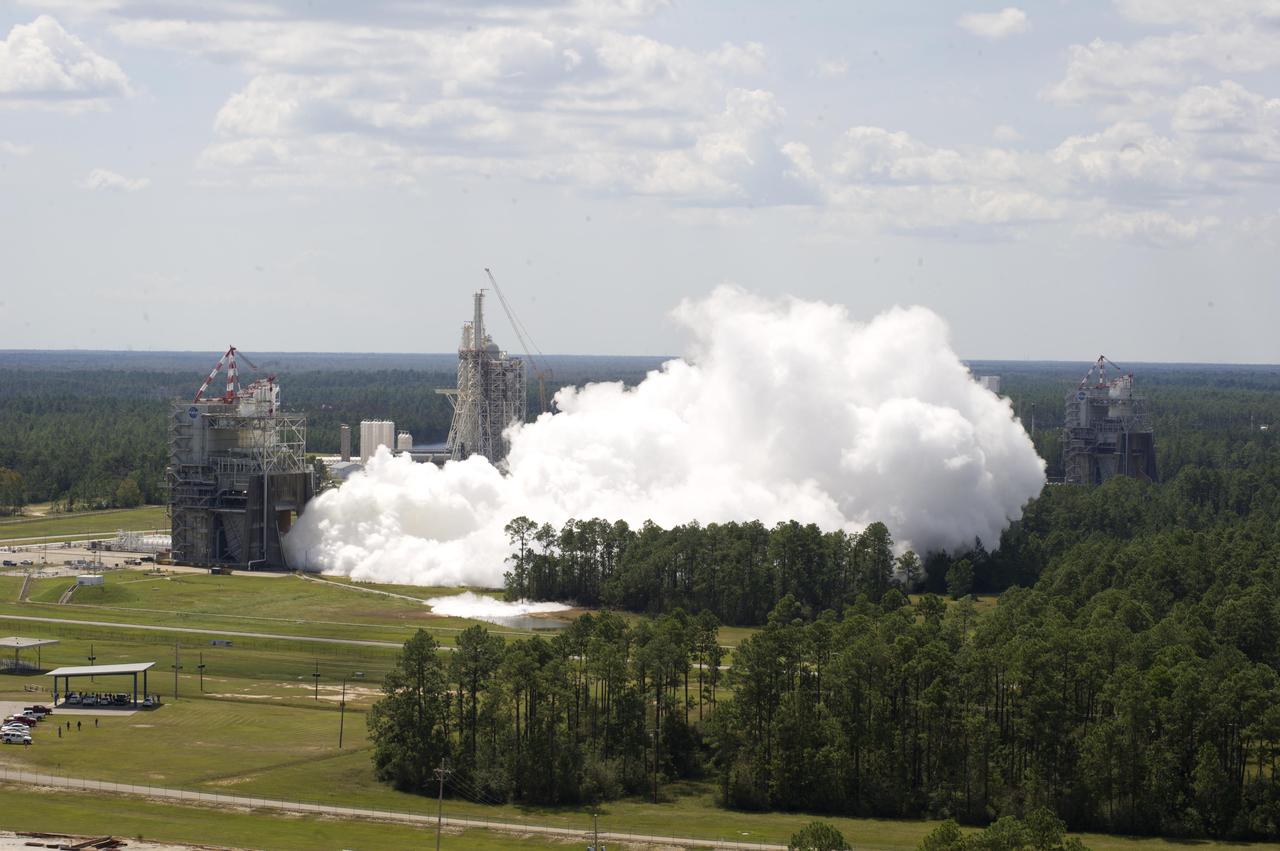
NASA engineers continued to collect test performance data on the new J-2X rocket engine at Stennis Space Center with a 250-second test Sept. 14. The test on the A-2 Test Stand was the 19th in a series of firings to gather critical data for continued development of the engine. The J-2X is being developed by Pratt and Whitney Rocketdyne for NASA's Marshall Space Flight Center in Huntsville, Ala. It is the first liquid oxygen and liquid hydrogen rocket engine rated to carry humans into space to be developed in 40 years.
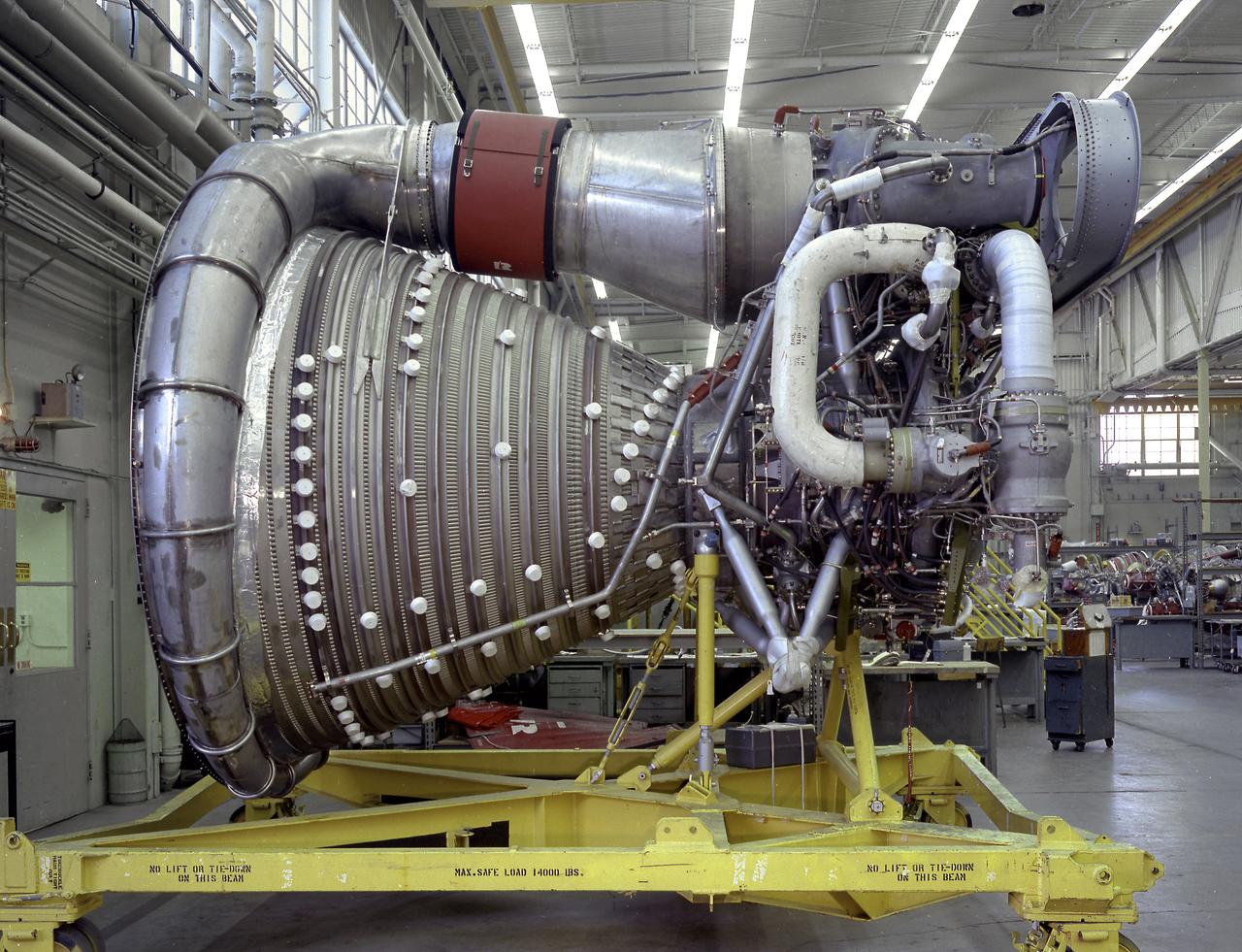
A complete F-1 engine assembly is shown in this photograph. Designed and developed by Rocketdye under the direction of the Marshall Space Flight Center, the engine measured 19-feet tall by 12.5 feet at the nozzle exit, and each engine produced a 1,500,000-pound thrust using liquid oxygen and kerosene as the propellant. A cluster of five F-1 engines was mounted on the Saturn V S-IC (first) stage and burned 15 tons of liquid oxygen and kerosene each second to produce 7,500,000 pounds of thrust.
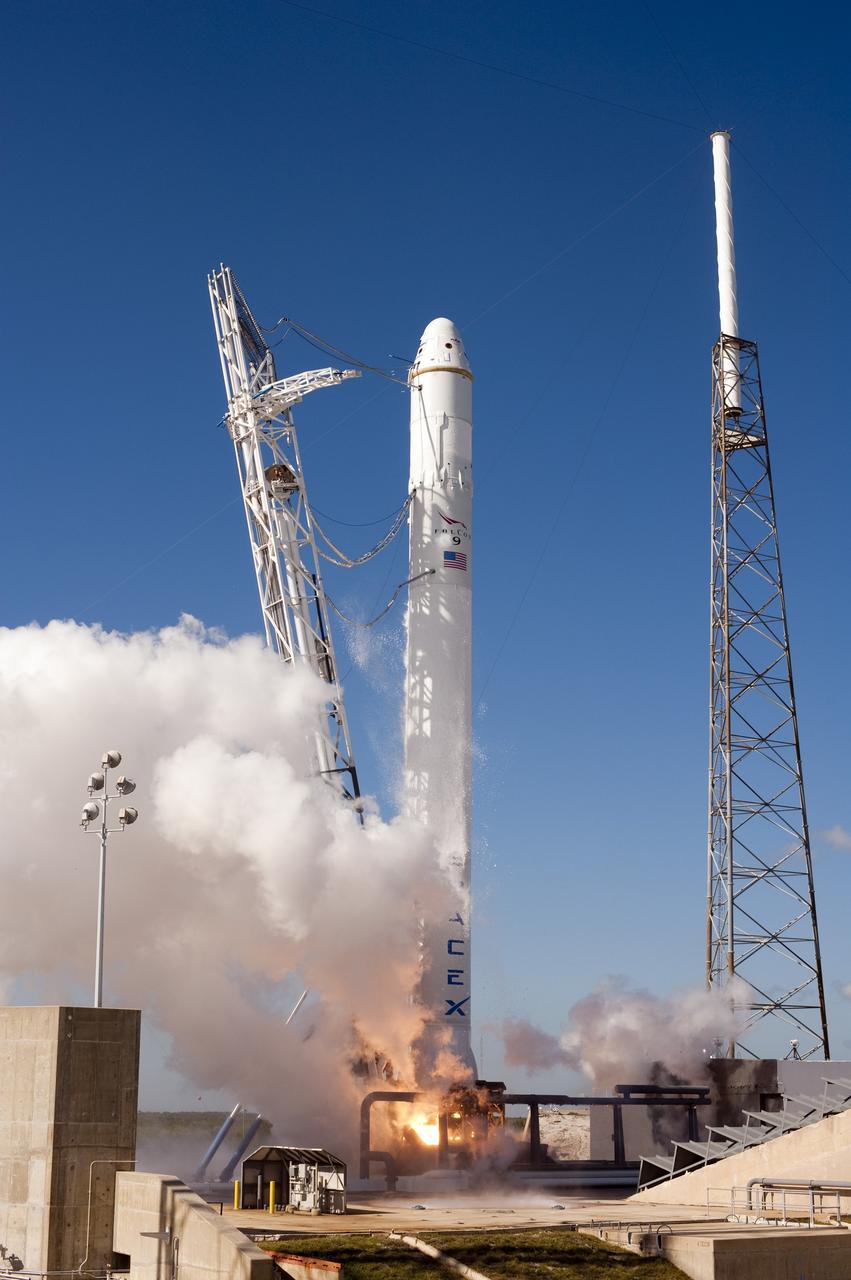
CAPE CANAVERAL, Fla. -- The SpaceX Falcon 9 rocket static fire test on Space Launch Complex-40 at Cape Canaveral Air Force Station was aborted at T minus 1.1 seconds due to high engine chamber pressure. During the test, all nine Merlin engines, which use rocket-grade kerosene and liquid oxygen to produce 1 million pounds of thrust, are expected to fire at once. After the test, SpaceX will conduct a thorough review of all data as engineers make final preparations for the first launch of the Commercial Orbital Transportation Services (COTS) Dragon spacecraft to low Earth orbit atop the Falcon 9. This first stage firing is part of a full launch dress rehearsal, which will end after the engines fire at full power for two seconds, with only the hold-down system restraining the rocket from flight. Photo credit: NASA/Tony Gray and Kevin O'Connell
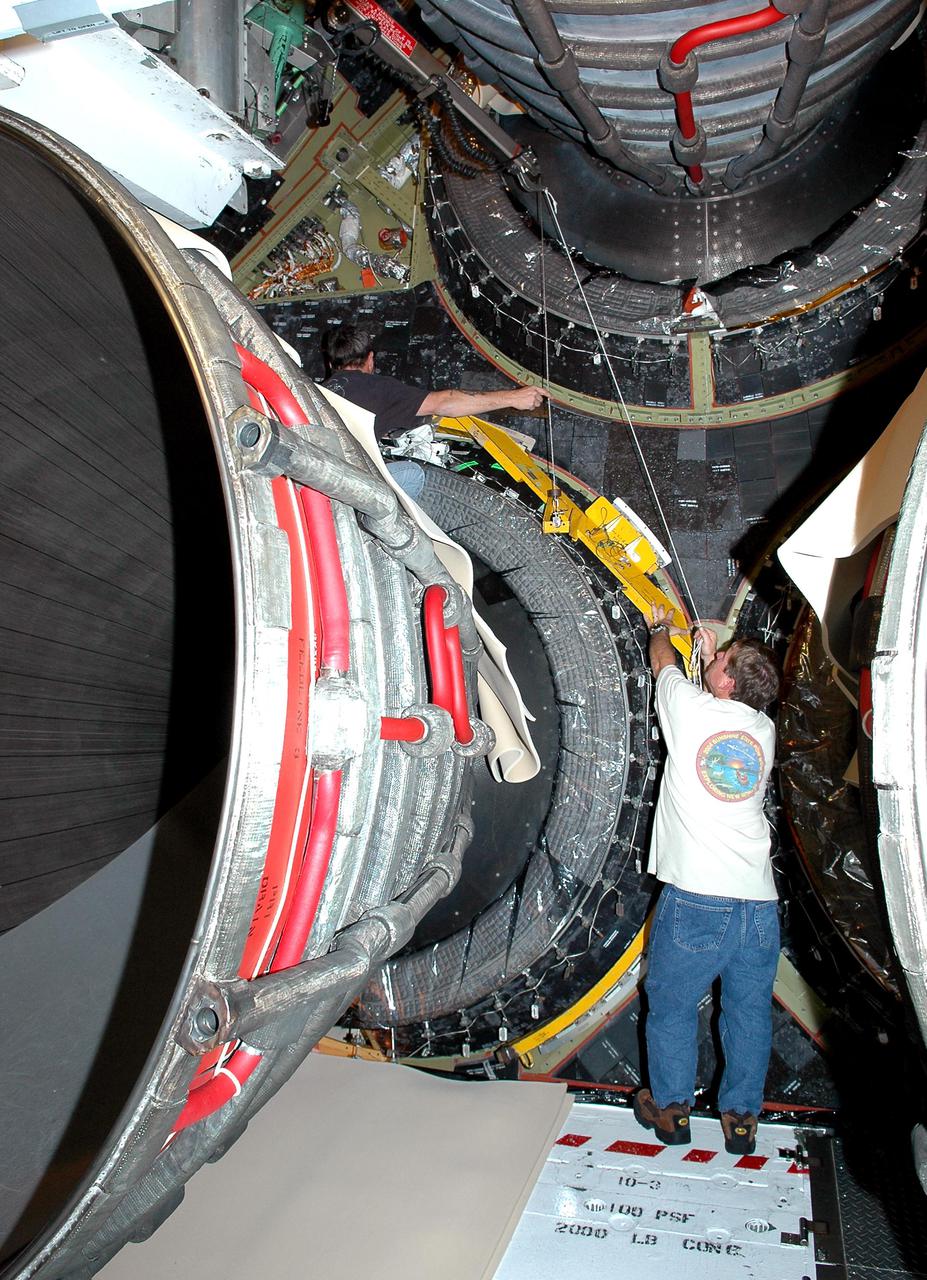
KENNEDY SPACE CENTER, FLA. - Dave Fentris (upper left) and Gary Austin , aft mechanical technicians with United Space Alliance, are attaching dome heat shields to Space Shuttle Main Engines (SSME) on the orbiter Atlantis in Orbiter Processing Facility bay 1. The shields provide protection for the orbiter against the high temperatures generated by an SSME. The liquid hydrogen fuel is - 423 degrees Fahrenheit, the second coldest liquid on Earth. When the hydrogen is burned with liquid oxygen, the temperature in the engine's combustion chamber reaches +6000 degrees Fahrenheit - that’s higher than the boiling point of iron. Each SSME is controlled by its own computer, which checks the health of the engines 50 times per second during countdown and ascent. The controller can shut an engine down if it detects a problem. Atlantis is scheduled to launch in July on mission STS-121.
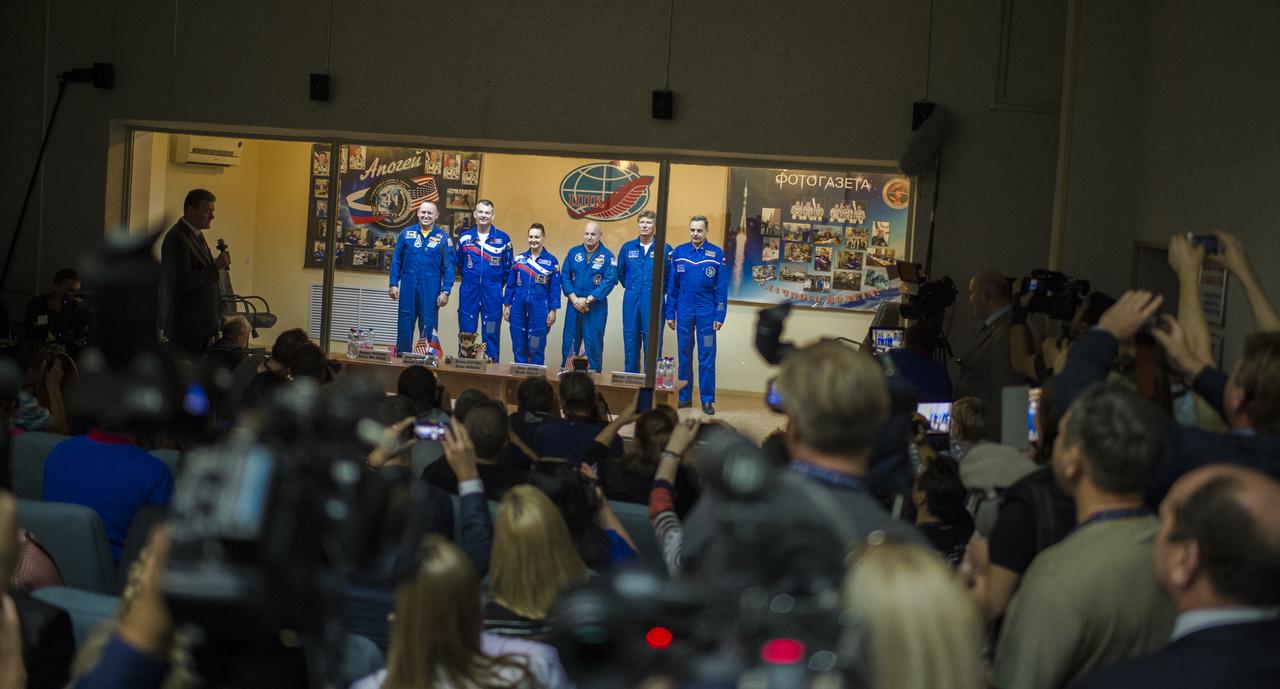
Expedition 41 prime crew members Flight Engineer Barry Wilmore of NASA, far left, Soyuz Commander Alexander Samokutyaev of the Russian Federal Space Agency (Roscosmos), second left, and Flight Engineer Elena Serova, of Roscosmos, center, pose for a picture with Expedition 41 backup crew members Flight Engineer Scott Kelly of NASA, third right, Soyuz Commander Gennady Padalka of Roscosmos, second right, and Flight Engineer Mikhail Kornienko of Roscosmos, far right, at the conclusion of a press conference, Wednesday, September 24, 2014, at the Cosmonaut Hotel in Baikonur, Kazakhstan. Samokutyaev, Serova, and Wilmore will launch about their Soyuz TMA-14M spacecraft in the early hours of September 26. Serova will become the fourth Russian woman to fly in space and the first Russian woman to live and work on the station. Photo Credit: (NASA/Joel Kowsky)
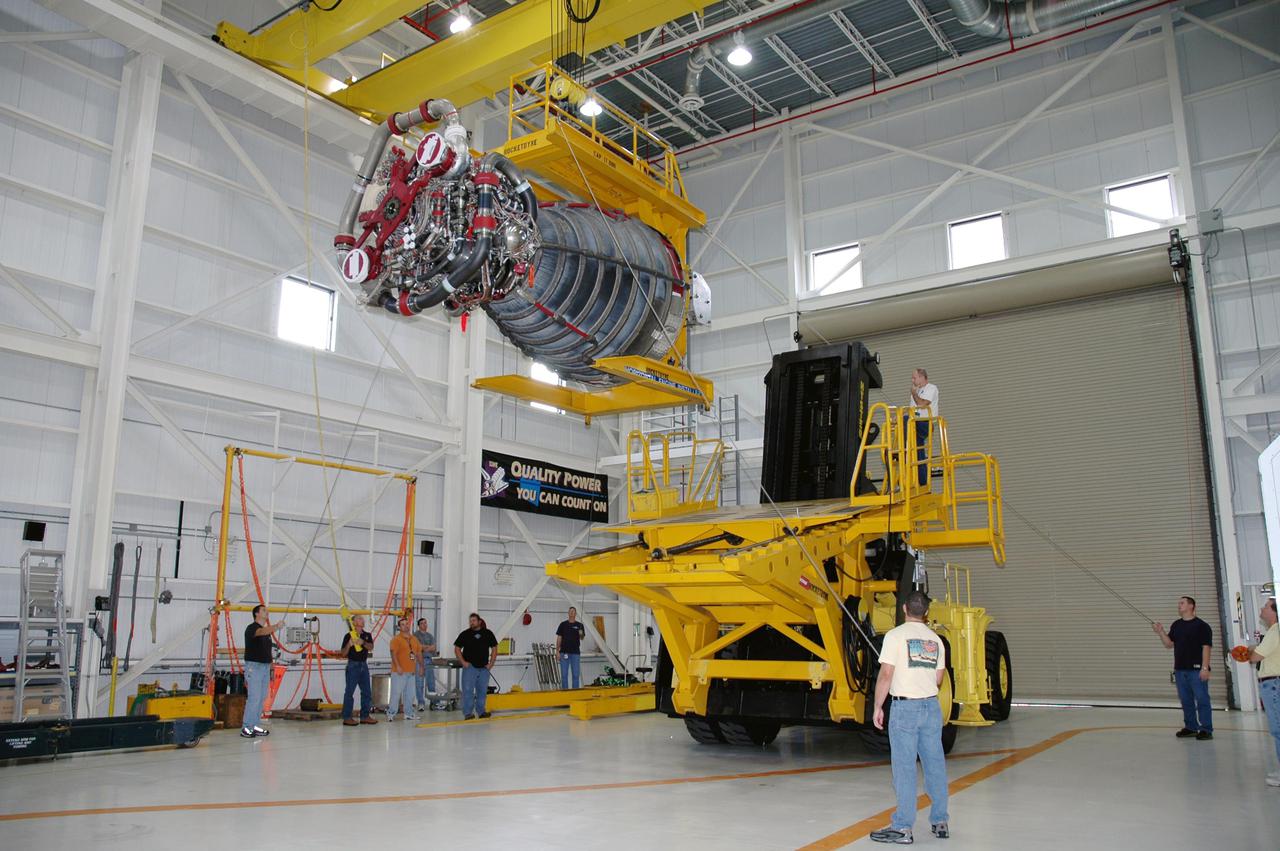
KENNEDY SPACE CENTER, FLA. - In the Space Shuttle Main Engine (SSME) Shop, the SSME is lifted and moved toward the Hyster lift that will transport it to the Orbiter Processing Facility. There it will be installed in the orbiter Discovery for Return to Flight mission STS-114. This is the third SSME to be installed in Discovery. Overall, an SSME weighs approximately 7,000 pounds. An SSME operates at greater temperature extremes than any mechanical system in common use today. The liquid hydrogen fuel is -423 degrees Fahrenheit, the second coldest liquid on Earth. When the hydrogen is burned with liquid oxygen, the temperature in the engine's combustion chamber reaches +6000 degrees Fahrenheit -- higher than the boiling point of iron. Each SSME is controlled by its own computer, which checks the health of the engines 50 times per second during countdown and ascent. The controller can shut an engine down if it detects a problem.
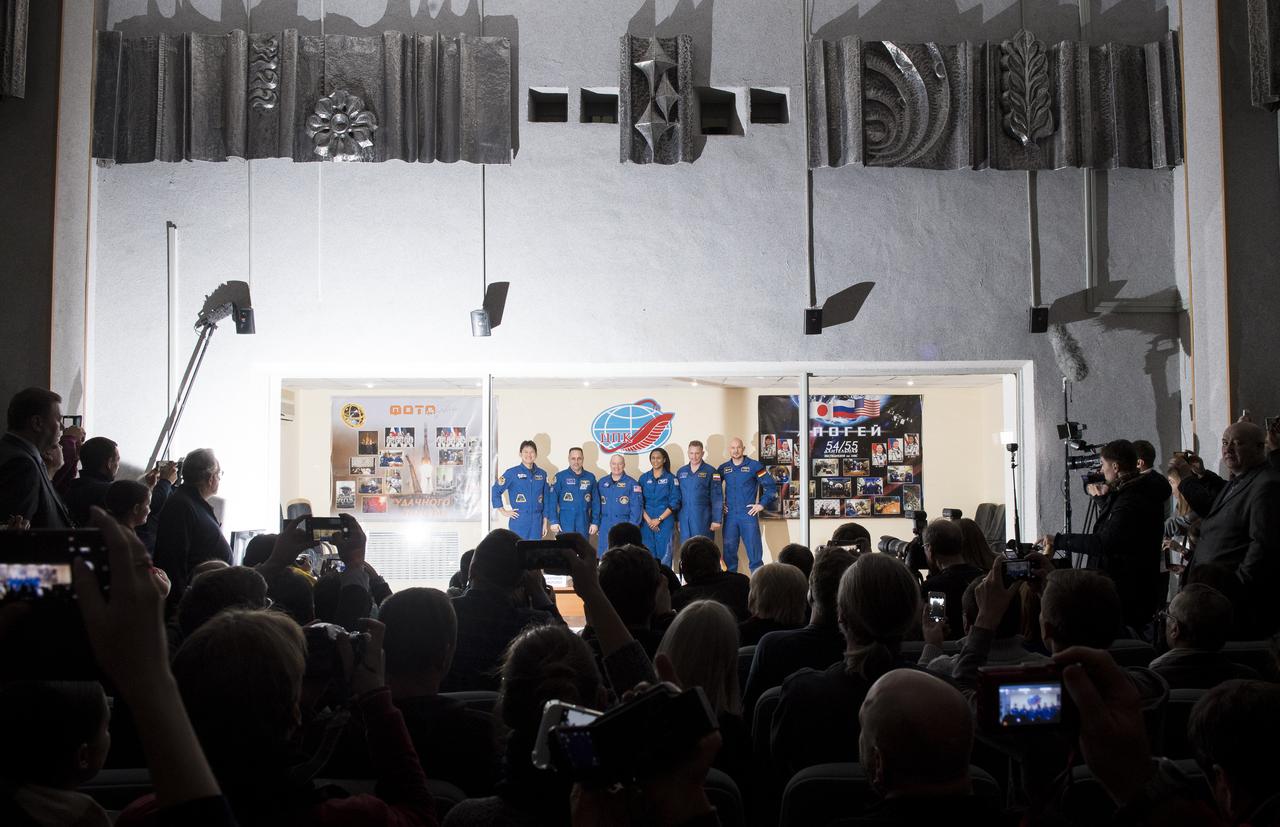
Expedition 54 prime crew members flight engineer Norishige Kanai of the Japan Aerospace Exploration Agency (JAXA), left, Soyuz Commander Anton Shkaplerov of Roscosmos, second from left, flight engineer Scott Tingle of NASA, third from left, pose for a picture with backup crew members Jeanette Epps of NASA, third from right, Sergey Prokopev of Roscosmos, second from right, and Alex Gerst of ESA (European Space Agency), right, at the conclusion of a press conference, Saturday, Dec. 16, 2017 at the Cosmonaut Hotel in Baikonur, Kazakhstan. Expedition 54 Soyuz Commander Anton Shkaplerov of Roscosmos, flight engineer Scott Tingle of NASA, and flight engineer Norishige Kanai of Japan Aerospace Exploration Agency (JAXA) are scheduled to launch to the International Space Station aboard the Soyuz spacecraft from the Baikonur Cosmodrome on December 17. Photo Credit: (NASA/Joel Kowsky)
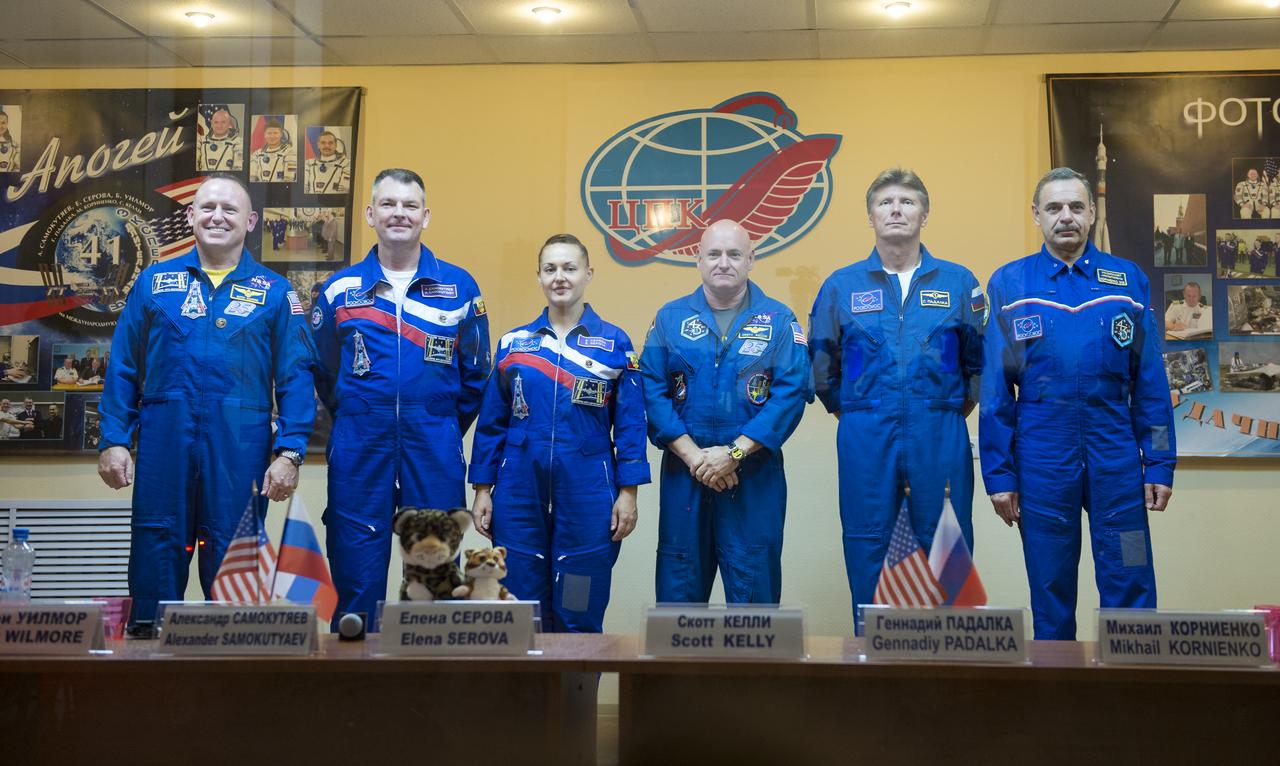
Expedition 41 prime crew members Flight Engineer Barry Wilmore of NASA, far left, Soyuz Commander Alexander Samokutyaev of the Russian Federal Space Agency (Roscosmos), second left, and Flight Engineer Elena Serova of Roscosmos, center, are seen with Expedition 41 back up crew members, Flight Engineer Scott Kelly of NASA, third right, Soyuz Commander Gennady Padalka of Roscosmos, second right, and Flight Engineer Mikhail Kornienko of Roscosmos, right, during a press conference held at the Cosmonaut Hotel in Baikonur, Kazakhstan on Wednesday, Sept. 24, 2014. The prime crew is set to launch to the International Space Station on Sept. 26 from the Baikonur Cosmodrome. Photo Credit: (NASA/Aubrey Gemignani)
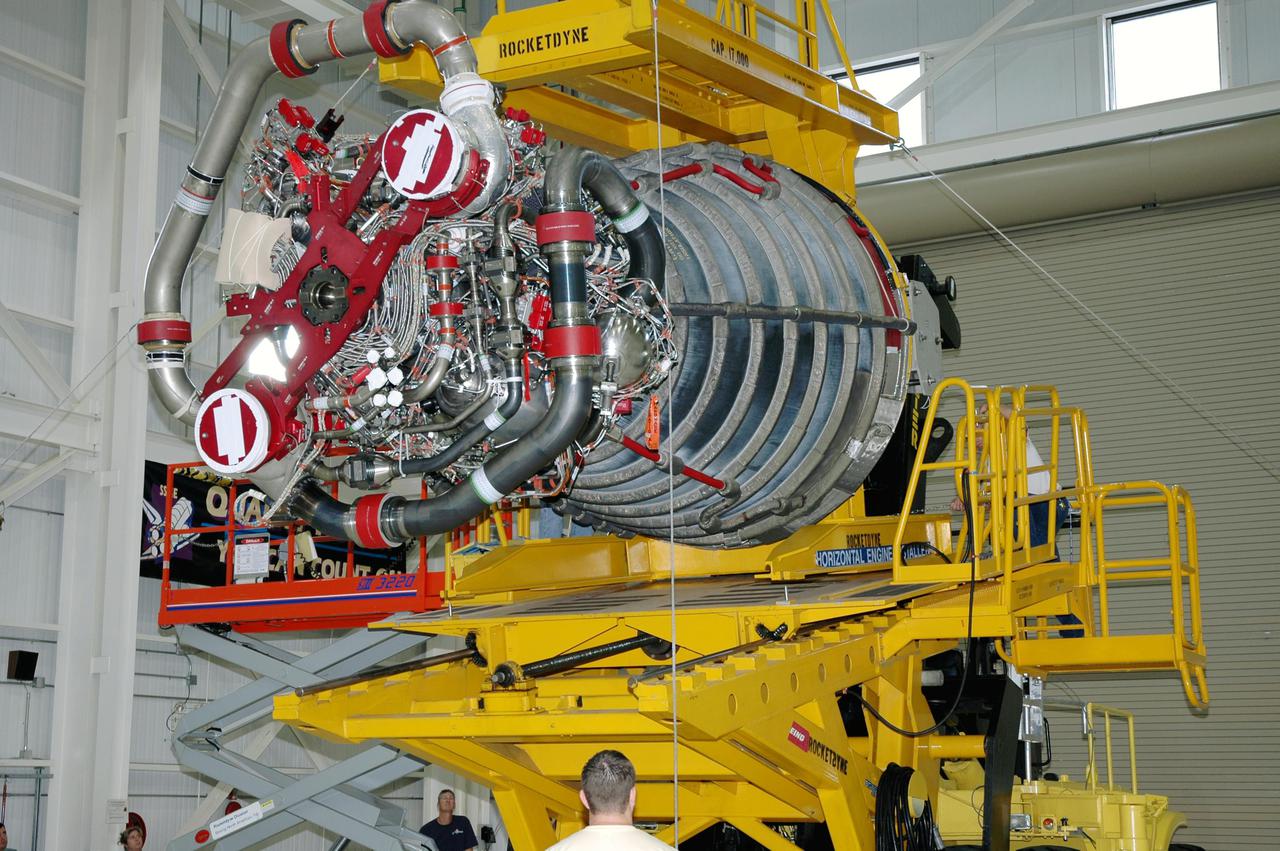
KENNEDY SPACE CENTER, FLA. - In the Space Shuttle Main Engine (SSME) Shop, the SSME is lowered onto the Hyster lift for transport to the Orbiter Processing Facility. There it will be installed in the orbiter Discovery for Return to Flight mission STS-114. This is the third SSME to be installed in Discovery. Overall, an SSME weighs approximately 7,000 pounds. An SSME operates at greater temperature extremes than any mechanical system in common use today. The liquid hydrogen fuel is -423 degrees Fahrenheit, the second coldest liquid on Earth. When the hydrogen is burned with liquid oxygen, the temperature in the engine's combustion chamber reaches +6000 degrees Fahrenheit -- higher than the boiling point of iron. Each SSME is controlled by its own computer, which checks the health of the engines 50 times per second during countdown and ascent. The controller can shut an engine down if it detects a problem.
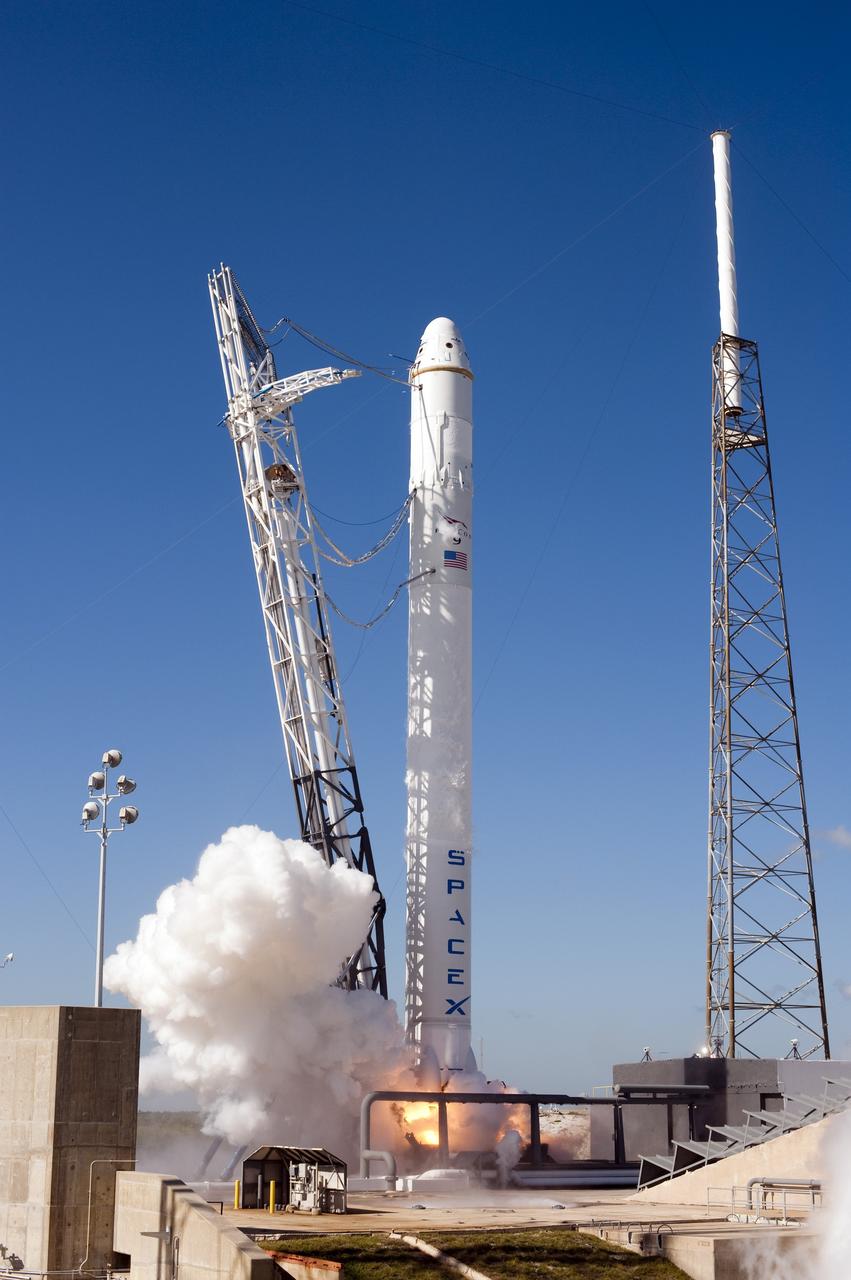
CAPE CANAVERAL, Fla. -- The SpaceX Falcon 9 rocket static fire test on Space Launch Complex-40 at Cape Canaveral Air Force Station was aborted at T minus 1.1 seconds due to high engine chamber pressure. During the test, all nine Merlin engines, which use rocket-grade kerosene and liquid oxygen to produce 1 million pounds of thrust, are expected to fire at once. After the test, SpaceX will conduct a thorough review of all data as engineers make final preparations for the first launch of the Commercial Orbital Transportation Services (COTS) Dragon spacecraft to low Earth orbit atop the Falcon 9. This first stage firing is part of a full launch dress rehearsal, which will end after the engines fire at full power for two seconds, with only the hold-down system restraining the rocket from flight. Photo credit: NASA/Tony Gray and Kevin O'Connell