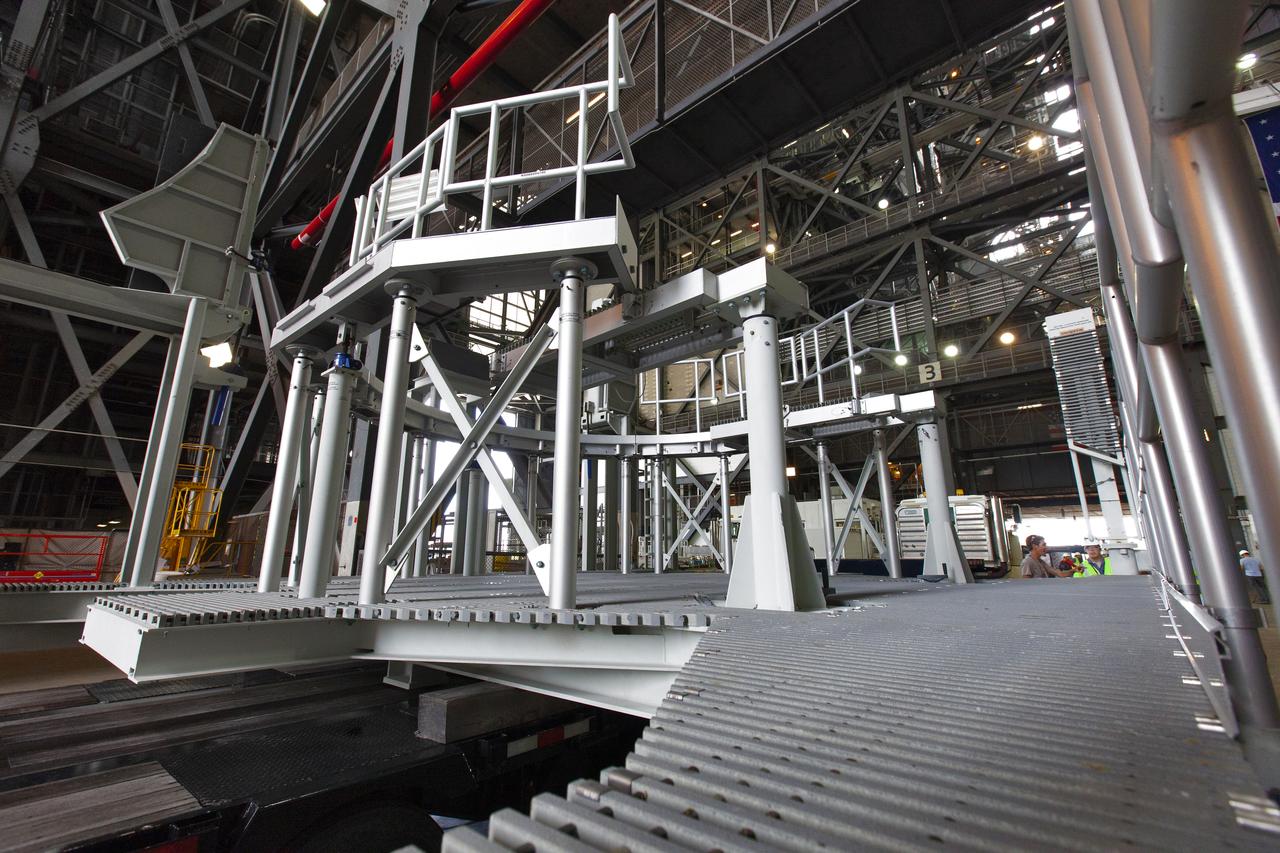
The engine service platform that will provide access to the core stage of the Space Launch System (SLS) rocket is moved beneath the mobile launcher (ML) in High Bay 3 of the Vehicle Assembly Building at NASA’s Kennedy Space Center in Florida on June 14, 2019. The large work platform is designed to provide unrestricted access to the RS-25 engines on the SLS core stage from the ML. The service platform will be used for Artemis 1 and subsequent missions. For Artemis 1, the Orion spacecraft will launch atop the SLS rocket from Launch Pad 39B and begin an approximately three-week mission that will send Orion thousands of miles beyond the Moon. Exploration Ground Systems is overseeing work on the ML.
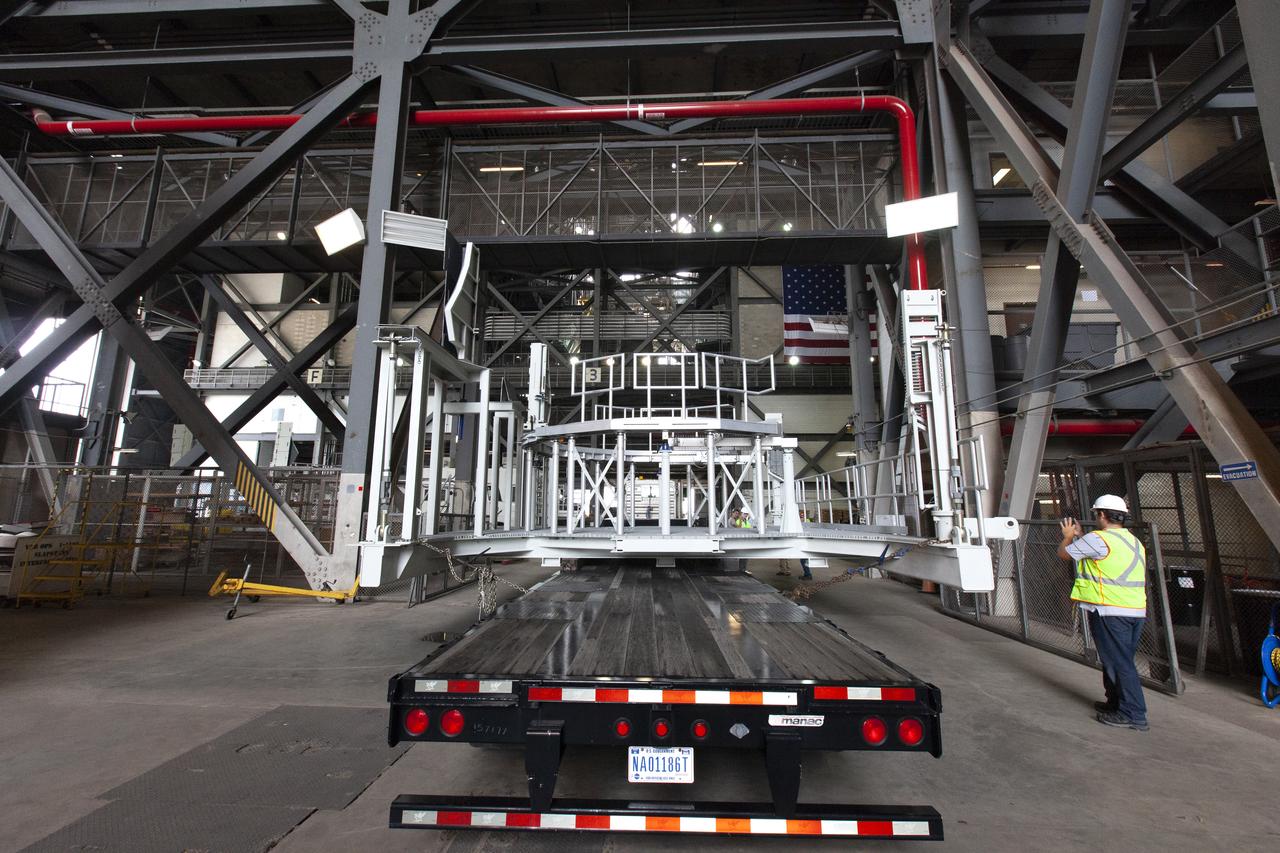
The engine service platform that will provide access to the core stage of the Space Launch System (SLS) rocket arrives in the Vehicle Assembly Building at NASA’s Kennedy Space Center in Florida on June 14, 2019. The large work platform is designed to provide unrestricted access to the RS-25 engines on the SLS core stage from the ML. The service platform will be used for Artemis 1 and subsequent missions. For Artemis 1, the Orion spacecraft will launch atop the SLS rocket from Launch Pad 39B and begin an approximately three-week mission that will send Orion thousands of miles beyond the Moon. Exploration Ground Systems is overseeing work on the ML.

The engine service platform that will provide access to the core stage of the Space Launch System (SLS) rocket is moved beneath the mobile launcher (ML) in High Bay 3 of the Vehicle Assembly Building at NASA’s Kennedy Space Center in Florida on June 14, 2019. The large work platform is designed to provide unrestricted access to the RS-25 engines on the SLS core stage from the ML. The service platform will be used for Artemis 1 and subsequent missions. For Artemis 1, the Orion spacecraft will launch atop the SLS rocket from Launch Pad 39B and begin an approximately three-week mission that will send Orion thousands of miles beyond the Moon. Exploration Ground Systems is overseeing work on the ML.
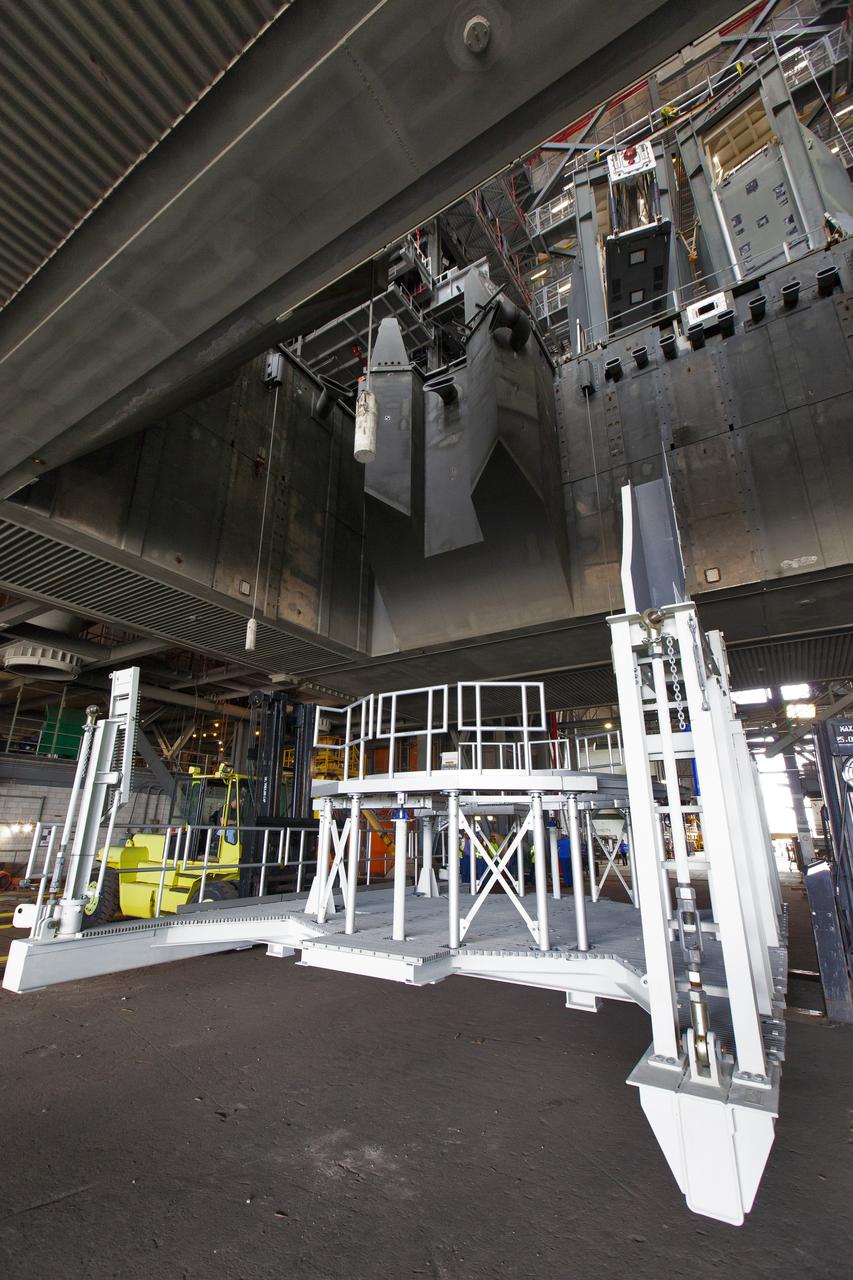
The engine service platform that will provide access to the core stage of the Space Launch System (SLS) rocket arrives in High Bay 3 of the Vehicle Assembly Building at NASA’s Kennedy Space Center in Florida on June 14, 2019. The large work platform is designed to provide unrestricted access to the RS-25 engines on the SLS core stage from the ML. The service platform will be used for Artemis 1 and subsequent missions. For Artemis 1, the Orion spacecraft will launch atop the SLS rocket from Launch Pad 39B and begin an approximately three-week mission that will send Orion thousands of miles beyond the Moon. Exploration Ground Systems is overseeing work on the ML.
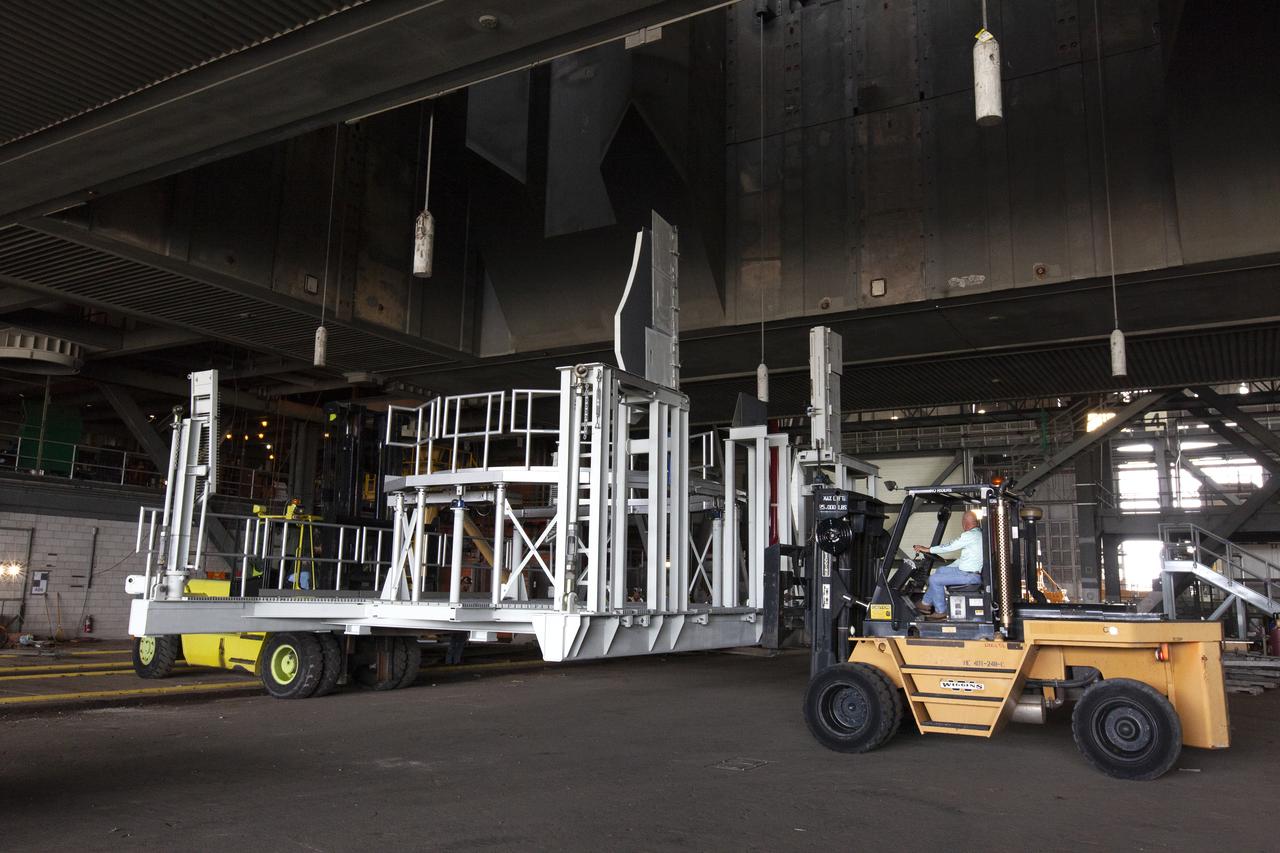
The engine service platform that will provide access to the core stage of the Space Launch System (SLS) rocket arrives in High Bay 3 of the Vehicle Assembly Building at NASA’s Kennedy Space Center in Florida on June 14, 2019. The large work platform is designed to provide unrestricted access to the RS-25 engines on the SLS core stage from the ML. The service platform will be used for Artemis 1 and subsequent missions. For Artemis 1, the Orion spacecraft will launch atop the SLS rocket from Launch Pad 39B and begin an approximately three-week mission that will send Orion thousands of miles beyond the Moon. Exploration Ground Systems is overseeing work on the ML.
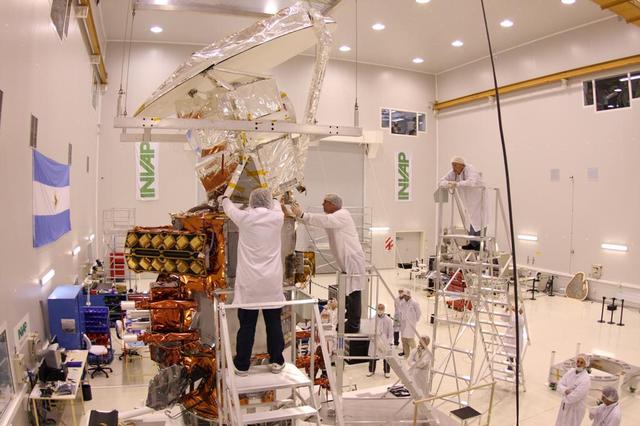
NASA Aquarius instrument is lifted upright onto the SAC-D service platform at the INVAP high bay facility in Bariloche, Argentina.
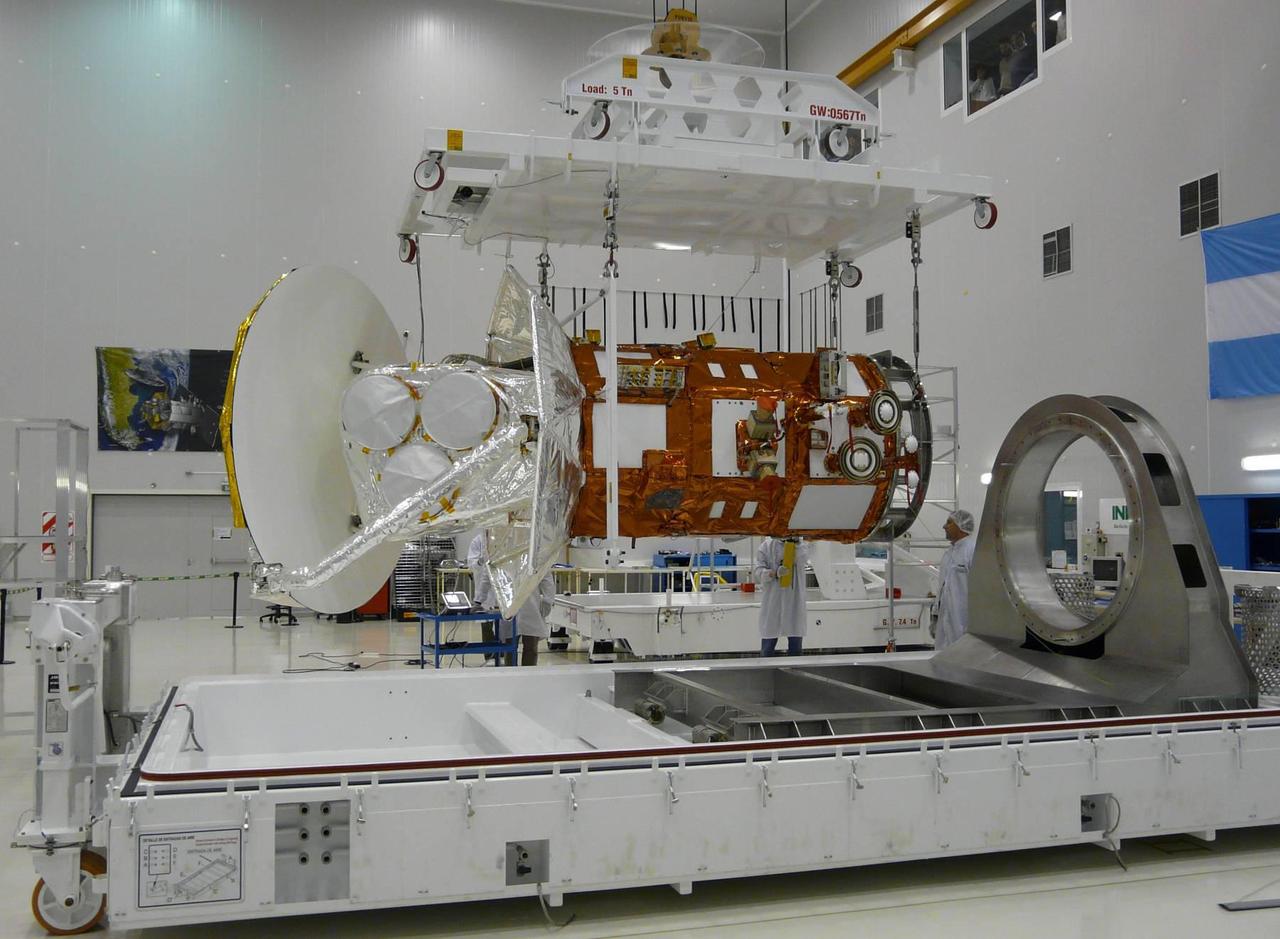
After months of integration and testing at the INVAP facility Bariloche, Argentina, NASA Aquarius/SAC-D is removed from the service platform in preparation for shipping to Brazil.
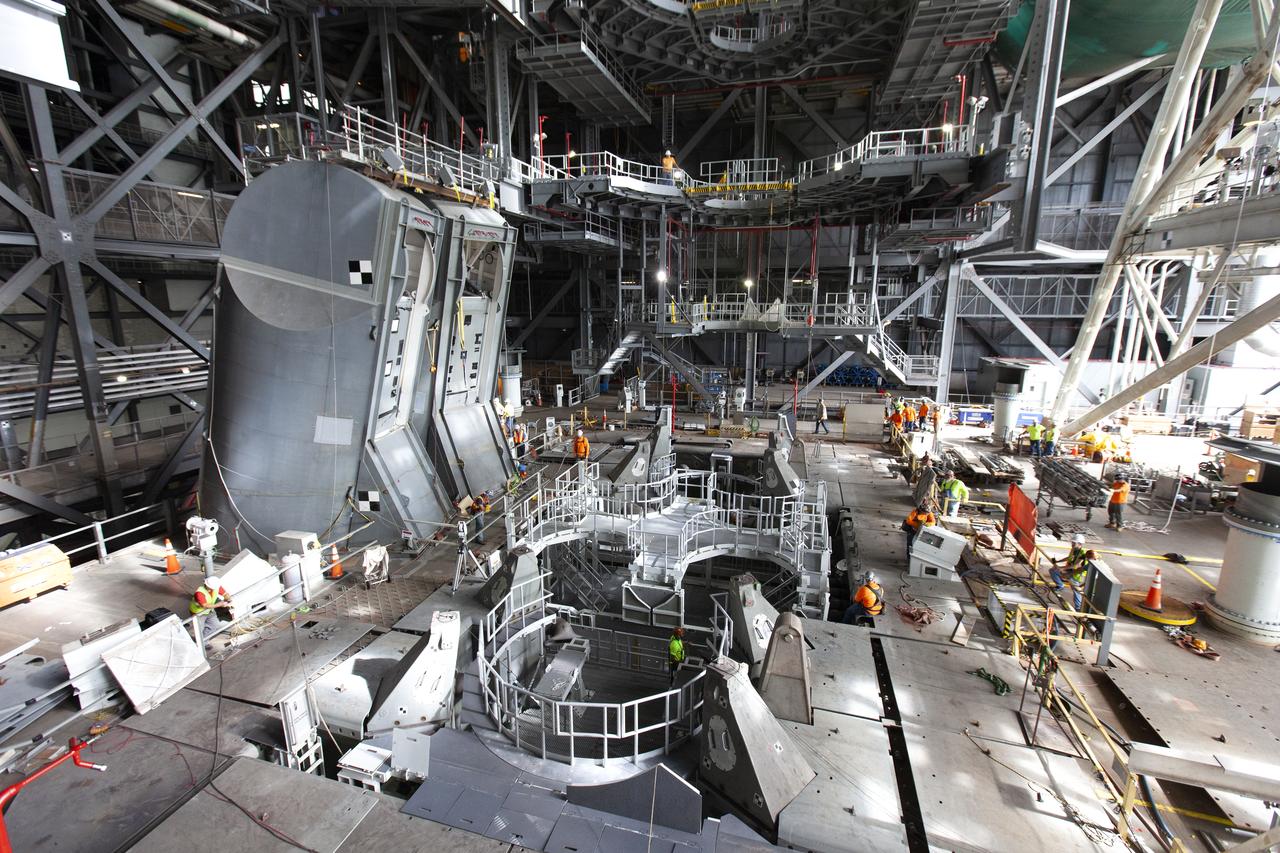
Inside the Vehicle Assembly Building at NASA’s Kennedy Space Center in Florida, the engine service platform that will provide access to the core stage of the Space Launch System (SLS) rocket is lifted up in the center of the mobile launcher (ML) in High Bay 3 on June 18, 2019. The large work platform is designed to provide unrestricted access to the RS-25 engines on the SLS core stage from the ML. The service platform will be used for Artemis 1 and subsequent missions. For Artemis 1, the Orion spacecraft will launch atop the SLS rocket from Launch Pad 39B and begin an approximately three-week mission that will send Orion thousands of miles beyond the Moon. In view at left are the two Tail Service Mast Umbilicals. They will provide liquid oxygen and liquid hydrogen fluid lines and electrical cable connections to the SLS core stage engine section. Exploration Ground Systems is overseeing work on the ML.
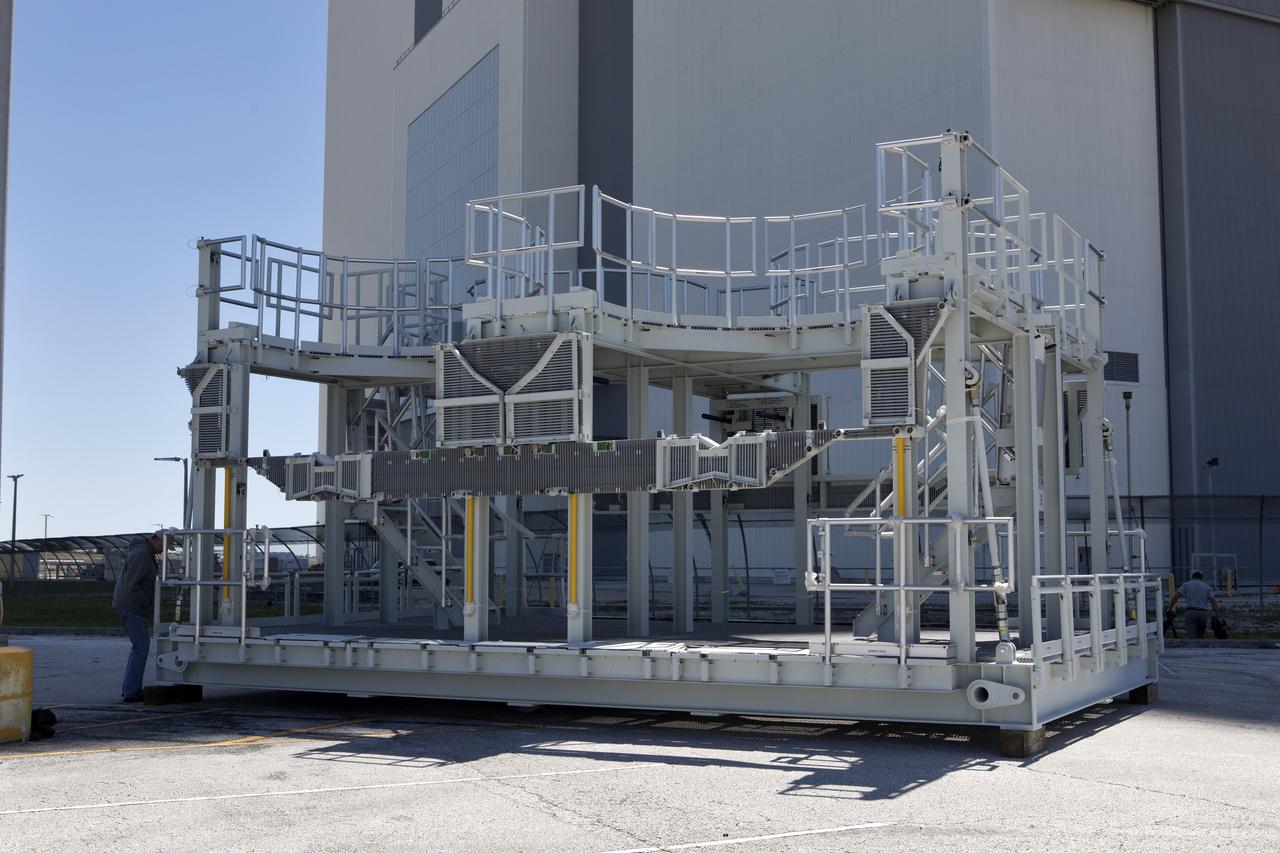
A new service platform for NASA's Space Launch System booster engines is being prepared for the move into the Vehicle Assembly Building (VAB) at the agency's Kennedy Space Center in Florida. The platform was transported from fabricator Met-Con Inc. in Cocoa, Florida. It will be stored in the VAB, and used for processing and checkout of the engines for the rocket's twin five-segment solid rocket boosters for Exploration Mission-1. EM-1 will launch an uncrewed Orion spacecraft to a stable orbit beyond the Moon and bring it back to Earth for a splashdown in the Pacific Ocean.
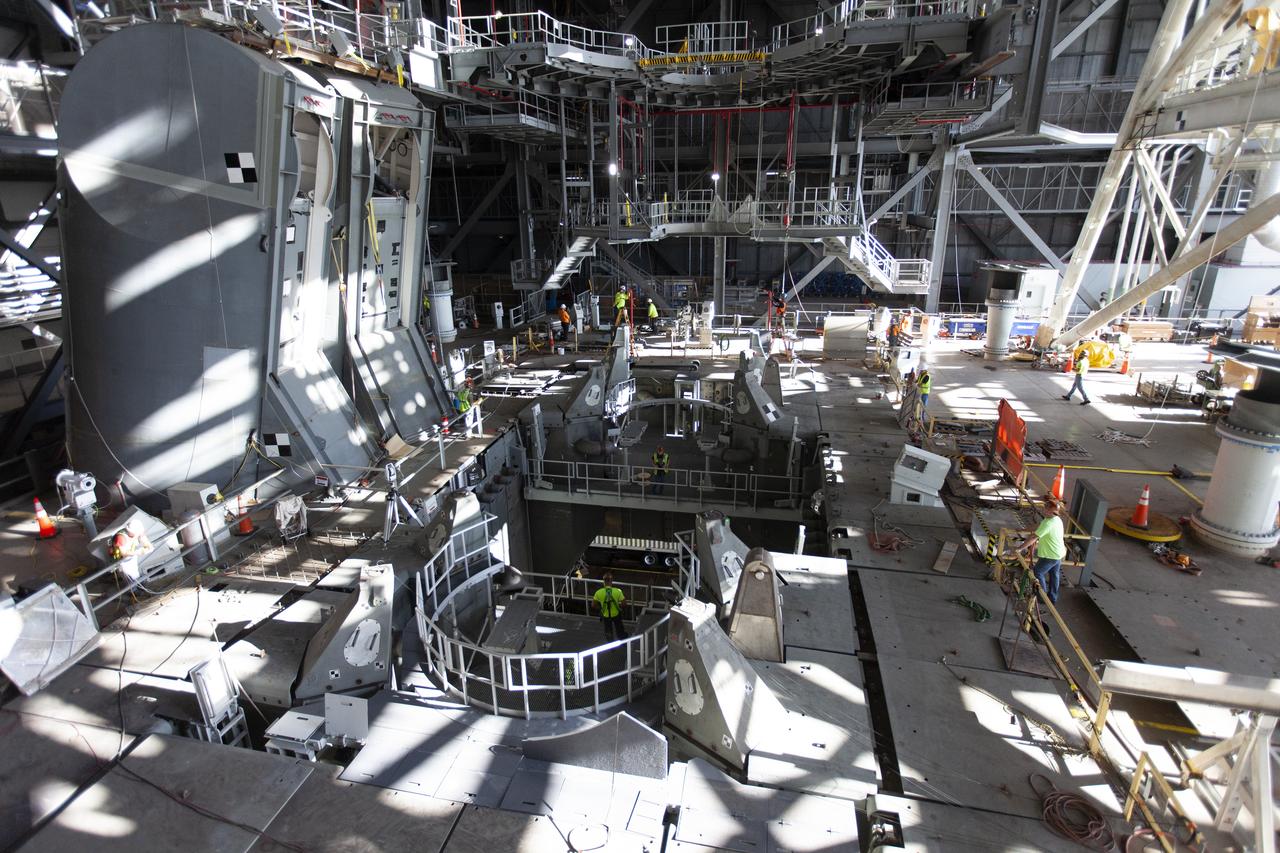
Inside the Vehicle Assembly Building at NASA’s Kennedy Space Center in Florida, the engine service platform that will provide access to the core stage of the Space Launch System (SLS) rocket is lifted up in the center of the mobile launcher (ML) in High Bay 3 on June 18, 2019. The large work platform is designed to provide unrestricted access to the RS-25 engines on the SLS core stage from the ML. The service platform will be used for Artemis 1 and subsequent missions. For Artemis 1, the Orion spacecraft will launch atop the SLS rocket from Launch Pad 39B and begin an approximately three-week mission that will send Orion thousands of miles beyond the Moon. Exploration Ground Systems is overseeing work on the ML.
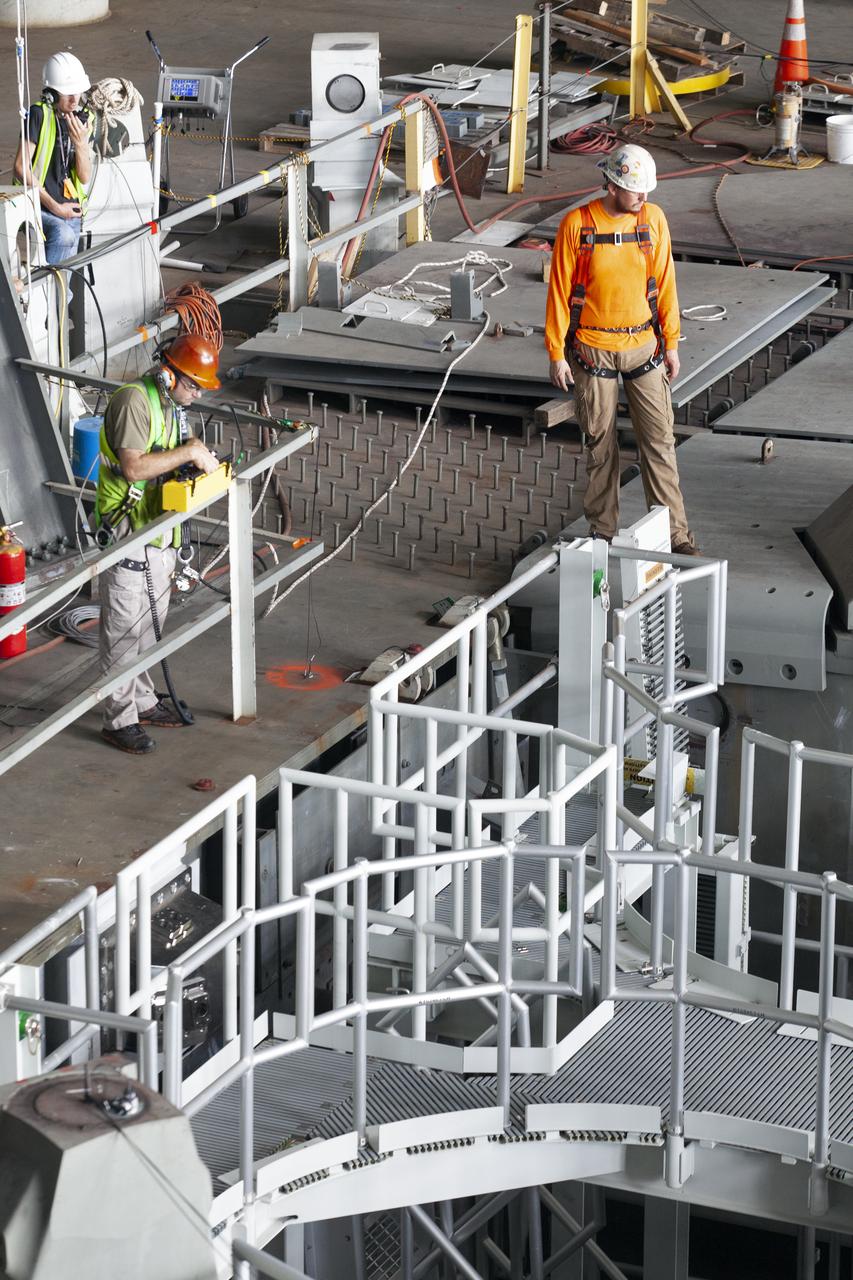
Workers with Bragg Crane and Rigging prepare for the lift of the engine service platform that will provide access to the core stage of the Space Launch System (SLS) rocket on the mobile (ML) in High Bay 3 of the Vehicle Assembly Building at NASA’s Kennedy Space Center in Florida on June 18, 2019. The large work platform is designed to provide unrestricted access to the RS-25 engines on the SLS core stage from the ML. The service platform will be used for Artemis 1 and subsequent missions. For Artemis 1, the Orion spacecraft will launch atop the SLS rocket from Launch Pad 39B and begin an approximately three-week mission that will send Orion thousands of miles beyond the Moon. Exploration Ground Systems is overseeing work on the ML.
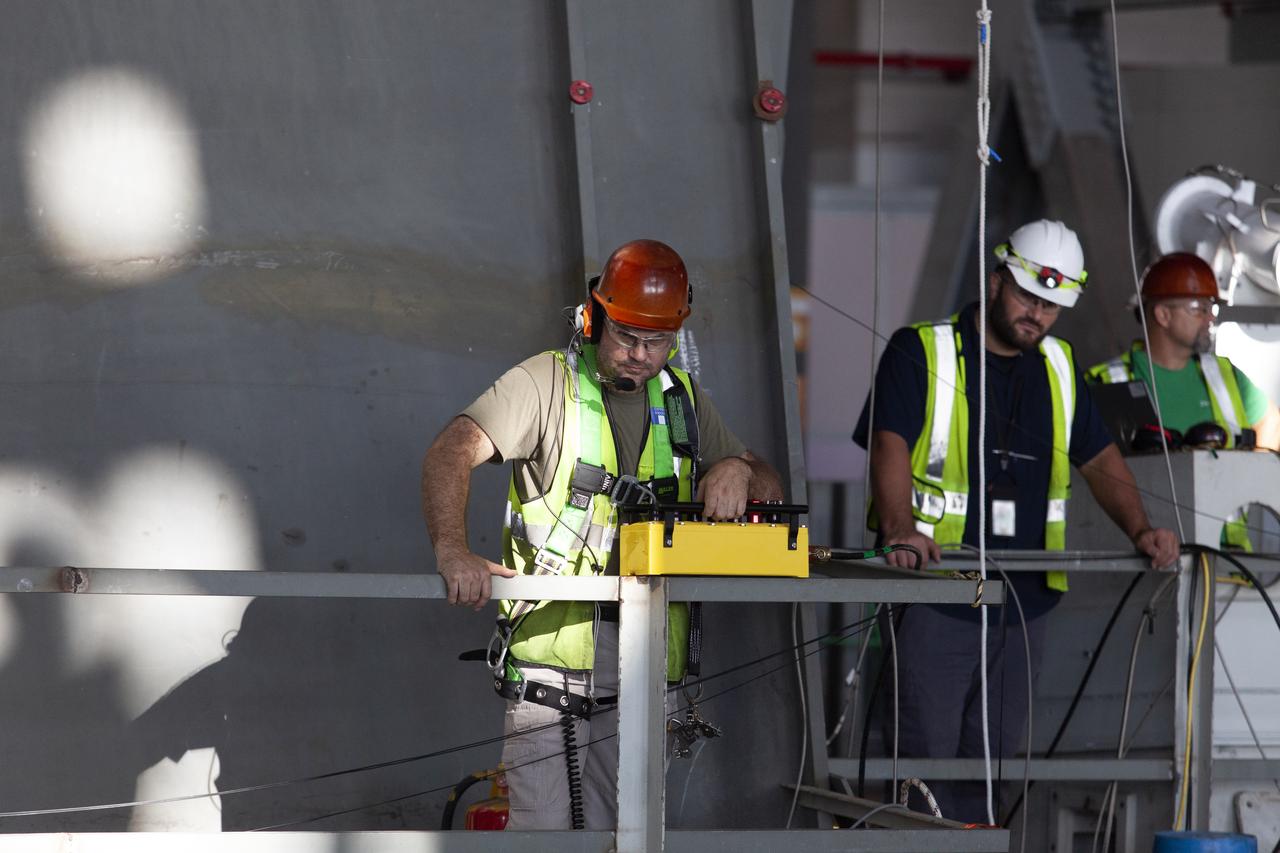
Jacobs TOSC workers prepare for the lift of the engine service platform that will provide access to the core stage of the Space Launch System (SLS) rocket on the mobile launcher (ML) in High Bay 3 of the Vehicle Assembly Building at NASA’s Kennedy Space Center in Florida on June 18, 2019. The large work platform is designed to provide unrestricted access to the RS-25 engines on the SLS core stage from the ML. The service platform will be used for Artemis 1 and subsequent missions. For Artemis 1, the Orion spacecraft will launch atop the SLS rocket from Launch Pad 39B and begin an approximately three-week mission that will send Orion thousands of miles beyond the Moon. Exploration Ground Systems is overseeing work on the ML.
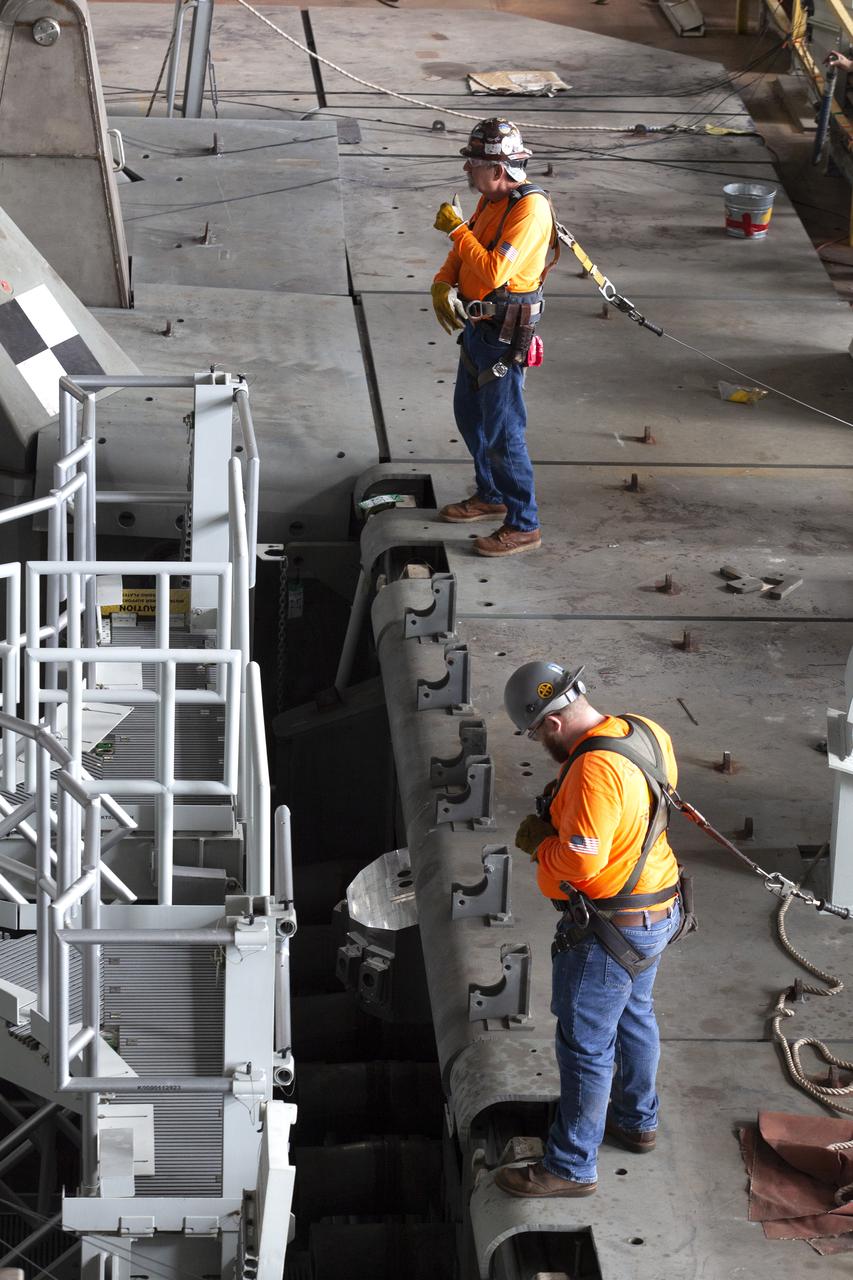
Workers with Bragg Crane and Rigging prepare to assist with the lift of the engine service platform that will provide access to the core stage of the Space Launch System (SLS) rocket on the mobile (ML) in High Bay 3 of the Vehicle Assembly Building at NASA’s Kennedy Space Center in Florida on June 18, 2019. The large work platform is designed to provide unrestricted access to the RS-25 engines on the SLS core stage from the ML. The service platform will be used for Artemis 1 and subsequent missions. For Artemis 1, the Orion spacecraft will launch atop the SLS rocket from Launch Pad 39B and begin an approximately three-week mission that will send Orion thousands of miles beyond the Moon. Exploration Ground Systems is overseeing work on the ML.
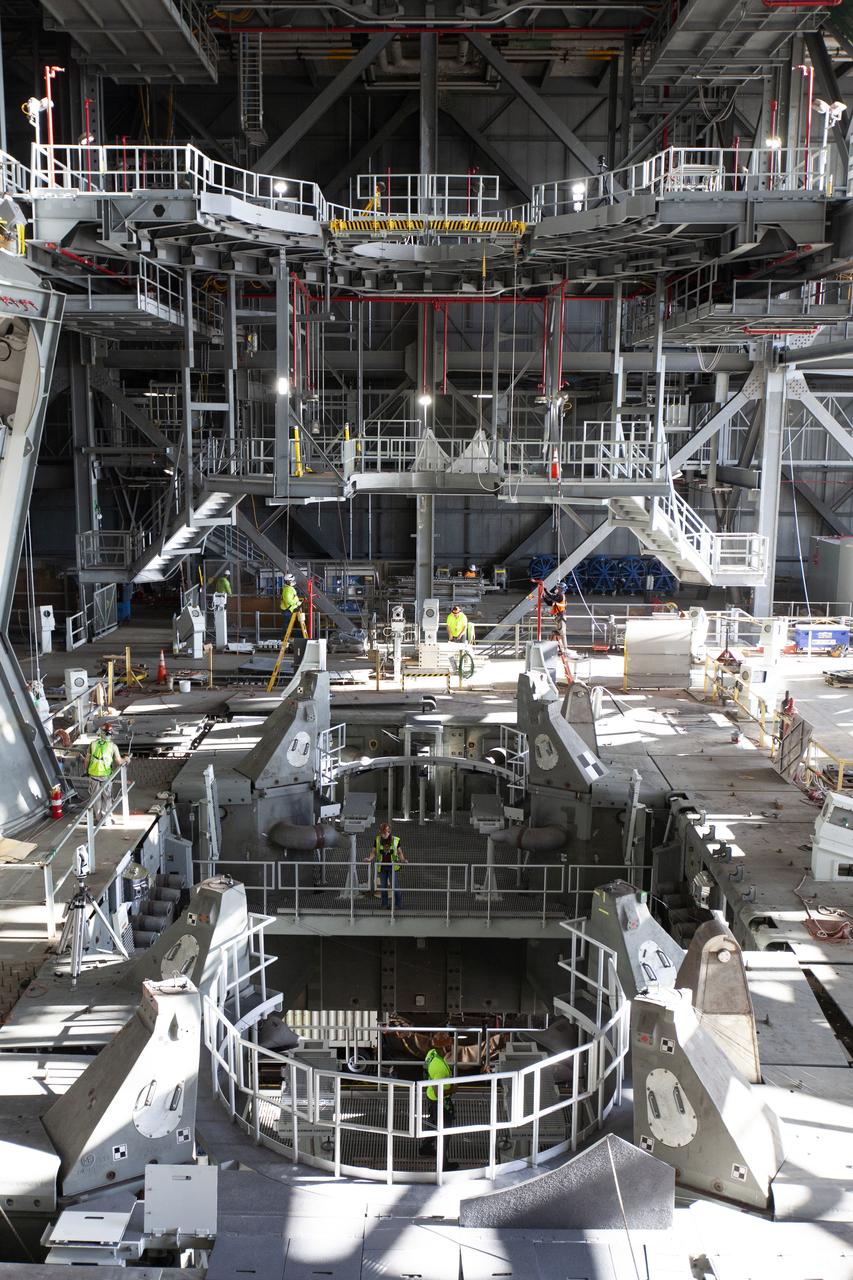
Inside the Vehicle Assembly Building at NASA’s Kennedy Space Center in Florida, the engine service platform that will provide access to the core stage of the Space Launch System (SLS) rocket is lifted up in the center of the mobile launcher (ML) in High Bay 3 on June 18, 2019. The large work platform is designed to provide unrestricted access to the RS-25 engines on the SLS core stage from the ML. The service platform will be used for Artemis 1 and subsequent missions. For Artemis 1, the Orion spacecraft will launch atop the SLS rocket from Launch Pad 39B and begin an approximately three-week mission that will send Orion thousands of miles beyond the Moon. Exploration Ground Systems is overseeing work on the ML.
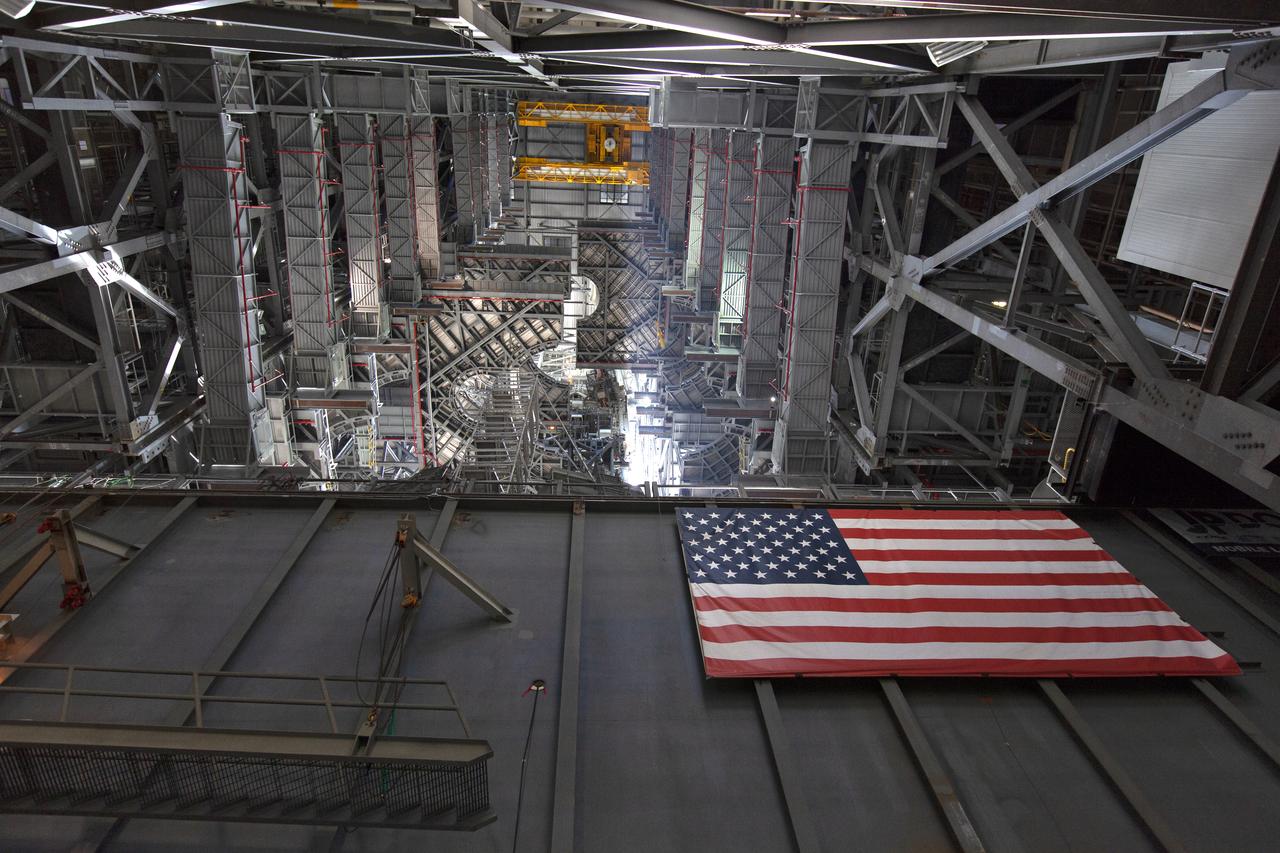
A view looking up at the mobile launcher (ML) in High Bay 3 of the Vehicle Assembly Building at NASA’s Kennedy Space Center in Florida on June 18, 2019. Work is underway to lift the engine service platform that will provide access to the core stage of the Space Launch System (SLS) rocket in the center of the ML. The large work platform is designed to provide unrestricted access to the RS-25 engines on the SLS core stage from the ML. The service platform will be used for Artemis 1 and subsequent missions. For Artemis 1, the Orion spacecraft will launch atop the SLS rocket from Launch Pad 39B and begin an approximately three-week mission that will send Orion thousands of miles beyond the Moon. Exploration Ground Systems is overseeing work on the ML.
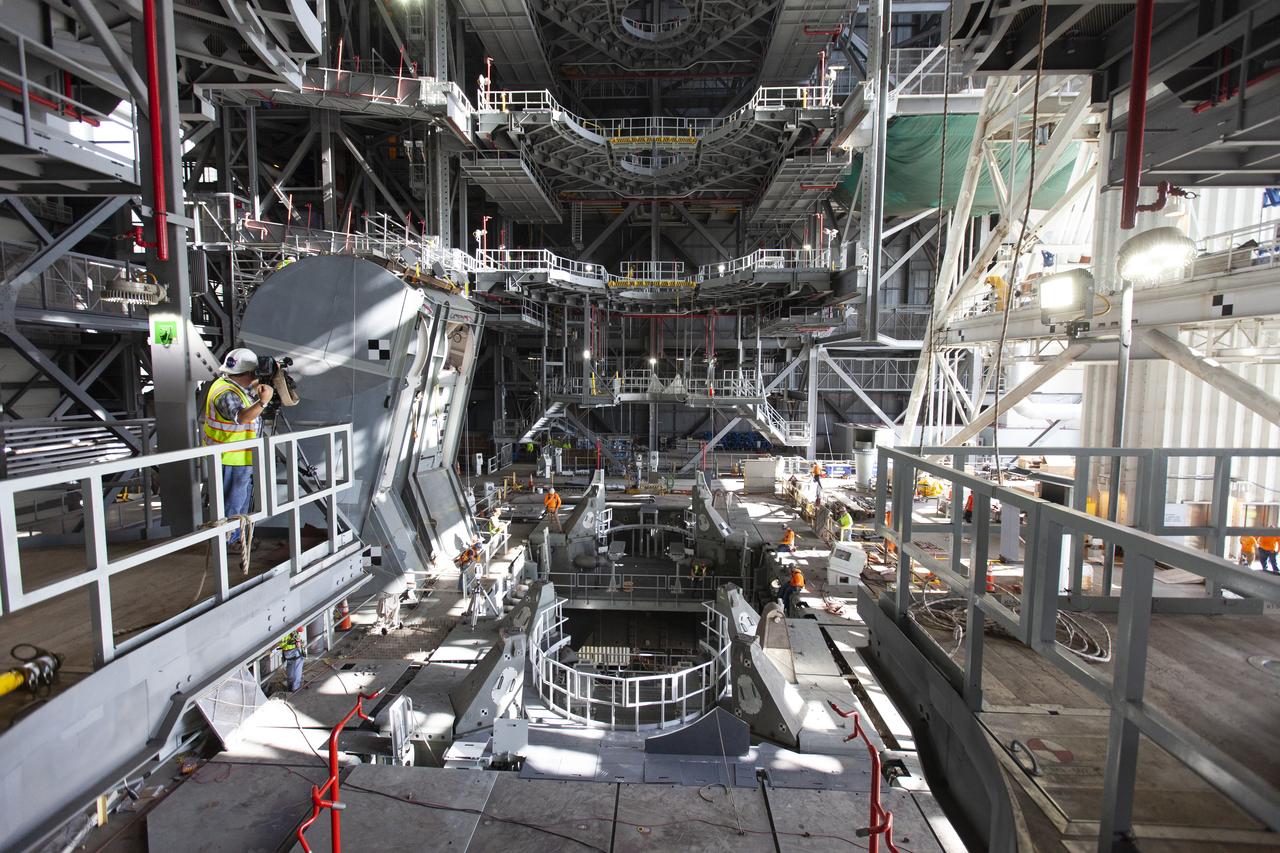
Inside the Vehicle Assembly Building at NASA’s Kennedy Space Center in Florida, the engine service platform that will provide access to the core stage of the Space Launch System (SLS) rocket is lifted up in the center of the mobile launcher (ML) in High Bay 3 on June 18, 2019. The large work platform is designed to provide unrestricted access to the RS-25 engines on the SLS core stage from the ML. The service platform will be used for Artemis 1 and subsequent missions. For Artemis 1, the Orion spacecraft will launch atop the SLS rocket from Launch Pad 39B and begin an approximately three-week mission that will send Orion thousands of miles beyond the Moon. Exploration Ground Systems is overseeing work on the ML.
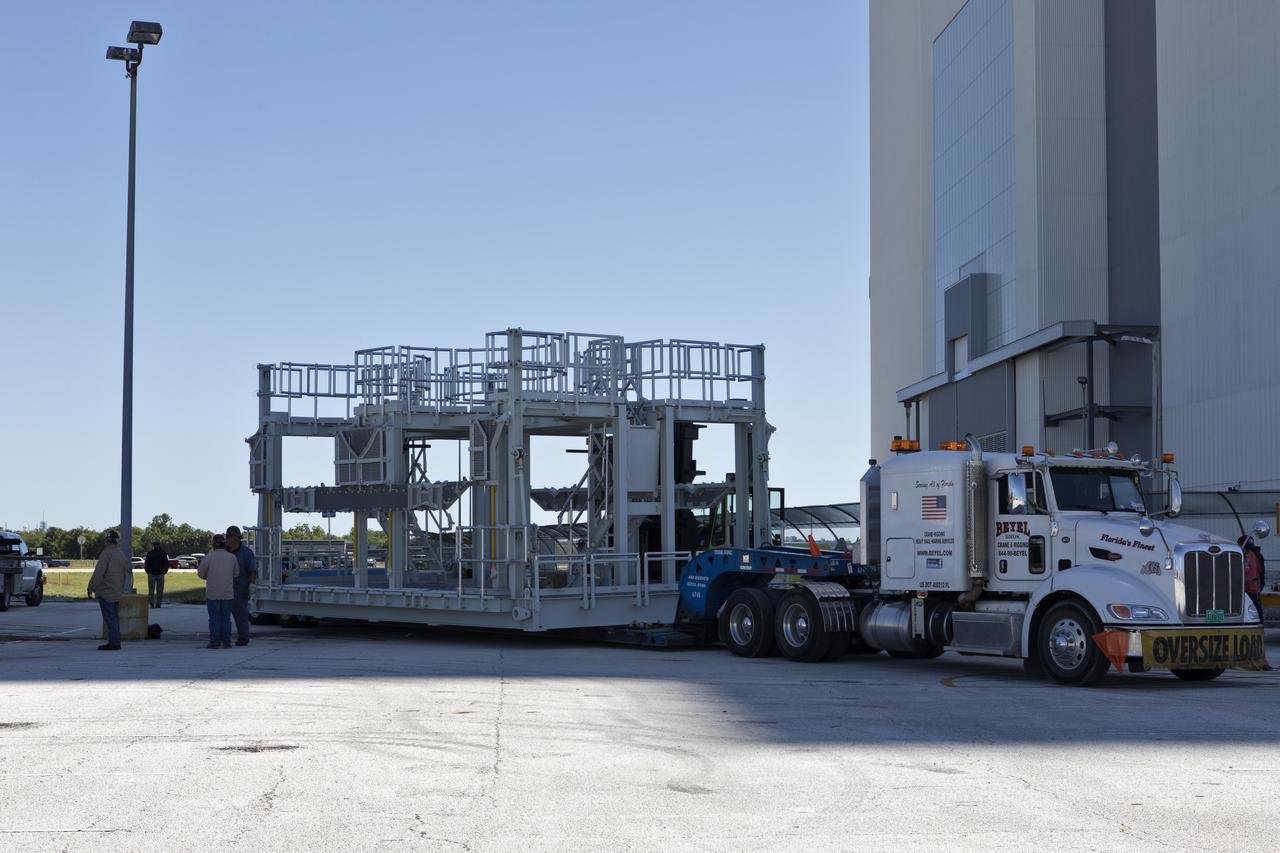
A new service platform for NASA's Space Launch System booster engines, secured on a flatbed truck, has arrived at the Vehicle Assembly Building (VAB) at the agency's Kennedy Space Center in Florida. It was transported from fabricator Met-Con Inc. in Cocoa, Florida. The platform will be stored in the VAB and used for processing and checkout of the engines for the rocket's twin five-segment solid rocket boosters for Exploration Mission-1 (EM-1). During EM-1, an uncrewed Orion spacecraft will launch on the SLS to a stable orbit beyond the Moon and return to Earth for a splashdown in the Pacific Ocean.
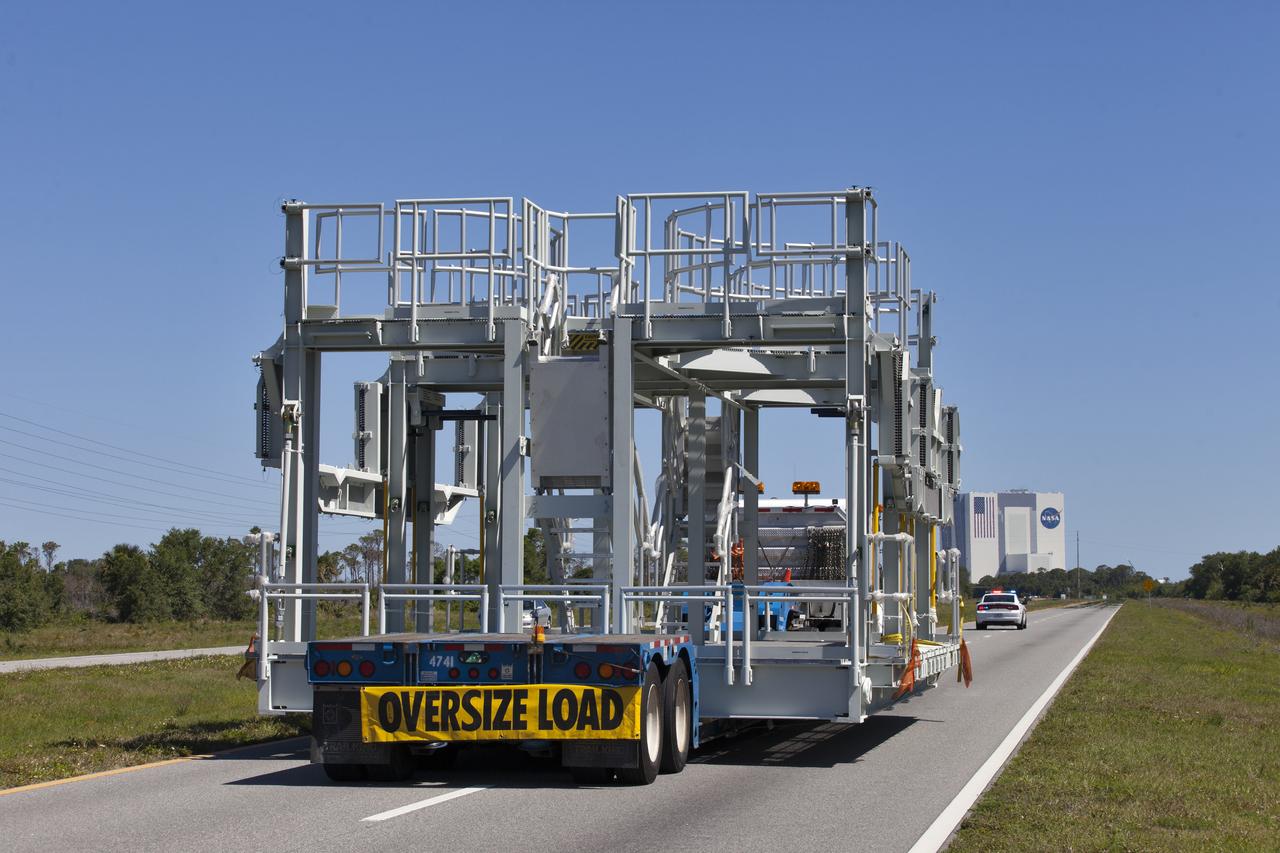
A new service platform for NASA's Space Launch System booster engines, secured on a flatbed truck, is on its way to the Vehicle Assembly Building (VAB), in view in the distance, at the agency's Kennedy Space Center in Florida. It was transported from fabricator Met-Con Inc. in Cocoa, Florida. The platform will be delivered to the VAB, where it will be stored and used for processing and checkout of the engines for the rocket's twin five-segment solid rocket boosters for Exploration Mission-1 (EM-1). During EM-1, an uncrewed Orion spacecraft will launch on the SLS to a stable orbit beyond the Moon and return to Earth for a splashdown in the Pacific Ocean.
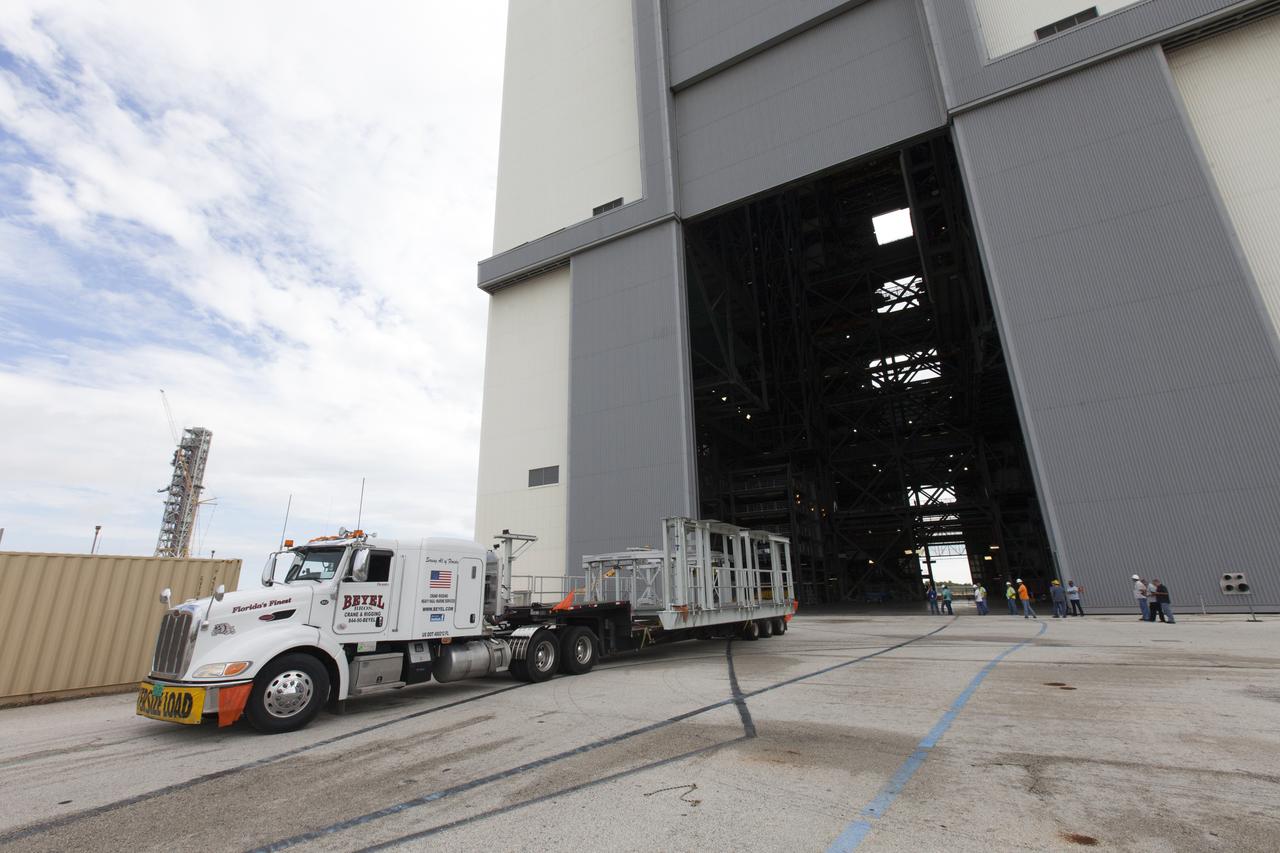
A flatbed truck carrying one of two new service platforms for NASA's Space Launch System booster engines backs in to the Vehicle Assembly Building (VAB) at the agency's Kennedy Space Center in Florida. The platforms were transported from fabricator Met-Con Inc. in Cocoa, Florida. They will be stored in the VAB, where they will be used for processing and checkout of the engines for the rocket's twin five-segment solid rocket boosters for Exploration Mission-1. EM-1 will launch an uncrewed Orion spacecraft to a stable orbit beyond the Moon and bring it back to Earth for a splashdown in the Pacific Ocean.
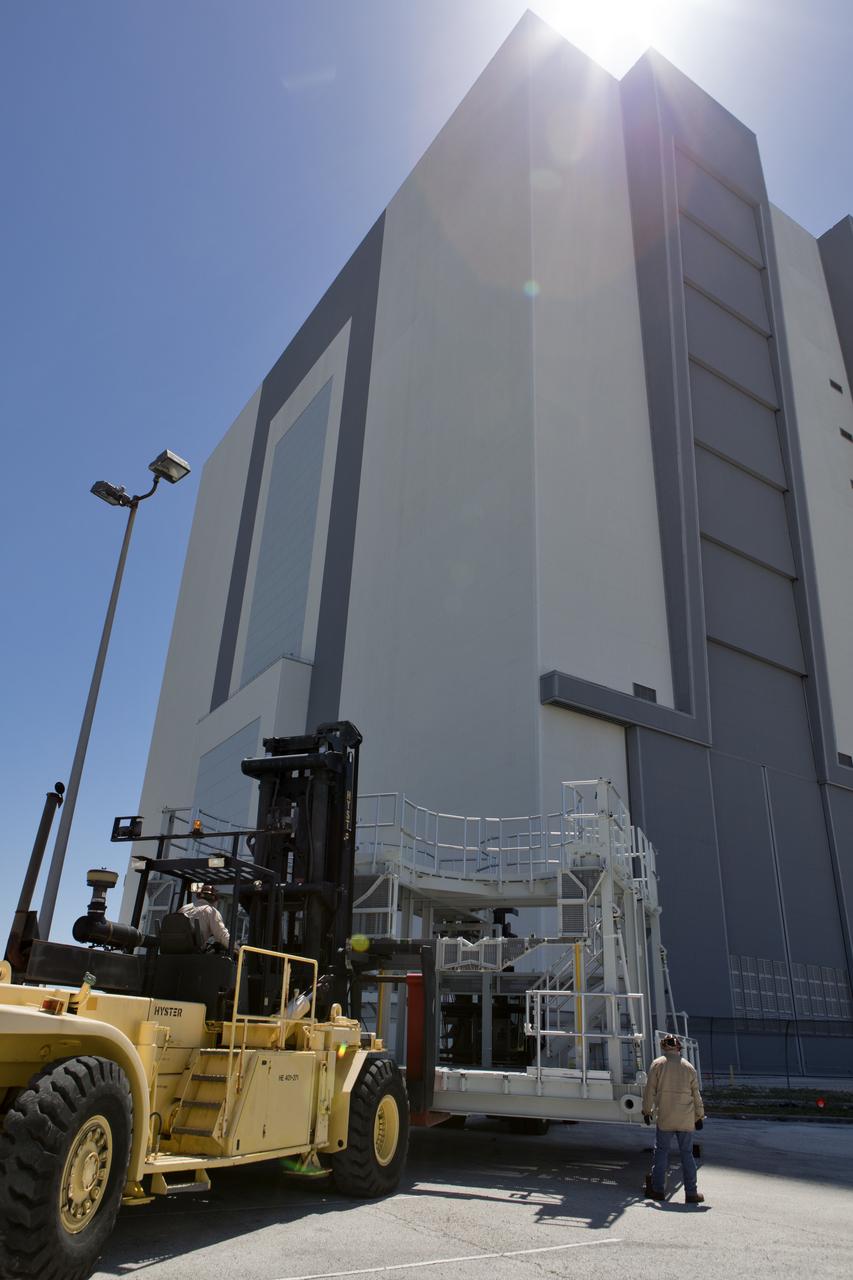
A new service platform for NASA's Space Launch System booster engines has been offloaded from a flatbed truck and is being prepared for the move into the Vehicle Assembly Building (VAB) at the agency's Kennedy Space Center in Florida. The platform was transported from fabricator Met-Con Inc. in Cocoa, Florida. It will be stored in the VAB, and used for processing and checkout of the engines for the rocket's twin five-segment solid rocket boosters for Exploration Mission-1. EM-1 will launch an uncrewed Orion spacecraft to a stable orbit beyond the Moon and bring it back to Earth for a splashdown in the Pacific Ocean.
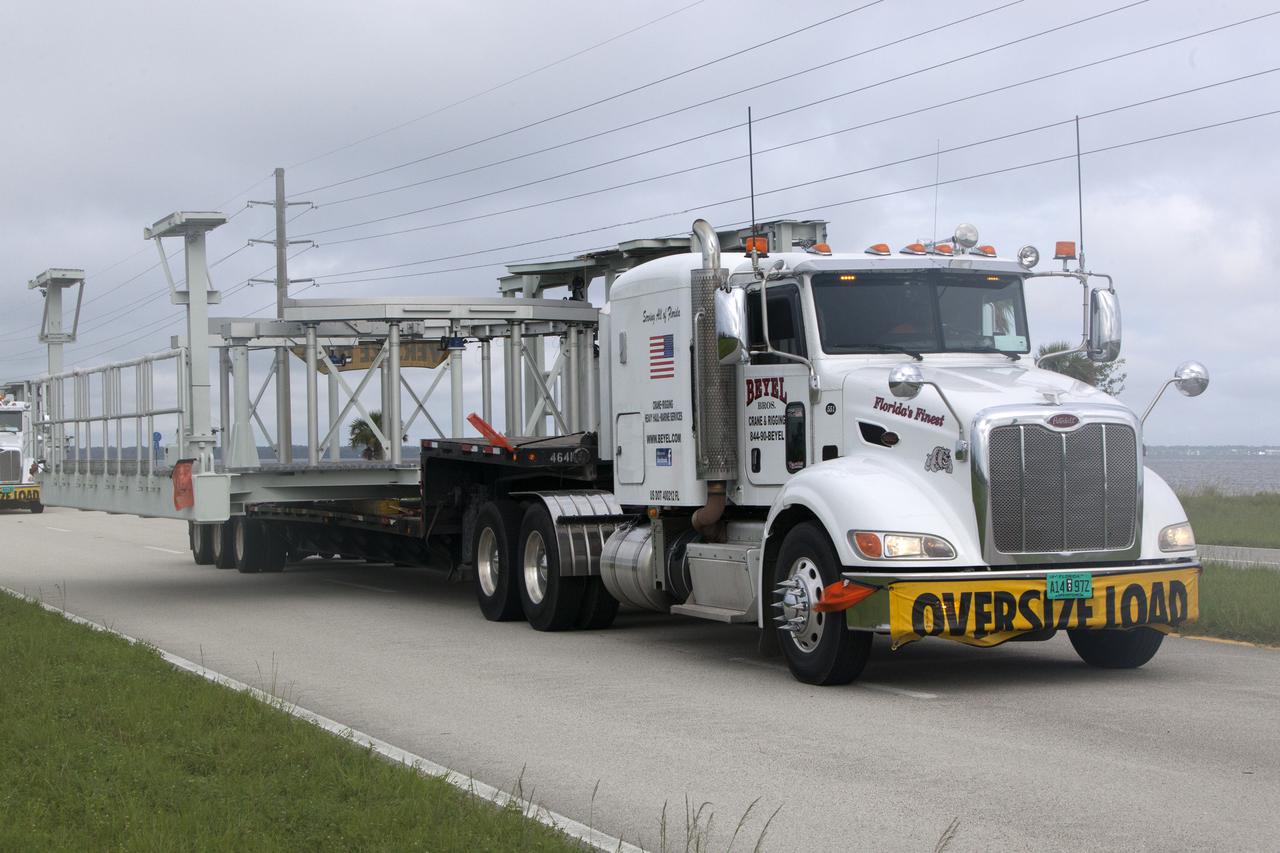
A flatbed truck carrying one of two new service platforms for NASA's Space Launch System booster engines makes its way along the NASA Causeway to the agency's Kennedy Space Center in Florida. The platforms were transported from fabricator Met-Con Inc. in Cocoa, Florida. They will be delivered to the Vehicle Assembly Building, where they will be stored and used for processing and checkout of the engines for the rocket's twin five-segment solid rocket boosters for Exploration Mission-1. EM-1 will launch an uncrewed Orion spacecraft to a stable orbit beyond the Moon and bring it back to Earth for a splashdown in the Pacific Ocean.
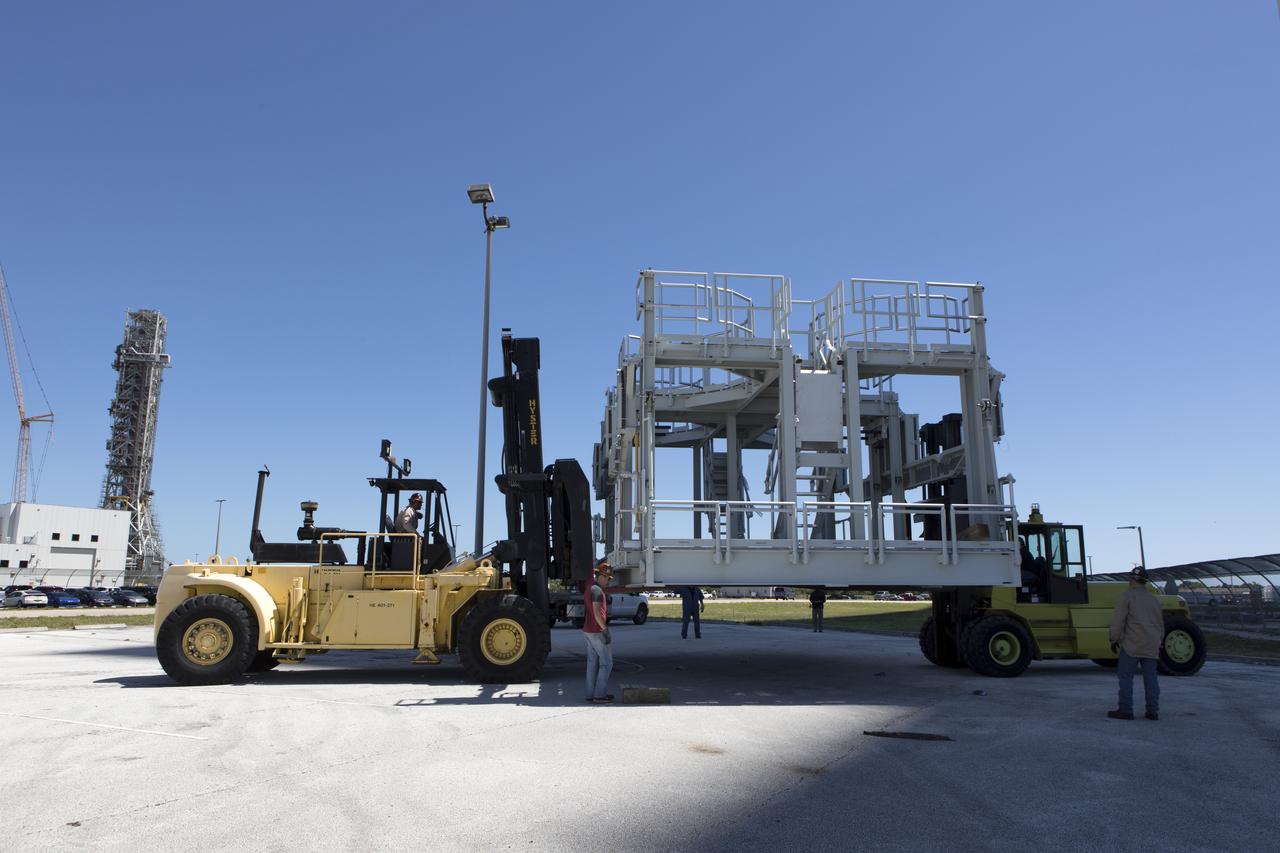
A new service platform for NASA's Space Launch System booster engines has been offloaded from a flatbed truck and is being prepared for the move into the Vehicle Assembly Building (VAB) at the agency's Kennedy Space Center in Florida. The platform was transported from fabricator Met-Con Inc. in Cocoa, Florida. It will be stored in the VAB, and used for processing and checkout of the engines for the rocket's twin five-segment solid rocket boosters for Exploration Mission-1. EM-1 will launch an uncrewed Orion spacecraft to a stable orbit beyond the Moon and bring it back to Earth for a splashdown in the Pacific Ocean.
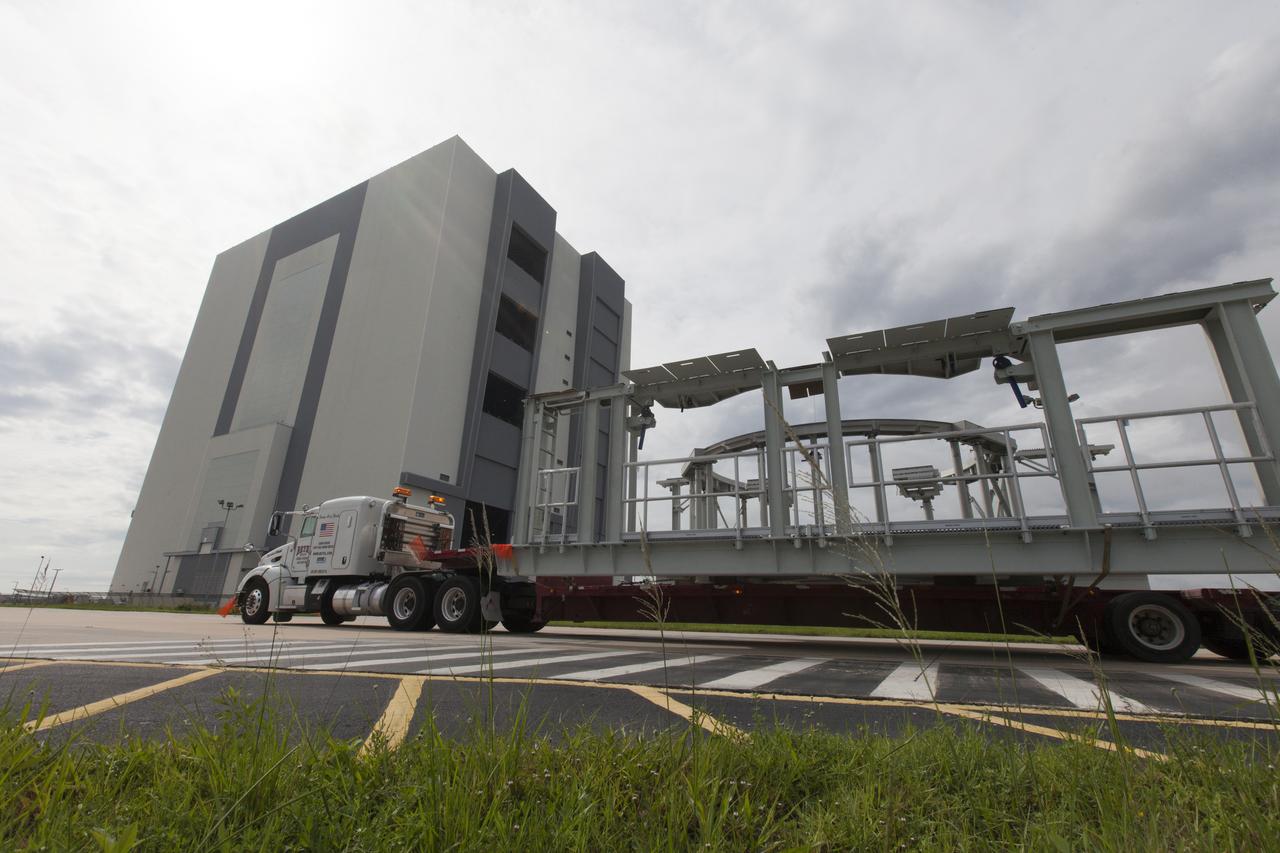
A flatbed truck carrying one of two new service platforms for NASA's Space Launch System booster engines arrives at the Vehicle Assembly Building (VAB) at the agency's Kennedy Space Center in Florida. The platforms were transported from fabricator Met-Con Inc. in Cocoa, Florida. They will be stored in the VAB, where they will be used for processing and checkout of the engines for the rocket's twin five-segment solid rocket boosters for Exploration Mission-1. EM-1 will launch an uncrewed Orion spacecraft to a stable orbit beyond the Moon and bring it back to Earth for a splashdown in the Pacific Ocean.

A flatbed truck carrying one of two new service platforms for NASA's Space Launch System booster engines backs up inside the Vehicle Assembly Building (VAB) at the agency's Kennedy Space Center in Florida. The platforms were transported from fabricator Met-Con Inc. in Cocoa, Florida. They will be stored in the VAB, where they will be used for processing and checkout of the engines for the rocket's twin five-segment solid rocket boosters for Exploration Mission-1. EM-1 will launch an uncrewed Orion spacecraft to a stable orbit beyond the Moon and bring it back to Earth for a splashdown in the Pacific Ocean.
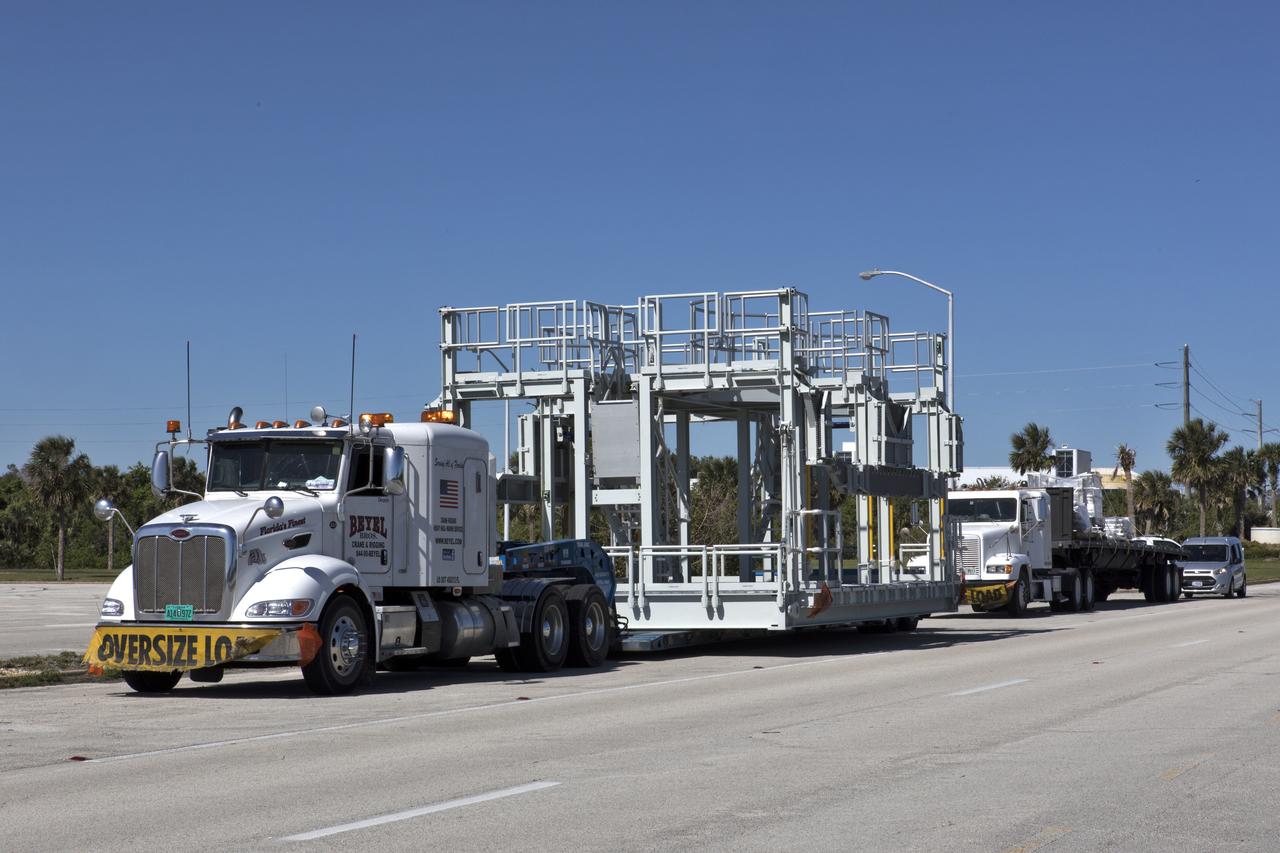
A new service platform for NASA's Space Launch System booster engines, secured on a flatbed truck, is on its way to the agency's Kennedy Space Center in Florida. It was transported from fabricator Met-Con Inc. in Cocoa, Florida. The platform will be delivered to the Vehicle Assembly Building, where it will be stored and used for processing and checkout of the engines for the rocket's twin five-segment solid rocket boosters for Exploration Mission-1 (EM-1). During EM-1, an uncrewed Orion spacecraft will launch on the SLS to a stable orbit beyond the Moon and return to Earth for a splashdown in the Pacific Ocean.
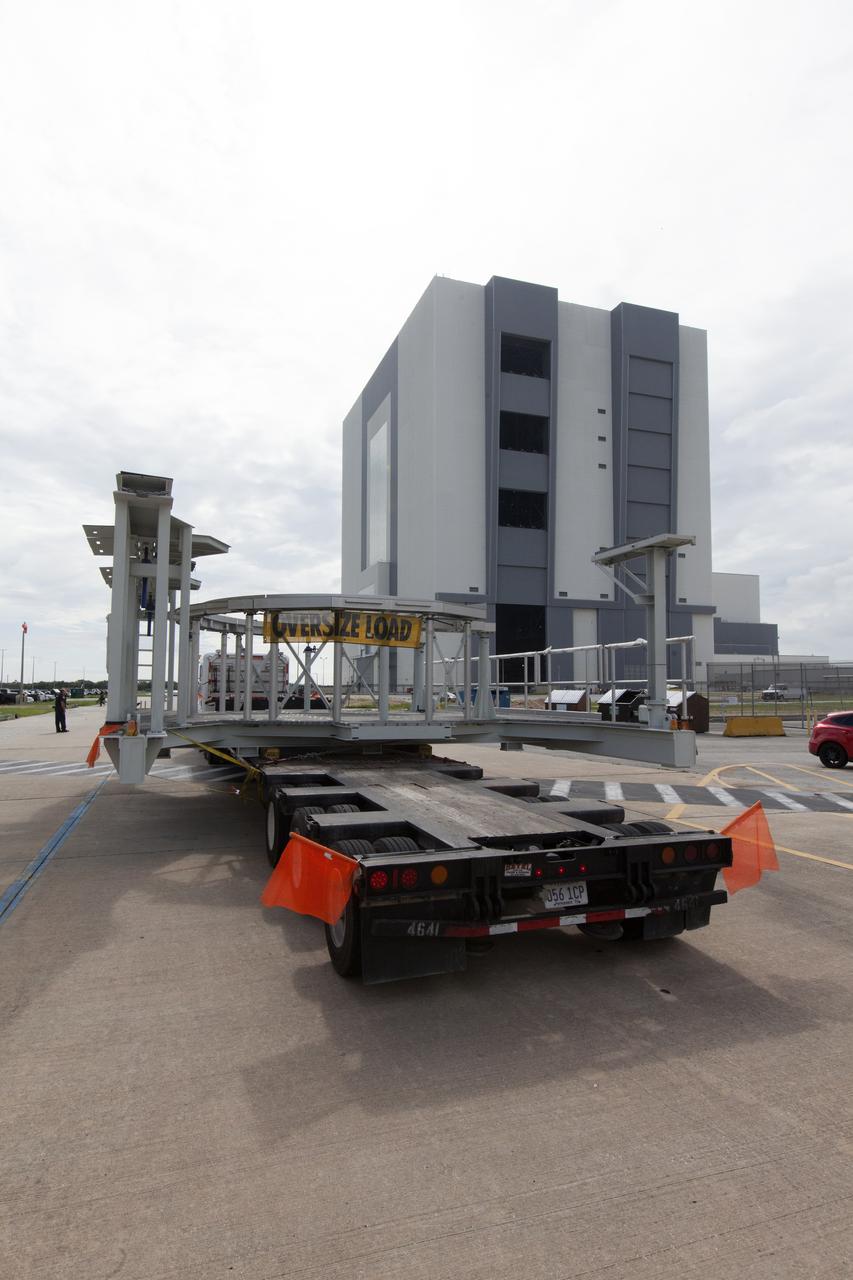
A flatbed truck carrying one of two new service platforms for NASA's Space Launch System booster engines arrives at the Vehicle Assembly Building (VAB) at the agency's Kennedy Space Center in Florida. The platforms were transported from fabricator Met-Con Inc. in Cocoa, Florida. They will be stored in the VAB, where they will be used for processing and checkout of the engines for the rocket's twin five-segment solid rocket boosters for Exploration Mission-1. EM-1 will launch an uncrewed Orion spacecraft to a stable orbit beyond the Moon and bring it back to Earth for a splashdown in the Pacific Ocean.
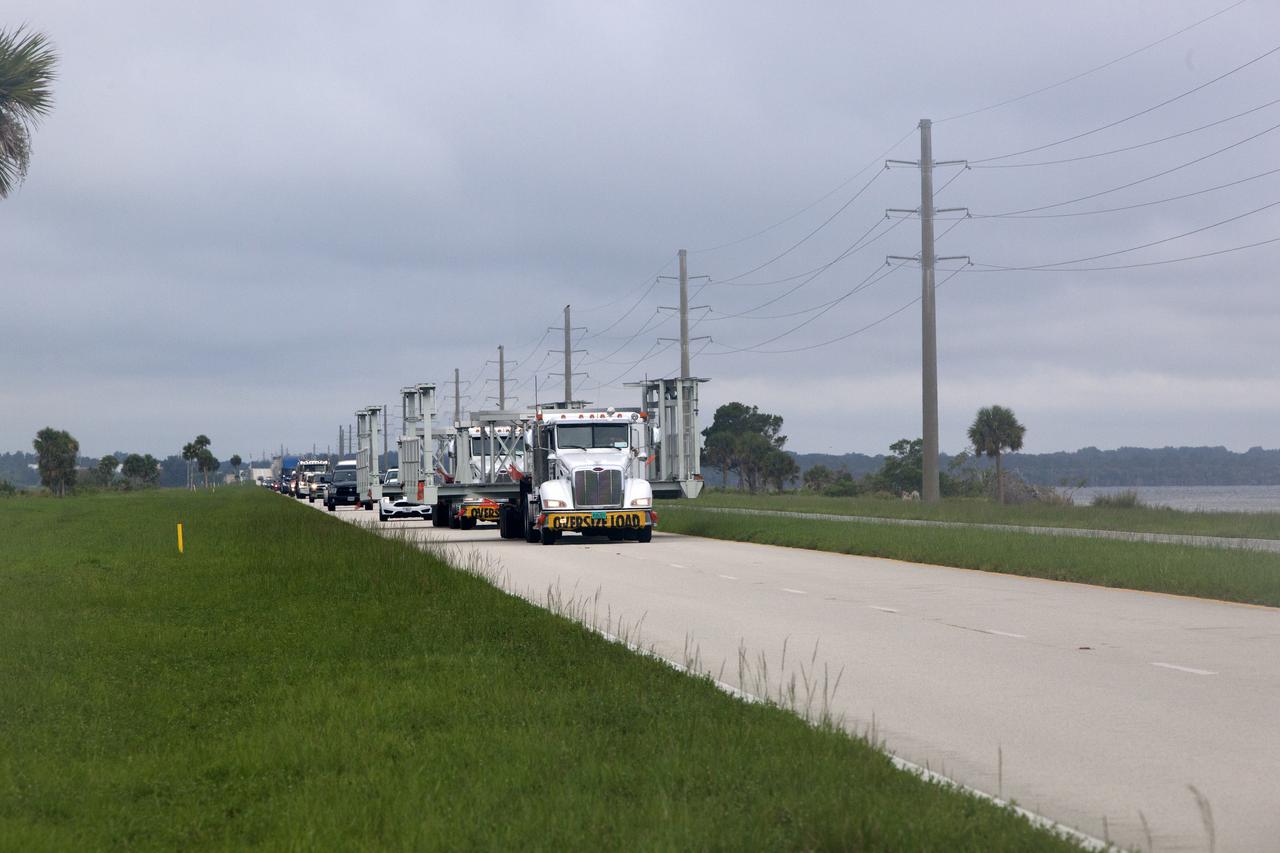
New service platforms for NASA's Space Launch System booster engines, secured on two flatbed trucks, are on their way to the agency's Kennedy Space Center in Florida. They are being transported from fabricator Met-Con Inc. in Cocoa, Florida. The platforms will be delivered to the Vehicle Assembly Building, where they will be stored and used for processing and checkout of the engines for the rocket's twin five-segment solid rocket boosters for Exploration Mission-1. EM-1 will launch an uncrewed Orion spacecraft to a stable orbit beyond the Moon and bring it back to Earth for a splashdown in the Pacific Ocean.
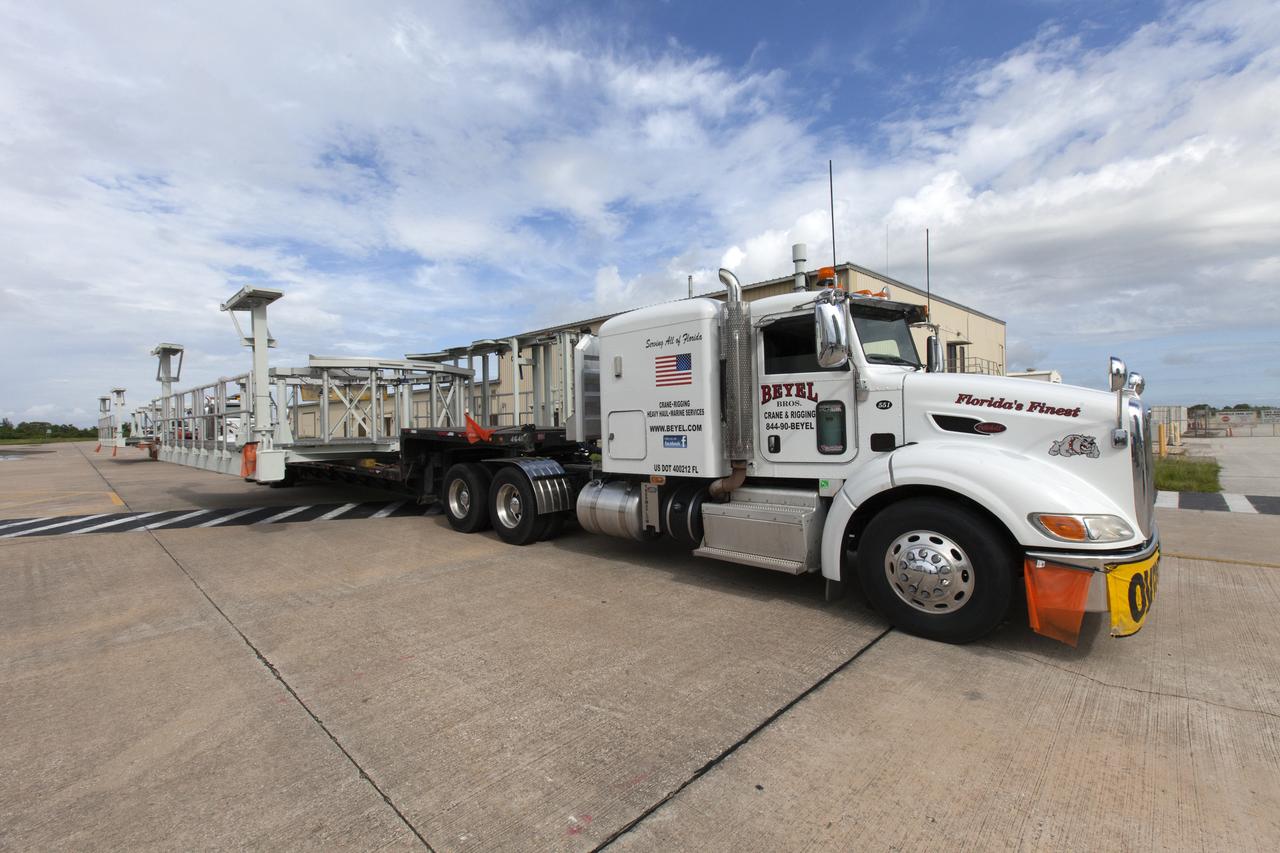
A flatbed truck carrying one of two new service platforms for NASA's Space Launch System booster engines nears the Vehicle Assembly Building (VAB) at the agency's Kennedy Space Center in Florida. The platforms were transported from fabricator Met-Con Inc. in Cocoa, Florida. They will be delivered to the VAB, where they will be stored and used for processing and checkout of the engines for the rocket's twin five-segment solid rocket boosters for Exploration Mission-1. EM-1 will launch an uncrewed Orion spacecraft to a stable orbit beyond the Moon and bring it back to Earth for a splashdown in the Pacific Ocean.
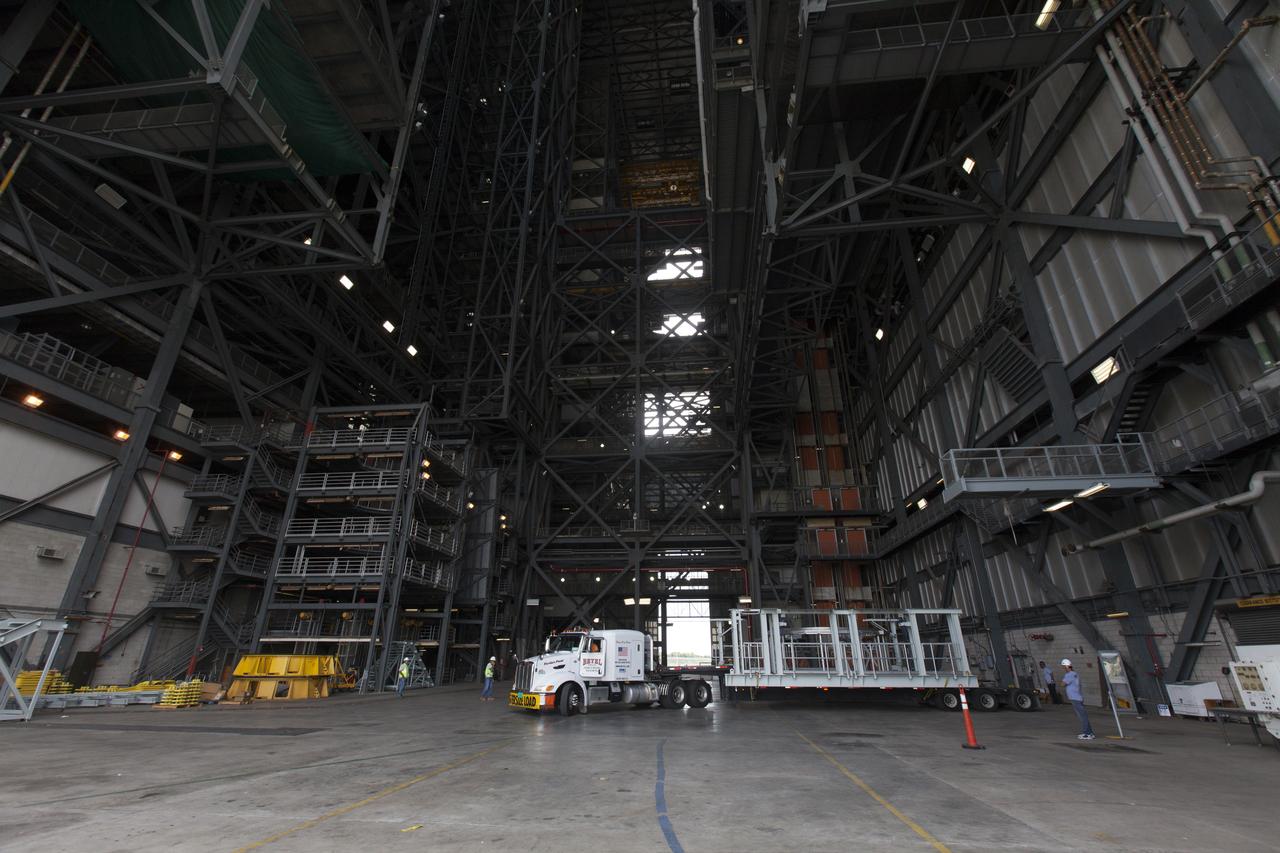
A flatbed truck carrying one of two new service platforms for NASA's Space Launch System booster engines arrives inside the Vehicle Assembly Building (VAB) at the agency's Kennedy Space Center in Florida. The platforms were transported from fabricator Met-Con Inc. in Cocoa, Florida. They will be stored in the VAB, where they will be used for processing and checkout of the engines for the rocket's twin five-segment solid rocket boosters for Exploration Mission-1. EM-1 will launch an uncrewed Orion spacecraft to a stable orbit beyond the Moon and bring it back to Earth for a splashdown in the Pacific Ocean.

A new service platform for NASA's Space Launch System booster engines, secured on a flatbed truck, is on its way to the agency's Kennedy Space Center in Florida. It was transported from fabricator Met-Con Inc. in Cocoa, Florida. The platform will be delivered to the Vehicle Assembly Building, where it will be stored and used for processing and checkout of the engines for the rocket's twin five-segment solid rocket boosters for Exploration Mission-1 (EM-1). During EM-1, an uncrewed Orion spacecraft will launch on the SLS to a stable orbit beyond the Moon and return to Earth for a splashdown in the Pacific Ocean.
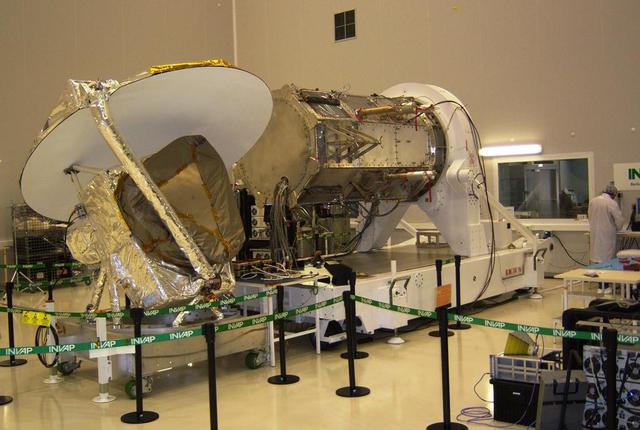
All NASA Aquarius electrical interfaces have successfully been connected to the SAC-D service platform S/P.
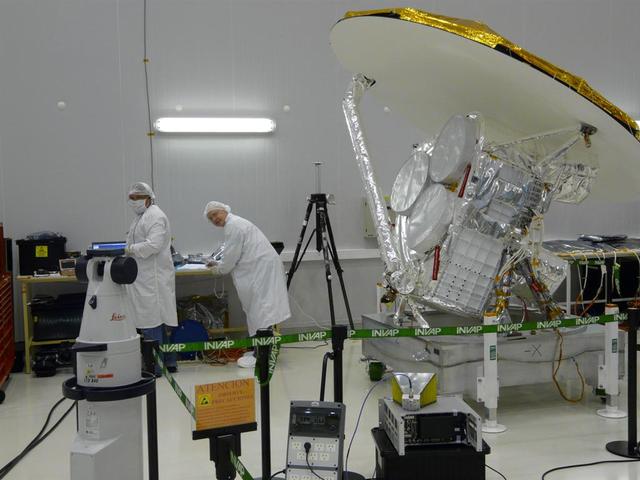
NASA Aquarius instrument power interfaces are tested prior to connection with the SAC-D service platform at the INVAP facility in Bariloche, Argentina.
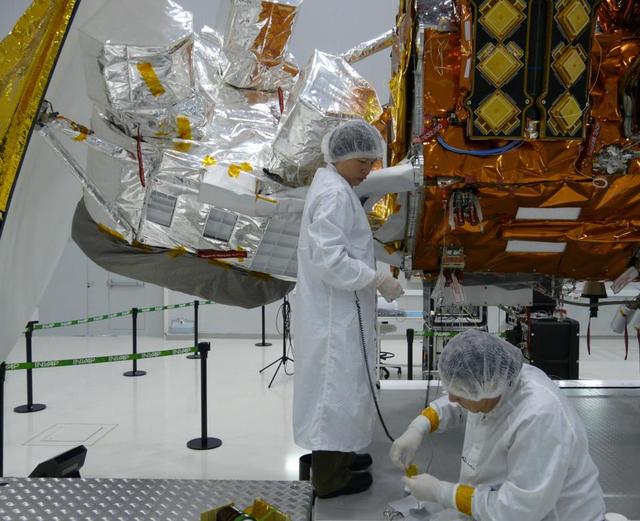
Completion of the thermal blanket patterns for the Aquarius bipod after routing the flight harness from the SAC-D service platform.
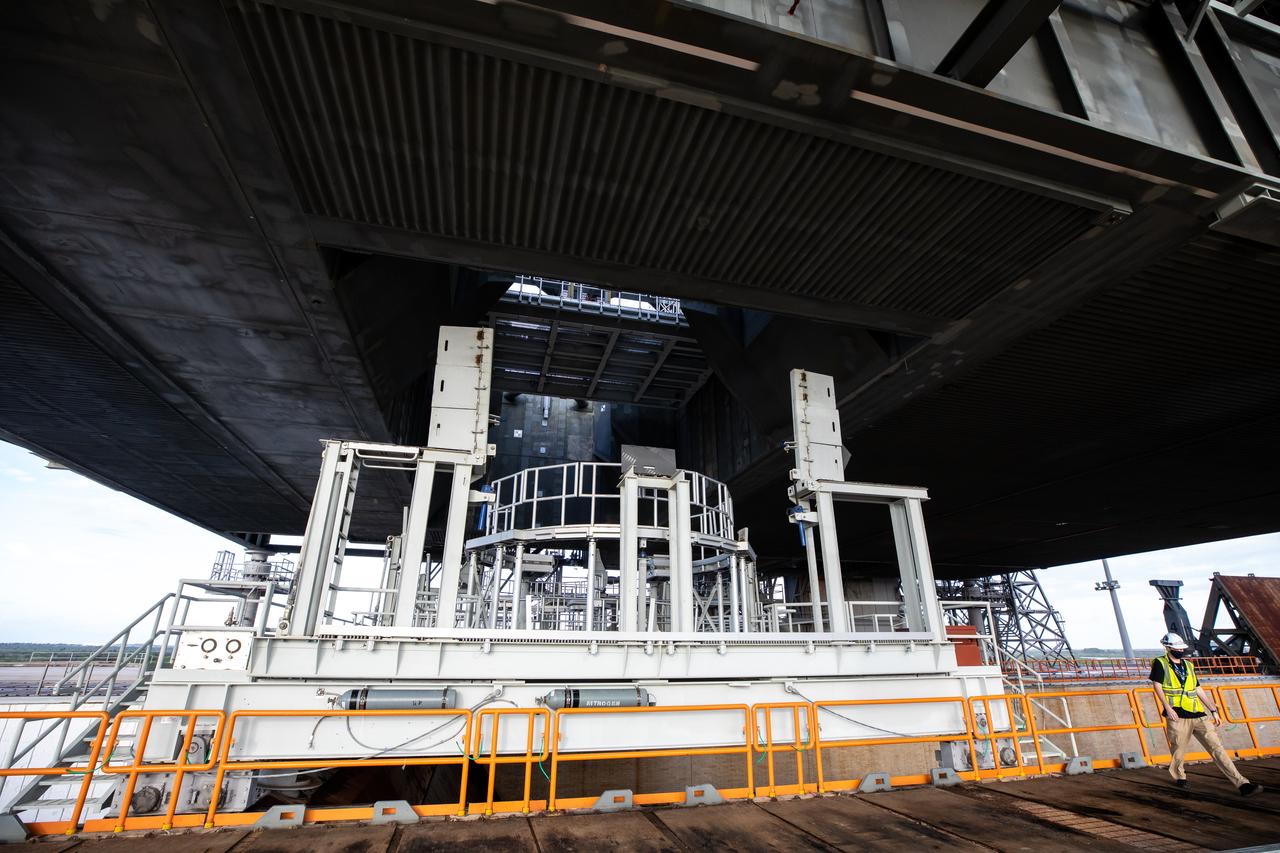
The engine service platform is moved into position beneath the mobile launcher for Artemis I at Launch Pad 39B on Oct. 23, 2020, at NASA’s Kennedy Space Center in Florida. The service platform allows access to the RS-25 engines on the Space Launch System core stage for routine work or inspections. The nearly 400-foot-tall mobile launcher will remain at the pad while engineers with Exploration Ground Systems and Jacobs complete several tasks, including a timing test to validate the launch team’s countdown timeline, and a thorough, top-to-bottom wash down of the mobile launcher to remove any debris remaining from construction and installation of the umbilical arms. Artemis I will test the Orion spacecraft and Space Launch System as an integrated system ahead of crewed flights to the Moon. Under the Artemis program, NASA will land the first woman and the next man on the Moon in 2024.
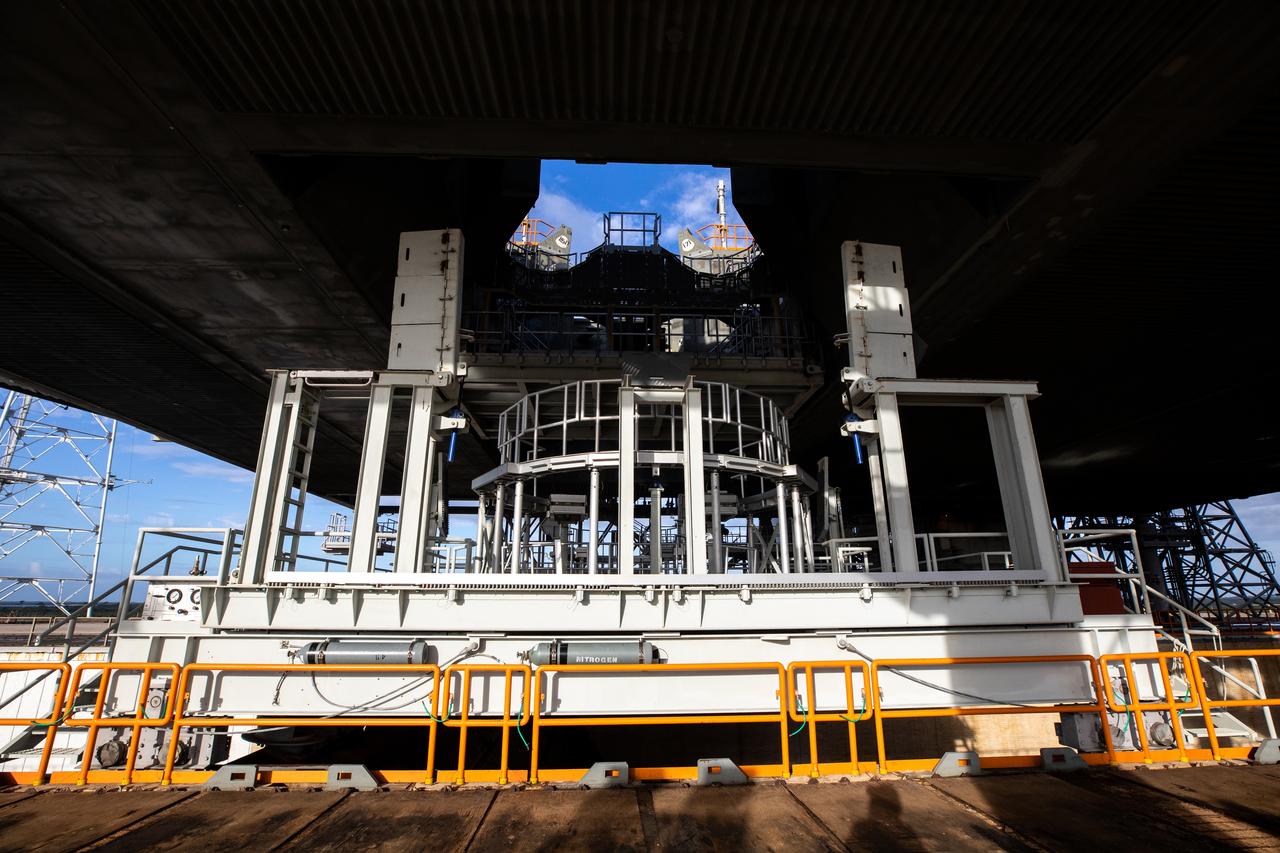
The engine service platform is moved into position beneath the mobile launcher for Artemis I at Launch Pad 39B on Oct. 23, 2020, at NASA’s Kennedy Space Center in Florida. The service platform allows access to the RS-25 engines on the Space Launch System core stage for routine work or inspections. The nearly 400-foot-tall mobile launcher will remain at the pad while engineers with Exploration Ground Systems and Jacobs will complete several tasks, including a timing test to validate the launch team’s countdown timeline, and a thorough, top-to-bottom wash down of the mobile launcher to remove any debris remaining from construction and installation of the umbilical arms. Artemis I will test the Orion spacecraft and Space Launch System as an integrated system ahead of crewed flights to the Moon. Under the Artemis program, NASA will land the first woman and the next man on the Moon in 2024.
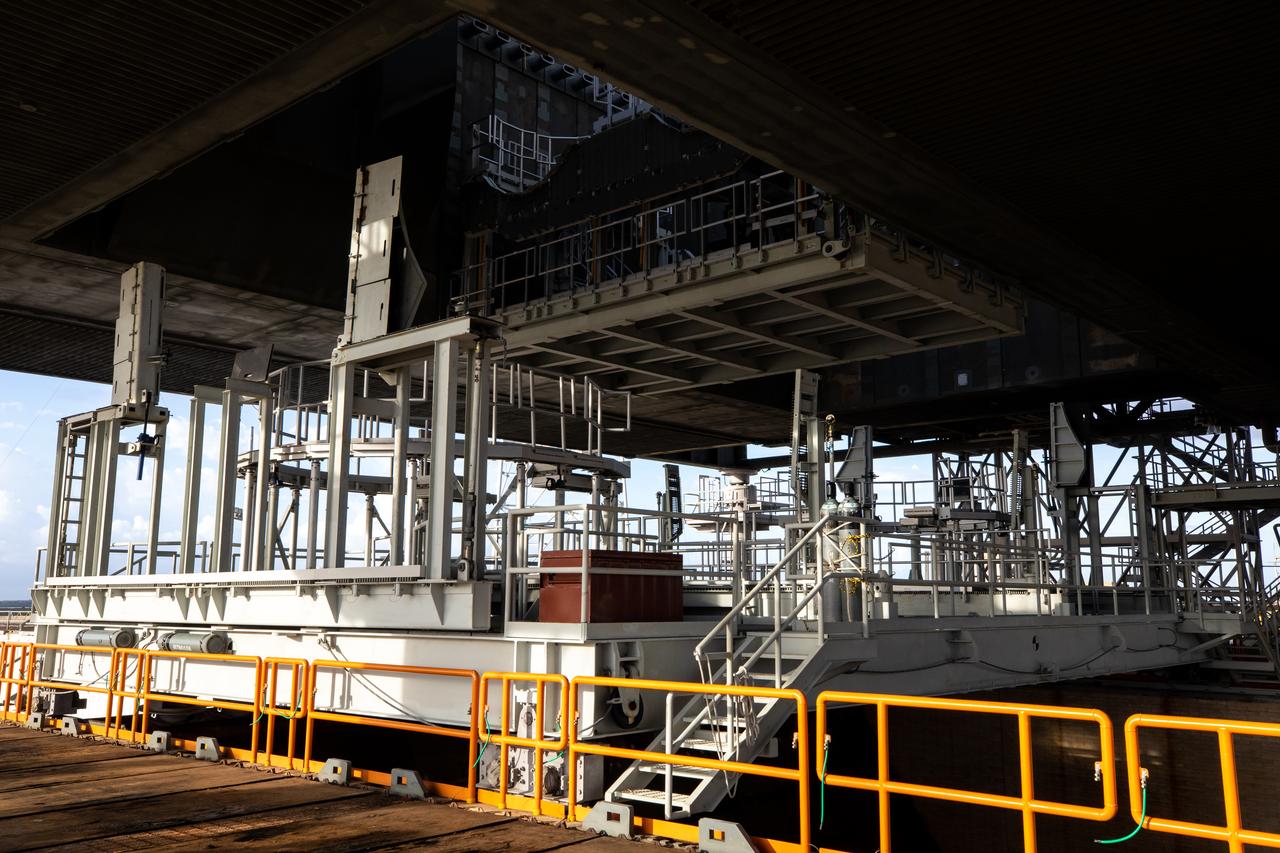
The engine service platform is moved into position beneath the mobile launcher for Artemis I at Launch Pad 39B on Oct. 23, 2020, at NASA’s Kennedy Space Center in Florida. The service platform allows access to the RS-25 engines on the Space Launch System core stage for routine work or inspections. The nearly 400-foot-tall mobile launcher will remain at the pad while engineers with Exploration Ground Systems and Jacobs complete several tasks, including a timing test to validate the launch team’s countdown timeline, and a thorough, top-to-bottom wash down of the mobile launcher to remove any debris remaining from construction and installation of the umbilical arms. Artemis I will test the Orion spacecraft and Space Launch System as an integrated system ahead of crewed flights to the Moon. Under the Artemis program, NASA will land the first woman and the next man on the Moon in 2024.
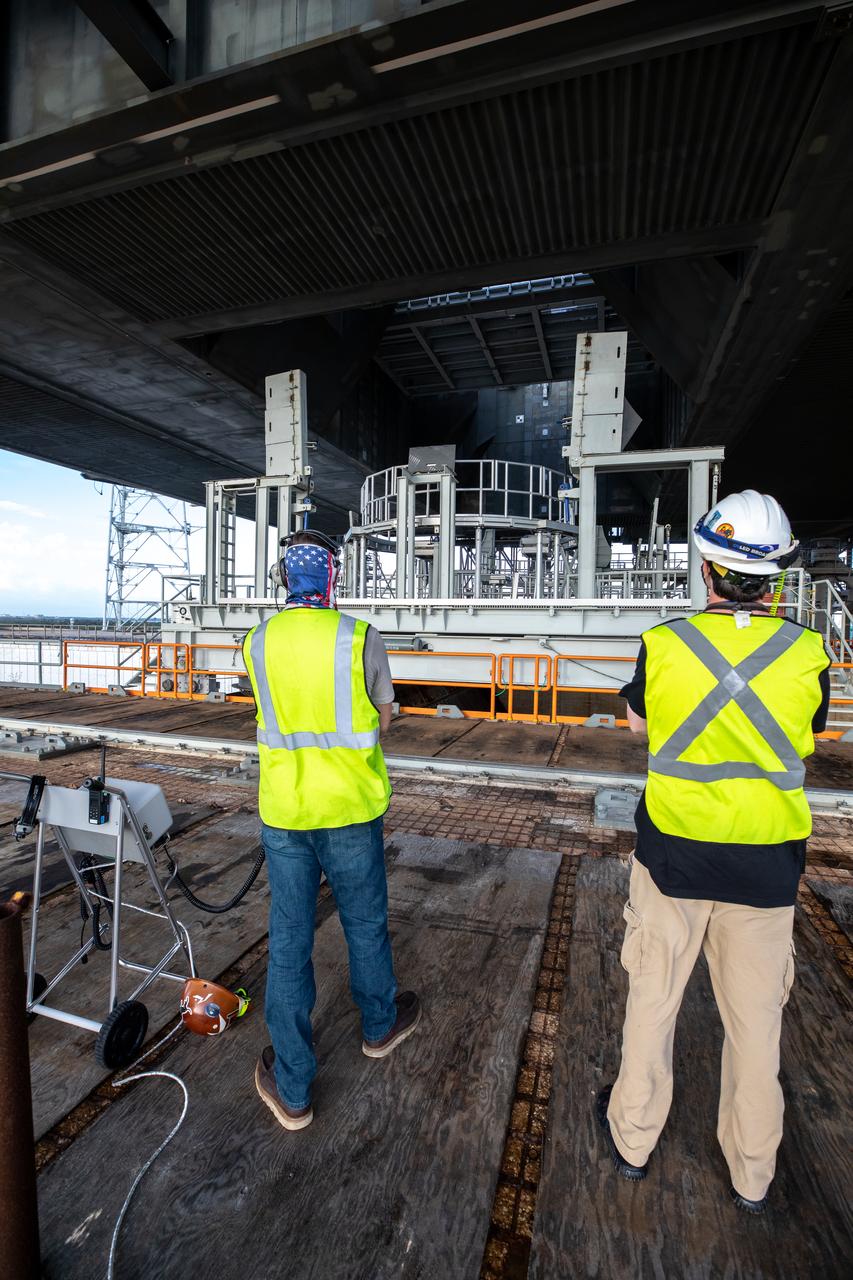
The engine service platform is moved into position beneath the mobile launcher for Artemis I at Launch Pad 39B on Oct. 23, 2020, at NASA’s Kennedy Space Center in Florida. The service platform allows access to the RS-25 engines on the Space Launch System core stage for routine work or inspections. The nearly 400-foot-tall mobile launcher will remain at the pad while engineers with Exploration Ground Systems and Jacobs will complete several tasks, including a timing test to validate the launch team’s countdown timeline, and a thorough, top-to-bottom wash down of the mobile launcher to remove any debris remaining from construction and installation of the umbilical arms. Artemis I will test the Orion spacecraft and Space Launch System as an integrated system ahead of crewed flights to the Moon. Under the Artemis program, NASA will land the first woman and the next man on the Moon in 2024.
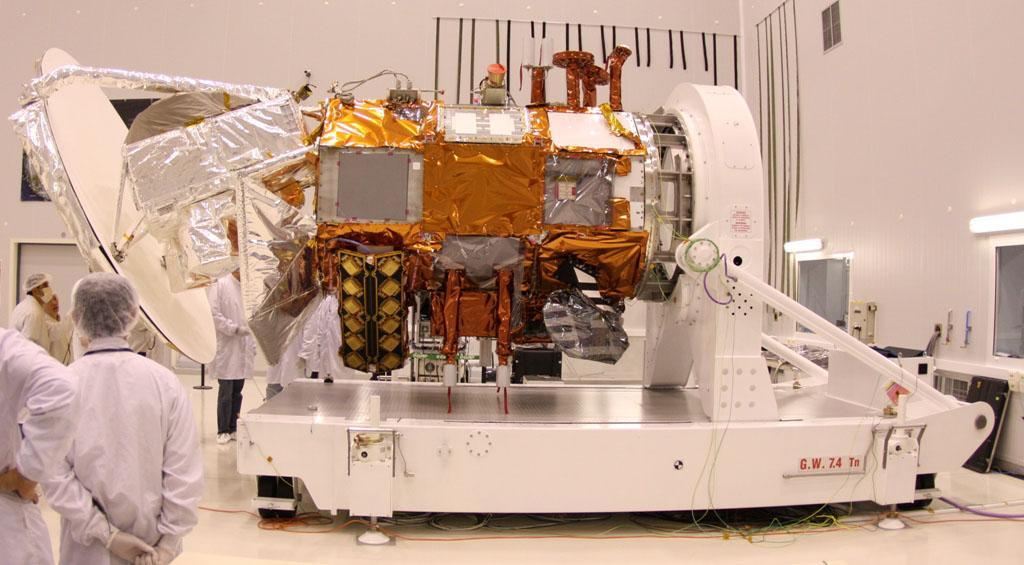
A fit check of half the sunshade is completed to verify the clearance of NASA Aquarius ground lug as well as the blanket interface with the service platform top deck.

The engine service platform has been lowered and removed from the mobile launcher for Artemis I at Launch Pad 39B at NASA’s Kennedy Space Center in Florida on Oct. 23, 2020. The platform is in view on a flatbed truck. The nearly 400-foot-tall mobile launcher is at the pad while engineers with Exploration Ground Systems and Jacobs complete several tasks, including a timing test to validate the launch team’s countdown timeline, and a thorough, top-to-bottom wash down of the mobile launcher to remove any debris remaining from construction and installation of the umbilical arms. Artemis I will test the Orion spacecraft and Space Launch System as an integrated system ahead of crewed flights to the Moon. Under the Artemis program, NASA will land the first woman and the next man on the Moon in 2024.
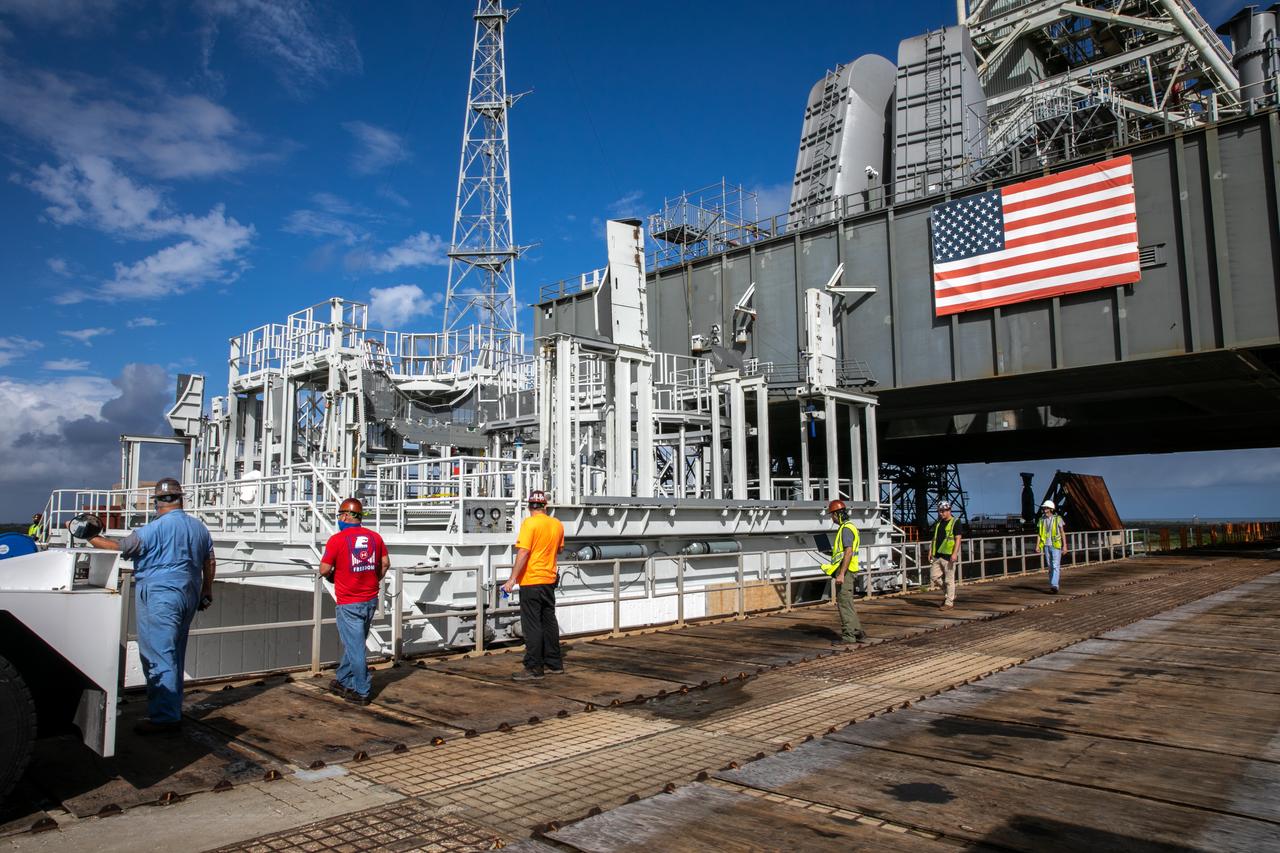
The engine service platform has been lowered and removed from the mobile launcher for Artemis I at Launch Pad 39B at NASA’s Kennedy Space Center in Florida on Oct. 23, 2020. The platform is in view on a flatbed truck. The nearly 400-foot-tall mobile launcher is at the pad while engineers with Exploration Ground Systems and Jacobs complete several tasks, including a timing test to validate the launch team’s countdown timeline, and a thorough, top-to-bottom wash down of the mobile launcher to remove any debris remaining from construction and installation of the umbilical arms. Artemis I will test the Orion spacecraft and Space Launch System as an integrated system ahead of crewed flights to the Moon. Under the Artemis program, NASA will land the first woman and the next man on the Moon in 2024.
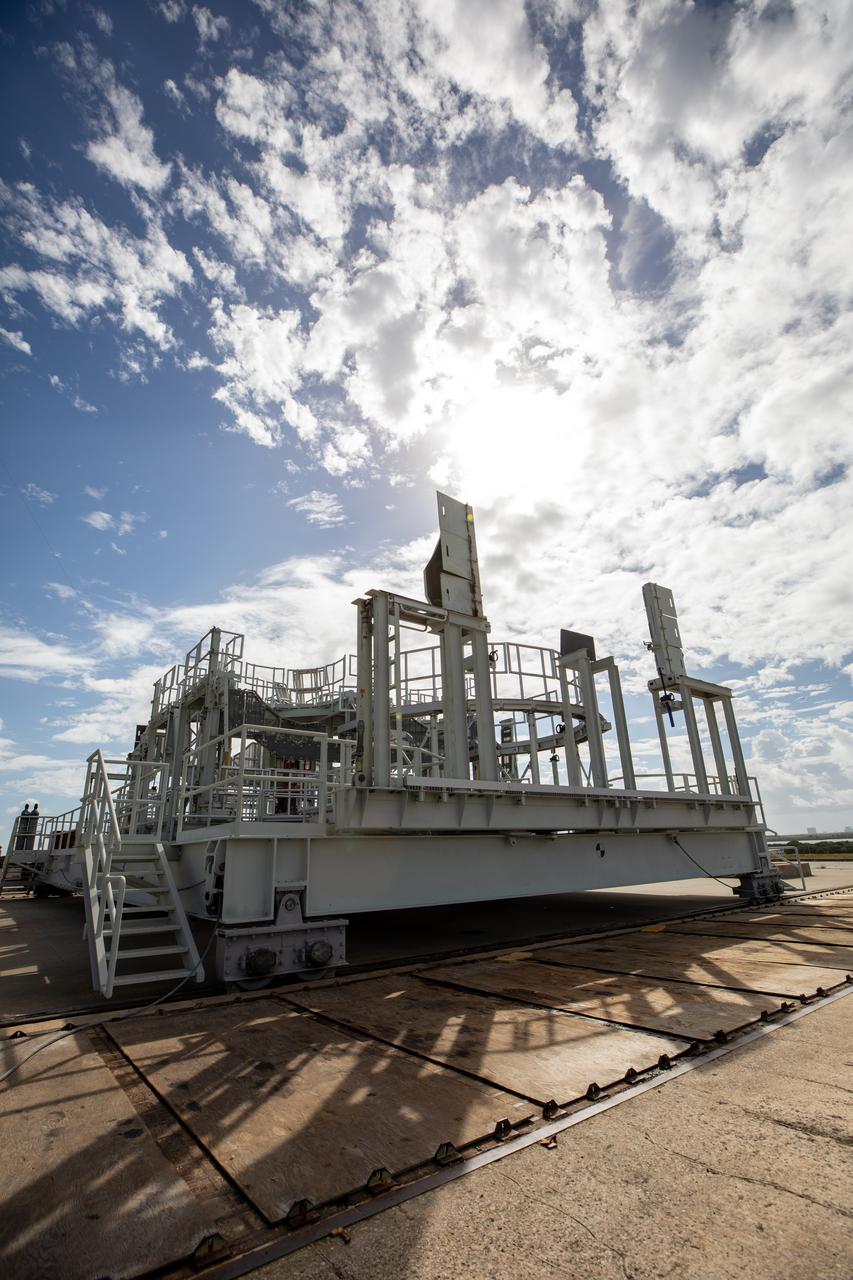
The engine service platform has been lowered and removed from the mobile launcher for Artemis I at Launch Pad 39B at NASA’s Kennedy Space Center in Florida on Oct. 23, 2020. It is staged on the top of the pad. The nearly 400-foot-tall mobile launcher is at the pad while engineers with Exploration Ground Systems and Jacobs complete several tasks, including a timing test to validate the launch team’s countdown timeline, and a thorough, top-to-bottom wash down of the mobile launcher to remove any debris remaining from construction and installation of the umbilical arms. Artemis I will test the Orion spacecraft and Space Launch System as an integrated system ahead of crewed flights to the Moon. Under the Artemis program, NASA will land the first woman and the next man on the Moon in 2024.
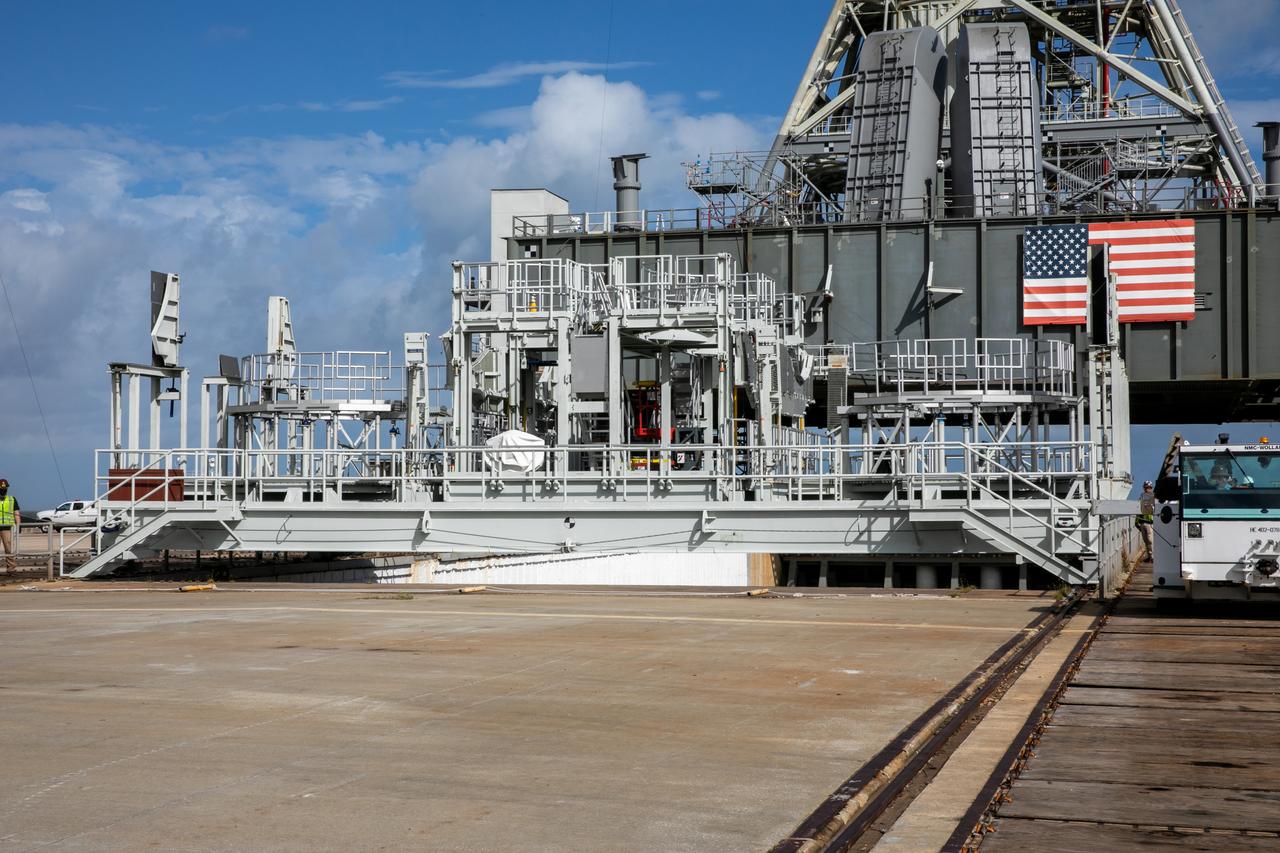
The engine service platform has been lowered and removed from underneath the mobile launcher for Artemis I at Launch Pad 39B at NASA’s Kennedy Space Center in Florida on Oct. 23, 2020. The nearly 400-foot-tall mobile launcher is at the pad while engineers with Exploration Ground Systems and Jacobs complete several tasks, including a timing test to validate the launch team’s countdown timeline, and a thorough, top-to-bottom wash down of the mobile launcher to remove any debris remaining from construction and installation of the umbilical arms. Artemis I will test the Orion spacecraft and Space Launch System as an integrated system ahead of crewed flights to the Moon. Under the Artemis program, NASA will land the first woman and the next man on the Moon in 2024.
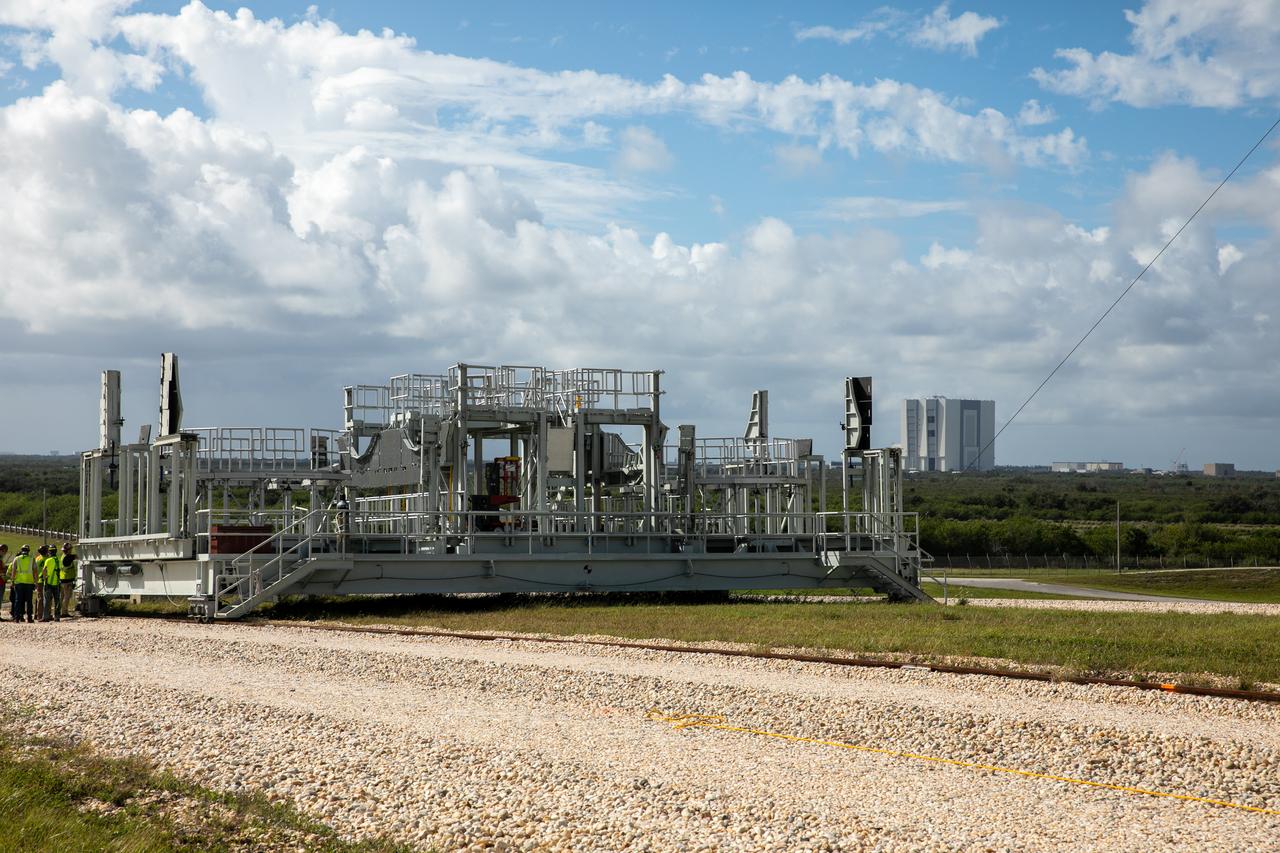
The engine service platform has been lowered and removed from the mobile launcher for Artemis I at Launch Pad 39B at NASA’s Kennedy Space Center in Florida on Oct. 23, 2020. It is being moved from the pad. The nearly 400-foot-tall mobile launcher is at the pad while engineers with Exploration Ground Systems and Jacobs complete several tasks, including a timing test to validate the launch team’s countdown timeline, and a thorough, top-to-bottom wash down of the mobile launcher to remove any debris remaining from construction and installation of the umbilical arms. Artemis I will test the Orion spacecraft and Space Launch System as an integrated system ahead of crewed flights to the Moon. Under the Artemis program, NASA will land the first woman and the next man on the Moon in 2024.
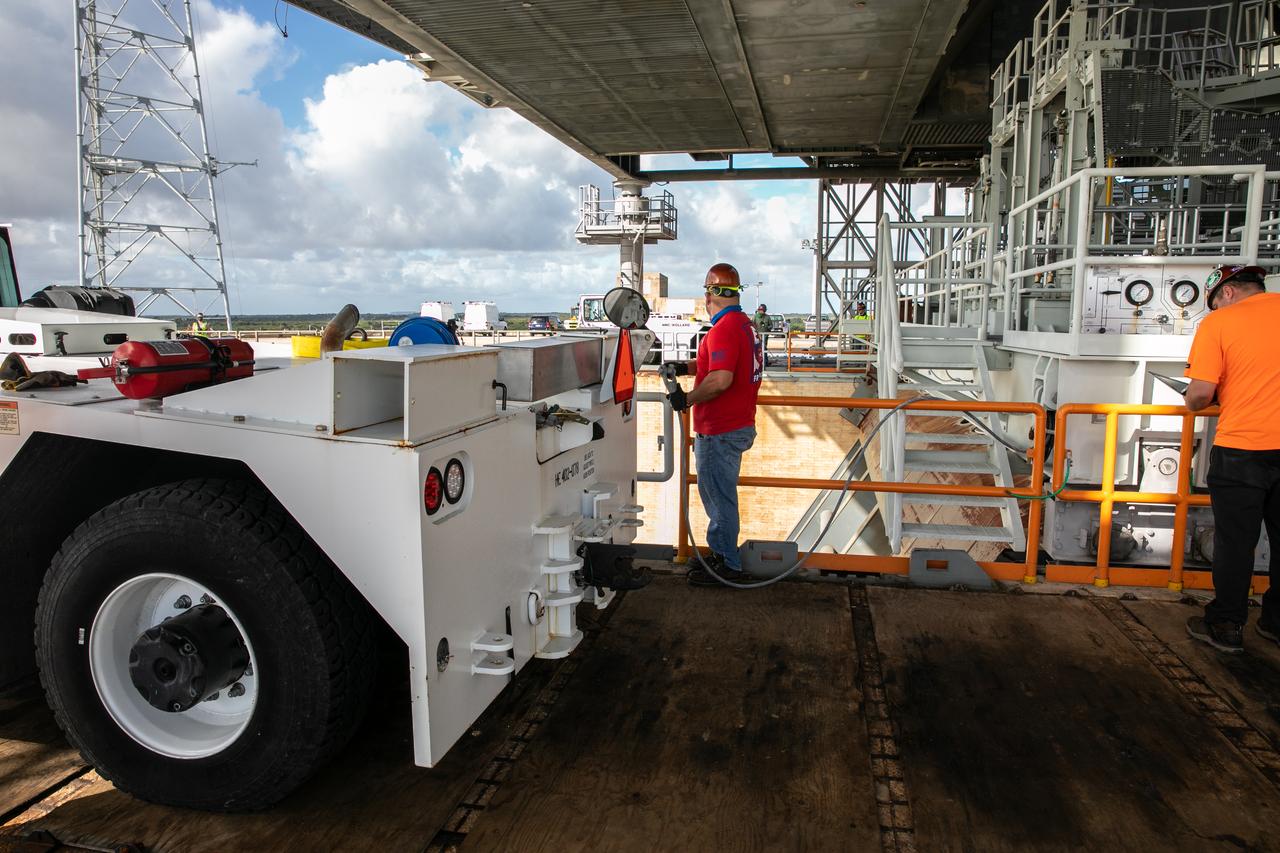
Engineers with Exploration Ground Systems and Jacobs assist with raising the engine service platform beneath the mobile launcher for Artemis I at Launch Pad 39B at NASA’s Kennedy Space Center in Florida on Oct. 23, 2020. The nearly 400-foot-tall mobile launcher is at the pad while engineers with Exploration Ground Systems and Jacobs complete several tasks, including a timing test to validate the launch team’s countdown timeline, and a thorough, top-to-bottom wash down of the mobile launcher to remove any debris remaining from construction and installation of the umbilical arms. Artemis I will test the Orion spacecraft and Space Launch System as an integrated system ahead of crewed flights to the Moon. Under the Artemis program, NASA will land the first woman and the next man on the Moon in 2024.
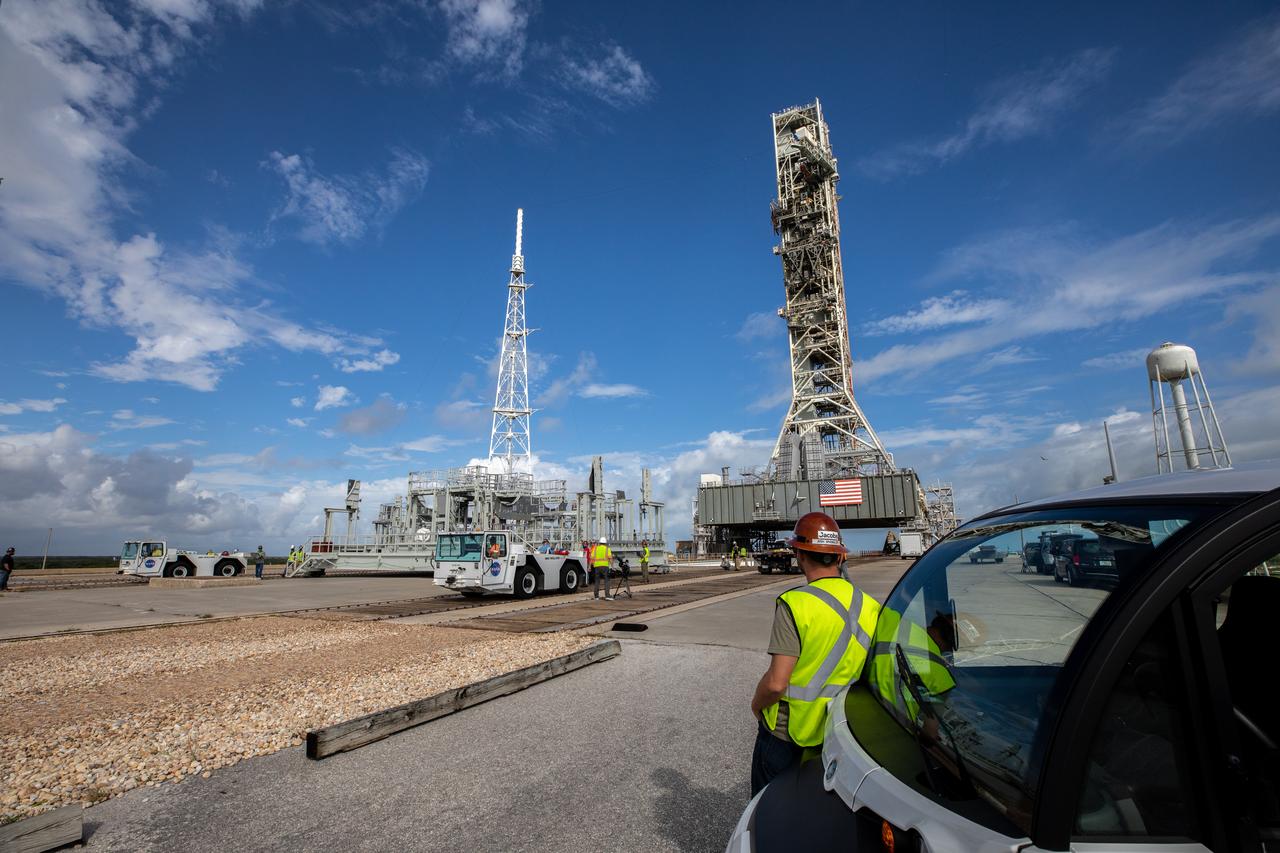
A view of the mobile launcher for Artemis I on Launch Pad 39B at NASA’s Kennedy Space Center in Florida on Oct. 23, 2020. The engine service platform has been lowered and removed from the mobile launcher and is in view on a flatbed carrier. The nearly 400-foot-tall mobile launcher is at the pad while engineers with Exploration Ground Systems and Jacobs complete several tasks, including a timing test to validate the launch team’s countdown timeline, and a thorough, top-to-bottom wash down of the mobile launcher to remove any debris remaining from construction and installation of the umbilical arms. Artemis I will test the Orion spacecraft and Space Launch System as an integrated system ahead of crewed flights to the Moon. Under the Artemis program, NASA will land the first woman and the next man on the Moon in 2024.
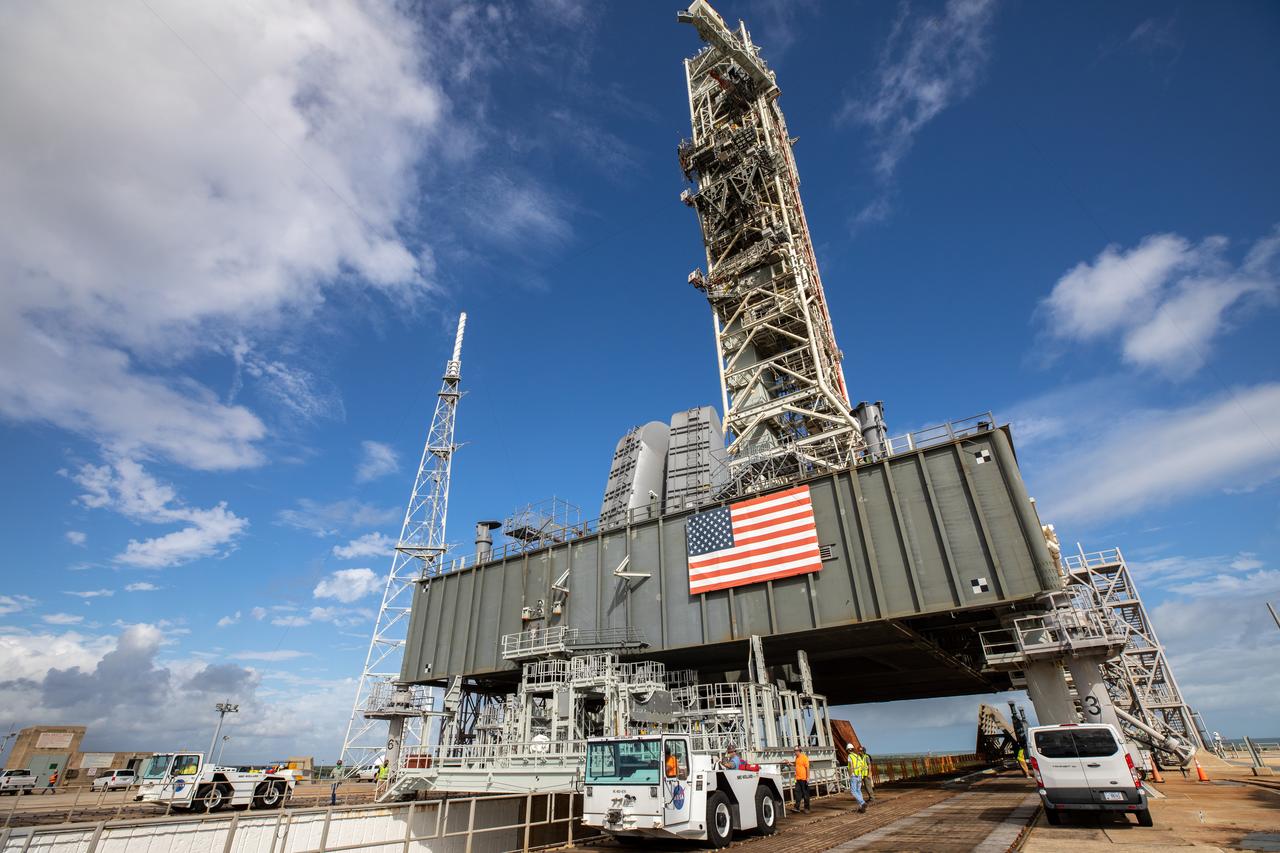
Engineers with Exploration Ground Systems and Jacobs assist with lowering the engine service platform beneath the mobile launcher for Artemis I at Launch Pad 39B at NASA’s Kennedy Space Center in Florida on Oct. 23, 2020. The nearly 400-foot-tall mobile launcher is at the pad while engineers with Exploration Ground Systems and Jacobs complete several tasks, including a timing test to validate the launch team’s countdown timeline, and a thorough, top-to-bottom wash down of the mobile launcher to remove any debris remaining from construction and installation of the umbilical arms. Artemis I will test the Orion spacecraft and Space Launch System as an integrated system ahead of crewed flights to the Moon. Under the Artemis program, NASA will land the first woman and the next man on the Moon in 2024.
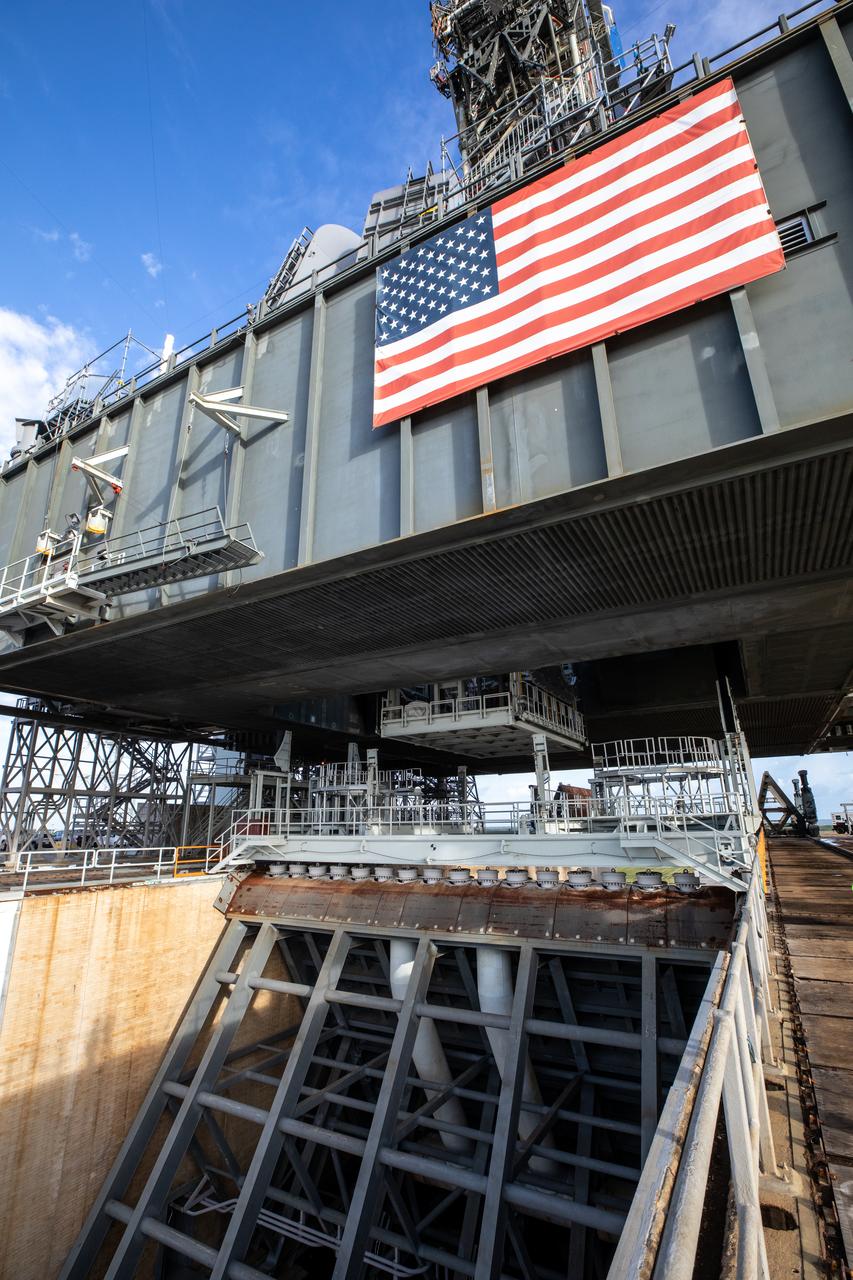
A view of the base of the mobile launcher for Artemis I and the flame trench below as the engine service platform is being raised into position below the mobile launcher at Launch Pad 39B at NASA’s Kennedy Space Center in Florida on Oct. 23, 2020. The nearly 400-foot-tall mobile launcher is at the pad while engineers with Exploration Ground Systems and Jacobs complete several tasks, including a timing test to validate the launch team’s countdown timeline, and a thorough, top-to-bottom wash down of the mobile launcher to remove any debris remaining from construction and installation of the umbilical arms. Artemis I will test the Orion spacecraft and Space Launch System as an integrated system ahead of crewed flights to the Moon. Under the Artemis program, NASA will land the first woman and the next man on the Moon in 2024.
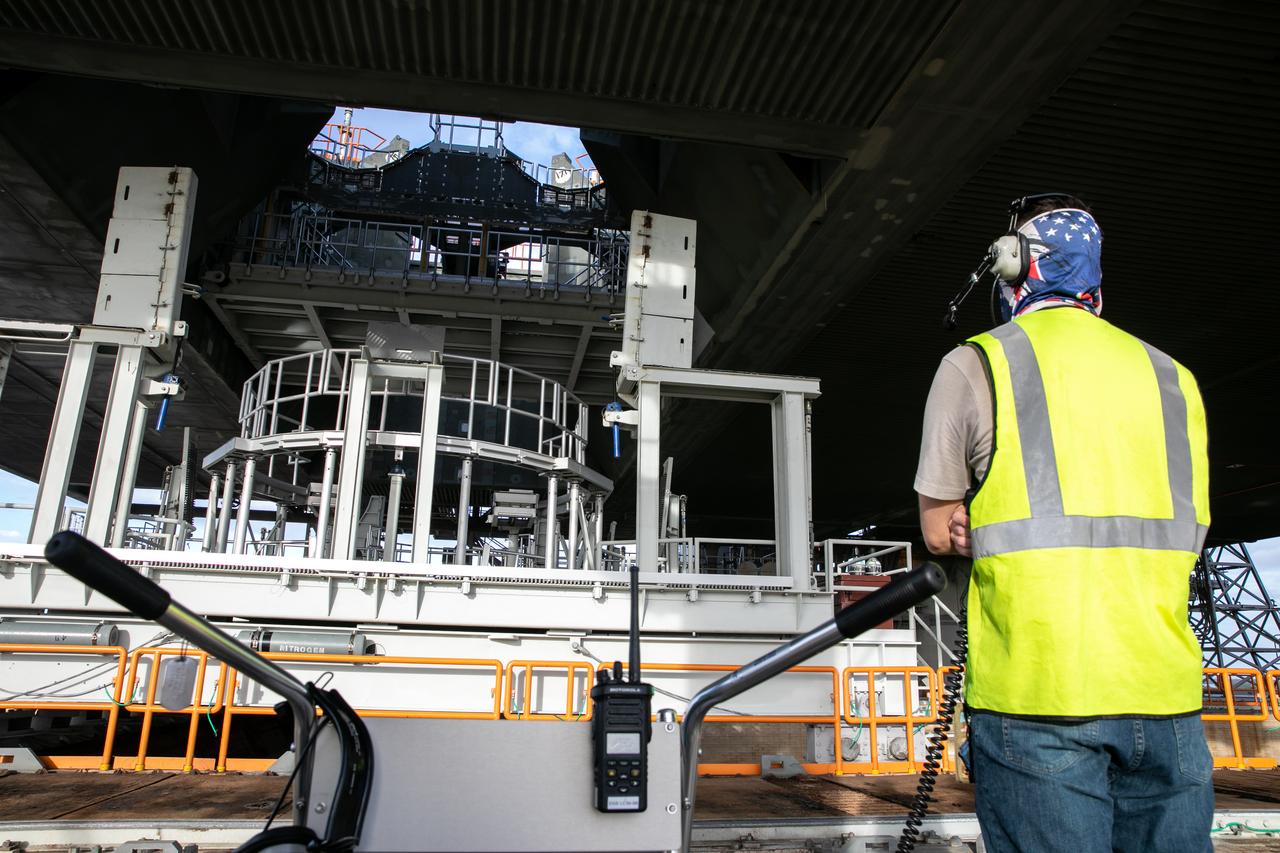
Workers assists with raising the engine service platform beneath the mobile launcher for Artemis I at Launch Pad 39B at NASA’s Kennedy Space Center in Florida on Oct. 23, 2020. The nearly 400-foot-tall mobile launcher is at the pad while engineers with Exploration Ground Systems and Jacobs complete several tasks, including a timing test to validate the launch team’s countdown timeline, and a thorough, top-to-bottom wash down of the mobile launcher to remove any debris remaining from construction and installation of the umbilical arms. Artemis I will test the Orion spacecraft and Space Launch System as an integrated system ahead of crewed flights to the Moon. Under the Artemis program, NASA will land the first woman and the next man on the Moon in 2024.
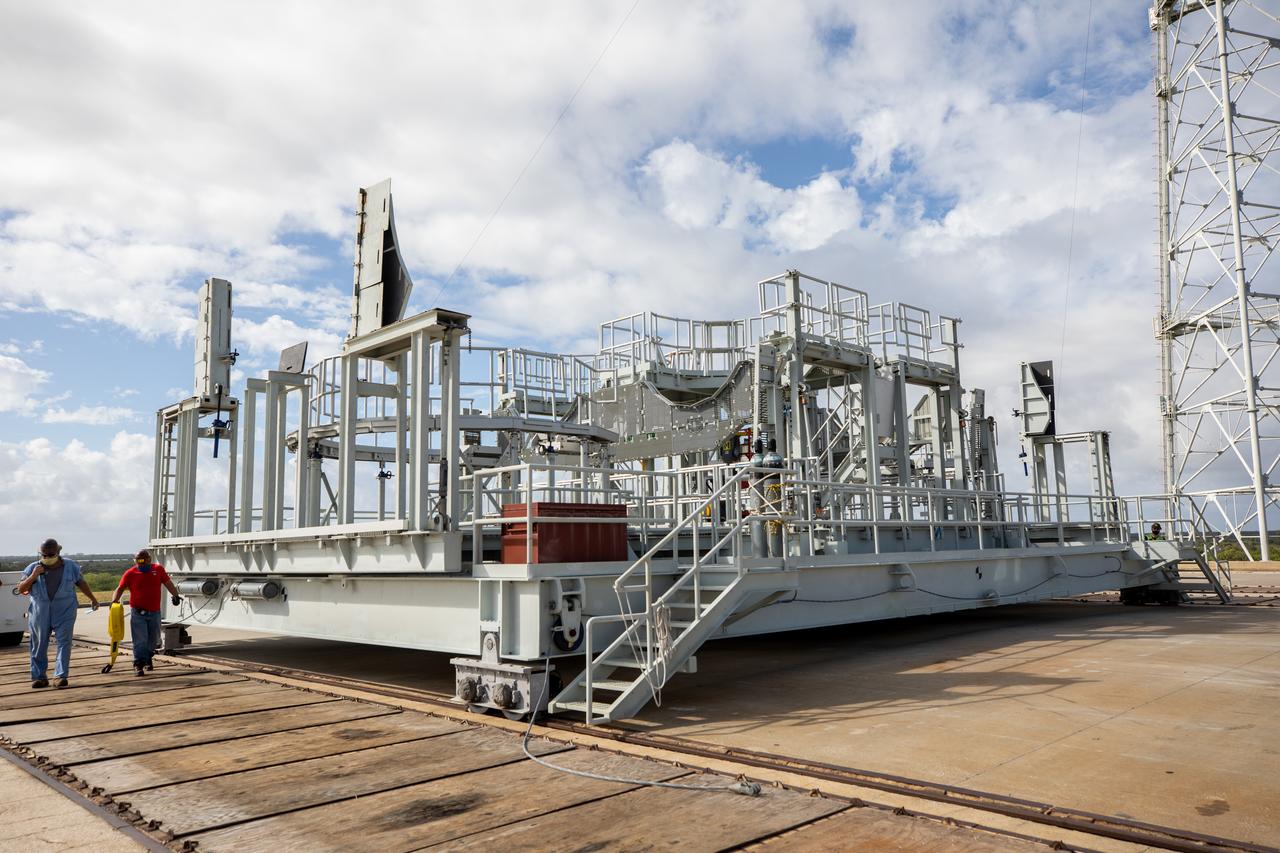
The engine service platform has been lowered and removed from the mobile launcher for Artemis I at Launch Pad 39B at NASA’s Kennedy Space Center in Florida on Oct. 23, 2020. It is staged on the top of the pad. The nearly 400-foot-tall mobile launcher is at the pad while engineers with Exploration Ground Systems and Jacobs complete several tasks, including a timing test to validate the launch team’s countdown timeline, and a thorough, top-to-bottom wash down of the mobile launcher to remove any debris remaining from construction and installation of the umbilical arms. Artemis I will test the Orion spacecraft and Space Launch System as an integrated system ahead of crewed flights to the Moon. Under the Artemis program, NASA will land the first woman and the next man on the Moon in 2024.
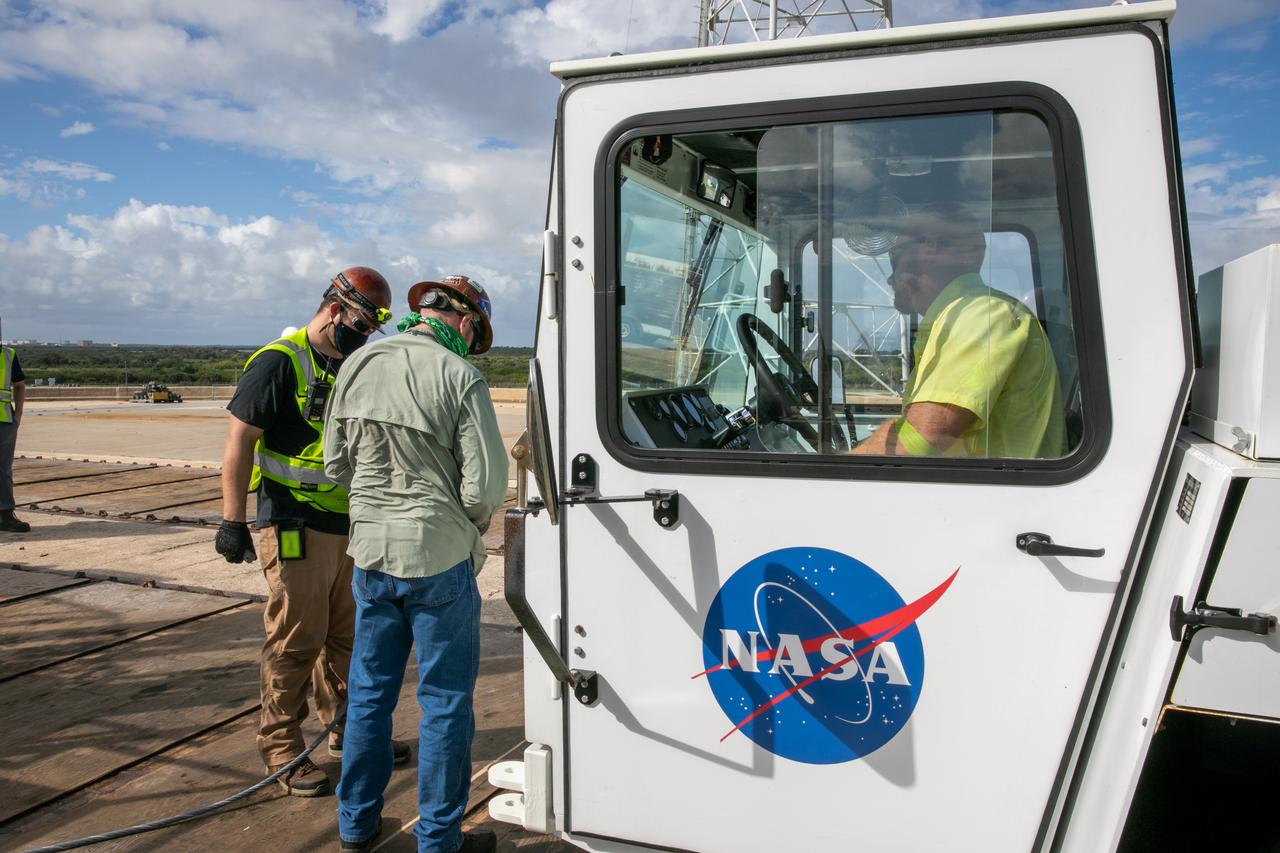
The cab of a flatbed carrier is in view on the surface of Launch Pad 39B at NASA’s Kennedy Space Center in Florida on Oct. 23, 2020. It will carry the engine service platform that was lowered and removed from the mobile launcher for Artemis I. The nearly 400-foot-tall mobile launcher is at the pad while engineers with Exploration Ground Systems and Jacobs complete several tasks, including a timing test to validate the launch team’s countdown timeline, and a thorough, top-to-bottom wash down of the mobile launcher to remove any debris remaining from construction and installation of the umbilical arms. Artemis I will test the Orion spacecraft and Space Launch System as an integrated system ahead of crewed flights to the Moon. Under the Artemis program, NASA will land the first woman and the next man on the Moon in 2024.
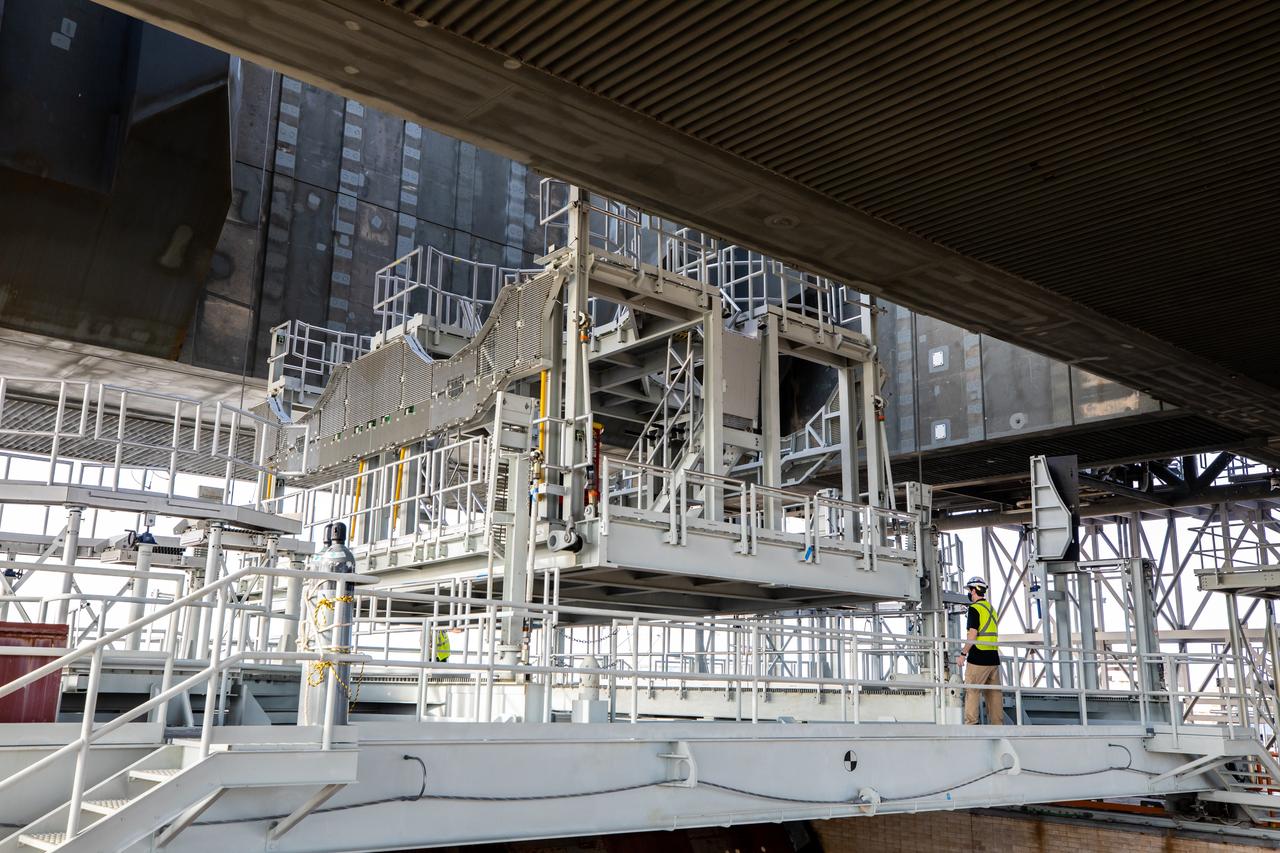
The engine service platform is being raised beneath the mobile launcher for Artemis I at Launch Pad 39B at NASA’s Kennedy Space Center in Florida on Oct. 23, 2020. The nearly 400-foot-tall mobile launcher is at the pad while engineers with Exploration Ground Systems and Jacobs complete several tasks, including a timing test to validate the launch team’s countdown timeline, and a thorough, top-to-bottom wash down of the mobile launcher to remove any debris remaining from construction and installation of the umbilical arms. Artemis I will test the Orion spacecraft and Space Launch System as an integrated system ahead of crewed flights to the Moon. Under the Artemis program, NASA will land the first woman and the next man on the Moon in 2024.
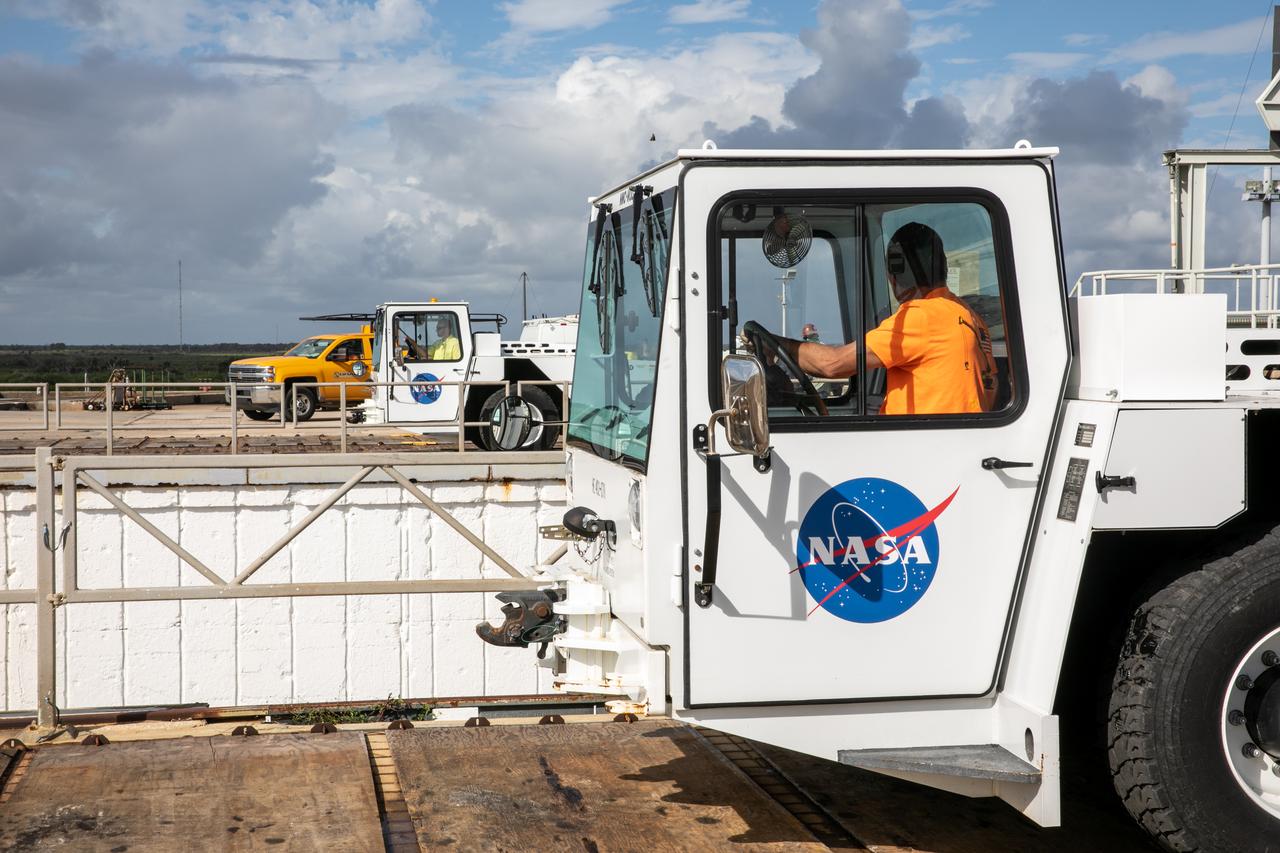
A flatbed carrier is in view on the surface of Launch Pad 39B at NASA’s Kennedy Space Center in Florida on Oct. 23, 2020. It is carrying the engine service platform that was lowered and removed from the mobile launcher for Artemis I. The nearly 400-foot-tall mobile launcher is at the pad while engineers with Exploration Ground Systems and Jacobs complete several tasks, including a timing test to validate the launch team’s countdown timeline, and a thorough, top-to-bottom wash down of the mobile launcher to remove any debris remaining from construction and installation of the umbilical arms. Artemis I will test the Orion spacecraft and Space Launch System as an integrated system ahead of crewed flights to the Moon. Under the Artemis program, NASA will land the first woman and the next man on the Moon in 2024.
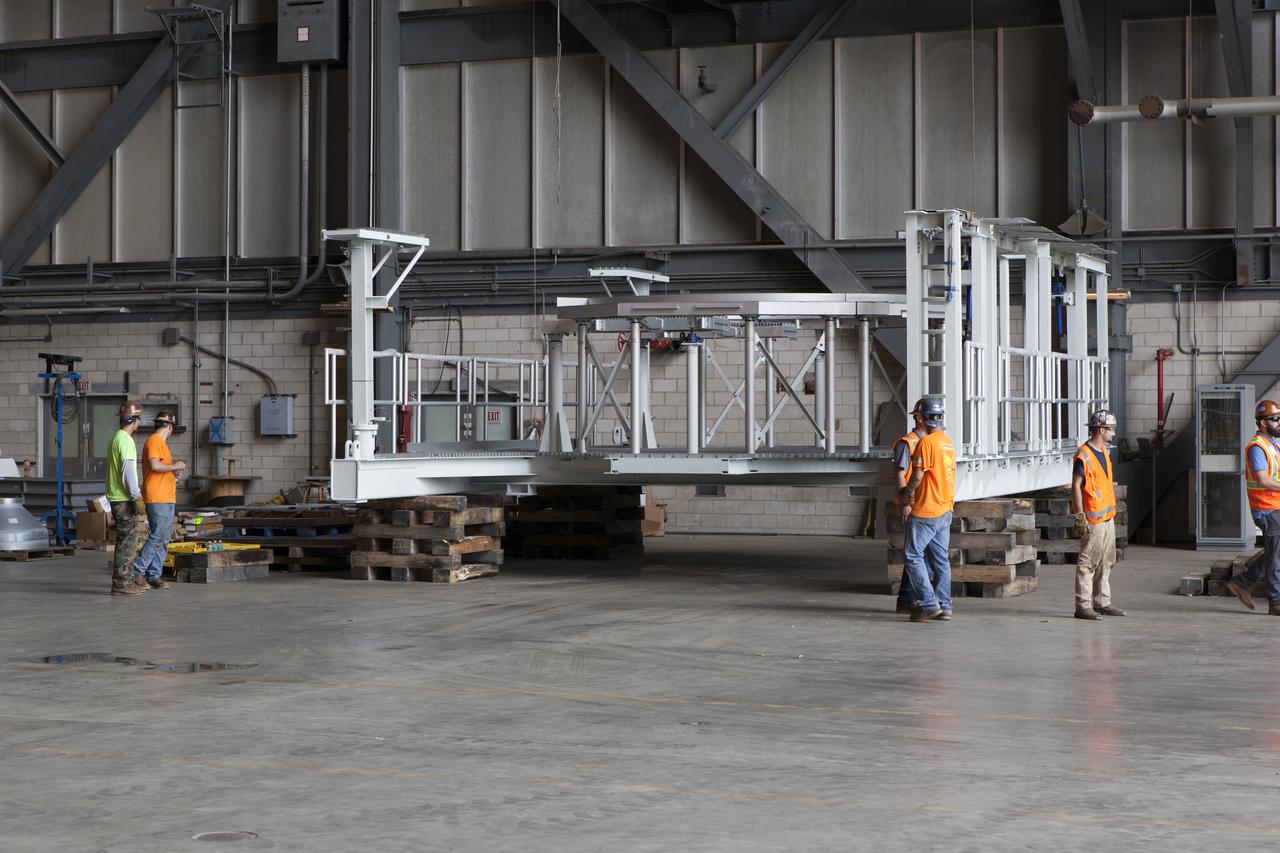
One of two new work platforms for NASA's Space Launch System booster engines is secured on dunnage inside the Vehicle Assembly Building (VAB) at the agency's Kennedy Space Center in Florida. The platforms were transported from fabricator Met-Con Inc. in Cocoa, Florida. They will be stored in the VAB, where they will be used for processing and checkout of the engines for the rocket's twin five-segment solid rocket boosters for Exploration Mission-1. EM-1 will launch an uncrewed Orion spacecraft to a stable orbit beyond the Moon and bring it back to Earth for a splashdown in the Pacific Ocean.
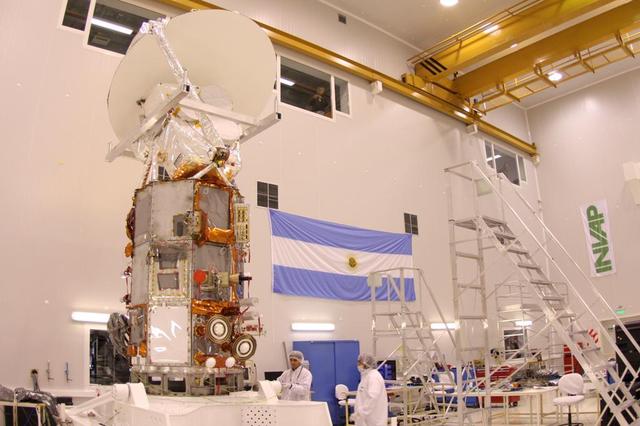
NASA Aquarius instrument on SAC-D sevice platform in INVAP high bay facility for mechanical integration activities.
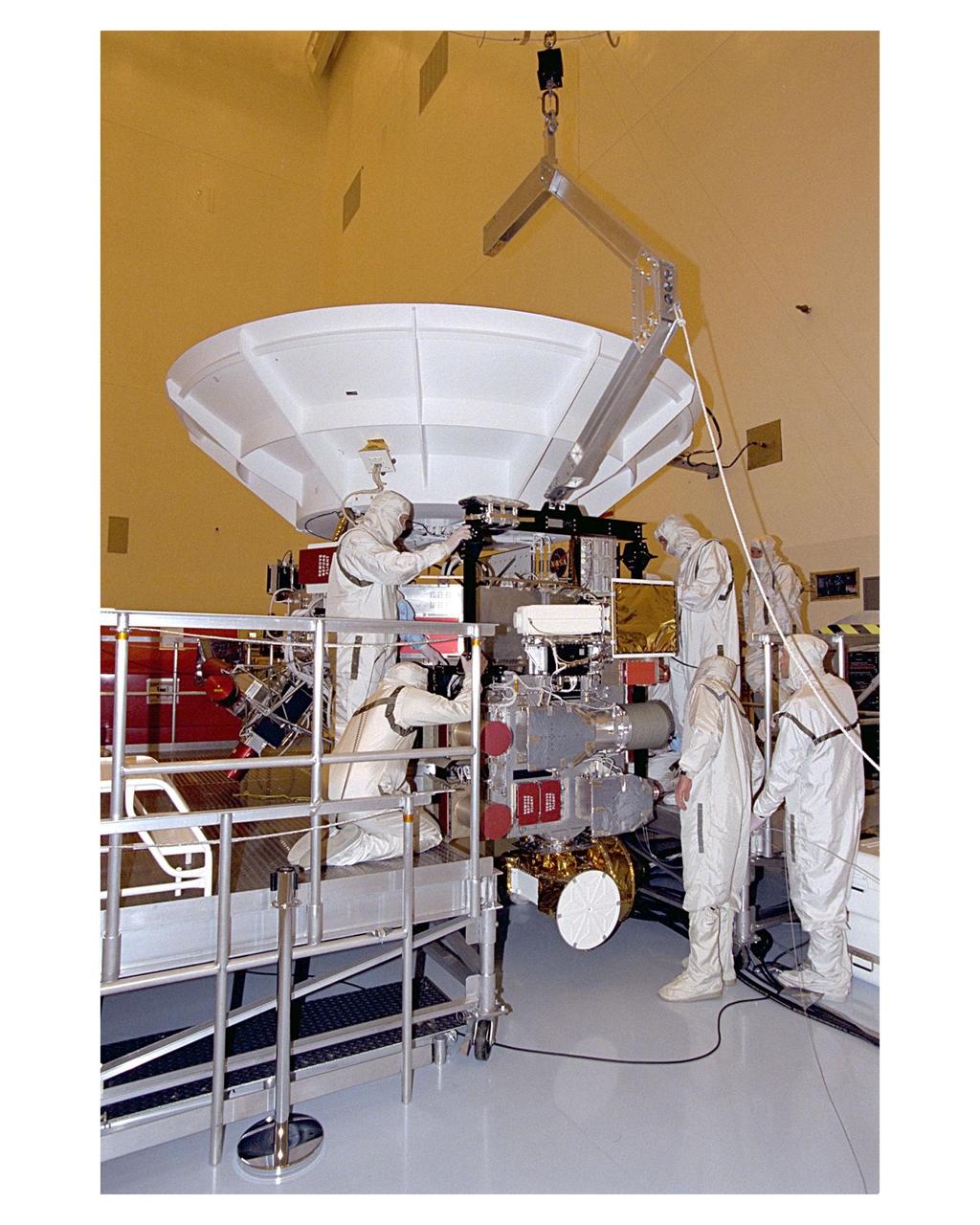
Titan Cassini Remote Sensing Platform installation in the Payload Hazardous Servicing Facility

Titan Cassini Remote Sensing Platform installation in the Payload Hazardous Servicing Facility
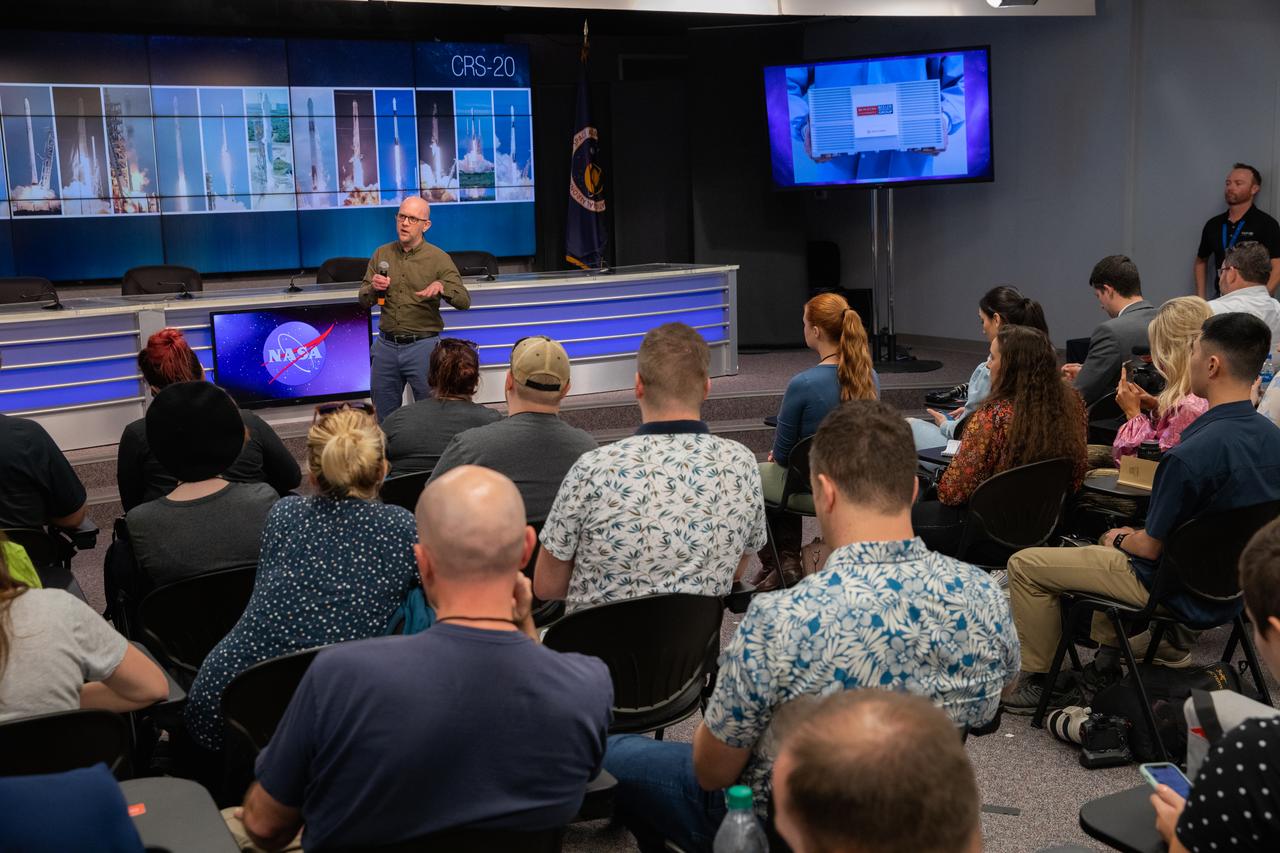
Aaron Beeler, professor of chemistry at Boston University and principal investigator of the Flow Chemistry Platform for Synthetic Reactions on ISS study, addresses NASA Social participants during a What’s on Board science briefing at the agency’s Kennedy Space Center in Florida on March 5, 2020. The briefing provided a closer look at some of the payloads launching on SpaceX’s 20th Commercial Resupply Services (CRS-20) mission to the International Space Station. The company’s Falcon 9 rocket is scheduled to lift off from Cape Canaveral Air Force Station’s Space Launch Complex 40 at 11:50 p.m. EST on March 6, 2020.

Aaron Beeler, professor of chemistry at Boston University and principal investigator of the Flow Chemistry Platform for Synthetic Reactions on ISS study, addresses NASA Social participants during a What’s on Board science briefing at the agency’s Kennedy Space Center in Florida on March 5, 2020. The briefing provided a closer look at some of the payloads launching on SpaceX’s 20th Commercial Resupply Services (CRS-20) mission to the International Space Station. The company’s Falcon 9 rocket is scheduled to lift off from Cape Canaveral Air Force Station’s Space Launch Complex 40 at 11:50 p.m. EST on March 6, 2020.
![jsc2022e057894 (5/13/2022) --- Views of the Maltese Biocube based on the ICE Cubes platform by Belgian company Space Applications Services [Credit: Space Applications Services, NV/SA]](https://images-assets.nasa.gov/image/jsc2022e057894/jsc2022e057894~medium.jpg)
jsc2022e057894 (5/13/2022) --- Views of the Maltese Biocube based on the ICE Cubes platform by Belgian company Space Applications Services [Credit: Space Applications Services, NV/SA]
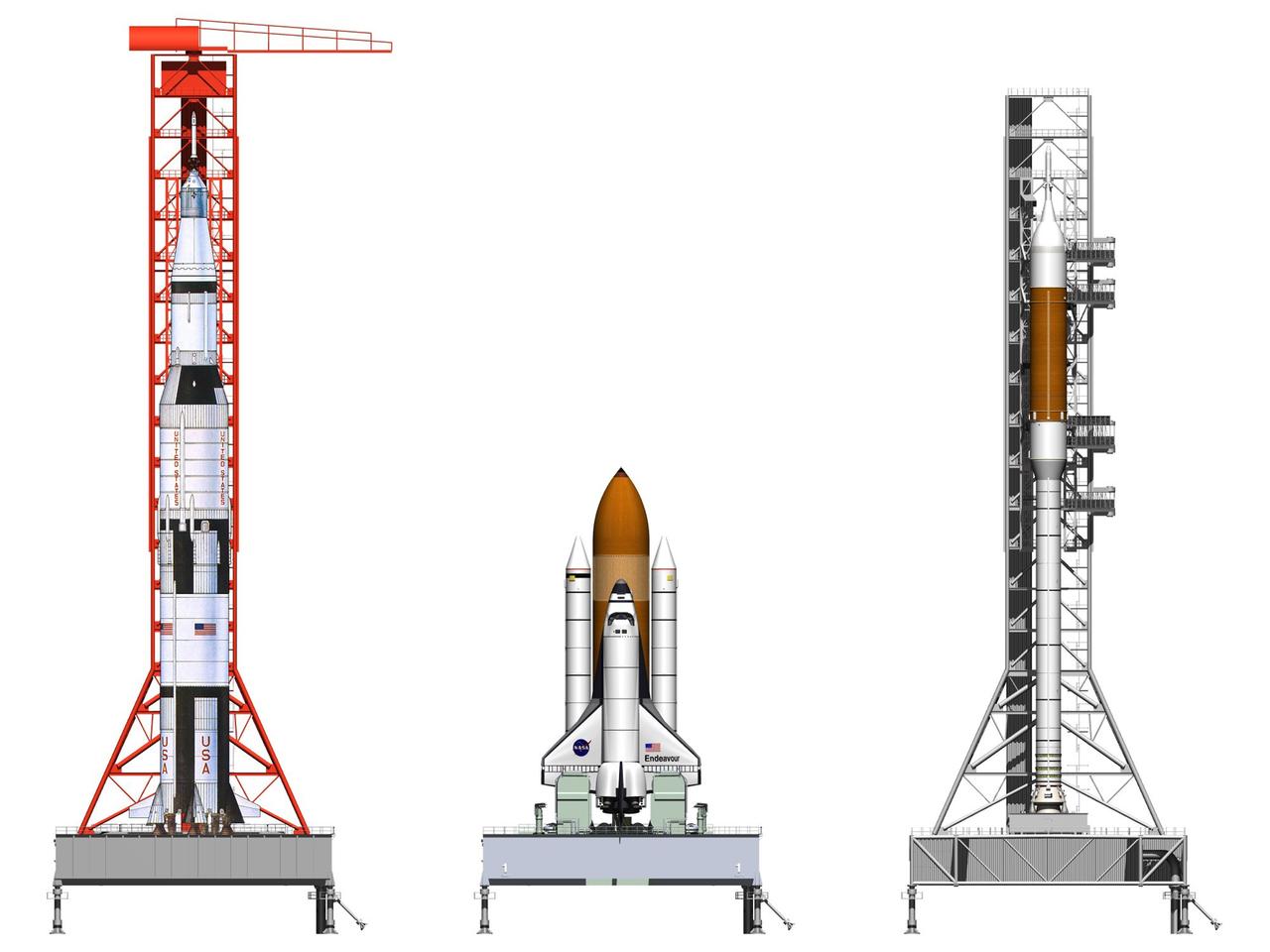
CAPE CANAVERAL, Fla. -- Artist's rendering of the Constellation Program's Ares V rocket on the mobile launcher platform (left) and the Ares I rocket on the platform (right) with the space shuttle in between for comparison. The tower of the mobile launcher will have multiple platforms for personnel access and will be approximately 390 feet tall. The tower will be used in the assembly, testing and servicing of the Ares rockets at Kennedy and will also transport the Ares rockets to the launch pad and provide ground support for launches.
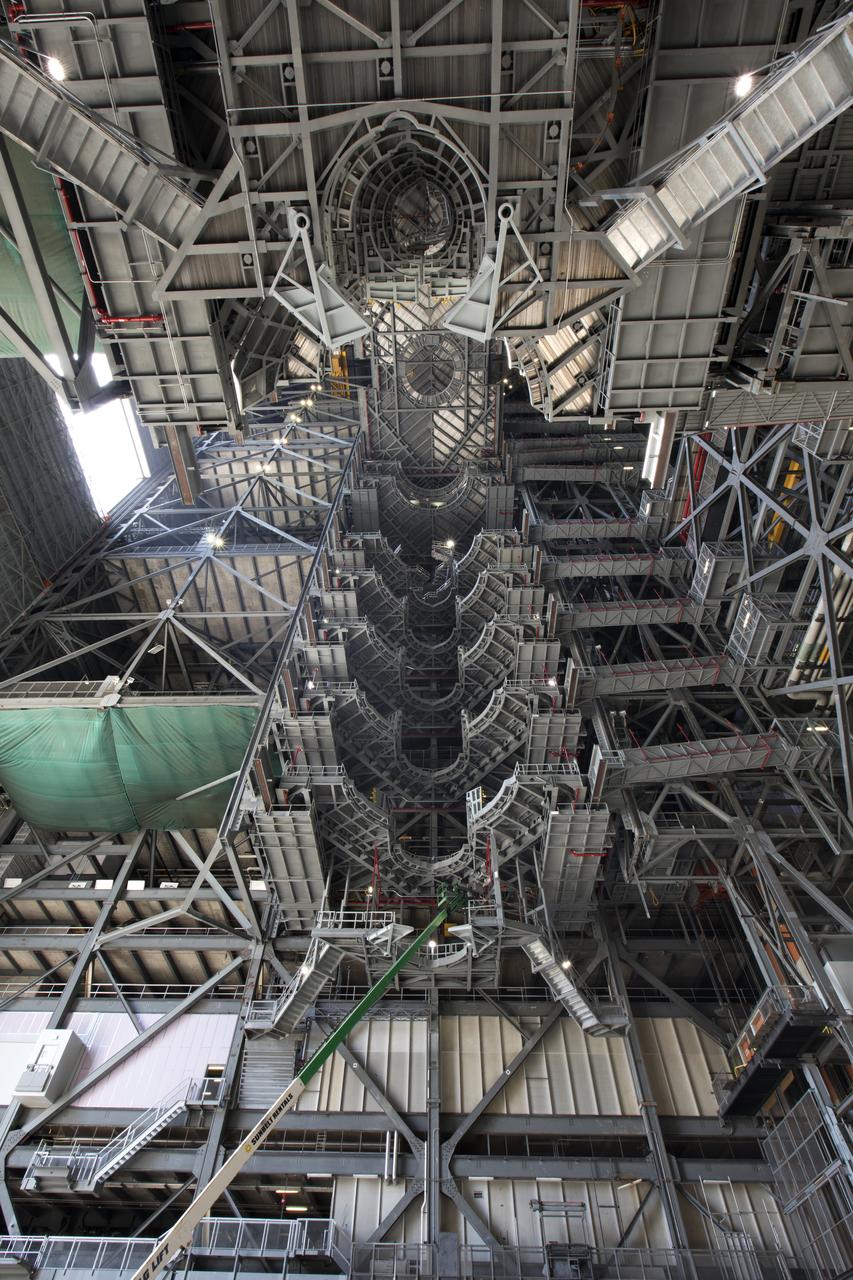
A view looking up at one side of the 10 levels of work platforms in High Bay 3 inside the Vehicle Assembly Building (VAB) at NASA's Kennedy Space Center in Florida. The work platforms will surround and provide access for service and processing of NASA's Space Launch System rocket and Orion spacecraft. Exploration Ground Systems oversaw the upgrades and installation of the new work platforms to support the launch of the SLS and Orion on Exploration Mission-1 and deep space missions.
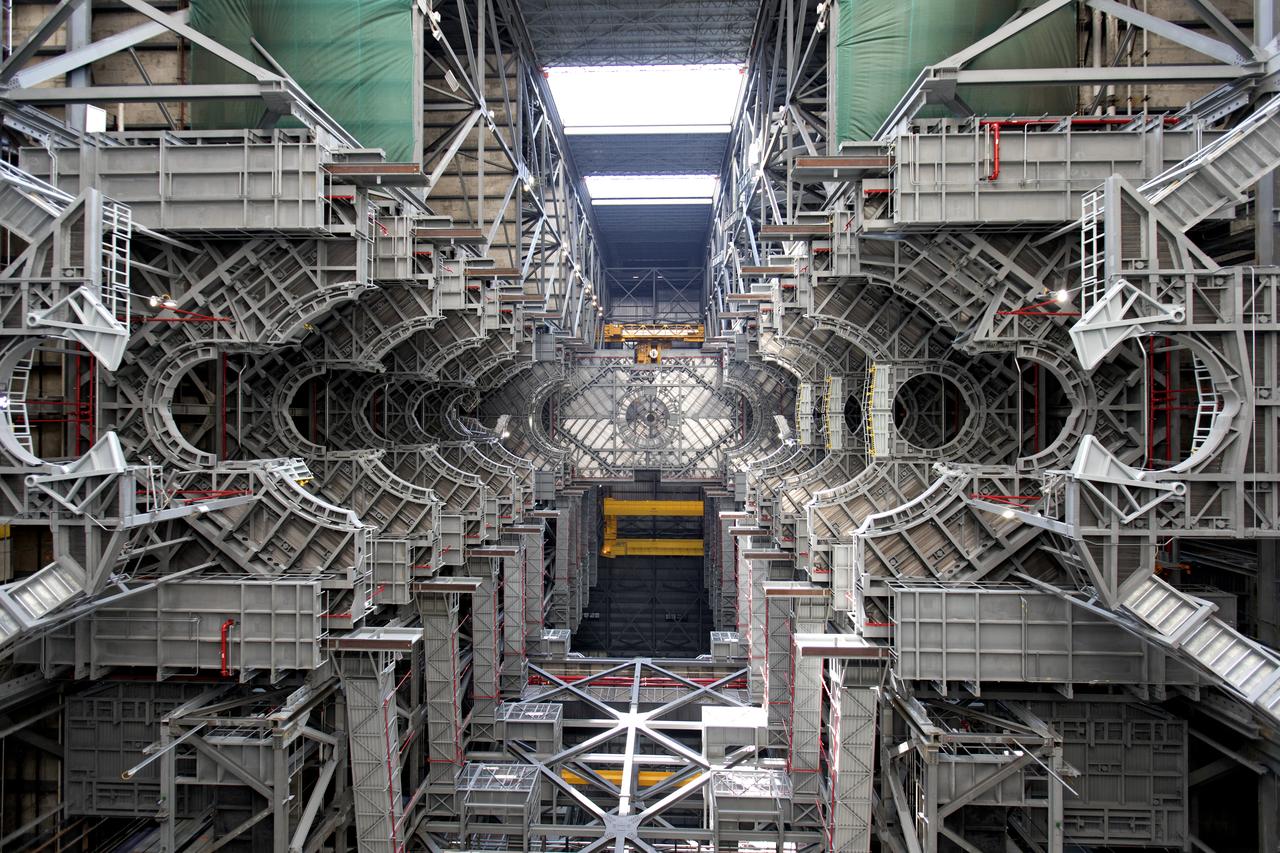
A view looking up at the 10 levels of work platforms in High Bay 3 inside the Vehicle Assembly Building (VAB) at NASA's Kennedy Space Center in Florida. The work platforms will surround and provide access for service and processing of NASA's Space Launch System rocket and Orion spacecraft. Exploration Ground Systems oversaw the upgrades and installation of the new work platforms to support the launch of the SLS and Orion on Exploration Mission-1 and deep space missions.
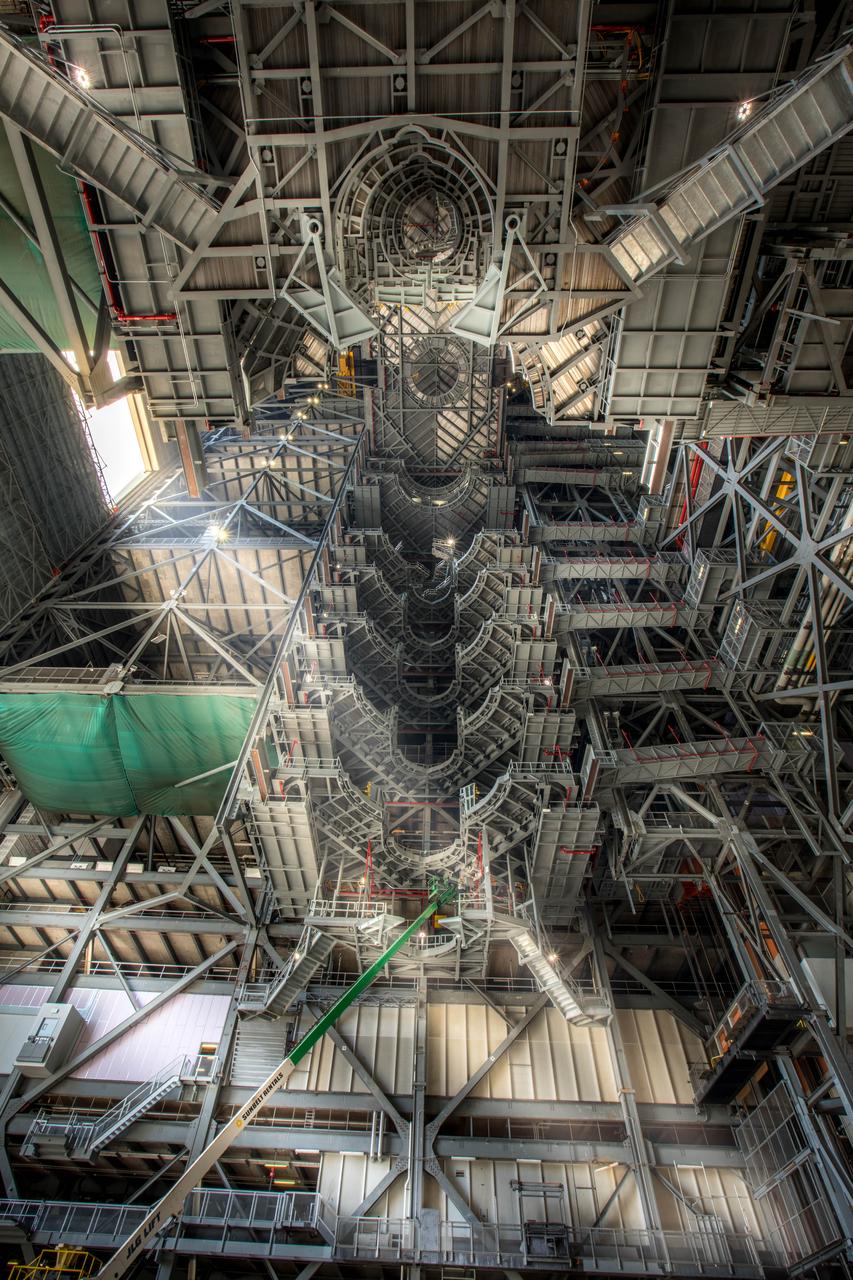
A view looking up at one side of the 10 levels of work platforms in High Bay 3 inside the Vehicle Assembly Building (VAB) at NASA's Kennedy Space Center in Florida. The work platforms will surround and provide access for service and processing of NASA's Space Launch System rocket and Orion spacecraft. Exploration Ground Systems oversaw the upgrades and installation of the new work platforms to support the launch of the SLS and Orion on Exploration Mission-1 and deep space missions.

A view looking up at the 10 levels of work platforms in High Bay 3 inside the Vehicle Assembly Building (VAB) at NASA's Kennedy Space Center in Florida. The work platforms will surround and provide access for service and processing of NASA's Space Launch System rocket and Orion spacecraft. Exploration Ground Systems oversaw the upgrades and installation of the new work platforms to support the launch of the SLS and Orion on Exploration Mission-1 and deep space missions.
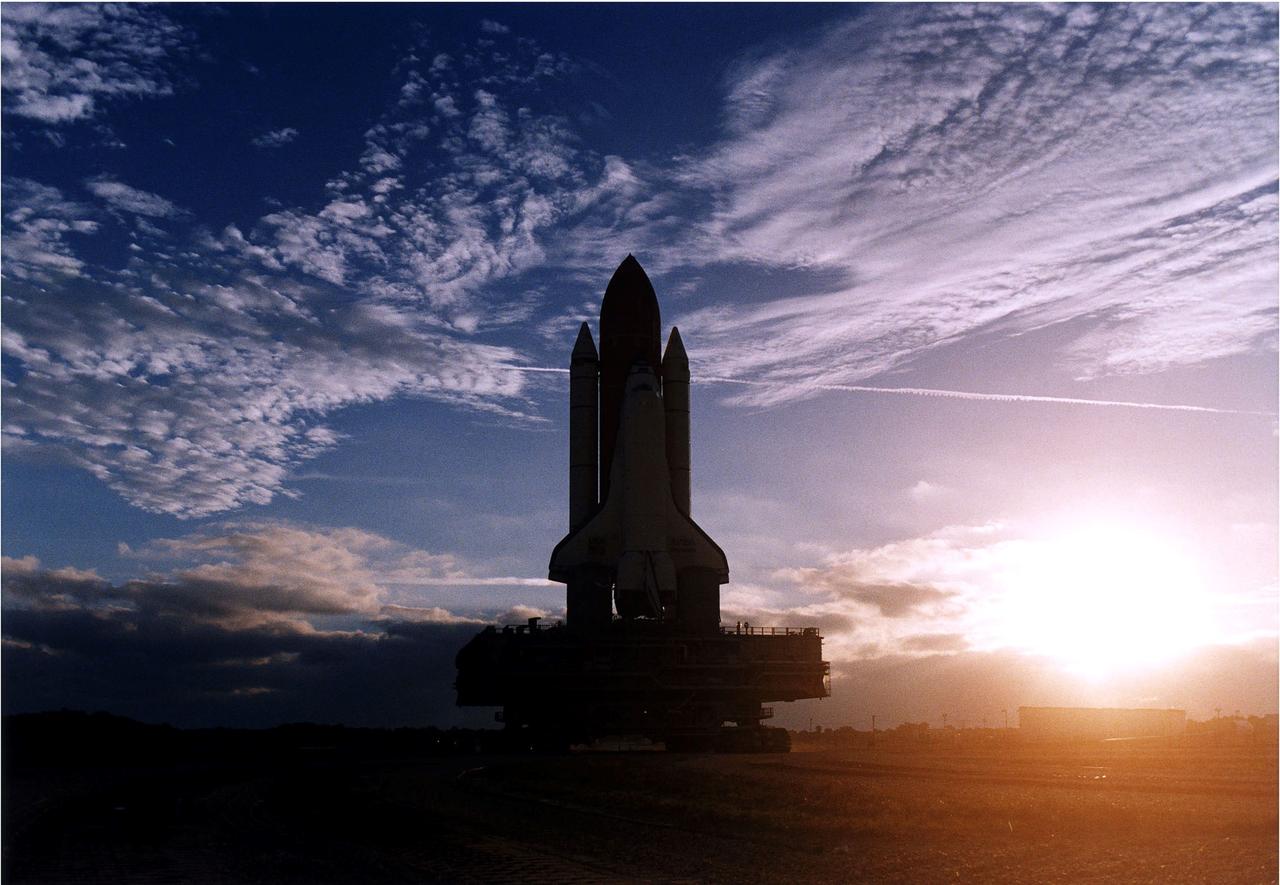
KENNEDY SPACE CENTER, FLA. - The rising sun and some scattered clouds provide a picturesque backdrop for the Space Shuttle Discovery as it travels along the crawlerway toward Launch Pad 39A in preparation for the STS-82 mission. The Shuttle is on a Mobile Launcher Platform, and the entire assemblage is being carried by a large, tracked vehicle called the crawler transporter. A seven-member crew will perform the second servicing of the orbiting Hubble Space Telescope (HST) during the 10-day STS-82 flight, whcih is targeted for a Feb. 11 liftoff.
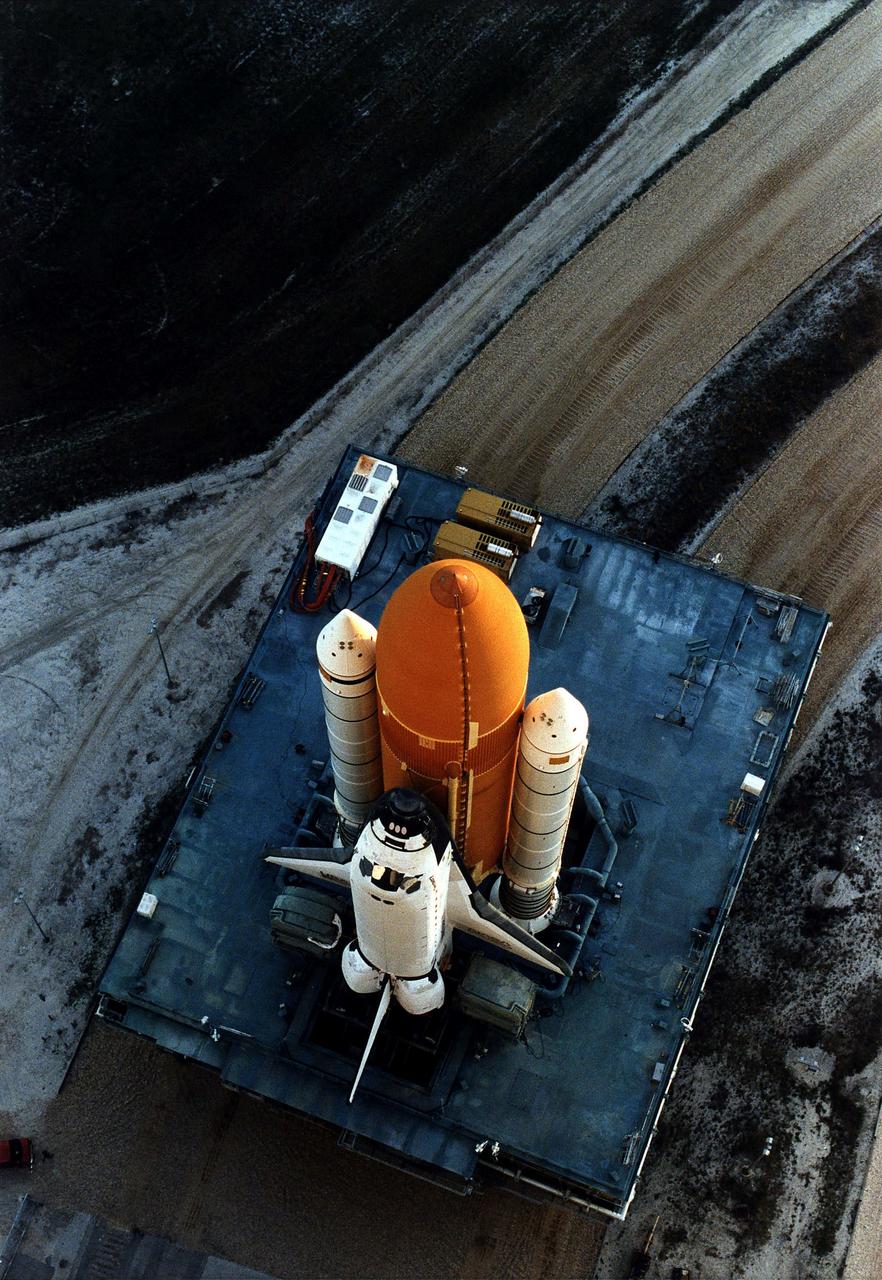
KENNEDY SPACE CENTER, FLA. - The Space Shuttle Discovery on its Mobile Launcher Platform slowly moves through the high bay doors of the Vehicle Assembly Building en route to Launch Pad 39A, where Discovery is scheduled to lift off on the STS-82 mission on Feb. 11. A seven-member crew will perform the second servicing of the orbiting Hubble Space Telescope (HST) during the 10-day STS-82 mission.
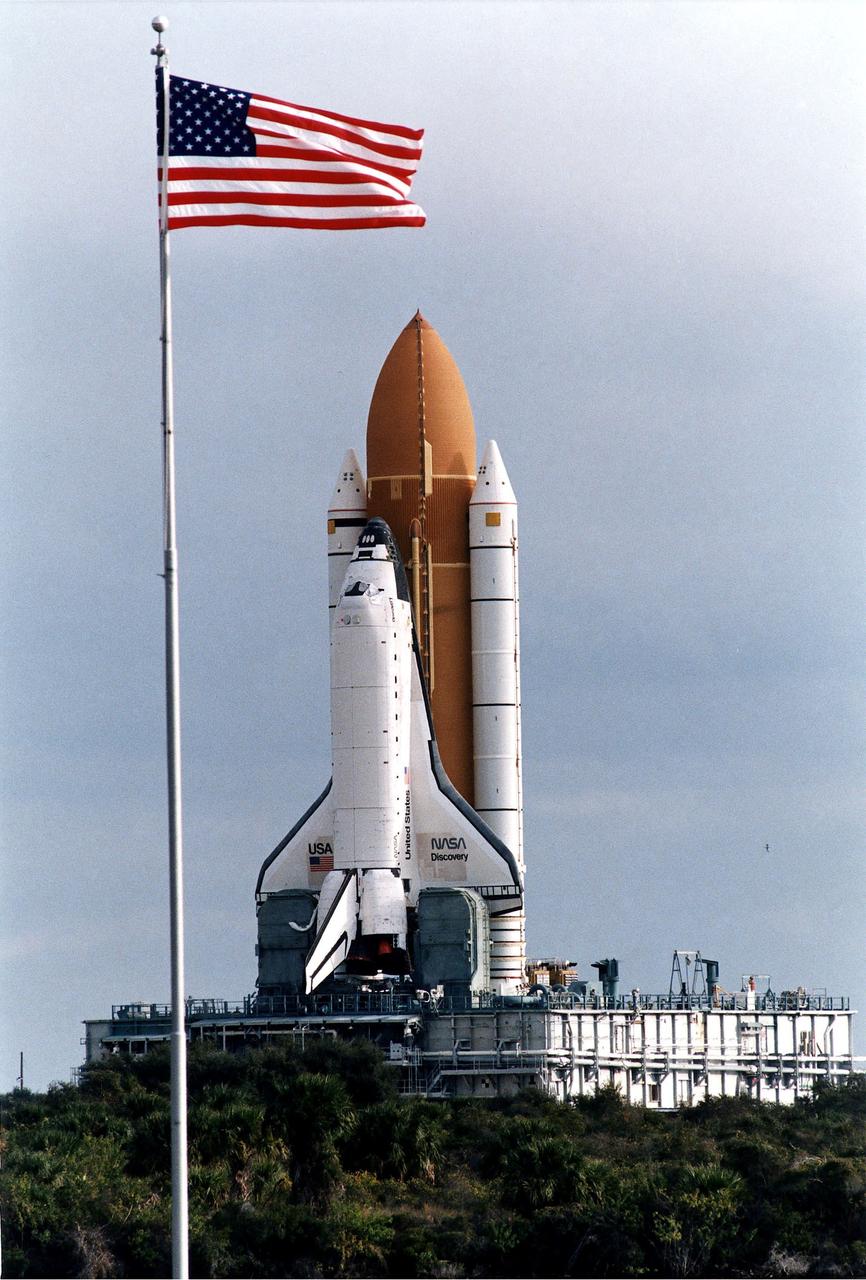
KENNEDY SPACE CENTER, FLA. - The Space Shuttle Discovery on its Mobile Launcher Platform makes its slow 3.4-mile trek from the Vehicle Assembly Building to Launch Pad 39A in preparation for the STS-82 mission. In the foreground is the U.S. flag at the Press Site area. A seven-member crew will perform the second servicing of the orbiting Hubble Space Telescope (HST) during the 10-day STS-82 mission, which is targeted for a Feb. 11 liftoff.
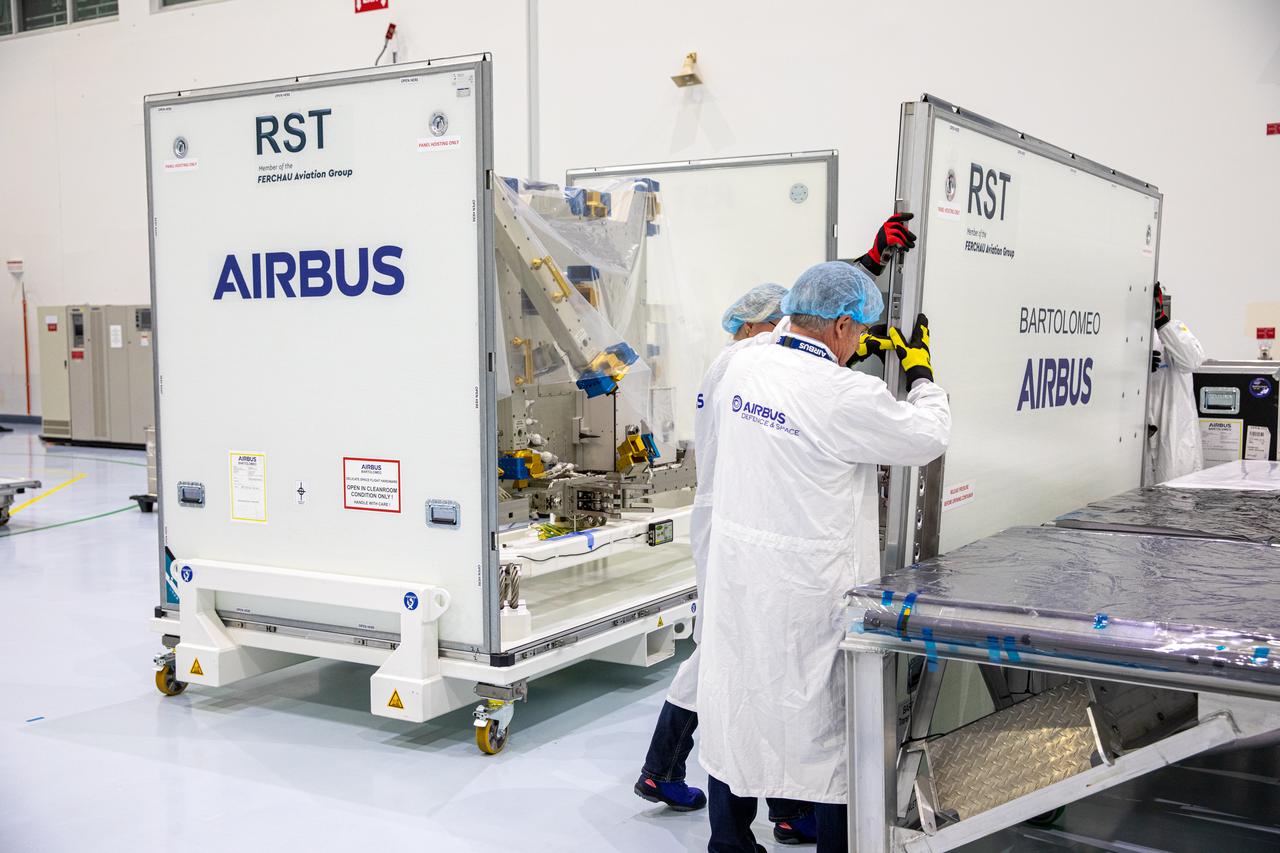
Airbus workers unpack the Bartolomeo platform in the Space Station Processing Facility high bay at NASA’s Kennedy Space Center in Florida on Jan. 30, 2020. Bartolomeo was manufactured by Airbus Defence and Space. The platform will be delivered to the International Space Station aboard SpaceX’s 20th Commercial Resupply Services (CRS-20) mission for the agency. The platform will attach to the exterior of the space station’s European Columbus Module. Named for the younger brother of Christopher Columbus, the platform has the capability to host external payloads in low-Earth orbit on the station. CRS-20 is scheduled to launch aboard SpaceX’s Dragon cargo spacecraft atop the company’s Falcon 9 rocket in March 2020.
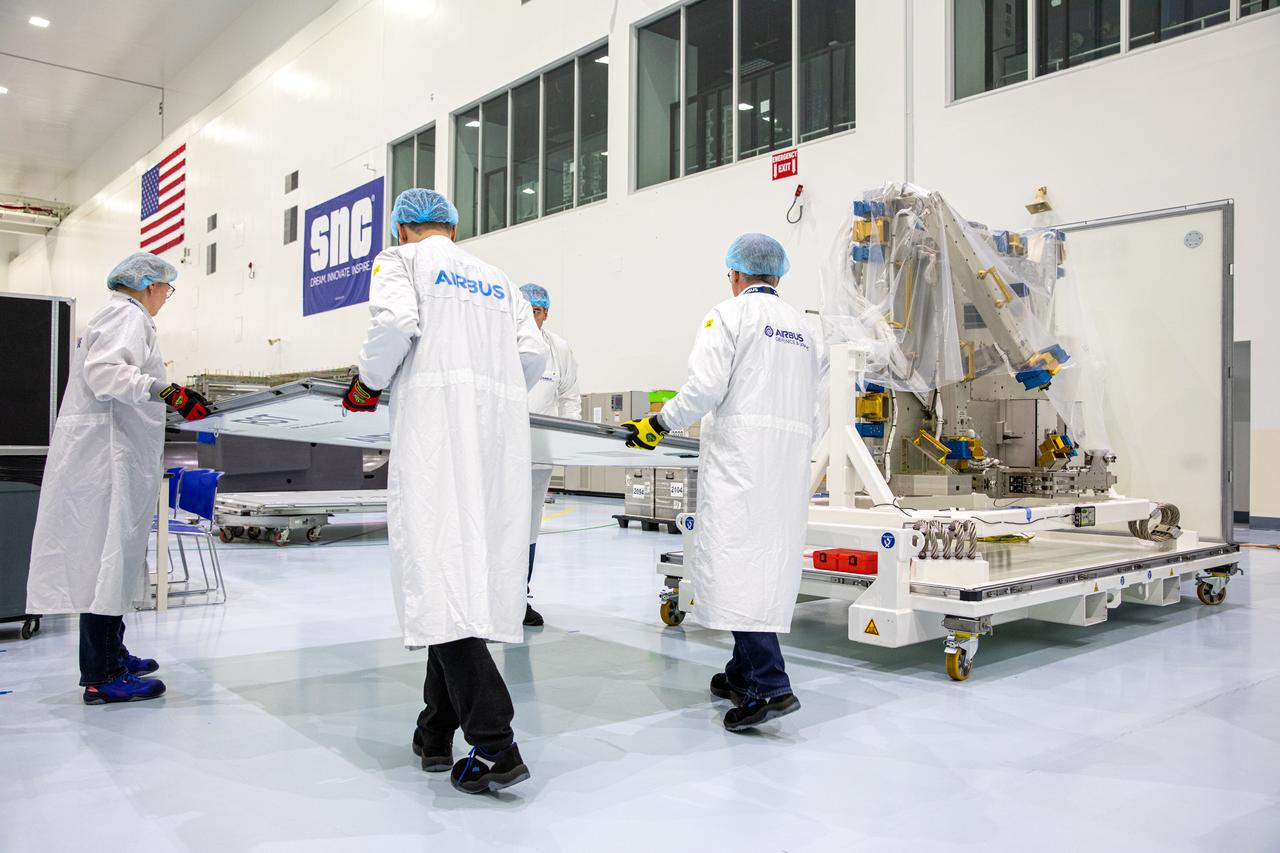
Airbus workers unpack the Bartolomeo platform in the Space Station Processing Facility high bay at NASA’s Kennedy Space Center in Florida on Jan. 30, 2020. Bartolomeo was manufactured by Airbus Defence and Space. The platform will be delivered to the International Space Station aboard SpaceX’s 20th Commercial Resupply Services (CRS-20) mission for the agency. The platform will attach to the exterior of the space station’s European Columbus Module. Named for the younger brother of Christopher Columbus, the platform has the capability to host external payloads in low-Earth orbit on the station. CRS-20 is scheduled to launch aboard SpaceX’s Dragon cargo spacecraft atop the company’s Falcon 9 rocket in March 2020.
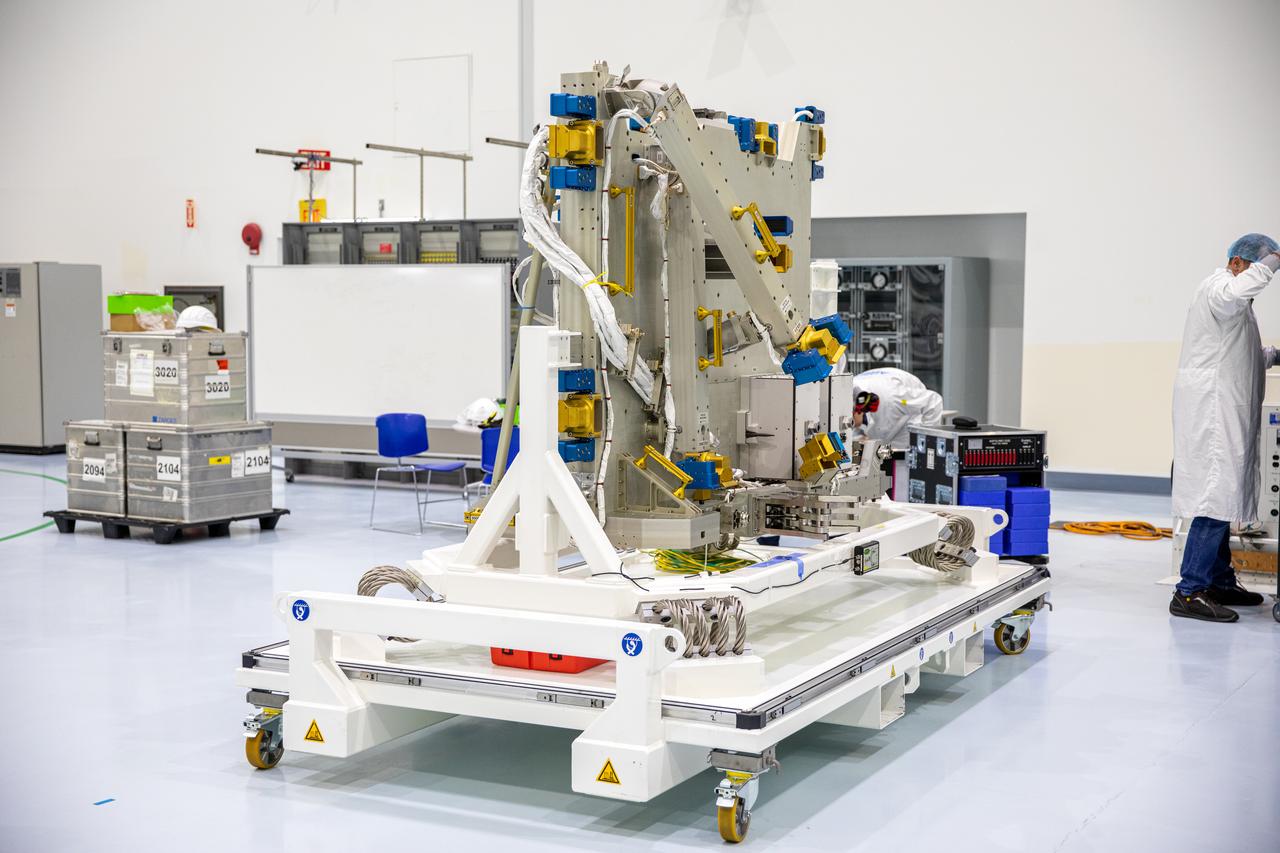
Airbus workers unpack the Bartolomeo platform in the Space Station Processing Facility high bay at NASA’s Kennedy Space Center in Florida on Jan. 30, 2020. Bartolomeo was manufactured by Airbus Defence and Space. The platform will be delivered to the International Space Station aboard SpaceX’s 20th Commercial Resupply Services (CRS-20) mission for the agency. The platform will attach to the exterior of the space station’s European Columbus Module. Named for the younger brother of Christopher Columbus, the platform has the capability to host external payloads in low-Earth orbit on the station. CRS-20 is scheduled to launch aboard SpaceX’s Dragon cargo spacecraft atop the company’s Falcon 9 rocket in March 2020.
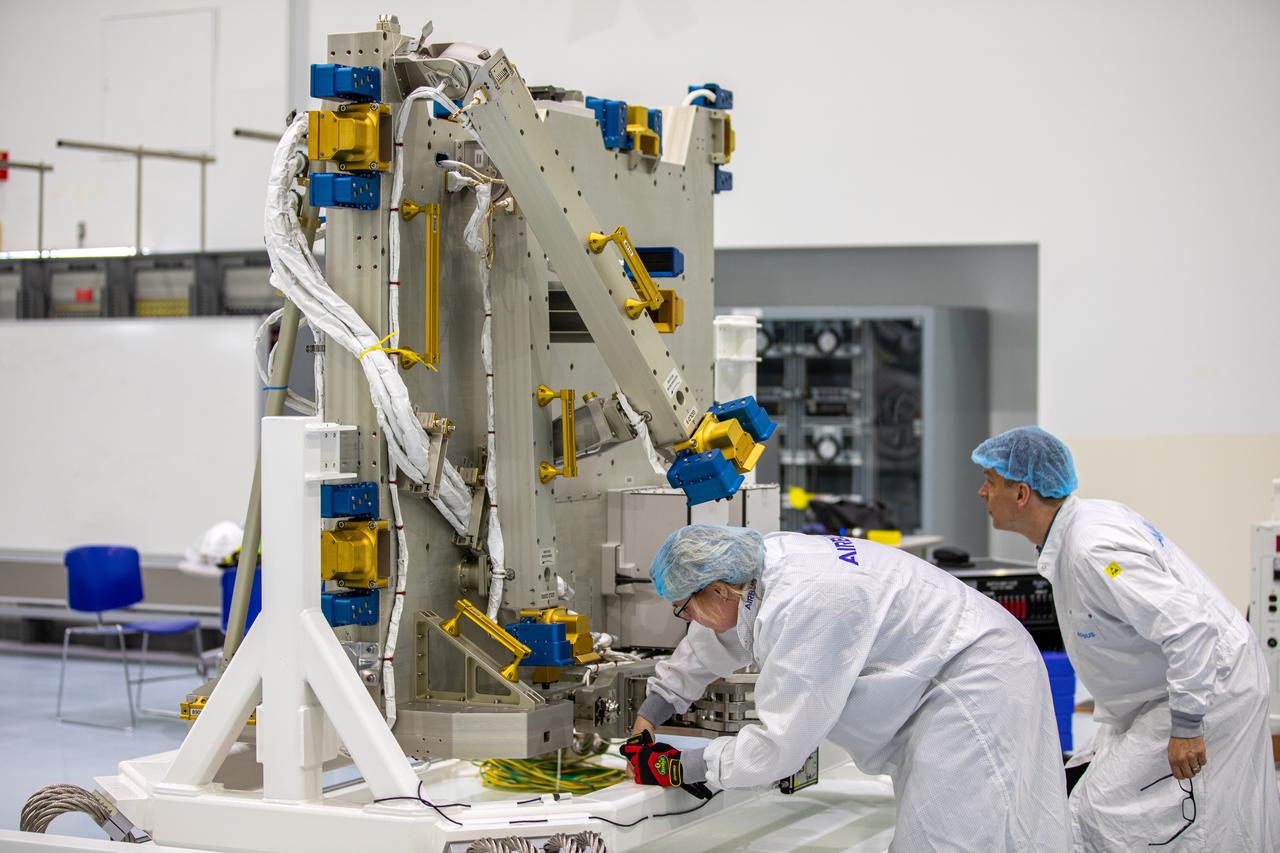
Airbus workers unpack the Bartolomeo platform in the Space Station Processing Facility high bay at NASA’s Kennedy Space Center in Florida on Jan. 30, 2020. Bartolomeo was manufactured by Airbus Defence and Space. The platform will be delivered to the International Space Station aboard SpaceX’s 20th Commercial Resupply Services (CRS-20) mission for the agency. The platform will attach to the exterior of the space station’s European Columbus Module. Named for the younger brother of Christopher Columbus, the platform has the capability to host external payloads in low-Earth orbit on the station. CRS-20 is scheduled to launch aboard SpaceX’s Dragon cargo spacecraft atop the company’s Falcon 9 rocket in March 2020.
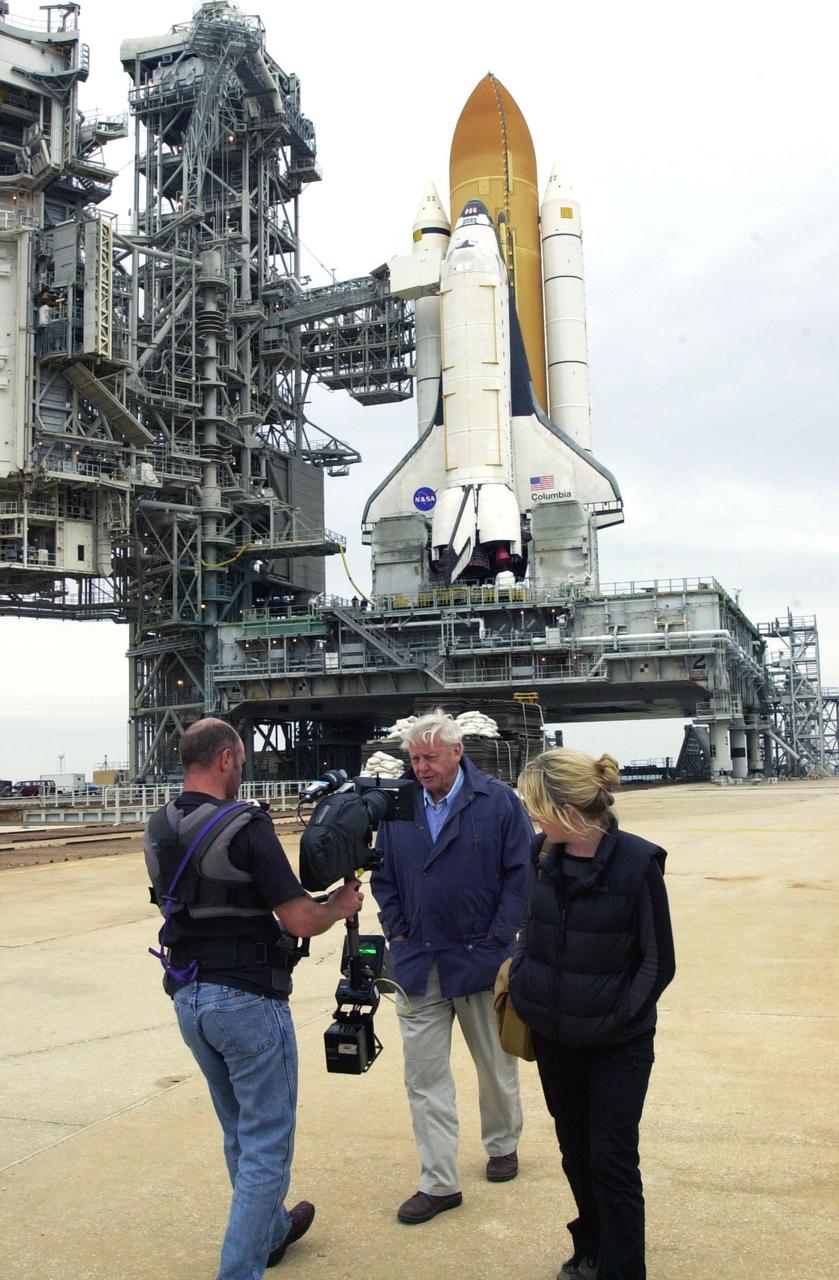
KENNEDY SPACE CENTER, FLA. - Sir David Attenborough (center) works with a film crew on Launch Pad 39A. Space Shuttle Columbia, atop the Mobile Launcher Platform, is seen in the background. At left are the Rotating Service Structure, which is open, and the Fixed Service Structure. Attenborough is filming commentary for a documentary
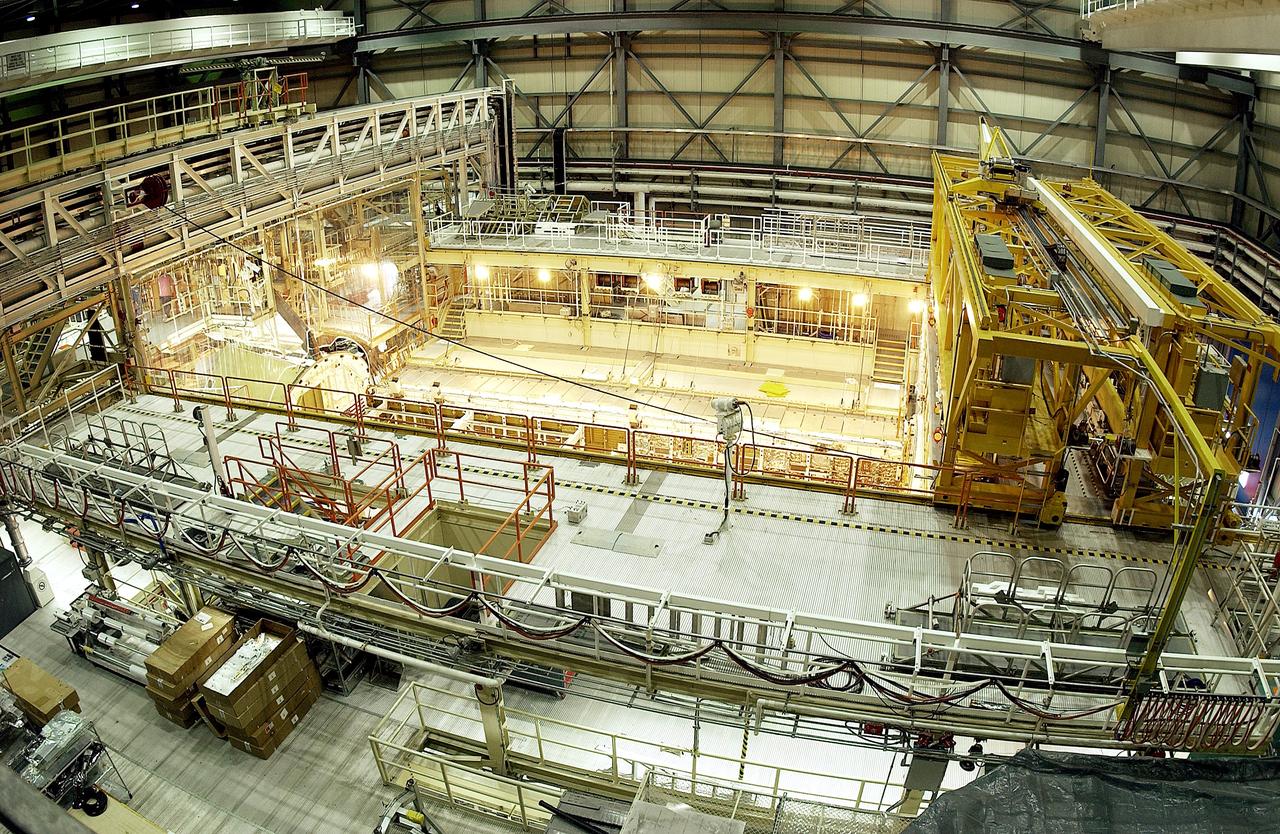
KENNEDY SPACE CENTER, FLA. - This bird's-eye view of a high bay in the Orbiter Processing Facility (OPF) shows the open payload bay of Space Shuttle Discovery surrounded by the standard platforms and equipment required to process a Space Shuttle orbiter. The high bay is 197 feet (60 meters) long, 150 feet (46 meters) wide, 95 feet (29 meters) high, and encompasses a 29,000-square-foot (2,694-meter) area. The 30-ton (27-metric-ton) bridge crane (yellow device, right) has a hook height of approximately 66 feet (20 meters). Platforms, a main access bridge, and two rolling bridges with trucks provide access to various parts of the orbiter. In addition to routine servicing and checkout, the inspections and modifications made to enhance Discovery's performance and upgrade its systems were performed in the OPF during its recently completed Orbiter Major Modification (OMM) period.
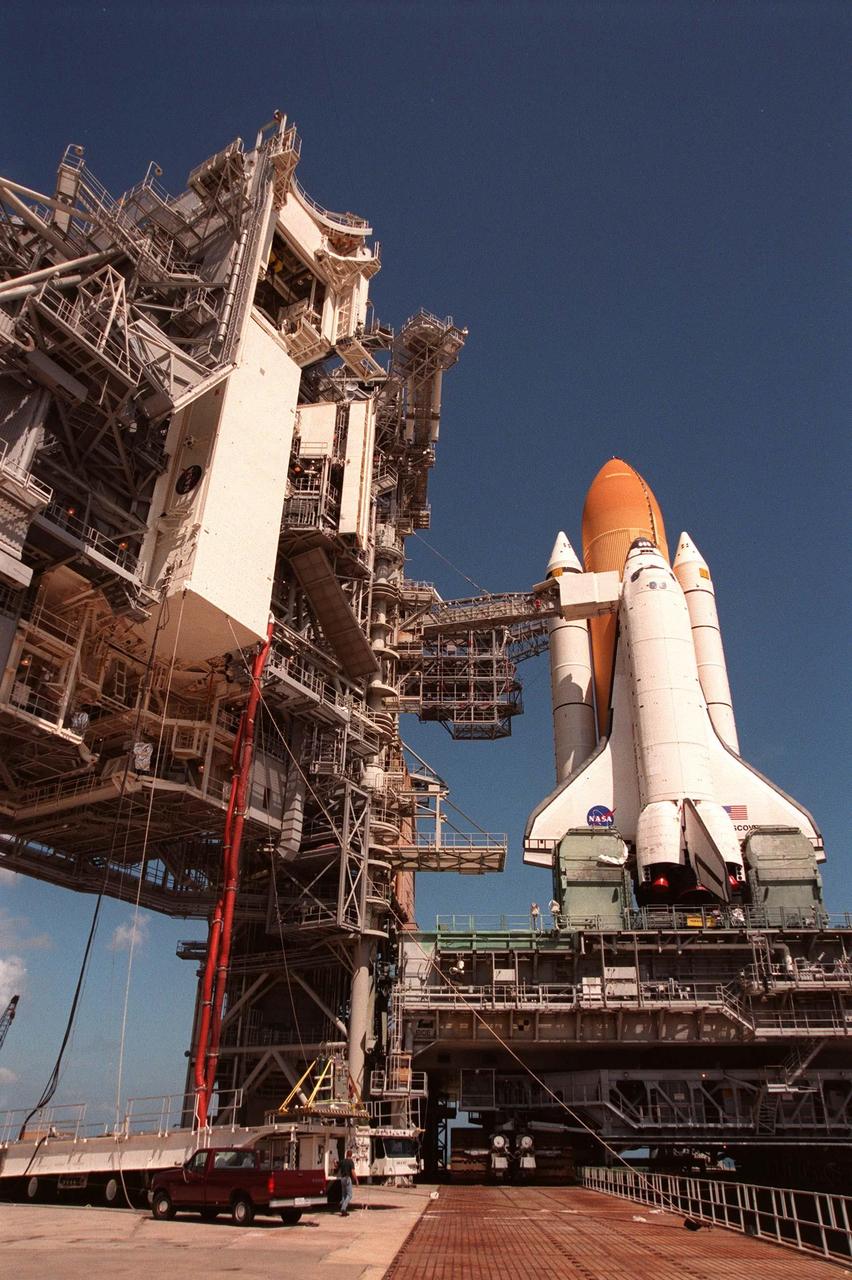
KENNEDY SPACE CENTER, FLA. -- At left, the payload canister for Space Shuttle Discovery is lifted from its canister movement vehicle to the top of the Rotating Service Structure on Launch Pad 39-B. Discovery (right), sitting atop the Mobile Launch Platform and next to the Fixed Service Structure, is scheduled for launch on Oct. 29, 1998, for the STS-95 mission. That mission includes the International Extreme Ultraviolet Hitchhiker (IEH-3), the Hubble Space Telescope Orbital Systems Test Platform, the Spartan solar-observing deployable spacecraft, and the SPACEHAB single module with experiments on space flight and the aging process
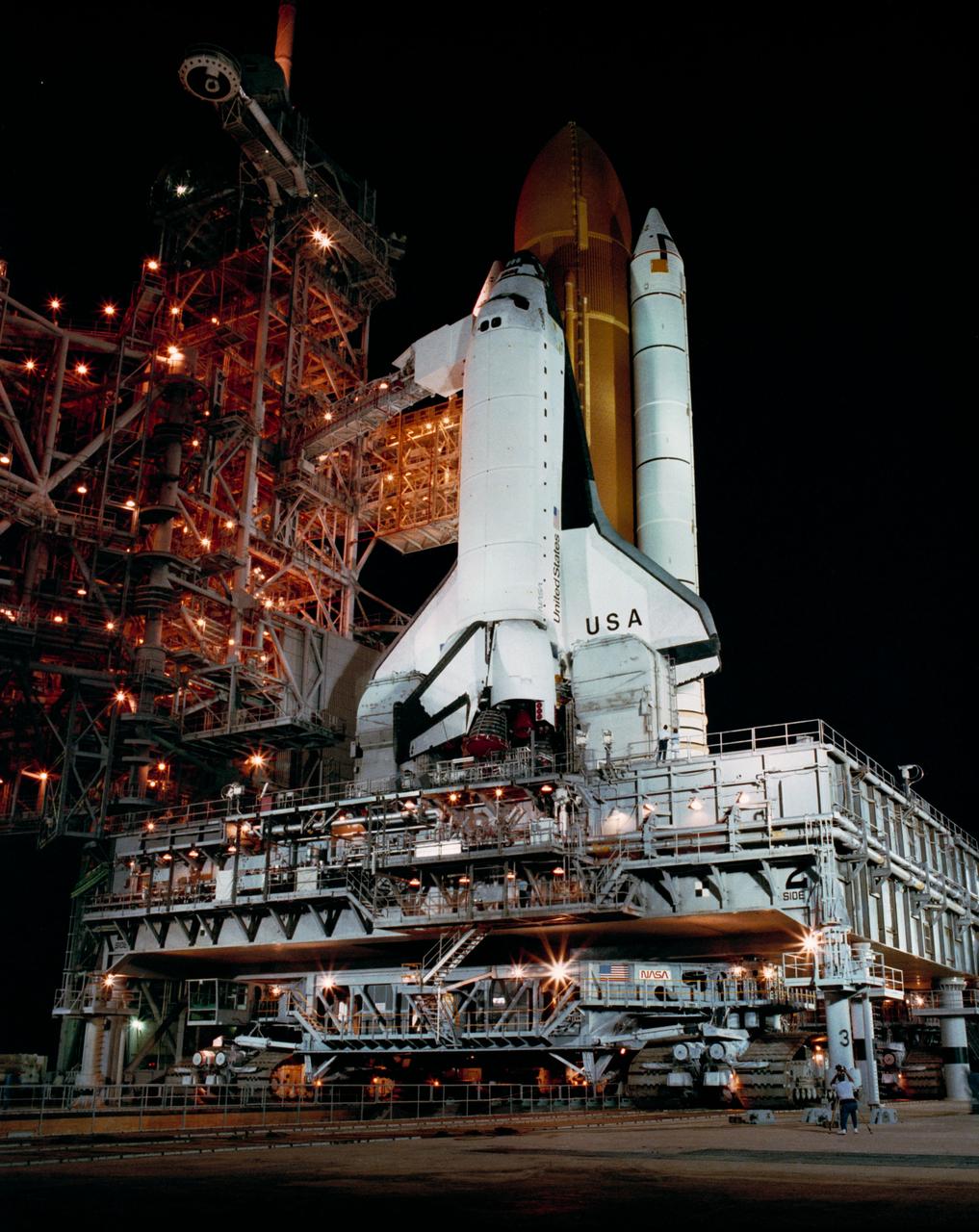
STS-28 Columbia, Orbiter Vehicle (OV) 102, arrives at Kennedy Space Center (KSC) Launch Complex (LC) Pad 39B. View taken from ground level, shows OV-102 with external tank (ET) and solid rocket boosters (SRBs) mounted atop mobile launcher platform and the fixed service structure (rotating service structure (RSS) retracted) alongside. Catwalk at the 195 ft level is in place. Crawler transporter remains in position under mobile launcher platform. Spotlights and floodlights illuminate the launch complex against the darkness of the night. View provided by KSC with alternate number KSC-89PC-683.
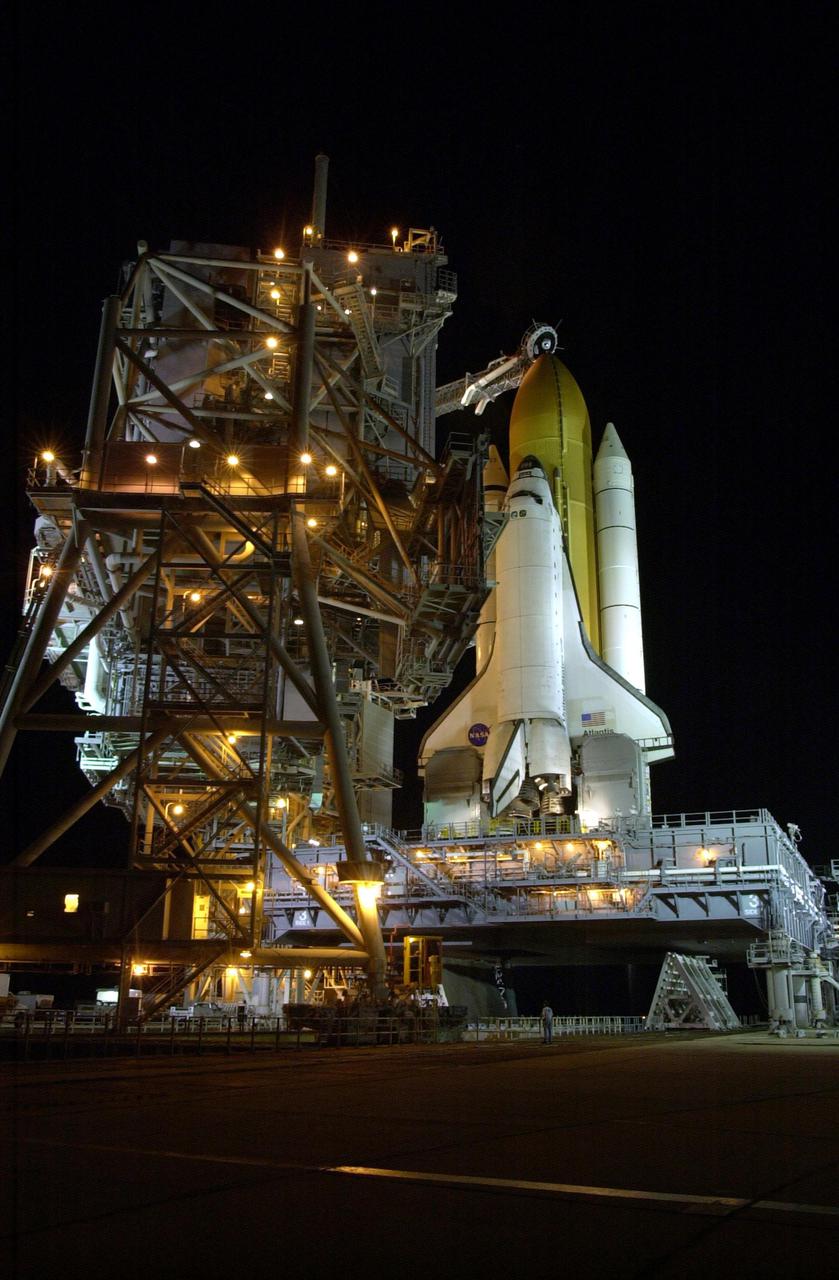
KENNEDY SPACE CENTER, FLA. -- In preparation for launch of Space Shuttle Atlantis on mission STS-110, the Rotating Service Structure (RSS) rolls back into launch position. The RSS provides protected access to the orbiter for changeout and servicing of payloads at the pad. The structure has access platforms at five levels to provide access to the payload bay. The Shuttle rests on the Mobile Launcher Platform (MLP), which straddles the flame trench below. The flame trench is part of the Flame Deflector System that insulates pad structures from the intense heat of a launch. Mission STS-110 is scheduled to launch April 4 on its 11-day mission to the International Space Station

The Bartolomeo platform that will be carried to the International Space Station aboard SpaceX’s 20th Commercial Resupply Services (CRS-20) mission for NASA is inside its shipping container in the Space Station Processing Facility high bay at the agency’s Kennedy Space Center in Florida on Jan. 30, 2020. Bartolomeo was manufactured by Airbus Defence and Space. The platform will attach to the exterior of the space station’s European Columbus Module. Named for the younger brother of Christopher Columbus, the platform has the capability to host external payloads in low-Earth orbit on the station. CRS-20 is scheduled to launch aboard SpaceX’s Dragon cargo spacecraft atop the company’s Falcon 9 rocket in March 2020.
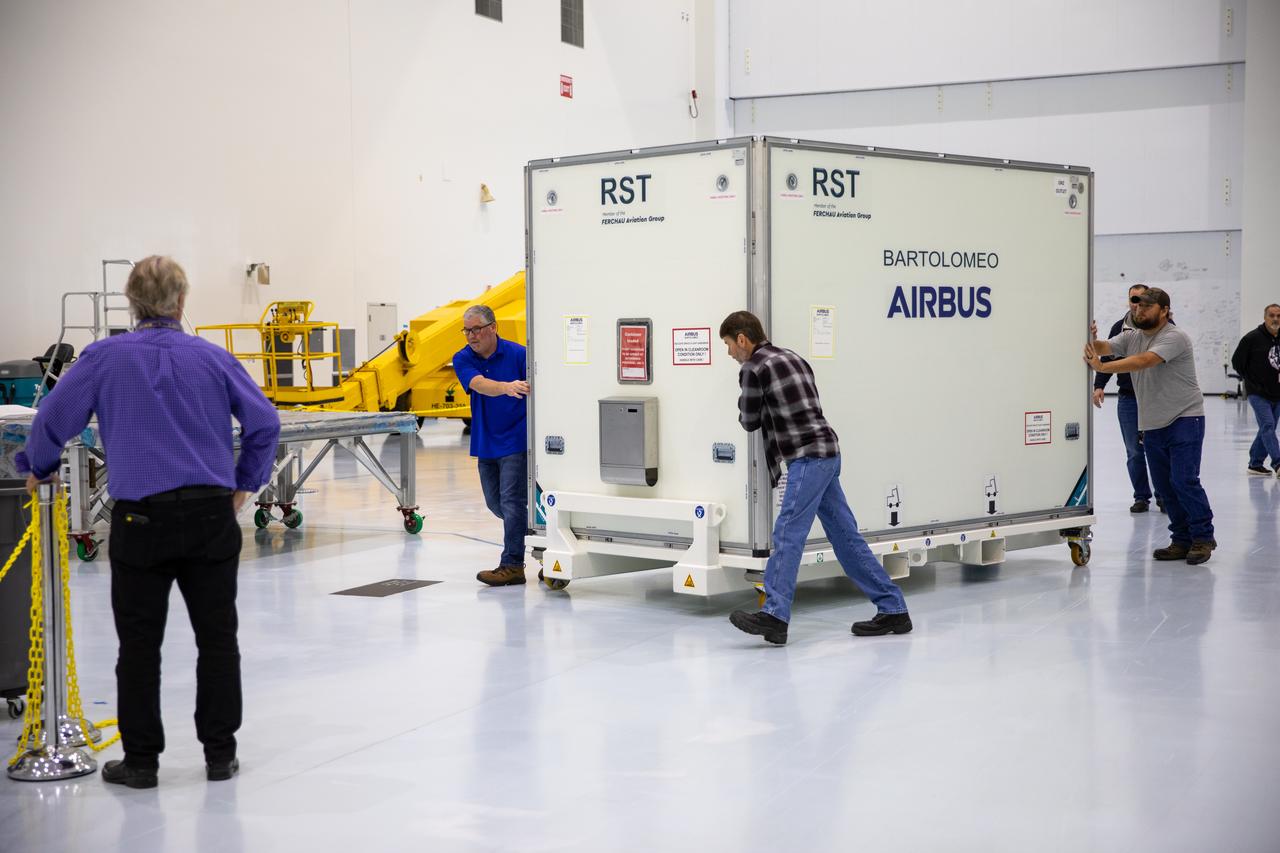
The Bartolomeo platform that will be carried to the International Space Station aboard SpaceX’s 20th Commercial Resupply Services (CRS-20) mission for NASA is moved in its shipping container inside the Space Station Processing Facility high bay at the agency’s Kennedy Space Center in Florida on Jan. 30, 2020. Bartolomeo was manufactured by Airbus Defence and Space. The platform will attach to the exterior of the space station’s European Columbus Module. Named for the younger brother of Christopher Columbus, the platform has the capability to host external payloads in low-Earth orbit on the station. CRS-20 is scheduled to launch aboard SpaceX’s Dragon cargo spacecraft atop the company’s Falcon 9 rocket in March 2020.
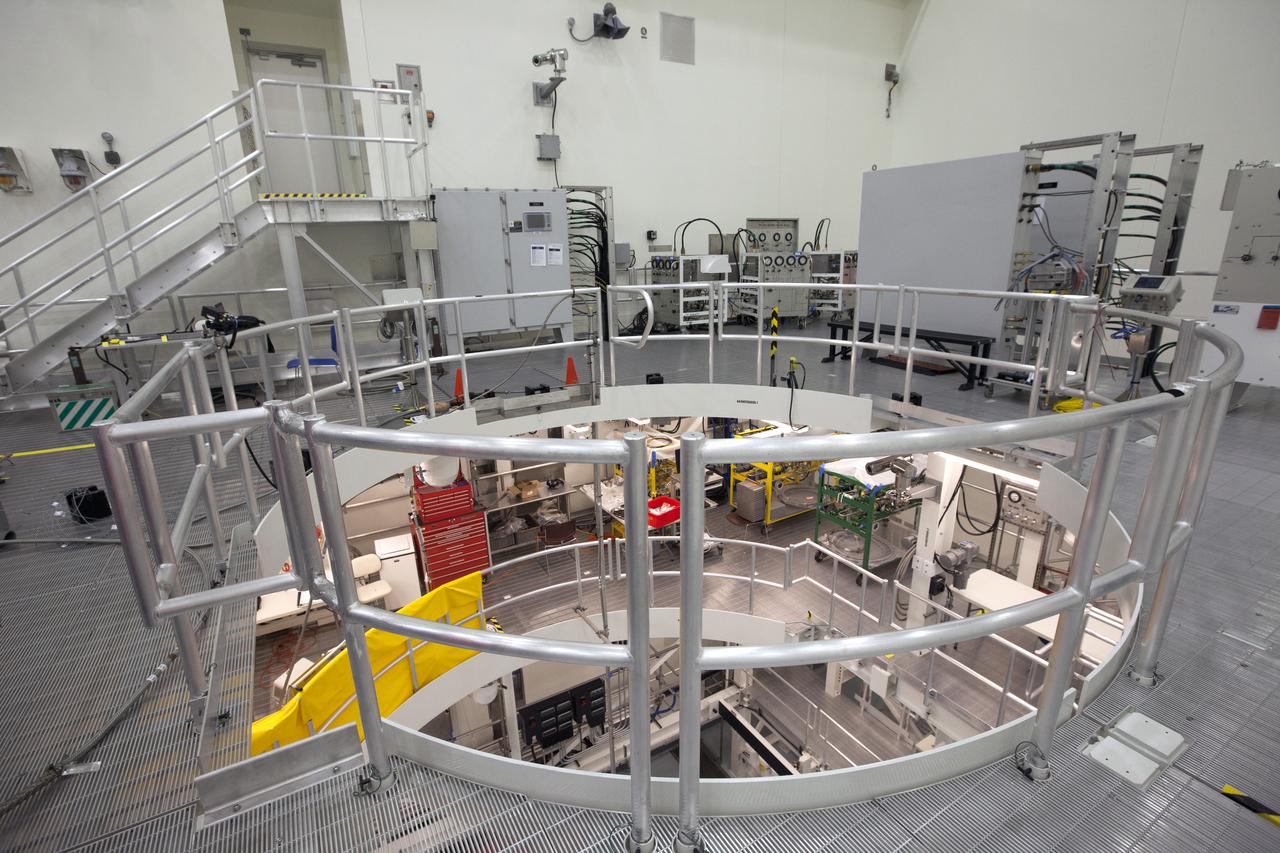
Engineers and technicians completed verification and validation testing of several pneumatic systems inside and outside the Multi-Payload Processing Facility (MPPF) at NASA's Kennedy Space Center in Florida. In view is the top level of the service platform for Orion spacecraft processing. The MPPF will be used for offline processing and fueling of the Orion spacecraft and service module stack before launch. Orion also will be de-serviced in the MPPF after a mission. The Ground Systems Development and Operations Program (GSDO) is overseeing upgrades to the facility. The Engineering Directorate led the recent pneumatic tests.
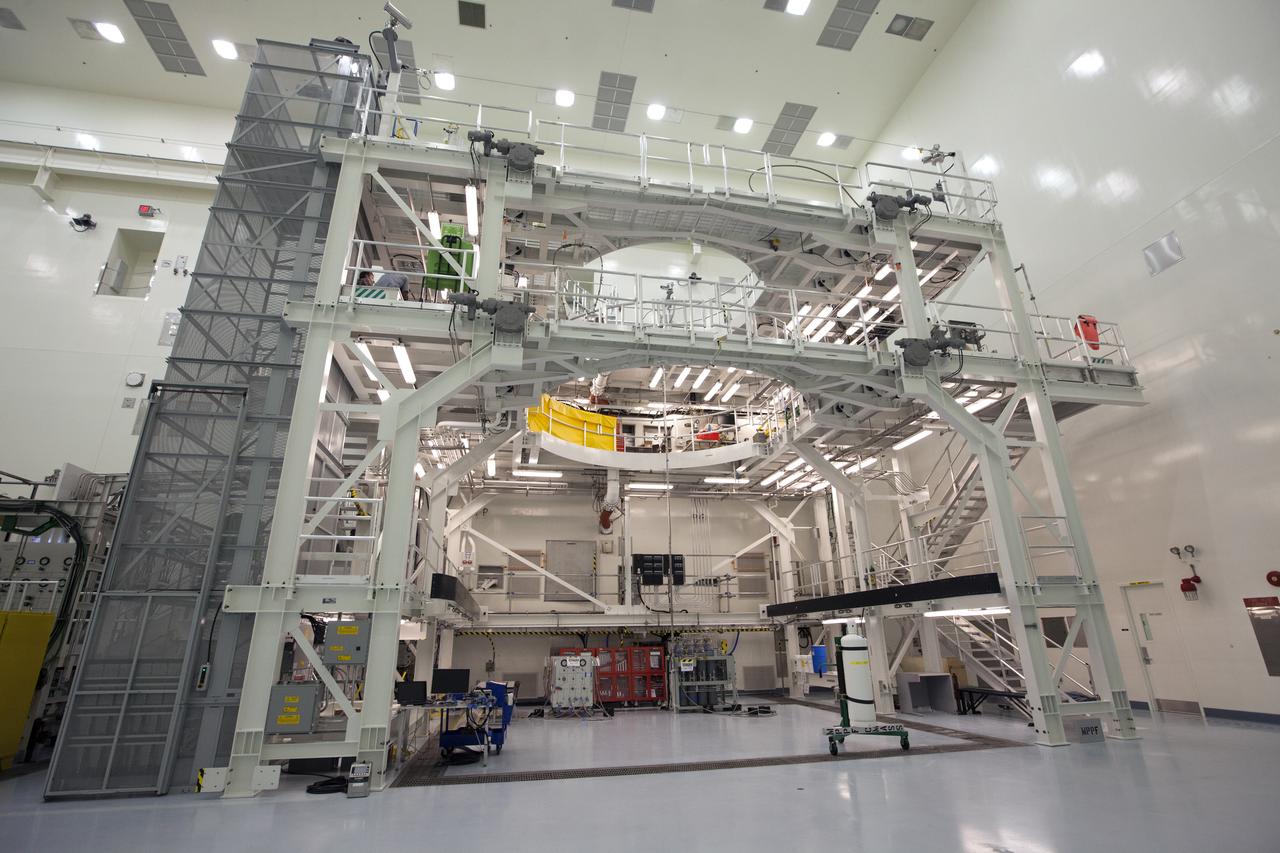
Engineers and technicians completed verification and validation testing of several pneumatic systems inside and outside the Multi-Payload Processing Facility (MPPF) at NASA's Kennedy Space Center in Florida. In view is the service platform for Orion spacecraft processing. The MPPF will be used for offline processing and fueling of the Orion spacecraft and service module stack before launch. Orion also will be de-serviced in the MPPF after a mission. The Ground Systems Development and Operations Program (GSDO) is overseeing upgrades to the facility. The Engineering Directorate led the recent pneumatic tests.
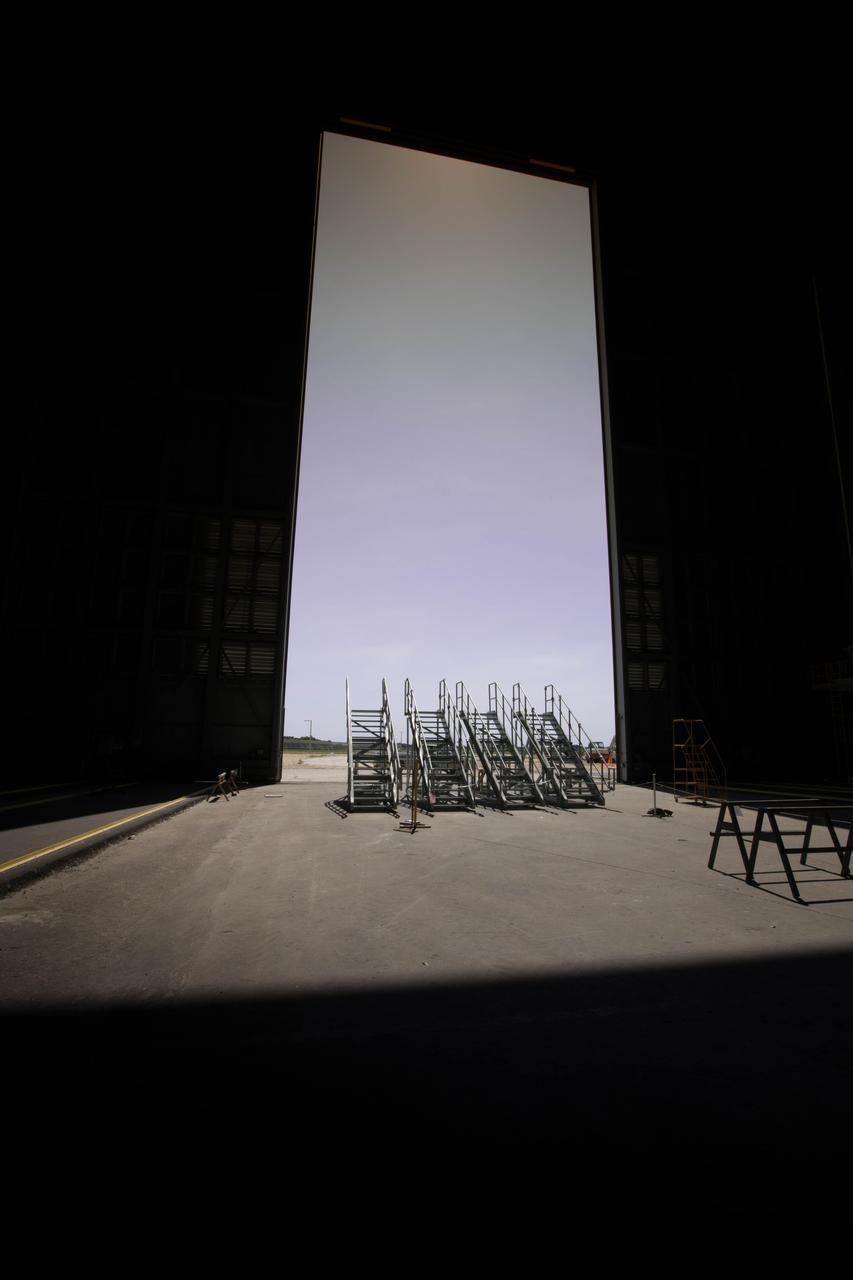
A view looking at High Bay 3 in the Vehicle Assembly Building (VAB) at NASA's Kennedy Space Center in Florida. Ten levels of new work platforms have been installed in High Bay 3. They will surround and provide access for service and processing of NASA's Space Launch System rocket and Orion spacecraft. Exploration Ground Systems oversaw the upgrades and installation of the new work platforms to support the launch of the SLS and Orion on Exploration Mission-1 and deep space missions.
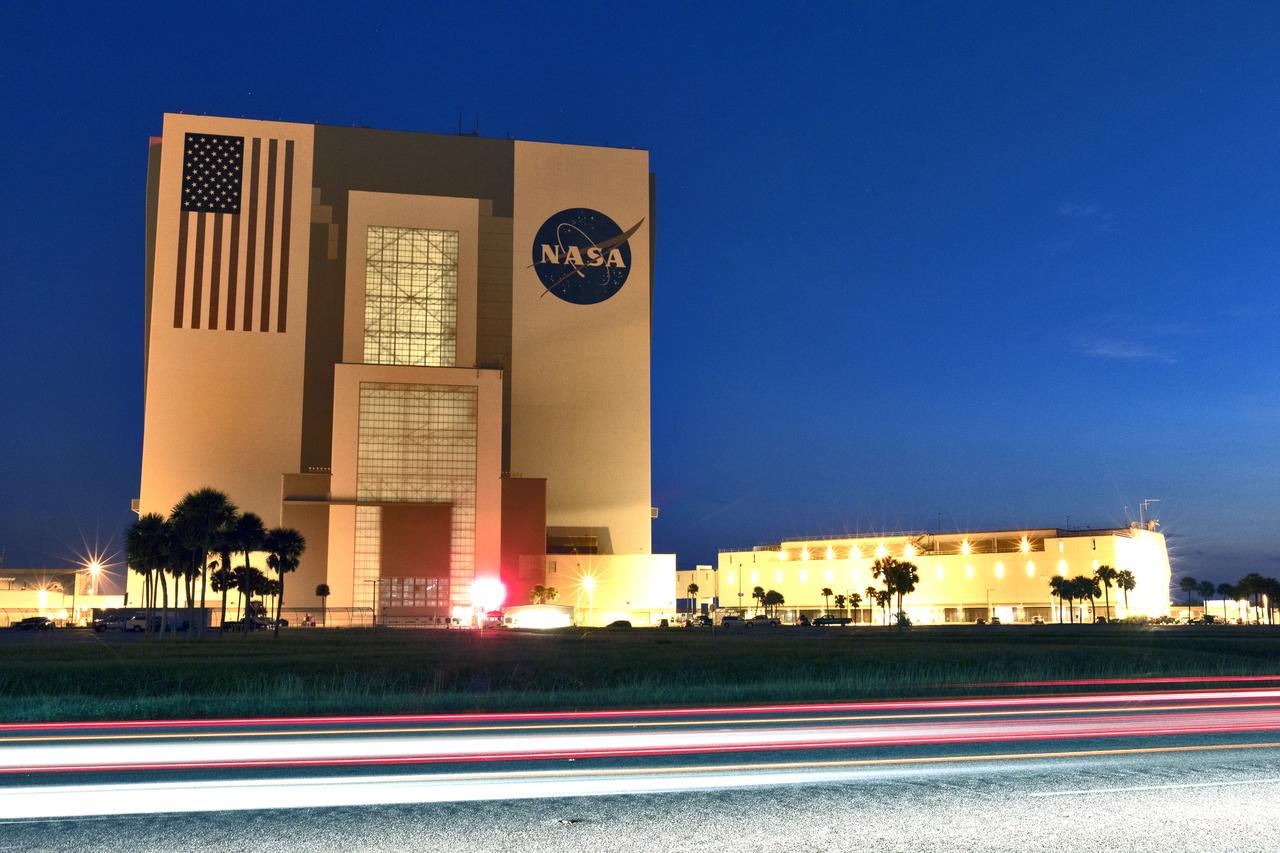
A sunrise time-lapse panoramic view of the iconic Vehicle Assembly Building (VAB) and Launch Control Center at NASA's Kennedy Space Center in Florida. Ten levels of work platforms have been installed in High Bay 3 of the VAB. They will surround and provide access for service and processing of NASA's Space Launch System (SLS) rocket and Orion spacecraft. Exploration Ground Systems oversaw the upgrades and installation of the new work platforms to support the launch of the SLS and Orion on Exploration Mission-1 and deep space missions.
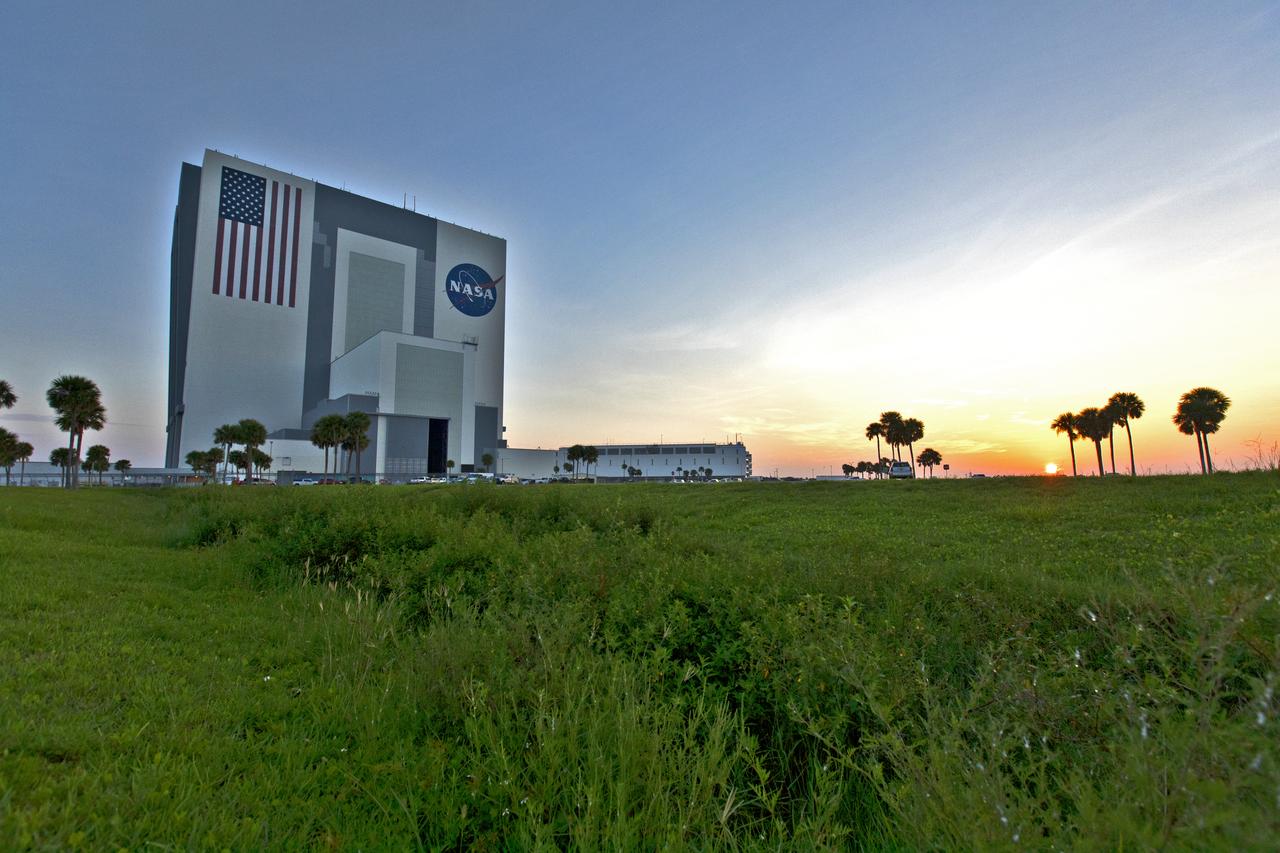
A sunrise panoramic view of the iconic Vehicle Assembly Building (VAB) and Launch Control Center at NASA's Kennedy Space Center in Florida. Ten levels of work platforms have been installed in High Bay 3 of the VAB. They will surround and provide access for service and processing of NASA's Space Launch System (SLS) rocket and Orion spacecraft. Exploration Ground Systems oversaw the upgrades and installation of the new work platforms to support the launch of the SLS and Orion on Exploration Mission-1 and deep space missions.
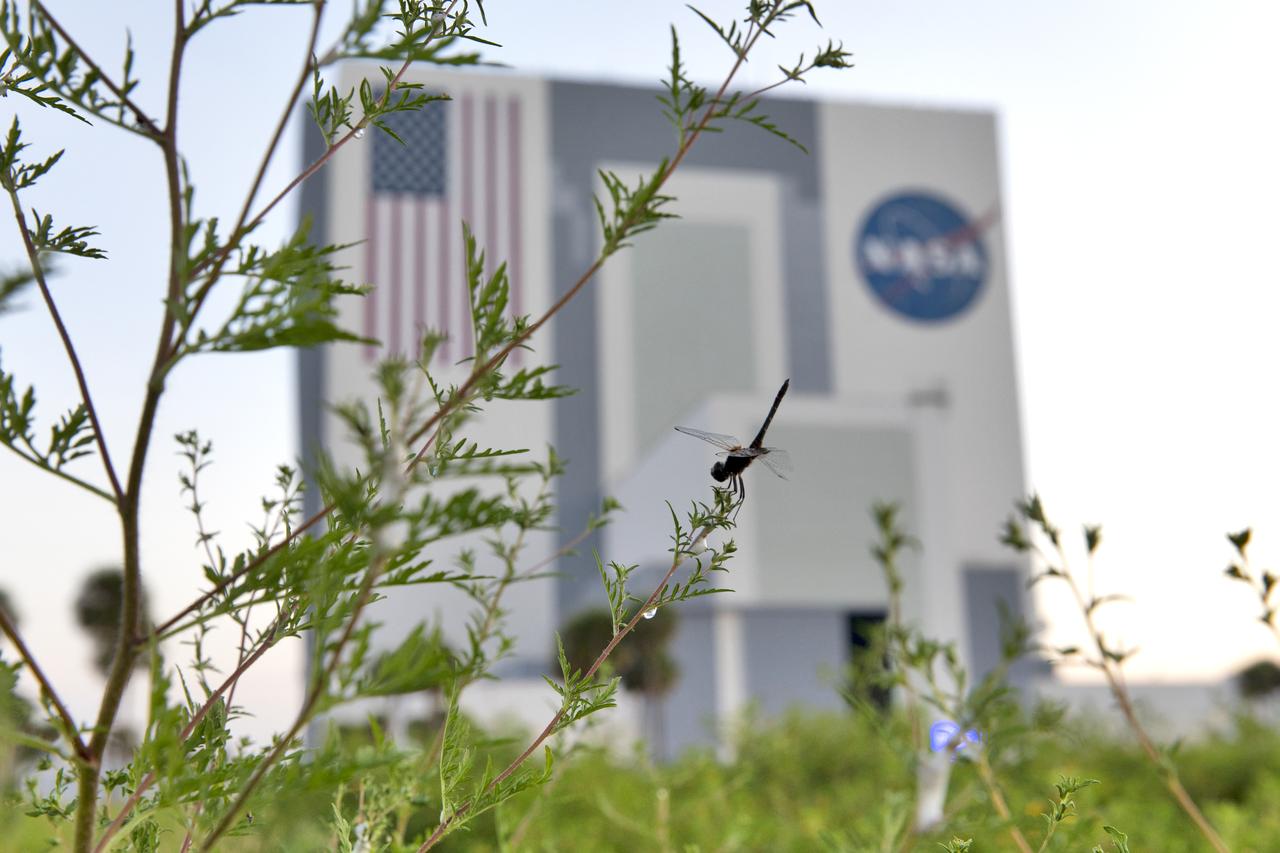
A dragonfly perches on a tree branch with the iconic Vehicle Assembly Building (VAB) in view in the background at NASA's Kennedy Space Center in Florida. Ten levels of new work platforms have been installed in VAB High Bay 3. They will surround and provide access for service and processing of NASA's Space Launch System (SLS) rocket and Orion spacecraft. Exploration Ground Systems oversaw the upgrades and installation of the new work platforms to support the launch of the SLS and Orion on Exploration Mission-1 and deep space missions.
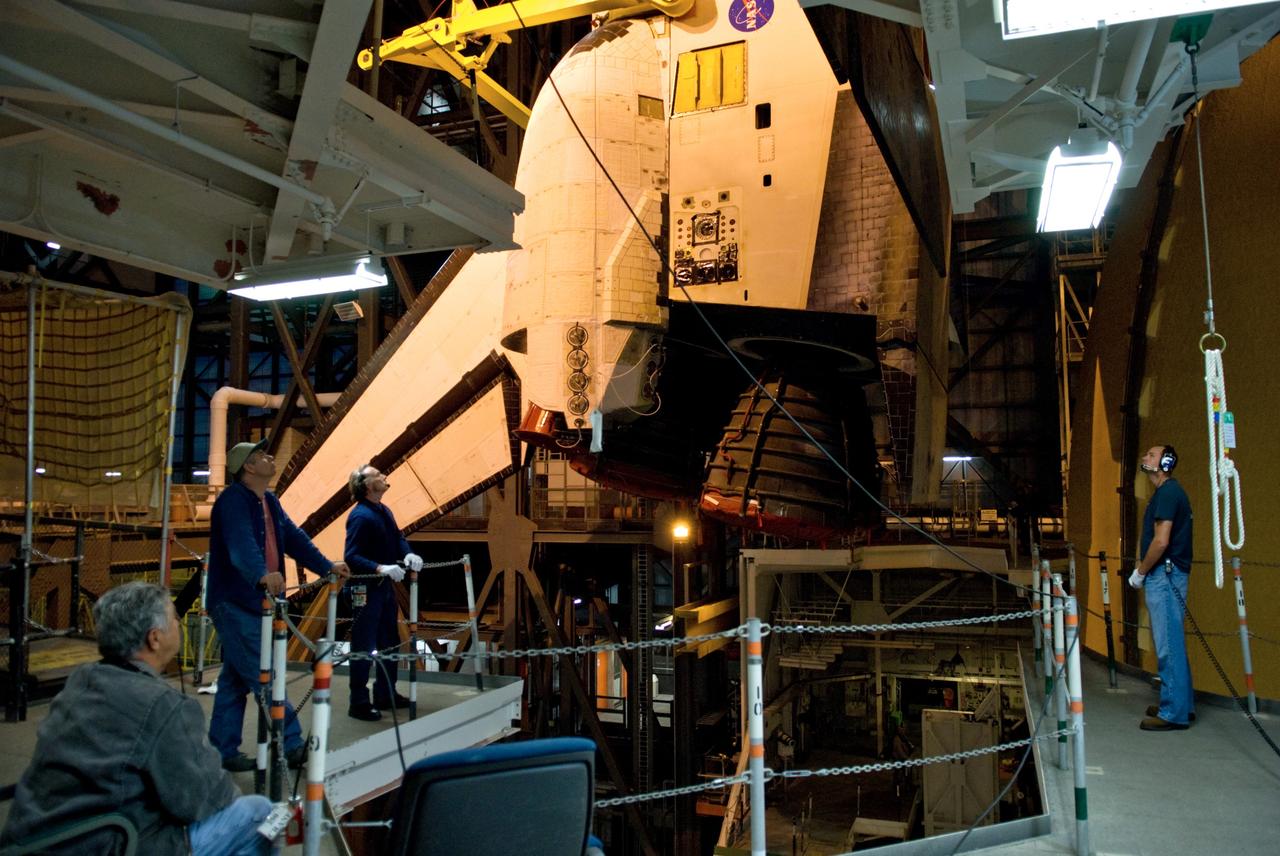
CAPE CANAVERAL, Fla. – In the Vehicle Assembly Building at NASA's Kennedy Space Center in Florida, workers observe the movement of space shuttle Atlantis as it is lowered toward the mobile launcher platform. The shuttle will be mated with the external fuel tank and solid rocket boosters on the platform. After additional preparations are made, the shuttle will be rolled out to Launch Pad 39A for a targeted launch on May 12 on the STS-125 mission to service NASA's Hubble Space Telescope. Photo credit: NASA/Kim Shiflett
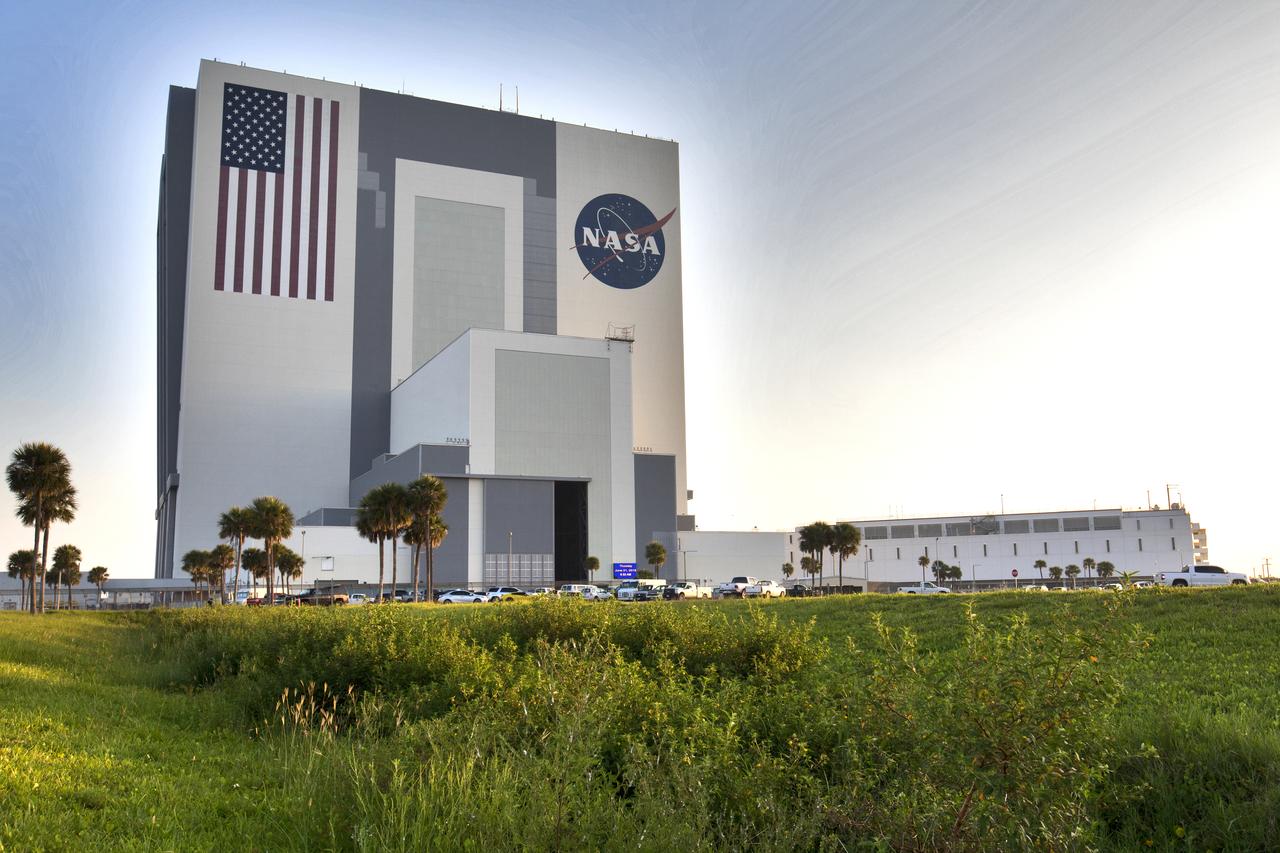
A brilliant blue sky forms the background for a panoramic view of the iconic Vehicle Assembly Building (VAB) and Launch Control Center at NASA's Kennedy Space Center in Florida. Ten levels of work platforms have been installed in High Bay 3 of the VAB. They will surround and provide access for service and processing of NASA's Space Launch System (SLS) rocket and Orion spacecraft. Exploration Ground Systems oversaw the upgrades and installation of the new work platforms to support the launch of the SLS and Orion on Exploration Mission-1 and deep space missions.
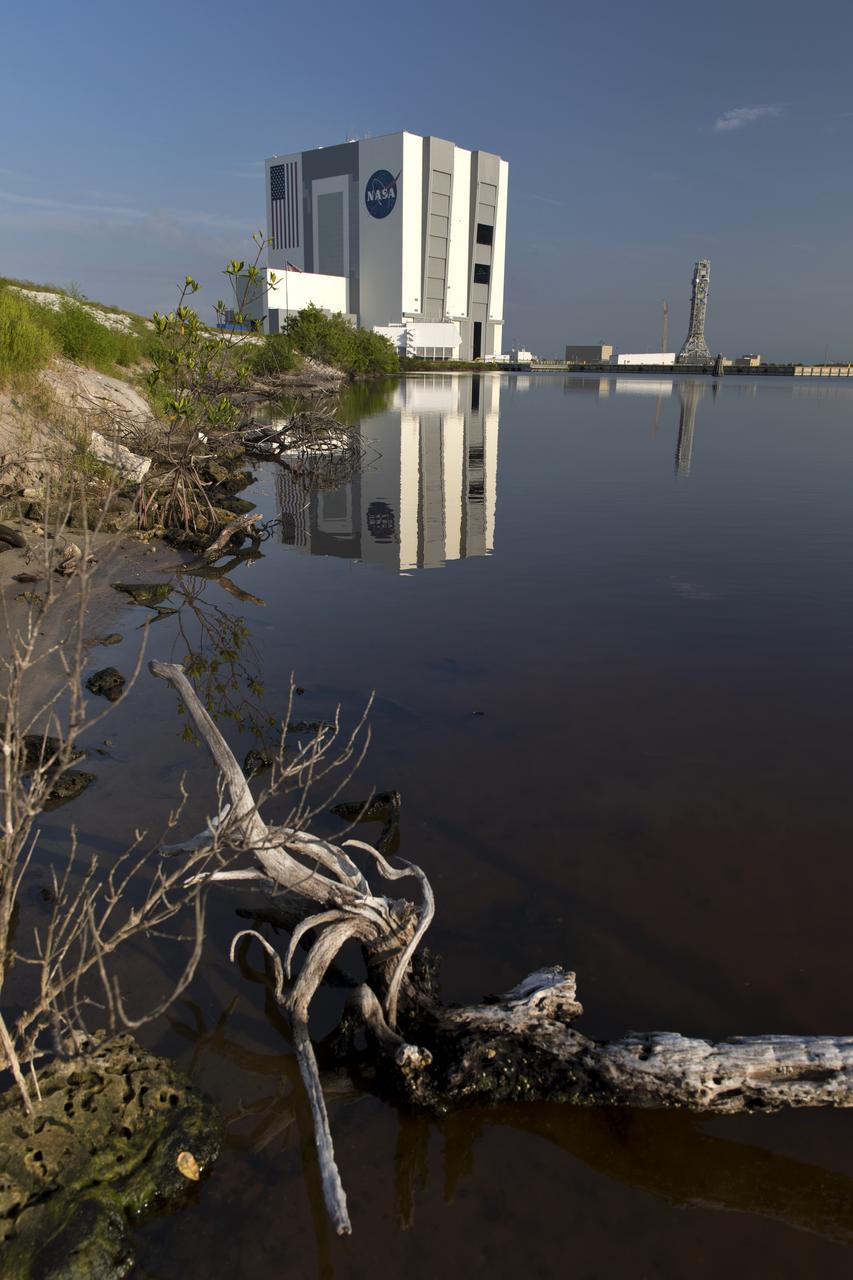
The iconic Vehicle Assembly Building (VAB) casts a reflection in a surrounding waterway at NASA's Kennedy Space Center in Florida. In view are the south and east sides of the building. Ten levels of new work platforms have been installed in VAB High Bay 3. They will surround and provide access for service and processing of NASA's Space Launch System (SLS) rocket and Orion spacecraft. Exploration Ground Systems oversaw the upgrades and installation of the new work platforms to support the launch of the SLS and Orion on Exploration Mission-1 and deep space missions.
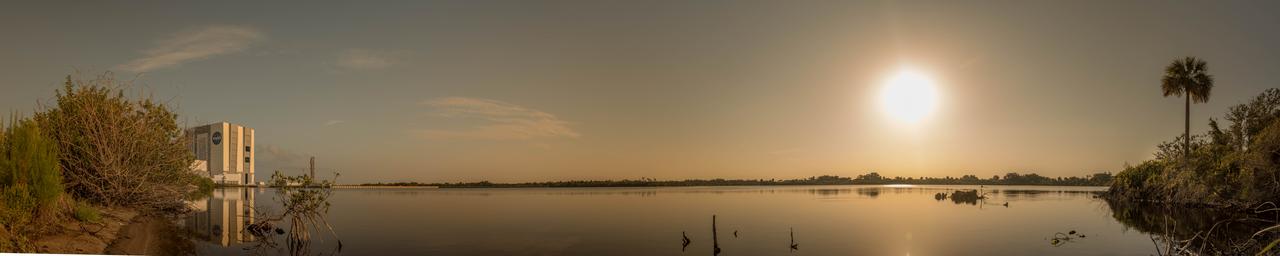
A sunrise panoramic view of the iconic Vehicle Assembly Building (VAB) and surrounding waterways at NASA's Kennedy Space Center in Florida. Ten levels of new work platforms have been installed in VAB High Bay 3. They will surround and provide access for service and processing of NASA's Space Launch System (SLS) rocket and Orion spacecraft. Exploration Ground Systems oversaw the upgrades and installation of the new work platforms to support the launch of the SLS and Orion on Exploration Mission-1 and deep space missions.
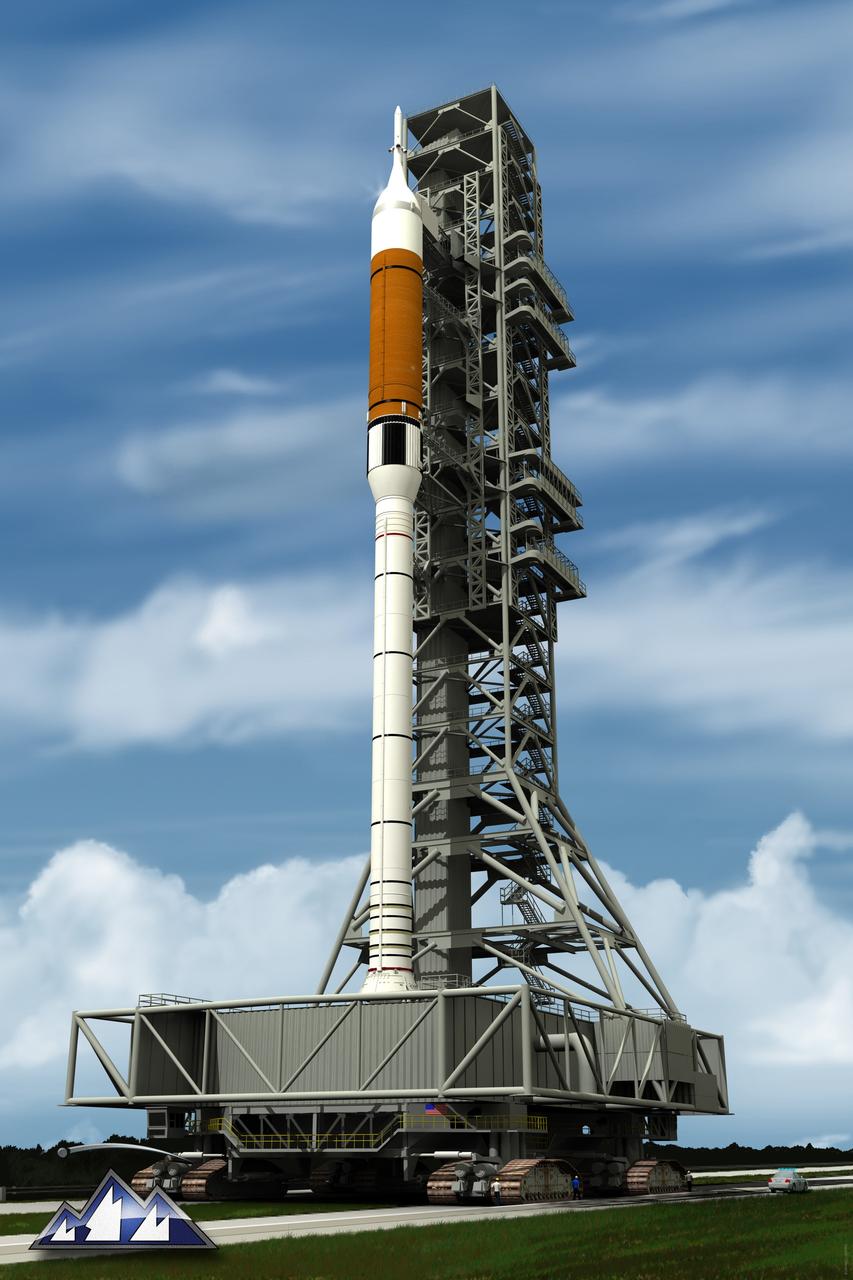
CAPE CANAVERAL, Fla. -- Artist's rendering of the Constellation Program's mobile launcher platform with an Ares I rocket attached. The tower of the mobile launcher will have multiple platforms for personnel access and will be approximately 390 feet tall. The tower will be used in the assembly, testing and servicing of the Ares rockets at Kennedy and will also transport the Ares rockets to the launch pad and provide ground support for launches.
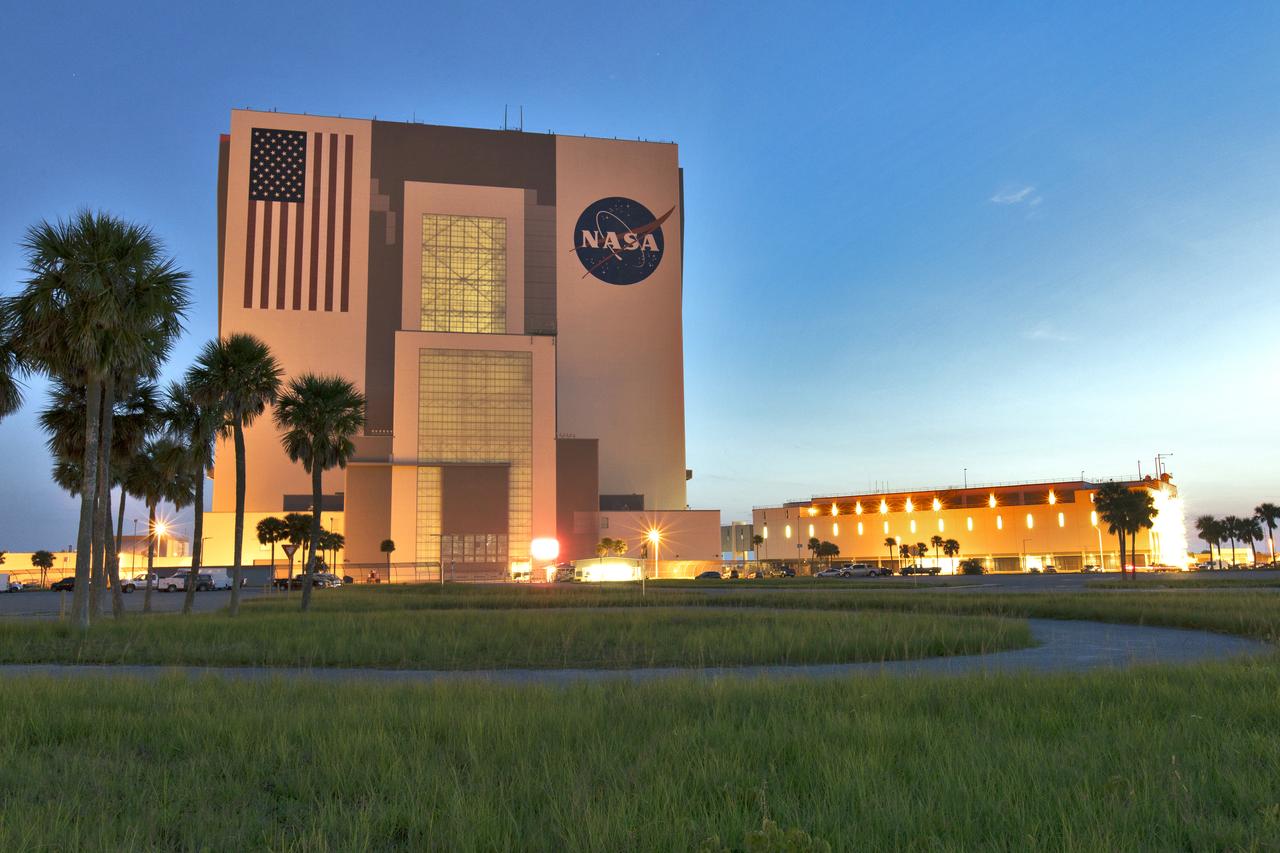
A sunrise panoramic view of the iconic Vehicle Assembly Building (VAB) and Launch Control Center at NASA's Kennedy Space Center in Florida. Ten levels of work platforms have been installed in High Bay 3 of the VAB. They will surround and provide access for service and processing of NASA's Space Launch System (SLS) rocket and Orion spacecraft. Exploration Ground Systems oversaw the upgrades and installation of the new work platforms to support the launch of the SLS and Orion on Exploration Mission-1 and deep space missions.
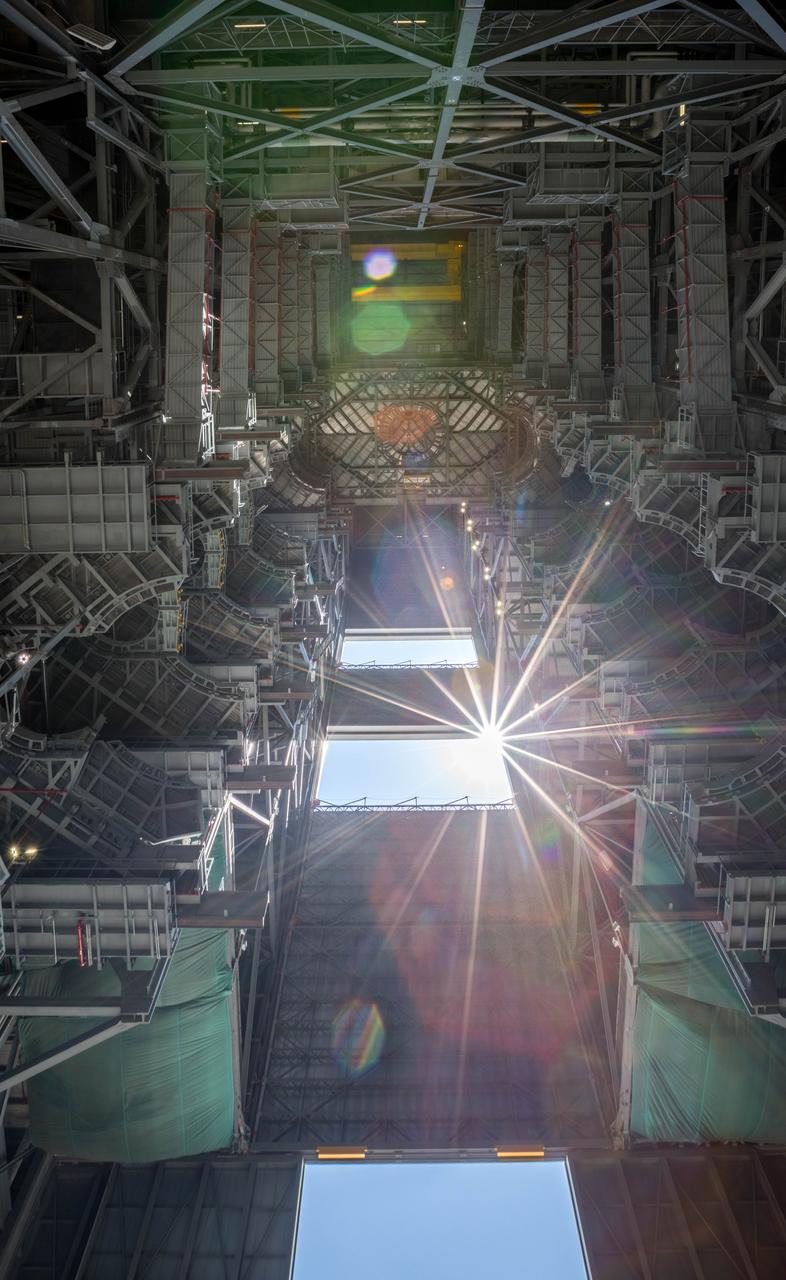
A brilliant sun shines through the doors of High Bay 3 in the Vehicle Assembly Building (VAB) at NASA's Kennedy Space Center in Florida. In view are ten levels of new work platforms that were installed in the high bay. They will surround and provide access for service and processing of NASA's Space Launch System rocket and Orion spacecraft. Exploration Ground Systems oversaw the upgrades and installation of the new work platforms to support the launch of the SLS and Orion on Exploration Mission-1 (EM-1) and deep space missions.
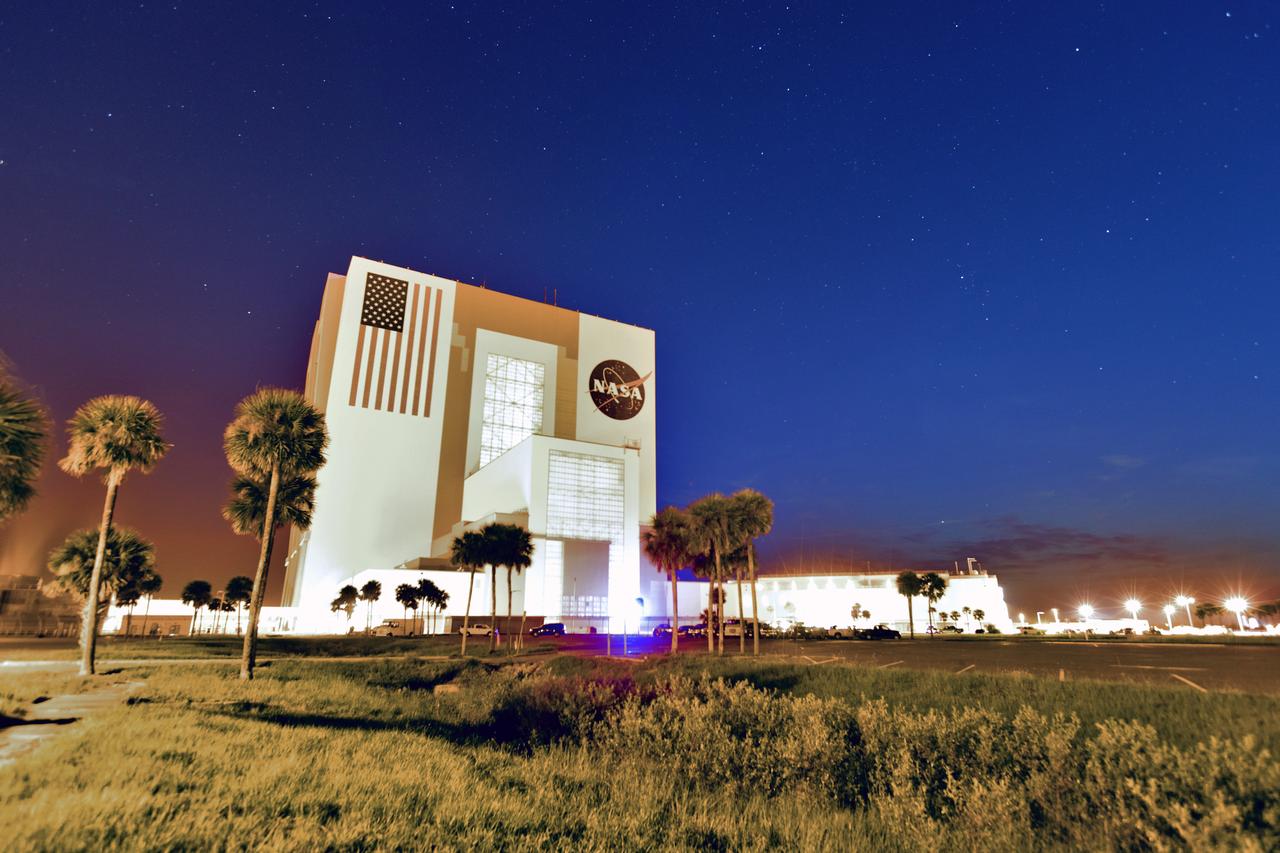
A sunrise creative view of the iconic Vehicle Assembly Building (VAB) and Launch Control Center at NASA's Kennedy Space Center in Florida. Ten levels of work platforms have been installed in High Bay 3 of the VAB. They will surround and provide access for service and processing of NASA's Space Launch System (SLS) rocket and Orion spacecraft. Exploration Ground Systems oversaw the upgrades and installation of the new work platforms to support the launch of the SLS and Orion on Exploration Mission-1 and deep space missions.
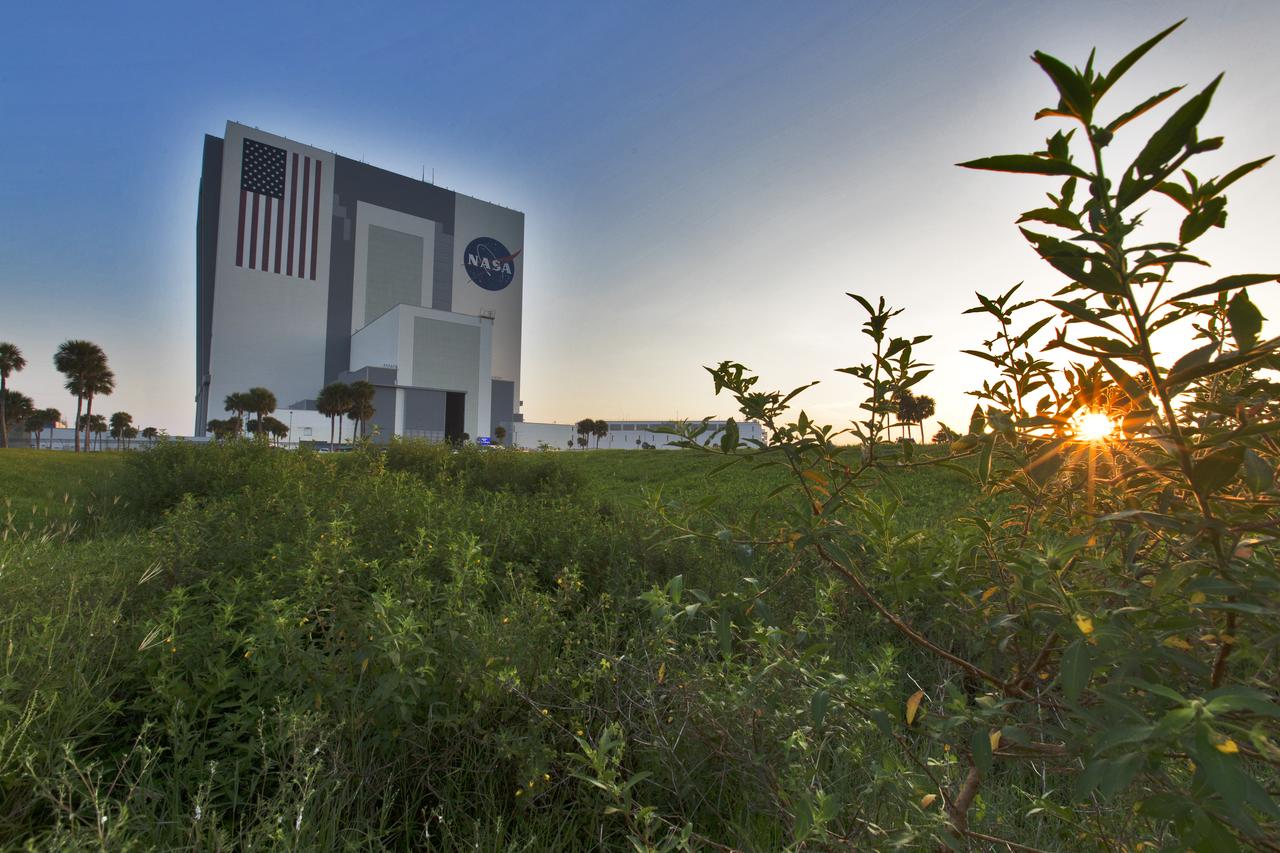
A sunrise panoramic view of the iconic Vehicle Assembly Building (VAB) at NASA's Kennedy Space Center in Florida. Ten levels of work platforms have been installed in High Bay 3 of the VAB. They will surround and provide access for service and processing of NASA's Space Launch System (SLS) rocket and Orion spacecraft. Exploration Ground Systems oversaw the upgrades and installation of the new work platforms to support the launch of the SLS and Orion on Exploration Mission-1 and deep space missions.
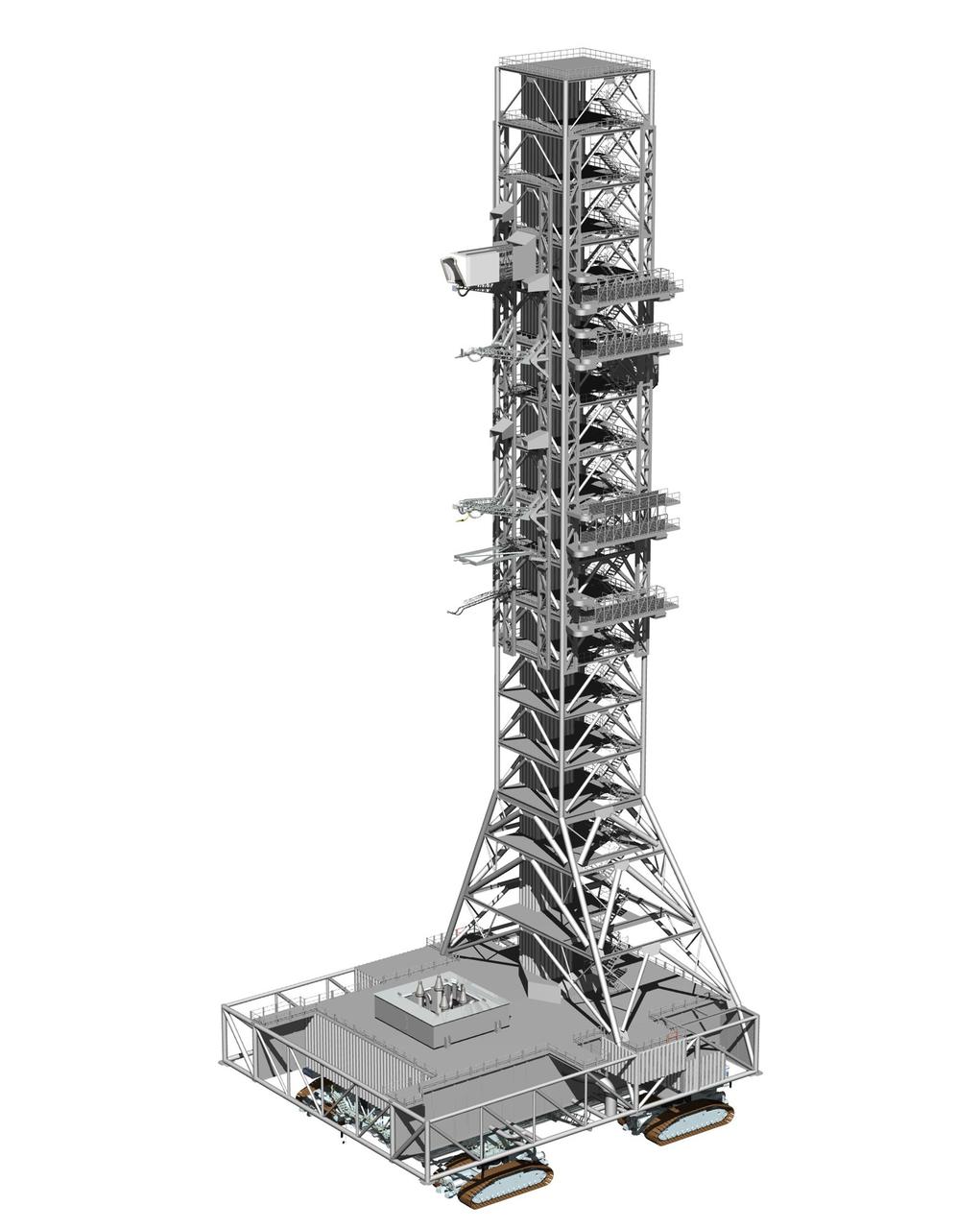
CAPE CANAVERAL, Fla. -- Artist's rendering of the empty Constellation Program's mobile launcher platform planned for the Ares I rocket. The tower of the mobile launcher will have multiple platforms for personnel access and will be approximately 390 feet tall. The tower will be used in the assembly, testing and servicing of the Ares rockets at Kennedy and will also transport the Ares rockets to the launch pad and provide ground support for launches.

Airbus workers inspect the Bartolomeo platform after it was unpacked from its shipping container in the Space Station Processing Facility high bay at NASA’s Kennedy Space Center in Florida on Jan. 30, 2020. Bartolomeo was manufactured by Airbus Defence and Space. The platform will be delivered to the International Space Station aboard SpaceX’s 20th Commercial Resupply Services (CRS-20) mission for the agency. The platform will attach to the exterior of the space station’s European Columbus Module. Named for the younger brother of Christopher Columbus, the platform has the capability to host external payloads in low-Earth orbit on the station. CRS-20 is scheduled to launch aboard SpaceX’s Dragon cargo spacecraft atop the company’s Falcon 9 rocket in March 2020.
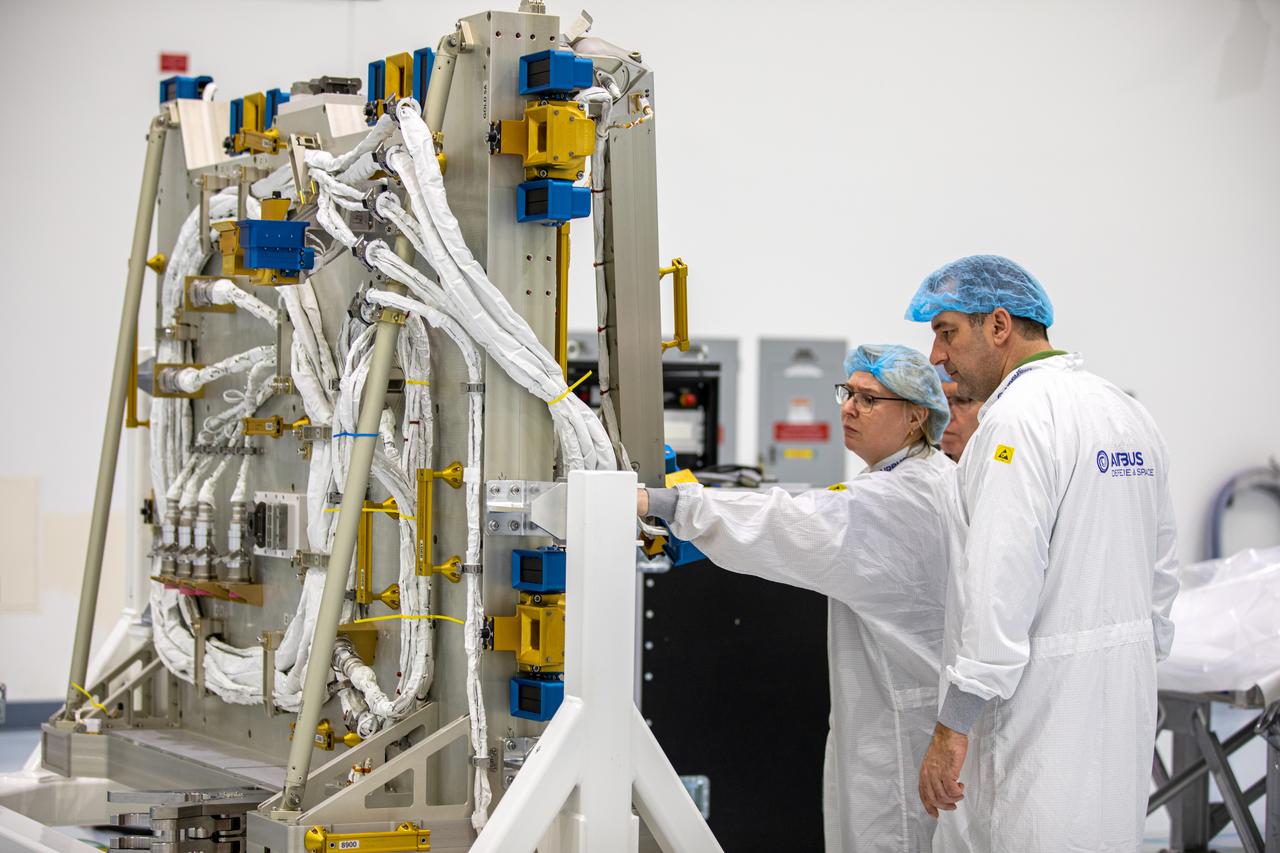
Airbus workers inspect the Bartolomeo platform after it was unpacked from its shipping container in the Space Station Processing Facility high bay at NASA’s Kennedy Space Center in Florida on Jan. 30, 2020. Bartolomeo was manufactured by Airbus Defence and Space. The platform will be delivered to the International Space Station aboard SpaceX’s 20th Commercial Resupply Services (CRS-20) mission for the agency. The platform will attach to the exterior of the space station’s European Columbus Module. Named for the younger brother of Christopher Columbus, the platform has the capability to host external payloads in low-Earth orbit on the station. CRS-20 is scheduled to launch aboard SpaceX’s Dragon cargo spacecraft atop the company’s Falcon 9 rocket in March 2020.
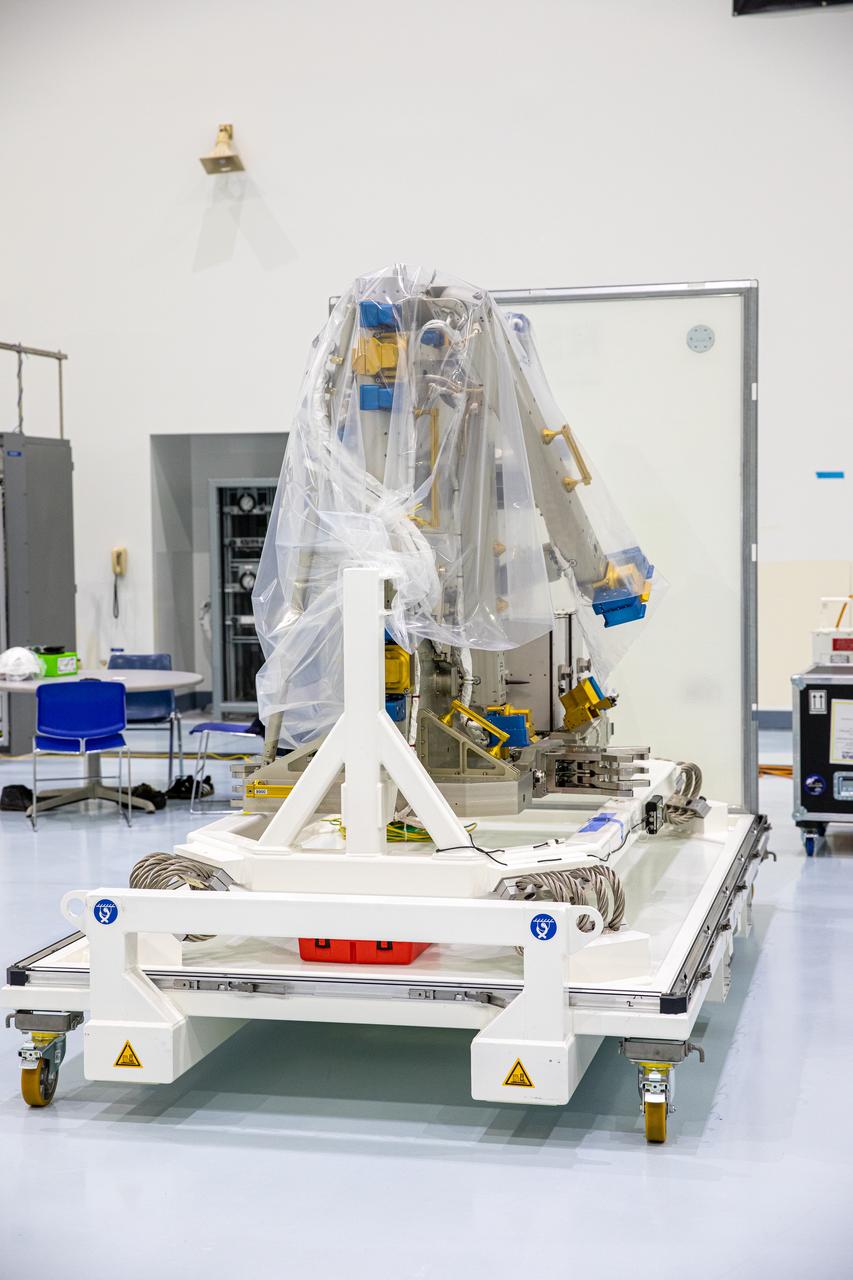
The Bartolomeo platform that will be delivered to the International Space Station is unpacked from its shipping container inside the Space Station Processing Facility high bay at NASA’s Kennedy Space Center in Florida on Jan. 30, 2020. Bartolomeo was manufactured by Airbus Defence and Space. The platform will be delivered to the International Space Station aboard SpaceX’s 20th Commercial Resupply Services (CRS-20) mission for the agency. The platform will attach to the exterior of the space station’s European Columbus Module. Named for the younger brother of Christopher Columbus, the platform has the capability to host external payloads in low-Earth orbit on the station. CRS-20 is scheduled to launch aboard SpaceX’s Dragon cargo spacecraft atop the company’s Falcon 9 rocket in March 2020.
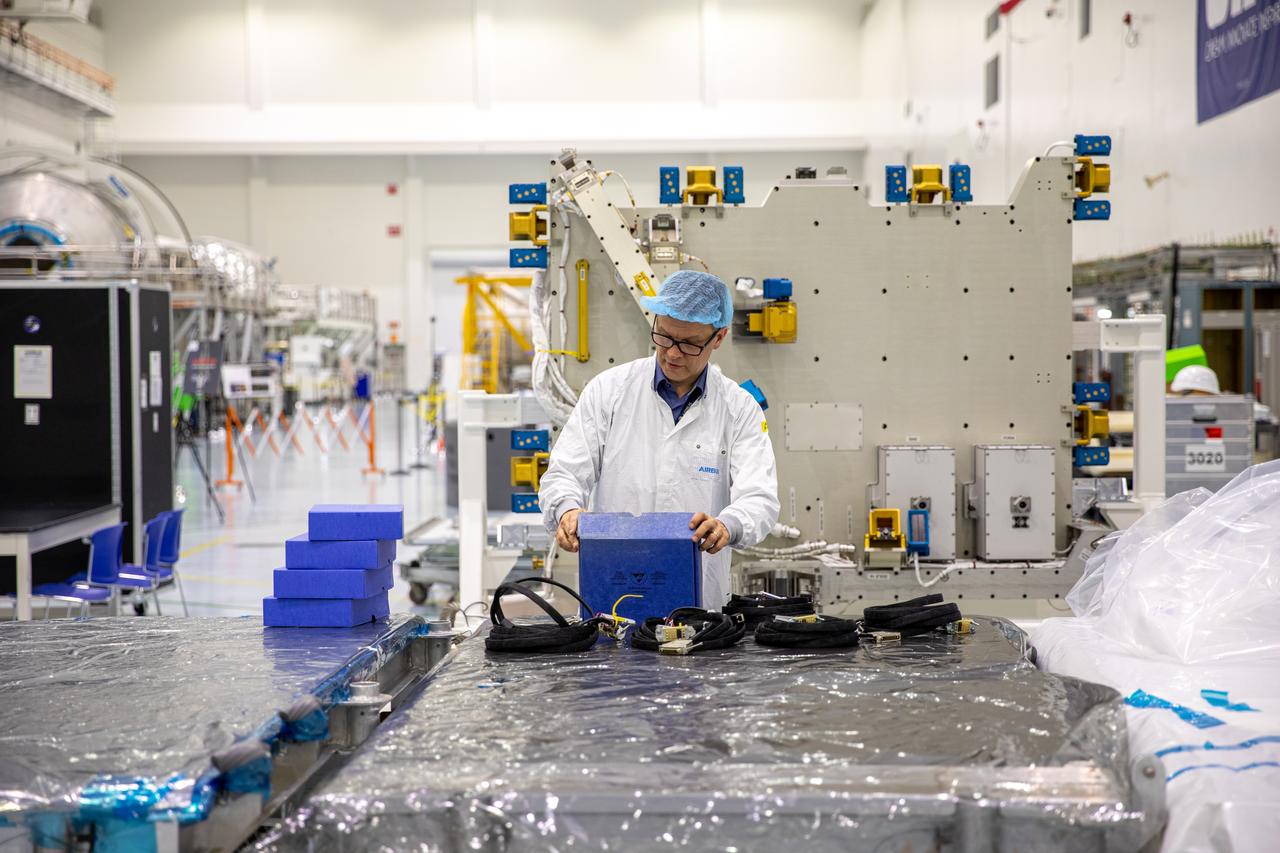
Airbus workers inspects parts for the Bartolomeo platform after it was unpacked from its shipping container in the Space Station Processing Facility high bay at NASA’s Kennedy Space Center in Florida on Jan. 30, 2020. Bartolomeo was manufactured by Airbus Defence and Space. The platform will be delivered to the International Space Station aboard SpaceX’s 20th Commercial Resupply Services (CRS-20) mission for the agency. The platform will attach to the exterior of the space station’s European Columbus Module. Named for the younger brother of Christopher Columbus, the platform has the capability to host external payloads in low-Earth orbit on the station. CRS-20 is scheduled to launch aboard SpaceX’s Dragon cargo spacecraft atop the company’s Falcon 9 rocket in March 2020.
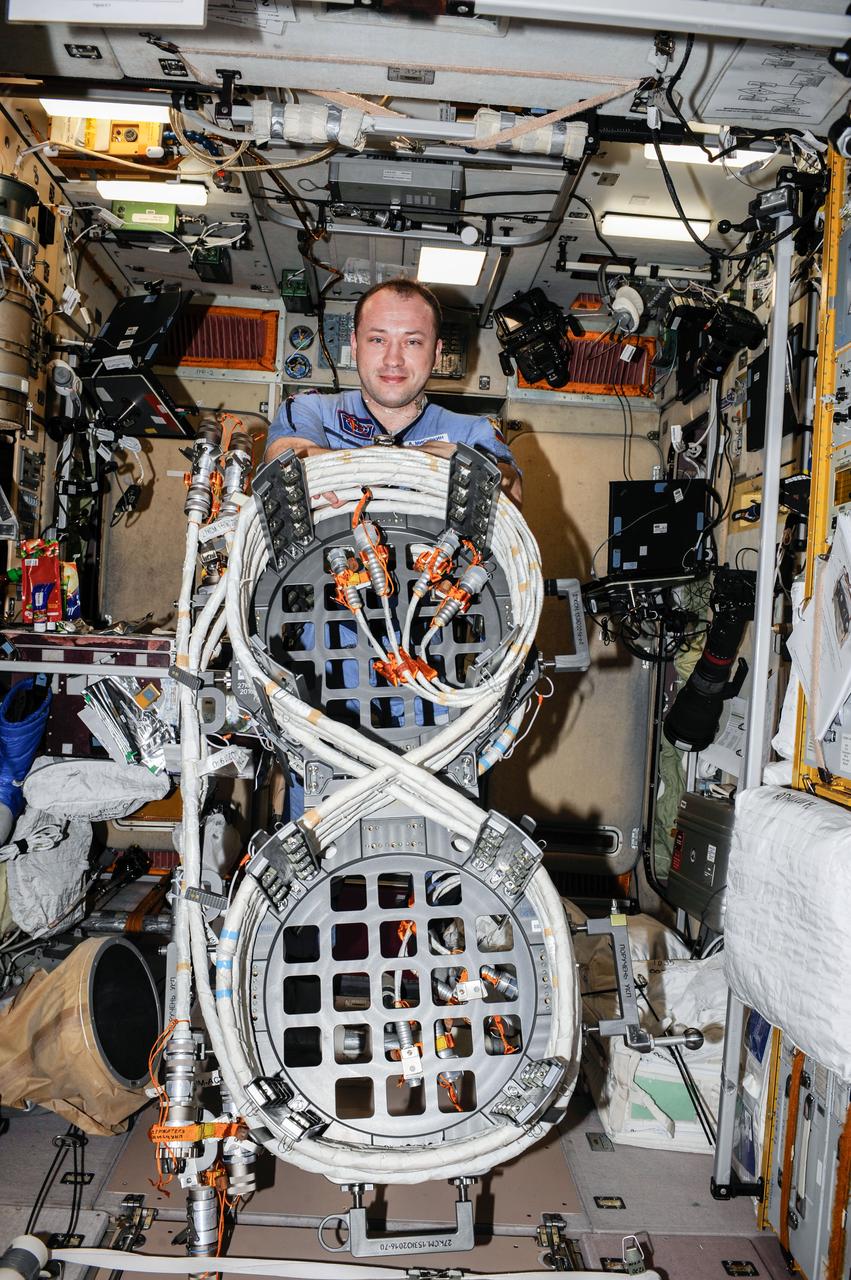
ISS036-E-029455 (6 Aug. 2013) --- In the International Space Station’s Zvezda Service Module, Russian cosmonaut Alexander Misurkin, Expedition 36 flight engineer, holds an EVA multi-purpose cable platform which will be used in an upcoming spacewalk.
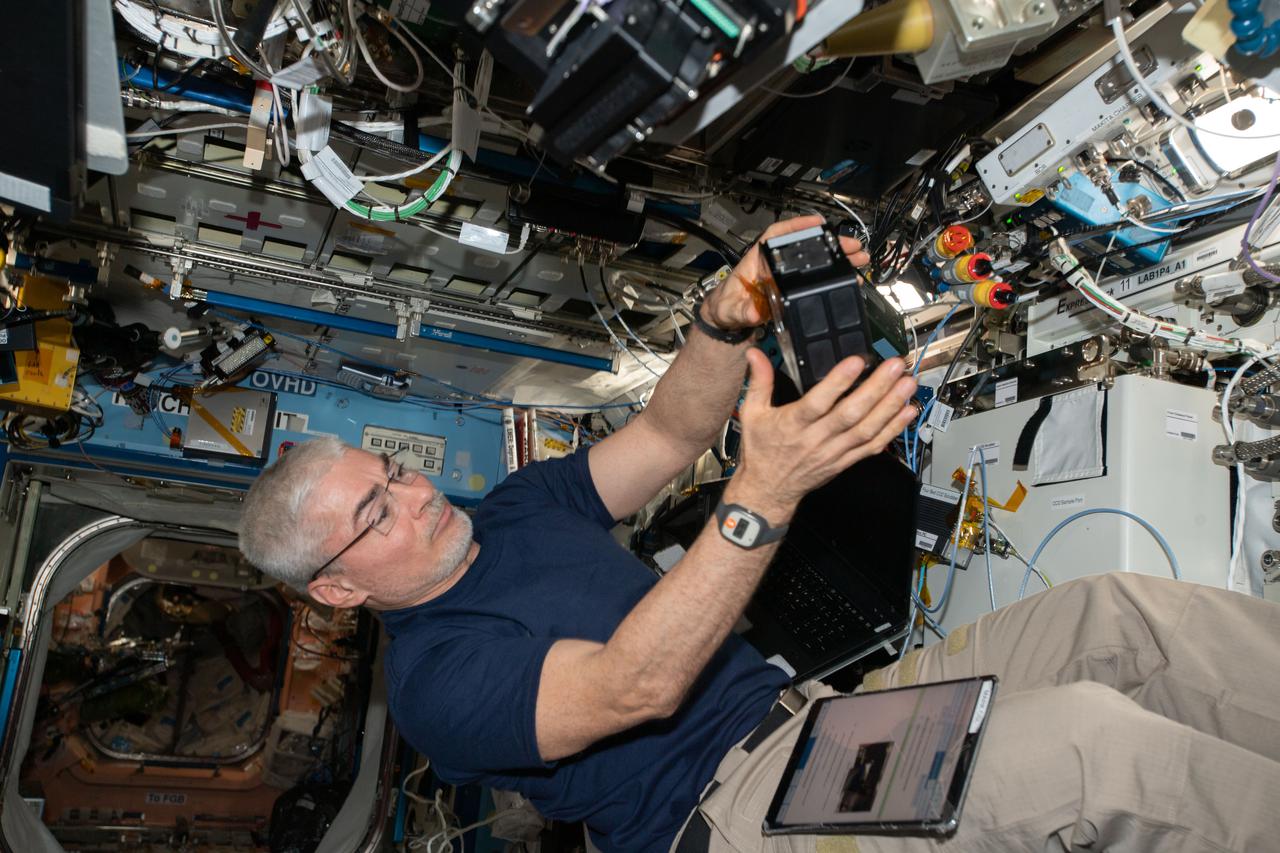
iss066e137913 (Feb. 9, 2022) --- NASA astronaut and Expedition 66 Flight Engineer Mark Vande Hei services components inside the Multi-use Variable-G Platform, a biology research device that can generate up to 2G of artfifical gravity.