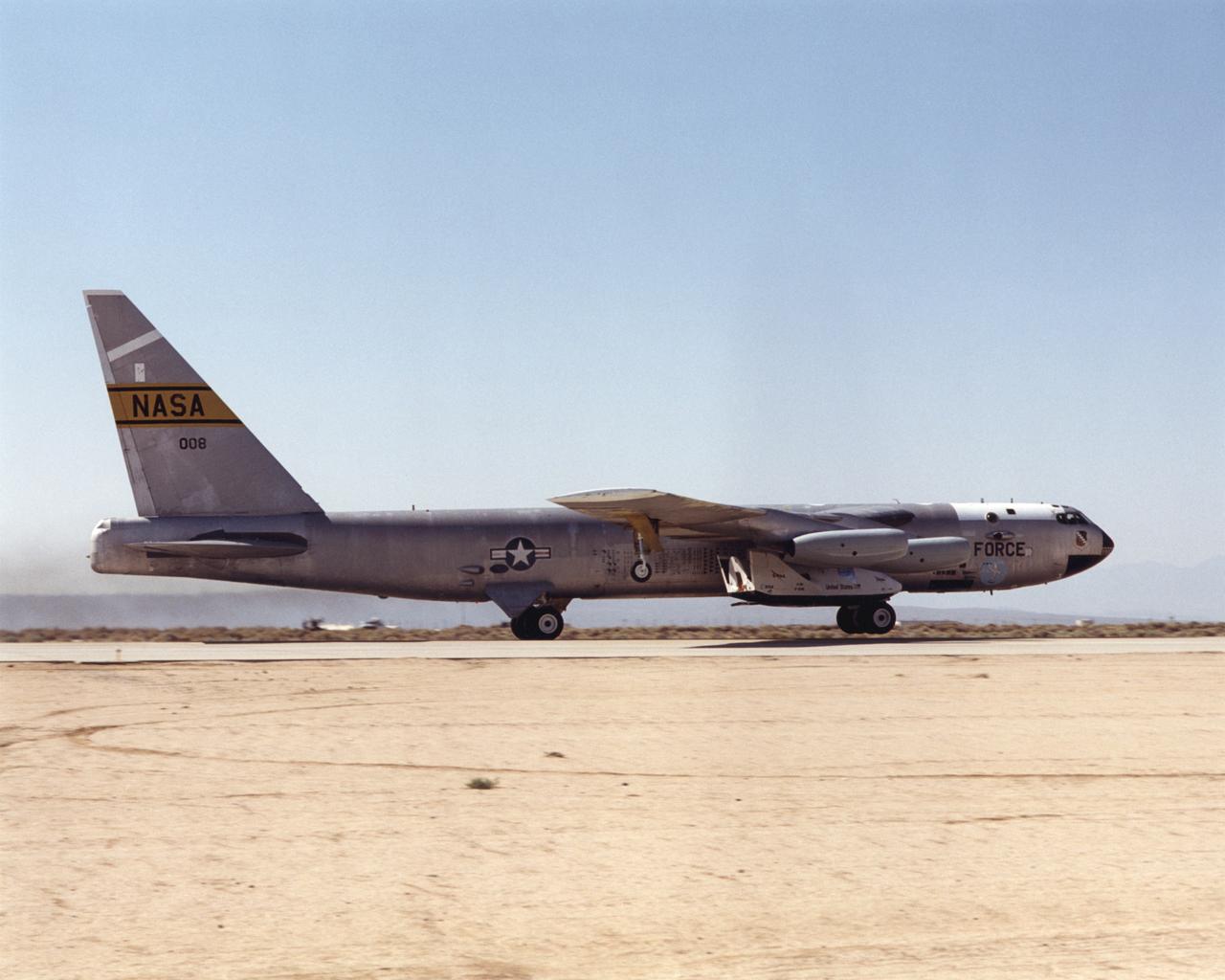
The X-38, mounted beneath the right wing of NASA's B-52, climbed from the runway at Edwards Air Force Base for the seventh free flight test of the X-38, July 10, 2001. The X-38 was released at 37,500 feet and completed a thirteen minute glide flight to a landing on Rogers Dry Lake.
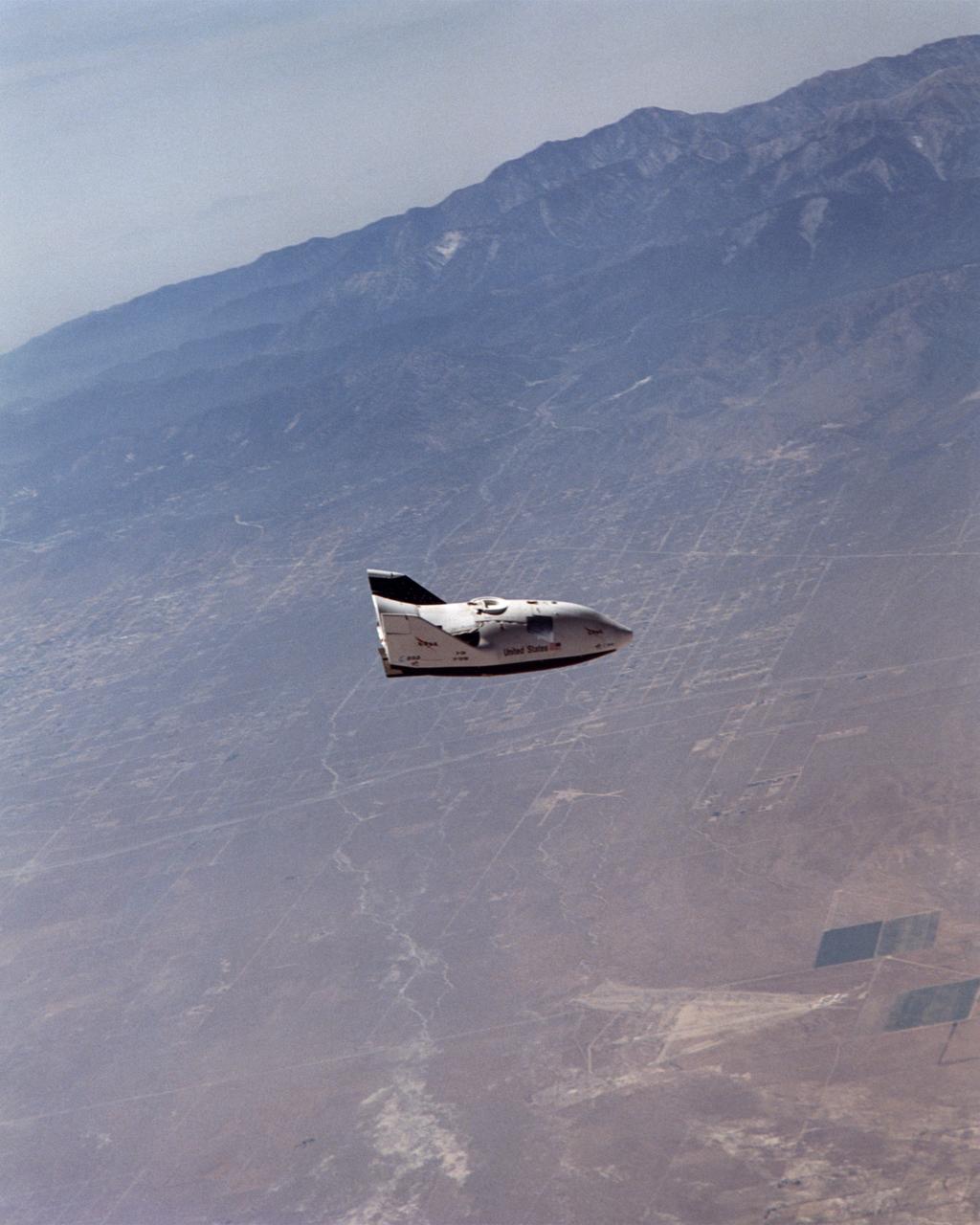
NASA's X-38 glided high over California desert test ranges as it descended from 37,500 feet to land on Rogers Dry Lake for the seventh free flight of the program July 10, 2001.

CAPE CANAVERAL, Fla. – Engineers and technicians prepare the Project Morpheus prototype lander for an automated landing and hazard avoidance technology, or ALHAT, and laser test at a new launch site at the north end of the Shuttle Landing Facility at NASA’s Kennedy Space Center in Florida. The launch pad was moved to a different location at the landing facility to support the next phase of flight testing. The seventh free flight test of Morpheus occurred on March 11. The 83-second test began at 3:41 p.m. EDT with the Morpheus lander launching from the ground over a flame trench and ascending to 580 feet. Morpheus then flew its fastest downrange trek at 30 mph, travelling farther than before, 837 feet. The lander performed a 42-foot divert to emulate a hazard avoidance maneuver before descending and touching down on Landing Site 2, at the northern landing pad inside the ALHAT hazard field. Morpheus landed within one foot of its intended target. Project Morpheus tests NASA’s ALHAT and an engine that runs on liquid oxygen and methane, or green propellants, into a fully-operational lander that could deliver cargo to other planetary surfaces. The landing facility provides the lander with the kind of field necessary for realistic testing, complete with rocks, craters and hazards to avoid. Morpheus’ ALHAT payload allows it to navigate to clear landing sites amidst rocks, craters and other hazards during its descent. Project Morpheus is being managed under the Advanced Exploration Systems, or AES, Division in NASA’s Human Exploration and Operations Mission Directorate. The efforts in AES pioneer new approaches for rapidly developing prototype systems, demonstrating key capabilities and validating operational concepts for future human missions beyond Earth orbit. For more information on Project Morpheus, visit http://morpheuslander.jsc.nasa.gov/. Photo credit: NASA/Kim Shiflett
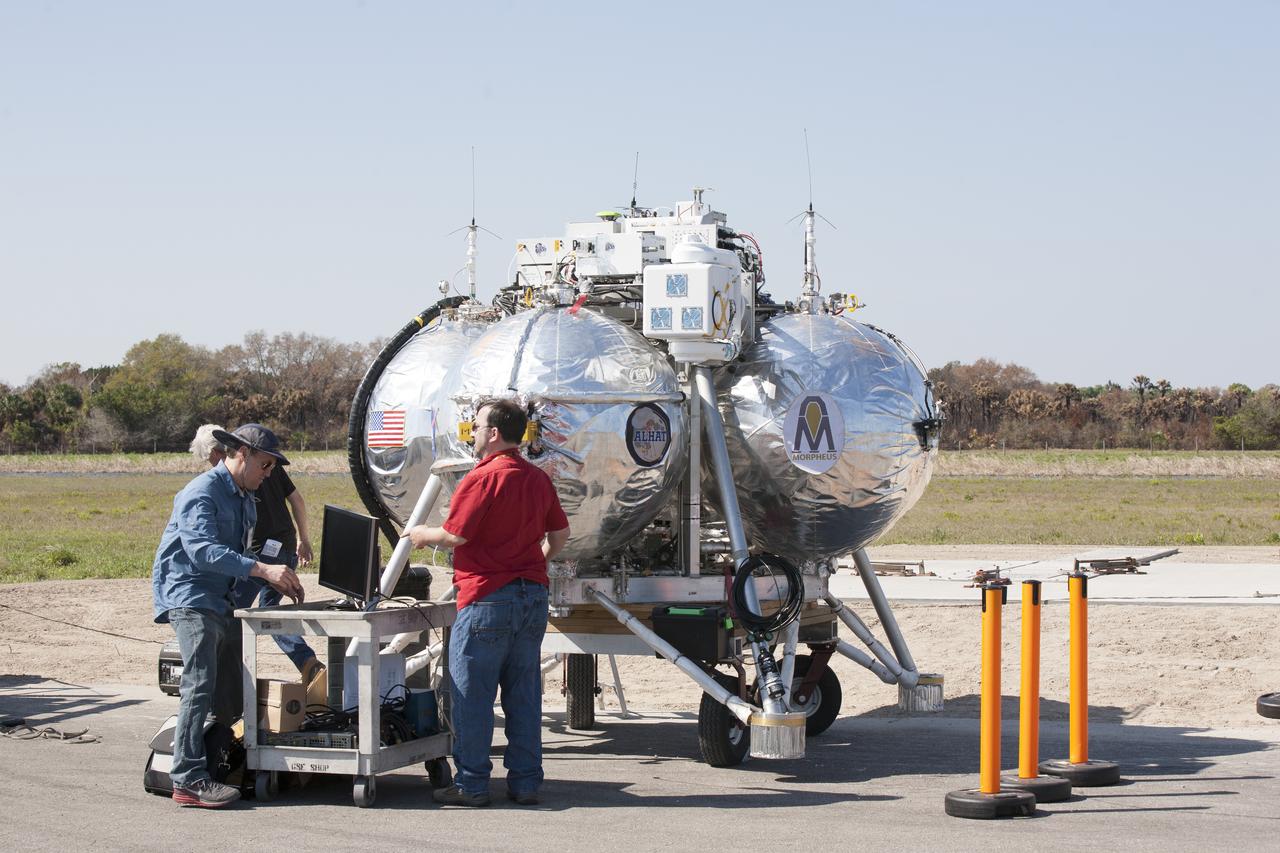
CAPE CANAVERAL, Fla. – Engineers run an automated landing and hazard avoidance technology, or ALHAT, and laser test on the Project Morpheus prototype lander at a new launch site at the north end of the Shuttle Landing Facility at NASA’s Kennedy Space Center in Florida. The launch pad was moved to a different location at the landing facility to support the next phase of flight testing. The seventh free flight test of Morpheus occurred on March 11. The 83-second test began at 3:41 p.m. EDT with the Morpheus lander launching from the ground over a flame trench and ascending to 580 feet. Morpheus then flew its fastest downrange trek at 30 mph, travelling farther than before, 837 feet. The lander performed a 42-foot divert to emulate a hazard avoidance maneuver before descending and touching down on Landing Site 2, at the northern landing pad inside the ALHAT hazard field. Morpheus landed within one foot of its intended target. Project Morpheus tests NASA’s ALHAT and an engine that runs on liquid oxygen and methane, or green propellants, into a fully-operational lander that could deliver cargo to other planetary surfaces. The landing facility provides the lander with the kind of field necessary for realistic testing, complete with rocks, craters and hazards to avoid. Morpheus’ ALHAT payload allows it to navigate to clear landing sites amidst rocks, craters and other hazards during its descent. Project Morpheus is being managed under the Advanced Exploration Systems, or AES, Division in NASA’s Human Exploration and Operations Mission Directorate. The efforts in AES pioneer new approaches for rapidly developing prototype systems, demonstrating key capabilities and validating operational concepts for future human missions beyond Earth orbit. For more information on Project Morpheus, visit http://morpheuslander.jsc.nasa.gov/. Photo credit: NASA/Kim Shiflett
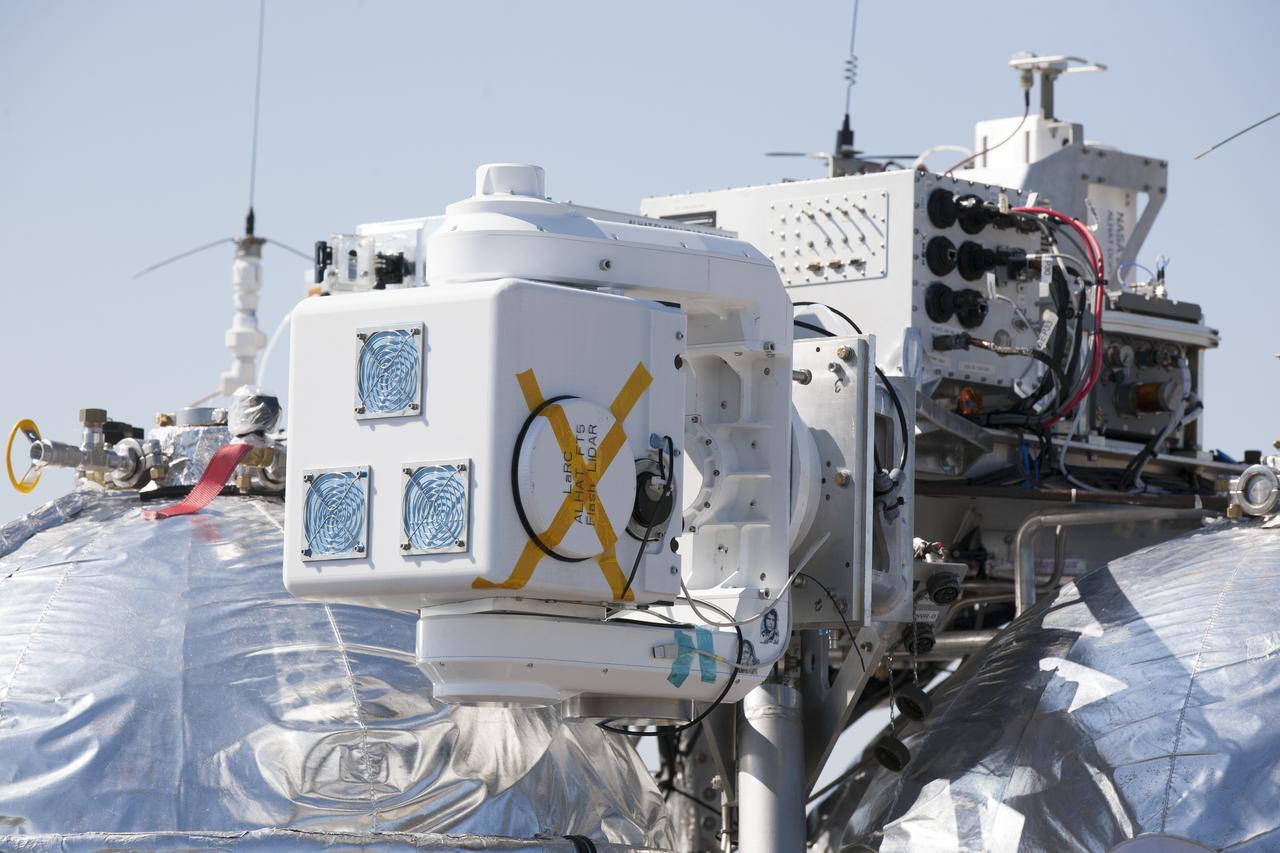
CAPE CANAVERAL, Fla. – Engineers run an automated landing and hazard avoidance technology, or ALHAT, and laser test on the Project Morpheus prototype lander at a new launch site at the north end of the Shuttle Landing Facility at NASA’s Kennedy Space Center in Florida. The launch pad was moved to a different location at the landing facility to support the next phase of flight testing. The seventh free flight test of Morpheus occurred on March 11. The 83-second test began at 3:41 p.m. EDT with the Morpheus lander launching from the ground over a flame trench and ascending to 580 feet. Morpheus then flew its fastest downrange trek at 30 mph, travelling farther than before, 837 feet. The lander performed a 42-foot divert to emulate a hazard avoidance maneuver before descending and touching down on Landing Site 2, at the northern landing pad inside the ALHAT hazard field. Morpheus landed within one foot of its intended target. Project Morpheus tests NASA’s ALHAT and an engine that runs on liquid oxygen and methane, or green propellants, into a fully-operational lander that could deliver cargo to other planetary surfaces. The landing facility provides the lander with the kind of field necessary for realistic testing, complete with rocks, craters and hazards to avoid. Morpheus’ ALHAT payload allows it to navigate to clear landing sites amidst rocks, craters and other hazards during its descent. Project Morpheus is being managed under the Advanced Exploration Systems, or AES, Division in NASA’s Human Exploration and Operations Mission Directorate. The efforts in AES pioneer new approaches for rapidly developing prototype systems, demonstrating key capabilities and validating operational concepts for future human missions beyond Earth orbit. For more information on Project Morpheus, visit http://morpheuslander.jsc.nasa.gov/. Photo credit: NASA/Kim Shiflett
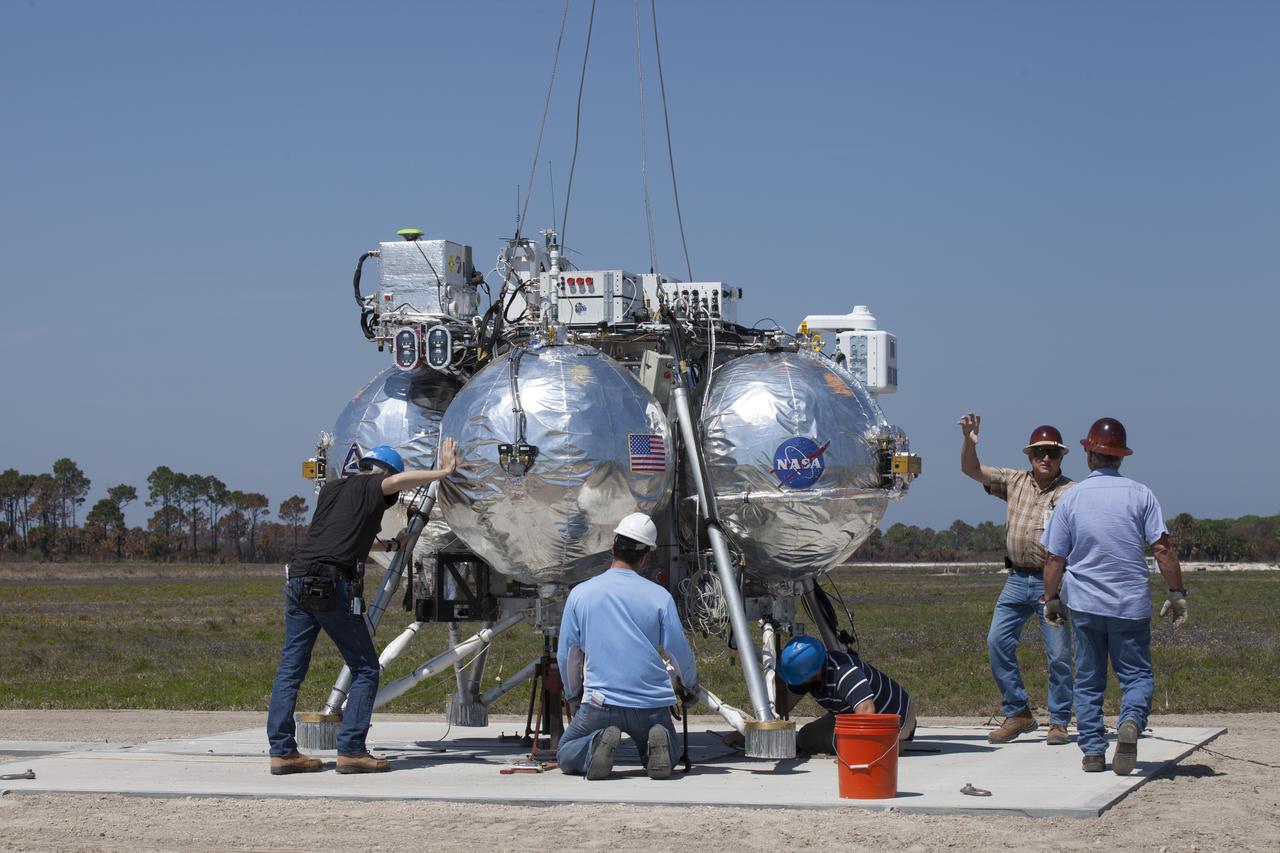
CAPE CANAVERAL, Fla. – Engineers and technicians prepare the Project Morpheus prototype lander for an automated landing and hazard avoidance technology, or ALHAT, and laser test at a new launch site at the north end of the Shuttle Landing Facility at NASA’s Kennedy Space Center in Florida. The launch pad was moved to a different location at the landing facility to support the next phase of flight testing. The seventh free flight test of Morpheus occurred on March 11. The 83-second test began at 3:41 p.m. EDT with the Morpheus lander launching from the ground over a flame trench and ascending to 580 feet. Morpheus then flew its fastest downrange trek at 30 mph, travelling farther than before, 837 feet. The lander performed a 42-foot divert to emulate a hazard avoidance maneuver before descending and touching down on Landing Site 2, at the northern landing pad inside the ALHAT hazard field. Morpheus landed within one foot of its intended target. Project Morpheus tests NASA’s ALHAT and an engine that runs on liquid oxygen and methane, or green propellants, into a fully-operational lander that could deliver cargo to other planetary surfaces. The landing facility provides the lander with the kind of field necessary for realistic testing, complete with rocks, craters and hazards to avoid. Morpheus’ ALHAT payload allows it to navigate to clear landing sites amidst rocks, craters and other hazards during its descent. Project Morpheus is being managed under the Advanced Exploration Systems, or AES, Division in NASA’s Human Exploration and Operations Mission Directorate. The efforts in AES pioneer new approaches for rapidly developing prototype systems, demonstrating key capabilities and validating operational concepts for future human missions beyond Earth orbit. For more information on Project Morpheus, visit http://morpheuslander.jsc.nasa.gov/. Photo credit: NASA/Kim Shiflett
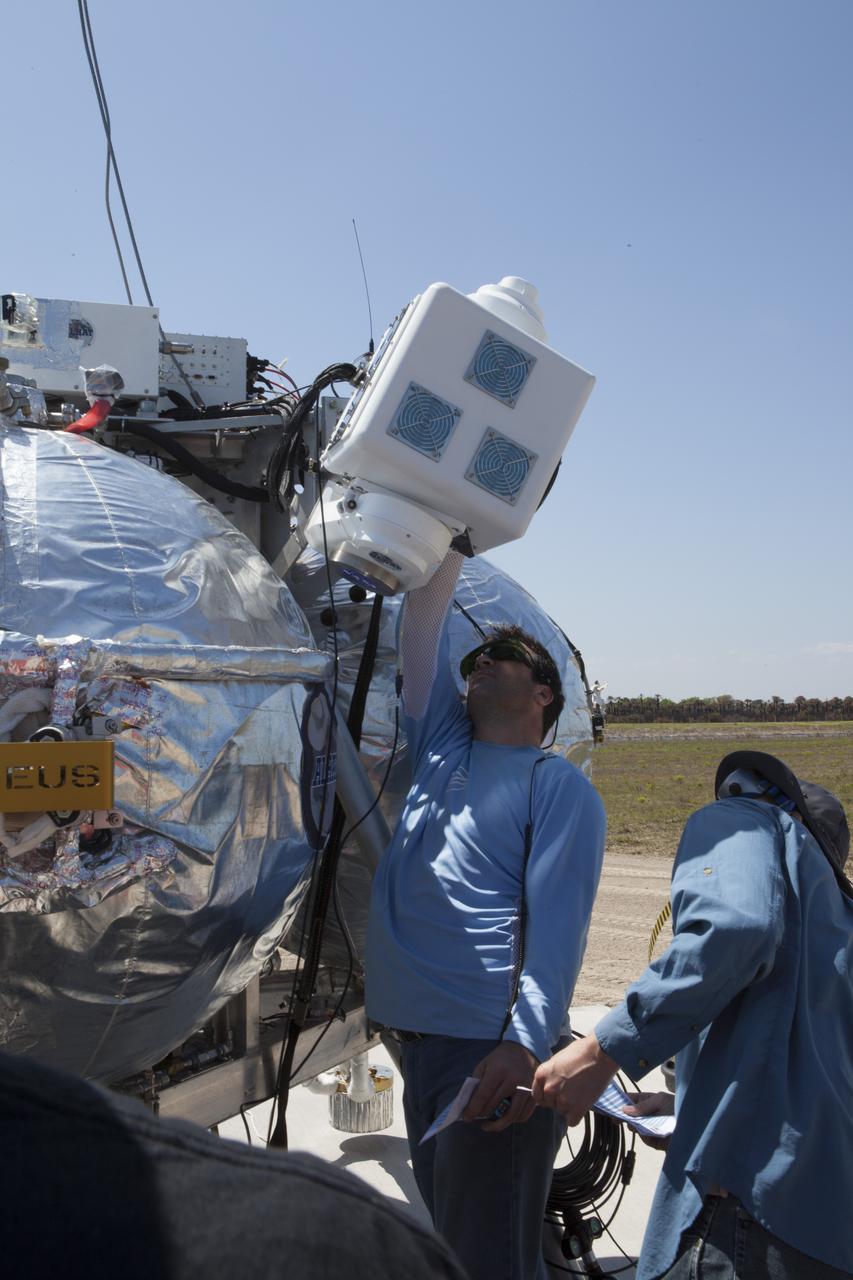
CAPE CANAVERAL, Fla. – Engineers and technicians wearing safety goggles, prepare the Project Morpheus prototype lander for an automated landing and hazard avoidance technology, or ALHAT, and laser test at a new launch site at the north end of the Shuttle Landing Facility at NASA’s Kennedy Space Center in Florida. The launch pad was moved to a different location at the landing facility to support the next phase of flight testing. The seventh free flight test of Morpheus occurred on March 11. The 83-second test began at 3:41 p.m. EDT with the Morpheus lander launching from the ground over a flame trench and ascending to 580 feet. Morpheus then flew its fastest downrange trek at 30 mph, travelling farther than before, 837 feet. The lander performed a 42-foot divert to emulate a hazard avoidance maneuver before descending and touching down on Landing Site 2, at the northern landing pad inside the ALHAT hazard field. Morpheus landed within one foot of its intended target. Project Morpheus tests NASA’s ALHAT and an engine that runs on liquid oxygen and methane, or green propellants, into a fully-operational lander that could deliver cargo to other planetary surfaces. The landing facility provides the lander with the kind of field necessary for realistic testing, complete with rocks, craters and hazards to avoid. Morpheus’ ALHAT payload allows it to navigate to clear landing sites amidst rocks, craters and other hazards during its descent. Project Morpheus is being managed under the Advanced Exploration Systems, or AES, Division in NASA’s Human Exploration and Operations Mission Directorate. The efforts in AES pioneer new approaches for rapidly developing prototype systems, demonstrating key capabilities and validating operational concepts for future human missions beyond Earth orbit. For more information on Project Morpheus, visit http://morpheuslander.jsc.nasa.gov/. Photo credit: NASA/Kim Shiflett
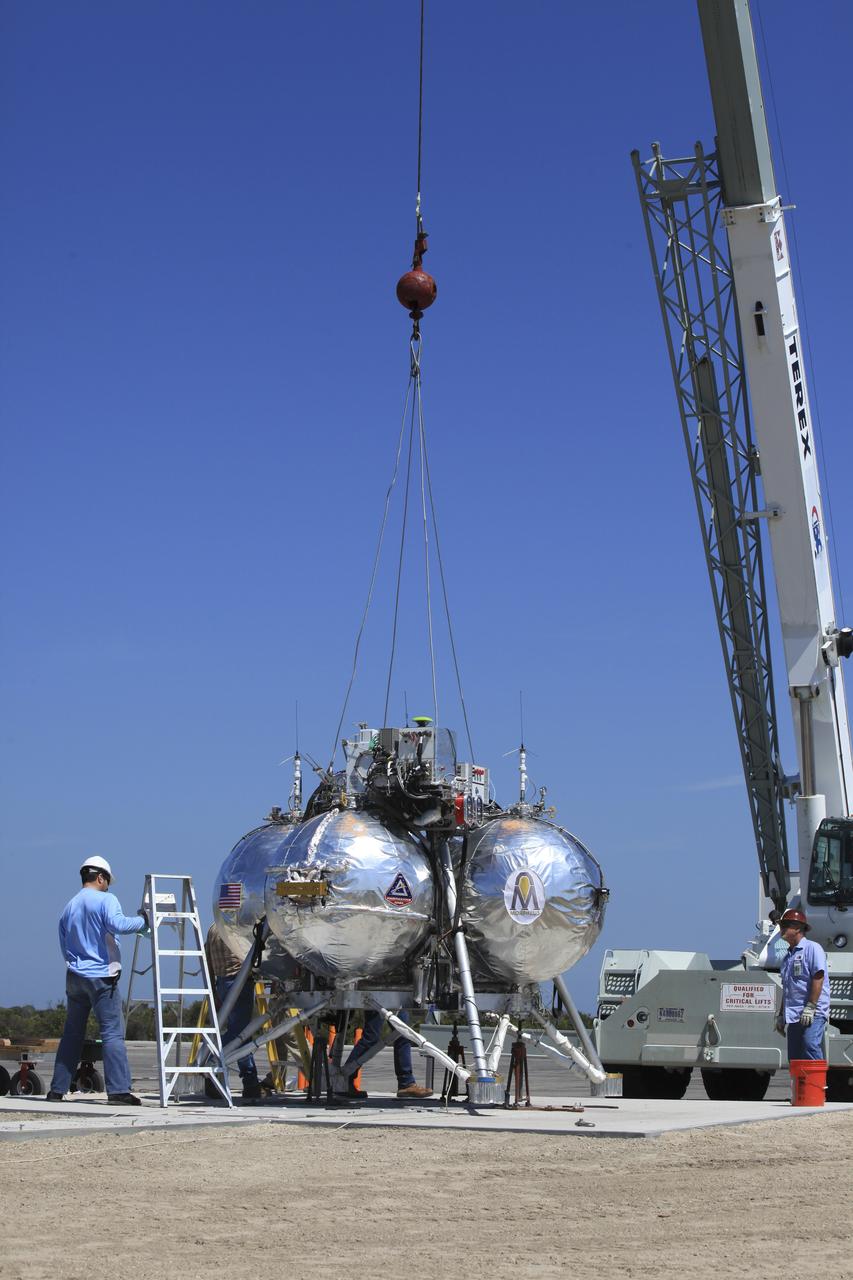
CAPE CANAVERAL, Fla. – A crane lowers the Project Morpheus prototype lander onto a launch pad at a new launch site at the north end of the Shuttle Landing Facility at NASA's Kennedy Space Center in Florida. Engineers and technicians are preparing Morpheus for an automated landing and hazard avoidance technology, or ALHAT, and laser test at the new launch site. The launch pad was moved to a different location at the landing facility to support the next phase of flight testing. The seventh free flight test of Morpheus occurred on March 11. The 83-second test began at 3:41 p.m. EDT with the Morpheus lander launching from the ground over a flame trench and ascending to 580 feet. Morpheus then flew its fastest downrange trek at 30 mph, travelling farther than before, 837 feet. The lander performed a 42-foot divert to emulate a hazard avoidance maneuver before descending and touching down on Landing Site 2, at the northern landing pad inside the ALHAT hazard field. Morpheus landed within one foot of its intended target. Project Morpheus tests NASA’s ALHAT and an engine that runs on liquid oxygen and methane, or green propellants, into a fully-operational lander that could deliver cargo to other planetary surfaces. The landing facility provides the lander with the kind of field necessary for realistic testing, complete with rocks, craters and hazards to avoid. Morpheus’ ALHAT payload allows it to navigate to clear landing sites amidst rocks, craters and other hazards during its descent. Project Morpheus is being managed under the Advanced Exploration Systems, or AES, Division in NASA’s Human Exploration and Operations Mission Directorate. The efforts in AES pioneer new approaches for rapidly developing prototype systems, demonstrating key capabilities and validating operational concepts for future human missions beyond Earth orbit. For more information on Project Morpheus, visit http://morpheuslander.jsc.nasa.gov/. Photo credit: NASA/Kim Shiflett
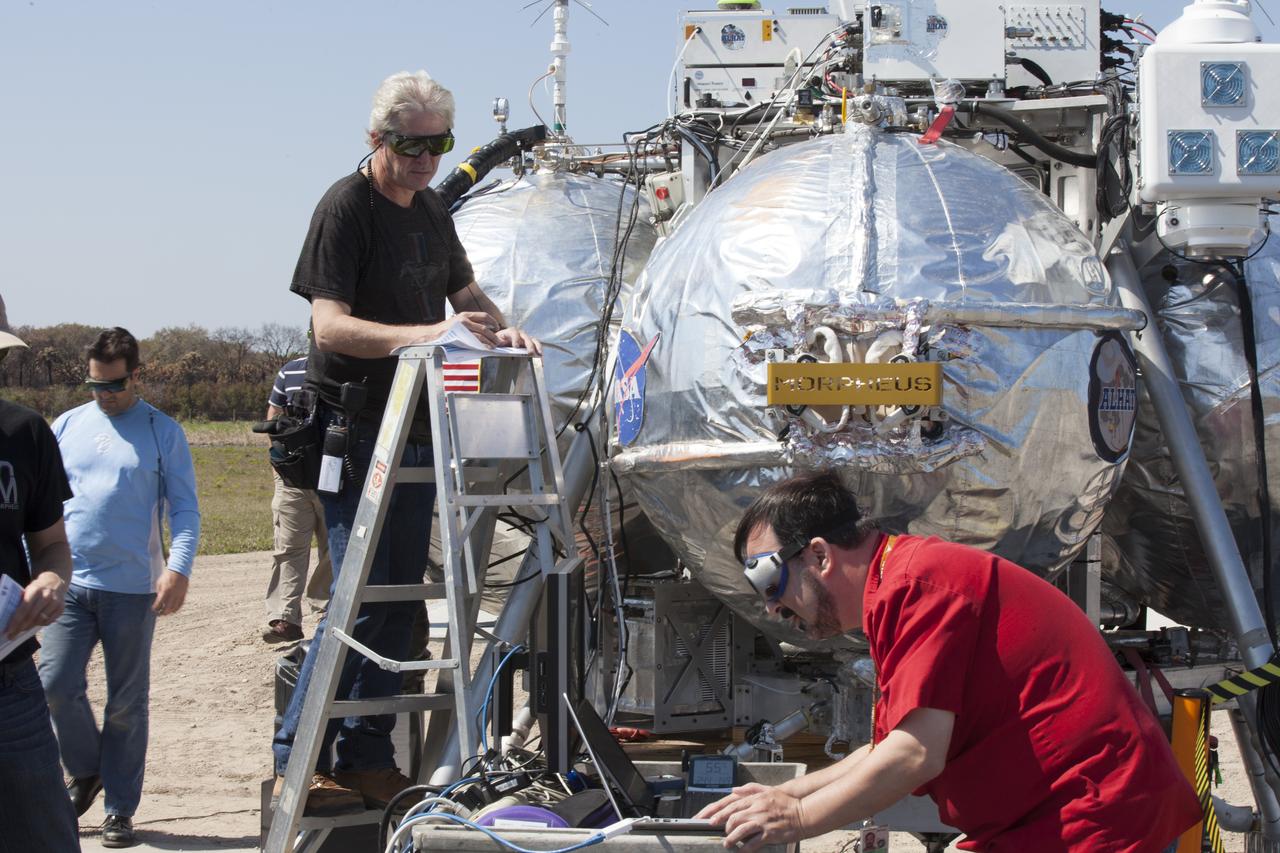
CAPE CANAVERAL, Fla. – Engineers and technicians prepare the Project Morpheus prototype lander for an automated landing and hazard avoidance technology, or ALHAT, and laser test at a new launch site at the north end of the Shuttle Landing Facility at NASA’s Kennedy Space Center in Florida. The launch pad was moved to a different location at the landing facility to support the next phase of flight testing. The seventh free flight test of Morpheus occurred on March 11. The 83-second test began at 3:41 p.m. EDT with the Morpheus lander launching from the ground over a flame trench and ascending to 580 feet. Morpheus then flew its fastest downrange trek at 30 mph, travelling farther than before, 837 feet. The lander performed a 42-foot divert to emulate a hazard avoidance maneuver before descending and touching down on Landing Site 2, at the northern landing pad inside the ALHAT hazard field. Morpheus landed within one foot of its intended target. Project Morpheus tests NASA’s ALHAT and an engine that runs on liquid oxygen and methane, or green propellants, into a fully-operational lander that could deliver cargo to other planetary surfaces. The landing facility provides the lander with the kind of field necessary for realistic testing, complete with rocks, craters and hazards to avoid. Morpheus’ ALHAT payload allows it to navigate to clear landing sites amidst rocks, craters and other hazards during its descent. Project Morpheus is being managed under the Advanced Exploration Systems, or AES, Division in NASA’s Human Exploration and Operations Mission Directorate. The efforts in AES pioneer new approaches for rapidly developing prototype systems, demonstrating key capabilities and validating operational concepts for future human missions beyond Earth orbit. For more information on Project Morpheus, visit http://morpheuslander.jsc.nasa.gov/. Photo credit: NASA/Kim Shiflett
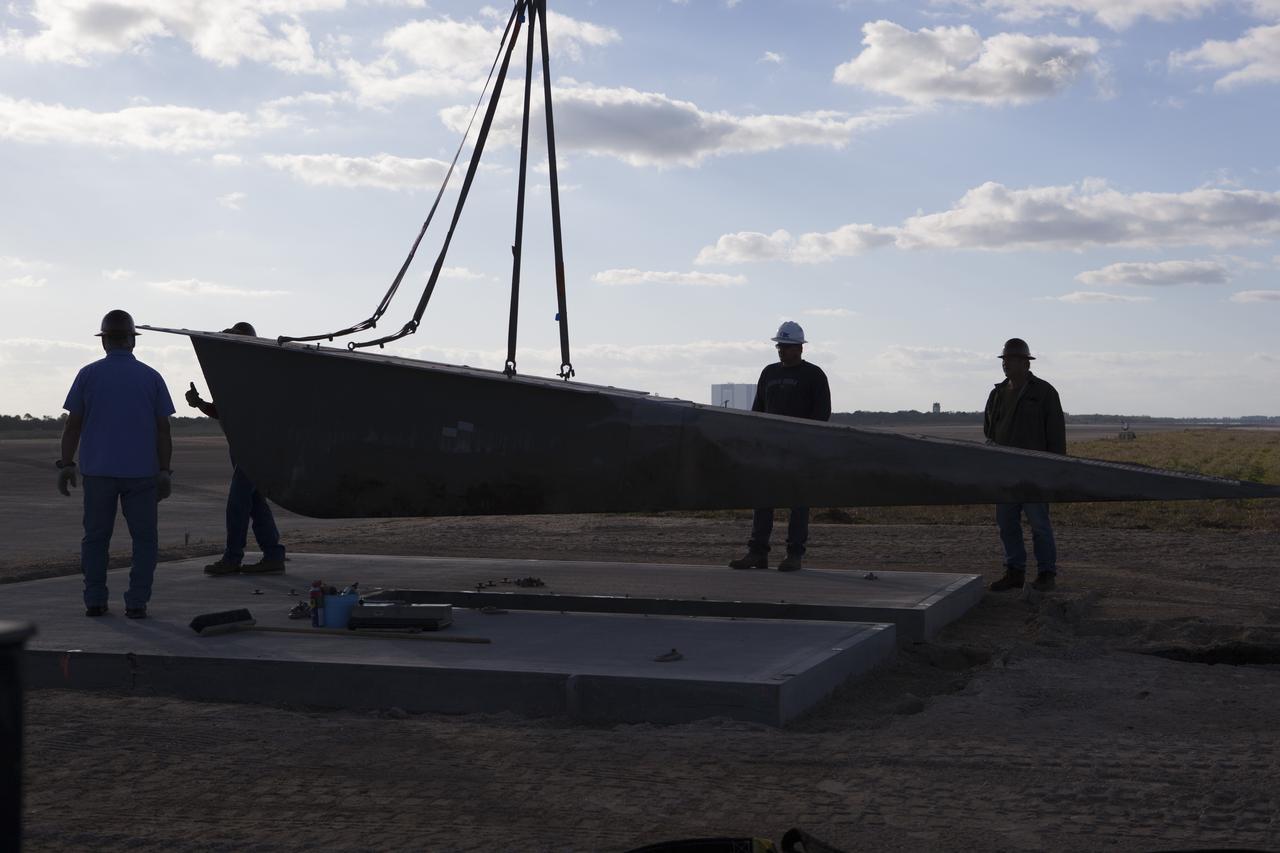
CAPE CANAVERAL, Fla. – Construction workers monitor the progress as a crane is used to lift a portion of the launch pad for the Project Morpheus prototype lander at the north end of the Shuttle Landing Facility at NASA’s Kennedy Space Center in Florida. The launch pad will be moved to a different location at the landing facility to support the next phase of flight testing. The seventh free flight test of Morpheus occurred on March 11. The 83-second test began at 3:41 p.m. EDT with the Morpheus lander launching from the ground over a flame trench and ascending to 580 feet. Morpheus then flew its fastest downrange trek at 30 mph, travelling farther than before, 837 feet. The lander performed a 42-foot divert to emulate a hazard avoidance maneuver before descending and touching down on Landing Site 2, at the northern landing pad inside the automated landing and hazard avoidance technology ALHAT hazard field. Morpheus landed within one foot of its intended target. Project Morpheus tests NASA’s ALHAT and an engine that runs on liquid oxygen and methane, or green propellants, into a fully-operational lander that could deliver cargo to other planetary surfaces . The landing facility provides the lander with the kind of field necessary for realistic testing, complete with rocks, craters and hazards to avoid. Morpheus’ ALHAT payload allows it to navigate to clear landing sites amidst rocks, craters and other hazards during its descent. Project Morpheus is being managed under the Advanced Exploration Systems, or AES, Division in NASA’s Human Exploration and Operations Mission Directorate. The efforts in AES pioneer new approaches for rapidly developing prototype systems, demonstrating key capabilities and validating operational concepts for future human missions beyond Earth orbit. For more information on Project Morpheus, visit http://morpheuslander.jsc.nasa.gov/. Photo credit: NASA/Dimitri Gerondidakis
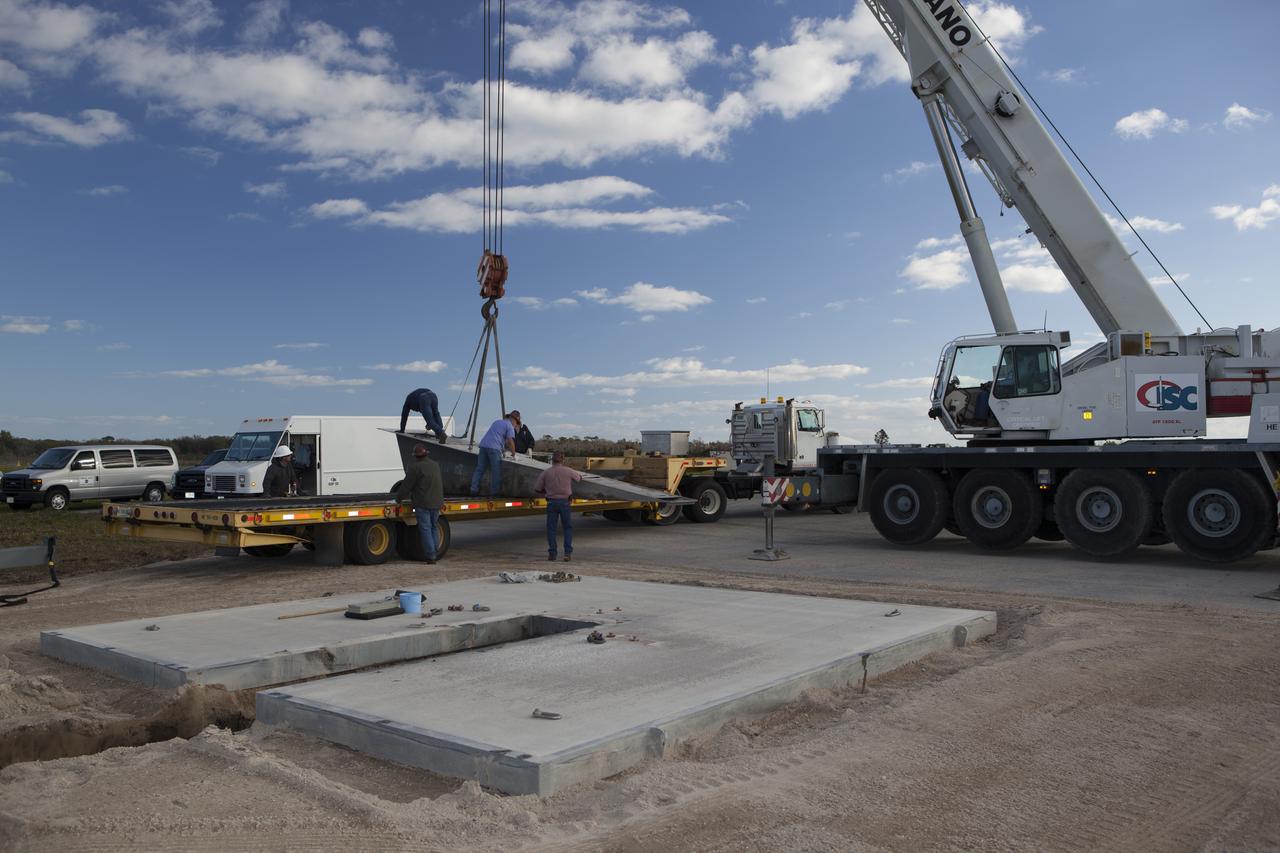
CAPE CANAVERAL, Fla. – Construction workers assist as a crane lowers a portion of the launch pad for the Project Morpheus prototype lander onto a transporter at the north end of the Shuttle Landing Facility at NASA’s Kennedy Space Center in Florida. The launch pad is being moved to a different location at the landing facility to support the next phase of flight testing. Morpheus completed its seventh free flight test on March 11. The 83-second test began at 3:41 p.m. EDT with the Morpheus lander launching from the ground over a flame trench and ascending to 580 feet. Morpheus then flew its fastest downrange trek at 30 mph, travelling farther than before, 837 feet. The lander performed a 42-foot divert to emulate a hazard avoidance maneuver before descending and touching down on Landing Site 2, at the northern landing pad inside the automated landing and hazard avoidance technology ALHAT hazard field. Morpheus landed within one foot of its intended target. Project Morpheus tests NASA’s ALHAT and an engine that runs on liquid oxygen and methane, or green propellants, into a fully-operational lander that could deliver cargo to other planetary surfaces. The landing facility provides the lander with the kind of field necessary for realistic testing, complete with rocks, craters and hazards to avoid. Morpheus’ ALHAT payload allows it to navigate to clear landing sites amidst rocks, craters and other hazards during its descent. Project Morpheus is being managed under the Advanced Exploration Systems, or AES, Division in NASA’s Human Exploration and Operations Mission Directorate. The efforts in AES pioneer new approaches for rapidly developing prototype systems, demonstrating key capabilities and validating operational concepts for future human missions beyond Earth orbit. For more information on Project Morpheus, visit http://morpheuslander.jsc.nasa.gov/. Photo credit: NASA/Dimitri Gerondidakis
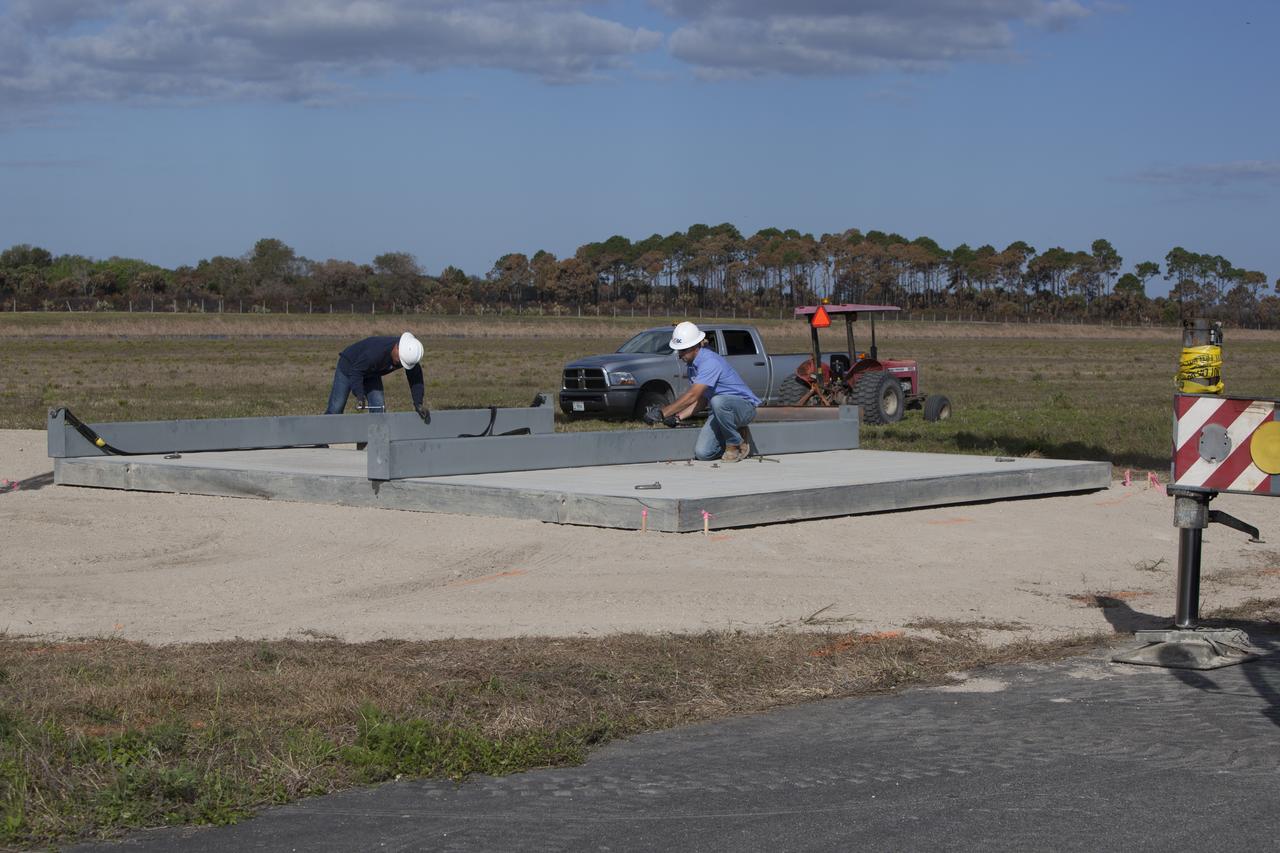
CAPE CANAVERAL, Fla. – Construction workers begin to reassemble the launch pad for the Project Morpheus prototype lander at a new location at the north end of the Shuttle Landing Facility at NASA’s Kennedy Space Center in Florida. The launch pad was moved to a different location to support the next phase of flight testing. Morpheus completed its seventh free flight test on March 11. The 83-second test began at 3:41 p.m. EDT with the Morpheus lander launching from the ground over a flame trench and ascending to 580 feet. Morpheus then flew its fastest downrange trek at 30 mph, travelling farther than before, 837 feet. The lander performed a 42-foot divert to emulate a hazard avoidance maneuver before descending and touching down on Landing Site 2, at the northern landing pad inside the automated landing and hazard avoidance technology ALHAT hazard field. Morpheus landed within one foot of its intended target. Project Morpheus tests NASA’s ALHAT and an engine that runs on liquid oxygen and methane, or green propellants, into a fully-operational lander that could deliver cargo to other planetary surfaces. The landing facility provides the lander with the kind of field necessary for realistic testing, complete with rocks, craters and hazards to avoid. Morpheus’ ALHAT payload allows it to navigate to clear landing sites amidst rocks, craters and other hazards during its descent. Project Morpheus is being managed under the Advanced Exploration Systems, or AES, Division in NASA’s Human Exploration and Operations Mission Directorate. The efforts in AES pioneer new approaches for rapidly developing prototype systems, demonstrating key capabilities and validating operational concepts for future human missions beyond Earth orbit. For more information on Project Morpheus, visit http://morpheuslander.jsc.nasa.gov/. Photo credit: NASA/Dimitri Gerondidakis
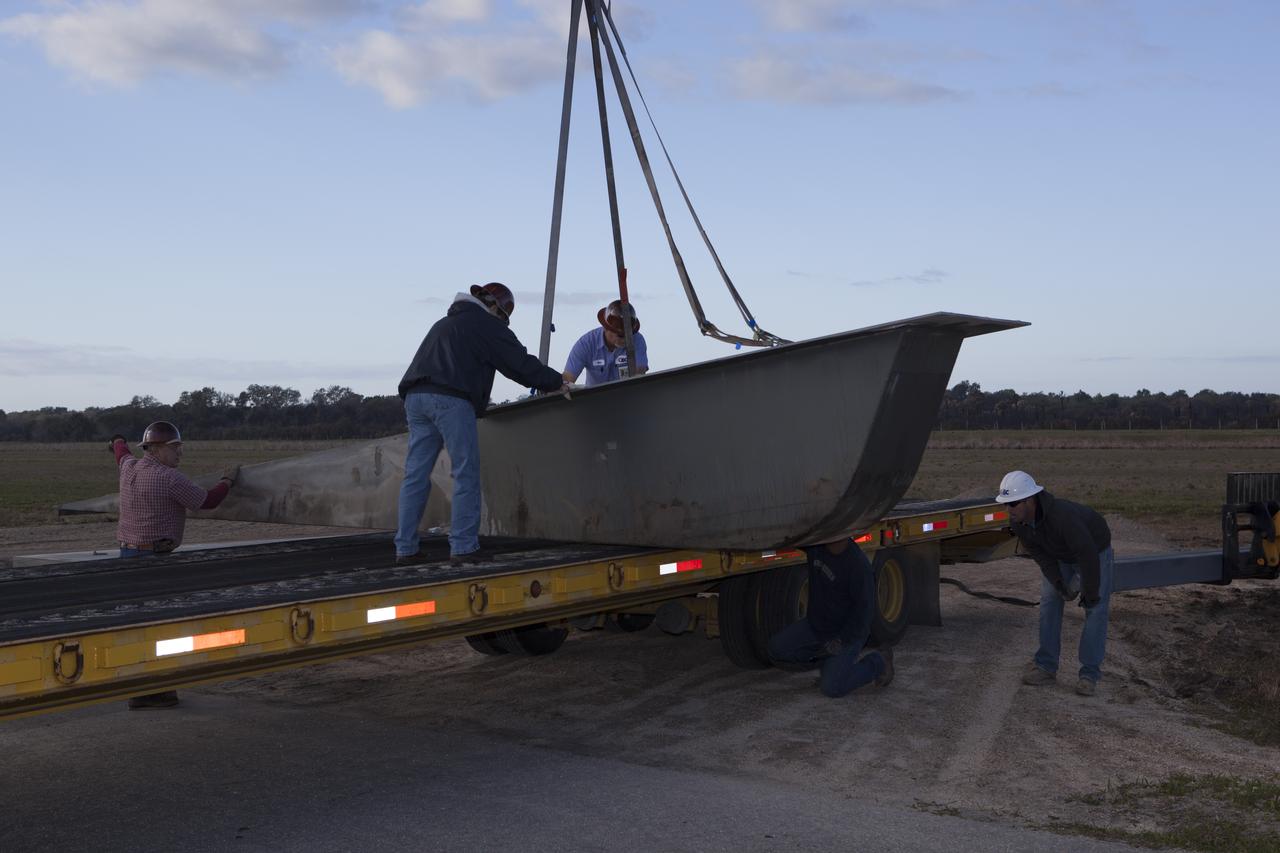
CAPE CANAVERAL, Fla. – Construction workers assist as a crane lowers a portion of the launch pad for the Project Morpheus prototype lander onto a transporter at the north end of the Shuttle Landing Facility at NASA’s Kennedy Space Center in Florida. The launch pad is being moved to a different location at the landing facility to support the next phase of flight testing. Morpheus completed its seventh free flight test on March 11. The 83-second test began at 3:41 p.m. EDT with the Morpheus lander launching from the ground over a flame trench and ascending to 580 feet. Morpheus then flew its fastest downrange trek at 30 mph, travelling farther than before, 837 feet. The lander performed a 42-foot divert to emulate a hazard avoidance maneuver before descending and touching down on Landing Site 2, at the northern landing pad inside the automated landing and hazard avoidance technology ALHAT hazard field. Morpheus landed within one foot of its intended target. Project Morpheus tests NASA’s ALHAT and an engine that runs on liquid oxygen and methane, or green propellants, into a fully-operational lander that could deliver cargo to other planetary surfaces. The landing facility provides the lander with the kind of field necessary for realistic testing, complete with rocks, craters and hazards to avoid. Morpheus’ ALHAT payload allows it to navigate to clear landing sites amidst rocks, craters and other hazards during its descent. Project Morpheus is being managed under the Advanced Exploration Systems, or AES, Division in NASA’s Human Exploration and Operations Mission Directorate. The efforts in AES pioneer new approaches for rapidly developing prototype systems, demonstrating key capabilities and validating operational concepts for future human missions beyond Earth orbit. For more information on Project Morpheus, visit http://morpheuslander.jsc.nasa.gov/. Photo credit: NASA/Dimitri Gerondidakis
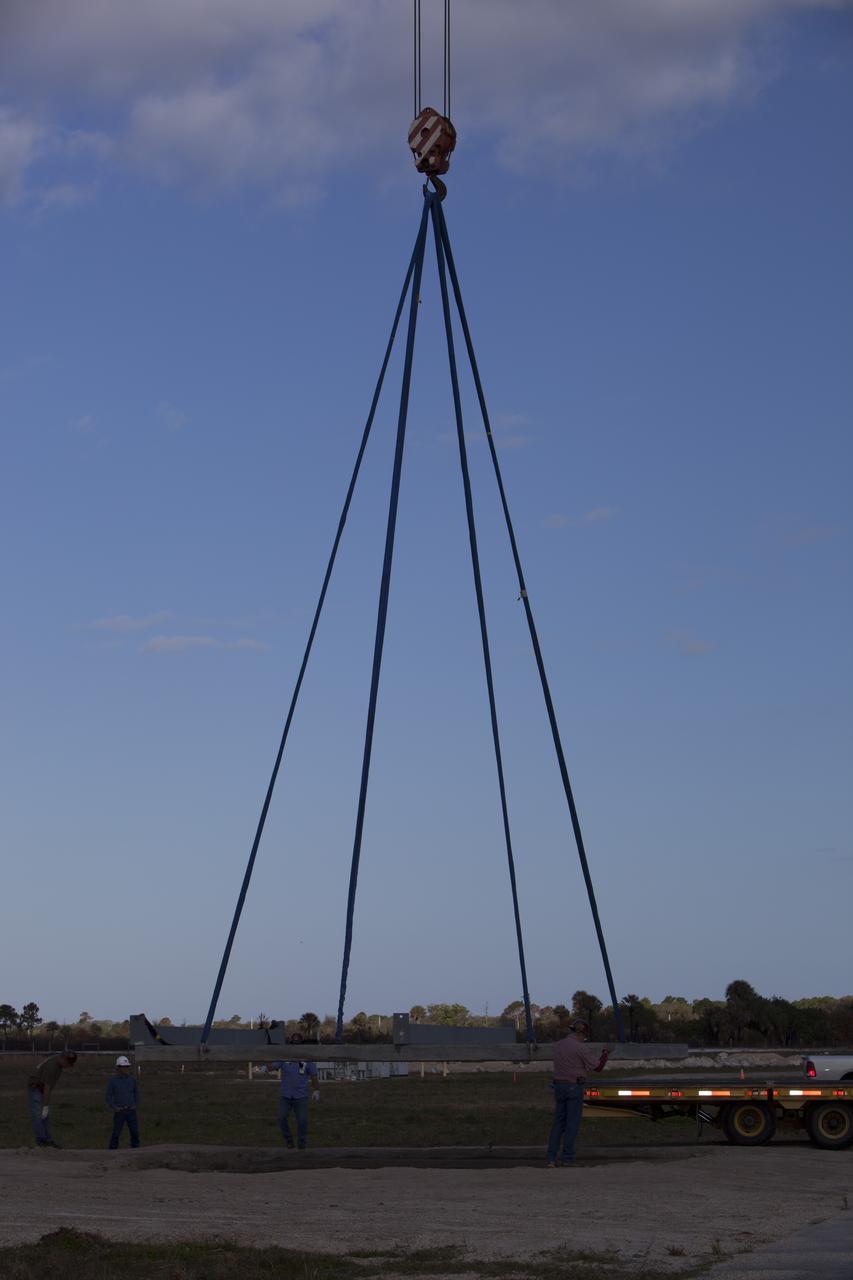
CAPE CANAVERAL, Fla. – Construction workers assist as a crane is used to lift a large portion of the launch pad for the Project Morpheus prototype lander onto a transporter at the north end of the Shuttle Landing Facility at NASA’s Kennedy Space Center in Florida. The launch pad is being moved to a different location at the landing facility to support the next phase of flight testing. Morpheus completed its seventh free flight test on March 11. The 83-second test began at 3:41 p.m. EDT with the Morpheus lander launching from the ground over a flame trench and ascending to 580 feet. Morpheus then flew its fastest downrange trek at 30 mph, travelling farther than before, 837 feet. The lander performed a 42-foot divert to emulate a hazard avoidance maneuver before descending and touching down on Landing Site 2, at the northern landing pad inside the automated landing and hazard avoidance technology ALHAT hazard field. Morpheus landed within one foot of its intended target. Project Morpheus tests NASA’s ALHAT and an engine that runs on liquid oxygen and methane, or green propellants, into a fully-operational lander that could deliver cargo to other planetary surfaces. The landing facility provides the lander with the kind of field necessary for realistic testing, complete with rocks, craters and hazards to avoid. Morpheus’ ALHAT payload allows it to navigate to clear landing sites amidst rocks, craters and other hazards during its descent. Project Morpheus is being managed under the Advanced Exploration Systems, or AES, Division in NASA’s Human Exploration and Operations Mission Directorate. The efforts in AES pioneer new approaches for rapidly developing prototype systems, demonstrating key capabilities and validating operational concepts for future human missions beyond Earth orbit. For more information on Project Morpheus, visit http://morpheuslander.jsc.nasa.gov/. Photo credit: NASA/Dimitri Gerondidakis
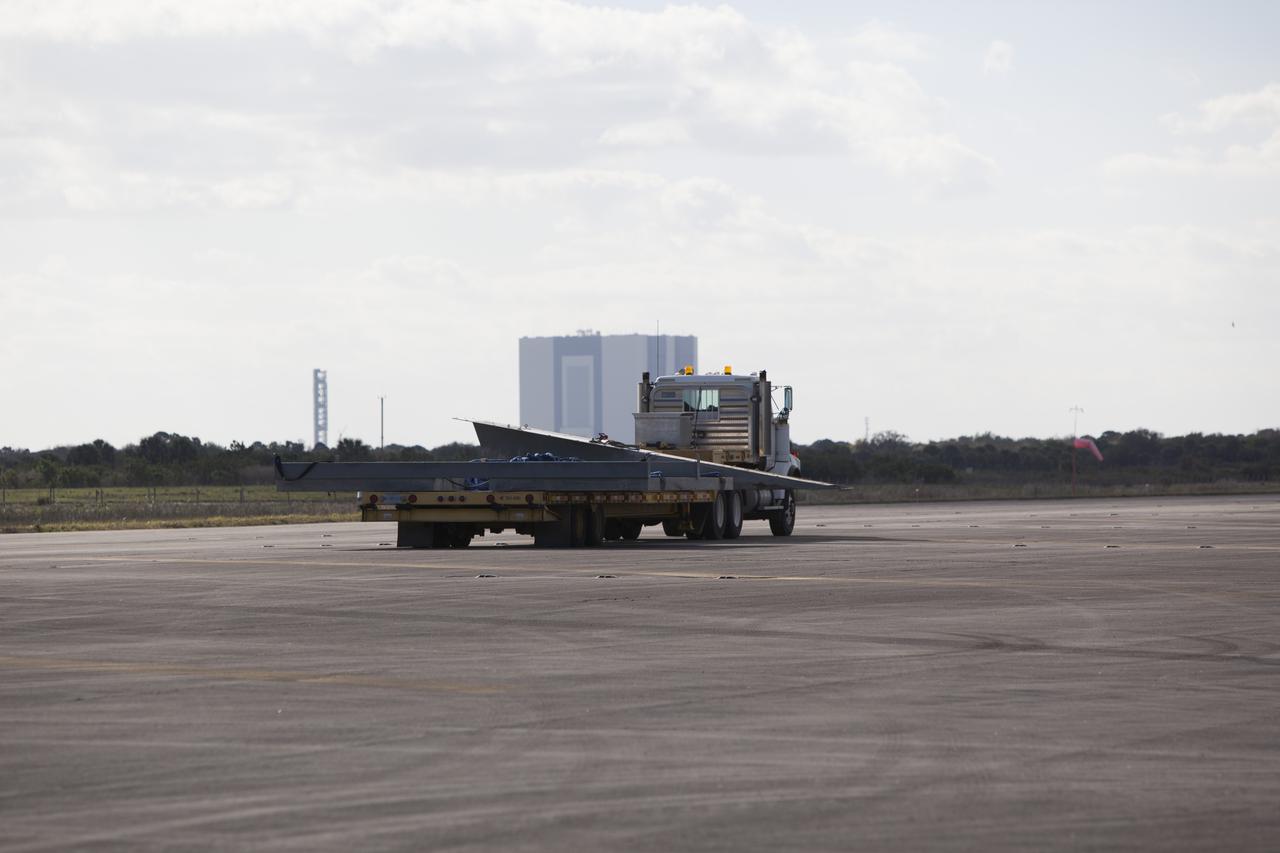
CAPE CANAVERAL, Fla. – A flatbed truck carries the launch pad for the Project Morpheus prototype lander to a new location at the north end of the Shuttle Landing Facility at NASA’s Kennedy Space Center in Florida. The launch pad is being moved to a different location to support the next phase of flight testing. Morpheus completed its seventh free flight test on March 11. The 83-second test began at 3:41 p.m. EDT with the Morpheus lander launching from the ground over a flame trench and ascending to 580 feet. Morpheus then flew its fastest downrange trek at 30 mph, travelling farther than before, 837 feet. The lander performed a 42-foot divert to emulate a hazard avoidance maneuver before descending and touching down on Landing Site 2, at the northern landing pad inside the automated landing and hazard avoidance technology ALHAT hazard field. Morpheus landed within one foot of its intended target. Project Morpheus tests NASA’s ALHAT and an engine that runs on liquid oxygen and methane, or green propellants, into a fully-operational lander that could deliver cargo to other planetary surfaces. The landing facility provides the lander with the kind of field necessary for realistic testing, complete with rocks, craters and hazards to avoid. Morpheus’ ALHAT payload allows it to navigate to clear landing sites amidst rocks, craters and other hazards during its descent. Project Morpheus is being managed under the Advanced Exploration Systems, or AES, Division in NASA’s Human Exploration and Operations Mission Directorate. The efforts in AES pioneer new approaches for rapidly developing prototype systems, demonstrating key capabilities and validating operational concepts for future human missions beyond Earth orbit. For more information on Project Morpheus, visit http://morpheuslander.jsc.nasa.gov/. Photo credit: NASA/Dimitri Gerondidakis
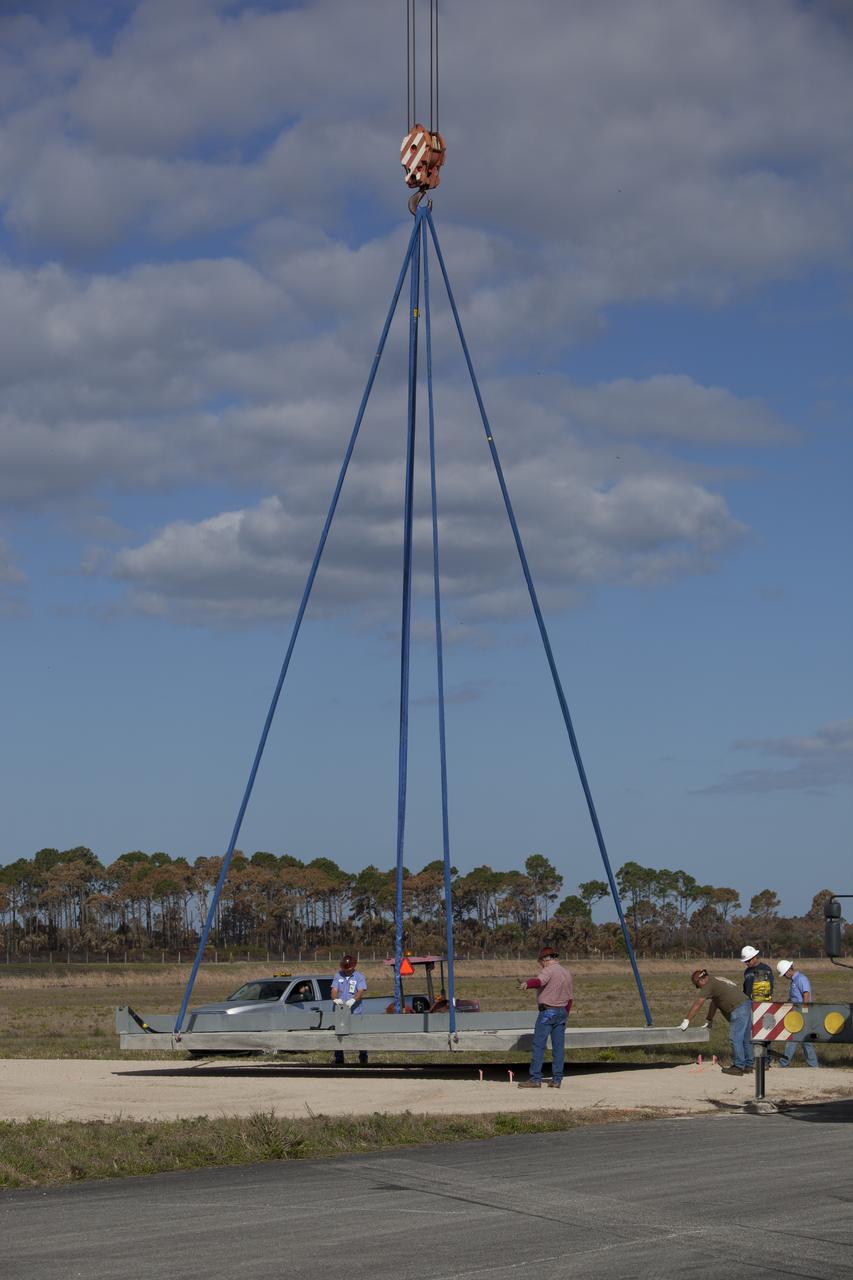
CAPE CANAVERAL, Fla. – A crane is used to lower the launch pad for the Project Morpheus prototype lander onto a new location at the north end of the Shuttle Landing Facility at NASA’s Kennedy Space Center in Florida. The launch pad was moved to a different location to support the next phase of flight testing. Morpheus completed its seventh free flight test on March 11. The 83-second test began at 3:41 p.m. EDT with the Morpheus lander launching from the ground over a flame trench and ascending to 580 feet. Morpheus then flew its fastest downrange trek at 30 mph, travelling farther than before, 837 feet. The lander performed a 42-foot divert to emulate a hazard avoidance maneuver before descending and touching down on Landing Site 2, at the northern landing pad inside the automated landing and hazard avoidance technology ALHAT hazard field. Morpheus landed within one foot of its intended target. Project Morpheus tests NASA’s ALHAT and an engine that runs on liquid oxygen and methane, or green propellants, into a fully-operational lander that could deliver cargo to other planetary surfaces. The landing facility provides the lander with the kind of field necessary for realistic testing, complete with rocks, craters and hazards to avoid. Morpheus’ ALHAT payload allows it to navigate to clear landing sites amidst rocks, craters and other hazards during its descent. Project Morpheus is being managed under the Advanced Exploration Systems, or AES, Division in NASA’s Human Exploration and Operations Mission Directorate. The efforts in AES pioneer new approaches for rapidly developing prototype systems, demonstrating key capabilities and validating operational concepts for future human missions beyond Earth orbit. For more information on Project Morpheus, visit http://morpheuslander.jsc.nasa.gov/. Photo credit: NASA/Dimitri Gerondidakis
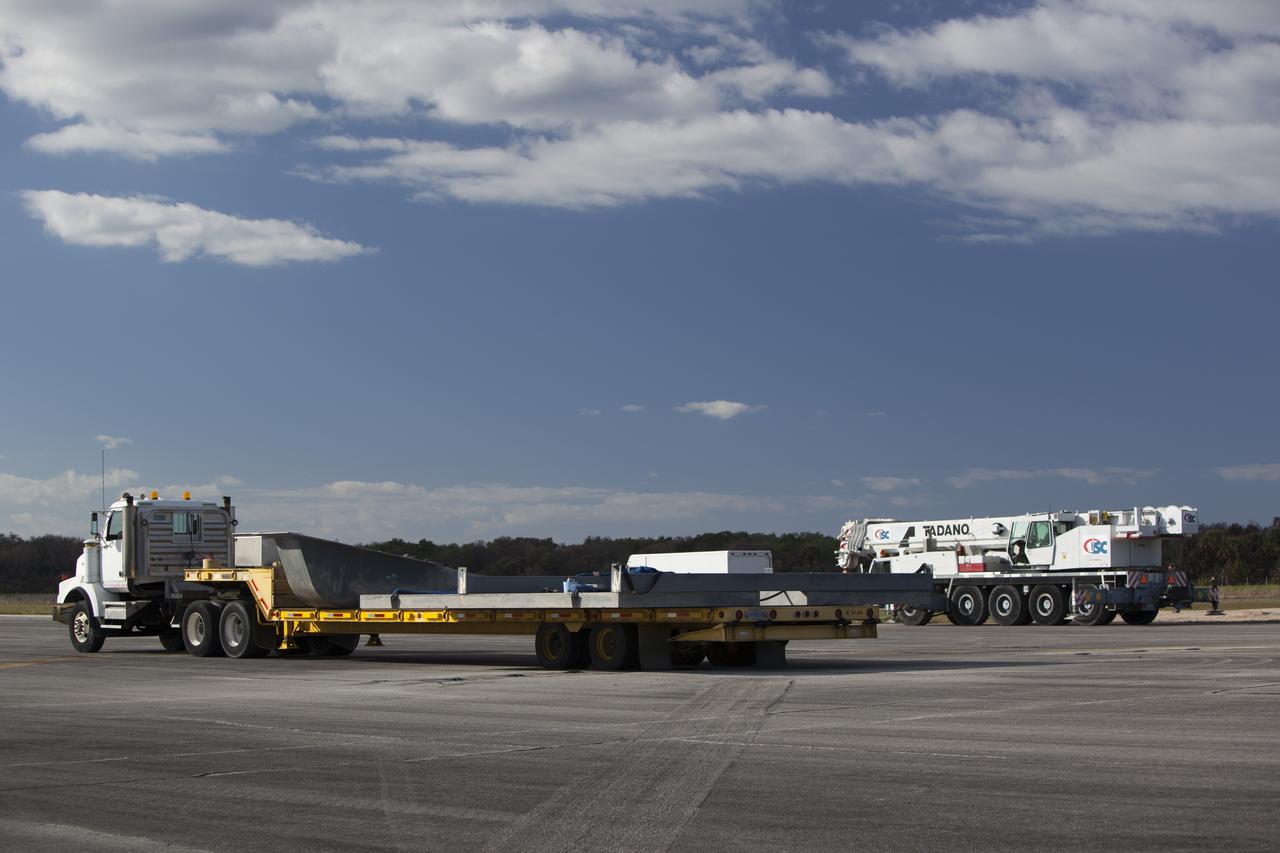
CAPE CANAVERAL, Fla. – A flatbed truck carries the launch pad for the Project Morpheus prototype lander to a new location at the north end of the Shuttle Landing Facility at NASA’s Kennedy Space Center in Florida. The launch pad is being moved to a different location to support the next phase of flight testing. Morpheus completed its seventh free flight test on March 11. The 83-second test began at 3:41 p.m. EDT with the Morpheus lander launching from the ground over a flame trench and ascending to 580 feet. Morpheus then flew its fastest downrange trek at 30 mph, travelling farther than before, 837 feet. The lander performed a 42-foot divert to emulate a hazard avoidance maneuver before descending and touching down on Landing Site 2, at the northern landing pad inside the automated landing and hazard avoidance technology ALHAT hazard field. Morpheus landed within one foot of its intended target. Project Morpheus tests NASA’s ALHAT and an engine that runs on liquid oxygen and methane, or green propellants, into a fully-operational lander that could deliver cargo to other planetary surfaces. The landing facility provides the lander with the kind of field necessary for realistic testing, complete with rocks, craters and hazards to avoid. Morpheus’ ALHAT payload allows it to navigate to clear landing sites amidst rocks, craters and other hazards during its descent. Project Morpheus is being managed under the Advanced Exploration Systems, or AES, Division in NASA’s Human Exploration and Operations Mission Directorate. The efforts in AES pioneer new approaches for rapidly developing prototype systems, demonstrating key capabilities and validating operational concepts for future human missions beyond Earth orbit. For more information on Project Morpheus, visit http://morpheuslander.jsc.nasa.gov/. Photo credit: NASA/Dimitri Gerondidakis
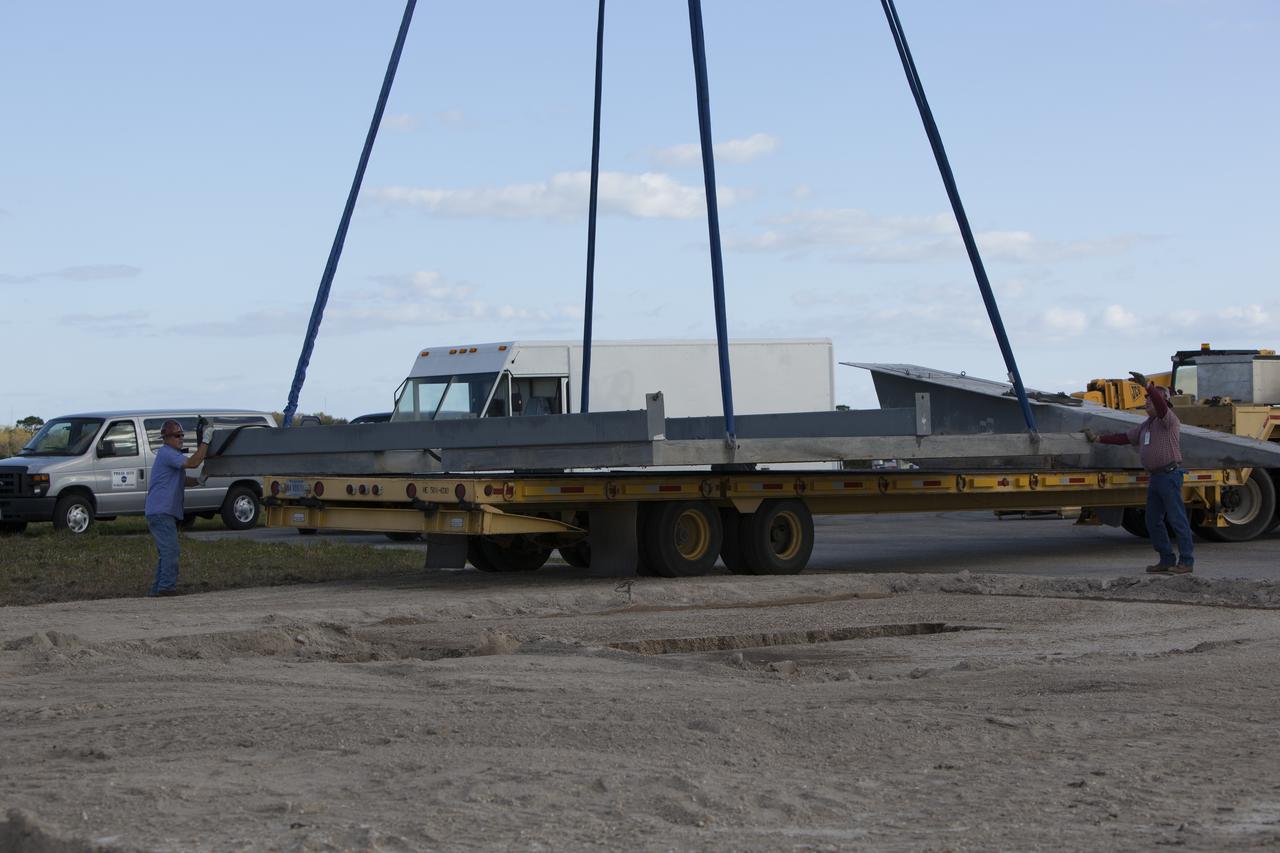
CAPE CANAVERAL, Fla. – Construction workers assist as a crane lowers a large portion of the launch pad for the Project Morpheus prototype lander onto a transporter at the north end of the Shuttle Landing Facility at NASA’s Kennedy Space Center in Florida. The launch pad is being moved to a different location at the landing facility to support the next phase of flight testing. Morpheus completed its seventh free flight test on March 11. The 83-second test began at 3:41 p.m. EDT with the Morpheus lander launching from the ground over a flame trench and ascending to 580 feet. Morpheus then flew its fastest downrange trek at 30 mph, travelling farther than before, 837 feet. The lander performed a 42-foot divert to emulate a hazard avoidance maneuver before descending and touching down on Landing Site 2, at the northern landing pad inside the automated landing and hazard avoidance technology ALHAT hazard field. Morpheus landed within one foot of its intended target. Project Morpheus tests NASA’s ALHAT and an engine that runs on liquid oxygen and methane, or green propellants, into a fully-operational lander that could deliver cargo to other planetary surfaces. The landing facility provides the lander with the kind of field necessary for realistic testing, complete with rocks, craters and hazards to avoid. Morpheus’ ALHAT payload allows it to navigate to clear landing sites amidst rocks, craters and other hazards during its descent. Project Morpheus is being managed under the Advanced Exploration Systems, or AES, Division in NASA’s Human Exploration and Operations Mission Directorate. The efforts in AES pioneer new approaches for rapidly developing prototype systems, demonstrating key capabilities and validating operational concepts for future human missions beyond Earth orbit. For more information on Project Morpheus, visit http://morpheuslander.jsc.nasa.gov/. Photo credit: NASA/Dimitri Gerondidakis
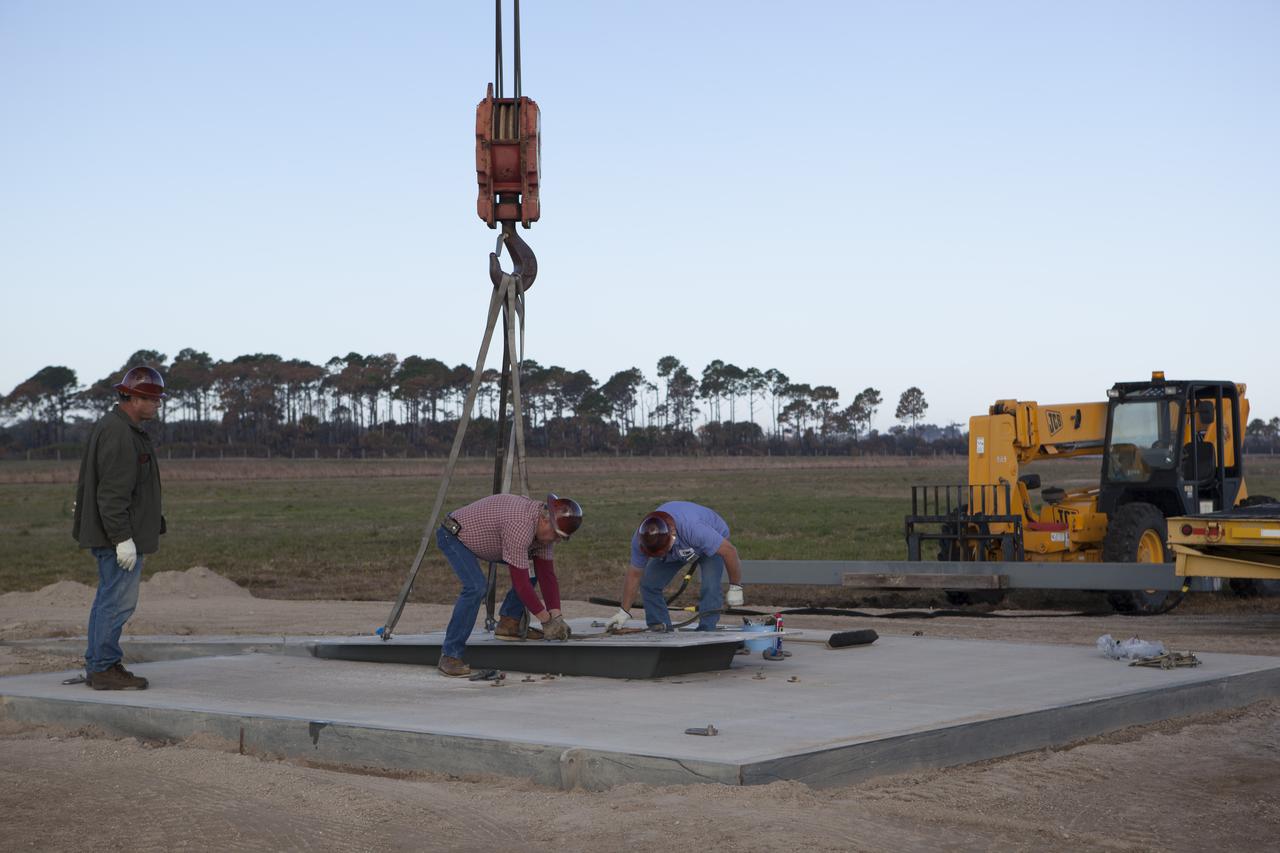
CAPE CANAVERAL, Fla. – Construction workers attach a crane to part of the launch pad for the Project Morpheus prototype lander at the north end of the Shuttle Landing Facility at NASA’s Kennedy Space Center in Florida. The launch pad will be moved to a different location at the landing facility to support the next phase of flight testing. The seventh free flight test of Morpheus occurred on March 11. The 83-second test began at 3:41 p.m. EDT with the Morpheus lander launching from the ground over a flame trench and ascending to 580 feet. Morpheus then flew its fastest downrange trek at 30 mph, travelling farther than before, 837 feet. The lander performed a 42-foot divert to emulate a hazard avoidance maneuver before descending and touching down on Landing Site 2, at the northern landing pad inside the automated landing and hazard avoidance technology ALHAT hazard field. Morpheus landed within one foot of its intended target. Project Morpheus tests NASA’s ALHAT and an engine that runs on liquid oxygen and methane, or green propellants, into a fully-operational lander that could deliver cargo to other planetary surfaces. The landing facility provides the lander with the kind of field necessary for realistic testing, complete with rocks, craters and hazards to avoid. Morpheus’ ALHAT payload allows it to navigate to clear landing sites amidst rocks, craters and other hazards during its descent. Project Morpheus is being managed under the Advanced Exploration Systems, or AES, Division in NASA’s Human Exploration and Operations Mission Directorate. The efforts in AES pioneer new approaches for rapidly developing prototype systems, demonstrating key capabilities and validating operational concepts for future human missions beyond Earth orbit. For more information on Project Morpheus, visit http://morpheuslander.jsc.nasa.gov/. Photo credit: NASA/Dimitri Gerondidakis
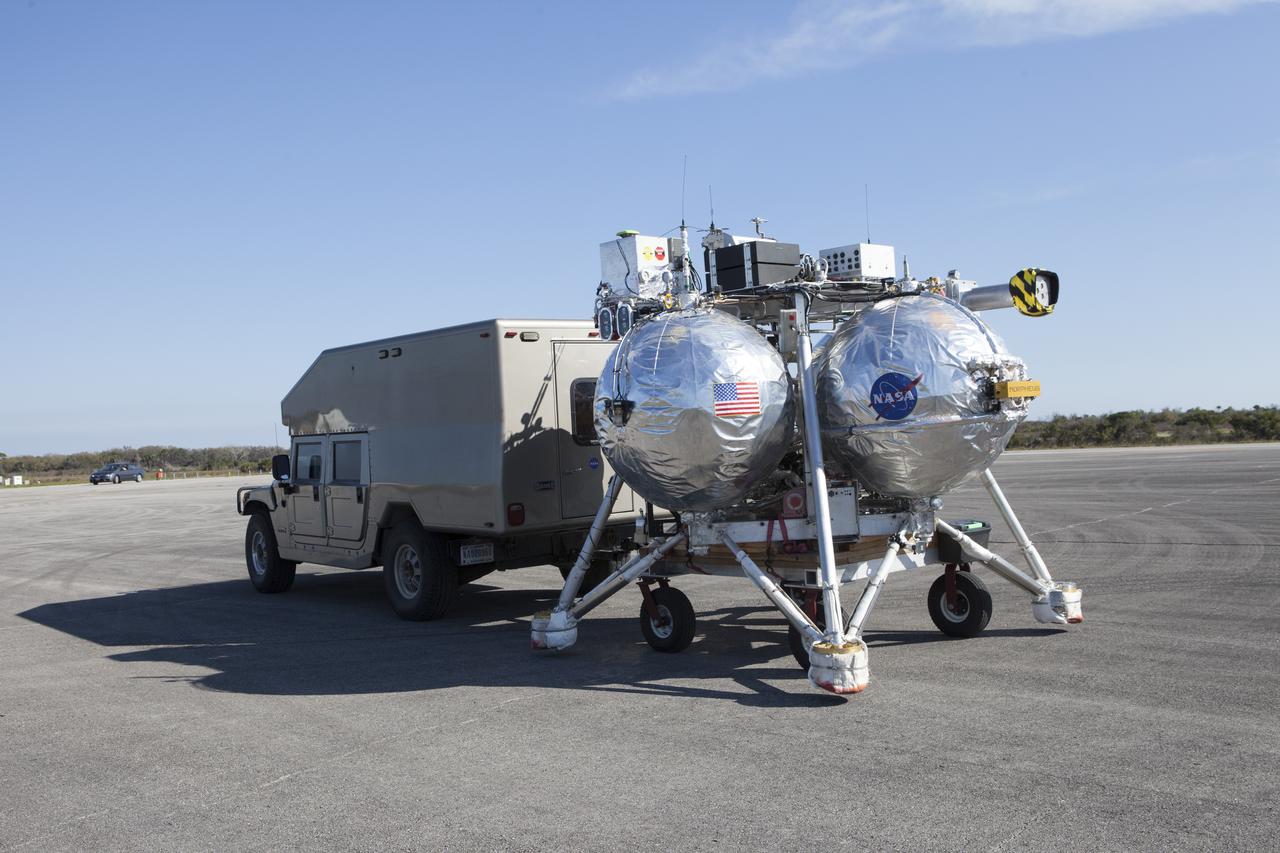
CAPE CANAVERAL, Fla. - The Project Morpheus prototype lander is transported to the north end of the Shuttle Landing Facility at NASA’s Kennedy Space Center in Florida for the seventh free flight test. The 83-second test began at 3:41 p.m. EDT with the Morpheus lander launching from the ground over a flame trench and ascending to 580 feet, its highest to date. Morpheus then flew its fastest downrange trek at 30 mph, travelling farther than before, 837 feet. The lander performed a 42-foot divert to emulate a hazard avoidance maneuver before descending and touching down on Landing Site 2, at the northern landing pad inside the automated landing and hazard avoidance technology ALHAT hazard field. Morpheus landed within one foot of its intended target. Project Morpheus tests NASA’s ALHAT and an engine that runs on liquid oxygen and methane, or green propellants, into a fully-operational lander that could deliver cargo to other planetary surfaces. The landing facility provides the lander with the kind of field necessary for realistic testing, complete with rocks, craters and hazards to avoid. Morpheus’ ALHAT payload allows it to navigate to clear landing sites amidst rocks, craters and other hazards during its descent. Project Morpheus is being managed under the Advanced Exploration Systems, or AES, Division in NASA’s Human Exploration and Operations Mission Directorate. The efforts in AES pioneer new approaches for rapidly developing prototype systems, demonstrating key capabilities and validating operational concepts for future human missions beyond Earth orbit. For more information on Project Morpheus, visit http://morpheuslander.jsc.nasa.gov/. Photo credit: NASA/Kim Shiflett

CAPE CANAVERAL, Fla. - The Project Morpheus prototype lander soars high on its seventh free flight test at the north end of the Shuttle Landing Facility at NASA’s Kennedy Space Center in Florida. The 83-second test began at 3:41 p.m. EDT with the Morpheus lander launching from the ground over a flame trench and ascending to 580 feet, its highest to date. Morpheus then flew its fastest downrange trek at 30 mph, travelling farther than before, 837 feet. The lander performed a 42-foot divert to emulate a hazard avoidance maneuver before descending and touching down on Landing Site 2, at the northern landing pad inside the automated landing and hazard avoidance technology ALHAT hazard field. Morpheus landed within one foot of its intended target. Project Morpheus tests NASA’s ALHAT and an engine that runs on liquid oxygen and methane, or green propellants, into a fully-operational lander that could deliver cargo to other planetary surfaces. The landing facility provides the lander with the kind of field necessary for realistic testing, complete with rocks, craters and hazards to avoid. Morpheus’ ALHAT payload allows it to navigate to clear landing sites amidst rocks, craters and other hazards during its descent. Project Morpheus is being managed under the Advanced Exploration Systems, or AES, Division in NASA’s Human Exploration and Operations Mission Directorate. The efforts in AES pioneer new approaches for rapidly developing prototype systems, demonstrating key capabilities and validating operational concepts for future human missions beyond Earth orbit. For more information on Project Morpheus, visit http://morpheuslander.jsc.nasa.gov/. Photo credit: NASA/Mike Chambers
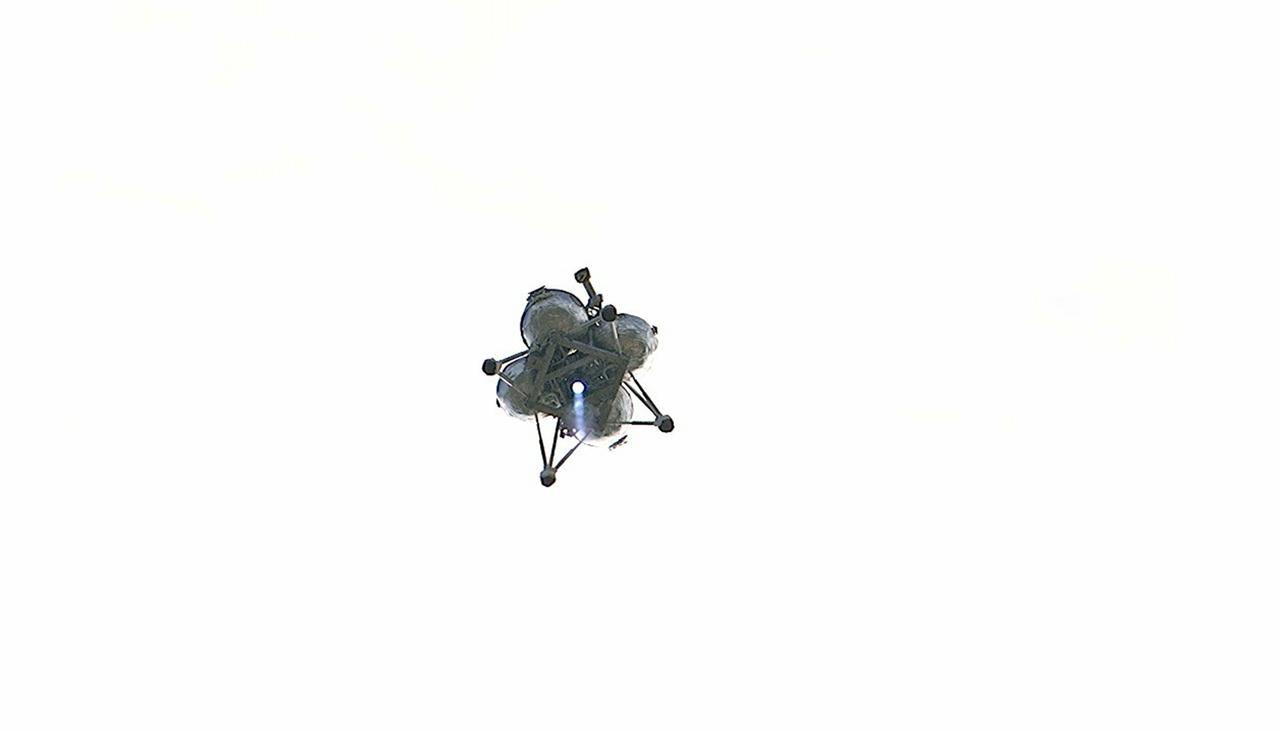
CAPE CANAVERAL, Fla. - The Project Morpheus prototype lander soars high on its seventh free flight test at the north end of the Shuttle Landing Facility at NASA’s Kennedy Space Center in Florida. The 83-second test began at 3:41 p.m. EDT with the Morpheus lander launching from the ground over a flame trench and ascending to 580 feet, its highest to date. Morpheus then flew its fastest downrange trek at 30 mph, travelling farther than before, 837 feet. The lander performed a 42-foot divert to emulate a hazard avoidance maneuver before descending and touching down on Landing Site 2, at the northern landing pad inside the automated landing and hazard avoidance technology ALHAT hazard field. Morpheus landed within one foot of its intended target. Project Morpheus tests NASA’s ALHAT and an engine that runs on liquid oxygen and methane, or green propellants, into a fully-operational lander that could deliver cargo to other planetary surfaces. The landing facility provides the lander with the kind of field necessary for realistic testing, complete with rocks, craters and hazards to avoid. Morpheus’ ALHAT payload allows it to navigate to clear landing sites amidst rocks, craters and other hazards during its descent. Project Morpheus is being managed under the Advanced Exploration Systems, or AES, Division in NASA’s Human Exploration and Operations Mission Directorate. The efforts in AES pioneer new approaches for rapidly developing prototype systems, demonstrating key capabilities and validating operational concepts for future human missions beyond Earth orbit. For more information on Project Morpheus, visit http://morpheuslander.jsc.nasa.gov/. Photo credit: NASA/Mike Chambers
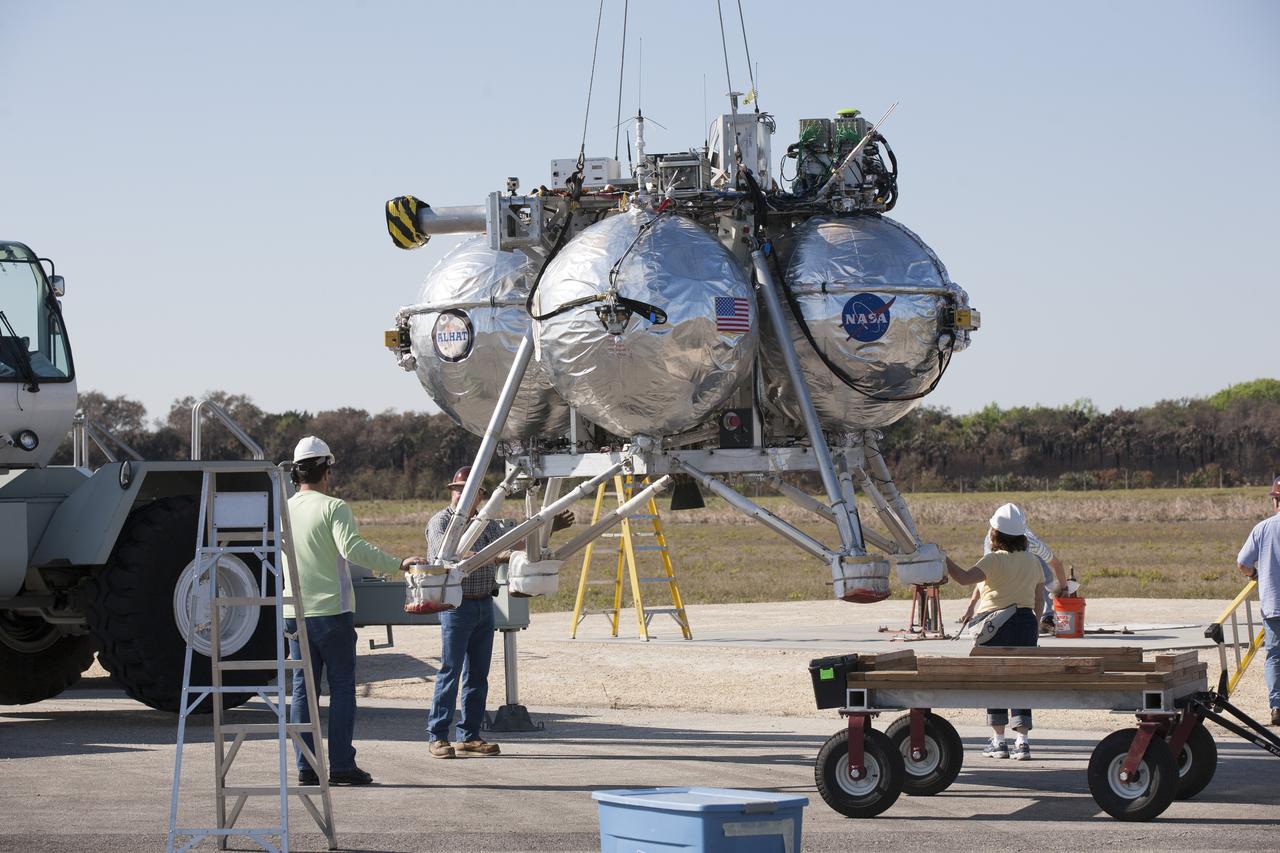
CAPE CANAVERAL, Fla. - Engineers and technicians assist as a crane lowers the Project Morpheus prototype lander in preparation for its seventh free flight test at the north end of the Shuttle Landing Facility at NASA’s Kennedy Space Center in Florida. The 83-second test began at 3:41 p.m. EDT with the Morpheus lander launching from the ground over a flame trench and ascending to 580 feet, its highest to date. Morpheus then flew its fastest downrange trek at 30 mph, travelling farther than before, 837 feet. The lander performed a 42-foot divert to emulate a hazard avoidance maneuver before descending and touching down on Landing Site 2, at the northern landing pad inside the automated landing and hazard avoidance technology ALHAT hazard field. Morpheus landed within one foot of its intended target. Project Morpheus tests NASA’s ALHAT and an engine that runs on liquid oxygen and methane, or green propellants, into a fully-operational lander that could deliver cargo to other planetary surfaces. The landing facility provides the lander with the kind of field necessary for realistic testing, complete with rocks, craters and hazards to avoid. Morpheus’ ALHAT payload allows it to navigate to clear landing sites amidst rocks, craters and other hazards during its descent. Project Morpheus is being managed under the Advanced Exploration Systems, or AES, Division in NASA’s Human Exploration and Operations Mission Directorate. The efforts in AES pioneer new approaches for rapidly developing prototype systems, demonstrating key capabilities and validating operational concepts for future human missions beyond Earth orbit. For more information on Project Morpheus, visit http://morpheuslander.jsc.nasa.gov/. Photo credit: NASA/Kim Shiflett
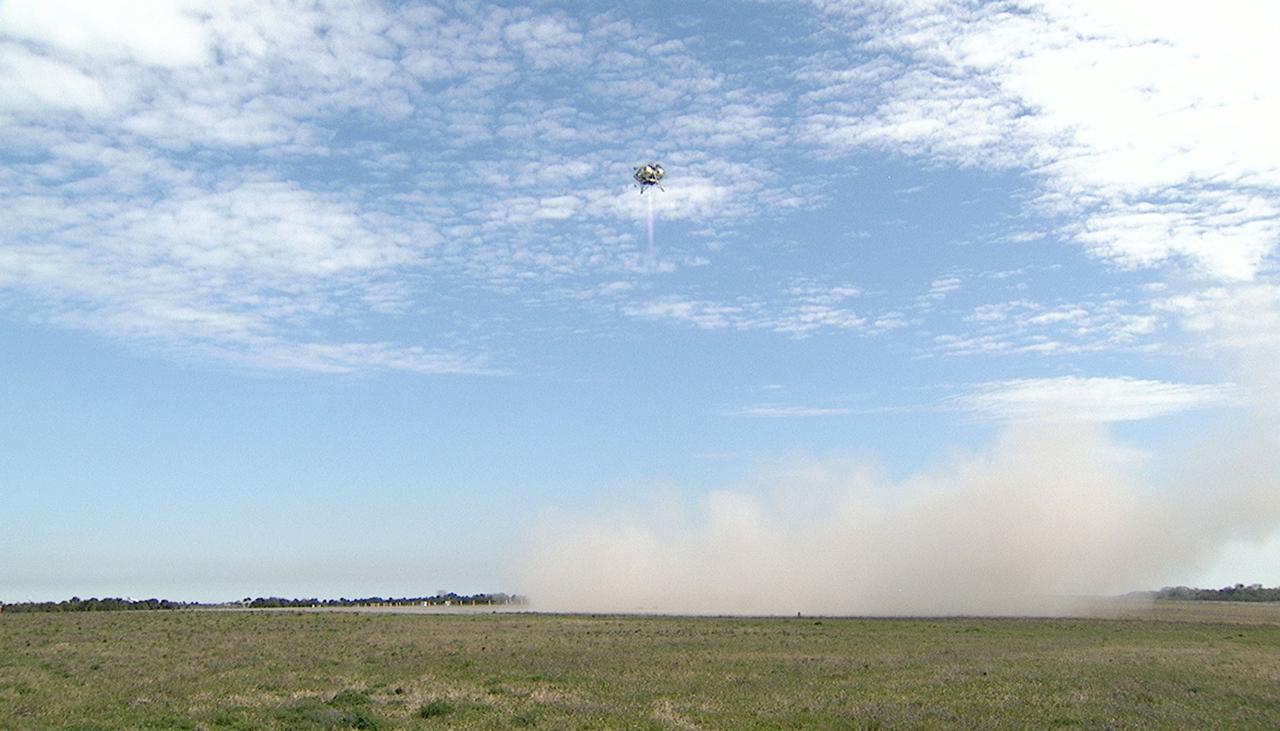
CAPE CANAVERAL, Fla. - The Project Morpheus prototype lander soars high on its seventh free flight test at the north end of the Shuttle Landing Facility at NASA’s Kennedy Space Center in Florida. The 83-second test began at 3:41 p.m. EDT with the Morpheus lander launching from the ground over a flame trench and ascending to 580 feet, its highest to date. Morpheus then flew its fastest downrange trek at 30 mph, travelling farther than before, 837 feet. The lander performed a 42-foot divert to emulate a hazard avoidance maneuver before descending and touching down on Landing Site 2, at the northern landing pad inside the automated landing and hazard avoidance technology ALHAT hazard field. Morpheus landed within one foot of its intended target. Project Morpheus tests NASA’s ALHAT and an engine that runs on liquid oxygen and methane, or green propellants, into a fully-operational lander that could deliver cargo to other planetary surfaces. The landing facility provides the lander with the kind of field necessary for realistic testing, complete with rocks, craters and hazards to avoid. Morpheus’ ALHAT payload allows it to navigate to clear landing sites amidst rocks, craters and other hazards during its descent. Project Morpheus is being managed under the Advanced Exploration Systems, or AES, Division in NASA’s Human Exploration and Operations Mission Directorate. The efforts in AES pioneer new approaches for rapidly developing prototype systems, demonstrating key capabilities and validating operational concepts for future human missions beyond Earth orbit. For more information on Project Morpheus, visit http://morpheuslander.jsc.nasa.gov/. Photo credit: NASA/Mike Chambers
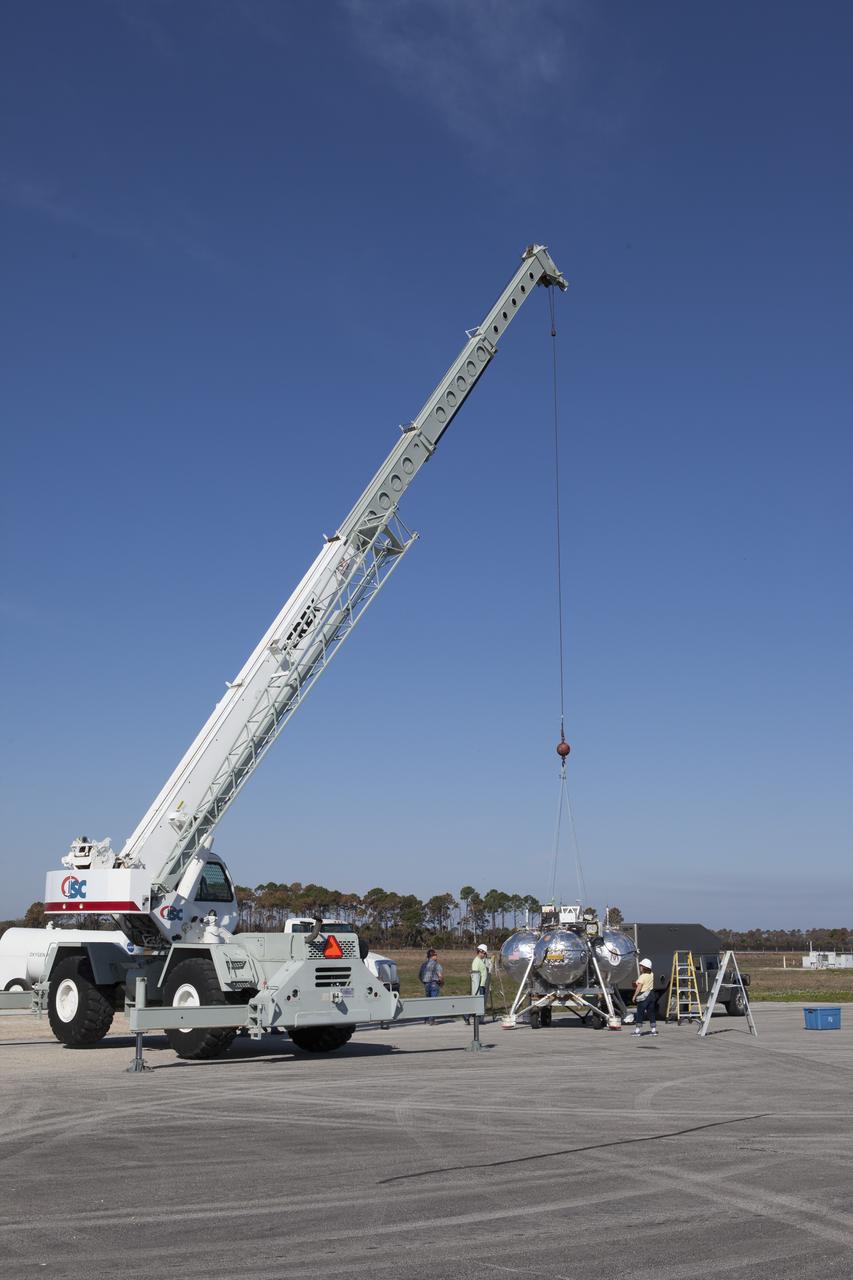
CAPE CANAVERAL, Fla. - Preparations are underway to prepare the Project Morpheus prototype lander for its seventh free flight test at the north end of the Shuttle Landing Facility at NASA’s Kennedy Space Center in Florida. The 83-second test began at 3:41 p.m. EDT with the Morpheus lander launching from the ground over a flame trench and ascending to 580 feet, its highest to date. Morpheus then flew its fastest downrange trek at 30 mph, travelling farther than before, 837 feet. The lander performed a 42-foot divert to emulate a hazard avoidance maneuver before descending and touching down on Landing Site 2, at the northern landing pad inside the automated landing and hazard avoidance technology ALHAT hazard field. Morpheus landed within one foot of its intended target. Project Morpheus tests NASA’s ALHAT and an engine that runs on liquid oxygen and methane, or green propellants, into a fully-operational lander that could deliver cargo to other planetary surfaces. The landing facility provides the lander with the kind of field necessary for realistic testing, complete with rocks, craters and hazards to avoid. Morpheus’ ALHAT payload allows it to navigate to clear landing sites amidst rocks, craters and other hazards during its descent. Project Morpheus is being managed under the Advanced Exploration Systems, or AES, Division in NASA’s Human Exploration and Operations Mission Directorate. The efforts in AES pioneer new approaches for rapidly developing prototype systems, demonstrating key capabilities and validating operational concepts for future human missions beyond Earth orbit. For more information on Project Morpheus, visit http://morpheuslander.jsc.nasa.gov/. Photo credit: NASA/Kim Shiflett
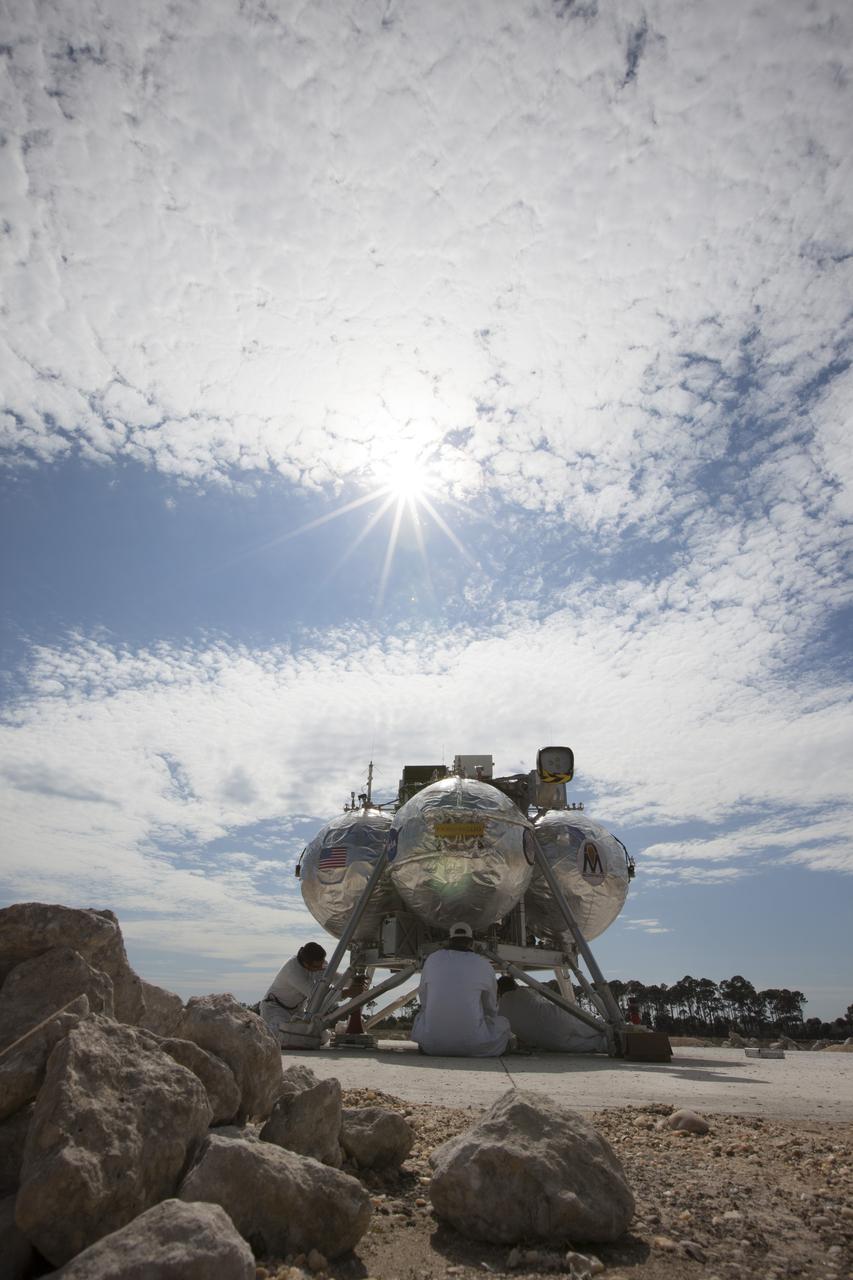
CAPE CANAVERAL, Fla. - Technicians prepare the Project Morpheus prototype lander for its seventh free flight test at the north end of the Shuttle Landing Facility at NASA’s Kennedy Space Center in Florida. The 83-second test began at 3:41 p.m. EDT with the Morpheus lander launching from the ground over a flame trench and ascending to 580 feet, its highest to date. Morpheus then flew its fastest downrange trek at 30 mph, travelling farther than before, 837 feet. The lander performed a 42-foot divert to emulate a hazard avoidance maneuver before descending and touching down on Landing Site 2, at the northern landing pad inside the automated landing and hazard avoidance technology ALHAT hazard field. Morpheus landed within one foot of its intended target. Project Morpheus tests NASA’s ALHAT and an engine that runs on liquid oxygen and methane, or green propellants, into a fully-operational lander that could deliver cargo to other planetary surfaces. The landing facility provides the lander with the kind of field necessary for realistic testing, complete with rocks, craters and hazards to avoid. Morpheus’ ALHAT payload allows it to navigate to clear landing sites amidst rocks, craters and other hazards during its descent. Project Morpheus is being managed under the Advanced Exploration Systems, or AES, Division in NASA’s Human Exploration and Operations Mission Directorate. The efforts in AES pioneer new approaches for rapidly developing prototype systems, demonstrating key capabilities and validating operational concepts for future human missions beyond Earth orbit. For more information on Project Morpheus, visit http://morpheuslander.jsc.nasa.gov/. Photo credit: NASA/Kim Shiflett
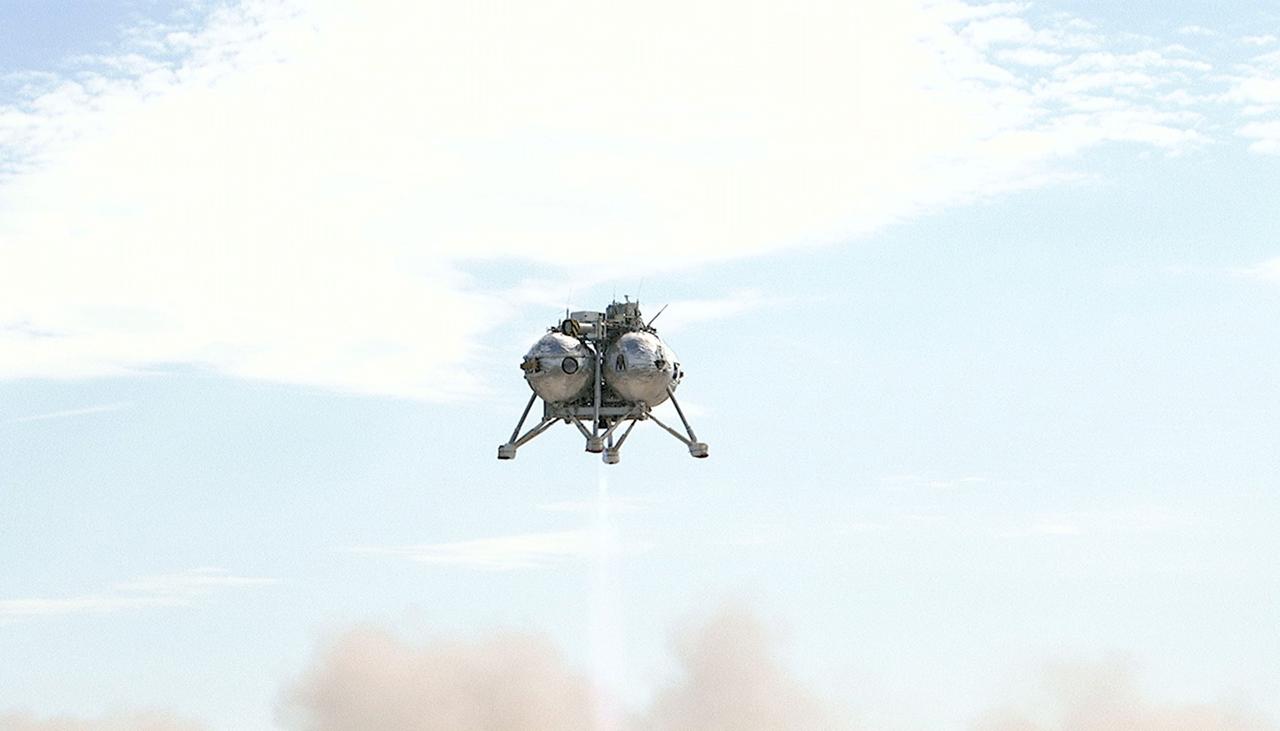
CAPE CANAVERAL, Fla. - The Project Morpheus prototype lander soars high on its seventh free flight test at the north end of the Shuttle Landing Facility at NASA’s Kennedy Space Center in Florida. The 83-second test began at 3:41 p.m. EDT with the Morpheus lander launching from the ground over a flame trench and ascending to 580 feet, its highest to date. Morpheus then flew its fastest downrange trek at 30 mph, travelling farther than before, 837 feet. The lander performed a 42-foot divert to emulate a hazard avoidance maneuver before descending and touching down on Landing Site 2, at the northern landing pad inside the automated landing and hazard avoidance technology ALHAT hazard field. Morpheus landed within one foot of its intended target. Project Morpheus tests NASA’s ALHAT and an engine that runs on liquid oxygen and methane, or green propellants, into a fully-operational lander that could deliver cargo to other planetary surfaces. The landing facility provides the lander with the kind of field necessary for realistic testing, complete with rocks, craters and hazards to avoid. Morpheus’ ALHAT payload allows it to navigate to clear landing sites amidst rocks, craters and other hazards during its descent. Project Morpheus is being managed under the Advanced Exploration Systems, or AES, Division in NASA’s Human Exploration and Operations Mission Directorate. The efforts in AES pioneer new approaches for rapidly developing prototype systems, demonstrating key capabilities and validating operational concepts for future human missions beyond Earth orbit. For more information on Project Morpheus, visit http://morpheuslander.jsc.nasa.gov/. Photo credit: NASA/Mike Chambers
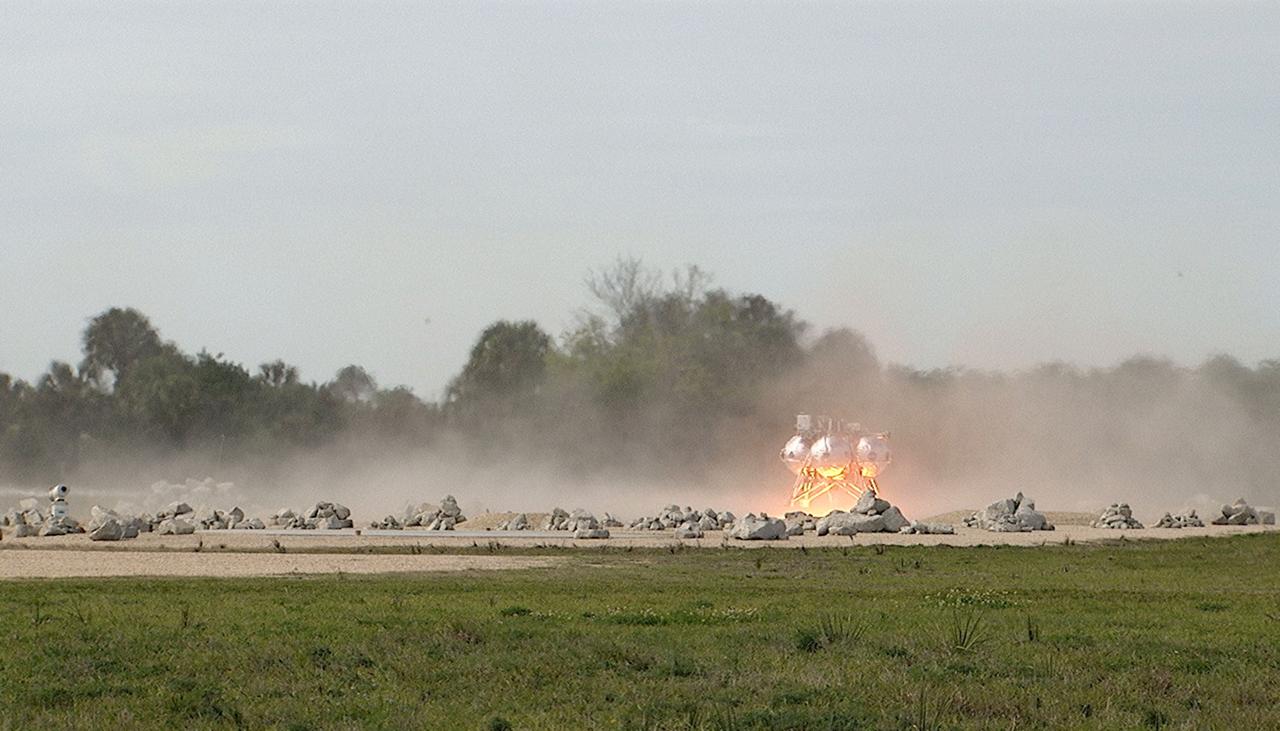
CAPE CANAVERAL, Fla. - The Project Morpheus prototype lander touches down in the automated landing and hazard avoidance technology, or ALHAT, hazard field after completing its seventh free flight test at the north end of the Shuttle Landing Facility at NASA’s Kennedy Space Center in Florida. The 83-second test began at 3:41 p.m. EDT with the Morpheus lander launching from the ground over a flame trench and ascending to 580 feet, its highest to date. Morpheus then flew its fastest downrange trek at 30 mph, travelling farther than before, 837 feet. The lander performed a 42-foot divert to emulate a hazard avoidance maneuver before descending and touching down on Landing Site 2, at the northern landing pad inside the hazard field. Morpheus landed within one foot of its intended target. Project Morpheus tests NASA’s ALHAT and an engine that runs on liquid oxygen and methane, or green propellants, into a fully-operational lander that could deliver cargo to other planetary surfaces. The landing facility provides the lander with the kind of field necessary for realistic testing, complete with rocks, craters and hazards to avoid. Morpheus’ ALHAT payload allows it to navigate to clear landing sites amidst rocks, craters and other hazards during its descent. Project Morpheus is being managed under the Advanced Exploration Systems, or AES, Division in NASA’s Human Exploration and Operations Mission Directorate. The efforts in AES pioneer new approaches for rapidly developing prototype systems, demonstrating key capabilities and validating operational concepts for future human missions beyond Earth orbit. For more information on Project Morpheus, visit http://morpheuslander.jsc.nasa.gov/. Photo credit: NASA/Mike Chambers
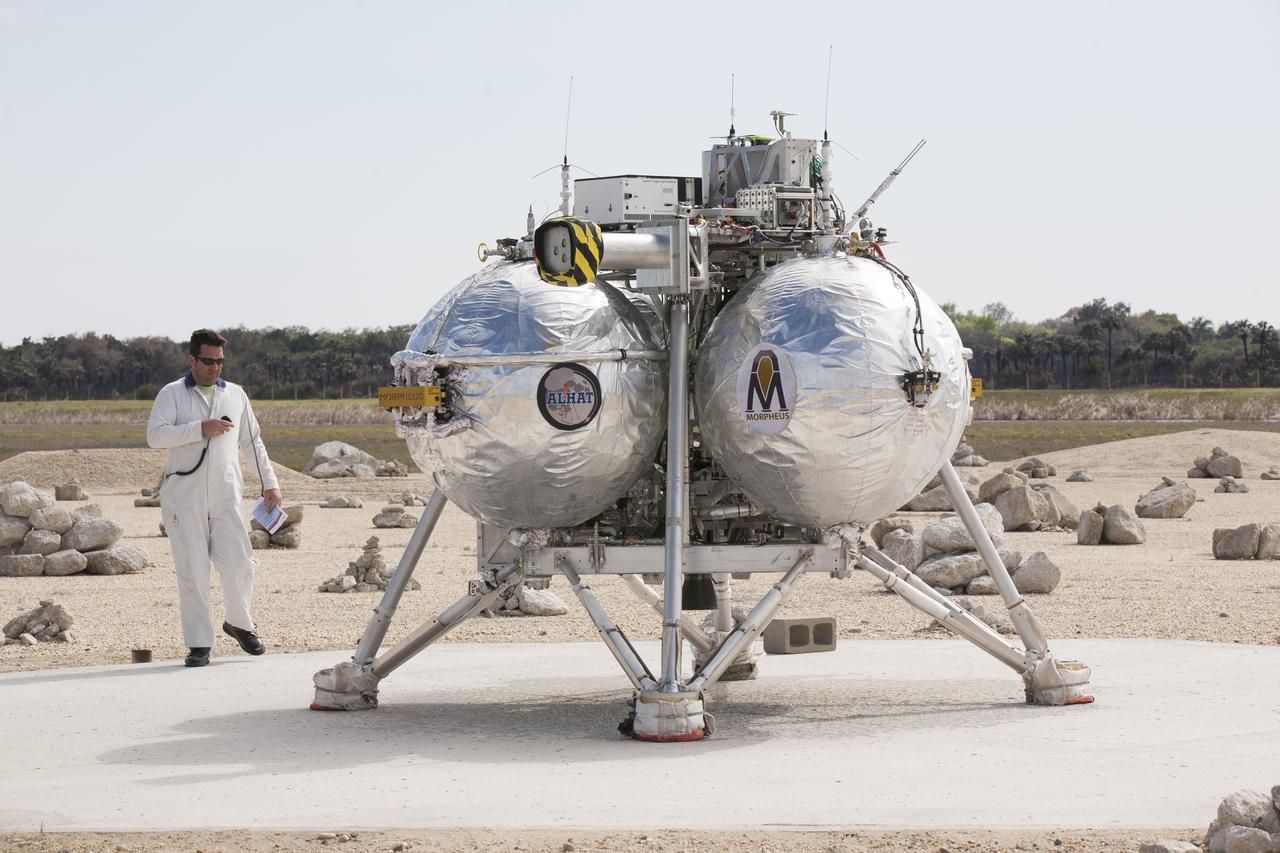
CAPE CANAVERAL, Fla. - An engineer checks the Project Morpheus prototype lander after it landed in the automated landing and hazard avoidance technology, or ALHAT, hazard field, completing its seventh free flight test at the north end of the Shuttle Landing Facility at NASA’s Kennedy Space Center in Florida. The 83-second test began at 3:41 p.m. EDT with the Morpheus lander launching from the ground over a flame trench and ascending to 580 feet, its highest to date. Morpheus then flew its fastest downrange trek at 30 mph, travelling farther than before, 837 feet. The lander performed a 42-foot divert to emulate a hazard avoidance maneuver before descending and touching down on Landing Site 2, at the northern landing pad inside the hazard field. Morpheus landed within one foot of its intended target. Project Morpheus tests NASA’s ALHAT and an engine that runs on liquid oxygen and methane, or green propellants, into a fully-operational lander that could deliver cargo to other planetary surfaces. The landing facility provides the lander with the kind of field necessary for realistic testing, complete with rocks, craters and hazards to avoid. Morpheus’ ALHAT payload allows it to navigate to clear landing sites amidst rocks, craters and other hazards during its descent. Project Morpheus is being managed under the Advanced Exploration Systems, or AES, Division in NASA’s Human Exploration and Operations Mission Directorate. The efforts in AES pioneer new approaches for rapidly developing prototype systems, demonstrating key capabilities and validating operational concepts for future human missions beyond Earth orbit. For more information on Project Morpheus, visit http://morpheuslander.jsc.nasa.gov/. Photo credit: NASA/Kim Shiflett
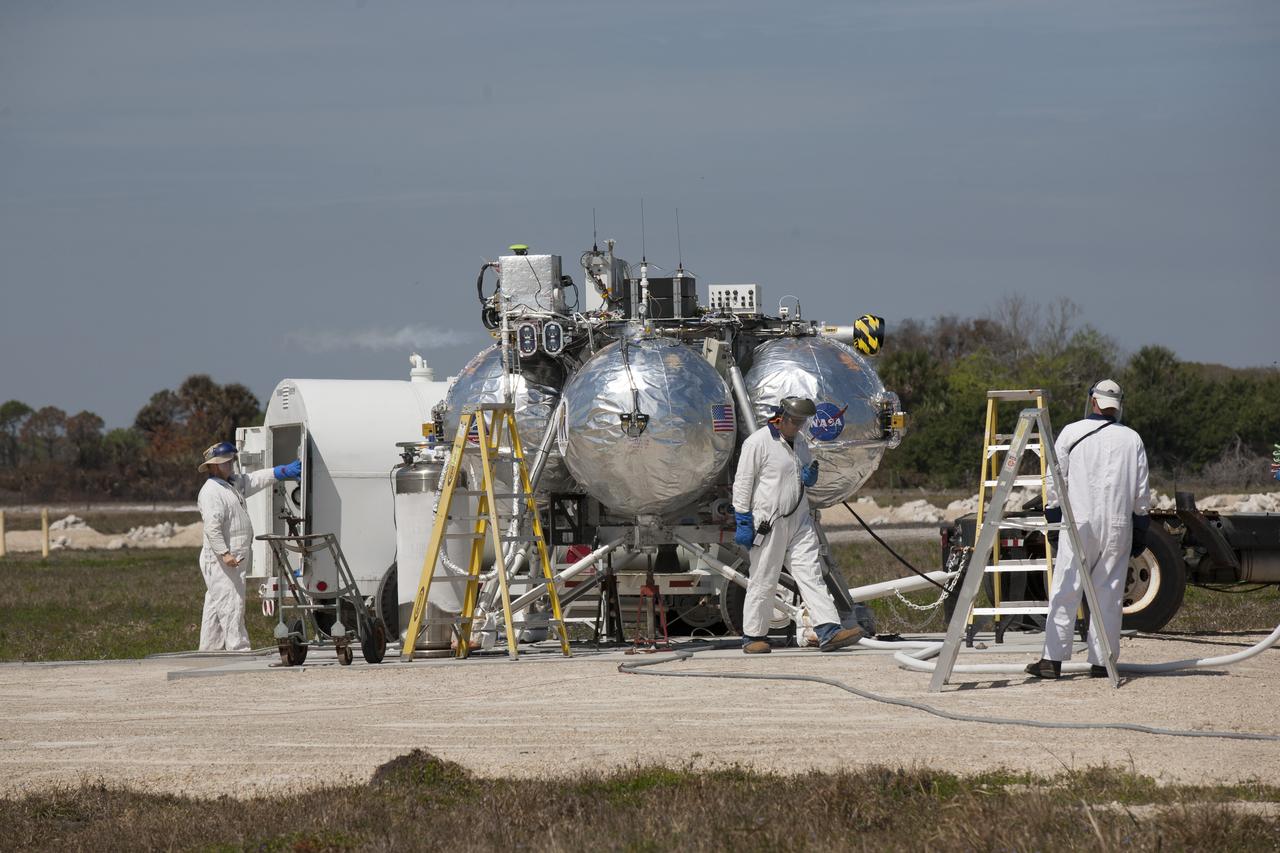
CAPE CANAVERAL, Fla. - Engineers and technicians prepare the Project Morpheus prototype lander for its seventh free flight test at the north end of the Shuttle Landing Facility at NASA’s Kennedy Space Center in Florida. The 83-second test began at 3:41 p.m. EDT with the Morpheus lander launching from the ground over a flame trench and ascending to 580 feet, its highest to date. Morpheus then flew its fastest downrange trek at 30 mph, travelling farther than before, 837 feet. The lander performed a 42-foot divert to emulate a hazard avoidance maneuver before descending and touching down on Landing Site 2, at the northern landing pad inside the automated landing and hazard avoidance technology ALHAT hazard field. Morpheus landed within one foot of its intended target. Project Morpheus tests NASA’s ALHAT and an engine that runs on liquid oxygen and methane, or green propellants, into a fully-operational lander that could deliver cargo to other planetary surfaces. The landing facility provides the lander with the kind of field necessary for realistic testing, complete with rocks, craters and hazards to avoid. Morpheus’ ALHAT payload allows it to navigate to clear landing sites amidst rocks, craters and other hazards during its descent. Project Morpheus is being managed under the Advanced Exploration Systems, or AES, Division in NASA’s Human Exploration and Operations Mission Directorate. The efforts in AES pioneer new approaches for rapidly developing prototype systems, demonstrating key capabilities and validating operational concepts for future human missions beyond Earth orbit. For more information on Project Morpheus, visit http://morpheuslander.jsc.nasa.gov/. Photo credit: NASA/Kim Shiflett
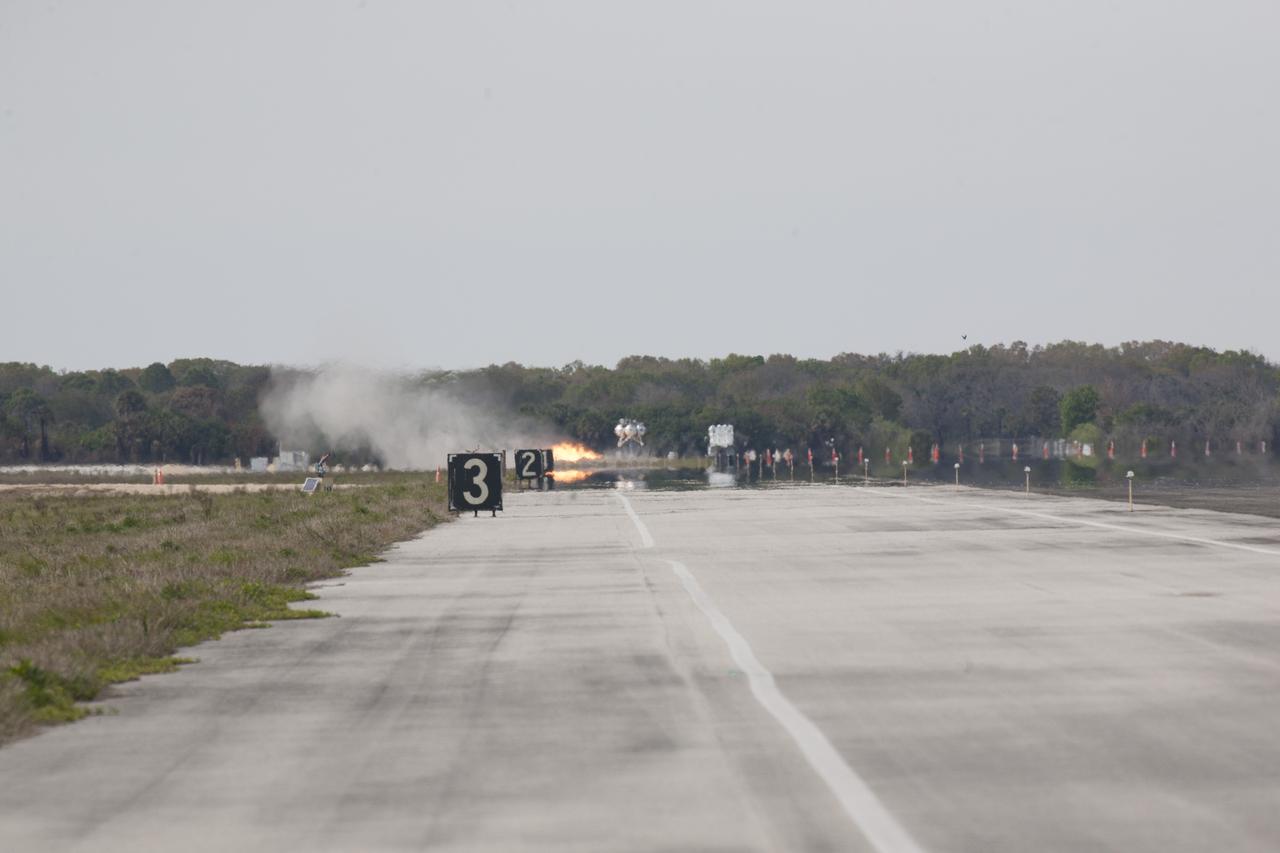
CAPE CANAVERAL, Fla. - The Project Morpheus prototype lander lifts off in the automated landing and hazard avoidance technology, or ALHAT, hazard field for its seventh free flight test at the north end of the Shuttle Landing Facility at NASA’s Kennedy Space Center in Florida. The 83-second test began at 3:41 p.m. EDT with the Morpheus lander launching from the ground over a flame trench and ascending to 580 feet, its highest to date. Morpheus then flew its fastest downrange trek at 30 mph, travelling farther than before, 837 feet. The lander performed a 42-foot divert to emulate a hazard avoidance maneuver before descending and touching down on Landing Site 2, at the northern landing pad inside the hazard field. Morpheus landed within one foot of its intended target. Project Morpheus tests NASA’s ALHAT and an engine that runs on liquid oxygen and methane, or green propellants, into a fully-operational lander that could deliver cargo to other planetary surfaces. The landing facility provides the lander with the kind of field necessary for realistic testing, complete with rocks, craters and hazards to avoid. Morpheus’ ALHAT payload allows it to navigate to clear landing sites amidst rocks, craters and other hazards during its descent. Project Morpheus is being managed under the Advanced Exploration Systems, or AES, Division in NASA’s Human Exploration and Operations Mission Directorate. The efforts in AES pioneer new approaches for rapidly developing prototype systems, demonstrating key capabilities and validating operational concepts for future human missions beyond Earth orbit. For more information on Project Morpheus, visit http://morpheuslander.jsc.nasa.gov/. Photo credit: NASA/Kim Shiflett