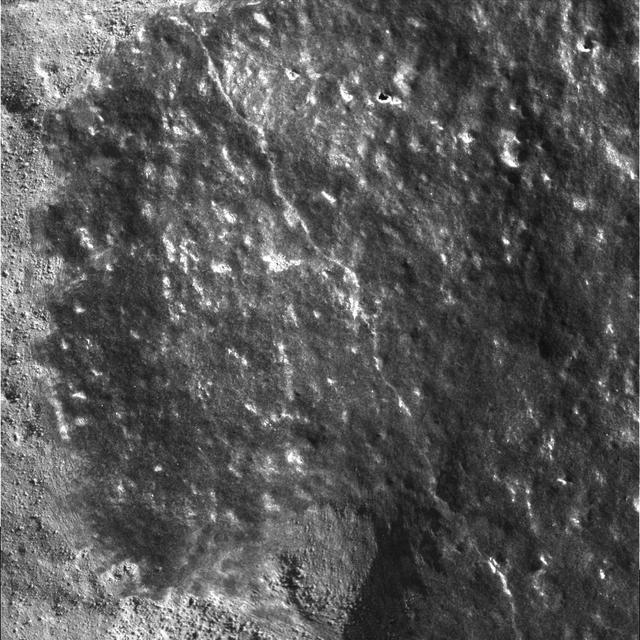
Shiny and New
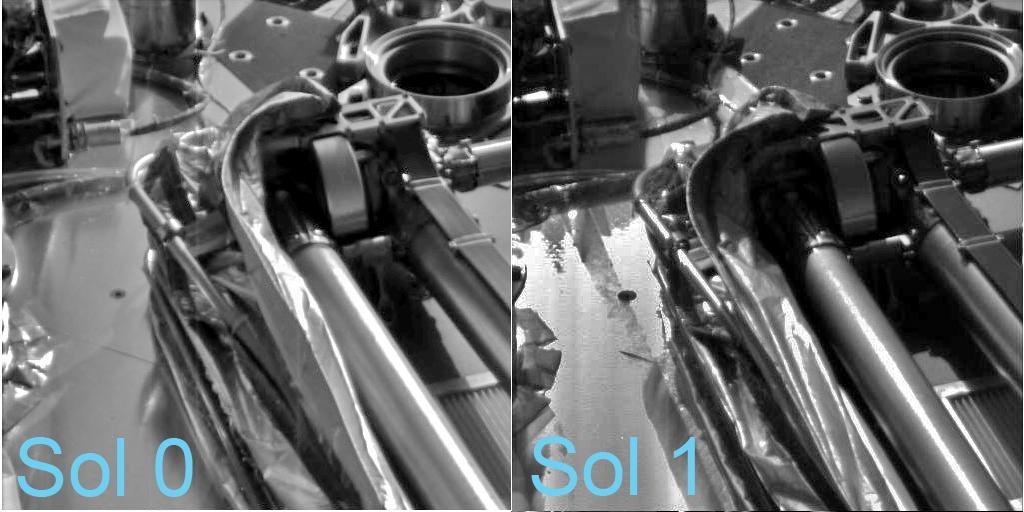
Relatively warmer daytime temperatures on Mars have allowed the biobarrier -- a shiny, protective film -- to peel away a little more from the robotic arm of NASA Phoenix Mars Lander.
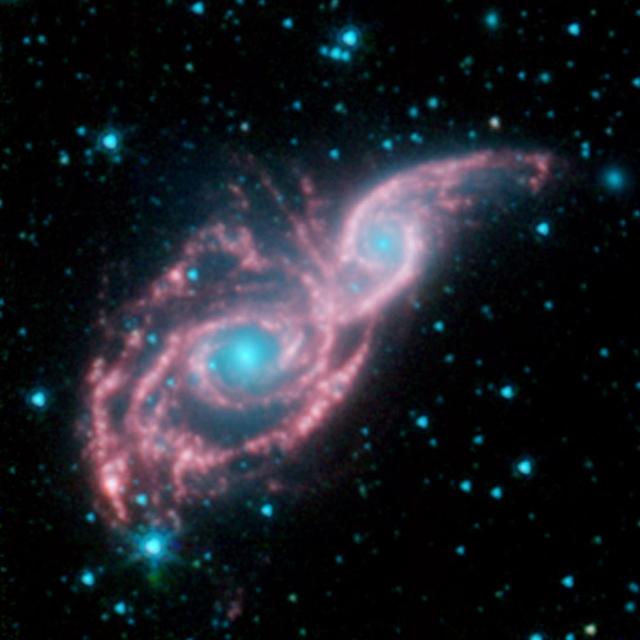
Something appears to be peering through a shiny red mask, in this new false-colored image from NASA Spitzer Space Telescope. The mysterious blue eyes are actually starlight from the cores of two merging galaxies, called NGC 2207 and IC 2163.
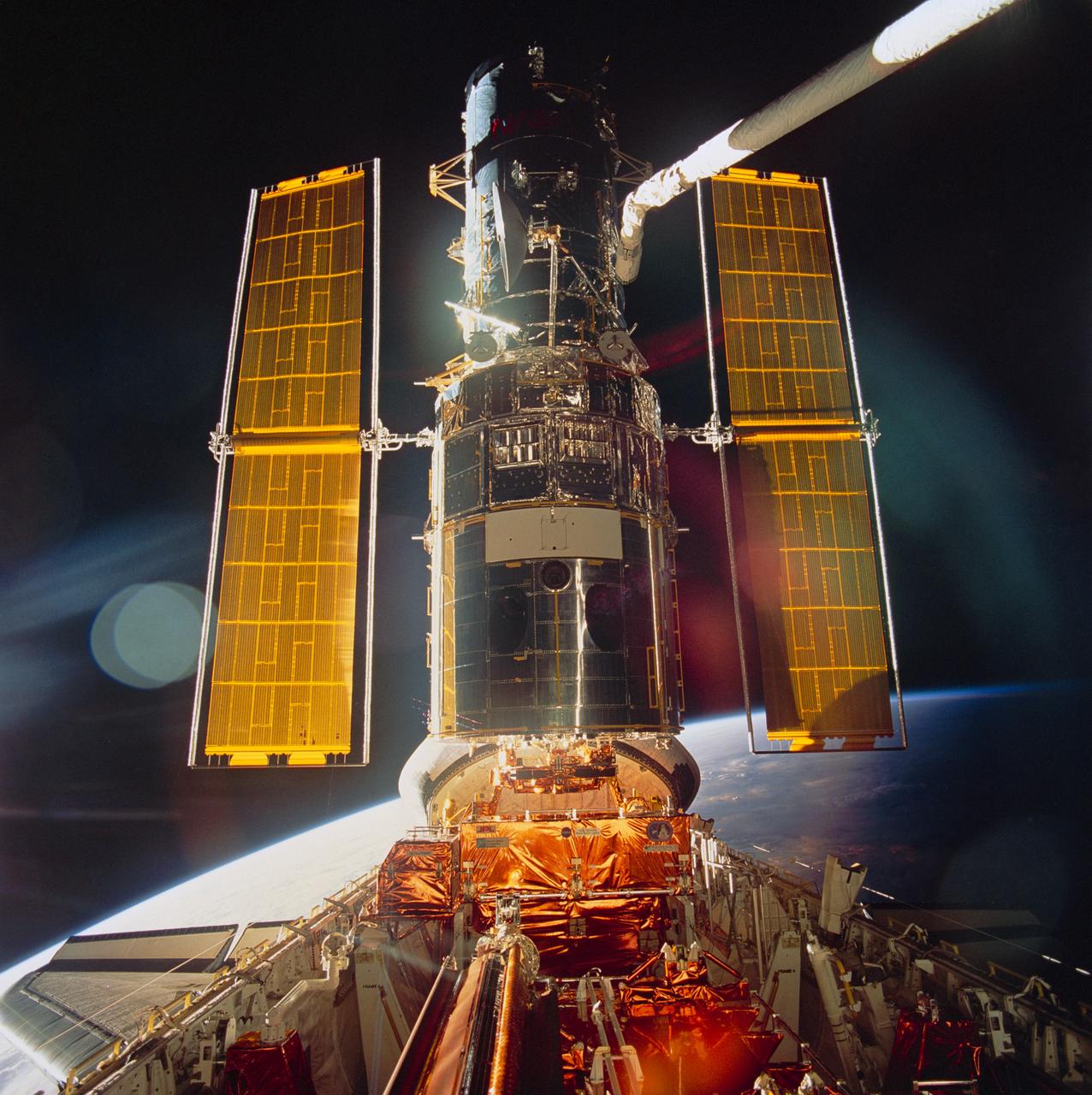
STS061-99-009 (9 Dec 1993) --- Sunlight reflects off the Space Shuttle Endeavour's aft windows and the shiny Hubble Space Telescope (HST) prior to its post-servicing deployment near the end of the eleven-day mission. A handheld Hasselblad camera was used inside Endeavour's cabin to record the image.
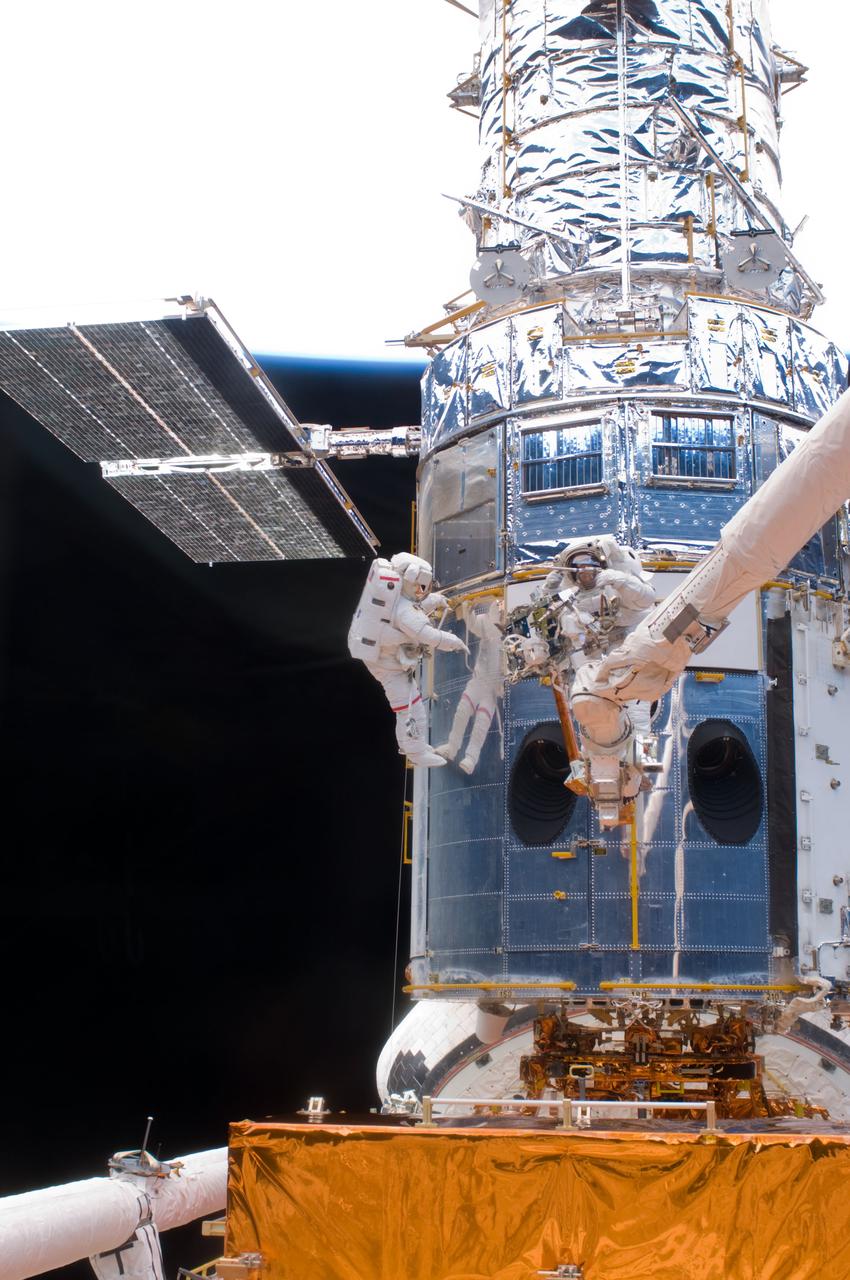
S125-E-007221 (14 May 2009) --- What appears to be a number of astronauts, because of the shiny mirror-like surface of the temporarily-captured Hubble Space Telescope, is actually only two -- astronauts John Grunsfeld (left) and Andrew Feustel. The mission specialists are performing the first of five STS-125 spacewalks and the first of three for this duo.
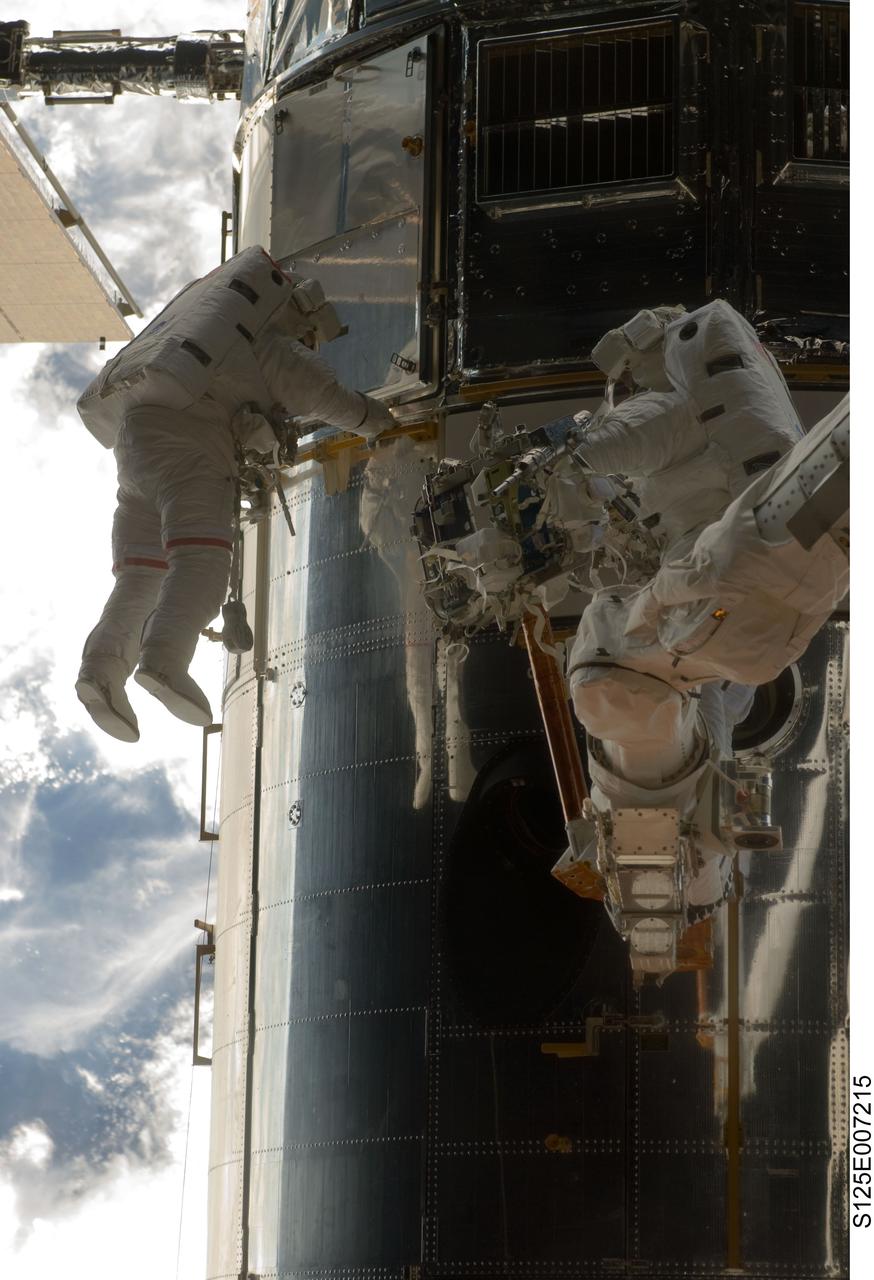
S125-E-007215 (14 May 2009) --- What appears to be a number of astronauts, because of the shiny mirror-like surface of the temporarily-captured Hubble Space Telescope, is actually only two -- astronauts John Grunsfeld (left) and Andrew Feustel. The mission specialists are performing the first of five STS-125 spacewalks and the first of three for this duo.
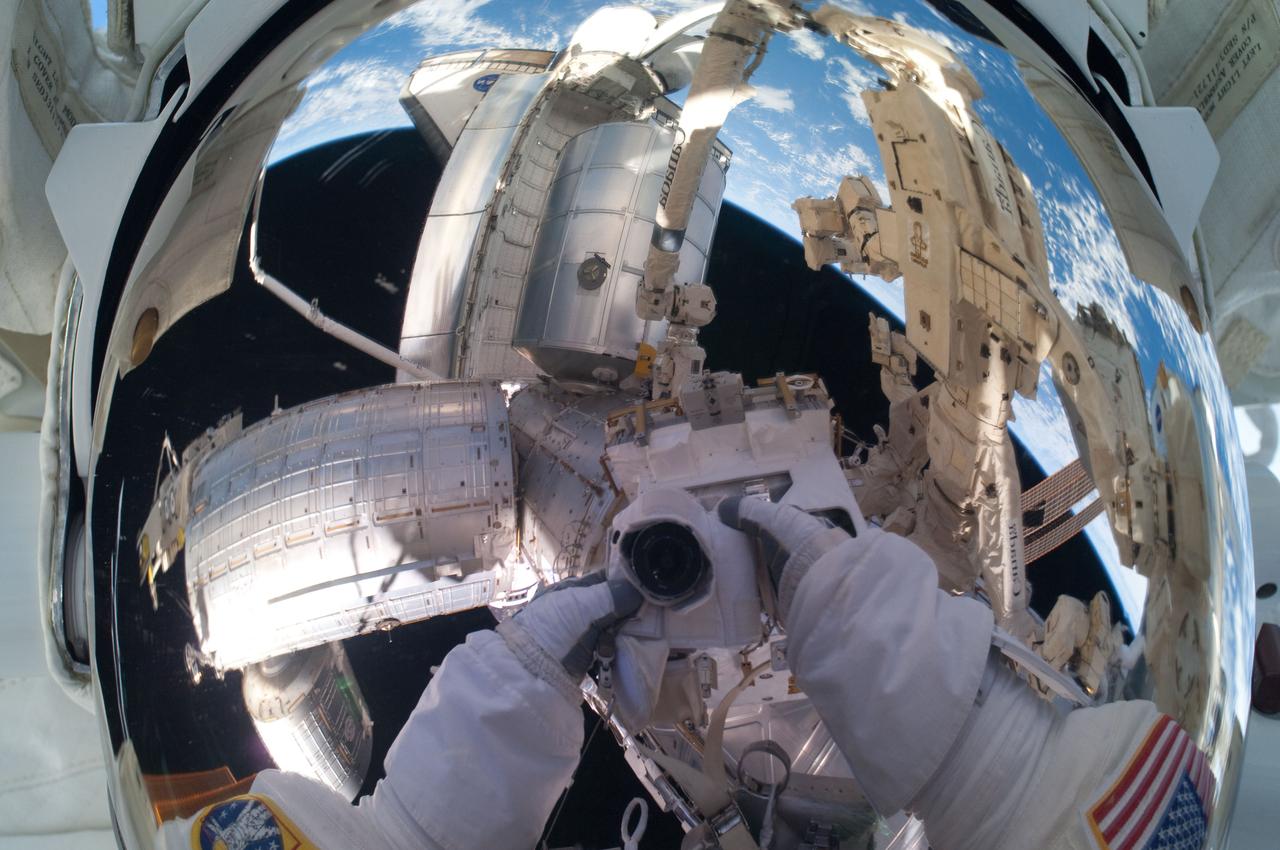
ISS028-E-016173 (12 July 2011) --- Because of his shiny helmet visor, this "self portrait" of NASA astronaut Mike Fossum, photographed during a July 12 spacewalk, mirrors a panoramic scene of the docked International Space Station and space shuttle Atlantis and the blue and white Earth below.
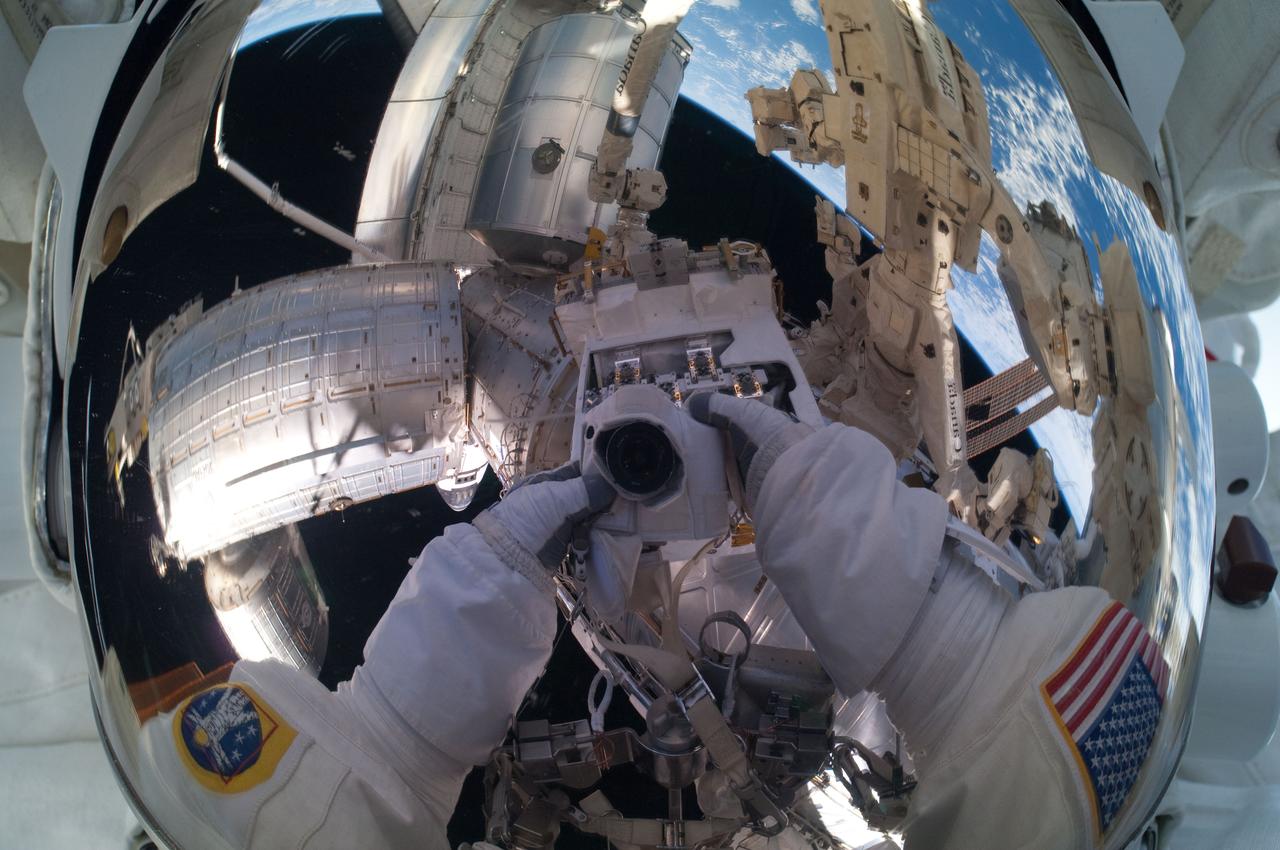
ISS028-E-016175 (12 July 2011) --- Because of his shiny helmet visor, this "self portrait" of NASA astronaut Mike Fossum, photographed during a July 12 spacewalk, mirrors a panoramic scene of the docked International Space Station and space shuttle Atlantis and the blue and white Earth below.
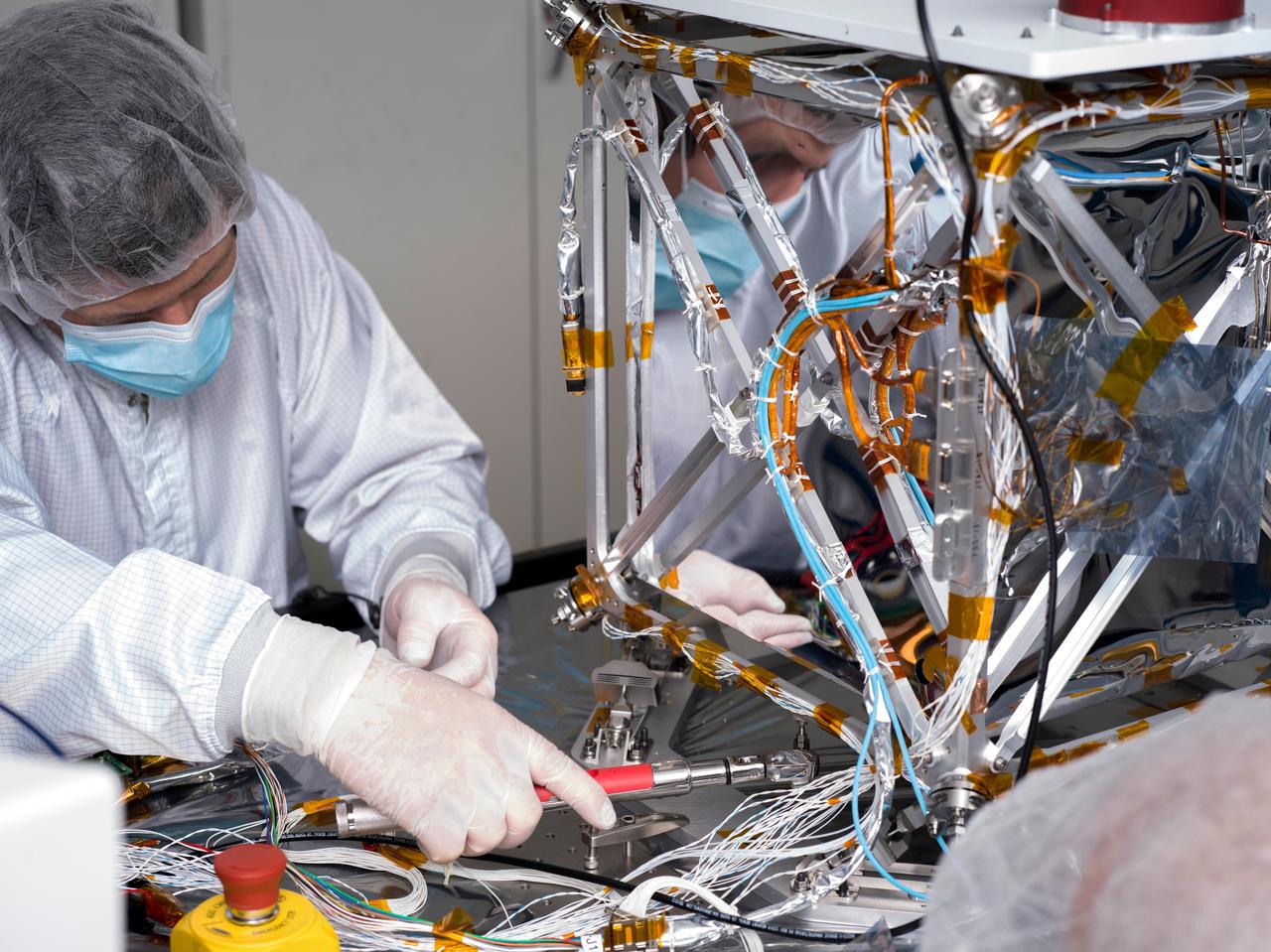
In a clean room at NASA's Jet Propulsion Laboratory in Southern California in March 2024, technician Nik Schwarz prepares the agency's Farside Seismic Suite (FSS) for testing. The cube-shaped payload contains two instruments that will gather NASA's first seismic data from the Moon in nearly 50 years and take the first-ever seismic measurements from the Moon's far side. FSS will operate continuously for at least 4½ months, working through the long, cold lunar nights. The two seismometers are packaged together with a large battery, a computer, and electronics inside a cube structure that's surrounded by several layers of insulation (the shiny, reflective material seen here) and suspended within an outer protective cube, which is in turn covered with a shiny insulating blanket. A technician is here attaching a stiffening brace to the bottom of the FSS outer cube structure. https://photojournal.jpl.nasa.gov/catalog/PIA26341
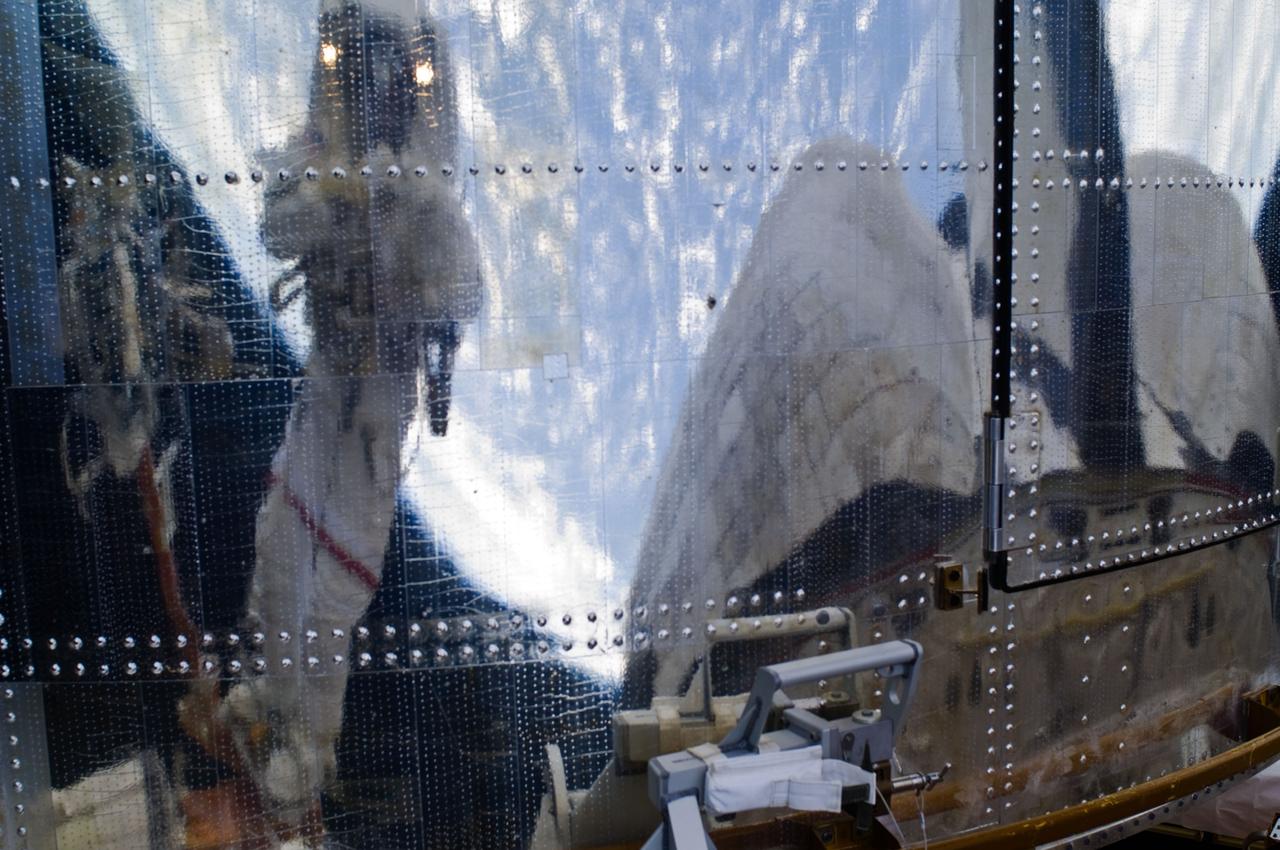
S125-E-010077 (18 May 2009) --- The Hubble Space Telescope temporarily played a role akin to a house of mirrors as astronaut John Grunsfeld photographed a portrait of his own reflection in the shiny surface of the giant orbital observatory. The final space walk to perform work on the telescope was turned in May 18 by astronauts Grunsfeld and Andrew Feustel, who finished up chores by replacing outer blanket layer insulation on Hubble.
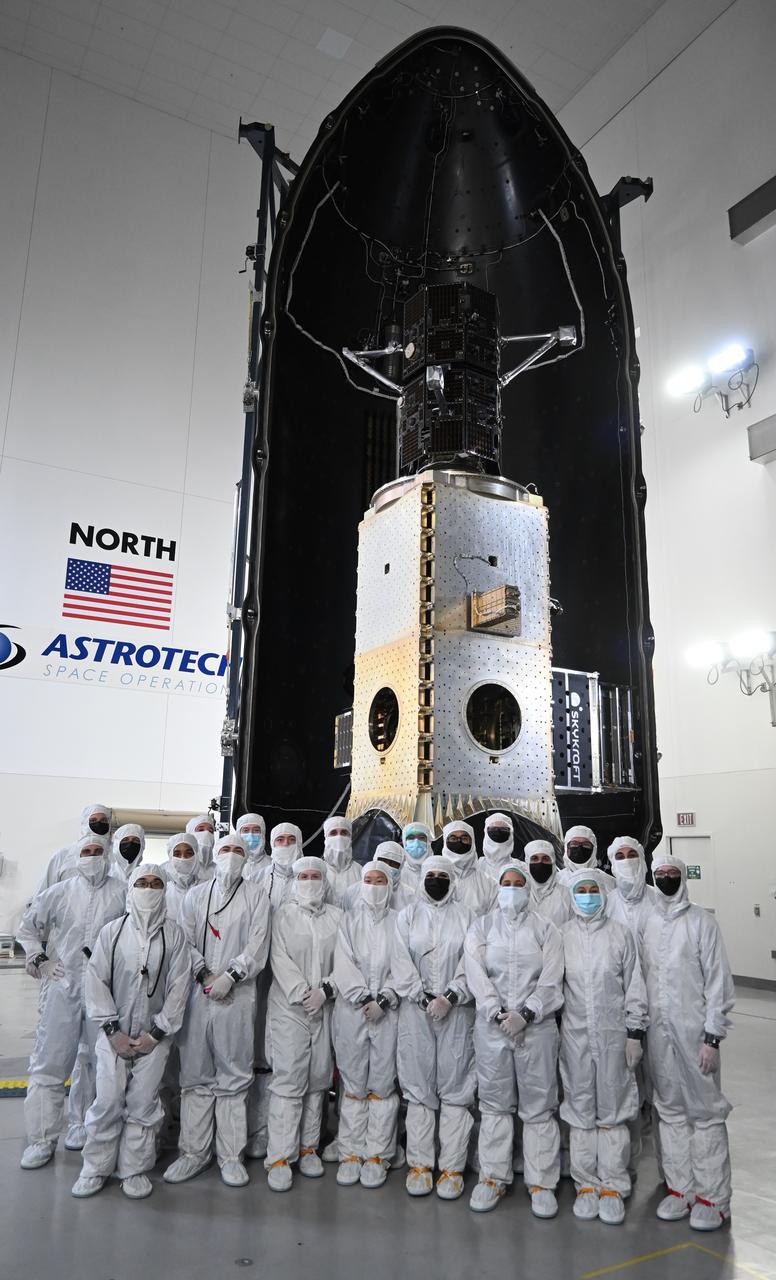
Technicians encapsulate the black twin satellites of NASA’s TRACERS (Tandem Reconnection and Cusp Electrodynamics Reconnaissance Satellites) mission within a payload fairing atop a shiny metallic stack of several other rideshare payloads at the Astrotech Space Operations facility at Vandenberg Space Force Base in California. The TRACERS mission is a pair of twin satellites that will study how Earth’s magnetic shield — the magnetosphere — protects our planet from the supersonic stream of material from the Sun called solar wind.
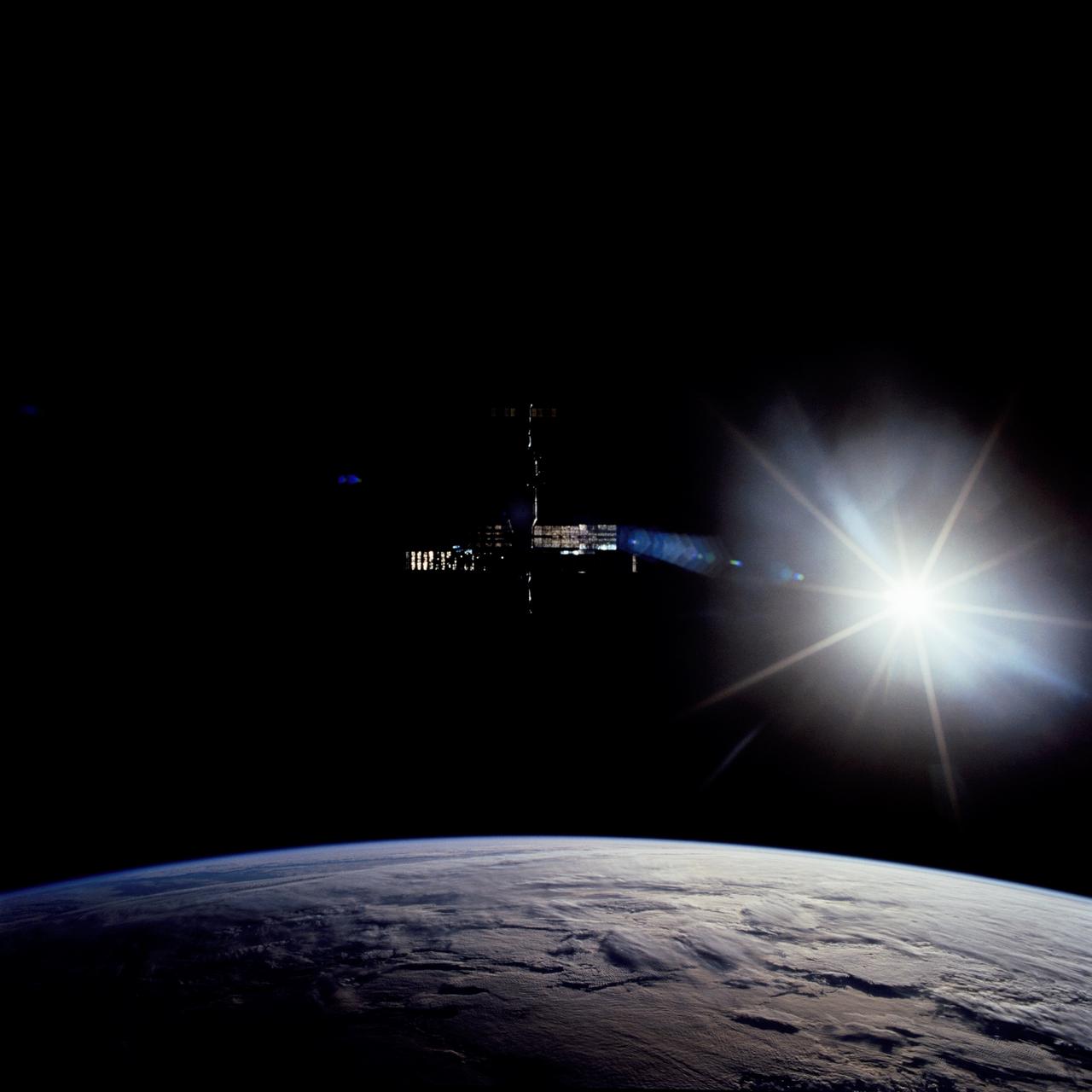
STS063-708-057 (6 Feb. 1995) --- Backdropped against the darkness of space, only the shiny part of Russia's Mir Space Station are clearly visible in this 70mm frame, photographed during rendezvous operations by the Space Shuttle Discovery and the Mir space station. Onboard the Discovery were astronauts James D. Wetherbee, mission commander; Eileen M. Collins, pilot; Bernard A. Harris Jr., payload commander; mission specialists Janice Voss, C. Michael Foale and Russian cosmonaut Vladimir G. Titov.
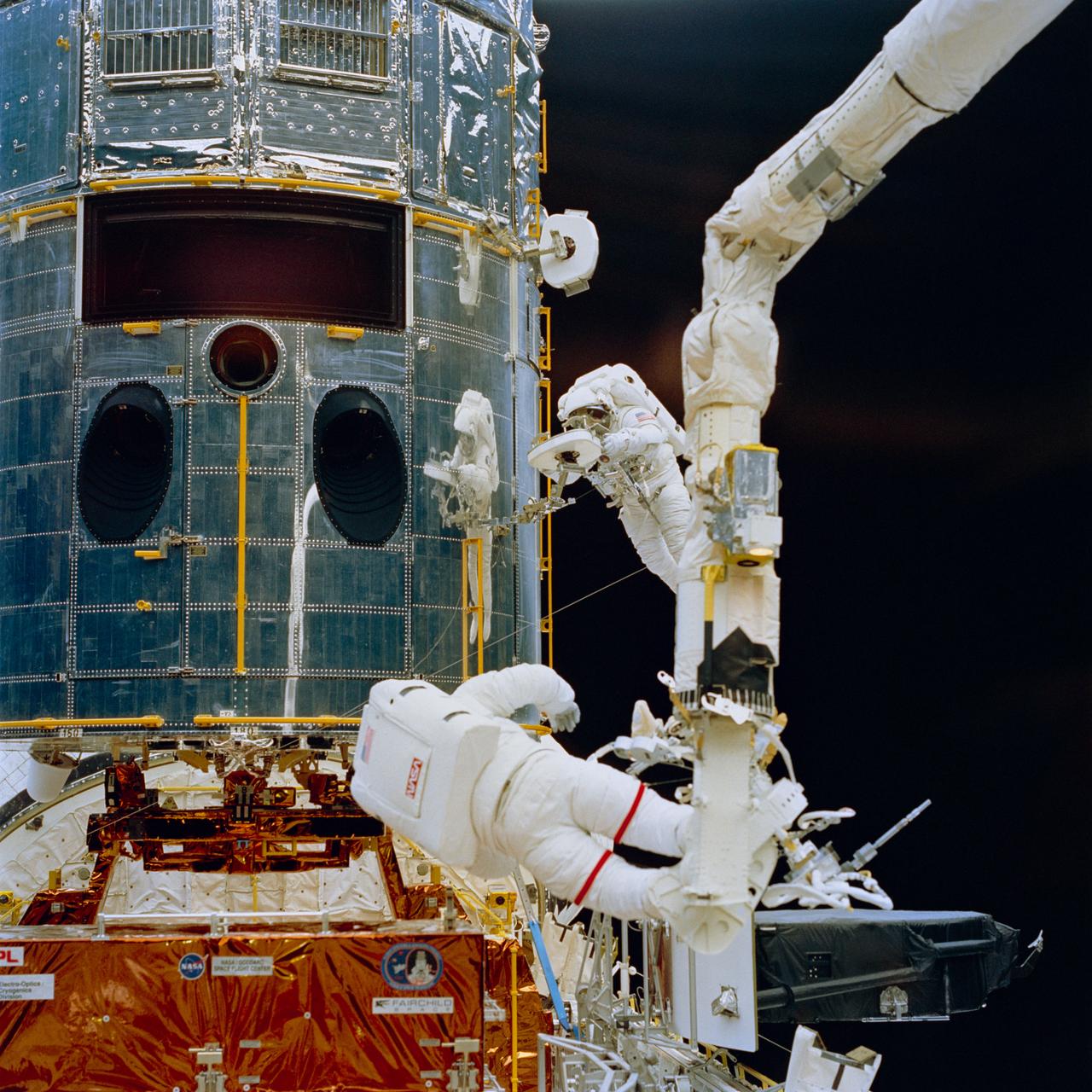
STS061-74-046 (7 Dec 1993) --- Anchored on the end of the Space Shuttle Endeavour's Remote Manipulator System (RMS) arm, astronaut Jeffrey A. Hoffman (foreground) prepares to install the new Wide Field\Planetary Camera (WFPC II) into the empty cavity (top left) on the Hubble Space Telescope (HST). WFPC I is seen temporarily stowed at bottom right. Astronaut F. Story Musgrave works with a Portable Foot Restraint (PFR) at frame center, as his image is reflected in the shiny surface of the telescope. Hoffman and Musgrave shared chores on three of the five extravehicular activity?s (EVA) during the mission.
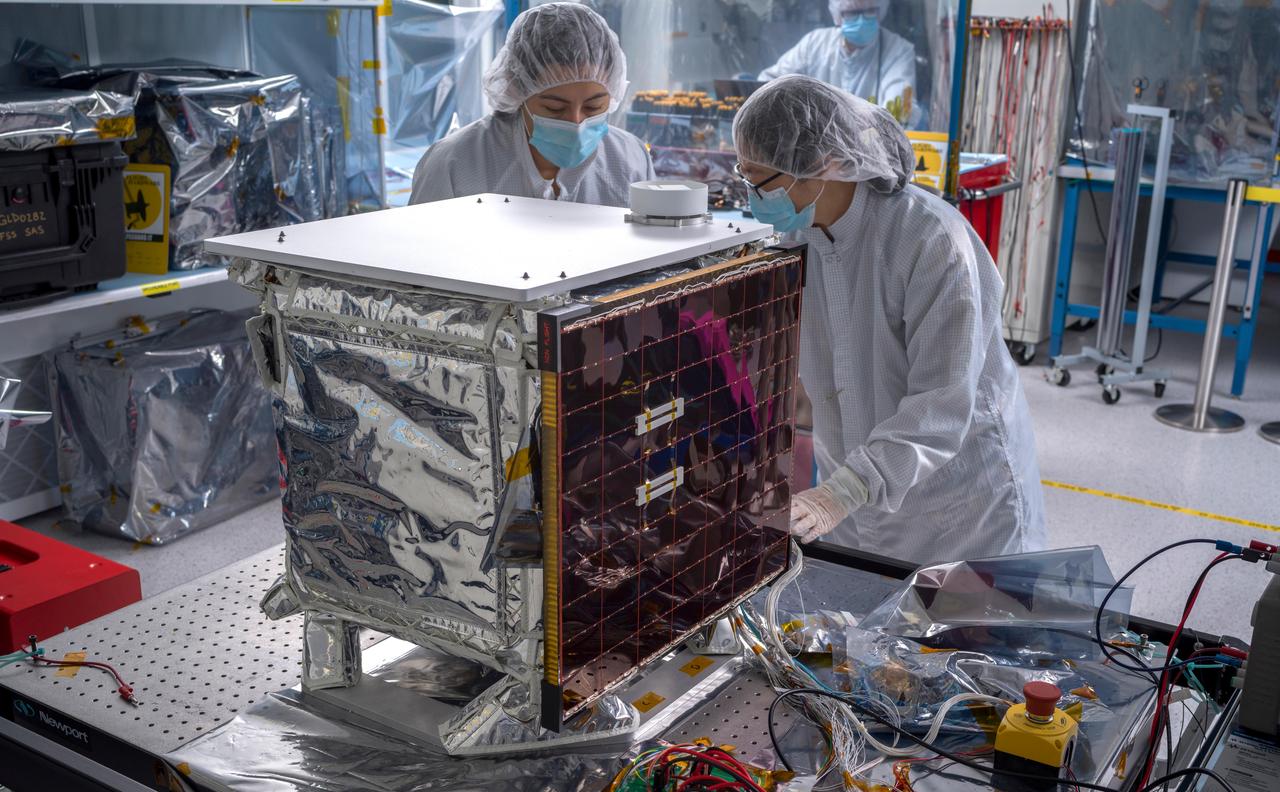
In a clean room at NASA's Jet Propulsion Laboratory in Southern California in March 2024, engineers and technicians work to prepare the agency's Farside Seismic Suite (FSS) for environmental testing to simulate conditions it will encounter in space. Along with being placed in a vacuum chamber and subjected to extreme temperatures, the instrument suite will undergo severe shaking that mimics the rocket's motion during launch. The cube-shaped payload contains two instruments that will gather NASA's first seismic data from the Moon in nearly 50 years and take the first-ever seismic measurements from the Moon's far side. FSS will operate continuously for at least 4½ months, working through the long, cold lunar nights. The two seismometers are packaged together with a large battery, a computer, and electronics inside a cube structure that's surrounded by several layers of insulation and suspended within an outer protective cube, which is in turn covered with a shiny insulating blanket. The suite's single solar panel can be seen at center. On top is a white radiator that will allow the suite to shed heat generated by its electronics during the hot lunar daytime hours. The puck-like object atop the radiator is the suite's antenna, for communicating with two small relay satellites that will orbit the Moon and send data to Earth. Pictured (from left): Joanna Farias, and Bert Turney, and Hsin-Yi Hao. https://photojournal.jpl.nasa.gov/catalog/PIA26299
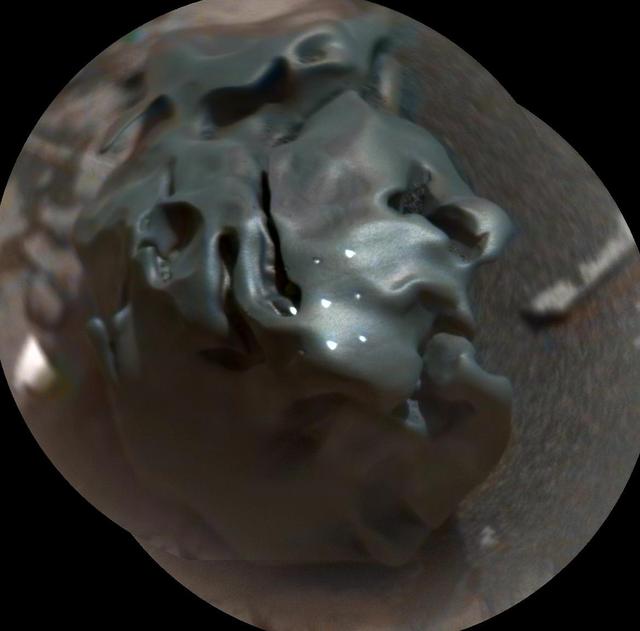
The dark, golf-ball-size object in this composite, colorized view from the Chemistry and Camera (ChemCam) instrument on NASA's Curiosity Mars rover shows a grid of shiny dots where ChemCam had fired laser pulses used for determining the chemical elements in the target's composition. The analysis confirmed that this object, informally named "Egg Rock," is an iron-nickel meteorite. Iron-nickel meteorites are a common class of space rocks found on Earth, and previous examples have been found on Mars, but Egg Rock is the first on Mars to be examined with a laser-firing spectrometer. The laser pulses on Oct. 30, 2016, induced bursts of glowing gas at the target, and ChemCam's spectrometer read the wavelengths of light from those bursts to gain information about the target's composition. The laser pulses also burned through the dark outer surface, exposing bright interior material. This view combines two images taken later the same day by ChemCam's remote micro-imager (RMI) camera, with color added from an image taken by Curiosity's Mast Camera (Mastcam). A Mastcam image of Egg Rock is at PIA21134. http://photojournal.jpl.nasa.gov/catalog/PIA21133

The Hubble Space Telescope in a picture snapped by a Servicing Mission 4 crewmember just after the Space Shuttle Atlantis captured Hubble with its robotic arm on May 13, 2009, beginning the mission to upgrade and repair the telescope. The Hubble Space Telescope is a project of international cooperation between NASA and the European Space Agency. NASA's Goddard Space Flight Center manages the telescope. The Space Telescope Science Institute conducts Hubble science operations. Goddard is responsible for HST project management, including mission and science operations, servicing missions, and all associated development activities. To learn more about the Hubble Space Telescope go here: <a href="http://www.nasa.gov/mission_pages/hubble/main/index.html" rel="nofollow">www.nasa.gov/mission_pages/hubble/main/index.html</a>
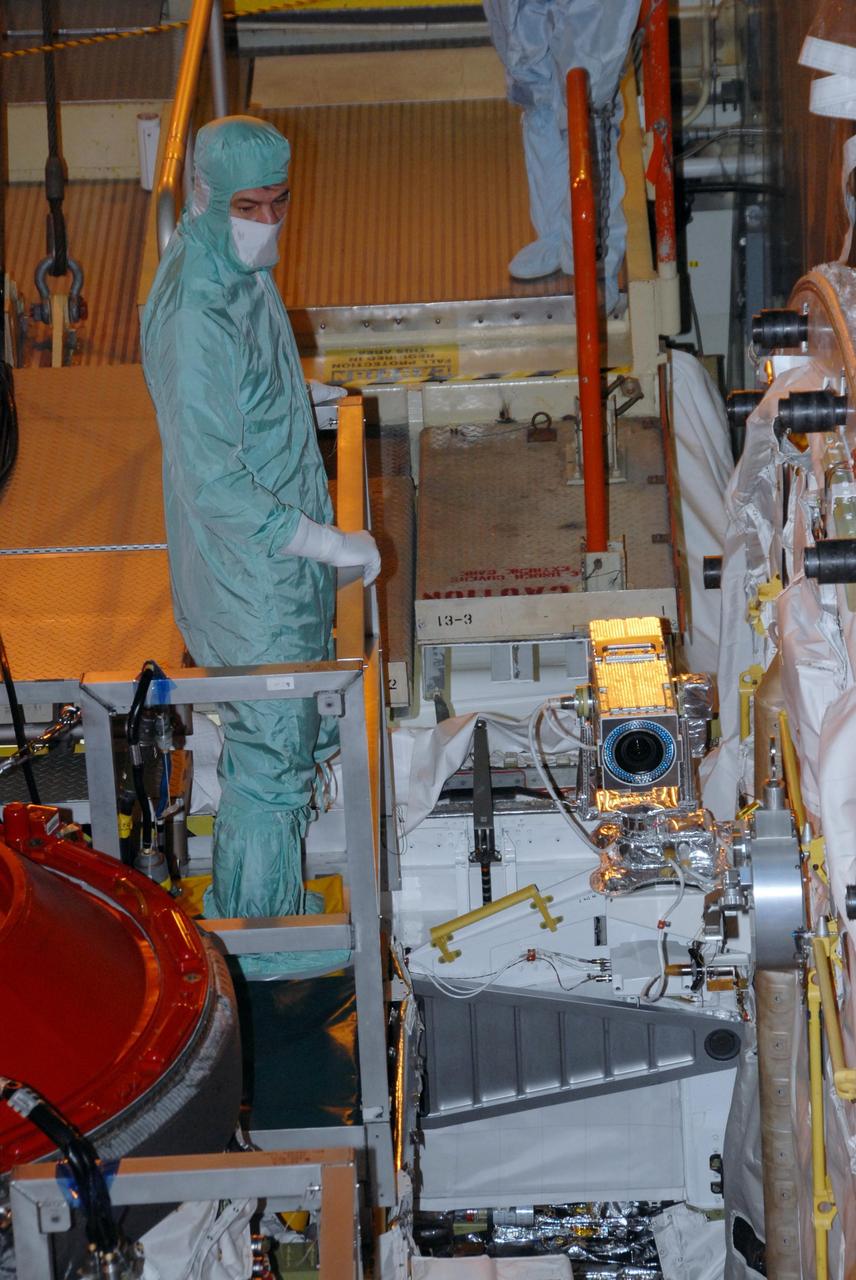
KENNEDY SPACE CENTER, FLA. - In Orbiter Processing Facility bay 3, STS-120 crew members get a close look at hardware in Discovery's payload bay. In the bucket at left is Mission Specialist Paolo A. Nespoli, who is a European Space Agency astronaut from Italy. The object with the shiny gold surface is a payload bay bulkhead camera. The STS-120 crew is at Kennedy for a crew equipment interface test, or CEIT, which includes harness training, inspection of the thermal protection system and camera operation for planned extravehicular activities, or EVAs. The STS-120 mission will deliver the Harmony module, christened after a school contest, which will provide attachment points for European and Japanese laboratory modules on the International Space Station. Known in technical circles as Node 2, it is similar to the six-sided Unity module that links the U.S. and Russian sections of the station. Built in Italy for the United States, Harmony will be the first new U.S. pressurized component to be added. The STS-120 mission is targeted to launch on Oct. 20. Photo credit: NASA/George Shelton
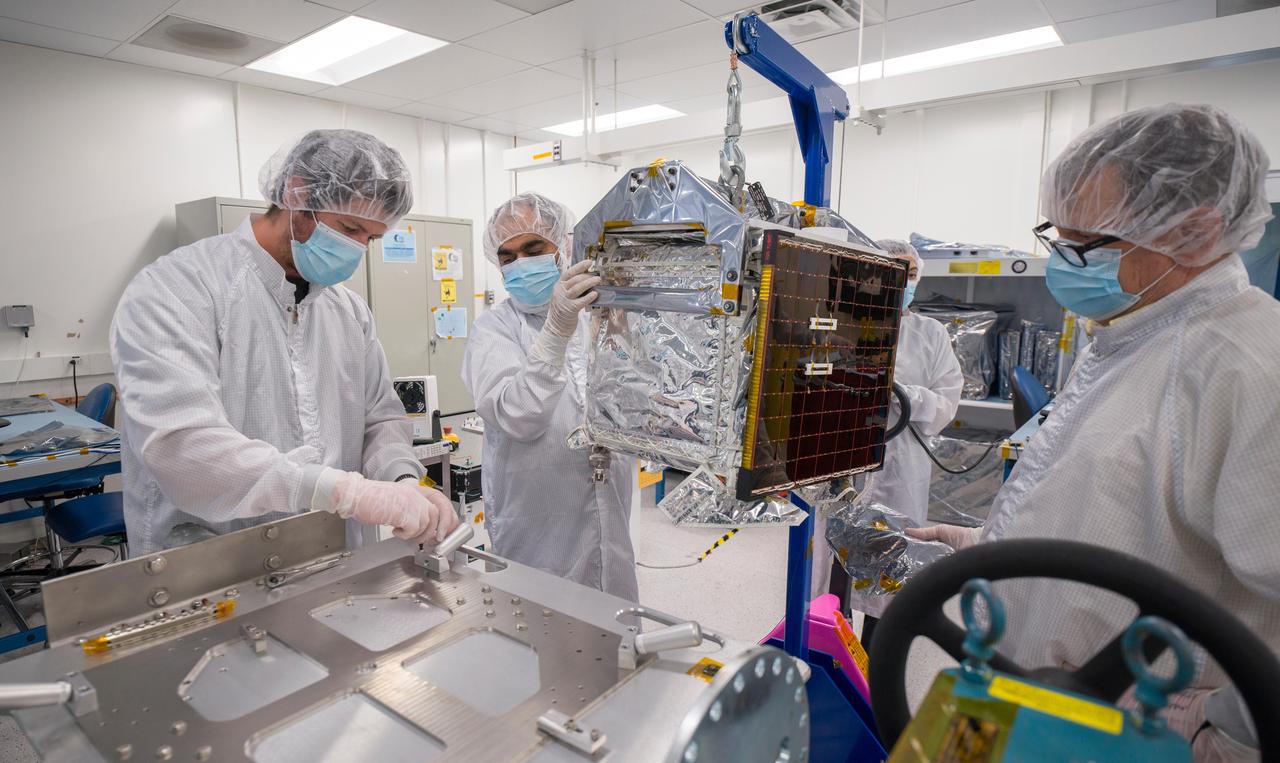
In a clean room at NASA's Jet Propulsion Laboratory in Southern California in March 2024, engineers and technicians prepare the agency's Farside Seismic Suite (FSS) for testing. The cube-shaped payload contains two instruments that will gather NASA's first seismic data from the Moon in nearly 50 years and take the first-ever seismic measurements from the Moon's far side. FSS will operate continuously for at least 4½ months, working through the long, cold lunar nights. Here, engineers move FSS onto a fixture that will allow them to tilt the payload, simulating the pull of lunar gravity in the direction at which one of the instrument's two seismometers is sensitive to motion. (The Moon's gravity is about one-sixth of Earth's.) Called an ambient tilt test, this activity allows engineers to check the seismometers' performance. The two seismometers are packaged together with a large battery, a computer, and electronics inside a cube structure that's surrounded by several layers of insulation and suspended within an outer protective cube, which is in turn covered with a shiny insulating blanket. The suite's single solar panel can be seen right of center. Surrounding the instrument are (from left): Nik Schwarz, Vik Singh, Joanna Farias, and Bert Turney. https://photojournal.jpl.nasa.gov/catalog/PIA26298
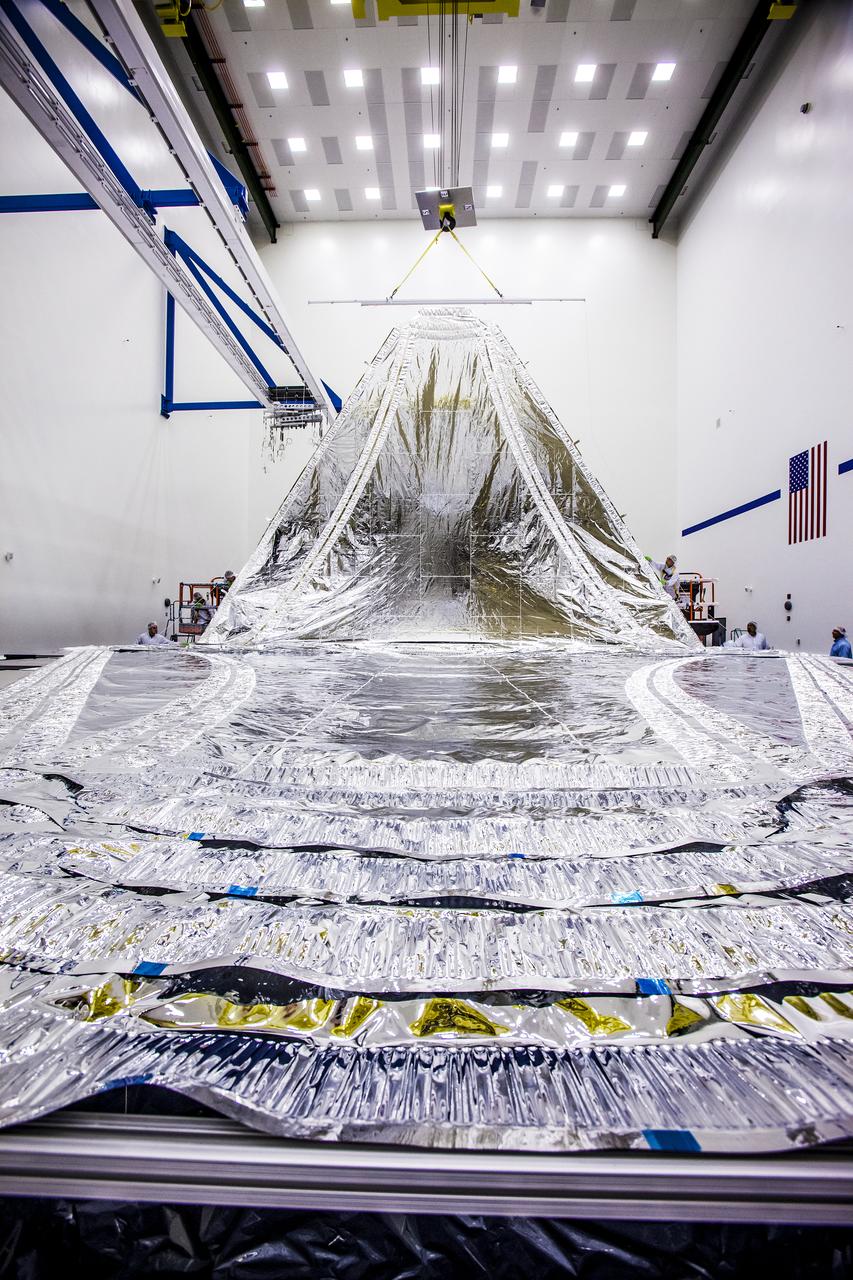
This shiny silver "waterfall" is actually the five layers of the full-scale engineering model of NASA's James Webb Space Telescope sunshield being laid out by technicians at the Northrop Grumman Aerospace Systems Space Park facility in Redondo Beach, Calif. who are conducting endurance tests on them. For more information, visit: jwst.nasa.gov Credit: Northrop Grumman <b><a href="http://www.nasa.gov/audience/formedia/features/MP_Photo_Guidelines.html" rel="nofollow">NASA image use policy.</a></b> <b><a href="http://www.nasa.gov/centers/goddard/home/index.html" rel="nofollow">NASA Goddard Space Flight Center</a></b> enables NASA’s mission through four scientific endeavors: Earth Science, Heliophysics, Solar System Exploration, and Astrophysics. Goddard plays a leading role in NASA’s accomplishments by contributing compelling scientific knowledge to advance the Agency’s mission. <b>Follow us on <a href="http://twitter.com/NASA_GoddardPix" rel="nofollow">Twitter</a></b> <b>Like us on <a href="http://www.facebook.com/pages/Greenbelt-MD/NASA-Goddard/395013845897?ref=tsd" rel="nofollow">Facebook</a></b> <b>Find us on <a href="http://instagram.com/nasagoddard?vm=grid" rel="nofollow">Instagram</a></b>
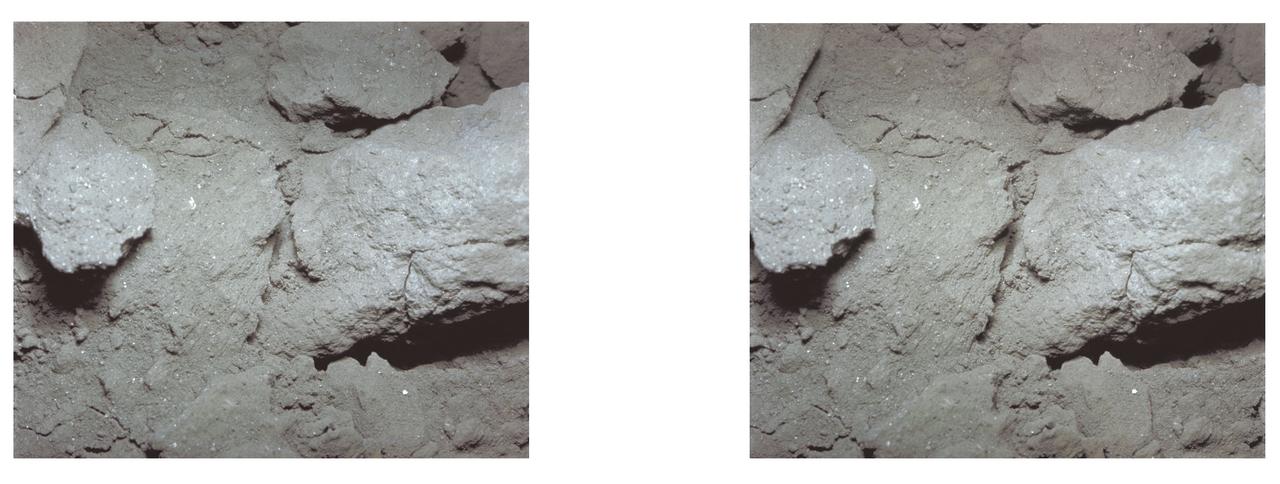
AS11-45-6706 (20 July 1969) --- An Apollo 11 stereo view showing a clump of lunar surface powder, with various small pieces of different color. Many small, shiny spherical particles can be seen. The picture is three inches across. The exposure was made by the Apollo 11 35mm stereo close-up camera. The camera was specially developed to get the highest possible resolution of a small area. A three-inch square area is photographed with a flash illumination and at a fixed distance. The camera is mounted on a walking stick, and the astronauts use it by holding it up against the object to be photographed and pulling the trigger. The pictures are in color and give a stereo view, enabling the fine detail to be seen very clearly. The project is under the direction of Professor T. Gold of Cornell University and Mr. F. Pearce of NASA. The camera was designed and built by Eastman Kodak. Professor E. Purcell of Harvard University and Dr. E. Land of the Polaroid Corporation have contributed to the project. The pictures brought back from the moon by the Apollo 11 crew are of excellent quality and allow fine detail of the undisturbed lunar surface to be seen. Scientists hope to be able to deduce from them some of the processes that have taken place that have shaped and modified the surface.
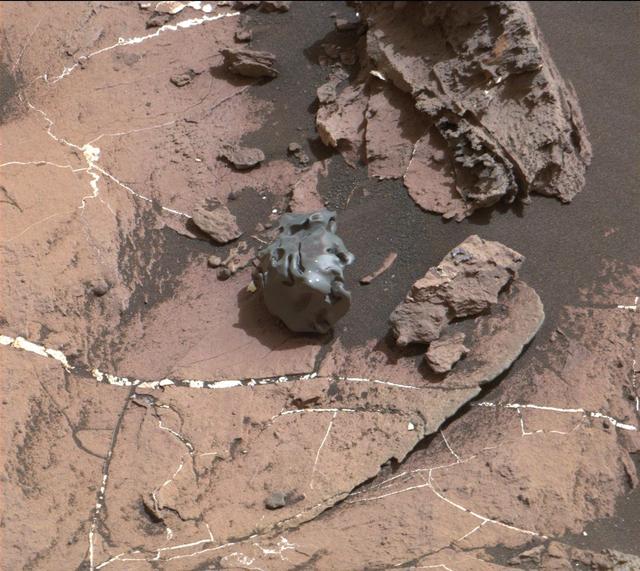
The dark, smooth-surfaced object at the center of this Oct. 30, 2016, image from the Mast Camera (Mastcam) on NASA's Curiosity Mars rover was examined with laser pulses and confirmed to be an iron-nickel meteorite. The grid of shiny points visible on the object resulted from that laser zapping by Curiosity's Chemistry and Camera (ChemCam) instrument. The meteorite is about the size of a golf ball. It is informally named "Egg Rock," for a site in Maine. Locations around Bar Harbor, Maine, are the naming theme for an area on Mars' Mount Sharp that Curiosity reached in October. Iron-nickel meteorites are a common class of space rocks found on Earth, and previous examples have been found on Mars, but Egg Rock is the first on Mars to be examined with a laser-firing spectrometer. The scene is presented with a color adjustment that approximates white balancing, to resemble how the rocks and sand would appear under daytime lighting conditions on Earth. Figure 1 includes a scale bar of 5 centimeters (about 2 inches). http://photojournal.jpl.nasa.gov/catalog/PIA21134
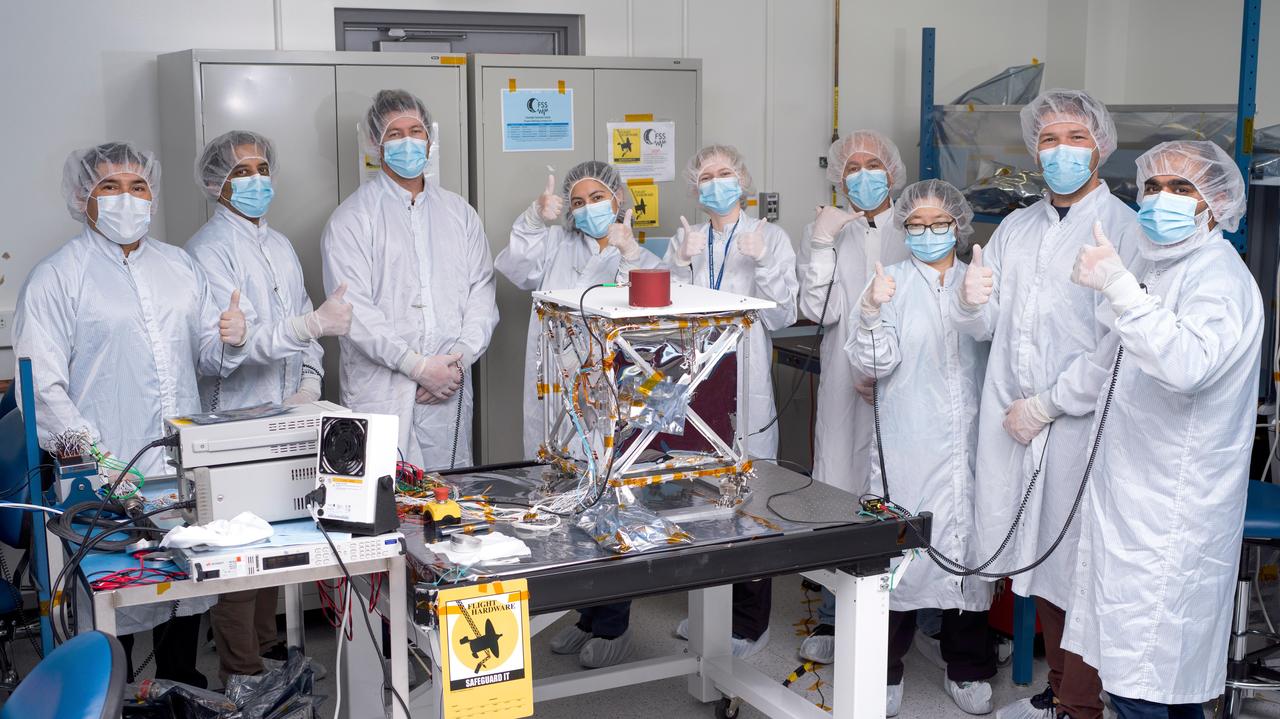
In a clean room at NASA's Jet Propulsion Laboratory in Southern California in March 2024, engineers and technicians pose with the agency's Farside Seismic Suite while the payload is readied for testing. The suite contains two instruments that will gather NASA's first seismic data from the Moon in nearly 50 years and take the first-ever seismic measurements from the Moon's far side. FSS will operate continuously for at least 4½ months, working through the long, cold lunar nights. The two seismometers are packaged together with a large battery, a computer, and electronics inside a cube structure that's surrounded by several layers of insulation (the shiny material at center) and suspended within a protective outer cube, which is, in turn, covered with an insulating blanket. In this photo, the blanket has not yet been attached. Members of the FSS integration team pictured are (from left) Salvador Ramirez, Asad Aboobaker, Nik Schwarz, Joanna Farias, Clara MacFarland, Frank Barone, Hsin-Yi Hao, Nicholas Roy-Steier, and Vik Singh. https://photojournal.jpl.nasa.gov/catalog/PIA26342
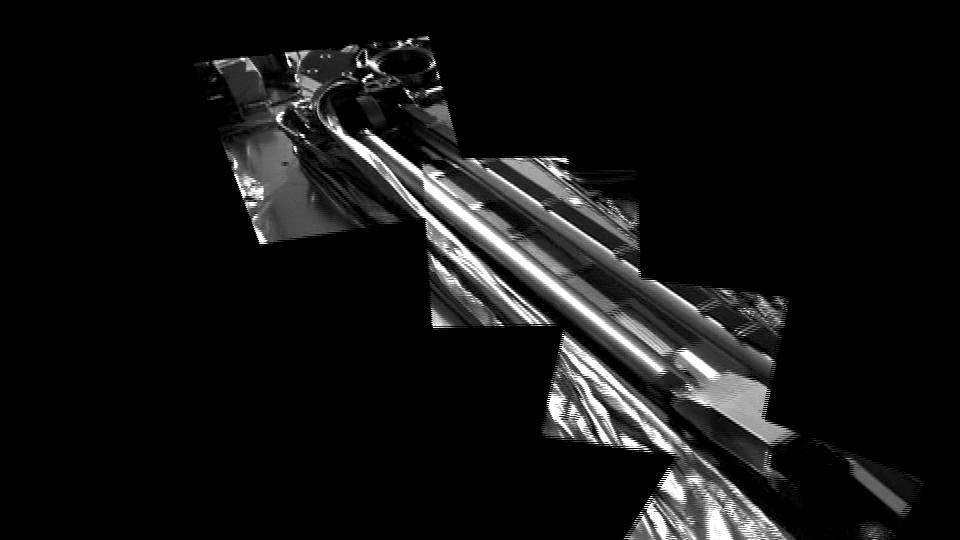
This frame a movie from NASA's Phoenix Mars Lander shows the spacecraft's robotic arm in its stowed configuration, with its biobarrier unpeeled. The arm is still folded up, with its "elbow" shown at upper left and its scoop at bottom right. The biobarrier is the shiny film seen to the left of the arm in this view. The barrier is an extra precaution to protect Mars from contamination with any bacteria from Earth. While the whole spacecraft was decontaminated through cleaning, filters and heat, the robotic arm was given additional protection because it is the only spacecraft part that will directly touch the ice below the surface of Mars. Before the arm was heated, it was sealed in the biobarrier, which is made of a trademarked film called Tedlar that holds up to baking like a turkey-basting bag. This ensures that any new bacterial spores that might have come about during the final steps before launch, and during the journey to Mars, will not contact the robotic arm. After Phoenix landed, springs were used to pop back the barrier, giving it room to deploy. The arm is scheduled to begin to unlatch on the second Martian day of the mission, or Sol 3 (May 28, 2008). This image was taken on Sol 1 (May 26, 2008) by the spacecraft's Surface Stereo Imager. http://photojournal.jpl.nasa.gov/catalog/PIA10708
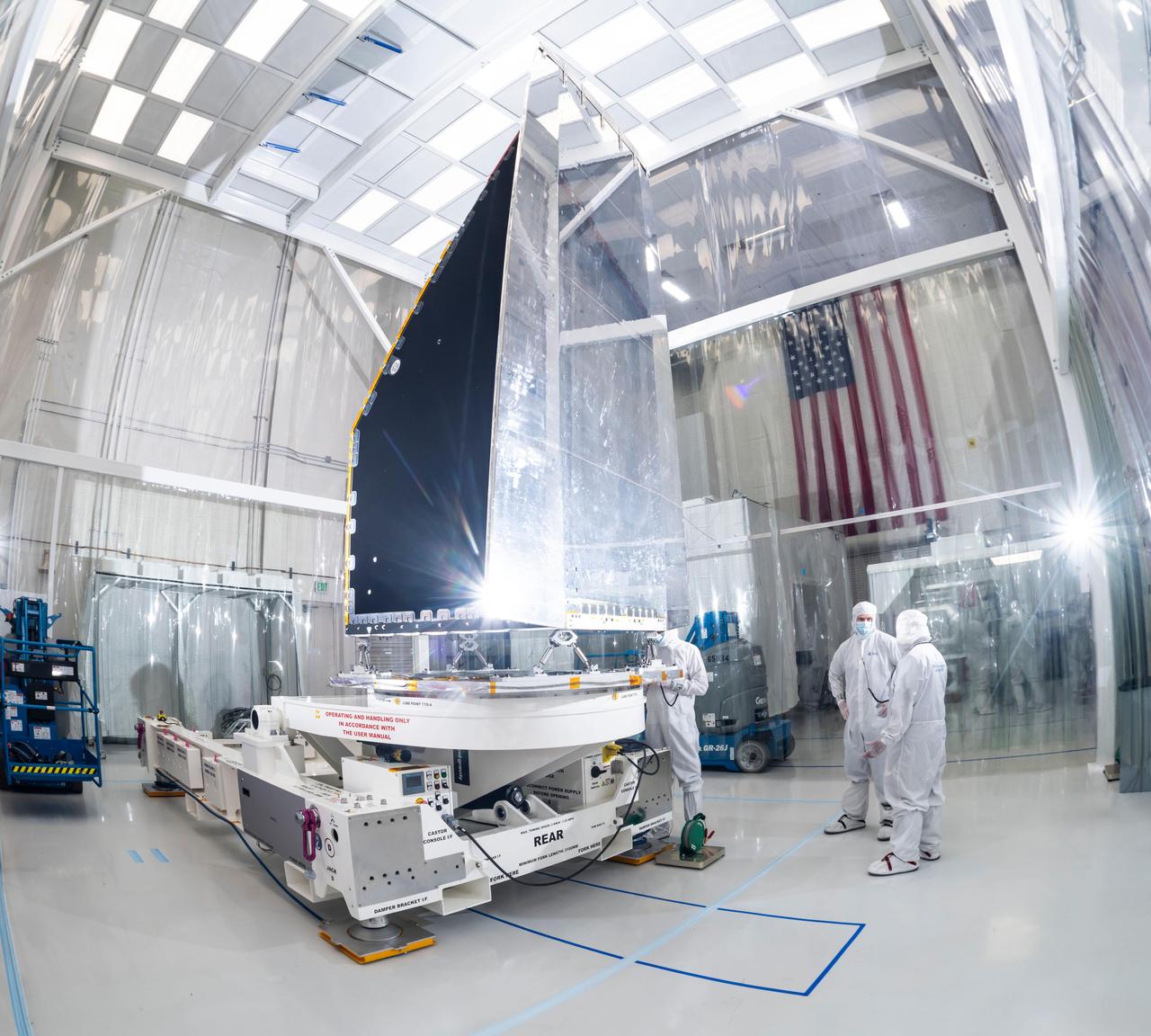
After arriving at the Space Dynamics Laboratory (SDL) in Logan, Utah, from NASA's Jet Propulsion Laboratory in Southern California in May 2025, the instrument enclosure for the agency's Near-Earth Object (NEO) Surveyor mission was inspected prior to thermal vacuum testing. Shown here, the enclosure stands vertically atop an articulating assembly dolly. The shiny and black surfaces of the enclosure optimize the reflection and radiation properties of the structure. The telescope, which has an aperture of nearly 20 inches (50 centimeters), features detectors sensitive to two infrared wavelengths in which near-Earth objects re-radiate solar heat. The instrument enclosure is designed to ensure heat produced by the telescope during operations doesn't interfere with its observations. As NASA's first space-based detection mission specifically designed for planetary defense, NEO Surveyor will seek out, measure, and characterize the hardest-to-find asteroids and comets that might pose a hazard to Earth. While many near-Earth objects don't reflect much visible light, they glow brightly in infrared light due to heating by the Sun. Targeting launch in late 2027, the NEO Surveyor mission is led by Professor Amy Mainzer at UCLA for NASA's Planetary Defense Coordination Office and is being managed by JPL for the Planetary Missions Program Office at NASA's Marshall Space Flight Center in Huntsville, Alabama. BAE Systems, SDL, and are among the companies that were contracted to build the spacecraft and its instrumentation. The Laboratory for Atmospheric and Space Physics at the University of Colorado Boulder will support operations, and IPAC at Caltech in Pasadena, California, is responsible for producing some of the mission's data products. Caltech manages JPL for NASA. https://photojournal.jpl.nasa.gov/catalog/PIA26597
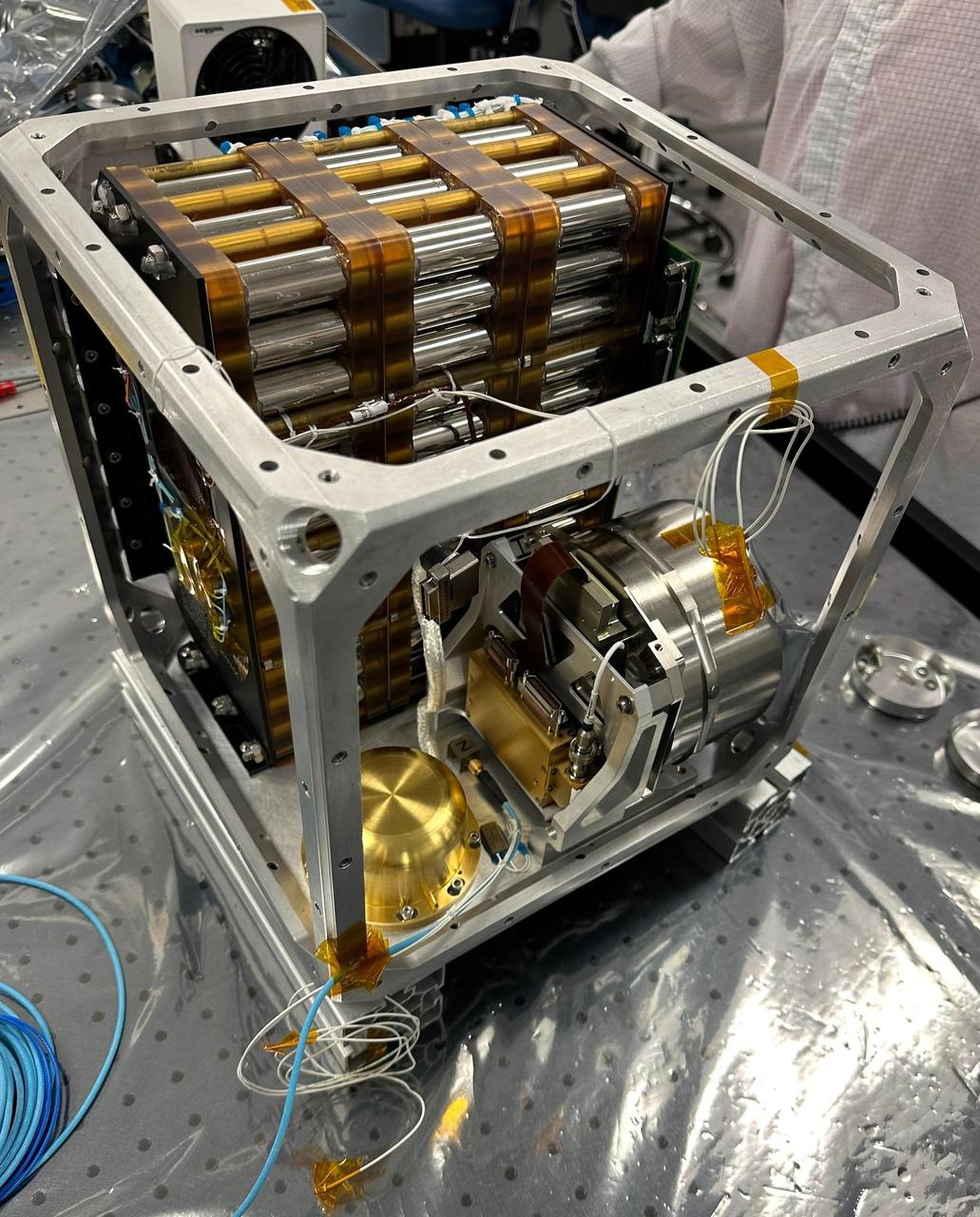
NASA's Farside Seismic Suite (FSS) is assembled in a clean room at the agency's Jet Propulsion Laboratory in Southern California in November 2023. Two sensitive seismometers packaged in the suite's cube-within-a-cube structure will gather NASA's first seismic data from the Moon in nearly 50 years and take the first-ever seismic measurements from the Moon's far side. FSS will operate continuously for at least 4½ months, working through the long, cold lunar nights. Seen here is the inner cube structure, with the suite's large battery at rear. The gold, puck-shaped device at left is the Short Period sensor, or SP, which measures motion in three directions using sensors etched into a trio of square silicon chips, each about 1 inch (25 millimeters) wide. At right, within the silver cylindrical enclosure, is the Very Broadband seismometer, or VBB, the most sensitive seismometer ever built for use in space exploration. It can detect ground motions smaller than the size of a single hydrogen atom, measuring up-and-down movement using a pendulum held in place by a spring. Constructed as a backup instrument (a "flight spare") for NASA's InSight Mars lander by the French space agency, CNES (Centre National d'Études Spatiales), the VBB was slightly modified and packaged in a new enclosure for lunar use. The suite's computer and electronics are packed alongside the battery and seismometers. After being encased in insulation, this inner cube was suspended within a protective outer cube, which was in turn covered with a shiny insulating blanket. https://photojournal.jpl.nasa.gov/catalog/PIA26300
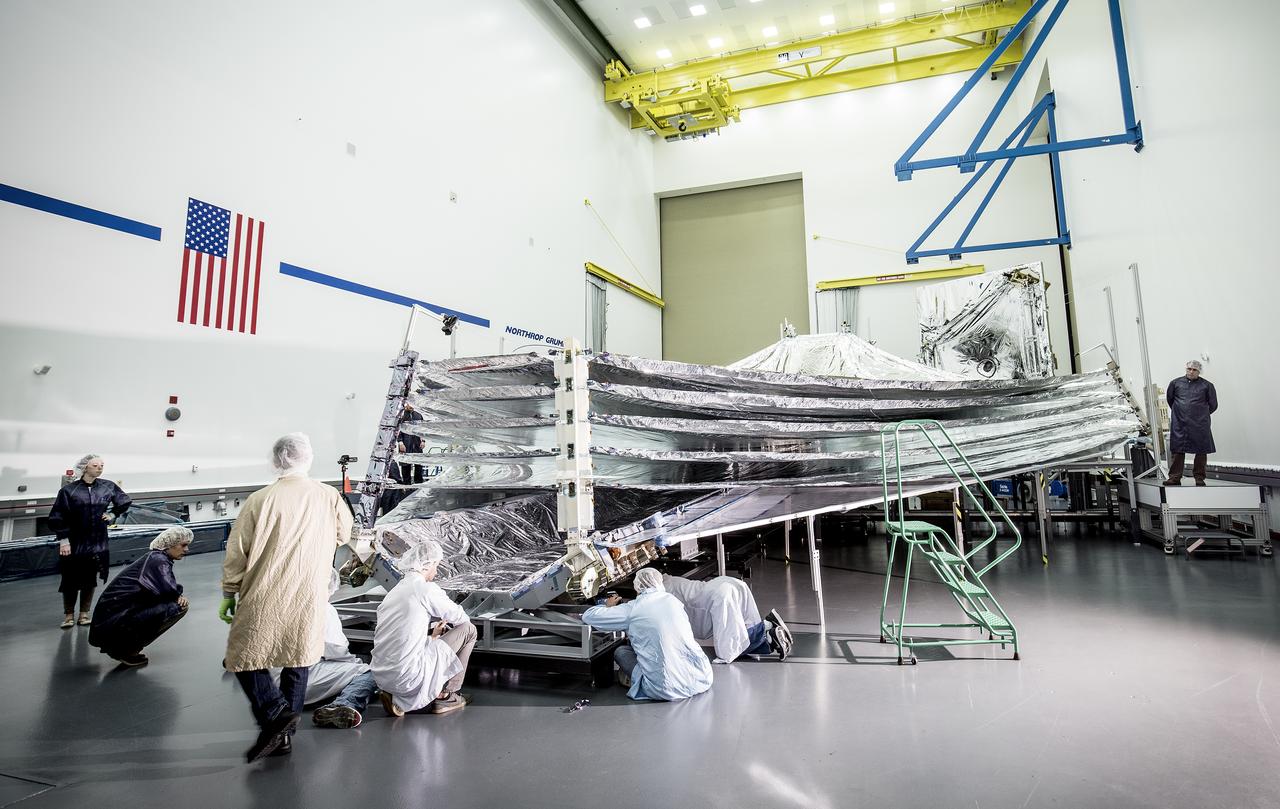
The sunshield on NASA's James Webb Space Telescope is the largest part of the observatory—five layers of thin, silvery membrane that must unfurl reliably in space. The precision in which the tennis-court sized sunshield has to open must be no more than a few centimeters different from its planned position. In this photo, engineers and scientists examine the sunshield layers on this full-sized test unit. Because there's a layer of the shiny silver material on the base under the five layers of the sunshield, it appears as if the sunshield has a mouth that is "open wide" while engineers take a look. The photo was taken in a clean room at Northrop Grumman Corporation, Redondo Beach, California. The sunshield separates the observatory into a warm sun-facing side and a cold side where the sunshine is blocked from interfering with the sensitive infrared instruments. The infrared instruments need to be kept very cold (under 50 K or -370 degrees Fahrenheit) to operate. The sunshield protects these sensitive instruments with an effective sun protection factor, or SPF, of 1,000,000. Sunscreen generally has an SPF of 8 to 50. In addition to providing a cold environment, the sunshield provides a thermally stable environment. This stability is essential to maintaining proper alignment of the primary mirror segments as the telescope changes its orientation to the sun. Earlier this year, the first flight layer of the sunshield was delivered to Northrop Grumman. Northrop Grumman is designing the Webb Telescope’s sunshield for NASA’s Goddard Space Flight Center, in Greenbelt, Maryland. Innovative sunshield membranes are being designed and manufactured by NeXolve Corporation of Huntsville, Alabama. The James Webb Space Telescope is the successor to NASA's Hubble Space Telescope. It will be the most powerful space telescope ever built. Webb is an international project led by NASA with its partners, the European Space Agency and the Canadian Space Agency. For more information about the Webb telescope, visit: <a href="http://www.jwst.nasa.gov" rel="nofollow">www.jwst.nasa.gov</a> or <a href="http://www.nasa.gov/webb" rel="nofollow">www.nasa.gov/webb</a> For more information on the Webb Sunshield, visit: <a href="http://jwst.nasa.gov/sunshield.html" rel="nofollow">jwst.nasa.gov/sunshield.html</a> Photo credit: Alex Evers/Northrop Grumman Corporation <b><a href="http://www.nasa.gov/audience/formedia/features/MP_Photo_Guidelines.html" rel="nofollow">NASA image use policy.</a></b> <b><a href="http://www.nasa.gov/centers/goddard/home/index.html" rel="nofollow">NASA Goddard Space Flight Center</a></b> enables NASA’s mission through four scientific endeavors: Earth Science, Heliophysics, Solar System Exploration, and Astrophysics. Goddard plays a leading role in NASA’s accomplishments by contributing compelling scientific knowledge to advance the Agency’s mission. <b>Follow us on <a href="http://twitter.com/NASAGoddardPix" rel="nofollow">Twitter</a></b> <b>Like us on <a href="http://www.facebook.com/pages/Greenbelt-MD/NASA-Goddard/395013845897?ref=tsd" rel="nofollow">Facebook</a></b> <b>Find us on <a href="http://instagrid.me/nasagoddard/?vm=grid" rel="nofollow">Instagram</a></b>
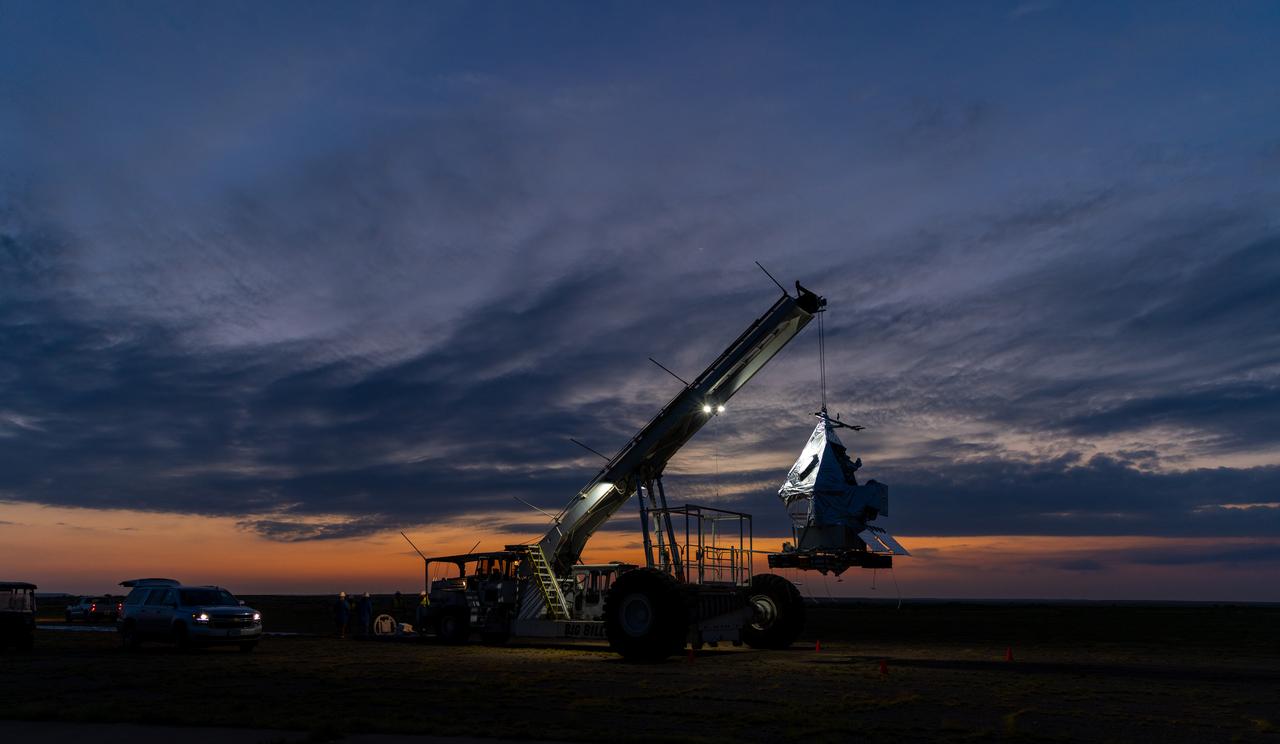
NASA Goddard astrophysicist Kyle Helson looks at EXCITE (EXoplanet Climate Infrared TElescope) as it dangles from the ceiling of a hangar at NASA’s Columbia Scientific Balloon Facility in Fort Sumner, New Mexico.
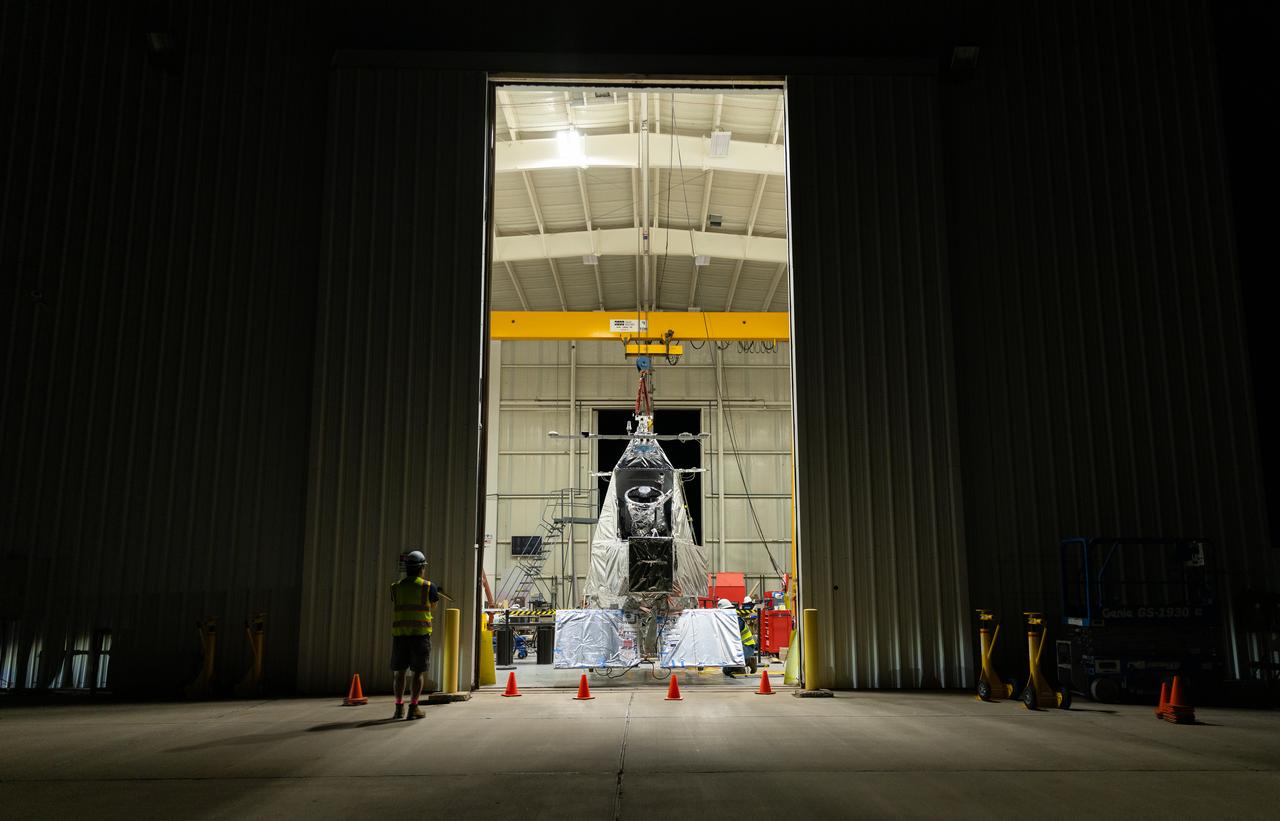
NASA Goddard astrophysicist Kyle Helson looks at EXCITE (EXoplanet Climate Infrared TElescope) as it dangles from the ceiling of a hangar at NASA’s Columbia Scientific Balloon Facility in Fort Sumner, New Mexico.

This image shows the curvature of the Earth from 130,000 feet. It was taken remotely by a camera on EXCITE. The red blob at the top of the frame is the parachute.

An engineering technician works in the Experimental Fabrication Branch at NASA’s Armstrong Flight Research Center in Edwards, California, on Thursday, March 14, 2023. The branch transforms engineering concepts into hardware for research aircraft and technology development, supporting advances in aviation safety, efficiency, and sustainability.