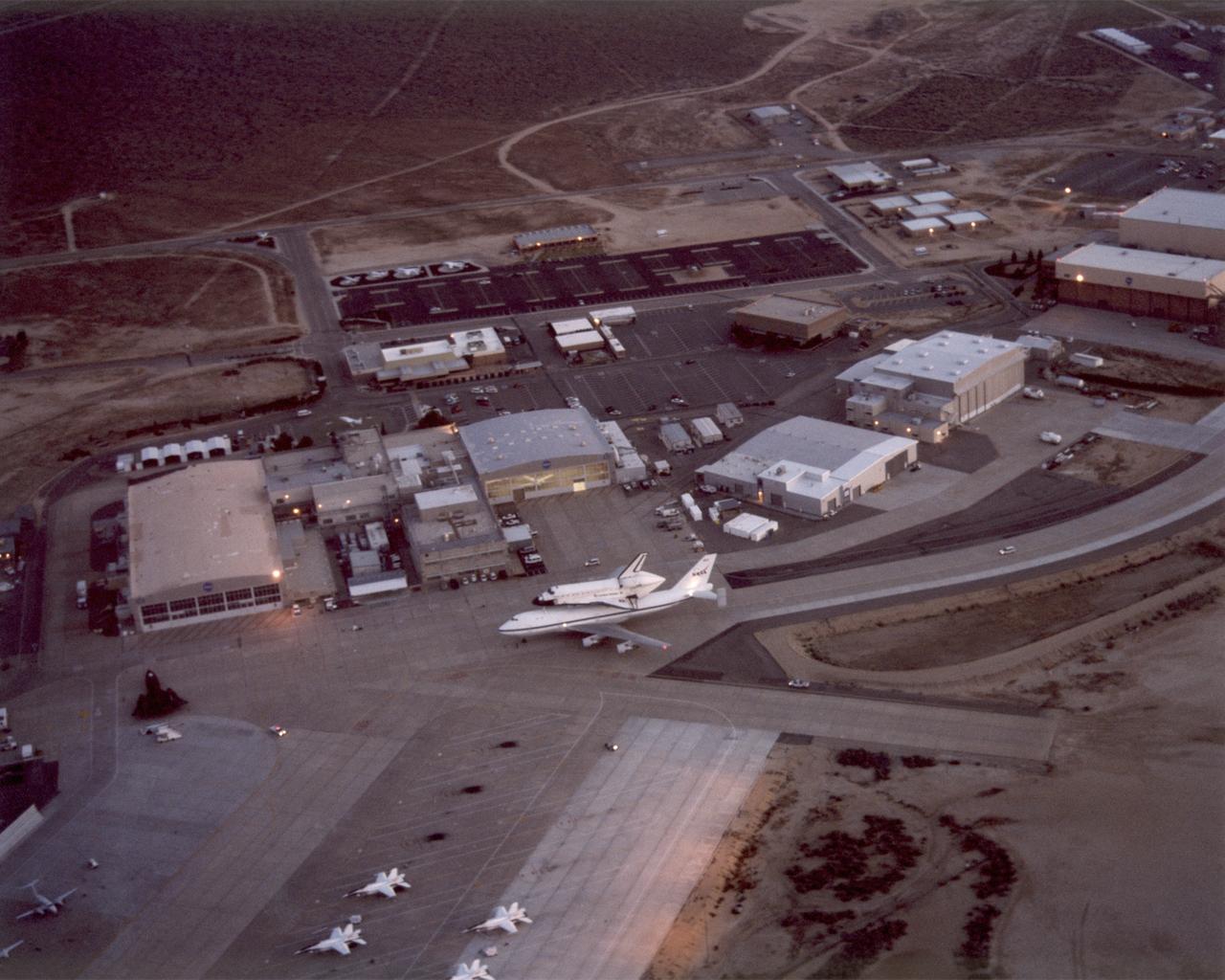
Aerial photo of NASA Dryden Flight Research Center with the Endeavour Space Shuttle and 747 Shuttle Carrier Aircraft taxiing on ramp.
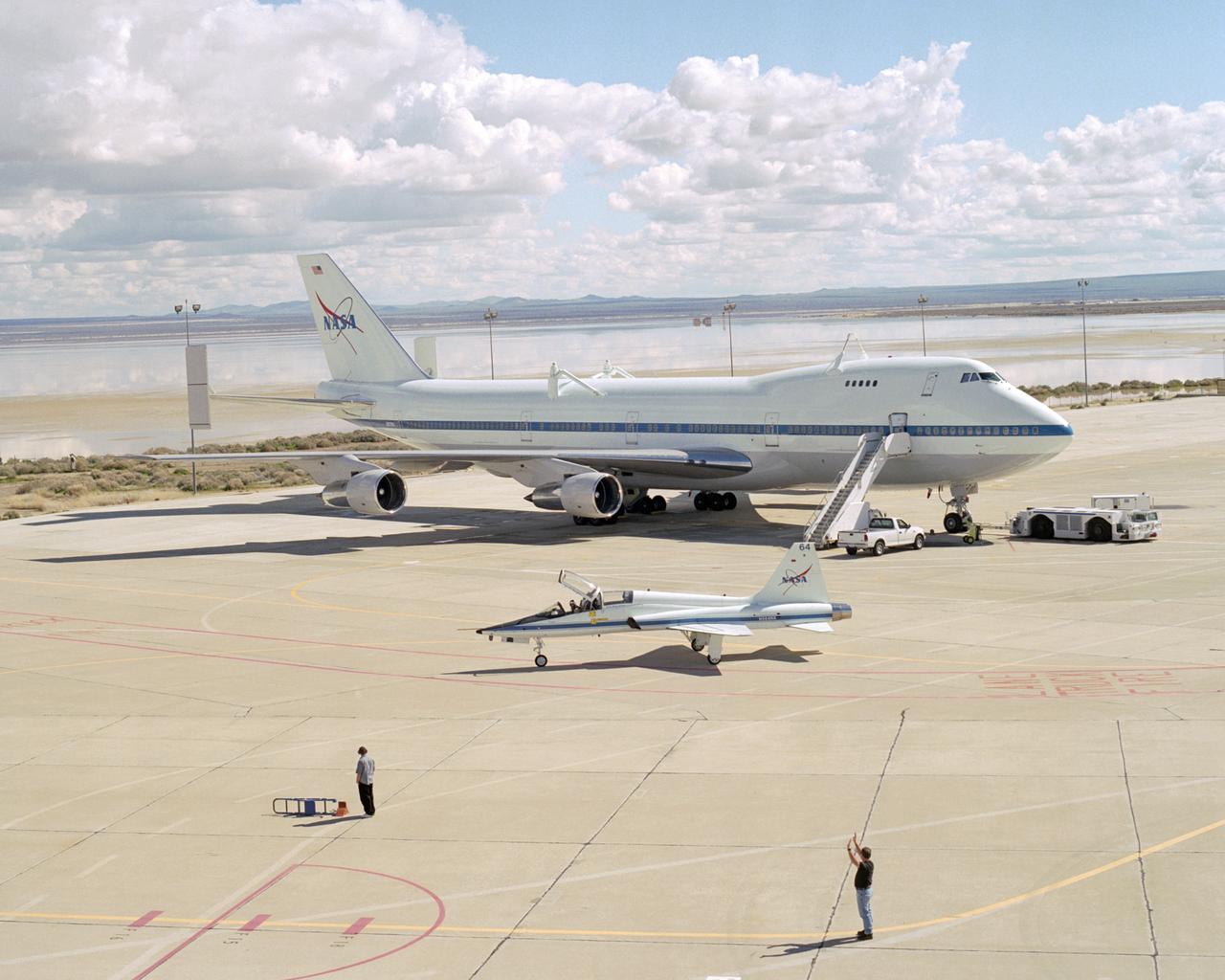
Puffy white clouds and a flooded lakebed form a backdrop as a T-38 support aircraft taxies across the ramp in front of NASA's Boeing 747 Shuttle Carrier Aircraft.
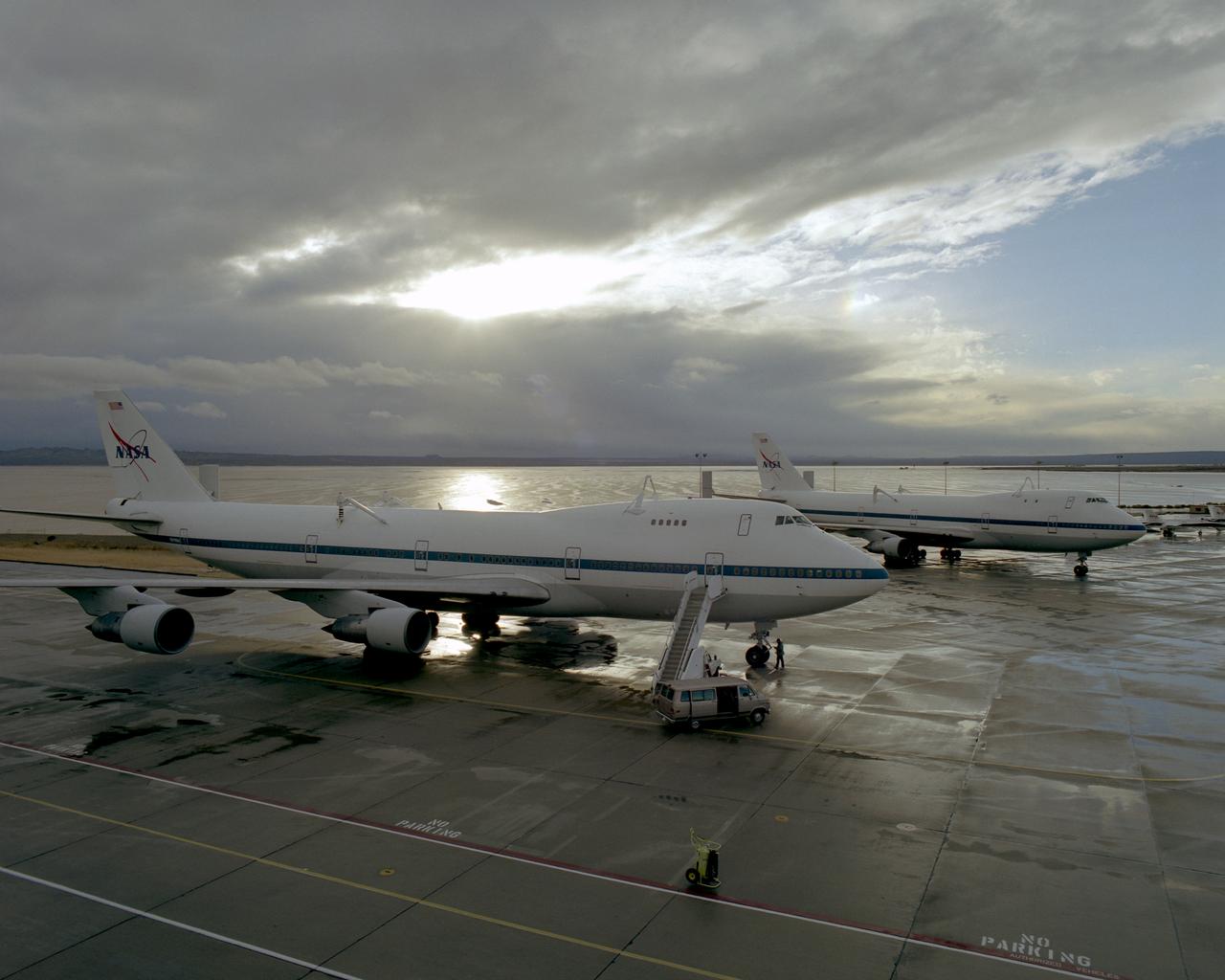
The sun begins to break through the clouds over NASA's two 747 Shuttle Carrier Aircraft on the NASA Dryden ramp after a rain shower in February 2001.
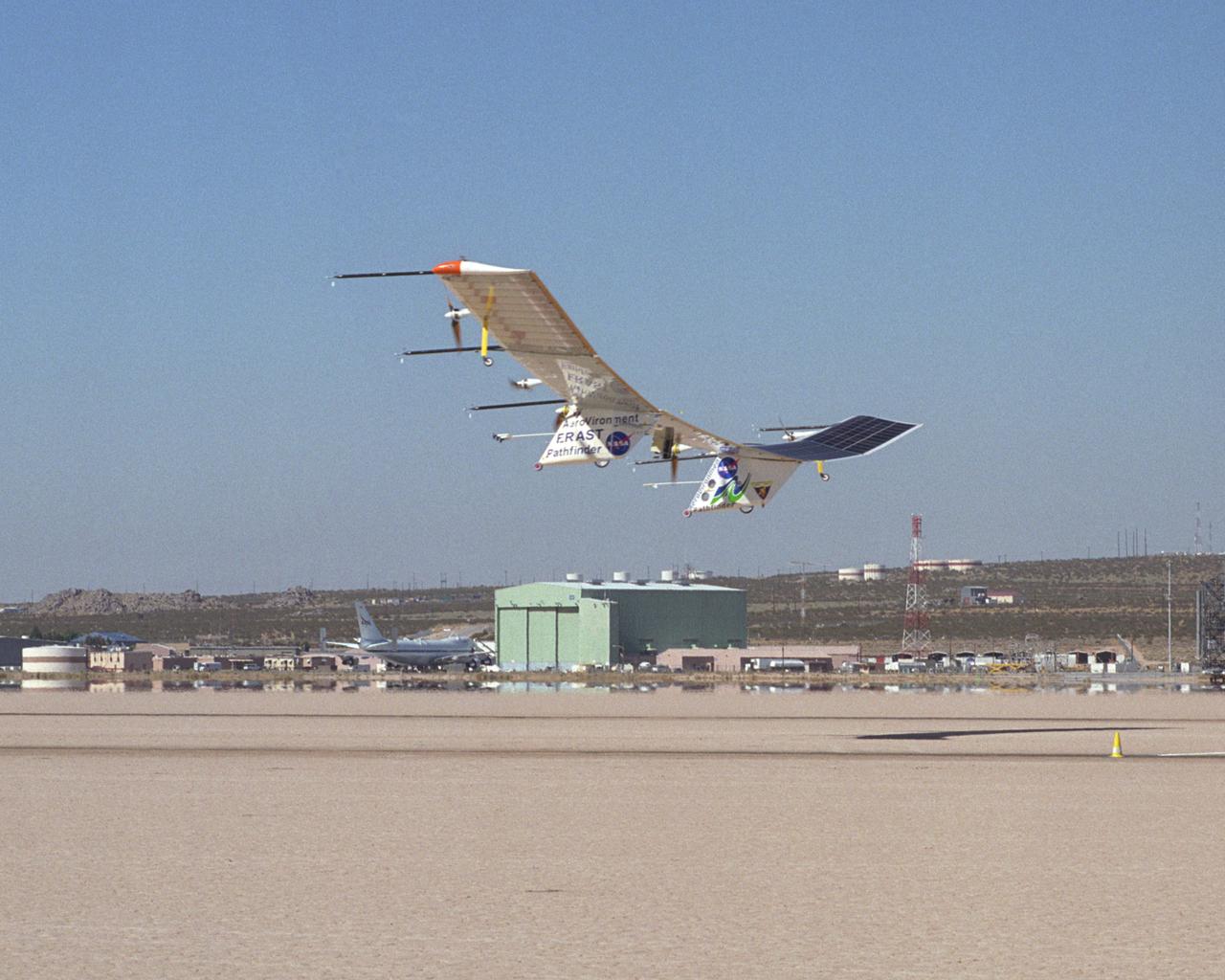
The Pathfinder-Plus solar aircraft flies past NASA Dryden's space shuttle hangar and shuttle carrier aircraft as it descends for landing on Rogers Dry Lake.
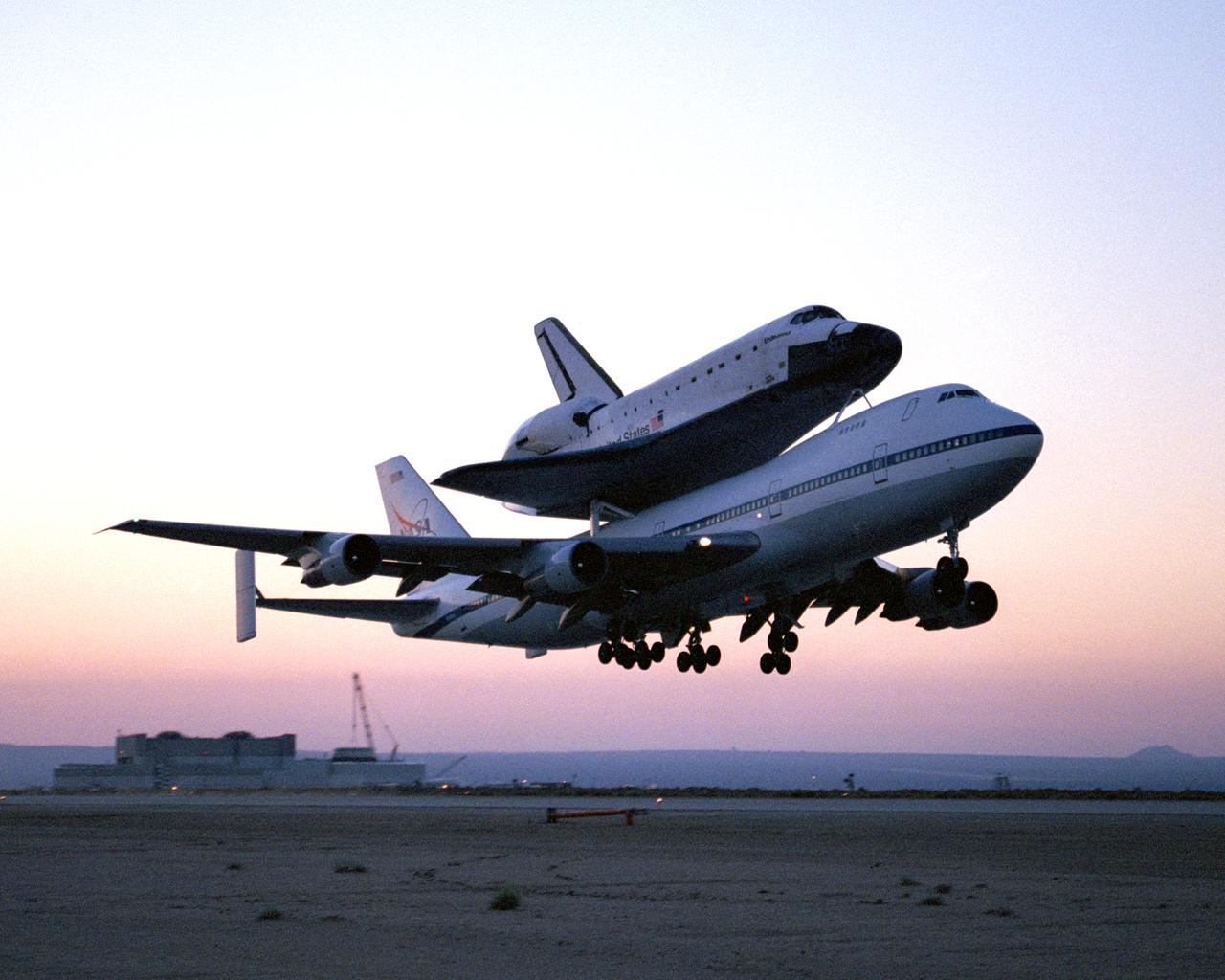
The Space Shuttle Endeavour, mounted securely atop one of NASA's modified Boeing 747 Shuttle Carrier Aircraft, left NASA's Dryden Flight Research Center at Edwards Air Force Base in Southern California at sunrise on Friday, June 28.

The NASA Dryden 747 Shuttle Carrier Aircraft crew poses in an engine inlet; Standing L to R - aircraft mechanic John Goleno and SCA Team Leader Pete Seidl; Kneeling L to R - aircraft mechanics Todd Weston and Arvid Knutson, and avionics technician Jim Bedard NASA uses two modified Boeing 747 jetliners, originally manufactured for commercial use, as Space Shuttle Carrier Aircraft (SCA). One is a 747-100 model, while the other is designated a 747-100SR (short range). The two aircraft are identical in appearance and in their performance as Shuttle Carrier Aircraft. The 747 series of aircraft are four-engine intercontinental-range swept-wing "jumbo jets" that entered commercial service in 1969. The SCAs are used to ferry space shuttle orbiters from landing sites back to the launch complex at the Kennedy Space Center, and also to and from other locations too distant for the orbiters to be delivered by ground transportation. The orbiters are placed atop the SCAs by Mate-Demate Devices, large gantry-like structures which hoist the orbiters off the ground for post-flight servicing, and then mate them with the SCAs for ferry flights.
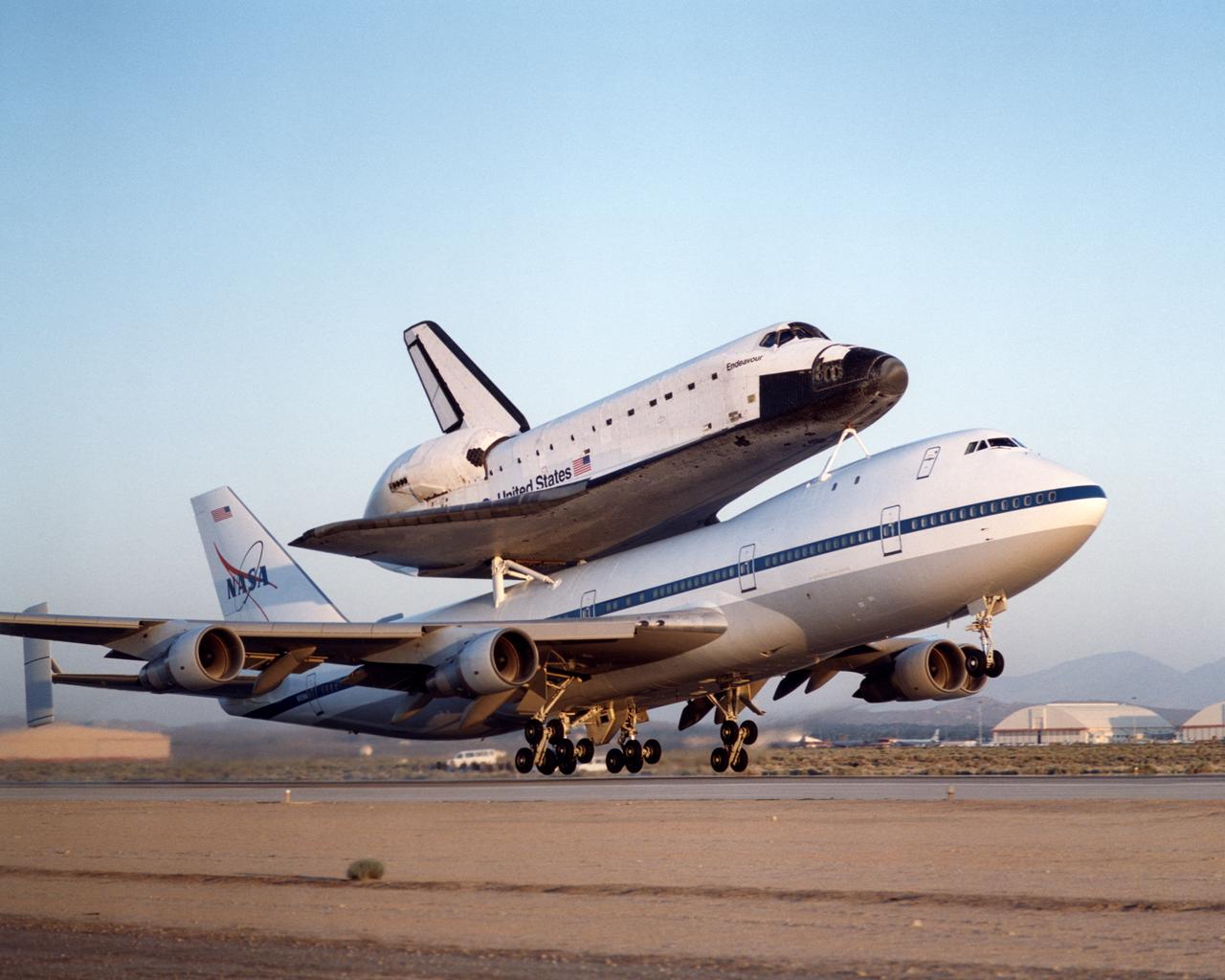
NASA's modified Boeing 747 Shuttle Carrier Aircraft with the Space Shuttle Endeavour on top lifts off from Edwards Air Force Base to begin its ferry flight back to the Kennedy Space Center in Florida.
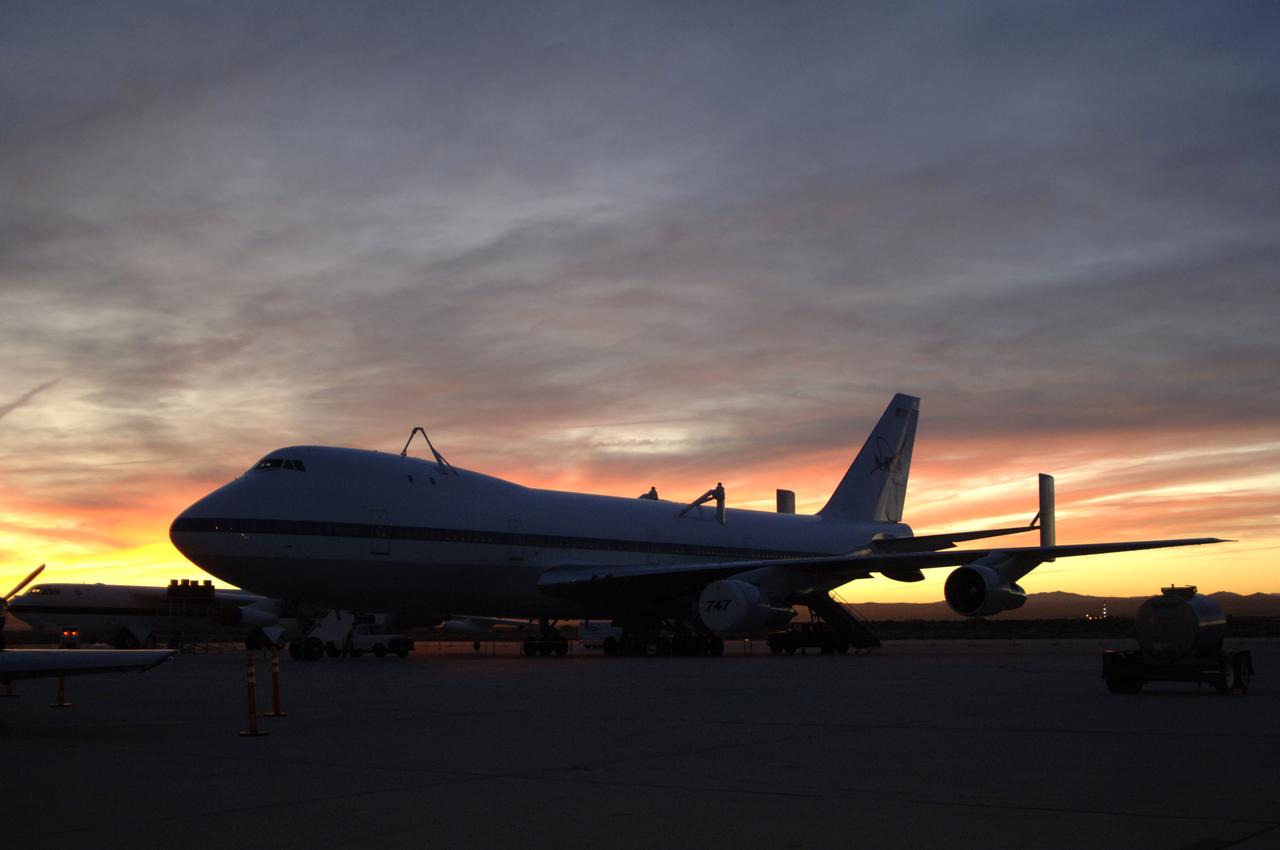
One of NASA's two modified Boeing 747 Shuttle Carrier Aircraft is silhouetted against the morning sky at sunrise on the ramp at Edwards Air Force Base.
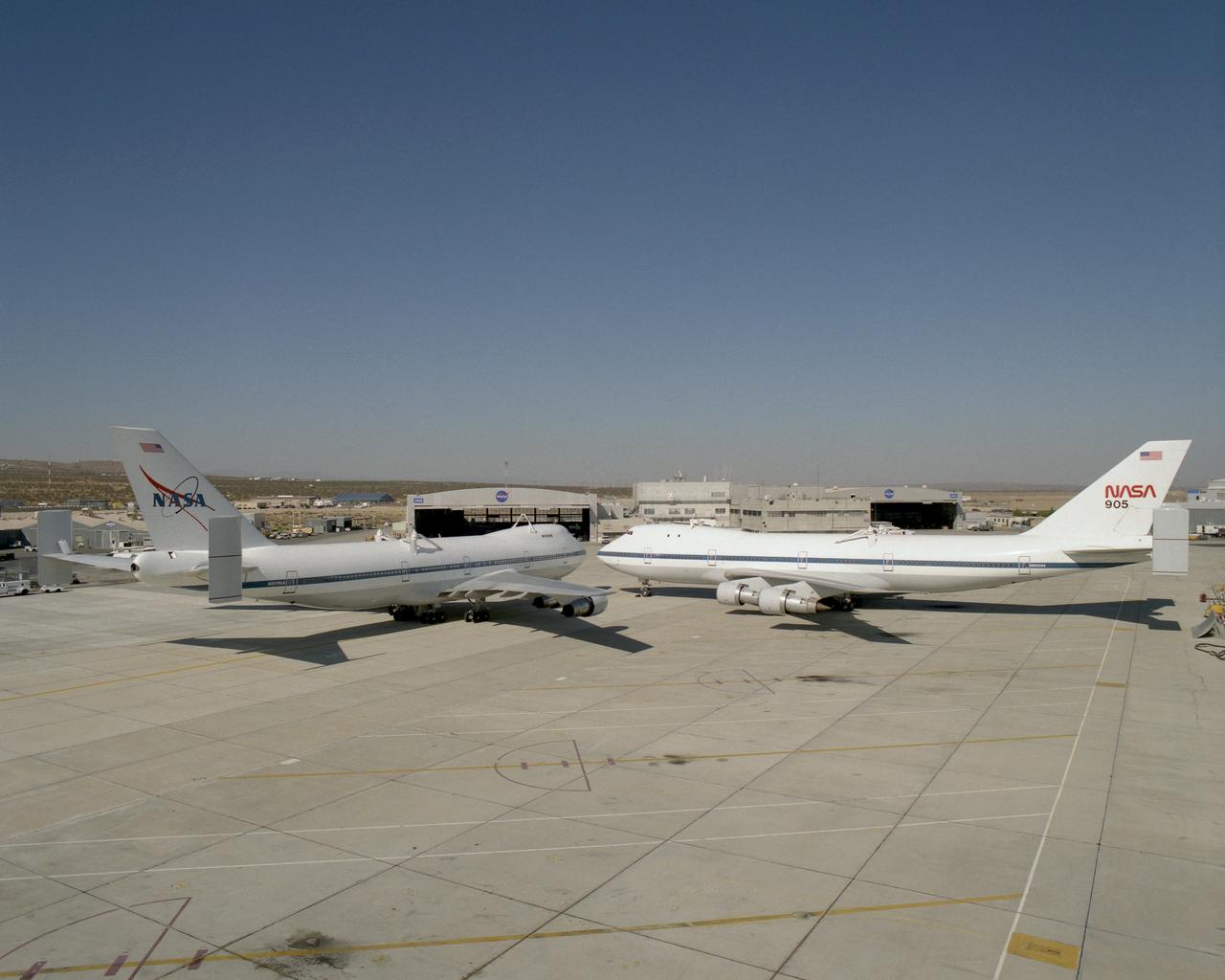
NASA's two modified Boeing 747 Shuttle Carrier Aircraft #911 (left) and #905 (right) were nose-to-nose on the ramp at NASA Dryden in this 1995 photo.
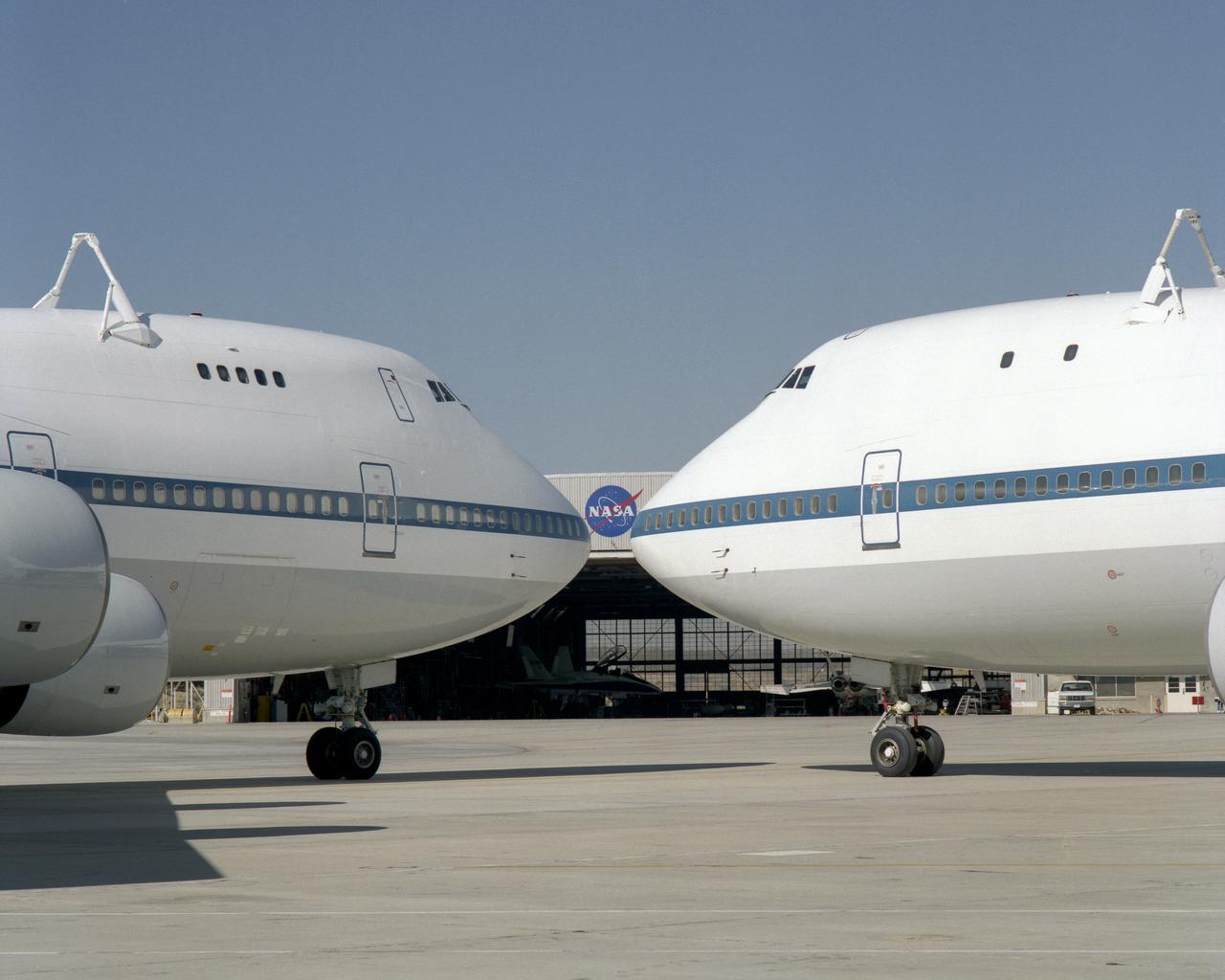
The NASA logo on a hangar is framed by the noses of NASA's two modified 747 Shuttle Carrier Aircraft on the ramp at NASA Dryden in this 1995 photo.
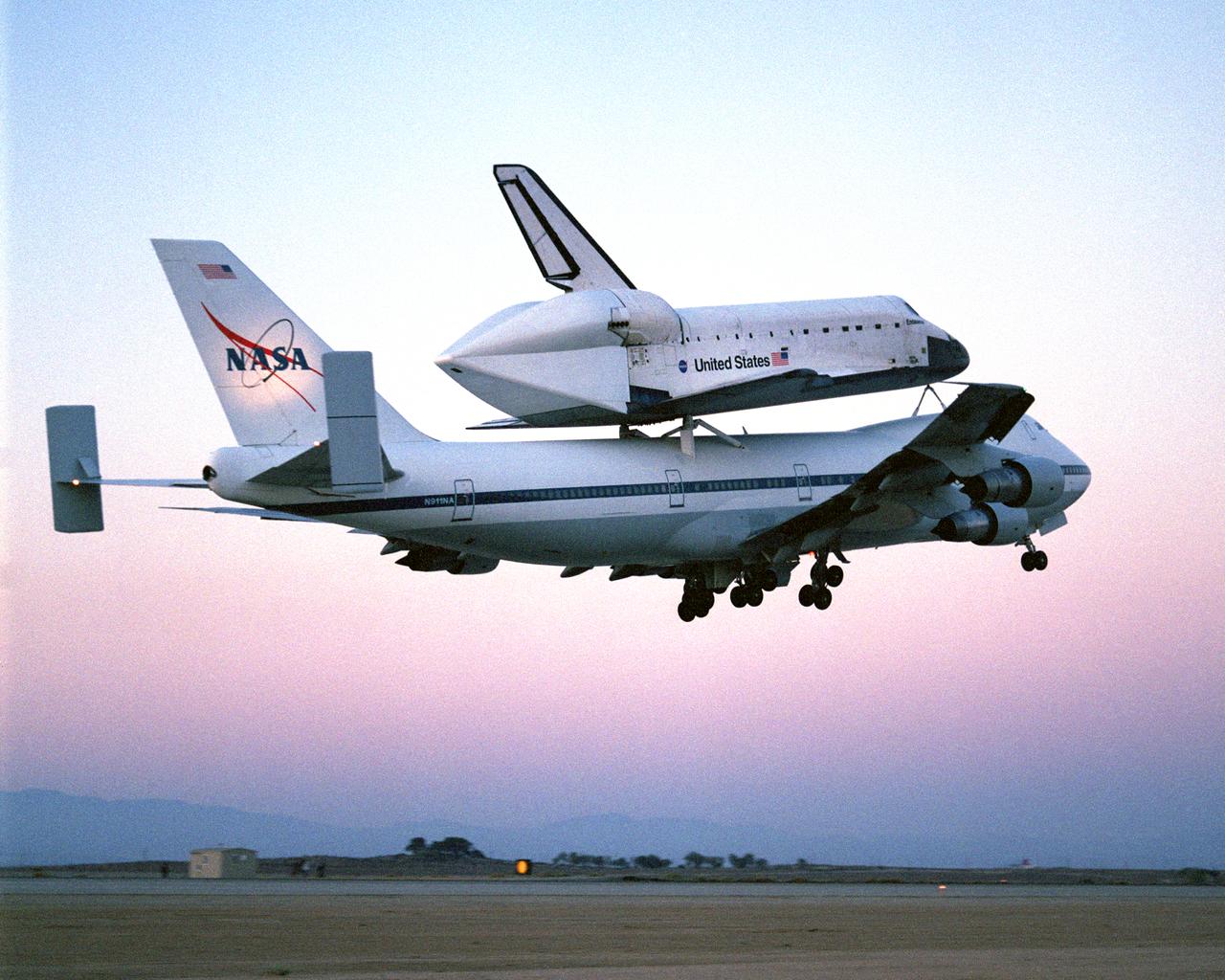
The Space Shuttle Endeavour, mounted securely atop one of NASA's modified Boeing 747 Shuttle Carrier Aircraft, left NASA's Dryden Flight Research Center at Edwards Air Force Base in Southern California at sunrise on Friday, June 28, nine days after concluding mission STS-111 to the International Space Station with a landing at Edwards.
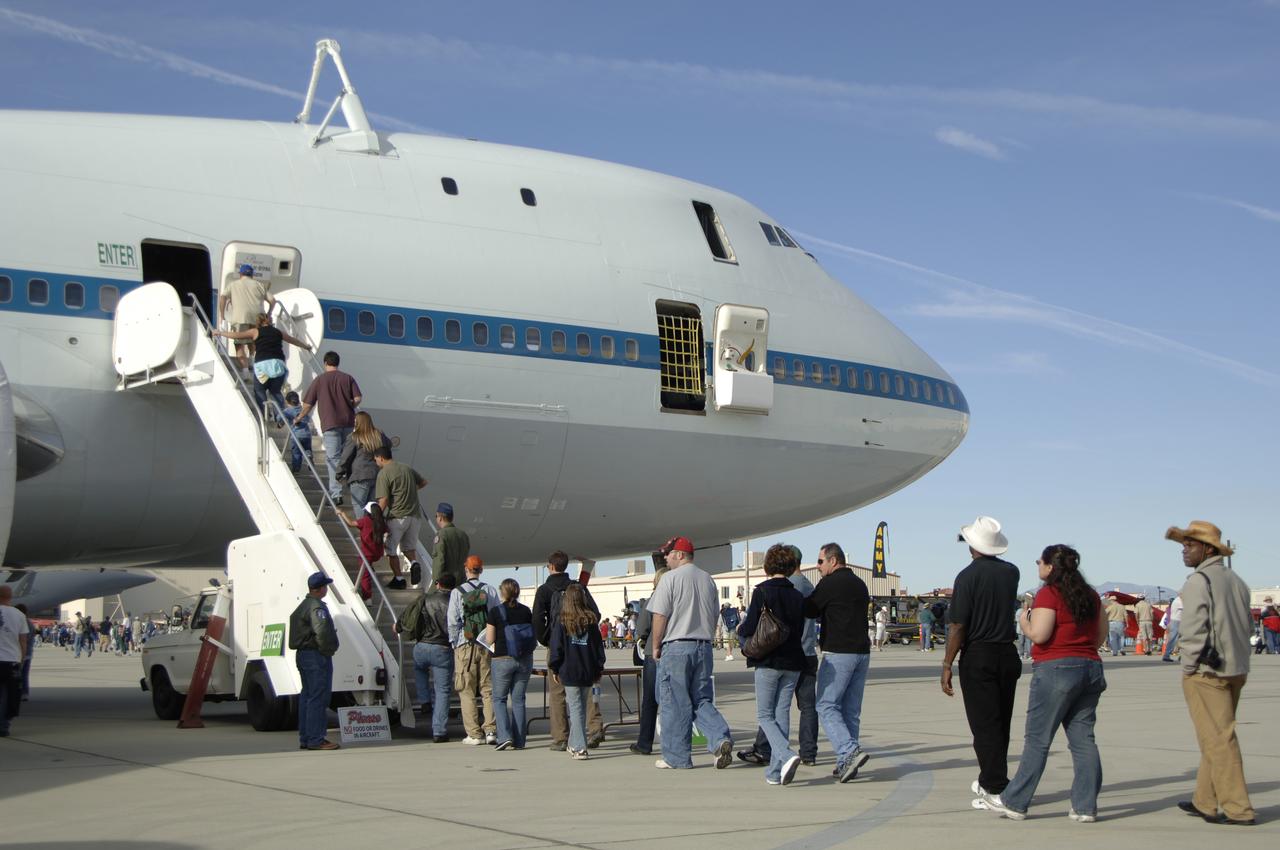
A brief tour through NASA's modified Boeing 747 Shuttle Carrier Aircraft was a popular attraction at the Edwards Air Force Base open house Oct. 28-29, 2006.
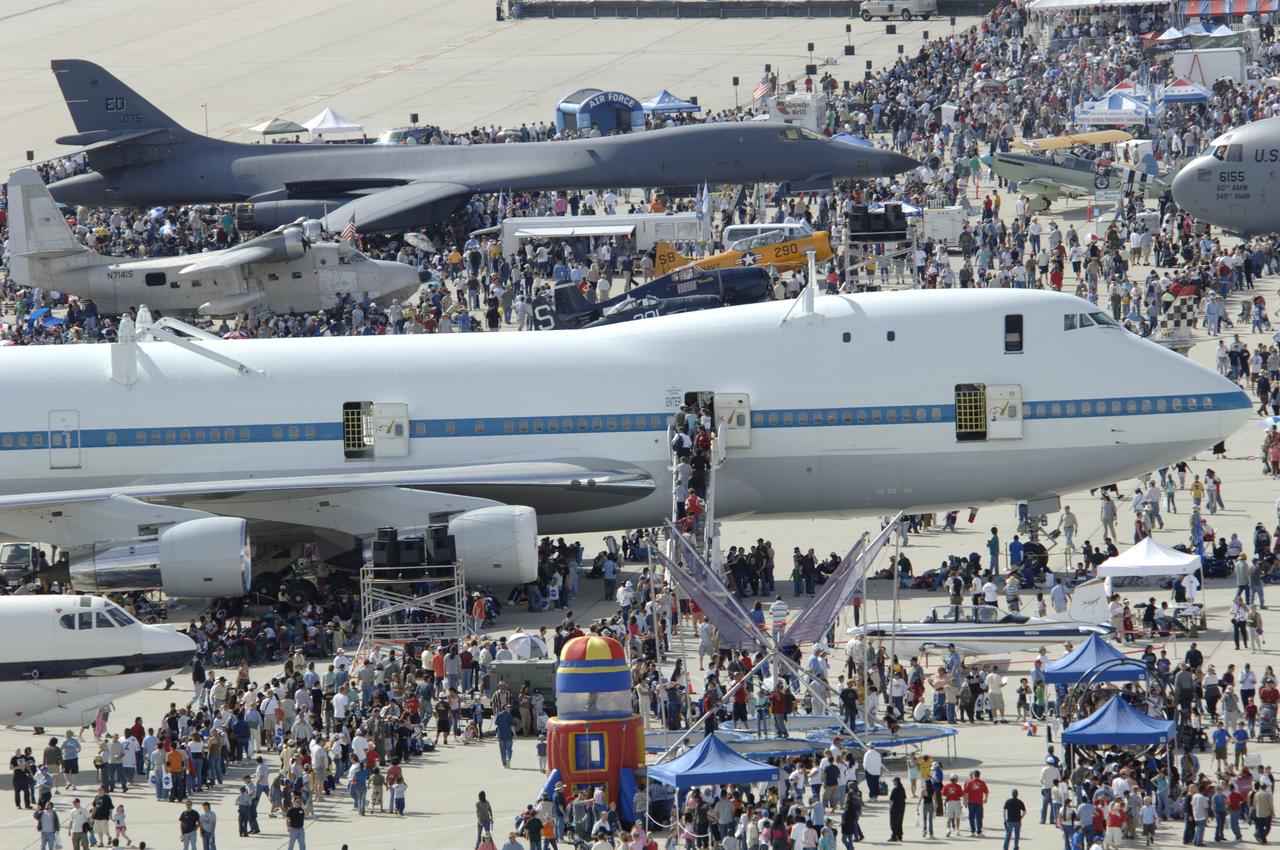
Crowds thronged around NASA's modified 747 Shuttle Carrier Aircraft and an Air Force B-1B Lancer at the Edwards Air Force Base open house Oct. 28-29, 2006.
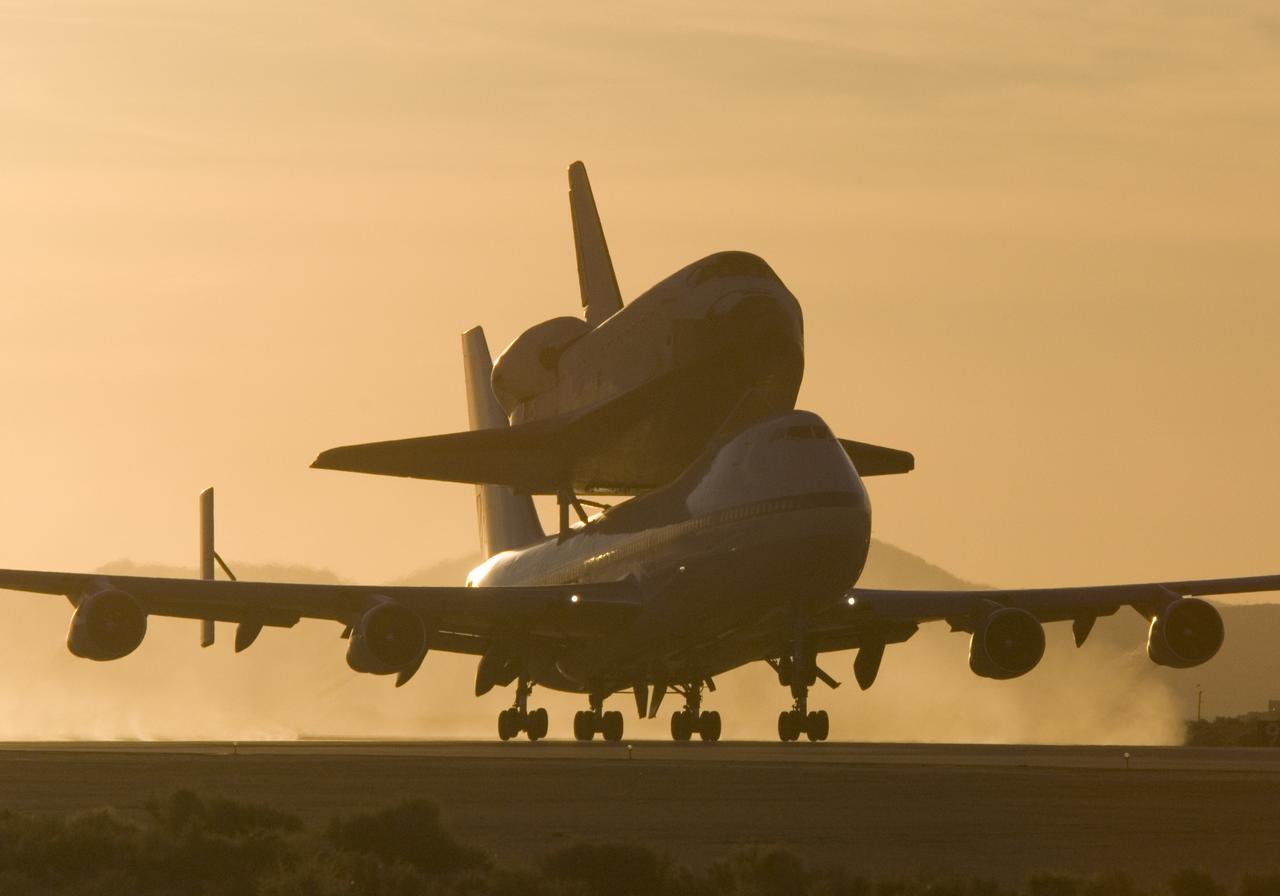
NASA's modified Boeing 747 Shuttle Carrier Aircraft with the Space Shuttle Atlantis on top lifts off from Edwards Air Force Base to begin its ferry flight back to the Kennedy Space Center in Florida. The cross-country journey will take approximately two days, with stops at several intermediate points for refueling.
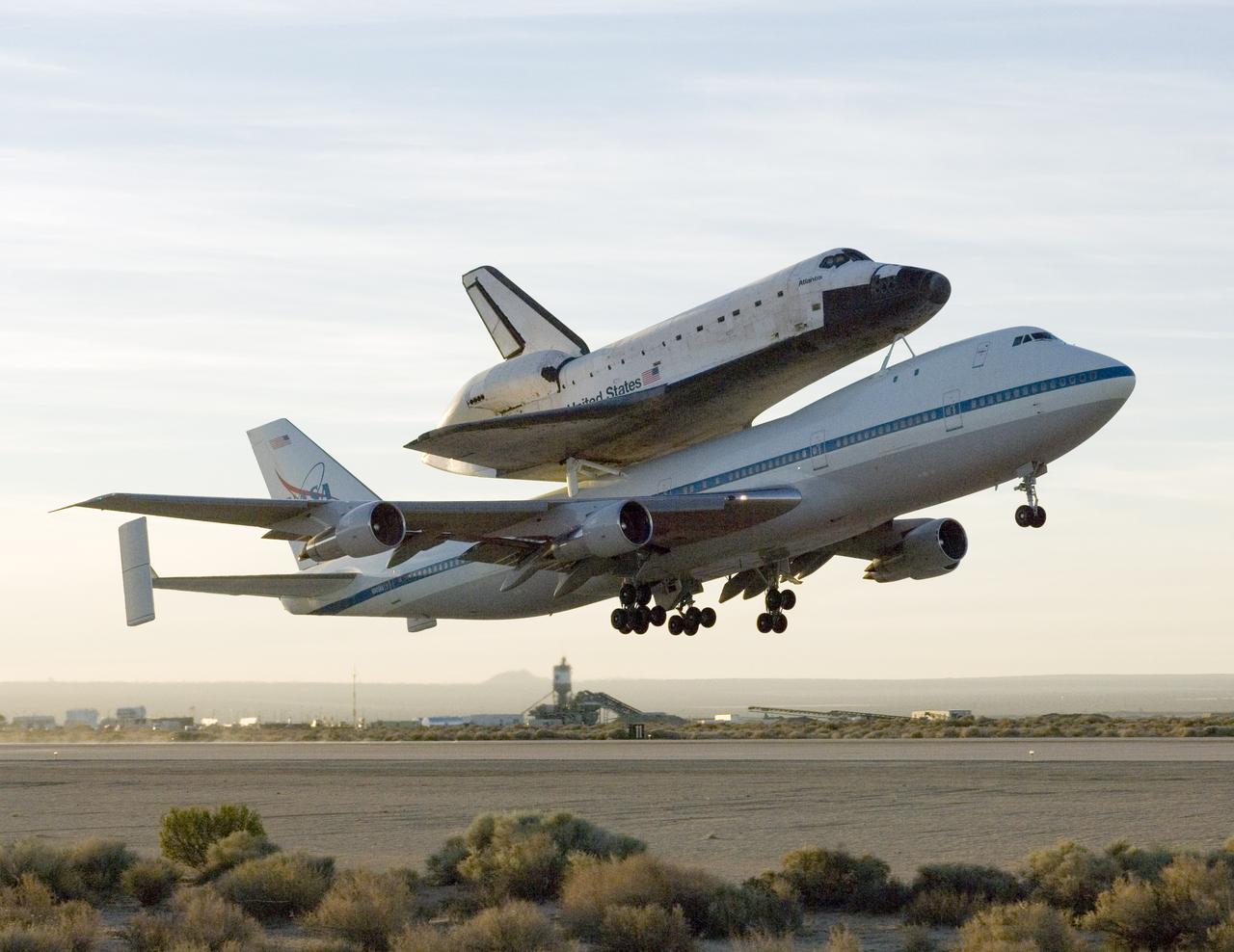
NASA's modified Boeing 747 Shuttle Carrier Aircraft with the Space Shuttle Atlantis on top lifts off from Edwards Air Force Base to begin its ferry flight back to the Kennedy Space Center in Florida. The cross-country journey will take approximately two days, with stops at several intermediate points for refueling.
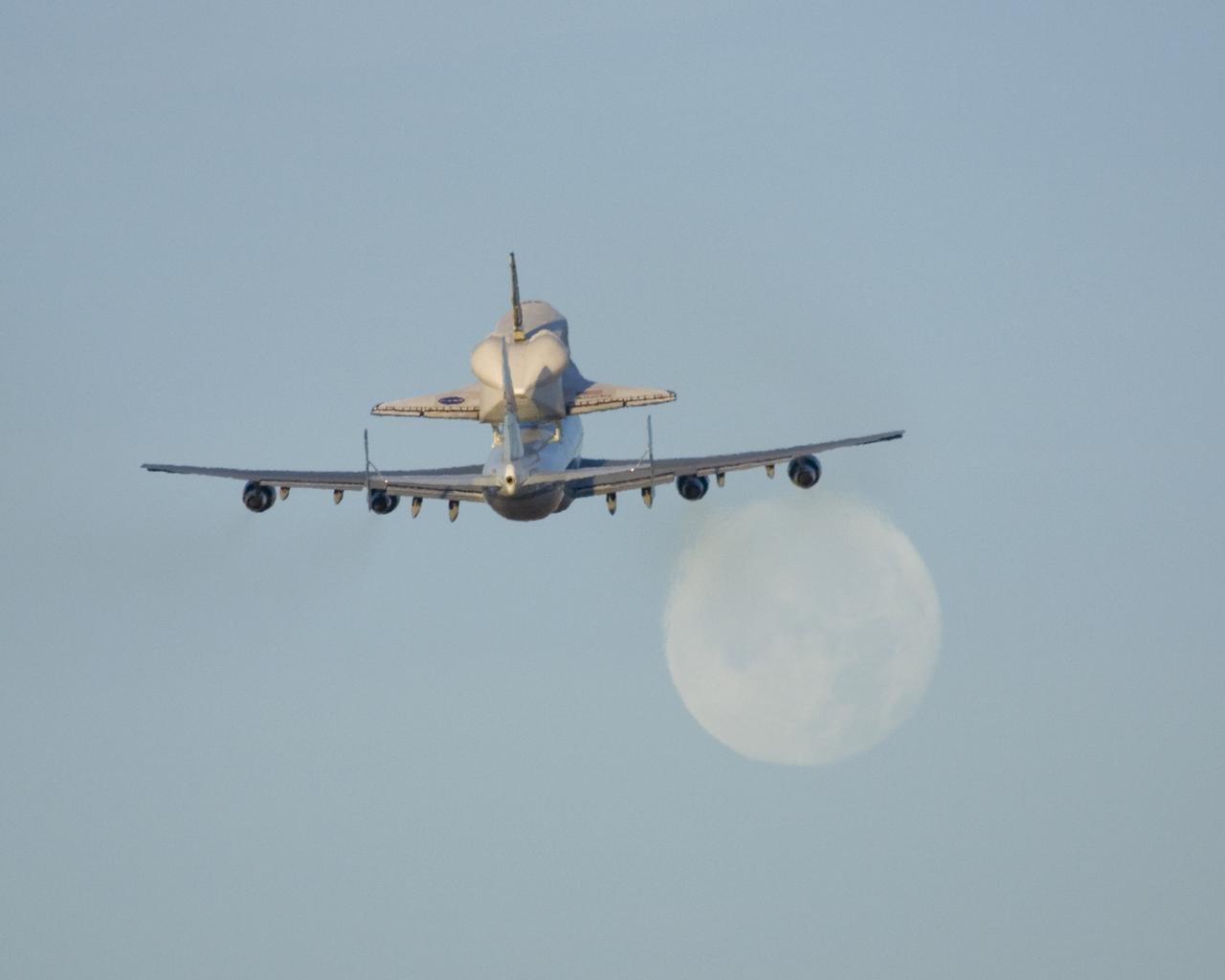
NASA's modified Boeing 747 Shuttle Carrier Aircraft with the Space Shuttle Atlantis on top lifts off from Edwards Air Force Base to begin its ferry flight back to the Kennedy Space Center in Florida. The cross-country journey will take approximately two days, with stops at several intermediate points for refueling.
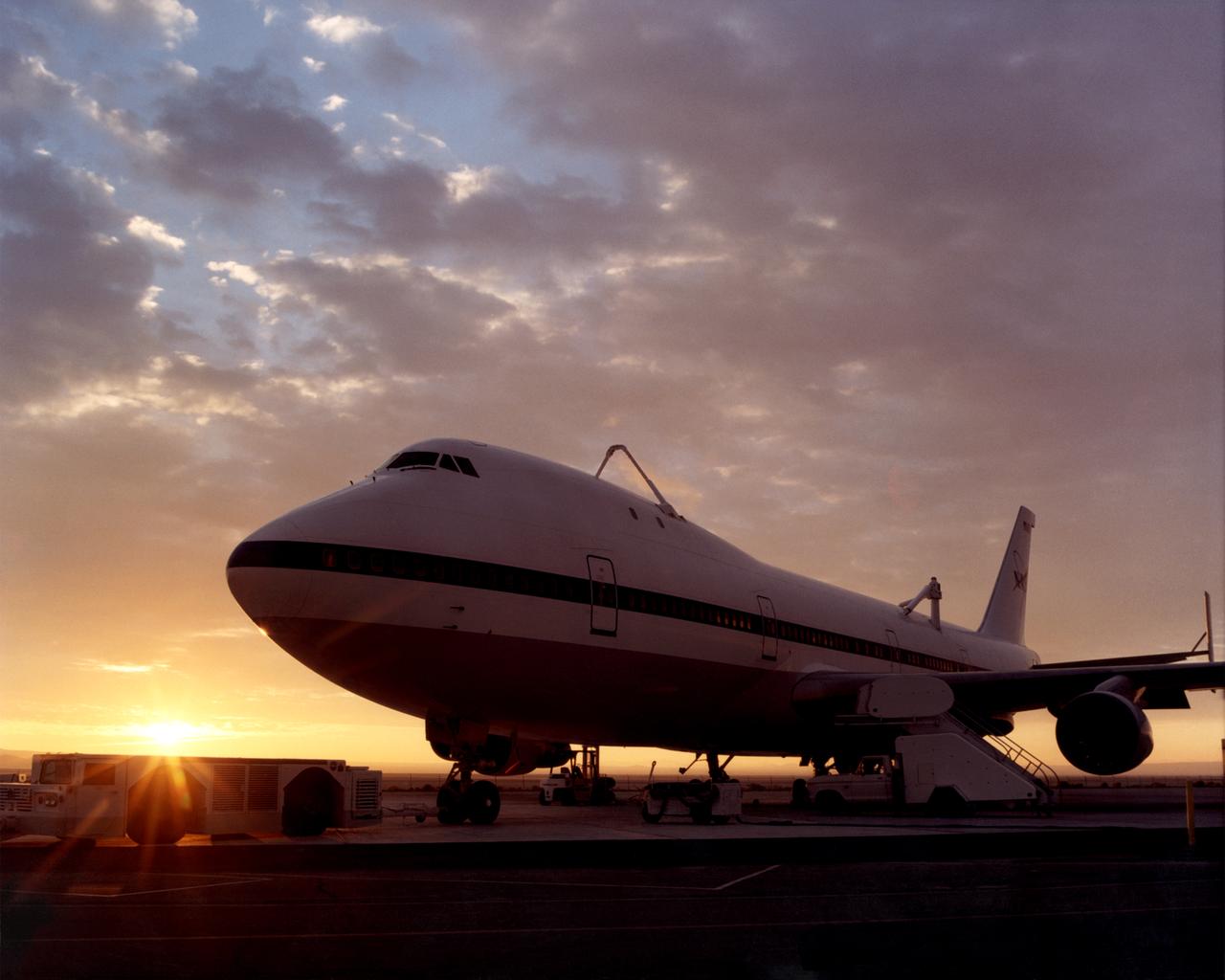
One of NASA’s two modified Boeing 747 Shuttle Carrier Aircraft is bathed in the morning Sun at NASA’s Dryden Flight Research Center at Edwards, California. The modified jumbo jetliners are used to ferry the Space Shuttle orbiters between Dryden and the Kennedy Space Center in Florida and Boeing’s Reusable Space Systems modification facility at Palmdale, California. Features which distinguish the two SCAs from standard 747 jetliners are three struts, with associated interior structural strengthening, which protrude from the top of the fuselage (two aft, one forward) on which the orbiter is attached, and two additional vertical stabilizers, one on each end of the standard horizontal stabilizer, to enhance directional stability. All interior furnishings and equipment aft of the forward No. 1 doors have also been removed to reduce weight. The two SCAs are under the operational control of NASA's Johnson Space Center, Houston, Texas.
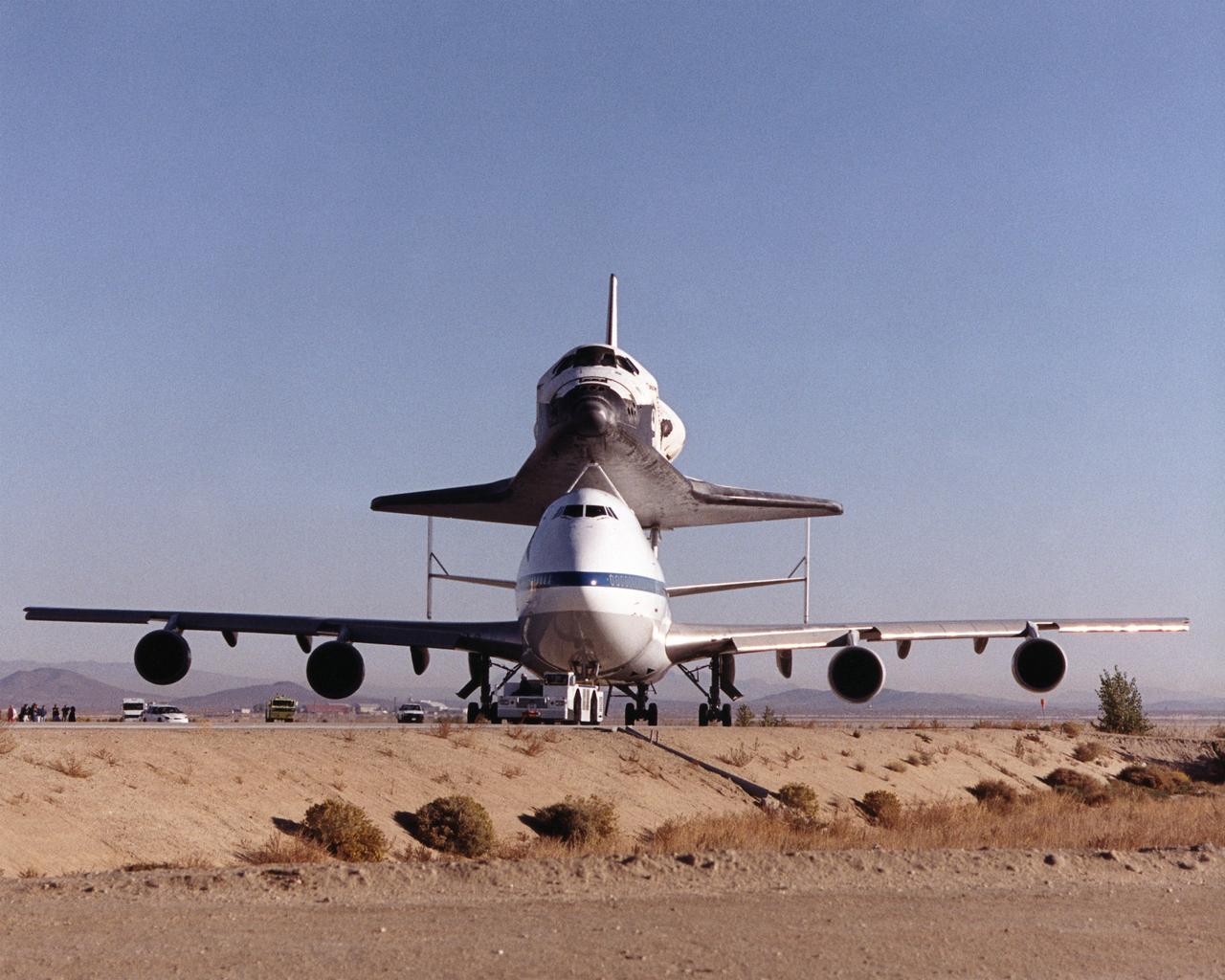
The Space Shuttle Discovery sits atop one of NASA’s modified Boeing 747 Shuttle Carrier Aircraft as the unusual piggyback duo is towed along a taxiway at NASA’s Dryden Flight Research Center at Edwards, California. The Discovery was ferried from NASA Dryden to NASA’s Kennedy Space Center in Florida on November 2, 2000, after extensive pre-ferry servicing and preparations.
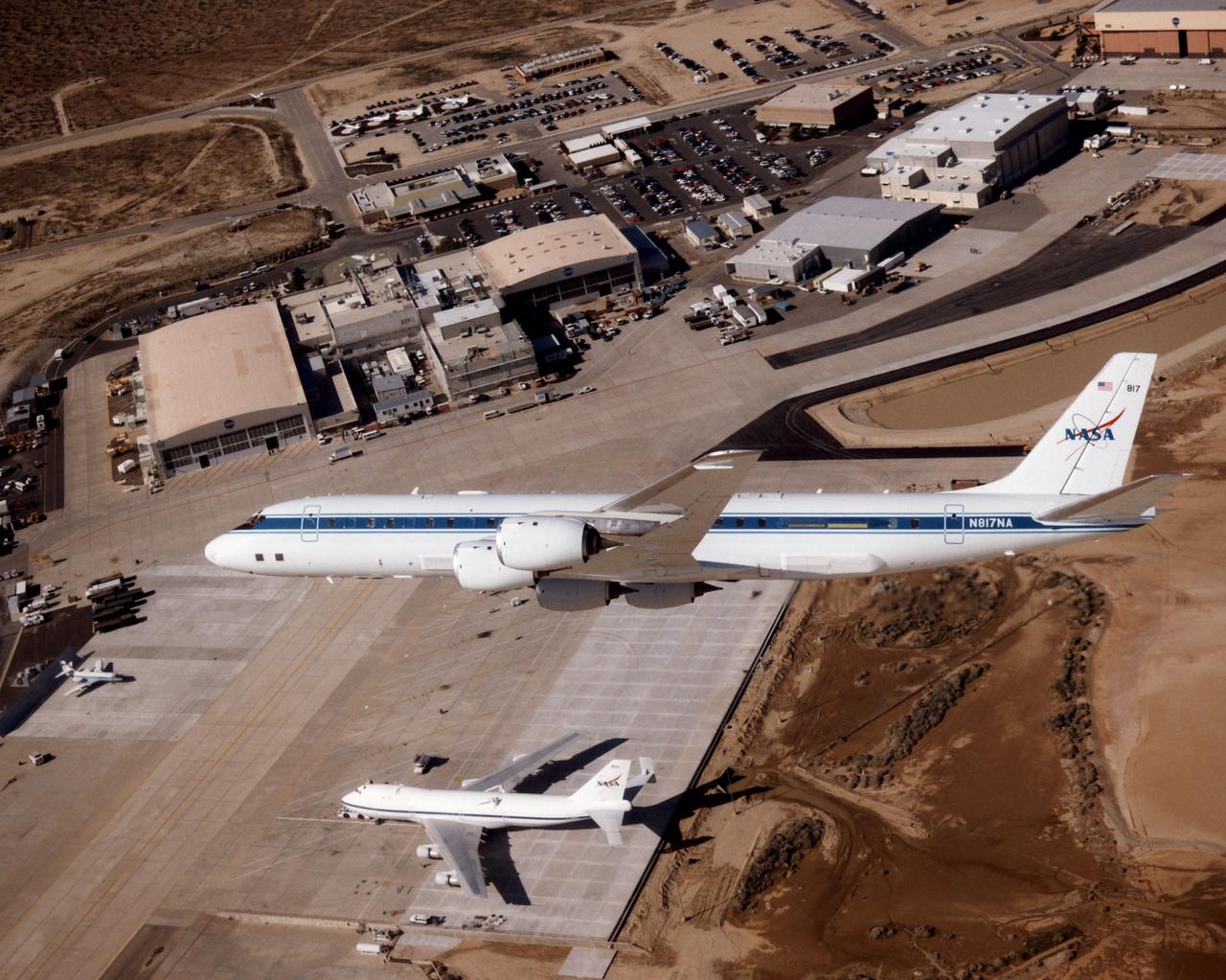
The DC-8 aircraft is seen making a banking turn high above the NASA Dryden ramp. This view of the DC-8's left side reveals some of the modifications necessary for particular on-board experiments. To the right of the DC-8 is the edge of Rogers Dry Lake. Above the aircraft's forward fuselage is the Dryden Flight Research Center headquarters building, while other NASA facilities extend down the flightline to the right. Below the DC-8 is the Shuttle Carrier Aircraft (SCA), on which are visible attachment points for the Shuttle Orbiter.
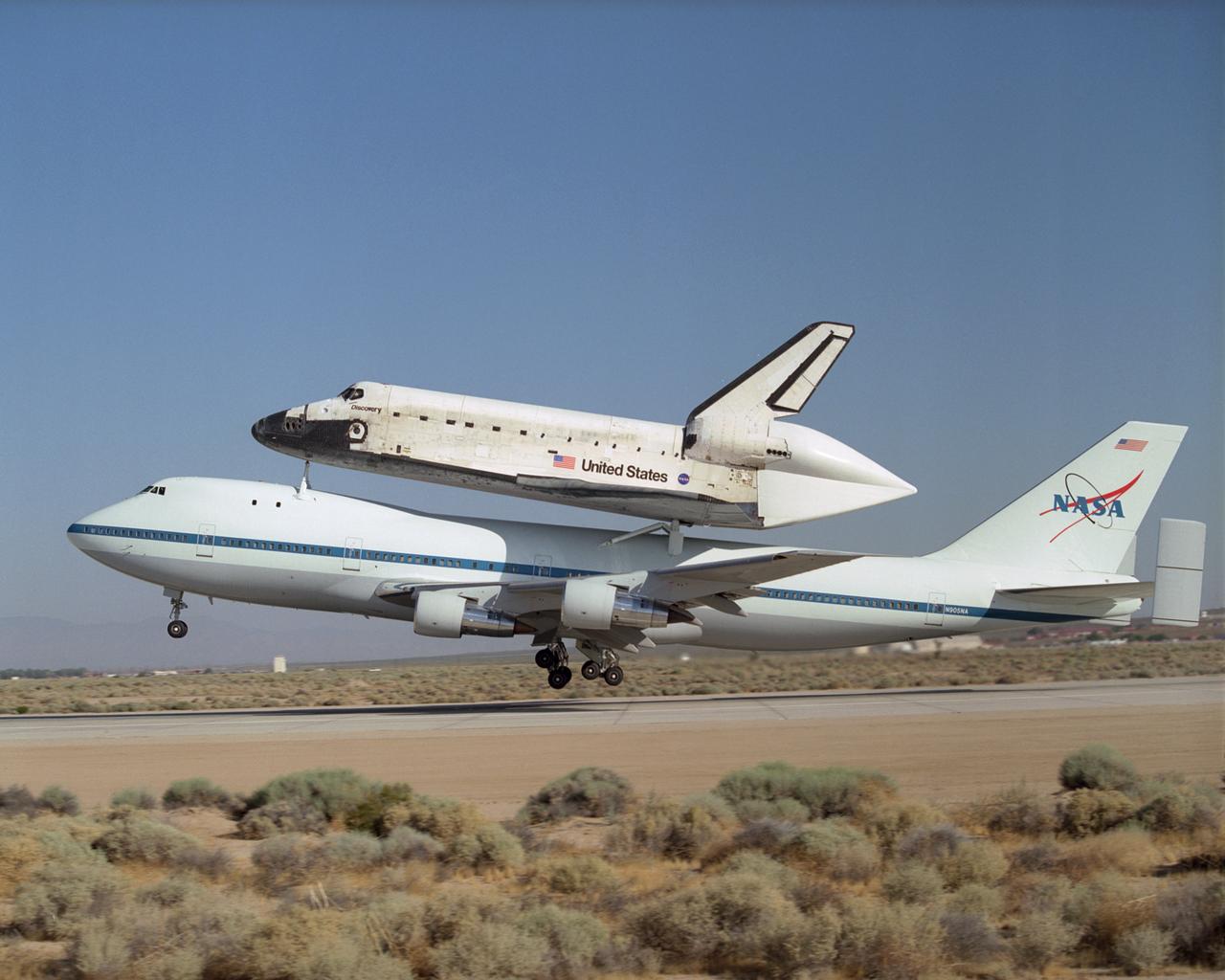
NASA's modified Boeing 747 Shuttle Carrier Aircraft with the Space Shuttle Discovery on top lifts off from Edwards Air Force Base to begin its ferry flight back to the Kennedy Space Center in Florida. The cross-country journey will take two days, with stops at several intermediate points for refueling. Space Shuttle Discovery landed safely at NASA's Dryden Flight Research Center at Edwards Air Force Base in California at 5:11:22 a.m. PDT, August 9, 2005, following the very successful 14-day STS-114 return to flight mission. During their two weeks in space, Commander Eileen Collins and her six crewmates tested out new safety procedures and delivered supplies and equipment the International Space Station. Discovery spent two weeks in space, where the crew demonstrated new methods to inspect and repair the Shuttle in orbit. The crew also delivered supplies, outfitted and performed maintenance on the International Space Station. A number of these tasks were conducted during three spacewalks. In an unprecedented event, spacewalkers were called upon to remove protruding gap fillers from the heat shield on Discovery's underbelly. In other spacewalk activities, astronauts installed an external platform onto the Station's Quest Airlock and replaced one of the orbital outpost's Control Moment Gyroscopes. Inside the Station, the STS-114 crew conducted joint operations with the Expedition 11 crew. They unloaded fresh supplies from the Shuttle and the Raffaello Multi-Purpose Logistics Module. Before Discovery undocked, the crews filled Raffeallo with unneeded items and returned to Shuttle payload bay. Discovery launched on July 26 and spent almost 14 days on orbit.
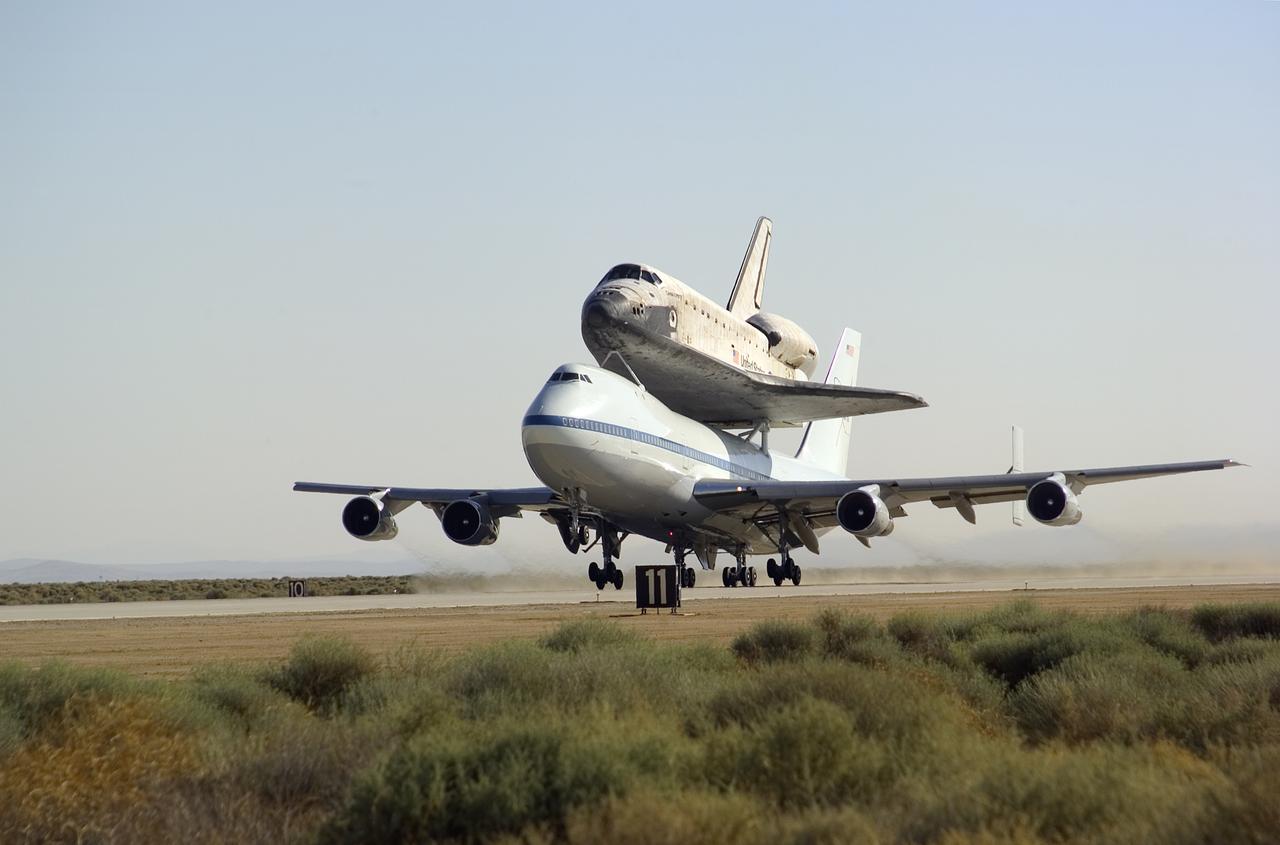
NASA's modified Boeing 747 Shuttle Carrier Aircraft with the Space Shuttle Discovery on top lifts off from Edwards Air Force Base to begin its ferry flight back to the Kennedy Space Center in Florida. The cross-country journey will take two days, with stops at several intermediate points for refueling. Space Shuttle Discovery landed safely at NASA's Dryden Flight Research Center at Edwards Air Force Base in California at 5:11:22 a.m. PDT, August 9, 2005, following the very successful 14-day STS-114 return to flight mission. During their two weeks in space, Commander Eileen Collins and her six crewmates tested out new safety procedures and delivered supplies and equipment the International Space Station. Discovery spent two weeks in space, where the crew demonstrated new methods to inspect and repair the Shuttle in orbit. The crew also delivered supplies, outfitted and performed maintenance on the International Space Station. A number of these tasks were conducted during three spacewalks. In an unprecedented event, spacewalkers were called upon to remove protruding gap fillers from the heat shield on Discovery's underbelly. In other spacewalk activities, astronauts installed an external platform onto the Station's Quest Airlock and replaced one of the orbital outpost's Control Moment Gyroscopes. Inside the Station, the STS-114 crew conducted joint operations with the Expedition 11 crew. They unloaded fresh supplies from the Shuttle and the Raffaello Multi-Purpose Logistics Module. Before Discovery undocked, the crews filled Raffeallo with unneeded items and returned to Shuttle payload bay. Discovery launched on July 26 and spent almost 14 days on orbit.
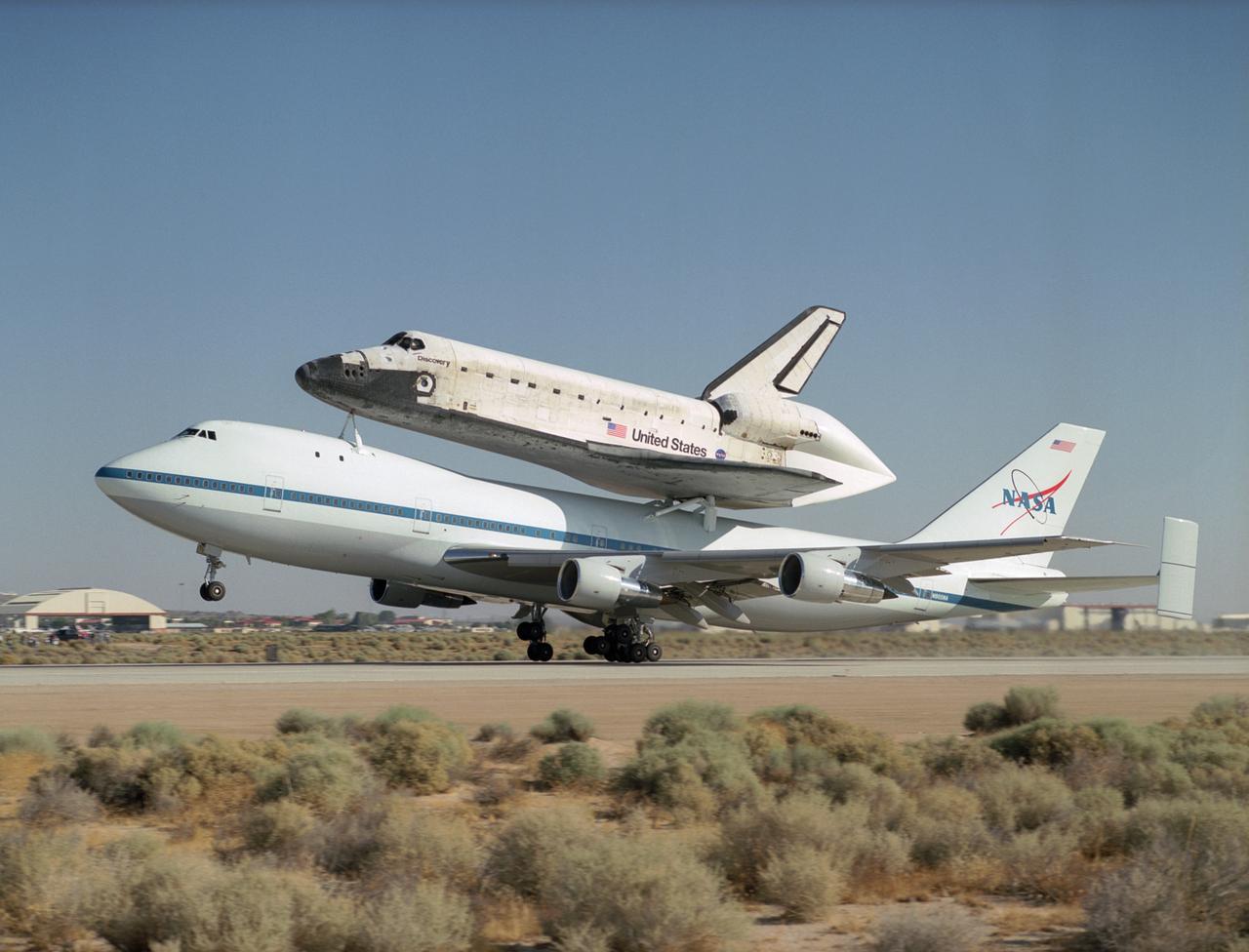
NASA's modified Boeing 747 Shuttle Carrier Aircraft with the Space Shuttle Discovery on top lifts off from Edwards Air Force Base to begin its ferry flight back to the Kennedy Space Center in Florida. The cross-country journey will take two days, with stops at several intermediate points for refueling. Space Shuttle Discovery landed safely at NASA's Dryden Flight Research Center at Edwards Air Force Base in California at 5:11:22 a.m. PDT, August 9, 2005, following the very successful 14-day STS-114 return to flight mission. During their two weeks in space, Commander Eileen Collins and her six crewmates tested out new safety procedures and delivered supplies and equipment the International Space Station. Discovery spent two weeks in space, where the crew demonstrated new methods to inspect and repair the Shuttle in orbit. The crew also delivered supplies, outfitted and performed maintenance on the International Space Station. A number of these tasks were conducted during three spacewalks. In an unprecedented event, spacewalkers were called upon to remove protruding gap fillers from the heat shield on Discovery's underbelly. In other spacewalk activities, astronauts installed an external platform onto the Station's Quest Airlock and replaced one of the orbital outpost's Control Moment Gyroscopes. Inside the Station, the STS-114 crew conducted joint operations with the Expedition 11 crew. They unloaded fresh supplies from the Shuttle and the Raffaello Multi-Purpose Logistics Module. Before Discovery undocked, the crews filled Raffeallo with unneeded items and returned to Shuttle payload bay. Discovery launched on July 26 and spent almost 14 days on orbit.
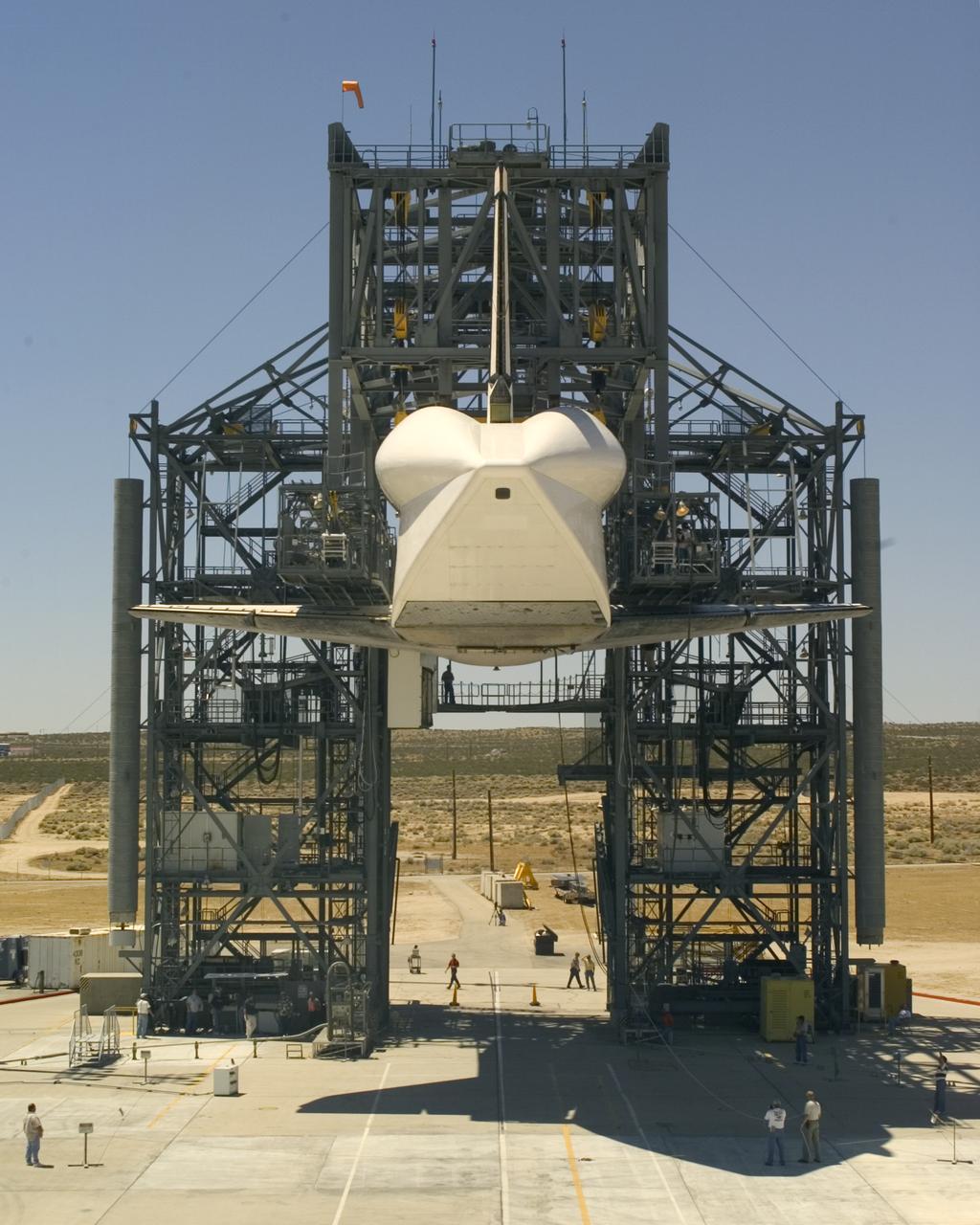
NASA's specially modified 747 Shuttle Carrier Aircraft, or SCA, is positioned under the Space Shuttle Discovery to be attached for their ferry flight to the Kennedy Space Center in Florida. After its post-flight servicing and preparation at NASA Dryden in California, Discovery's return flight to Kennedy aboard the 747 will take approximately 2 days, with stops at several intermediate points for refueling. Space Shuttle Discovery landed safely at NASA's Dryden Flight Research Center at Edwards Air Force Base at 5:11:22 a.m. PDT, August 9, 2005, following the very successful 14-day STS-114 return to flight mission. During their two weeks in space, Commander Eileen Collins and her six crewmates tested out new safety procedures and delivered supplies and equipment the International Space Station. Discovery spent two weeks in space, where the crew demonstrated new methods to inspect and repair the Shuttle in orbit. The crew also delivered supplies, outfitted and performed maintenance on the International Space Station. A number of these tasks were conducted during three spacewalks. In an unprecedented event, spacewalkers were called upon to remove protruding gap fillers from the heat shield on Discovery's underbelly. In other spacewalk activities, astronauts installed an external platform onto the Station's Quest Airlock and replaced one of the orbital outpost's Control Moment Gyroscopes. Inside the Station, the STS-114 crew conducted joint operations with the Expedition 11 crew. They unloaded fresh supplies from the Shuttle and the Raffaello Multi-Purpose Logistics Module. Before Discovery undocked, the crews filled Raffeallo with unneeded items and returned to Shuttle payload bay. Discovery launched on July 26 and spent almost 14 days on orbit.
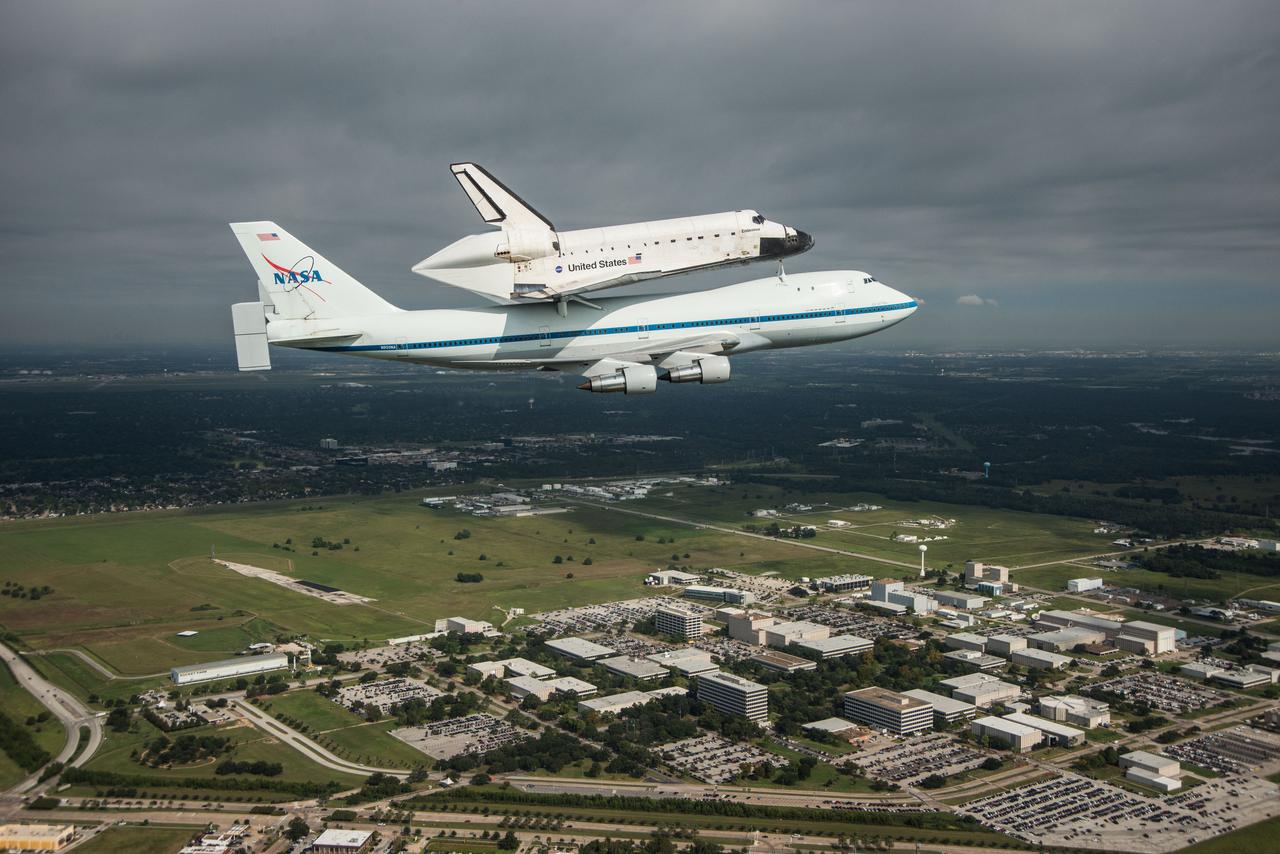
Space Shuttle Endeavour is ferried by NASA's Shuttle Carrier Aircraft (SCA) over the Johnson Space Center in Houston, Texas on September 19, 2012. NASA pilots Jeff Moultrie and Bill Rieke are at the controls of the Shuttle Carrier Aircraft. Photo taken by NASA photographer Sheri Locke in the backseat of a NASA T-38 chase plane with NASA pilot Thomas E. Parent at the controls. Photo Credit: NASA/ Sheri Locke
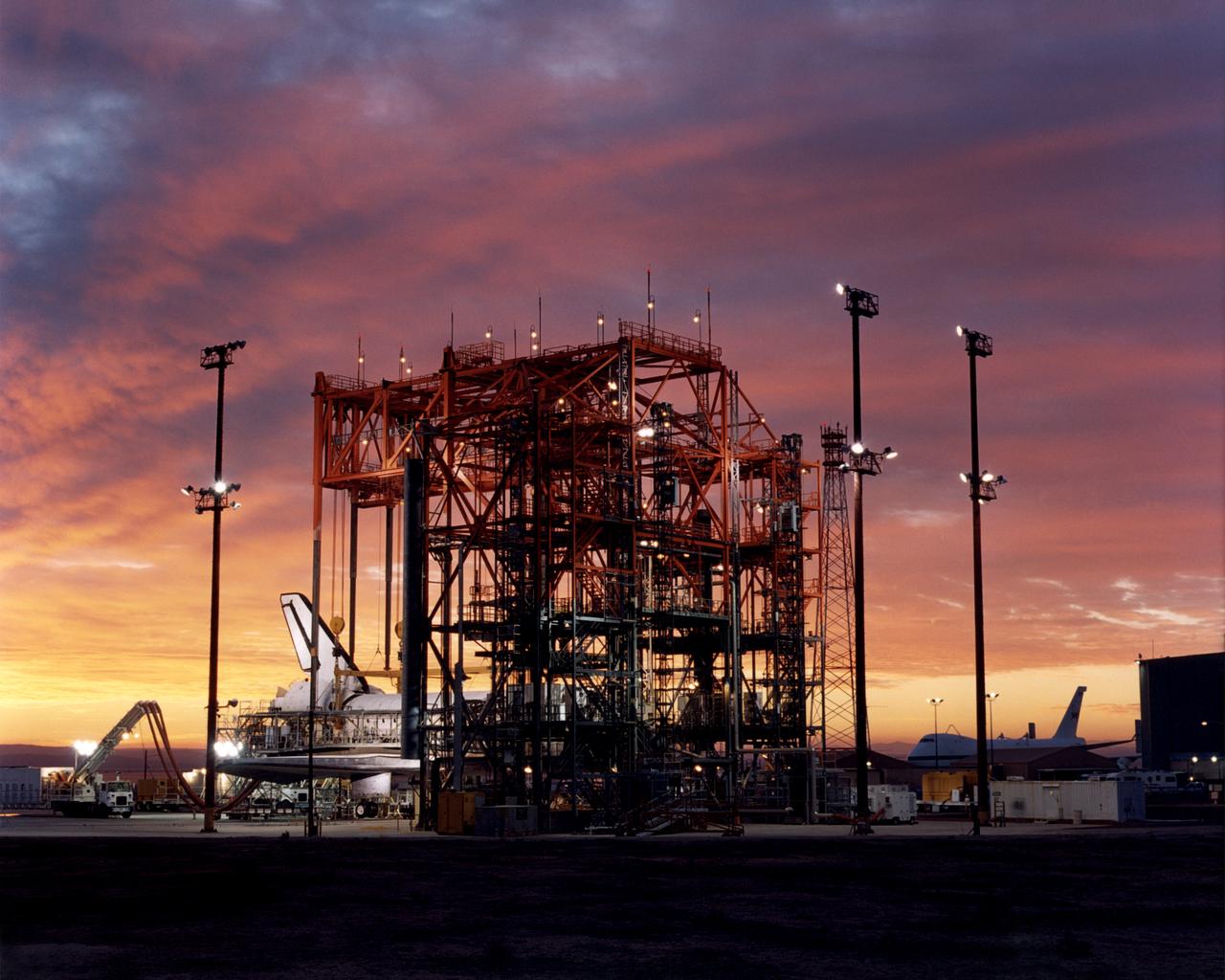
The early-morning Sun bathes the Space Shuttle Discovery in hues of purple, pink and gold as it is encased in the Mate-Demate Device (MDD) at NASA’s Dryden Flight Research Center at Edwards, California. The gantry-like MDD structure is used to prepare the shuttle for its ferry flight back to the Kennedy space Center in Florida, including mounting the shuttle atop NASA’s modified Boeing 747 Shuttle Carrier Aircraft.
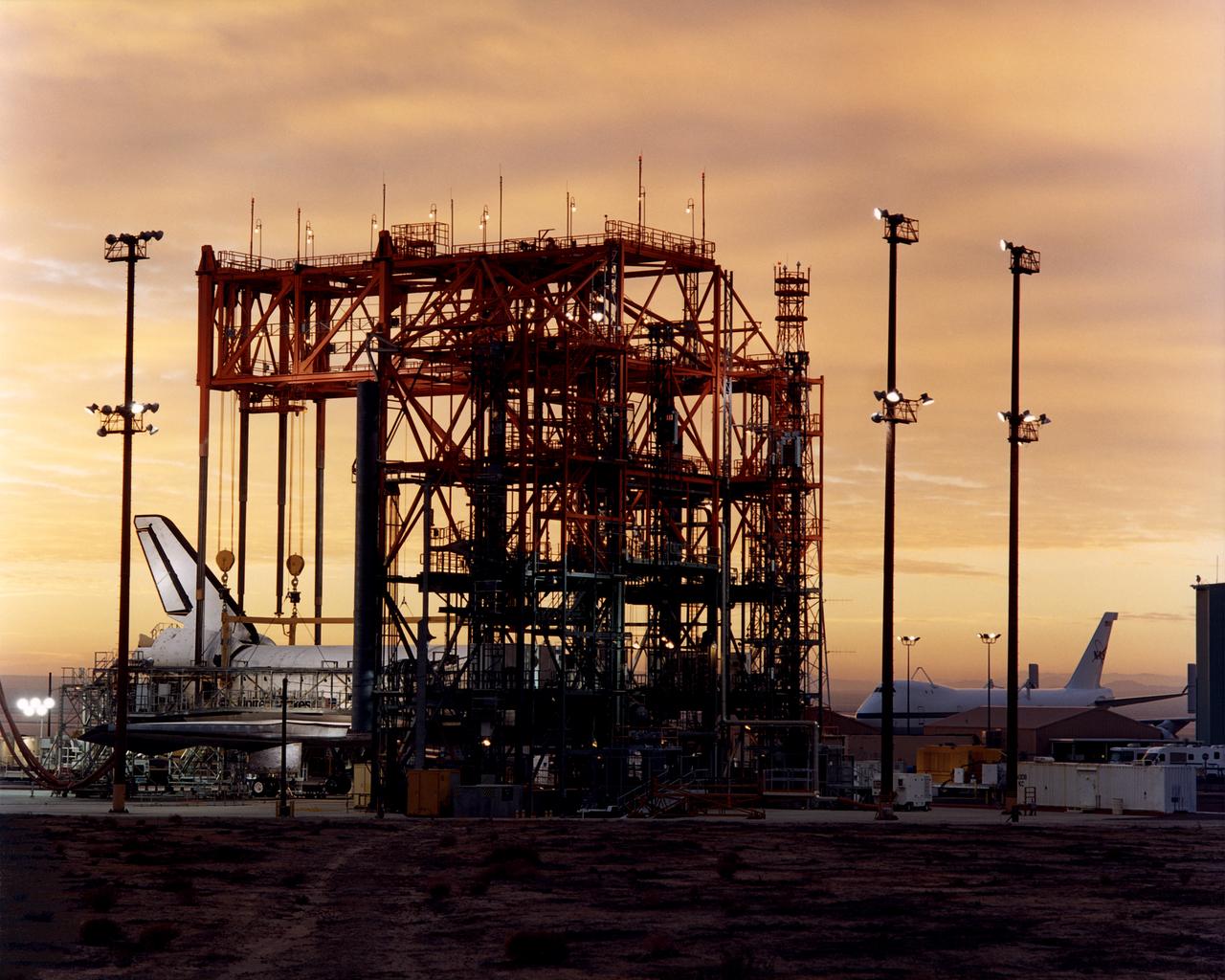
The early-morning Sun provides a golden backdrop to the Space Shuttle Discovery encased in the Mate-Demate Device (MDD) at NASA’s Dryden Flight Research Center at Edwards, California. The gantry-like MDD structure is used to prepare the shuttle for its ferry flight back to the Kennedy Space Center in Florida, including mounting the shuttle atop NASA’s modified Boeing 747 Shuttle Carrier Aircraft.
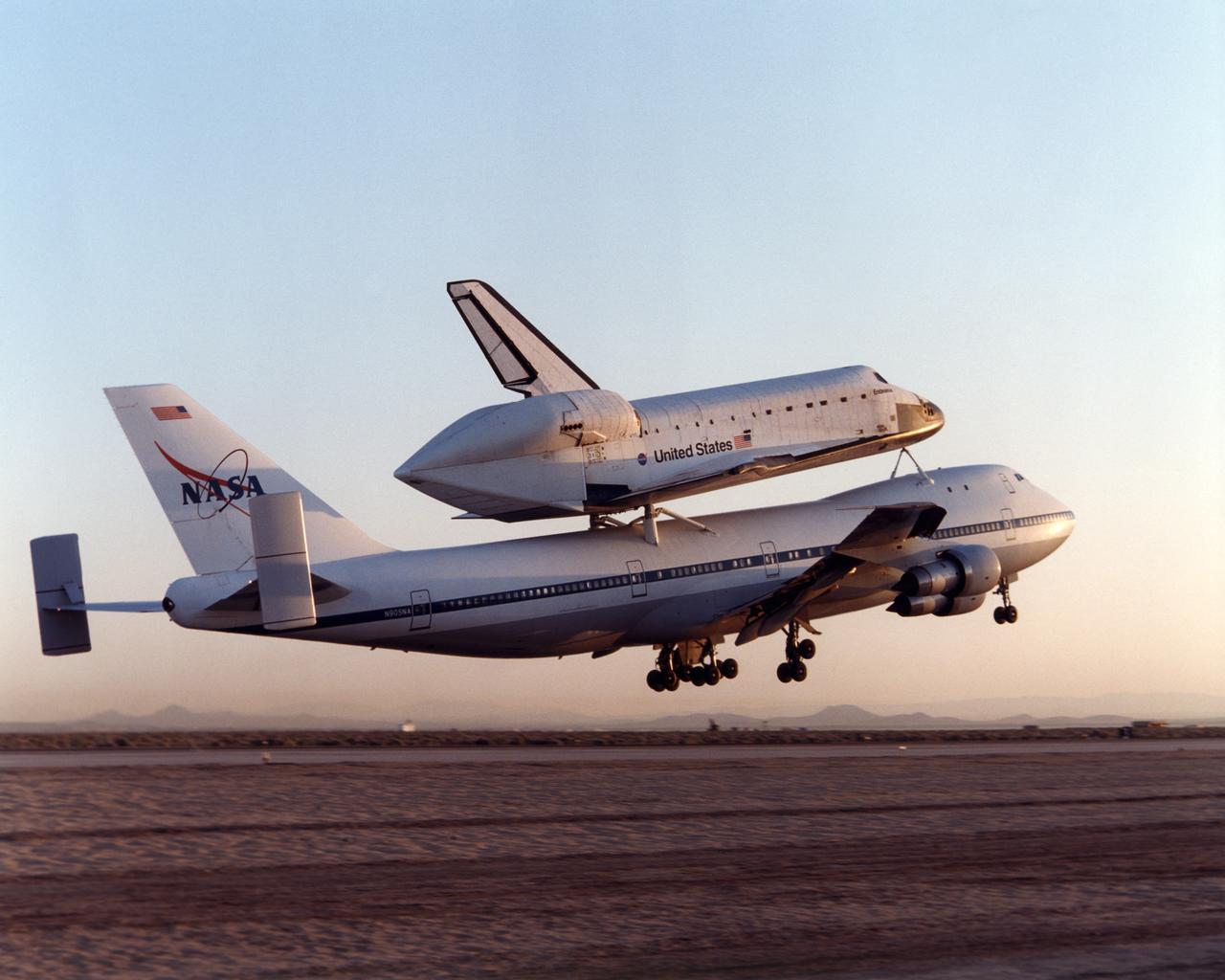
NASA's modified Boeing 747 Shuttle Carrier Aircraft with the Space Shuttle Endeavour on top climbs out after takeoff from Edwards Air Force Base on the first leg of its ferry flight back to the Kennedy Space Center in Florida.
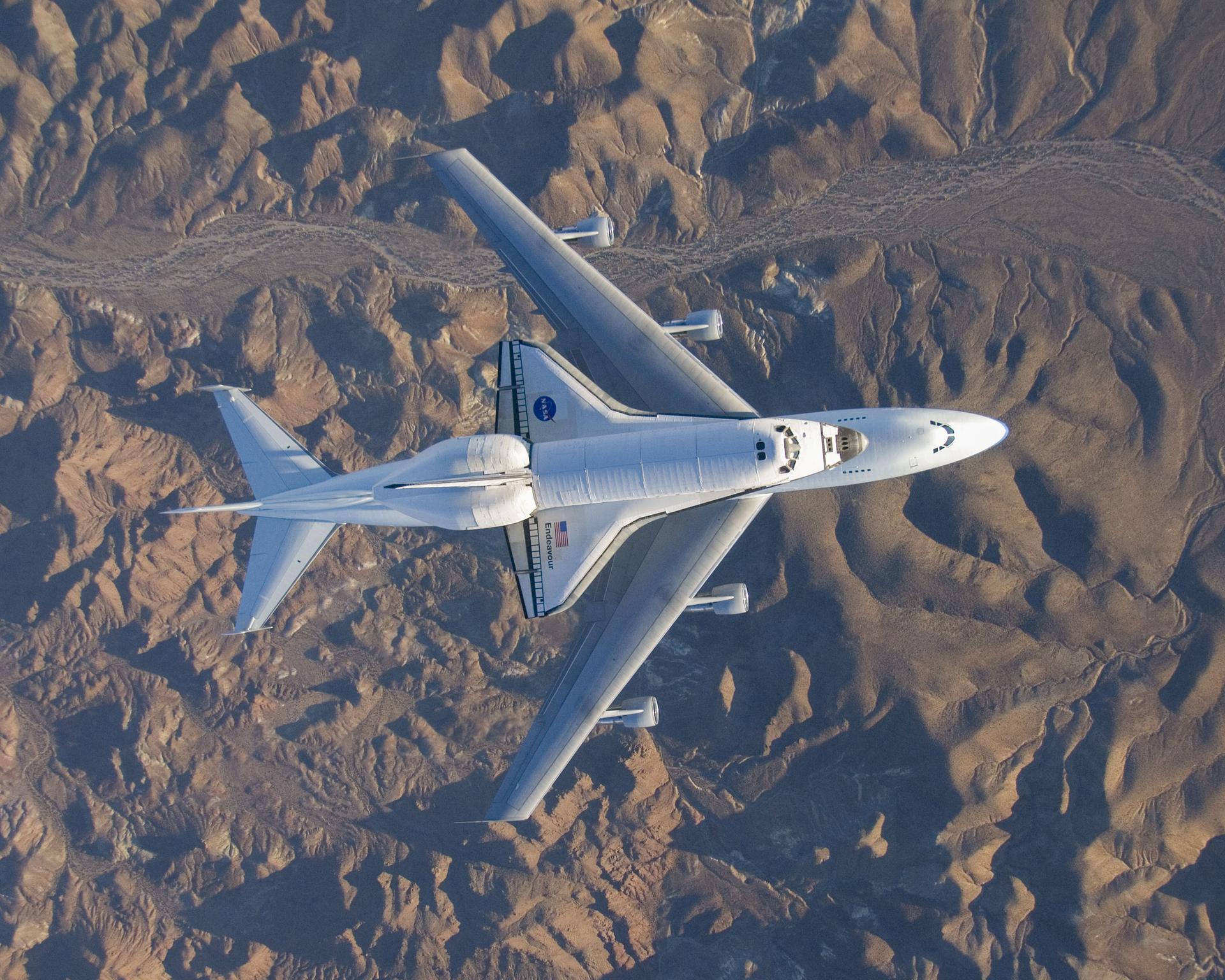
NASA aerial photographer Carla Thomas captured this top-down view of the Space Shuttle Endeavor mounted on a NASA 747 Shuttle Carrier Aircraft from an inverted F/A-18 on Wednesday, Dec. 10, 2008, over the Mojave Desert in California. The shuttle, returning to Kennedy Space Center in Florida, landed at Edwards Air Force Base in Edwards, California, and was prepared nearby at NASA’s Armstrong Flight Research Center for the return trip to Kennedy.
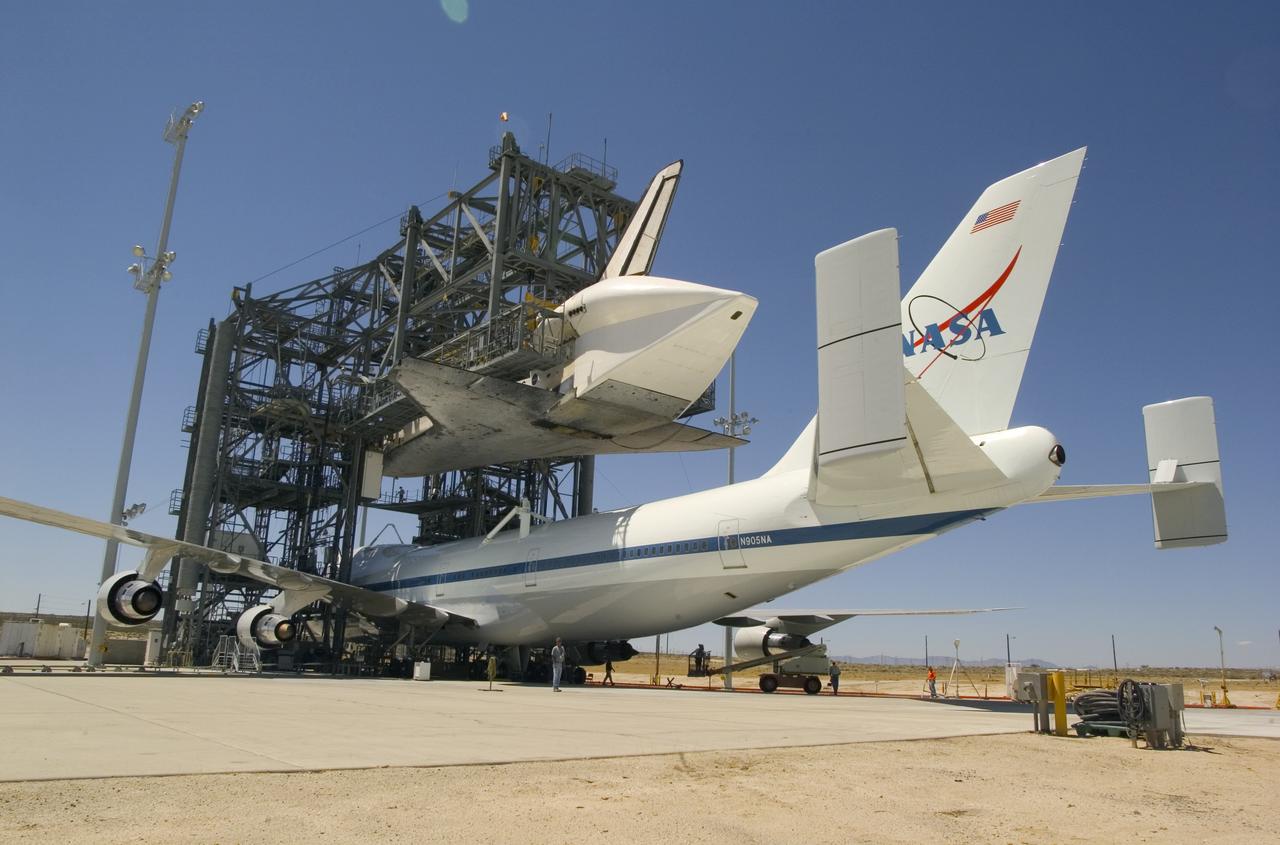
NASA's specially modified 747 Shuttle Carrier Aircraft, or SCA, is positioned under the Space Shuttle Discovery to be attached for their ferry flight to the Kennedy Space Center in Florida. After its post-flight servicing and preparation at NASA Dryden in California, Discovery's return flight to Kennedy aboard the 747 will take approximately 2 days, with stops at several intermediate points for refueling. Space Shuttle Discovery landed safely at NASA's Dryden Flight Research Center at Edwards Air Force Base at 5:11:22 a.m. PDT, August 9, 2005, following the very successful 14-day STS-114 return to flight mission. During their two weeks in space, Commander Eileen Collins and her six crewmates tested out new safety procedures and delivered supplies and equipment the International Space Station. Discovery spent two weeks in space, where the crew demonstrated new methods to inspect and repair the Shuttle in orbit. The crew also delivered supplies, outfitted and performed maintenance on the International Space Station. A number of these tasks were conducted during three spacewalks. In an unprecedented event, spacewalkers were called upon to remove protruding gap fillers from the heat shield on Discovery's underbelly. In other spacewalk activities, astronauts installed an external platform onto the Station's Quest Airlock and replaced one of the orbital outpost's Control Moment Gyroscopes. Inside the Station, the STS-114 crew conducted joint operations with the Expedition 11 crew. They unloaded fresh supplies from the Shuttle and the Raffaello Multi-Purpose Logistics Module. Before Discovery undocked, the crews filled Raffeallo with unneeded items and returned to Shuttle payload bay. Discovery launched on July 26 and spent almost 14 days on orbit.
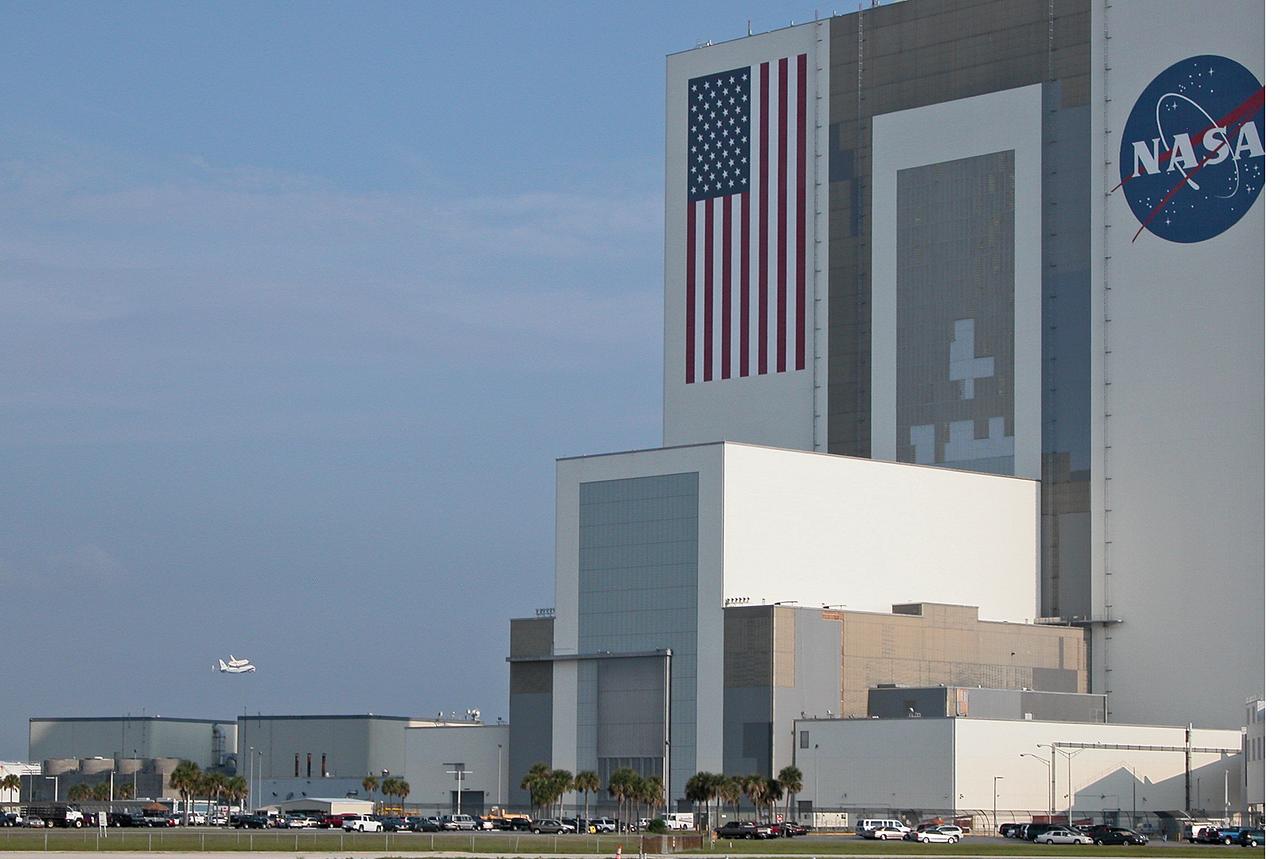
Through broken clouds, the shuttle carrier aircraft, or SCA, and its passenger Atlantis ease their way past the Vehicle Assembly Building, at right, for a landing at the KSC Shuttle Landing Facility, known as the SLF. The aircraft is a modified Boeing 747 jetliner. Atlantis landed at Edwards Air Force Base in California to end mission STS-117. The return to KSC began July 1 and took three days after stops across the country for fuel. The last stop was at Ft. Campbell in Kentucky. Weather conditions over the last leg postponed the return trip until July 3. Touchdown was at 8:27 a.m. EDT. Atlantis will be removed from the back of the SCA via the mate/demate device at the SLF. It will then be towed to the Orbiter Processing Facility to begin processing for its next launch, mission STS-122 in December.
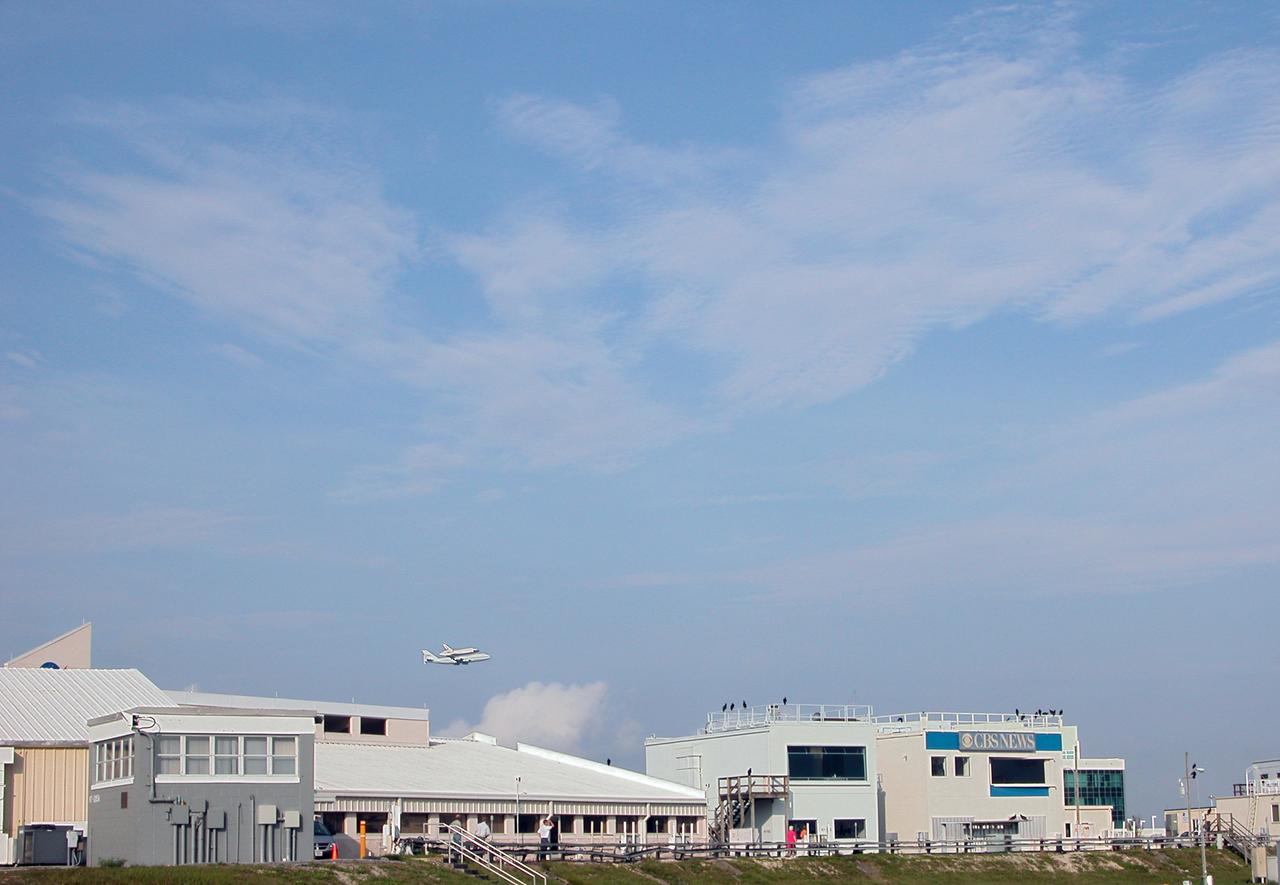
On a morning where broken clouds filled the sky of Central Florida, the shuttle carrier aircraft, or SCA, and its passenger Atlantis ease their way past the NASA News Center for a landing at the KSC Shuttle Landing Facility, known as the SLF. The aircraft is a modified Boeing 747 jetliner Atlantis landed at Edwards Air Force Base in California to end mission STS-117. The return to KSC began July 1 and took three days after stops across the country for fuel. The last stop was at Ft. Campbell in Kentucky. Weather conditions over the last leg postponed the return trip until July 3. Touchdown was at 8:27 a.m. EDT. Atlantis will be removed from the back of the SCA via the mate/demate device at the SLF. It will then be towed to the Orbiter Processing Facility to begin processing for its next launch, mission STS-122 in December.
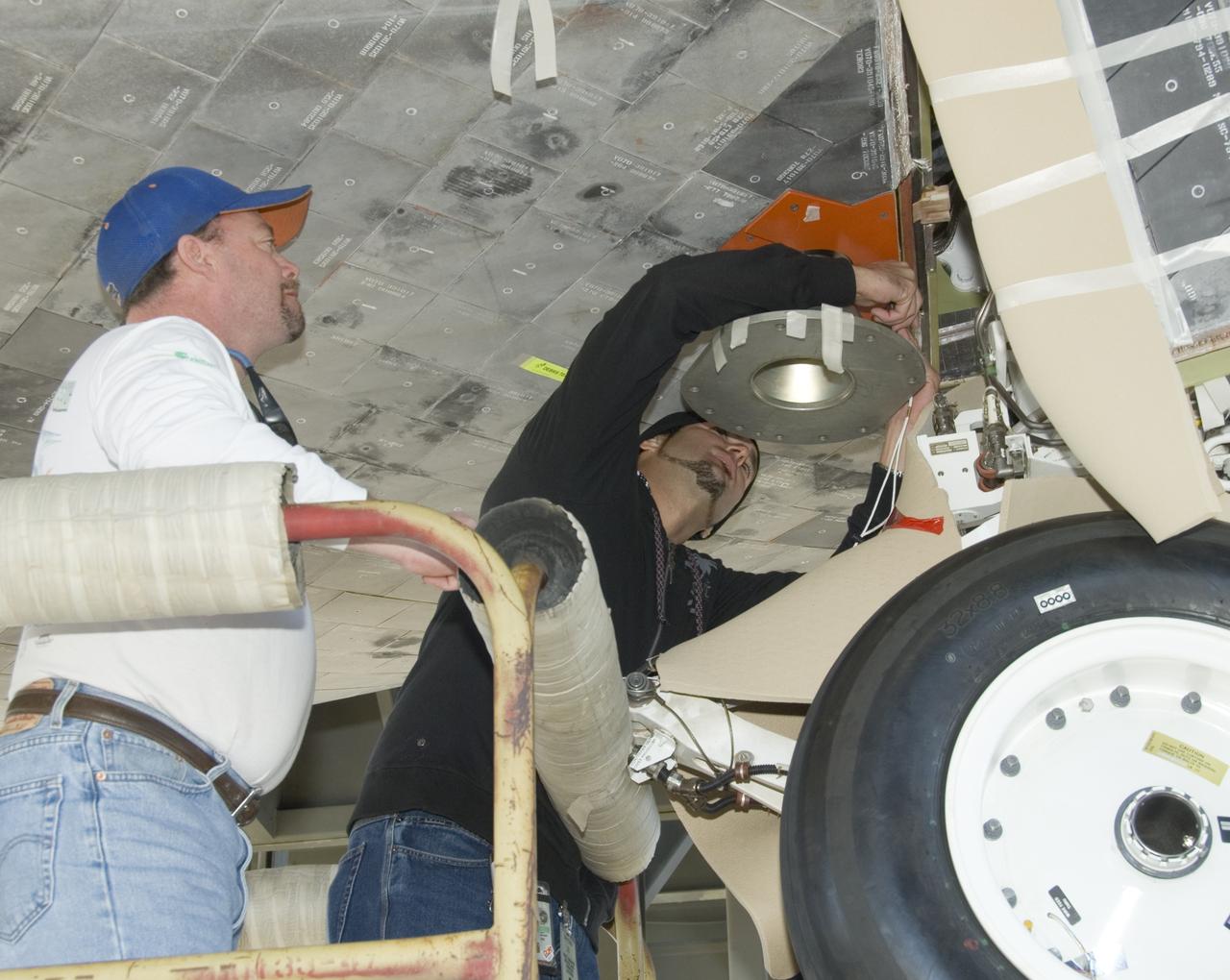
United Space Alliance employees Mark Burton and Russell Wazniak attach the forward mount fixture to Shuttle Endeavour for mounting the orbiter to the 747 Shuttle Carrier Aircraft.
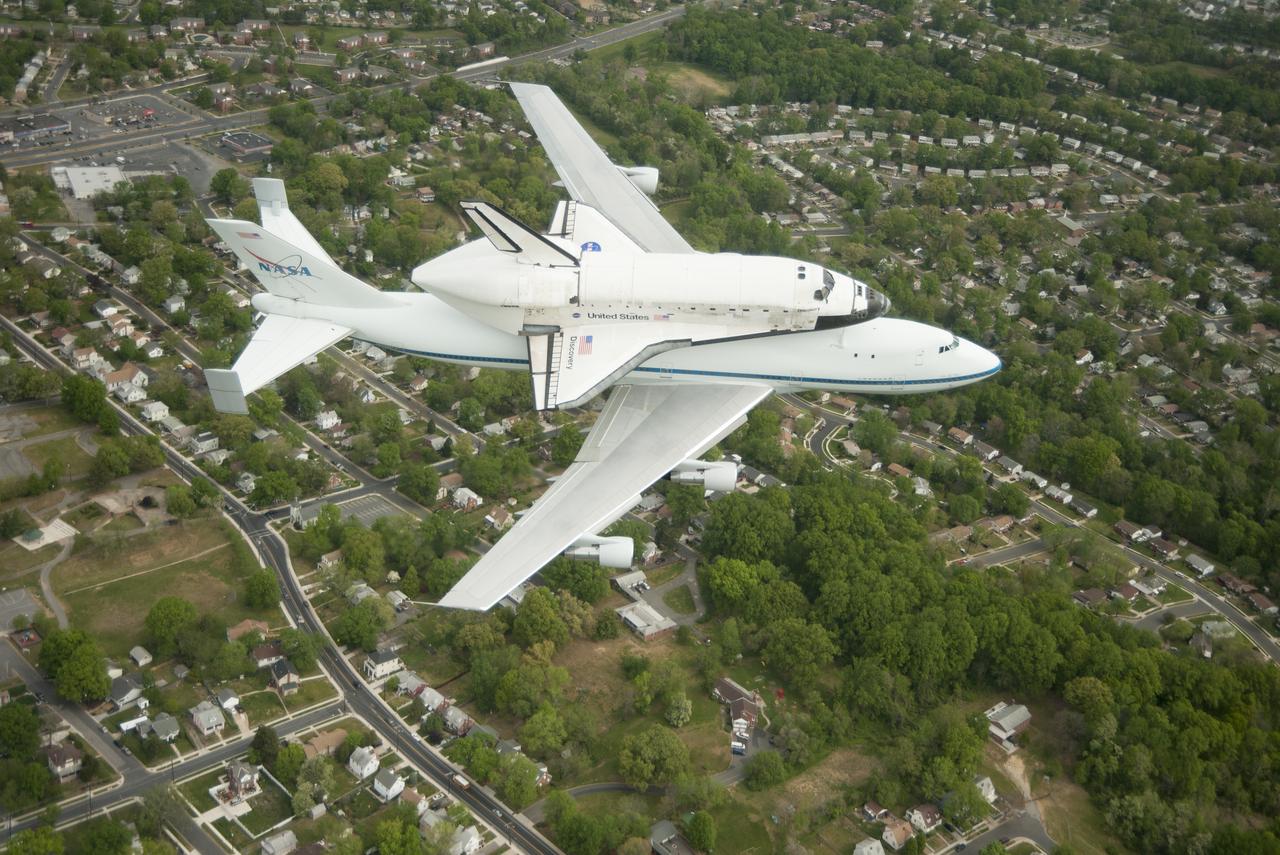
Space shuttle Discovery, mounted atop a NASA 747 Shuttle Carrier Aircraft (SCA), flies over the Washington skyline as seen from a NASA T-38 aircraft, Tuesday, April 17, 2012. Discovery, the first orbiter retired from NASA’s shuttle fleet, completed 39 missions, spent 365 days in space, orbited the Earth 5,830 times, and traveled 148,221,675 miles. NASA will transfer Discovery to the National Air and Space Museum to begin its new mission to commemorate past achievements in space and to educate and inspire future generations of explorers. Photo Credit: (NASA/Robert Markowitz)
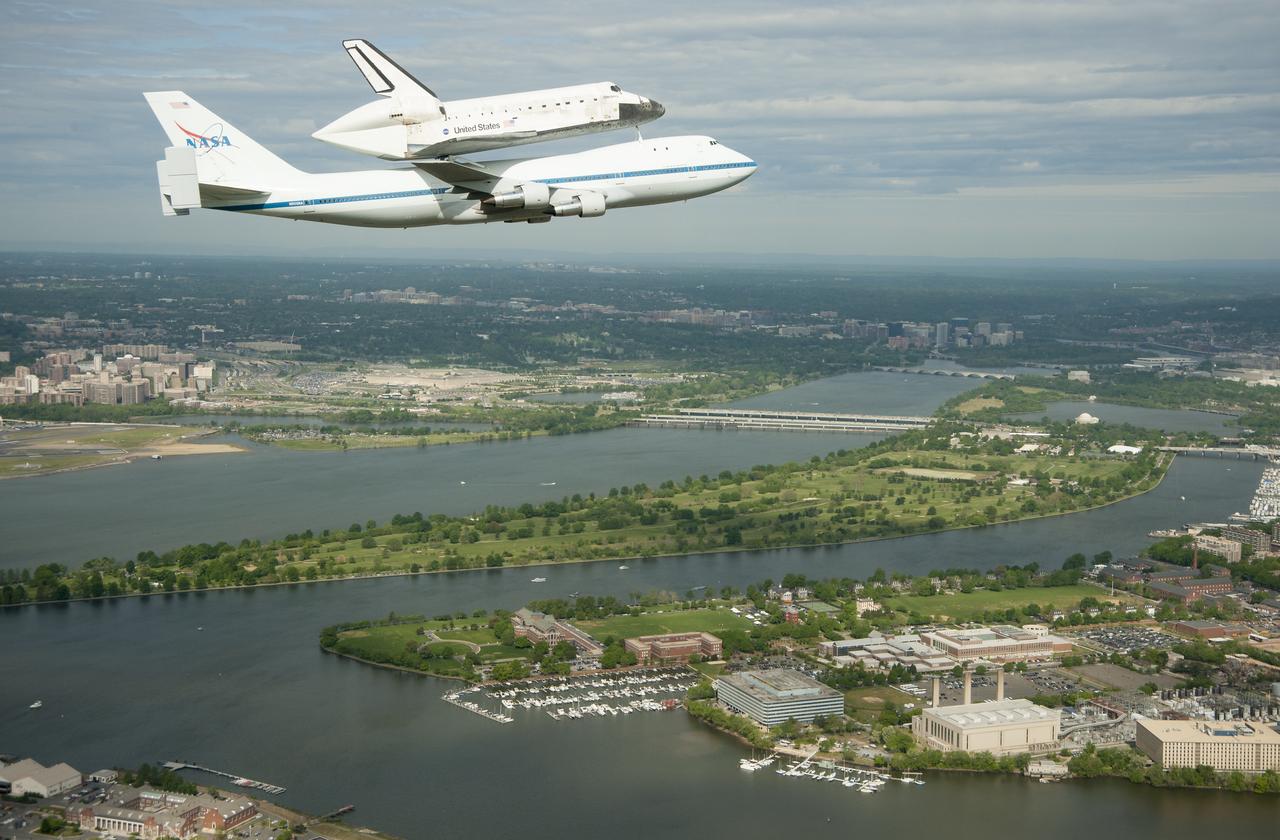
Space shuttle Discovery, mounted atop a NASA 747 Shuttle Carrier Aircraft (SCA), flies over the Washington skyline as seen from a NASA T-38 aircraft, Tuesday, April 17, 2012. Discovery, the first orbiter retired from NASA’s shuttle fleet, completed 39 missions, spent 365 days in space, orbited the Earth 5,830 times, and traveled 148,221,675 miles. NASA will transfer Discovery to the National Air and Space Museum to begin its new mission to commemorate past achievements in space and to educate and inspire future generations of explorers. Photo Credit: (NASA/Robert Markowitz)
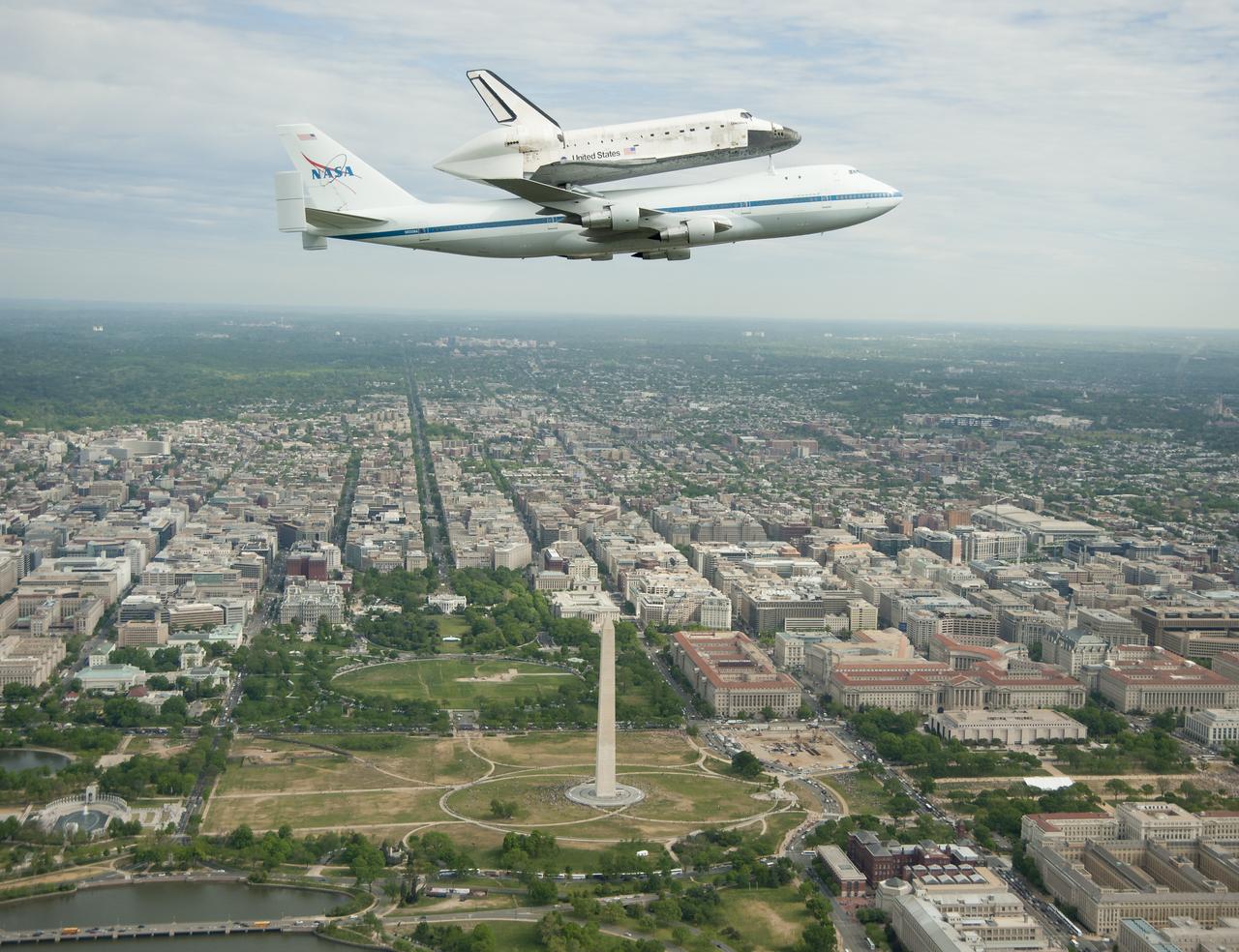
Space shuttle Discovery, mounted atop a NASA 747 Shuttle Carrier Aircraft (SCA), flies over the Washington skyline as seen from a NASA T-38 aircraft, Tuesday, April 17, 2012. Discovery, the first orbiter retired from NASA’s shuttle fleet, completed 39 missions, spent 365 days in space, orbited the Earth 5,830 times, and traveled 148,221,675 miles. NASA will transfer Discovery to the National Air and Space Museum to begin its new mission to commemorate past achievements in space and to educate and inspire future generations of explorers. Photo Credit: (NASA/Robert Markowitz)
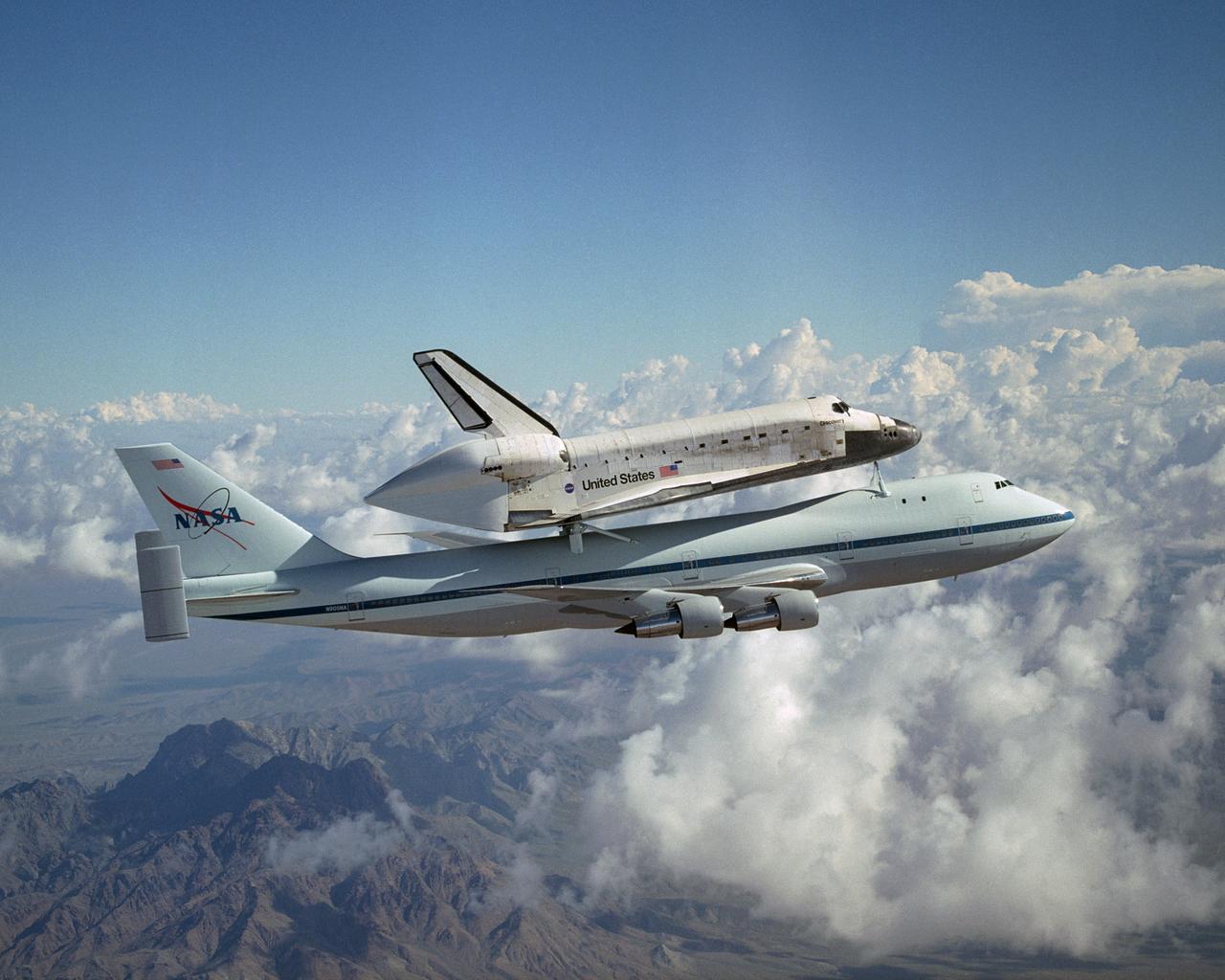
The Space Shuttle Discovery hitched a ride on NASA's modified Boeing 747 Shuttle Carrier Aircraft for the flight from the Dryden Flight Research Center in California, to Kennedy Space Center, Florida, on August 19, 2005. The cross-country ferry flight to return Discovery to Florida after it's landing in California will take two days, with stops at several intermediate points for refueling. Space Shuttle Discovery landed safely at NASA's Dryden Flight Research Center at Edwards Air Force Base in California at 5:11:22 a.m. PDT, August 9, 2005, following the very successful 14-day STS-114 return to flight mission. During their two weeks in space, Commander Eileen Collins and her six crewmates tested out new safety procedures and delivered supplies and equipment the International Space Station. Discovery spent two weeks in space, where the crew demonstrated new methods to inspect and repair the Shuttle in orbit. The crew also delivered supplies, outfitted and performed maintenance on the International Space Station. A number of these tasks were conducted during three spacewalks. In an unprecedented event, spacewalkers were called upon to remove protruding gap fillers from the heat shield on Discovery's underbelly. In other spacewalk activities, astronauts installed an external platform onto the Station's Quest Airlock and replaced one of the orbital outpost's Control Moment Gyroscopes. Inside the Station, the STS-114 crew conducted joint operations with the Expedition 11 crew. They unloaded fresh supplies from the Shuttle and the Raffaello Multi-Purpose Logistics Module. Before Discovery undocked, the crews filled Raffeallo with unneeded items and returned to Shuttle payload bay. Discovery launched on July 26 and spent almost 14 days on orbit.
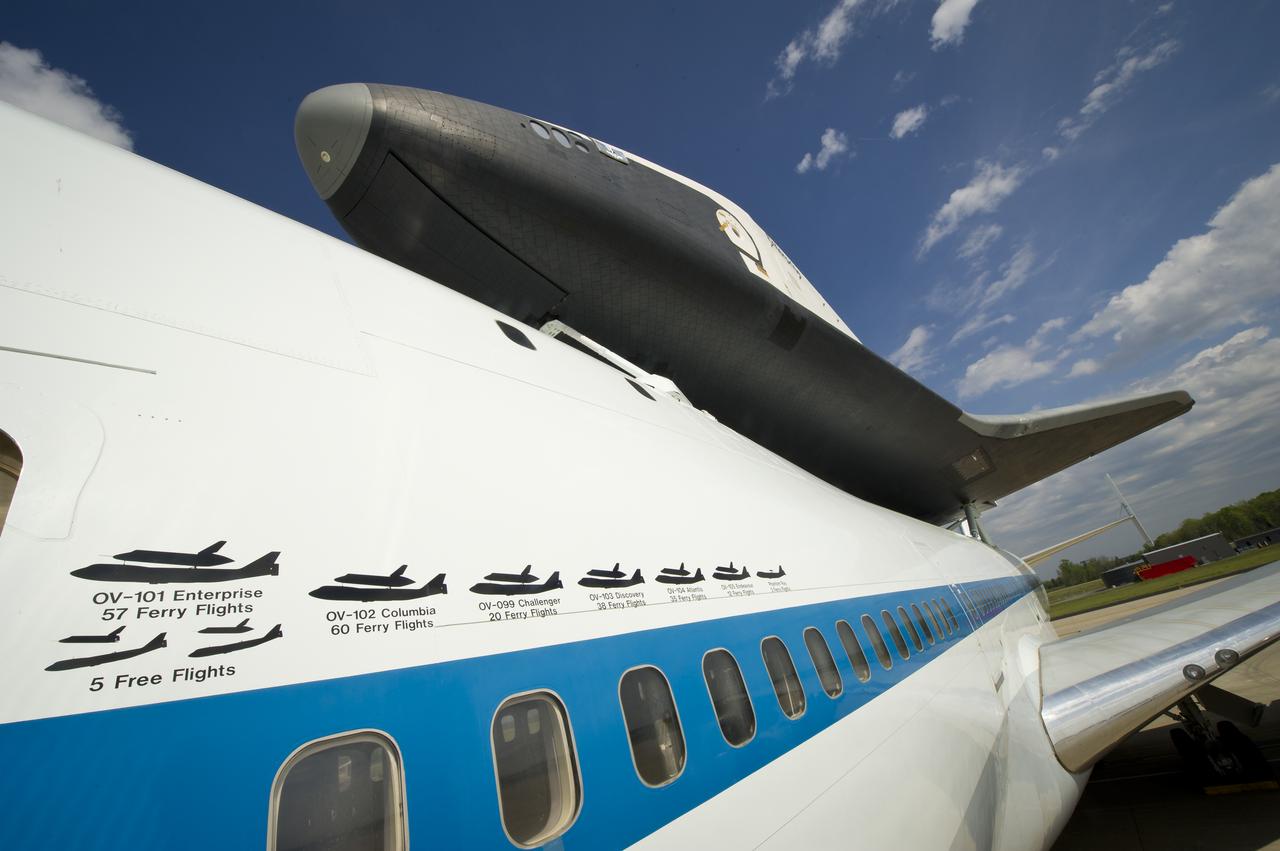
The space shuttle Enterprise is seen mated on top of the NASA 747 Shuttle Carrier Aircraft (SCA) at Washington Dulles International Airport, Saturday, April 21, 2012, in Sterling, Va. Painted graphics line the side of NASA 905 depicting the various ferry flights the Shuttle Carrier Aircraft has supported during the Space Shuttle Program, including the tests using the space shuttle prototype Enterprise. Space Shuttle Transition and Retirement engineers Saturday completed the final steps to ready Space Shuttle Enterprise for its flight to New York’s John F. Kennedy International Airport while managers continue to evaluate the expected weather that has postponed delivery past Monday. Enterprise, the first orbiter built for the Space Shuttle Program, was used primarily for ground and flight tests within the atmosphere. The initial testing period named Approach and Landing Test (ALT) included a flight on February 18, 1977 atop a Shuttle Carrier Aircraft (SCA) to measure structural loads and ground handling and braking characteristics of the mated system. Enterprise will go on permanent display at the Intrepid Sea Air and Space Museum in New York in June. Photo Credit: (NASA/Bill Ingalls)
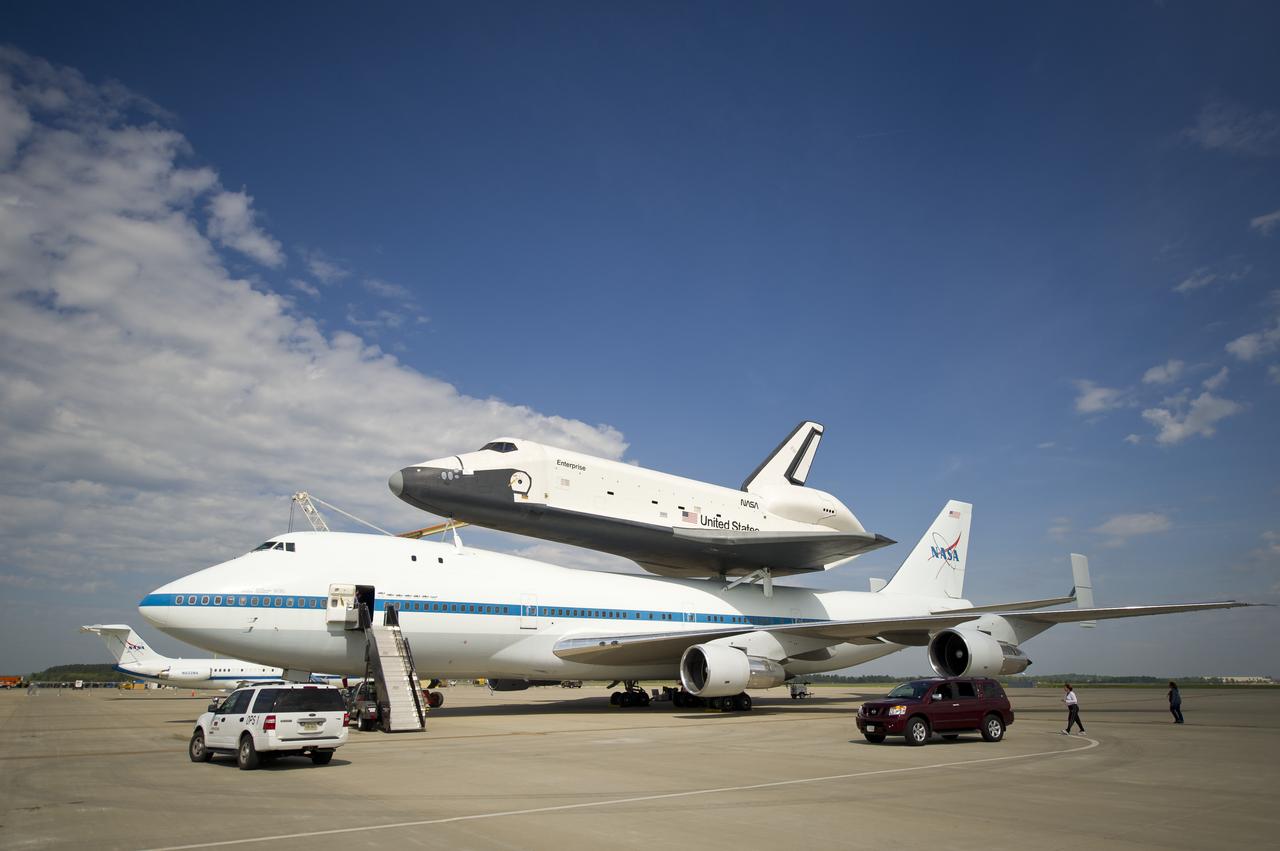
The space shuttle Enterprise is seen mated on top of the NASA 747 Shuttle Carrier Aircraft (SCA) at Washington Dulles International Airport, Saturday, April 21, 2012, in Sterling, Va. Space Shuttle Transition and Retirement engineers Saturday completed the final steps to ready Space Shuttle Enterprise for its flight to New York’s John F. Kennedy International Airport while managers continue to evaluate the expected weather that has postponed delivery past Monday. Enterprise, the first orbiter built for the Space Shuttle Program, was used primarily for ground and flight tests within the atmosphere. The initial testing period named Approach and Landing Test (ALT) included a flight on February 18, 1977 atop a Shuttle Carrier Aircraft (SCA) to measure structural loads and ground handling and braking characteristics of the mated system. Enterprise will go on permanent display at the Intrepid Sea Air and Space Museum in New York in June. Photo Credit: (NASA/Bill Ingalls)

Space Shuttle Discovery mounted atop a 747 Shuttle Carrier Aircraft (SCA) approaches the runway for landing at Washington Dulles International Airport, Tuesday April 17, 2012, in Sterling, Va. Discovery, the first orbiter retired from NASA’s shuttle fleet, completed 39 missions, spent 365 days in space, orbited the Earth 5,830 times, and traveled 148,221,675 miles. NASA will transfer Discovery to the National Air and Space Museum to begin its new mission to commemorate past achievements in space and to educate and inspire future generations of explorers. Photo Credit: (NASA/Paul E. Alers)
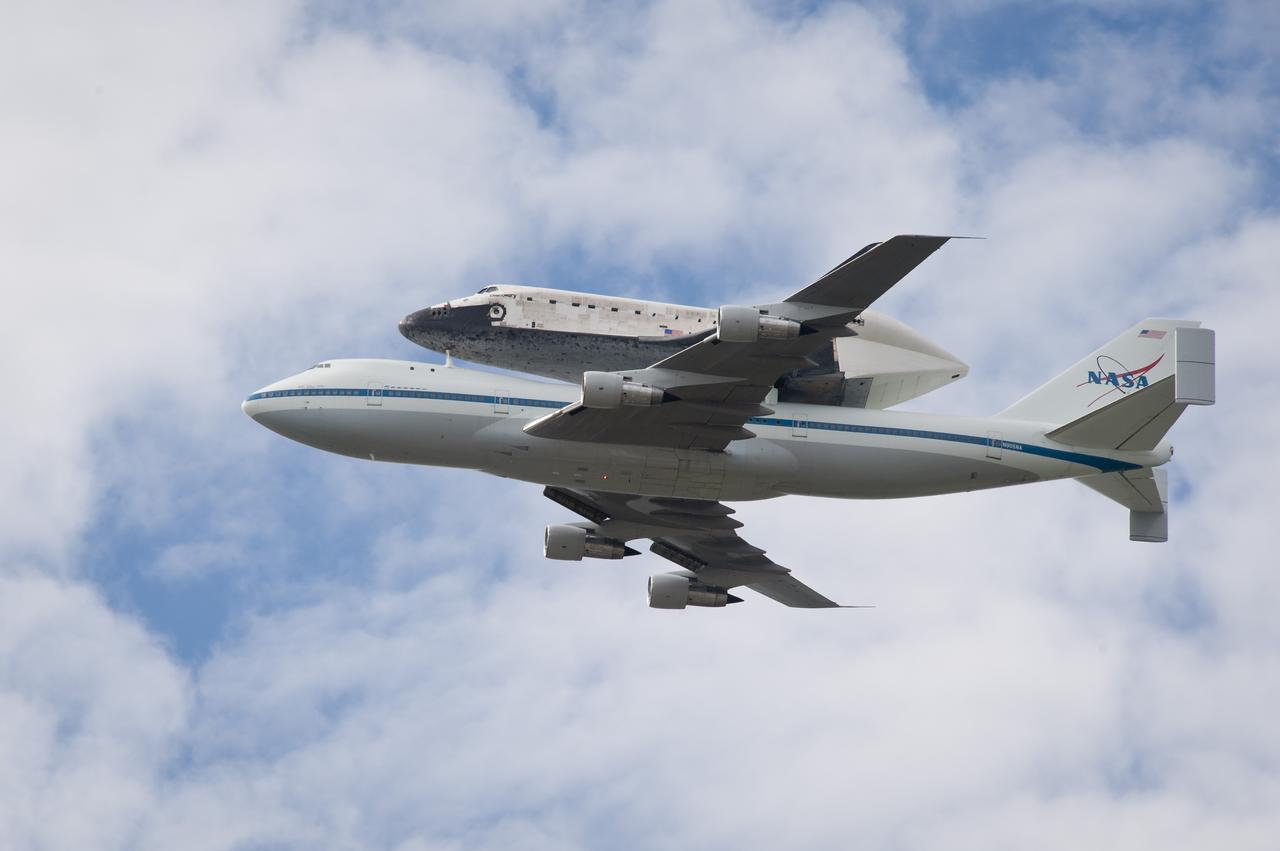
Space shuttle Discovery, mounted atop a NASA 747 Shuttle Carrier Aircraft (SCA) flies near the U.S. Capitol, Tuesday, April 17, 2012, in Washington. Discovery, the first orbiter retired from NASA’s shuttle fleet, completed 39 missions, spent 365 days in space, orbited the Earth 5,830 times, and traveled 148,221,675 miles. NASA will transfer Discovery to the National Air and Space Museum to begin its new mission to commemorate past achievements in space and to educate and inspire future generations of explorers. Photo Credit: (NASA/Michael Porterfield)

Space shuttle Discovery, mounted atop a NASA 747 Shuttle Carrier Aircraft (SCA) lands at Washington Dulles International Airport, Tuesday, April 17, 2012, in Sterling, Va. Discovery, the first orbiter retired from NASA’s shuttle fleet, completed 39 missions, spent 365 days in space, orbited the Earth 5,830 times, and traveled 148,221,675 miles. NASA will transfer Discovery to the National Air and Space Museum to begin its new mission to commemorate past achievements in space and to educate and inspire future generations of explorers. Photo Credit: (NASA/Smithsonian Institution/Eric Long)

Space shuttle Enterprise, mounted atop a NASA 747 Shuttle Carrier Aircraft (SCA), is seen as it flies over the Manhattan Skyline with Freedom Tower in the background, Friday, April 27, 2012, in New York. Enterprise was the first shuttle orbiter built for NASA performing test flights in the atmosphere and was incapable of spaceflight. Originally housed at the Smithsonian's Steven F. Udvar-Hazy Center, Enterprise will be demated from the SCA and placed on a barge that will eventually be moved by tugboat up the Hudson River to the Intrepid Sea, Air & Space Museum in June. Photo Credit: (NASA/Robert Markowitz)
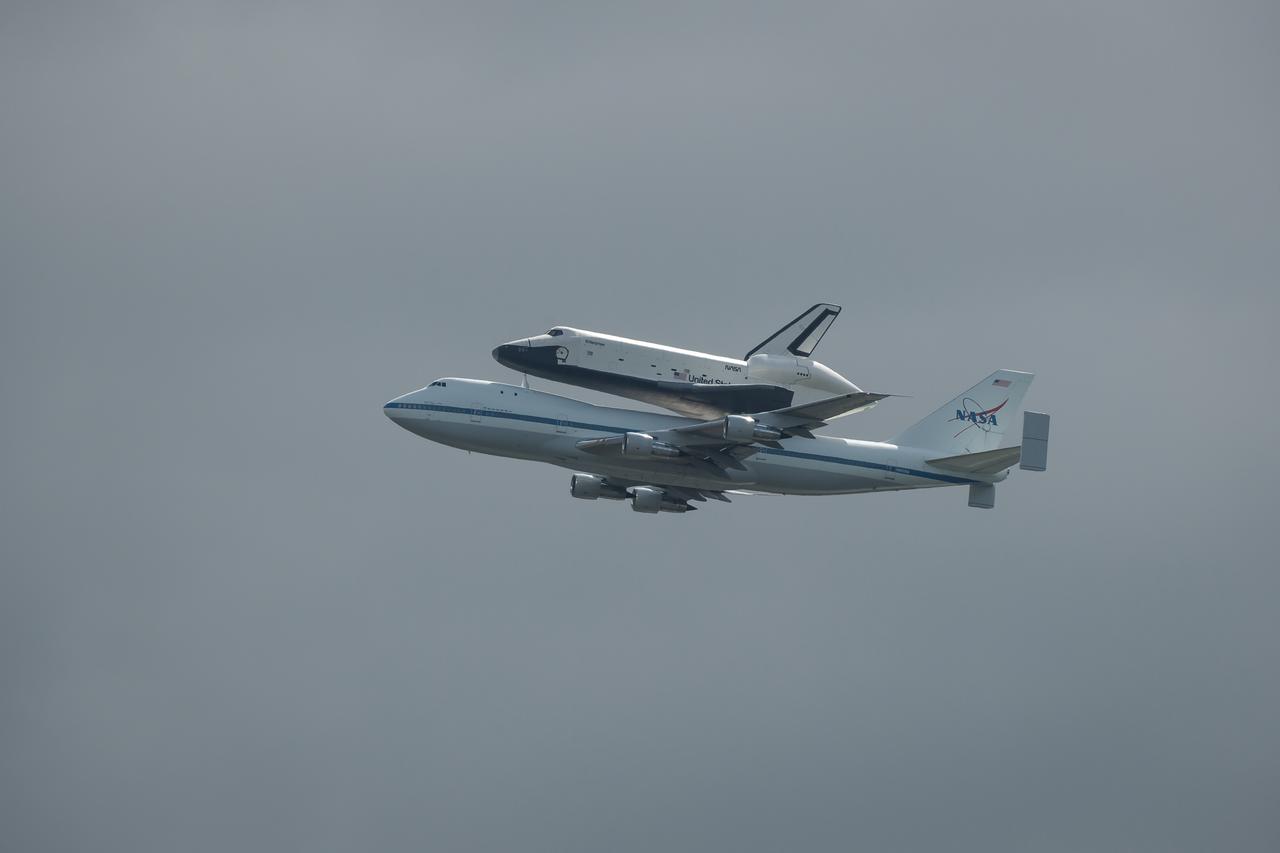
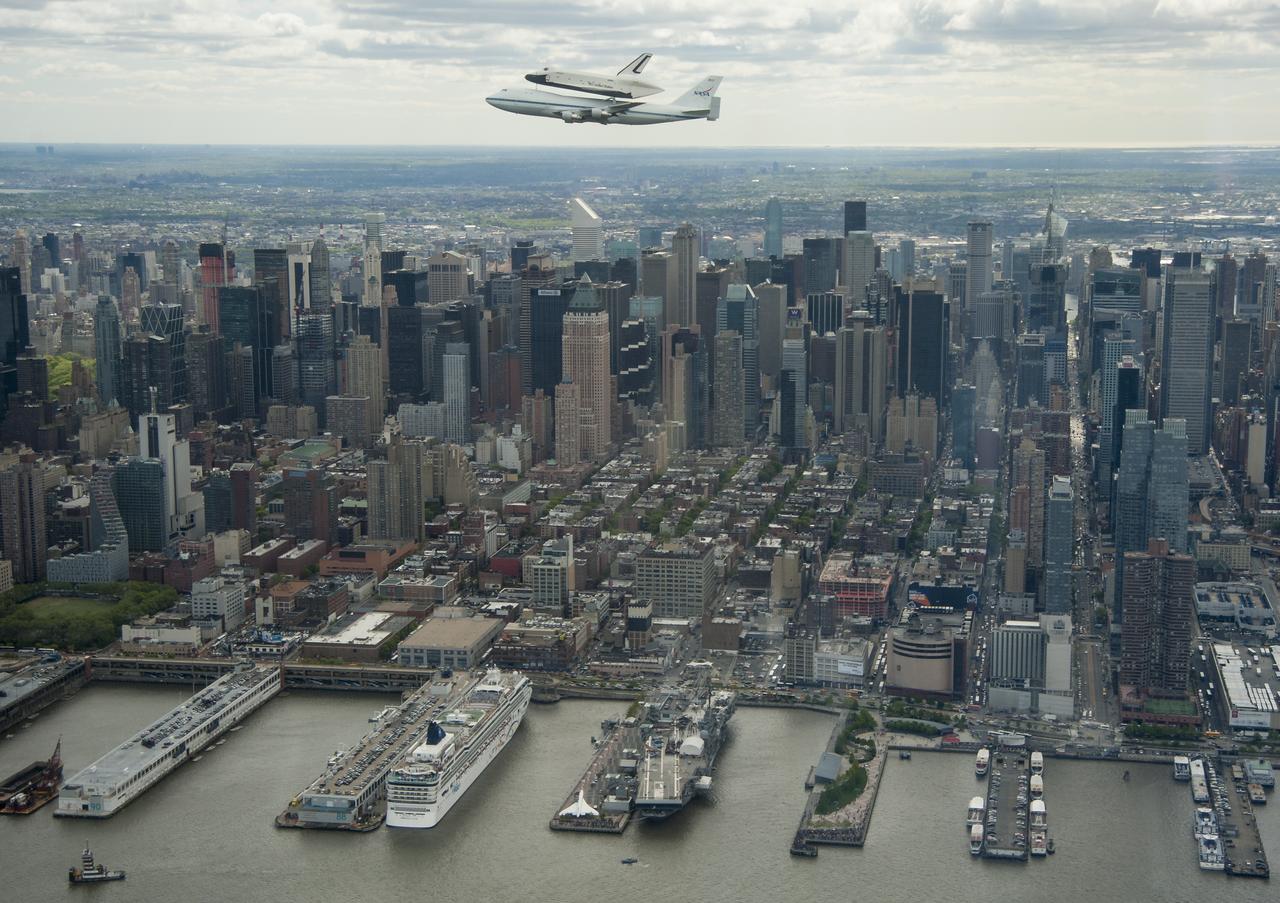
Space shuttle Enterprise, mounted atop a NASA 747 Shuttle Carrier Aircraft (SCA), is seen as it flies over the Hudson River, Friday, April 27, 2012, in New York. Enterprise was the first shuttle orbiter built for NASA performing test flights in the atmosphere and was incapable of spaceflight. Originally housed at the Smithsonian's Steven F. Udvar-Hazy Center, Enterprise will be demated from the SCA and placed on a barge that will eventually be moved by tugboat up the Hudson River to the Intrepid Sea, Air & Space Museum in June. Photo Credit: (NASA/Bill Ingalls)

Space shuttle Discovery, mounted atop a NASA 747 Shuttle Carrier Aircraft (SCA) taxis in front of the main terminal at Washington Dulles International Airport, Tuesday, April 17, 2012, in Sterling, Va. Discovery, the first orbiter retired from NASA’s shuttle fleet, completed 39 missions, spent 365 days in space, orbited the Earth 5,830 times, and traveled 148,221,675 miles. NASA will transfer Discovery to the National Air and Space Museum to begin its new mission to commemorate past achievements in space and to educate and inspire future generations of explorers. Photo Credit: (NASA/Smithsonian Institution/Eric Long)

Space shuttle Enterprise, mounted atop a NASA 747 Shuttle Carrier Aircraft (SCA), is seen as it flies over the Hudson River, Friday, April 27, 2012, in New York. Enterprise was the first shuttle orbiter built for NASA performing test flights in the atmosphere and was incapable of spaceflight. Originally housed at the Smithsonian's Steven F. Udvar-Hazy Center, Enterprise will be demated from the SCA and placed on a barge that will eventually be moved by tugboat up the Hudson River to the Intrepid Sea, Air & Space Museum in June. Photo Credit: (NASA/Matt Hedges)

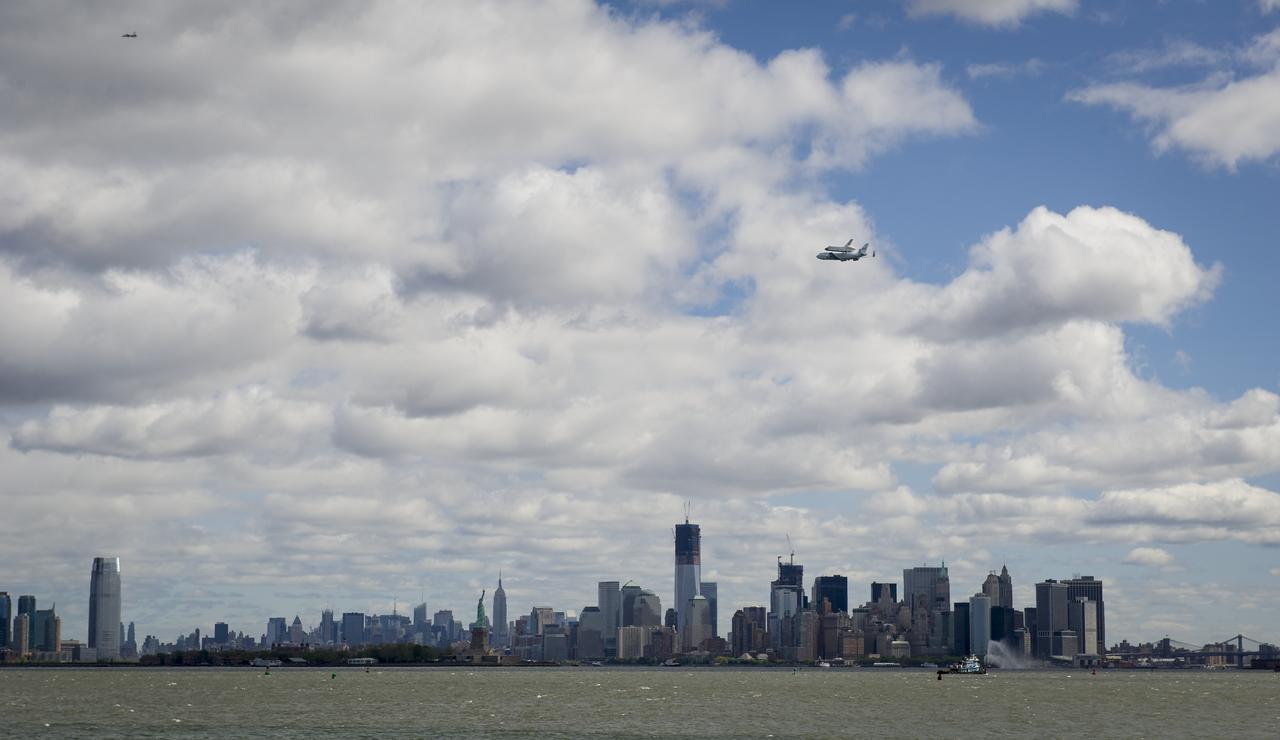
Space shuttle Enterprise, mounted atop a NASA 747 Shuttle Carrier Aircraft (SCA), is seen as it flies near the Statue of Liberty and the Manhattan skyline, Friday, April 27, 2012, in New York. Enterprise was the first shuttle orbiter built for NASA performing test flights in the atmosphere and was incapable of spaceflight. Originally housed at the Smithsonian's Steven F. Udvar-Hazy Center, Enterprise will be demated from the SCA and placed on a barge that will eventually be moved by tugboat up the Hudson River to the Intrepid Sea, Air & Space Museum in June. Photo Credit: (NASA/Robert Markowitz)

Space shuttle Discovery, mounted atop a NASA 747 Shuttle Carrier Aircraft (SCA) lands at Washington Dulles International Airport, Tuesday, April 17, 2012, in Sterling, Va. Discovery, the first orbiter retired from NASA’s shuttle fleet, completed 39 missions, spent 365 days in space, orbited the Earth 5,830 times, and traveled 148,221,675 miles. NASA will transfer Discovery to the National Air and Space Museum to begin its new mission to commemorate past achievements in space and to educate and inspire future generations of explorers. Photo Credit: (NASA/Smithsonian Institution/Eric Long)

Space shuttle Discovery, mounted atop a NASA 747 Shuttle Carrier Aircraft (SCA) lands at Washington Dulles International Airport, Tuesday, April 17, 2012, in Sterling, Va. The Steven F. Udvar-Hazy Center is seen in the background. Discovery, the first orbiter retired from NASA’s shuttle fleet, completed 39 missions, spent 365 days in space, orbited the Earth 5,830 times, and traveled 148,221,675 miles. NASA will transfer Discovery to the National Air and Space Museum to begin its new mission to commemorate past achievements in space and to educate and inspire future generations of explorers. Photo Credit: (NASA/Smithsonian Institution/Eric Long)
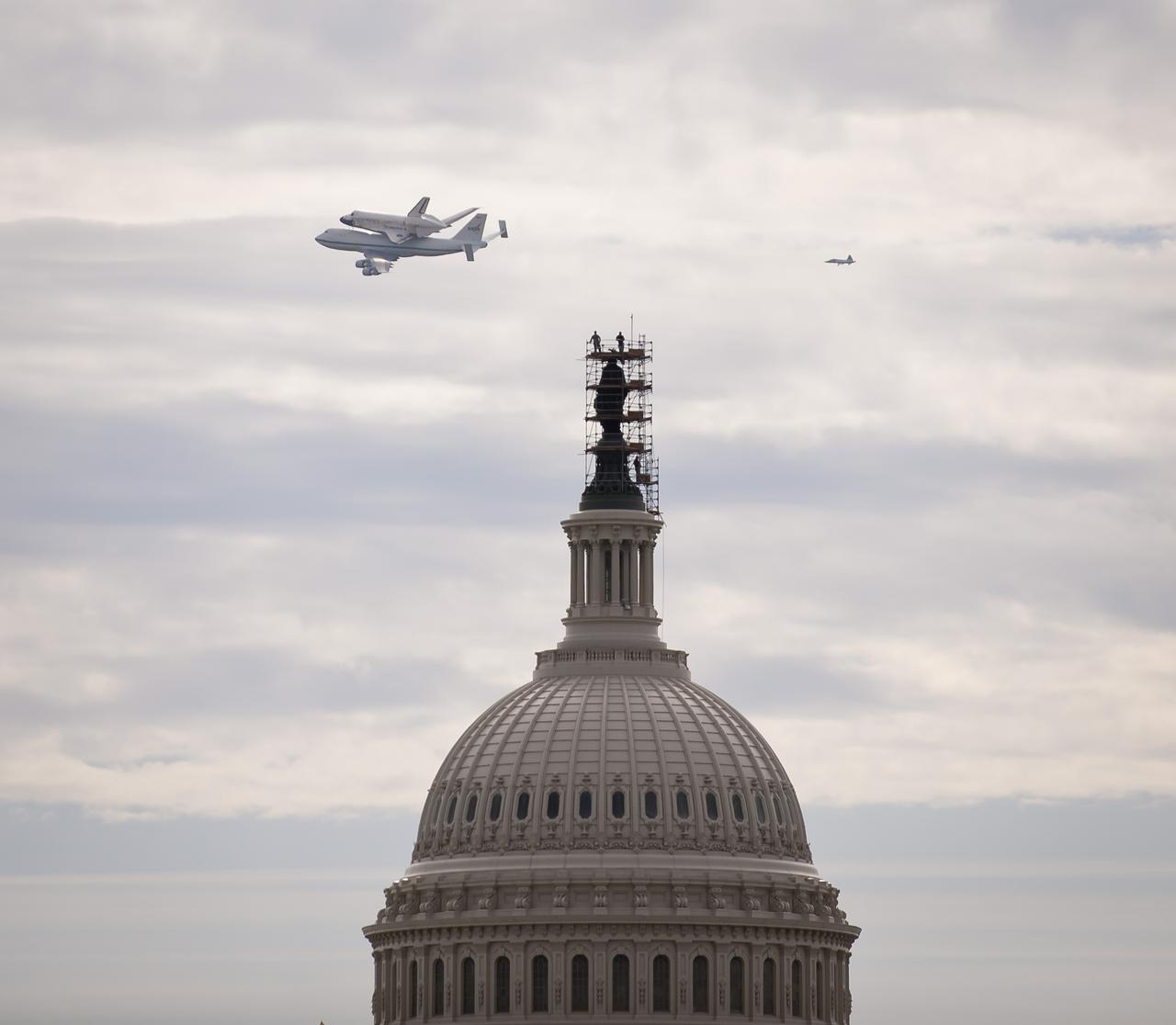
Space shuttle Discovery, mounted atop a NASA 747 Shuttle Carrier Aircraft (SCA) is seen as it flies near the U.S. Capitol, Tuesday, April 17, 2012, in Washington. Discovery, the first orbiter retired from NASA’s shuttle fleet, completed 39 missions, spent 365 days in space, orbited the Earth 5,830 times, and traveled 148,221,675 miles. NASA will transfer Discovery to the National Air and Space Museum to begin its new mission to commemorate past achievements in space and to educate and inspire future generations of explorers. Photo Credit: (NASA/Smithsonian Institution/Harold Dorwin)
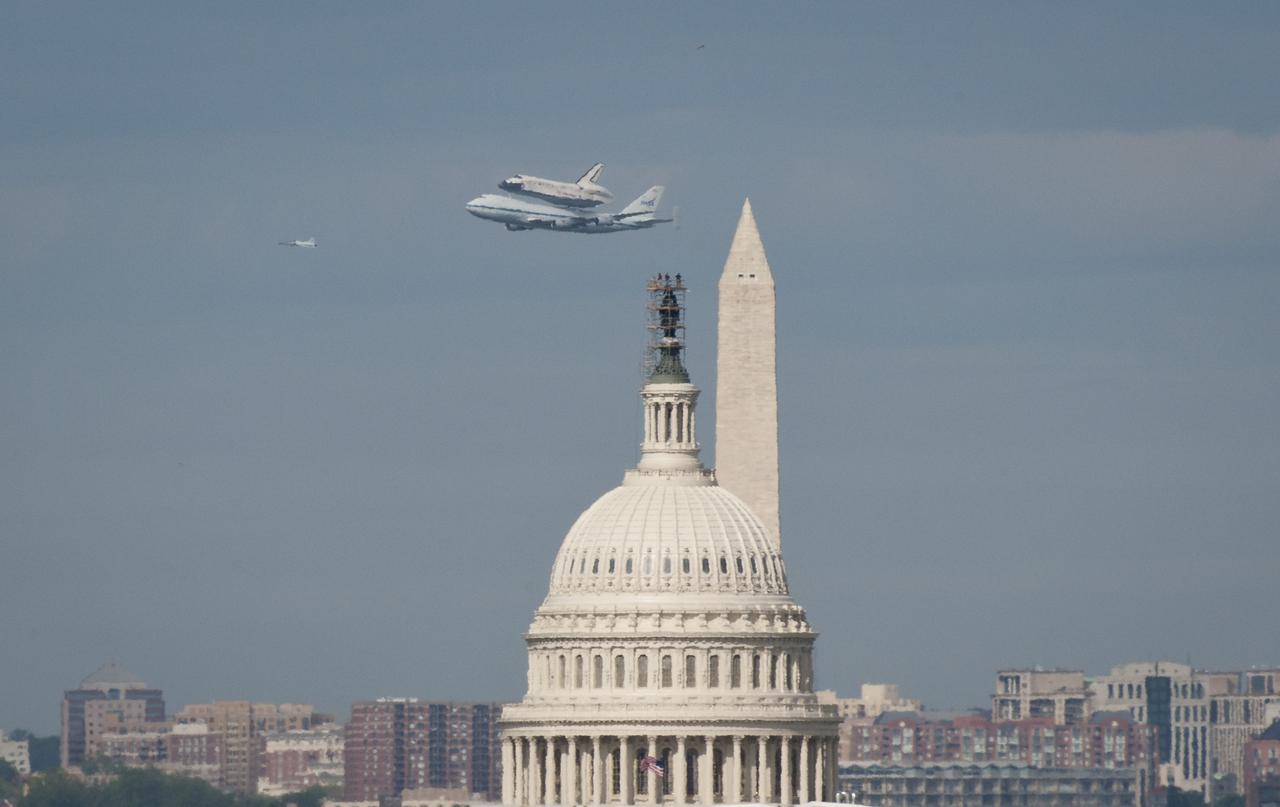
Space shuttle Discovery, mounted atop a NASA 747 Shuttle Carrier Aircraft (SCA) flies near the U.S. Capitol, Tuesday, April 17, 2012, in Washington. Discovery, the first orbiter retired from NASA’s shuttle fleet, completed 39 missions, spent 365 days in space, orbited the Earth 5,830 times, and traveled 148,221,675 miles. NASA will transfer Discovery to the National Air and Space Museum to begin its new mission to commemorate past achievements in space and to educate and inspire future generations of explorers. Photo Credit: (NASA/Rebecca Roth)
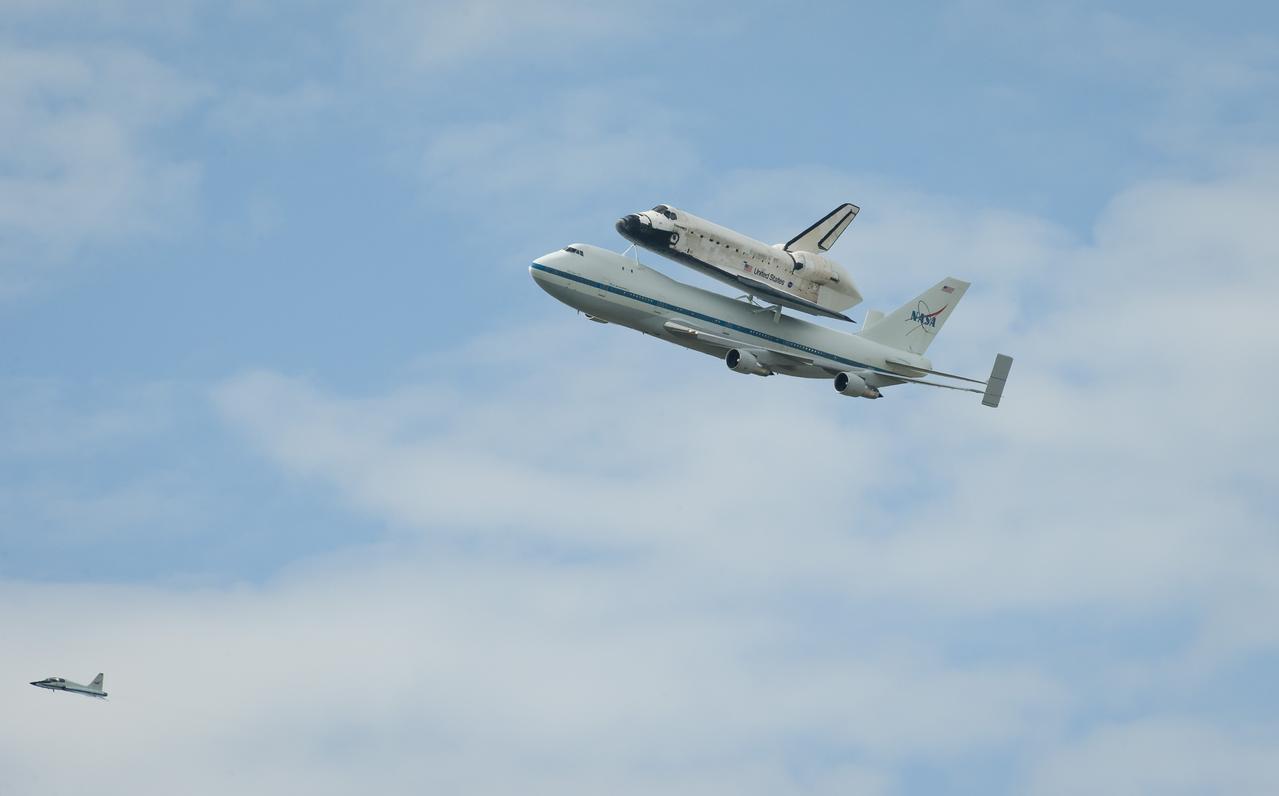
Space shuttle Discovery, mounted atop a NASA 747 Shuttle Carrier Aircraft (SCA) flies near the U.S. Capitol, Tuesday, April 17, 2012, in Washington. Discovery, the first orbiter retired from NASA’s shuttle fleet, completed 39 missions, spent 365 days in space, orbited the Earth 5,830 times, and traveled 148,221,675 miles. NASA will transfer Discovery to the National Air and Space Museum to begin its new mission to commemorate past achievements in space and to educate and inspire future generations of explorers. Photo Credit: (NASA/Rebecca Roth)

Space shuttle Discovery, mounted atop a NASA 747 Shuttle Carrier Aircraft (SCA) flies over the Steven F. Udvar-Hazy Center, Tuesday, April 17, 2012, in Washington. Discovery, the first orbiter retired from NASA’s shuttle fleet, completed 39 missions, spent 365 days in space, orbited the Earth 5,830 times, and traveled 148,221,675 miles. NASA will transfer Discovery to the National Air and Space Museum to begin its new mission to commemorate past achievements in space and to educate and inspire future generations of explorers. Photo Credit: (NASA/Smithsonian Institution/Eric Long)
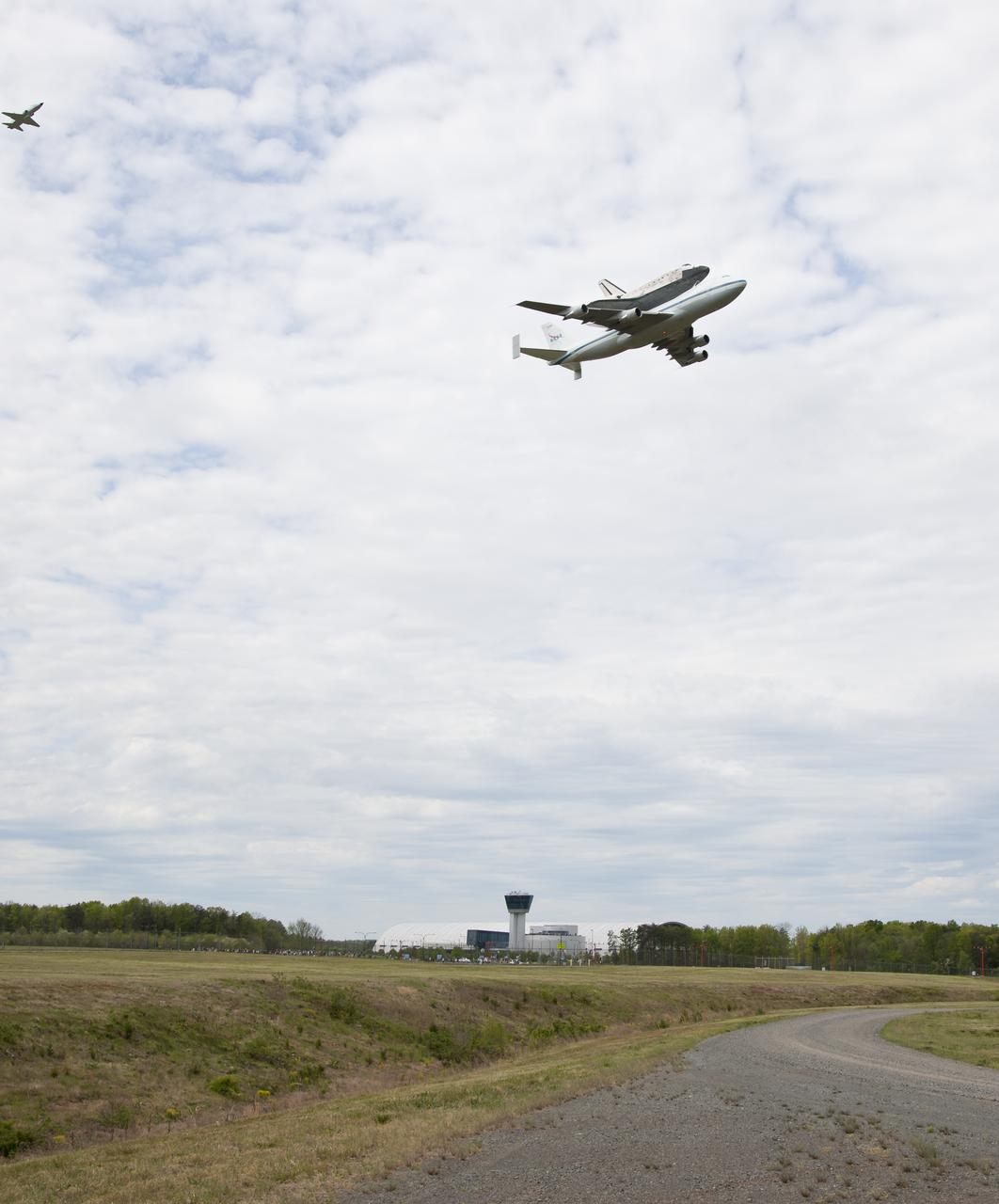
Space shuttle Discovery, mounted atop a NASA 747 Shuttle Carrier Aircraft (SCA) flies over the Steven F. Udvar-Hazy Center, Tuesday, April 17, 2012, in Washington. Discovery, the first orbiter retired from NASA’s shuttle fleet, completed 39 missions, spent 365 days in space, orbited the Earth 5,830 times, and traveled 148,221,675 miles. NASA will transfer Discovery to the National Air and Space Museum to begin its new mission to commemorate past achievements in space and to educate and inspire future generations of explorers. Photo Credit: (NASA/Smithsonian Institution/Dane Penland)
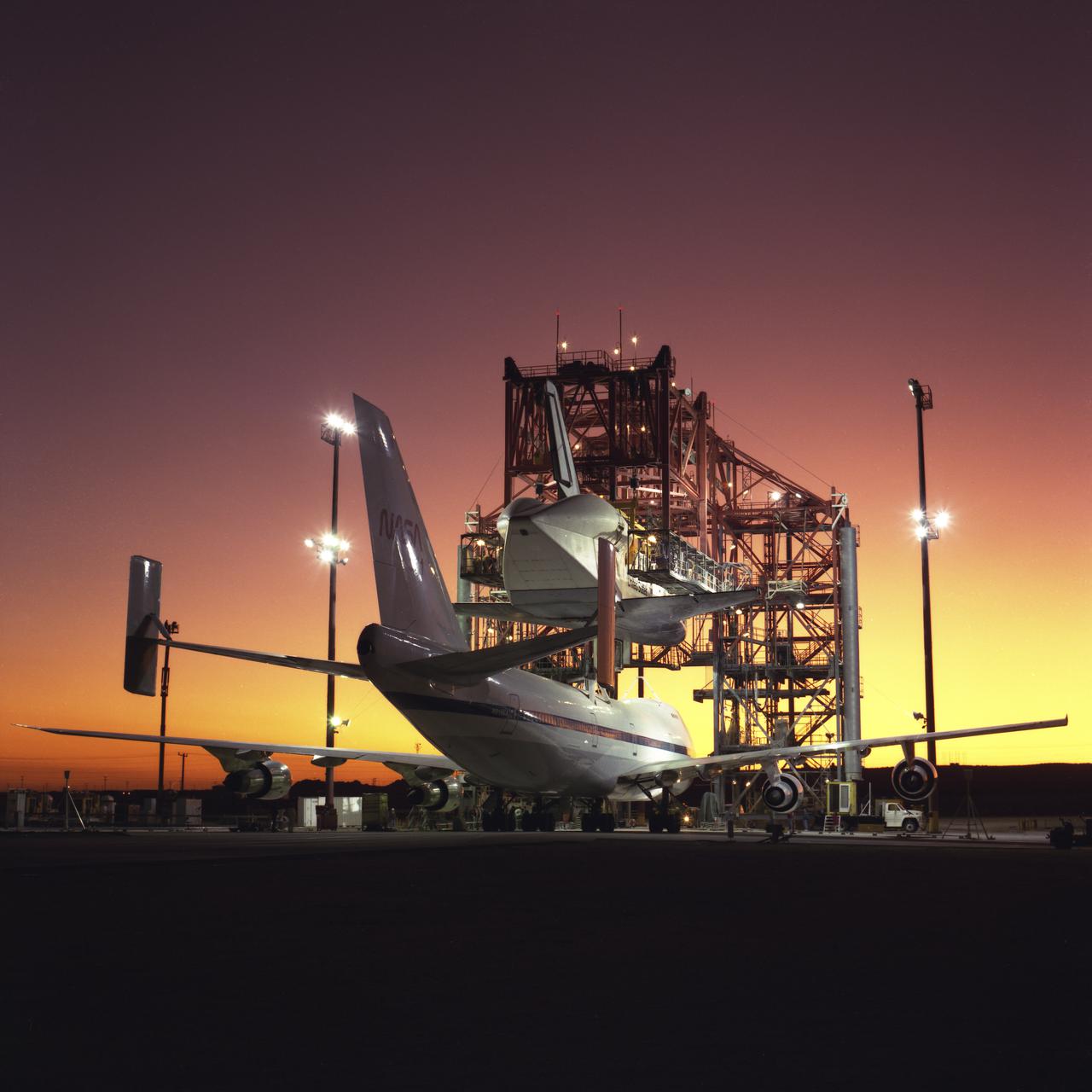
Shuttle Atlantis emerges from the Mate-Demate-Device mounted to Boeing 747 Shuttle Carrier Aircraft for the return flight to Kennedy Space Center in Florida.
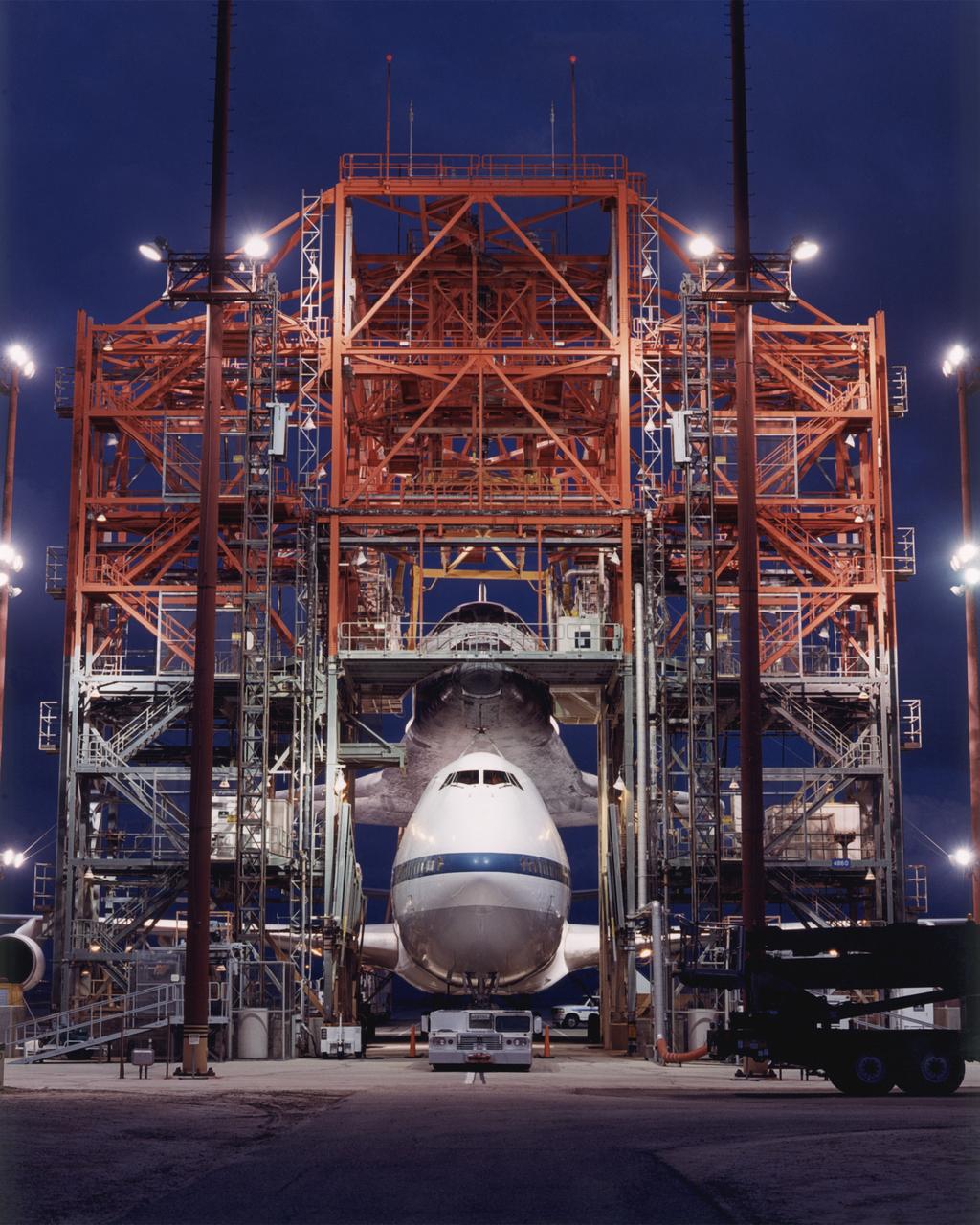
The Space Shuttle Atlantis is centered in the Mate-Demate Device (MDD) at NASA's Dryden Flight Research Center at Edwards, California. The gantry-like MDD structure is used for servicing the shuttle orbiters in preparation for their ferry flight back to the Kennedy Space Center in Florida, including mounting the shuttle atop NASA's modified Boeing 747 Shuttle Carrier Aircraft. Space Shuttle Atlantis landed at 12:33 p.m. February 20, 2001, on the runway at Edwards Air Force Base, California, where NASA's Dryden Flight Research Center is located. The mission, which began February 7, logged 5.3 million miles as the shuttle orbited earth while delivering the Destiny science laboratory to the International Space Station. Inclement weather conditions in Florida prompted the decision to land Atlantis at Edwards. The last time a space shuttle landed at Edwards was Oct. 24, 2000.
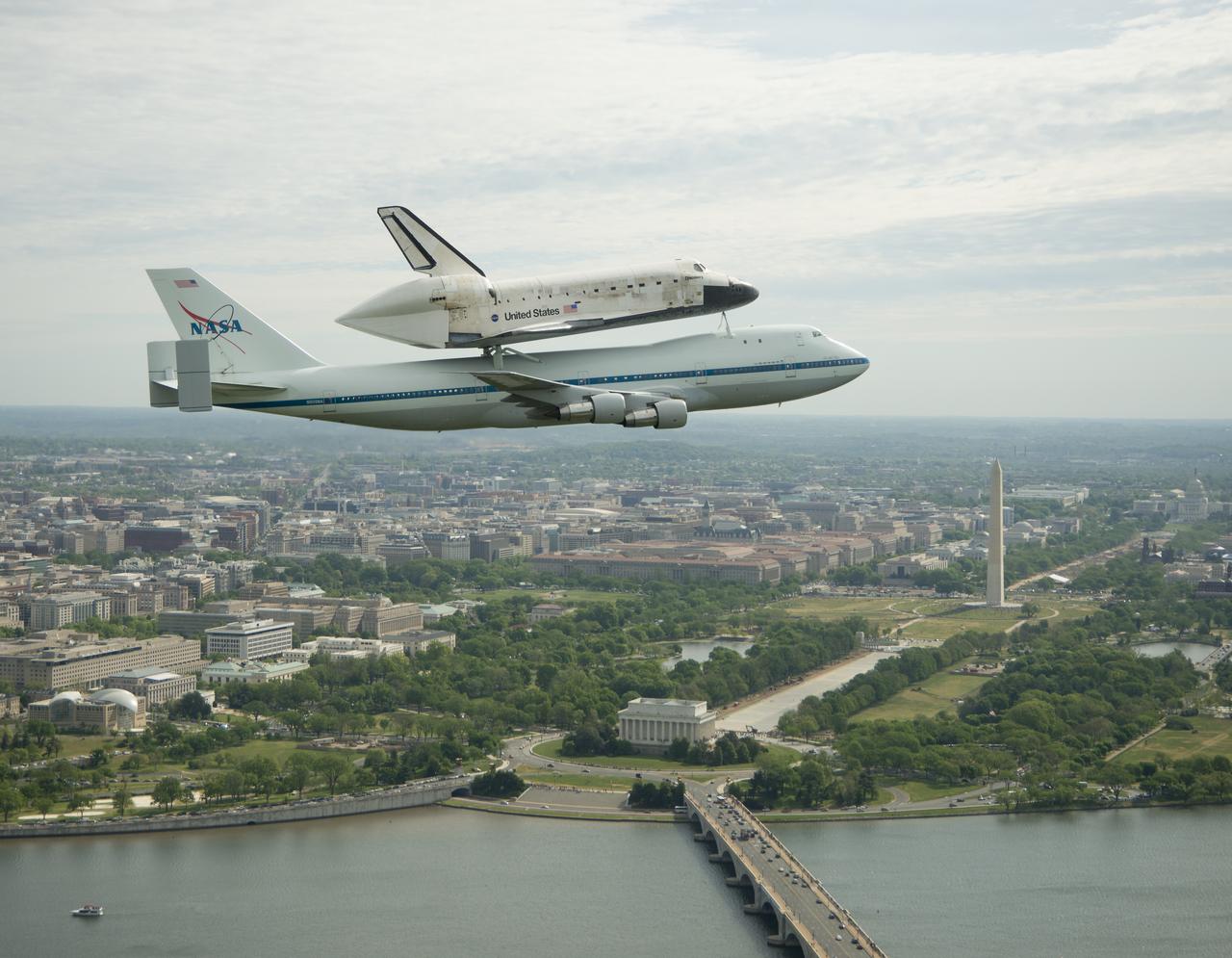
Space shuttle Discovery, mounted atop a NASA 747 Shuttle Carrier Aircraft (SCA), flies over the Washington skyline as seen from a NASA T-38 aircraft, Tuesday, April 17, 2012. Discovery, the first orbiter retired from NASA’s shuttle fleet, completed 39 missions, spent 365 days in space, orbited the Earth 5,830 times, and traveled 148,221,675 miles. NASA will transfer Discovery to the National Air and Space Museum to begin its new mission to commemorate past achievements in space and to educate and inspire future generations of explorers. Photo Credit: (NASA/Robert Markowitz)
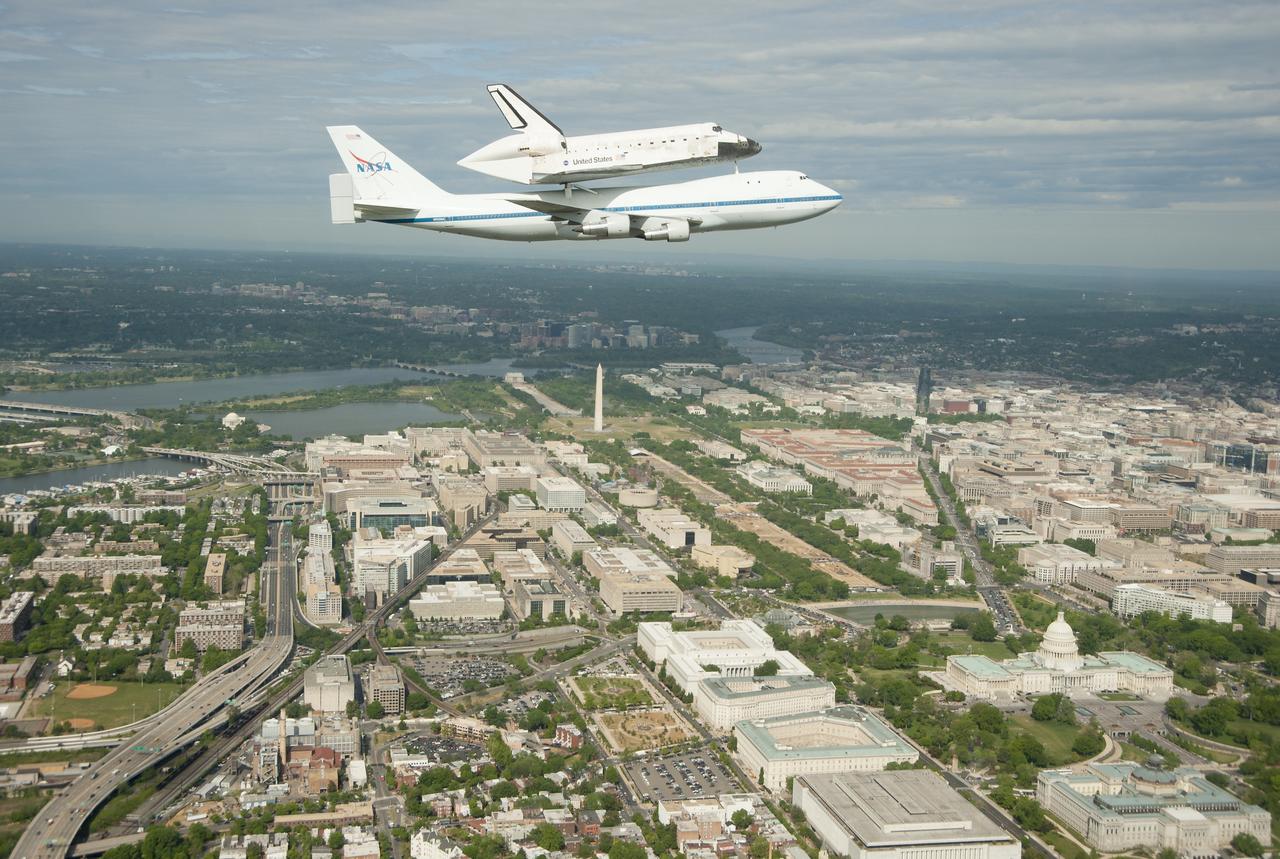
Space shuttle Discovery, mounted atop a NASA 747 Shuttle Carrier Aircraft (SCA), flies over the Washington skyline as seen from a NASA T-38 aircraft, Tuesday, April 17, 2012. Discovery, the first orbiter retired from NASA’s shuttle fleet, completed 39 missions, spent 365 days in space, orbited the Earth 5,830 times, and traveled 148,221,675 miles. NASA will transfer Discovery to the National Air and Space Museum to begin its new mission to commemorate past achievements in space and to educate and inspire future generations of explorers. Photo Credit: (NASA/Robert Markowitz)
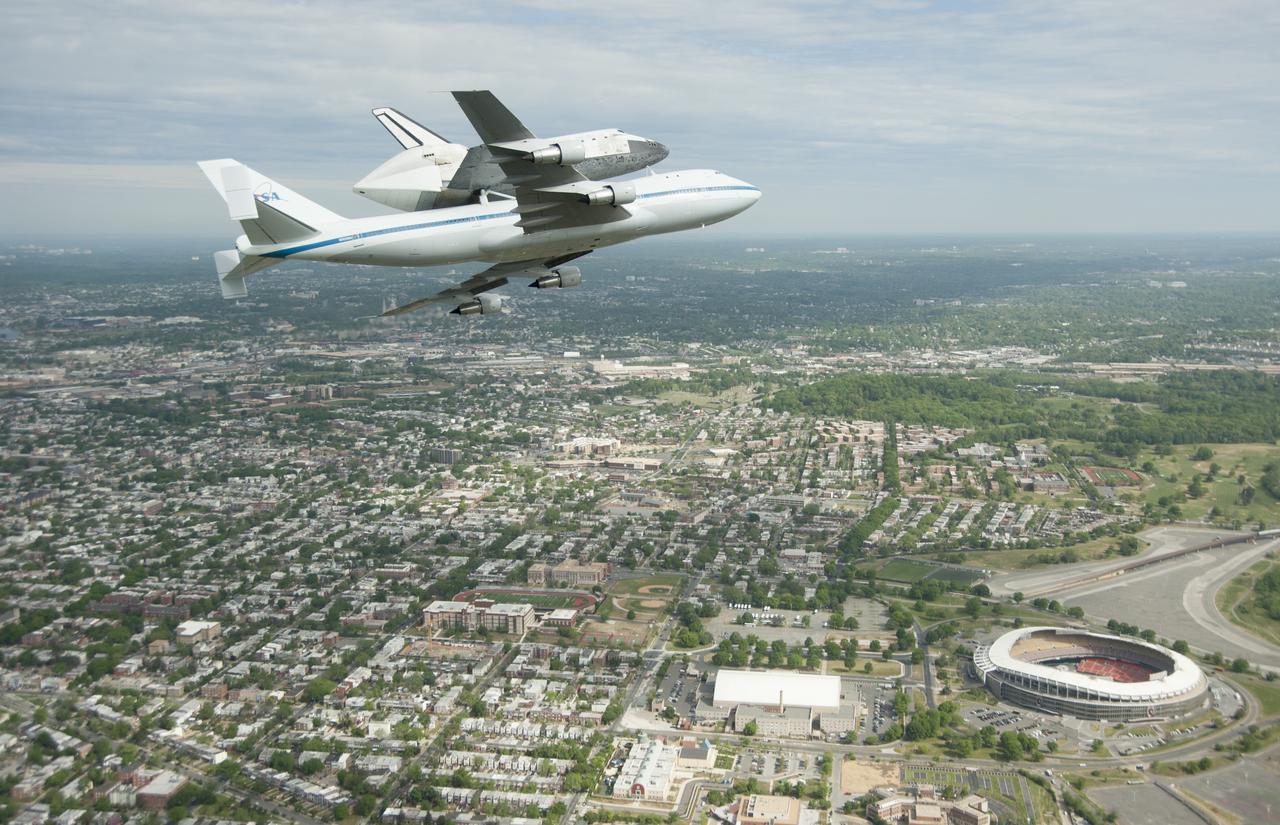
Space shuttle Discovery, mounted atop a NASA 747 Shuttle Carrier Aircraft (SCA), flies over the Washington skyline as seen from a NASA T-38 aircraft, Tuesday, April 17, 2012. Discovery, the first orbiter retired from NASA’s shuttle fleet, completed 39 missions, spent 365 days in space, orbited the Earth 5,830 times, and traveled 148,221,675 miles. NASA will transfer Discovery to the National Air and Space Museum to begin its new mission to commemorate past achievements in space and to educate and inspire future generations of explorers. Photo Credit: (NASA/Robert Markowitz)

The space shuttle Enterprise hangs from a sling after being demated from the NASA 747 Shuttle Carrier Aircraft (SCA) at John F. Kennedy (JFK) International Airport in Jamica, New York, Sunday, May 13, 2012. The shuttle will be placed on a barge that will move by tugboat up the Hudson River to the Intrepid Sea, Air & Space Museum in June. The shuttle will be lifted by crane and placed on the flight deck of the Intrepid, where it will be on exhibit to the public starting this summer in a temporary climate-controlled pavilion. Photo Credit: (NASA/Kim Shiflet)
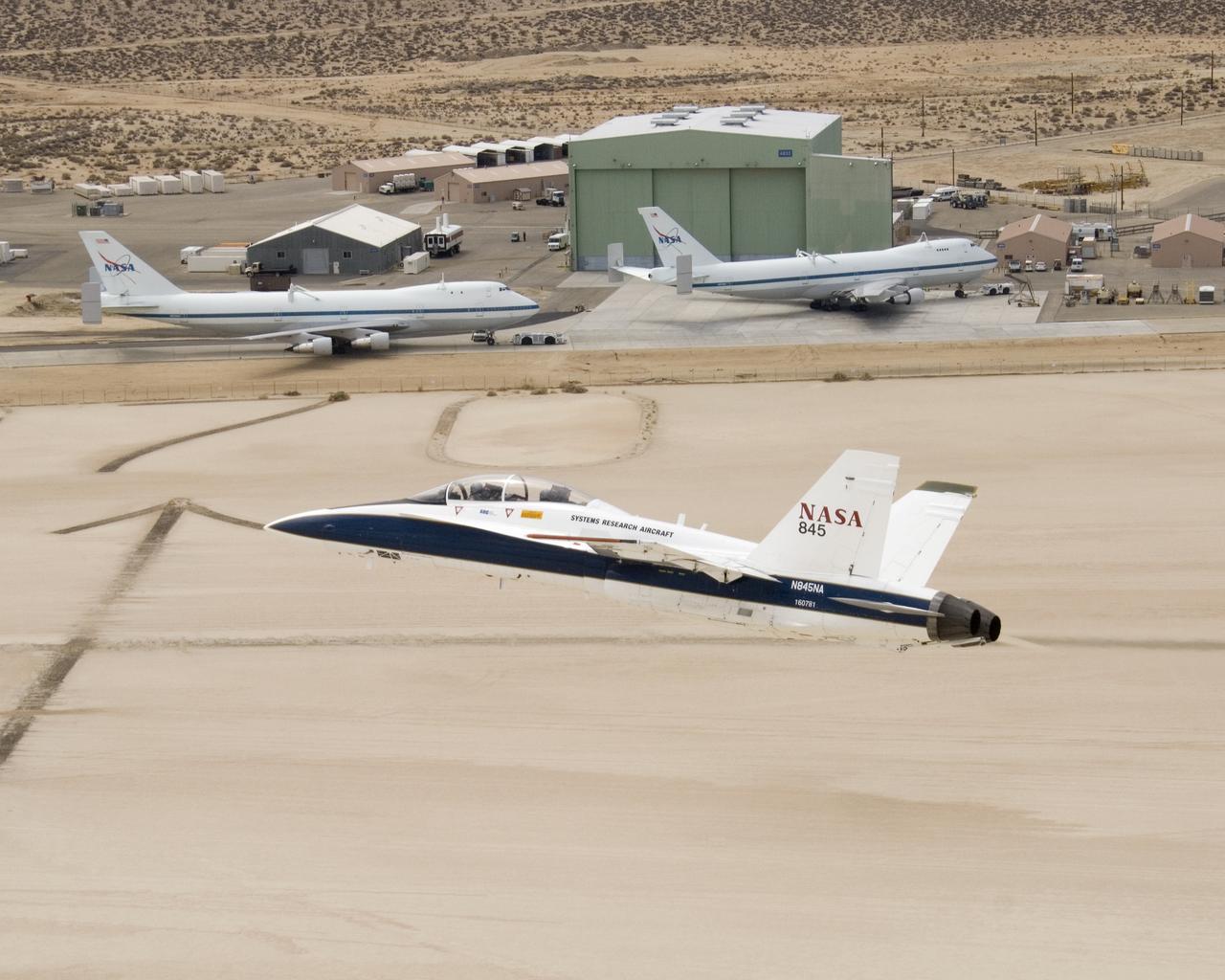
NASA's two Boeing 747 Shuttle Carrier Aircraft form the backdrop as pilot Dick Ewers banks NASA F/A-18 #845 low over Rogers Dry Lake to end a research flight.
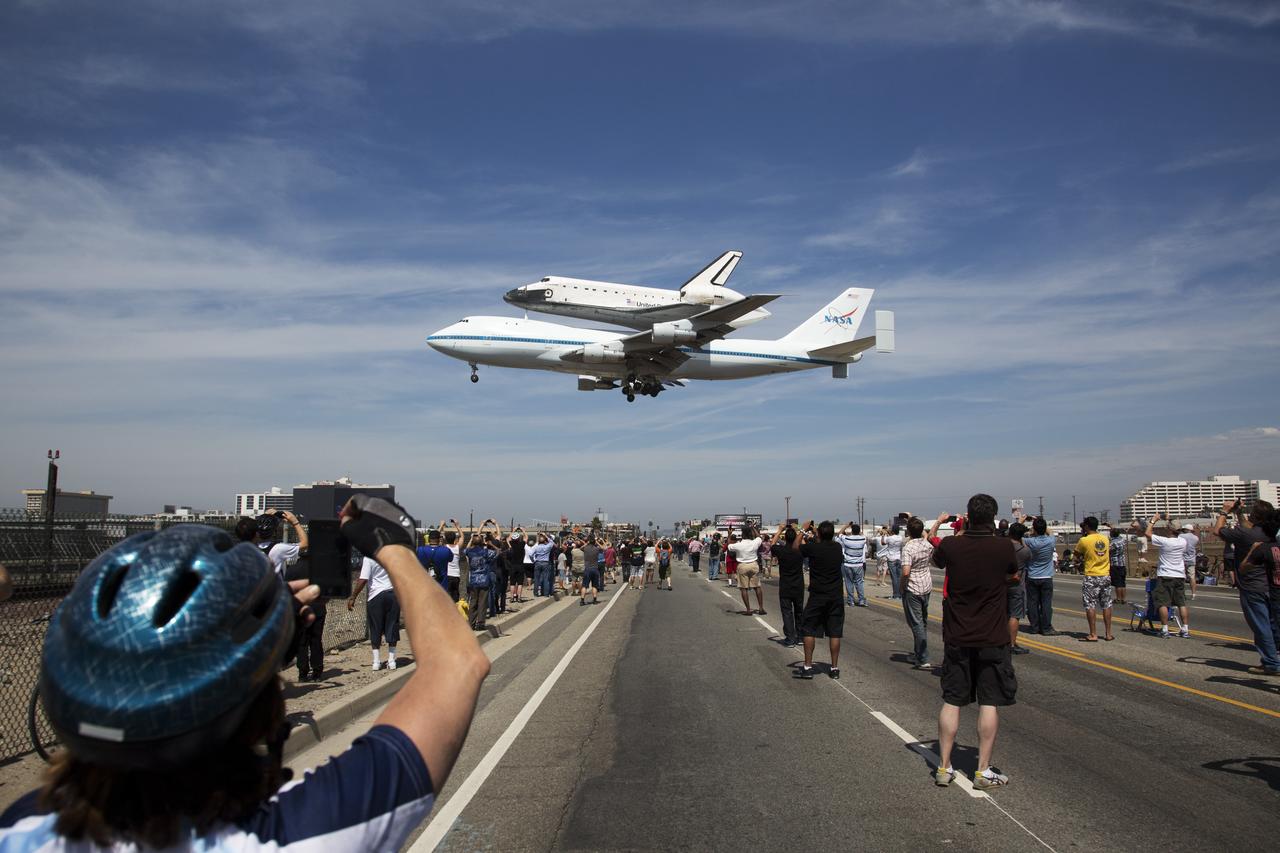
The space shuttle Endeavour, atop the Shuttle Carrier Aircraft, or SCA, lands at Los Angeles International Airport on Tuesday, Sept. 21, 2012 in Los Angeles where it will be placed on public display at the California Science Center. Today's flight marks the final scheduled ferry flight of the Space Shuttle Program. Photo Credit: (NASA/Matt Hedges)

A set of cranes and wind restraints constructed to remove space shuttle Enterprise from atop NASA's 747 Shuttle Carrier Aircraft are being put into place at John F. Kennedy (JFK) International Airport in New York, Saturday, May 12, 2012. Enterprise will be placed on a barge that will move by tugboat up the Hudson River to Intrepid in June. The shuttle will be lifted by crane and placed on the flight deck of the Intrepid, where it will be on exhibit to the public starting this summer in a temporary climate-controlled pavilion. Photo Credit: (NASA/Kim Shiflet)
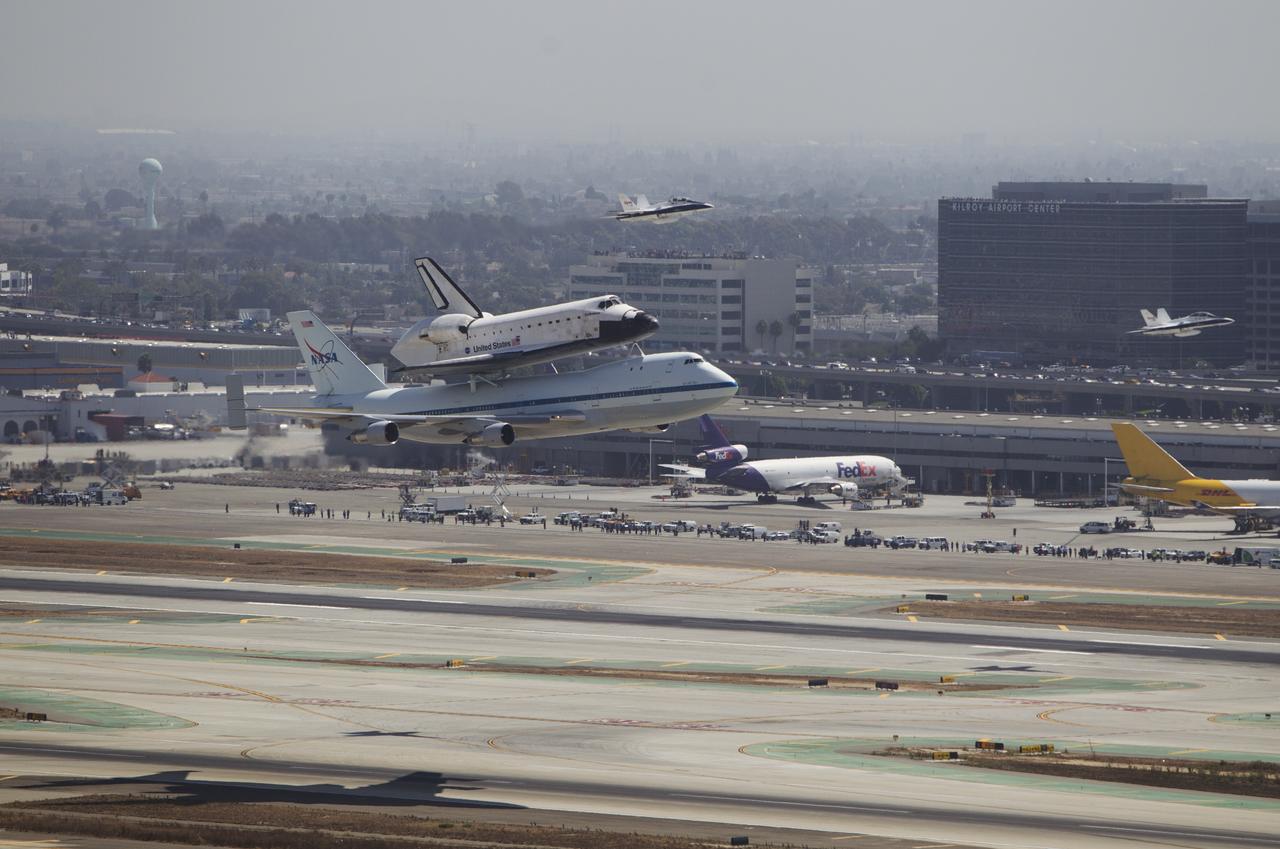
The space shuttle Endeavour, atop the Shuttle Carrier Aircraft, or SCA, performs a fly-by of Los Angeles International Airport on Tuesday, Sept. 21, 2012 in Los Angeles where it will be placed on public display at the California Science Center. Today's flight marks the final scheduled ferry flight of the Space Shuttle Program. Photo Credit: (NASA/Joel Kowsky)
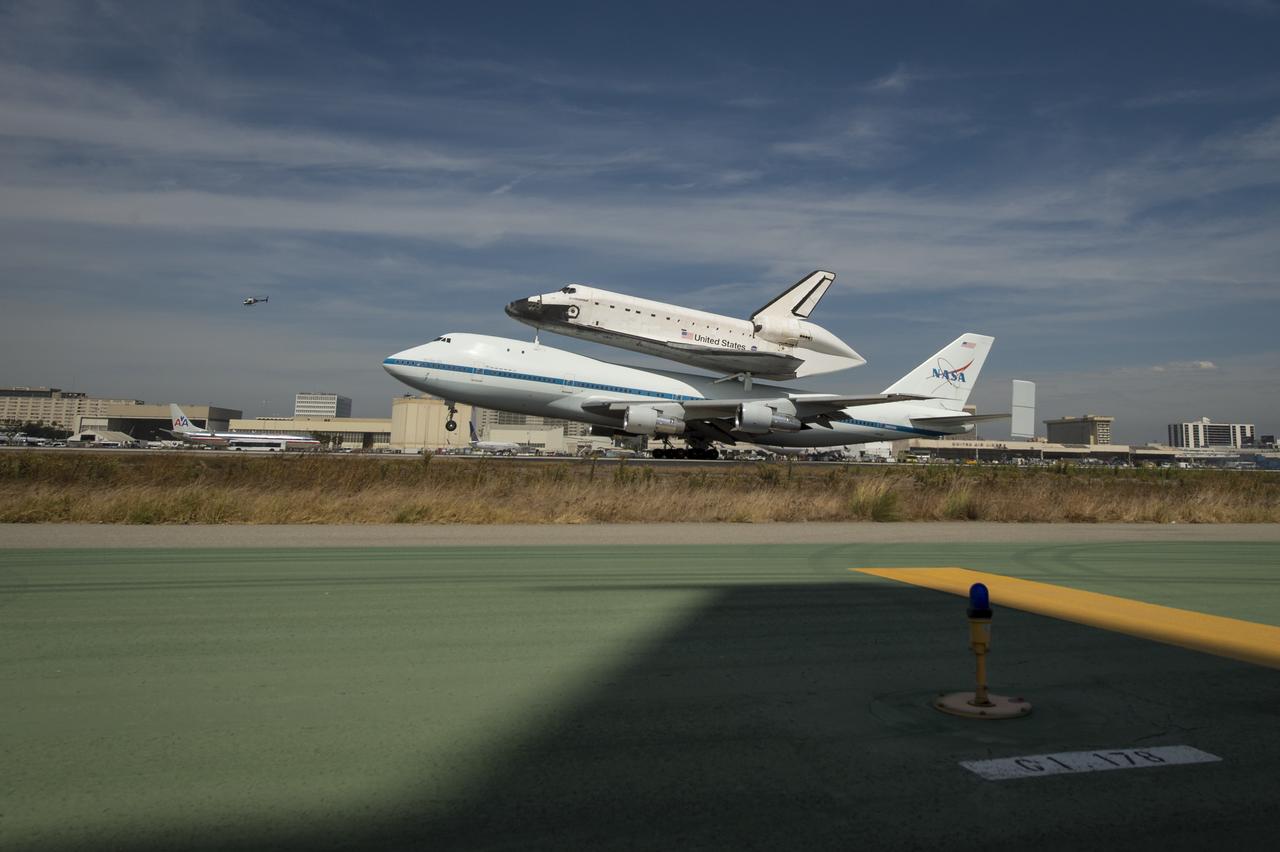
Space shuttle Endeavour, mounted atop a NASA 747 Shuttle Carrier Aircraft (SCA) lands at Los Angeles International Airport, Friday, Sept. 21, 2012. The shadow of a NASA F-18 chase jet wing is shown in the foreground. Endeavour, built as a replacement for space shuttle Challenger, completed 25 missions, spent 299 days in orbit, and orbited Earth 4,671 times while traveling 122,883,151 miles. Beginning Oct. 30, the shuttle will be on display in the California Science center's Samuel Oschin Space Shuttle Endeavour Display Pavilion, embarking on its new mission to commemorate past achievements in space and educate and inspire future generations of explorers.Photo Credit: (NASA/Bill Ingalls)
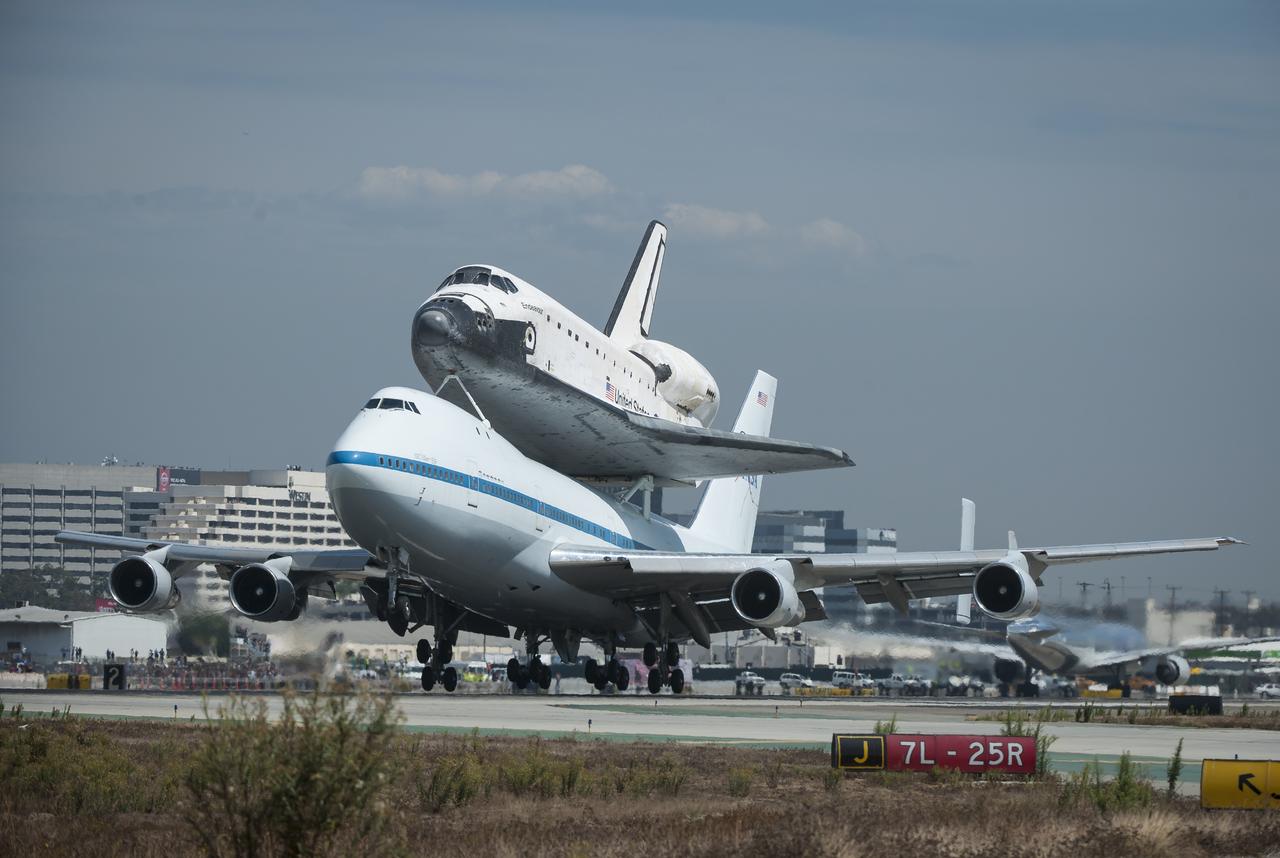
Space shuttle Endeavour, mounted atop a NASA 747 Shuttle Carrier Aircraft (SCA) lands at Los Angeles International Airport, Friday, Sept. 21, 2012. Endeavour, built as a replacement for space shuttle Challenger, completed 25 missions, spent 299 days in orbit, and orbited Earth 4,671 times while traveling 122,883,151 miles. Beginning Oct. 30, the shuttle will be on display in the California Science center's Samuel Oschin Space Shuttle Endeavour Display Pavilion, embarking on its new mission to commemorate past achievements in space and educate and inspire future generations of explorers.Photo Credit: (NASA/Bill Ingalls)
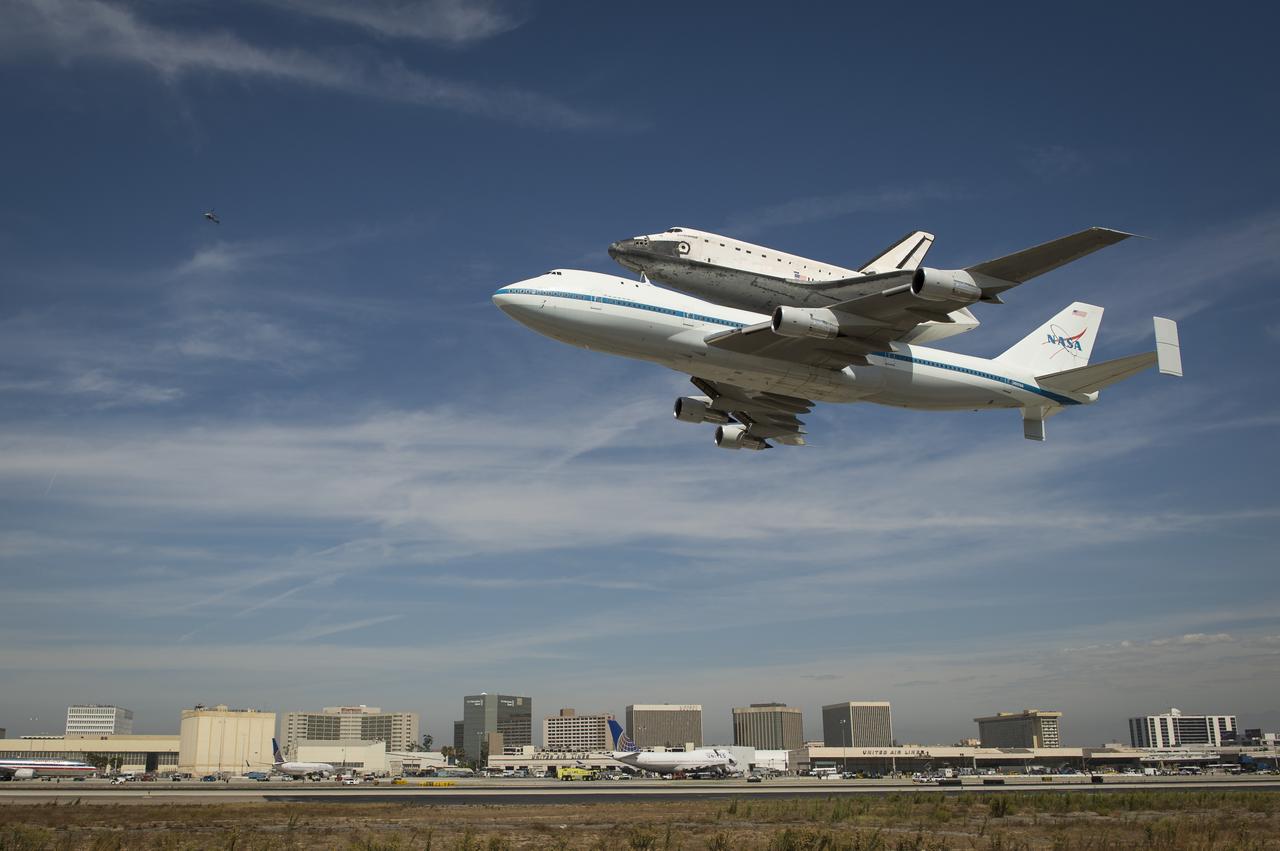
Space shuttle Endeavour, mounted atop a NASA 747 Shuttle Carrier Aircraft (SCA) performs a low flyby at Los Angeles International Airport, Friday, Sept. 21, 2012. Endeavour, built as a replacement for space shuttle Challenger, completed 25 missions, spent 299 days in orbit, and orbited Earth 4,671 times while traveling 122,883,151 miles. Beginning Oct. 30, the shuttle will be on display in the California Science center's Samuel Oschin Space Shuttle Endeavour Display Pavilion, embarking on its new mission to commemorate past achievements in space and educate and inspire future generations of explorers.Photo Credit: (NASA/Bill Ingalls)
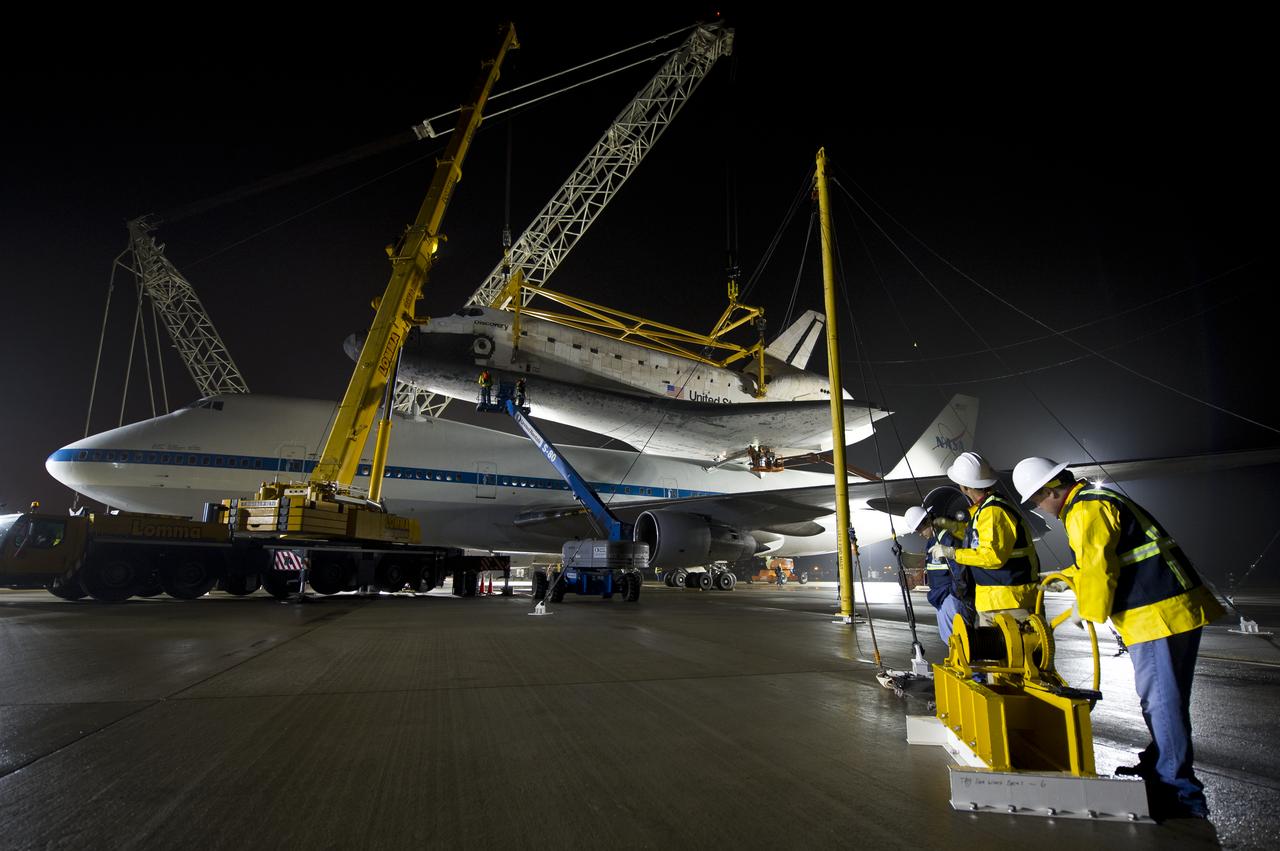
Workers monitor the lift of the space shuttle Discovery from the the NASA 747 Shuttle Carrier Aircraft (SCA) at Washington Dulles International Airport, Thursday, April 19, 2012, in Sterling, VA. Discovery, the first orbiter retired from NASA’s shuttle fleet, completed 39 missions, spent 365 days in space, orbited the Earth 5,830 times, and traveled 148,221,675 miles. NASA will transfer Discovery to the National Air and Space Museum to begin its new mission to commemorate past achievements in space and to educate and inspire future generations of explorers. Photo Credit: (NASA/Bill Ingalls)

Space shuttle Enterprise, mounted atop a NASA 747 Shuttle Carrier Aircraft (SCA), is seen as it takes off for New York from Washington Dulles International Airport, Friday, April 27, 2012, in Sterling, VA. Enterprise was the first shuttle orbiter built for NASA performing test flights in the atmosphere and was incapable of spaceflight. Originally housed at the Smithsonian's Steven F. Udvar-Hazy Center, Enterprise will be demated from the SCA and placed on a barge that will eventually be moved by tugboat up the Hudson River to the Intrepid Sea, Air & Space Museum in June. Photo Credit: (NASA/Smithsonian Institution/Mark Avino)
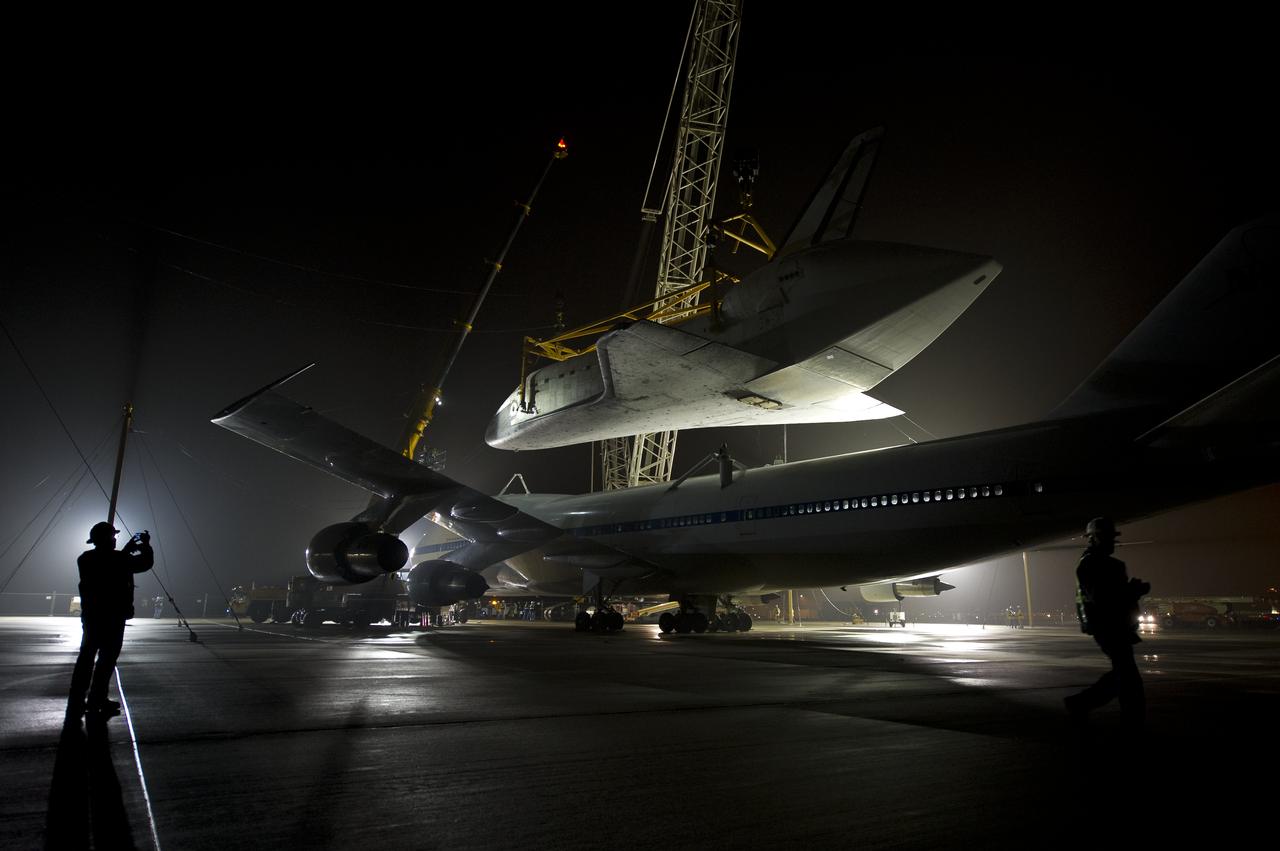
Workers monitor the lift of the space shuttle Discovery from the top of the NASA 747 Shuttle Carrier Aircraft (SCA) at Washington Dulles International Airport, Thursday, April 19, 2012, in Sterling, VA. Discovery, the first orbiter retired from NASA’s shuttle fleet, completed 39 missions, spent 365 days in space, orbited the Earth 5,830 times, and traveled 148,221,675 miles. NASA will transfer Discovery to the National Air and Space Museum to begin its new mission to commemorate past achievements in space and to educate and inspire future generations of explorers. Photo Credit: (NASA/Bill Ingalls)

NASA's 747 Shuttle Carrier Aircraft (SCA), with space shuttle Enterprise latched on its back, is towed from the hangar at John F. Kennedy (JFK) International Airport in New York late in the night on Saturday, May 12, 2012. Early Sunday morning, Enterprise was removed from the SCA. The shuttle will be placed on a barge that will move by tugboat up the Hudson River to Intrepid in June. The shuttle will be lifted by crane and placed on the flight deck of the Intrepid, where it will be on exhibit to the public starting this summer in a temporary climate-controlled pavilion. Photo Credit: (NASA/Kim Shiflet)

NASA and United Space Alliance workers lower a yellow sling onto space shuttle Enterprise, which sits atop NASA's 747 Shuttle Carrier Aircraft (SCA) prior to it being demated a few hours later at John F. Kennedy (JFK) International Airport in New York, Saturday, May 12, 2012. Once the sling was firmly attached early Sunday morning, Enterprise was lifted from the SCA. The shuttle will be placed on a barge that will move by tugboat up the Hudson River to Intrepid in June. The shuttle will be lifted by crane and placed on the flight deck of the Intrepid, where it will be on exhibit to the public starting this summer in a temporary climate-controlled pavilion. Photo Credit: (NASA/Kim Shiflet)

A yellow sling is lowered onto space shuttle Enterprise, which sits atop NASA's 747 Shuttle Carrier Aircraft (SCA) prior to it being demated a few hours later at John F. Kennedy (JFK) International Airport in New York, Saturday, May 12, 2012. The shuttle will be placed on a barge that will move by tugboat up the Hudson River to Intrepid in June. The shuttle will be lifted by crane and placed on the flight deck of the Intrepid, where it will be on exhibit to the public starting this summer in a temporary climate-controlled pavilion. Photo Credit: (NASA/Kim Shiflet)

The space shuttle Enterprise is lowered onto a transport vehicle after being demated from the NASA 747 Shuttle Carrier Aircraft (SCA) at John F. Kennedy (JFK) International Airport in Jamica, New York, Sunday, May 13, 2012. The shuttle will be placed on a barge that will move by tugboat up the Hudson River to the Intrepid Sea, Air & Space Museum in June. The shuttle will be lifted by crane and placed on the flight deck of the Intrepid, where it will be on exhibit to the public starting this summer in a temporary climate-controlled pavilion. Photo Credit: (NASA/Kim Shiflet)

Space shuttle Enterprise is held aloft by a yellow sling and a set of cranes after it was removed from the top of NASA's 747 Shuttle Carrier Aircraft early Sunday morning at John F. Kennedy (JFK) International Airport in New York, Sunday, May 13, 2012 .The 747 was towed backwards so that Enterprise could be lowered. The shuttle will be placed on a barge that will move by tugboat up the Hudson River to the Intrepid Sea, Air & Space Museum in June. The shuttle will be lifted by crane and placed on the flight deck of the Intrepid, where it will be on exhibit to the public starting this summer in a temporary climate-controlled pavilion. Photo Credit: (NASA/Kim Shiflet)
CAPTION: ---------------------------- Space shuttle Enterprise, mounted atop a NASA 747 Shuttle Carrier Aircraft (SCA), is seen as it flies near the Intrepid Sea, Air and Space Museum, Friday, April 27, 2012, in New York. Enterprise was the first shuttle orbiter built for NASA performing test flights in the atmosphere and was incapable of spaceflight. Originally housed at the Smithsonian's Steven F. Udvar-Hazy Center, Enterprise will be demated from the SCA and placed on a barge that will eventually be moved by tugboat up the Hudson River to the Intrepid Sea, Air & Space Museum in June. Photo Credit: (NASA/Robert Markowitz)

The space shuttle Enterprise, mounted on transport vehicle, is backed into a temporary hangar after being demated from the NASA 747 Shuttle Carrier Aircraft (SCA) at John F. Kennedy (JFK) International Airport in Jamica, New York, Sunday, May 13, 2012. Enterprise will be placed on a barge that will move by tugboat up the Hudson River to the Intrepid Sea, Air & Space Museum in June. The shuttle will be lifted by crane and placed on the flight deck of the Intrepid, where it will be on exhibit to the public starting this summer in a temporary climate-controlled pavilion. Photo Credit: (NASA/Kim Shiflet)
Space shuttle Enterprise, mounted atop a NASA 747 Shuttle Carrier Aircraft (SCA), is seen as it flies over the Hudson River, Friday, April 27, 2012, in New York. Enterprise was the first shuttle orbiter built for NASA performing test flights in the atmosphere and was incapable of spaceflight. Originally housed at the Smithsonian's Steven F. Udvar-Hazy Center, Enterprise will be demated from the SCA and placed on a barge that will eventually be moved by tugboat up the Hudson River to the Intrepid Sea, Air & Space Museum in June. Photo Credit: (NASA/Bill Ingalls)
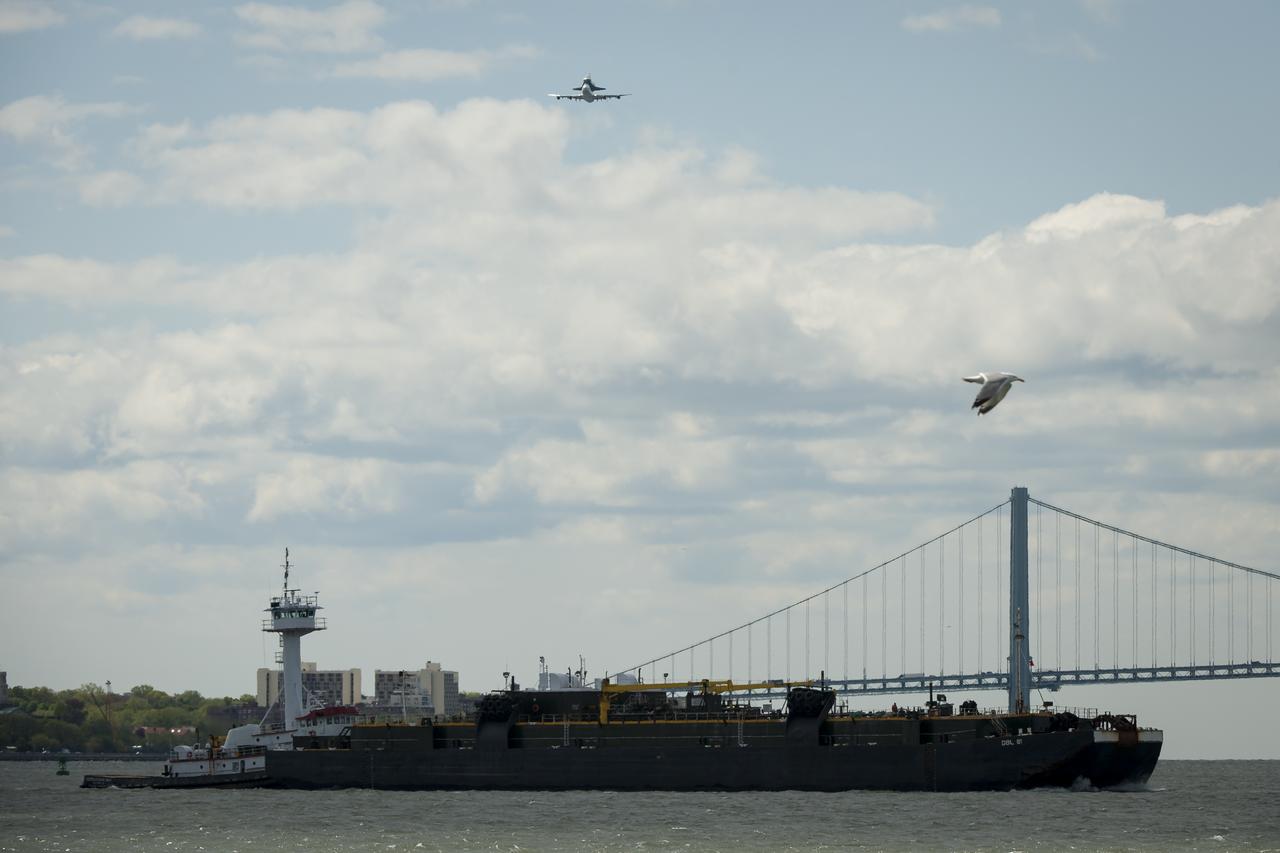
Space shuttle Enterprise, mounted atop a NASA 747 Shuttle Carrier Aircraft (SCA), is seen as it flies over the Verrazano Bridge, Friday, April 27, 2012, in New York. Enterprise was the first shuttle orbiter built for NASA performing test flights in the atmosphere and was incapable of spaceflight. Originally housed at the Smithsonian's Steven F. Udvar-Hazy Center, Enterprise will be demated from the SCA and placed on a barge that will eventually be moved by tugboat up the Hudson River to the Intrepid Sea, Air & Space Museum in June. Photo Credit: (NASA/Bill Ingalls)

NASA Deputy Administrator Lori Garver, at podium, speaks to those in attendance at Apron W after the 747 Shuttle Carrier Aircraft (SCA) with space shuttle Discovery mounted on top rolled to a halt at Washington Dulles International Airport, Tuesday, April 17, 2012 in Sterling, Va. Discovery, the first orbiter retired from NASA’s shuttle fleet, completed 39 missions, spent 365 days in space, orbited the Earth 5,830 times, and traveled 148,221,675 miles. NASA will transfer Discovery to the National Air and Space Museum to begin its new mission to commemorate past achievements in space and to educate and inspire future generations of explorers. Photo Credit: (NASA/Smithsonian Institution/Dane Penland)
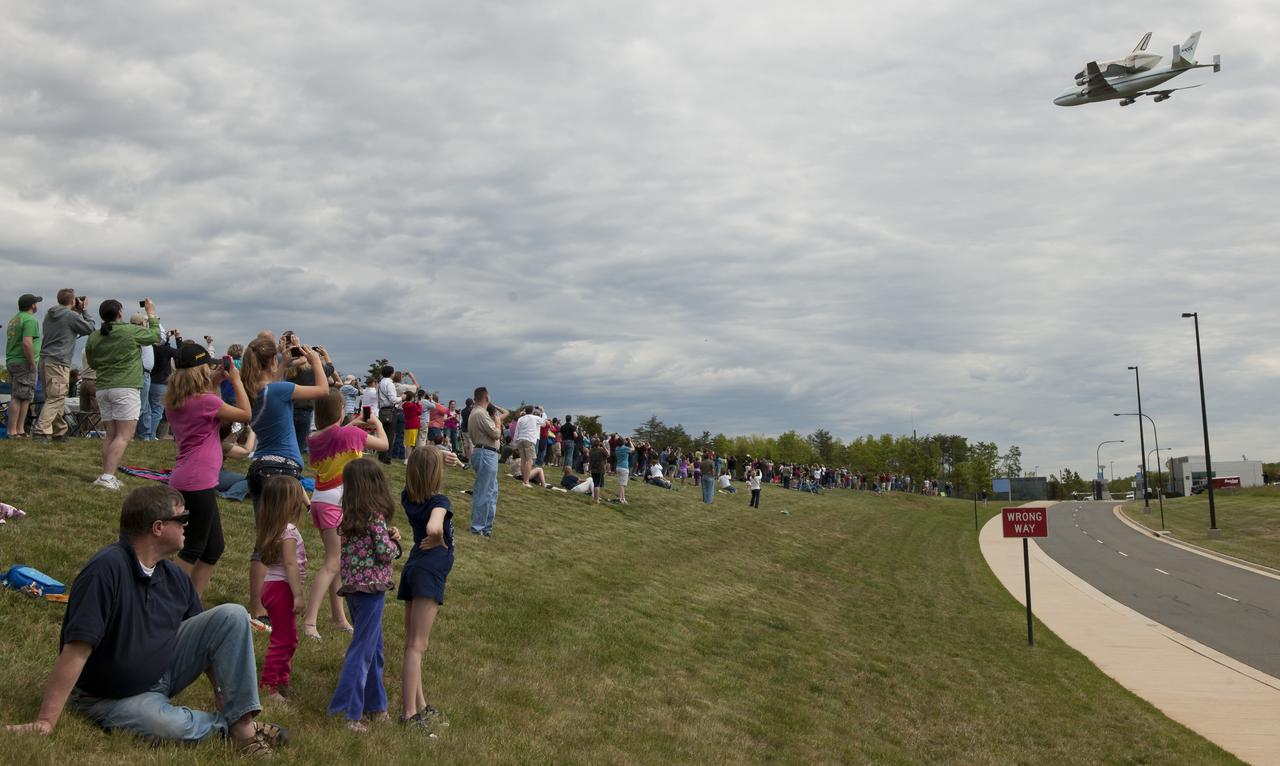
Spectators watch as space shuttle Discovery, mounted atop a NASA 747 Shuttle Carrier Aircraft (SCA) flies over the National Air and Space Museum’s Steven F. Udvar-Hazy Center, Tuesday, April 17, 2012, in Chantilly, Va. Discovery, the first orbiter retired from NASA’s shuttle fleet, completed 39 missions, spent 365 days in space, orbited the Earth 5,830 times, and traveled 148,221,675 miles. NASA will transfer Discovery to the National Air and Space Museum to begin its new mission to commemorate past achievements in space and to educate and inspire future generations of explorers. Photo Credit: (NASA/Carla Cioffi)

The space shuttle Enterprise, mounted on transport vehicle, is backed into a temporary hangar after being demated from the NASA 747 Shuttle Carrier Aircraft (SCA) at John F. Kennedy (JFK) International Airport in Jamica, New York, Sunday, May 13, 2012. Enterprise will be placed on a barge that will move by tugboat up the Hudson River to the Intrepid Sea, Air & Space Museum in June. The shuttle will be lifted by crane and placed on the flight deck of the Intrepid, where it will be on exhibit to the public starting this summer in a temporary climate-controlled pavilion. Photo Credit: (NASA/Kim Shiflet)
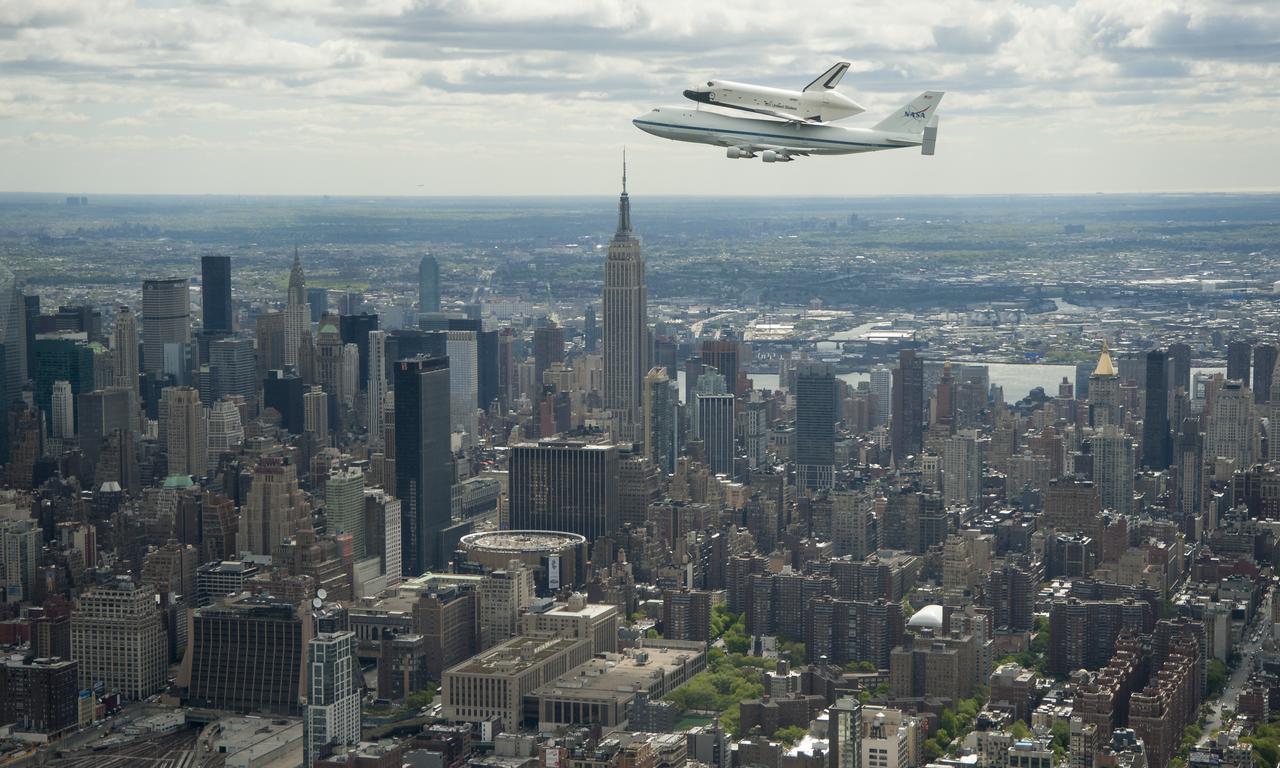
Space shuttle Enterprise, mounted atop a NASA 747 Shuttle Carrier Aircraft (SCA), is seen as it flies near the Empire State Building, Friday, April 27, 2012, in New York. Enterprise was the first shuttle orbiter built for NASA performing test flights in the atmosphere and was incapable of spaceflight. Originally housed at the Smithsonian's Steven F. Udvar-Hazy Center, Enterprise will be demated from the SCA and placed on a barge that will eventually be moved by tugboat up the Hudson River to the Intrepid Sea, Air & Space Museum in June. Photo Credit: (NASA/Robert Markowitz)
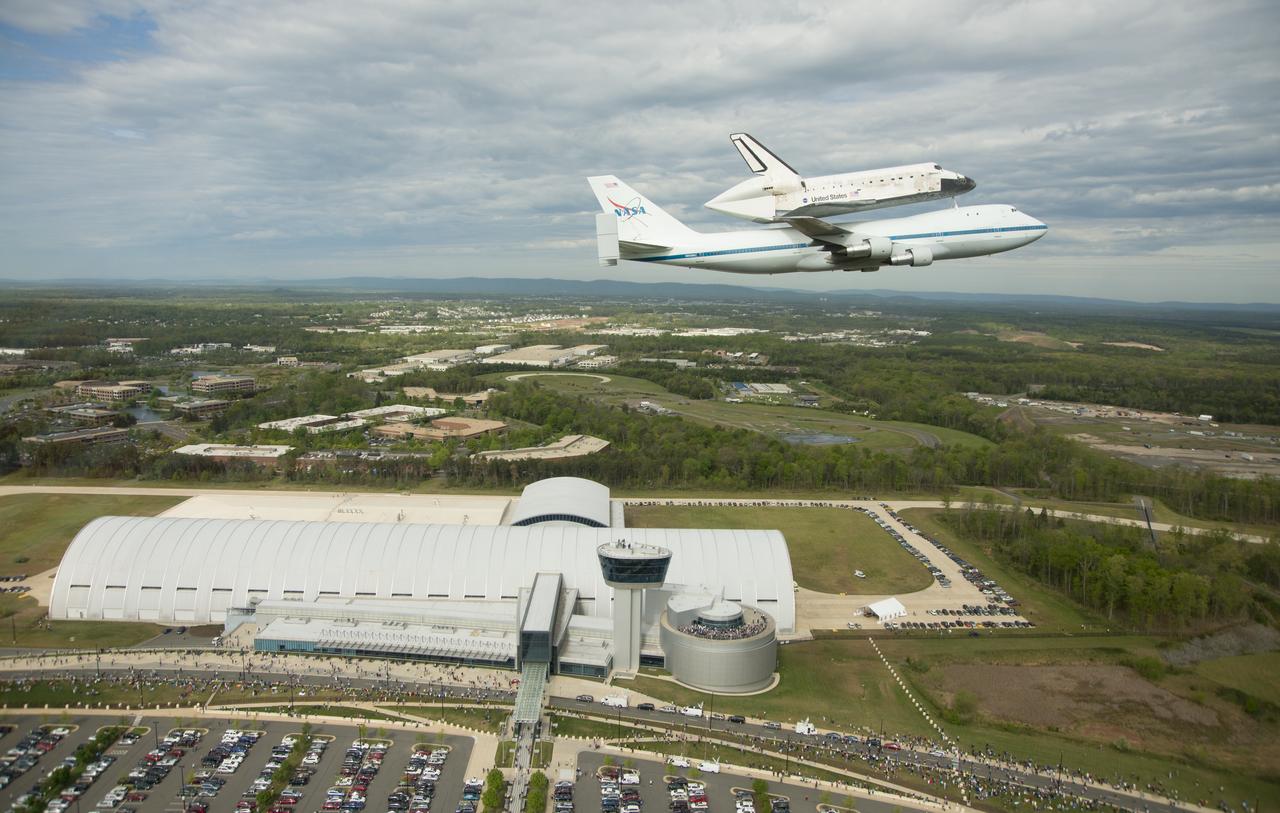
Space shuttle Discovery, mounted atop a NASA 747 Shuttle Carrier Aircraft (SCA) flies over the Steven F. Udvar-Hazy Center, Tuesday, April 17, 2012, in Washington. Discovery, the first orbiter retired from NASA’s shuttle fleet, completed 39 missions, spent 365 days in space, orbited the Earth 5,830 times, and traveled 148,221,675 miles. NASA will transfer Discovery to the National Air and Space Museum to begin its new mission to commemorate past achievements in space and to educate and inspire future generations of explorers. Photo Credit: (NASA/Robert Markowitz)
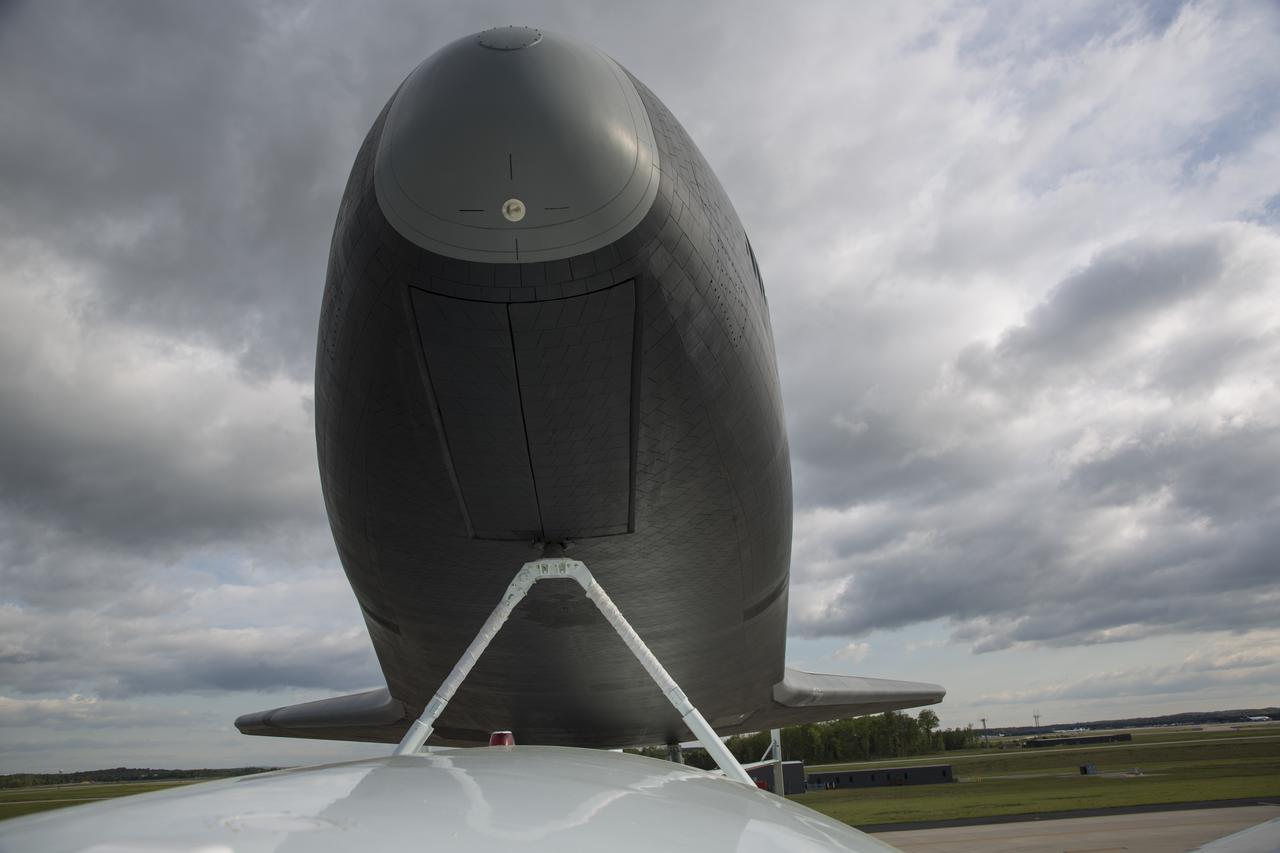
Space shuttle Enterprise, mounted atop a NASA 747 Shuttle Carrier Aircraft (SCA), is seen prior to taking off for New York from Washington Dulles International Airport, Friday, April 27, 2012, in Sterling, VA. Enterprise was the first shuttle orbiter built for NASA performing test flights in the atmosphere and was incapable of spaceflight. Originally housed at the Smithsonian's Steven F. Udvar-Hazy Center, Enterprise will be demated from the SCA and placed on a barge that will eventually be moved by tugboat up the Hudson River to the Intrepid Sea, Air & Space Museum in June. Photo Credit: (NASA/Scott Andrews)
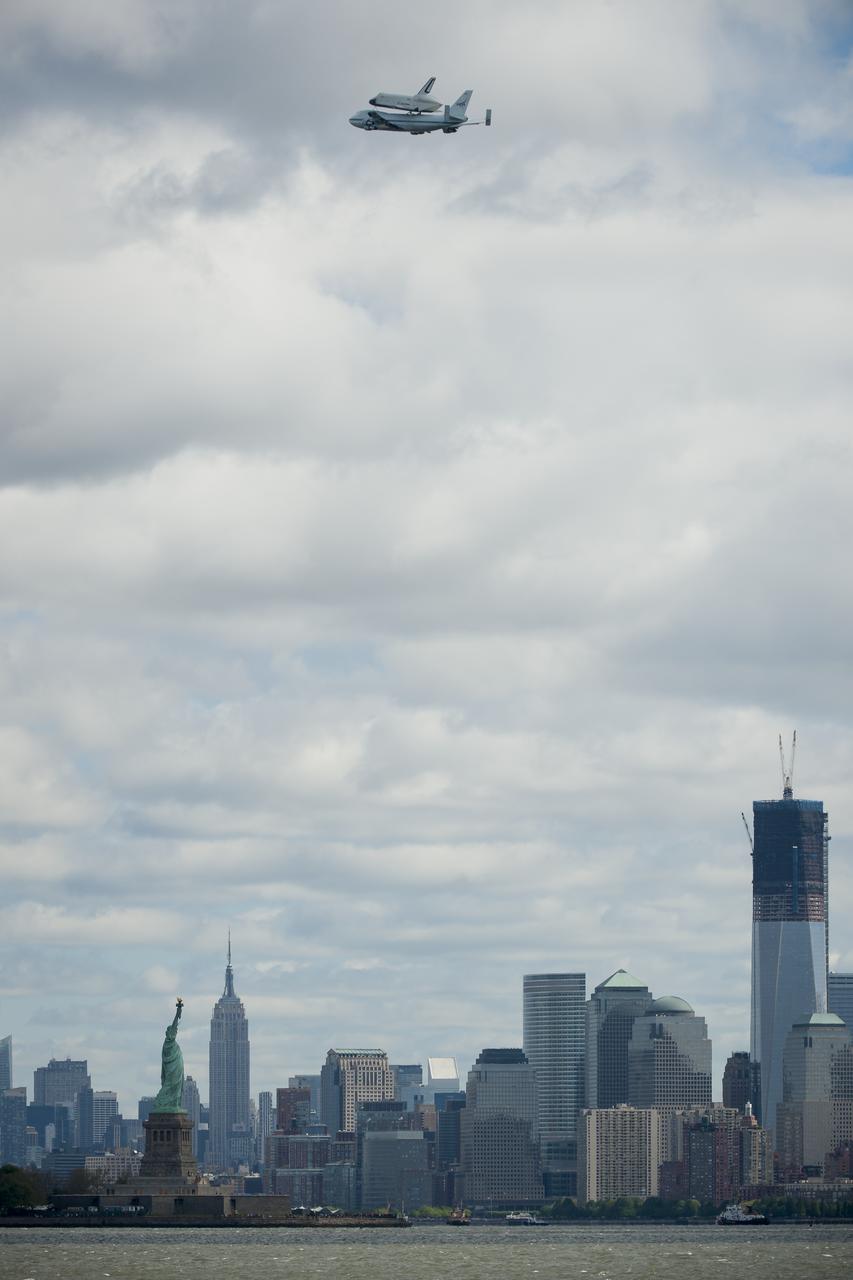
Space shuttle Enterprise, mounted atop a NASA 747 Shuttle Carrier Aircraft (SCA), is seen as it flies near the Statue of Liberty, Friday, April 27, 2012, in New York. Enterprise was the first shuttle orbiter built for NASA performing test flights in the atmosphere and was incapable of spaceflight. Originally housed at the Smithsonian's Steven F. Udvar-Hazy Center, Enterprise will be demated from the SCA and placed on a barge that will eventually be moved by tugboat up the Hudson River to the Intrepid Sea, Air & Space Museum in June. Photo Credit: (NASA/Bill Ingalls)
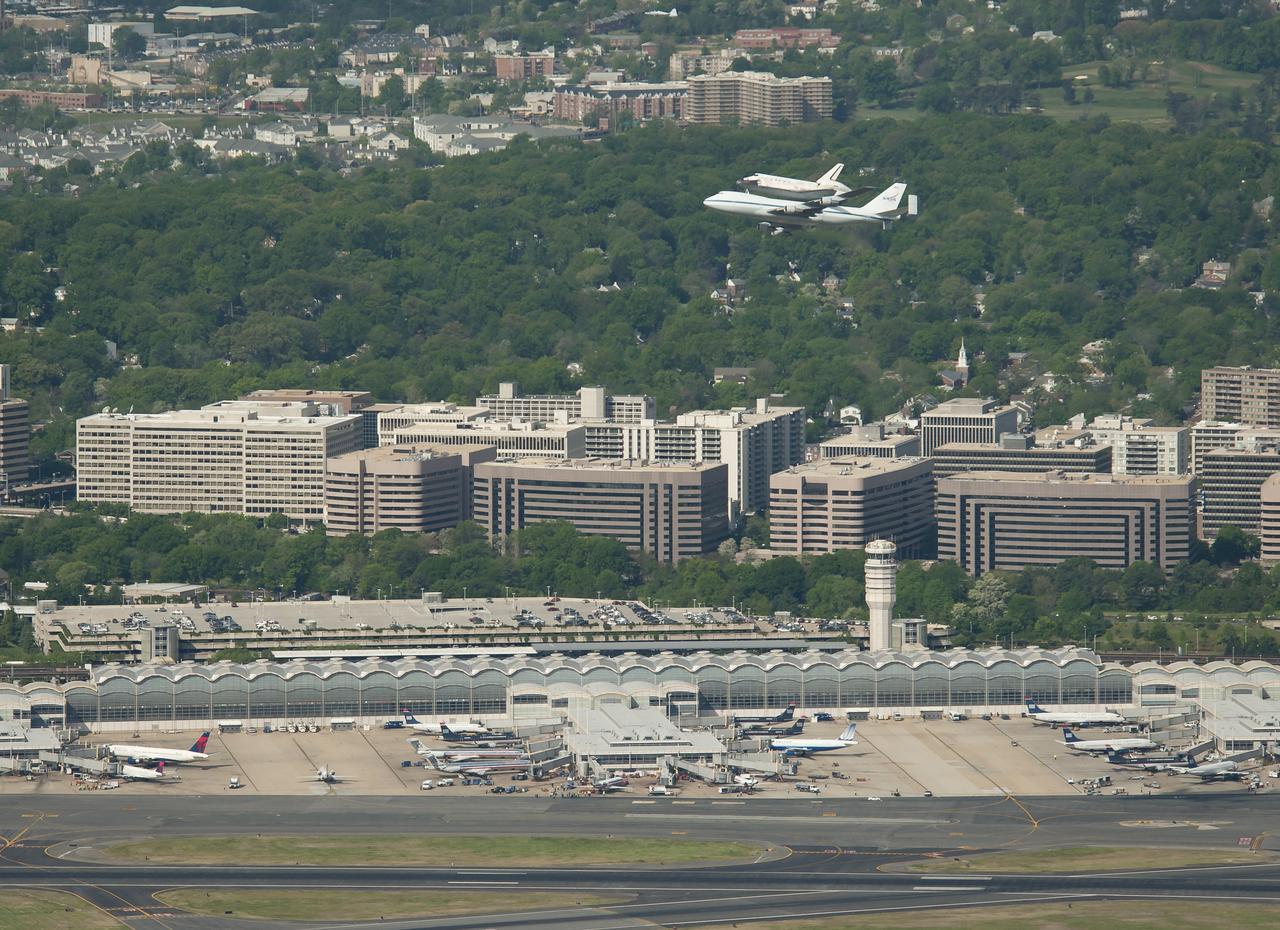
Space shuttle Discovery, mounted atop a NASA 747 Shuttle Carrier Aircraft (SCA) makes its way past Ronald Reagan Washington National Airport, Tuesday, April 17, 2012, in Arlington, Va. Discovery, the first orbiter retired from NASA’s shuttle fleet, completed 39 missions, spent 365 days in space, orbited the Earth 5,830 times, and traveled 148,221,675 miles. NASA will transfer Discovery to the National Air and Space Museum to begin its new mission to commemorate past achievements in space and to educate and inspire future generations of explorers. Photo Credit: (NASA/Bill Ingalls)
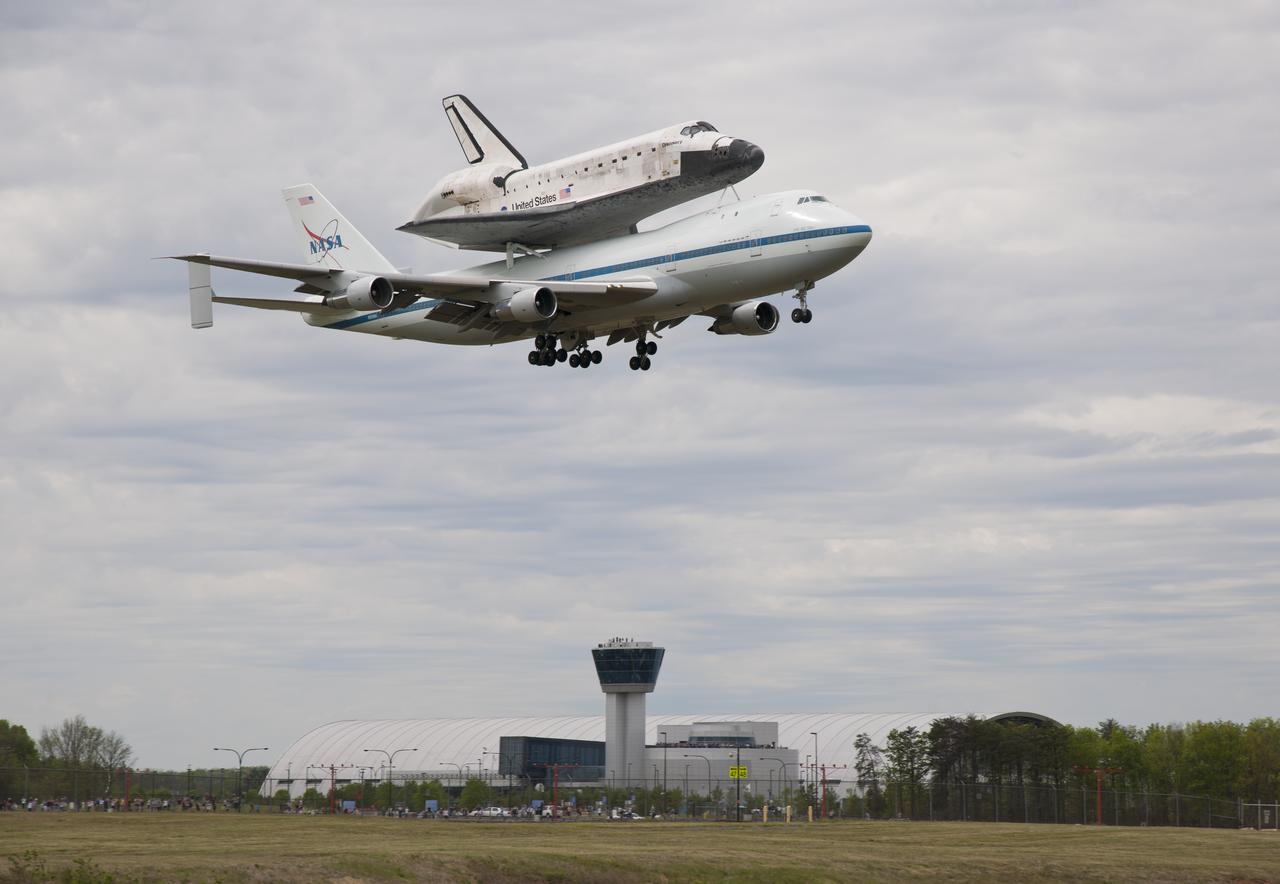
Space shuttle Discovery, mounted atop a NASA 747 Shuttle Carrier Aircraft (SCA) flies over the Steven F. Udvar-Hazy Center, Tuesday, April 17, 2012, in Washington. Discovery, the first orbiter retired from NASA’s shuttle fleet, completed 39 missions, spent 365 days in space, orbited the Earth 5,830 times, and traveled 148,221,675 miles. NASA will transfer Discovery to the National Air and Space Museum to begin its new mission to commemorate past achievements in space and to educate and inspire future generations of explorers. Photo Credit: (NASA/Smithsonian Institution/Dane Penland)
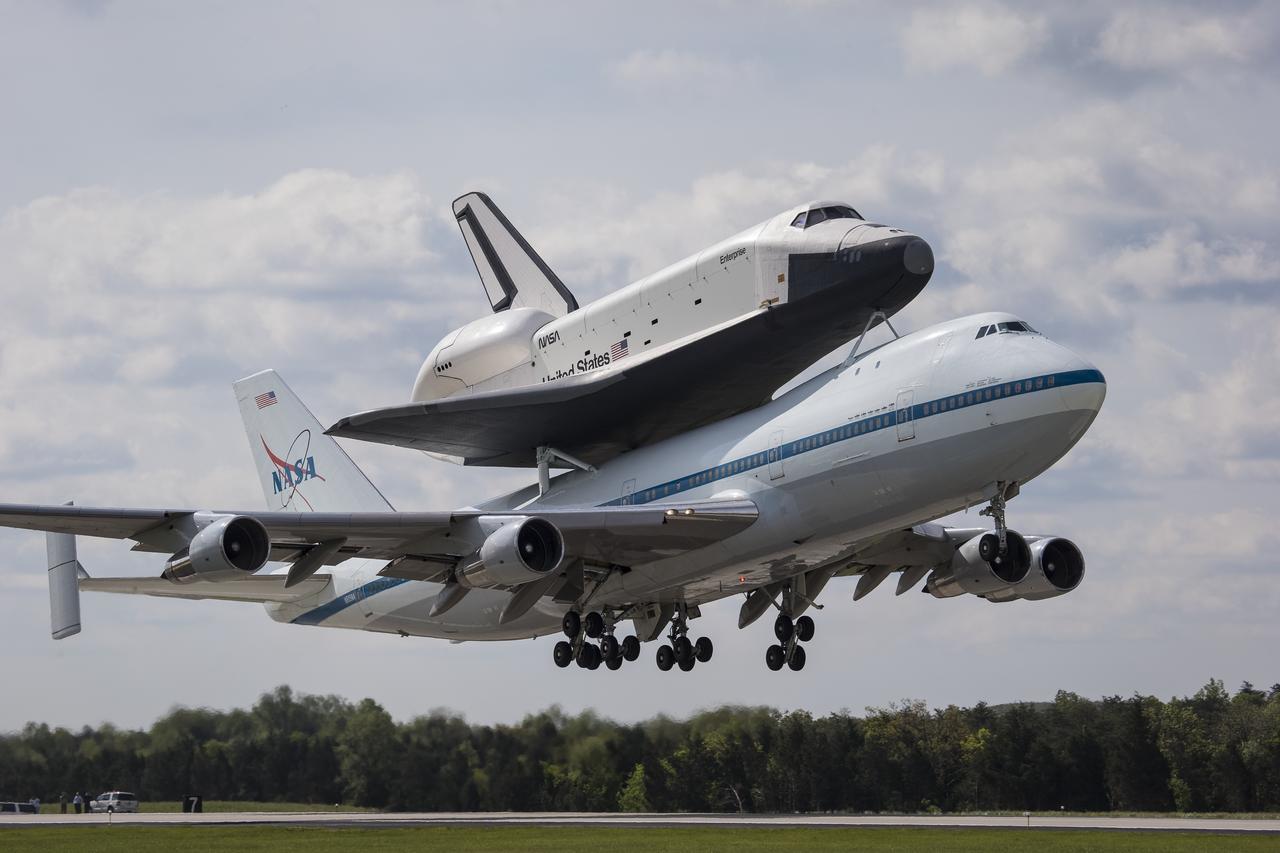
Space shuttle Enterprise, mounted atop a NASA 747 Shuttle Carrier Aircraft (SCA), is seen as it takes off for New York from Washington Dulles International Airport, Friday, April 27, 2012, in Sterling, VA. Enterprise was the first shuttle orbiter built for NASA performing test flights in the atmosphere and was incapable of spaceflight. Originally housed at the Smithsonian's Steven F. Udvar-Hazy Center, Enterprise will be demated from the SCA and placed on a barge that will eventually be moved by tugboat up the Hudson River to the Intrepid Sea, Air & Space Museum in June. Photo Credit: (NASA/Scott Andrews)
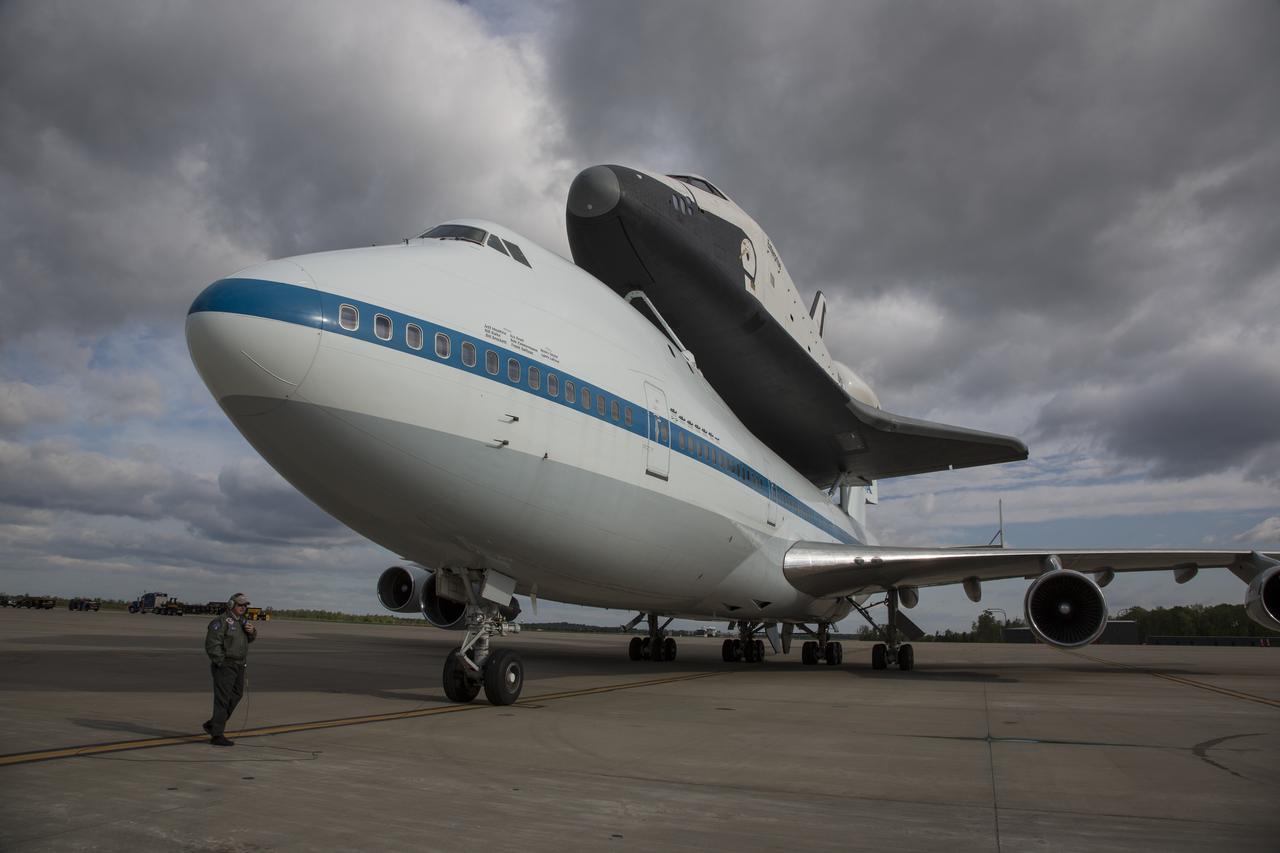
Space shuttle Enterprise, mounted atop a NASA 747 Shuttle Carrier Aircraft (SCA), is seen prior to taking off for New York from Washington Dulles International Airport, Friday, April 27, 2012, in Sterling, VA. Enterprise was the first shuttle orbiter built for NASA performing test flights in the atmosphere and was incapable of spaceflight. Originally housed at the Smithsonian's Steven F. Udvar-Hazy Center, Enterprise will be demated from the SCA and placed on a barge that will eventually be moved by tugboat up the Hudson River to the Intrepid Sea, Air & Space Museum in June. Photo Credit: (NASA/Scott Andrews)
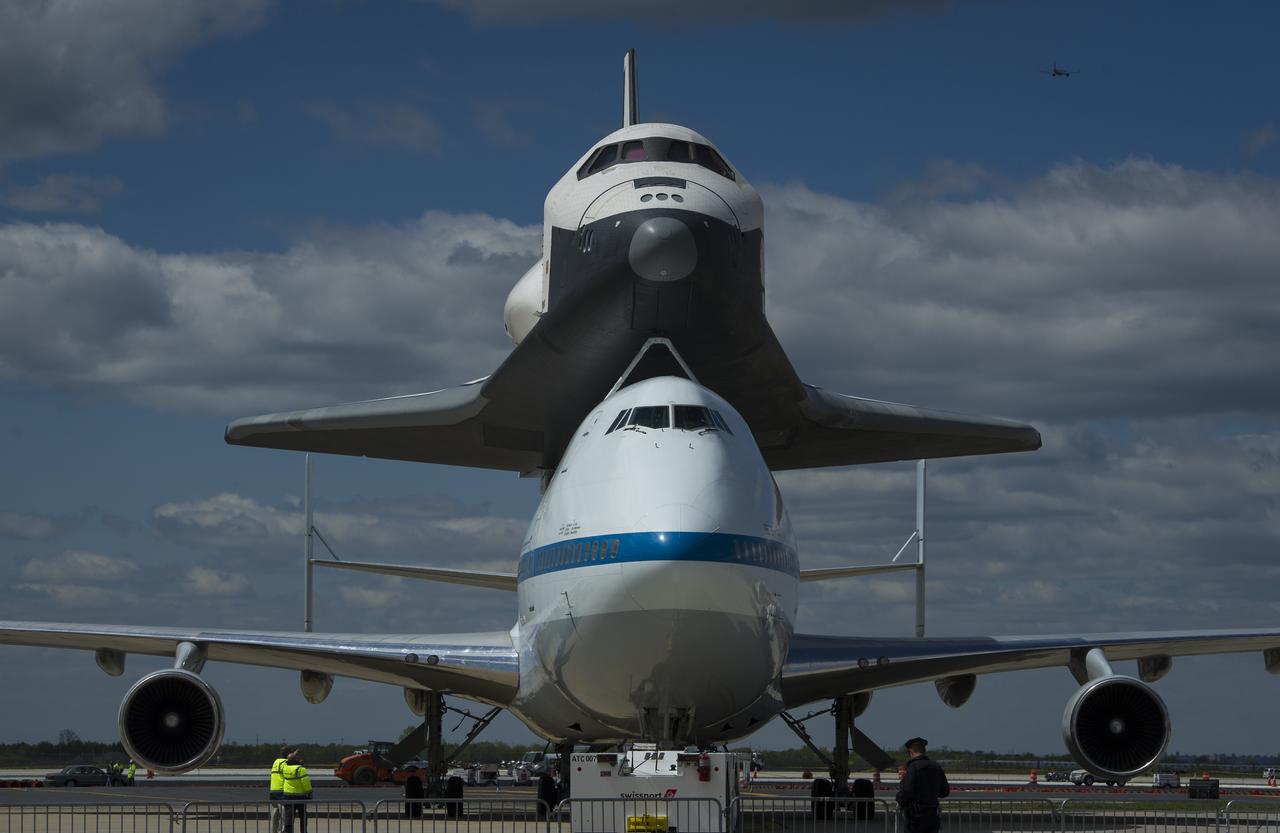
Space shuttle Enterprise, mounted atop a NASA 747 Shuttle Carrier Aircraft (SCA), is seen as it taxis at John F. Kennedy Airport, Friday, April 27, 2012, in New York. Enterprise was the first shuttle orbiter built for NASA performing test flights in the atmosphere and was incapable of spaceflight. Originally housed at the Smithsonian's Steven F. Udvar-Hazy Center, Enterprise will be demated from the SCA and placed on a barge that will eventually be moved by tugboat up the Hudson River to the Intrepid Sea, Air & Space Museum in June. Photo Credit: (NASA/Paul E. Alers)
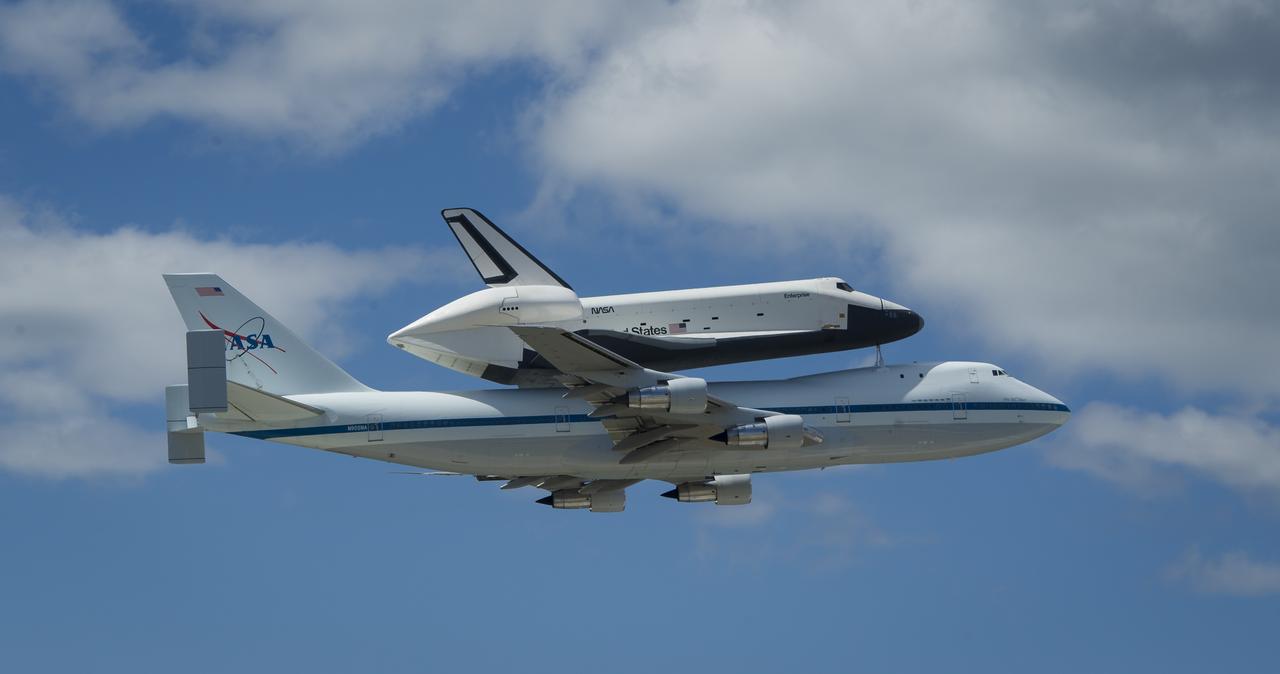
Space shuttle Enterprise, mounted atop a NASA 747 Shuttle Carrier Aircraft (SCA), is seen as it flies over John F. Kennedy Airport, Friday, April 27, 2012, in New York. Enterprise was the first shuttle orbiter built for NASA performing test flights in the atmosphere and was incapable of spaceflight. Originally housed at the Smithsonian's Steven F. Udvar-Hazy Center, Enterprise will be demated from the SCA and placed on a barge that will eventually be moved by tugboat up the Hudson River to the Intrepid Sea, Air & Space Museum in June. Photo Credit: (NASA/Paul E. Alers)
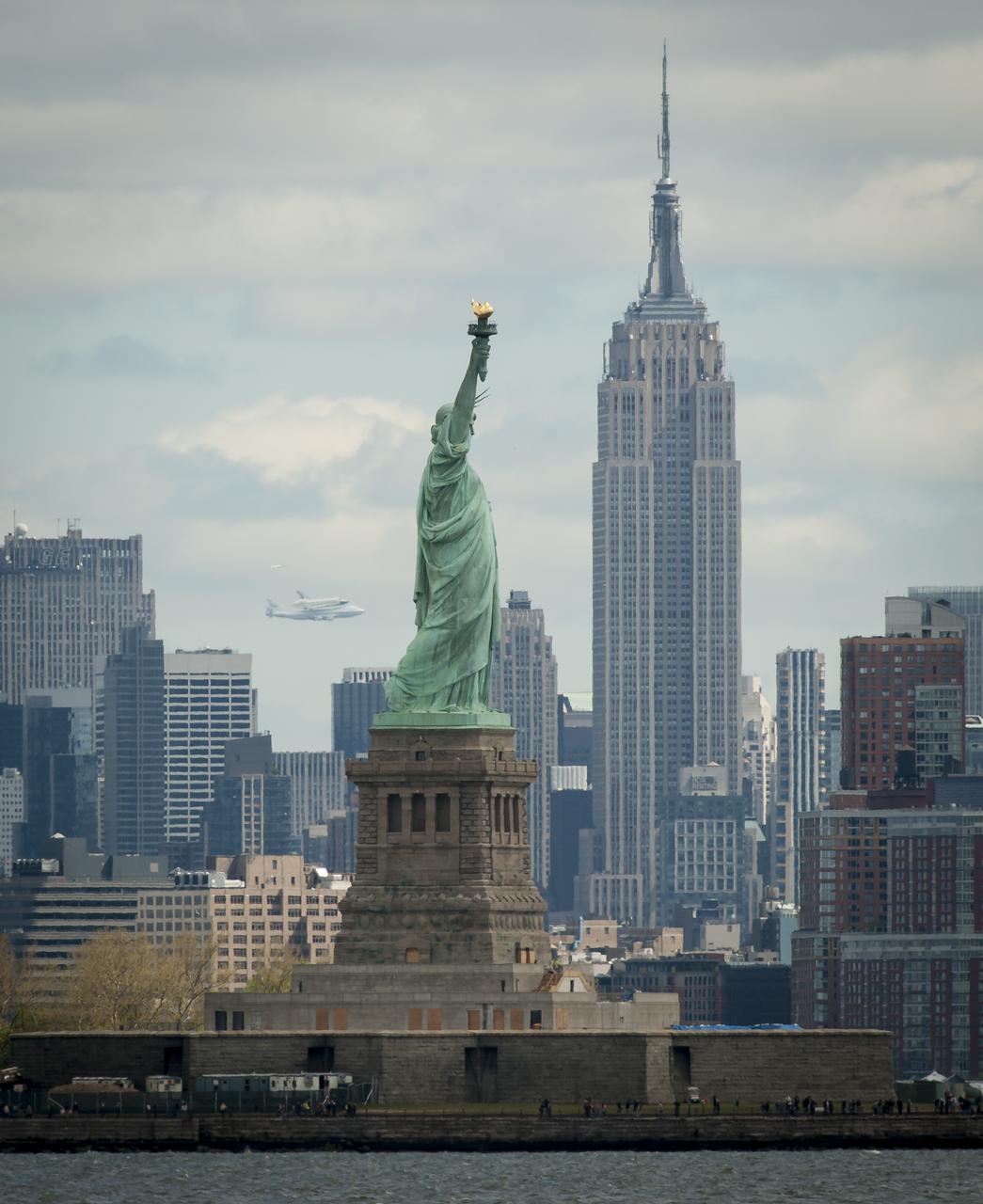
Space shuttle Enterprise, mounted atop a NASA 747 Shuttle Carrier Aircraft (SCA), is seen off in the distance behind the Statue of Liberty, Friday, April 27, 2012, in New York. Enterprise was the first shuttle orbiter built for NASA performing test flights in the atmosphere and was incapable of spaceflight. Originally housed at the Smithsonian's Steven F. Udvar-Hazy Center, Enterprise will be demated from the SCA and placed on a barge that will eventually be moved by tugboat up the Hudson River to the Intrepid Sea, Air & Space Museum in June. Photo Credit: (NASA/Bill Ingalls)
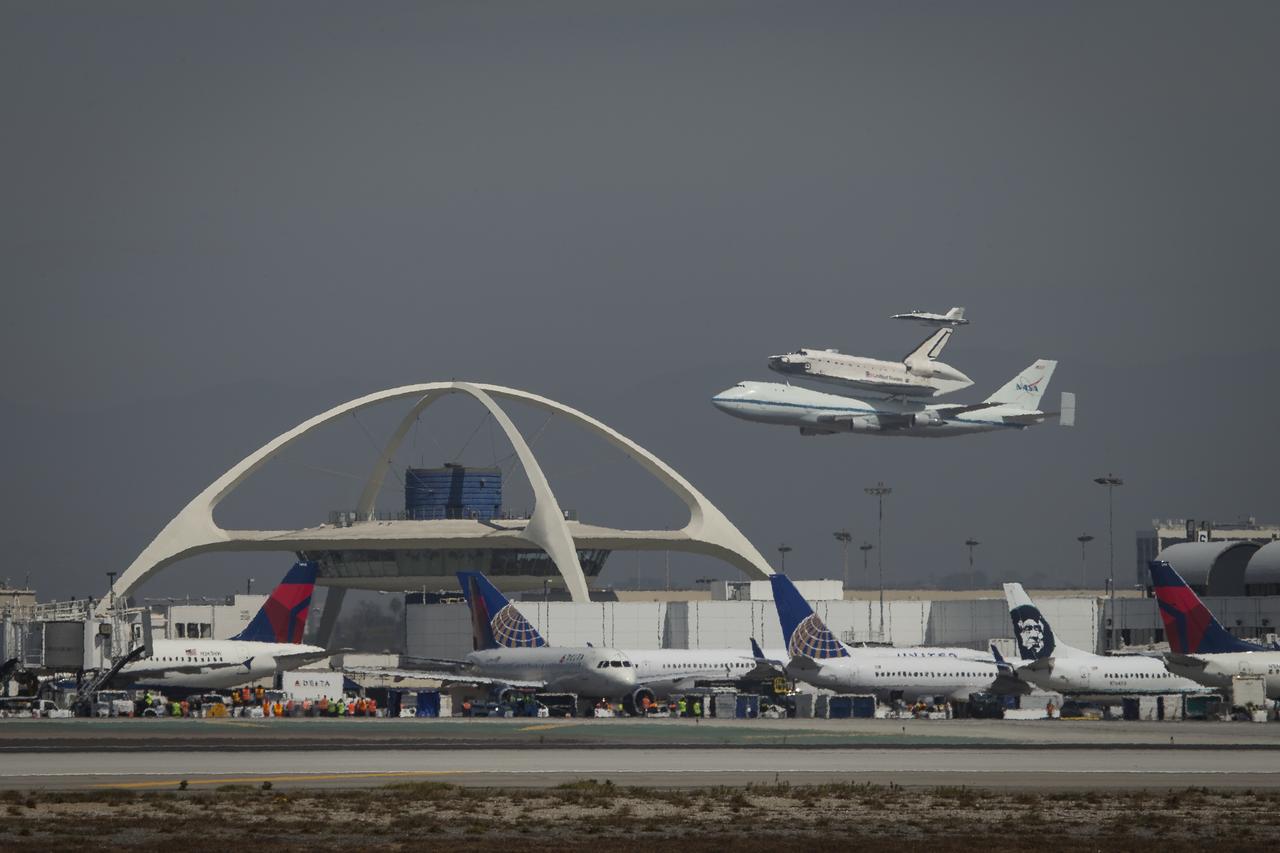
Space shuttle Endeavour, mounted atop a NASA 747 Shuttle Carrier Aircraft (SCA) performs a flyby of the Theme Building at Los Angeles International Airport, Friday, Sept. 21, 2012. Endeavour, built as a replacement for space shuttle Challenger, completed 25 missions, spent 299 days in orbit, and orbited Earth 4,671 times while traveling 122,883,151 miles. Beginning Oct. 30, the shuttle will be on display in the California Science center's Samuel Oschin Space Shuttle Endeavour Display Pavilion, embarking on its new mission to commemorate past achievements in space and educate and inspire future generations of explorers.Photo Credit: (NASA/Scott Andrews)
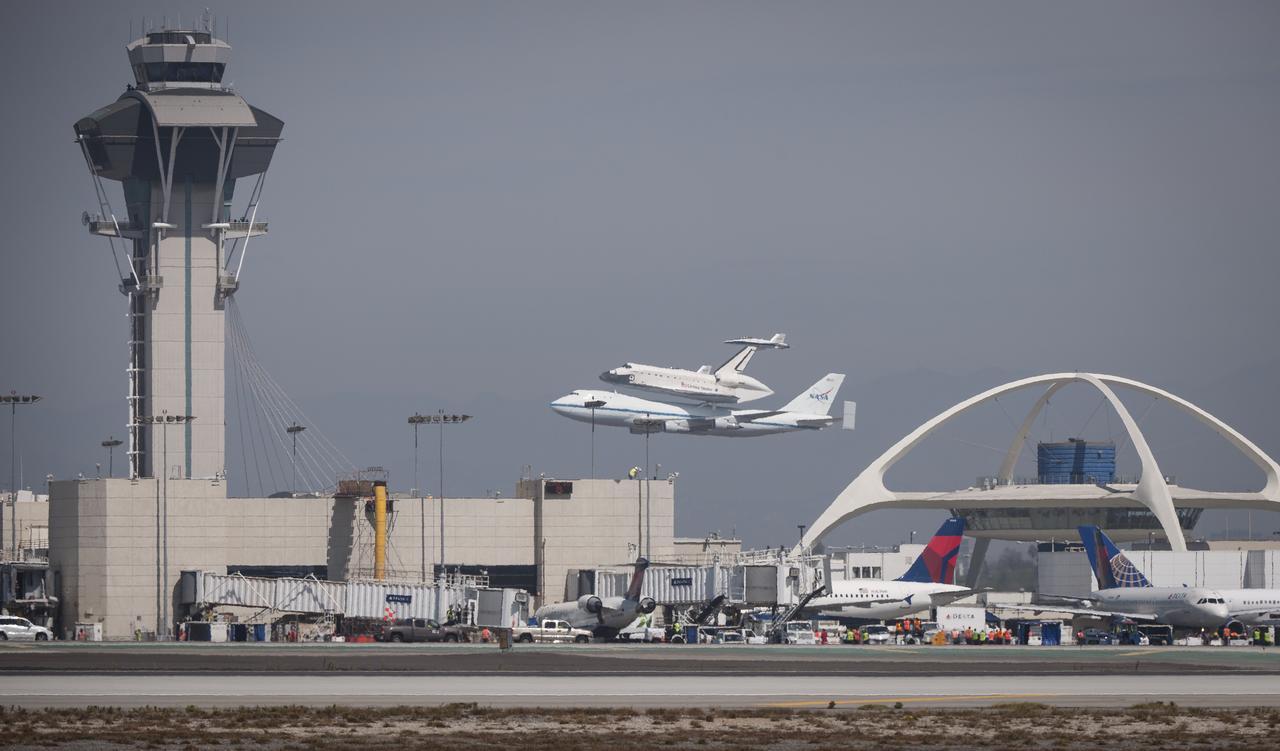
Space shuttle Endeavour, mounted atop a NASA 747 Shuttle Carrier Aircraft (SCA) performs a low flyby past the tower at Los Angeles International Airport, Friday, Sept. 21, 2012. Endeavour, built as a replacement for space shuttle Challenger, completed 25 missions, spent 299 days in orbit, and orbited Earth 4,671 times while traveling 122,883,151 miles. Beginning Oct. 30, the shuttle will be on display in the California Science center's Samuel Oschin Space Shuttle Endeavour Display Pavilion, embarking on its new mission to commemorate past achievements in space and educate and inspire future generations of explorers.Photo Credit: (NASA/Bill Ingalls)
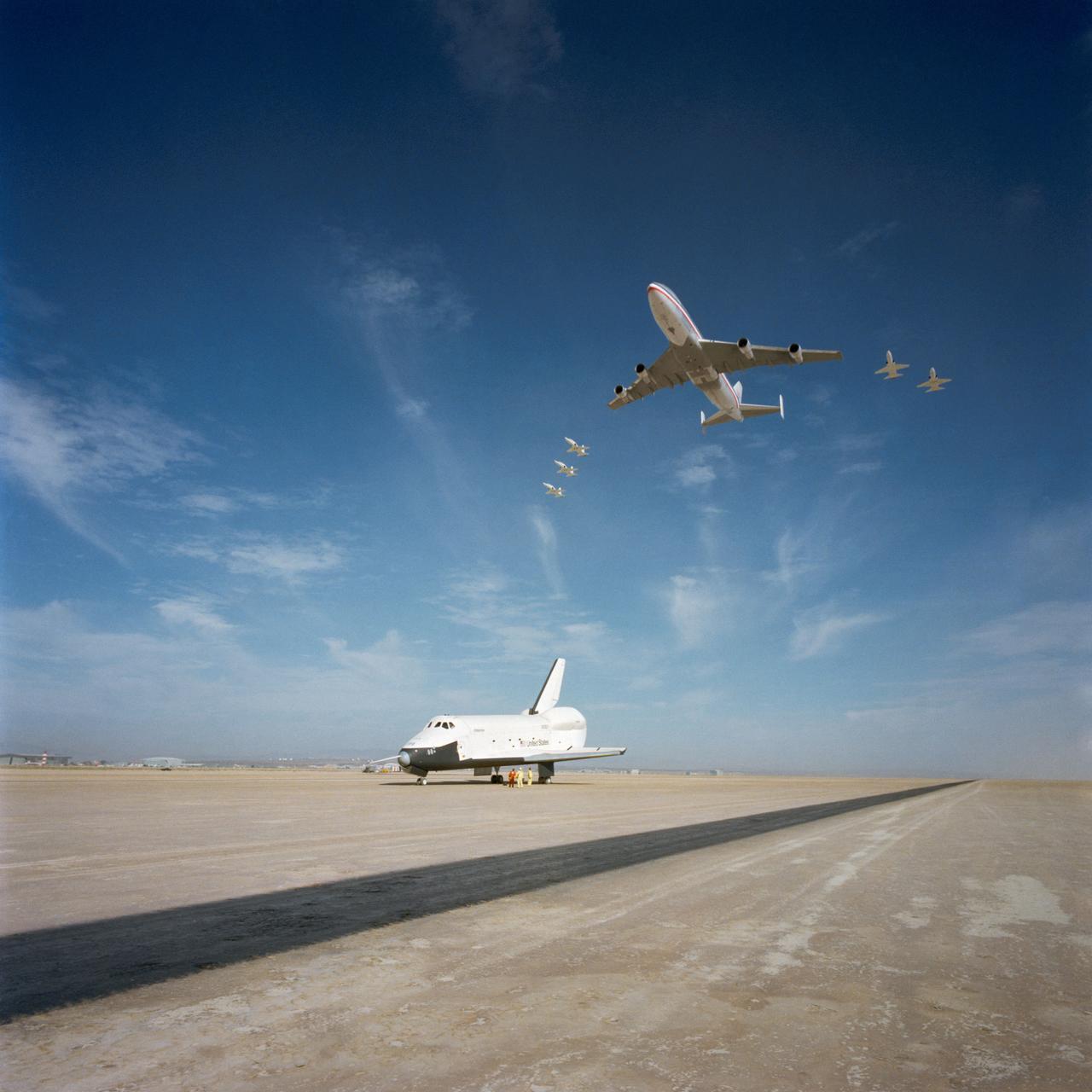
S77-28200 (13 Sept 1977) --- This impressive scene was photographed when the NASA 747 carrier aircraft and five T-38 aircraft flew over the shuttle Orbiter 101 "Enterprise" while it was parked on the runway at Edwards Air Force Base in Southern California. The Orbiter 101 had just completed a five-minute, 28-second unpowered mission during the second free flight of the Shuttle Approach and Landing Tests (ALT) conducted September 13, 1977, at the Dryden Flight Research Center.
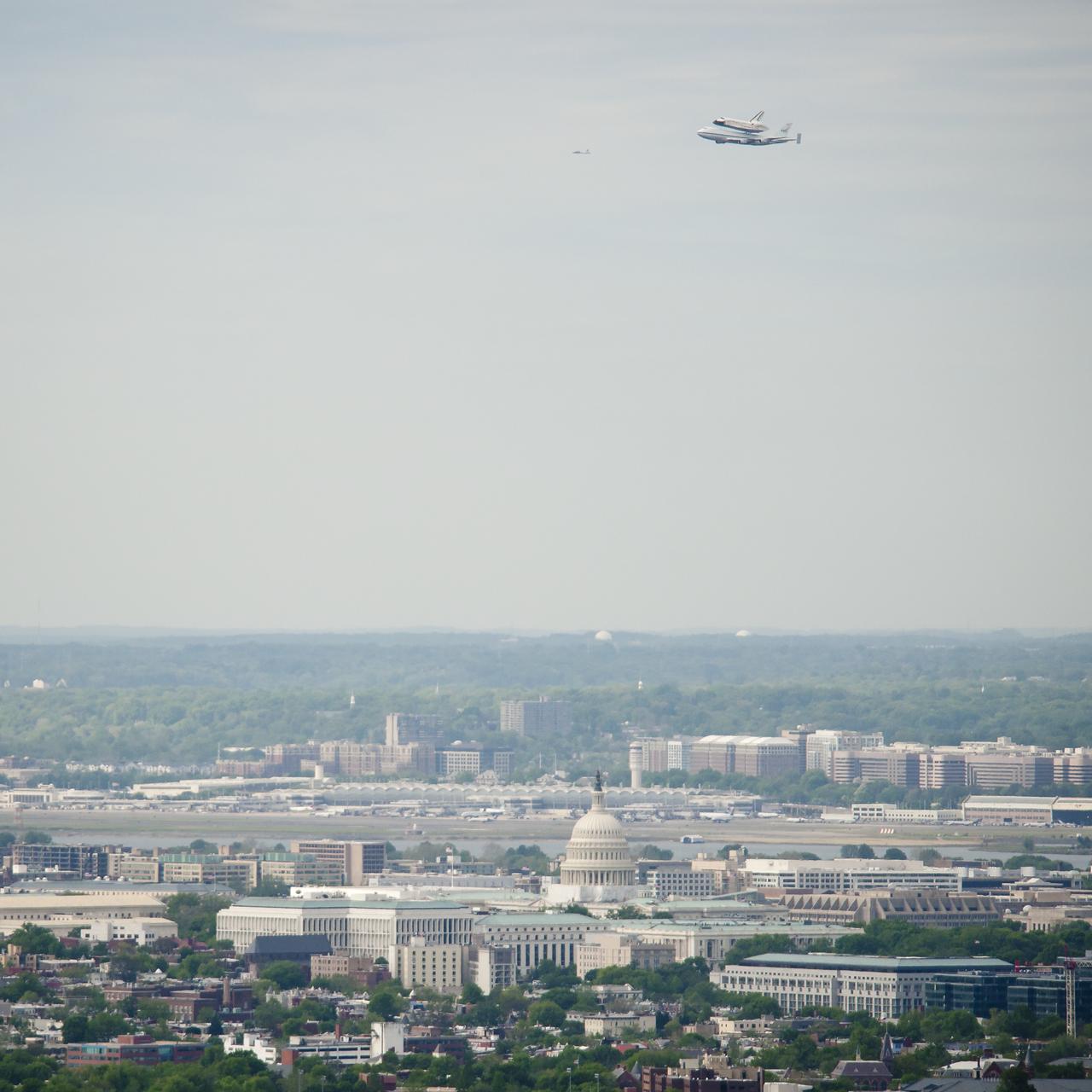
Space shuttle Discovery, mounted atop a NASA 747 Shuttle Carrier Aircraft (SCA) flies near the U.S. Capitol, Tuesday, April 17, 2012, in Washington. Discovery, the first orbiter retired from NASA’s shuttle fleet, completed 39 missions, spent 365 days in space, orbited the Earth 5,830 times, and traveled 148,221,675 miles. NASA will transfer Discovery to the National Air and Space Museum to begin its new mission to commemorate past achievements in space and to educate and inspire future generations of explorers. Photo Credit: (NASA/Bill Ingalls)

NASA Orbiter Transition & Retirement team member Tom Goebel monitors the installation of "rain covers" over space shuttle Enterprise’s vent door openings ahead of the expected rain at Washington Dulles International Airport, Saturday, April 21, 2012, in Sterling, Va. Enterprise, the first orbiter built for the Space Shuttle Program, was used primarily for ground and flight tests within the atmosphere. The initial testing period named Approach and Landing Test (ALT) included a flight on February 18, 1977 atop a Shuttle Carrier Aircraft (SCA) to measure structural loads and ground handling and braking characteristics of the mated system. Enterprise will go on permanent display at the Intrepid Sea Air and Space Museum in New York in June. Photo Credit: (NASA/Bill Ingalls)

Space Shuttle Endeavour is affixed atop NASA’s 747 Shuttle Carrier Aircraft as it prepares for a landing at Los Angeles International Airport to conclude a final flight on Sept. 21, 2012.
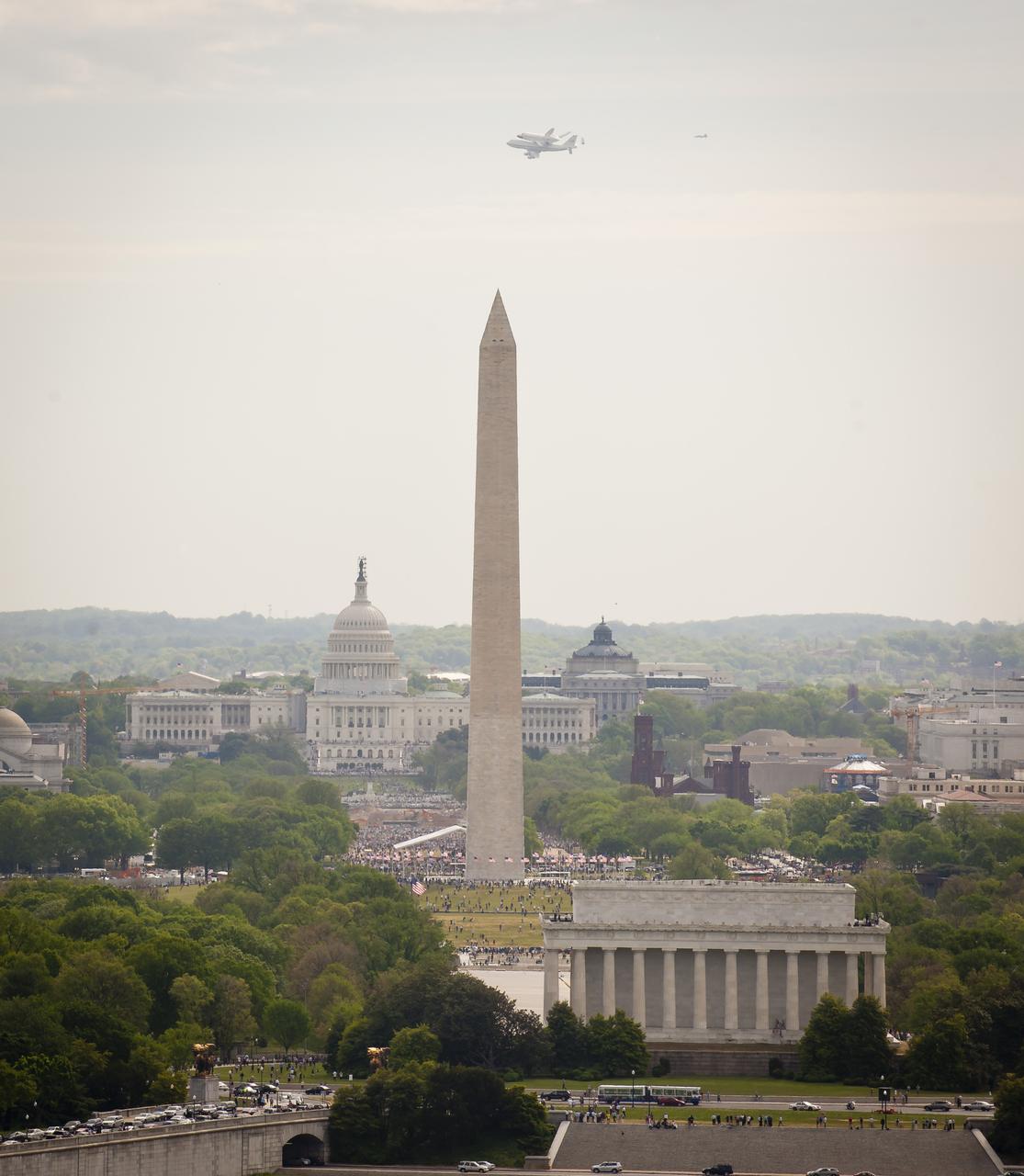
Space shuttle Discovery, mounted atop a NASA 747 Shuttle Carrier Aircraft (SCA) is seen from Top of the Town in Arlington, Virginia as it flies near the U.S. Capitol, Tuesday, April 17, 2012, in Washington. Discovery, the first orbiter retired from NASA’s shuttle fleet, completed 39 missions, spent 365 days in space, orbited the Earth 5,830 times, and traveled 148,221,675 miles. NASA will transfer Discovery to the National Air and Space Museum to begin its new mission to commemorate past achievements in space and to educate and inspire future generations of explorers. Photo Credit: (NASA/Chris Gunn)
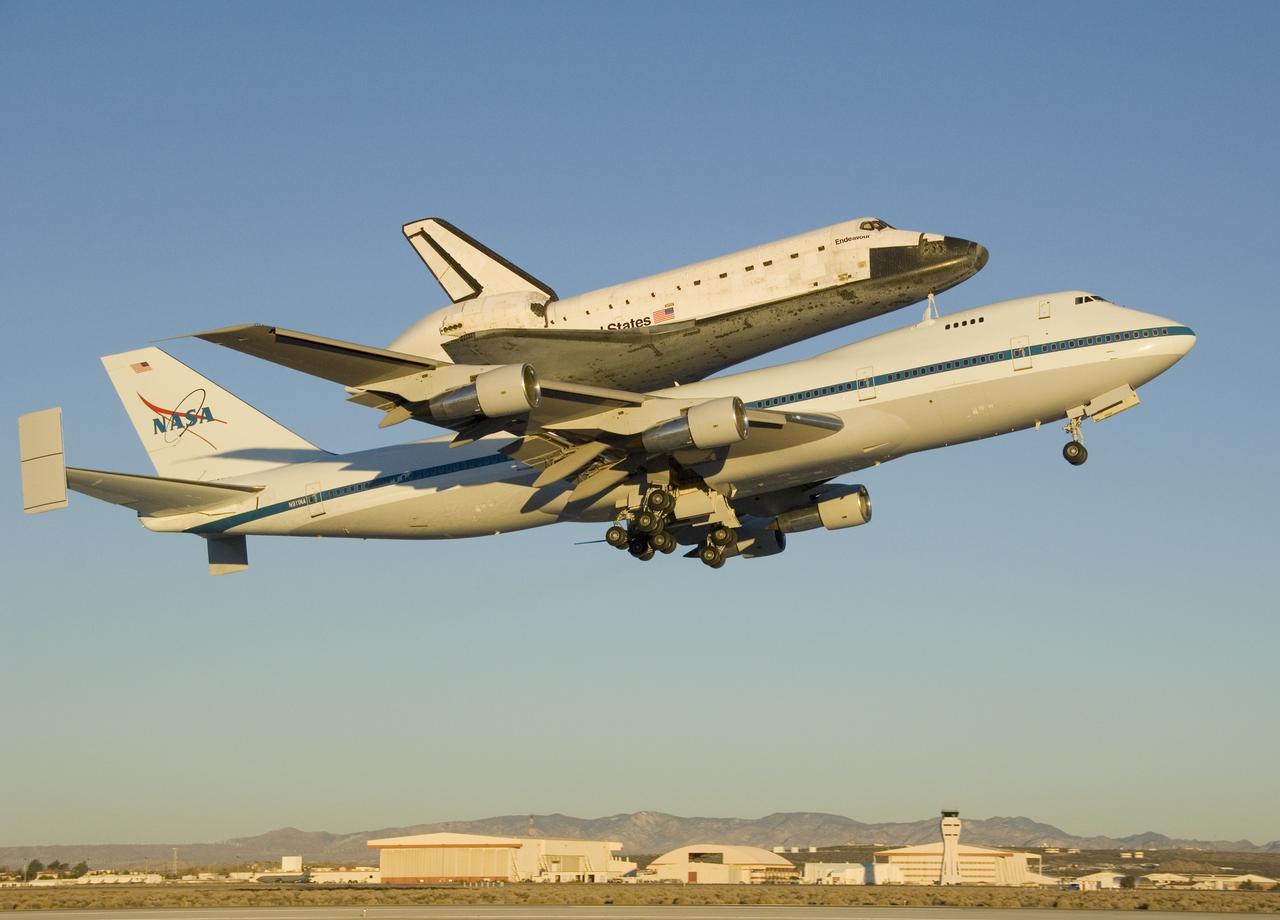
The Space Shuttle Endeavour atop its modified Boeing 747 carrier aircraft lifts off from Edwards Air Force Base on the first leg of its ferry flight back to the Kennedy Space Center just after sunrise on Dec. 10, 2008.