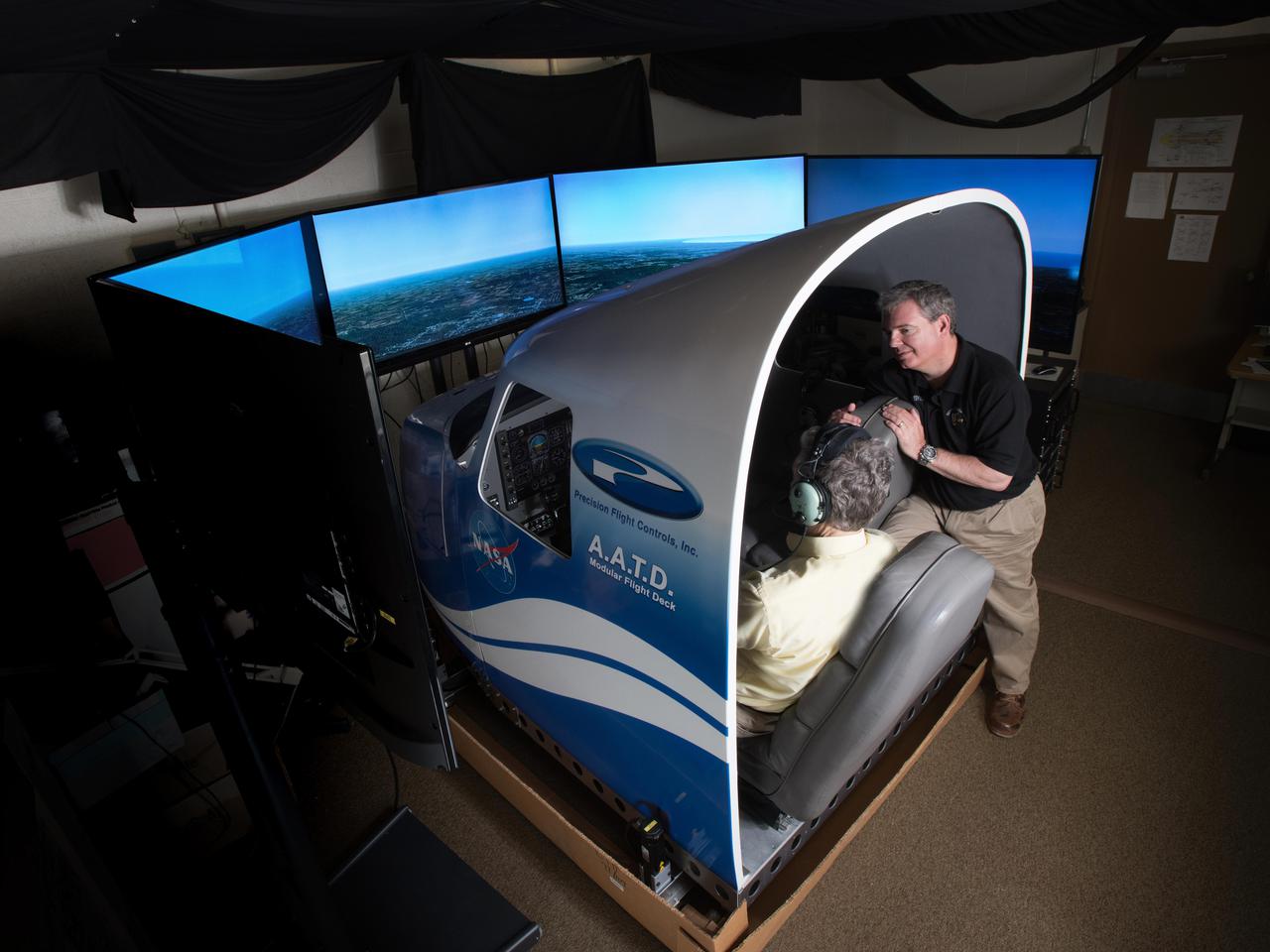
NASA Glenn Flight Simulator Laboratory
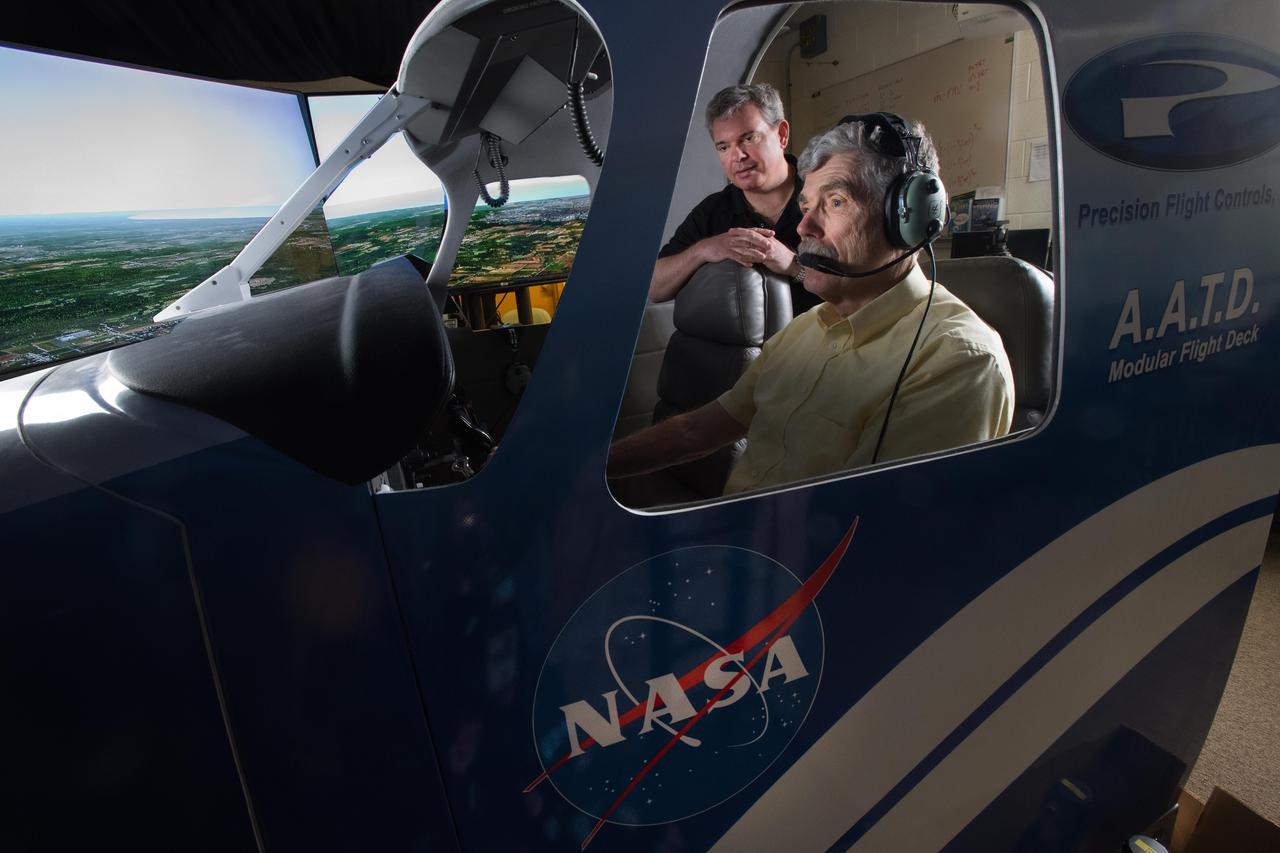
NASA Glenn Flight Simulator Laboratory
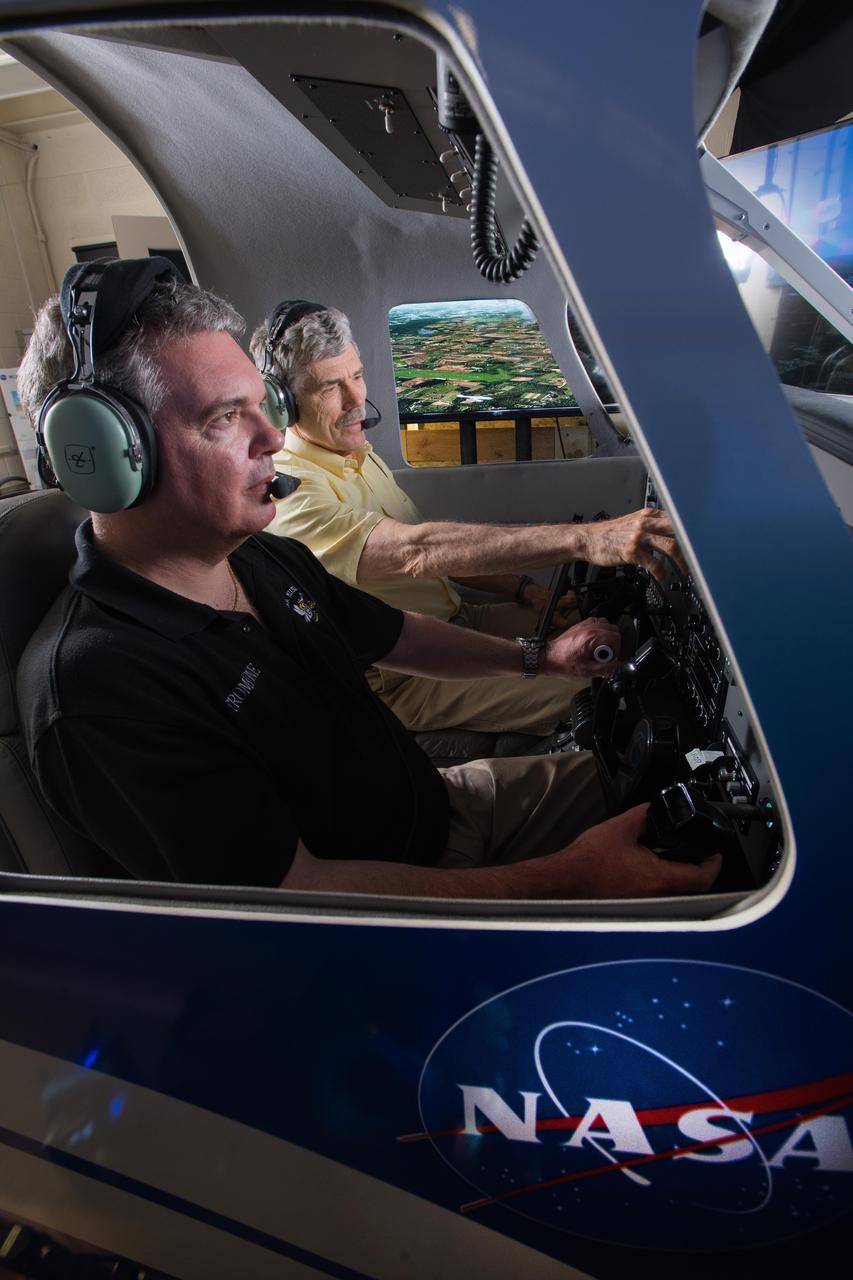
NASA Glenn Flight Simulator Laboratory
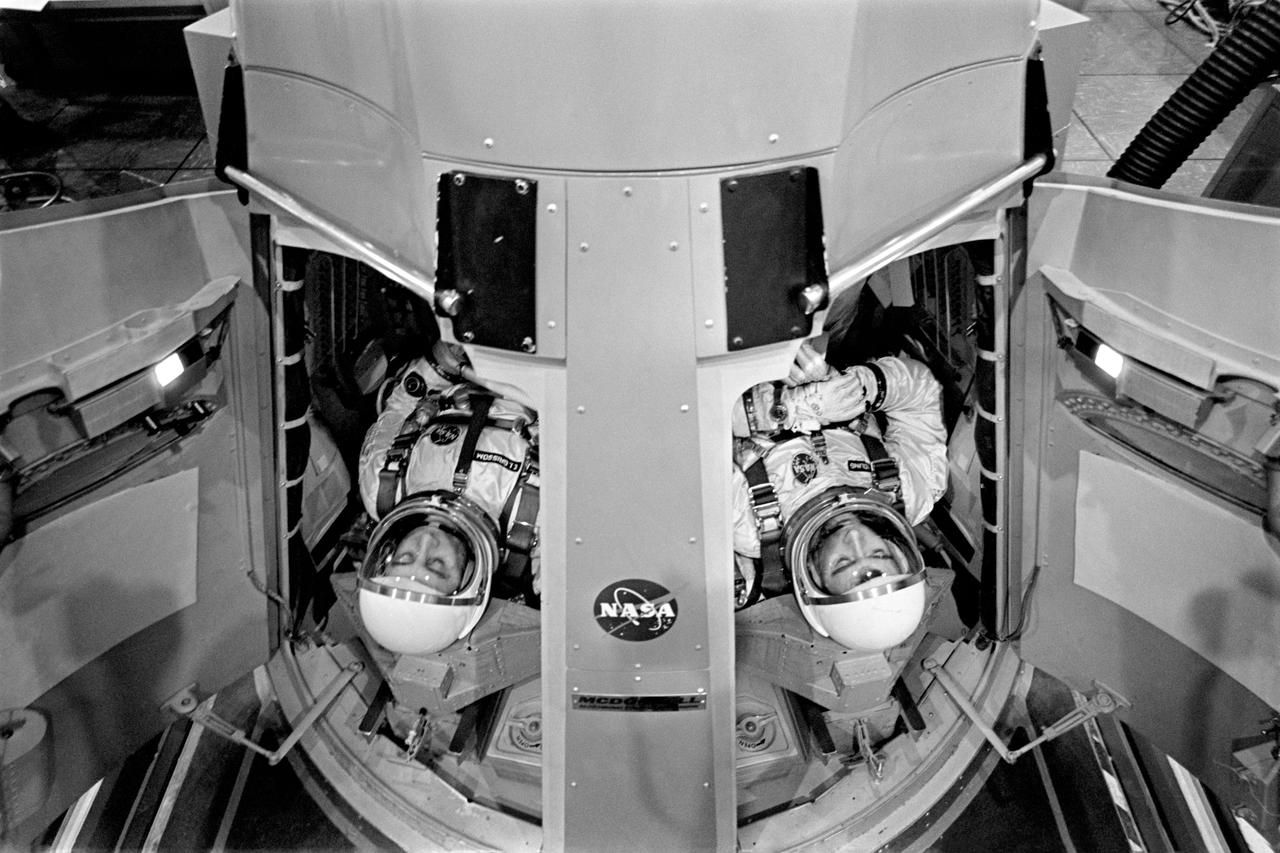
S65-21864 (19 March 1965) --- Astronauts Virgil I. Grissom (left), command pilot; and John W. Young, pilot, prepare to run Gemini-Titan 3 simulations in the Gemini mission simulator at Cape Kennedy, Florida. The NASA GT-3 flight was scheduled for March 23, 1965.
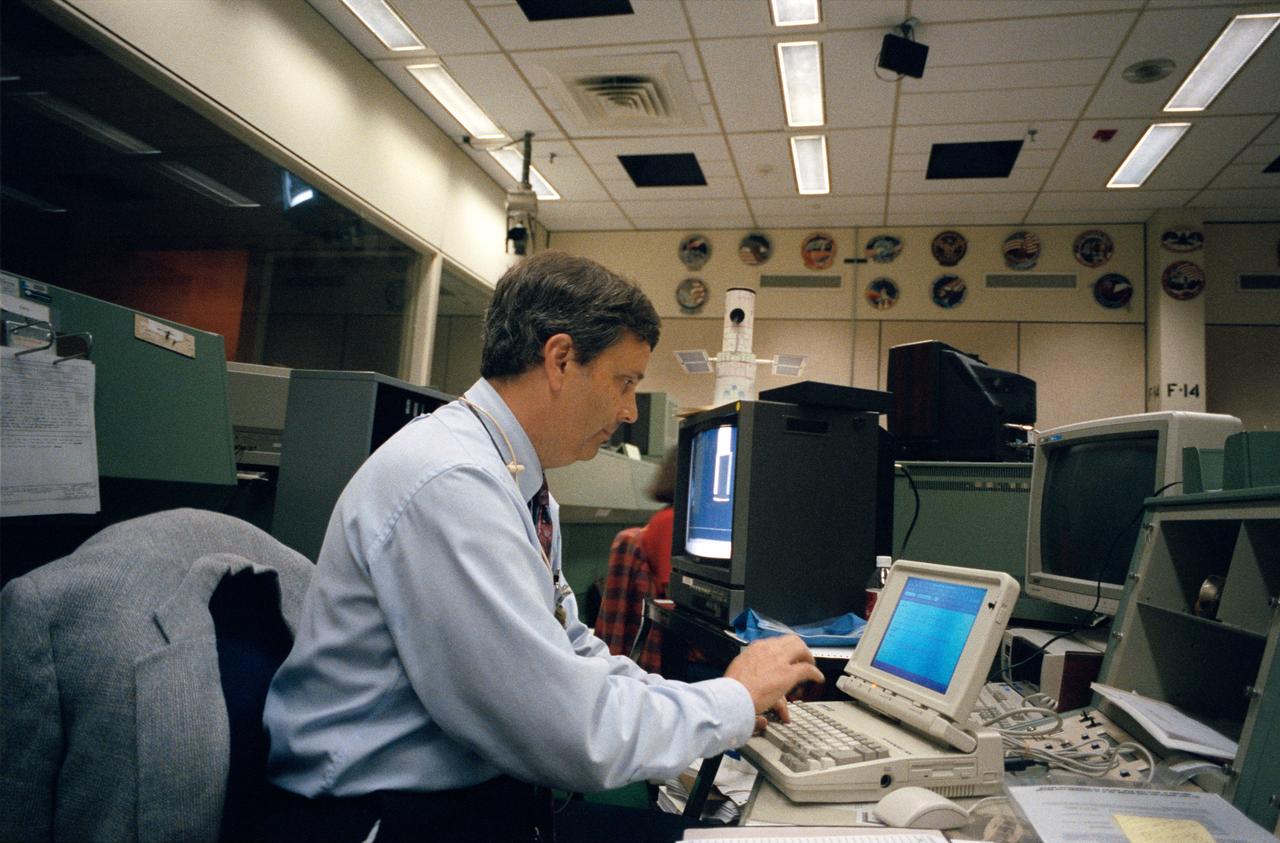
Flight Director Robert E. Castle Jr. works out a problem during joint integrated simulations for the STS-61 mission. Astronauts assigned to extravehicular activity (EVA) tasks with the Hubble Space Telescope (HST) were simultaneously rehearsing in a neutral buoyancy tank at the Marshall Space Flight Center (MSFC) in Alabama.
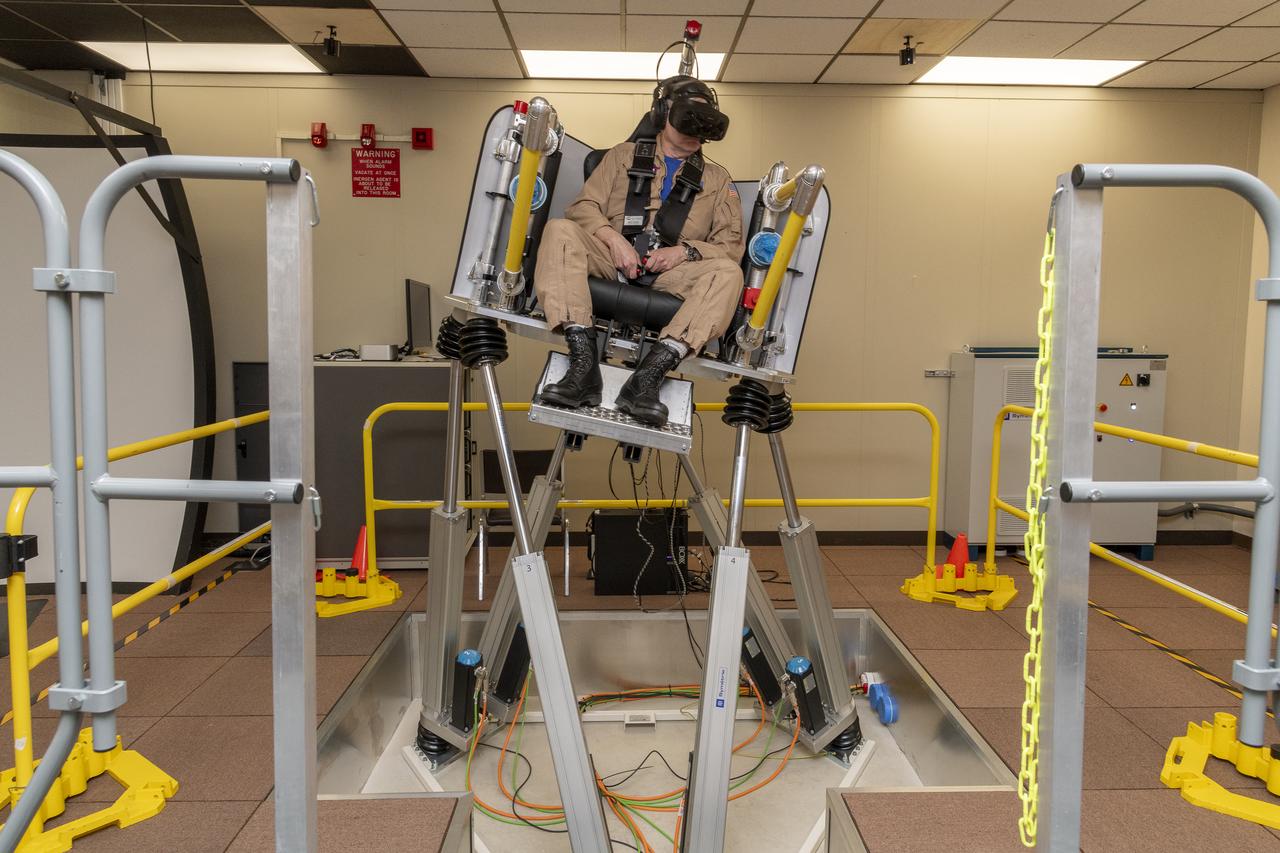
NASA test pilot Wayne Ringelberg sits in the air taxi virtual reality flight simulator during a test at NASA’s Armstrong Flight Research Center in Edwards, California in March 2024.
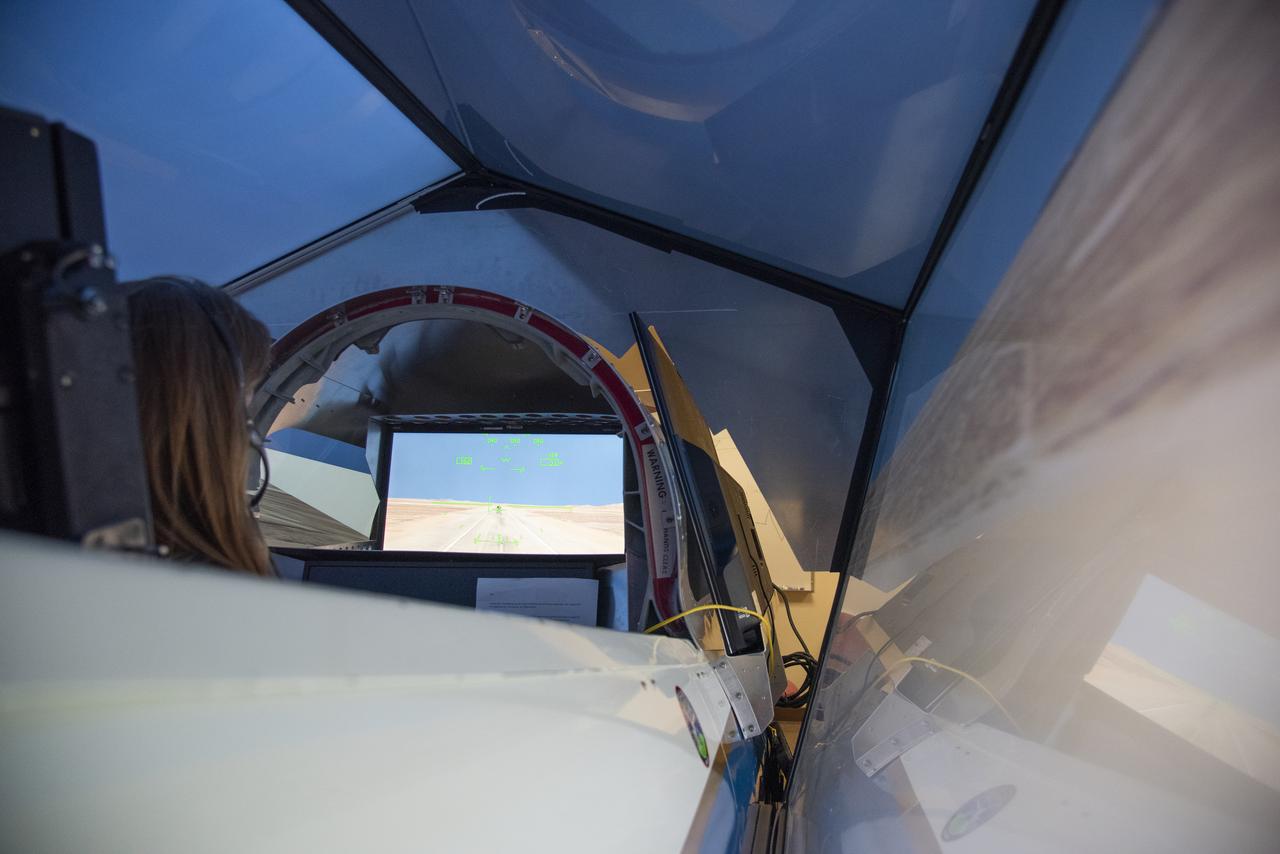
NASA's 2017 astronaut candidate Kayla Barron practices flying in an X-59 QueSST simulator at Armstrong Flight Research Center, in Southern California. The low boom flight demonstrator, X-59, being built at Lockheed Martin and was designed to fly at supersonic speeds over land without the loud noise of breaking the sound barrier and disturbing communities.
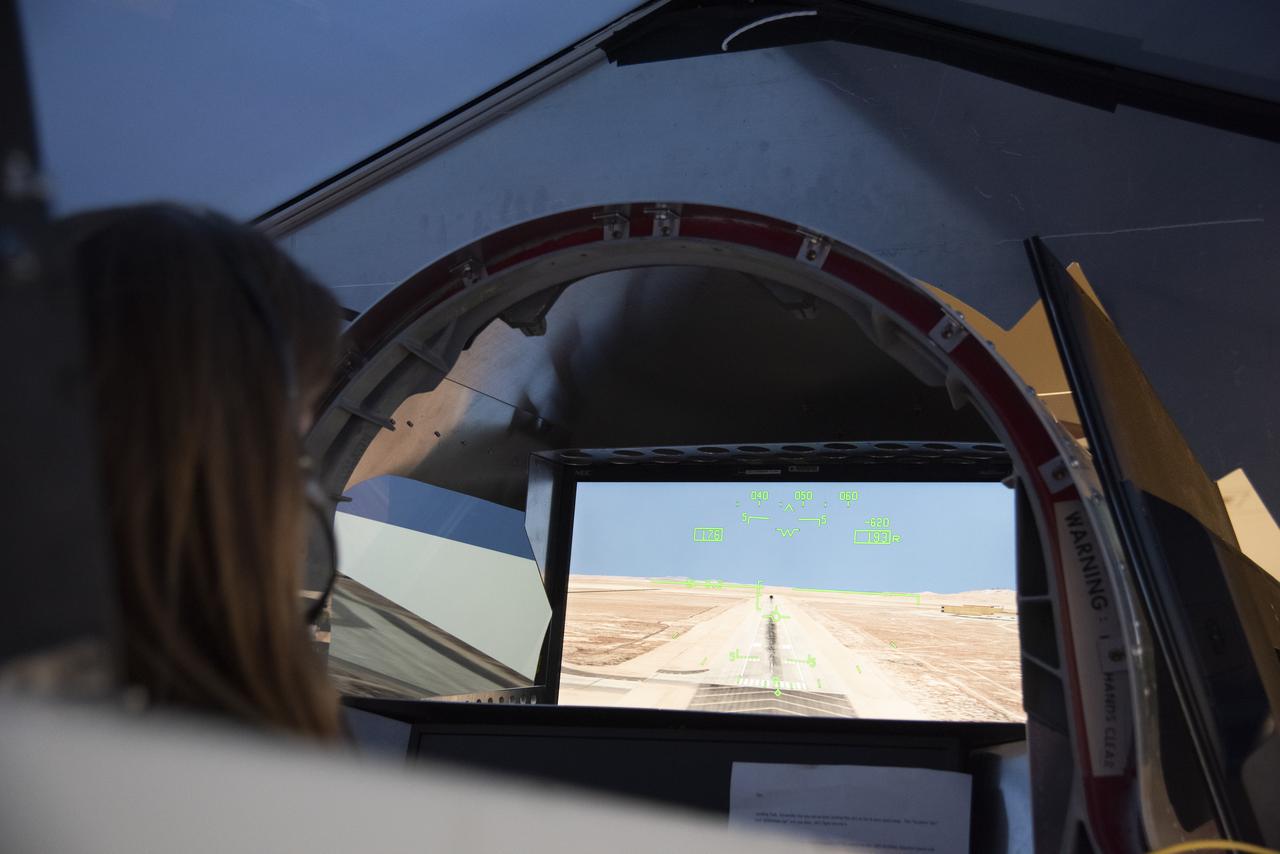
NASA's 2017 astronaut candidate Kayla Barron practices flying in an X-59 QueSST simulator at Armstrong Flight Research Center, in Southern California. The low boom flight demonstrator, X-59, being built at Lockheed Martin and was designed to fly at supersonic speeds over land without the loud noise of breaking the sound barrier and disturbing communities.
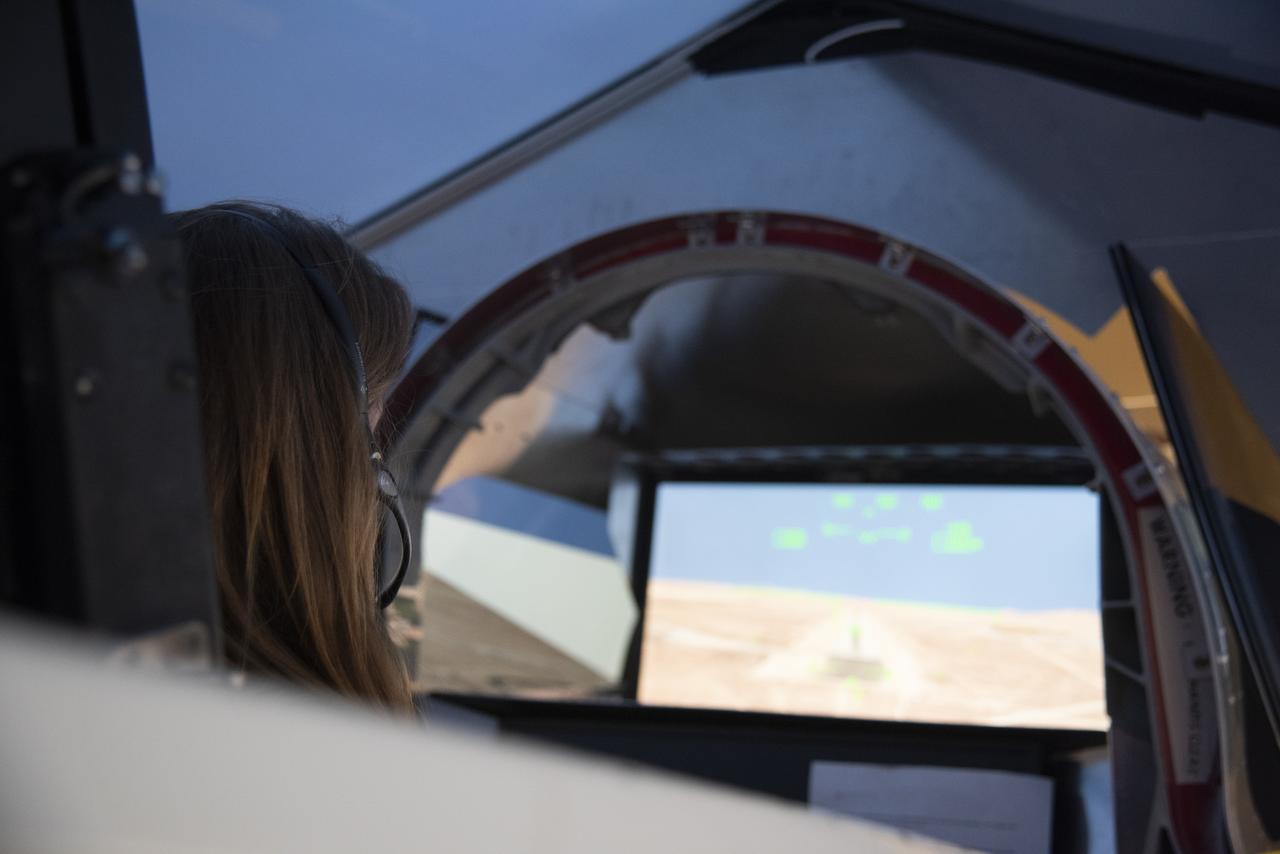
NASA's 2017 astronaut candidate Kayla Barron practices flying in an X-59 QueSST simulator at Armstrong Flight Research Center, in Southern California. The low boom flight demonstrator, X-59, being built at Lockheed Martin and was designed to fly at supersonic speeds over land without the loud noise of breaking the sound barrier and disturbing communities.
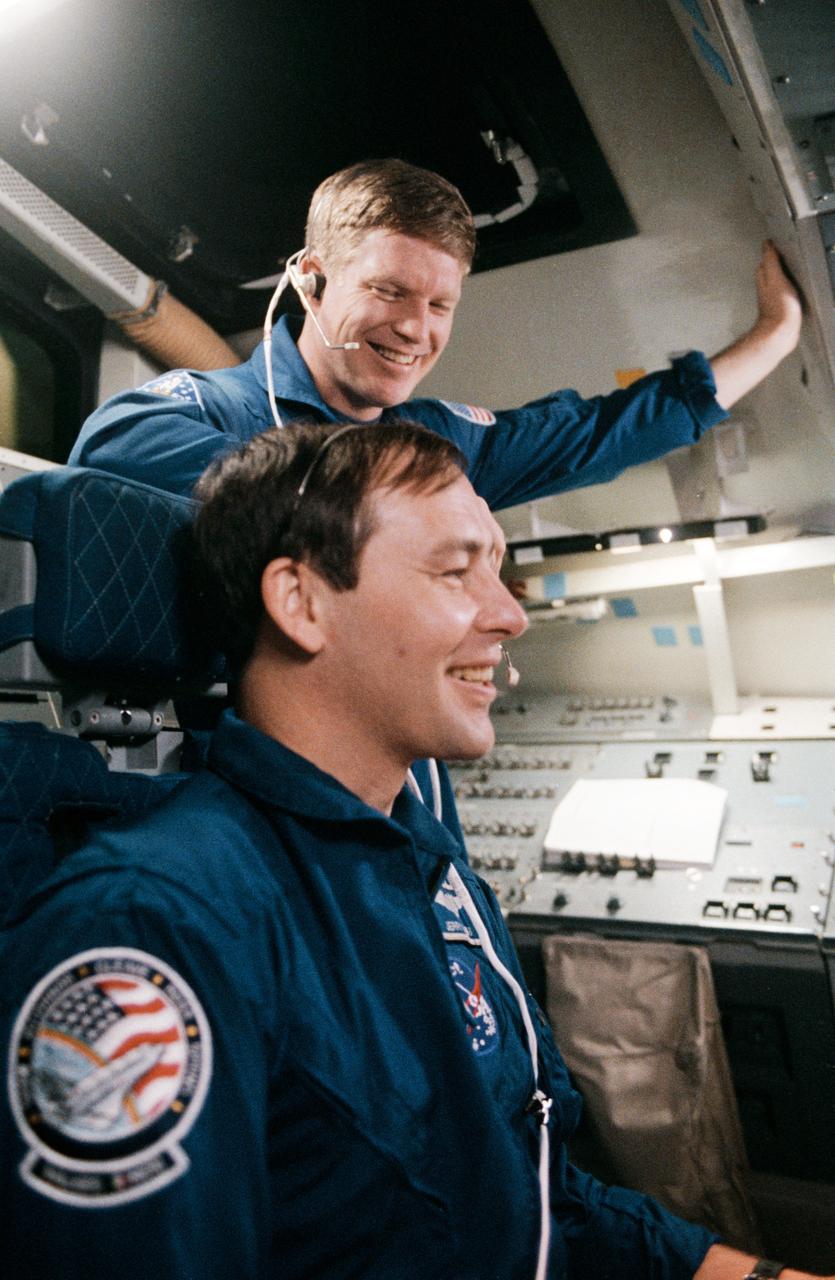
S88-27505 (3 Feb. 1988) --- Astronauts William M. Shepherd (standing) and Jerry L. Ross, both STS-27 mission specialists, get in some training time on the flight deck of the Shuttle Mission Simulator in the Jake Garn Mission Simulation and Training Facility at NASA's Johnson Space Center. Photo credit: NASA
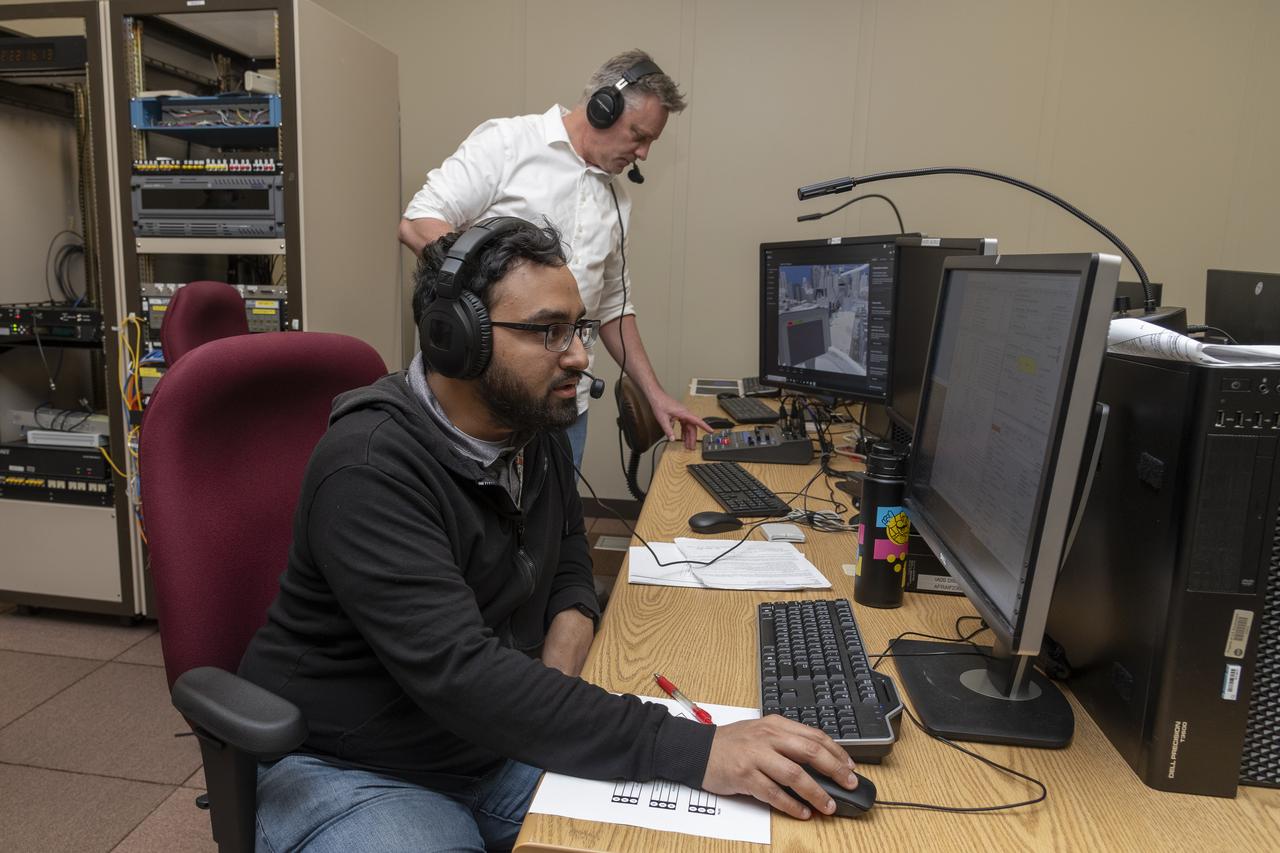
NASA researchers Curt Hanson (background) and Saravanakumaar Ramia (foreground) control the air taxi virtual reality flight simulator from computers during a test at NASA’s Armstrong Flight Research Center in Edwards, California in March 2024.
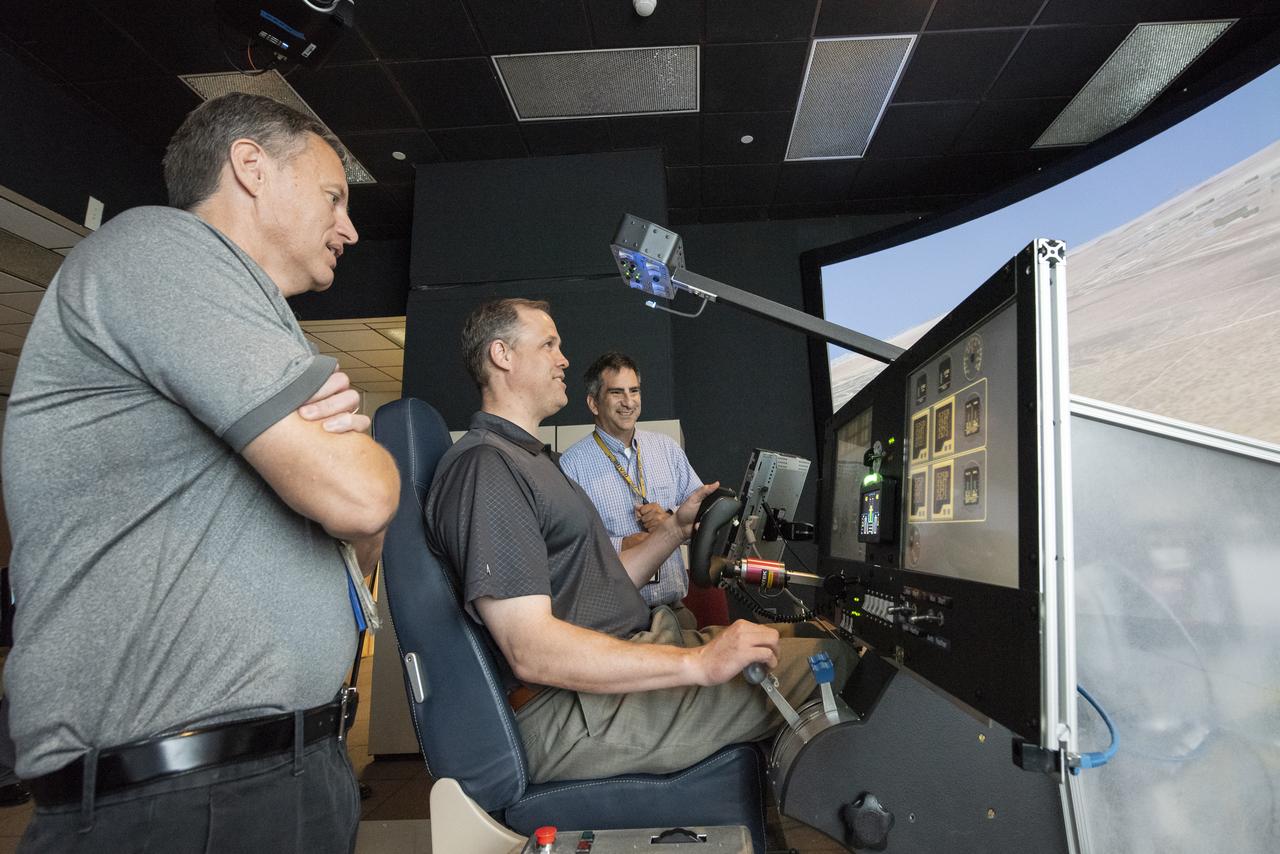
NASA Administrator Bridenstine tests the X-57 "Maxwell" simulator at NASA's Armstrong Flight Research Center. The simulator is designed to provide feedback to NASA test pilots based on the aircraft's unique design and distributed electric propulsion system.
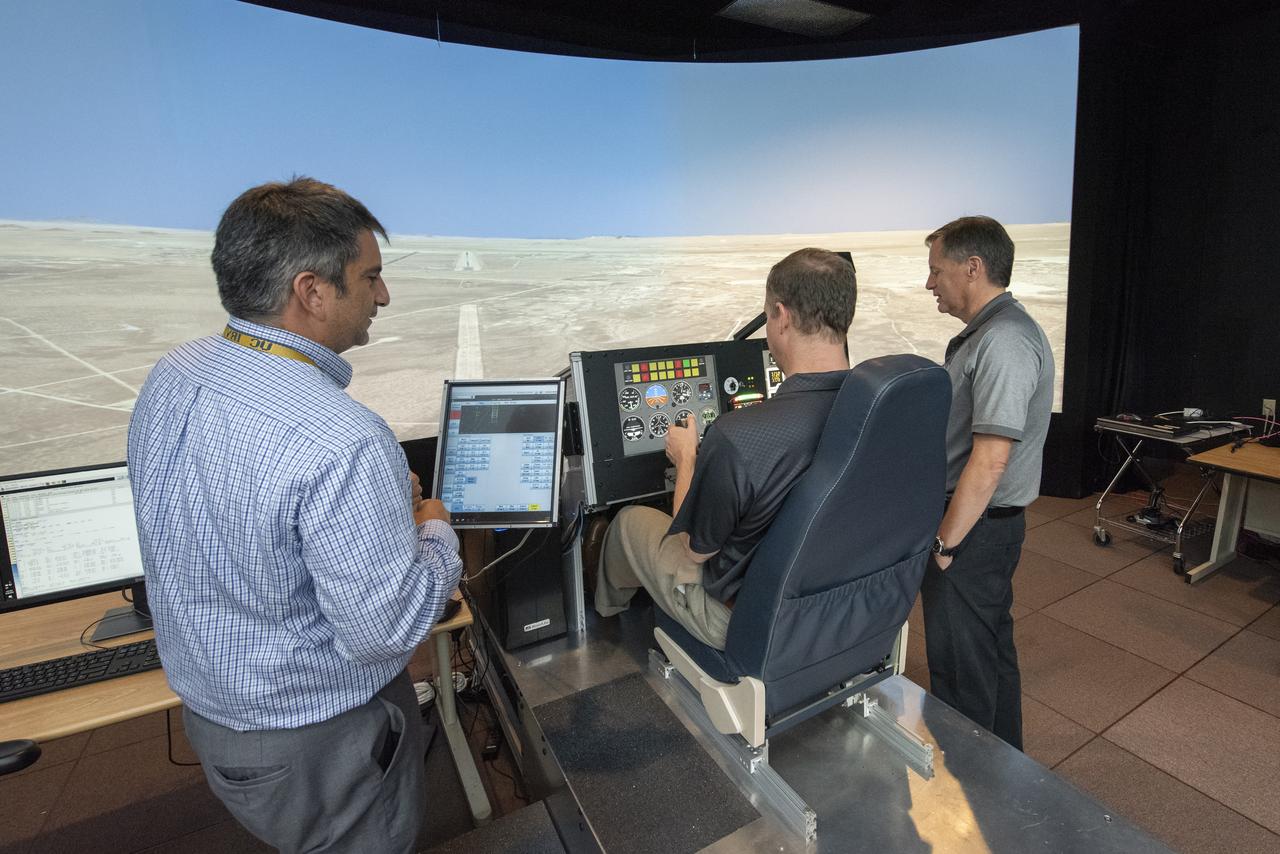
NASA Administrator Bridenstine tests the X-57 "Maxwell" simulator at NASA's Armstrong Flight Research Center. The simulator is designed to provide feedback to NASA test pilots based on the aircraft's unique design and distributed electric propulsion system.
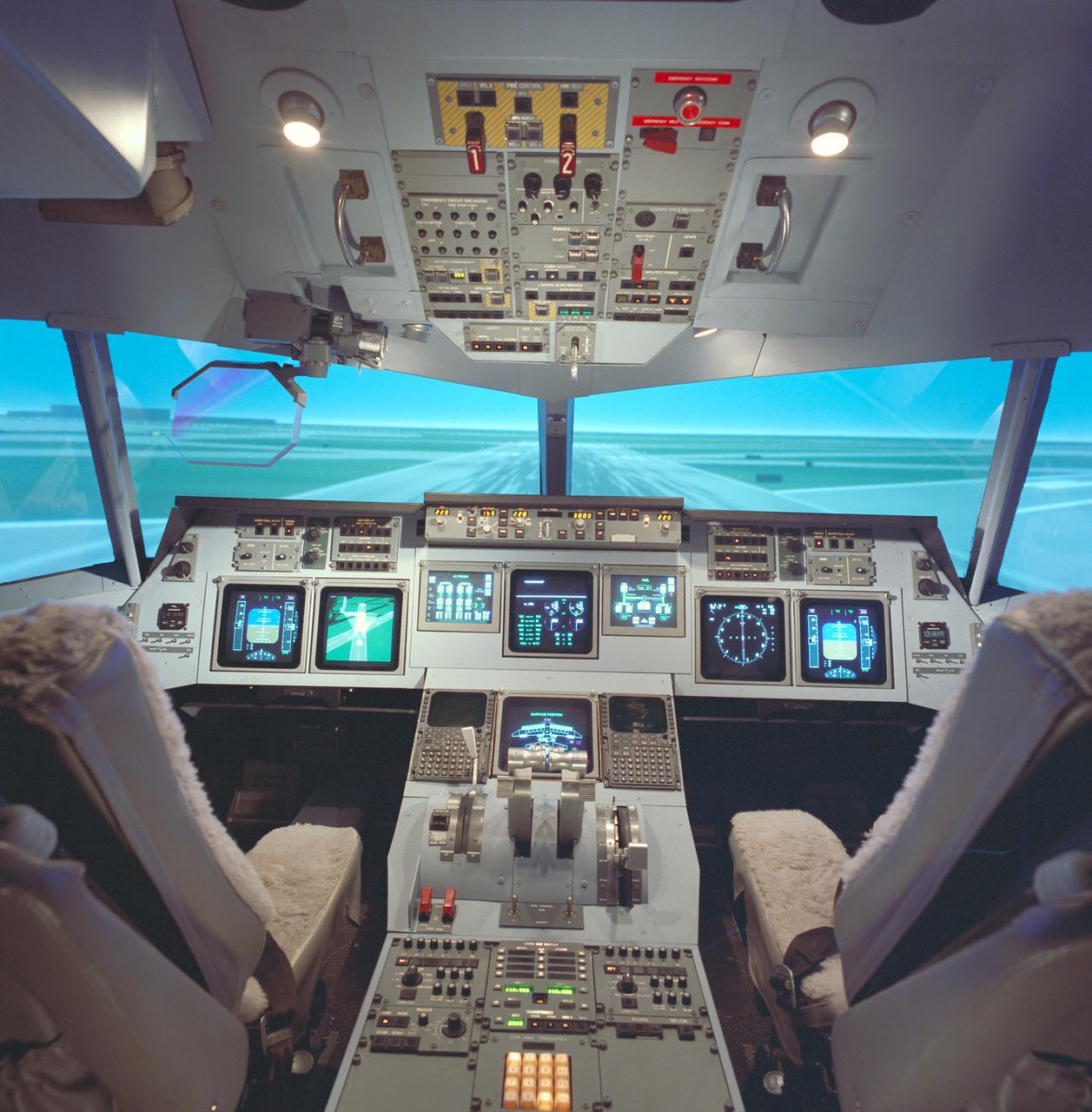
N-257 CVSRF: ACFS (Advanced Cab Flight Simulator) cockpit
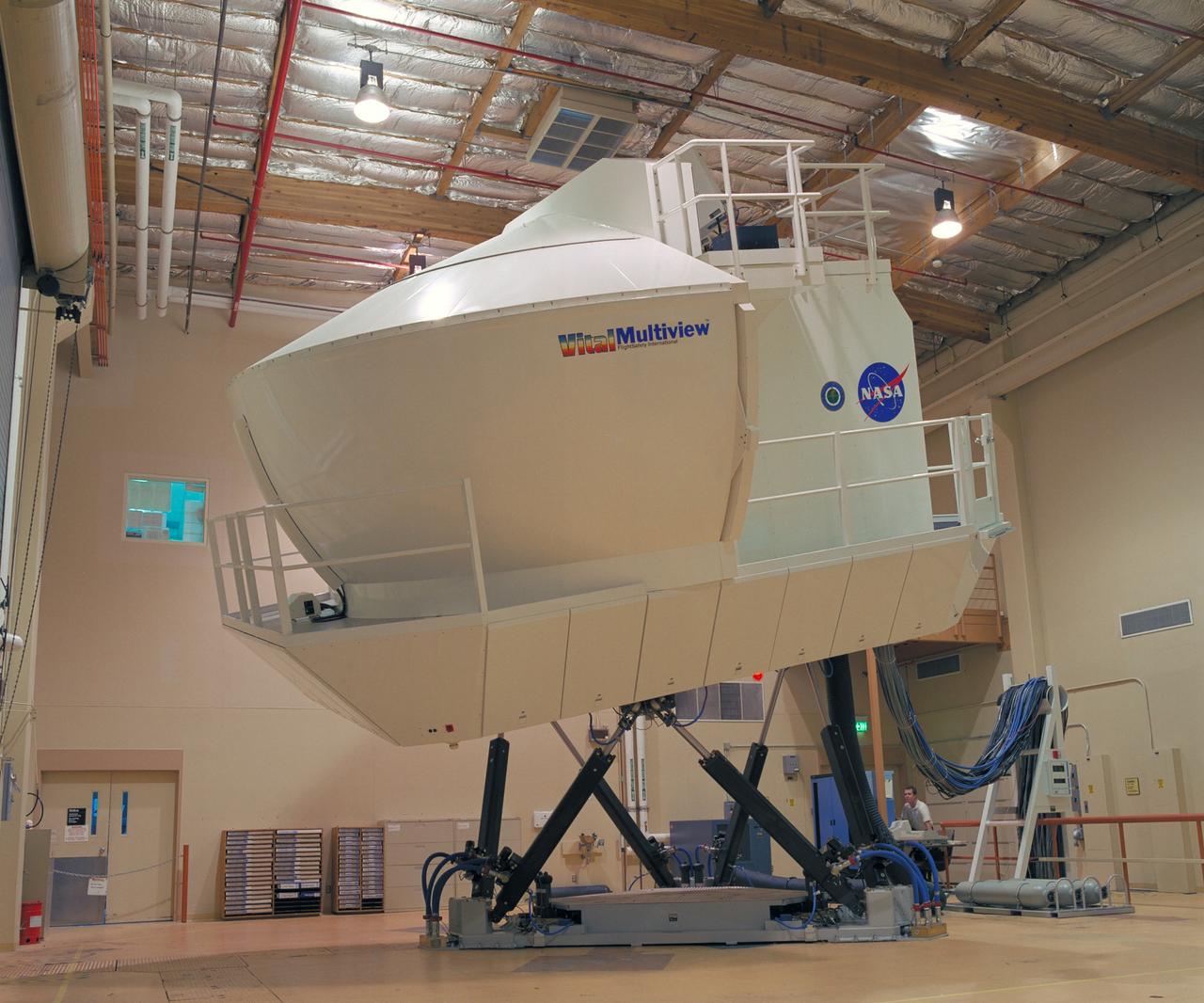
N-257 CVSRF: ACFS (Advanced Cab Flight Simulator)
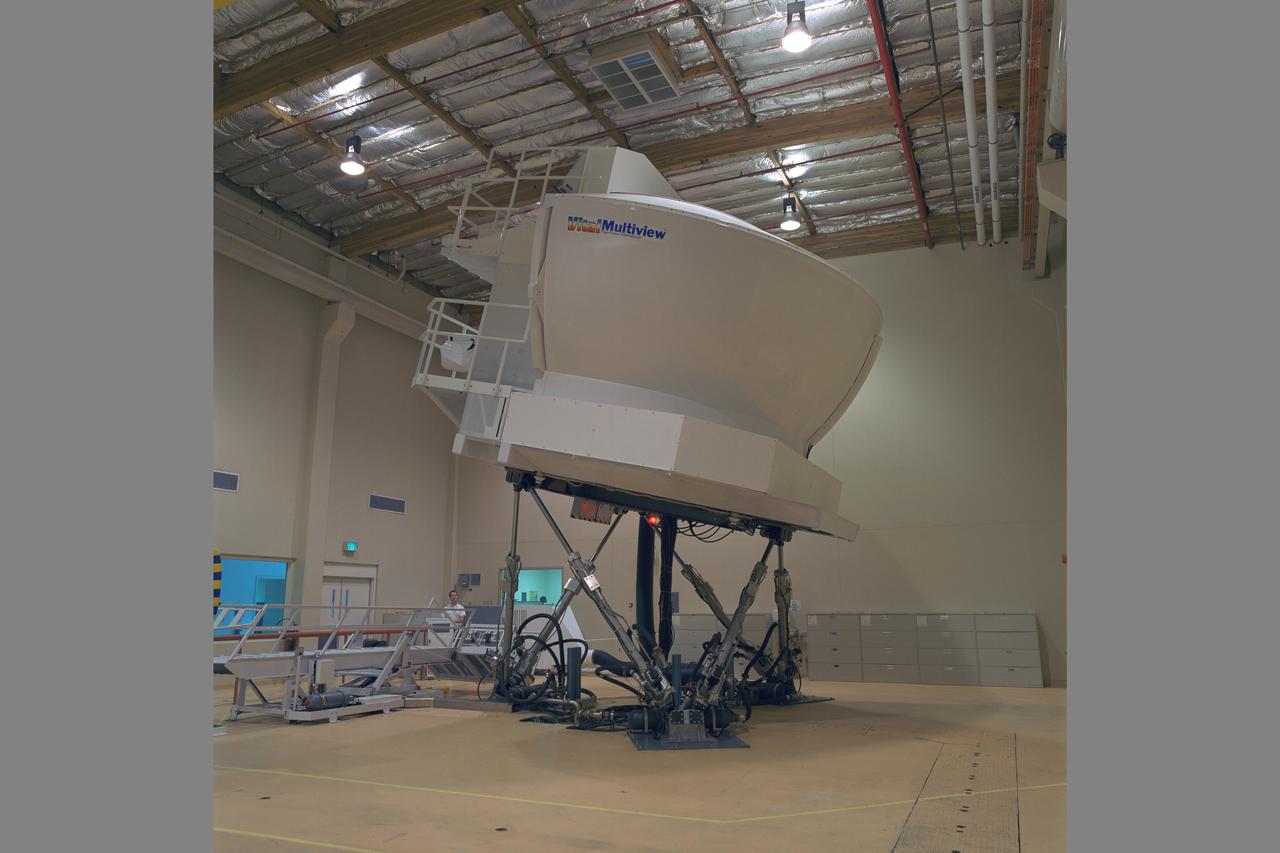
N-257 CVSRF: ACFS (Advanced Cab Flight Simulator)
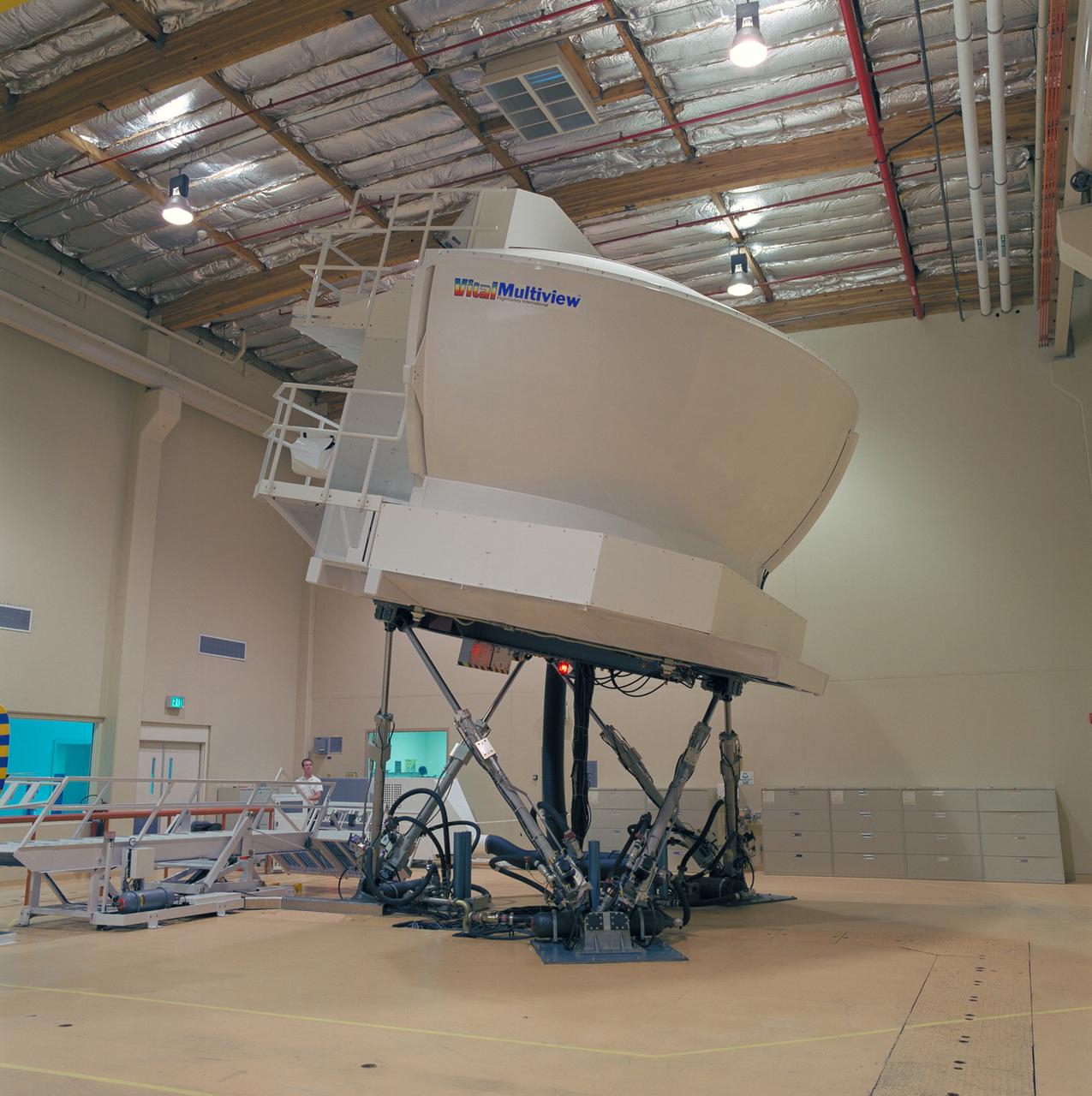
N-257 CVSRF: ACFS (Advanced Cab Flight Simulator)
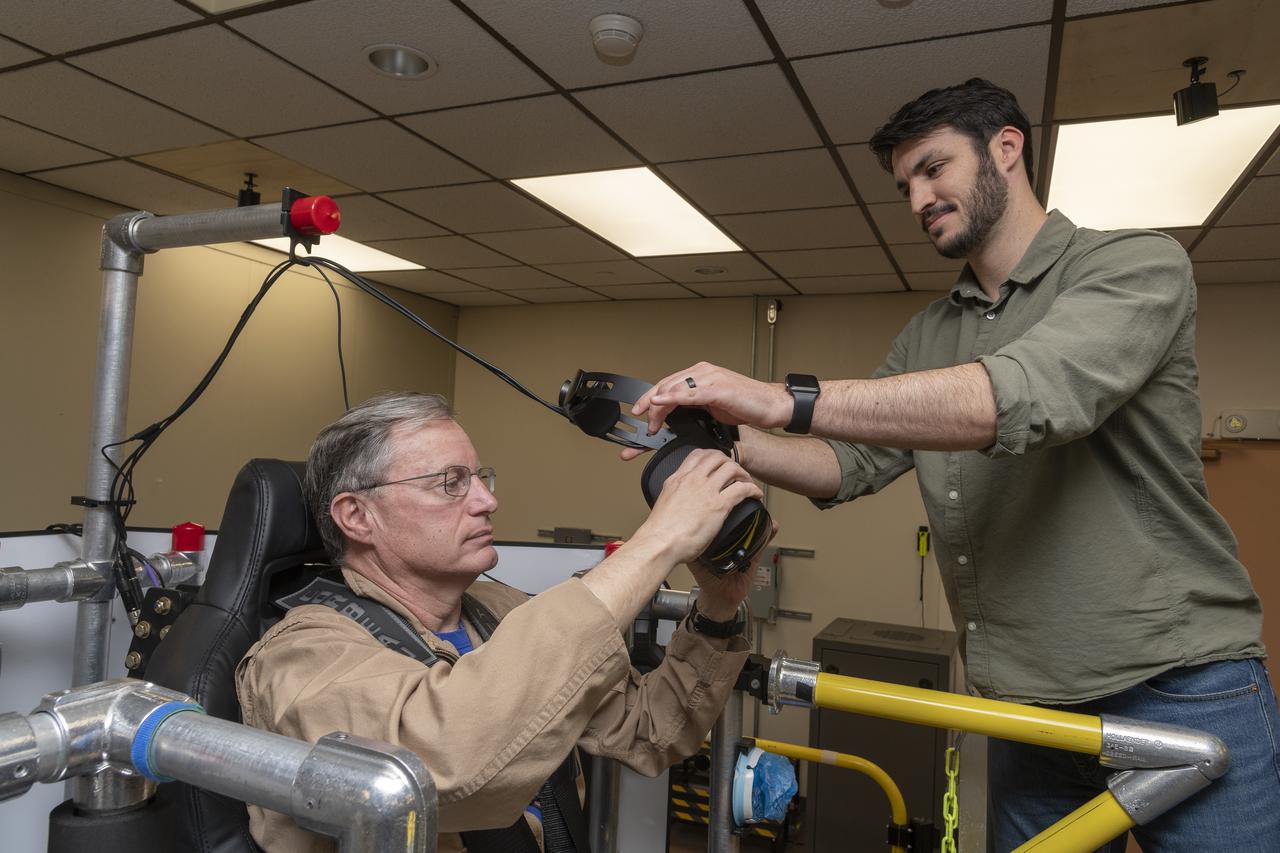
NASA test pilot Wayne Ringelberg and NASA researcher Kyle Barnes prepare for Ringelberg’s ride in the air taxi virtual reality flight simulator during a test at NASA’s Armstrong Flight Research Center in Edwards, California in March 2024.

This frame from an animation takes the viewer on a simulated flight into, and then out of, Jupiter's upper atmosphere at the location of the Great Red Spot. The perspective begins about 2,000 miles (3,000 kilometers) above the cloud tops of the planet's southern hemisphere. The bar at far left indicates altitude during the quick descent; a second gauge next to that depicts the dramatic increase in temperature that occurs as the perspective dives deeper down. The clouds turn crimson as the perspective passes through the Great Red Spot. Finally, the view ascends out of the spot. This video was created by combining an image from the JunoCam imager on NASA's Juno spacecraft with a computer-generated animation. The animation is available at https://photojournal.jpl.nasa.gov/catalog/PIA22176. - Enhanced image by Gerald Eichstädt / Justin Cowart based on images provided courtesy of NASA/JPL-Caltech/SwRI/MSSS
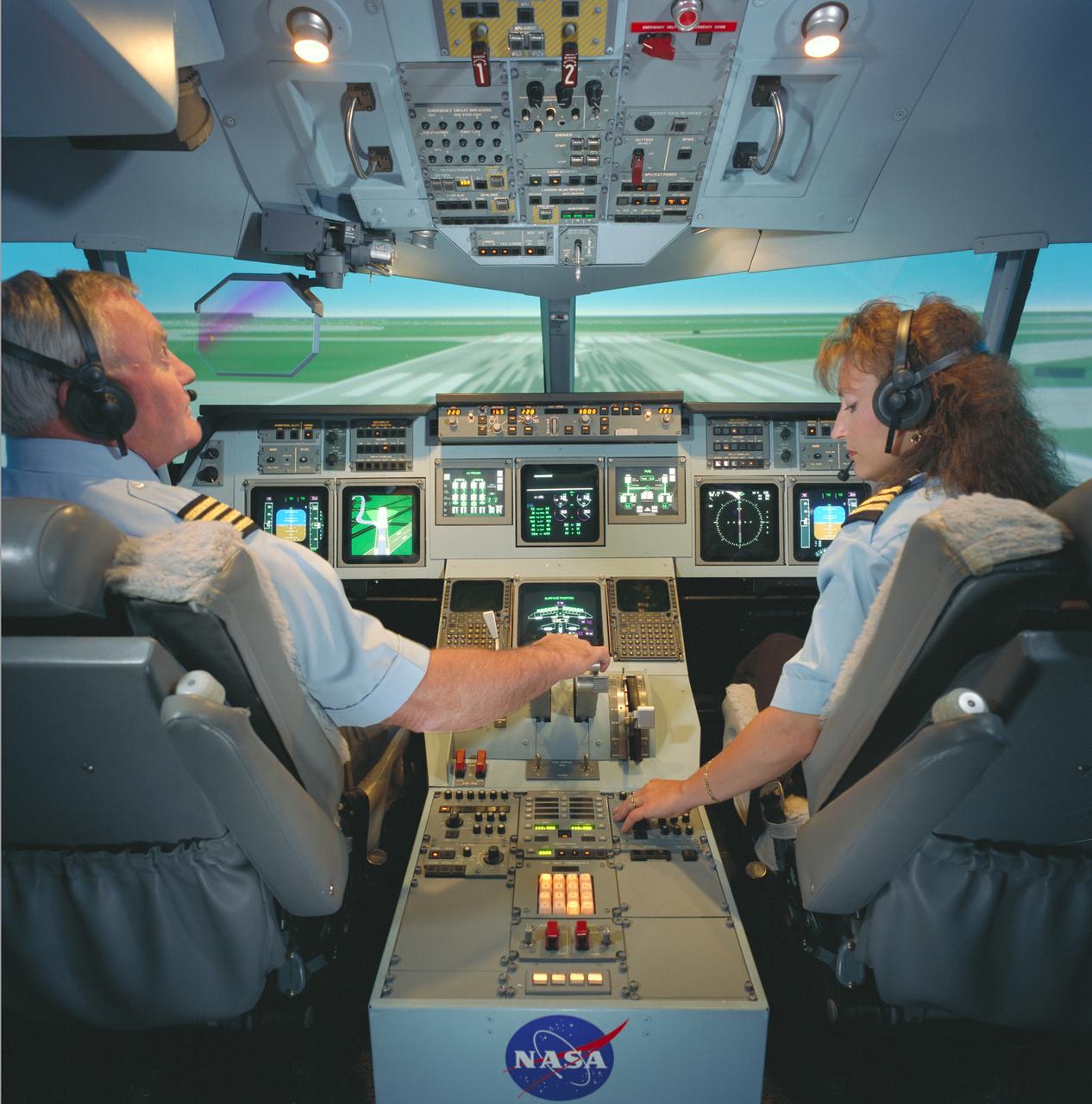
N-257 CVSRF: ACFS (Advanced Cab Flight Simulator) cockpit with (L) Don Bryant and (r) Diane Carpenter in pilot - co-pilot seats
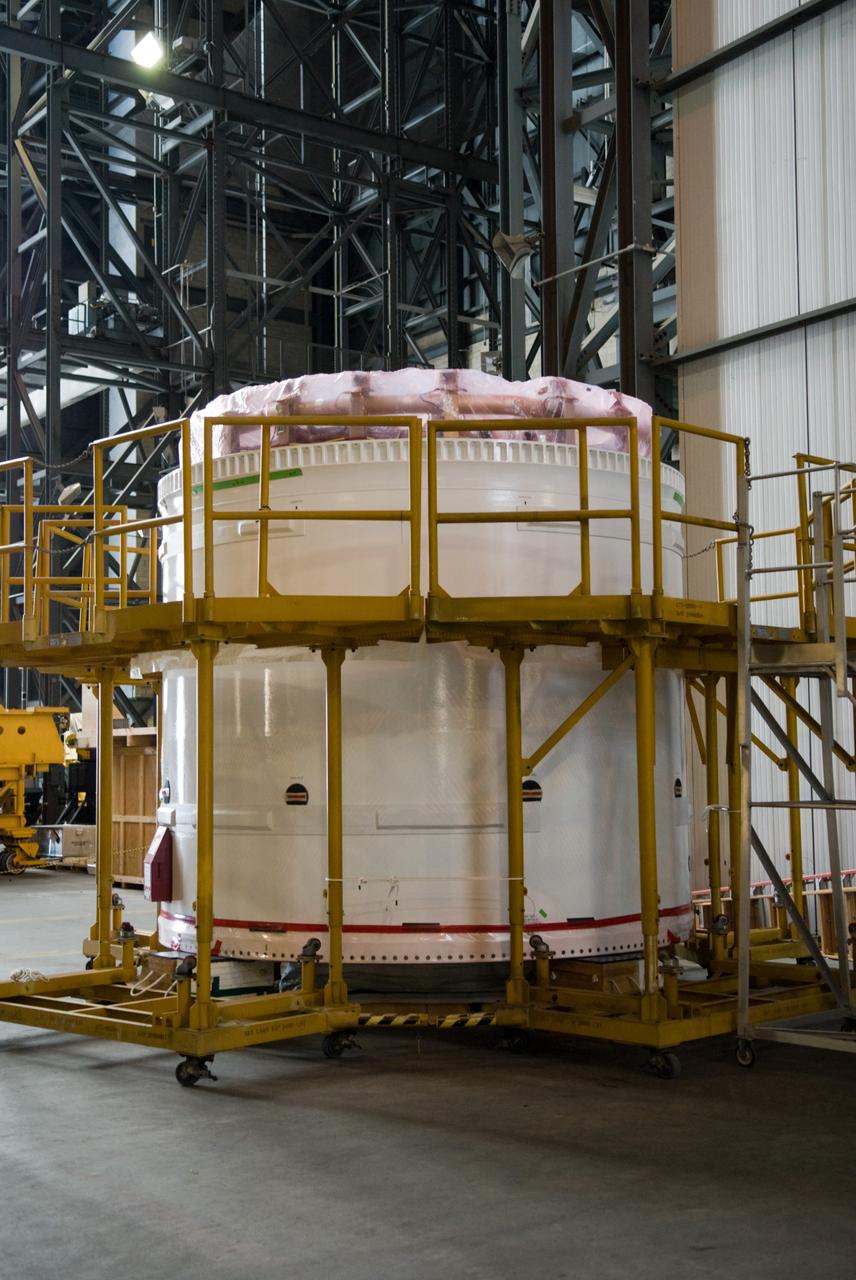
CAPE CANAVERAL, Fla. –– The fifth segment simulator segments of the Ares I-X rocket have been moved to the transfer aisle of the Vehicle Assembly Building at NASA's Kennedy Space Center in Florida. The stacking operations with other segments in the VAB in June. Ares I-X is the flight test for the Ares I. The I-X flight will provide NASA an early opportunity to test and prove hardware, facilities and ground operations associated with Ares I, which is part of the Constellation Program to return men to the moon and beyond. Launch of the Ares I-X flight test is targeted for August 2009. Photo credit: NASA/Jack Pfaller
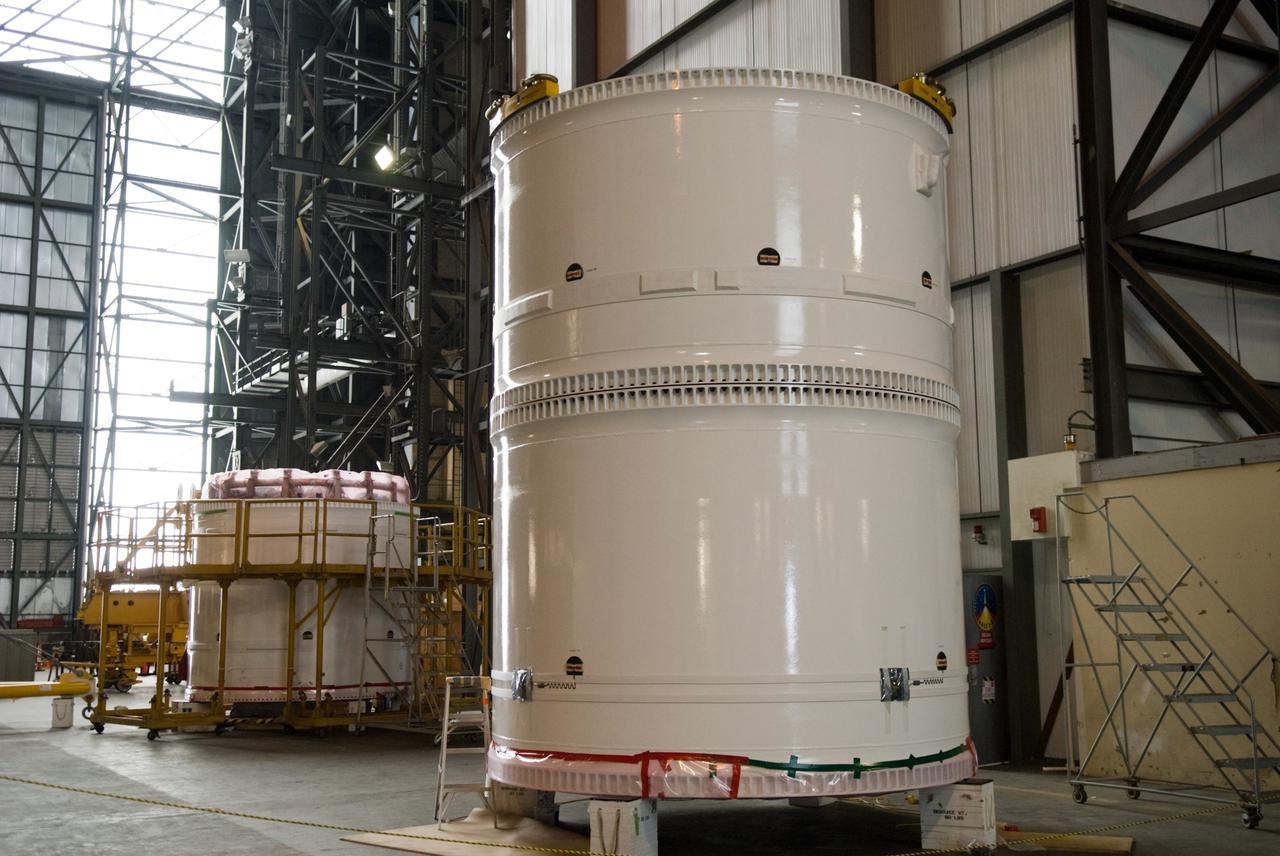
CAPE CANAVERAL, Fla. –– The fifth segment simulator segments of the Ares I-X rocket have been moved to the transfer aisle of the Vehicle Assembly Building at NASA's Kennedy Space Center in Florida. The stacking operations with other segments in the VAB in June. Ares I-X is the flight test for the Ares I. The I-X flight will provide NASA an early opportunity to test and prove hardware, facilities and ground operations associated with Ares I, which is part of the Constellation Program to return men to the moon and beyond. Launch of the Ares I-X flight test is targeted for August 2009. Photo credit: NASA/Jack Pfaller
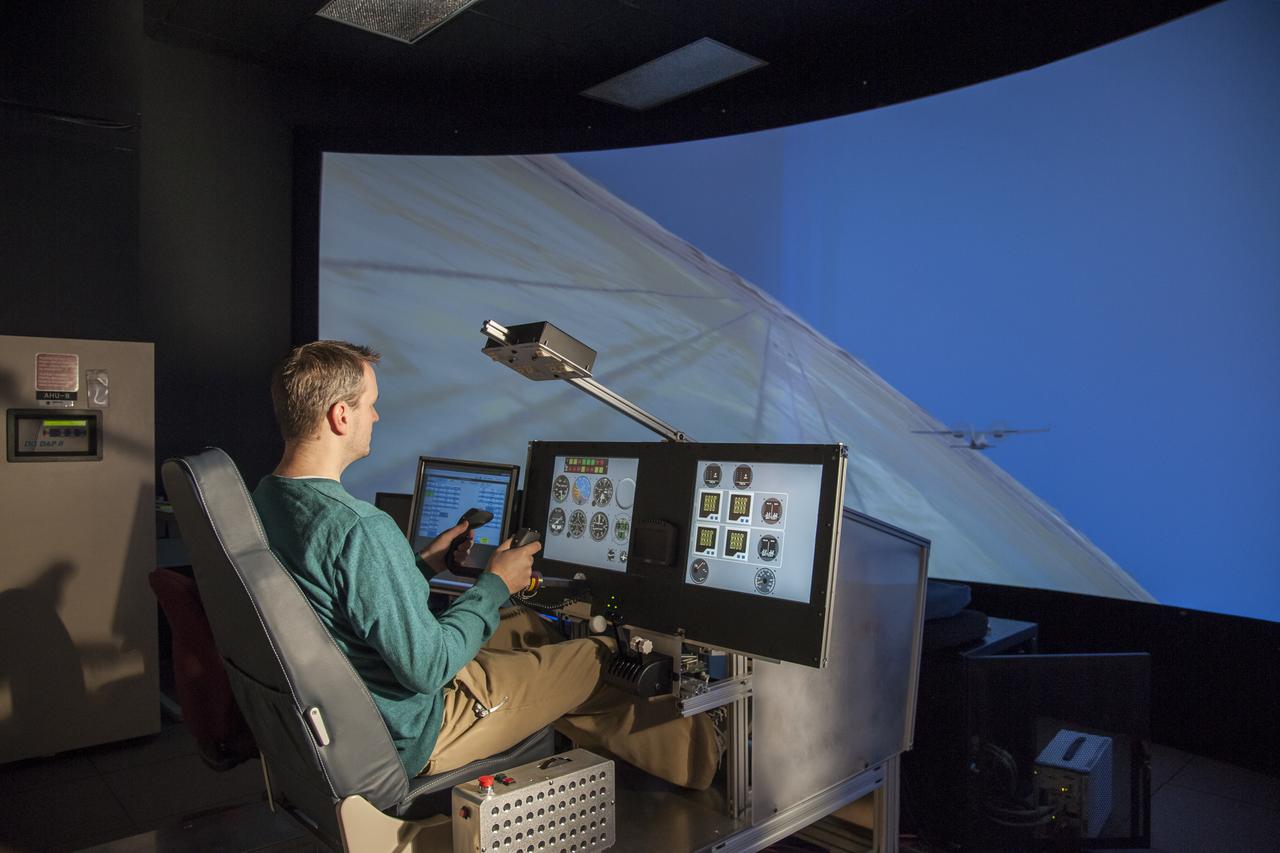
X-57 principal investigator Sean Clarke flies the X-57 simulator at NASA’s Armstrong Flight Research Center, examining ideal maneuvers and reaction times for flight.
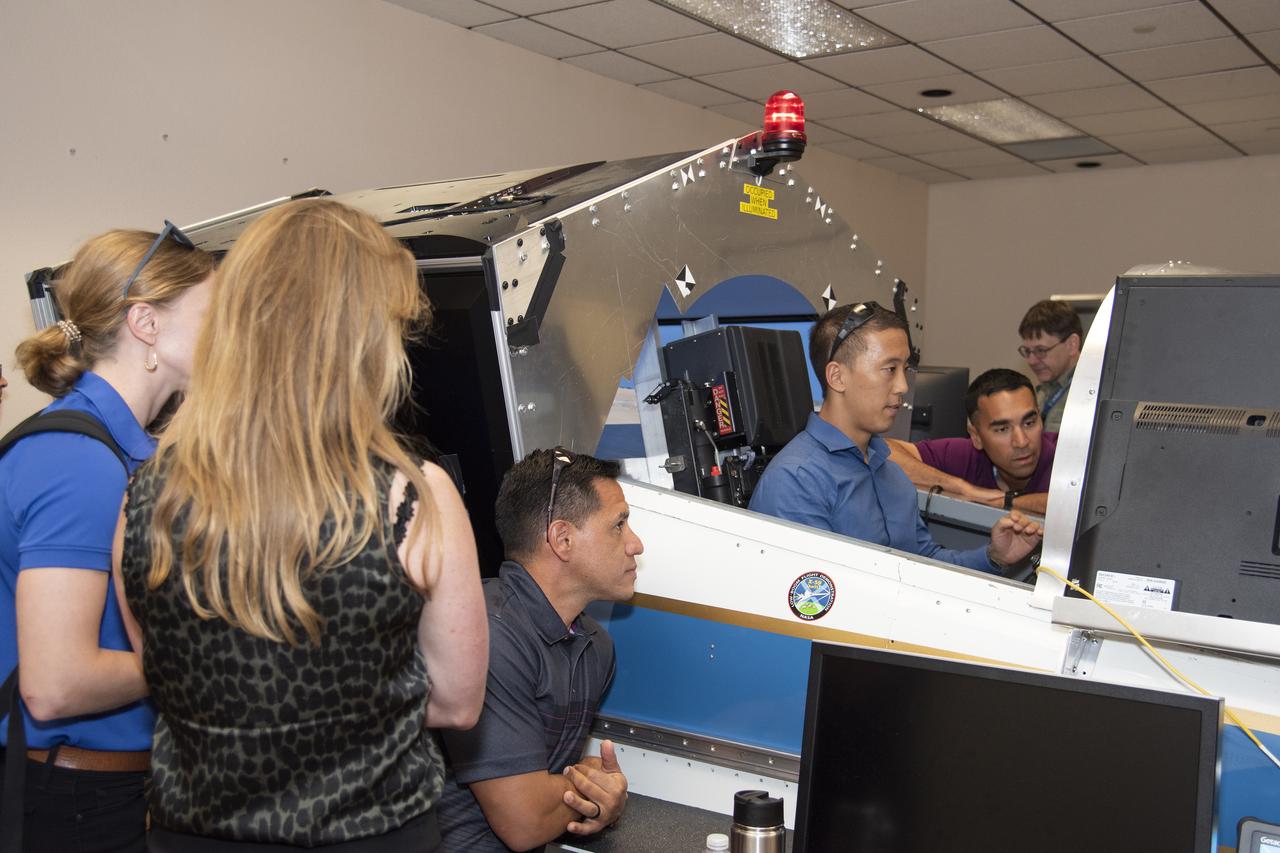
NASA's 2017 astronaut candidates (L to R) Zena Cardman, Loral O'Hara, Frank Rubio, Jonny Kim, Raja Chari practice flying in an X-59 QueSST simulator at Armstrong Flight Research Center, in Southern California. The low boom flight demonstrator, X-59, being built at Lockheed Martin and was designed to fly at supersonic speeds over land without the loud noise of breaking the sound barrier and disturbing communities.
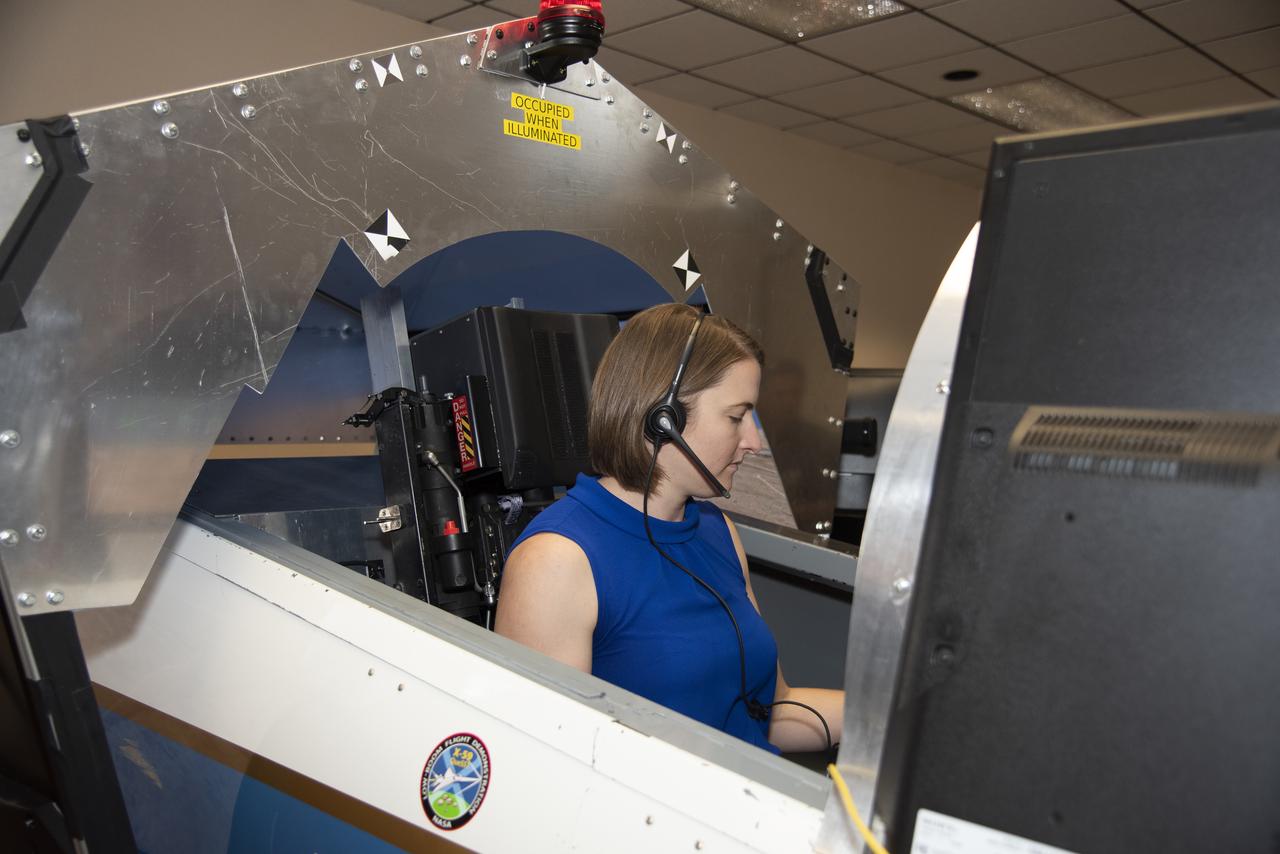
NASA's 2017 astronaut candidate Kayla Barron practices flying in an X-59 QueSST simulator at Armstrong Flight Research Center, in Southern California. The low boom flight demonstrator, X-59, being built at Lockheed Martin and was designed to fly at supersonic speeds over land without the loud noise of breaking the sound barrier and disturbing communities.
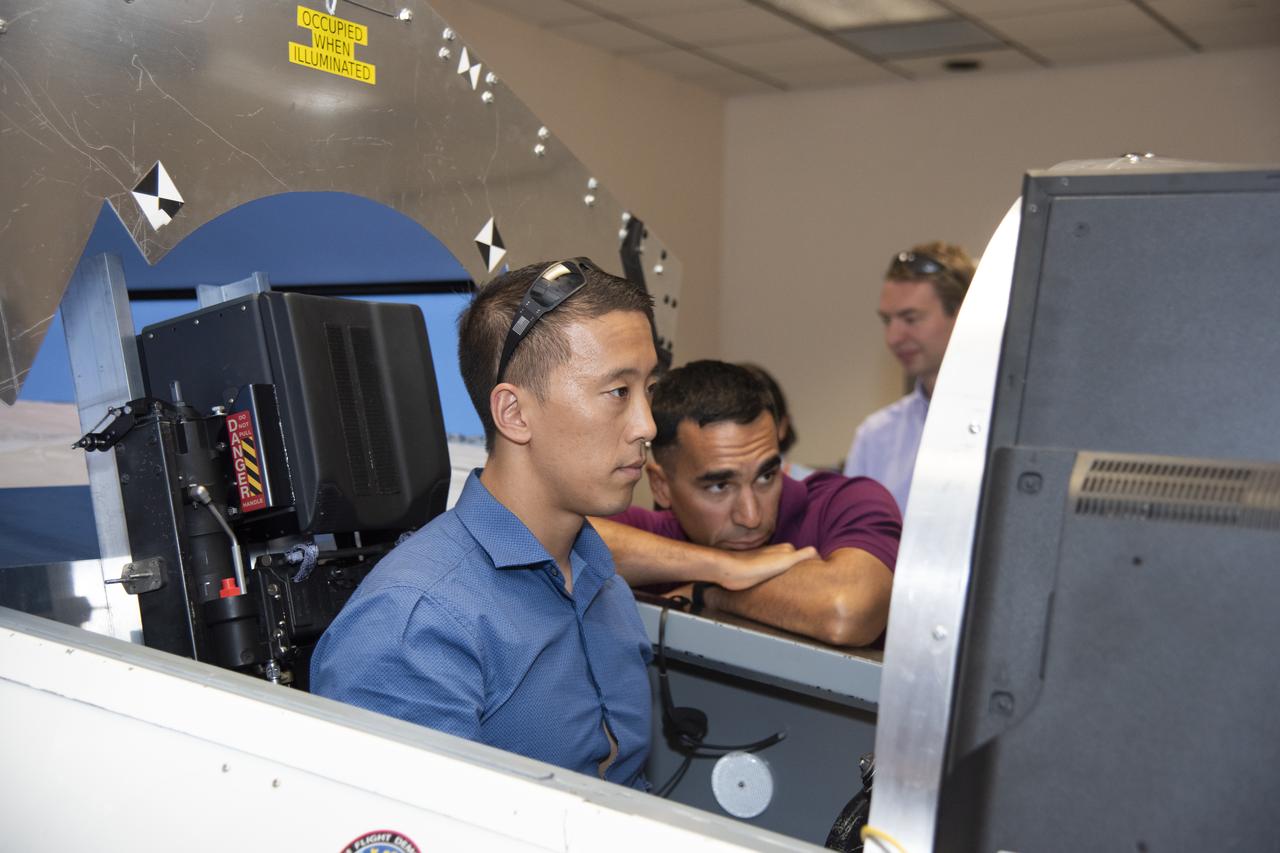
NASA’s 2017 astronaut candidates (L to R) Jonny Kim and Raja Chari practice flying in an X-59 QueSST simulator at Armstrong Flight Research Center, in Southern California. The low boom flight demonstrator, X-59, being built at Lockheed Martin and was designed to supersonically over land without the loud noise of breaking the sound barrier and disturbing communities.
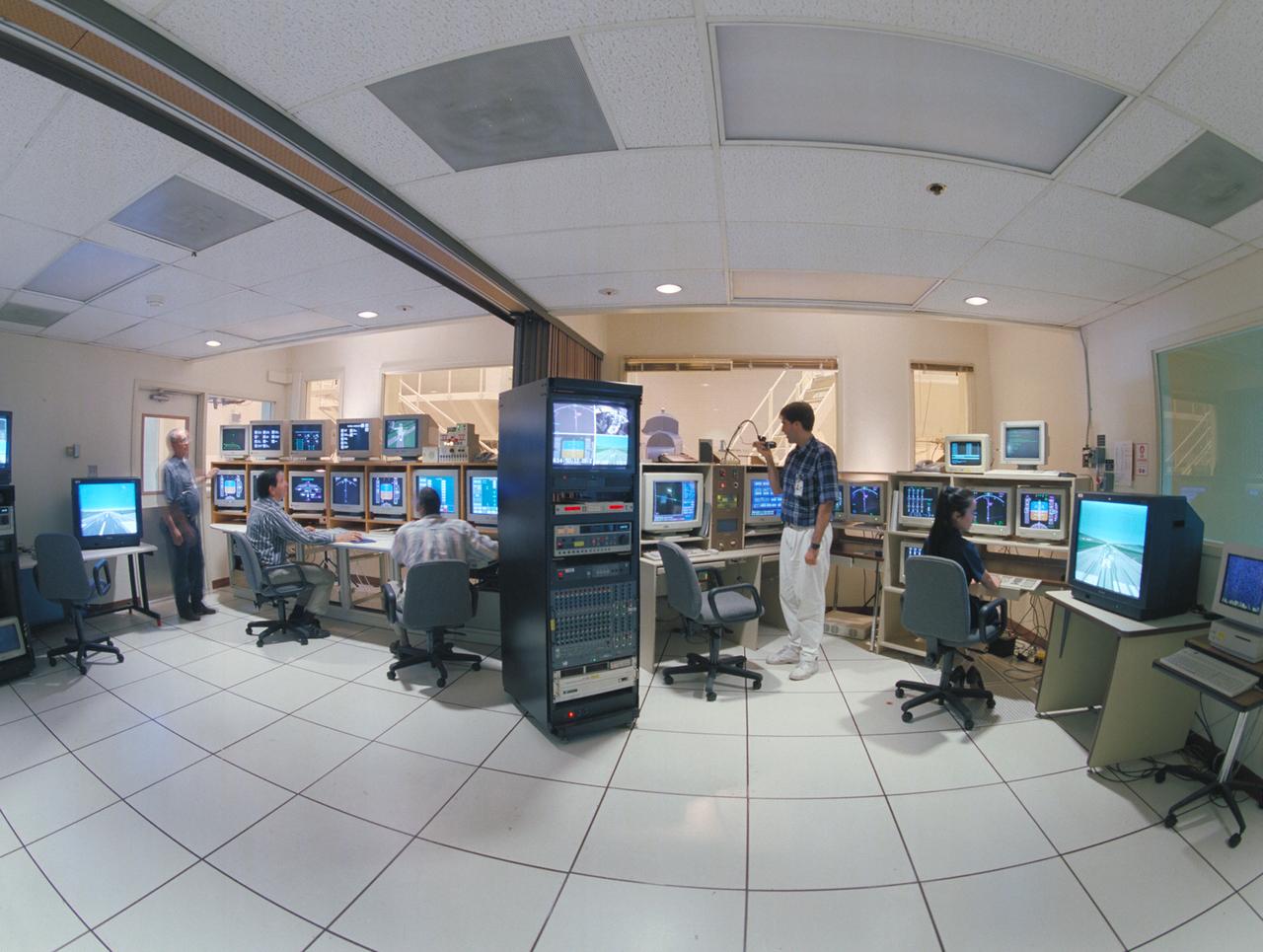
N-257 CVSRF: control rooms for 747 and ACSF cabs - LEFT SIDE; EOS - ACFS (Advanced Cab Flight Simulator) w. (l-r) Victor Loesche, Hector Reyes & Eric Jacobs and RIGHT SIDE; EOS - 747 Cab with (l-r) David Brown and Cindy Nguyen
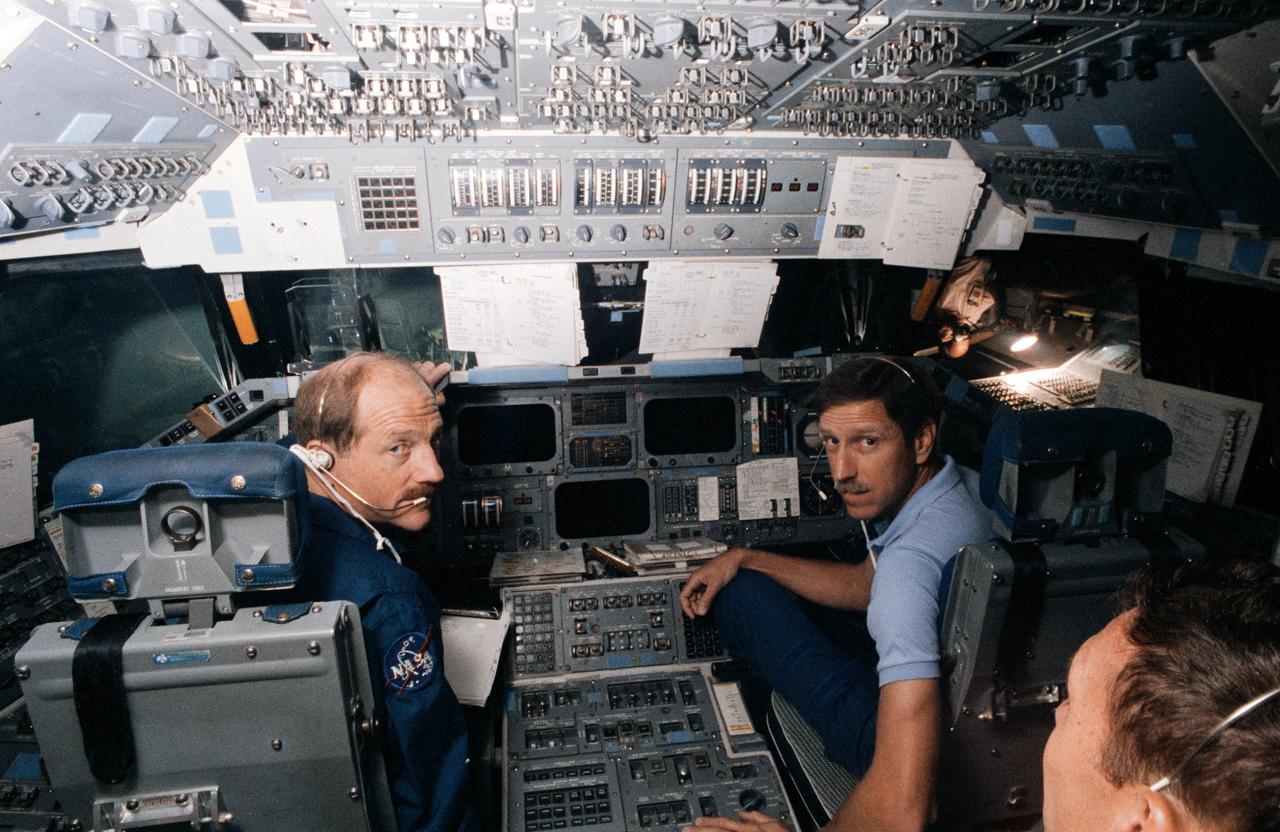
S87-46304 (20 Oct 1987) --- Astronauts Frederick H. (Rick) Hauck, left, STS-26 commander, and Richard O. Covey, pilot, man their respective stations in the Shuttle mission simulator (fixed base) at the Johnson Space Center. A simulation for their anticipated June 1988 flight aboard the space shuttle Discovery began Oct. 20. Astronaut David C. Hilmers, one of three mission specialists for the flight, is partially visible in the foreground.
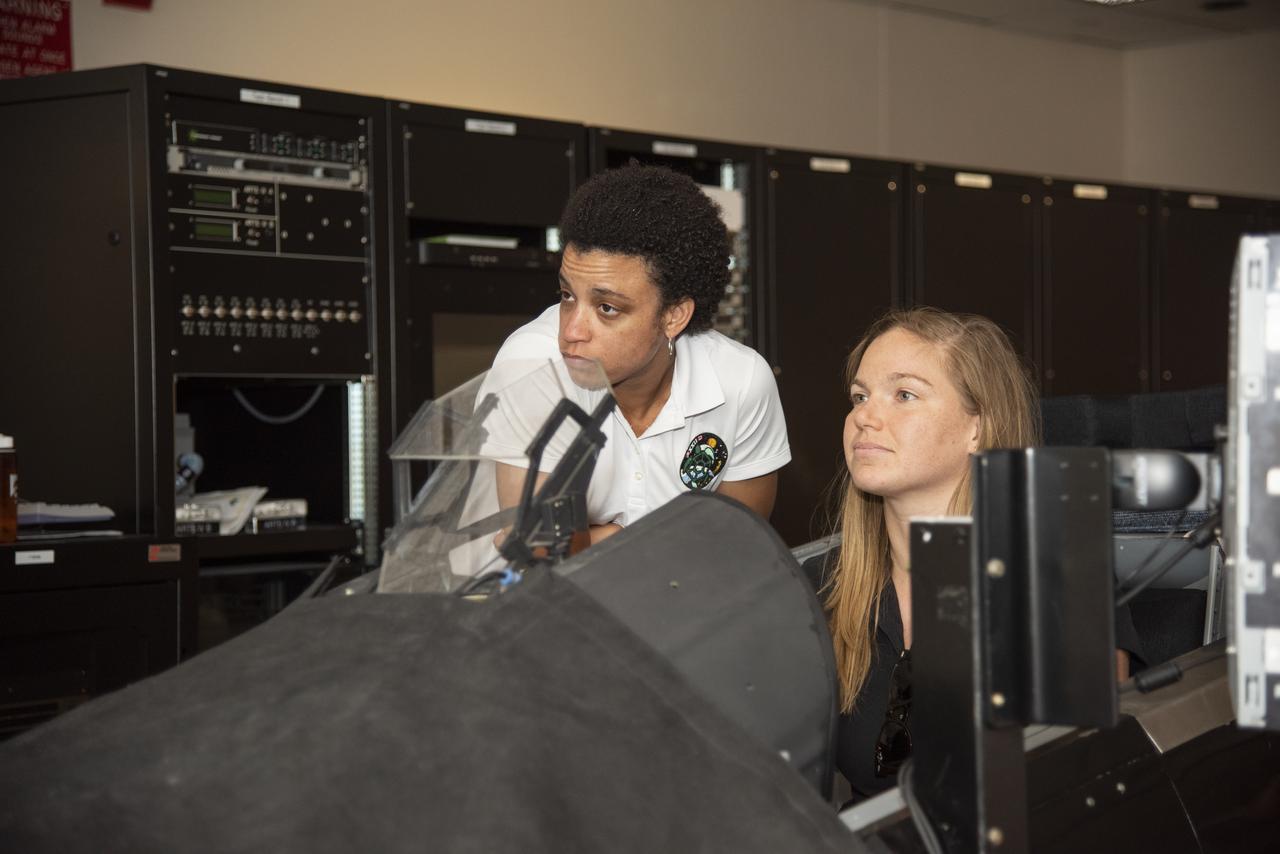
NASA's 2017 astronaut candidates (L to R) Jessica Watkins and Jenni Sidey-Gibbons practice flying in an F-18 aircraft cockpit simulator at Armstrong Flight Research Center, in Southern California. The F-18's are flown for research support and pilot proficiency. Currently, the F-18's are being used to conduct supersonic research in support of the X-59 QueSST overall mission.
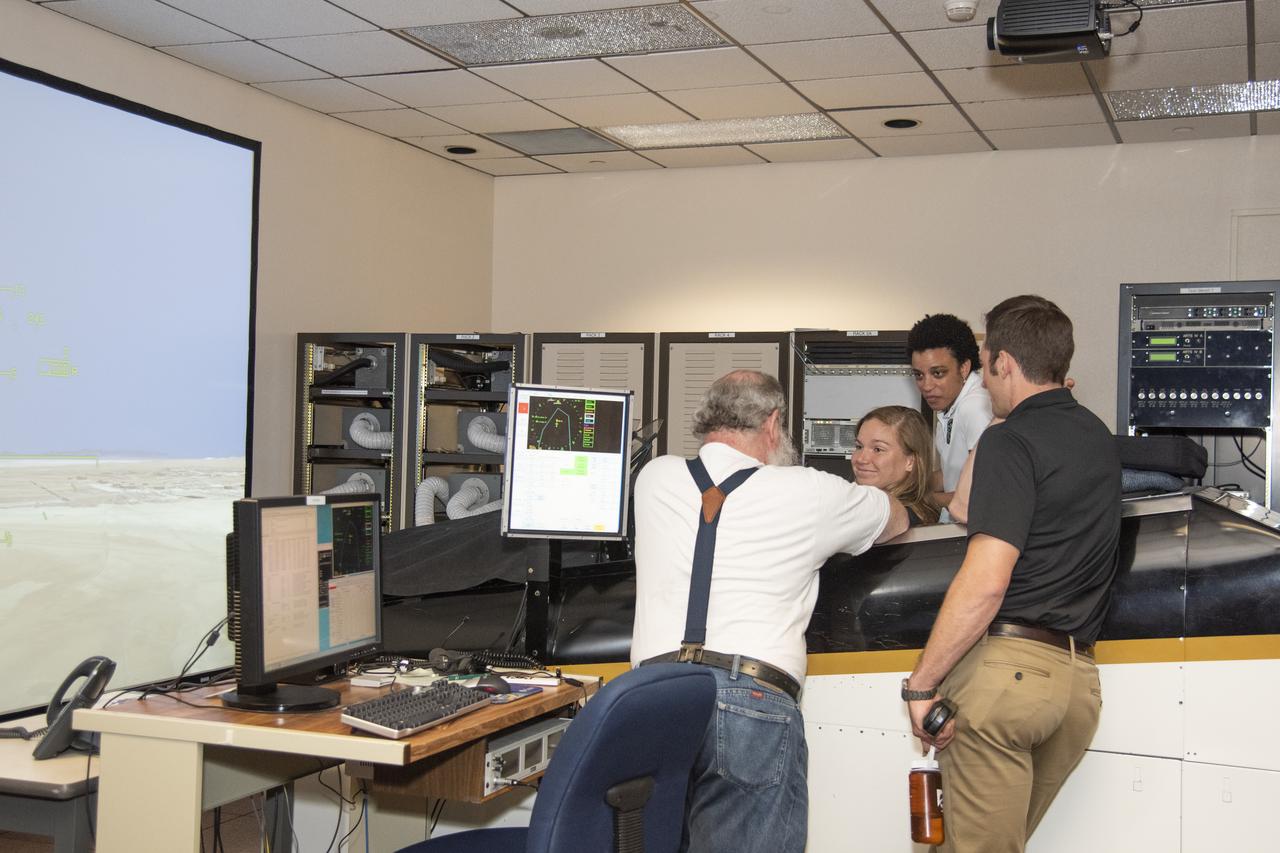
NASA's 2017 astronaut candidates (L to R) Jenni Sidey-Gibbons, Jessica Watkins and Joshua Kutryk practice flying in an F-18 aircraft cockpit simulator at Armstrong Flight Research Center, in Southern California. The F-18's are flown for research support and pilot proficiency. Currently, the F-18 is conducting supersonic research in support of the X-59 QueSST overall mission.
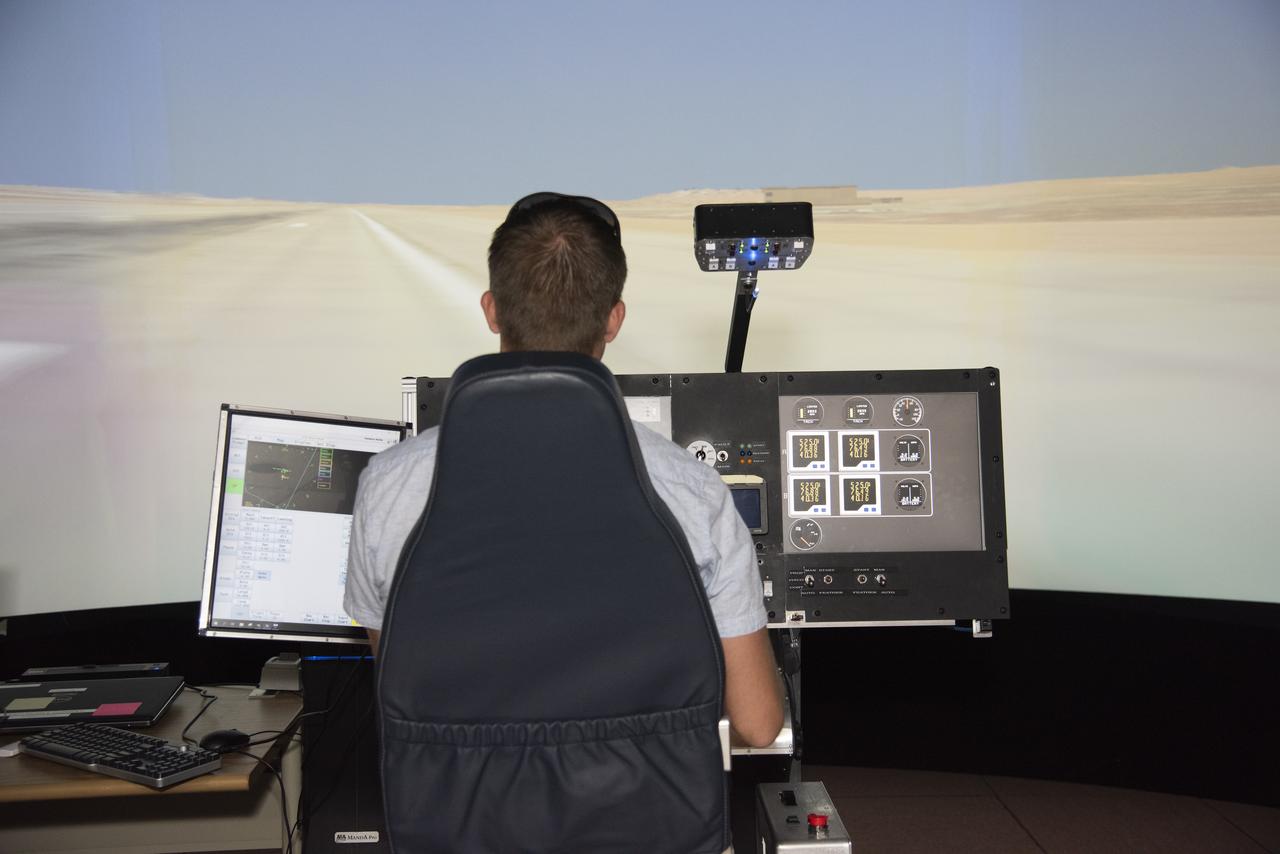
NASA's 2017 astronaut candidate Matthew Dominick practices flying in the X-57 aircraft simulator at Armstrong Flight Research Center in Southern California. Starting with the fuselage of a Tecnam P20067T, the X-57 Maxwell electric propulsion airplane is being built from ideas being researched that could lead to the development of electric propulsion-powered aircraft, which would be quieter, more efficient and environmentally friendly than today's commuter aircraft.
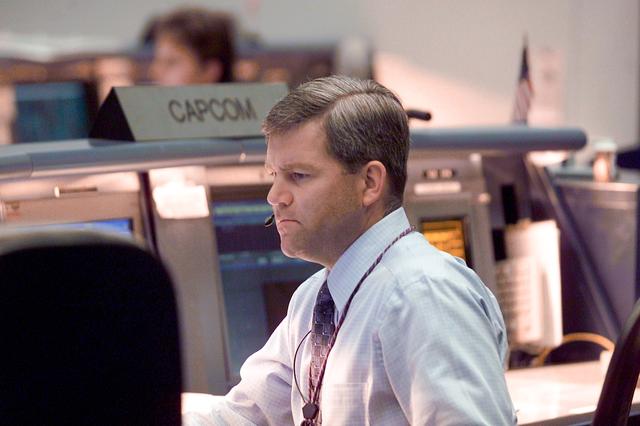
JSC2004-E-45138 (13 October 2004) --- Astronaut Stephen N. Frick monitors communications at the spacecraft communicator (CAPCOM) console in the Shuttle Flight Control Room (WFCR) in Johnson Space Center’s (JSC) Mission Control Center (MCC) with the STS-114 crewmembers during a fully-integrated simulation on October 13. The seven member crew was in a JSC-based simulator during the sims. The dress rehearsal of Discovery's rendezvous and docking with the International Space Station (ISS) was the first flight-specific training for the Space Shuttle's return to flight.
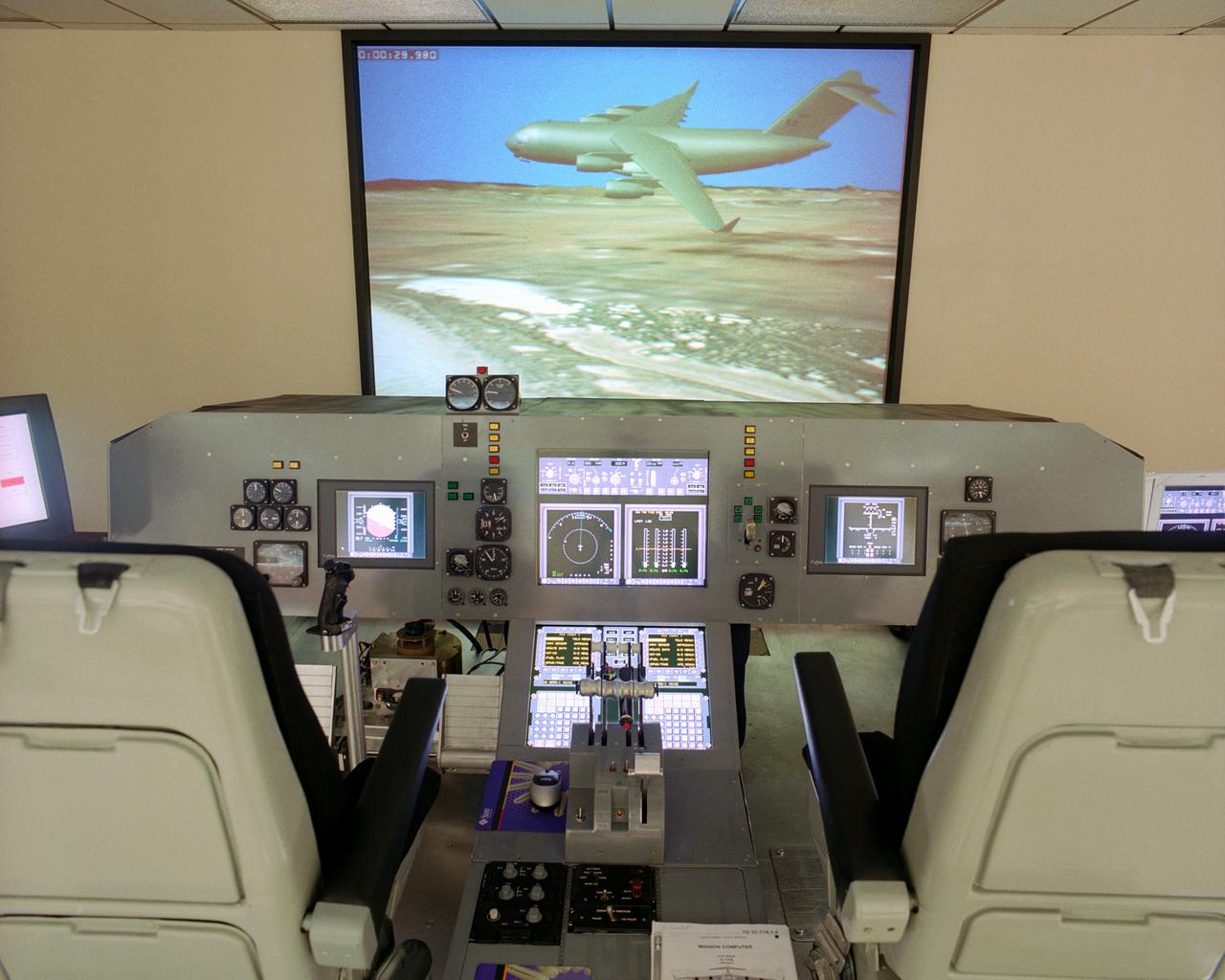
The C-17 simulator at NASA's Dryden Flight Research Center, Edwards, California. Simulators offer a safe and economical alternative to actual flights to gather data, as well as being excellent facilities for pilot practice and training.
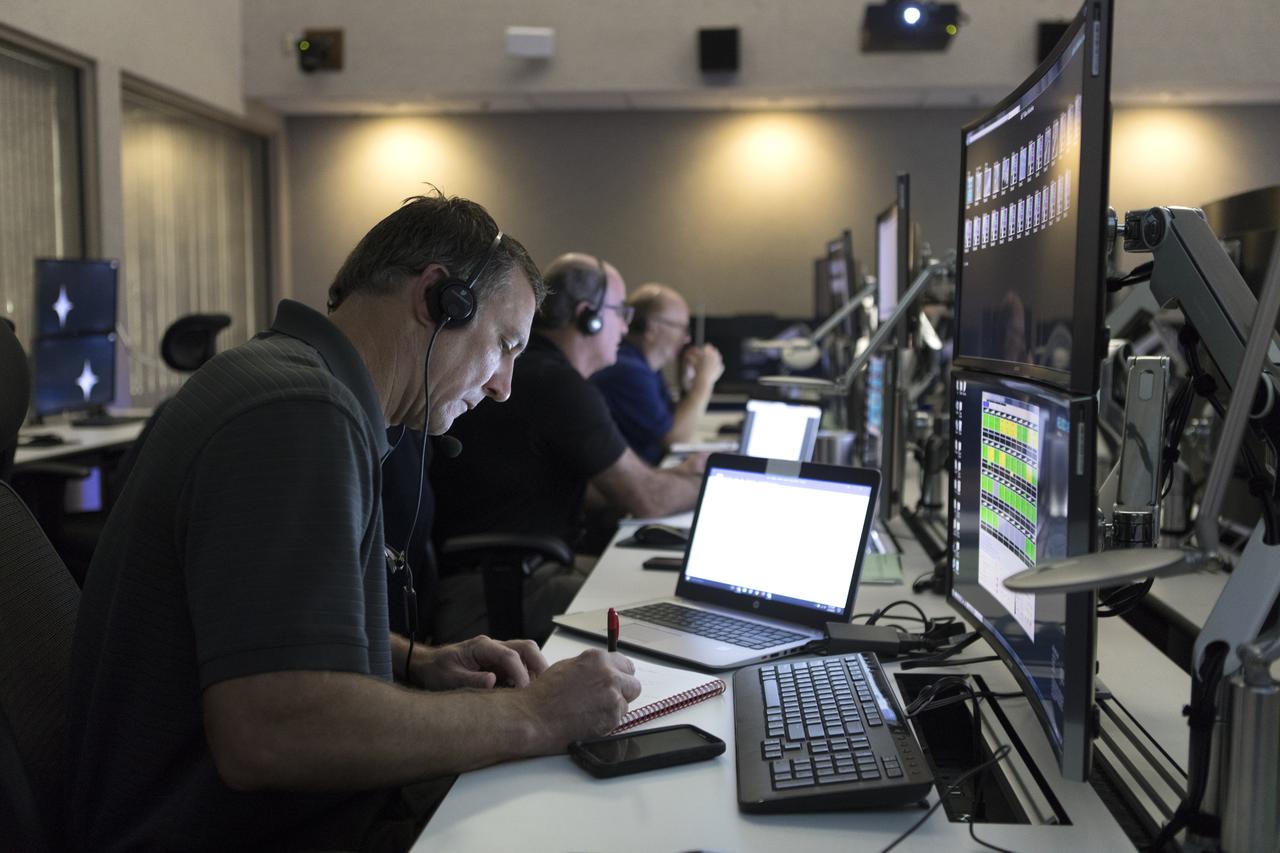
NASA, Boeing and United Launch Alliance (ULA) conduct a simulation of launch procedures for Boeing’s Orbital Test Flight, the first uncrewed test of the company’s CST-100 Starliner and a ULA Atlas V rocket. Launch teams participated in the simulation across the country, including inside the Launch Vehicle Data Center at Hangar AE at Cape Canaveral Air Force Station in Florida. The Starliner will launch on an Atlas V rocket to the International Space Station as part of NASA’s Commercial Crew Program.
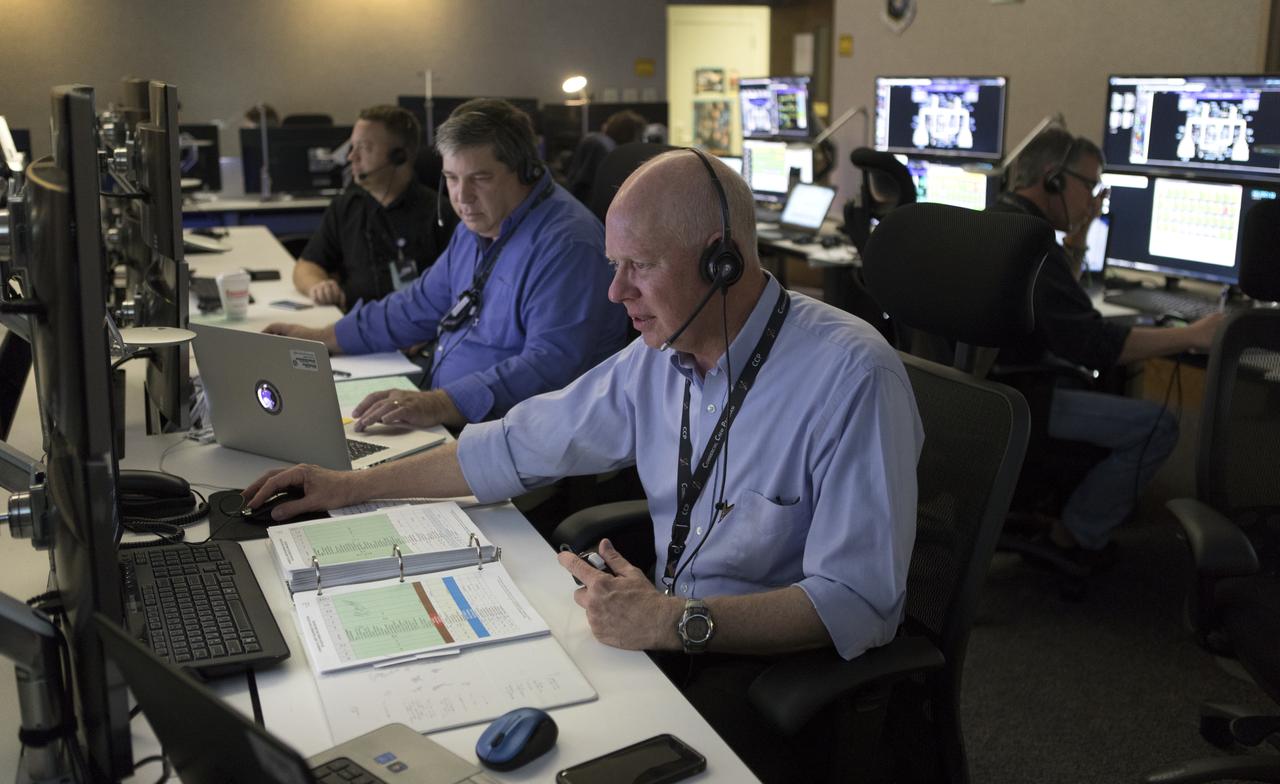
NASA, Boeing and United Launch Alliance (ULA) conduct a simulation of launch procedures for Boeing’s Orbital Test Flight, the first uncrewed test of the company’s CST-100 Starliner and a ULA Atlas V rocket. Launch teams participated in the simulation across the country, including inside the Launch Vehicle Data Center at Hangar AE at Cape Canaveral Air Force Station in Florida. The Starliner will launch on an Atlas V rocket to the International Space Station as part of NASA’s Commercial Crew Program.
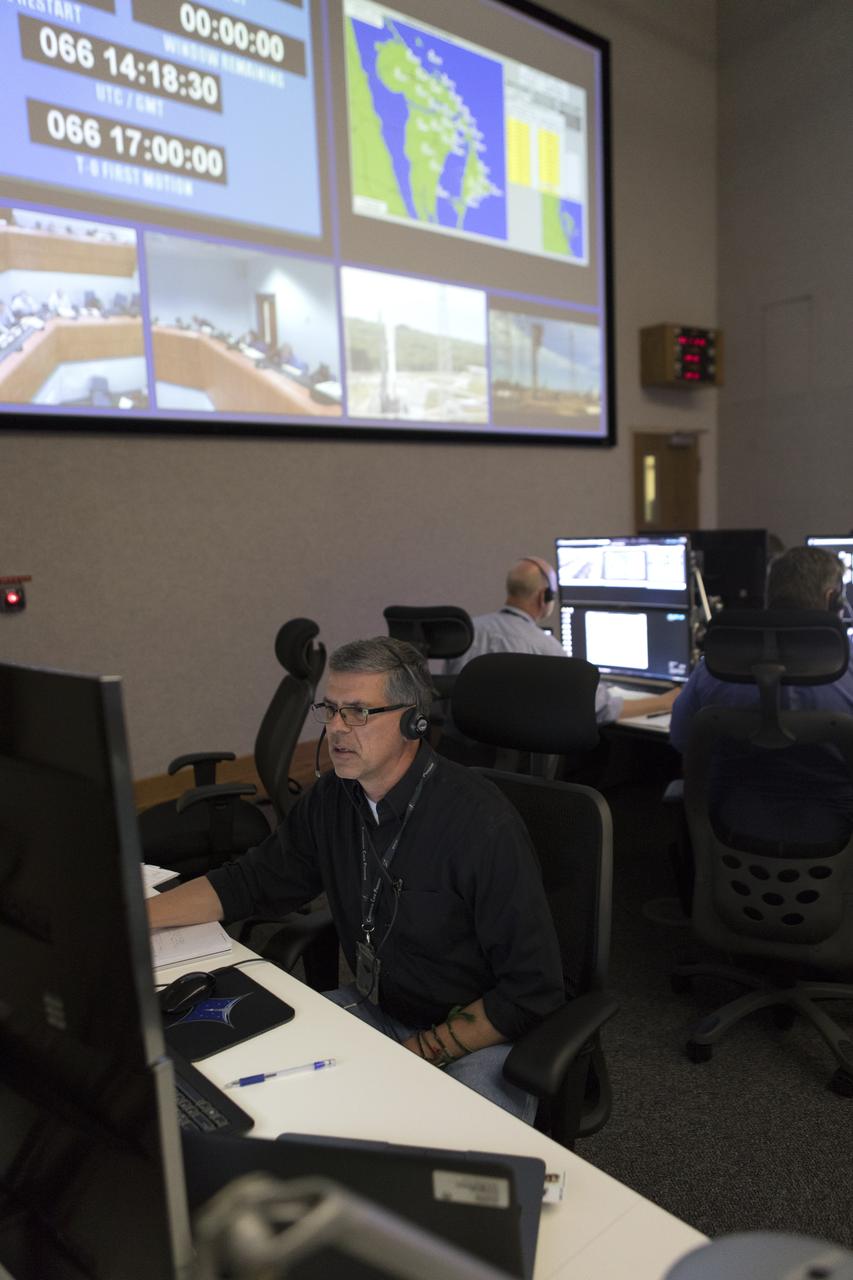
NASA, Boeing and United Launch Alliance (ULA) conduct a simulation of launch procedures for Boeing’s Orbital Test Flight, the first uncrewed test of the company’s CST-100 Starliner and a ULA Atlas V rocket. Launch teams participated in the simulation across the country, including inside the Launch Vehicle Data Center at Hangar AE at Cape Canaveral Air Force Station in Florida. The Starliner will launch on an Atlas V rocket to the International Space Station as part of NASA’s Commercial Crew Program.
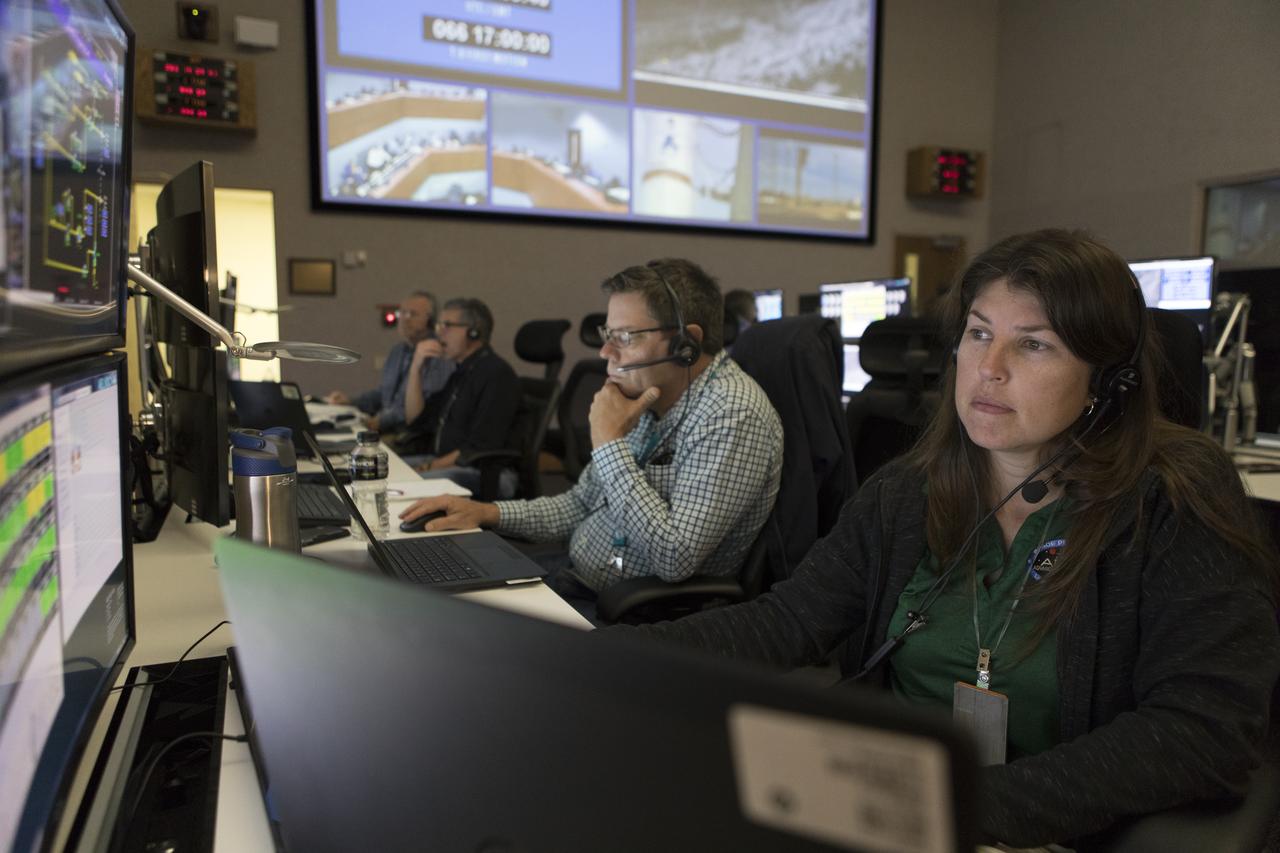
NASA, Boeing and United Launch Alliance (ULA) conduct a simulation of launch procedures for Boeing’s Orbital Test Flight, the first uncrewed test of the company’s CST-100 Starliner and a ULA Atlas V rocket. Launch teams participated in the simulation across the country, including inside the Launch Vehicle Data Center at Hangar AE at Cape Canaveral Air Force Station in Florida. The Starliner will launch on an Atlas V rocket to the International Space Station as part of NASA’s Commercial Crew Program.
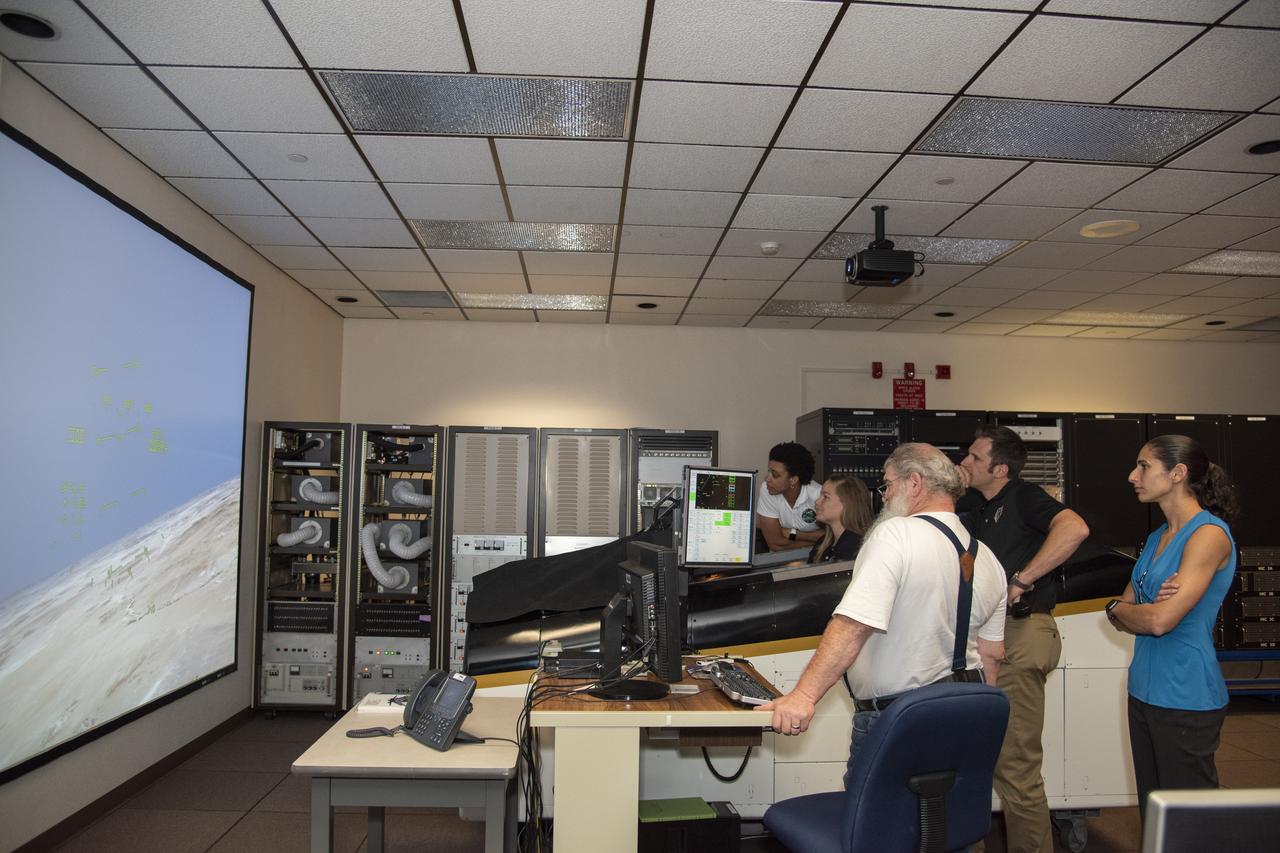
NASA’s 2017 astronaut candidates (L to R) Jessica Watkins, Jenni Sidey-Gibbons, Joshua Kutryk, and Jasmin Moghbeli practice flying in an F-18 aircraft cockpit simulator at Armstrong Flight Research Center, in Southern California. The F-18’s are flown for research support and pilot proficiency. Currently, the F-18’s are being used to conduct supersonic research in support of the X-59 QueSST overall mission.
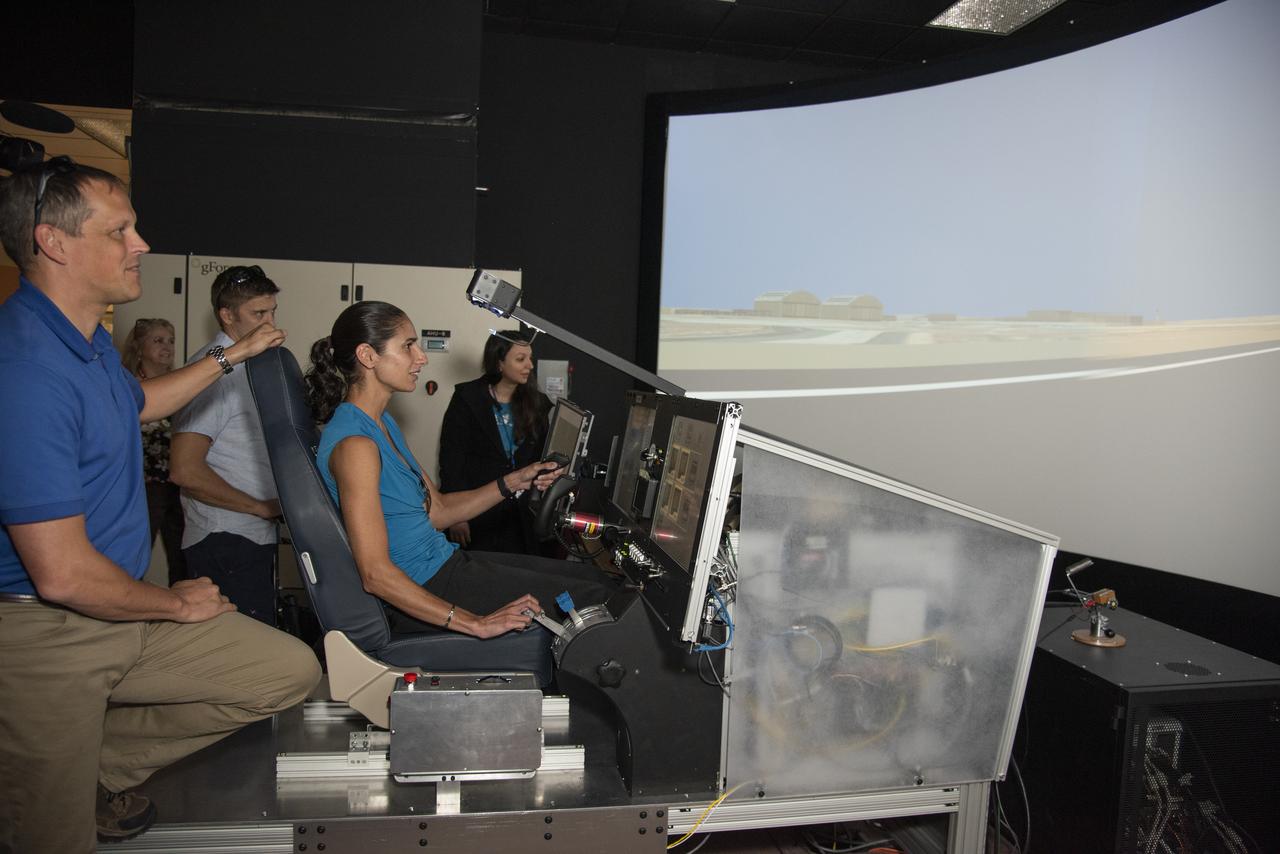
NASA's 2017 astronaut candidates (L to R) Bob Hines, Matthew Dominick and Jasmin Moghbeli practice flying in X-57 aircraft simulator at Armstrong Flight Research Center in Southern California. Starting with the fuselage of a Tecnam P20067T, the X-57 Maxwell electric propulsion airplane is being built from ideas being researched that could lead to the development of electric propulsion-powered aircraft, which would be quieter, more efficient and environmentally friendly than today's commuter aircraft.
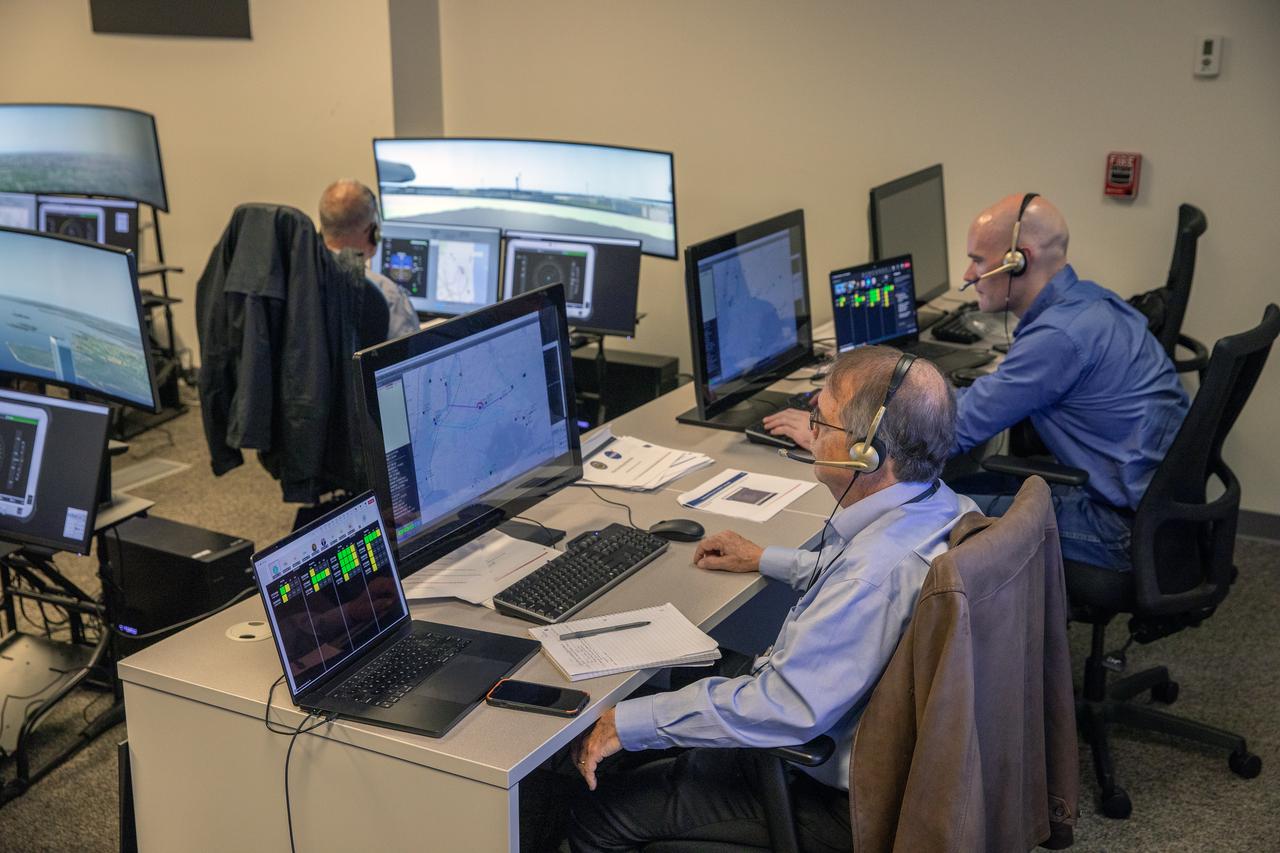
Focus on active photos –Class B Simulation Evaluation in the ATOL Lab at Langley (Also at FAA Tech Center) where team is working with one another in the lab, reviewing data on the monitors. Working the software, adjusting the software systems. Going over the shoulder to show the displays and screens as the software is running. John Foster (left) in the role of an air taxi pilot in the simulator chair with Jim Chamberlain and Terence McClain at the flight manager stations running virtual air taxi integration simulations focusing on urban air space at NASA’s Langley Research Center in Hampton, Virginia on Sept. 25, 2024.
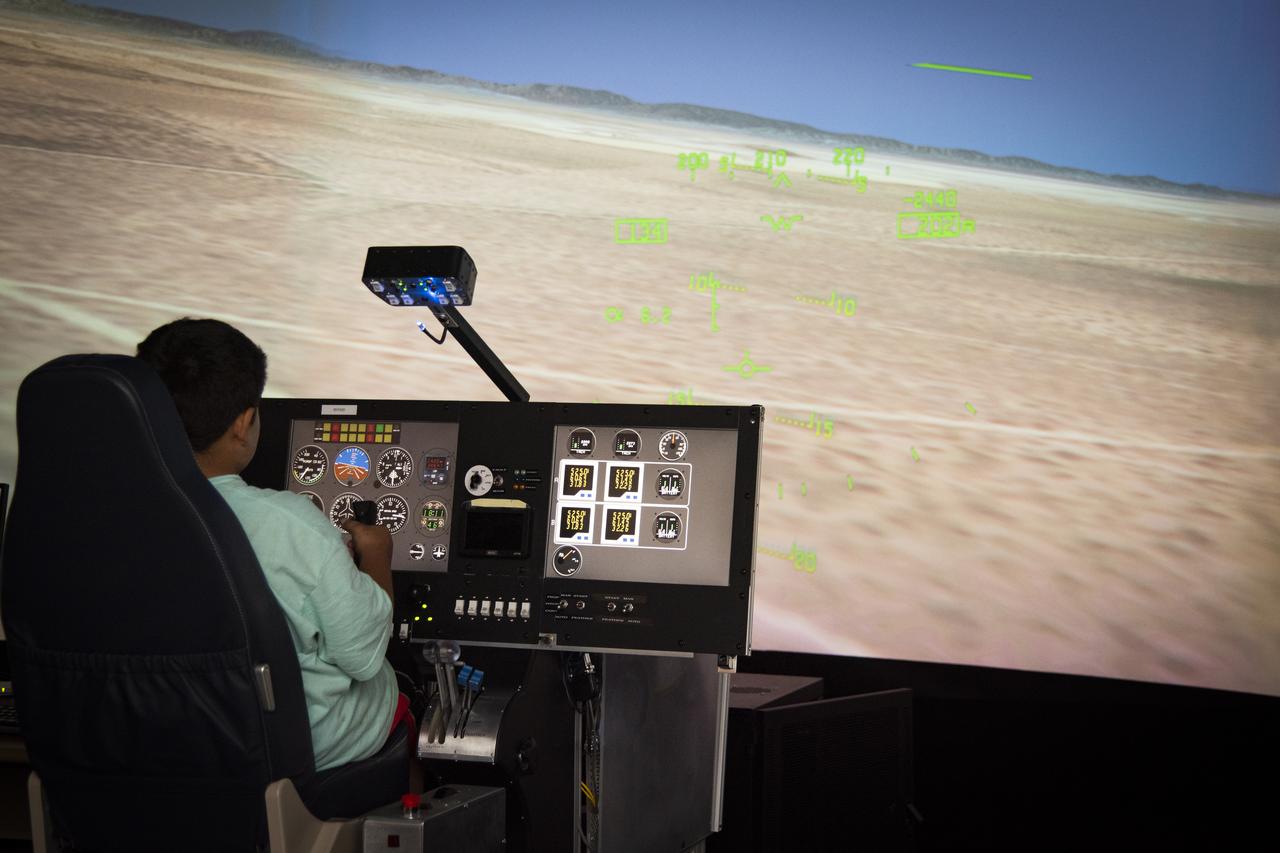
An elementary student enrolled in the U.S. Department of Defense Starbase program at Edwards Air Force Base flew the X-57 Maxwell inside NASA’s Armstrong  Flight Research Center’s simulator lab on Sept. 16th 2019.

Flight simulation No. 3 is on the schedule for the Pegasus XL launch vehicle, seen here in Building 1555 on North Vandenberg Air Force Base in California. AIM, which stands for Aeronomy of Ice in the Mesosphere, is being prepared for integrated testing and a flight simulation. The AIM spacecraft will fly three instruments designed to study polar mesospheric clouds located at the edge of space, 50 miles above the Earth's surface in the coldest part of the planet's atmosphere. The mission's primary goal is to explain why these clouds form and what has caused them to become brighter and more numerous and appear at lower latitudes in recent years. AIM's results will provide the basis for the study of long-term variability in the mesospheric climate and its relationship to global climate change. AIM is scheduled to be mated to its launch vehicle, Orbital Sciences' Pegasus XL, during the second week of April, after which final inspections will be conducted. Launch is scheduled for April 25.

The F-18 simulator at NASA's Dryden Flight Research Center, Edwards, California. Simulators offer a safe and economical alternative to actual flights to gather data, as well as being excellent facilities for pilot practice and training. The F-18 Hornet is used primarily as a safety chase and mission support aircraft at NASA's Dryden Flight Research Center, Edwards, California. As support aircraft, the F-18's are used for safety chase, pilot proficiency, aerial photography and other mission support functions.
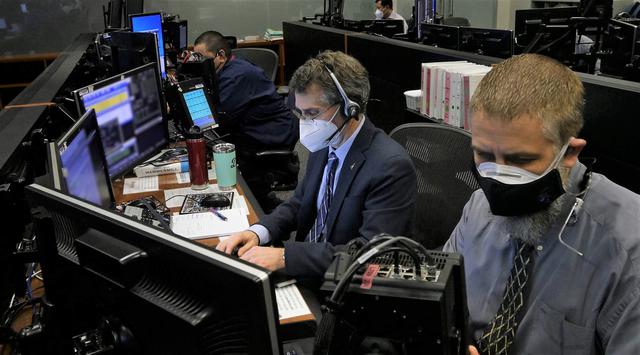
Boeing CST-100 Starliner flight directors Bob Dempsey and Edward Van Cise operate a simulated Orbital Flight Test-2 rendezvous and docking with the International Space Station from inside the Mission Control Center at NASA’s Johnson Space Center on Friday, April 23, 2021. As part of NASA’s Commercial Crew Program, OFT-2 is a critical developmental milestone on Boeing’s path to fly crew missions for NASA.
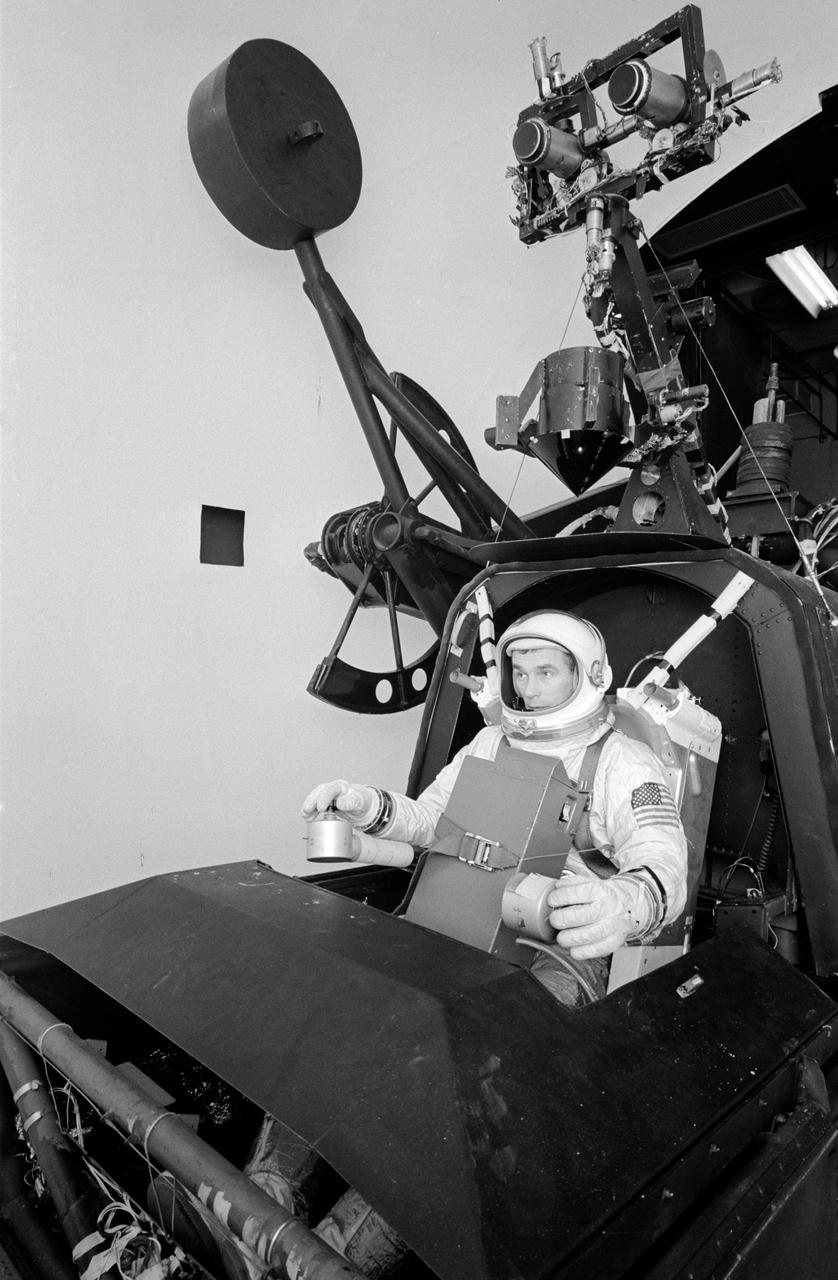
S66-27990 (March 1966) --- Astronaut Eugene A. Cernan, pilot for the Gemini-9 spaceflight, works out procedures for his historic space excursion in a unique manned Aerospace Flight Simulator at LTV Corp. at Dallas, Texas. The LTV simulator is used frequently by NASA astronauts for a variety of space programs maneuvers to provide many of the sensations and visual scenes of actual spaceflight. Controlled through a complex of computers, the device makes it possible for the astronauts to work out procedures, solve problems and simulate missions in real time with great accuracy. The astronaut rides in a spacecraft-like gondola which moves in roll, pitch and yaw in response to his controls and accurate computer inputs. The simulator's usual spacecraft displays and canopy have been removed and AMU backpack complete with control electronics installed. The astronaut makes his simulated flight in an inflated pressure suit and with the NASA-developed Extravehicular Life Support system chest pack which will be used in the Gemini flight. Photo credit: NASA
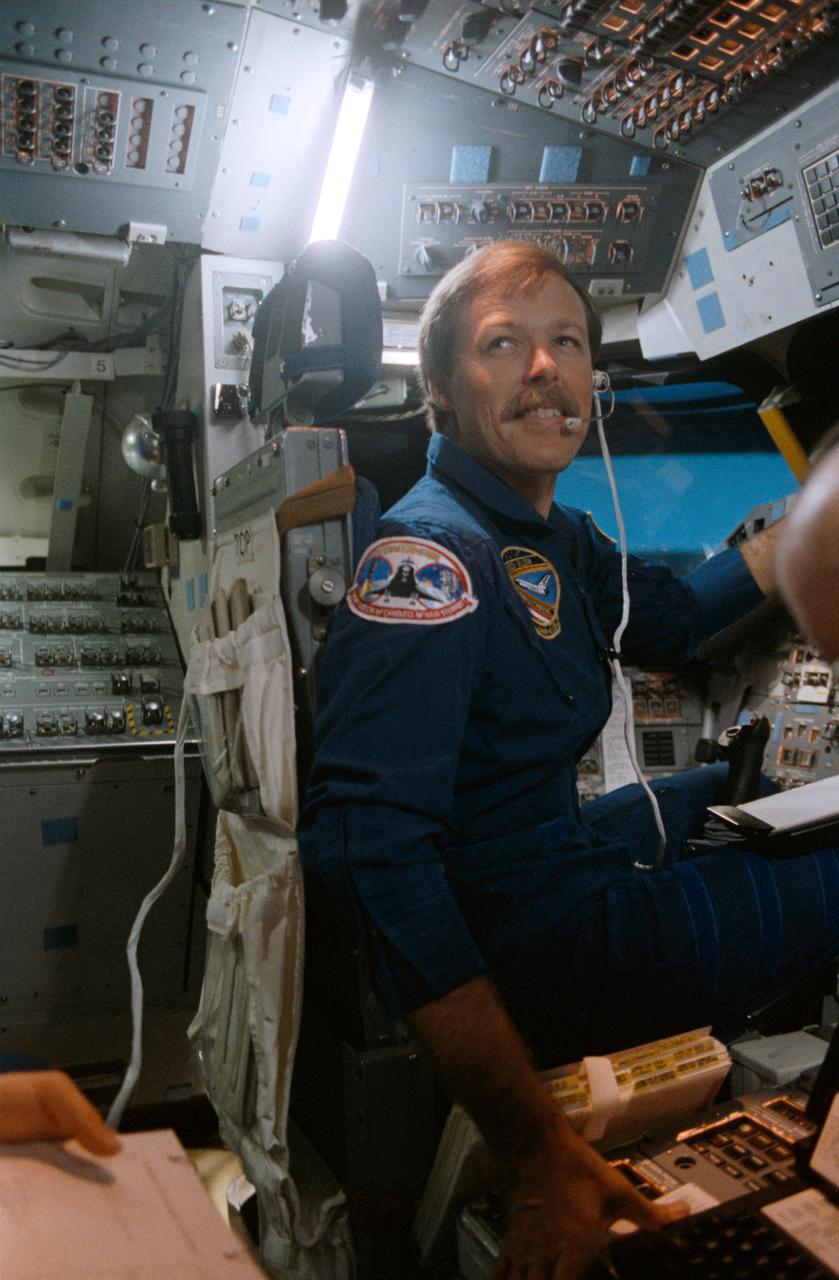
STS-27 Atlantis, Orbiter Vehicle (OV) 104, Commander Robert L. Gibson, wearing flight coveralls and communications kit assembly, sits at commanders station controls on JSC shuttle mission simulator (SMS) forward flight deck during training session. Gibson looks at crewmember on aft flight deck. SMS is located in the Mission Simulation and Training Facility Bldg 5.
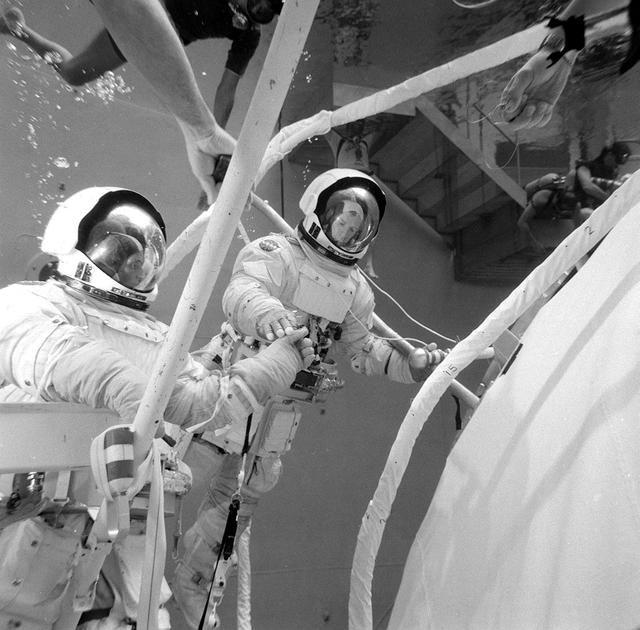
This photograph was taken during testing of an emergency procedure to free jammed solar array panels on the Skylab workshop. A metal strap became tangled over one of the folded solar array panels when Skylab lost its micrometeoroid shield during the launch. This photograph shows astronauts Schweickart and Gibson in the Marshall Space Flight Center (MSFC) Neutral Buoyancy Simulator (NBS) using various cutting tools and methods developed by the MSFC to free the jammed solar wing. Extensive testing and many hours of practice in simulators such as the NBS tank helped prepare the Skylab crewmen for extravehicular performance in the weightless environment. This huge water tank simulated the weightless environment that the astronauts would encounter in space.

S86-28458 (28 Feb. 1986) --- Astronaut Michael L. Coats participates in a rehearsal for his assigned flight at the commander's station of the Shuttle Mission Simulator (SMS) at the Johnson Space Center (JSC). NOTE: Coats, a veteran of spaceflight, originally trained for STS 61-H, which was cancelled in the wake of the Challenger accident. Following the Janaury 1986 accident he was named to serve on a mock crew (STS-61M) for personnel training and simulation purposes. Photo credit: NASA
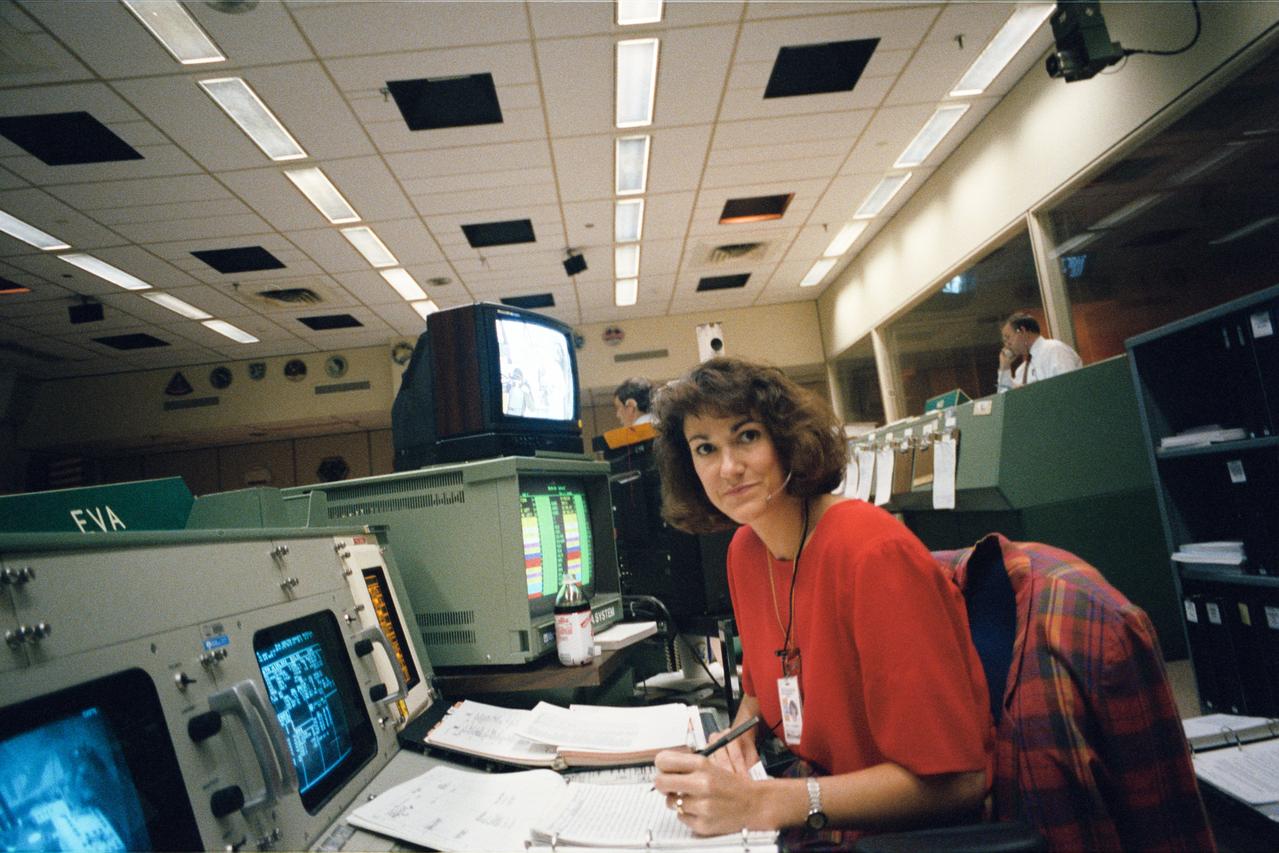
Susan P. Rainwater monitors an extravehicular activity (EVA) simulation from the EVA console at JSC's Mission Control Center (MCC) during joint integrated simulations for the STS-61 mission. Astronauts assigned to extravehicular activity (EVA) tasks with the Hubble Space Telescope (HST) were simultaneously rehearsing in a neutral buoyancy tank at the Marshall Space Flight Center (MSFC) in Alabama.
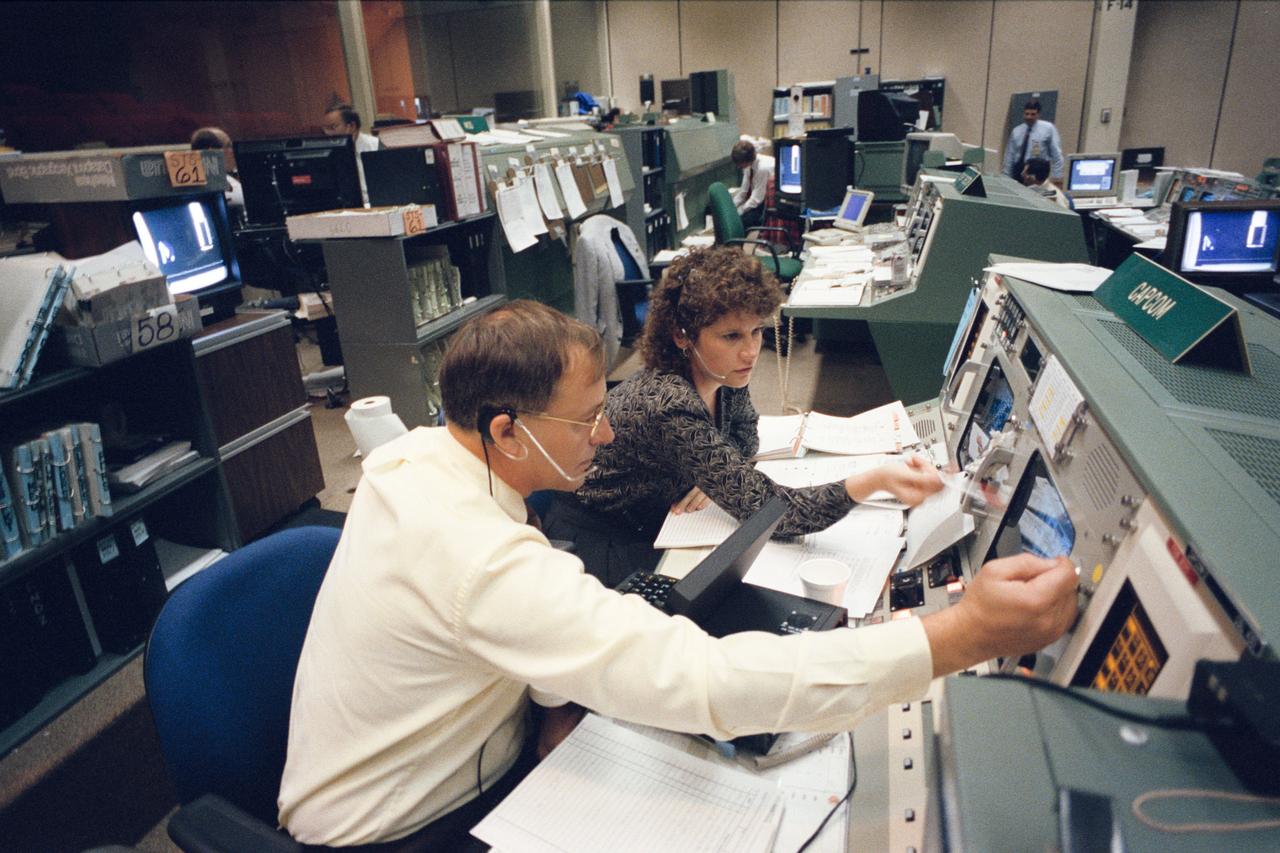
S93-43752 (1 Sept 1993) --- Astronauts Jerry L. Ross and Susan J. Helms are pictured at the Spacecraft Communicators Console during joint integrated simulations for the STS-61 mission. Astronauts assigned to extravehicular activity (EVA) tasks with the Hubble Space Telescope (HST) were simultaneously rehearsing in a Neutral Buoyancy Simulator (NBS) tank at the Marshall Space Flight Center (MSFC) in Alabama.
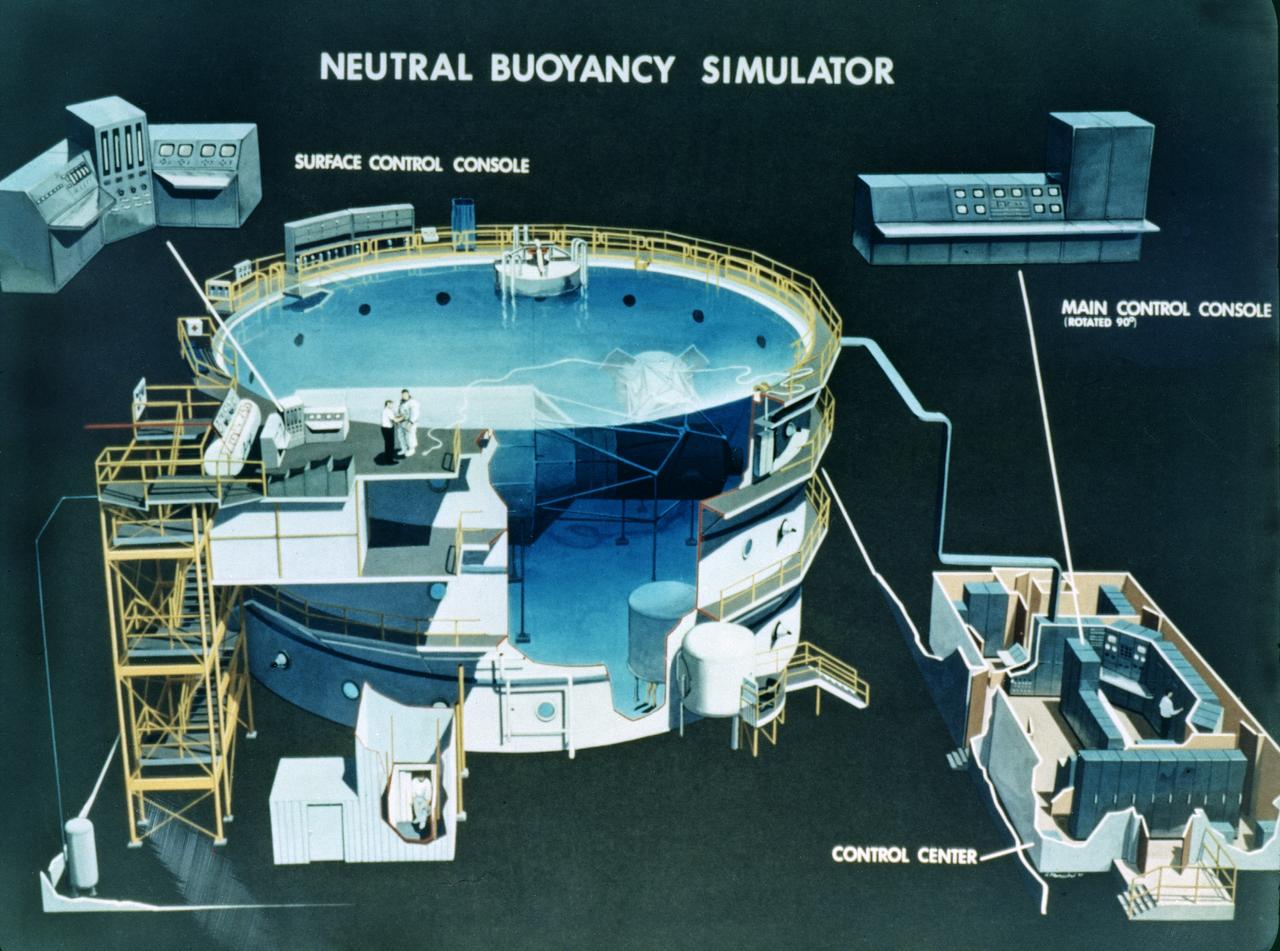
This is a cutaway illustration of the Neutral Buoyancy Simulator (NBS) at the Marshall Space Flight Center (MSFC ). The MSFC NBS provided an excellent environment for testing hardware to examine how it would operate in space and for evaluating techniques for space construction and spacecraft servicing. Here, engineers, designers, and astronauts performed various tests to develop basic concepts, preliminary designs, final designs, and crew procedures. The NBS was constructed of welded steel with polyester-resin coating. The water tank was 75-feet (22.9- meters) in diameter, 40-feet (12.2-meters) deep, and held 1.32 million gallons of water. Since it opened for operation in 1968, the NBS had supported a number of successful space missions, such as the Skylab, Solar Maximum Mission Satellite, Marned Maneuvering Unit, Experimental Assembly of Structures in Extravehicular Activity/Assembly Concept for Construction of Erectable Space Structures (EASE/ACCESS), the Hubble Space Telescope, and the Space Station. The function of the MSFC NBS was moved to the larger simulator at the Johnson Space Center and is no longer operational.
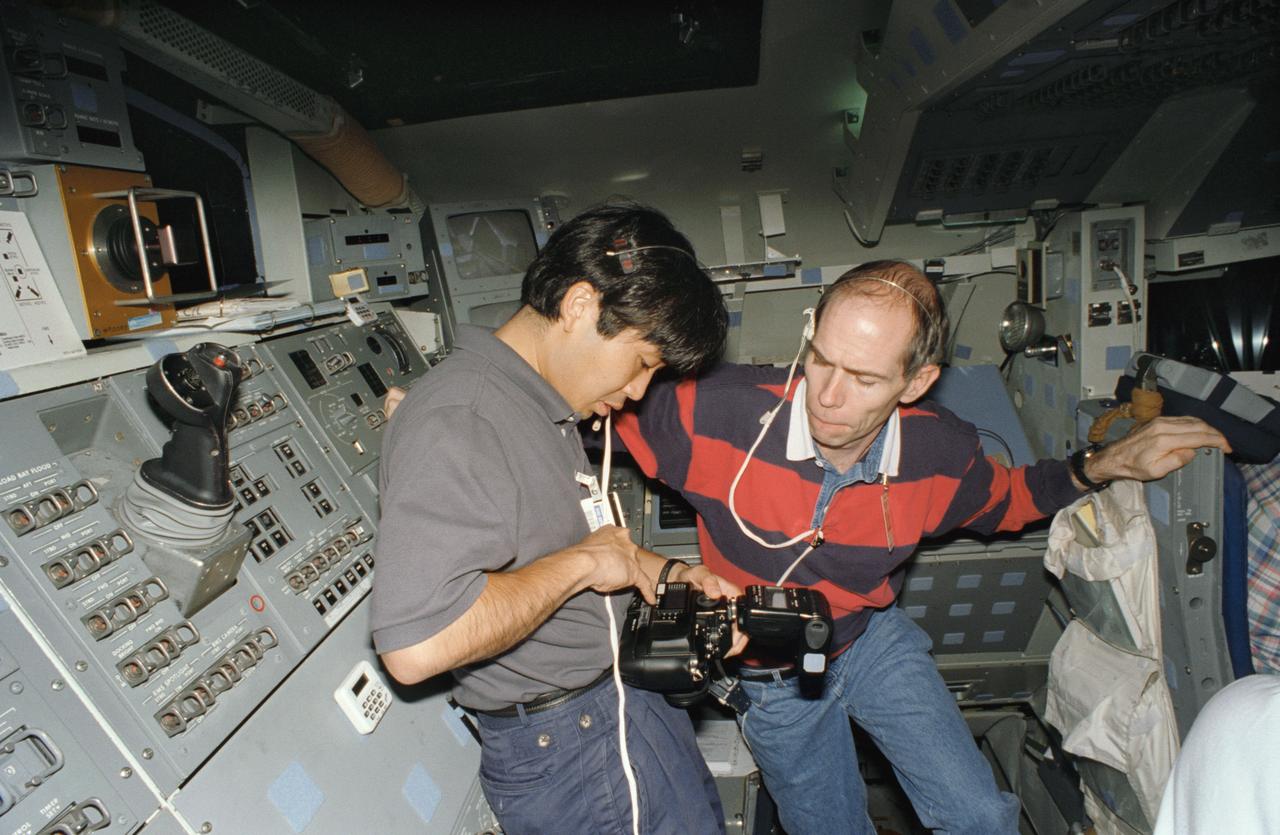
S95-12703 (May 1995) --- Astronauts Koichi Wakata (left) and Daniel T. Barry check the settings on a 35mm camera during an STS-72 training session. Wakata is a mission specialist, representing Japan's National Space Development Agency (NASDA) and Barry is a United States astronaut assigned as mission specialist for the same mission. The two are on the aft flight deck of the fixed base Shuttle Mission Simulator (SMS) at the Johnson Space Center (JSC).
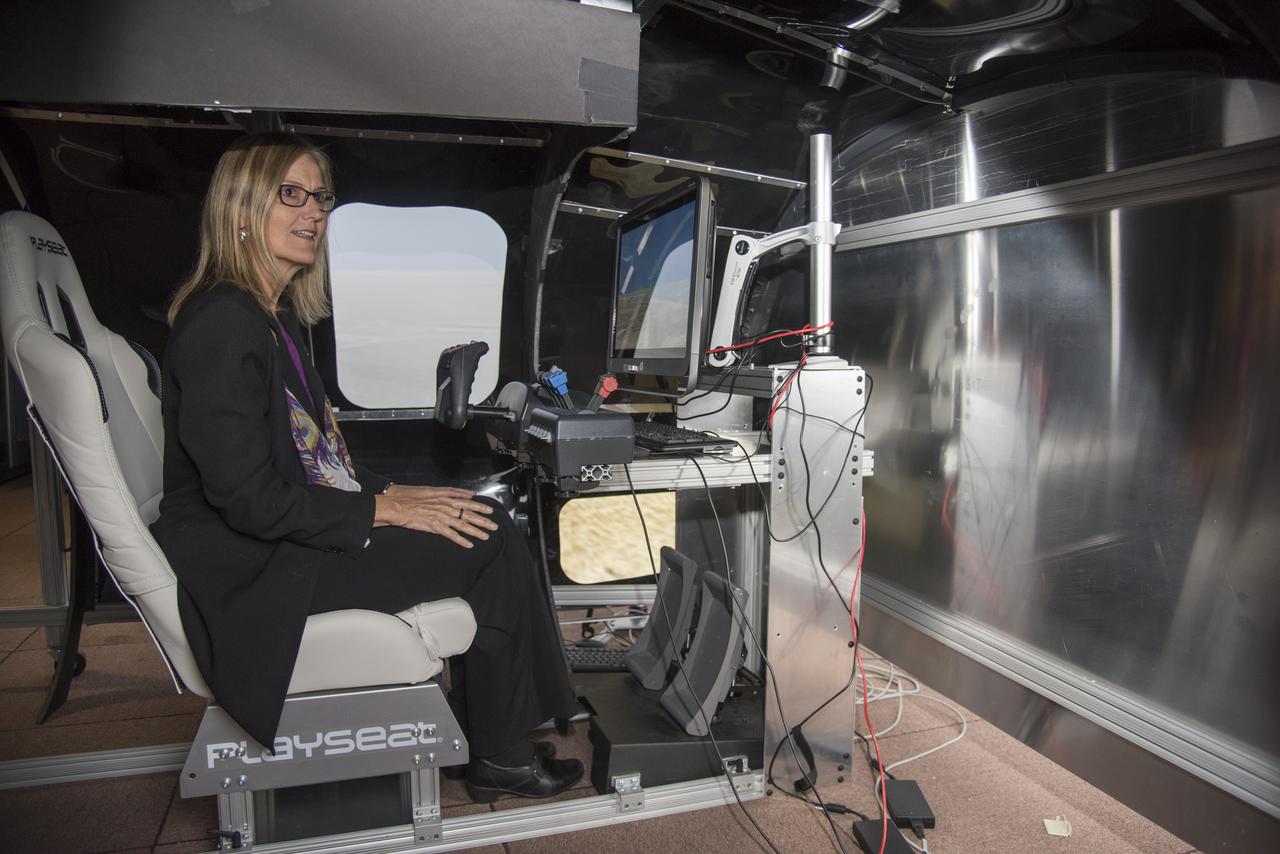
Vicki Crisp Deputy Chief Technologist Visit from HQ

The X-59 simulator at NASA's Armstrong Flight Research Center in Edwards, California, will help pilots prepare for Quesst missions. Quesst is NASA's mission to demonstrate how the X-59 can fly supersonic without generating loud sonic booms and then survey what people hear when it flies overhead.
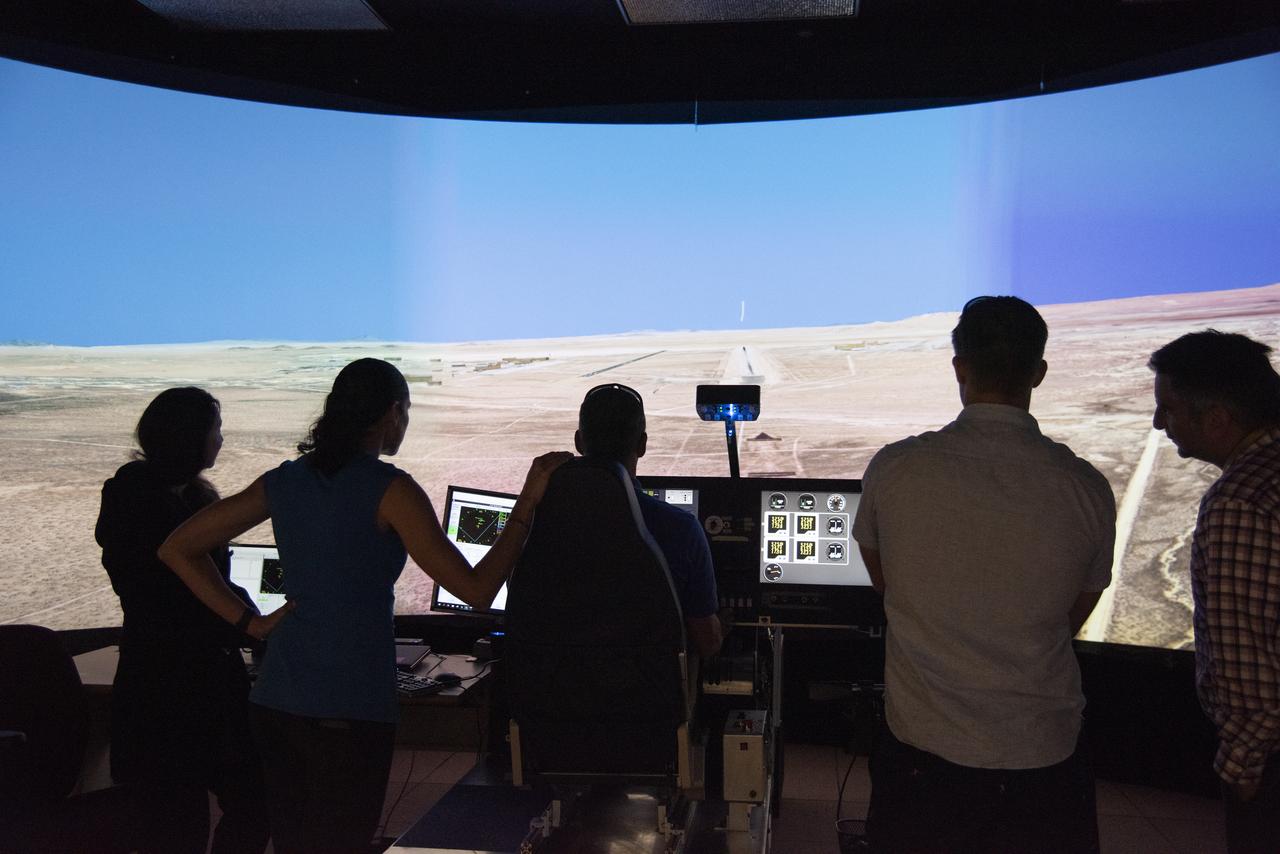
NASA's 2017 astronaut candidates toured aircraft hangar at Armstrong Flight Research Center, in Southern California. After tour of aircraft hangar and briefing on the use of aircraft for flight research, the astronauts practiced flying the X-57 simulator. Starting with the fuselage of a Tecnam P20067T, the X-57 Maxwell electric propulsion airplane is being built and could lead to the development of electric propulsion-powered aircraft, which would be quieter, more efficient and environmentally friendly than today's commuter aircraft.
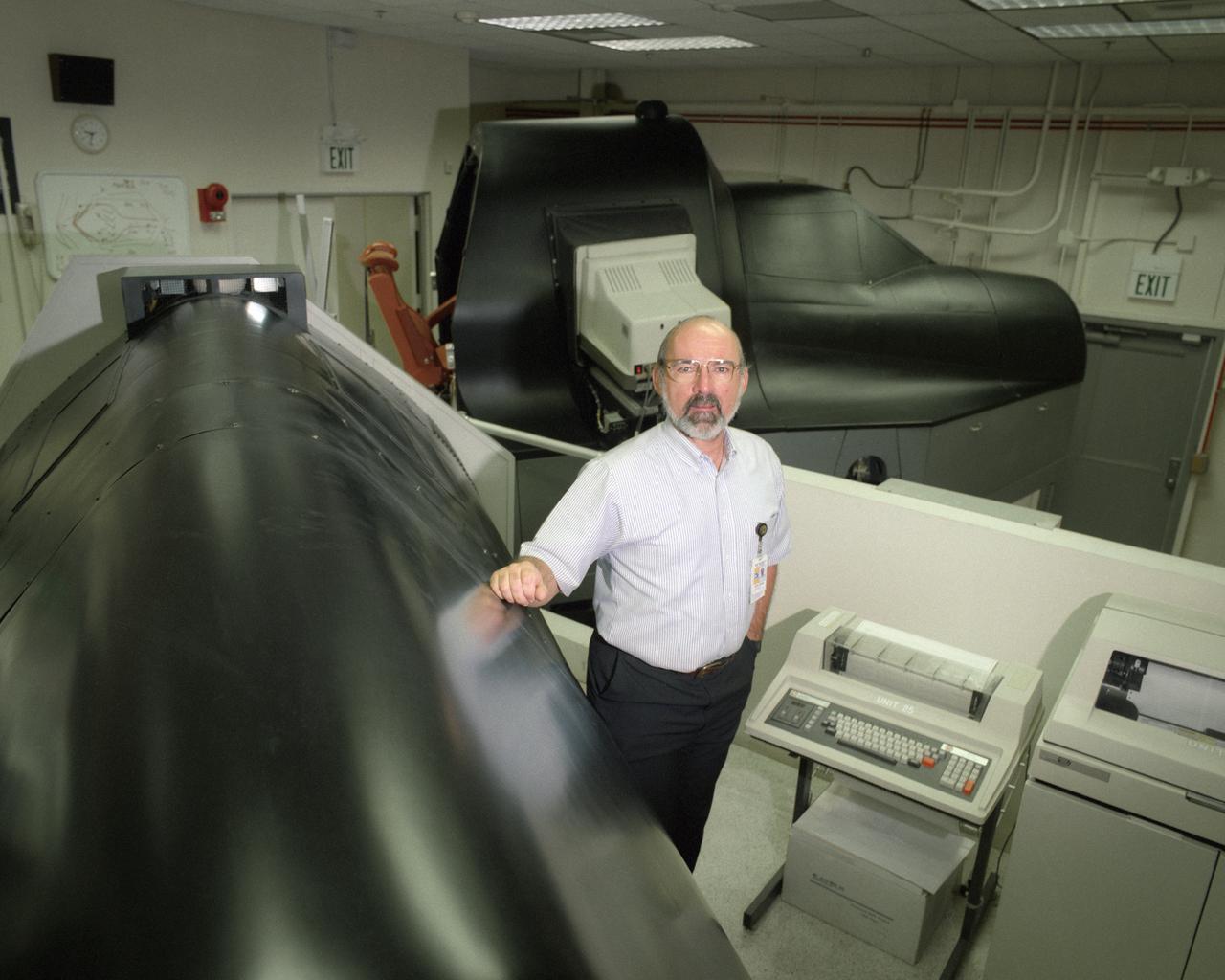
Electronics technician Joe Ciganek was responsible for operation and maintenance of the SR-71 simulator while it was at NASA's Dryden Flight Research Center.

At North Vandenberg Air Force Base in California, the AIM spacecraft is moved into a clean room for testing. AIM, which stands for Aeronomy of Ice in the Mesosphere, is being prepared for integrated testing and a flight simulation. The AIM spacecraft will fly three instruments designed to study polar mesospheric clouds located at the edge of space, 50 miles above the Earth's surface in the coldest part of the planet's atmosphere. The mission's primary goal is to explain why these clouds form and what has caused them to become brighter and more numerous and appear at lower latitudes in recent years. AIM's results will provide the basis for the study of long-term variability in the mesospheric climate and its relationship to global climate change. AIM is scheduled to be mated to its launch vehicle, Orbital Sciences' Pegasus XL, during the second week of April, after which final inspections will be conducted. Launch is scheduled for April 25.
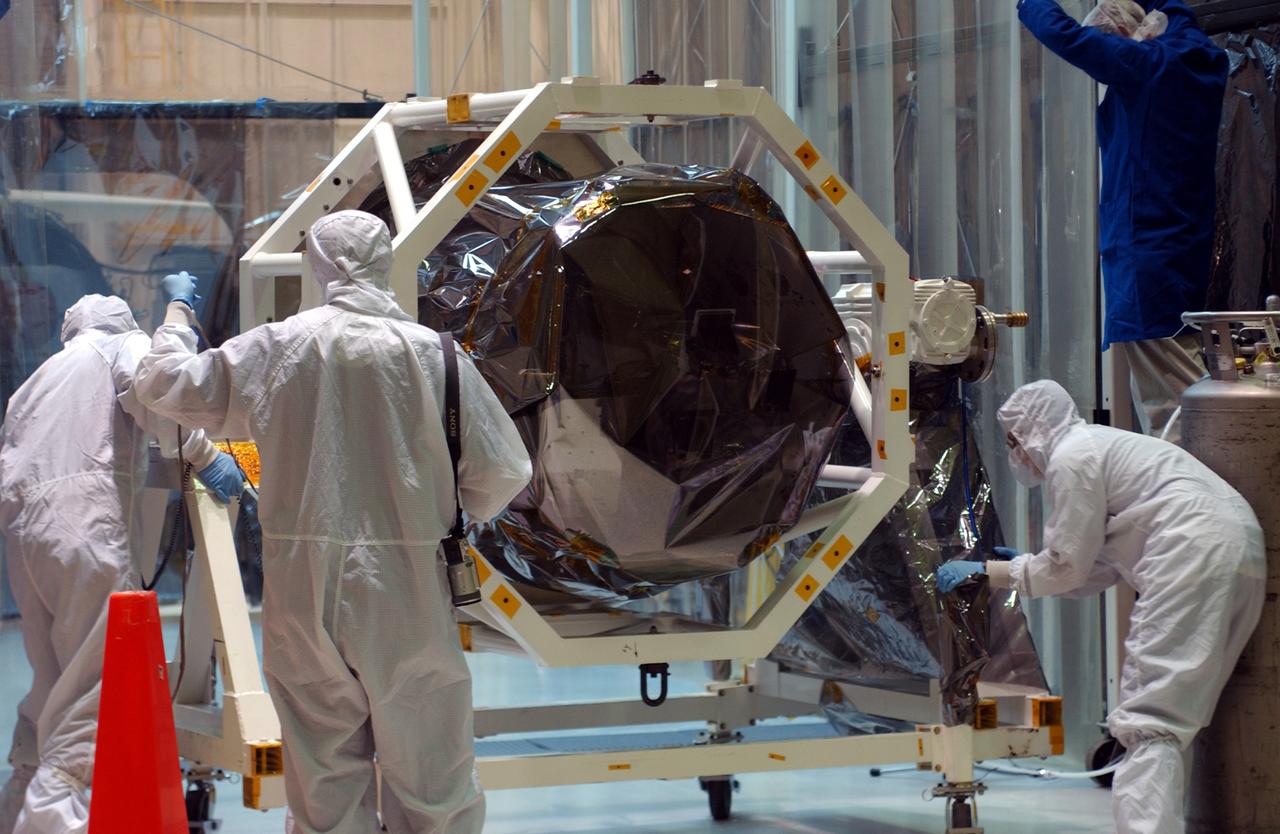
At North Vandenberg Air Force Base in California, the AIM spacecraft is prepared for its move to the clean room for testing. AIM, which stands for Aeronomy of Ice in the Mesosphere, is being prepared for integrated testing and a flight simulation. The AIM spacecraft will fly three instruments designed to study polar mesospheric clouds located at the edge of space, 50 miles above the Earth's surface in the coldest part of the planet's atmosphere. The mission's primary goal is to explain why these clouds form and what has caused them to become brighter and more numerous and appear at lower latitudes in recent years. AIM's results will provide the basis for the study of long-term variability in the mesospheric climate and its relationship to global climate change. AIM is scheduled to be mated to its launch vehicle, Orbital Sciences' Pegasus XL, during the second week of April, after which final inspections will be conducted. Launch is scheduled for April 25.
In Building 1555 on North Vandenberg Air Force Base in California, technicians prepare the AIM spacecraft for integrated testing and a flight simulation. The AIM spacecraft will fly three instruments designed to study polar mesospheric clouds located at the edge of space, 50 miles above the Earth's surface in the coldest part of the planet's atmosphere. The mission's primary goal is to explain why these clouds form and what has caused them to become brighter and more numerous and appear at lower latitudes in recent years. AIM's results will provide the basis for the study of long-term variability in the mesospheric climate and its relationship to global climate change. AIM is scheduled to be mated to its launch vehicle, Orbital Sciences' Pegasus XL, during the second week of April, after which final inspections will be conducted. Launch is scheduled for April 25.

At North Vandenberg Air Force Base in California, the AIM spacecraft has been rotated to horizontal prior to its move to the clean room for testing. AIM, which stands for Aeronomy of Ice in the Mesosphere, is being prepared for integrated testing and a flight simulation. The AIM spacecraft will fly three instruments designed to study polar mesospheric clouds located at the edge of space, 50 miles above the Earth's surface in the coldest part of the planet's atmosphere. The mission's primary goal is to explain why these clouds form and what has caused them to become brighter and more numerous and appear at lower latitudes in recent years. AIM's results will provide the basis for the study of long-term variability in the mesospheric climate and its relationship to global climate change. AIM is scheduled to be mated to its launch vehicle, Orbital Sciences' Pegasus XL, during the second week of April, after which final inspections will be conducted. Launch is scheduled for April 25.
In Building 1555 on North Vandenberg Air Force Base in California, technicians prepare the AIM spacecraft for integrated testing and a flight simulation. The AIM spacecraft will fly three instruments designed to study polar mesospheric clouds located at the edge of space, 50 miles above the Earth's surface in the coldest part of the planet's atmosphere. The mission's primary goal is to explain why these clouds form and what has caused them to become brighter and more numerous and appear at lower latitudes in recent years. AIM's results will provide the basis for the study of long-term variability in the mesospheric climate and its relationship to global climate change. AIM is scheduled to be mated to its launch vehicle, Orbital Sciences' Pegasus XL, during the second week of April, after which final inspections will be conducted. Launch is scheduled for April 25.
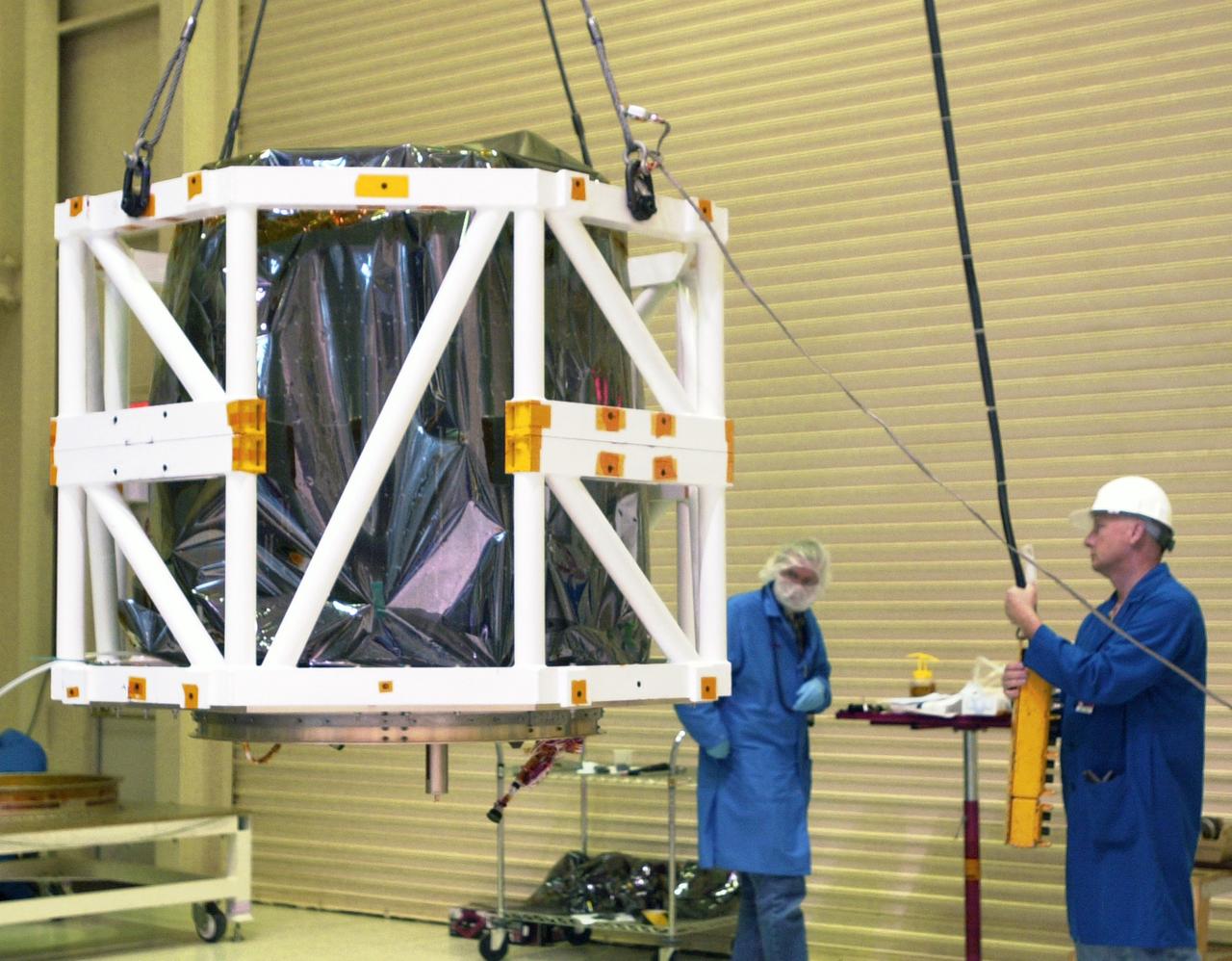
In Building 1555 on North Vandenberg Air Force Base in California, technicians lift the AIM spacecraft via the spacecraft handling fixture attached to it. AIM, which stands for Aeronomy of Ice in the Mesosphere, is being prepared for integrated testing and a flight simulation. The AIM spacecraft will fly three instruments designed to study polar mesospheric clouds located at the edge of space, 50 miles above the Earth's surface in the coldest part of the planet's atmosphere. The mission's primary goal is to explain why these clouds form and what has caused them to become brighter and more numerous and appear at lower latitudes in recent years. AIM's results will provide the basis for the study of long-term variability in the mesospheric climate and its relationship to global climate change. AIM is scheduled to be mated to its launch vehicle, Orbital Sciences' Pegasus XL, during the second week of April, after which final inspections will be conducted. Launch is scheduled for April 25.
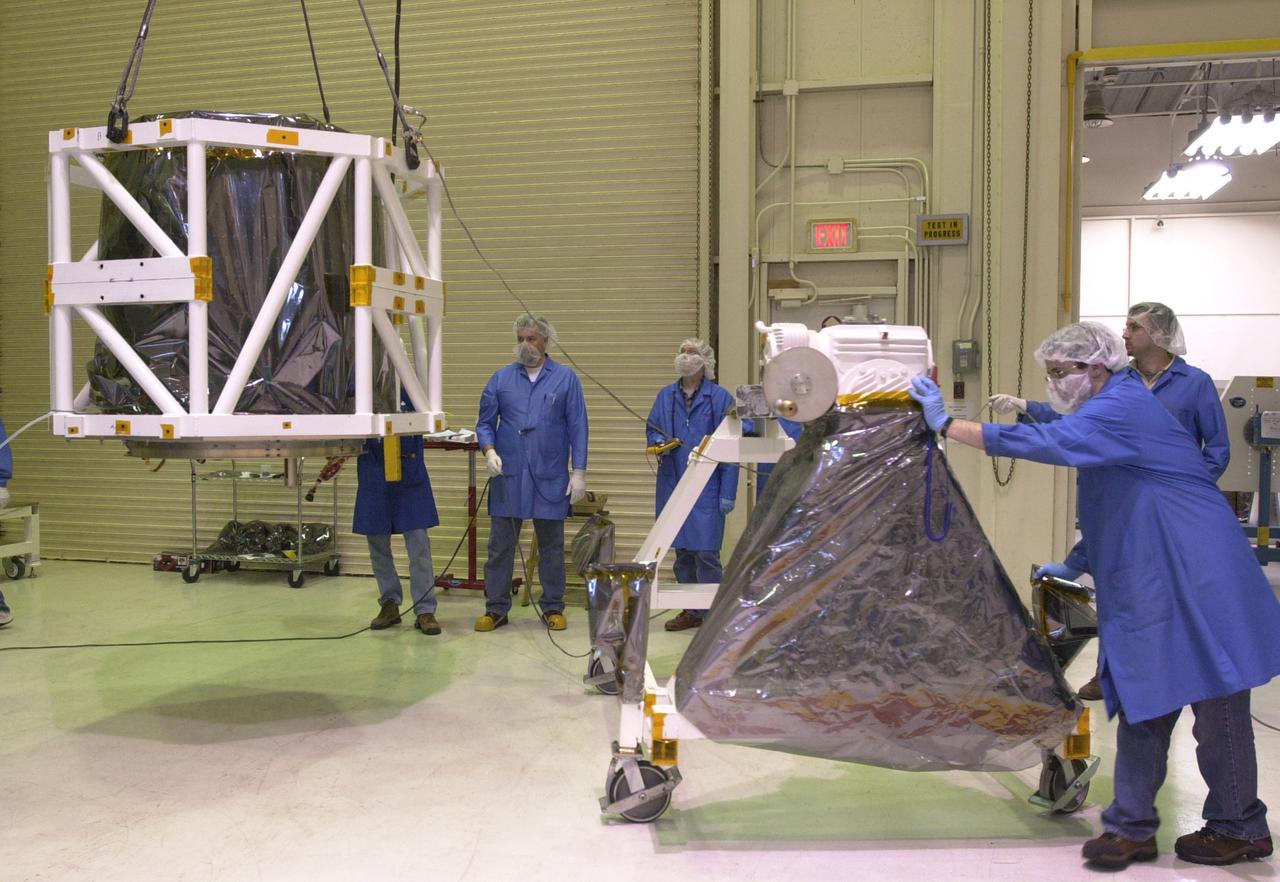
In Building 1555 on North Vandenberg Air Force Base in California, technicians move a mobile stand toward the AIM spacecraft suspended via a crane at left. . AIM, which stands for Aeronomy of Ice in the Mesosphere, is being prepared for integrated testing and a flight simulation. The AIM spacecraft will fly three instruments designed to study polar mesospheric clouds located at the edge of space, 50 miles above the Earth's surface in the coldest part of the planet's atmosphere. The mission's primary goal is to explain why these clouds form and what has caused them to become brighter and more numerous and appear at lower latitudes in recent years. AIM's results will provide the basis for the study of long-term variability in the mesospheric climate and its relationship to global climate change. AIM is scheduled to be mated to its launch vehicle, Orbital Sciences' Pegasus XL, during the second week of April, after which final inspections will be conducted. Launch is scheduled for April 25.
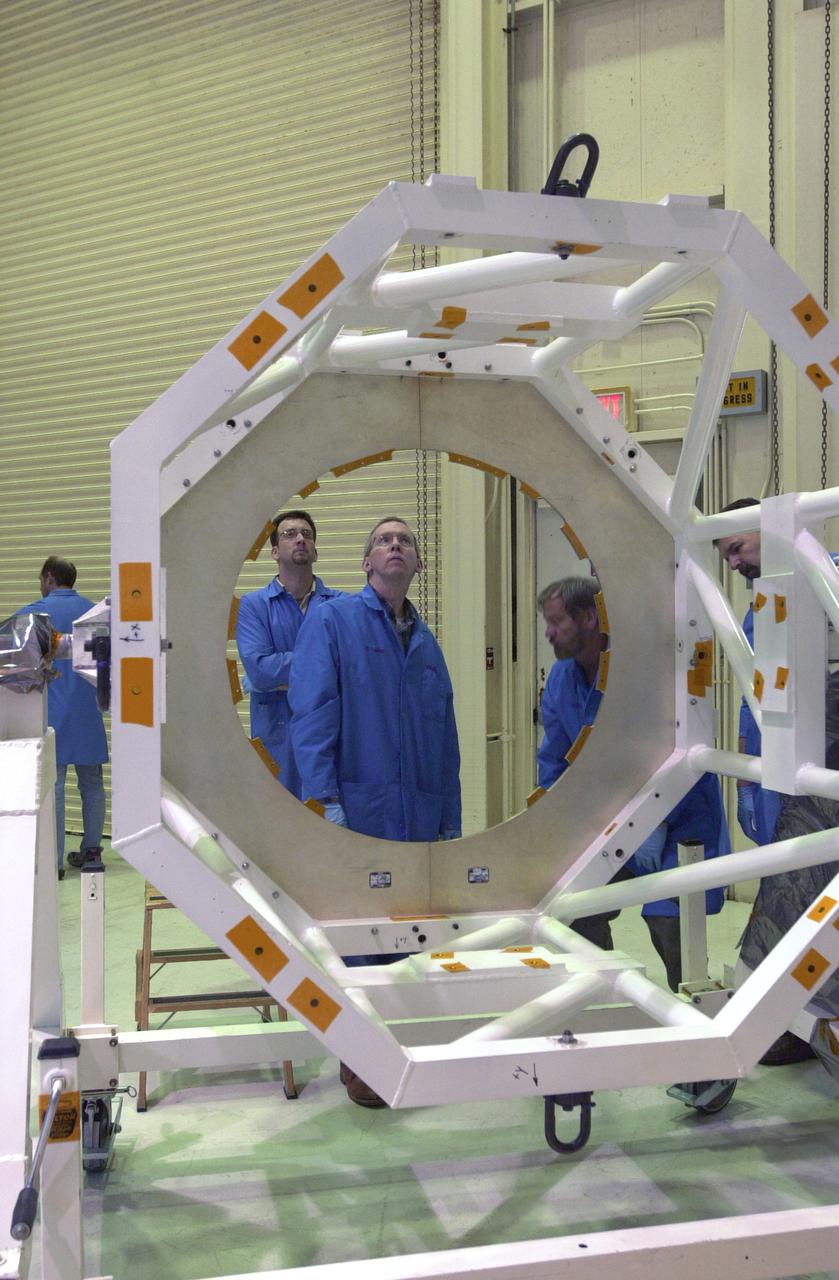
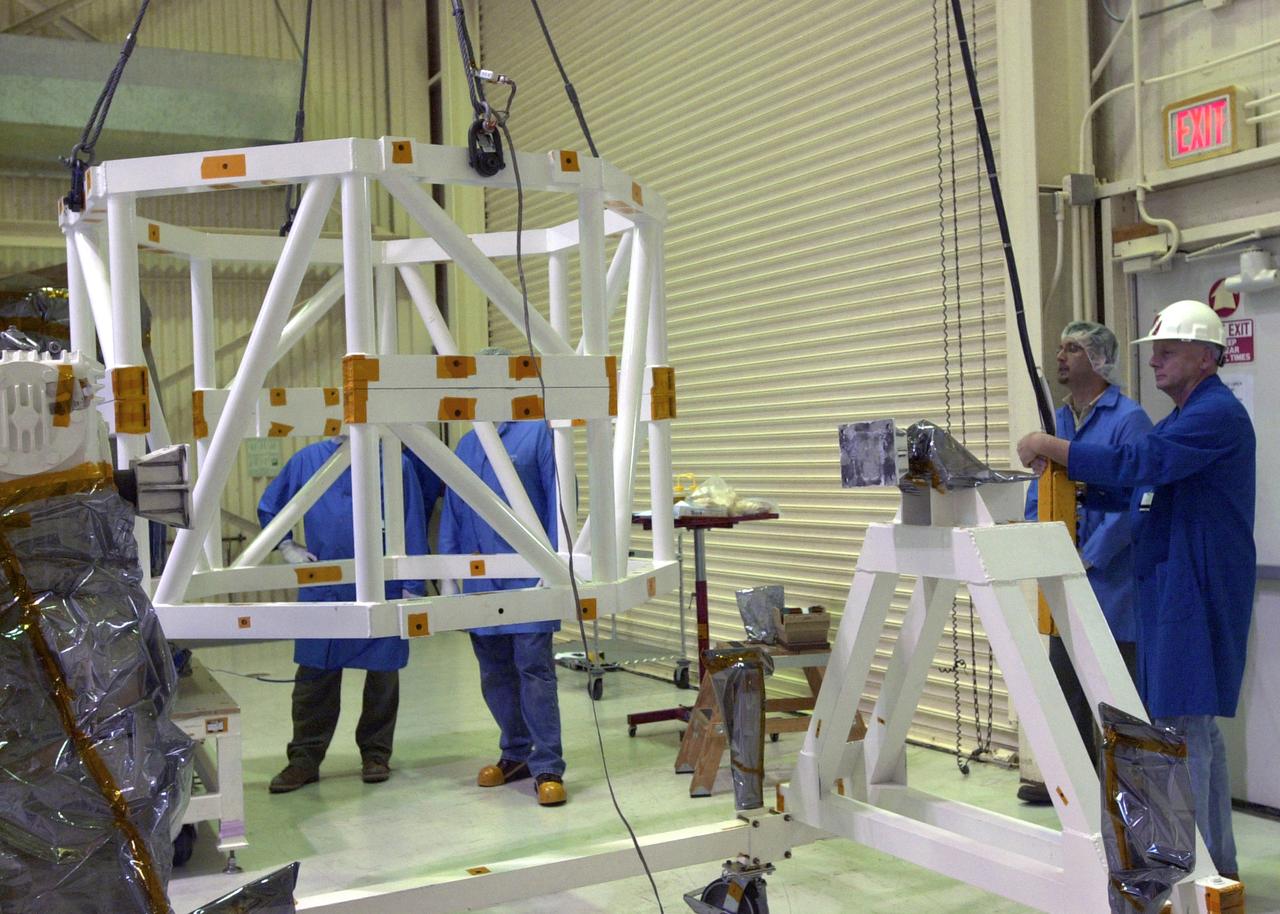
In Building 1555 on North Vandenberg Air Force Base in California, technicians look over the spacecraft handling fixture that will be used to lift the AIM spacecraft. AIM, which stands for Aeronomy of Ice in the Mesosphere, is being prepared for integrated testing and a flight simulation. The AIM spacecraft will fly three instruments designed to study polar mesospheric clouds located at the edge of space, 50 miles above the Earth's surface in the coldest part of the planet's atmosphere. The mission's primary goal is to explain why these clouds form and what has caused them to become brighter and more numerous and appear at lower latitudes in recent years. AIM's results will provide the basis for the study of long-term variability in the mesospheric climate and its relationship to global climate change. AIM is scheduled to be mated to its launch vehicle, Orbital Sciences' Pegasus XL, during the second week of April, after which final inspections will be conducted. Launch is scheduled for April 25.

In Building 1555 on North Vandenberg Air Force Base in California, technicians carry the separation system, at left, toward the AIM spacecraft hovering above the stand at right. AIM, which stands for Aeronomy of Ice in the Mesosphere, is being prepared for integrated testing and a flight simulation. The AIM spacecraft will fly three instruments designed to study polar mesospheric clouds located at the edge of space, 50 miles above the Earth's surface in the coldest part of the planet's atmosphere. The mission's primary goal is to explain why these clouds form and what has caused them to become brighter and more numerous and appear at lower latitudes in recent years. AIM's results will provide the basis for the study of long-term variability in the mesospheric climate and its relationship to global climate change. AIM is scheduled to be mated to its launch vehicle, Orbital Sciences' Pegasus XL, during the second week of April, after which final inspections will be conducted. Launch is scheduled for April 25.
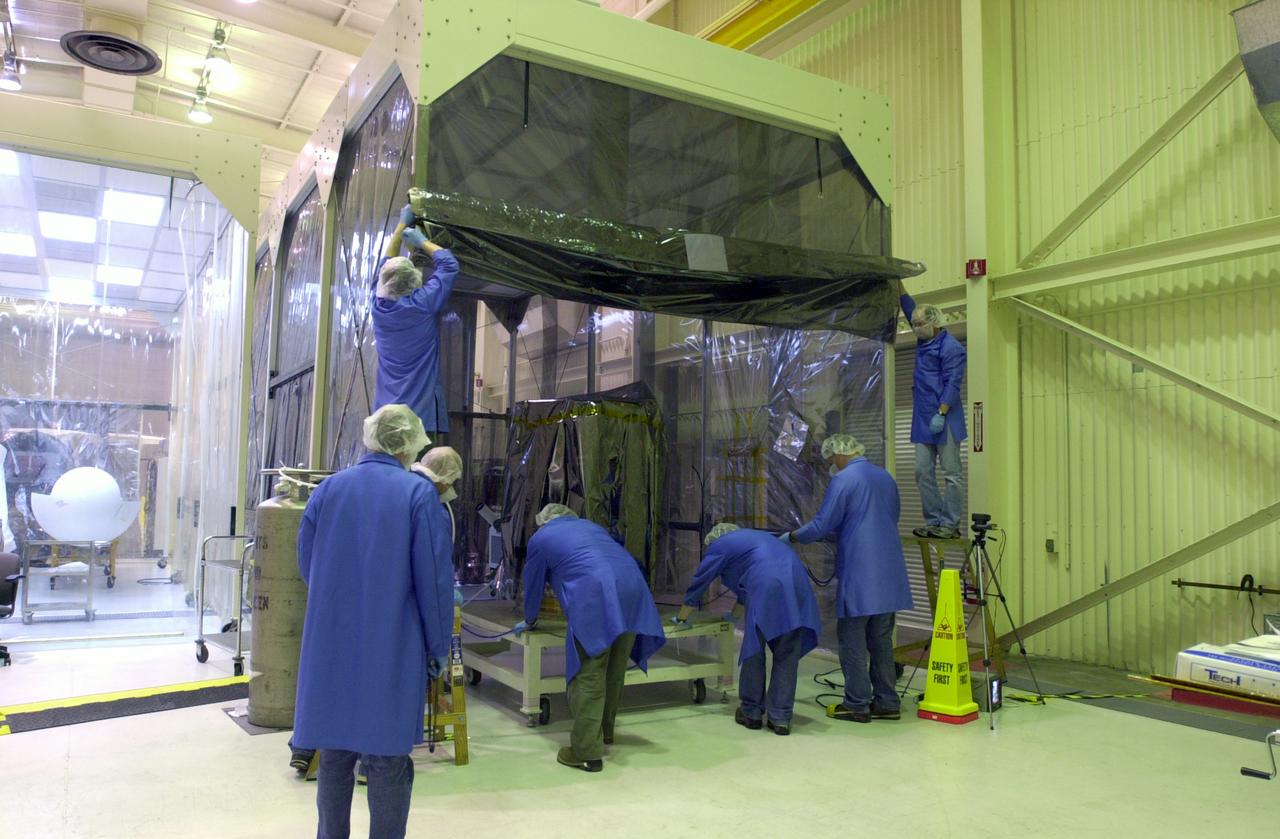
In Building 1555 on North Vandenberg Air Force Base in California, technicians work on the separation system to be mated to the AIM spacecraft, hovering above it. AIM, which stands for Aeronomy of Ice in the Mesosphere, is being prepared for integrated testing and a flight simulation. The AIM spacecraft will fly three instruments designed to study polar mesospheric clouds located at the edge of space, 50 miles above the Earth's surface in the coldest part of the planet's atmosphere. The mission's primary goal is to explain why these clouds form and what has caused them to become brighter and more numerous and appear at lower latitudes in recent years. AIM's results will provide the basis for the study of long-term variability in the mesospheric climate and its relationship to global climate change. AIM is scheduled to be mated to its launch vehicle, Orbital Sciences' Pegasus XL, during the second week of April, after which final inspections will be conducted. Launch is scheduled for April 25.
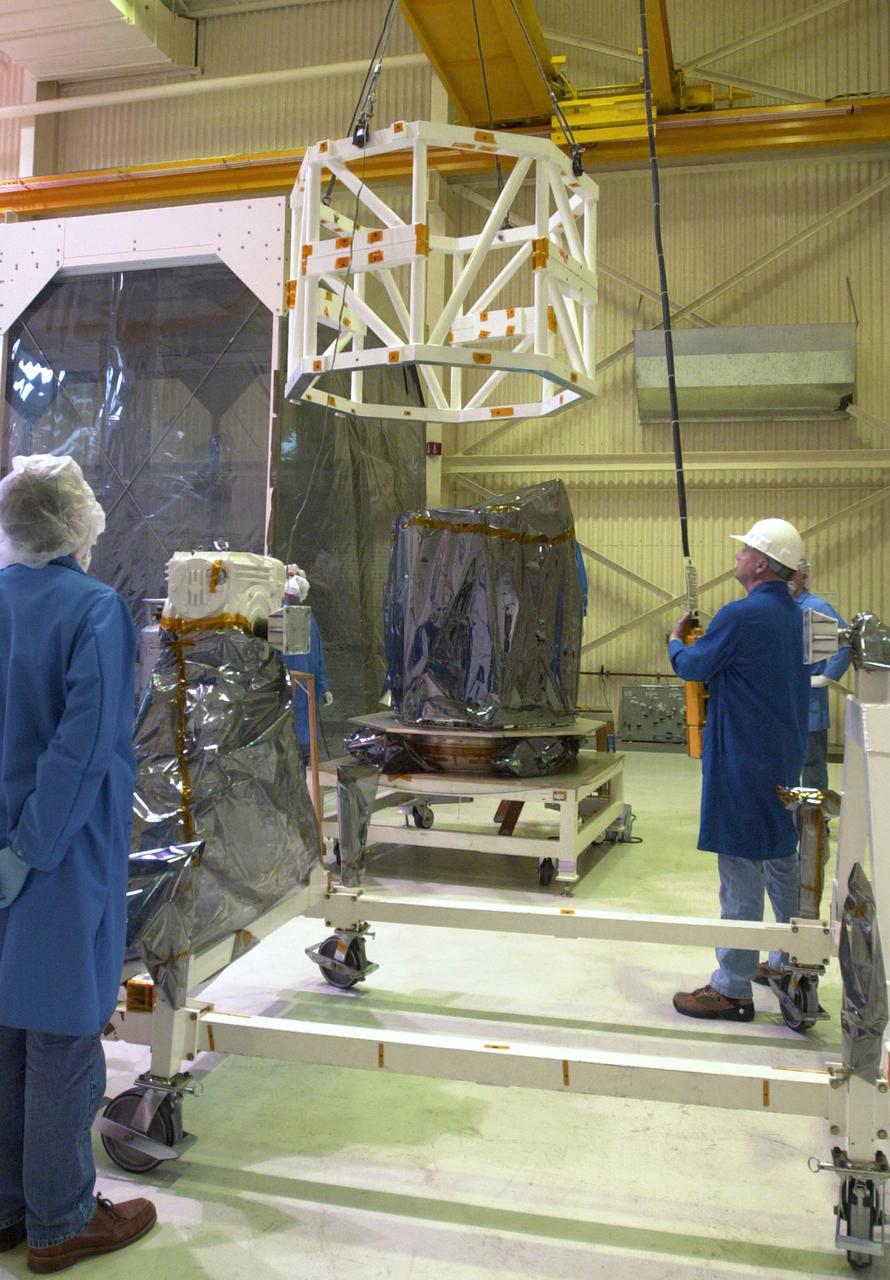
In Building 1555 on North Vandenberg Air Force Base in California, technicians maneuver the spacecraft handling fixture toward the AIM spacecraft. AIM, which stands for Aeronomy of Ice in the Mesosphere, is being prepared for integrated testing and a flight simulation. The AIM spacecraft will fly three instruments designed to study polar mesospheric clouds located at the edge of space, 50 miles above the Earth's surface in the coldest part of the planet's atmosphere. The mission's primary goal is to explain why these clouds form and what has caused them to become brighter and more numerous and appear at lower latitudes in recent years. AIM's results will provide the basis for the study of long-term variability in the mesospheric climate and its relationship to global climate change. AIM is scheduled to be mated to its launch vehicle, Orbital Sciences' Pegasus XL, during the second week of April, after which final inspections will be conducted. Launch is scheduled for April 25.

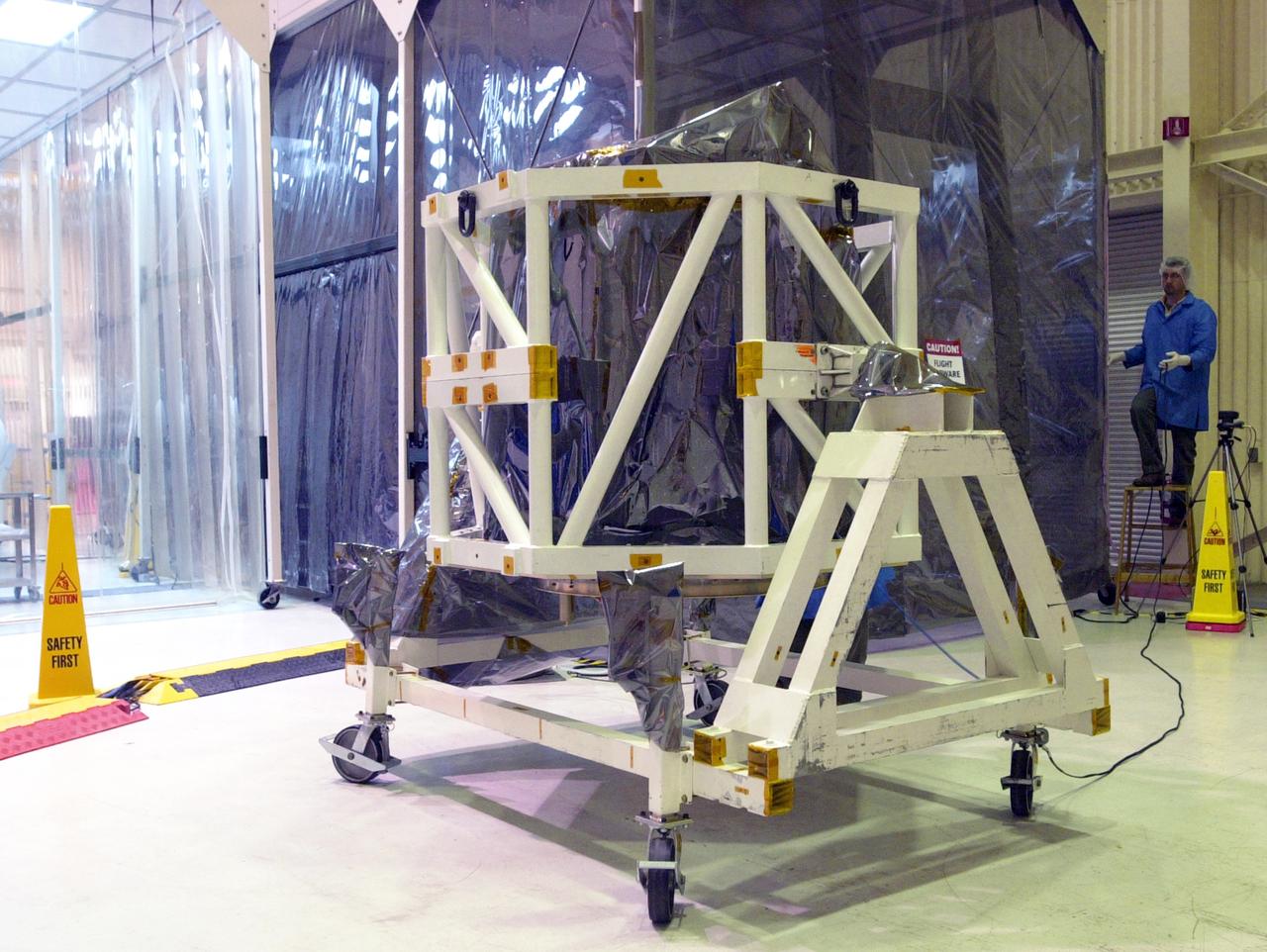
In Building 1555 on North Vandenberg Air Force Base in California, technicians roll the AIM spacecraft back under the protective clean tent. AIM, which stands for Aeronomy of Ice in the Mesosphere, is being prepared for integrated testing and a flight simulation. The AIM spacecraft will fly three instruments designed to study polar mesospheric clouds located at the edge of space, 50 miles above the Earth's surface in the coldest part of the planet's atmosphere. The mission's primary goal is to explain why these clouds form and what has caused them to become brighter and more numerous and appear at lower latitudes in recent years. AIM's results will provide the basis for the study of long-term variability in the mesospheric climate and its relationship to global climate change. AIM is scheduled to be mated to its launch vehicle, Orbital Sciences' Pegasus XL, during the second week of April, after which final inspections will be conducted. Launch is scheduled for April 25.
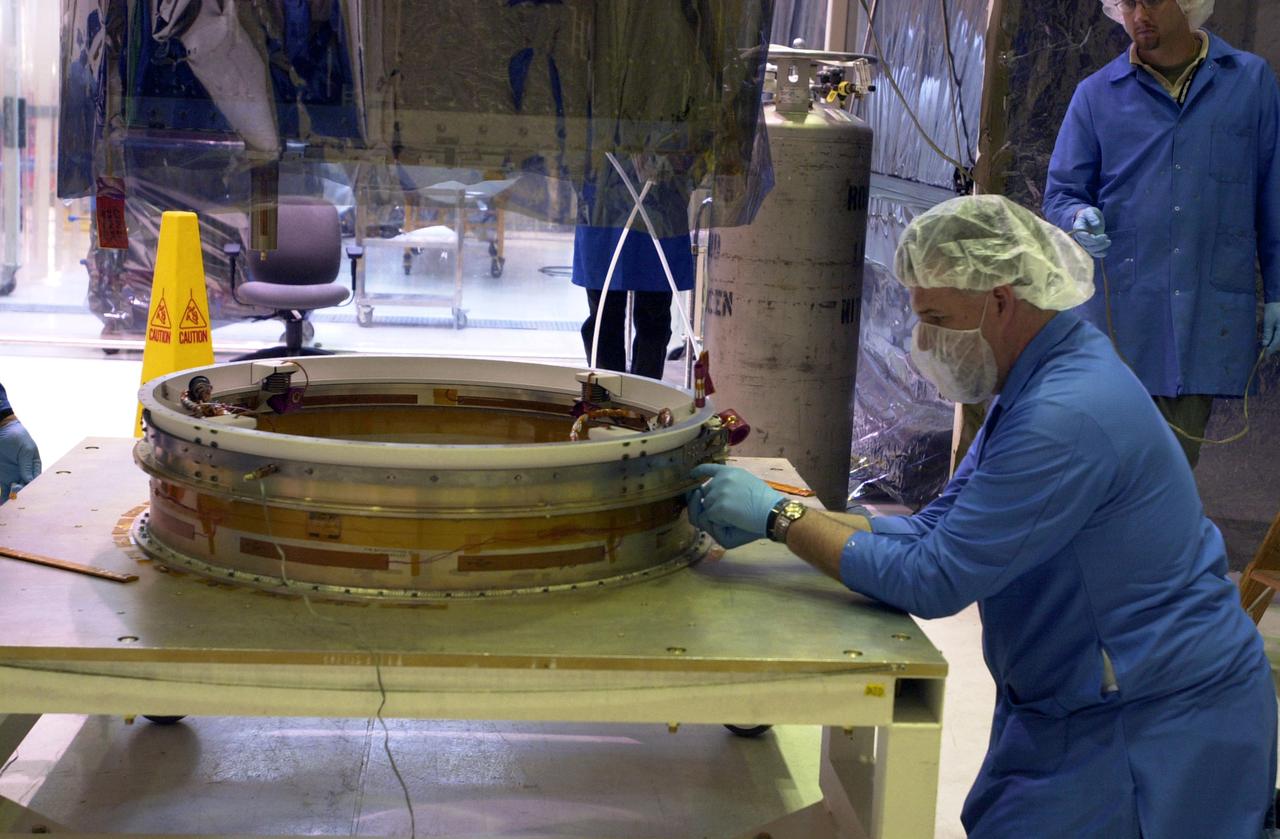
In Building 1555 on North Vandenberg Air Force Base in California, technicians work on the separation system to be mated to the AIM spacecraft, hovering above it. AIM, which stands for Aeronomy of Ice in the Mesosphere, is being prepared for integrated testing and a flight simulation. The AIM spacecraft will fly three instruments designed to study polar mesospheric clouds located at the edge of space, 50 miles above the Earth's surface in the coldest part of the planet's atmosphere. The mission's primary goal is to explain why these clouds form and what has caused them to become brighter and more numerous and appear at lower latitudes in recent years. AIM's results will provide the basis for the study of long-term variability in the mesospheric climate and its relationship to global climate change. AIM is scheduled to be mated to its launch vehicle, Orbital Sciences' Pegasus XL, during the second week of April, after which final inspections will be conducted. Launch is scheduled for April 25.
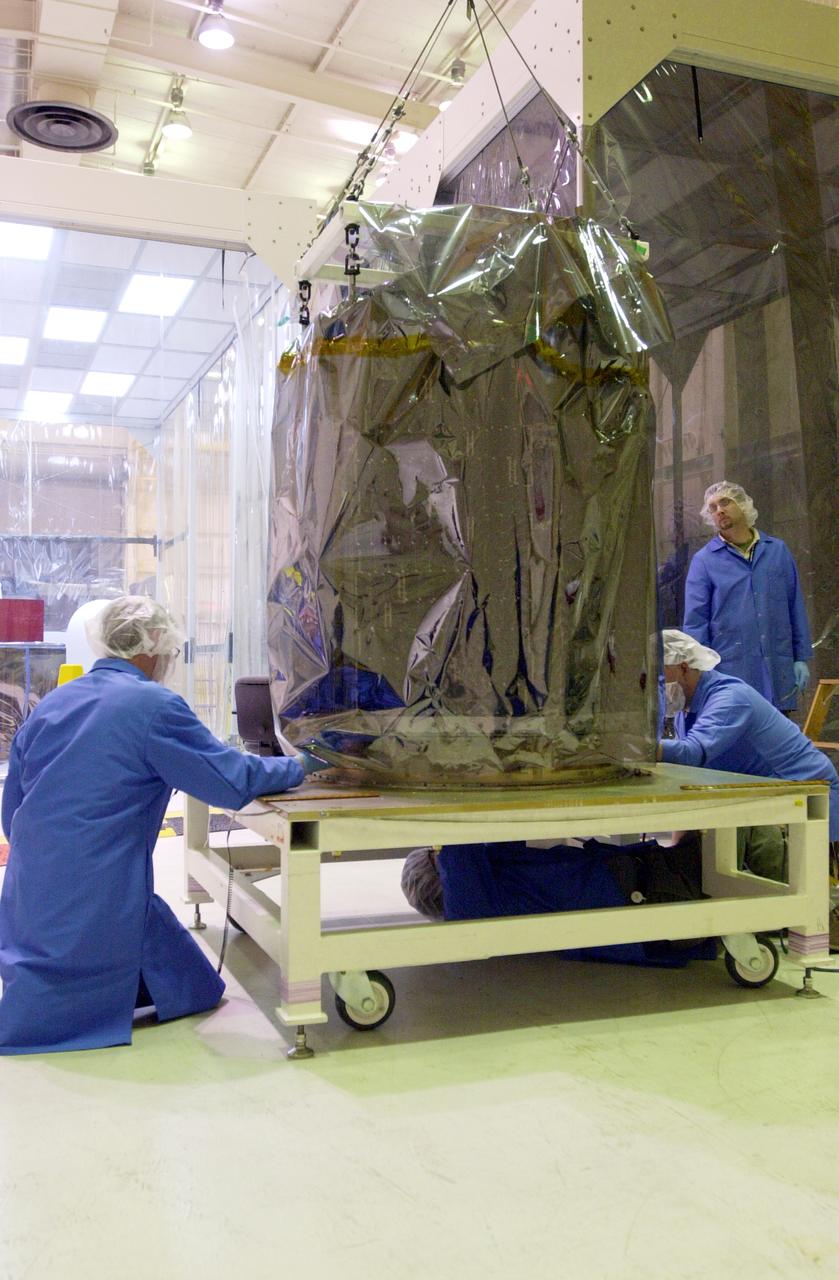
In Building 1555 on North Vandenberg Air Force Base in California, technicians prepare the AIM spacecraft for integrated testing and a flight simulation. The AIM spacecraft will fly three instruments designed to study polar mesospheric clouds located at the edge of space, 50 miles above the Earth's surface in the coldest part of the planet's atmosphere. The mission's primary goal is to explain why these clouds form and what has caused them to become brighter and more numerous and appear at lower latitudes in recent years. AIM's results will provide the basis for the study of long-term variability in the mesospheric climate and its relationship to global climate change. AIM is scheduled to be mated to its launch vehicle, Orbital Sciences' Pegasus XL, during the second week of April, after which final inspections will be conducted. Launch is scheduled for April 25.
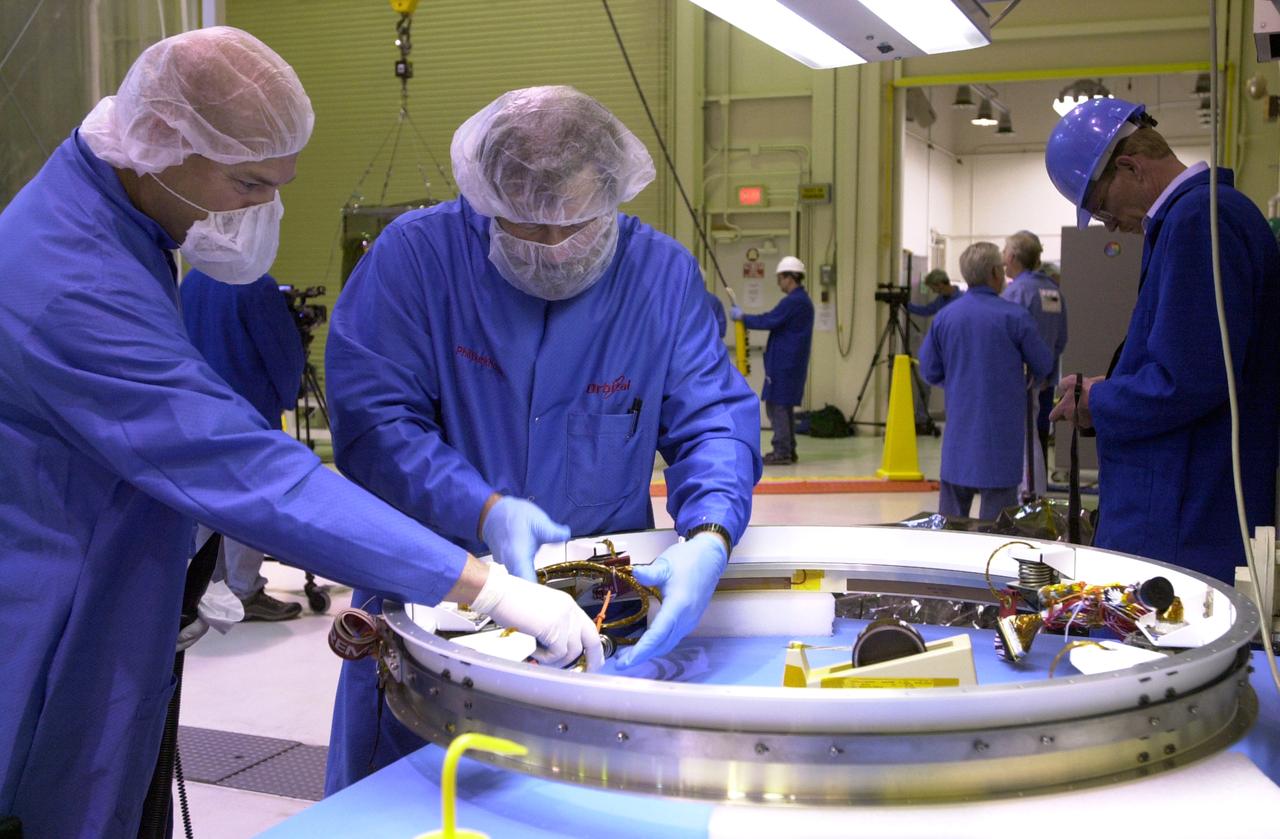
In Building 1555 on North Vandenberg Air Force Base in California, technicians work on the separation system to be mated to the AIM spacecraft. AIM, which stands for Aeronomy of Ice in the Mesosphere, is being prepared for integrated testing and a flight simulation. The AIM spacecraft will fly three instruments designed to study polar mesospheric clouds located at the edge of space, 50 miles above the Earth's surface in the coldest part of the planet's atmosphere. The mission's primary goal is to explain why these clouds form and what has caused them to become brighter and more numerous and appear at lower latitudes in recent years. AIM's results will provide the basis for the study of long-term variability in the mesospheric climate and its relationship to global climate change. AIM is scheduled to be mated to its launch vehicle, Orbital Sciences' Pegasus XL, during the second week of April, after which final inspections will be conducted. Launch is scheduled for April 25.
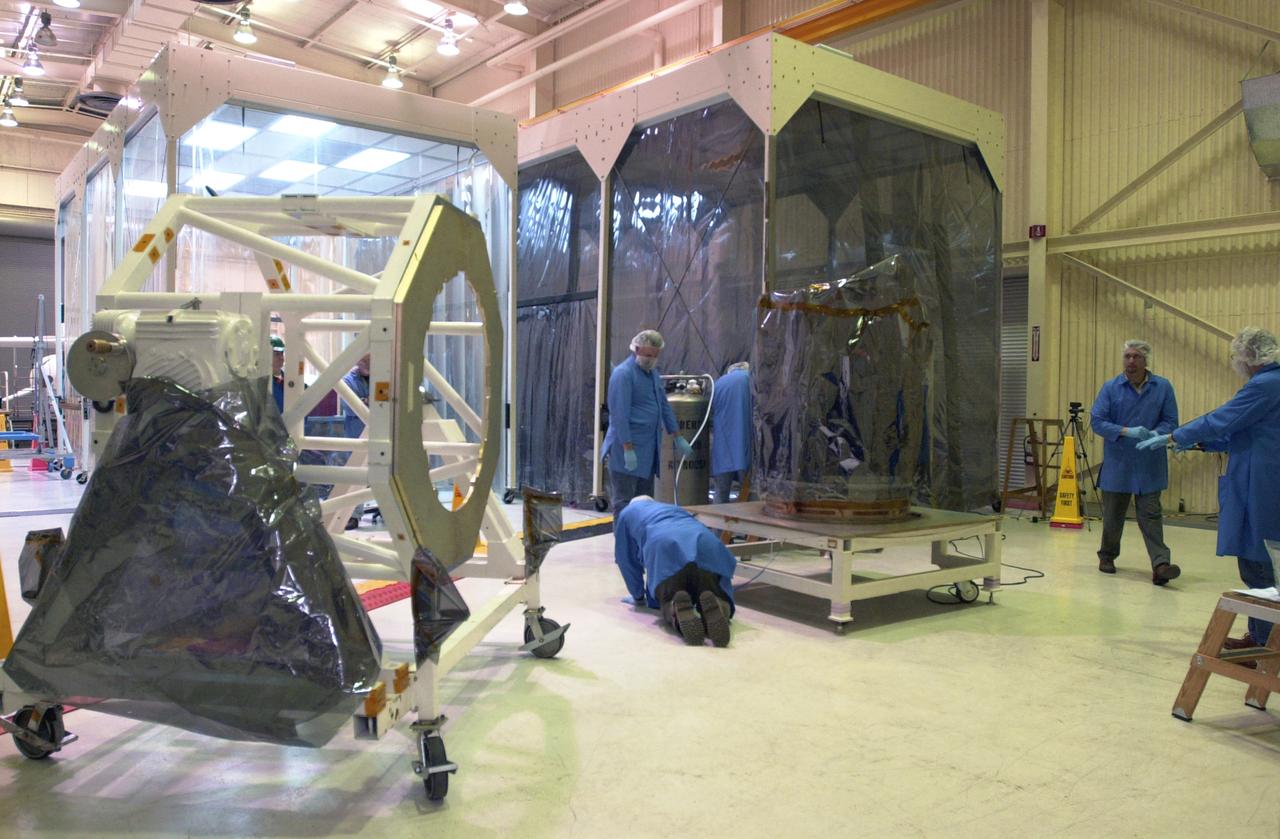
In Building 1555 on North Vandenberg Air Force Base in California, technicians prepare the AIM spacecraft for integrated testing and a flight simulation. The AIM spacecraft will fly three instruments designed to study polar mesospheric clouds located at the edge of space, 50 miles above the Earth's surface in the coldest part of the planet's atmosphere. The mission's primary goal is to explain why these clouds form and what has caused them to become brighter and more numerous and appear at lower latitudes in recent years. AIM's results will provide the basis for the study of long-term variability in the mesospheric climate and its relationship to global climate change. AIM is scheduled to be mated to its launch vehicle, Orbital Sciences' Pegasus XL, during the second week of April, after which final inspections will be conducted. Launch is scheduled for April 25.
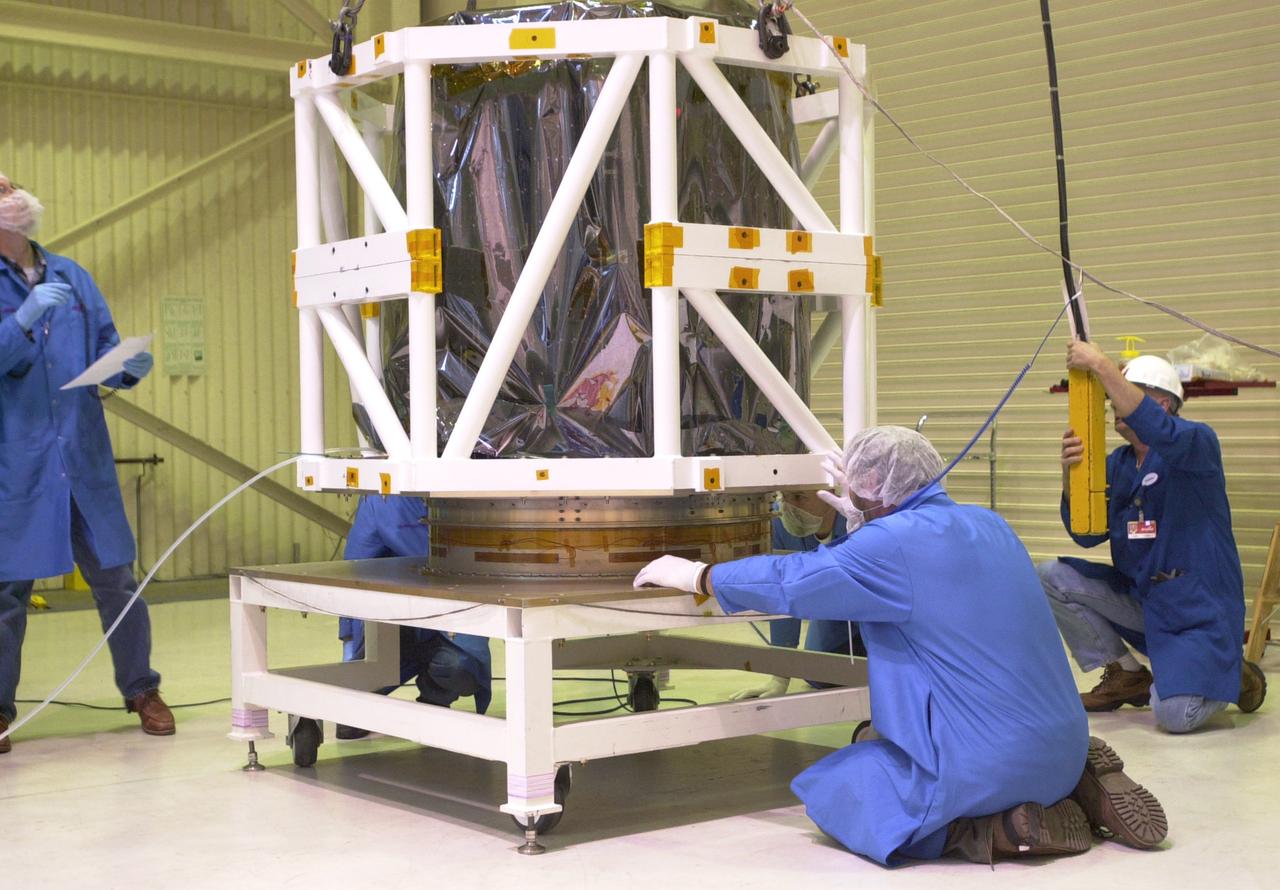
In Building 1555 on North Vandenberg Air Force Base in California, technicians lower the spacecraft handling fixture around the AIM spacecraft. AIM, which stands for Aeronomy of Ice in the Mesosphere, is being prepared for integrated testing and a flight simulation. The AIM spacecraft will fly three instruments designed to study polar mesospheric clouds located at the edge of space, 50 miles above the Earth's surface in the coldest part of the planet's atmosphere. The mission's primary goal is to explain why these clouds form and what has caused them to become brighter and more numerous and appear at lower latitudes in recent years. AIM's results will provide the basis for the study of long-term variability in the mesospheric climate and its relationship to global climate change. AIM is scheduled to be mated to its launch vehicle, Orbital Sciences' Pegasus XL, during the second week of April, after which final inspections will be conducted. Launch is scheduled for April 25.
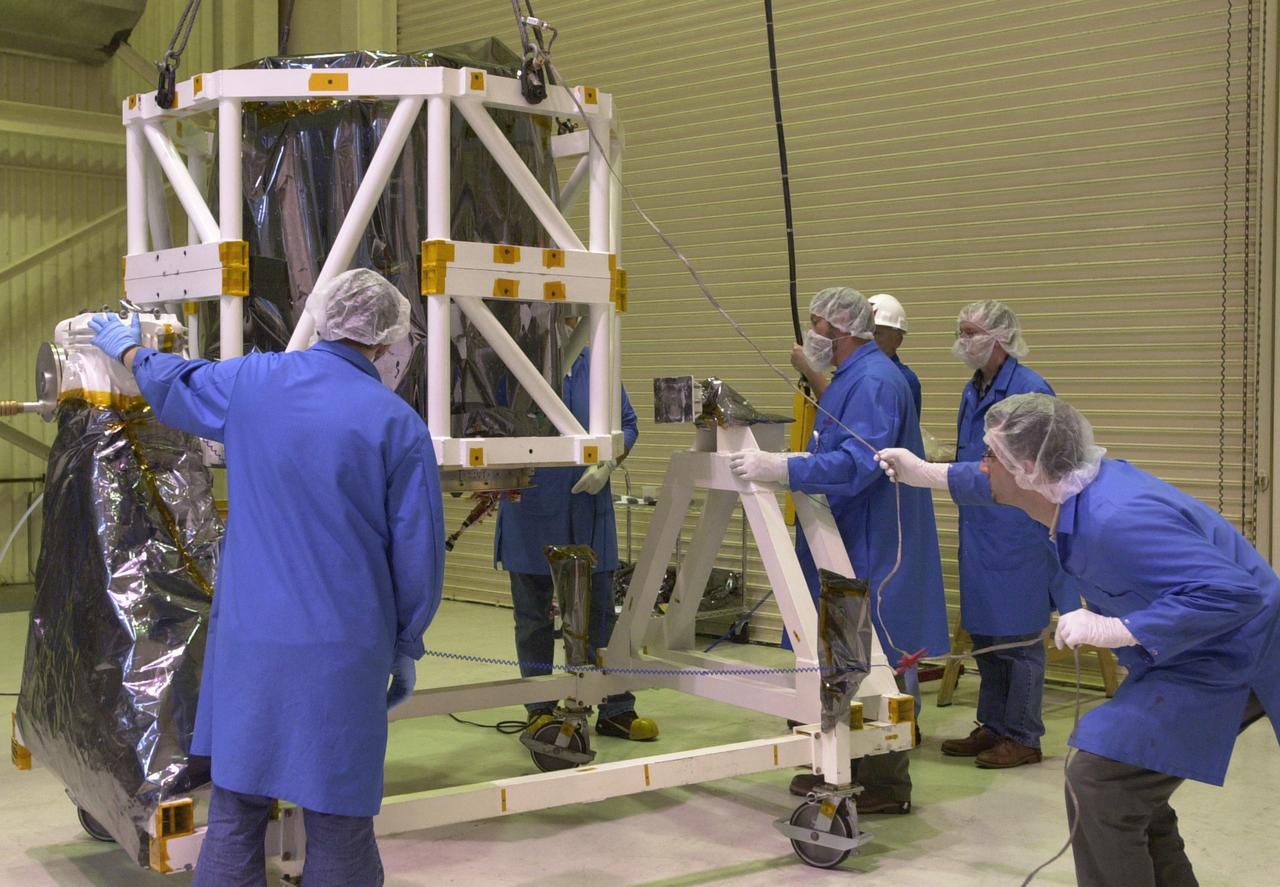
In Building 1555 on North Vandenberg Air Force Base in California, technicians lower the AIM spacecraft onto a moveable stand. AIM, which stands for Aeronomy of Ice in the Mesosphere, is being prepared for integrated testing and a flight simulation. The AIM spacecraft will fly three instruments designed to study polar mesospheric clouds located at the edge of space, 50 miles above the Earth's surface in the coldest part of the planet's atmosphere. The mission's primary goal is to explain why these clouds form and what has caused them to become brighter and more numerous and appear at lower latitudes in recent years. AIM's results will provide the basis for the study of long-term variability in the mesospheric climate and its relationship to global climate change. AIM is scheduled to be mated to its launch vehicle, Orbital Sciences' Pegasus XL, during the second week of April, after which final inspections will be conducted. Launch is scheduled for April 25.
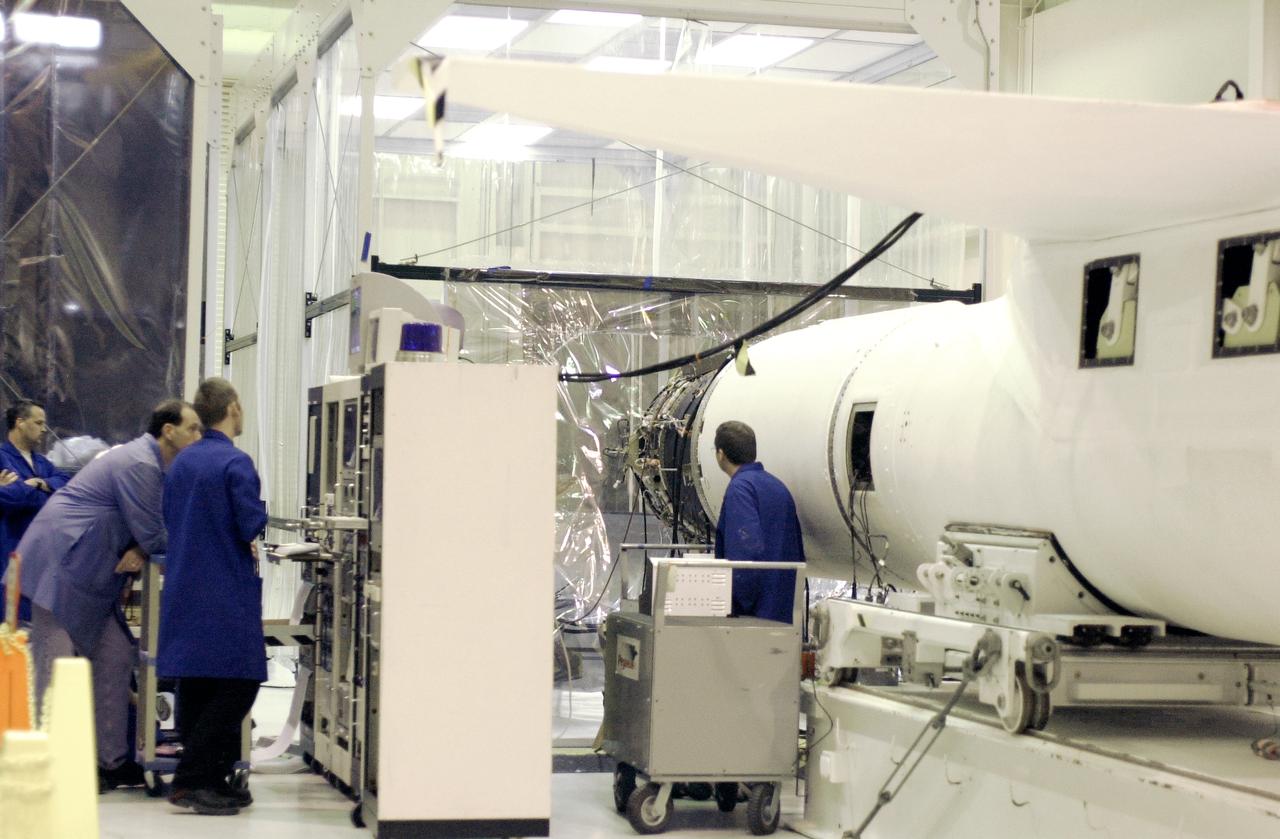
At Vandenberg Air Force Base in California, workers monitor the data produced by the second flight simulation of the Orbital Sciences Pegasus XL rocket. The rocket is the launch vehicle for NASA's Aeronomy of Ice in the Mesosphere, or AIM, spacecraft. AIM is the seventh Small Explorers mission under NASA's Explorer Program. The program provides frequent flight opportunities for world-class scientific investigations from space within heliophysics and astrophysics. The AIM spacecraft will fly three instruments designed to study polar mesospheric clouds located at the edge of space, 50 miles above the Earth's surface in the coldest part of the planet's atmosphere. The mission's primary goal is to explain why these clouds form and what has caused them to become brighter and more numerous and appear at lower latitudes in recent years. AIM's results will provide the basis for the study of long-term variability in the mesospheric climate and its relationship to global climate change. AIM is scheduled to be mated to the Pegasus XL during the second week of April, after which final inspections will be conducted. Launch is scheduled for April 25.
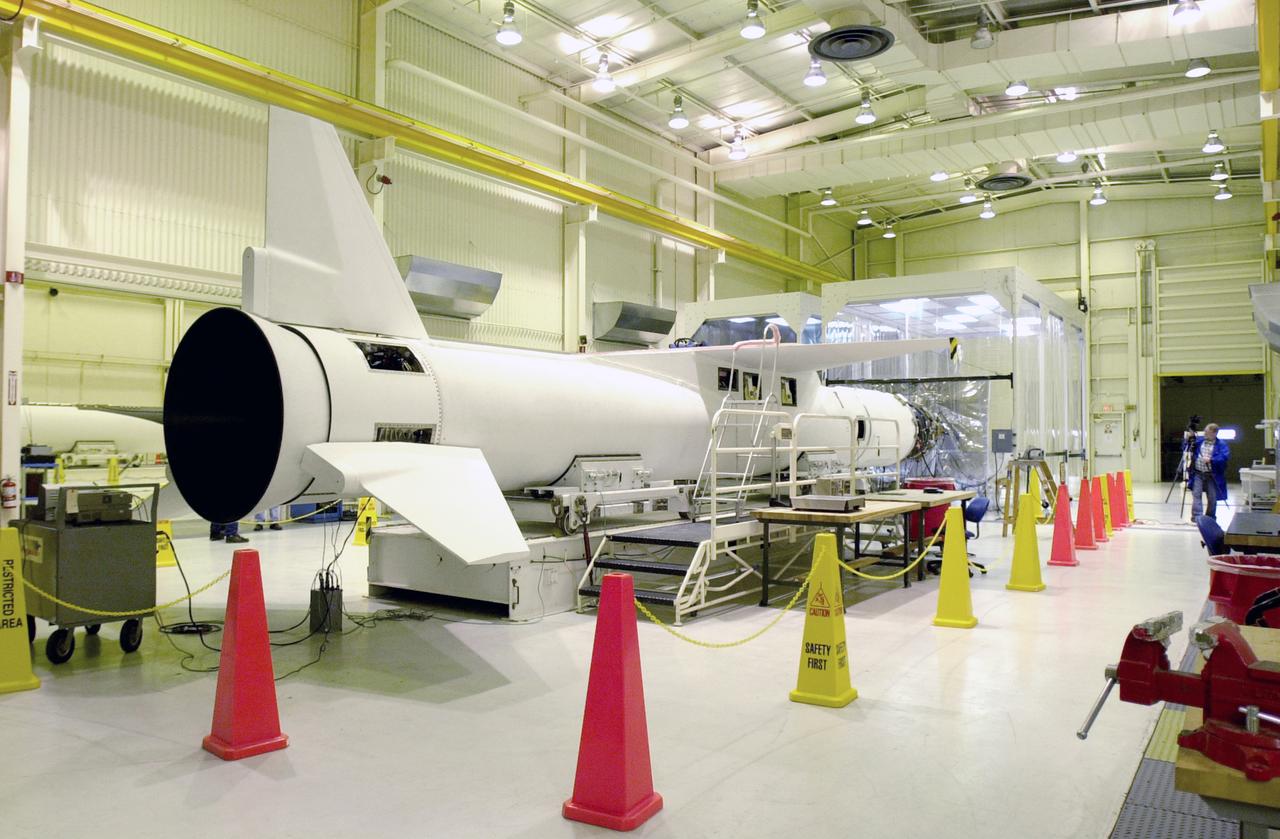
At Vandenberg Air Force Base in California, the Orbital Sciences Pegasus XL rocket undergoes its second flight simulation. The rocket is the launch vehicle for NASA's Aeronomy of Ice in the Mesosphere, or AIM, spacecraft. AIM is the seventh Small Explorers mission under NASA's Explorer Program. The program provides frequent flight opportunities for world-class scientific investigations from space within heliophysics and astrophysics. The AIM spacecraft will fly three instruments designed to study polar mesospheric clouds located at the edge of space, 50 miles above the Earth's surface in the coldest part of the planet's atmosphere. The mission's primary goal is to explain why these clouds form and what has caused them to become brighter and more numerous and appear at lower latitudes in recent years. AIM's results will provide the basis for the study of long-term variability in the mesospheric climate and its relationship to global climate change. AIM is scheduled to be mated to the Pegasus XL during the second week of April, after which final inspections will be conducted. Launch is scheduled for April 25.
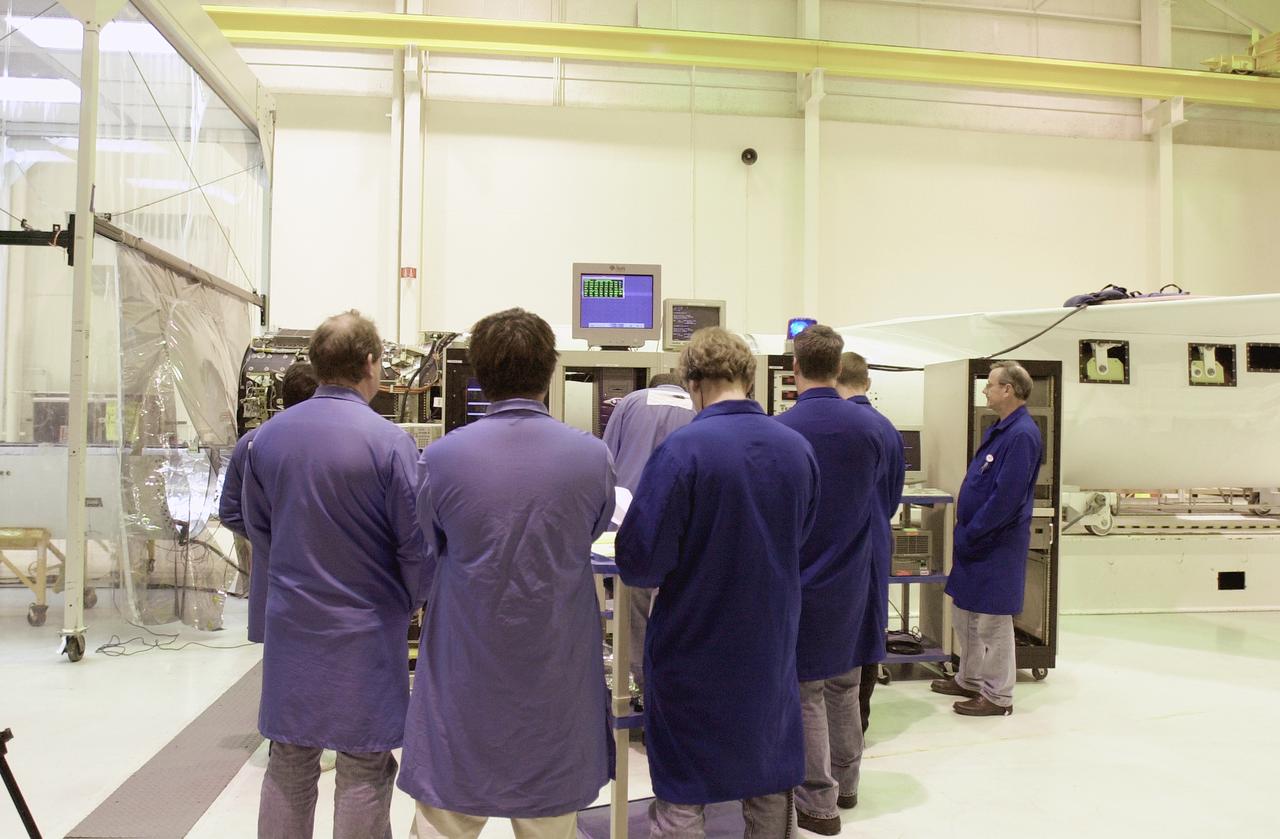
At Vandenberg Air Force Base in California, workers monitor the data produced by the second flight simulation of the Orbital Sciences Pegasus XL rocket. The rocket is the launch vehicle for NASA's Aeronomy of Ice in the Mesosphere, or AIM, spacecraft. AIM is the seventh Small Explorers mission under NASA's Explorer Program. The program provides frequent flight opportunities for world-class scientific investigations from space within heliophysics and astrophysics. The AIM spacecraft will fly three instruments designed to study polar mesospheric clouds located at the edge of space, 50 miles above the Earth's surface in the coldest part of the planet's atmosphere. The mission's primary goal is to explain why these clouds form and what has caused them to become brighter and more numerous and appear at lower latitudes in recent years. AIM's results will provide the basis for the study of long-term variability in the mesospheric climate and its relationship to global climate change. AIM is scheduled to be mated to the Pegasus XL during the second week of April, after which final inspections will be conducted. Launch is scheduled for April 25.
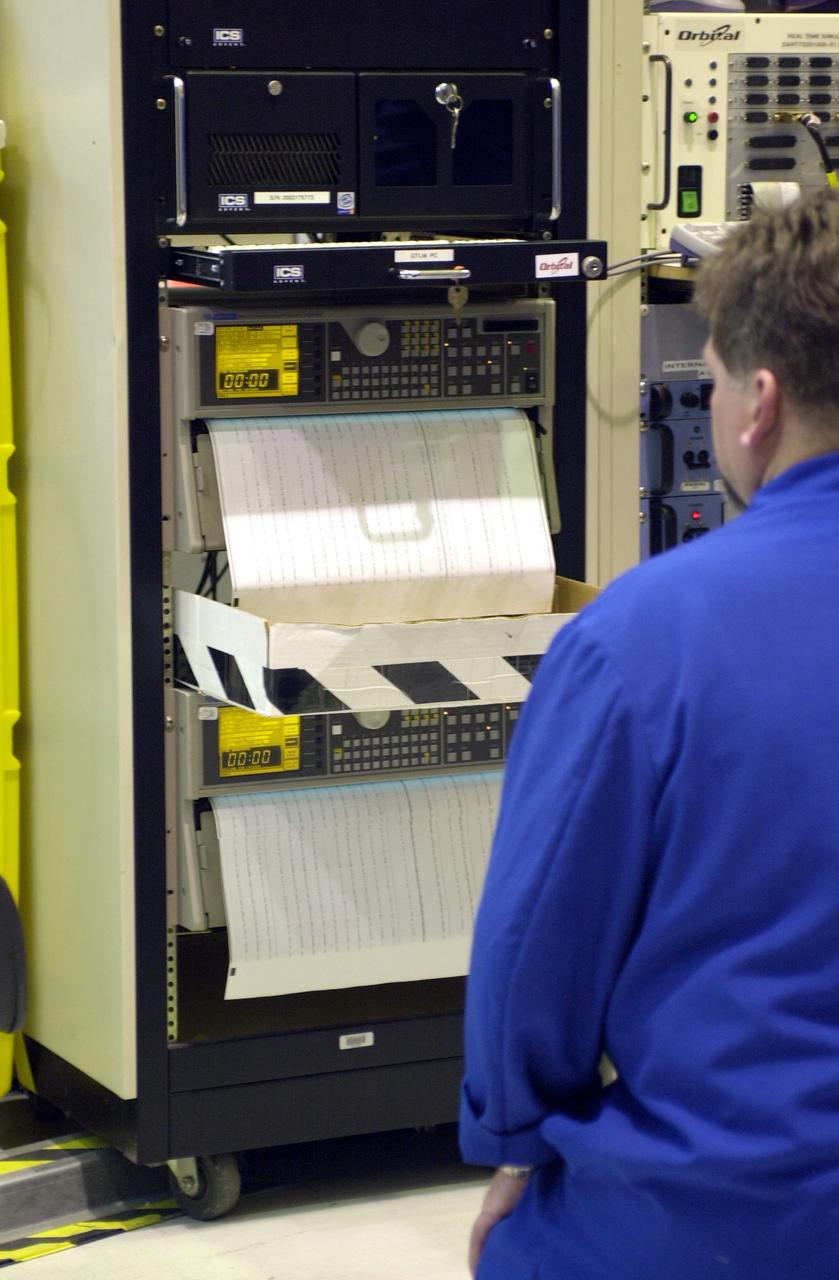
At Vandenberg Air Force Base in California, a worker monitors the data produced by the second flight simulation of the Orbital Sciences Pegasus XL rocket. The rocket is the launch vehicle for NASA's Aeronomy of Ice in the Mesosphere, or AIM, spacecraft. AIM is the seventh Small Explorers mission under NASA's Explorer Program. The program provides frequent flight opportunities for world-class scientific investigations from space within heliophysics and astrophysics. The AIM spacecraft will fly three instruments designed to study polar mesospheric clouds located at the edge of space, 50 miles above the Earth's surface in the coldest part of the planet's atmosphere. The mission's primary goal is to explain why these clouds form and what has caused them to become brighter and more numerous and appear at lower latitudes in recent years. AIM's results will provide the basis for the study of long-term variability in the mesospheric climate and its relationship to global climate change. AIM is scheduled to be mated to the Pegasus XL during the second week of April, after which final inspections will be conducted. Launch is scheduled for April 25.
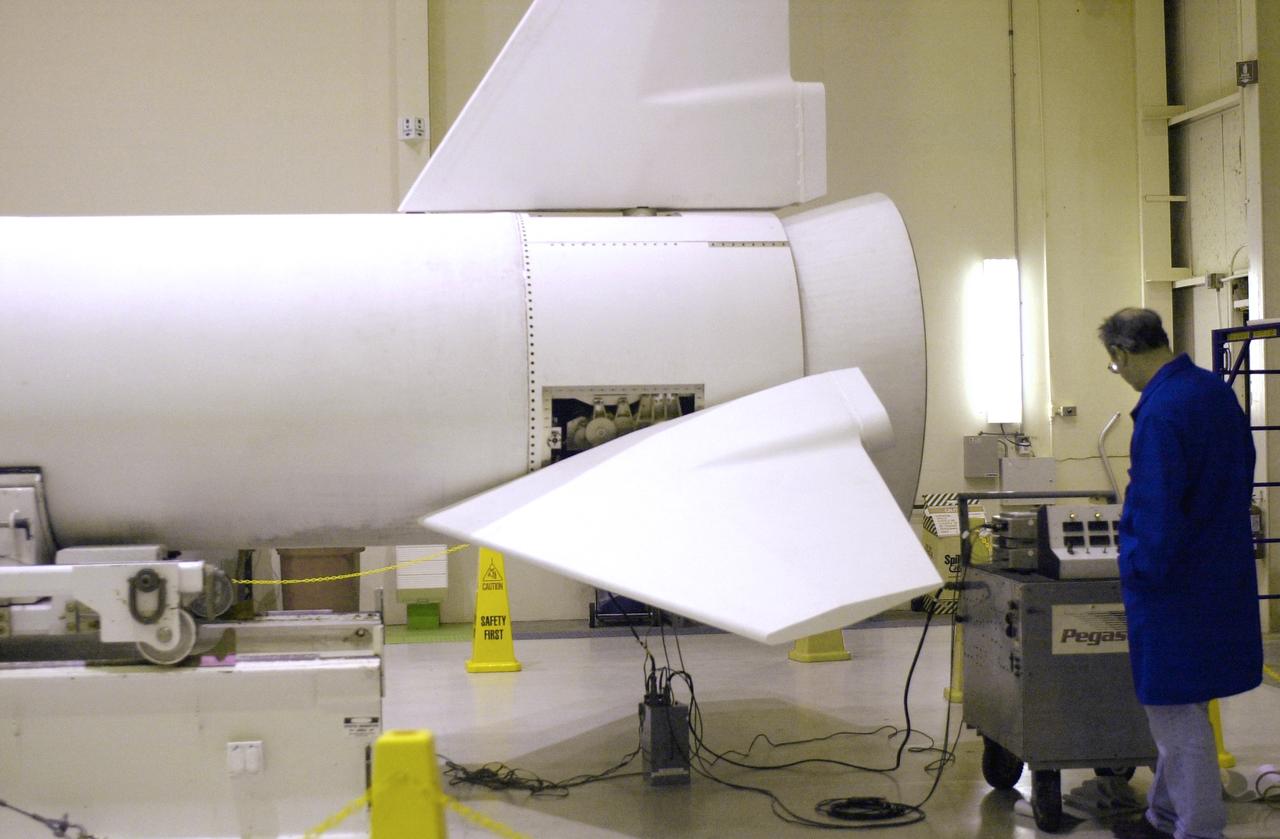
At Vandenberg Air Force Base in California, a worker monitors the Orbital Sciences Pegasus XL rocket after a second flight simulation. The rocket is the launch vehicle for NASA's Aeronomy of Ice in the Mesosphere, or AIM, spacecraft. AIM is the seventh Small Explorers mission under NASA's Explorer Program. The program provides frequent flight opportunities for world-class scientific investigations from space within heliophysics and astrophysics. The AIM spacecraft will fly three instruments designed to study polar mesospheric clouds located at the edge of space, 50 miles above the Earth's surface in the coldest part of the planet's atmosphere. The mission's primary goal is to explain why these clouds form and what has caused them to become brighter and more numerous and appear at lower latitudes in recent years. AIM's results will provide the basis for the study of long-term variability in the mesospheric climate and its relationship to global climate change. AIM is scheduled to be mated to the Pegasus XL during the second week of April, after which final inspections will be conducted. Launch is scheduled for April 25.

Tour of the Electrified Powertrain Flight Demonstration in the HyPER lab on June 17th, 2024 at Glenn Research Center. NASA’s Electrified Powertrain Flight Demonstration (EPFD) project focuses advancing the future of sustainable aviation by turning hybrid electric flight into a reality. HyPER is a hardware-in-the-loop laboratory that was designed specifically to investigate the dynamic interactions between turbomachinery, the electric power system, and the constantly varying loads of electrified aircraft. It is a small-scale lab capable of rapid reconfiguration through software. This allows the emulation of new engines using simulation models that are easily replaced and then appropriately scaled for power and inertia to the test hardware. Photo Credit: (NASA/Sara Lowthian-Hanna)
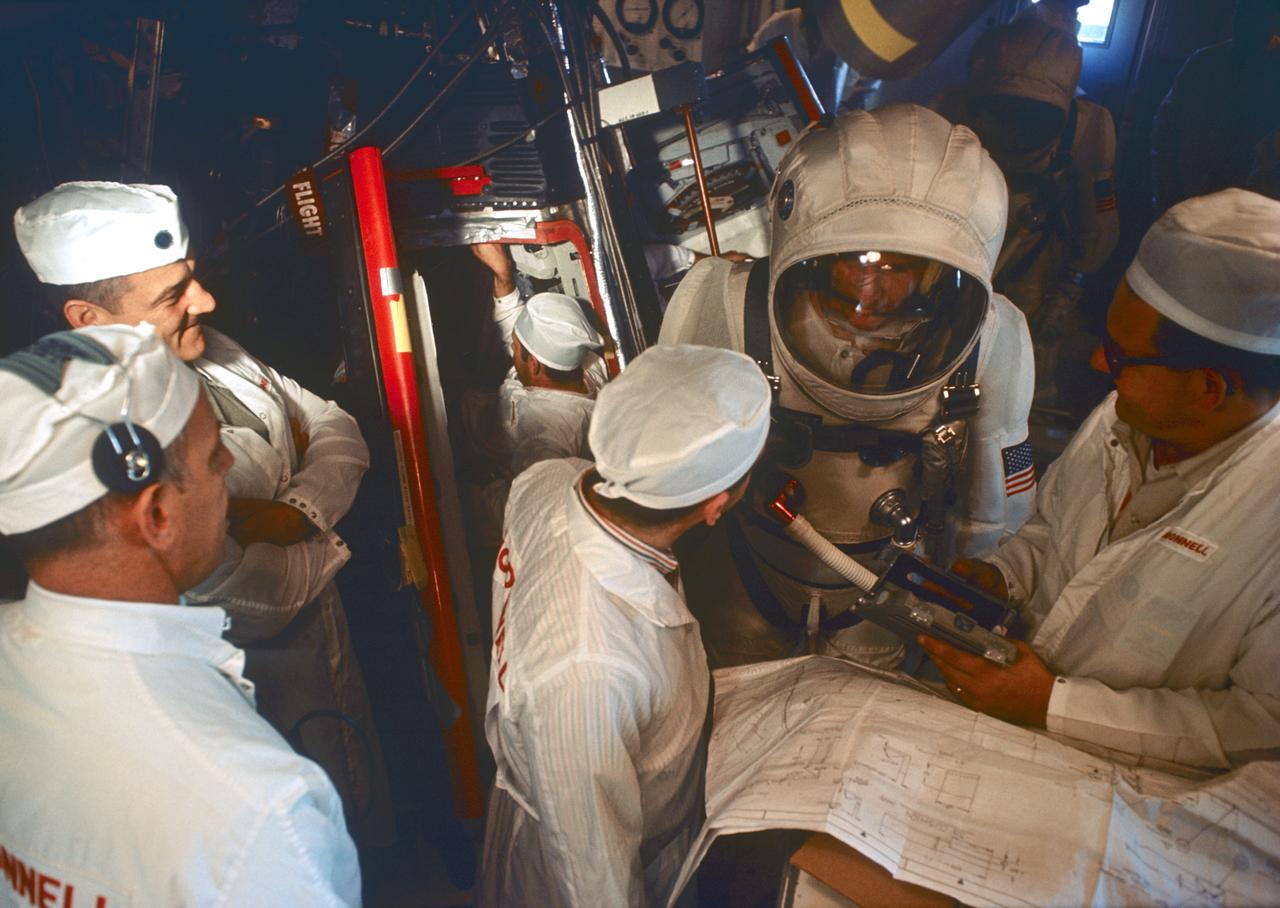
S65-61837 (27 Nov. 1965) --- The Gemini-7 backup crew seen in the White Room atop Pad 19 during Gemini-7 simulation flight activity. McDonnell Aircraft Corporation technicians assist in the exercise. Astronaut Edward H. White II (in foreground) is the Gemini-7 backup crew command pilot; and astronaut Michael Collins (right background) is the backup crew pilot. Photo credit: NASA
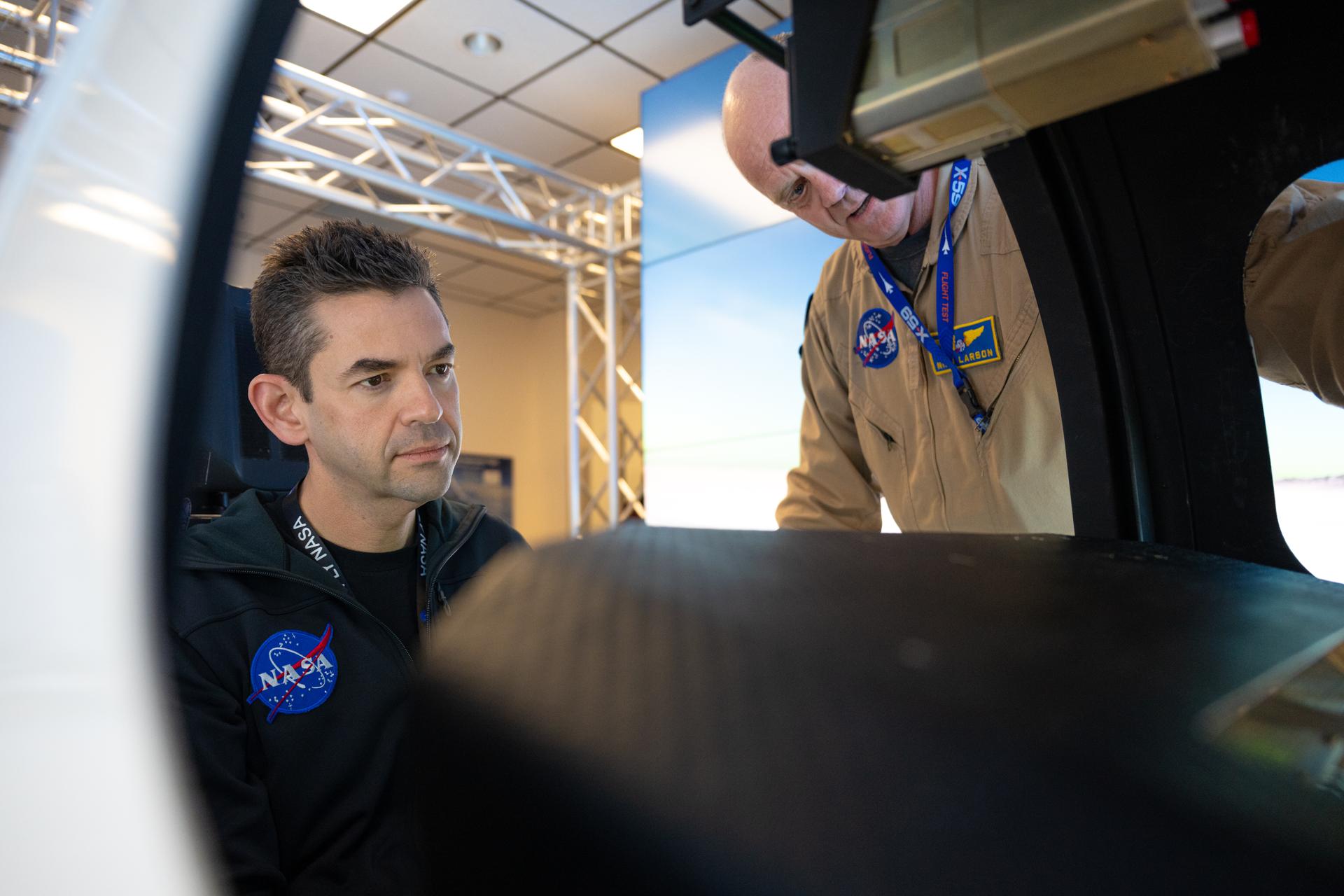
NASA Administrator Jared Isaacman, left, is seen in the X-59 flight simulator alongside Nils Larson, NASA pilot, right, Sunday, Jan. 25, 2026, at NASA’s Armstrong Flight Research Center at Edwards Air Force Base in California. Armstrong marks the ninth stop in Isaacman’s roadshow to visit NASA facilities and engage directly with the agency’s workforce. Photo Credit: (NASA/John Kraus)
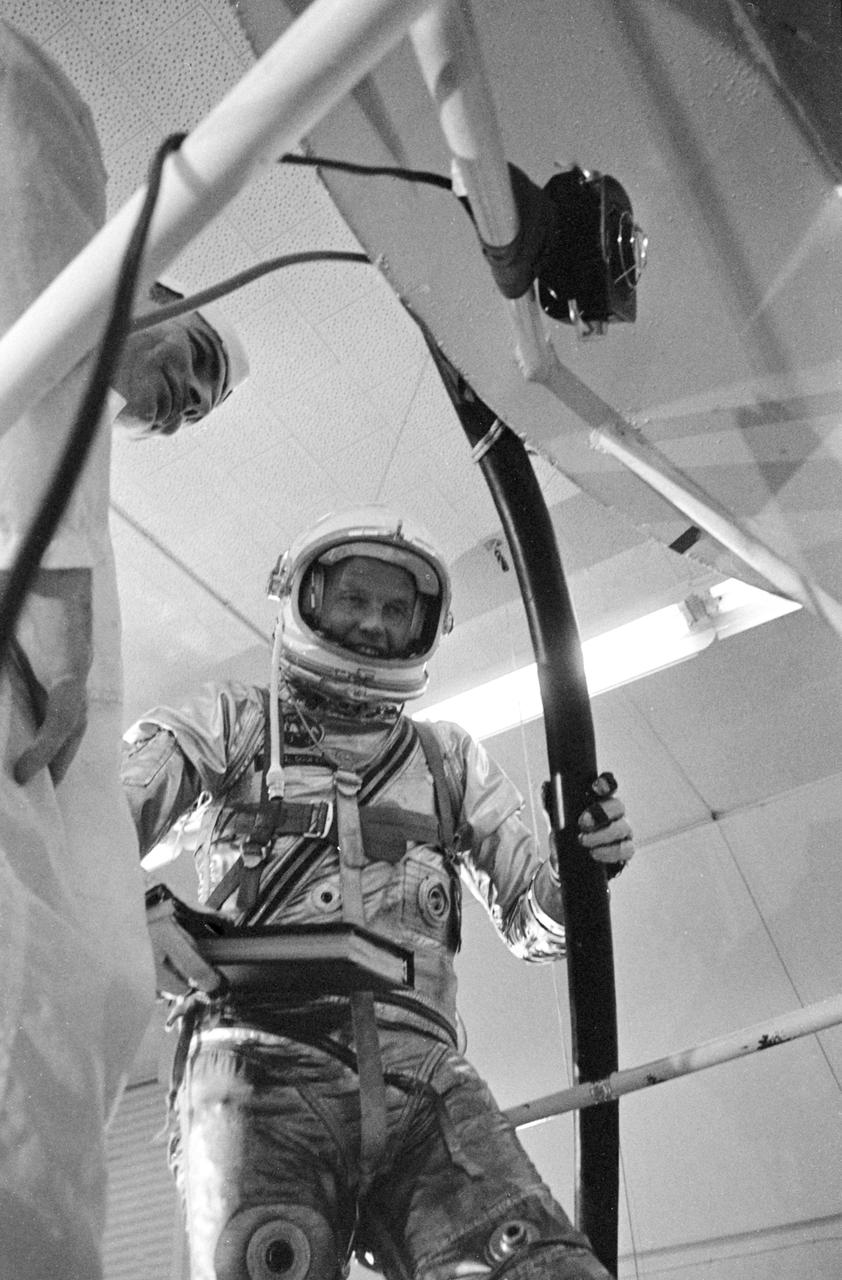
S63-03975 (1963) --- Astronaut L. Gordon Cooper Jr., prime pilot for the Mercury-Atlas 9 (MA-9) mission, is pictured prior to entering the Mercury spacecraft for a series of simulated flight tests. During these tests NASA doctors, engineers and technicians monitor Cooper's performance. Photo credit: NASA
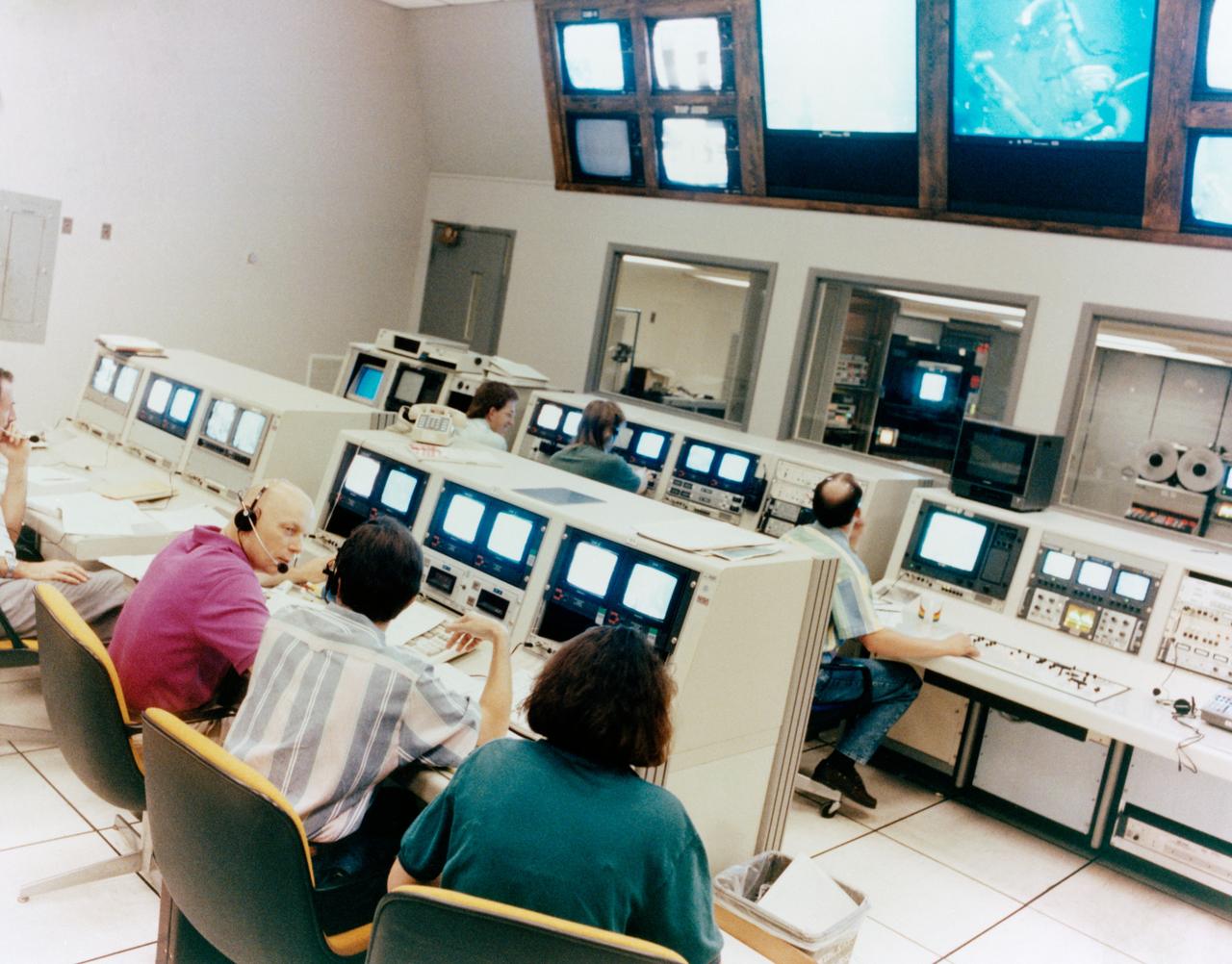
Astronauts Jeffrey A. Hoffman (far left) and F. Story Musgrave (second left) monitor a training session from consoles in the control room for the Neutral Buoyancy Simulator (NBS) at the Marshall Space Flight Center (MSFC). Seen underwater in the NBS on the big screen and the monitors at the consoles is astronaut Thomas D. Akers. The three mission specialists, along with astronaut Kathryn C. Thornton, are scheduled to be involved in a total of five sessions of extravehicular activity (EVA) to service the Hubble Space Telescope (HST) in orbit during the STS-61 mission, scheduled for December 1993.
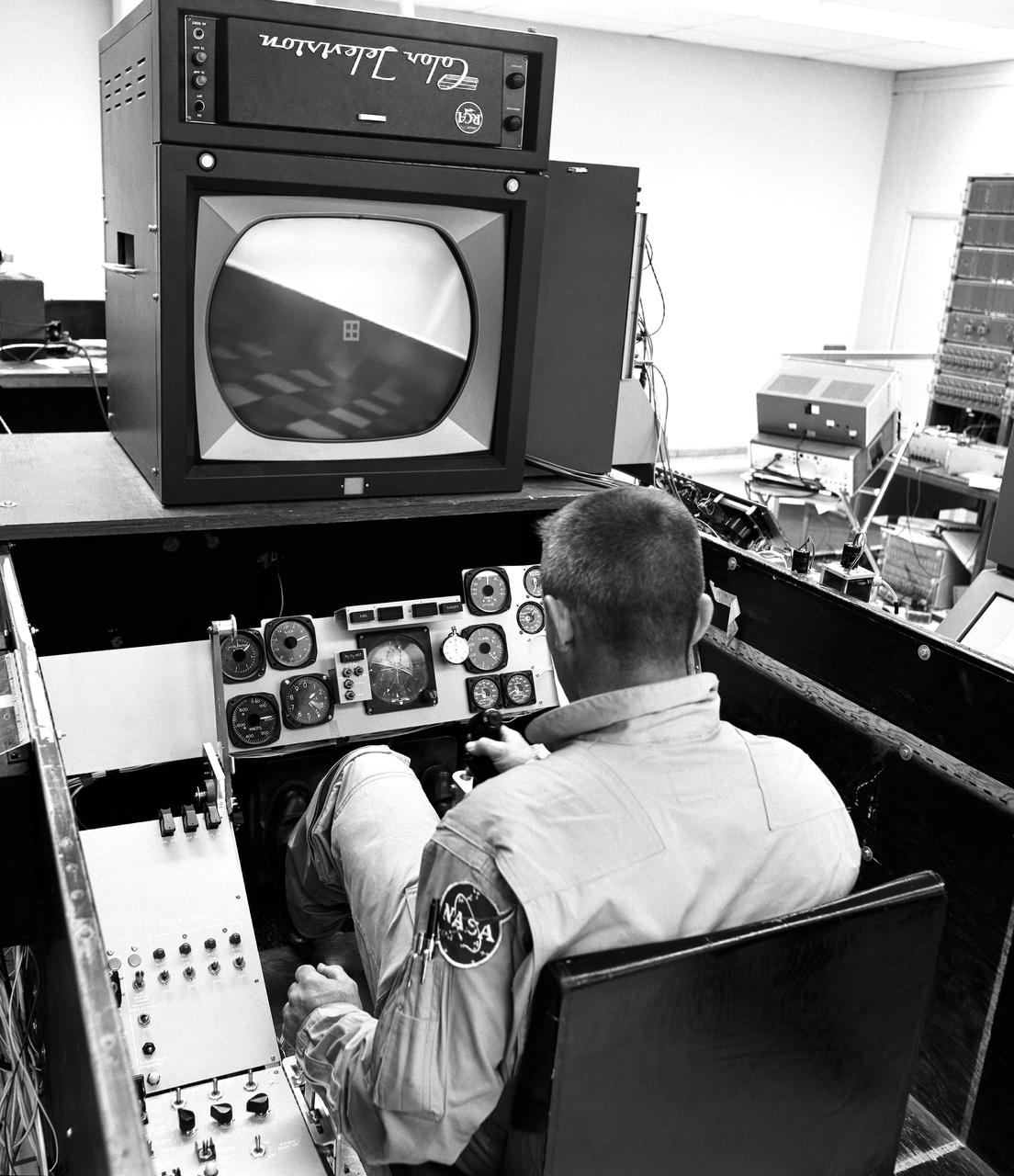
As shown in this photo of the HL-10 flight simulator, the lifting-body pilots and engineers made use of early simulators for both training and the determination of a given vehicle's handling at various speeds, attitudes, and altitudes. This provided warning of possible problems.
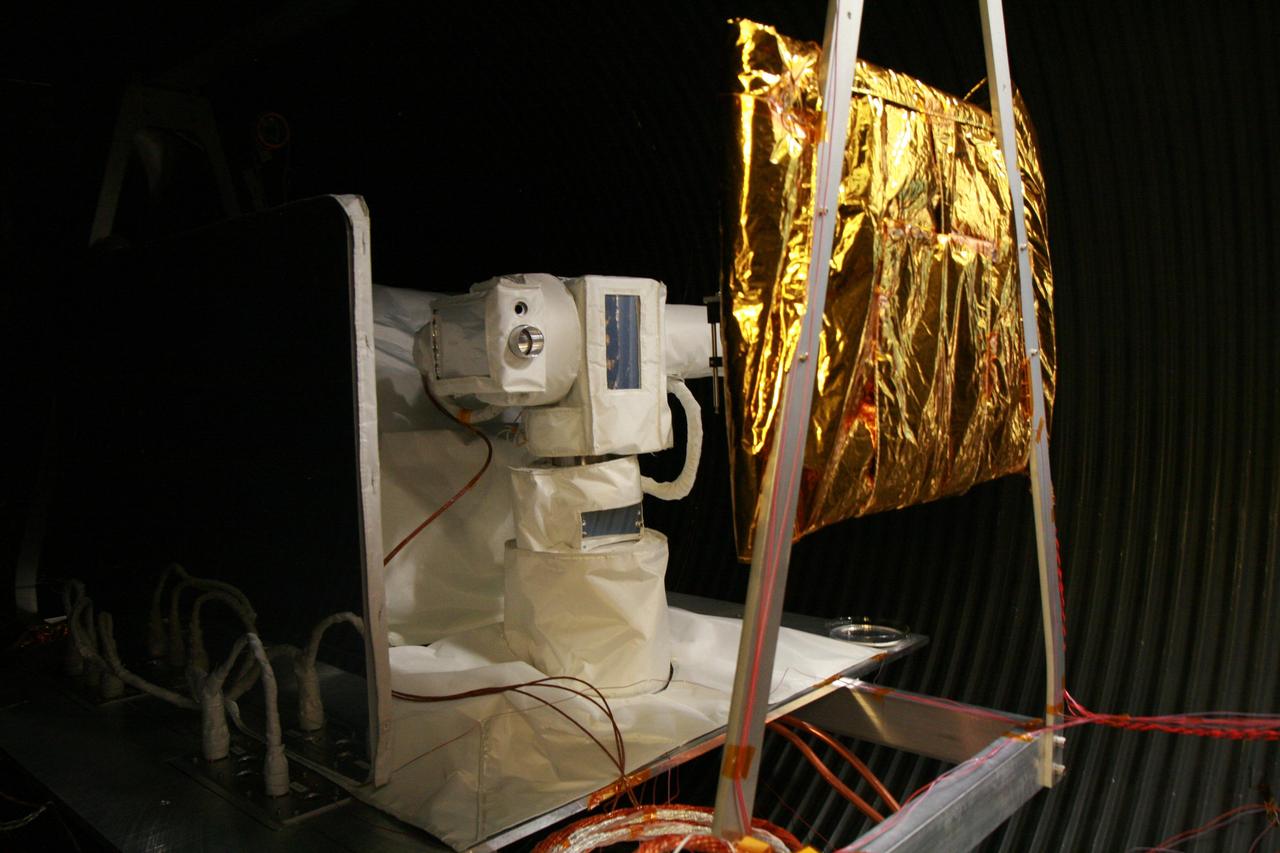
The Optical PAyload for Lasercomm Science OPALS flight terminal undergoes testing in a thermal vacuum chamber at NASA Jet Propulsion Laboratory to simulate the space environment.
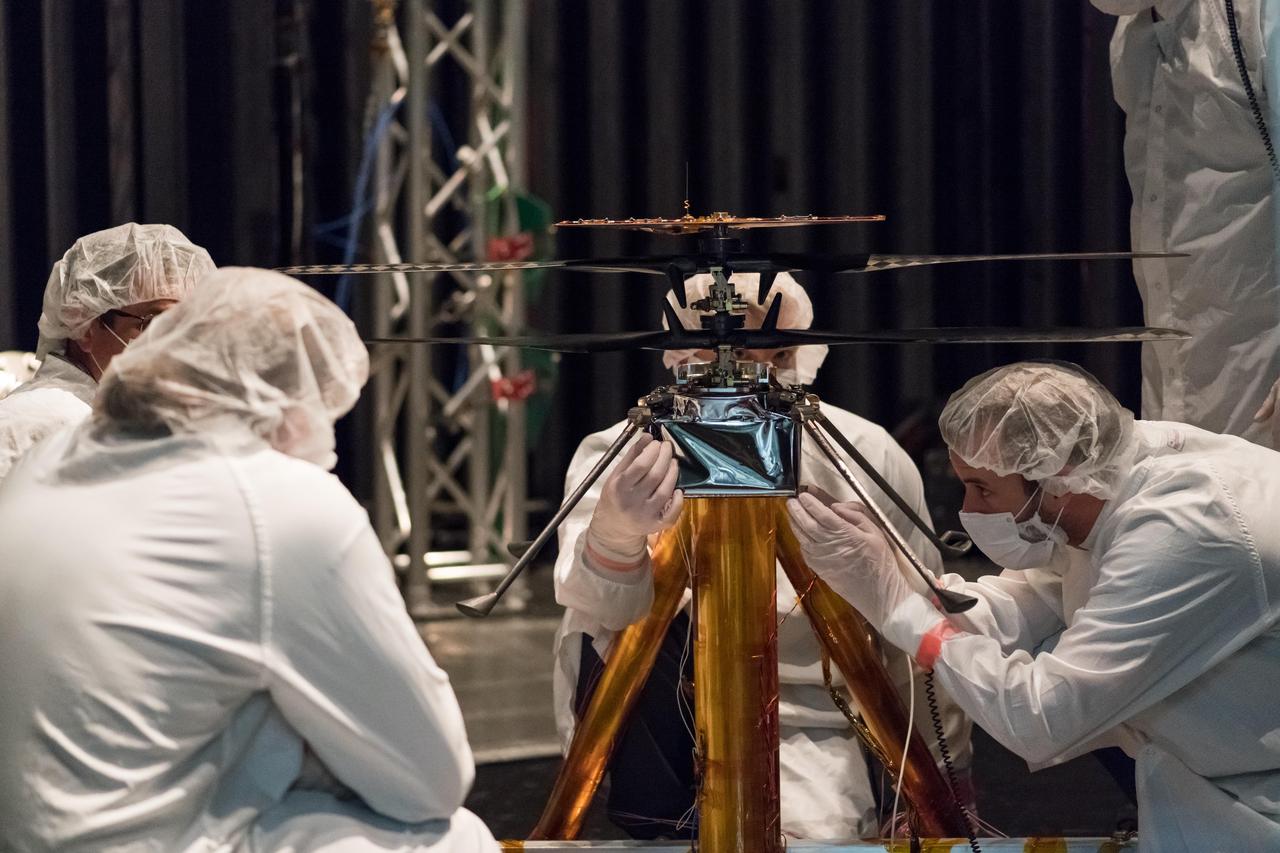
NASA Mars Helicopter team members work the flight model (the vehicle going to Mars) in the Space Simulator, a 25-foot-wide (7.62-meter-wide) vacuum chamber, at NASA's Jet Propulsion Laboratory in Pasadena, California. The image was taken on Feb. 1, 2019. https://photojournal.jpl.nasa.gov/catalog/PIA23152
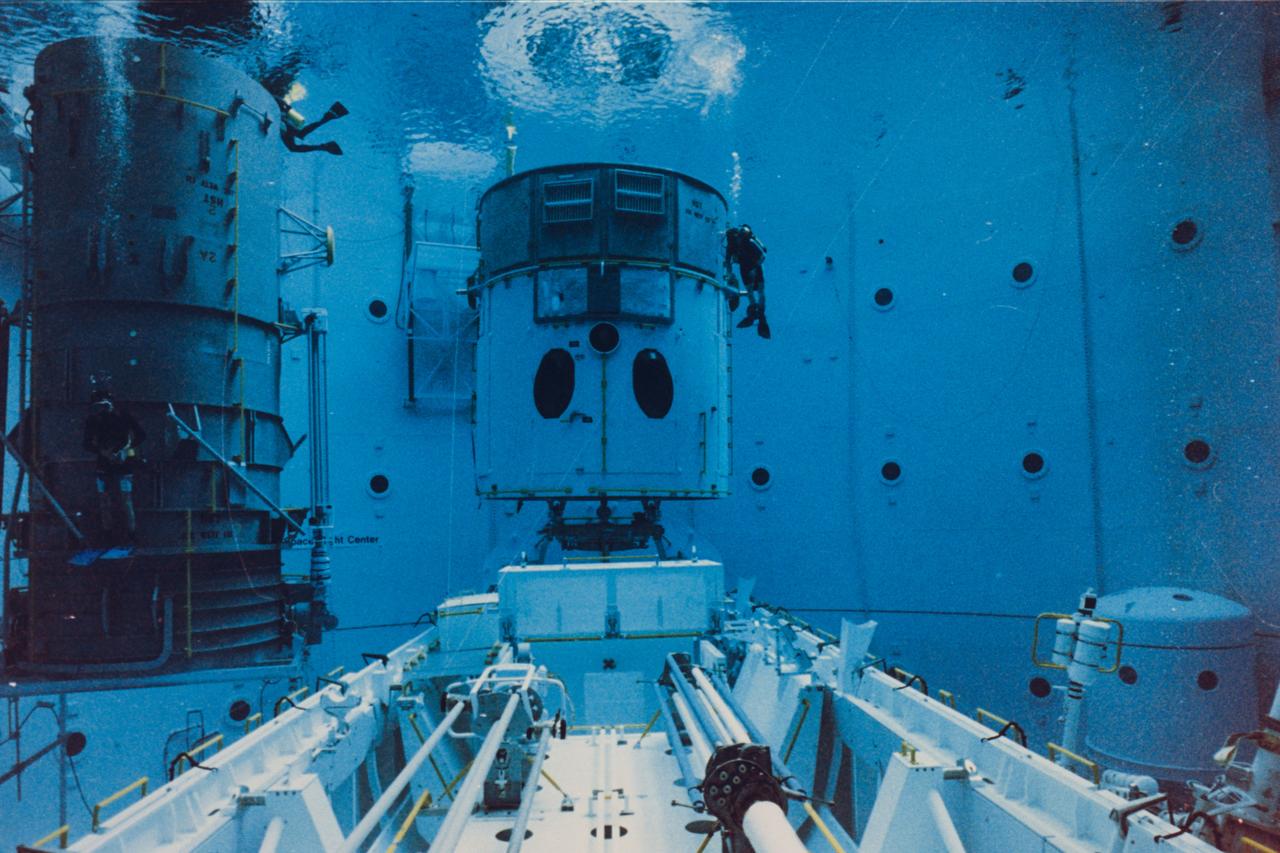
Safety divers in the Neutral Buoyancy Simulator (NBS) at the Marshall Space Flight Center (MSFC) prepare a mockup of the Hubble Space Telescope (HST) for one of 32 separate training sessions conducted by four of the STS-61 crew members in June. The three-week process allowed mission trainers to refine the timelines for the five separate spacewalks scheduled to be conducted on the actual mission scheduled for December 1993. The HST is separated into two pieces since the water tank depth cannot support the entire structure in one piece. The full length payload bay mockup shows the Solar Array Carrier in the foreground and the various containers that will house replacement hardware that will be carried on the mission.
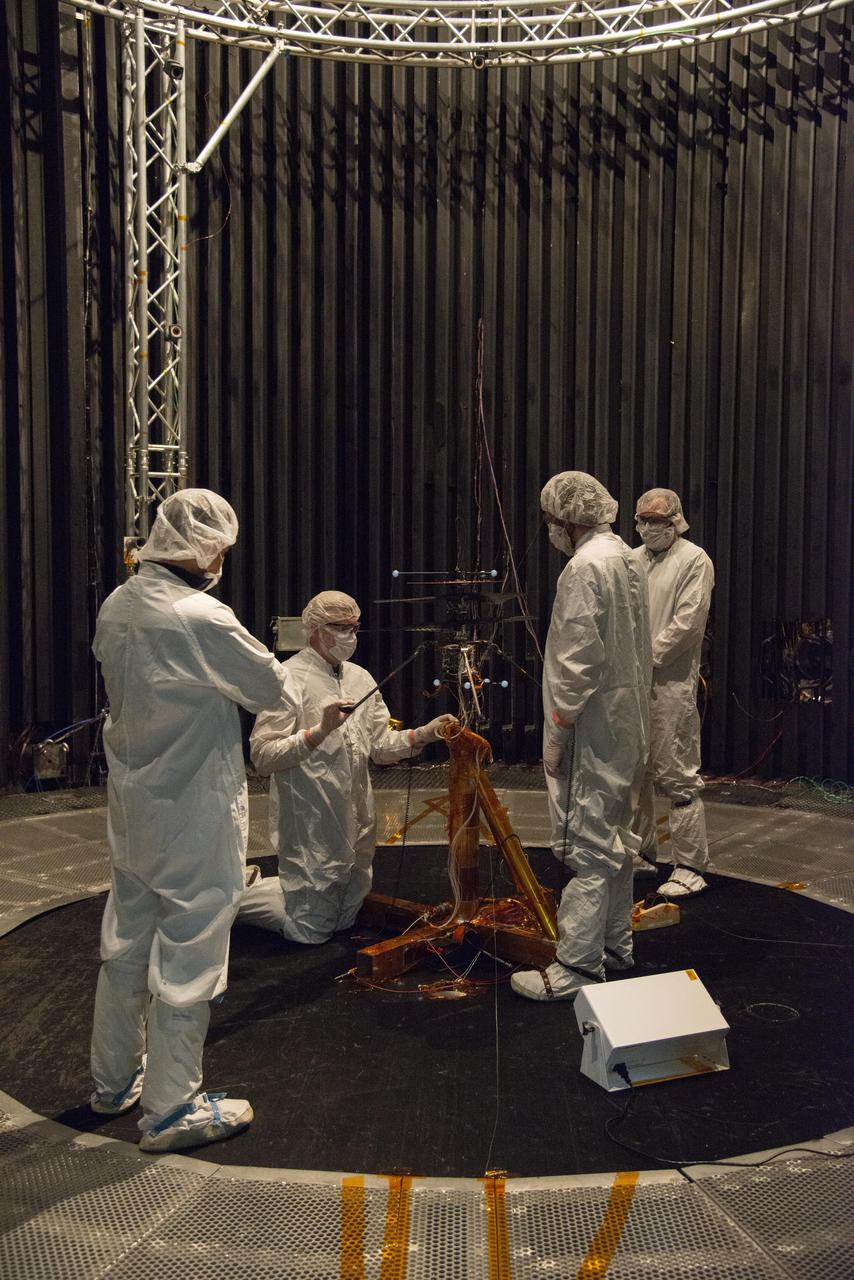
Members of NASA's Mars Helicopter team prepare the flight model (vehicle going to Mars) for a test in the Space Simulator, a 25-foot-wide (7.62-meter-wide) vacuum chamber at NASA's Jet Propulsion Laboratory in Pasadena, California. The image was taken on Jan. 18, 2019. https://photojournal.jpl.nasa.gov/catalog/PIA23156
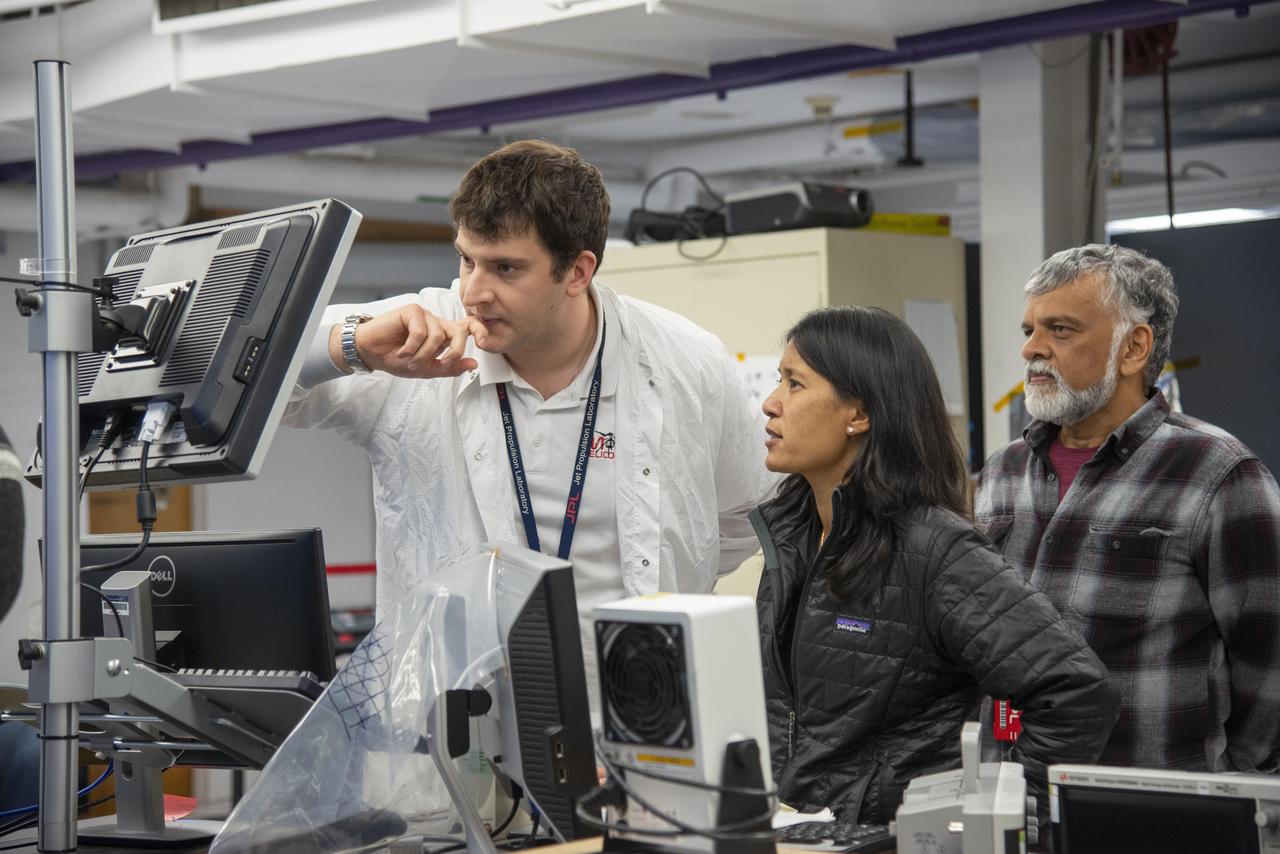
Teddy Tzanetos, MiMi Aung and Bob Balaram of NASA's Mars Helicopter project observe a flight test. The image was taken on Jan. 18, 2019 as the flight model of the Mars Helicopter was tested in the Space Simulator, a 25-foot-wide (7.62 meter-wide) vacuum chamber at NASA's Jet Propulsion Laboratory in Pasadena, California. https://photojournal.jpl.nasa.gov/catalog/PIA23161
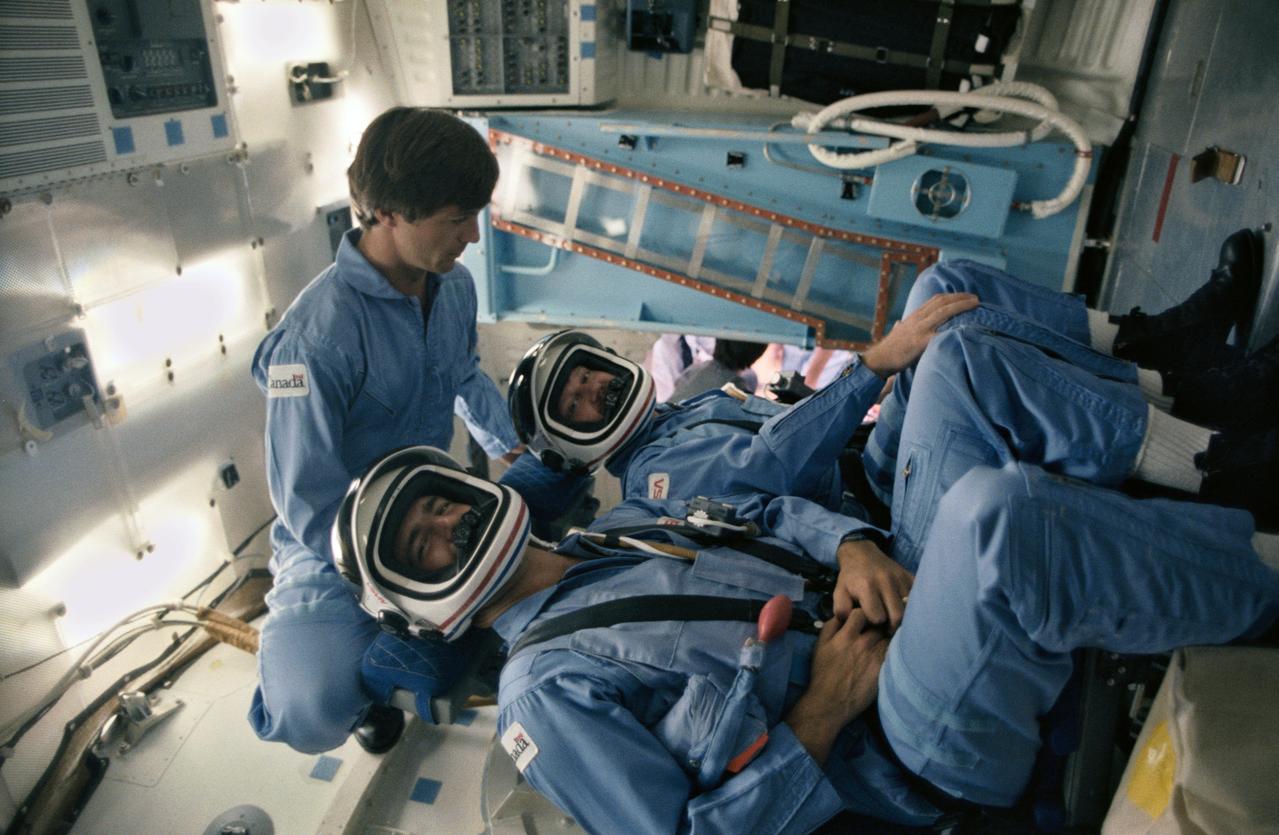
41D-3138 (4 Sept 1984)--- Canada's backup payload specialist assists the two 41-G prime payload specialists during a training session in the Johnson Space Center's Shuttle mockup and integration laboratory. Robert Thirsk (without helmet) represents the National Research Council (NRC) and is backup to Marc Garneau (nearest camera), also of the NRC. Paul D. Scully-Power, seated in the other middeck seat for the launch phase, is a civilian oceanographer with the U.S. Navy. The 41-G flight aboard the Challenger is NASA's first to utilize a crew of more than six persons. This photograph was taken by Otis Imboden.
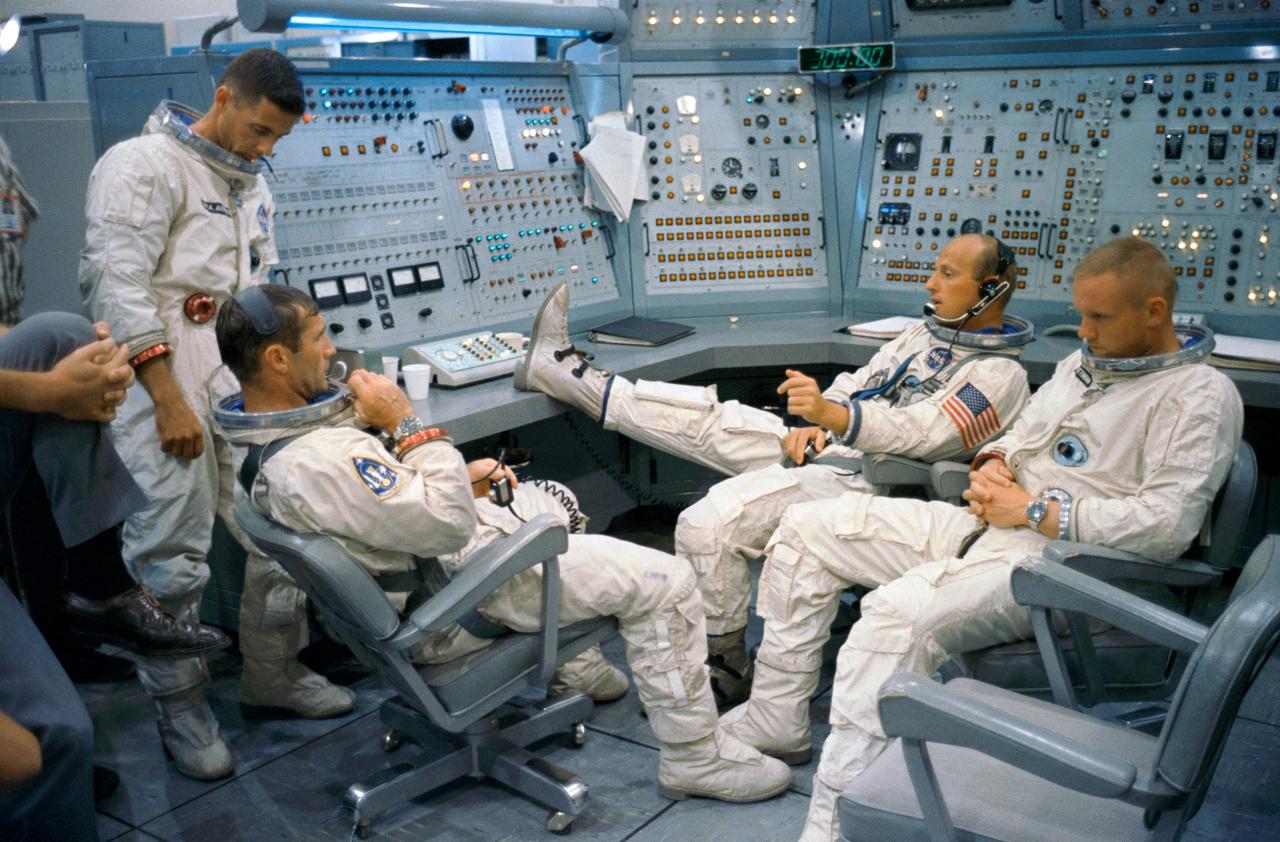
S66-50769 (8 Sept. 1966) --- Gemini-11 prime and backup crews are pictured at the Gemini Mission Simulator at Cape Kennedy, Florida. Left to right are astronauts William A. Anders, backup crew pilot; Richard F. Gordon Jr., prime crew pilot; Charles Conrad Jr. (foot on desk), prime crew command pilot; and Neil A. Armstrong, backup crew command pilot. Photo credit: NASA
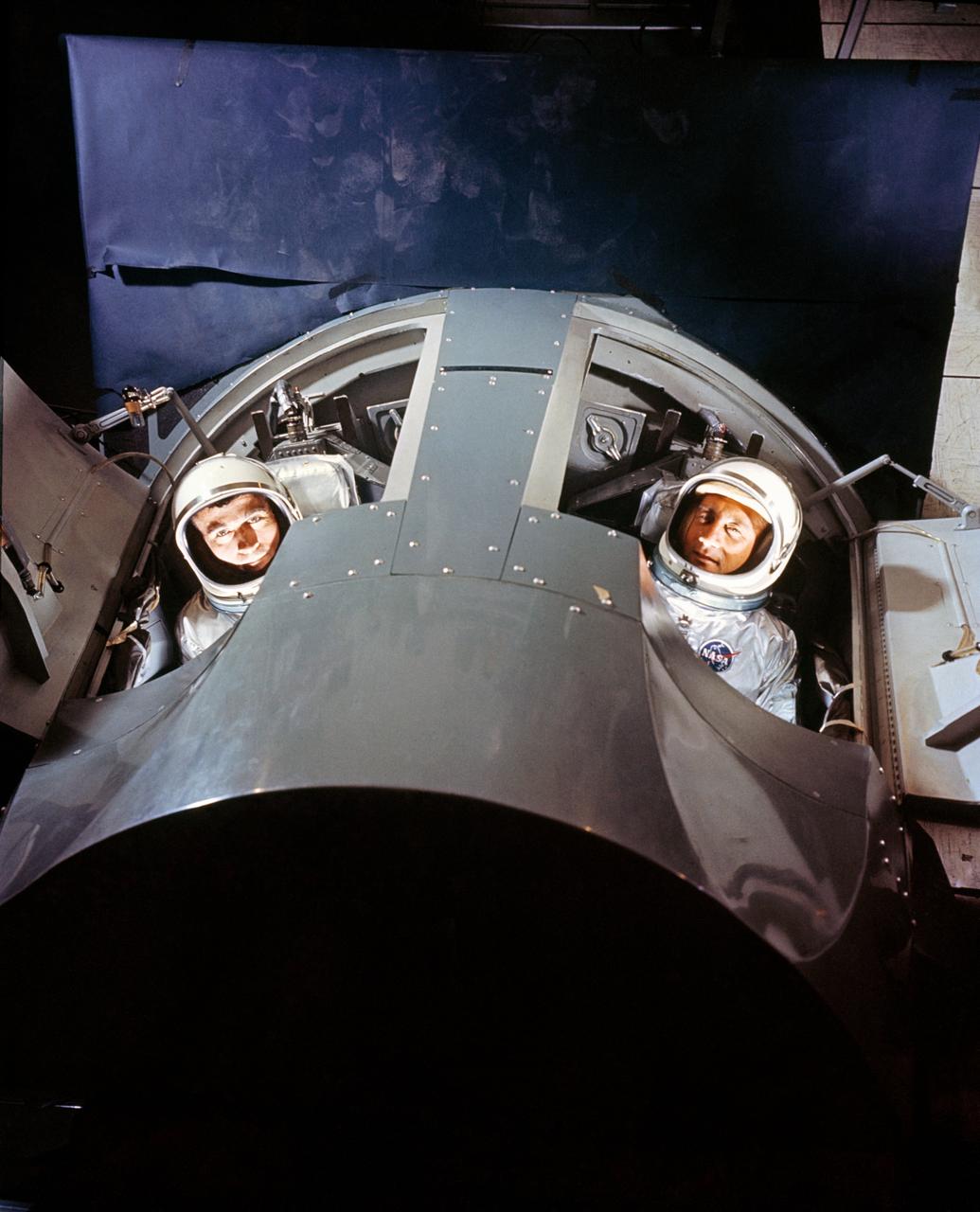
S64-25295 (March 1964) --- Astronauts Virgil I. (Gus) Grissom (right) and John W. Young, prime crew for the first manned Gemini mission (GT-3), are shown inside a Gemini mission simulator at McDonnell Aircraft Corp., St. Louis, MO. The simulator will provide Gemini astronauts and ground crews with realistic mission simulation during intensive training prior to actual launch.
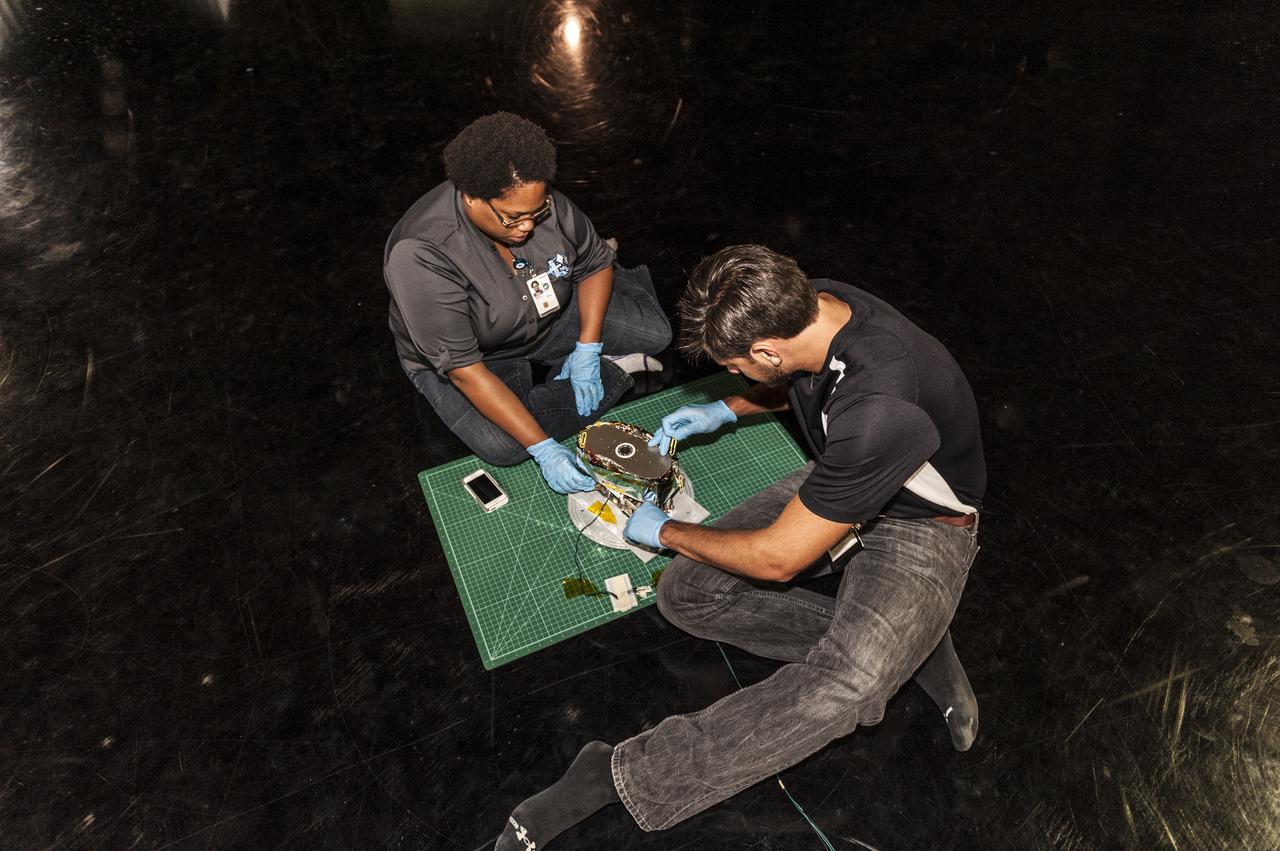
NEAR EARTH ASTEROID (NEA) SAIL TEAM PERFORMING A DEPLOYMENT OF THE FLIGHT-LIKE ENGINEERING DEVELOPMENT UNIT SOLAR SAIL. THE SAIL WAS MANUFACTURED AT NEXOLVE (HSV, AL) AND DEPLOYED FOR THE FIRST TIME AT MSFC ON AUGUST 4TH, 2016
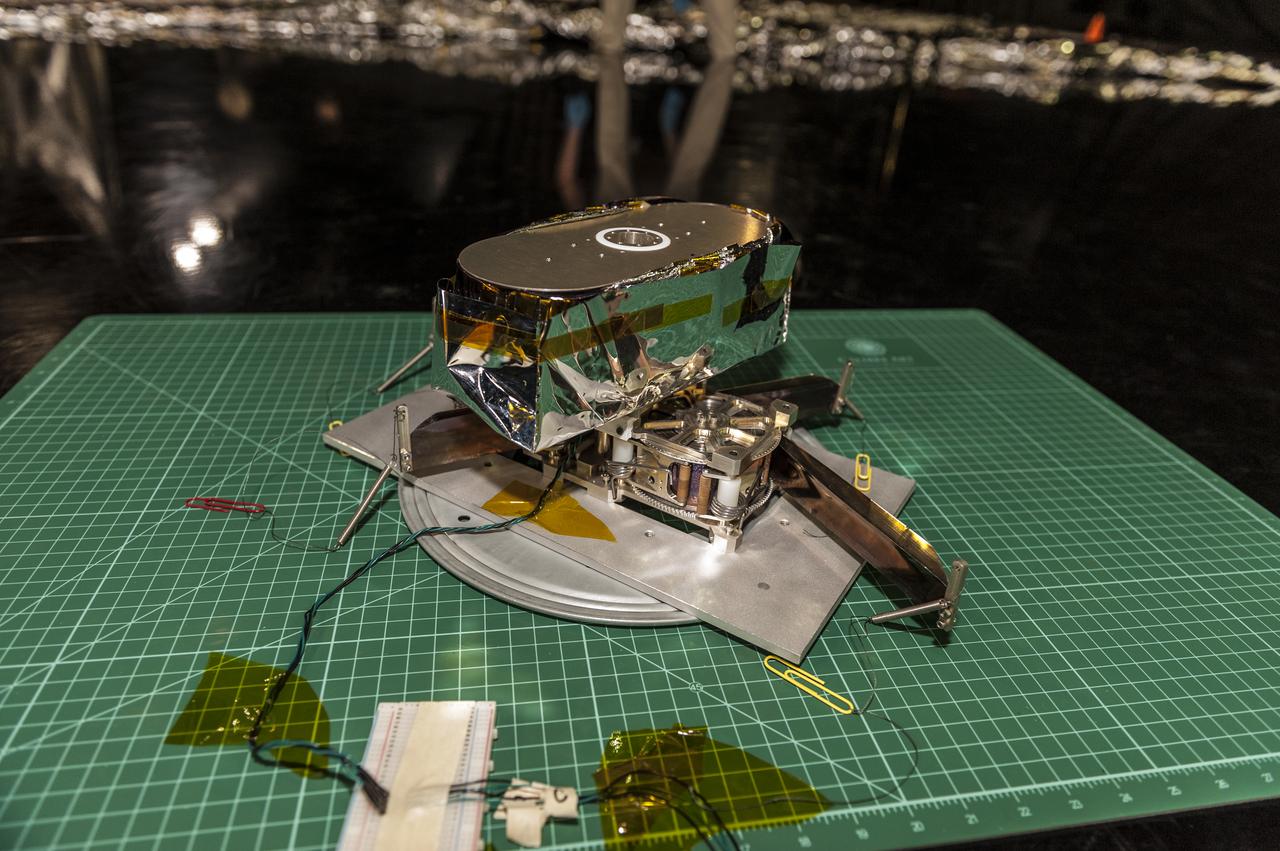
NEAR EARTH ASTEROID (NEA) SAIL TEAM PERFORMING A DEPLOYMENT OF THE FLIGHT-LIKE ENGINEERING DEVELOPMENT UNIT SOLAR SAIL. THE SAIL WAS MANUFACTURED AT NEXOLVE (HSV, AL) AND DEPLOYED FOR THE FIRST TIME AT MSFC ON AUGUST 4TH, 2016
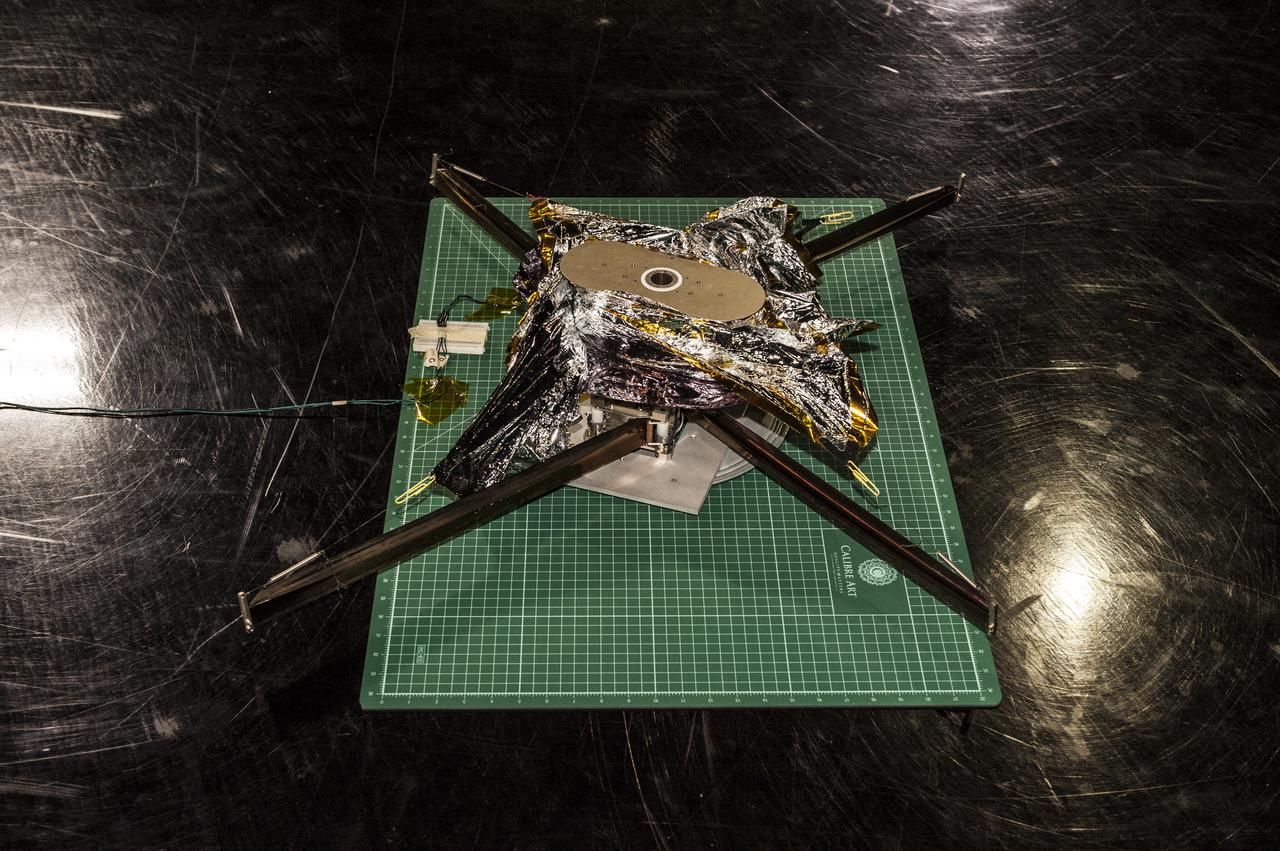
NEAR EARTH ASTEROID (NEA) SAIL TEAM PERFORMING A DEPLOYMENT OF THE FLIGHT-LIKE ENGINEERING DEVELOPMENT UNIT SOLAR SAIL. THE SAIL WAS MANUFACTURED AT NEXOLVE (HSV, AL) AND DEPLOYED FOR THE FIRST TIME AT MSFC ON AUGUST 4TH, 2016
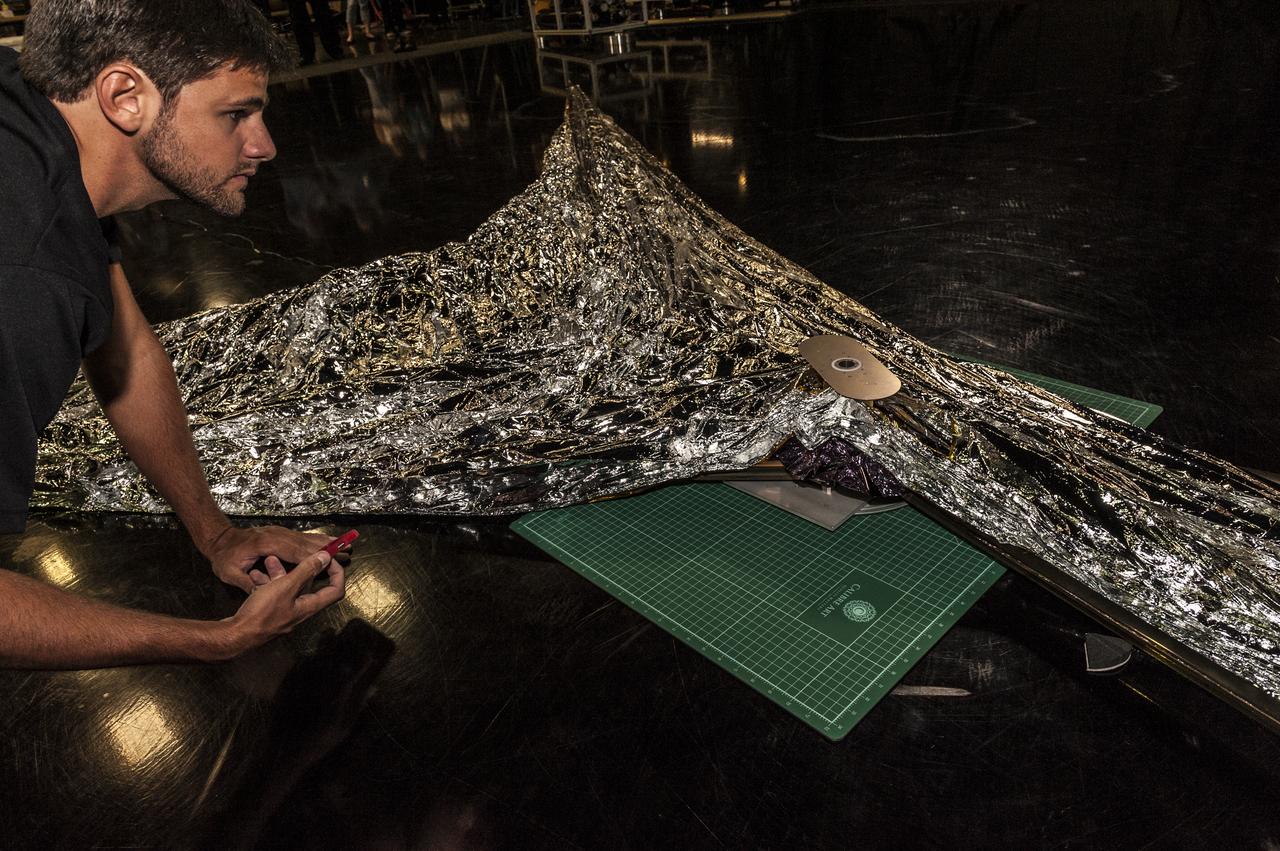
NEAR EARTH ASTEROID (NEA) SAIL TEAM PERFORMING A DEPLOYMENT OF THE FLIGHT-LIKE ENGINEERING DEVELOPMENT UNIT SOLAR SAIL. THE SAIL WAS MANUFACTURED AT NEXOLVE (HSV, AL) AND DEPLOYED FOR THE FIRST TIME AT MSFC ON AUGUST 4TH, 2016
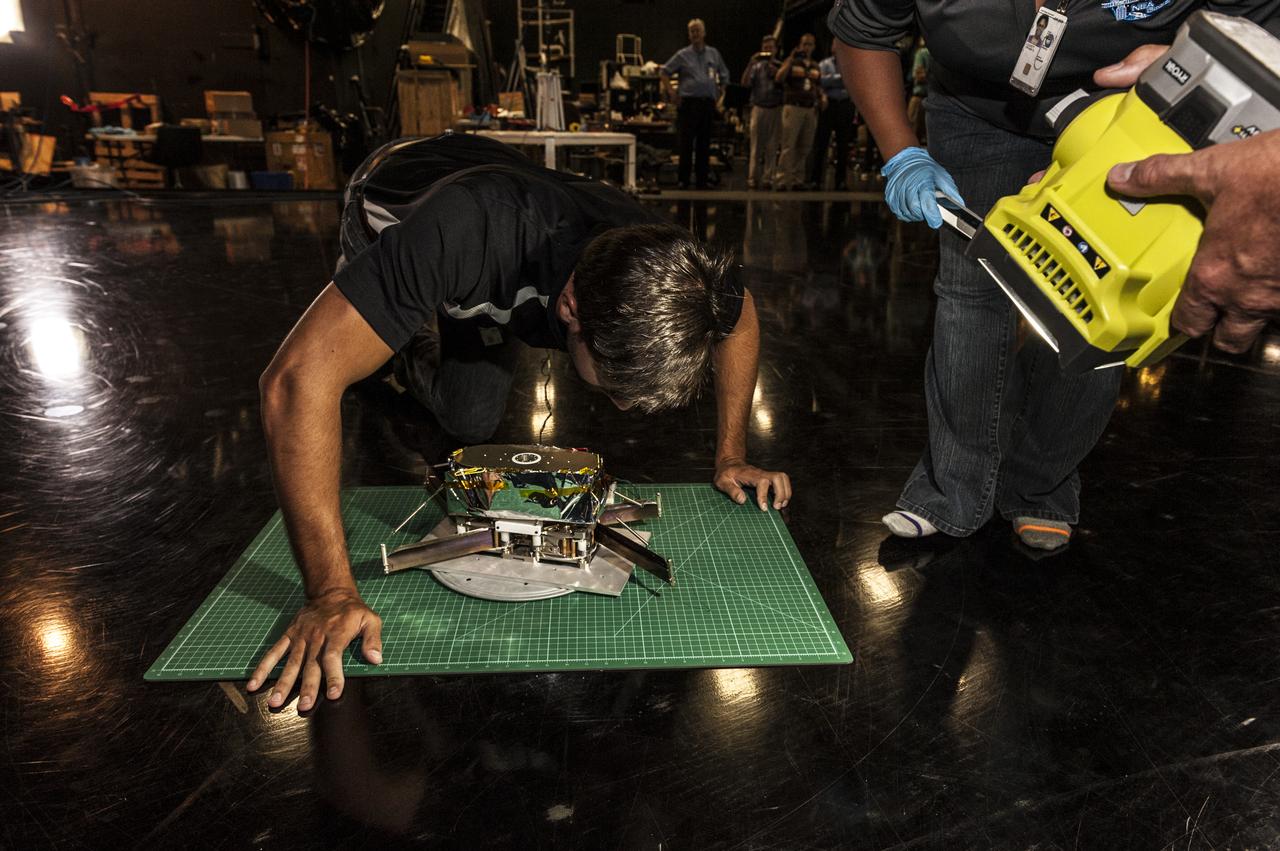
NEAR EARTH ASTEROID (NEA) SAIL TEAM PERFORMING A DEPLOYMENT OF THE FLIGHT-LIKE ENGINEERING DEVELOPMENT UNIT SOLAR SAIL. THE SAIL WAS MANUFACTURED AT NEXOLVE (HSV, AL) AND DEPLOYED FOR THE FIRST TIME AT MSFC ON AUGUST 4TH, 2016
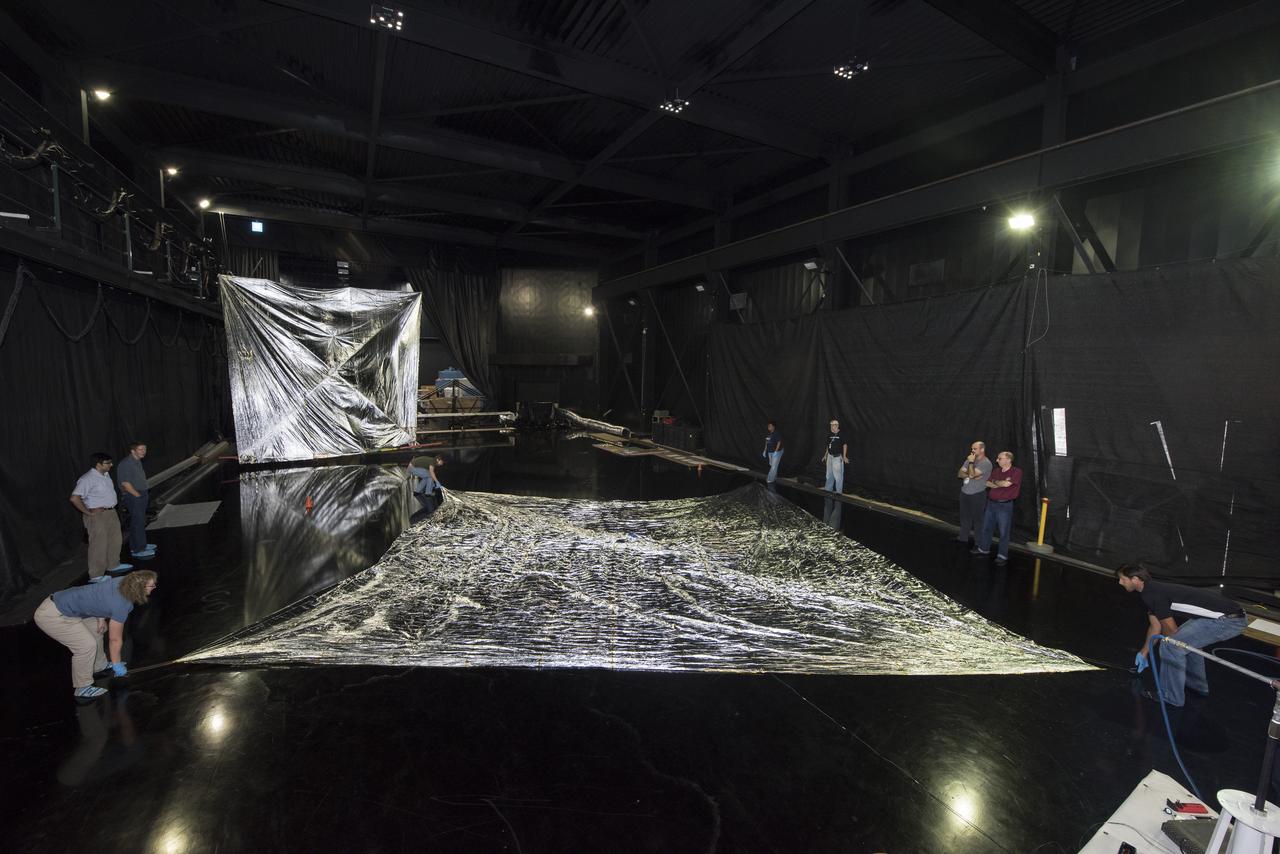
NEAR EARTH ASTEROID (NEA) SAIL TEAM PERFORMING A DEPLOYMENT OF THE FLIGHT-LIKE ENGINEERING DEVELOPMENT UNIT SOLAR SAIL. THE SAIL WAS MANUFACTURED AT NEXOLVE (HSV, AL) AND DEPLOYED FOR THE FIRST TIME AT MSFC ON AUGUST 4TH, 2016
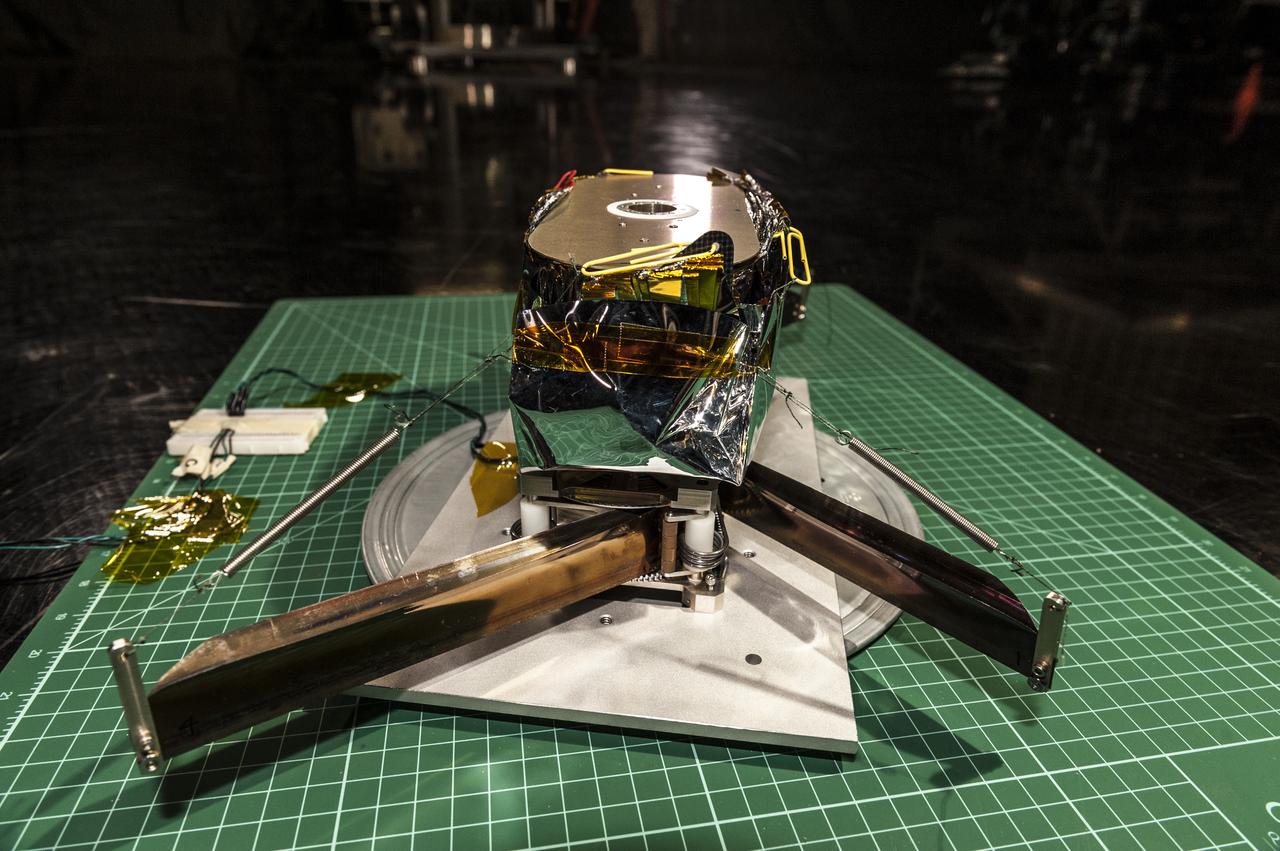
NEAR EARTH ASTEROID (NEA) SAIL TEAM PERFORMING A DEPLOYMENT OF THE FLIGHT-LIKE ENGINEERING DEVELOPMENT UNIT SOLAR SAIL. THE SAIL WAS MANUFACTURED AT NEXOLVE (HSV, AL) AND DEPLOYED FOR THE FIRST TIME AT MSFC ON AUGUST 4TH, 2016