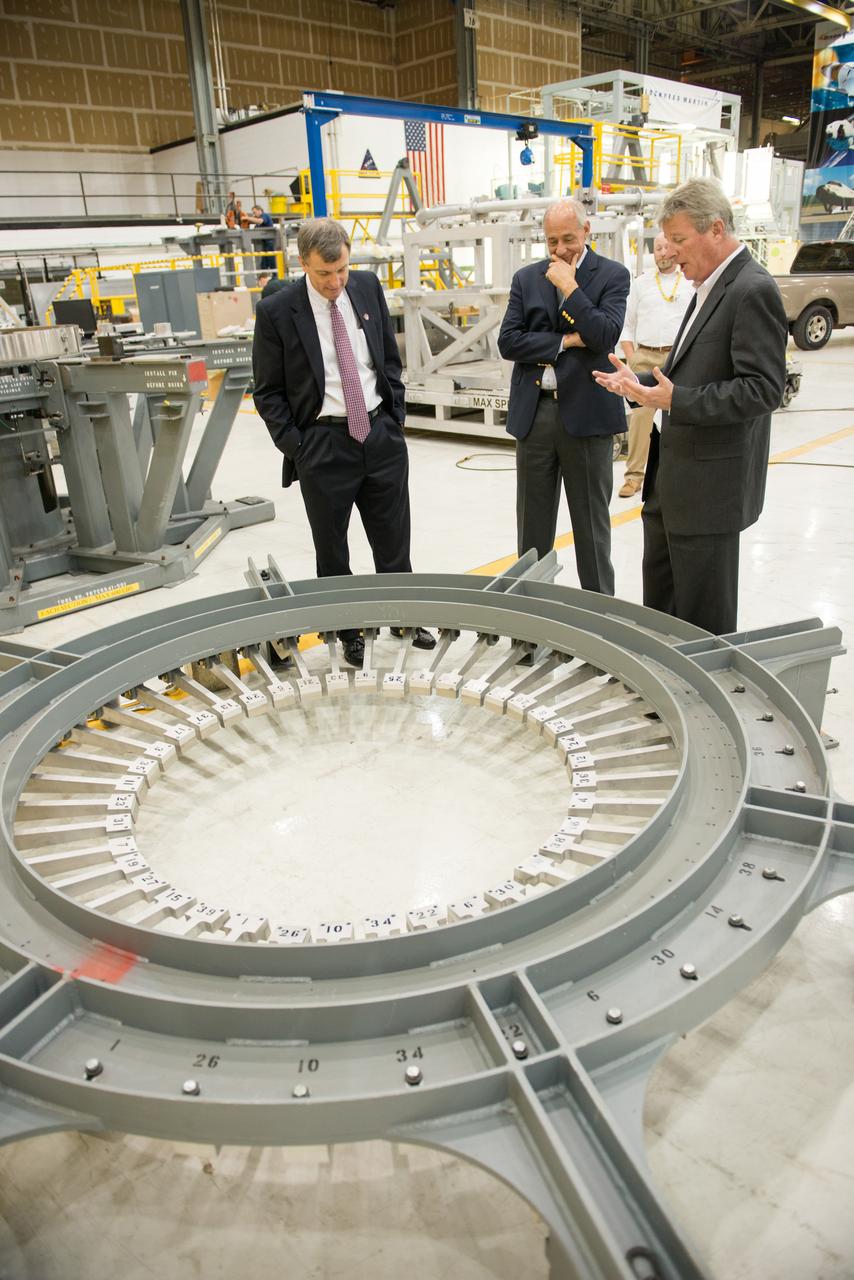
Mark Kirasich visit
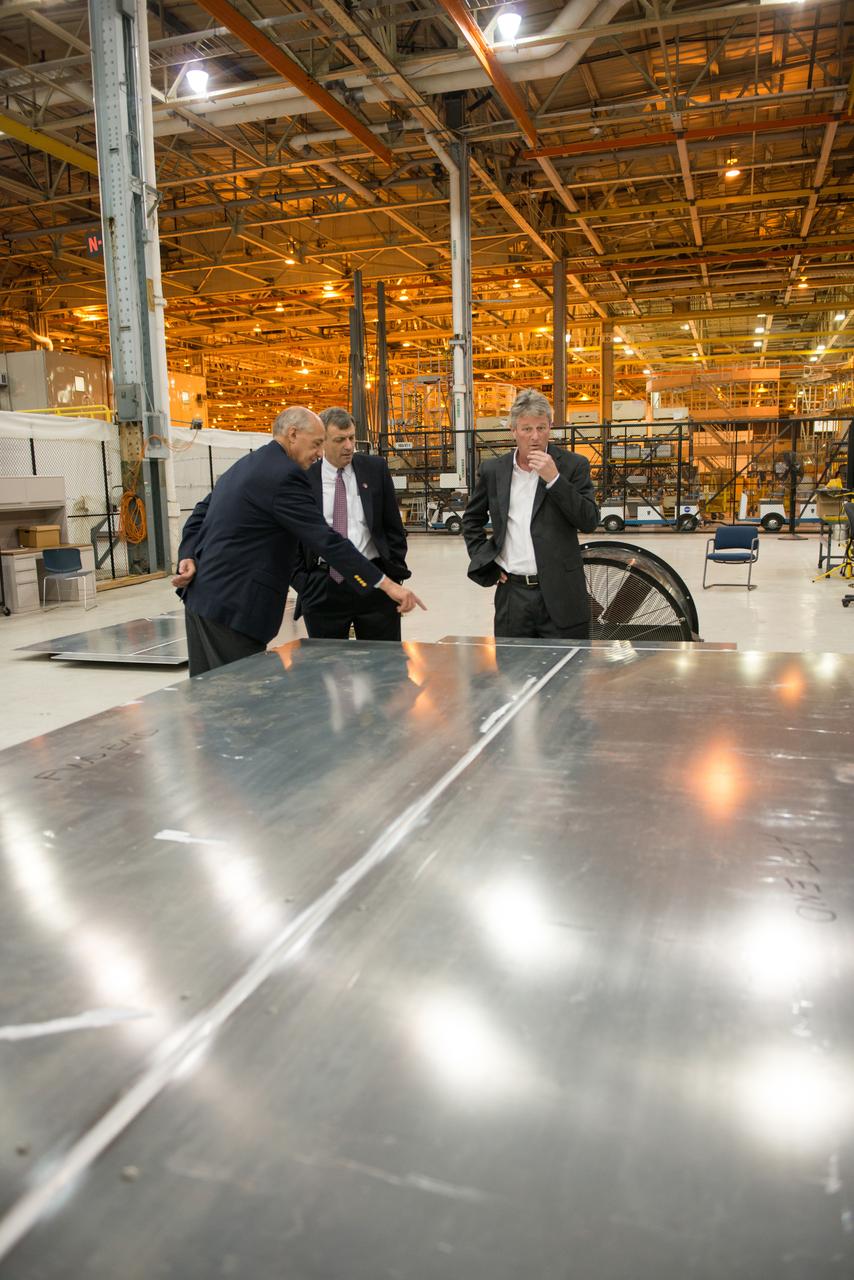
Mark Kirasich visit
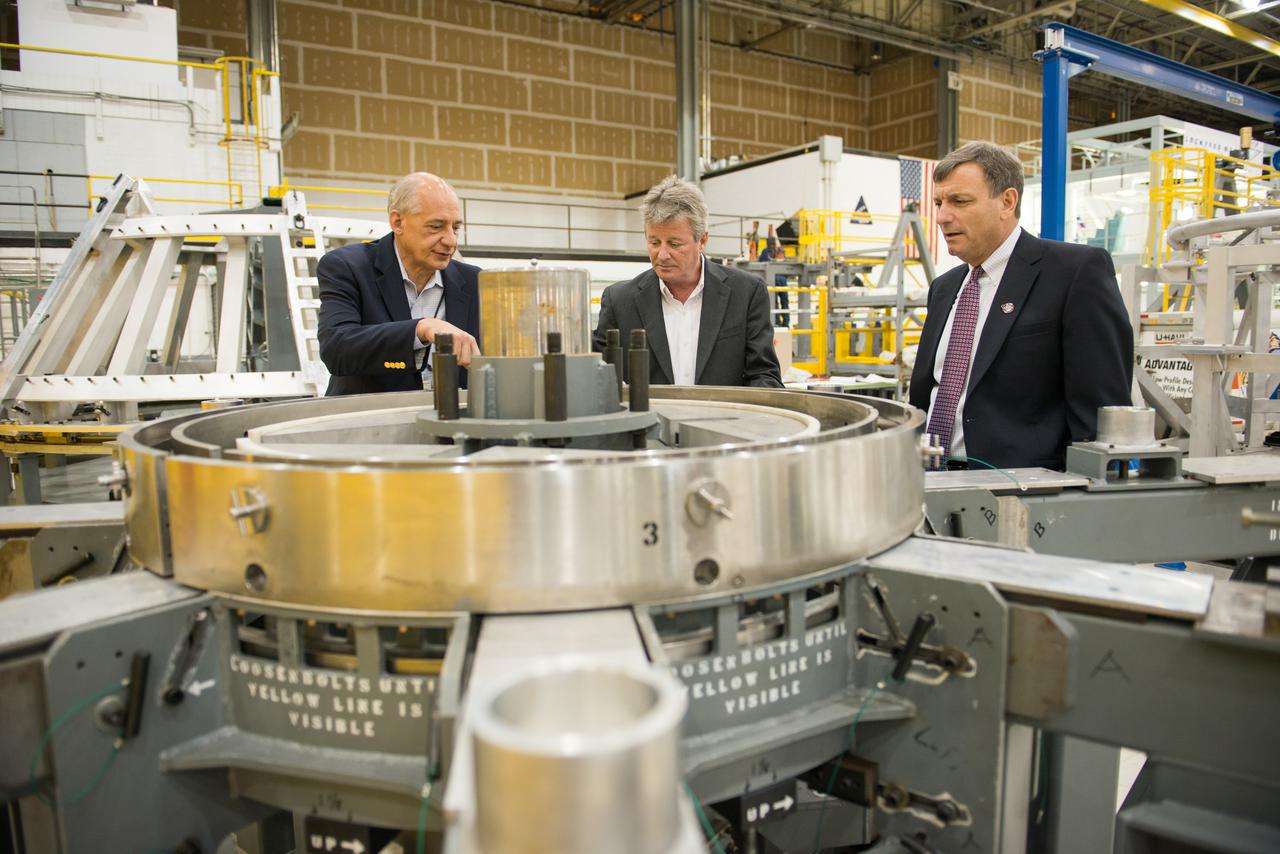
Mark Kirasich visit
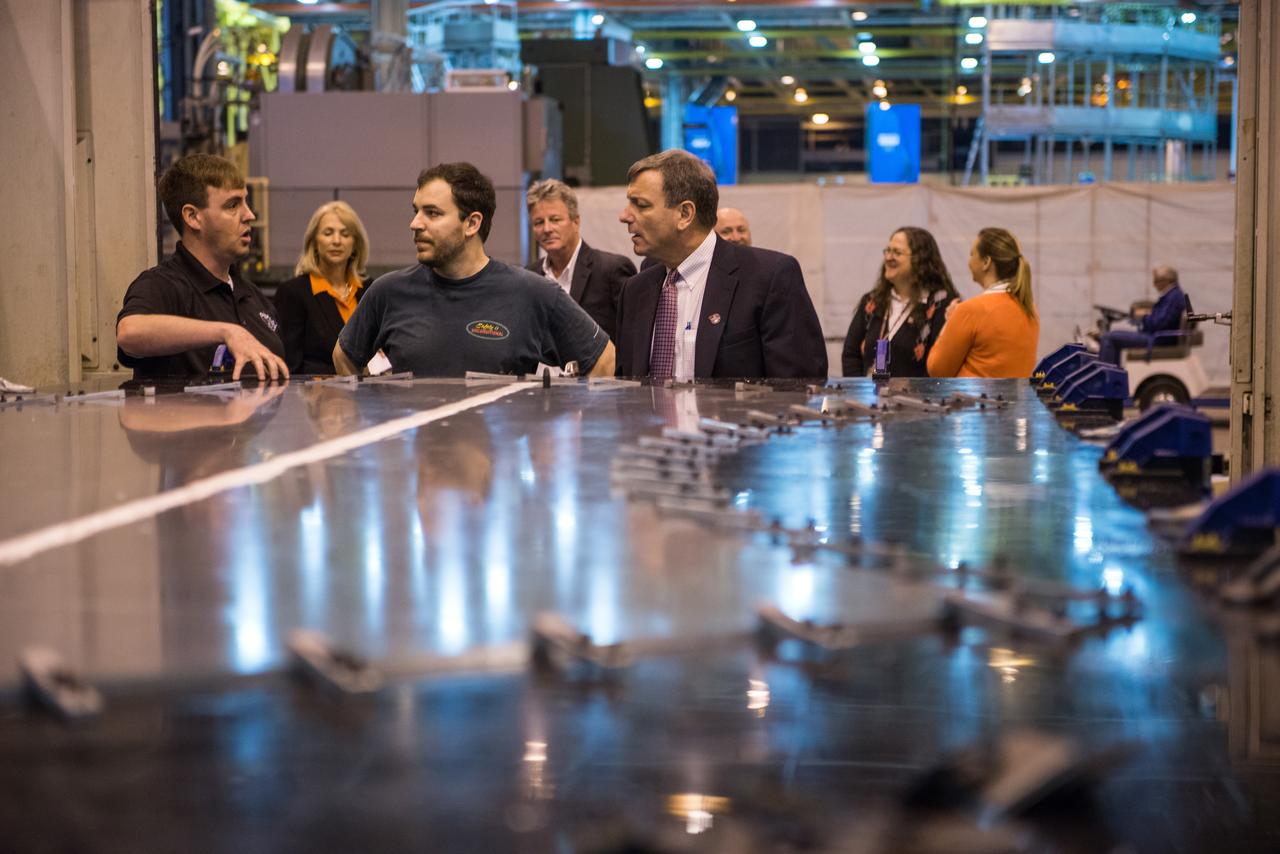
Mark Kirasich visit
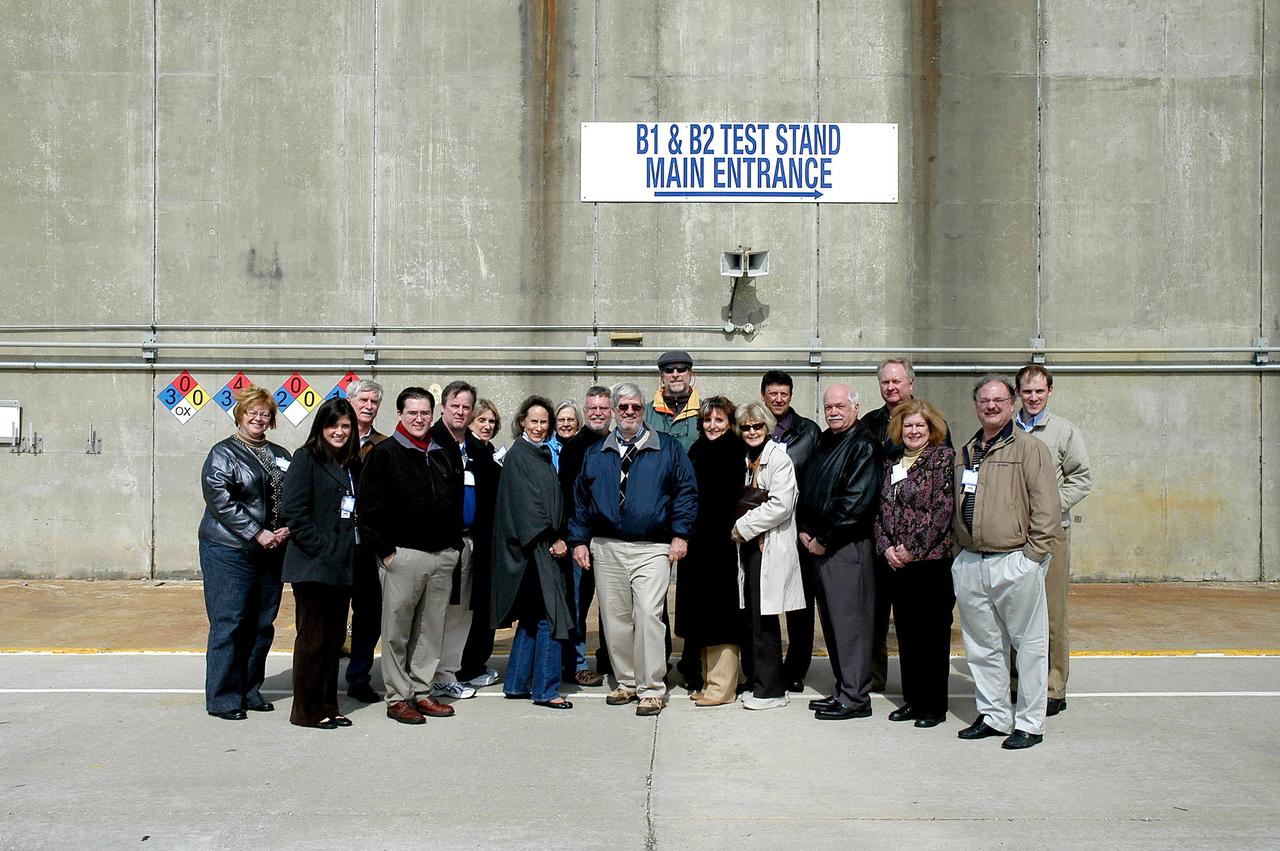
Members of the Southeast U.S. Federal Laboratory Consortium for Technology Transfer gather at the base of the B-1/B-2 Test Stand during a Feb. 10 visit to John C. Stennis Space Center. The group visited Stennis to tour facilities and receive briefings on work at the rocket engine test site. They also visited the INFINITY at NASA Stennis Space Center site and received a briefing on construction of the new science center. The FLC is a nationwide network of federal laboratories to facilitate technology transfers between federal agencies and commercial companies.
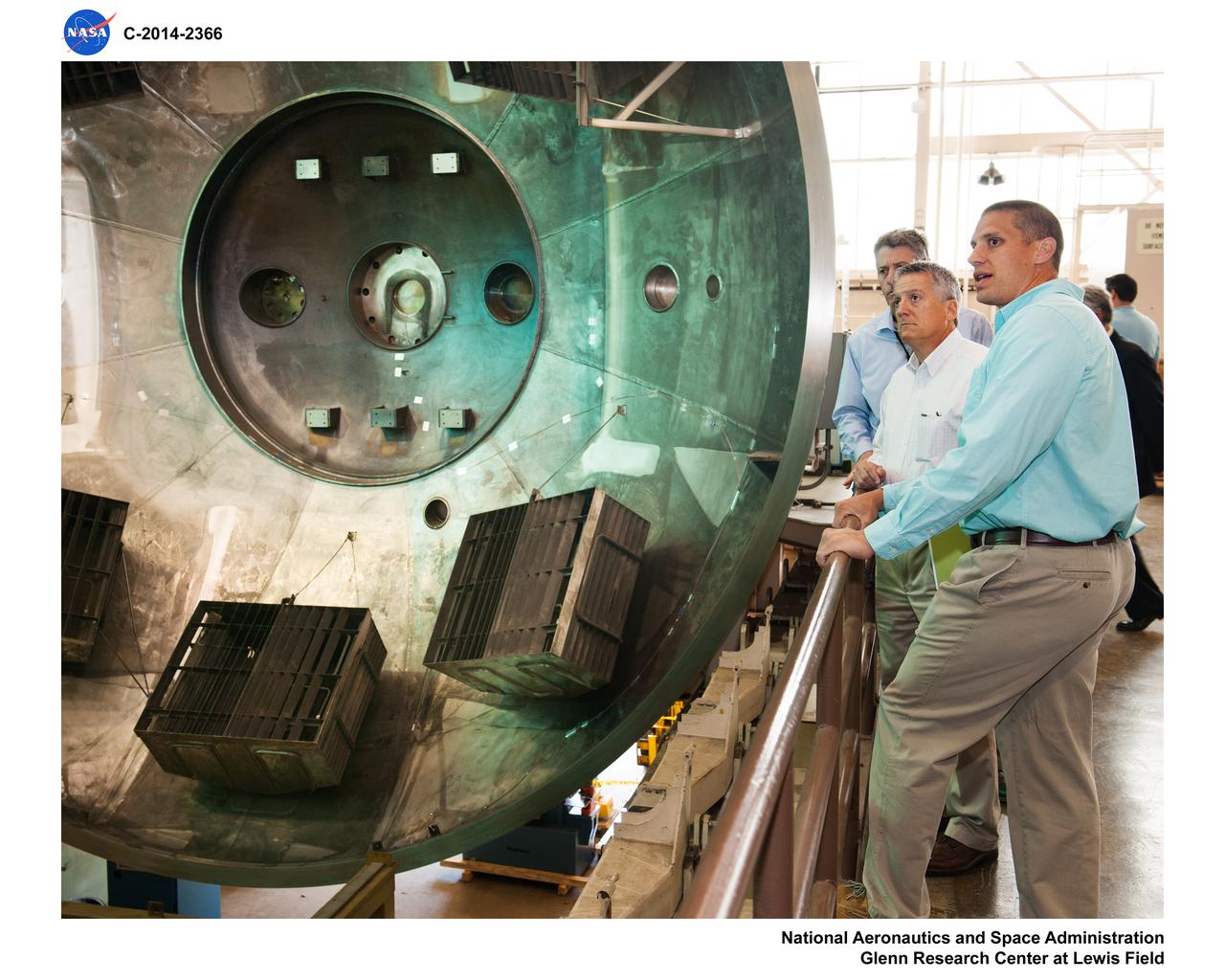
Technical Capabilities Assessment Team, TCAT, In-Space Propulsion: Non-Chemical Deep Dive Glenn Research Center Site Visit
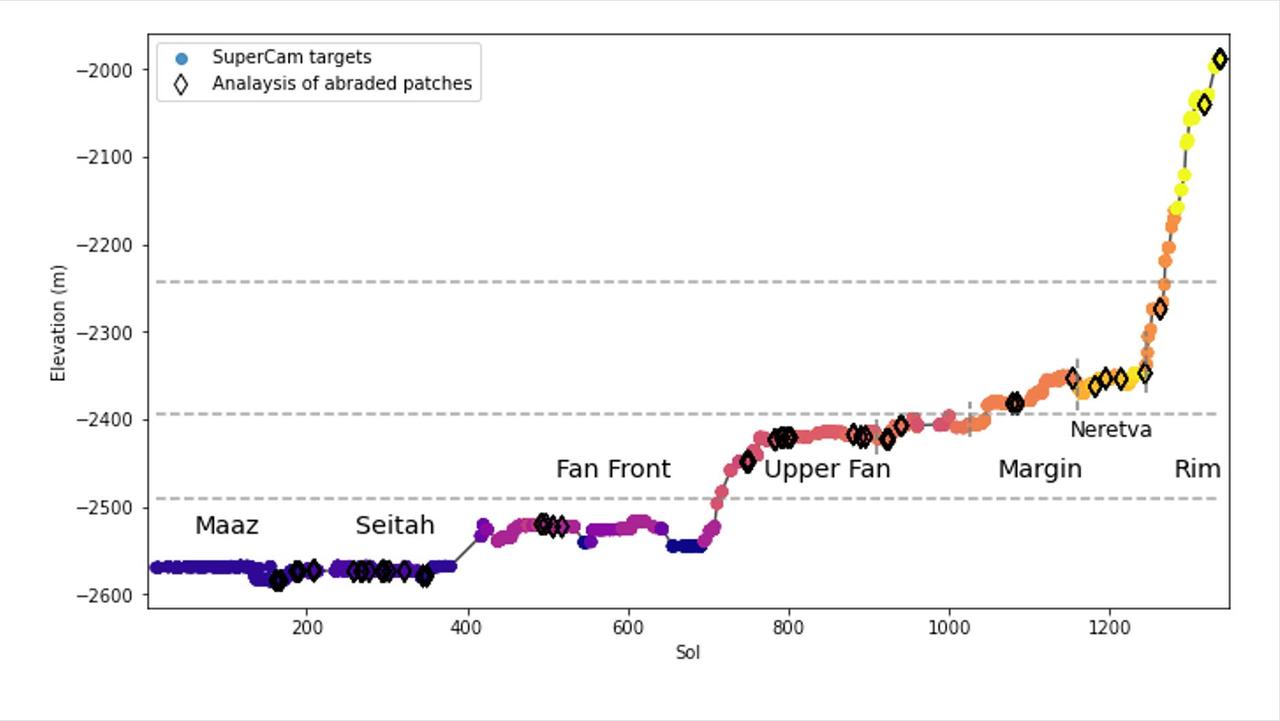
This graph shows the relative elevation of various sampling sites visited by NASA's Perseverance Mars rover. Colored dots along the line represent targets where data was collected by the rover's SuperCam laser instrument; the colors correspond to different regions within Jezero Crater, which are labeled. The black diamonds represent locations where the rover's abrasion tool was used to collect data on rock composition. The x-axis indicates the sol, or day, of the rover's mission, and the y-axis shows elevation in meters. Jezero Crater sits about 8,530 feet (2,600 meters) below reference level (the equivalent for "sea level" on Mars, which does not have any oceans), which is why the numbers appear to be decreasing as Perseverance is gaining elevation. The dotted horizontal lines represent estimated levels of ancient, now-dry lakes. Jezero Crater was filled by water for much of its history; this lake environment could have preserved signs of microbial life, if any formed here billions of years ago. At the far right of the graph, the line suddenly jumps, indicating a sharp elevation gain, showing how quickly the rover has ascended toward the crater rim. A key objective for Perseverance's mission on Mars is astrobiology, including the search for signs of ancient microbial life. The rover will characterize the planet's geology and past climate, pave the way for human exploration of the Red Planet, and be the first mission to collect and cache Martian rock and regolith (broken rock and dust). Subsequent NASA missions, in cooperation with ESA (European Space Agency), would send spacecraft to Mars to collect these sealed samples from the surface and return them to Earth for in-depth analysis. The Mars 2020 Perseverance mission is part of NASA's Moon to Mars exploration approach, which includes Artemis missions to the Moon that will help prepare for human exploration of the Red Planet. https://photojournal.jpl.nasa.gov/catalog/PIA26476
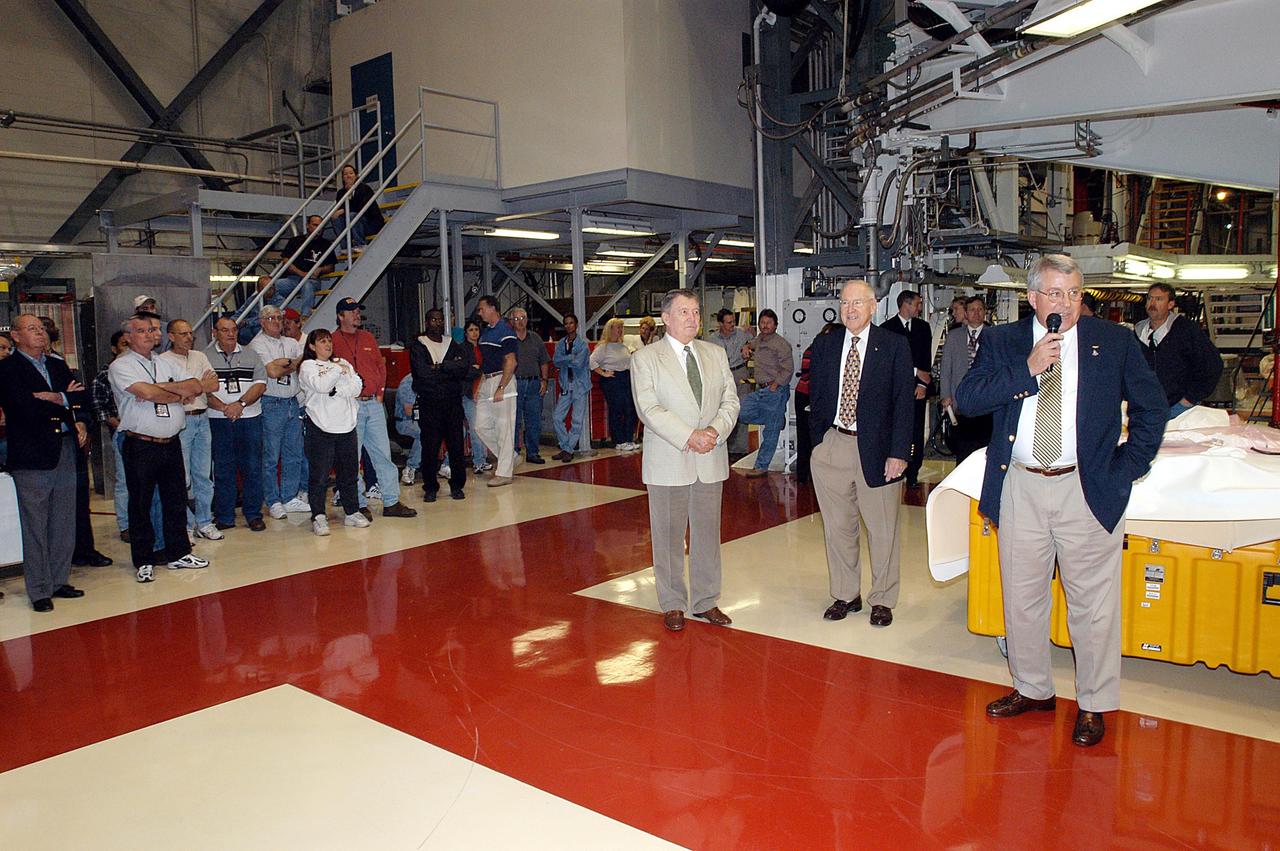
KENNEDY SPACE CENTER, FLA. - In the Orbiter Processing Facility, Bill Pickavance, vice president and deputy program manager, United Space Alliance, talks to employees. With him, at left, are former astronauts Wally Schirra and Jim Lovell. The latter two visited several KSC sites, relating their experiences in the space program and offerking encouragement to workers to help get the space program "back on its feet." They visited several sites around the Center, including the RLV Hangar where Columbia debris is being collected and examined as part of the investigation into the tragedy that claimed the orbiter and lives of seven astronauts returning from mission STS-107.
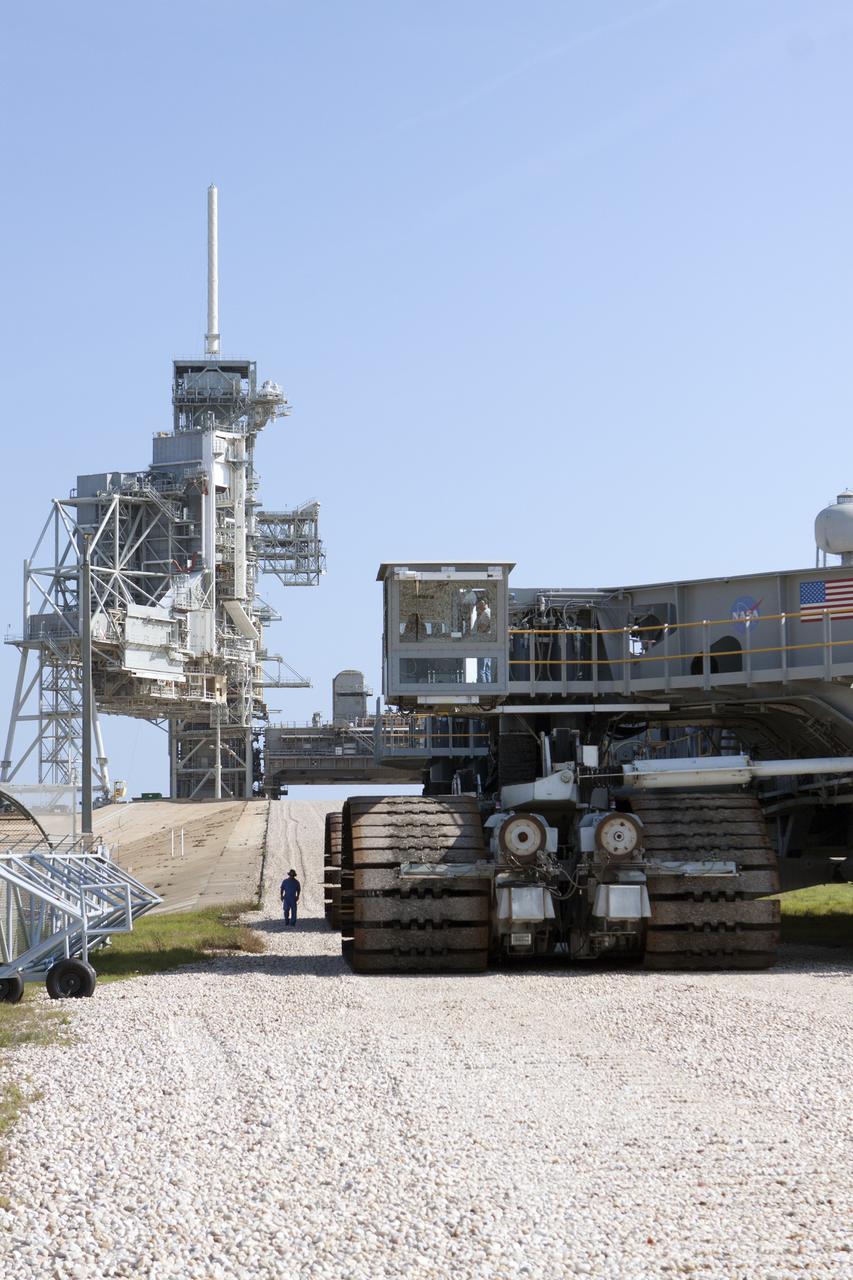
CAPE CANAVERAL, Fla. -- A crawler-transporter begins its climb to the hardstand at Launch Pad 39A at NASA's Kennedy Space Center in Florida. Operations are underway to move Mobile Launcher Platform-2, or MLP-2, from the pad to a nearby park site in Launch Complex 39. The historic launch pad was the site from which numerous Apollo and space shuttle missions began and is beginning a new mission as a commercial launch site. NASA signed a property agreement with Space Exploration Technologies Corp., or SpaceX, of Hawthorne, California, on April 14 for use and occupancy of the seaside complex along Florida's central east coast. It will serve as a platform for SpaceX to support their commercial launch activities. For more information on Launch Pad 39A, visit http://www.nasa.gov/centers/kennedy/pdf/167416main_LC39-08.pdf. For learn more about the crawler-transporter, visit http://www.nasa.gov/centers/kennedy/pdf/167402main_crawlertransporters07.pdf. Photo credit: NASA/Kim Shiflett

CAPE CANAVERAL, Fla. -- A crawler-transporter creeps toward Mobile Launcher Platform-2, or MLP-2, on the hardstand at Launch Pad 39A at NASA's Kennedy Space Center in Florida. Operations are underway to move the MLP to a nearby park site in Launch Complex 39. The historic launch pad was the site from which numerous Apollo and space shuttle missions began and is beginning a new mission as a commercial launch site. NASA signed a property agreement with Space Exploration Technologies Corp., or SpaceX, of Hawthorne, California, on April 14 for use and occupancy of the seaside complex along Florida's central east coast. It will serve as a platform for SpaceX to support their commercial launch activities. For more information on Launch Pad 39A, visit http://www.nasa.gov/centers/kennedy/pdf/167416main_LC39-08.pdf. For learn more about the crawler-transporter, visit http://www.nasa.gov/centers/kennedy/pdf/167402main_crawlertransporters07.pdf. Photo credit: NASA/Kim Shiflett

CAPE CANAVERAL, Fla. -- A crawler-transporter carries Mobile Launcher Platform-2, or MLP-2, away from Launch Pad 39A at NASA's Kennedy Space Center in Florida. The MLP is being moved to a nearby park site in Launch Complex 39. The historic launch pad was the site from which numerous Apollo and space shuttle missions began and is beginning a new mission as a commercial launch site. NASA signed a property agreement with Space Exploration Technologies Corp., or SpaceX, of Hawthorne, California, on April 14 for use and occupancy of the seaside complex along Florida's central east coast. It will serve as a platform for SpaceX to support their commercial launch activities. For more information on Launch Pad 39A, visit http://www.nasa.gov/centers/kennedy/pdf/167416main_LC39-08.pdf. For learn more about the crawler-transporter, visit http://www.nasa.gov/centers/kennedy/pdf/167402main_crawlertransporters07.pdf. Photo credit: NASA/Kim Shiflett
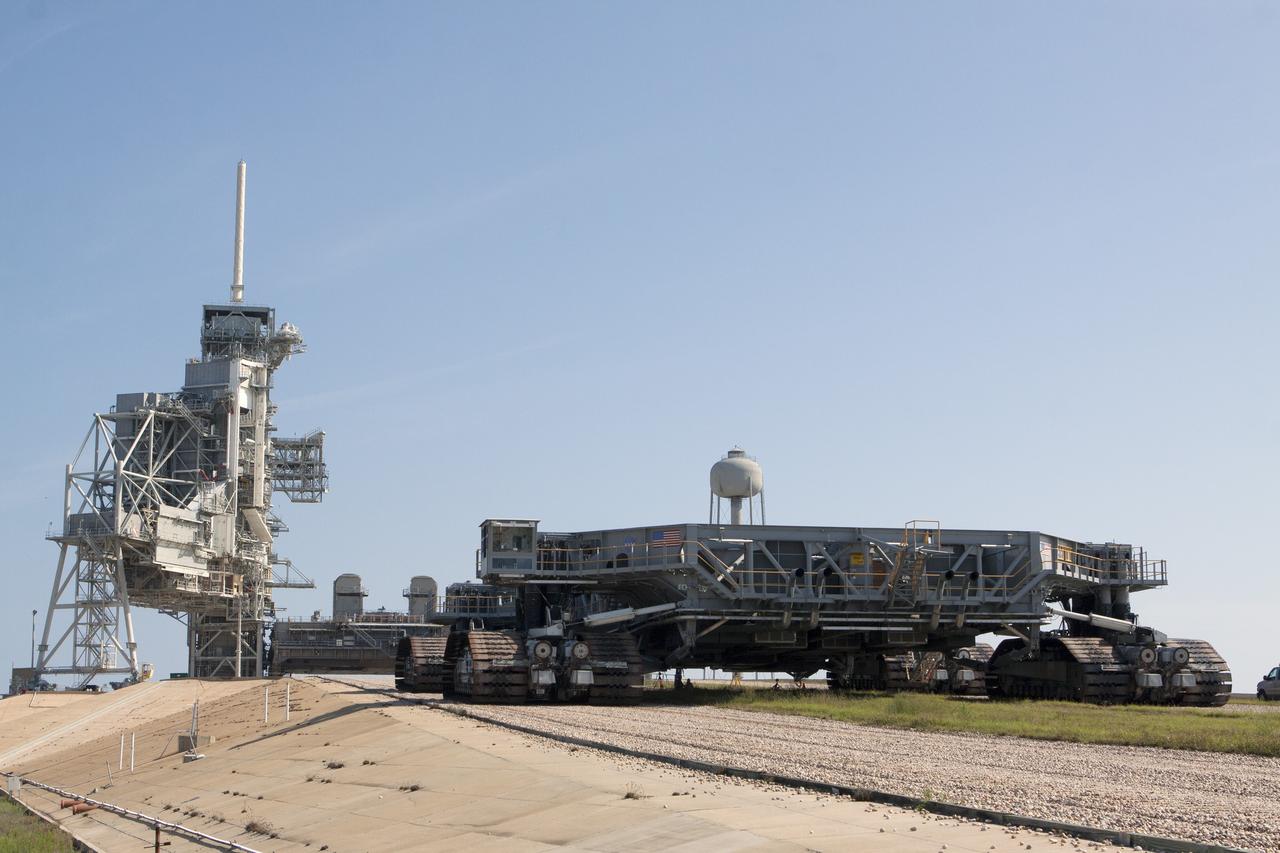
CAPE CANAVERAL, Fla. -- A crawler-transporter begins its climb toward Mobile Launcher Platform-2, or MLP-2, on the hardstand at Launch Pad 39A at NASA's Kennedy Space Center in Florida. Operations are underway to move the MLP to a nearby park site in Launch Complex 39. The historic launch pad was the site from which numerous Apollo and space shuttle missions began and is beginning a new mission as a commercial launch site. NASA signed a property agreement with Space Exploration Technologies Corp., or SpaceX, of Hawthorne, California, on April 14 for use and occupancy of the seaside complex along Florida's central east coast. It will serve as a platform for SpaceX to support their commercial launch activities. For more information on Launch Pad 39A, visit http://www.nasa.gov/centers/kennedy/pdf/167416main_LC39-08.pdf. For learn more about the crawler-transporter, visit http://www.nasa.gov/centers/kennedy/pdf/167402main_crawlertransporters07.pdf. Photo credit: NASA/Kim Shiflett
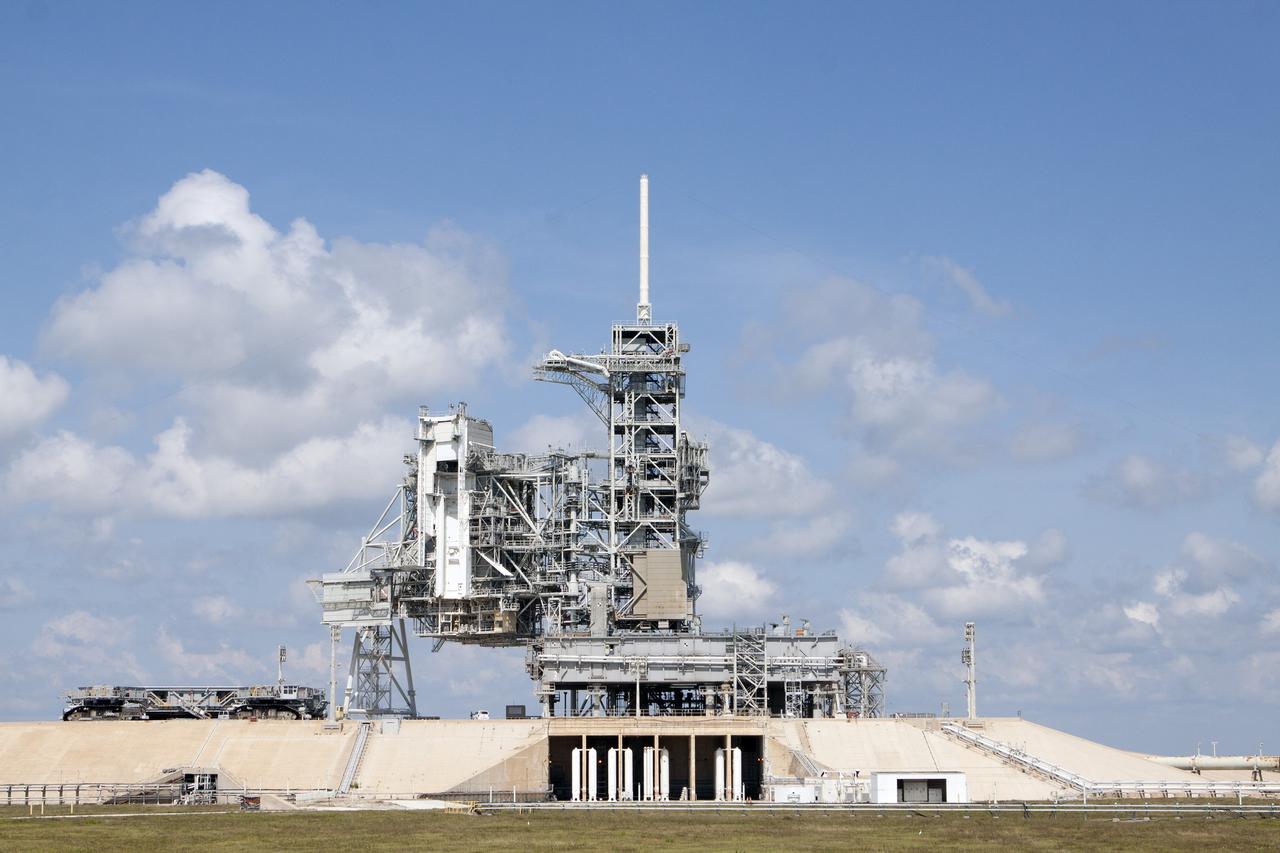
CAPE CANAVERAL, Fla. -- A crawler-transporter nears the Mobile Launcher Platform-2, or MLP-2, positioned over the flame trench at Launch Pad 39A at NASA's Kennedy Space Center in Florida. Operations are underway to move the MLP to a nearby park site in Launch Complex 39. The historic launch pad was the site from which numerous Apollo and space shuttle missions began and is beginning a new mission as a commercial launch site. NASA signed a property agreement with Space Exploration Technologies Corp., or SpaceX, of Hawthorne, California, on April 14 for use and occupancy of the seaside complex along Florida's central east coast. It will serve as a platform for SpaceX to support their commercial launch activities. For more information on Launch Pad 39A, visit http://www.nasa.gov/centers/kennedy/pdf/167416main_LC39-08.pdf. For learn more about the crawler-transporter, visit http://www.nasa.gov/centers/kennedy/pdf/167402main_crawlertransporters07.pdf. Photo credit: NASA/Kim Shiflett
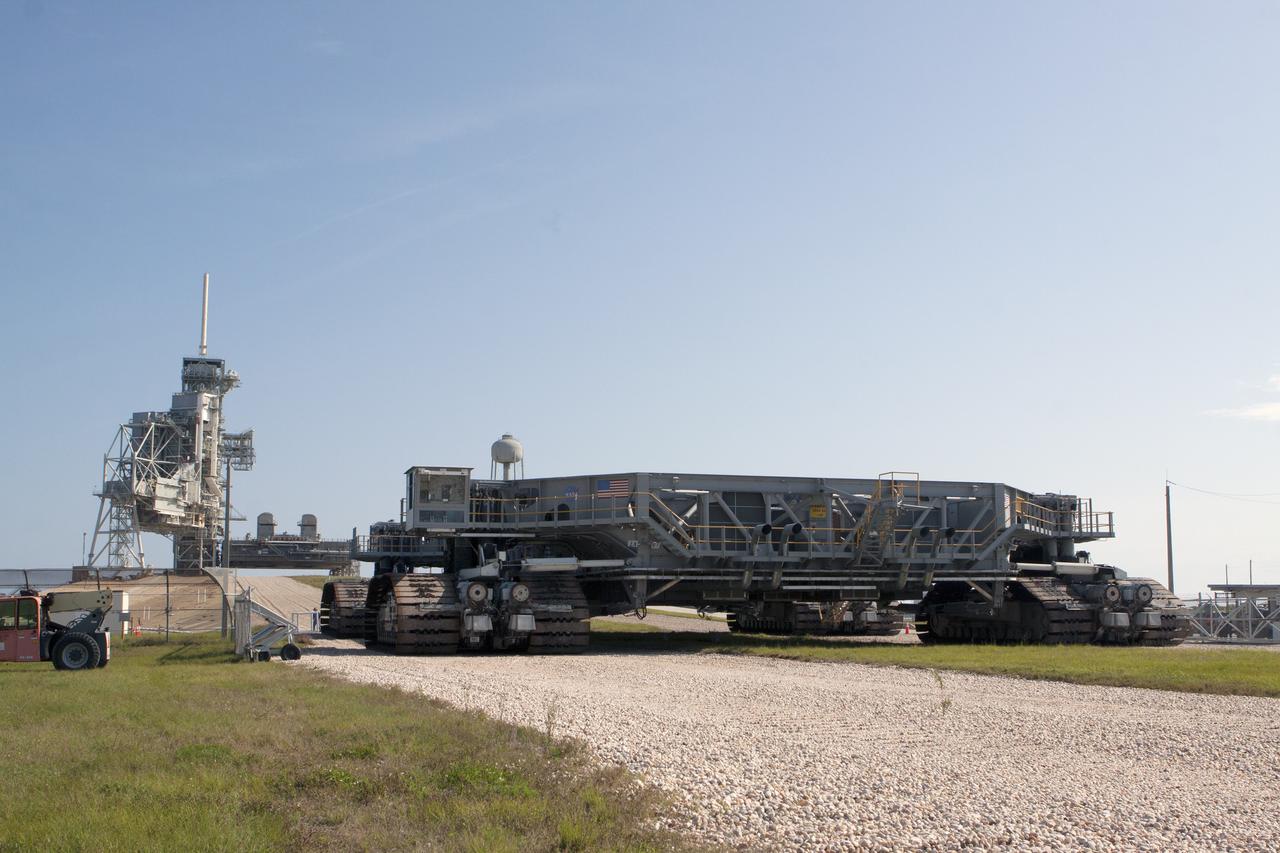
CAPE CANAVERAL, Fla. -- A crawler-transporter rolls toward Launch Pad 39A at NASA's Kennedy Space Center in Florida. Operations are underway to move Mobile Launcher Platform-2, or MLP-2, from the pad to a nearby park site in Launch Complex 39. The historic launch pad was the site from which numerous Apollo and space shuttle missions began and is beginning a new mission as a commercial launch site. NASA signed a property agreement with Space Exploration Technologies Corp., or SpaceX, of Hawthorne, California, on April 14 for use and occupancy of the seaside complex along Florida's central east coast. It will serve as a platform for SpaceX to support their commercial launch activities. For more information on Launch Pad 39A, visit http://www.nasa.gov/centers/kennedy/pdf/167416main_LC39-08.pdf. For learn more about the crawler-transporter, visit http://www.nasa.gov/centers/kennedy/pdf/167402main_crawlertransporters07.pdf. Photo credit: NASA/Kim Shiflett

Members of the World Presidents' Organization enjoy a buffet luncheon during a Jan. 26 visit to NASA's John C. Stennis Space Center. WPO members from several states toured Stennis facilities during a daylong visit that included a river ride with Special Boat Team 22, the U.S. Navy's elite boat warriors group that trains at Stennis. Visiting president also had an opportunity to learn about the ongoing work of the nation's premier rocket engine testing site.
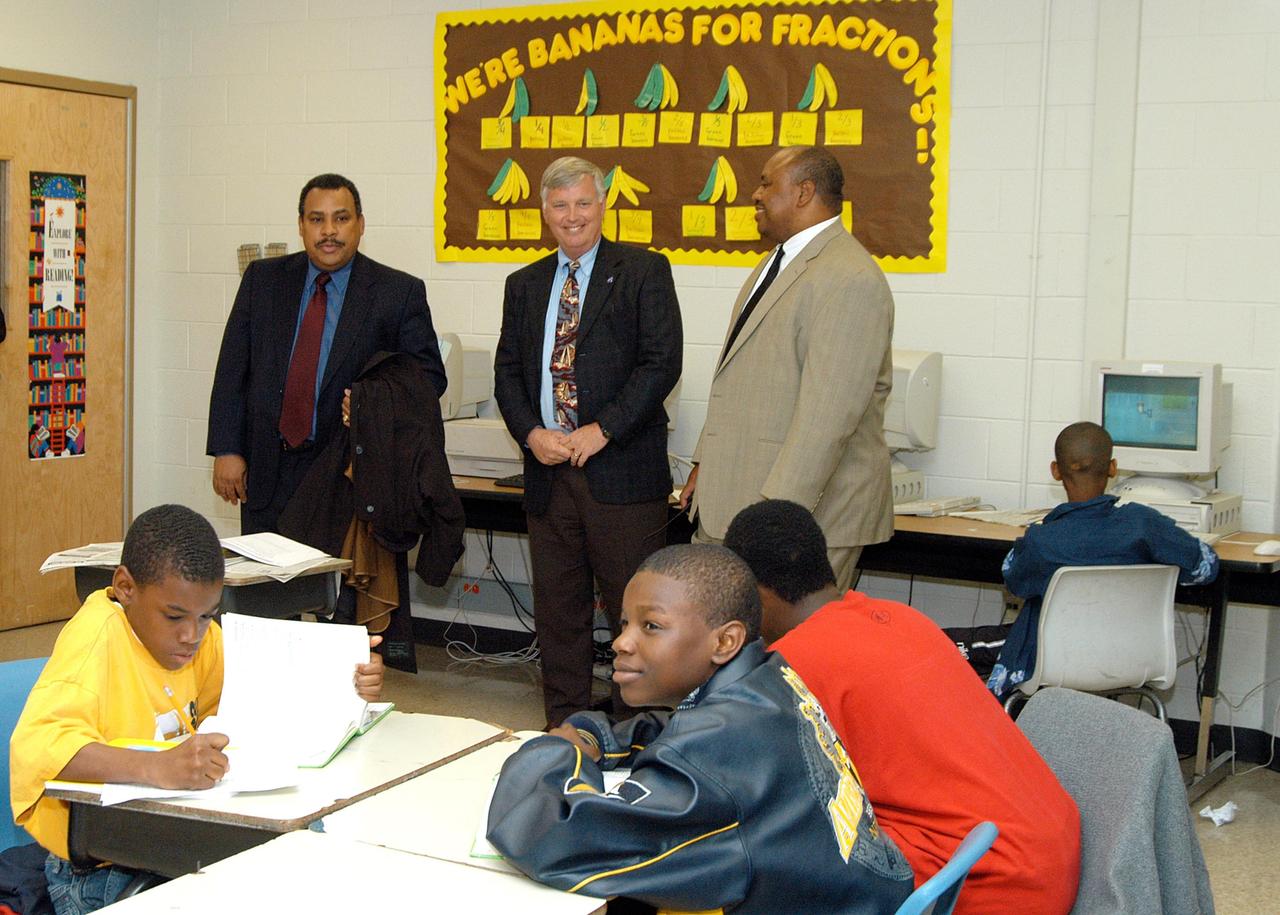
KENNEDY SPACE CENTER, FLA. - Center Director Jim Kennedy (center) and Principal Aaron Fernander (right) visit a classroom in Ralph Bunche Middle School, a NASA Explorer School, in Atlanta, Ga. At left is Ralph Thomas, assistant administrator for Small and Disadvantaged Business Utilization at NASA. Kennedy is visiting NES sites to share America’s new vision for space exploration with the next generation of explorers. He was accompanied by astronaut Rick Linnehan on the visit. The purpose of the school visit is to talk with students about our destiny as explorers, NASA’s stepping stone approach to exploring Earth, the Moon, Mars and beyond, how space impacts our lives, and how people and machines rely on each other in space.
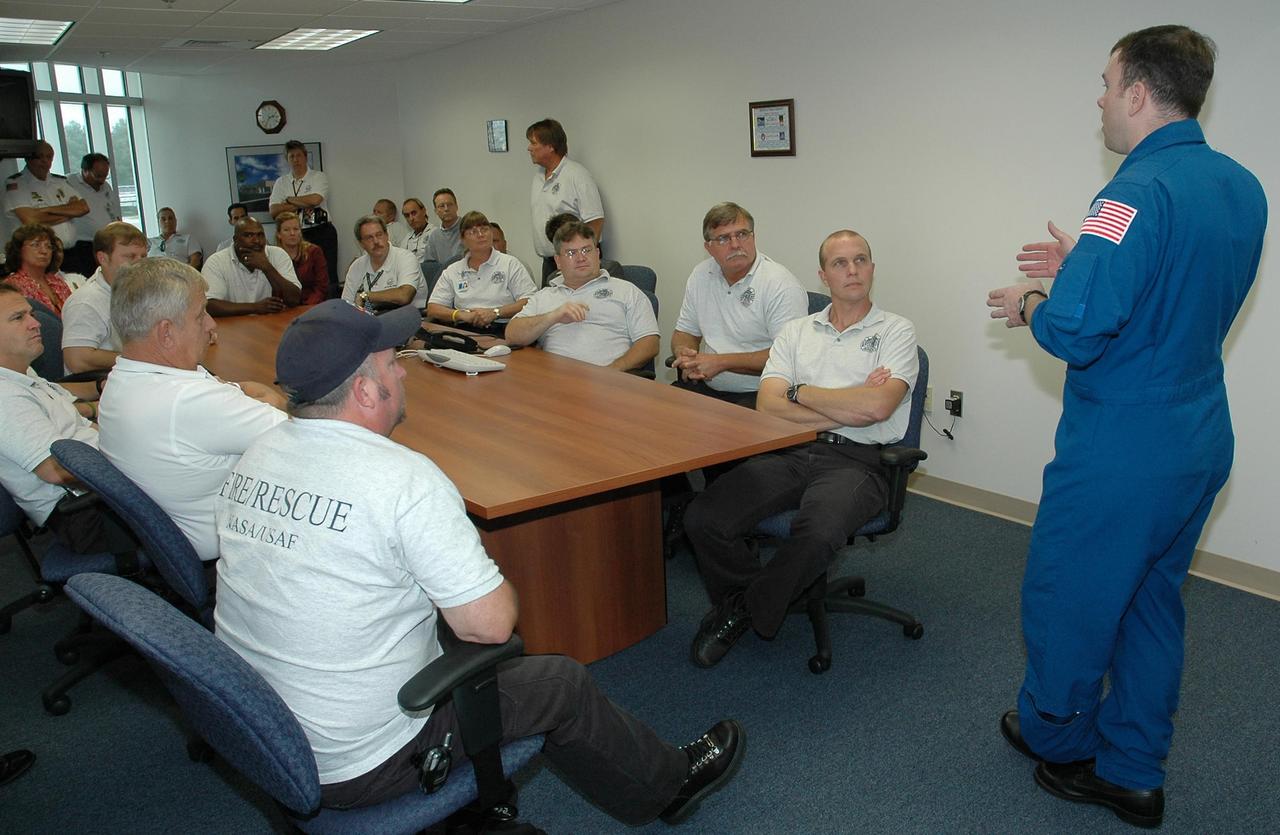
KENNEDY SPACE CENTER, FLA. - STS-114 Pilot James Kelly (right) speaks to NASA and U. S. Air Force fire and rescue personnel. Kelly and the other crew members visited several sites during their return to the Center. Their return is being celebrated at a gathering at the KSC Visitor Complex later this evening.
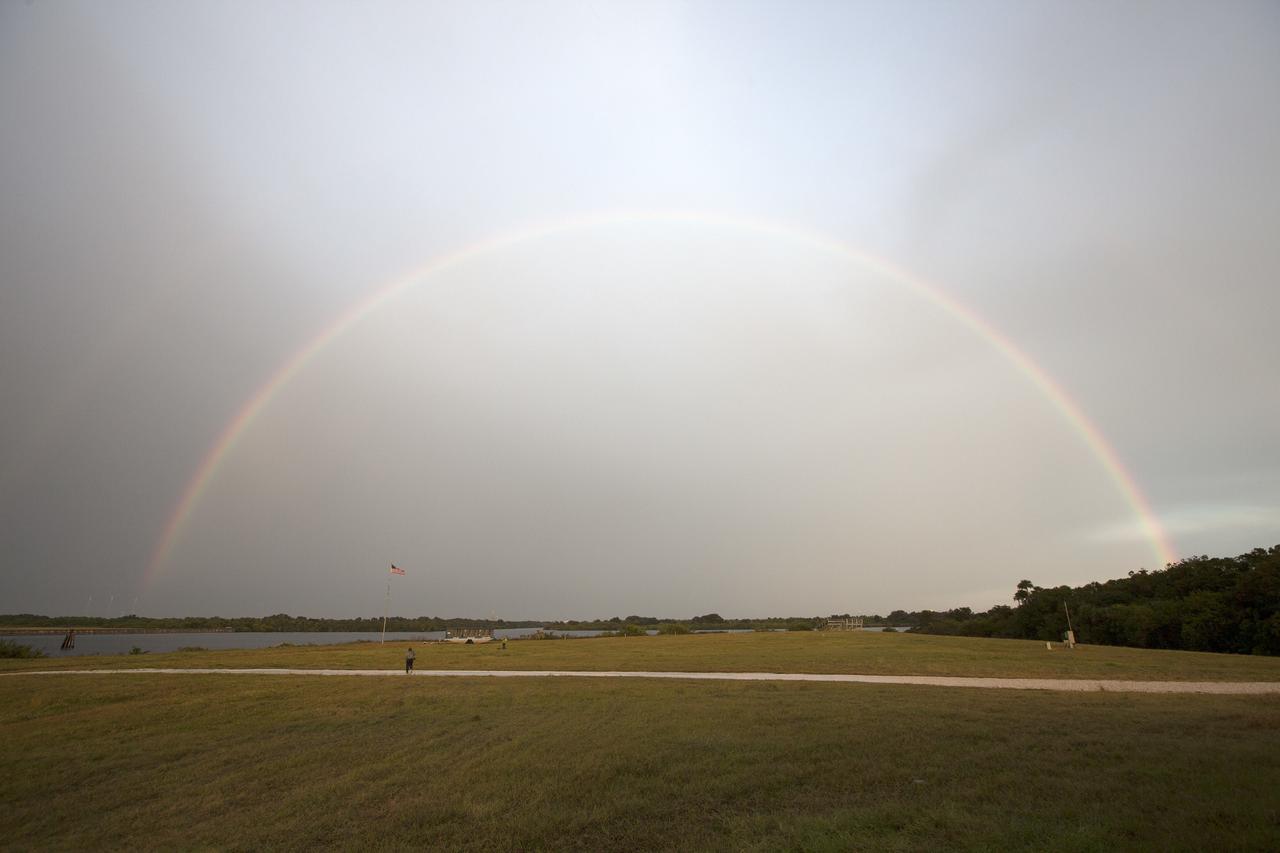
CAPE CANAVERAL, Fla. – As rain showers dissipate, a rainbow appeared over the Kennedy Space Center's Press Site and turn basin. In the background is the historic countdown clock. For more information, visit http://www.nasa.gov/kennedy Photo credit: NASA/Kim Shiflett
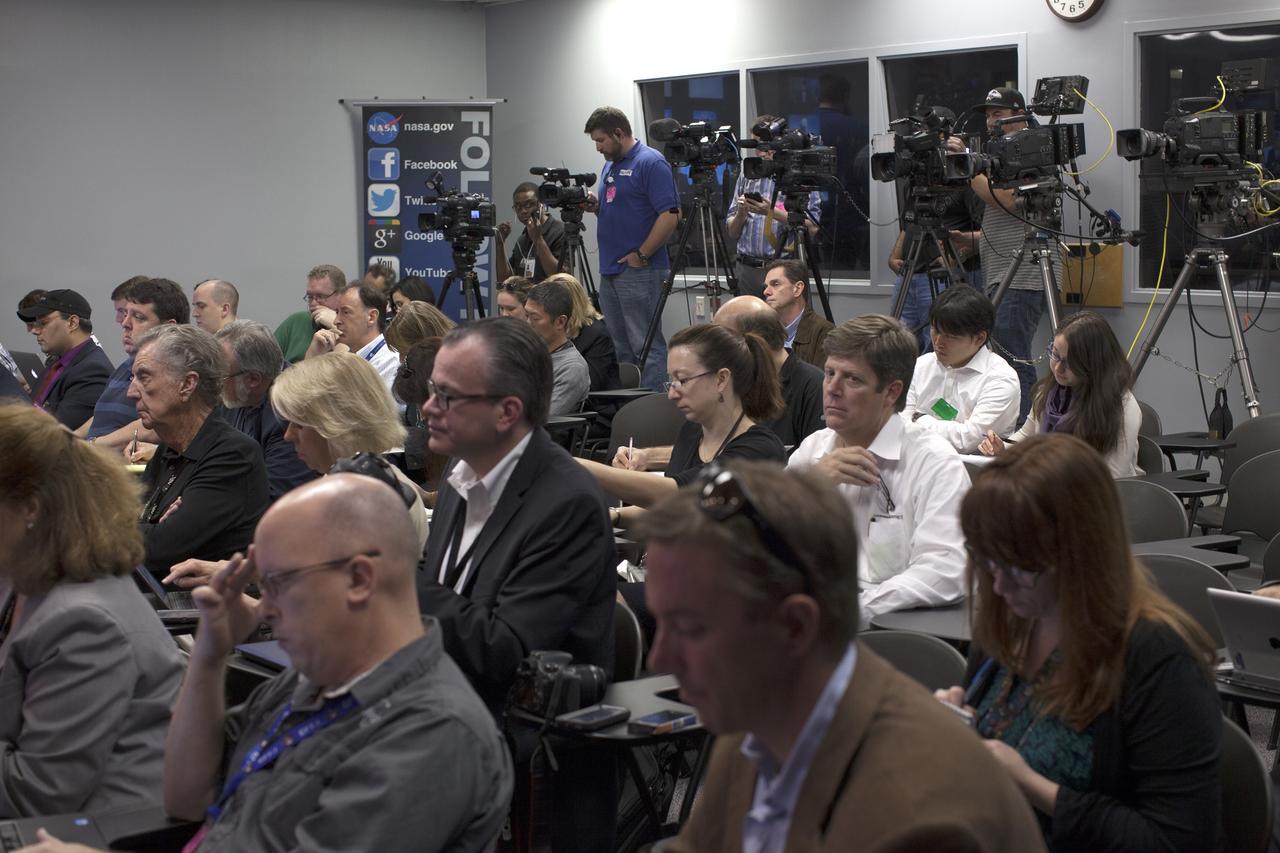
CAPE CANAVERAL, Fla. -- In the Kennedy Space Center’s Press Site auditorium, members of the news media listen as agency and industry leaders updated progress as the Orion spacecraft and its Delta IV Heavy rocket were being prepared for launch. For more information, visit www.nasa.gov/orion. Photo credit: NASA/Frankie Martin
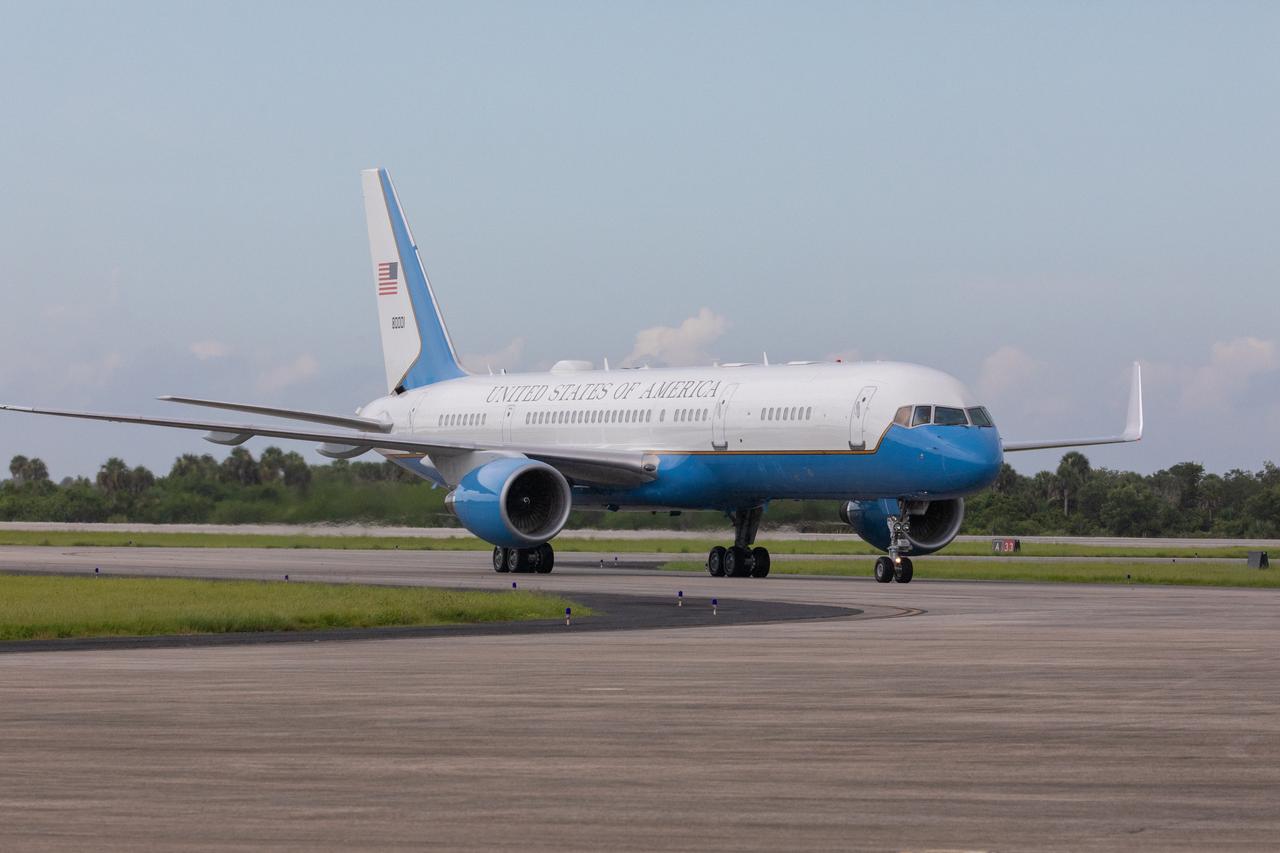
Vice President Pence arrives at Kennedy Space Center on July 20, 2019 in celebration of the Apollo 11 50th Anniversary. While at Kennedy, he recognized the historic mission, by visiting the mission’s launch site, pad 39a, and addressed NASA’s future plans to travel to the Moon and on to Mars.
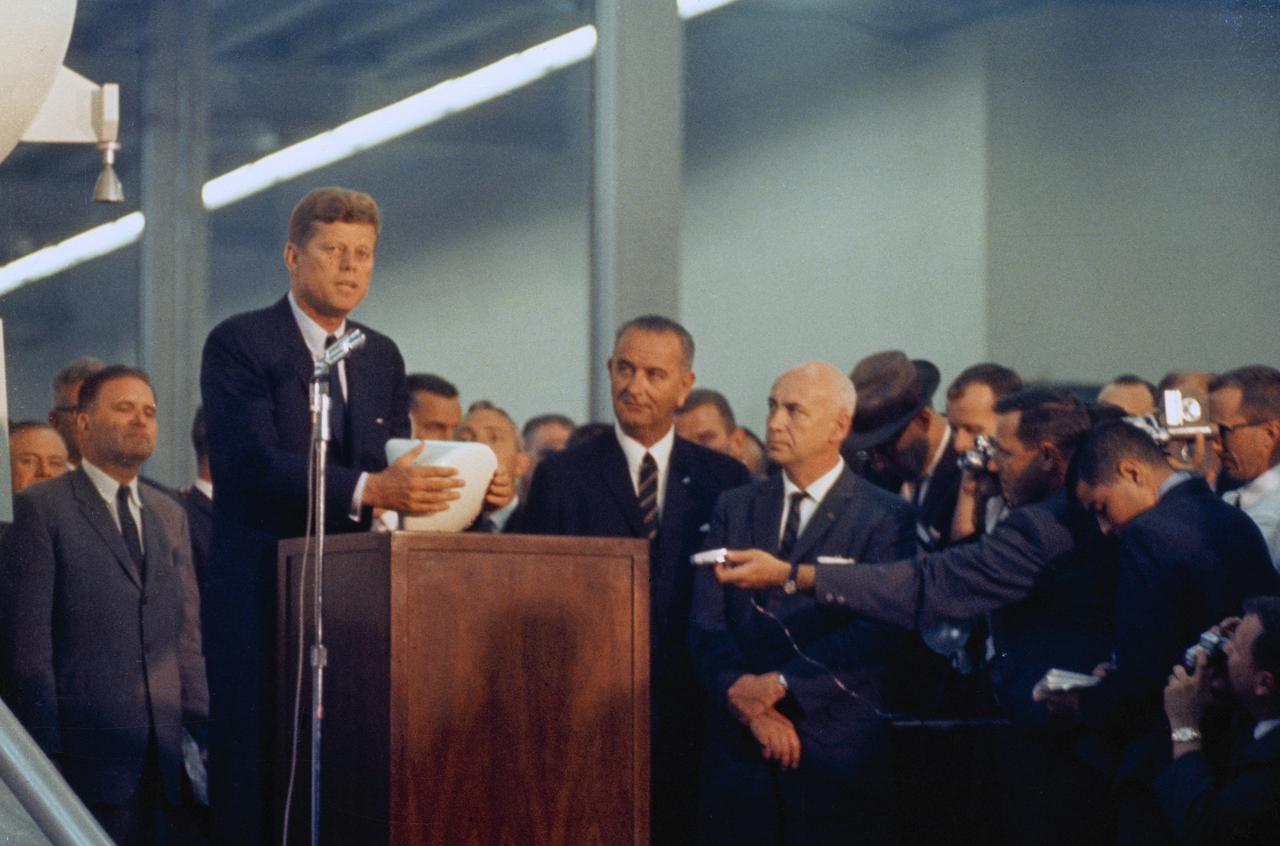
S62-05628 (November 1962) --- President John F. Kennedy speaks to a gathering of media and employees at Site 3 during a 1962 visit. Others seen are Vice-President Lyndon B. Johnson; Dr. Robert R. Gilruth; and James E. Webb, NASA Administrator.
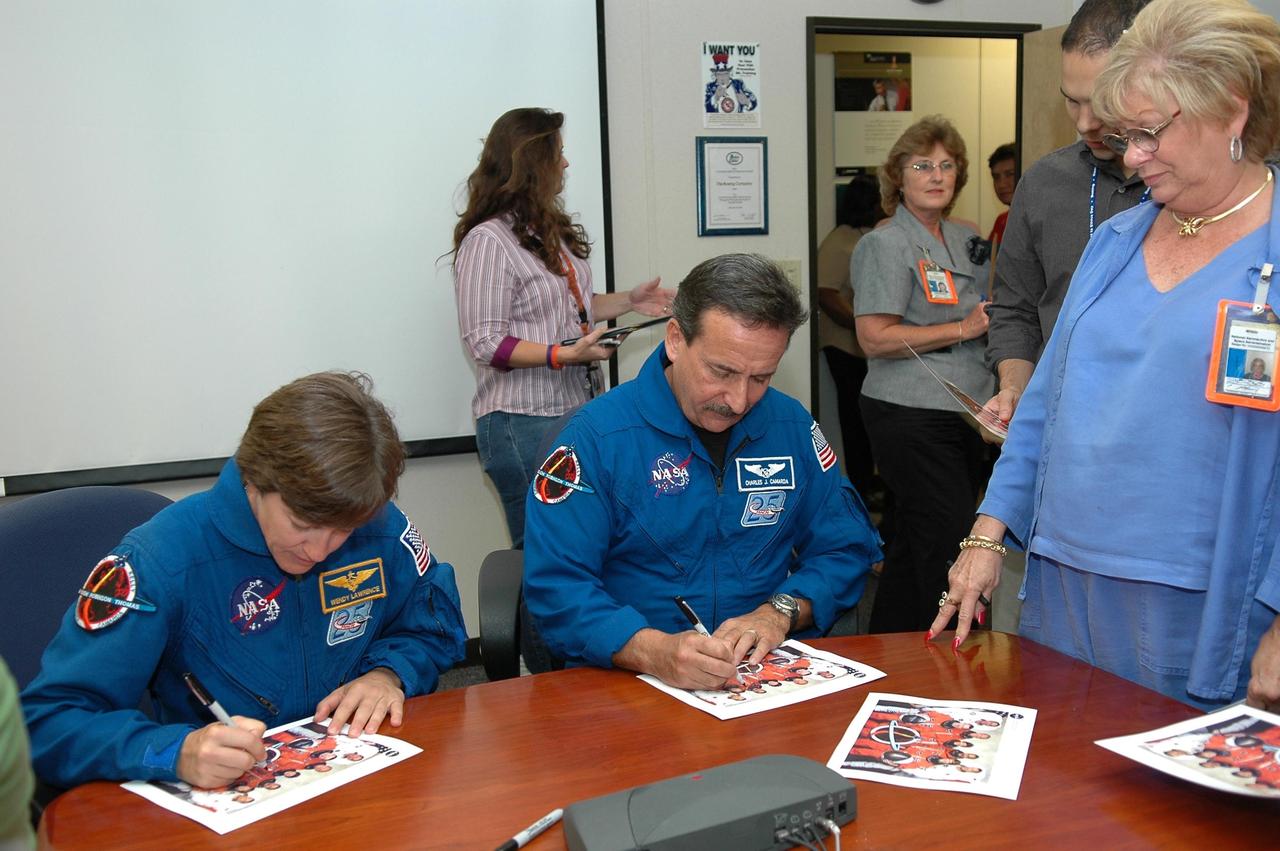
KENNEDY SPACE CENTER, FLA. - After speaking to the employees in the Space Station Processing Facility, STS-114 Mission Specialists Wendy Lawrence and Charles Camarda autograph crew photos. They and the other crew members visited several sites during their return to the Center. Their return is being celebrated at a gathering at the KSC Visitor Complex later this evening.
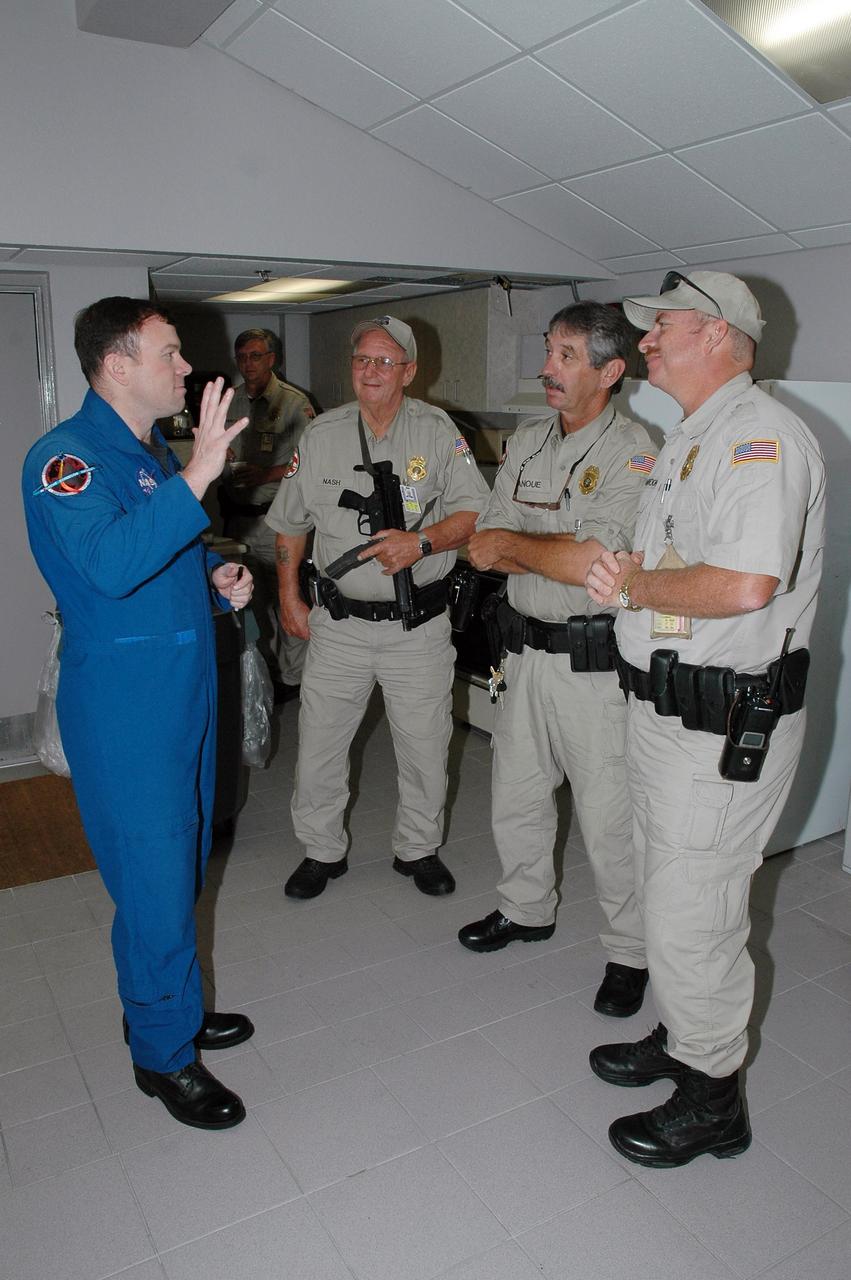
KENNEDY SPACE CENTER, FLA. - STS-114 Pilot James Kelly (left) speaks to Kennedy Space Center and Cape Canaveral Air Force Station security personnel. Kelly and the other crew members visited several sites during their return to the Center. Their return is being celebrated at a gathering at the KSC Visitor Complex later this evening.
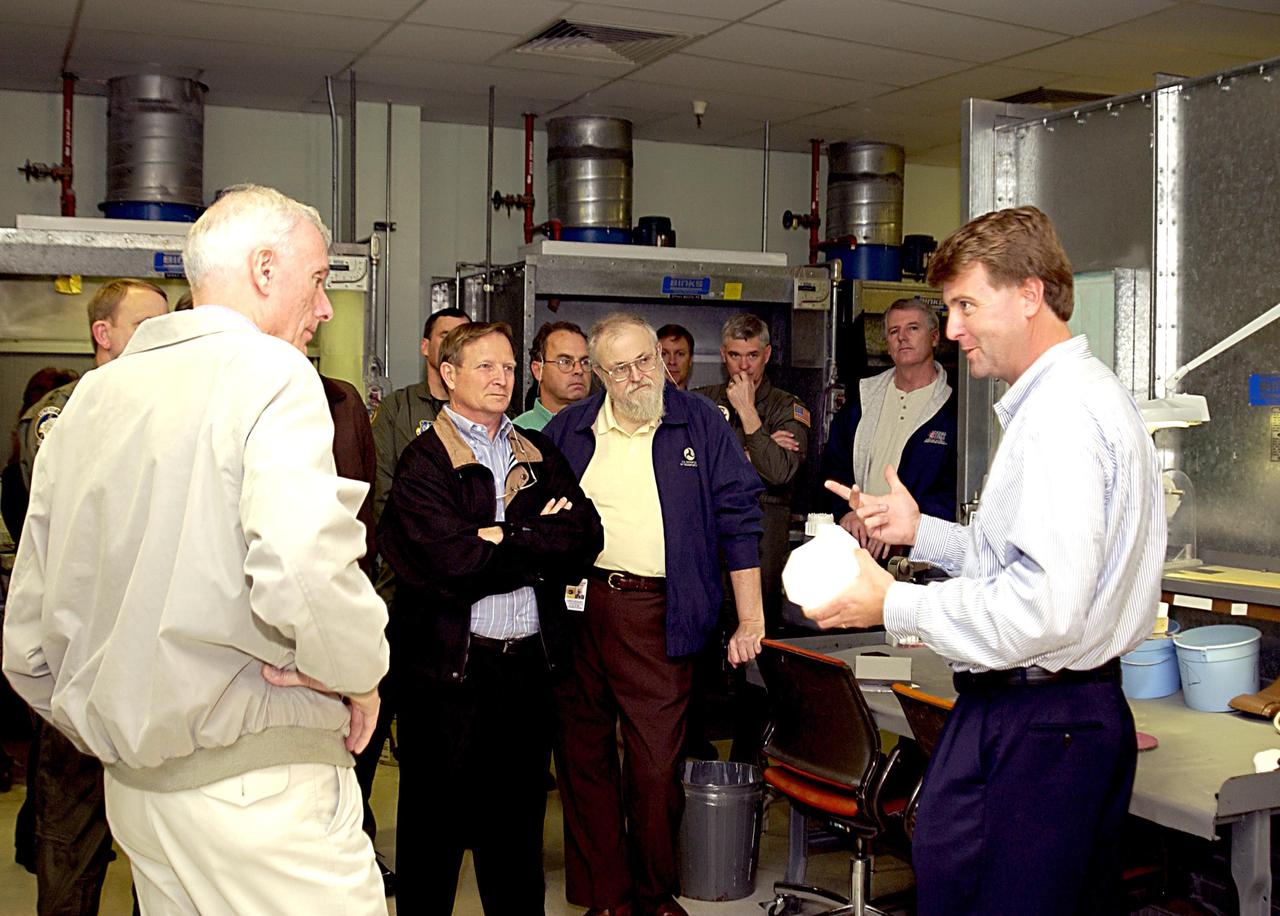
KENNEDY SPACE CENTER, FLA. - Retired Navy Admiral Harold W. Gehman Jr. (left), chairman of the Columbia Accident Investigation Board, visits the Thermal Protection System shop and is briefed by Martin Wilson (right), the shop manager. Gehman and other members of the board are visiting sites at KSC to become familiar with the Shuttle launch process. The independent board is charged with determining what caused the destruction of the Space Shuttle Columbia and the loss of its seven-member crew on Feb. 1 during reentry.
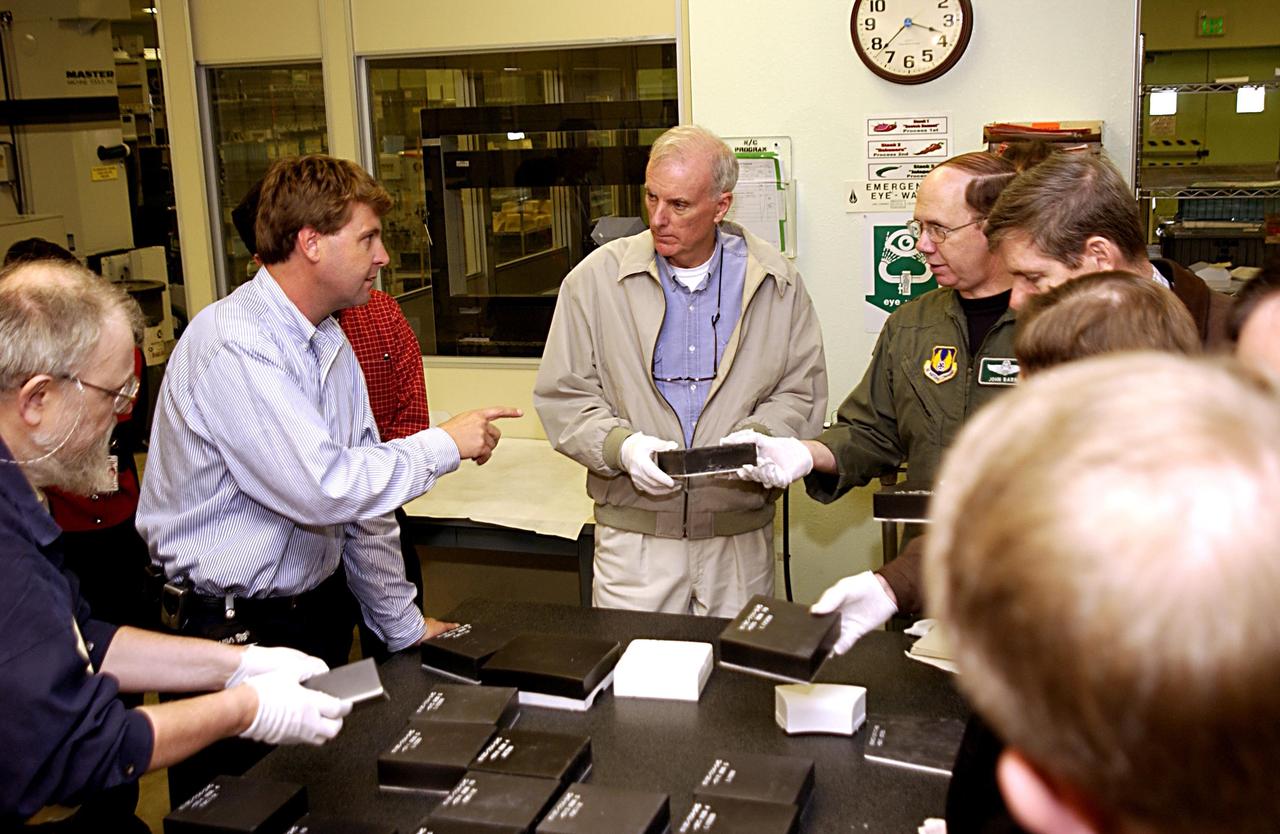
KENNEDY SPACE CENTER, FLA. - Retired Navy Admiral Harold W. Gehman Jr. (center), chairman of the Columbia Accident Investigation Board, visits the Thermal Protection System shop and is briefed by Martin Wilson (pointing), the shop manager. Gehman and other members of the board are visiting sites at KSC to become familiar with the Shuttle launch process. The independent board is charged with determining what caused the destruction of the Space Shuttle Columbia and the loss of its seven-member crew on Feb. 1 during reentry.
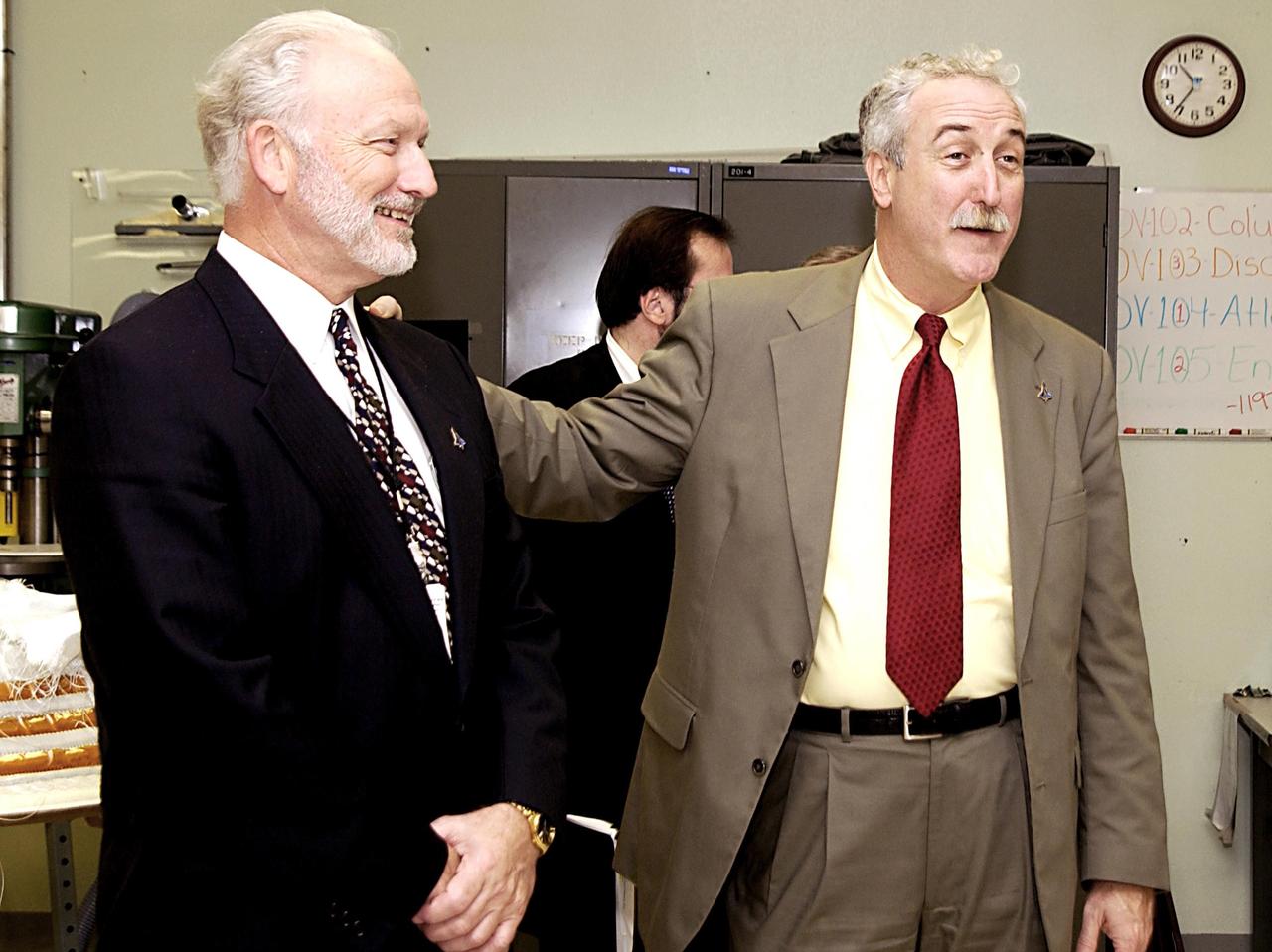
KENNEDY SPACE CENTER, FLA. -- NASA Administrator Sean O'Keefe (right) visits the Thermal Protection System Facility. At left is Chuck Fontana, associate program manager, Integrated Logistics. O'Keefe is visiting the site to learn more about the TPS products and process in protecting orbiters from the intense heat of launch and re-entry. TPS tiles have been discussed in the investigation into the Columbia tragedy that destroyed the orbiter and claimed the lives of seven astronauts..
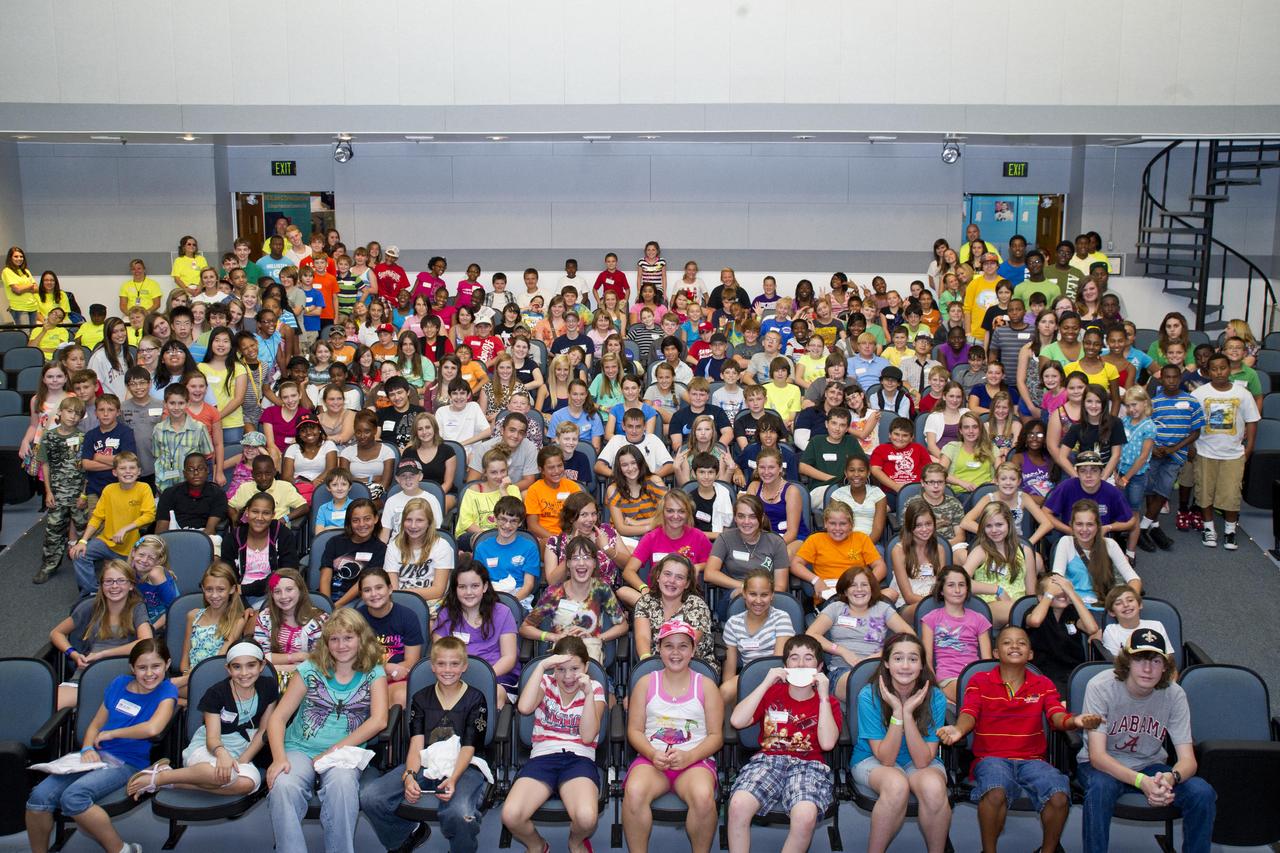
More than 250 children of employees at 15 Stennis Space Center resident agencies and organizations visited the facility July 31 to participate in annual Take Our Children to Work Day activities. Participants enjoyed various presentations and demonstrations on topics such as cryogenics and information security. They also had an opportunity to visit site facilities to learn about various work performed at the NASA center.
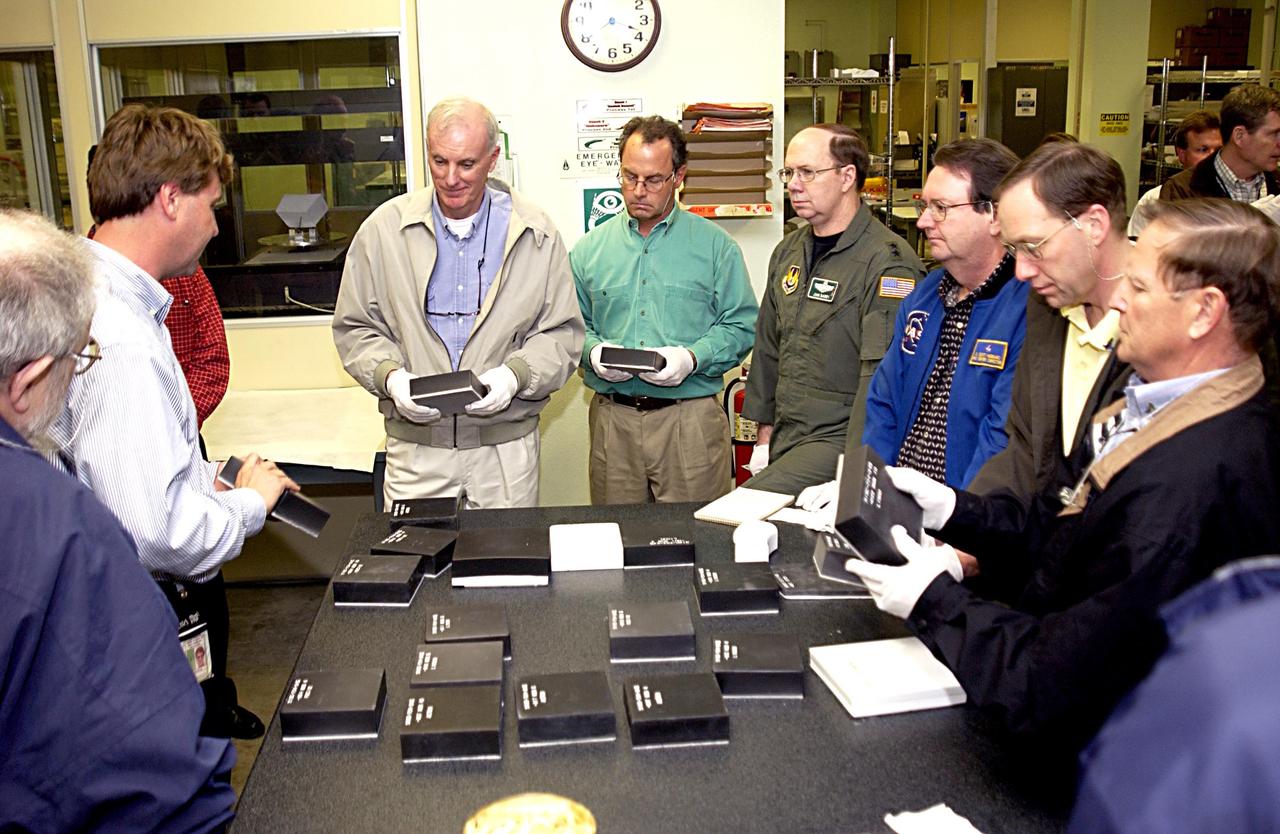
KENNEDY SPACE CENTER, FLA. - Retired Navy Admiral Harold W. Gehman Jr. (third from left), chairman of the Columbia Accident Investigation Board, visits the Thermal Protection System shop and is briefed by Martin Wilson (second from left), the shop manager. Gehman and other members of the board are visiting sites at KSC to become familiar with the Shuttle launch process. The independent board is charged with determining what caused the destruction of the Space Shuttle Columbia and the loss of its seven-member crew on Feb. 1 during reentry.

Mississippi Gov. Haley Barbour speaks to members of the World Presidents' Organization during the group's visit to NASA's John C. Stennis Space Center on Jan. 26. WPO members from several states spent the day touring Stennis facilities and learning about the work of the nation's premier rocket engine testing site. Barbour visited with group members during a morning session in StenniSphere, the center's visitors center and museum.
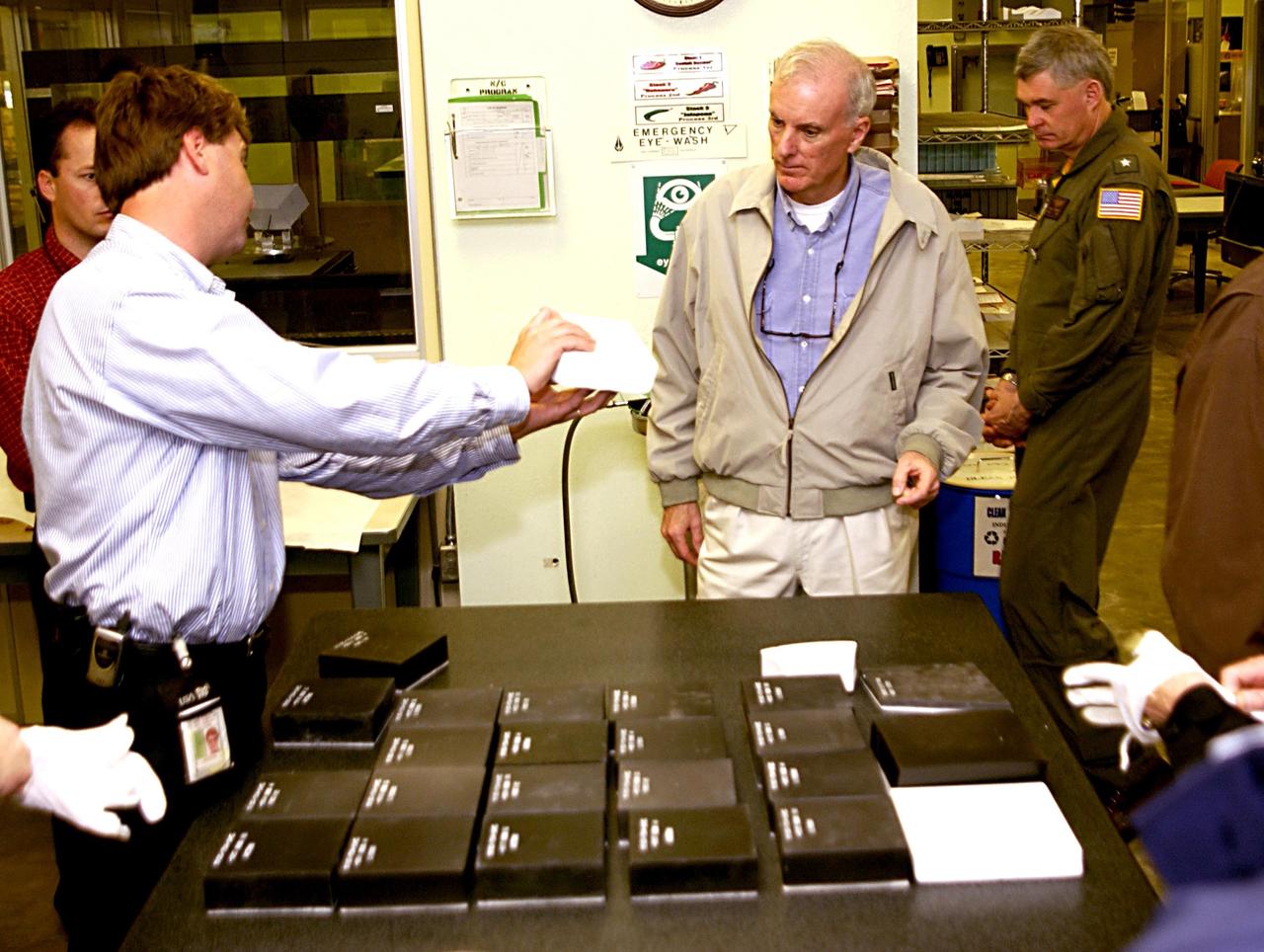
KENNEDY SPACE CENTER, FLA. - Retired Navy Admiral Harold W. Gehman Jr. (second from right), chairman of the Columbia Accident Investigation Board, visits the Thermal Protection System shop and is briefed by Martin Wilson (left), the shop manager. Gehman and other members of the board are visiting sites at KSC to become familiar with the Shuttle launch process. The independent board is charged with determining what caused the destruction of the Space Shuttle Columbia and the loss of its seven-member crew on Feb. 1 during reentry.
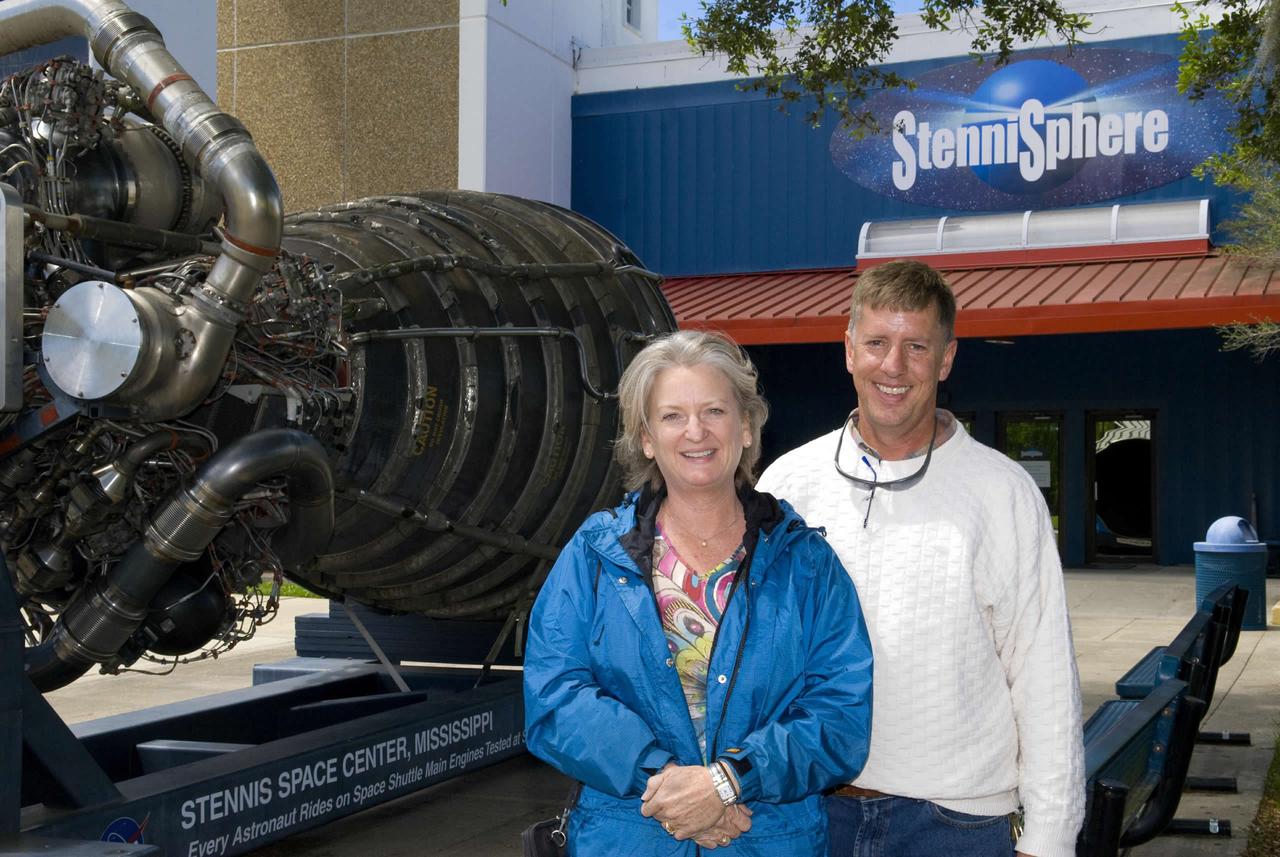
Jane Kenna of Atlanta, granddaughter of the late Sen. John C. Stennis, visits StenniSphere, the visitor center at NASA's John C. Stennis Space Center. Kenna and her husband, John, visited Stennis on April 6, her first trip to the rocket engine testing facility since the 1988 ceremony to rename the site in honor of her grandfather.
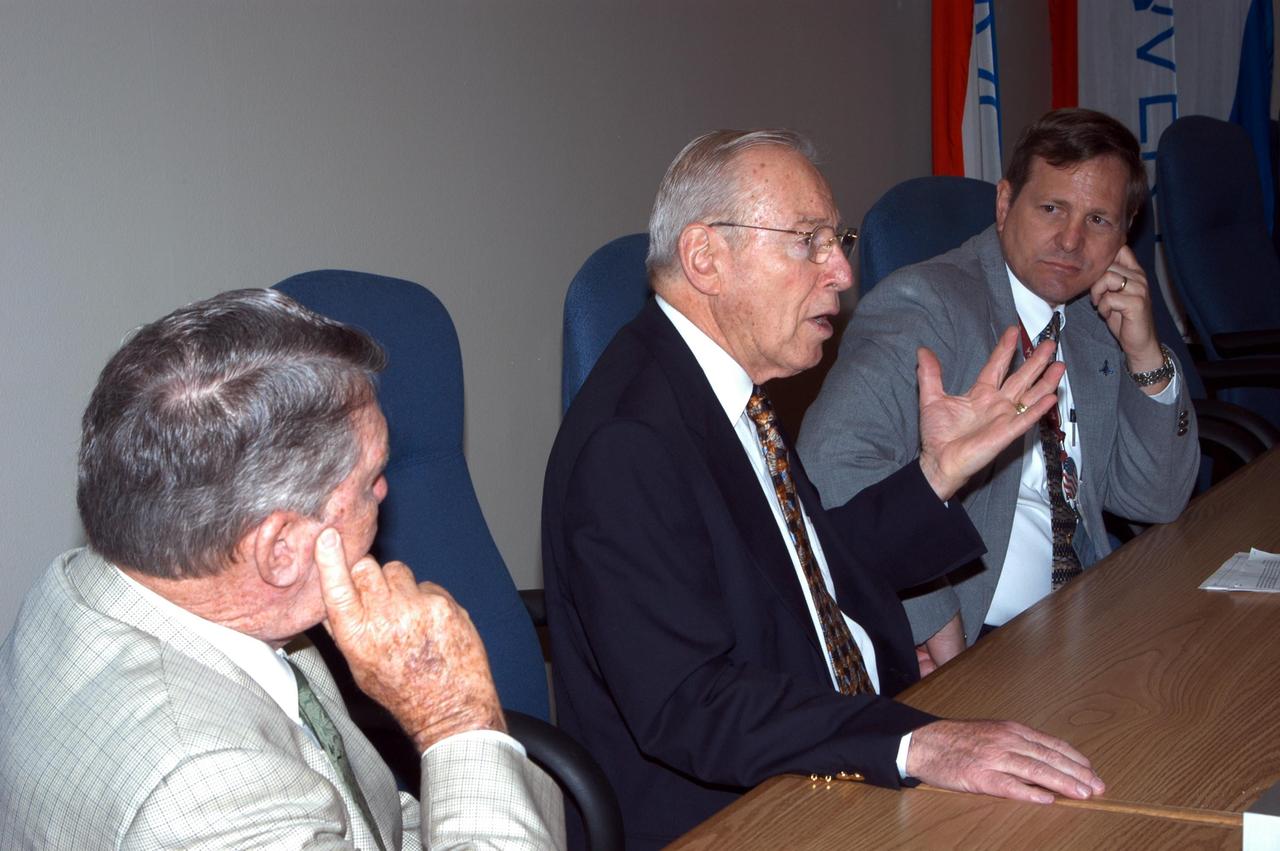
KENNEDY SPACE CENTER, FLA. - Former astronauts Jim Lovell (center) and Wally Schirra (left) talk with Mike Wetmore, director of Shuttle Processing (right) and others during a visit to KSC. Lovell and Schirra visited KSC to talk about the space program and their experiences, as well as offer encouragement to workers to help get the space program "back on its feet." They visited several sites around the Center, including the RLV Hangar where Columbia debris is being collected and examined as part of the investigation into the tragedy that claimed the orbiter and lives of seven astronauts returning from mission STS-107.
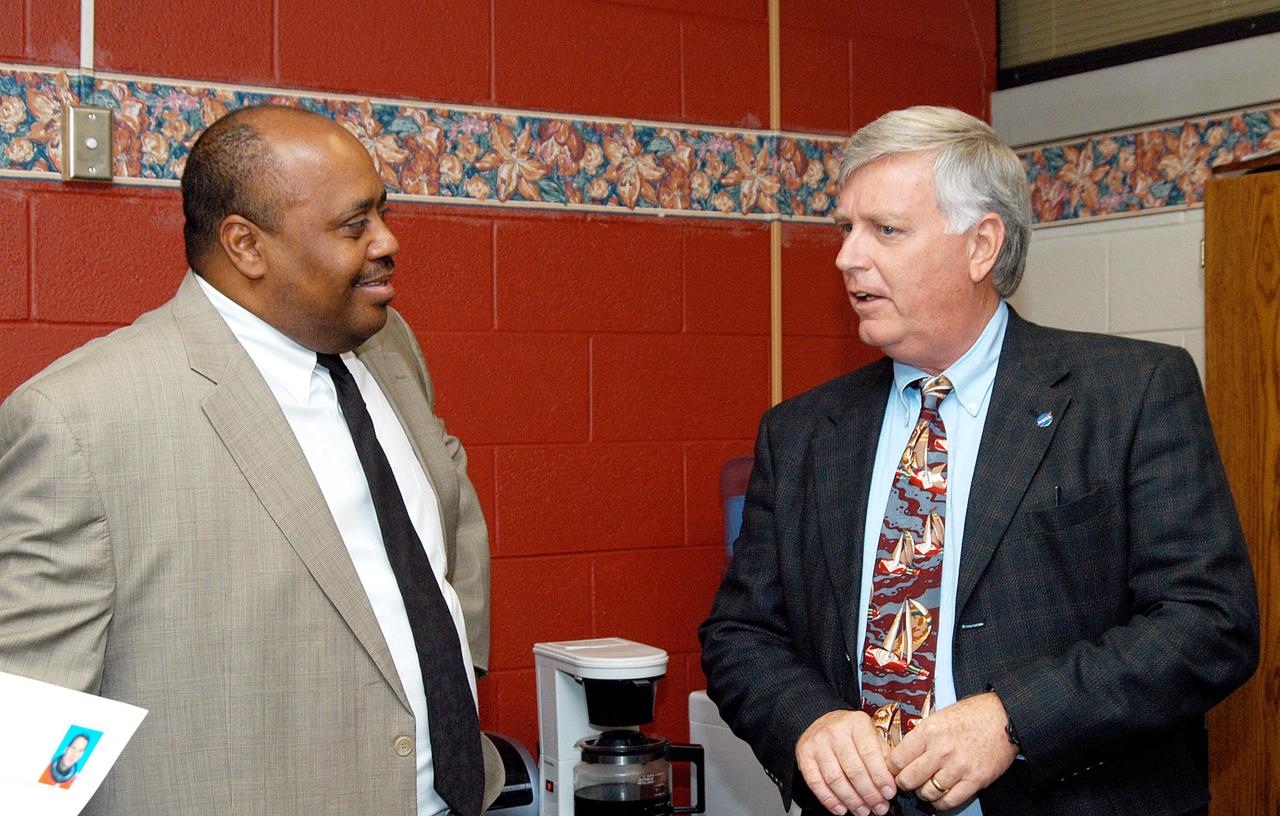
KENNEDY SPACE CENTER, FLA. - Center Director Jim Kennedy (right) talks to Aaron Fernander, principal of Ralph Bunche Middle School, a NASA Explorer School, in Atlanta, Ga. Kennedy is visiting NES sites to share America’s new vision for space exploration with the next generation of explorers. He was accompanied by astronaut Rick Linnehan on the visit. The purpose of the school visit is to talk with students about our destiny as explorers, NASA’s stepping stone approach to exploring Earth, the Moon, Mars and beyond, how space impacts our lives, and how people and machines rely on each other in space.
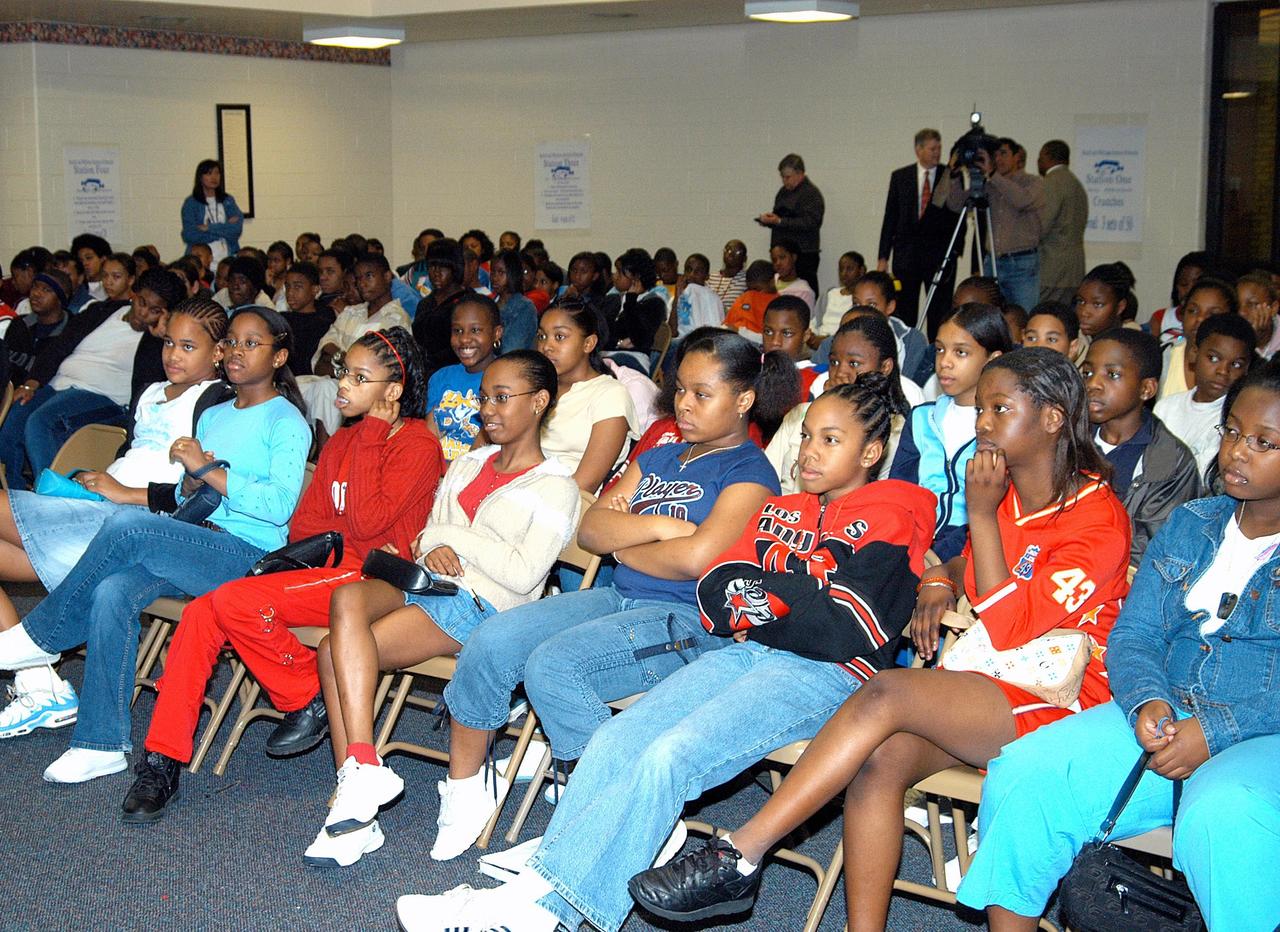
KENNEDY SPACE CENTER, FLA. - Students at Ralph Bunche Middle School, a NASA Explorer School, in Atlanta, Ga., listen intently to Center Director Jim Kennedy’s presentation. Kennedy is visiting NES sites to share America’s new vision for space exploration with the next generation of explorers. He was accompanied by astronaut Rick Linnehan on the visit. The purpose of the school visit is to talk with students about our destiny as explorers, NASA’s stepping stone approach to exploring Earth, the Moon, Mars and beyond, how space impacts our lives, and how people and machines rely on each other in space.
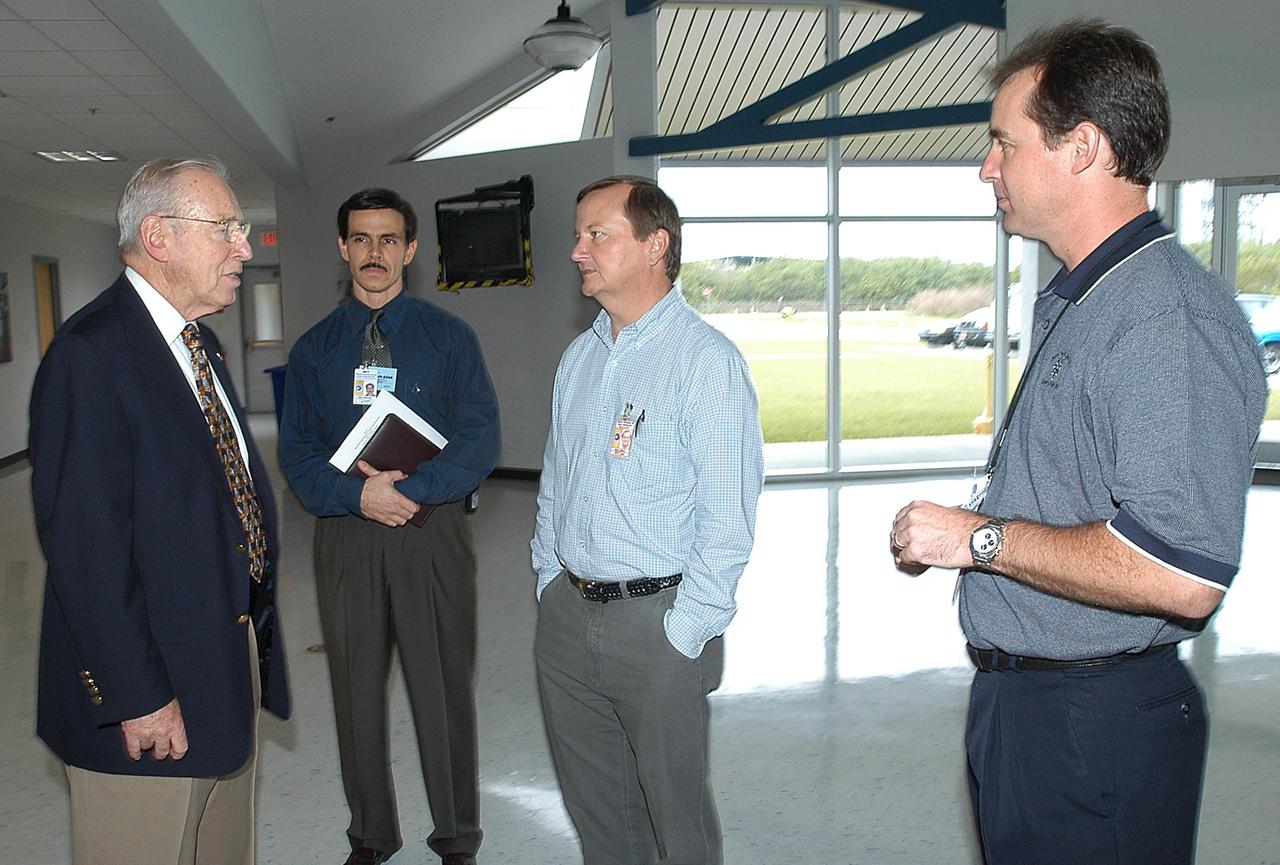
KENNEDY SPACE CENTER, FLA. - During a visit to KSC, former astronaut Jim Lovell (far left) talks to (from right) Space Shuttle Test Director Steve Altemus, Launch Director Mike Leinbach, and reconstruction engineer John Cowart. Lovell, along with former astronaut Wally Schirra, visited KSC to talk about the space program and their experiences, as well as offer encouragement to workers to help get the space program "back on its feet." They visited several sites around the Center, including the RLV Hangar where Columbia debris is being collected and examined as part of the investigation into the tragedy that claimed the orbiter and lives of seven astronauts returning from mission STS-107.
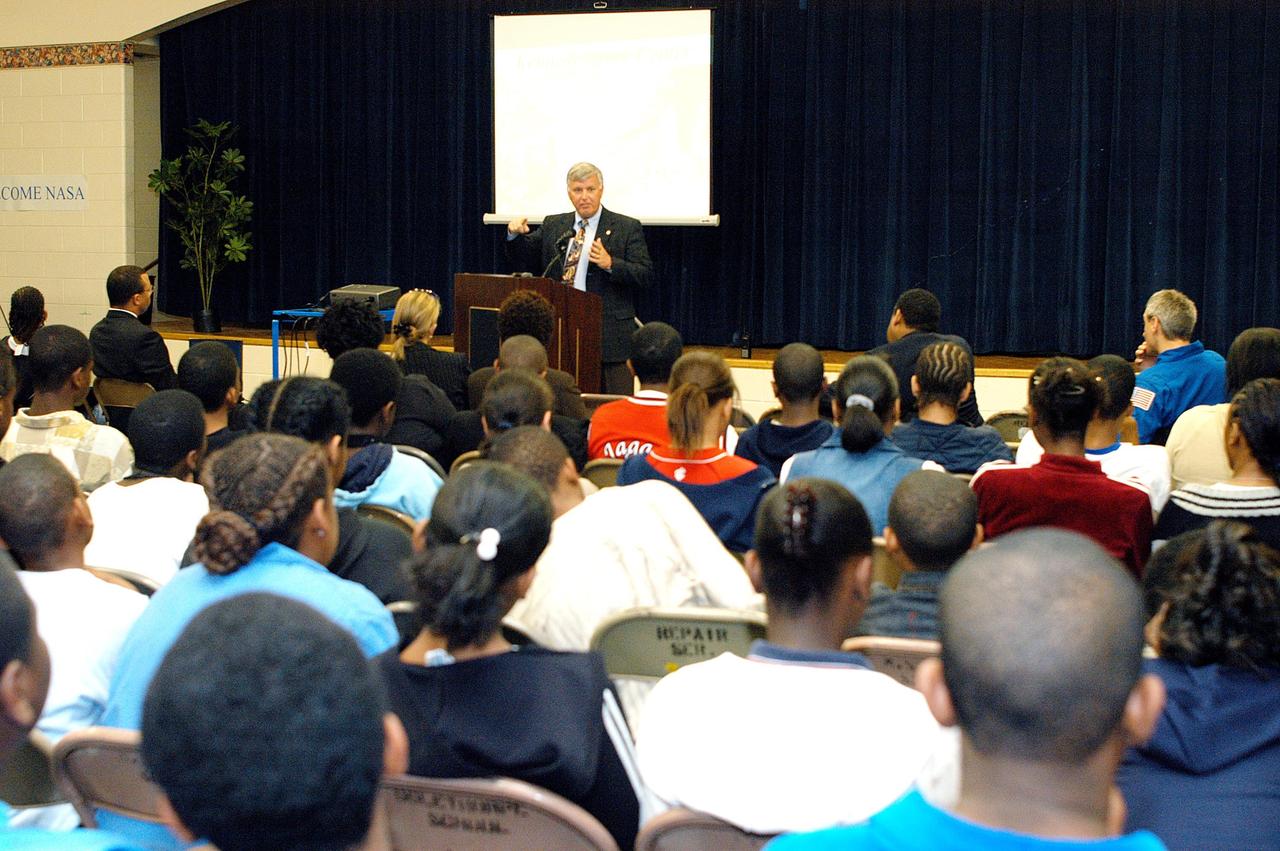
KENNEDY SPACE CENTER, FLA. - Center Director Jim Kennedy talks to students and faculty at Ralph Bunche Middle School, a NASA Explorer School, in Atlanta, Ga. Kennedy is visiting NES sites to share America’s new vision for space exploration with the next generation of explorers. He was accompanied by astronaut Rick Linnehan on the visit. The purpose of the school visit is to talk with students about our destiny as explorers, NASA’s stepping stone approach to exploring Earth, the Moon, Mars and beyond, how space impacts our lives, and how people and machines rely on each other in space.
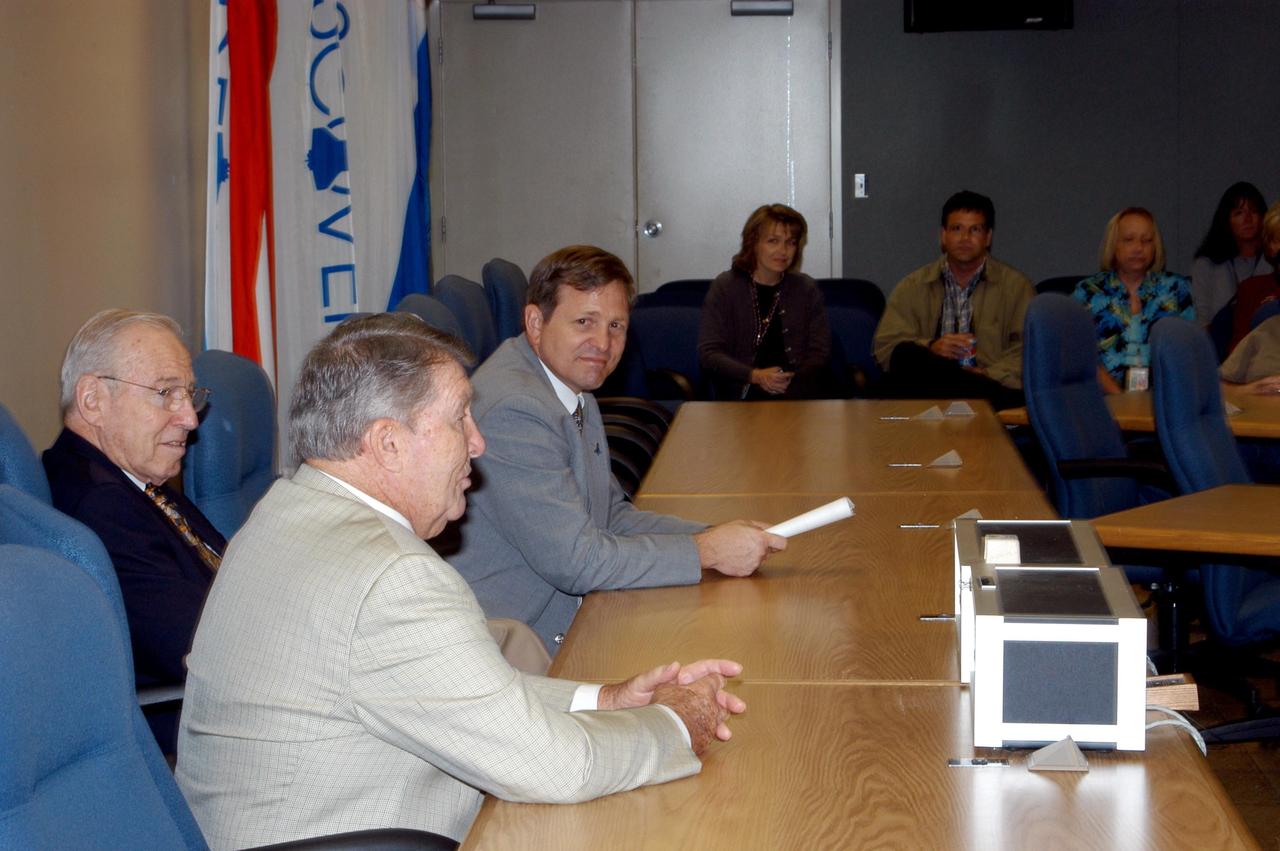
KENNEDY SPACE CENTER, FLA. - From left, former astronauts Jim Lovell and Wally Schirra talk with Mike Wetmore, director of Shuttle Processing (right) and others during a visit to KSC. Lovell and Schirra visited KSC to talk about the space program and their experiences, as well as offer encouragement to workers to help get the space program "back on its feet." They visited several sites around the Center, including the RLV Hangar where Columbia debris is being collected and examined as part of the investigation into the tragedy that claimed the orbiter and lives of seven astronauts returning from mission STS-107.
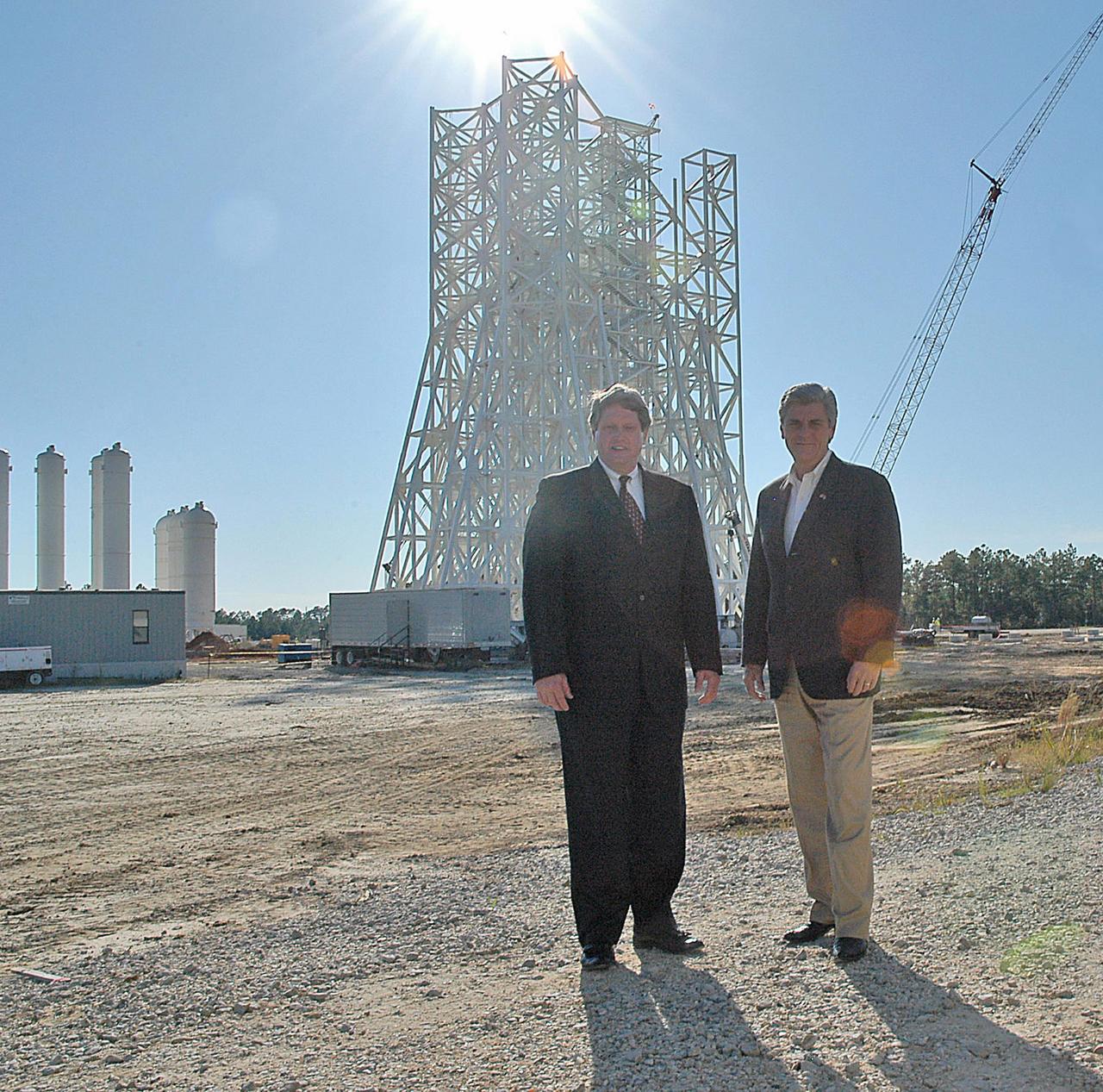
Stennis Space Center Director Gene Goldman (left) stands with Mississippi Lt. Gov. Phil Bryant at the A-3 Test Stand construction site during an Oct. 1 visit by the state official. During his tour, Bryant was updated on construction of the first large test stand at Stennis since the 1960s. The A-3 stand will be used to conduct simulated high-altitude testing on the next generation of rocket engines that will take humans back to the moon and possibly beyond. In addition to touring Stennis facilities, Bryant visited the INFINITY Science Center construction site, where he was updated on work under way to construct a 72,000-square-foot facility that will showcase the science underpinning the missions of NASA and resident agencies at Stennis.
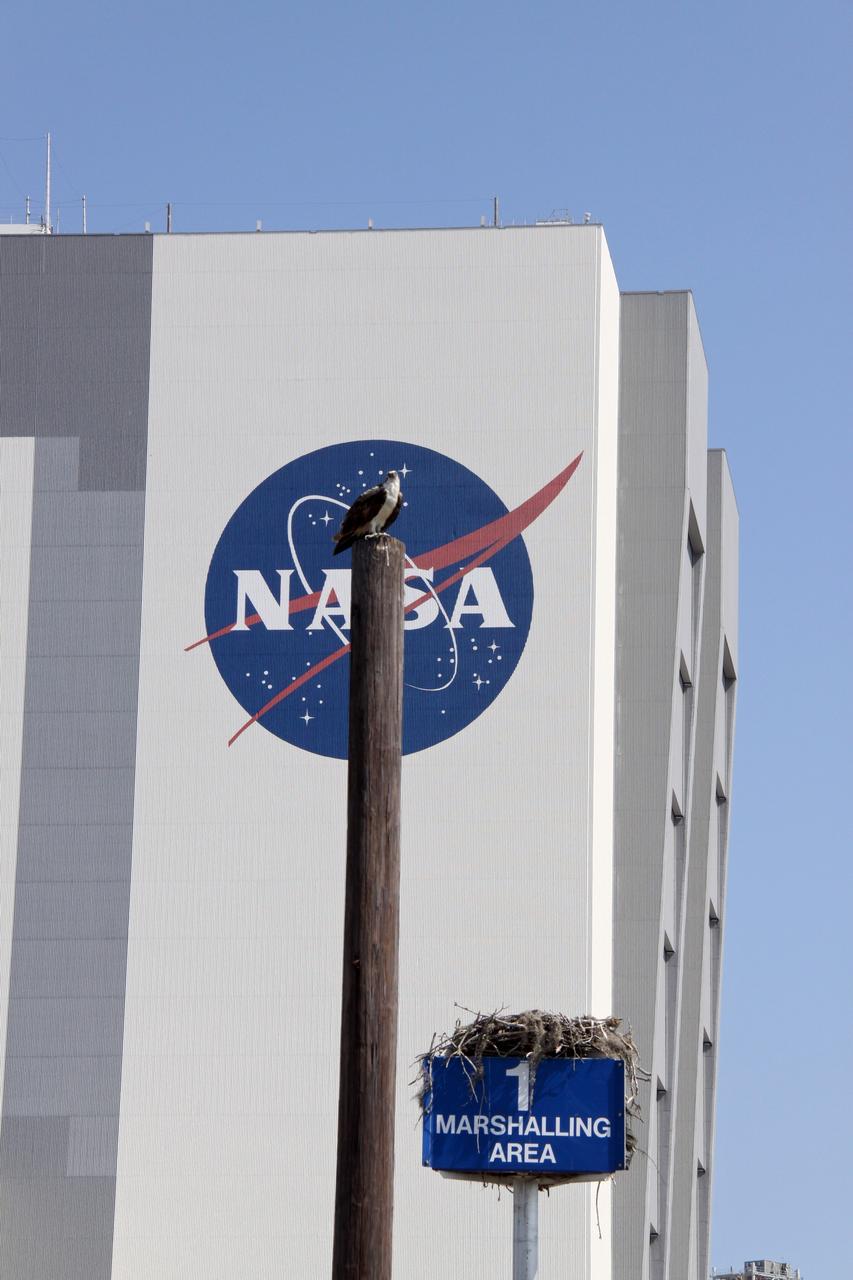
CAPE CANAVERAL, Fla. -- At NASA's Kennedy Space Center in Florida, an adult osprey guards its young in a nest built on a platform in the Press Site parking lot. In the background is the 12,300-square-foot NASA logo painted on the side of the Vehicle Assembly Building (VAB). The VAB and Press Site are located at the Turn Basin in Launch Complex 39, making it an ideal osprey nesting place. The Merritt Island National Wildlife Refuge overlaps with Kennedy Space Center property and provides a habitat for many types of wildlife, including the osprey, and 330 species of birds. For information on the refuge, visit http://www.fws.gov/merrittisland/Index.html. Photo credit: NASA/Jack Pfaller
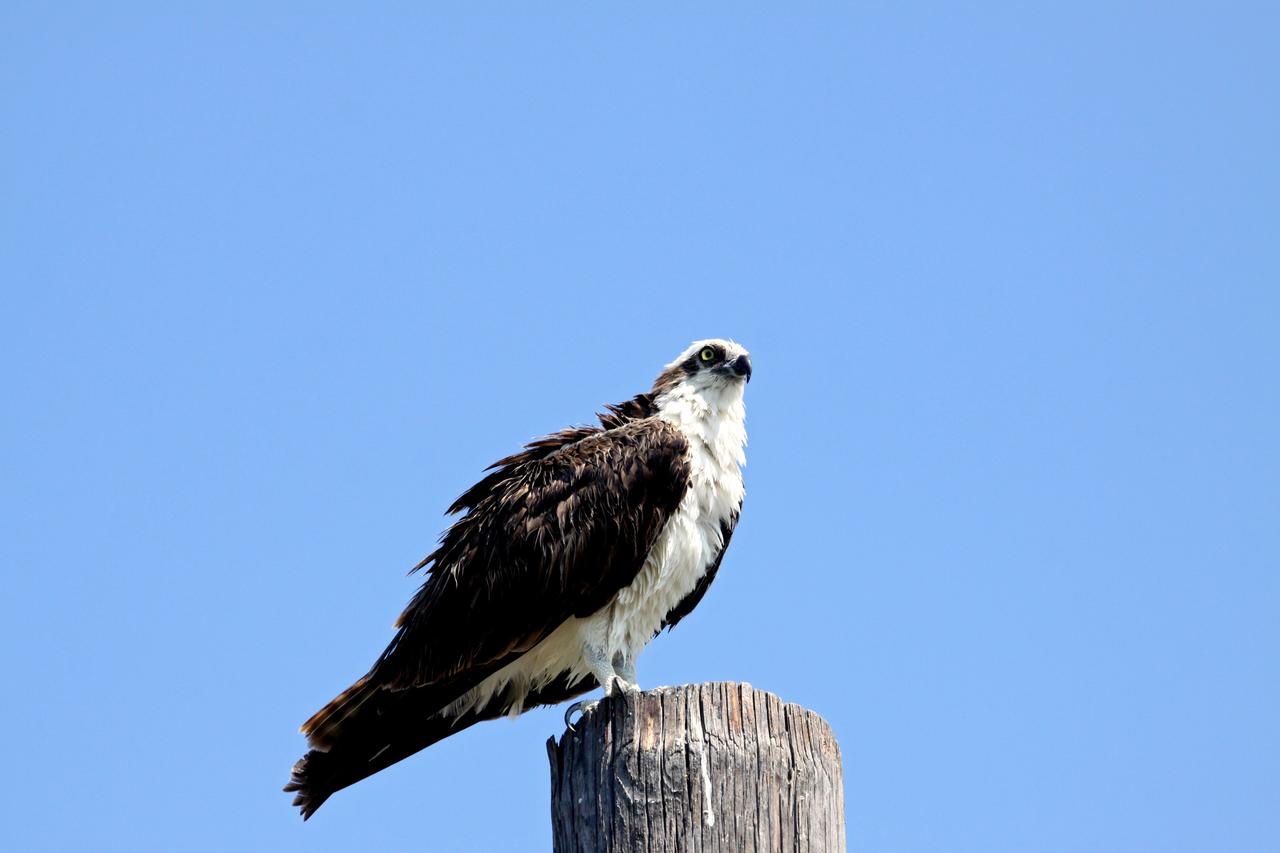
CAPE CANAVERAL, Fla. -- At NASA's Kennedy Space Center in Florida, an adult osprey keeps an eye on its young from a pole near the Press Site parking lot. The VAB and Press Site are located at the Turn Basin in Launch Complex 39, making it an ideal osprey nesting place. The Merritt Island National Wildlife Refuge overlaps with Kennedy Space Center property and provides a habitat for many types of wildlife, including the osprey, and 330 species of birds. For information on the refuge, visit http://www.fws.gov/merrittisland/Index.html. Photo credit: NASA/Jack Pfaller
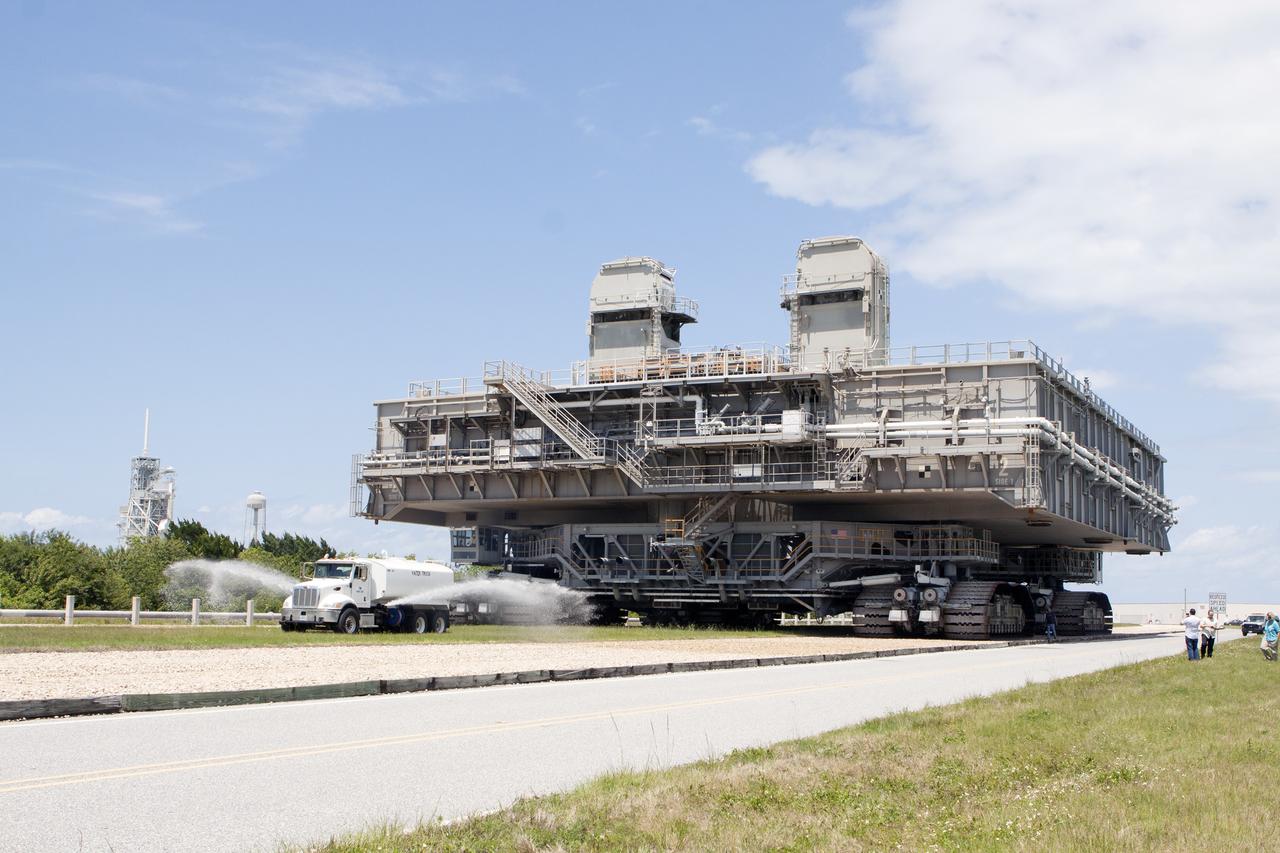
CAPE CANAVERAL, Fla. -- At NASA's Kennedy Space Center in Florida, a truck sprays water along the crawlerway to reduce dust ahead of the crawler-transporter moving Mobile Launcher Platform-2, or MLP-2, from Launch Pad 39A, in the background, to a nearby park site in Launch Complex 39. The historic launch pad was the site from which numerous Apollo and space shuttle missions began and is beginning a new mission as a commercial launch site. NASA signed a property agreement with Space Exploration Technologies Corp., or SpaceX, of Hawthorne, California, on April 14 for use and occupancy of the seaside complex along Florida's central east coast. It will serve as a platform for SpaceX to support their commercial launch activities. For more information on Launch Pad 39A, visit http://www.nasa.gov/centers/kennedy/pdf/167416main_LC39-08.pdf. For learn more about the crawler-transporter, visit http://www.nasa.gov/centers/kennedy/pdf/167402main_crawlertransporters07.pdf. Photo credit: NASA/Kim Shiflett

CAPE CANAVERAL, Fla. -- At NASA's Kennedy Space Center in Florida, Mobile Launcher Platform-2, or MLP-2, is glimpsed across the water as it departs Launch Pad 39A atop a crawler-transporter. A pad on Cape Canaveral Air Force Station is in view in the background. The MLP is being moved to a nearby park site in Launch Complex 39. The historic launch pad was the site from which numerous Apollo and space shuttle missions began and is beginning a new mission as a commercial launch site. NASA signed a property agreement with Space Exploration Technologies Corp., or SpaceX, of Hawthorne, California, on April 14 for use and occupancy of the seaside complex along Florida's central east coast. It will serve as a platform for SpaceX to support their commercial launch activities. For more information on Launch Pad 39A, visit http://www.nasa.gov/centers/kennedy/pdf/167416main_LC39-08.pdf. For learn more about the crawler-transporter, visit http://www.nasa.gov/centers/kennedy/pdf/167402main_crawlertransporters07.pdf. Photo credit: NASA/Kim Shiflett
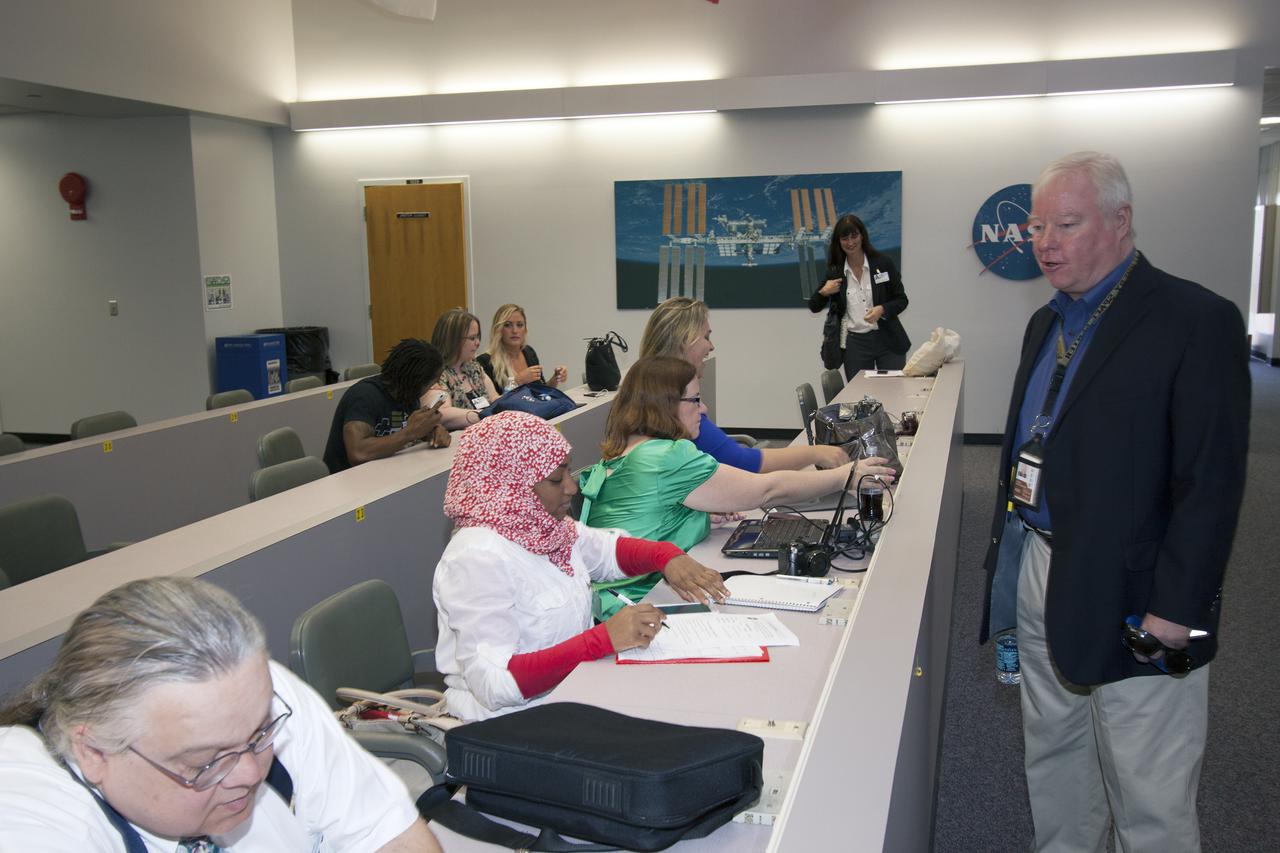
CAPE CANAVERAL, Fla. – Florida Today reporter Todd Halvorson, shares his expertise and experiences with nine Florida Institute of Technology aspiring journalists visiting Kennedy Space Center in Florida on May 22 at the Press Site. The group of students, in collaboration with Florida Today, is working on a multimedia project that examines health in zero gravity and how life in space can help people live better on Earth. These multimedia stories will be published for the print and online versions of Florida Today. During their visit, the students interviewed astronaut and Expedition 35 flight engineer Chris Cassidy during an International Space Station downlink in the Press Site auditorium. The journalists also worked on multimedia deadline news assignments at the Press Site. They also met with Kennedy Director Bob Cabana who talked about NASA's goals for the future and his own experience in space, answering questions about health effects of spaceflight. The journalists toured the Vehicle Assembly Building and the Apollo Saturn V Center. Learn about the Florida Institute of Technology journalists' findings on their Facebook page at http:__www.facebook.com_FT3atFIT or Twitter at #SpaceHealth. Photo credit: NASA_Jim Grossmann
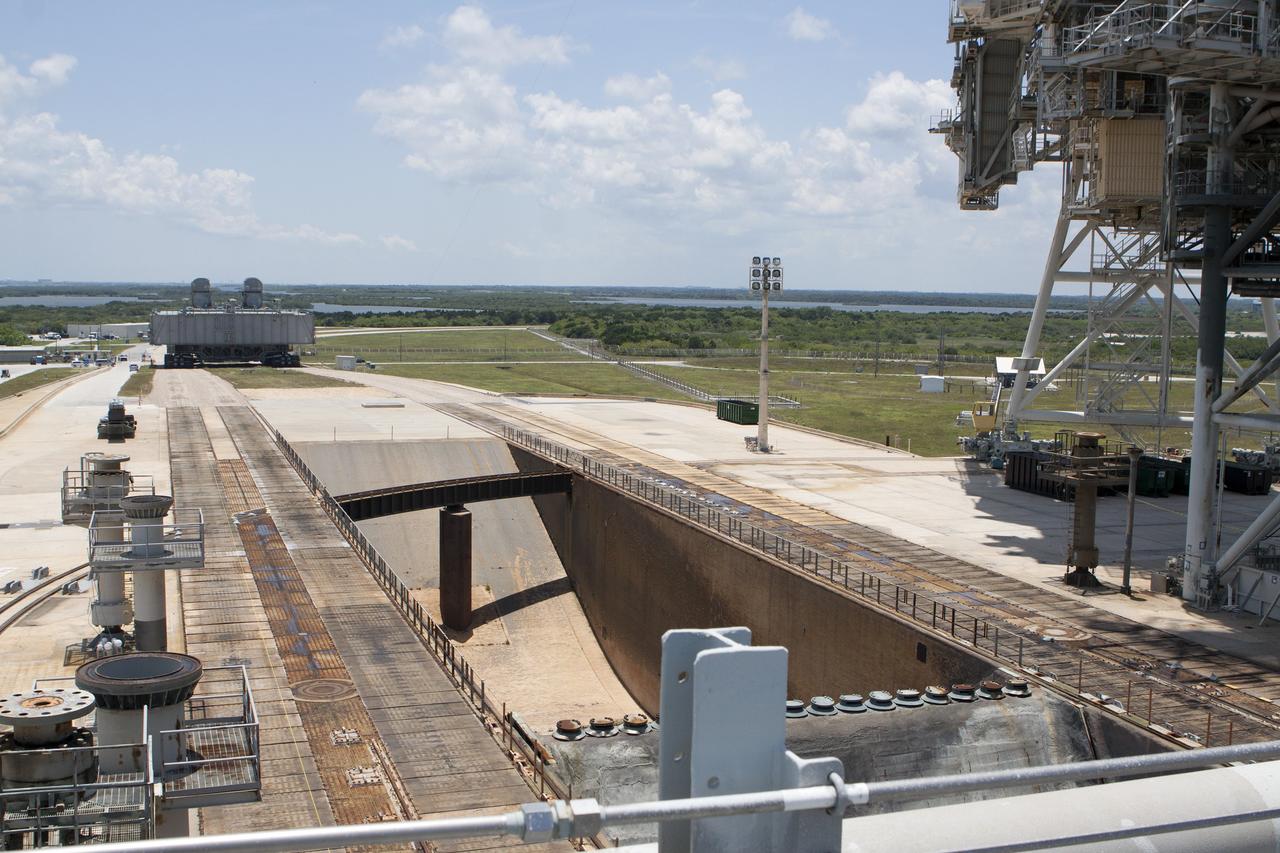
CAPE CANAVERAL, Fla. -- At NASA's Kennedy Space Center in Florida, Mobile Launcher Platform-2, or MLP-2, rolling away from Launch Pad 39A atop a crawler-transporter, was positioned over the pad's flame trench only moments before. The MLP is being moved to a nearby park site in Launch Complex 39. The historic launch pad was the site from which numerous Apollo and space shuttle missions began and is beginning a new mission as a commercial launch site. NASA signed a property agreement with Space Exploration Technologies Corp., or SpaceX, of Hawthorne, California, on April 14 for use and occupancy of the seaside complex along Florida's central east coast. It will serve as a platform for SpaceX to support their commercial launch activities. For more information on Launch Pad 39A, visit http://www.nasa.gov/centers/kennedy/pdf/167416main_LC39-08.pdf. For learn more about the crawler-transporter, visit http://www.nasa.gov/centers/kennedy/pdf/167402main_crawlertransporters07.pdf. Photo credit: NASA/Kim Shiflett
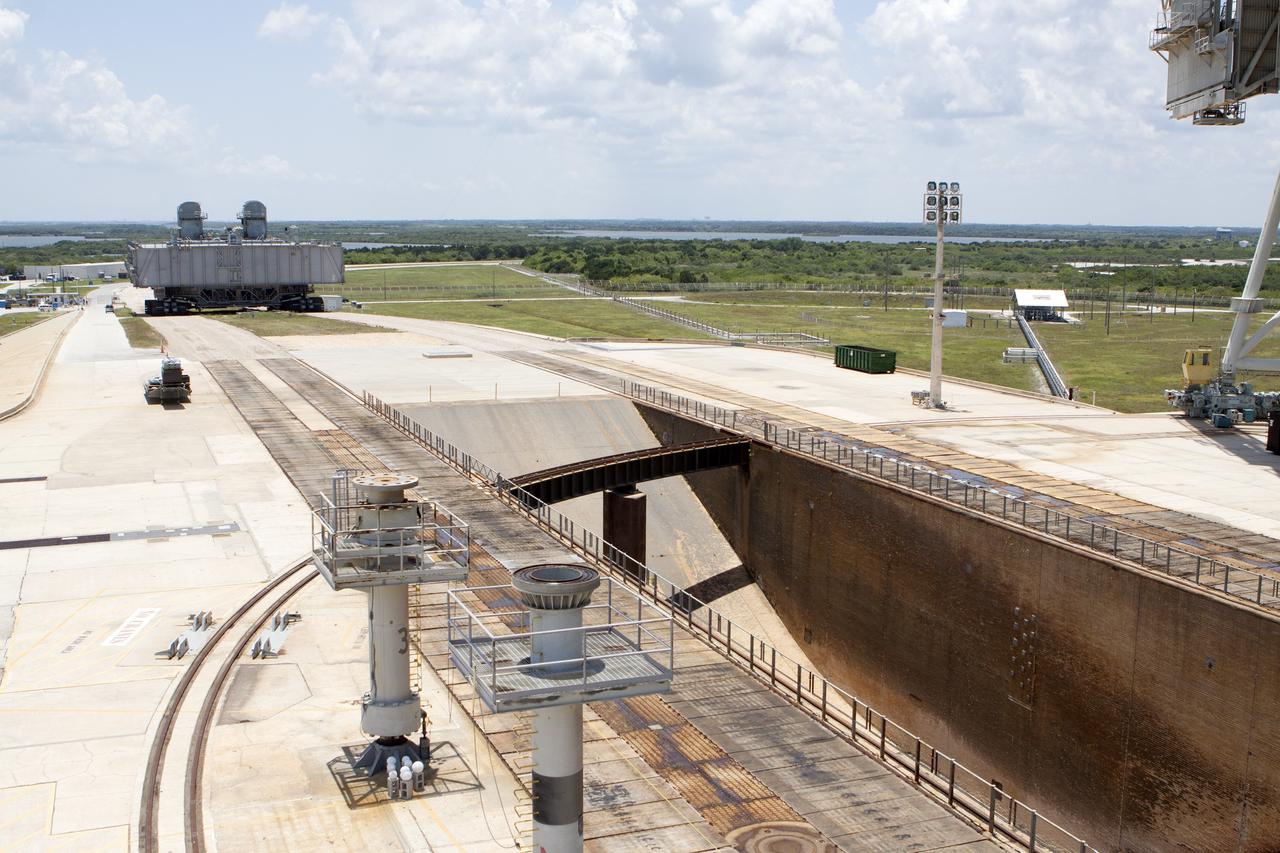
CAPE CANAVERAL, Fla. -- The flame trench comes into view on Launch Pad 39A as a crawler-transporter hauls Mobile Launcher Platform-2, or MLP-2, off the pad at NASA's Kennedy Space Center in Florida. The MLP is being moved to a nearby park site in Launch Complex 39. The historic launch pad was the site from which numerous Apollo and space shuttle missions began and is beginning a new mission as a commercial launch site. NASA signed a property agreement with Space Exploration Technologies Corp., or SpaceX, of Hawthorne, California, on April 14 for use and occupancy of the seaside complex along Florida's central east coast. It will serve as a platform for SpaceX to support their commercial launch activities. For more information on Launch Pad 39A, visit http://www.nasa.gov/centers/kennedy/pdf/167416main_LC39-08.pdf. For learn more about the crawler-transporter, visit http://www.nasa.gov/centers/kennedy/pdf/167402main_crawlertransporters07.pdf. Photo credit: NASA/Kim Shiflett
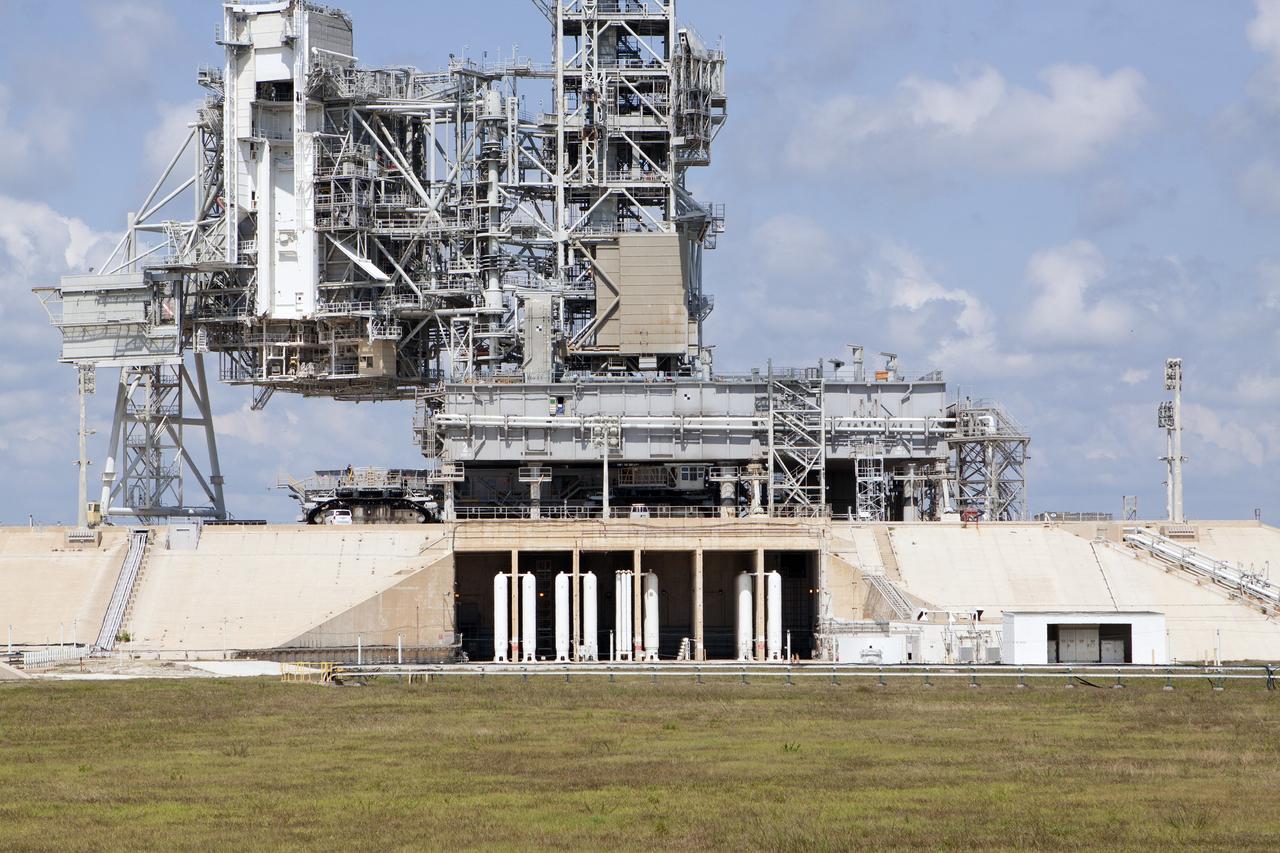
CAPE CANAVERAL, Fla. -- A crawler-transporter rolls under the Mobile Launcher Platform-2, or MLP-2, positioned over the flame trench at Launch Pad 39A at NASA's Kennedy Space Center in Florida. Operations are underway to move the MLP to a nearby park site in Launch Complex 39. The historic launch pad was the site from which numerous Apollo and space shuttle missions began and is beginning a new mission as a commercial launch site. NASA signed a property agreement with Space Exploration Technologies Corp., or SpaceX, of Hawthorne, California, on April 14 for use and occupancy of the seaside complex along Florida's central east coast. It will serve as a platform for SpaceX to support their commercial launch activities. For more information on Launch Pad 39A, visit http://www.nasa.gov/centers/kennedy/pdf/167416main_LC39-08.pdf. For learn more about the crawler-transporter, visit http://www.nasa.gov/centers/kennedy/pdf/167402main_crawlertransporters07.pdf. Photo credit: NASA/Kim Shiflett
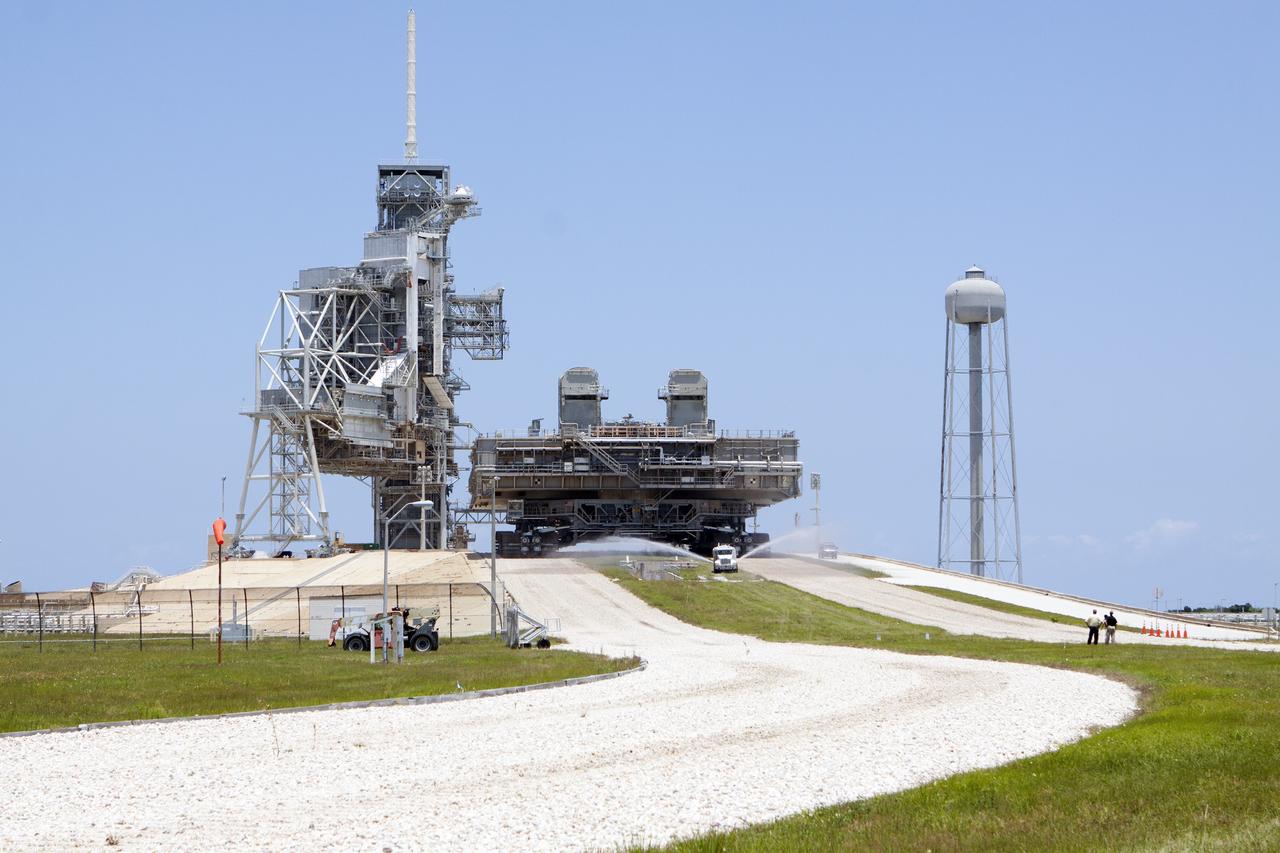
CAPE CANAVERAL, Fla. -- At NASA's Kennedy Space Center in Florida, a truck sprays water along the crawlerway to reduce dust ahead of the crawler-transporter moving Mobile Launcher Platform-2, or MLP-2, from Launch Pad 39A to a nearby park site in Launch Complex 39. The historic launch pad was the site from which numerous Apollo and space shuttle missions began and is beginning a new mission as a commercial launch site. NASA signed a property agreement with Space Exploration Technologies Corp., or SpaceX, of Hawthorne, California, on April 14 for use and occupancy of the seaside complex along Florida's central east coast. It will serve as a platform for SpaceX to support their commercial launch activities. For more information on Launch Pad 39A, visit http://www.nasa.gov/centers/kennedy/pdf/167416main_LC39-08.pdf. For learn more about the crawler-transporter, visit http://www.nasa.gov/centers/kennedy/pdf/167402main_crawlertransporters07.pdf. Photo credit: NASA/Kim Shiflett
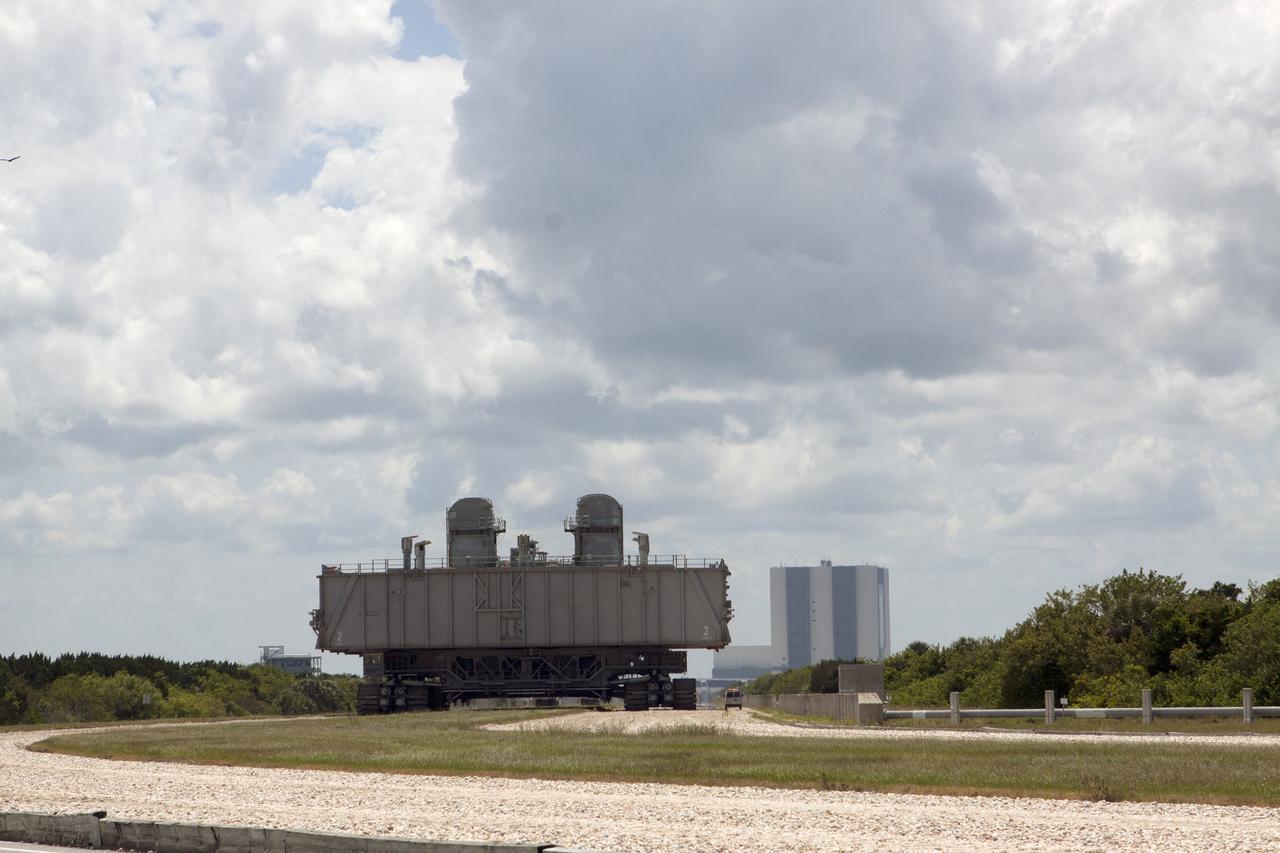
CAPE CANAVERAL, Fla. -- The crawler-transporter transporting Mobile Launcher Platform-2, or MLP-2, from Launch Pad 39A creeps along the crawlerway toward the Vehicle Assembly Building, or VAB, at NASA's Kennedy Space Center in Florida. The MLP is being moved to a nearby park site in Launch Complex 39. The historic launch pad was the site from which numerous Apollo and space shuttle missions began and is beginning a new mission as a commercial launch site. NASA signed a property agreement with Space Exploration Technologies Corp., or SpaceX, of Hawthorne, California, on April 14 for use and occupancy of the seaside complex along Florida's central east coast. It will serve as a platform for SpaceX to support their commercial launch activities. For more information on Launch Pad 39A, visit http://www.nasa.gov/centers/kennedy/pdf/167416main_LC39-08.pdf. For learn more about the crawler-transporter, visit http://www.nasa.gov/centers/kennedy/pdf/167402main_crawlertransporters07.pdf. Photo credit: NASA/Kim Shiflett

A group of students and their chaperones view a mural on a wall at the News Center during a tour of NASA’s Kennedy Space Center in Florida on Oct. 6, 2022. The middle-school students, from the Boys and Girls Clubs of the Flathead Indian Reservation in Montana, are visiting the space center with the Students to Launch program. Students to Launch engages students in STEM (science, technology, engineering and mathematics) and creates awareness of careers in the space program.
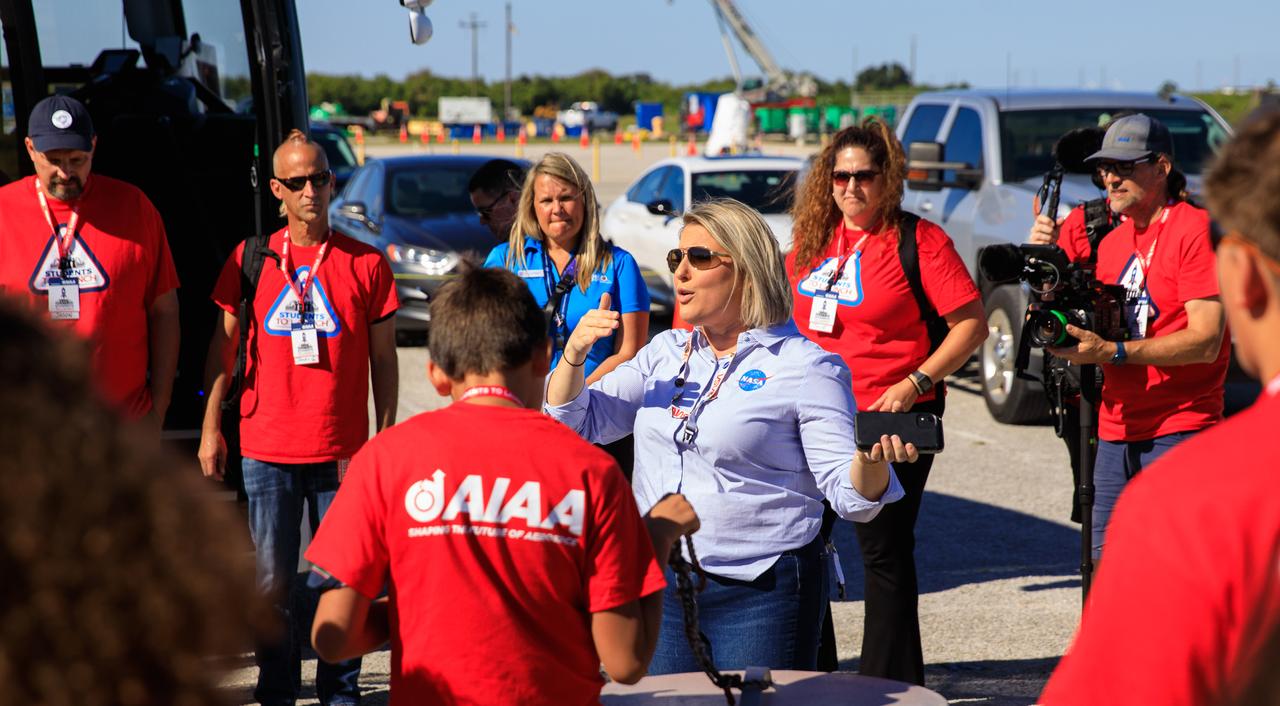
Leah Martin, in the center, NASA Communications, speaks to students and their chaperones during a tour of NASA’s Kennedy Space Center in Florida on Oct. 6, 2022. The middle-school students, from the Boys and Girls Clubs of the Flathead Indian Reservation and lake in Montana, are visiting the space center with the Students to Launch program. Students to Launch engages students in STEM (science, technology, engineering and mathematics) and creates awareness of careers in the space program.
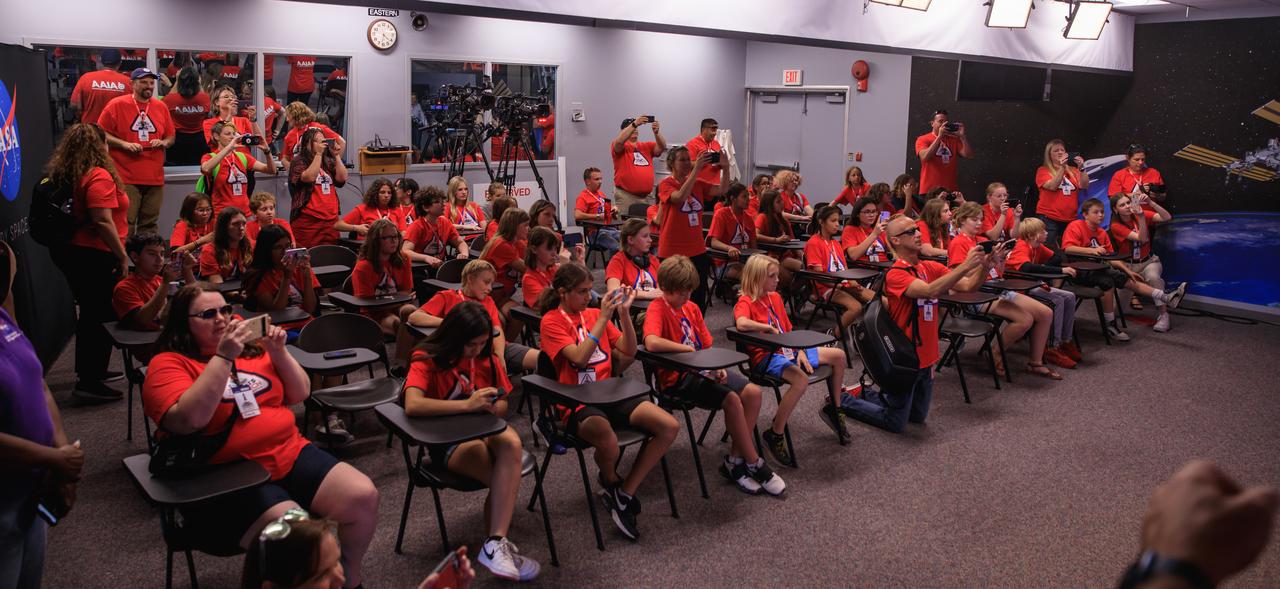
A group of students and their chaperones gather in the John Holliman Auditorium of the News Center for a mock news briefing during a tour of NASA’s Kennedy Space Center in Florida on Oct. 6, 2022. The middle-school students, from the Boys and Girls Clubs of the Flathead Indian Reservation in Montana, are visiting the space center with the Students to Launch program. Students to Launch engages students in STEM (science, technology, engineering and mathematics) and creates awareness of careers in the space program.
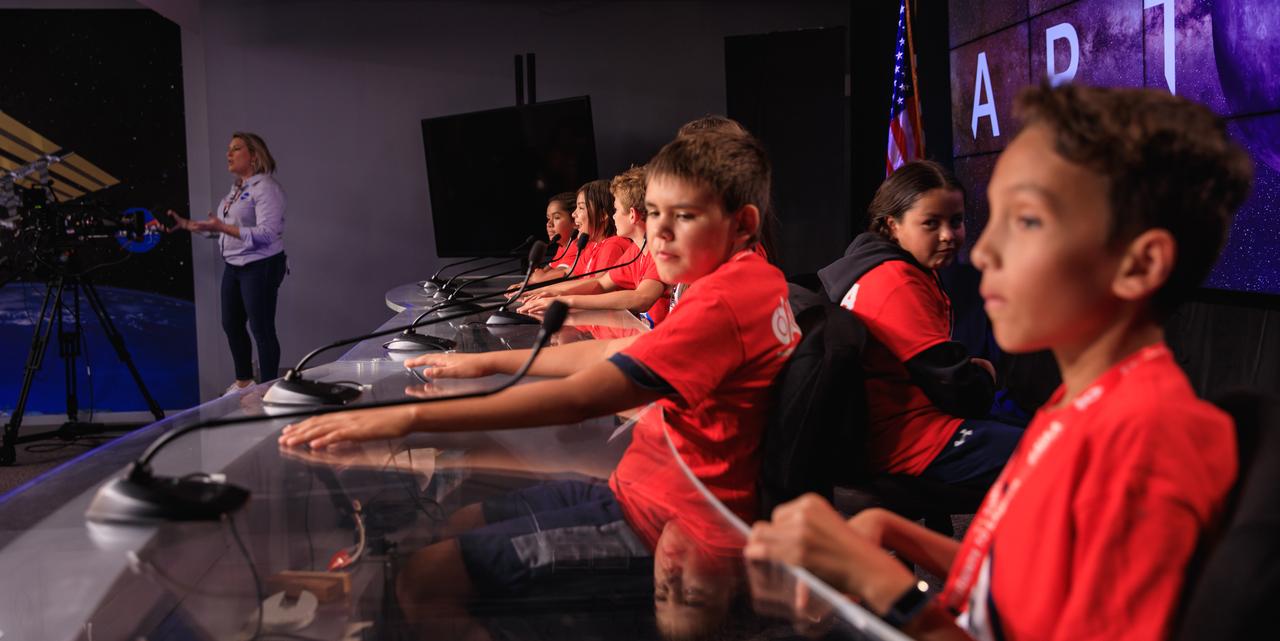
A group of students and their chaperones gather in the John Holliman Auditorium of the News Center during a tour of NASA’s Kennedy Space Center in Florida on Oct. 6, 2022. Some of them are seated at the dais at the front of the auditorium. The middle-school students, from the Boys and Girls Clubs of the Flathead Indian Reservation in Montana, are visiting the space center with the Students to Launch program. Students to Launch engages students in STEM (science, technology, engineering and mathematics) and creates awareness of careers in the space program.

A group of students and their chaperones gather in the John Holliman Auditorium of the News Center to simulate a news conference during a tour of NASA’s Kennedy Space Center in Florida on Oct. 6, 2022. Some of them are seated at the dais at the front of the auditorium. The middle-school students, from the Boys and Girls Clubs of the Flathead Indian Reservation in Montana, are visiting the space center with the Students to Launch program. Students to Launch engages students in STEM (science, technology, engineering and mathematics) and creates awareness of careers in the space program.
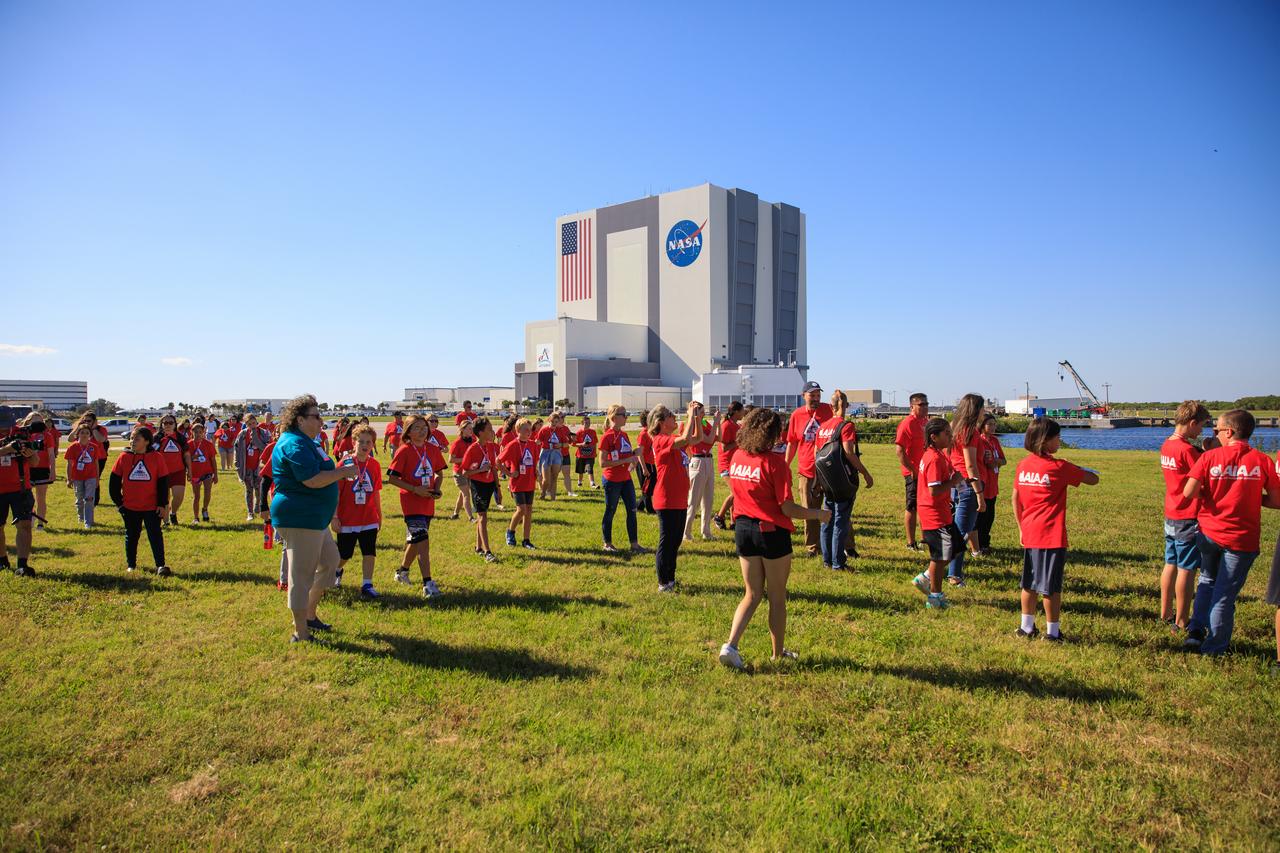
A group of students and their chaperones tour NASA’s Kennedy Space Center in Florida on Oct. 6, 2022. The middle-school students, from the Boys and Girls Clubs of the Flathead Indian Reservation in Montana, are visiting the space center under a Space Act Agreement with the Students to Launch program. Students to Launch engages students in STEM (science, technology, engineering and mathematics) and creates awareness of careers in the space program.
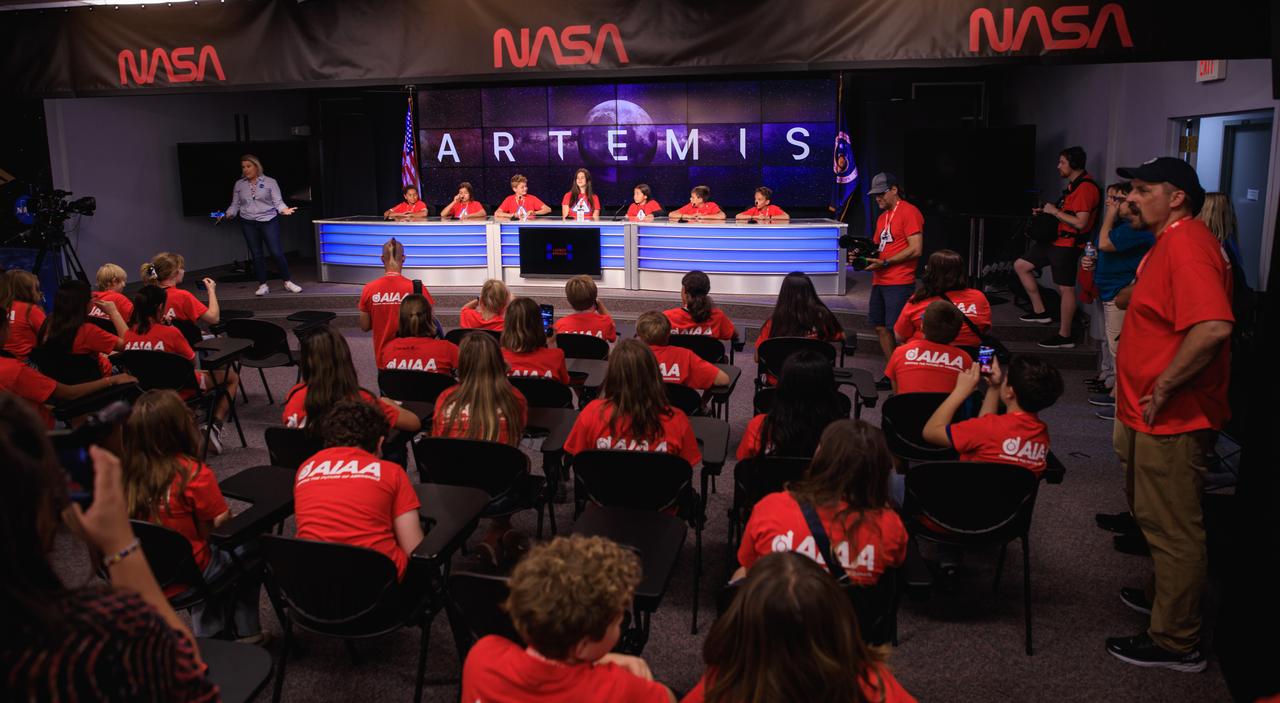
A group of students and their chaperones gather in the John Holliman Auditorium of the News Center to simulate a news conference during a tour of NASA’s Kennedy Space Center in Florida on Oct. 6, 2022. Some of them are seated at the dais at the front of the auditorium. At far left is Leah Martin, NASA Communications. The middle-school students, from the Boys and Girls Clubs of the Flathead Indian Reservation in Montana, are visiting the space center with the Students to Launch program. Students to Launch engages students in STEM (science, technology, engineering and mathematics) and creates awareness of careers in the space program.

A group of students and their chaperones gather for a photo at the launch countdown clock near the News Center at NASA’s Kennedy Space Center in Florida on Oct. 6, 2022. The middle-school students, from the Boys and Girls Clubs of the Flathead Indian Reservation in Montana, are visiting the space center with the Students to Launch program. Students to Launch is engages students in STEM (science, technology, engineering and mathematics) and creates awareness of careers in the space program.
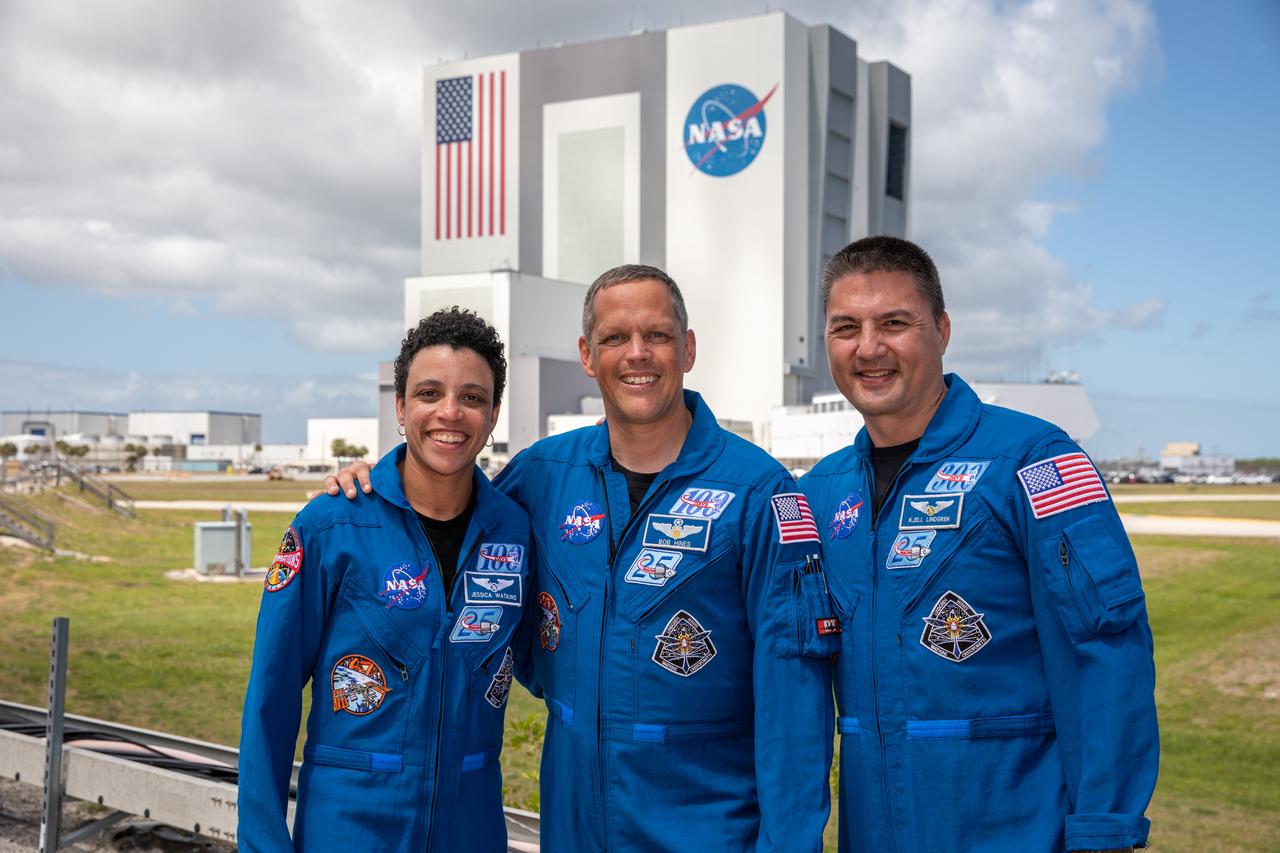
From left, NASA astronauts Jessica Watkins, Bob Hines, and Kjell Lindgren are photographed at the Press Site at NASA’s Kennedy Space Center during a visit to the Florida spaceport on March 22, 2023. The astronauts visited Kennedy to thank employees for supporting NASA’s SpaceX Crew-4 launch. Watkins, Hines, and Lindgren, along with ESA (European Space Agency) astronaut Samantha Cristoforetti, launched to the International Space Station aboard a SpaceX Crew Dragon spacecraft on April 27, 2022, from Kennedy’s Launch Complex 39A. The crew remained at the orbiting laboratory for approximately six months, conducting critical science as part of the fourth crew rotation mission for NASA’s Commercial Crew Program.
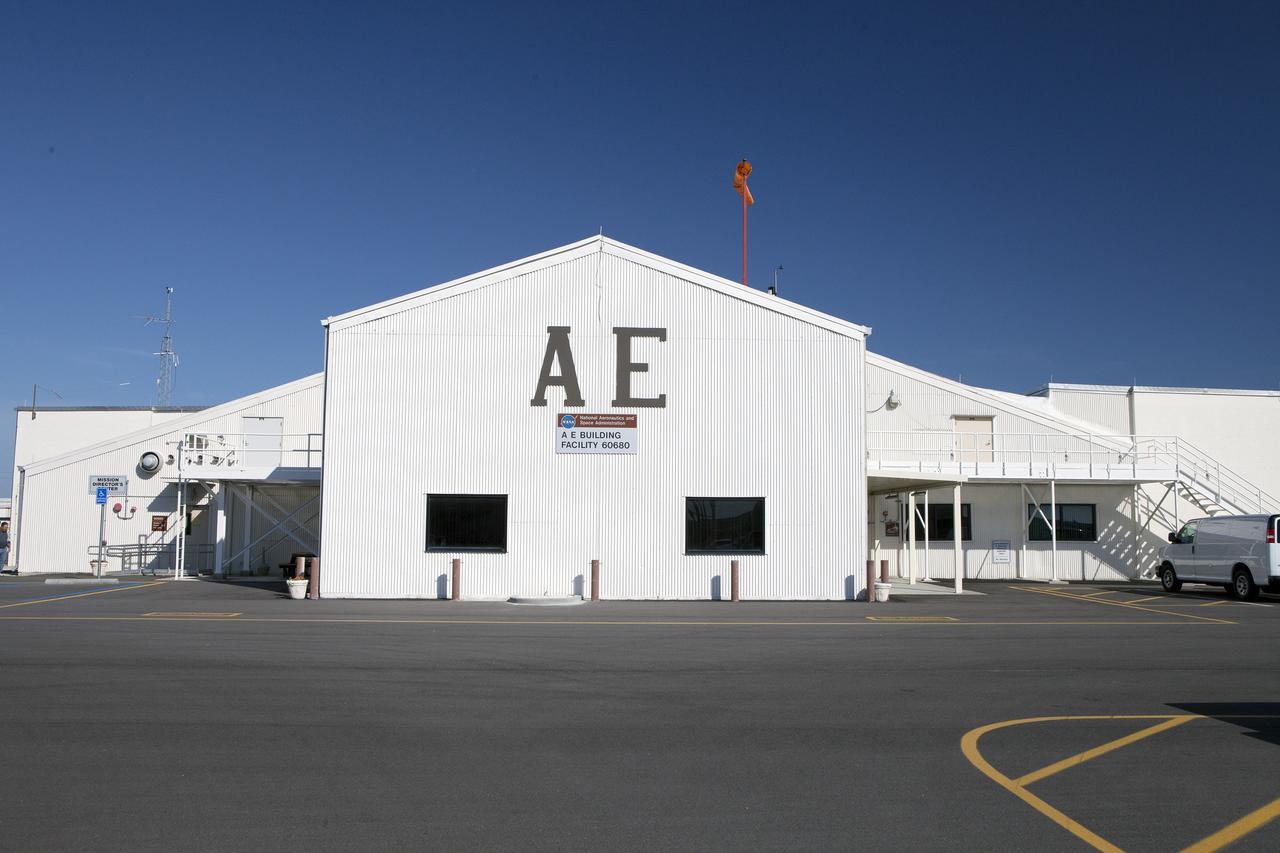
CAPE CANAVERAL, Fla. – Hangar AE on Cape Canav¬eral Air Force Station in Florida is used by NASA’s Launch Services Program as its communications center. The facility contains the program's Mission Director's Center, Launch Vehicle Data Center, and Telemetry Lab. The hangar, originally built in 1958 for a Department of De¬fense missile program, was acquired by NASA in 1960 and modified to support unmanned missions. To learn more about Hangar AE, visit http://www.nasa.gov/sites/default/files/files/Hangar-AE.pdf. For more about Kennedy Space Center, visit http://www.nasa.gov/kennedy. Photo credit: NASA/Daniel Casper
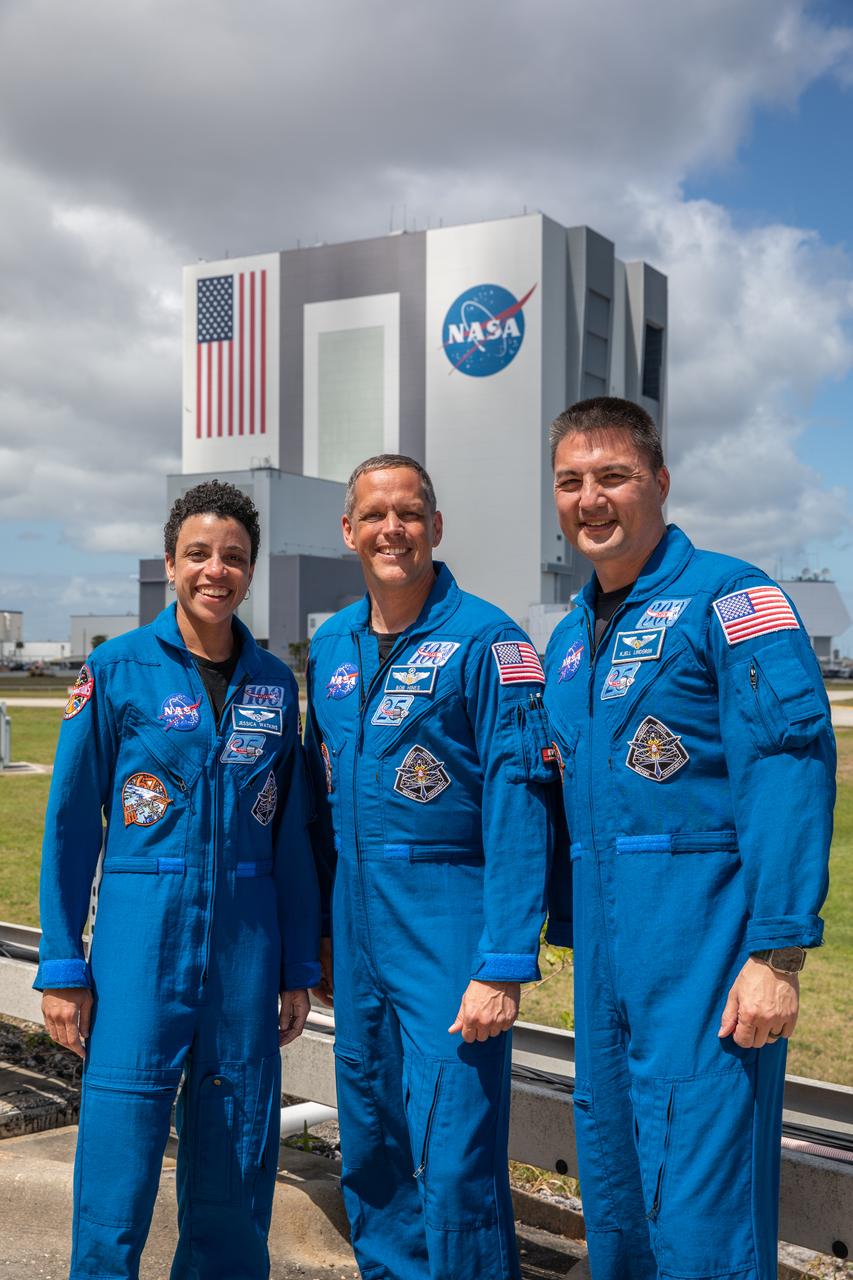
From left, NASA astronauts Jessica Watkins, Bob Hines, and Kjell Lindgren are photographed at the Press Site at NASA’s Kennedy Space Center during a visit to the Florida spaceport on March 22, 2023. The astronauts visited Kennedy to thank employees for supporting NASA’s SpaceX Crew-4 launch. Watkins, Hines, and Lindgren, along with ESA (European Space Agency) astronaut Samantha Cristoforetti, launched to the International Space Station aboard a SpaceX Crew Dragon spacecraft on April 27, 2022, from Kennedy’s Launch Complex 39A. The crew remained at the orbiting laboratory for approximately six months, conducting critical science as part of the fourth crew rotation mission for NASA’s Commercial Crew Program.
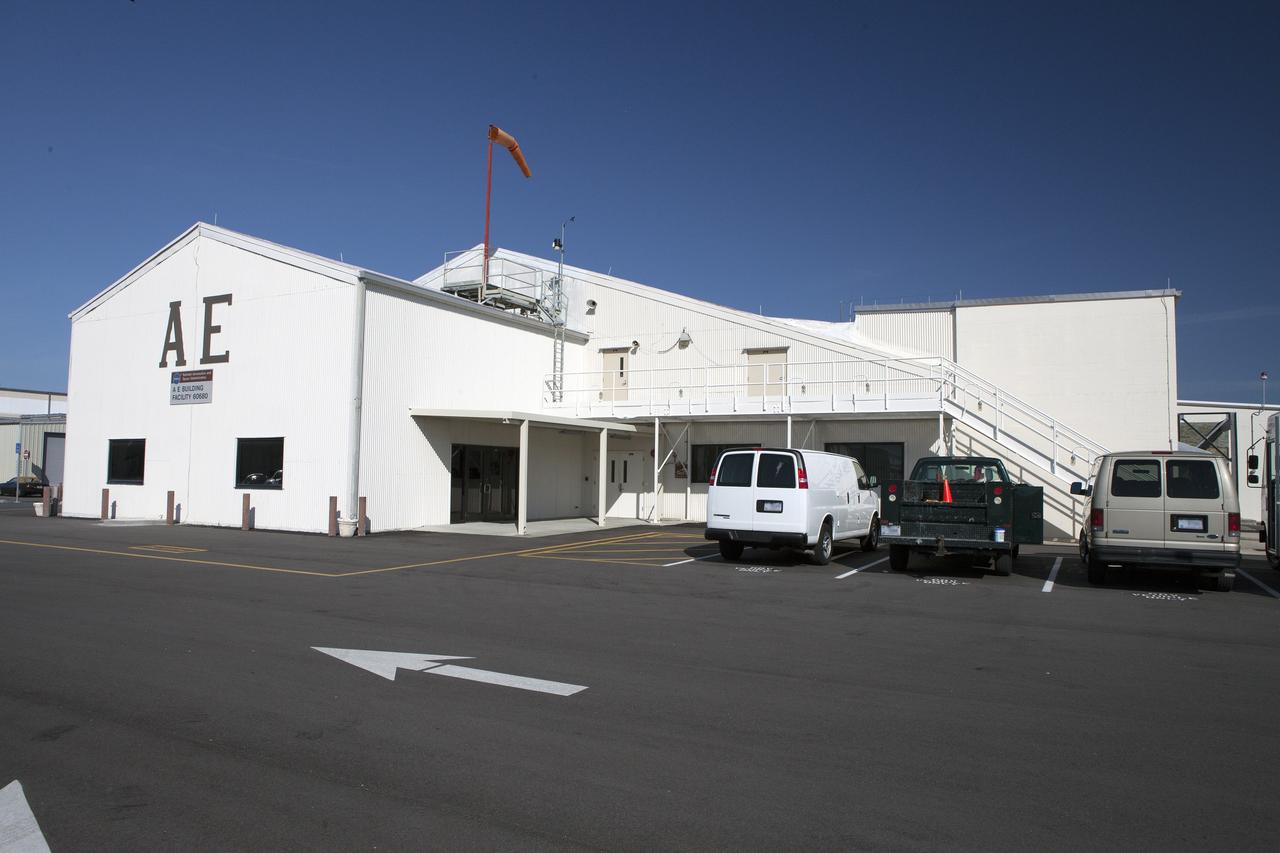
CAPE CANAVERAL, Fla. – Hangar AE on Cape Canav¬eral Air Force Station in Florida is used by NASA’s Launch Services Program as its communications center. The facility contains the program's Mission Director's Center, Launch Vehicle Data Center, and Telemetry Lab. The hangar, originally built in 1958 for a Department of De¬fense missile program, was acquired by NASA in 1960 and modified to support unmanned missions. To learn more about Hangar AE, visit http://www.nasa.gov/sites/default/files/files/Hangar-AE.pdf. For more about Kennedy Space Center, visit http://www.nasa.gov/kennedy. Photo credit: NASA/Daniel Casper

NASA astronaut Kjell Lindgren is photographed at the Press Site at NASA’s Kennedy Space Center during a visit to the Florida spaceport on March 22, 2023. Lindgren, along with crewmates Bob Hines and Jessica Watkins, visited Kennedy to thank employees for supporting NASA’s SpaceX Crew-4 launch. Lindgren, Hines, and Watkins, along with ESA (European Space Agency) astronaut Samantha Cristoforetti, launched to the International Space Station aboard a SpaceX Crew Dragon spacecraft on April 27, 2022, from Kennedy’s Launch Complex 39A. The crew remained at the orbiting laboratory for approximately six months, conducting critical science as part of the fourth crew rotation mission for NASA’s Commercial Crew Program.
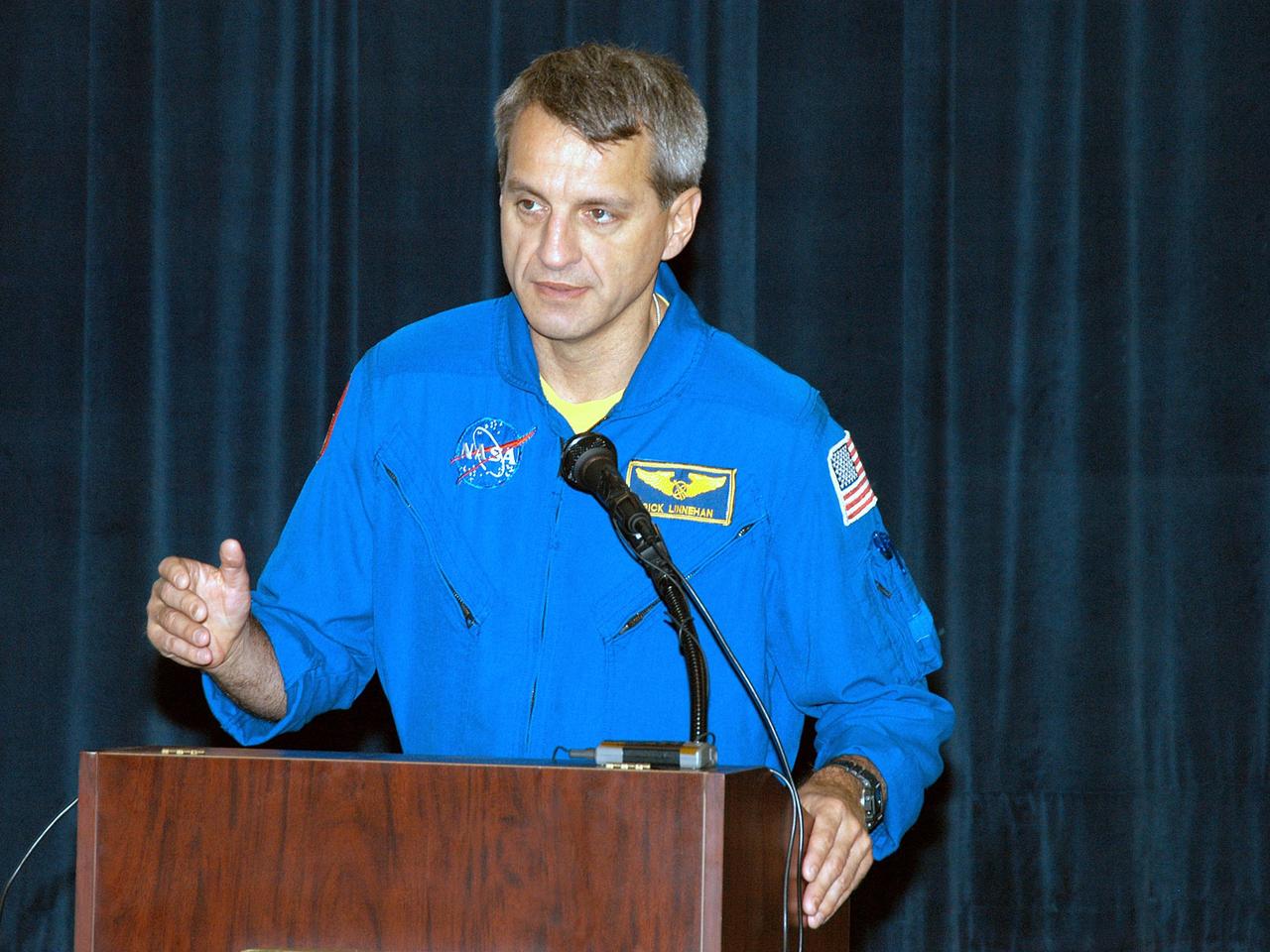
KENNEDY SPACE CENTER, FLA. - Astronaut Rick Linnehan talks to students and faculty at Ralph Bunche Middle School, a NASA Explorer School, in Atlanta, Ga. Linnehan accompanied Center Director Jim Kennedy, who is visiting NES sites to share America’s new vision for space exploration with the next generation of explorers. The purpose of the school visit is to talk with students about our destiny as explorers, NASA’s stepping stone approach to exploring Earth, the Moon, Mars and beyond, how space impacts our lives, and how people and machines rely on each other in space.

KENNEDY SPACE CENTER, FLA. - Astronaut Rick Linnehan talks to a classroom teacher at Ralph Bunche Middle School, a NASA Explorer School, in Atlanta, Ga. Linnehan accompanied Center Director Jim Kennedy, who was visiting the school to share America’s new vision for space exploration with the next generation of explorers. The visit is one of many Kennedy has made to NES sites in Florida and Georgia to talk with students about our destiny as explorers, NASA’s stepping stone approach to exploring Earth, the Moon, Mars and beyond, how space impacts our lives, and how people and machines rely on each other in space.
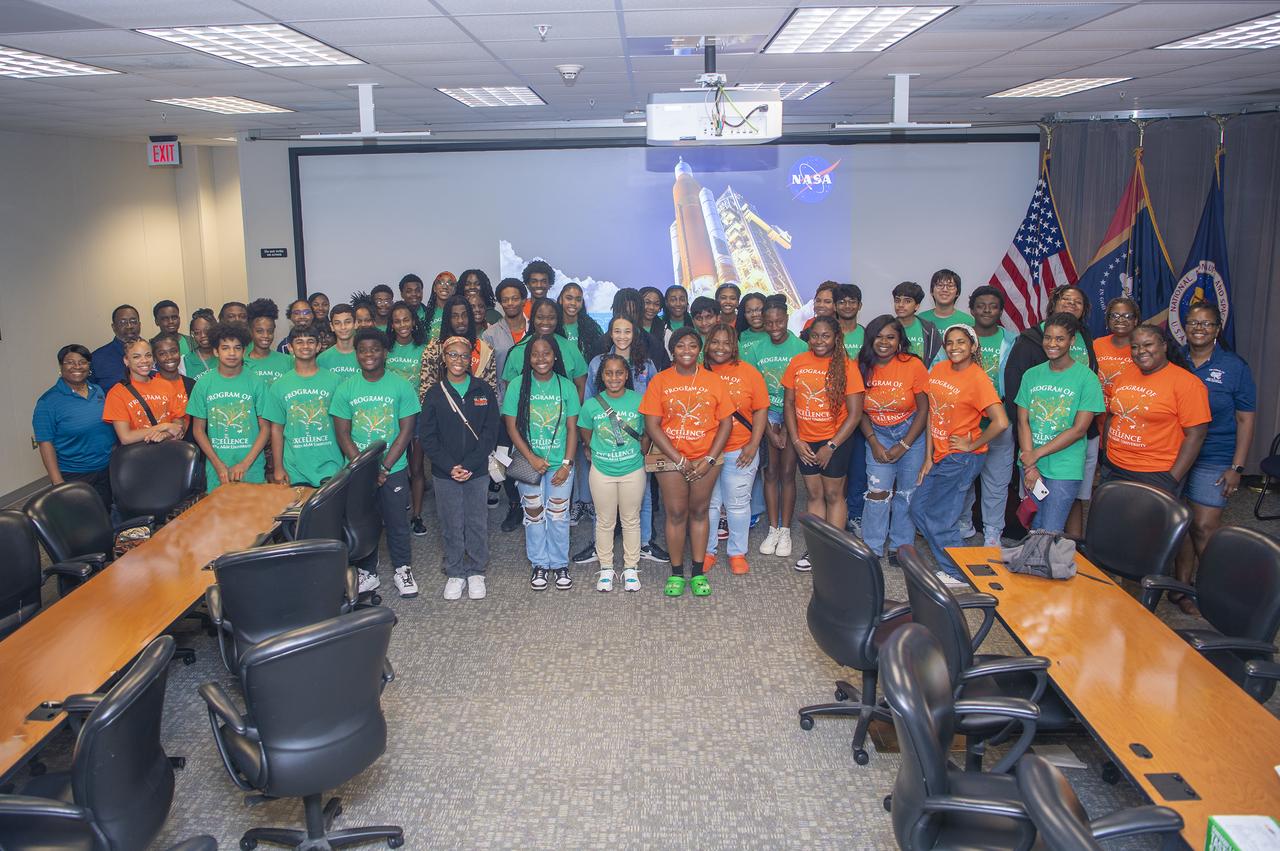
Members of the Florida A&M University Program of Excellence in STEM attend a presentation June 21 during a visit to NASA’s Stennis Space Center. The NASA Office of STEM Engagement provided information on grants and student activities during the presentation about NASA Stennis and the work conducted at the unique federal city. The group also visited the Thad Cochran Test Stand and Relativity Space test complex during a site tour. The Program of Excellence in STEM summer academy aims to enhance student knowledge of opportunities in the fields of science, technology, engineering, and mathematics.
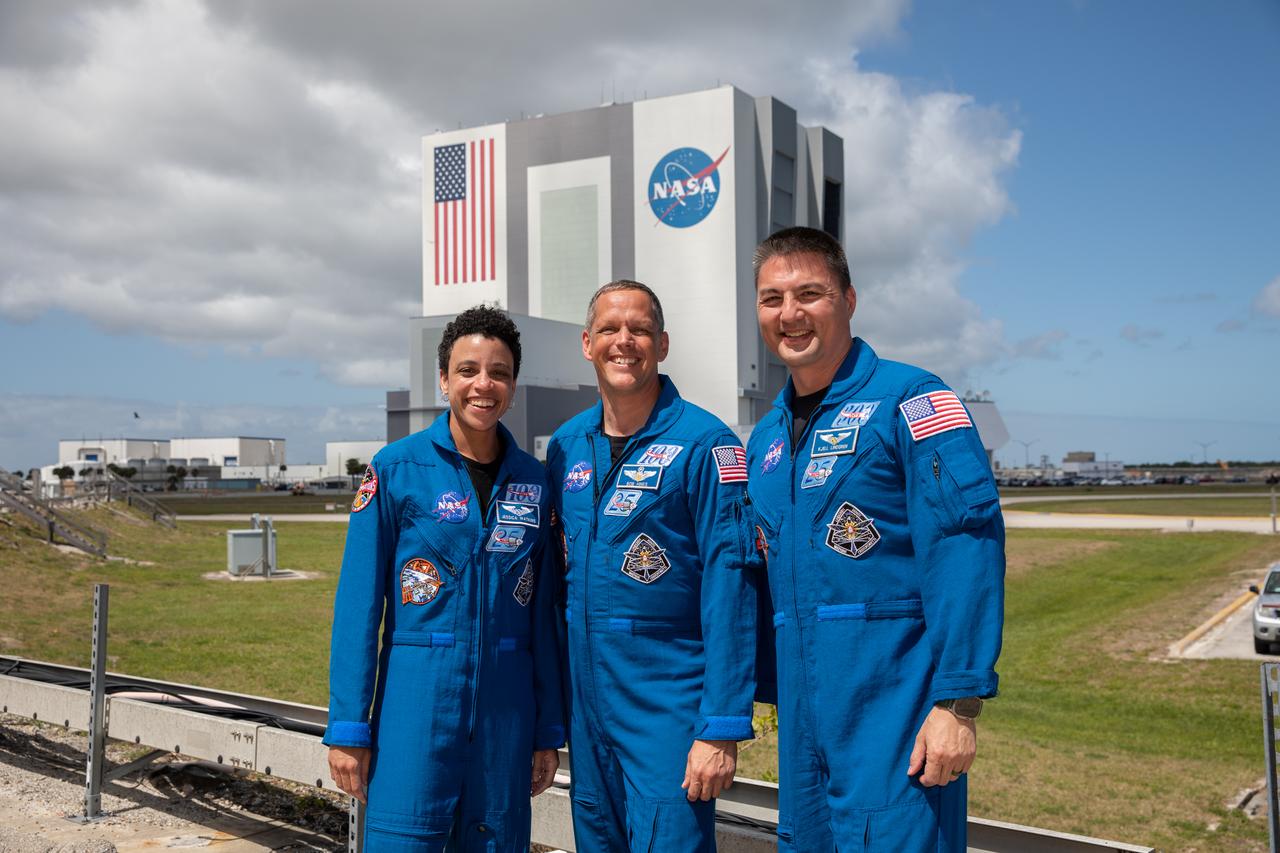
From left, NASA astronauts Jessica Watkins, Bob Hines, and Kjell Lindgren are photographed at the Press Site at NASA’s Kennedy Space Center during a visit to the Florida spaceport on March 22, 2023. The astronauts visited Kennedy to thank employees for supporting NASA’s SpaceX Crew-4 launch. Watkins, Hines, and Lindgren, along with ESA (European Space Agency) astronaut Samantha Cristoforetti, launched to the International Space Station aboard a SpaceX Crew Dragon spacecraft on April 27, 2022, from Kennedy’s Launch Complex 39A. The crew remained at the orbiting laboratory for approximately six months, conducting critical science as part of the fourth crew rotation mission for NASA’s Commercial Crew Program.
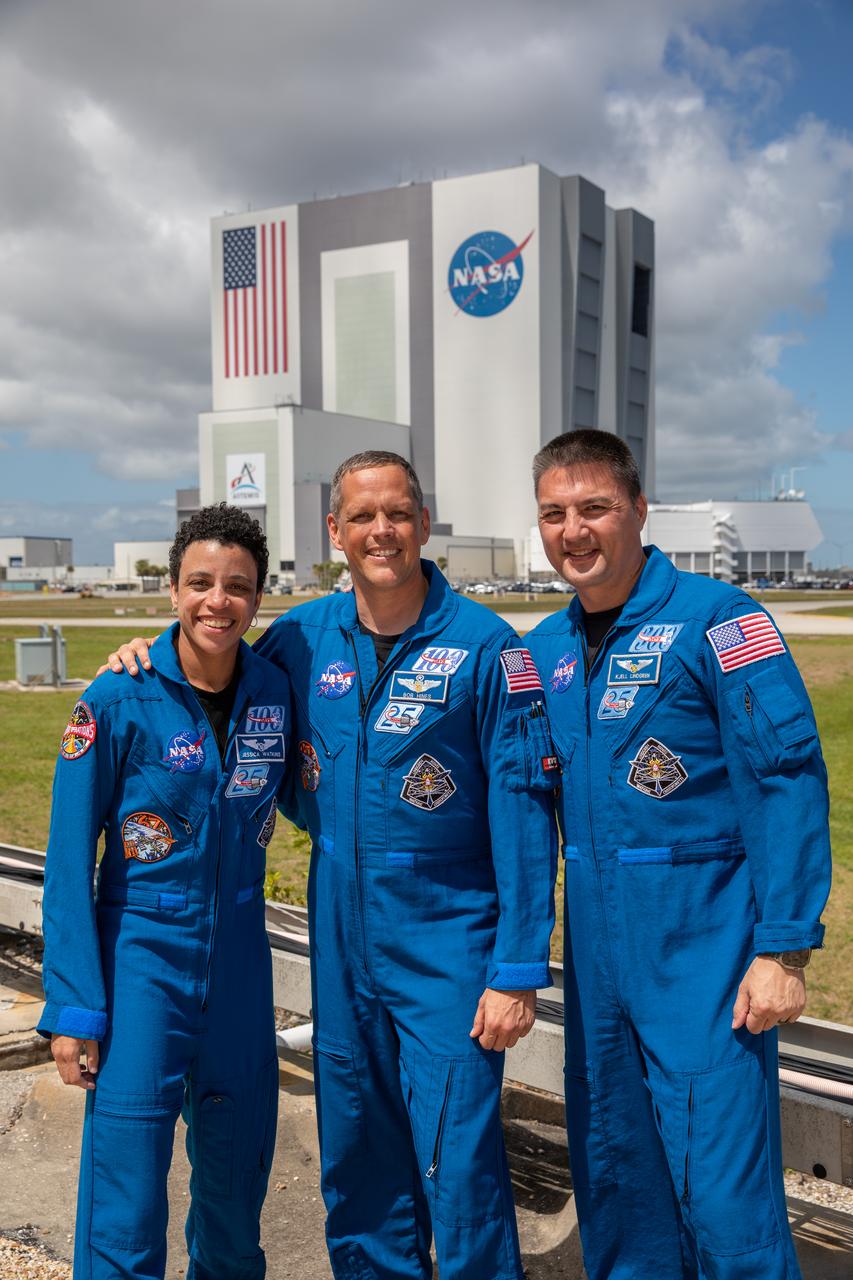
From left, NASA astronauts Jessica Watkins, Bob Hines, and Kjell Lindgren are photographed at the Press Site at NASA’s Kennedy Space Center during a visit to the Florida spaceport on March 22, 2023. The astronauts visited Kennedy to thank employees for supporting NASA’s SpaceX Crew-4 launch. Watkins, Hines, and Lindgren, along with ESA (European Space Agency) astronaut Samantha Cristoforetti, launched to the International Space Station aboard a SpaceX Crew Dragon spacecraft on April 27, 2022, from Kennedy’s Launch Complex 39A. The crew remained at the orbiting laboratory for approximately six months, conducting critical science as part of the fourth crew rotation mission for NASA’s Commercial Crew Program.
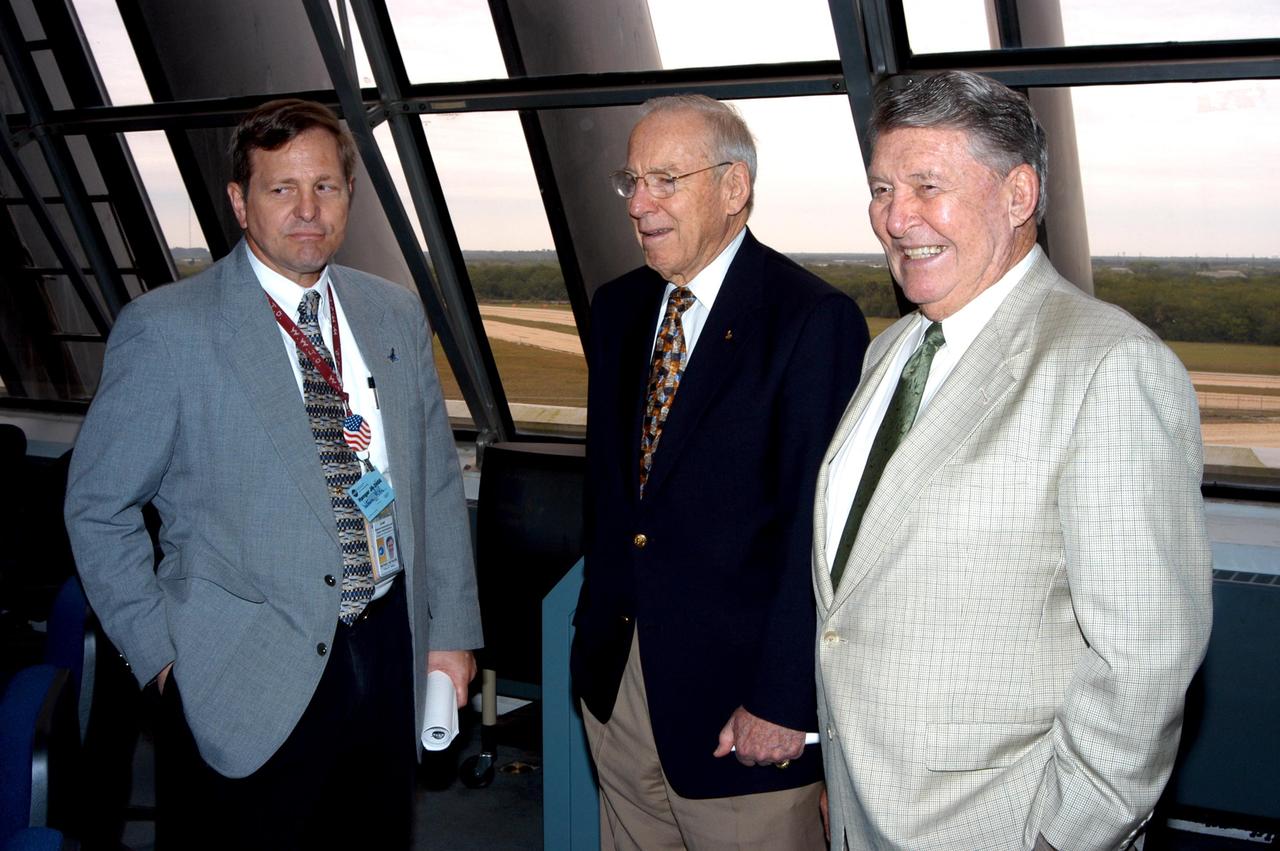
KENNEDY SPACE CENTER, FLA. - At the KSC Launch Control Complex, former astronauts Jim Lovell (center) and Wally Schirra (right) talk with Mike Wetmore, director of Shuttle Processing (left). Lovell and Schirra visited KSC to talk about the space program and their experiences, as well as offer encouragement to workers to help get the space program "back on its feet." They visited several sites around the Center, including the RLV Hangar where Columbia debris is being collected and examined as part of the investigation into the tragedy that claimed the orbiter and lives of seven astronauts returning from mission STS-107.
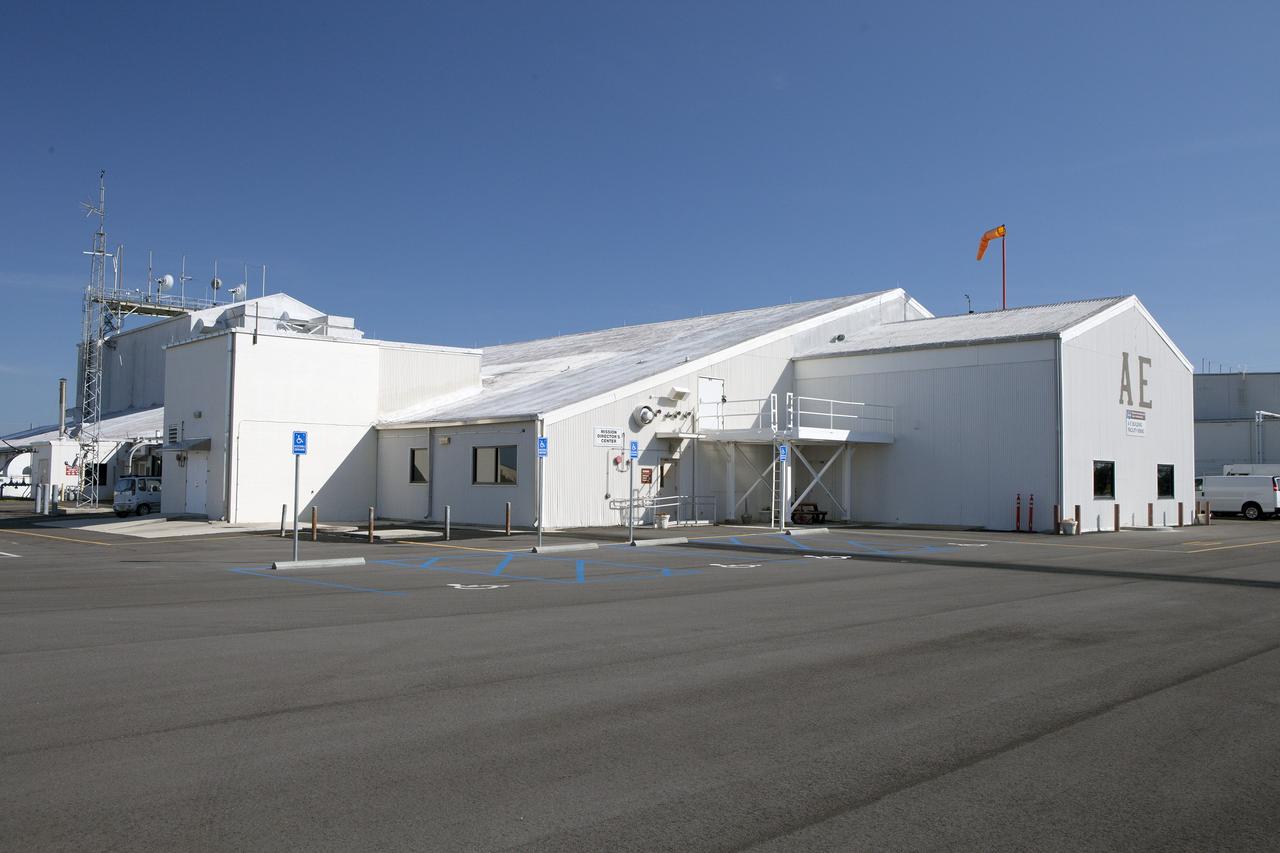
CAPE CANAVERAL, Fla. – Hangar AE on Cape Canav¬eral Air Force Station in Florida is used by NASA’s Launch Services Program as its communications center. The facility contains the program's Mission Director's Center, Launch Vehicle Data Center, and Telemetry Lab. The hangar, originally built in 1958 for a Department of De¬fense missile program, was acquired by NASA in 1960 and modified to support unmanned missions. To learn more about Hangar AE, visit http://www.nasa.gov/sites/default/files/files/Hangar-AE.pdf. For more about Kennedy Space Center, visit http://www.nasa.gov/kennedy. Photo credit: NASA/Daniel Casper

NASA astronaut Bob Hines is photographed at the Press Site at NASA’s Kennedy Space Center during a visit to the Florida spaceport on March 22, 2023. Hines, along with crewmates Kjell Lindgren and Jessica Watkins, visited Kennedy to thank employees for supporting NASA’s SpaceX Crew-4 launch. Hines, Lindgren, and Watkins, along with ESA (European Space Agency) astronaut Samantha Cristoforetti, launched to the International Space Station aboard a SpaceX Crew Dragon spacecraft on April 27, 2022, from Kennedy’s Launch Complex 39A. The crew remained at the orbiting laboratory for approximately six months, conducting critical science as part of the fourth crew rotation mission for NASA’s Commercial Crew Program.
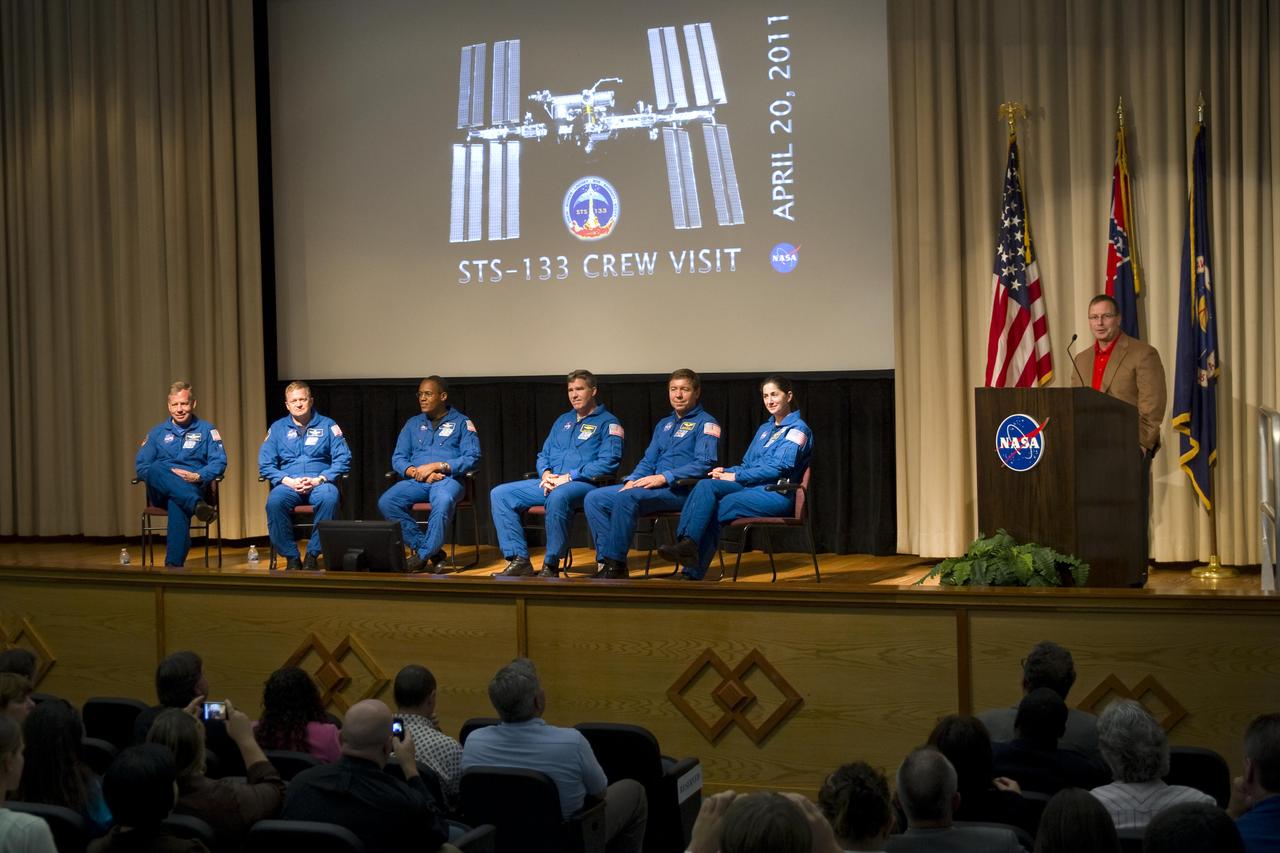
Stennis Space Center Deputy Director Rick Gilbrech (far right) welcomes members of the STS-133 shuttle mission crew during an April 20 visit. The mission was the final flight for the space shuttle Discovery, which now becomes the first of the three-orbiter fleet to be retired. During the visit to Stennis, Mission Commander Steven Lindsey ( l to r), Pilot Eric Boe and mission specialists Alvin Drew, Steven Bowen, Michael Barratt and Nicole Stott recapped their historic flight and thanked site employees for providing main engines that performed 'as advertised.'
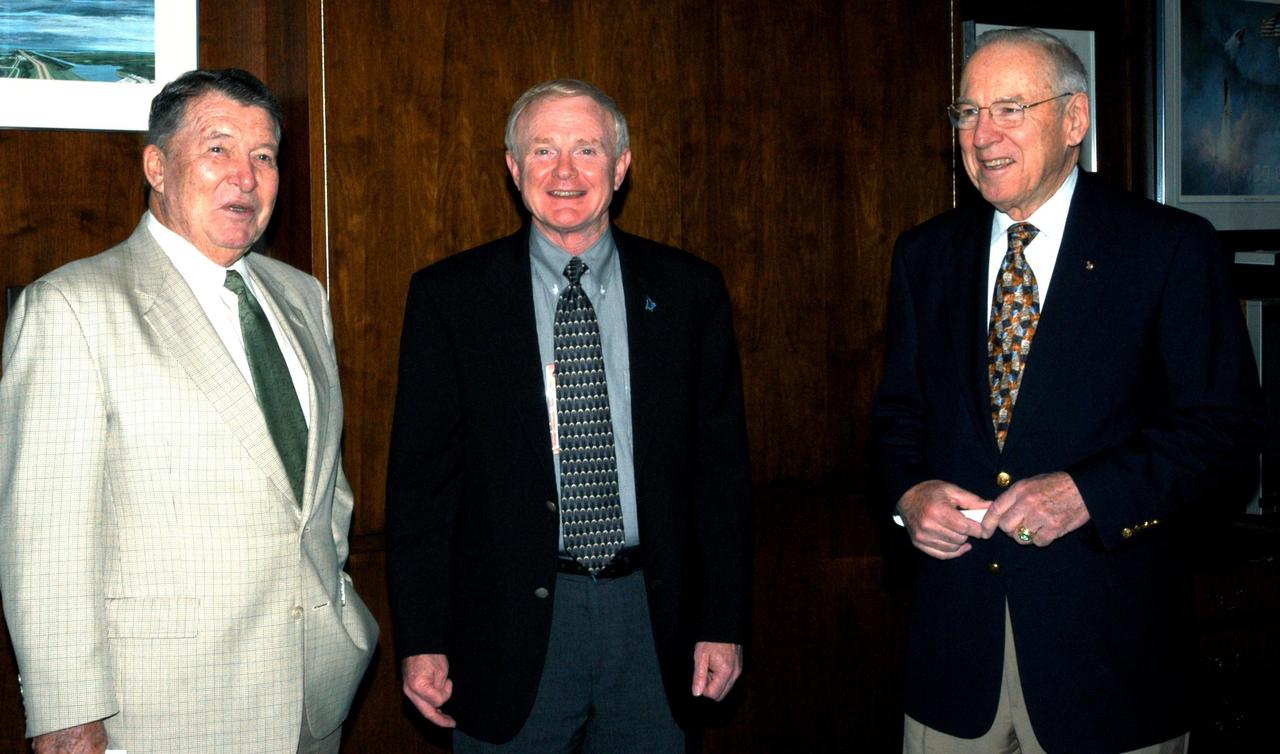
KENNEDY SPACE CENTER, FLA. - Former astronauts Wally Schirra (left) and Jim Lovell (right) join Center Director Roy Bridges (center) before a presentation to KSC employees. Lovell and Schirra visited KSC to talk about the space program and their experiences, as well as offer encouragement to workers to help get the space program "back on its feet." They visited several sites around the Center, including the RLV Hangar where Columbia debris is being collected and examined as part of the investigation into the tragedy that claimed the orbiter and lives of seven astronauts returning from mission STS-107.
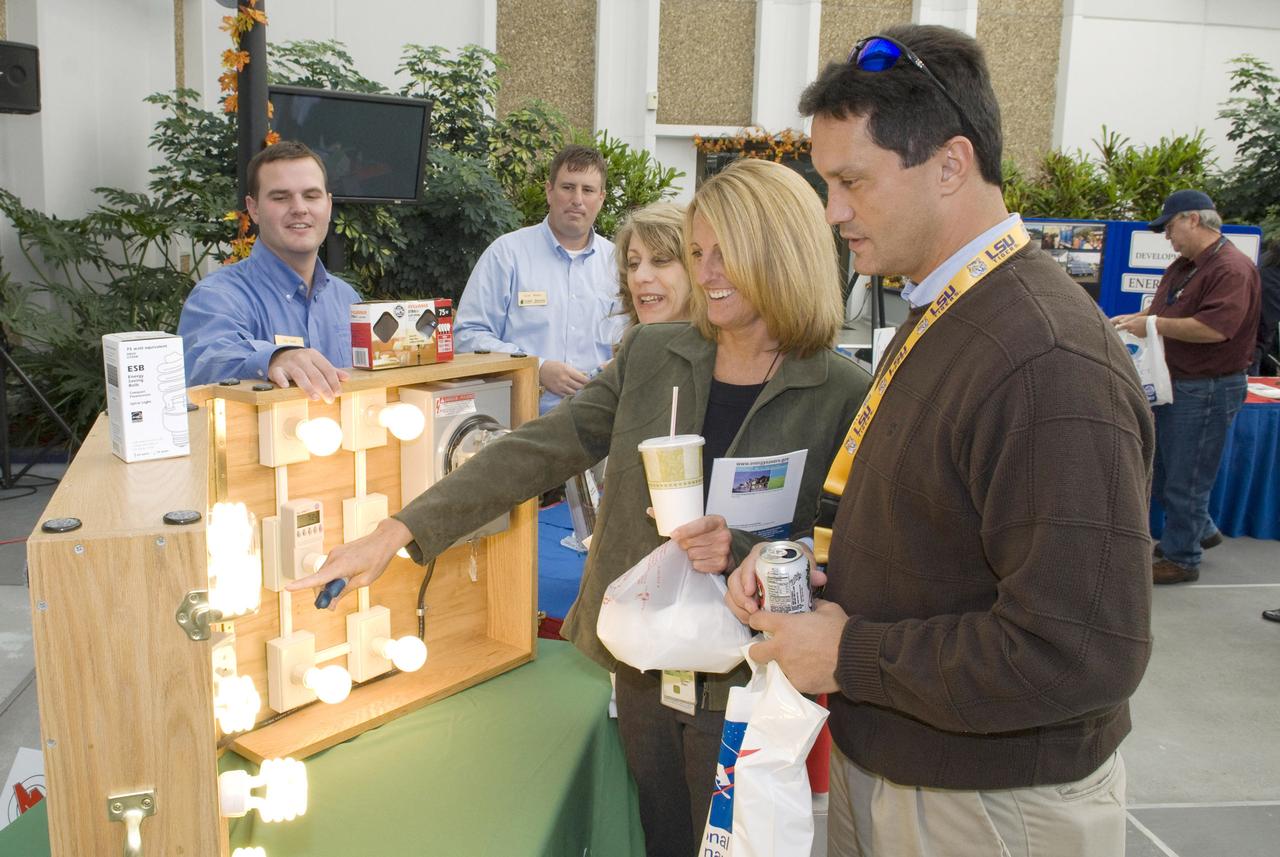
Stennis Space Center employees Maria Etheridge (l to r), Linda Sauland Maurice Prevost visit a Coast Electric Power Association display featuring energy-efficient light bulbs during 2009 Energy Awareness Day activities on Oct. 20. The exhibit was one of several energy-efficiency and energy-awareness displays on-site for employees to visit. Vendors included Mississippi Power Company, Coast Electric Power Association, Mississippi Development Authority - Energy Division,Jacobs FOSC Environmental, Southern Energy Technologies, and Siemens Building Technologies.
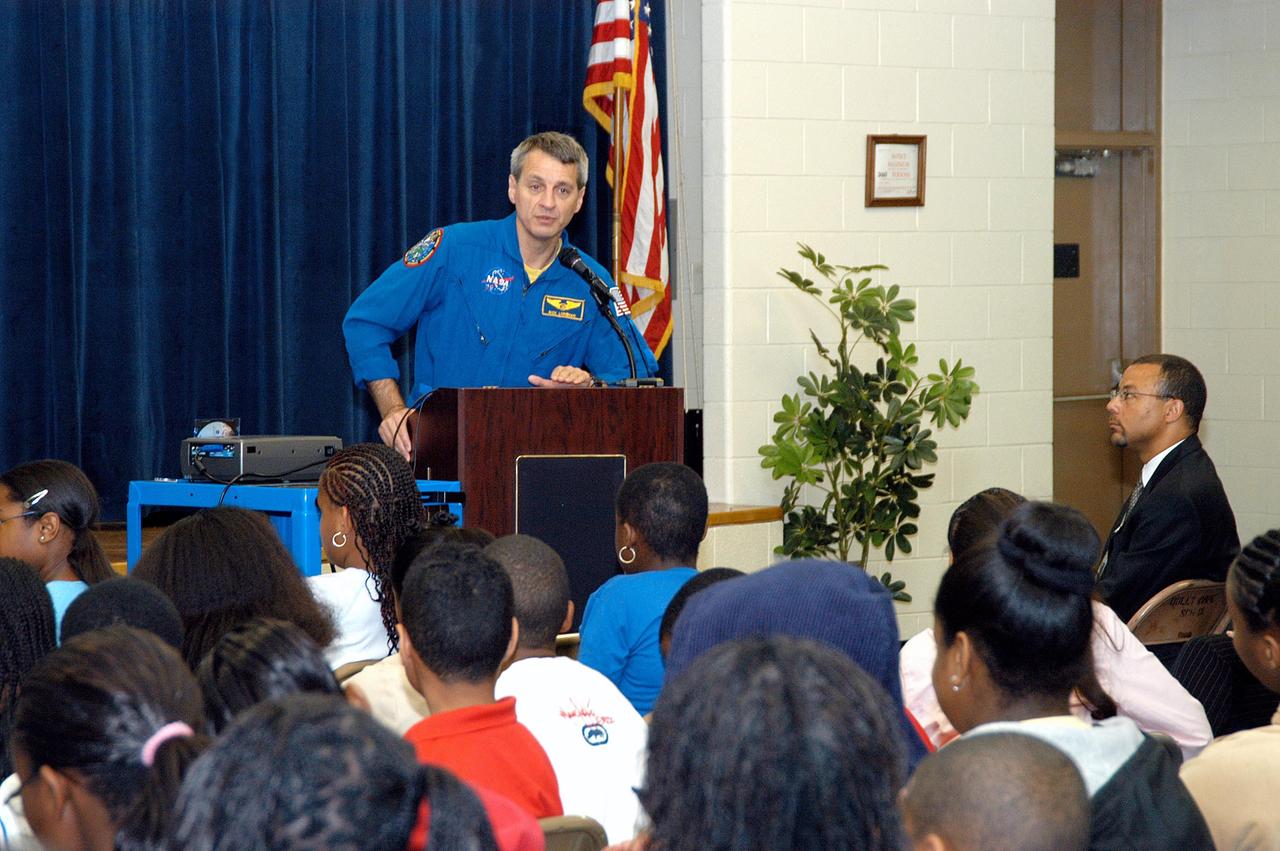
KENNEDY SPACE CENTER, FLA. - Astronaut Rick Linnehan shares his experiences in space with students and faculty at Ralph Bunche Middle School, a NASA Explorer School, in Atlanta, Ga. Linnehan accompanied Center Director Jim Kennedy, who is visiting NES sites to share America’s new vision for space exploration with the next generation of explorers. The purpose of the school visit is to talk with students about our destiny as explorers, NASA’s stepping stone approach to exploring Earth, the Moon, Mars and beyond, how space impacts our lives, and how people and machines rely on each other in space.
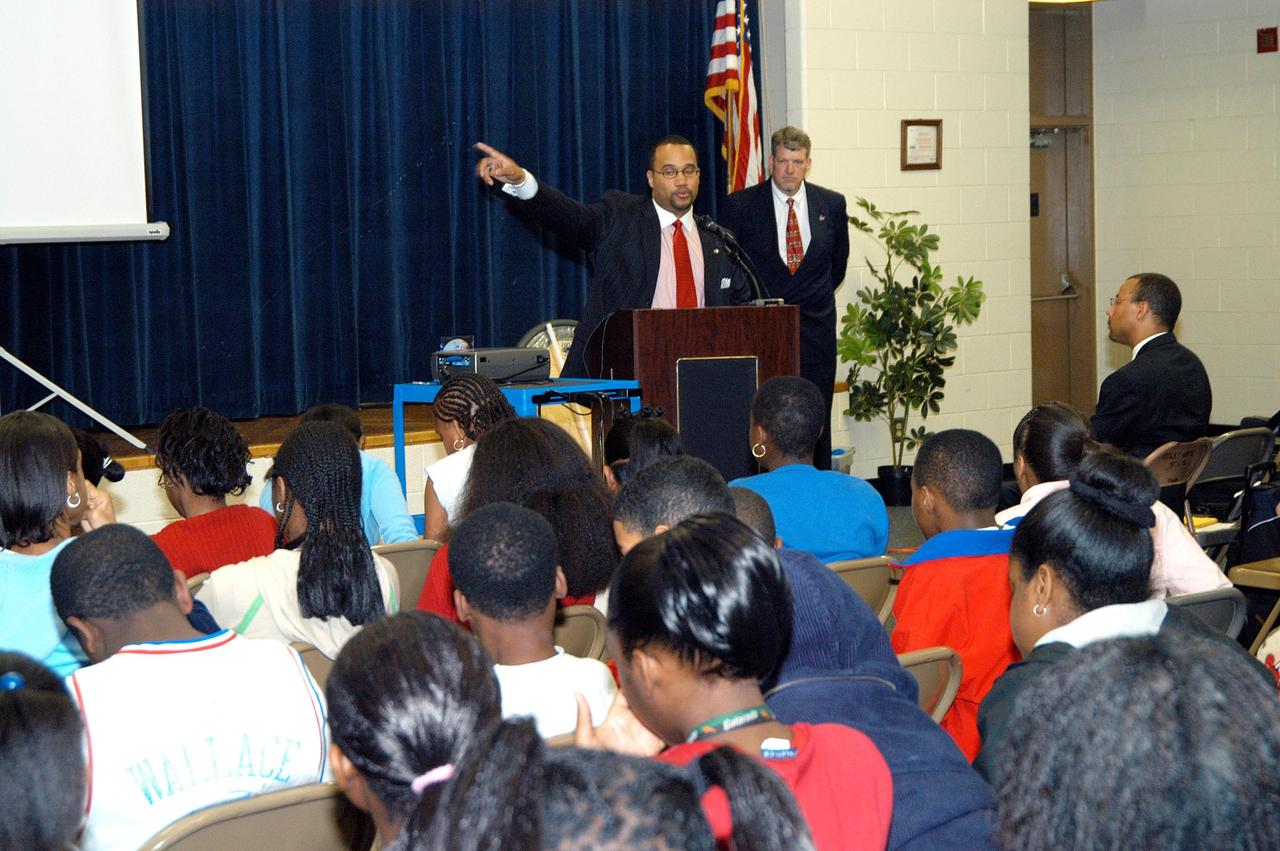
KENNEDY SPACE CENTER, FLA. - Warren Edwards, at the podium, with the Aerospace Education Services Program (AESP) at Langley Research Center, Hampton, Va., speaks to students and faculty at Ralph Bunche Middle School, a NASA Explorer School, in Atlanta, Ga. On the right is Jim Gerard, also with AESP. They accompanied Center Director Jim Kennedy, who is visiting NES sites to share America’s new vision for space exploration with the next generation of explorers. The purpose of the school visit is to talk with students about our destiny as explorers, NASA’s stepping stone approach to exploring Earth, the Moon, Mars and beyond, how space impacts our lives, and how people and machines rely on each other in space.
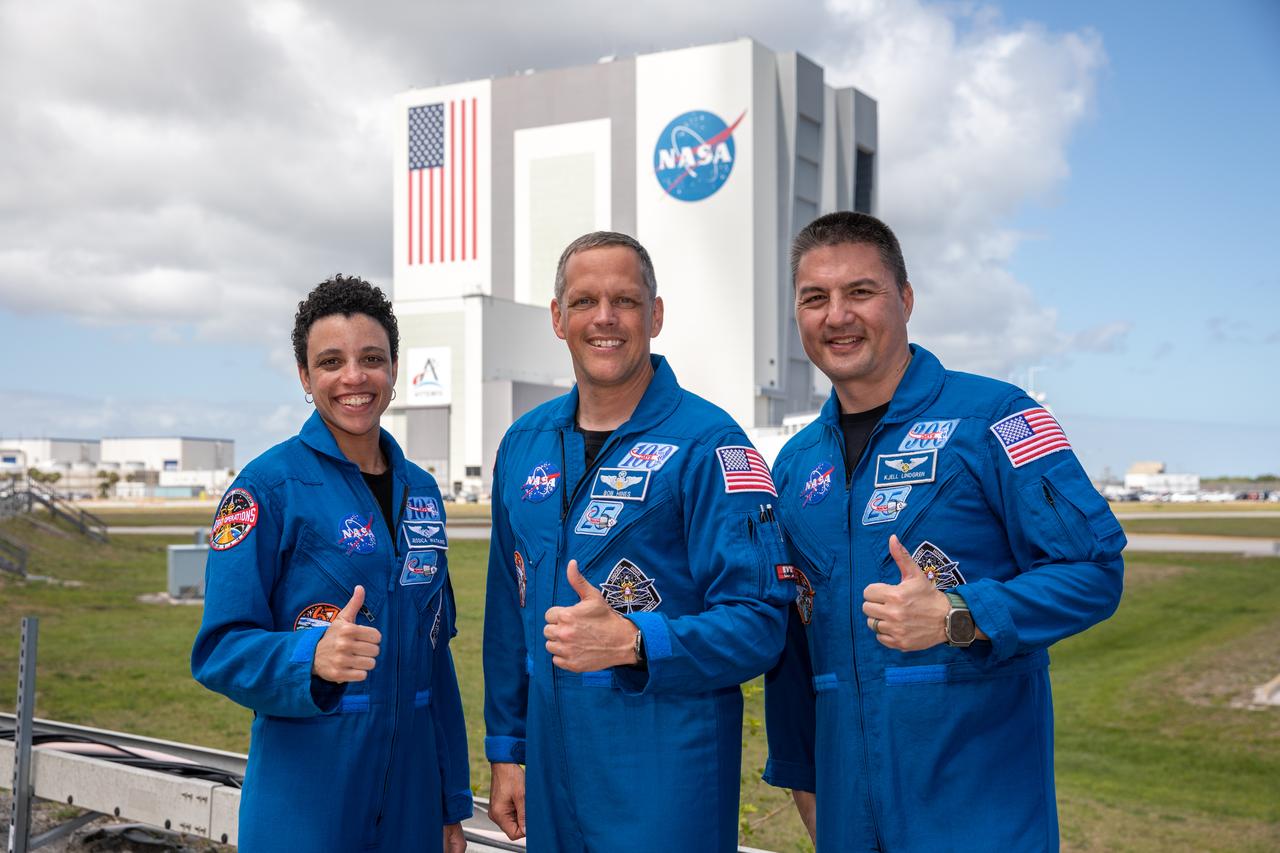
From left, NASA astronauts Jessica Watkins, Bob Hines, and Kjell Lindgren pose for a photo at the Press Site at NASA’s Kennedy Space Center during a visit to the Florida spaceport on March 22, 2023. The astronauts visited Kennedy to thank employees for supporting NASA’s SpaceX Crew-4 launch. Watkins, Hines, and Lindgren, along with ESA (European Space Agency) astronaut Samantha Cristoforetti, launched to the International Space Station aboard a SpaceX Crew Dragon spacecraft on April 27, 2022, from Kennedy’s Launch Complex 39A. The crew remained at the orbiting laboratory for approximately six months, conducting critical science as part of the fourth crew rotation mission for NASA’s Commercial Crew Program.
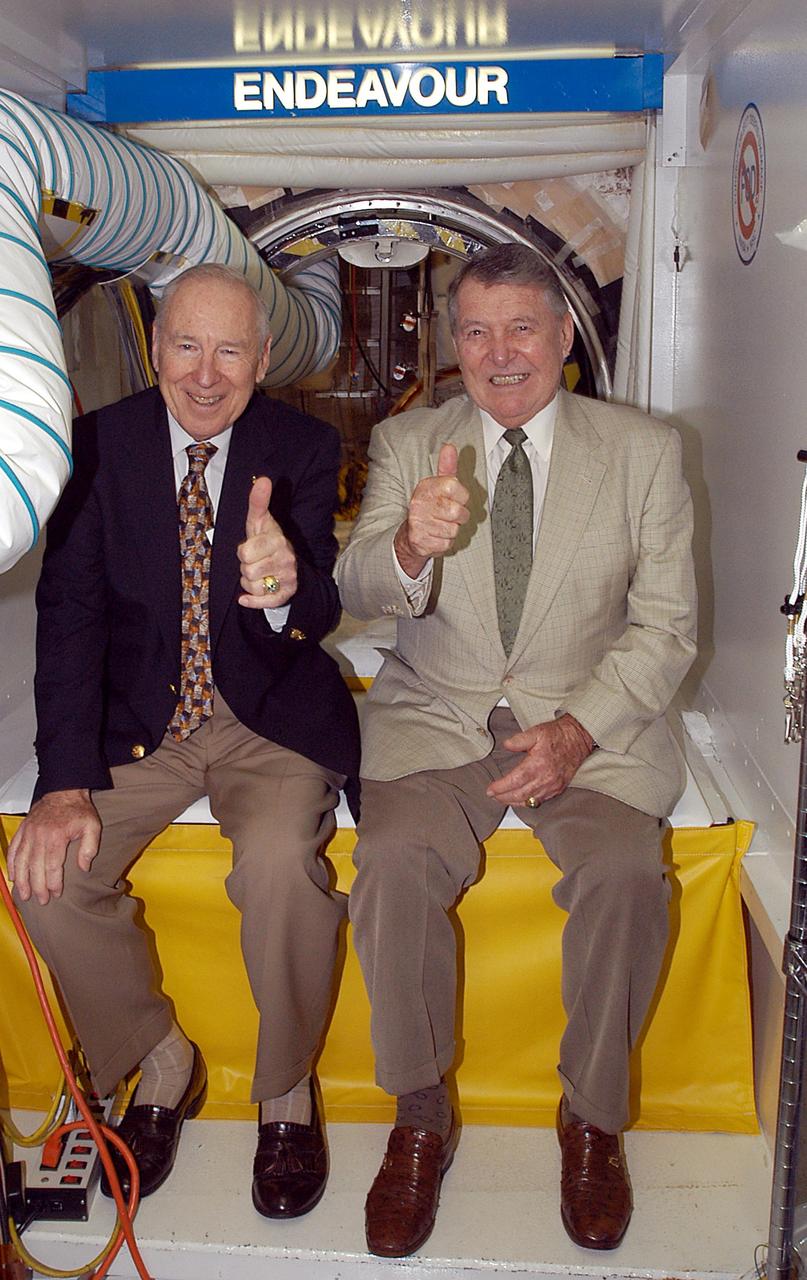
KENNEDY SPACE CENTER, FLA. -Former astronauts Jim Lovell (left) and Wally Schirra (right) pose outside of Endeavour in the Orbiter Processing Facility. Lovell and Schirra visited KSC to talk about the space program and their experiences, as well as offer encouragement to workers to help get the space program "back on its feet." They visited several sites around the Center, including the RLV Hangar where Columbia debris is being collected and examined as part of the investigation into the tragedy that claimed the orbiter and lives of seven astronauts returning from mission STS-107.
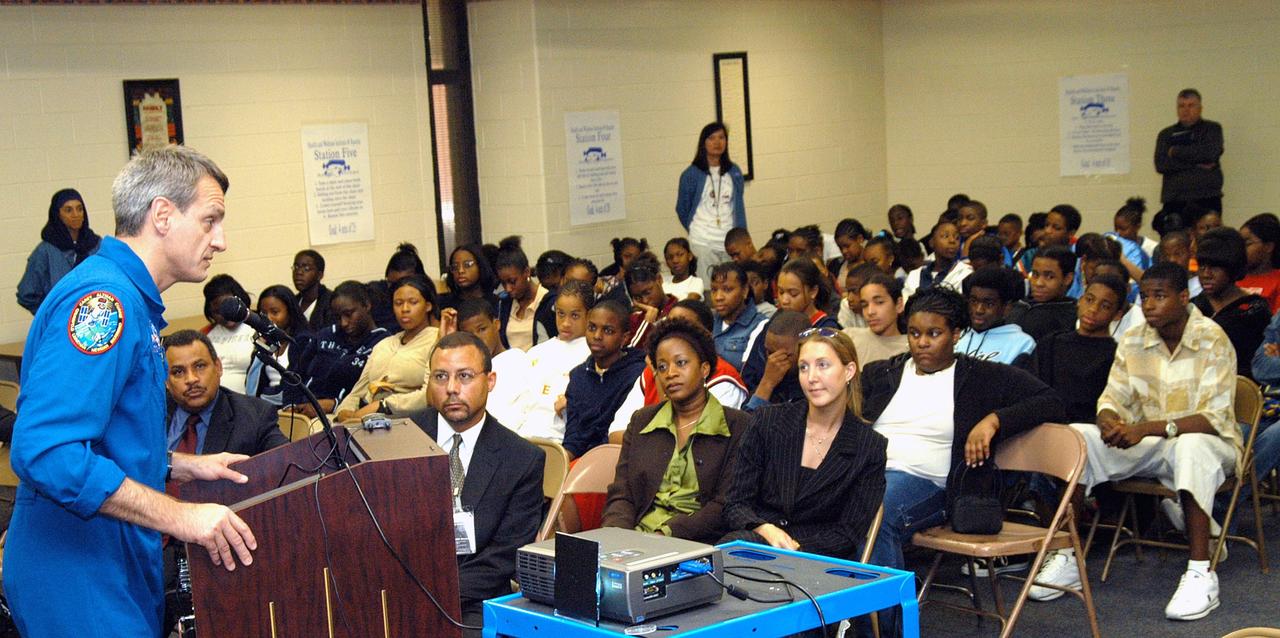
KENNEDY SPACE CENTER, FLA. - Astronaut Rick Linnehan shares his experiences in space with students and faculty at Ralph Bunche Middle School, a NASA Explorer School, in Atlanta, Ga. Linnehan accompanied Center Director Jim Kennedy, who is visiting NES sites to share America’s new vision for space exploration with the next generation of explorers. The purpose of the school visit is to talk with students about our destiny as explorers, NASA’s stepping stone approach to exploring Earth, the Moon, Mars and beyond, how space impacts our lives, and how people and machines rely on each other in space.
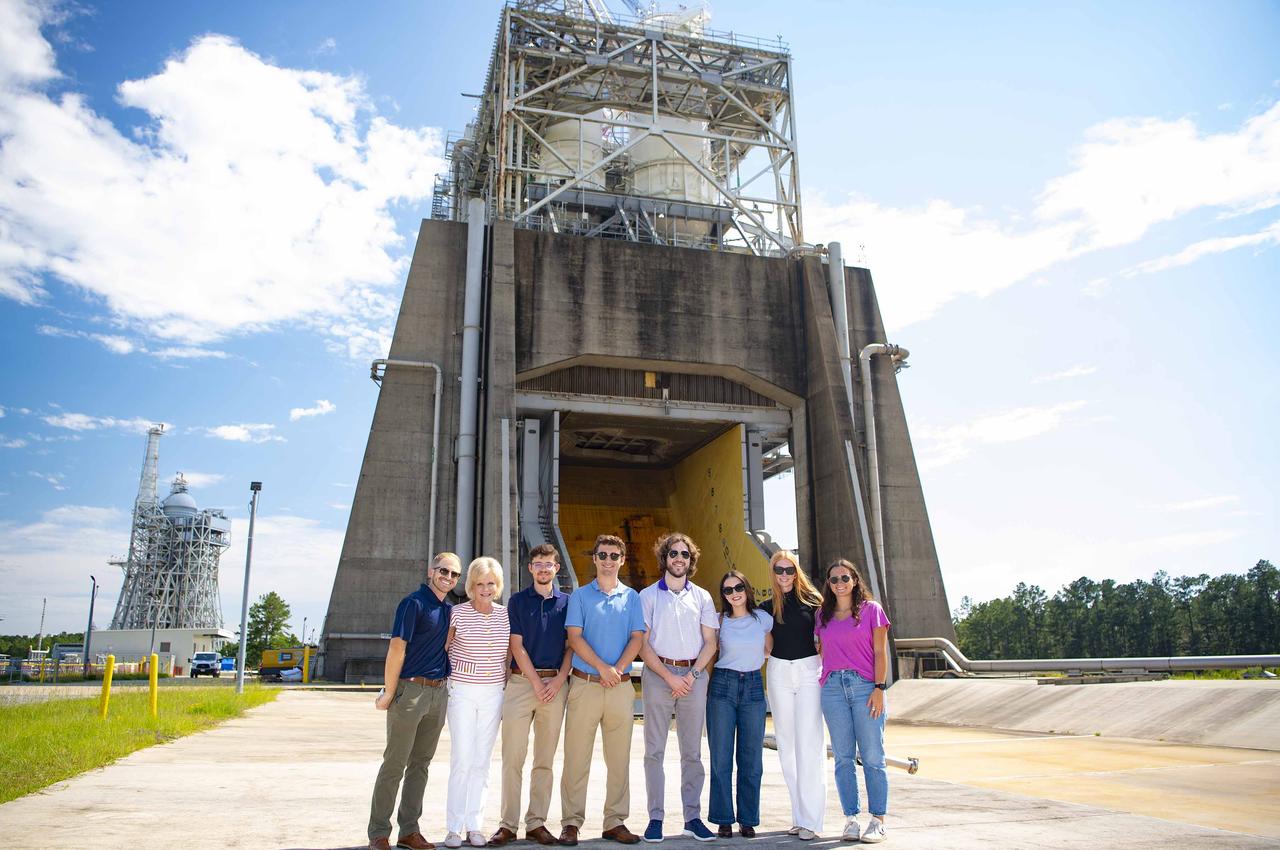
Legislative staff and interns from the office of U.S. Rep. Garrett Graves of Louisiana are pictured at the Fred Haise Test Stand at NASA Stennis on July 11. During the visit to the south Mississippi site, the group learned more about internship opportunities with NASA and NASA Stennis. In addition to touring the test complex where RS-25 engines are tested for future Artemis missions, the group visited the Aerojet Rocketdyne Engine Assembly Facility onsite. Aerojet Rocketdyne, an L3Harris Technologies company, manufactures RS-25 engines to help power NASA’s SLS (Space Launch System) rocket on Artemis missions to the Moon and beyond.
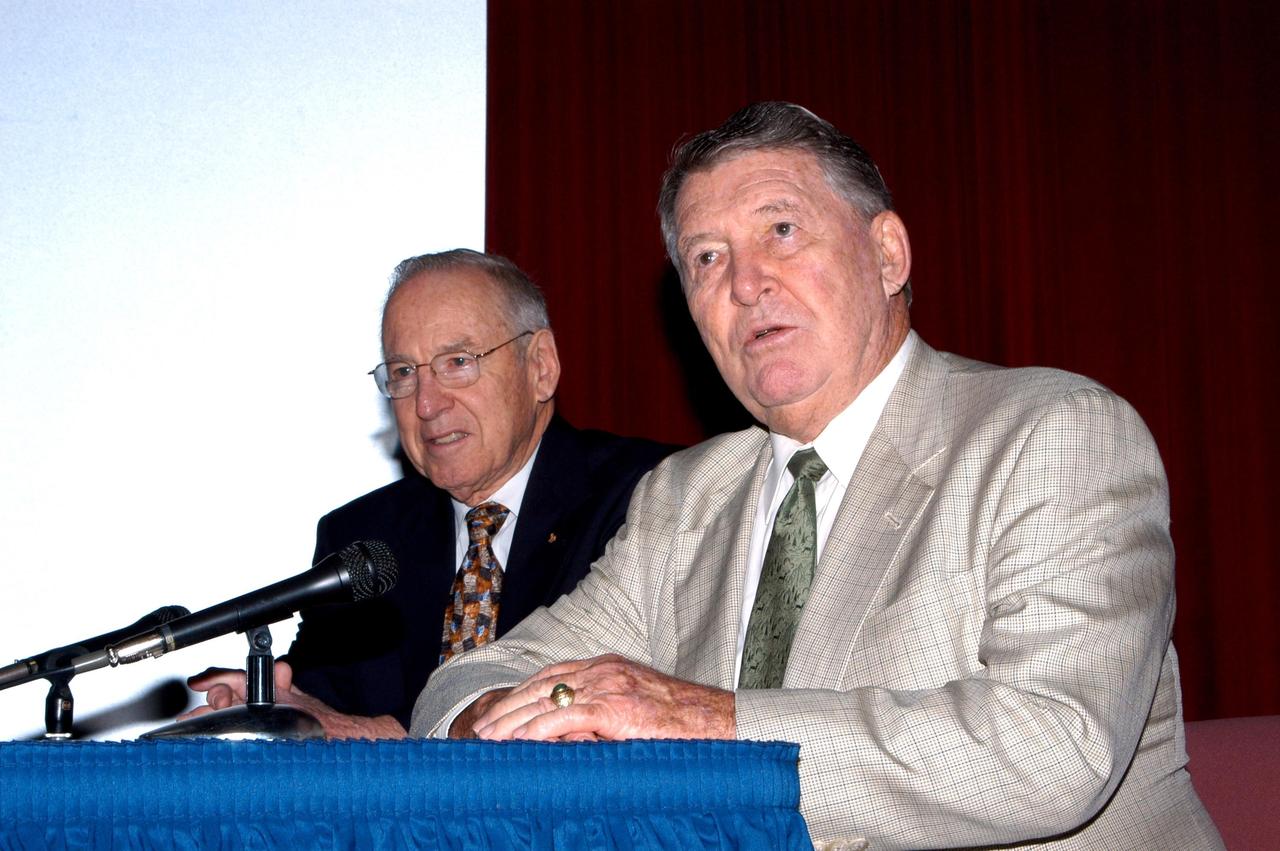
KENNEDY SPACE CENTER, FLA. - During a presentation to KSC employees, former astronauts Jim Lovell (left) and Wally Schirra (right) answer questions from the audience. Lovell and Schirra visited KSC to talk about the space program and their experiences, as well as offer encouragement to workers to help get the space program "back on its feet." They visited several sites around the Center, including the RLV Hangar where Columbia debris is being collected and examined as part of the investigation into the tragedy that claimed the orbiter and lives of seven astronauts returning from mission STS-107.
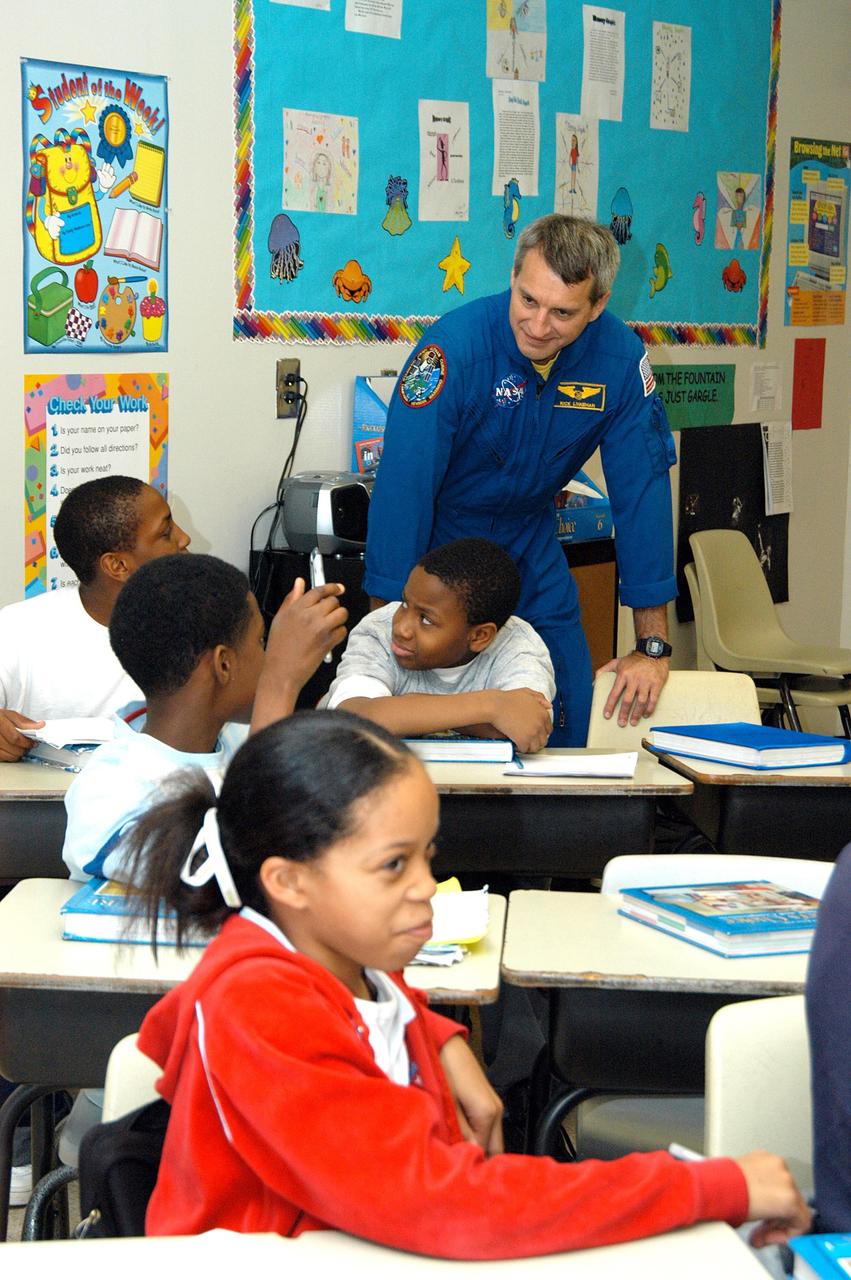
KENNEDY SPACE CENTER, FLA. - Astronaut Rick Linnehan talks to students in a classroom at Ralph Bunche Middle School, a NASA Explorer School, in Atlanta, Ga. Linnehan accompanied Center Director Jim Kennedy, who was visiting the school to share America’s new vision for space exploration with the next generation of explorers. The visit is one of many Kennedy has made to NES sites in Florida and Georgia to talk with students about our destiny as explorers, NASA’s stepping stone approach to exploring Earth, the Moon, Mars and beyond, how space impacts our lives, and how people and machines rely on each other in space.
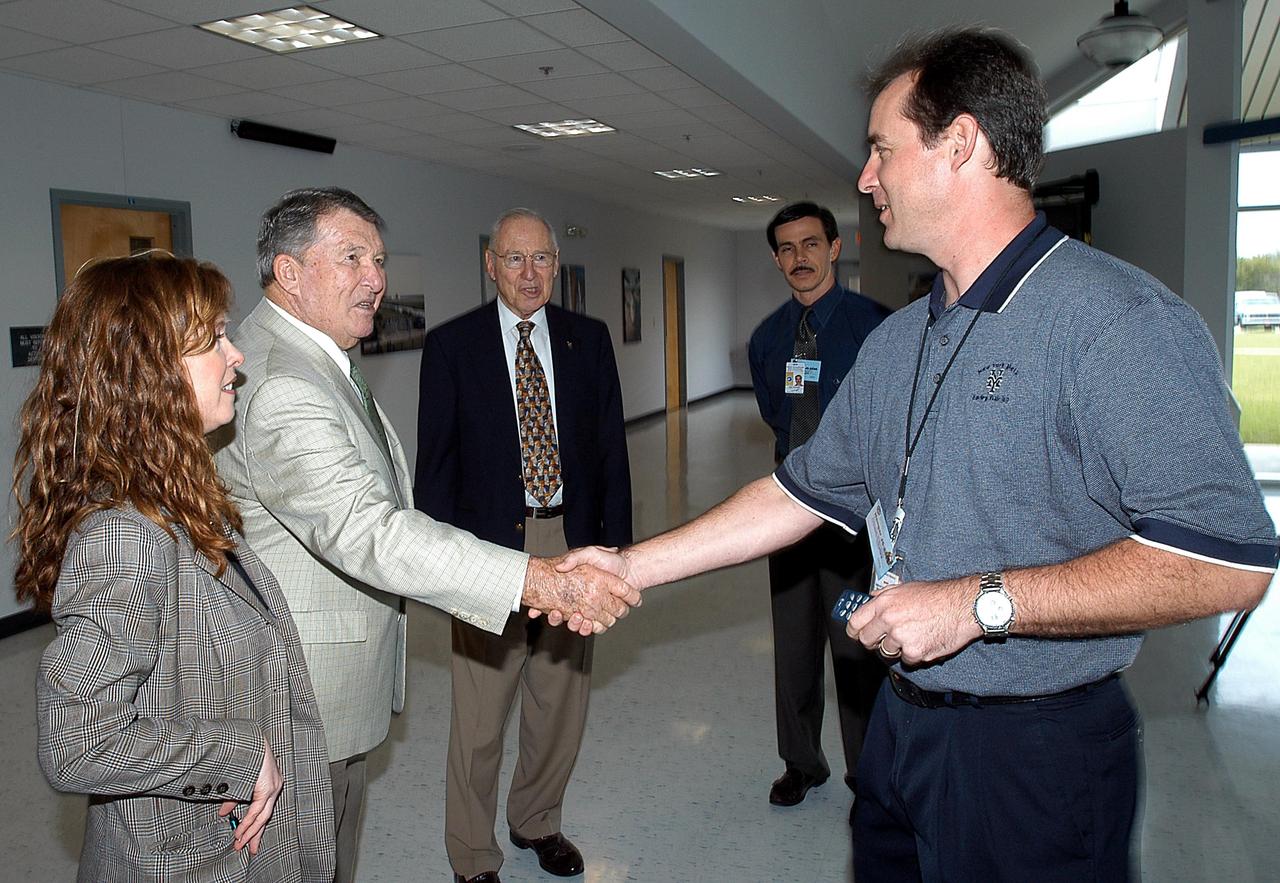
KENNEDY SPACE CENTER, FLA. - During a visit to KSC, former astronauts Wally Schirra (second from left) and Jim Lovell (third from left) greet Space Shuttle Test Director Steve Altemus. At far left is is Lisa Malone, acting deputy director of External Relations & Business Development at KSC, and reconstruction engineer John Cowart (second from right). Lovell and Schirra visited KSC to talk about the space program and their experiences, as well as offer encouragement to workers to help get the space program "back on its feet." They visited several sites around the Center, including the RLV Hangar where Columbia debris is being collected and examined as part of the investigation into the tragedy that claimed the orbiter and lives of seven astronauts returning from mission STS-107.

KENNEDY SPACE CENTER, FLA. -- Members of the Columbia Accident Investigation Board are in the Orbiter Processing Facility to look over Space Shuttle Endeavour. In the center (gesturing) is the chairman, Retired Navy Adm. Harold Gehman Jr. The board is visiting sites at KSC to become familiar with the Shuttle launch process and elements. The independent board is charged with determining what caused the destruction of the Space Shuttle Columbia and the loss of its seven-member crew on Feb. 1 during reentry.
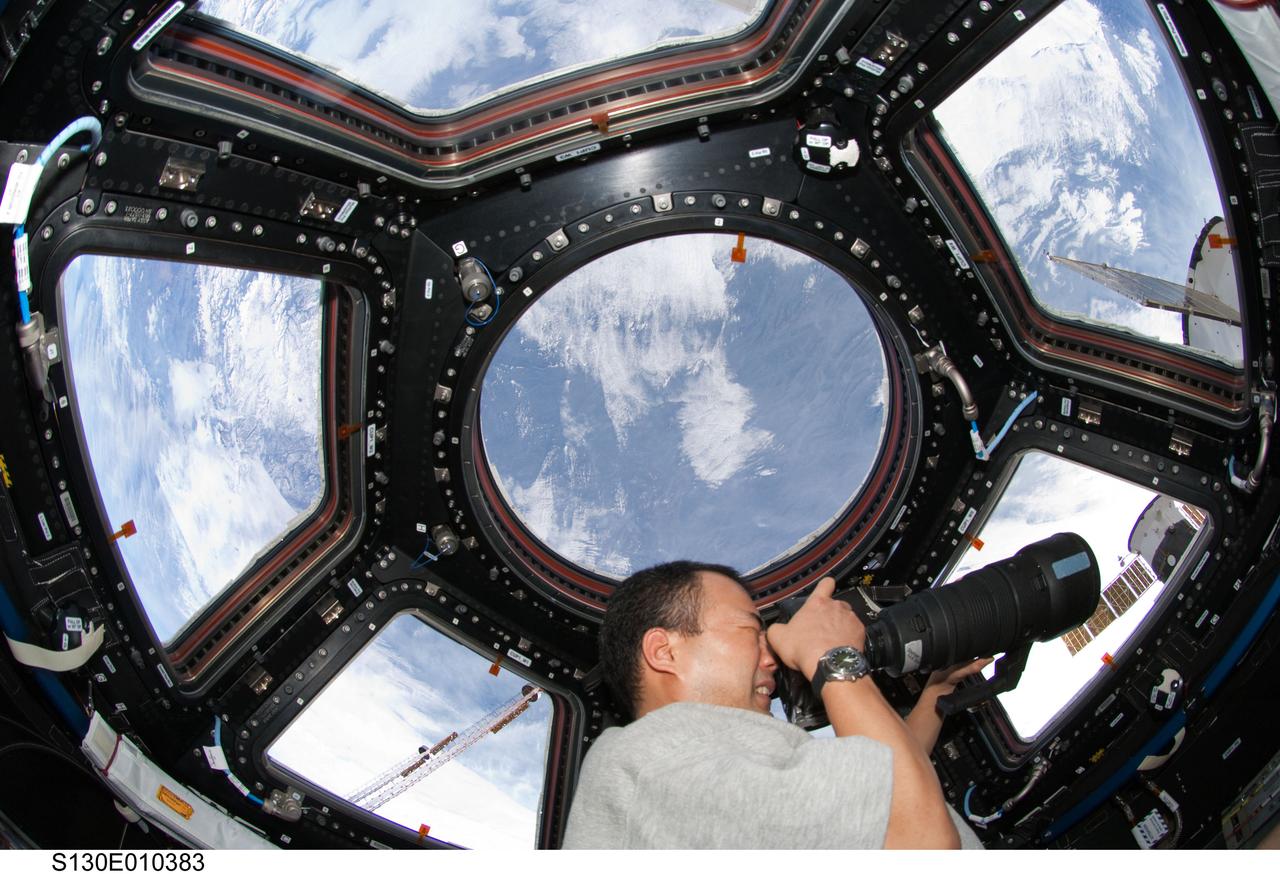
S130-E-010383 (19 Feb. 2010) --- Expedition 22 flight engineer Soichi Noguchi, Japan Aerospace Exploration Agency (JAXA) astronaut, takes photos through Window 5 in the Cupola aboard the International Space Station during Expedition 22 joint operations with the visiting STS-130 astronauts. One of the shuttle astronauts took this picture. Since the camera sports a large lens for this exercise, Noguchi is more than likely focusing in on a geographic site on Earth, as part of an ongoing Earth observations program. Photo credit: NASA

KENNEDY SPACE CENTER, FLA. -- In the Vehicle Assembly Building, the Columbia Accident Investigation Board looks at the nose of Space Shuttle Atlantis. The board is visiting sites at KSC to become familiar with the Shuttle launch process and elements. The independent board is charged with determining what caused the destruction of the Space Shuttle Columbia and the loss of its seven-member crew on Feb. 1 during reentry.
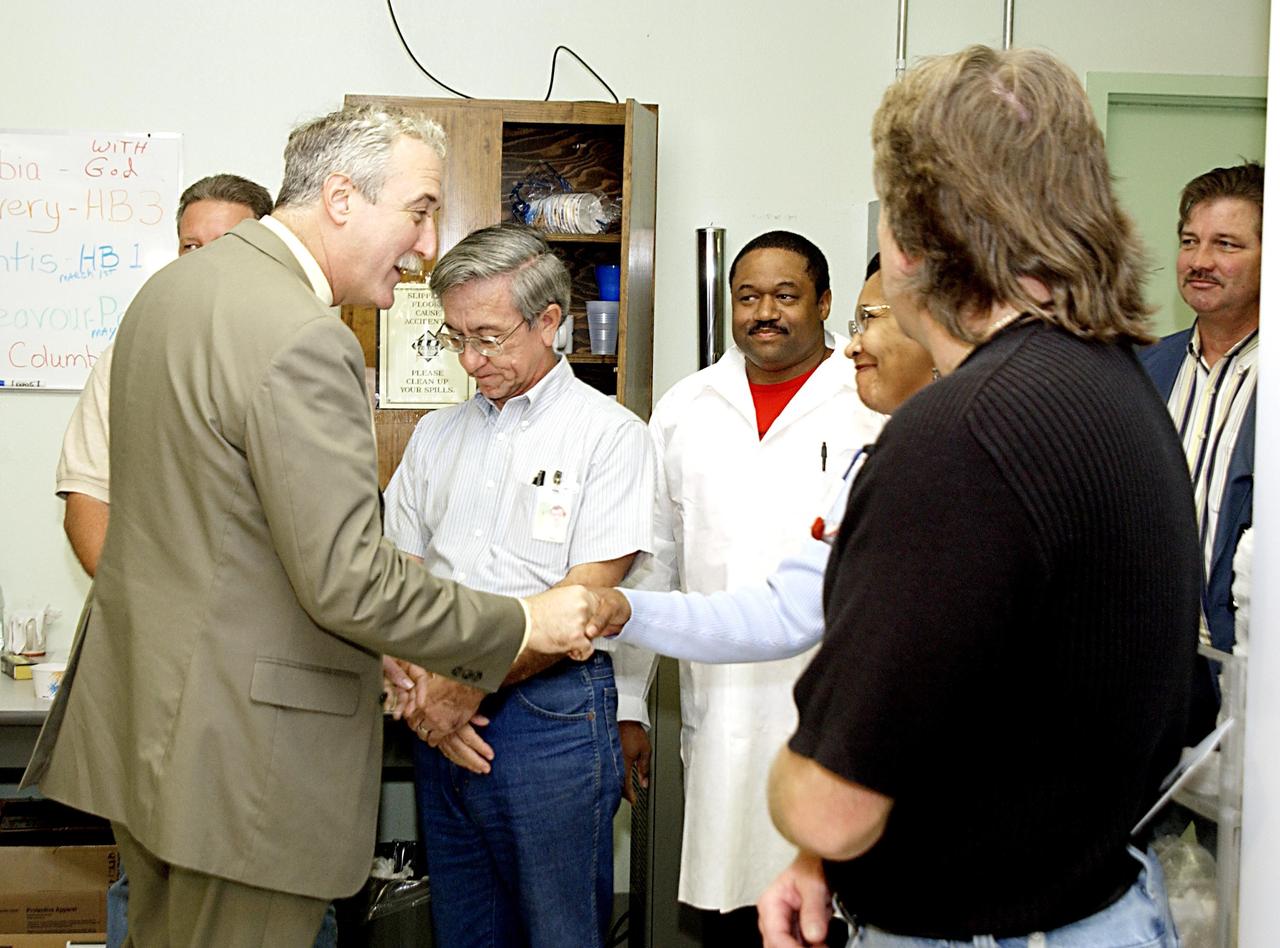
KENNEDY SPACE CENTER, FLA. -- In the Thermal Protection System Facility, NASA Administrator Sean O'Keefe (left) meets workers. O'Keefe is visiting the site to learn more about the TPS products and process in protecting orbiters from the intense heat of launch and re-entry. TPS tiles have been discussed in the investigation into the Columbia tragedy that destroyed the orbiter and claimed the lives of seven astronauts.
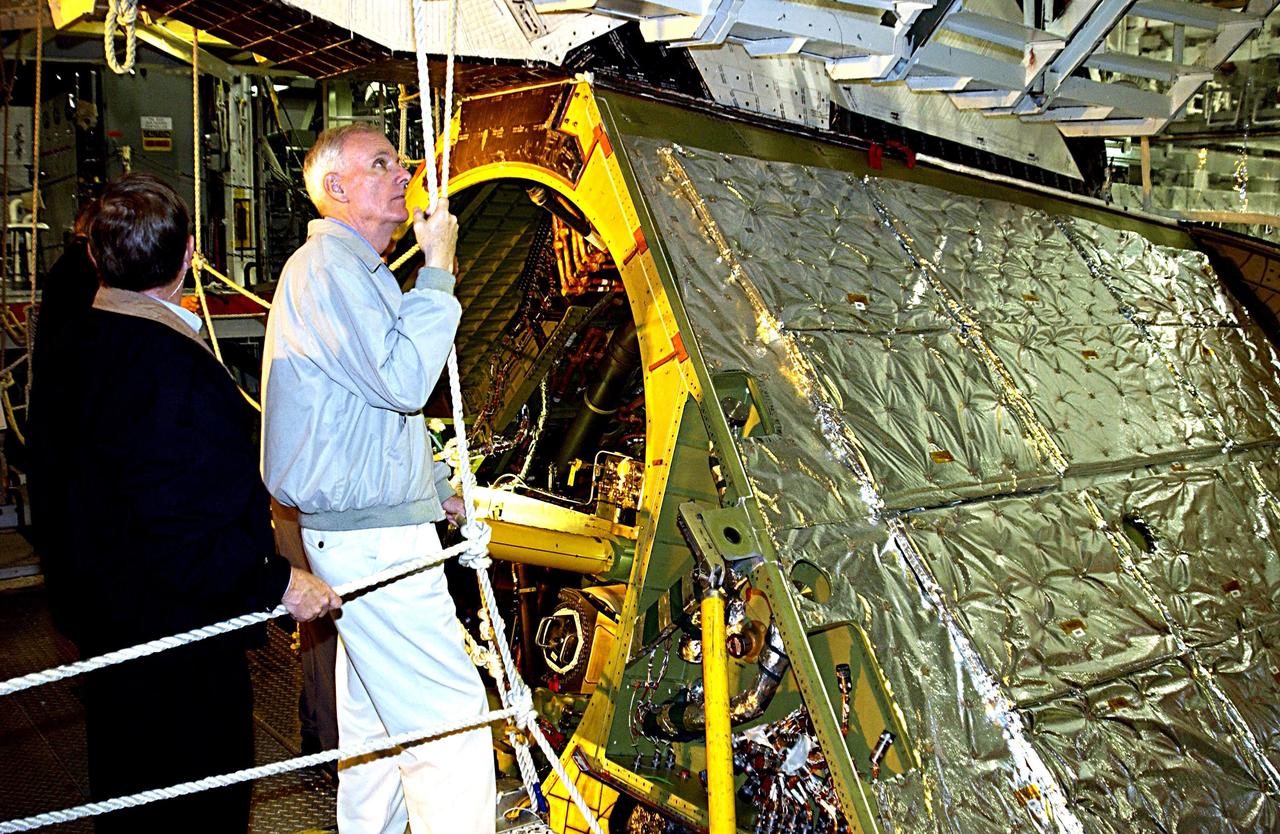
KENNEDY SPACE CENTER, FLA. - Retired Navy Admiral Harold W. Gehman Jr. (right), chairman of the Columbia Accident Investigation Board, and other members of the board are given a guided tour around Space Shuttle Endeavour as it undergoes processing in an Orbiter Processing Facility bay. Gehman and other members of the board are visiting sites at KSC to become familiar with the Shuttle launch process. The independent board is charged with determining what caused the destruction of the Space Shuttle Columbia and the loss of its seven-member crew on Feb. 1 during reentry.
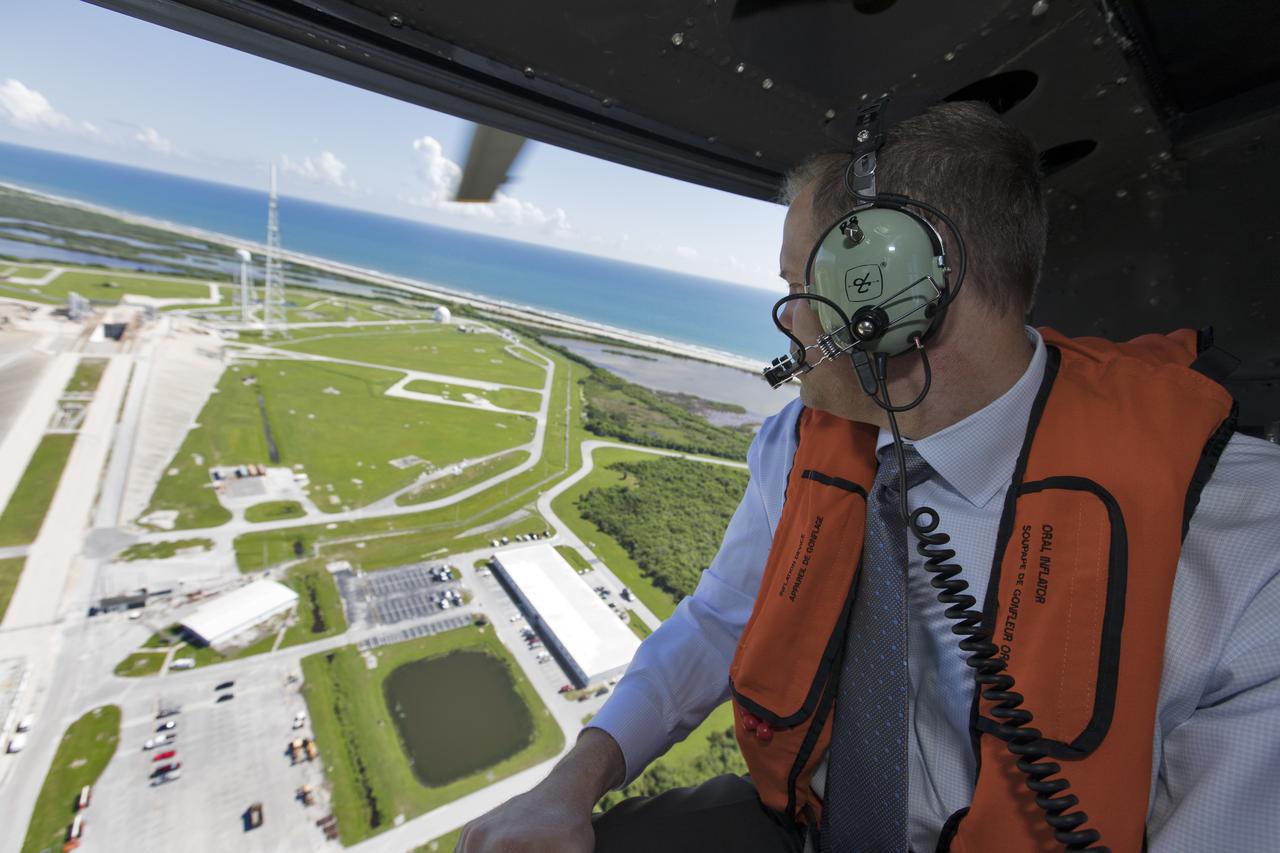
NASA Administrator Jim Bridenstine made his first official visit to the agency's Kennedy Space Center on Monday, Aug. 6, 2018. His up-close look at the premier, multi-user spaceport began with a helicopter tour over the bustling Florida spaceport that included the center's Launch Complex 39B. This will be the site where NASA's Space Launch System rocket and Orion spacecraft will liftoff on trips to the Moon, Mars and beyond.
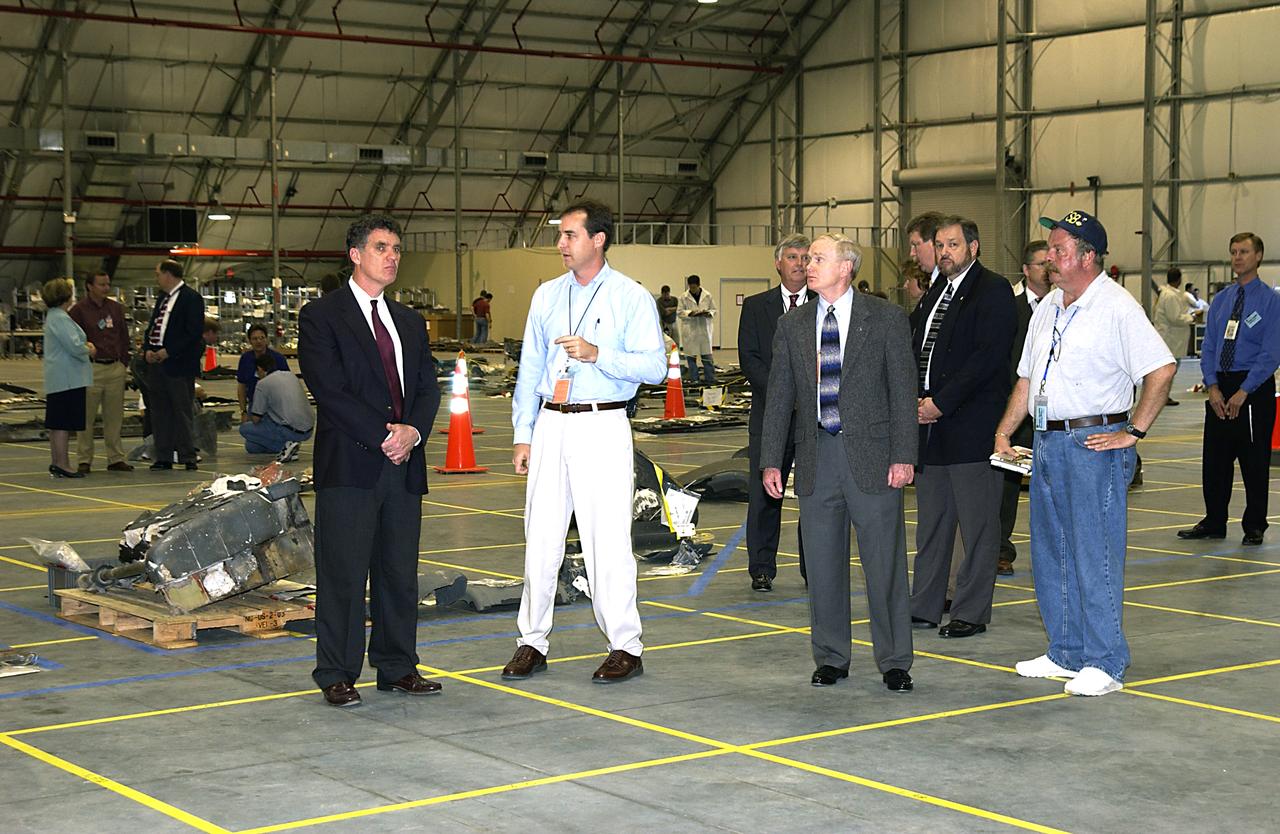
In the RLV Hangar, Congressman Dave Weldon (left) listens to Steve Altemus, Space Shuttle test director. Weldon is visiting the site where pieces of Columbia debris are being examined and stored. Third from left is Center Director Roy Bridges. Workers will attempt to reconstruct the orbiter as part of the ongoing investigation of the accident that destroyed the Columbia and claimed the lives of seven astronauts as they returned to Earth after a 16-day research mission, STS-107.

KENNEDY SPACE CENTER, FLA. -- In the Thermal Protection System Facility, NASA Administrator Sean O'Keefe (center) listens to Lee Zook (right) explaining use of the Dome Heat Shield blanket in front of them that is used for Shuttle engines. O'Keefe is visiting the site to learn more about the TPS products and process in protecting orbiters from the intense heat of launch and re-entry. TPS tiles have been discussed in the investigation into the Columbia tragedy that destroyed the orbiter and claimed the lives of seven astronauts.

KENNEDY SPACE CENTER, FLA. -- From part of the scaffolding in the Orbiter Processing Facility, members of the Columbia Accident Investigation Board look down at Space Shuttle Endeavour. In the center is Retired Navy Adm. Harold Gehman Jr., who is chairman of the board. The board is visiting sites at KSC to become familiar with the Shuttle launch process and elements. The independent board is charged with determining what caused the destruction of the Space Shuttle Columbia and the loss of its seven-member crew on Feb. 1 during reentry.
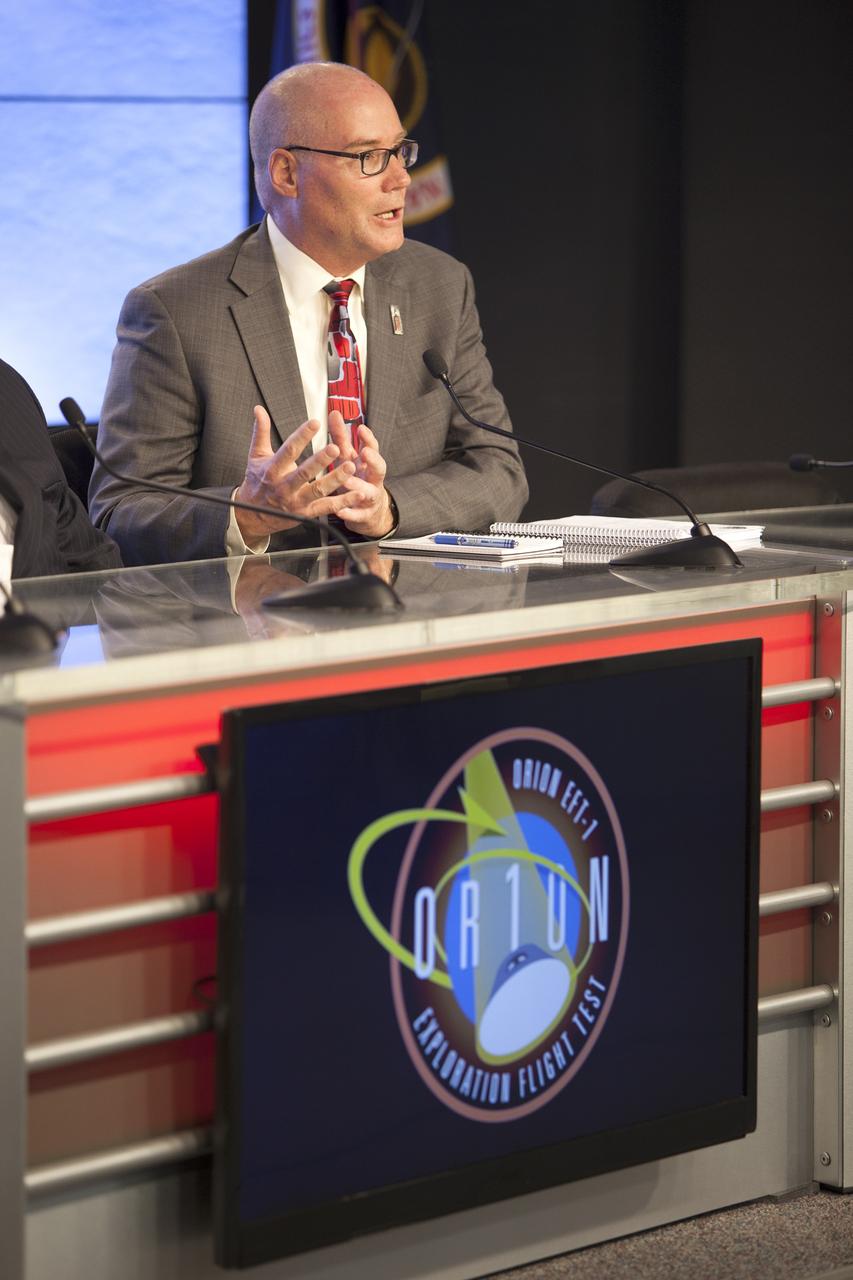
CAPE CANAVERAL, Fla. -- In the Kennedy Space Center’s Press Site auditorium, Dan Collins, United Launch Alliance chief operating officer spoke to members of the news media about the postponement of the Orion Flight Test launch due to an issue related to fill and drain valves on the Delta IV Heavy rocket. For more information, visit www.nasa.gov/orion Photo credit: NASA/Frankie Martin
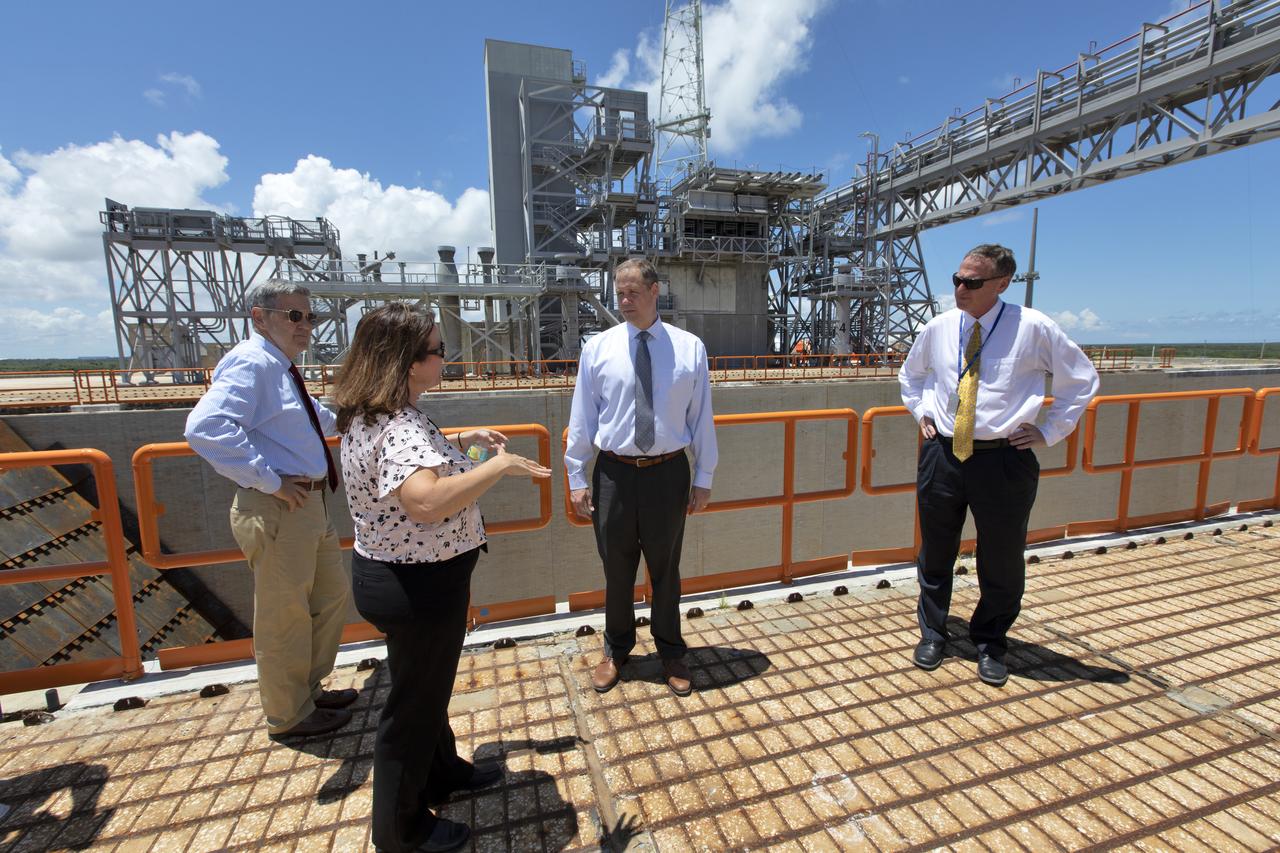
NASA Administrator Jim Bridenstine (second from the right) is briefed on work taking place at Launch Complex 39B by Center Director Bob Cabana (far left), and the facility's senior project manager, Regina Spellman (second from the left). This will be the site where NASA's Space Launch System rocket and Orion spacecraft will liftoff on trips to the Moon, Mars and deep space.. Bridenstine made his first official visit to the Florida spaceport on Aug. 6 and 7, 2018.
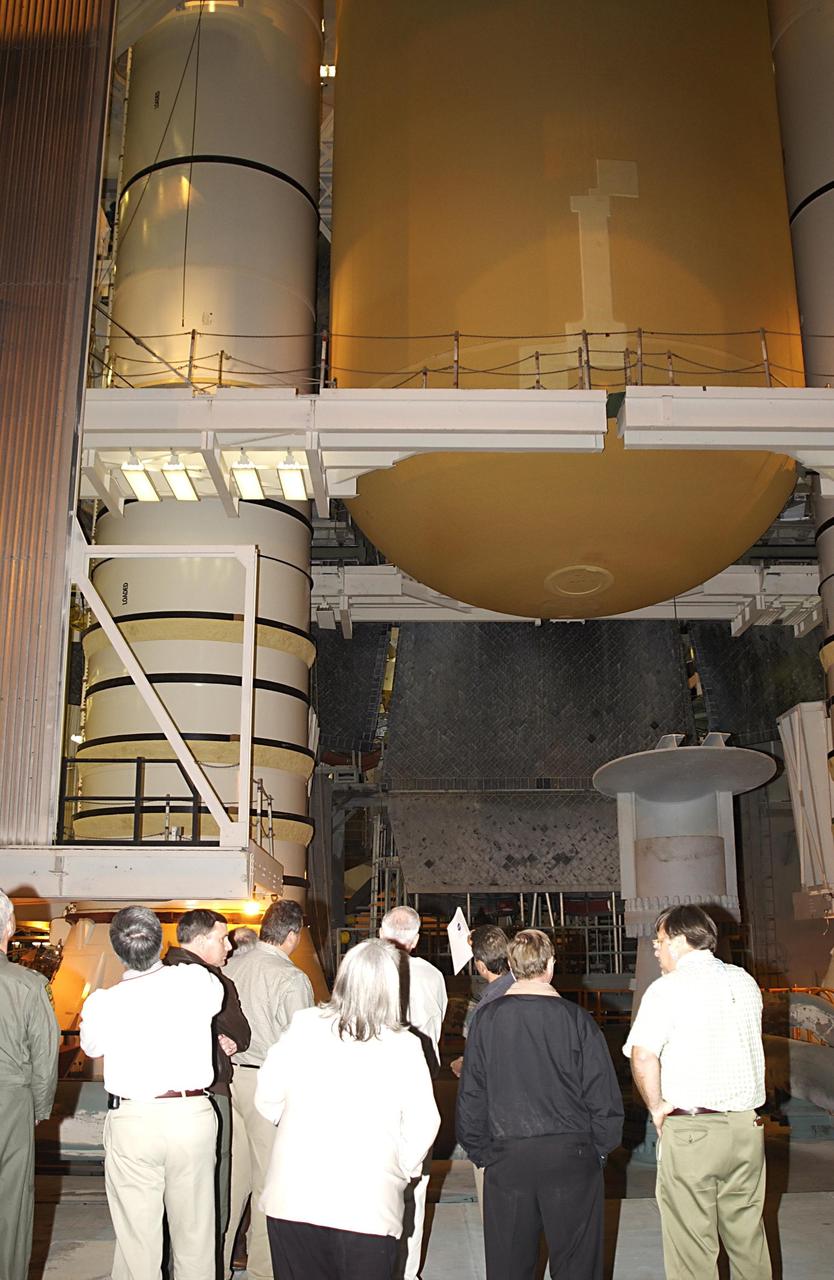
KENNEDY SPACE CENTER, FLA. -- In the Vehicle Assembly Building, the Columbia Accident Investigation Board looks at the solid rocket booster and external tank mated with Space Shuttle Atlantis. The board is visiting sites at KSC to become familiar with the Shuttle launch process and elements. The independent board is charged with determining what caused the destruction of the Space Shuttle Columbia and the loss of its seven-member crew on Feb. 1 during reentry.
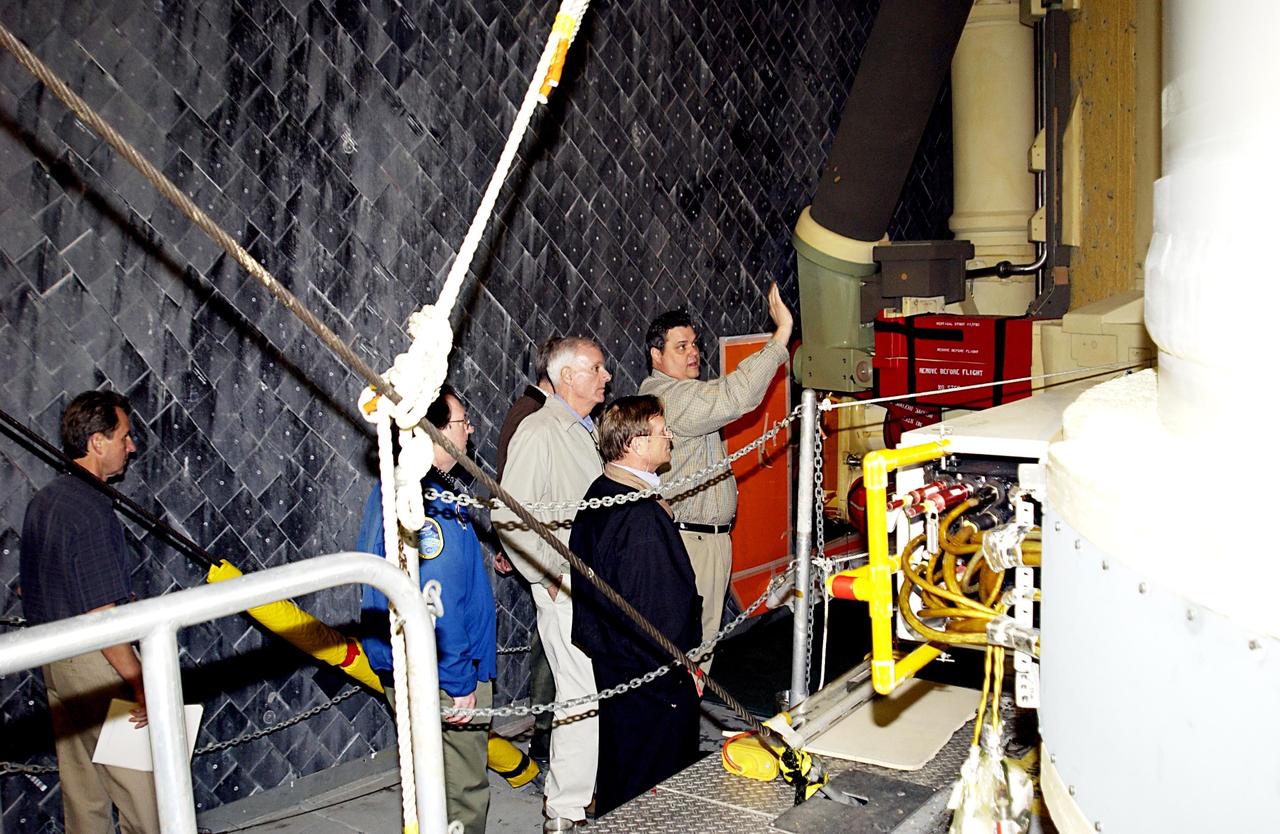
KENNEDY SPACE CENTER, FLA. -- Members of the Columbia Accident Investigation Board are in the Vehicle Assembly Building to look over Space Shuttle Atlantis (behind them). The board is visiting sites at KSC to become familiar with the Shuttle launch process and elements. The independent board is charged with determining what caused the destruction of the Space Shuttle Columbia and the loss of its seven-member crew on Feb. 1 during reentry.

CAPE CANAVERAL, Fla. – Engineers and technicians prepare NASA's Project Morpheus prototype lander for free flight test No. 15 at the north end of the Shuttle Landing Facility at Kennedy Space Center in Florida. During the 97-second test, onboard autonomous landing and hazard avoidance technology sensors, or ALHAT, surveyed the hazard field for safe landing sites, then guided the lander forward and downward to a successful landing. For more information on Morpheus, visit: http://www.morpheuslander.jsc.nasa.gov. Photo credit: NASA/Jim Grossman
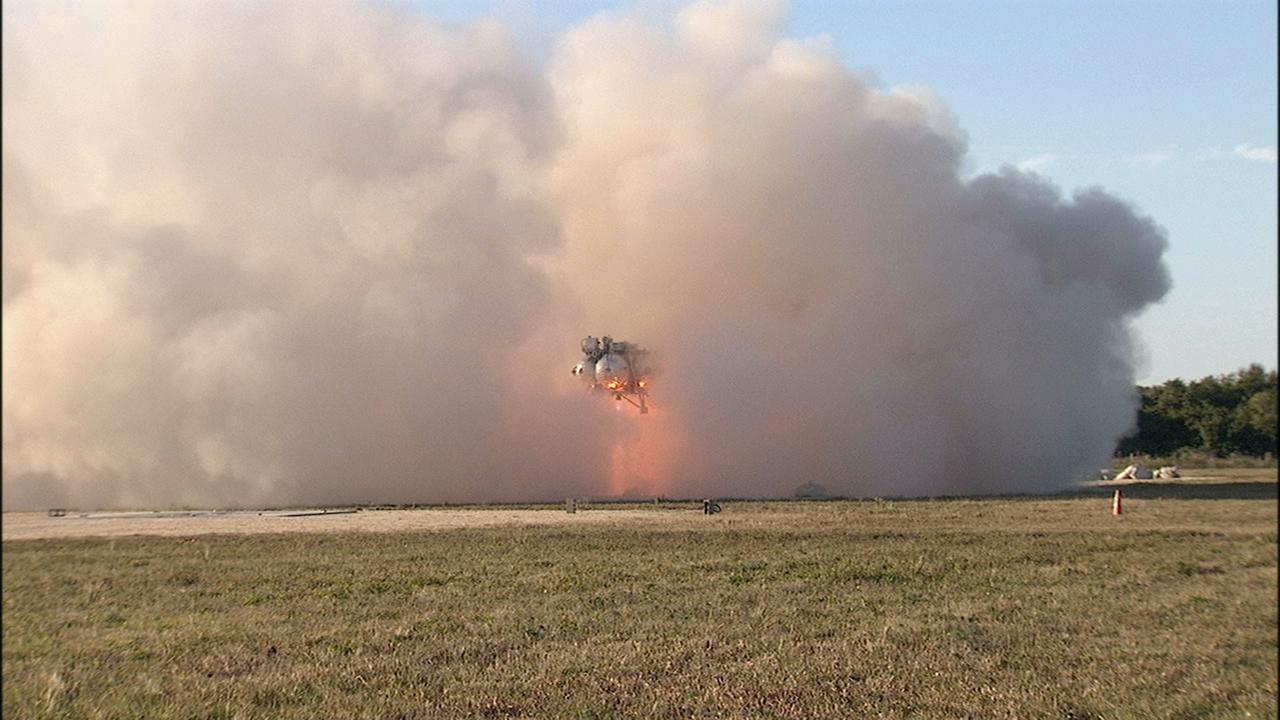
CAPE CANAVERAL, Fla. – NASA’s Project Morpheus prototype lander is enveloped in a cloud of dust as it takes off on free flight test No. 15 at the north end of the Shuttle Landing Facility at Kennedy Space Center in Florida. During the 97-second test, onboard autonomous landing and hazard avoidance technology sensors, or ALHAT, surveyed the hazard field for safe landing sites, then guided the lander forward and downward to a successful landing. For more information on Morpheus, visit: http://www.morpheuslander.jsc.nasa.gov. Photo credit: NASA
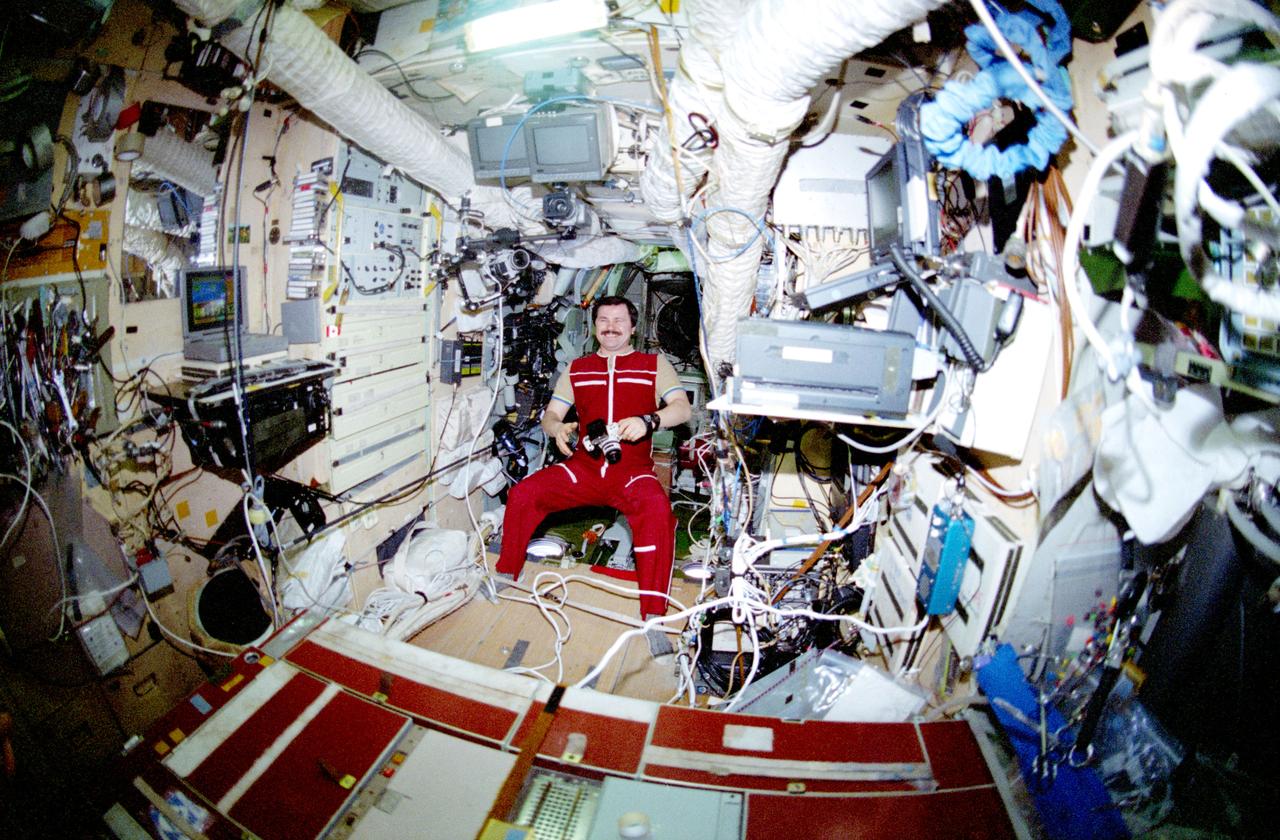
STS091-362-032 (2-12 June 1998) --- Cosmonaut Nikolai Budarin, Mir flight engineer, is at the center of this photo marking the final occasion of an American visit to Russia's Mir space station. Budarin is in the base block or core module of the complex--site of many interchanges between cosmonauts and astronauts over the last several years. Photo Credit: National Aeronautics and Space Administration (NASA) and the Russian Aviation and Space Agency.

CAPE CANAVERAL, Fla. – NASA’s Project Morpheus prototype lander is enveloped in a cloud of dust as it takes off on free flight test No. 15 at the north end of the Shuttle Landing Facility at Kennedy Space Center in Florida. During the 97-second test, onboard autonomous landing and hazard avoidance technology sensors, or ALHAT, surveyed the hazard field for safe landing sites, then guided the lander forward and downward to a successful landing. For more information on Morpheus, visit: http://www.morpheuslander.jsc.nasa.gov. Photo credit: NASA
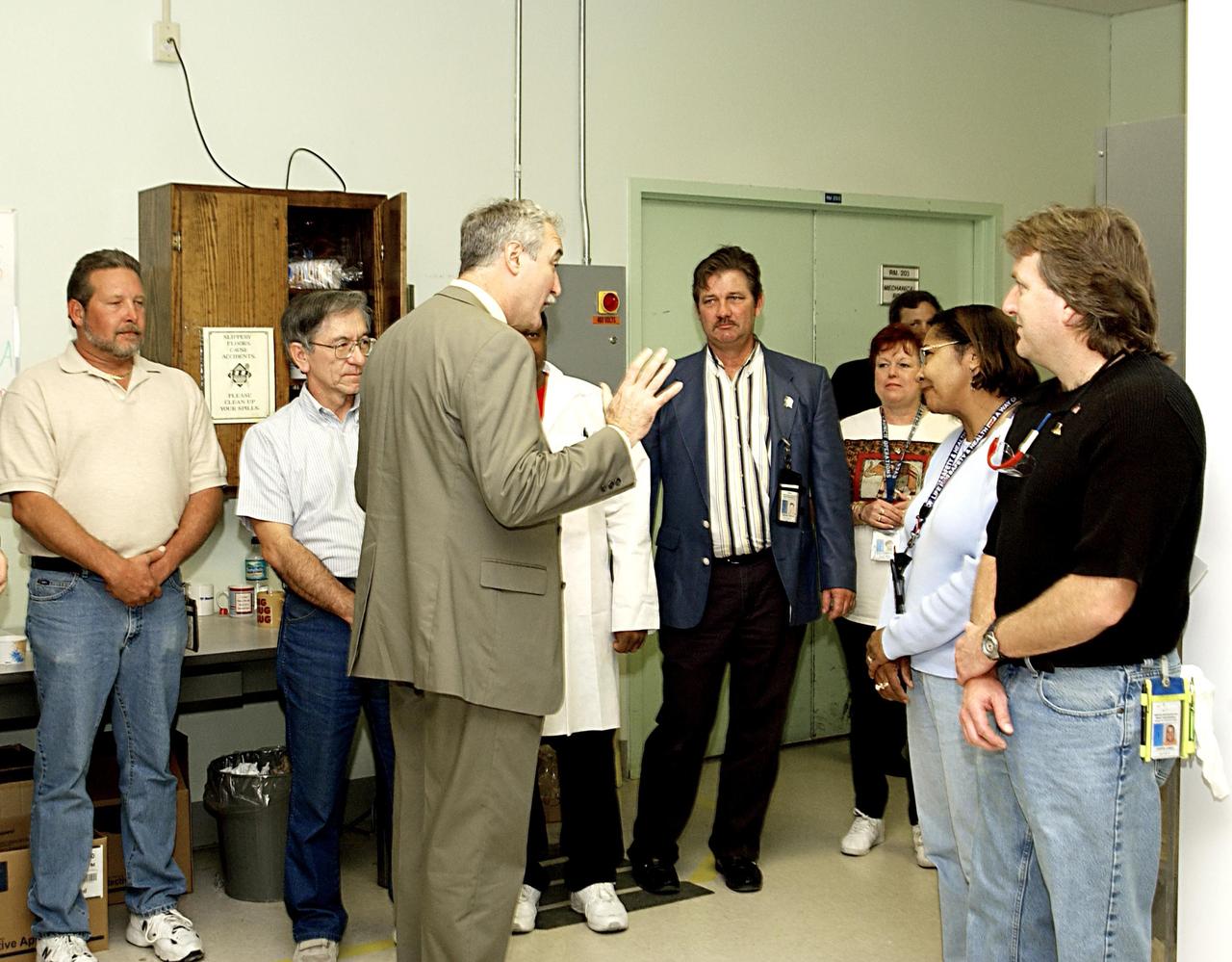
KENNEDY SPACE CENTER, FLA. -- NASA Administrator Sean O'Keefe (third from left) talks to workers in the Thermal Protection System Facility. O'Keefe is visiting the site to learn more about the TPS products and process in protecting orbiters from the intense heat of launch and re-entry. TPS tiles have been discussed in the investigation into the Columbia tragedy that destroyed the orbiter and claimed the lives of seven astronauts.

CAPE CANAVERAL, Fla. – NASA’s Project Morpheus prototype lander is enveloped in a cloud of dust as it takes off on free flight test No. 15 at the north end of the Shuttle Landing Facility at Kennedy Space Center in Florida. During the 97-second test, onboard autonomous landing and hazard avoidance technology sensors, or ALHAT, surveyed the hazard field for safe landing sites, then guided the lander forward and downward to a successful landing. For more information on Morpheus, visit: http://www.morpheuslander.jsc.nasa.gov. Photo credit: NASA