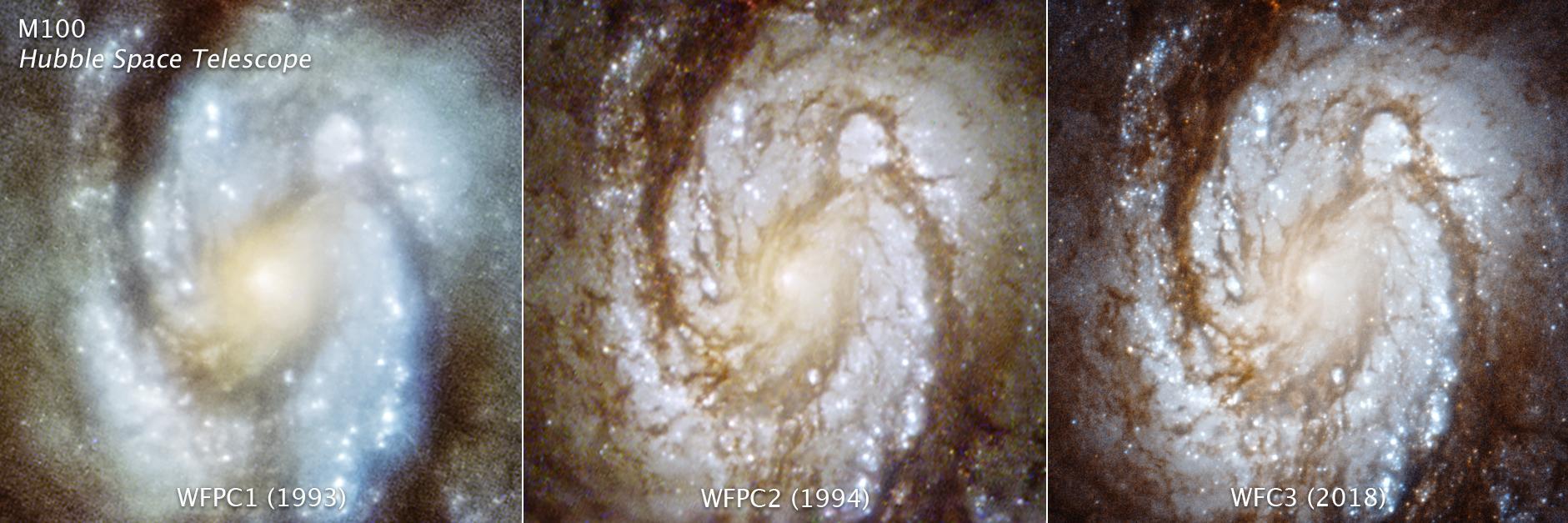
These three images are of the central region of the spiral galaxy M100, taken with three generations of cameras that were sequentially swapped out aboard the Hubble Space Telescope, and document the consistently improving capability of the observatory. The image on the left was taken with the Wide Field and Planetary Camera 1 in 1993. The photo is blurry due to a flaw (called spherical aberration) in Hubble's primary mirror. Celestial images could not be brought into a single focus. The middle image was taken in late 1993 with Wide Field and Planetary Camera 2 that was installed during the December 2 - 13 space shuttle servicing mission (SM1, STS-61). The camera contained corrective optics to compensate for the mirror flaw, and so the galaxy snapped into sharp focus when photographed. The image on the right was taken with a newer instrument, Wide Field Camera 3, that was installed on Hubble during the space shuttle servicing mission 4 (SM4) in May, 2009. https://photojournal.jpl.nasa.gov/catalog/PIA22913

The Hubble Space Telescope in a picture snapped by a Servicing Mission 4 crewmember just after the Space Shuttle Atlantis captured Hubble with its robotic arm on May 13, 2009, beginning the mission to upgrade and repair the telescope. The Hubble Space Telescope is a project of international cooperation between NASA and the European Space Agency. NASA's Goddard Space Flight Center manages the telescope. The Space Telescope Science Institute conducts Hubble science operations. Goddard is responsible for HST project management, including mission and science operations, servicing missions, and all associated development activities. To learn more about the Hubble Space Telescope go here: <a href="http://www.nasa.gov/mission_pages/hubble/main/index.html" rel="nofollow">www.nasa.gov/mission_pages/hubble/main/index.html</a>
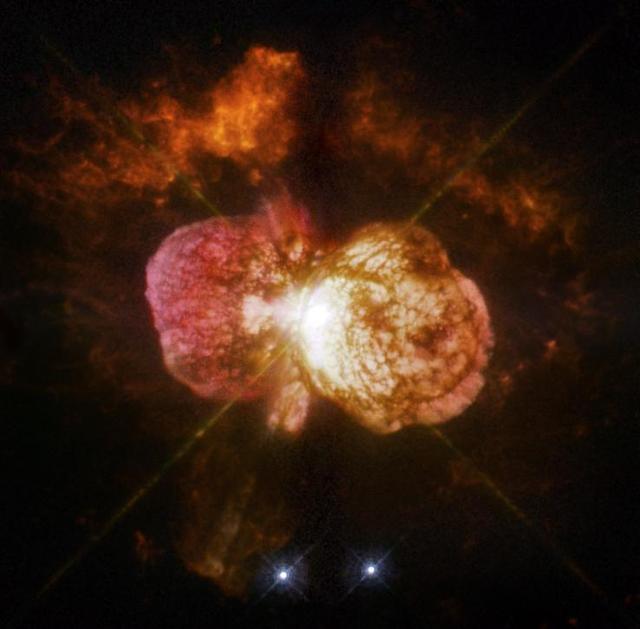
The discovery of likely Eta Carinae twins in other galaxies will help scientists better understand this brief phase in the life of a massive star with images such as this from NASA Hubble Space Telescope. Astronomers cannot yet explain what caused the titanic eruption of star Eta Carinae in the 1840s. The discovery of likely Eta Carinae "twins" in other galaxies will help scientists better understand this brief phase in the life of a massive star. http://photojournal.jpl.nasa.gov/catalog/PIA20294