
VANDENBERG AIR FORCE BASE, Calif. -- At the Orbital Sciences payload processing facility on Vandenberg Air Force Base in California, workers offload the third stage motor of the Taurus XL rocket for the launch of the Glory spacecraft in June 2009. Glory is a low-Earth orbit scientific research satellite designed to collect data on the properties and distributions of aerosols in the Earth's atmosphere and on solar irradiance for the long-term Earth climate record. Glory will be launched from Vandenberg aboard Orbital's Taurus XL 3110 launch vehicle. Photo credit: NASA/Randy Beaudoin, VAFB

VANDENBERG AIR FORCE BASE, Calif. -- A truck arrives at the Orbital Sciences payload processing facility on Vandenberg Air Force Base in California carrying the first, second and third stage motors for the launch of the Glory spacecraft in June 2009. Glory is a low-Earth orbit scientific research satellite designed to collect data on the properties and distributions of aerosols in the Earth's atmosphere and on solar irradiance for the long-term Earth climate record. Glory will be launched from Vandenberg aboard Orbital's Taurus XL 3110 launch vehicle. Photo credit: NASA/Randy Beaudoin, VAFB

VANDENBERG AIR FORCE BASE, Calif. -- At the Orbital Sciences payload processing facility on Vandenberg Air Force Base in California, the first stage motor for the Glory spacecraft's Taurus XL rocket waits to be moved inside. Glory is a low-Earth orbit scientific research satellite designed to collect data on the properties and distributions of aerosols in the Earth's atmosphere and on solar irradiance for the long-term Earth climate record. Glory will be launched from Vandenberg aboard Orbital's Taurus XL 3110 launch vehicle. Photo credit: NASA/Randy Beaudoin, VAFB

VANDENBERG AIR FORCE BASE, Calif. -- In the Orbital Sciences payload processing facility on Vandenberg Air Force Base in California, the first, second and third stage motors for the Glory spacecraft's Taurus XL rocket are lined up after arrival. Glory is a low-Earth orbit scientific research satellite designed to collect data on the properties and distributions of aerosols in the Earth's atmosphere and on solar irradiance for the long-term Earth climate record. Glory will be launched from Vandenberg aboard Orbital's Taurus XL 3110 launch vehicle. Photo credit: NASA/Randy Beaudoin, VAFB

VANDENBERG AIR FORCE BASE, Calif. -- At the Orbital Sciences payload processing facility on Vandenberg Air Force Base in California, workers unstrap the newly arrived second (left) and first stage motors for the Glory spacecraft's Taurus XL rocket. Glory is a low-Earth orbit scientific research satellite designed to collect data on the properties and distributions of aerosols in the Earth's atmosphere and on solar irradiance for the long-term Earth climate record. Glory will be launched from Vandenberg aboard Orbital's Taurus XL 3110 launch vehicle. Photo credit: NASA/Randy Beaudoin, VAFB

VANDENBERG AIR FORCE BASE, Calif. -- At the Orbital Sciences payload processing facility on Vandenberg Air Force Base in California, workers offload the second (right) and third stage motors of the Taurus XL rocket for the launch of the Glory spacecraft in June 2009. Glory is a low-Earth orbit scientific research satellite designed to collect data on the properties and distributions of aerosols in the Earth's atmosphere and on solar irradiance for the long-term Earth climate record. Glory will be launched from Vandenberg aboard Orbital's Taurus XL 3110 launch vehicle. Photo credit: NASA/Randy Beaudoin, VAFB

VANDENBERG AIR FORCE BASE, Calif. -- Workers move the second stage motor of the Taurus XL rocket for the launch of the Glory spacecraft in June 2009 into the Orbital Sciences payload processing facility on Vandenberg Air Force Base in California. Glory is a low-Earth orbit scientific research satellite designed to collect data on the properties and distributions of aerosols in the Earth's atmosphere and on solar irradiance for the long-term Earth climate record. Glory will be launched from Vandenberg aboard Orbital's Taurus XL 3110 launch vehicle. Photo credit: NASA/Randy Beaudoin, VAFB

VANDENBERG AIR FORCE BASE, Calif. -- The solar arrays of NASA's Glory spacecraft will be uncovered and illuminated in the Astrotech payload processing facility at Vandenberg Air Force Base in California. The spacecraft will be processed for flight, encapsulated in its protective payload fairing, and then transported to Space Launch Complex 576-E where is will be joined with the third stage of the Orbital Sciences Corp. Taurus XL rocket. Once Glory reaches orbit, it will collect data on the properties of aerosols and black carbon. It also will help scientists understand how the sun's irradiance affects Earth's climate. Launch is scheduled for 5:09 a.m. EST Feb. 23. For information, visit www.nasa.gov/glory. Photo credit: NASA/Randy Beaudoin, VAFB

VANDENBERG AIR FORCE BASE, Calif. -- The solar arrays of NASA's Glory spacecraft are illuminated in the Astrotech payload processing facility at Vandenberg Air Force Base in California. The spacecraft will be processed for flight, encapsulated in its protective payload fairing, and then transported to Space Launch Complex 576-E where is will be joined with the third stage of the Orbital Sciences Corp. Taurus XL rocket. Once Glory reaches orbit, it will collect data on the properties of aerosols and black carbon. It also will help scientists understand how the sun's irradiance affects Earth's climate. Launch is scheduled for 5:09 a.m. EST Feb. 23. For information, visit www.nasa.gov/glory. Photo credit: NASA/Randy Beaudoin, VAFB
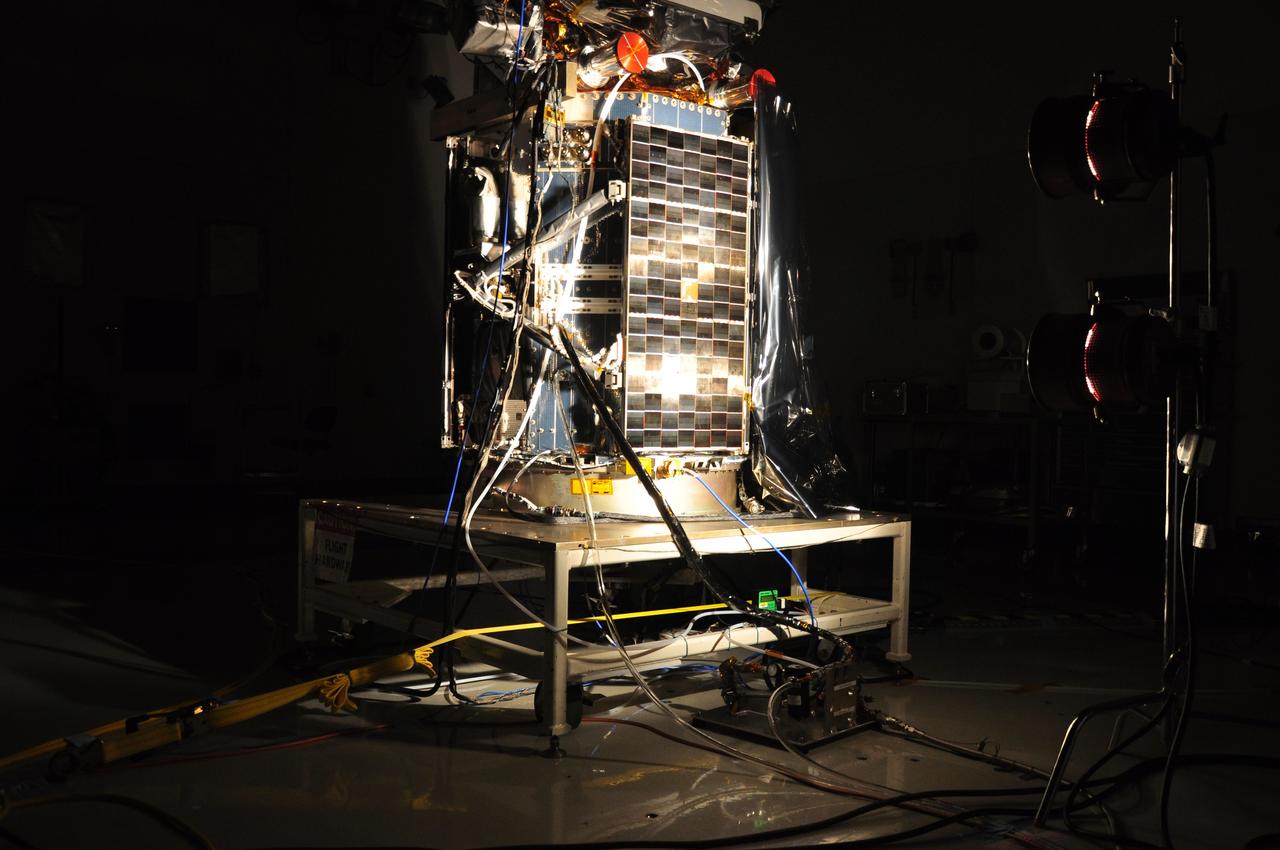
VANDENBERG AIR FORCE BASE, Calif. -- The solar arrays of NASA's Glory spacecraft are illuminated in the Astrotech payload processing facility at Vandenberg Air Force Base in California. The spacecraft will be processed for flight, encapsulated in its protective payload fairing, and then transported to Space Launch Complex 576-E where is will be joined with the third stage of the Orbital Sciences Corp. Taurus XL rocket. Once Glory reaches orbit, it will collect data on the properties of aerosols and black carbon. It also will help scientists understand how the sun's irradiance affects Earth's climate. Launch is scheduled for 5:09 a.m. EST Feb. 23. For information, visit www.nasa.gov/glory. Photo credit: NASA/Randy Beaudoin, VAFB

VANDENBERG AIR FORCE BASE, Calif. -- The solar arrays of NASA's Glory spacecraft are illuminated in the Astrotech payload processing facility at Vandenberg Air Force Base in California. The spacecraft will be processed for flight, encapsulated in its protective payload fairing, and then transported to Space Launch Complex 576-E where is will be joined with the third stage of the Orbital Sciences Corp. Taurus XL rocket. Once Glory reaches orbit, it will collect data on the properties of aerosols and black carbon. It also will help scientists understand how the sun's irradiance affects Earth's climate. Launch is scheduled for 5:09 a.m. EST Feb. 23. For information, visit www.nasa.gov/glory. Photo credit: NASA/Randy Beaudoin, VAFB

VANDENBERG AIR FORCE BASE, Calif. -- The solar arrays of NASA's Glory spacecraft are illuminated in the Astrotech payload processing facility at Vandenberg Air Force Base in California. The spacecraft will be processed for flight, encapsulated in its protective payload fairing, and then transported to Space Launch Complex 576-E where is will be joined with the third stage of the Orbital Sciences Corp. Taurus XL rocket. Once Glory reaches orbit, it will collect data on the properties of aerosols and black carbon. It also will help scientists understand how the sun's irradiance affects Earth's climate. Launch is scheduled for 5:09 a.m. EST Feb. 23. For information, visit www.nasa.gov/glory. Photo credit: NASA/Ed Henry, VAFB