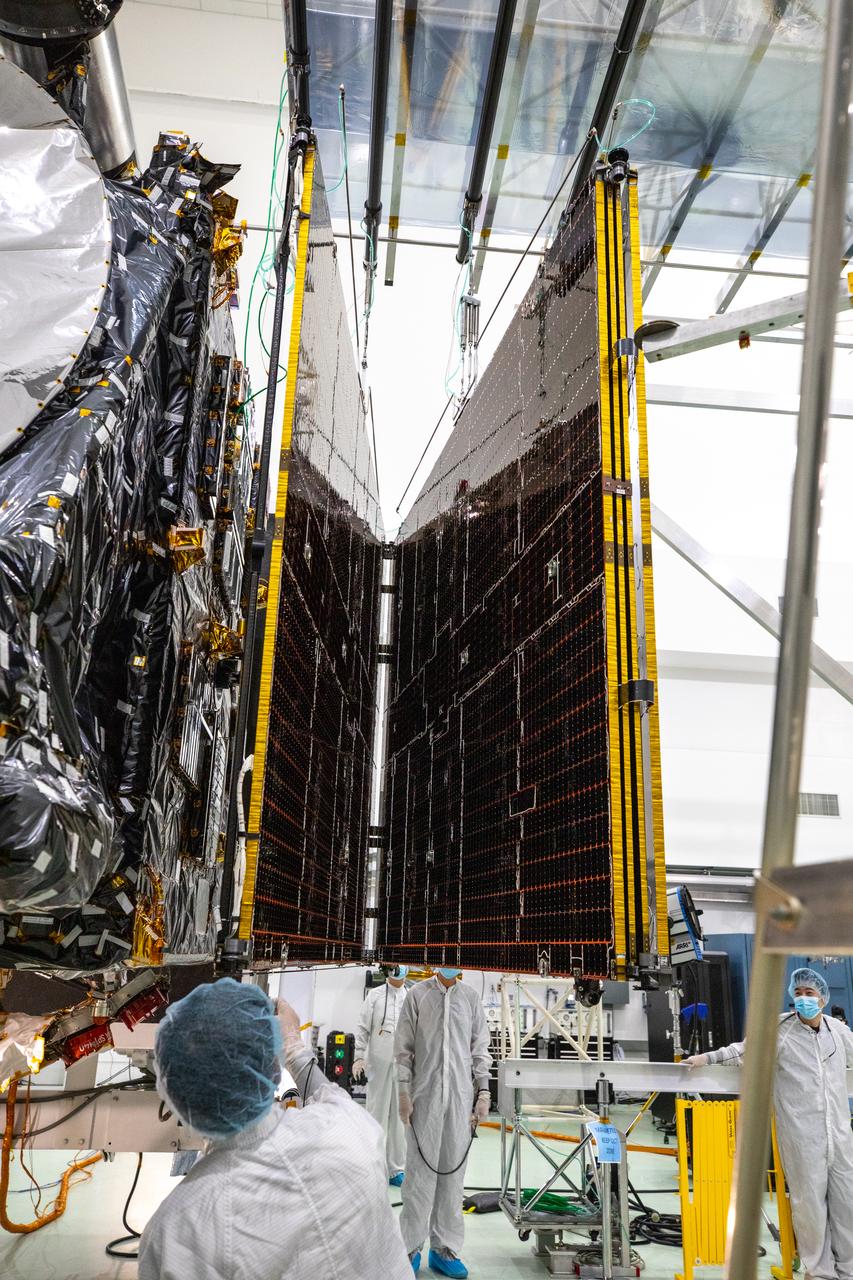
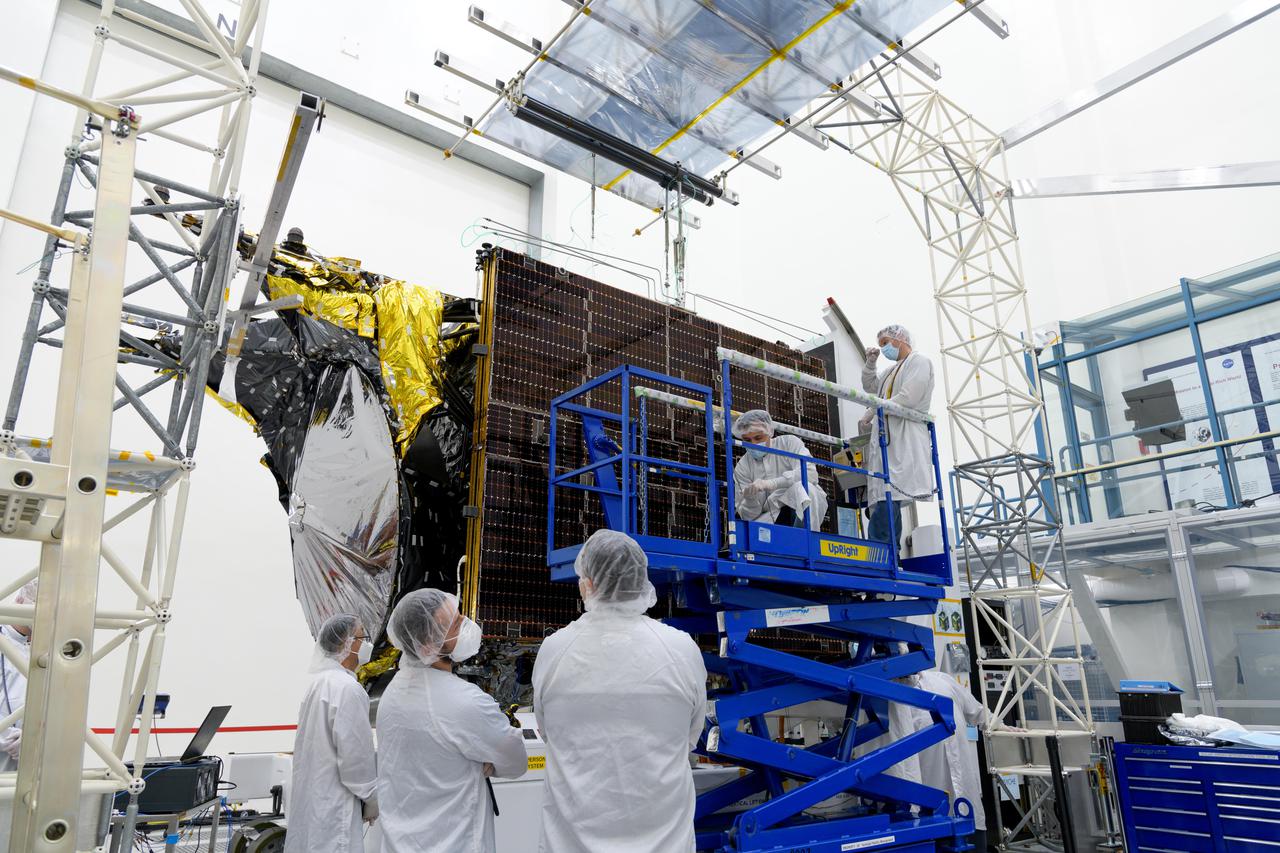
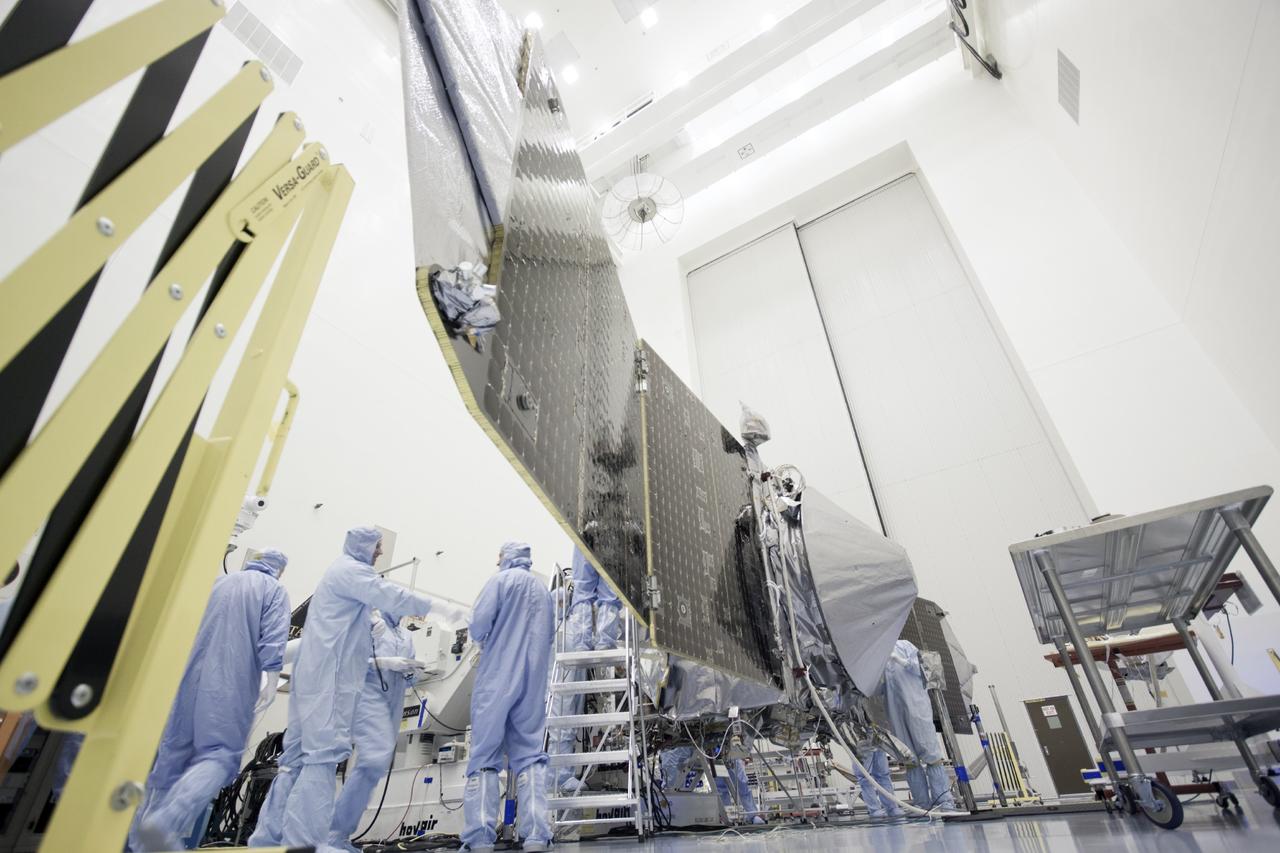
Team members retract the two solar arrays attached to NASA’s Psyche spacecraft inside the Astrotech Space Operations Facility near the agency’s Kennedy Space Center in Florida on July 25, 2023. The solar arrays, which were shipped from Maxar Technologies, in San Jose, California, are being stowed for launch. They are part of the solar electric propulsion system, provided by Maxar, that will power the spacecraft on its journey to explore a metal-rich asteroid. Psyche will launch atop a SpaceX Falcon Heavy rocket from Launch Complex 39A at Kennedy. Launch is targeted for Oct. 5, 2023. Riding with Psyche is a pioneering technology demonstration, NASA’s Deep Space Optical Communications (DSOC) experiment.
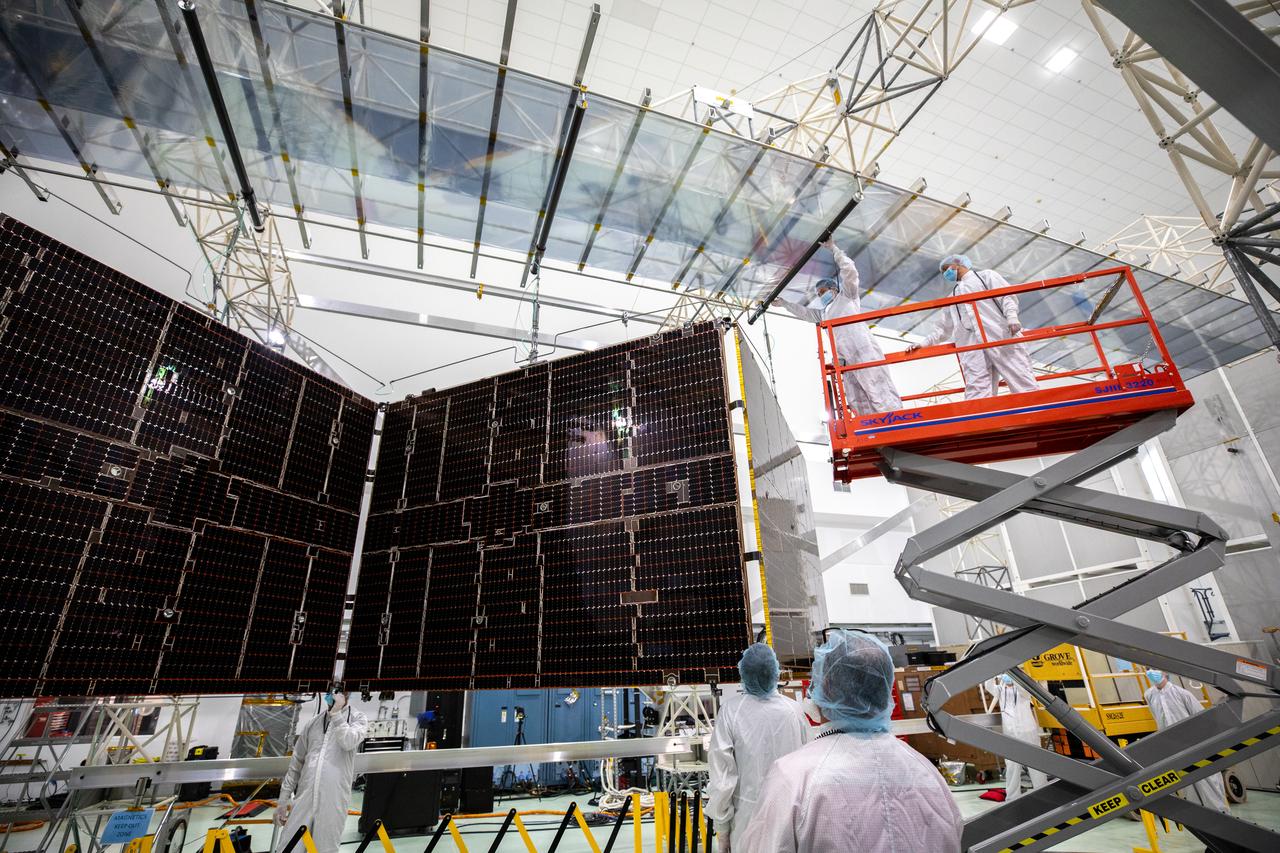
Technicians begin to retract one of the two solar arrays attached to NASA’s Psyche spacecraft inside the Astrotech Space Operations Facility near the agency’s Kennedy Space Center in Florida on July 25, 2023. The solar arrays, which were shipped from Maxar Technologies, in San Jose, California, are being stowed for launch. They are part of the solar electric propulsion system, provided by Maxar, that will power the spacecraft on its journey to explore a metal-rich asteroid. Psyche will launch atop a SpaceX Falcon Heavy rocket from Launch Complex 39A at Kennedy. Launch is targeted for Oct. 5, 2023. Riding with Psyche is a pioneering technology demonstration, NASA’s Deep Space Optical Communications (DSOC) experiment.
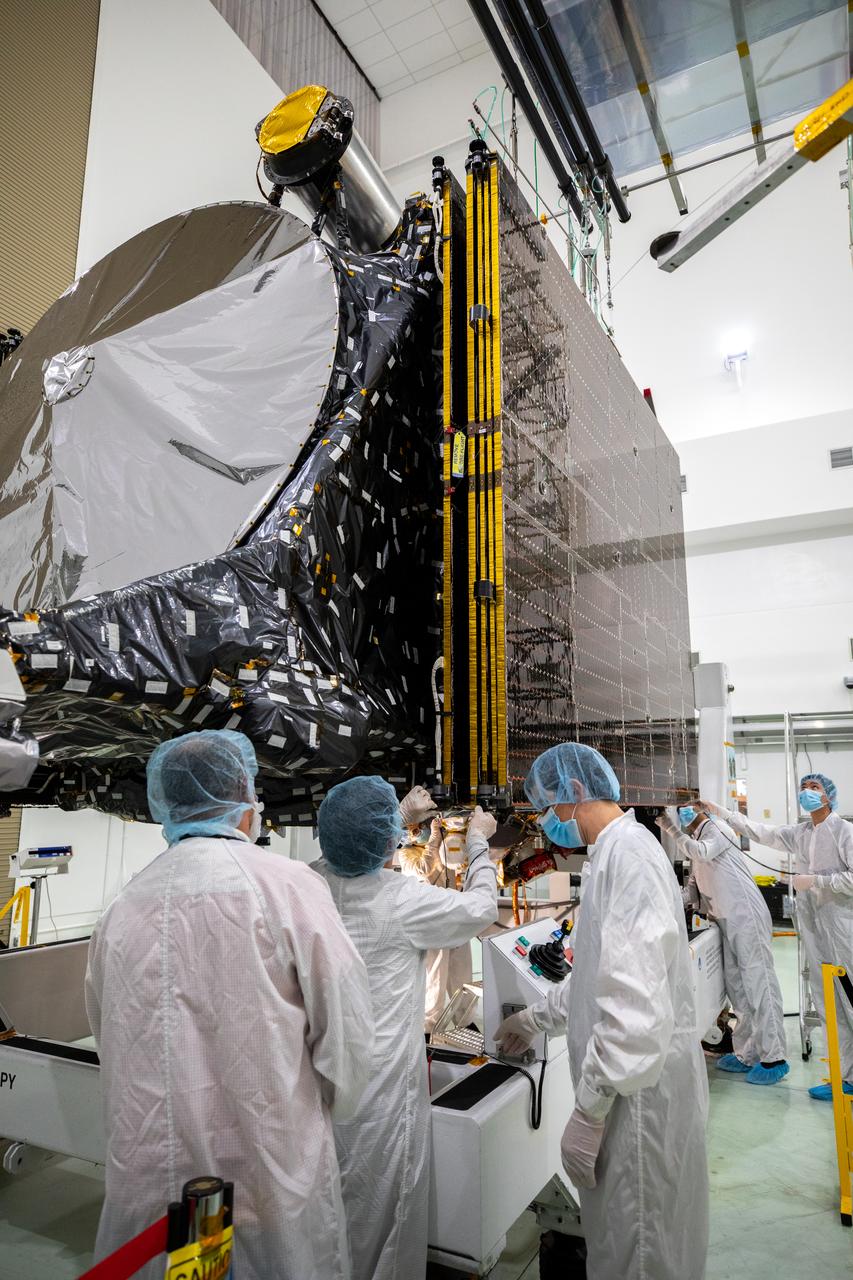
Team members retract the two solar arrays attached to NASA’s Psyche spacecraft inside the Astrotech Space Operations Facility near the agency’s Kennedy Space Center in Florida on July 25, 2023. The solar arrays, which were shipped from Maxar Technologies, in San Jose, California, are being stowed for launch. They are part of the solar electric propulsion system, provided by Maxar, that will power the spacecraft on its journey to explore a metal-rich asteroid. Psyche will launch atop a SpaceX Falcon Heavy rocket from Launch Complex 39A at Kennedy. Launch is targeted for Oct. 5, 2023. Riding with Psyche is a pioneering technology demonstration, NASA’s Deep Space Optical Communications (DSOC) experiment.
Technicians begin to retract one of the two solar arrays attached to NASA’s Psyche spacecraft inside the Astrotech Space Operations Facility near the agency’s Kennedy Space Center in Florida on July 25, 2023. The solar arrays, which were shipped from Maxar Technologies, in San Jose, California, are being stowed for launch. They are part of the solar electric propulsion system, provided by Maxar, that will power the spacecraft on its journey to explore a metal-rich asteroid. Psyche will launch atop a SpaceX Falcon Heavy rocket from Launch Complex 39A at Kennedy. Launch is targeted for Oct. 5, 2023. Riding with Psyche is a pioneering technology demonstration, NASA’s Deep Space Optical Communications (DSOC) experiment.
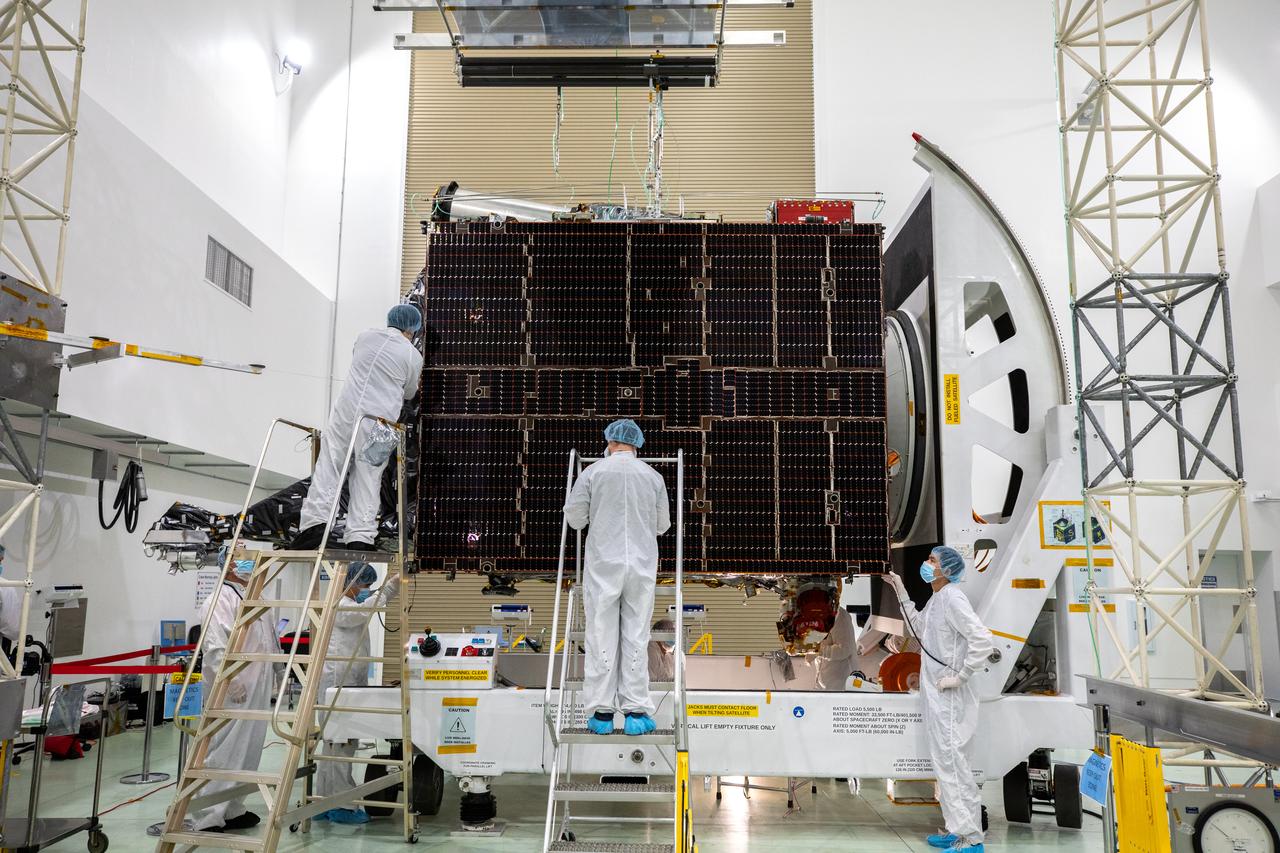
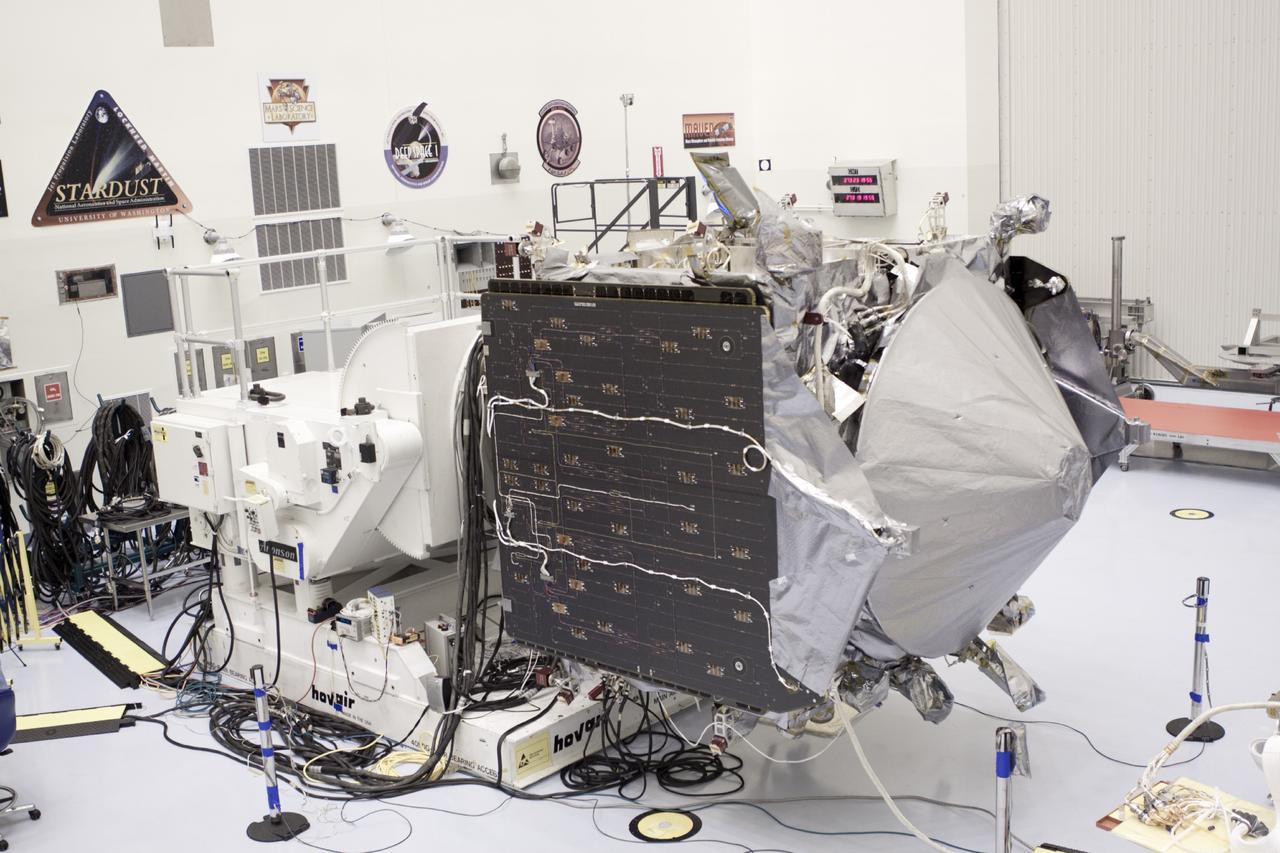
Team members have retracted the two solar arrays attached to NASA’s Psyche spacecraft inside the Astrotech Space Operations Facility near the agency’s Kennedy Space Center in Florida on July 25, 2023. The solar arrays, which were shipped from Maxar Technologies, in San Jose, California, are being stowed for launch. They are part of the solar electric propulsion system, provided by Maxar, that will power the spacecraft on its journey to explore a metal-rich asteroid. Psyche will launch atop a SpaceX Falcon Heavy rocket from Launch Complex 39A at Kennedy. Launch is targeted for Oct. 5, 2023. Riding with Psyche is a pioneering technology demonstration, NASA’s Deep Space Optical Communications (DSOC) experiment.
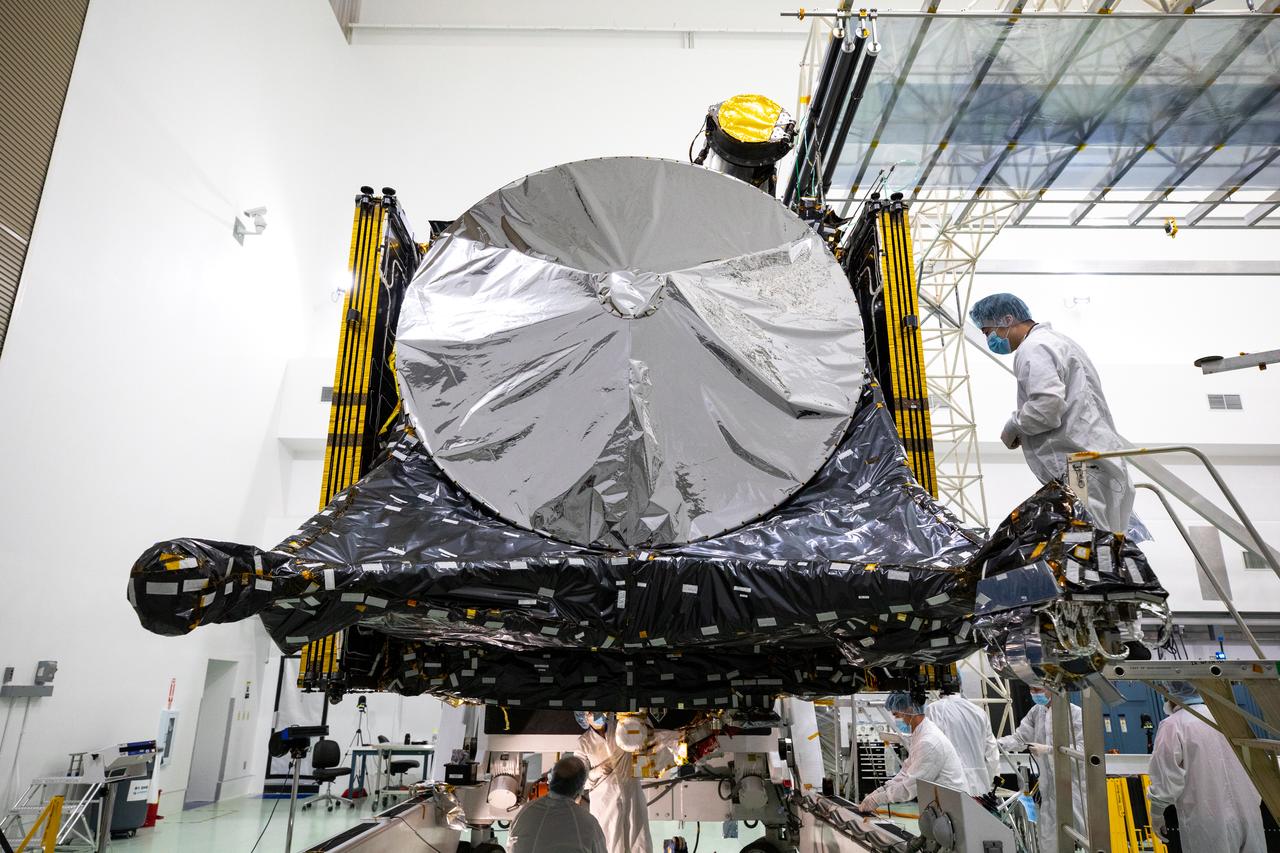
Team members have retracted the two solar arrays attached to NASA’s Psyche spacecraft inside the Astrotech Space Operations Facility near the agency’s Kennedy Space Center in Florida on July 25, 2023. The solar arrays, which were shipped from Maxar Technologies, in San Jose, California, are being stowed for launch. They are part of the solar electric propulsion system, provided by Maxar, that will power the spacecraft on its journey to explore a metal-rich asteroid. Psyche will launch atop a SpaceX Falcon Heavy rocket from Launch Complex 39A at Kennedy. Launch is targeted for Oct. 5, 2023. Riding with Psyche is a pioneering technology demonstration, NASA’s Deep Space Optical Communications (DSOC) experiment.

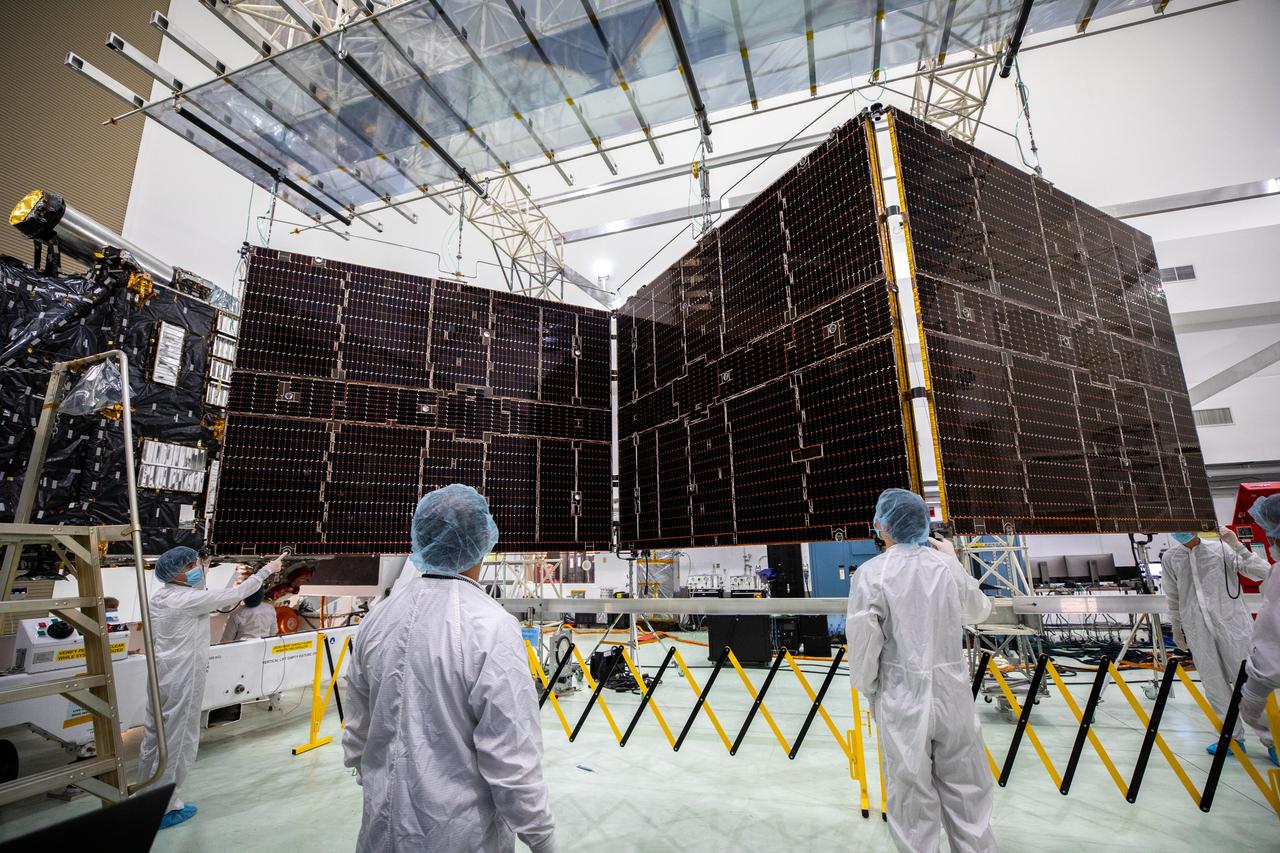
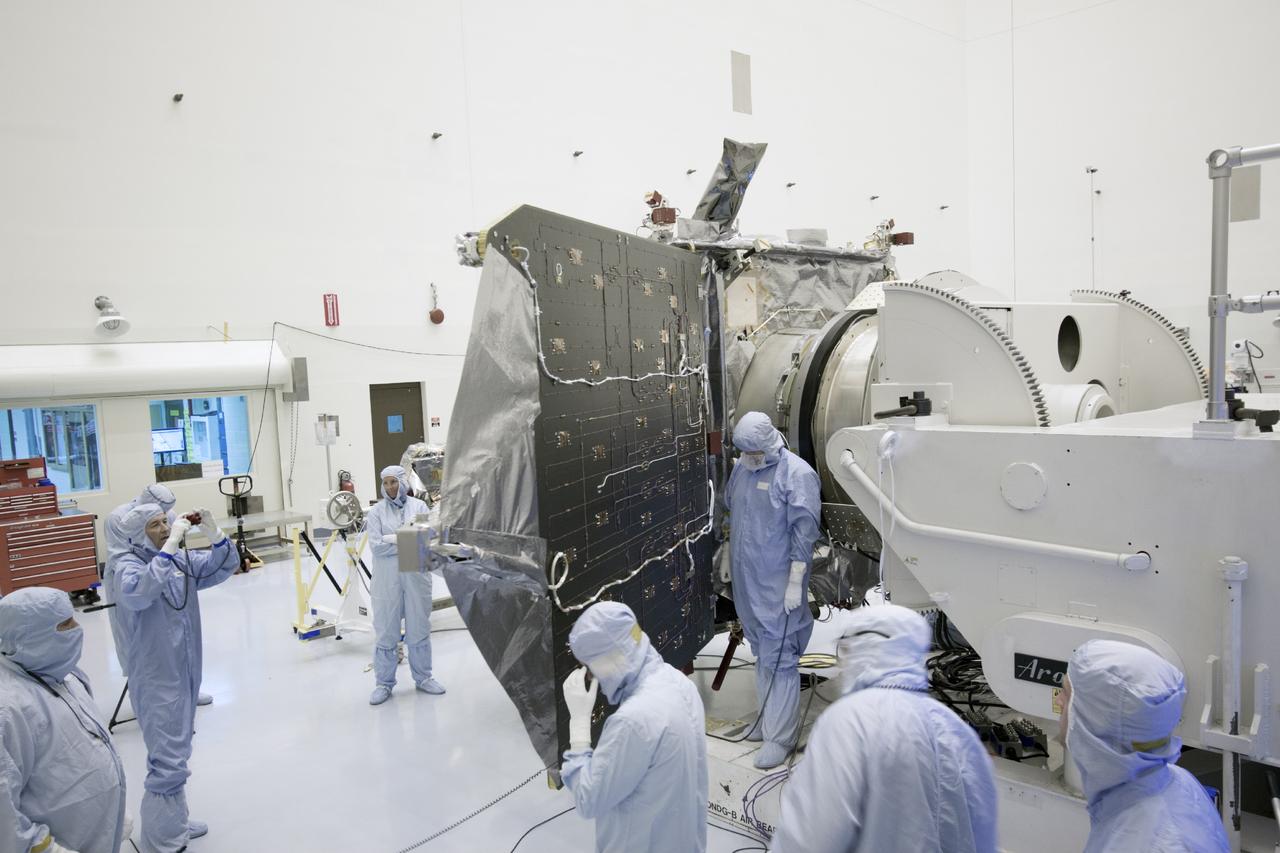
Team members begin to retract the second of two solar arrays attached to NASA’s Psyche spacecraft inside the Astrotech Space Operations Facility near the agency’s Kennedy Space Center in Florida on July 25, 2023. The solar arrays, which were shipped from Maxar Technologies, in San Jose, California, are being stowed for launch. They are part of the solar electric propulsion system, provided by Maxar, that will power the spacecraft on its journey to explore a metal-rich asteroid. Psyche will launch atop a SpaceX Falcon Heavy rocket from Launch Complex 39A at Kennedy. Launch is targeted for Oct. 5, 2023. Riding with Psyche is a pioneering technology demonstration, NASA’s Deep Space Optical Communications (DSOC) experiment.
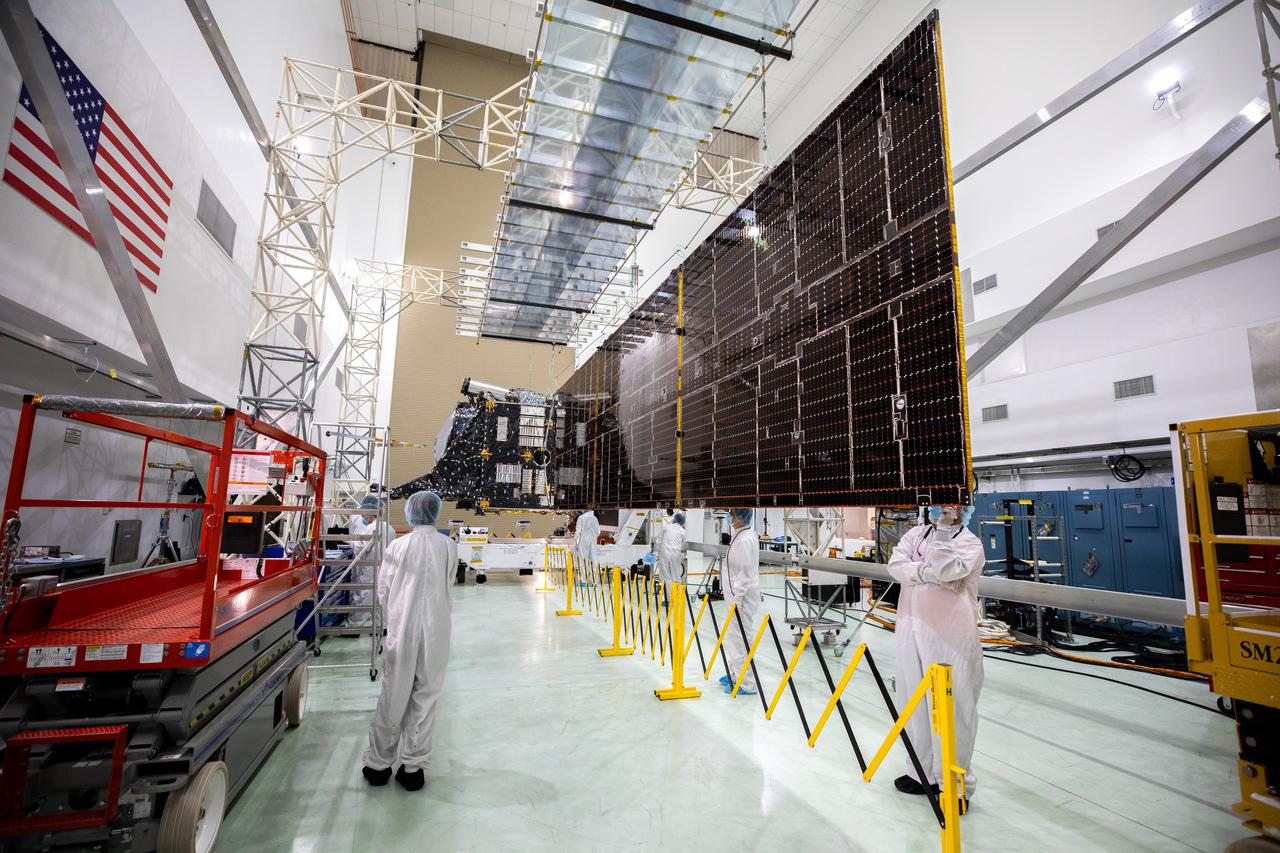
Team members begin to retract the second of two solar arrays attached to NASA’s Psyche spacecraft inside the Astrotech Space Operations Facility near the agency’s Kennedy Space Center in Florida on July 25, 2023. The solar arrays, which were shipped from Maxar Technologies, in San Jose, California, are being stowed for launch. They are part of the solar electric propulsion system, provided by Maxar, that will power the spacecraft on its journey to explore a metal-rich asteroid. Psyche will launch atop a SpaceX Falcon Heavy rocket from Launch Complex 39A at Kennedy. Launch is targeted for Oct. 5, 2023. Riding with Psyche is a pioneering technology demonstration, NASA’s Deep Space Optical Communications (DSOC) experiment.
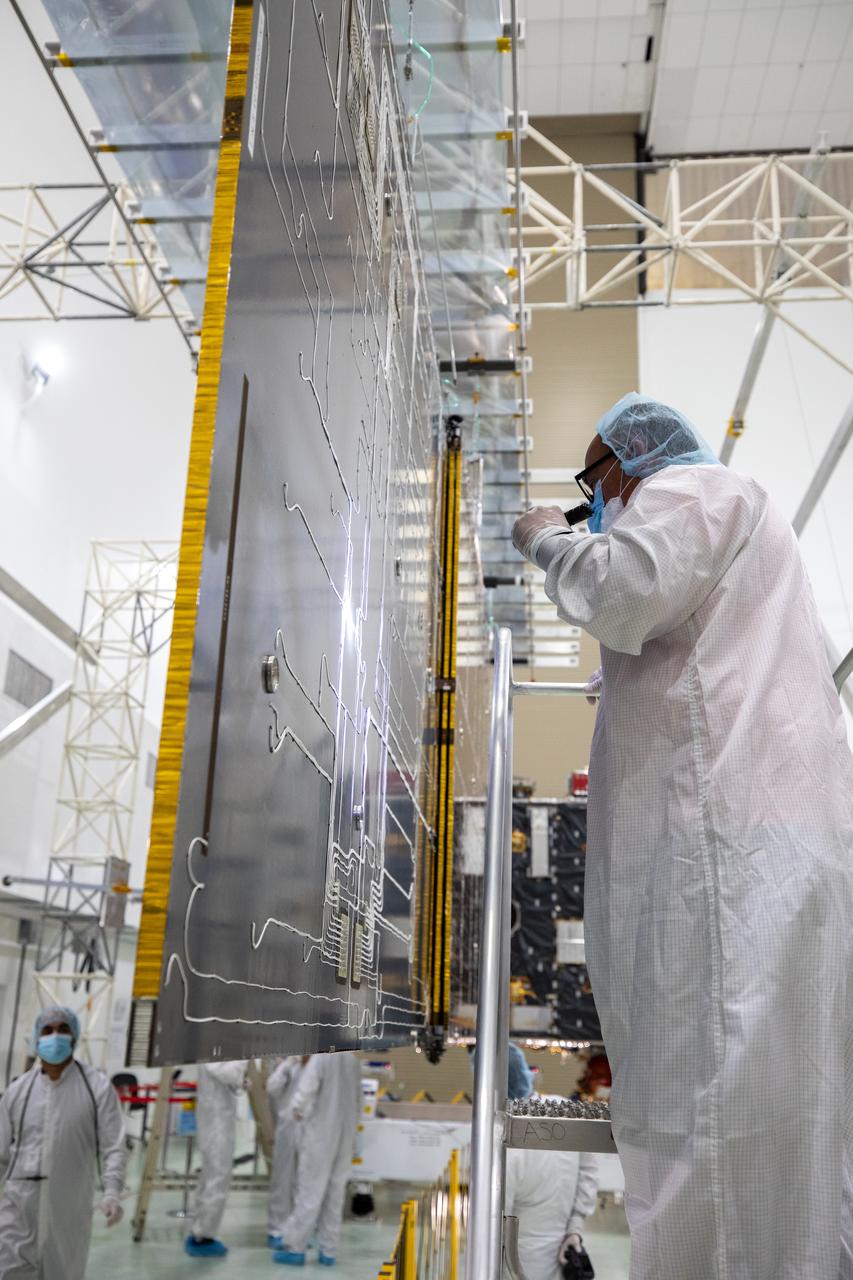
Team members begin to retract the second of two solar arrays attached to NASA’s Psyche spacecraft inside the Astrotech Space Operations Facility near the agency’s Kennedy Space Center in Florida on July 25, 2023. The solar arrays, which were shipped from Maxar Technologies, in San Jose, California, are being stowed for launch. They are part of the solar electric propulsion system, provided by Maxar, that will power the spacecraft on its journey to explore a metal-rich asteroid. Psyche will launch atop a SpaceX Falcon Heavy rocket from Launch Complex 39A at Kennedy. Launch is targeted for Oct. 5, 2023. Riding with Psyche is a pioneering technology demonstration, NASA’s Deep Space Optical Communications (DSOC) experiment.
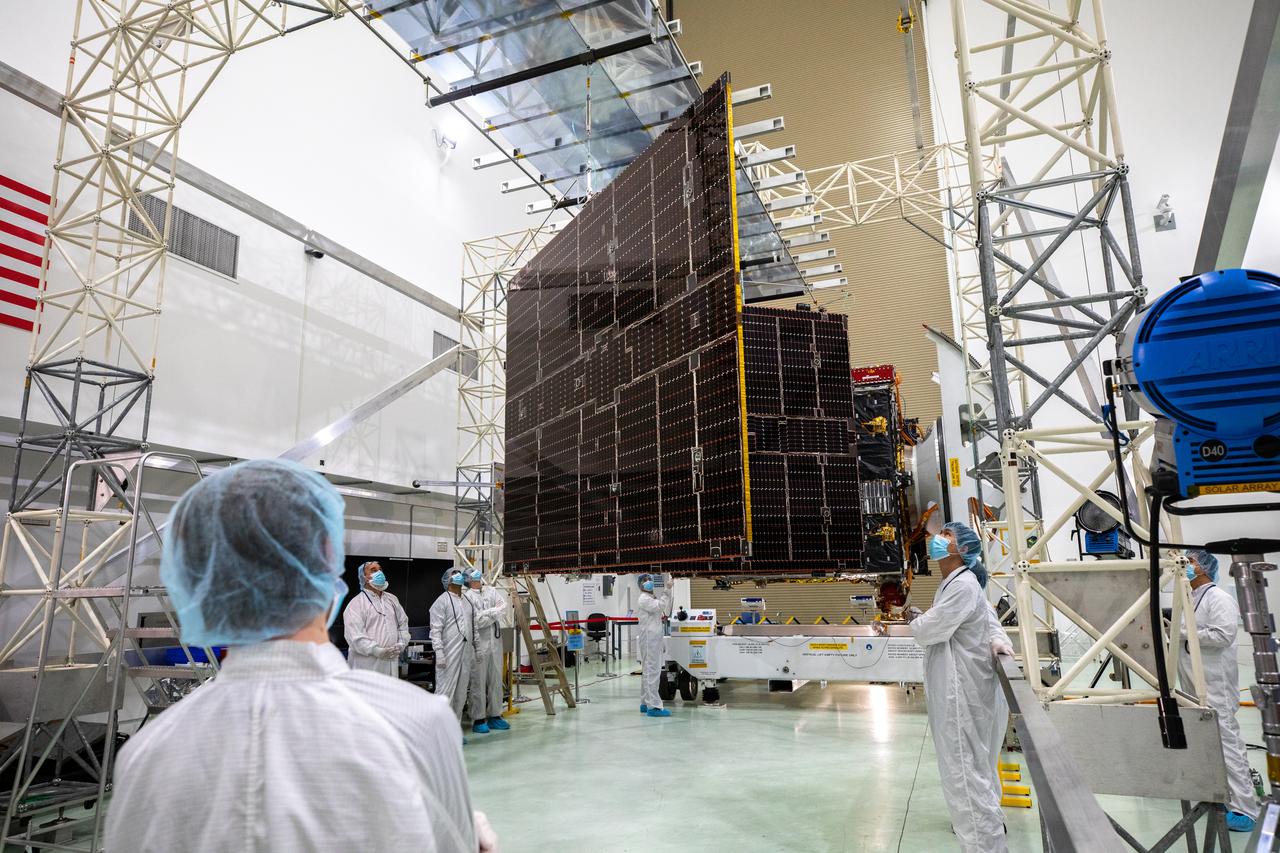
Team members begin to retract the second of two solar arrays attached to NASA’s Psyche spacecraft inside the Astrotech Space Operations Facility near the agency’s Kennedy Space Center in Florida on July 25, 2023. The solar arrays, which were shipped from Maxar Technologies, in San Jose, California, are being stowed for launch. They are part of the solar electric propulsion system, provided by Maxar, that will power the spacecraft on its journey to explore a metal-rich asteroid. Psyche will launch atop a SpaceX Falcon Heavy rocket from Launch Complex 39A at Kennedy. Launch is targeted for Oct. 5, 2023. Riding with Psyche is a pioneering technology demonstration, NASA’s Deep Space Optical Communications (DSOC) experiment.
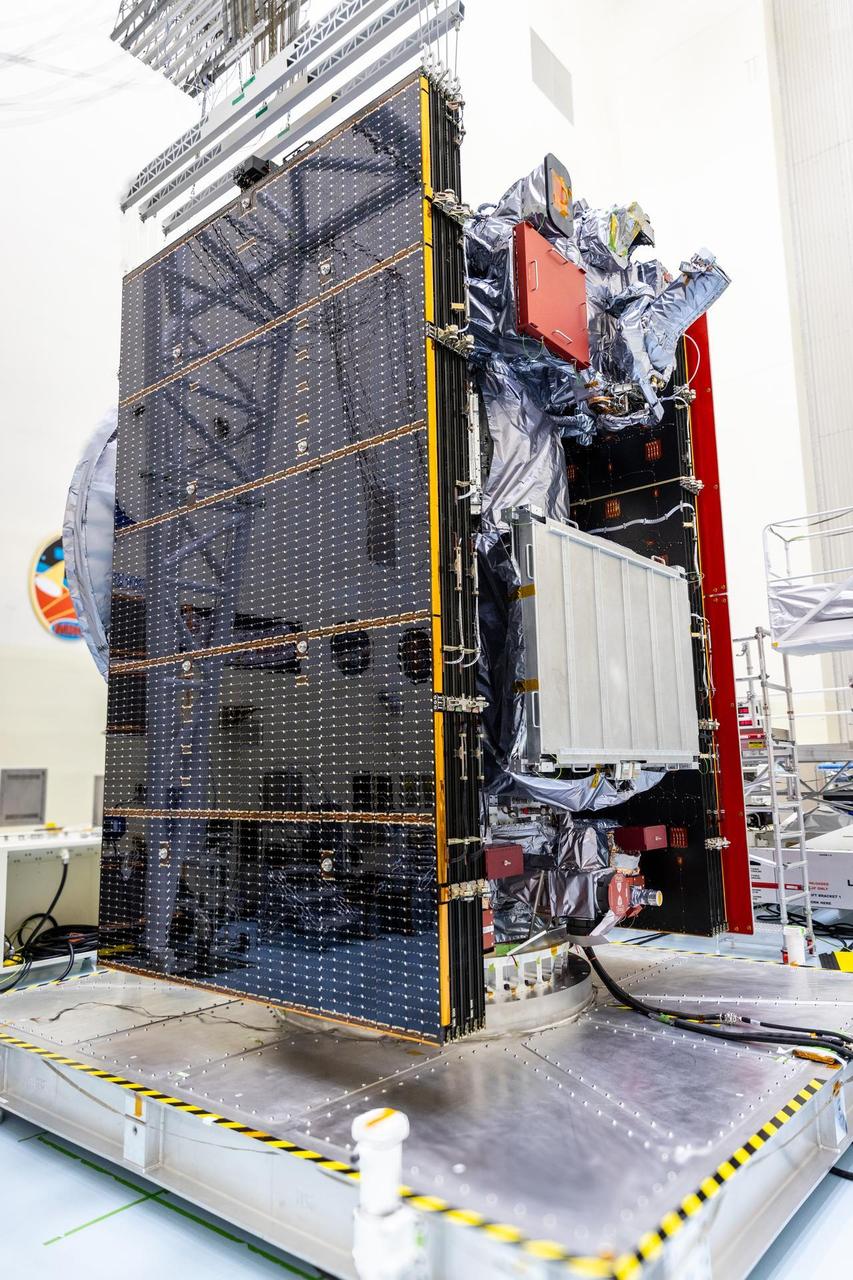
NASA's Europa Clipper is seen here on Aug. 21, 2024, in a clean room at the agency's Kennedy Space Center in Florida after engineers and technicians tested and stowed the spacecraft's giant solar arrays. Each array measures about 46.5 feet (14.2 meters) long and about 13.5 feet (4.1 meters) high. Europa Clipper's three main science objectives are to determine the thickness of the moon's icy shell and its interactions with the ocean below, to investigate its composition, and to characterize its geology. The mission's detailed exploration of Europa will help scientists better understand the astrobiological potential for habitable worlds beyond our planet. https://photojournal.jpl.nasa.gov/catalog/PIA26067
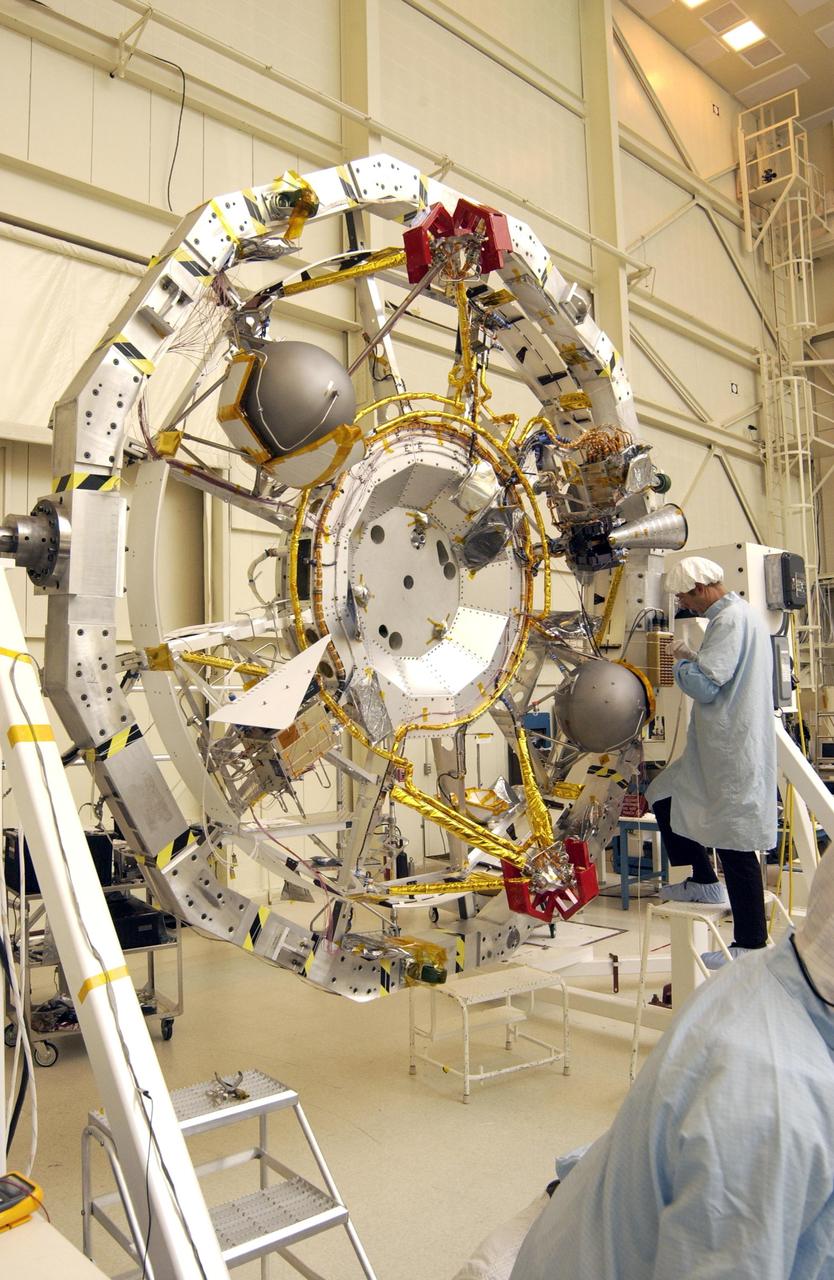
NASA Rover 1 sits atop the deployed lander with its solar arrays and wheels stowed.
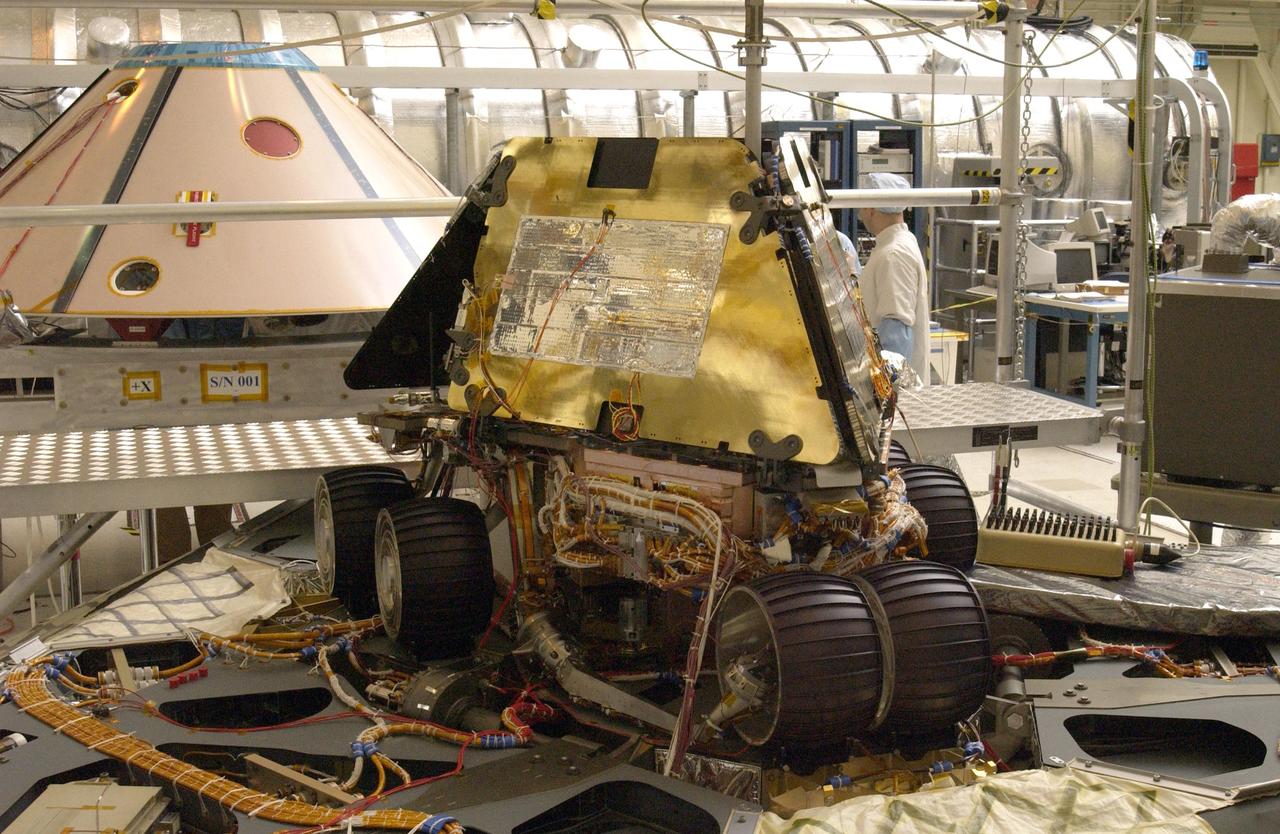
NASA Rover 1 sits atop the deployed lander with its solar arrays and wheels stowed.
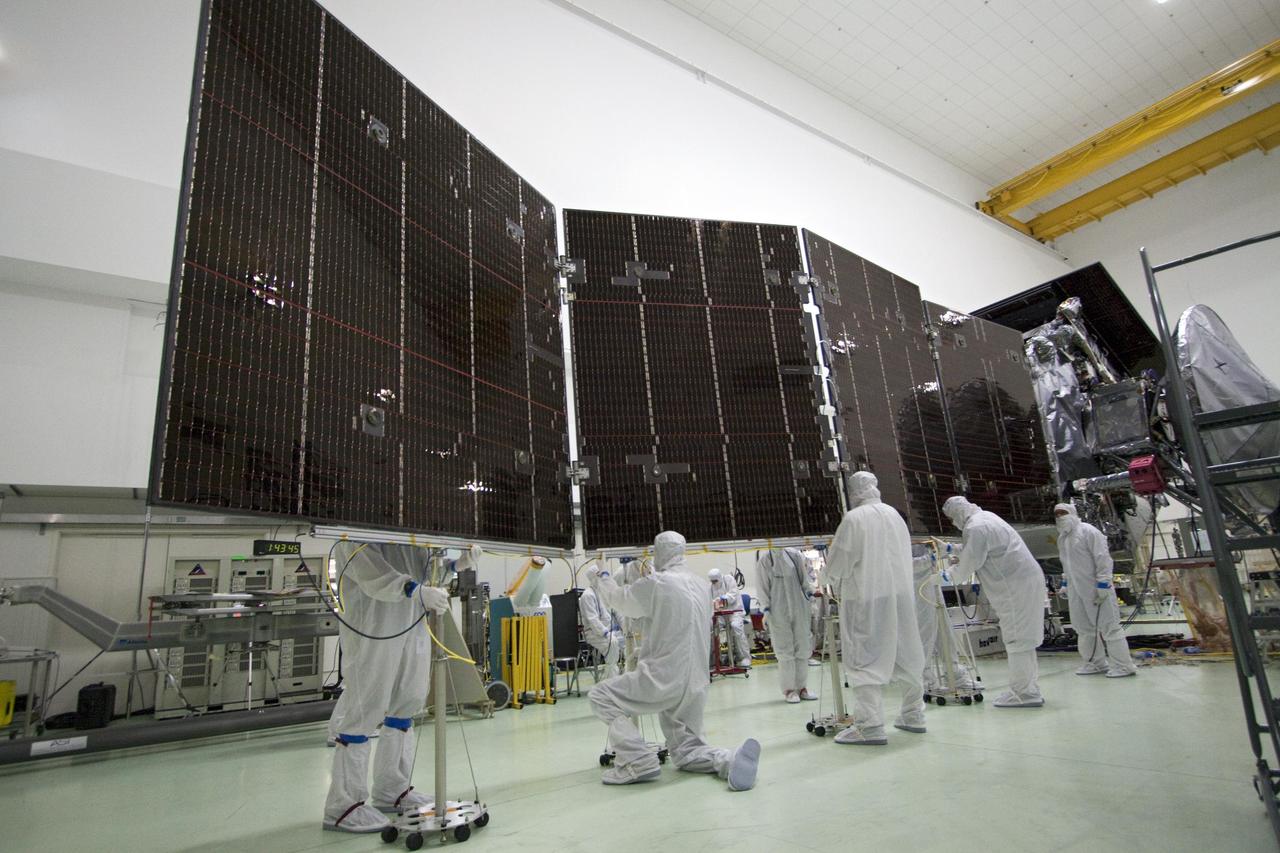
Technicians stow for launch solar array #2 for NASA Juno spacecraft. The photo was taken on May 20, 2011 at the Astrotech payload processing facility in Titusville, Fla.
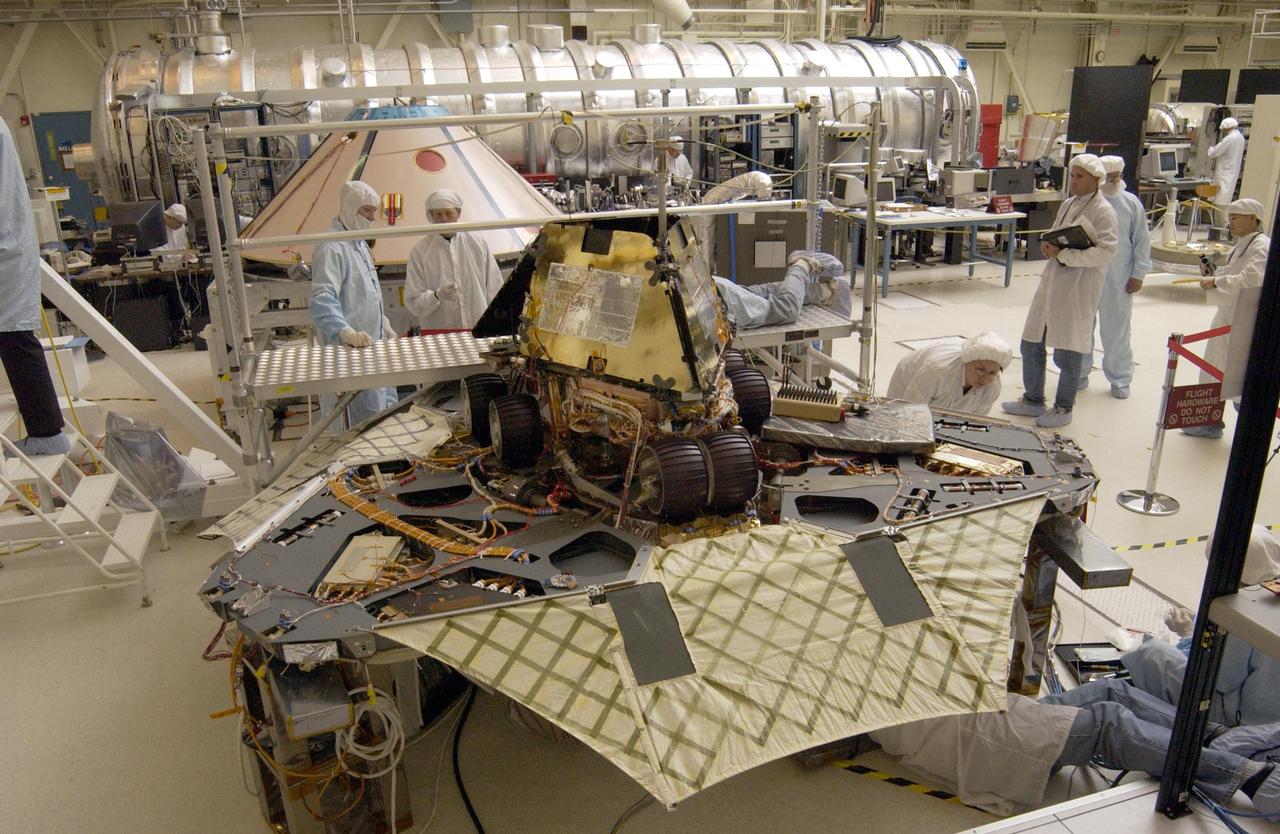
A Martian mechanic checks beneath the completely deployed NASA Rover 1 lander. Atop the lander is Rover 1 with its wheels and solar arrays in the stowed position.
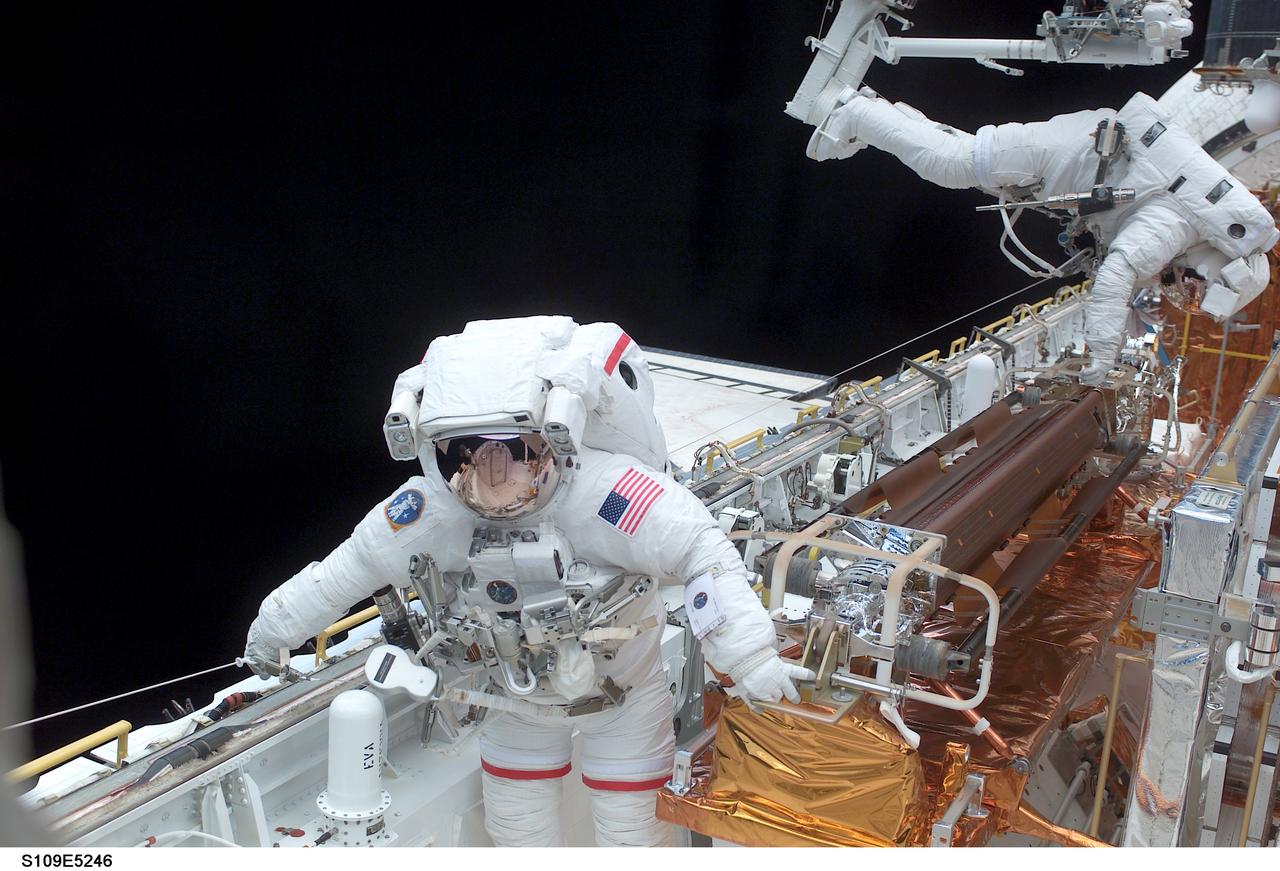
STS109-E-5246 (4 March 2002) --- Astronaut John M. Grunsfeld (foreground), payload commander, is seen at one end of stowed solar panels in the cargo bay of the Space Shuttle Columbia while astronaut Richard M. Linnehan, mission specialist, uses the Remote Manipulator System's robotic arm to move around at the other end. The two, participating in the first of their assigned STS-109 space walks to perform work on the Hubble Space Telescope (HST), went on to replace the giant telescope’s starboard solar array. Their seven-hour space walk ended at 7:38 a.m. (CST) or 13:38 GMT March 4, 2002.
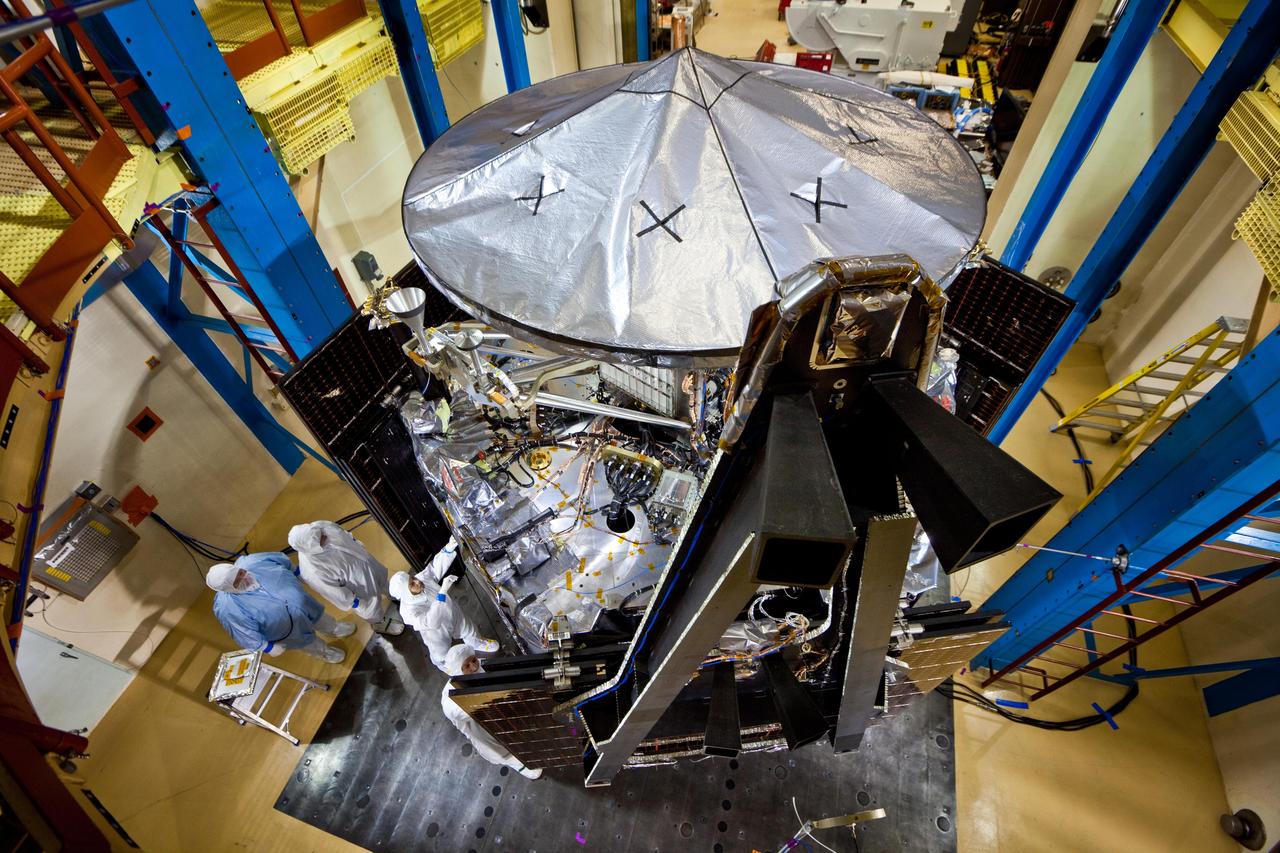
This image shows NASA Juno spacecraft undergoing environmental testing at Lockheed Martin Space Systems on Jan. 26, 2011. All 3 solar array wings are installed and stowed, and the large high-gain antenna is in place on the top of the avionics vault.

An artist’s concept of NASA’s Advanced Composite Solar Sail System spacecraft orbiting Earth, showing a configuration with solar arrays deployed and the sails and the booms stowed.
Engineers at NASA's Jet Propulsion Laboratory in Southern California examine one of Psyche's stowed solar arrays prior to a deployment test in the Lab's High Bay 2 clean room in late February 2022. The twin arrays are together about 800 square feet (75 square meters) – the largest ever deployed at JPL. Part of a solar electric propulsion system provided by Maxar Technologies, they will power the spacecraft on its 1.5 billion-mile (2.4 billion-kilometer) journey to the large, metal-rich asteroid Psyche. Only the three center panels on each five-panel, cross-shaped array can be deployed at JPL due to the limitations of the gravity-offload fixture and the opposing direction of rotation of the cross panels. Deployment of the two cross panels was previously performed at Maxar with different equipment. After further spacecraft testing is completed at JPL, the arrays will be removed and returned to Maxar in order to repeat the cross-panel deployments, make any final repairs to the solar cells, and test overall performance. The arrays then get shipped from Maxar to NASA's Kennedy Space Center in Florida, where they will be reintegrated onto the spacecraft in preparation for launch in August 2022. About an hour after launch, Psyche will deploy the arrays sequentially, first unfolding the three lengthwise center panels, then the two cross panels on one wing before repeating the process with the other wing. Each array takes about 7 ½ minutes to unfurl and latch into place. Each array is 37.1 feet (11.3 meters) long and 24 feet (7.3 meters) wide when fully deployed. With arrays deployed on either side of the chassis, the spacecraft is about the size of a singles tennis court: 81 feet long (24.7 meters) and 24 feet (7.3 meters) wide. https://photojournal.jpl.nasa.gov/catalog/PIA25132
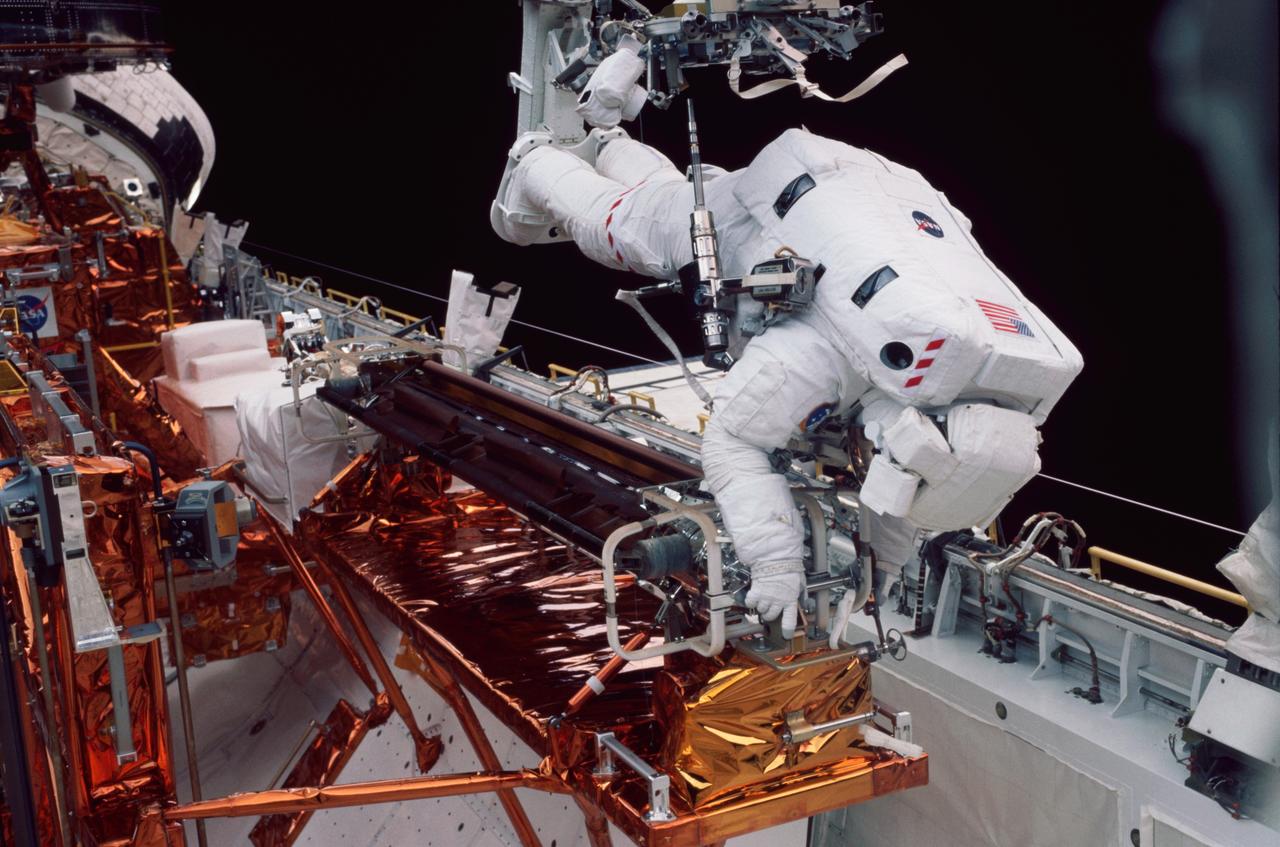
STS109-326-008 (5 March 2002) --- Astronaut Michael J. Massimino, mission specialist, works at the stowage area for the Hubble Space Telescope's port side solar array. Astronauts Massimino and James H. Newman removed the old port solar array and stowed it in Columbia’s payload bay for a return to Earth. They then went on to install a third-generation solar array and its associated electrical components. Two crew mates had accomplished the same feat with the starboard array on the previous day.
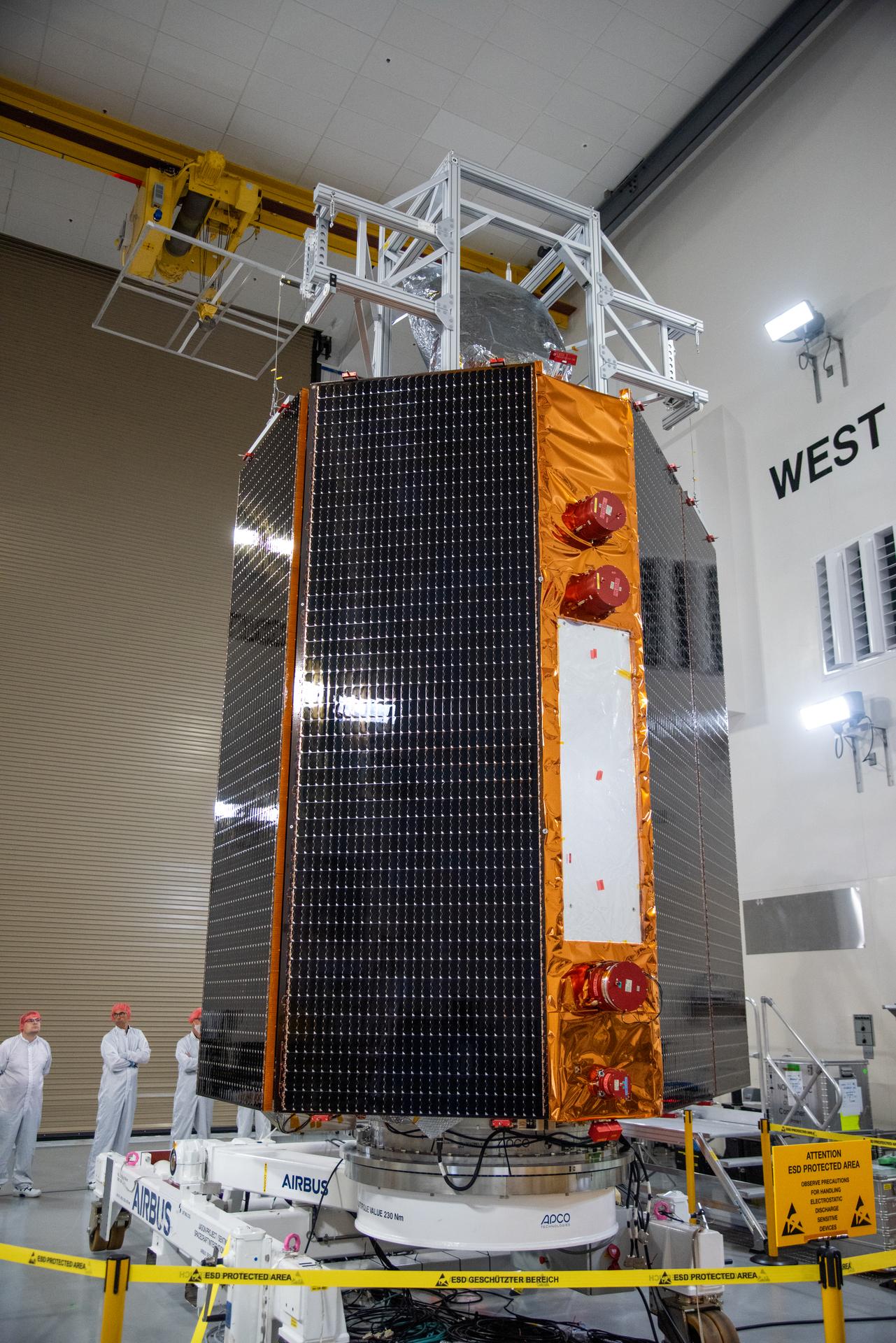
Technicians test the solar arrays during processing of the Sentinel-6B spacecraft during prelaunch operations at the Astrotech Space Operations payload processing facility at Vandenberg Space Force Base in California on Thursday, Oct. 16, 2025. Sentinel-6B will undergo detailed inspections, tests, and fueling in a cleanroom as it prepares for a November launch on a SpaceX Falcon 9 rocket. A collaboration between NASA, ESA (European Space Agency), EUMETSAT (European Organisation for the Exploitation of Meteorological Satellites), and the National Oceanic and Atmospheric Administration (NOAA), Sentinel-6B is designed to measure sea levels down to roughly an inch for about 90% of the world’s oceans.
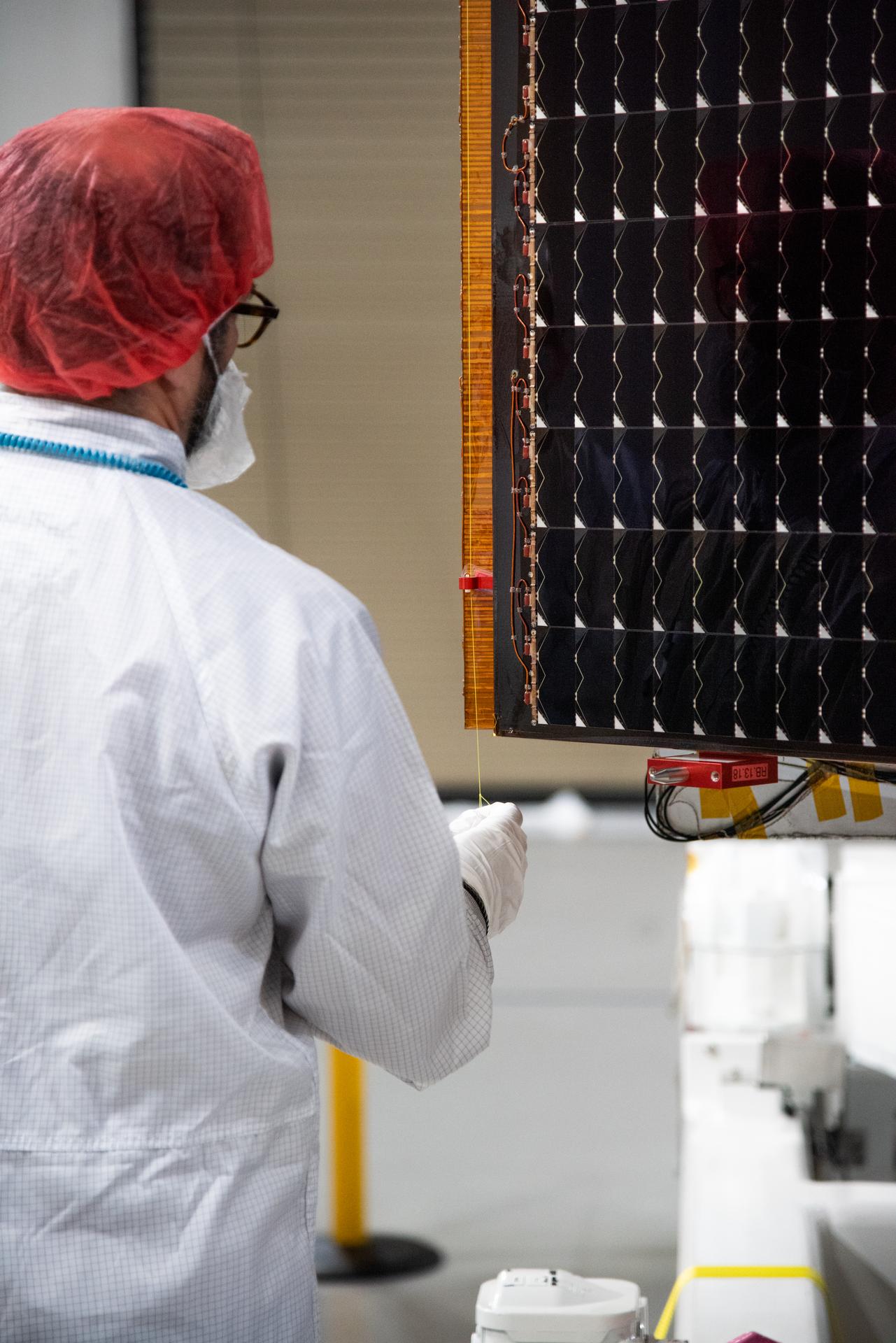
Technicians test the solar arrays during processing of the Sentinel-6B spacecraft during prelaunch operations at the Astrotech Space Operations payload processing facility at Vandenberg Space Force Base in California on Thursday, Oct. 16, 2025. Sentinel-6B will undergo detailed inspections, tests, and fueling in a cleanroom as it prepares for a November launch on a SpaceX Falcon 9 rocket. A collaboration between NASA, ESA (European Space Agency), EUMETSAT (European Organisation for the Exploitation of Meteorological Satellites), and the National Oceanic and Atmospheric Administration (NOAA), Sentinel-6B is designed to measure sea levels down to roughly an inch for about 90% of the world’s oceans.
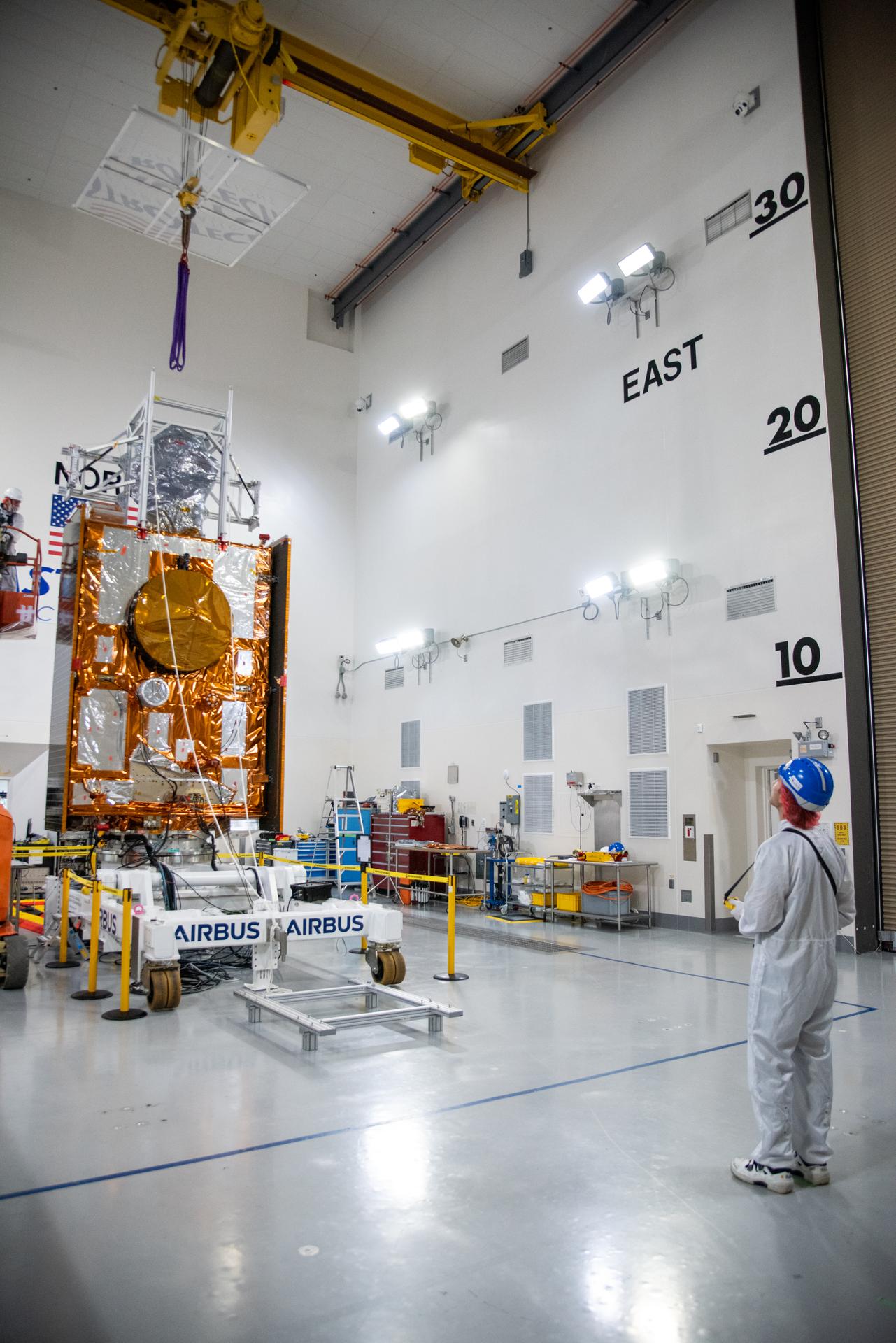
Technicians use a crane during processing of the Sentinel-6B spacecraft on its work stand during prelaunch operations at the Astrotech Space Operations payload processing facility at Vandenberg Space Force Base in California on Thursday, Oct. 16, 2025. Sentinel-6B will undergo detailed inspections, tests, and fueling in a cleanroom as it prepares for a November launch on a SpaceX Falcon 9 rocket. A collaboration between NASA, ESA (European Space Agency), EUMETSAT (European Organisation for the Exploitation of Meteorological Satellites), and the National Oceanic and Atmospheric Administration (NOAA), Sentinel-6B is designed to measure sea levels down to roughly an inch for about 90% of the world’s oceans.
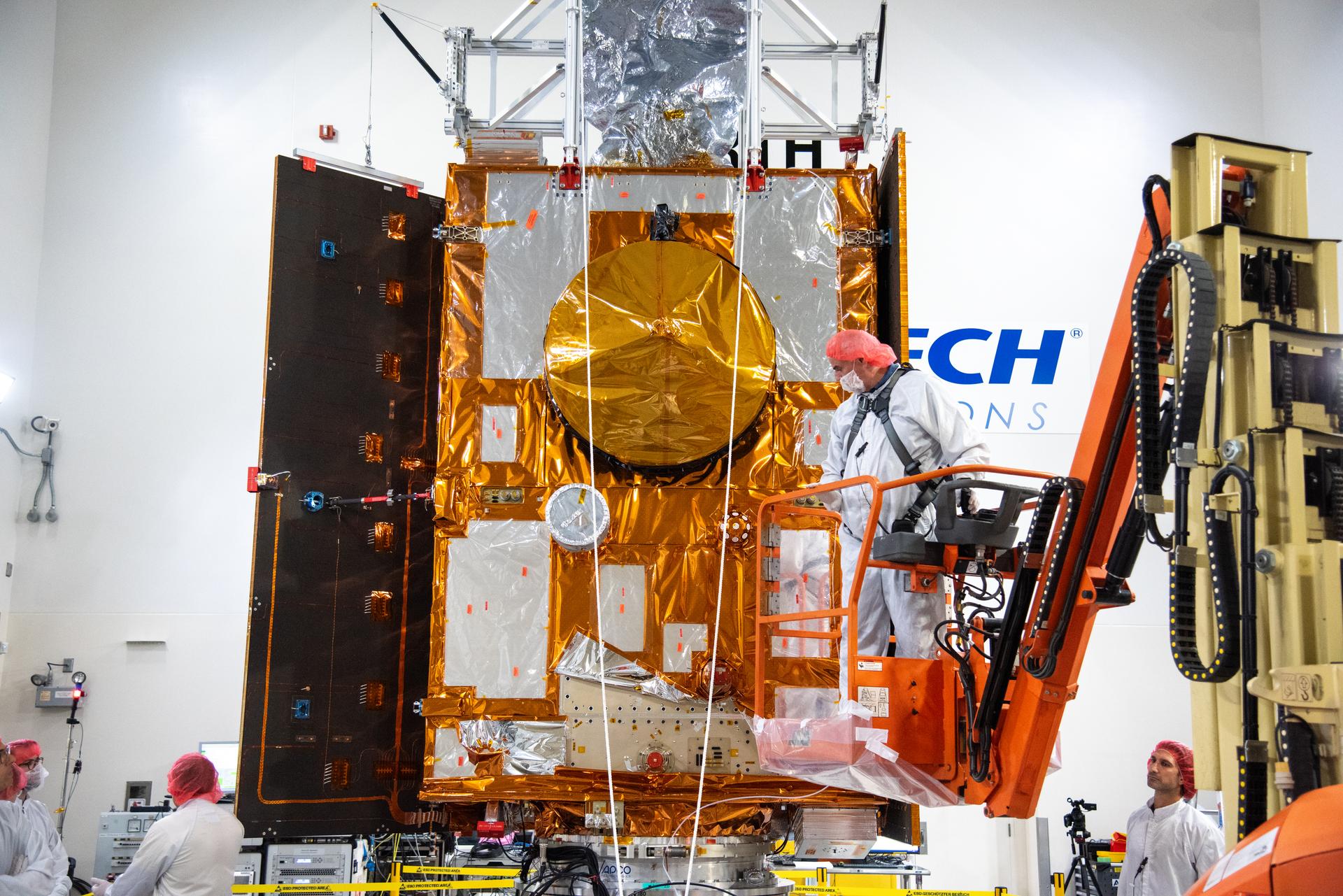
Technicians test the solar arrays during processing of the Sentinel-6B spacecraft during prelaunch operations at the Astrotech Space Operations payload processing facility at Vandenberg Space Force Base in California on Thursday, Oct. 16, 2025. Sentinel-6B will undergo detailed inspections, tests, and fueling in a cleanroom as it prepares for a November launch on a SpaceX Falcon 9 rocket. A collaboration between NASA, ESA (European Space Agency), EUMETSAT (European Organisation for the Exploitation of Meteorological Satellites), and the National Oceanic and Atmospheric Administration (NOAA), Sentinel-6B is designed to measure sea levels down to roughly an inch for about 90% of the world’s oceans.
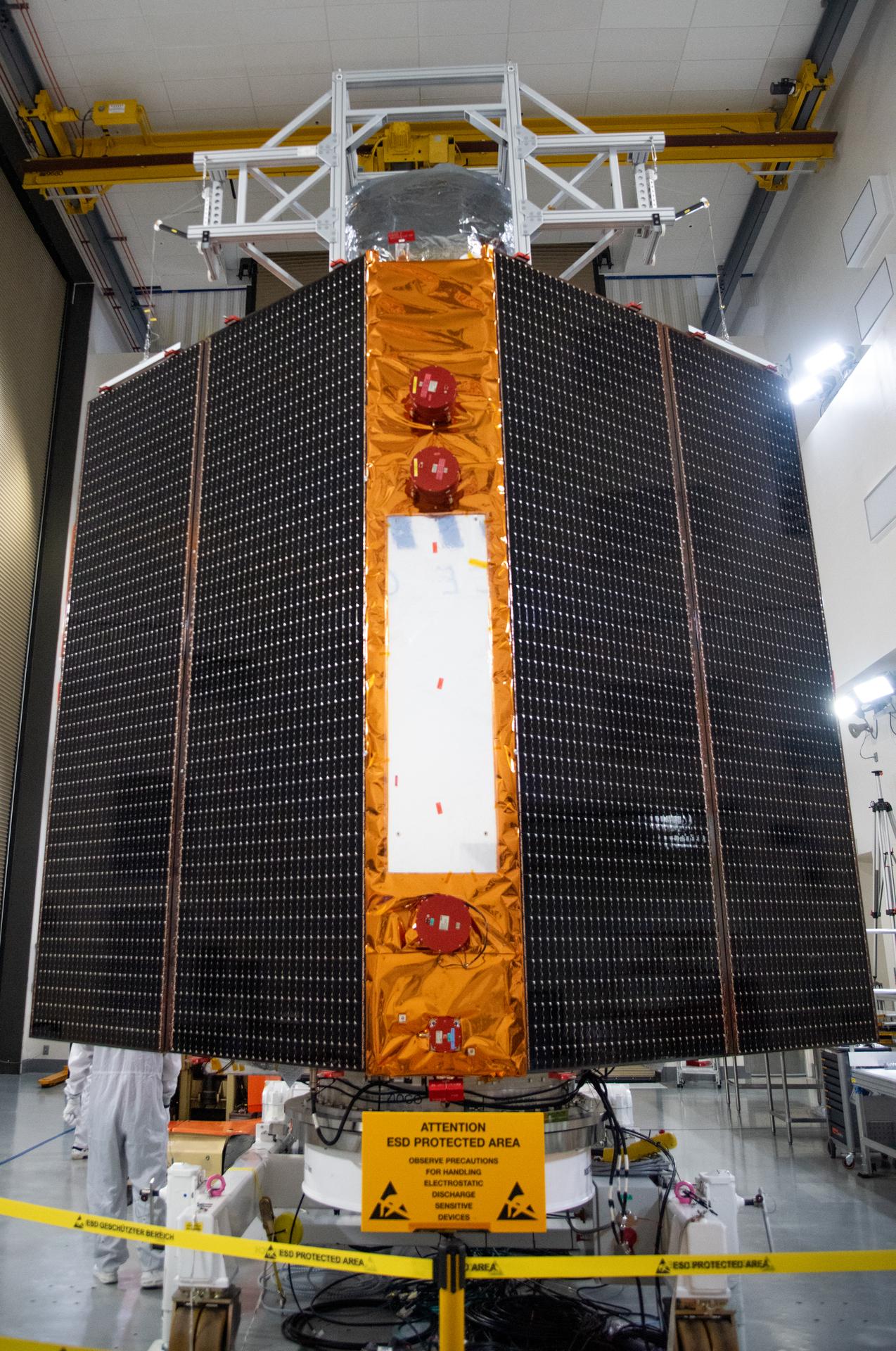
Technicians test the solar arrays during processing of the Sentinel-6B spacecraft during prelaunch operations at the Astrotech Space Operations payload processing facility at Vandenberg Space Force Base in California on Thursday, Oct. 16, 2025. Sentinel-6B will undergo detailed inspections, tests, and fueling in a cleanroom as it prepares for a November launch on a SpaceX Falcon 9 rocket. A collaboration between NASA, ESA (European Space Agency), EUMETSAT (European Organisation for the Exploitation of Meteorological Satellites), and the National Oceanic and Atmospheric Administration (NOAA), Sentinel-6B is designed to measure sea levels down to roughly an inch for about 90% of the world’s oceans.
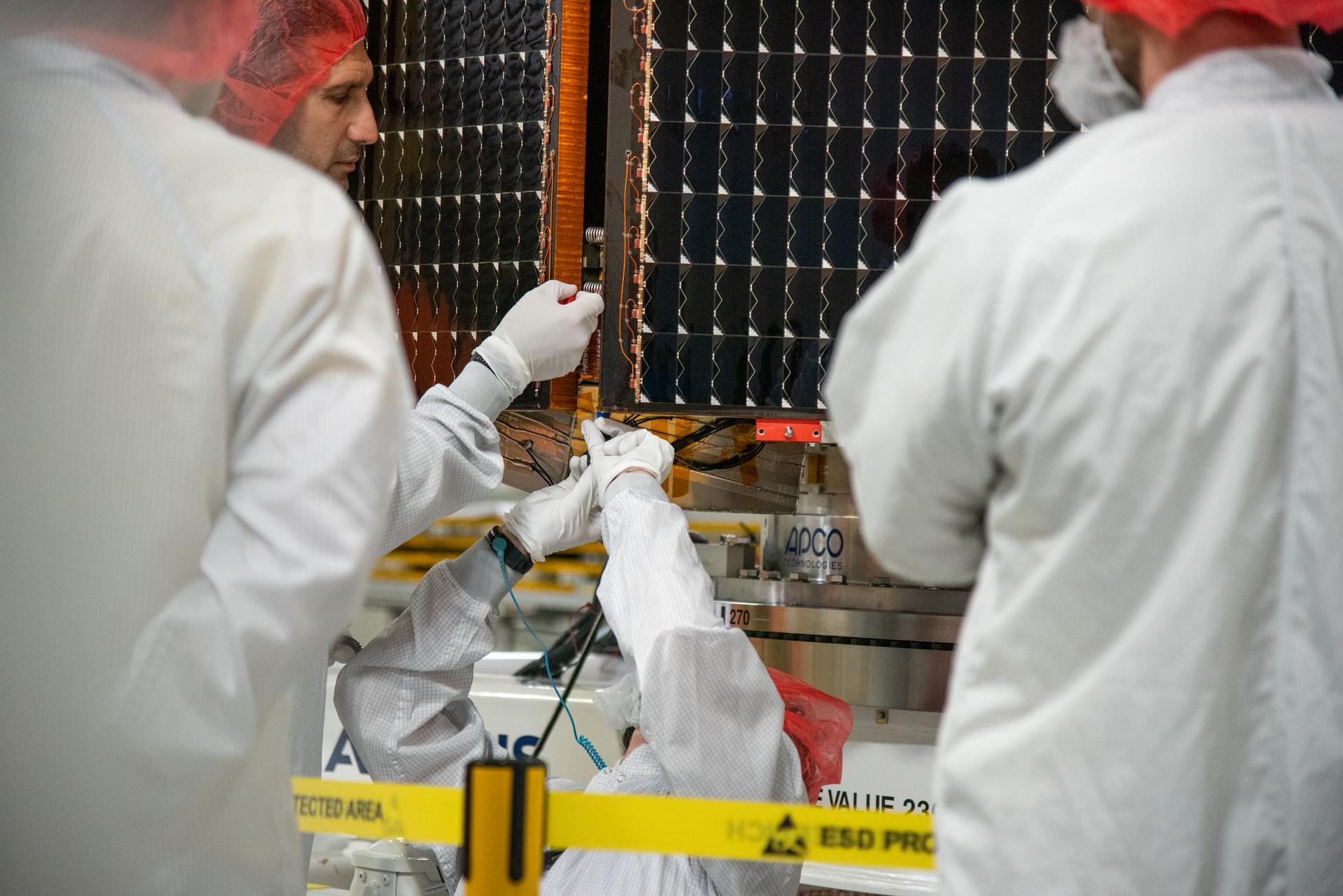
Technicians test the solar arrays during processing of the Sentinel-6B spacecraft during prelaunch operations at the Astrotech Space Operations payload processing facility at Vandenberg Space Force Base in California on Thursday, Oct. 16, 2025. Sentinel-6B will undergo detailed inspections, tests, and fueling in a cleanroom as it prepares for a November launch on a SpaceX Falcon 9 rocket. A collaboration between NASA, ESA (European Space Agency), EUMETSAT (European Organisation for the Exploitation of Meteorological Satellites), and the National Oceanic and Atmospheric Administration (NOAA), Sentinel-6B is designed to measure sea levels down to roughly an inch for about 90% of the world’s oceans.
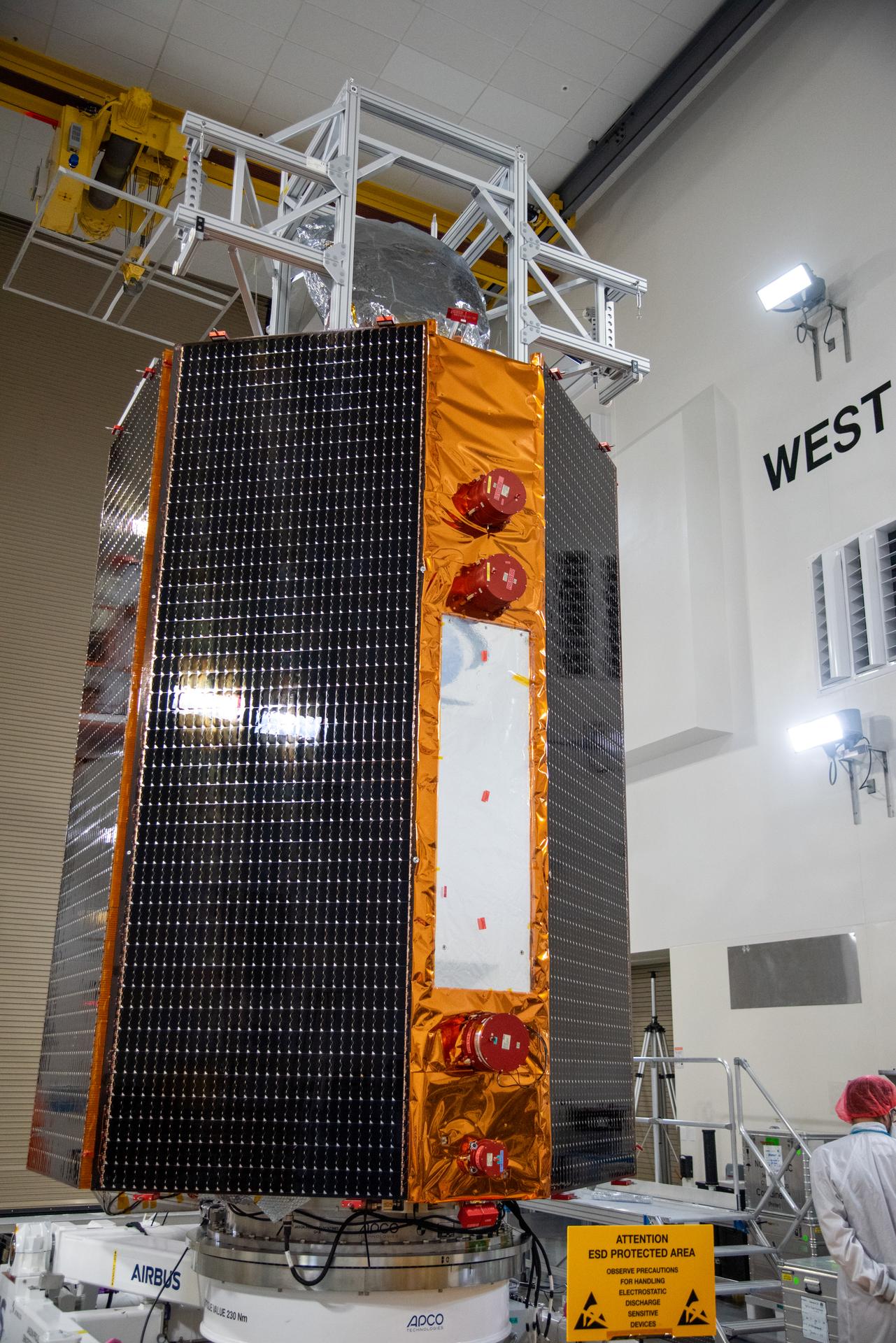
Technicians test the solar arrays during processing of the Sentinel-6B spacecraft during prelaunch operations at the Astrotech Space Operations payload processing facility at Vandenberg Space Force Base in California on Thursday, Oct. 16, 2025. Sentinel-6B will undergo detailed inspections, tests, and fueling in a cleanroom as it prepares for a November launch on a SpaceX Falcon 9 rocket. A collaboration between NASA, ESA (European Space Agency), EUMETSAT (European Organisation for the Exploitation of Meteorological Satellites), and the National Oceanic and Atmospheric Administration (NOAA), Sentinel-6B is designed to measure sea levels down to roughly an inch for about 90% of the world’s oceans.
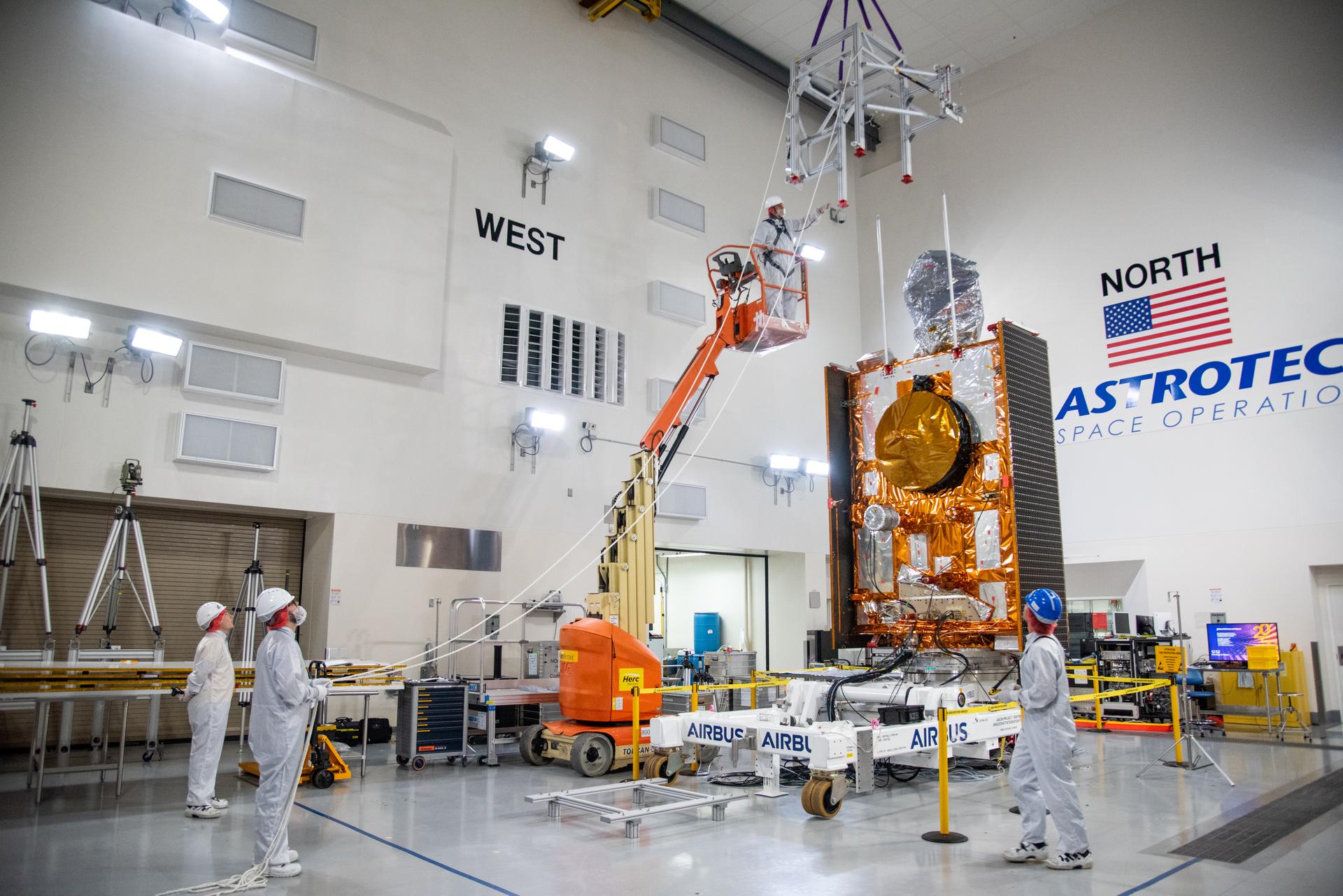
Technicians use a crane during processing of the Sentinel-6B spacecraft on its work stand during prelaunch operations at the Astrotech Space Operations payload processing facility at Vandenberg Space Force Base in California on Thursday, Oct. 16, 2025. Sentinel-6B will undergo detailed inspections, tests, and fueling in a cleanroom as it prepares for a November launch on a SpaceX Falcon 9 rocket. A collaboration between NASA, ESA (European Space Agency), EUMETSAT (European Organisation for the Exploitation of Meteorological Satellites), and the National Oceanic and Atmospheric Administration (NOAA), Sentinel-6B is designed to measure sea levels down to roughly an inch for about 90% of the world’s oceans.
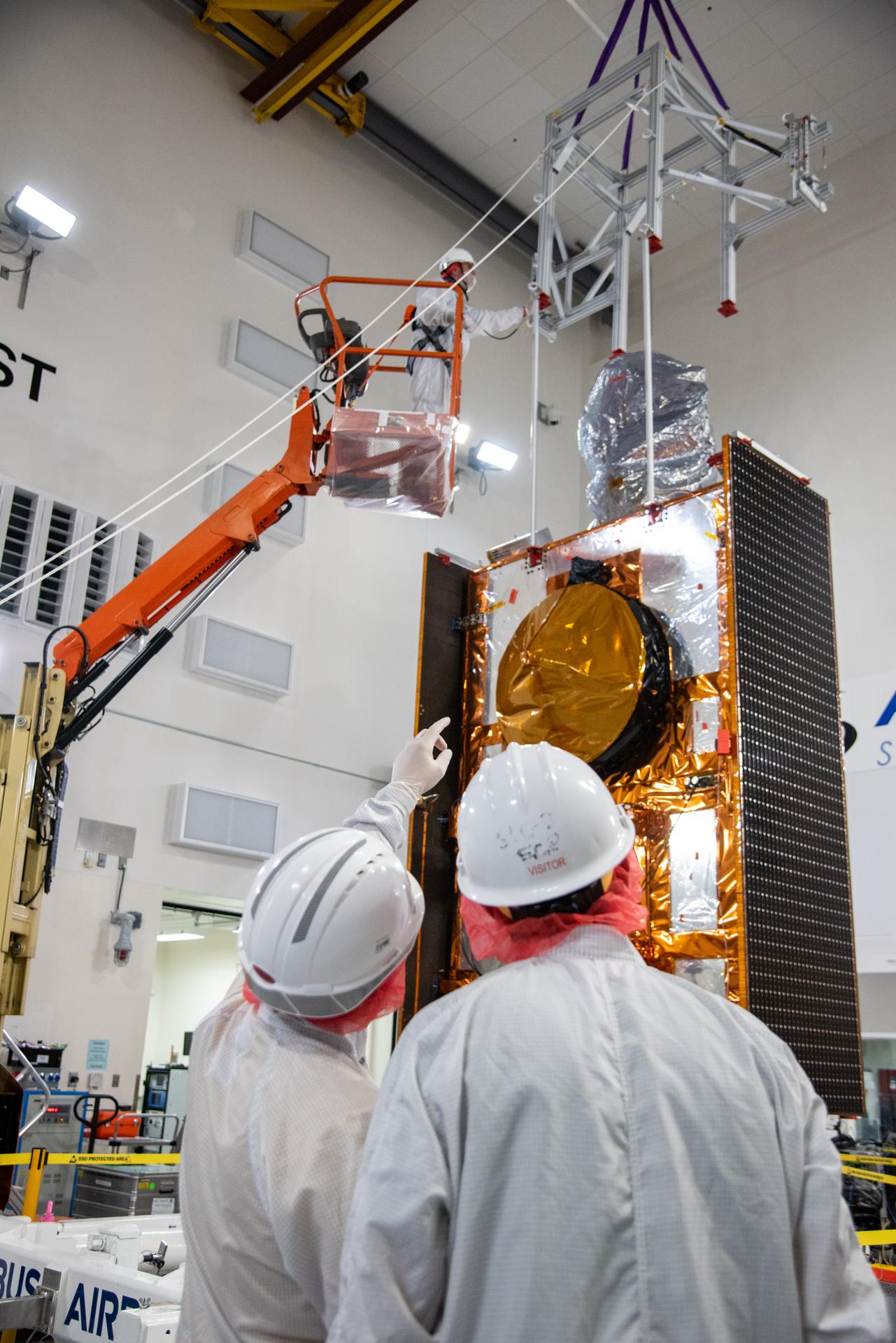
Technicians use a crane during processing of the Sentinel-6B spacecraft on its work stand during prelaunch operations at the Astrotech Space Operations payload processing facility at Vandenberg Space Force Base in California on Thursday, Oct. 16, 2025. Sentinel-6B will undergo detailed inspections, tests, and fueling in a cleanroom as it prepares for a November launch on a SpaceX Falcon 9 rocket. A collaboration between NASA, ESA (European Space Agency), EUMETSAT (European Organisation for the Exploitation of Meteorological Satellites), and the National Oceanic and Atmospheric Administration (NOAA), Sentinel-6B is designed to measure sea levels down to roughly an inch for about 90% of the world’s oceans.
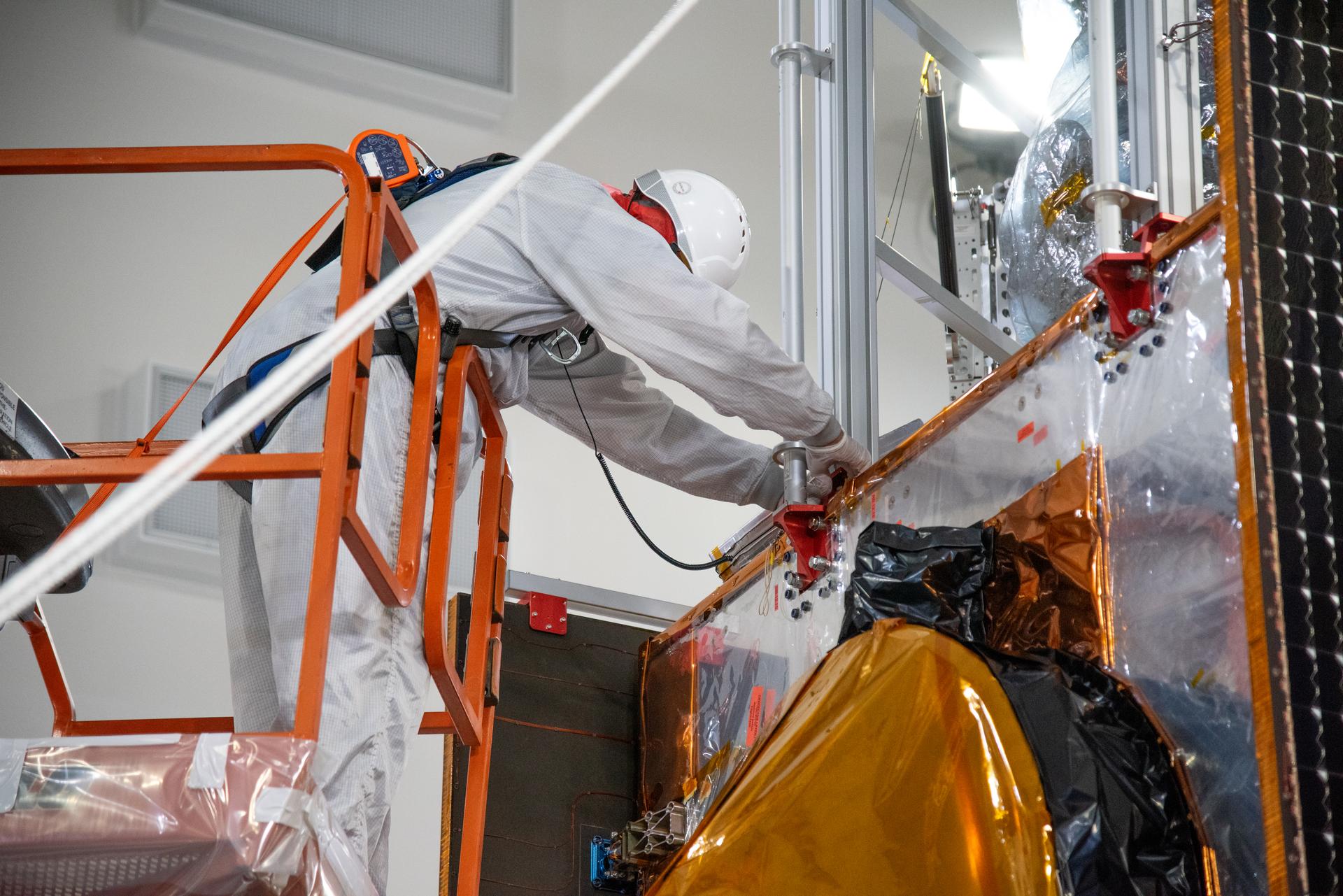
Technicians use a crane during processing of the Sentinel-6B spacecraft on its work stand during prelaunch operations at the Astrotech Space Operations payload processing facility at Vandenberg Space Force Base in California on Thursday, Oct. 16, 2025. Sentinel-6B will undergo detailed inspections, tests, and fueling in a cleanroom as it prepares for a November launch on a SpaceX Falcon 9 rocket. A collaboration between NASA, ESA (European Space Agency), EUMETSAT (European Organisation for the Exploitation of Meteorological Satellites), and the National Oceanic and Atmospheric Administration (NOAA), Sentinel-6B is designed to measure sea levels down to roughly an inch for about 90% of the world’s oceans.
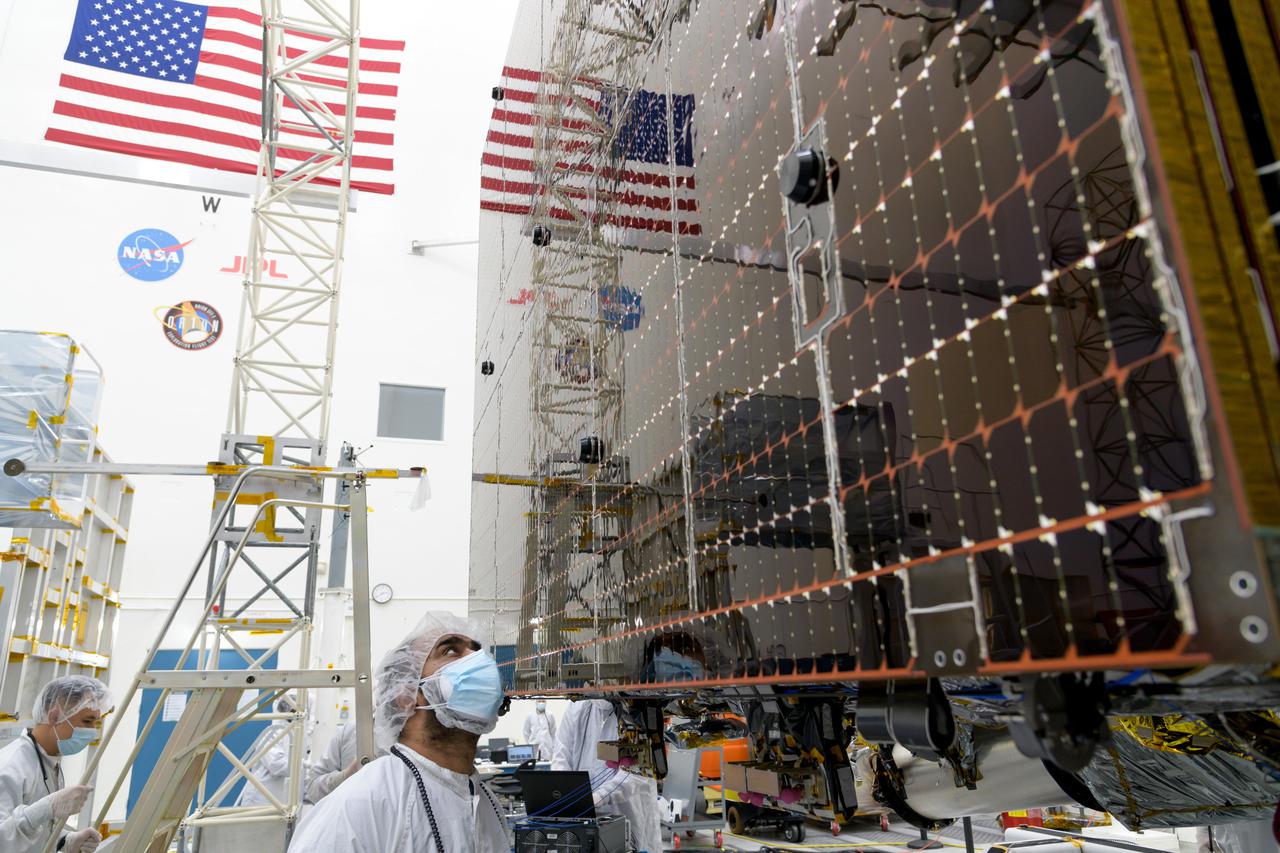
An engineer at NASA's Jet Propulsion Laboratory in Southern California examines a panel on Psyche's stowed solar arrays prior to a deployment test in the Lab's High Bay 2 clean room in February 2022. The twin arrays are together about 800 square feet (75 square meters) – the largest ever deployed at JPL. Part of a solar electric propulsion system provided by Maxar Technologies, they will power the spacecraft on its 1.5 billion-mile (2.4 billion-kilometer) journey to the large, metal-rich asteroid Psyche. Only the three center panels on each five-panel, cross-shaped array can be deployed at JPL due to the limitations of the gravity-offload fixture and the opposing direction of rotation of the cross panels. Deployment of the two cross panels was previously performed at Maxar with different equipment. After further spacecraft testing is completed at JPL, the arrays will be removed and returned to Maxar in order to repeat the cross-panel deployments, make any final repairs to the solar cells, and test overall performance. The arrays then get shipped from Maxar to NASA's Kennedy Space Center in Florida, where they will be reintegrated onto the spacecraft in preparation for launch in August 2022. About an hour after launch, Psyche will deploy the arrays sequentially, first unfolding the three lengthwise center panels, then the two cross panels on one wing before repeating the process with the other wing. Each array takes about 7 ½ minutes to unfurl and latch into place. Each array is 37.1 feet (11.3 meters) long and 24 feet (7.3 meters) wide when fully deployed. With arrays deployed on either side of the chassis, the spacecraft is about the size of a singles tennis court: 81 feet long (24.7 meters) and 24 feet (7.3 meters) wide. https://photojournal.jpl.nasa.gov/catalog/PIA25133
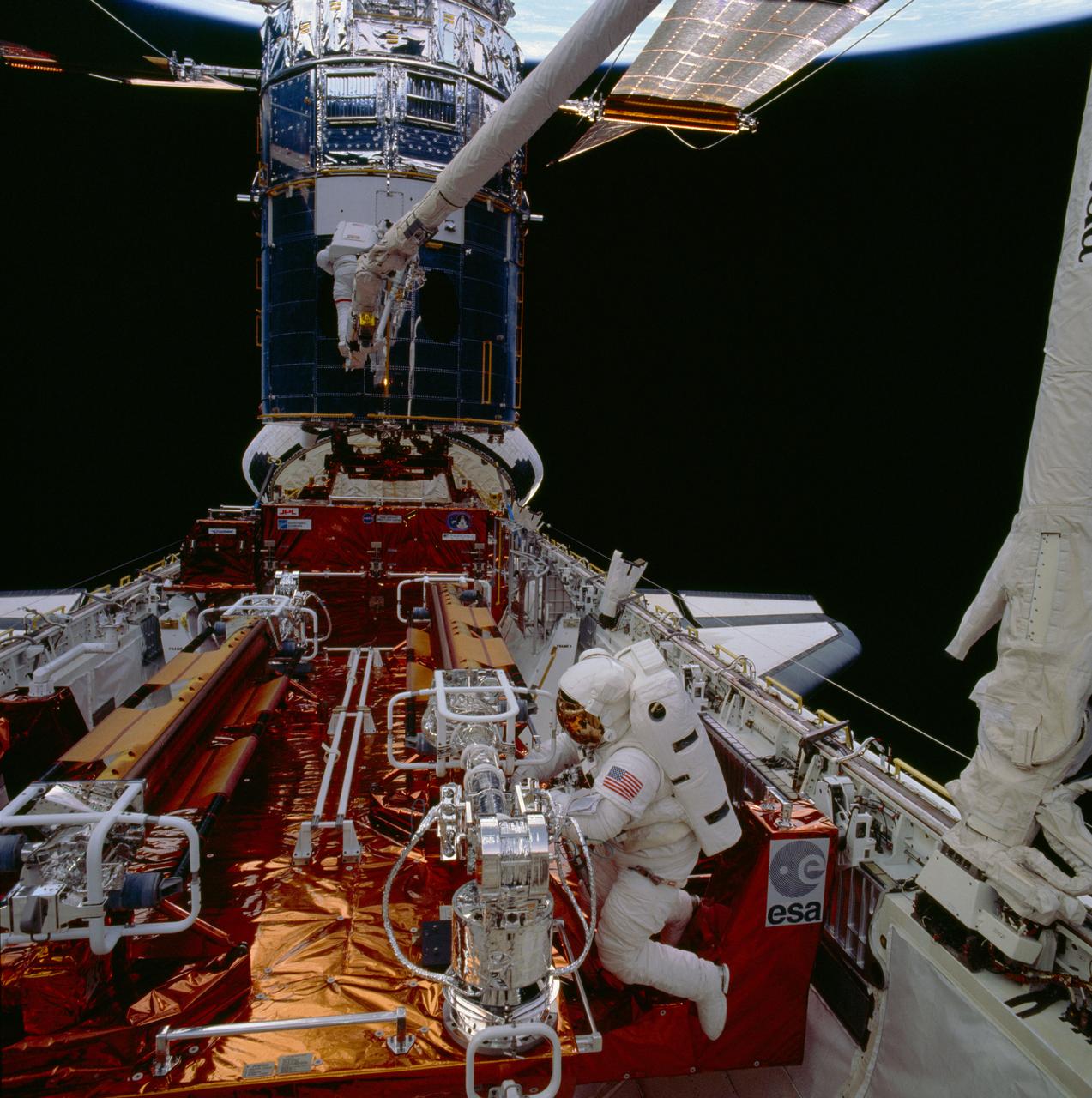
STS061-86-048 (5 Dec 1993) --- Astronauts F. Story Musgrave (foreground) and Jeffrey A. Hoffman are pictured near the end of the first of five extravehicular activity?s (EVA). Musgrave works at the Solar Array Carrier (SAC) in the Space Shuttle Endeavour's cargo bay. Hoffman, anchored to a foot restraint mounted on the end of the Space Shuttle Endeavour's Remote Manipulator System (RMS) arm, waits to be maneuvered to the forward payload bay. The original solar array panels are partially visible at top, while their replacements remain stowed in foreground. The crew's second pair of space walkers -- astronauts Kathryn C. Thornton and Thomas D. Akers -- later changed the solar arrays on the mission's second EVA.
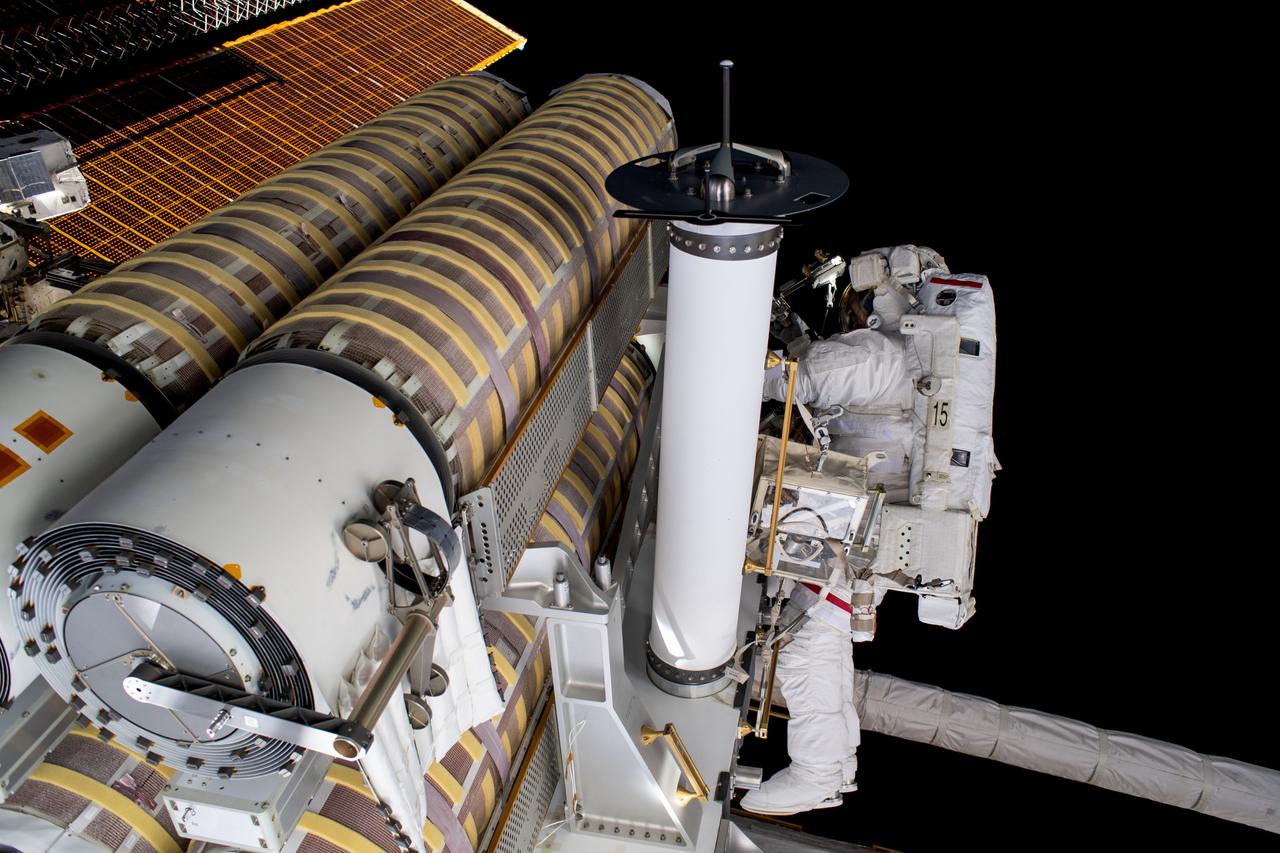
iss069e018597 (June 9, 2023) --- NASA astronaut and Expedition 69 Flight Engineer Stephen Bowen is pictured working to release a stowed roll-out solar array attached to the International Space Station's starboard truss structure during a six-hour and three-minute spacewalk.
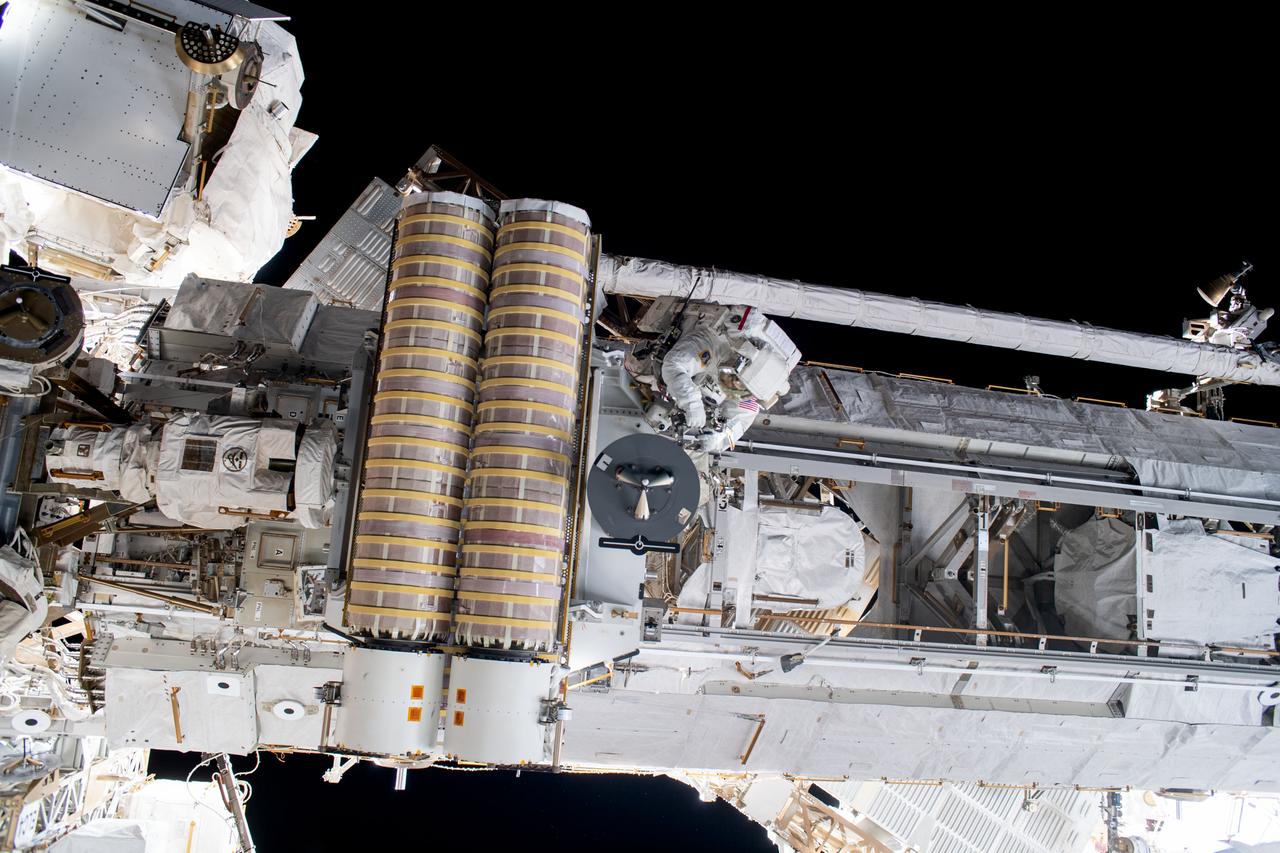
iss069e018600 (June 9, 2023) --- NASA astronaut and Expedition 69 Flight Engineer Stephen Bowen (center) is pictured working to release a stowed roll-out solar array attached to the International Space Station's starboard truss structure during a six-hour and three-minute spacewalk.
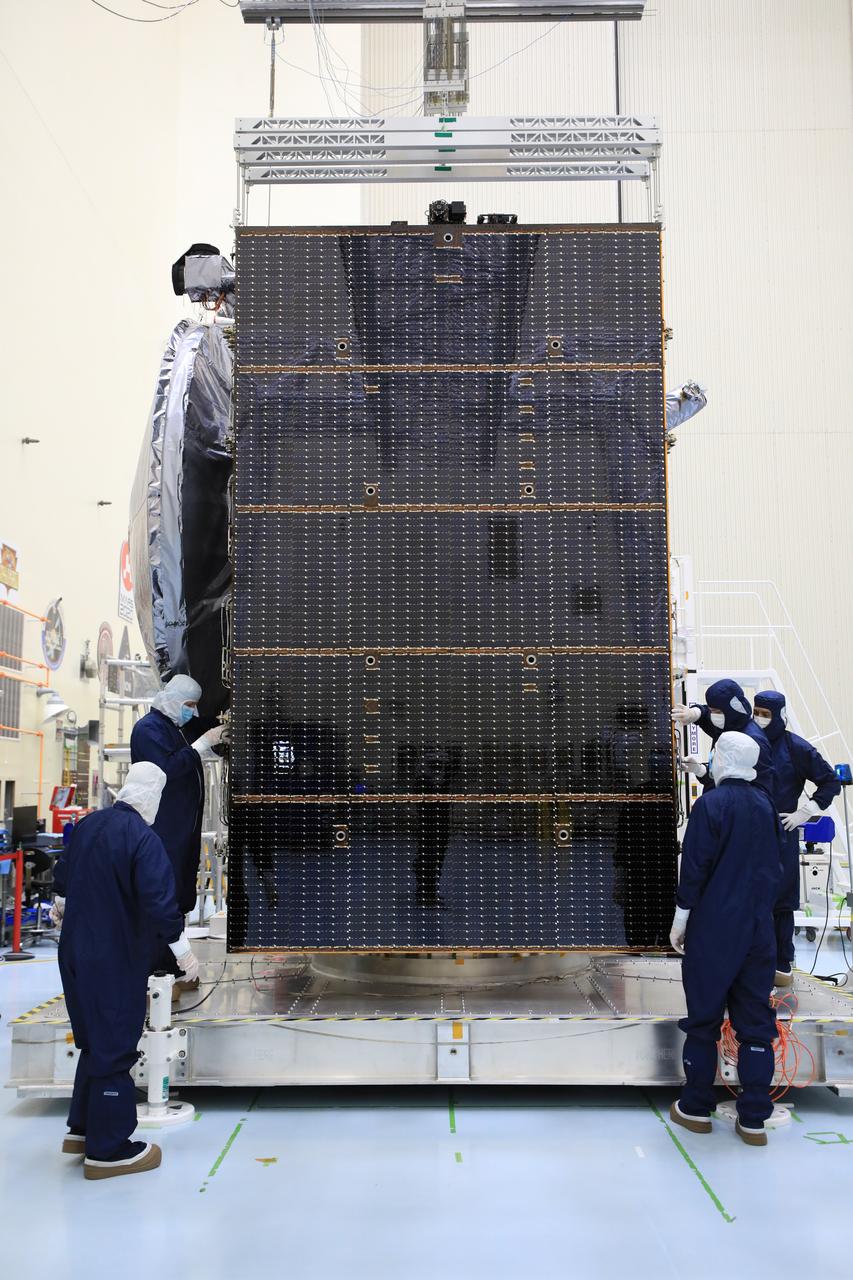
Technicians test, retract, and stow one of the two “wings” comprising the solar arrays for NASA’s Europa Clipper spacecraft on Friday, Aug. 23, 2024, at the Payload Hazardous Servicing Facility at the agency’s Kennedy Space Center in Florida. Each array measures about 46.5 feet (14.2 meters) long and about 13.5 feet (4.1 meters) high when extended. The spacecraft needs the massive solar arrays to power to Jupiter’s icy moon Europa to help scientists better understand the astrobiological potential for habitable worlds beyond our planet.
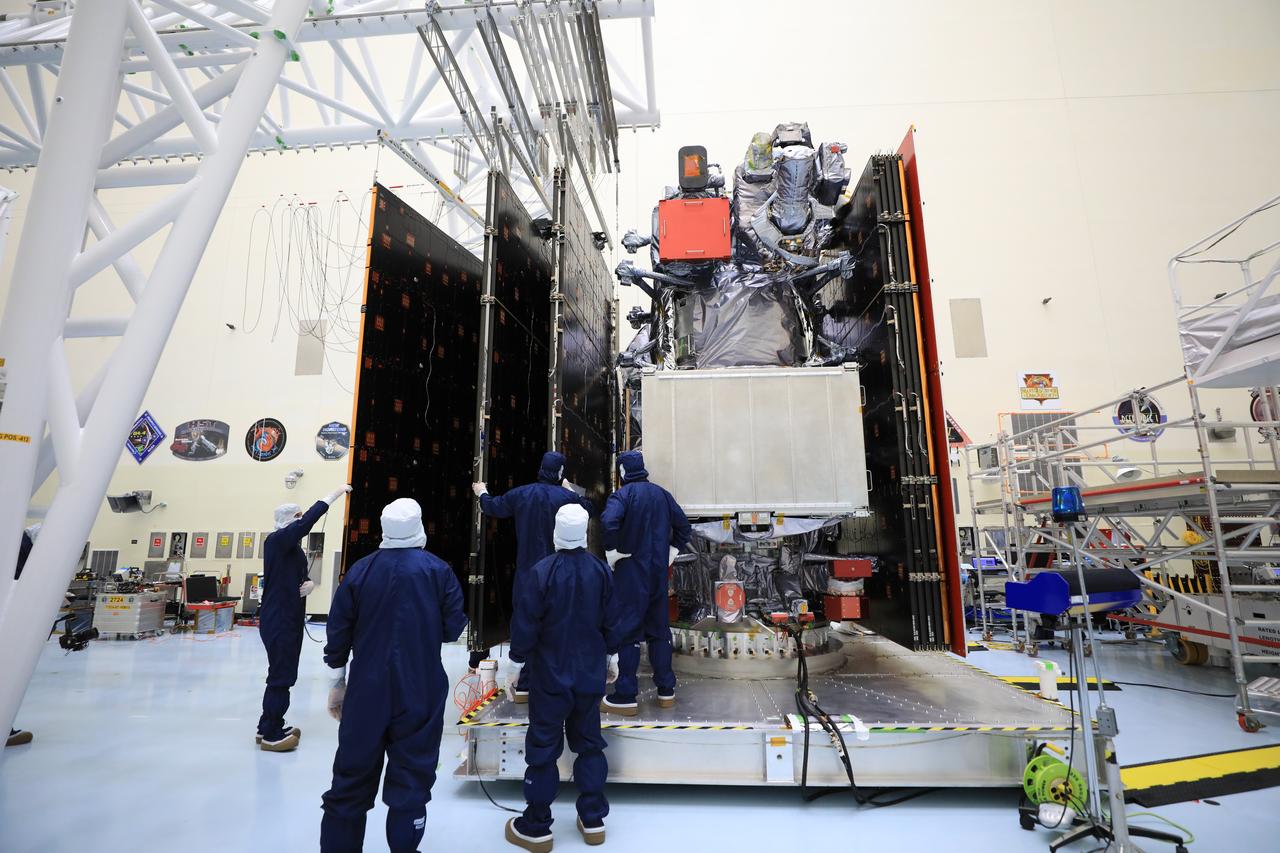
Technicians test, retract, and stow one of the two “wings” comprising the solar arrays for NASA’s Europa Clipper spacecraft on Friday, Aug. 23, 2024, at the Payload Hazardous Servicing Facility at the agency’s Kennedy Space Center in Florida. Each array measures about 46.5 feet (14.2 meters) long and about 13.5 feet (4.1 meters) high when extended. The spacecraft needs the massive solar arrays to power to Jupiter’s icy moon Europa to help scientists better understand the astrobiological potential for habitable worlds beyond our planet.
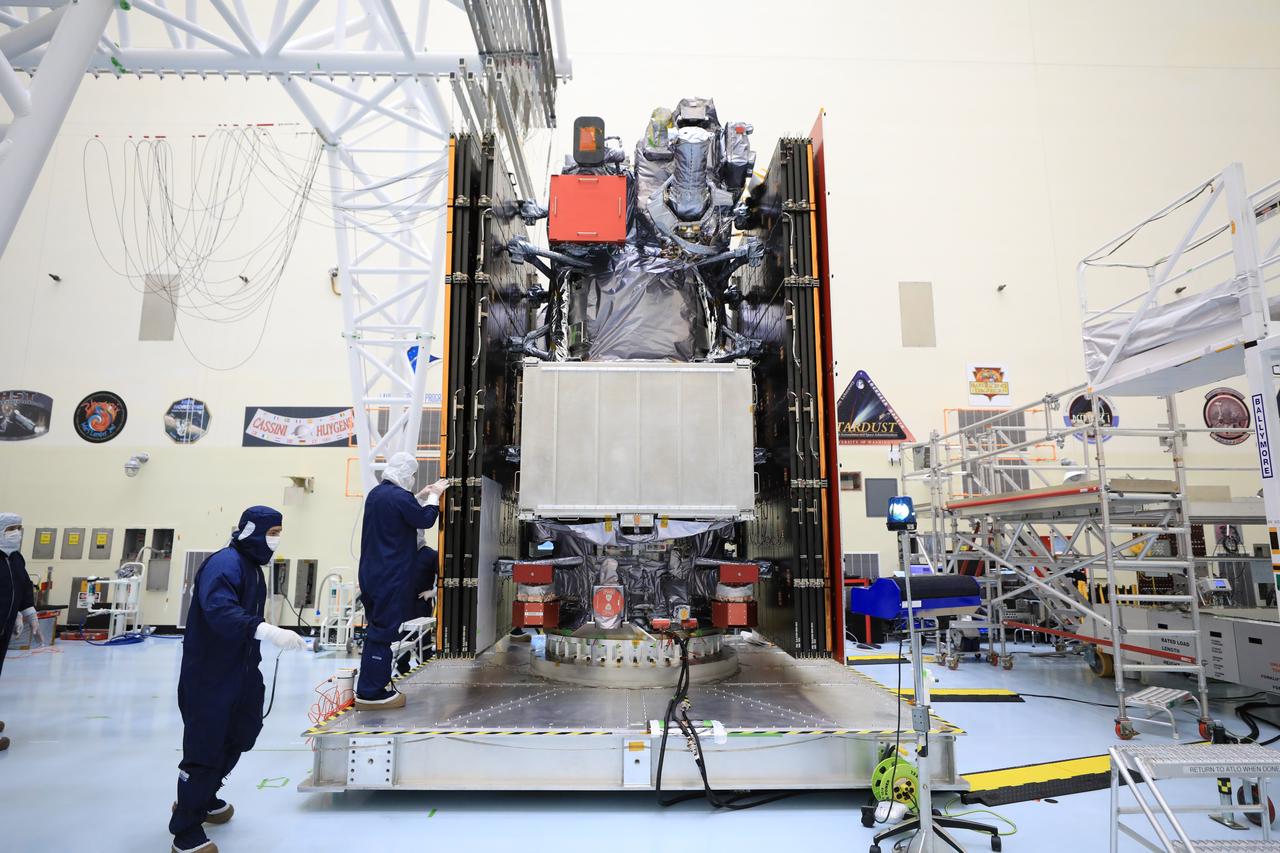
Technicians test, retract, and stow one of the two “wings” comprising the solar arrays for NASA’s Europa Clipper spacecraft on Friday, Aug. 23, 2024, at the Payload Hazardous Servicing Facility at the agency’s Kennedy Space Center in Florida. Each array measures about 46.5 feet (14.2 meters) long and about 13.5 feet (4.1 meters) high when extended. The spacecraft needs the massive solar arrays to power to Jupiter’s icy moon Europa to help scientists better understand the astrobiological potential for habitable worlds beyond our planet.
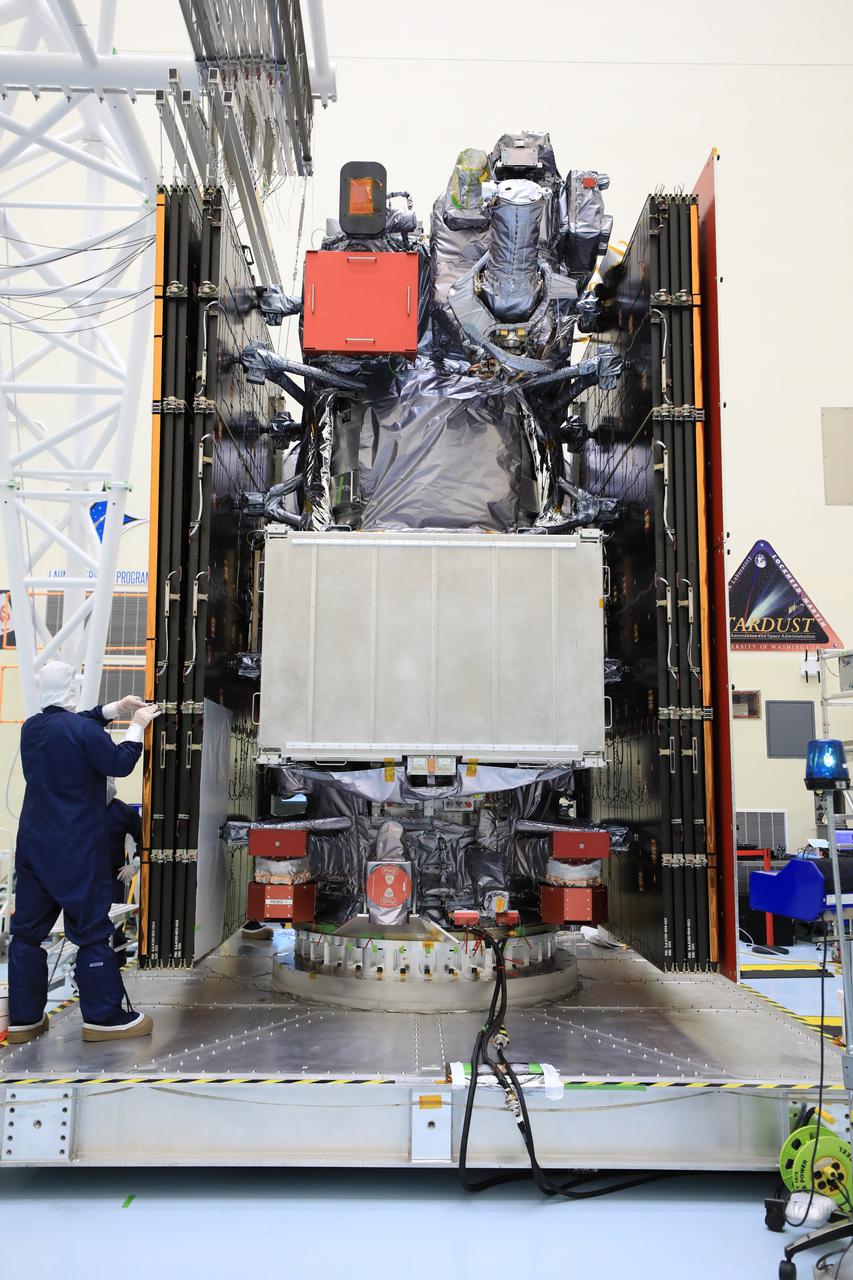
Technicians test, retract, and stow one of the two “wings” comprising the solar arrays for NASA’s Europa Clipper spacecraft on Friday, Aug. 23, 2024, at the Payload Hazardous Servicing Facility at the agency’s Kennedy Space Center in Florida. Each array measures about 46.5 feet (14.2 meters) long and about 13.5 feet (4.1 meters) high when extended. The spacecraft needs the massive solar arrays to power to Jupiter’s icy moon Europa to help scientists better understand the astrobiological potential for habitable worlds beyond our planet.
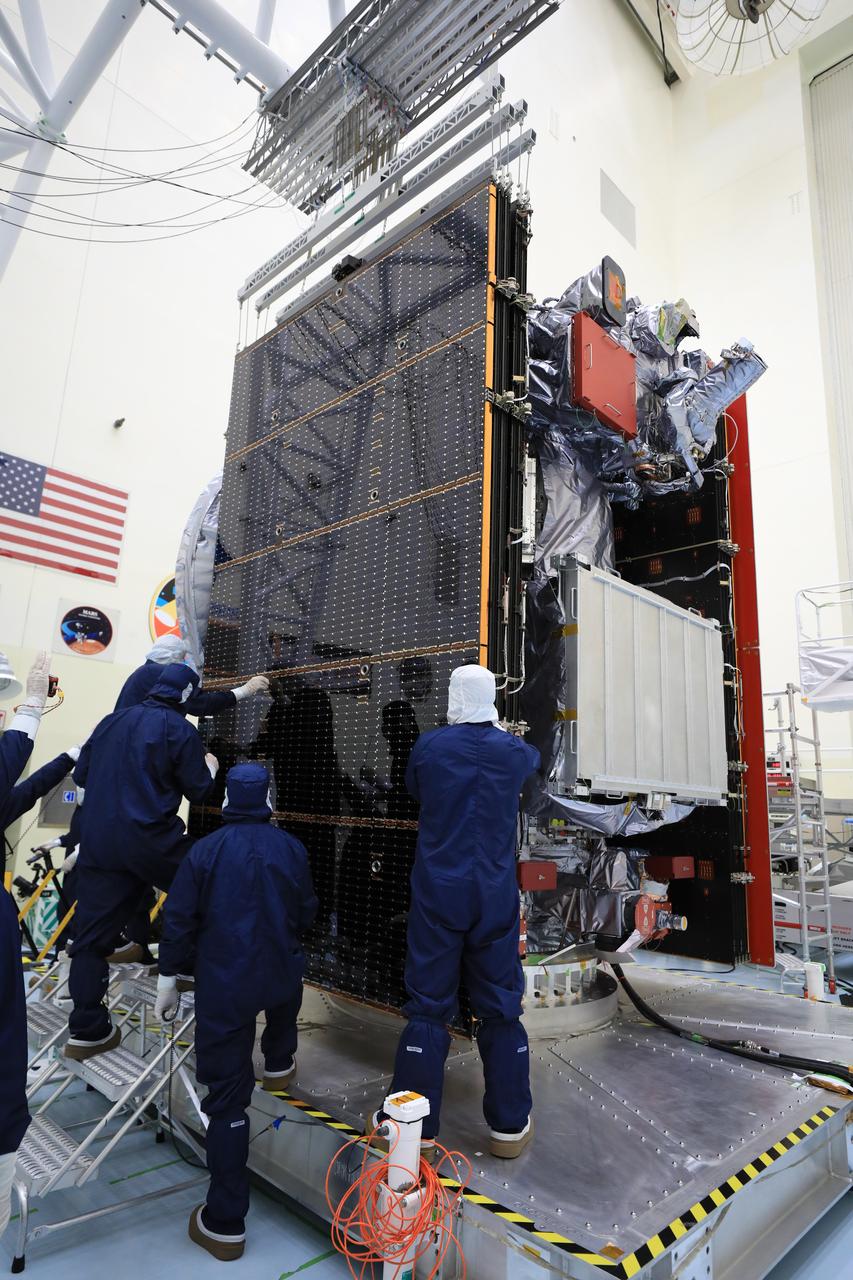
Technicians test, retract, and stow one of the two “wings” comprising the solar arrays for NASA’s Europa Clipper spacecraft on Friday, Aug. 23, 2024, at the Payload Hazardous Servicing Facility at the agency’s Kennedy Space Center in Florida. Each array measures about 46.5 feet (14.2 meters) long and about 13.5 feet (4.1 meters) high when extended. The spacecraft needs the massive solar arrays to power to Jupiter’s icy moon Europa to help scientists better understand the astrobiological potential for habitable worlds beyond our planet.
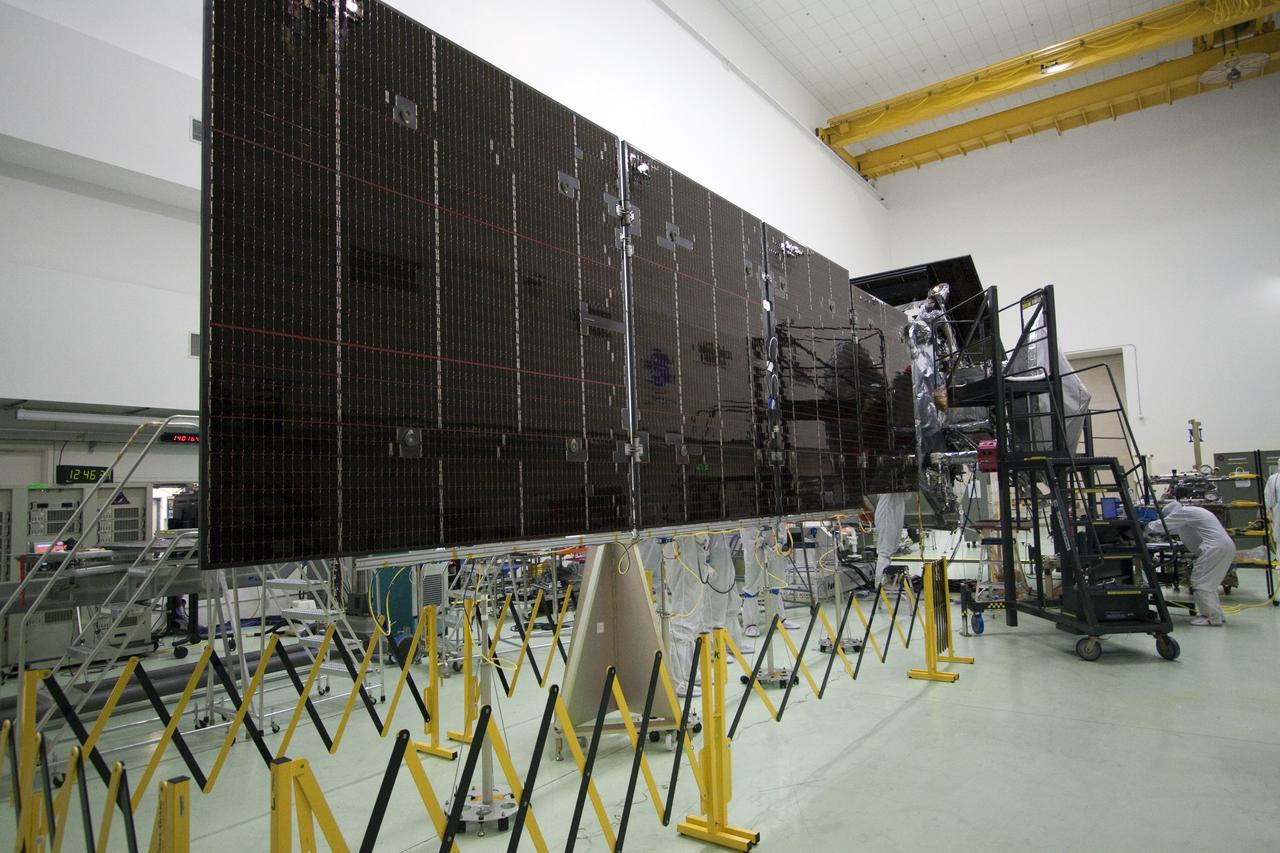
CAPE CANAVERAL, Fla. -- Technicians at Astrotech's payload processing facility in Titusville, Fla. are preparing to stow unfurled solar array #2 for NASA's Juno spacecraft. Later in processing, the magnetometer will be installed; a solar array illumination and magnetometer boom deployment test also are planned. Juno is scheduled to launch aboard an Atlas V rocket from Cape Canaveral, Fla. Aug. 5.The solar-powered spacecraft will orbit Jupiter's poles 33 times to find out more about the gas giant's origins, structure, atmosphere and magnetosphere and investigate the existence of a solid planetary core. For more information visit, www.nasa.gov/juno. Photo credit: NASA/Jack Pfaller

CAPE CANAVERAL, Fla. -- Technicians at Astrotech's payload processing facility in Titusville, Fla. are stowing solar array #2 for NASA's Juno spacecraft. Later in processing, the magnetometer will be installed; a solar array illumination and magnetometer boom deployment test also are planned. Juno is scheduled to launch aboard an Atlas V rocket from Cape Canaveral, Fla. Aug. 5.The solar-powered spacecraft will orbit Jupiter's poles 33 times to find out more about the gas giant's origins, structure, atmosphere and magnetosphere and investigate the existence of a solid planetary core. For more information visit, www.nasa.gov/juno. Photo credit: NASA/Jack Pfaller
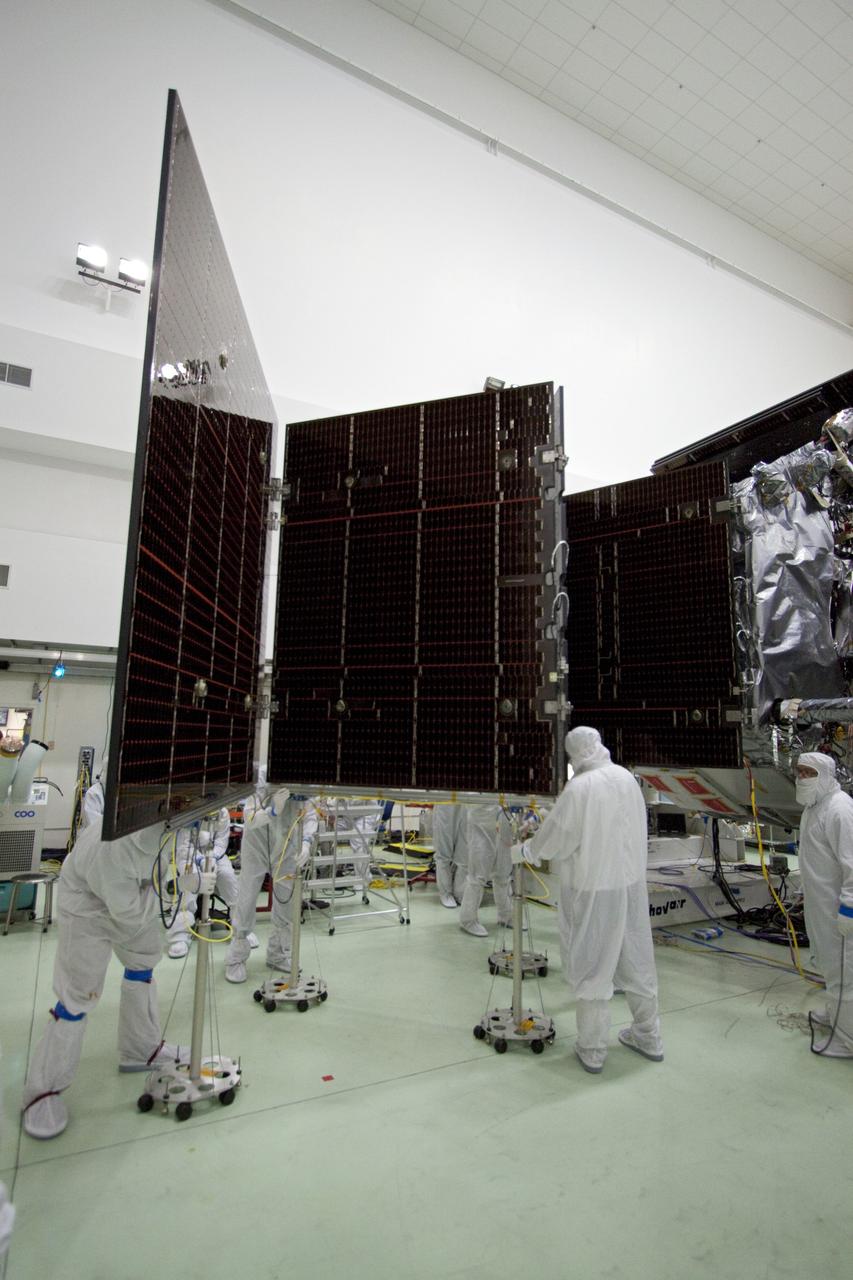
CAPE CANAVERAL, Fla. -- Technicians at Astrotech's payload processing facility in Titusville, Fla. are stowing solar array #2 for NASA's Juno spacecraft. Later in processing, the magnetometer will be installed; a solar array illumination and magnetometer boom deployment test also are planned. Juno is scheduled to launch aboard an Atlas V rocket from Cape Canaveral, Fla. Aug. 5.The solar-powered spacecraft will orbit Jupiter's poles 33 times to find out more about the gas giant's origins, structure, atmosphere and magnetosphere and investigate the existence of a solid planetary core. For more information visit, www.nasa.gov/juno. Photo credit: NASA/Jack Pfaller
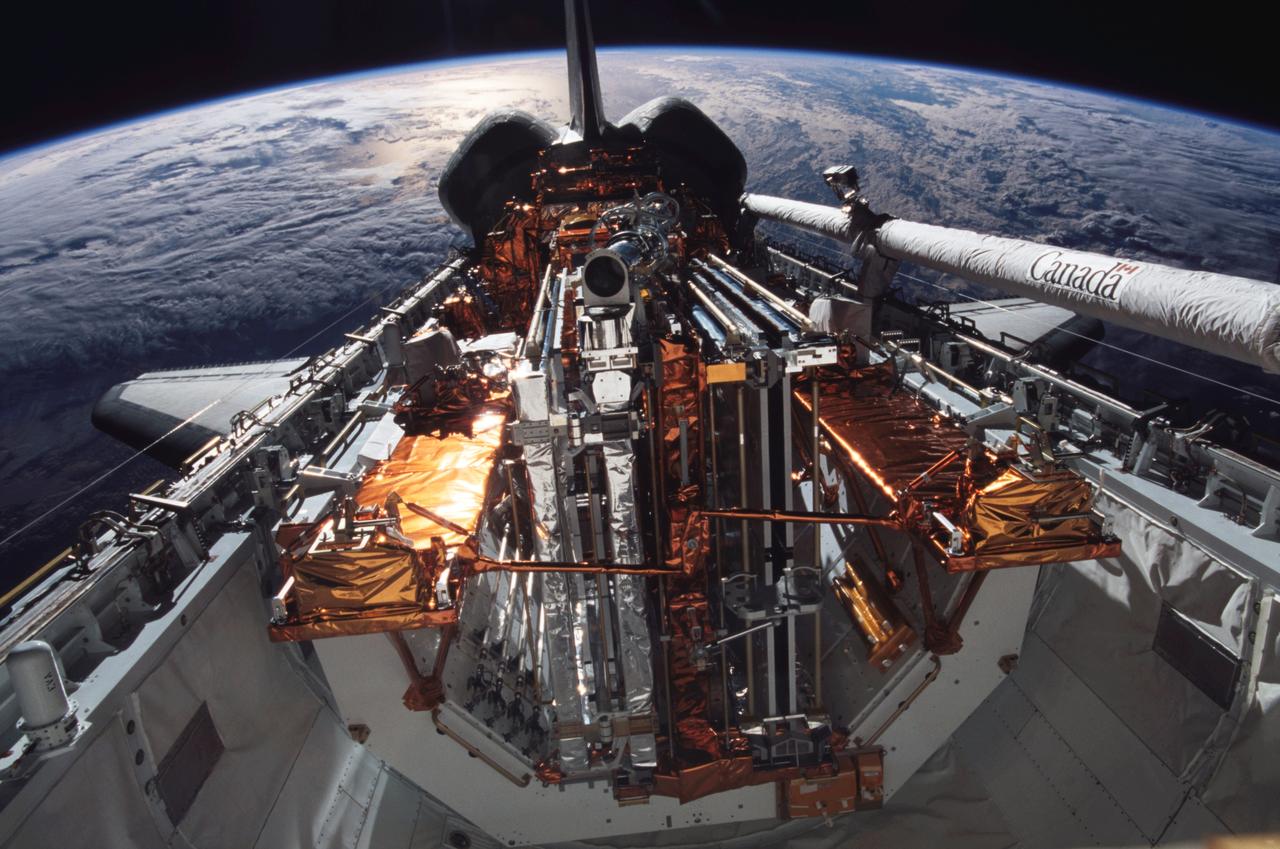
STS109-329-021 (1-12 March 2002) --- The horizon of a blue and white Earth and the blackness of space form the backdrop for this view of the cargo bay of the Space Shuttle Columbia, as seen through windows on the aft flight deck during the STS-109 mission. Pictured in the cargo bay is the Rigid Array Carrier (RAC) holding the new Hubble Solar Arrays. In its stowed position at right center of the frame is the Canadian-built Remote Manipulator System (RMS) arm.
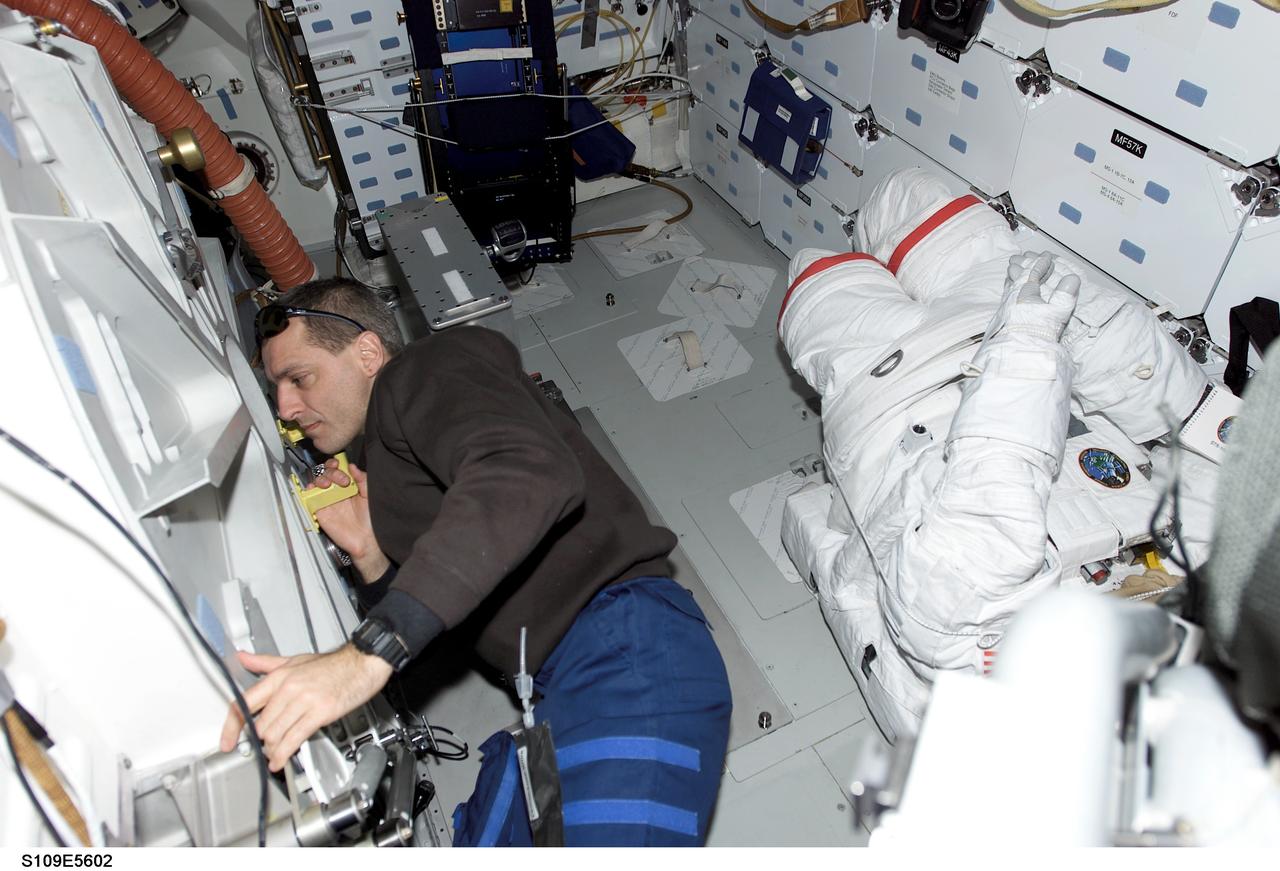
STS109-E-5602 (5 March 2002) --- Astronaut Richard M. Linnehan, mission specialist, checks the airlock hatch as two crewmates on the other side, equipped with extravehicular mobility units (EMU) space suits, start their extravehicular activity (EVA). On the previous day astronauts Linnehan and John M. Grunsfeld replaced the starboard solar array on the Hubble Space Telescope (HST). This day's space walk went on to see astronauts James H. Newman and Michael J. Massimino replace the port solar array. Grunsfeld's suit, scheduled for two more space walks, is temporarily stowed on the mid deck floor at right. The image was recorded with a digital still camera.
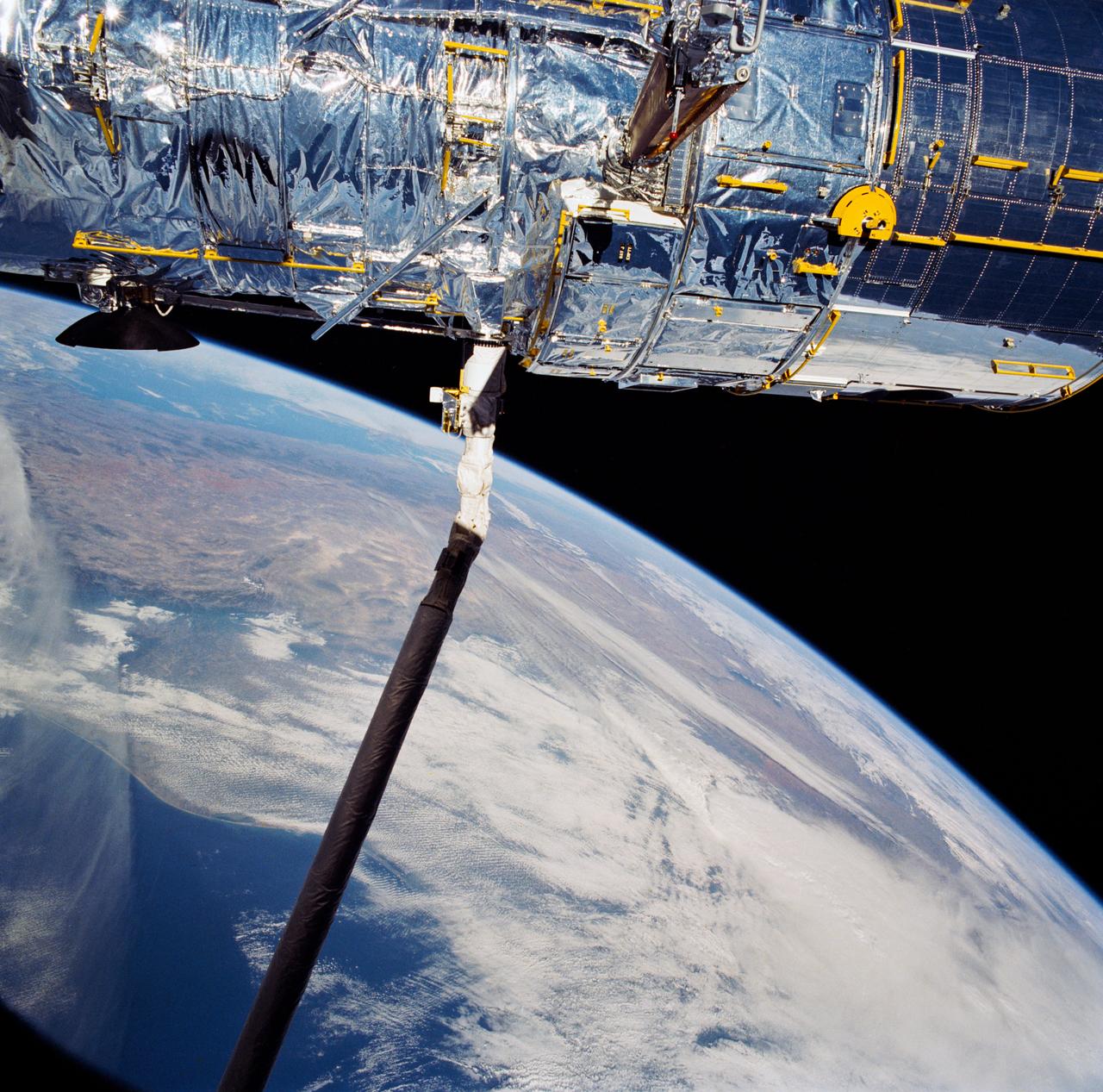
During STS-31, the Hubble Space Telescope (HST) is held in appendage deploy position by Discovery's, Orbiter Vehicle (OV) 103's, remote manipulator system (RMS) above the payload bay (PLB) and crew compartment cabin. While in this position the solar array (SA) wing bistem cassette (HST center) is deployed from its stowed location along side the Support System Module (SSM) forward shell. A high gain antenna (HGA) remains stowed along the SSM. The Earth's surface and the Earth limb creates a dramatic backdrop.
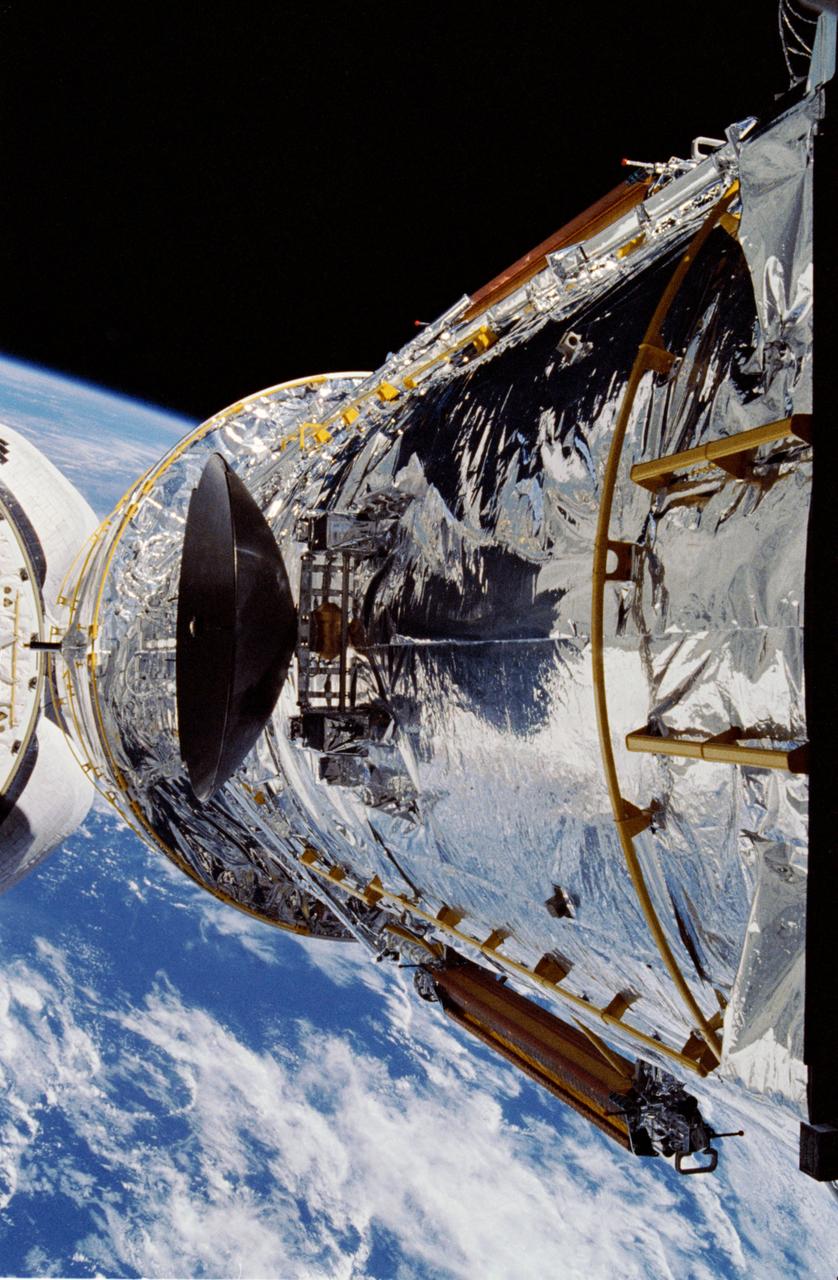
The Hubble Space Telescope (HST) is raised above the payload bay (PLB) in low hover position during STS-31 checkout and pre-deployment procedures aboard Discovery, Orbiter Vehicle (OV) 103. Stowed along the HST Support System Module (SSM) are the high gain antenna (HGA) (center) and the two solar arrays (one either side). In the background are the orbital maneuvering system (OMS) pods and the Earth's surface.
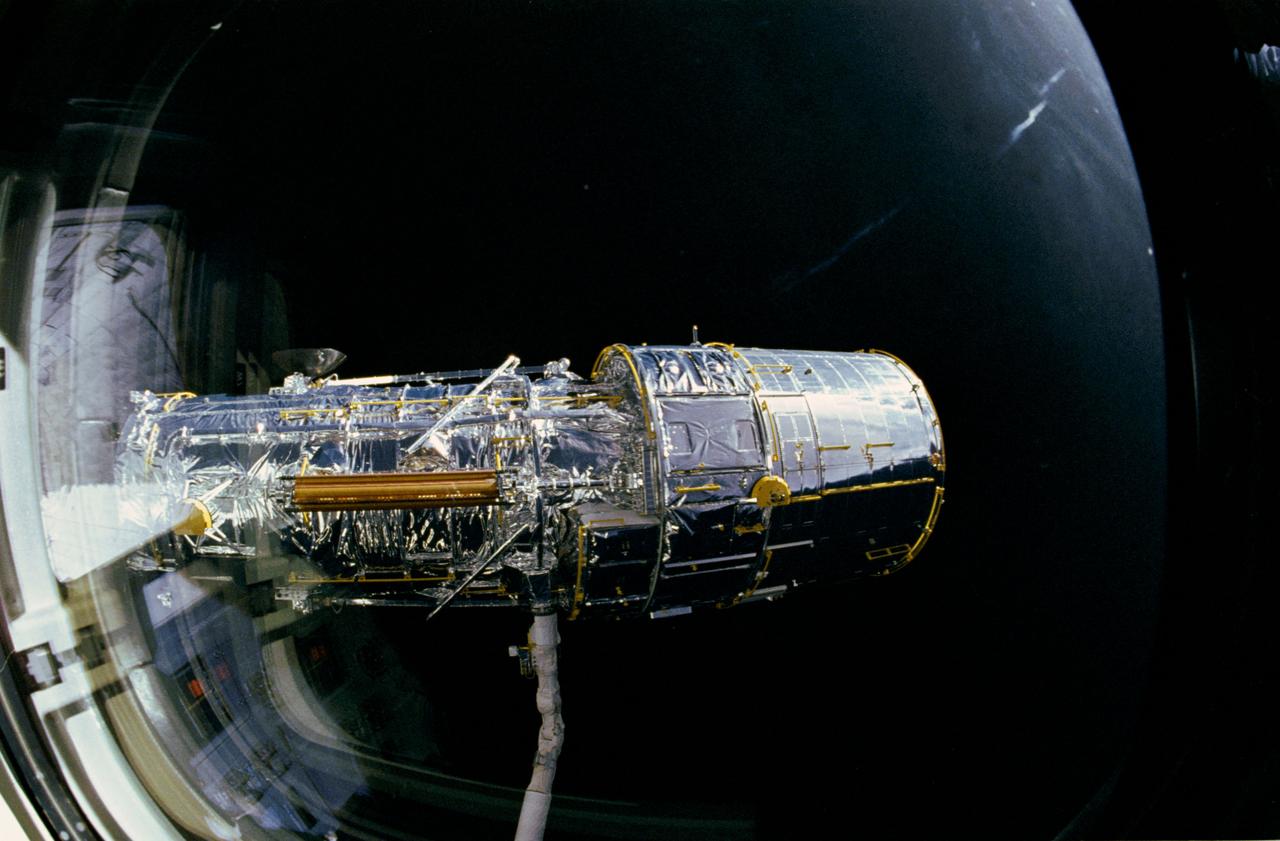
During STS-31 checkout, the Hubble Space Telescope (HST) is held in a pre-deployment position by Discovery's, Orbiter Vehicle (OV) 103's, remote manipulator system (RMS). The view, taken from the crew cabin overhead window W7, shows the starboard solar array (SA) panel (center) and two high gain antennae (HGA) (on either side) stowed along side the Support System Module (SSM) forward shell. The sun highlights HST against the blackness of space.
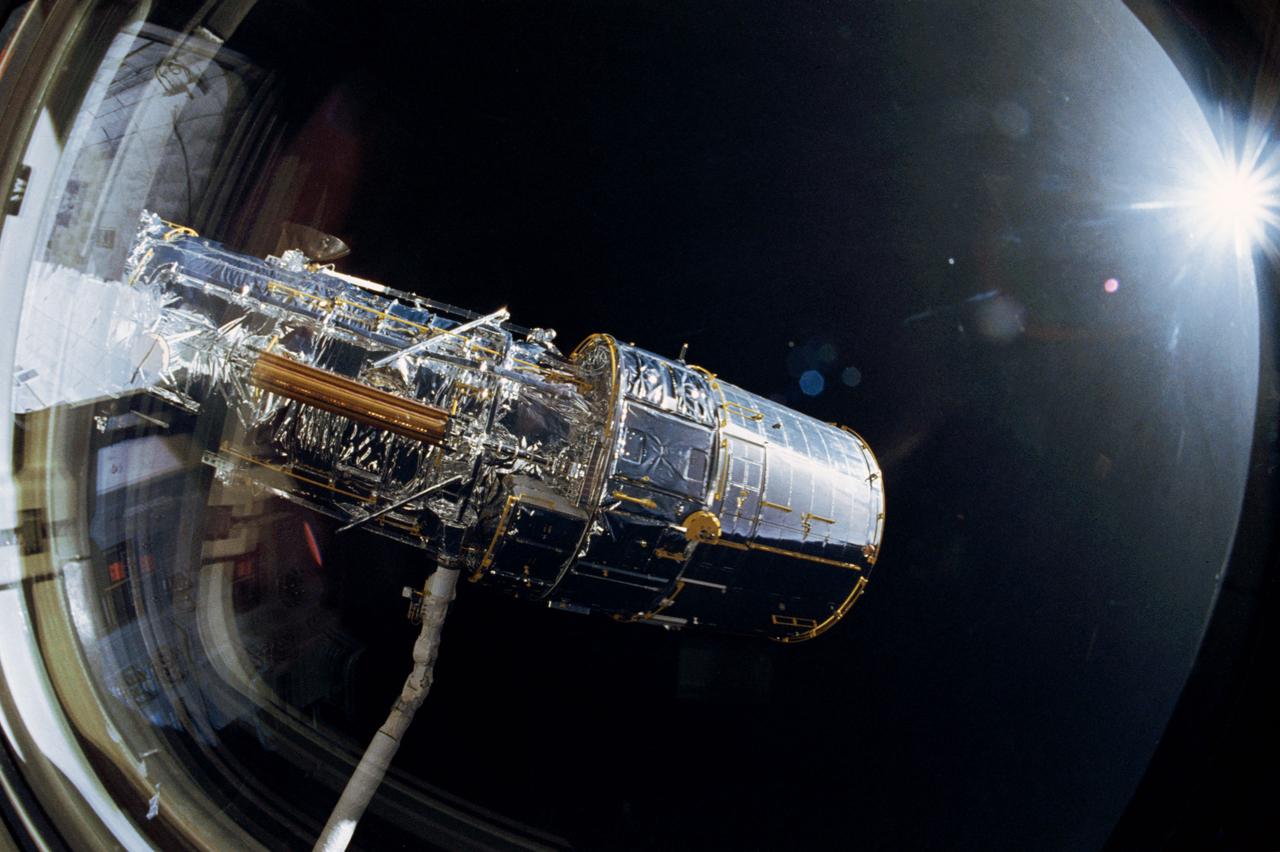
The Hubble Space Telescope (HST), grappled by Discovery's, Orbiter Vehicle (OV) 103's, remote manipulator system (RMS), is oriented in a 90 degree pitch position during STS-31 pre-deployment checkout procedures. The solar array (SA) panel (center) and high gain antennae (HGA) (on either side) are stowed along the Support System Module (SSM) forward shell prior to deployment. The sun highlights HST against the blackness of space.
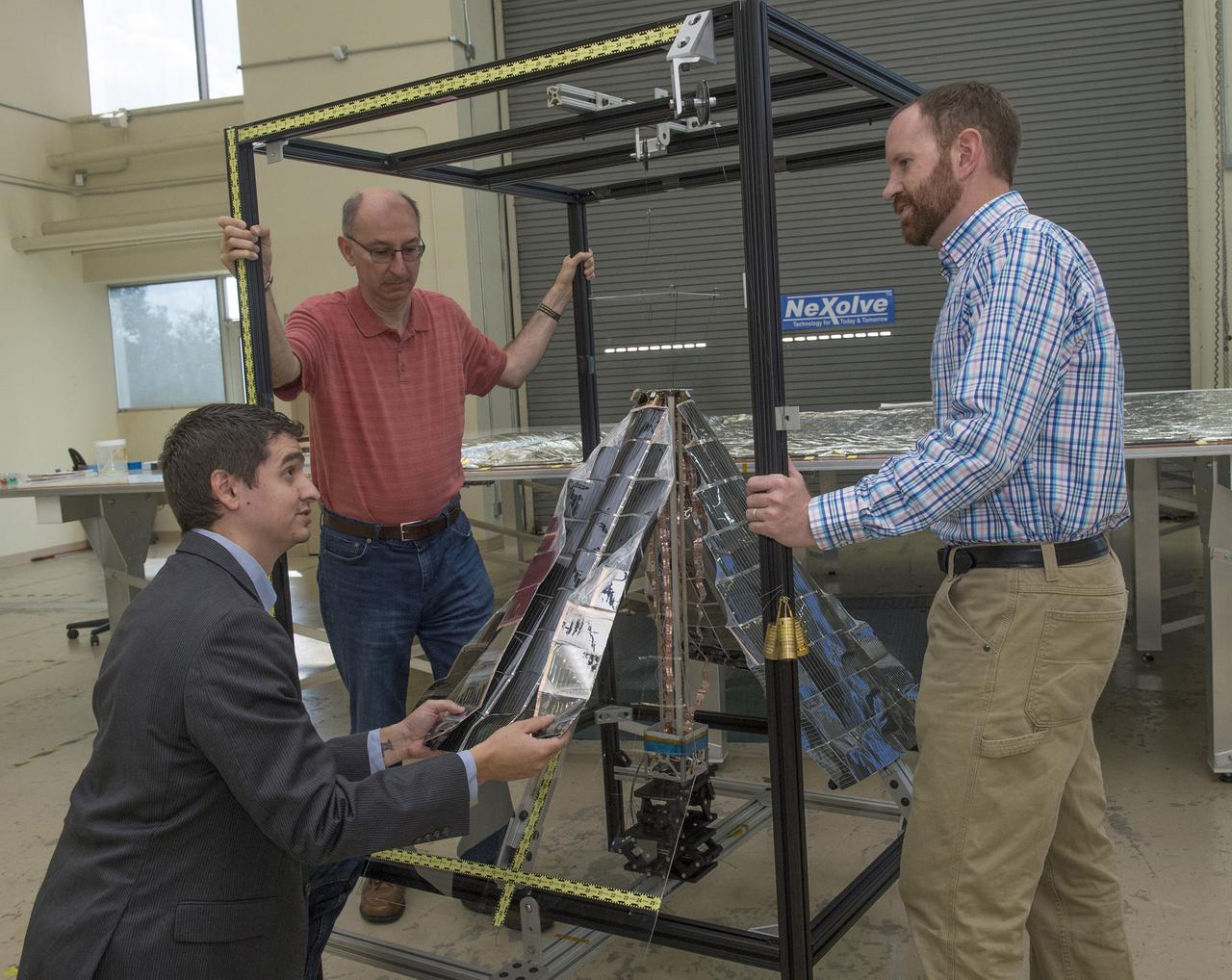
JOHN CARR, CO-PRINCIPAL INVESTIGATOR FOR NASA'S LIGHTWEIGHT INTEGRATED SOLAR ARRAY AND TRANSCEIVER PROJECT, KNEELS TO SHOW HOW ONE OF THE THIN-FILM SIDES OR "PETALS" IN WHICH PHOTO-VOLTAIC CELLS ARE EMBEDDED, IS FOLDED AND STOWED BEFORE LAUNCH. LOOKING ON DURING A DEMONSTRATION AFTER TESTING AT NEXOLVE, ARE LES JOHNSON, LEFT, ALSO CO-PRINCIPAL INVESTIGATOR, AND DARREN BOYD, RIGHT, THE RADIO FREQUENCY LEAD FOR THE PROJECT.
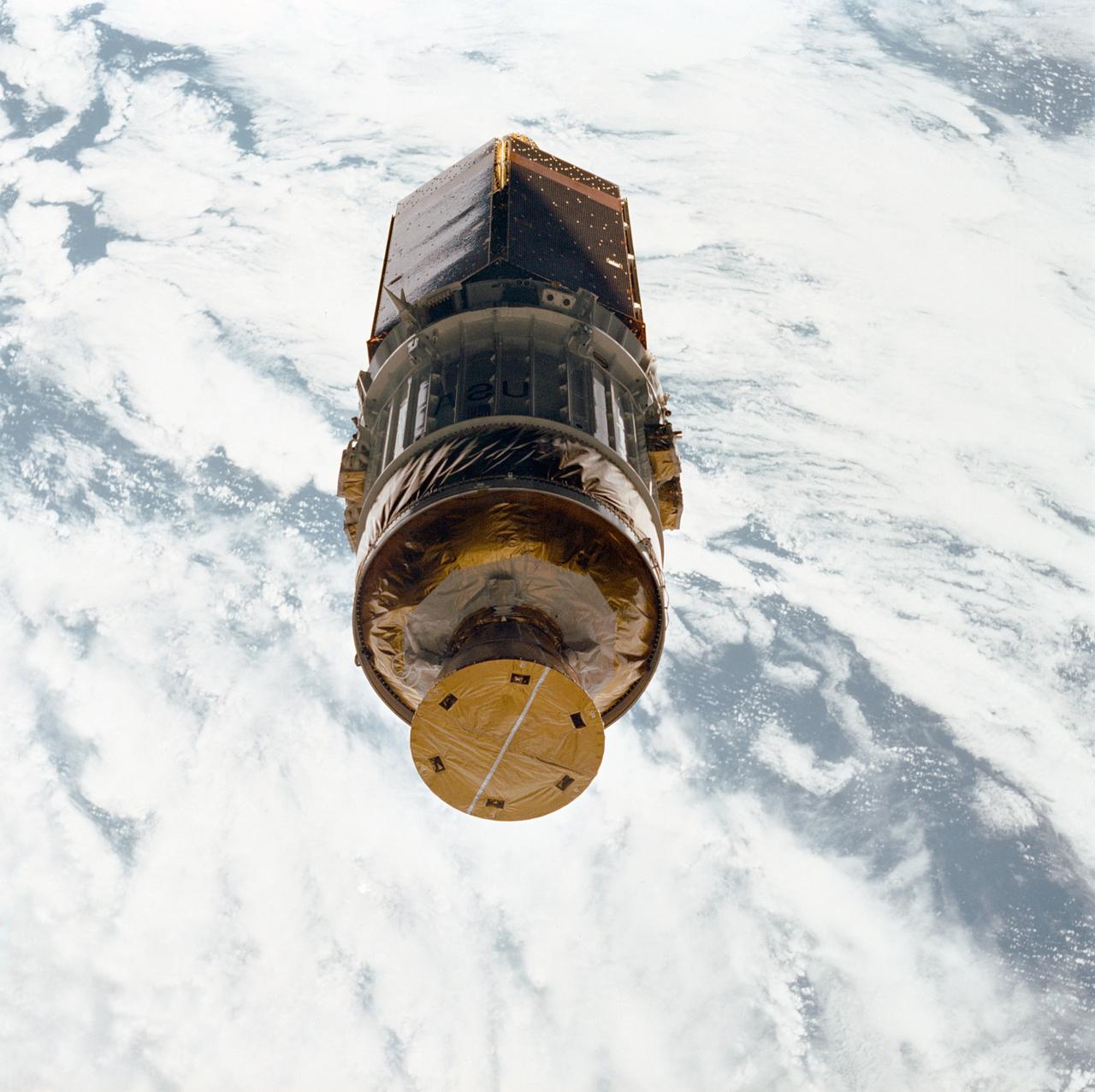
STS026-31-071 (3 Oct 1988) --- After deployment from Discovery, Orbiter Vehicle (OV) 103, the inertial upper stage (IUS) with the tracking and data relay satellite C (TDRS-C) drifts above the cloud-covered Earth surface. TDRS-C, in stowed configuration (solar array panels visible), is mounted atop the IUS with the interstage and solid rocket motor and nozzle seen in the foreground.
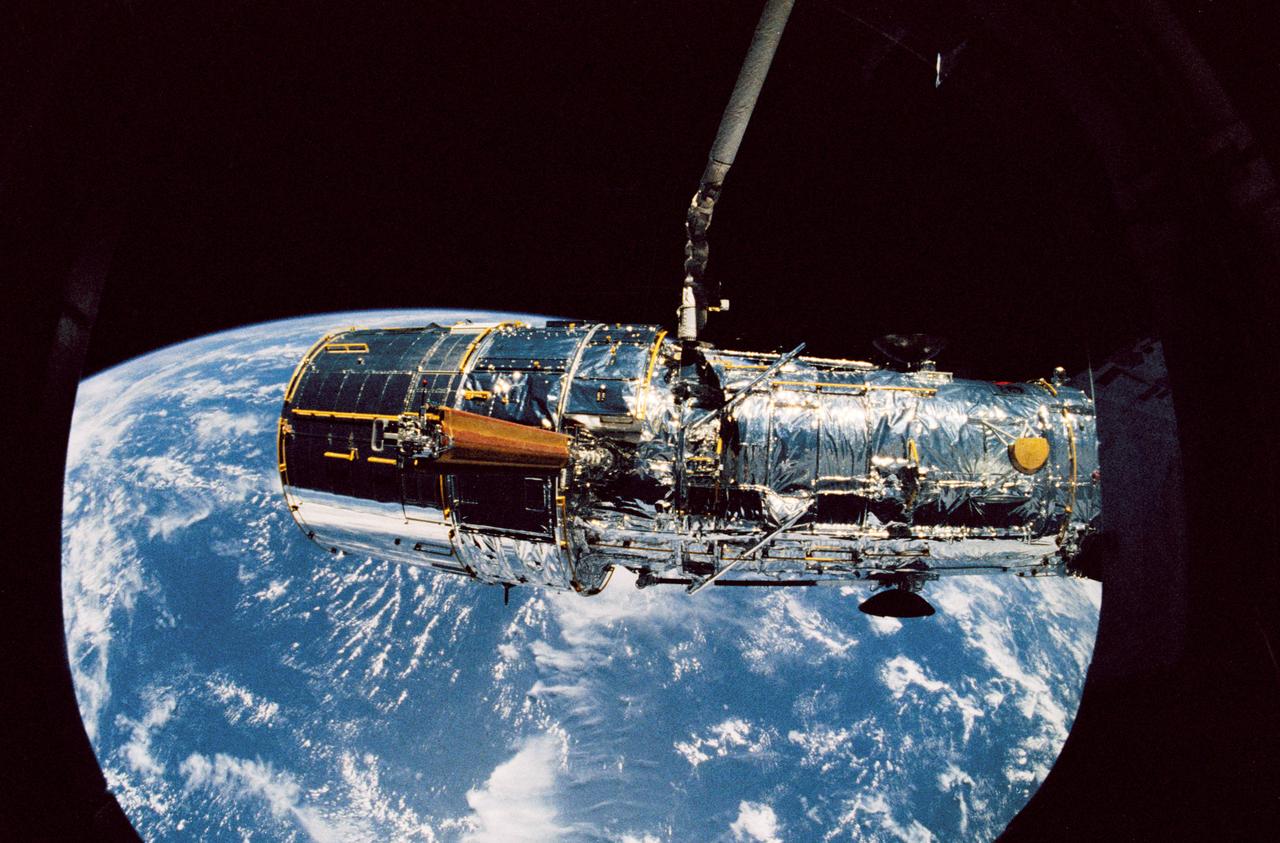
Held in appendage deploy position by Discovery's, Orbiter Vehicle (OV) 103's, remote manipulator system (RMS), the Hubble Space Telescope's (HST's) starboard solar array (SA) bistem cassette is released from its stowed position on the Support System Module (SSM) forward shell. The spreader bar & bistem begin to unfurl the SA wing. View was taken by an STS-31 crewmember through an overhead window & is backdropped against the surface of the Earth.
The Hubble Space Telescope (HST), grappled by Discovery's, Orbiter Vehicle (OV) 103's, remote manipulator system (RMS), is held in a pre-deployment position. During STS-31 checkout procedures, the solar array (SA) panels and the high gain antennae (HGA) will be deployed. The starboard SA (center) and the two HGA are stowed along side the Support System Module (SSM) forward shell. The sun highlights HST against the blackness of space.
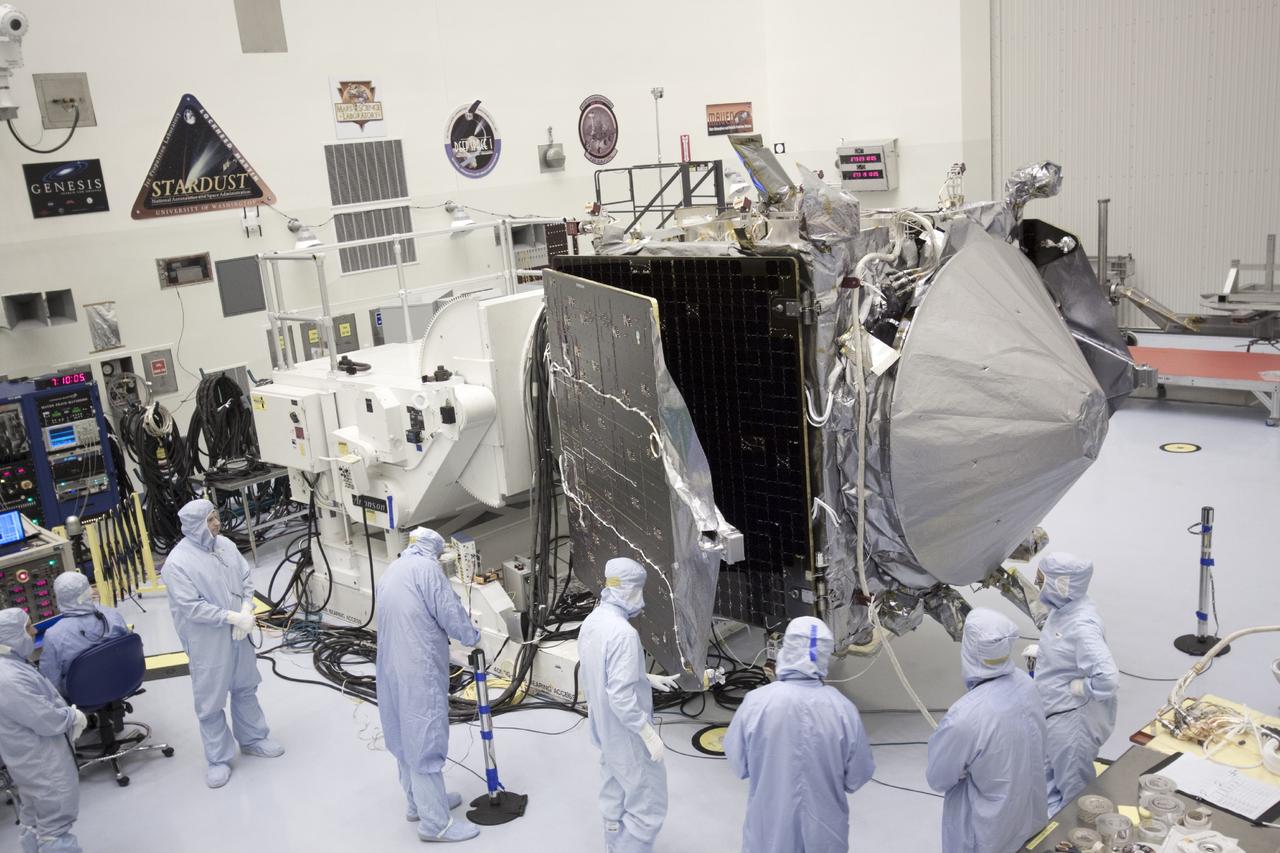
CAPE CANAVERAL, Fla. – Inside the Payload Hazardous Servicing Facility at NASA's Kennedy Space Center in Florida, engineers and technicians have begun the process to stow the power-generating solar arrays for the Mars Atmosphere and Volatile Evolution, or MAVEN, spacecraft. MAVEN is being prepared for its scheduled launch on Nov 18, 2013 from Cape Canaveral Air Force Station, Fla. atop a United Launch Alliance Atlas V rocket. Positioned in an orbit above the Red Planet, MAVEN will study the upper atmosphere of Mars in unprecedented detail. For more information, visit: http://www.nasa.gov/mission_pages/maven/main/index.html Photo credit: NASA/Jim Grossmann
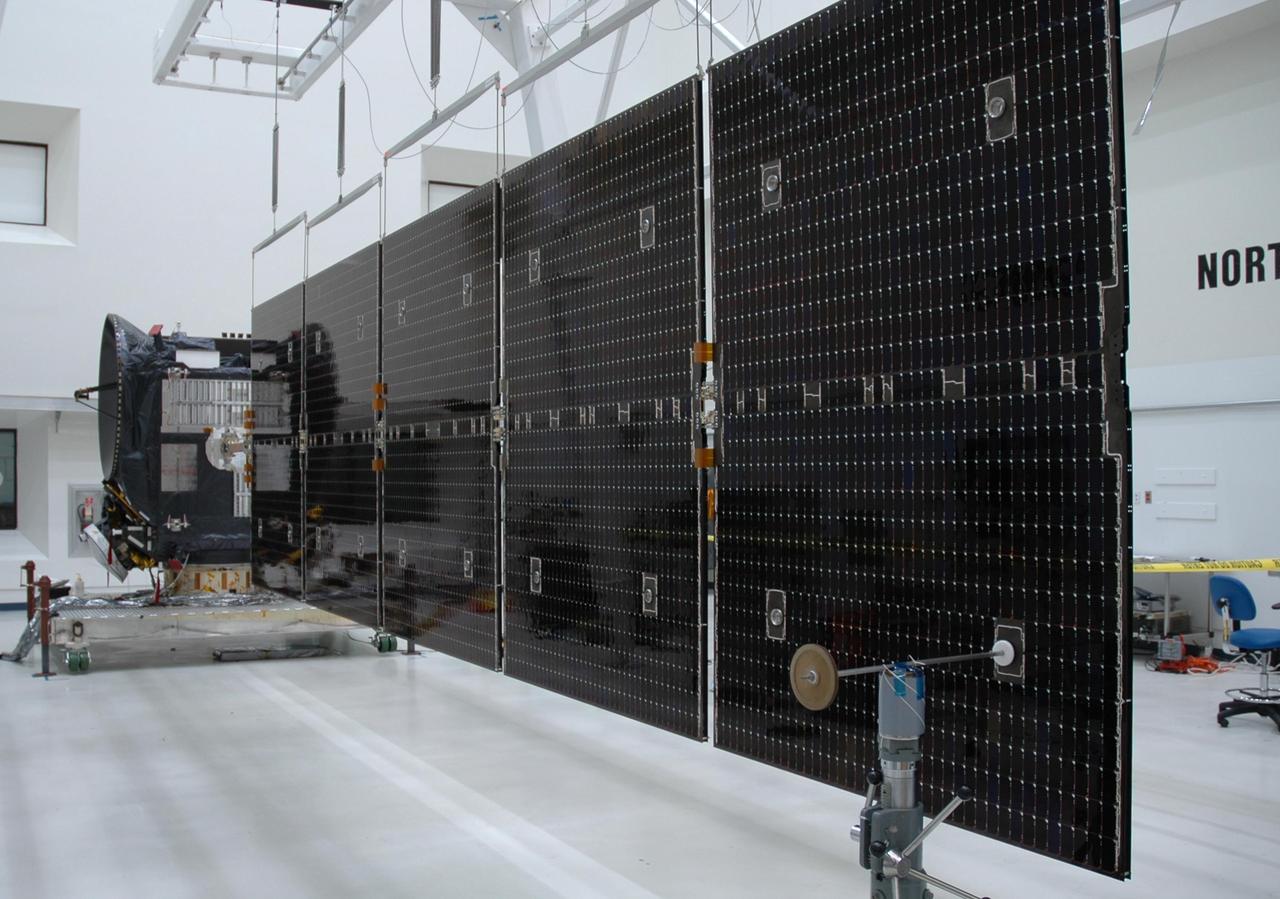
KENNEDY SPACE CENTER, FLA. -- At Astrotech's Payload Processing Facility, the second array of solar panels on the Dawn spacecraft is deployed. After testing, the panels will be stowed and Dawn will be moved to the Hazardous Processing Facility for fueling. Dawn is scheduled to launch June 30 aboard a Delta II rocket from Launch Complex 17-B at Cape Canaveral Air Force Station. Dawn's mission is to explore two of the asteroid belt's most intriguing and dissimilar occupants: asteroid Vesta and the dwarf planet Ceres. Photo credit: NASA/David Lyons-Orbital Sciences
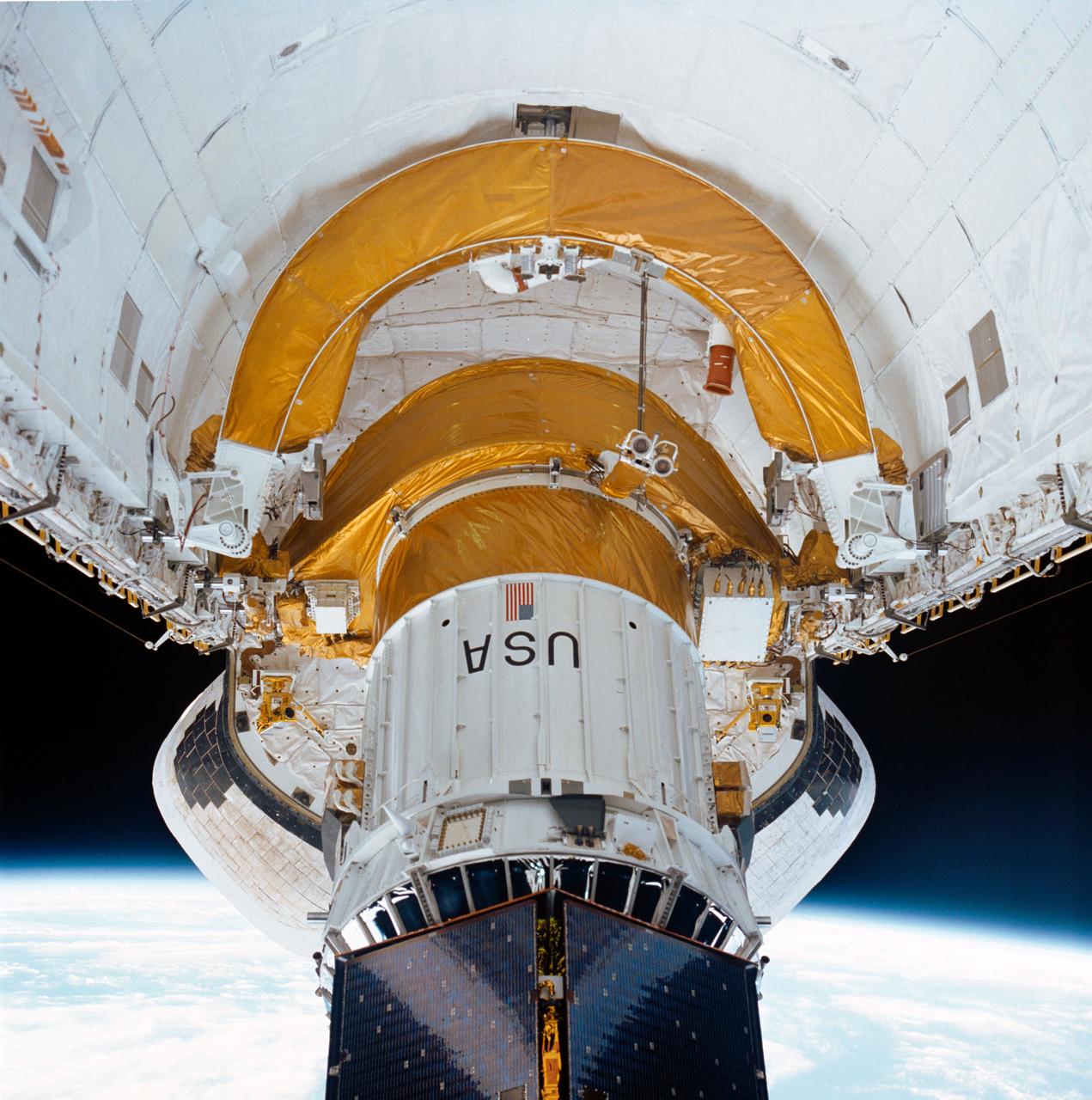
During STS-26, inertial upper stage (IUS) with the tracking and data relay satellite C (TDRS-C) located in the payload bay (PLB) of Discovery, Orbiter Vehicle (OV) 103, is raised into deployment attitude (an angle of 50 degrees) by the airborne support equipment (ASE). ASE aft frame tilt actuator (AFTA) table supports the IUS as it is positioned in the PLB and the ASE umbilical boom drifts away from IUS toward ASE forward cradle. TDRS-C solar array panels (in stowed configuration) are visible on top of the IUS. In the background are the orbital maneuvering system (OMS) pods and the Earth's limb.

CAPE CANAVERAL, Fla. – Inside the Payload Hazardous Servicing Facility at NASA's Kennedy Space Center in Florida, engineers and technicians have begun the process to stow the power-generating solar arrays for the Mars Atmosphere and Volatile Evolution, or MAVEN, spacecraft. MAVEN is being prepared for its scheduled launch on Nov 18, 2013 from Cape Canaveral Air Force Station, Fla. atop a United Launch Alliance Atlas V rocket. Positioned in an orbit above the Red Planet, MAVEN will study the upper atmosphere of Mars in unprecedented detail. For more information, visit: http://www.nasa.gov/mission_pages/maven/main/index.html Photo credit: NASA/Jim Grossmann
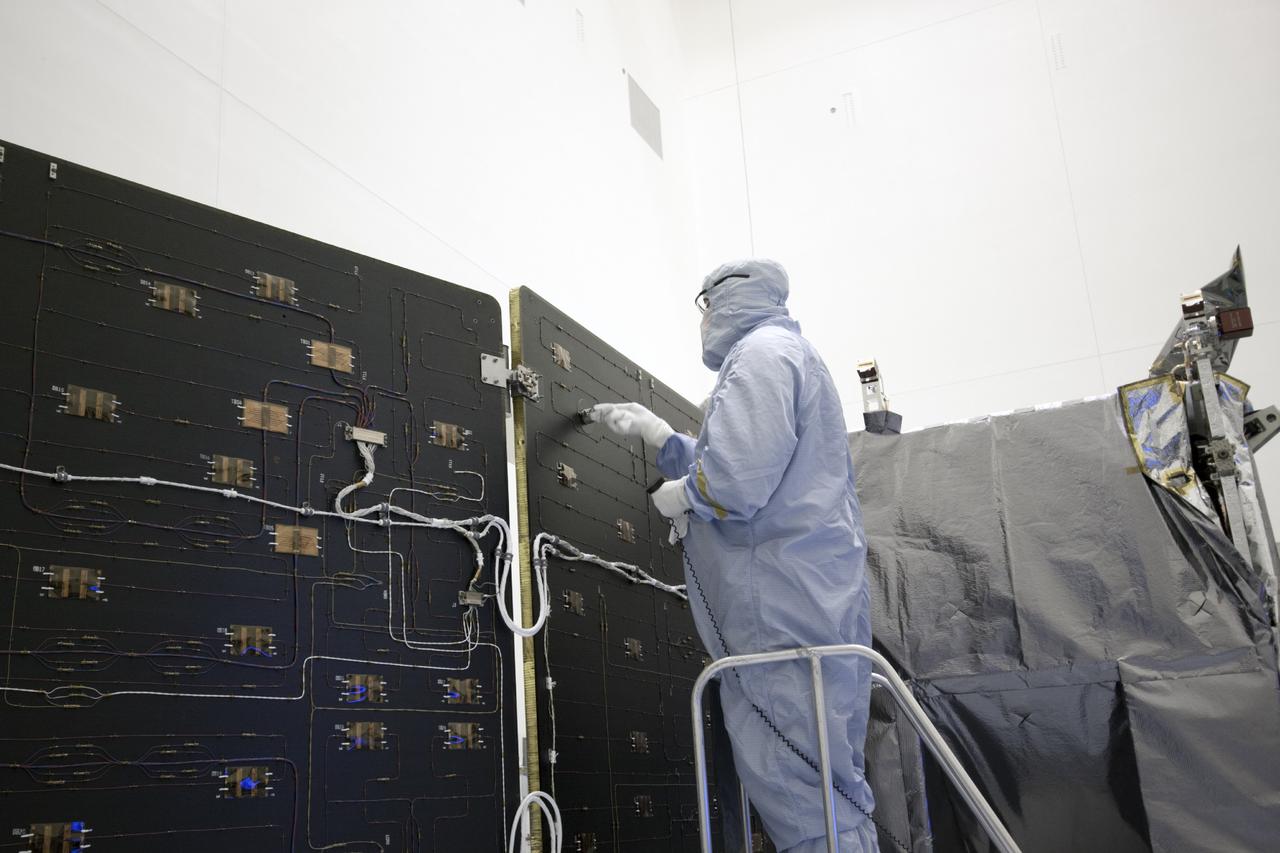
CAPE CANAVERAL, Fla. – Inside the Payload Hazardous Servicing Facility at NASA's Kennedy Space Center in Florida, the solar arrays are being checked out prior to beginning process of stowing the power-generating panels on the Mars Atmosphere and Volatile Evolution, or MAVEN, spacecraft. MAVEN is being prepared for its scheduled launch on Nov 18, 2013 from Cape Canaveral Air Force Station, Fla. atop a United Launch Alliance Atlas V rocket. Positioned in an orbit above the Red Planet, MAVEN will study the upper atmosphere of Mars in unprecedented detail. For more information, visit: http://www.nasa.gov/mission_pages/maven/main/index.html Photo credit: NASA/Jim Grossmann
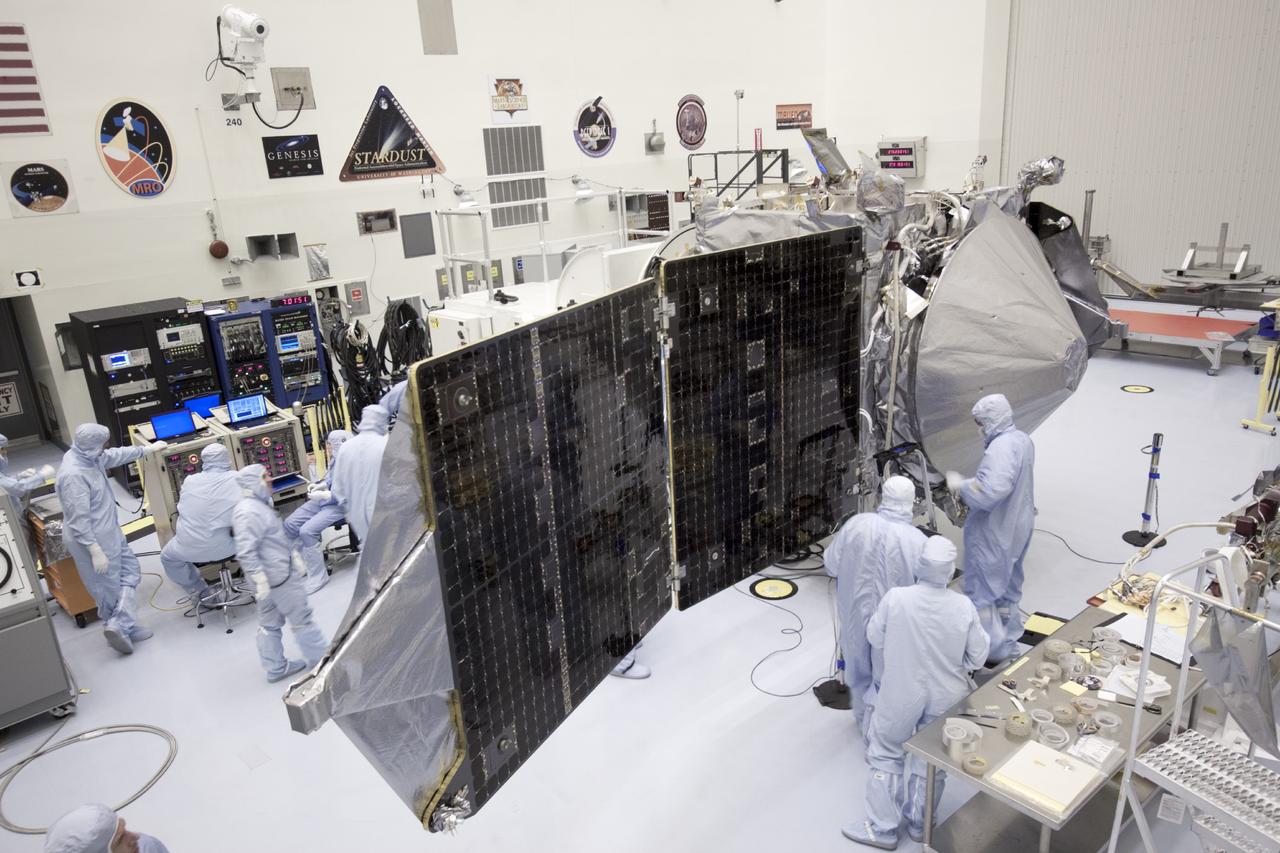
CAPE CANAVERAL, Fla. – Inside the Payload Hazardous Servicing Facility at NASA's Kennedy Space Center in Florida, engineers and technicians have begun the process to stow the power-generating solar arrays for the Mars Atmosphere and Volatile Evolution, or MAVEN, spacecraft. MAVEN is being prepared for its scheduled launch on Nov 18, 2013 from Cape Canaveral Air Force Station, Fla. atop a United Launch Alliance Atlas V rocket. Positioned in an orbit above the Red Planet, MAVEN will study the upper atmosphere of Mars in unprecedented detail. For more information, visit: http://www.nasa.gov/mission_pages/maven/main/index.html Photo credit: NASA/Jim Grossmann
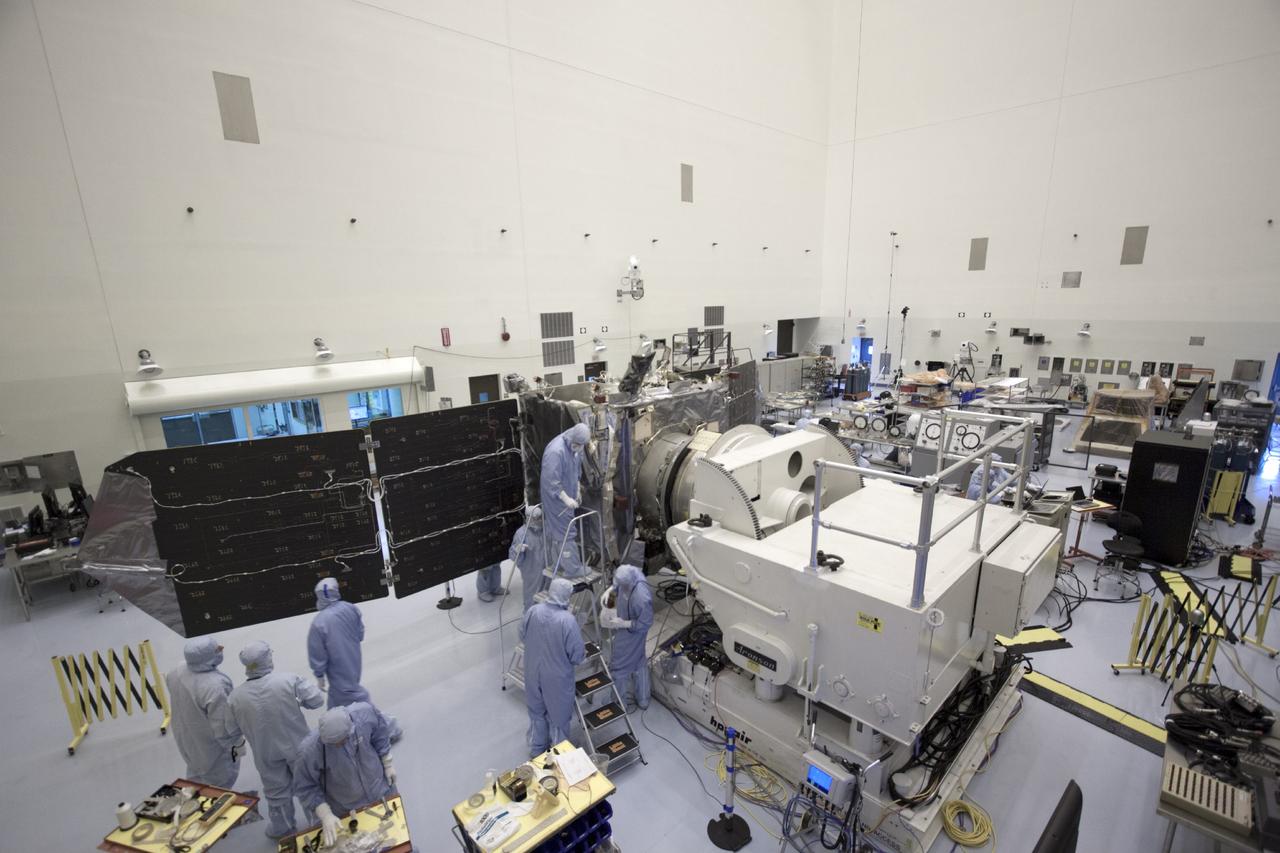
CAPE CANAVERAL, Fla. – Inside the Payload Hazardous Servicing Facility at NASA's Kennedy Space Center in Florida, engineers and technicians have begun the process to stow the power-generating solar arrays for the Mars Atmosphere and Volatile Evolution, or MAVEN, spacecraft. MAVEN is being prepared for its scheduled launch on Nov 18, 2013 from Cape Canaveral Air Force Station, Fla. atop a United Launch Alliance Atlas V rocket. Positioned in an orbit above the Red Planet, MAVEN will study the upper atmosphere of Mars in unprecedented detail. For more information, visit: http://www.nasa.gov/mission_pages/maven/main/index.html Photo credit: NASA/Jim Grossmann
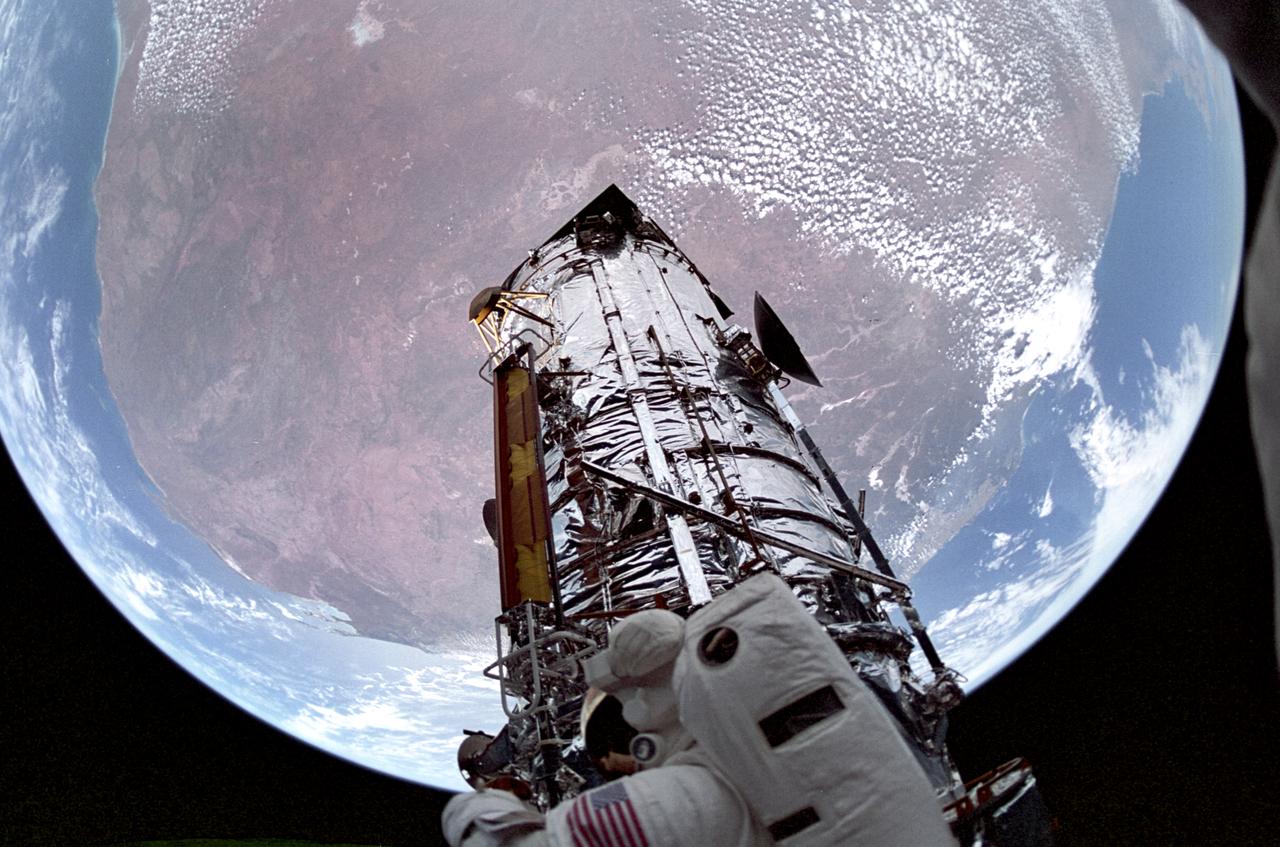
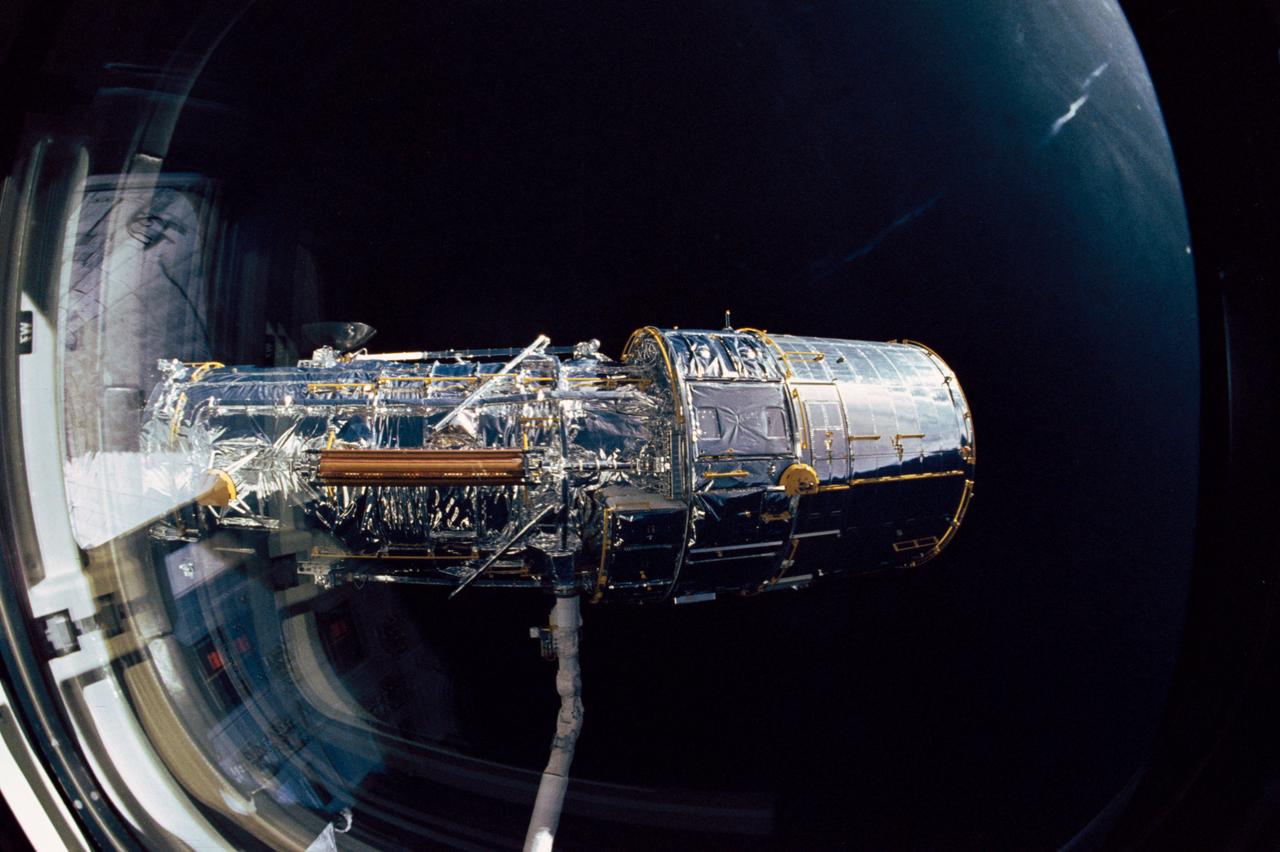
Backdropped against the Earth, the Hubble Space Telescope (HST)is shown sporting new and modified solar arrays stowed against its barrel. Orbiting Earth at an altitude of 325 nautical miles, an astronaut begins other repairs of the HST while perched atop a foot restraint on shuttle Endeavour's remote manipulator system arm. The 59th and final Shuttle flight of 1993 was one of most challenging and complex marned missions ever attempted. During record five back-to-back space walks totaling 35 hours and 28 minutes, two teams of astronauts completed the first servicing of the HST. The STS-061 mission was launched aboard Space Shuttle Endeavor on December 2, 1993.
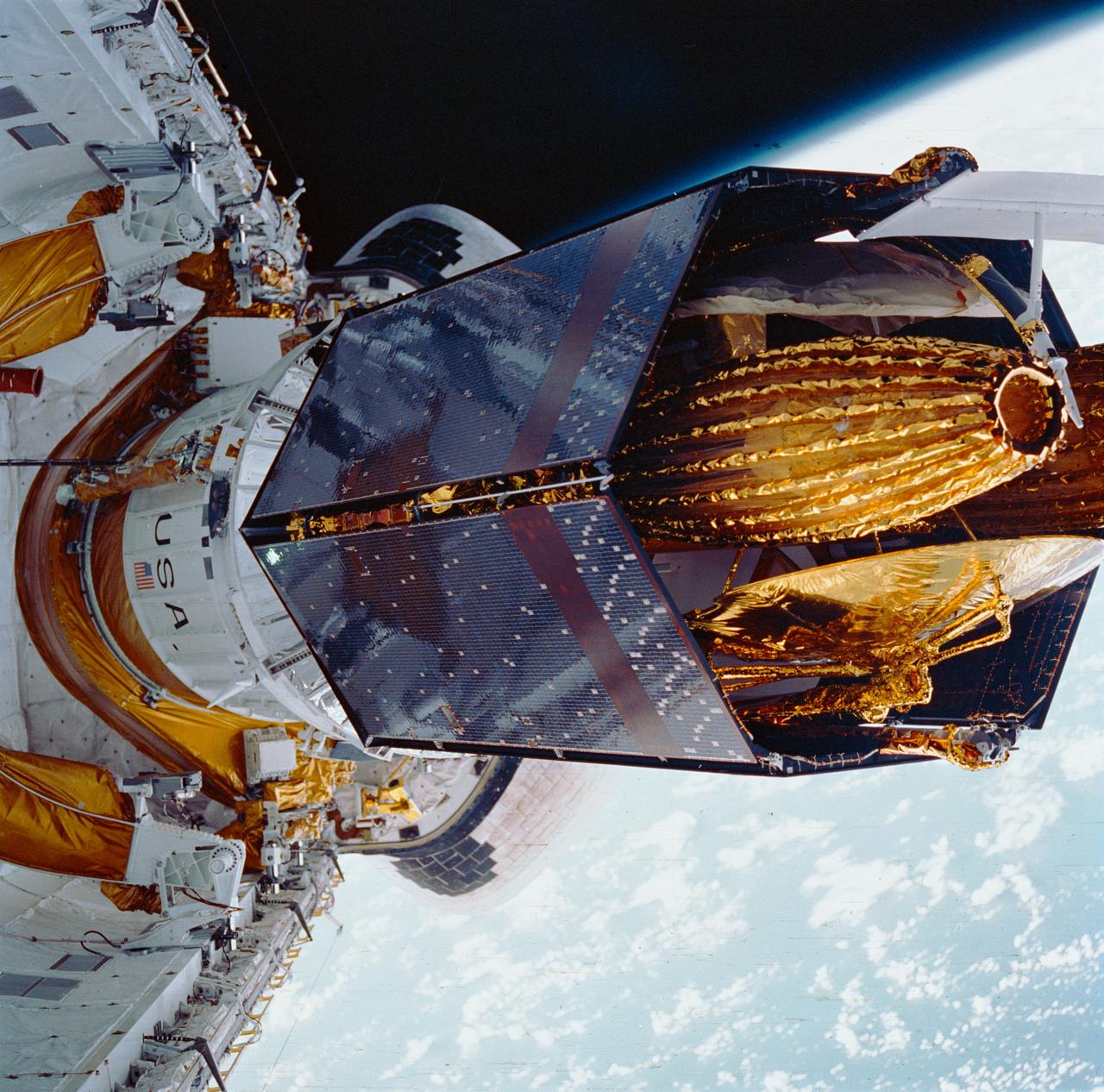
During STS-26, inertial upper stage (IUS) with tracking and data relay satellite C (TDRS-C) located in the payload bay (PLB) of Discovery, Orbiter Vehicle (OV) 103, is positioned into its proper deployment attitude (an angle of 50 degrees) by the airborne support equipment (ASE). In the foreground, the ASE forward cradle is visible. The IUS is mounted in the ASE aft frame tilt actuator (AFTA) table. TDRS-C components in stowed configuration include solar array panels, TDRS single access #1 and #2, TDRS SGL, and S-Band omni antenna. In the background are the orbital maneuvering system (OMS) pods, the Earth's cloud-covered surface, and the Earth's limb.
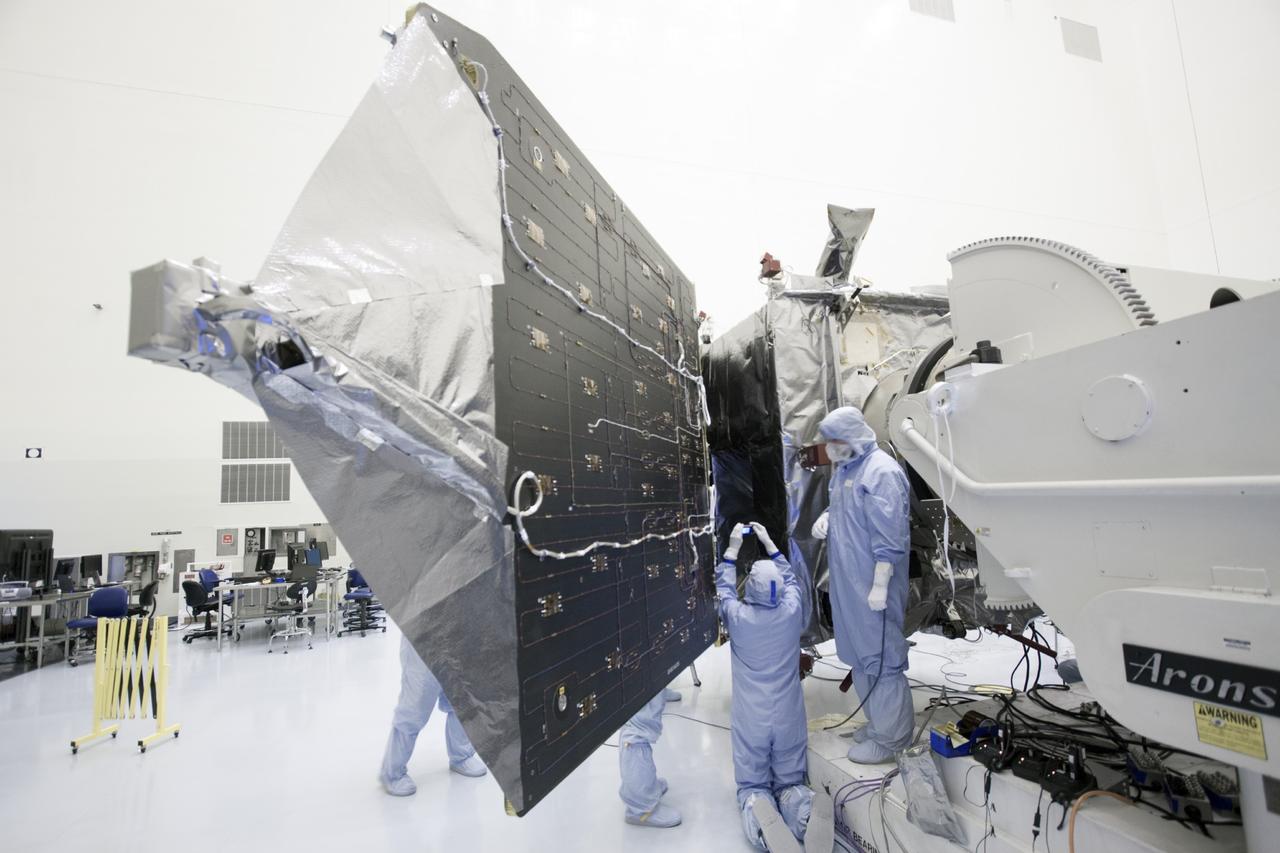
CAPE CANAVERAL, Fla. – Inside the Payload Hazardous Servicing Facility at NASA's Kennedy Space Center in Florida, engineers and technicians have begun the process to stow the power-generating solar arrays for the Mars Atmosphere and Volatile Evolution, or MAVEN, spacecraft. MAVEN is being prepared for its scheduled launch on Nov 18, 2013 from Cape Canaveral Air Force Station, Fla. atop a United Launch Alliance Atlas V rocket. Positioned in an orbit above the Red Planet, MAVEN will study the upper atmosphere of Mars in unprecedented detail. For more information, visit: http://www.nasa.gov/mission_pages/maven/main/index.html Photo credit: NASA/Jim Grossmann
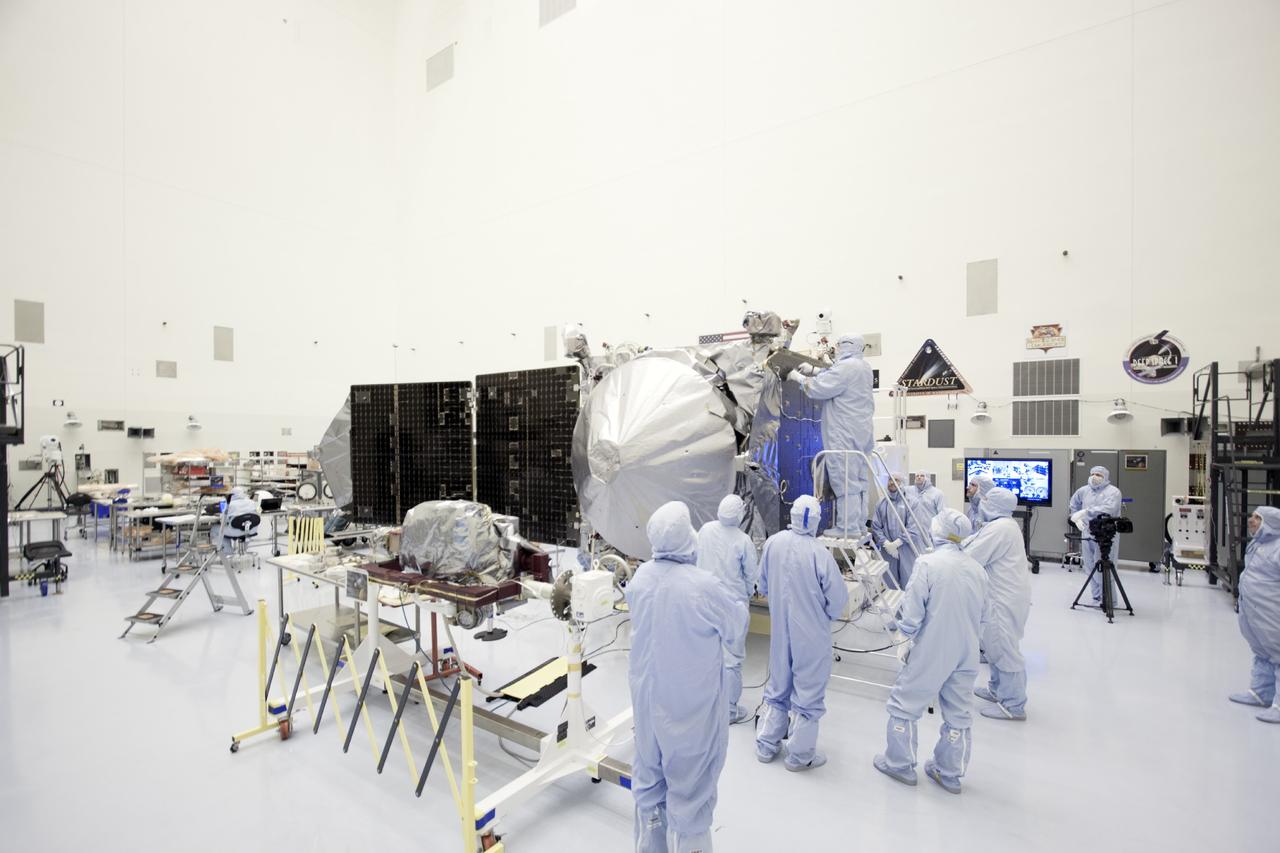
CAPE CANAVERAL, Fla. – Inside the Payload Hazardous Servicing Facility at NASA's Kennedy Space Center in Florida, engineers and technicians have begun the process to stow the power-generating solar arrays for the Mars Atmosphere and Volatile Evolution, or MAVEN, spacecraft. MAVEN is being prepared for its scheduled launch on Nov 18, 2013 from Cape Canaveral Air Force Station, Fla. atop a United Launch Alliance Atlas V rocket. Positioned in an orbit above the Red Planet, MAVEN will study the upper atmosphere of Mars in unprecedented detail. For more information, visit: http://www.nasa.gov/mission_pages/maven/main/index.html Photo credit: NASA/Jim Grossmann
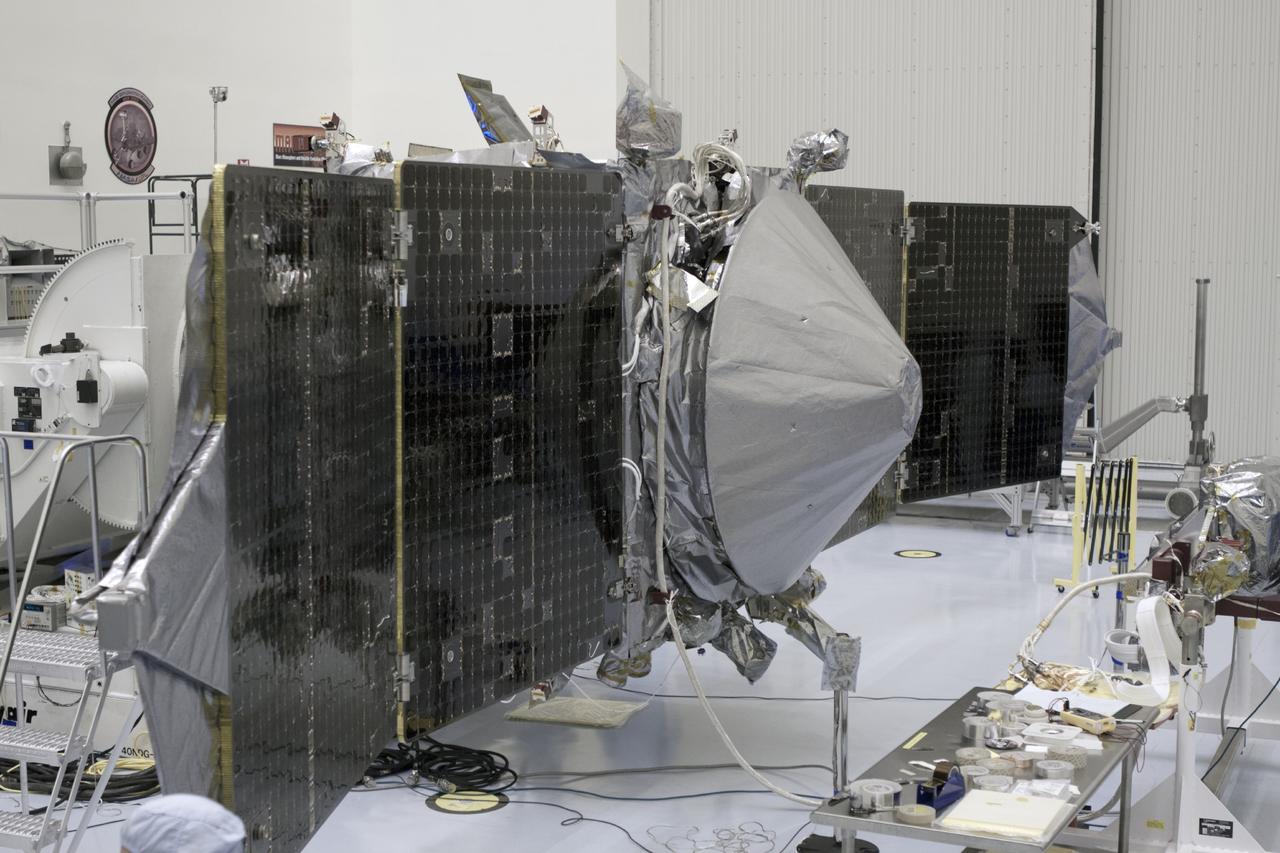
CAPE CANAVERAL, Fla. – Inside the Payload Hazardous Servicing Facility at NASA's Kennedy Space Center in Florida, engineers and technicians have begun the process to stow the power-generating solar arrays for the Mars Atmosphere and Volatile Evolution, or MAVEN, spacecraft. MAVEN is being prepared for its scheduled launch on Nov 18, 2013 from Cape Canaveral Air Force Station, Fla. atop a United Launch Alliance Atlas V rocket. Positioned in an orbit above the Red Planet, MAVEN will study the upper atmosphere of Mars in unprecedented detail. For more information, visit: http://www.nasa.gov/mission_pages/maven/main/index.html Photo credit: NASA/Jim Grossmann
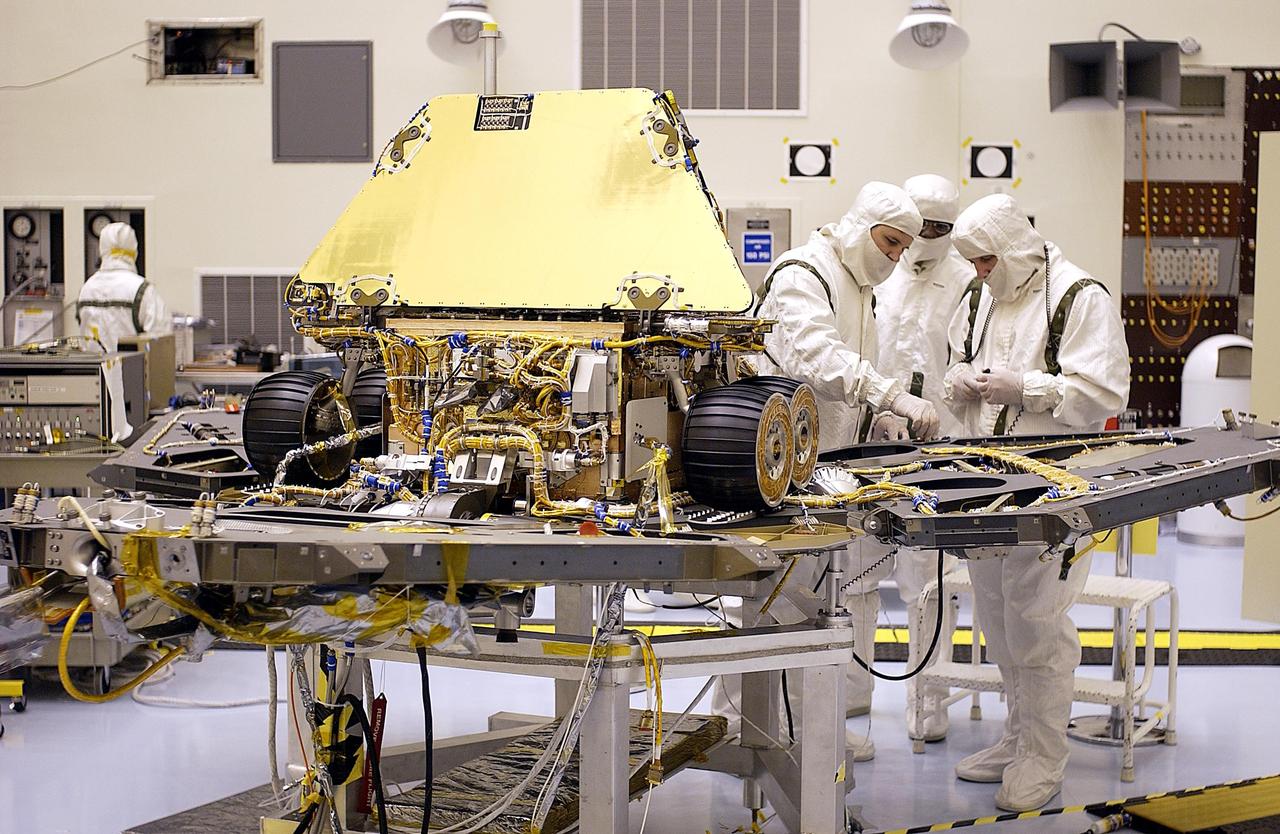
KENNEDY SPACE CENTER, FLA. -- In the Payload Hazardous Servicing Facility, the Mars Exploration Rover 2 (MER-2) has been installed on the base petal of the lander and the solar arrays have been stowed for flight. The cruise stage is in the background. There are two rovers, identical to each other, and each will land at different regions of Mars. They are designed to cover roughly 110 yards each Martian day over various terrain. Each rover will carry five scientific instruments that will allow it to search for evidence of liquid water that may have been present in the planet's past. The first rover has a launch window opening May 30, and the second rover a window opening June 25.
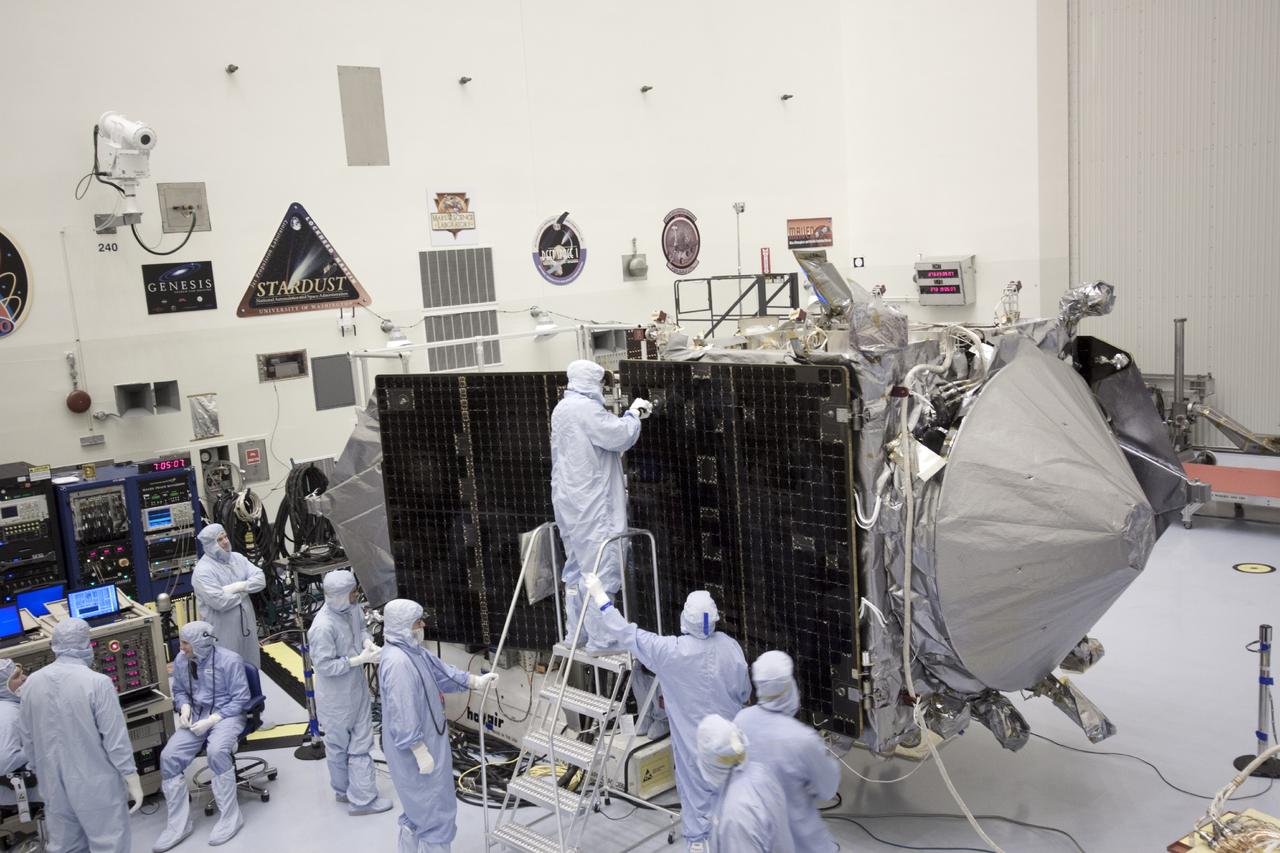
CAPE CANAVERAL, Fla. – Inside the Payload Hazardous Servicing Facility at NASA's Kennedy Space Center in Florida, engineers and technicians have begun the process to stow the power-generating solar arrays for the Mars Atmosphere and Volatile Evolution, or MAVEN, spacecraft. MAVEN is being prepared for its scheduled launch on Nov 18, 2013 from Cape Canaveral Air Force Station, Fla. atop a United Launch Alliance Atlas V rocket. Positioned in an orbit above the Red Planet, MAVEN will study the upper atmosphere of Mars in unprecedented detail. For more information, visit: http://www.nasa.gov/mission_pages/maven/main/index.html Photo credit: NASA/Jim Grossmann

CAPE CANAVERAL, Fla. – Inside the Payload Hazardous Servicing Facility at NASA's Kennedy Space Center in Florida, engineers and technicians have begun the process to stow the power-generating solar arrays for the Mars Atmosphere and Volatile Evolution, or MAVEN, spacecraft. MAVEN is being prepared for its scheduled launch on Nov 18, 2013 from Cape Canaveral Air Force Station, Fla. atop a United Launch Alliance Atlas V rocket. Positioned in an orbit above the Red Planet, MAVEN will study the upper atmosphere of Mars in unprecedented detail. For more information, visit: http://www.nasa.gov/mission_pages/maven/main/index.html Photo credit: NASA/Jim Grossmann
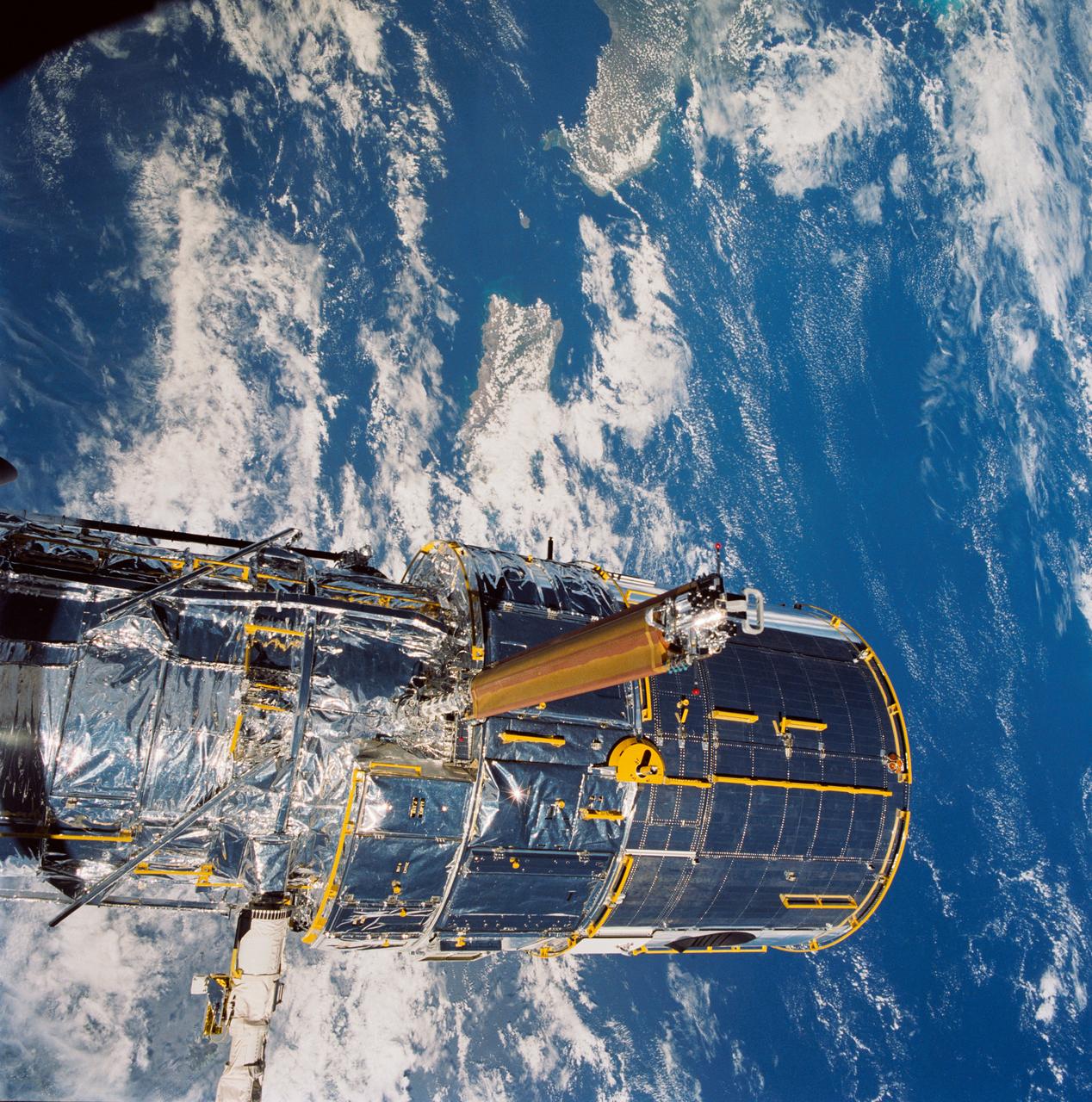
During STS-31, the Hubble Space Telescope (HST) grappled by the remote manipulator system (RMS) end effector is held in appendage deploy position above Discovery, Orbiter Vehicle (OV) 103. The solar array (SA) bistem cassette has been released from its latch fittings. The bistem spreader bars begin to unfurl the SA wing. The secondary deployment mechanism (SDM) handle is visible at the SA end. Stowed against either side of the HST System Support Module (SSM) forward shell are the high-gain antennae (HGA). Puerto Rico and the Dominican Republic are recognizable at the left of the frame.

KENNEDY SPACE CENTER, FLA. - In the Payload Hazardous Servicing Facility, the Mars Exploration Rover 2 (MER-2) has been installed on the base petal of the lander and the solar arrays have been stowed for flight. The cruise stage is in the background. There are two rovers, identical to each other, and each will land at different regions of Mars. They are designed to cover roughly 110 yards each Martian day over various terrain. Each rover will carry five scientific instruments that will allow it to search for evidence of liquid water that may have been present in the planet's past. The first rover has a launch window opening May 30, and the second rover a window opening June 25.
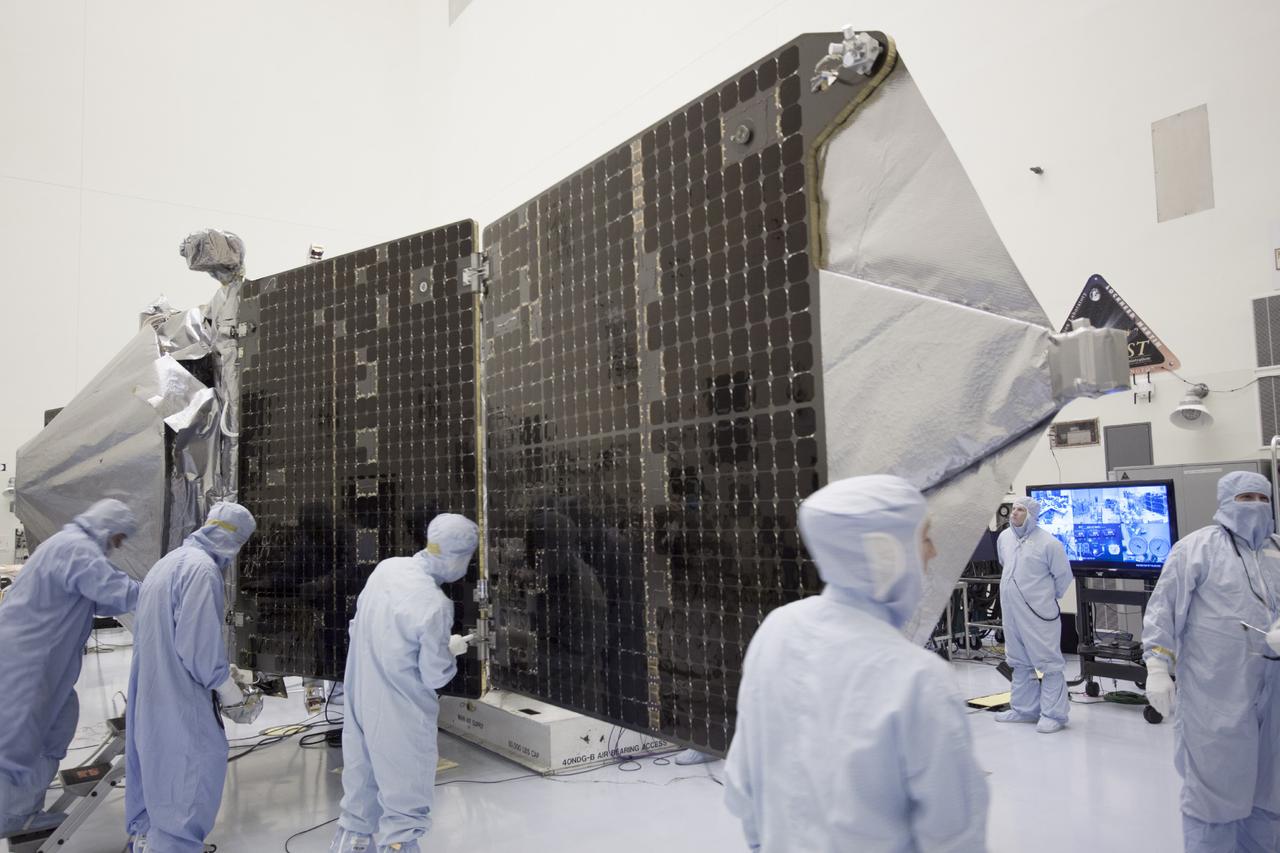
CAPE CANAVERAL, Fla. – Inside the Payload Hazardous Servicing Facility at NASA's Kennedy Space Center in Florida, engineers and technicians have begun the process to stow the power-generating solar arrays for the Mars Atmosphere and Volatile Evolution, or MAVEN, spacecraft. MAVEN is being prepared for its scheduled launch on Nov 18, 2013 from Cape Canaveral Air Force Station, Fla. atop a United Launch Alliance Atlas V rocket. Positioned in an orbit above the Red Planet, MAVEN will study the upper atmosphere of Mars in unprecedented detail. For more information, visit: http://www.nasa.gov/mission_pages/maven/main/index.html Photo credit: NASA/Jim Grossmann
CAPE CANAVERAL, Fla. – Inside the Payload Hazardous Servicing Facility at NASA's Kennedy Space Center in Florida, engineers and technicians have begun the process to stow the power-generating solar arrays for the Mars Atmosphere and Volatile Evolution, or MAVEN, spacecraft. MAVEN is being prepared for its scheduled launch on Nov 18, 2013 from Cape Canaveral Air Force Station, Fla. atop a United Launch Alliance Atlas V rocket. Positioned in an orbit above the Red Planet, MAVEN will study the upper atmosphere of Mars in unprecedented detail. For more information, visit: http://www.nasa.gov/mission_pages/maven/main/index.html Photo credit: NASA/Jim Grossmann
CAPE CANAVERAL, Fla. – Inside the Payload Hazardous Servicing Facility at NASA's Kennedy Space Center in Florida, engineers and technicians have begun the process to stow the power-generating solar arrays for the Mars Atmosphere and Volatile Evolution, or MAVEN, spacecraft. MAVEN is being prepared for its scheduled launch on Nov 18, 2013 from Cape Canaveral Air Force Station, Fla. atop a United Launch Alliance Atlas V rocket. Positioned in an orbit above the Red Planet, MAVEN will study the upper atmosphere of Mars in unprecedented detail. For more information, visit: http://www.nasa.gov/mission_pages/maven/main/index.html Photo credit: NASA/Jim Grossmann
CAPE CANAVERAL, Fla. – Inside the Payload Hazardous Servicing Facility at NASA's Kennedy Space Center in Florida, engineers and technicians have begun the process to stow the power-generating solar arrays for the Mars Atmosphere and Volatile Evolution, or MAVEN, spacecraft. MAVEN is being prepared for its scheduled launch on Nov 18, 2013 from Cape Canaveral Air Force Station, Fla. atop a United Launch Alliance Atlas V rocket. Positioned in an orbit above the Red Planet, MAVEN will study the upper atmosphere of Mars in unprecedented detail. For more information, visit: http://www.nasa.gov/mission_pages/maven/main/index.html Photo credit: NASA/Jim Grossmann
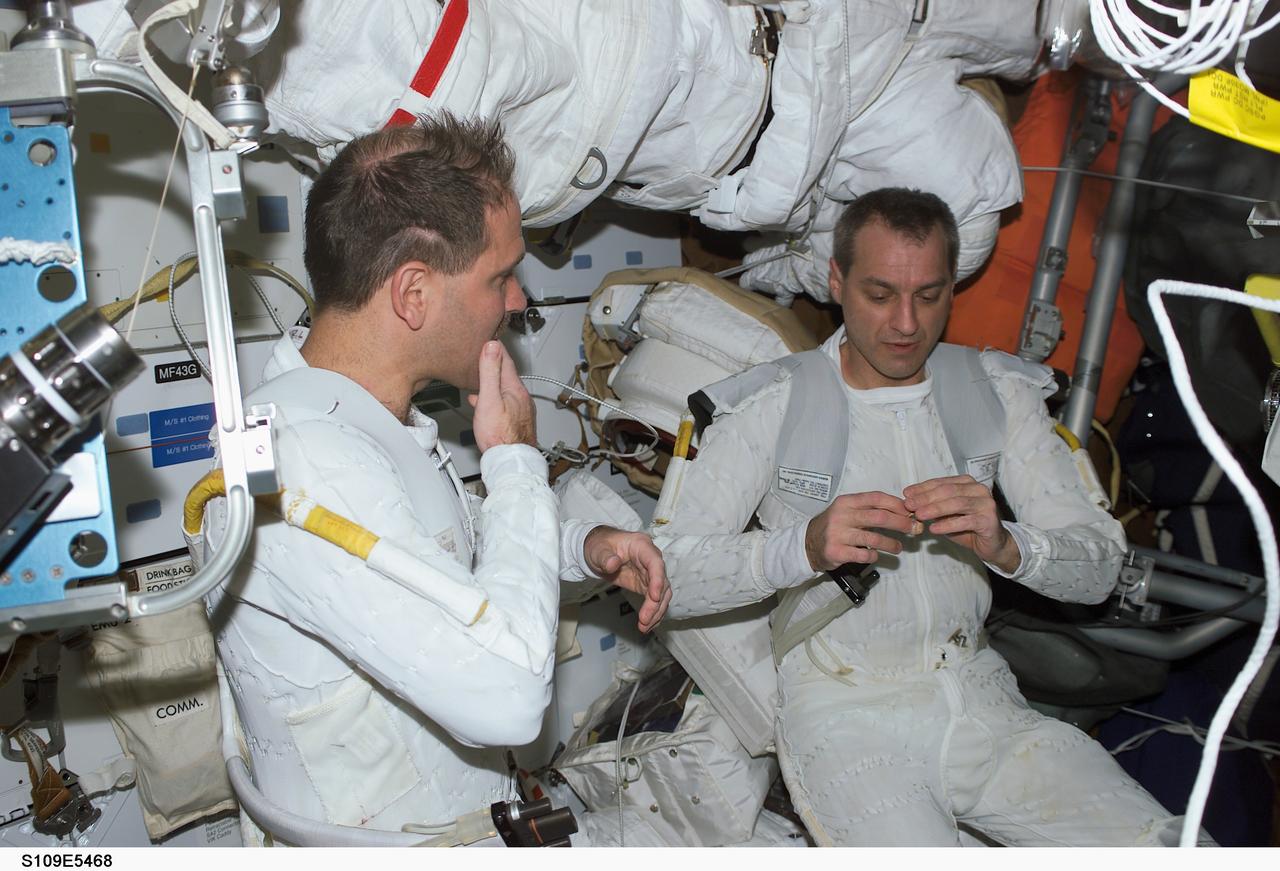
STS109-E-5468 (4 March 2002) --- Having just arrived back on board the crew cabin of the Space Shuttle Columbia, the first team of assigned space walkers for STS-109 talk about their shared seven-hour extravehicular activity while still attired in their thermal undergarments. Astronauts John M. Grunsfeld (left) and Richard M. Linnehan just completed the first of five scheduled STS-109 space walks to work on the Hubble Space Telescope (HST), successfully replacing the starboard solar array on the giant telescope. The next day's assignment will feature replacement of the port array by astronauts James H. Newman and Michael J. Massimino (both out of frame), whose extravehicular mobility unit (EMU)space suits can be seen stowed on the mid deck. This image was recorded with a digital still camera.
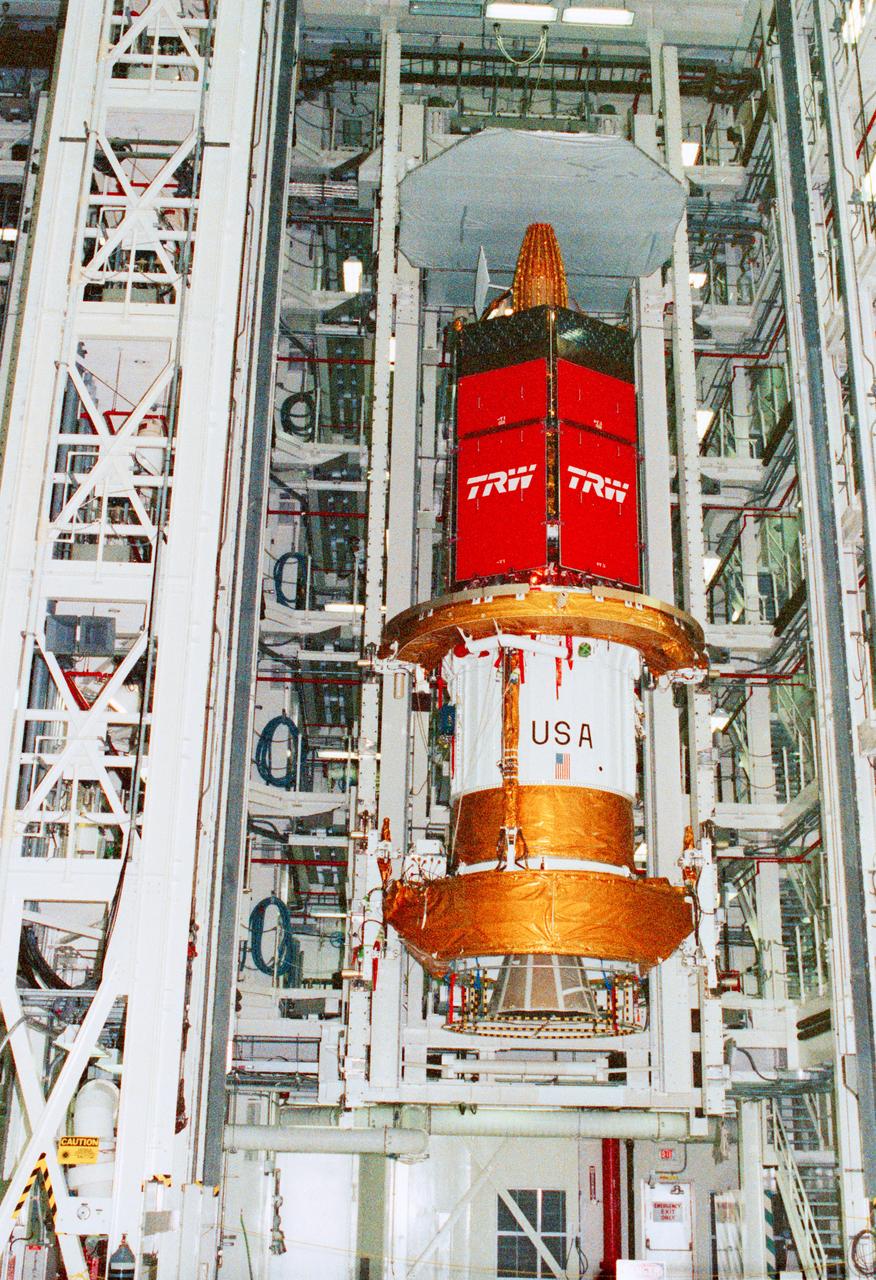
STS-43 Tracking and Data Relay Satellite E (TDRS-E) undergoes preflight processing in the Kennedy Space Center's (KSC's) Vertical Processing Facility (VPF) before being loaded into a payload canister for transfer to the launch pad and eventually into Atlantis', Orbiter Vehicle (OV) 104's, payload bay (PLB). This side of the TDRS-E will rest at the bottom of the PLB therefore the airborne support equipment (ASE) forward frame keel pin (at center of spacecraft) and the umbilical boom running between the two ASE frames are visible. The solar array panels are covered with protective TRW shields. Above the shields the stowed antenna and solar sail are visible. The inertial upper stage (IUS) booster is the white portion of the spacecraft and rests in the ASE forward frame and ASE aft frame tilt actuator (AFTA) frame (at the bottom of the IUS). The IUS booster nozzle extends beyond the AFTA frame. View provided by KSC with alternate number KSC-91PC-1079.

STS109-E-5244 (4 March 2002) --- Astronauts John M. Grunsfeld (red stripes on suit), payload commander, and Richard M. (Rick) Linnehan, mission specialist, participate in the first of their assigned STS-109 space walks to perform work on the Hubble Space Telescope (HST). The two went on to replace the giant telescope’s starboard solar array. Their seven-hour space walk ended at 7:38 a.m. (CST) or 13:38 GMT March 4, 2002.
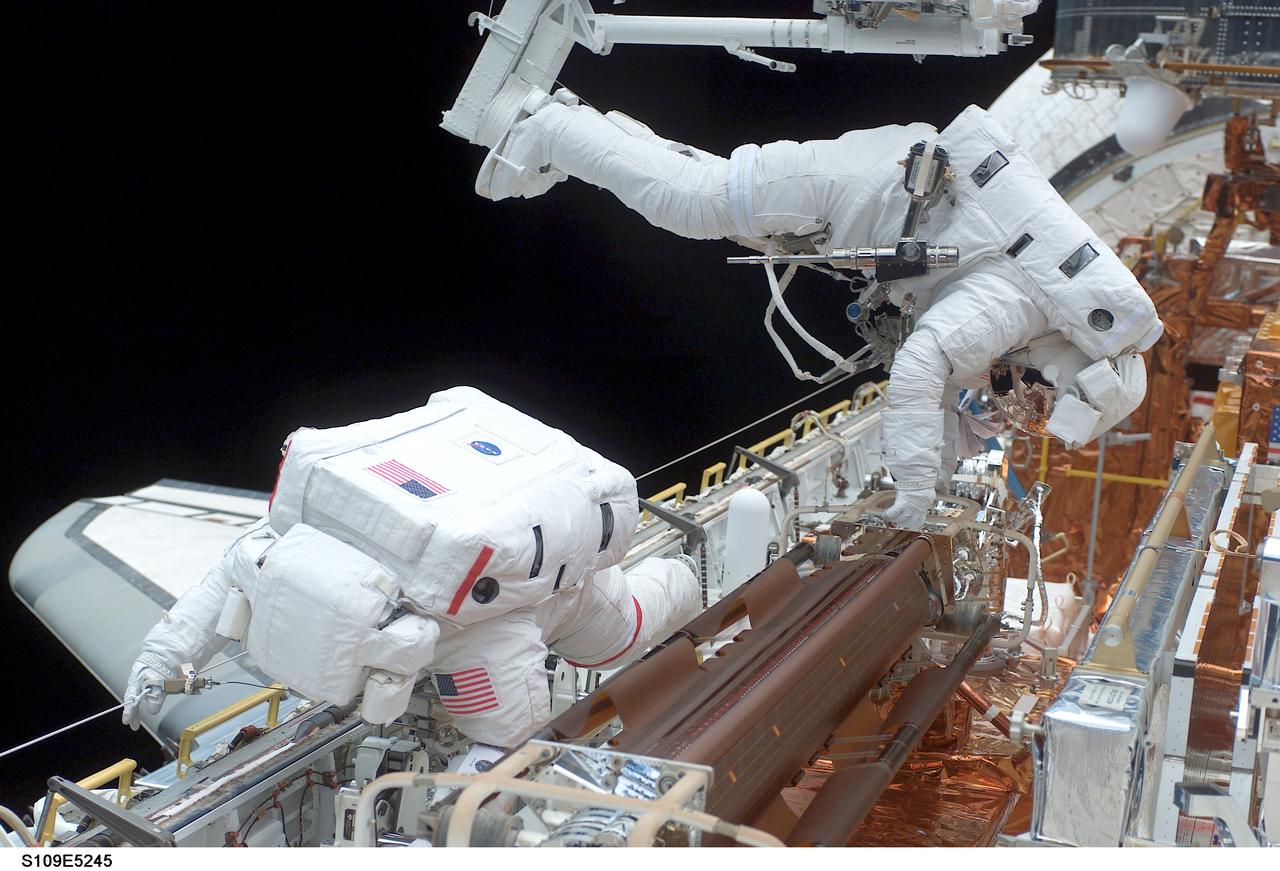
STS109-E-5245 (4 March 2002) --- Astronaut John M. Grunsfeld (foreground), payload commander, traverses along the longerons of the Space Shuttle Columbia while astronaut Richard M. Linnehan, mission specialist, uses the Remote Manipulator System's robotic arm to move around. The two, participating in the first of their assigned STS-109 space walks to perform work on the Hubble Space Telescope (HST), went on to replace the giant telescope’s starboard solar array. Their seven-hour space walk ended at 7:38 a.m. (CST) or 13:38 GMT March 4, 2002.
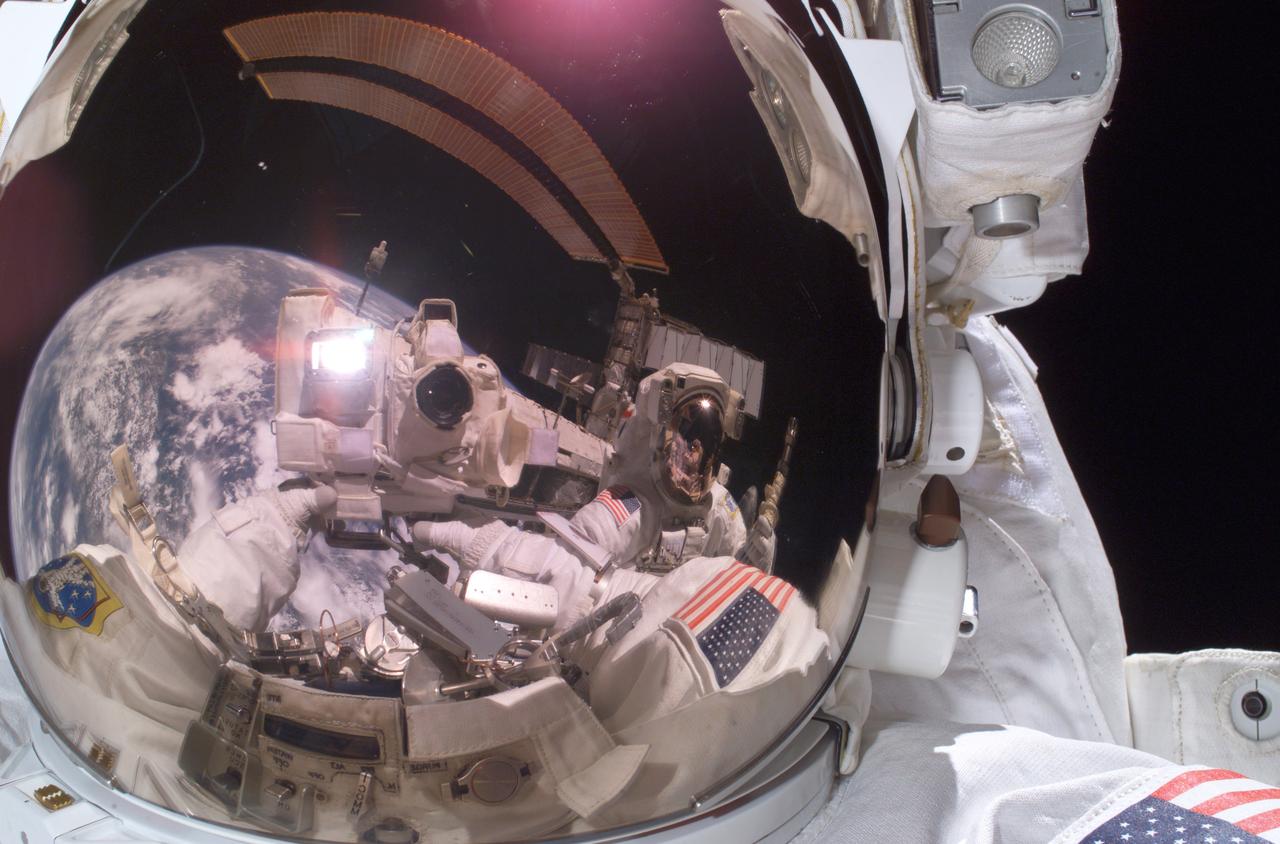
Astronaut Michael E. Fossum, STS-121 mission specialist, used a digital still camera to expose a photo of his helmet visor during a session of extravehicular activity (EVA) while Space Shuttle Discovery was docked with the International Space Station (ISS). Also visible in the visor reflections are fellow space walker Piers J. Sellers, mission specialist, Earth's horizon, and a station solar array. During its 12-day mission, this utilization and logistics flight delivered a multipurpose logistics module (MPLM) to the ISS with several thousand pounds of new supplies and experiments. In addition, some new orbital replacement units (ORUs) were delivered and stowed externally on the ISS on a special pallet. These ORUs are spares for critical machinery located on the outside of the ISS. During this mission the crew also carried out testing of Shuttle inspection and repair hardware, as well as evaluated operational techniques and concepts for conducting on-orbit inspection and repair.
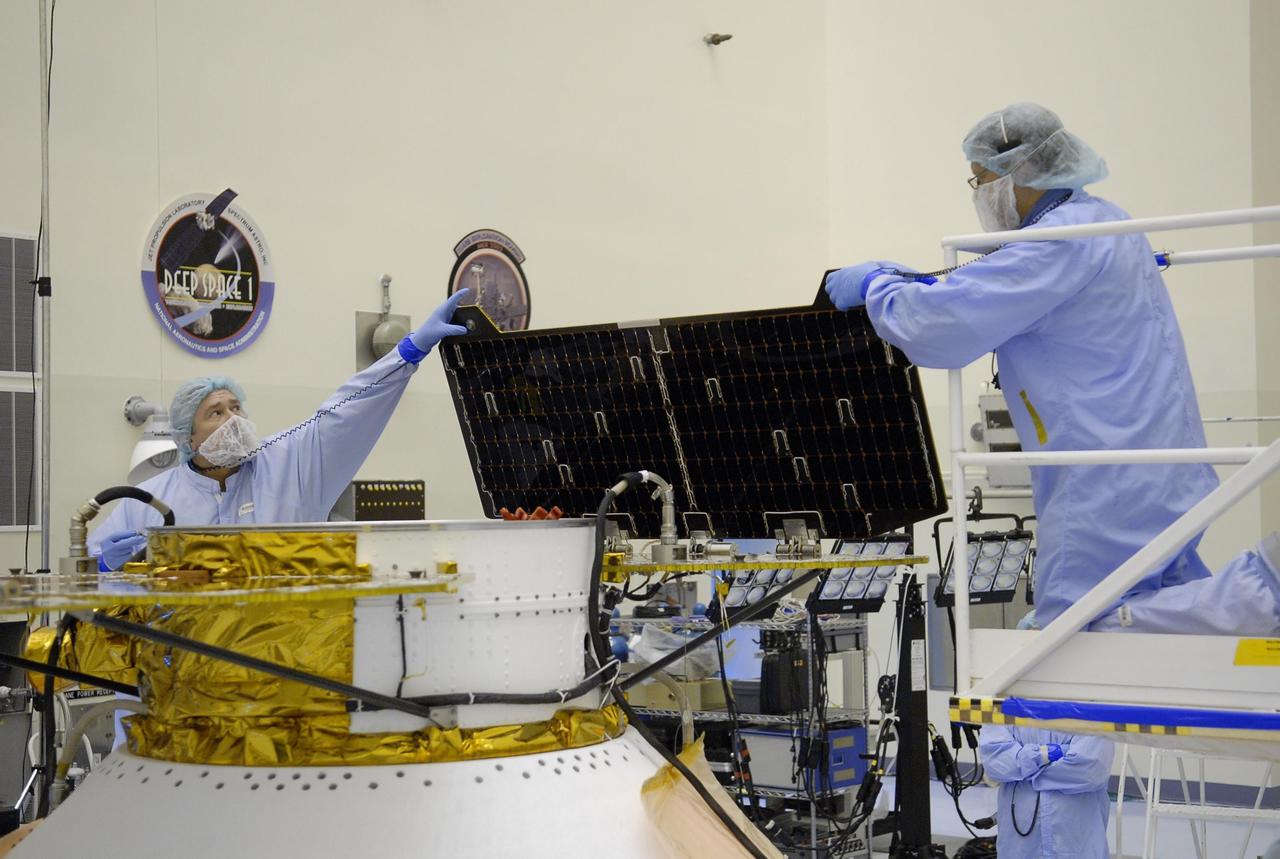
KENNEDY SPACE CENTER, FLA. -- After illumination testing of the solar array panels, technicians begin stowing the panels on the Phoenix Mars Lander spacecraft. The Phoenix will be launched toward Mars to land in icy soils near the planet's north polar permanent ice cap. It will explore the history of the water in these soils and any associated rocks, while monitoring polar climate. Landing on Mars is planned in May 2008 on arctic ground where a mission currently in orbit, Mars Odyssey, has detected high concentrations of ice just beneath the top layer of soil. Phoenix is scheduled to launch Aug. 3 from Pad 17-A at Cape Canaveral Air Force Station . Photo credit: NASA/Kim Shiflett
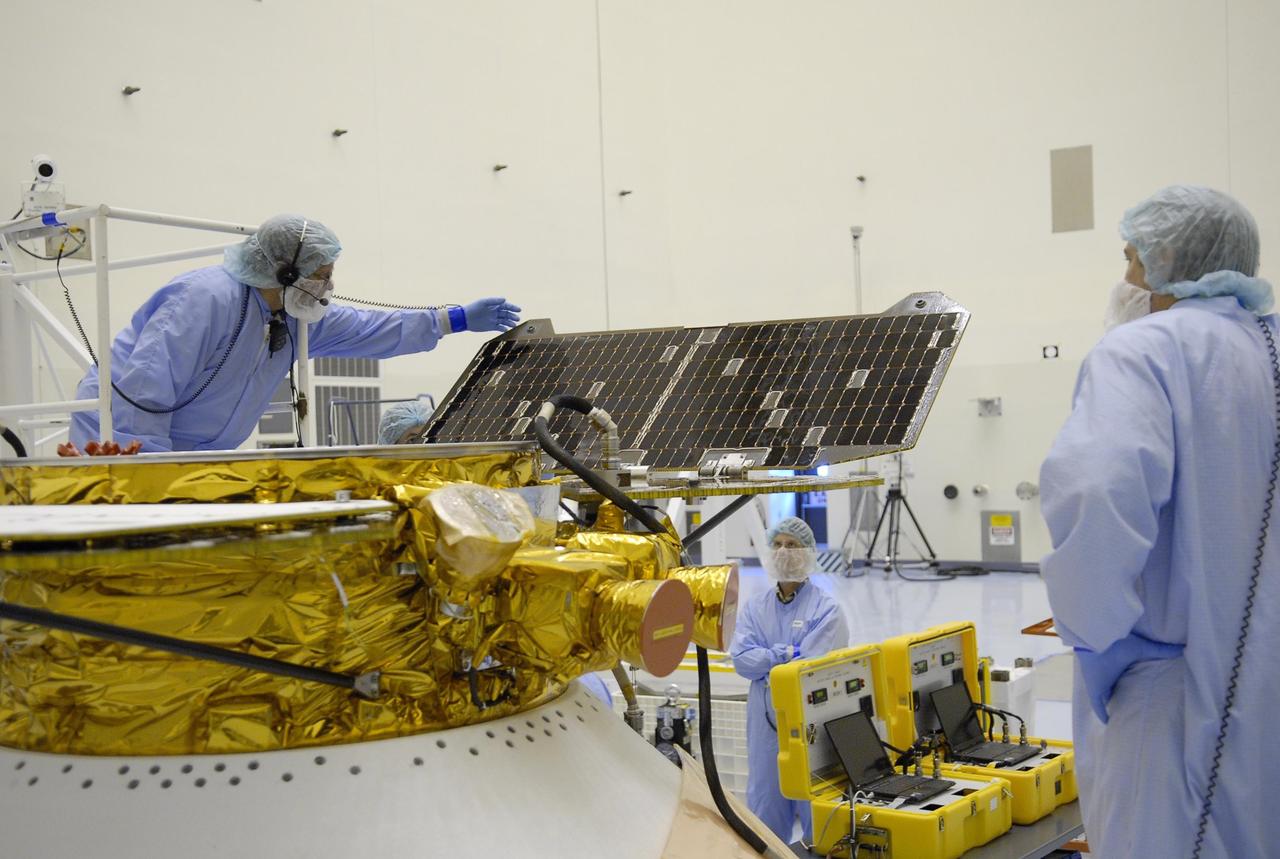
KENNEDY SPACE CENTER, FLA. -- After illumination testing of the solar array panels, technicians begin stowing the panels on the Phoenix Mars Lander spacecraft. The Phoenix will be launched toward Mars to land in icy soils near the planet's north polar permanent ice cap. It will explore the history of the water in these soils and any associated rocks, while monitoring polar climate. Landing on Mars is planned in May 2008 on arctic ground where a mission currently in orbit, Mars Odyssey, has detected high concentrations of ice just beneath the top layer of soil. Phoenix is scheduled to launch Aug. 3 from Pad 17-A at Cape Canaveral Air Force Station . Photo credit: NASA/Kim Shiflett
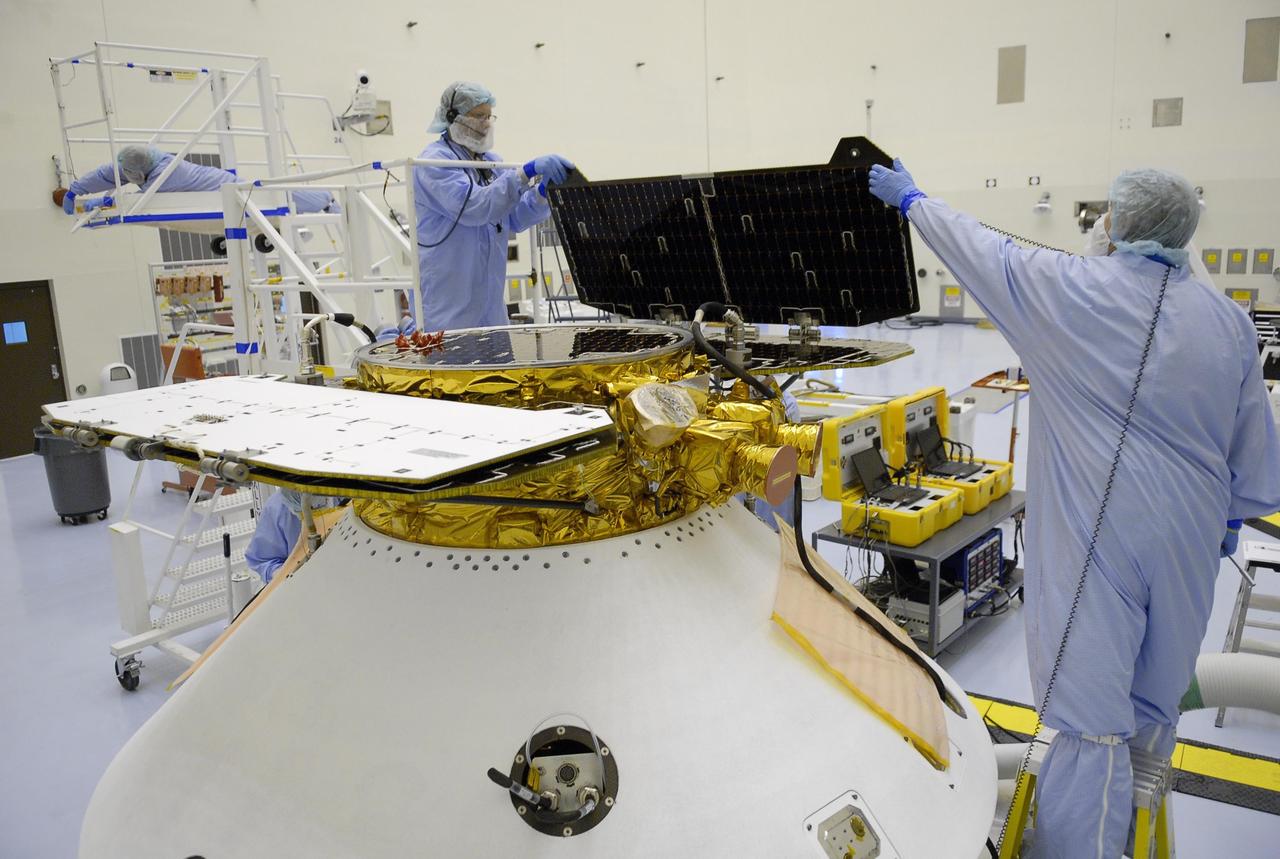
KENNEDY SPACE CENTER, FLA. -- After illumination testing of the solar array panels, technicians begin stowing the panels on the Phoenix Mars Lander spacecraft. The Phoenix will be launched toward Mars to land in icy soils near the planet's north polar permanent ice cap. It will explore the history of the water in these soils and any associated rocks, while monitoring polar climate. Landing on Mars is planned in May 2008 on arctic ground where a mission currently in orbit, Mars Odyssey, has detected high concentrations of ice just beneath the top layer of soil. Phoenix is scheduled to launch Aug. 3 from Pad 17-A at Cape Canaveral Air Force Station . Photo credit: NASA/Kim Shiflett
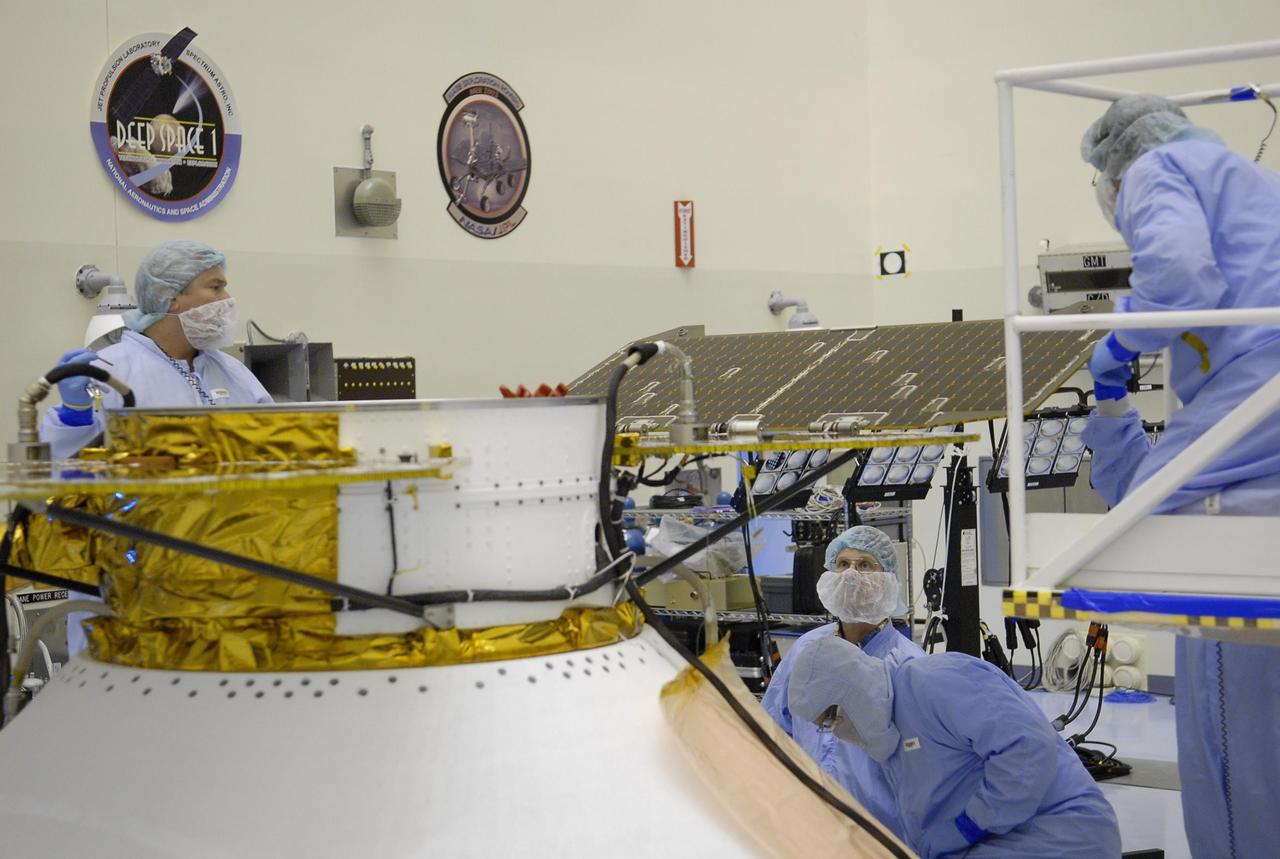
KENNEDY SPACE CENTER, FLA. -- After illumination testing of the solar array panels, technicians begin stowing the panels on the Phoenix Mars Lander spacecraft. The Phoenix will be launched toward Mars to land in icy soils near the planet's north polar permanent ice cap. It will explore the history of the water in these soils and any associated rocks, while monitoring polar climate. Landing on Mars is planned in May 2008 on arctic ground where a mission currently in orbit, Mars Odyssey, has detected high concentrations of ice just beneath the top layer of soil. Phoenix is scheduled to launch Aug. 3 from Pad 17-A at Cape Canaveral Air Force Station . Photo credit: NASA/Kim Shiflett
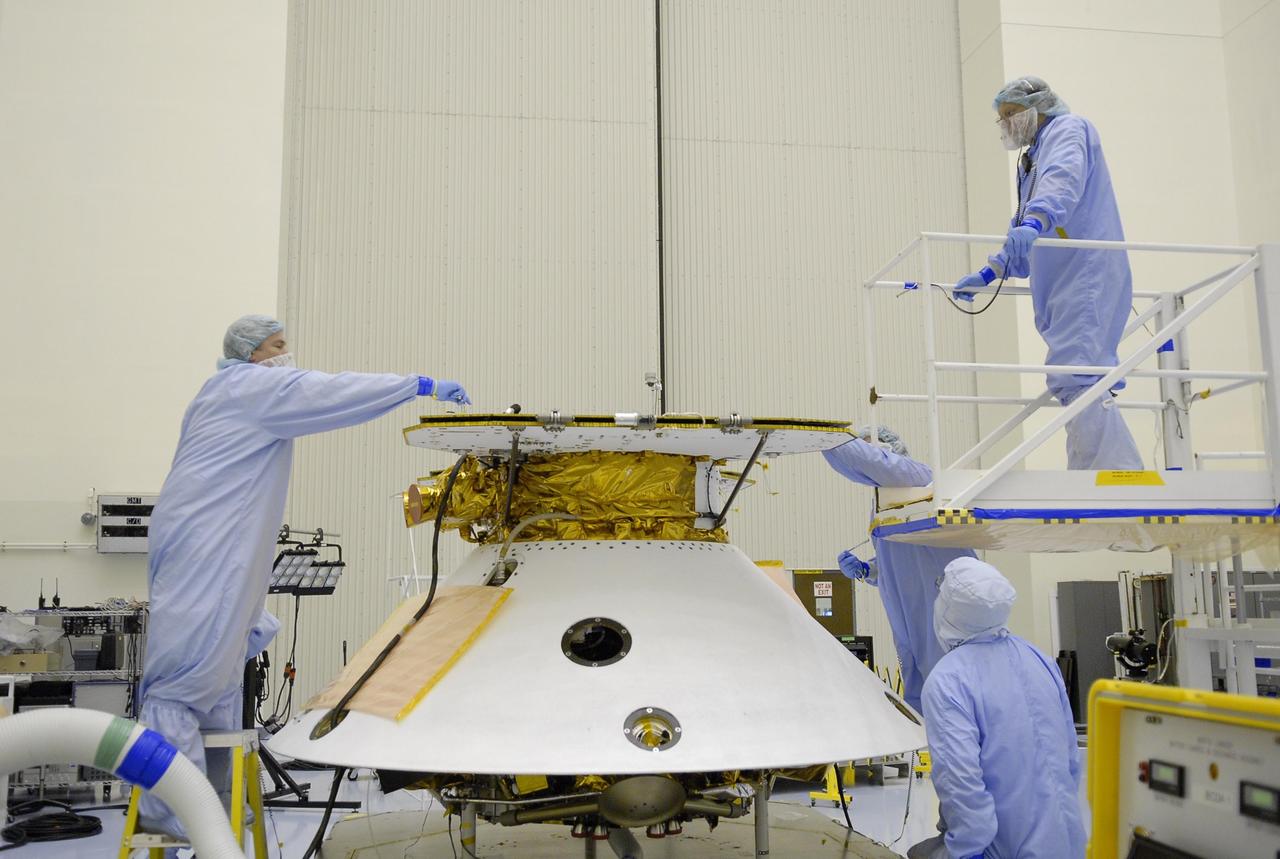
KENNEDY SPACE CENTER, FLA. -- After illumination testing of the solar array panels, technicians complete stowing the panels on the Phoenix Mars Lander spacecraft. The Phoenix will be launched toward Mars to land in icy soils near the planet's north polar permanent ice cap. It will explore the history of the water in these soils and any associated rocks, while monitoring polar climate. Landing on Mars is planned in May 2008 on arctic ground where a mission currently in orbit, Mars Odyssey, has detected high concentrations of ice just beneath the top layer of soil. Phoenix is scheduled to launch Aug. 3 from Pad 17-A at Cape Canaveral Air Force Station . Photo credit: NASA/Kim Shiflett