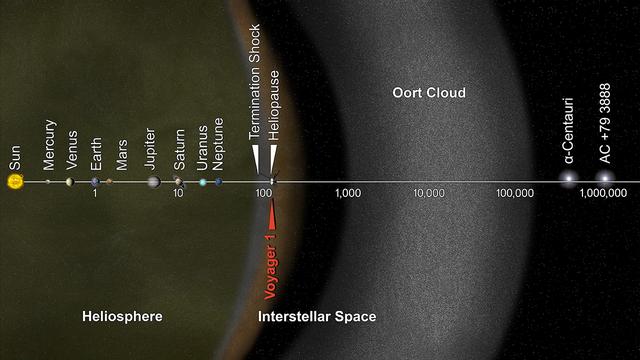
This artist's concept puts solar system distances in perspective. The scale bar is in astronomical units, with each set distance beyond 1 AU representing 10 times the previous distance. One AU is the distance from the sun to the Earth, which is about 93 million miles or 150 million kilometers. Neptune, the most distant planet from the sun, is about 30 AU. Informally, the term "solar system" is often used to mean the space out to the last planet. Scientific consensus, however, says the solar system goes out to the Oort Cloud, the source of the comets that swing by our sun on long time scales. Beyond the outer edge of the Oort Cloud, the gravity of other stars begins to dominate that of the sun. The inner edge of the main part of the Oort Cloud could be as close as 1,000 AU from our sun. The outer edge is estimated to be around 100,000 AU. NASA's Voyager 1, humankind's most distant spacecraft, is around 125 AU. Scientists believe it entered interstellar space, or the space between stars, on Aug. 25, 2012. Much of interstellar space is actually inside our solar system. It will take about 300 years for Voyager 1 to reach the inner edge of the Oort Cloud and possibly about 30,000 years to fly beyond it. Alpha Centauri is currently the closest star to our solar system. But, in 40,000 years, Voyager 1 will be closer to the star AC +79 3888 than to our own sun. AC +79 3888 is actually traveling faster toward Voyager 1 than the spacecraft is traveling toward it. The Voyager spacecraft were built and continue to be operated by NASA's Jet Propulsion Laboratory, in Pasadena, Calif. Caltech manages JPL for NASA. The Voyager missions are a part of NASA's Heliophysics System Observatory, sponsored by the Heliophysics Division of the Science Mission Directorate at NASA Headquarters in Washington. For more information about Voyager, visit: <a href="http://www.nasa.gov/voyager" rel="nofollow">www.nasa.gov/voyager</a> and <a href="http://voyager.jpl.nasa.gov" rel="nofollow">voyager.jpl.nasa.gov</a> . Image credit: NASA/JPL-Caltech <b><a href="http://www.nasa.gov/audience/formedia/features/MP_Photo_Guidelines.html" rel="nofollow">NASA image use policy.</a></b> <b><a href="http://www.nasa.gov/centers/goddard/home/index.html" rel="nofollow">NASA Goddard Space Flight Center</a></b> enables NASA’s mission through four scientific endeavors: Earth Science, Heliophysics, Solar System Exploration, and Astrophysics. Goddard plays a leading role in NASA’s accomplishments by contributing compelling scientific knowledge to advance the Agency’s mission. <b>Follow us on <a href="http://twitter.com/NASAGoddardPix" rel="nofollow">Twitter</a></b> <b>Like us on <a href="http://www.facebook.com/pages/Greenbelt-MD/NASA-Goddard/395013845897?ref=tsd" rel="nofollow">Facebook</a></b> <b>Find us on <a href="http://instagram.com/nasagoddard?vm=grid" rel="nofollow">Instagram</a></b>

Five hundred million years after the sun was born, Jupiter’s massive gravity disrupts countless asteroids and comets. These hammer down on the inner planets. Did this impact deliver water and organics? The key ingredients to life? OSIRIRS-REx is a NASA sample return mission to visit Asteroid Bennu. We plan to grab a piece of Bennu, because it’s a time capsule that can tell us about the origins of our planet and our entire solar system. Watch the full video: <a href="http://youtu.be/gtUgarROs08" rel="nofollow">youtu.be/gtUgarROs08</a> Learn more about NASA’s OSIRIS-REx mission and the making of Bennu’s Journey: <a href="http://www.nasa.gov/content/goddard/bennus-journey/" rel="nofollow">www.nasa.gov/content/goddard/bennus-journey/</a> More information on the OSIRIS-REx mission is available at: <a href="http://www.nasa.gov/mission_pages/osiris-rex/index.html" rel="nofollow">www.nasa.gov/mission_pages/osiris-rex/index.html</a> <a href="http://www.asteroidmission.org" rel="nofollow">www.asteroidmission.org</a> <b><a href="http://www.nasa.gov/audience/formedia/features/MP_Photo_Guidelines.html" rel="nofollow">NASA image use policy.</a></b> <b><a href="http://www.nasa.gov/centers/goddard/home/index.html" rel="nofollow">NASA Goddard Space Flight Center</a></b> enables NASA’s mission through four scientific endeavors: Earth Science, Heliophysics, Solar System Exploration, and Astrophysics. Goddard plays a leading role in NASA’s accomplishments by contributing compelling scientific knowledge to advance the Agency’s mission. <b>Follow us on <a href="http://twitter.com/NASAGoddardPix" rel="nofollow">Twitter</a></b> <b>Like us on <a href="http://www.facebook.com/pages/Greenbelt-MD/NASA-Goddard/395013845897?ref=tsd" rel="nofollow">Facebook</a></b> <b>Find us on <a href="http://instagram.com/nasagoddard?vm=grid" rel="nofollow">Instagram</a></b>

This large asteroid, a proto-star undergoes fusion and our sun is born. This is the parent of Asteroid Bennu. Today, a NASA Spacecraft has the chance to retrieve a sample from Bennu to reveal the history of our solar system. OSIRIRS-REx is a NASA sample return mission to visit Asteroid Bennu. We plan to grab a piece of Bennu, because it’s a time capsule that can tell us about the origins of our planet and our entire solar system. Watch the full video: <a href="http://youtu.be/gtUgarROs08" rel="nofollow">youtu.be/gtUgarROs08</a> Learn more about NASA’s OSIRIS-REx mission and the making of Bennu’s Journey: <a href="http://www.nasa.gov/content/goddard/bennus-journey/" rel="nofollow">www.nasa.gov/content/goddard/bennus-journey/</a> More information on the OSIRIS-REx mission is available at: <a href="http://www.nasa.gov/mission_pages/osiris-rex/index.html" rel="nofollow">www.nasa.gov/mission_pages/osiris-rex/index.html</a> <a href="http://www.asteroidmission.org" rel="nofollow">www.asteroidmission.org</a> <b><a href="http://www.nasa.gov/audience/formedia/features/MP_Photo_Guidelines.html" rel="nofollow">NASA image use policy.</a></b> <b><a href="http://www.nasa.gov/centers/goddard/home/index.html" rel="nofollow">NASA Goddard Space Flight Center</a></b> enables NASA’s mission through four scientific endeavors: Earth Science, Heliophysics, Solar System Exploration, and Astrophysics. Goddard plays a leading role in NASA’s accomplishments by contributing compelling scientific knowledge to advance the Agency’s mission. <b>Follow us on <a href="http://twitter.com/NASAGoddardPix" rel="nofollow">Twitter</a></b> <b>Like us on <a href="http://www.facebook.com/pages/Greenbelt-MD/NASA-Goddard/395013845897?ref=tsd" rel="nofollow">Facebook</a></b> <b>Find us on <a href="http://instagram.com/nasagoddard?vm=grid" rel="nofollow">Instagram</a></b>
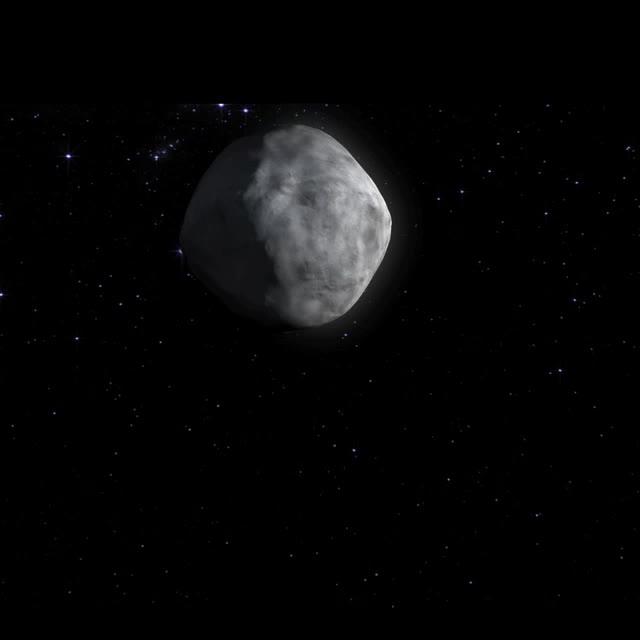
Asteroid Bennu is a time capsule, containing the raw ingredients of the solar system. Bennu has settled in a near-Earth orbit. Today, a NASA spacecraft OSIRIS-REx is going to retrieve a sample to learn more about our Solar System’s history. OSIRIRS-REx is a NASA sample return mission to visit Asteroid Bennu. We plan to grab a piece of Bennu, because it’s a time capsule that can tell us about the origins of our planet and our entire solar system. Watch the full video: <a href="http://youtu.be/gtUgarROs08" rel="nofollow">youtu.be/gtUgarROs08</a> Learn more about NASA’s OSIRIS-REx mission and the making of Bennu’s Journey: <a href="http://www.nasa.gov/content/goddard/bennus-journey/" rel="nofollow">www.nasa.gov/content/goddard/bennus-journey/</a> More information on the OSIRIS-REx mission is available at: <a href="http://www.nasa.gov/mission_pages/osiris-rex/index.html" rel="nofollow">www.nasa.gov/mission_pages/osiris-rex/index.html</a> <a href="http://www.asteroidmission.org" rel="nofollow">www.asteroidmission.org</a> <b><a href="http://www.nasa.gov/audience/formedia/features/MP_Photo_Guidelines.html" rel="nofollow">NASA image use policy.</a></b> <b><a href="http://www.nasa.gov/centers/goddard/home/index.html" rel="nofollow">NASA Goddard Space Flight Center</a></b> enables NASA’s mission through four scientific endeavors: Earth Science, Heliophysics, Solar System Exploration, and Astrophysics. Goddard plays a leading role in NASA’s accomplishments by contributing compelling scientific knowledge to advance the Agency’s mission. <b>Follow us on <a href="http://twitter.com/NASAGoddardPix" rel="nofollow">Twitter</a></b> <b>Like us on <a href="http://www.facebook.com/pages/Greenbelt-MD/NASA-Goddard/395013845897?ref=tsd" rel="nofollow">Facebook</a></b> <b>Find us on <a href="http://instagram.com/nasagoddard?vm=grid" rel="nofollow">Instagram</a></b>