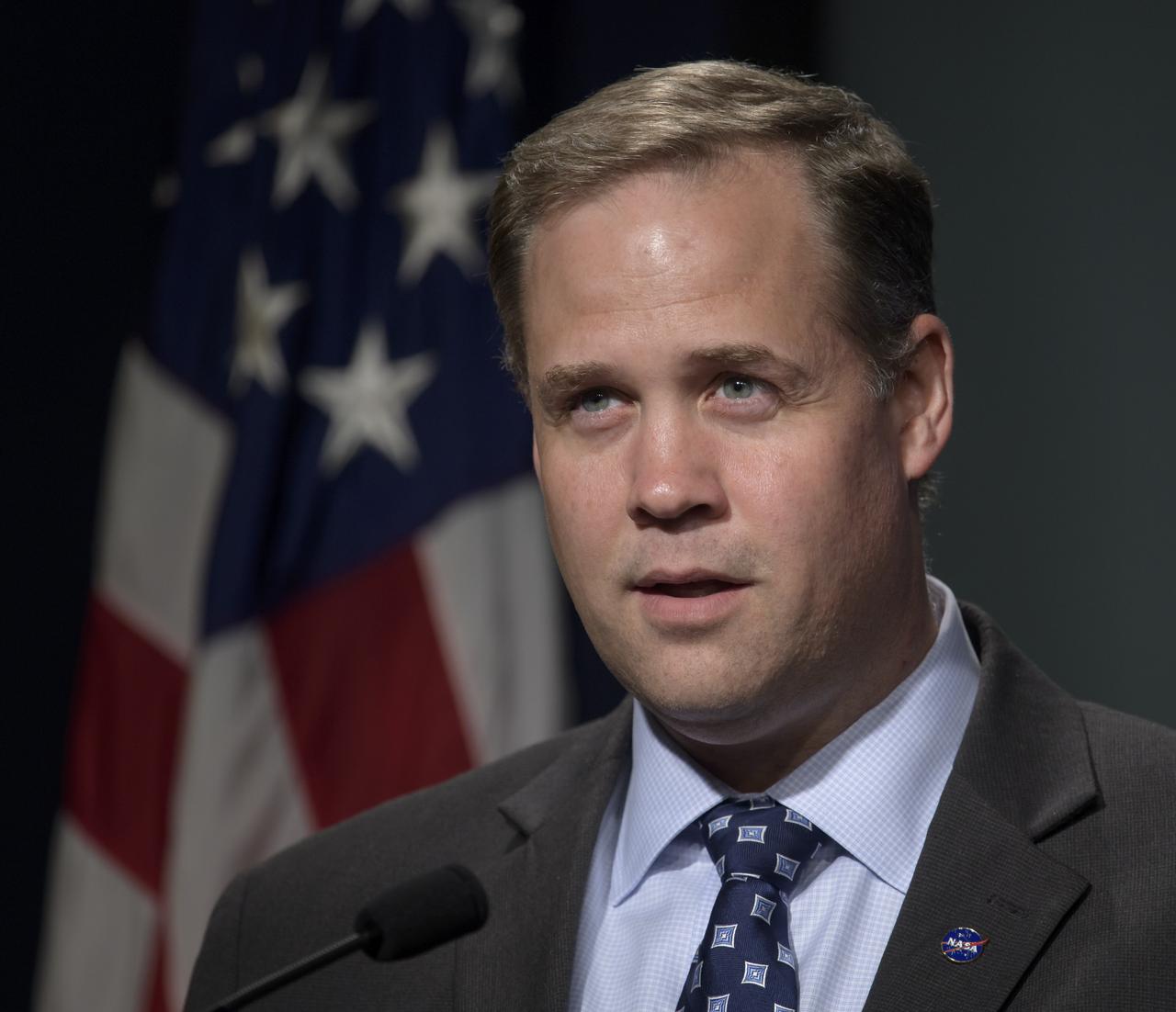
NASA Administrator Jim Bridenstine asks commercial companies to help get the agency back to the Moon as quickly as possible during an ‘industry day', Tuesday, May 8, 2018 held at NASA Headquarters in Washington. NASA is calling for commercial proposals for delivering instruments, experiments, and other small payloads to the surface of the Moon as early as next year. This solicitation is part of a broader Exploration Campaign that will pave the way for a human return to the Moon. Photo Credit: (NASA/Bill Ingalls)
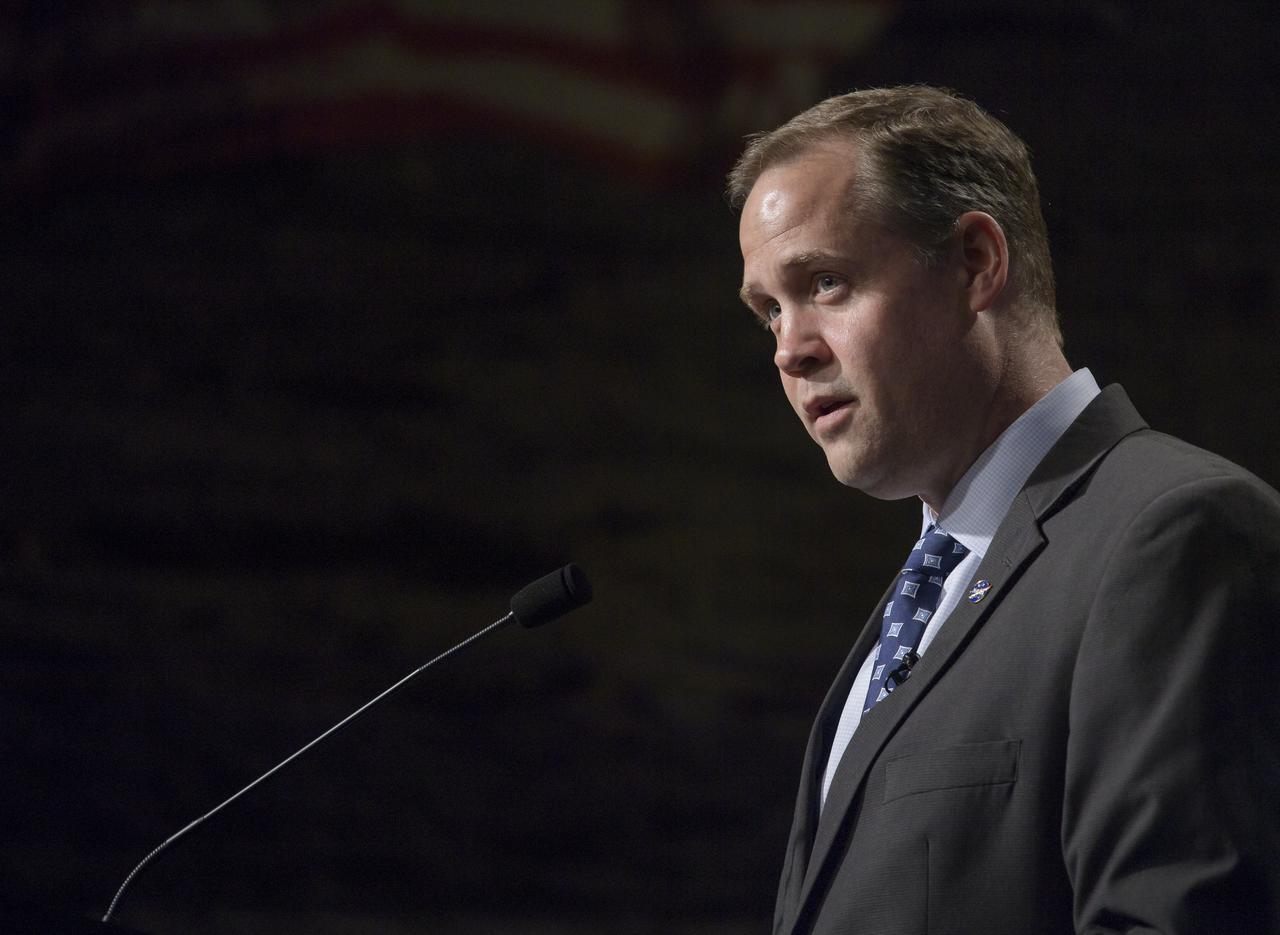
NASA Administrator Jim Bridenstine asks commercial companies to help get the agency back to the Moon as quickly as possible during an ‘industry day', Tuesday, May 8, 2018 held at NASA Headquarters in Washington. NASA is calling for commercial proposals for delivering instruments, experiments, and other small payloads to the surface of the Moon as early as next year. This solicitation is part of a broader Exploration Campaign that will pave the way for a human return to the Moon. Photo Credit: (NASA/Bill Ingalls)
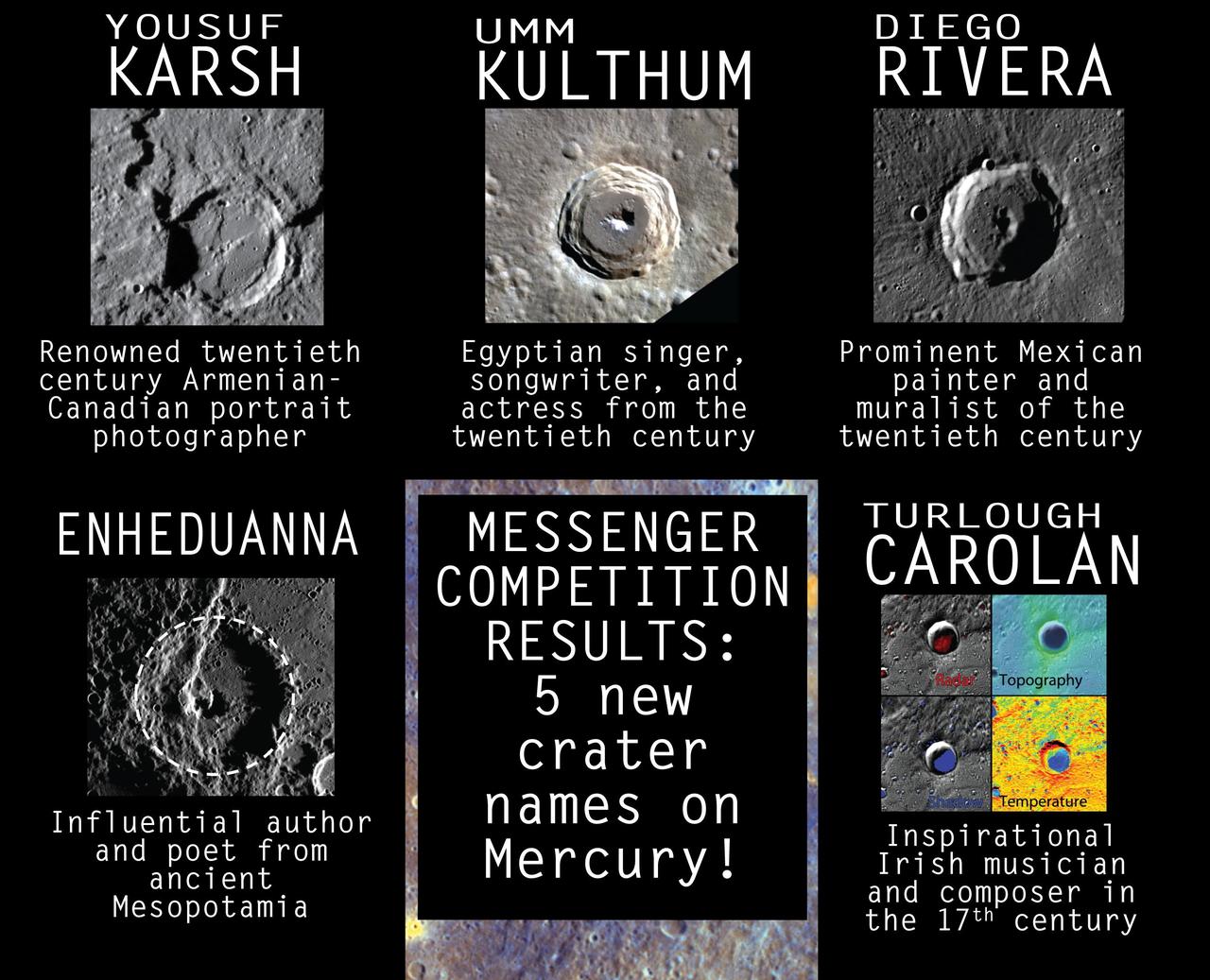
Five previously unnamed craters on Mercury now have names. MESSENGER's Education and Public Outreach (EPO) team led a contest that solicited naming suggestions from the public via a competition website. In total, 3,600 contest entries were received and a semi-final list of 17 names were submitted to the International Astronomical Union (IAU) for consideration. The IAU selected the final five crater names, keeping with the convention that Mercury's craters are named after those who have made significant contributions to the humanities. And the winners are: Carolan: (83.8° N, 31.7° E) Named for Turlough O'Carolan, the Irish musician and composer (1670-1738) Enheduanna: (48.3° N, 326.2° E) Named for the author and poet from ancient Mesopotamia Karsh (35.6° S, 78.9° E) Named for Yousuf Karsh, twentieth century Armenian-Canadian portrait photographer Kulthum (50.7° N, 93.5° E) Named for Umm Kulthum, twentieth century Egyptian singer, songwriter, and actress Rivera: (69.3° N, 32.4° E) Named for Diego Rivera, twentieth century Mexican painter and muralist http://photojournal.jpl.nasa.gov/catalog/PIA19439

NASA's Earth Surface Mineral Dust Source Investigation (EMIT) detected a cluster of 12 methane plumes on Sept. 1, 2022, in an approximately 150-square-mile (400-square-kilometer) region of southern Uzbekistan. Methane is a potent greenhouse gas about 80 times more effective at trapping heat than carbon dioxide during the time methane spends in the atmosphere, which is typically about a decade. This an area no NASA airborne imaging spectrometers have covered. Whereas EMIT captured the scene in an instant, an airborne campaign might have taken about 65 hours of flight time to cover the same amount of land. The blue shading covers the area captured by EMIT in one "scene," which is 50 miles by 50 miles (80 kilometers by 80 kilometers). The emissions total about 49,734 pounds (22,559 kilograms) per hour. EMIT uses an imaging spectrometer to detect the unique pattern of reflected and absorbed light – called a spectral fingerprint – from various materials on Earth's surface and in its atmosphere. Perched on the International Space Station, EMIT was originally intended to map the prevalence of minerals in Earth's arid regions, such as the deserts of Africa and Australia. Scientists verified that EMIT could also detect methane and carbon dioxide when they were checking the accuracy of the image spectrometer's mineral data. EMIT was selected from the Earth Venture Instrument-4 solicitation under the Earth Science Division of NASA Science Mission Directorate and was developed at NASA's Jet Propulsion Laboratory, which is managed for the agency by Caltech in Pasadena, California. It launched aboard a SpaceX Dragon resupply spacecraft from NASA's Kennedy Space Center in Florida on July 14, 2022. The instrument's data will be delivered to the NASA Land Processes Distributed Active Archive Center (DAAC) for use by other researchers and the public. https://photojournal.jpl.nasa.gov/catalog/PIA26113
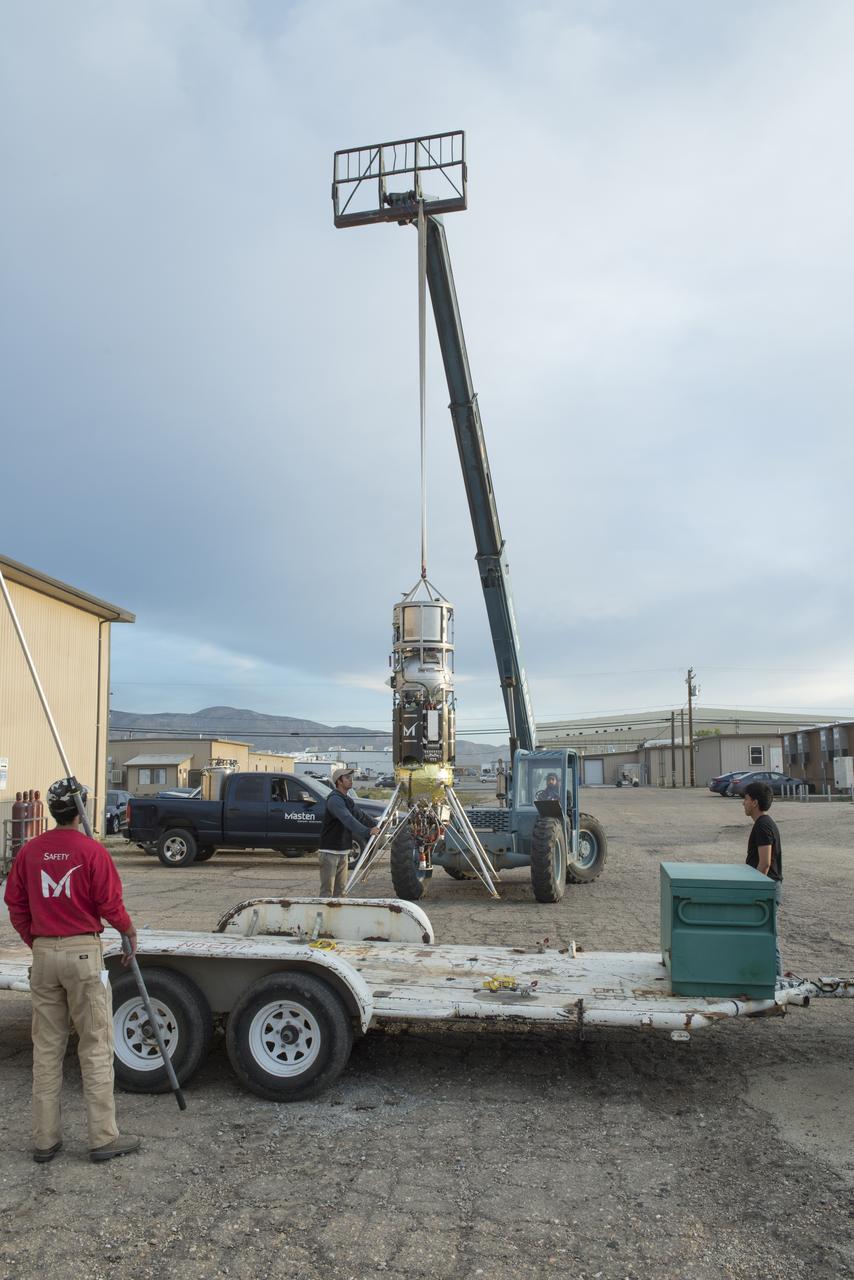
Masten Space Systems’ technician making adjustments to NASA’s autonomous landing technologies payload on Masten’s Xodiac rocket.