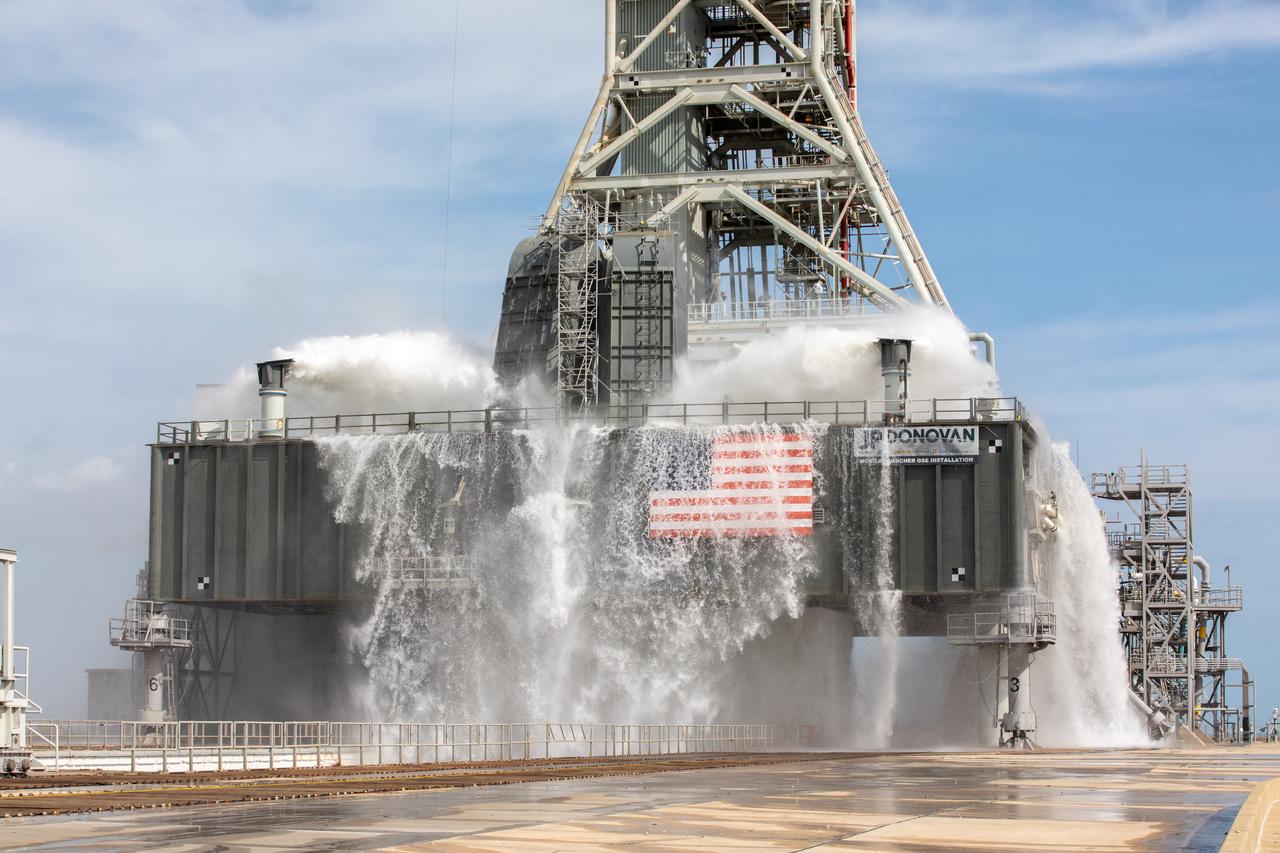
A wet flow test at Launch Pad 39B on September 13, 2019, tests the sound suppression system that will be used for launch of NASA’s Space Launch System for the Artemis I mission. During the test, about 450,000 gallons of water poured onto the Pad B flame deflector, the mobile launcher flame hole and onto the launcher’s blast deck. This was the first time the ground launch sequencer that will be used on the day of launch was used for the timing of a sound suppression test.
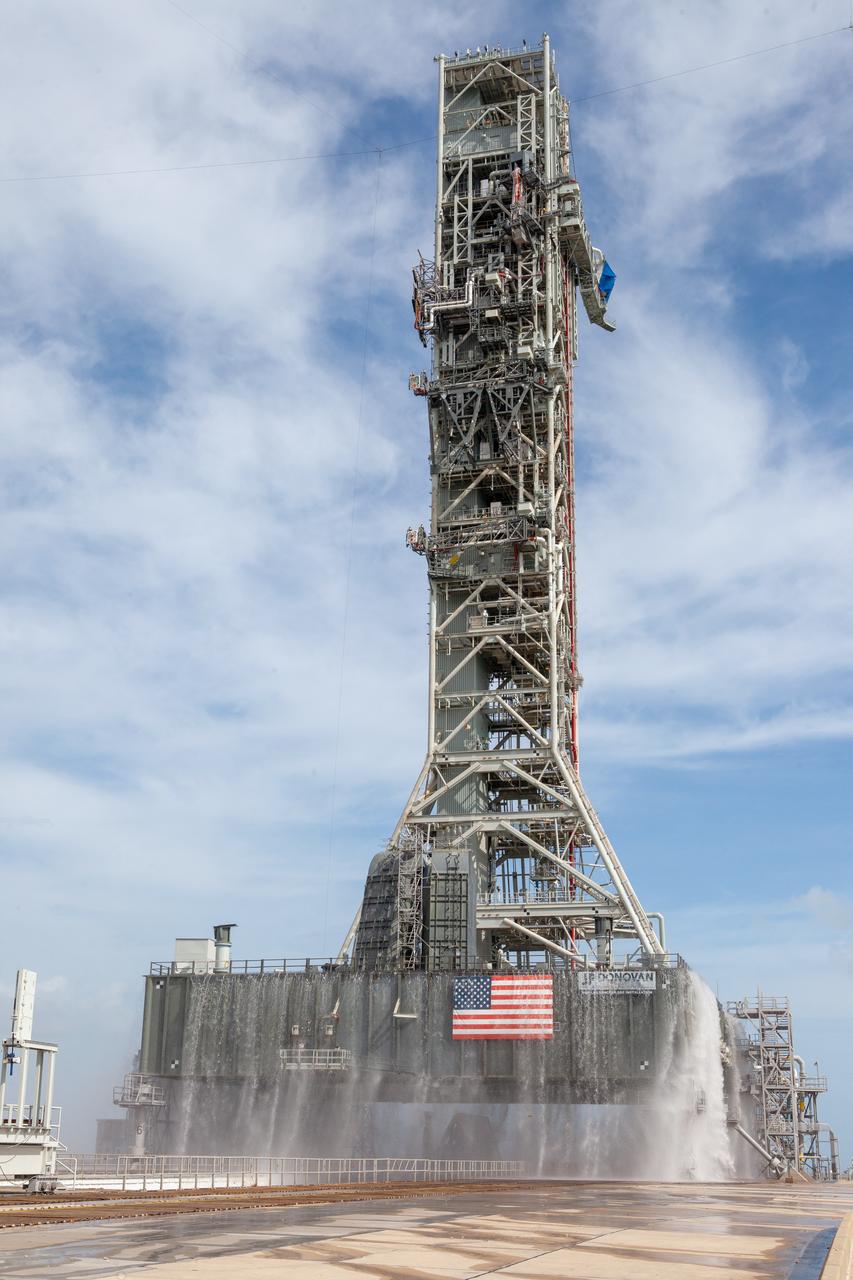
A wet flow test at Launch Pad 39B on September 13, 2019, tests the sound suppression system that will be used for launch of NASA’s Space Launch System for the Artemis I mission. During the test, about 450,000 gallons of water poured onto the Pad B flame deflector, the mobile launcher flame hole and onto the launcher’s blast deck. This was the first time the ground launch sequencer that will be used on the day of launch was used for the timing of a sound suppression test.
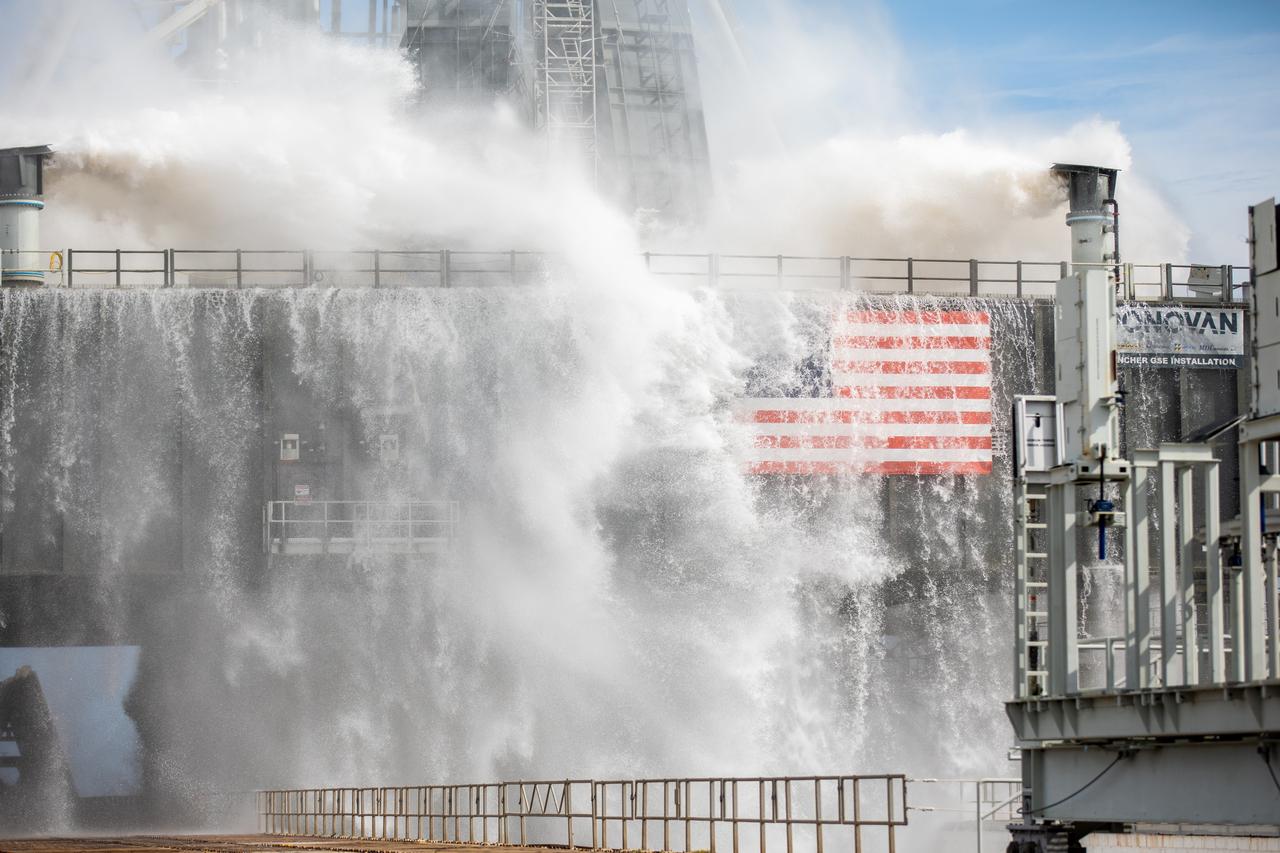
A wet flow test at Launch Pad 39B on September 13, 2019, tests the sound suppression system that will be used for launch of NASA’s Space Launch System for the Artemis I mission. During the test, about 450,000 gallons of water poured onto the Pad B flame deflector, the mobile launcher flame hole and onto the launcher’s blast deck. This was the first time the ground launch sequencer that will be used on the day of launch was used for the timing of a sound suppression test.
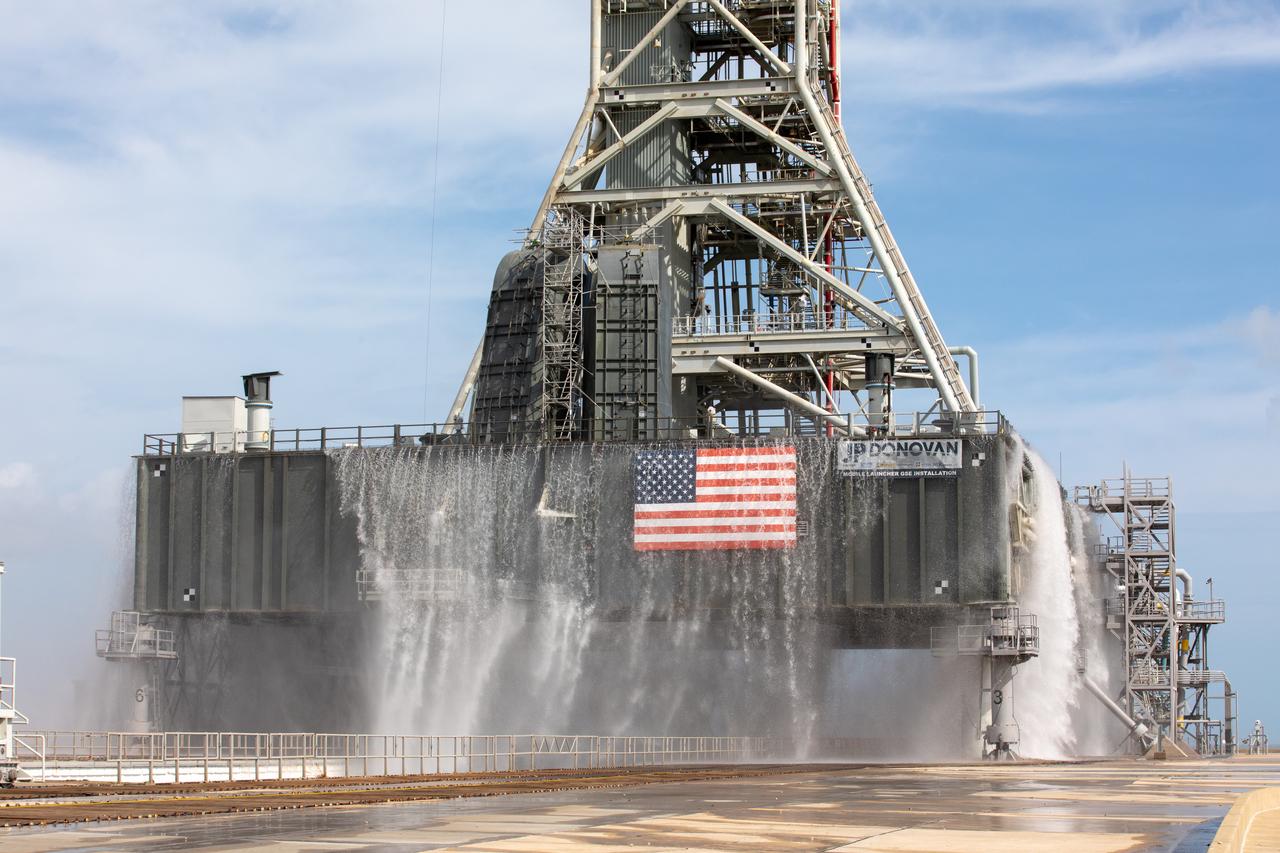
A wet flow test at Launch Pad 39B on September 13, 2019, tests the sound suppression system that will be used for launch of NASA’s Space Launch System for the Artemis I mission. During the test, about 450,000 gallons of water poured onto the Pad B flame deflector, the mobile launcher flame hole and onto the launcher’s blast deck. This was the first time the ground launch sequencer that will be used on the day of launch was used for the timing of a sound suppression test.
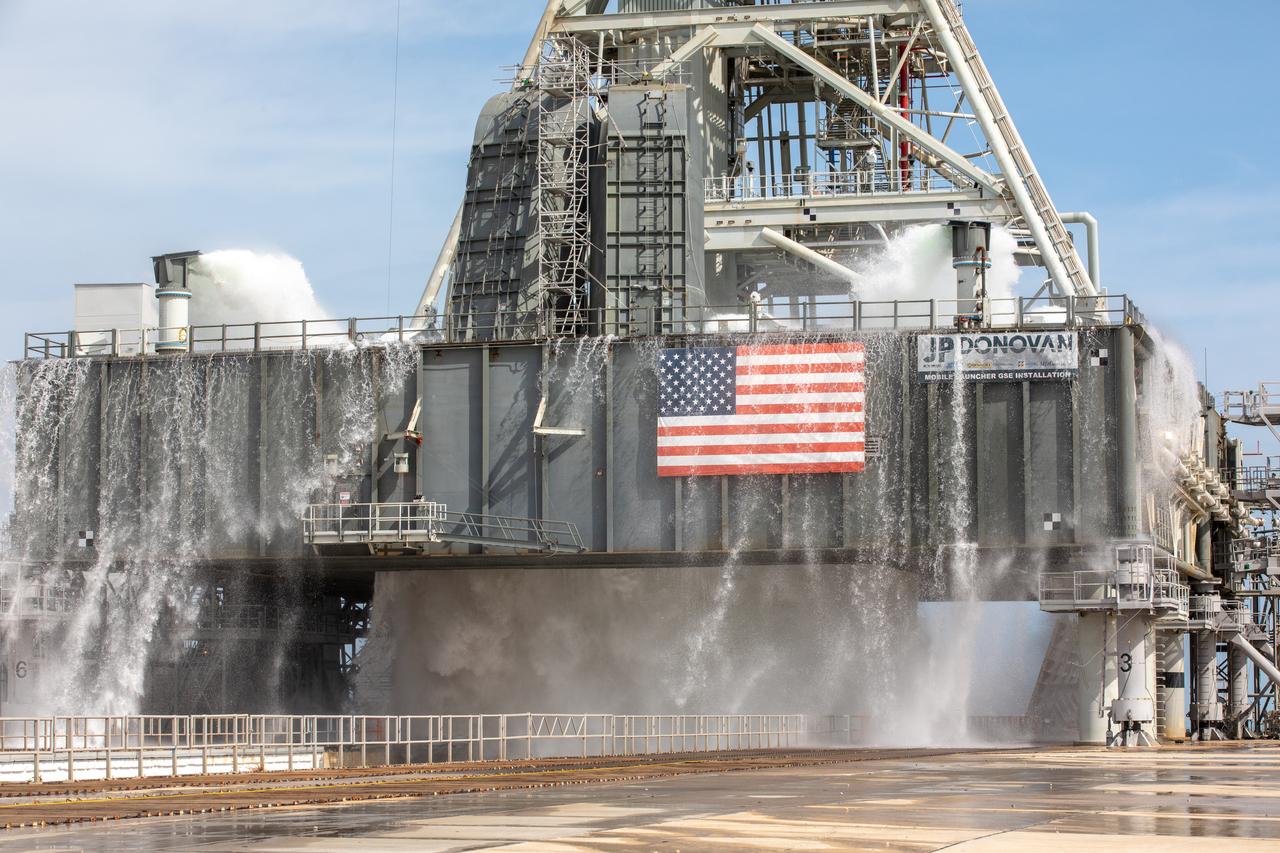
A wet flow test at Launch Pad 39B on September 13, 2019, tests the sound suppression system that will be used for launch of NASA’s Space Launch System for the Artemis I mission. During the test, about 450,000 gallons of water poured onto the Pad B flame deflector, the mobile launcher flame hole and onto the launcher’s blast deck. This was the first time the ground launch sequencer that will be used on the day of launch was used for the timing of a sound suppression test.
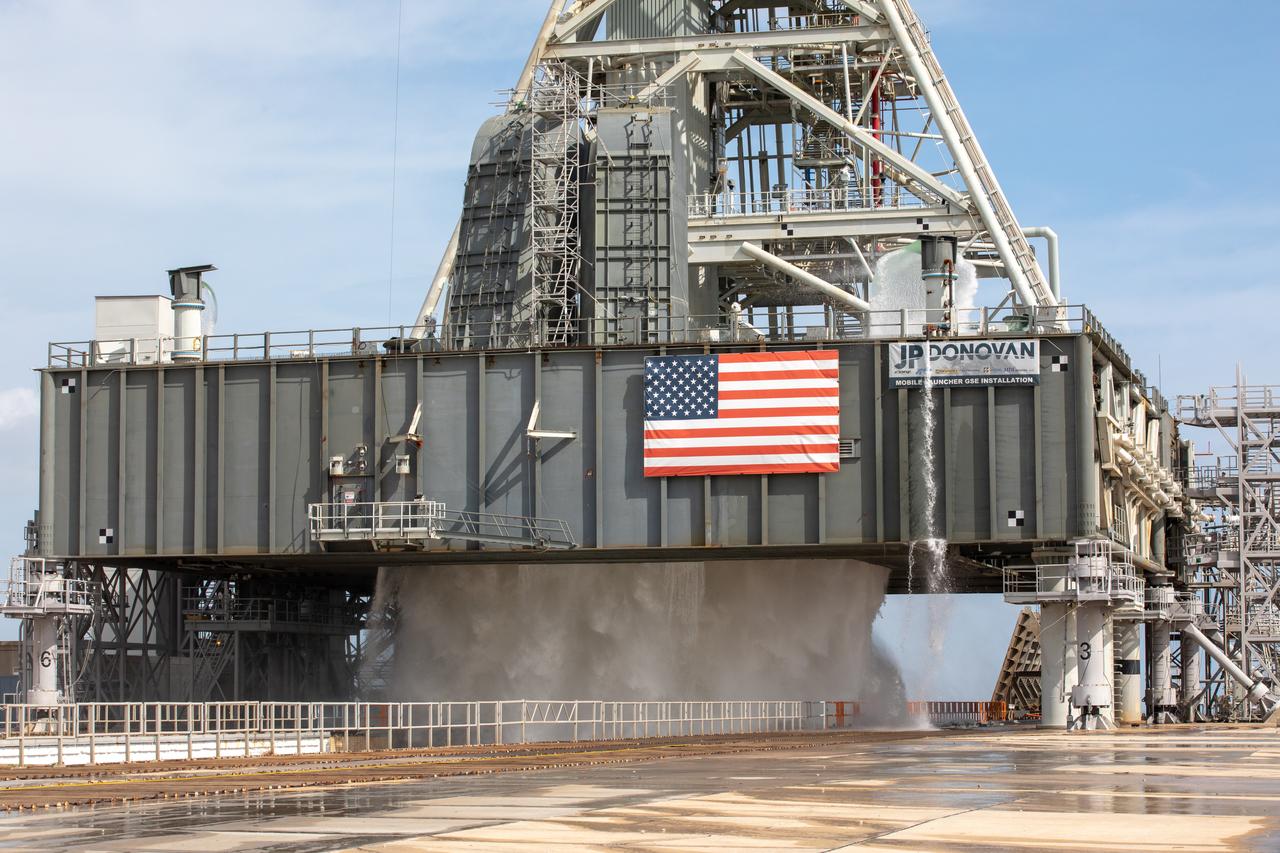
A wet flow test at Launch Pad 39B on September 13, 2019, tests the sound suppression system that will be used for launch of NASA’s Space Launch System for the Artemis I mission. During the test, about 450,000 gallons of water poured onto the Pad B flame deflector, the mobile launcher flame hole and onto the launcher’s blast deck. This was the first time the ground launch sequencer that will be used on the day of launch was used for the timing of a sound suppression test.
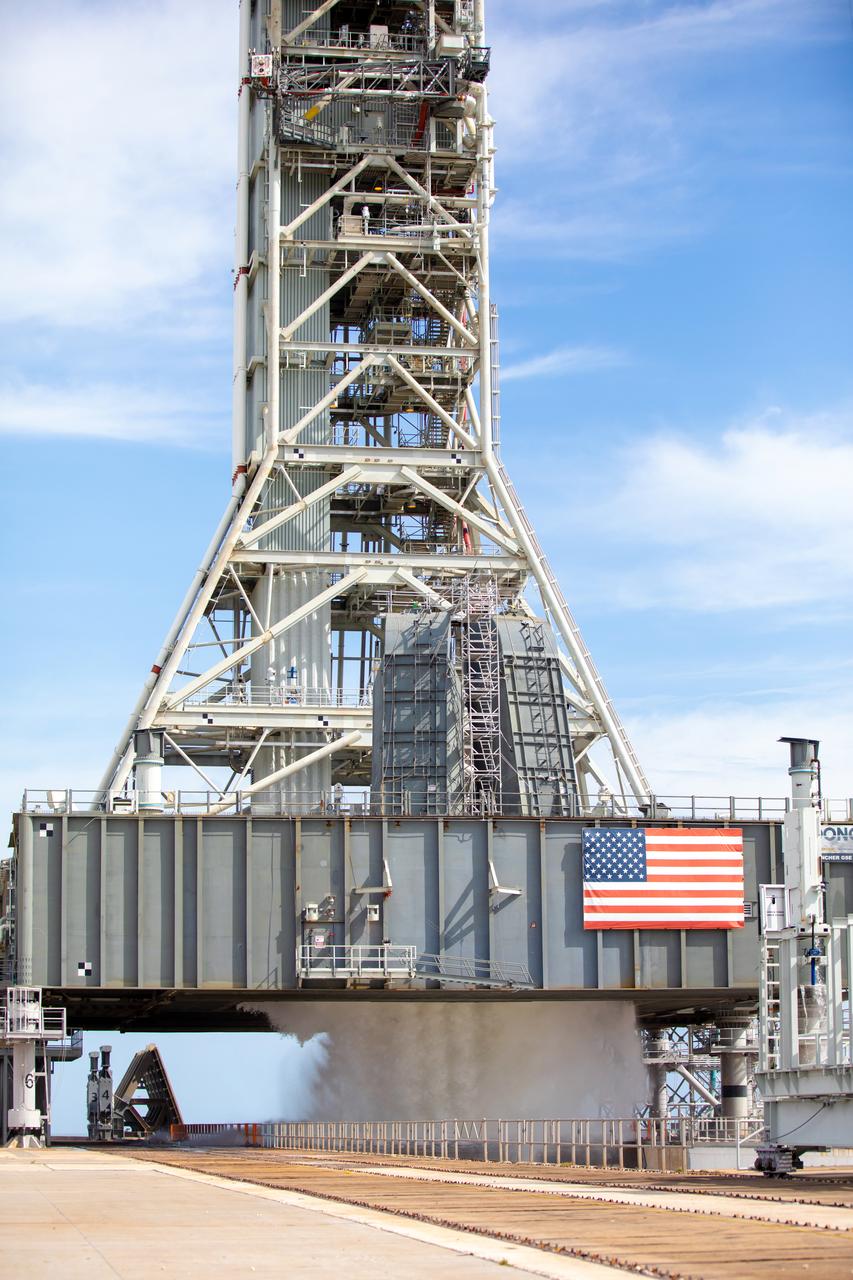
A wet flow test at Launch Pad 39B on September 13, 2019, tests the sound suppression system that will be used for launch of NASA’s Space Launch System for the Artemis I mission. During the test, about 450,000 gallons of water poured onto the Pad B flame deflector, the mobile launcher flame hole and onto the launcher’s blast deck. This was the first time the ground launch sequencer that will be used on the day of launch was used for the timing of a sound suppression test.
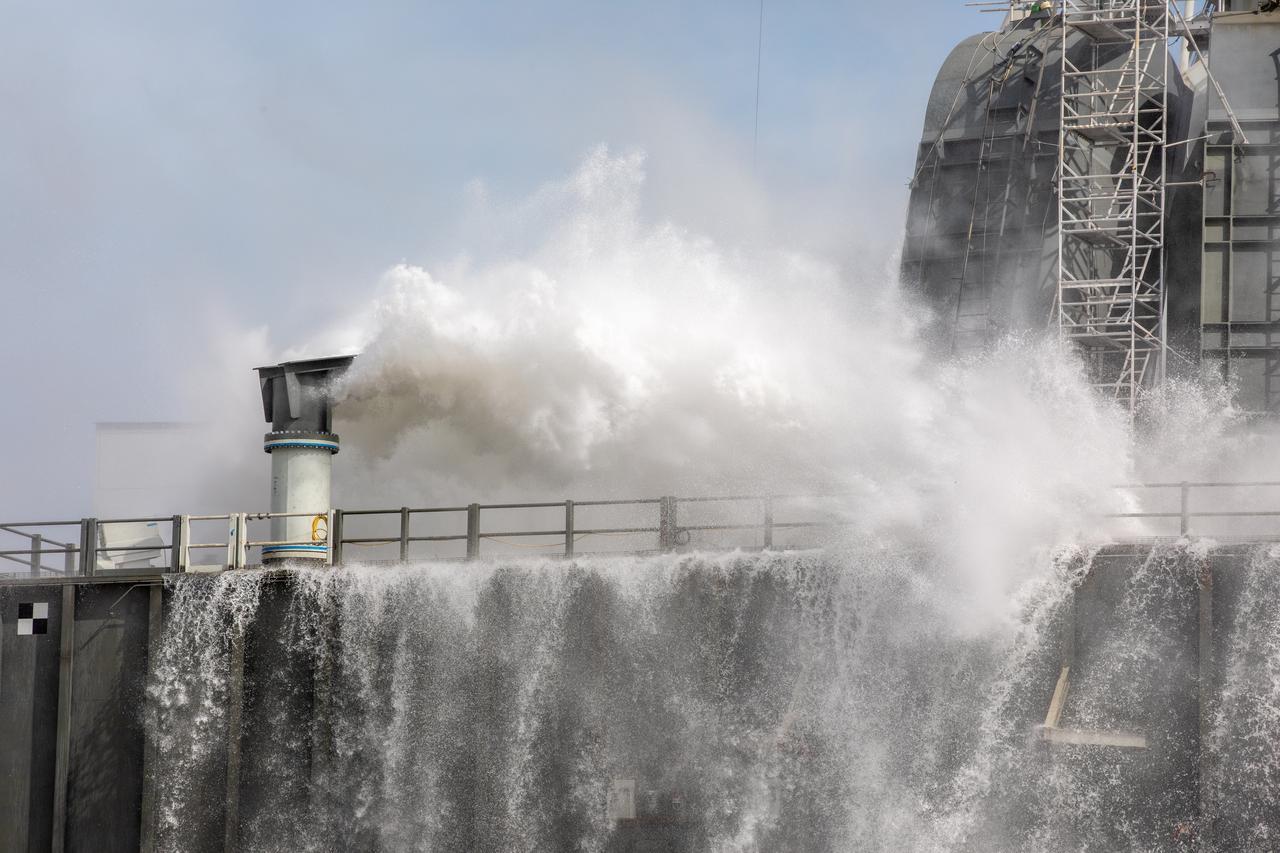
A wet flow test at Launch Pad 39B on September 13, 2019, tests the sound suppression system that will be used for launch of NASA’s Space Launch System for the Artemis I mission. During the test, about 450,000 gallons of water poured onto the Pad B flame deflector, the mobile launcher flame hole and onto the launcher’s blast deck. This was the first time the ground launch sequencer that will be used on the day of launch was used for the timing of a sound suppression test.
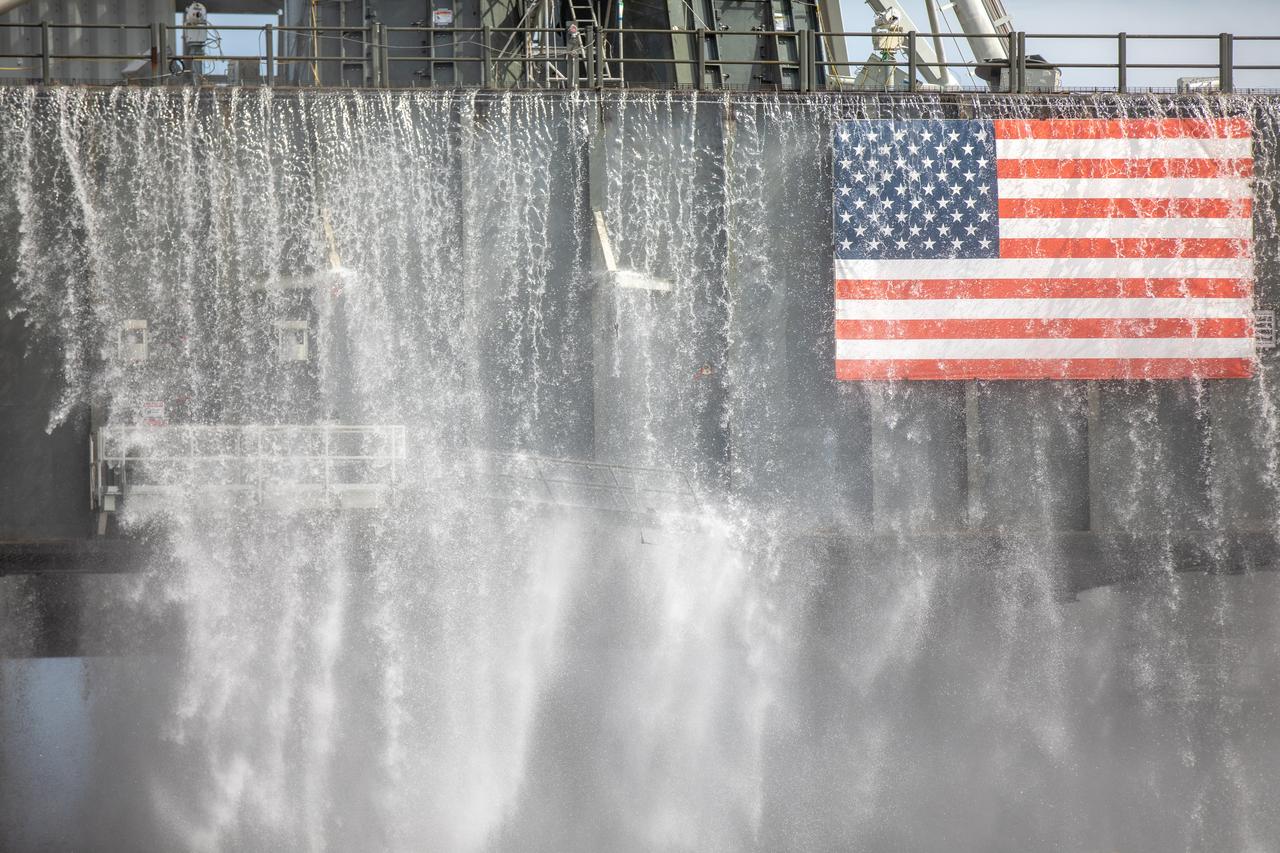
A wet flow test at Launch Pad 39B on September 13, 2019, tests the sound suppression system that will be used for launch of NASA’s Space Launch System for the Artemis I mission. During the test, about 450,000 gallons of water poured onto the Pad B flame deflector, the mobile launcher flame hole and onto the launcher’s blast deck. This was the first time the ground launch sequencer that will be used on the day of launch was used for the timing of a sound suppression test.

A wet flow test at Launch Pad 39B on September 13, 2019, tests the sound suppression system that will be used for launch of NASA’s Space Launch System for the Artemis I mission. During the test, about 450,000 gallons of water poured onto the Pad B flame deflector, the mobile launcher flame hole and onto the launcher’s blast deck. This was the first time the ground launch sequencer that will be used on the day of launch was used for the timing of a sound suppression test.
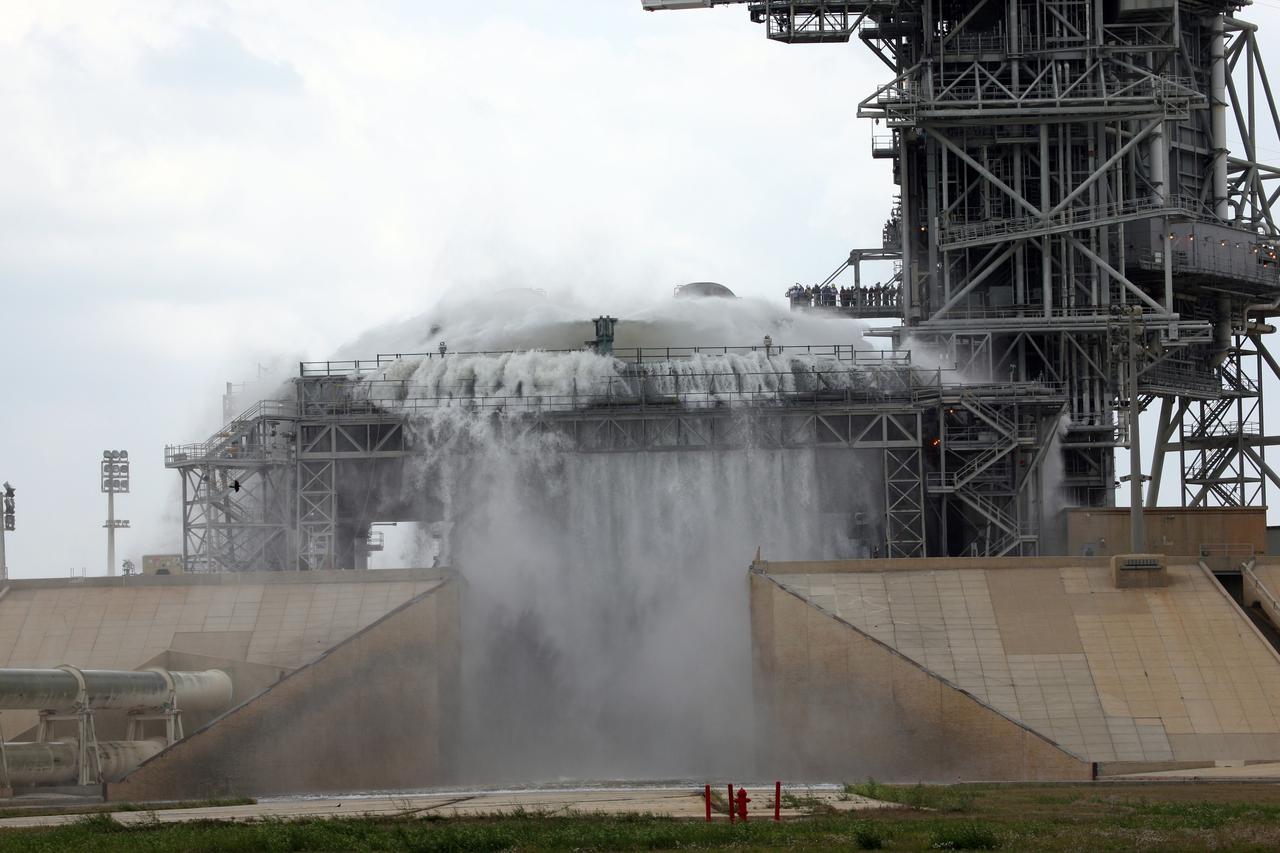
CAPE CANAVERAL, Fla. – Water cascades over the side of the mobile launcher platform on Launch Pad 39B at NASA's Kennedy Space Center in Florida. The sound suppression system is being tested on the platform. Pad 39B will be the site of the first Ares vehicle launch, including the Ares I-X flight test that is targeted for summer 2009. The mobile launcher platform was handed over to the Constellation Program and modified for the Ares I-X flight test. It is being tested before being moved to the Vehicle Assembly Building for assembly of the Ares I-X rocket. A sound suppression water system is in¬stalled on the pads to protect against damage by acoustical energy and rocket exhaust reflected from the flame trench and mobile launcher plat¬form during a launch. The sound suppression system includes an elevated 290-foot-high water tank with a capacity of 300,000 gallons. The water releases just prior to the ignition of the rocket and flows through 7-foot-diameter pipes for about 20 seconds. A torrent of water will flow onto the mobile launcher platform from six large quench nozzles, or “rainbirds,” mounted on its surface. The rainbirds are 12 feet high. The two in the center are 42 inches in diameter; the other four have a 30-inch diameter. Photo credit: NASA/Dimitri Gerondidakis
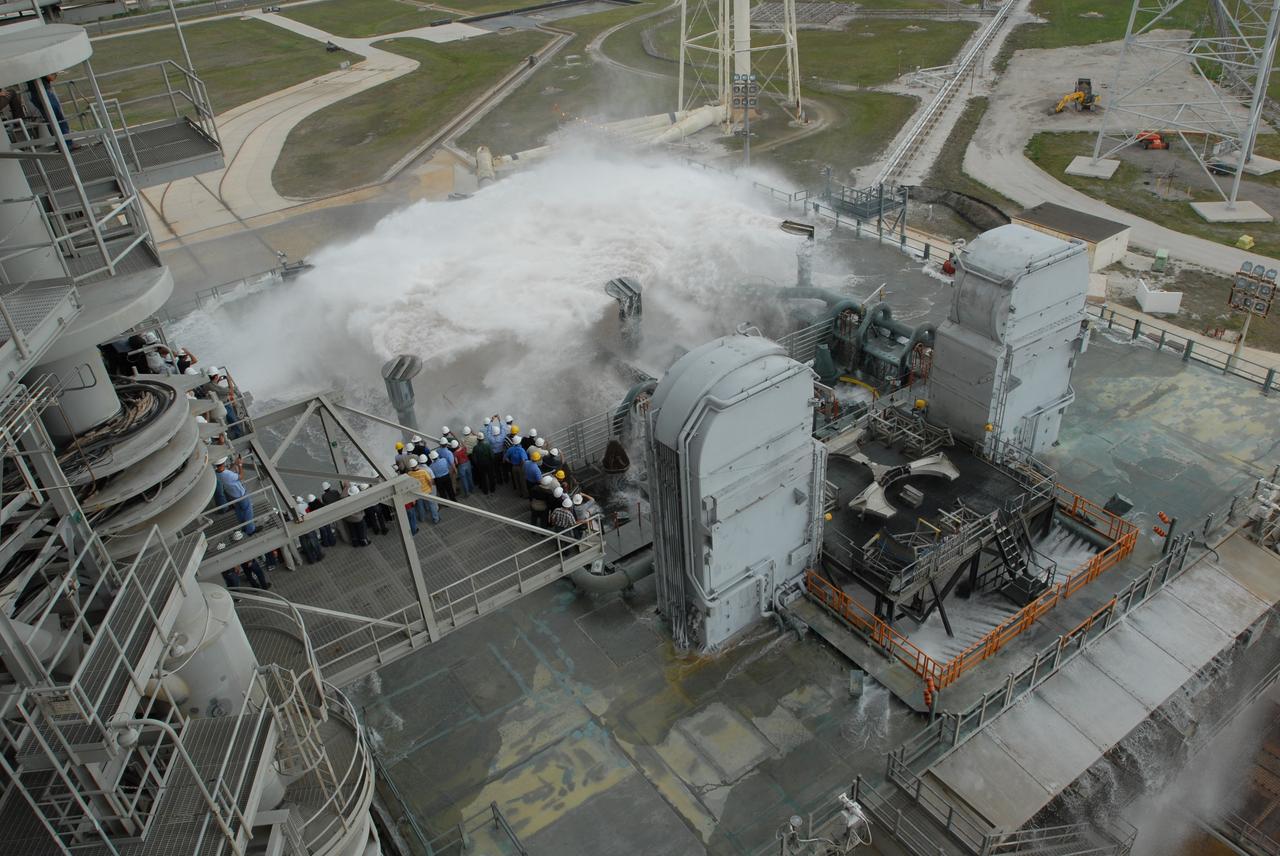
CAPE CANAVERAL, Fla. – The sound suppression system is tested on the mobile launcher platform on Launch Pad 39B at NASA's Kennedy Space Center in Florida. Pad 39B will be the site of the first Ares vehicle launch, including the Ares I-X flight test that is targeted for summer 2009. The mobile launcher platform was handed over to the Constellation Program and modified for the Ares I-X flight test. It is being tested before being moved to the Vehicle Assembly Building for assembly of the Ares I-X rocket. A sound suppression water system is in¬stalled on the pads to protect against damage by acoustical energy and rocket exhaust reflected from the flame trench and mobile launcher plat¬form during a launch. The sound suppression system includes an elevated 290-foot-high water tank with a capacity of 300,000 gallons. The water releases just prior to the ignition of the rocket and flows through 7-foot-diameter pipes for about 20 seconds. A torrent of water will flow onto the mobile launcher platform from six large quench nozzles, or “rainbirds,” mounted on its surface. The rainbirds are 12 feet high. The two in the center are 42 inches in diameter; the other four have a 30-inch diameter. Photo credit: NASA/Jim Grossmann
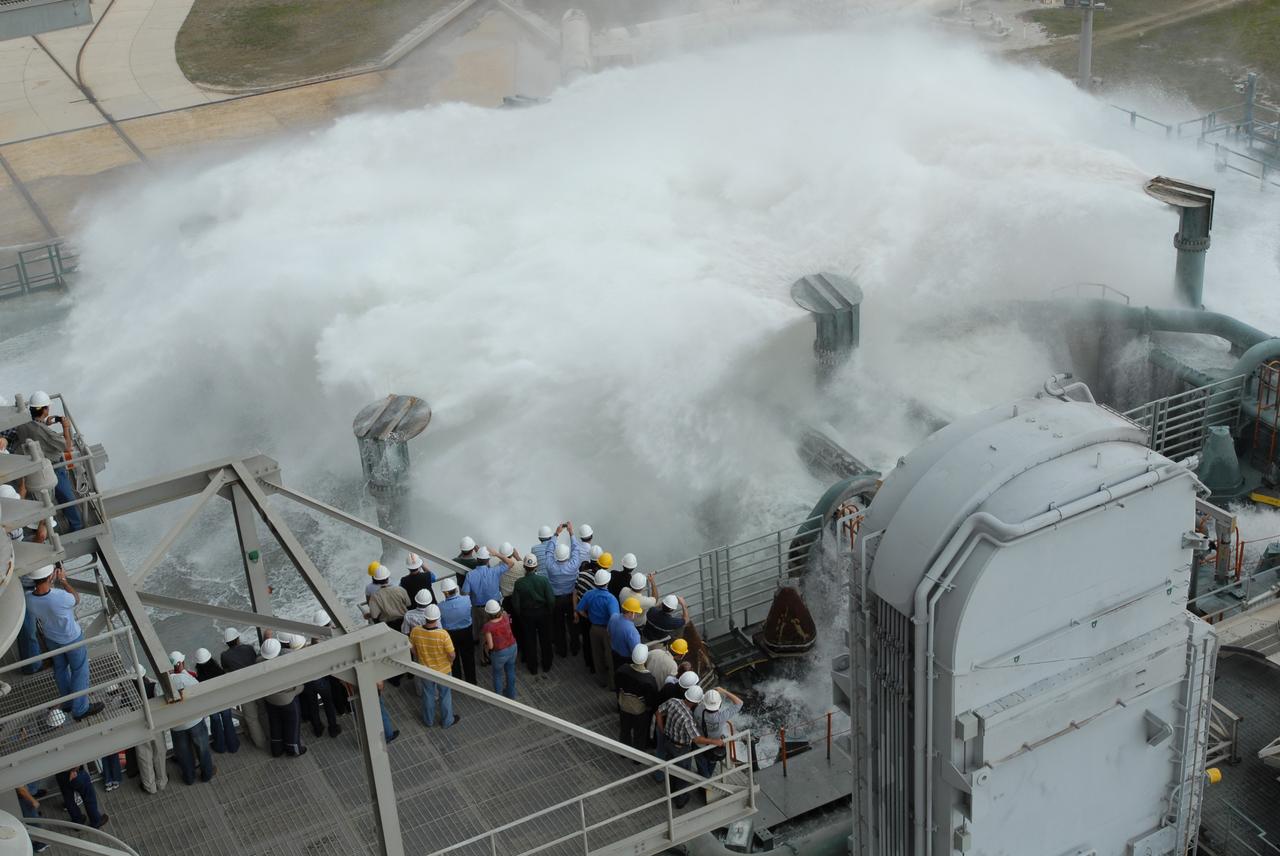
CAPE CANAVERAL, Fla. – The sound suppression system is tested on the mobile launcher platform on Launch Pad 39B at NASA's Kennedy Space Center in Florida. Pad 39B will be the site of the first Ares vehicle launch, including the Ares I-X flight test that is targeted for summer 2009. The mobile launcher platform was handed over to the Constellation Program and modified for the Ares I-X flight test. It is being tested before being moved to the Vehicle Assembly Building for assembly of the Ares I-X rocket. A sound suppression water system is in¬stalled on the pads to protect against damage by acoustical energy and rocket exhaust reflected from the flame trench and mobile launcher plat¬form during a launch. The sound suppression system includes an elevated 290-foot-high water tank with a capacity of 300,000 gallons. The water releases just prior to the ignition of the rocket and flows through 7-foot-diameter pipes for about 20 seconds. A torrent of water will flow onto the mobile launcher platform from six large quench nozzles, or “rainbirds,” mounted on its surface. The rainbirds are 12 feet high. The two in the center are 42 inches in diameter; the other four have a 30-inch diameter. Photo credit: NASA/Jim Grossmann
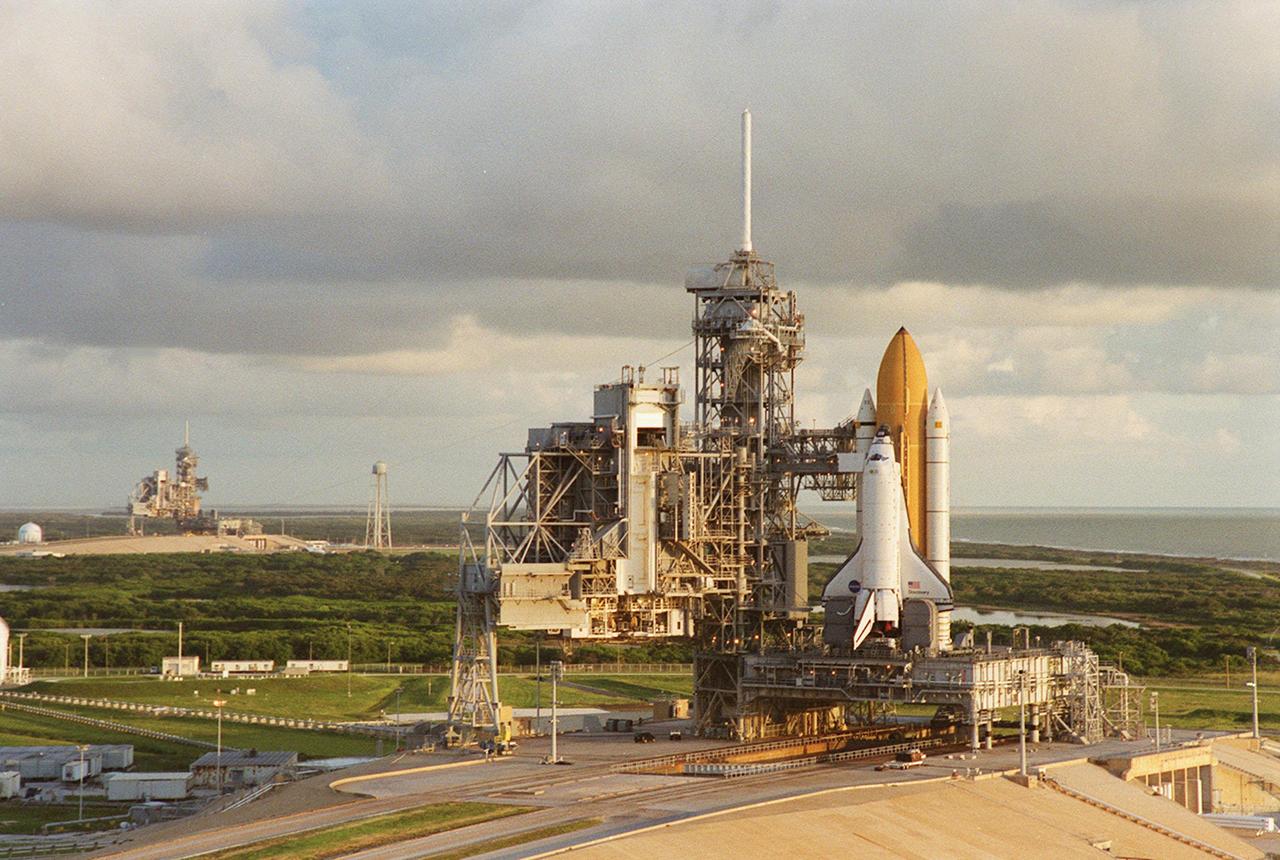
Cloudy skies form a backdrop for Launch Pads 39B (left) and 39A (foreground). Space Shuttle Discovery waits on top of the pad for its launch Oct. 5 to the International Space Station. Between the pads can be seen the 300,000-gallon water tank that provides water for the sound suppression system during launch.

While early morning light spotlights Space Shuttle Discovery on Launch Pad 39A, storm clouds roll in from the east. Launch Pad 39B can be seen in the distance. At right is the 300,000-gallon water tank that provides the water for sound suppression during launch.
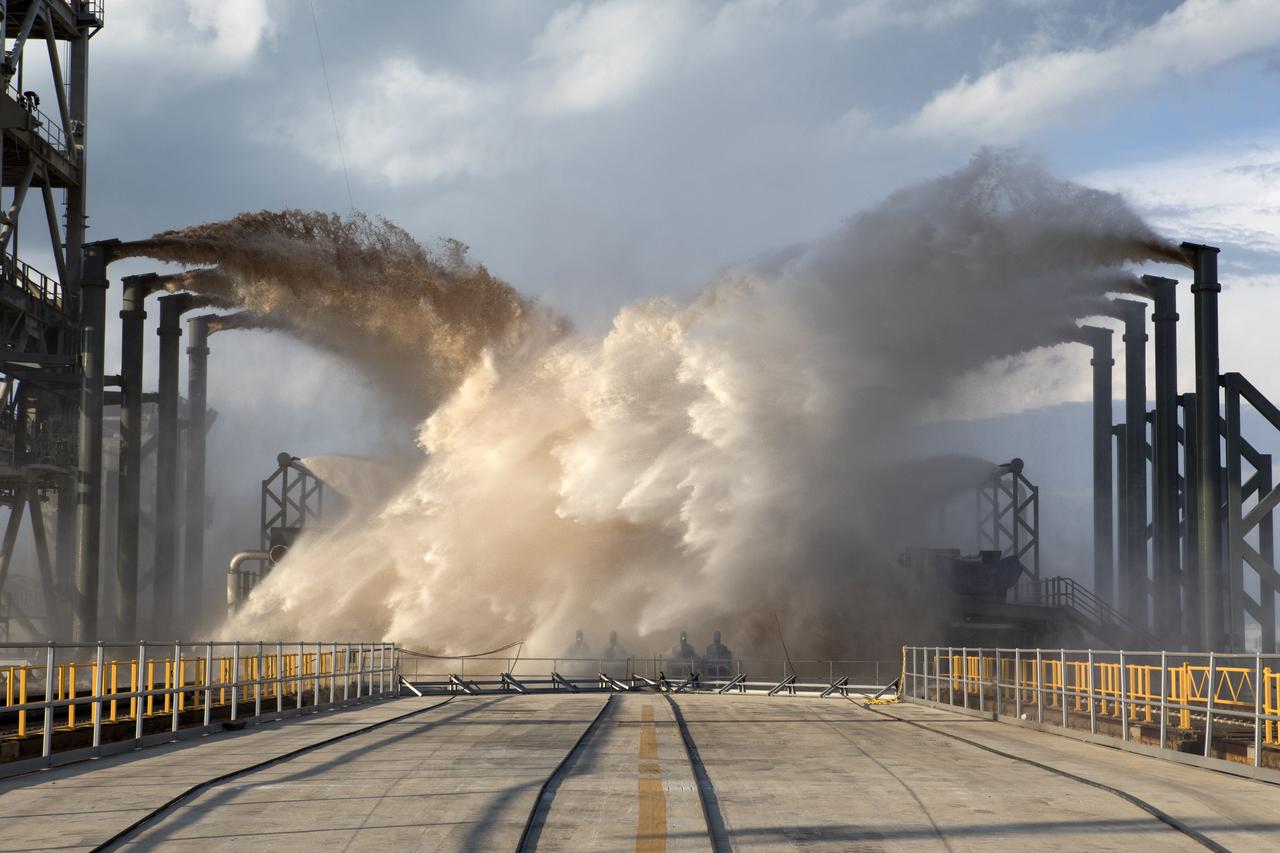
Water sprays onto Launch Complex 39A during a test by SpaceX of the sound suppression system at the launch pad. The water deluge diminishes vibration at the pad during a liftoff to protect the pad structures and rocket itself from excessive shaking. Photo credit: NASA/Kim Shiflett
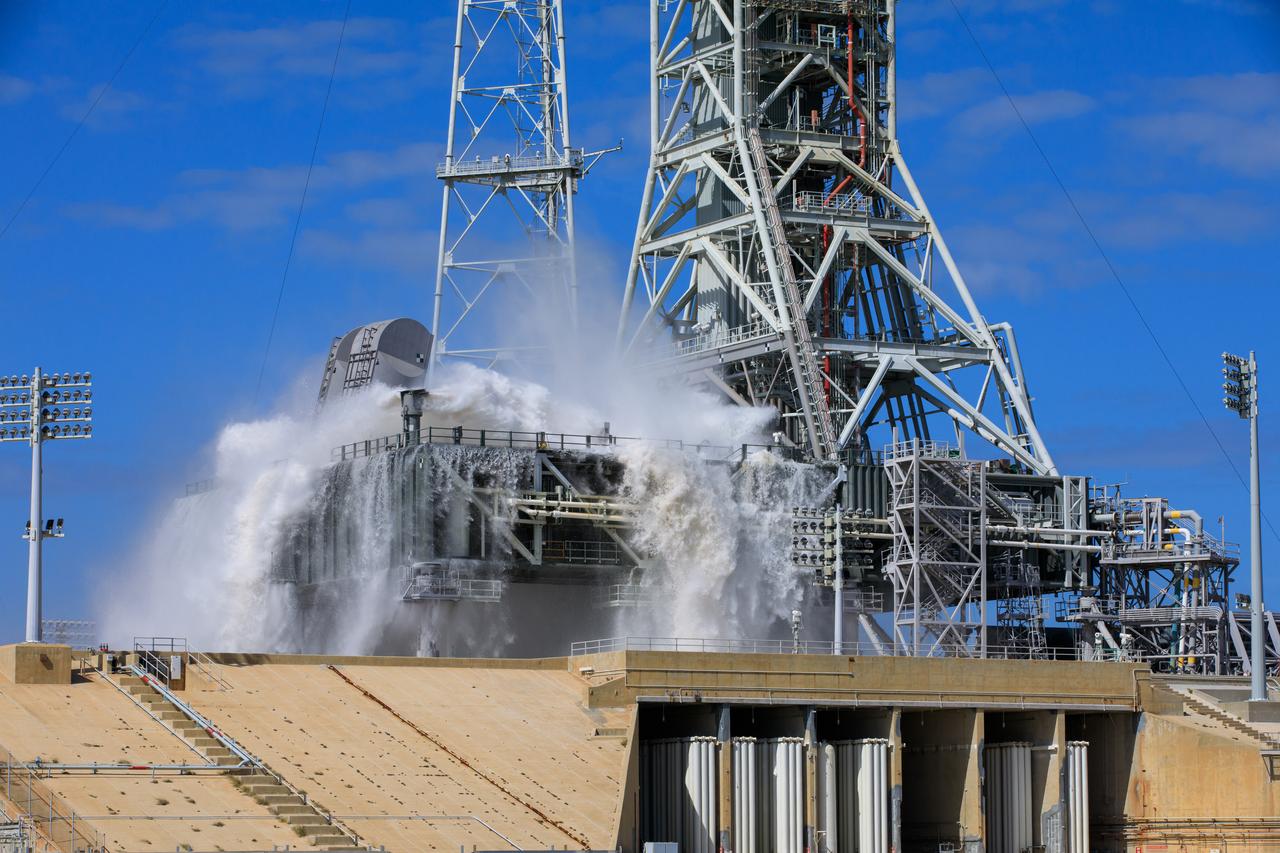
NASA’s Exploration Ground Systems conducts a water flow test with the mobile launcher at Kennedy Space Center’s Launch Complex 39B in Florida on Oct. 24, 2023. It is the third in a series of tests to verify the overpressure protection and sound suppression system is ready for launch of the Artemis II mission. During liftoff, 400,000 gallons of water will rush onto the pad to help protect NASA’s SLS (Space Launch System) rocket, Orion spacecraft, mobile launcher, and launch pad from any over pressurization and extreme sound produced during ignition and liftoff.
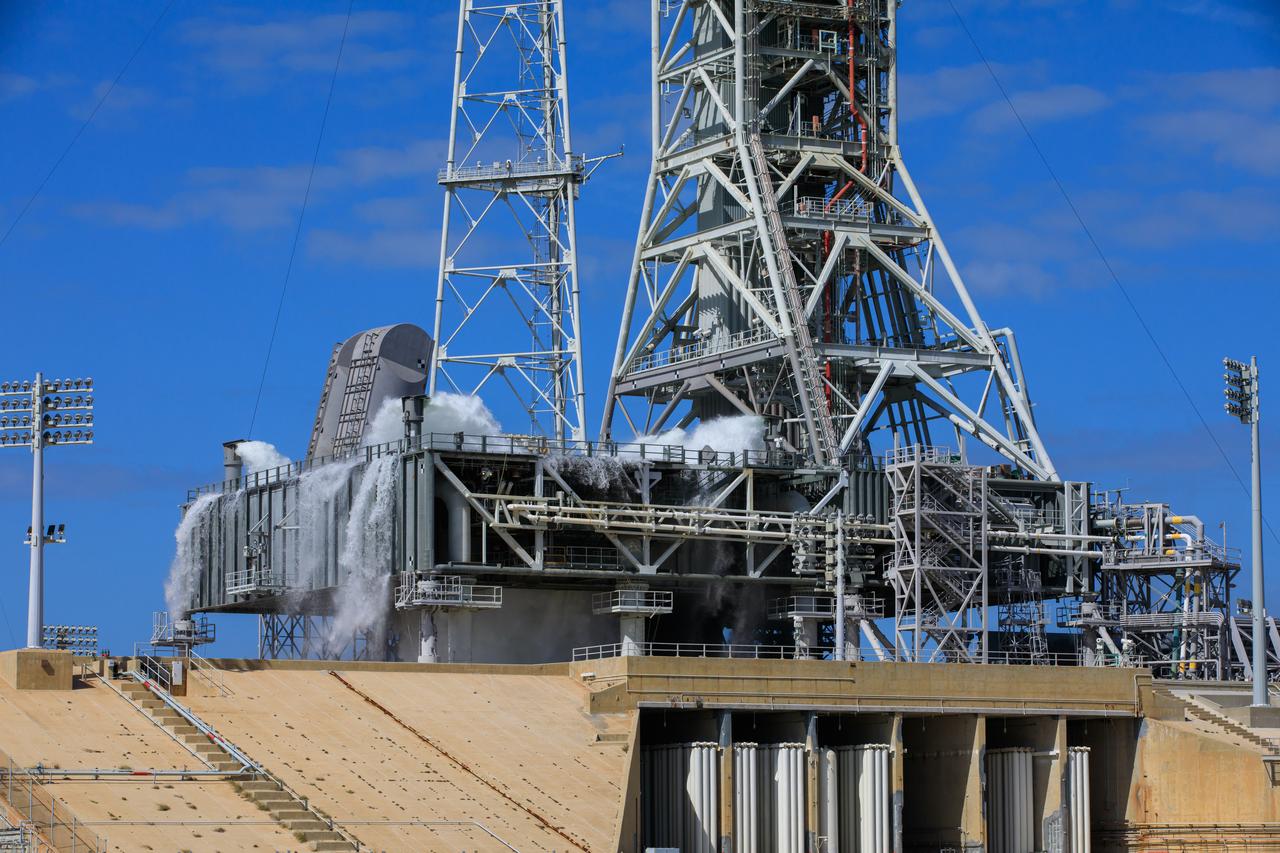
NASA’s Exploration Ground Systems conducts a water flow test with the mobile launcher at Kennedy Space Center’s Launch Complex 39B in Florida on Oct. 24, 2023. It is the third in a series of tests to verify the overpressure protection and sound suppression system is ready for launch of the Artemis II mission. During liftoff, 400,000 gallons of water will rush onto the pad to help protect NASA’s SLS (Space Launch System) rocket, Orion spacecraft, mobile launcher, and launch pad from any over pressurization and extreme sound produced during ignition and liftoff.
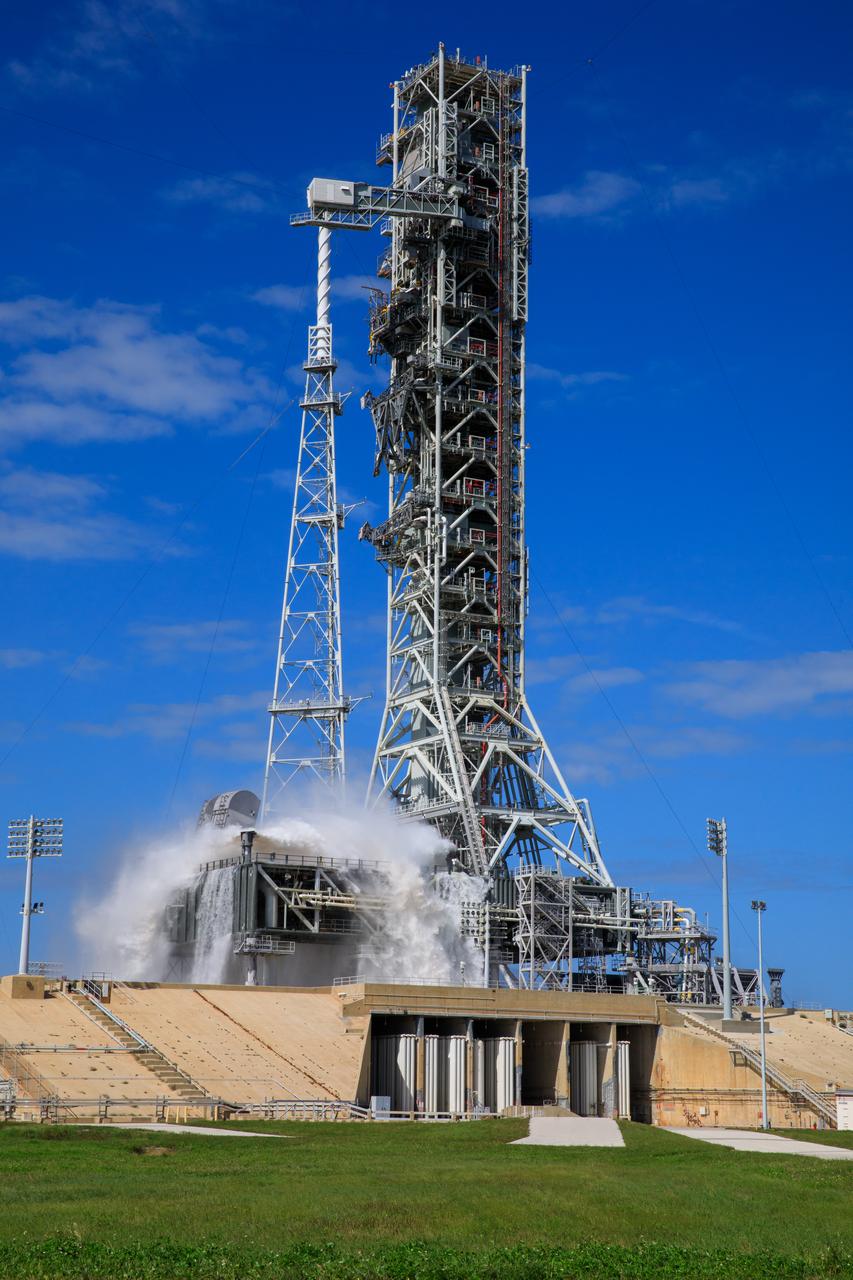
NASA’s Exploration Ground Systems conducts a water flow test with the mobile launcher at Kennedy Space Center’s Launch Complex 39B in Florida on Oct. 24, 2023. It is the third in a series of tests to verify the overpressure protection and sound suppression system is ready for launch of the Artemis II mission. During liftoff, 400,000 gallons of water will rush onto the pad to help protect NASA’s SLS (Space Launch System) rocket, Orion spacecraft, mobile launcher, and launch pad from any over pressurization and extreme sound produced during ignition and liftoff.
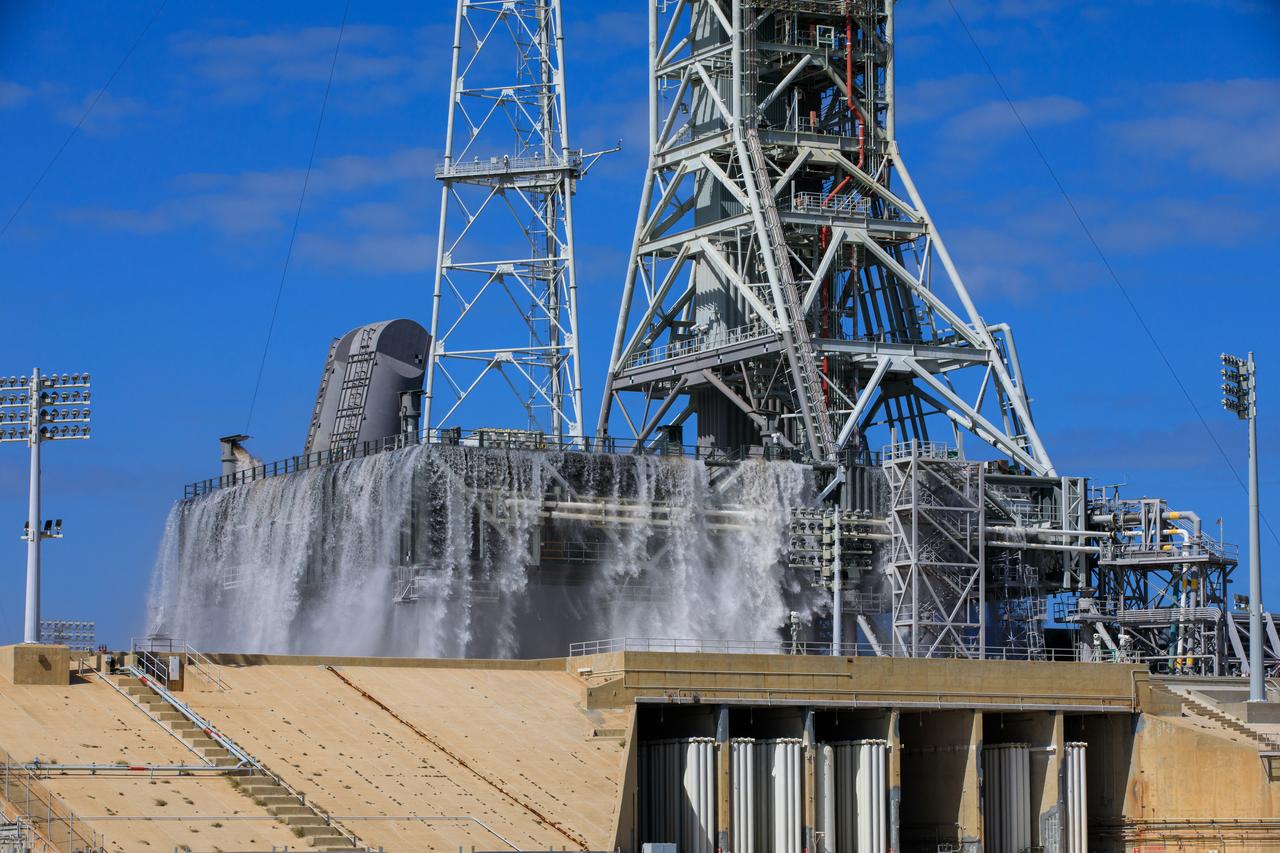
NASA’s Exploration Ground Systems conducts a water flow test with the mobile launcher at Kennedy Space Center’s Launch Complex 39B in Florida on Oct. 24, 2023. It is the third in a series of tests to verify the overpressure protection and sound suppression system is ready for launch of the Artemis II mission. During liftoff, 400,000 gallons of water will rush onto the pad to help protect NASA’s SLS (Space Launch System) rocket, Orion spacecraft, mobile launcher, and launch pad from any over pressurization and extreme sound produced during ignition and liftoff.
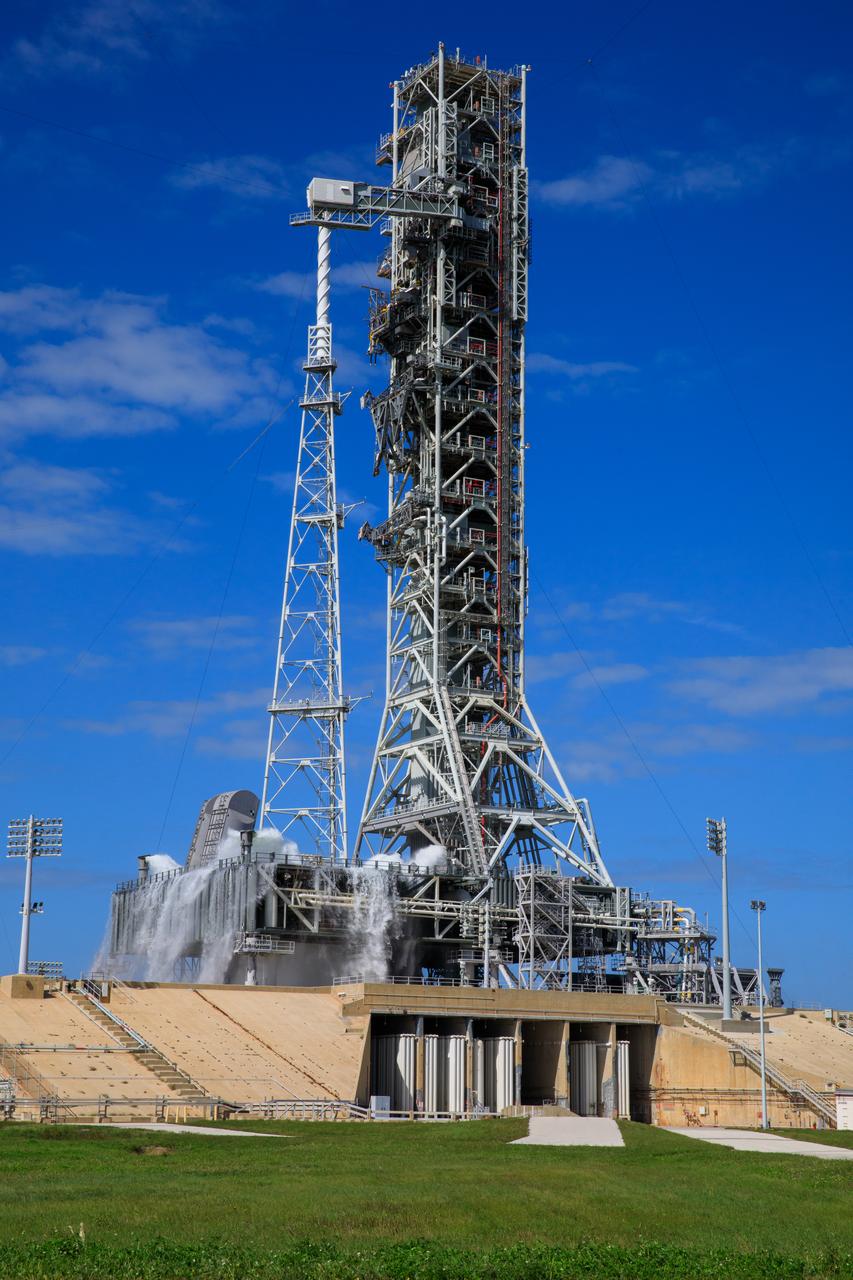
NASA’s Exploration Ground Systems conducts a water flow test with the mobile launcher at Kennedy Space Center’s Launch Complex 39B in Florida on Oct. 24, 2023. It is the third in a series of tests to verify the overpressure protection and sound suppression system is ready for launch of the Artemis II mission. During liftoff, 400,000 gallons of water will rush onto the pad to help protect NASA’s SLS (Space Launch System) rocket, Orion spacecraft, mobile launcher, and launch pad from any over pressurization and extreme sound produced during ignition and liftoff.

NASA’s Exploration Ground Systems conducts a water flow test with the mobile launcher at Kennedy Space Center’s Launch Complex 39B in Florida on Oct. 24, 2023. It is the third in a series of tests to verify the overpressure protection and sound suppression system is ready for launch of the Artemis II mission. During liftoff, 400,000 gallons of water will rush onto the pad to help protect NASA’s SLS (Space Launch System) rocket, Orion spacecraft, mobile launcher, and launch pad from any over pressurization and extreme sound produced during ignition and liftoff.
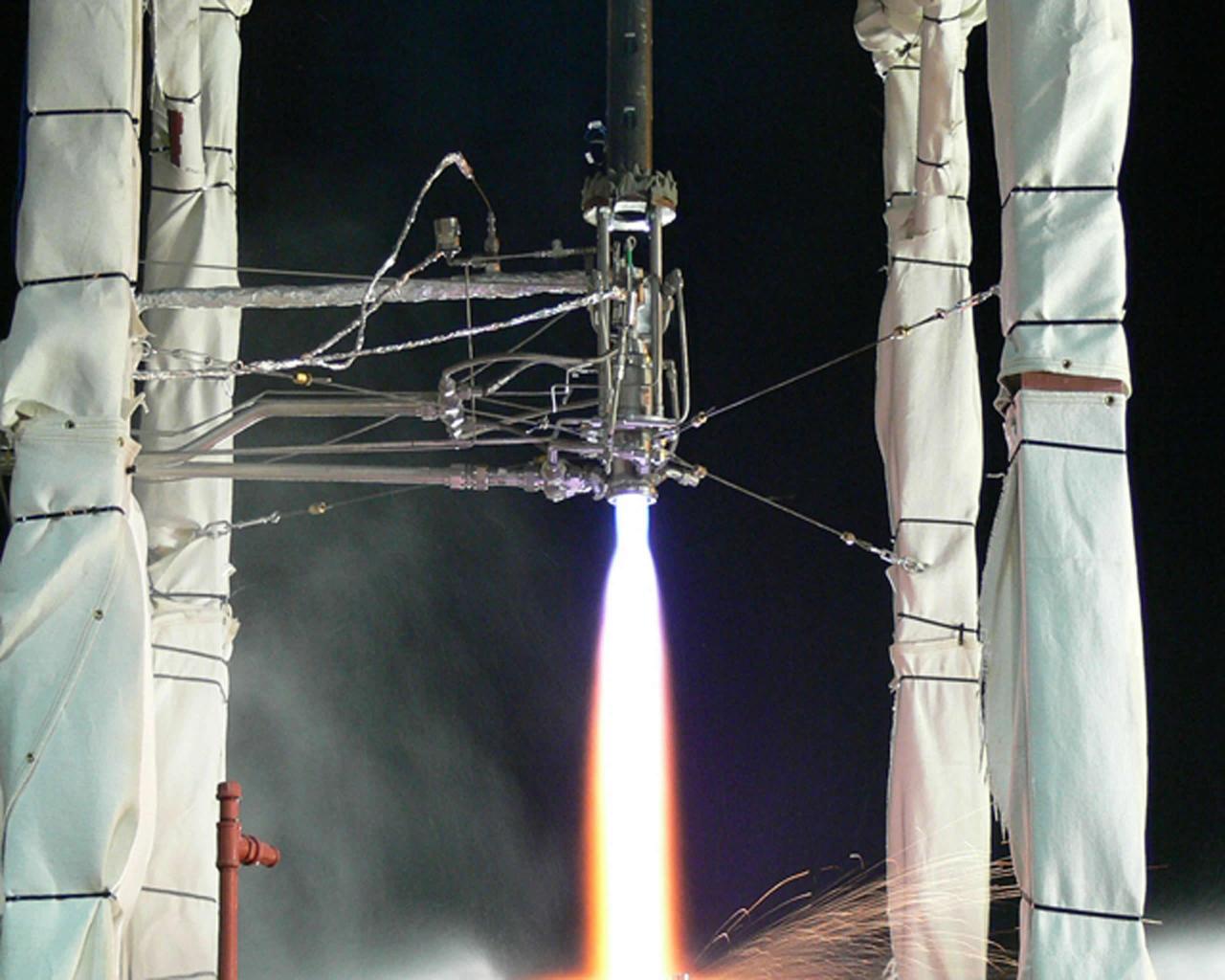
Operators at the E-3 Test Stand at NASA's John C. Stennis Space Center completed 32 acoustics tests April 16-28, designed to gather critical information for future space launches. Stennis operators investigated lift-off acoustics that can damage space vehicle components by testing the benefits of injecting water onto the upper surface of the launch pad to suppress sound. The Stennis tests provided critical data to determine what can be gained from this approach.
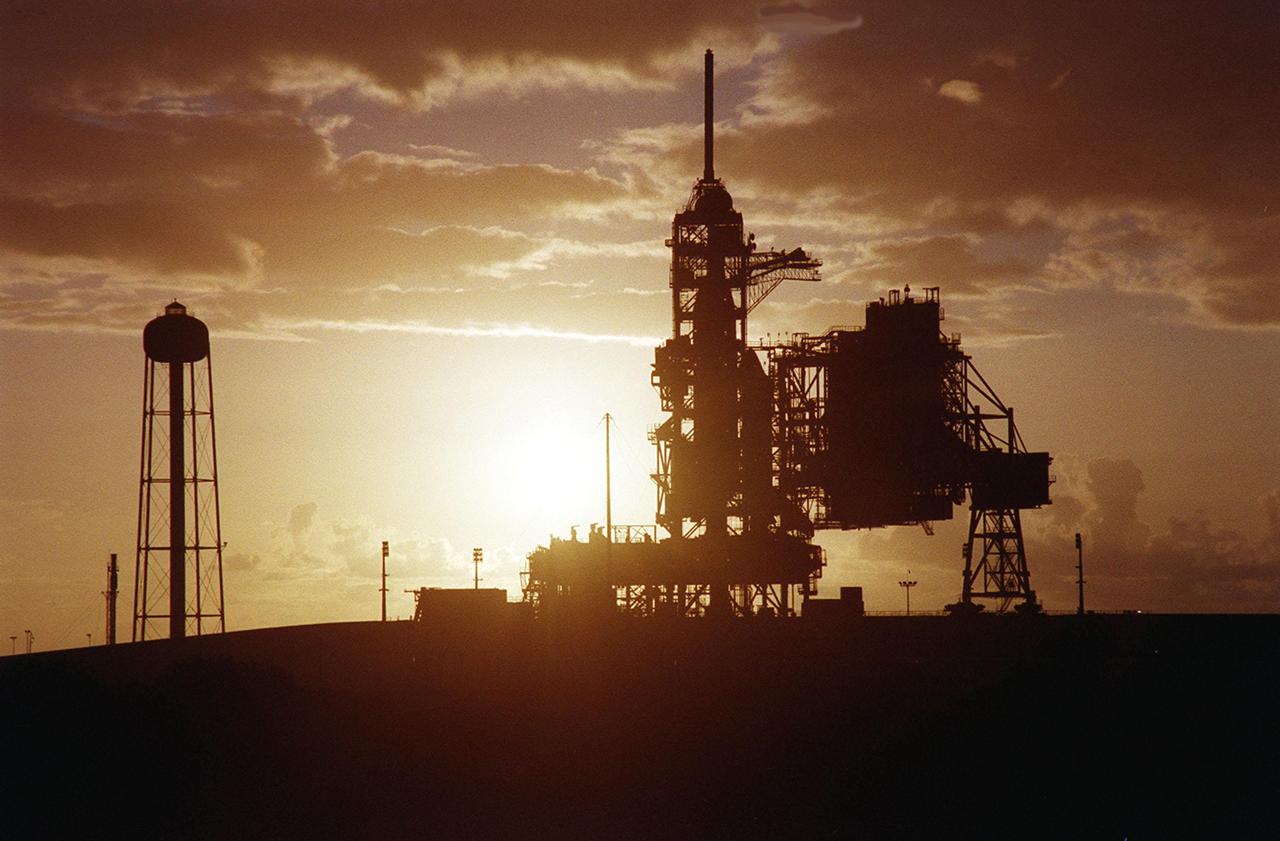
KENNEDY SPACE CENTER, Fla. -- While the morning sun paints the sky pale gold, the structures on Launch Pad 39A are silhouetted in brown. Space Shuttle Discovery can be seen on the other side of the Fixed Service Structure; the Rotating Service Structure at right is still open. At left is the 300,000-gallon water tank that is part of the sound suppression system during launches. Discovery will launch on mission STS-92 Oct. 5, 2000
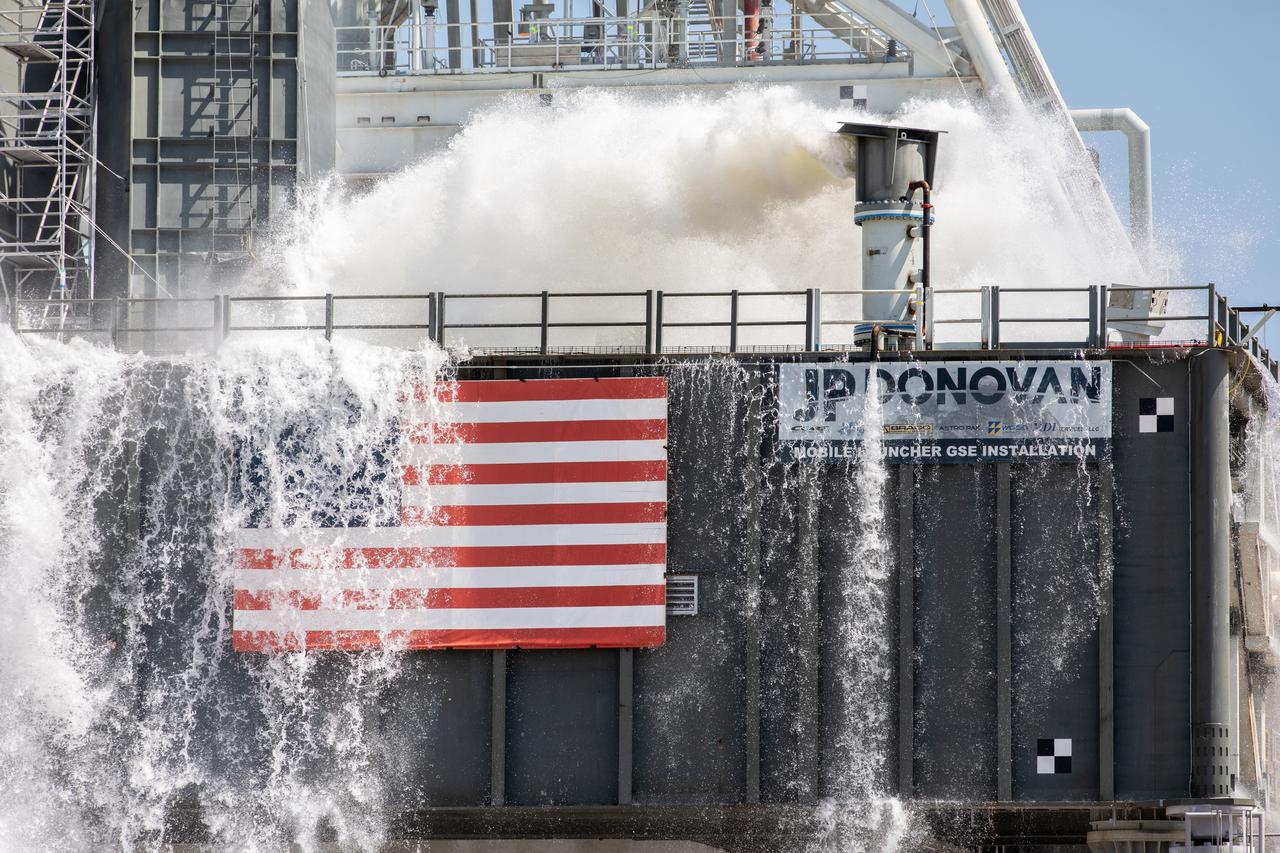
NASA’s Exploration Ground Systems conducts a water flow test with the mobile launcher at Kennedy Space Center’s Pad 39B in Florida on July 2, 2019. It is the first of nine tests to verify the sound suppression system is ready for launch of NASA’s Space Launch System for the first Artemis mission. During launch, 400,000 gallons of water will rush onto the pad to help protect the rocket, NASA’s Orion Spacecraft, mobile launcher, and launch pad from the extreme acoustic and temperature environment.
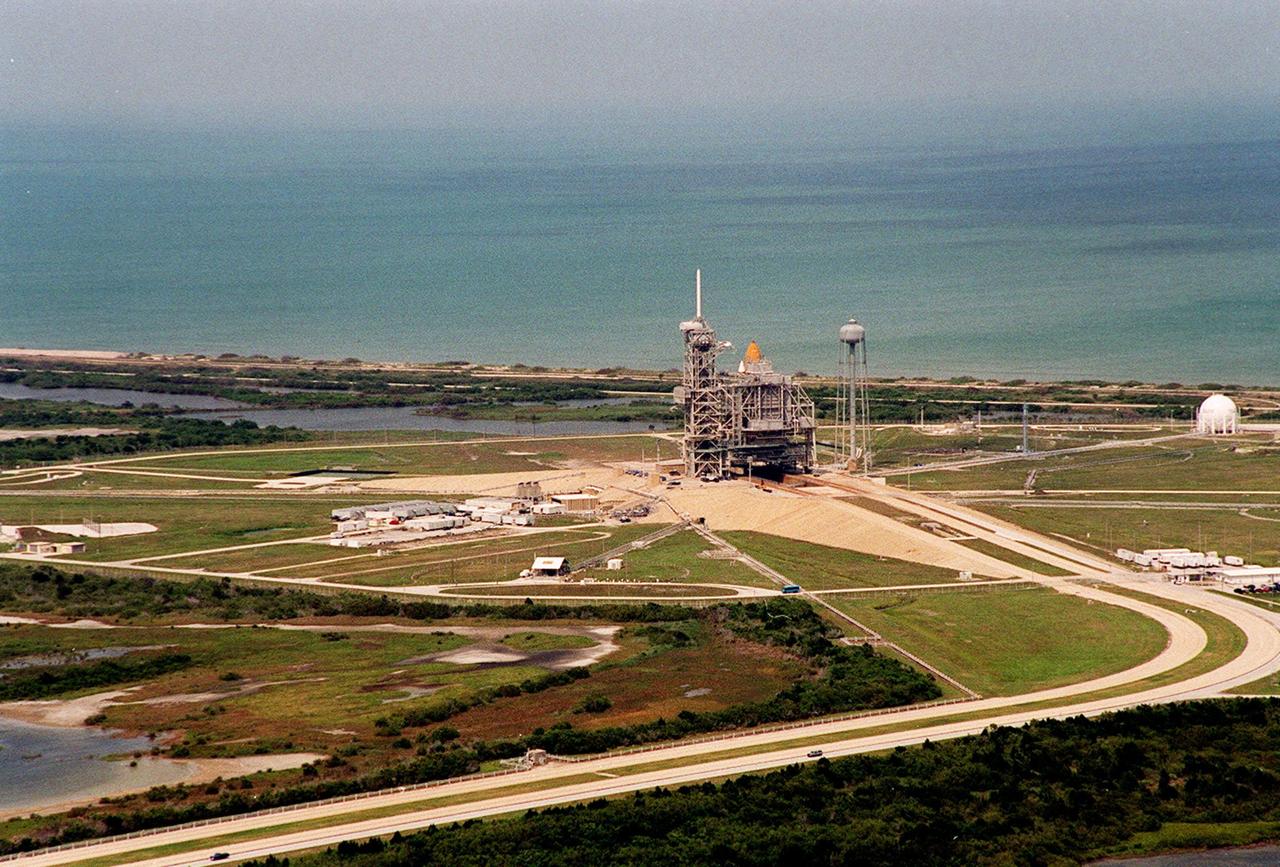
This aerial view captures KSC's Launch Pad 39A, with the rotating service structure closed around Shuttle Atlantis. Just visible in the center is the top of the orange-colored external tank. On the left side towers the white 80-foot fiberglass lightning mast; on the right is the 300,000-gallon water tower used for sound suppression during launch. The launch pad abuts the Atlantic Ocean on the east, seen here in the background
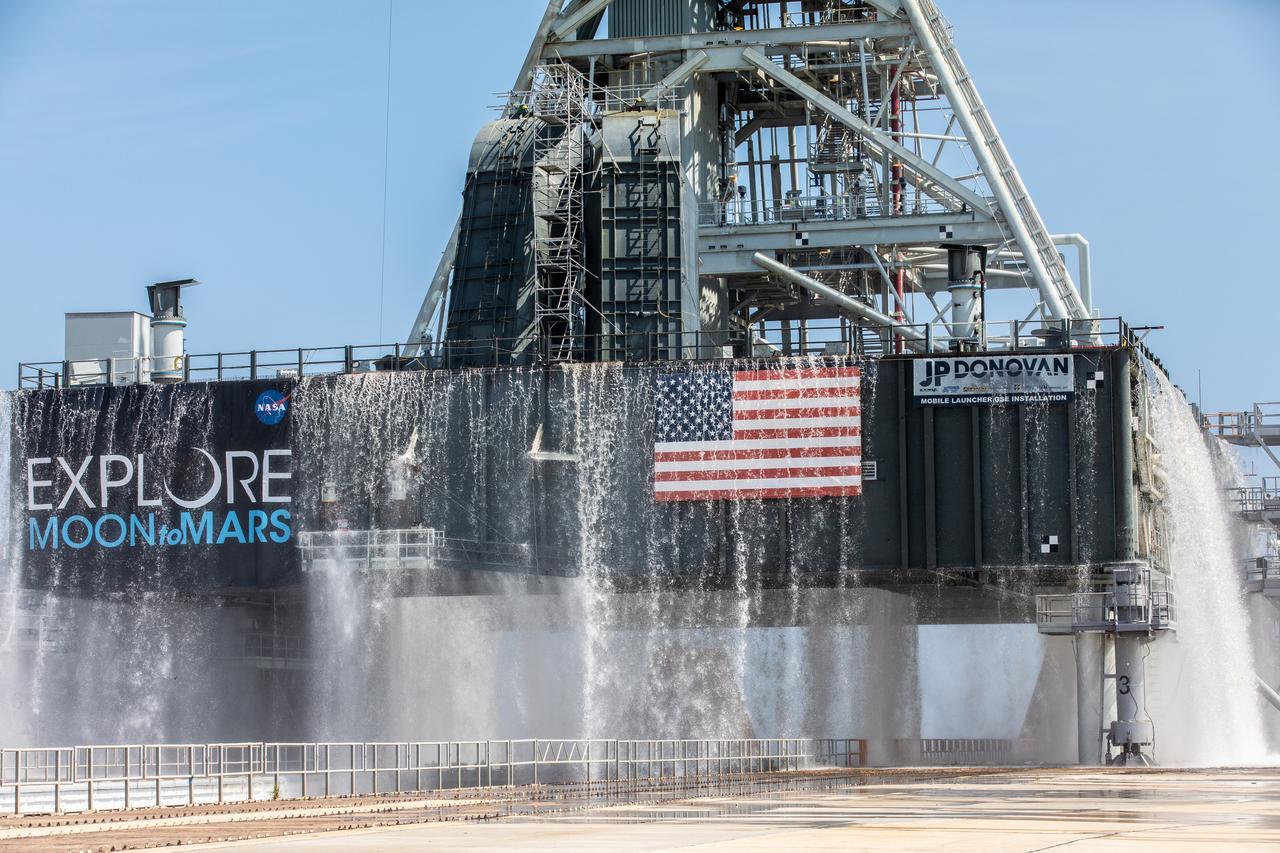
NASA’s Exploration Ground Systems conducts a water flow test with the mobile launcher at Kennedy Space Center’s Pad 39B in Florida on July 2, 2019. It is the first of nine tests to verify the sound suppression system is ready for launch of NASA’s Space Launch System for the first Artemis mission. During launch, 400,000 gallons of water will rush onto the pad to help protect the rocket, NASA’s Orion Spacecraft, mobile launcher, and launch pad from the extreme acoustic and temperature environment.
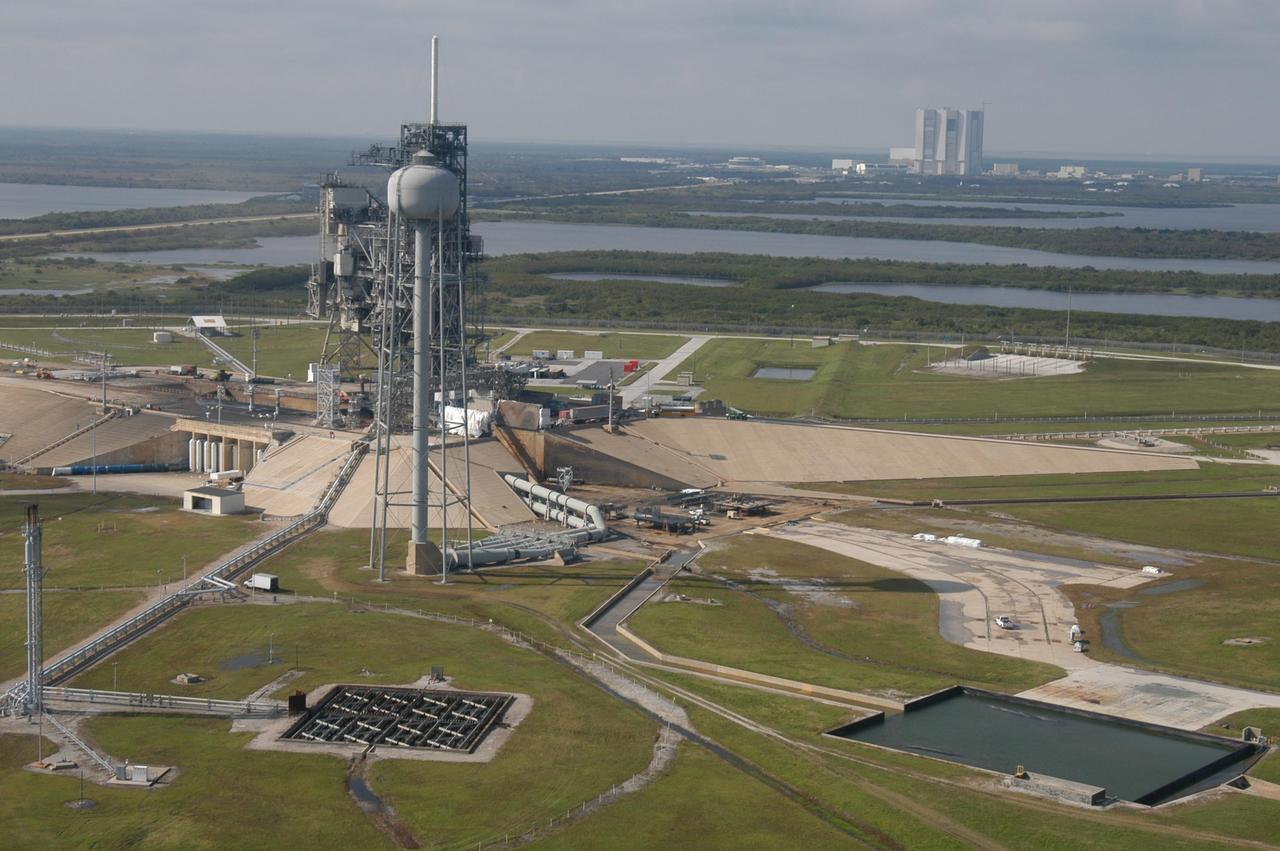
KENNEDY SPACE CENTER, FLA. - Another aerial view of Launch Pad 39A at NASA Kennedy Space Center in Florida. In the background at right is the Vehicle Assembly Building. Atop the fixed service structure is the 80-foot-tall lightning mast. In front is the 290-foot-tall water tower that holds 300,000 gallons of water used at launch for sound suppression to protect the orbiter and its payloads from damage by acoustical energy and rocket exhaust reflected from the flame trench and Mobile Launcher Platform during launch.
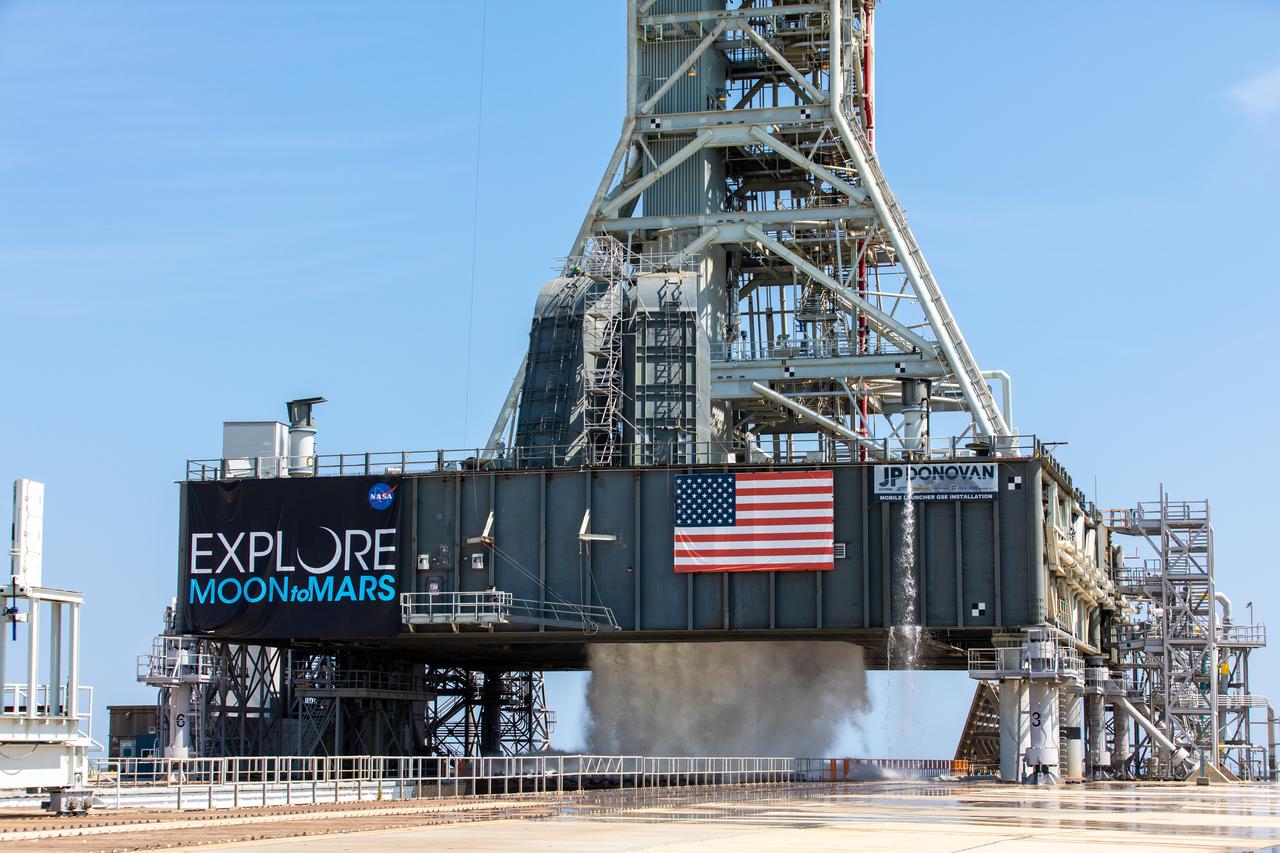
NASA’s Exploration Ground Systems conducts a water flow test with the mobile launcher at Kennedy Space Center’s Pad 39B in Florida on July 2, 2019. It is the first of nine tests to verify the sound suppression system is ready for launch of NASA’s Space Launch System for the first Artemis mission. During launch, 400,000 gallons of water will rush onto the pad to help protect the rocket, NASA’s Orion Spacecraft, mobile launcher, and launch pad from the extreme acoustic and temperature environment.
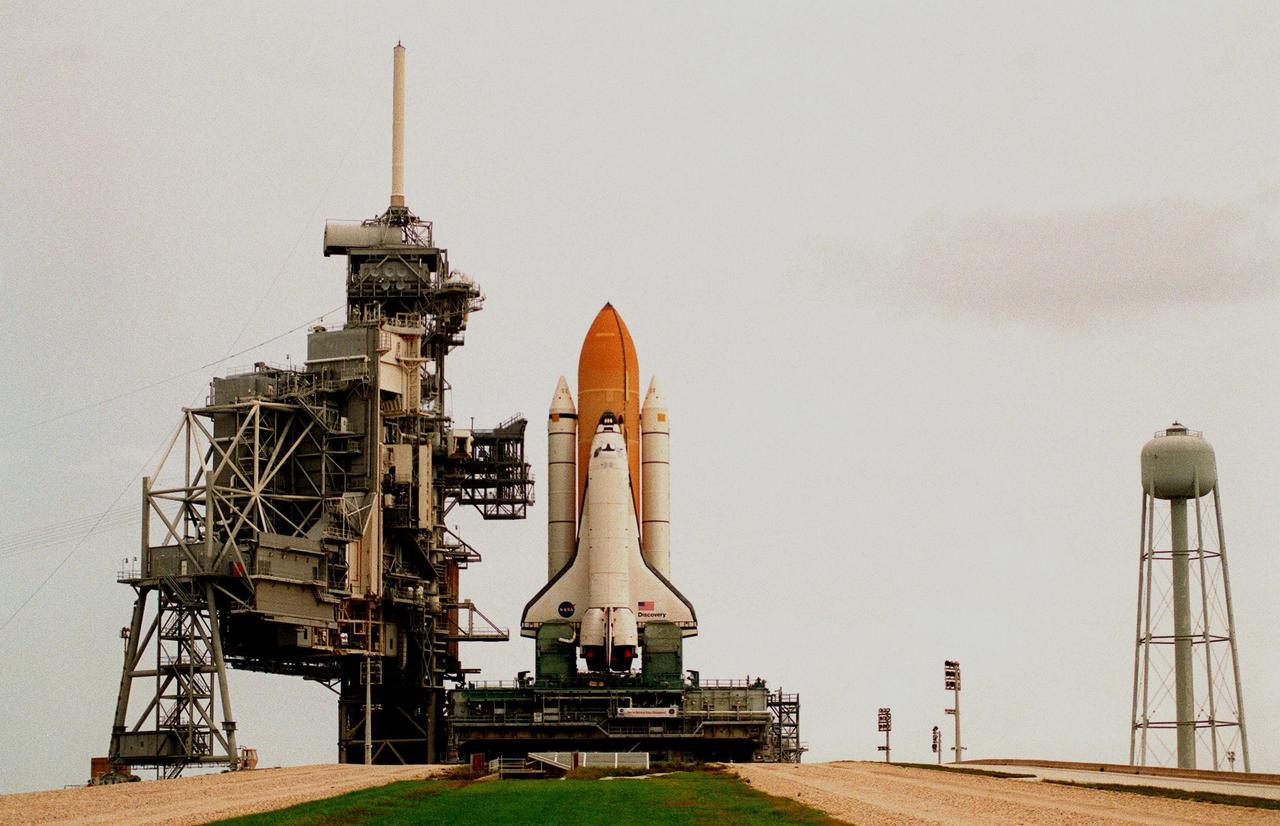
Space Shuttle Discovery sits atop the Mobile Launch Platform on Launch Pad 39-B, with the Rotating Service Structure moved back, to await rollback decision. At the right is the 300,000-gallon water tank, part of the sound suppression water system used during launch. KSC managers developed a precautionary plan to roll back Discovery to the Vehicle Assembly Building in the event that Hurricane Georges threatens Central Florida. The decision was made in order to minimize risk and provide protection to the Space Shuttle, a national asset
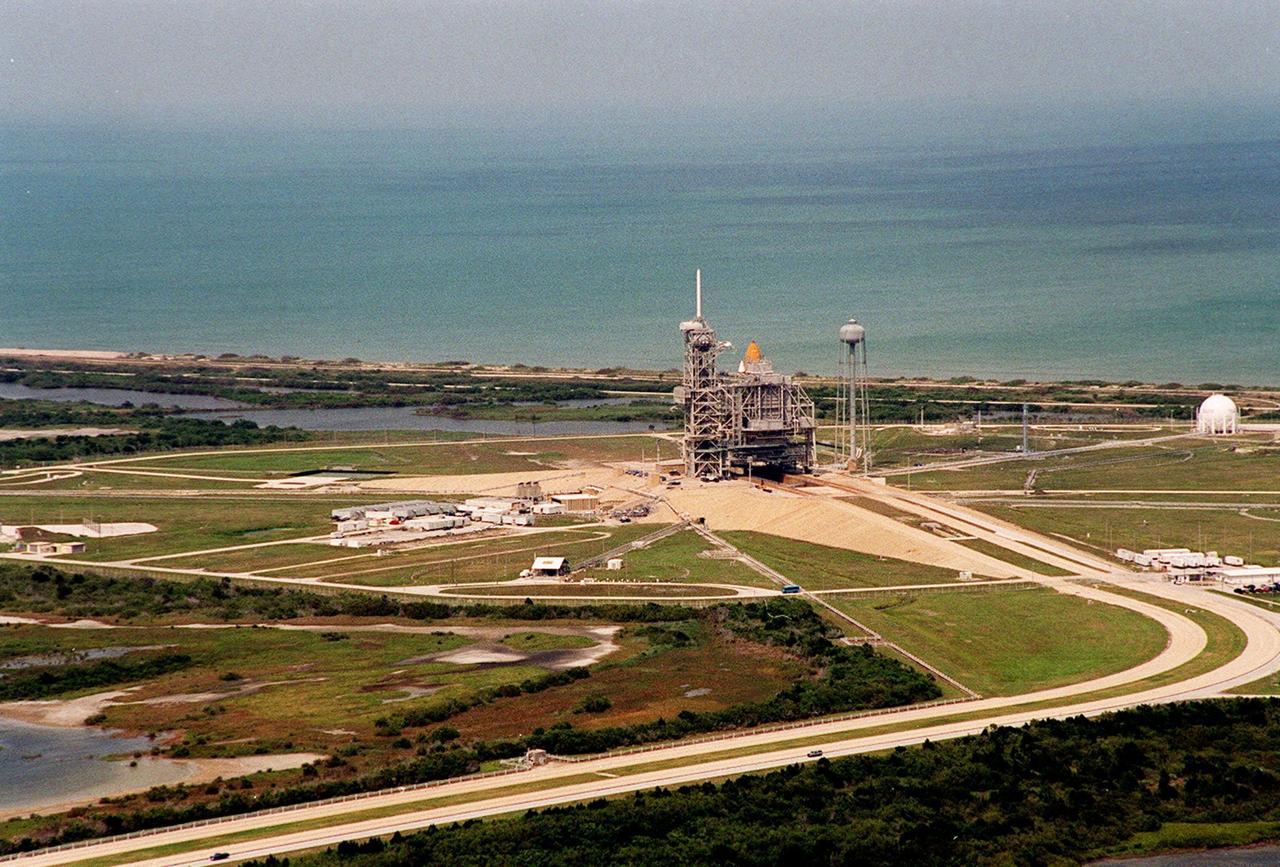
This aerial view captures KSC's Launch Pad 39A, with the rotating service structure closed around Shuttle Atlantis. Just visible in the center is the top of the orange-colored external tank. On the left side towers the white 80-foot fiberglass lightning mast; on the right is the 300,000-gallon water tower used for sound suppression during launch. The launch pad abuts the Atlantic Ocean on the east, seen here in the background
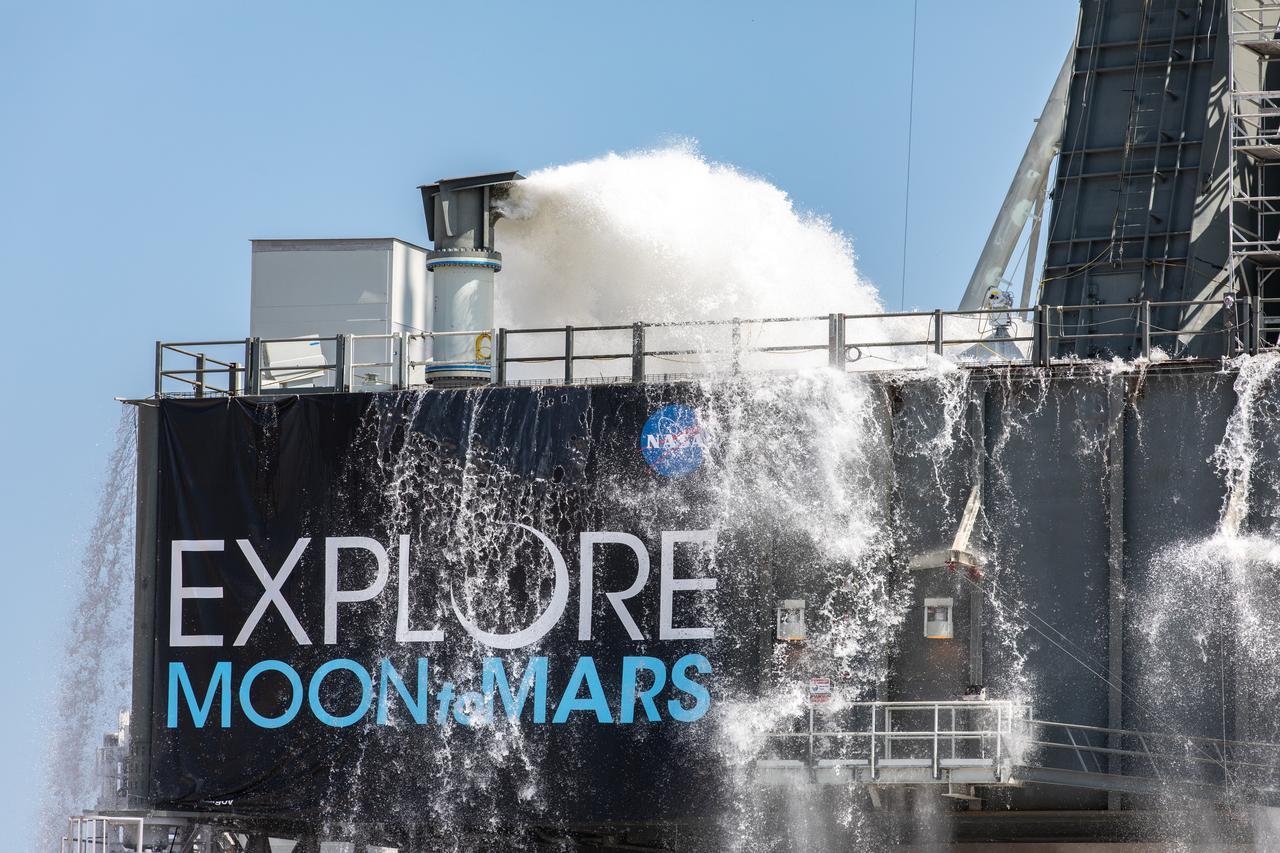
NASA’s Exploration Ground Systems conducts a water flow test with the mobile launcher at Kennedy Space Center’s Pad 39B in Florida on July 2, 2019. It is the first of nine tests to verify the sound suppression system is ready for launch of NASA’s Space Launch System for the first Artemis mission. During launch, 400,000 gallons of water will rush onto the pad to help protect the rocket, NASA’s Orion Spacecraft, mobile launcher, and launch pad from the extreme acoustic and temperature environment.
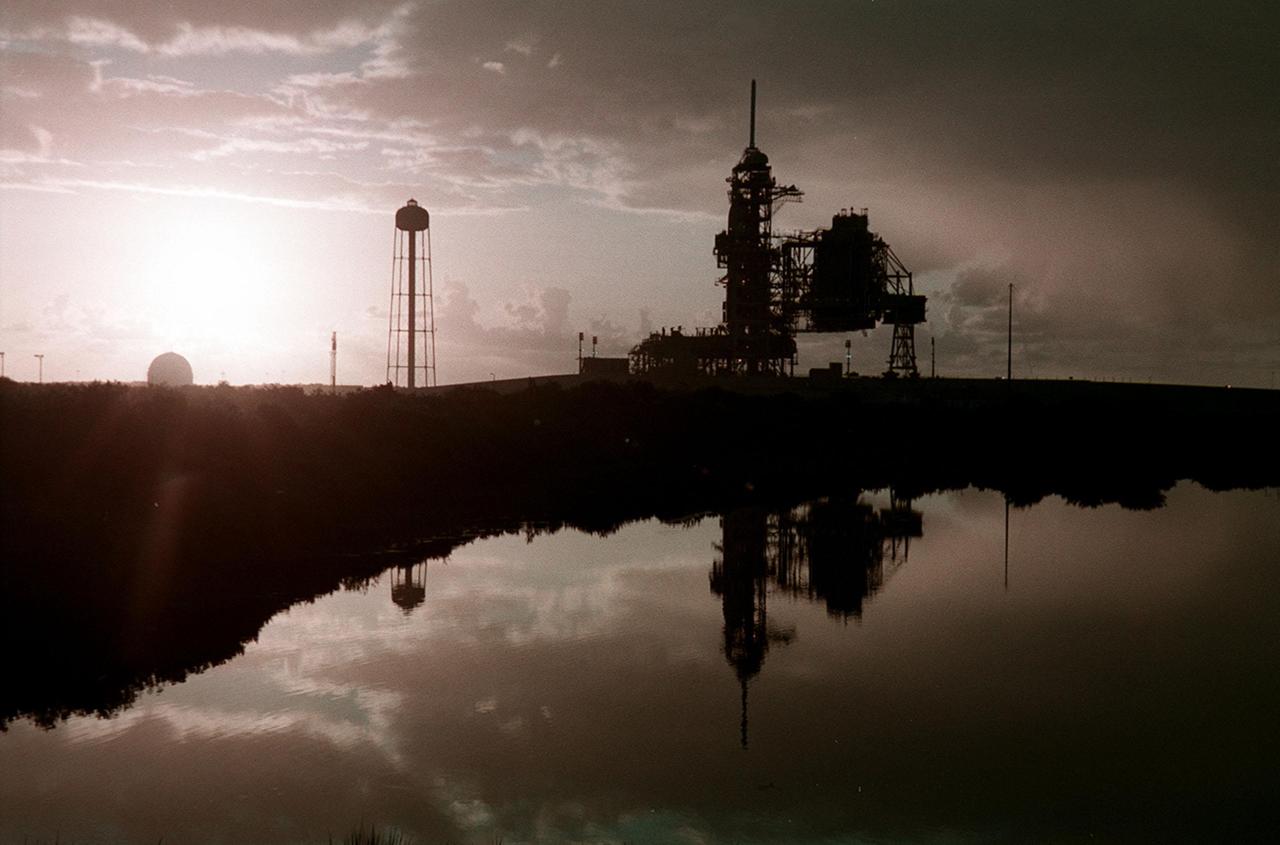
KENNEDY SPACE CENTER, Fla. -- Just after dawn, Launch Pad 39A is caught in silhouette and reflected in the water nearby. On the pad is Space Shuttle Discovery, waiting for launch on mission STS-92 Oct. 5, 2000. At the left of the pad is the 300,000-gallon water tank that is part of the sound suppression system during launches. At far left, the ball-shaped structure is a storage tank for one of the cryogenic liquid propellants of the orbiter’s main engines
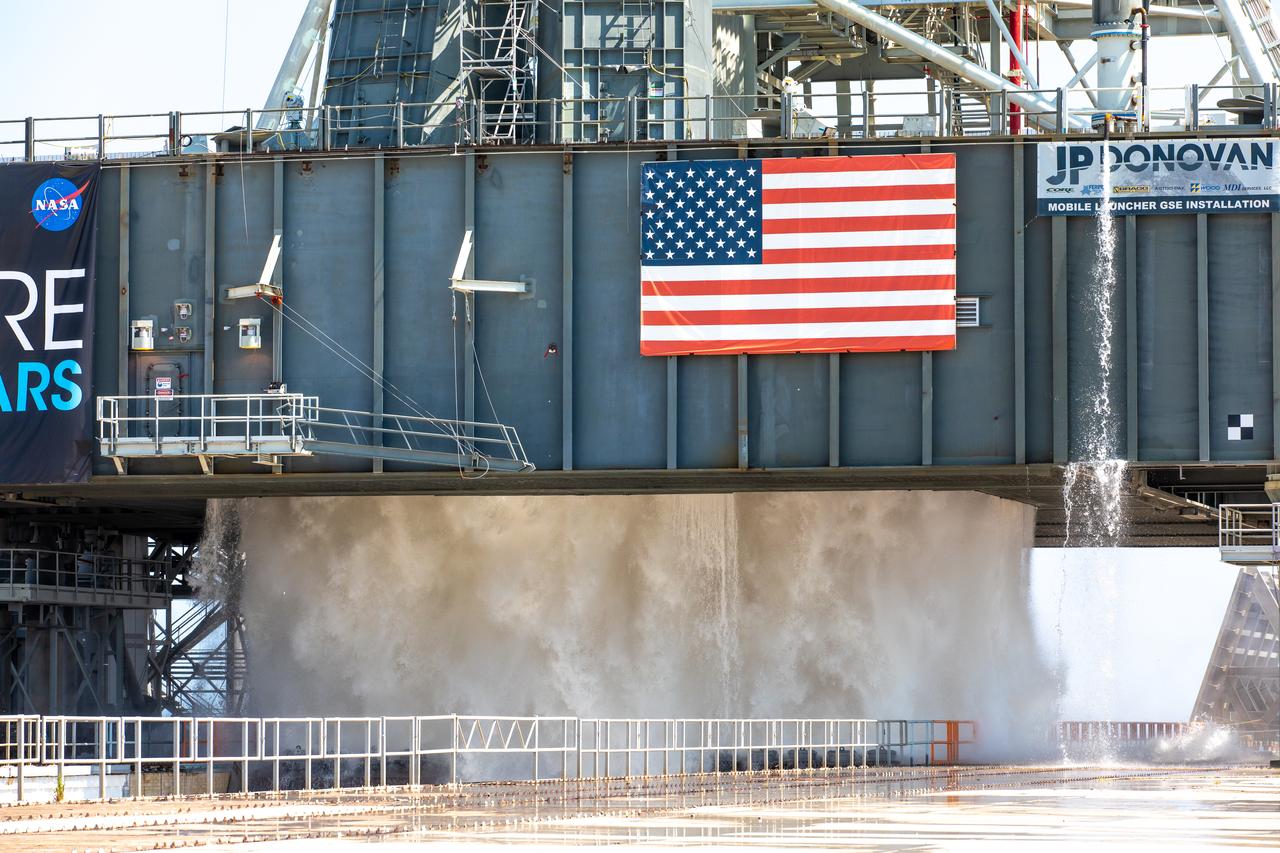
NASA’s Exploration Ground Systems conducts a water flow test with the mobile launcher at Kennedy Space Center’s Pad 39B in Florida on July 2, 2019. It is the first of nine tests to verify the sound suppression system is ready for launch of NASA’s Space Launch System for the first Artemis mission. During launch, 400,000 gallons of water will rush onto the pad to help protect the rocket, NASA’s Orion Spacecraft, mobile launcher, and launch pad from the extreme acoustic and temperature environment.
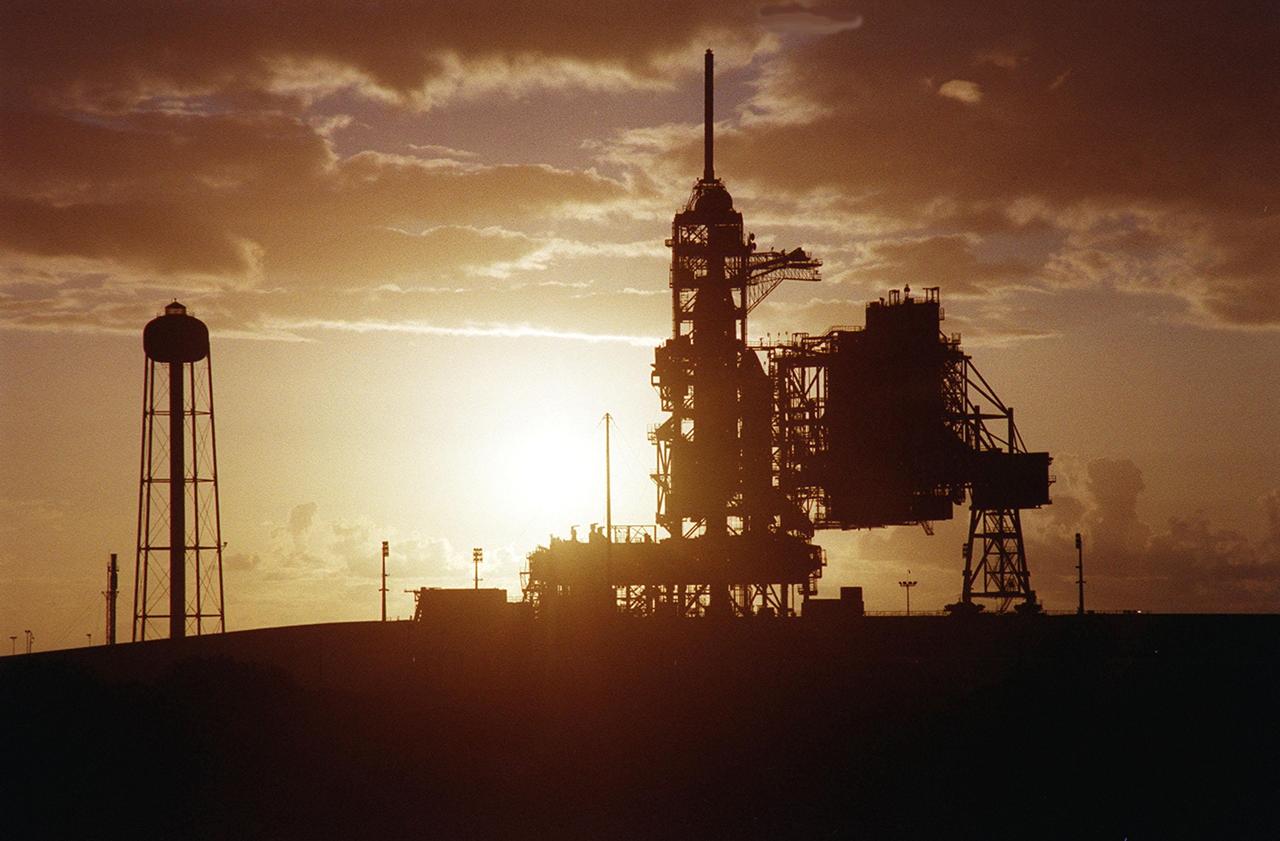
KENNEDY SPACE CENTER, Fla. -- While the morning sun paints the sky pale gold, the structures on Launch Pad 39A are silhouetted in brown. Space Shuttle Discovery can be seen on the other side of the Fixed Service Structure; the Rotating Service Structure at right is still open. At left is the 300,000-gallon water tank that is part of the sound suppression system during launches. Discovery will launch on mission STS-92 Oct. 5, 2000
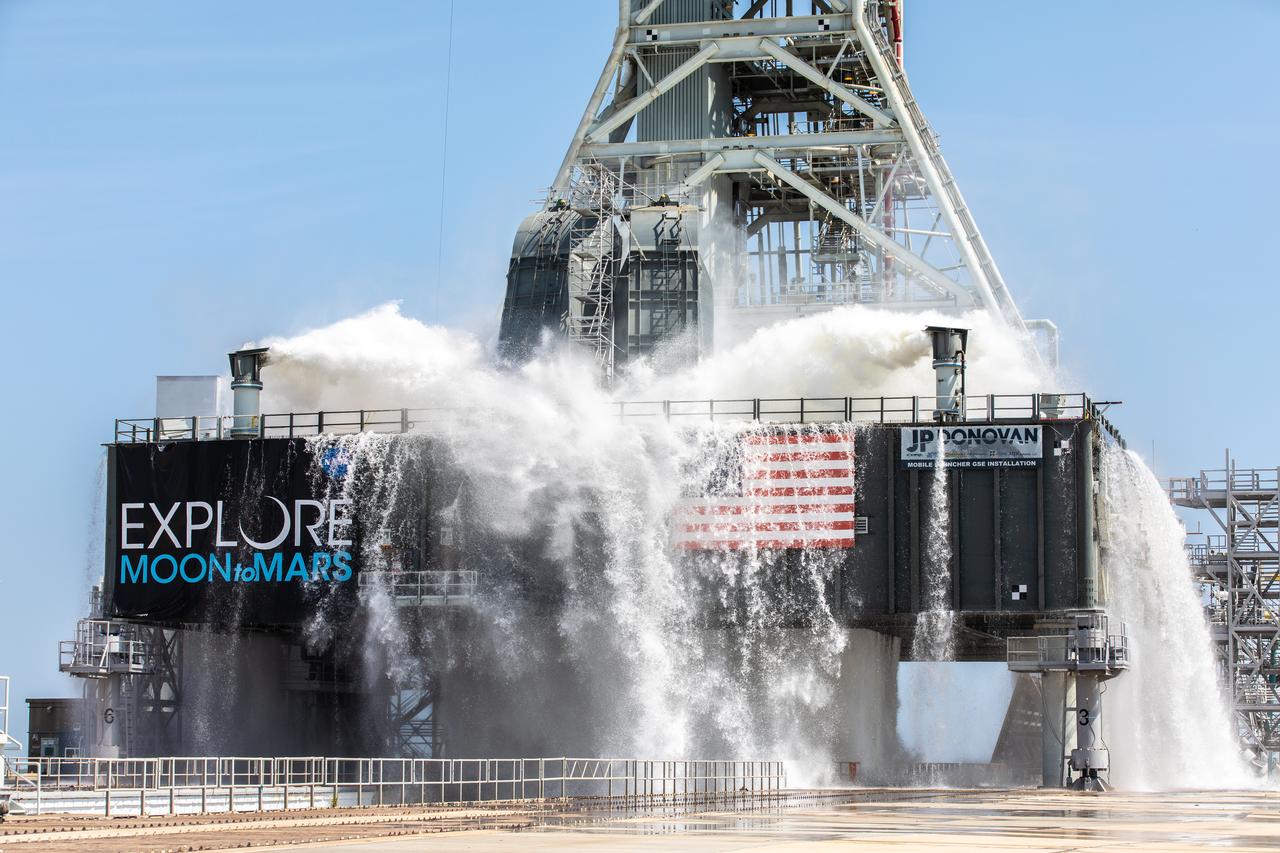
NASA’s Exploration Ground Systems conducts a water flow test with the mobile launcher at Kennedy Space Center’s Pad 39B in Florida on July 2, 2019. It is the first of nine tests to verify the sound suppression system is ready for launch of NASA’s Space Launch System for the first Artemis mission. During launch, 400,000 gallons of water will rush onto the pad to help protect the rocket, NASA’s Orion Spacecraft, mobile launcher, and launch pad from the extreme acoustic and temperature environment.
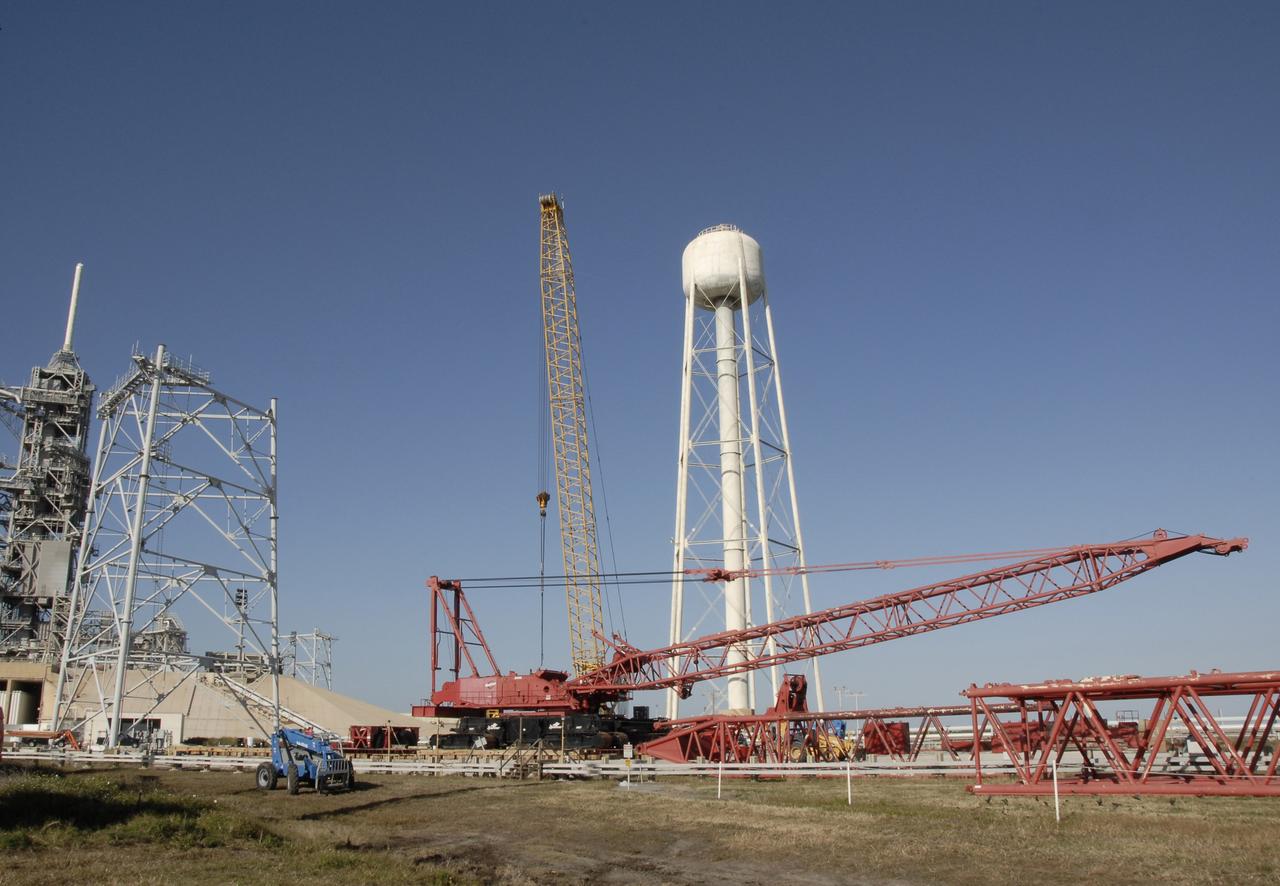
CAPE CANAVERAL, Fla. -- On Launch Pad 39B at NASA's Kennedy Space Center in Florida, segments are being added to the crane (foreground) that will be used to finish erecting the lightning towers (one is at left) on the pad. In the background is the 290-foot-high tower that holds 300,000 gallons of water used for sound suppression during shuttle launches. Lightning towers are being constructed to hold centenary wires as part of the new lightning protection system for the Constellation Program and Ares/Orion launches. Photo credit: NASA/Kim Shiflett
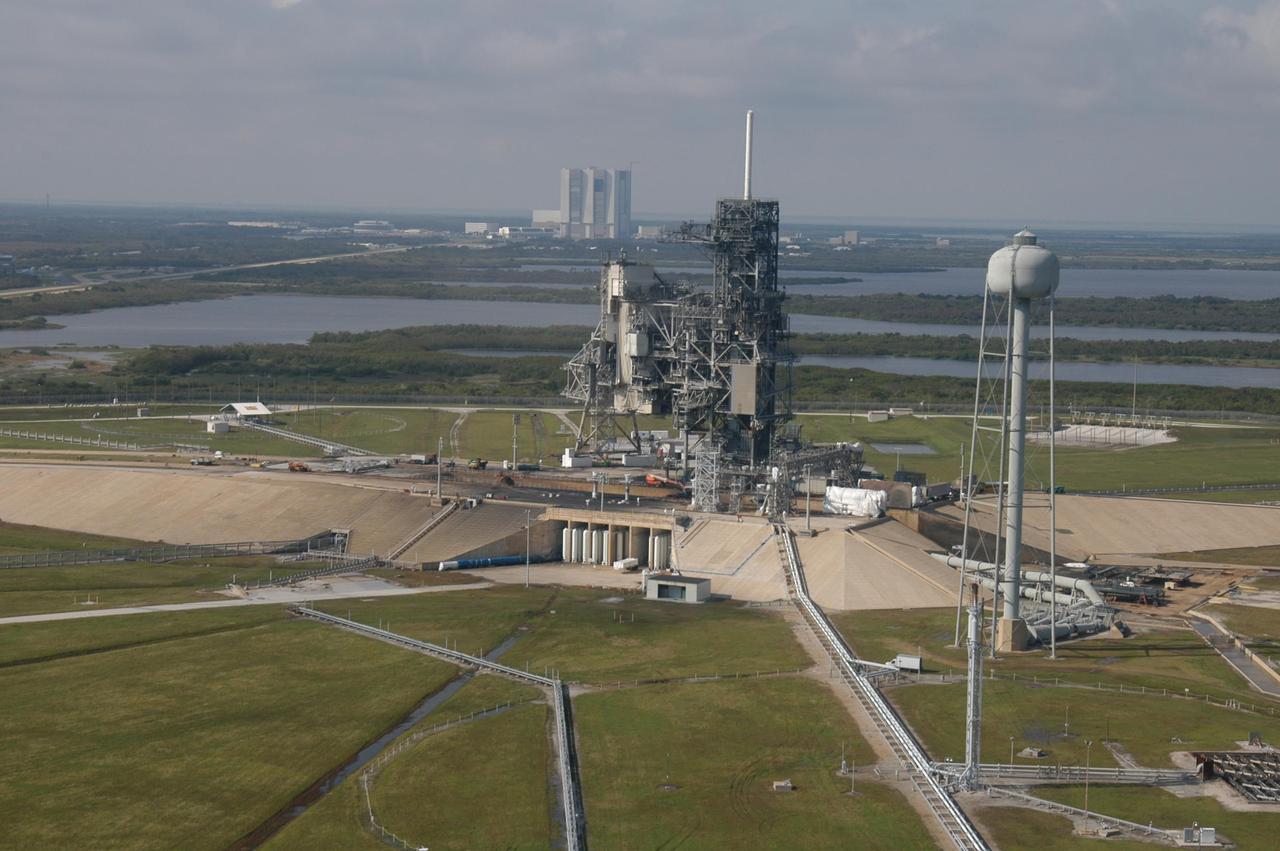
KENNEDY SPACE CENTER, FLA. - An aerial view of Launch Pad 39A at NASA Kennedy Space Center in Florida. In the background is the Vehicle Assembly Building. Atop the fixed service structure is the 80-foot-tall lightning mast. At right is the 290-foot-tall water tower that holds 300,000 gallons of water used at launch for sound suppression to protect the orbiter and its payloads from damage by acoustical energy and rocket exhaust reflected from the flame trench and Mobile Launcher Platform during launch.
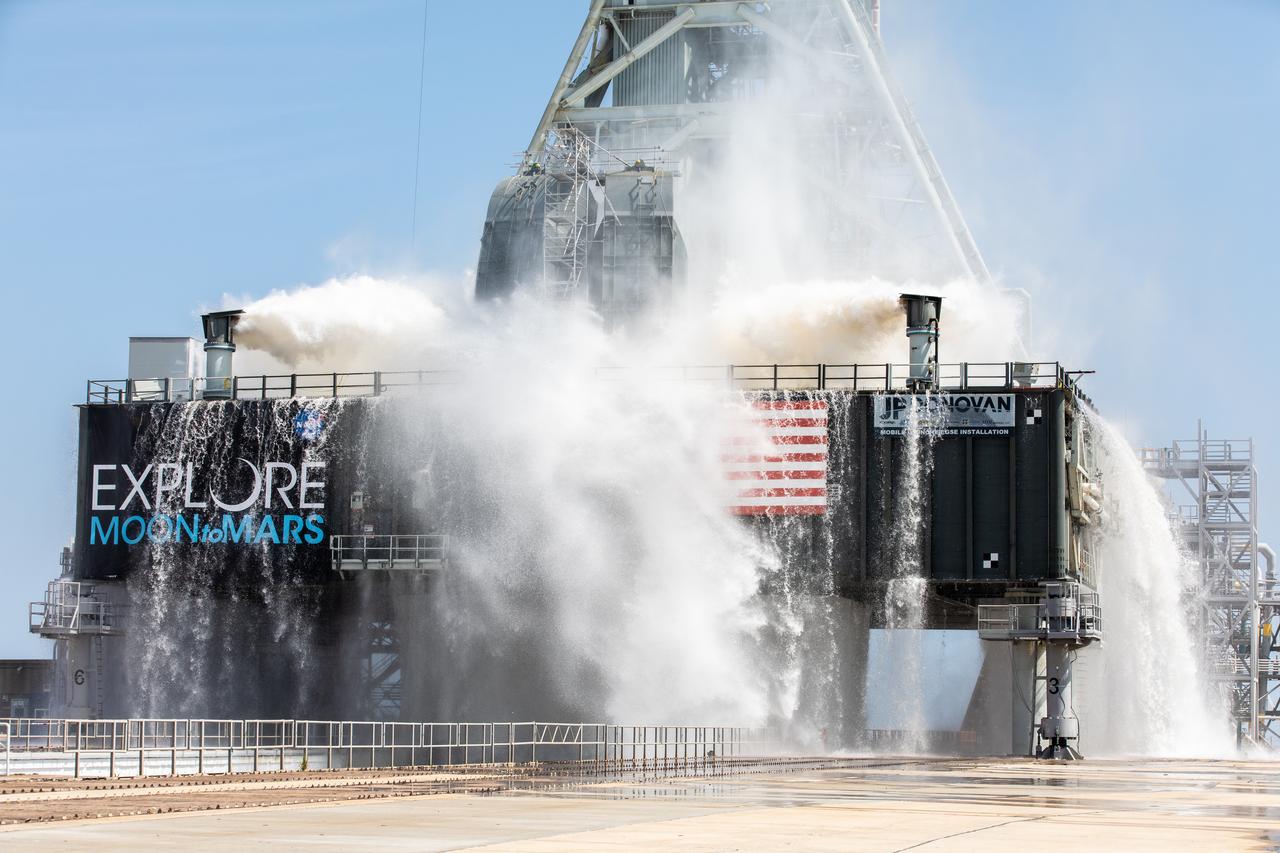
NASA’s Exploration Ground Systems conducts a water flow test with the mobile launcher at Kennedy Space Center’s Pad 39B in Florida on July 2, 2019. It is the first of nine tests to verify the sound suppression system is ready for launch of NASA’s Space Launch System for the first Artemis mission. During launch, 400,000 gallons of water will rush onto the pad to help protect the rocket, NASA’s Orion Spacecraft, mobile launcher, and launch pad from the extreme acoustic and temperature environment.
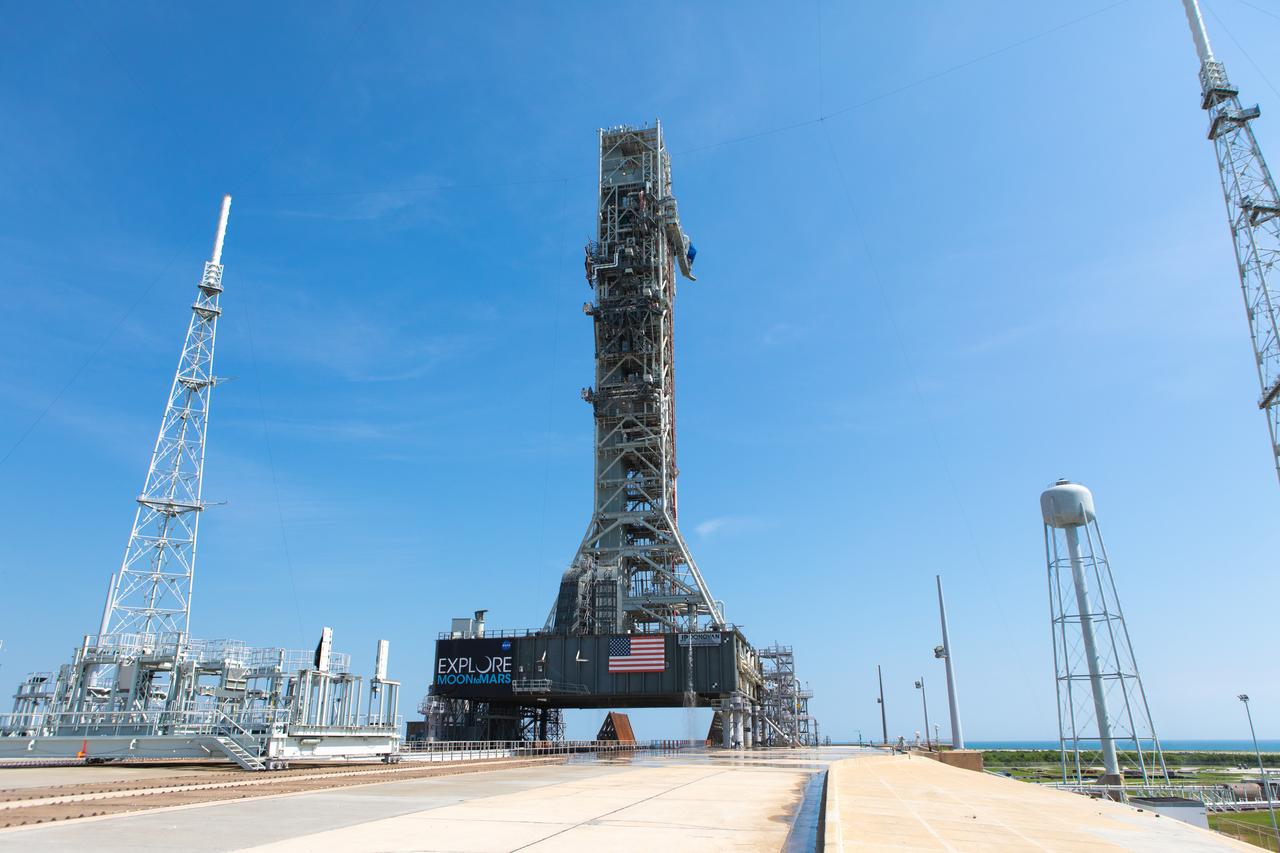
NASA’s Exploration Ground Systems conducts a water flow test with the mobile launcher at Kennedy Space Center’s Pad 39B in Florida on July 2, 2019. It is the first of nine tests to verify the sound suppression system is ready for launch of NASA’s Space Launch System for the first Artemis mission. During launch, 400,000 gallons of water will rush onto the pad to help protect the rocket, NASA’s Orion Spacecraft, mobile launcher, and launch pad from the extreme acoustic and temperature environment.
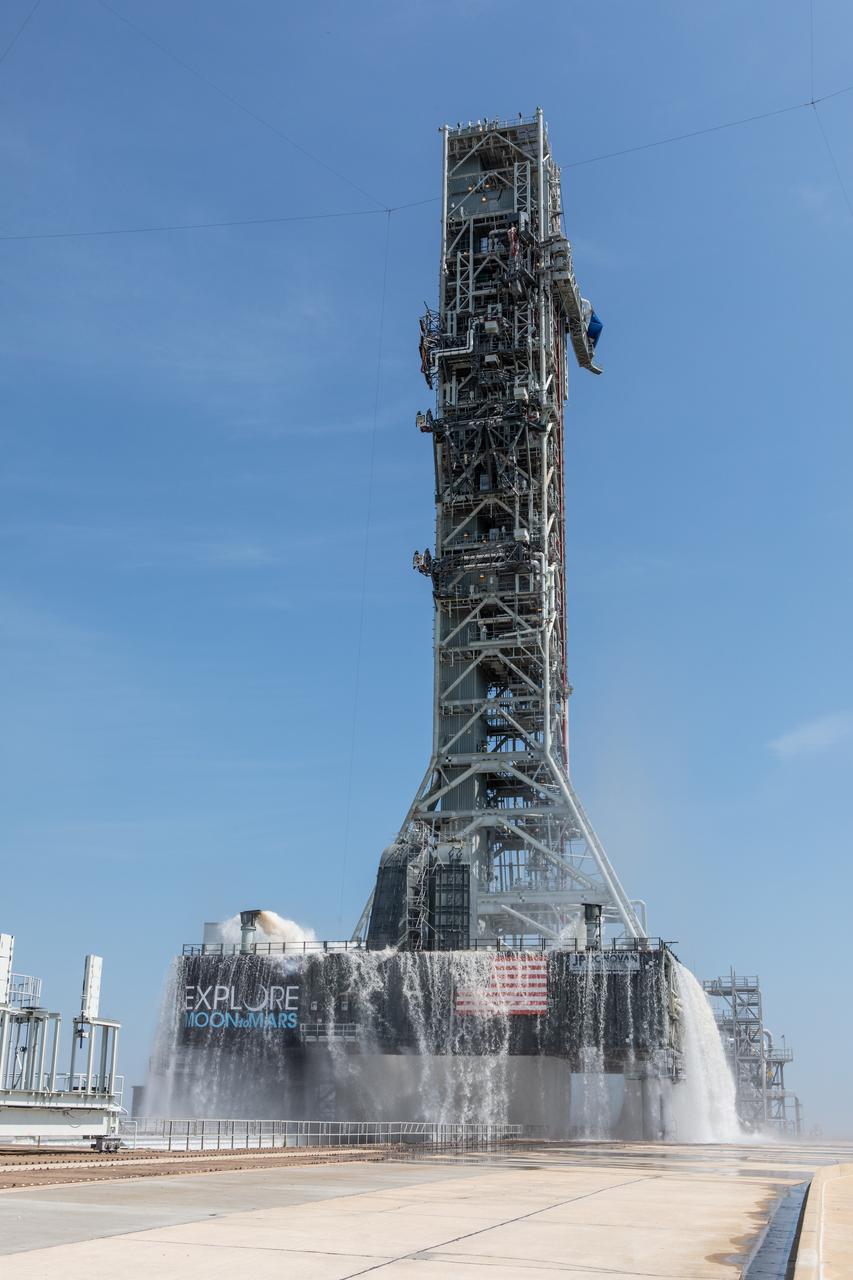
NASA’s Exploration Ground Systems conducts a water flow test with the mobile launcher at Kennedy Space Center’s Pad 39B in Florida on July 2, 2019. It is the first of nine tests to verify the sound suppression system is ready for launch of NASA’s Space Launch System for the first Artemis mission. During launch, 400,000 gallons of water will rush onto the pad to help protect the rocket, NASA’s Orion Spacecraft, mobile launcher, and launch pad from the extreme acoustic and temperature environment.
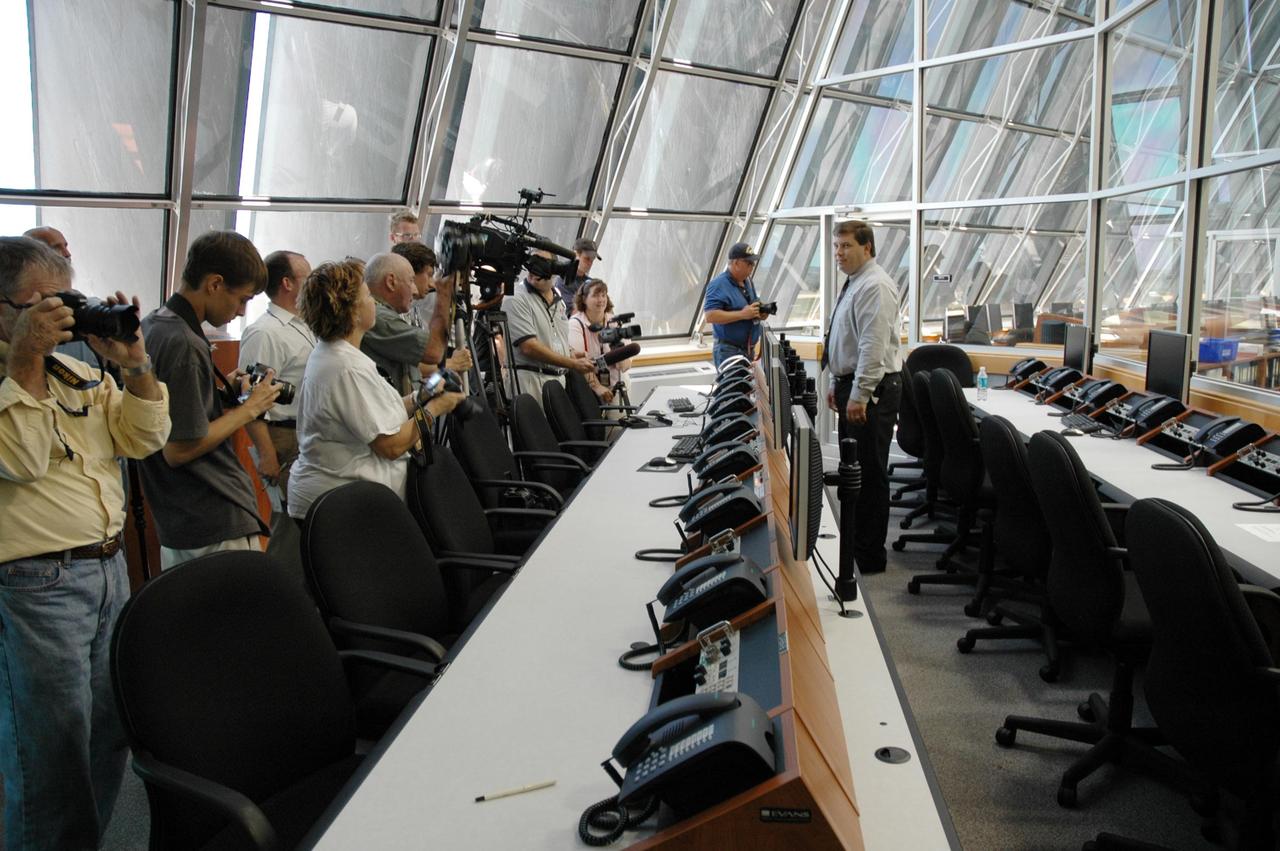
KENNEDY SPACE CENTER, FLA. - Ted Mosteller (right), NASA test director, briefs the media about Firing Room 4 (FR4), which has been undergoing renovations for two years. FR4 is now designated the primary firing room for all remaining shuttle launches, and will also be used daily to manage operations in the Orbiter Processing Facilities and for integrated processing for the shuttle. The firing room now includes sound-suppressing walls and floors, new humidity control, fire-suppression systems and consoles, support tables with computer stations, communication systems and laptop computer ports. FR 4 also has power and computer network connections and a newly improved Checkout, Control and Monitor Subsystem. The renovation is part of the Launch Processing System Extended Survivability Project that began in 2003. United Space Alliance's Launch Processing System directorate managed the FR 4 project for NASA. Photo credit: NASA/Dimitri Gerondidakis
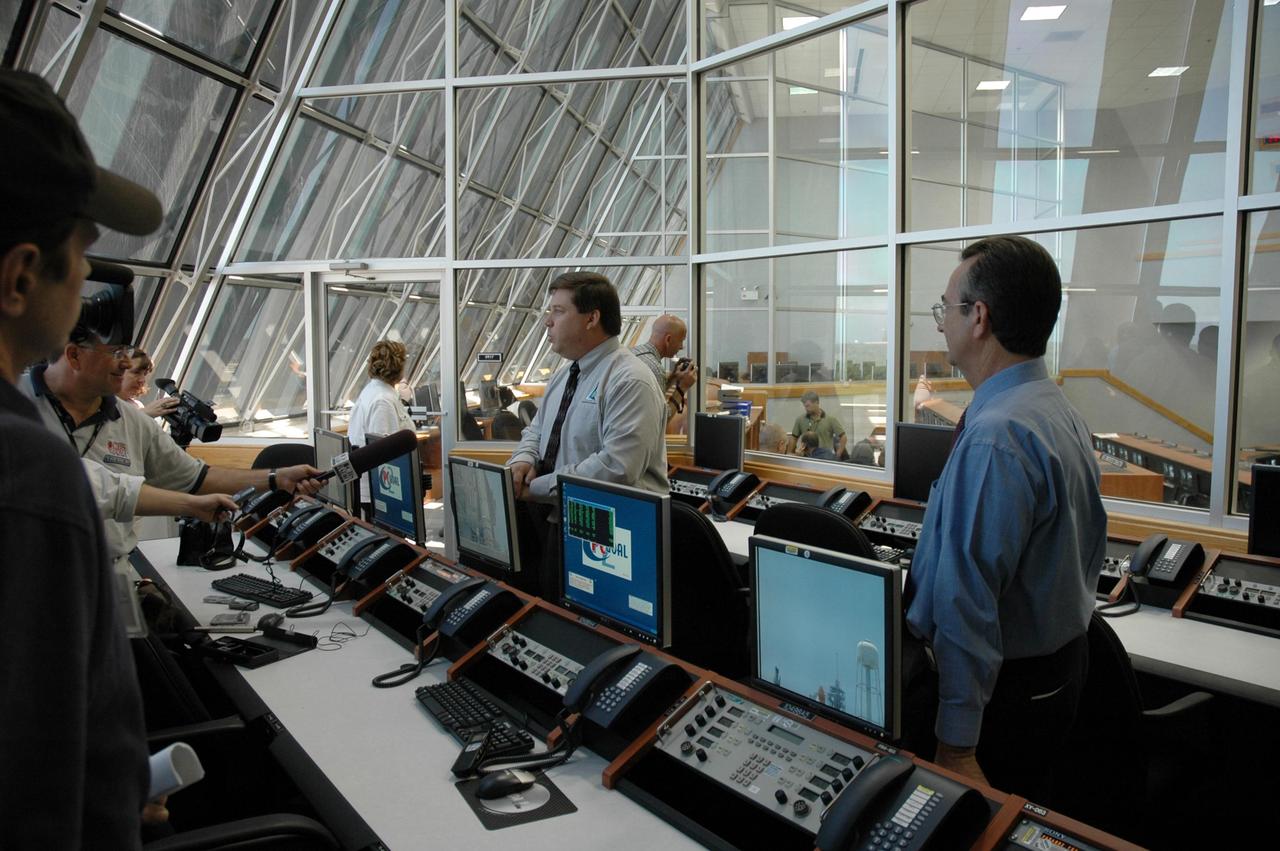
KENNEDY SPACE CENTER, FLA. - NASA Test Director Ted Mosteller (center) briefs the media about Firing Room 4 (FR4), which has been undergoing renovations for two years. FR4 is now designated the primary firing room for all remaining shuttle launches, and will also be used daily to manage operations in the Orbiter Processing Facilities and for integrated processing for the shuttle. The firing room now includes sound-suppressing walls and floors, new humidity control, fire-suppression systems and consoles, support tables with computer stations, communication systems and laptop computer ports. FR 4 also has power and computer network connections and a newly improved Checkout, Control and Monitor Subsystem. The renovation is part of the Launch Processing System Extended Survivability Project that began in 2003. United Space Alliance's Launch Processing System directorate managed the FR 4 project for NASA. Photo credit: NASA/Dimitri Gerondidakis
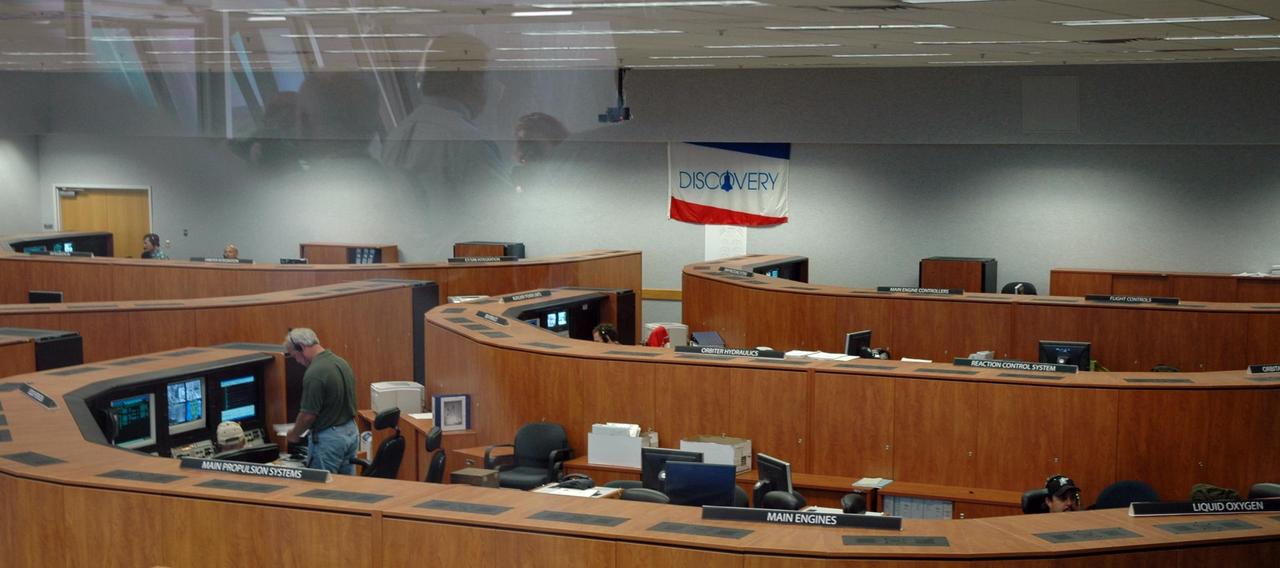
KENNEDY SPACE CENTER, FLA. - An overview of the new Firing Room 4 shows the expanse of computer stations and the various operations the facility will be able to manage. FR4 is now designated the primary firing room for all remaining shuttle launches, and will also be used daily to manage operations in the Orbiter Processing Facilities and for integrated processing for the shuttle. The firing room now includes sound-suppressing walls and floors, new humidity control, fire-suppression systems and consoles, support tables with computer stations, communication systems and laptop computer ports. FR 4 also has power and computer network connections and a newly improved Checkout, Control and Monitor Subsystem. The renovation is part of the Launch Processing System Extended Survivability Project that began in 2003. United Space Alliance's Launch Processing System directorate managed the FR 4 project for NASA. Photo credit: NASA/Dimitri Gerondidakis
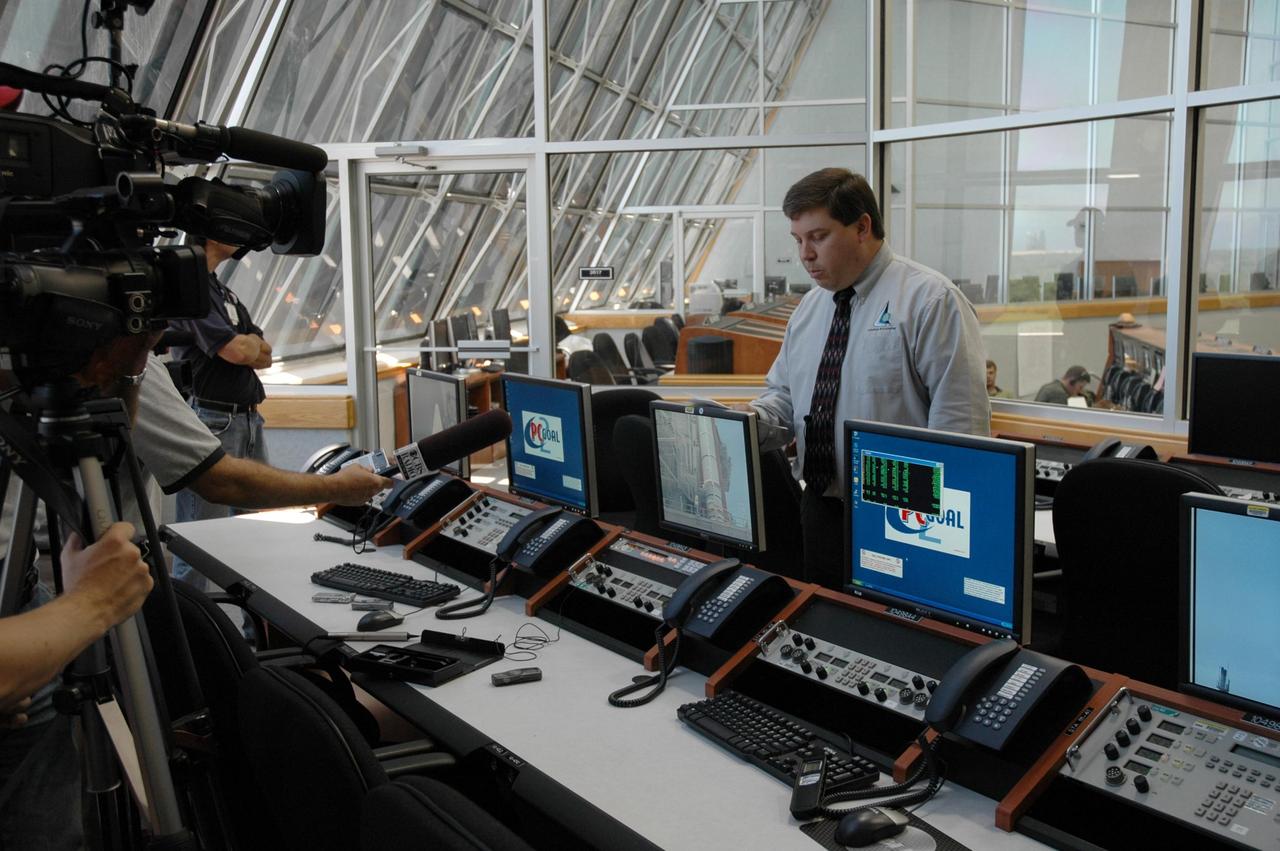
KENNEDY SPACE CENTER, FLA. - NASA Test Director Ted Mosteller (right) briefs the media about Firing Room 4 (FR4), which has been undergoing renovations for two years. FR4 is now designated the primary firing room for all remaining shuttle launches, and will also be used daily to manage operations in the Orbiter Processing Facilities and for integrated processing for the shuttle. The firing room now includes sound-suppressing walls and floors, new humidity control, fire-suppression systems and consoles, support tables with computer stations, communication systems and laptop computer ports. FR 4 also has power and computer network connections and a newly improved Checkout, Control and Monitor Subsystem. The renovation is part of the Launch Processing System Extended Survivability Project that began in 2003. United Space Alliance's Launch Processing System directorate managed the FR 4 project for NASA. Photo credit: NASA/Dimitri Gerondidakis
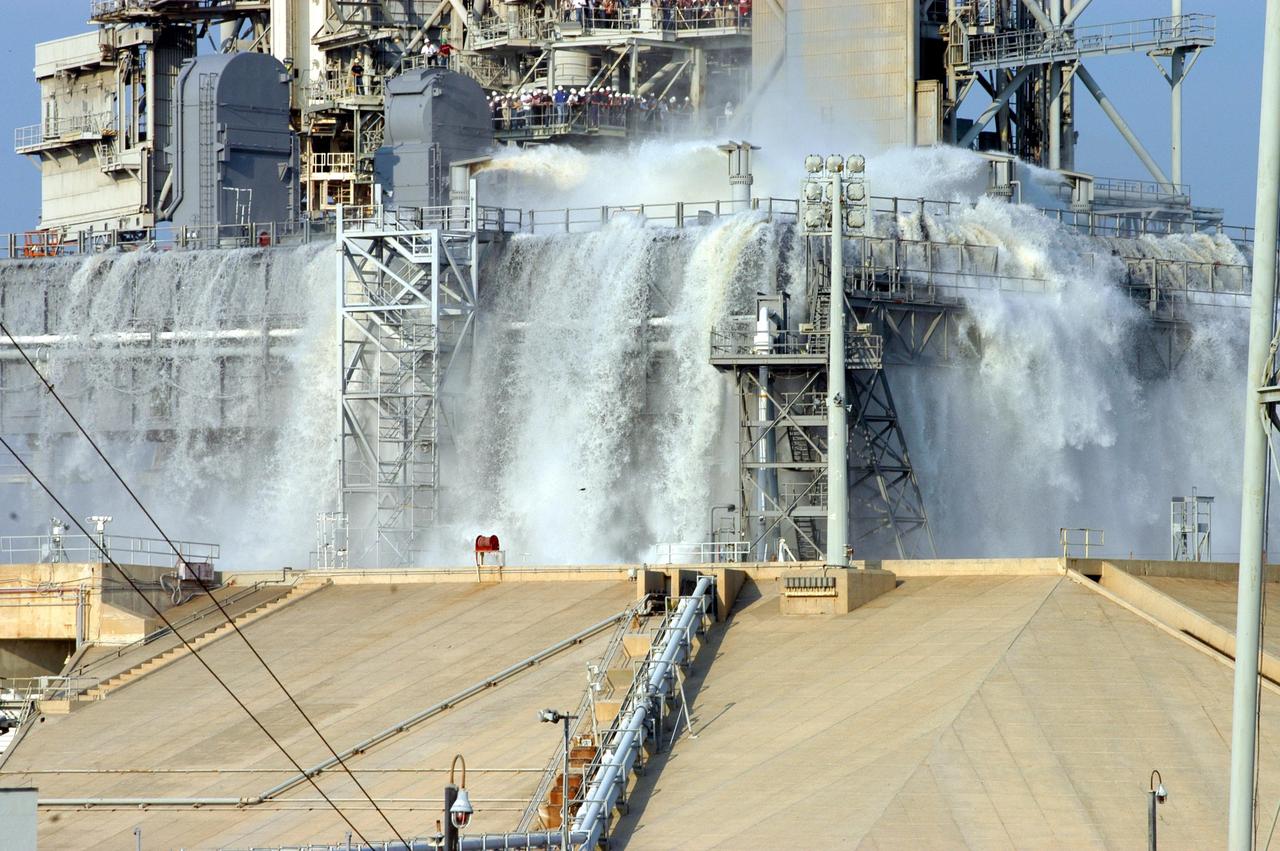
KENNEDY SPACE CENTER, FLA. -- For the fourth time in Space Shuttle Program history, 350,000 gallons of water are released on a Mobile Launcher Platform (MLP) at Launch Pad 39A during a water sound suppression test. This test is being conducted following the replacement of the six main system valves, which had been in place since the beginning of the Shuttle Program and had reached the end of their service life. Also, the hydraulic portion of the valve actuators has been redesigned and simplified to reduce maintenance costs. The sound suppression water system is installed on the launch pads to protect the orbiter and its payloads from damage by acoustical energy reflected from the MLP during launch. The system includes an elevated water tank with a capacity of 300,000 gallons. The tank is 290 feet high and stands on the northeast side of the Pad. The water is released just before the ignition of the orbiter's three main engines and twin solid rocket boosters, and flows through parallel 7-foot-diameter pipes to the Pad area.
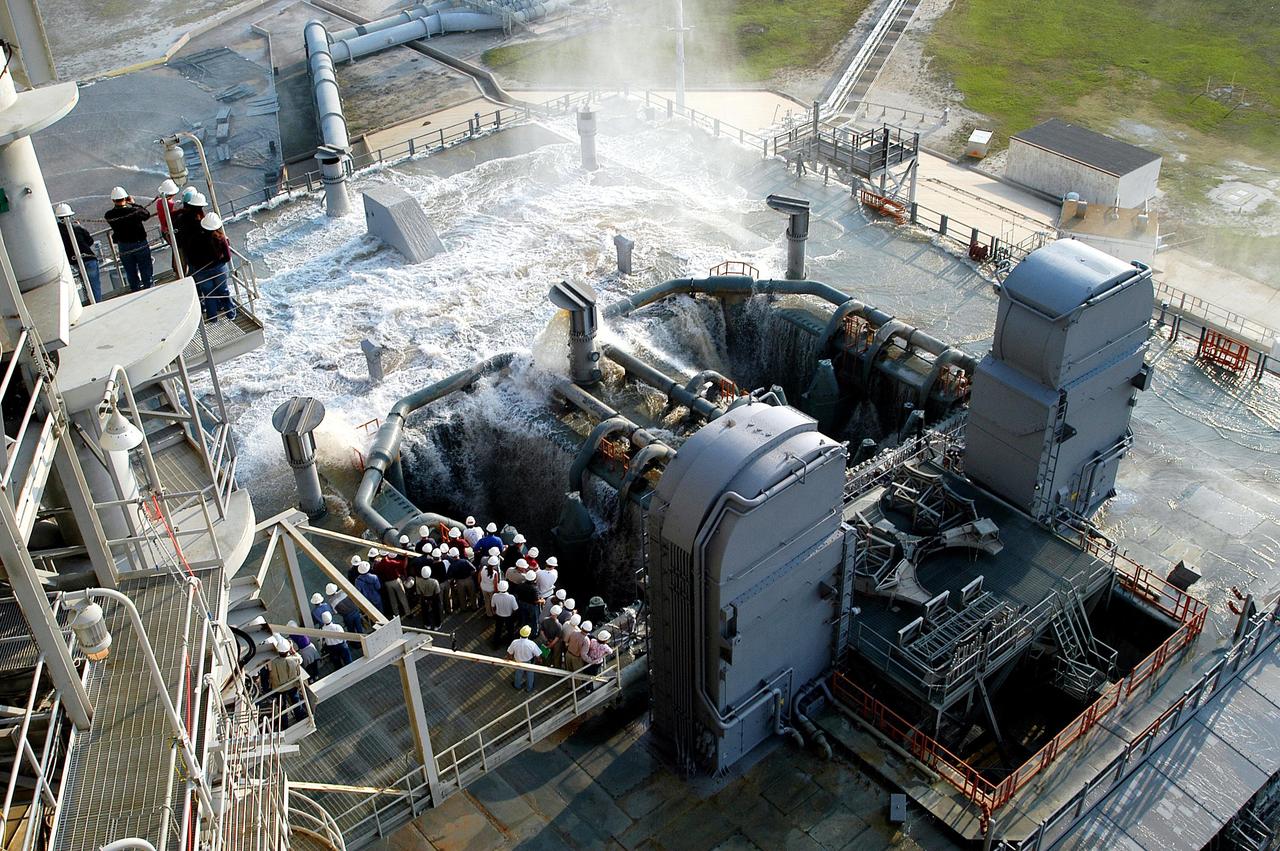
KENNEDY SPACE CENTER, FLA. -- Water recedes from the Mobile Launcher Platform (MLP) on Launch Pad 39A after the water sound suppression test. Workers and the media (left) were on hand to witness the rare event. This test was conducted following the replacement of the six main system valves, which had been in place since the beginning of the Shuttle Program and had reached the end of their service life. Also, the hydraulic portion of the valve actuators has been redesigned and simplified to reduce maintenance costs. The sound suppression water system is installed on the launch pads to protect the orbiter and its payloads from damage by acoustical energy reflected from the MLP during launch. The system includes an elevated water tank with a capacity of 300,000 gallons. The tank is 290 feet high and stands on the northeast side of the Pad. The water is released just before the ignition of the orbiter's three main engines and twin solid rocket boosters, and flows through parallel 7-foot-diameter pipes to the Pad area.
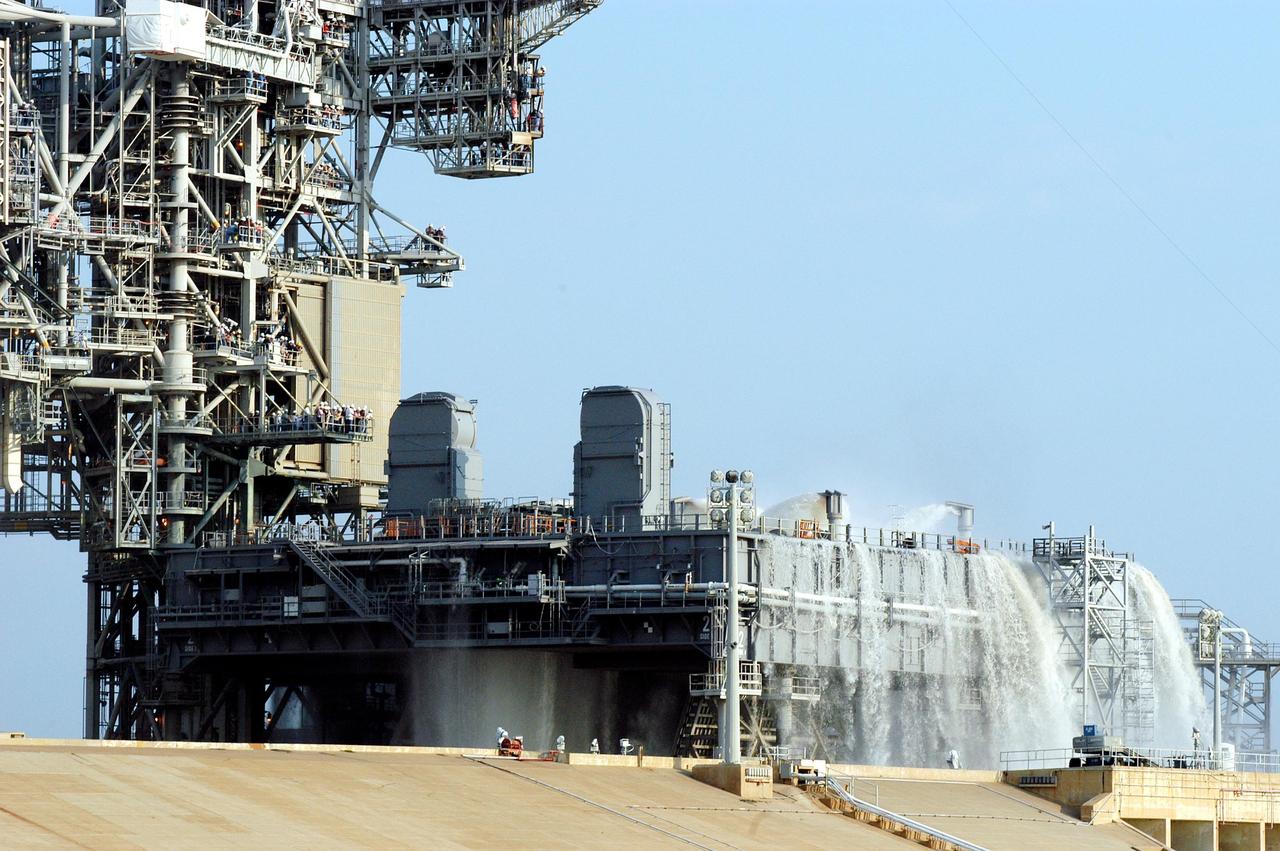
KENNEDY SPACE CENTER, FLA. -- For the fourth time in Space Shuttle Program history, 350,000 gallons of water are being released on a Mobile Launcher Platform (MLP) at Launch Pad 39A during a water sound suppression test. Because of the unusual event, media and workers watch from nearby vantage points on the Fixed Service Structure (left). This test is being conducted following the replacement of the six main system valves, which had been in place since the beginning of the Shuttle Program and had reached the end of their service life. Also, the hydraulic portion of the valve actuators has been redesigned and simplified to reduce maintenance costs. The sound suppression water system is installed on the launch pads to protect the orbiter and its payloads from damage by acoustical energy reflected from the MLP during launch. The system includes an elevated water tank with a capacity of 300,000 gallons. The tank is 290 feet high and stands on the northeast side of the Pad. The water is released just before the ignition of the orbiter's three main engines and twin solid rocket boosters, and flows through parallel 7-foot-diameter pipes to the Pad area.
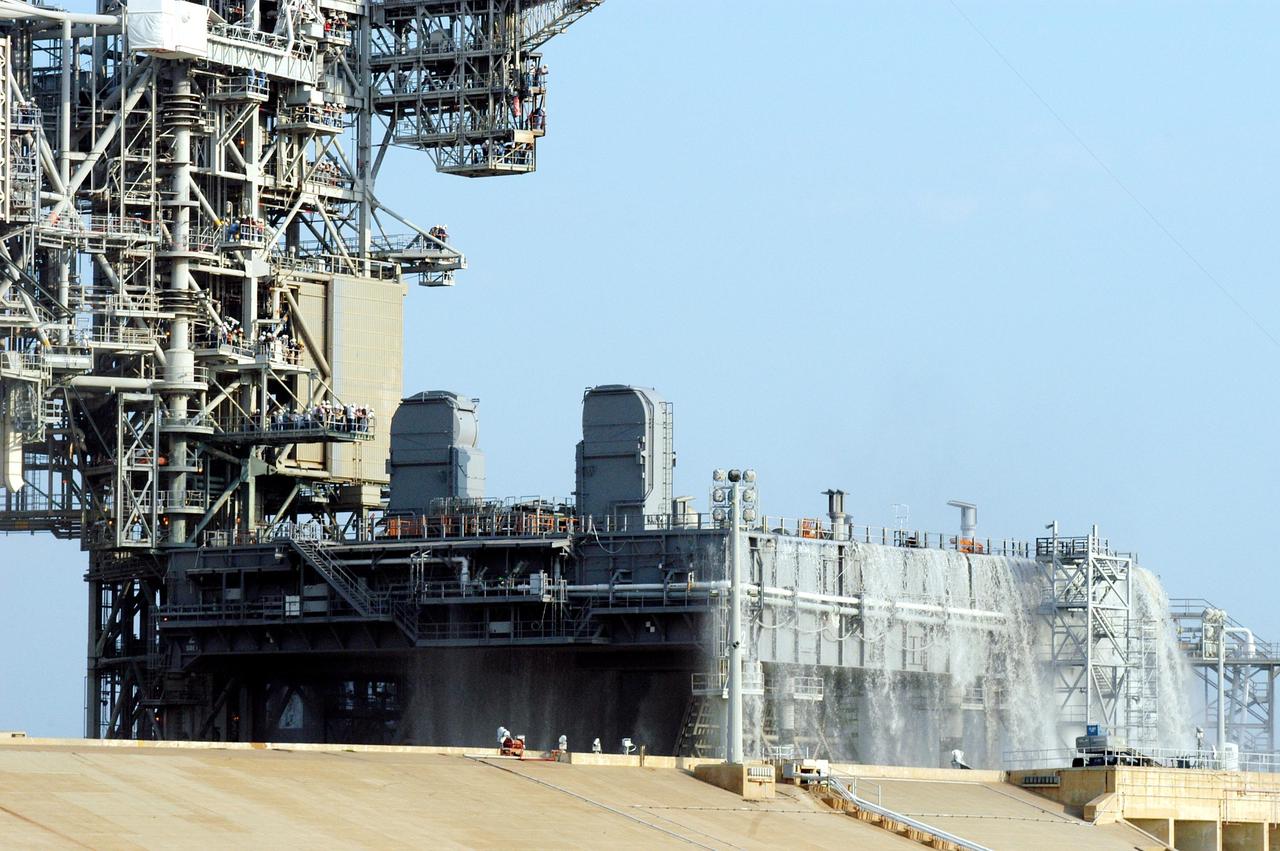
KENNEDY SPACE CENTER, FLA. -- For the fourth time in Space Shuttle Program history, 350,000 gallons of water are being released on a Mobile Launcher Platform (MLP) at Launch Pad 39A during a water sound suppression test. Because of the unusual event, media and workers watch from nearby vantage points on the Fixed Service Structure (left). This test is being conducted following the replacement of the six main system valves, which had been in place since the beginning of the Shuttle Program and had reached the end of their service life. Also, the hydraulic portion of the valve actuators has been redesigned and simplified to reduce maintenance costs. The sound suppression water system is installed on the launch pads to protect the orbiter and its payloads from damage by acoustical energy reflected from the MLP during launch. The system includes an elevated water tank with a capacity of 300,000 gallons. The tank is 290 feet high and stands on the northeast side of the Pad. The water is released just before the ignition of the orbiter's three main engines and twin solid rocket boosters, and flows through parallel 7-foot-diameter pipes to the Pad area.
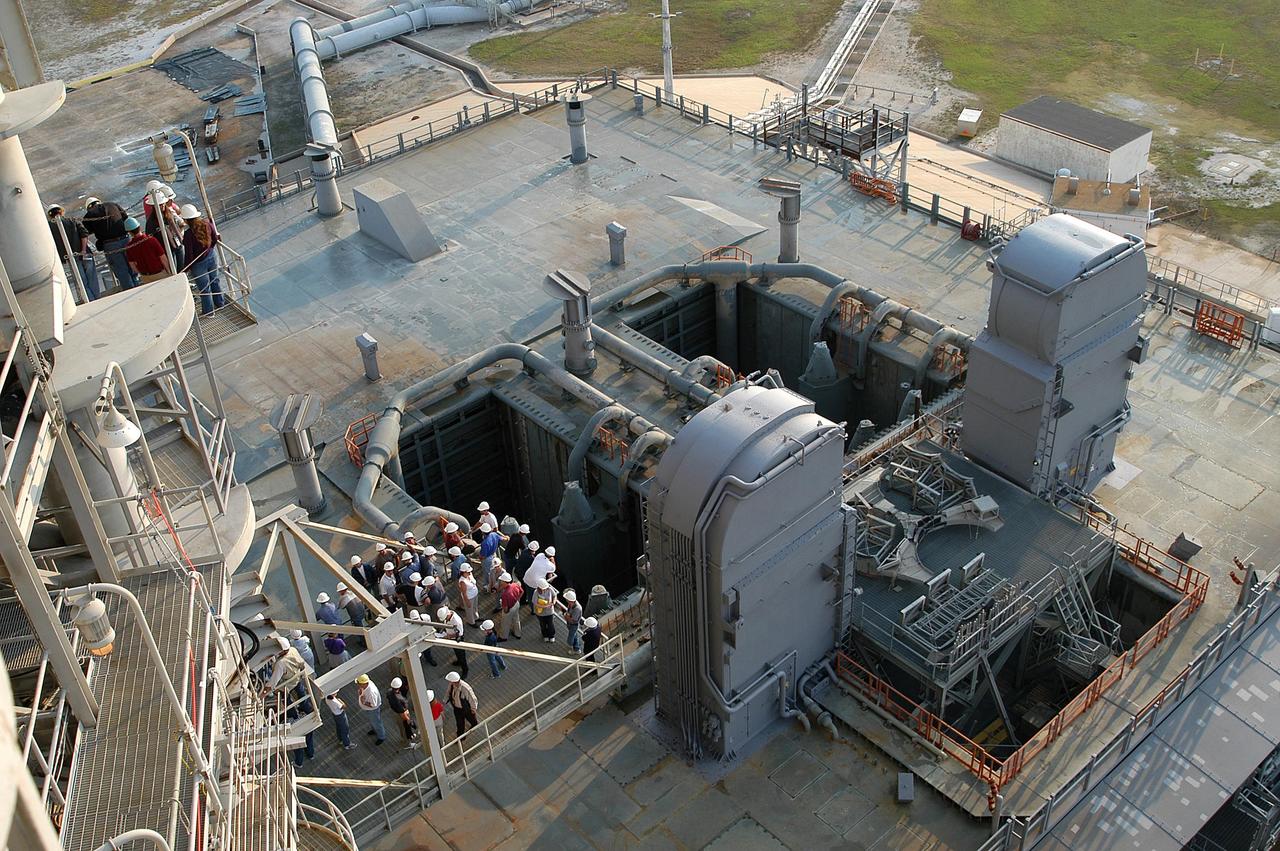
KENNEDY SPACE CENTER, FLA. -- From vantage points on the Fixed Service Structure (left) on Launch Pad 39A, workers and the media look down upon the Mobile Launcher Platform (MLP) waiting for the start of a water sound suppression test. This test is being conducted following the replacement of the six main system valves, which had been in place since the beginning of the Shuttle Program and had reached the end of their service life. Also, the hydraulic portion of the valve actuators has been redesigned and simplified to reduce maintenance costs. The sound suppression water system is installed on the launch pads to protect the orbiter and its payloads from damage by acoustical energy reflected from the MLP during launch. The system includes an elevated water tank with a capacity of 300,000 gallons. The tank is 290 feet high and stands on the northeast side of the Pad. The water is released just before the ignition of the orbiter's three main engines and twin solid rocket boosters, and flows through parallel 7-foot-diameter pipes to the Pad area.
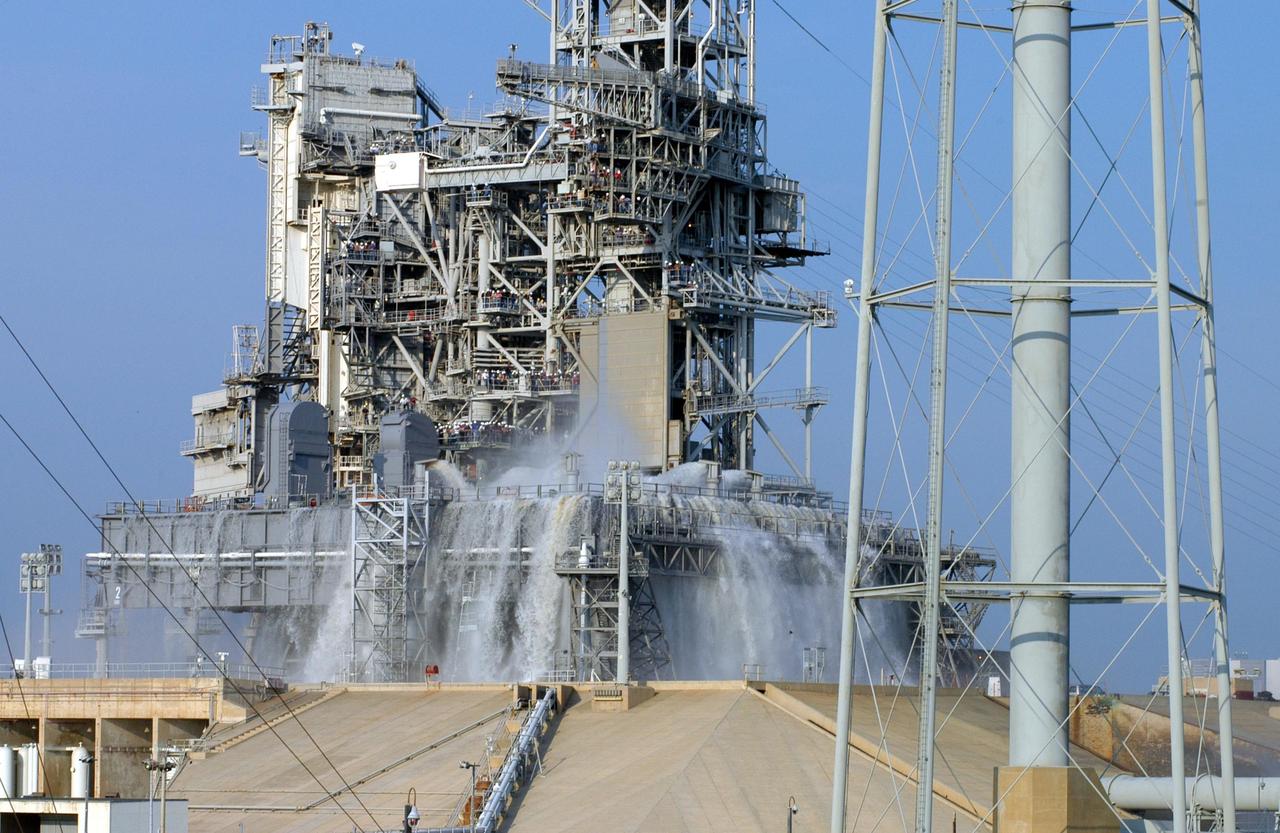
KENNEDY SPACE CENTER, FLA. -- For the fourth time in Space Shuttle Program history, 350,000 gallons of water are released on a Mobile Launcher Platform (MLP) at Launch Pad 39A during a water sound suppression test. This test is being conducted following the replacement of the six main system valves, which had been in place since the beginning of the Shuttle Program and had reached the end of their service life. Also, the hydraulic portion of the valve actuators has been redesigned and simplified to reduce maintenance costs. The sound suppression water system is installed on the launch pads to protect the orbiter and its payloads from damage by acoustical energy reflected from the MLP during launch. The system includes an elevated water tank with a capacity of 300,000 gallons. The tank is 290 feet high and stands on the northeast side of the Pad. The water is released just before the ignition of the orbiter's three main engines and twin solid rocket boosters, and flows through parallel 7-foot-diameter pipes to the Pad area.
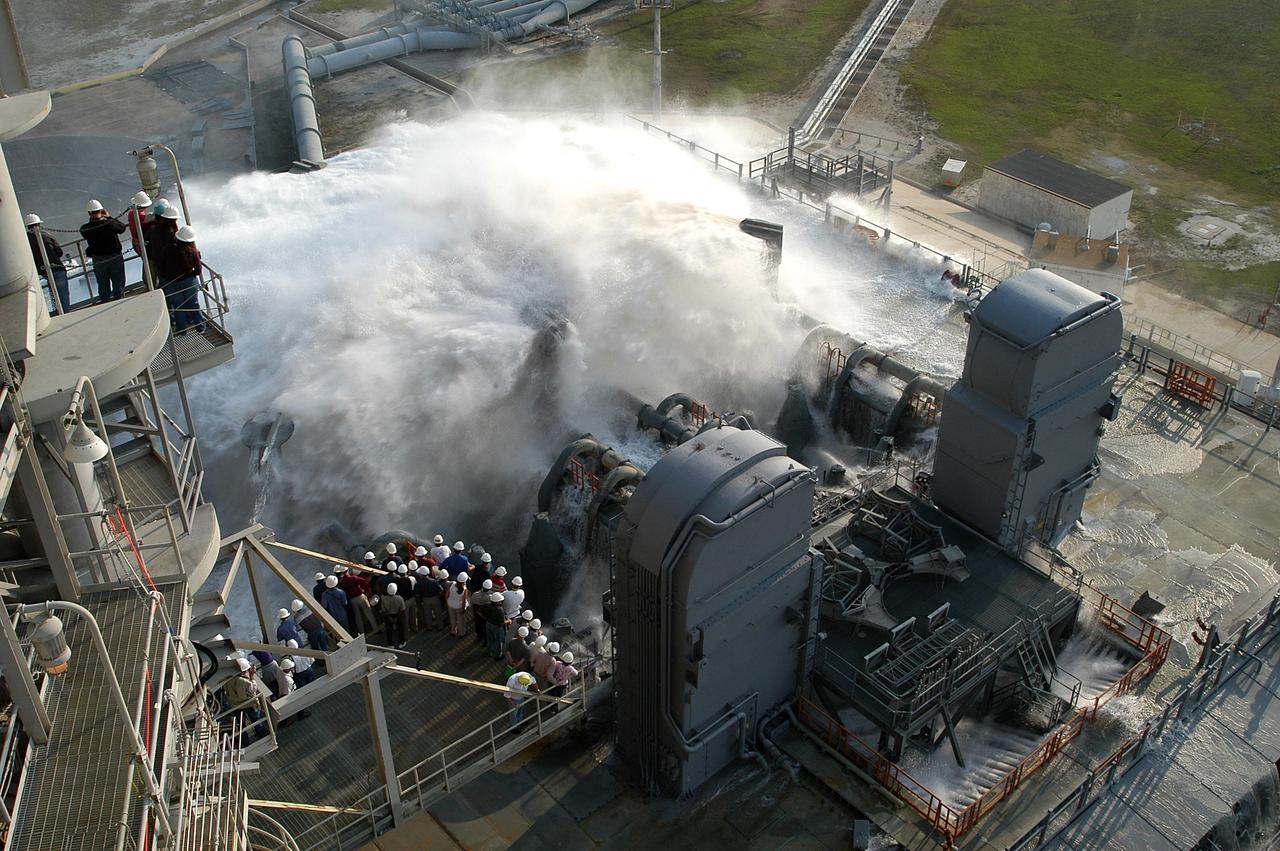
KENNEDY SPACE CENTER, FLA. -- Water is released onto the Mobile Launcher Platform (MLP) on Launch Pad 39A at the start of a water sound suppression test. Workers and the media (left) are on hand to witness the rare event. This test is being conducted following the replacement of the six main system valves, which had been in place since the beginning of the Shuttle Program and had reached the end of their service life. Also, the hydraulic portion of the valve actuators has been redesigned and simplified to reduce maintenance costs. The sound suppression water system is installed on the launch pads to protect the orbiter and its payloads from damage by acoustical energy reflected from the MLP during launch. The system includes an elevated water tank with a capacity of 300,000 gallons. The tank is 290 feet high and stands on the northeast side of the Pad. The water is released just before the ignition of the orbiter's three main engines and twin solid rocket boosters, and flows through parallel 7-foot-diameter pipes to the Pad area.

KENNEDY SPACE CENTER, FLA. -- Water is released onto the Mobile Launcher Platform (MLP) on Launch Pad 39A at the start of a water sound suppression test. Workers and the media (left) are on hand to witness the rare event. This test is being conducted following the replacement of the six main system valves, which had been in place since the beginning of the Shuttle Program and had reached the end of their service life. Also, the hydraulic portion of the valve actuators has been redesigned and simplified to reduce maintenance costs. The sound suppression water system is installed on the launch pads to protect the orbiter and its payloads from damage by acoustical energy reflected from the MLP during launch. The system includes an elevated water tank with a capacity of 300,000 gallons. The tank is 290 feet high and stands on the northeast side of the Pad. The water is released just before the ignition of the orbiter's three main engines and twin solid rocket boosters, and flows through parallel 7-foot-diameter pipes to the Pad area.

KENNEDY SPACE CENTER, FLA. -- For the fourth time in Space Shuttle Program history, 350,000 gallons of water are released on a Mobile Launcher Platform (MLP) at Launch Pad 39A during a water sound suppression test. Because of the unusual event, media and workers watch from nearby vantage points on the Fixed Service Structure (left). This test is being conducted following the replacement of the six main system valves, which had been in place since the beginning of the Shuttle Program and had reached the end of their service life. Also, the hydraulic portion of the valve actuators has been redesigned and simplified to reduce maintenance costs. The sound suppression water system is installed on the launch pads to protect the orbiter and its payloads from damage by acoustical energy reflected from the MLP during launch. The system includes an elevated water tank with a capacity of 300,000 gallons. The tank is 290 feet high and stands on the northeast side of the Pad. The water is released for launch just before the ignition of the orbiter's three main engines and twin solid rocket boosters, and flows through parallel 7-foot-diameter pipes to the Pad area.
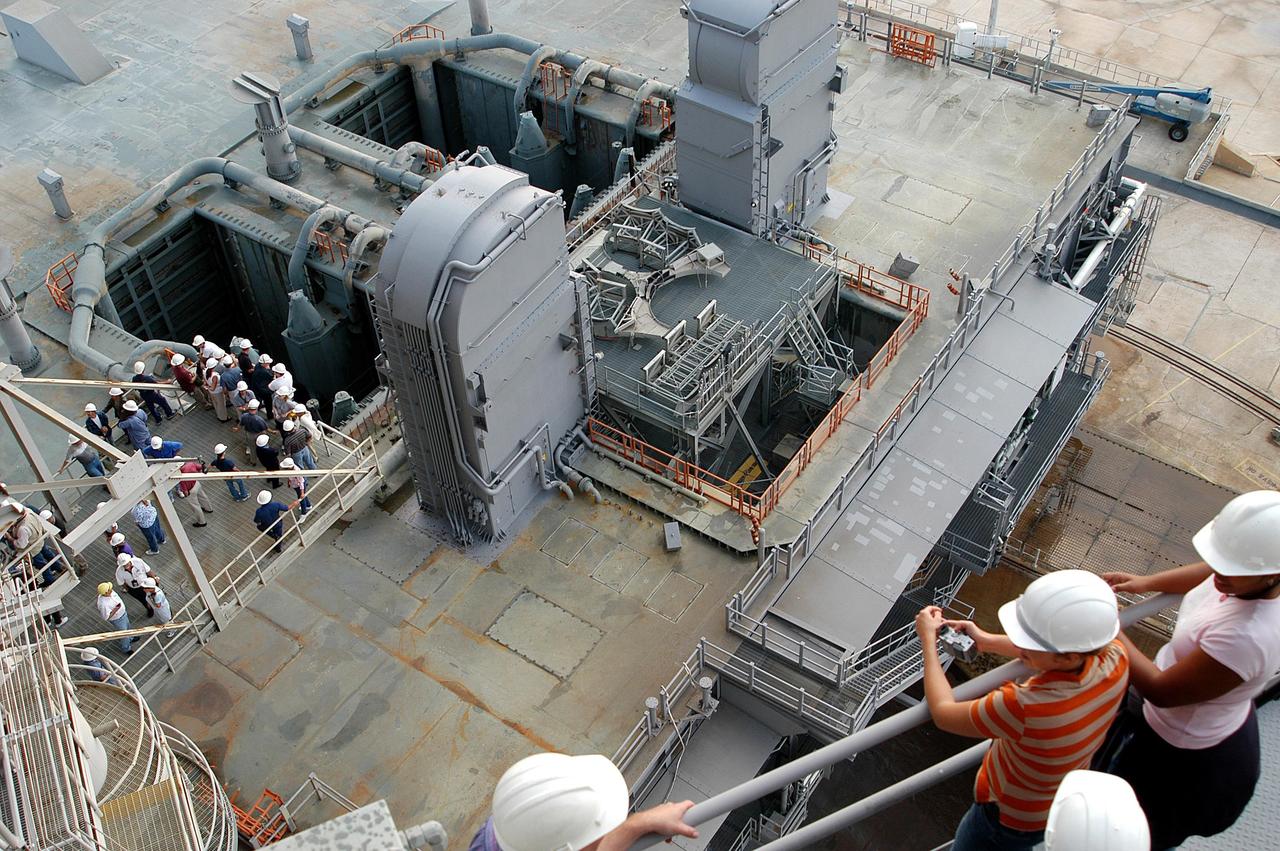
KENNEDY SPACE CENTER, FLA. -- From vantage points on the Fixed Service Structure (left) on Launch Pad 39A, workers and the media look down upon the Mobile Launcher Platform (MLP) waiting for the start of a water sound suppression test. This test is being conducted following the replacement of the six main system valves, which had been in place since the beginning of the Shuttle Program and had reached the end of their service life. Also, the hydraulic portion of the valve actuators has been redesigned and simplified to reduce maintenance costs. The sound suppression water system is installed on the launch pads to protect the orbiter and its payloads from damage by acoustical energy reflected from the MLP during launch. The system includes an elevated water tank with a capacity of 300,000 gallons. The tank is 290 feet high and stands on the northeast side of the Pad. The water is released just before the ignition of the orbiter's three main engines and twin solid rocket boosters, and flows through parallel 7-foot-diameter pipes to the Pad area.
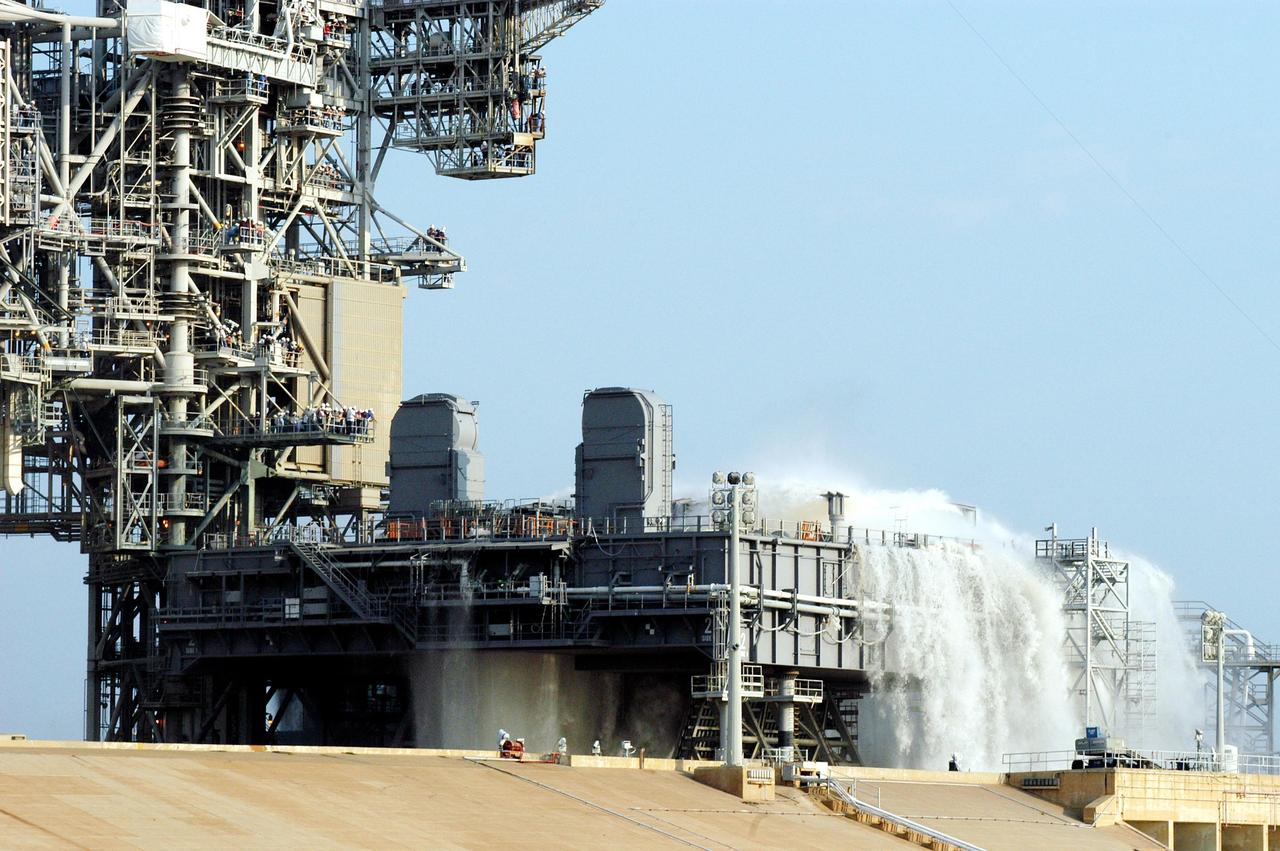
KENNEDY SPACE CENTER, FLA. -- For the fourth time in Space Shuttle Program history, 350,000 gallons of water are being released on a Mobile Launcher Platform (MLP) at Launch Pad 39A during a water sound suppression test. Because of the unusual event, media and workers watch from nearby vantage points on the Fixed Service Structure (left). This test is being conducted following the replacement of the six main system valves, which had been in place since the beginning of the Shuttle Program and had reached the end of their service life. Also, the hydraulic portion of the valve actuators has been redesigned and simplified to reduce maintenance costs. The sound suppression water system is installed on the launch pads to protect the orbiter and its payloads from damage by acoustical energy reflected from the MLP during launch. The system includes an elevated water tank with a capacity of 300,000 gallons. The tank is 290 feet high and stands on the northeast side of the Pad. The water is released just before the ignition of the orbiter's three main engines and twin solid rocket boosters, and flows through parallel 7-foot-diameter pipes to the Pad area.
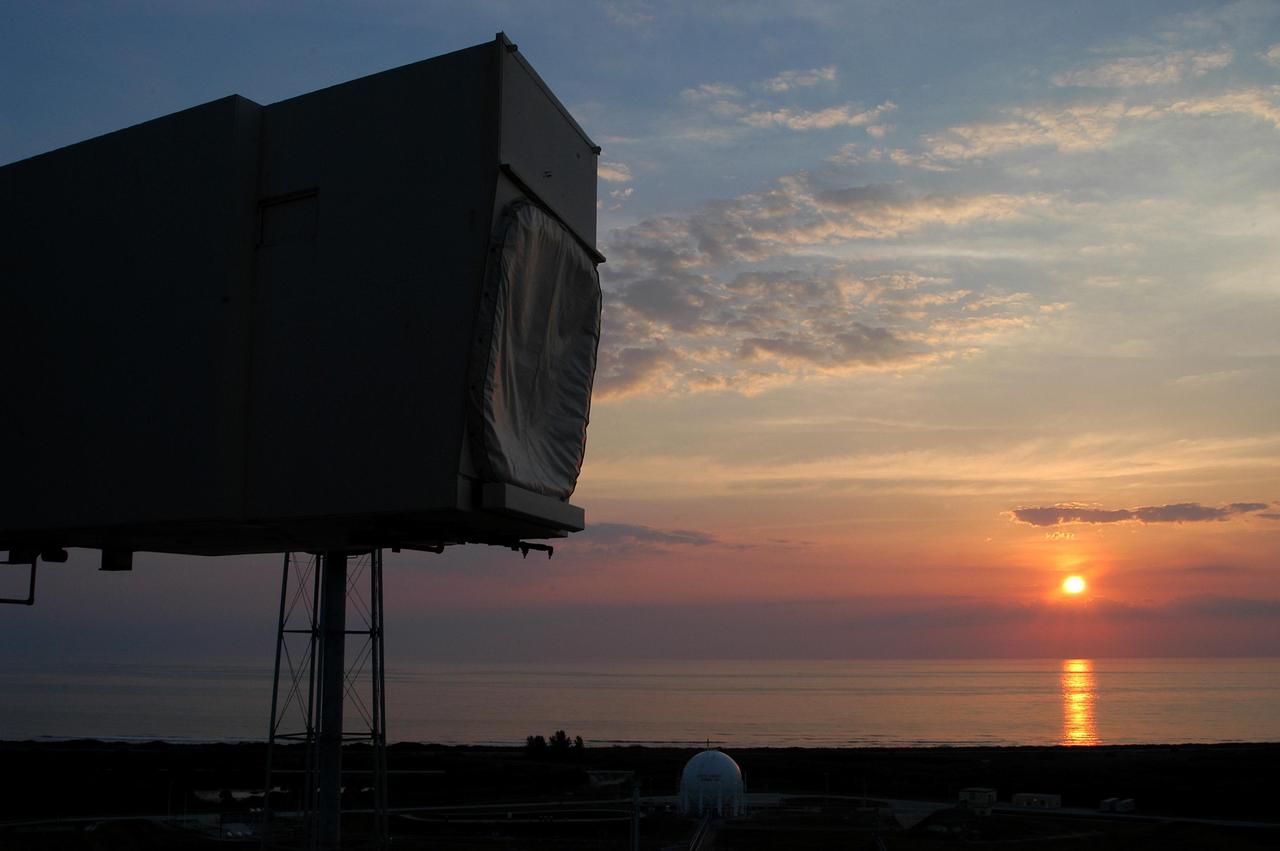
KENNEDY SPACE CENTER, FLA. -- A crimson and gold sunrise over the Central Florida coast begins illuminating Launch Pad 39A, where a water sound suppression test is to take place. This test is being conducted following the replacement of the six main system valves, which had been in place since the beginning of the Shuttle Program and had reached the end of their service life. Also, the hydraulic portion of the valve actuators has been redesigned and simplified to reduce maintenance costs. The sound suppression water system is installed on the launch pads to protect the orbiter and its payloads from damage by acoustical energy reflected from the MLP during launch. The system includes an elevated water tank with a capacity of 300,000 gallons. The tank is 290 feet high and stands on the northeast side of the Pad. The water is released just before the ignition of the orbiter’s three main engines and twin solid rocket boosters, and flows through parallel 7-foot-diameter pipes to the Pad area.
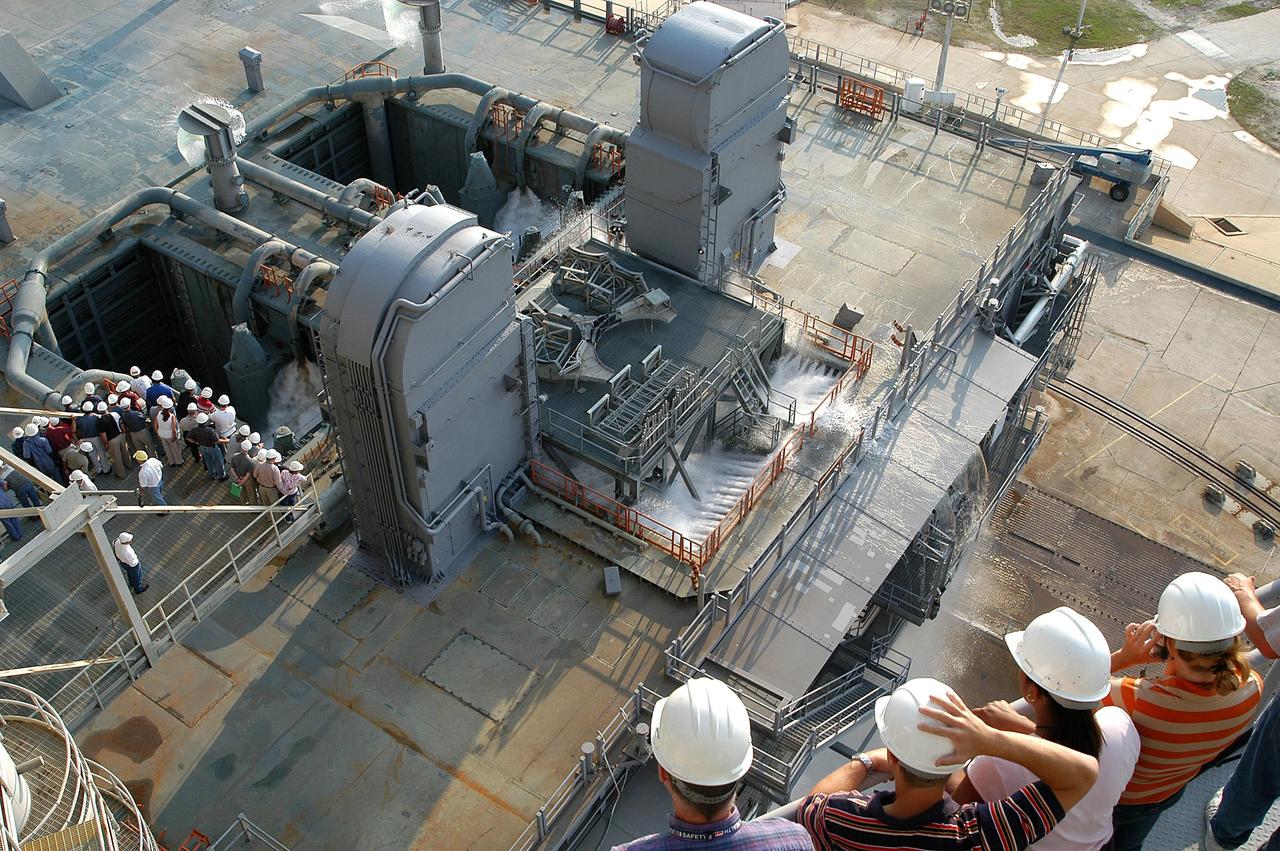
KENNEDY SPACE CENTER, FLA. -- From vantage points on the Fixed Service Structure (bottom right and left) on Launch Pad 39A, workers and the media look down upon the Mobile Launcher Platform (MLP) at the start of a water sound suppression test. This test is being conducted following the replacement of the six main system valves, which had been in place since the beginning of the Shuttle Program and had reached the end of their service life. Also, the hydraulic portion of the valve actuators has been redesigned and simplified to reduce maintenance costs. The sound suppression water system is installed on the launch pads to protect the orbiter and its payloads from damage by acoustical energy reflected from the MLP during launch. The system includes an elevated water tank with a capacity of 300,000 gallons. The tank is 290 feet high and stands on the northeast side of the Pad. The water is released just before the ignition of the orbiter's three main engines and twin solid rocket boosters, and flows through parallel 7-foot-diameter pipes to the Pad area.
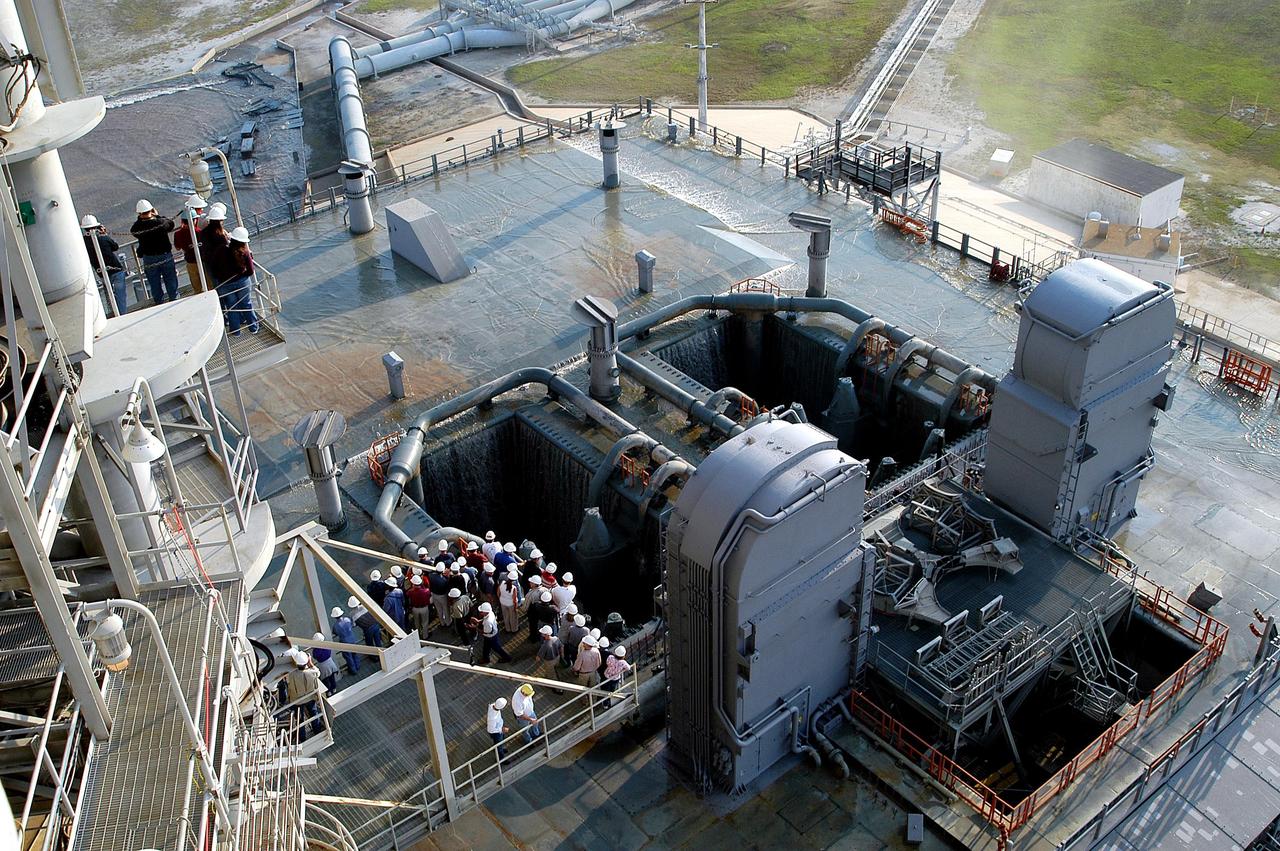
KENNEDY SPACE CENTER, FLA. -- Some water remains on the surface of the Mobile Launcher Platform (MLP) on Launch Pad 39A after a water sound suppression test. Workers and the media (left) were on hand to witness the rare event. This test was conducted following the replacement of the six main system valves, which had been in place since the beginning of the Shuttle Program and had reached the end of their service life. Also, the hydraulic portion of the valve actuators has been redesigned and simplified to reduce maintenance costs. The sound suppression water system is installed on the launch pads to protect the orbiter and its payloads from damage by acoustical energy reflected from the MLP during launch. The system includes an elevated water tank with a capacity of 300,000 gallons. The tank is 290 feet high and stands on the northeast side of the Pad. The water is released just before the ignition of the orbiter's three main engines and twin solid rocket boosters, and flows through parallel 7-foot-diameter pipes to the Pad area.
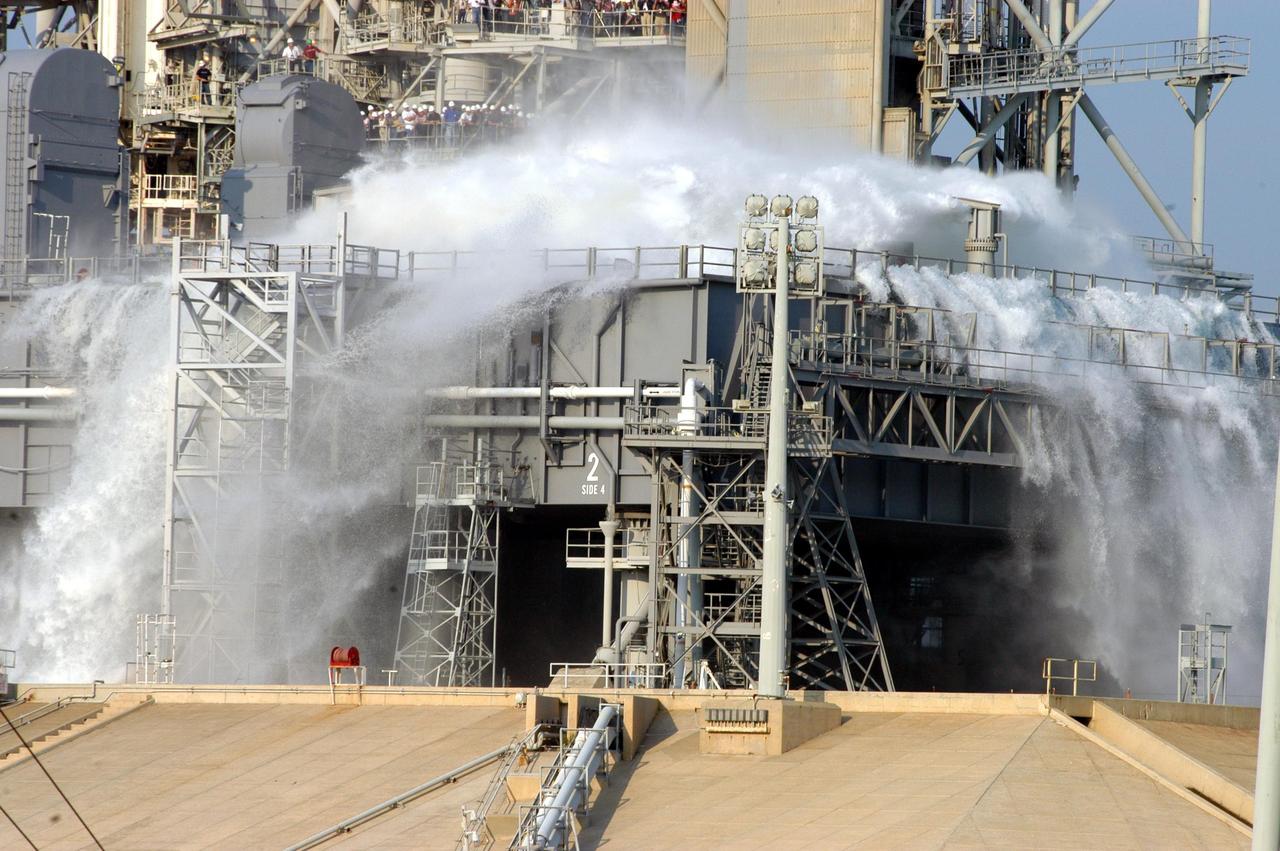
KENNEDY SPACE CENTER, FLA. -- For the fourth time in Space Shuttle Program history, 350,000 gallons of water are released on a Mobile Launcher Platform (MLP) at Launch Pad 39A during a water sound suppression test. This test is being conducted following the replacement of the six main system valves, which had been in place since the beginning of the Shuttle Program and had reached the end of their service life. Also, the hydraulic portion of the valve actuators has been redesigned and simplified to reduce maintenance costs. The sound suppression water system is installed on the launch pads to protect the orbiter and its payloads from damage by acoustical energy reflected from the MLP during launch. The system includes an elevated water tank with a capacity of 300,000 gallons. The tank is 290 feet high and stands on the northeast side of the Pad. The water is released just before the ignition of the orbiter's three main engines and twin solid rocket boosters, and flows through parallel 7-foot-diameter pipes to the Pad area.
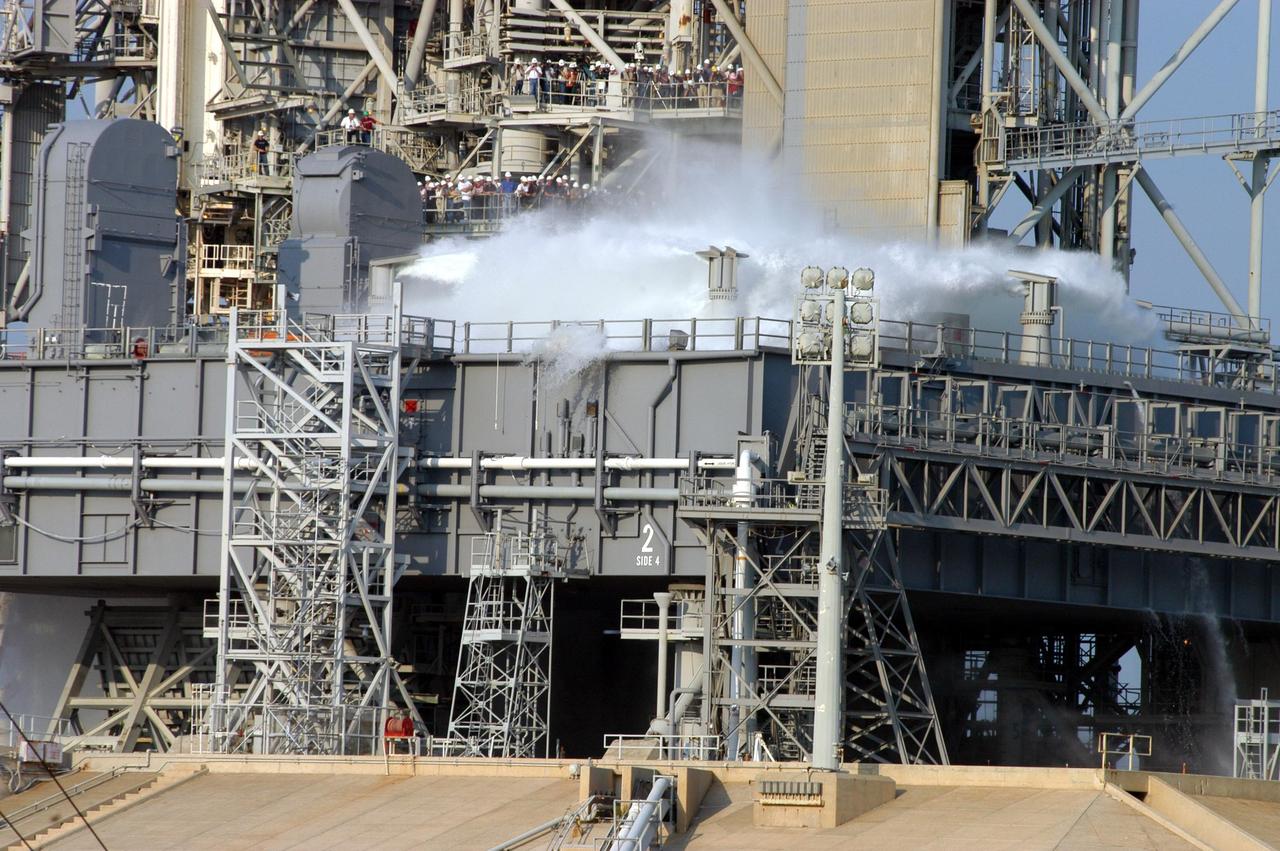
KENNEDY SPACE CENTER, FLA. -- For the fourth time in Space Shuttle Program history, 350,000 gallons of water are released on a Mobile Launcher Platform (MLP) at Launch Pad 39A during a water sound suppression test. This test is being conducted following the replacement of the six main system valves, which had been in place since the beginning of the Shuttle Program and had reached the end of their service life. Also, the hydraulic portion of the valve actuators has been redesigned and simplified to reduce maintenance costs. The sound suppression water system is installed on the launch pads to protect the orbiter and its payloads from damage by acoustical energy reflected from the MLP during launch. The system includes an elevated water tank with a capacity of 300,000 gallons. The tank is 290 feet high and stands on the northeast side of the Pad. The water is released just before the ignition of the orbiter's three main engines and twin solid rocket boosters, and flows through parallel 7-foot-diameter pipes to the Pad area.
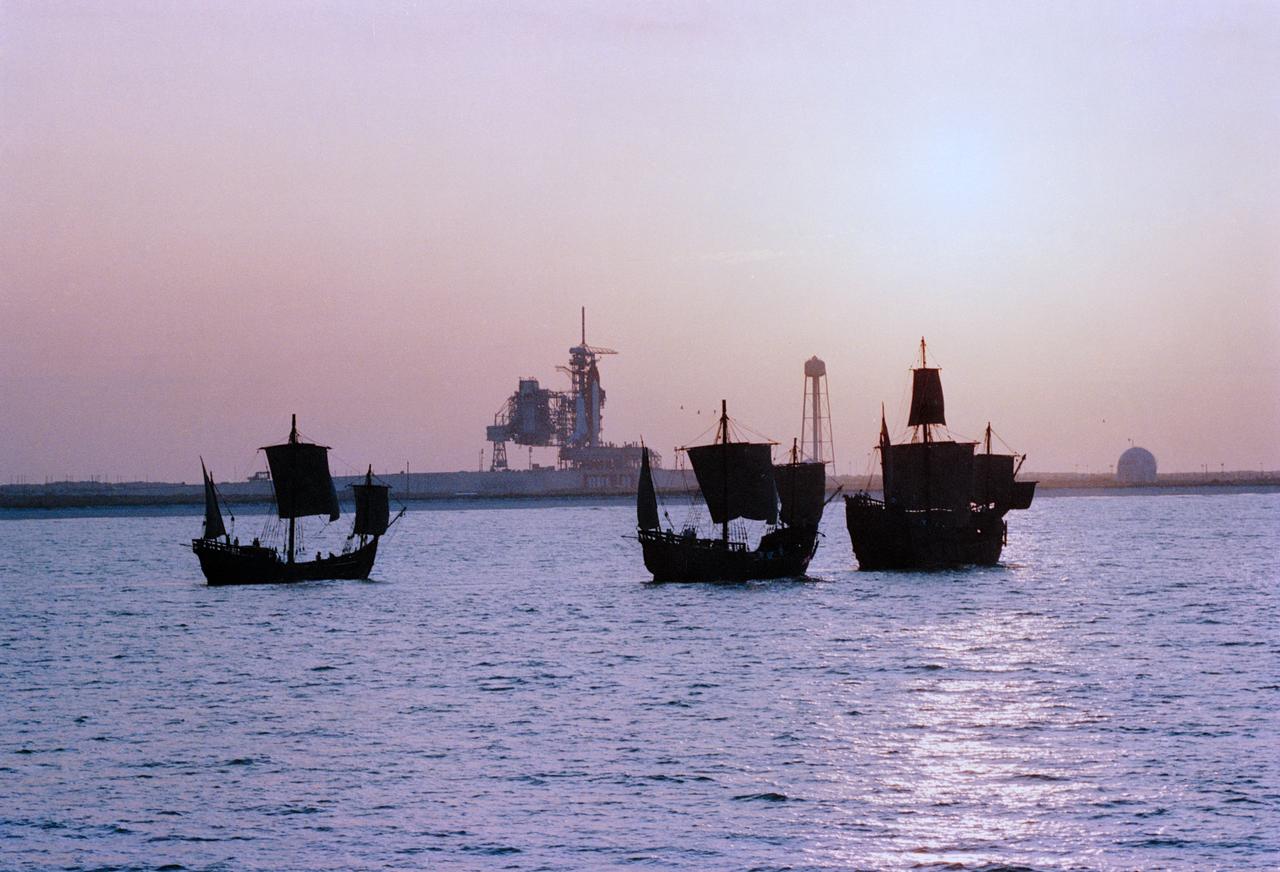
Replicas of Christopher Columbus' sailing ships Santa Maria, Nina, and Pinta sail by Endeavour, Orbiter Vehicle (OV) 105, on Kennedy Space Center (KSC) Launch Complex (LC) Pad 39B awaiting liftoff on its maiden voyage, STS-49. This view was taken from the water showing the three ships silhouetted in the foreground with OV-105 on mobile launcher platform profiled against fixed service structure (FSS) tower and rectracted rotating service structure (RSS) in the background. Next to the launch pad (at right) are the sound suppression water system tower and the liquid hydrogen (LH2) storage tank. View provided by KSC with alternate number KSC-92PC-970.
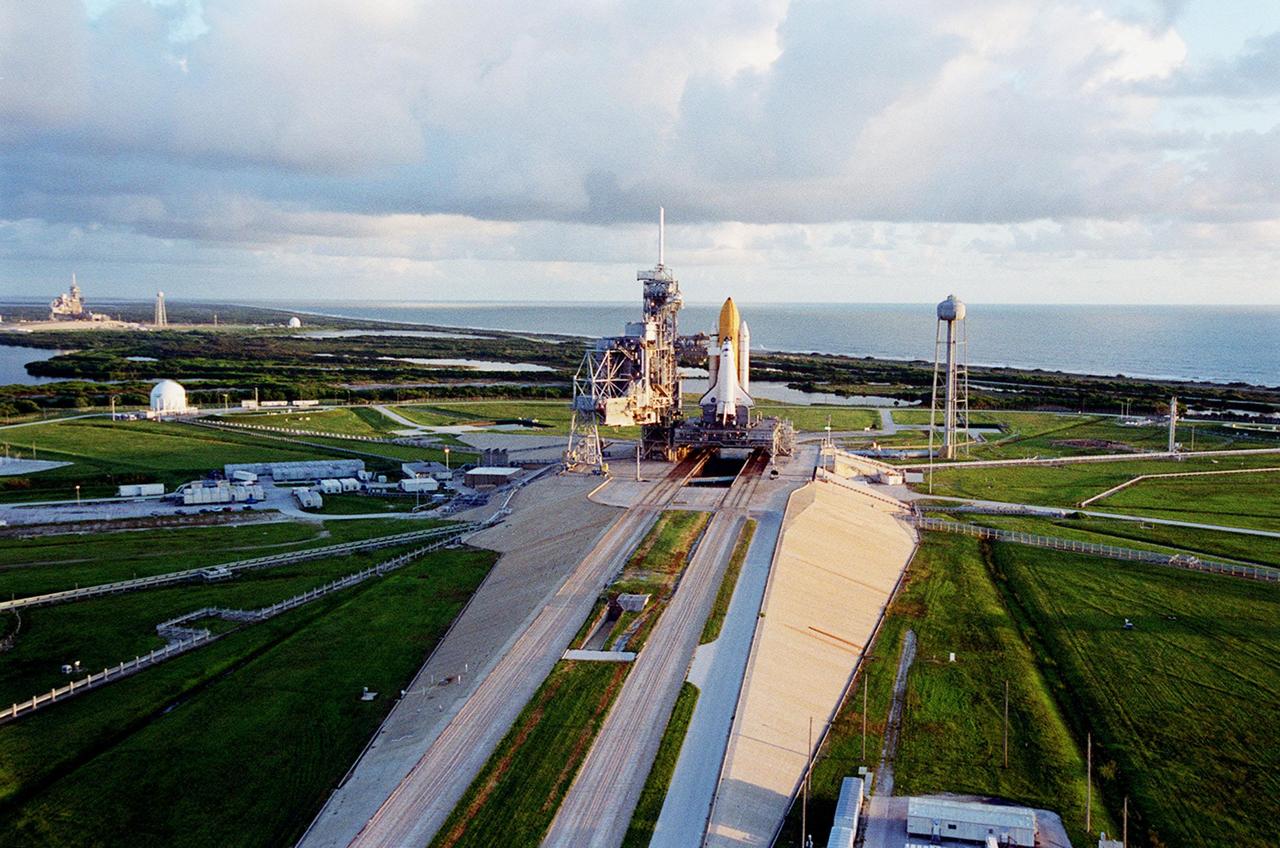
KENNEDY SPACE CENTER, Fla. -- The early morning sun falls on Launch Pad 39A and Space Shuttle Discovery, which is waiting for launch on mission STS-92 Oct. 5, 2000. Leading to the pad (from the foreground) is the ramp leading from the crawlerway, the specially built road that provides the Shuttles access to the pads from the Vehicle Assembly Building. At the right of the pad is the 300,000-gallon water tank that is part of the sound suppression system during launches. Beyond is the Atlantic Ocean. At the far left can be seen Launch Pad 39B with its water tank
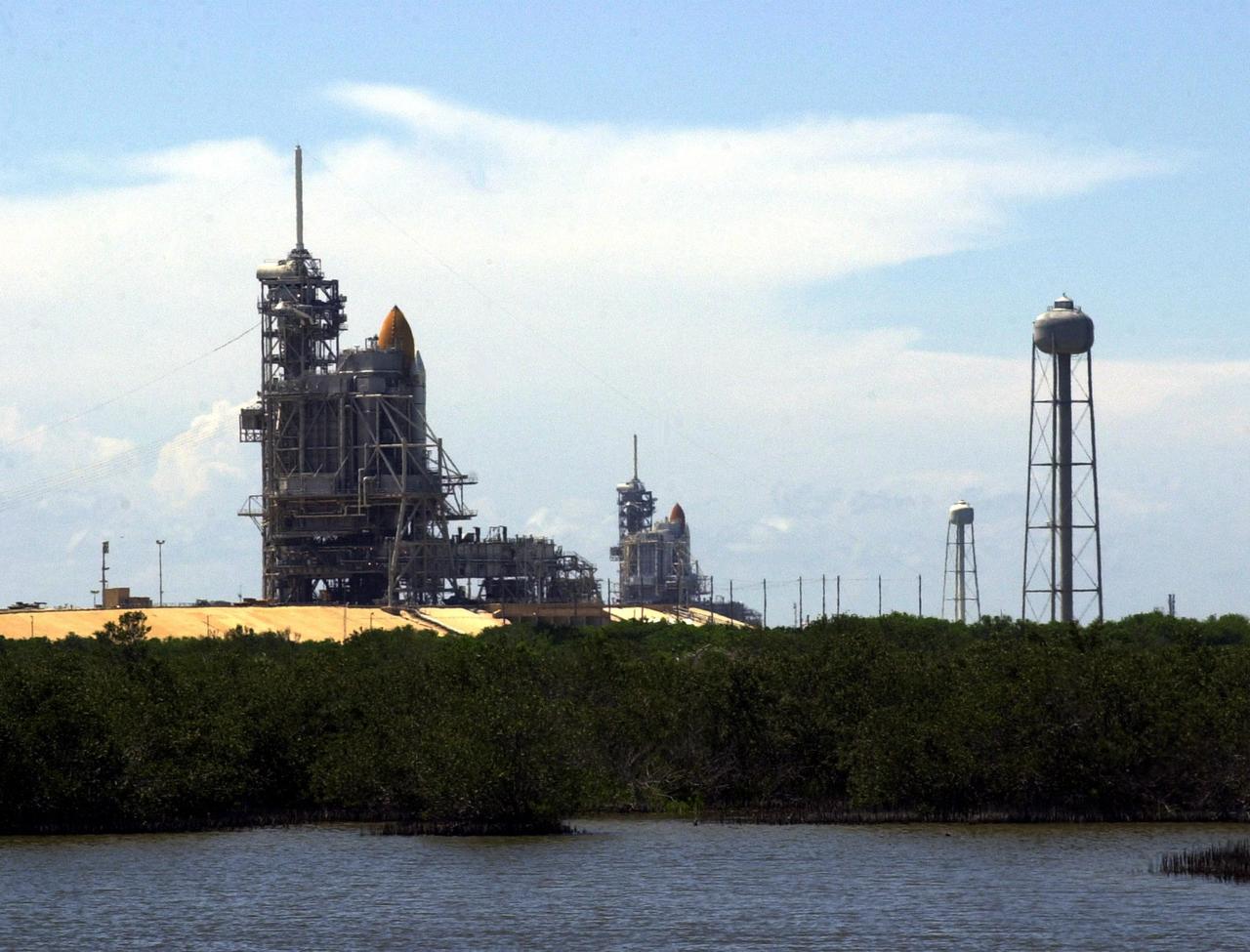
KENNEDY SPACE CENTER, Fla. -- Launch Pads 39A (foreground) and 39B are both seen in this photo, each with a Shuttle in place. Pad 39A holds Space Shuttle Discovery, which rolled out July 2 to be prepared for launch on mission STS-105 in August. Pad 39B holds Space Shuttle Atlantis, which is scheduled to launch Thursday, July 12, on mission STS-104. At right are the 290-foot water tanks that provide 300,000 gallons of water during liftoff. They are part of the sound suppression water system at each pad
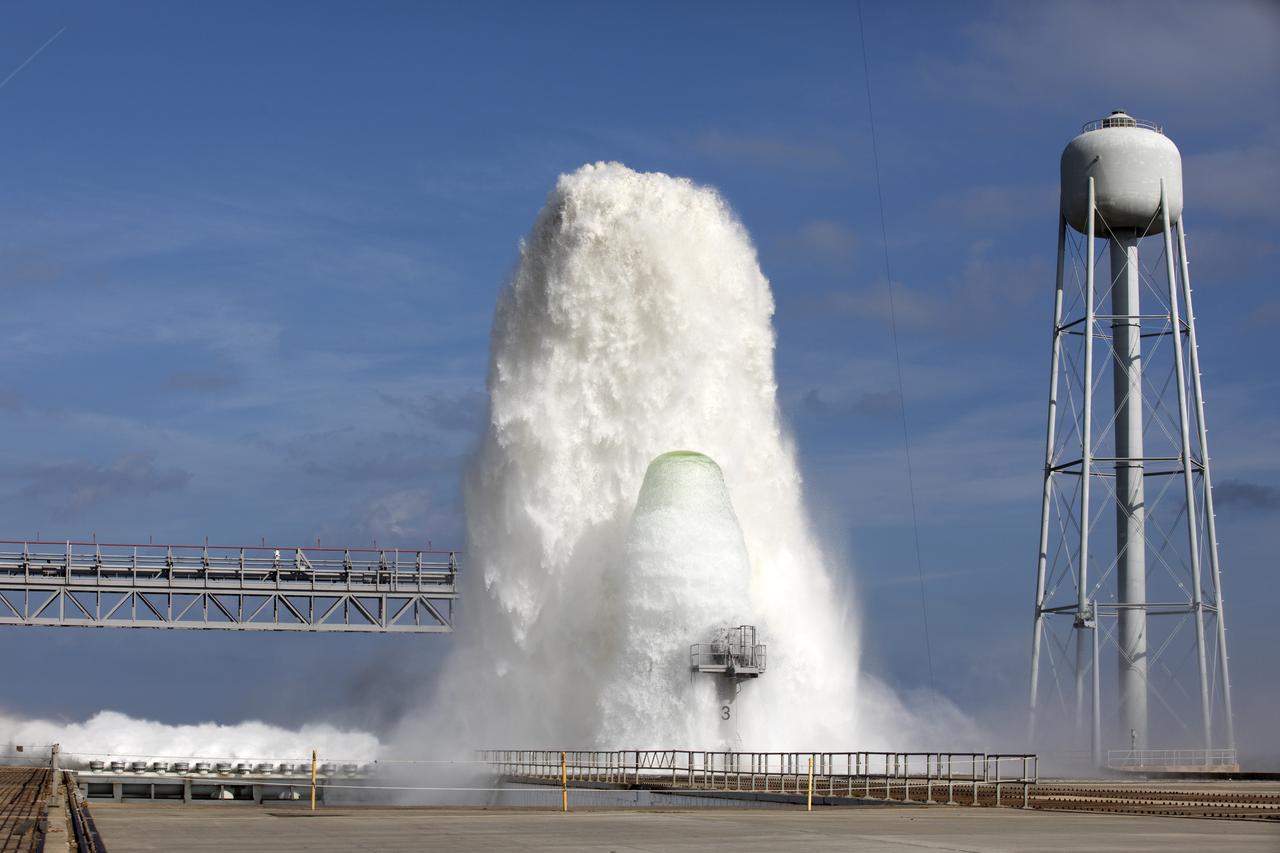
About 450,000 gallons of water flowed at high speed from a holding tank through new and modified piping and valves, the flame trench, flame deflector nozzles and mobile launcher interface risers during a wet flow test at Launch Pad 39B at NASA's Kennedy Space Center in Florida. At peak flow, the water reached about 100 feet in the air above the pad surface. The test was a milestone to confirm and baseline the performance of the Ignition Overpressure/Sound Suppression system. During launch of NASA's Space Launch System rocket and Orion spacecraft, the high-speed water flow will help protect the vehicle from the extreme acoustic and temperature environment during ignition and liftoff.
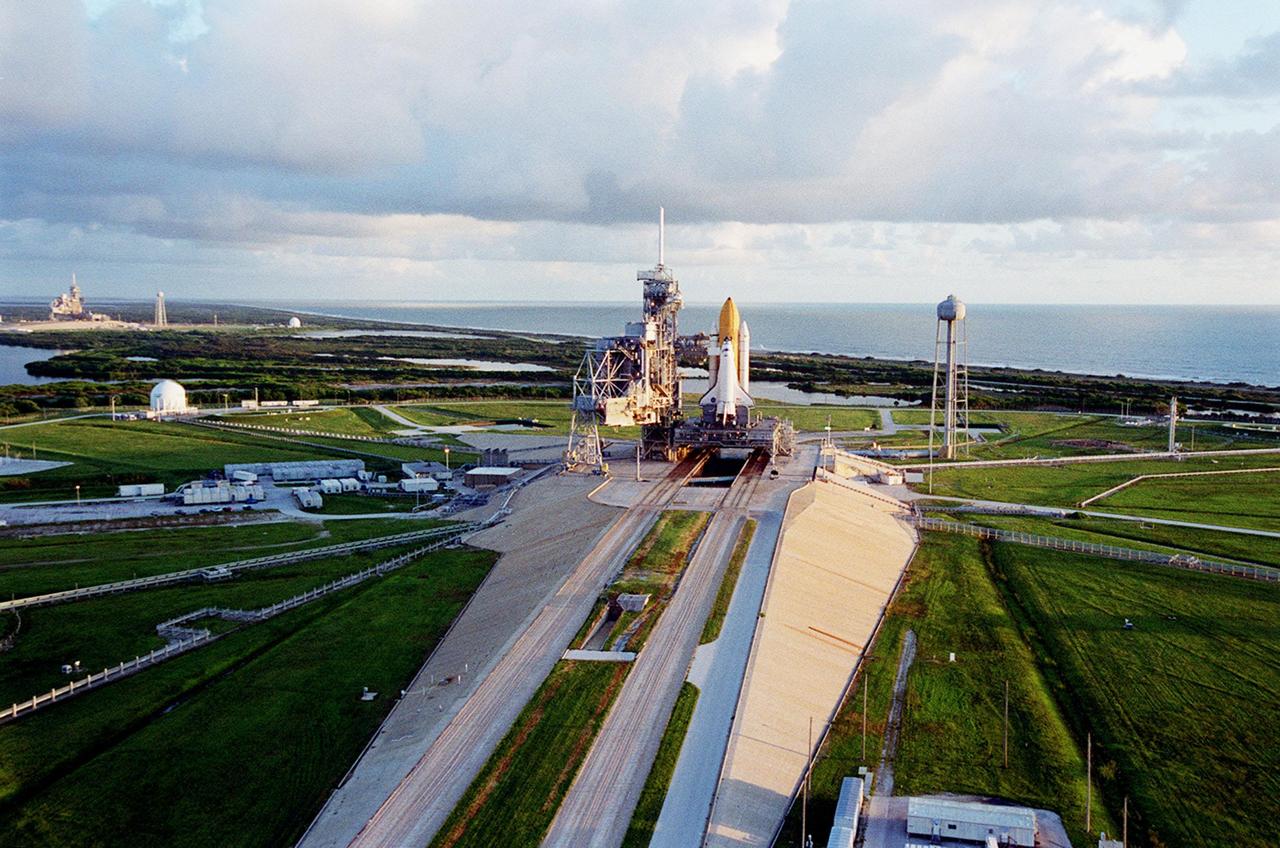
KENNEDY SPACE CENTER, Fla. -- The early morning sun falls on Launch Pad 39A and Space Shuttle Discovery, which is waiting for launch on mission STS-92 Oct. 5, 2000. Leading to the pad (from the foreground) is the ramp leading from the crawlerway, the specially built road that provides the Shuttles access to the pads from the Vehicle Assembly Building. At the right of the pad is the 300,000-gallon water tank that is part of the sound suppression system during launches. Beyond is the Atlantic Ocean. At the far left can be seen Launch Pad 39B with its water tank
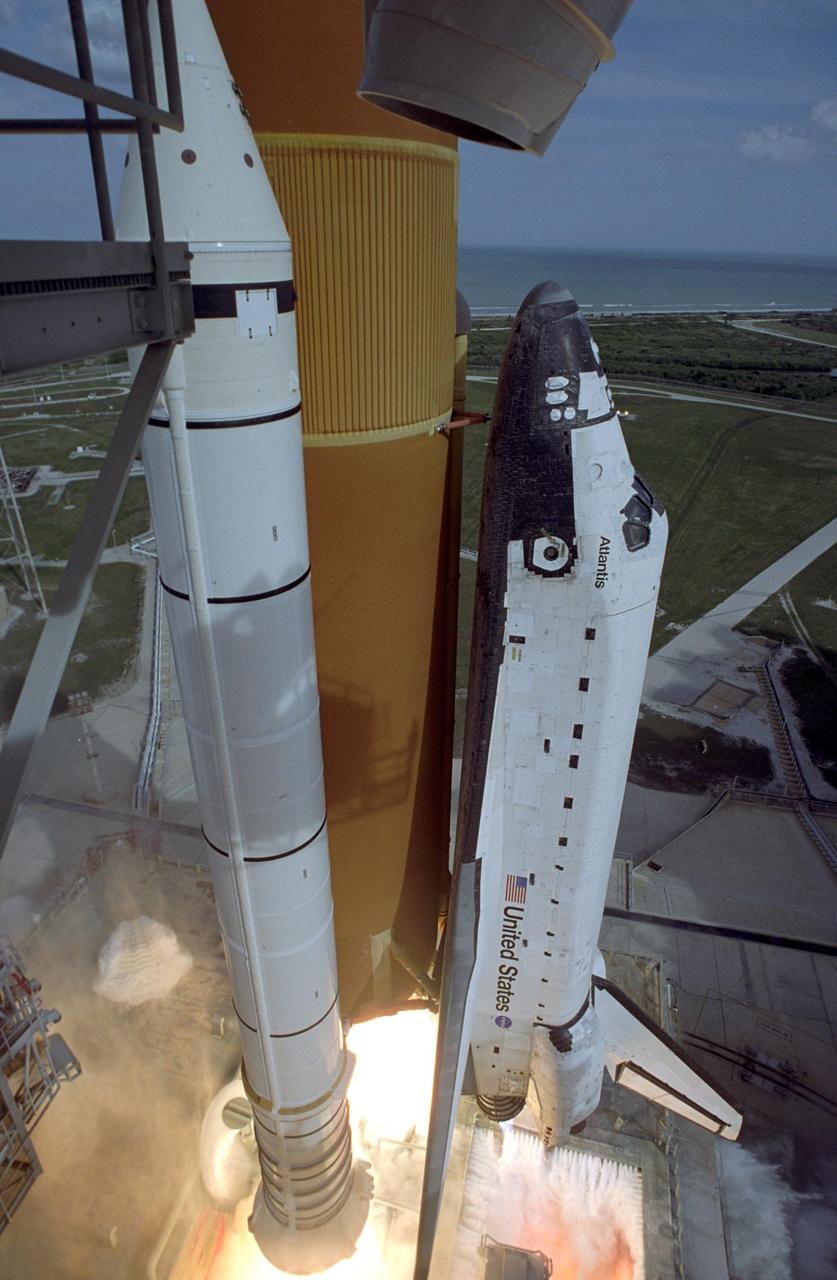
KENNEDY SPACE CENTER, FLA. -- Space shuttle Atlantis begins its climb into the sky after liftoff on mission STS-122, which occurred on time at 2:45 p.m. EST, from Launch Pad 39A. Seen below the tail and the main engines is the flood of water over the mobile launcher platform that helps with sound suppression. This is the third launch attempt for Atlantis since December 2007 to carry the European Space Agency's Columbus laboratory to the International Space Station. During the 11-day mission, the crew's prime objective is to attach the laboratory to the Harmony module, adding to the station's size and capabilities. Photo credit: NASA/Scott Haun, Richard Prickett
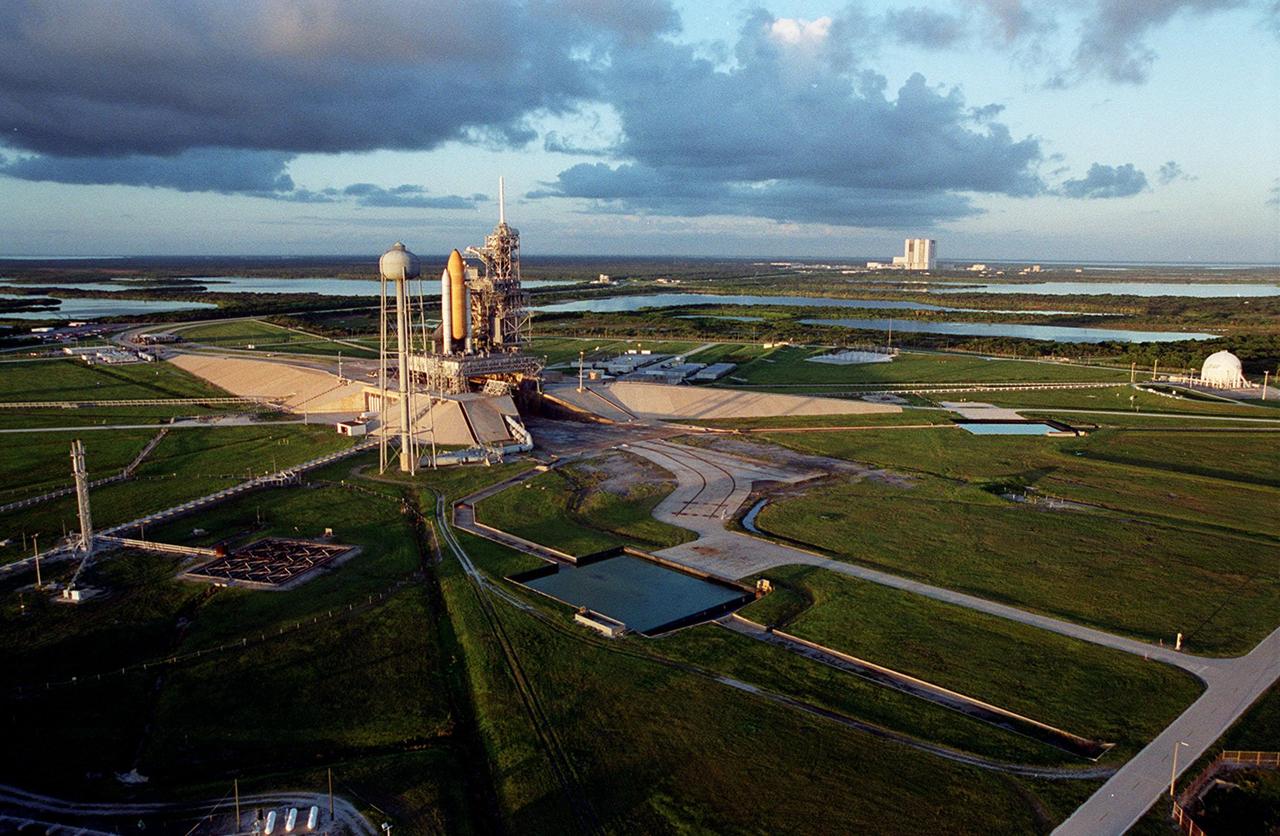
KENNEDY SPACE CENTER, Fla. -- A long view of Launch Complex 39 is caught by the early morning sun. Left of center is Launch Pad 39A with Space Shuttle Discovery. At its left is the 300,000-gallon water tank that is part of the sound suppression system. Hoses from the tank can be seen coiling under the pad, next to the opening of the flame trench, part of the flame detector system. In the foreground is a retention pond; another is at right center. At far right, the ball-shaped structure is a 850,000-gallon storage tank for the cryogenic liquid oxygen, one of the propellants of the orbiter’s main engines. On the horizon can be seen the 525-foot tall Vehicle Assembly Building
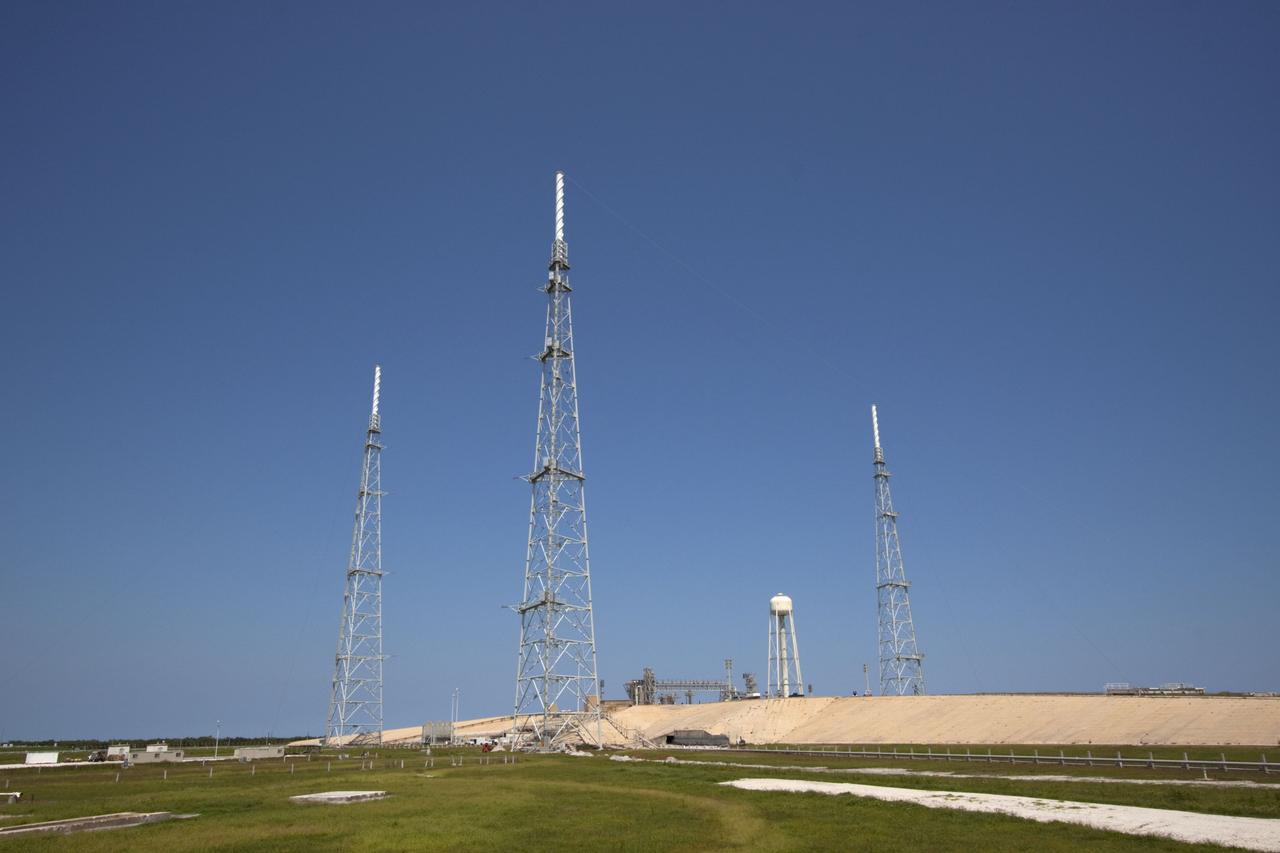
CAPE CANAVERAL, Fla. – The deconstruction of Launch Pad 39B at NASA’s Kennedy Space Center in Florida is complete. Still remaining and standing over the remnants of the fixed service structure are the three 600-foot-tall lightning protection towers and the water tower used for sound suppression. In 2009, the structure at the pad was no longer needed for NASA's Space Shuttle Program, so it is being restructured for future use. The new design will feature a "clean pad" for rockets to come with their own launcher, making it more versatile for a number of vehicles. For information on NASA's future plans, visit http://www.nasa.gov/exploration. Photo credit: NASA/Jim Grossmann
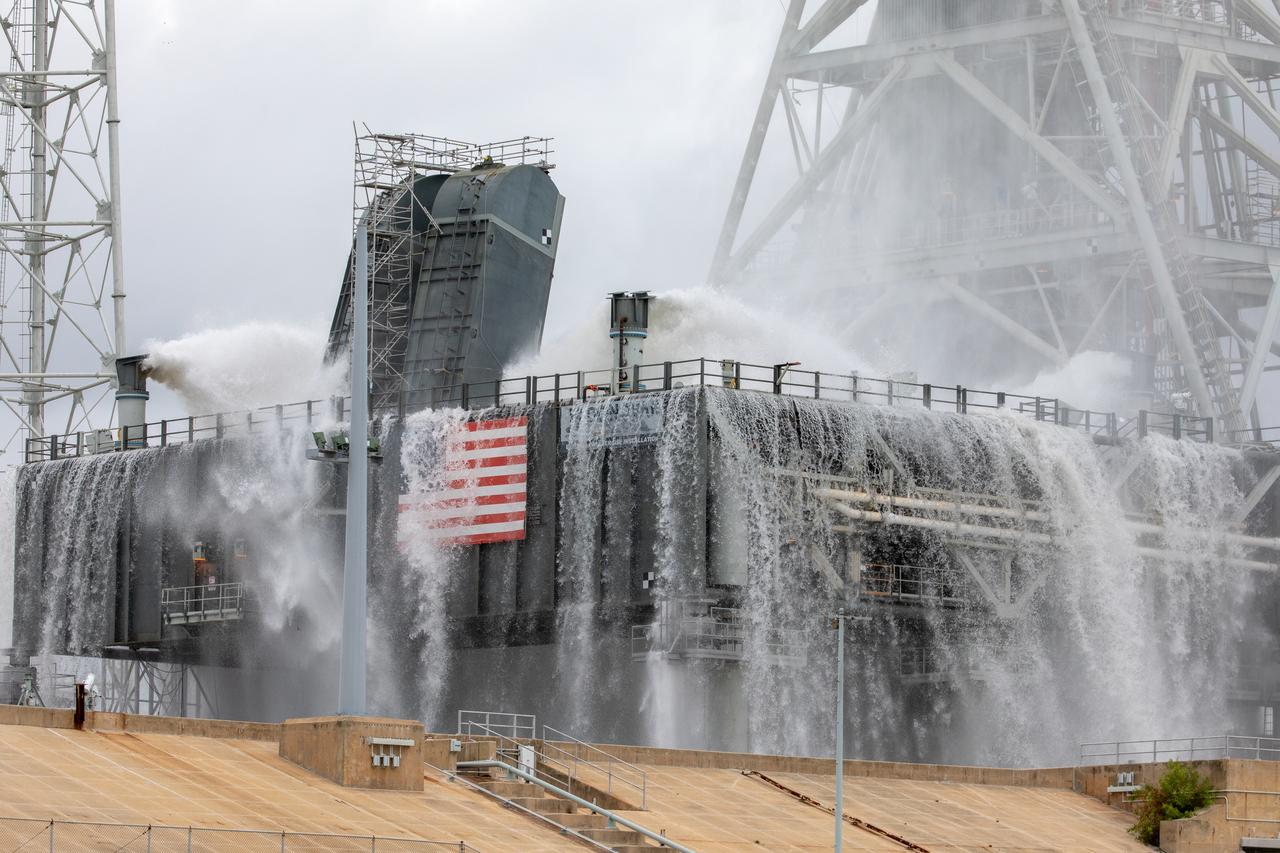
A flow test of the Ignition Overpressure Protection and Sound Suppression water deluge system is underway on the mobile launcher at Launch Pad 39B at NASA's Kennedy Space Center in Florida, on July 25, 2019. The testing is part of a series of tests that Exploration Ground System is doing to verify the system is ready for the new Space Launch System rocket. Modifications were made to the pad after a previous wet flow test, increasing the performance of the system. During the launch of Artemis 1 and subsequent missions, this water deluge system will release about 450,000 gallons of water across the mobile launcher and Flame Deflector to reduce the extreme heat and energy generated by the rocket during ignition and liftoff.
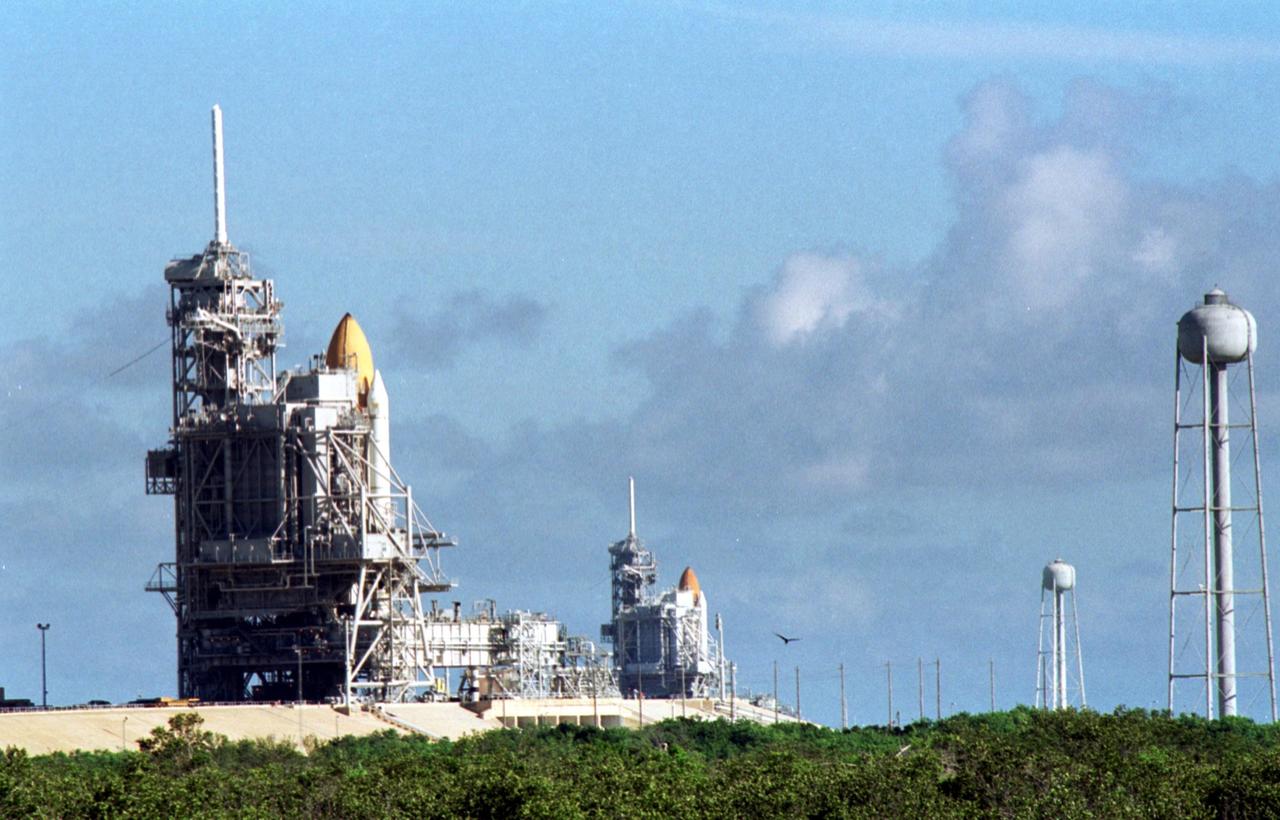
KENNEDY SPACE CENTER, Fla. -- Space Shuttle Discovery (foreground) and Space Shuttle Atlantis (background) both stand ready on their Launch Pads ( 39A and 39B respectively). Space Shuttle Discovery rolled out July 2 to be prepared for launch on mission STS-105 in August. Space Shuttle Atlantis is scheduled to launch Thursday, July 12, on mission STS-104. Towering above each Shuttle on the left is the 80-foot lightning rod that helps protect each Shuttle from lightning strikes. At right are the 290-foot water tanks that provide 300,000 gallons of water during liftoff. They are part of the sound suppression water system at each pad

About 450,000 gallons of water flowed at high speed from a holding tank through new and modified piping and valves, the flame trench, flame deflector nozzles and mobile launcher interface risers during a wet flow test at Launch Pad 39B at NASA's Kennedy Space Center in Florida. At peak flow, the water reached about 100 feet in the air above the pad surface. The test was a milestone to confirm and baseline the performance of the Ignition Overpressure/Sound Suppression system. During launch of NASA's Space Launch System rocket and Orion spacecraft, the high-speed water flow will help protect the vehicle from the extreme acoustic and temperature environment during ignition and liftoff.
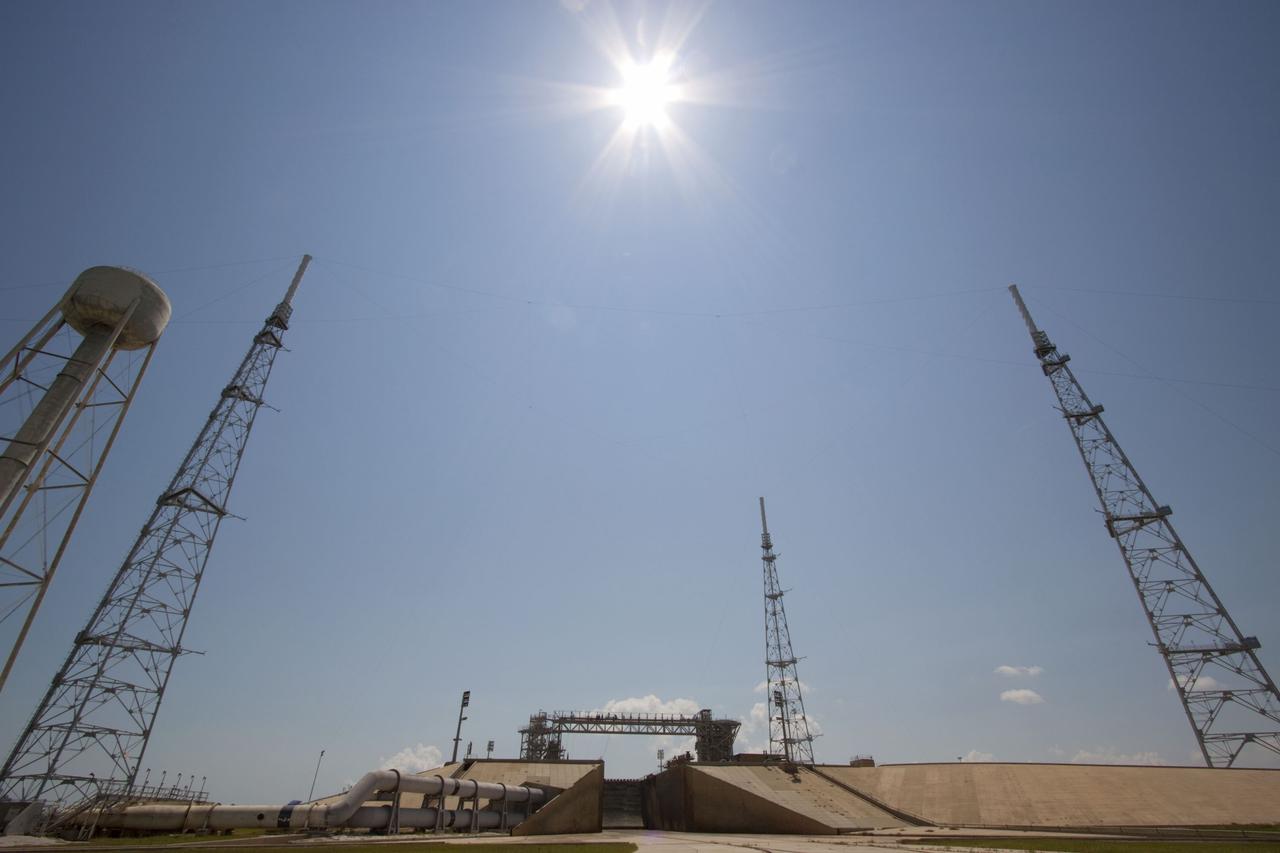
CAPE CANAVERAL, Fla. – The deconstruction of Launch Pad 39B at NASA’s Kennedy Space Center in Florida is complete. Still remaining and standing over the remnants of the fixed service structure are the 600-foot-tall lightning protection towers and the water tower used for sound suppression. In 2009, the structure at the pad was no longer needed for NASA's Space Shuttle Program, so it is being restructured for future use. The new design will feature a "clean pad" for rockets to come with their own launcher, making it more versatile for a number of vehicles. For information on NASA's future plans, visit http://www.nasa.gov/exploration. Photo credit: NASA/Jim Grossmann
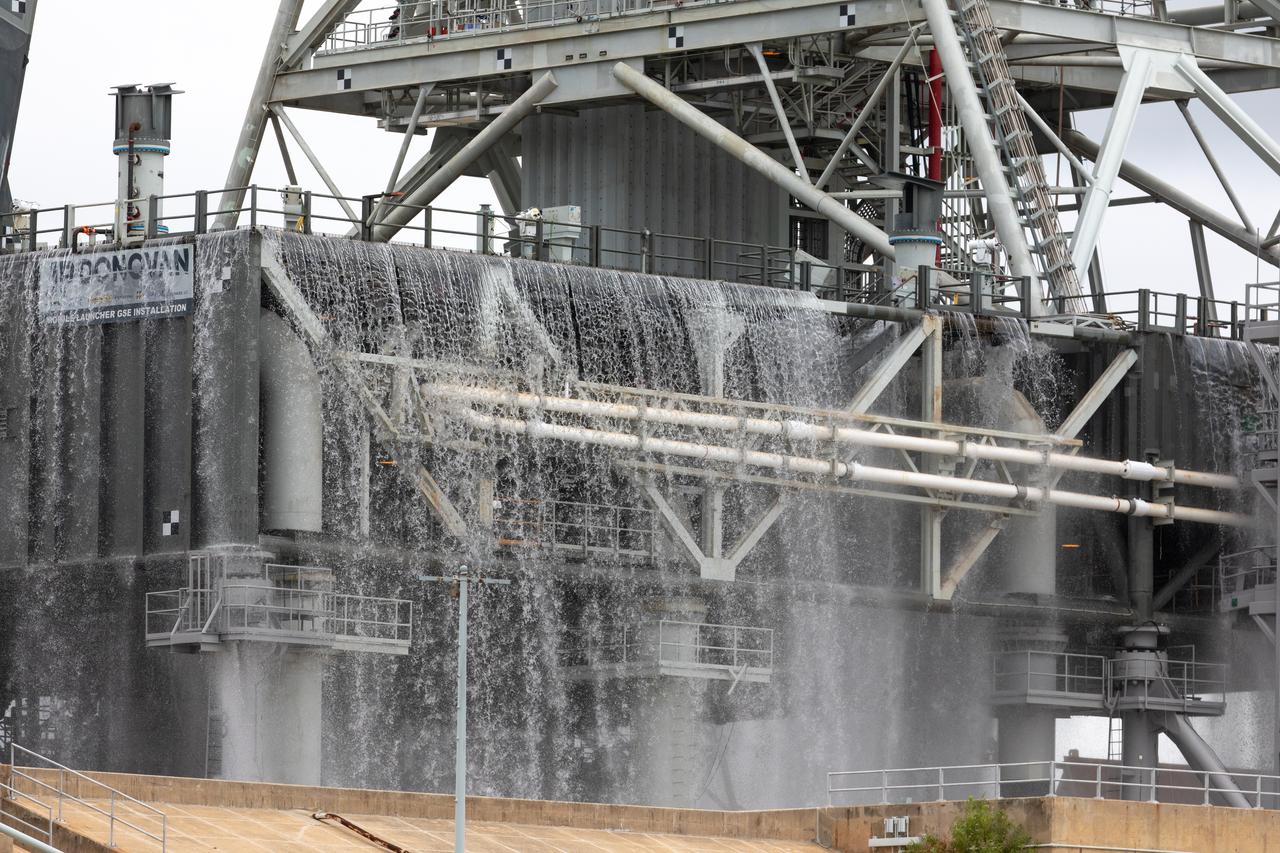
A flow test of the Ignition Overpressure Protection and Sound Suppression water deluge system is underway on the mobile launcher at Launch Pad 39B at NASA's Kennedy Space Center in Florida, on July 25, 2019. The testing is part of a series of tests that Exploration Ground System is doing to verify the system is ready for the new Space Launch System rocket. Modifications were made to the pad after a previous wet flow test, increasing the performance of the system. During the launch of Artemis 1 and subsequent missions, this water deluge system will release about 450,000 gallons of water across the mobile launcher and Flame Deflector to reduce the extreme heat and energy generated by the rocket during ignition and liftoff.
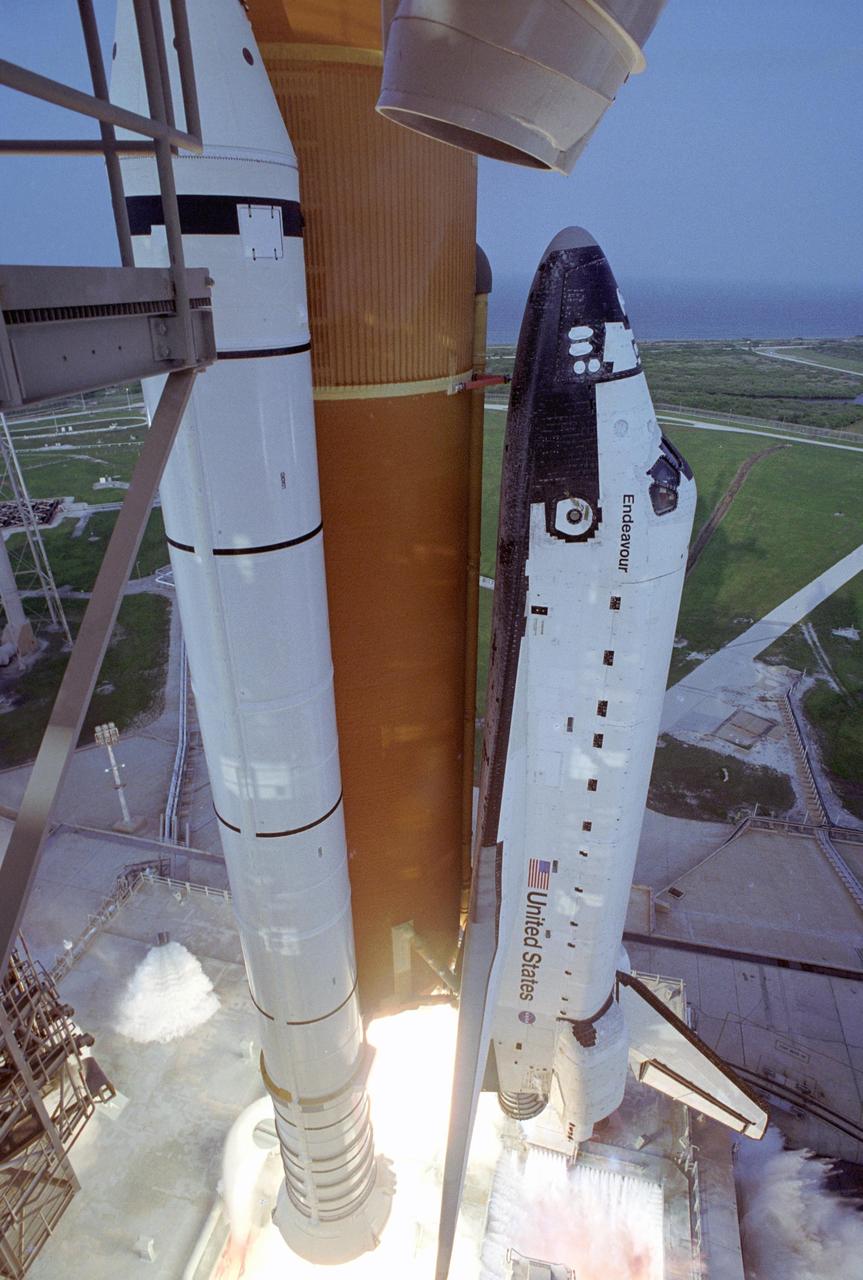
KENNEDY SPACE CENTER, FLA. -- As Space Shuttle Endeavour lifts off from Launch Pad 39A on mission STS-118, water pours over the mobile launcher platform below for sound suppression. The 22nd shuttle flight to the International Space Station, the mission will continue space station construction by delivering a third starboard truss segment, S5, and other payloads such as the SPACEHAB module and the external stowage platform 3. Liftoff of Endeavour was on time at 6:36 p.m. EDT. Photo credit: NASA/John Kechele, Scott Haun, Tom Farrar
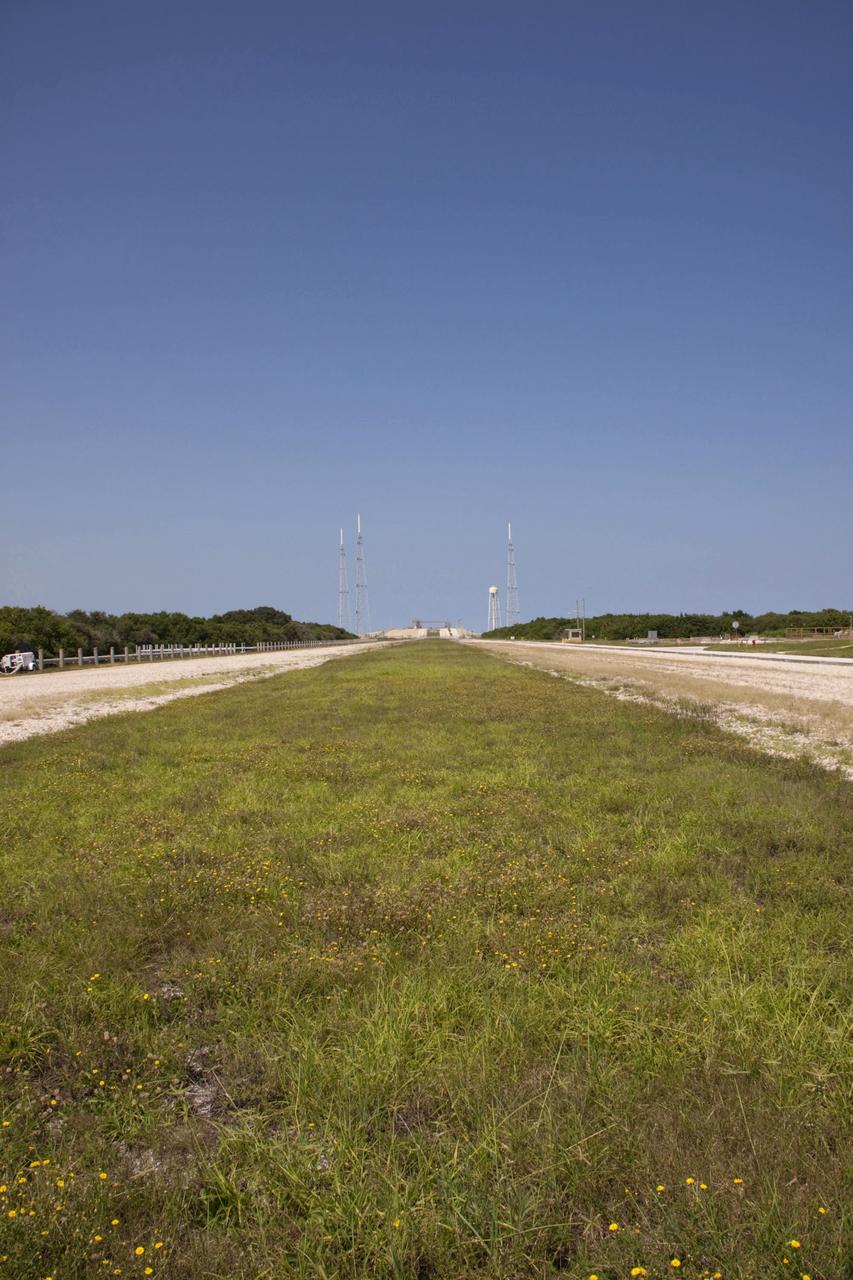
CAPE CANAVERAL, Fla. – The deconstruction of Launch Pad 39B at NASA’s Kennedy Space Center in Florida is complete. With a view from the two-track crawlerway, the three 600-foot-tall lightning protection towers and the water tower used for sound suppression stand over the remnants of the fixed service structure. In 2009, the structure at the pad was no longer needed for NASA's Space Shuttle Program, so it is being restructured for future use. The new design will feature a "clean pad" for rockets to come with their own launcher, making it more versatile for a number of vehicles. For information on NASA's future plans, visit http://www.nasa.gov/exploration. Photo credit: NASA/Jim Grossmann
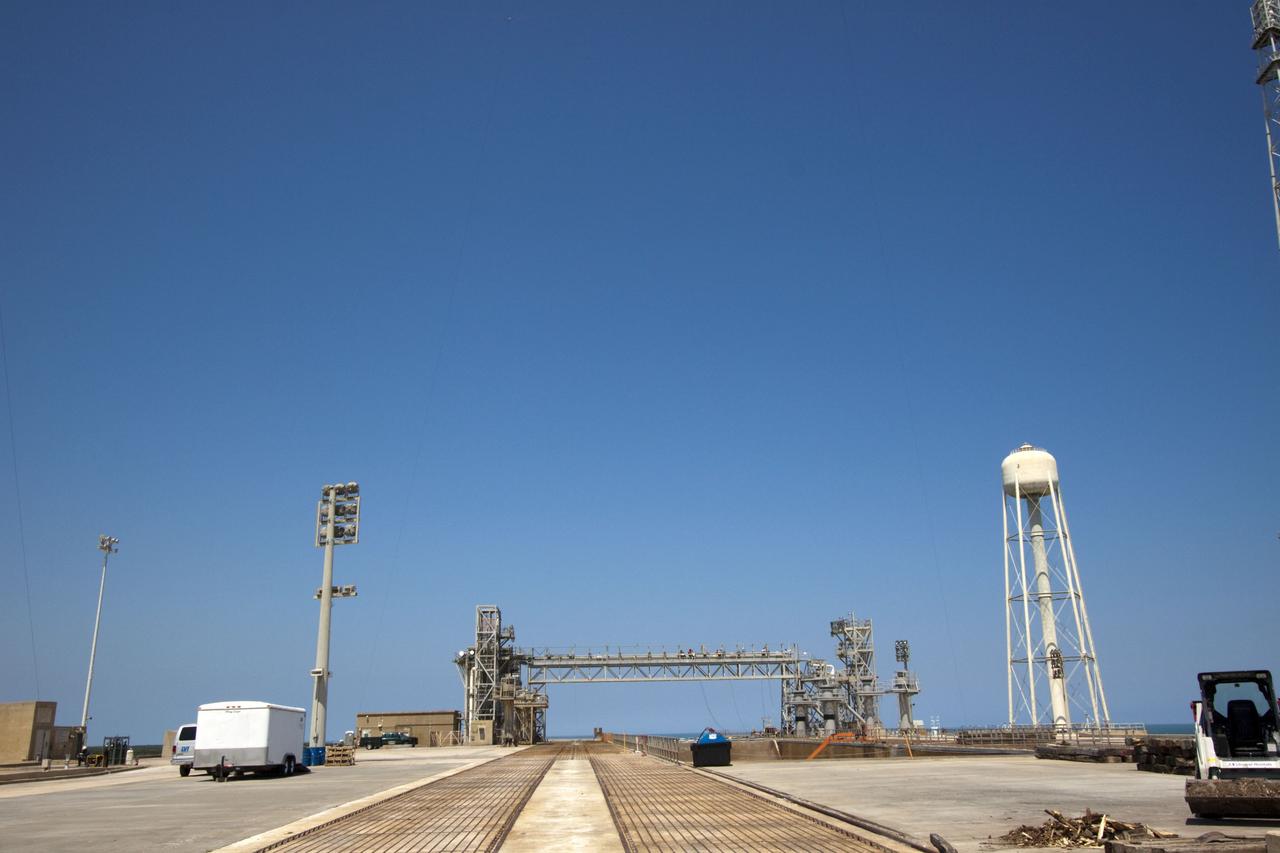
CAPE CANAVERAL, Fla. – The deconstruction of Launch Pad 39B at NASA’s Kennedy Space Center in Florida is complete. Still remaining are remnants of the fixed service structure and the water tower used for sound suppression. In 2009, the structure at the pad was no longer needed for NASA's Space Shuttle Program, so it is being restructured for future use. The new design will feature a "clean pad" for rockets to come with their own launcher, making it more versatile for a number of vehicles. For information on NASA's future plans, visit http://www.nasa.gov/exploration. Photo credit: NASA/Jim Grossmann

KENNEDY SPACE CENTER, FLA. -- Water begins pouring across the mobile launcher platform underneath space shuttle Atlantis as it lifts off on the STS-123 mission. The water provides sound suppression over the roar of the engines and solid rocket boosters. Liftoff was on time at 2:28 a.m. EDT. Endeavour's crew will make a record-breaking 16-day mission to the International Space Station and deliver the first section of the Japan Aerospace Exploration Agency's Kibo laboratory and the Canadian Space Agency's two-armed robotic system, Dextre. Photo credit: NASA/SScott Haun, Richard Pricket
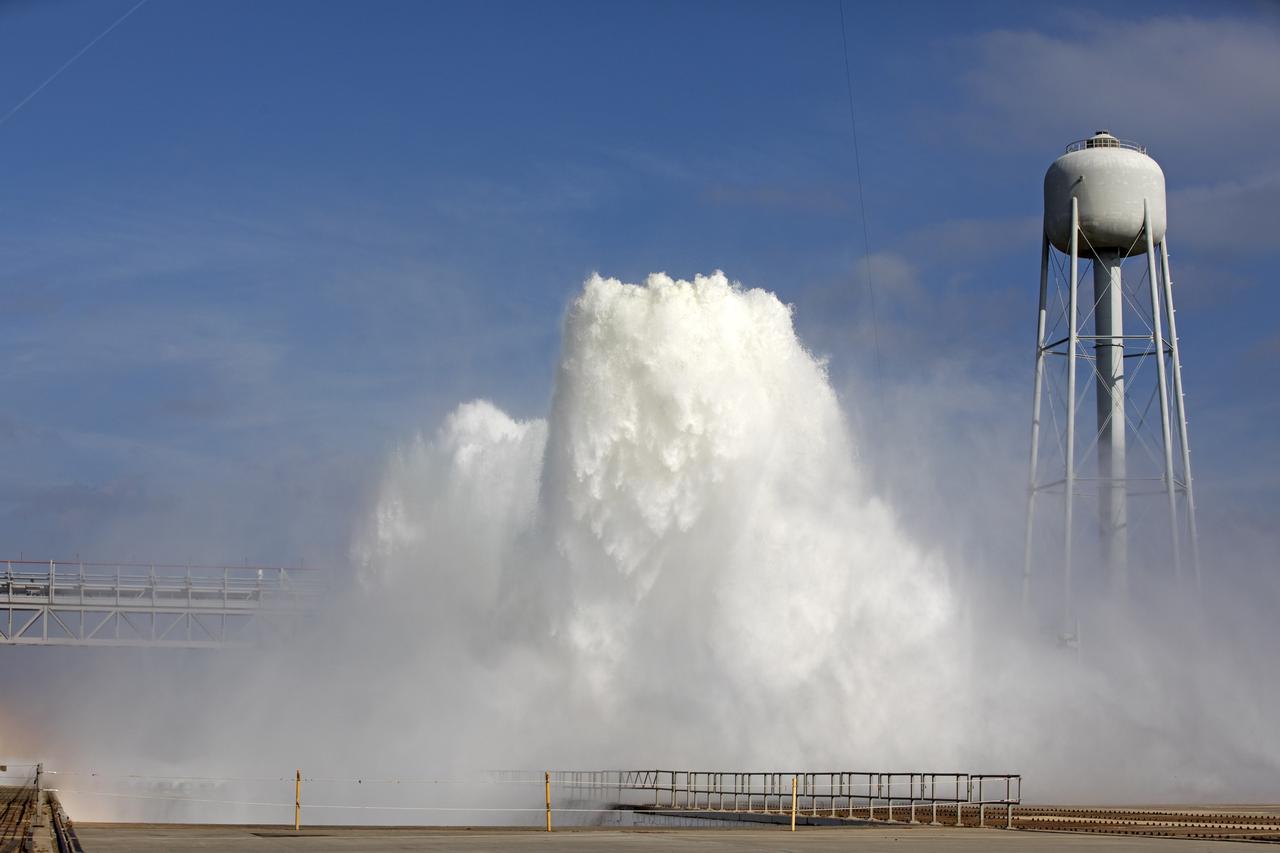
About 450,000 gallons of water flowed at high speed from a holding tank through new and modified piping and valves, the flame trench, flame deflector nozzles and mobile launcher interface risers during a wet flow test at Launch Pad 39B at NASA's Kennedy Space Center in Florida. At peak flow, the water reached about 100 feet in the air above the pad surface. The test was a milestone to confirm and baseline the performance of the Ignition Overpressure/Sound Suppression system. During launch of NASA's Space Launch System rocket and Orion spacecraft, the high-speed water flow will help protect the vehicle from the extreme acoustic and temperature environment during ignition and liftoff.
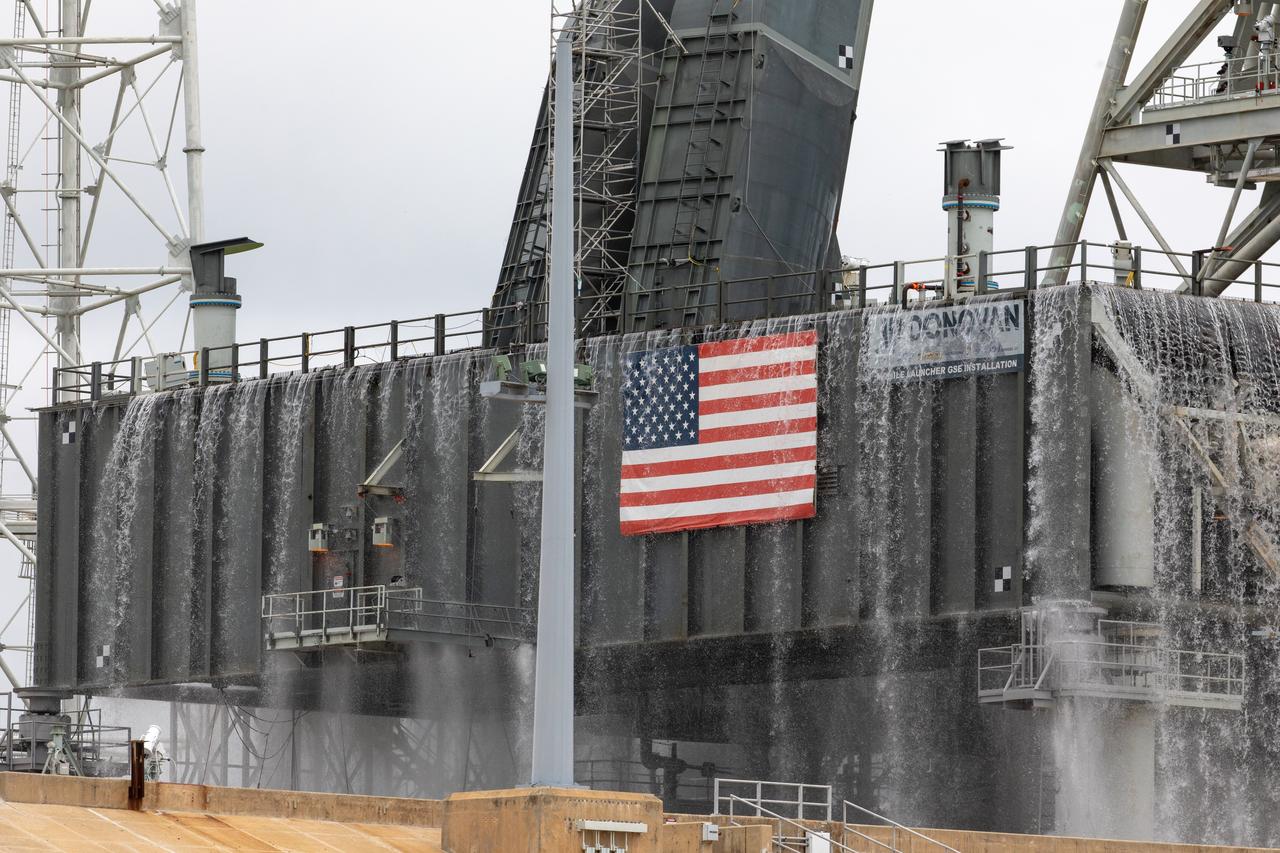
A flow test of the Ignition Overpressure Protection and Sound Suppression water deluge system is underway on the mobile launcher at Launch Pad 39B at NASA's Kennedy Space Center in Florida, on July 25, 2019. The testing is part of a series of tests that Exploration Ground System is doing to verify the system is ready for the new Space Launch System rocket. Modifications were made to the pad after a previous wet flow test, increasing the performance of the system. During the launch of Artemis 1 and subsequent missions, this water deluge system will release about 450,000 gallons of water across the mobile launcher and Flame Deflector to reduce the extreme heat and energy generated by the rocket during ignition and liftoff.
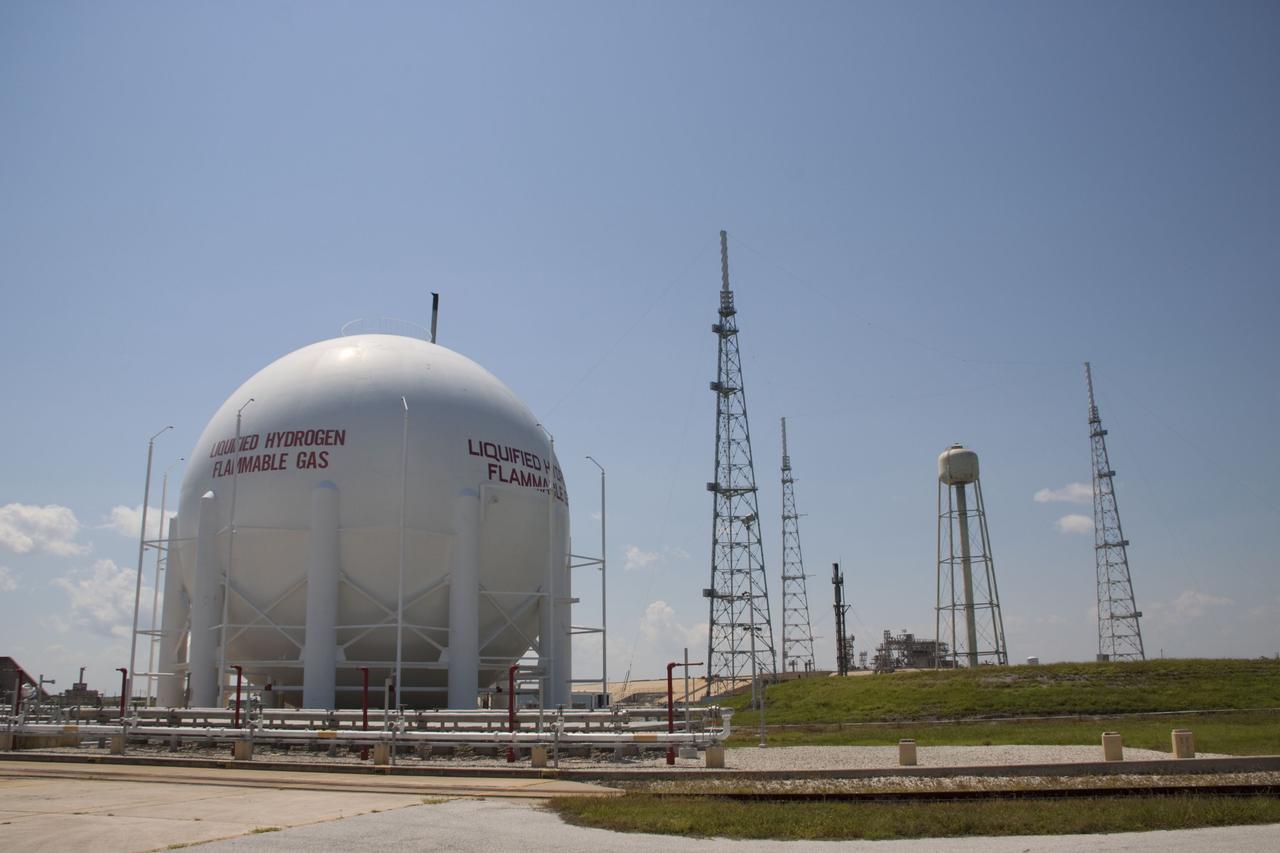
CAPE CANAVERAL, Fla. – The deconstruction of Launch Pad 39B at NASA’s Kennedy Space Center in Florida is complete. Still remaining and standing over the remnants of the fixed service structure are the 600-foot-tall lightning protection towers and the water tower used for sound suppression. In 2009, the structure at the pad was no longer needed for NASA's Space Shuttle Program, so it is being restructured for future use. The new design will feature a "clean pad" for rockets to come with their own launcher, making it more versatile for a number of vehicles. For information on NASA's future plans, visit http://www.nasa.gov/exploration. Photo credit: NASA/Jim Grossmann
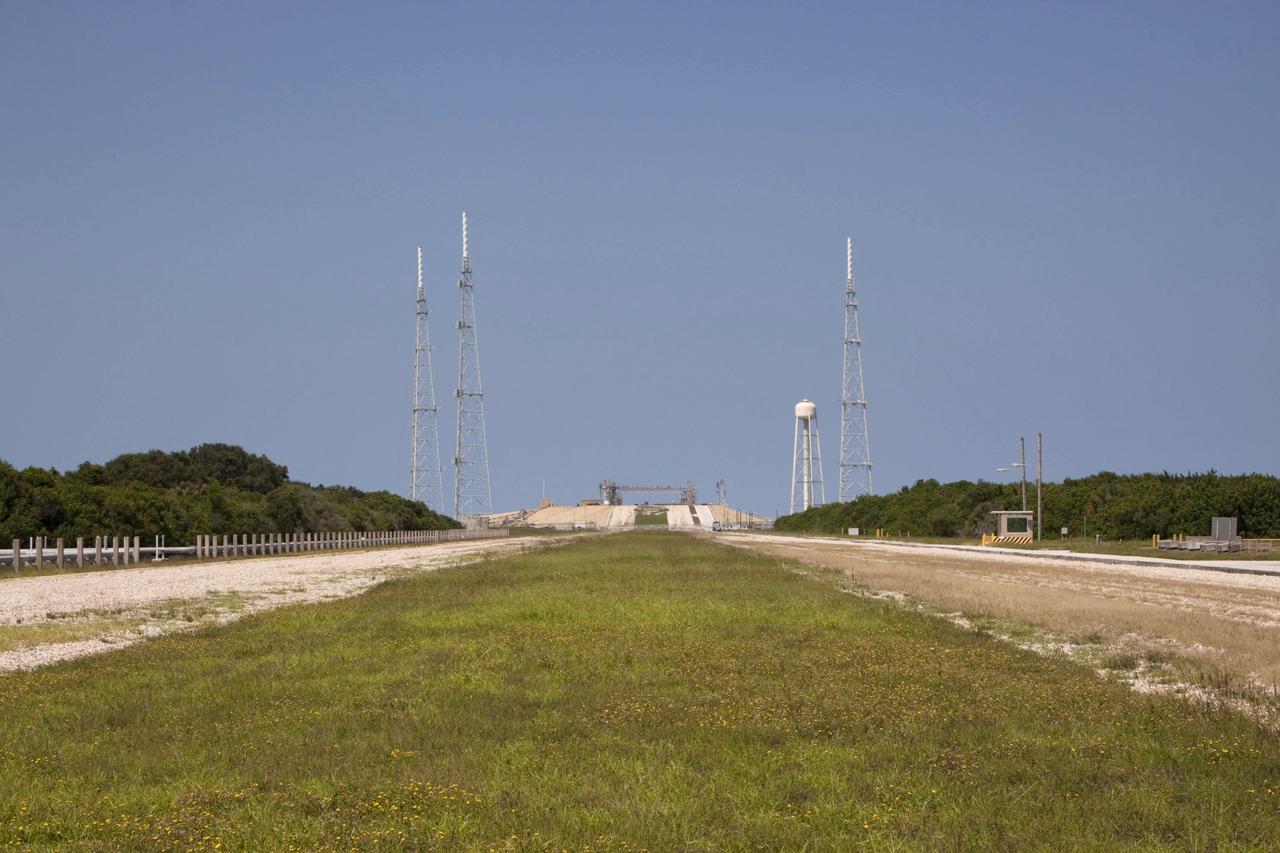
CAPE CANAVERAL, Fla. – The deconstruction of Launch Pad 39B at NASA’s Kennedy Space Center in Florida is complete. With a view from the two-track crawlerway, the three 600-foot-tall lightning protection towers and the water tower used for sound suppression stand over the remnants of the fixed service structure. In 2009, the structure at the pad was no longer needed for NASA's Space Shuttle Program, so it is being restructured for future use. The new design will feature a "clean pad" for rockets to come with their own launcher, making it more versatile for a number of vehicles. For information on NASA's future plans, visit http://www.nasa.gov/exploration. Photo credit: NASA/Jim Grossmann

About 450,000 gallons of water flowed at high speed from a holding tank through new and modified piping and valves, the flame trench, flame deflector nozzles and mobile launcher interface risers during a wet flow test at Launch Pad 39B at NASA's Kennedy Space Center in Florida. At peak flow, the water reached about 100 feet in the air above the pad surface. The test was a milestone to confirm and baseline the performance of the Ignition Overpressure/Sound Suppression system. During launch of NASA's Space Launch System rocket and Orion spacecraft, the high-speed water flow will help protect the vehicle from the extreme acoustic and temperature environment during ignition and liftoff.

A flow test of the Ignition Overpressure Protection and Sound Suppression water deluge system is underway on the mobile launcher at Launch Pad 39B at NASA's Kennedy Space Center in Florida, on July 25, 2019. The testing is part of a series of tests that Exploration Ground System is doing to verify the system is ready for the new Space Launch System rocket. Modifications were made to the pad after a previous wet flow test, increasing the performance of the system. During the launch of Artemis 1 and subsequent missions, this water deluge system will release about 450,000 gallons of water across the mobile launcher and Flame Deflector to reduce the extreme heat and energy generated by the rocket during ignition and liftoff.
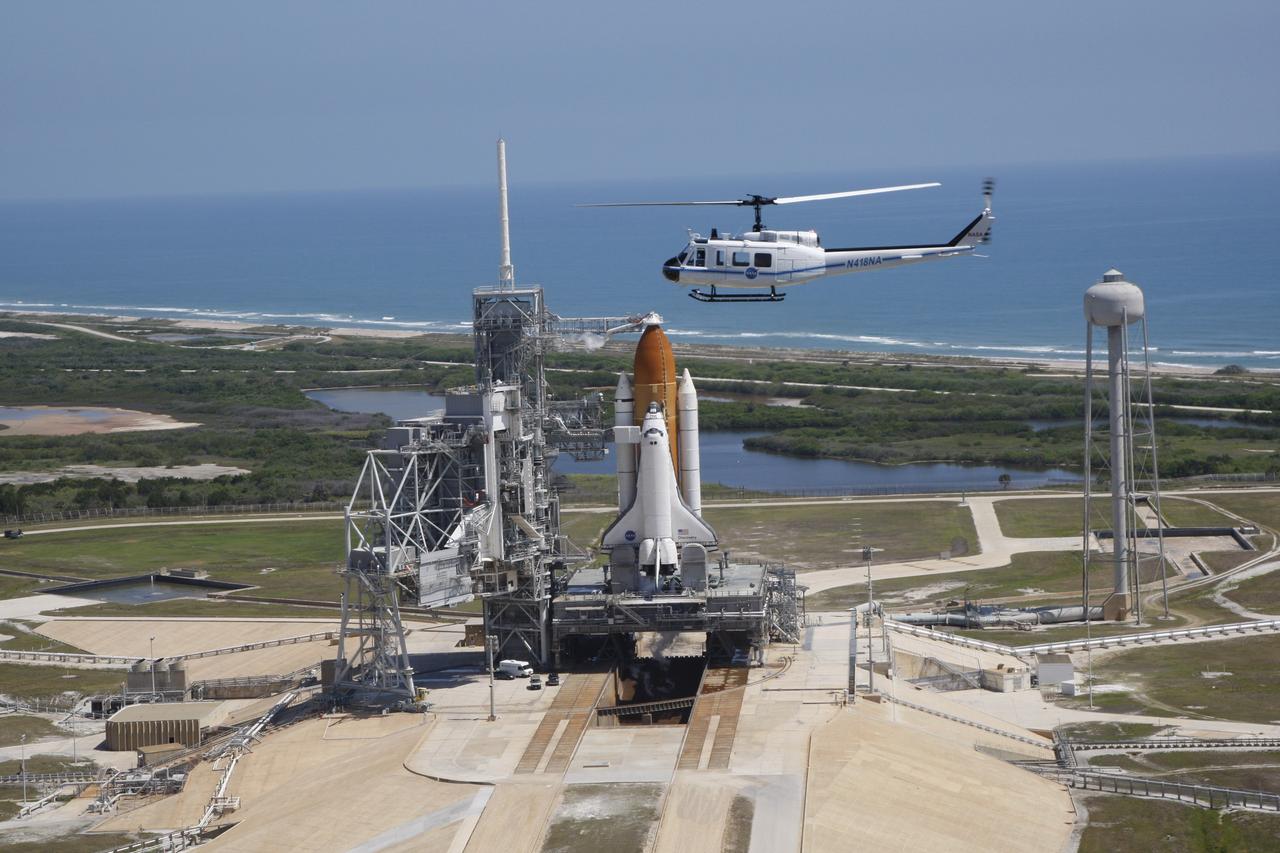
CAPE CANAVERAL, Fla. – A new NASA helicopter circles space shuttle Discovery on Launch Pad 39A prior to launch on the STS-124 mission. To the left of the shuttle is the fixed service structure with the 80-foot lightning mast on top. The rotating service structure, normally closed around the shuttle, is open for liftoff. At right of the pad is the 300,000-gallon water tower that provides the water used for sound suppression on the pad during liftoff. In the background is the Atlantic Ocean. Discovery is making its 35th flight. The STS-124 mission is the 26th in the assembly of the space station. It is the second of three flights launching components to complete the Japan Aerospace Exploration Agency's Kibo laboratory.
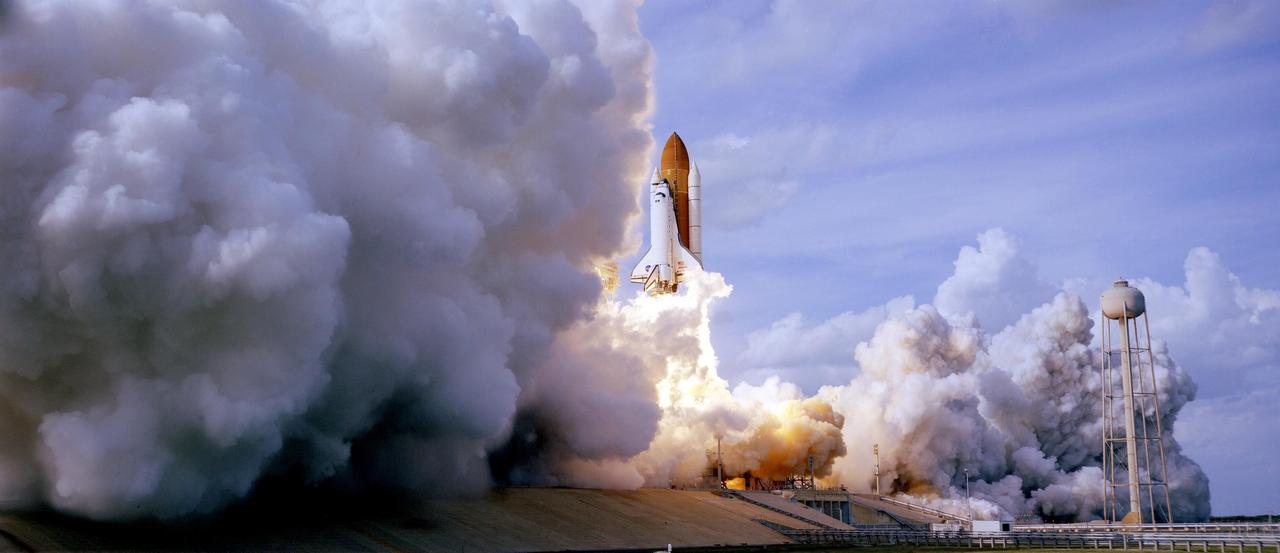
KENNEDY SPACE CENTER, FLA. -- Space shuttle Atlantis is surrounded by clouds of smoke and steam as it lifts off Launch Pad 39A on mission STS-122. At far right is the water tower that provides water for the sound suppression system during liftoff. The shuttle lifted off on time at 2:45 p.m. EST. This is the third launch attempt for Atlantis since December 2007 to carry the European Space Agency's Columbus laboratory to the International Space Station. During the 11-day mission, the crew's prime objective is to attach the laboratory to the Harmony module, adding to the station's size and capabilities. Photo credit: NASA/NASA/Rick Wetherington, Tim Terry, Tim Powers
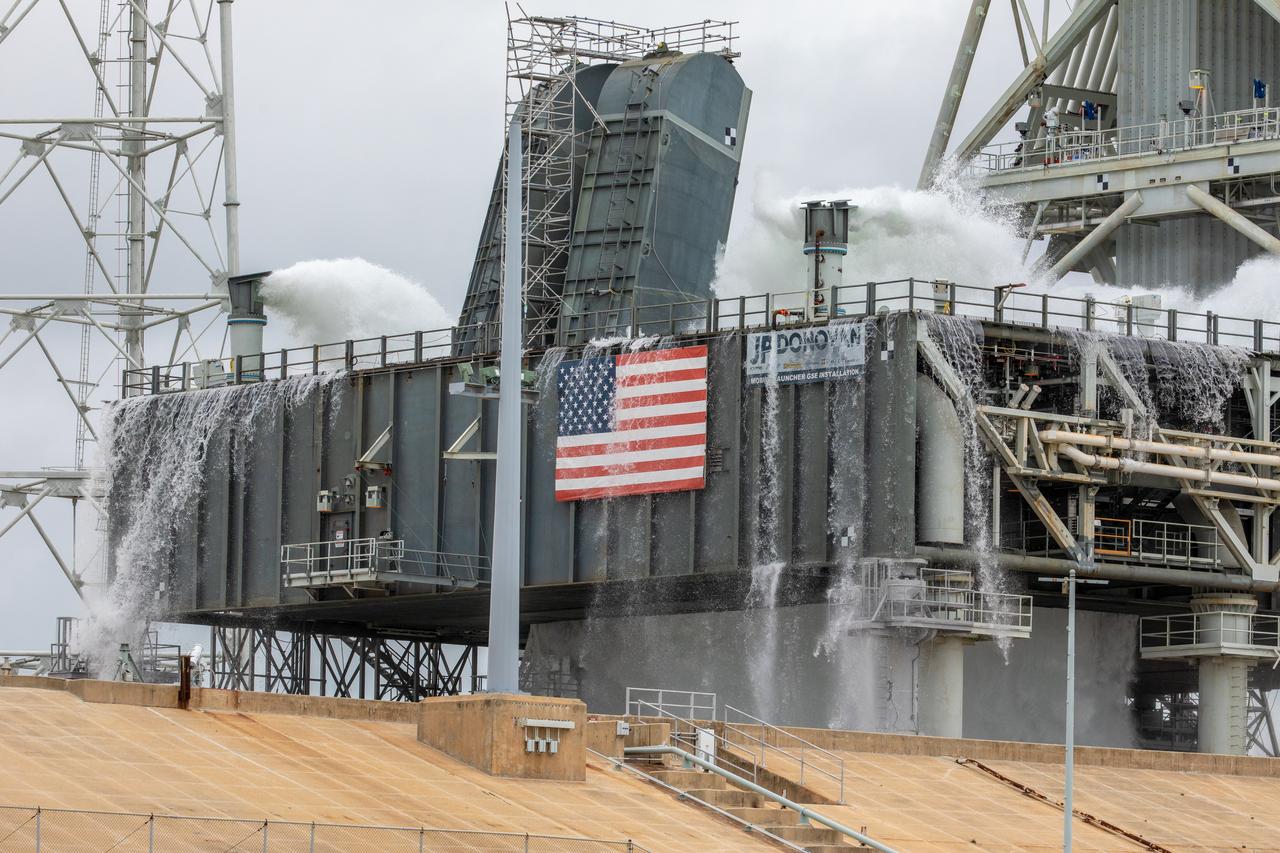
A flow test of the Ignition Overpressure Protection and Sound Suppression water deluge system begins on the mobile launcher at Launch Pad 39B at NASA's Kennedy Space Center in Florida, on July 25, 2019. The testing is part of a series of tests that Exploration Ground System is doing to verify the system is ready for the new Space Launch System rocket. Modifications were made to the pad after a previous wet flow test, increasing the performance of the system. During the launch of Artemis 1 and subsequent missions, this water deluge system will release about 450,000 gallons of water across the mobile launcher and Flame Deflector to reduce the extreme heat and energy generated by the rocket during ignition and liftoff.
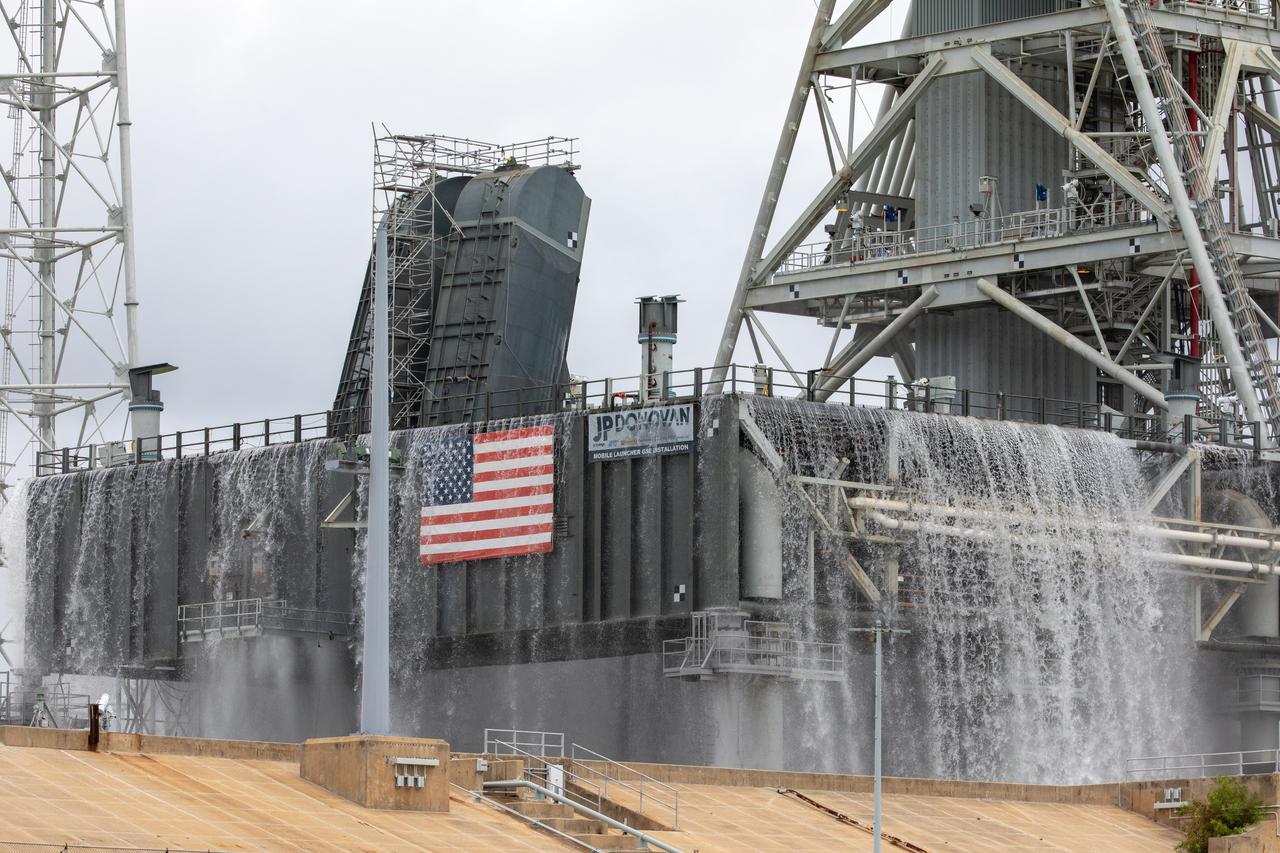
A flow test of the Ignition Overpressure Protection and Sound Suppression water deluge system is underway on the mobile launcher at Launch Pad 39B at NASA's Kennedy Space Center in Florida, on July 25, 2019. The testing is part of a series of tests that Exploration Ground System is doing to verify the system is ready for the new Space Launch System rocket. Modifications were made to the pad after a previous wet flow test, increasing the performance of the system. During the launch of Artemis 1 and subsequent missions, this water deluge system will release about 450,000 gallons of water across the mobile launcher and Flame Deflector to reduce the extreme heat and energy generated by the rocket during ignition and liftoff.
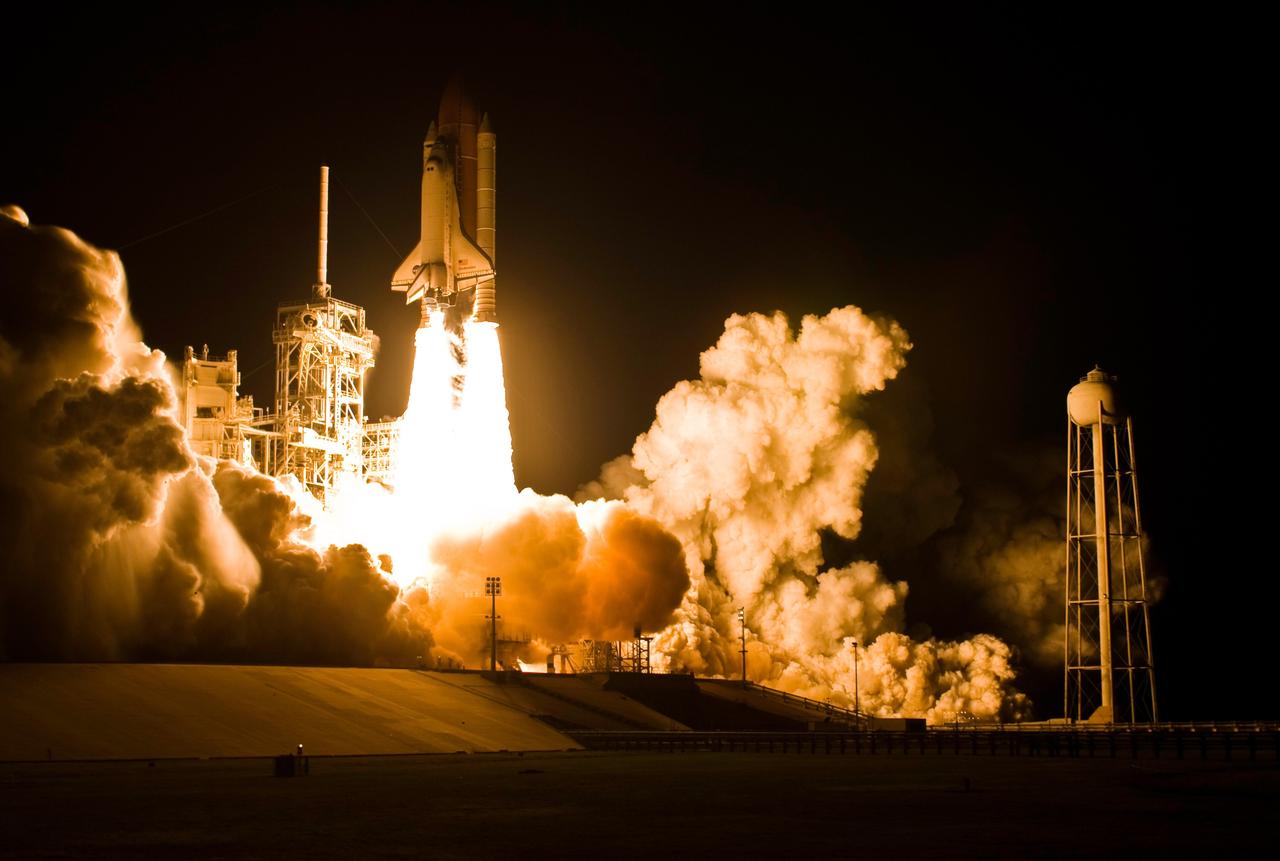
KENNEDY SPACE CENTER, FLA. -- Light-filled clouds of smoke and steam roll across Launch Pad 39A at NASA's Kennedy Space Center as space shuttle Endeavour roars into the night sky atop twin towers of flame on the STS-123 mission. At right is the 300,000-gallon water tower that provides the water used for sound suppression on the pad at liftoff. The liftoff was on time at 2:28 a.m. EDT. Endeavour's crew will make a record-breaking 16-day mission to the International Space Station and deliver the first section of the Japan Aerospace Exploration Agency's Kibo laboratory and the Canadian Space Agency's two-armed robotic system, Dextre. Photo courtesy of Scott Andrews
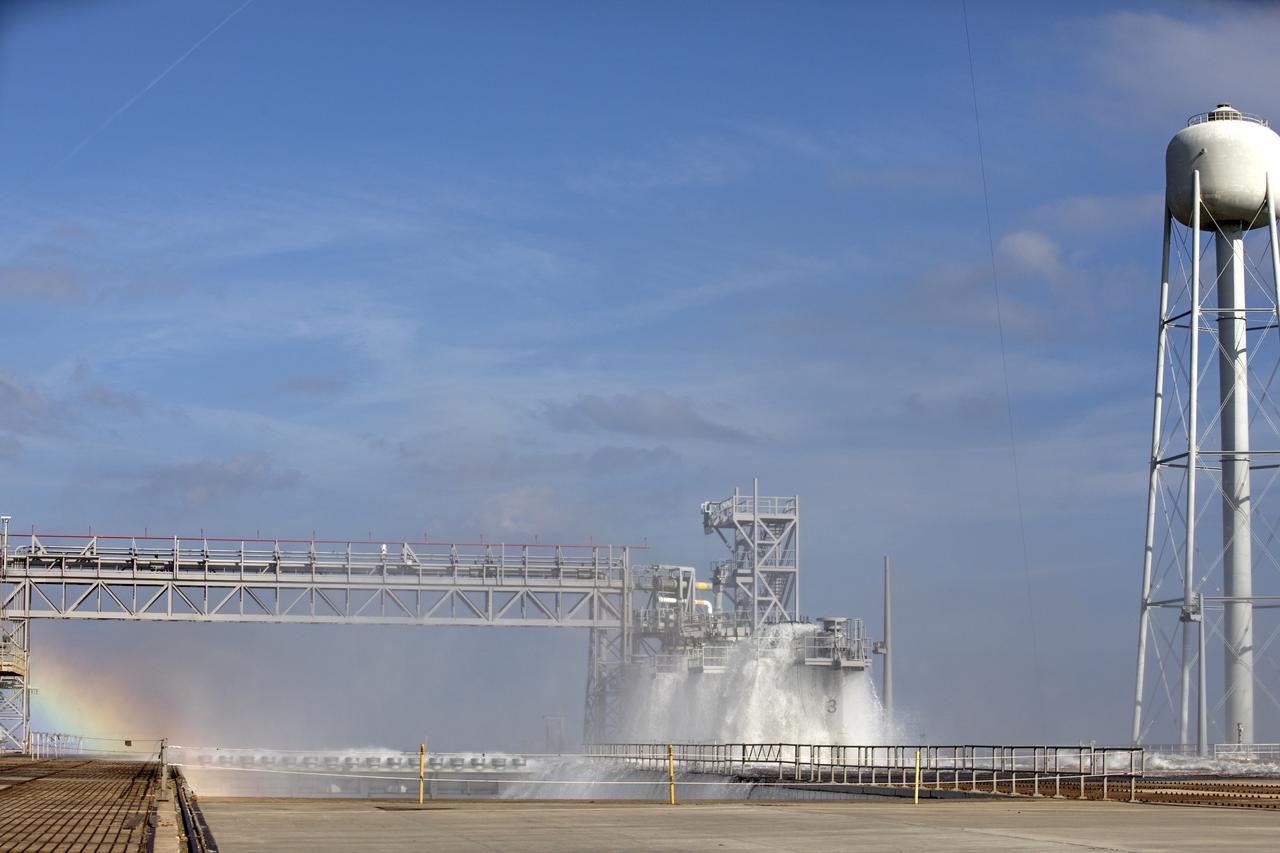
About 450,000 gallons of water flowed at high speed from a holding tank through new and modified piping and valves, the flame trench, flame deflector nozzles and mobile launcher interface risers during a wet flow test at Launch Pad 39B at NASA's Kennedy Space Center in Florida. At peak flow, the water reached about 100 feet in the air above the pad surface. The test was a milestone to confirm and baseline the performance of the Ignition Overpressure/Sound Suppression system. During launch of NASA's Space Launch System rocket and Orion spacecraft, the high-speed water flow will help protect the vehicle from the extreme acoustic and temperature environment during ignition and liftoff.
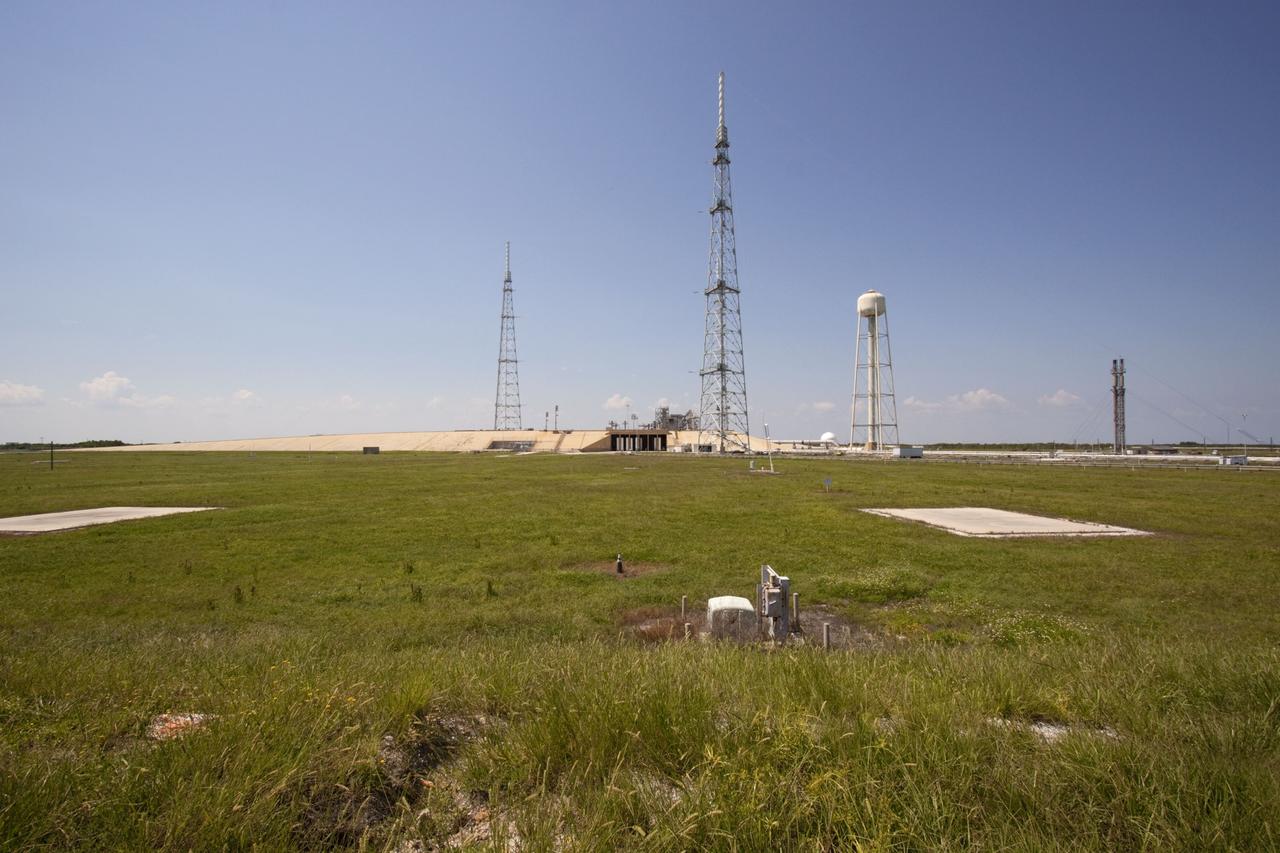
CAPE CANAVERAL, Fla. – The deconstruction of Launch Pad 39B at NASA’s Kennedy Space Center in Florida is complete. Still remaining and standing over the remnants of the fixed service structure are the 600-foot-tall lightning protection towers and the water tower used for sound suppression. In 2009, the structure at the pad was no longer needed for NASA's Space Shuttle Program, so it is being restructured for future use. The new design will feature a "clean pad" for rockets to come with their own launcher, making it more versatile for a number of vehicles. For information on NASA's future plans, visit http://www.nasa.gov/exploration. Photo credit: NASA/Jim Grossmann
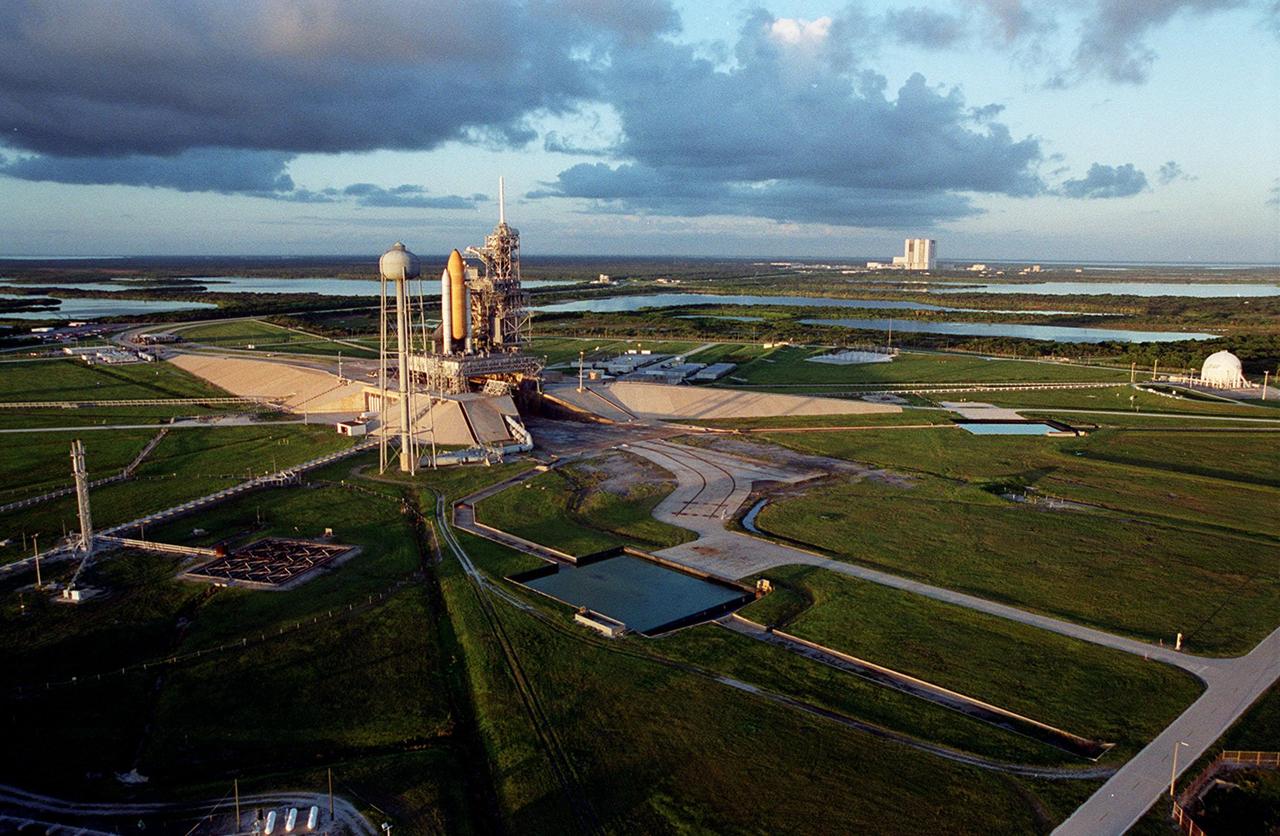
KENNEDY SPACE CENTER, Fla. -- A long view of Launch Complex 39 is caught by the early morning sun. Left of center is Launch Pad 39A with Space Shuttle Discovery. At its left is the 300,000-gallon water tank that is part of the sound suppression system. Hoses from the tank can be seen coiling under the pad, next to the opening of the flame trench, part of the flame detector system. In the foreground is a retention pond; another is at right center. At far right, the ball-shaped structure is a 850,000-gallon storage tank for the cryogenic liquid oxygen, one of the propellants of the orbiter’s main engines. On the horizon can be seen the 525-foot tall Vehicle Assembly Building
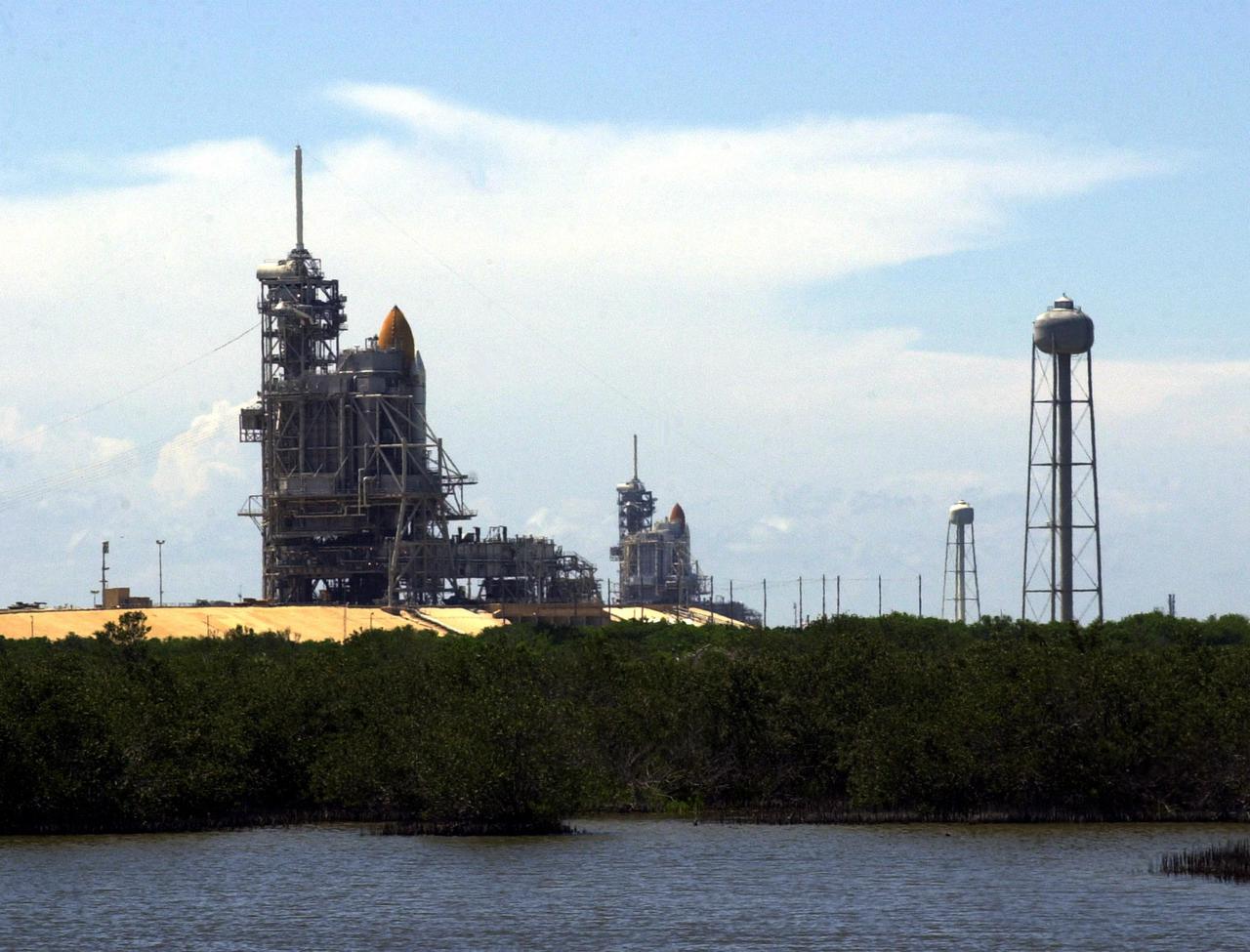
KENNEDY SPACE CENTER, Fla. -- Launch Pads 39A (foreground) and 39B are both seen in this photo, each with a Shuttle in place. Pad 39A holds Space Shuttle Discovery, which rolled out July 2 to be prepared for launch on mission STS-105 in August. Pad 39B holds Space Shuttle Atlantis, which is scheduled to launch Thursday, July 12, on mission STS-104. At right are the 290-foot water tanks that provide 300,000 gallons of water during liftoff. They are part of the sound suppression water system at each pad
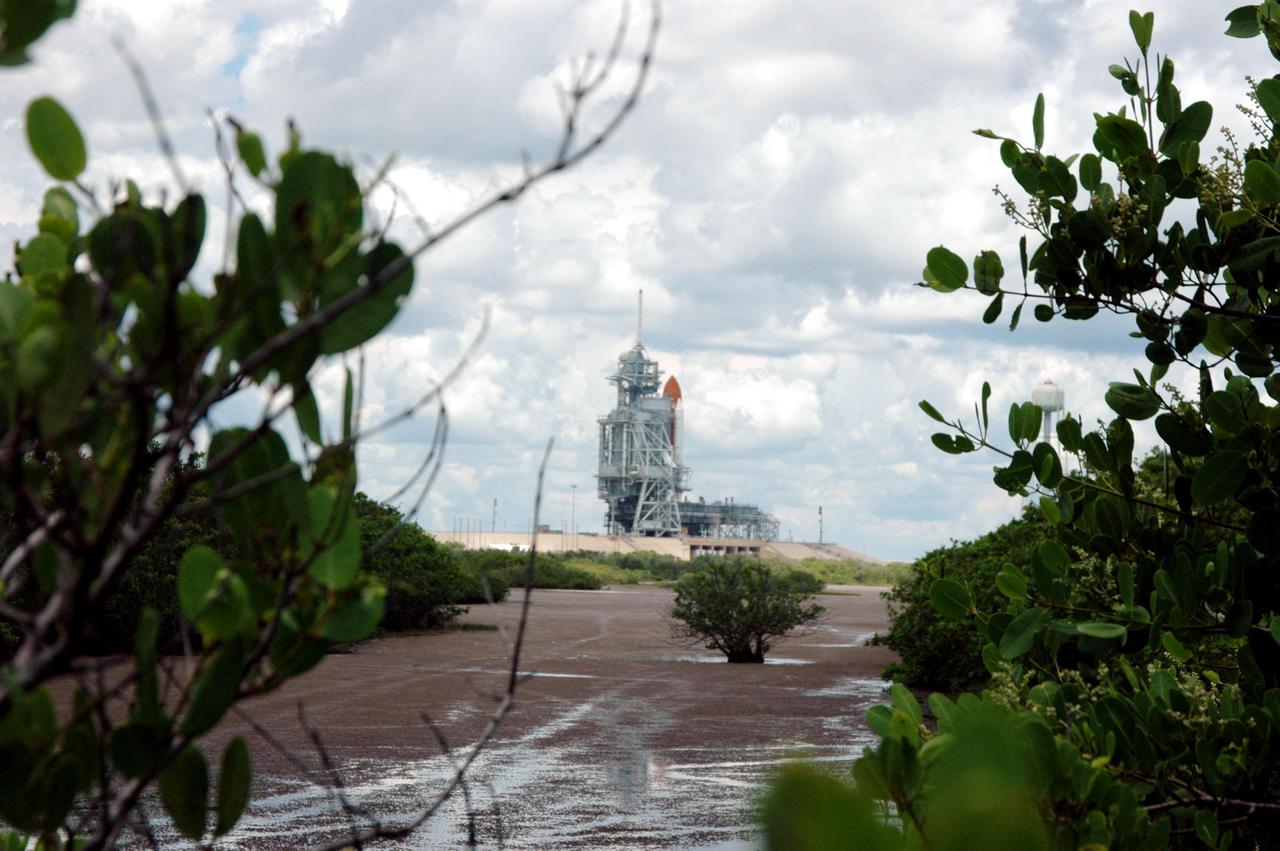
KENNEDY SPACE CENTER, FLA. - Space Shuttle Discovery remains on the pad the day after the Shuttle’s launch on Return to Flight mission STS-114 was scrubbed. In the foreground is the liquid hydrogen storage tank. At right is the 290-foot-tall water tower that holds 300,000 gallons of water, part of the sound suppression system during a launch. The July 13 mission was scrubbed when a low-level fuel cut-off sensor for the liquid hydrogen tank inside the External Tank failed a routine prelaunch check during the countdown July 13, causing mission managers to scrub Discovery's first launch attempt. The sensor protects the Shuttle's main engines by triggering their shutdown in the event fuel runs unexpectedly low. The sensor is one of four inside the liquid hydrogen section of the External Tank (ET).
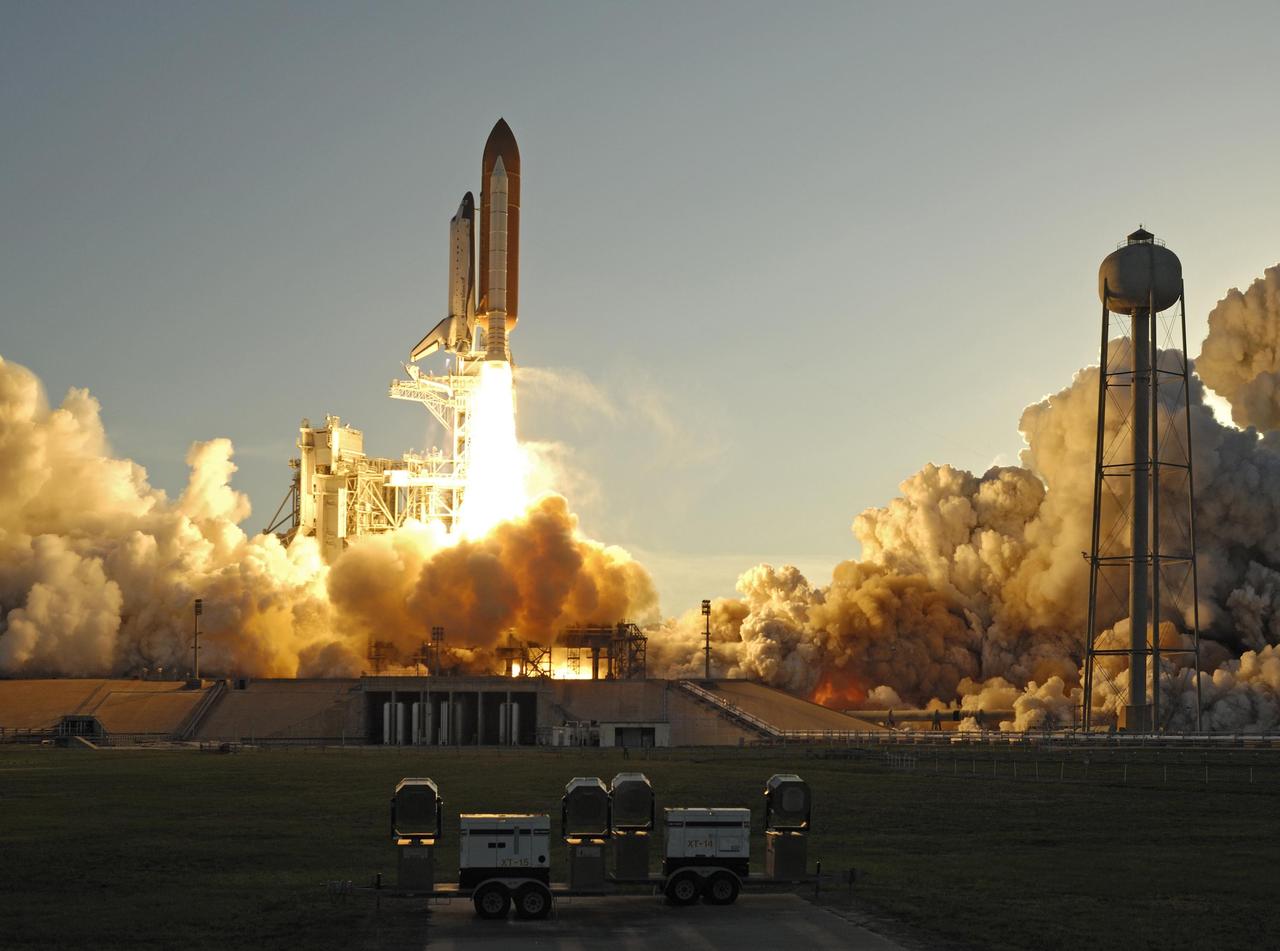
KENNEDY SPACE CENTER, FLA. -- Smoke and steam billow across Launch Pad 39A as Space Shuttle Atlantis, trailing columns of fire from the solid rocket boosters, hurtles into the sky on mission STS-117 to the International Space Station. At right is the water tank that provides the deluge over the mobile launcher platform for sound suppression during liftoff. Liftoff was on-time at 7:38:04 p.m. EDT.The shuttle is delivering a new segment to the starboard side of the International Space Station's backbone, known as the truss. Three spacewalks are planned to install the S3/S4 truss segment, deploy a set of solar arrays and prepare them for operation. STS-117 is the 118th space shuttle flight, the 21st flight to the station, the 28th flight for Atlantis and the first of four flights planned for 2007. Photo courtesy of Nikon/Scott Andrews
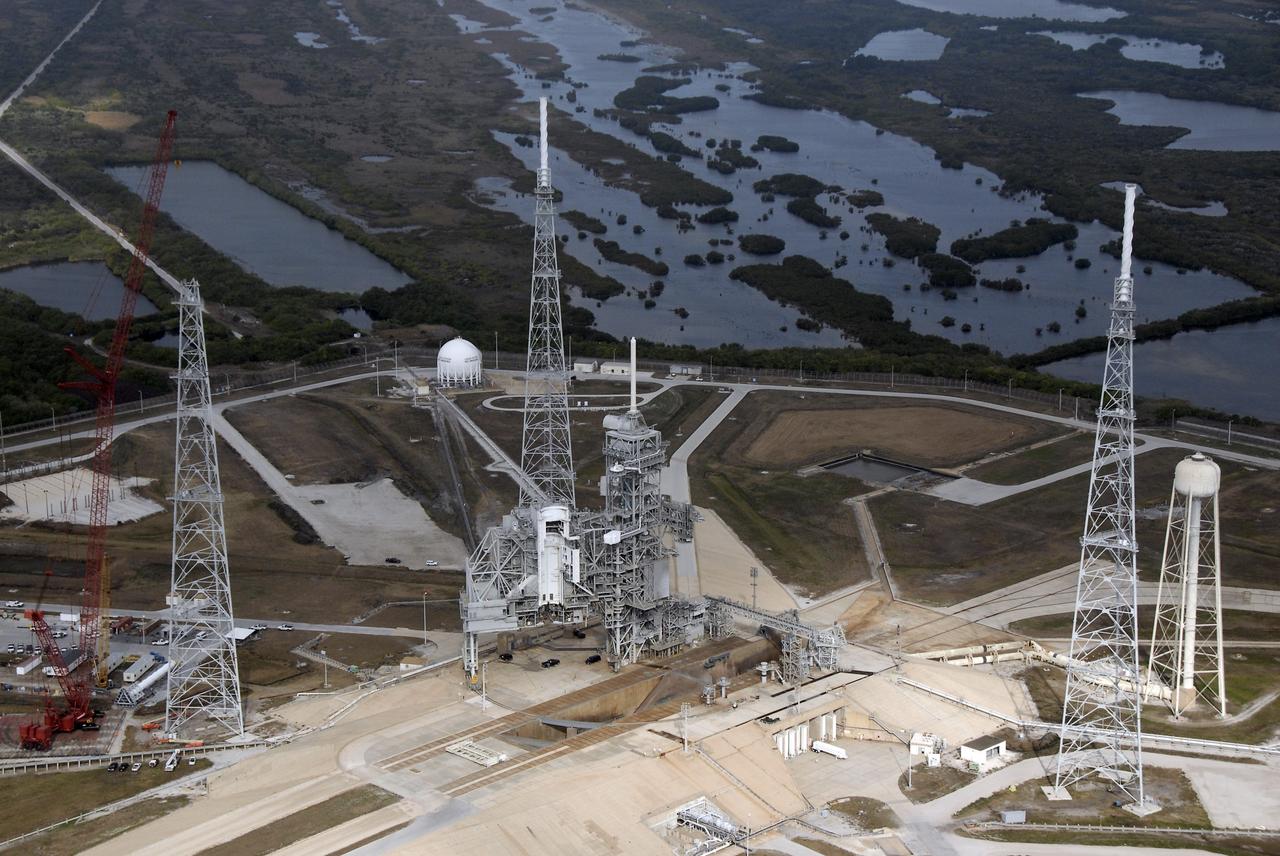
CAPE CANAVERAL, Fla. – An aerial view of the newly erected lightning towers on Launch Pad 39B at NASA's Kennedy Space Center. The two towers at center and right contain the lightning mast on top; the one at left does not. At center are the fixed and rotating service structures that have served the Space Shuttle Program. In the foreground is the tower that holds 300,000 gallons of water used for sound suppression during a shuttle liftoff. The new lightning protection system is being built for the Constellation Program and Ares/Orion launches. Each of the towers is 500 feet tall with an additional 100-foot fiberglass mast atop supporting a wire catenary system. This improved lightning protection system allows for the taller height of the Ares I rocket compared to the space shuttle. Pad 39B will be the site of the first Ares rocket launch, including the Ares I-X test flight that is targeted for July 2009. Photo credit: NASA/Kim Shiflett

A flow test of the Ignition Overpressure Protection and Sound Suppression water deluge system is in progress at Launch Pad 39B at NASA's Kennedy Space Center in Florida, on Oct. 15, 2018. At peak flow, the water reaches about 100 feet in the air above the pad surface. It flows at high speed from a holding tank through new and modified piping and valves, the flame trench, flame deflector nozzles and mobile launcher interface risers. The testing is part of Exploration Ground System's preparation for the new Space Launch System rocket. Modifications were made to the pad after a previous wet flow test, increasing the performance of the system. During the launch of Exploration Mission-1 and subsequent missions, this water deluge system will release about 450,000 gallons of water across the mobile launcher and Flame Deflector to reduce the extreme heat and energy generated by the rocket during ignition and liftoff.
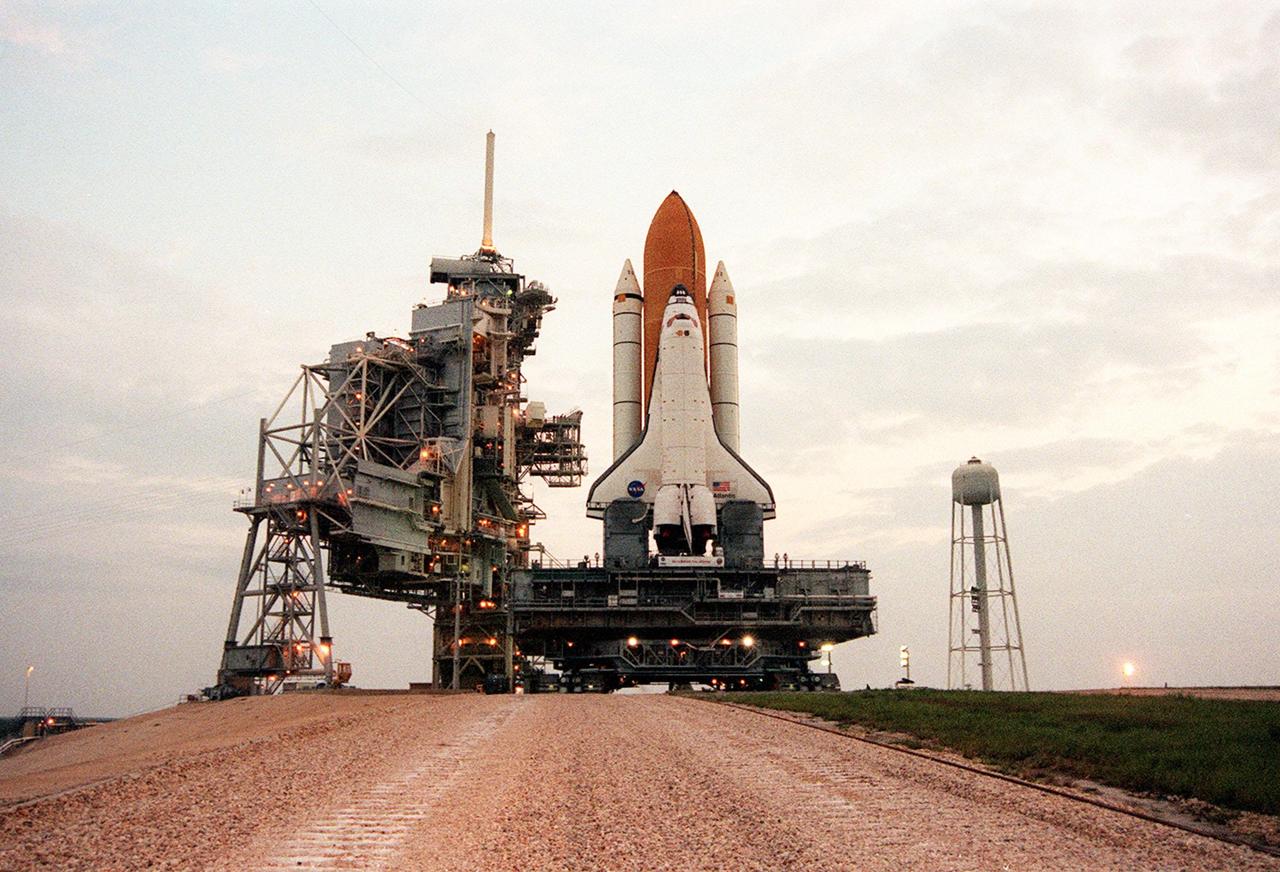
KENNEDY SPACE CENTER, Fla. -- The sun creeps over the horizon (right) as Space Shuttle Atlantis, atop the Mobile Launcher Platform and Crawler-Transporter, arrives at Launch Pad 39B for preparations before launch. It started its 8-hour rollout from the Vehicle Assembly Building high bay 2 (Safe Haven) at 11:20 p.m., Aug. 13. At left is the Rotating Service Structure in its open position. Towering above the RSS (and attached to the Fixed Service Structure) is the 80-foot tall lightning mast. At right is the 290-foot high water tank that holds 300,000 gallons of water. It is part of the sound suppression system at the pad. Atlantis is scheduled for launch Sept. 8 at 8:31 a.m. EDT on mission STS-106.

A flow test of the Ignition Overpressure Protection and Sound Suppression water deluge system is in progress at Launch Pad 39B at NASA's Kennedy Space Center in Florida, on Oct. 15, 2018. At peak flow, the water reaches about 100 feet in the air above the pad surface. It flows at high speed from a holding tank through new and modified piping and valves, the flame trench, flame deflector nozzles and mobile launcher interface risers. The testing is part of Exploration Ground System's preparation for the new Space Launch System rocket. Modifications were made to the pad after a previous wet flow test, increasing the performance of the system. During the launch of Exploration Mission-1 and subsequent missions, this water deluge system will release about 450,000 gallons of water across the mobile launcher and Flame Deflector to reduce the extreme heat and energy generated by the rocket during ignition and liftoff.
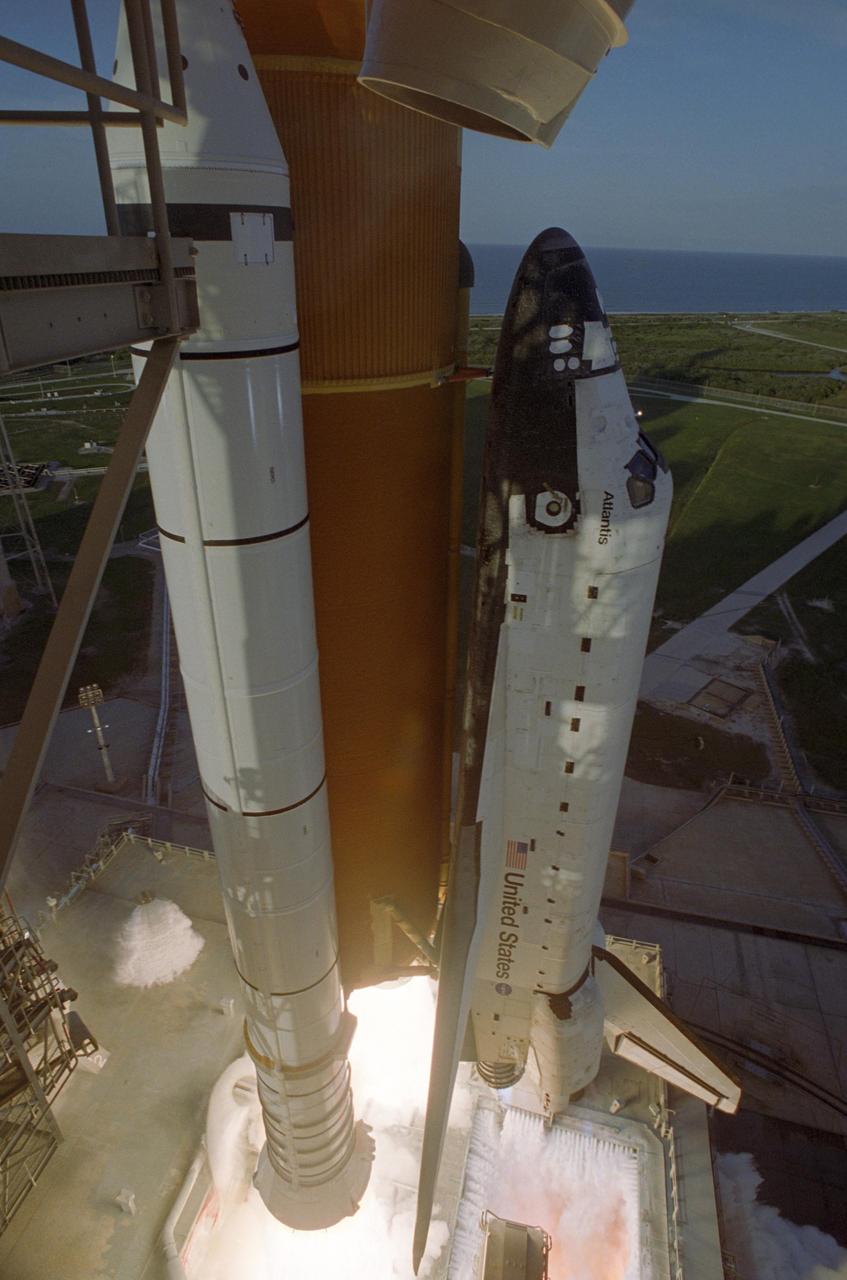
KENNEDY SPACE CENTER, FLA. -- Space Shuttle Atlantis is captured as it lifts off Launch Pad 39A for a rocket ride into the sky and rendezvous with the International Space Station on mission STS-117. On the mobile launcher platform below Atlantis can be seen the jets of water flooding the surface for sound suppression. Beyond the pad on the horizon is the Atlantic Ocean. Liftoff of Atlantis was on-time at 7:38:04 p.m. EDT. The shuttle is delivering a new segment to the starboard side of the International Space Station's backbone, known as the truss. Three spacewalks are planned to install the S3/S4 truss segment, deploy a set of solar arrays and prepare them for operation. STS-117 is the 118th space shuttle flight, the 21st flight to the station, the 28th flight for Atlantis and the first of four flights planned for 2007. Photo Credit: NASA/Tony Gray & Rick Wetherington