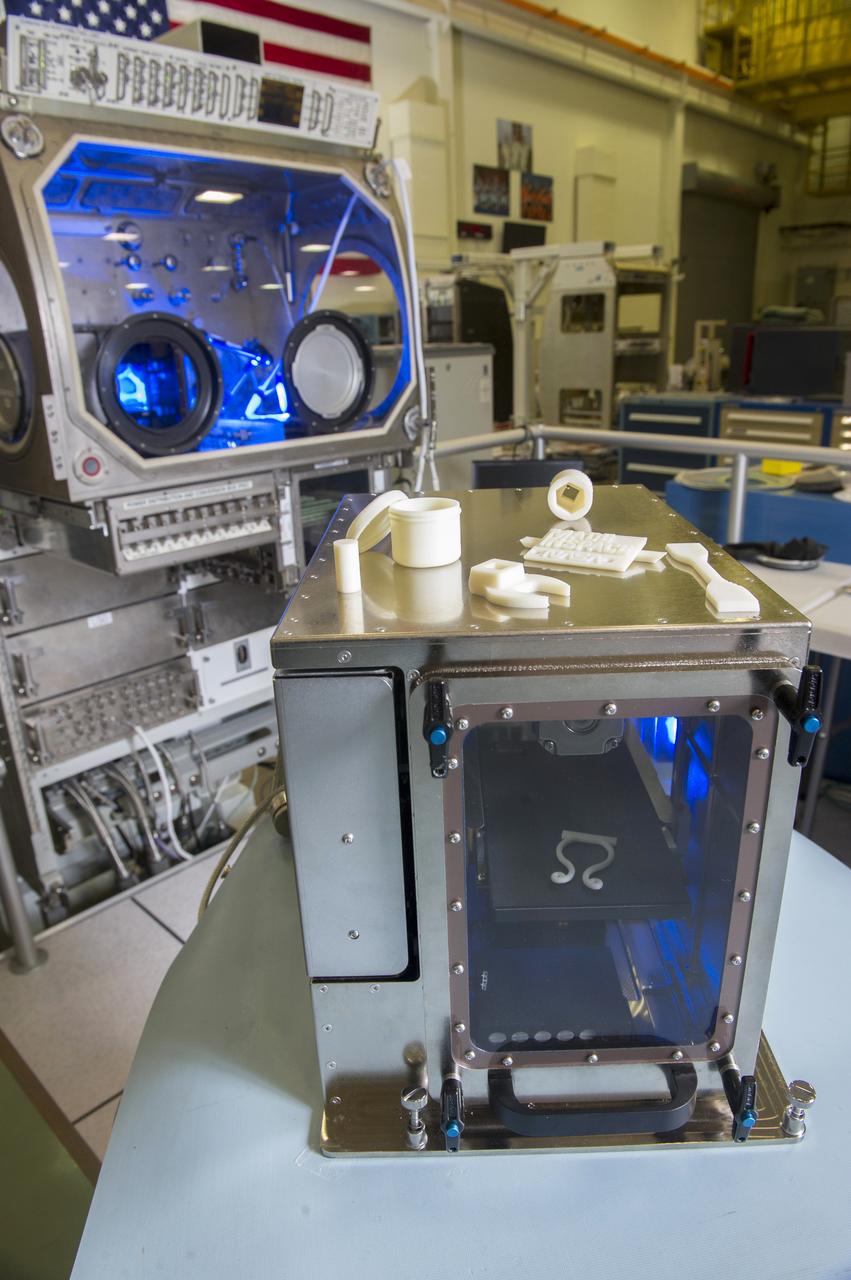
“MADE IS SPACE” 3D PRINTER IN FOREGROUND WITH MICROGRAVITY GLOVEBOX IN BACKGROUND, COVER PHOTO FOR NASA TECH BRIEFS MAGAZINE, JUNE 2014 ISSUE
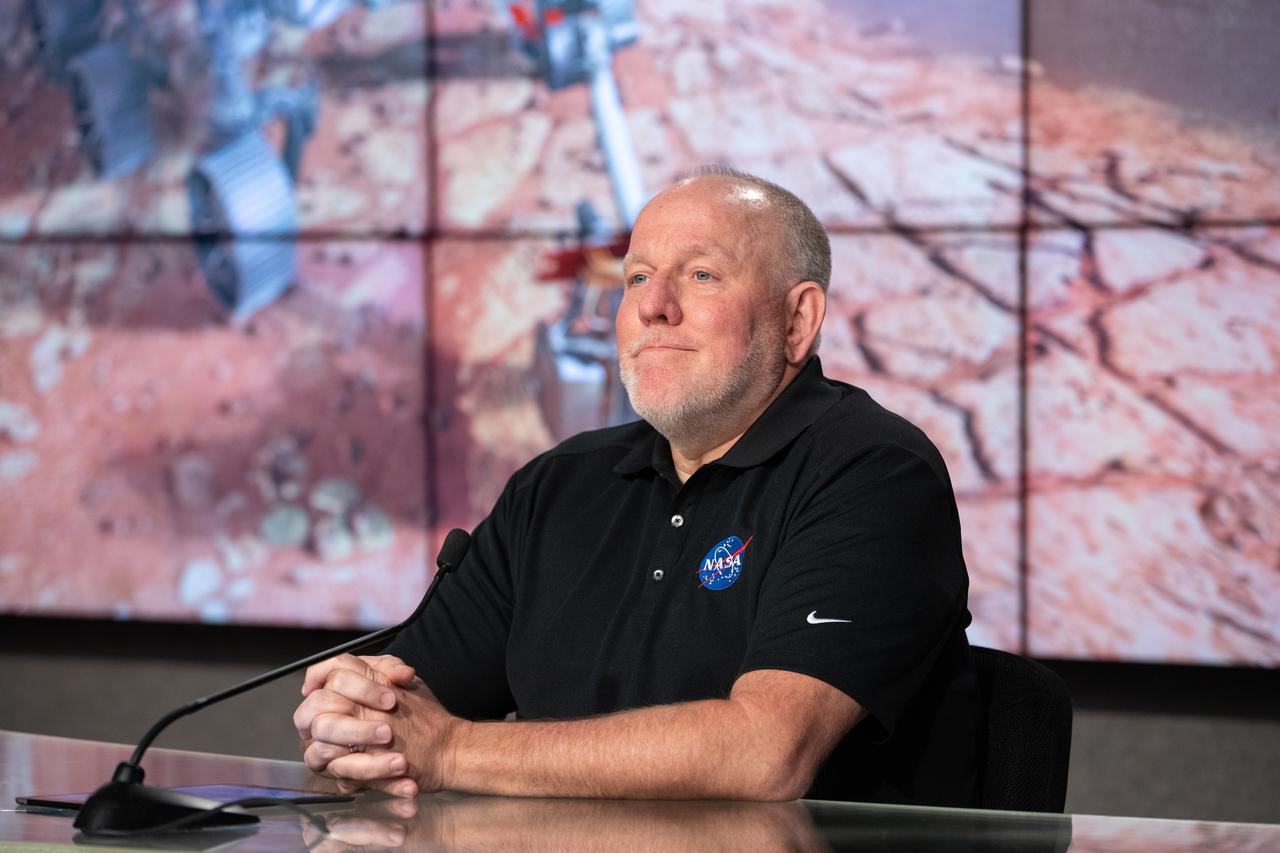
Jeff Sheehy, Space Technology Mission Directorate, NASA Headquarters, participates in a Mars 2020 Mission Tech and Humans to Mars Briefing at NASA’s Kennedy Space Center in Florida on July 28, 2020. The Mars Perseverance rover is scheduled to launch July 30, on a United Launch Alliance Atlas V 541 rocket from Space Launch Complex 41 at nearby Cape Canaveral Air Force Station. The rover is part of NASA’s Mars Exploration Program, a long-term effort of robotic exploration of the Red Planet. The rover will search for habitable conditions in the ancient past and signs of past microbial life on Mars. The Launch Services Program at Kennedy is responsible for launch management.
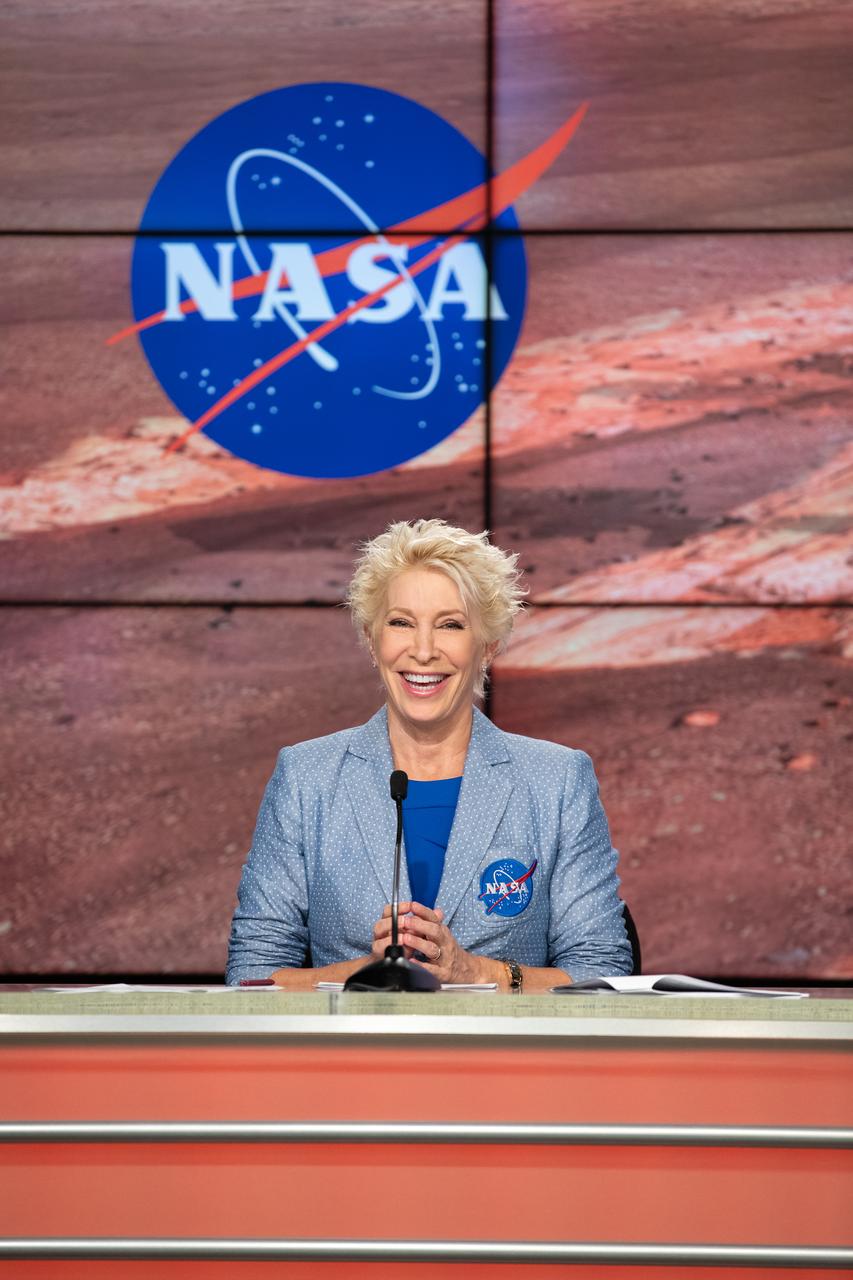
Tammy Long, NASA Communicaions, moderates a Mars 2020 Mission Tech and Humans to Mars Briefing at NASA’s Kennedy Space Center in Florida on July 28, 2020. The Mars Perseverance rover is scheduled to launch July 30, on a United Launch Alliance Atlas V 541 rocket from Space Launch Complex 41 at nearby Cape Canaveral Air Force Station. The rover is part of NASA’s Mars Exploration Program, a long-term effort of robotic exploration of the Red Planet. The rover will search for habitable conditions in the ancient past and signs of past microbial life on Mars. The Launch Services Program at Kennedy is responsible for launch management.
iss063e113776 (10/20/2020) --- A view of the CubeLab Microscope Imagery Tech Demo aboard the International Space Station (ISS). The CubeLab Microscope Imagery Technology Demonstration (CubeLab Microscope Imagery Tech Demo) tests enhanced microscope imagery capabilities for experiments aboard the space station. Images provide a primary way to document and analyze many microgravity investigations, and better quality images could lead to better results.
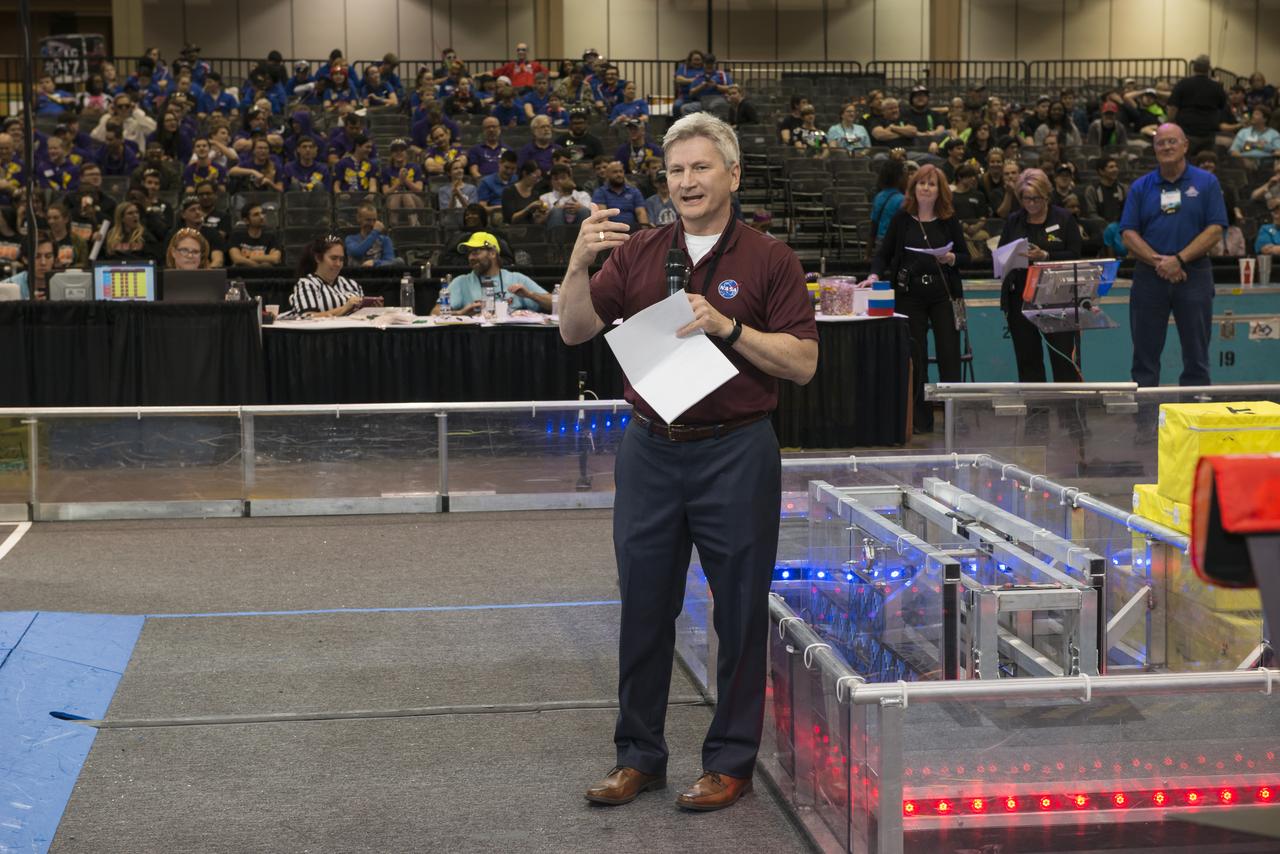
Johnny Stephenson, director of NASA Marshall Space Flight Center's Office of Strategic Analysis & Communications, addresses the crowd during the March 16 award ceremony following the first day of competition at the FIRST Robotics Rocket City Regional at the Von Braun Center in Huntsville. Ed Sparks, of the Morgan County Mech Tech team, received the award for Volunteer of the Year at the March 16 award ceremony. Mech Tech, comprised of students from five high schools in Morgan County, Alabama, also won the Industrial Design Award. The team was one of three regional finalists that will advance to the FIRST national championships April 18-21 in Houston. The other two regional finalists were Burning Magnetos of Fort Dorchester High School in North Charleston, South Carolina, and OGRE of Opelika High School in Opelika, Alabama. Mech Tech and Golden Hurricane from Columbia High School in Huntsville, were "house" teams sponsored by Marshall.

NMTSat is a student-built satellite built by undergraduate and graduates students primarily from New Mexico Tech. NMTSat is designed to operate five sensors in four experiments in space for 3 months of data collection. The experiments will provide data on earth’s magnetic field, high altitude plasma density, atmospheric weather measurements, and an optical beacon experiment. Approximately 50 students have contributed to NMTSat and its design not including the students and groups who have developed the science instruments. NMTSat CubeSat is providing the opportunity for these science experiments to be conducted on orbit and demonstrates the collaborative nature of the Educational Launch of Nano Satellite (ELaNa) Program at NASA. The instruments have been contributed by New Mexico Tech, Turabo University in Puerto Rico, Los Alamos National Laboratory, and Atmospheric and Space Technology Research Associates (ASTRA) in Boulder, CO. Dr. Anders M. Jorgensen, Associate Professor at New Mexico Tech is the PI and Dr. Hien Vo from Vietnamese-German University in Ho Chi Minh University in Vietnam is a Co-Investigator. NMTSat is funded by the New Mexico NASA EPSCoR program as well as New Mexico Tech.

NMTSat is a student-built satellite built by undergraduate and graduates students primarily from New Mexico Tech. NMTSat is designed to operate five sensors in four experiments in space for 3 months of data collection. The experiments will provide data on earth’s magnetic field, high altitude plasma density, atmospheric weather measurements, and an optical beacon experiment. Approximately 50 students have contributed to NMTSat and its design not including the students and groups who have developed the science instruments. NMTSat CubeSat is providing the opportunity for these science experiments to be conducted on orbit and demonstrates the collaborative nature of the Educational Launch of Nano Satellite (ELaNa) Program at NASA. The instruments have been contributed by New Mexico Tech, Turabo University in Puerto Rico, Los Alamos National Laboratory, and Atmospheric and Space Technology Research Associates (ASTRA) in Boulder, CO. Dr. Anders M. Jorgensen, Associate Professor at New Mexico Tech is the PI and Dr. Hien Vo from Vietnamese-German University in Ho Chi Minh University in Vietnam is a Co-Investigator. NMTSat is funded by the New Mexico NASA EPSCoR program as well as New Mexico Tech.

NMTSat is a student-built satellite built by undergraduate and graduates students primarily from New Mexico Tech. NMTSat is designed to operate five sensors in four experiments in space for 3 months of data collection. The experiments will provide data on earth’s magnetic field, high altitude plasma density, atmospheric weather measurements, and an optical beacon experiment. Approximately 50 students have contributed to NMTSat and its design not including the students and groups who have developed the science instruments. NMTSat CubeSat is providing the opportunity for these science experiments to be conducted on orbit and demonstrates the collaborative nature of the Educational Launch of Nano Satellite (ELaNa) Program at NASA. The instruments have been contributed by New Mexico Tech, Turabo University in Puerto Rico, Los Alamos National Laboratory, and Atmospheric and Space Technology Research Associates (ASTRA) in Boulder, CO. Dr. Anders M. Jorgensen, Associate Professor at New Mexico Tech is the PI and Dr. Hien Vo from Vietnamese-German University in Ho Chi Minh University in Vietnam is a Co-Investigator. NMTSat is funded by the New Mexico NASA EPSCoR program as well as New Mexico Tech.
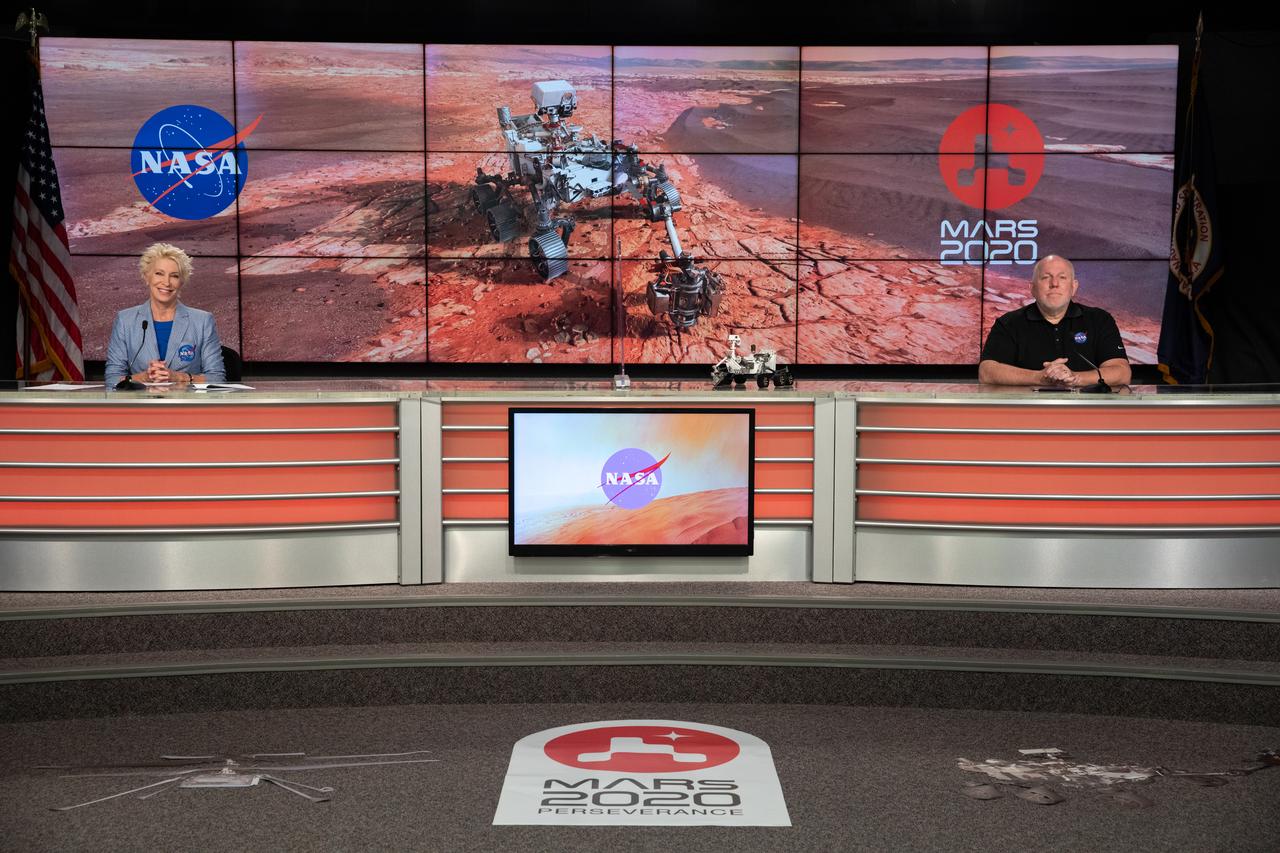
A Mars 2020 Mission Tech and Humans to Mars Briefing is held at NASA’s Kennedy Space Center in Florida on July 28, 2020. Participating in the briefing from left, are Tammy Long, moderator, NASA Communications, and Jeff Sheehy, Space Technology Mission Directorate, NASA Headquarters. The Mars Perseverance rover is scheduled to launch July 30, on a United Launch Alliance Atlas V 541 rocket from Space Launch Complex 41 at nearby Cape Canaveral Air Force Station. The rover is part of NASA’s Mars Exploration Program, a long-term effort of robotic exploration of the Red Planet. The rover will search for habitable conditions in the ancient past and signs of past microbial life on Mars. The Launch Services Program at Kennedy is responsible for launch management.
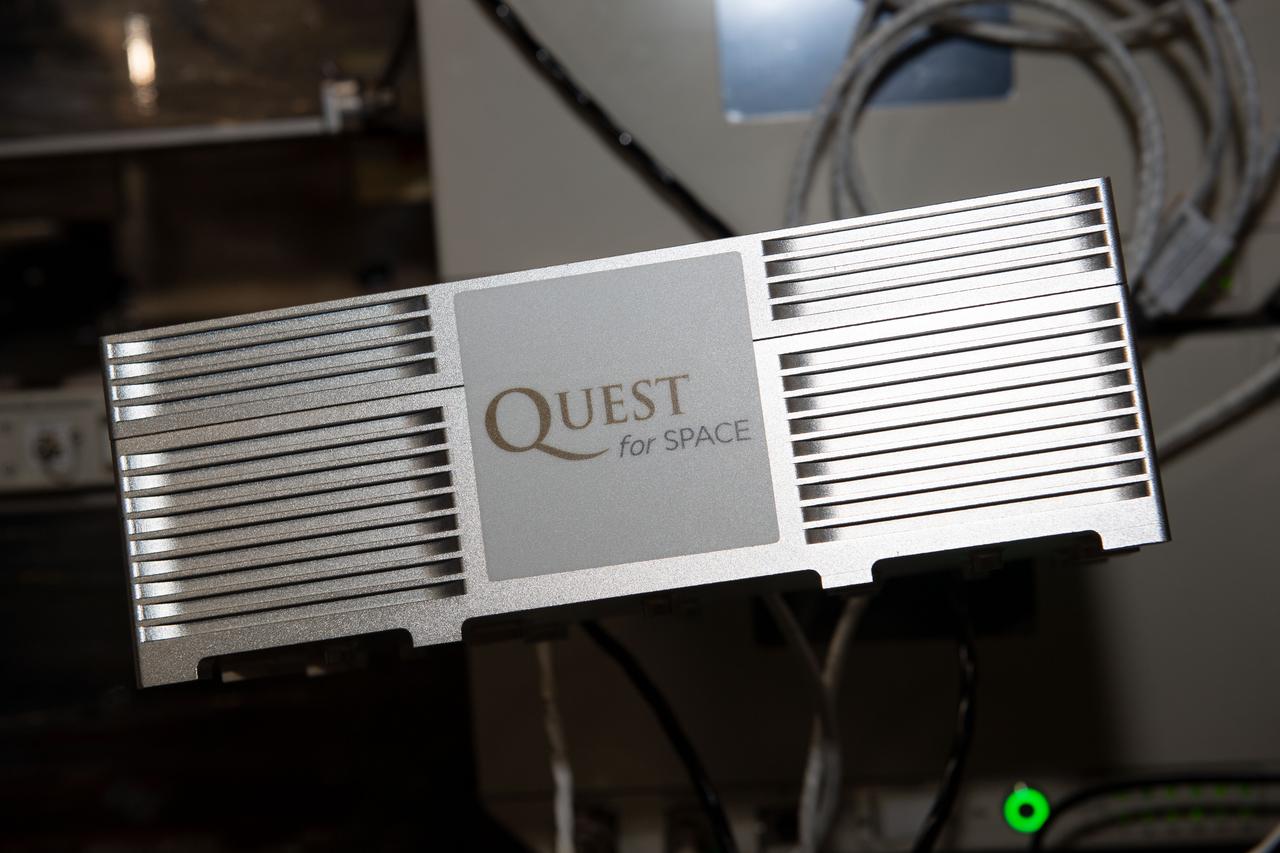
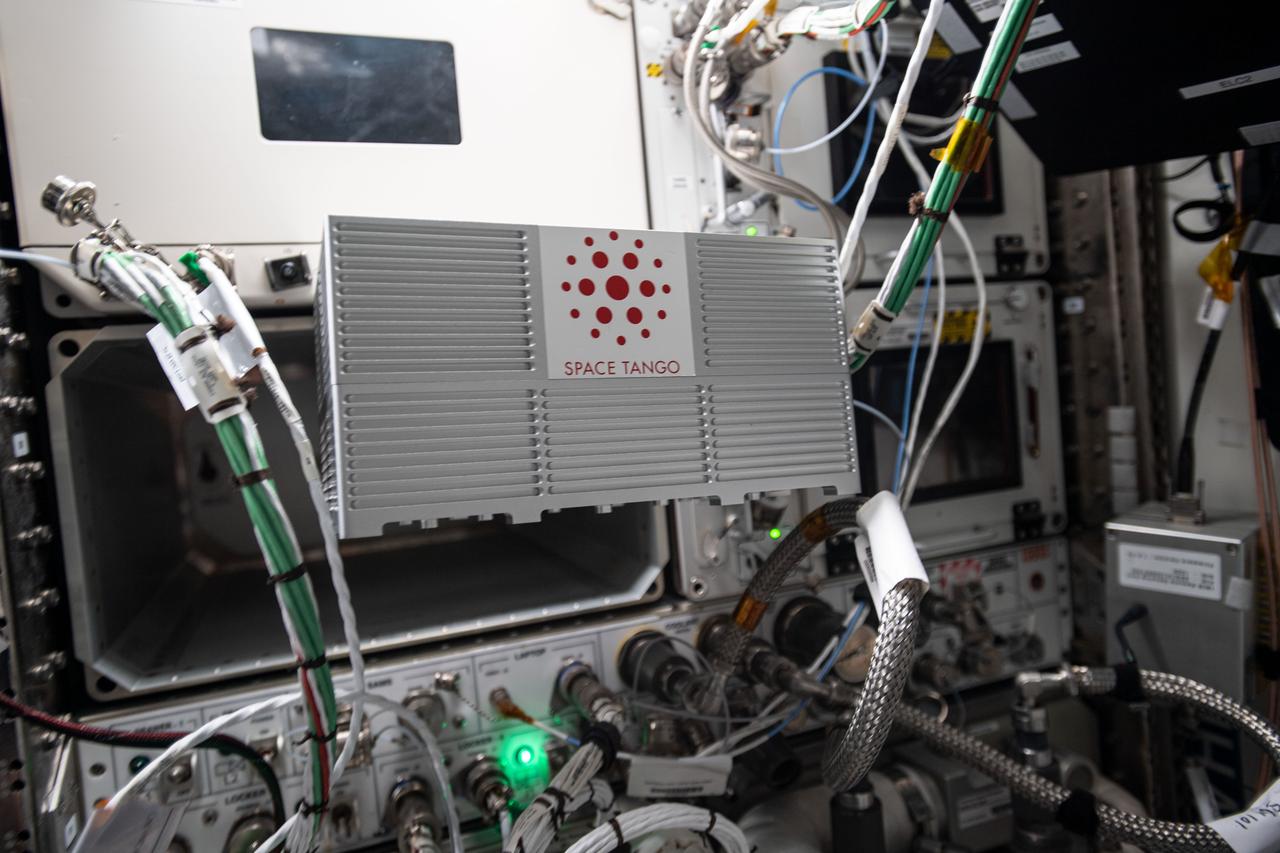
iss069e054897 (8/7/2023) --- A view of the Quest Multi Experiment Module #6 aboard the International space Station (ISS). The 9U Space Tango CubeLab carries 14 individual student-designed experiments and a tech demo, including exploration of magnetism, fluidics, microbial behavior, and plant growth in space.
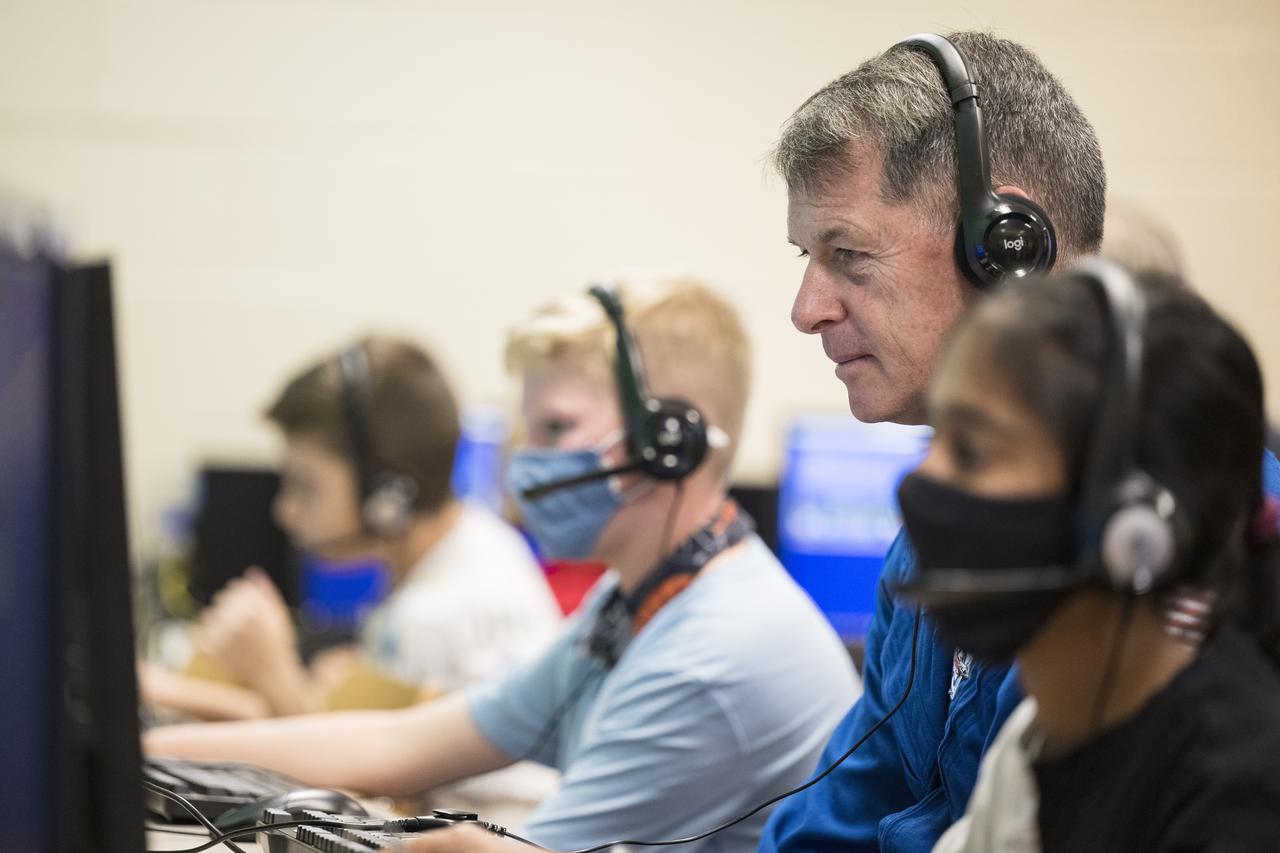
NASA’s SpaceX Crew-2 NASA astronaut Shane Kimbrough surveys what students in the tech crew in the Space Shuttle Simulator room are doing during a visit to Arlington Science Focus Elementary School, Friday, June 10, 2022, in Arlington, Virginia. Photo Credit: (NASA/Aubrey Gemignani)
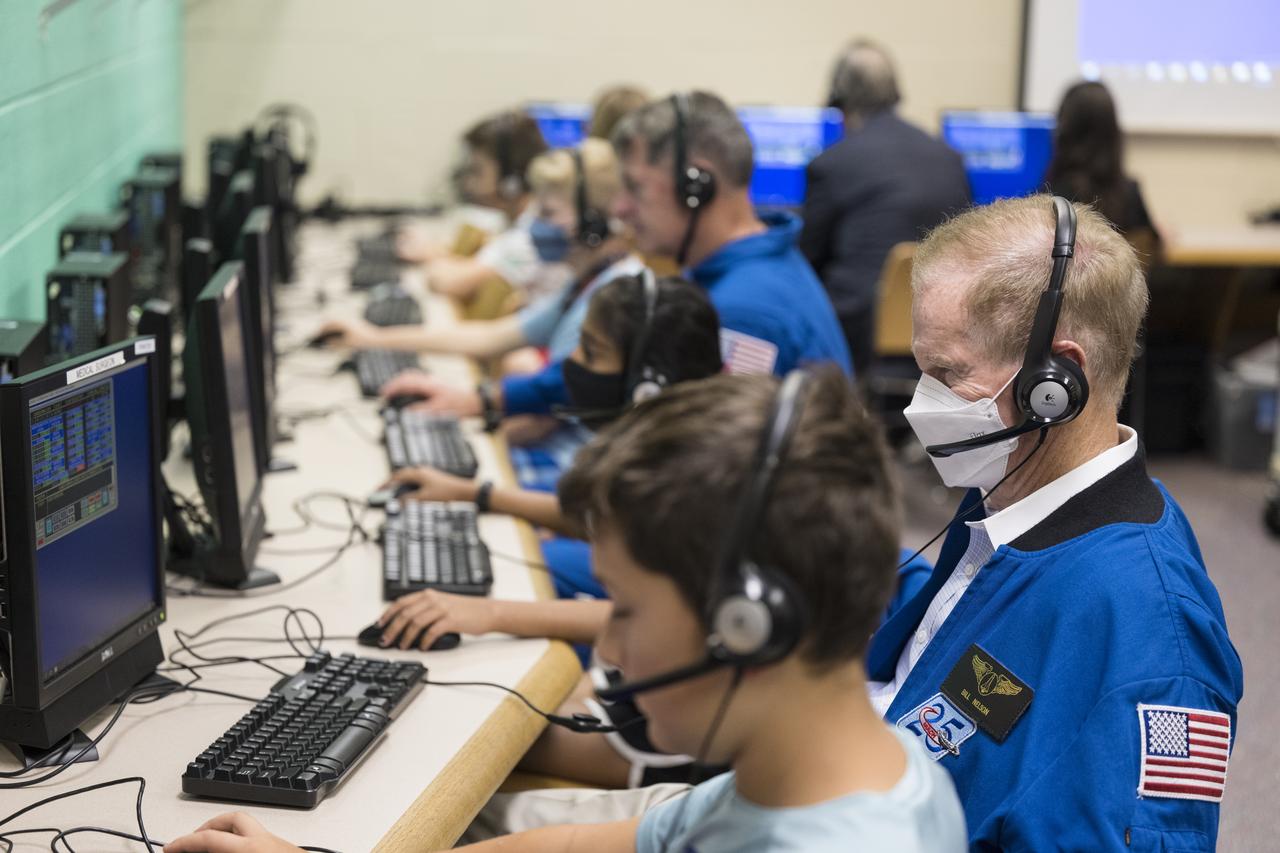
NASA Administrator Bill Nelson surveys what students in the tech crew in the Space Shuttle Simulator room are doing during a visit to Arlington Science Focus Elementary School, Friday, June 10, 2022, in Arlington, Virginia. Photo Credit: (NASA/Aubrey Gemignani)
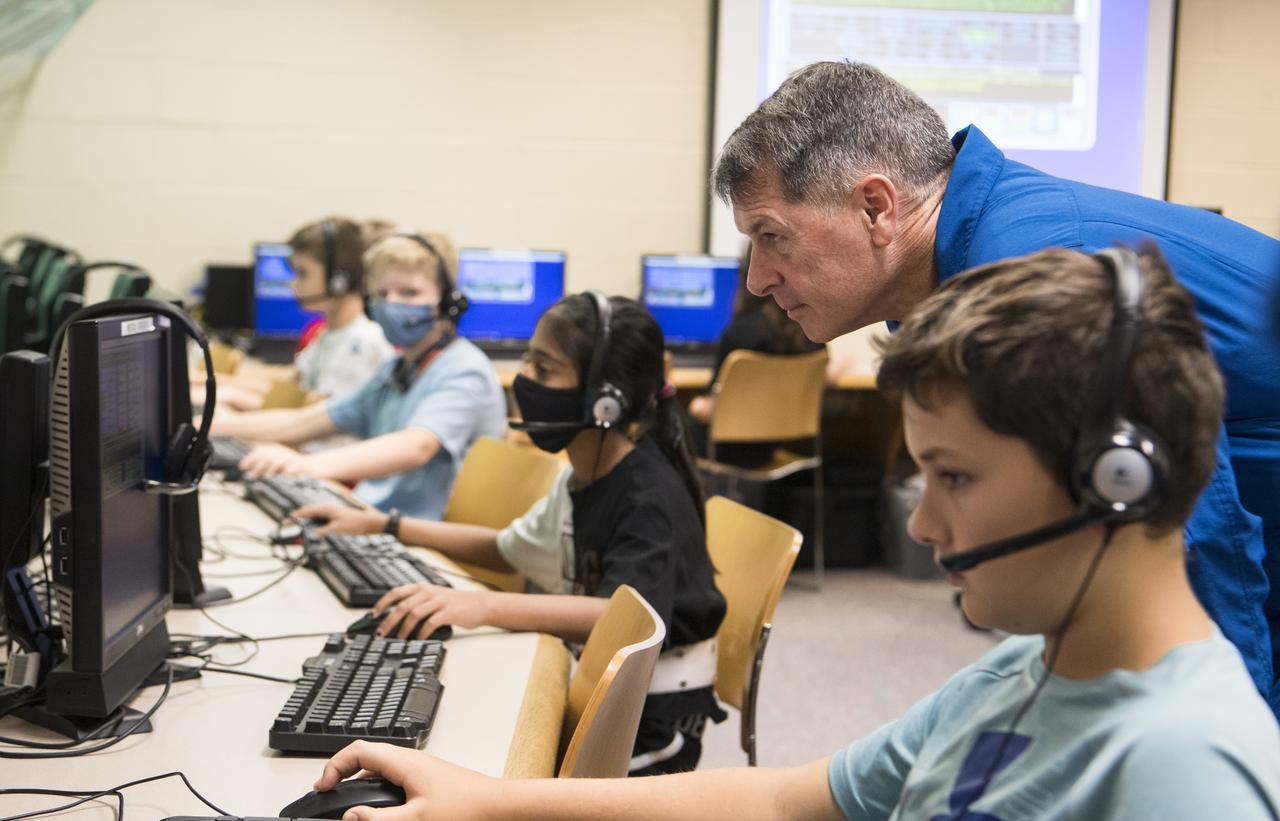
NASA’s SpaceX Crew-2 NASA astronaut Shane Kimbrough surveys what students in the tech crew in the Space Shuttle Simulator room are doing during a visit to Arlington Science Focus Elementary School, Friday, June 10, 2022, in Arlington, Virginia. Photo Credit: (NASA/Aubrey Gemignani)

Sharad Bhaskaran, mission director for Pittsburgh-based Astrobotic, delivers the monthly Tech Talk on Sept. 12 in Building 4221 at NASA’s Marshall Space Flight Center. Bhaskaran presented Astrobotic’s Peregrine lunar lander which will deliver payloads to the surface of the Moon for government and commercial customers, including NASA.
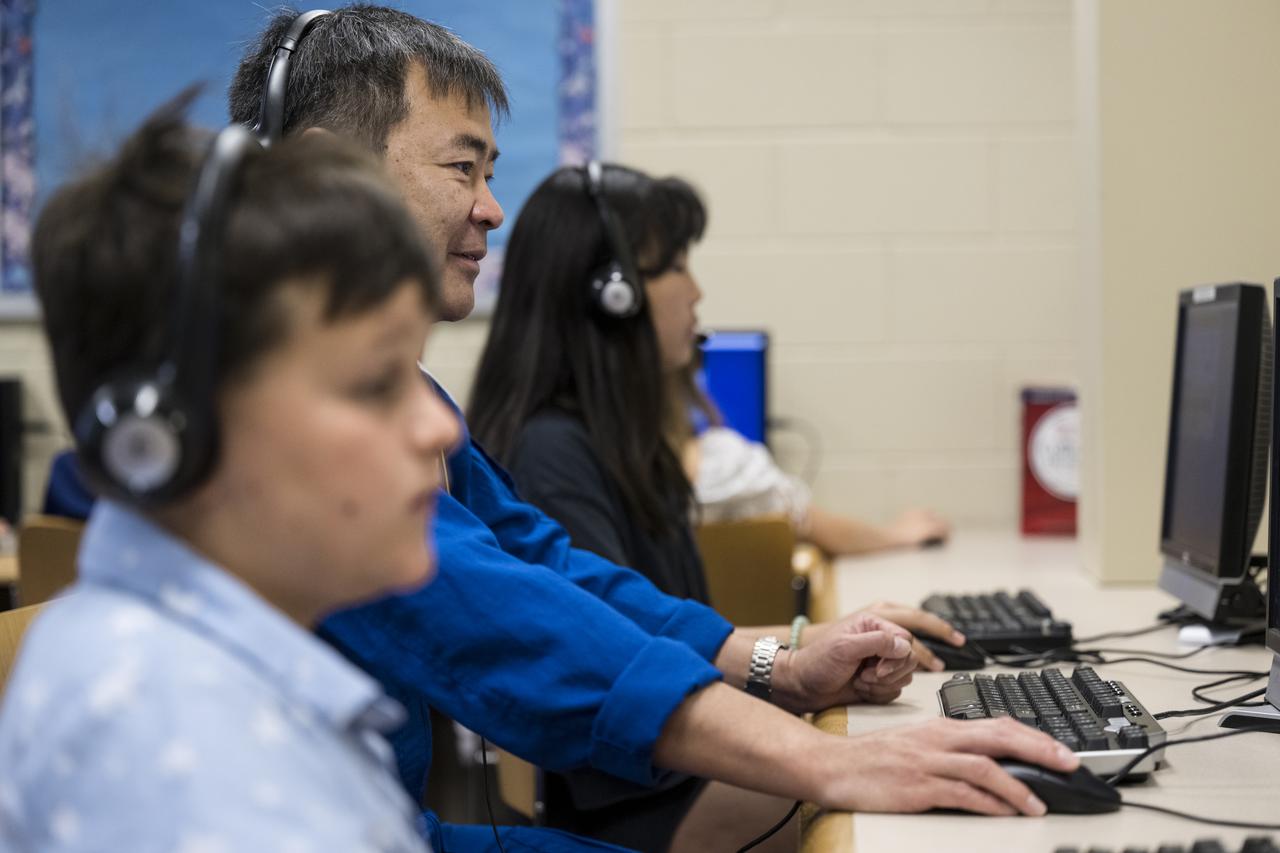
NASA’s SpaceX Crew-2 Japan Aerospace Exploration Agency (JAXA) astronaut Akihiko Hoshide surveys what students in the tech crew in the Space Shuttle Simulator room are doing during a visit to Arlington Science Focus Elementary School, Friday, June 10, 2022, in Arlington, Virginia. Photo Credit: (NASA/Aubrey Gemignani)

iss074e0361940 (March 5, 2026) --- Campinas, Brazil, with a metropolitan population of nearly 3.5 million, is a high‑tech and industrial powerhouse with a tropical savanna climate located just northwest of São Paulo. The International Space Station was orbiting 265 miles above the Atlantic Ocean at the time of this photograph. Credit: NASA/Jessica Meir
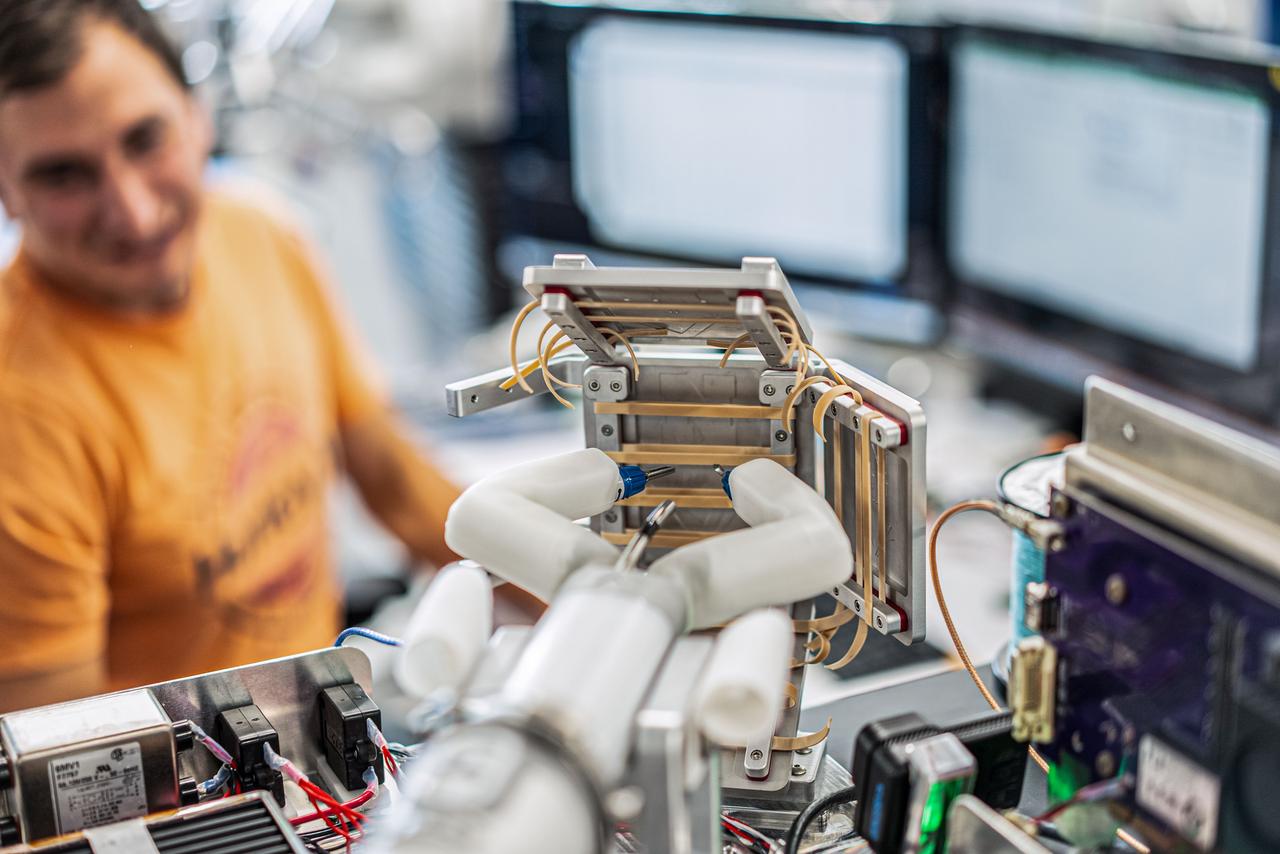
jsc2024e005977 (9/14/2023) --- MIRA, Virtual Incision’s miniaturized robotic assisted surgery system, is pictured in position to reach simulated surgical tissue. Robotic Surgery Tech Demo uses MIRA on the International Space Station to perform a set of pre-programmed movements. Image courtesy of Virtual Incision.

iss071e133353 (May 29, 2024) --- The San Francisco Bay Area in California, home to the Silicon Valley high-tech region and the Golden Gate Bridge, is pictured from the International Space Station as it orbited 262 miles above the Pacific Ocean.
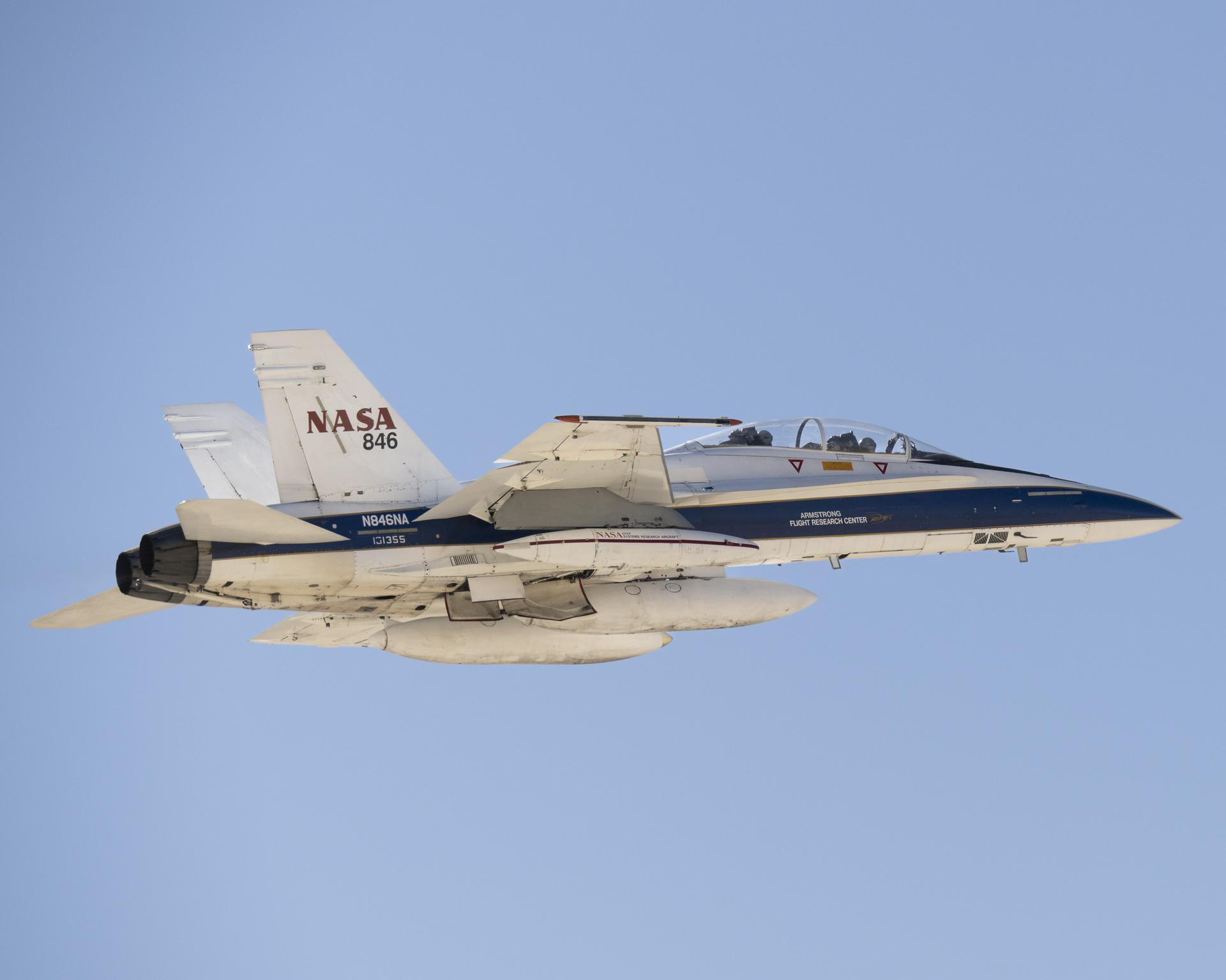
A NASA F/A-18 research aircraft flies near NASA’s Armstrong Flight Research Center in Edwards, California, on Feb. 24, 2025, testing a commercial precision landing technology for future space missions. The Psionic Space Navigation Doppler Lidar (PSNDL) system is installed in a pod located under the right wing of the aircraft.
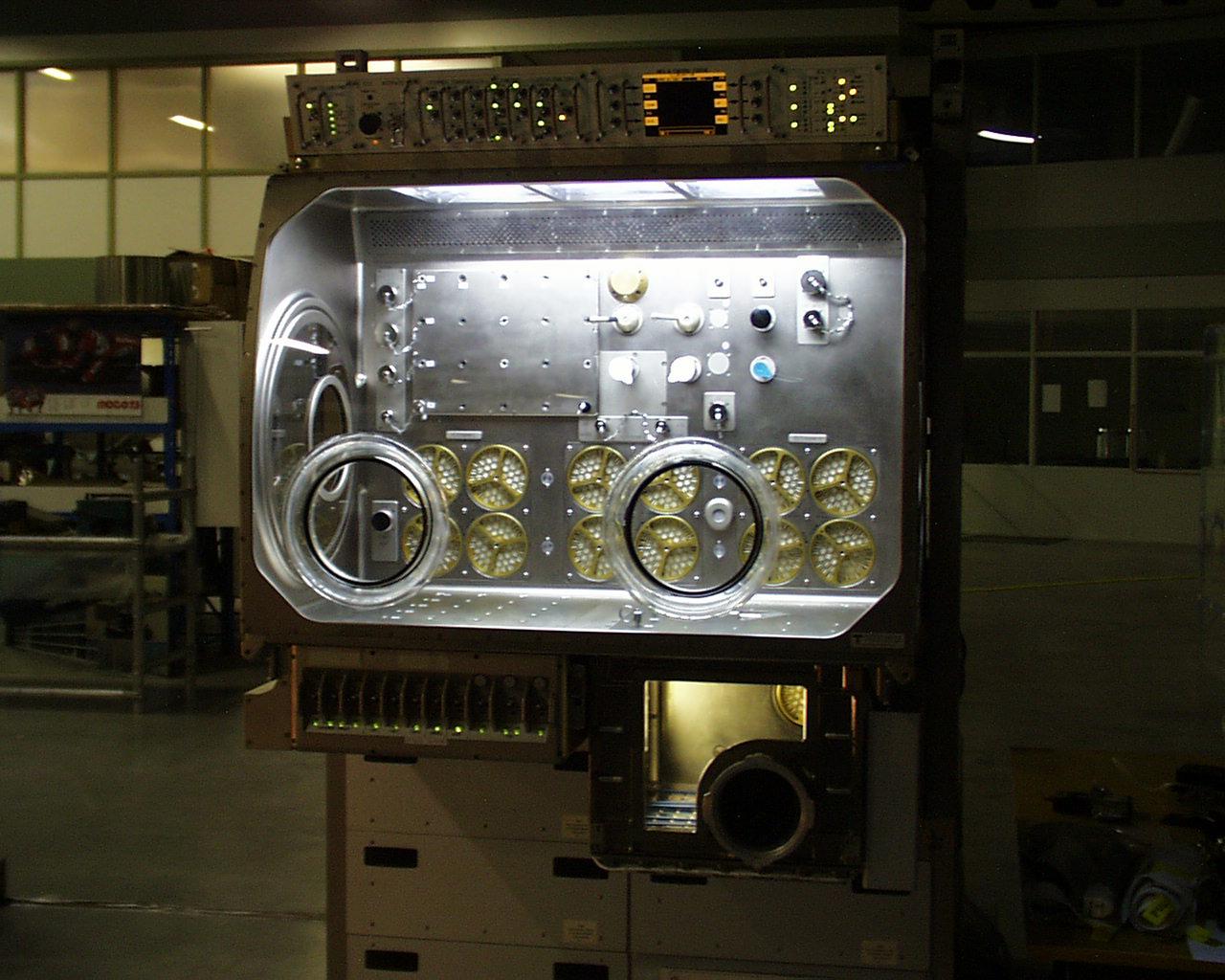
Interior lights give the Microgravity Science Glovebox (MSG) the appearance of a high-tech juke box. The European Space Agency (ESA) and NASA are developing the MSG for use aboard the International Space Station (ISS). Scientists will use the MSG to carry out multidisciplinary studies in combustion science, fluid physics and materials science. The MSG is managed by NASA's Marshall Space Flight Center (MSFC). Photo Credit: NASA/MSFC
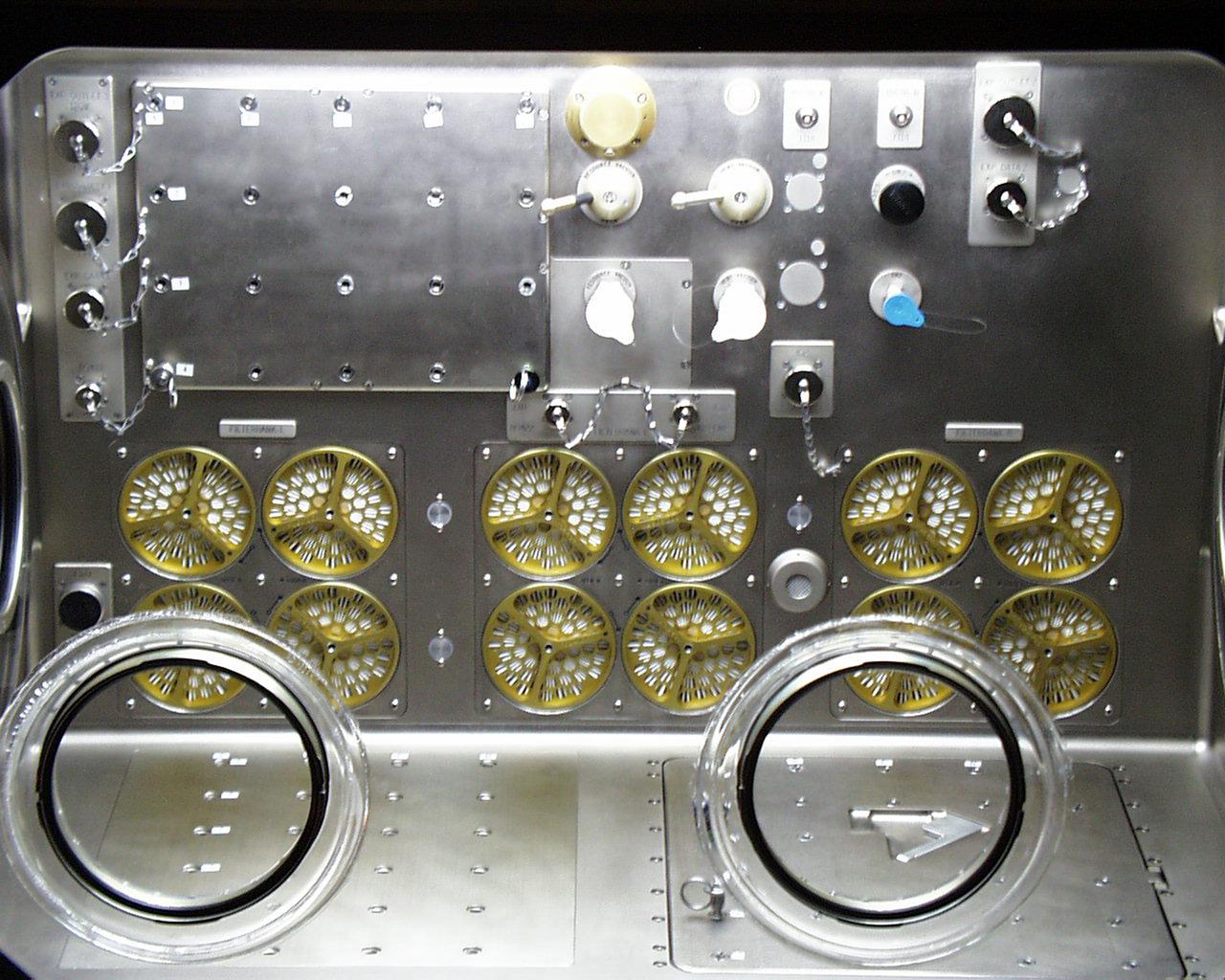
Interior lights give the Microgravity Science Glovebox (MSG) the appearance of a high-tech juke box. The European Space Agency (ESA) and NASA are developing the MSG for use aboard the International Space Station (ISS). Scientists will use the MSG to carry out multidisciplinary studies in combustion science, fluid physics and materials science. The MSG is managed by NASA's Marshall Space Flight Center (MSFC). Photo Credit: NASA/MSFC
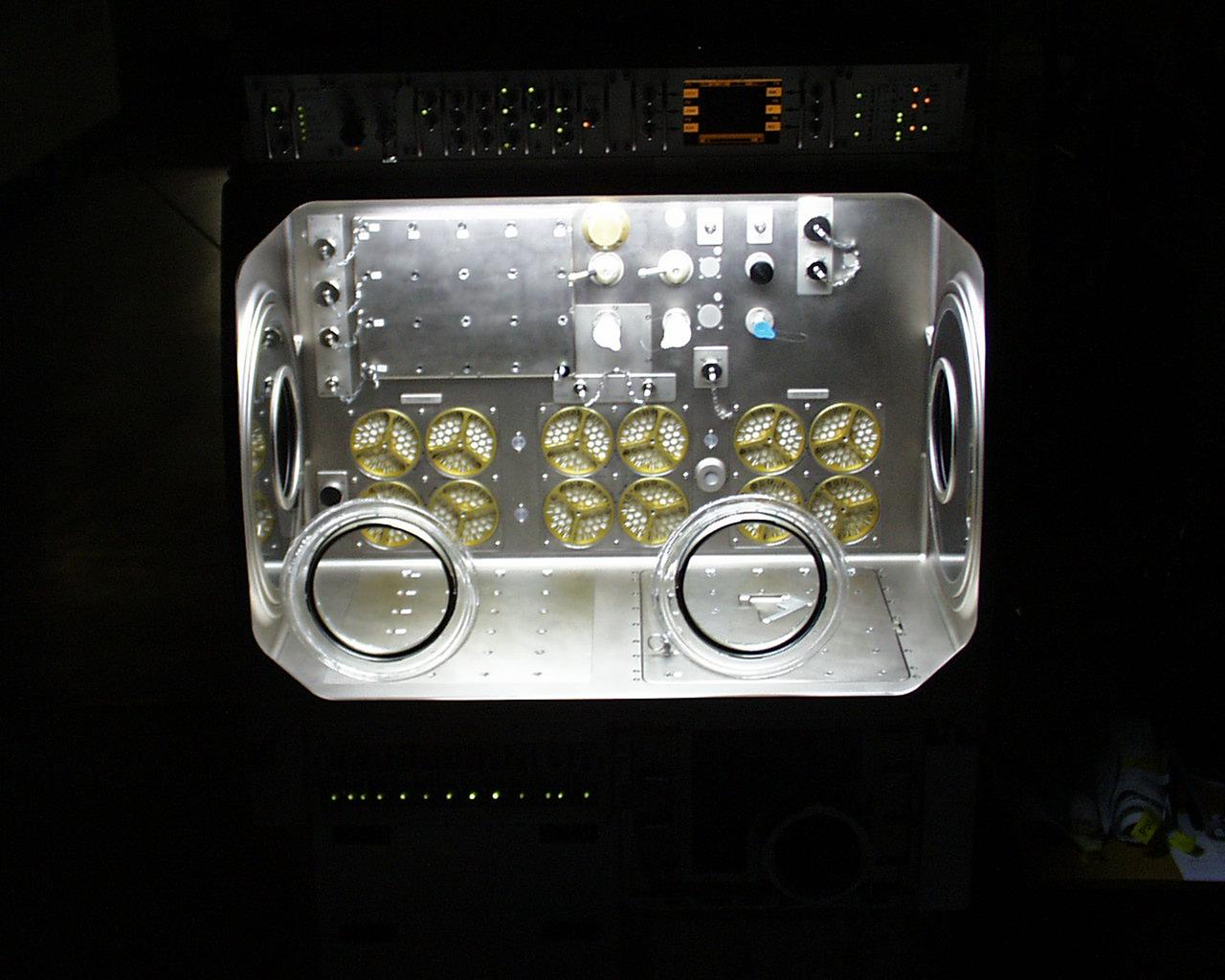
Interior lights give the Microgravity Science Glovebox (MSG) the appearance of a high-tech juke box. The European Space Agency (ESA) and NASA are developing the MSG for use aboard the International Space Station (ISS). Scientists will use the MSG to carry out multidisciplinary studies in combustion science, fluid physics and materials science. The MSG is managed by NASA's Marshall Space Flight Center (MSFC). Photo Credit: NASA/MSFC

iss072e423785 (1/3/2025) — A view of the CLINGERS Cubesat connection mechanism aboard the International Space Station (ISS). Flight Tech Demo of Docking/Undocking Cubesats Inside ISS (CLINGERS) uses the International Space Station’s Astrobee robots to demonstrate an adaptor for docking and close approach sensing to connect both active and passive objects in space. These are critical functions to enable applications such as satellite servicing, orbital refueling, spacecraft repair and upgrade, and in-orbit manufacturing.
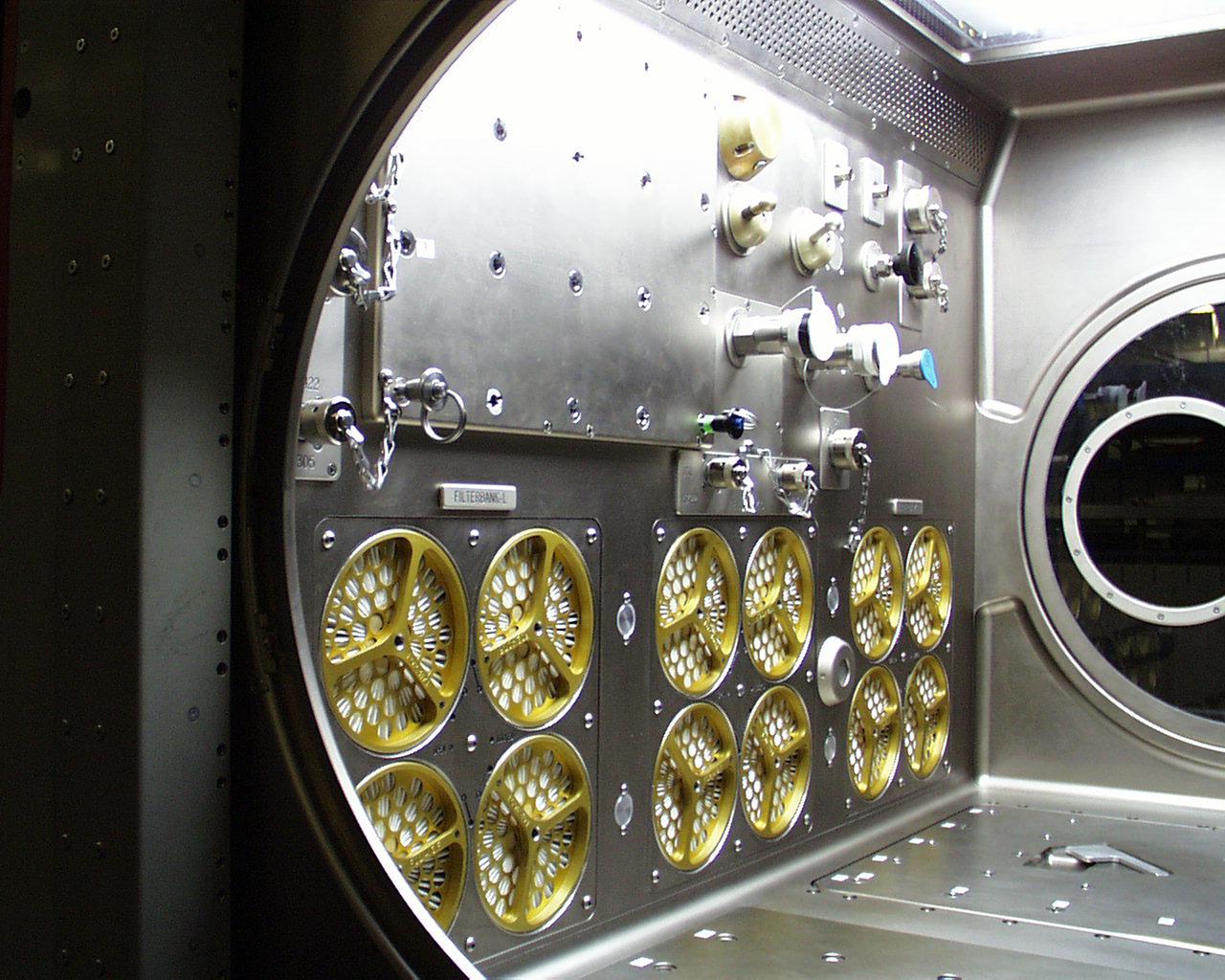
Interior lights give the Microgravity Science Glovebox (MSG) the appearance of a high-tech juke box. The European Space Agency (ESA) and NASA are developing the MSG for use aboard the International Space Station (ISS). Scientists will use the MSG to carry out multidisciplinary studies in combustion science, fluid physics and materials science. The MSG is managed by NASA's Marshall Space Flight Center (MSFC). Photo Credit: NASA/MSFC
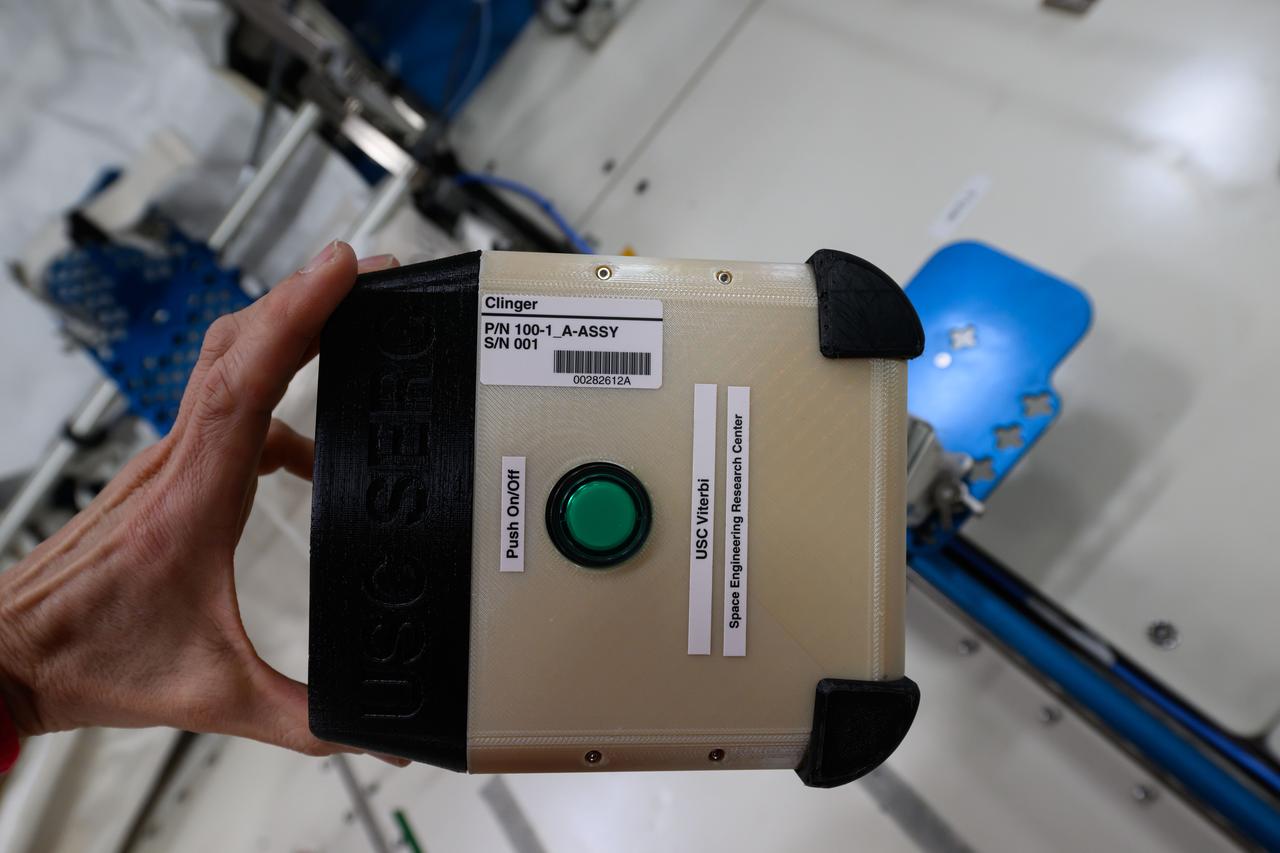
iss072e423784 (1/3/2025) — A view of the CLINGERS Cubesat aboard the International Space Station (ISS). Flight Tech Demo of Docking/Undocking Cubesats Inside ISS (CLINGERS) uses the International Space Station’s Astrobee robots to demonstrate an adaptor for docking and close approach sensing to connect both active and passive objects in space. These are critical functions to enable applications such as satellite servicing, orbital refueling, spacecraft repair and upgrade, and in-orbit manufacturing.
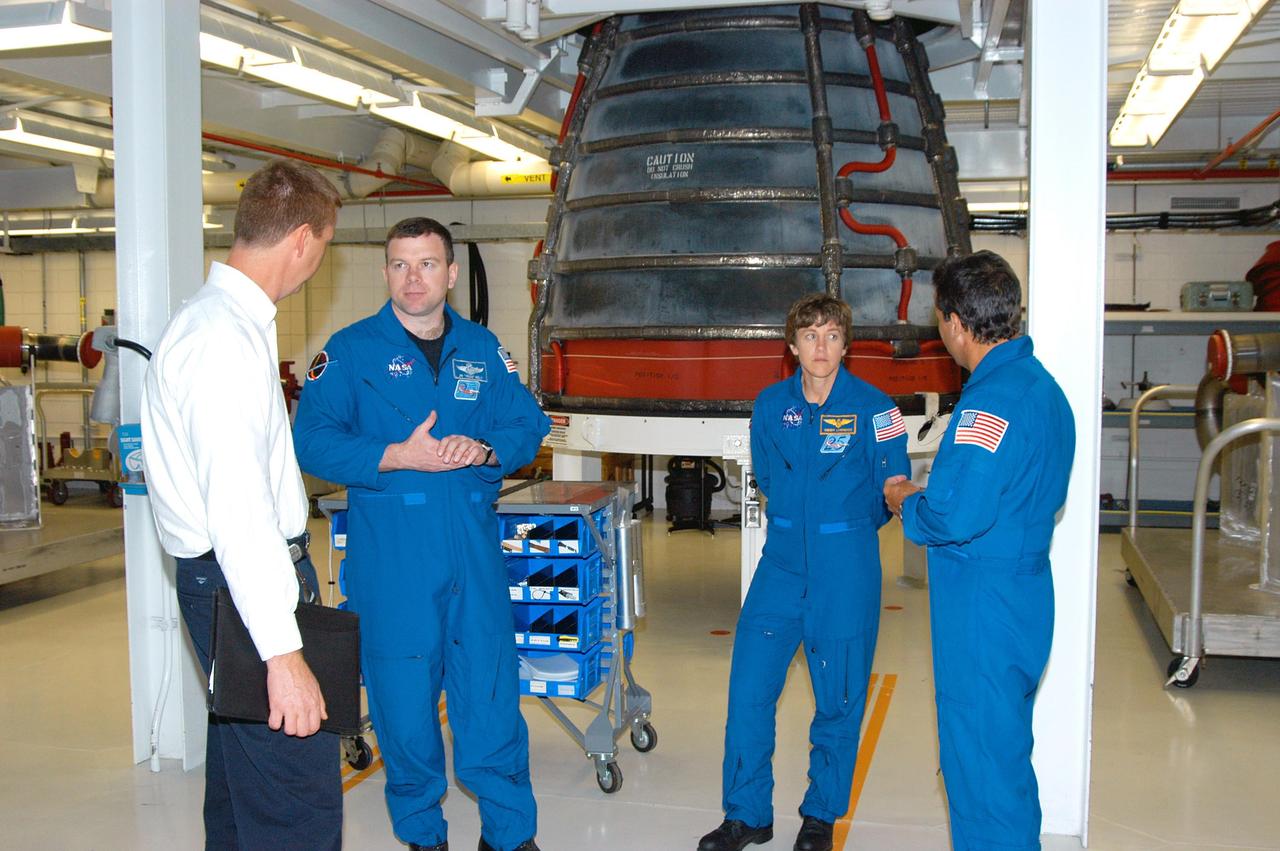
KENNEDY SPACE CENTER, FLA. -- In the Space Shuttle Main Engine Shop at KSC, Boeing Tech Operations’ Team Manager Matthew McClelland (left) talks with STS-114 Pilot James Kelly. At right are Mission Specialists Wendy Lawrence and Charles Camarda. One of the main engines is in the background. Crew members are touring several areas on Center. The STS-114 mission is Logistics Flight 1, which is scheduled to deliver supplies and equipment plus the external stowage platform to the International Space Station.
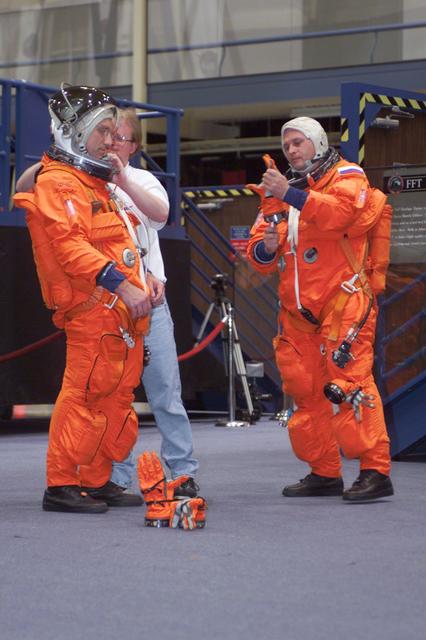
JSC2001-E-18119 (18 May 2001) --- Astronaut Carl E. Walz (left), Expedition Four flight engineer, and cosmonaut Yuri I. Onufrienko, mission commander representing Rosaviakosmos, don their training versions of the full-pressure launch and entry suit prior to a mission training session in the Space Vehicle Mockup Facility at the Johnson Space Center (JSC). Walz and Onufrienko are assisted by United Space Alliance (USA) suit tech Daniel Palmer.
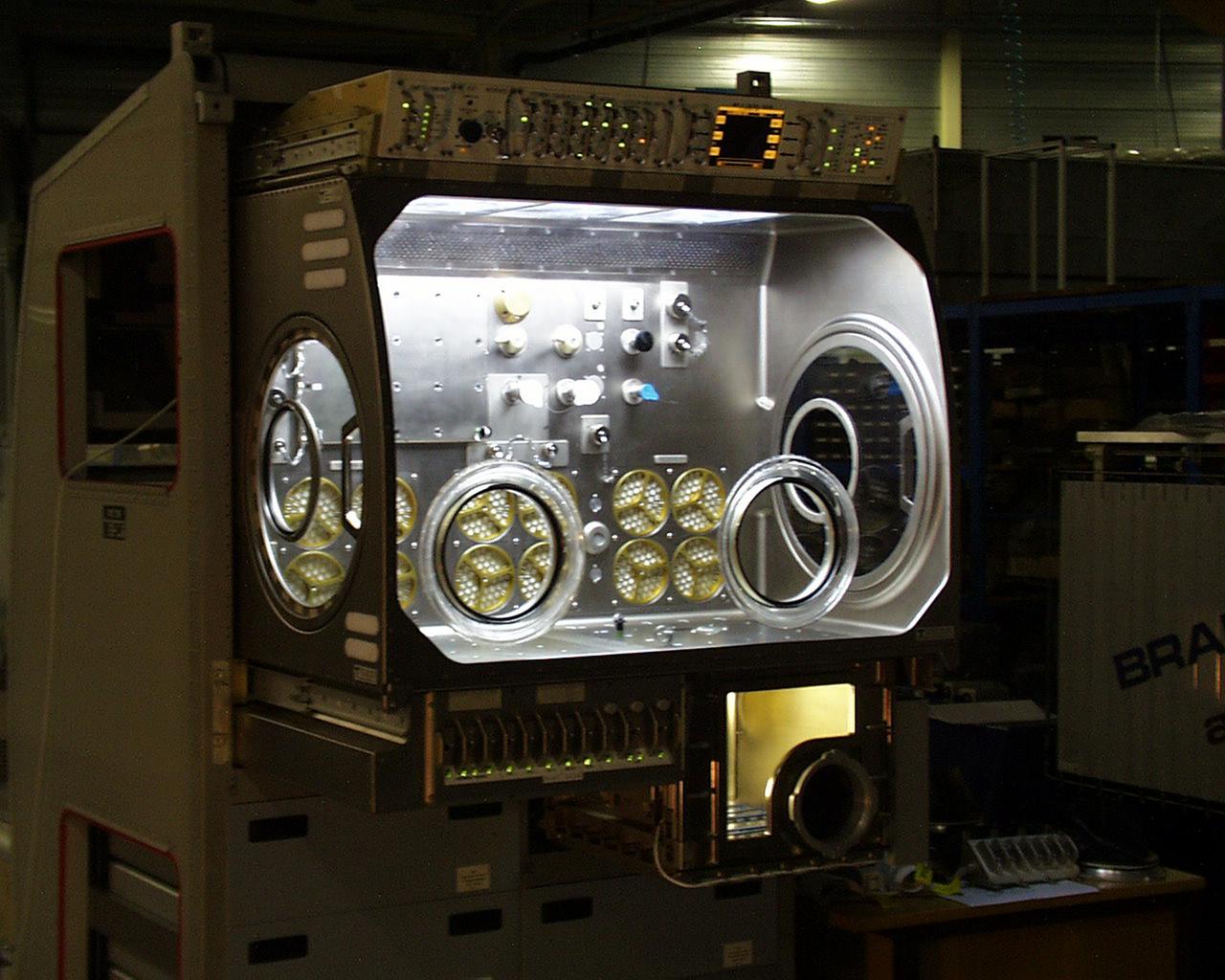
Interior lights give the Microgravity Science Glovebox (MSG) the appearance of a high-tech juke box. The European Space Agency (ESA) and NASA are developing the MSG for use aboard the International Space Station (ISS). Scientists will use the MSG to carry out multidisciplinary studies in combustion science, fluid physics and materials science. The MSG is managed by NASA's Marshall Space Flight Center (MSFC). Photo Credit: NASA/MSFC
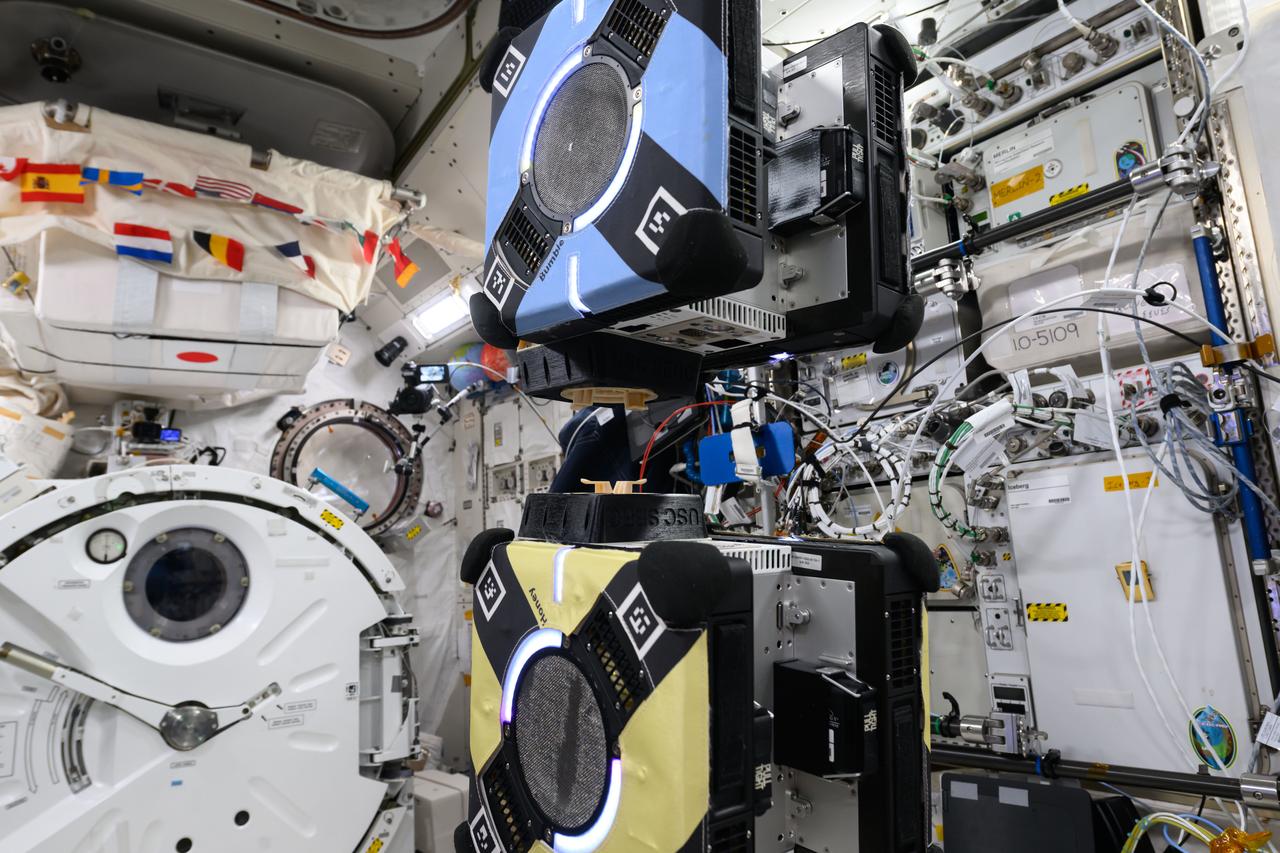
iss072e423875 (1/3/2025) — A view of the CLINGERS Cubesats attached to Astrobee aboard the International Space Station (ISS). Flight Tech Demo of Docking/Undocking Cubesats Inside ISS (CLINGERS) uses the International Space Station’s Astrobee robots to demonstrate an adaptor for docking and close approach sensing to connect both active and passive objects in space. These are critical functions to enable applications such as satellite servicing, orbital refueling, spacecraft repair and upgrade, and in-orbit manufacturing.
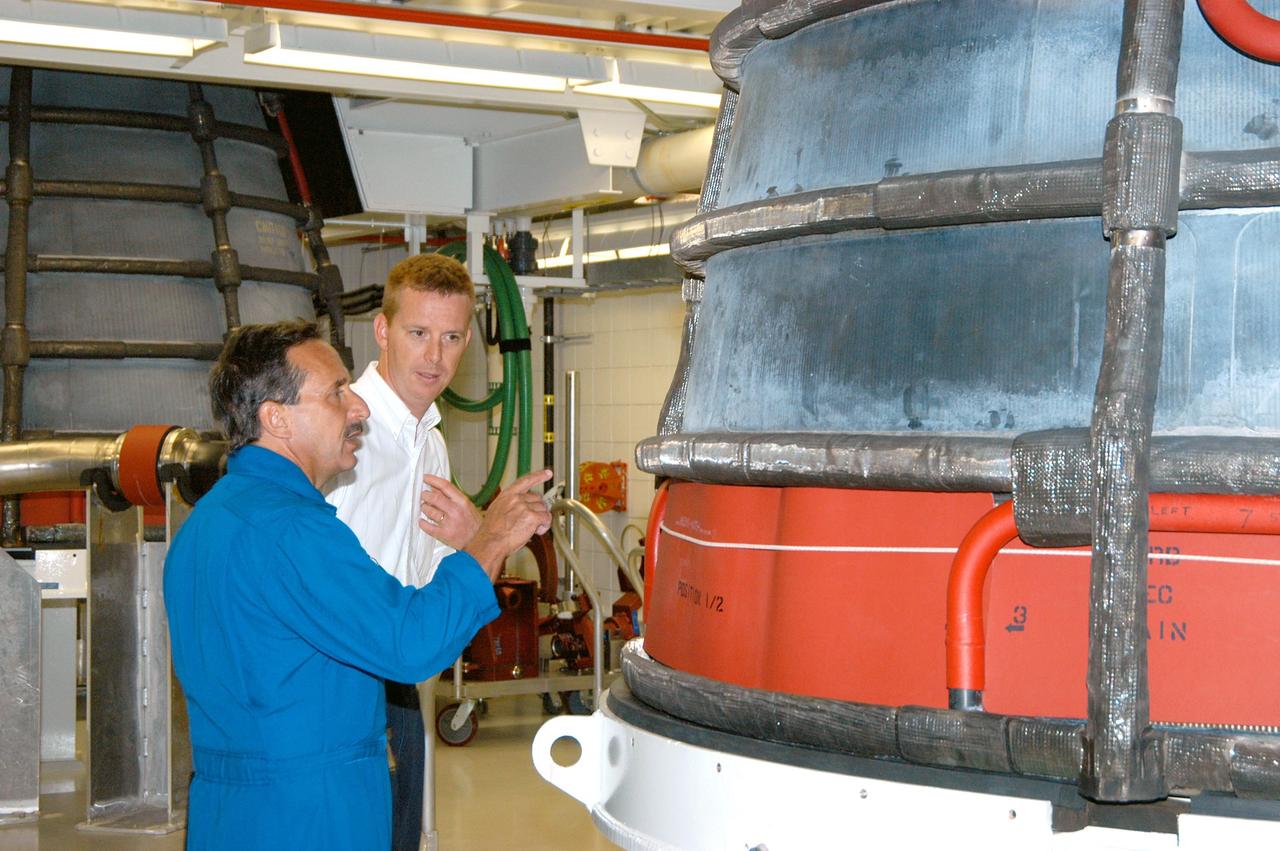
KENNEDY SPACE CENTER, FLA. -- STS-114 Mission Specialist Charles Camarda and Boeing Tech Operations’ Team Manager Matthew McClelland look at an engine on a visit to the Space Shuttle Main Engine Shop at KSC. He and other crew members touring several areas on the Center. The STS-114 mission is Logistics Flight 1, which is scheduled to deliver supplies and equipment plus the external stowage platform to the International Space Station.
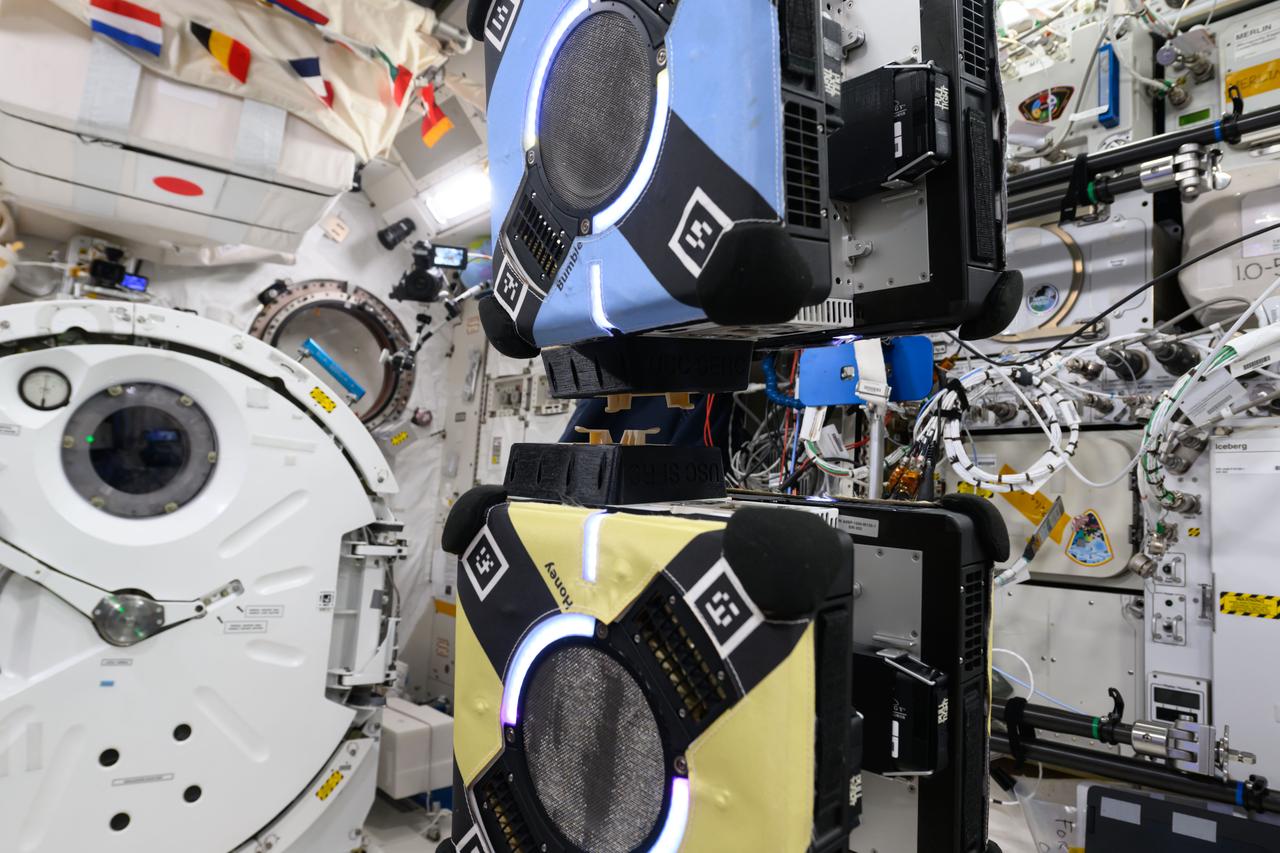
iss072e423864 (1/3/2025) — A view of the CLINGERS Cubesats attached to Astrobee aboard the International Space Station (ISS). Flight Tech Demo of Docking/Undocking Cubesats Inside ISS (CLINGERS) uses the International Space Station’s Astrobee robots to demonstrate an adaptor for docking and close approach sensing to connect both active and passive objects in space. These are critical functions to enable applications such as satellite servicing, orbital refueling, spacecraft repair and upgrade, and in-orbit manufacturing.
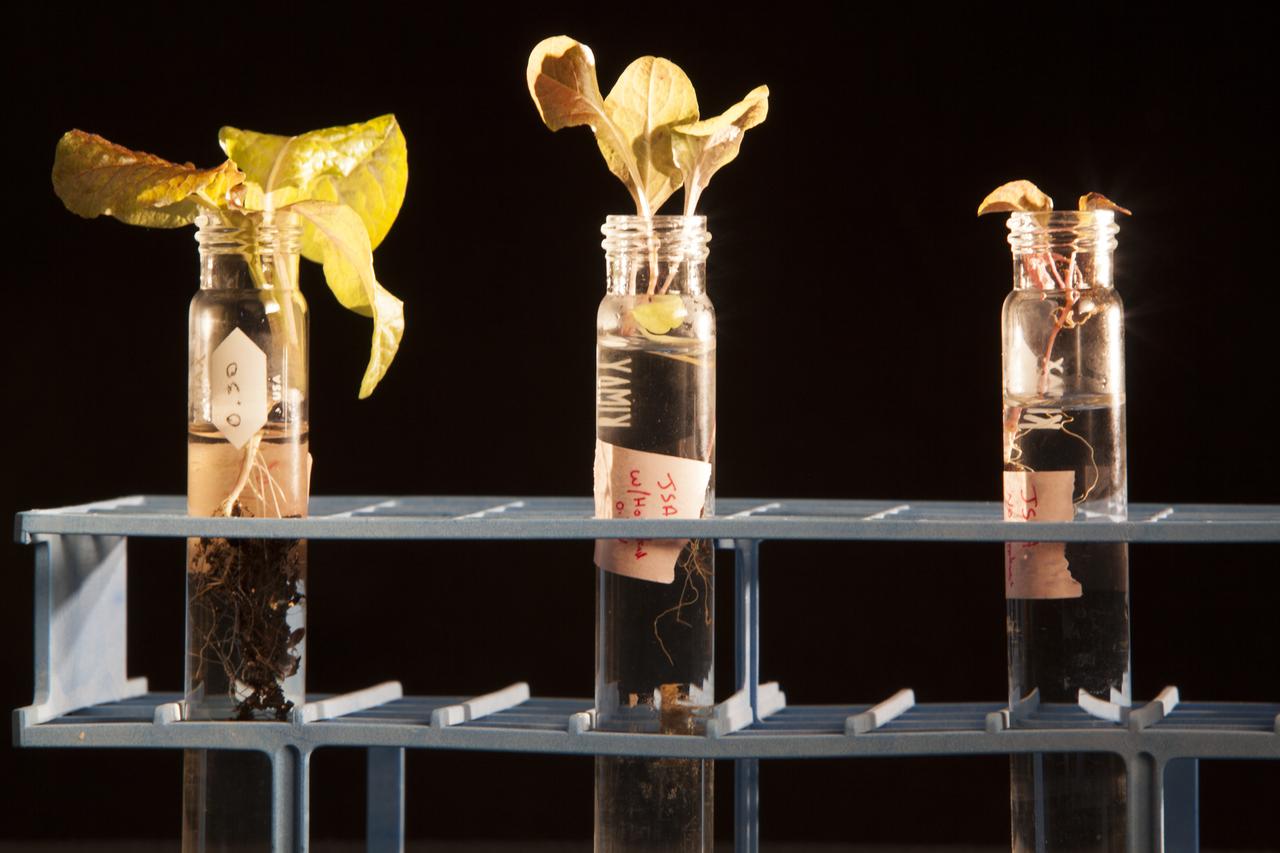
NASA’s Kennedy Space Center is partnering with the Florida Tech Buzz Aldrin Space Institute in Melbourne, Florida, to collaborate on research studying the performance of crop species grown in a simulated “Martian garden” — a proving ground for a potential future farm on the Red Planet. Plants were grown in a preliminary experiment comparing (left to right) potting soil, regolith simulant with added nutrients, and simulant without nutrients.
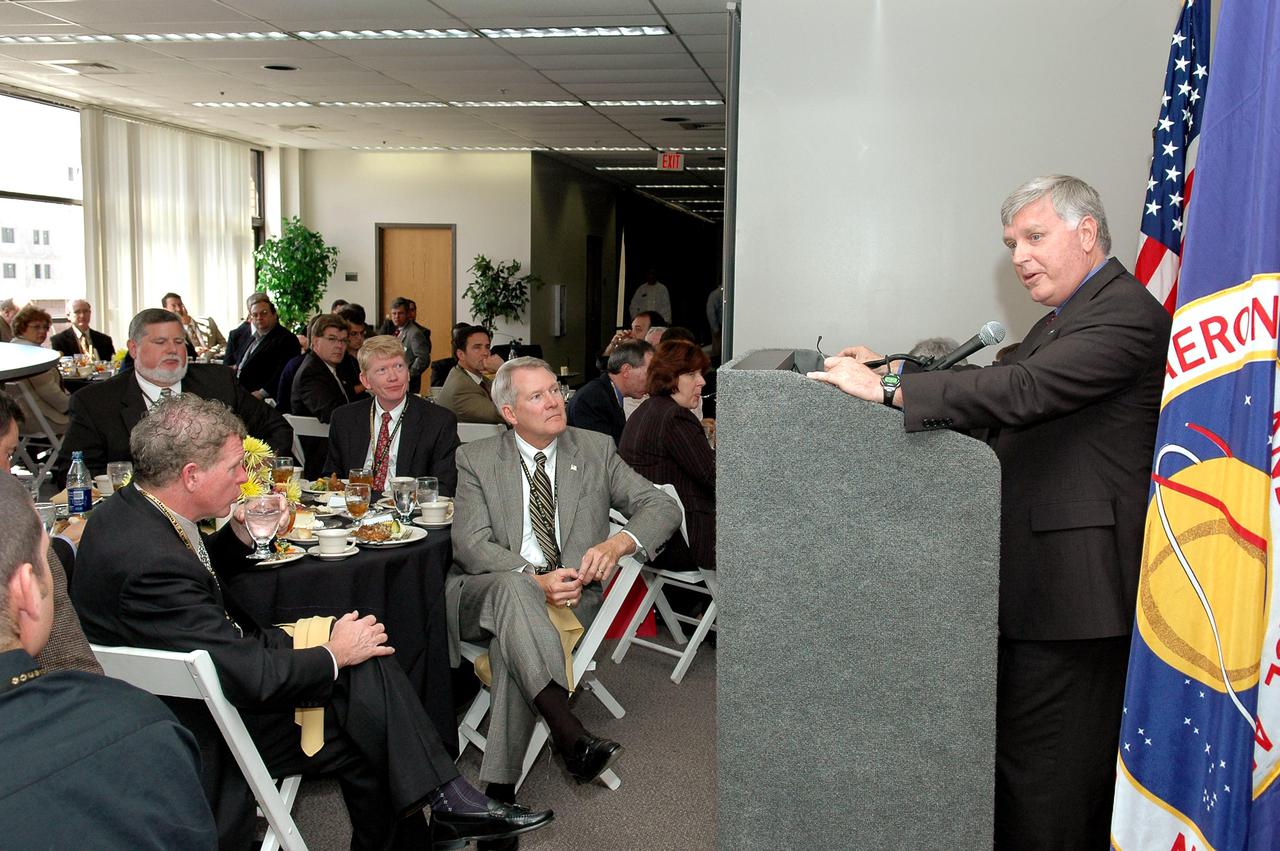
KENNEDY SPACE CENTER, FLA. - Center Director Jim Kennedy speaks to attendees at a VIP luncheon during the 2005 FIRST Robotics Regional Competition held at the University of Central Florida March 10-12. NASA and the University of Central Florida are co-hosts of the regional event and are joined by sponsors such as Motorola iDEN, the Florida High Tech Corridor Council, Walt Disney World Company and aerospace companies Lockheed Martin and United Space Alliance, just to name a few.
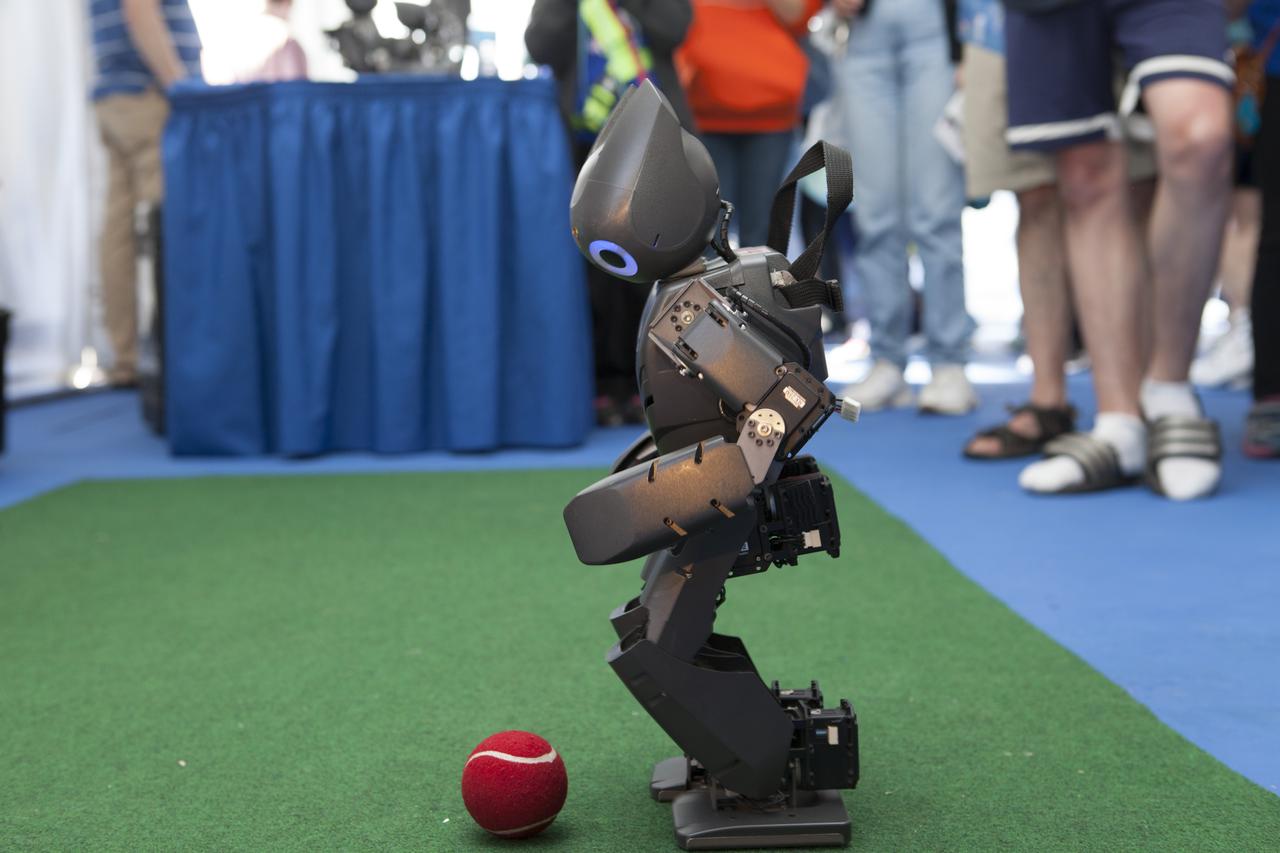
CAPE CANAVERAL, Fla. – A miniature humanoid robot known as DARwin-OP, from Virginia Tech Robotics, plays soccer with a red tennis ball for a crowd of students at the Robot Rocket Rally. The three-day event at Florida's Kennedy Space Center Visitor Complex is highlighted by exhibits, games and demonstrations of a variety of robots, with exhibitors ranging from school robotics clubs to veteran NASA scientists and engineers. Photo credit: NASA/Kim Shiflett
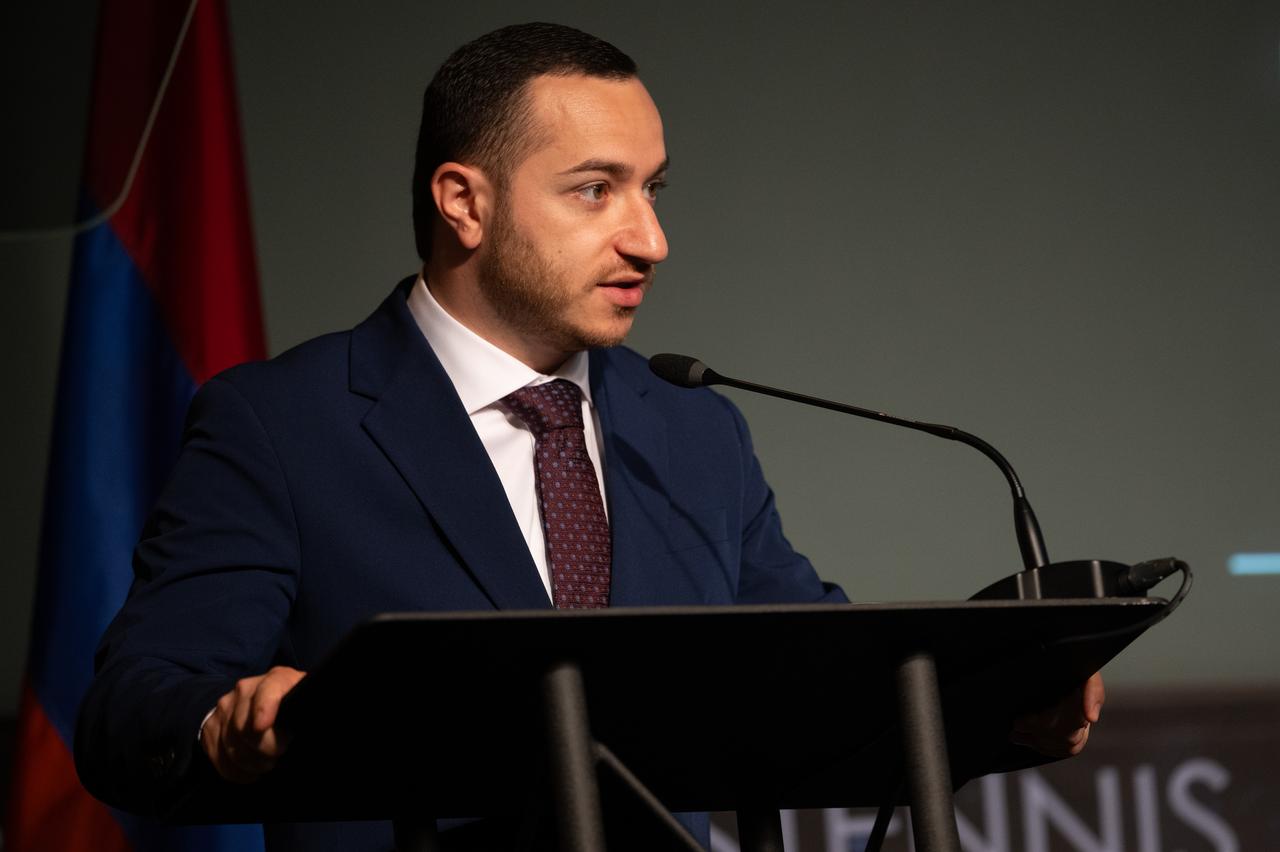
Mkhitar Hayrapetyan, Minister of High-Tech Industry of the Republic of Armenia delivers remarks during an Artemis Accords signing ceremony, Wednesday, June 12, 2024, at the Mary W. Jackson NASA Headquarters building in Washington. The Republic of Armenia is the 43rd country to sign the Artemis Accords, which establish a practical set of principles to guide space exploration cooperation among nations participating in NASA’s Artemis program. Photo Credit: (NASA/Joel Kowsky)
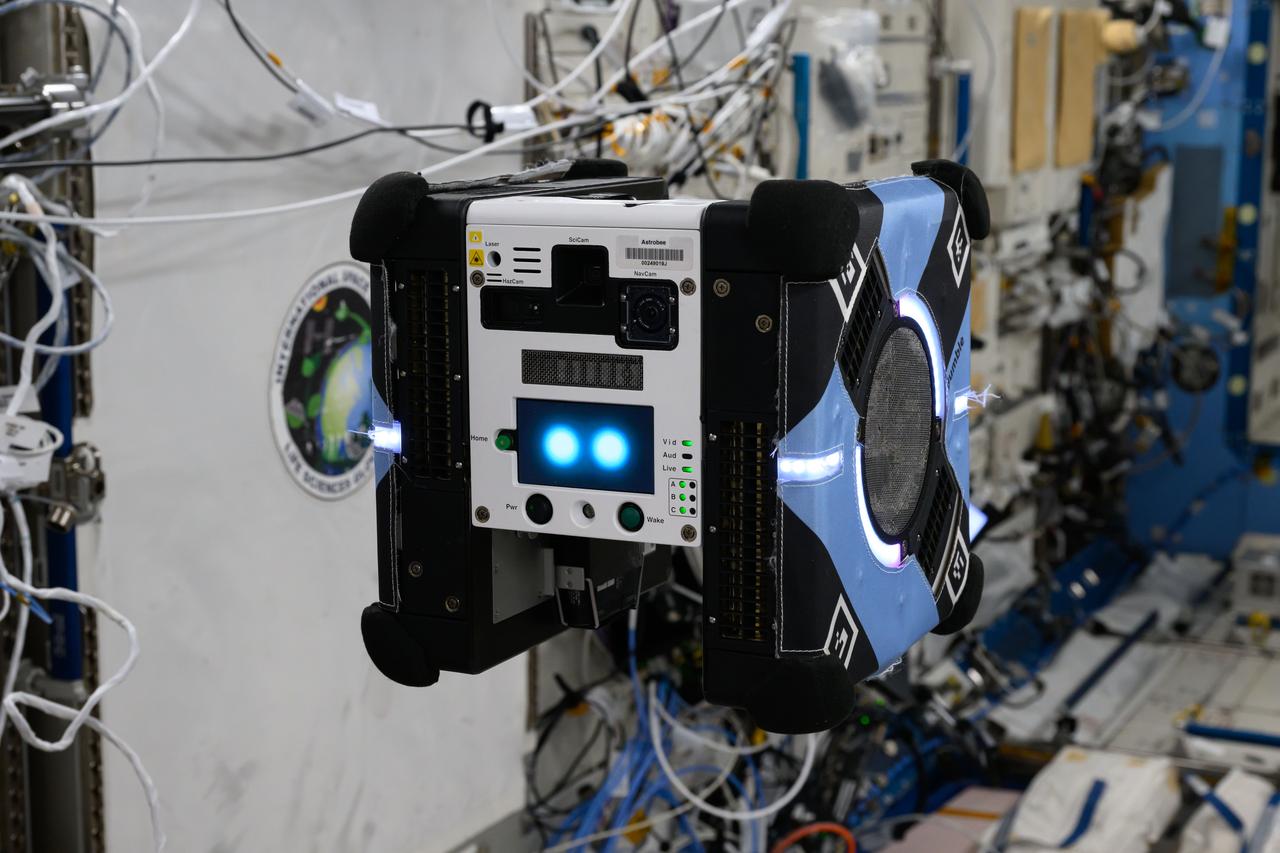
iss071e046284 (May 1, 2024) -- One of the International Space Station's free-flying robots, Astrobee, was pictured by NASA astronaut and Expedition 71 Flight Engineer Tracy C. Dyson during a Zero Robotics tech demonstration. Zero Robotics allows students on Earth to write software to control the robots and observe their performance inside the orbiting laboratory.
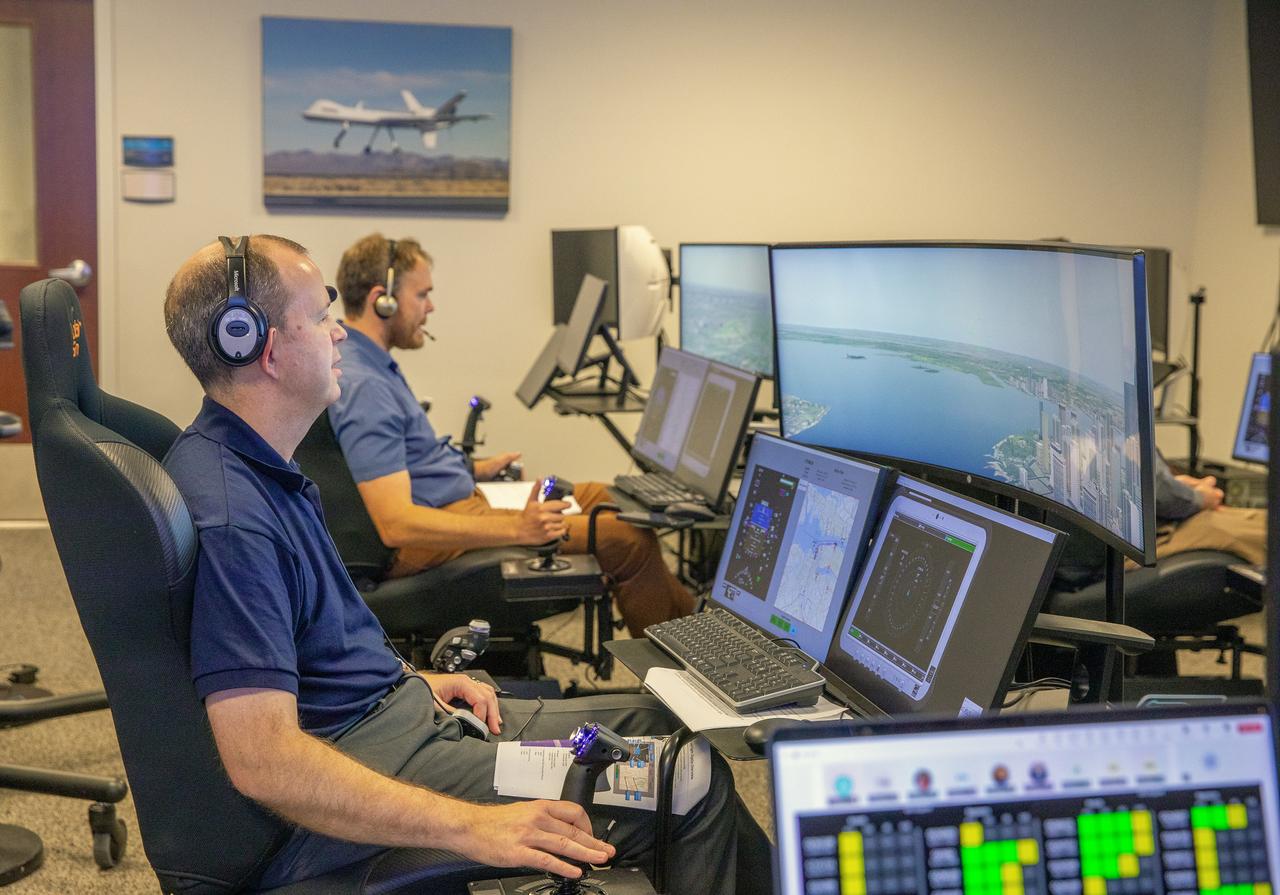
Focus on active photos –Class B Simulation Evaluation in the ATOL Lab at Langley (Also at FAA Tech Center) where team is working with one another in the lab, reviewing data on the monitors. Working the software, adjusting the software systems. Going over the shoulder to show the displays and screens as the software is running. Andy Burroughs (left) and Paul Friz in the roles of air taxi pilots running through air taxi integration simulations focusing on urban air space at NASA’s Langley Research in Hampton, Virginia on Sept. 25, 2024.
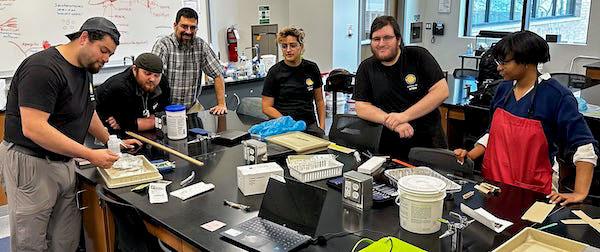
jsc2024e067097 (10/15/2024) --- The Midlands Tech experimental flight team and faculty advisors prepare materials to be autoclaved for the next round of tests. Their experiment, Gravitational Effects on Calcium Oxalate (CaOx) Regulation in Edible Greens, is part of the Nanoracks-National Center for Earth and Space Science Education-Surveyor-Student Spaceflight Experiments Program Mission 18 to ISS (Nanoracks-NCESSE-Surveyor-SSEP).
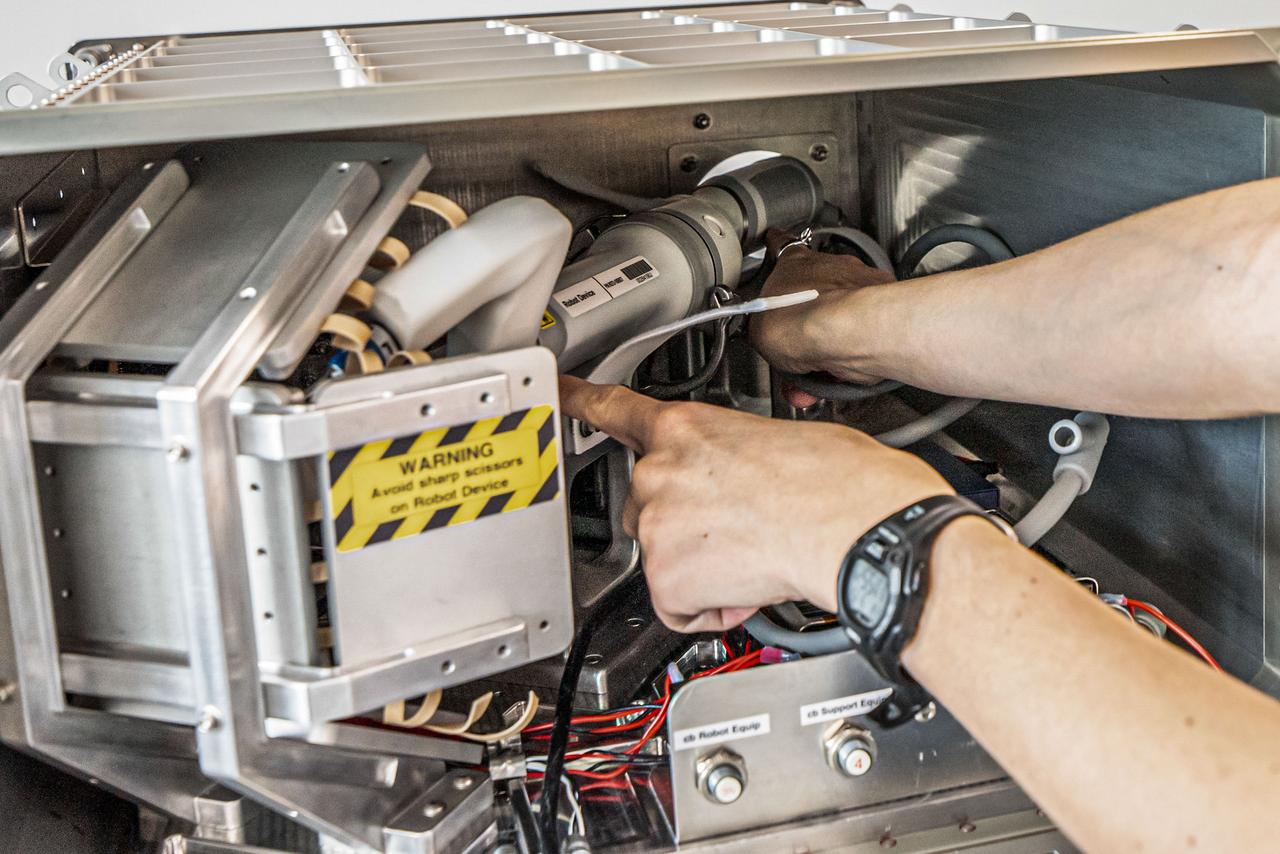
jsc2024e005981 (9/15/2023) --- The robotic surgery device is shown positioned inside the science locker, with the instrument arms and camera oriented toward the simulated surgical tissue on the experiment board. The unique small footprint makes it possible to transport the minibot anywhere, even to space. Robotic Surgery Tech Demo flies a special iteration of MIRA, Virtual Incision’s miniaturized robotic assisted surgery system. Image courtesy of Virtual Incision.
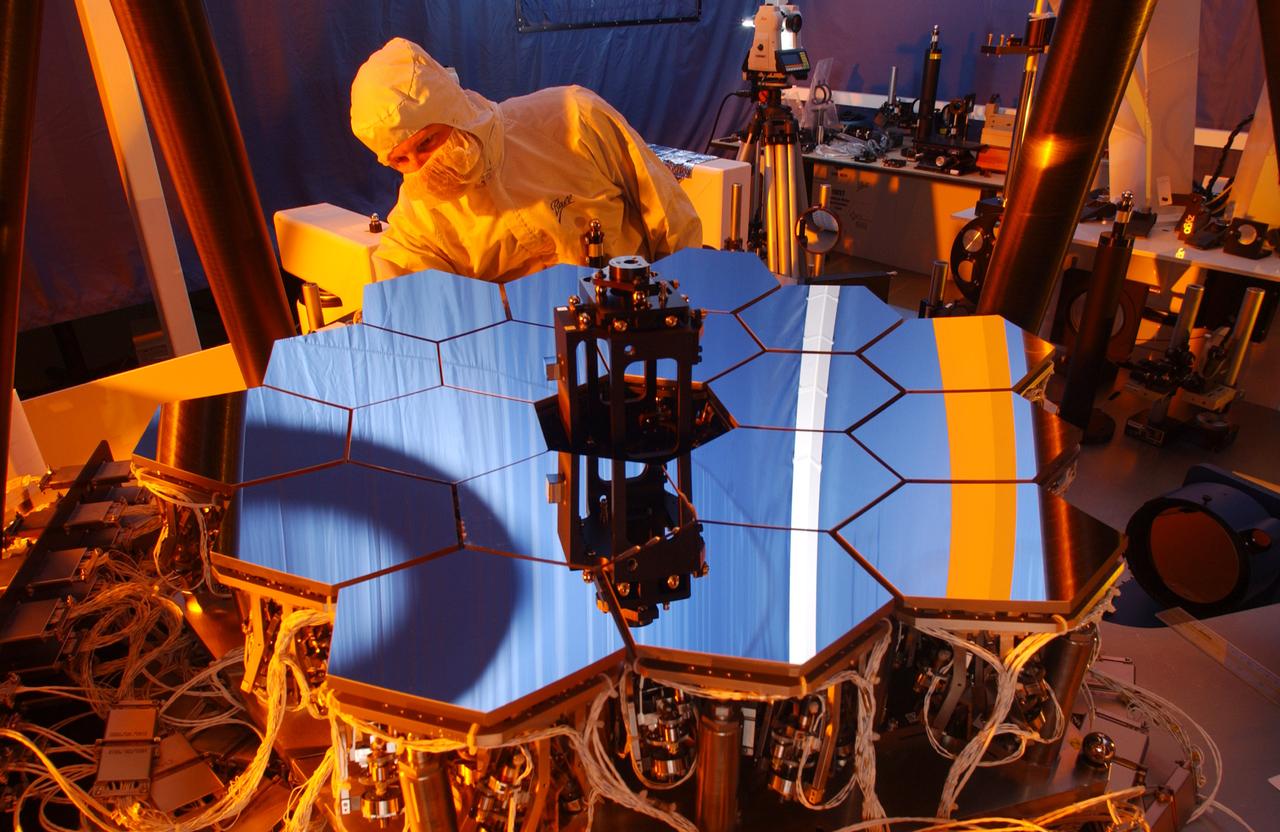
When the James Webb Space Telescope (JWST) reaches its orbit about a million miles (1.5 kilometers) from Earth and begins studying the distant reaches of the universe, the event will mark an unprecedented triumph on several technological fronts. Photo Credit: Chris Gunn For more information go to the Goddard Tech Trends Archive: Spring 2007 (http://gsfctechnology.gsfc.nasa.gov/TechTrendsArchive.html)
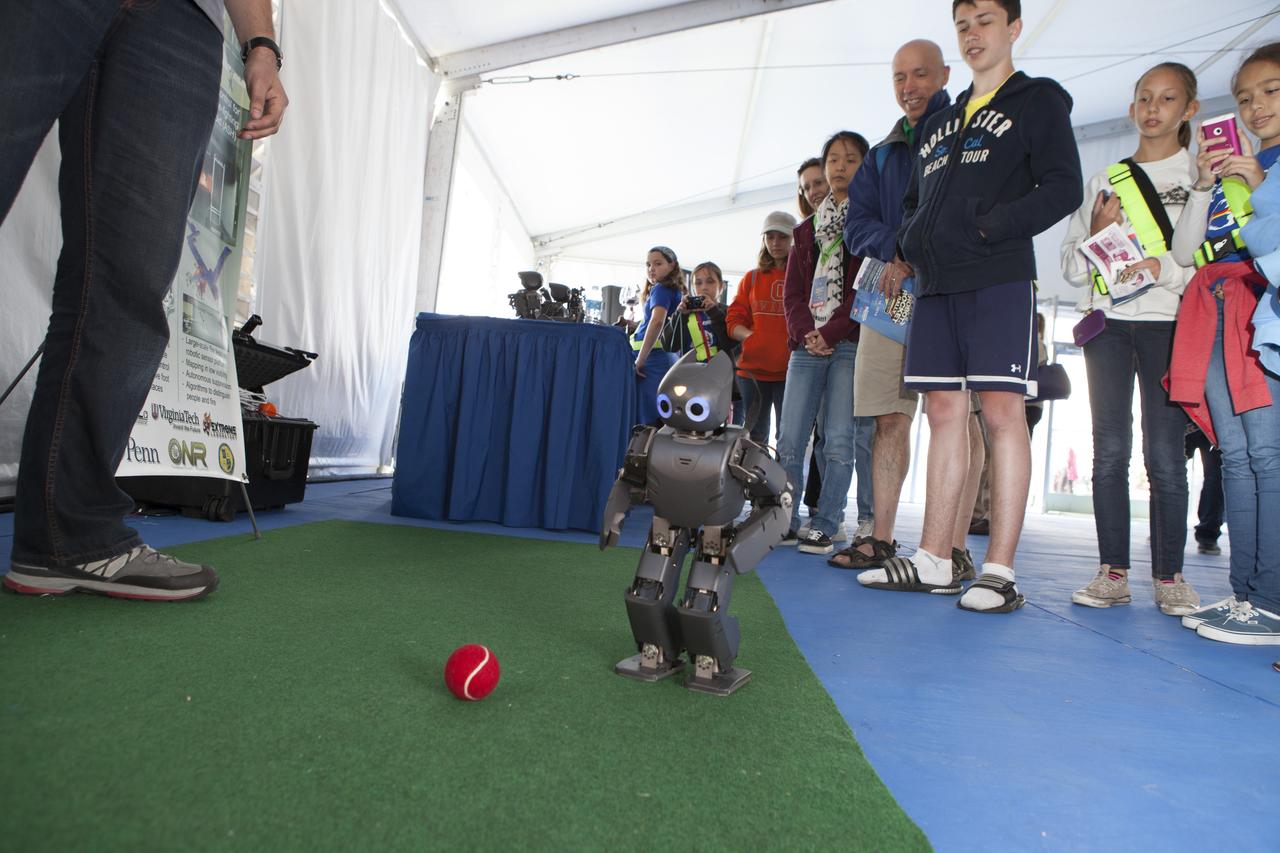
CAPE CANAVERAL, Fla. – Students gather to watch as a DARwin-OP miniature humanoid robot from Virginia Tech Robotics demonstrates its soccer abilities at the Robot Rocket Rally. The three-day event at Florida's Kennedy Space Center Visitor Complex is highlighted by exhibits, games and demonstrations of a variety of robots, with exhibitors ranging from school robotics clubs to veteran NASA scientists and engineers. Photo credit: NASA/Kim Shiflett
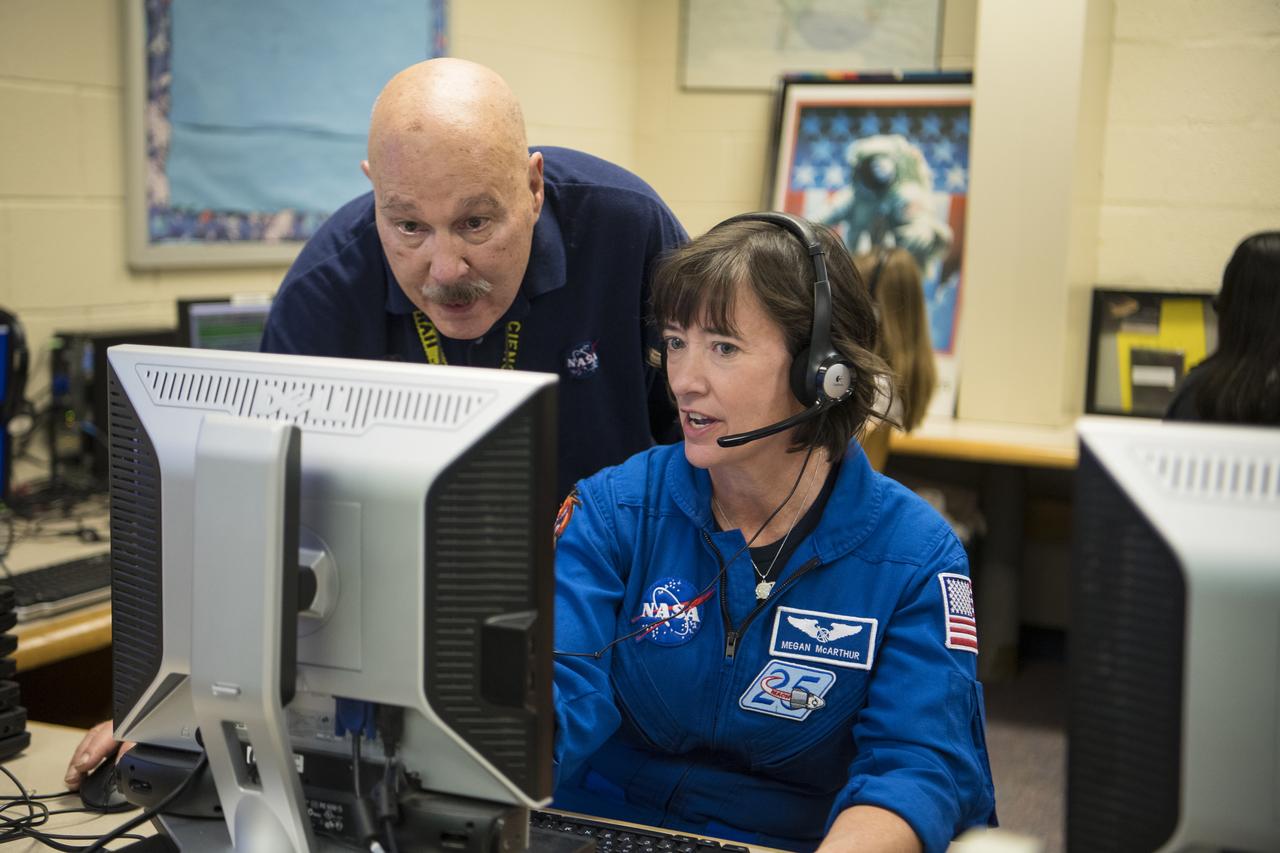
Arlington Science Focus Elementary School teacher Charles Harvey looks over the shoulder of NASA’s SpaceX Crew-2 NASA astronaut Megan McArthur, while she surveys what students in the tech crew in the Space Shuttle Simulator room are doing during a visit to Arlington Science Focus Elementary School, Friday, June 10, 2022, in Arlington, Virginia. Photo Credit: (NASA/Aubrey Gemignani)
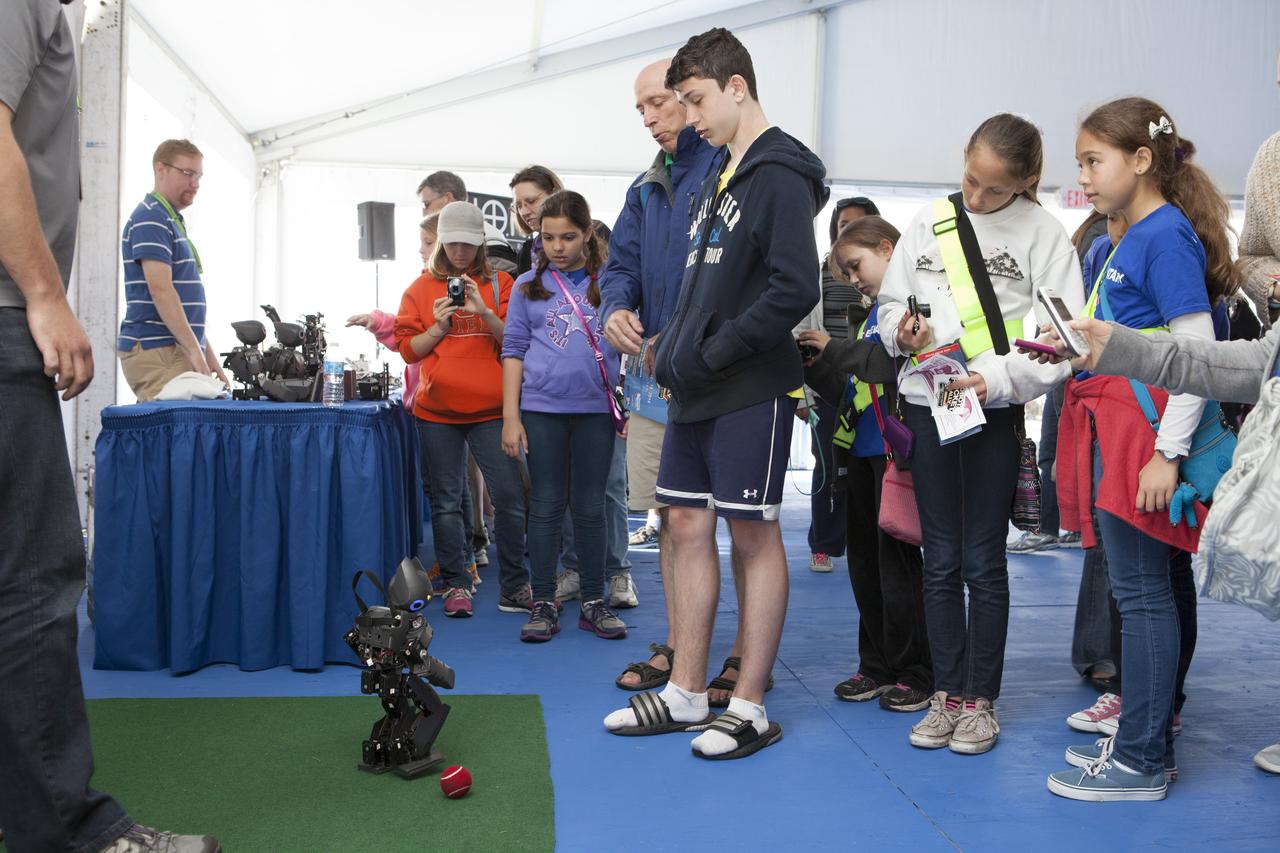
CAPE CANAVERAL, Fla. – Students gather to watch as a DARwin-OP miniature humanoid robot from Virginia Tech Robotics demonstrates its soccer abilities at the Robot Rocket Rally. The three-day event at Florida's Kennedy Space Center Visitor Complex is highlighted by exhibits, games and demonstrations of a variety of robots, with exhibitors ranging from school robotics clubs to veteran NASA scientists and engineers. Photo credit: NASA/Kim Shiflett
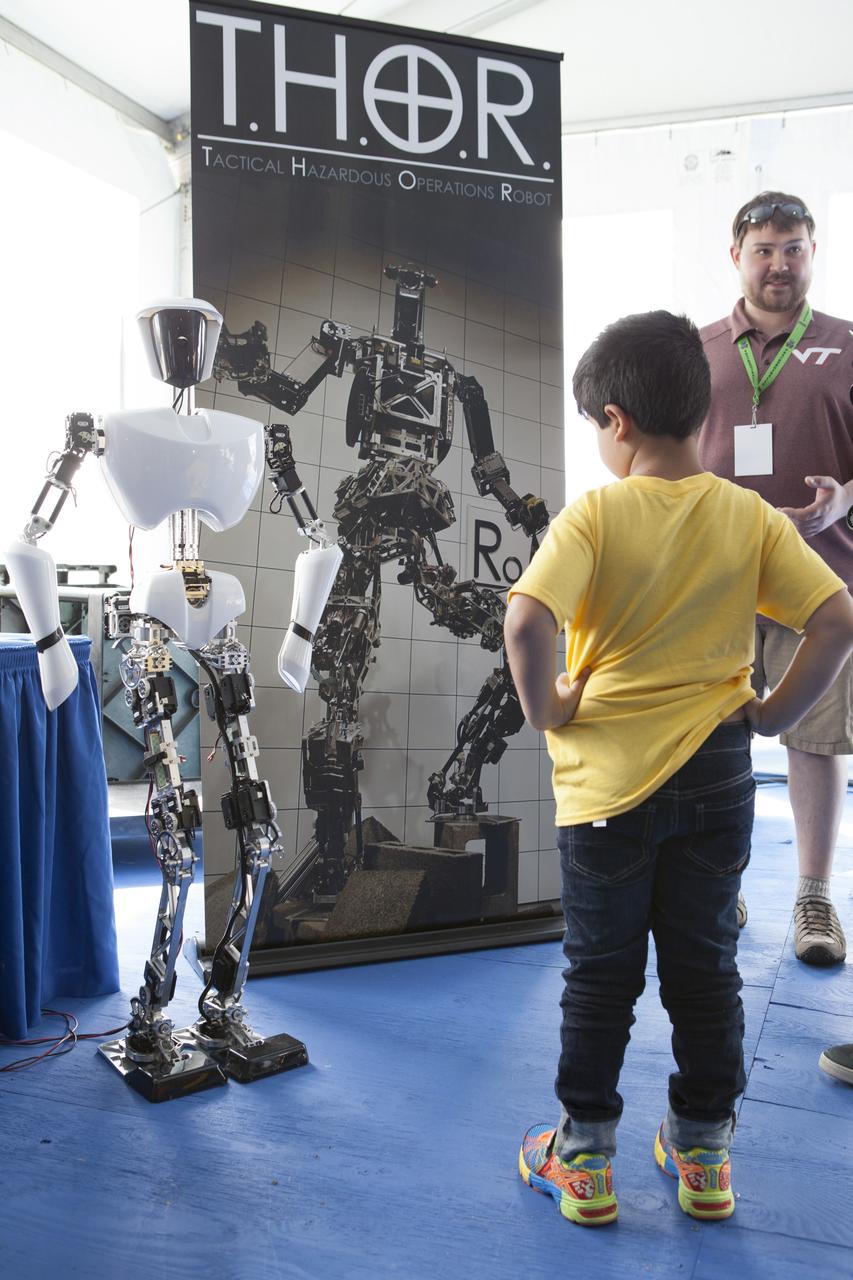
CAPE CANAVERAL, Fla. – A child gets an up-close look at Charli, an autonomous walking robot developed by Virginia Tech Robotics, during the Robot Rocket Rally. The three-day event at Florida's Kennedy Space Center Visitor Complex is highlighted by exhibits, games and demonstrations of a variety of robots, with exhibitors ranging from school robotics clubs to veteran NASA scientists and engineers. Photo credit: NASA/Kim Shiflett
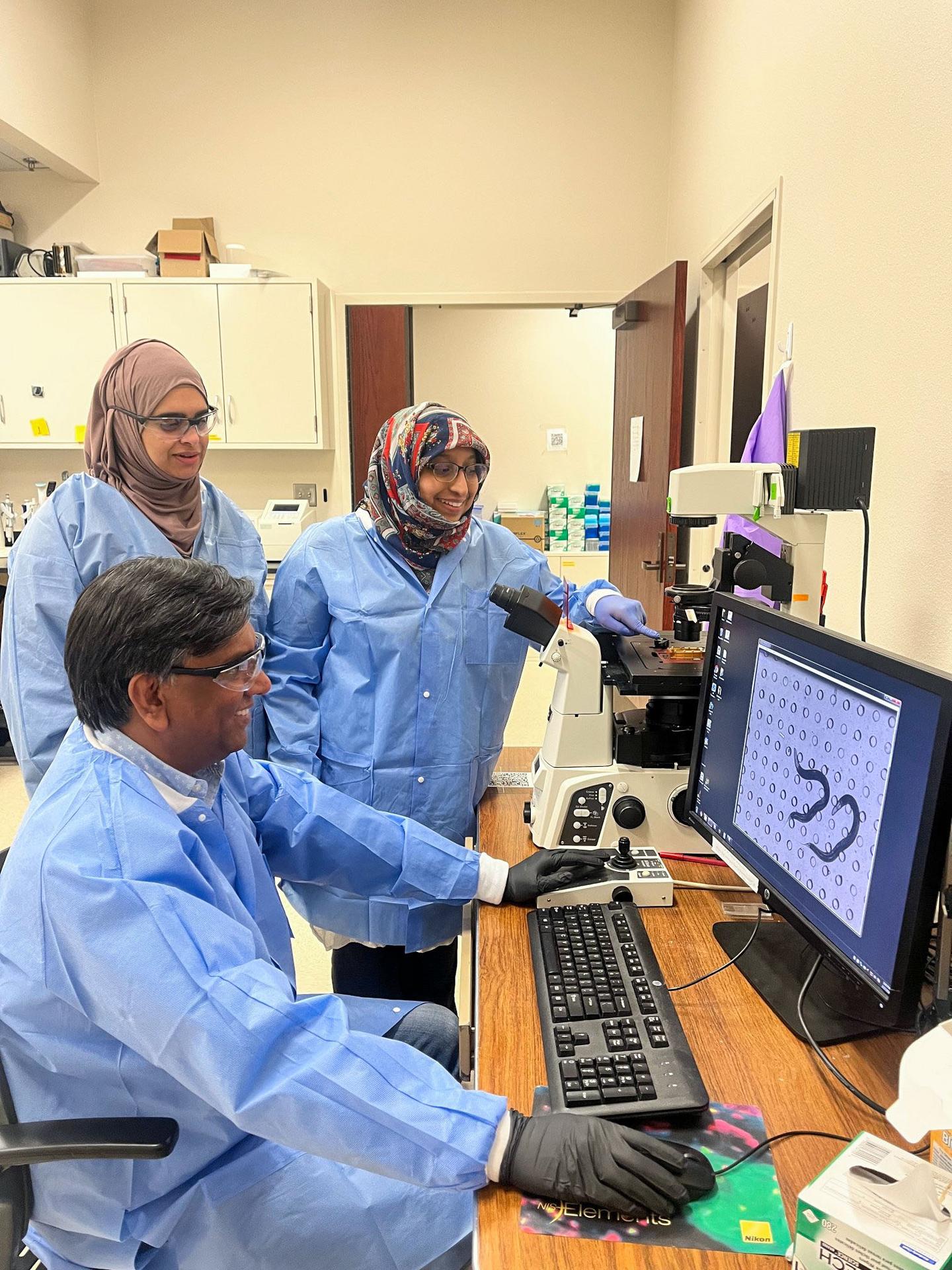
C. elegans Biological Investigation on Microbiome Effect in Space (CBIOMES) team scientists Dr. Siva Vanapalli, Bushra Rahman, and Atiyya Saroyia, examining worms loaded in NemaCapsules--microfluidics-integrated biocells. This investigation studies how spaceflight impacts the relationship between organisms and their gut microbiome by observing changes in nematodes down to the cellular level to identify ways to maintain microbiome stability. Credit: Texas Tech University.
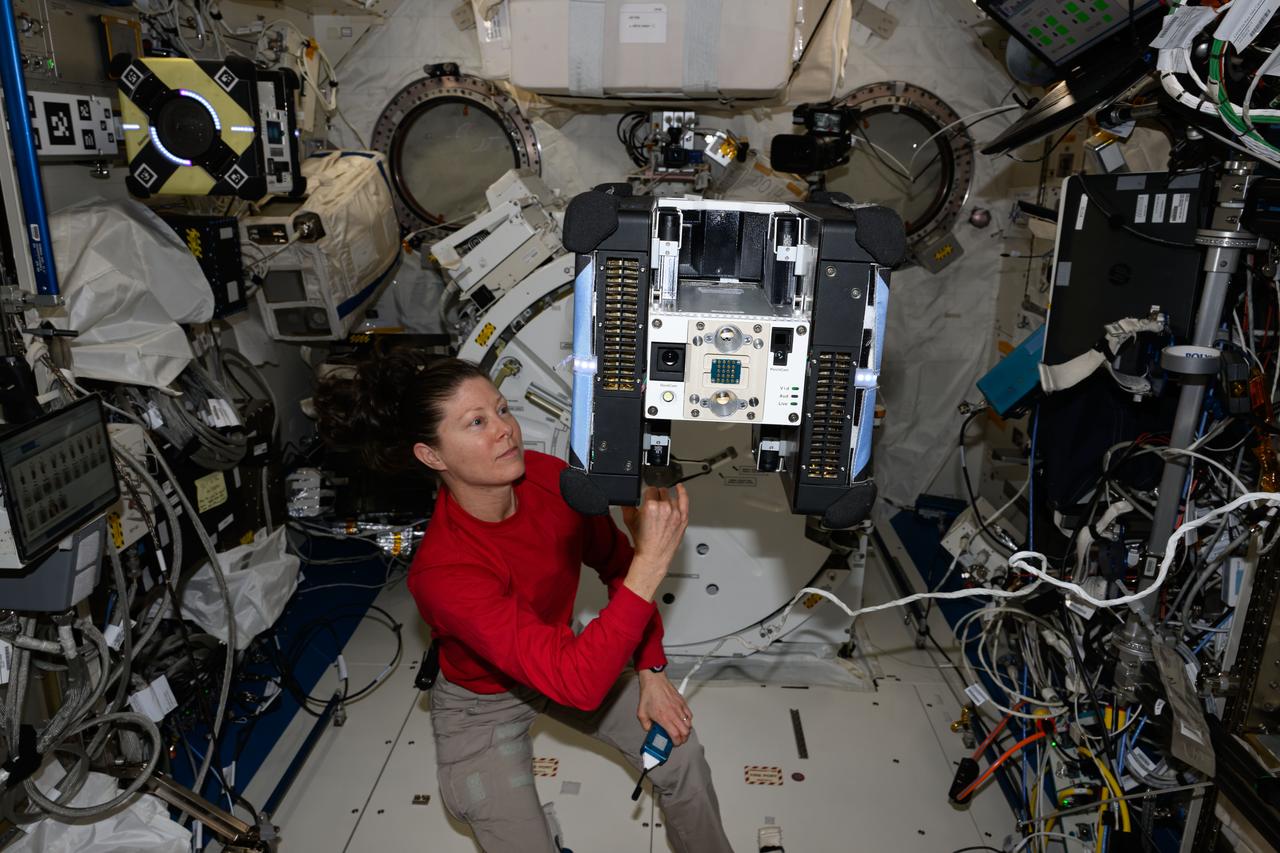
iss071e046270 (May 1, 2024) -- NASA astronaut and Expedition 71 Flight Engineer Tracy C. Dyson performs a Zero Robotics tech demonstration with Astrobee. Zero Robotics allows students on Earth to write software to control one of three free-flying Astrobee robots aboard the International Space Station. As part of an ongoing educational activity, students can then observe the performance of the robot without directly interacting with it.
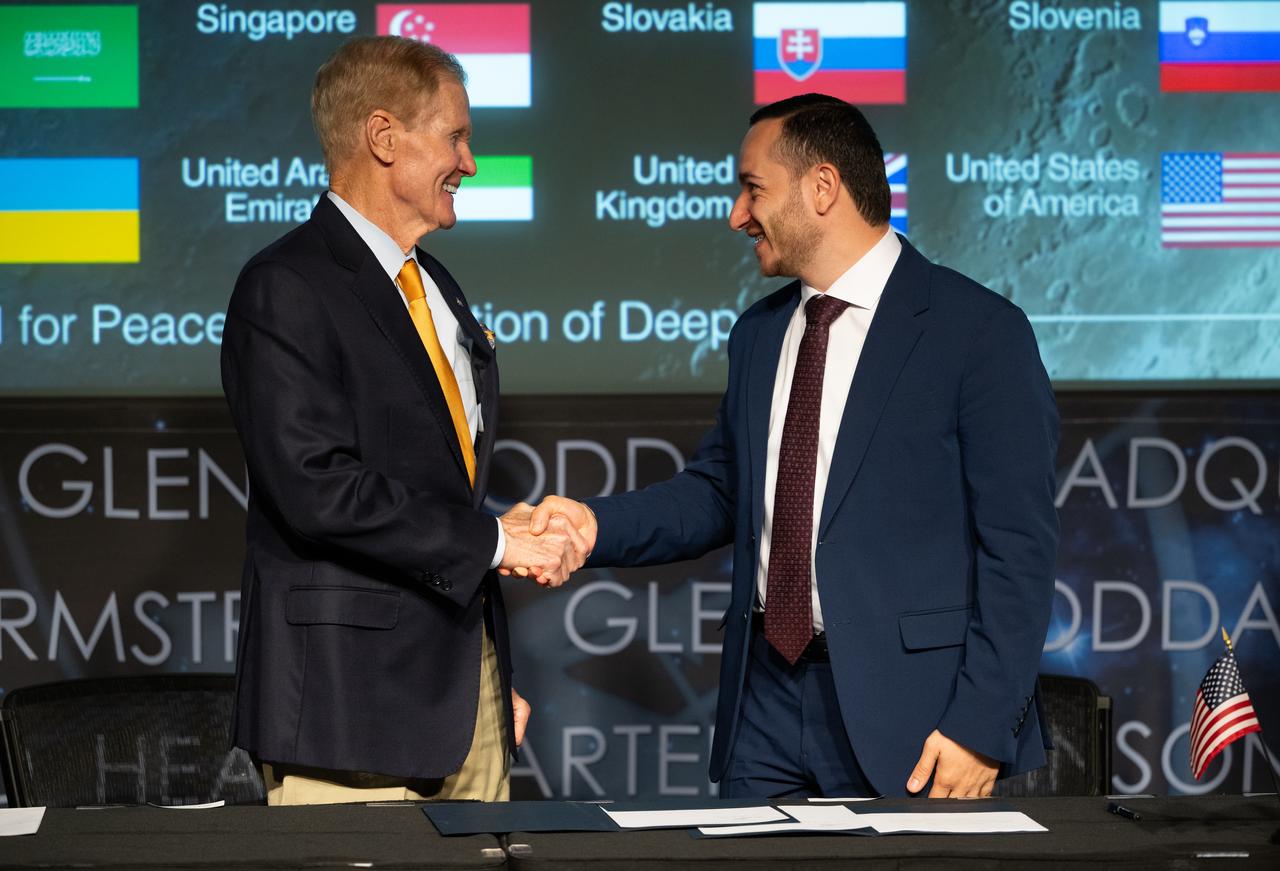
NASA Administrator Bill Nelson, left, and Mkhitar Hayrapetyan, Minister of High-Tech Industry of the Republic of Armenia, shake hands after the signing of the Artemis Accords, Wednesday, June 12, 2024, at the Mary W. Jackson NASA Headquarters building in Washington. The Republic of Armenia is the 43rd country to sign the Artemis Accords, which establish a practical set of principles to guide space exploration cooperation among nations participating in NASA’s Artemis program. Photo Credit: (NASA/Joel Kowsky)
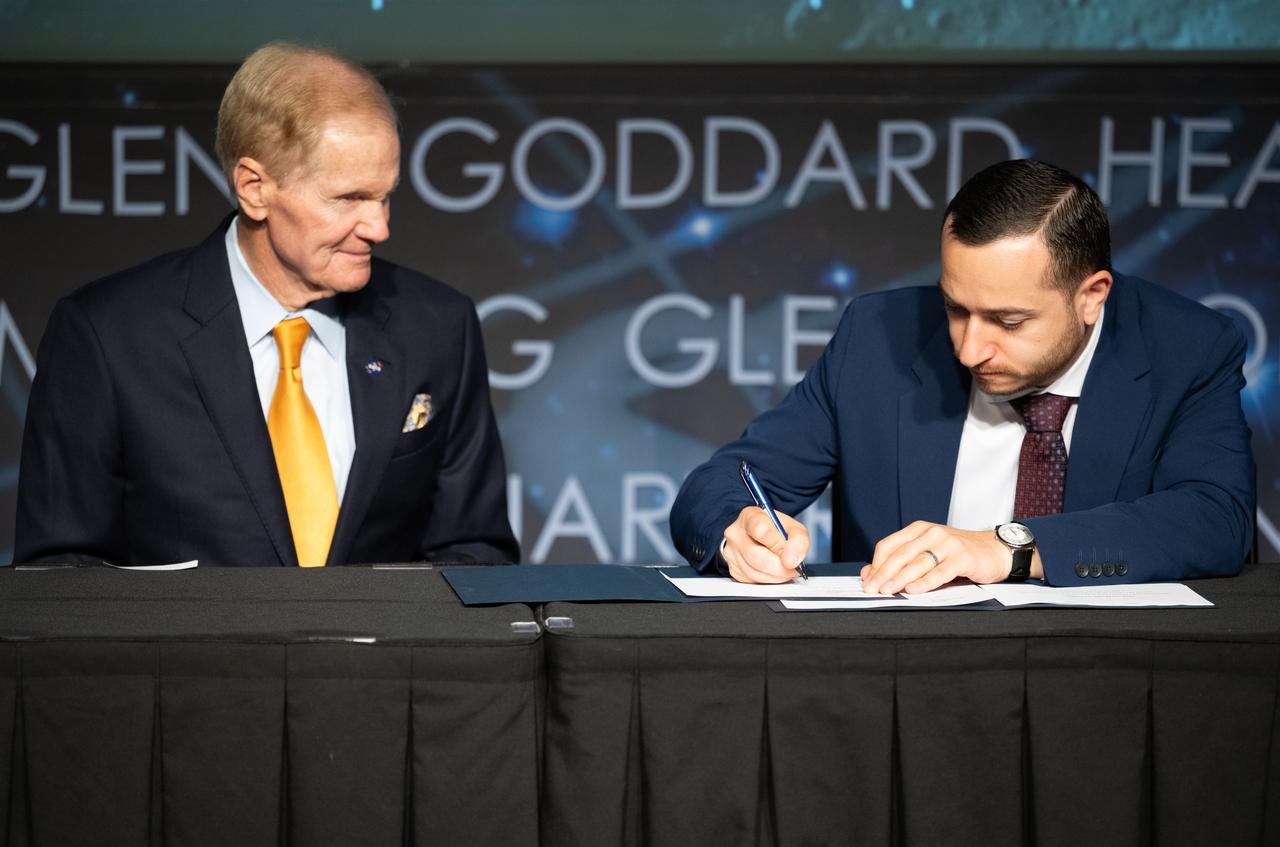
NASA Administrator Bill Nelson looks on as Mkhitar Hayrapetyan, Minister of High-Tech Industry of the Republic of Armenia, signs the Artemis Accords, Wednesday, June 12, 2024, at the Mary W. Jackson NASA Headquarters building in Washington. The Republic of Armenia is the 43rd country to sign the Artemis Accords, which establish a practical set of principles to guide space exploration cooperation among nations participating in NASA’s Artemis program. Photo Credit: (NASA/Joel Kowsky)
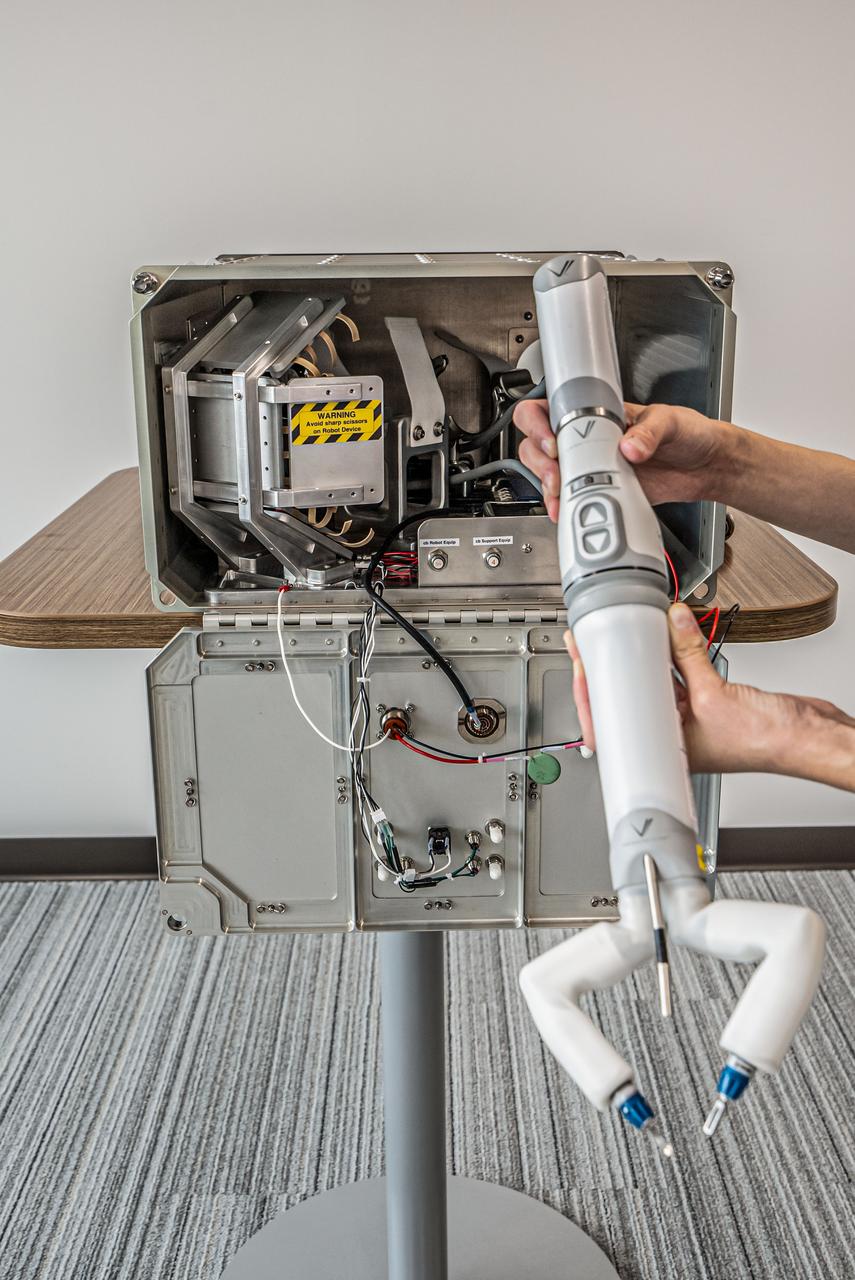
jsc2024e005980 (9/15/2023) --- The robotic surgery device is shown outside of the investigation locker. Robotic Surgery Tech Demo tests the performance of a small robot that can be remotely controlled from Earth to perform surgical procedures. Researchers plan to compare procedures in microgravity and on Earth to evaluate the effects of microgravity and time delays between space and ground. Image courtesy of Virtual Incision.
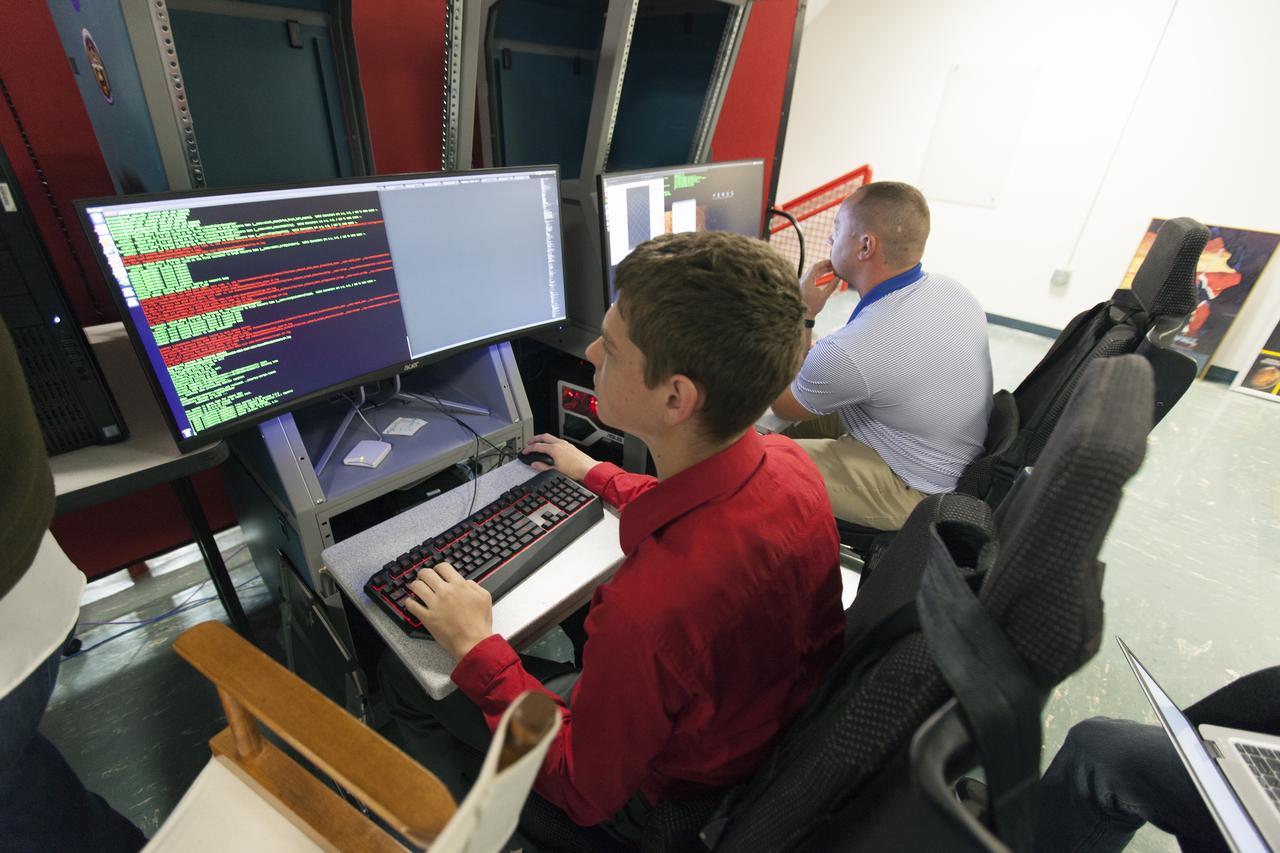
In the Swamp Works laboratory at NASA's Kennedy Space Center in Florida, student interns such as Thomas Muller, left, and Austin Langdon are joining agency scientists, contributing in the area of Exploration Research and Technology. Muller is pursuing a degree in computer engineering and control systems and Florida Tech. Langdon is an electrical engineering major at the University of Kentucky. The agency attracts its future workforce through the NASA Internship, Fellowships and Scholarships, or NIFS, Program.

C. elegans Biological Investigation on Microbiome Effect in Space (CBIOMES) team scientists Dr. Siva Vanapalli, Bushra Rahman, Atiyya Saroyia, and Emma Paxton examining worms loaded in NemaCapsules--microfluidics-integrated biocells. This investigation studies how spaceflight impacts the relationship between organisms and their gut microbiome by observing changes in nematodes down to the cellular level to identify ways to maintain microbiome stability. Credit: Texas Tech University.
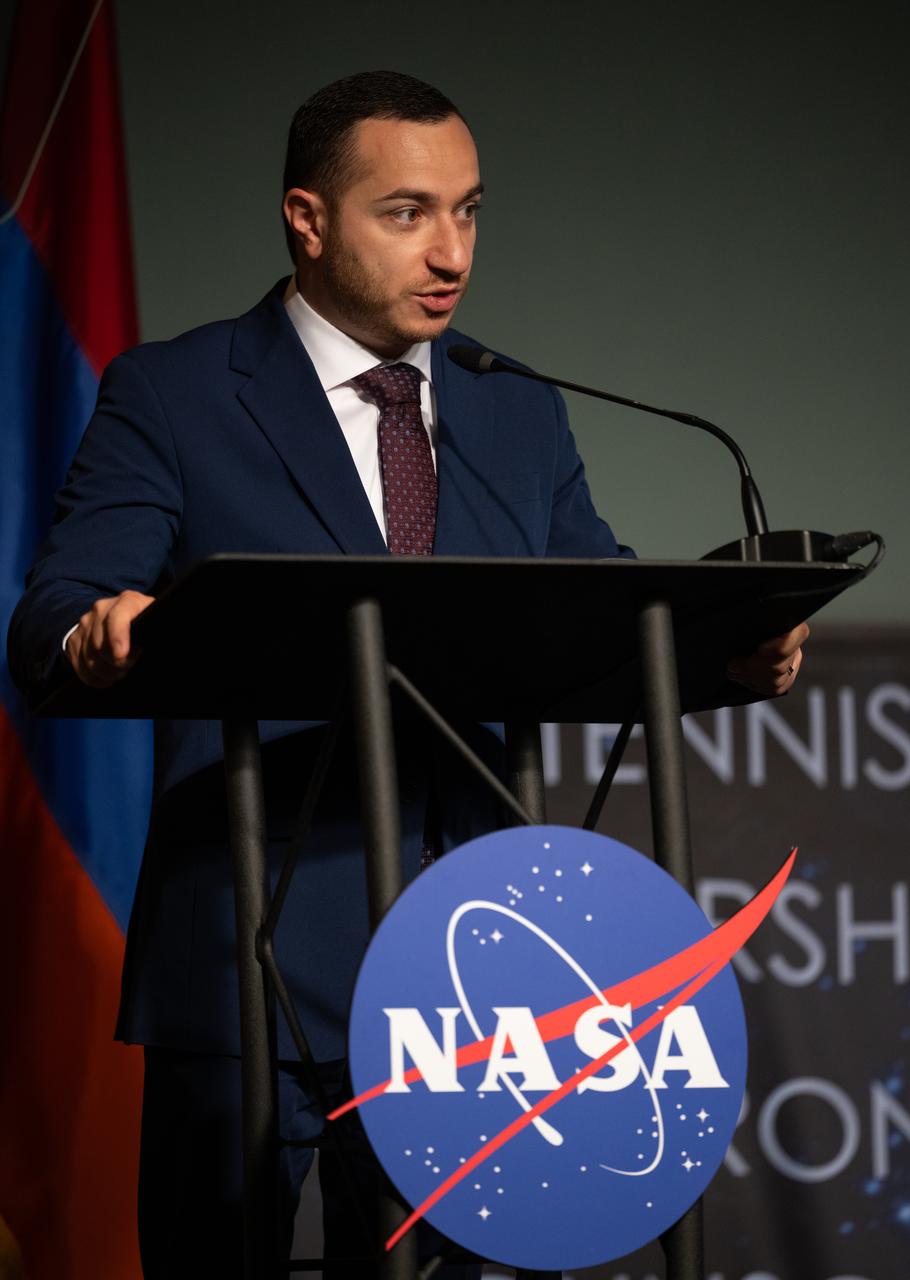
Mkhitar Hayrapetyan, Minister of High-Tech Industry of the Republic of Armenia delivers remarks during an Artemis Accords signing ceremony, Wednesday, June 12, 2024, at the Mary W. Jackson NASA Headquarters building in Washington. The Republic of Armenia is the 43rd country to sign the Artemis Accords, which establish a practical set of principles to guide space exploration cooperation among nations participating in NASA’s Artemis program. Photo Credit: (NASA/Joel Kowsky)
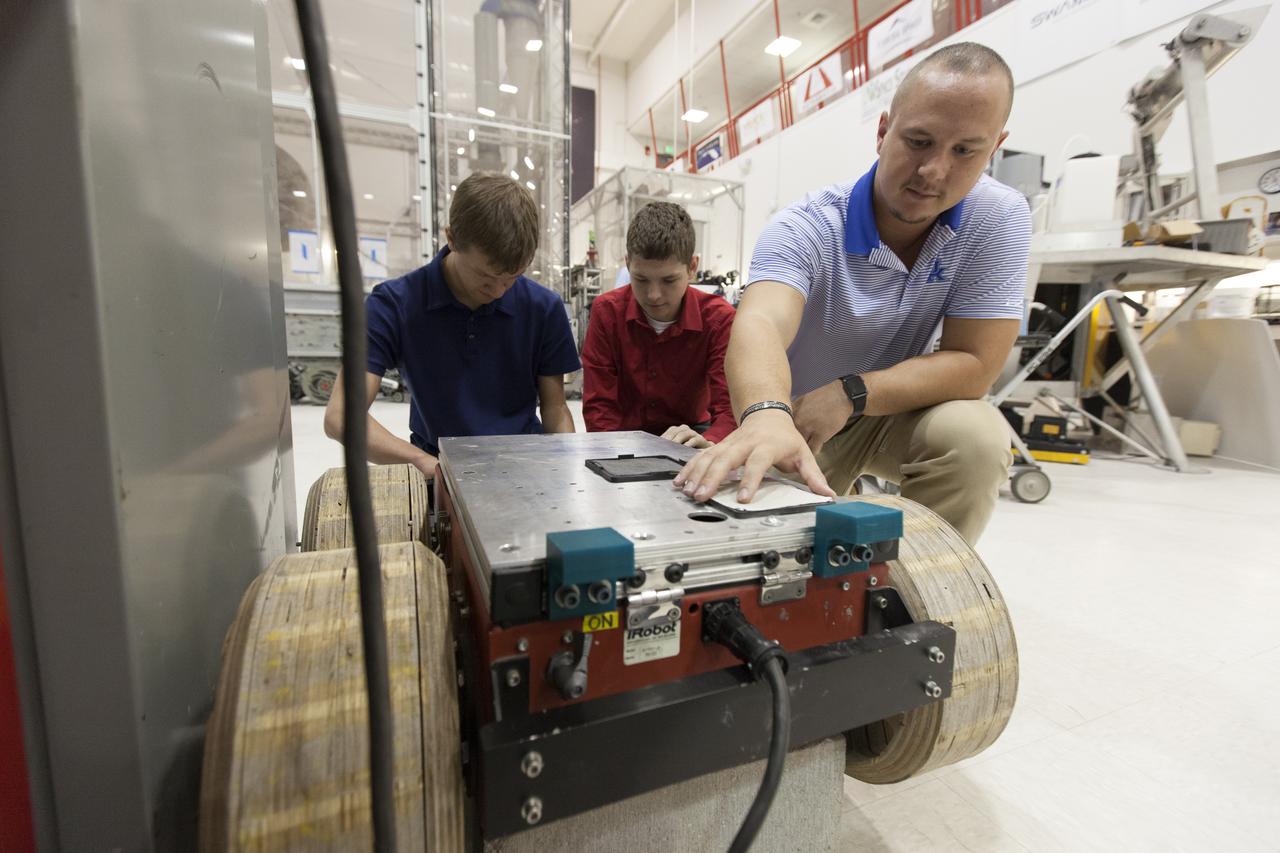
In the Swamp Works laboratory at NASA's Kennedy Space Center in Florida, student interns, from the left, Jeremiah House, Thomas Muller and Austin Langdon are joining agency scientists, contributing in the area of Exploration Research and Technology. House is studying computer/electrical engineering at John Brown University in Siloam Springs, Arkansas. Muller is pursuing a degree in computer engineering and control systems and Florida Tech. Langdon is an electrical engineering major at the University of Kentucky. The agency attracts its future workforce through the NASA Internship, Fellowships and Scholarships, or NIFS, Program.
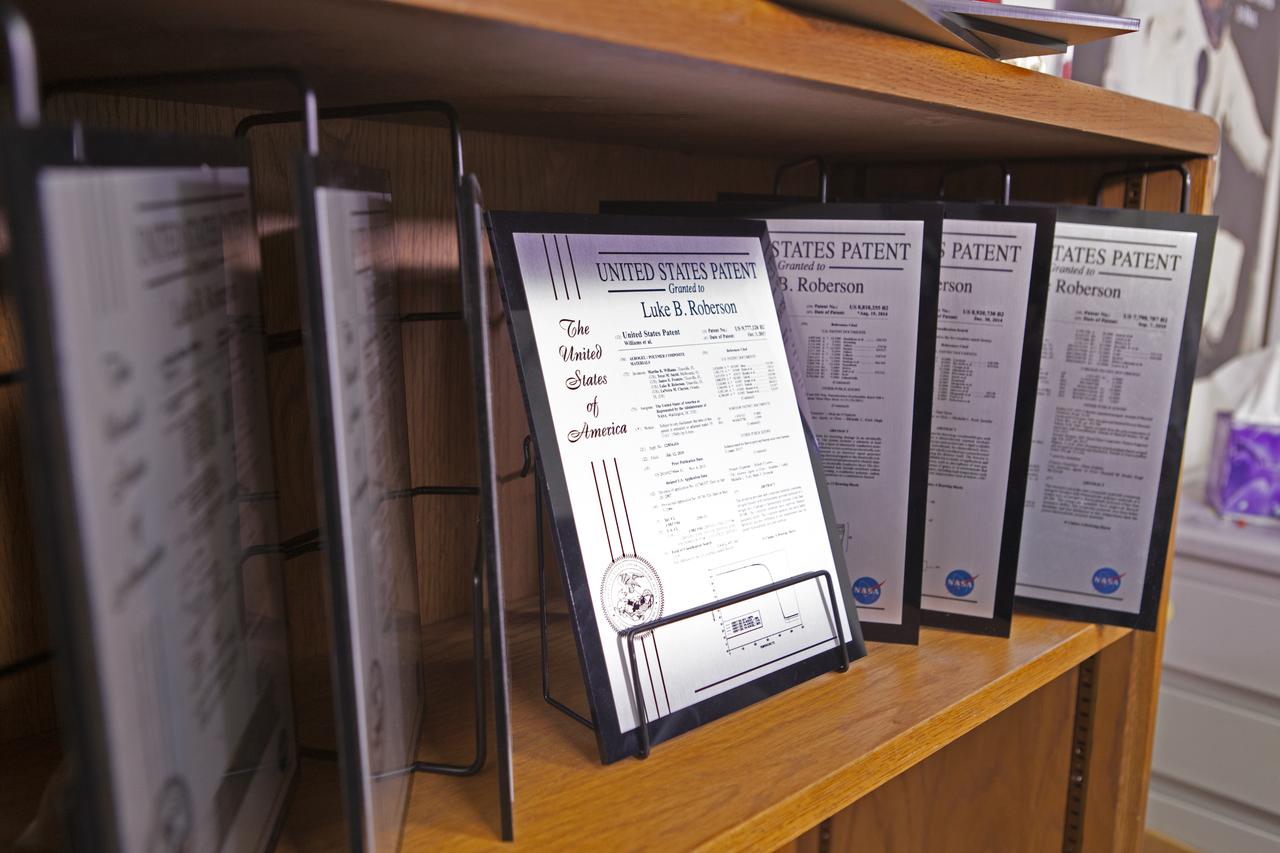
Kennedy Space Center’s Luke Roberson, a principal investigator with the flight technology branch, has received several patents from the United States Patent and Trademark Office. Certificates recognizing those patents are on display in his office at the Florida spaceport’s Space Station Processing Facility.
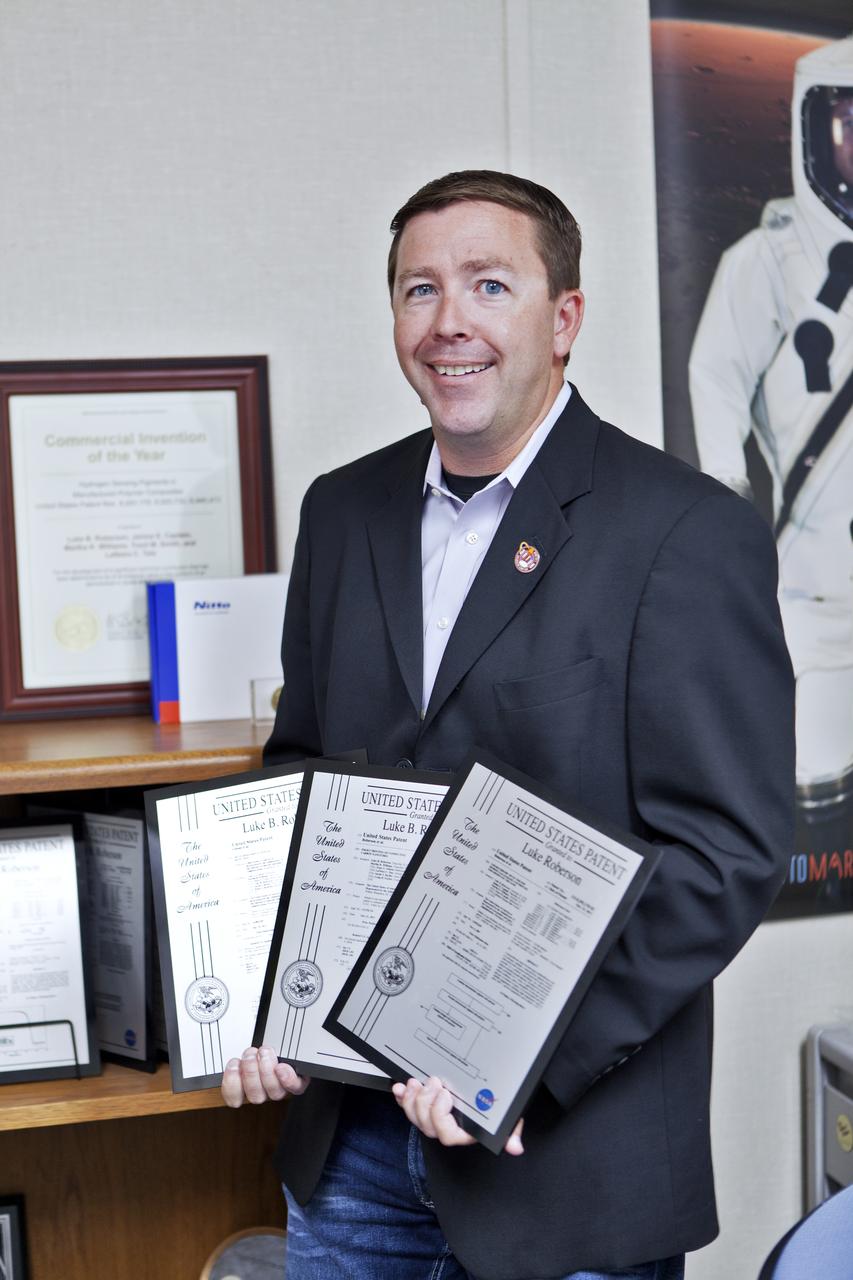
Luke Roberson, a principal investigator with the flight technology branch at NASA’s Kennedy Space Center in Florida, discusses patents and new technology reports for a video that targets internal audiences at NASA. Roberson’s contributions are reflected in multiple U.S. patents.
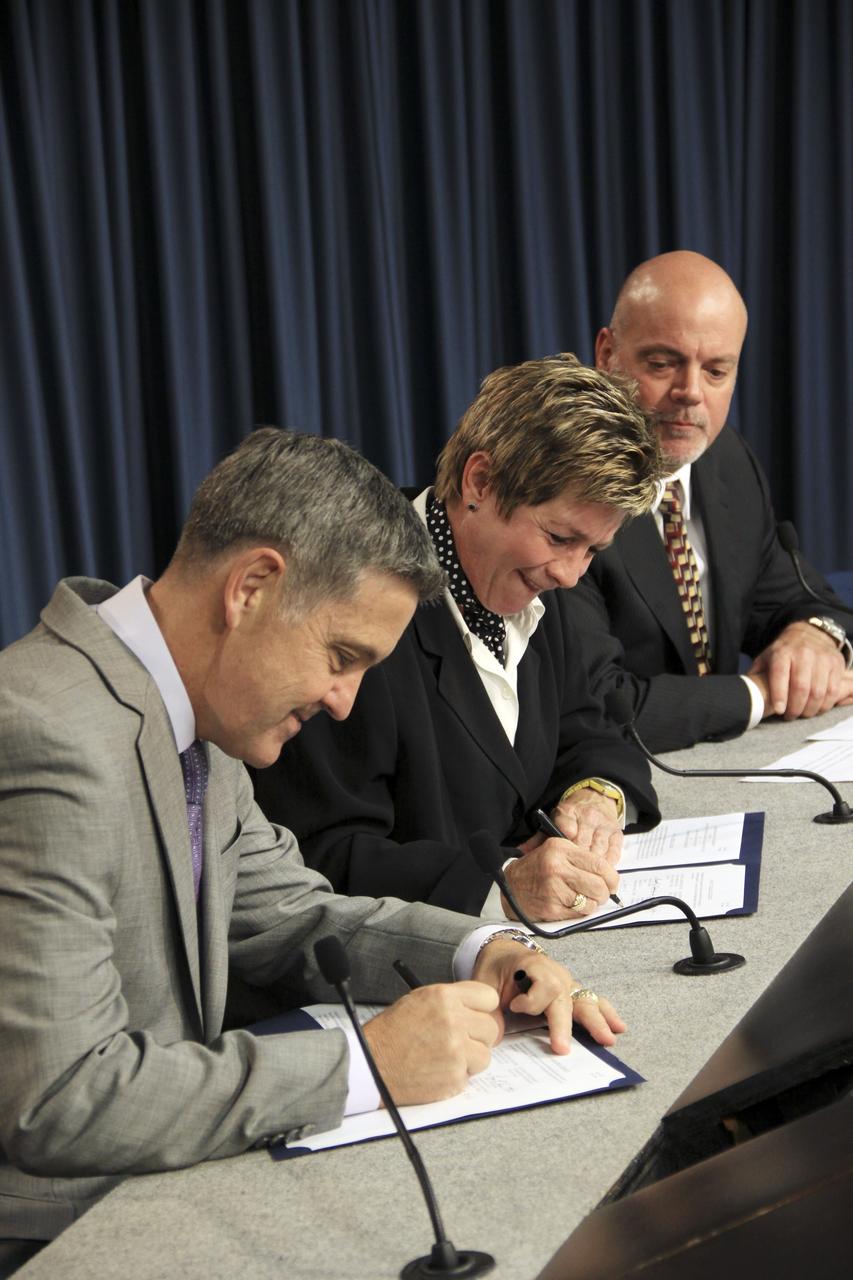
CAPE CANAVERAL, Fla. -- In the Press Site auditorium at NASA's Kennedy Space Center in Florida, Lynda Weatherman (center), Economic Development Commission (EDC) of Florida’s Space Coast president and CEO, shows her enthusiasm for the new five-year Space Act Agreement she is signing. Also signing the agreement, at left, is Kennedy Space Center Director Robert Cabana. Bob Whelen, chairman of the board of the EDC, looks on at right. The agreement calls for NASA and EDC senior leadership to meet regularly to discuss economic development matters of mutual interest. Managers from Kennedy’s Center Planning and Development Office will work with the EDC on potential business partnerships and meet with business leaders and committees to address space-related and high-tech economic development. EDC officials will assist NASA with disseminating information about potential partnership opportunities, as well as space-related and high-tech economic development, and increase awareness of Kennedy’s Engineering and Technology Directorate collaboration initiatives. They also will promote the commercial use of underutilized facilities at Kennedy. NASA and the EDC entered into their first economic cooperation agreement in 2005. For more information about the Economic Development Commission (EDC) of Florida’s Space Coast, visit http://www.spacecoastedc.org/. Photo credit: NASA/Jim Grossmann
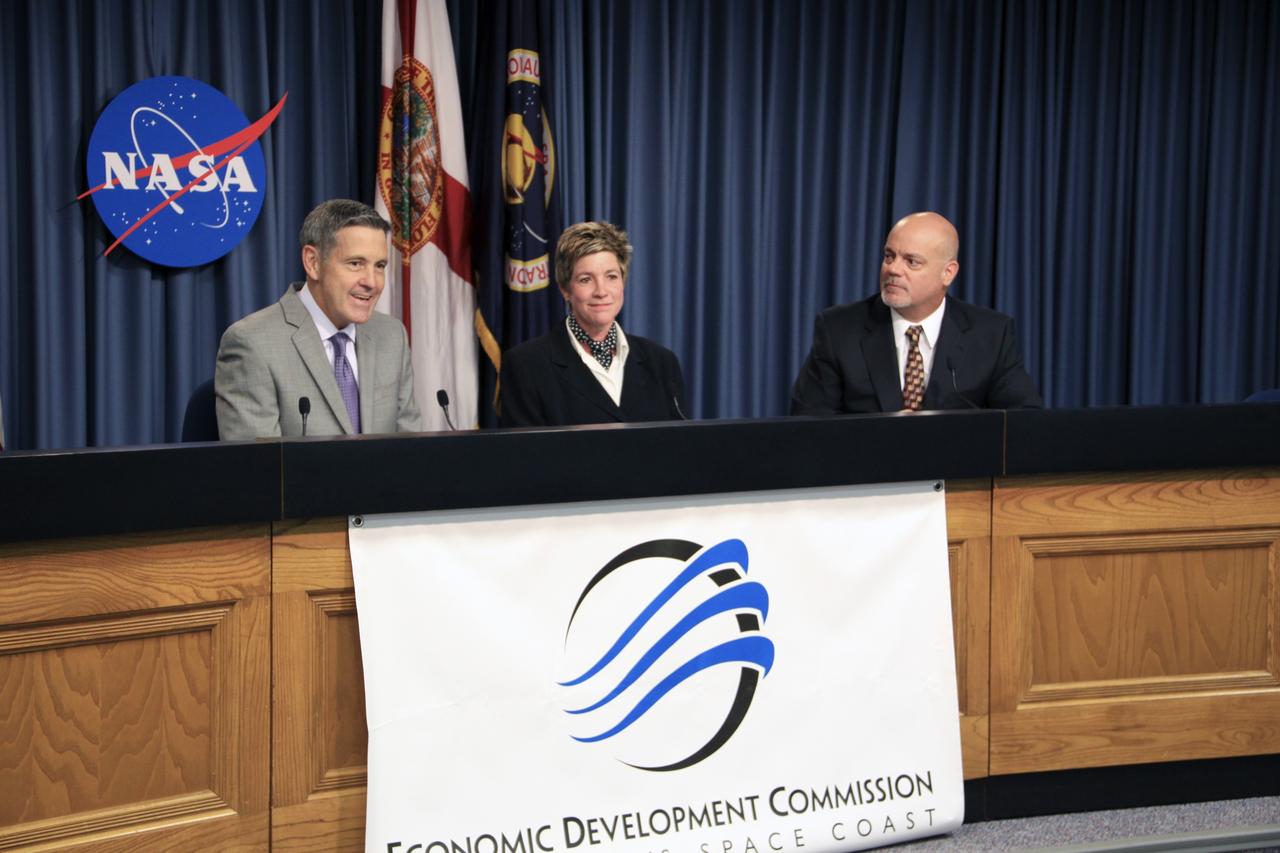
CAPE CANAVERAL, Fla. -- In the Press Site auditorium at NASA's Kennedy Space Center in Florida, managers from NASA and the Economic Development Commission (EDC) of Florida’s Space Coast discuss a new five-year Space Act Agreement reaffirming the partnership of the two organizations. From left are Kennedy Space Center Director Robert Cabana, EDC President and CEO Lynda Weatherman, and Chairman of the Board of the EDC Bob Whelen. The agreement calls for NASA and EDC senior leadership to meet regularly to discuss economic development matters of mutual interest. Managers from Kennedy’s Center Planning and Development Office will work with the EDC on potential business partnerships and meet with business leaders and committees to address space-related and high-tech economic development. EDC officials will assist NASA with disseminating information about potential partnership opportunities, as well as space-related and high-tech economic development, and increase awareness of Kennedy’s Engineering and Technology Directorate collaboration initiatives. They also will promote the commercial use of underutilized facilities at Kennedy. NASA and the EDC entered into their first economic cooperation agreement in 2005. For more information about the Economic Development Commission (EDC) of Florida’s Space Coast, visit http://www.spacecoastedc.org/. Photo credit: NASA/Jim Grossmann
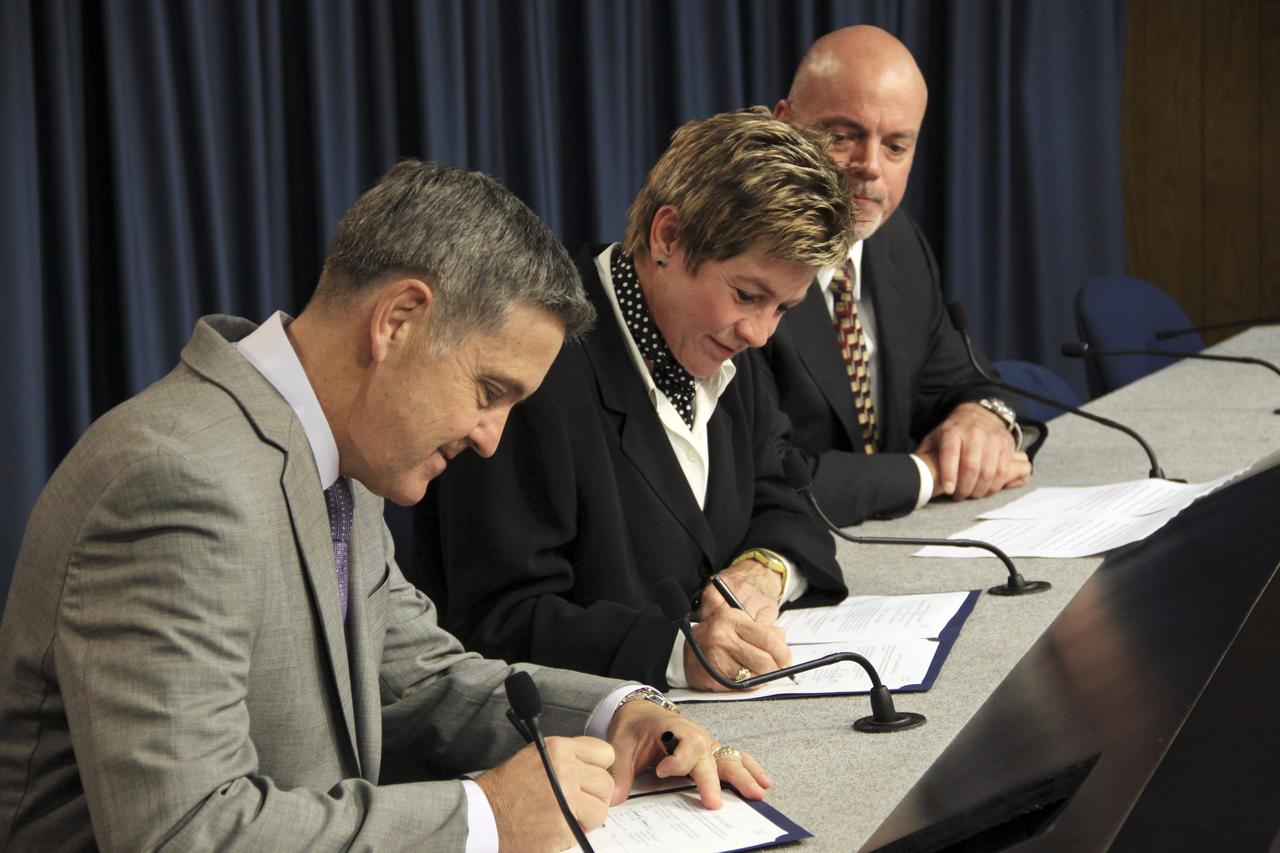
CAPE CANAVERAL, Fla. -- In the Press Site auditorium at NASA's Kennedy Space Center in Florida, representatives of NASA and the Economic Development Commission (EDC) of Florida’s Space Coast sign a new five-year Space Act Agreement. From left are Kennedy Space Center Director Director Robert Cabana and EDC President and CEO Lynda Weatherman, with Chairman of the Board of the EDC Bob Whelen looking on. The agreement calls for NASA and EDC senior leadership to meet regularly to discuss economic development matters of mutual interest. Managers from Kennedy’s Center Planning and Development Office will work with the EDC on potential business partnerships and meet with business leaders and committees to address space-related and high-tech economic development. EDC officials will assist NASA with disseminating information about potential partnership opportunities, as well as space-related and high-tech economic development, and increase awareness of Kennedy’s Engineering and Technology Directorate collaboration initiatives. They also will promote the commercial use of underutilized facilities at Kennedy. NASA and the EDC entered into their first economic cooperation agreement in 2005. For more information about the Economic Development Commission (EDC) of Florida’s Space Coast, visit http://www.spacecoastedc.org/. Photo credit: NASA/Jim Grossmann
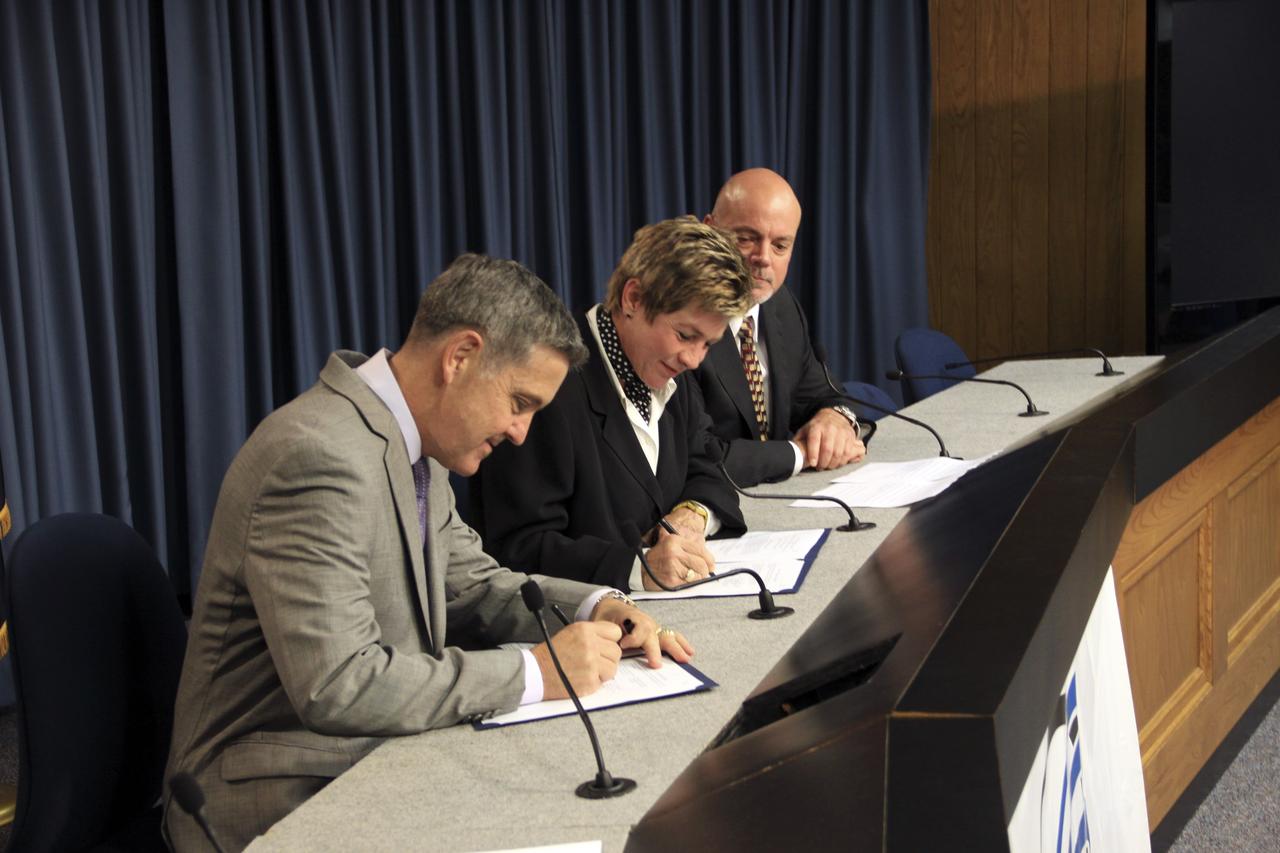
CAPE CANAVERAL, Fla. -- In the Press Site auditorium at NASA's Kennedy Space Center in Florida, representatives of NASA and the Economic Development Commission (EDC) of Florida’s Space Coast sign a new five-year Space Act Agreement. From left are Kennedy Space Center Director Robert Cabana and EDC President and CEO Lynda Weatherman, with Chairman of the Board of the EDC Bob Whelen looking on. The agreement calls for NASA and EDC senior leadership to meet regularly to discuss economic development matters of mutual interest. Managers from Kennedy’s Center Planning and Development Office will work with the EDC on potential business partnerships and meet with business leaders and committees to address space-related and high-tech economic development. EDC officials will assist NASA with disseminating information about potential partnership opportunities, as well as space-related and high-tech economic development, and increase awareness of Kennedy’s Engineering and Technology Directorate collaboration initiatives. They also will promote the commercial use of underutilized facilities at Kennedy. NASA and the EDC entered into their first economic cooperation agreement in 2005. For more information about the Economic Development Commission (EDC) of Florida’s Space Coast, visit http://www.spacecoastedc.org/. Photo credit: NASA/Jim Grossmann
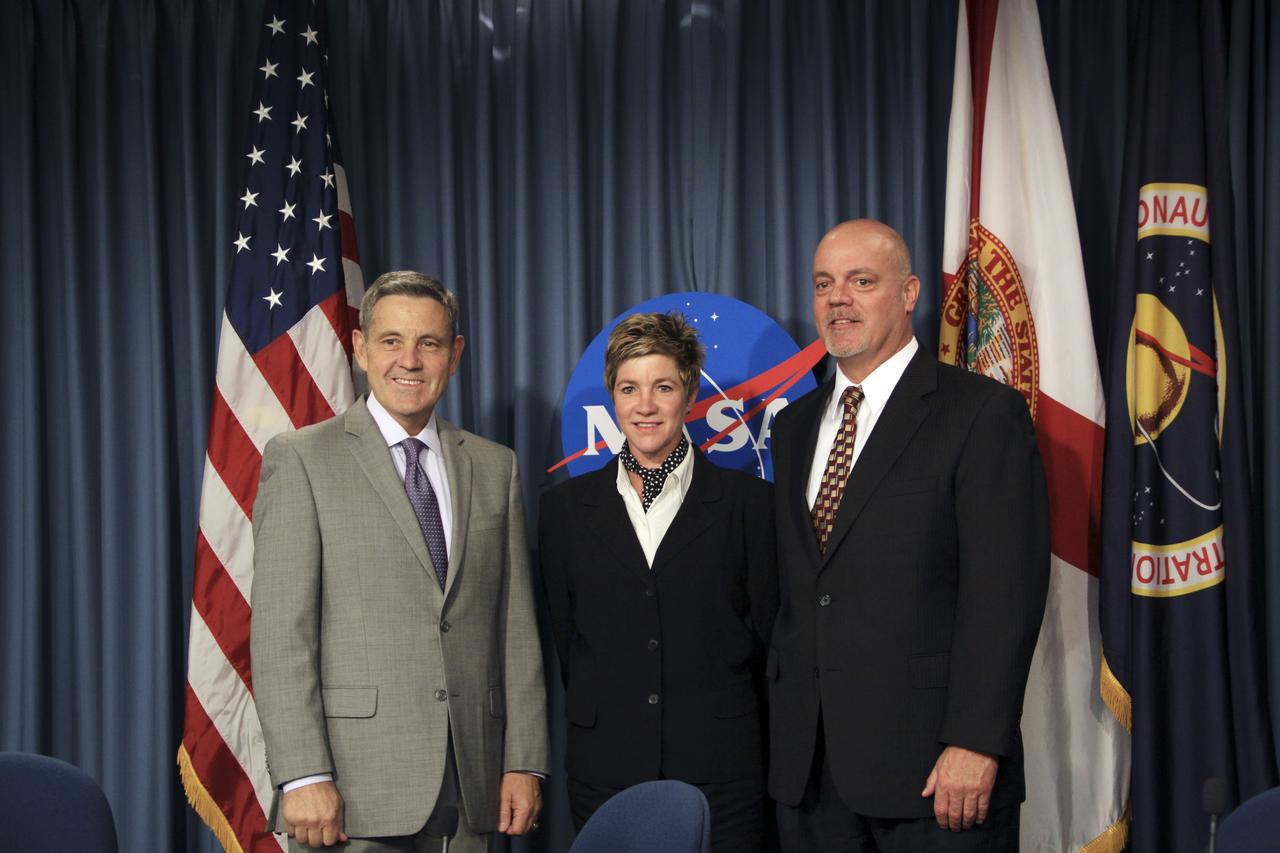
CAPE CANAVERAL, Fla. -- In the Press Site auditorium at NASA's Kennedy Space Center in Florida, managers from NASA and the Economic Development Commission (EDC) of Florida’s Space Coast pose for a portrait following the signing of a new five-year Space Act Agreement reaffirming the partnership of the two organizations. From left are Kennedy Space Center Director Robert Cabana, EDC President and CEO Lynda Weatherman, and Chairman of the Board of the EDC Bob Whelen. The agreement calls for NASA and EDC senior leadership to meet regularly to discuss economic development matters of mutual interest. Managers from Kennedy’s Center Planning and Development Office will work with the EDC on potential business partnerships and meet with business leaders and committees to address space-related and high-tech economic development. EDC officials will assist NASA with disseminating information about potential partnership opportunities, as well as space-related and high-tech economic development, and increase awareness of Kennedy’s Engineering and Technology Directorate collaboration initiatives. They also will promote the commercial use of underutilized facilities at Kennedy. NASA and the EDC entered into their first economic cooperation agreement in 2005. For more information about the Economic Development Commission (EDC) of Florida’s Space Coast, visit http://www.spacecoastedc.org/. Photo credit: NASA/Jim Grossmann
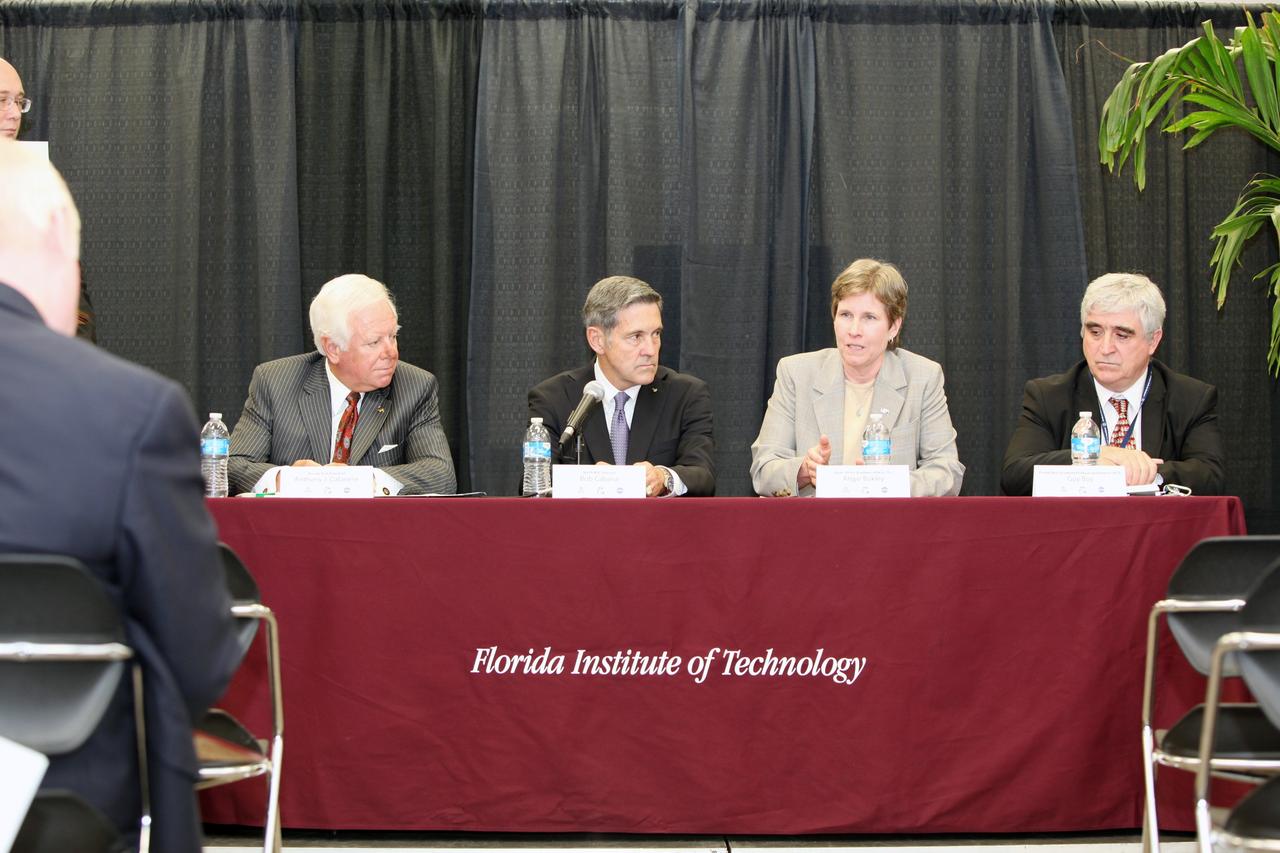
MELBOURNE, Fla. – Professor Angie Bukley, dean and vice president for Academic Affairs, International Space University, addresses the audience during opening ceremonies for the university's 25th annual Space Studies Program session at the Florida Institute of Technology in Melbourne, Fla. Seated from left are Anthony J. Catanese, president of Florida Tech NASA Kennedy Space Center Director Bob Cabana Bukley and Dr. Guy A. Boy, chair of the Space Studies Program’s local organizing committee. The nine-week intensive course is designed for post-graduate university students and professionals during the summer. The program is hosted by a different country each year, providing a unique educational experience for participants from around the globe. NASA Kennedy Space Center and Florida Tech are co-hosting this year's event which runs from June 4 to Aug. 3. This year, there are about 125 participants representing 31 countries. For more information, visit http://www.isunet.edu. Photo credit: NASA/Dimitri Gerondidakis
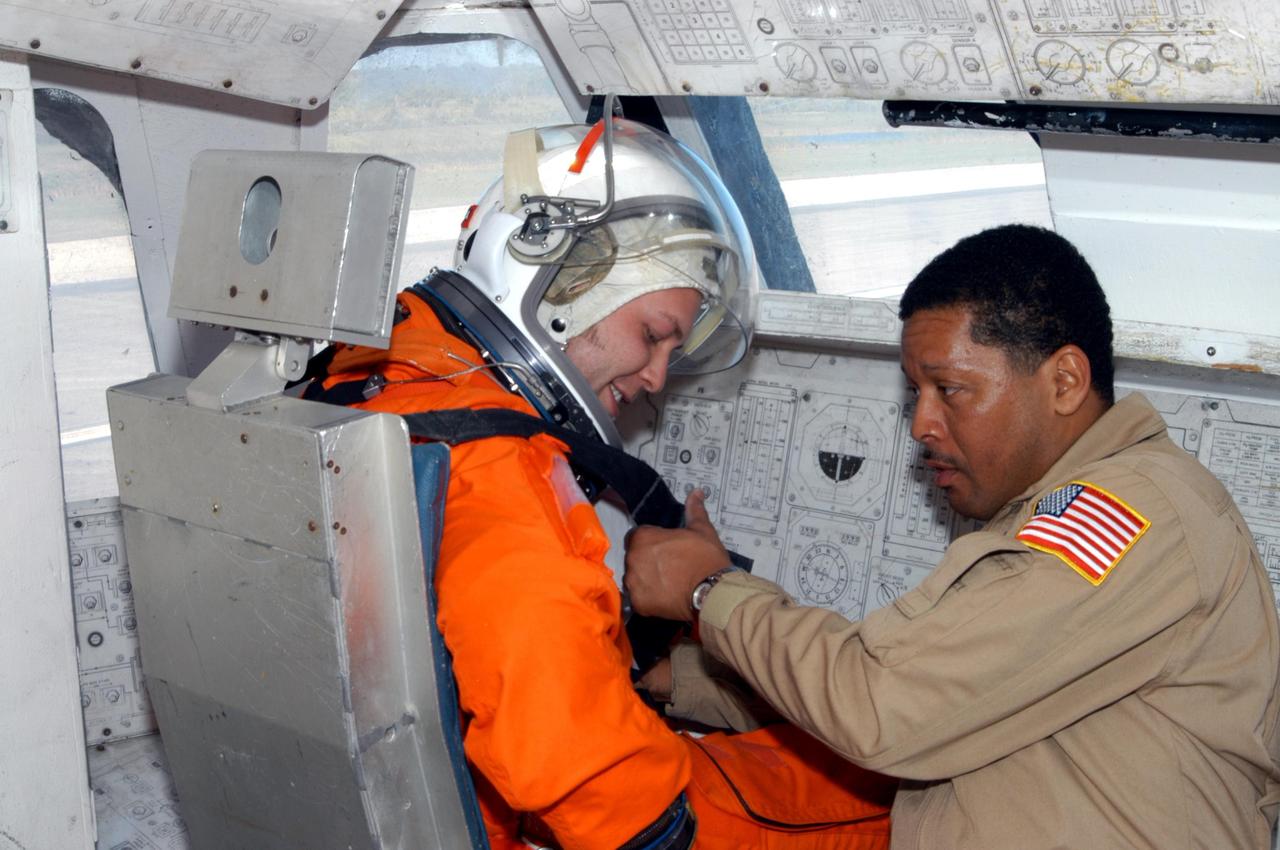
KENNEDY SPACE CENTER, FLA. - Inside the orbiter mockup at NASA Kennedy Space Center's Shuttle Landing Facility, volunteer "astronaut" Jeremy Garcia, with United Space Alliance (USA), is helped with his launch and entry suit by USA Insertion Tech George Brittingham before a simulated emergency landing of a shuttle crew. Known as a Mode VI exercise, the operation uses volunteer workers from the Center to pose as astronauts. The purpose of the simulation is to exercise emergency preparedness personnel, equipment and facilities in rescuing astronauts from a downed orbiter and providing immediate medical attention. Photo credit: NASA/George Shelton
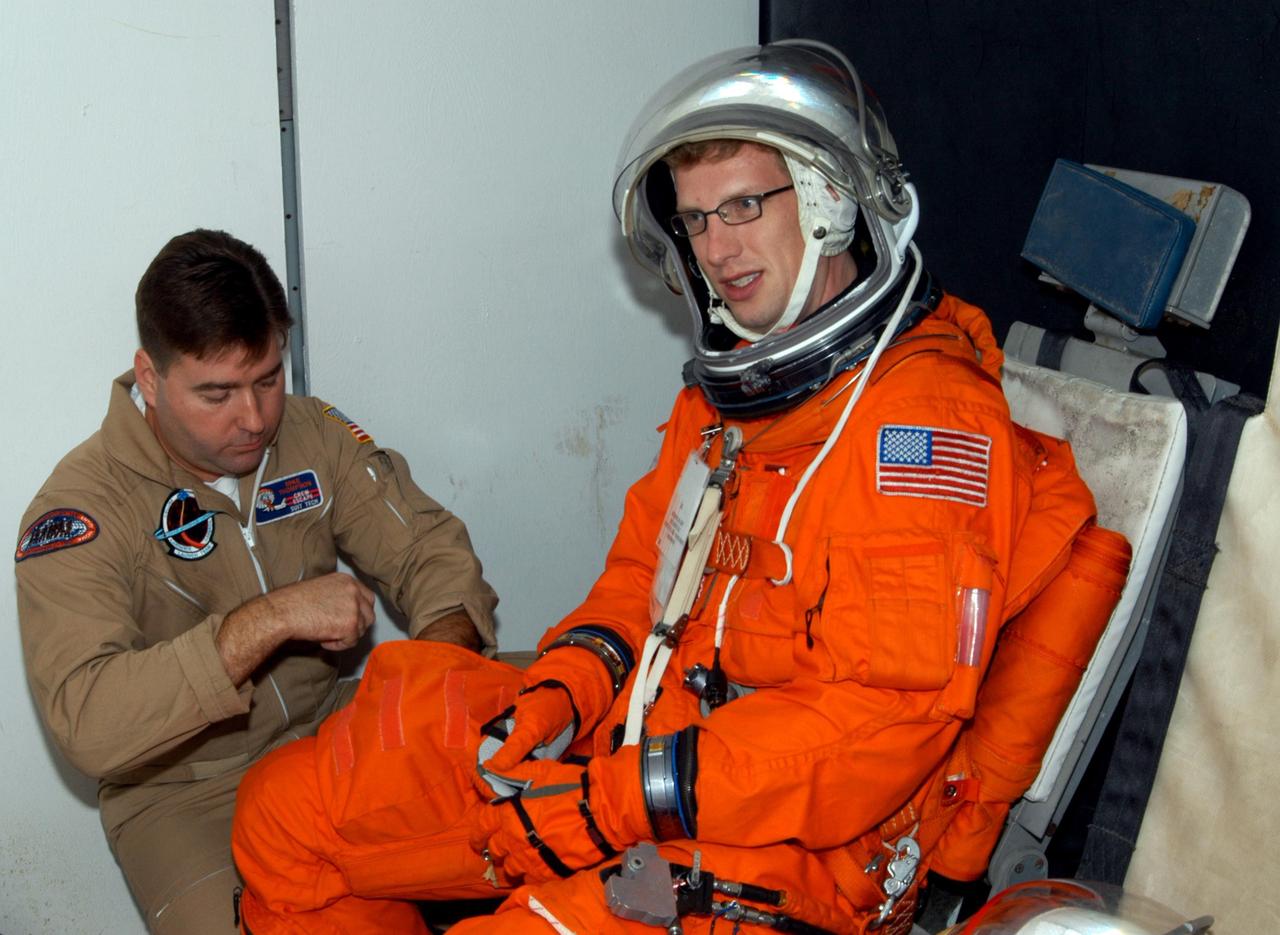
KENNEDY SPACE CENTER, FLA. - Inside the orbiter mockup at NASA Kennedy Space Center's Shuttle Landing Facility, volunteer "astronaut" Charlie Plain, with InDyne Inc., gets settled in a seat with the help of United Space Alliance Insertion Tech Mike Thompson before a simulated emergency landing of a shuttle crew. Known as a Mode VI exercise, the operation uses volunteer workers from the Center to pose as astronauts. The purpose of the simulation is to exercise emergency preparedness personnel, equipment and facilities in rescuing astronauts from a downed orbiter and providing immediate medical attention. Photo credit: NASA/George Shelton
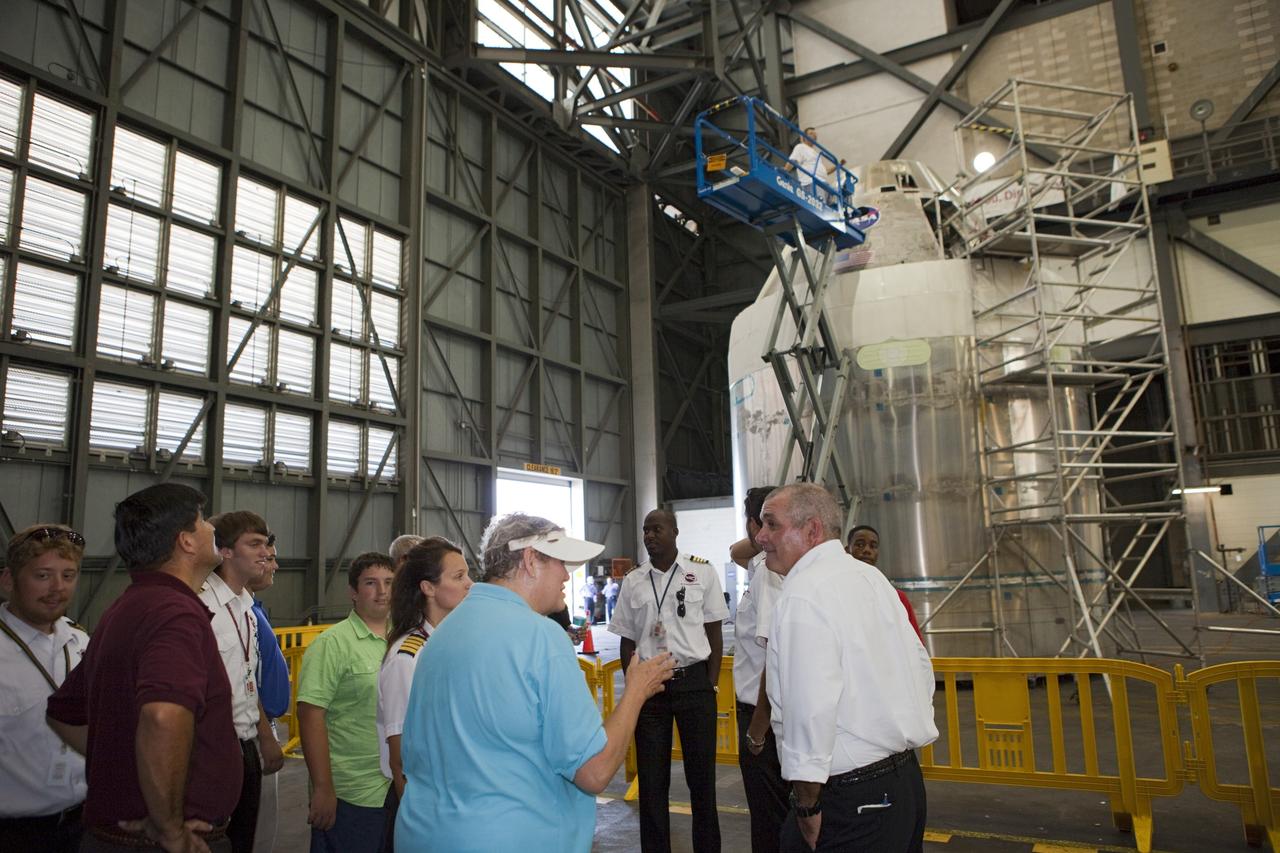
CAPE CANAVERAL, Fla. – Students and their flight instructors from Florida Tech, or FIT, in Melbourne, tour the Vehicle Assembly Building and view space shuttle Atlantis at NASA’s Kennedy Space Center in Florida. The instructors and their students arrived at the Shuttle Landing Facility, or SLF, in Cherokee Warrior and Cessna 172S lightweight aircraft. The middle and high school students are participating in FIT’s Av/Aero summer camp experience. They and their flight instructors also toured the SLF midfield control tower, viewed F104 Starfighters and NASA Huey helicopters in the RLV Hangar, and viewed the runway plaques marking wheels stop for each of the three space shuttles. Photo credit: NASA/Kim Shiflett
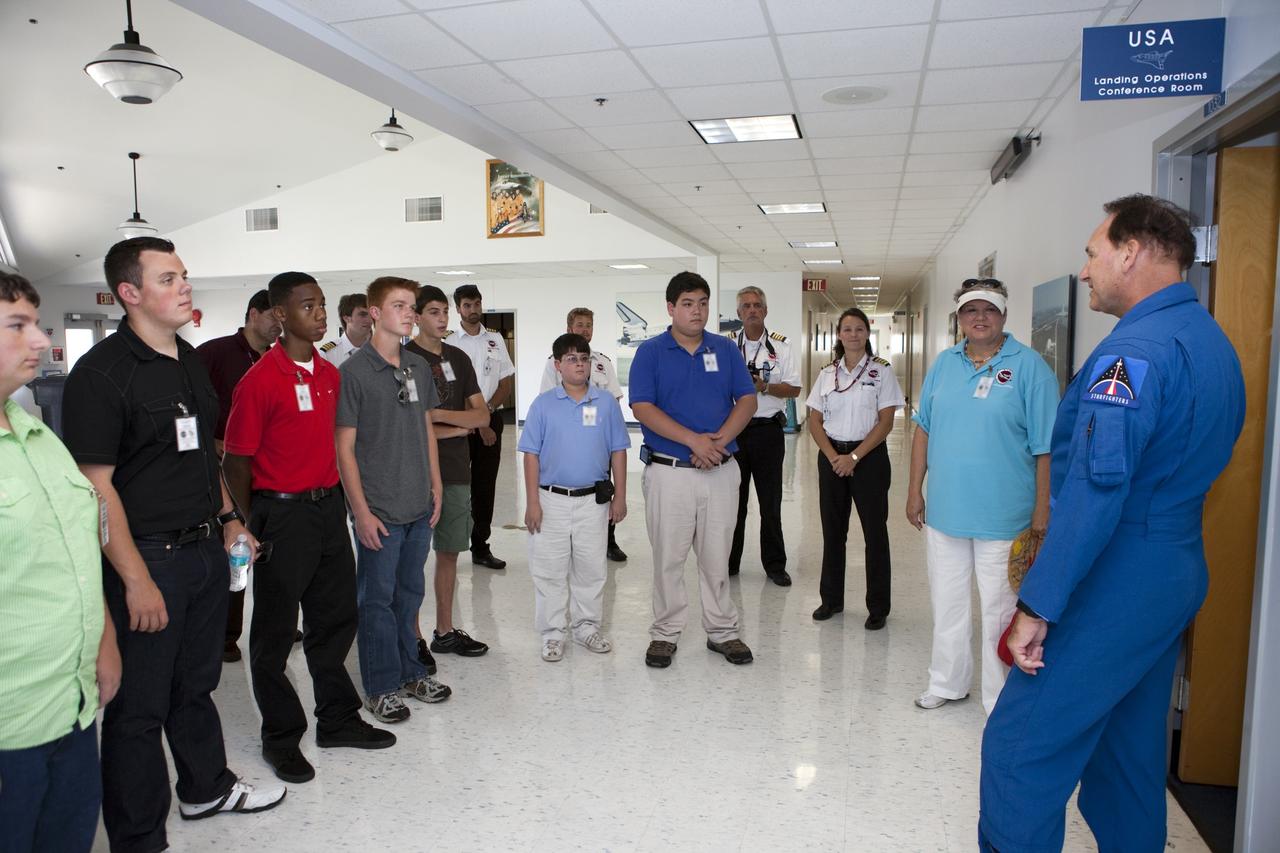
CAPE CANAVERAL, Fla. – In a support building near NASA Kennedy Space Center’s Shuttle Landing Facility, or SLF, in Florida, students and their flight instructors from Florida Tech, FIT, in Melbourne listen to F104 Starfighters Director Rick Svetkoff. The middle and high school students are participating in FIT’s Av/Aero summer camp experience. They and their flight instructors toured the SLF midfield control tower, viewed F104 Starfighters and NASA Huey helicopters in the RLV Hangar, viewed the runway plaques marking wheels stop for each of the three space shuttles, and toured the Vehicle Assembly Building where space shuttle Atlantis currently is stored. Photo credit: NASA/Kim Shiflett
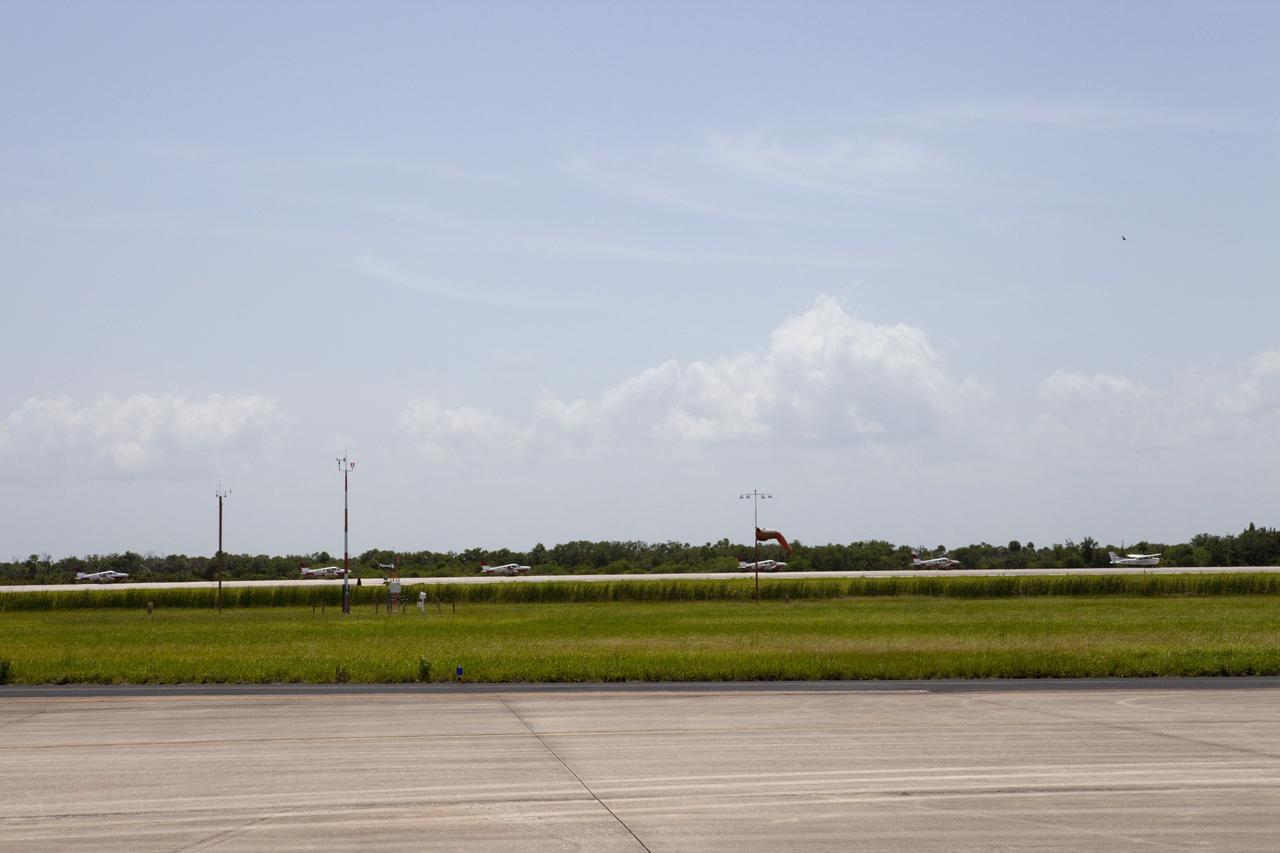
CAPE CANAVERAL, Fla. – At NASA Kennedy Space Center in Florida, flight instructors and their students from Florida Tech, or FIT, in Melbourne prepare to depart the Shuttle Landing Facility, or SLF, in Cherokee Warrior and Cessna 172S lightweight aircraft. The middle and high school students are participating in FIT’s Av/Aero summer camp experience. They and their flight instructors toured the SLF midfield control tower, viewed F104 Starfighters and NASA Huey helicopters in the RLV Hangar, viewed the runway plaques marking wheels stop for each of the three space shuttles, and toured the Vehicle Assembly Building where space shuttle Atlantis currently is stored. Photo credit: NASA/Kim Shiflett
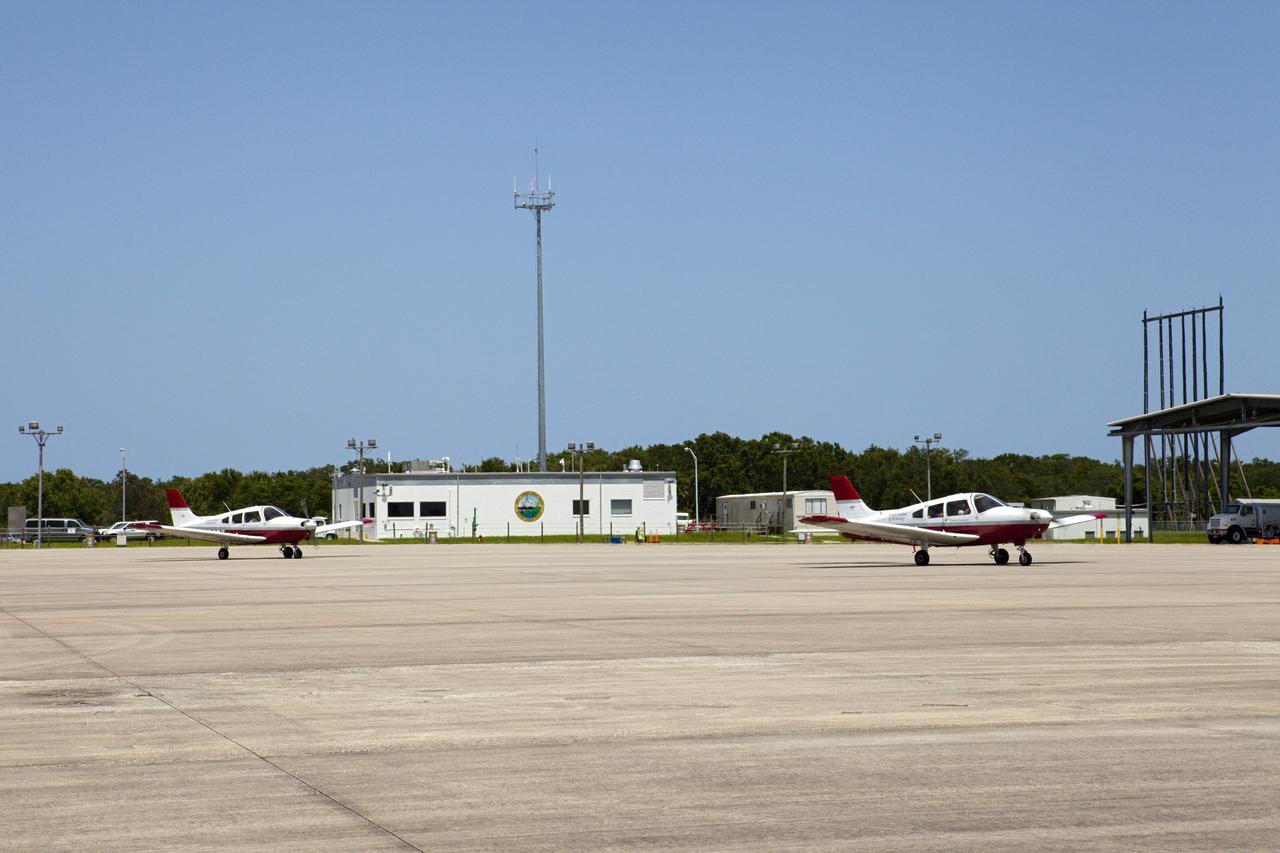
CAPE CANAVERAL, Fla. – At NASA Kennedy Space Center in Florida, flight instructors and their students from Florida Tech, or FIT, in Melbourne prepare to depart the Shuttle Landing Facility, or SLF, in Cherokee Warrior and Cessna 172S lightweight aircraft. The middle and high school students are participating in FIT’s Av/Aero summer camp experience. They and their flight instructors toured the SLF midfield control tower, viewed F104 Starfighters and NASA Huey helicopters in the RLV Hangar, viewed the runway plaques marking wheels stop for each of the three space shuttles, and toured the Vehicle Assembly Building where space shuttle Atlantis currently is stored. Photo credit: NASA/Kim Shiflett

CAPE CANAVERAL, Fla. – Students and their flight instructors from Florida Tech, or FIT, in Melbourne, tour the Vehicle Assembly Building and view space shuttle Atlantis at NASA’s Kennedy Space Center in Florida. The instructors and their students arrived at the Shuttle Landing Facility, or SLF, in Cherokee Warrior and Cessna 172S lightweight aircraft. The middle and high school students are participating in FIT’s Av/Aero summer camp experience. They and their flight instructors also toured the SLF midfield control tower, viewed F104 Starfighters and NASA Huey helicopters in the RLV Hangar, and viewed the runway plaques marking wheels stop for each of the three space shuttles. Photo credit: NASA/Kim Shiflett
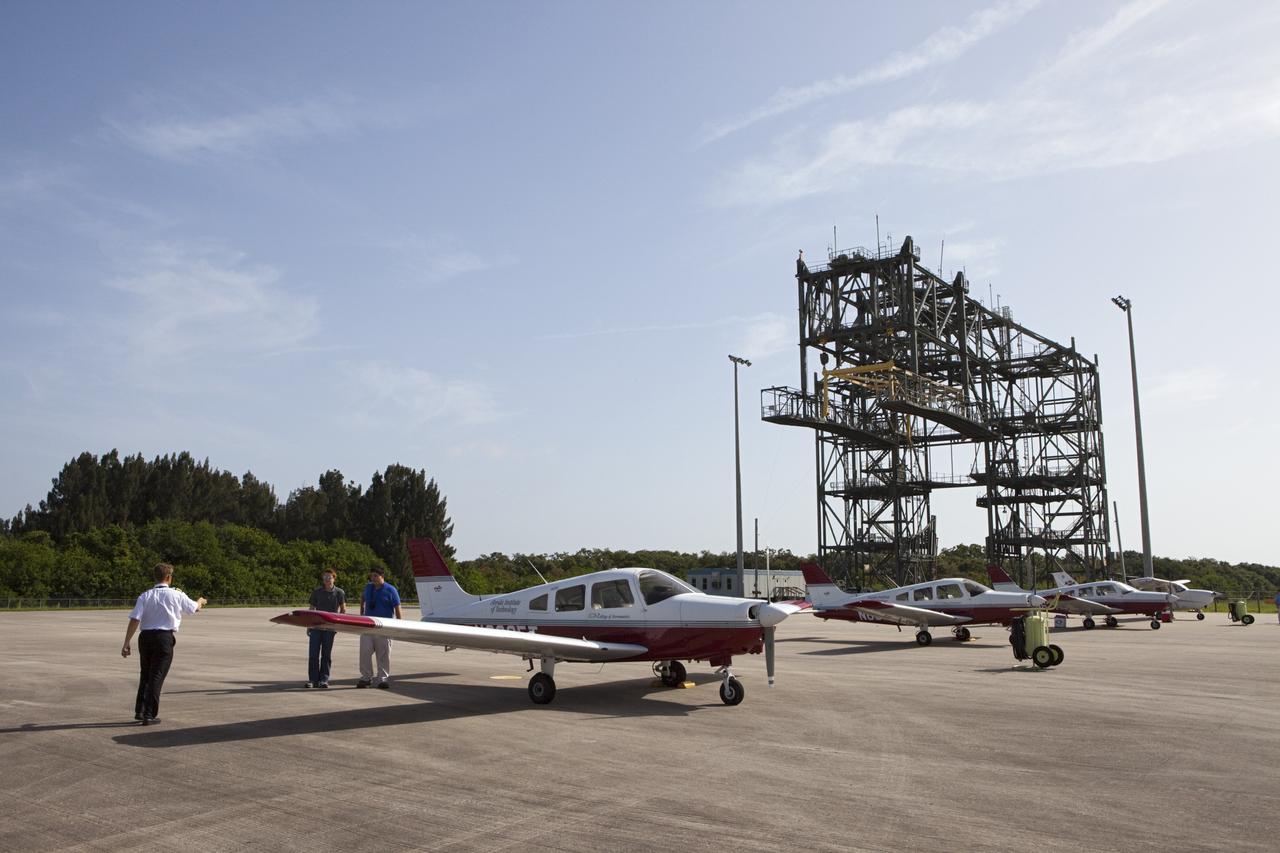
CAPE CANAVERAL, Fla. – Students and their flight instructors arrive at NASA Kennedy Space Center’s Shuttle Landing Facility, or SLF, in Florida in Cherokee Warrior and Cessna 172S lightweight aircraft from Florida Tech, or FIT, in Melbourne. The middle and high school students are participating in FIT’s Av/Aero summer camp experience. They and their flight instructors toured the SLF midfield control tower, viewed F104 Starfighters and NASA Huey helicopters in the RLV Hangar, viewed the runway plaques marking wheels stop for each of the three space shuttles, and toured the Vehicle Assembly Building where space shuttle Atlantis currently is stored. Photo credit: NASA/Kim Shiflett
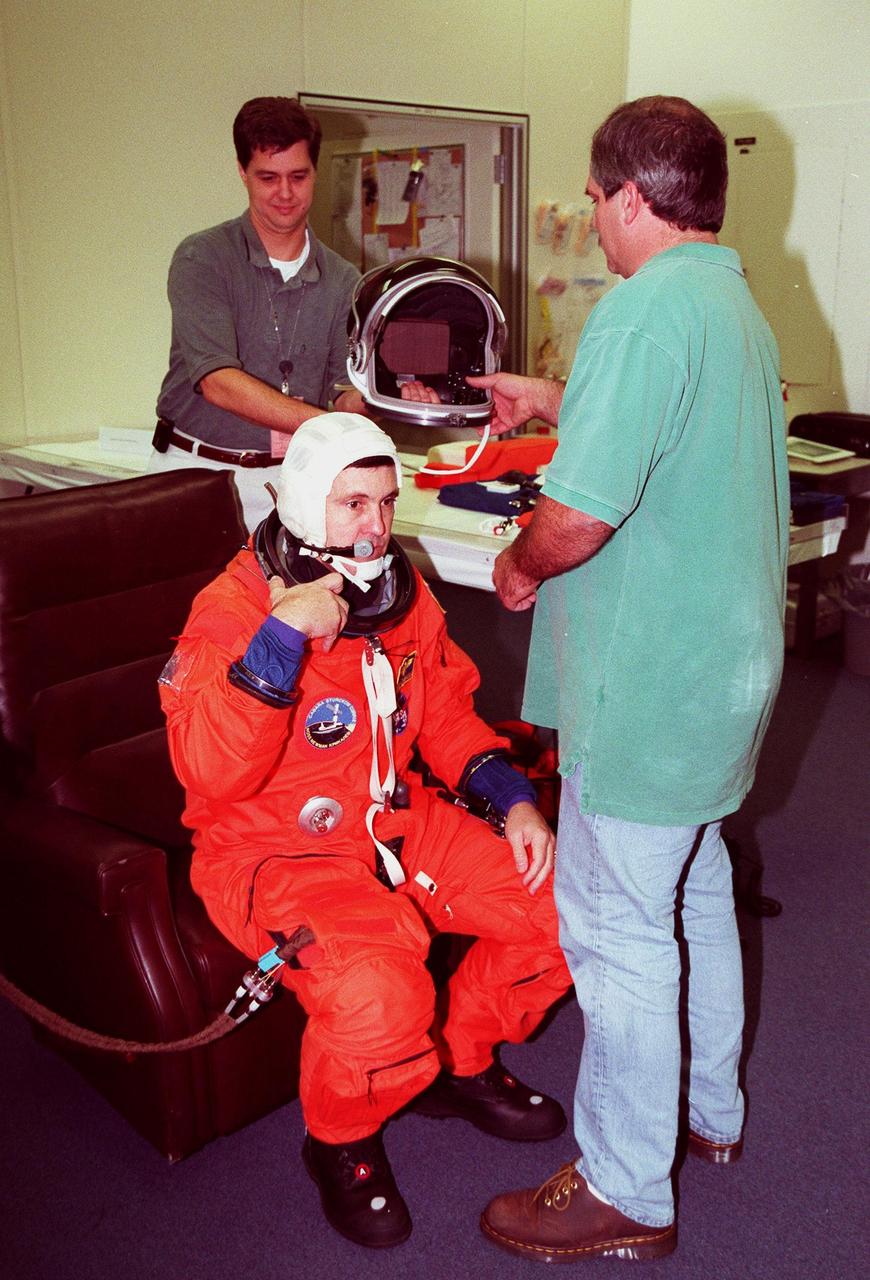
STS-88 Mission Commander Robert D. Cabana suits up in the Operations and Checkout Building prior, as part of flight crew equipment fit check, to his trip to Launch Pad 39A. He is helped by suit tech (right) Lloyd Armintor and an unidentified KSC worker. The crew are at KSC to participate in the Terminal Countdown Demonstration Test (TCDT) which includes mission familiarization activities, emergency egress training, and the simulated main engine cut-off exercise. This is Cabana's fourth space flight. Mission STS-88 is targeted for launch on Dec. 3, 1998. It is the first U.S. flight for the assembly of the International Space Station and will carry the Unity connecting module
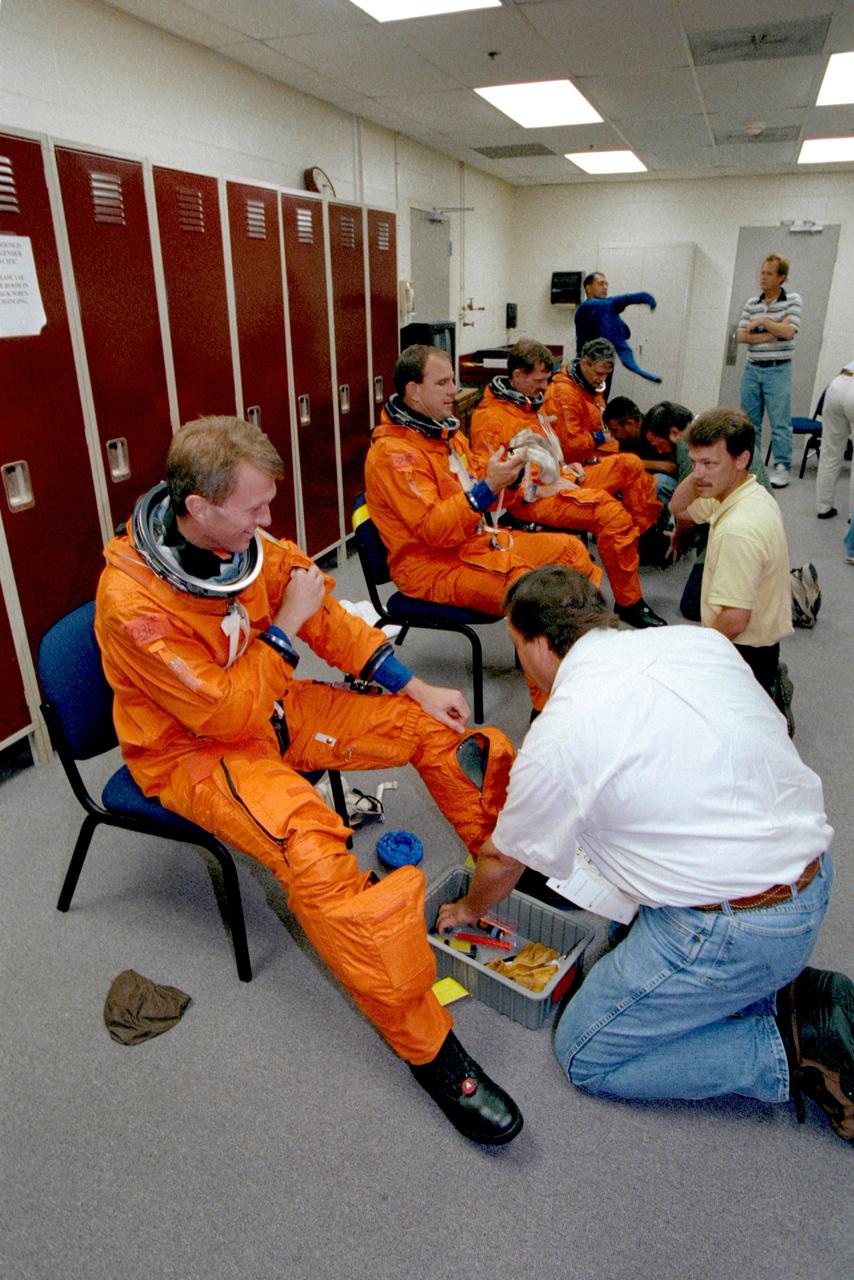
JSC2000-04751 (15 June 2000) --- Members of the STS-97 crew don training versions of the ascent and entry suits for a training session in the Johnson Space Center's Systems Integration Facility. Wearing the burnt-orange pressure suits, from the left, are astronauts Brent W. Jett, mission commander; Michael J. Bloomfield, pilot; and Joseph R. Tanner and Marc Garneau, both mission specialists. Garneau represents the Canadian Space Agency (CSA). Suit technicians assisting are Mike Birkenseher, Brad Milling, Steve Clendenin and Rudy Molina. In the background Carlos I. Noriega, mission specialist, prepares to put on his suit with the assistance of suit tech John Hazelhurt.
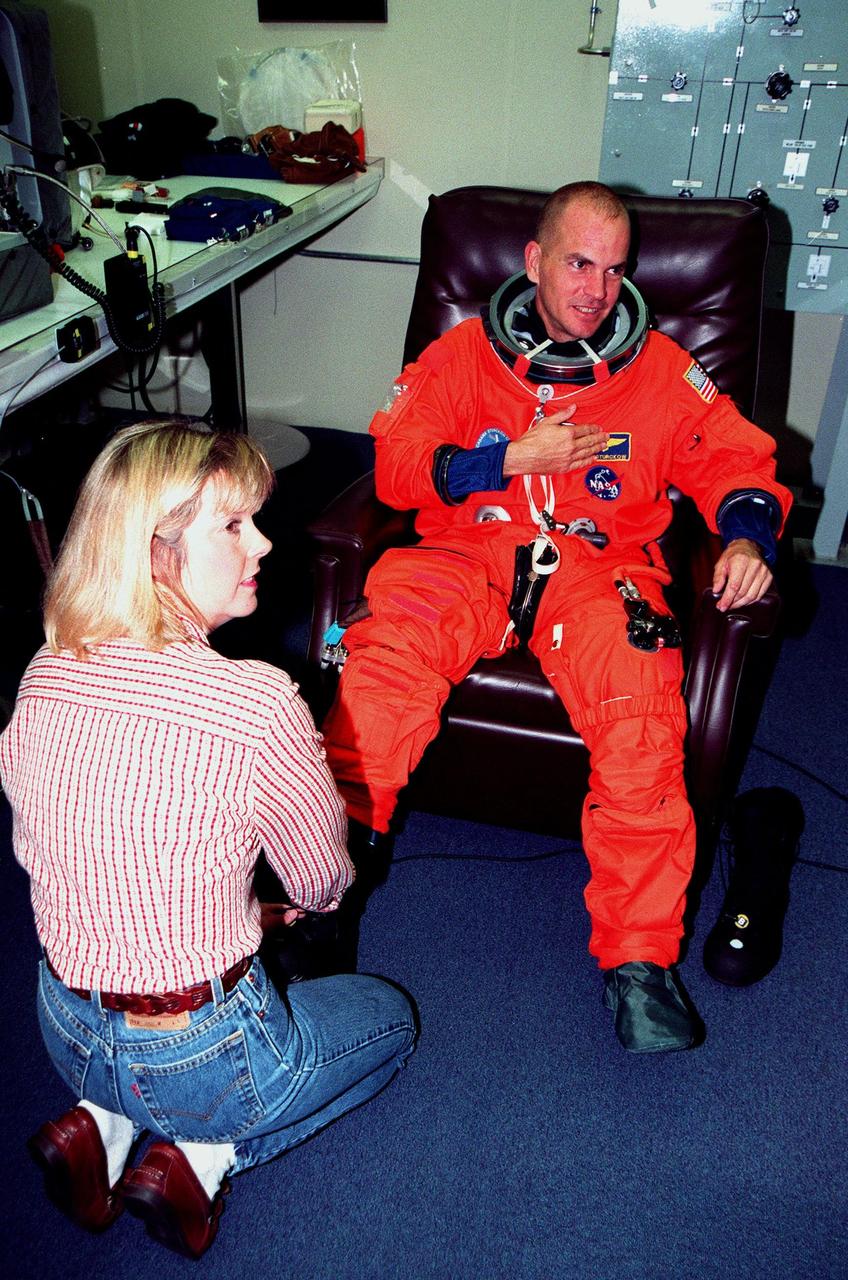
STS-88 Pilot Frederick W. "Rick" Sturckow suits up in the Operations and Checkout Building, as part of flight crew equipment fit check, prior to his trip to Launch Pad 39A. He is helped by suit tech Terri McKinney. The crew are at KSC to participate in the Terminal Countdown Demonstration Test (TCDT) which includes mission familiarization activities, emergency egress training, and the simulated main engine cut-off exercise. This is Sturckow's first space flight. Mission STS-88 is targeted for launch on Dec. 3, 1998. It is the first U.S. flight for the assembly of the International Space Station and will carry the Unity connecting module
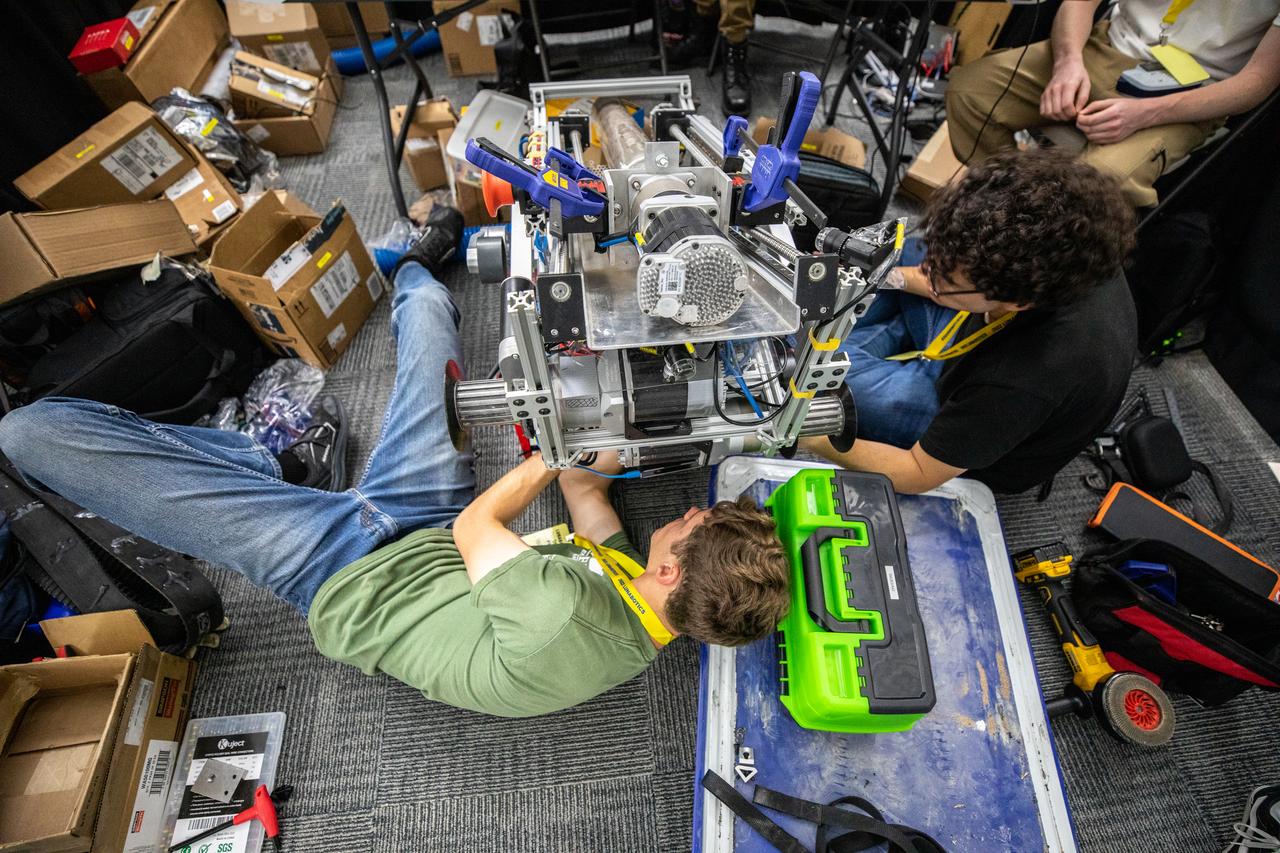
New Mexico Tech students prepare their robotic miner for its turn to dig in the mining arena during NASA’s LUNABOTICS competition on May 23, 2022, at the Center for Space Education near the Kennedy Space Center Visitor Complex in Florida. More than 35 teams from around the U.S. have designed and built remote-controlled robots for the mining competition. Teams use their autonomous or remote-controlled robots to maneuver and dig in a supersized sandbox filled with rocks and simulated lunar soil, or regolith. The objective of the challenge is to see which team’s robot can collect and deposit the most rocky regolith within a specified amount of time.

Cameron Symonds, of New Mexico Tech, prepares his team’s prototype lunar robot for its turn during the finals for NASA’s 2026 Lunabotics Challenge competition on Tuesday, May 19, 2026, inside the Astronauts Memorial Foundation’s Center for Space Education at the Kennedy Space Center Visitor Complex in Florida. Forty-seven teams from around the U.S. designed and built remote-controlled robots capable of traversing challenging lunar terrain while constructing regolith-based berm under conditions similar to those the agency will face as it returns to the lunar surface through Artemis.
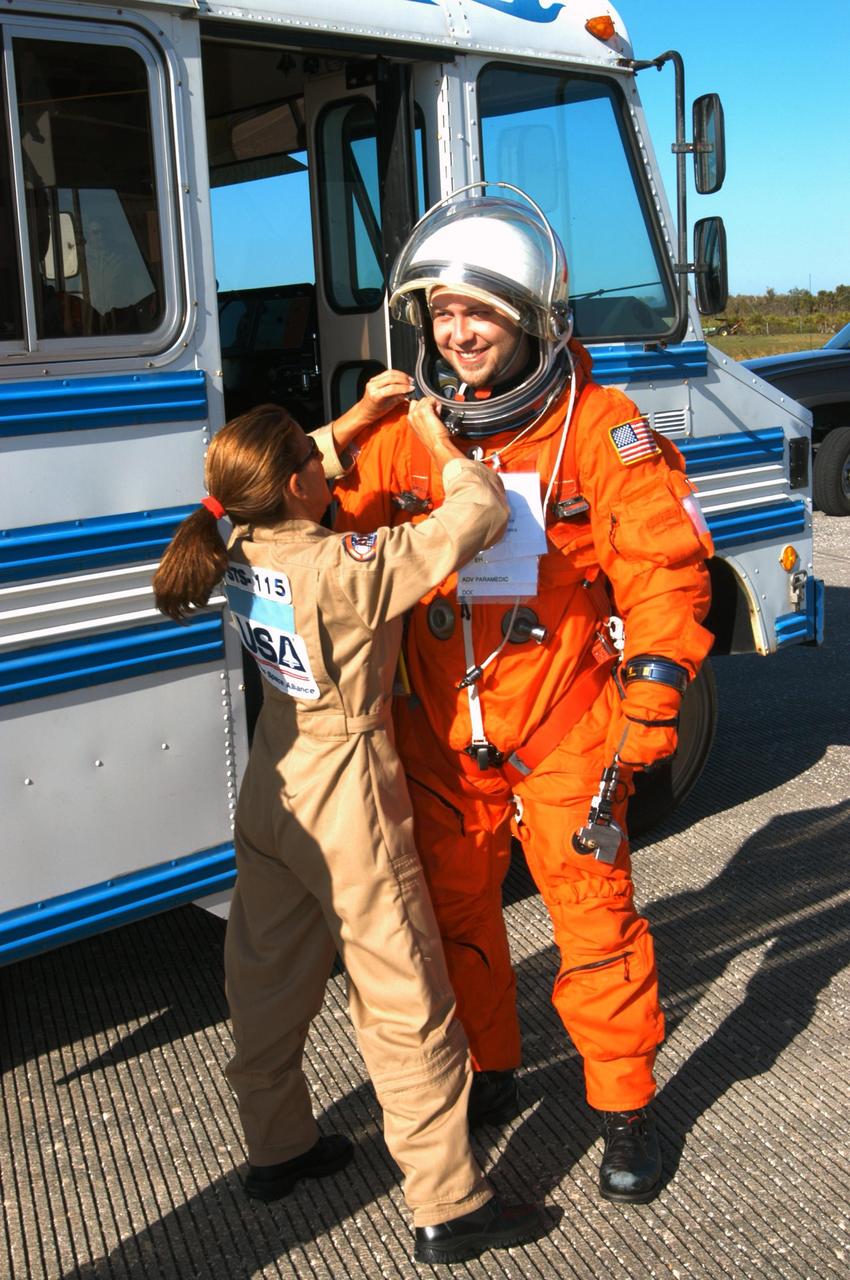
KENNEDY SPACE CENTER, FLA. - Preparing for a simulated emergency landing of a shuttle crew, United Space Alliance (USA) Suit Tech Toni Costa-Davis helps volunteer "astronaut" Brian Bateman, also with USA, with his launch and entry suit. Many volunteers posed as astronauts during the simulation. Known as a Mode VI exercise, the operation uses volunteer workers from the Center to pose as astronauts. The purpose of the simulation is to exercise emergency preparedness personnel, equipment and facilities in rescuing astronauts from a downed orbiter and providing immediate medical attention. Photo credit: NASA/George Shelton
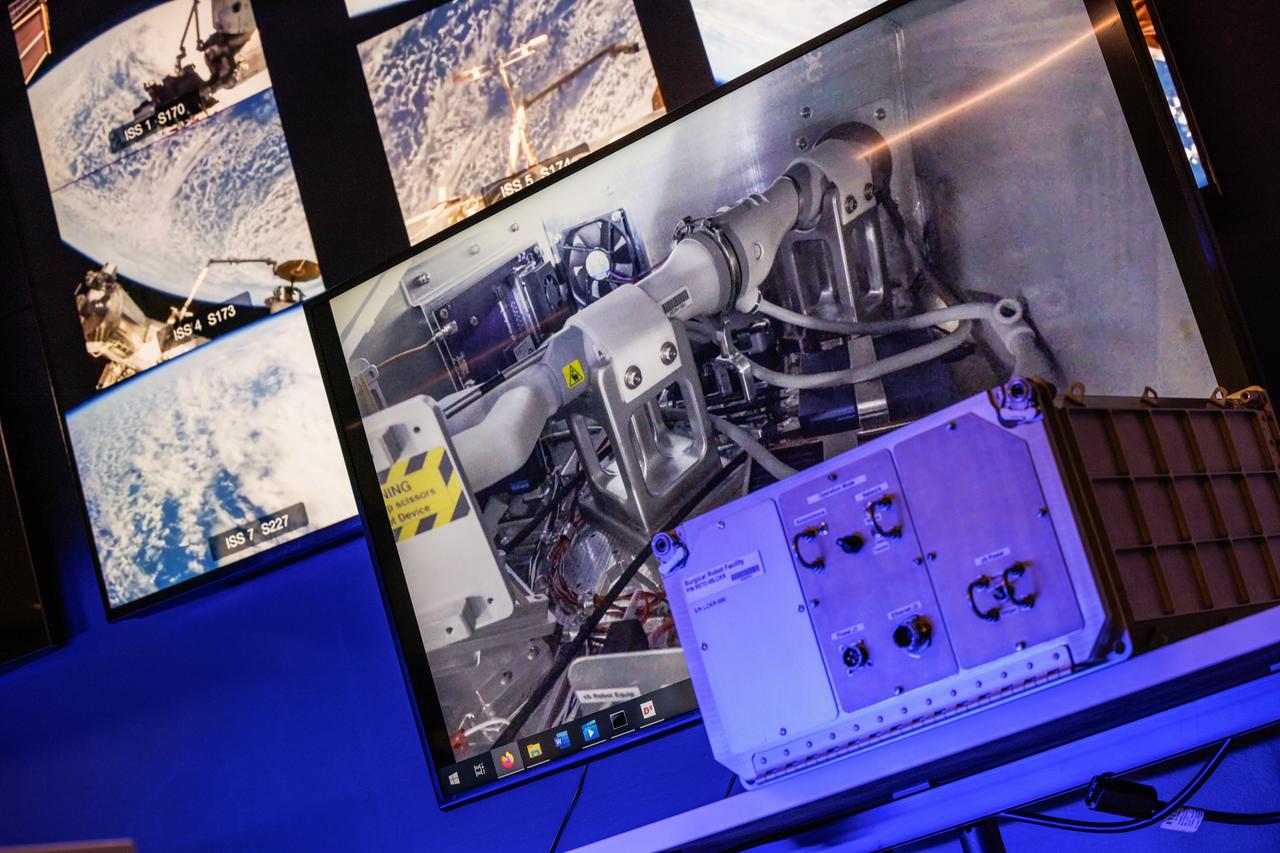
jsc2024e041211 (2/10/2024) --- Robotic Surgery Tech Demo tests techniques for performing robotic surgery in microgravity using a miniature surgical robot that can be remotely controlled or teleoperated from Earth. Several monitors at the Virtual Incision offices in Lincoln, Nebraska show views of the International Space Station during remote operations. Near the center, a larger monitor shows inside the box aboard the space station that houses the surgical robot. Results from this investigation could support the development of robotic systems to perform remote procedures. Miniaturization and the ability to remotely control robots may help to make surgery available anywhere and anytime. Image courtesy of the University of Nebraska-Lincoln.

Students from New Mexico Tech prepare their prototype lunar robot for its turn during the finals for NASA’s 2026 Lunabotics Challenge competition on Tuesday, May 19, 2026, inside the Astronauts Memorial Foundation’s Center for Space Education at the Kennedy Space Center Visitor Complex in Florida. Forty-seven teams from around the U.S. designed and built remote-controlled robots capable of traversing challenging lunar terrain while constructing regolith-based berm under conditions similar to those the agency will face as it returns to the lunar surface through Artemis.
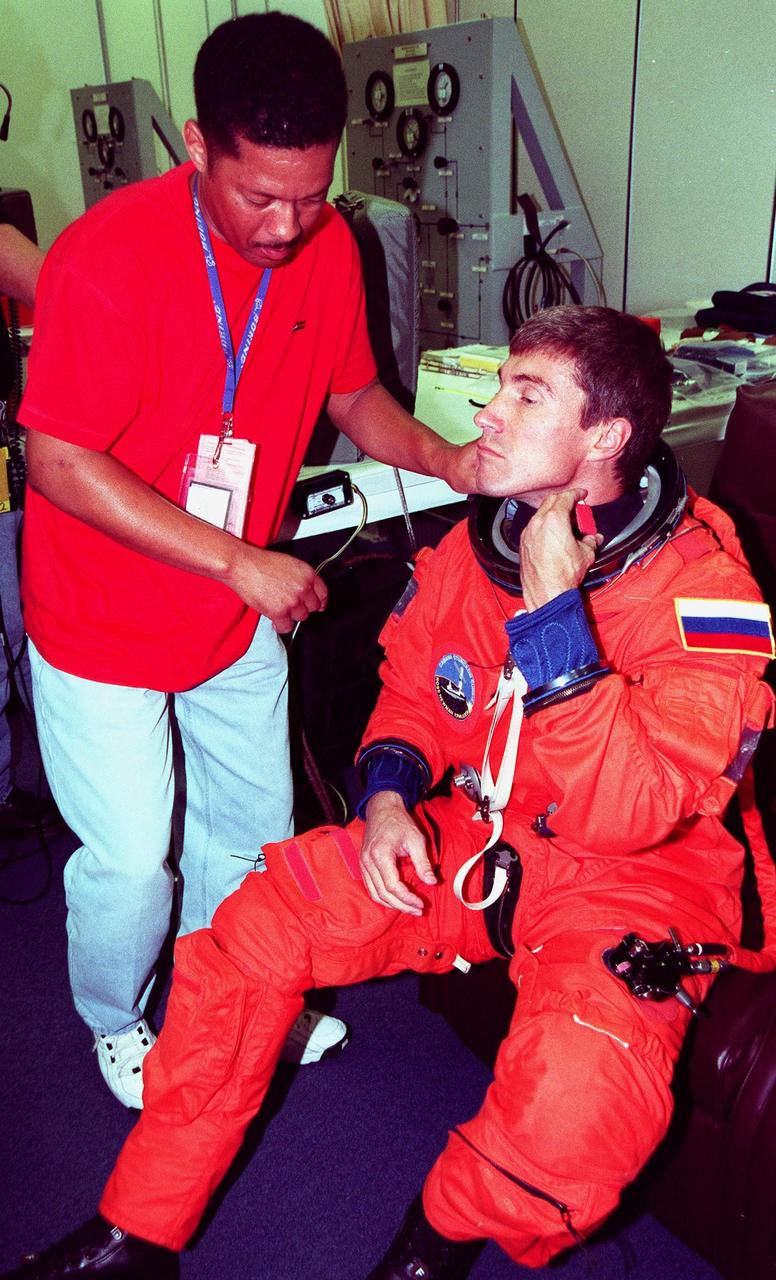
STS-88 Mission Specialist Sergei Konstantinovich Krikalev, a Russian cosmonaut, suits up in the Operations and Checkout Building, as part of a flight crew equipment fit check, prior to his trip to Launch Pad 39A. He is helped by suit tech George Brittingham. The STS-88 crew is at KSC to participate in the Terminal Countdown Demonstration Test (TCDT) which includes mission familiarization activities, emergency egress training, and a simulated launch countdown. This is Krikalev's second flight on the Space Shuttle. Mission STS-88 is targeted for launch on Dec. 3, 1998. It is the first U.S. flight for the assembly of the International Space Station and will carry the Unity connecting module
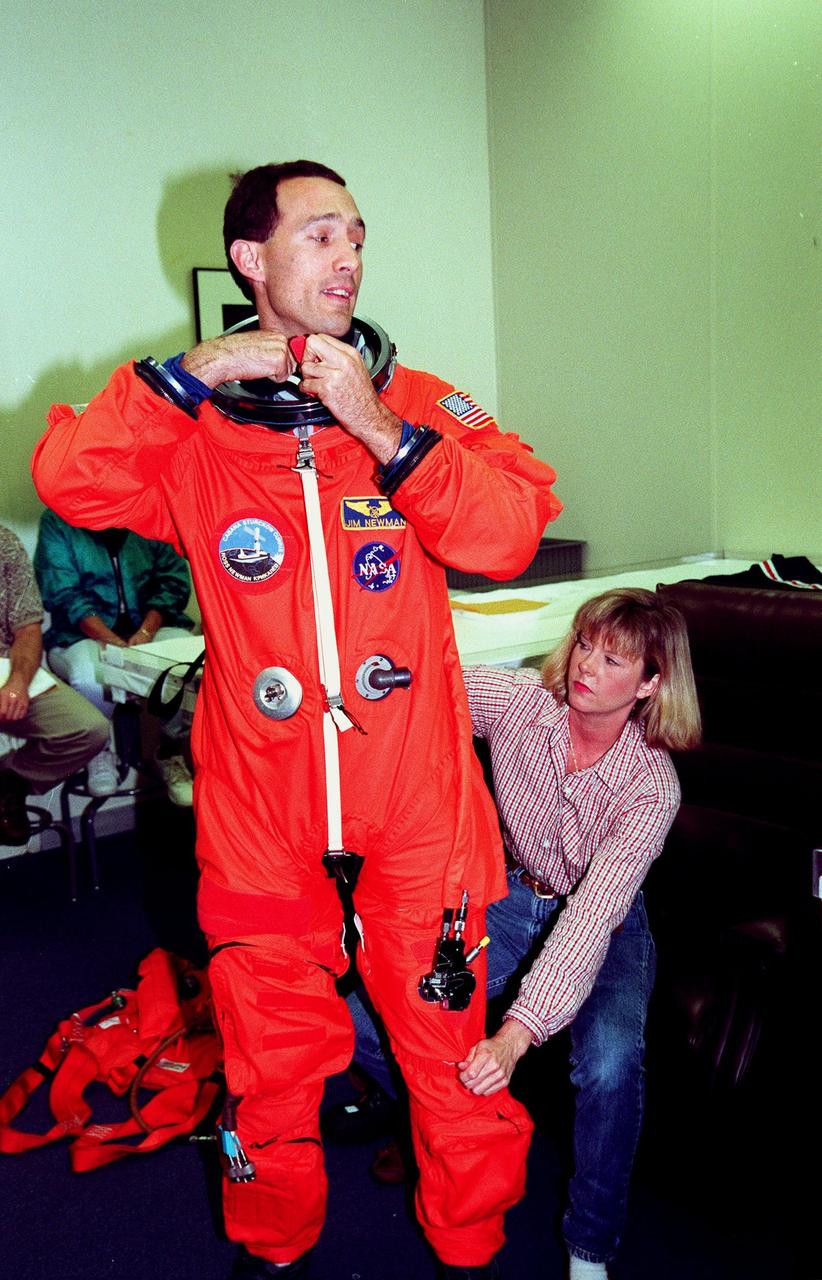
STS-88 Mission Specialist James H. Newman (left) suits up in the Operations and Checkout Building, as part of flight crew equipment fit check, prior to his trip to Launch Pad 39A. He is helped by suit tech Terri McKinney. The crew are at KSC to participate in the Terminal Countdown Demonstration Test (TCDT) which includes mission familiarization activities, emergency egress training, and the simulated main engine cut-off exercise. This is Newman's third space flight. Mission STS-88 is targeted for launch on Dec. 3, 1998. It is the first U.S. flight for the assembly of the International Space Station and will carry the Unity connecting module
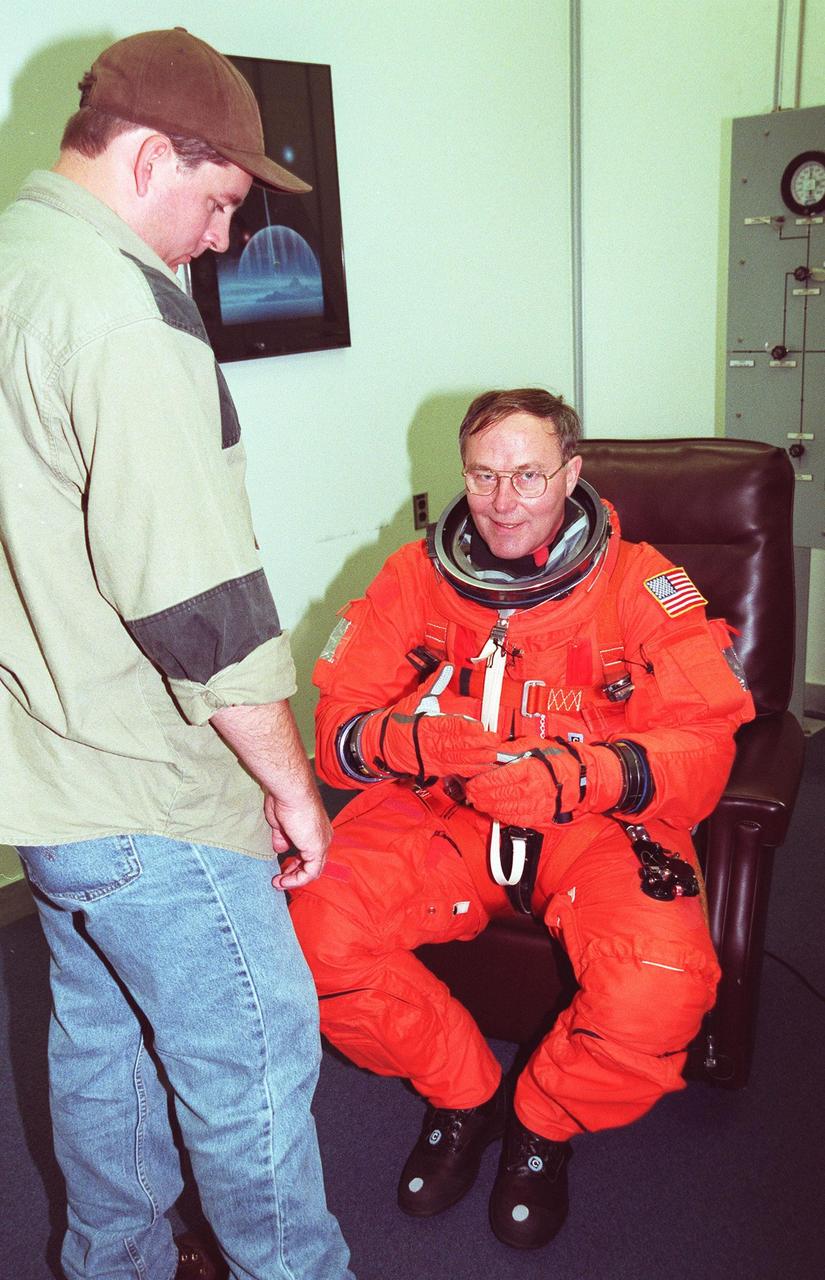
STS-88 Mission Specialist Jerry L. Ross (right) suits up in the Operations and Checkout Building, as part of a flight crew equipment fit check, prior to his trip to Launch Pad 39A. He is helped by suit tech Leonard Groce II. The STS-88 crew is at KSC to participate in the Terminal Countdown Demonstration Test (TCDT) which includes mission familiarization activities, emergency egress training, and a simulated launch countdown. This is Ross' sixth space flight. Mission STS-88 is targeted for launch on Dec. 3, 1998. It is the first U.S. flight for the assembly of the International Space Station and will carry the Unity connecting module
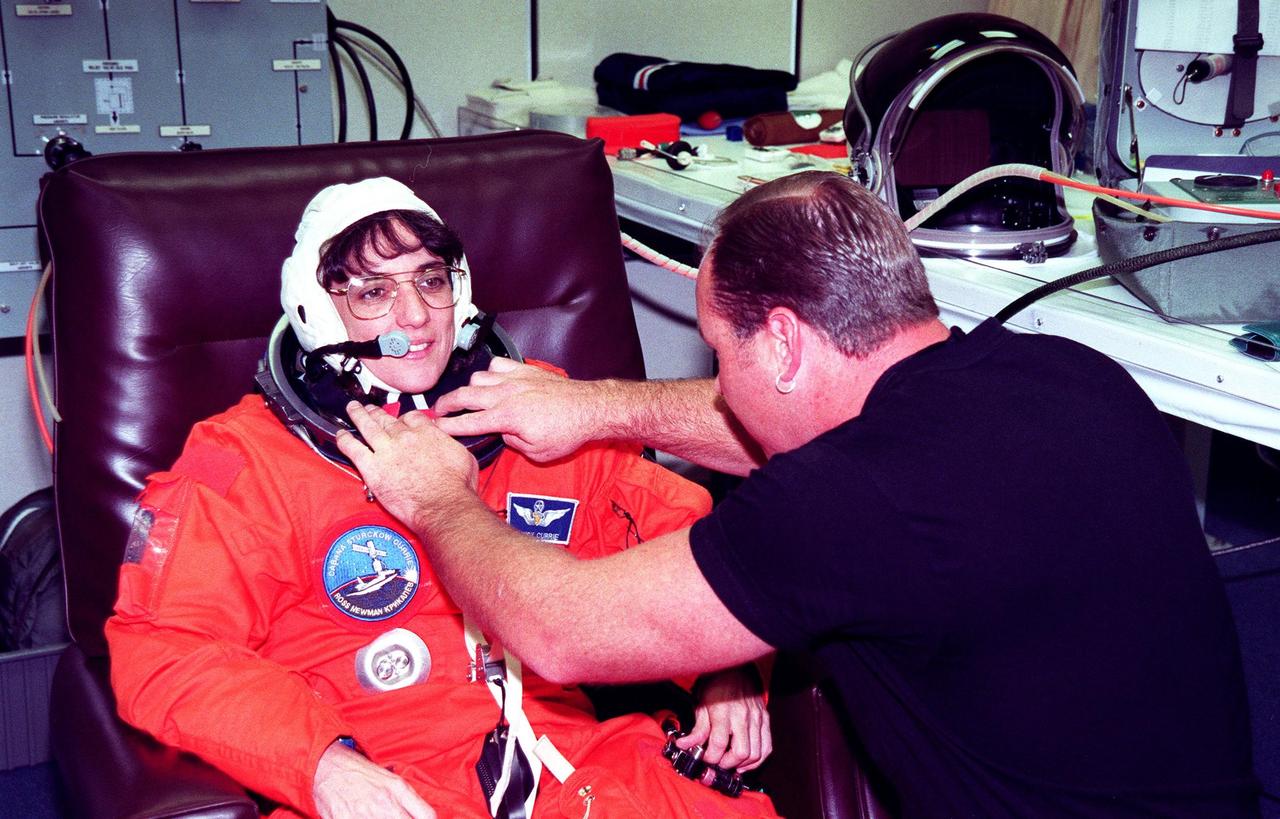
STS-88 Mission Specialist Nancy J. Currie suits up in the Operations and Checkout Building, as part of flight crew equipment fit check, prior to her trip to Launch Pad 39A. She is helped by suit tech Drew Billingsley. The crew are at KSC to participate in the Terminal Countdown Demonstration Test (TCDT) which includes mission familiarization activities, emergency egress training, and the simulated main engine cut-off exercise. This is Currie's third space flight. Mission STS-88 is targeted for launch on Dec. 3, 1998. It is the first U.S. flight for the assembly of the International Space Station and will carry the Unity connecting module
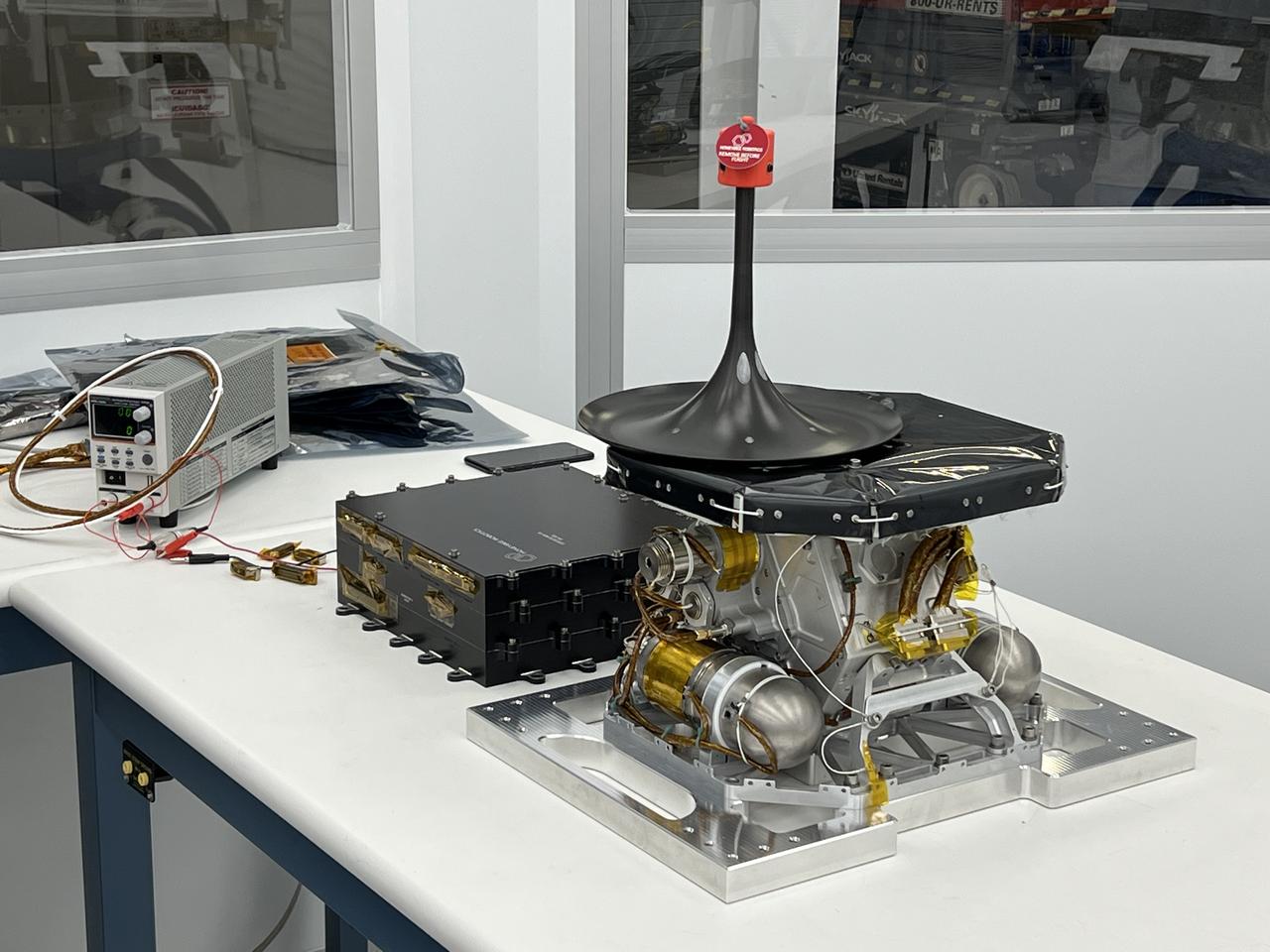
A science instrument flying aboard the next delivery for NASA’s CLPS (Commercial Lunar Payload Services) initiative could help improve our understanding of the Moon. The Lunar Instrumentation for Subsurface Thermal Exploration with Rapidity, or LISTER, is one of 10 payloads set to be carried to the Moon by the Blue Ghost 1 lunar lander in 2025. Developed jointly by Texas Tech University and Honeybee Robotics, LISTER’s planned mission is to measure the flow of heat from the Moon’s interior using a specialized drill. Investigations and demonstrations, such as LISTER, launched on CLPS flights will help NASA study Earth’s nearest neighbor under Artemis and pave the way for future crewed missions on the Moon. NASA’s Marshall Space Flight Center in Huntsville, Alabama, manages the development and operations for seven of the 10 CLPS payloads that will be carried on Firefly’s Blue Ghost lunar lander.
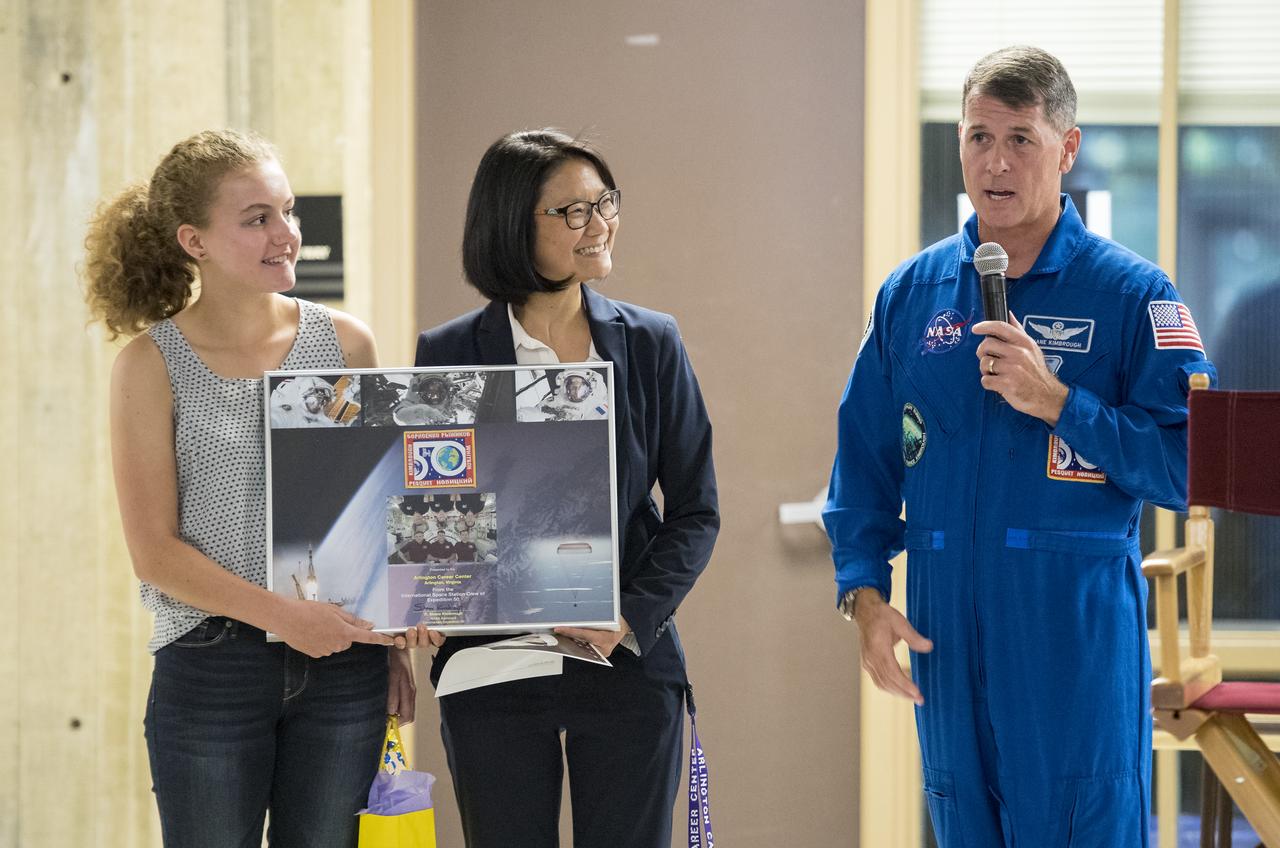
NASA astronaut Shane Kimbrough presents a montage of photos and the Expedition 50 patch to the Arlington Tech High School who hosted his presentation on his time onboard the International Space Station (ISS) during Expeditions 49/50, Tuesday, September 12, 2017 at Arlington Career Center in Arlington, Virginia. During Expedition 50, Kimbrough completed four spacewalks for a total of 39 hours outside the ISS, and concluded his 173-day mission when he landed in a remote area near the town of Zhezkazgan, Kazakhstan in April 2017. Photo Credit: (NASA/Aubrey Gemignani)
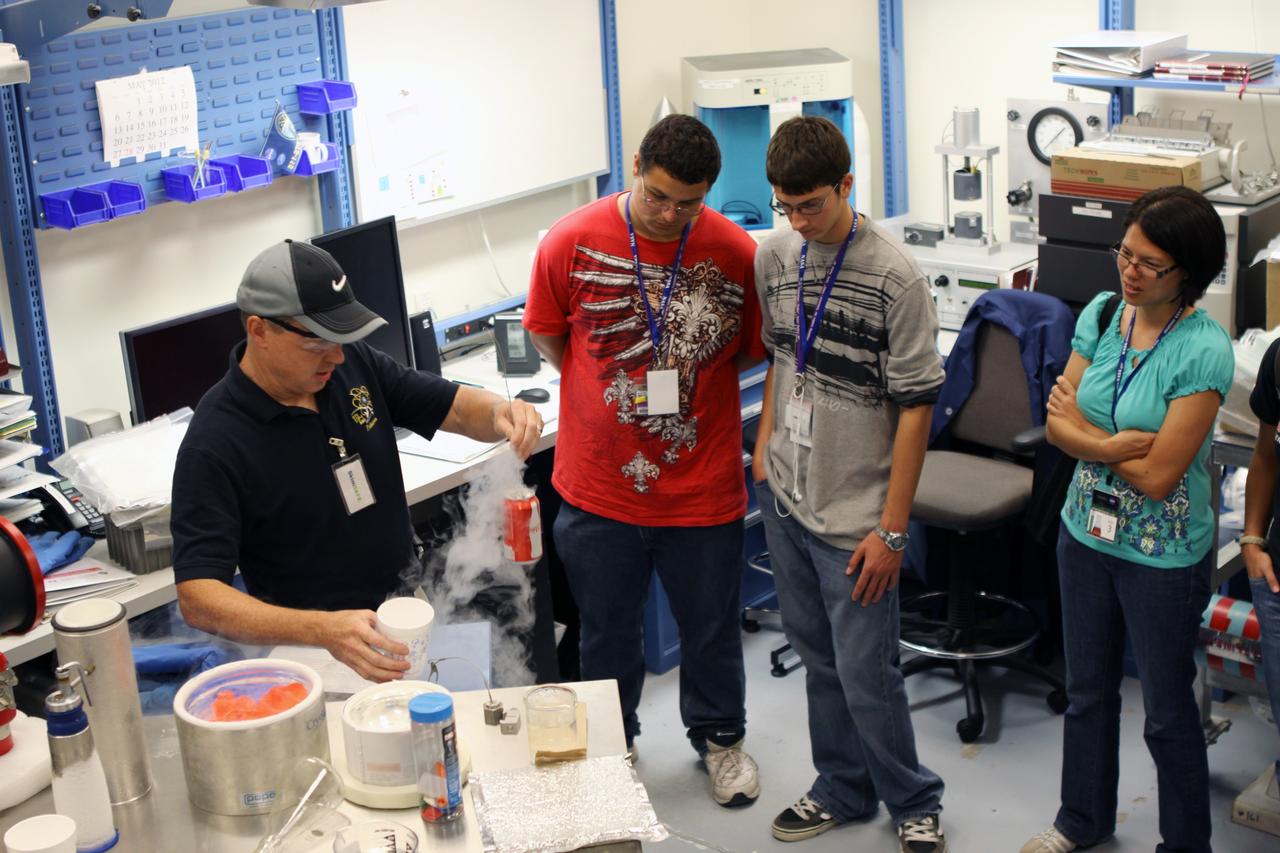
CAPE CANAVERAL, Fla. – Students view a demonstration by Dr. James Fesmire inside the cryogenics lab in the Operations and Checkout Building. The 26 honor students in chemistry and biology and their teachers got a chance to visit a number of high-tech labs at Kennedy Space Center as part of an effort to encourage students in the areas of science, technology, engineering and math. The tenth and eleventh grade students from Terry Parker High School in Jacksonville, Fla., visited a number of vastly different labs during their one-day tour. The group's visit to Kennedy was hosted by the Education Office as part of a nationwide effort by the National Lab Network to help introduce the nation's students to science careers. Photo credit: NASA/Jim Grossmann
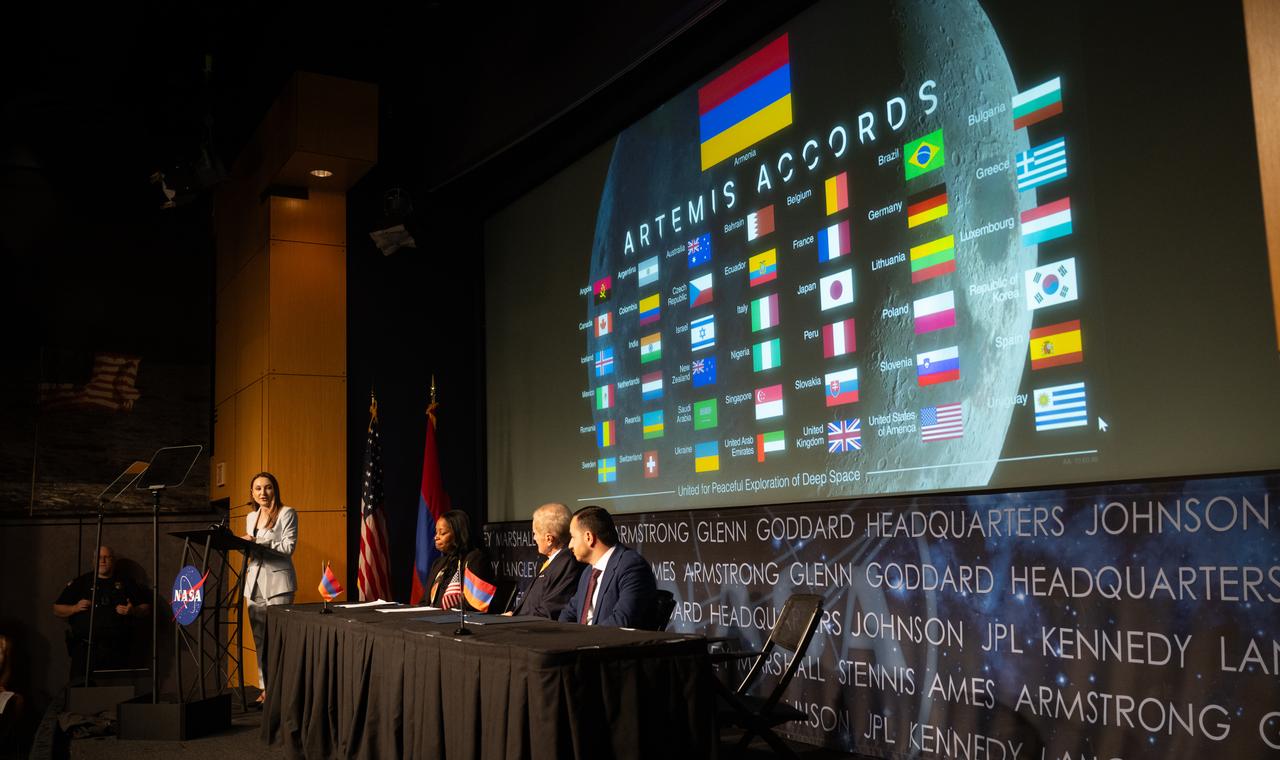
Ambassador of the Republic of Armenia to the United States Lilit Makunts, left, delivers remarks during an Artemis Accords signing ceremony as Acting Assistant Secretary of State for the Bureau of Oceans and International Environmental and Scientific Affairs Jennifer Littlejohn, second from left, NASA Administrator Bill Nelson, and Mkhitar Hayrapetyan, Minister of High-Tech Industry of the Republic of Armenia look on, Wednesday, June 12, 2024, at the Mary W. Jackson NASA Headquarters building in Washington. The Republic of Armenia is the 43rd country to sign the Artemis Accords, which establish a practical set of principles to guide space exploration cooperation among nations participating in NASA’s Artemis program. Photo Credit: (NASA/Joel Kowsky)
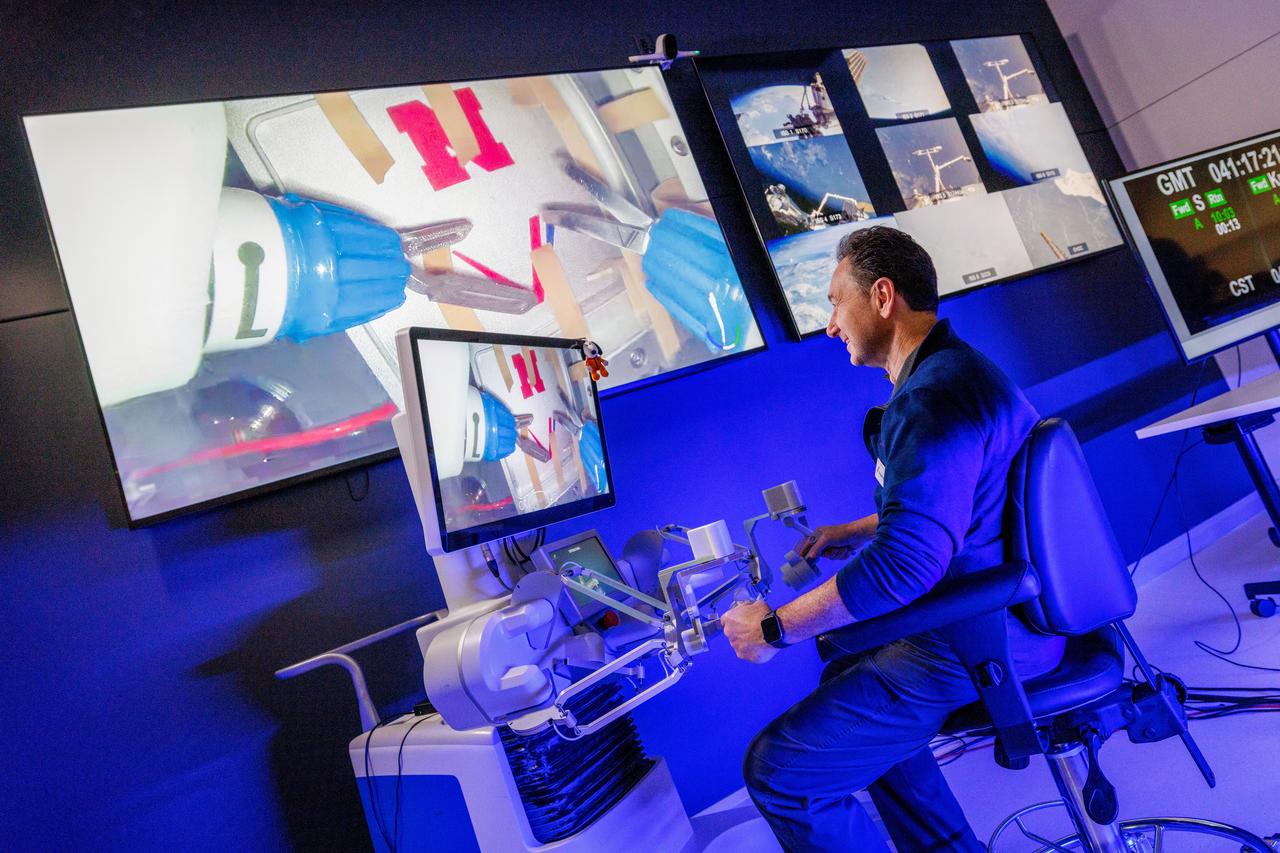
jsc2024e041215 (2/10/2024) --- Dr. Dmitry Oleynikov remotely operates a surgical robot aboard the International Space Station using controls at the Virtual Incision offices in Lincoln, Nebraska. Robotic Surgery Tech Demo tests techniques for performing a simulated surgical procedure in microgravity using a miniature surgical robot that can be remotely controlled or teleoperated from Earth. Results from this investigation could support the development of robotic systems to perform these procedures. Miniaturization and the ability to remotely control robots may help to make surgery available anywhere and anytime. Image courtesy of the University of Nebraska-Lincoln.
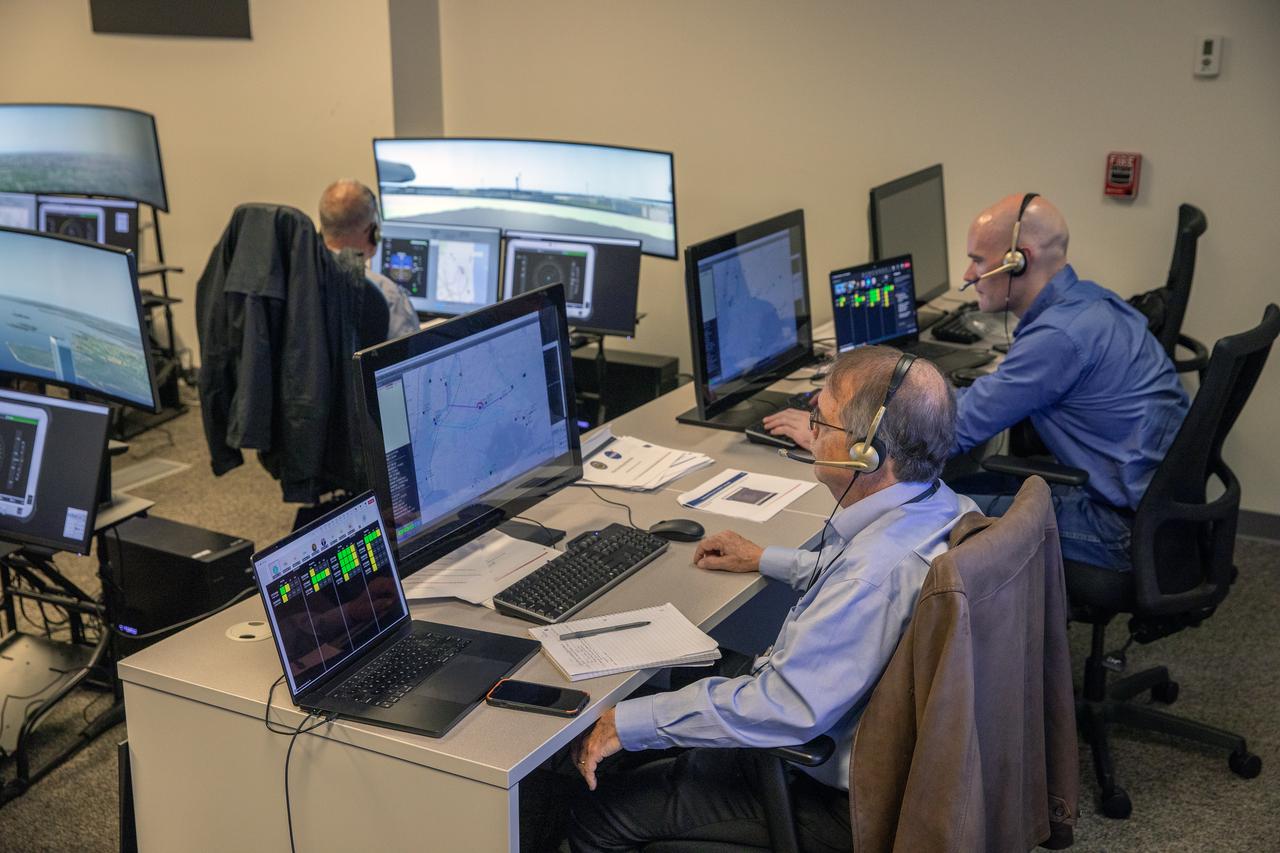
Focus on active photos –Class B Simulation Evaluation in the ATOL Lab at Langley (Also at FAA Tech Center) where team is working with one another in the lab, reviewing data on the monitors. Working the software, adjusting the software systems. Going over the shoulder to show the displays and screens as the software is running. John Foster (left) in the role of an air taxi pilot in the simulator chair with Jim Chamberlain and Terence McClain at the flight manager stations running virtual air taxi integration simulations focusing on urban air space at NASA’s Langley Research Center in Hampton, Virginia on Sept. 25, 2024.
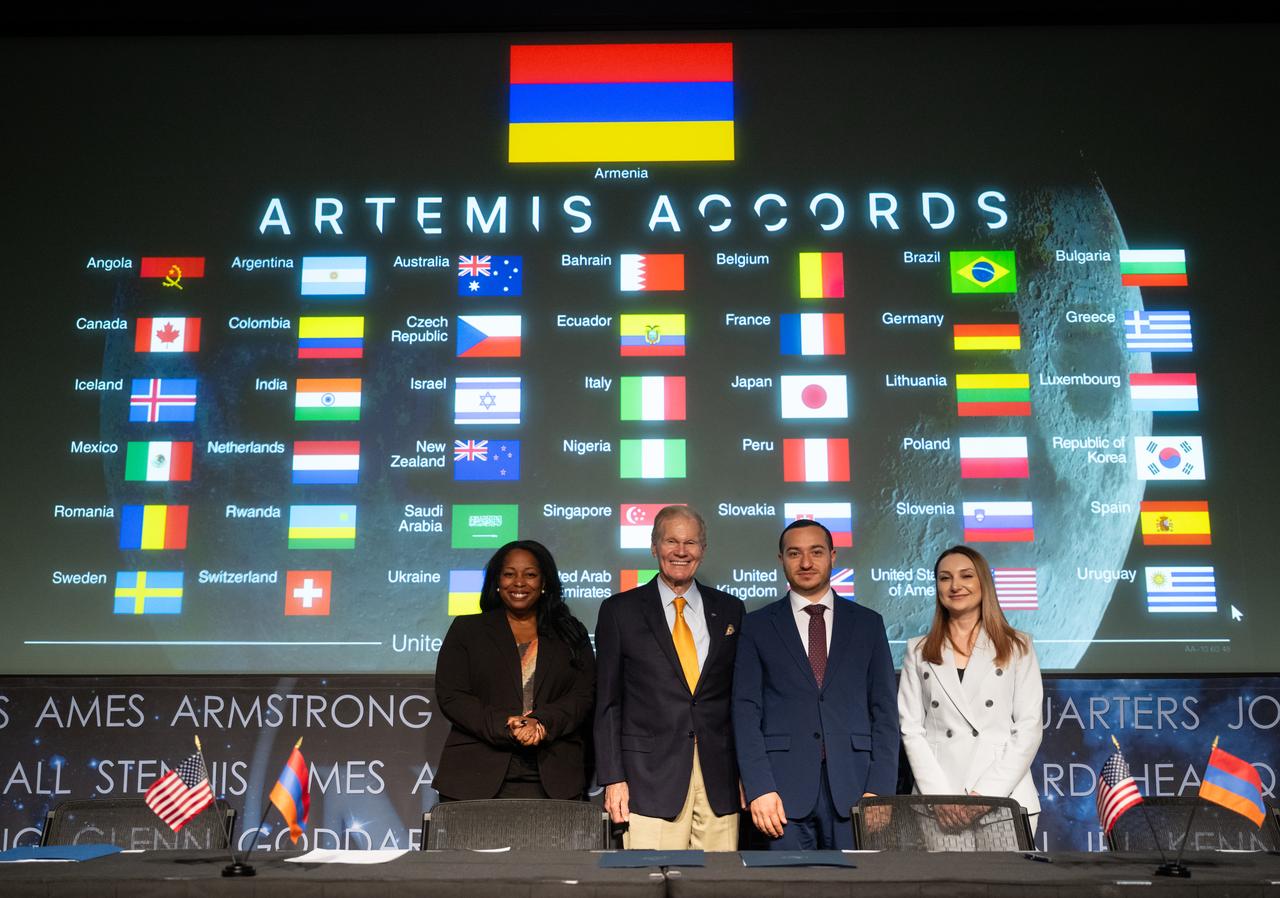
Acting Assistant Secretary of State for the Bureau of Oceans and International Environmental and Scientific Affairs Jennifer Littlejohn, left, NASA Administrator Bill Nelson, Mkhitar Hayrapetyan, Minister of High-Tech Industry of the Republic of Armenia, and Ambassador of the Republic of Armenia to the United States Lilit Makunts, pose for a picture after the signing of the Artemis Accords, Wednesday, June 12, 2024, at the Mary W. Jackson NASA Headquarters building in Washington. The Republic of Armenia is the 43rd country to sign the Artemis Accords, which establish a practical set of principles to guide space exploration cooperation among nations participating in NASA’s Artemis program. Photo Credit: (NASA/Joel Kowsky)
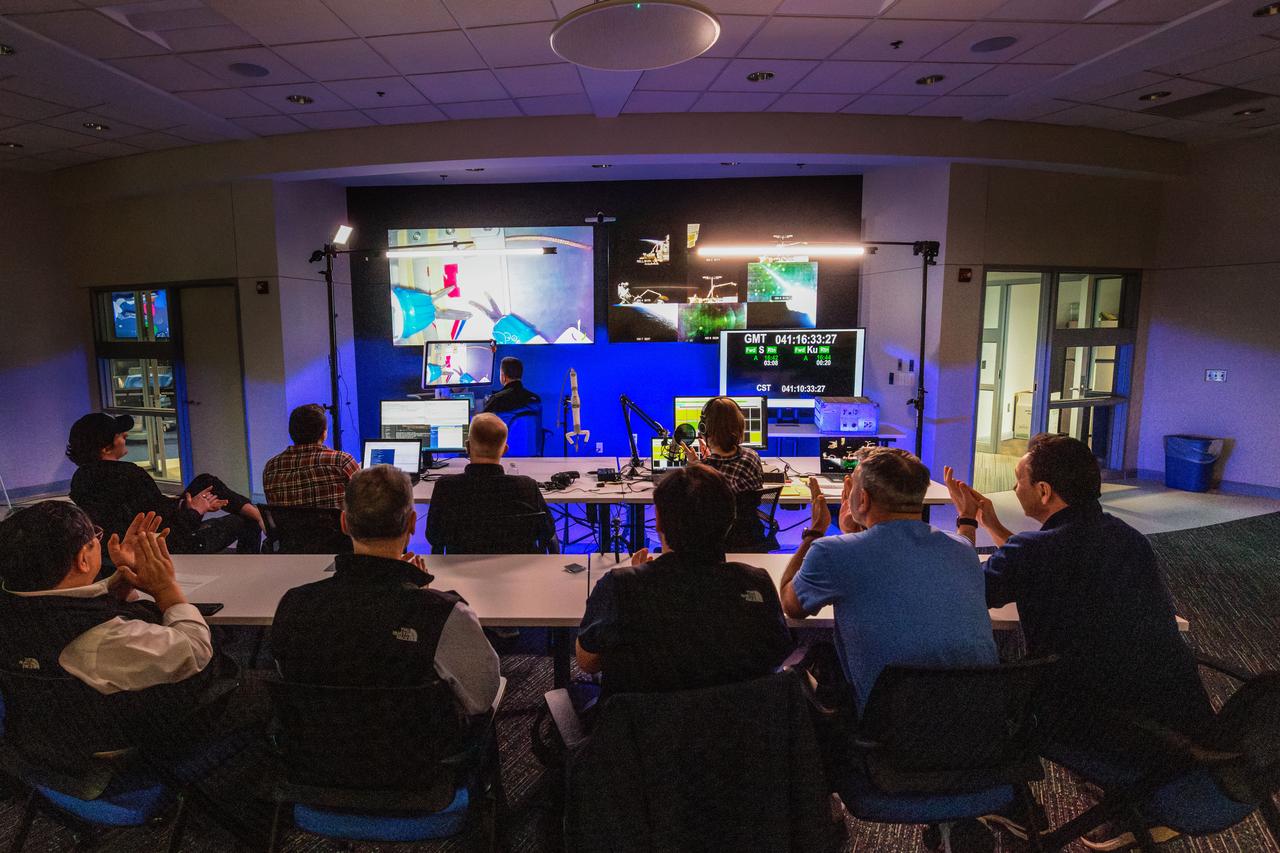
jsc2024e041214 (2/10/2024) --- Dr. Michael Jobst remotely operates a surgical robot aboard the International Space Station using controls at the Virtual Incision offices in Lincoln, Nebraska. Robotic Surgery Tech Demo tests techniques for performing robotic surgery in microgravity using a miniature surgical robot that can be remotely controlled or teleoperated from Earth. Results from this investigation could support the development of robotic systems to perform remote procedures. Miniaturization and the ability to remotely control robots may help to make surgery available anywhere and anytime. Image courtesy of the University of Nebraska-Lincoln.
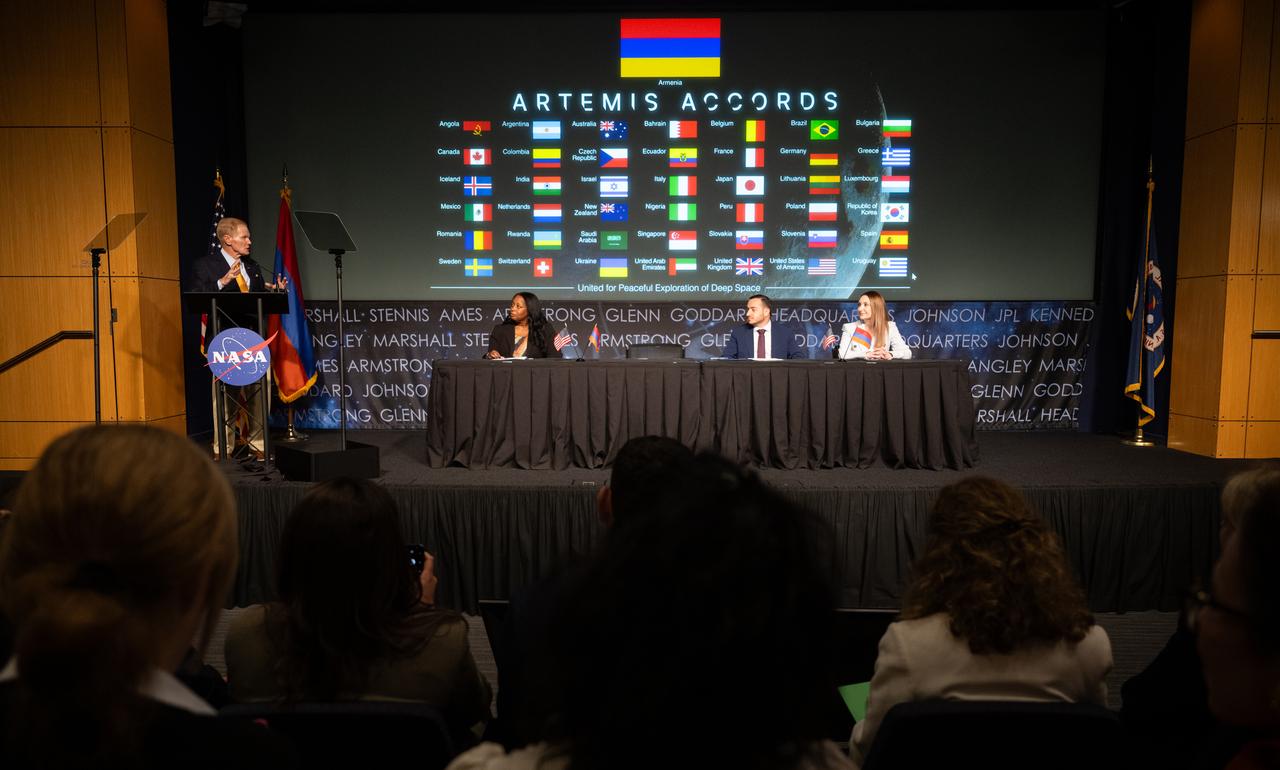
NASA Administrator Bill Nelson, left, delivers remarks during an Artemis Accords signing ceremony as Acting Assistant Secretary of State for the Bureau of Oceans and International Environmental and Scientific Affairs Jennifer Littlejohn, second from left, Mkhitar Hayrapetyan, Minister of High-Tech Industry of the Republic of Armenia, and Ambassador of the Republic of Armenia to the United States Lilit Makunts look on, Wednesday, June 12, 2024, at the Mary W. Jackson NASA Headquarters building in Washington. The Republic of Armenia is the 43rd country to sign the Artemis Accords, which establish a practical set of principles to guide space exploration cooperation among nations participating in NASA’s Artemis program. Photo Credit: (NASA/Joel Kowsky)
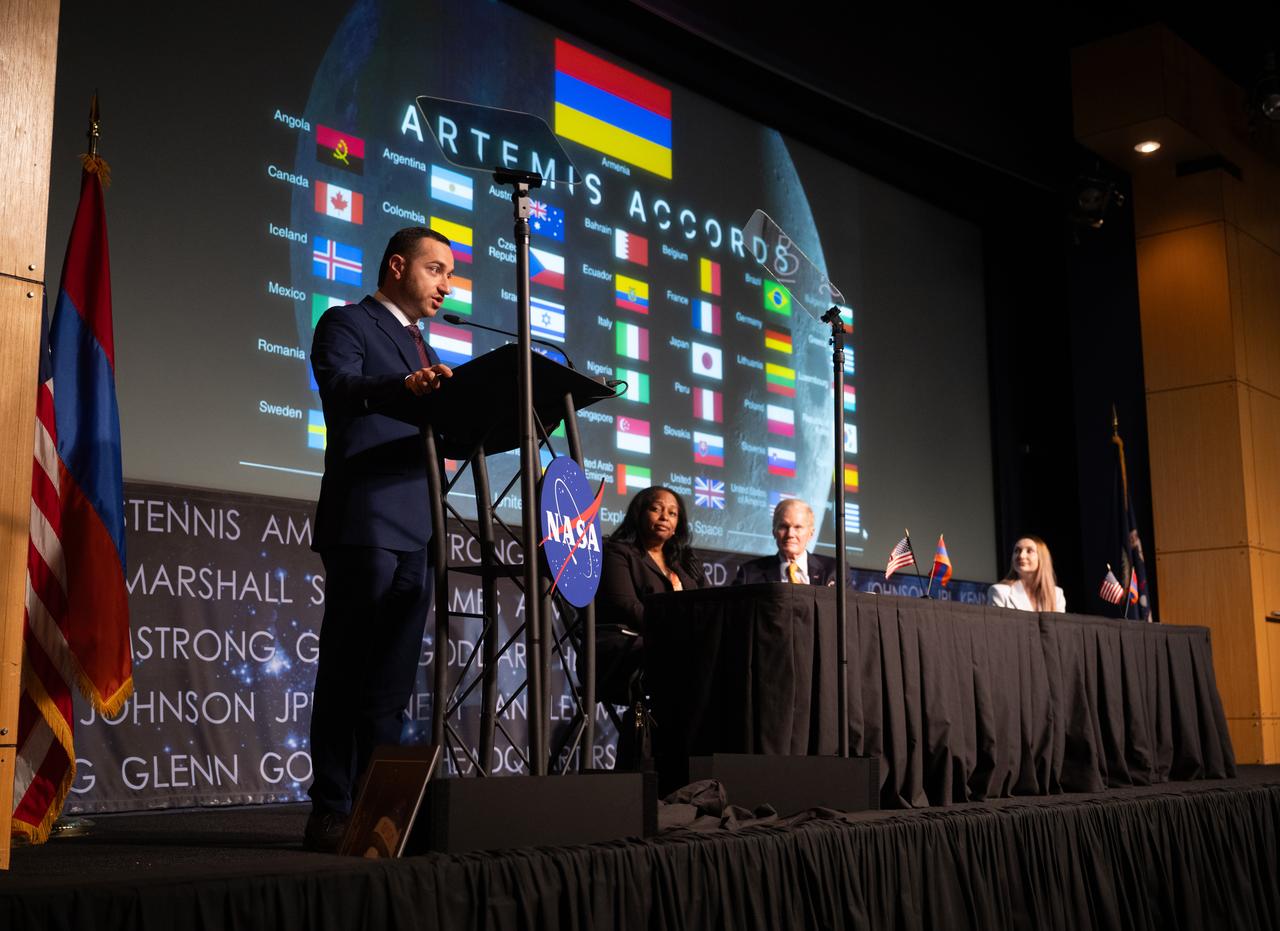
Mkhitar Hayrapetyan, Minister of High-Tech Industry of the Republic of Armenia, left, delivers remarks during an Artemis Accords signing ceremony as Acting Assistant Secretary of State for the Bureau of Oceans and International Environmental and Scientific Affairs Jennifer Littlejohn, second from left, NASA Administrator Bill Nelson, and Ambassador of the Republic of Armenia to the United States Lilit Makunts, look on, Wednesday, June 12, 2024, at the Mary W. Jackson NASA Headquarters building in Washington. The Republic of Armenia is the 43rd country to sign the Artemis Accords, which establish a practical set of principles to guide space exploration cooperation among nations participating in NASA’s Artemis program. Photo Credit: (NASA/Joel Kowsky)
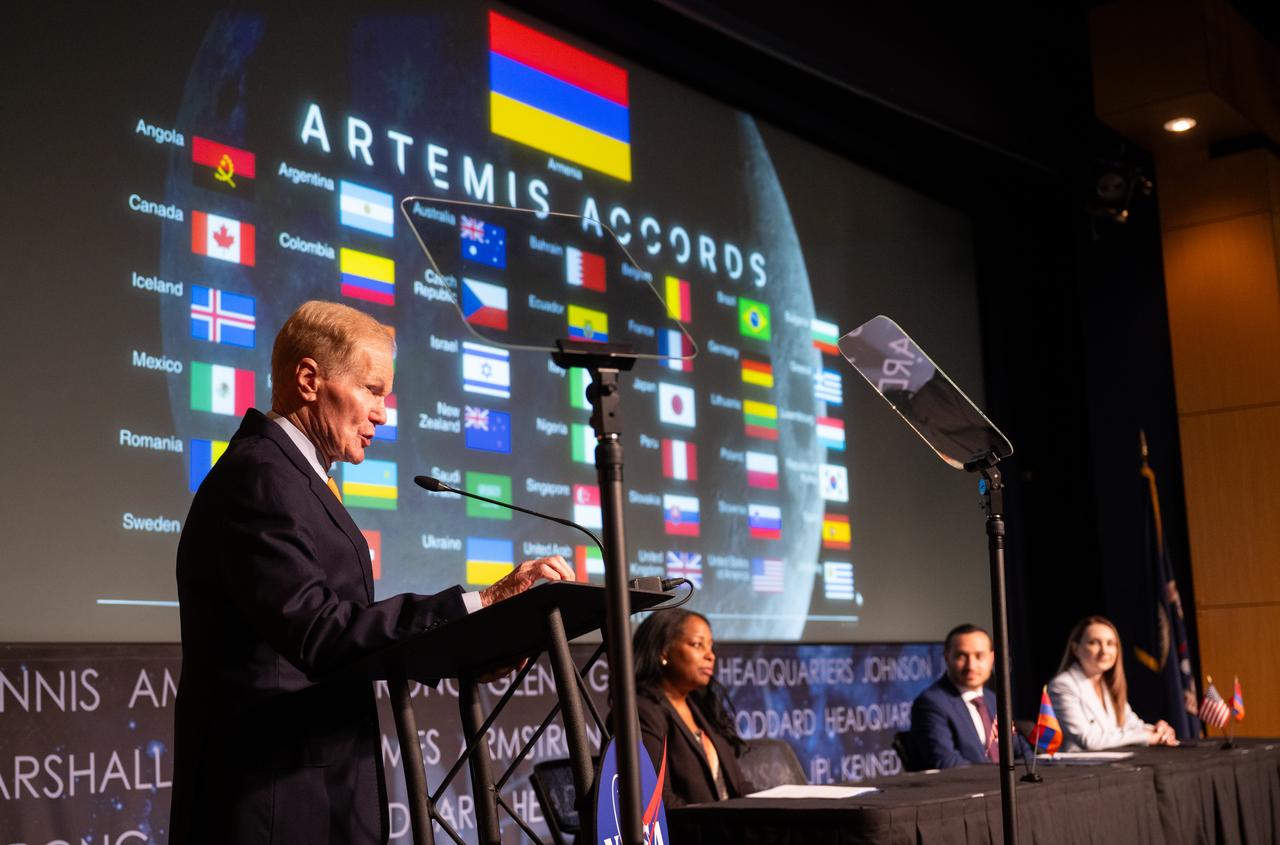
NASA Administrator Bill Nelson, left, delivers remarks during an Artemis Accords signing ceremony as Acting Assistant Secretary of State for the Bureau of Oceans and International Environmental and Scientific Affairs Jennifer Littlejohn, second from left, Mkhitar Hayrapetyan, Minister of High-Tech Industry of the Republic of Armenia, and Ambassador of the Republic of Armenia to the United States Lilit Makunts look on, Wednesday, June 12, 2024, at the Mary W. Jackson NASA Headquarters building in Washington. The Republic of Armenia is the 43rd country to sign the Artemis Accords, which establish a practical set of principles to guide space exploration cooperation among nations participating in NASA’s Artemis program. Photo Credit: (NASA/Joel Kowsky)
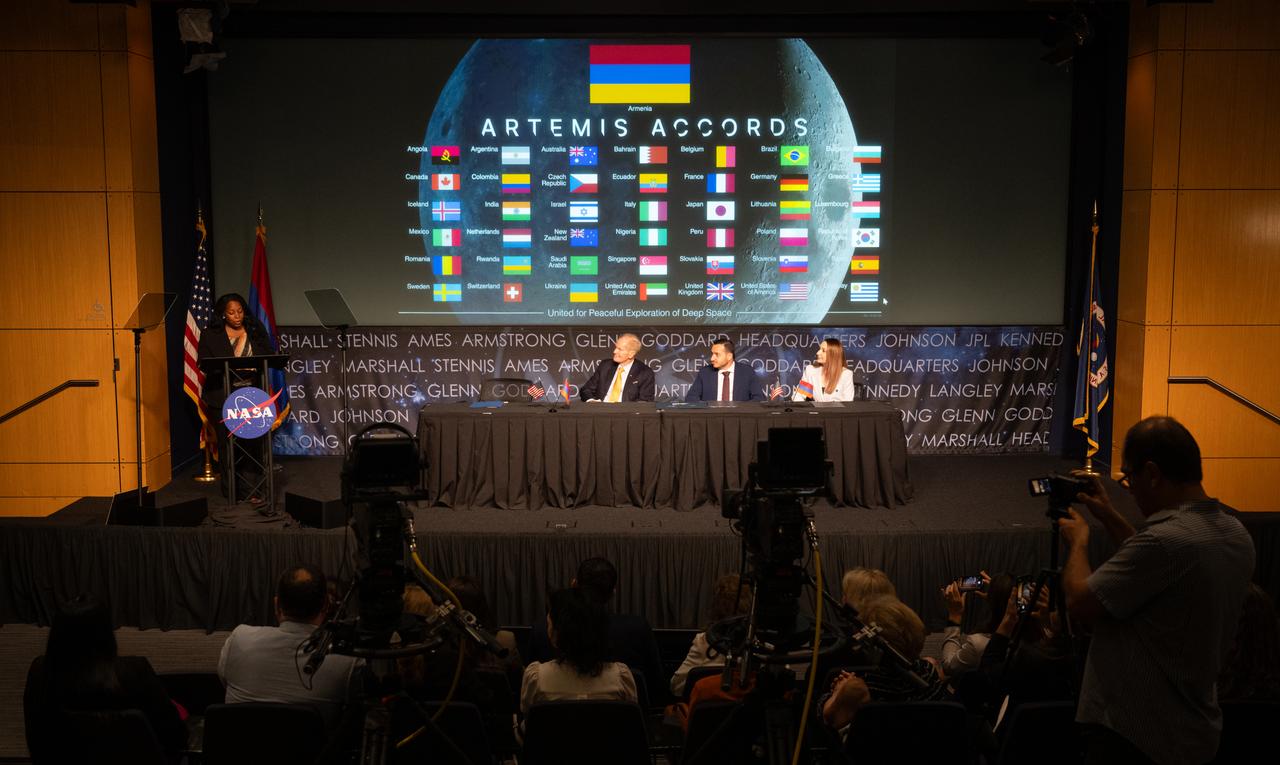
Acting Assistant Secretary of State for the Bureau of Oceans and International Environmental and Scientific Affairs Jennifer Littlejohn, left, delivers remarks during an Artemis Accords signing ceremony as NASA Administrator Bill Nelson, Mkhitar Hayrapetyan, Minister of High-Tech Industry of the Republic of Armenia, and Ambassador of the Republic of Armenia to the United States Lilit Makunts, Wednesday, June 12, 2024, at the Mary W. Jackson NASA Headquarters building in Washington. The Republic of Armenia is the 43rd country to sign the Artemis Accords, which establish a practical set of principles to guide space exploration cooperation among nations participating in NASA’s Artemis program. Photo Credit: (NASA/Joel Kowsky)
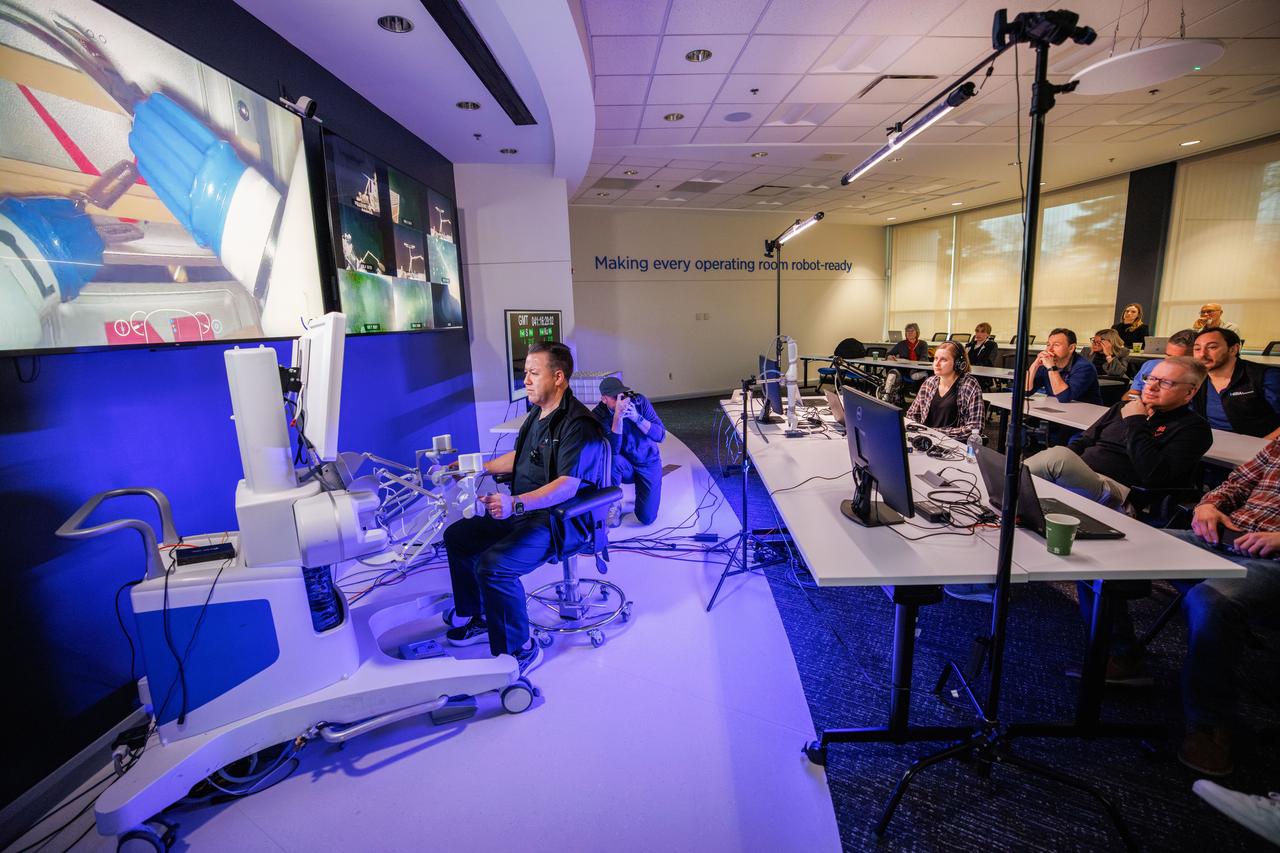
jsc2024e041213 (2/10/2024) --- Dr. Michael Jobst remotely operates a surgical robot aboard the International Space Station using controls at the Virtual Incision offices in Lincoln, Nebraska. Robotic Surgery Tech Demo tests techniques for performing robotic surgery in microgravity using a miniature surgical robot that can be remotely controlled or teleoperated from Earth. Results from this investigation could support the development of robotic systems to perform remote procedures. Miniaturization and the ability to remotely control robots may help to make surgery available anywhere and anytime. Image courtesy of the University of Nebraska-Lincoln.
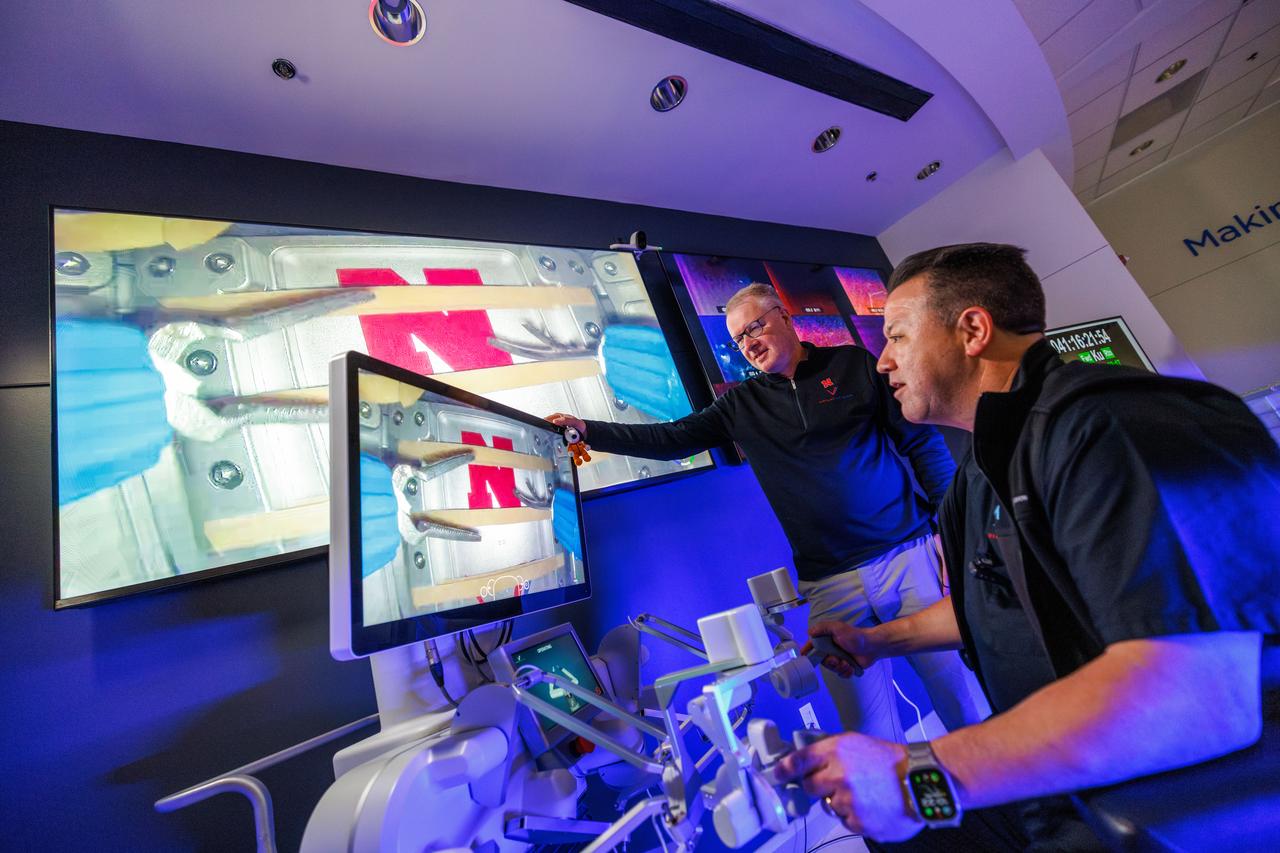
jsc2024e041212 (2/10/2024) --- Professor Shane Farritor (left) watches as Dr. Michael Jobst remotely operates a surgical robot aboard the International Space Station using controls at the Virtual Incision offices in Lincoln, Nebraska. Robotic Surgery Tech Demo tests techniques for performing robotic surgery in microgravity using a miniature surgical robot that can be remotely controlled or teleoperated from Earth. Results from this investigation could support the development of robotic systems to perform these procedures. Miniaturization and the ability to remotely control robots may help to make surgery available anywhere and anytime. Image courtesy of the University of Nebraska-Lincoln.
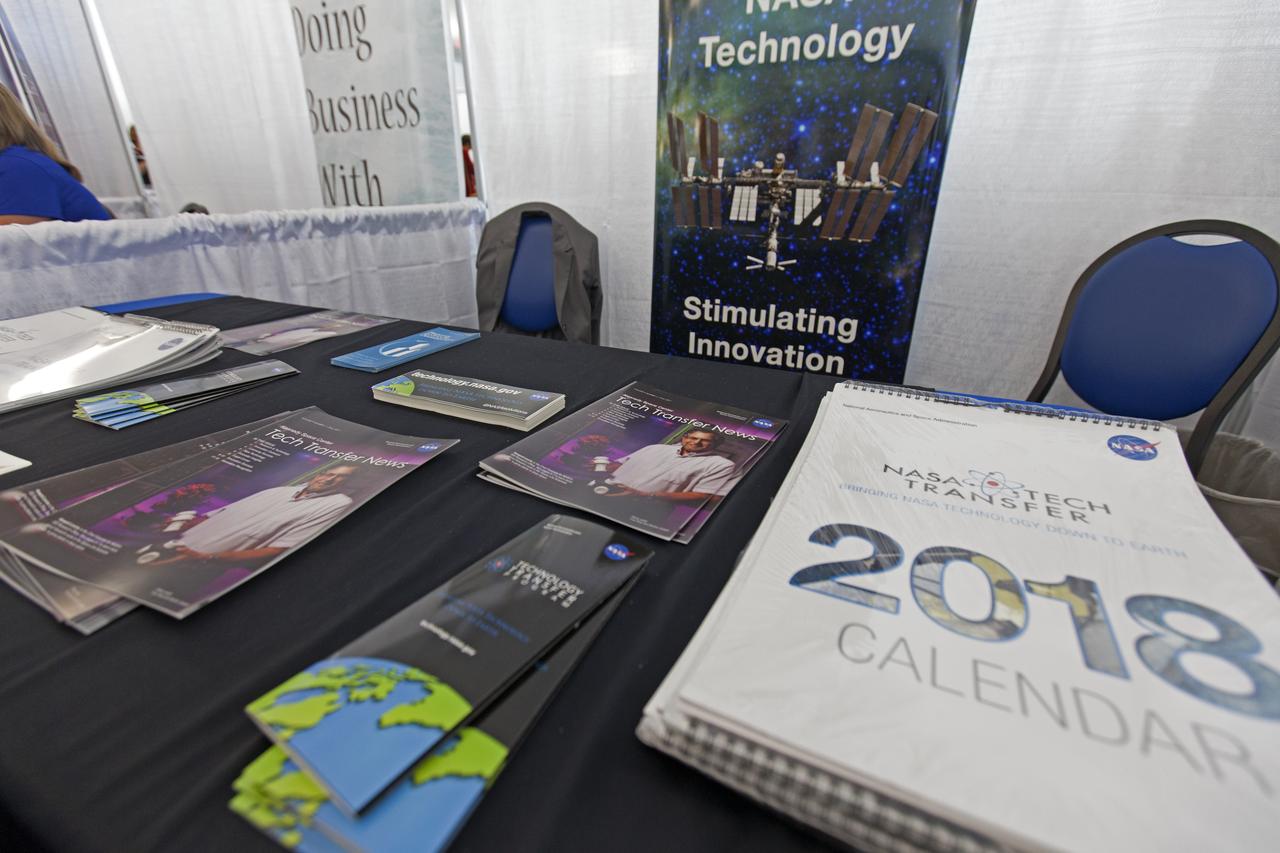
Information from NASA's Tech Transfer Office is on display at Kennedy Space Center's 27th Business Opportunities Expo held at Cruise Terminal 5 at Port Canaveral in Florida. The event featured more than 180 businesses, large and small, and government exhibitors from throughout the Space Coast and the nation. The Business Opportunities Expo is sponsored by the NASA KSC Prime Contractor Board, KSC Industry Assistance Office, 45th Space Wing and Canaveral Port Authority. Exhibitors included vendors from a variety of product and service areas, such as computer technology, engineering services, communication equipment and services, and construction and safety products, to name a few. Representatives from the 45th Space Wing, KSC prime contractors, NASA and many more agencies and organizations were on hand to provide information and answer questions.
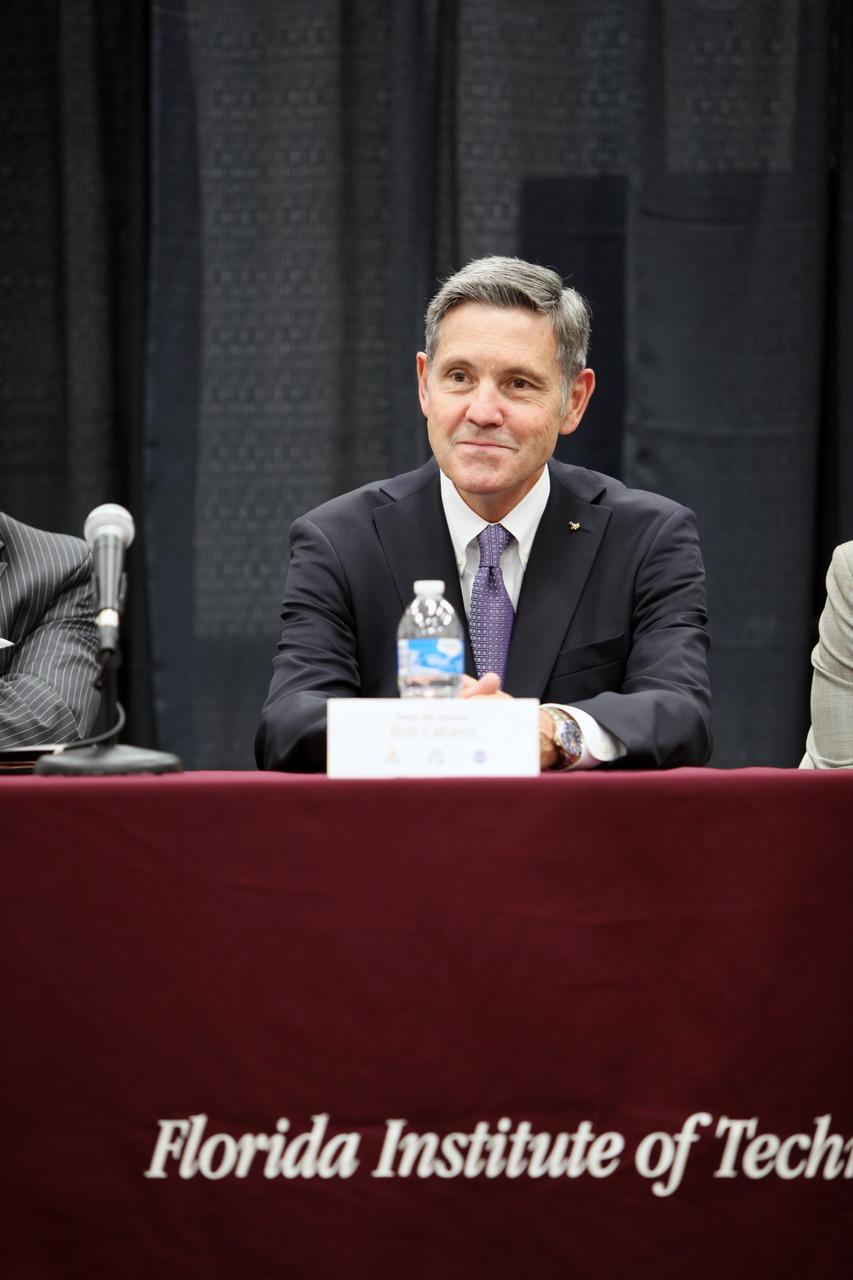
MELBOURNE, Fla. – NASA Kennedy Space Center Director Bob Cabana participates in the opening ceremonies for the International Space University's 25th annual Space Studies Program session at the Florida Institute of Technology in Melbourne, Fla. The nine-week intensive course is designed for post-graduate university students and professionals during the summer. The program is hosted by a different country each year, providing a unique educational experience for participants from around the globe. NASA Kennedy Space Center and Florida Tech are co-hosting this year's event which runs from June 4 to Aug. 3. This year, there are about 125 participants representing 31 countries. For more information, visit http://www.isunet.edu. Photo credit: NASA/Dimitri Gerondidakis
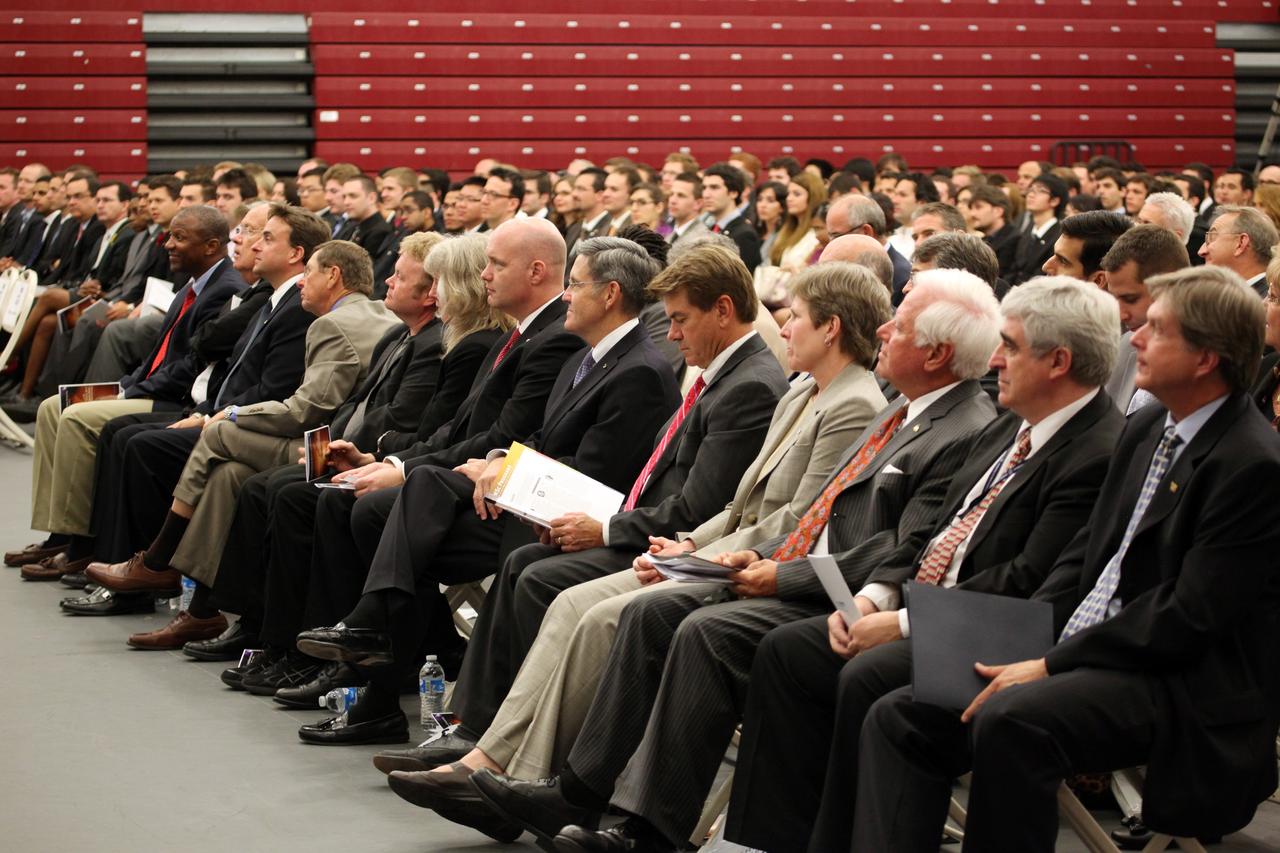
MELBOURNE, Fla. – NASA Deputy Administrator Lori Garver has a rapt audience of space program managers and students for her remarks during opening ceremonies for the International Space University's 25th annual Space Studies Program session at the Florida Institute of Technology in Melbourne, Fla. The nine-week intensive course is designed for post-graduate university students and professionals during the summer. The program is hosted by a different country each year, providing a unique educational experience for participants from around the globe. NASA Kennedy Space Center and Florida Tech are co-hosting this year's event which runs from June 4 to Aug. 3. This year, there are about 125 participants representing 31 countries. For more information, visit http://www.isunet.edu. Photo credit: NASA/Dimitri Gerondidakis
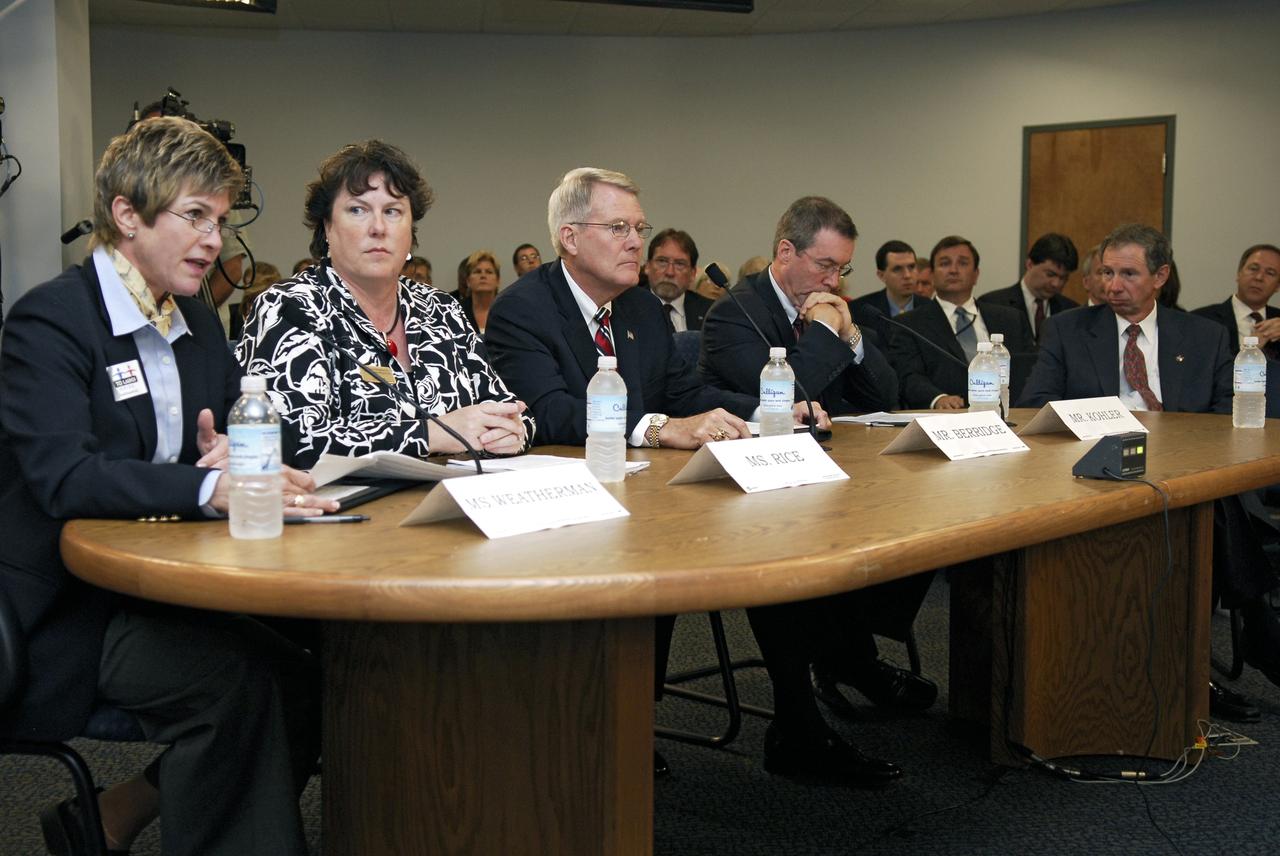
CAPE CANAVERAL, Fla. – A Senate field hearing held at the Canaveral Port Authority and chaired by Florida Sen. Bill Nelson focuses on workforce related challenges at NASA's Kennedy Space Center and potential solutions to mitigate the transition's effects on the community. The hearing examined issues surrounding the retirement of the space shuttle and the transition to the new Orion/Ares system. At the table are community representatives Lynda Weatherman, president and CEO of the Economic Development Commission of Florida's Space Coast; Lisa Rice, president of the Brevard Workforce Development Board Inc.; Randy Berridge, president of the Florida High Tech Corridor Council; and Steve Kohler, president of Space Florida. NASA Administrator Michael Griffin is seated at right. Photo credit: NASA/Kim Shiflett
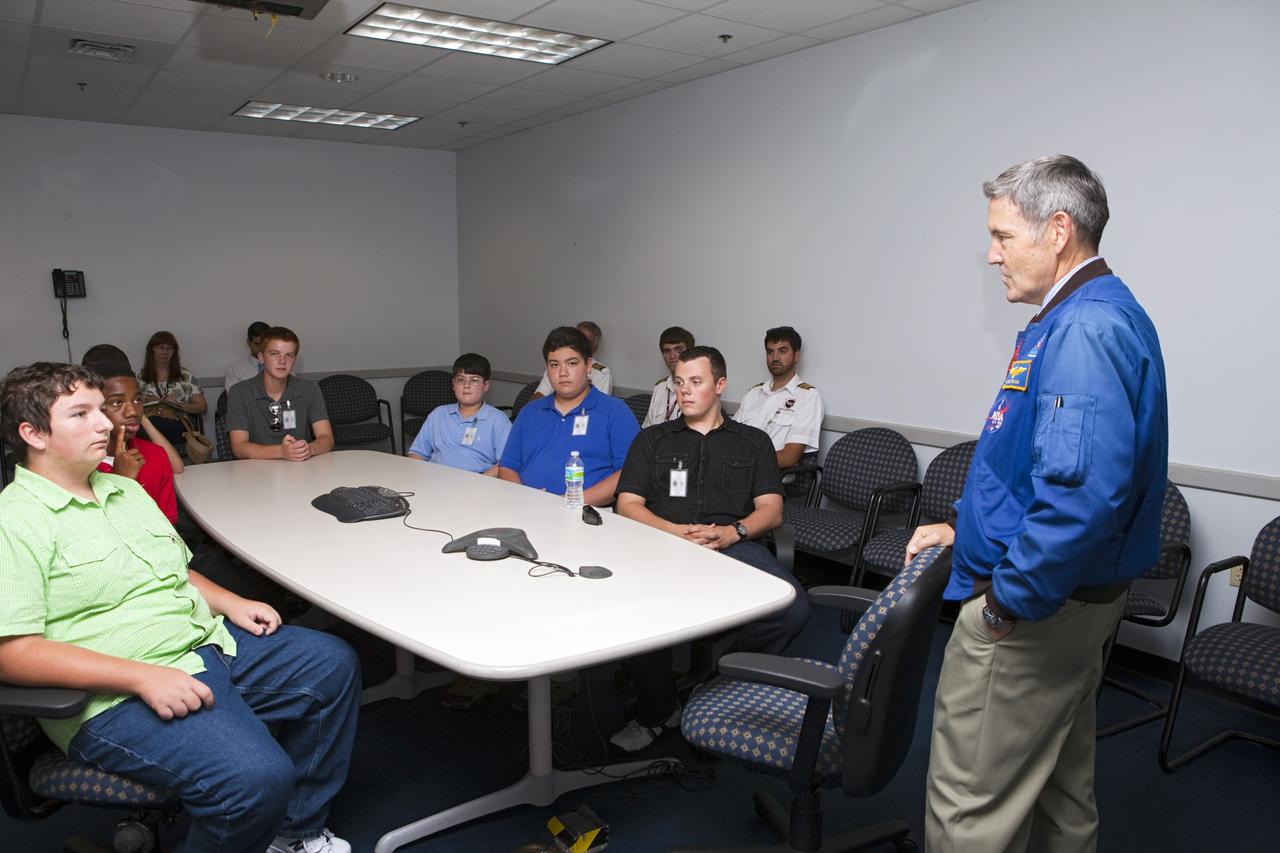
CAPE CANAVERAL, Fla. – In a support building near NASA Kennedy Space Center’s Shuttle Landing Facility, or SLF, in Florida, Center Director Bob Cabana speaks to students and their flight instructors from Florida Tech, or FIT, in Melbourne. The group arrived at the SLF in Cherokee Warrior and Cessna 172S lightweight aircraft. The middle and high school students are participating in FIT’s Av/Aero summer camp experience. They and their flight instructors toured the SLF midfield control tower, viewed F104 Starfighters and NASA Huey helicopters in the RLV Hangar, viewed the runway plaques marking wheels stop for each of the three space shuttles, and toured the Vehicle Assembly Building where space shuttle Atlantis currently is stored. Photo credit: NASA/Kim Shiflett