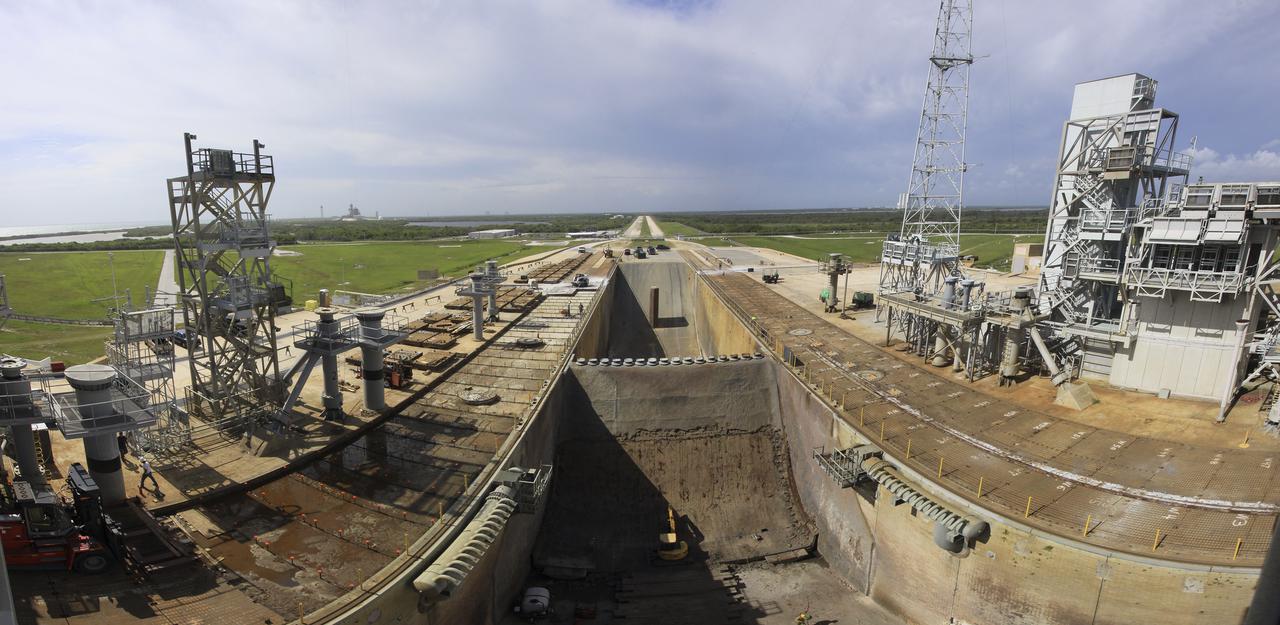
CAPE CANAVERAL, Fla. -- At Launch Pad 39B at NASA’s Kennedy Space Center in Florida, the view from a fisheye lens reveals nearly all of the crawler track panels on the pad’s surface have been removed. The concrete surface beneath the panels and the catacomb roof below will be inspected for water damage and repaired. Work also is underway to remove the flame trench deflector that sits below and between the left and right crawler track panels. There are 176 panels, each weighing about 30,000 pounds that will be removed. Launch Pad 39B is being refurbished to support NASA’s Space Launch System and other launch vehicles. The Ground Systems Development and Operations, or GSDO, Program office at Kennedy is leading the center’s transformation to safely handle a variety of rockets and spacecraft. For more information about GSDO, visit: http:__go.nasa.gov_groundsystems. Photo credit: NASA_Jim Grossman
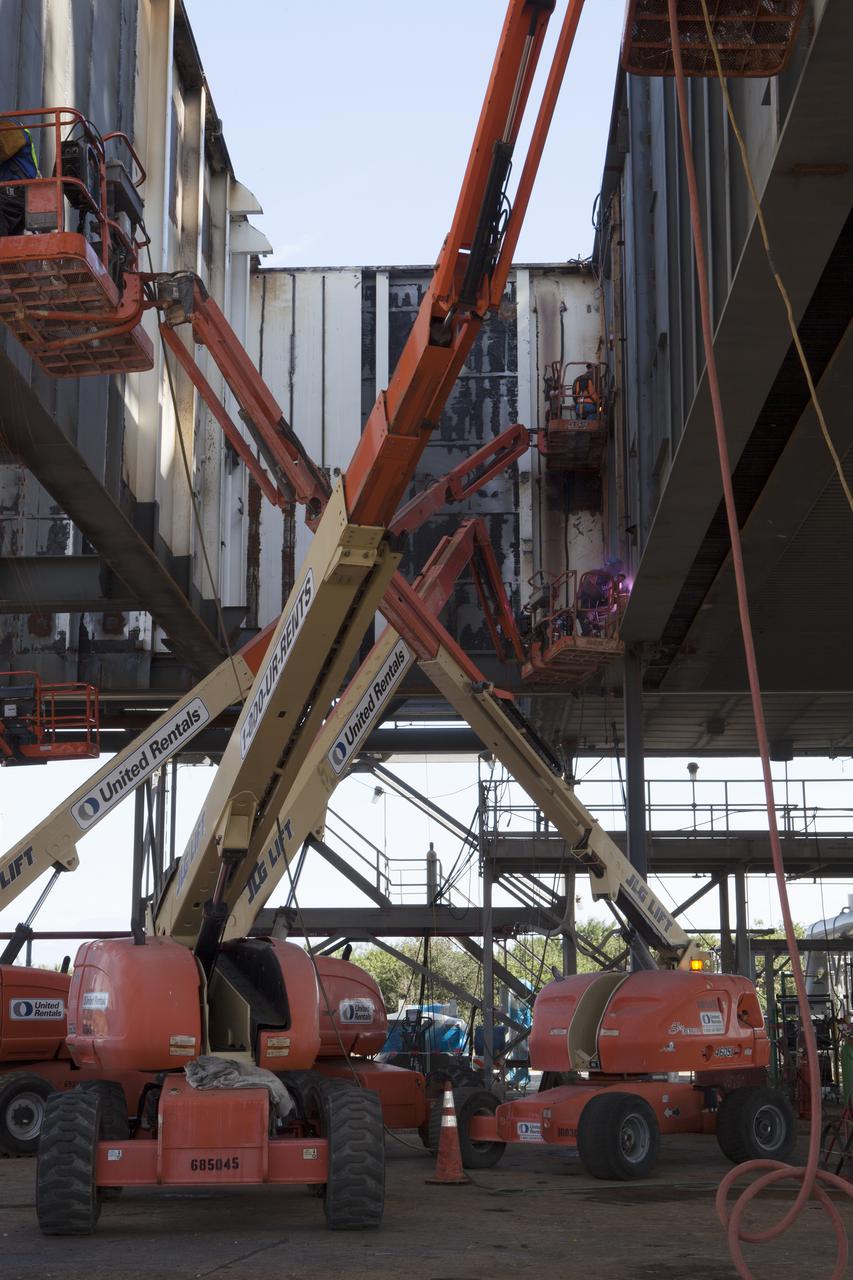
CAPE CANAVERAL, Fla. – Modifications continue on the Mobile Launcher, or ML, at the Mobile Launcher Park Site at NASA’s Kennedy Space Center in Florida. Construction workers on lifts perform welding work on the exterior of the ML. In 2013, the agency awarded a contract to J.P. Donovan Construction Inc. of Rockledge, Fla., to modify the ML, which is one of the key elements of ground support equipment that is being upgraded by the Ground Systems Development and Operations Program office at Kennedy. The ML will carry the SLS rocket and Orion spacecraft to Launch Pad 39B for its first mission, Exploration Mission 1, in 2017. Photo credit: NASA_Dimitri Gerondidakis
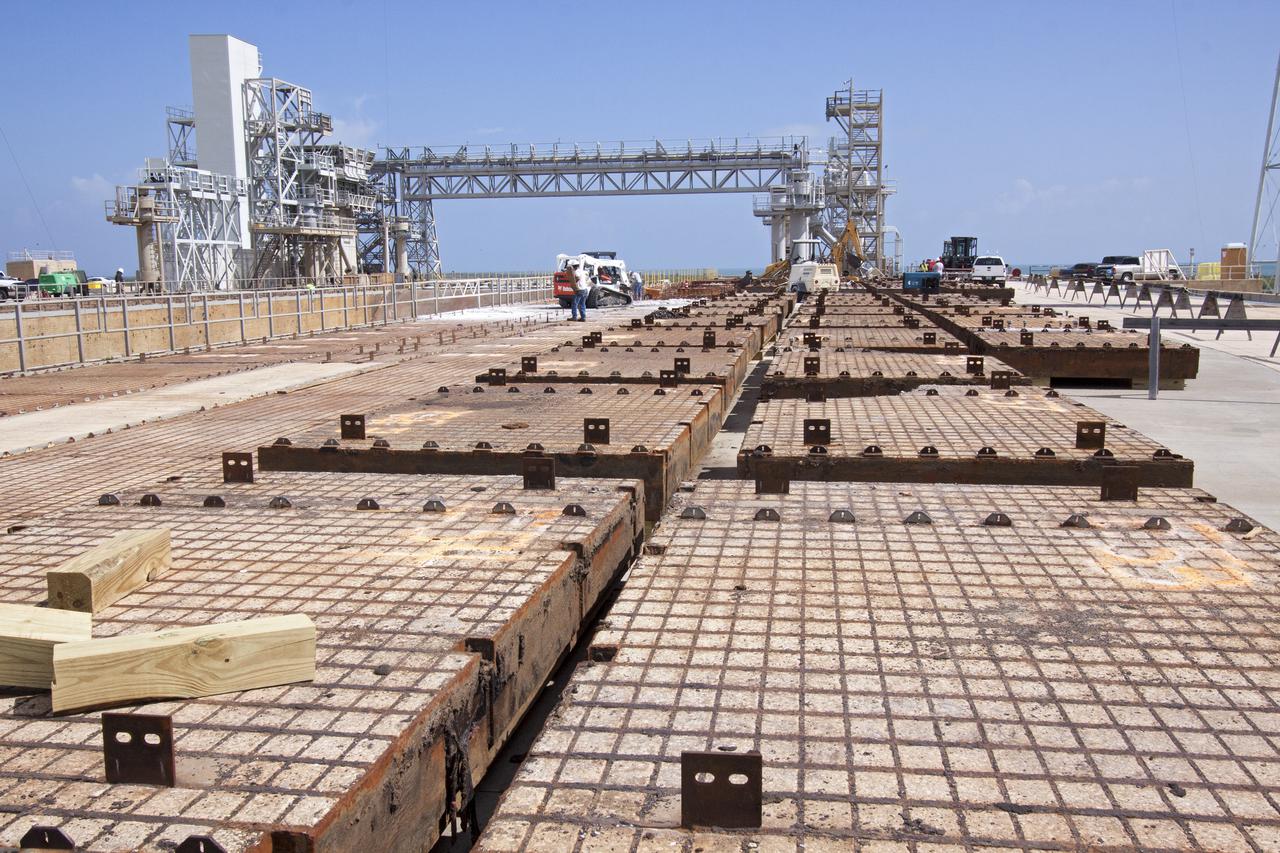
CAPE CANAVERAL, Fla. – At Launch Pad 39B at NASA’s Kennedy Space Center in Florida, removal of the crawler track panels on the pad’s surface is underway. The concrete surface beneath the panels and the catacomb roof below will be inspected for water damage and repaired. There are 176 panels, each weighing about 30,000 pounds that will be removed. Launch Pad 39B is being refurbished to support NASA’s Space Launch System and other launch vehicles. The Ground Systems Development and Operations, or GSDO, Program office at Kennedy is leading the center’s transformation to safely handle a variety of rockets and spacecraft. For more information about GSDO, visit: http:__go.nasa.gov_groundsystems. Photo credit: NASA_Dimitri Gerondidakis
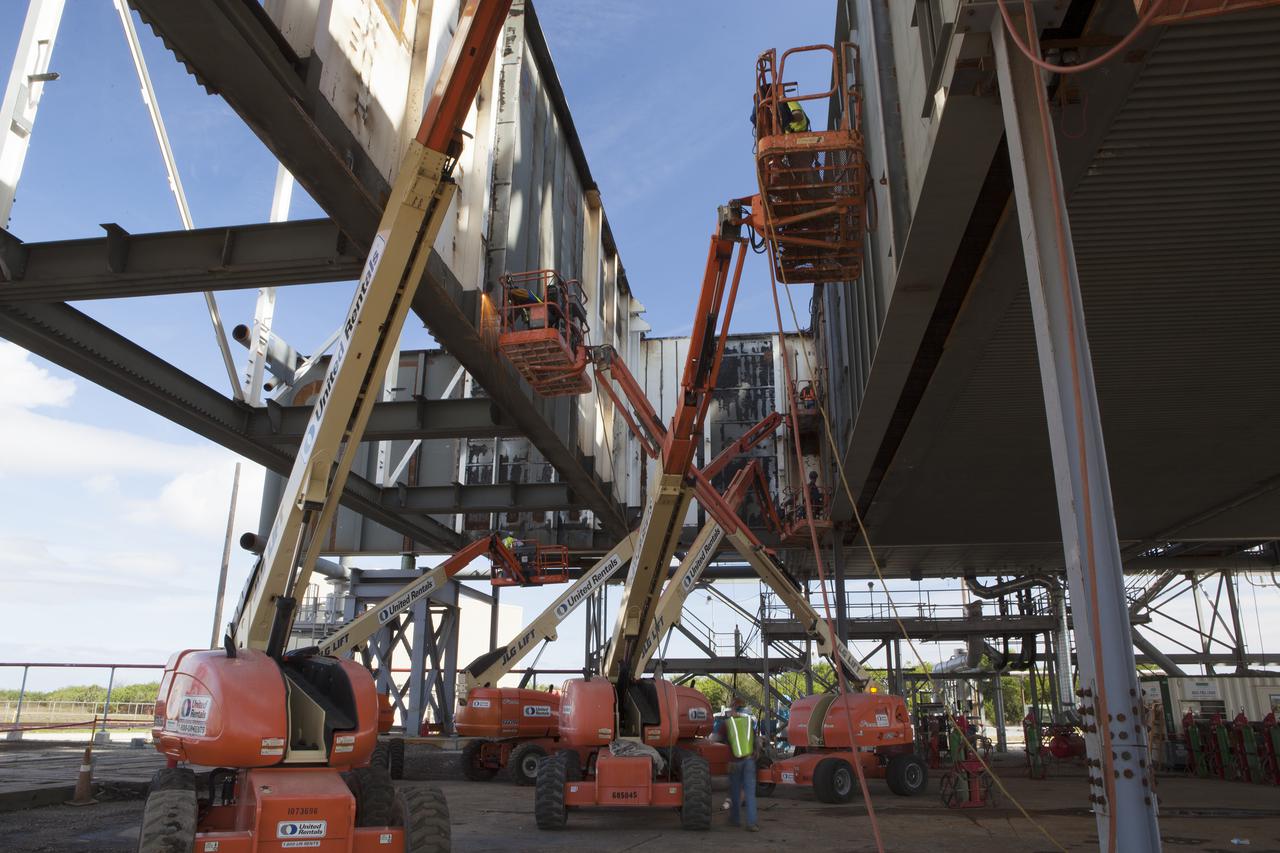
CAPE CANAVERAL, Fla. – Modifications continue on the Mobile Launcher, or ML, at the Mobile Launcher Park Site at NASA’s Kennedy Space Center in Florida. Construction workers on lifts perform welding work on the exterior of the ML. In 2013, the agency awarded a contract to J.P. Donovan Construction Inc. of Rockledge, Fla., to modify the ML, which is one of the key elements of ground support equipment that is being upgraded by the Ground Systems Development and Operations Program office at Kennedy. The ML will carry the SLS rocket and Orion spacecraft to Launch Pad 39B for its first mission, Exploration Mission 1, in 2017. Photo credit: NASA_Dimitri Gerondidakis
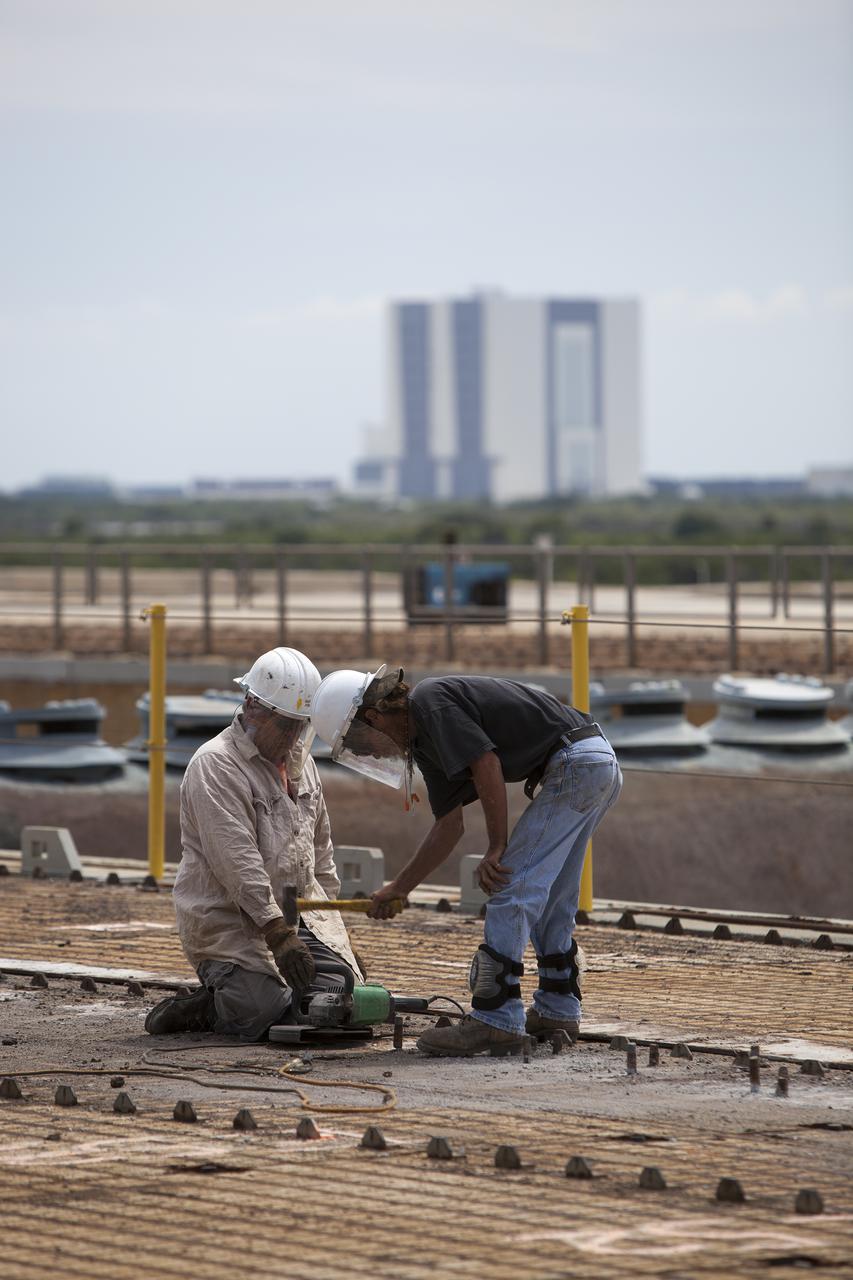
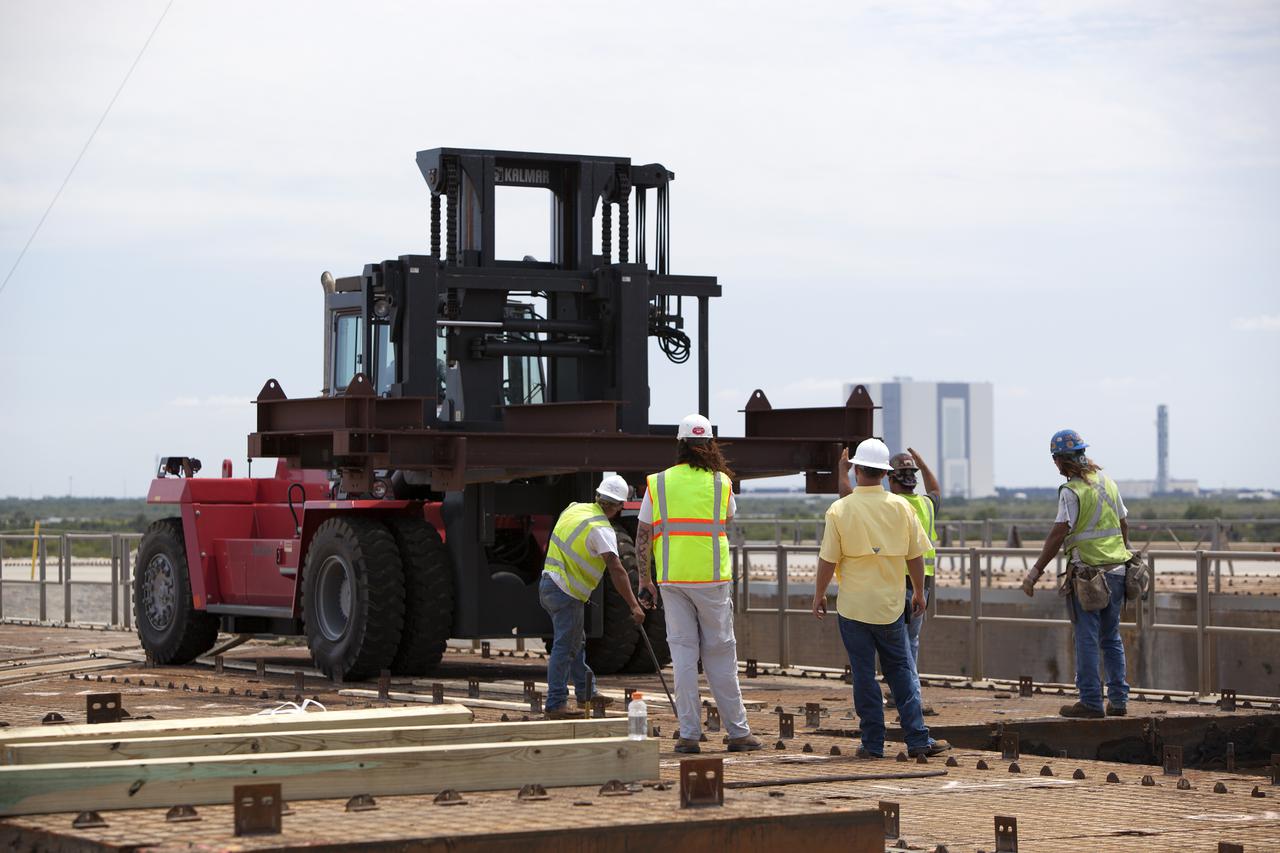
CAPE CANAVERAL, Fla. – At Launch Pad 39B at NASA’s Kennedy Space Center in Florida, construction workers prepare a crawler track panel on the pad’s surface for removal. The concrete surface beneath the panels and the catacomb roof below will be inspected for water damage and repaired. There are 176 panels, each weighing about 30,000 pounds that will be removed. Launch Pad 39B is being refurbished to support NASA’s Space Launch System and other launch vehicles. The Ground Systems Development and Operations, or GSDO, Program office at Kennedy is leading the center’s transformation to safely handle a variety of rockets and spacecraft. For more information about GSDO, visit: http:__go.nasa.gov_groundsystems. Photo credit: NASA_Dimitri Gerondidakis
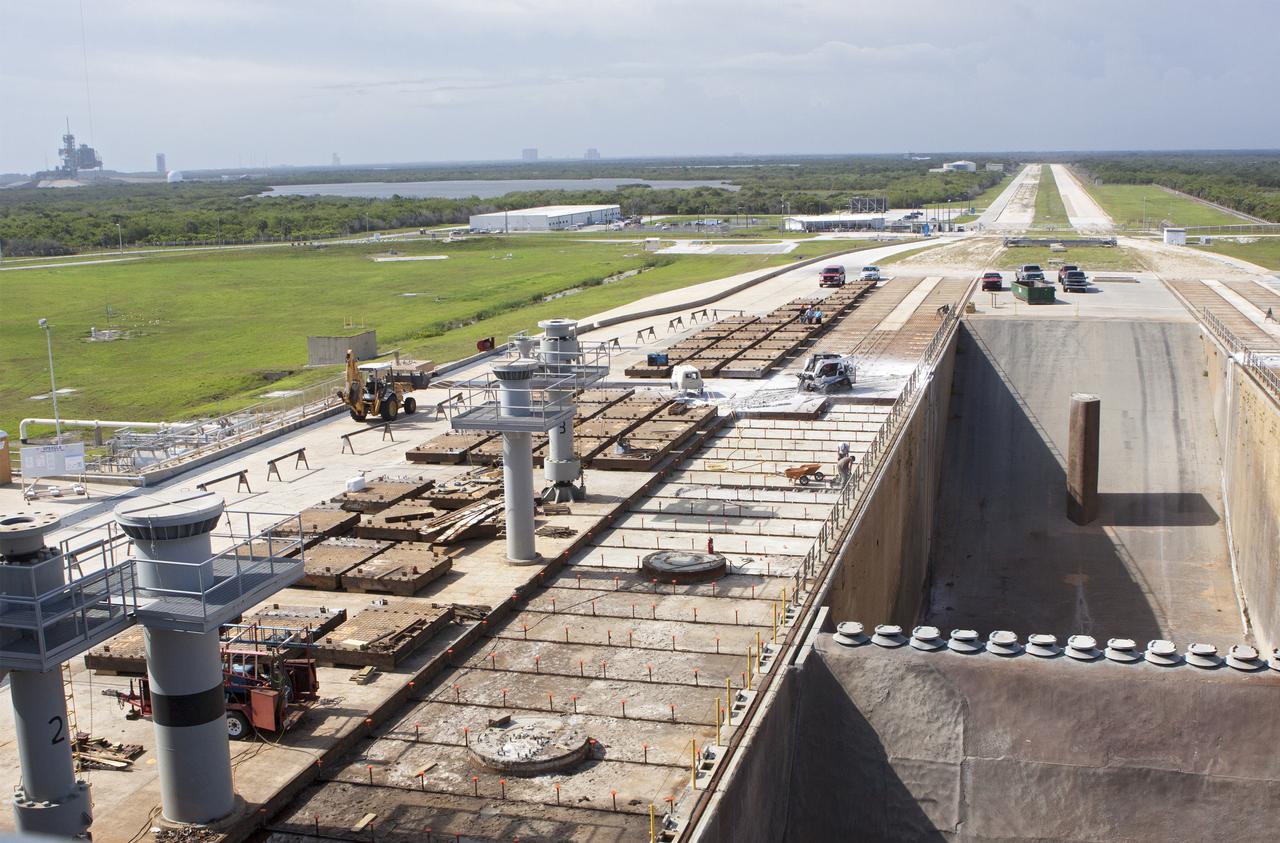
CAPE CANAVERAL, Fla. -- At Launch Pad 39B at NASA’s Kennedy Space Center in Florida, nearly all of the crawler track panels on the pad’s surface have been removed. The concrete surface beneath the panels and the catacomb roof below will be inspected for water damage and repaired. There are 176 panels, each weighing about 30,000 pounds that will be removed. Launch Pad 39B is being refurbished to support NASA’s Space Launch System and other launch vehicles. The Ground Systems Development and Operations, or GSDO, Program office at Kennedy is leading the center’s transformation to safely handle a variety of rockets and spacecraft. For more information about GSDO, visit: http:__go.nasa.gov_groundsystems. Photo credit: NASA_Jim Grossman
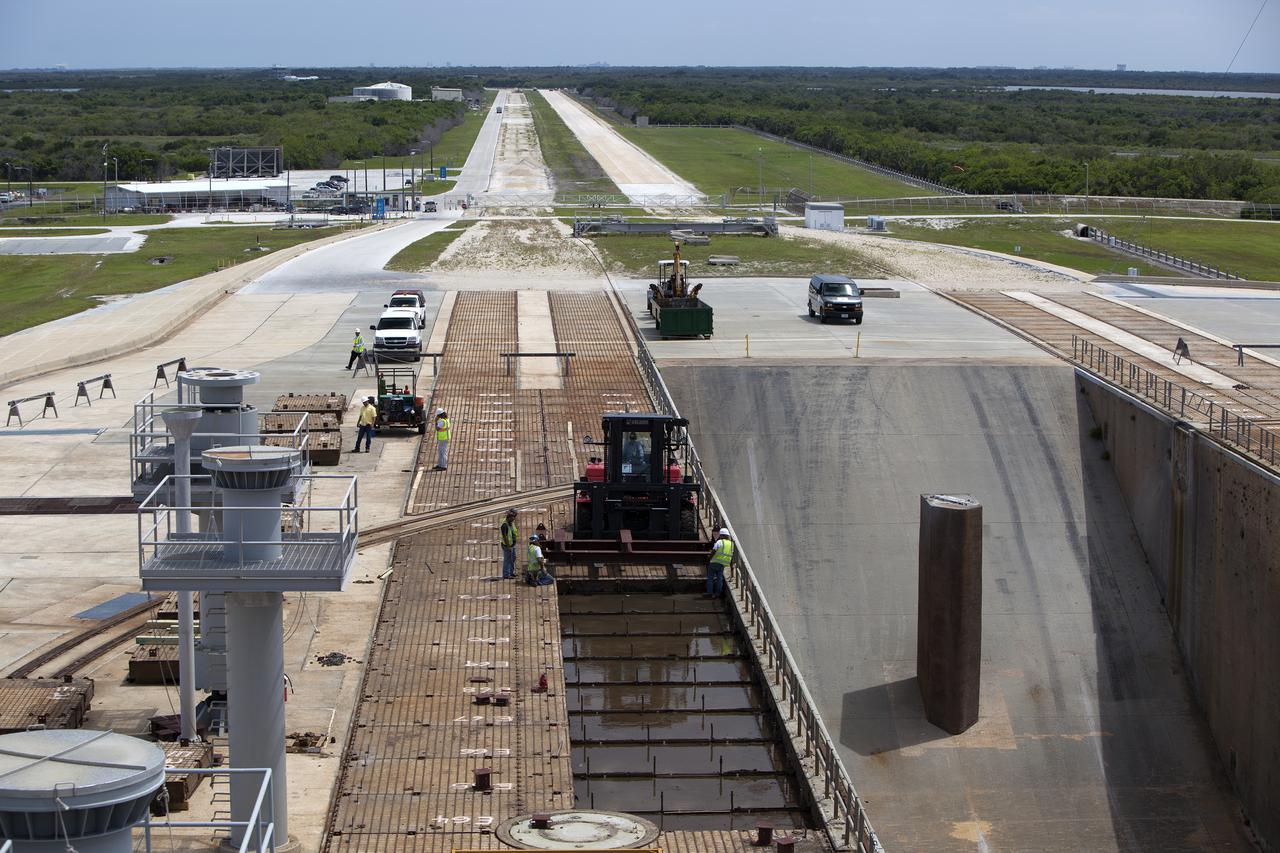
CAPE CANAVERAL, Fla. – At Launch Pad 39B at NASA’s Kennedy Space Center in Florida, an aerial view shows the progress as construction workers remove crawler track panels from the pad’s surface. The concrete surface beneath the panels and the catacomb roof below will be inspected for water damage and repaired. There are 176 panels, each weighing about 30,000 pounds that will be removed. Launch Pad 39B is being refurbished to support NASA’s Space Launch System and other launch vehicles. The Ground Systems Development and Operations, or GSDO, Program office at Kennedy is leading the center’s transformation to safely handle a variety of rockets and spacecraft. For more information about GSDO, visit: http:__go.nasa.gov_groundsystems. Photo credit: NASA_Dimitri Gerondidakis
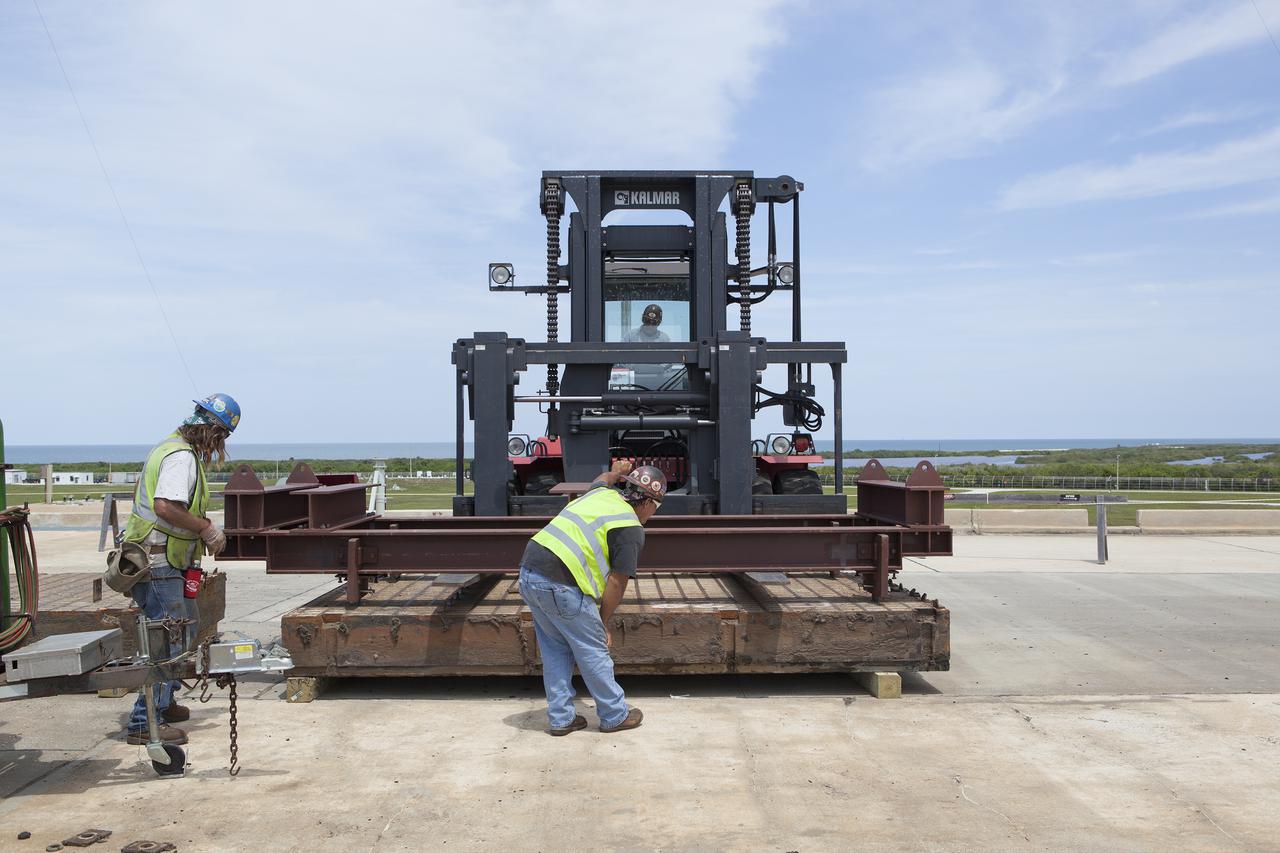
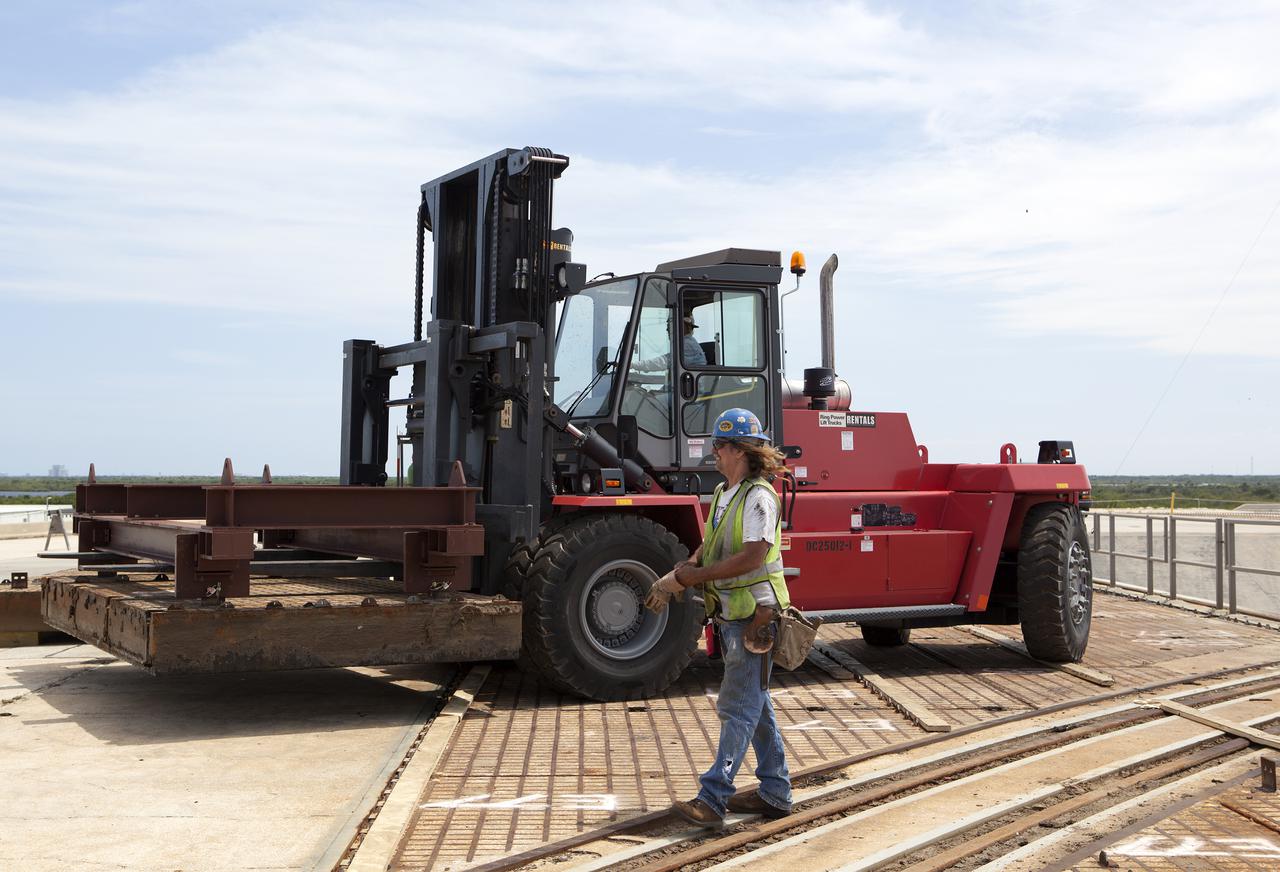
CAPE CANAVERAL, Fla. – At Launch Pad 39B at NASA’s Kennedy Space Center in Florida, a crawler track panel has been removed from the pad’s surface and is being stored in an area away from the construction work. The concrete surface beneath the panels and the catacomb roof below will be inspected for water damage and repaired. There are 176 panels, each weighing about 30,000 pounds that will be removed. Launch Pad 39B is being refurbished to support NASA’s Space Launch System and other launch vehicles. The Ground Systems Development and Operations, or GSDO, Program office at Kennedy is leading the center’s transformation to safely handle a variety of rockets and spacecraft. For more information about GSDO, visit: http:__go.nasa.gov_groundsystems. Photo credit: NASA_Dimitri Gerondidakis
CAPE CANAVERAL, Fla. – At Launch Pad 39B at NASA’s Kennedy Space Center in Florida, removal of the crawler track panels on the pad’s surface is underway. The concrete surface beneath the panels and the catacomb roof below will be inspected for water damage and repaired. There are 176 panels, each weighing about 30,000 pounds that will be removed. Launch Pad 39B is being refurbished to support NASA’s Space Launch System and other launch vehicles. The Ground Systems Development and Operations, or GSDO, Program office at Kennedy is leading the center’s transformation to safely handle a variety of rockets and spacecraft. For more information about GSDO, visit: http:__go.nasa.gov_groundsystems. Photo credit: NASA_Dimitri Gerondidakis
CAPE CANAVERAL, Fla. -- At Launch Pad 39B at NASA’s Kennedy Space Center in Florida, removal of the crawler track panels on the pad’s surface is underway. The concrete surface beneath the panels and the catacomb roof below will be inspected for water damage and repaired. There are 176 panels, each weighing about 30,000 pounds that will be removed. Launch Pad 39B is being refurbished to support NASA’s Space Launch System and other launch vehicles. The Ground Systems Development and Operations, or GSDO, Program office at Kennedy is leading the center’s transformation to safely handle a variety of rockets and spacecraft. For more information about GSDO, visit: http:__go.nasa.gov_groundsystems. Photo credit: NASA_Jim Grossman
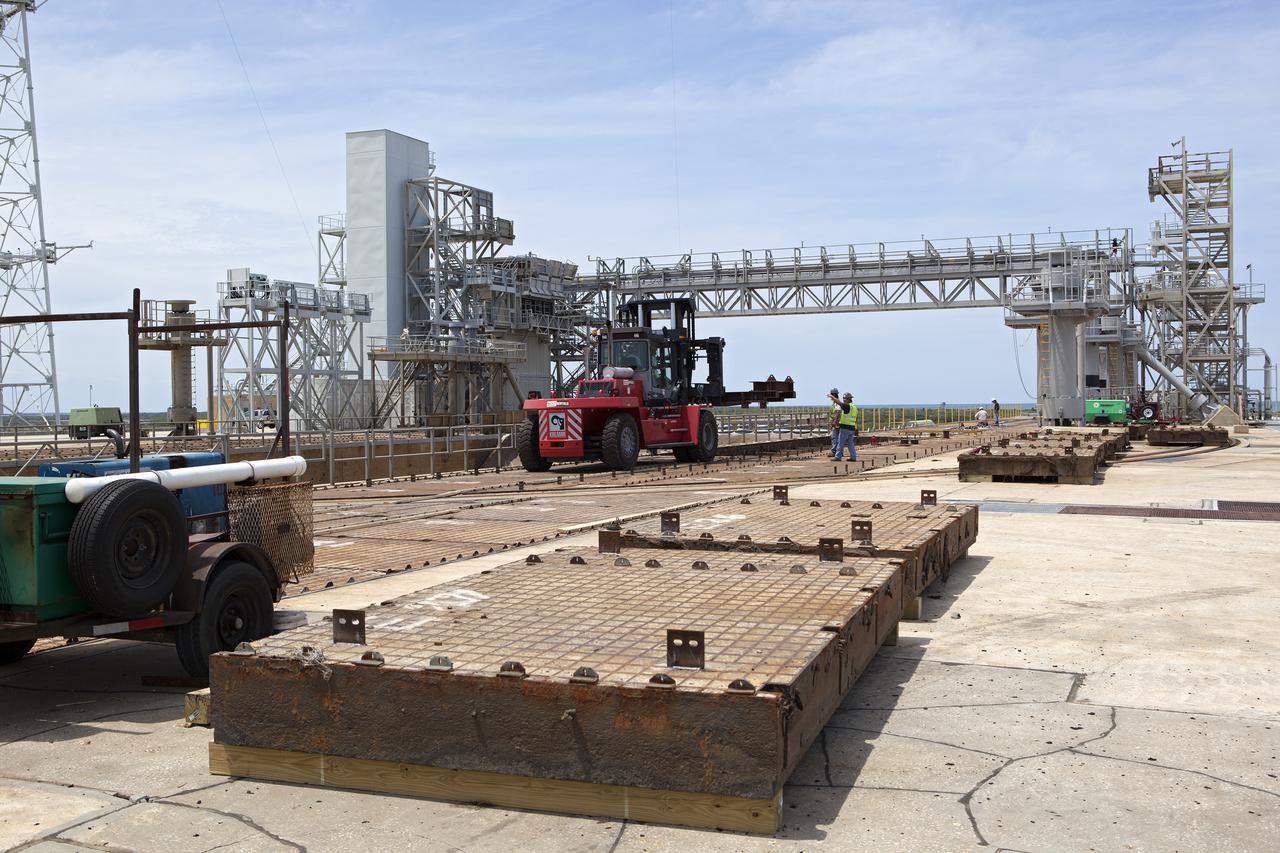
CAPE CANAVERAL, Fla. – At Launch Pad 39B at NASA’s Kennedy Space Center in Florida, removal of the crawler track panels on the pad’s surface is underway. The concrete surface beneath the panels and the catacomb roof below will be inspected for water damage and repaired. There are 176 panels, each weighing about 30,000 pounds that will be removed. Launch Pad 39B is being refurbished to support NASA’s Space Launch System and other launch vehicles. The Ground Systems Development and Operations, or GSDO, Program office at Kennedy is leading the center’s transformation to safely handle a variety of rockets and spacecraft. For more information about GSDO, visit: http:__go.nasa.gov_groundsystems. Photo credit: NASA_Dimitri Gerondidakis
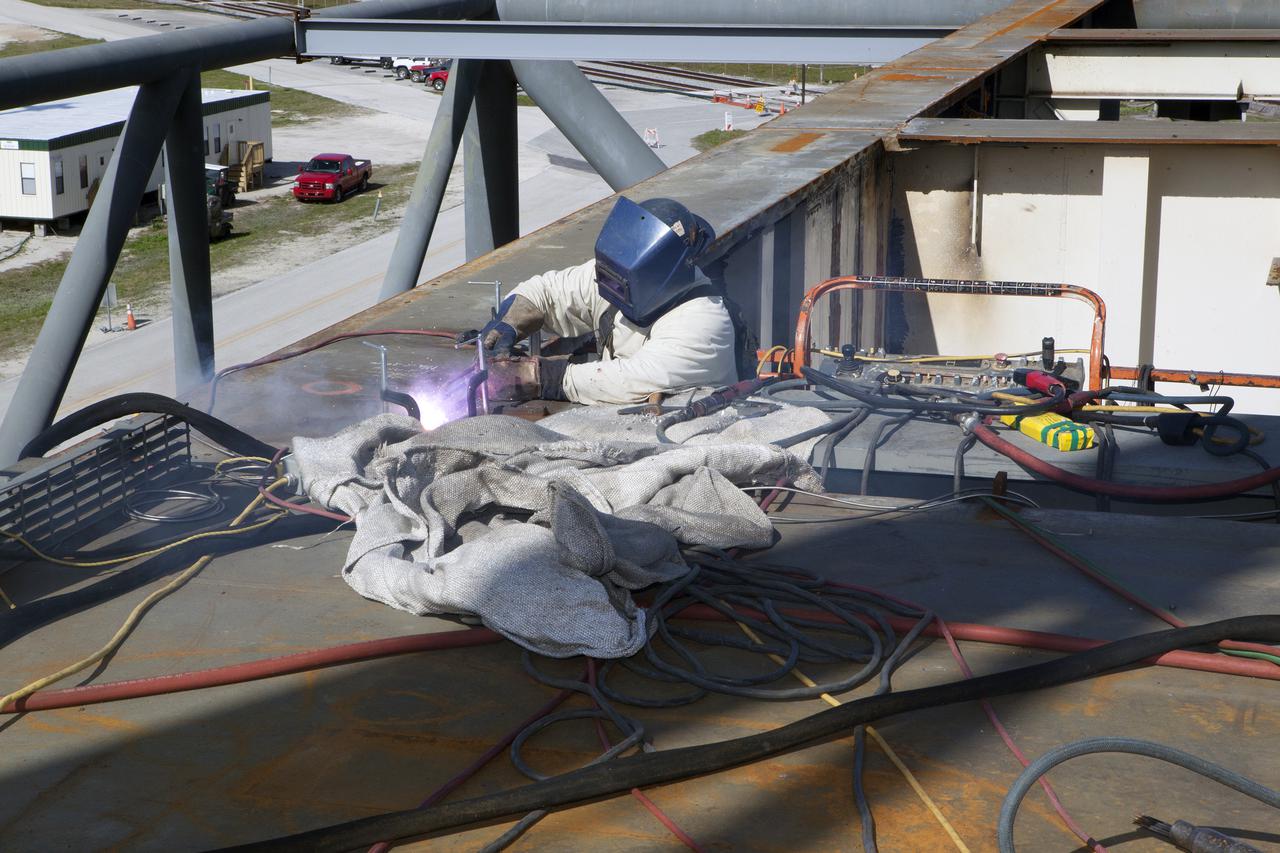
CAPE CANAVERAL, Fla. – Modifications continue on the Mobile Launcher, or ML, at the Mobile Launcher Park Site at NASA’s Kennedy Space Center in Florida. A construction worker performs welding on the exterior of the ML. In 2013, the agency awarded a contract to J.P. Donovan Construction Inc. of Rockledge, Fla., to modify the ML, which is one of the key elements of ground support equipment that is being upgraded by the Ground Systems Development and Operations Program office at Kennedy. The ML will carry the SLS rocket and Orion spacecraft to Launch Pad 39B for its first mission, Exploration Mission 1, in 2017. Photo credit: NASA_Dimitri Gerondidakis
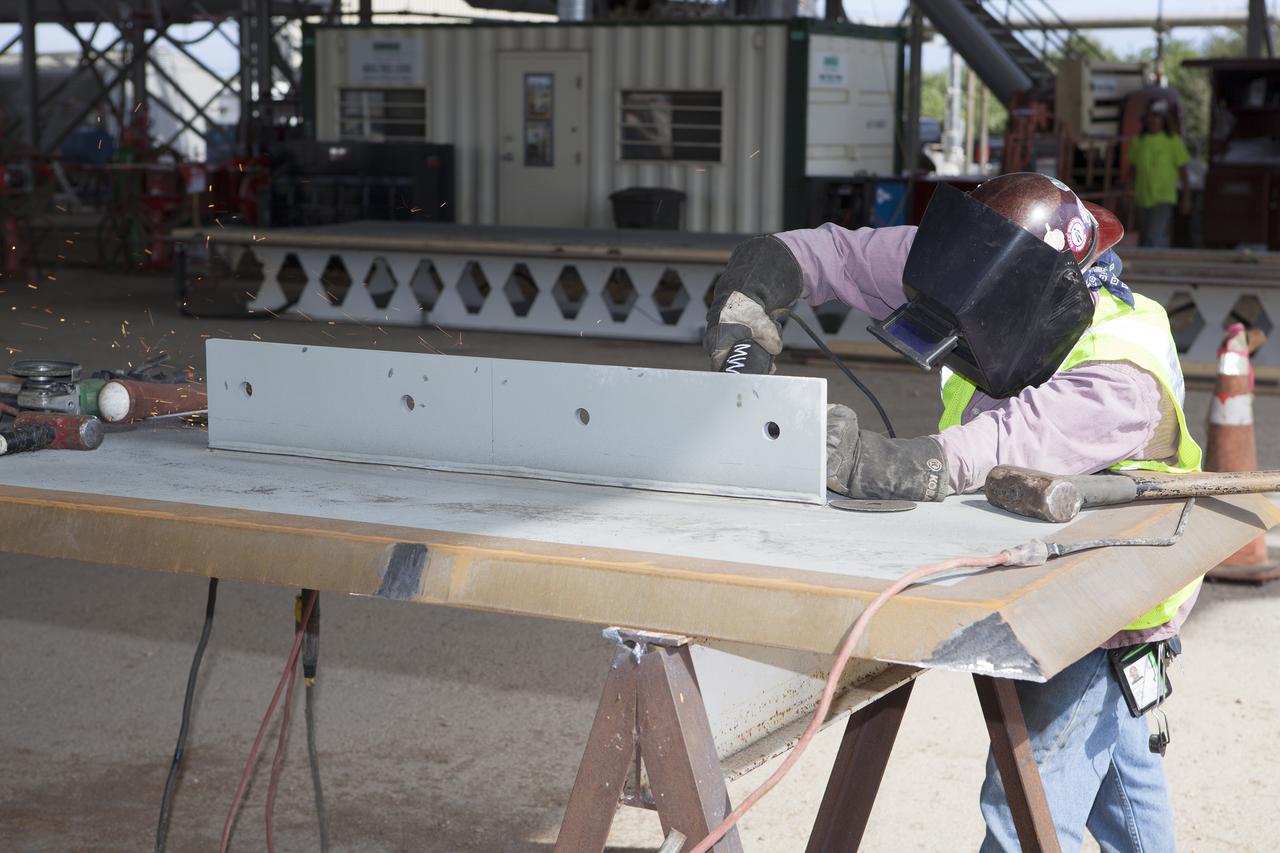
CAPE CANAVERAL, Fla. – Modifications continue on the Mobile Launcher, or ML, at the Mobile Launcher Park Site at NASA’s Kennedy Space Center in Florida. A construction worker prepares a metal part for installation on the ML. In 2013, the agency awarded a contract to J.P. Donovan Construction Inc. of Rockledge, Fla., to modify the ML, which is one of the key elements of ground support equipment that is being upgraded by the Ground Systems Development and Operations Program office at Kennedy. The ML will carry the SLS rocket and Orion spacecraft to Launch Pad 39B for its first mission, Exploration Mission 1, in 2017. Photo credit: NASA_Dimitri Gerondidakis
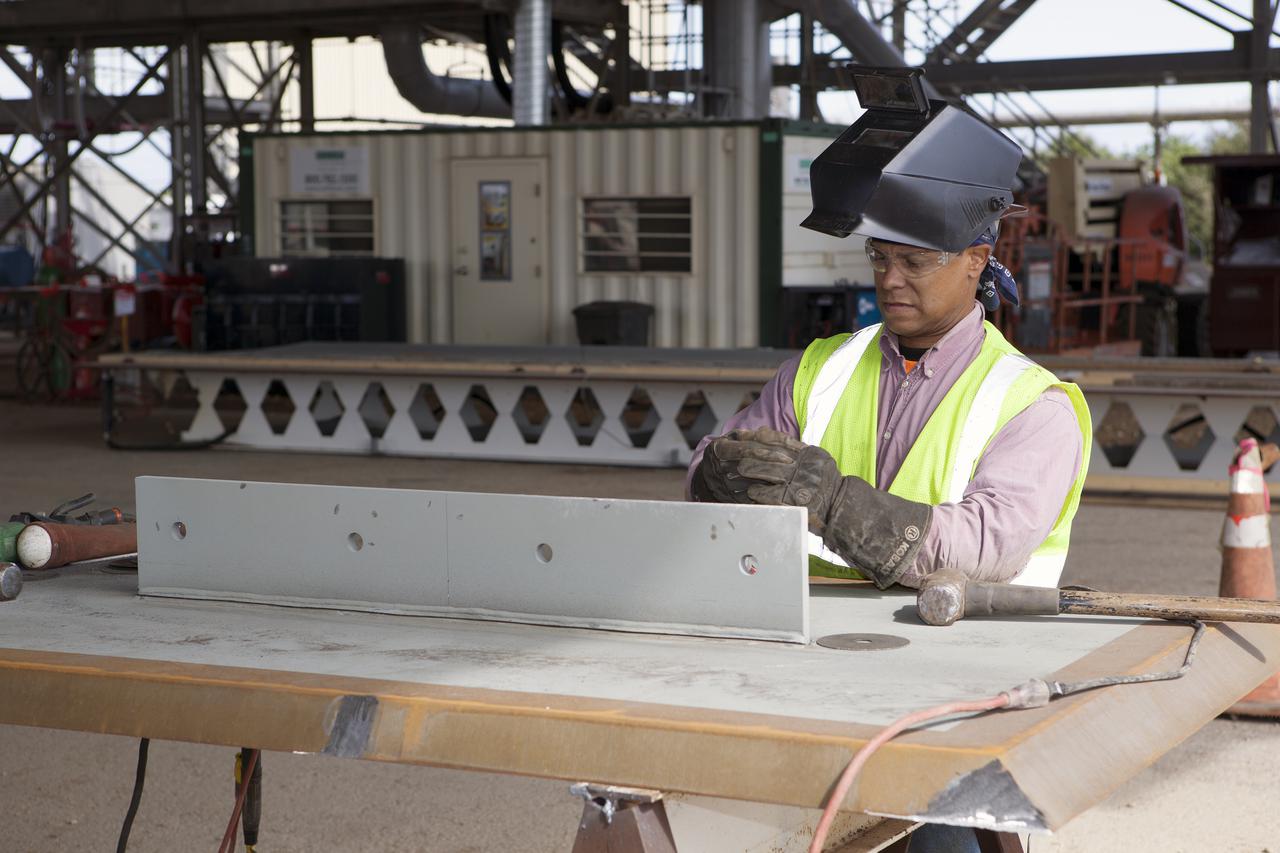
CAPE CANAVERAL, Fla. – Modifications continue on the Mobile Launcher, or ML, at the Mobile Launcher Park Site at NASA’s Kennedy Space Center in Florida. A construction worker prepares a metal part for installation on the ML. In 2013, the agency awarded a contract to J.P. Donovan Construction Inc. of Rockledge, Fla., to modify the ML, which is one of the key elements of ground support equipment that is being upgraded by the Ground Systems Development and Operations Program office at Kennedy. The ML will carry the SLS rocket and Orion spacecraft to Launch Pad 39B for its first mission, Exploration Mission 1, in 2017. Photo credit: NASA_Dimitri Gerondidakis
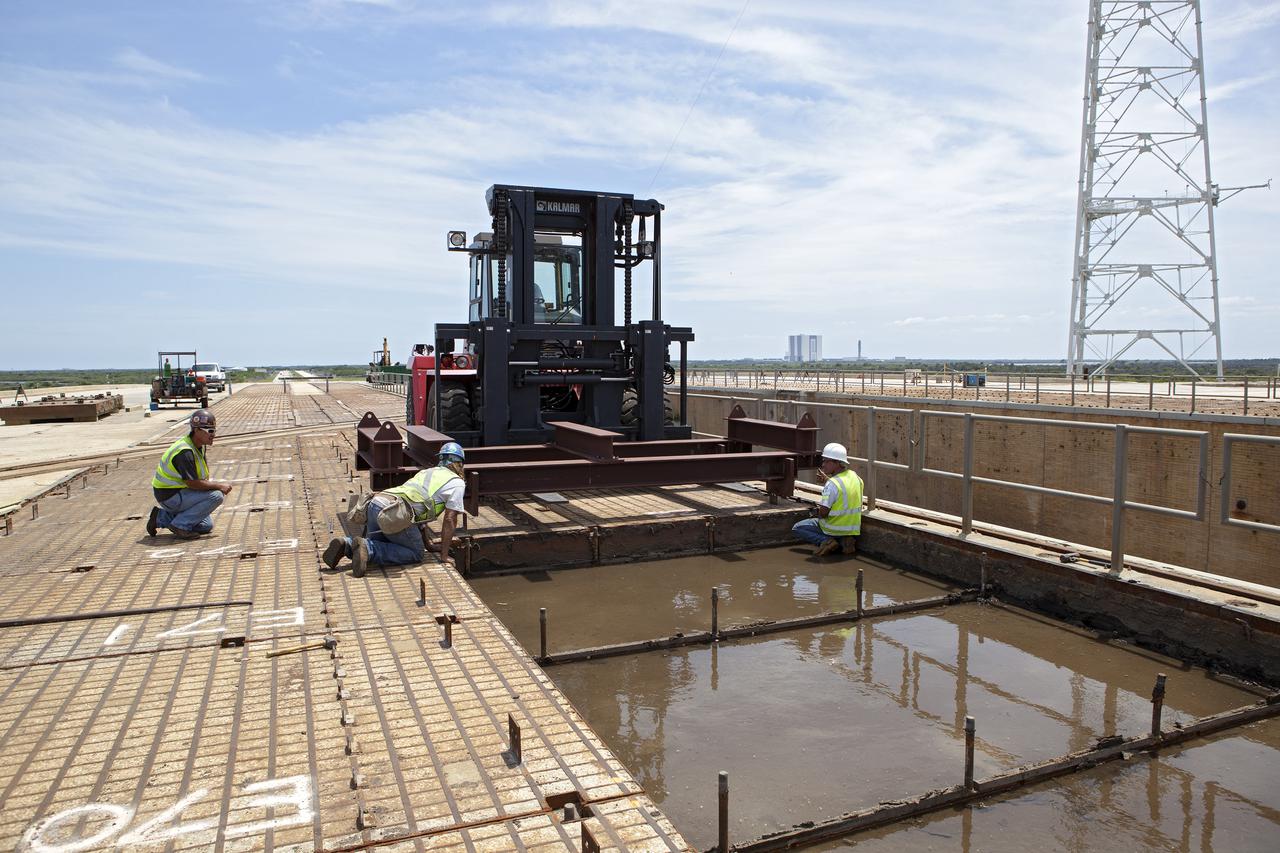
CAPE CANAVERAL, Fla. – At Launch Pad 39B at NASA’s Kennedy Space Center in Florida, removal of the crawler track panels on the pad’s surface is underway. The concrete surface beneath the panels and the catacomb roof below will be inspected for water damage and repaired. There are 176 panels, each weighing about 30,000 pounds that will be removed. Launch Pad 39B is being refurbished to support NASA’s Space Launch System and other launch vehicles. The Ground Systems Development and Operations, or GSDO, Program office at Kennedy is leading the center’s transformation to safely handle a variety of rockets and spacecraft. For more information about GSDO, visit: http:__go.nasa.gov_groundsystems. Photo credit: NASA_Dimitri Gerondidakis
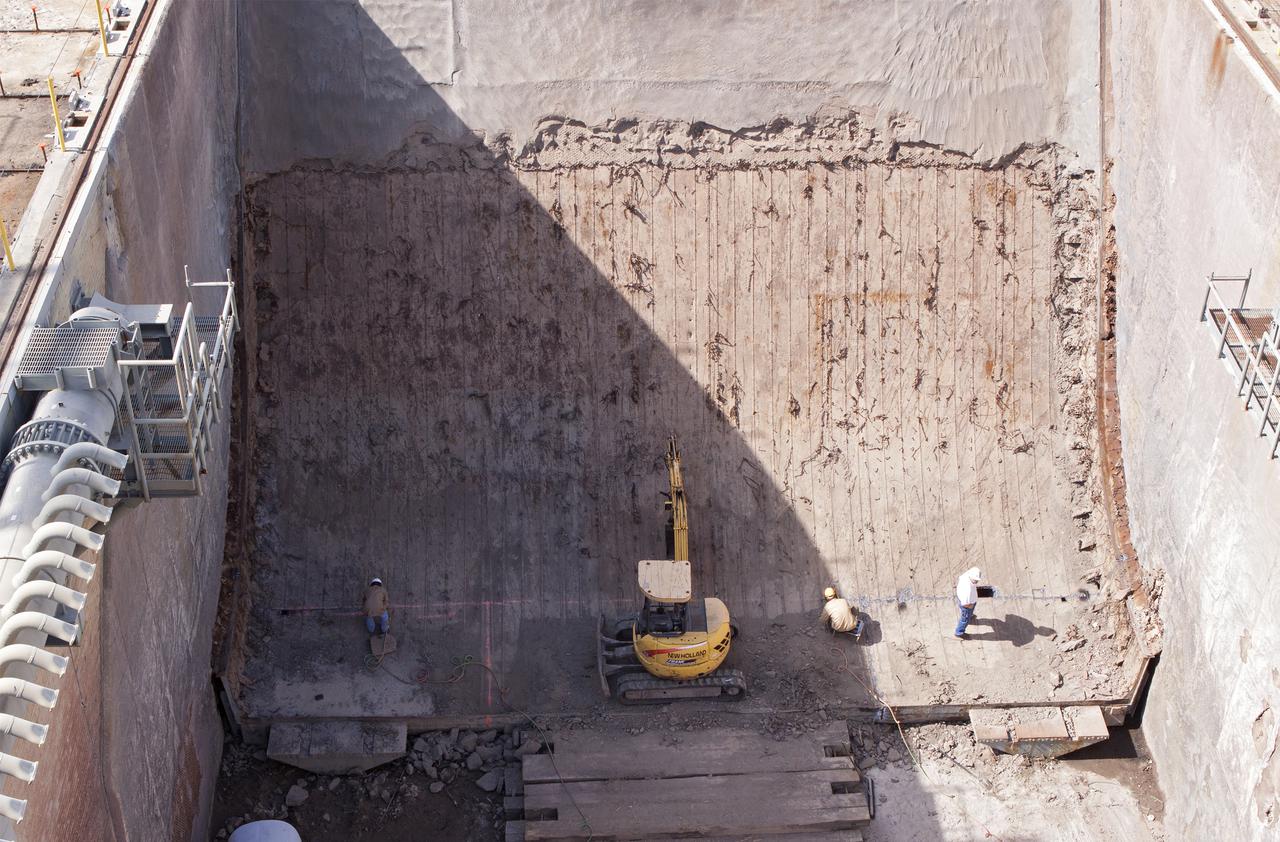
CAPE CANAVERAL, Fla. -- At Launch Pad 39B at NASA’s Kennedy Space Center in Florida, workers are removing the flame trench deflector that sits below and between the left and right crawler track panels. Launch Pad 39B is being refurbished to support NASA’s Space Launch System and other launch vehicles. The Ground Systems Development and Operations, or GSDO, Program office at Kennedy is leading the center’s transformation to safely handle a variety of rockets and spacecraft. For more information about GSDO, visit: http:__go.nasa.gov_groundsystems. Photo credit: NASA_Jim Grossman
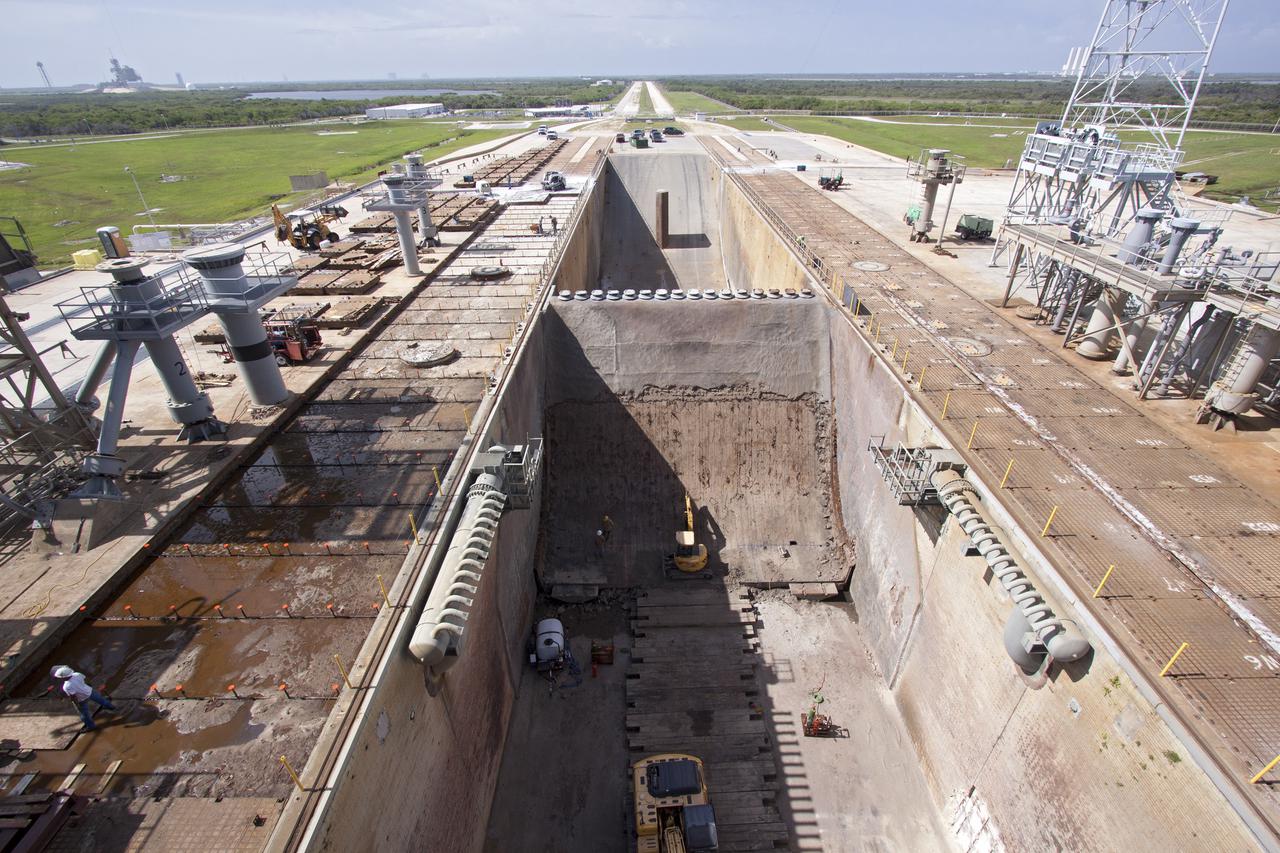
CAPE CANAVERAL, Fla. -- At Launch Pad 39B at NASA’s Kennedy Space Center in Florida, construction workers have removed nearly all of the crawler track panels on the pad’s surface. Workers also are removing the flame trench deflector that sits below and between the left and right crawler track panels. The concrete surface beneath the panels and the catacomb roof below will be inspected for water damage and repaired. There are 176 panels, each weighing about 30,000 pounds that will be removed. Launch Pad 39B is being refurbished to support NASA’s Space Launch System and other launch vehicles. The Ground Systems Development and Operations, or GSDO, Program office at Kennedy is leading the center’s transformation to safely handle a variety of rockets and spacecraft. For more information about GSDO, visit: http:__go.nasa.gov_groundsystems. Photo credit: NASA_Jim Grossman
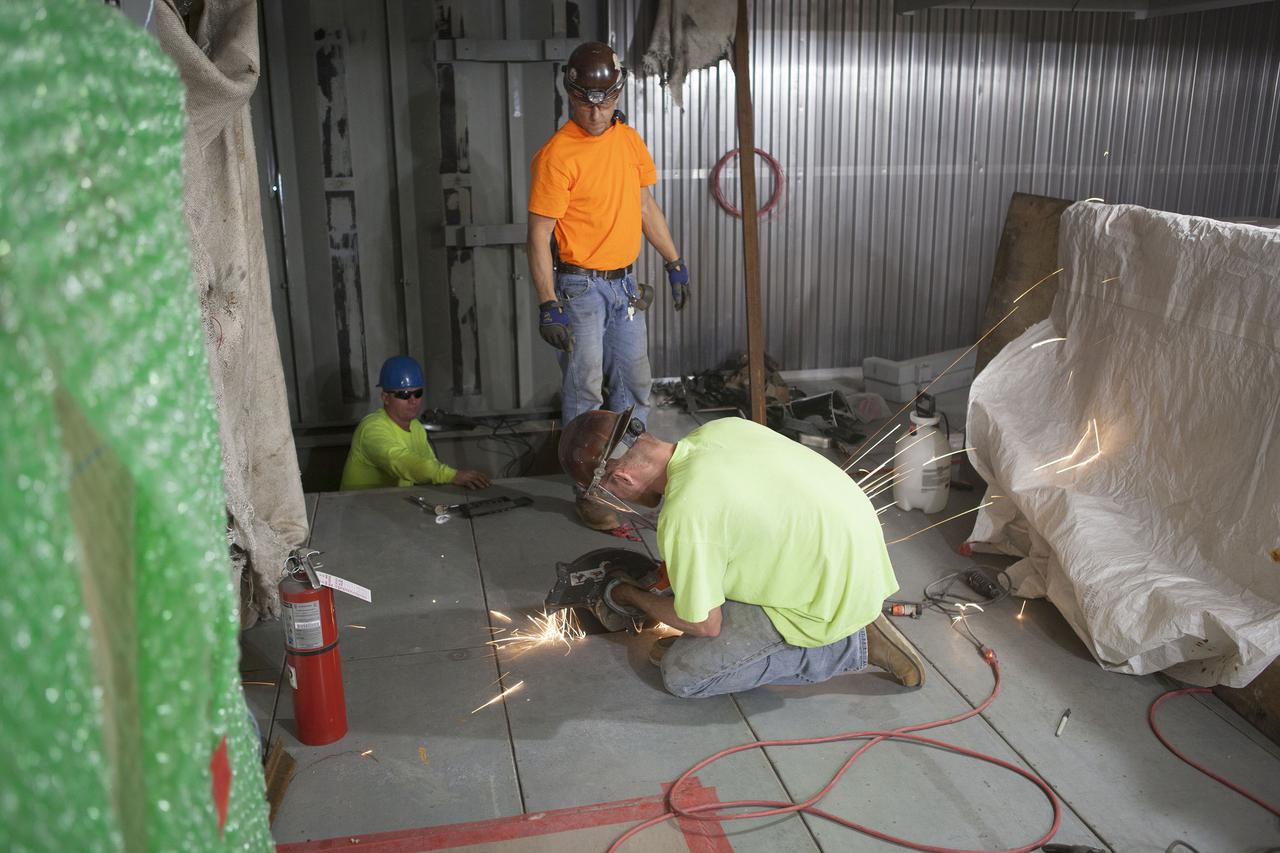
CAPE CANAVERAL, Fla. – Modifications continue on the Mobile Launcher, or ML, at the Mobile Launcher Park Site at NASA’s Kennedy Space Center in Florida. A construction worker uses a saw to cut through a portion of the flooring beneath the surface of the ML. In 2013, the agency awarded a contract to J.P. Donovan Construction Inc. of Rockledge, Fla., to modify the ML, which is one of the key elements of ground support equipment that is being upgraded by the Ground Systems Development and Operations Program office at Kennedy. The ML will carry the SLS rocket and Orion spacecraft to Launch Pad 39B for its first mission, Exploration Mission 1, in 2017. Photo credit: NASA_Dimitri Gerondidakis
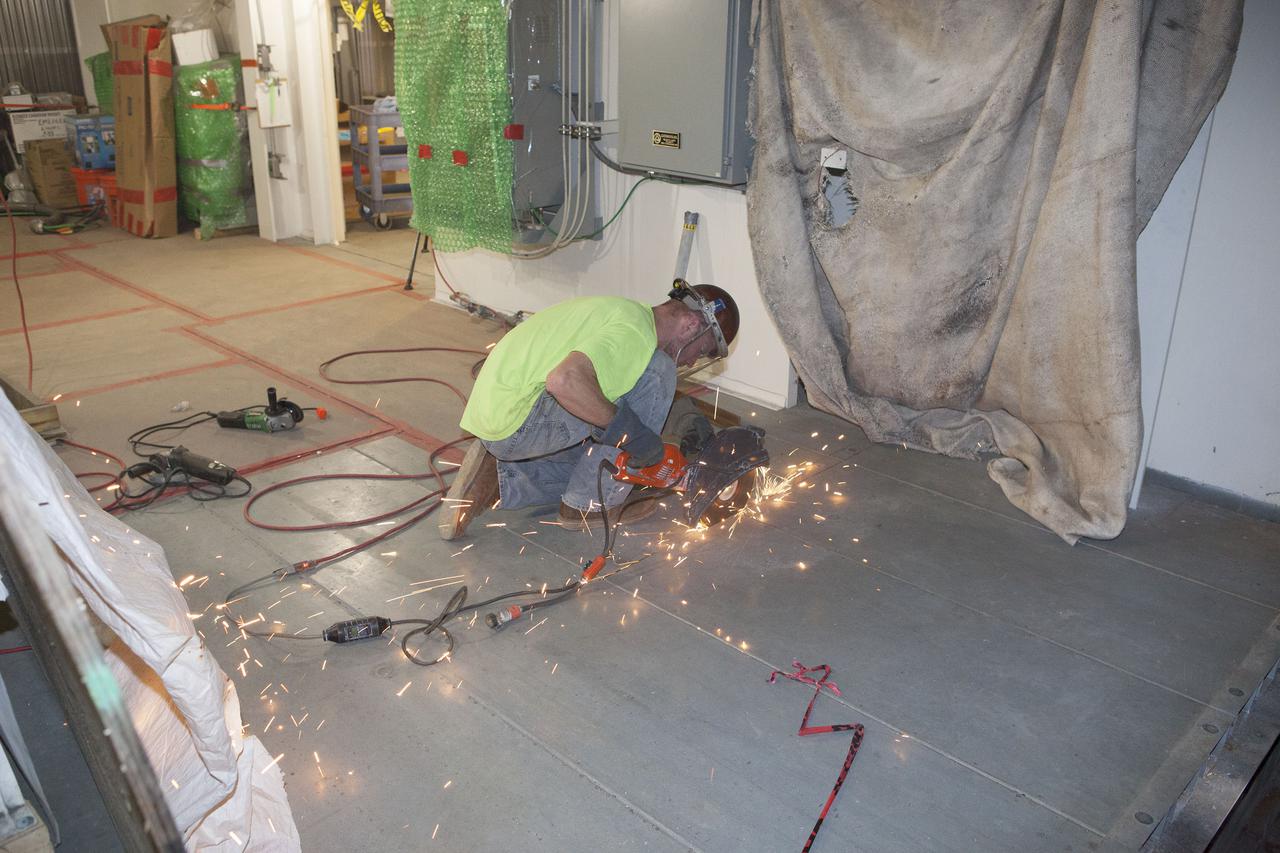
CAPE CANAVERAL, Fla. – Modifications continue on the Mobile Launcher, or ML, at the Mobile Launcher Park Site at NASA’s Kennedy Space Center in Florida. A construction worker uses a saw to cut through a portion of the flooring beneath the surface of the ML. In 2013, the agency awarded a contract to J.P. Donovan Construction Inc. of Rockledge, Fla., to modify the ML, which is one of the key elements of ground support equipment that is being upgraded by the Ground Systems Development and Operations Program office at Kennedy. The ML will carry the SLS rocket and Orion spacecraft to Launch Pad 39B for its first mission, Exploration Mission 1, in 2017. Photo credit: NASA_Dimitri Gerondidakis
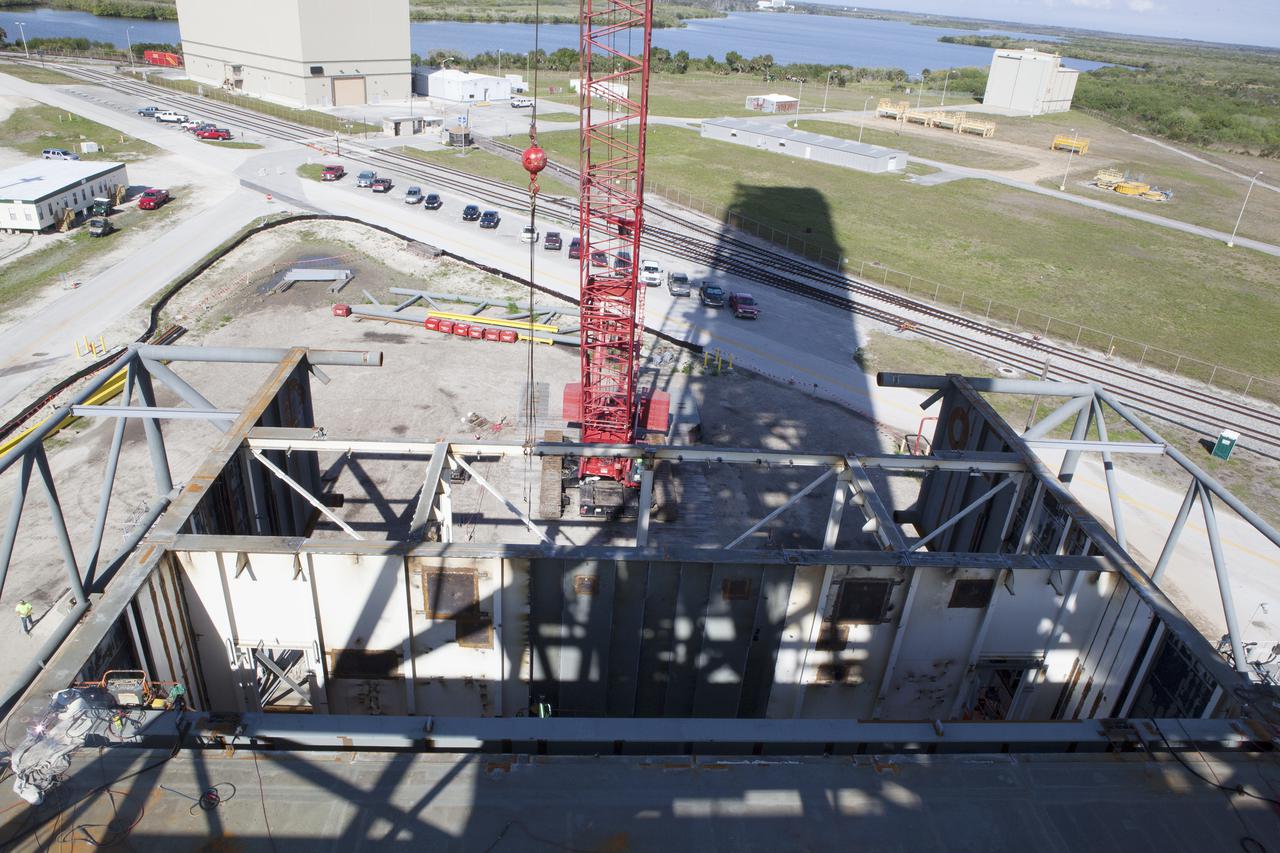
CAPE CANAVERAL, Fla. – Modifications continue on the Mobile Launcher, or ML, at the Mobile Launcher Park Site at NASA’s Kennedy Space Center in Florida. A view from above shows work in progress on the surface of the ML. In 2013, the agency awarded a contract to J.P. Donovan Construction Inc. of Rockledge, Fla., to modify the ML, which is one of the key elements of ground support equipment that is being upgraded by the Ground Systems Development and Operations Program office at Kennedy. The ML will carry the SLS rocket and Orion spacecraft to Launch Pad 39B for its first mission, Exploration Mission 1, in 2017. Photo credit: NASA_Dimitri Gerondidakis
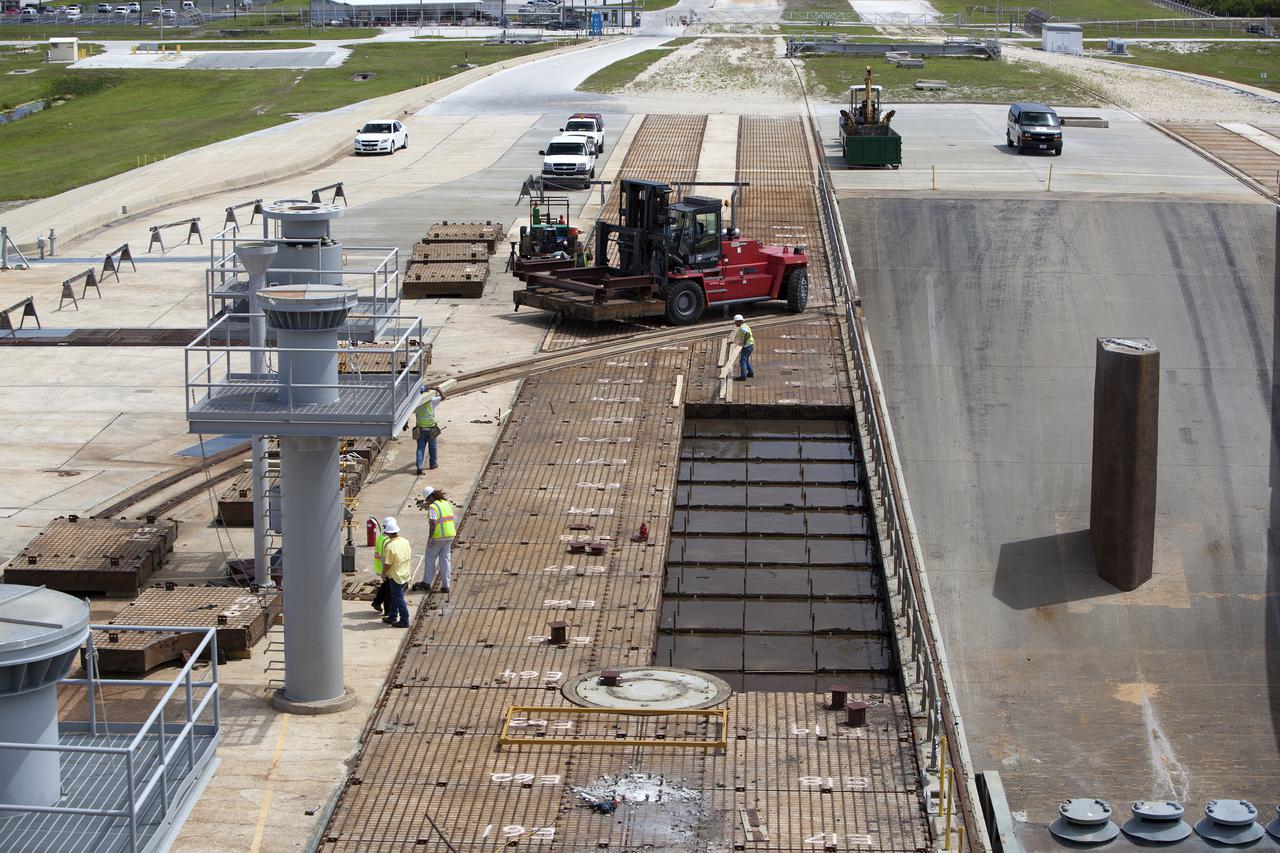
CAPE CANAVERAL, Fla. – At Launch Pad 39B at NASA’s Kennedy Space Center in Florida, an aerial view shows the progress as construction workers remove crawler track panels from the pad’s surface. The concrete surface beneath the panels and the catacomb roof below will be inspected for water damage and repaired. There are 176 panels, each weighing about 30,000 pounds that will be removed. Launch Pad 39B is being refurbished to support NASA’s Space Launch System and other launch vehicles. The Ground Systems Development and Operations, or GSDO, Program office at Kennedy is leading the center’s transformation to safely handle a variety of rockets and spacecraft. For more information about GSDO, visit: http:__go.nasa.gov_groundsystems. Photo credit: NASA_Dimitri Gerondidakis
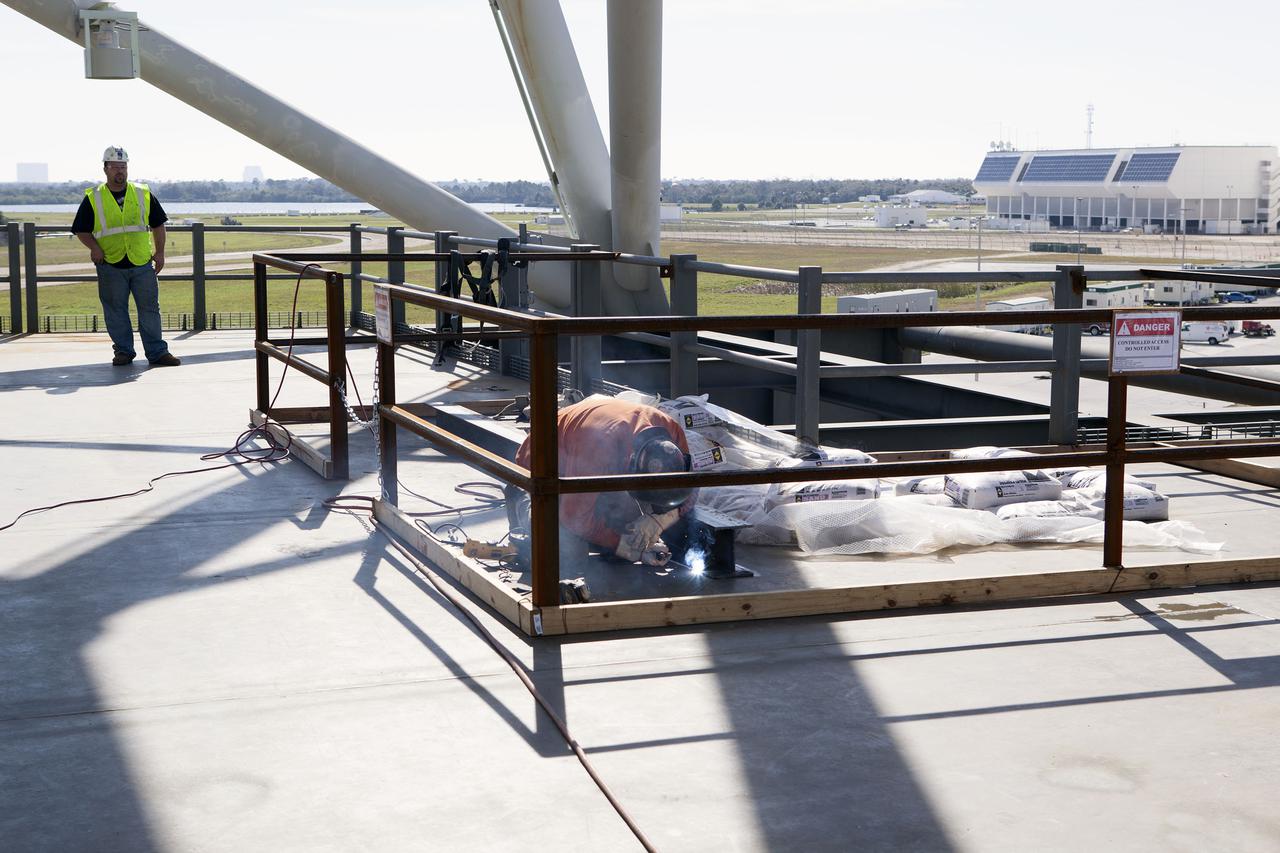
CAPE CANAVERAL, Fla. – Modifications continue on the Mobile Launcher, or ML, at the Mobile Launcher Park Site at NASA’s Kennedy Space Center in Florida. A construction worker welds a metal beam on the surface of the ML. In 2013, the agency awarded a contract to J.P. Donovan Construction Inc. of Rockledge, Fla., to modify the ML, which is one of the key elements of ground support equipment that is being upgraded by the Ground Systems Development and Operations Program office at Kennedy. The ML will carry the SLS rocket and Orion spacecraft to Launch Pad 39B for its first mission, Exploration Mission 1, in 2017. Photo credit: NASA_Dimitri Gerondidakis
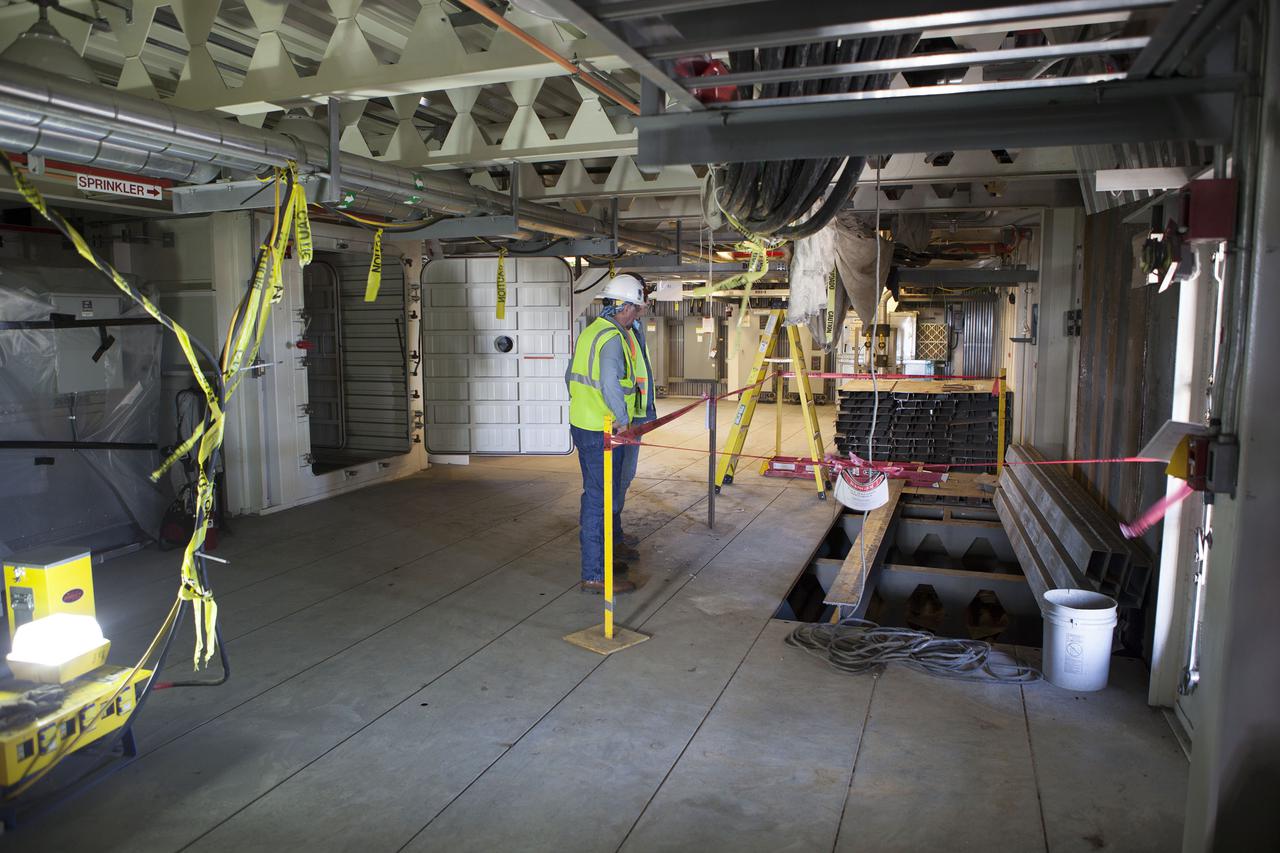
CAPE CANAVERAL, Fla. – Modifications continue on the Mobile Launcher, or ML, at the Mobile Launcher Park Site at NASA’s Kennedy Space Center in Florida. Construction workers check a roped off area beneath the surface of the ML. In 2013, the agency awarded a contract to J.P. Donovan Construction Inc. of Rockledge, Fla., to modify the ML, which is one of the key elements of ground support equipment that is being upgraded by the Ground Systems Development and Operations Program office at Kennedy. The ML will carry the SLS rocket and Orion spacecraft to Launch Pad 39B for its first mission, Exploration Mission 1, in 2017. Photo credit: NASA_Dimitri Gerondidakis
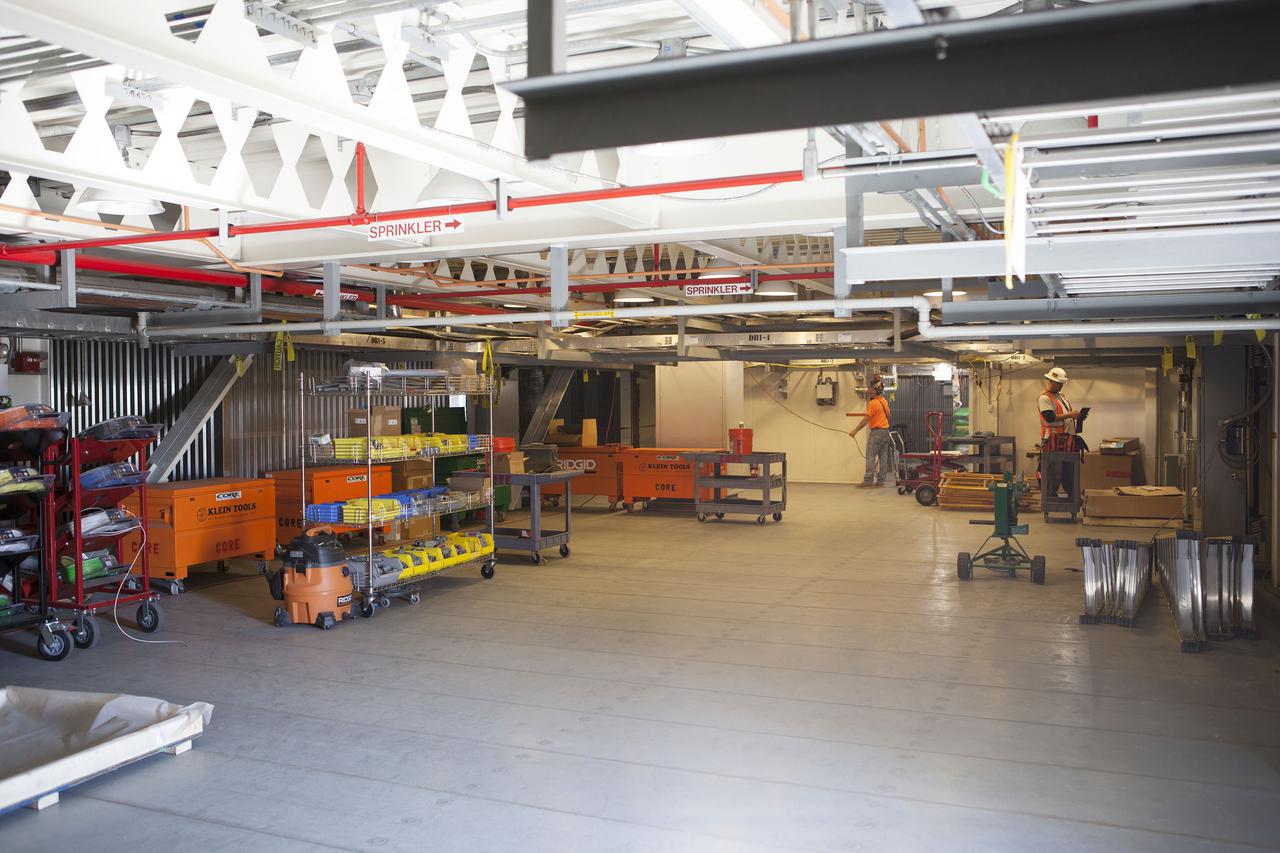
CAPE CANAVERAL, Fla. – Modifications continue on the Mobile Launcher, or ML, at the Mobile Launcher Park Site at NASA’s Kennedy Space Center in Florida. Construction workers check cables and wiring beneath the surface of the ML. In 2013, the agency awarded a contract to J.P. Donovan Construction Inc. of Rockledge, Fla., to modify the ML, which is one of the key elements of ground support equipment that is being upgraded by the Ground Systems Development and Operations Program office at Kennedy. The ML will carry the SLS rocket and Orion spacecraft to Launch Pad 39B for its first mission, Exploration Mission 1, in 2017. Photo credit: NASA_Dimitri Gerondidakis
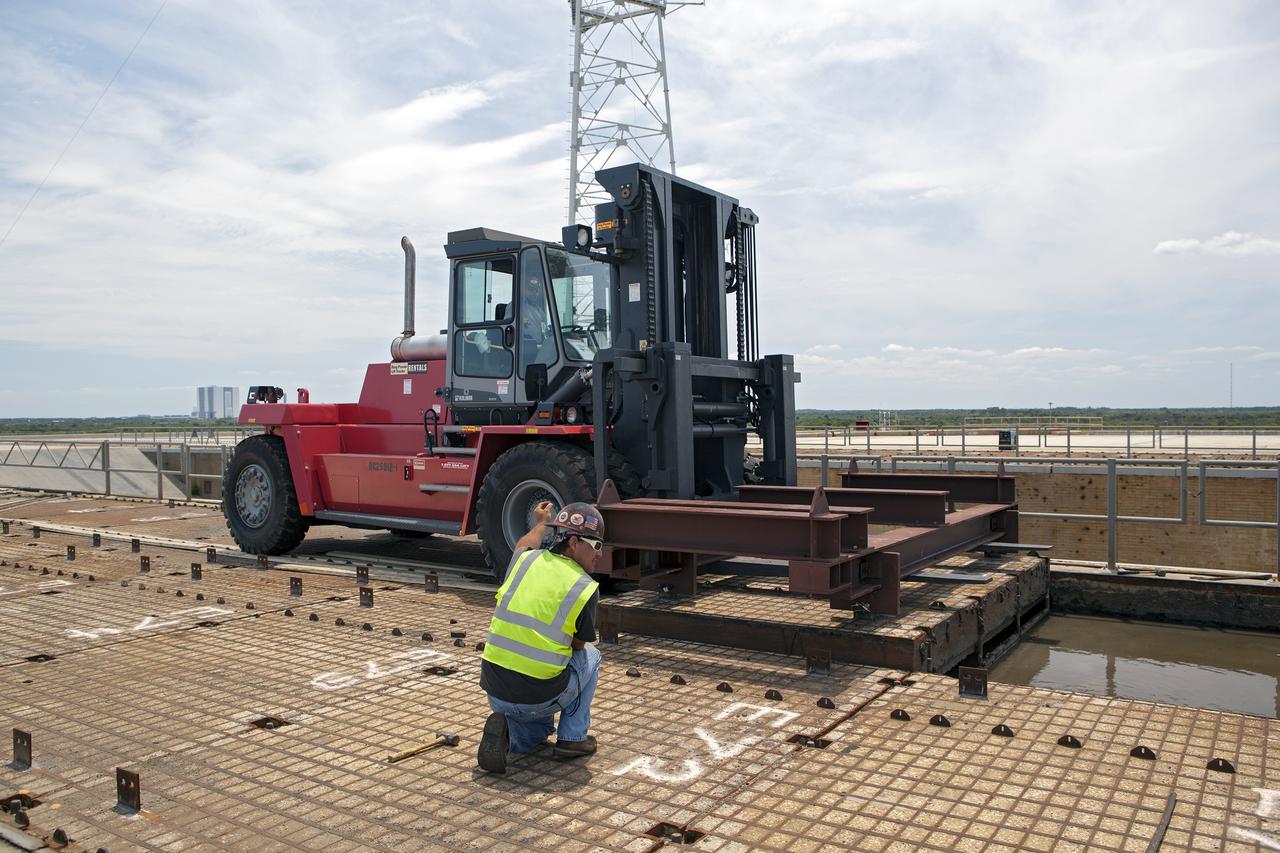
CAPE CANAVERAL, Fla. – At Launch Pad 39B at NASA’s Kennedy Space Center in Florida, a construction worker prepares a crawler track panel on the pad’s surface for removal. The concrete surface beneath the panels and the catacomb roof below will be inspected for water damage and repaired. There are 176 panels, each weighing about 30,000 pounds that will be removed. Launch Pad 39B is being refurbished to support NASA’s Space Launch System and other launch vehicles. The Ground Systems Development and Operations, or GSDO, Program office at Kennedy is leading the center’s transformation to safely handle a variety of rockets and spacecraft. For more information about GSDO, visit: http:__go.nasa.gov_groundsystems. Photo credit: NASA_Dimitri Gerondidakis
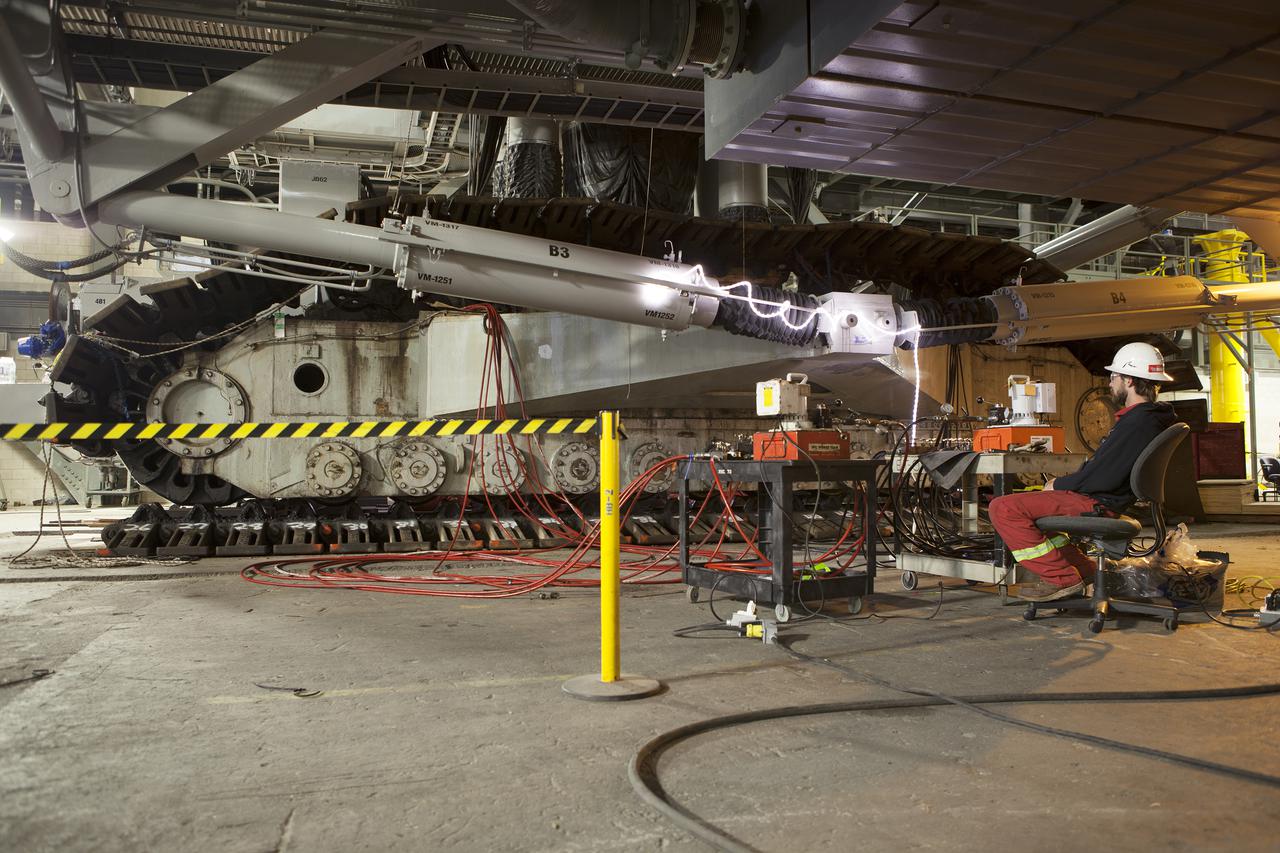
CAPE CANAVERAL, Fla. – Inside the Vehicle Assembly Building at NASA’s Kennedy Space Center in Florida, a technician monitors the progress as the B and D truck sections of crawler-transporter 2, or CT-2, are raised up to prepare for installation of new roller bearing assemblies. Work continues in high bay 2 to upgrade CT-2. The modifications are designed to ensure CT-2’s ability to transport launch vehicles currently in development, such as the agency’s Space Launch System, to the launch pad. The Ground Systems Development and Operations Program office at Kennedy is overseeing the upgrades. For more than 45 years the crawler-transporters were used to transport the mobile launcher platform and the Apollo-Saturn V rockets and, later, space shuttles to Launch Pads 39A and B. For more information, visit: http:__www.nasa.gov_exploration_systems_ground_crawler-transporter. Photo credit: NASA_Dimitri Gerondidakis
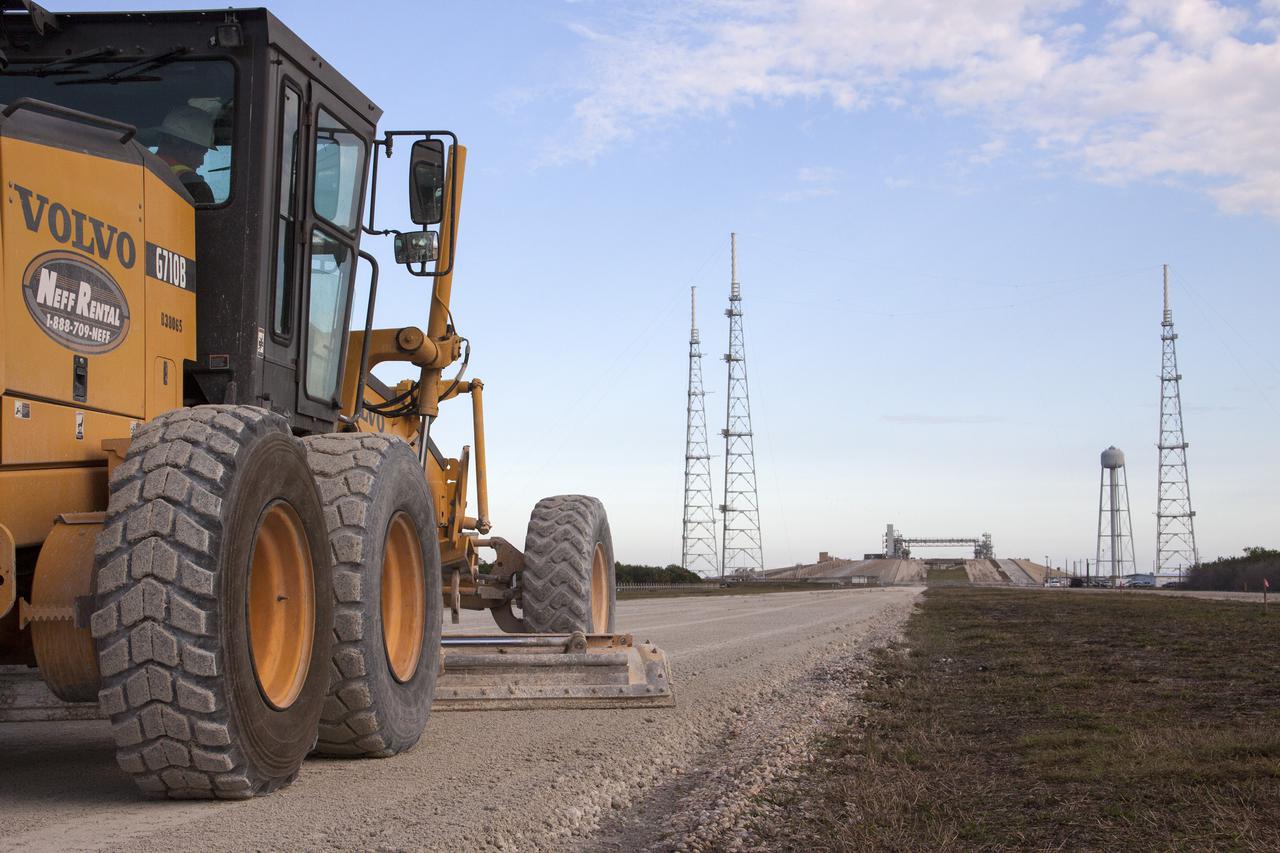
CAPE CANAVERAL, Fla. – A worker from Canaveral Construction in Mims, Fla., re-grades a section of the crawlerway near Launch Pad 39B at NASA’s Kennedy Space Center in Florida. The crawlerway is being upgraded to improve the foundation and prepare it to support the weight of NASA’s Space Launch System, or SLS, and mobile launcher on the crawler-transporter during rollout. Workers are removing the original Alabama river rock and restoring the layer of lime rock below to its original depth of three feet. Then new river rock will be added on top. The Ground Systems Development and Operations, or GSDO, Program office at Kennedy is leading the center’s transformation to safely handle a variety of rockets and spacecraft. For more information about GSDO, visit: http:__go.nasa.gov_groundsystems. Photo credit: NASA_Jim Grossmann
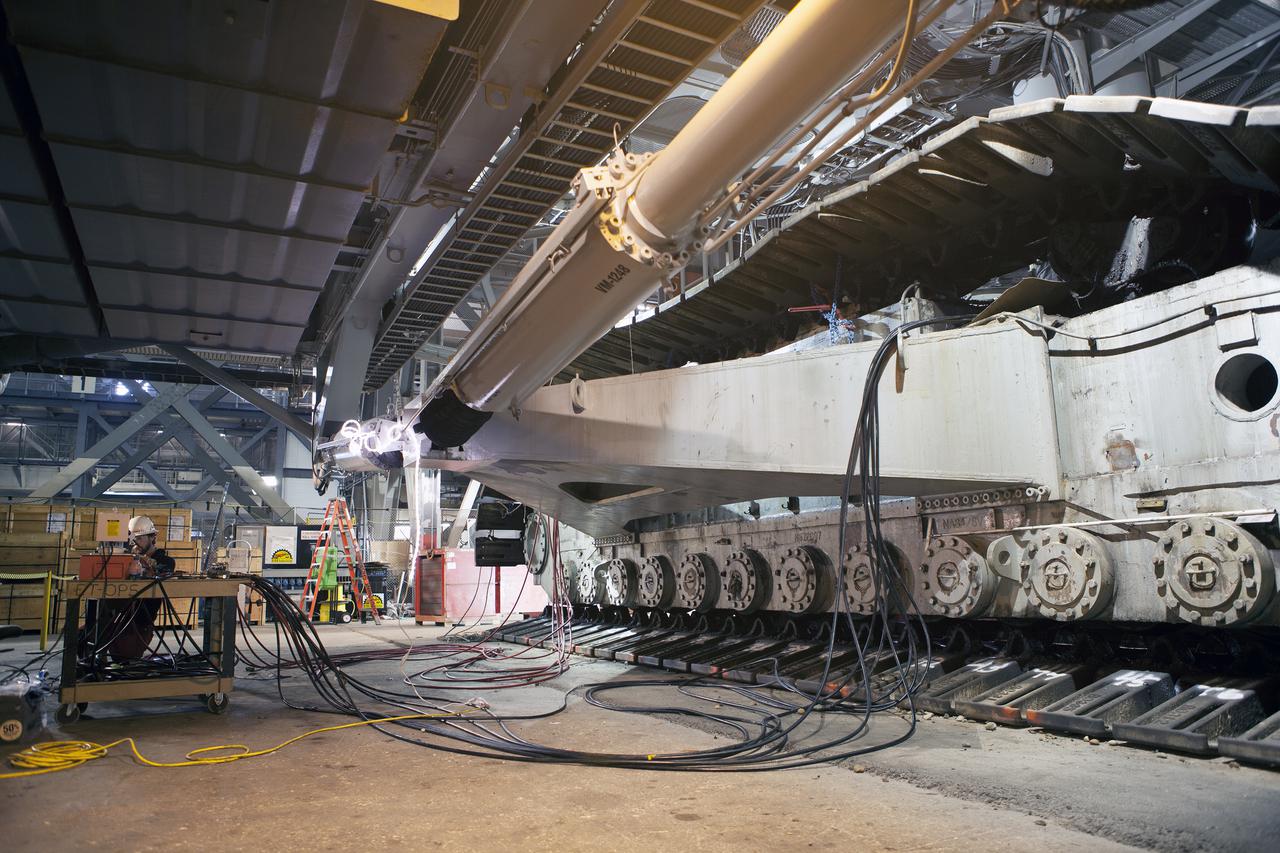
CAPE CANAVERAL, Fla. – Inside the Vehicle Assembly Building at NASA’s Kennedy Space Center in Florida, the B and D truck sections of crawler-transporter 2, or CT-2, are being raised up to prepare for installation of new roller bearing assemblies. Work continues in high bay 2 to upgrade CT-2. The modifications are designed to ensure CT-2’s ability to transport launch vehicles currently in development, such as the agency’s Space Launch System, to the launch pad. The Ground Systems Development and Operations Program office at Kennedy is overseeing the upgrades. For more than 45 years the crawler-transporters were used to transport the mobile launcher platform and the Apollo-Saturn V rockets and, later, space shuttles to Launch Pads 39A and B. For more information, visit: http:__www.nasa.gov_exploration_systems_ground_crawler-transporter. Photo credit: NASA_Dimitri Gerondidakis
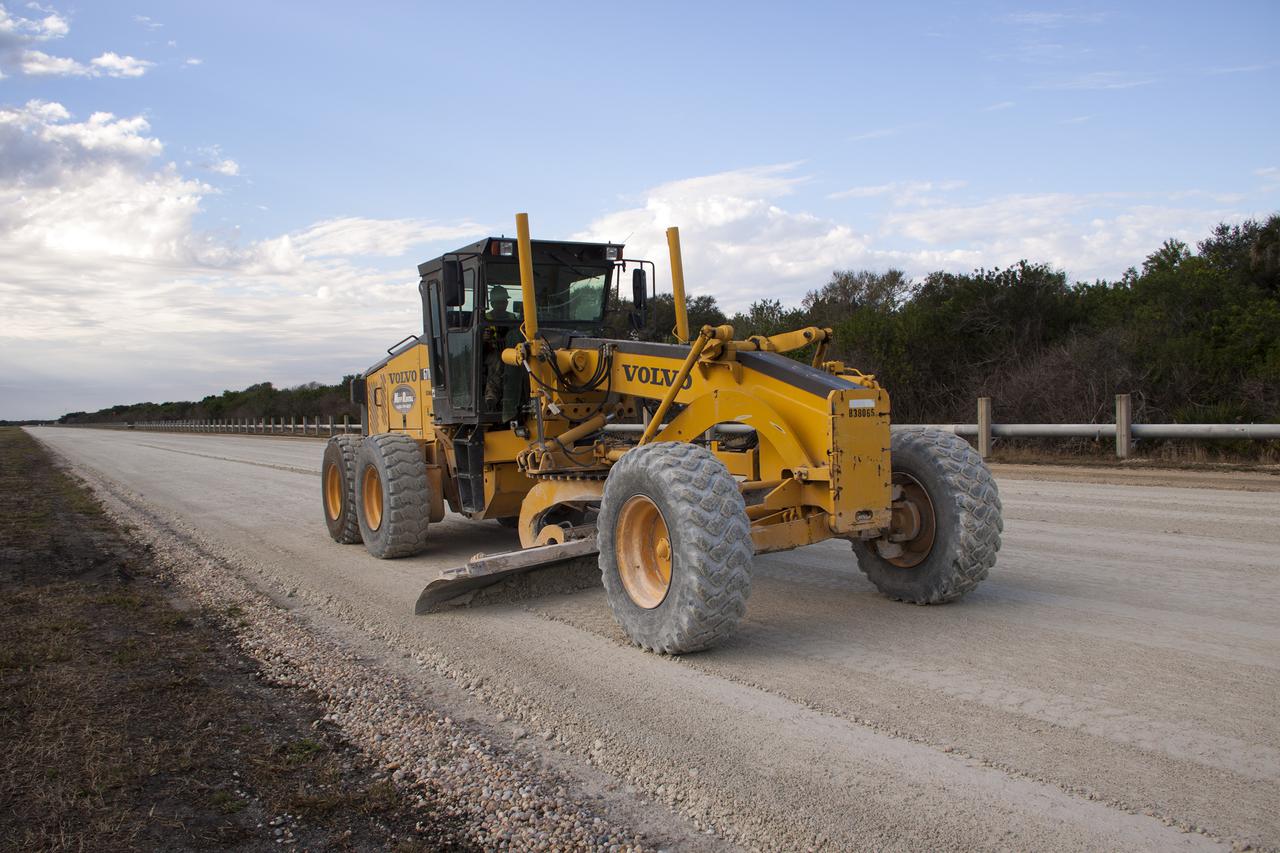
CAPE CANAVERAL, Fla. – A worker from Canaveral Construction in Mims, Fla., re-grades a section of the crawlerway near Launch Pad 39B at NASA’s Kennedy Space Center in Florida. The crawlerway is being upgraded to improve the foundation and prepare it to support the weight of NASA’s Space Launch System, or SLS, and mobile launcher on the crawler-transporter during rollout. Workers are removing the original Alabama river rock and restoring the layer of lime rock below to its original depth of three feet. Then new river rock will be added on top. The Ground Systems Development and Operations, or GSDO, Program office at Kennedy is leading the center’s transformation to safely handle a variety of rockets and spacecraft. For more information about GSDO, visit: http:__go.nasa.gov_groundsystems. Photo credit: NASA_Jim Grossmann
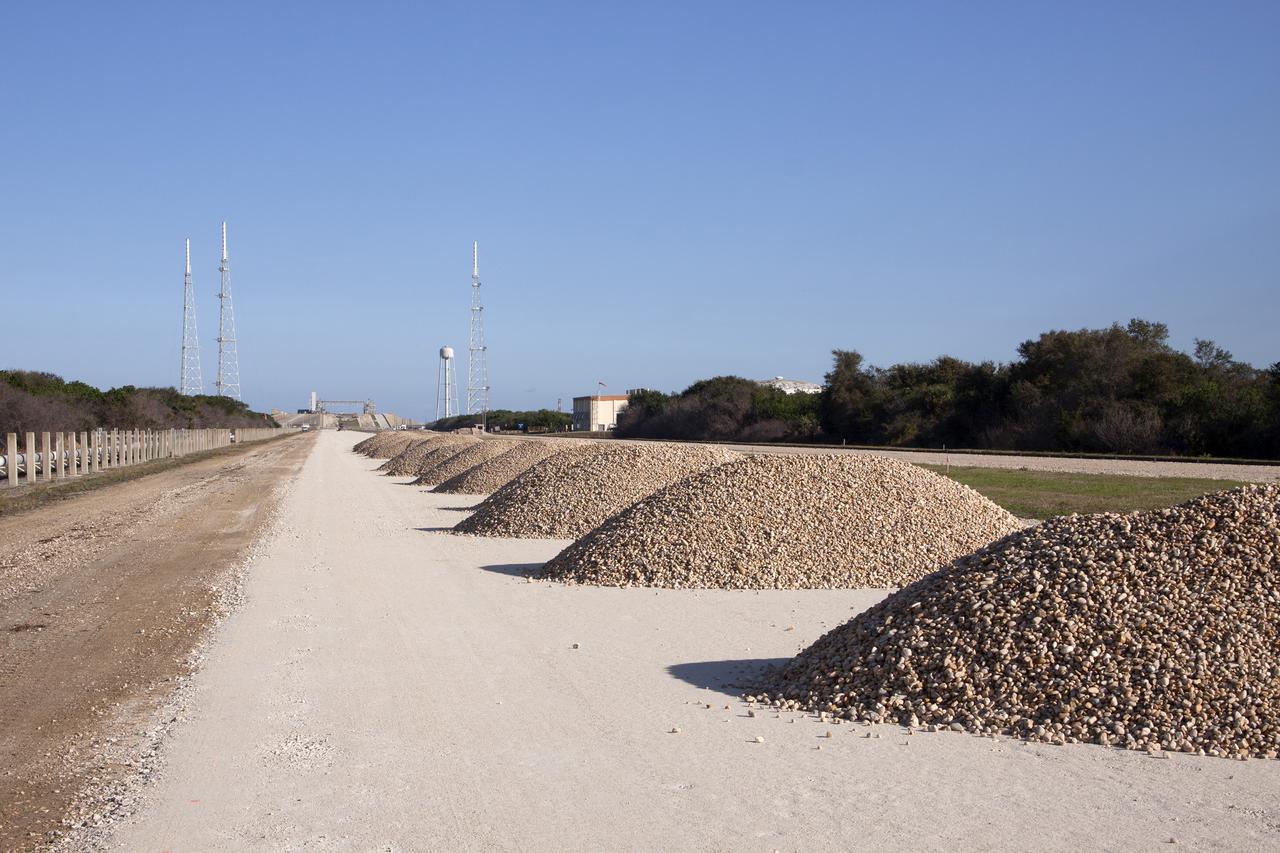
CAPE CANAVERAL, Fla. – Workers from Canaveral Construction in Mims, Fla., have removed the Alabama river rock from one side of the crawlerway near Launch Pad 39B at NASA’s Kennedy Space Center in Florida. The crawlerway is being upgraded to improve the foundation and prepare it to support the weight of NASA’s Space Launch System, or SLS, and mobile launcher on the crawler-transporter during rollout. Workers are removing the original Alabama river rock and restoring the layer of lime rock below to its original depth of three feet. Then new river rock will be added on top. The Ground Systems Development and Operations, or GSDO, Program office at Kennedy is leading the center’s transformation to safely handle a variety of rockets and spacecraft. For more information about GSDO, visit: http:__go.nasa.gov_groundsystems. Photo credit: NASA_Jim Grossmann
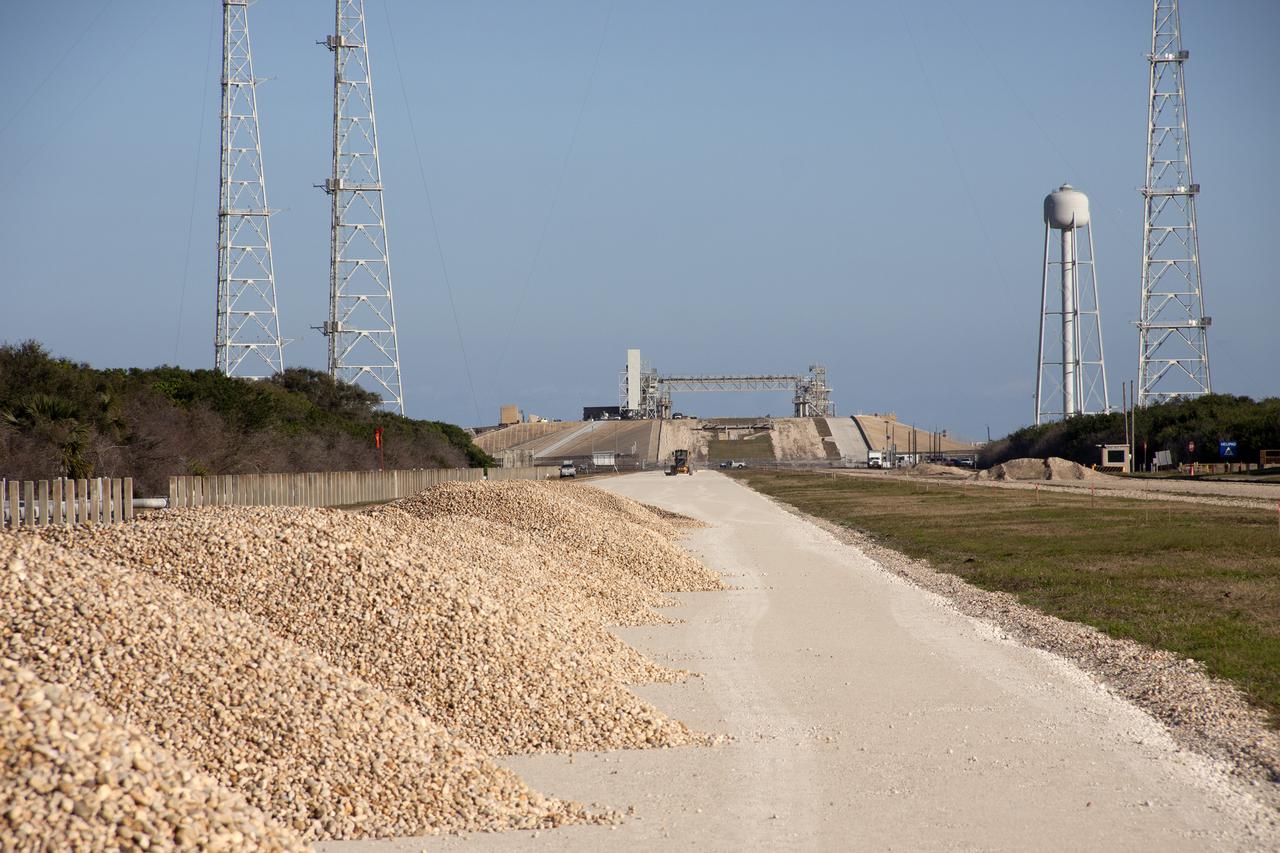
CAPE CANAVERAL, Fla. – Workers from Canaveral Construction in Mims, Fla., have removed the Alabama river rock from one side of the crawlerway near Launch Pad 39B at NASA’s Kennedy Space Center in Florida. The crawlerway is being upgraded to improve the foundation and prepare it to support the weight of NASA’s Space Launch System, or SLS, and mobile launcher on the crawler-transporter during rollout. Workers are removing the original Alabama river rock and restoring the layer of lime rock below to its original depth of three feet. Then new river rock will be added on top. The Ground Systems Development and Operations, or GSDO, Program office at Kennedy is leading the center’s transformation to safely handle a variety of rockets and spacecraft. For more information about GSDO, visit: http:__go.nasa.gov_groundsystems. Photo credit: NASA_Jim Grossmann
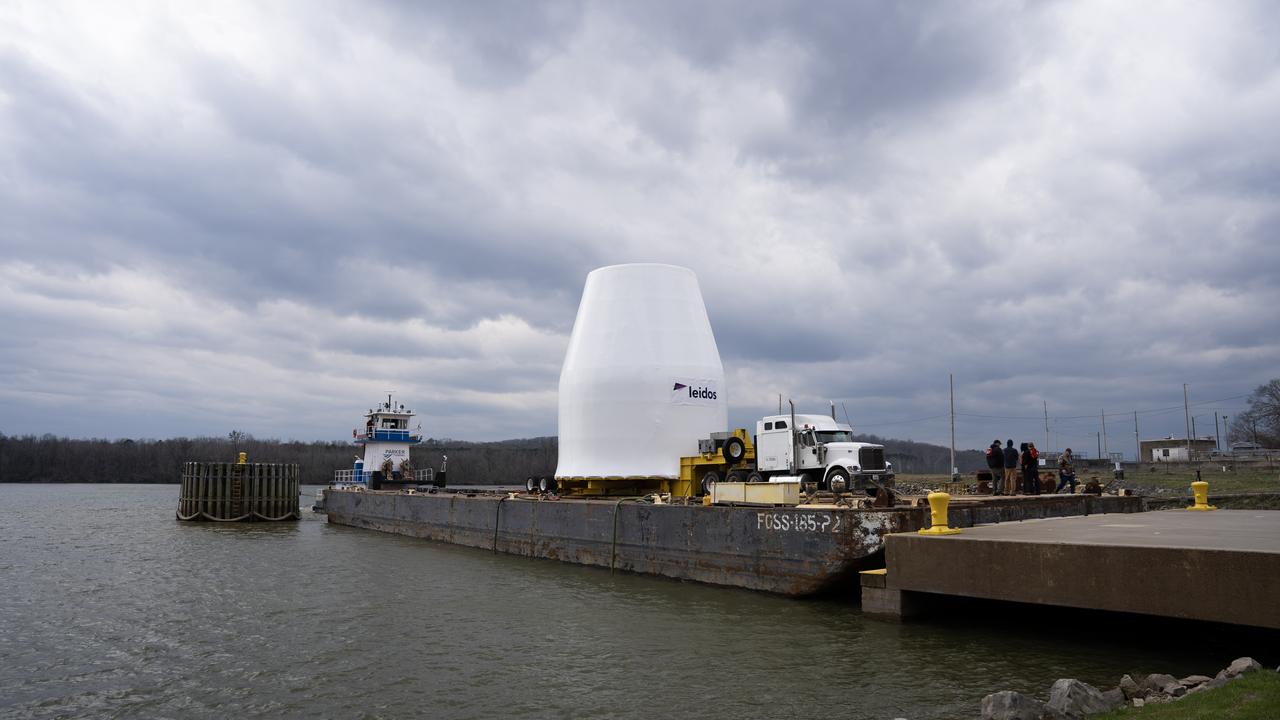
These photos and videos show how crews guided a test version of the universal stage adapter for NASA’s more powerful version of its SLS (Space Launch System) rocket to Building 4619 at the agency’s Marshall Space Flight Center in Huntsville, Alabama, Feb. 22. Built by Leidos, the lead contractor for the universal stage adapter, crews transported the hardware from a Leidos facility in Decatur, Alabama, the same day. The universal stage adapter will connect the SLS rocket’s upgraded in-space propulsion stage, called the exploration upper stage, to NASA’s Orion spacecraft as part of the evolved Block 1B configuration of the SLS rocket. It will also serve as a compartment capable of accommodating large payloads, such as modules or other exploration spacecraft. In Building 4619’s Load Test Annex High Bay at Marshall, the development test article will first undergo modal testing that will shake the hardware to validate dynamic models. Later, during ultimate load testing, force will be applied vertically and to the sides of the hardware. Unlike the flight hardware, the development test article has flaws intentionally included in its design, which will help engineers verity that the flight adapter can withstand the extreme forces it will face during launch and flight.
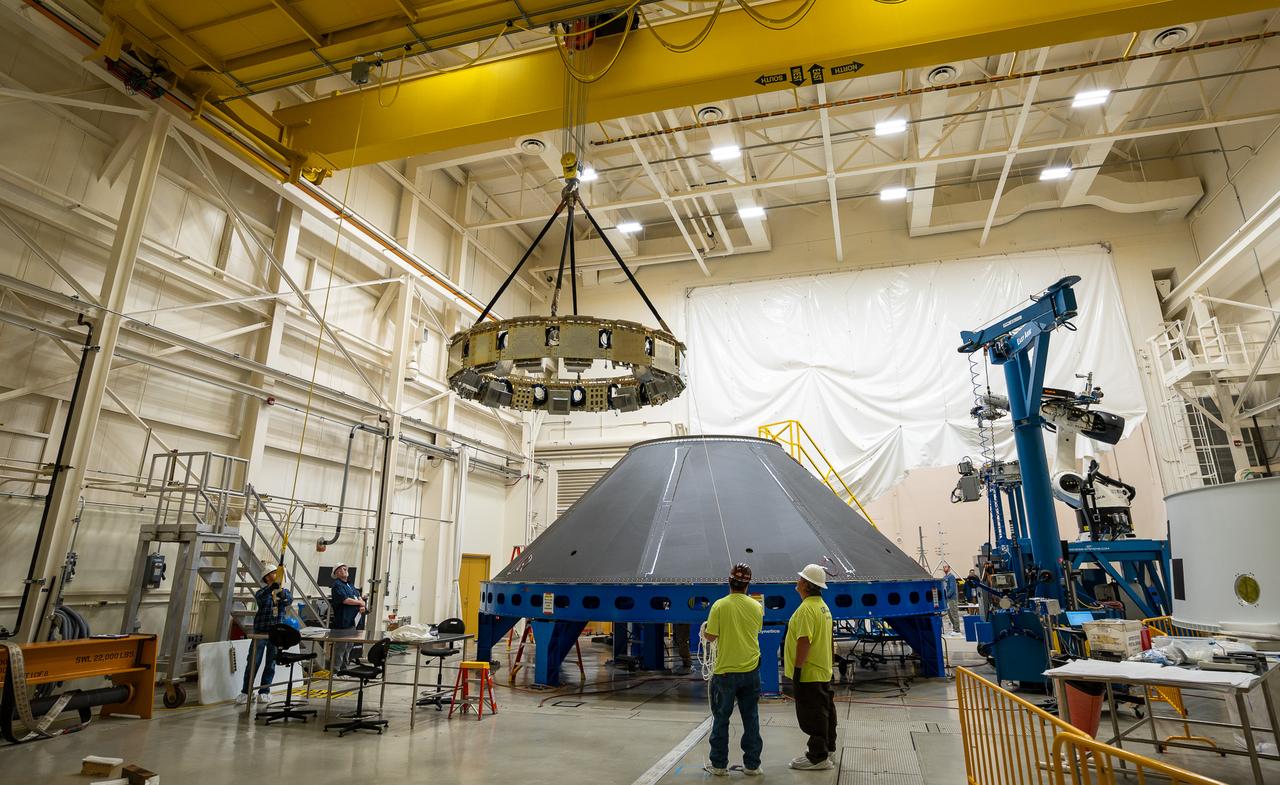
These photos and videos show how NASA manufactured and prepared to transport the payload adapter in February inside Building 4708 at NASA’s Marshall Space Flight Center in Huntsville, Alabama. Prior to moving the hardware for testing, teams installed the New Explorations Secondary Transport component, called the NEST, into the top of the engineering development unit. The NEST component will allow the hardware to hold a series of secondary payloads, or small satellites. The cone-shaped payload adapter is about 8.5 feet tall and features two metal rings and eight composite panels. The adapter, which will debut on NASA’s Artemis IV mission, is an evolution from the Orion stage adapter used in the Block 1 configuration of the rocket for the first three Artemis missions. It will be housed inside the universal stage adapter atop the rocket’s more powerful in-space stage, called the exploration upper stage. The payload adapter, like the launch vehicle stage adapter and the Orion stage adapter, is fully manufactured and tested at Marshall, which manages the SLS Program. NASA is working to land the first woman, first person of color, and its first international partner astronaut on the Moon under Artemis. SLS is part of NASA’s backbone for deep space exploration, along with the Orion spacecraft and Gateway in orbit around the Moon and commercial human landing systems, next-generational spacesuits, and rovers on the lunar surface. SLS is the only rocket that can send Orion, astronauts, and supplies to the Moon in a single launch.
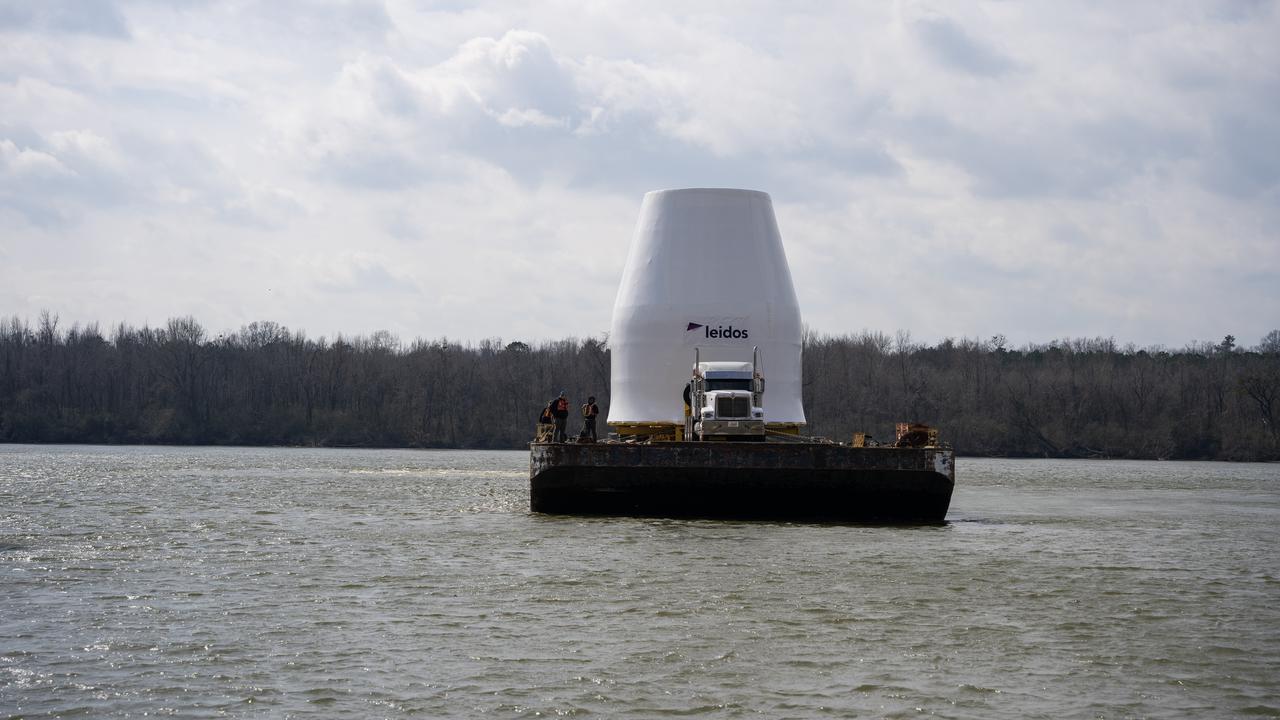
These photos and videos show how crews guided a test version of the universal stage adapter for NASA’s more powerful version of its SLS (Space Launch System) rocket to Building 4619 at the agency’s Marshall Space Flight Center in Huntsville, Alabama, Feb. 22. Built by Leidos, the lead contractor for the universal stage adapter, crews transported the hardware from a Leidos facility in Decatur, Alabama, the same day. The universal stage adapter will connect the SLS rocket’s upgraded in-space propulsion stage, called the exploration upper stage, to NASA’s Orion spacecraft as part of the evolved Block 1B configuration of the SLS rocket. It will also serve as a compartment capable of accommodating large payloads, such as modules or other exploration spacecraft. In Building 4619’s Load Test Annex High Bay at Marshall, the development test article will first undergo modal testing that will shake the hardware to validate dynamic models. Later, during ultimate load testing, force will be applied vertically and to the sides of the hardware. Unlike the flight hardware, the development test article has flaws intentionally included in its design, which will help engineers verity that the flight adapter can withstand the extreme forces it will face during launch and flight.
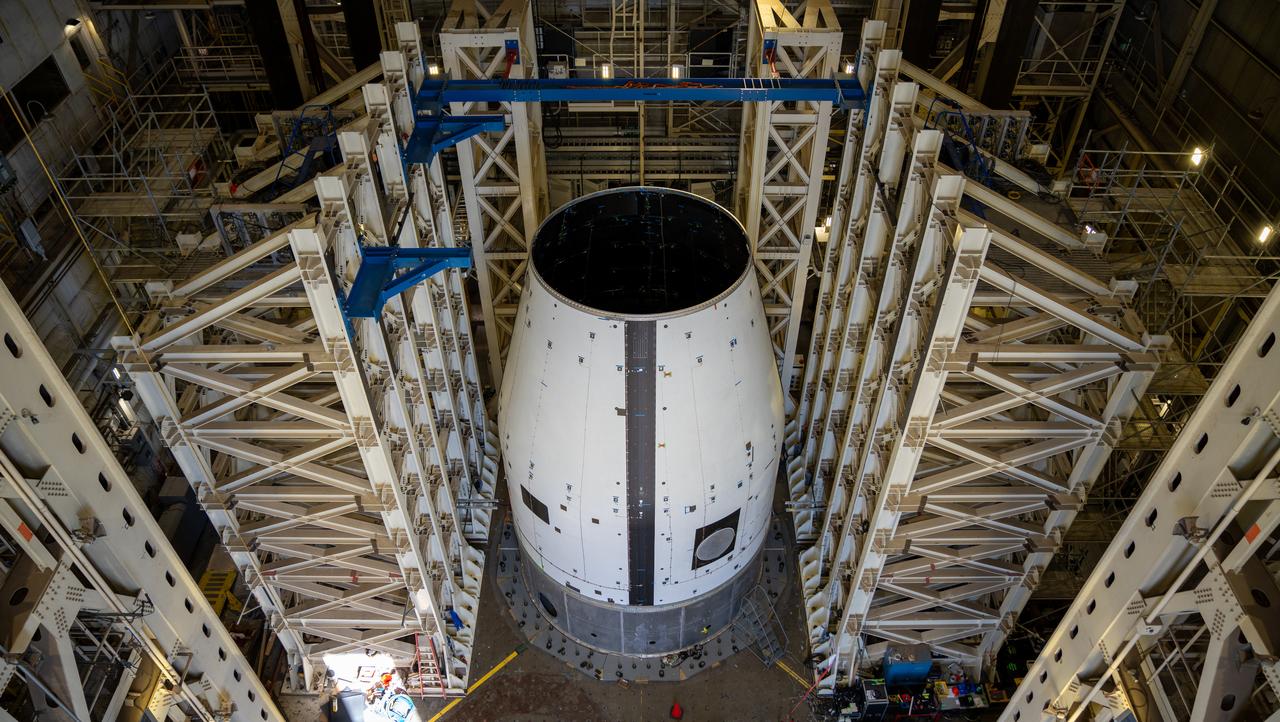
These photos and videos show how crews guided a test version of the universal stage adapter for NASA’s more powerful version of its SLS (Space Launch System) rocket to Building 4619 at the agency’s Marshall Space Flight Center in Huntsville, Alabama, Feb. 22. Built by Leidos, the lead contractor for the universal stage adapter, crews transported the hardware from a Leidos facility in Decatur, Alabama, the same day. The universal stage adapter will connect the SLS rocket’s upgraded in-space propulsion stage, called the exploration upper stage, to NASA’s Orion spacecraft as part of the evolved Block 1B configuration of the SLS rocket. It will also serve as a compartment capable of accommodating large payloads, such as modules or other exploration spacecraft. In Building 4619’s Load Test Annex High Bay at Marshall, the development test article will first undergo modal testing that will shake the hardware to validate dynamic models. Later, during ultimate load testing, force will be applied vertically and to the sides of the hardware. Unlike the flight hardware, the development test article has flaws intentionally included in its design, which will help engineers verity that the flight adapter can withstand the extreme forces it will face during launch and flight.
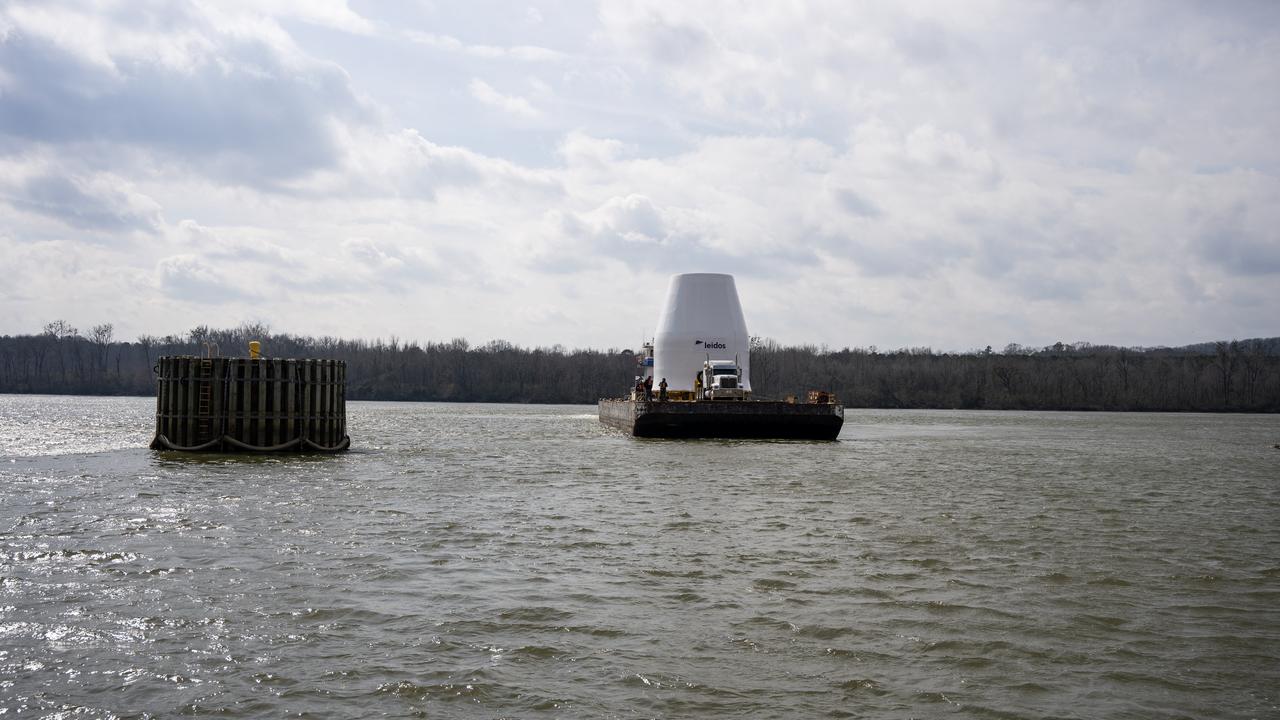
These photos and videos show how crews guided a test version of the universal stage adapter for NASA’s more powerful version of its SLS (Space Launch System) rocket to Building 4619 at the agency’s Marshall Space Flight Center in Huntsville, Alabama, Feb. 22. Built by Leidos, the lead contractor for the universal stage adapter, crews transported the hardware from a Leidos facility in Decatur, Alabama, the same day. The universal stage adapter will connect the SLS rocket’s upgraded in-space propulsion stage, called the exploration upper stage, to NASA’s Orion spacecraft as part of the evolved Block 1B configuration of the SLS rocket. It will also serve as a compartment capable of accommodating large payloads, such as modules or other exploration spacecraft. In Building 4619’s Load Test Annex High Bay at Marshall, the development test article will first undergo modal testing that will shake the hardware to validate dynamic models. Later, during ultimate load testing, force will be applied vertically and to the sides of the hardware. Unlike the flight hardware, the development test article has flaws intentionally included in its design, which will help engineers verity that the flight adapter can withstand the extreme forces it will face during launch and flight.
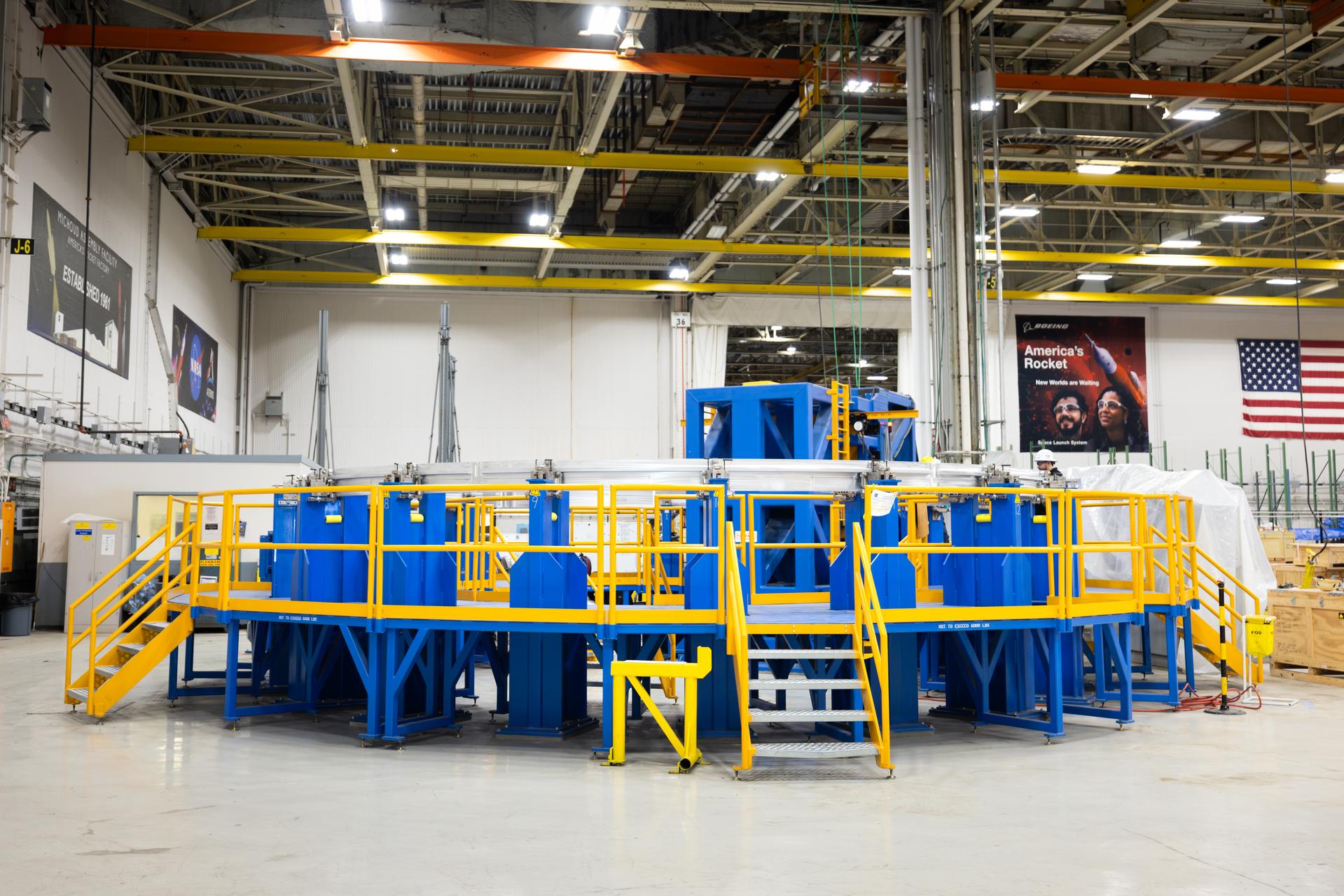
Teams at NASA’s Michoud Assembly Facility in New Orleans continue to make progress manufacturing core stages for the SLS (Space Launch System) rocket. In August, teams with NASA and Boeing, SLS core stage prime contractor, completed the first ring for the sixth SLS core stage. The core stage rings are welded together through a friction-stir welding process. A completed ring is 27.6 feet in diameter and serves as a connection point to join the large core stage structures together. The rings also provide structural stability to the bottoms of the domes. The 212-foot-tall SLS rocket core stage is made up of 10 major barrel sections, four dome sections, and seven rings. The components come together to form the five major sections of the core stage – the engine section, liquid hydrogen tank, intertank, liquid oxygen tank, and forward skirt.
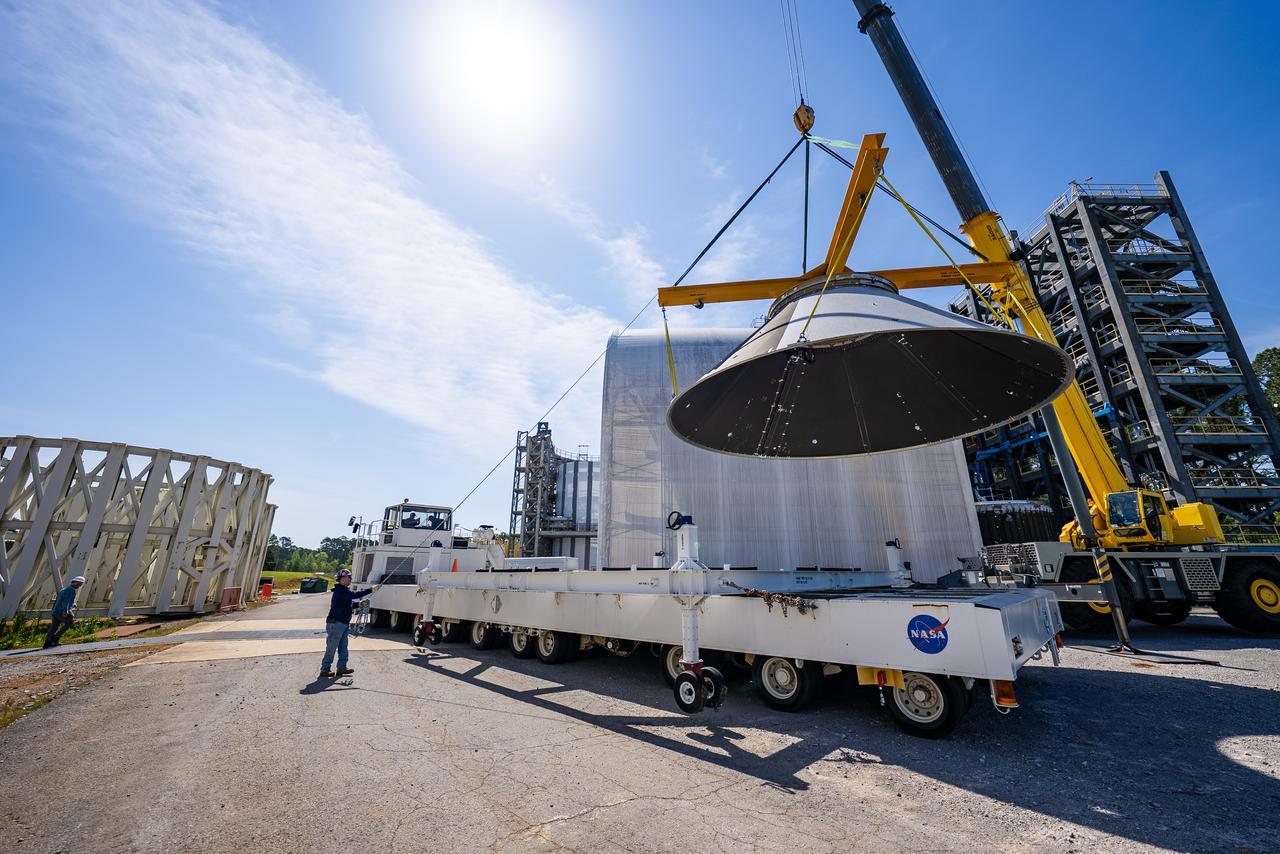
Technicians at NASA’s Marshall Space Flight Center in Huntsville, Alabama, are seen in these images taken April 17, 2025, moving the payload adapter test article from Building 4697 to Building 4705 for storage. This move marks the end of structural testing for the test article. Next, engineers will complete the qualification article and conduct additional for further testing before building the final flight hardware. Manufactured at Marshall, the test article underwent extensive and rigorous testing to validate the design before engineers finalized the configuration for the flight article. The newly completed composite payload adapter is an evolution from the Orion stage adapter to be used in the upgraded Block 1B configuration of the SLS (Space Launch System) rocket, debuting with Artemis IV.
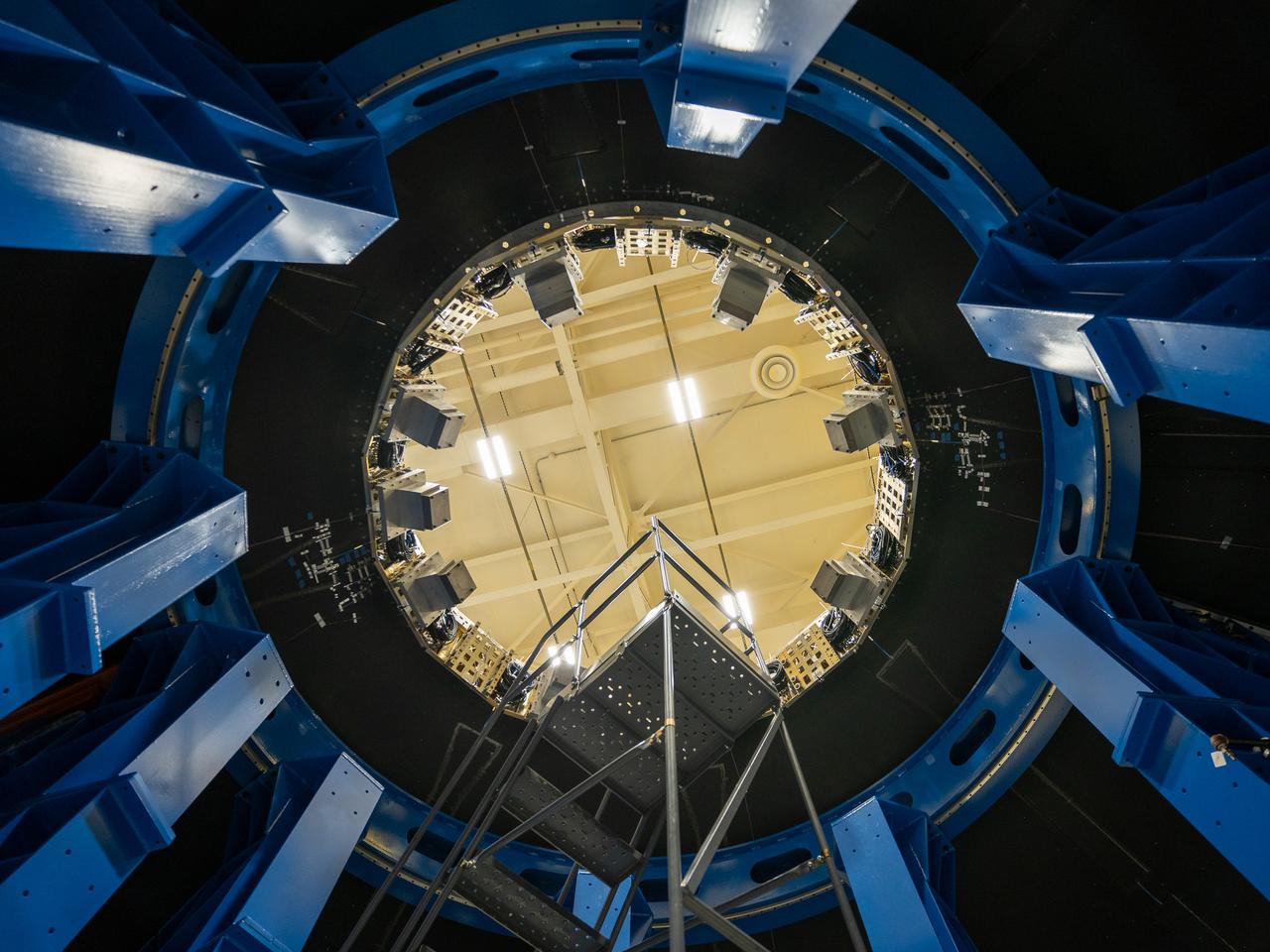
These photos and videos show how NASA manufactured and prepared to transport the payload adapter in February inside Building 4708 at NASA’s Marshall Space Flight Center in Huntsville, Alabama. Prior to moving the hardware for testing, teams installed the New Explorations Secondary Transport component, called the NEST, into the top of the engineering development unit. The NEST component will allow the hardware to hold a series of secondary payloads, or small satellites. The cone-shaped payload adapter is about 8.5 feet tall and features two metal rings and eight composite panels. The adapter, which will debut on NASA’s Artemis IV mission, is an evolution from the Orion stage adapter used in the Block 1 configuration of the rocket for the first three Artemis missions. It will be housed inside the universal stage adapter atop the rocket’s more powerful in-space stage, called the exploration upper stage. The payload adapter, like the launch vehicle stage adapter and the Orion stage adapter, is fully manufactured and tested at Marshall, which manages the SLS Program. NASA is working to land the first woman, first person of color, and its first international partner astronaut on the Moon under Artemis. SLS is part of NASA’s backbone for deep space exploration, along with the Orion spacecraft and Gateway in orbit around the Moon and commercial human landing systems, next-generational spacesuits, and rovers on the lunar surface. SLS is the only rocket that can send Orion, astronauts, and supplies to the Moon in a single launch.
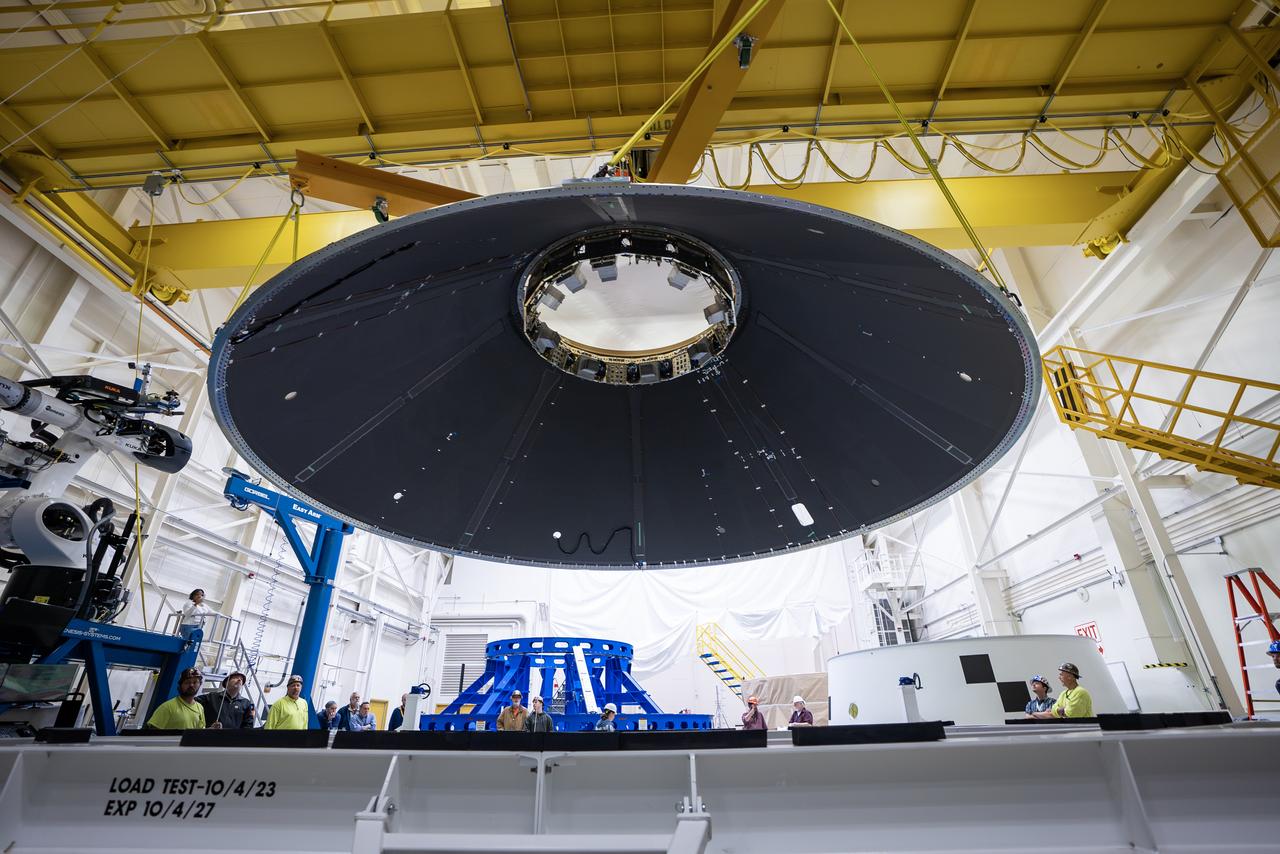
These photos and videos show how NASA manufactured and prepared to transport the payload adapter in February inside Building 4708 at NASA’s Marshall Space Flight Center in Huntsville, Alabama. Prior to moving the hardware for testing, teams installed the New Explorations Secondary Transport component, called the NEST, into the top of the engineering development unit. The NEST component will allow the hardware to hold a series of secondary payloads, or small satellites. The cone-shaped payload adapter is about 8.5 feet tall and features two metal rings and eight composite panels. The adapter, which will debut on NASA’s Artemis IV mission, is an evolution from the Orion stage adapter used in the Block 1 configuration of the rocket for the first three Artemis missions. It will be housed inside the universal stage adapter atop the rocket’s more powerful in-space stage, called the exploration upper stage. The payload adapter, like the launch vehicle stage adapter and the Orion stage adapter, is fully manufactured and tested at Marshall, which manages the SLS Program. NASA is working to land the first woman, first person of color, and its first international partner astronaut on the Moon under Artemis. SLS is part of NASA’s backbone for deep space exploration, along with the Orion spacecraft and Gateway in orbit around the Moon and commercial human landing systems, next-generational spacesuits, and rovers on the lunar surface. SLS is the only rocket that can send Orion, astronauts, and supplies to the Moon in a single launch.
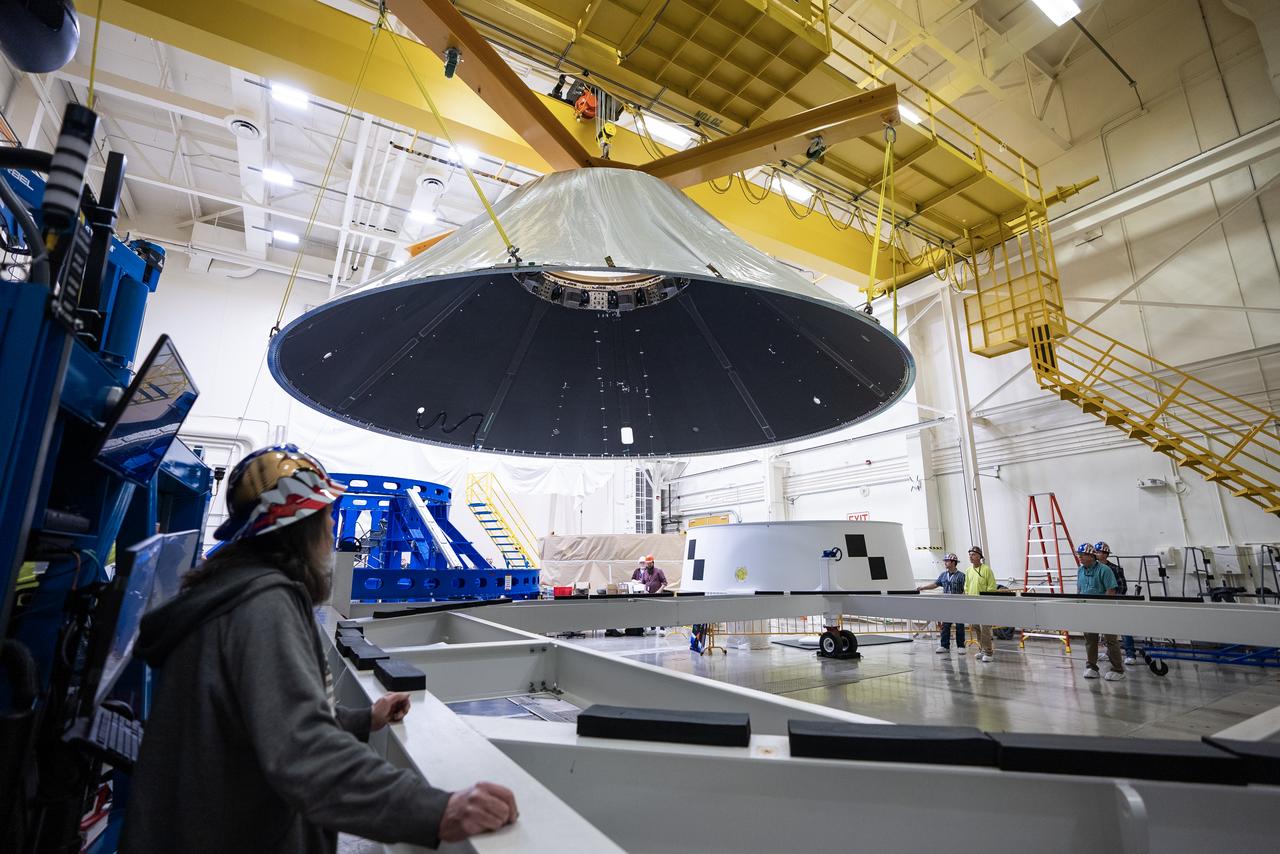
These photos and videos show how NASA manufactured and prepared to transport the payload adapter in February inside Building 4708 at NASA’s Marshall Space Flight Center in Huntsville, Alabama. Prior to moving the hardware for testing, teams installed the New Explorations Secondary Transport component, called the NEST, into the top of the engineering development unit. The NEST component will allow the hardware to hold a series of secondary payloads, or small satellites. The cone-shaped payload adapter is about 8.5 feet tall and features two metal rings and eight composite panels. The adapter, which will debut on NASA’s Artemis IV mission, is an evolution from the Orion stage adapter used in the Block 1 configuration of the rocket for the first three Artemis missions. It will be housed inside the universal stage adapter atop the rocket’s more powerful in-space stage, called the exploration upper stage. The payload adapter, like the launch vehicle stage adapter and the Orion stage adapter, is fully manufactured and tested at Marshall, which manages the SLS Program. NASA is working to land the first woman, first person of color, and its first international partner astronaut on the Moon under Artemis. SLS is part of NASA’s backbone for deep space exploration, along with the Orion spacecraft and Gateway in orbit around the Moon and commercial human landing systems, next-generational spacesuits, and rovers on the lunar surface. SLS is the only rocket that can send Orion, astronauts, and supplies to the Moon in a single launch.
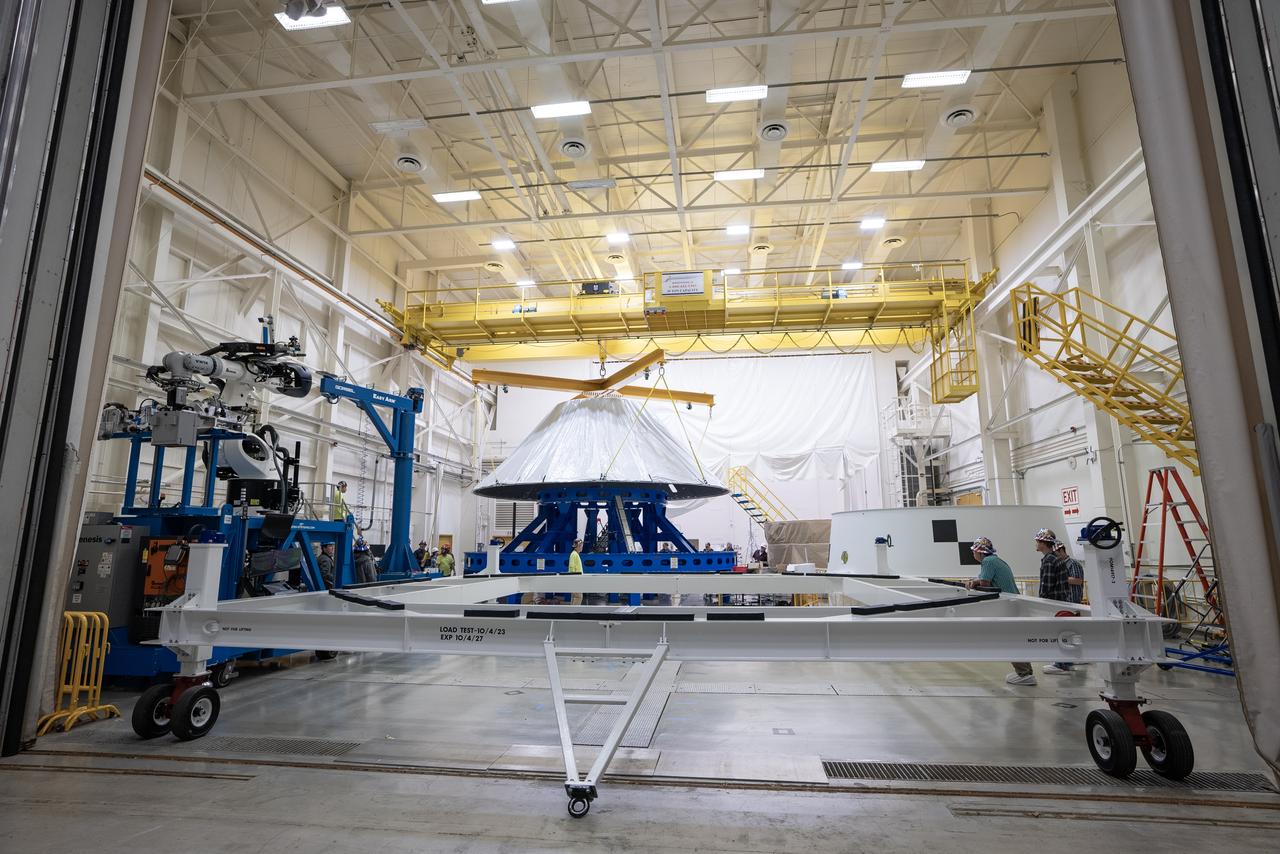
These photos and videos show how NASA manufactured and prepared to transport the payload adapter in February inside Building 4708 at NASA’s Marshall Space Flight Center in Huntsville, Alabama. Prior to moving the hardware for testing, teams installed the New Explorations Secondary Transport component, called the NEST, into the top of the engineering development unit. The NEST component will allow the hardware to hold a series of secondary payloads, or small satellites. The cone-shaped payload adapter is about 8.5 feet tall and features two metal rings and eight composite panels. The adapter, which will debut on NASA’s Artemis IV mission, is an evolution from the Orion stage adapter used in the Block 1 configuration of the rocket for the first three Artemis missions. It will be housed inside the universal stage adapter atop the rocket’s more powerful in-space stage, called the exploration upper stage. The payload adapter, like the launch vehicle stage adapter and the Orion stage adapter, is fully manufactured and tested at Marshall, which manages the SLS Program. NASA is working to land the first woman, first person of color, and its first international partner astronaut on the Moon under Artemis. SLS is part of NASA’s backbone for deep space exploration, along with the Orion spacecraft and Gateway in orbit around the Moon and commercial human landing systems, next-generational spacesuits, and rovers on the lunar surface. SLS is the only rocket that can send Orion, astronauts, and supplies to the Moon in a single launch.
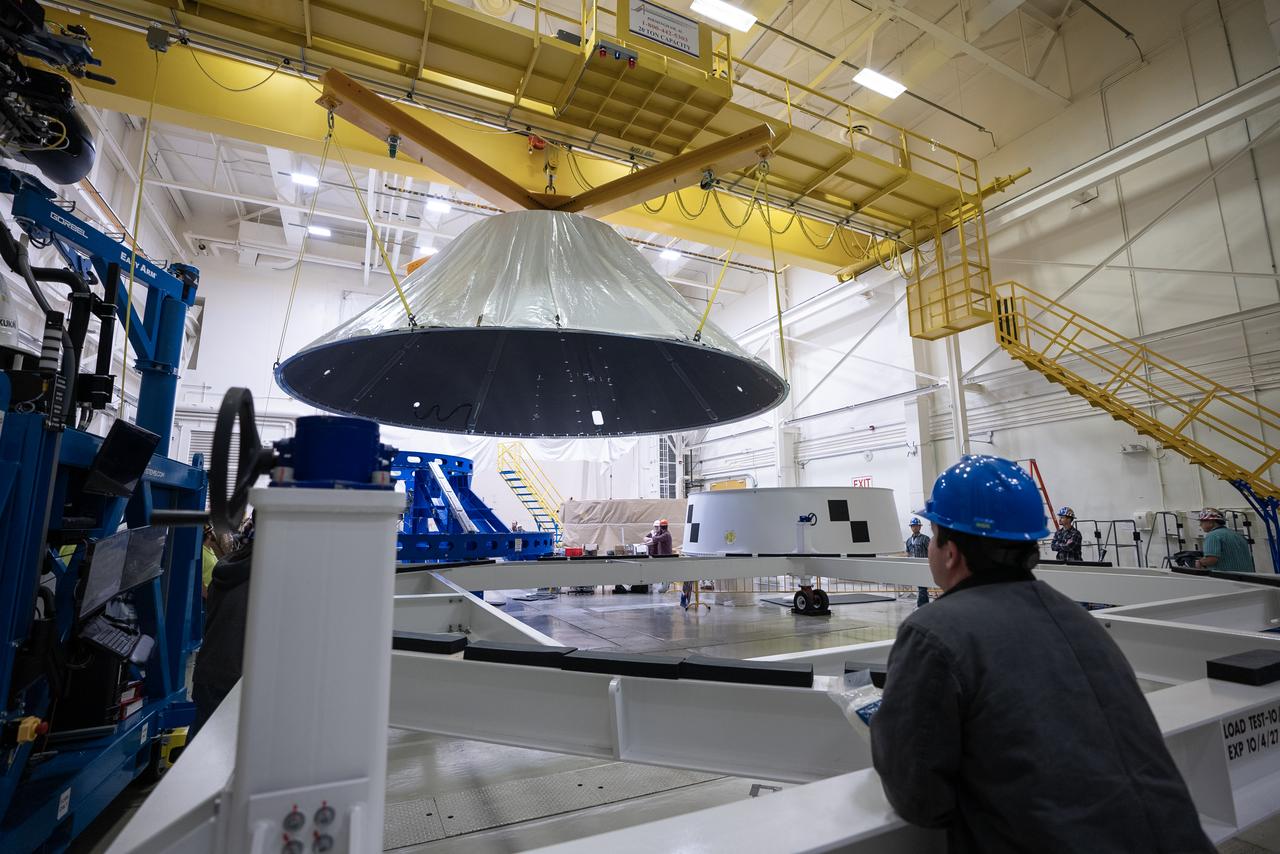
These photos and videos show how NASA manufactured and prepared to transport the payload adapter in February inside Building 4708 at NASA’s Marshall Space Flight Center in Huntsville, Alabama. Prior to moving the hardware for testing, teams installed the New Explorations Secondary Transport component, called the NEST, into the top of the engineering development unit. The NEST component will allow the hardware to hold a series of secondary payloads, or small satellites. The cone-shaped payload adapter is about 8.5 feet tall and features two metal rings and eight composite panels. The adapter, which will debut on NASA’s Artemis IV mission, is an evolution from the Orion stage adapter used in the Block 1 configuration of the rocket for the first three Artemis missions. It will be housed inside the universal stage adapter atop the rocket’s more powerful in-space stage, called the exploration upper stage. The payload adapter, like the launch vehicle stage adapter and the Orion stage adapter, is fully manufactured and tested at Marshall, which manages the SLS Program. NASA is working to land the first woman, first person of color, and its first international partner astronaut on the Moon under Artemis. SLS is part of NASA’s backbone for deep space exploration, along with the Orion spacecraft and Gateway in orbit around the Moon and commercial human landing systems, next-generational spacesuits, and rovers on the lunar surface. SLS is the only rocket that can send Orion, astronauts, and supplies to the Moon in a single launch.

These photos and videos show how crews guided a test version of the universal stage adapter for NASA’s more powerful version of its SLS (Space Launch System) rocket to Building 4619 at the agency’s Marshall Space Flight Center in Huntsville, Alabama, Feb. 22. Built by Leidos, the lead contractor for the universal stage adapter, crews transported the hardware from a Leidos facility in Decatur, Alabama, the same day. The universal stage adapter will connect the SLS rocket’s upgraded in-space propulsion stage, called the exploration upper stage, to NASA’s Orion spacecraft as part of the evolved Block 1B configuration of the SLS rocket. It will also serve as a compartment capable of accommodating large payloads, such as modules or other exploration spacecraft. In Building 4619’s Load Test Annex High Bay at Marshall, the development test article will first undergo modal testing that will shake the hardware to validate dynamic models. Later, during ultimate load testing, force will be applied vertically and to the sides of the hardware. Unlike the flight hardware, the development test article has flaws intentionally included in its design, which will help engineers verity that the flight adapter can withstand the extreme forces it will face during launch and flight.
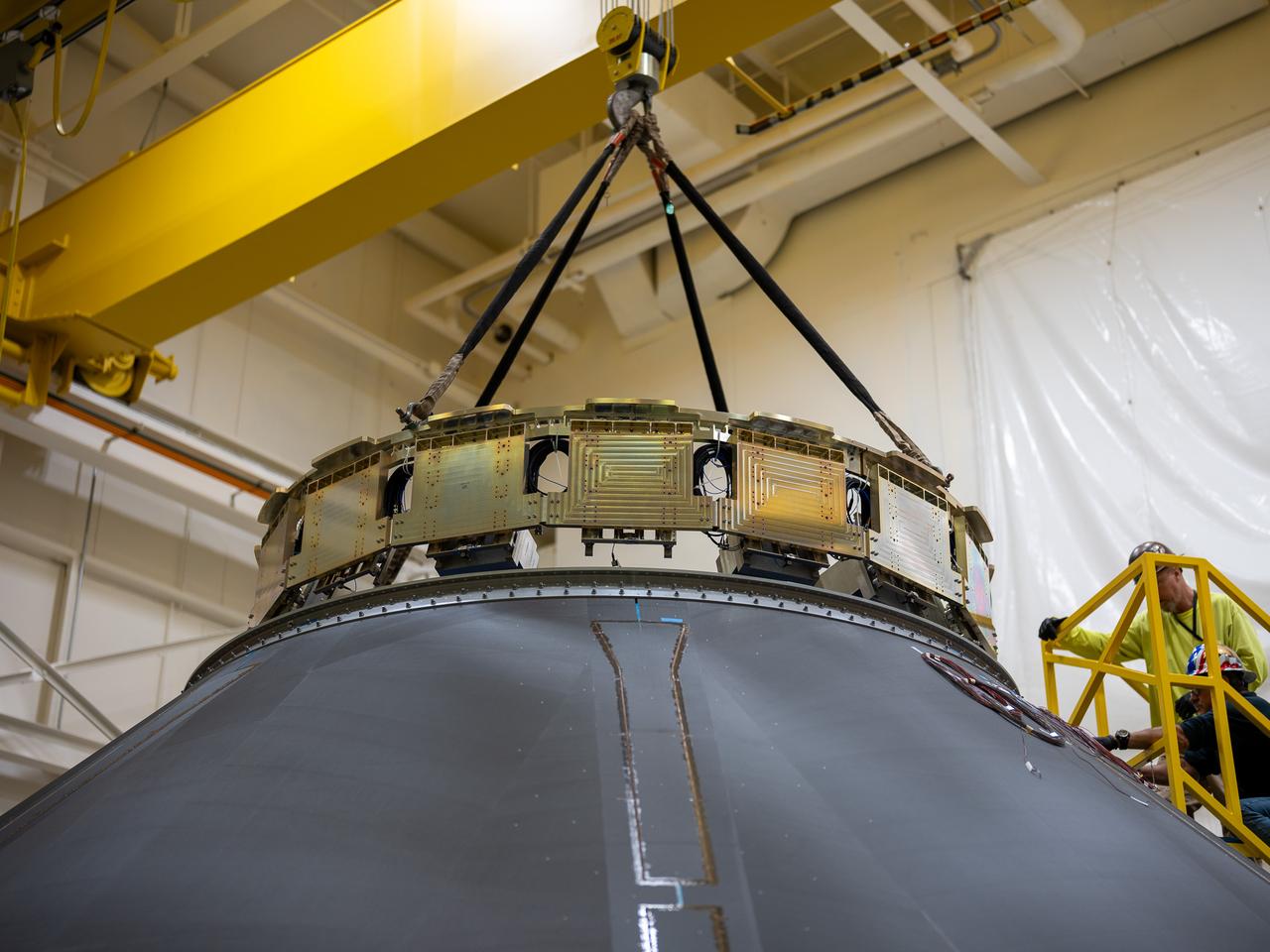
These photos and videos show how NASA manufactured and prepared to transport the payload adapter in February inside Building 4708 at NASA’s Marshall Space Flight Center in Huntsville, Alabama. Prior to moving the hardware for testing, teams installed the New Explorations Secondary Transport component, called the NEST, into the top of the engineering development unit. The NEST component will allow the hardware to hold a series of secondary payloads, or small satellites. The cone-shaped payload adapter is about 8.5 feet tall and features two metal rings and eight composite panels. The adapter, which will debut on NASA’s Artemis IV mission, is an evolution from the Orion stage adapter used in the Block 1 configuration of the rocket for the first three Artemis missions. It will be housed inside the universal stage adapter atop the rocket’s more powerful in-space stage, called the exploration upper stage. The payload adapter, like the launch vehicle stage adapter and the Orion stage adapter, is fully manufactured and tested at Marshall, which manages the SLS Program. NASA is working to land the first woman, first person of color, and its first international partner astronaut on the Moon under Artemis. SLS is part of NASA’s backbone for deep space exploration, along with the Orion spacecraft and Gateway in orbit around the Moon and commercial human landing systems, next-generational spacesuits, and rovers on the lunar surface. SLS is the only rocket that can send Orion, astronauts, and supplies to the Moon in a single launch.
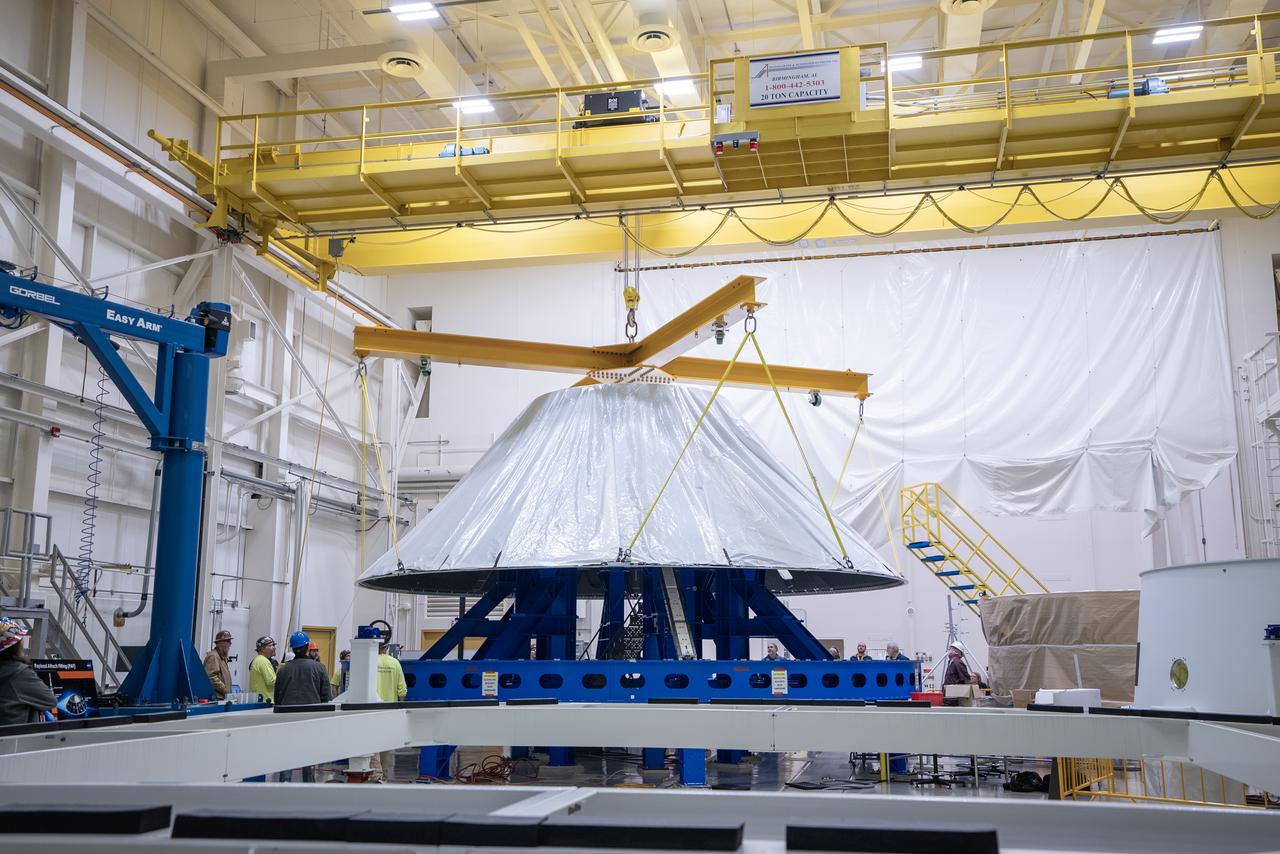
These photos and videos show how NASA manufactured and prepared to transport the payload adapter in February inside Building 4708 at NASA’s Marshall Space Flight Center in Huntsville, Alabama. Prior to moving the hardware for testing, teams installed the New Explorations Secondary Transport component, called the NEST, into the top of the engineering development unit. The NEST component will allow the hardware to hold a series of secondary payloads, or small satellites. The cone-shaped payload adapter is about 8.5 feet tall and features two metal rings and eight composite panels. The adapter, which will debut on NASA’s Artemis IV mission, is an evolution from the Orion stage adapter used in the Block 1 configuration of the rocket for the first three Artemis missions. It will be housed inside the universal stage adapter atop the rocket’s more powerful in-space stage, called the exploration upper stage. The payload adapter, like the launch vehicle stage adapter and the Orion stage adapter, is fully manufactured and tested at Marshall, which manages the SLS Program. NASA is working to land the first woman, first person of color, and its first international partner astronaut on the Moon under Artemis. SLS is part of NASA’s backbone for deep space exploration, along with the Orion spacecraft and Gateway in orbit around the Moon and commercial human landing systems, next-generational spacesuits, and rovers on the lunar surface. SLS is the only rocket that can send Orion, astronauts, and supplies to the Moon in a single launch.
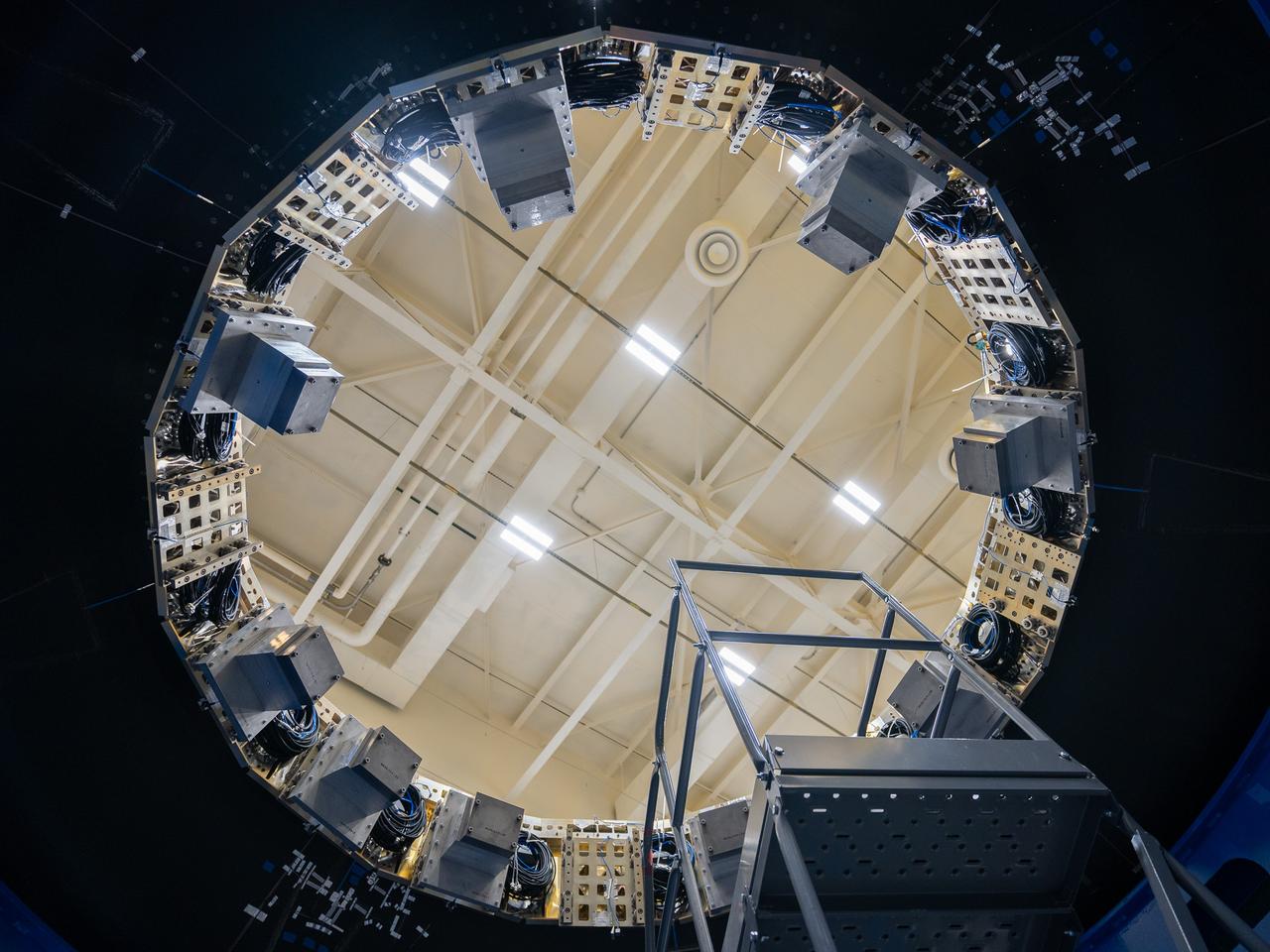
These photos and videos show how NASA manufactured and prepared to transport the payload adapter in February inside Building 4708 at NASA’s Marshall Space Flight Center in Huntsville, Alabama. Prior to moving the hardware for testing, teams installed the New Explorations Secondary Transport component, called the NEST, into the top of the engineering development unit. The NEST component will allow the hardware to hold a series of secondary payloads, or small satellites. The cone-shaped payload adapter is about 8.5 feet tall and features two metal rings and eight composite panels. The adapter, which will debut on NASA’s Artemis IV mission, is an evolution from the Orion stage adapter used in the Block 1 configuration of the rocket for the first three Artemis missions. It will be housed inside the universal stage adapter atop the rocket’s more powerful in-space stage, called the exploration upper stage. The payload adapter, like the launch vehicle stage adapter and the Orion stage adapter, is fully manufactured and tested at Marshall, which manages the SLS Program. NASA is working to land the first woman, first person of color, and its first international partner astronaut on the Moon under Artemis. SLS is part of NASA’s backbone for deep space exploration, along with the Orion spacecraft and Gateway in orbit around the Moon and commercial human landing systems, next-generational spacesuits, and rovers on the lunar surface. SLS is the only rocket that can send Orion, astronauts, and supplies to the Moon in a single launch.
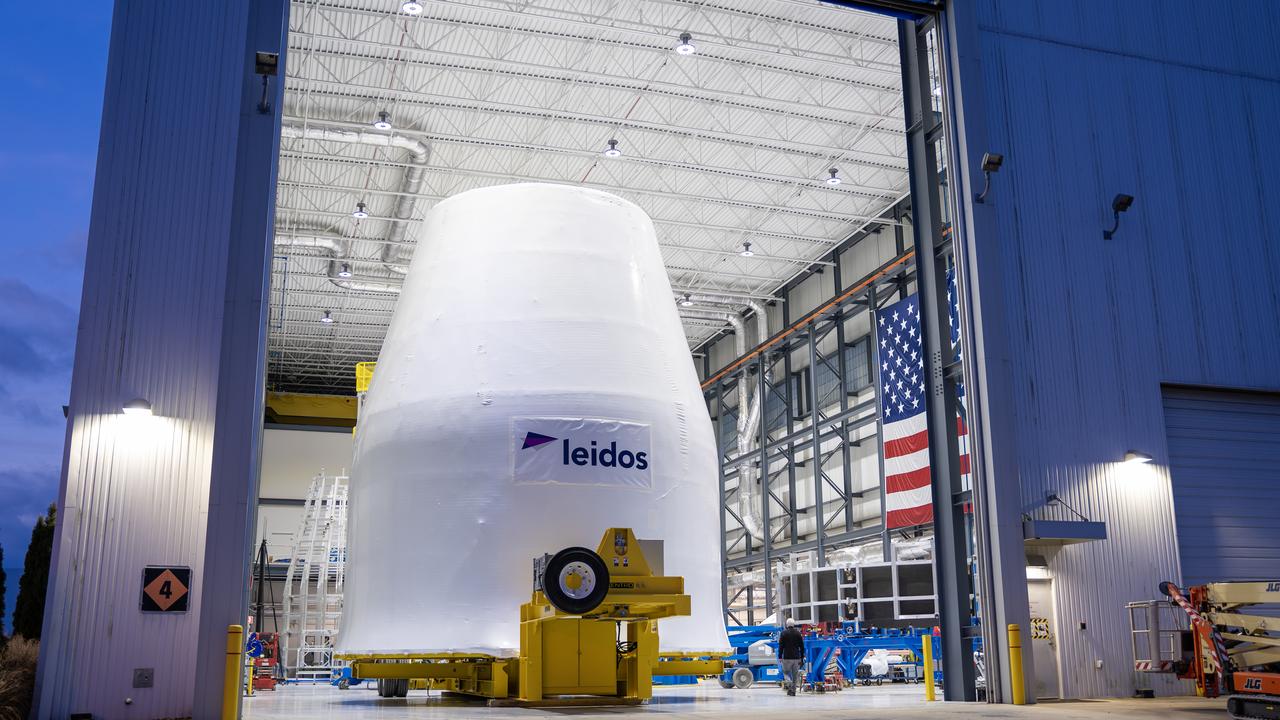
These photos and videos show how crews guided a test version of the universal stage adapter for NASA’s more powerful version of its SLS (Space Launch System) rocket to Building 4619 at the agency’s Marshall Space Flight Center in Huntsville, Alabama, Feb. 22. Built by Leidos, the lead contractor for the universal stage adapter, crews transported the hardware from a Leidos facility in Decatur, Alabama, the same day. The universal stage adapter will connect the SLS rocket’s upgraded in-space propulsion stage, called the exploration upper stage, to NASA’s Orion spacecraft as part of the evolved Block 1B configuration of the SLS rocket. It will also serve as a compartment capable of accommodating large payloads, such as modules or other exploration spacecraft. In Building 4619’s Load Test Annex High Bay at Marshall, the development test article will first undergo modal testing that will shake the hardware to validate dynamic models. Later, during ultimate load testing, force will be applied vertically and to the sides of the hardware. Unlike the flight hardware, the development test article has flaws intentionally included in its design, which will help engineers verity that the flight adapter can withstand the extreme forces it will face during launch and flight.
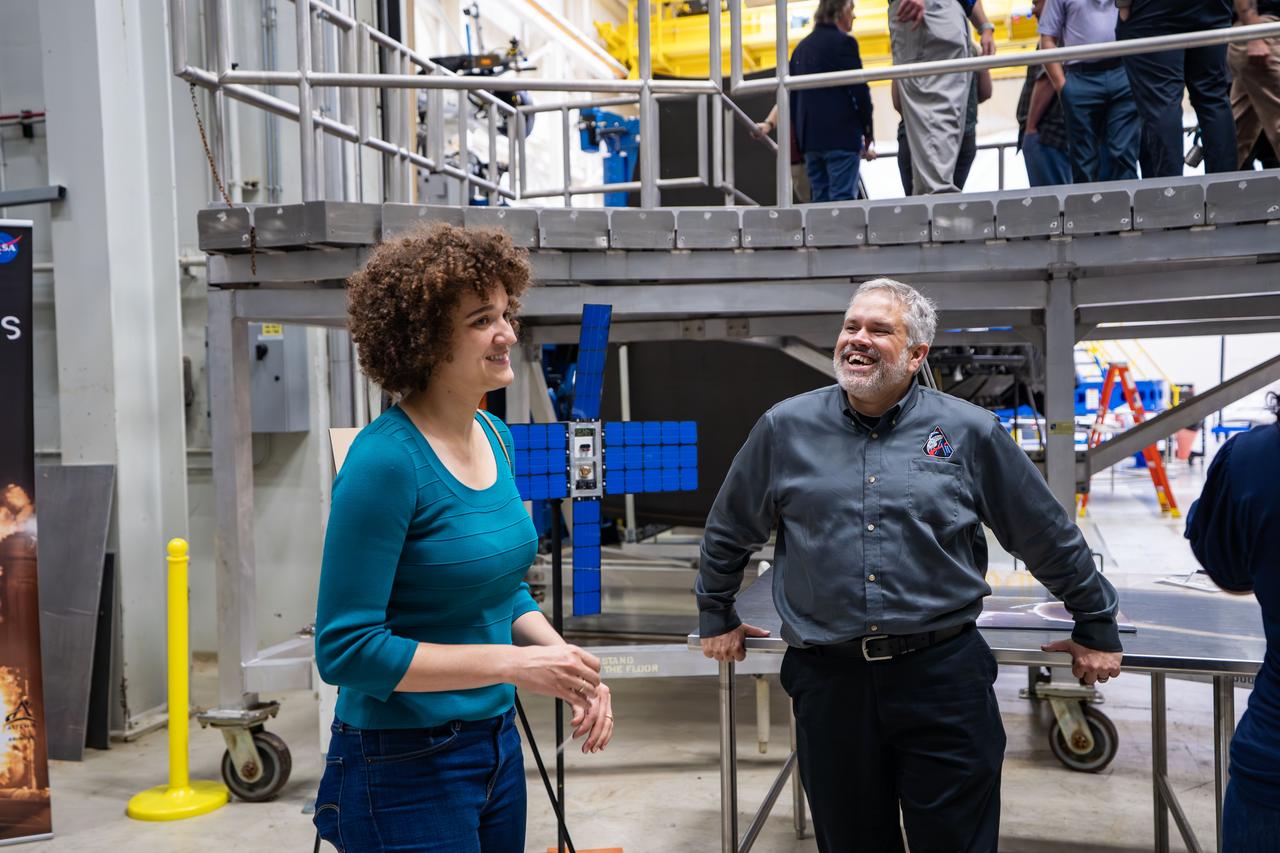
These images show NASA employees attending an event August 14, 2025, at Marshall Space Flight Center in Huntsville, Alabama, to view the Orion stage adapter for Artemis II before it is transported to NASA’s Kennedy Space Center in Florida. Manufactured entirely at NASA Marshall, the adapter plays a crucial role in connecting the SLS (Space Launch System) rocket’s interim cryogenic propulsion stage to the Orion spacecraft. This adapter is the final piece of SLS hardware to be delivered to Kennedy Space Center in preparation for the Artemis II mission.
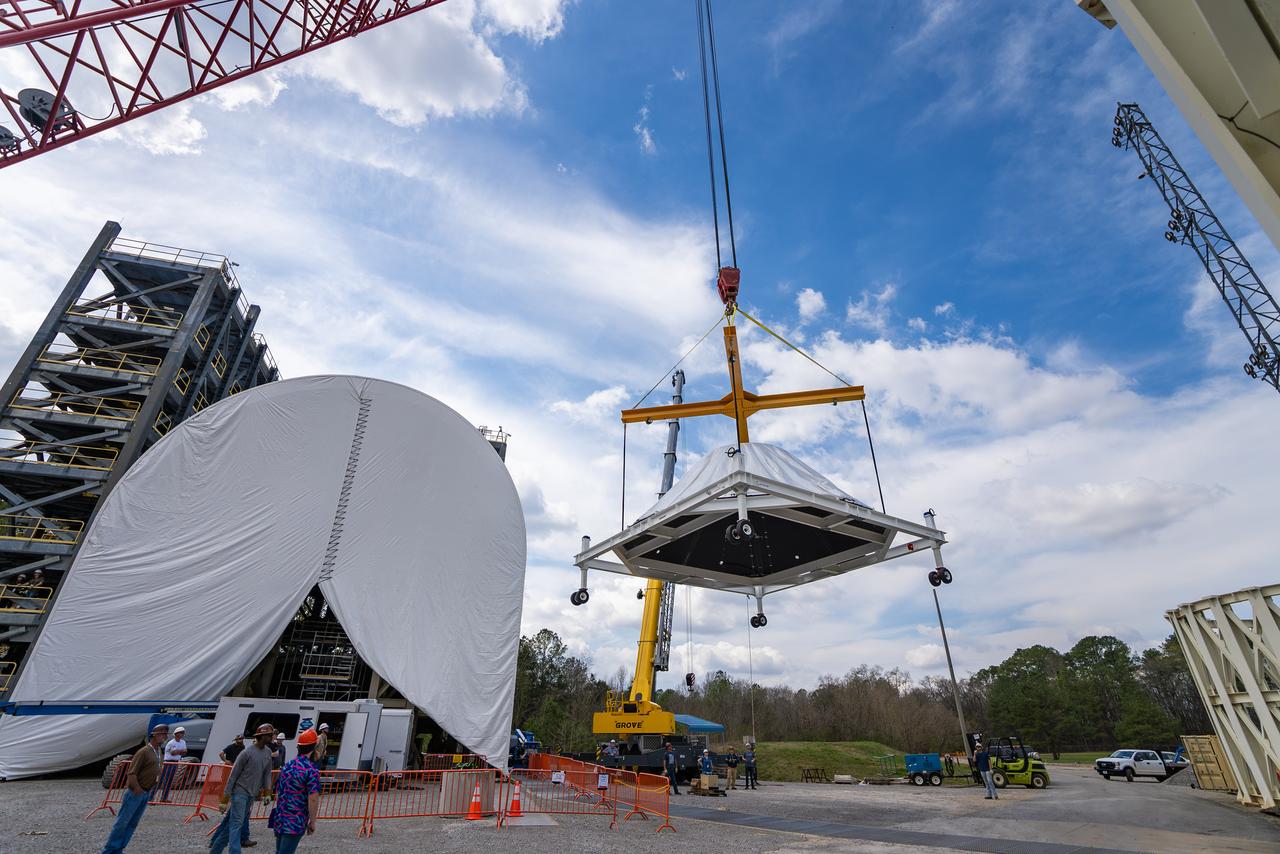
These photos and videos show how crews at NASA’s Marshall Space Flight Center in Huntsville, Alabama, moved and installed the payload adapter that will be used in the Block 1B configuration of the SLS (Space Launch System) rocket from Building 4708, where it was manufactured, into Structural Test Stand 4697 at NASA’s Marshall Space Flight Center on March 13. Teams at Marshall will begin structural testing the engineering development unit of the payload adapter – an exact replica of the flight version of the hardware – this spring. The cone-shaped payload adapter is about 8.5 feet tall and features two metal rings and eight composite panels. The adapter, which will debut on NASA’s Artemis IV mission, is an evolution from the Orion stage adapter used in the Block 1 configuration of the first three Artemis missions. It will be housed inside the universal stage adapter atop the rocket’s more powerful in-space stage, called the exploration upper stage. The payload adapter, like the launch vehicle stage adapter and the Orion stage adapter, is fully manufactured and tested at Marshall, which manages the SLS Program. NASA is working to land the first woman, first person of color, and its first international partner astronaut on the Moon under Artemis. SLS is part of NASA’s backbone for deep space exploration, along with the Orion spacecraft and Gateway in orbit around the Moon and commercial human landing systems, next-generational spacesuits, and rovers on the lunar surface. SLS is the only rocket that can send Orion, astronauts, and supplies to the Moon in a single launch.
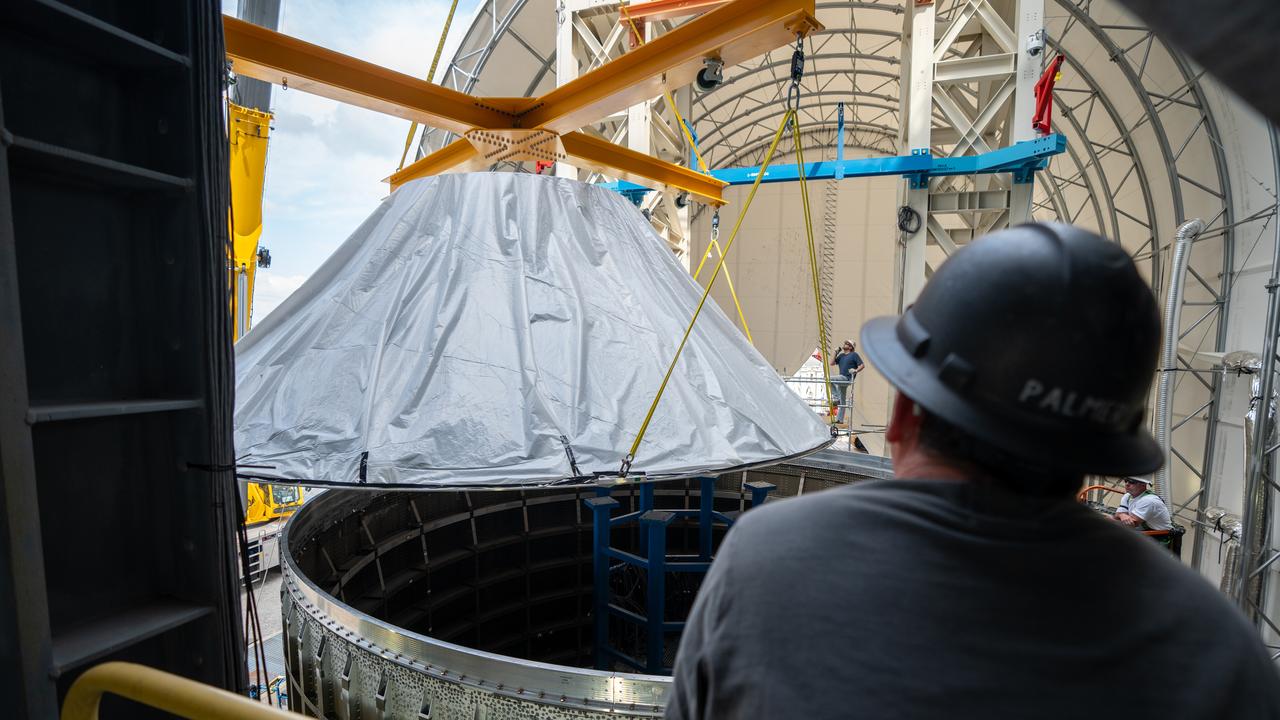
These photos and videos show how crews at NASA’s Marshall Space Flight Center in Huntsville, Alabama, moved and installed the payload adapter that will be used in the Block 1B configuration of the SLS (Space Launch System) rocket from Building 4708, where it was manufactured, into Structural Test Stand 4697 at NASA’s Marshall Space Flight Center on March 13. Teams at Marshall will begin structural testing the engineering development unit of the payload adapter – an exact replica of the flight version of the hardware – this spring. The cone-shaped payload adapter is about 8.5 feet tall and features two metal rings and eight composite panels. The adapter, which will debut on NASA’s Artemis IV mission, is an evolution from the Orion stage adapter used in the Block 1 configuration of the first three Artemis missions. It will be housed inside the universal stage adapter atop the rocket’s more powerful in-space stage, called the exploration upper stage. The payload adapter, like the launch vehicle stage adapter and the Orion stage adapter, is fully manufactured and tested at Marshall, which manages the SLS Program. NASA is working to land the first woman, first person of color, and its first international partner astronaut on the Moon under Artemis. SLS is part of NASA’s backbone for deep space exploration, along with the Orion spacecraft and Gateway in orbit around the Moon and commercial human landing systems, next-generational spacesuits, and rovers on the lunar surface. SLS is the only rocket that can send Orion, astronauts, and supplies to the Moon in a single launch.
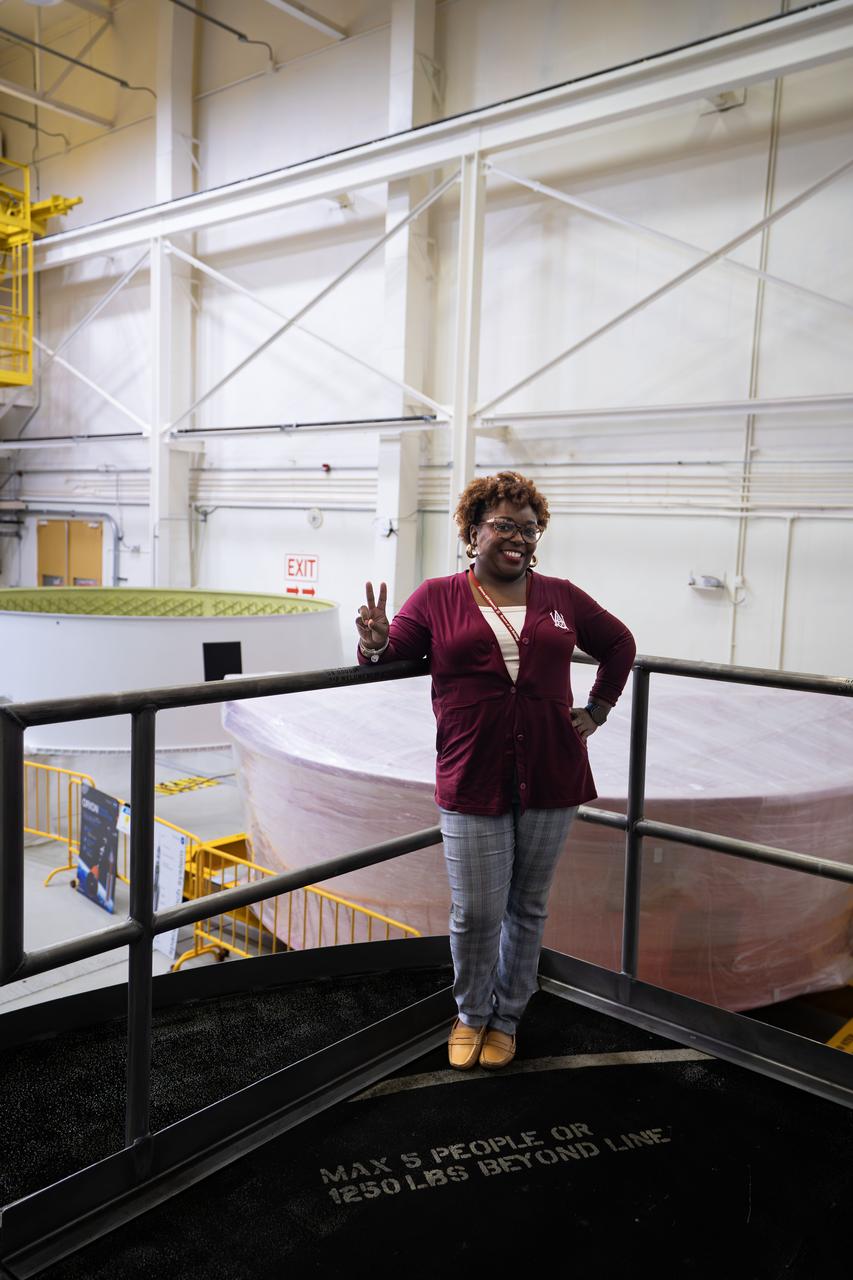
These images show NASA employees attending an event August 14, 2025, at Marshall Space Flight Center in Huntsville, Alabama, to view the Orion stage adapter for Artemis II before it is transported to NASA’s Kennedy Space Center in Florida. Manufactured entirely at NASA Marshall, the adapter plays a crucial role in connecting the SLS (Space Launch System) rocket’s interim cryogenic propulsion stage to the Orion spacecraft. This adapter is the final piece of SLS hardware to be delivered to Kennedy Space Center in preparation for the Artemis II mission.
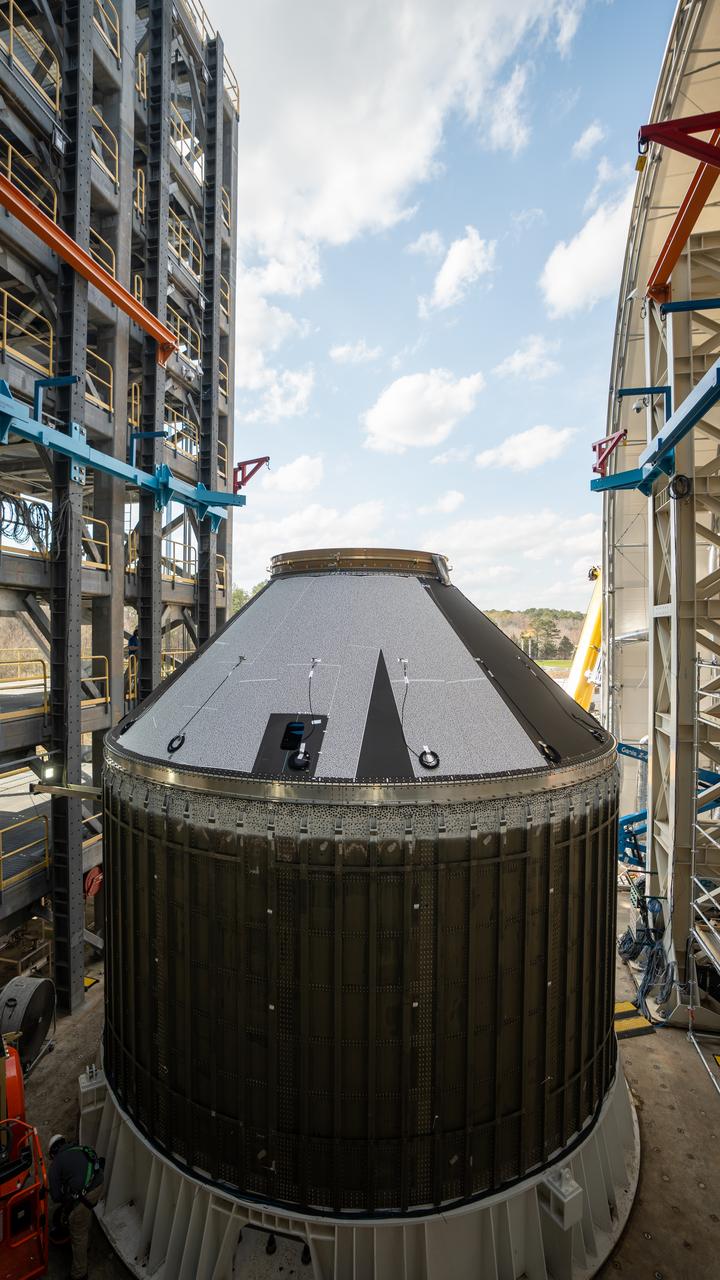
These photos and videos show how crews at NASA’s Marshall Space Flight Center in Huntsville, Alabama, moved and installed the payload adapter that will be used in the Block 1B configuration of the SLS (Space Launch System) rocket from Building 4708, where it was manufactured, into Structural Test Stand 4697 at NASA’s Marshall Space Flight Center on March 13. Teams at Marshall will begin structural testing the engineering development unit of the payload adapter – an exact replica of the flight version of the hardware – this spring. The cone-shaped payload adapter is about 8.5 feet tall and features two metal rings and eight composite panels. The adapter, which will debut on NASA’s Artemis IV mission, is an evolution from the Orion stage adapter used in the Block 1 configuration of the first three Artemis missions. It will be housed inside the universal stage adapter atop the rocket’s more powerful in-space stage, called the exploration upper stage. The payload adapter, like the launch vehicle stage adapter and the Orion stage adapter, is fully manufactured and tested at Marshall, which manages the SLS Program. NASA is working to land the first woman, first person of color, and its first international partner astronaut on the Moon under Artemis. SLS is part of NASA’s backbone for deep space exploration, along with the Orion spacecraft and Gateway in orbit around the Moon and commercial human landing systems, next-generational spacesuits, and rovers on the lunar surface. SLS is the only rocket that can send Orion, astronauts, and supplies to the Moon in a single launch.
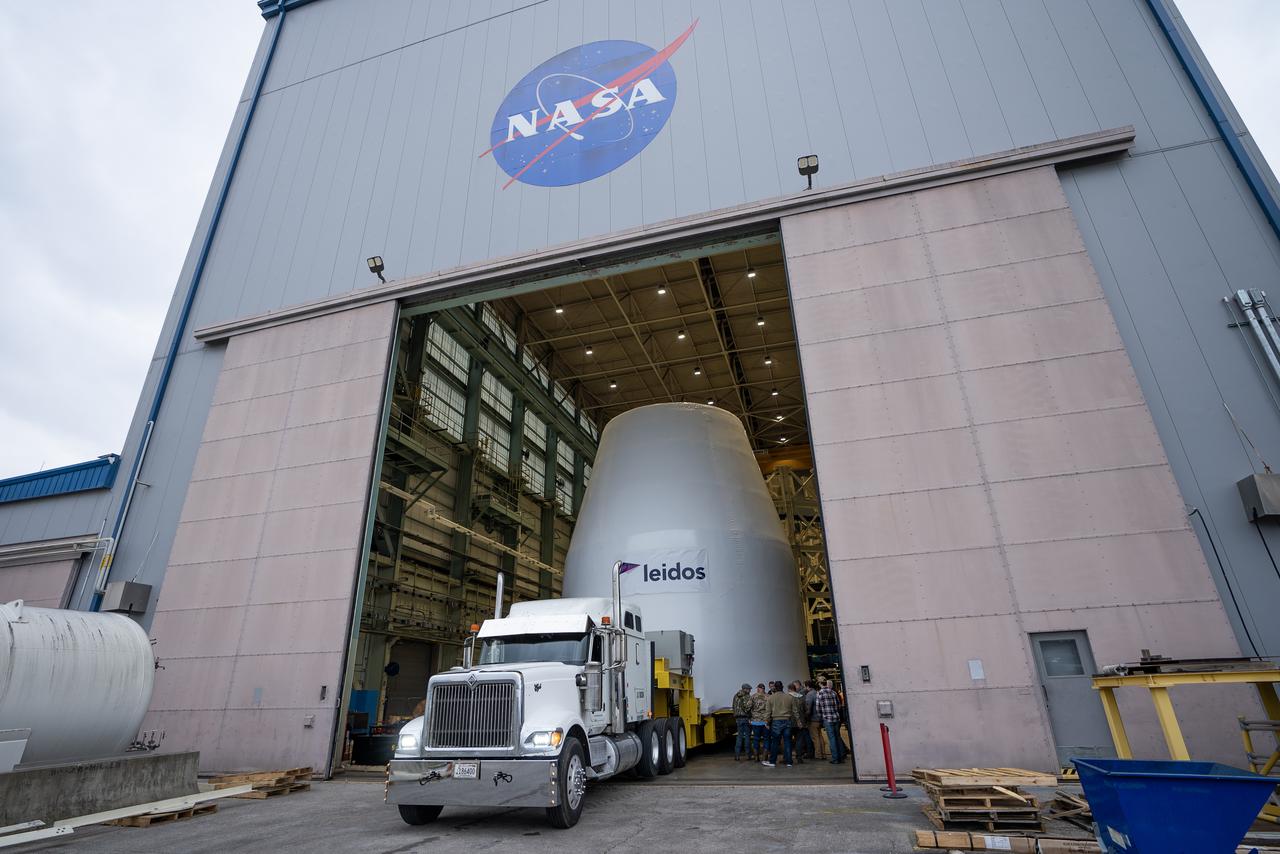
These photos and videos show how crews guided a test version of the universal stage adapter for NASA’s more powerful version of its SLS (Space Launch System) rocket to Building 4619 at the agency’s Marshall Space Flight Center in Huntsville, Alabama, Feb. 22. Built by Leidos, the lead contractor for the universal stage adapter, crews transported the hardware from a Leidos facility in Decatur, Alabama, the same day. The universal stage adapter will connect the SLS rocket’s upgraded in-space propulsion stage, called the exploration upper stage, to NASA’s Orion spacecraft as part of the evolved Block 1B configuration of the SLS rocket. It will also serve as a compartment capable of accommodating large payloads, such as modules or other exploration spacecraft. In Building 4619’s Load Test Annex High Bay at Marshall, the development test article will first undergo modal testing that will shake the hardware to validate dynamic models. Later, during ultimate load testing, force will be applied vertically and to the sides of the hardware. Unlike the flight hardware, the development test article has flaws intentionally included in its design, which will help engineers verity that the flight adapter can withstand the extreme forces it will face during launch and flight.
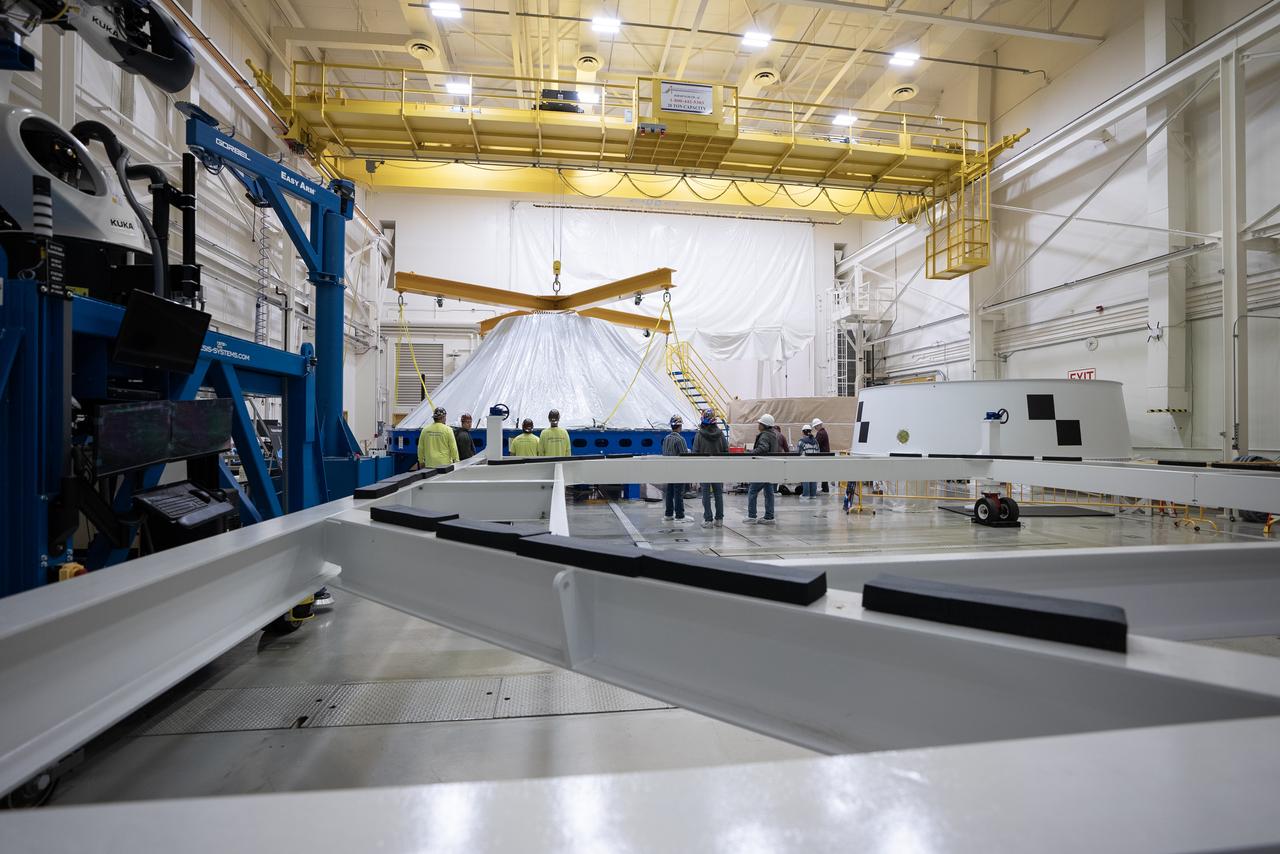
These photos and videos show how NASA manufactured and prepared to transport the payload adapter in February inside Building 4708 at NASA’s Marshall Space Flight Center in Huntsville, Alabama. Prior to moving the hardware for testing, teams installed the New Explorations Secondary Transport component, called the NEST, into the top of the engineering development unit. The NEST component will allow the hardware to hold a series of secondary payloads, or small satellites. The cone-shaped payload adapter is about 8.5 feet tall and features two metal rings and eight composite panels. The adapter, which will debut on NASA’s Artemis IV mission, is an evolution from the Orion stage adapter used in the Block 1 configuration of the rocket for the first three Artemis missions. It will be housed inside the universal stage adapter atop the rocket’s more powerful in-space stage, called the exploration upper stage. The payload adapter, like the launch vehicle stage adapter and the Orion stage adapter, is fully manufactured and tested at Marshall, which manages the SLS Program. NASA is working to land the first woman, first person of color, and its first international partner astronaut on the Moon under Artemis. SLS is part of NASA’s backbone for deep space exploration, along with the Orion spacecraft and Gateway in orbit around the Moon and commercial human landing systems, next-generational spacesuits, and rovers on the lunar surface. SLS is the only rocket that can send Orion, astronauts, and supplies to the Moon in a single launch.
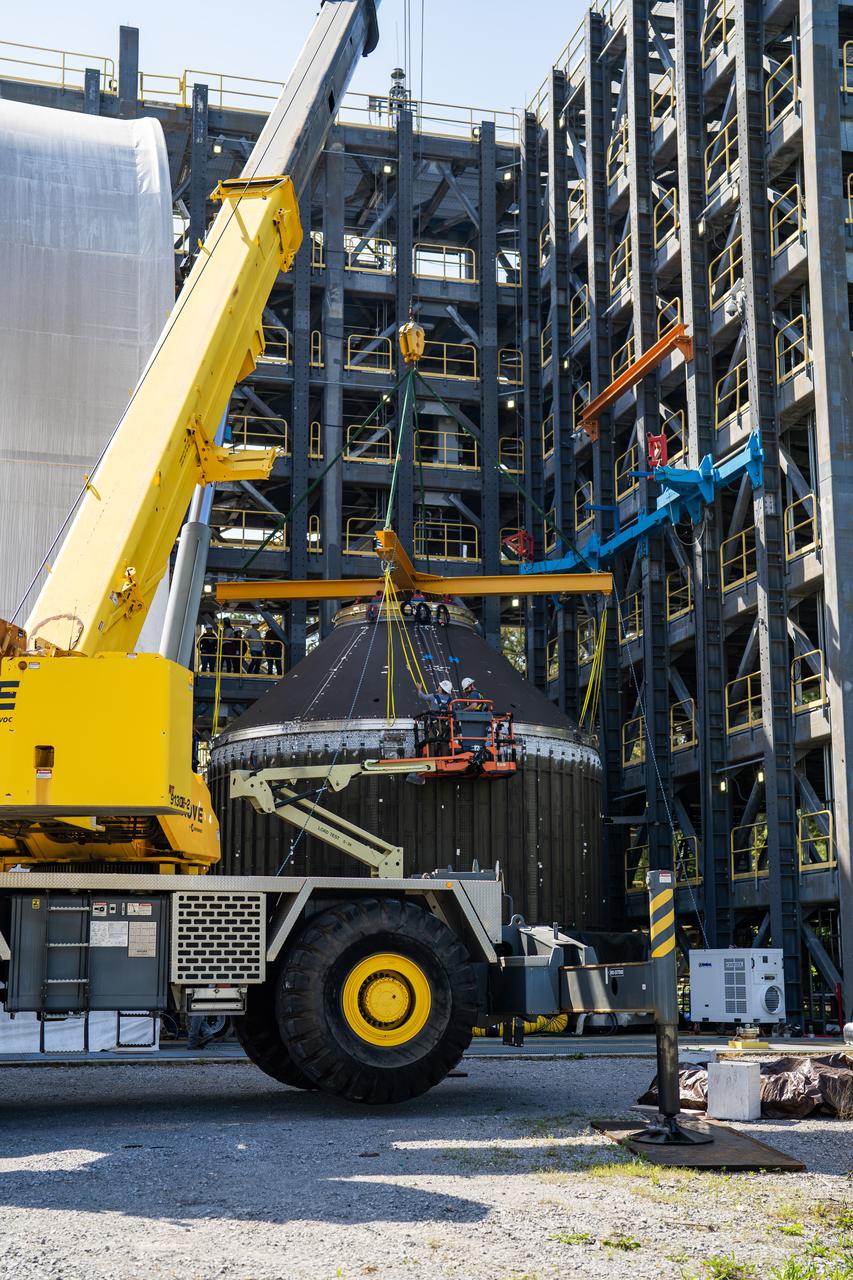
Technicians at NASA’s Marshall Space Flight Center in Huntsville, Alabama, are seen in these images taken April 17, 2025, moving the payload adapter test article from Building 4697 to Building 4705 for storage. This move marks the end of structural testing for the test article. Next, engineers will complete the qualification article and conduct additional for further testing before building the final flight hardware. Manufactured at Marshall, the test article underwent extensive and rigorous testing to validate the design before engineers finalized the configuration for the flight article. The newly completed composite payload adapter is an evolution from the Orion stage adapter to be used in the upgraded Block 1B configuration of the SLS (Space Launch System) rocket, debuting with Artemis IV.
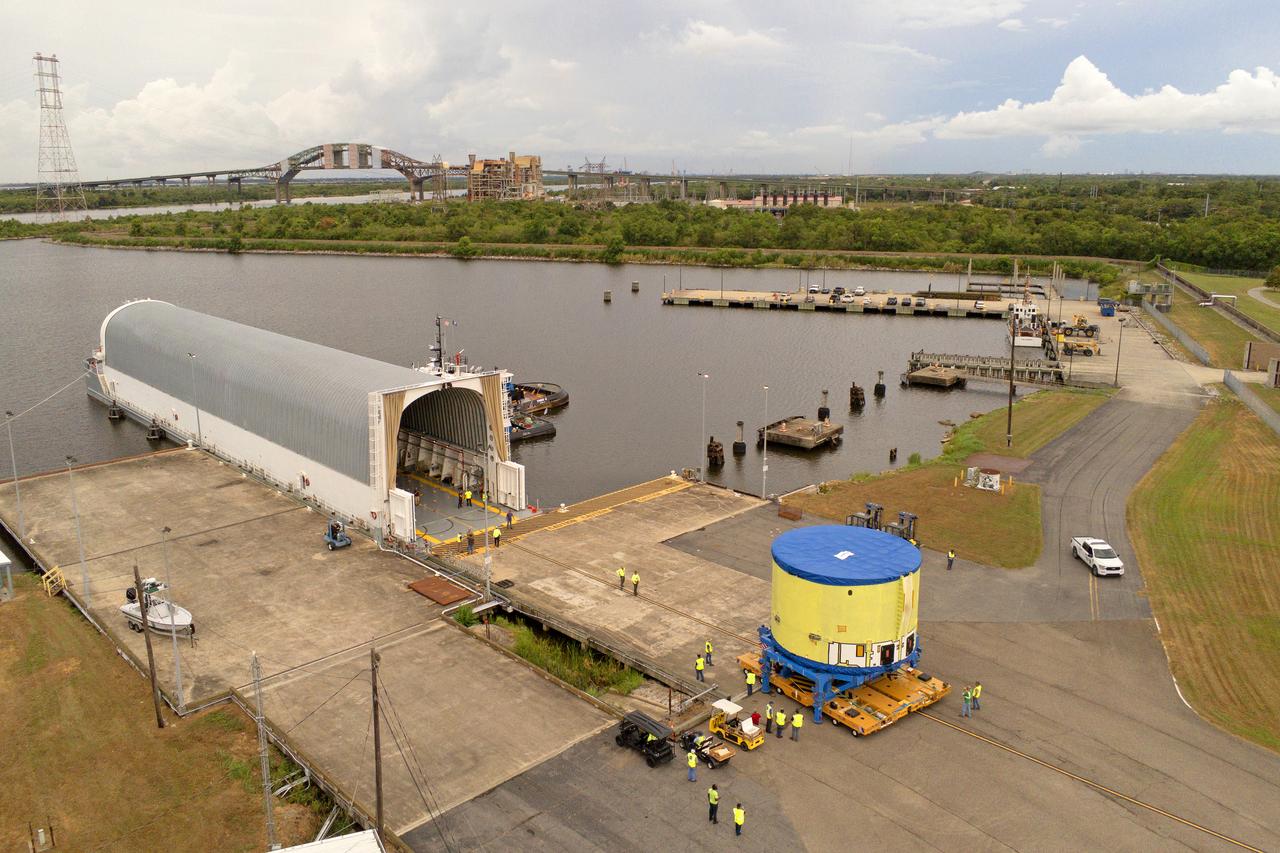
These photos and videos show teams at NASA’s Michoud Assembly Facility in New Orleans preparing, moving, and loading the engine section of a future SLS (Space Launch System) rocket to NASA’s Pegasus barge Aug. 28. The hardware will form the bottom-most section of the SLS core stage that will power NASA’s Artemis IV mission, which will be the first mission to the Gateway space station in lunar orbit under the Artemis campaign. The barge will transport the spaceflight hardware to NASA’s Kennedy Space Center in Florida via the agency’s Pegasus barge. Once in Florida, the engine section will undergo final outfitting inside Kennedy’s Space Station Processing Facility.
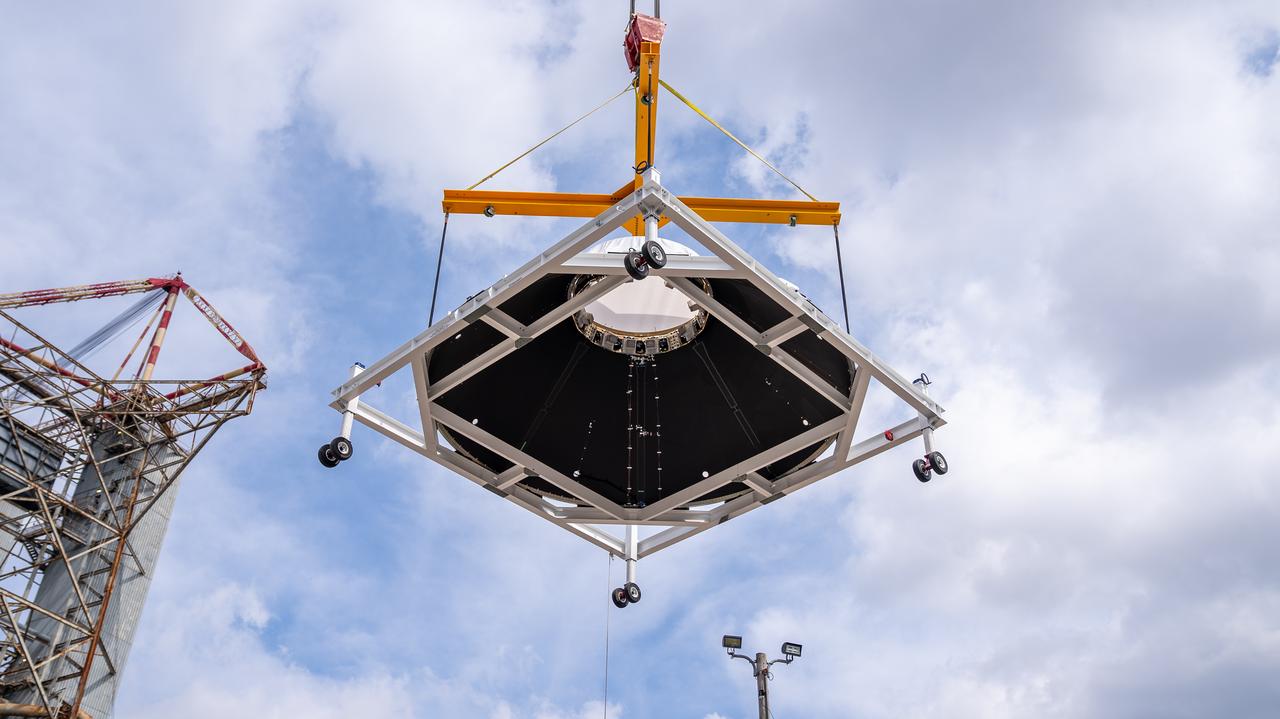
These photos and videos show how crews at NASA’s Marshall Space Flight Center in Huntsville, Alabama, moved and installed the payload adapter that will be used in the Block 1B configuration of the SLS (Space Launch System) rocket from Building 4708, where it was manufactured, into Structural Test Stand 4697 at NASA’s Marshall Space Flight Center on March 13. Teams at Marshall will begin structural testing the engineering development unit of the payload adapter – an exact replica of the flight version of the hardware – this spring. The cone-shaped payload adapter is about 8.5 feet tall and features two metal rings and eight composite panels. The adapter, which will debut on NASA’s Artemis IV mission, is an evolution from the Orion stage adapter used in the Block 1 configuration of the first three Artemis missions. It will be housed inside the universal stage adapter atop the rocket’s more powerful in-space stage, called the exploration upper stage. The payload adapter, like the launch vehicle stage adapter and the Orion stage adapter, is fully manufactured and tested at Marshall, which manages the SLS Program. NASA is working to land the first woman, first person of color, and its first international partner astronaut on the Moon under Artemis. SLS is part of NASA’s backbone for deep space exploration, along with the Orion spacecraft and Gateway in orbit around the Moon and commercial human landing systems, next-generational spacesuits, and rovers on the lunar surface. SLS is the only rocket that can send Orion, astronauts, and supplies to the Moon in a single launch.
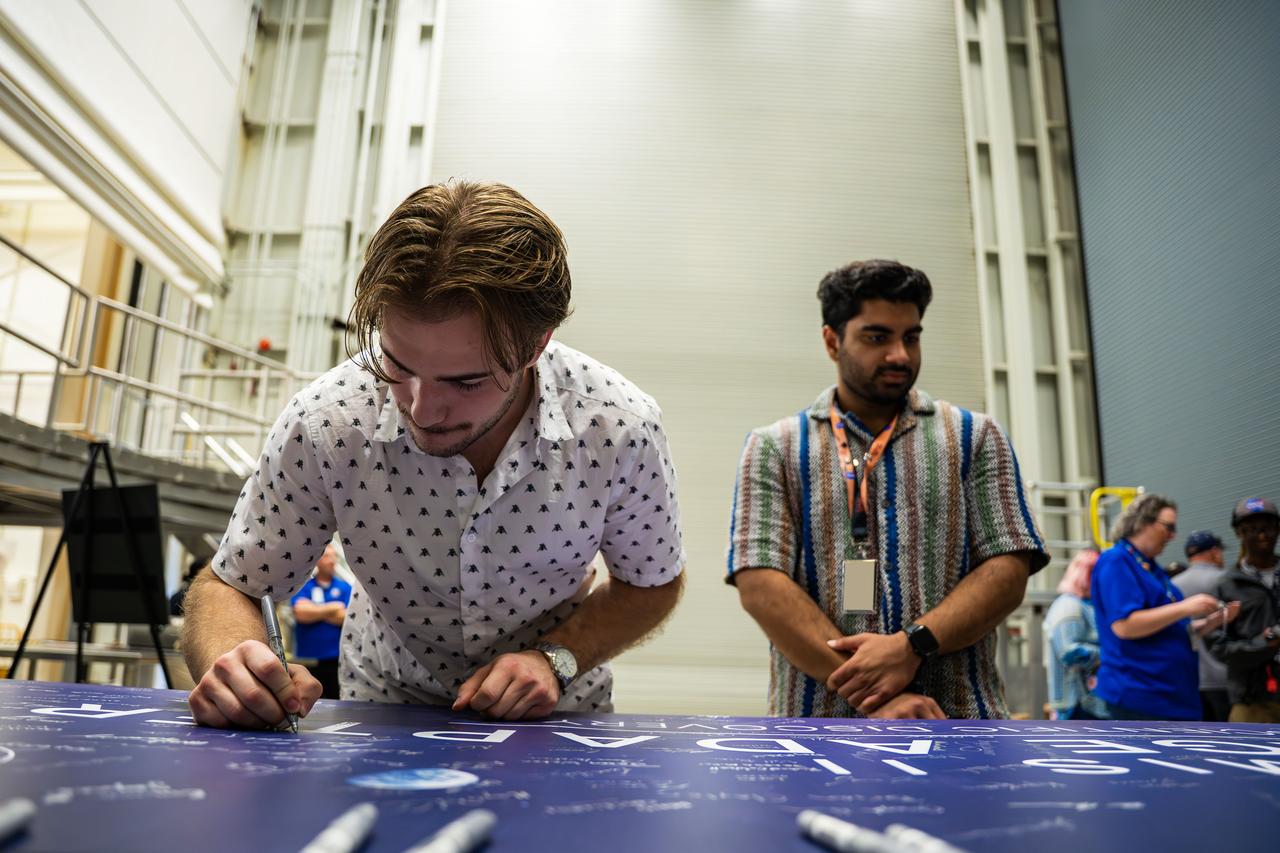
These images show NASA employees attending an event August 14, 2025, at Marshall Space Flight Center in Huntsville, Alabama, to view the Orion stage adapter for Artemis II before it is transported to NASA’s Kennedy Space Center in Florida. Manufactured entirely at NASA Marshall, the adapter plays a crucial role in connecting the SLS (Space Launch System) rocket’s interim cryogenic propulsion stage to the Orion spacecraft. This adapter is the final piece of SLS hardware to be delivered to Kennedy Space Center in preparation for the Artemis II mission.
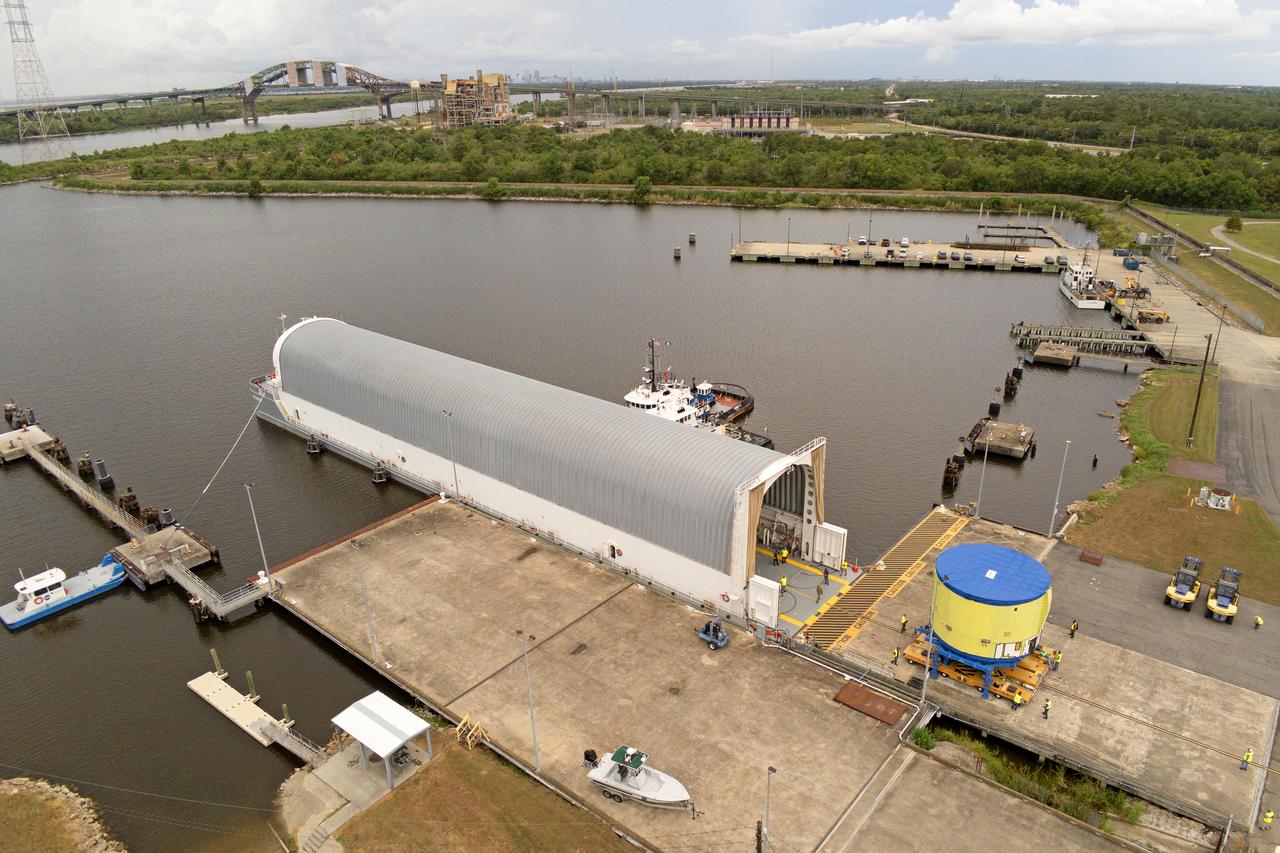
These photos and videos show teams at NASA’s Michoud Assembly Facility in New Orleans preparing, moving, and loading the engine section of a future SLS (Space Launch System) rocket to NASA’s Pegasus barge Aug. 28. The hardware will form the bottom-most section of the SLS core stage that will power NASA’s Artemis IV mission, which will be the first mission to the Gateway space station in lunar orbit under the Artemis campaign. The barge will transport the spaceflight hardware to NASA’s Kennedy Space Center in Florida via the agency’s Pegasus barge. Once in Florida, the engine section will undergo final outfitting inside Kennedy’s Space Station Processing Facility.
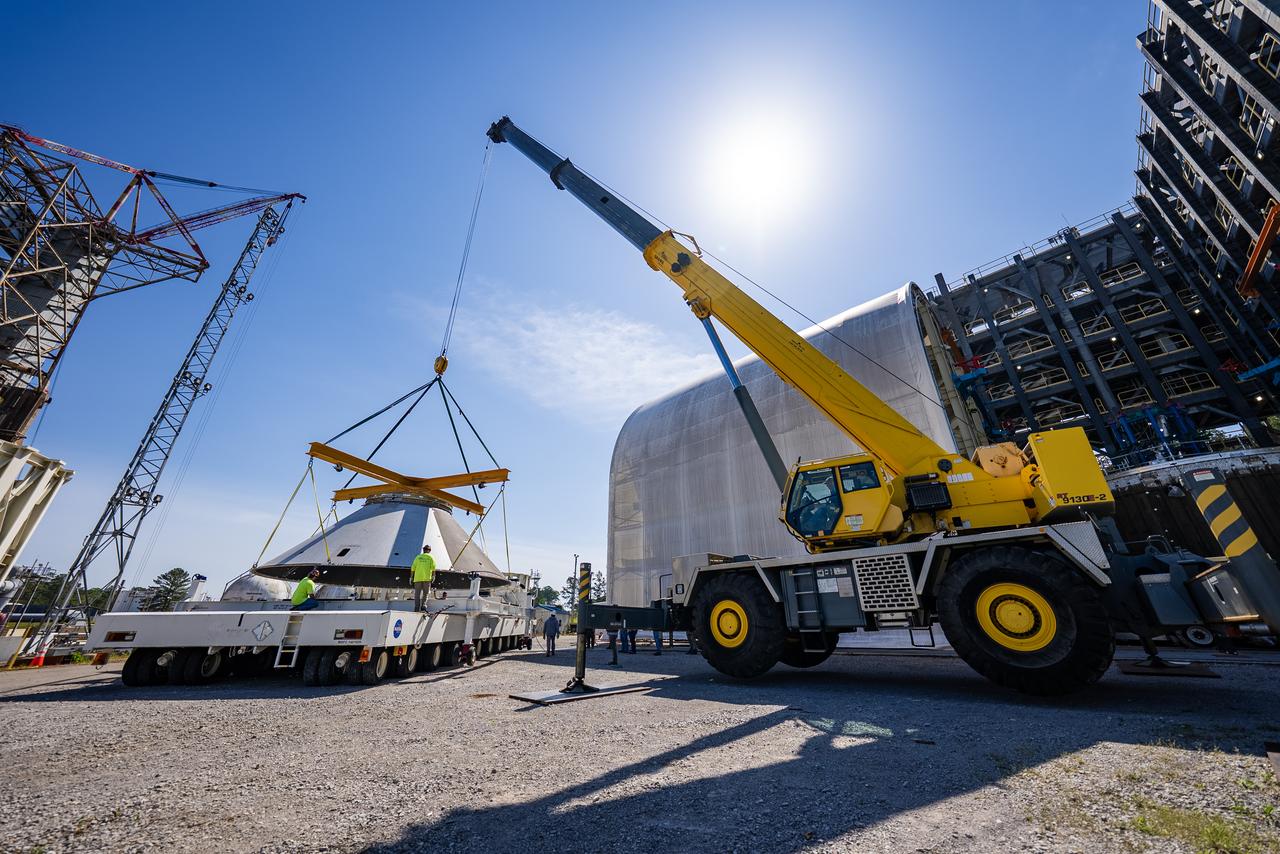
Technicians at NASA’s Marshall Space Flight Center in Huntsville, Alabama, are seen in these images taken April 17, 2025, moving the payload adapter test article from Building 4697 to Building 4705 for storage. This move marks the end of structural testing for the test article. Next, engineers will complete the qualification article and conduct additional for further testing before building the final flight hardware. Manufactured at Marshall, the test article underwent extensive and rigorous testing to validate the design before engineers finalized the configuration for the flight article. The newly completed composite payload adapter is an evolution from the Orion stage adapter to be used in the upgraded Block 1B configuration of the SLS (Space Launch System) rocket, debuting with Artemis IV.
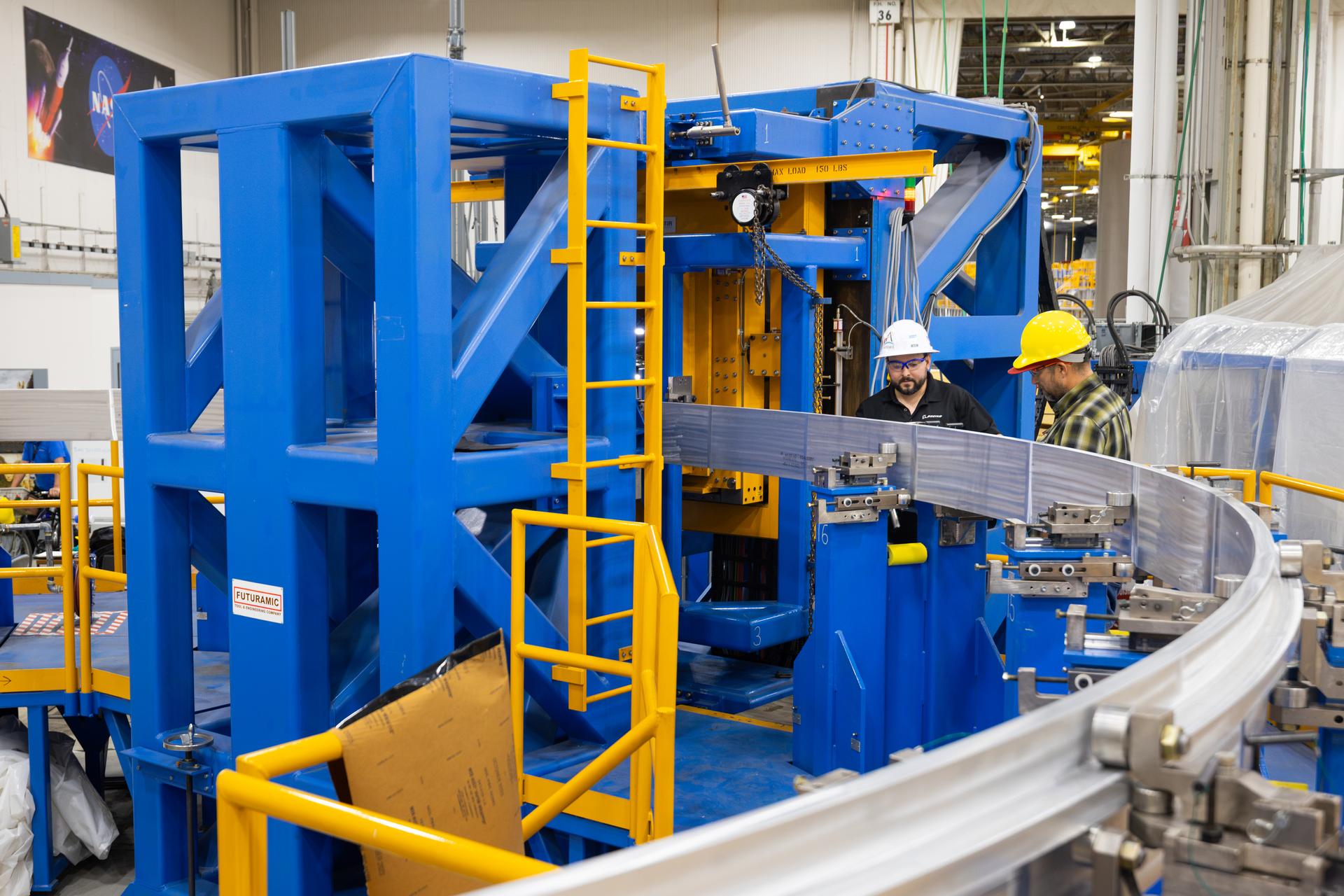
Teams at NASA’s Michoud Assembly Facility in New Orleans continue to make progress manufacturing core stages for the SLS (Space Launch System) rocket. In August, teams with NASA and Boeing, SLS core stage prime contractor, completed the first ring for the sixth SLS core stage. The core stage rings are welded together through a friction-stir welding process. A completed ring is 27.6 feet in diameter and serves as a connection point to join the large core stage structures together. The rings also provide structural stability to the bottoms of the domes. The 212-foot-tall SLS rocket core stage is made up of 10 major barrel sections, four dome sections, and seven rings. The components come together to form the five major sections of the core stage – the engine section, liquid hydrogen tank, intertank, liquid oxygen tank, and forward skirt.

Technicians at NASA’s Marshall Space Flight Center in Huntsville, Alabama, are seen in these images taken April 17, 2025, moving the payload adapter test article from Building 4697 to Building 4705 for storage. This move marks the end of structural testing for the test article. Next, engineers will complete the qualification article and conduct additional for further testing before building the final flight hardware. Manufactured at Marshall, the test article underwent extensive and rigorous testing to validate the design before engineers finalized the configuration for the flight article. The newly completed composite payload adapter is an evolution from the Orion stage adapter to be used in the upgraded Block 1B configuration of the SLS (Space Launch System) rocket, debuting with Artemis IV.
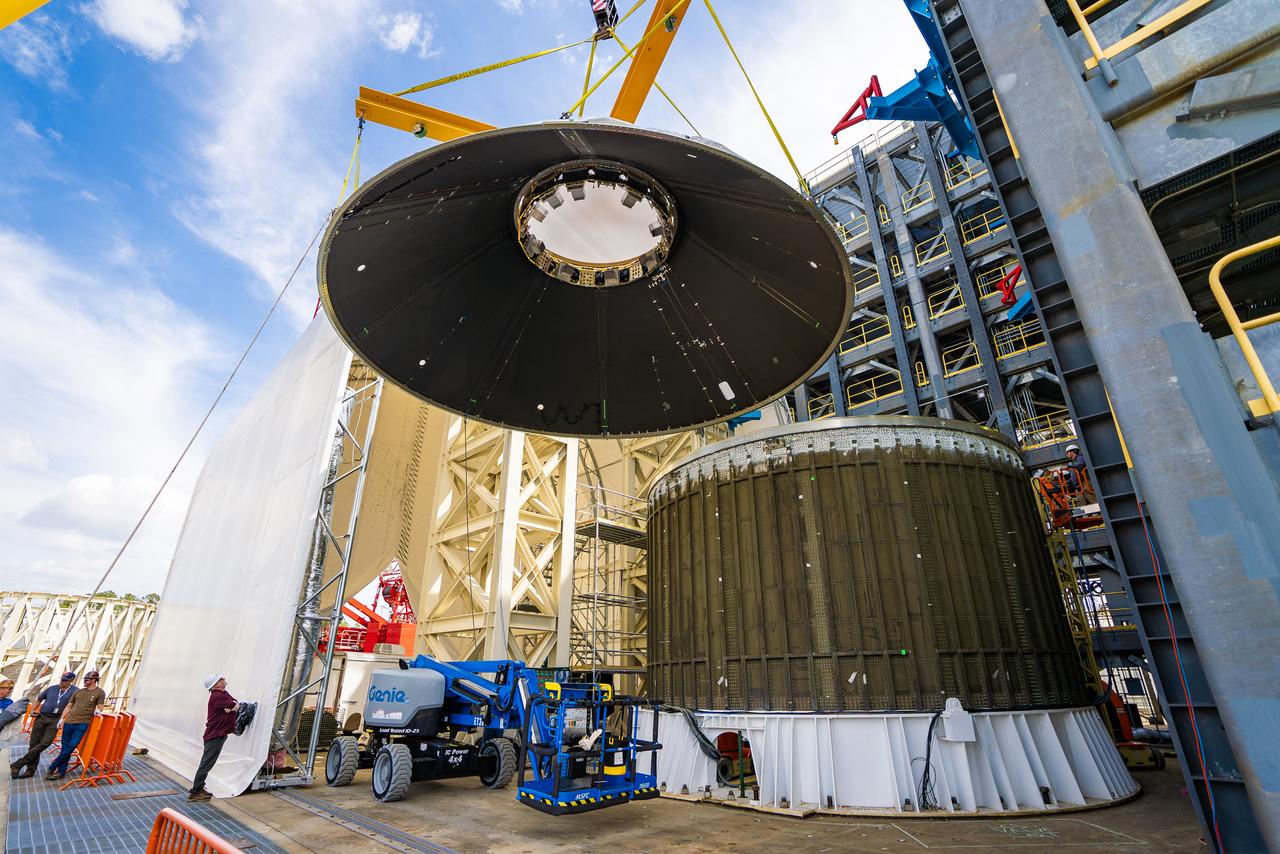
These photos and videos show how crews at NASA’s Marshall Space Flight Center in Huntsville, Alabama, moved and installed the payload adapter that will be used in the Block 1B configuration of the SLS (Space Launch System) rocket from Building 4708, where it was manufactured, into Structural Test Stand 4697 at NASA’s Marshall Space Flight Center on March 13. Teams at Marshall will begin structural testing the engineering development unit of the payload adapter – an exact replica of the flight version of the hardware – this spring. The cone-shaped payload adapter is about 8.5 feet tall and features two metal rings and eight composite panels. The adapter, which will debut on NASA’s Artemis IV mission, is an evolution from the Orion stage adapter used in the Block 1 configuration of the first three Artemis missions. It will be housed inside the universal stage adapter atop the rocket’s more powerful in-space stage, called the exploration upper stage. The payload adapter, like the launch vehicle stage adapter and the Orion stage adapter, is fully manufactured and tested at Marshall, which manages the SLS Program. NASA is working to land the first woman, first person of color, and its first international partner astronaut on the Moon under Artemis. SLS is part of NASA’s backbone for deep space exploration, along with the Orion spacecraft and Gateway in orbit around the Moon and commercial human landing systems, next-generational spacesuits, and rovers on the lunar surface. SLS is the only rocket that can send Orion, astronauts, and supplies to the Moon in a single launch.

These photos and videos show how crews guided a test version of the universal stage adapter for NASA’s more powerful version of its SLS (Space Launch System) rocket to Building 4619 at the agency’s Marshall Space Flight Center in Huntsville, Alabama, Feb. 22. Built by Leidos, the lead contractor for the universal stage adapter, crews transported the hardware from a Leidos facility in Decatur, Alabama, the same day. The universal stage adapter will connect the SLS rocket’s upgraded in-space propulsion stage, called the exploration upper stage, to NASA’s Orion spacecraft as part of the evolved Block 1B configuration of the SLS rocket. It will also serve as a compartment capable of accommodating large payloads, such as modules or other exploration spacecraft. In Building 4619’s Load Test Annex High Bay at Marshall, the development test article will first undergo modal testing that will shake the hardware to validate dynamic models. Later, during ultimate load testing, force will be applied vertically and to the sides of the hardware. Unlike the flight hardware, the development test article has flaws intentionally included in its design, which will help engineers verity that the flight adapter can withstand the extreme forces it will face during launch and flight.
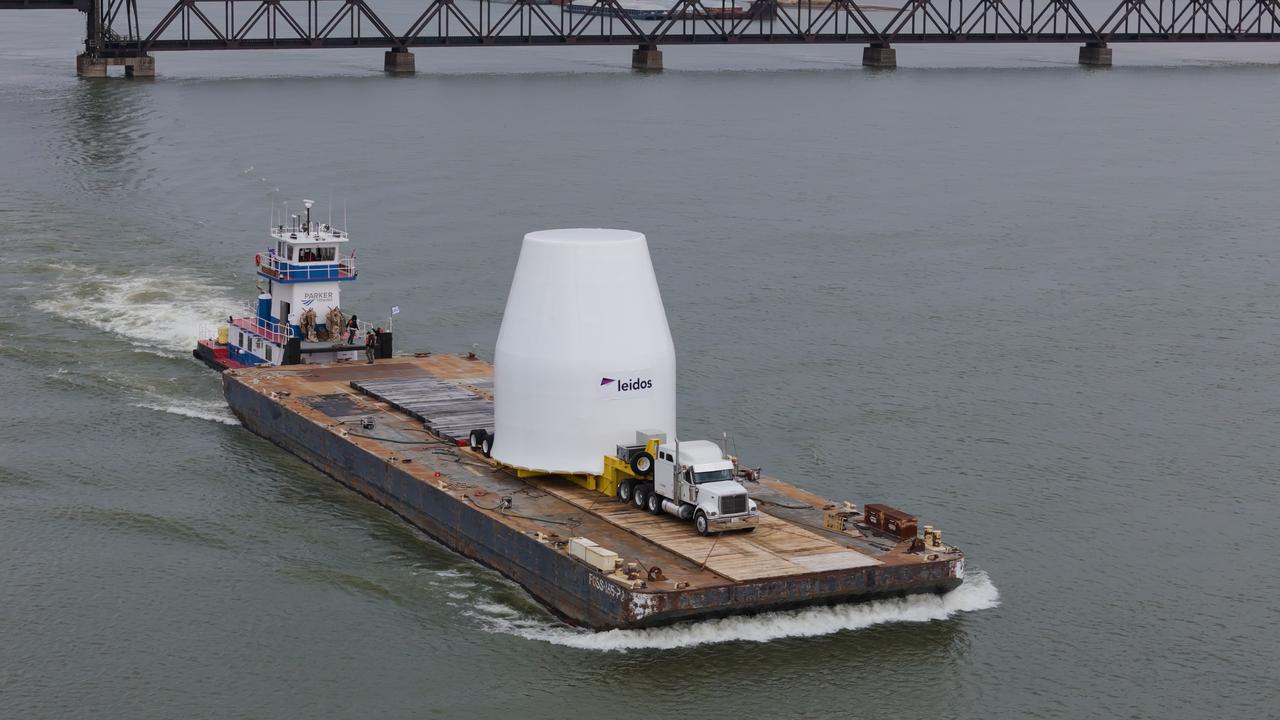
These photos and videos show how crews guided a test version of the universal stage adapter for NASA’s more powerful version of its SLS (Space Launch System) rocket to Building 4619 at the agency’s Marshall Space Flight Center in Huntsville, Alabama, Feb. 22. Built by Leidos, the lead contractor for the universal stage adapter, crews transported the hardware from a Leidos facility in Decatur, Alabama, the same day. The universal stage adapter will connect the SLS rocket’s upgraded in-space propulsion stage, called the exploration upper stage, to NASA’s Orion spacecraft as part of the evolved Block 1B configuration of the SLS rocket. It will also serve as a compartment capable of accommodating large payloads, such as modules or other exploration spacecraft. In Building 4619’s Load Test Annex High Bay at Marshall, the development test article will first undergo modal testing that will shake the hardware to validate dynamic models. Later, during ultimate load testing, force will be applied vertically and to the sides of the hardware. Unlike the flight hardware, the development test article has flaws intentionally included in its design, which will help engineers verity that the flight adapter can withstand the extreme forces it will face during launch and flight.
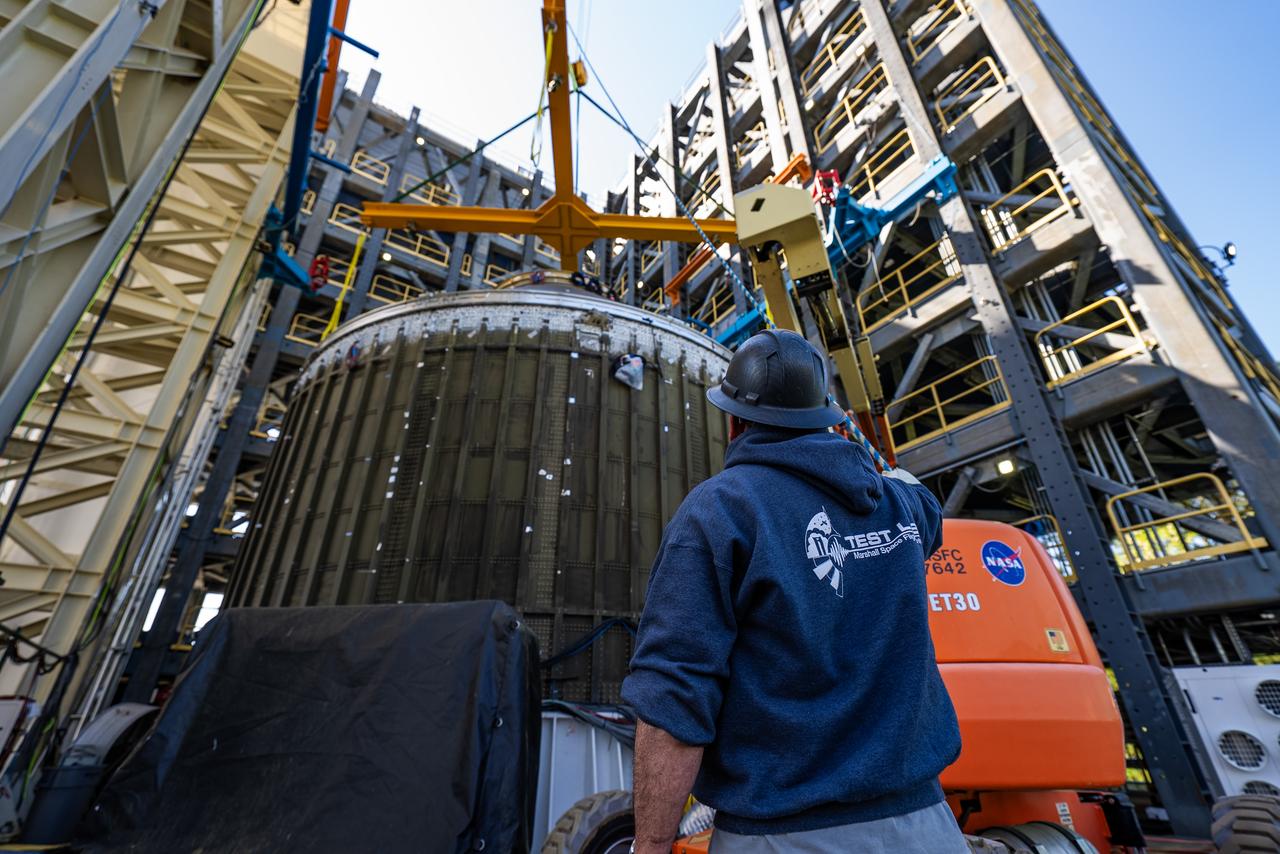
Technicians at NASA’s Marshall Space Flight Center in Huntsville, Alabama, are seen in these images taken April 17, 2025, moving the payload adapter test article from Building 4697 to Building 4705 for storage. This move marks the end of structural testing for the test article. Next, engineers will complete the qualification article and conduct additional for further testing before building the final flight hardware. Manufactured at Marshall, the test article underwent extensive and rigorous testing to validate the design before engineers finalized the configuration for the flight article. The newly completed composite payload adapter is an evolution from the Orion stage adapter to be used in the upgraded Block 1B configuration of the SLS (Space Launch System) rocket, debuting with Artemis IV.
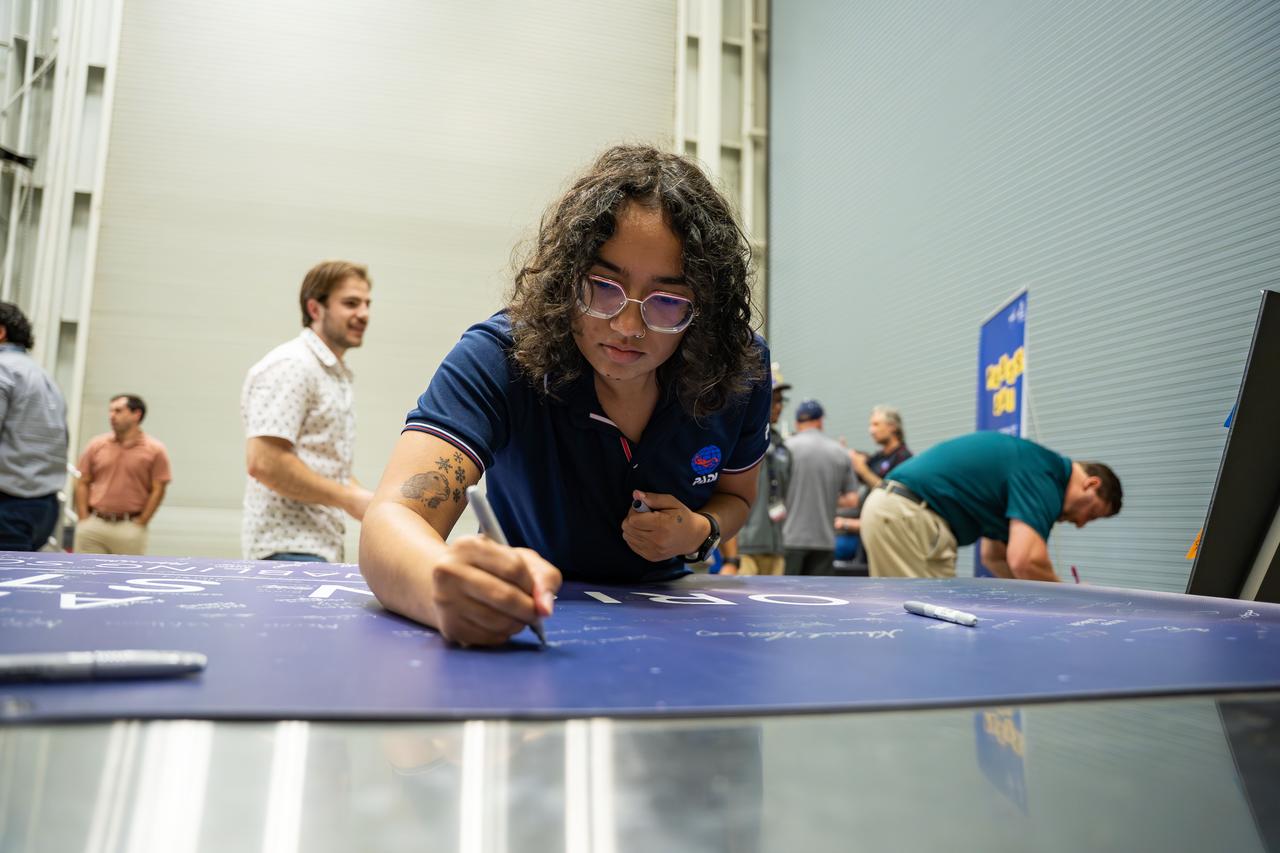
These images show NASA employees attending an event August 14, 2025, at Marshall Space Flight Center in Huntsville, Alabama, to view the Orion stage adapter for Artemis II before it is transported to NASA’s Kennedy Space Center in Florida. Manufactured entirely at NASA Marshall, the adapter plays a crucial role in connecting the SLS (Space Launch System) rocket’s interim cryogenic propulsion stage to the Orion spacecraft. This adapter is the final piece of SLS hardware to be delivered to Kennedy Space Center in preparation for the Artemis II mission.
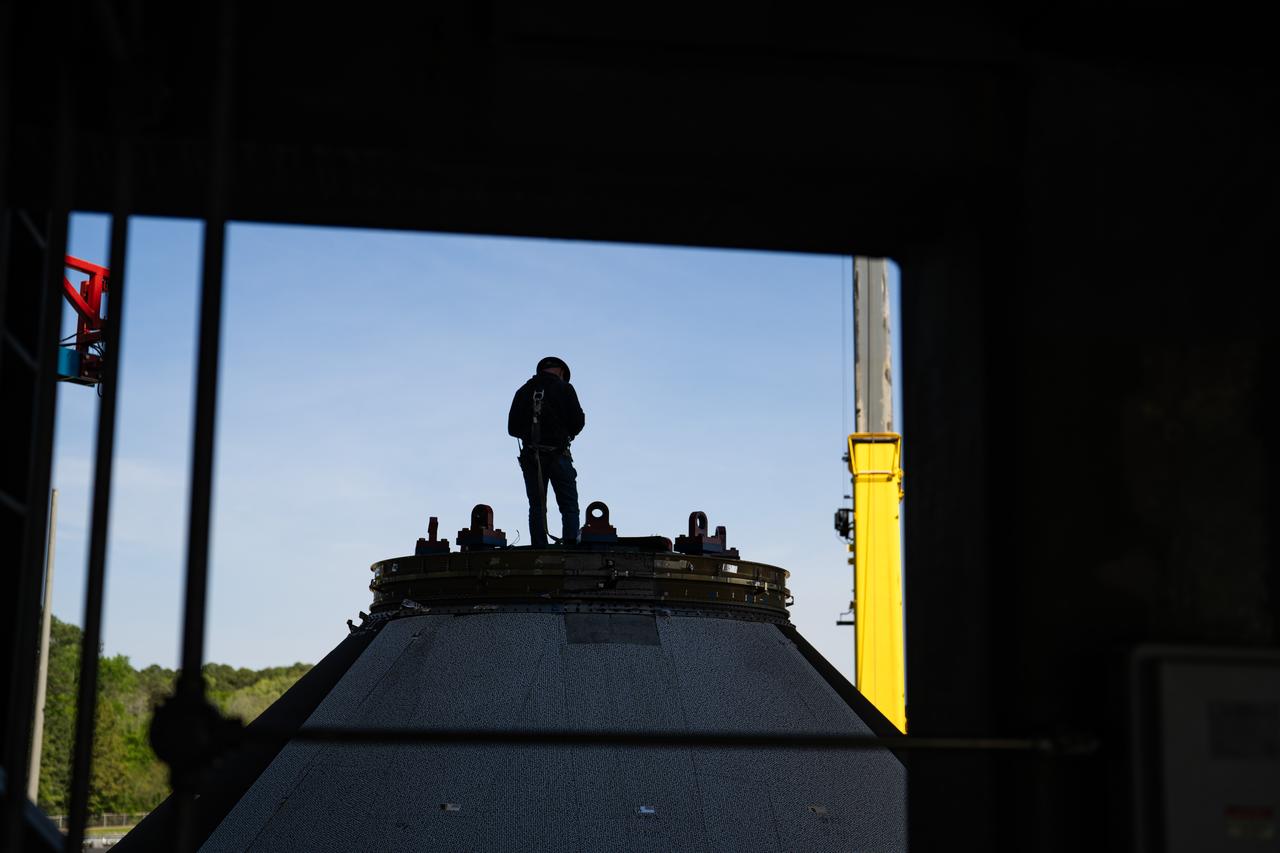
Technicians at NASA’s Marshall Space Flight Center in Huntsville, Alabama, are seen in these images taken April 17, 2025, moving the payload adapter test article from Building 4697 to Building 4705 for storage. This move marks the end of structural testing for the test article. Next, engineers will complete the qualification article and conduct additional for further testing before building the final flight hardware. Manufactured at Marshall, the test article underwent extensive and rigorous testing to validate the design before engineers finalized the configuration for the flight article. The newly completed composite payload adapter is an evolution from the Orion stage adapter to be used in the upgraded Block 1B configuration of the SLS (Space Launch System) rocket, debuting with Artemis IV.
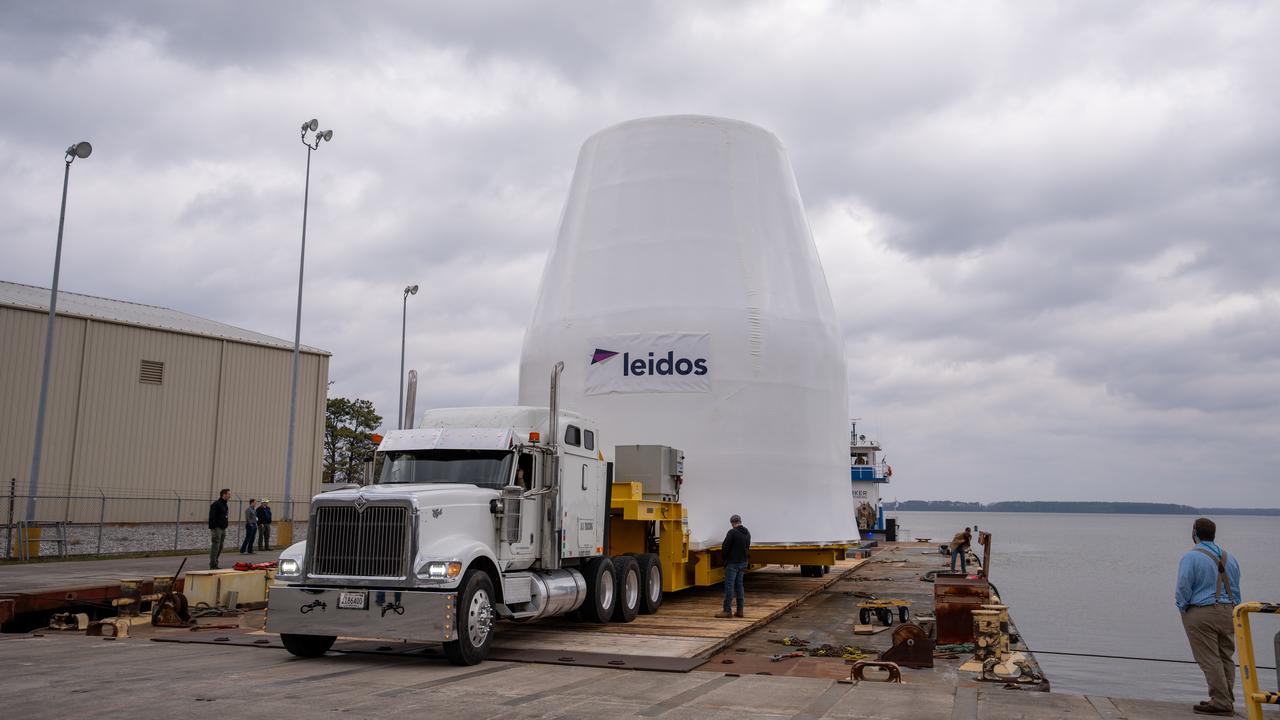
These photos and videos show how crews guided a test version of the universal stage adapter for NASA’s more powerful version of its SLS (Space Launch System) rocket to Building 4619 at the agency’s Marshall Space Flight Center in Huntsville, Alabama, Feb. 22. Built by Leidos, the lead contractor for the universal stage adapter, crews transported the hardware from a Leidos facility in Decatur, Alabama, the same day. The universal stage adapter will connect the SLS rocket’s upgraded in-space propulsion stage, called the exploration upper stage, to NASA’s Orion spacecraft as part of the evolved Block 1B configuration of the SLS rocket. It will also serve as a compartment capable of accommodating large payloads, such as modules or other exploration spacecraft. In Building 4619’s Load Test Annex High Bay at Marshall, the development test article will first undergo modal testing that will shake the hardware to validate dynamic models. Later, during ultimate load testing, force will be applied vertically and to the sides of the hardware. Unlike the flight hardware, the development test article has flaws intentionally included in its design, which will help engineers verity that the flight adapter can withstand the extreme forces it will face during launch and flight.
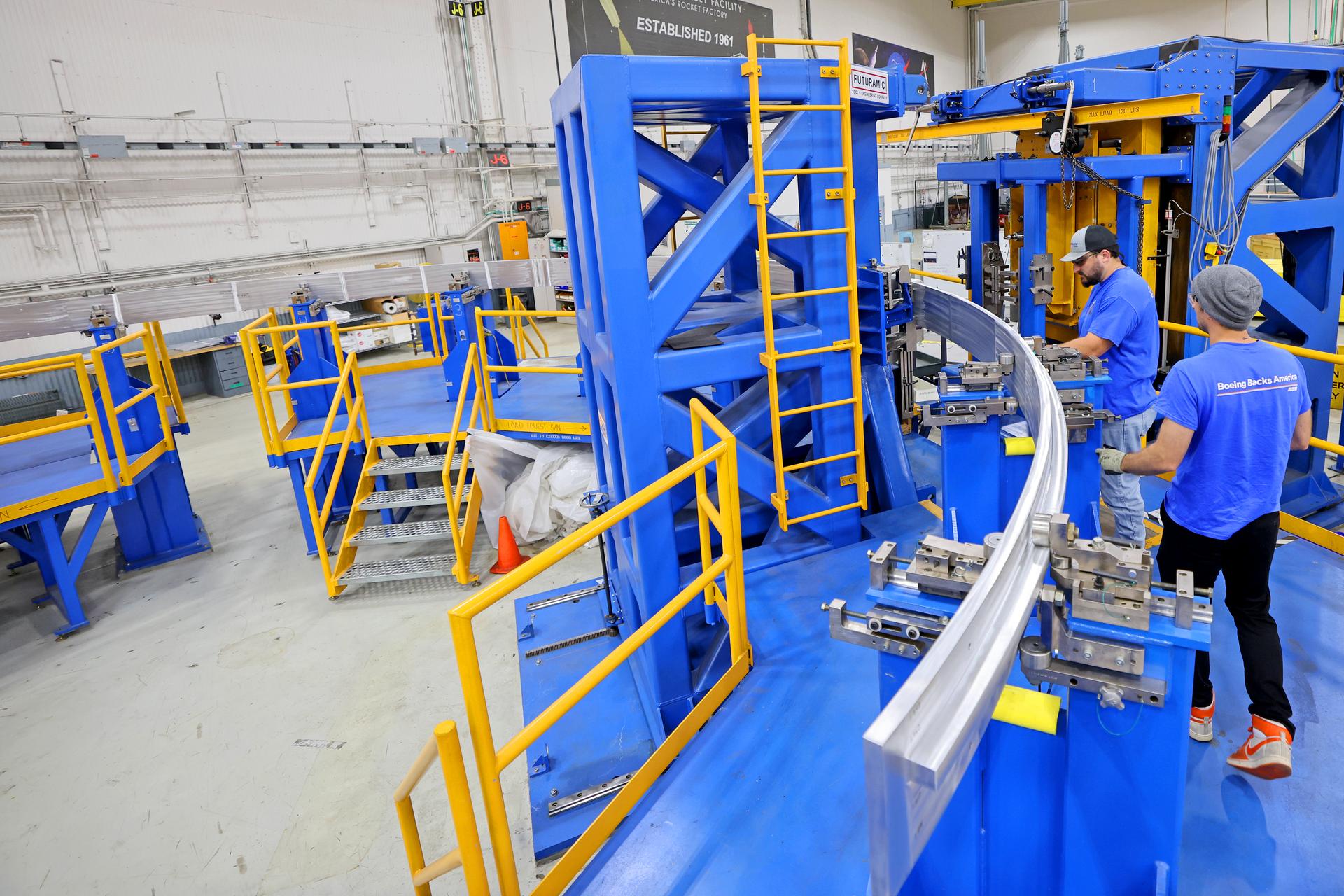
Teams at NASA’s Michoud Assembly Facility in New Orleans continue to make progress manufacturing core stages for the SLS (Space Launch System) rocket. In August, teams with NASA and Boeing, SLS core stage prime contractor, completed the first ring for the sixth SLS core stage. The core stage rings are welded together through a friction-stir welding process. A completed ring is 27.6 feet in diameter and serves as a connection point to join the large core stage structures together. The rings also provide structural stability to the bottoms of the domes. The 212-foot-tall SLS rocket core stage is made up of 10 major barrel sections, four dome sections, and seven rings. The components come together to form the five major sections of the core stage – the engine section, liquid hydrogen tank, intertank, liquid oxygen tank, and forward skirt.
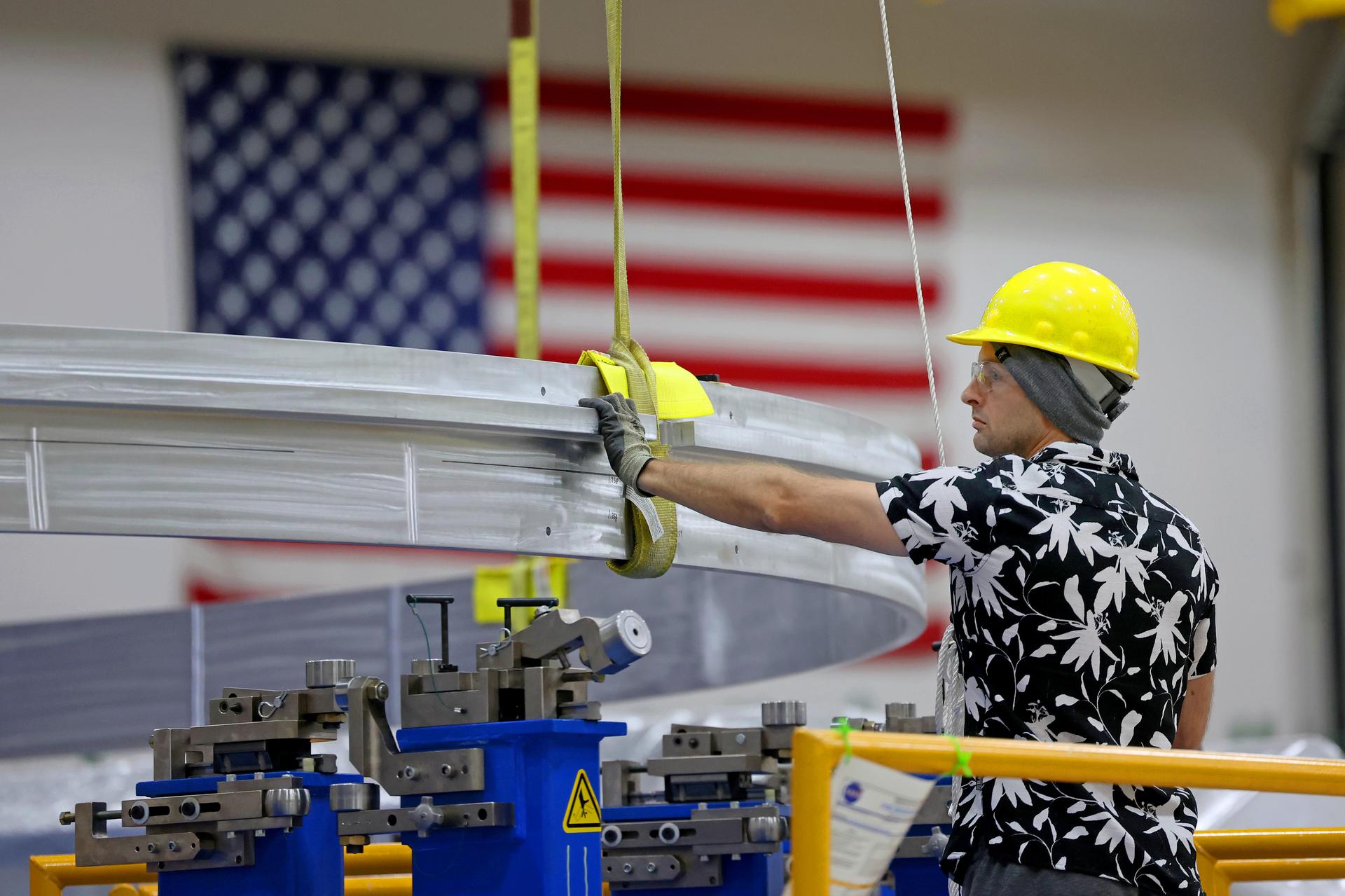
Teams at NASA’s Michoud Assembly Facility in New Orleans continue to make progress manufacturing core stages for the SLS (Space Launch System) rocket. In August, teams with NASA and Boeing, SLS core stage prime contractor, completed the first ring for the sixth SLS core stage. The core stage rings are welded together through a friction-stir welding process. A completed ring is 27.6 feet in diameter and serves as a connection point to join the large core stage structures together. The rings also provide structural stability to the bottoms of the domes. The 212-foot-tall SLS rocket core stage is made up of 10 major barrel sections, four dome sections, and seven rings. The components come together to form the five major sections of the core stage – the engine section, liquid hydrogen tank, intertank, liquid oxygen tank, and forward skirt.

The Space Launch System (SLS) rocket and Orion Spacecraft roll out of the Vehicle Assembly Building (VAB) to Launch Pad 39B at NASA's Kennedy Space Center in Florida for the first time on March 17, 2022.
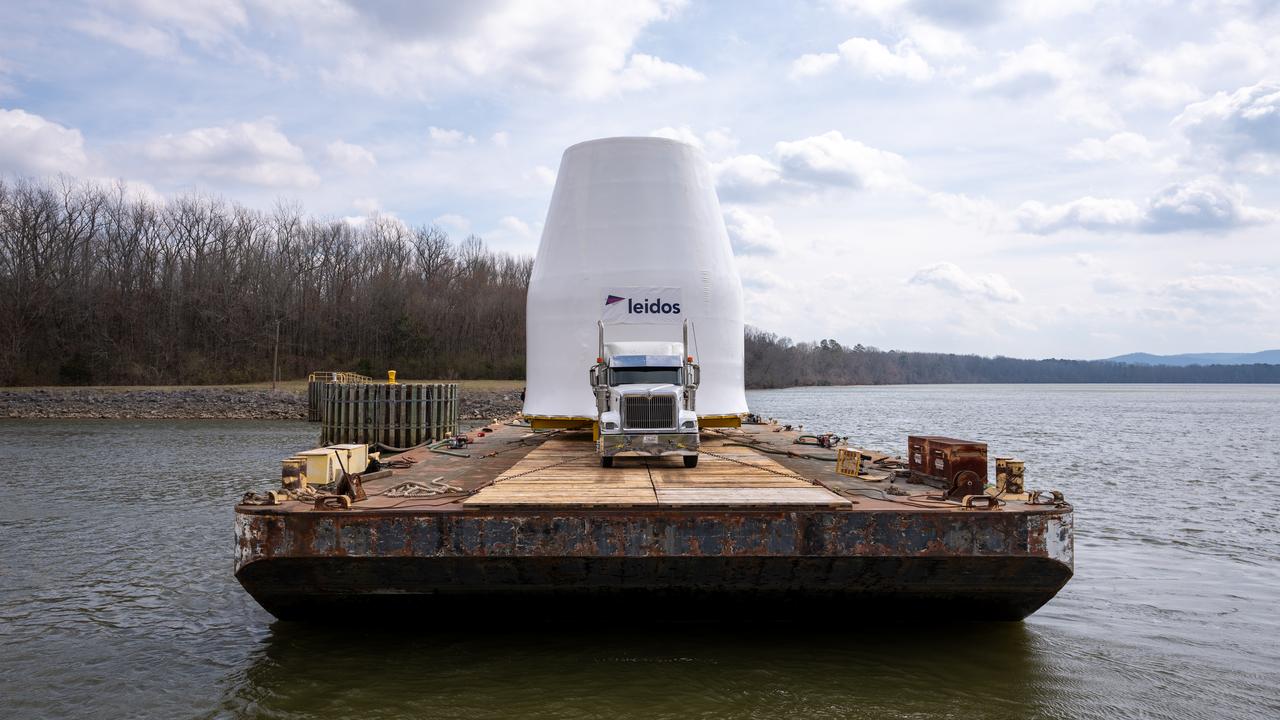
These photos and videos show how crews guided a test version of the universal stage adapter for NASA’s more powerful version of its SLS (Space Launch System) rocket to Building 4619 at the agency’s Marshall Space Flight Center in Huntsville, Alabama, Feb. 22. Built by Leidos, the lead contractor for the universal stage adapter, crews transported the hardware from a Leidos facility in Decatur, Alabama, the same day. The universal stage adapter will connect the SLS rocket’s upgraded in-space propulsion stage, called the exploration upper stage, to NASA’s Orion spacecraft as part of the evolved Block 1B configuration of the SLS rocket. It will also serve as a compartment capable of accommodating large payloads, such as modules or other exploration spacecraft. In Building 4619’s Load Test Annex High Bay at Marshall, the development test article will first undergo modal testing that will shake the hardware to validate dynamic models. Later, during ultimate load testing, force will be applied vertically and to the sides of the hardware. Unlike the flight hardware, the development test article has flaws intentionally included in its design, which will help engineers verity that the flight adapter can withstand the extreme forces it will face during launch and flight.
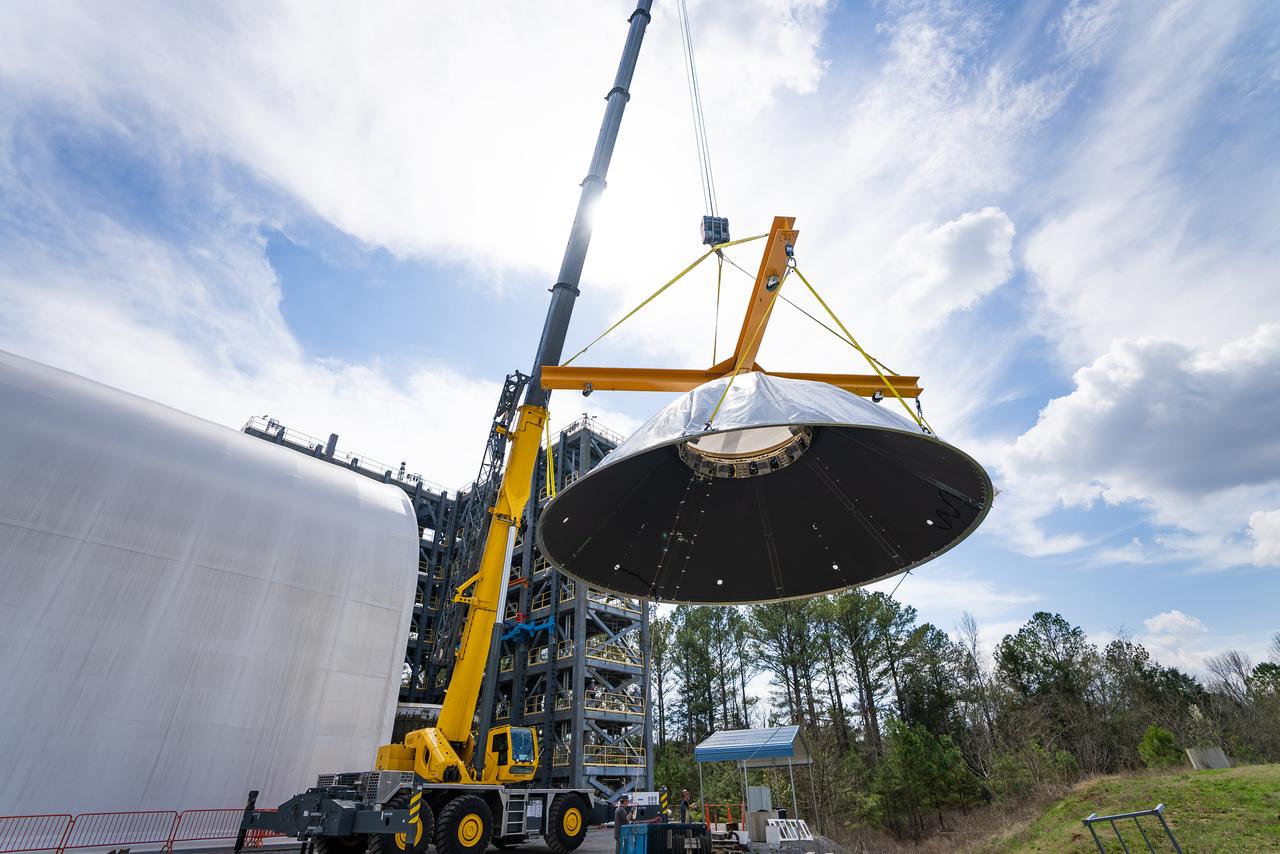
These photos and videos show how crews at NASA’s Marshall Space Flight Center in Huntsville, Alabama, moved and installed the payload adapter that will be used in the Block 1B configuration of the SLS (Space Launch System) rocket from Building 4708, where it was manufactured, into Structural Test Stand 4697 at NASA’s Marshall Space Flight Center on March 13. Teams at Marshall will begin structural testing the engineering development unit of the payload adapter – an exact replica of the flight version of the hardware – this spring. The cone-shaped payload adapter is about 8.5 feet tall and features two metal rings and eight composite panels. The adapter, which will debut on NASA’s Artemis IV mission, is an evolution from the Orion stage adapter used in the Block 1 configuration of the first three Artemis missions. It will be housed inside the universal stage adapter atop the rocket’s more powerful in-space stage, called the exploration upper stage. The payload adapter, like the launch vehicle stage adapter and the Orion stage adapter, is fully manufactured and tested at Marshall, which manages the SLS Program. NASA is working to land the first woman, first person of color, and its first international partner astronaut on the Moon under Artemis. SLS is part of NASA’s backbone for deep space exploration, along with the Orion spacecraft and Gateway in orbit around the Moon and commercial human landing systems, next-generational spacesuits, and rovers on the lunar surface. SLS is the only rocket that can send Orion, astronauts, and supplies to the Moon in a single launch.

These photos and videos show how crews guided a test version of the universal stage adapter for NASA’s more powerful version of its SLS (Space Launch System) rocket to Building 4619 at the agency’s Marshall Space Flight Center in Huntsville, Alabama, Feb. 22. Built by Leidos, the lead contractor for the universal stage adapter, crews transported the hardware from a Leidos facility in Decatur, Alabama, the same day. The universal stage adapter will connect the SLS rocket’s upgraded in-space propulsion stage, called the exploration upper stage, to NASA’s Orion spacecraft as part of the evolved Block 1B configuration of the SLS rocket. It will also serve as a compartment capable of accommodating large payloads, such as modules or other exploration spacecraft. In Building 4619’s Load Test Annex High Bay at Marshall, the development test article will first undergo modal testing that will shake the hardware to validate dynamic models. Later, during ultimate load testing, force will be applied vertically and to the sides of the hardware. Unlike the flight hardware, the development test article has flaws intentionally included in its design, which will help engineers verity that the flight adapter can withstand the extreme forces it will face during launch and flight.
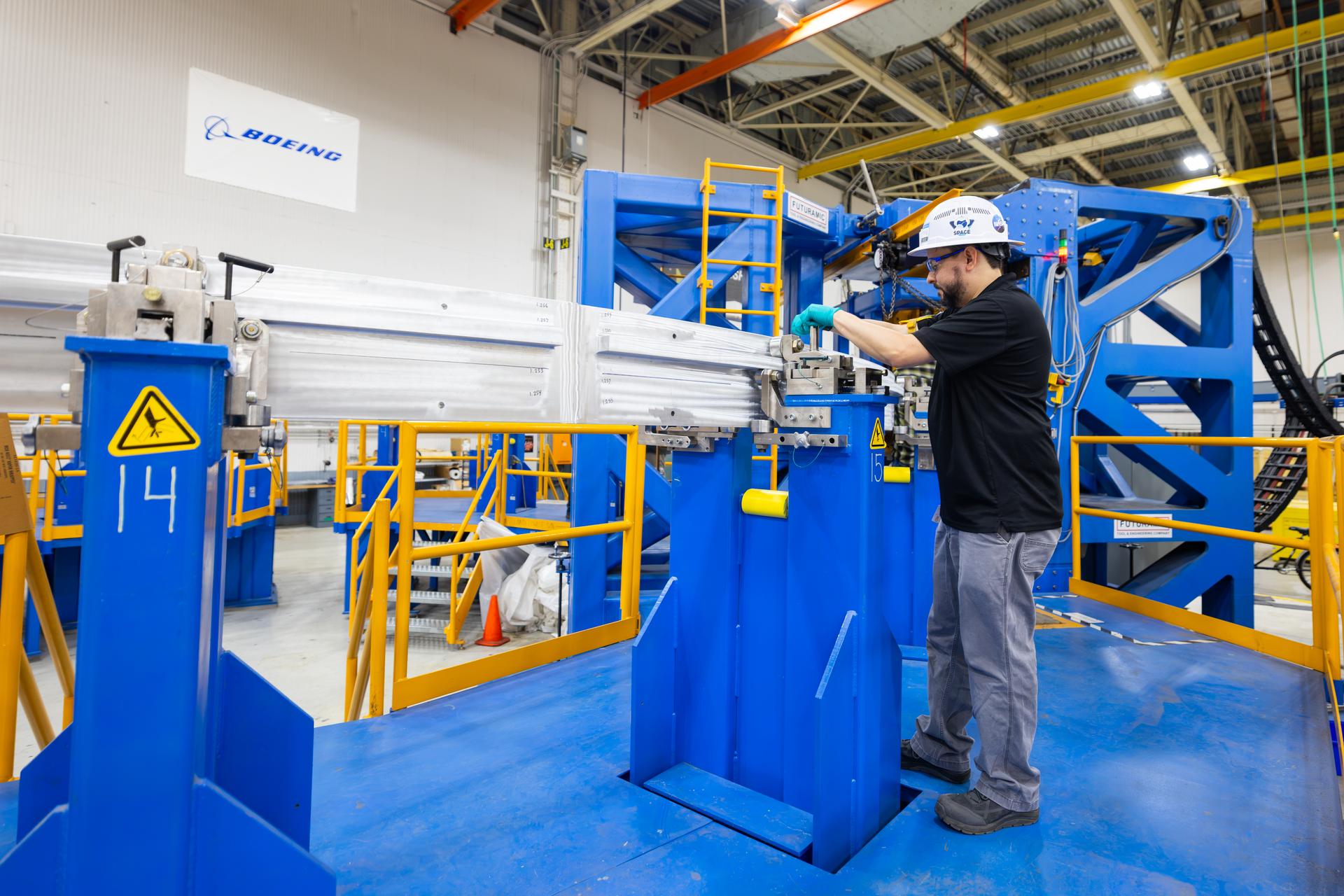
Teams at NASA’s Michoud Assembly Facility in New Orleans continue to make progress manufacturing core stages for the SLS (Space Launch System) rocket. In August, teams with NASA and Boeing, SLS core stage prime contractor, completed the first ring for the sixth SLS core stage. The core stage rings are welded together through a friction-stir welding process. A completed ring is 27.6 feet in diameter and serves as a connection point to join the large core stage structures together. The rings also provide structural stability to the bottoms of the domes. The 212-foot-tall SLS rocket core stage is made up of 10 major barrel sections, four dome sections, and seven rings. The components come together to form the five major sections of the core stage – the engine section, liquid hydrogen tank, intertank, liquid oxygen tank, and forward skirt.
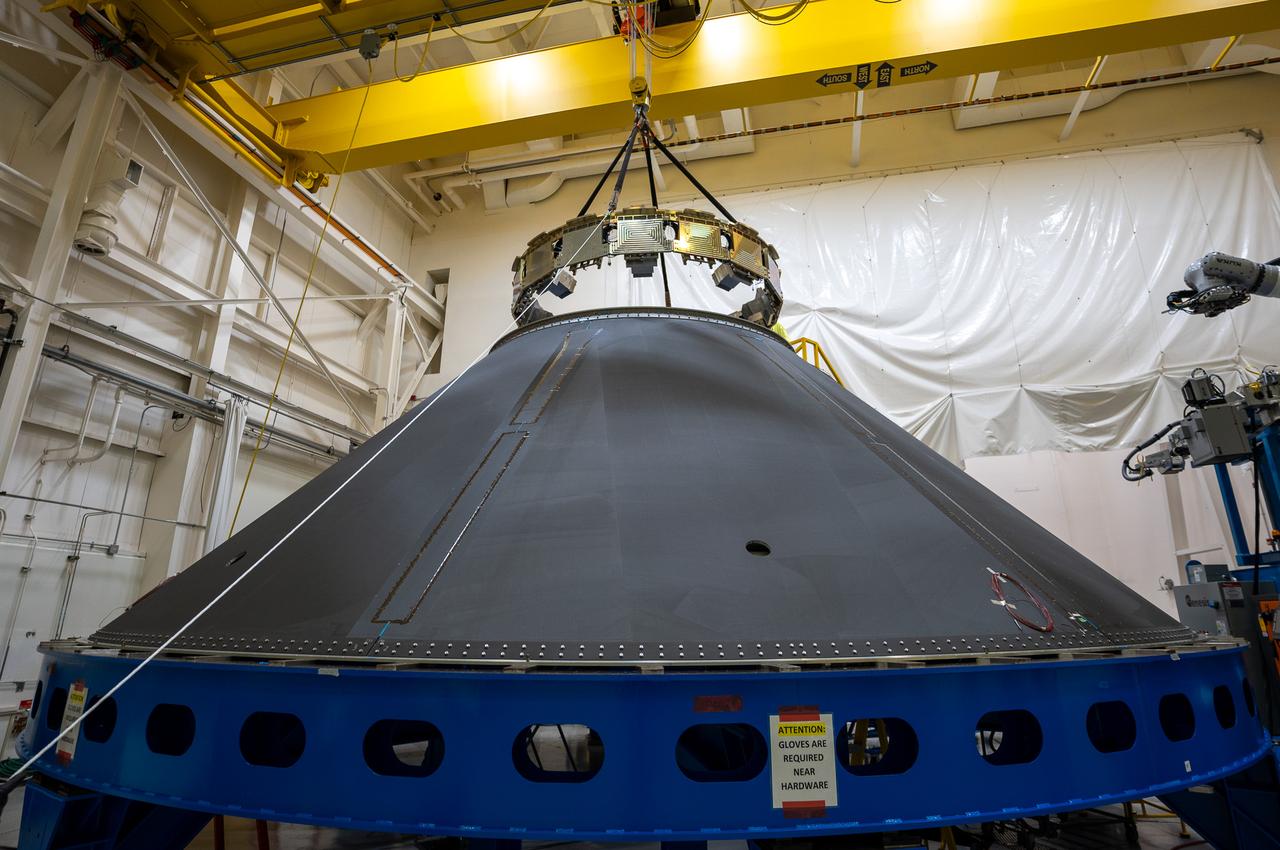
These photos and videos show how NASA manufactured and prepared to transport the payload adapter in February inside Building 4708 at NASA’s Marshall Space Flight Center in Huntsville, Alabama. Prior to moving the hardware for testing, teams installed the New Explorations Secondary Transport component, called the NEST, into the top of the engineering development unit. The NEST component will allow the hardware to hold a series of secondary payloads, or small satellites. The cone-shaped payload adapter is about 8.5 feet tall and features two metal rings and eight composite panels. The adapter, which will debut on NASA’s Artemis IV mission, is an evolution from the Orion stage adapter used in the Block 1 configuration of the rocket for the first three Artemis missions. It will be housed inside the universal stage adapter atop the rocket’s more powerful in-space stage, called the exploration upper stage. The payload adapter, like the launch vehicle stage adapter and the Orion stage adapter, is fully manufactured and tested at Marshall, which manages the SLS Program. NASA is working to land the first woman, first person of color, and its first international partner astronaut on the Moon under Artemis. SLS is part of NASA’s backbone for deep space exploration, along with the Orion spacecraft and Gateway in orbit around the Moon and commercial human landing systems, next-generational spacesuits, and rovers on the lunar surface. SLS is the only rocket that can send Orion, astronauts, and supplies to the Moon in a single launch.
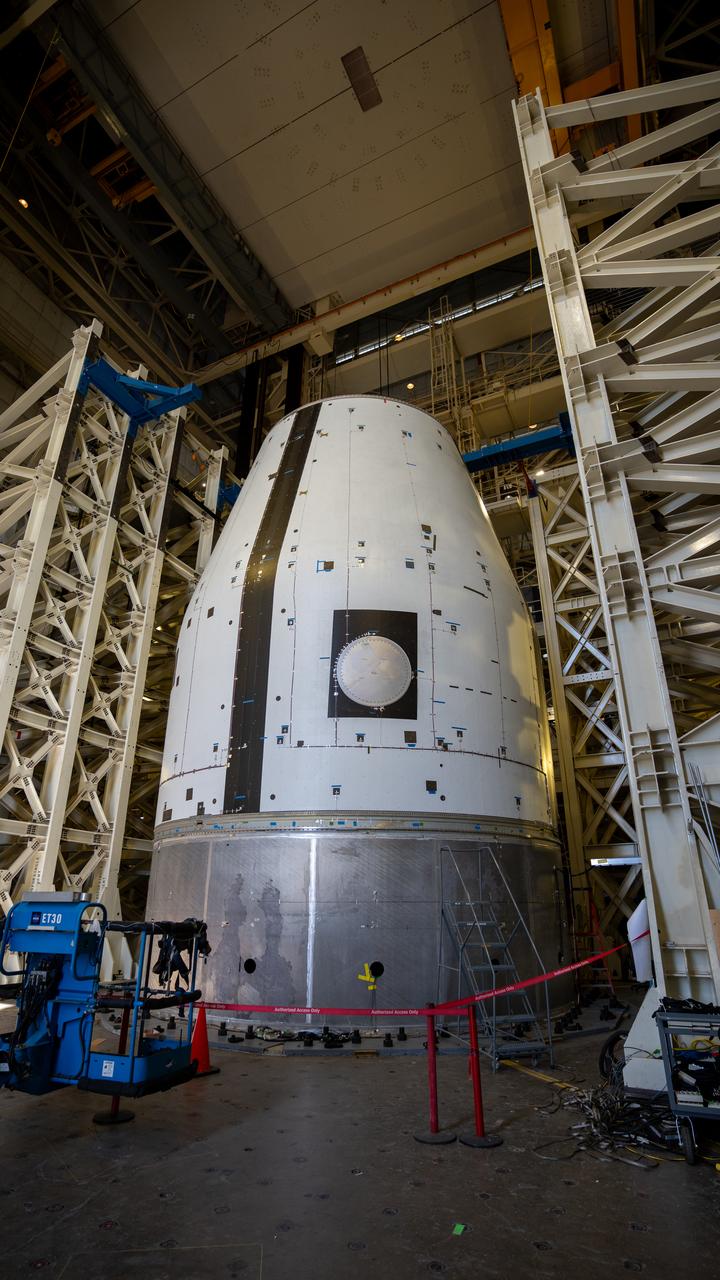
These photos and videos show how crews guided a test version of the universal stage adapter for NASA’s more powerful version of its SLS (Space Launch System) rocket to Building 4619 at the agency’s Marshall Space Flight Center in Huntsville, Alabama, Feb. 22. Built by Leidos, the lead contractor for the universal stage adapter, crews transported the hardware from a Leidos facility in Decatur, Alabama, the same day. The universal stage adapter will connect the SLS rocket’s upgraded in-space propulsion stage, called the exploration upper stage, to NASA’s Orion spacecraft as part of the evolved Block 1B configuration of the SLS rocket. It will also serve as a compartment capable of accommodating large payloads, such as modules or other exploration spacecraft. In Building 4619’s Load Test Annex High Bay at Marshall, the development test article will first undergo modal testing that will shake the hardware to validate dynamic models. Later, during ultimate load testing, force will be applied vertically and to the sides of the hardware. Unlike the flight hardware, the development test article has flaws intentionally included in its design, which will help engineers verity that the flight adapter can withstand the extreme forces it will face during launch and flight.
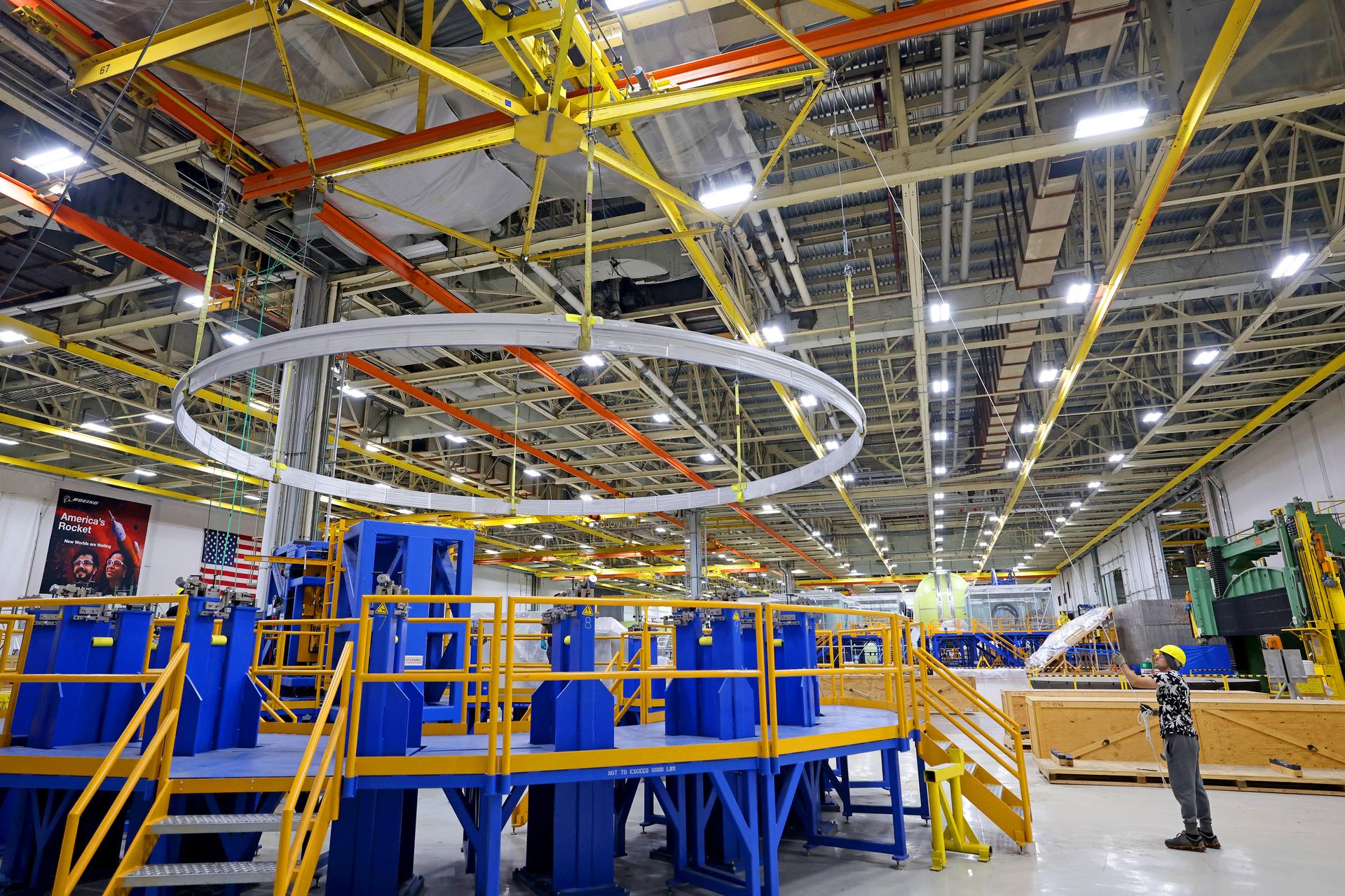
Teams at NASA’s Michoud Assembly Facility in New Orleans continue to make progress manufacturing core stages for the SLS (Space Launch System) rocket. In August, teams with NASA and Boeing, SLS core stage prime contractor, completed the first ring for the sixth SLS core stage. The core stage rings are welded together through a friction-stir welding process. A completed ring is 27.6 feet in diameter and serves as a connection point to join the large core stage structures together. The rings also provide structural stability to the bottoms of the domes. The 212-foot-tall SLS rocket core stage is made up of 10 major barrel sections, four dome sections, and seven rings. The components come together to form the five major sections of the core stage – the engine section, liquid hydrogen tank, intertank, liquid oxygen tank, and forward skirt.
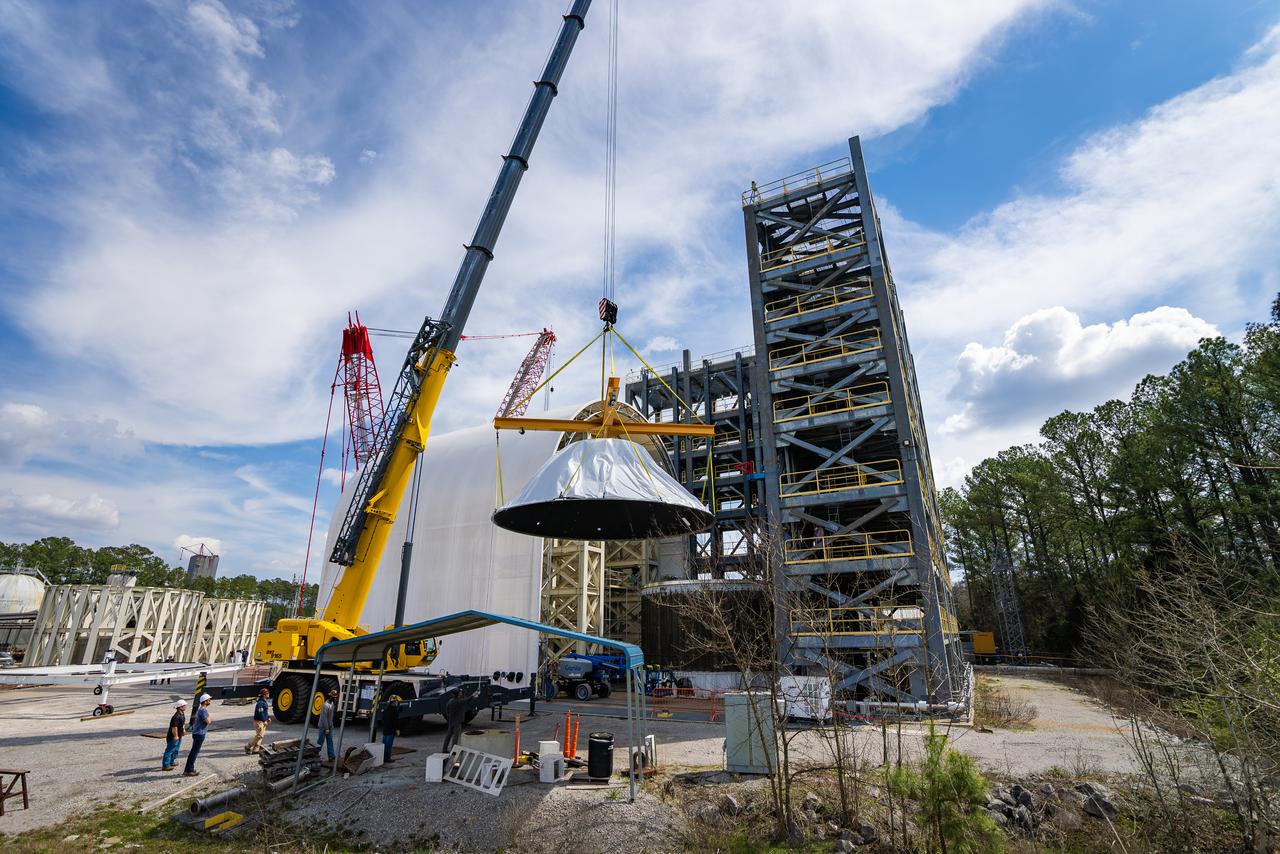
These photos and videos show how crews at NASA’s Marshall Space Flight Center in Huntsville, Alabama, moved and installed the payload adapter that will be used in the Block 1B configuration of the SLS (Space Launch System) rocket from Building 4708, where it was manufactured, into Structural Test Stand 4697 at NASA’s Marshall Space Flight Center on March 13. Teams at Marshall will begin structural testing the engineering development unit of the payload adapter – an exact replica of the flight version of the hardware – this spring. The cone-shaped payload adapter is about 8.5 feet tall and features two metal rings and eight composite panels. The adapter, which will debut on NASA’s Artemis IV mission, is an evolution from the Orion stage adapter used in the Block 1 configuration of the first three Artemis missions. It will be housed inside the universal stage adapter atop the rocket’s more powerful in-space stage, called the exploration upper stage. The payload adapter, like the launch vehicle stage adapter and the Orion stage adapter, is fully manufactured and tested at Marshall, which manages the SLS Program. NASA is working to land the first woman, first person of color, and its first international partner astronaut on the Moon under Artemis. SLS is part of NASA’s backbone for deep space exploration, along with the Orion spacecraft and Gateway in orbit around the Moon and commercial human landing systems, next-generational spacesuits, and rovers on the lunar surface. SLS is the only rocket that can send Orion, astronauts, and supplies to the Moon in a single launch.

These images show NASA employees attending an event August 14, 2025, at Marshall Space Flight Center in Huntsville, Alabama, to view the Orion stage adapter for Artemis II before it is transported to NASA’s Kennedy Space Center in Florida. Manufactured entirely at NASA Marshall, the adapter plays a crucial role in connecting the SLS (Space Launch System) rocket’s interim cryogenic propulsion stage to the Orion spacecraft. This adapter is the final piece of SLS hardware to be delivered to Kennedy Space Center in preparation for the Artemis II mission.
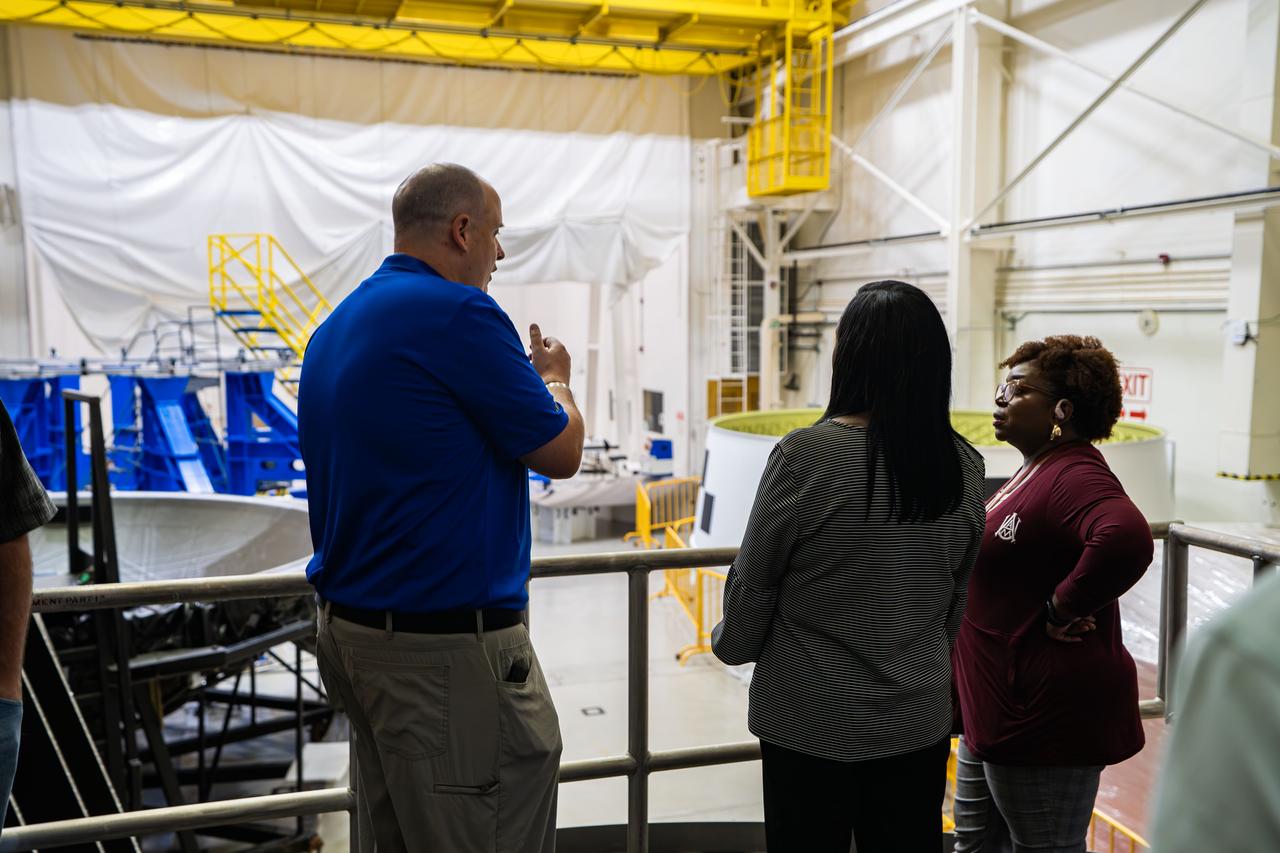
These images show NASA employees attending an event August 14, 2025, at Marshall Space Flight Center in Huntsville, Alabama, to view the Orion stage adapter for Artemis II before it is transported to NASA’s Kennedy Space Center in Florida. Manufactured entirely at NASA Marshall, the adapter plays a crucial role in connecting the SLS (Space Launch System) rocket’s interim cryogenic propulsion stage to the Orion spacecraft. This adapter is the final piece of SLS hardware to be delivered to Kennedy Space Center in preparation for the Artemis II mission.
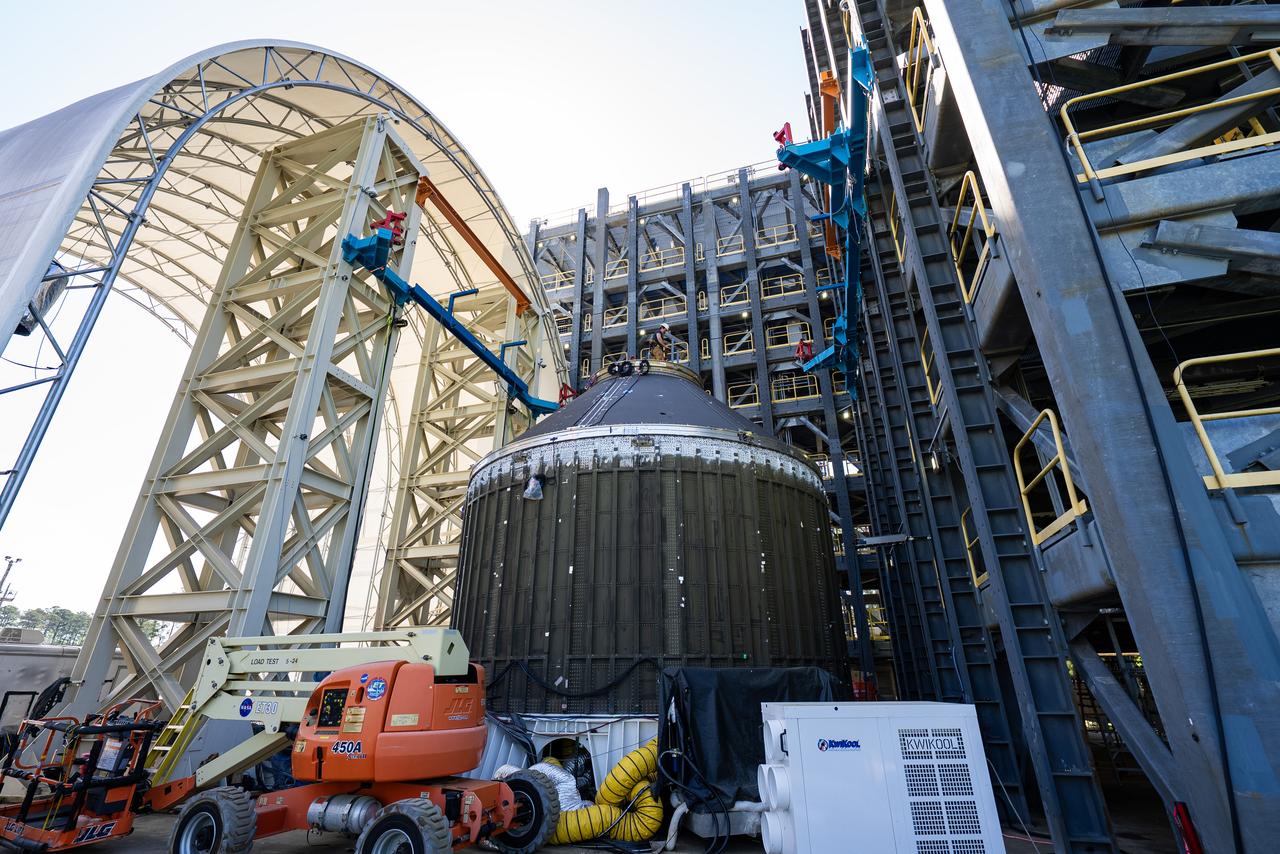
Technicians at NASA’s Marshall Space Flight Center in Huntsville, Alabama, are seen in these images taken April 17, 2025, moving the payload adapter test article from Building 4697 to Building 4705 for storage. This move marks the end of structural testing for the test article. Next, engineers will complete the qualification article and conduct additional for further testing before building the final flight hardware. Manufactured at Marshall, the test article underwent extensive and rigorous testing to validate the design before engineers finalized the configuration for the flight article. The newly completed composite payload adapter is an evolution from the Orion stage adapter to be used in the upgraded Block 1B configuration of the SLS (Space Launch System) rocket, debuting with Artemis IV.
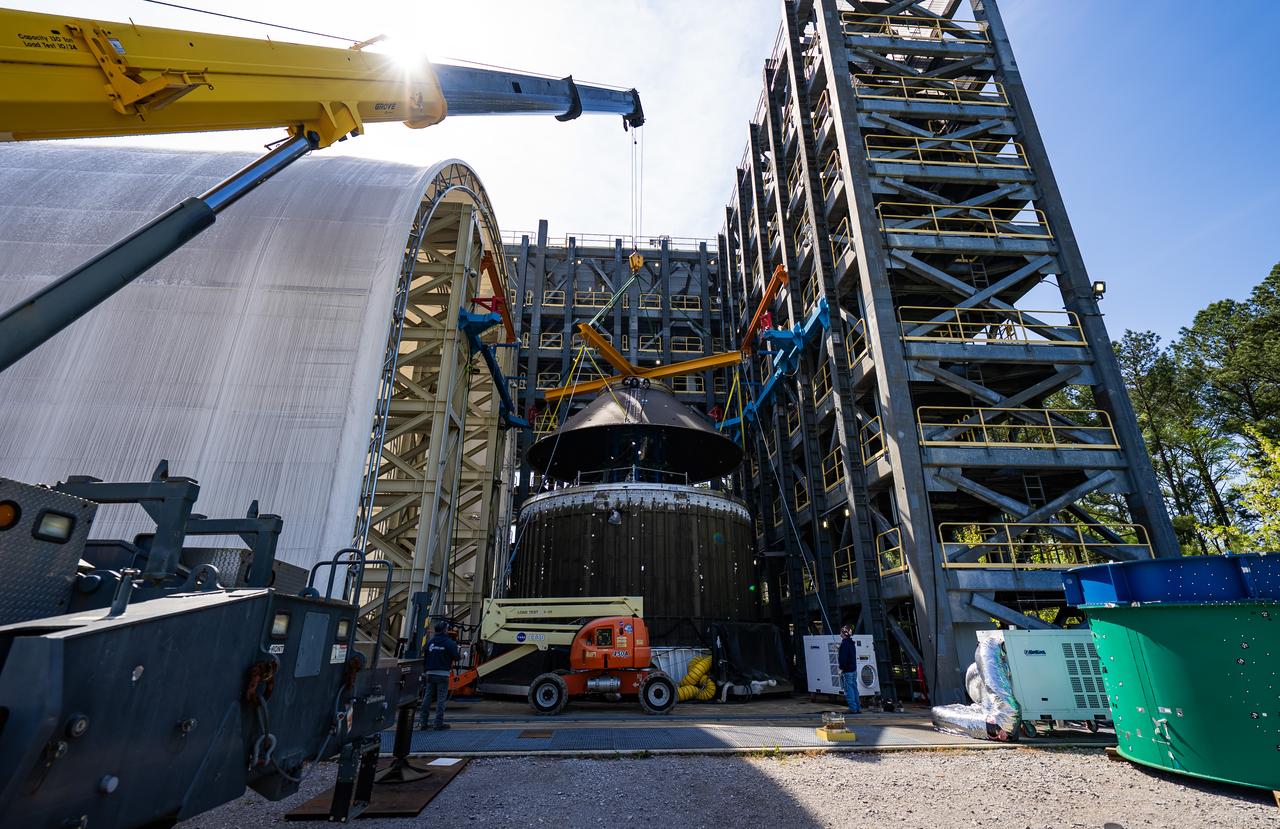
Technicians at NASA’s Marshall Space Flight Center in Huntsville, Alabama, are seen in these images taken April 17, 2025, moving the payload adapter test article from Building 4697 to Building 4705 for storage. This move marks the end of structural testing for the test article. Next, engineers will complete the qualification article and conduct additional for further testing before building the final flight hardware. Manufactured at Marshall, the test article underwent extensive and rigorous testing to validate the design before engineers finalized the configuration for the flight article. The newly completed composite payload adapter is an evolution from the Orion stage adapter to be used in the upgraded Block 1B configuration of the SLS (Space Launch System) rocket, debuting with Artemis IV.
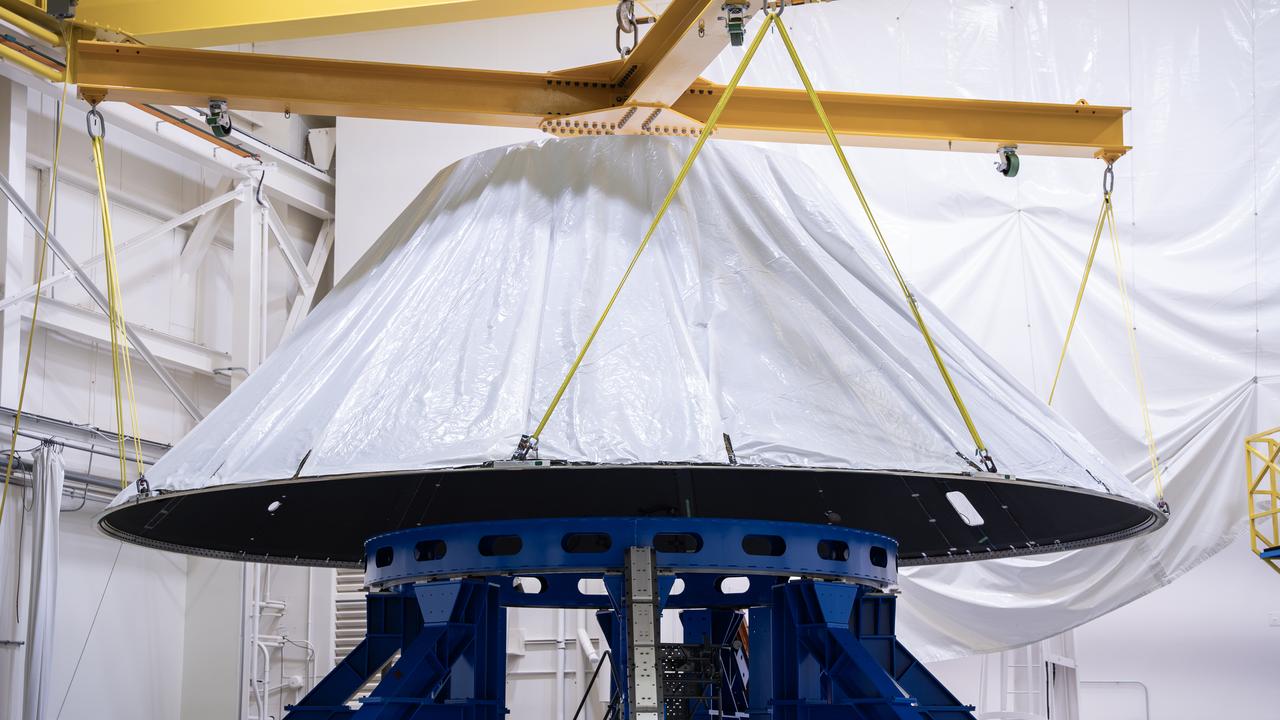
These photos and videos show how NASA manufactured and prepared to transport the payload adapter in February inside Building 4708 at NASA’s Marshall Space Flight Center in Huntsville, Alabama. Prior to moving the hardware for testing, teams installed the New Explorations Secondary Transport component, called the NEST, into the top of the engineering development unit. The NEST component will allow the hardware to hold a series of secondary payloads, or small satellites. The cone-shaped payload adapter is about 8.5 feet tall and features two metal rings and eight composite panels. The adapter, which will debut on NASA’s Artemis IV mission, is an evolution from the Orion stage adapter used in the Block 1 configuration of the rocket for the first three Artemis missions. It will be housed inside the universal stage adapter atop the rocket’s more powerful in-space stage, called the exploration upper stage. The payload adapter, like the launch vehicle stage adapter and the Orion stage adapter, is fully manufactured and tested at Marshall, which manages the SLS Program. NASA is working to land the first woman, first person of color, and its first international partner astronaut on the Moon under Artemis. SLS is part of NASA’s backbone for deep space exploration, along with the Orion spacecraft and Gateway in orbit around the Moon and commercial human landing systems, next-generational spacesuits, and rovers on the lunar surface. SLS is the only rocket that can send Orion, astronauts, and supplies to the Moon in a single launch.
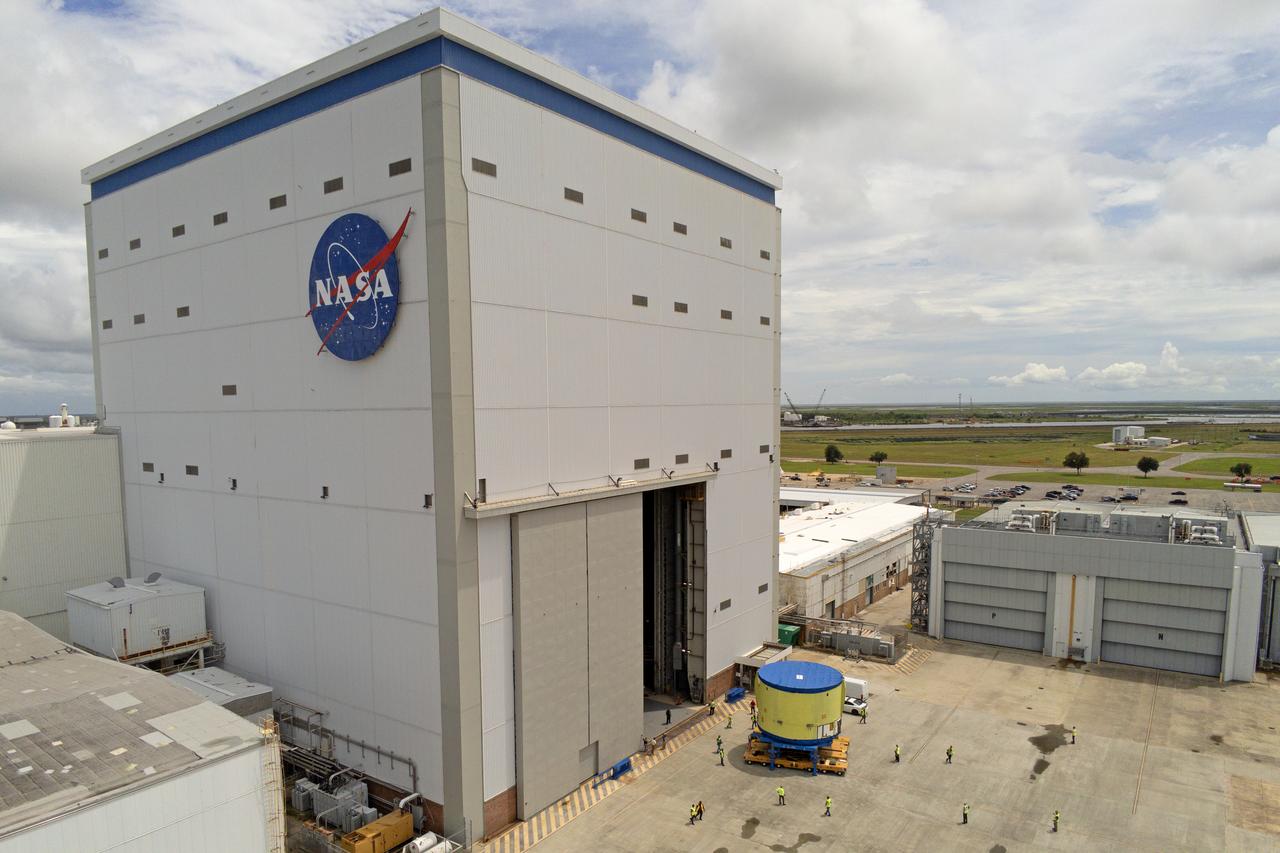
These photos and videos show teams at NASA’s Michoud Assembly Facility in New Orleans preparing, moving, and loading the engine section of a future SLS (Space Launch System) rocket to NASA’s Pegasus barge Aug. 28. The hardware will form the bottom-most section of the SLS core stage that will power NASA’s Artemis IV mission, which will be the first mission to the Gateway space station in lunar orbit under the Artemis campaign. The barge will transport the spaceflight hardware to NASA’s Kennedy Space Center in Florida via the agency’s Pegasus barge. Once in Florida, the engine section will undergo final outfitting inside Kennedy’s Space Station Processing Facility.
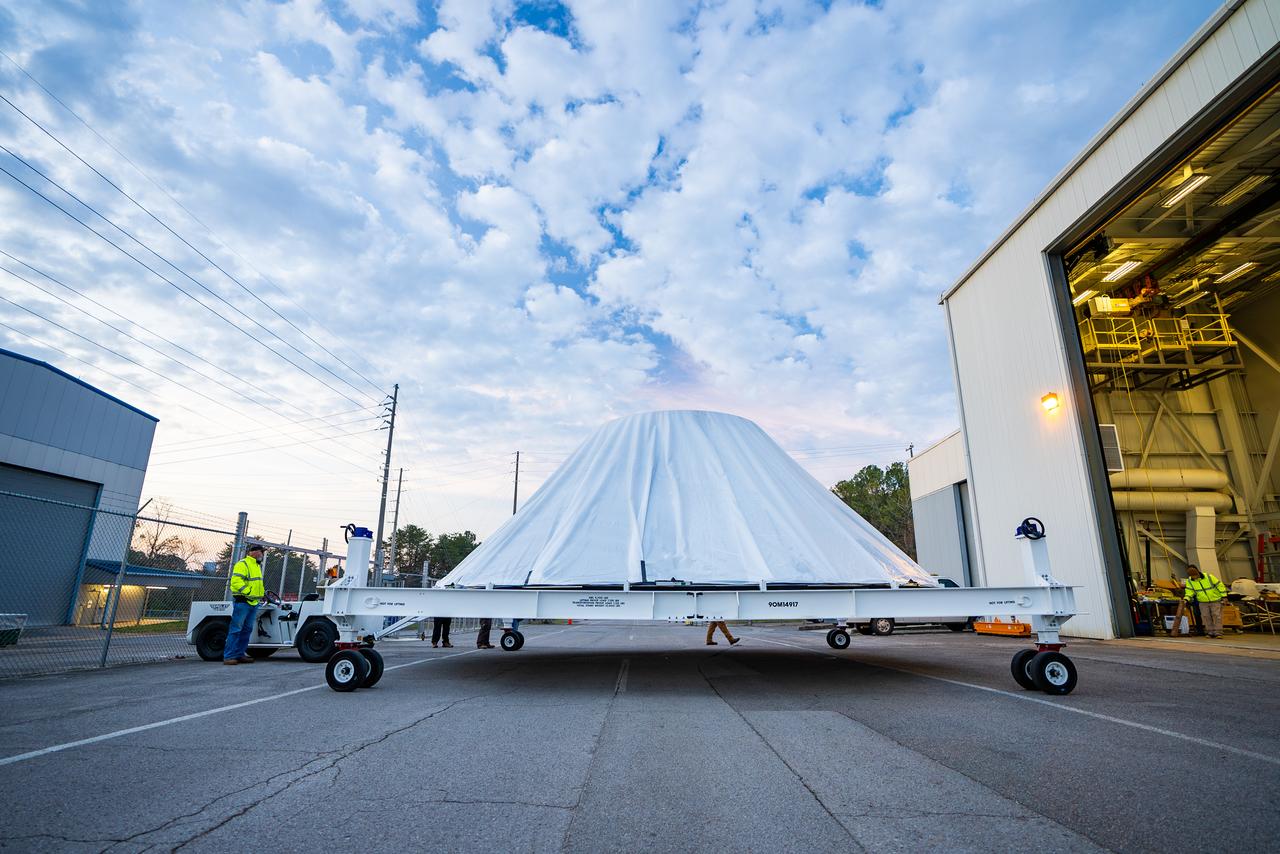
These photos and videos show how crews at NASA’s Marshall Space Flight Center in Huntsville, Alabama, moved and installed the payload adapter that will be used in the Block 1B configuration of the SLS (Space Launch System) rocket from Building 4708, where it was manufactured, into Structural Test Stand 4697 at NASA’s Marshall Space Flight Center on March 13. Teams at Marshall will begin structural testing the engineering development unit of the payload adapter – an exact replica of the flight version of the hardware – this spring. The cone-shaped payload adapter is about 8.5 feet tall and features two metal rings and eight composite panels. The adapter, which will debut on NASA’s Artemis IV mission, is an evolution from the Orion stage adapter used in the Block 1 configuration of the first three Artemis missions. It will be housed inside the universal stage adapter atop the rocket’s more powerful in-space stage, called the exploration upper stage. The payload adapter, like the launch vehicle stage adapter and the Orion stage adapter, is fully manufactured and tested at Marshall, which manages the SLS Program. NASA is working to land the first woman, first person of color, and its first international partner astronaut on the Moon under Artemis. SLS is part of NASA’s backbone for deep space exploration, along with the Orion spacecraft and Gateway in orbit around the Moon and commercial human landing systems, next-generational spacesuits, and rovers on the lunar surface. SLS is the only rocket that can send Orion, astronauts, and supplies to the Moon in a single launch.
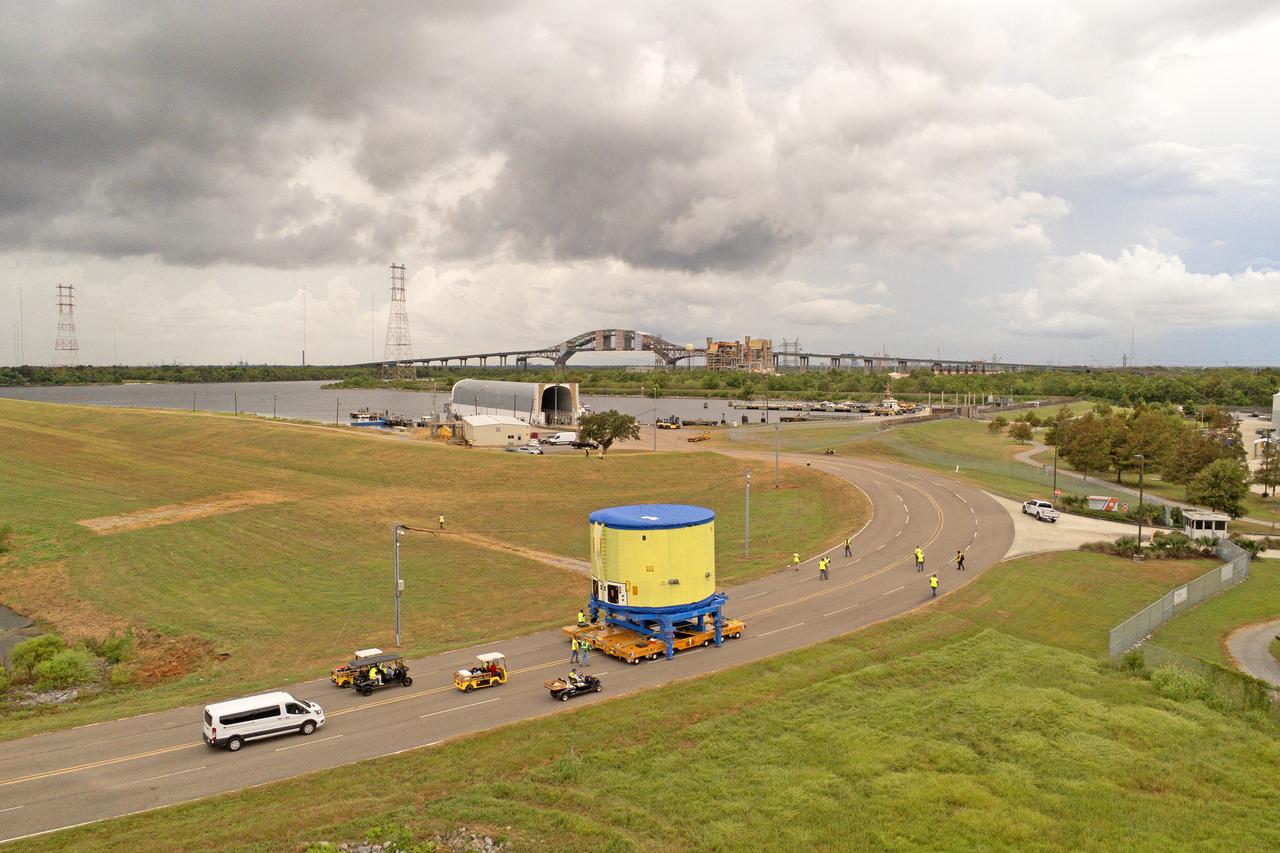
These photos and videos show teams at NASA’s Michoud Assembly Facility in New Orleans preparing, moving, and loading the engine section of a future SLS (Space Launch System) rocket to NASA’s Pegasus barge Aug. 28. The hardware will form the bottom-most section of the SLS core stage that will power NASA’s Artemis IV mission, which will be the first mission to the Gateway space station in lunar orbit under the Artemis campaign. The barge will transport the spaceflight hardware to NASA’s Kennedy Space Center in Florida via the agency’s Pegasus barge. Once in Florida, the engine section will undergo final outfitting inside Kennedy’s Space Station Processing Facility.
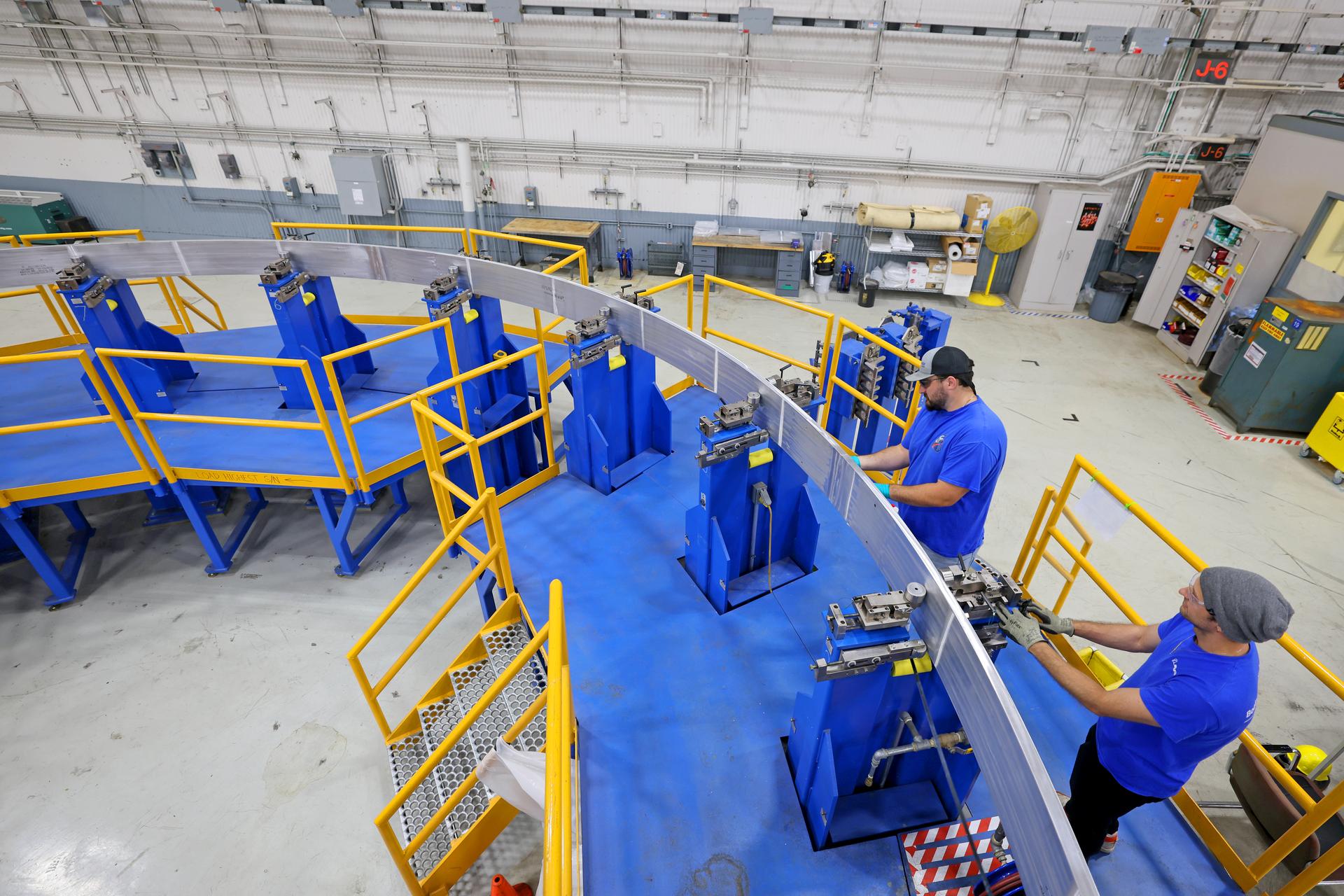
Teams at NASA’s Michoud Assembly Facility in New Orleans continue to make progress manufacturing core stages for the SLS (Space Launch System) rocket. In August, teams with NASA and Boeing, SLS core stage prime contractor, completed the first ring for the sixth SLS core stage. The core stage rings are welded together through a friction-stir welding process. A completed ring is 27.6 feet in diameter and serves as a connection point to join the large core stage structures together. The rings also provide structural stability to the bottoms of the domes. The 212-foot-tall SLS rocket core stage is made up of 10 major barrel sections, four dome sections, and seven rings. The components come together to form the five major sections of the core stage – the engine section, liquid hydrogen tank, intertank, liquid oxygen tank, and forward skirt.
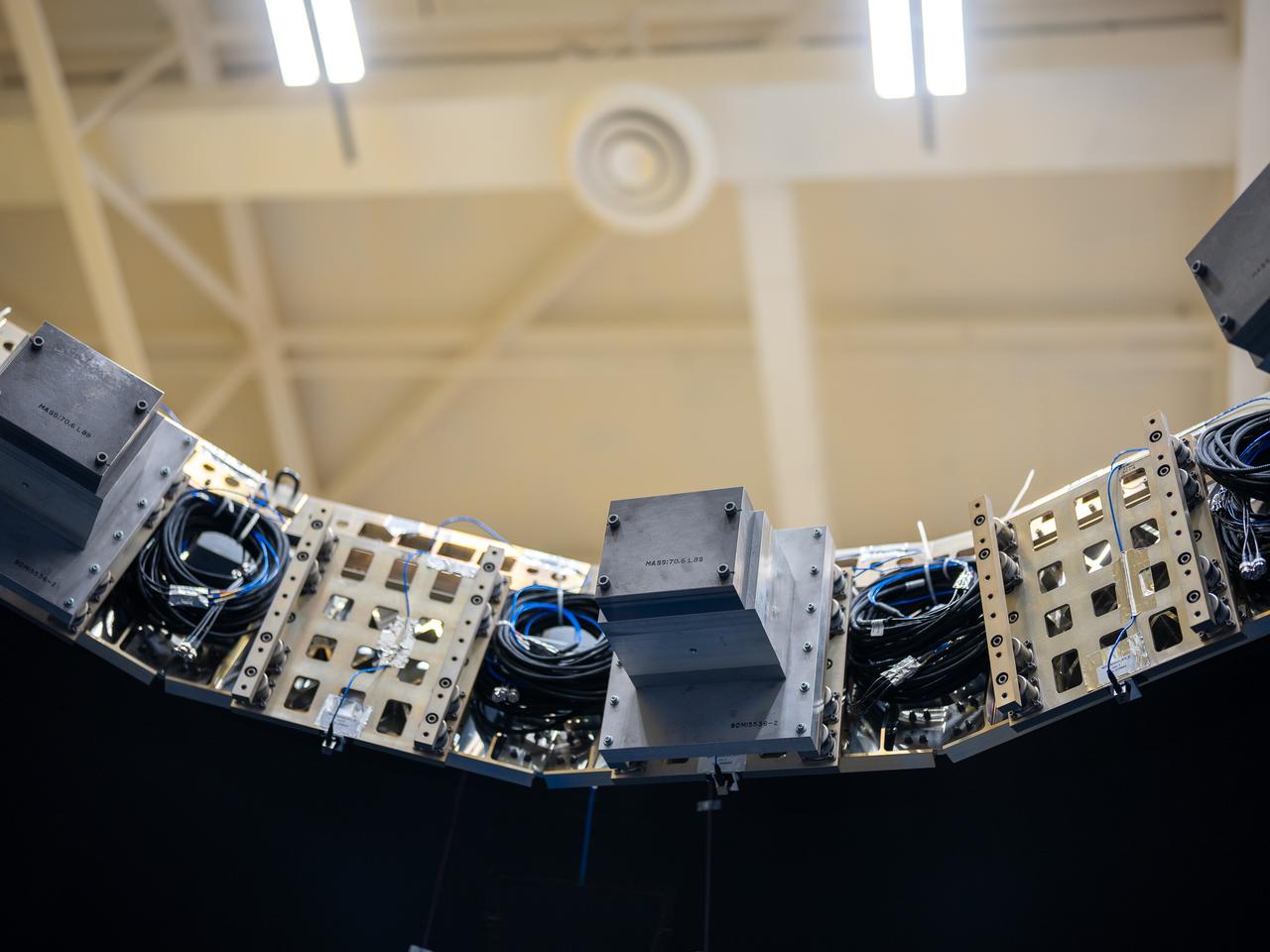
These photos and videos show how NASA manufactured and prepared to transport the payload adapter in February inside Building 4708 at NASA’s Marshall Space Flight Center in Huntsville, Alabama. Prior to moving the hardware for testing, teams installed the New Explorations Secondary Transport component, called the NEST, into the top of the engineering development unit. The NEST component will allow the hardware to hold a series of secondary payloads, or small satellites. The cone-shaped payload adapter is about 8.5 feet tall and features two metal rings and eight composite panels. The adapter, which will debut on NASA’s Artemis IV mission, is an evolution from the Orion stage adapter used in the Block 1 configuration of the rocket for the first three Artemis missions. It will be housed inside the universal stage adapter atop the rocket’s more powerful in-space stage, called the exploration upper stage. The payload adapter, like the launch vehicle stage adapter and the Orion stage adapter, is fully manufactured and tested at Marshall, which manages the SLS Program. NASA is working to land the first woman, first person of color, and its first international partner astronaut on the Moon under Artemis. SLS is part of NASA’s backbone for deep space exploration, along with the Orion spacecraft and Gateway in orbit around the Moon and commercial human landing systems, next-generational spacesuits, and rovers on the lunar surface. SLS is the only rocket that can send Orion, astronauts, and supplies to the Moon in a single launch.
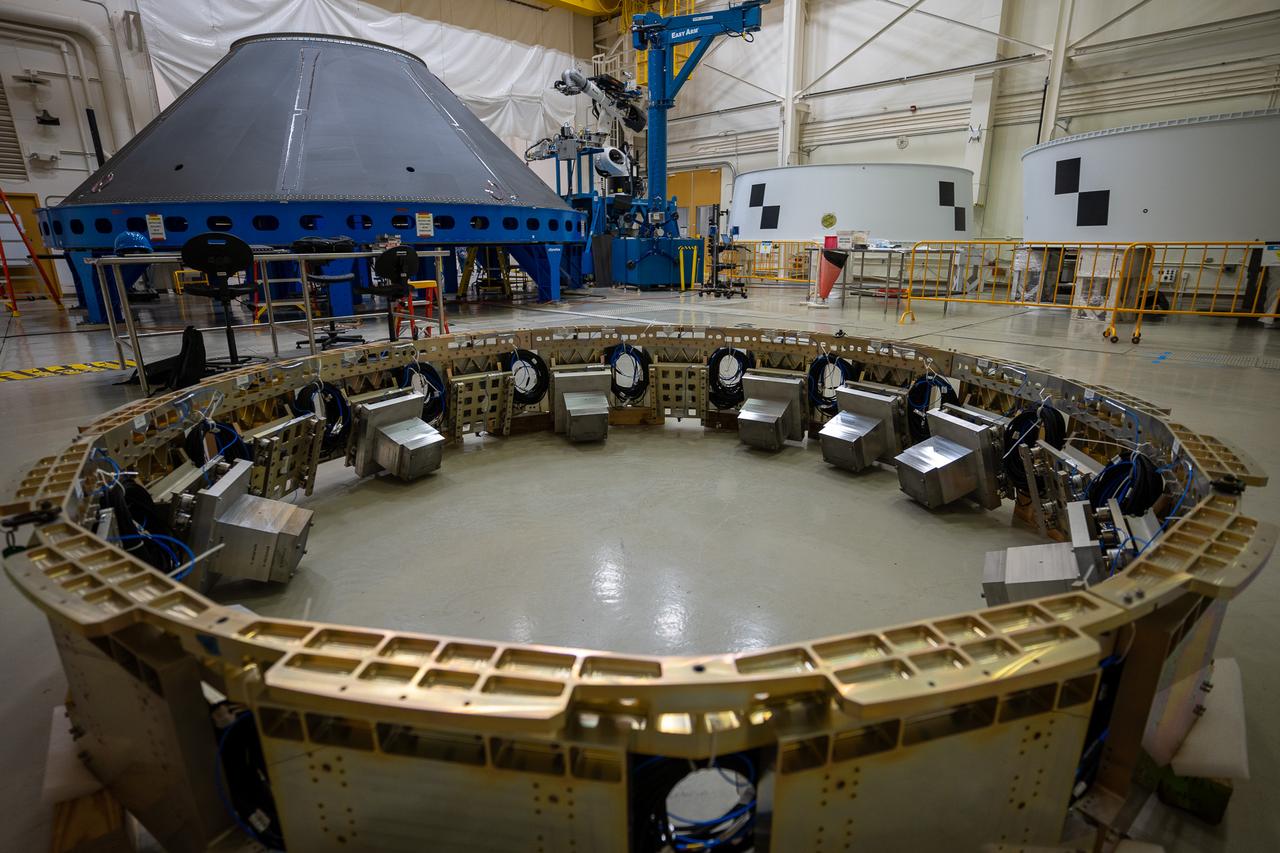
These photos and videos show how NASA manufactured and prepared to transport the payload adapter in February inside Building 4708 at NASA’s Marshall Space Flight Center in Huntsville, Alabama. Prior to moving the hardware for testing, teams installed the New Explorations Secondary Transport component, called the NEST, into the top of the engineering development unit. The NEST component will allow the hardware to hold a series of secondary payloads, or small satellites. The cone-shaped payload adapter is about 8.5 feet tall and features two metal rings and eight composite panels. The adapter, which will debut on NASA’s Artemis IV mission, is an evolution from the Orion stage adapter used in the Block 1 configuration of the rocket for the first three Artemis missions. It will be housed inside the universal stage adapter atop the rocket’s more powerful in-space stage, called the exploration upper stage. The payload adapter, like the launch vehicle stage adapter and the Orion stage adapter, is fully manufactured and tested at Marshall, which manages the SLS Program. NASA is working to land the first woman, first person of color, and its first international partner astronaut on the Moon under Artemis. SLS is part of NASA’s backbone for deep space exploration, along with the Orion spacecraft and Gateway in orbit around the Moon and commercial human landing systems, next-generational spacesuits, and rovers on the lunar surface. SLS is the only rocket that can send Orion, astronauts, and supplies to the Moon in a single launch.
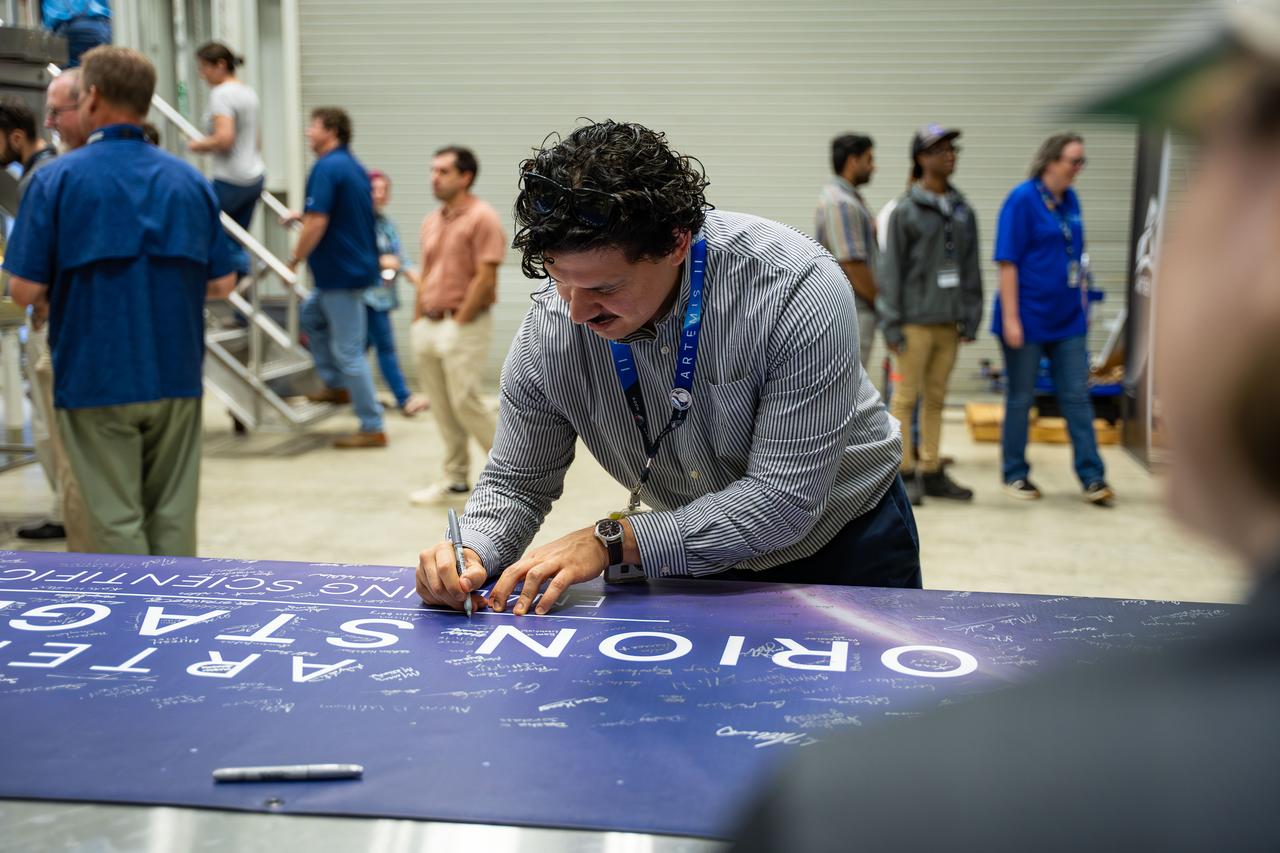
These images show NASA employees attending an event August 14, 2025, at Marshall Space Flight Center in Huntsville, Alabama, to view the Orion stage adapter for Artemis II before it is transported to NASA’s Kennedy Space Center in Florida. Manufactured entirely at NASA Marshall, the adapter plays a crucial role in connecting the SLS (Space Launch System) rocket’s interim cryogenic propulsion stage to the Orion spacecraft. This adapter is the final piece of SLS hardware to be delivered to Kennedy Space Center in preparation for the Artemis II mission.
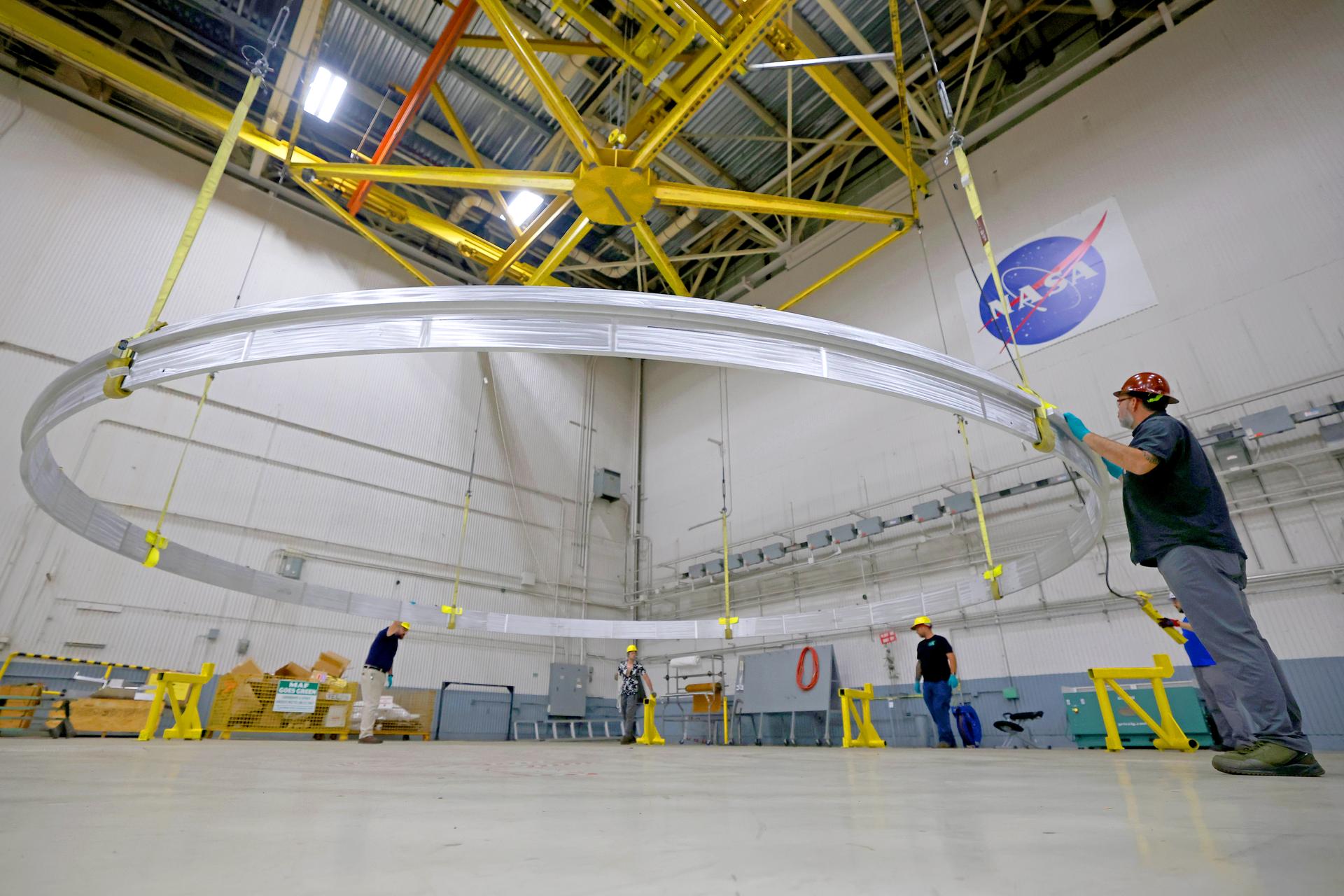
Teams at NASA’s Michoud Assembly Facility in New Orleans continue to make progress manufacturing core stages for the SLS (Space Launch System) rocket. In August, teams with NASA and Boeing, SLS core stage prime contractor, completed the first ring for the sixth SLS core stage. The core stage rings are welded together through a friction-stir welding process. A completed ring is 27.6 feet in diameter and serves as a connection point to join the large core stage structures together. The rings also provide structural stability to the bottoms of the domes. The 212-foot-tall SLS rocket core stage is made up of 10 major barrel sections, four dome sections, and seven rings. The components come together to form the five major sections of the core stage – the engine section, liquid hydrogen tank, intertank, liquid oxygen tank, and forward skirt.
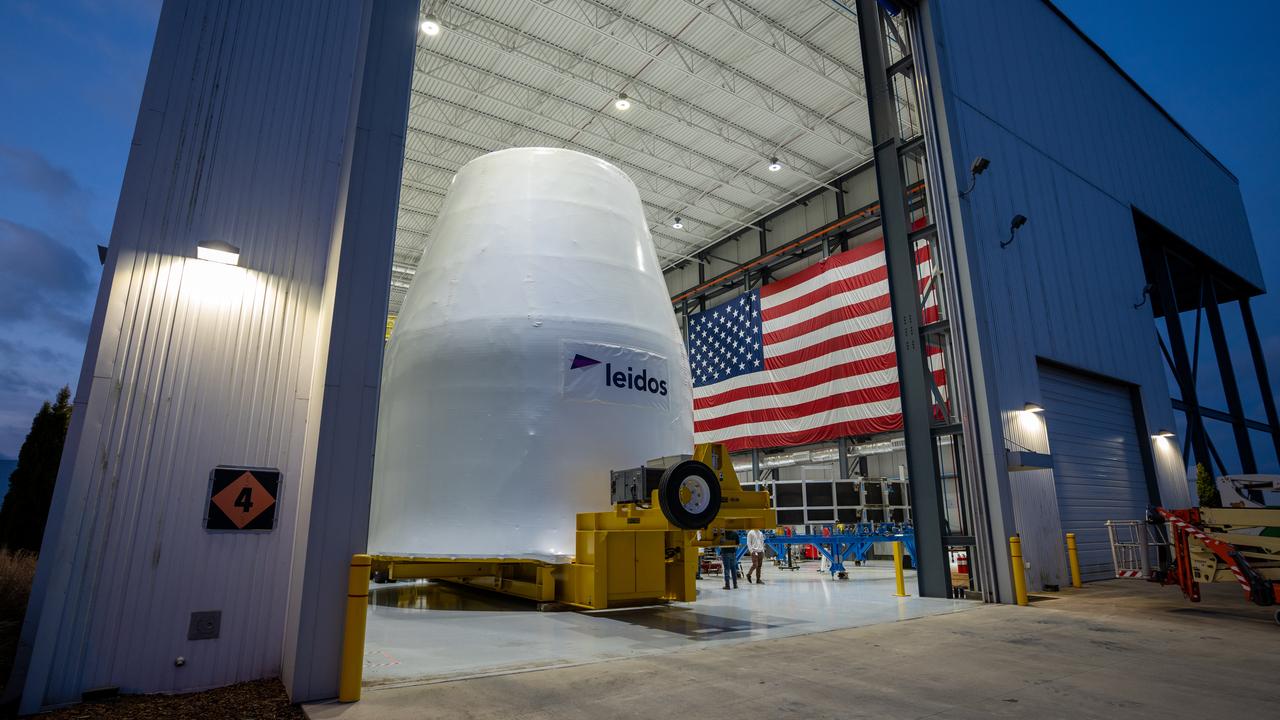
These photos and videos show how crews guided a test version of the universal stage adapter for NASA’s more powerful version of its SLS (Space Launch System) rocket to Building 4619 at the agency’s Marshall Space Flight Center in Huntsville, Alabama, Feb. 22. Built by Leidos, the lead contractor for the universal stage adapter, crews transported the hardware from a Leidos facility in Decatur, Alabama, the same day. The universal stage adapter will connect the SLS rocket’s upgraded in-space propulsion stage, called the exploration upper stage, to NASA’s Orion spacecraft as part of the evolved Block 1B configuration of the SLS rocket. It will also serve as a compartment capable of accommodating large payloads, such as modules or other exploration spacecraft. In Building 4619’s Load Test Annex High Bay at Marshall, the development test article will first undergo modal testing that will shake the hardware to validate dynamic models. Later, during ultimate load testing, force will be applied vertically and to the sides of the hardware. Unlike the flight hardware, the development test article has flaws intentionally included in its design, which will help engineers verity that the flight adapter can withstand the extreme forces it will face during launch and flight.

The Space Launch System (SLS) rocket and Orion Spacecraft roll out of the Vehicle Assembly Building (VAB) to Launch Pad 39B at NASA's Kennedy Space Center in Florida for the first time on March 17, 2022.
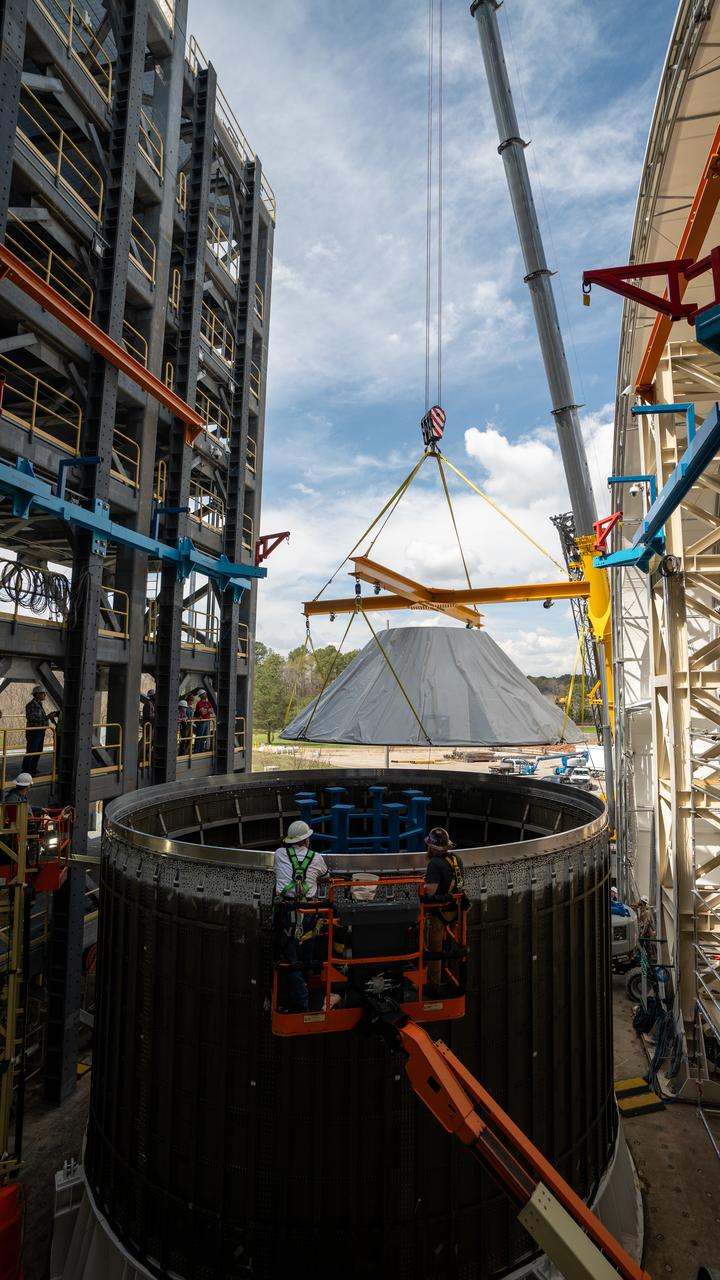
These photos and videos show how crews at NASA’s Marshall Space Flight Center in Huntsville, Alabama, moved and installed the payload adapter that will be used in the Block 1B configuration of the SLS (Space Launch System) rocket from Building 4708, where it was manufactured, into Structural Test Stand 4697 at NASA’s Marshall Space Flight Center on March 13. Teams at Marshall will begin structural testing the engineering development unit of the payload adapter – an exact replica of the flight version of the hardware – this spring. The cone-shaped payload adapter is about 8.5 feet tall and features two metal rings and eight composite panels. The adapter, which will debut on NASA’s Artemis IV mission, is an evolution from the Orion stage adapter used in the Block 1 configuration of the first three Artemis missions. It will be housed inside the universal stage adapter atop the rocket’s more powerful in-space stage, called the exploration upper stage. The payload adapter, like the launch vehicle stage adapter and the Orion stage adapter, is fully manufactured and tested at Marshall, which manages the SLS Program. NASA is working to land the first woman, first person of color, and its first international partner astronaut on the Moon under Artemis. SLS is part of NASA’s backbone for deep space exploration, along with the Orion spacecraft and Gateway in orbit around the Moon and commercial human landing systems, next-generational spacesuits, and rovers on the lunar surface. SLS is the only rocket that can send Orion, astronauts, and supplies to the Moon in a single launch.
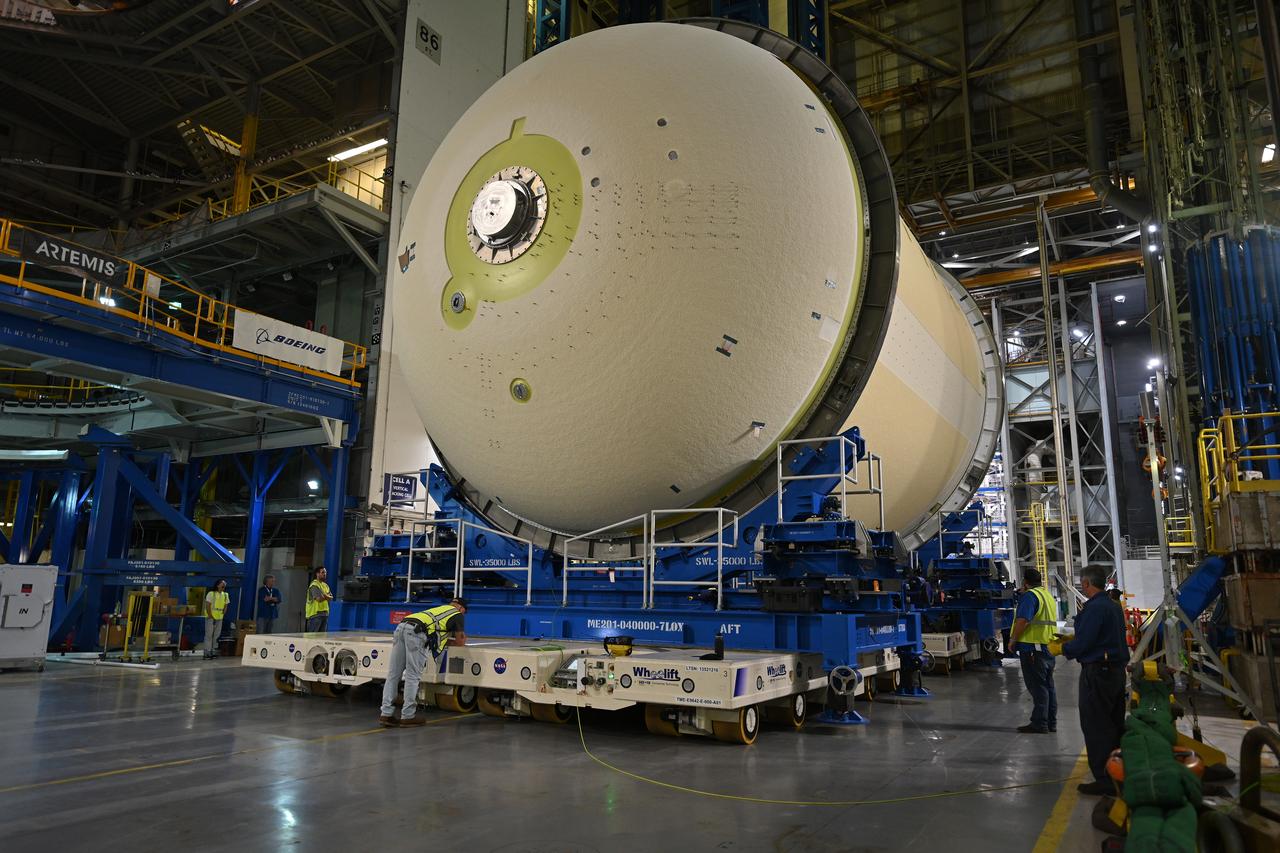
Teams move a liquid oxygen tank – designated for the core stage of NASA’s SLS (Space Launch System) rocket for its Artemis III mission – from the thermal protection system application cell at NASA’s Michoud Assembly Facility in New Orleans to the site’s 210-foot-tall Vertical Assembly Building on July 9. Next, NASA’s SLS prime contractor, Boeing, will vertically install the tank’s aft sump subassembly. The propellant tank is one of five major elements that make up the 212-foot-tall rocket stage. The core stage, along with its four RS-25 engines, produce more than two million pounds of thrust to help launch NASA’s Orion spacecraft, astronauts, and supplies beyond Earth’s orbit and to the lunar surface for Artemis.
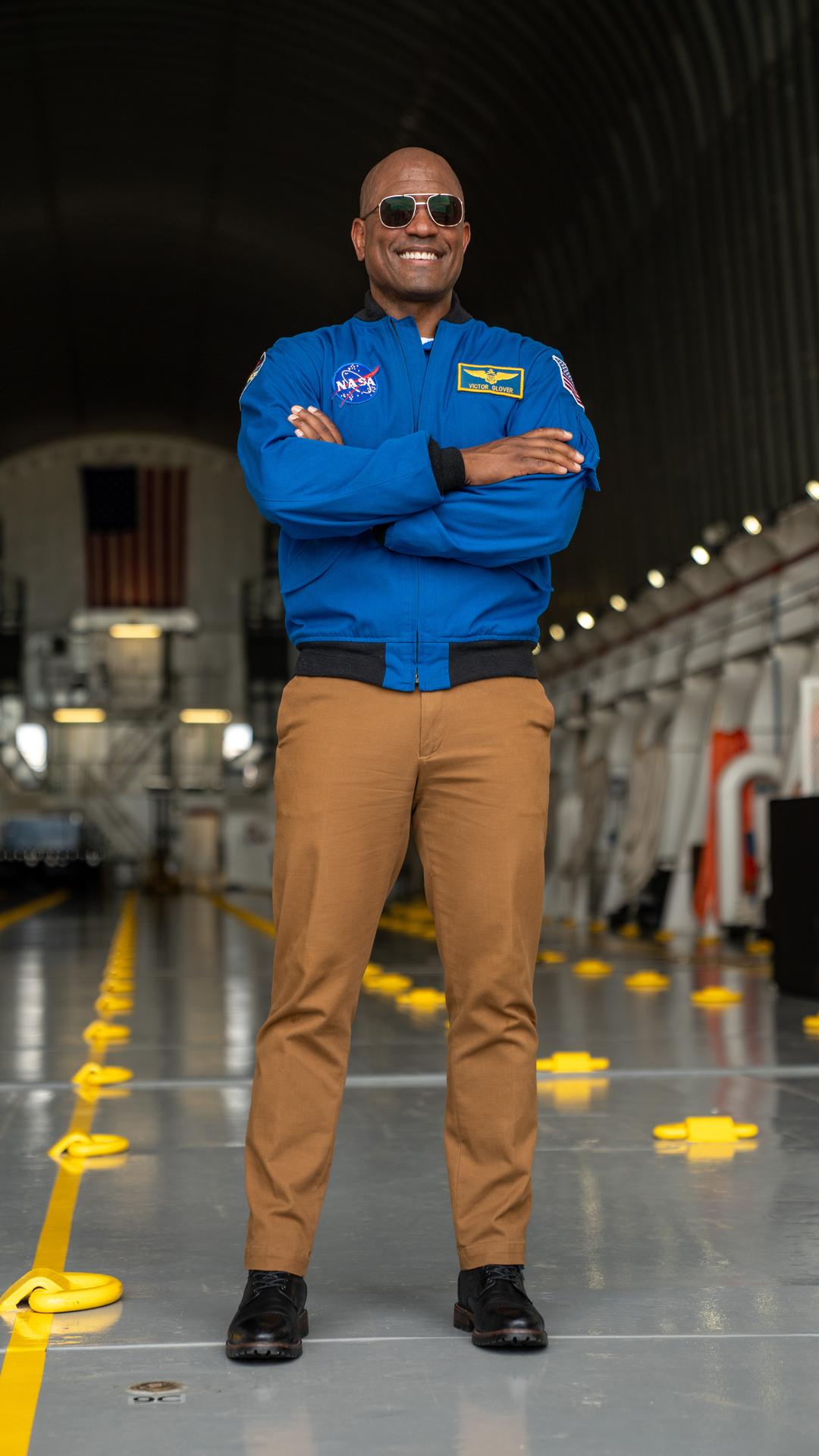
NASA astronaut Victor Glover views the core stage of the SLS (Space Launch System) rocket that will help power Artemis II at NASA’s Michoud Assembly Facility in New Orleans July 15. Glover will pilot Artemis II, the first crewed mission of NASA’s Artemis campaign. Crews moved the 212-foot-tall core stage with its four RS-25 engines to Building 110 at NASA Michoud prior to rolling it out to NASA’s Pegasus barge July 16 for delivery to NASA’s Kennedy Space Center in Florida. The core stage has two giant propellant tanks that collectively hold more than 733,000 gallons of super cold liquid propellant to feed the stage’s four RS-25 engines. Together, the engines produce more than 2 million pounds of thrust to help send astronauts inside NASA’s Orion spacecraft to venture around the Moon for Artemis II. NASA is working to land the first woman, first person of color, and its first international partner astronaut on the Moon under Artemis. SLS is part of NASA’s backbone for deep space exploration, along with the Orion spacecraft, supporting ground systems, advanced spacesuits and rovers, the Gateway in orbit around the Moon, and commercial human landing systems. SLS is the only rocket that can send Orion, astronauts, and supplies to the Moon in a single launch.
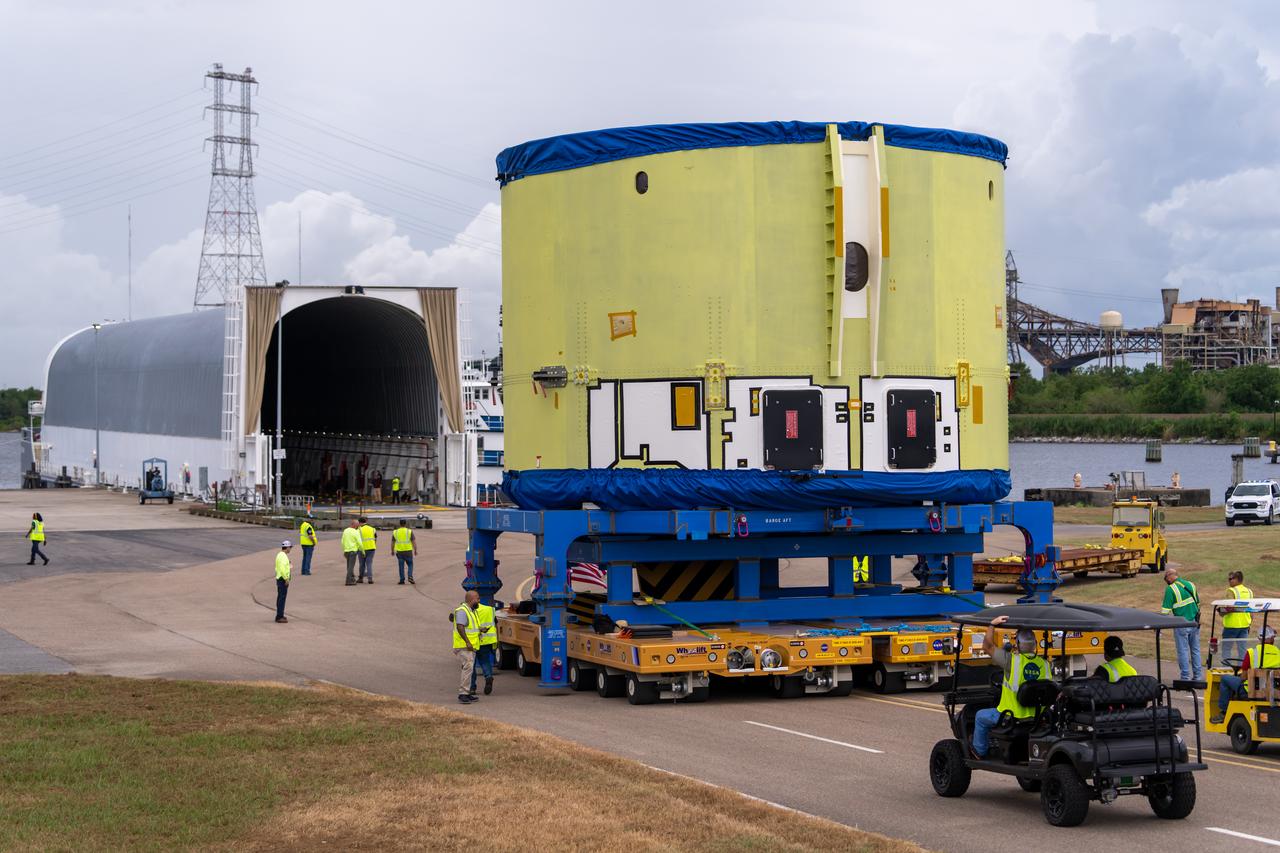
These photos and videos show teams at NASA’s Michoud Assembly Facility in New Orleans preparing, moving, and loading the engine section of a future SLS (Space Launch System) rocket to NASA’s Pegasus barge Aug. 28. The hardware will form the bottom-most section of the SLS core stage that will power NASA’s Artemis IV mission, which will be the first mission to the Gateway space station in lunar orbit under the Artemis campaign. The barge will transport the spaceflight hardware to NASA’s Kennedy Space Center in Florida via the agency’s Pegasus barge. Once in Florida, the engine section will undergo final outfitting inside Kennedy’s Space Station Processing Facility.