
S65-05399 (1965) --- Composite drawing showing the vertical, lateral, forward and aft maneuvering control of the Gemini spacecraft.

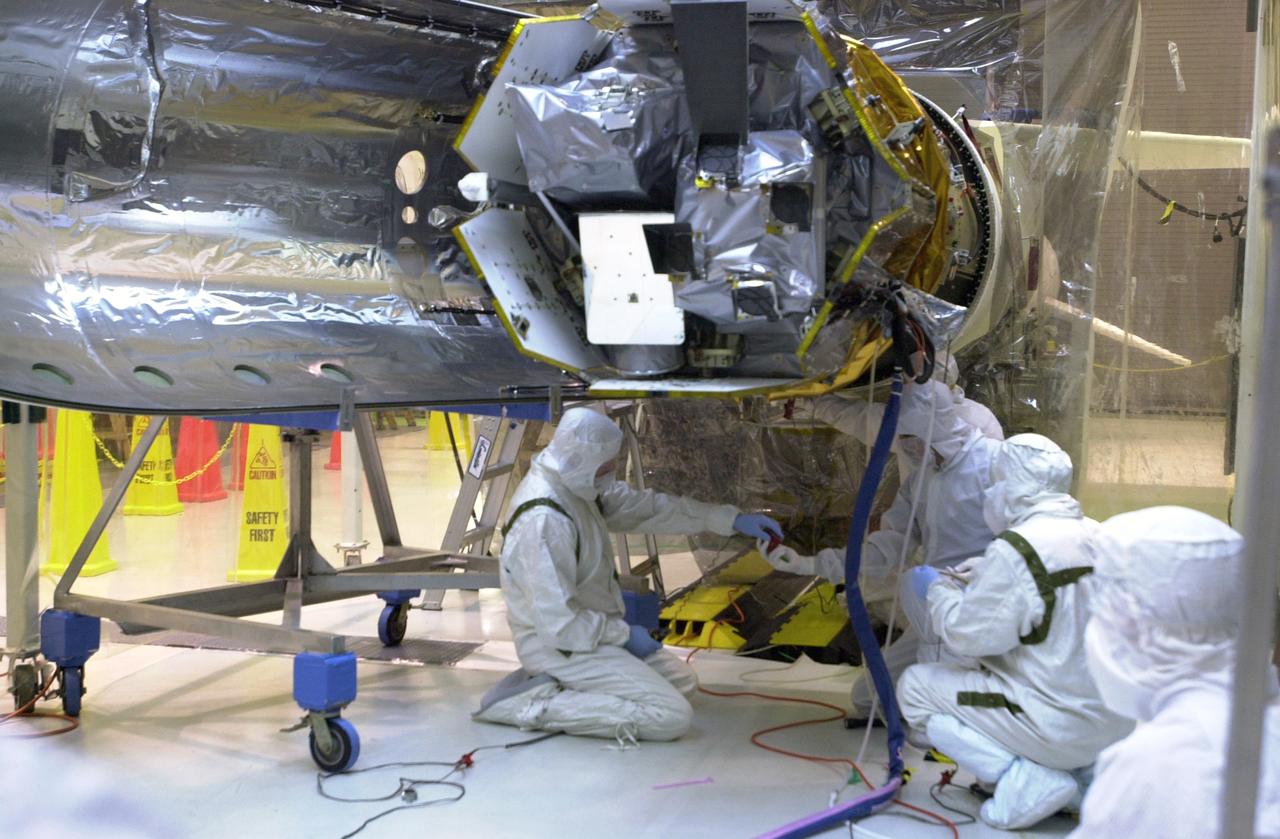
In clean room C of Astrotech's Payload Processing Facility, a worker wearing a "bunny suit," or clean-room attire, begins removing the protective cover surrounding the Dawn spacecraft. In the clean room, the spacecraft will undergo further processing. Dawn's mission is to explore two of the asteroid belt's most intriguing and dissimilar occupants: asteroid Vesta and the dwarf planet Ceres. The Dawn mission is managed by JPL, a division of the California Institute of Technology in Pasadena, for NASA's Science Mission Directorate in Washington, D.C.

In clean room C of Astrotech's Payload Processing Facility, a worker wearing a "bunny suit," or clean-room attire, looks over the Dawn spacecraft after removing the protective cover, at bottom right. In the clean room, the spacecraft will undergo further processing. Dawn's mission is to explore two of the asteroid belt's most intriguing and dissimilar occupants: asteroid Vesta and the dwarf planet Ceres. The Dawn mission is managed by JPL, a division of the California Institute of Technology in Pasadena, for NASA's Science Mission Directorate in Washington, D.C.

The Dawn spacecraft is seen here in clean room C of Astrotech's Payload Processing Facility. In the clean room, the spacecraft will undergo further processing. Dawn's mission is to explore two of the asteroid belt's most intriguing and dissimilar occupants: asteroid Vesta and the dwarf planet Ceres. The Dawn mission is managed by JPL, a division of the California Institute of Technology in Pasadena, for NASA's Science Mission Directorate in Washington, D.C.

In Astrotech's Payload Processing Facility, technicians help secure the Dawn spacecraft onto a moveable stand. Dawn will be moved into clean room C for unbagging and further processing. Dawn's mission is to explore two of the asteroid belt's most intriguing and dissimilar occupants: asteroid Vesta and the dwarf planet Ceres. The Dawn mission is managed by JPL, a division of the California Institute of Technology in Pasadena, for NASA's Science Mission Directorate in Washington, D.C.

In clean room C of Astrotech's Payload Processing Facility, a worker wears a "bunny suit," or clean-room attire, next to the Dawn spacecraft, which will be unbagged and undergo further processing. Dawn's mission is to explore two of the asteroid belt's most intriguing and dissimilar occupants: asteroid Vesta and the dwarf planet Ceres. The Dawn mission is managed by JPL, a division of the California Institute of Technology in Pasadena, for NASA's Science Mission Directorate in Washington, D.C.

In clean room C of Astrotech's Payload Processing Facility, technicians dressed in "bunny suits," or clean-room attire, begin working on the Dawn spacecraft. Dawn's mission is to explore two of the asteroid belt's most intriguing and dissimilar occupants: asteroid Vesta and the dwarf planet Ceres. The Dawn mission is managed by JPL, a division of the California Institute of Technology in Pasadena, for NASA's Science Mission Directorate in Washington, D.C.

In Astrotech's Payload Processing Facility, an overhead crane lifts the Dawn spacecraft from its transporter. Dawn will be moved into clean room C for unbagging and further processing. Dawn's mission is to explore two of the asteroid belt's most intriguing and dissimilar occupants: asteroid Vesta and the dwarf planet Ceres. The Dawn mission is managed by JPL, a division of the California Institute of Technology in Pasadena, for NASA's Science Mission Directorate in Washington, D.C

ISS040-E-007423 (4 June 2014) --- A close-up view of a Soyuz spacecraft docked to the International Space Station is featured in this image photographed by an Expedition 40 crew member on the station.

S73-02395 (August 1973) --- An artist?s concept illustrating an Apollo-type spacecraft (on left) about to dock with a Soviet Soyuz-type spacecraft. A recent agreement between the United States and the Union of Soviet Socialist Republics provides for the docking in space of the Soyuz and Apollo-type spacecraft in Earth orbit in 1975. The joint venture is called the Apollo-Soyuz Test Project.

S68-26989 (4 April 1968) --- The Apollo 6 Spacecraft 020 Command Module is hoisted aboard the USS Okinawa.
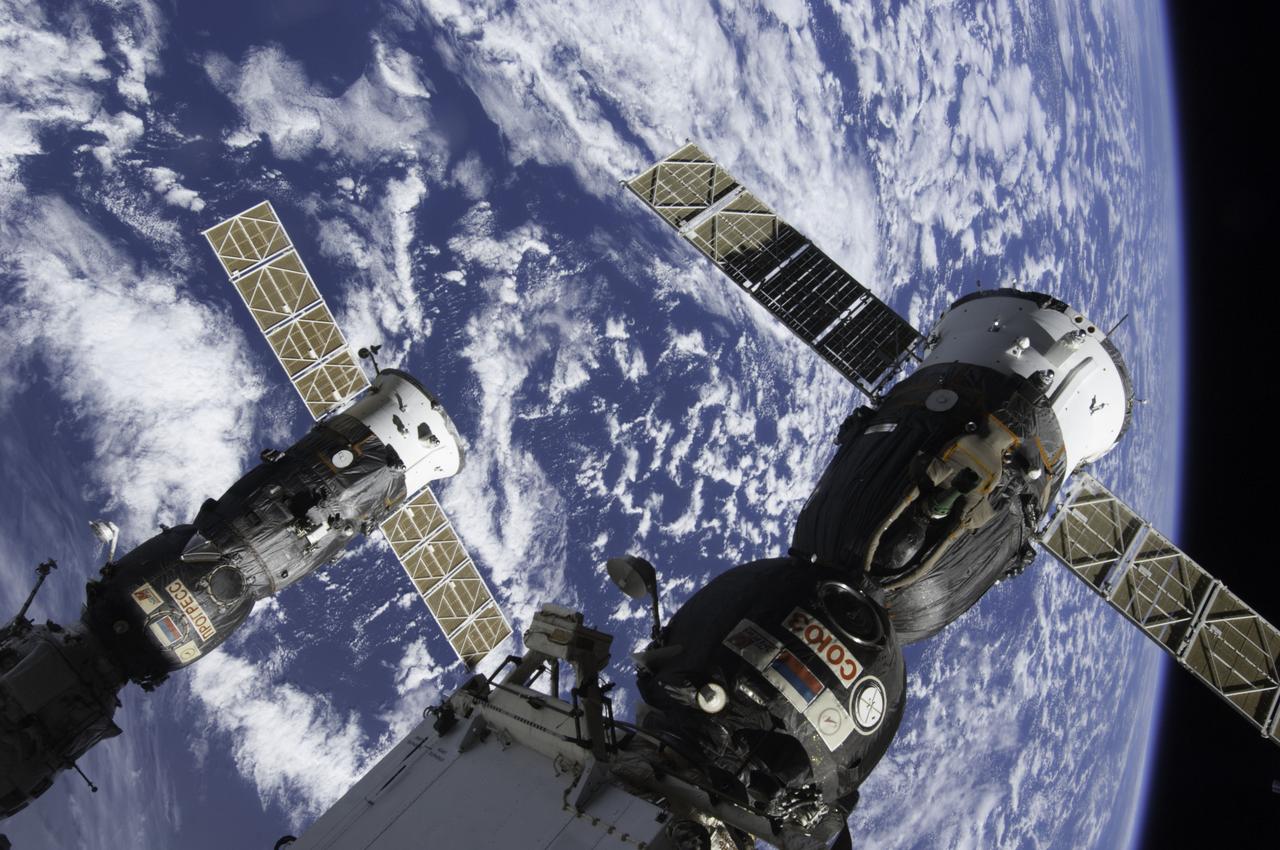
View of Soyuz Spacecraft and Progress Spacecrafts. Photo was taken during Expedition 34.
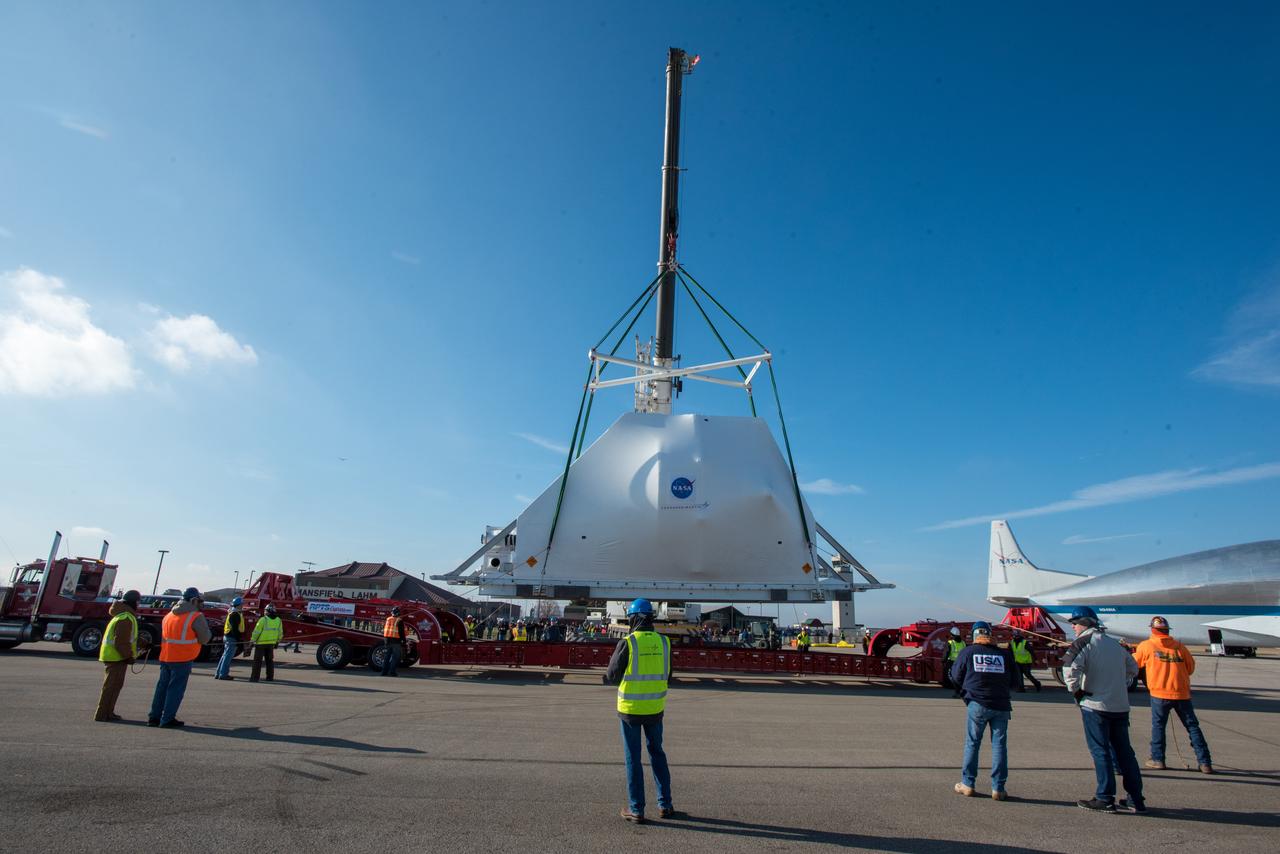
Orion Spacecraft Arrives in Ohio Aboard the Super Guppy at Mansfield Lahm Airport
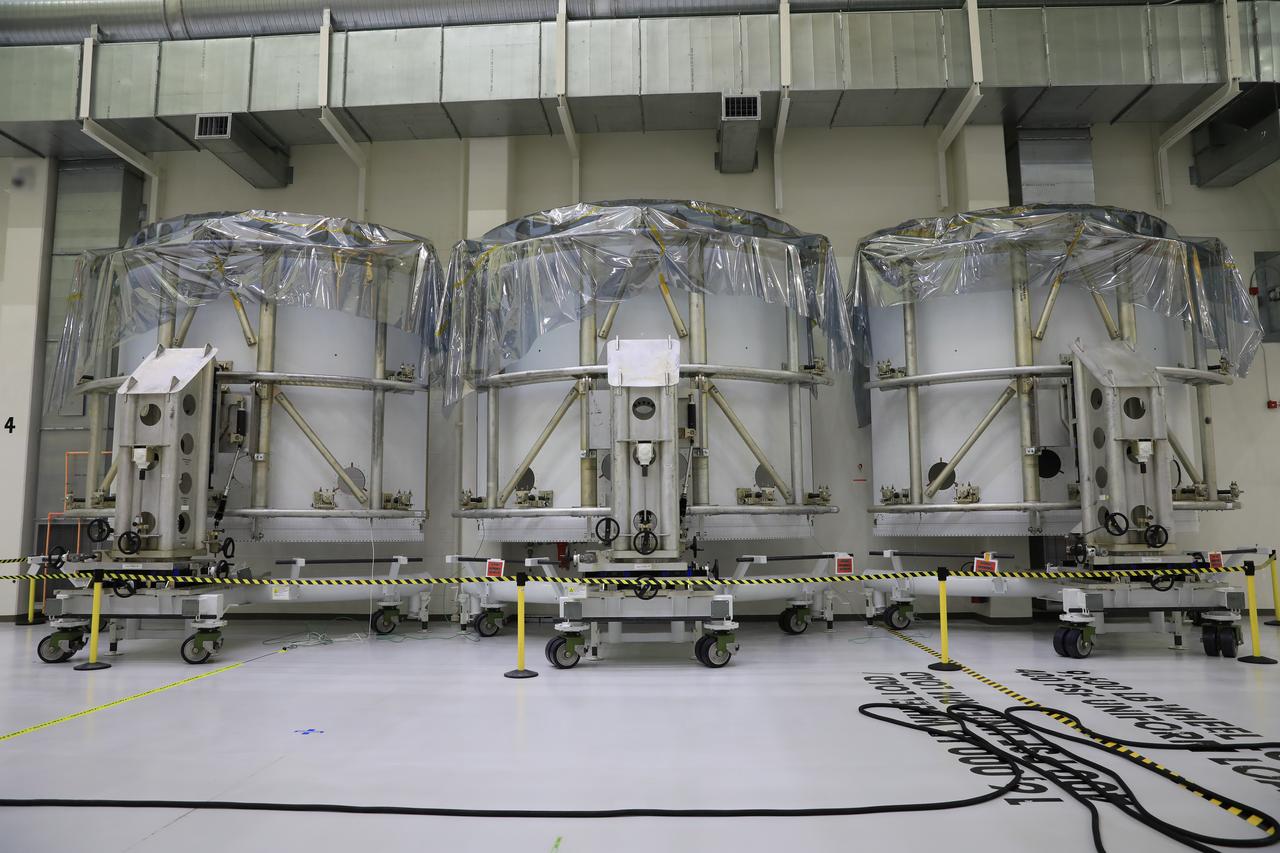
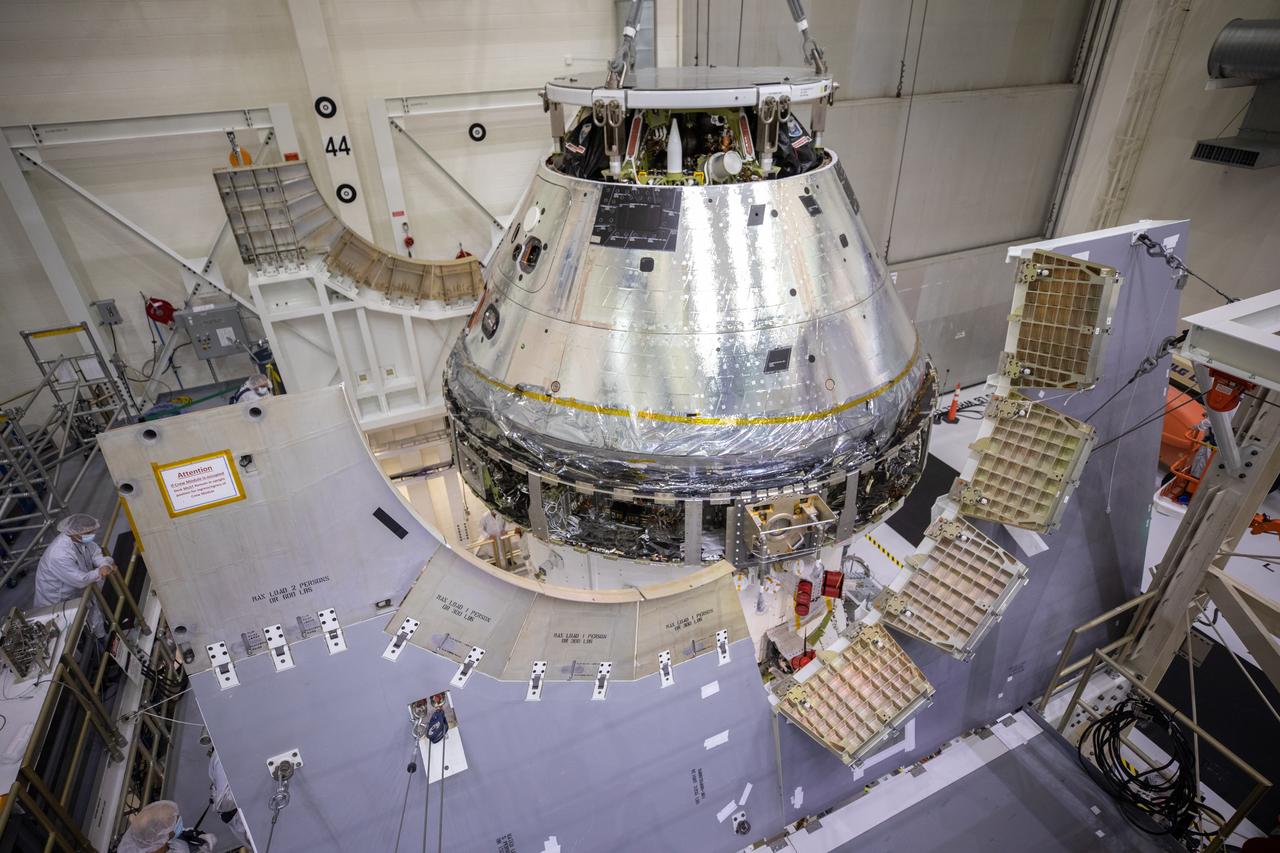
Pictured inside the Neil Armstrong Operations and Checkout Building high bay at NASA’s Kennedy Space Center in Florida on Aug. 6, 2020, are the three Spacecraft Adapter Jettison fairing panels that will protect Orion's service module from the environment around it, whether it's heat, wind or acoustics during the ascent. Unlike conventional rocket fairings, Orion's are designed to support half of the weight of the crew module and launch abort system during launch and ascent, which will maximize the size and capability of the spacecraft that can be delivered to orbit. Orion will fly on the agency’s Artemis I mission – the first in a series of increasingly complex missions to the Moon that will ultimately lead to the exploration of Mars.
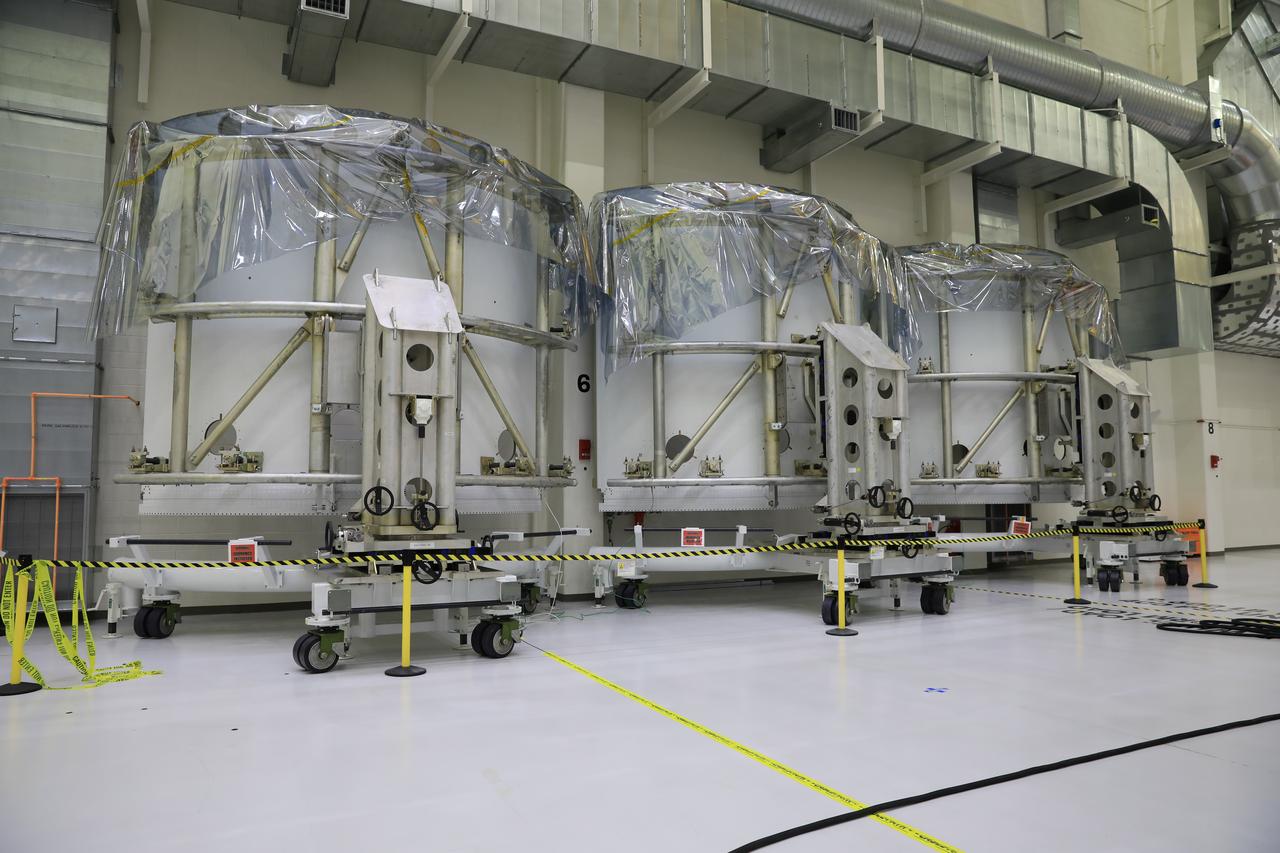
Pictured inside the Neil Armstrong Operations and Checkout Building high bay at NASA’s Kennedy Space Center in Florida on Aug. 6, 2020, are the three Spacecraft Adapter Jettison fairing panels that will protect Orion's service module from the environment around it, whether it's heat, wind or acoustics during the ascent. Unlike conventional rocket fairings, Orion's are designed to support half of the weight of the crew module and launch abort system during launch and ascent, which will maximize the size and capability of the spacecraft that can be delivered to orbit. Orion will fly on the agency’s Artemis I mission – the first in a series of increasingly complex missions to the Moon that will ultimately lead to the exploration of Mars.
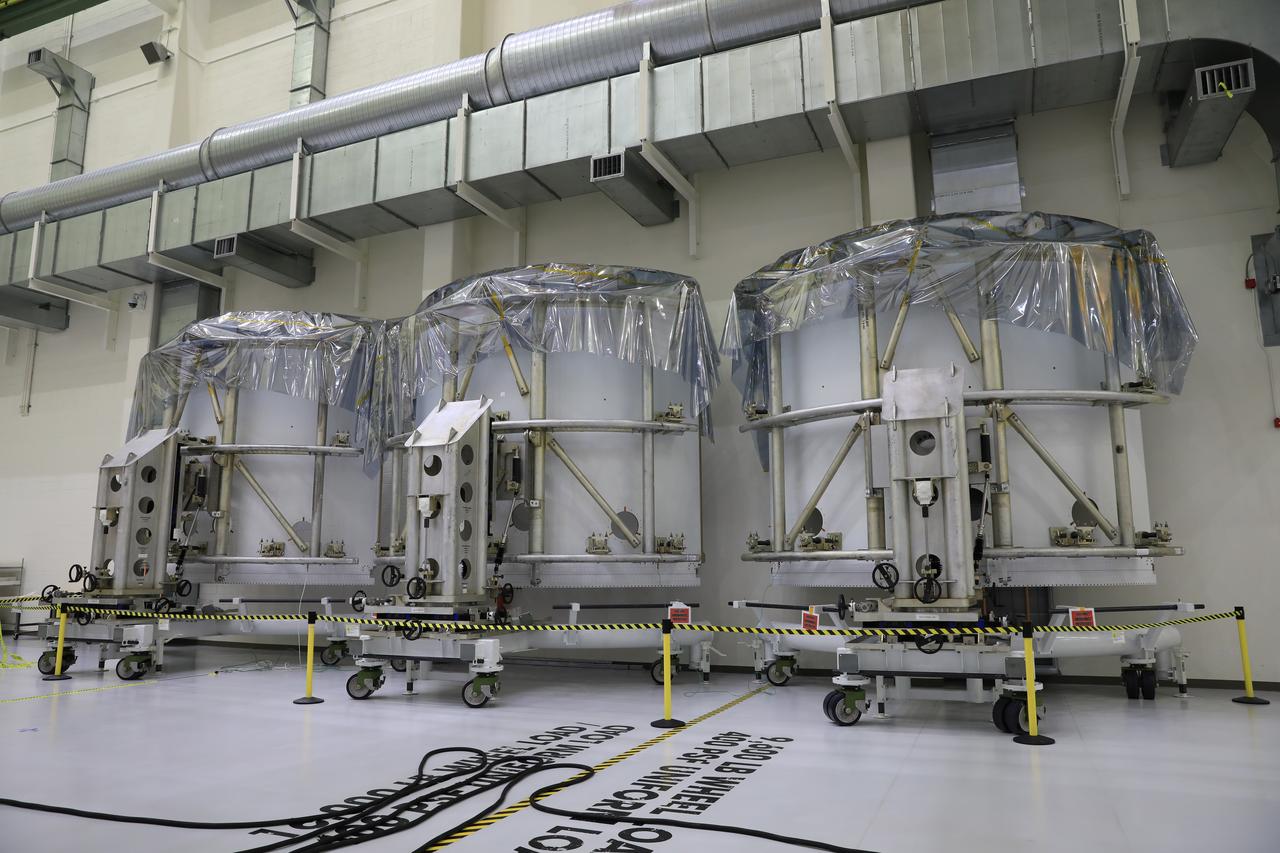
Pictured inside the Neil Armstrong Operations and Checkout Building high bay at NASA’s Kennedy Space Center in Florida on Aug. 6, 2020, are the three Spacecraft Adapter Jettison fairing panels that will protect Orion's service module from the environment around it, whether it's heat, wind or acoustics during the ascent. Unlike conventional rocket fairings, Orion's are designed to support half of the weight of the crew module and launch abort system during launch and ascent, which will maximize the size and capability of the spacecraft that can be delivered to orbit. Orion will fly on the agency’s Artemis I mission – the first in a series of increasingly complex missions to the Moon that will ultimately lead to the exploration of Mars.
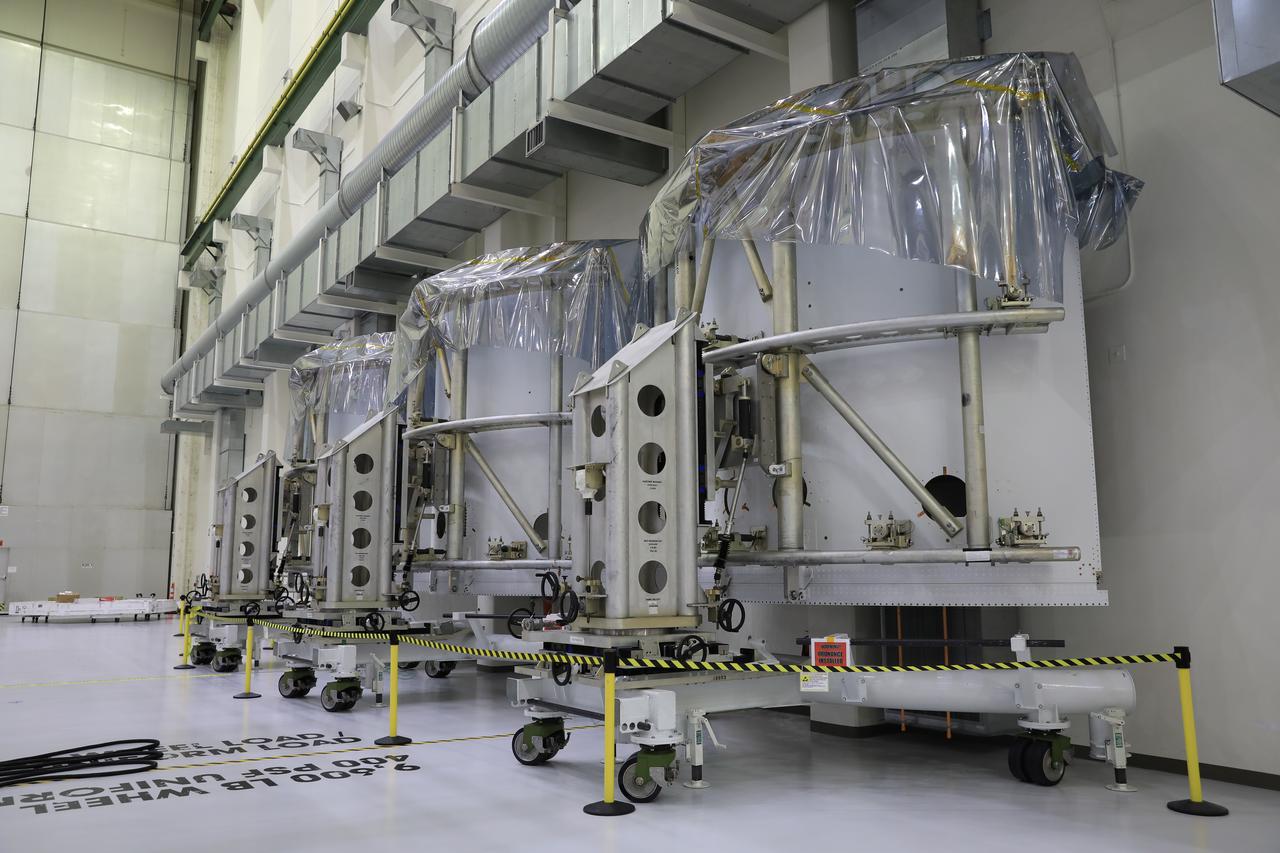
Pictured inside the Neil Armstrong Operations and Checkout Building high bay at NASA’s Kennedy Space Center in Florida on Aug. 6, 2020, are the three Spacecraft Adapter Jettison fairing panels that will protect Orion's service module from the environment around it, whether it's heat, wind or acoustics during the ascent. Unlike conventional rocket fairings, Orion's are designed to support half of the weight of the crew module and launch abort system during launch and ascent, which will maximize the size and capability of the spacecraft that can be delivered to orbit. Orion will fly on the agency’s Artemis I mission – the first in a series of increasingly complex missions to the Moon that will ultimately lead to the exploration of Mars.
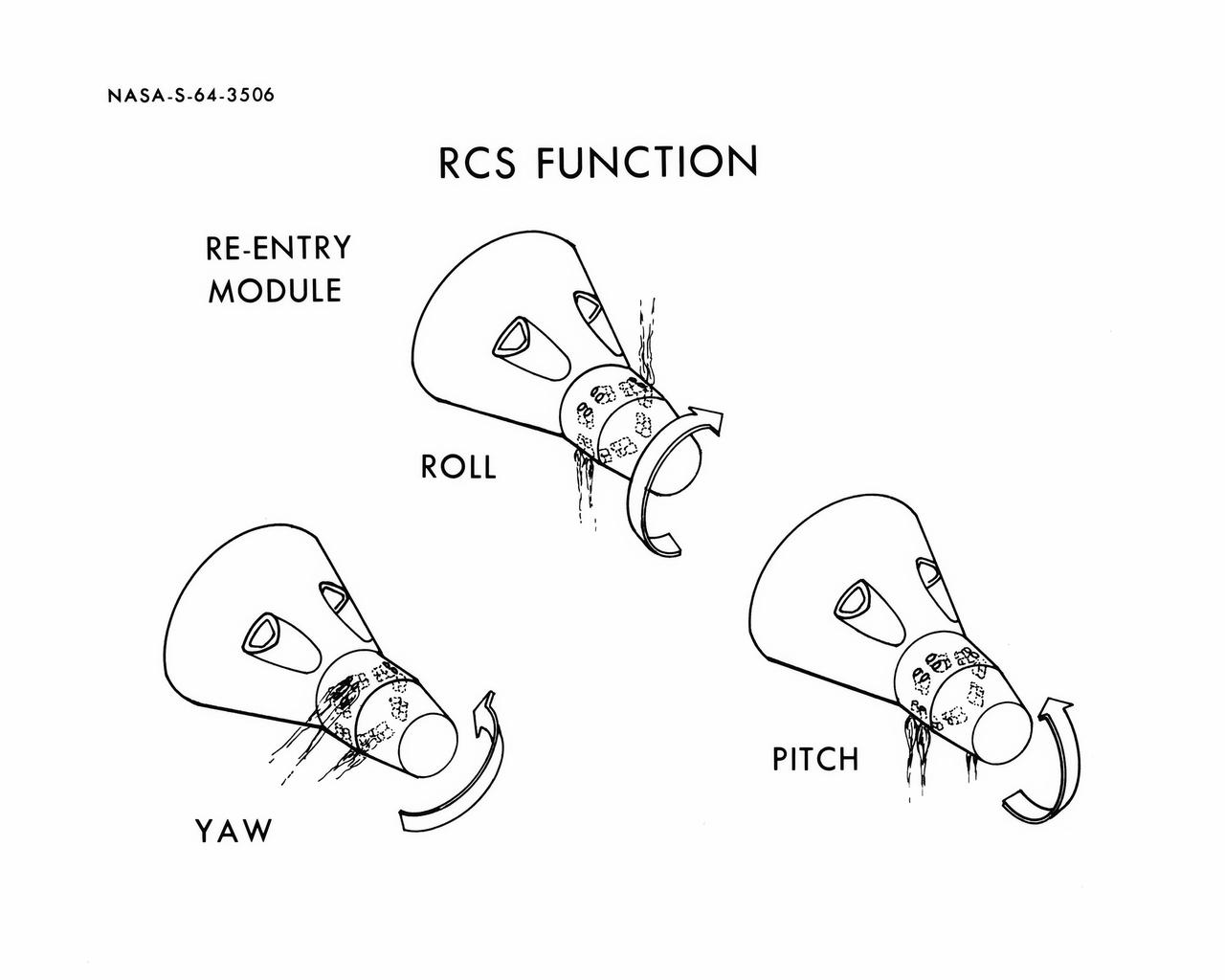
S64-03506 (1964) --- Diagrams shows Gemini spacecraft functions of the thrusters in the Gemini spacecraft's re-entry control system. Thrusters may be fired in various combinations to cause yaw, roll and pitch.
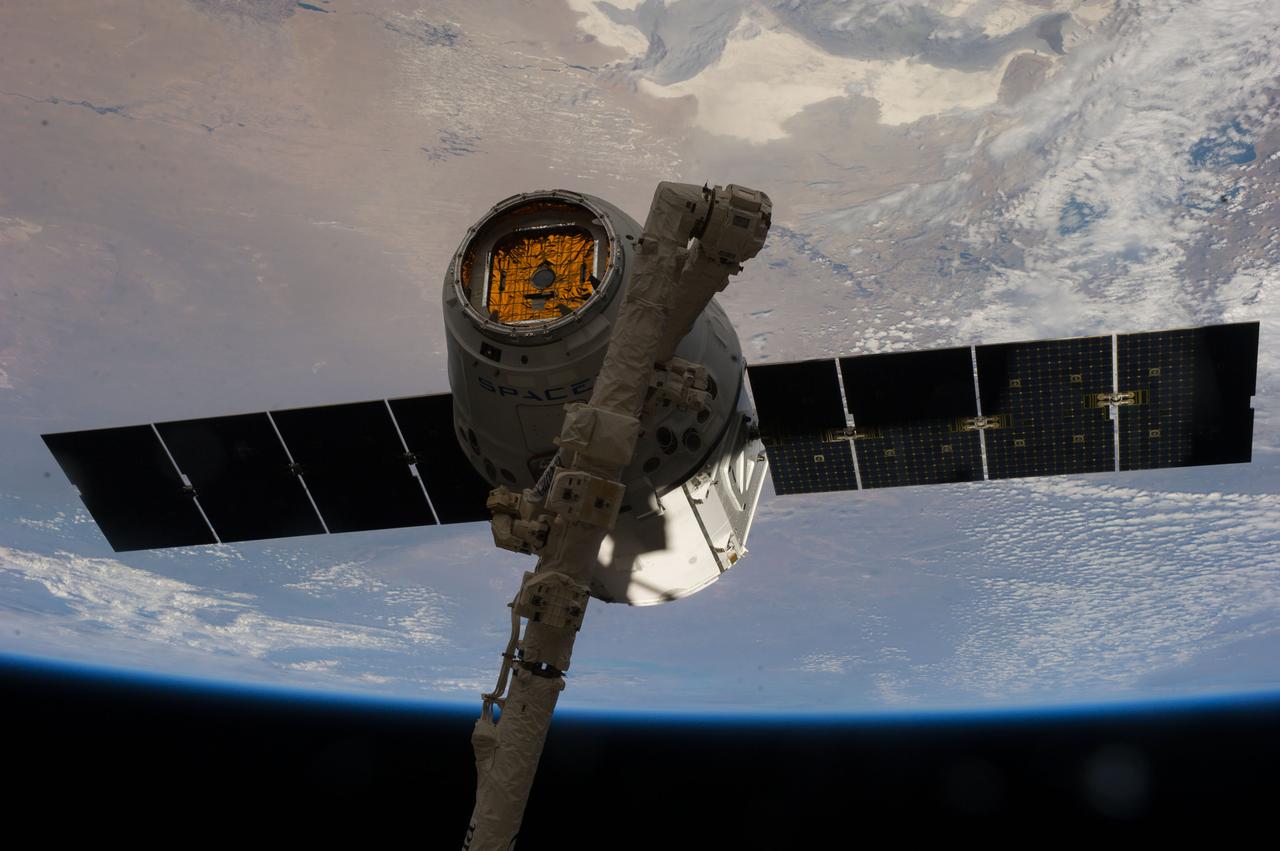
View of the SpaceX Dragon Commercial Resupply Services-3 (CRS-3) spacecraft grappled by the Canadarm2 Space Station Remote Manipulator System (SSRMS) during Expedition 39. Image was released by released by flight engineer 3 (FE3) on Instagram.
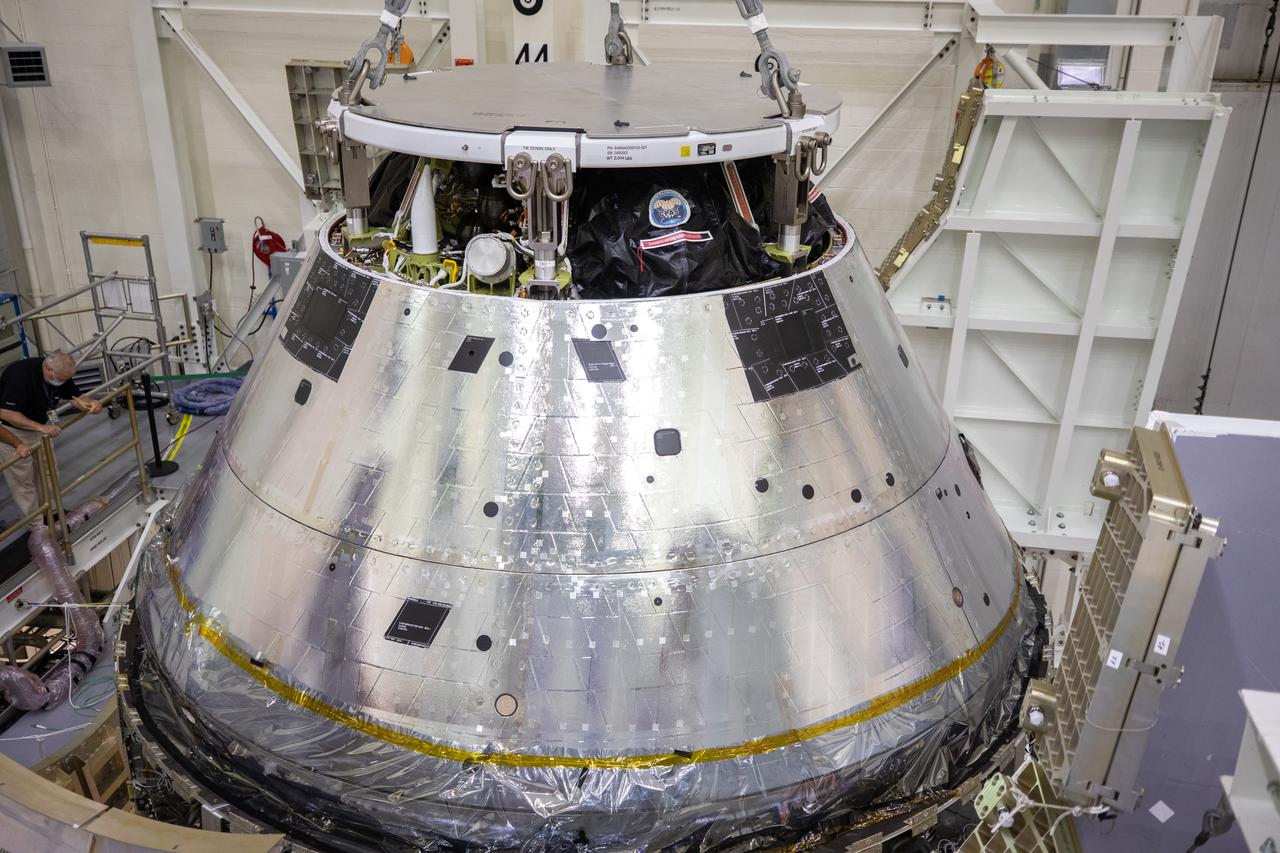
The Artemis I Orion spacecraft is lowered by crane into the FAST cell after installation of the spacecraft adapter (SA) cone was completed inside the Neil Armstrong Operations and Checkout Building on Aug. 20, 2020. This is one of the final major hardware operations the spacecraft will undergo during closeout processing prior to being integrated with the Space Launch System (SLS) rocket in preparation for the first Artemis mission. The spacecraft adapter cone connects the bottom portion of Orion’s service module to the top part of the rocket known as the interim cryogenic propulsion stage (ICPS). Orion will fly on the agency’s Artemis I mission – the first in a series of increasingly complex missions to the Moon that will ultimately lead to the exploration of Mars.
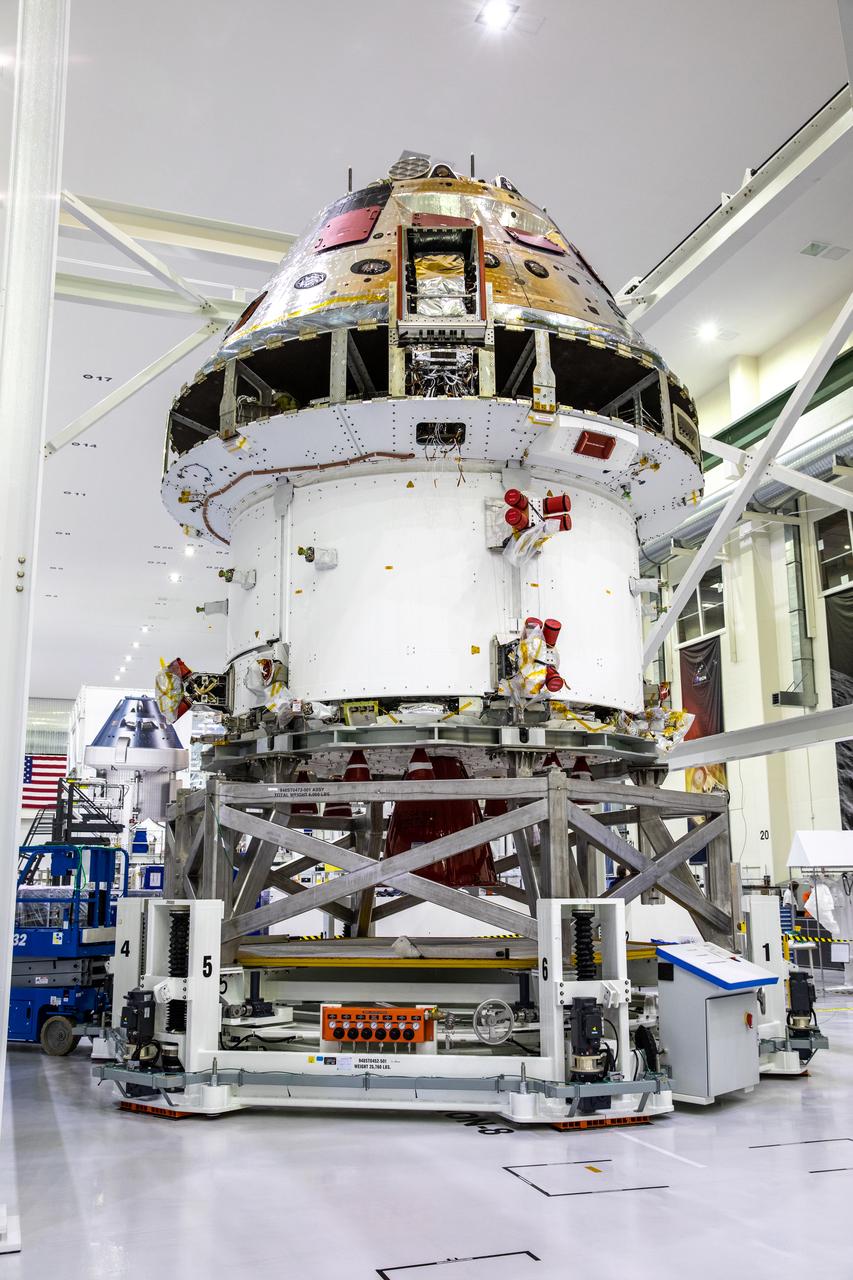
Installation of the spacecraft adapter (SA) cone to the Artemis I Orion spacecraft is in progress inside the Neil Armstrong Operations and Checkout Building at NASA’s Kennedy Space Center in Florida on Aug. 6, 2020. This is one of the final major hardware operations the spacecraft will undergo during closeout processing prior to being integrated with the Space Launch System (SLS) rocket in preparation for the first Artemis mission. The spacecraft adapter cone connects the bottom portion of Orion’s service module to the top part of the rocket known as the interim cryogenic propulsion stage (ICPS). Orion will fly on the agency’s Artemis I mission – the first in a series of increasingly complex missions to the Moon that will ultimately lead to the exploration of Mars.
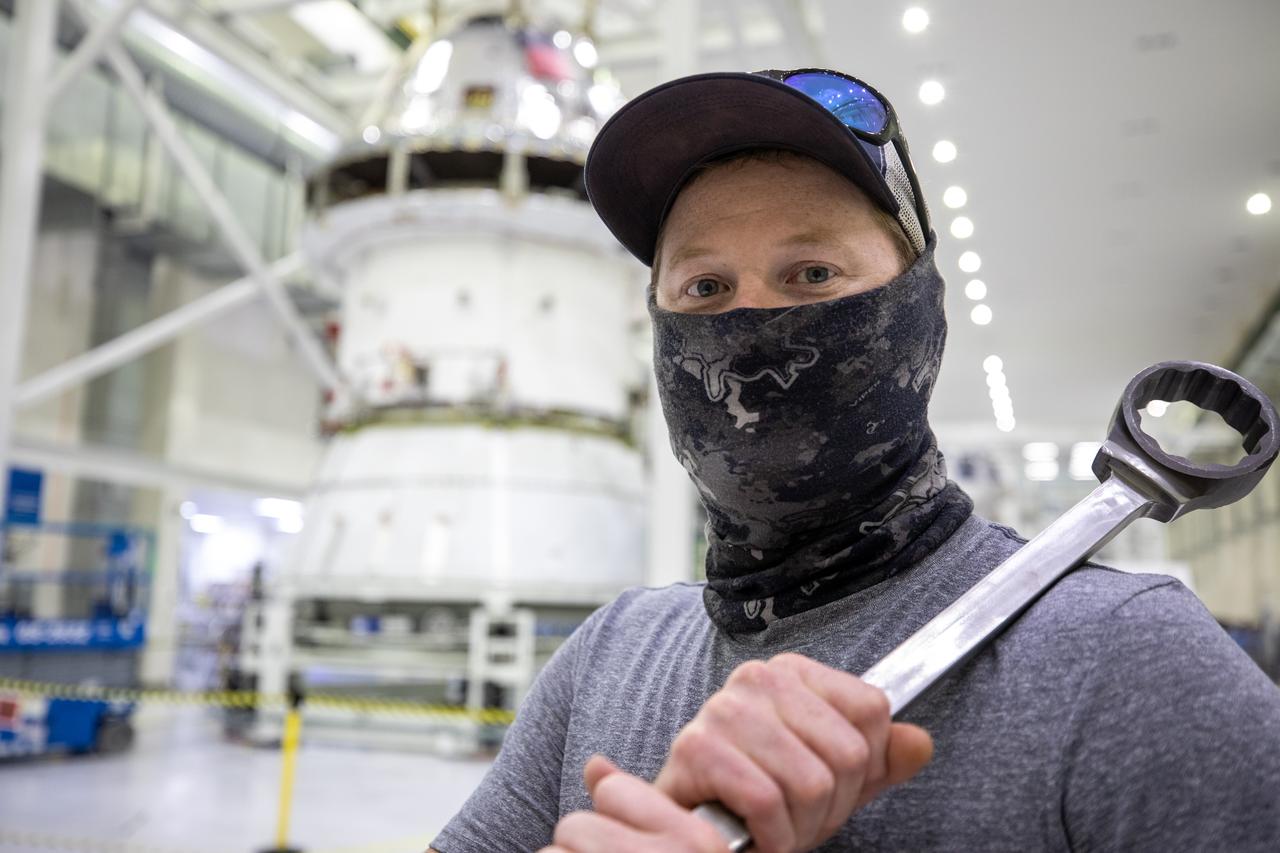
ASRC technician Chris Slack assists with the installation of the spacecraft adapter (SA) cone to the Artemis I Orion spacecraft inside the Neil Armstrong Operations and Checkout Building at NASA’s Kennedy Space Center on Aug. 10, 2020. This is one of the final major hardware operations the spacecraft will undergo during closeout processing prior to being integrated with the Space Launch System (SLS) rocket in preparation for the first Artemis mission. The spacecraft adapter cone connects the bottom portion of Orion’s service module to the top part of the rocket known as the interim cryogenic propulsion stage (ICPS). Orion will fly on the agency’s Artemis I mission – the first in a series of increasingly complex missions to the Moon that will ultimately lead to the exploration of Mars.
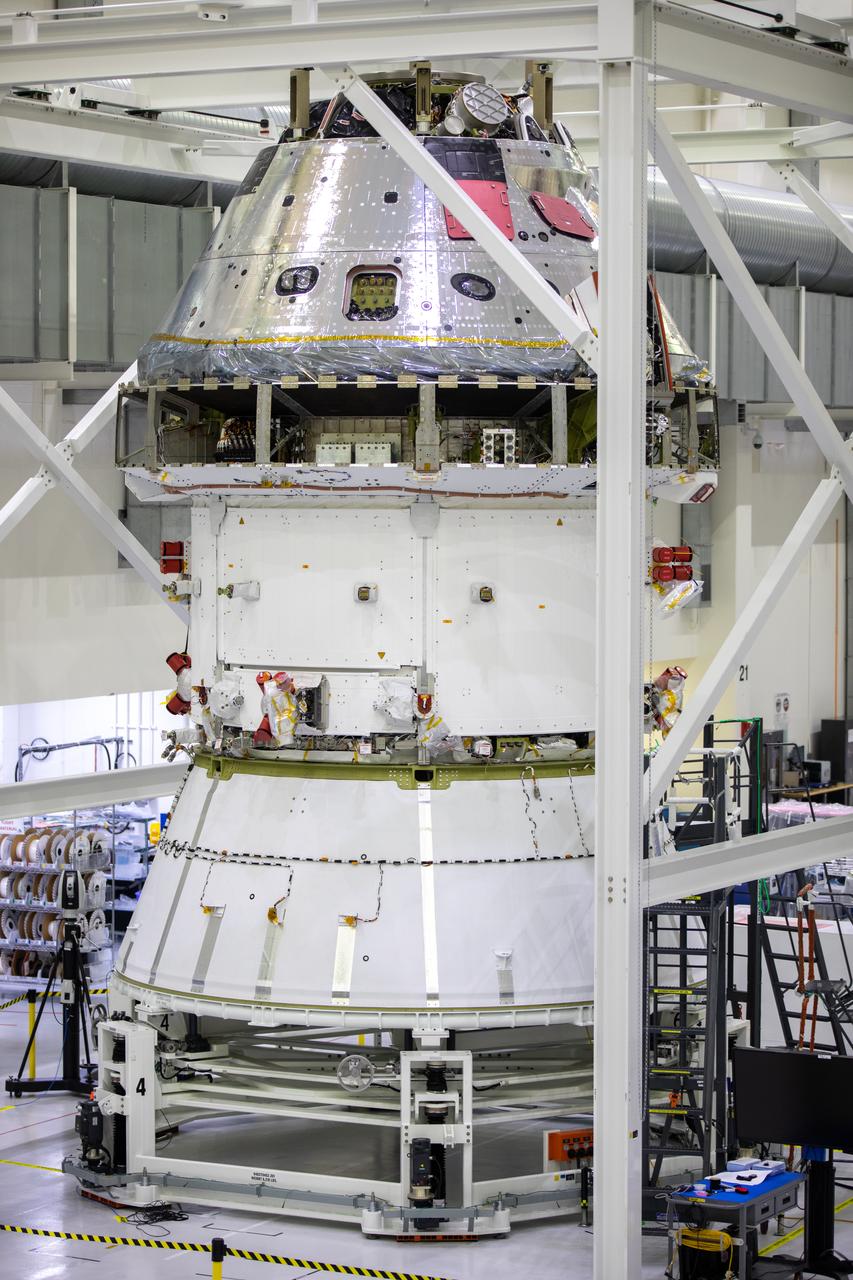
Installation of the spacecraft adapter (SA) cone to the Artemis I Orion spacecraft shown in progress inside the Neil Armstrong Operations and Checkout Building on Aug. 10, 2020. This is one of the final major hardware operations the spacecraft will undergo during closeout processing prior to being integrated with the Space Launch System (SLS) rocket in preparation for the first Artemis mission. The spacecraft adapter cone connects the bottom portion of Orion’s service module to the top part of the rocket known as the interim cryogenic propulsion stage (ICPS). Orion will fly on the agency’s Artemis I mission – the first in a series of increasingly complex missions to the Moon that will ultimately lead to the exploration of Mars.
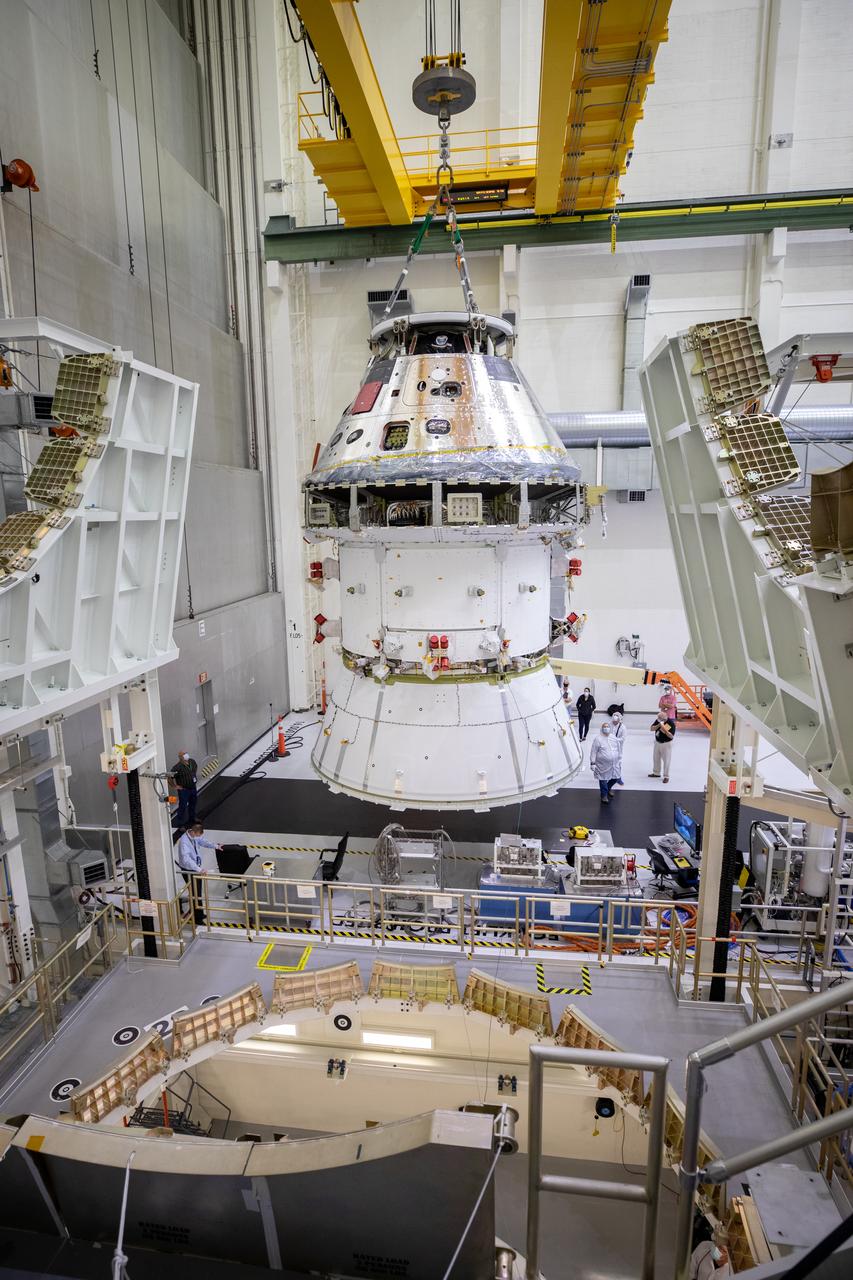
The Artemis I Orion spacecraft with its spacecraft adapter cone attached, is moved by crane into the FAST cell inside the Neil Armstrong Operations and Checkout Building at NASA’s Kennedy Space Center in Florida on Aug. 20, 2020. This is one of the final major hardware operations the spacecraft will undergo during closeout processing prior to being integrated with the Space Launch System (SLS) rocket in preparation for the first Artemis mission. The spacecraft adapter cone connects the bottom portion of Orion’s service module to the top part of the rocket known as the interim cryogenic propulsion stage (ICPS). Orion will fly on the agency’s Artemis I mission – the first in a series of increasingly complex missions to the Moon that will ultimately lead to the exploration of Mars.
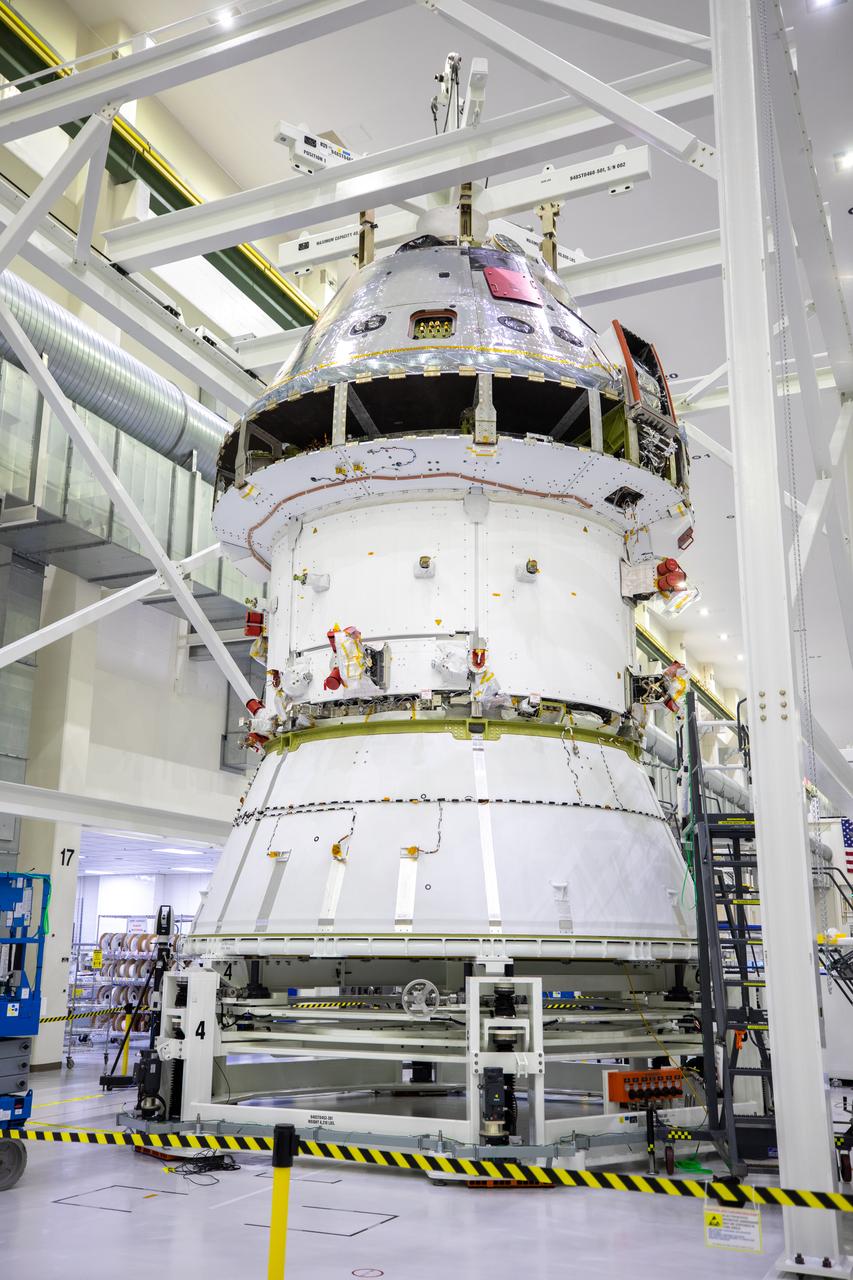
Installation of the spacecraft adapter (SA) cone to the Artemis I Orion spacecraft shown in progress inside the Neil Armstrong Operations and Checkout Building on Aug. 10, 2020. This is one of the final major hardware operations the spacecraft will undergo during closeout processing prior to being integrated with the Space Launch System (SLS) rocket in preparation for the first Artemis mission. The spacecraft adapter cone connects the bottom portion of Orion’s service module to the top part of the rocket known as the interim cryogenic propulsion stage (ICPS). Orion will fly on the agency’s Artemis I mission – the first in a series of increasingly complex missions to the Moon that will ultimately lead to the exploration of Mars.
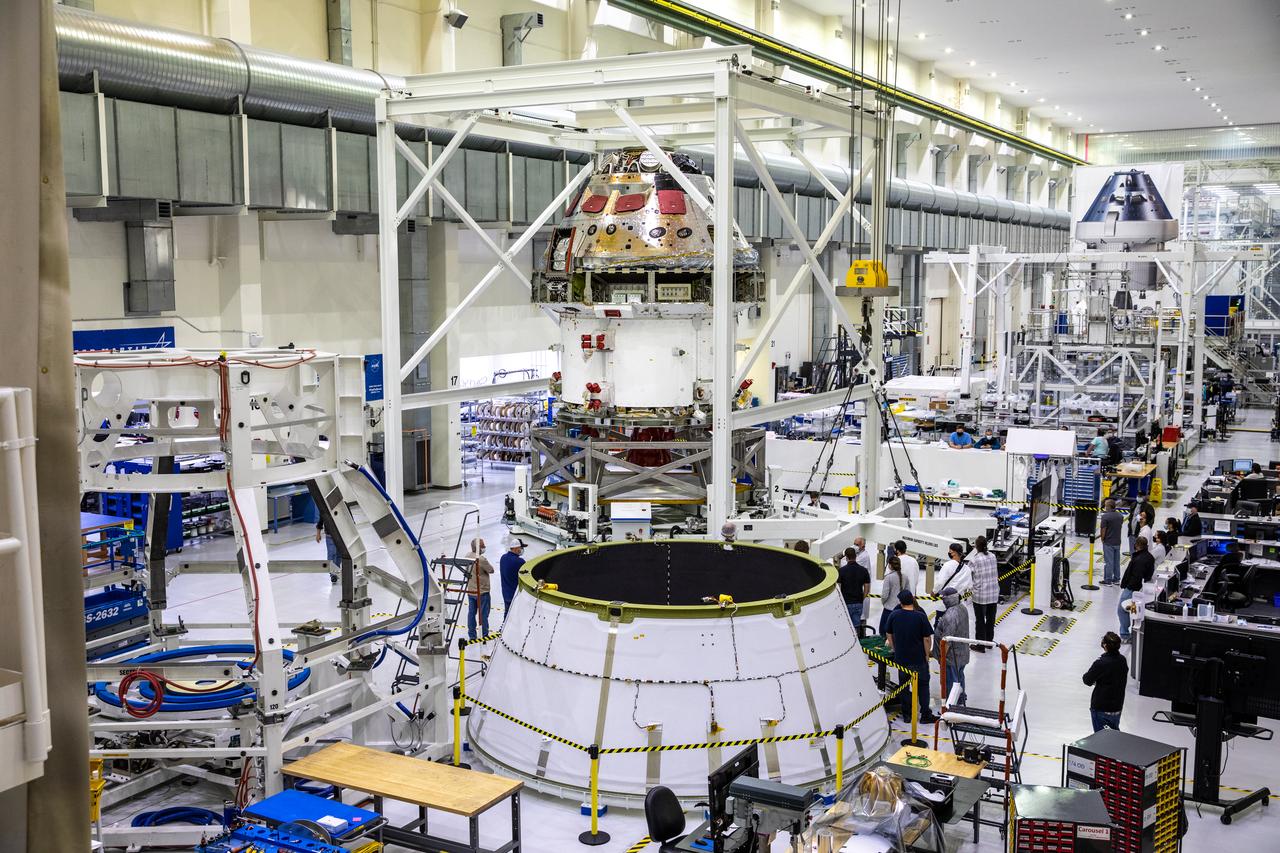
Installation of the spacecraft adapter (SA) cone to the Artemis I Orion spacecraft is in progress inside the Neil Armstrong Operations and Checkout Building at NASA’s Kennedy Space Center in Florida on Aug. 6, 2020. This is one of the final major hardware operations the spacecraft will undergo during closeout processing prior to being integrated with the Space Launch System (SLS) rocket in preparation for the first Artemis mission. The spacecraft adapter cone connects the bottom portion of Orion’s service module to the top part of the rocket known as the interim cryogenic propulsion stage (ICPS). Orion will fly on the agency’s Artemis I mission – the first in a series of increasingly complex missions to the Moon that will ultimately lead to the exploration of Mars.
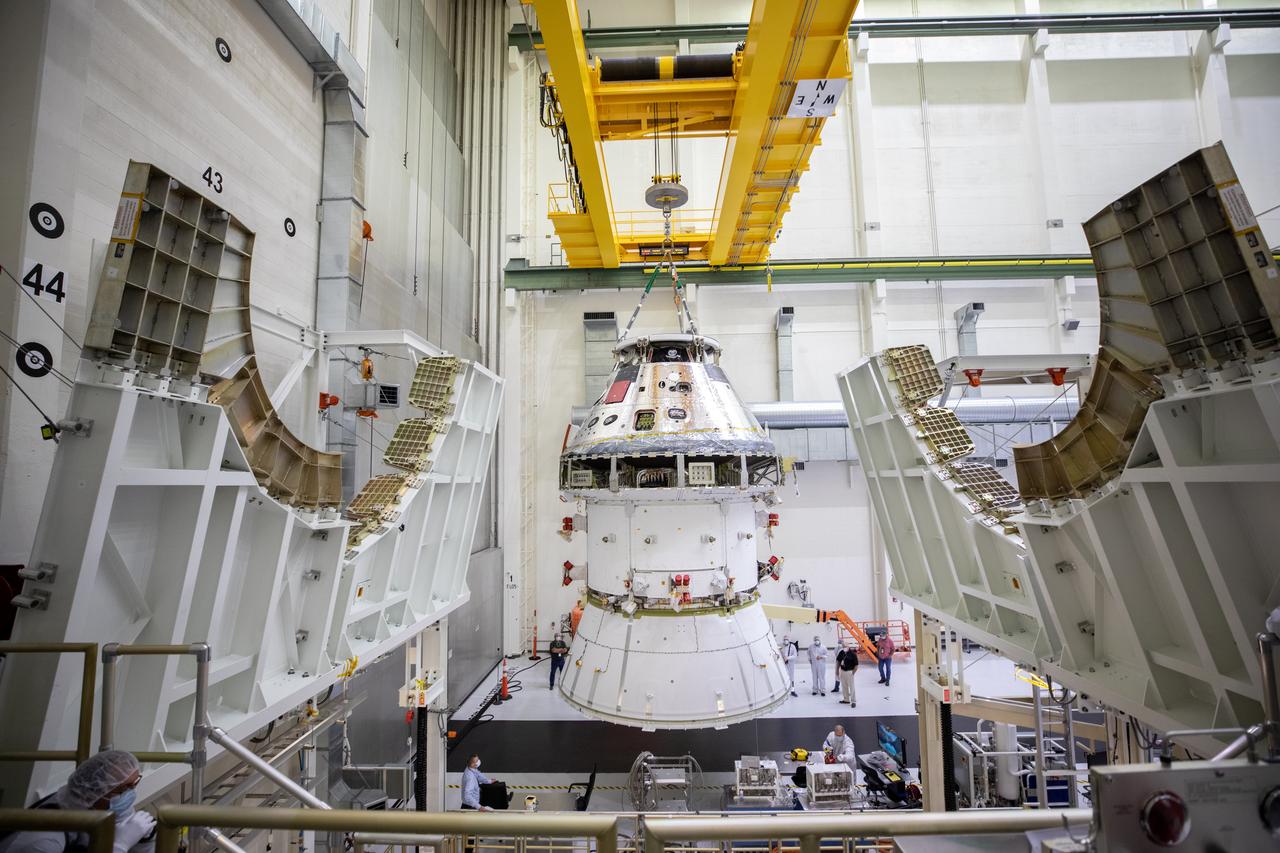
The Artemis I Orion spacecraft with its spacecraft adapter cone attached, is moved by crane into the FAST cell inside the Neil Armstrong Operations and Checkout Building at NASA’s Kennedy Space Center in Florida on Aug. 20, 2020. This is one of the final major hardware operations the spacecraft will undergo during closeout processing prior to being integrated with the Space Launch System (SLS) rocket in preparation for the first Artemis mission. The spacecraft adapter cone connects the bottom portion of Orion’s service module to the top part of the rocket known as the interim cryogenic propulsion stage (ICPS). Orion will fly on the agency’s Artemis I mission – the first in a series of increasingly complex missions to the Moon that will ultimately lead to the exploration of Mars.
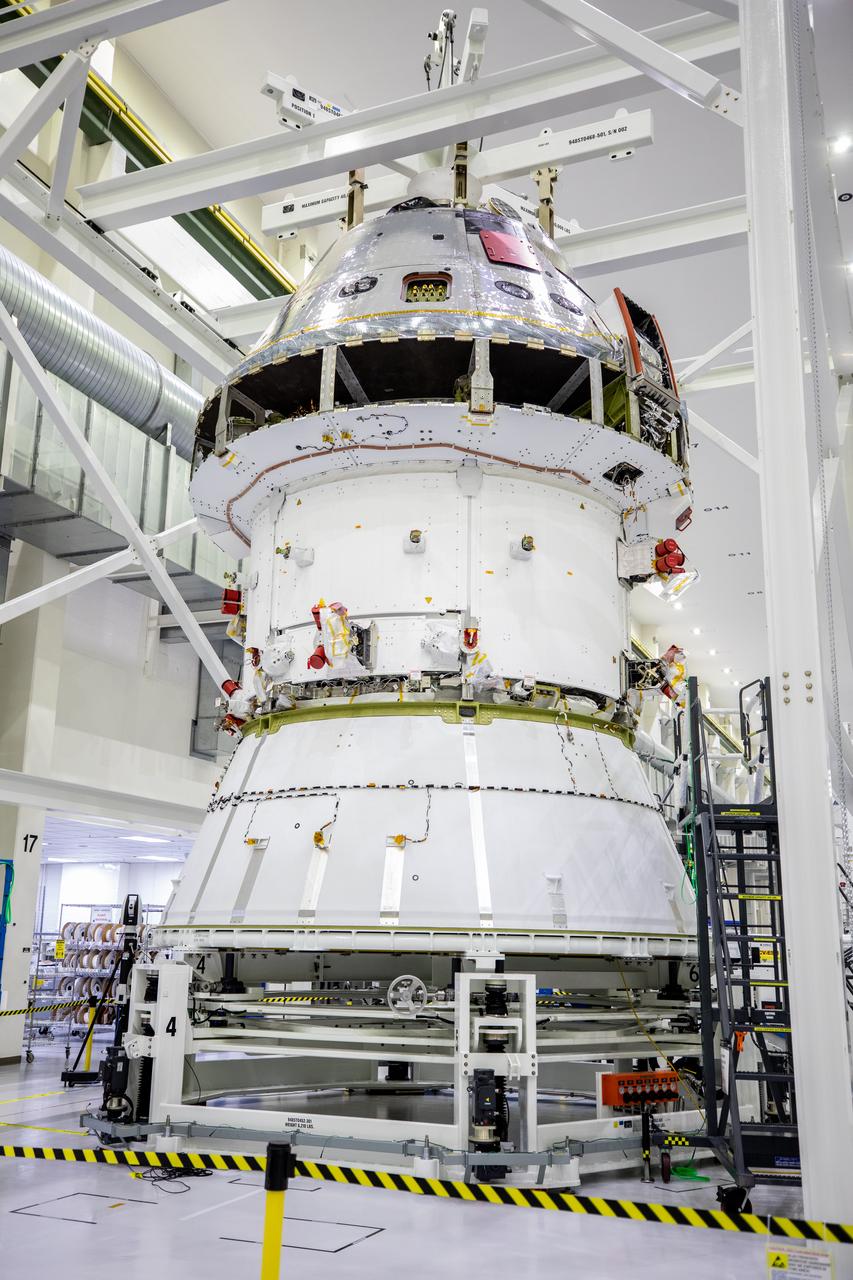
Installation of the spacecraft adapter (SA) cone to the Artemis I Orion spacecraft shown in progress inside the Neil Armstrong Operations and Checkout Building on Aug. 10, 2020. This is one of the final major hardware operations the spacecraft will undergo during closeout processing prior to being integrated with the Space Launch System (SLS) rocket in preparation for the first Artemis mission. The spacecraft adapter cone connects the bottom portion of Orion’s service module to the top part of the rocket known as the interim cryogenic propulsion stage (ICPS). Orion will fly on the agency’s Artemis I mission – the first in a series of increasingly complex missions to the Moon that will ultimately lead to the exploration of Mars.
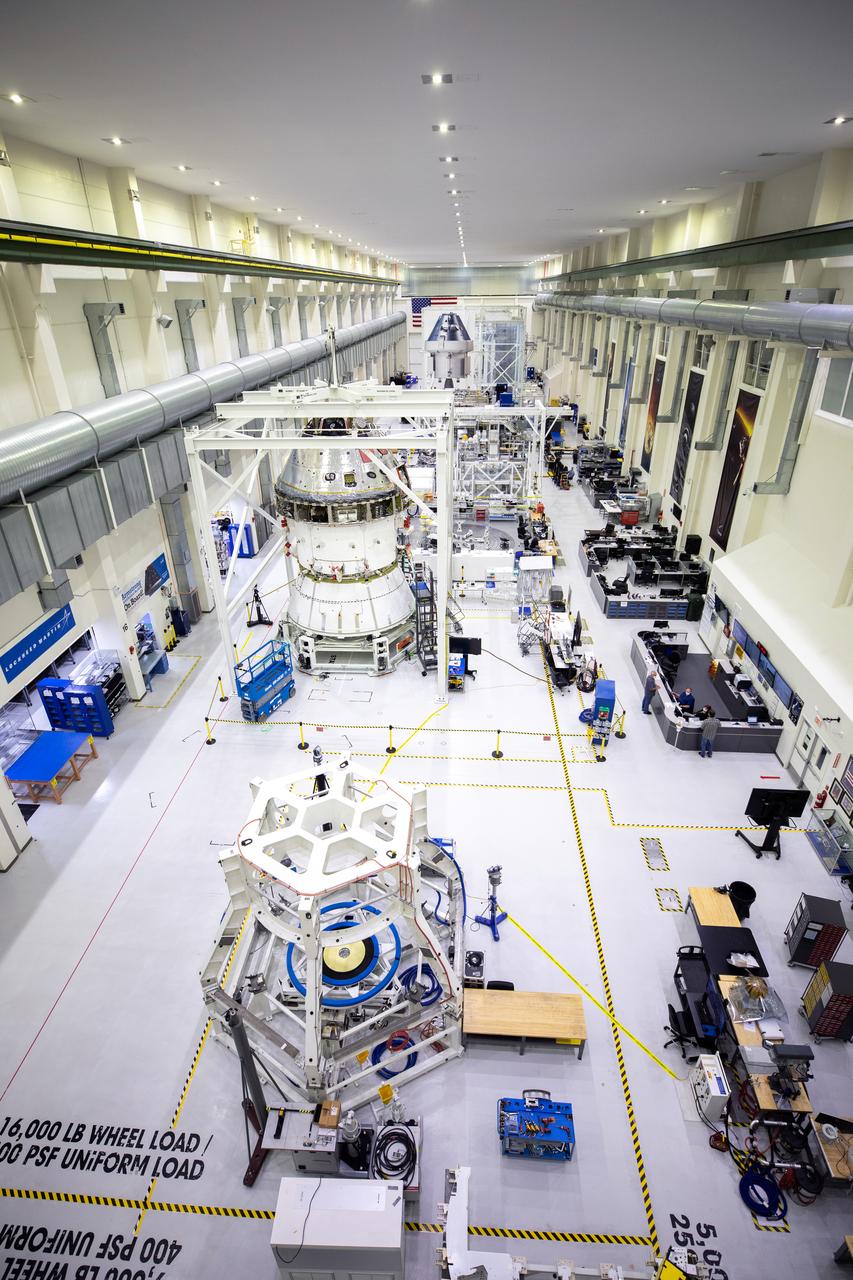
Installation of the spacecraft adapter (SA) cone to the Artemis I Orion spacecraft shown in progress inside the Neil Armstrong Operations and Checkout Building on Aug. 10, 2020. This is one of the final major hardware operations the spacecraft will undergo during closeout processing prior to being integrated with the Space Launch System (SLS) rocket in preparation for the first Artemis mission. The spacecraft adapter cone connects the bottom portion of Orion’s service module to the top part of the rocket known as the interim cryogenic propulsion stage (ICPS). Orion will fly on the agency’s Artemis I mission – the first in a series of increasingly complex missions to the Moon that will ultimately lead to the exploration of Mars.
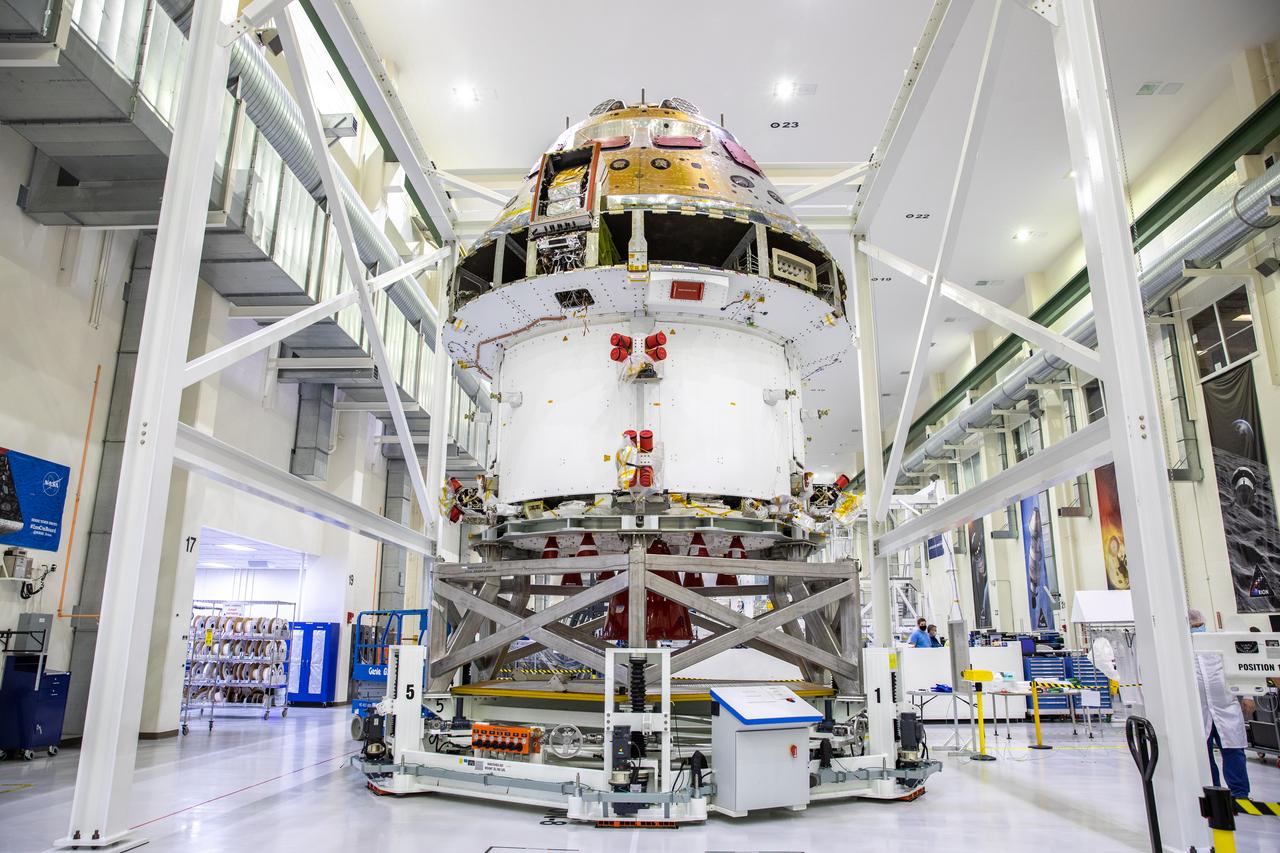
Installation of the spacecraft adapter (SA) cone to the Artemis I Orion spacecraft is in progress inside the Neil Armstrong Operations and Checkout Building at NASA’s Kennedy Space Center in Florida on Aug. 6, 2020. This is one of the final major hardware operations the spacecraft will undergo during closeout processing prior to being integrated with the Space Launch System (SLS) rocket in preparation for the first Artemis mission. The spacecraft adapter cone connects the bottom portion of Orion’s service module to the top part of the rocket known as the interim cryogenic propulsion stage (ICPS). Orion will fly on the agency’s Artemis I mission – the first in a series of increasingly complex missions to the Moon that will ultimately lead to the exploration of Mars.
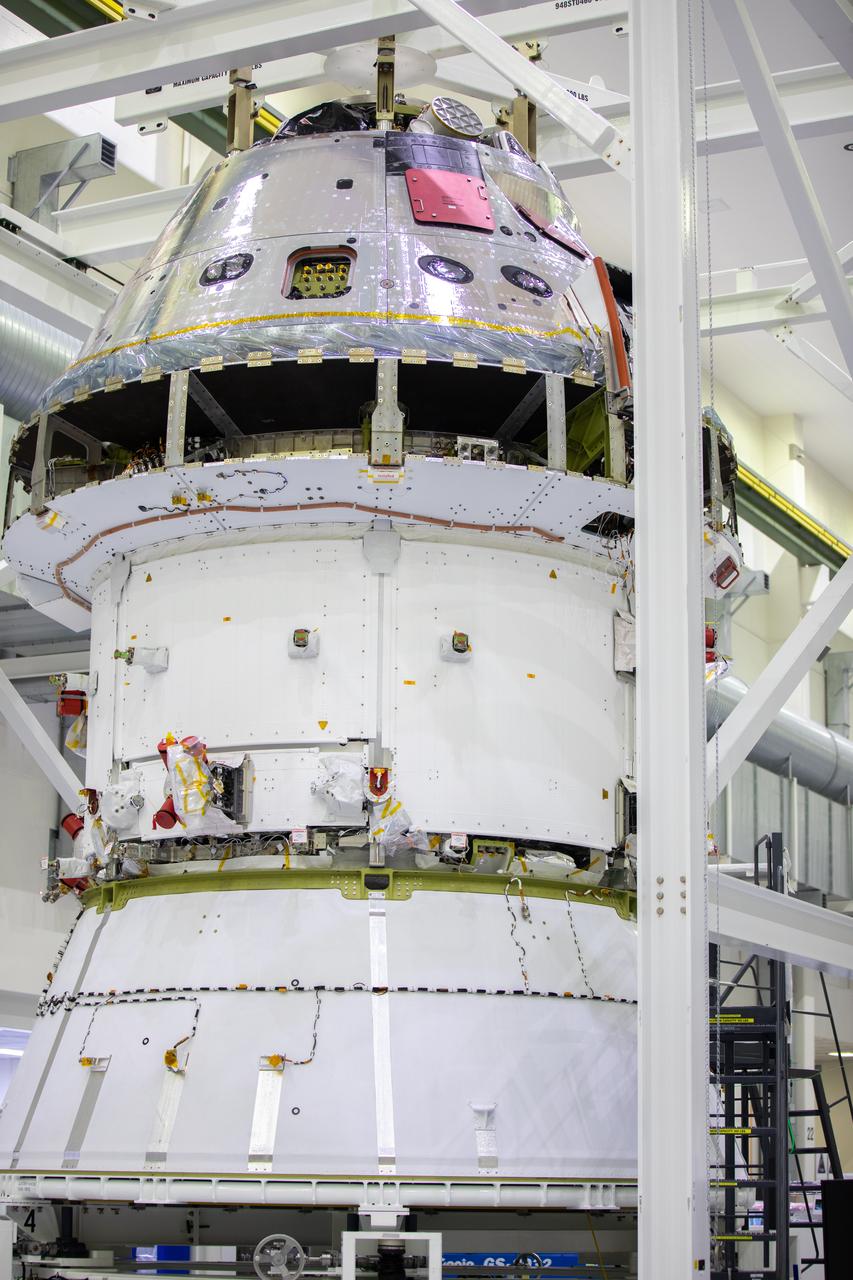
Installation of the spacecraft adapter (SA) cone to the Artemis I Orion spacecraft shown in progress inside the Neil Armstrong Operations and Checkout Building on Aug. 10, 2020. This is one of the final major hardware operations the spacecraft will undergo during closeout processing prior to being integrated with the Space Launch System (SLS) rocket in preparation for the first Artemis mission. The spacecraft adapter cone connects the bottom portion of Orion’s service module to the top part of the rocket known as the interim cryogenic propulsion stage (ICPS). Orion will fly on the agency’s Artemis I mission – the first in a series of increasingly complex missions to the Moon that will ultimately lead to the exploration of Mars.
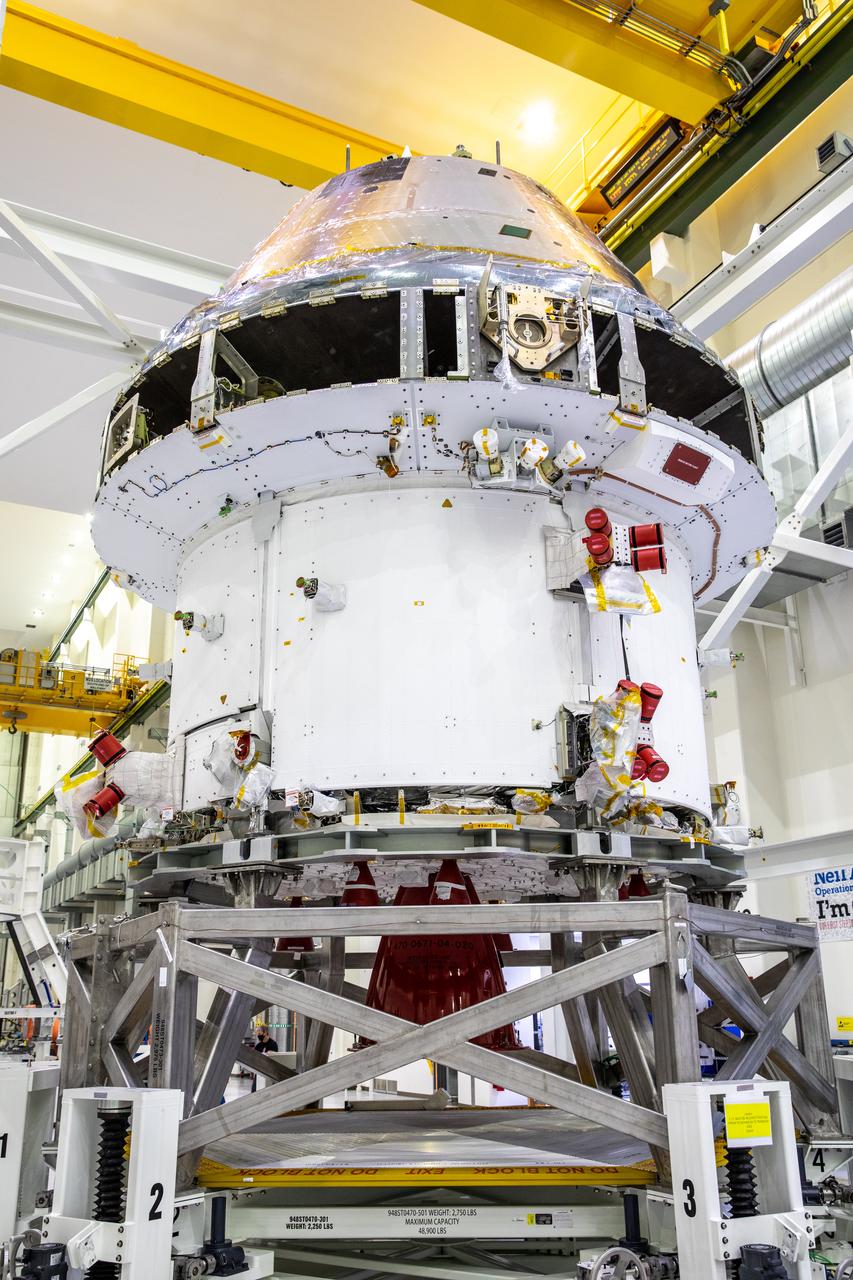
Installation of the spacecraft adapter (SA) cone to the Artemis I Orion spacecraft is in progress inside the Neil Armstrong Operations and Checkout Building at NASA’s Kennedy Space Center in Florida on Aug. 6, 2020. This is one of the final major hardware operations the spacecraft will undergo during closeout processing prior to being integrated with the Space Launch System (SLS) rocket in preparation for the first Artemis mission. The spacecraft adapter cone connects the bottom portion of Orion’s service module to the top part of the rocket known as the interim cryogenic propulsion stage (ICPS). Orion will fly on the agency’s Artemis I mission – the first in a series of increasingly complex missions to the Moon that will ultimately lead to the exploration of Mars.

Installation of the spacecraft adapter (SA) cone to the Artemis I Orion spacecraft shown in progress inside the Neil Armstrong Operations and Checkout Building on Aug. 10, 2020. This is one of the final major hardware operations the spacecraft will undergo during closeout processing prior to being integrated with the Space Launch System (SLS) rocket in preparation for the first Artemis mission. The spacecraft adapter cone connects the bottom portion of Orion’s service module to the top part of the rocket known as the interim cryogenic propulsion stage (ICPS). Orion will fly on the agency’s Artemis I mission – the first in a series of increasingly complex missions to the Moon that will ultimately lead to the exploration of Mars.
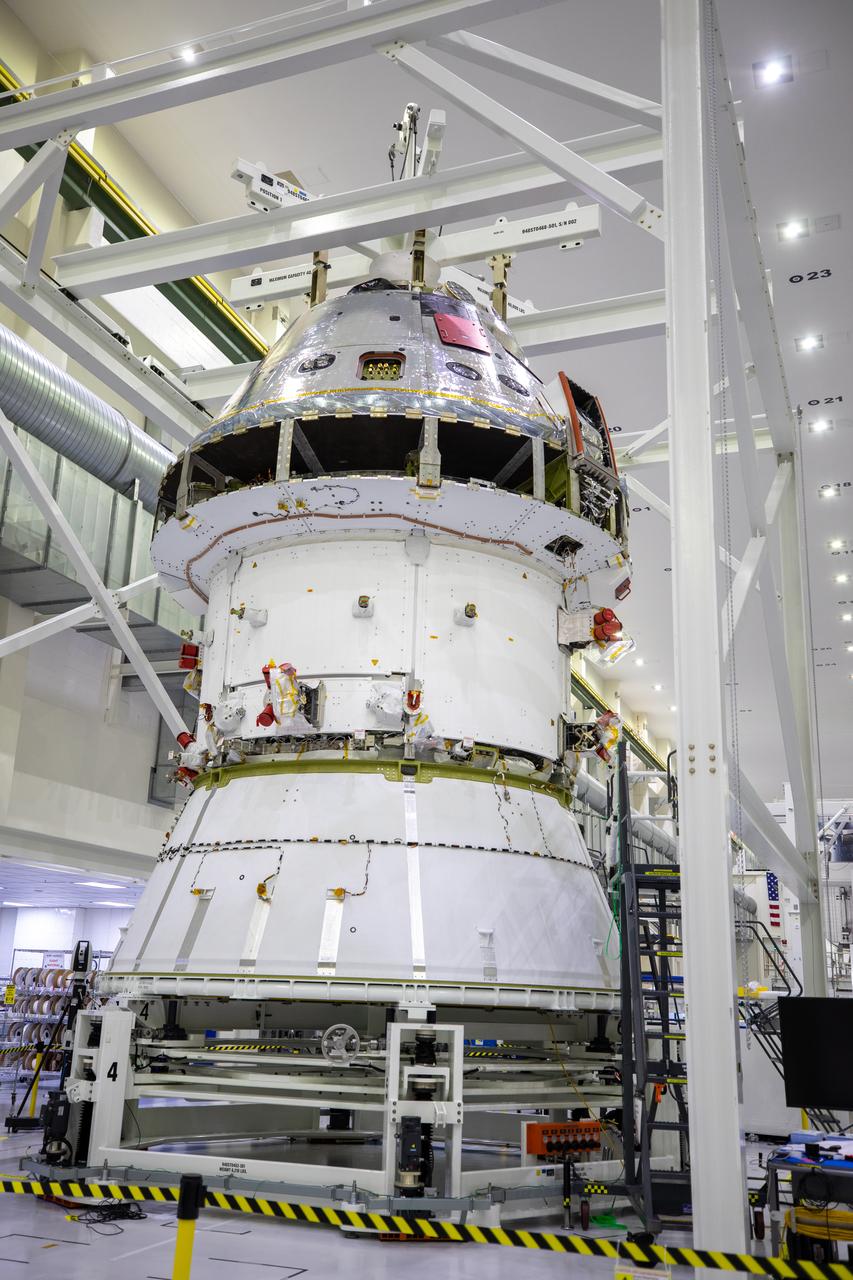
Installation of the spacecraft adapter (SA) cone to the Artemis I Orion spacecraft shown in progress inside the Neil Armstrong Operations and Checkout Building on Aug. 10, 2020. This is one of the final major hardware operations the spacecraft will undergo during closeout processing prior to being integrated with the Space Launch System (SLS) rocket in preparation for the first Artemis mission. The spacecraft adapter cone connects the bottom portion of Orion’s service module to the top part of the rocket known as the interim cryogenic propulsion stage (ICPS). Orion will fly on the agency’s Artemis I mission – the first in a series of increasingly complex missions to the Moon that will ultimately lead to the exploration of Mars.
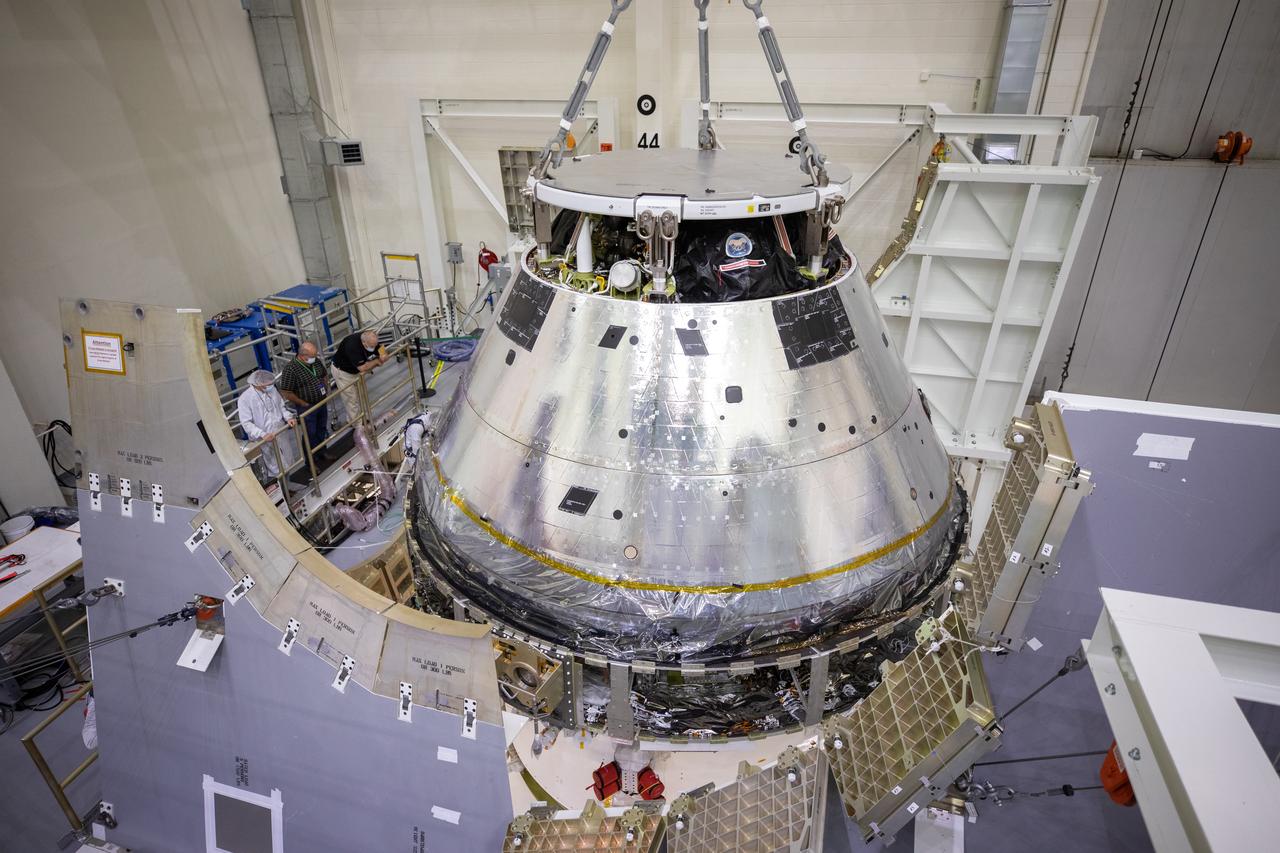
The Artemis I Orion spacecraft is lowered by crane into the FAST cell after installation of the spacecraft adapter (SA) cone was completed inside the Neil Armstrong Operations and Checkout Building on Aug. 20, 2020. This is one of the final major hardware operations the spacecraft will undergo during closeout processing prior to being integrated with the Space Launch System (SLS) rocket in preparation for the first Artemis mission. The spacecraft adapter cone connects the bottom portion of Orion’s service module to the top part of the rocket known as the interim cryogenic propulsion stage (ICPS). Orion will fly on the agency’s Artemis I mission – the first in a series of increasingly complex missions to the Moon that will ultimately lead to the exploration of Mars.
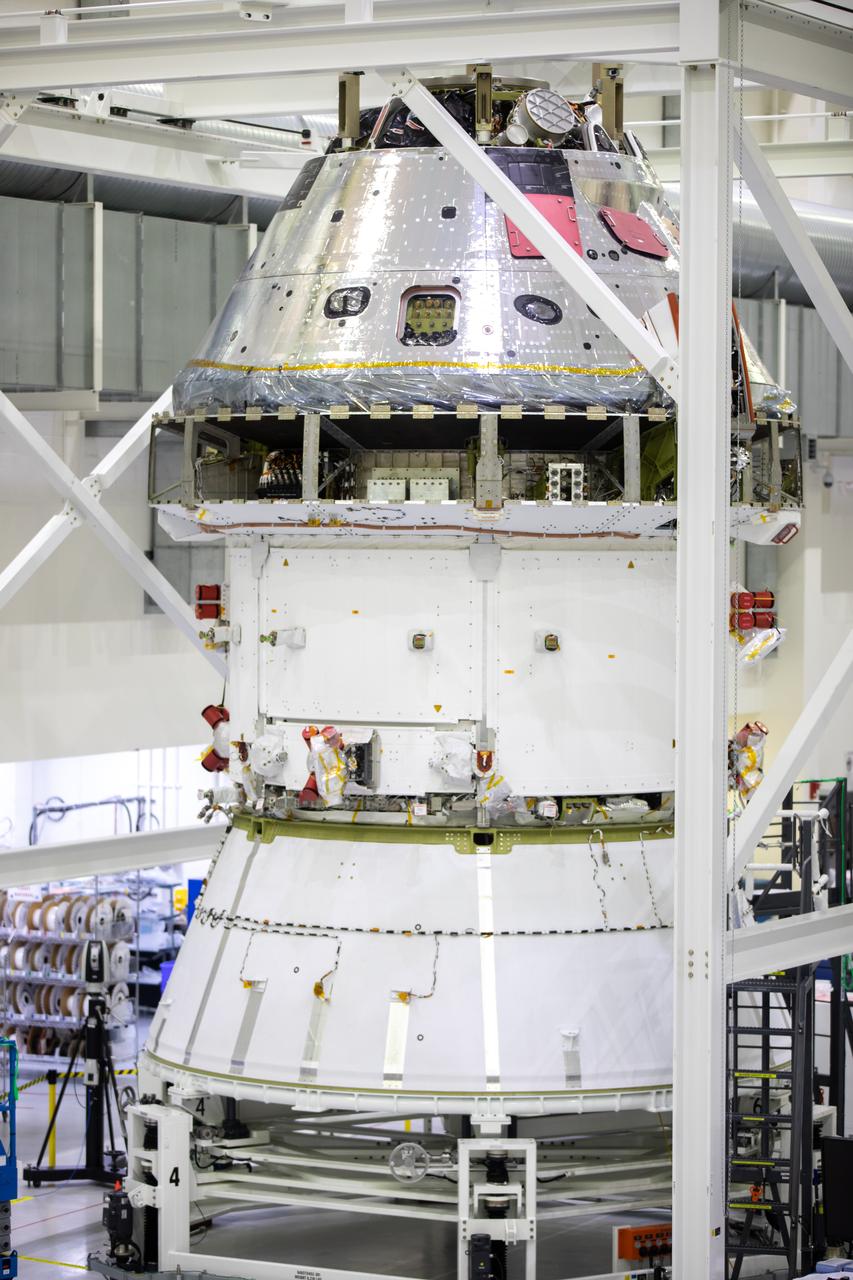
Installation of the spacecraft adapter (SA) cone to the Artemis I Orion spacecraft shown in progress inside the Neil Armstrong Operations and Checkout Building on Aug. 10, 2020. This is one of the final major hardware operations the spacecraft will undergo during closeout processing prior to being integrated with the Space Launch System (SLS) rocket in preparation for the first Artemis mission. The spacecraft adapter cone connects the bottom portion of Orion’s service module to the top part of the rocket known as the interim cryogenic propulsion stage (ICPS). Orion will fly on the agency’s Artemis I mission – the first in a series of increasingly complex missions to the Moon that will ultimately lead to the exploration of Mars.
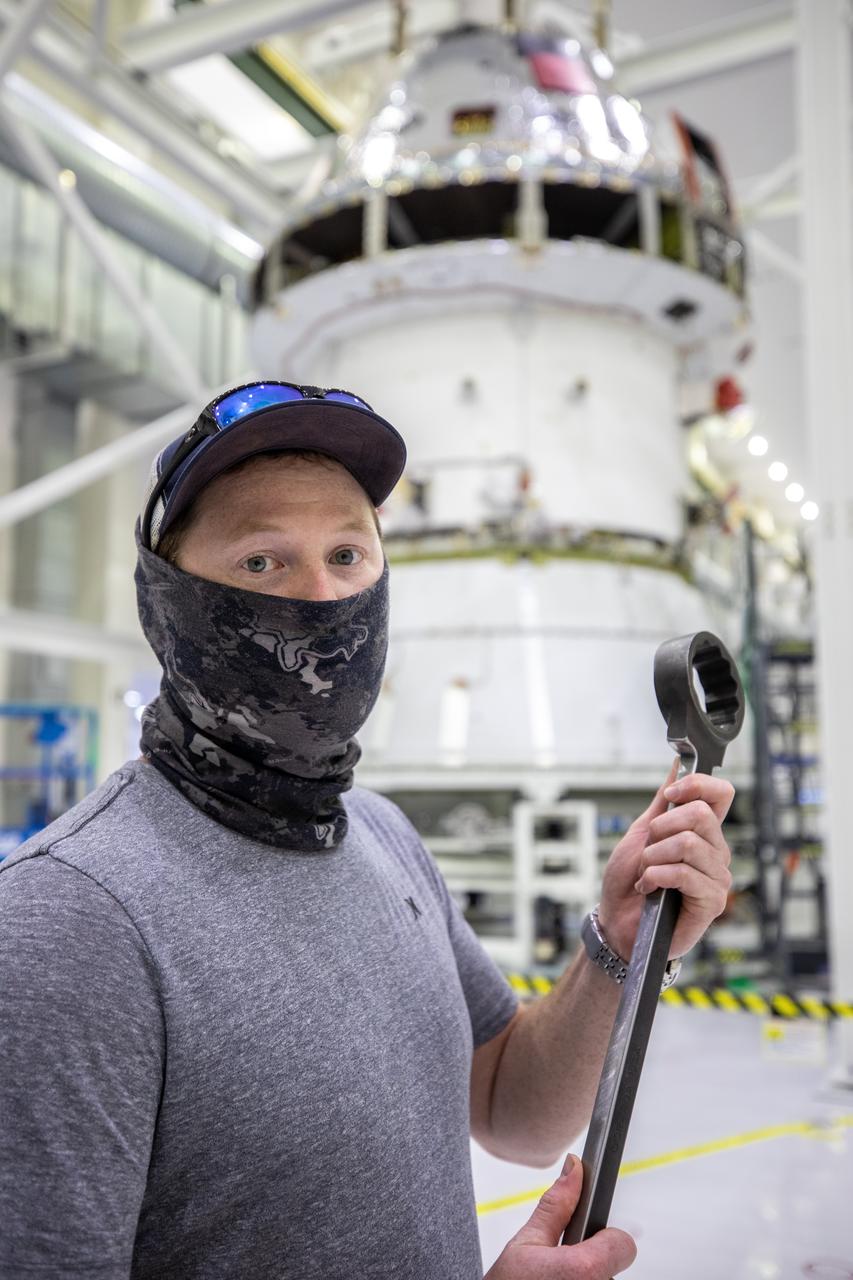
ASRC technician Chris Slack assists with the installation of the spacecraft adapter (SA) cone to the Artemis I Orion spacecraft inside the Neil Armstrong Operations and Checkout Building at NASA’s Kennedy Space Center on Aug. 10, 2020. This is one of the final major hardware operations the spacecraft will undergo during closeout processing prior to being integrated with the Space Launch System (SLS) rocket in preparation for the first Artemis mission. The spacecraft adapter cone connects the bottom portion of Orion’s service module to the top part of the rocket known as the interim cryogenic propulsion stage (ICPS). Orion will fly on the agency’s Artemis I mission – the first in a series of increasingly complex missions to the Moon that will ultimately lead to the exploration of Mars.
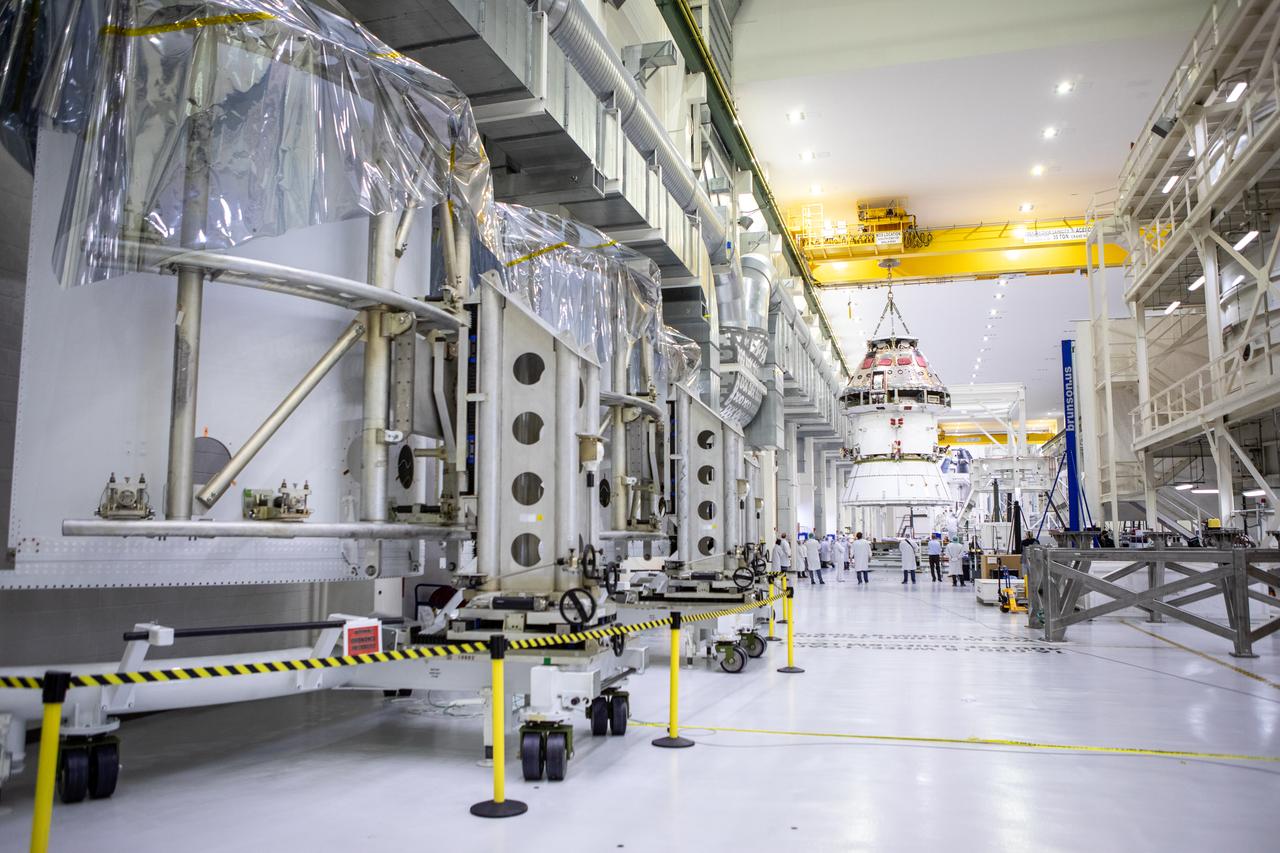
Technicians at NASA’s Kennedy Space Center in Florida work to safely return the Artemis I Orion spacecraft to the FAST cell after completing the installation of the spacecraft adapter (SA) cone inside the Neil Armstrong Operations and Checkout Building on Aug. 20, 2020. This is one of the final major hardware operations the spacecraft will undergo during closeout processing prior to being integrated with the Space Launch System (SLS) rocket in preparation for the first Artemis mission. The spacecraft adapter cone connects the bottom portion of Orion’s service module to the top part of the rocket known as the interim cryogenic propulsion stage (ICPS). In view at left in the foreground are the Spacecraft Adapter Jettison Fairing panels that will protect Orion’s service module from the environment around it during the ascent. Orion will fly on the agency’s Artemis I mission – the first in a series of increasingly complex missions to the Moon that will ultimately lead to the exploration of Mars.
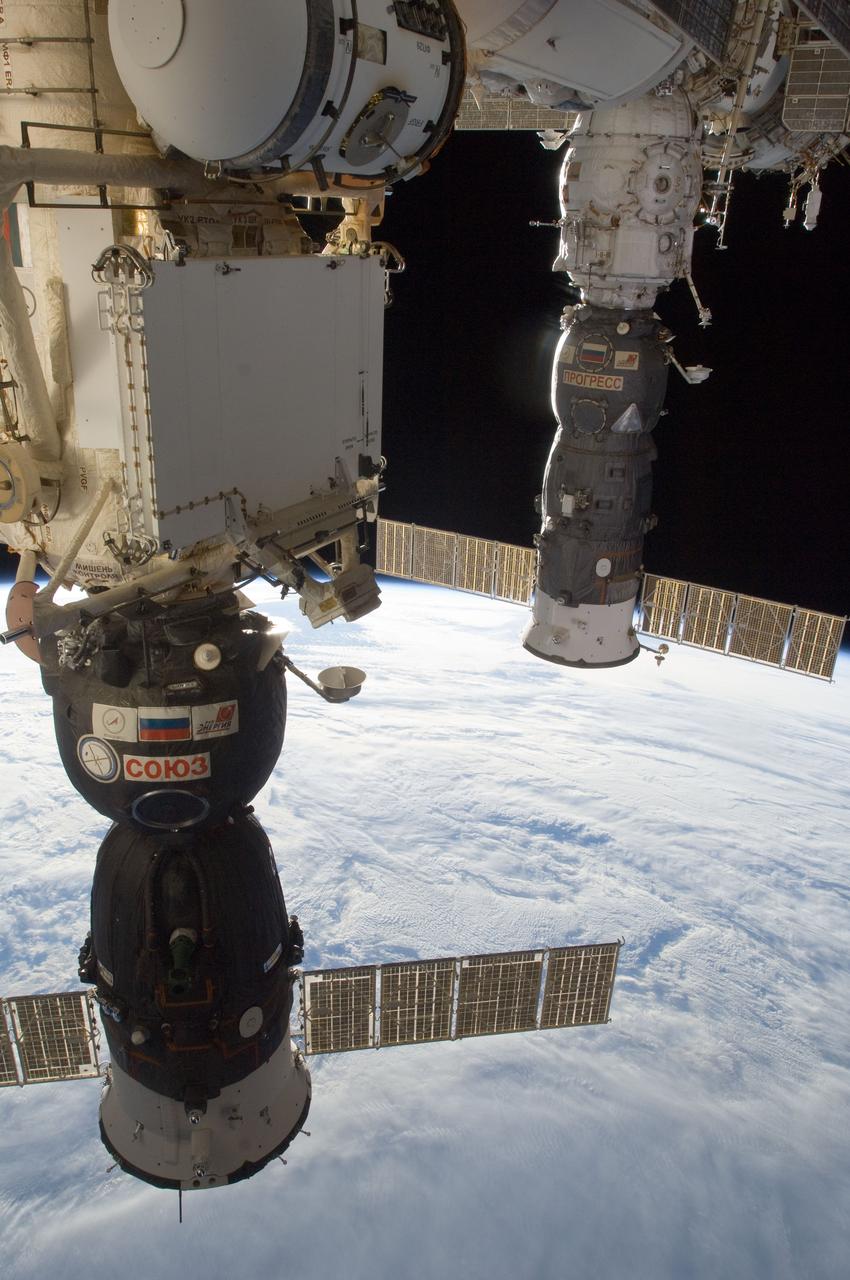
View of Soyuz Spacecraft connected to the Mini Research Module 1 MRM1), and Progress Spacecraft connected to the Pirs Docking Compartment 1 (DC1). Photo was taken during Expedition 34.
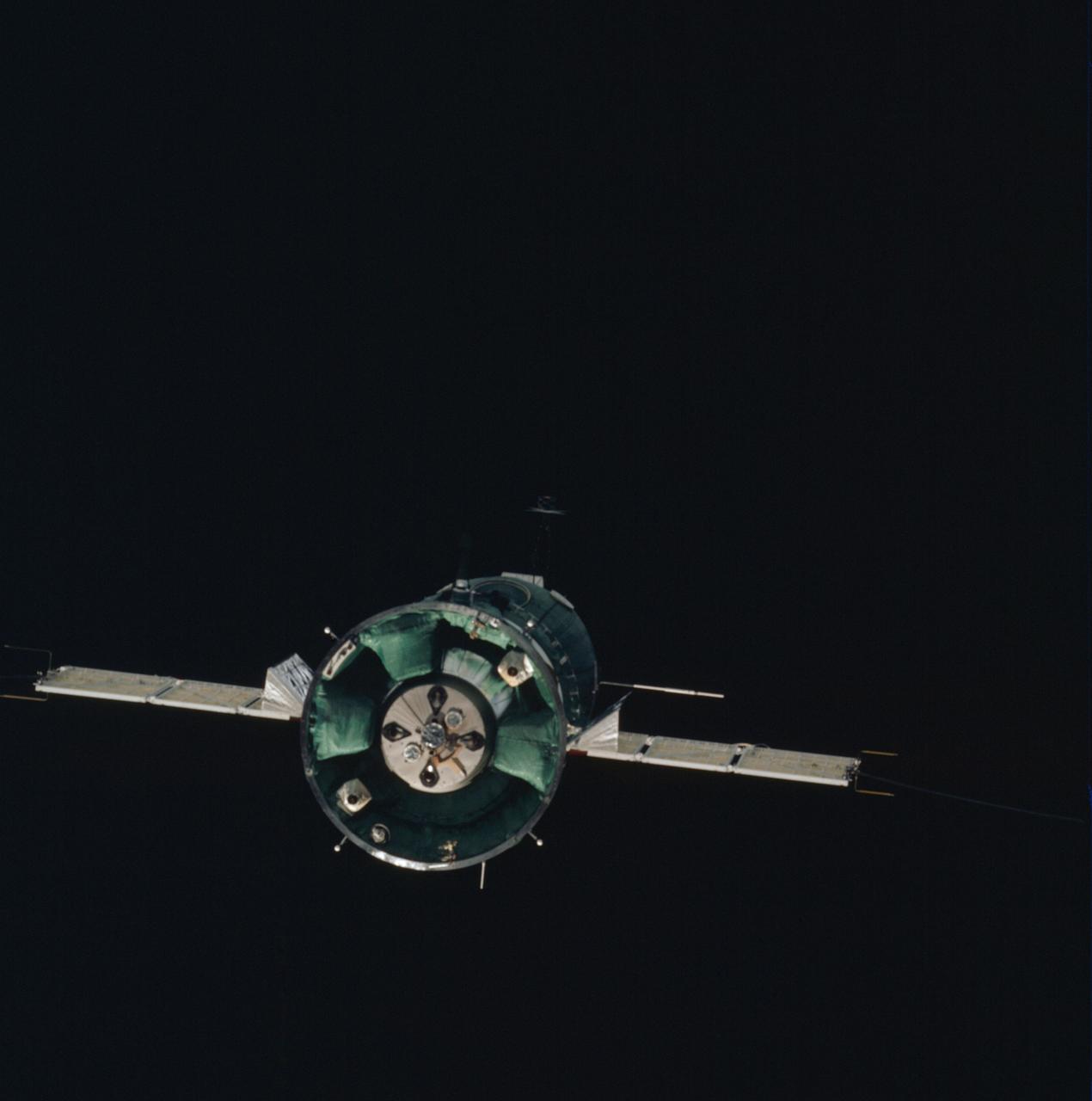
AST-01-053 (17-19 July 1975) --- The Soviet Soyuz spacecraft is contrasted against a black-sky background in this photograph taken in Earth orbit. This view is looking toward the aft end of the Soyuz. Two solar panels protrude out from the spacecraft's Instrument Assembly Module. The ASTP astronauts and cosmonauts visited each other's spacecraft while the Soyuz and Apollo were docked in Earth orbit for two days.
Technicians prepare the AIM spacecraft for fairing installation
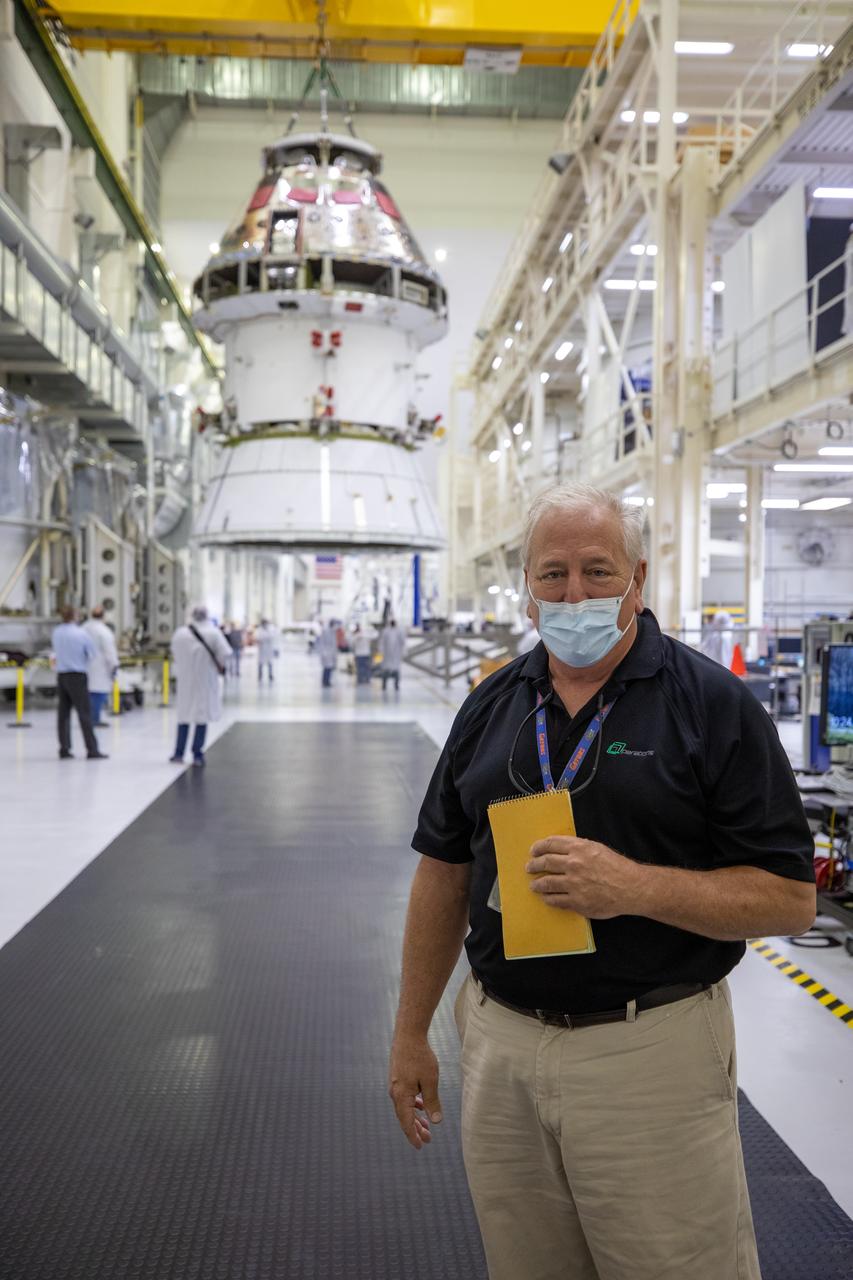
Bill Ruff, Lockheed Martin Safety manager, stands inside the Neil Armstrong Operations and Checkout Building high bay at NASA’s Kennedy Space Center in Florida on Aug. 20, 2020. Technicians are working to safely return the Artemis I Orion spacecraft to the FAST cell after completing the installation of the spacecraft adapter (SA) cone inside the high bay. This is one of the final major hardware operations the spacecraft will undergo during closeout processing prior to being integrated with the Space Launch System (SLS) rocket in preparation for the first Artemis mission. The spacecraft adapter cone connects the bottom portion of Orion’s service module to the top part of the rocket known as the interim cryogenic propulsion stage (ICPS). Orion will fly on the agency’s Artemis I mission – the first in a series of increasingly complex missions to the Moon that will ultimately lead to the exploration of Mars.
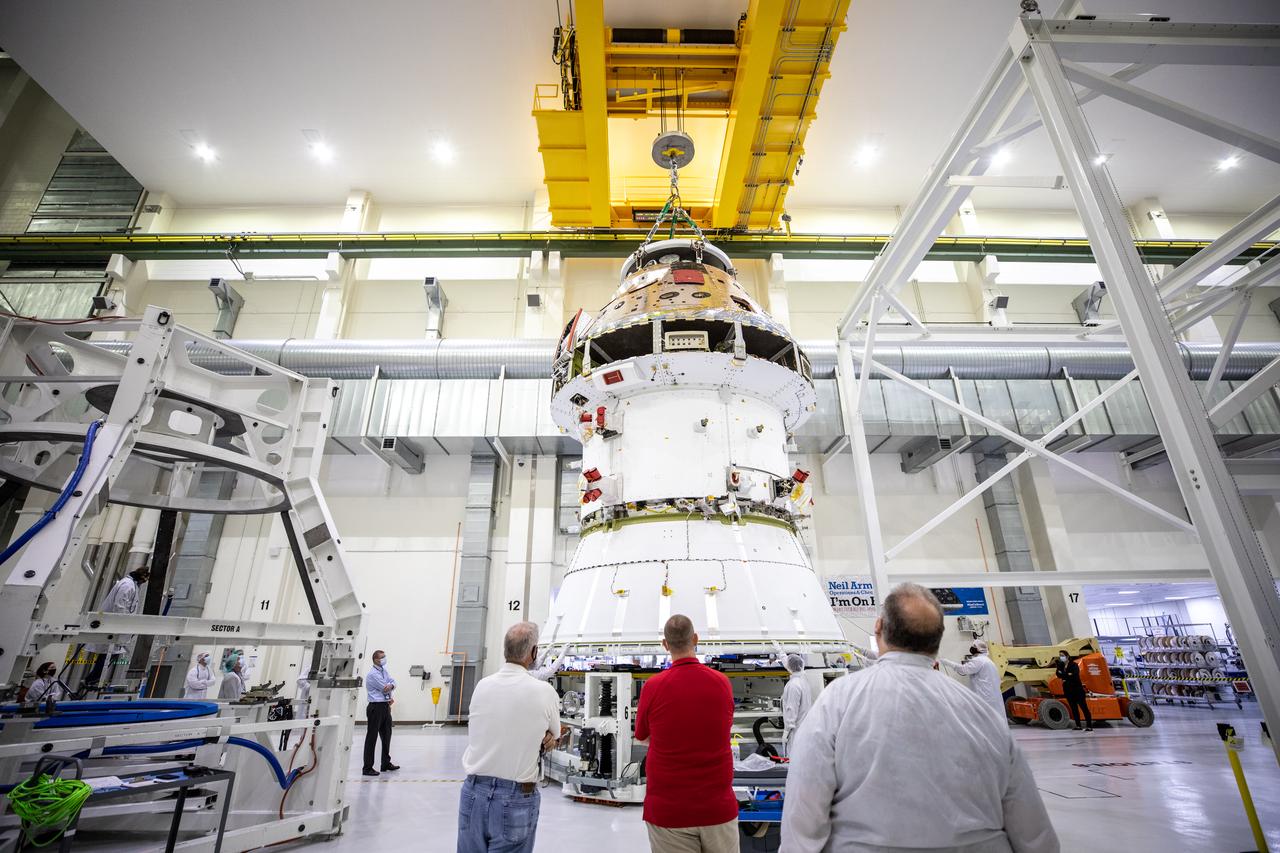
Technicians at NASA’s Kennedy Space Center in Florida work to safely return the Artemis I Orion spacecraft to the FAST cell after completing the installation of the spacecraft adapter (SA) cone inside the Neil Armstrong Operations and Checkout Building on Aug. 20, 2020. This is one of the final major hardware operations the spacecraft will undergo during closeout processing prior to being integrated with the Space Launch System (SLS) rocket in preparation for the first Artemis mission. The spacecraft adapter cone connects the bottom portion of Orion’s service module to the top part of the rocket known as the interim cryogenic propulsion stage (ICPS). Orion will fly on the agency’s Artemis I mission – the first in a series of increasingly complex missions to the Moon that will ultimately lead to the exploration of Mars.
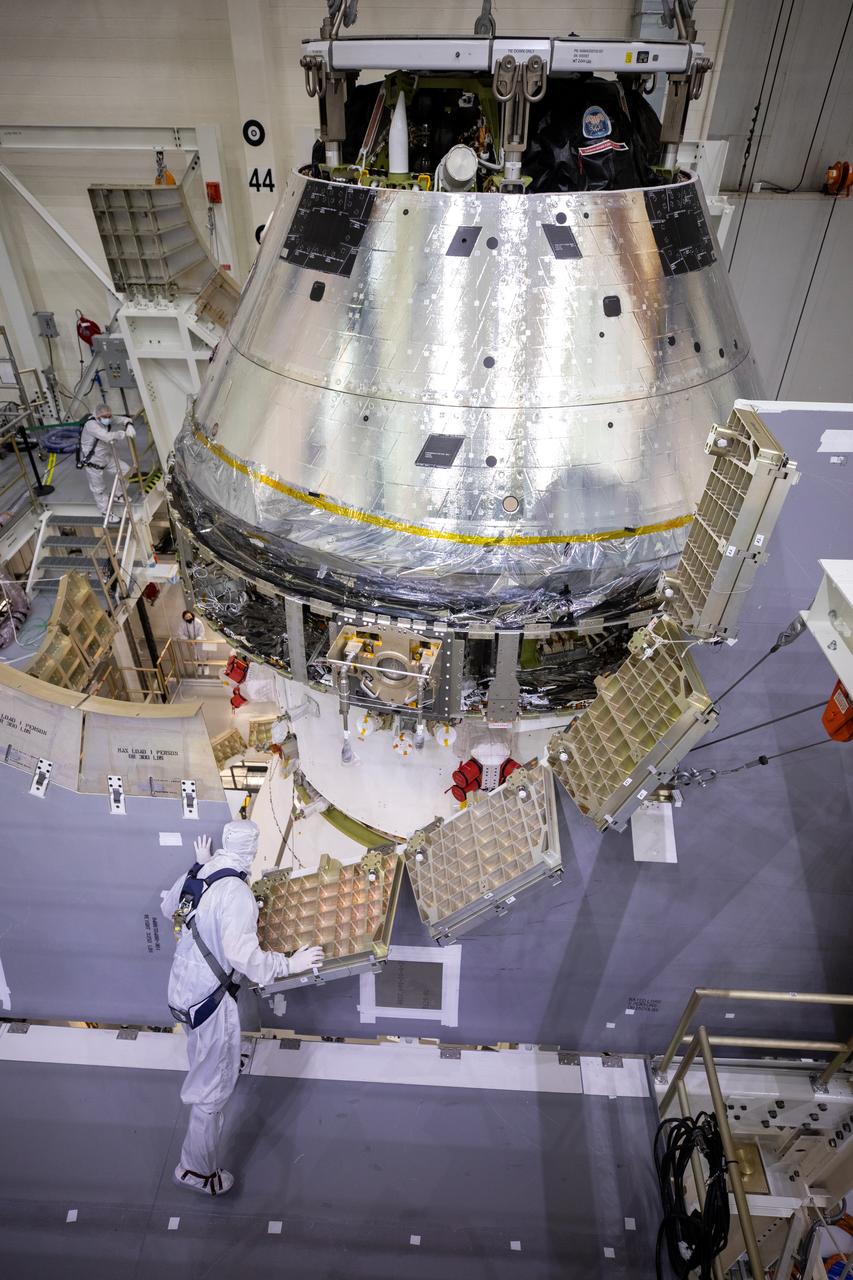
Technicians at NASA’s Kennedy Space Center in Florida work to safely lower the Artemis I Orion spacecraft into the FAST cell after completing the installation of the spacecraft adapter (SA) cone inside the Neil Armstrong Operations and Checkout Building on Aug. 20, 2020. This is one of the final major hardware operations the spacecraft will undergo during closeout processing prior to being integrated with the Space Launch System (SLS) rocket in preparation for the first Artemis mission. The spacecraft adapter cone connects the bottom portion of Orion’s service module to the top part of the rocket known as the interim cryogenic propulsion stage (ICPS). Orion will fly on the agency’s Artemis I mission – the first in a series of increasingly complex missions to the Moon that will ultimately lead to the exploration of Mars.
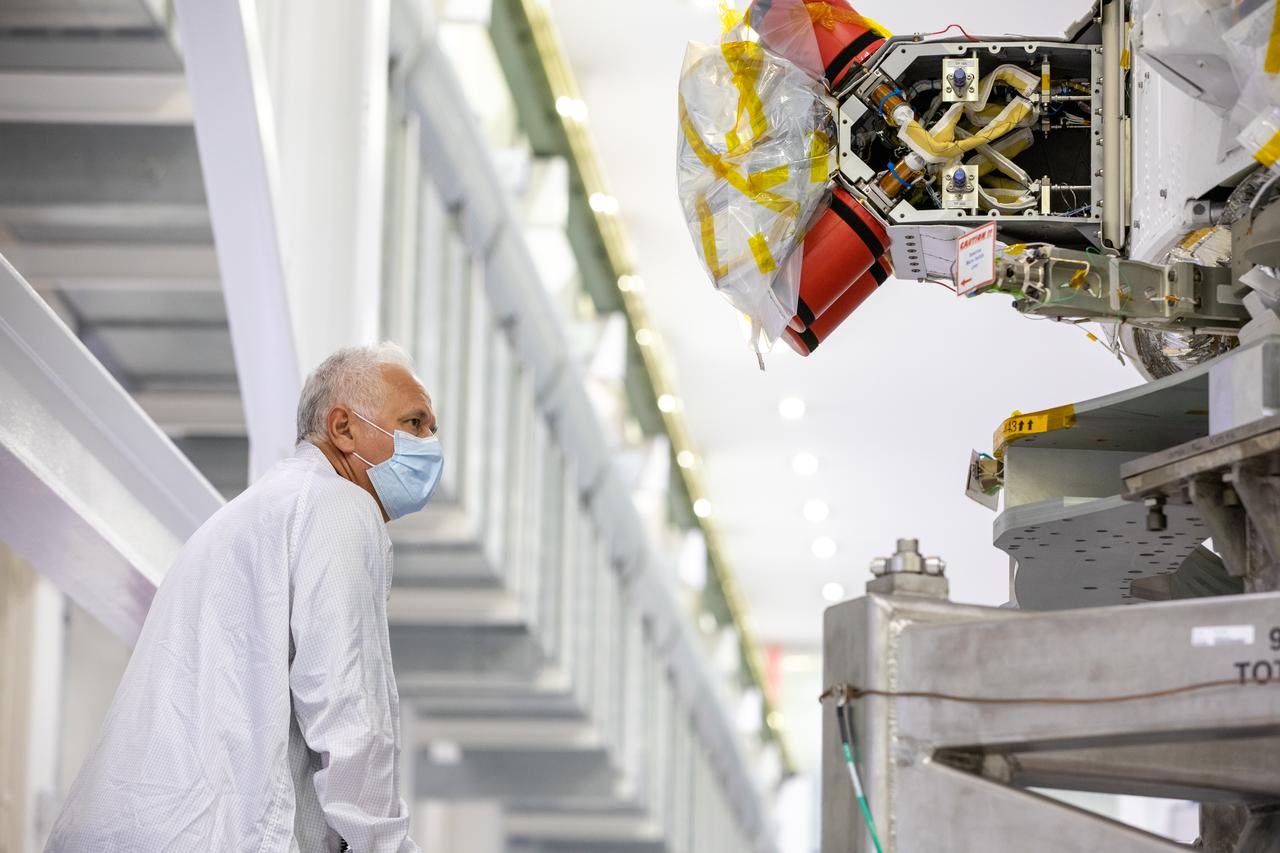
Vince Nichols, Lockheed Martin Floor Operations, inspects the Artemis I Orion spacecraft in preparation for installation of the spacecraft adapter (SA) cone inside the Neil Armstrong Operations and Checkout Building at NASA’s Kennedy Space Center in Florida on Aug. 6, 2020. This is one of the final major hardware operations the spacecraft will undergo during closeout processing prior to being integrated with the Space Launch System (SLS) rocket in preparation for the first Artemis mission. The spacecraft adapter cone connects the bottom portion of Orion’s service module to the top part of the rocket known as the interim cryogenic propulsion stage (ICPS). Orion will fly on the agency’s Artemis I mission – the first in a series of increasingly complex missions to the Moon that will ultimately lead to the exploration of Mars.
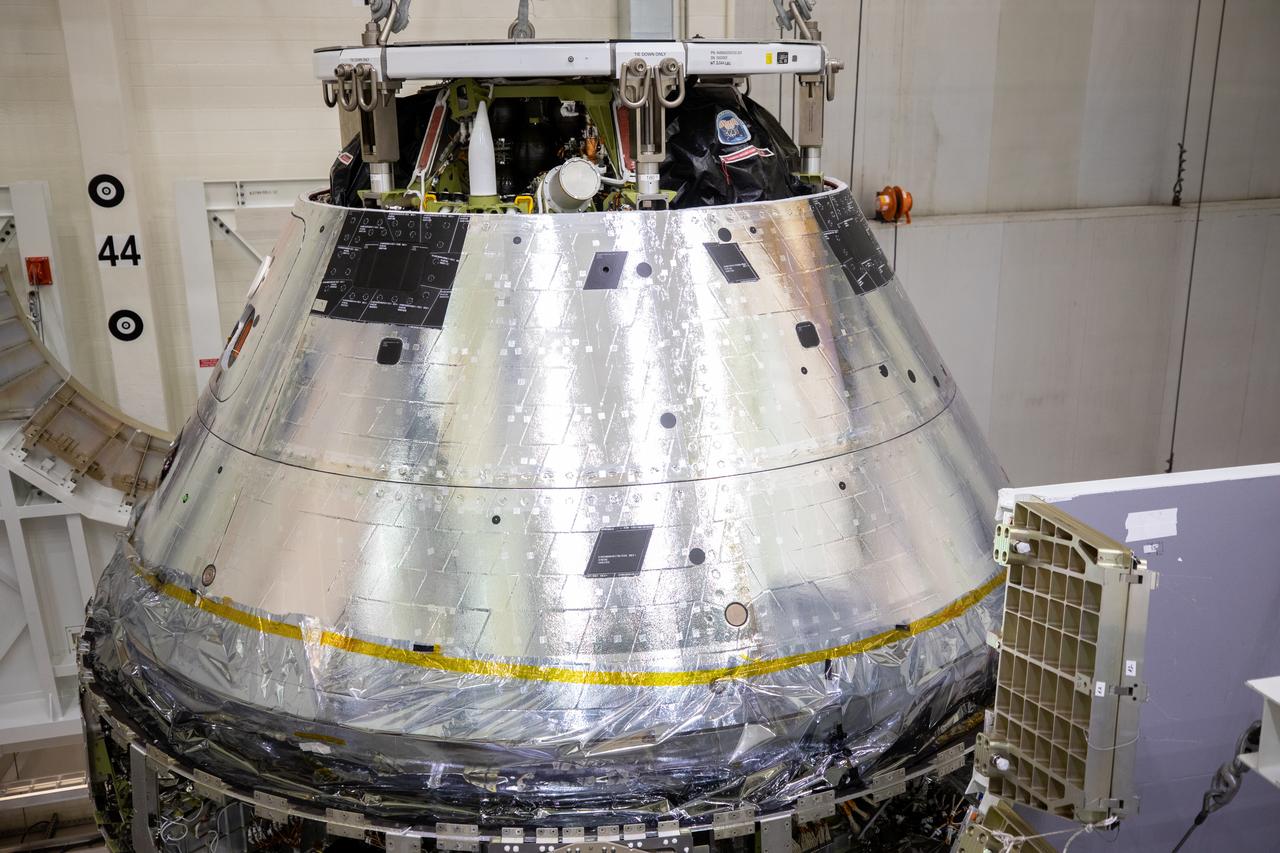
A close-up view of the Artemis I Orion spacecraft with its spacecraft adapter cone attached, is shown being lowered into the FAST cell inside the Neil Armstrong Operations and Checkout Building high bay at NASA’s Kennedy Space Center in Florida on Aug. 20, 2020. This is one of the final major hardware operations the spacecraft will undergo during closeout processing prior to being integrated with the Space Launch System (SLS) rocket in preparation for the first Artemis mission. The spacecraft adapter cone connects the bottom portion of Orion’s service module to the top part of the rocket known as the interim cryogenic propulsion stage (ICPS). Orion will fly on the agency’s Artemis I mission – the first in a series of increasingly complex missions to the Moon that will ultimately lead to the exploration of Mars.
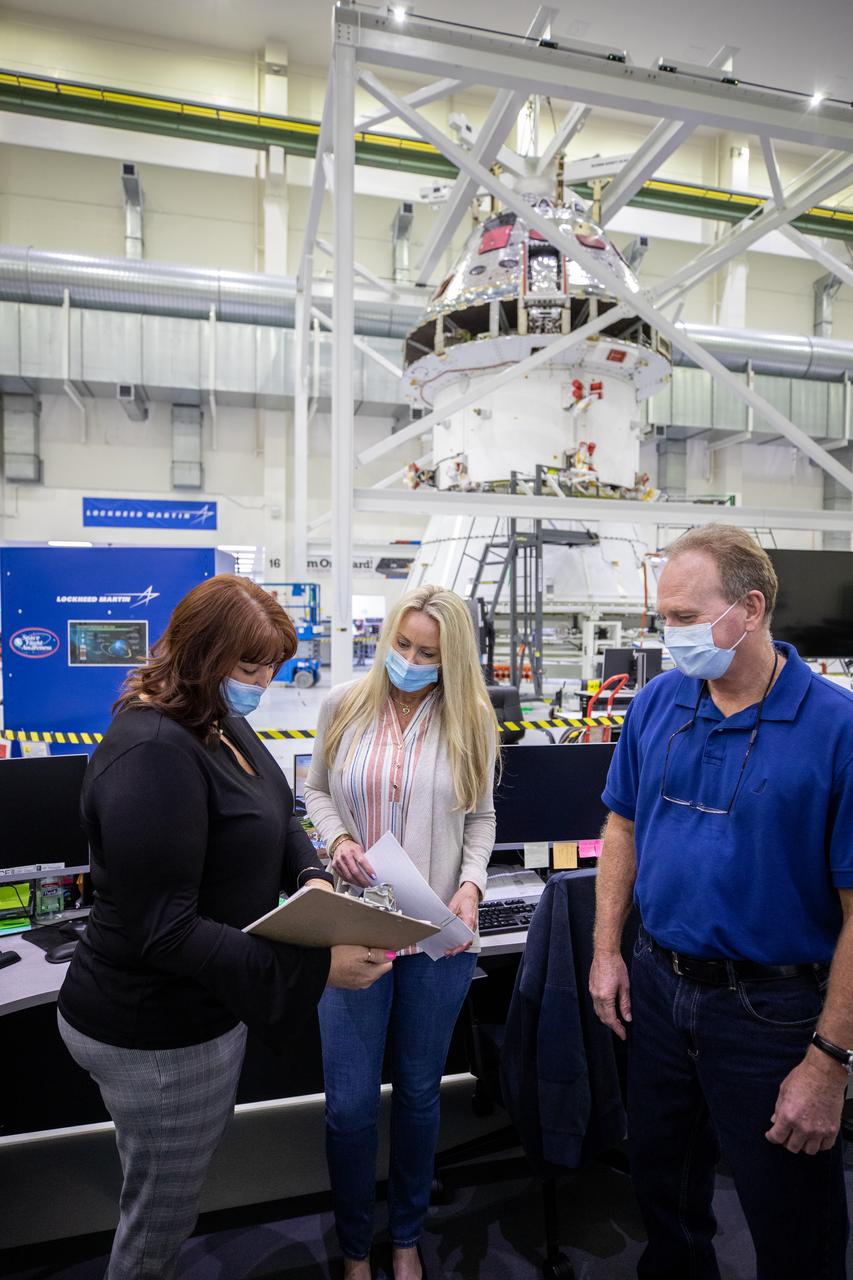
From left, Michelle Clontz and Sharon Prisco, with Lockheed Martin security operations, and Newt Allen, ASRC operations, assist with the installation of the spacecraft adapter (SA) cone to the Artemis I Orion spacecraft inside the Neil Armstrong Operations and Checkout Building at NASA’s Kennedy Space Center on Aug. 10, 2020. This is one of the final major hardware operations the spacecraft will undergo during closeout processing prior to being integrated with the Space Launch System (SLS) rocket in preparation for the first Artemis mission. The spacecraft adapter cone connects the bottom portion of Orion’s service module to the top part of the rocket known as the interim cryogenic propulsion stage (ICPS). Orion will fly on the agency’s Artemis I mission – the first in a series of increasingly complex missions to the Moon that will ultimately lead to the exploration of Mars.
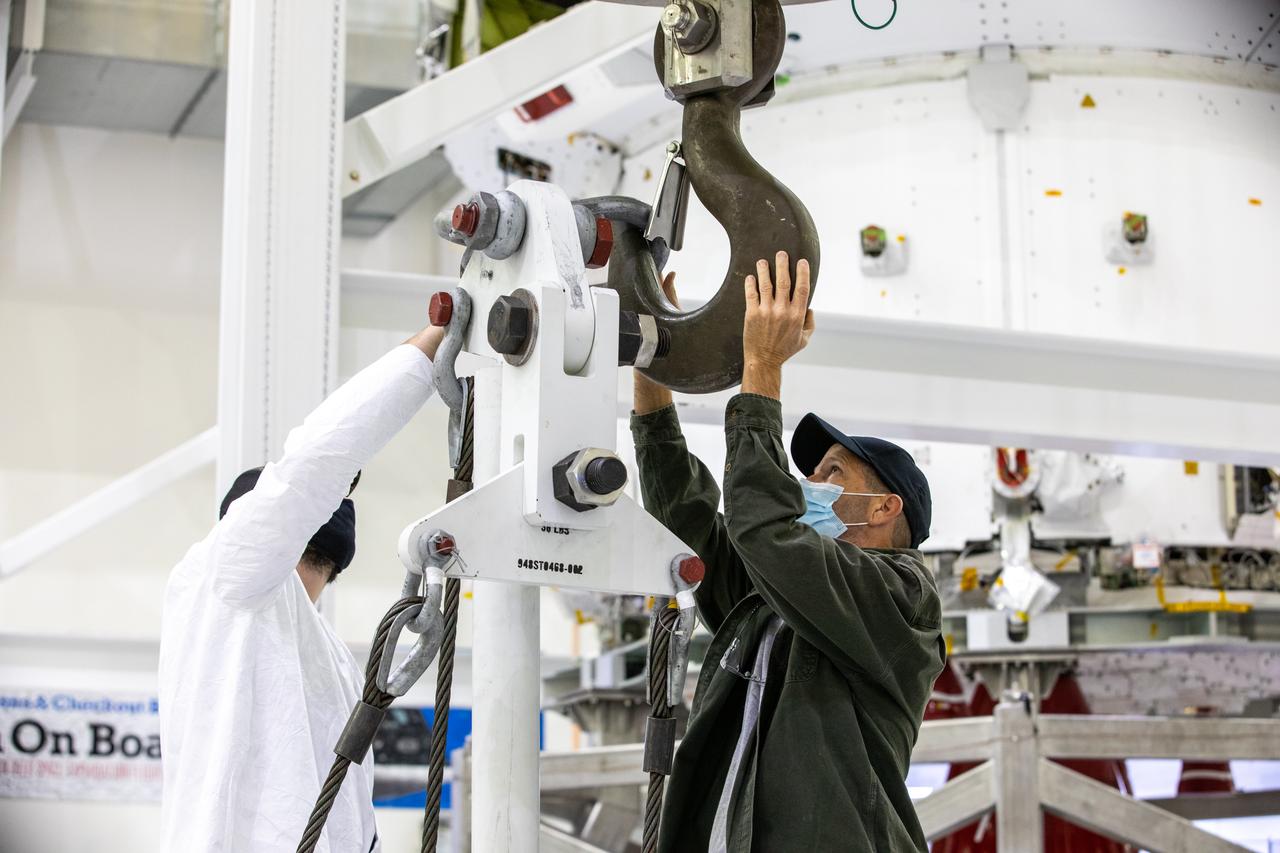
ASRC technicians Dustin Swickert, to the left. and John Nesbitt, to the right, work to attach the crane that lifts the Artemis I Orion spacecraft in preparation for installation of the spacecraft adapter (SA) cone inside the Neil Armstrong Operations and Checkout Building at NASA’s Kennedy Space Center in Florida on Aug. 6, 2020. This is one of the final major hardware operations the spacecraft will undergo during closeout processing prior to being integrated with the Space Launch System (SLS) rocket in preparation for the first Artemis mission. The spacecraft adapter cone connects the bottom portion of Orion’s service module to the top part of the rocket known as the interim cryogenic propulsion stage (ICPS). Orion will fly on the agency’s Artemis I mission – the first in a series of increasingly complex missions to the Moon that will ultimately lead to the exploration of Mars.
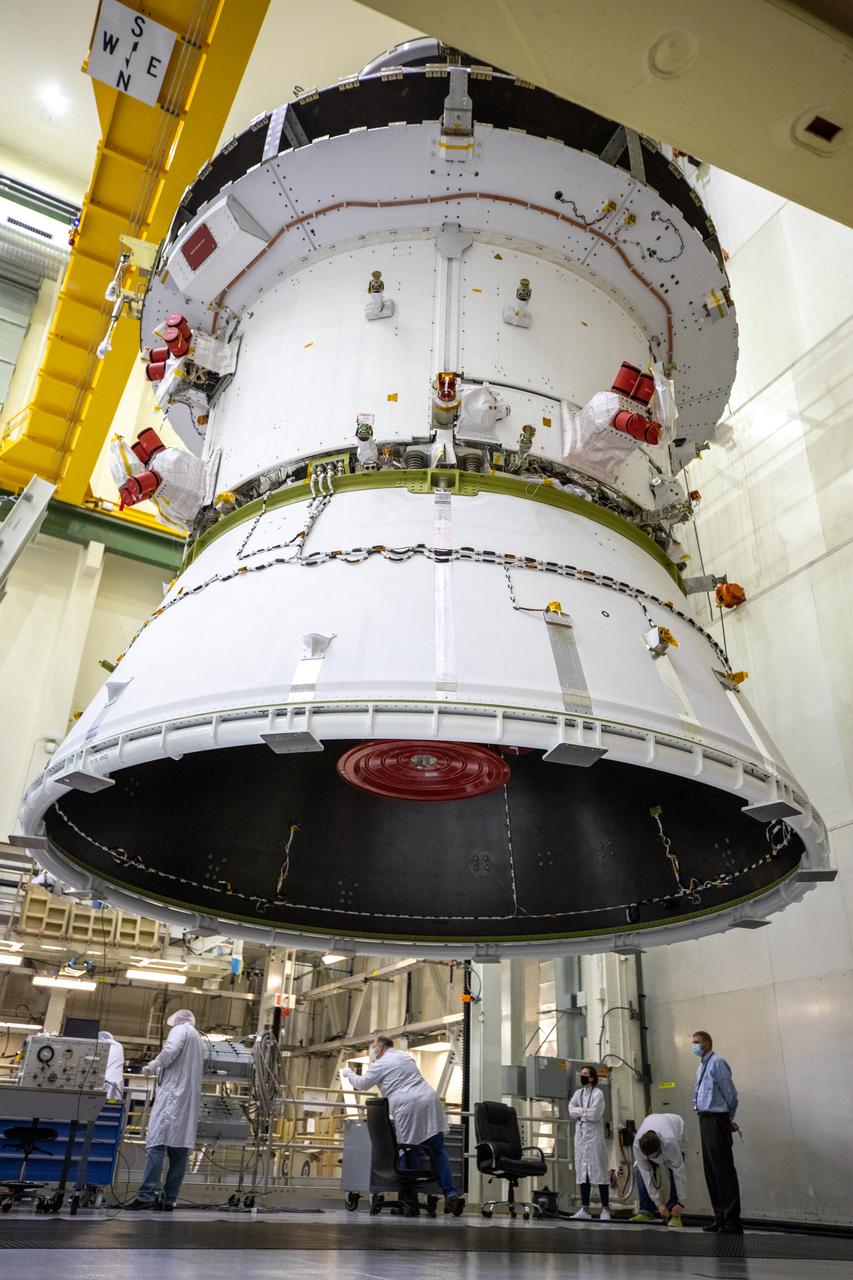
The Artemis I Orion spacecraft with its spacecraft adapter cone attached, is moved by crane along the high bay inside the Neil Armstrong Operations and Checkout Building at NASA’s Kennedy Space Center in Florida on Aug. 20, 2020. This is one of the final major hardware operations the spacecraft will undergo during closeout processing prior to being integrated with the Space Launch System (SLS) rocket in preparation for the first Artemis mission. The spacecraft adapter cone connects the bottom portion of Orion’s service module to the top part of the rocket known as the interim cryogenic propulsion stage (ICPS). Orion will fly on the agency’s Artemis I mission – the first in a series of increasingly complex missions to the Moon that will ultimately lead to the exploration of Mars.
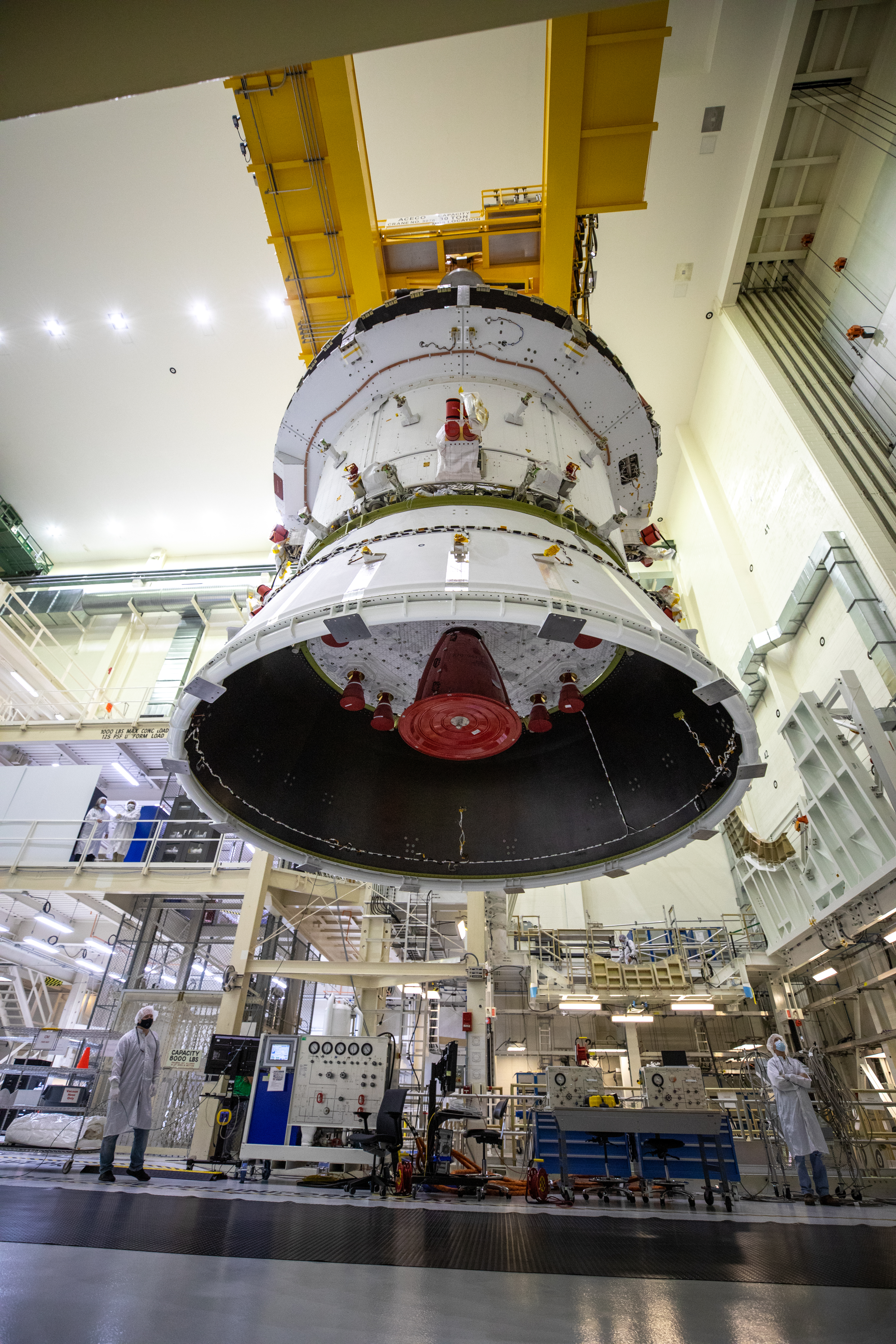
The Artemis I Orion spacecraft with its spacecraft adapter cone attached, is moved by crane along the high bay inside the Neil Armstrong Operations and Checkout Building at NASA’s Kennedy Space Center in Florida on Aug. 20, 2020. This is one of the final major hardware operations the spacecraft will undergo during closeout processing prior to being integrated with the Space Launch System (SLS) rocket in preparation for the first Artemis mission. The spacecraft adapter cone connects the bottom portion of Orion’s service module to the top part of the rocket known as the interim cryogenic propulsion stage (ICPS). Orion will fly on the agency’s Artemis I mission – the first in a series of increasingly complex missions to the Moon that will ultimately lead to the exploration of Mars.
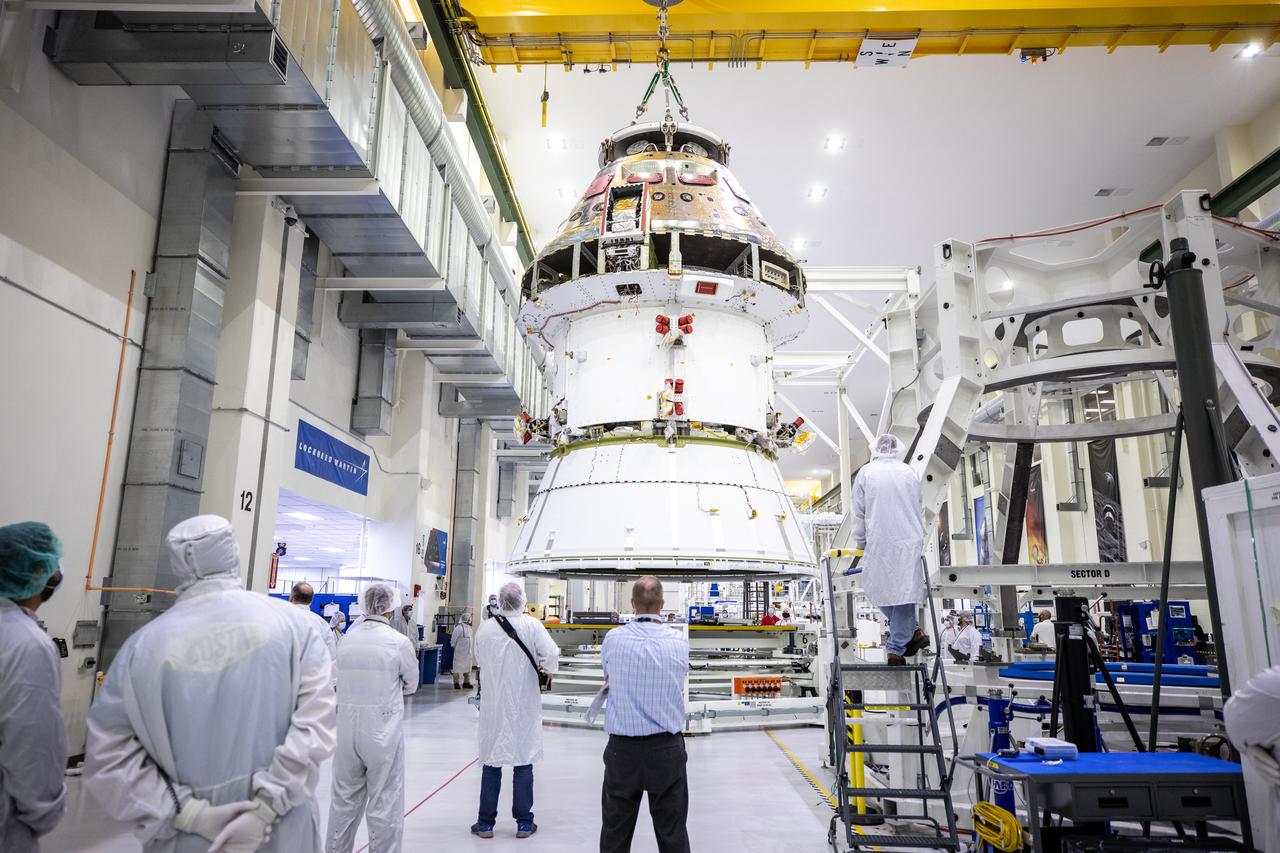
Technicians at NASA’s Kennedy Space Center in Florida work to safely return the Artemis I Orion spacecraft to the FAST cell after completing the installation of the spacecraft adapter (SA) cone inside the Neil Armstrong Operations and Checkout Building on Aug. 20, 2020. This is one of the final major hardware operations the spacecraft will undergo during closeout processing prior to being integrated with the Space Launch System (SLS) rocket in preparation for the first Artemis mission. The spacecraft adapter cone connects the bottom portion of Orion’s service module to the top part of the rocket known as the interim cryogenic propulsion stage (ICPS). Orion will fly on the agency’s Artemis I mission – the first in a series of increasingly complex missions to the Moon that will ultimately lead to the exploration of Mars.
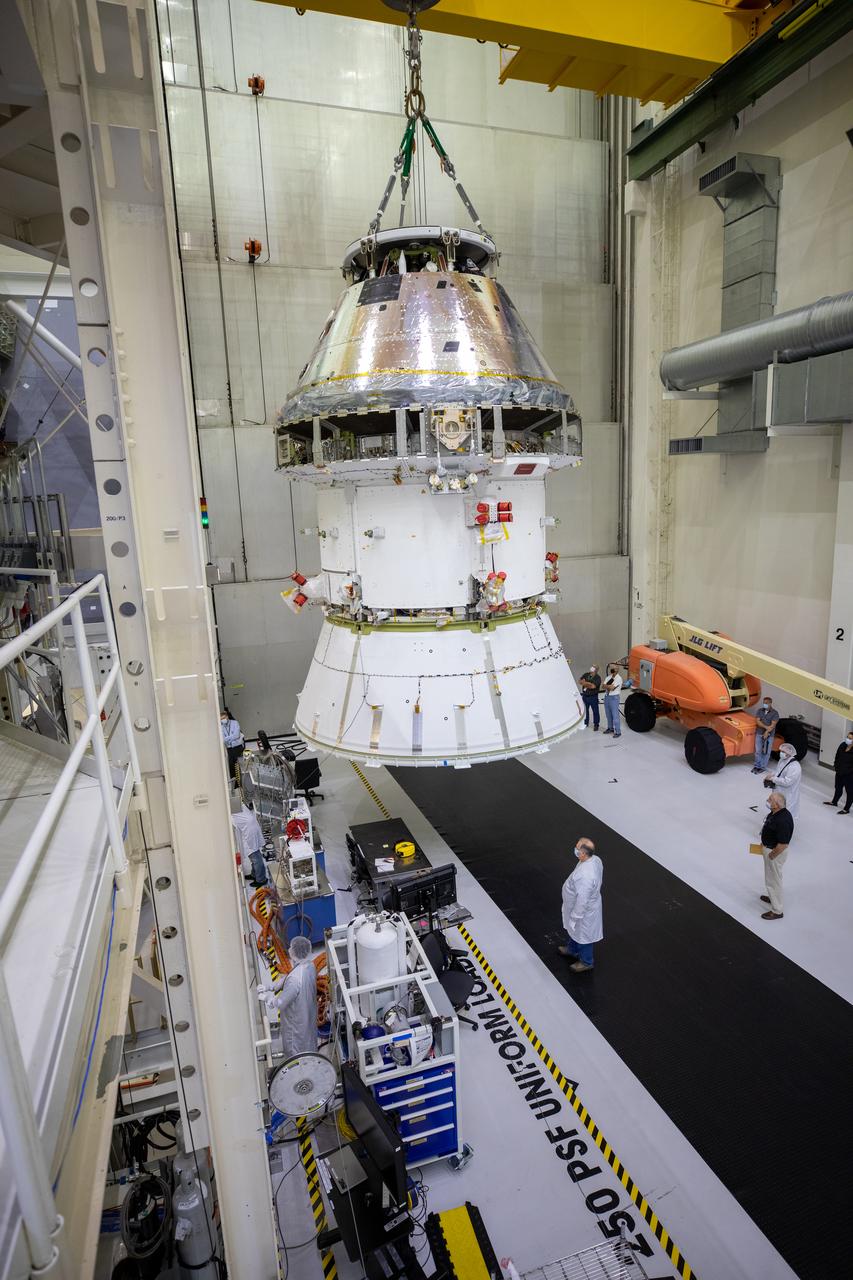
The Artemis I Orion spacecraft with its spacecraft adapter cone attached, is moved by crane along the high bay inside the Neil Armstrong Operations and Checkout Building at NASA’s Kennedy Space Center in Florida on Aug. 20, 2020. This is one of the final major hardware operations the spacecraft will undergo during closeout processing prior to being integrated with the Space Launch System (SLS) rocket in preparation for the first Artemis mission. The spacecraft adapter cone connects the bottom portion of Orion’s service module to the top part of the rocket known as the interim cryogenic propulsion stage (ICPS). Orion will fly on the agency’s Artemis I mission – the first in a series of increasingly complex missions to the Moon that will ultimately lead to the exploration of Mars.
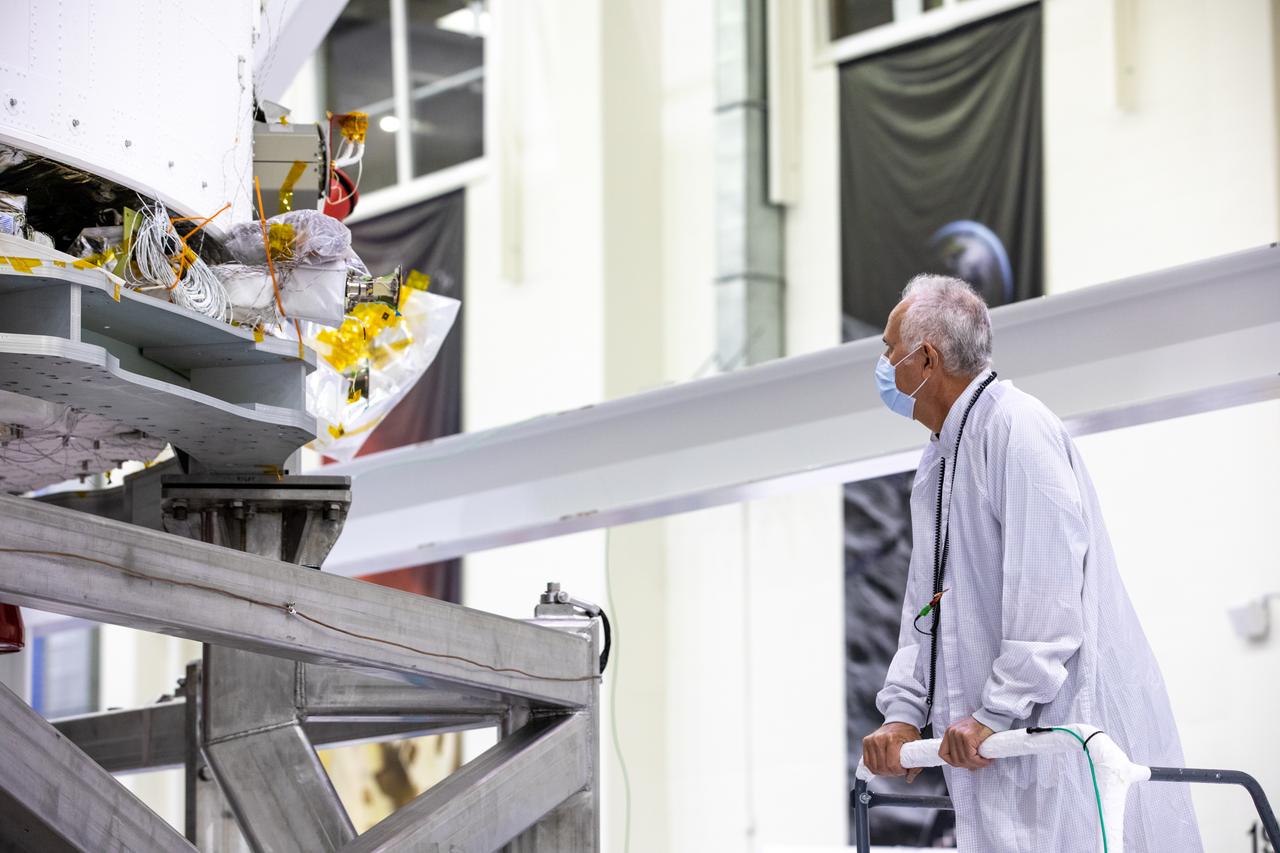
Vince Nichols, Lockheed Martin Floor Operations, inspects the Artemis I Orion spacecraft in preparation for installation of the spacecraft adapter (SA) cone inside the Neil Armstrong Operations and Checkout Building at NASA’s Kennedy Space Center in Florida on Aug. 6, 2020. This is one of the final major hardware operations the spacecraft will undergo during closeout processing prior to being integrated with the Space Launch System (SLS) rocket in preparation for the first Artemis mission. The spacecraft adapter cone connects the bottom portion of Orion’s service module to the top part of the rocket known as the interim cryogenic propulsion stage (ICPS). Orion will fly on the agency’s Artemis I mission – the first in a series of increasingly complex missions to the Moon that will ultimately lead to the exploration of Mars.
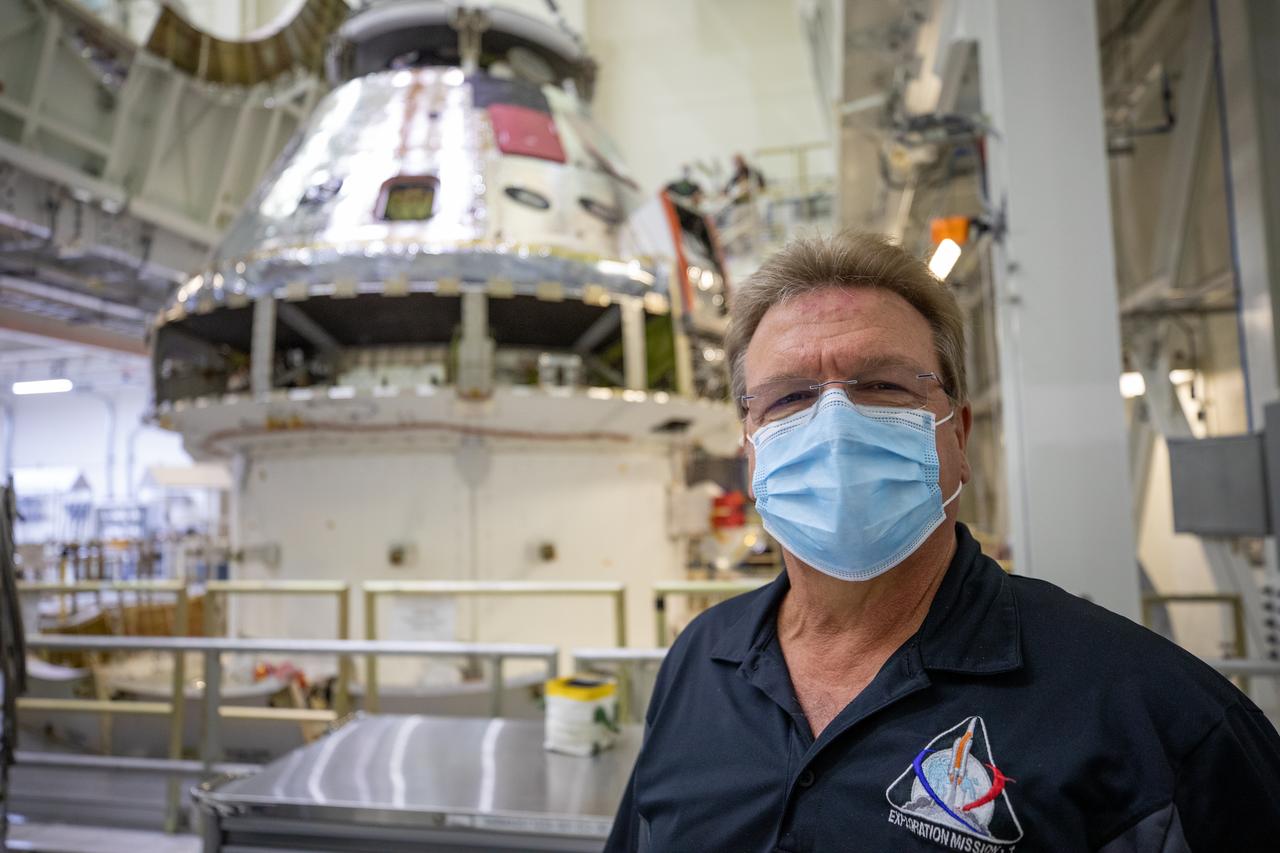
Jules Schneider, Lockheed Martin Assembly, Test and Launch Operations director, is shown inside the Neil Armstrong Operations and Checkout Building high bay in front of the FAST cell as the Artemis I Orion spacecraft is lowered by crane after installation of the spacecraft adapter (SA) cone was completed on Aug. 20, 2020. This is one of the final major hardware operations the spacecraft will undergo during closeout processing prior to being integrated with the Space Launch System (SLS) rocket in preparation for the first Artemis mission. The spacecraft adapter cone connects the bottom portion of Orion’s service module to the top part of the rocket known as the interim cryogenic propulsion stage (ICPS). Orion will fly on the agency’s Artemis I mission – the first in a series of increasingly complex missions to the Moon that will ultimately lead to the exploration of Mars.
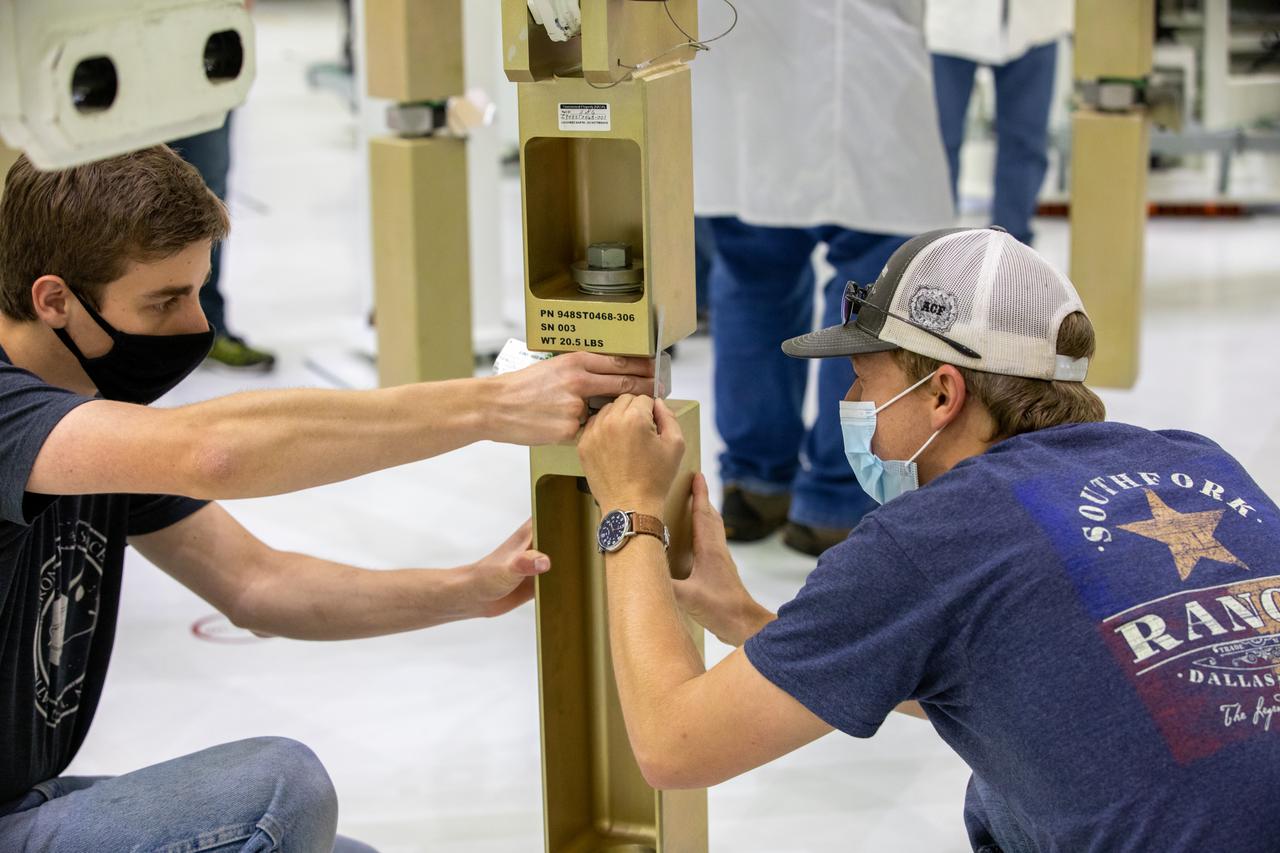
ASRC technicians William Coddington, to the left and Cameron Fitch, to the right, work to ready the Super Station fixture that will support the installation of the spacecraft adapter (SA) cone to the Artemis I Orion spacecraft is in progress inside the Neil Armstrong Operations and Checkout Building at NASA’s Kennedy Space Center in Florida on Aug. 6, 2020. This is one of the final major hardware operations the spacecraft will undergo during closeout processing prior to being integrated with the Space Launch System (SLS) rocket in preparation for the first Artemis mission. The spacecraft adapter cone connects the bottom portion of Orion’s service module to the top part of the rocket known as the interim cryogenic propulsion stage (ICPS). Orion will fly on the agency’s Artemis I mission – the first in a series of increasingly complex missions to the Moon that will ultimately lead to the exploration of Mars.
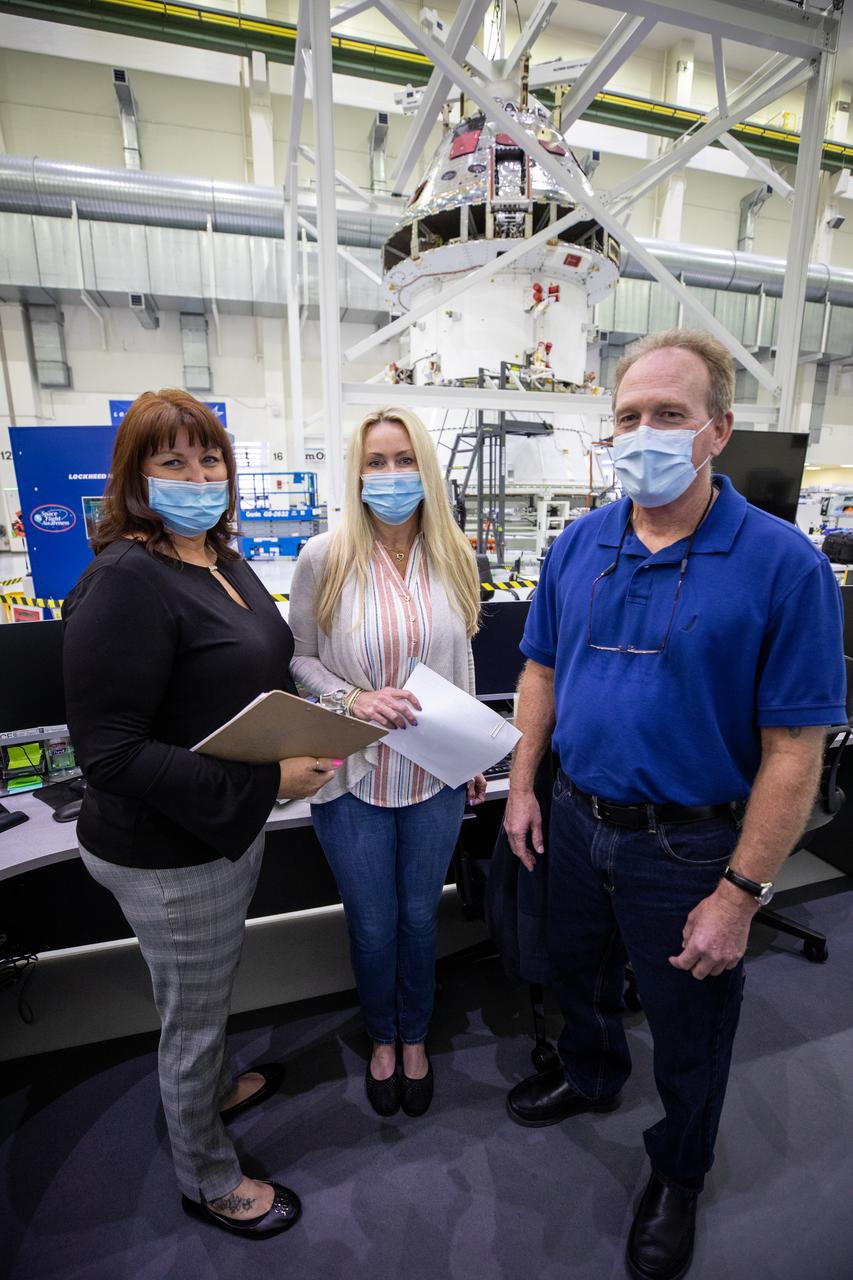
From left, Michelle Clontz and Sharon Prisco, with Lockheed Martin security operations, and Newt Allen, ASRC operations, assist with the installation of the spacecraft adapter (SA) cone to the Artemis I Orion spacecraft inside the Neil Armstrong Operations and Checkout Building at NASA’s Kennedy Space Center on Aug. 10, 2020. This is one of the final major hardware operations the spacecraft will undergo during closeout processing prior to being integrated with the Space Launch System (SLS) rocket in preparation for the first Artemis mission. The spacecraft adapter cone connects the bottom portion of Orion’s service module to the top part of the rocket known as the interim cryogenic propulsion stage (ICPS). Orion will fly on the agency’s Artemis I mission – the first in a series of increasingly complex missions to the Moon that will ultimately lead to the exploration of Mars.
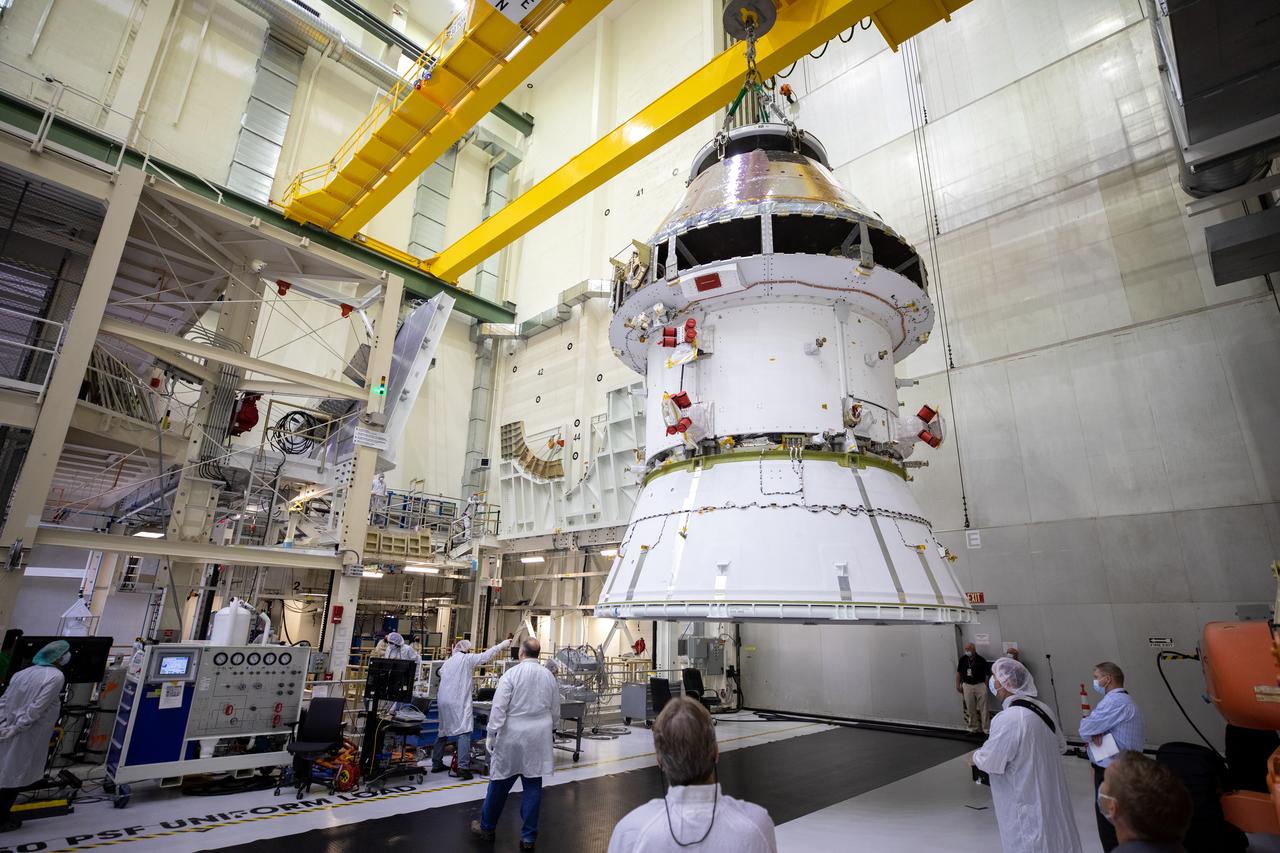
Technicians at NASA’s Kennedy Space Center in Florida work to safely lower the Artemis I Orion spacecraft into the FAST cell after completing the installation of the spacecraft adapter (SA) cone inside the Neil Armstrong Operations and Checkout Building on Aug. 20, 2020. This is one of the final major hardware operations the spacecraft will undergo during closeout processing prior to being integrated with the Space Launch System (SLS) rocket in preparation for the first Artemis mission. The spacecraft adapter cone connects the bottom portion of Orion’s service module to the top part of the rocket known as the interim cryogenic propulsion stage (ICPS). Orion will fly on the agency’s Artemis I mission – the first in a series of increasingly complex missions to the Moon that will ultimately lead to the exploration of Mars.
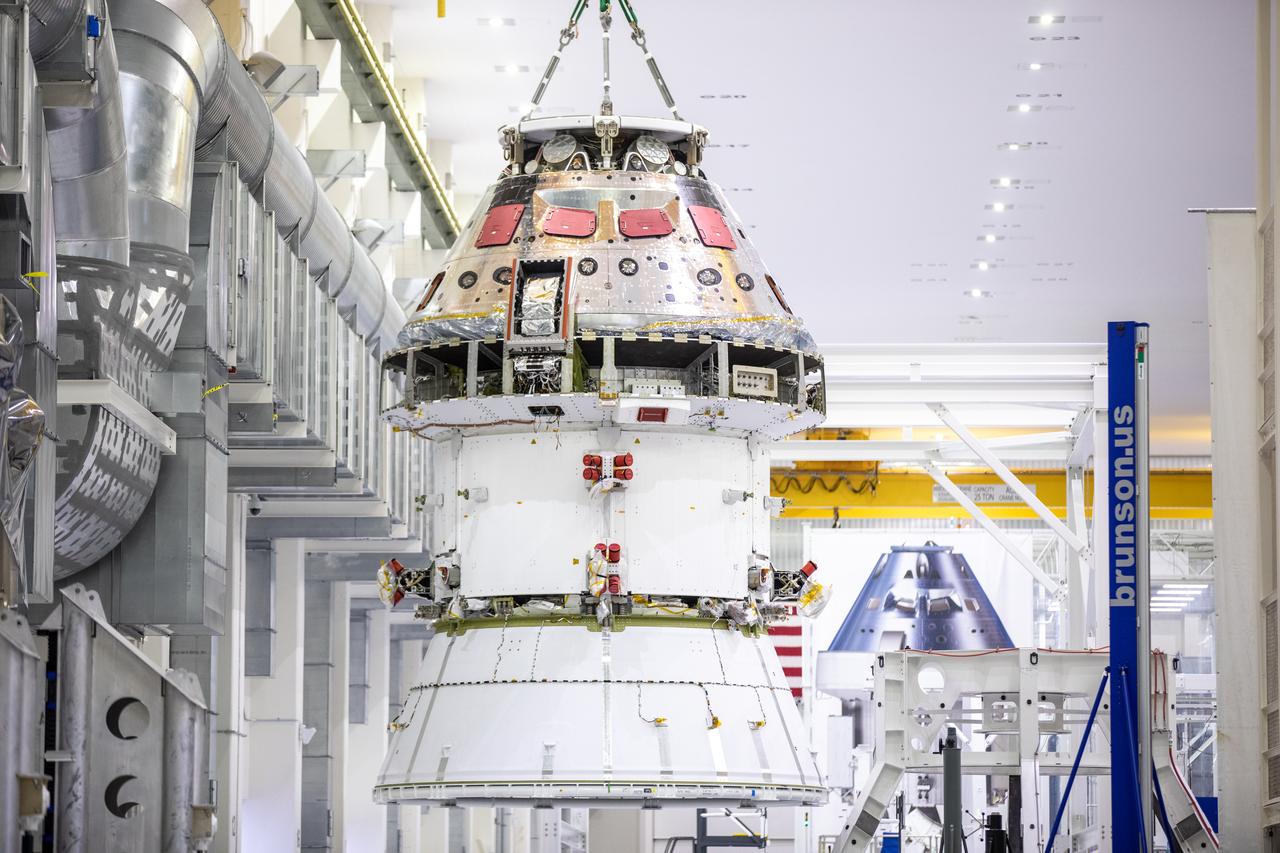
Technicians at NASA’s Kennedy Space Center in Florida work to safely return the Artemis I Orion spacecraft to the FAST cell after completing the installation of the spacecraft adapter (SA) cone inside the Neil Armstrong Operations and Checkout Building on Aug. 20, 2020. This is one of the final major hardware operations the spacecraft will undergo during closeout processing prior to being integrated with the Space Launch System (SLS) rocket in preparation for the first Artemis mission. The spacecraft adapter cone connects the bottom portion of Orion’s service module to the top part of the rocket known as the interim cryogenic propulsion stage (ICPS). Orion will fly on the agency’s Artemis I mission – the first in a series of increasingly complex missions to the Moon that will ultimately lead to the exploration of Mars.
Technicians at NASA’s Kennedy Space Center in Florida work to safely return the Artemis I Orion spacecraft to the FAST cell after completing the installation of the spacecraft adapter (SA) cone inside the Neil Armstrong Operations and Checkout Building on Aug. 20, 2020. This is one of the final major hardware operations the spacecraft will undergo during closeout processing prior to being integrated with the Space Launch System (SLS) rocket in preparation for the first Artemis mission. The spacecraft adapter cone connects the bottom portion of Orion’s service module to the top part of the rocket known as the interim cryogenic propulsion stage (ICPS). Orion will fly on the agency’s Artemis I mission – the first in a series of increasingly complex missions to the Moon that will ultimately lead to the exploration of Mars.
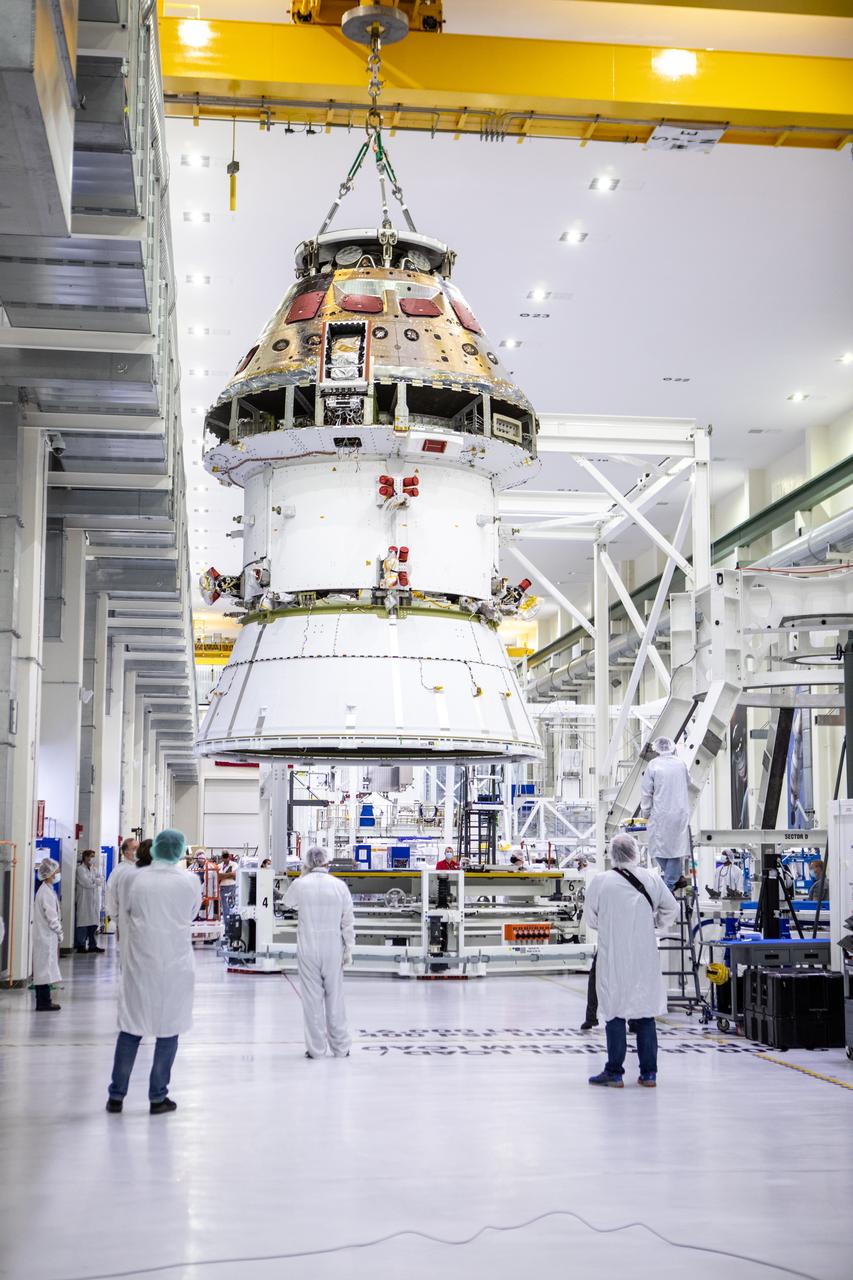
The Artemis I Orion spacecraft with its spacecraft adapter cone attached, is moved by crane along the high bay inside the Neil Armstrong Operations and Checkout Building at NASA’s Kennedy Space Center in Florida on Aug. 20, 2020. This is one of the final major hardware operations the spacecraft will undergo during closeout processing prior to being integrated with the Space Launch System (SLS) rocket in preparation for the first Artemis mission. The spacecraft adapter cone connects the bottom portion of Orion’s service module to the top part of the rocket known as the interim cryogenic propulsion stage (ICPS). Orion will fly on the agency’s Artemis I mission – the first in a series of increasingly complex missions to the Moon that will ultimately lead to the exploration of Mars.
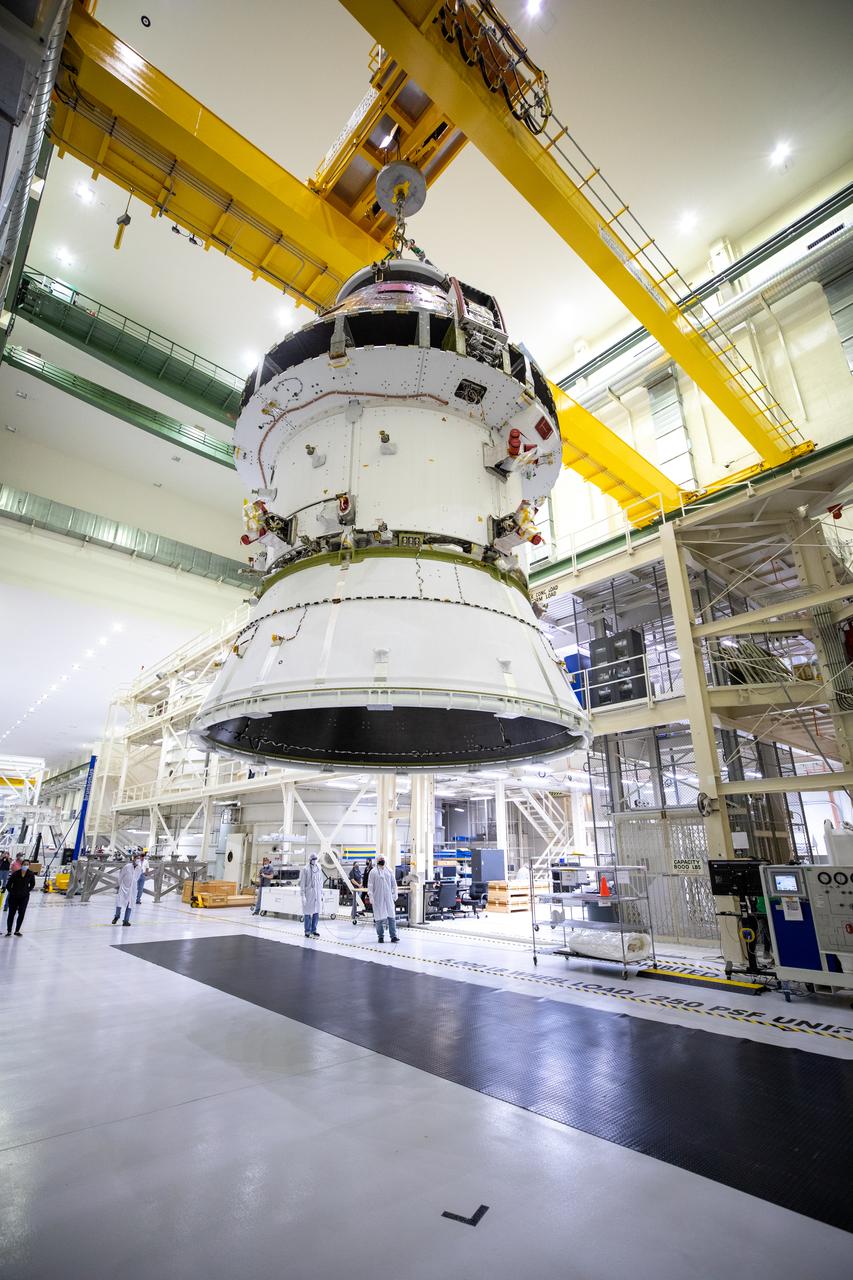
The Artemis I Orion spacecraft with its spacecraft adapter cone attached, is moved by crane along the high bay inside the Neil Armstrong Operations and Checkout Building at NASA’s Kennedy Space Center in Florida on Aug. 20, 2020. This is one of the final major hardware operations the spacecraft will undergo during closeout processing prior to being integrated with the Space Launch System (SLS) rocket in preparation for the first Artemis mission. The spacecraft adapter cone connects the bottom portion of Orion’s service module to the top part of the rocket known as the interim cryogenic propulsion stage (ICPS). Orion will fly on the agency’s Artemis I mission – the first in a series of increasingly complex missions to the Moon that will ultimately lead to the exploration of Mars.
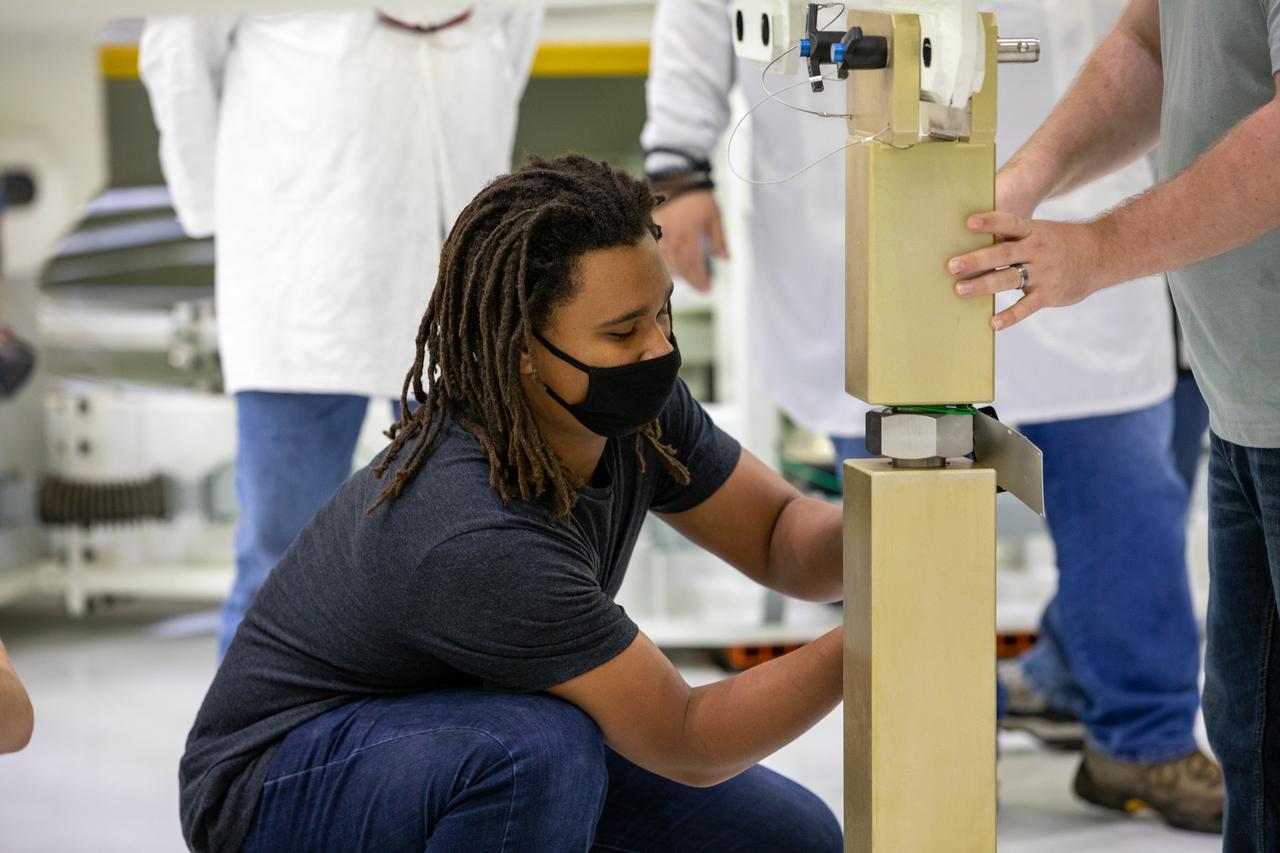
ASRC technician Nathaniel Bowman works to ready the Super Station fixture that will support the installation of the spacecraft adapter (SA) cone to the Artemis I Orion spacecraft inside the Neil Armstrong Operations and Checkout Building at NASA’s Kennedy Space Center in Florida on Aug. 6, 2020. This is one of the final major hardware operations the spacecraft will undergo during closeout processing prior to being integrated with the Space Launch System (SLS) rocket in preparation for the first Artemis mission. The spacecraft adapter cone connects the bottom portion of Orion’s service module to the top part of the rocket known as the interim cryogenic propulsion stage (ICPS). Orion will fly on the agency’s Artemis I mission – the first in a series of increasingly complex missions to the Moon that will ultimately lead to the exploration of Mars.
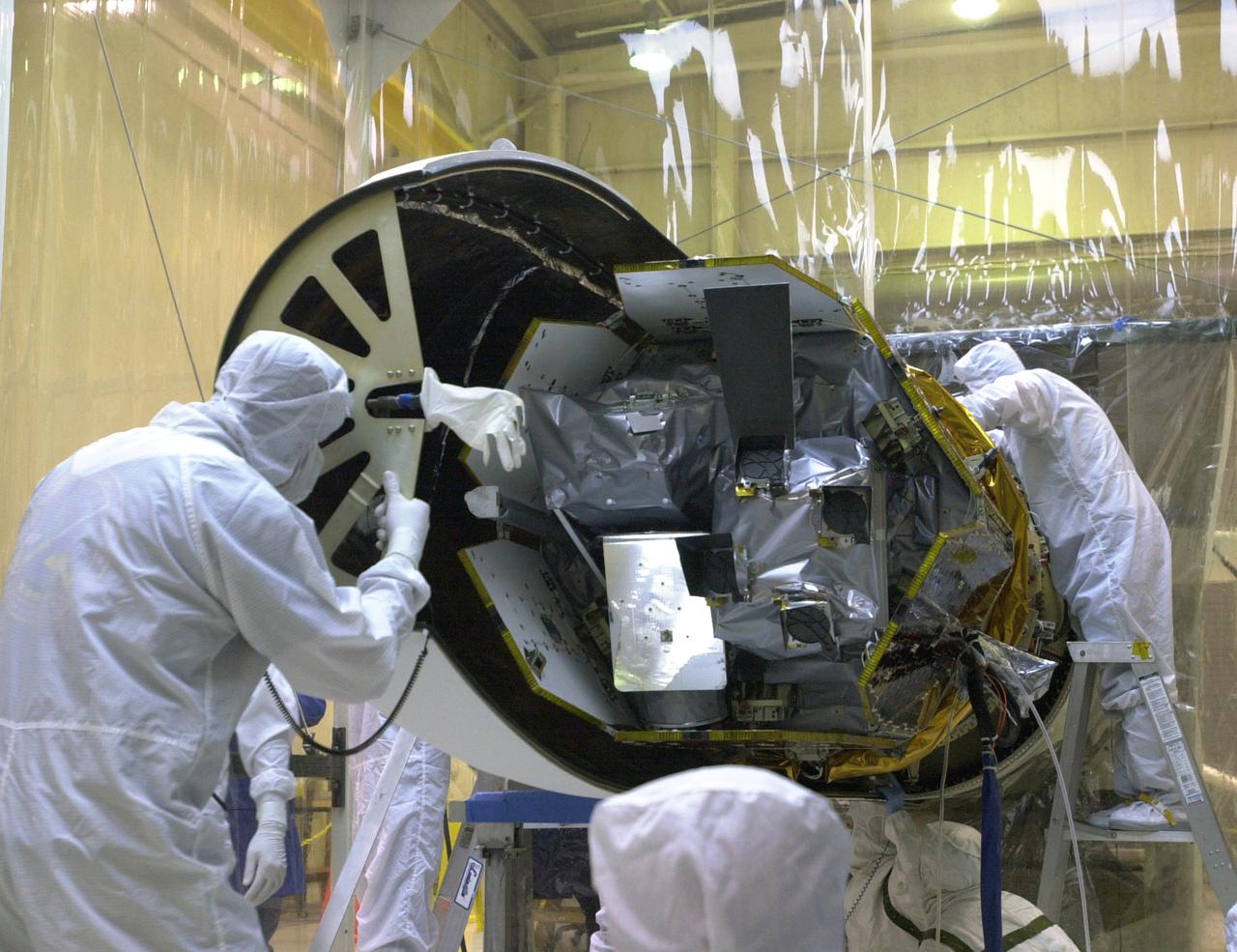
At Vandenberg Air Force Base in California, technicians prepare the AIM spacecraft for fairing installation. The fairing is a molded structure that fits around the spacecraft and forms an aerodynamically smooth nose cone, protecting the spacecraft during launch. Launch will be from a Pegasus XL rocket, carried and released by Orbital Sciences L-1011 jet aircraft. AIM, which stands for Aeronomy of Ice in the Mesosphere, is being prepared for integrated testing and a flight simulation. The AIM spacecraft will fly three instruments designed to study polar mesospheric clouds located at the edge of space, 50 miles above the Earth's surface in the coldest part of the planet's atmosphere. The mission's primary goal is to explain why these clouds form and what has caused them to become brighter and more numerous and appear at lower latitudes in recent years. AIM's results will provide the basis for the study of long-term variability in the mesospheric climate and its relationship to global climate change. Launch is scheduled for April 25.

S67-49447 (9 Nov. 1967) --- Close-up view of the charred heat shield of the Apollo Spacecraft 017 Command Module aboard the USS Bennington. The damage was caused by the extreme heat of reentry. The carrier Bennington was the prime recovery ship for the Apollo 4 (Spacecraft 017/Saturn 501) unmanned, Earth-orbital space mission. Splashdown occurred at 3:37 p.m. (EST), Nov. 9, 1967, 934 nautical miles northwest of Honolulu, Hawaii.

S65-45610 (21 Aug. 1965) --- Astronaut Charles Conrad Jr. as seen through the Gemini-5 spacecraft window before launch.
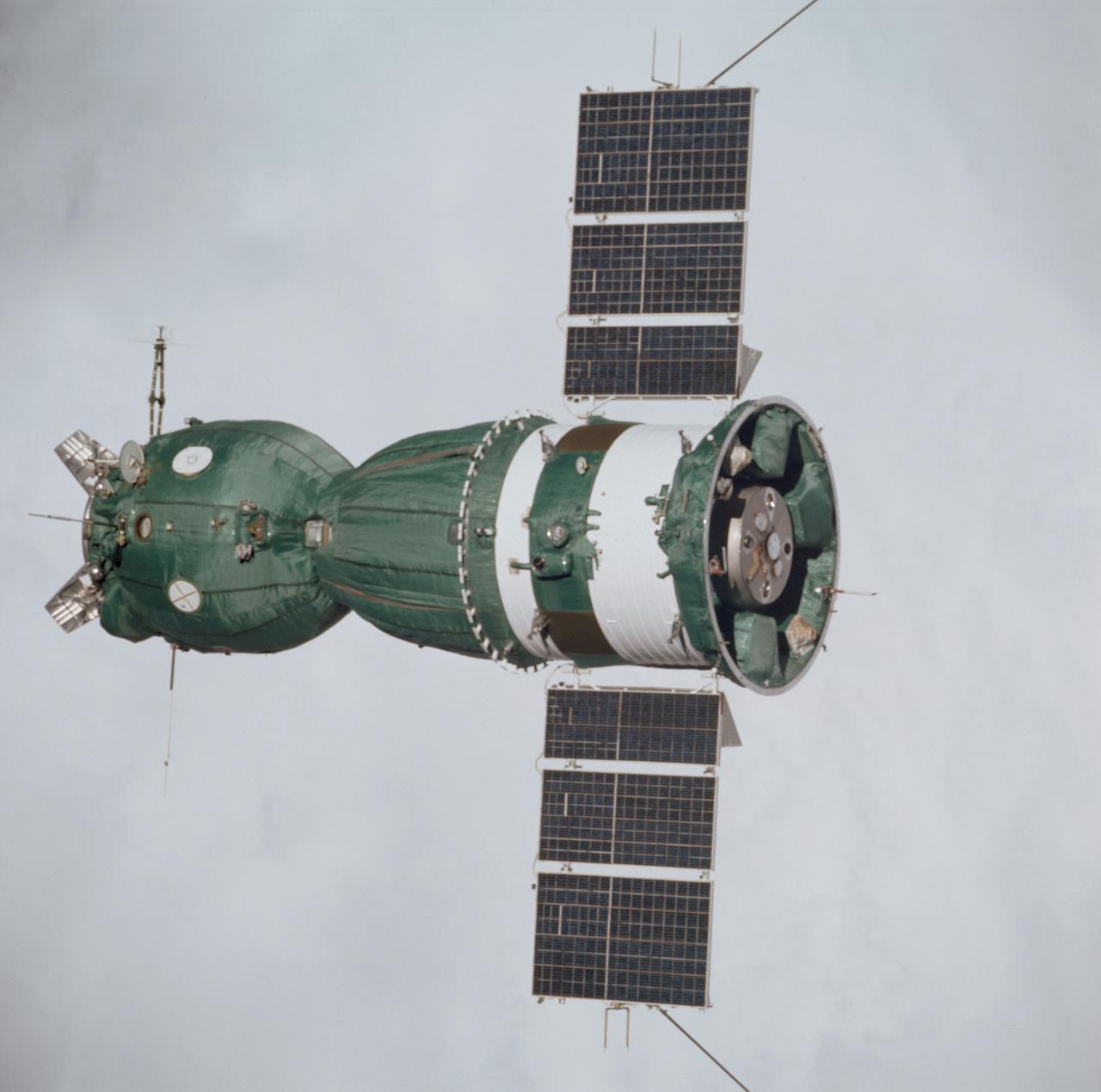
AST-01-056 (18 July 1975) --- An excellent view of the Soviet Soyuz spacecraft in Earth orbit, photographed from the American Apollo spacecraft during the joint U.S.-USSR Apollo-Soyuz Test Project (ASTP) docking mission in Earth orbit. The Soyuz is contrasted against a white-cloud background in this overhead view. The three major components of the Soyuz are the spherical-shaped Orbital Module, the bell-shaped Descent Vehicle and the cylindrical-shaped instrument Assembly Module from which two solar panels protrude. The docking system on the Orbital Module was specially designed to interface with the docking system on the Apollo's Docking Module. The ASTP astronauts and cosmonauts visited each other's spacecraft while the Soyuz and Apollo were docked in Earth orbit for two days. The Apollo crew consisted of astronauts Stafford, commander; Donald K. "Deke" Slayton, docking module pilot; and Vance D. Brand, command module pilot. The Soyuz 19 crew consisted of cosmonauts Leonov, command pilot; and Valeri N. Kubasov, flight engineer.
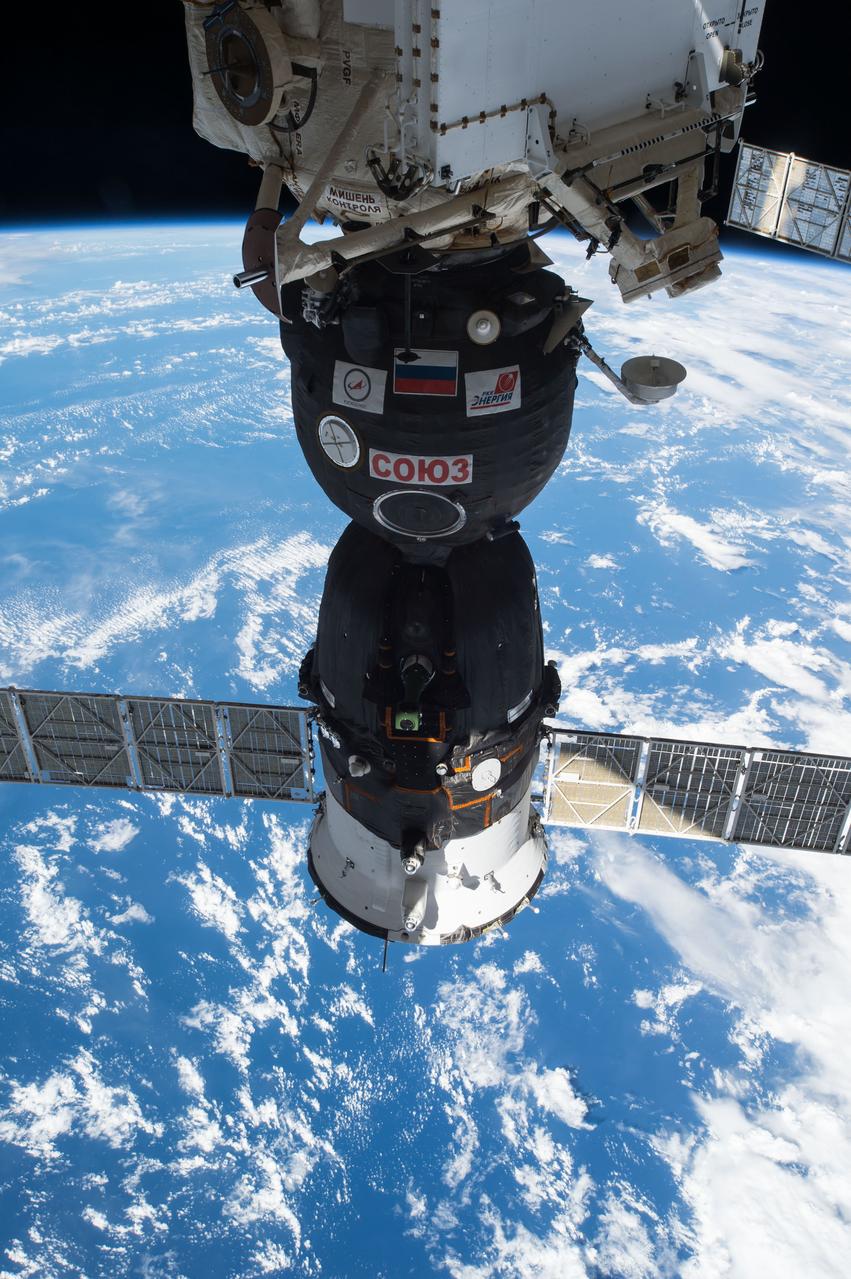
View of the Soyuz TMA-15M spacecraft docked to Rassvet Mini-Research Module 1 (MRM1) An Earth limb is in view.
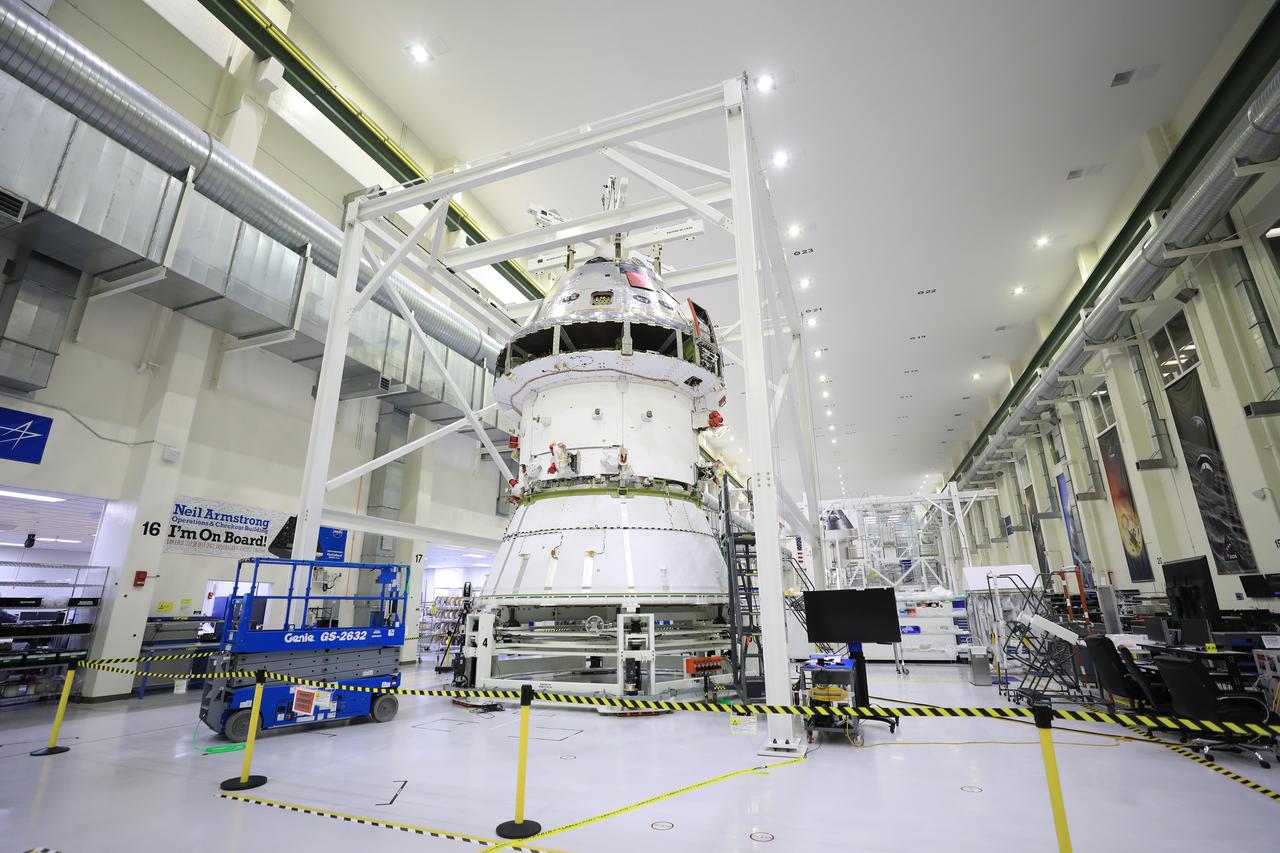
Technicians at NASA’s Kennedy Space Center in Florida work to install the spacecraft adapter (SA) cone to the Artemis I Orion spacecraft inside the Neil Armstrong Operations and Checkout Building on Aug. 10, 2020. This is one of the final major hardware operations the spacecraft will undergo during closeout processing prior to being integrated with the Space Launch System (SLS) rocket in preparation for the first Artemis mission. The spacecraft adapter cone connects the bottom portion of Orion’s service module to the top part of the rocket known as the interim cryogenic propulsion stage (ICPS). Orion will fly on the agency’s Artemis I mission – the first in a series of increasingly complex missions to the Moon that will ultimately lead to the exploration of Mars.
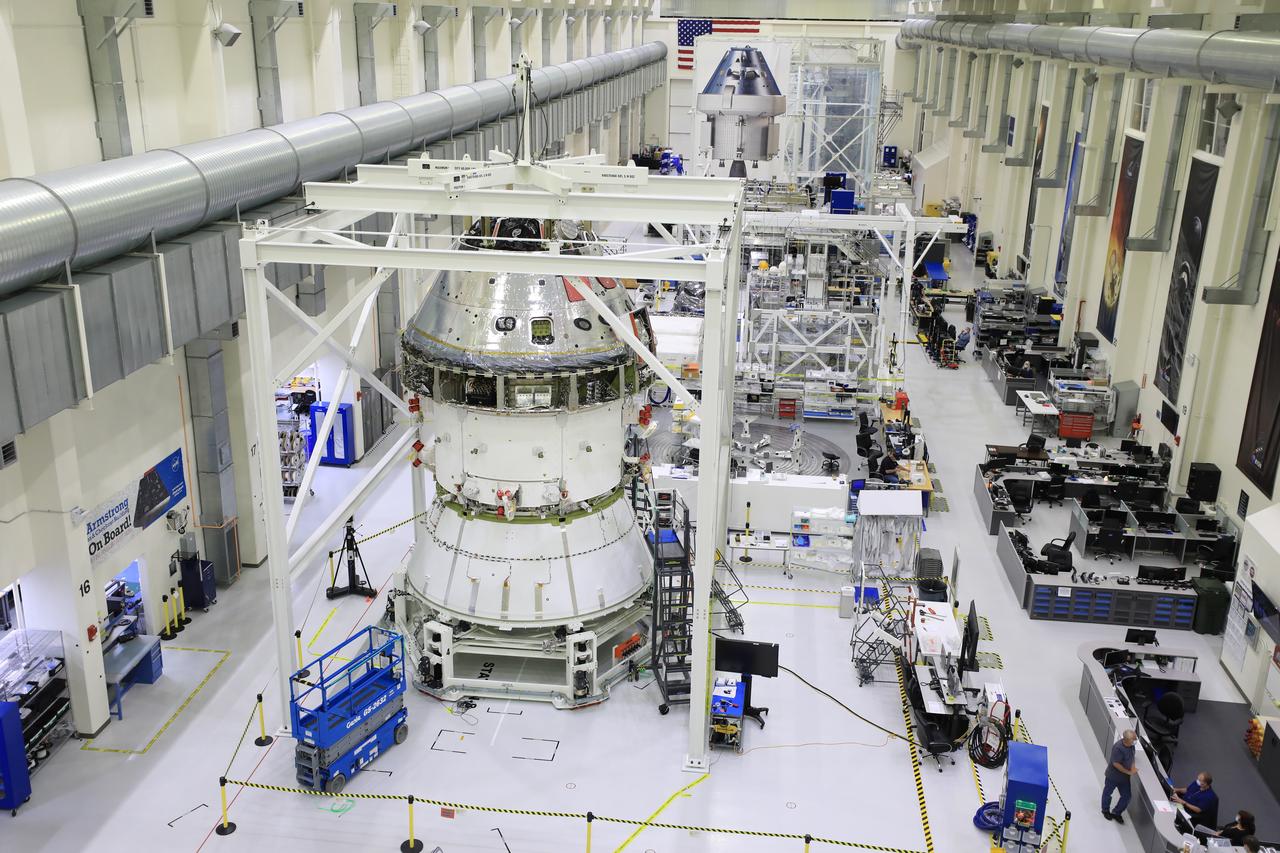
Technicians at NASA’s Kennedy Space Center in Florida work to install the spacecraft adapter (SA) cone to the Artemis I Orion spacecraft inside the Neil Armstrong Operations and Checkout Building on Aug. 10, 2020. This is one of the final major hardware operations the spacecraft will undergo during closeout processing prior to being integrated with the Space Launch System (SLS) rocket in preparation for the first Artemis mission. The spacecraft adapter cone connects the bottom portion of Orion’s service module to the top part of the rocket known as the interim cryogenic propulsion stage (ICPS). Orion will fly on the agency’s Artemis I mission – the first in a series of increasingly complex missions to the Moon that will ultimately lead to the exploration of Mars.
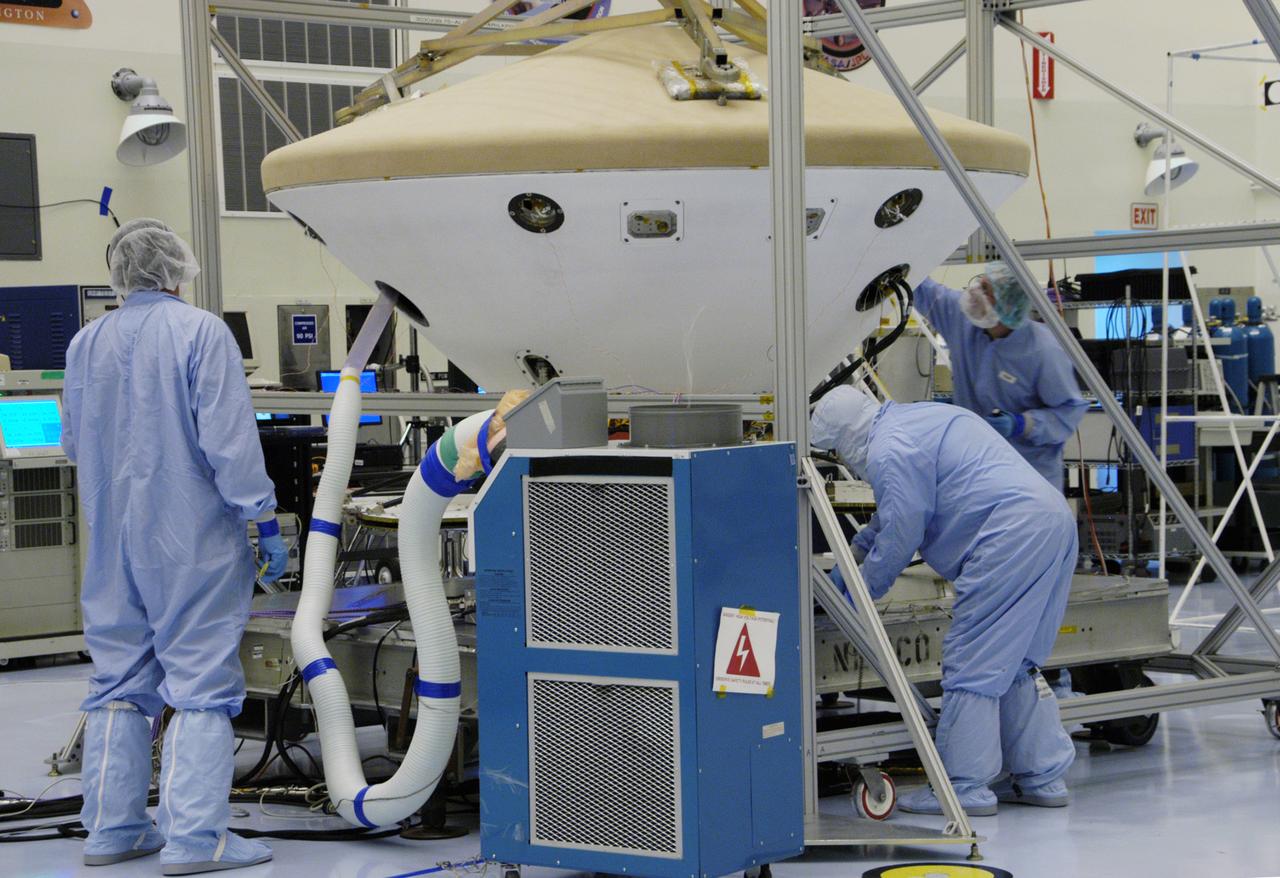
In the Payload Hazardous Servicing Facility, workers monitor the Phoenix spacecraft during a heat shield deployment test, with a firing of ordnance associated with the separation device. Phoenix will land in icy soils near the north polar permanent ice cap of Mars and explore the history of the water in these soils and any associated rocks, while monitoring polar climate. Landing is planned in May 2008 on arctic ground where a mission currently in orbit, Mars Odyssey, has detected high concentrations of ice just beneath the top layer of soil. Launch of Phoenix aboard a Delta II rocket is targeted for Aug. 3 from Cape Canaveral Air Force Station in Florida.
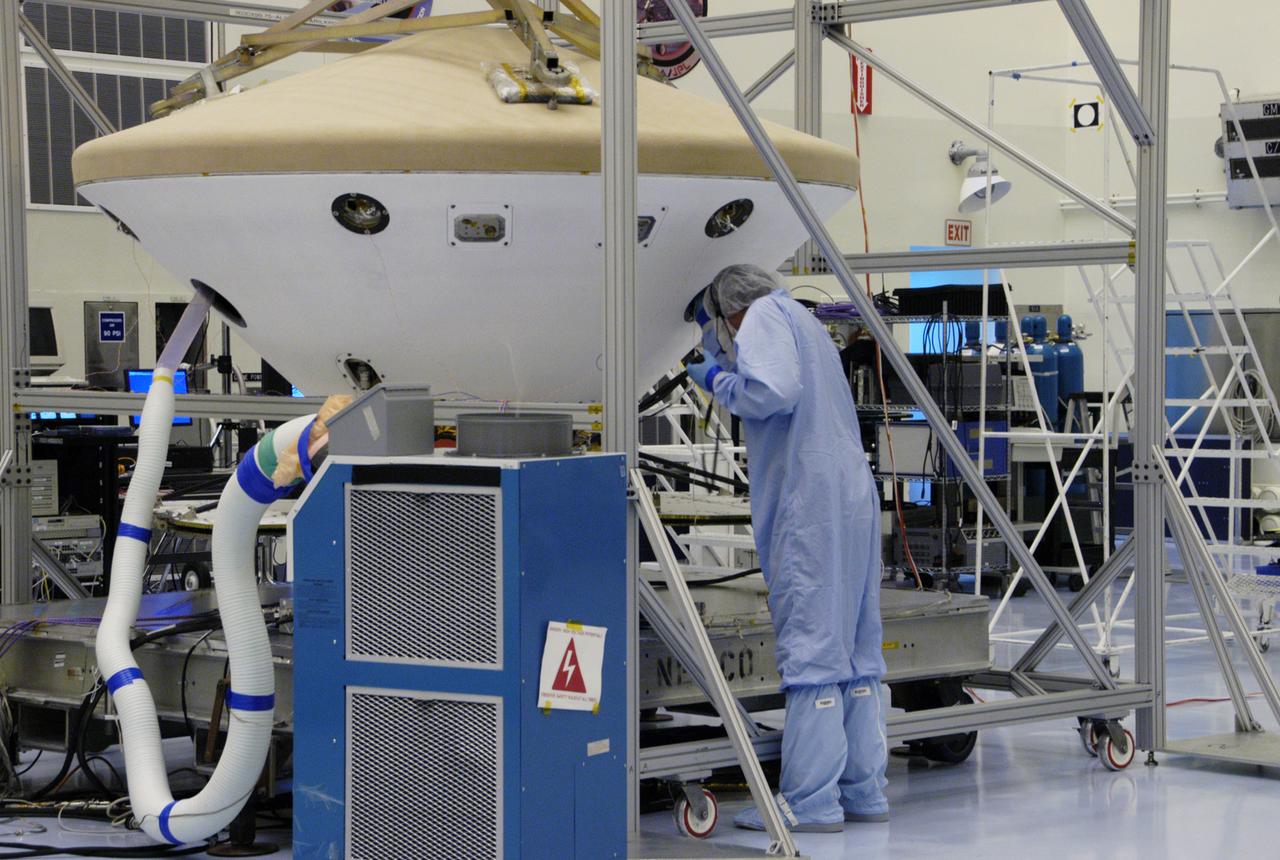
In the Payload Hazardous Servicing Facility, a worker monitors the Phoenix spacecraft during a heat shield deployment test, with a firing of ordnance associated with the separation device. Phoenix will land in icy soils near the north polar permanent ice cap of Mars and explore the history of the water in these soils and any associated rocks, while monitoring polar climate. Landing is planned in May 2008 on arctic ground where a mission currently in orbit, Mars Odyssey, has detected high concentrations of ice just beneath the top layer of soil. Launch of Phoenix aboard a Delta II rocket is targeted for Aug. 3 from Cape Canaveral Air Force Station in Florida.
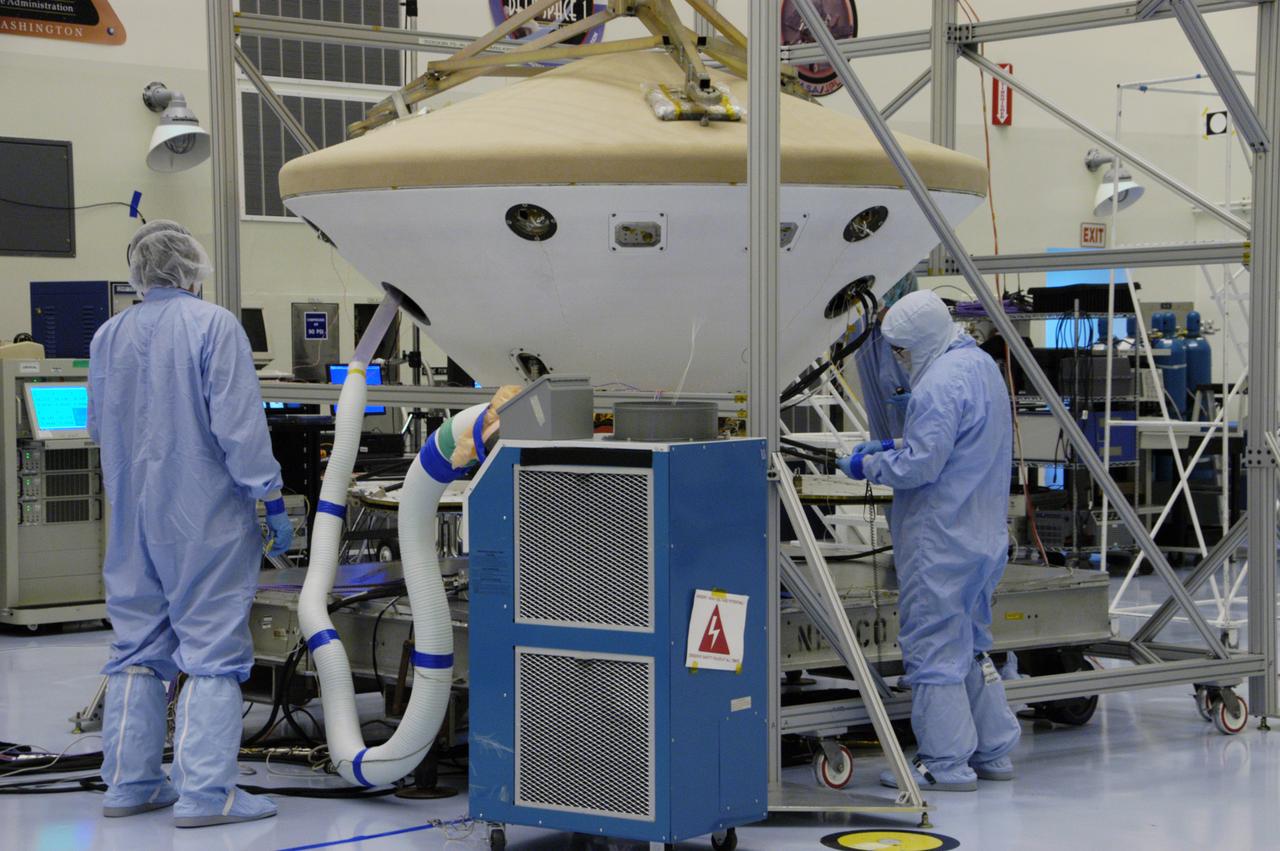
In the Payload Hazardous Servicing Facility, workers monitor the Phoenix spacecraft during a heat shield deployment test, with a firing of ordnance associated with the separation device. Phoenix will land in icy soils near the north polar permanent ice cap of Mars and explore the history of the water in these soils and any associated rocks, while monitoring polar climate. Landing is planned in May 2008 on arctic ground where a mission currently in orbit, Mars Odyssey, has detected high concentrations of ice just beneath the top layer of soil. Launch of Phoenix aboard a Delta II rocket is targeted for Aug. 3 from Cape Canaveral Air Force Station in Florida.
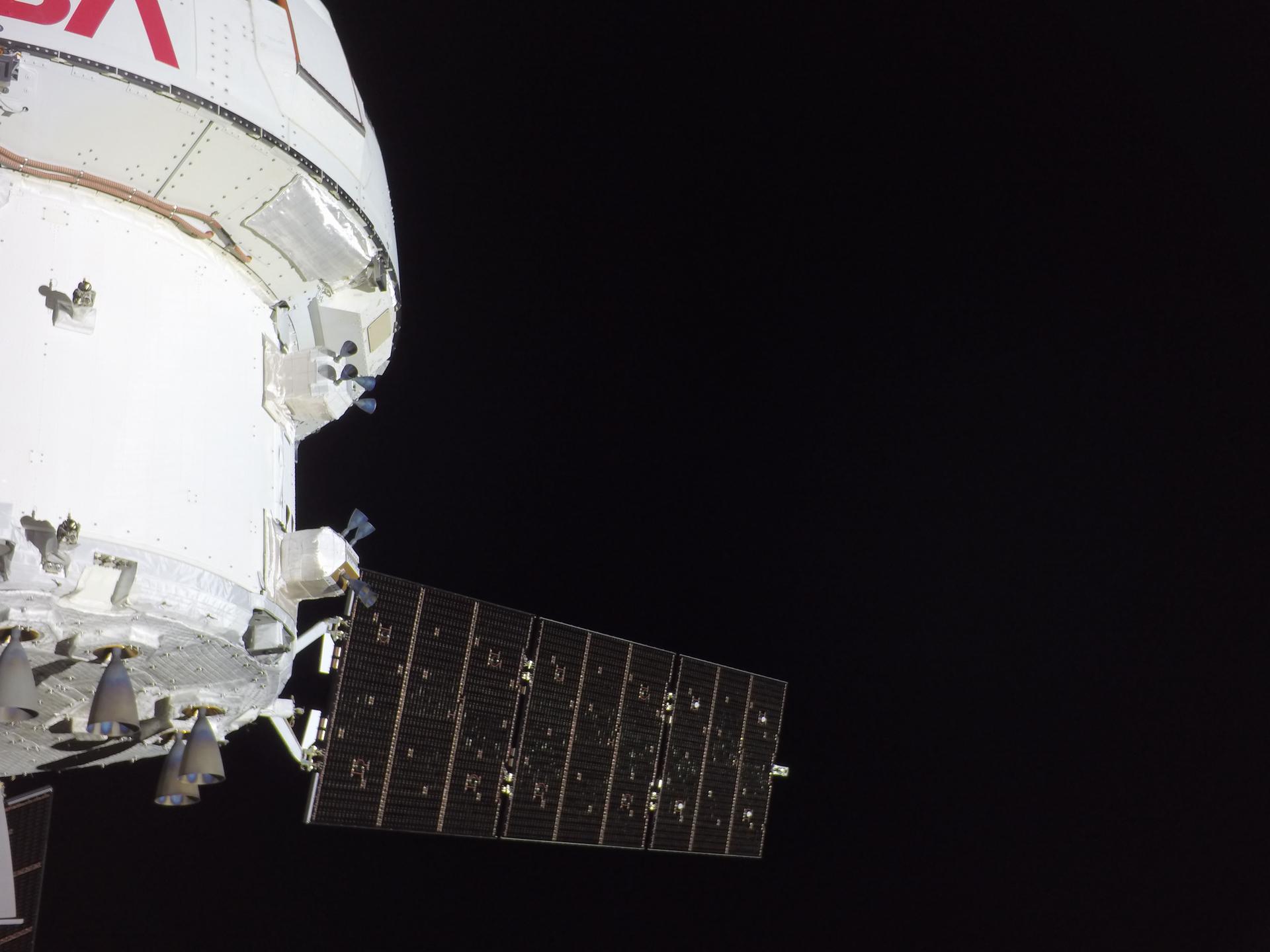
art002e012489 (April 7, 2026) - NASA’s Orion spacecraft is pictured here from one of the cameras mounted on its solar array wings. At the time this photo was taken at 8:58 a.m. ET, the Artemis II crew was in a sleep period ahead of beginning their seventh day into the mission. Credit: NASA
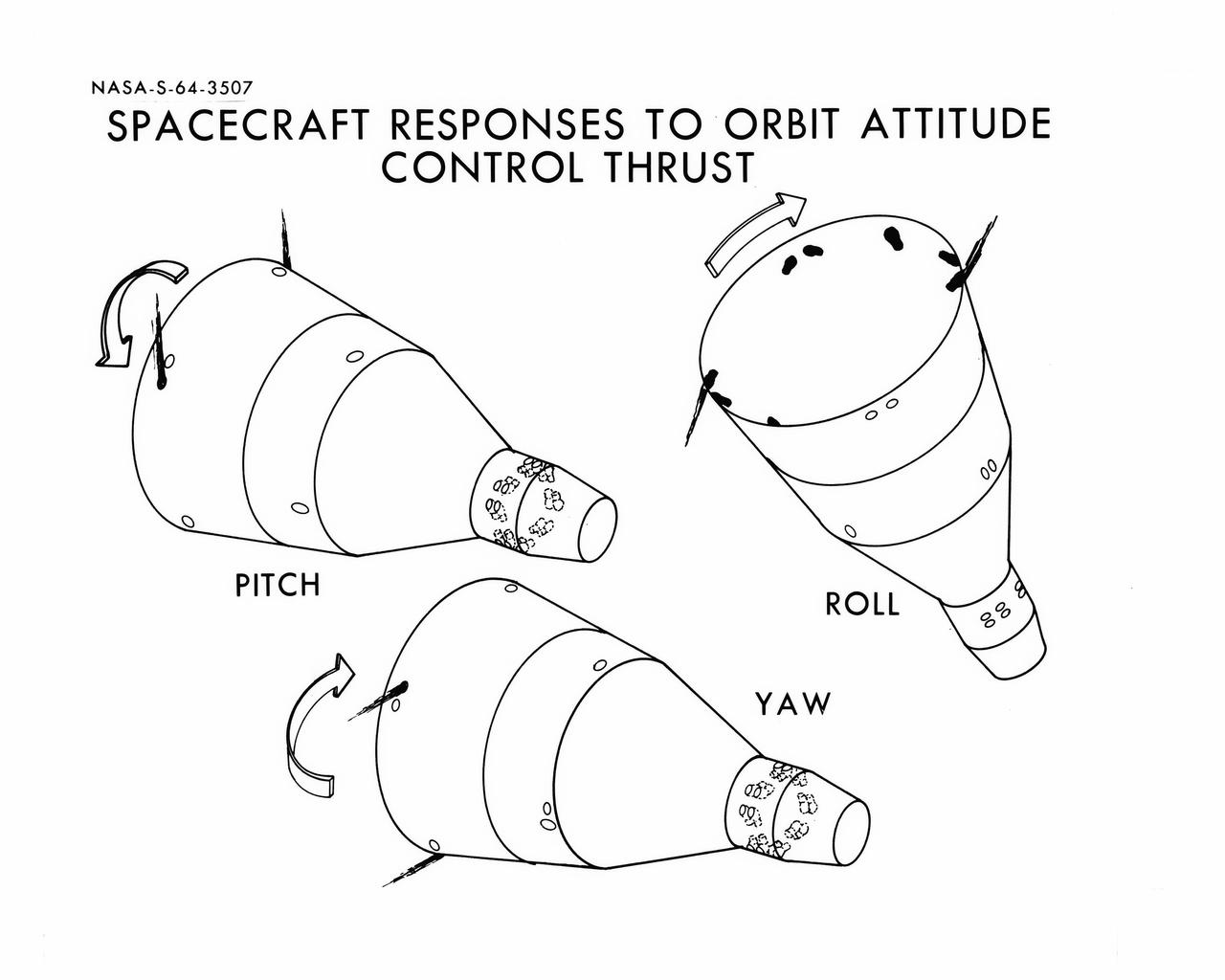
S64-03507 (1964) --- Diagrams shows Gemini spacecraft responses to orbital attitude systems's thrusters. Firing of appropriate combination of the thrusters cause pitch, roll and yaw.
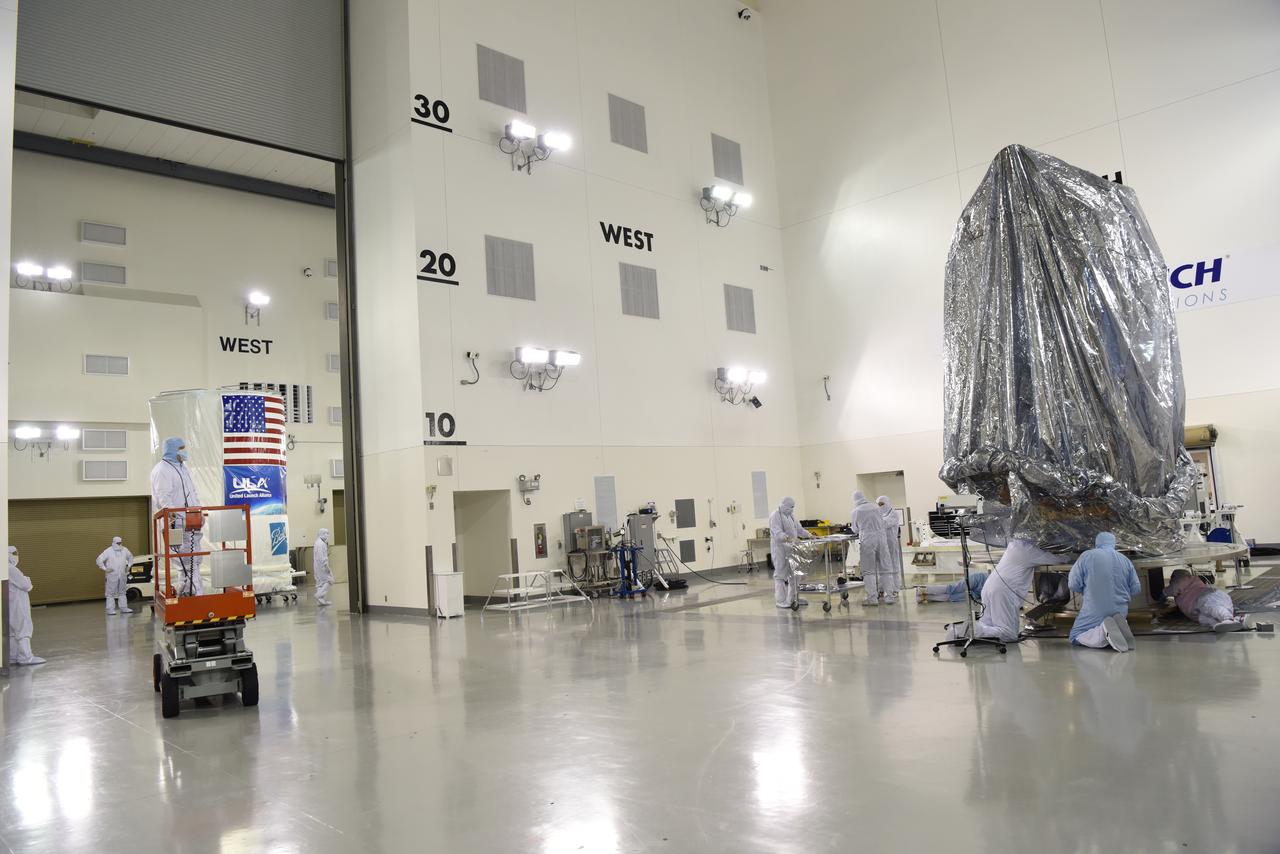
JPSS-1 Spacecraft Canning and Lift to Transport Trailer at the Astrotech facility located at Vandenberg Air Force Station in California.
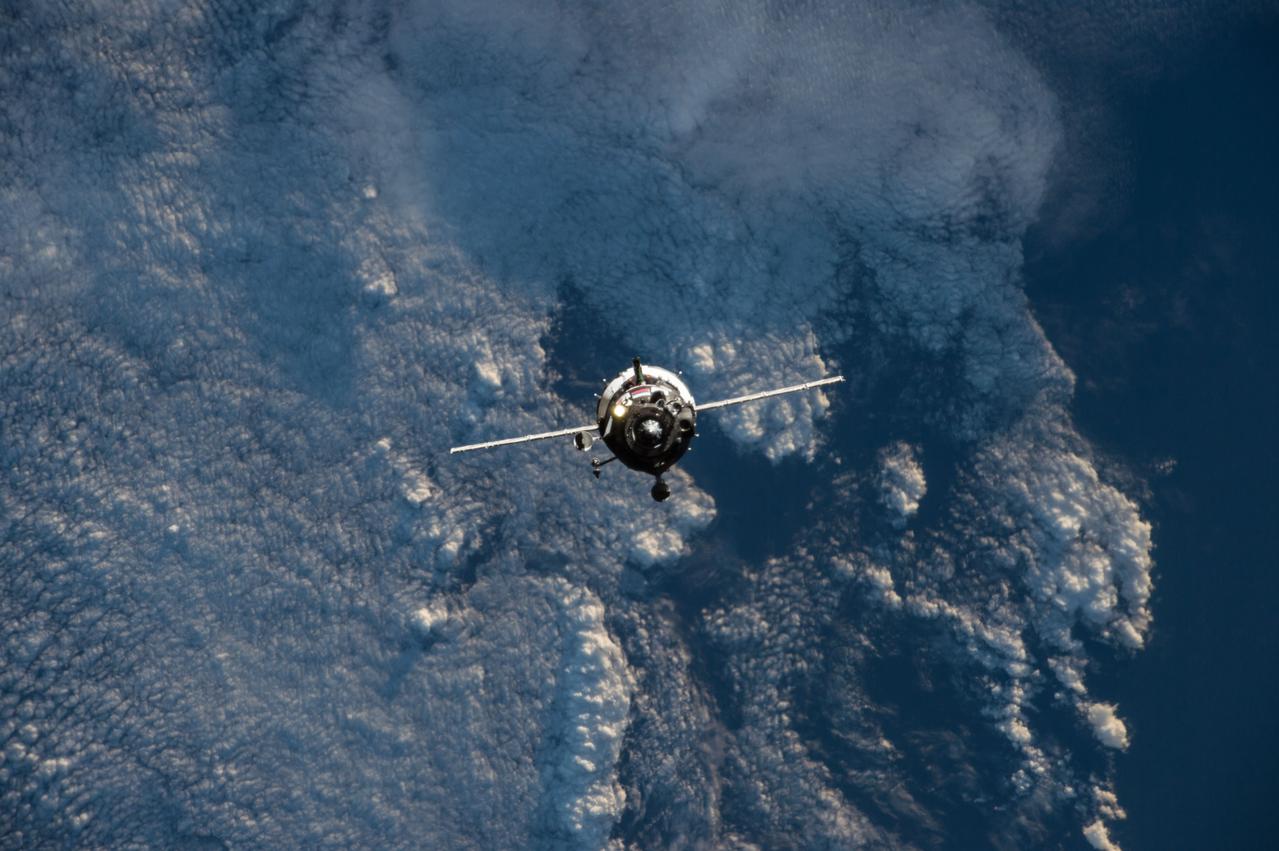
View of the Soyuz TMA-15M spacecraft as it approaches the ISS for rendezvous and docking. Image was released by astronaut on Instagram.
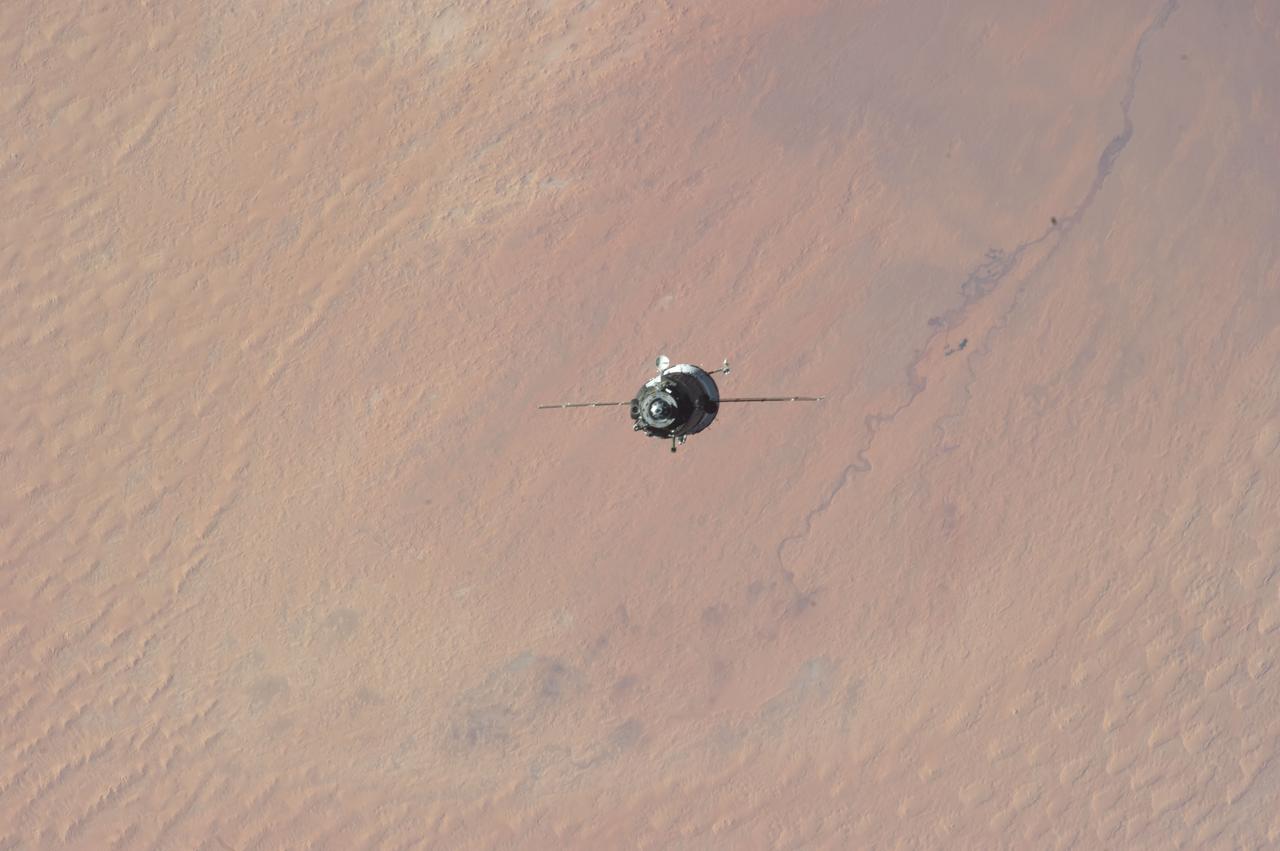
View of the arrival of Soyuz Spacecraft (TMA-07M). Photo was taken during Expedition 34.
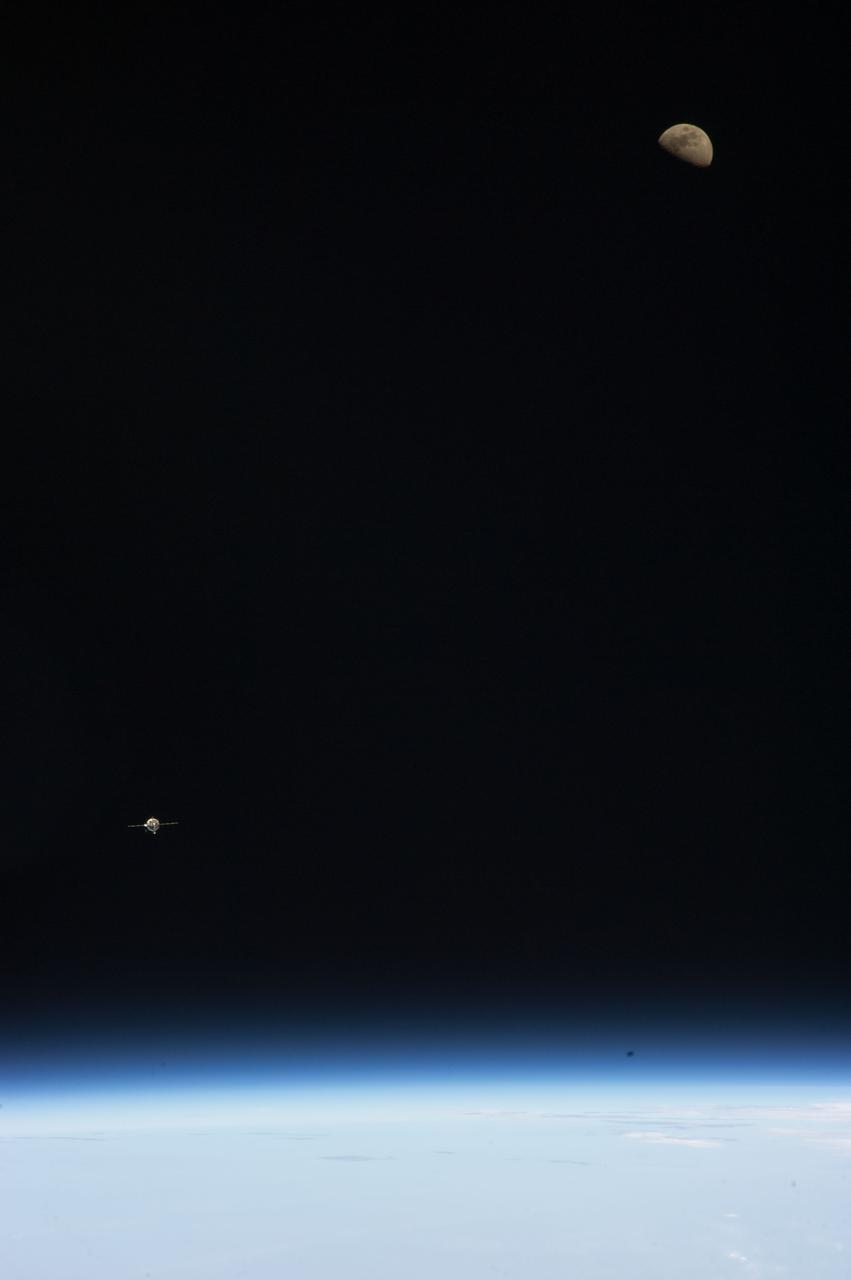
View of the arrival of Soyuz Spacecraft (TMA-07M). Photo was taken during Expedition 34.
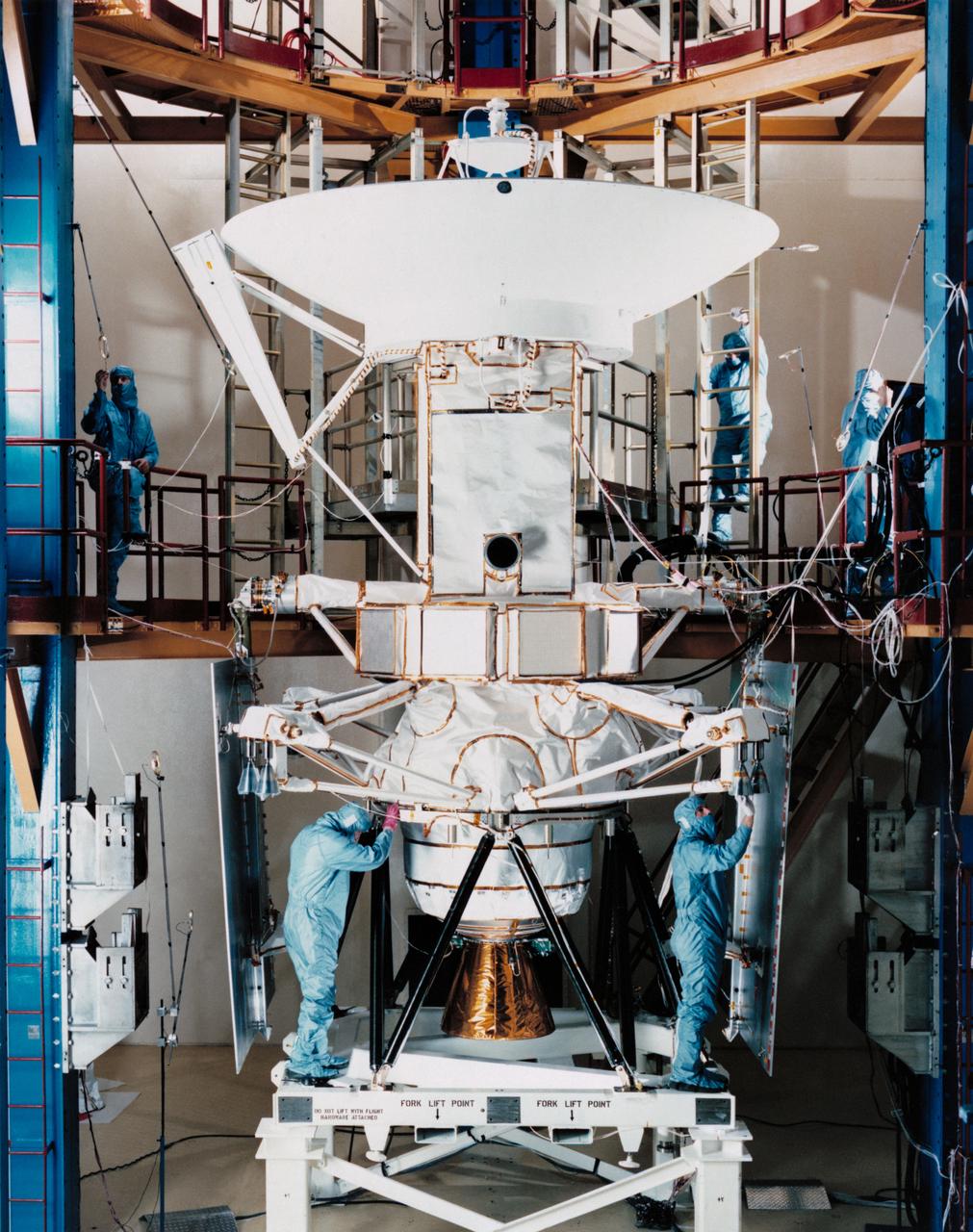
S88-50418 (August 1988) --- Engineers and technicians at the Martin Marietta plant in Denver, Colorado, prepare the spacecraft for its six-week long trip to the Kennedy Space Center (KSC). The spacecraft, destined for unprecedented studies of Venusian topographic features, will be mated to its upper stage while at KSC and later onloaded to Atlantis and eventually will be deployed by the crew of NASA's STS-30 mission in April 1989.

S67-49423 (9 Nov. 1967) --- The Apollo Spacecraft 017 Command Module, with flotation collar still attached, is hoisted aboard the USS Bennington, prime recovery ship for the Apollo 4 (Spacecraft 017/Saturn 501) unmanned, Earth-orbital space mission. The Command Module splashed down at 3:37 p.m. (EST), Nov. 9, 1967, 934 nautical miles northwest of Honolulu, Hawaii, in the mid-Pacific Ocean. Note charred heat shield caused by extreme heat of reentry.
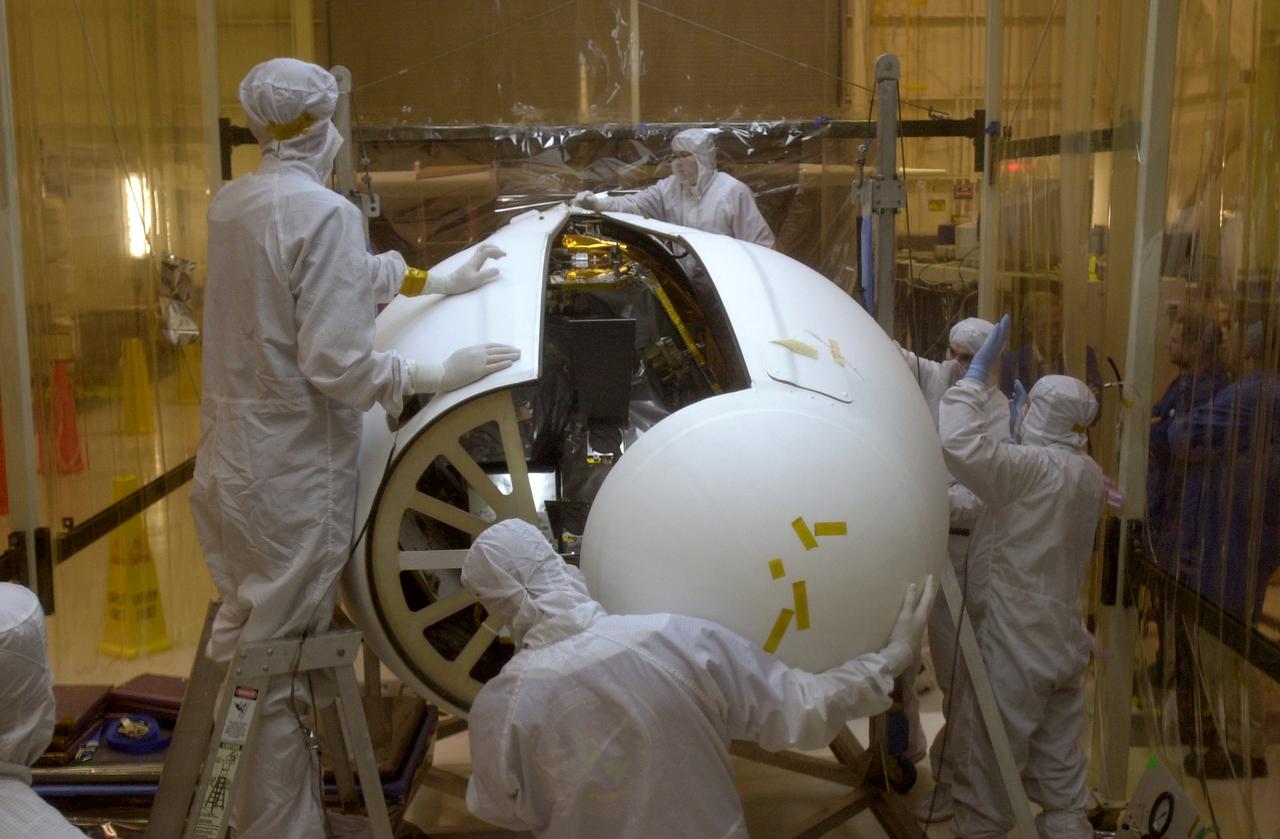
At Vandenberg Air Force Base in California, under the protective clean tent, technicians move the second half of the fairing into place around the AIM spacecraft. The fairing is a molded structure that fits around the spacecraft and forms an aerodynamically smooth nose cone, protecting the spacecraft during launch. Launch will be from a Pegasus XL rocket, carried and released by Orbital Sciences L-1011 jet aircraft. AIM, which stands for Aeronomy of Ice in the Mesosphere, is being prepared for integrated testing and a flight simulation. The AIM spacecraft will fly three instruments designed to study polar mesospheric clouds located at the edge of space, 50 miles above the Earth's surface in the coldest part of the planet's atmosphere. The mission's primary goal is to explain why these clouds form and what has caused them to become brighter and more numerous and appear at lower latitudes in recent years. AIM's results will provide the basis for the study of long-term variability in the mesospheric climate and its relationship to global climate change. Launch is scheduled for April 25.
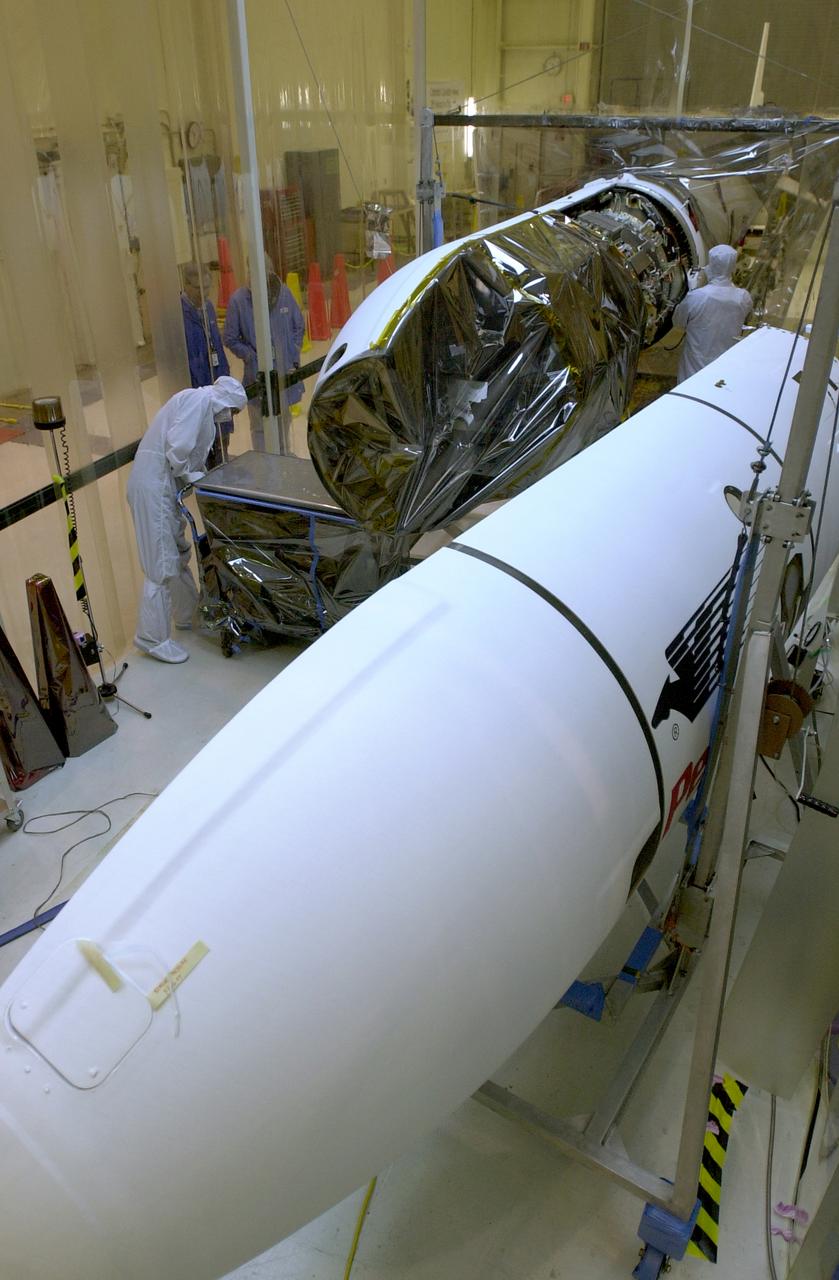
At Vandenberg Air Force Base in California, under the protective clean tent, technicians begin installing the fairing around the AIM spacecraft. The fairing is a molded structure that fits around the spacecraft and forms an aerodynamically smooth nose cone, protecting the spacecraft during launch. Launch will be from a Pegasus XL rocket, carried and released by Orbital Sciences L-1011 jet aircraft. AIM, which stands for Aeronomy of Ice in the Mesosphere, is being prepared for integrated testing and a flight simulation. The AIM spacecraft will fly three instruments designed to study polar mesospheric clouds located at the edge of space, 50 miles above the Earth's surface in the coldest part of the planet's atmosphere. The mission's primary goal is to explain why these clouds form and what has caused them to become brighter and more numerous and appear at lower latitudes in recent years. AIM's results will provide the basis for the study of long-term variability in the mesospheric climate and its relationship to global climate change. Launch is scheduled for April 25.
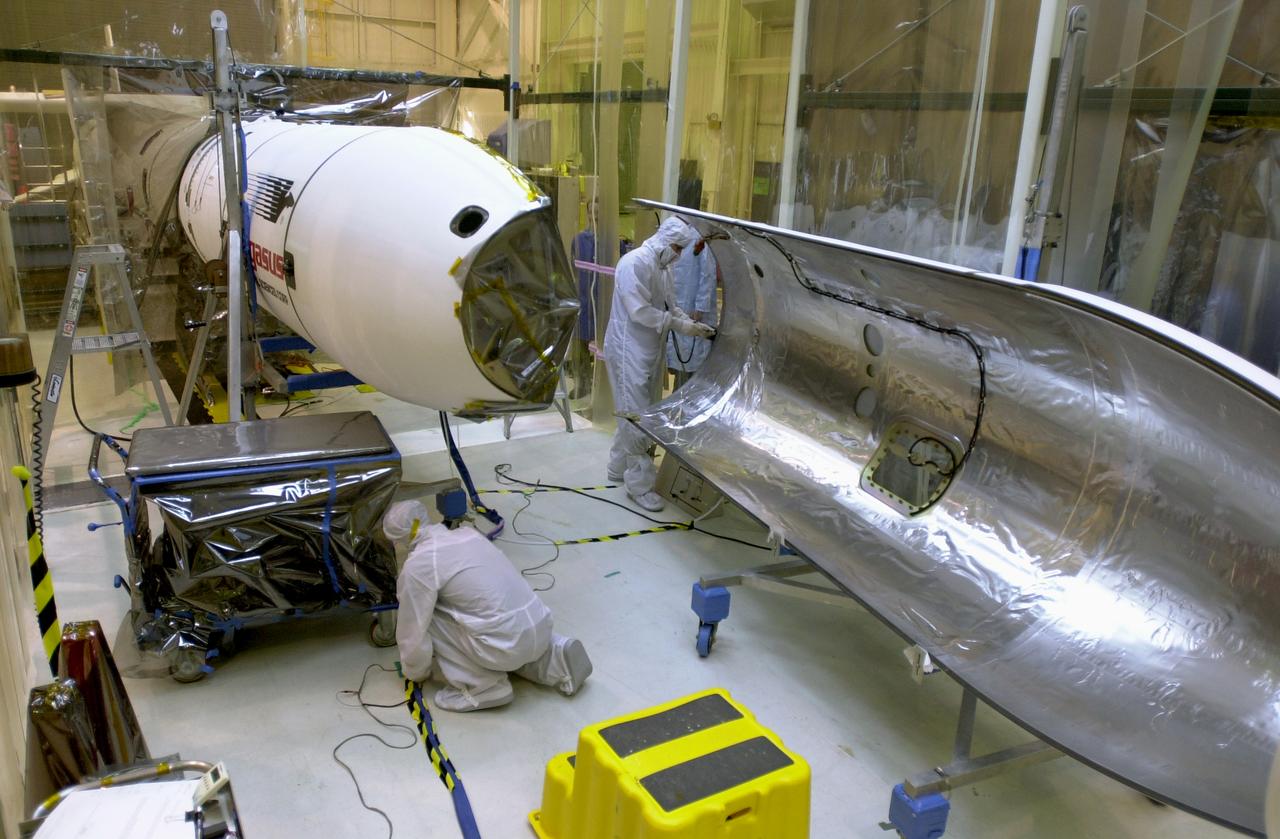
At Vandenberg Air Force Base in California, under the protective clean tent, technicians work on the second half of the fairing to be installed around the AIM spacecraft. The fairing is a molded structure that fits around the spacecraft and forms an aerodynamically smooth nose cone, protecting the spacecraft during launch. Launch will be from a Pegasus XL rocket, carried and released by Orbital Sciences L-1011 jet aircraft. AIM, which stands for Aeronomy of Ice in the Mesosphere, is being prepared for integrated testing and a flight simulation. The AIM spacecraft will fly three instruments designed to study polar mesospheric clouds located at the edge of space, 50 miles above the Earth's surface in the coldest part of the planet's atmosphere. The mission's primary goal is to explain why these clouds form and what has caused them to become brighter and more numerous and appear at lower latitudes in recent years. AIM's results will provide the basis for the study of long-term variability in the mesospheric climate and its relationship to global climate change. Launch is scheduled for April 25.
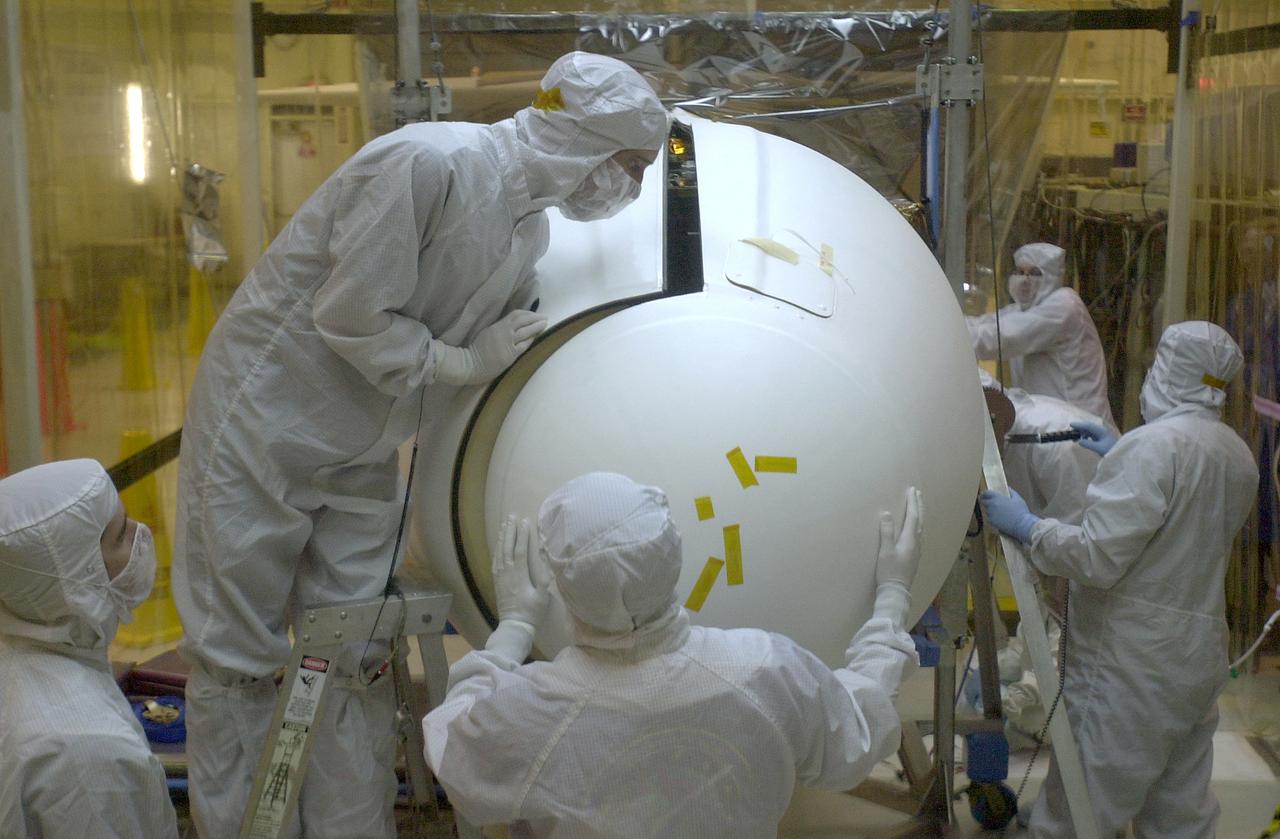
At Vandenberg Air Force Base in California, under the protective clean tent, technicians maneuver the second half of the fairing into place around the AIM spacecraft. The fairing is a molded structure that fits around the spacecraft and forms an aerodynamically smooth nose cone, protecting the spacecraft during launch. Launch will be from a Pegasus XL rocket, carried and released by Orbital Sciences L-1011 jet aircraft. AIM, which stands for Aeronomy of Ice in the Mesosphere, is being prepared for integrated testing and a flight simulation. The AIM spacecraft will fly three instruments designed to study polar mesospheric clouds located at the edge of space, 50 miles above the Earth's surface in the coldest part of the planet's atmosphere. The mission's primary goal is to explain why these clouds form and what has caused them to become brighter and more numerous and appear at lower latitudes in recent years. AIM's results will provide the basis for the study of long-term variability in the mesospheric climate and its relationship to global climate change. Launch is scheduled for April 25.
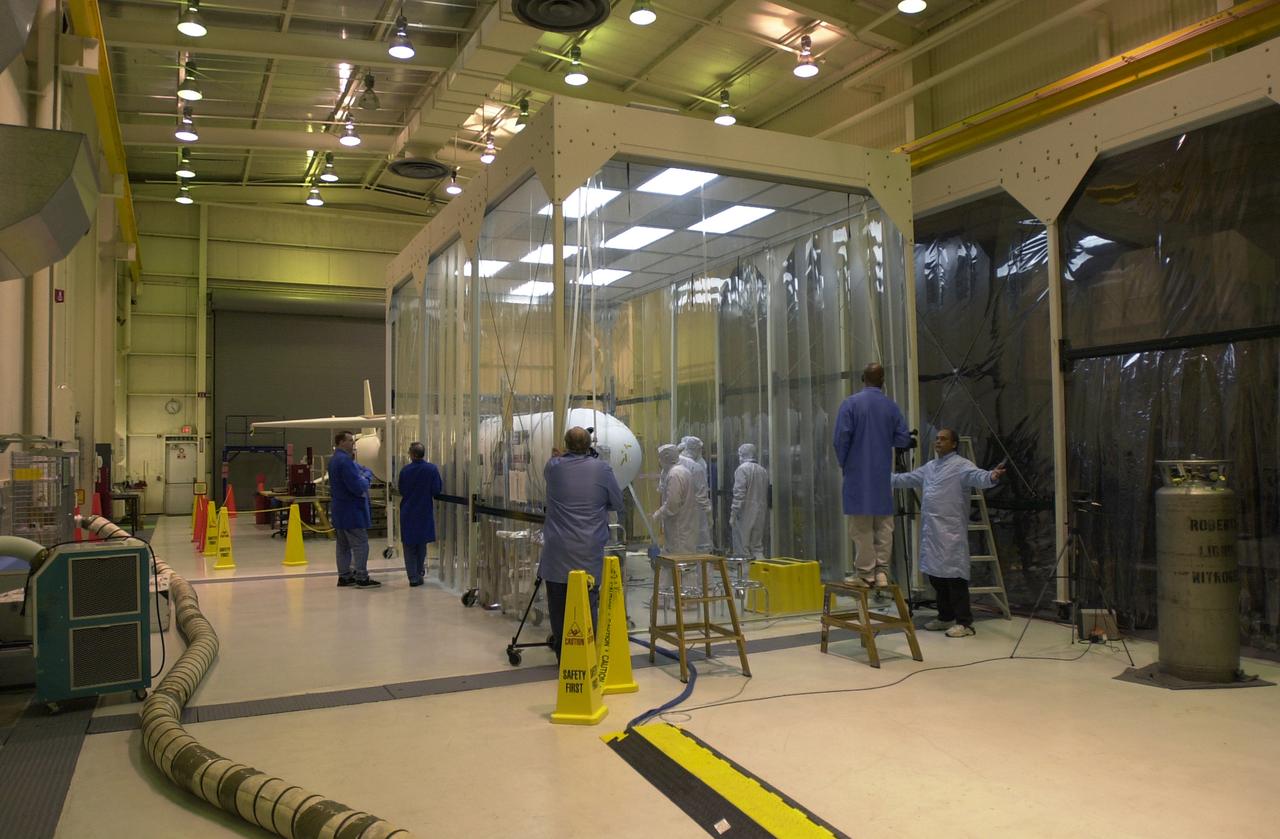
At Vandenberg Air Force Base in California, under the protective clean tent, technicians examine the installation of the fairing around the AIM spacecraft. The fairing is a molded structure that fits around the spacecraft and forms an aerodynamically smooth nose cone, protecting the spacecraft during launch. Launch will be from a Pegasus XL rocket, carried and released by Orbital Sciences L-1011 jet aircraft. AIM, which stands for Aeronomy of Ice in the Mesosphere, is being prepared for integrated testing and a flight simulation. The AIM spacecraft will fly three instruments designed to study polar mesospheric clouds located at the edge of space, 50 miles above the Earth's surface in the coldest part of the planet's atmosphere. The mission's primary goal is to explain why these clouds form and what has caused them to become brighter and more numerous and appear at lower latitudes in recent years. AIM's results will provide the basis for the study of long-term variability in the mesospheric climate and its relationship to global climate change. Launch is scheduled for April 25.
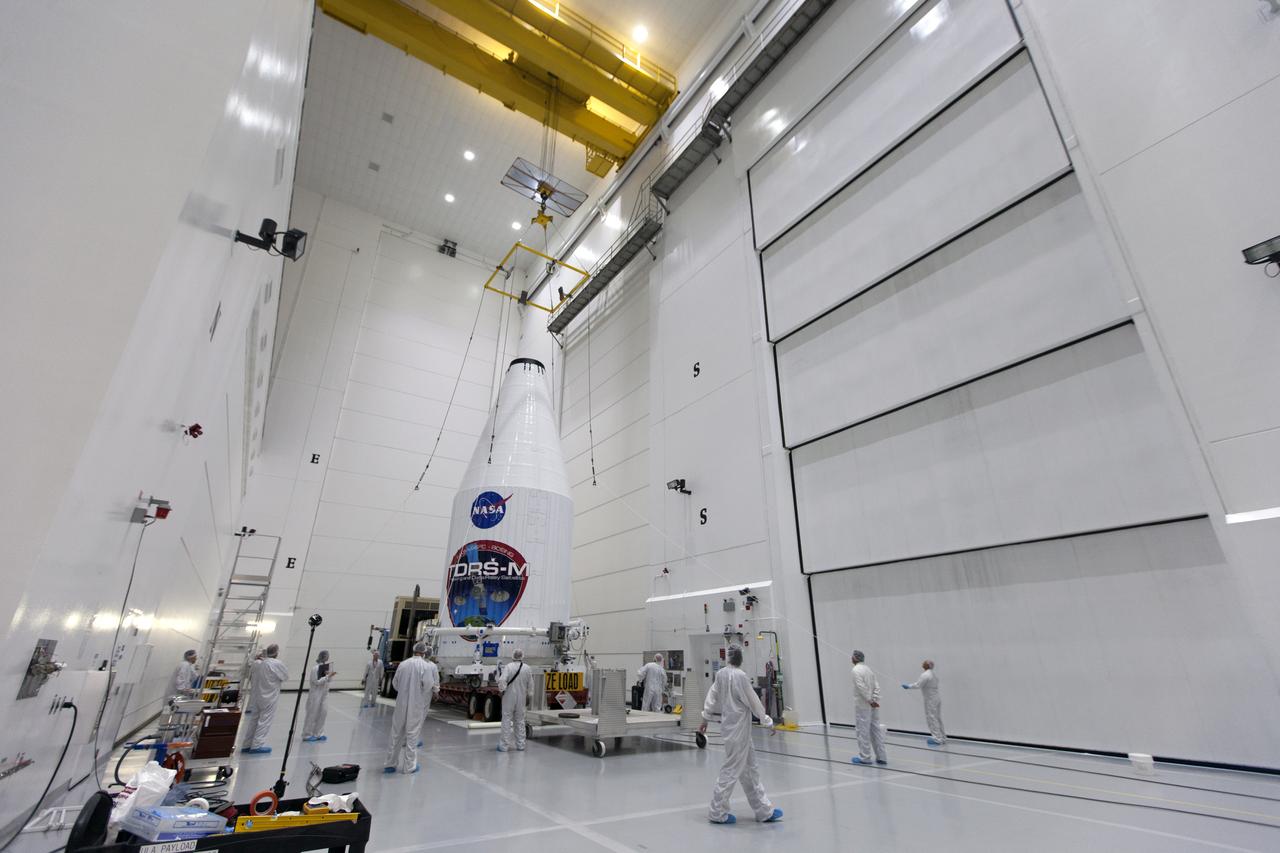
Technicians monitor the progress as NASA's TDRS-M satellite, enclosed in its payload fairing, is lowered onto a transport vehicle inside the Astrotech facility near NASA's Kennedy Space Center in Florida. The TDRS-M is the latest spacecraft destined for the agency's constellation of communications satellites that allows nearly continuous contact with orbiting spacecraft ranging from the International Space Station and Hubble Space Telescope to the array of scientific observatories. Liftoff atop a United Launch Alliance Atlas V rocket is scheduled to take place from Space Launch Complex 41 at Cape Canaveral Air Force Station on Aug. 18 at 8:03 a.m. EDT.
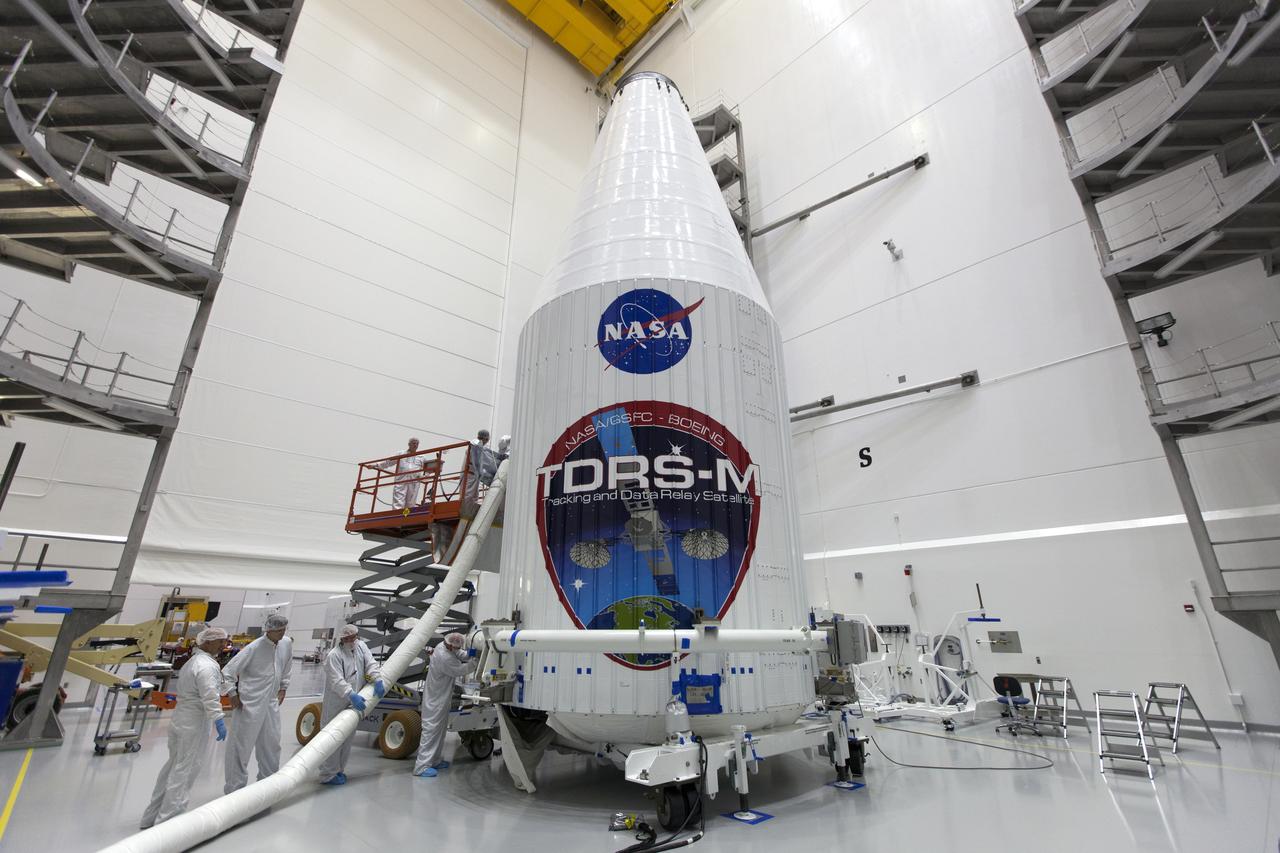
Inside the Astrotech facility near NASA's Kennedy Space Center in Florida, the agency's TDRS-M satellite, enclosed in its payload fairing, is being prepared for lifting to a transport vehicle. The TDRS-M is the latest spacecraft destined for the agency's constellation of communications satellites that allows nearly continuous contact with orbiting spacecraft ranging from the International Space Station and Hubble Space Telescope to the array of scientific observatories. Liftoff atop a United Launch Alliance Atlas V rocket is scheduled to take place from Space Launch Complex 41 at Cape Canaveral Air Force Station on Aug. 18 at 8:03 a.m. EDT.
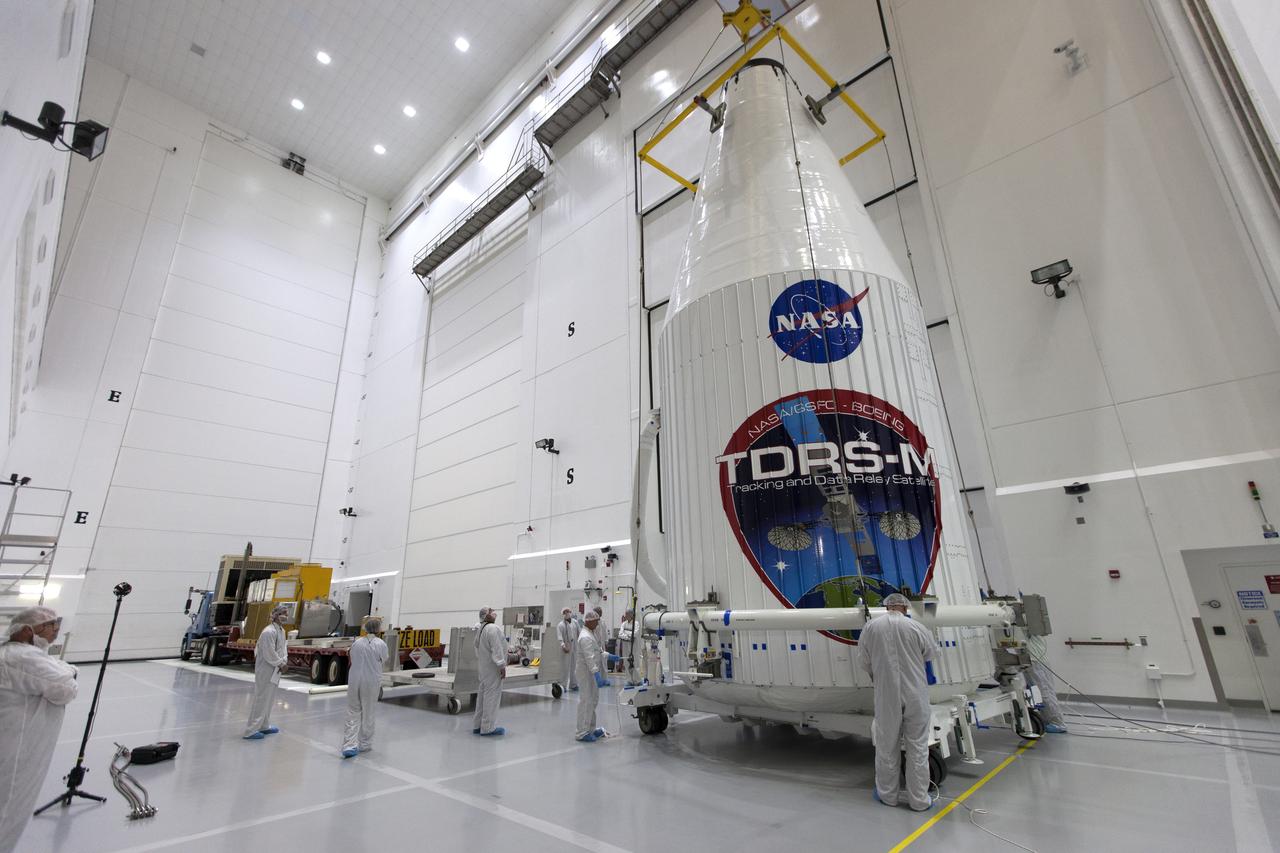
Inside the Astrotech facility near NASA's Kennedy Space Center in Florida, the agency's TDRS-M satellite, enclosed in its payload fairing, will be lifted by crane and lowered onto a transport vehicle. The TDRS-M is the latest spacecraft destined for the agency's constellation of communications satellites that allows nearly continuous contact with orbiting spacecraft ranging from the International Space Station and Hubble Space Telescope to the array of scientific observatories. Liftoff atop a United Launch Alliance Atlas V rocket is scheduled to take place from Space Launch Complex 41 at Cape Canaveral Air Force Station on Aug. 18 at 8:03 a.m. EDT.
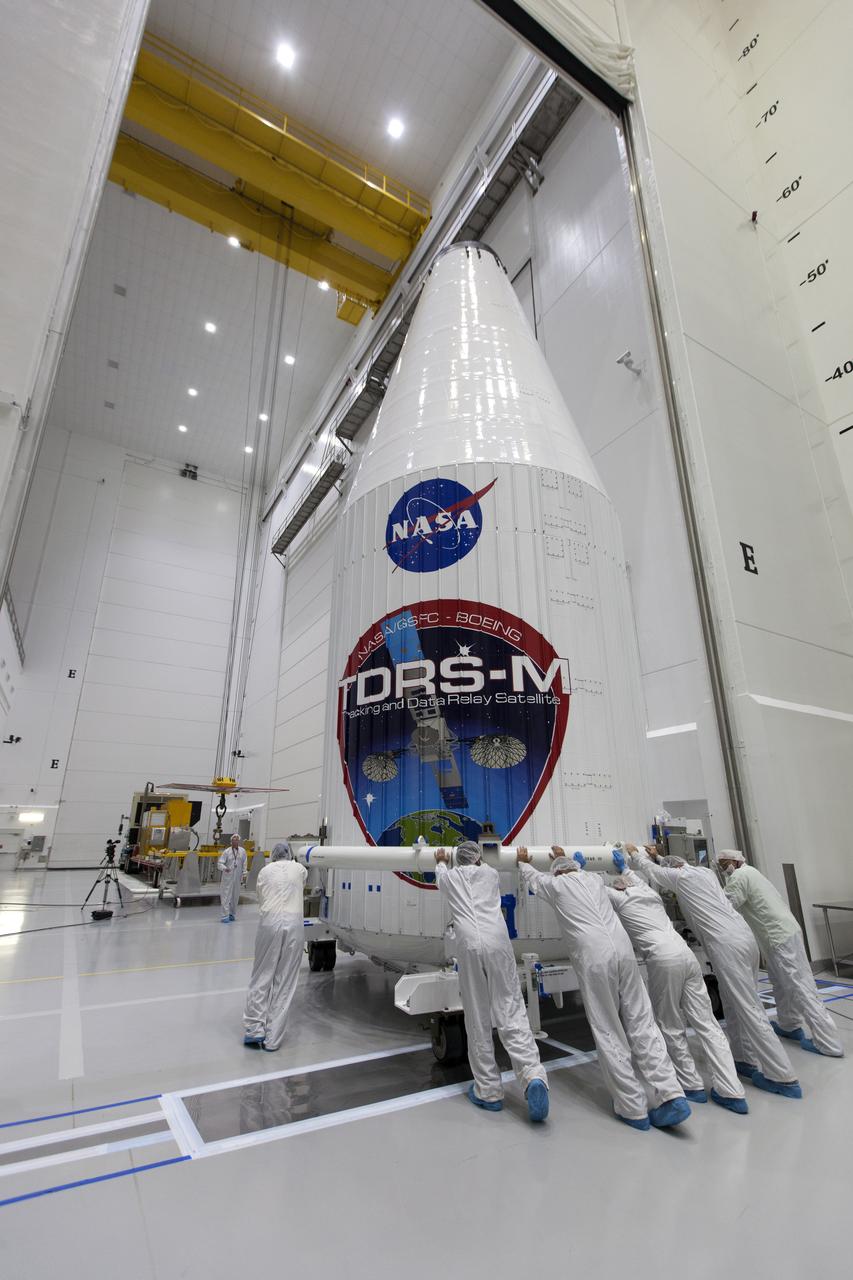
Inside the Astrotech facility near NASA's Kennedy Space Center in Florida, technicians move the agency's TDRS-M satellite, enclosed in its payload fairing, toward a crane for lifting to a transport vehicle. The TDRS-M is the latest spacecraft destined for the agency's constellation of communications satellites that allows nearly continuous contact with orbiting spacecraft ranging from the International Space Station and Hubble Space Telescope to the array of scientific observatories. Liftoff atop a United Launch Alliance Atlas V rocket is scheduled to take place from Space Launch Complex 41 at Cape Canaveral Air Force Station on Aug. 18 at 8:03 a.m. EDT.
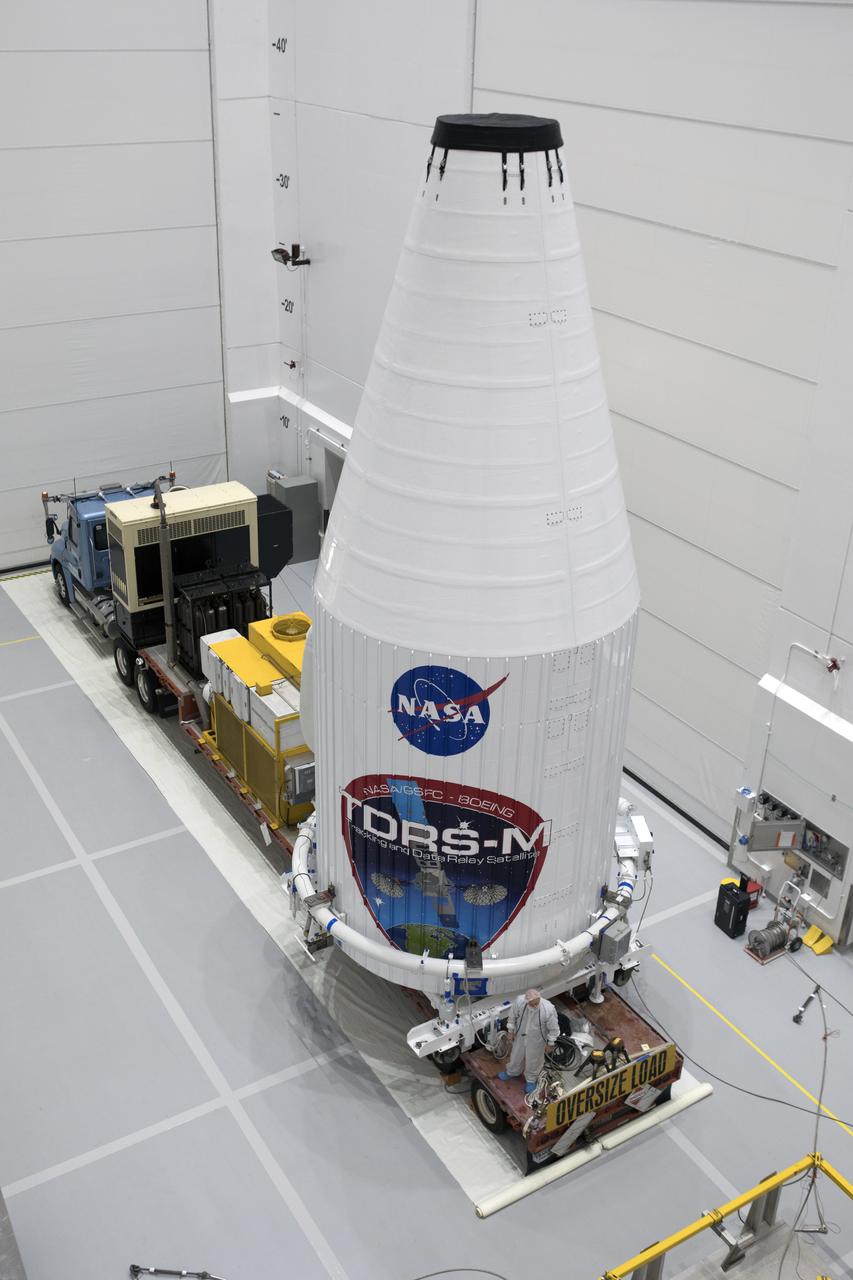
Inside the Astrotech facility near NASA's Kennedy Space Center in Florida, the agency's TDRS-M satellite, enclosed in its payload fairing, is secured on a transport vehicle. The TDRS-M is the latest spacecraft destined for the agency's constellation of communications satellites that allows nearly continuous contact with orbiting spacecraft ranging from the International Space Station and Hubble Space Telescope to the array of scientific observatories. Liftoff atop a United Launch Alliance Atlas V rocket is scheduled to take place from Space Launch Complex 41 at Cape Canaveral Air Force Station on Aug. 18 at 8:03 a.m. EDT.
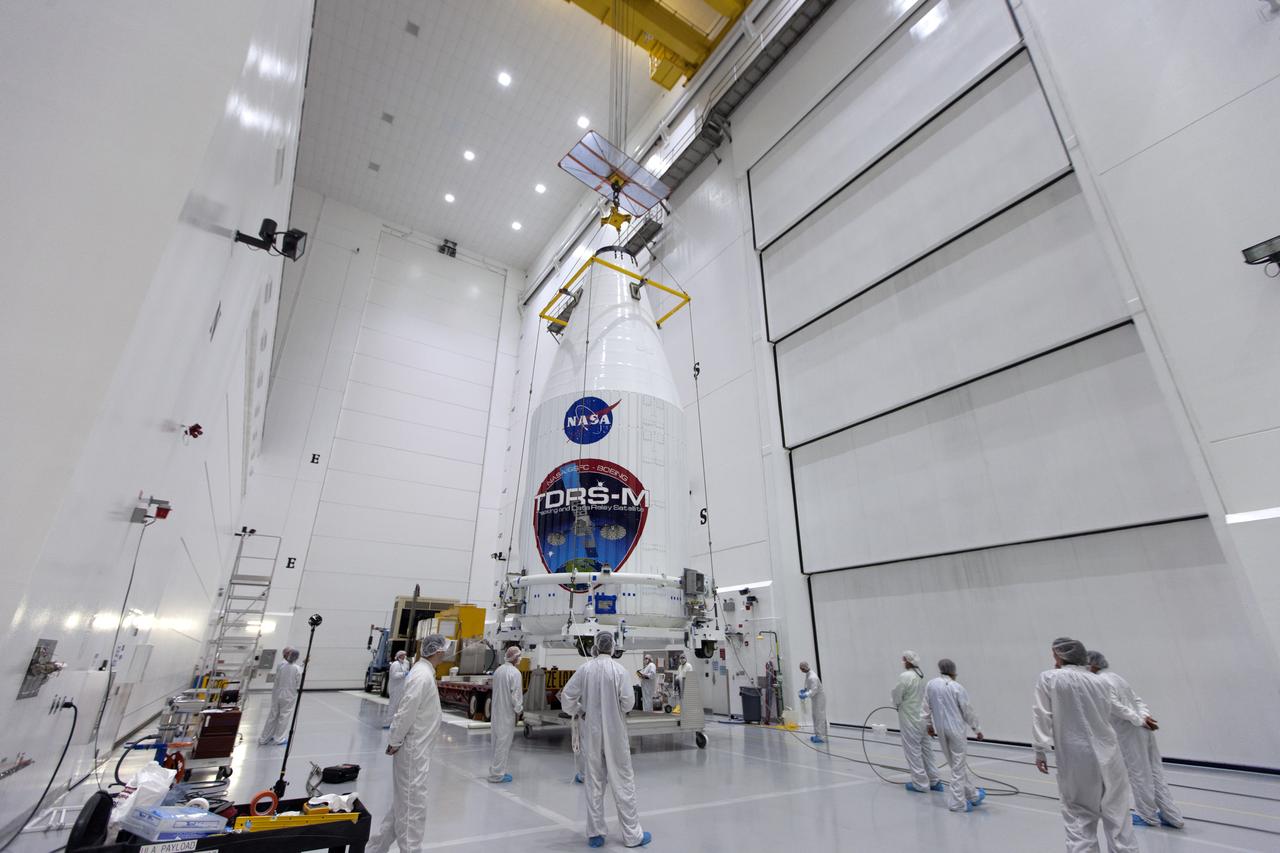
Technicians monitor the progress as NASA's TDRS-M satellite, enclosed in its payload fairing, is lowered onto a transport vehicle inside the Astrotech facility near NASA's Kennedy Space Center in Florida. The TDRS-M is the latest spacecraft destined for the agency's constellation of communications satellites that allows nearly continuous contact with orbiting spacecraft ranging from the International Space Station and Hubble Space Telescope to the array of scientific observatories. Liftoff atop a United Launch Alliance Atlas V rocket is scheduled to take place from Space Launch Complex 41 at Cape Canaveral Air Force Station on Aug. 18 at 8:03 a.m. EDT.
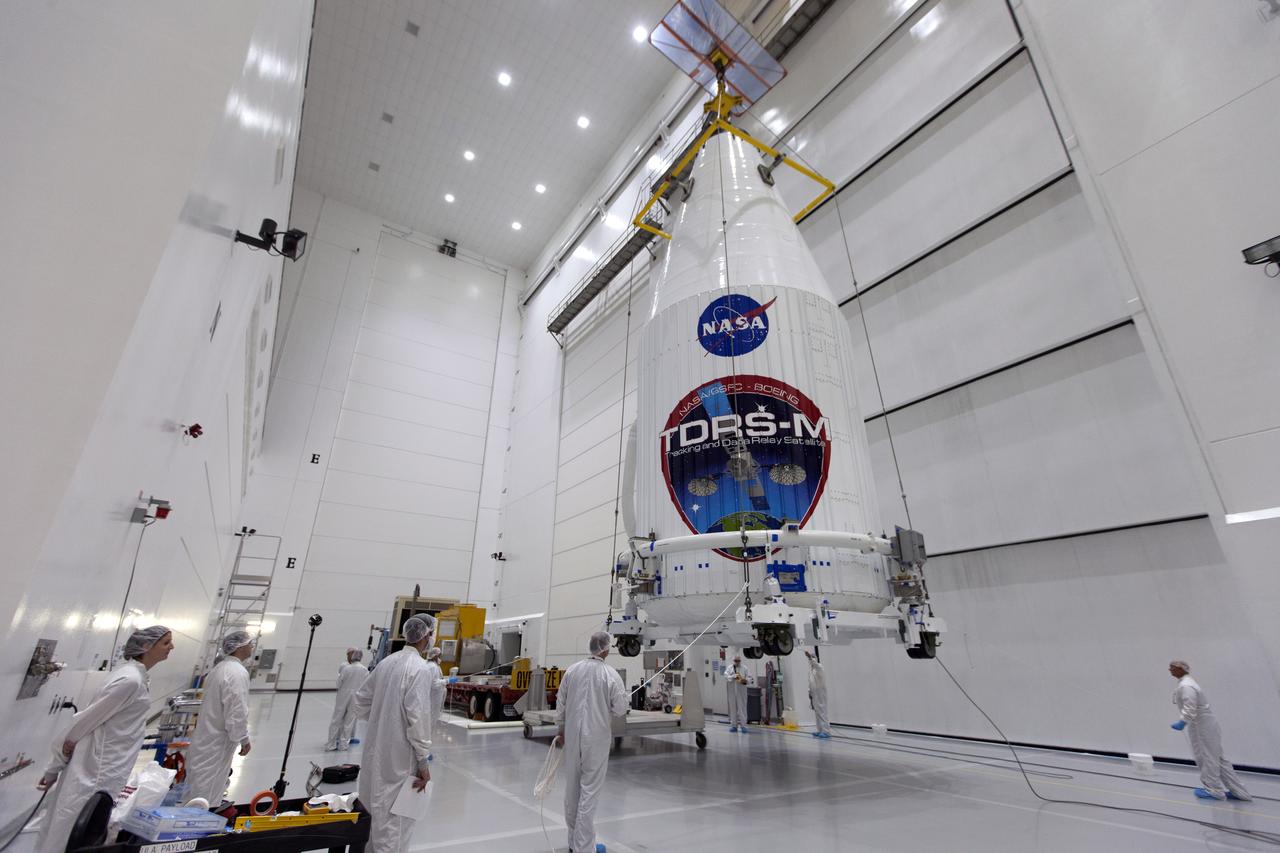
Inside the Astrotech facility near NASA's Kennedy Space Center in Florida, the agency's TDRS-M satellite, enclosed in its payload fairing, is lifted by crane and moved to a transport vehicle. The TDRS-M is the latest spacecraft destined for the agency's constellation of communications satellites that allows nearly continuous contact with orbiting spacecraft ranging from the International Space Station and Hubble Space Telescope to the array of scientific observatories. Liftoff atop a United Launch Alliance Atlas V rocket is scheduled to take place from Space Launch Complex 41 at Cape Canaveral Air Force Station on Aug. 18 at 8:03 a.m. EDT.

AS6-02-1455 (4 April 1968) --- Texas is photographed from the Apollo 6 (Spacecraft 020/Saturn 502) unmanned space mission. Seen in this photograph are Midland, Brownfield, Big Spring, J. B. Thomas Lake, headwaters of Colorado and Brazos Rivers, and the west Texas gas and oil fields.
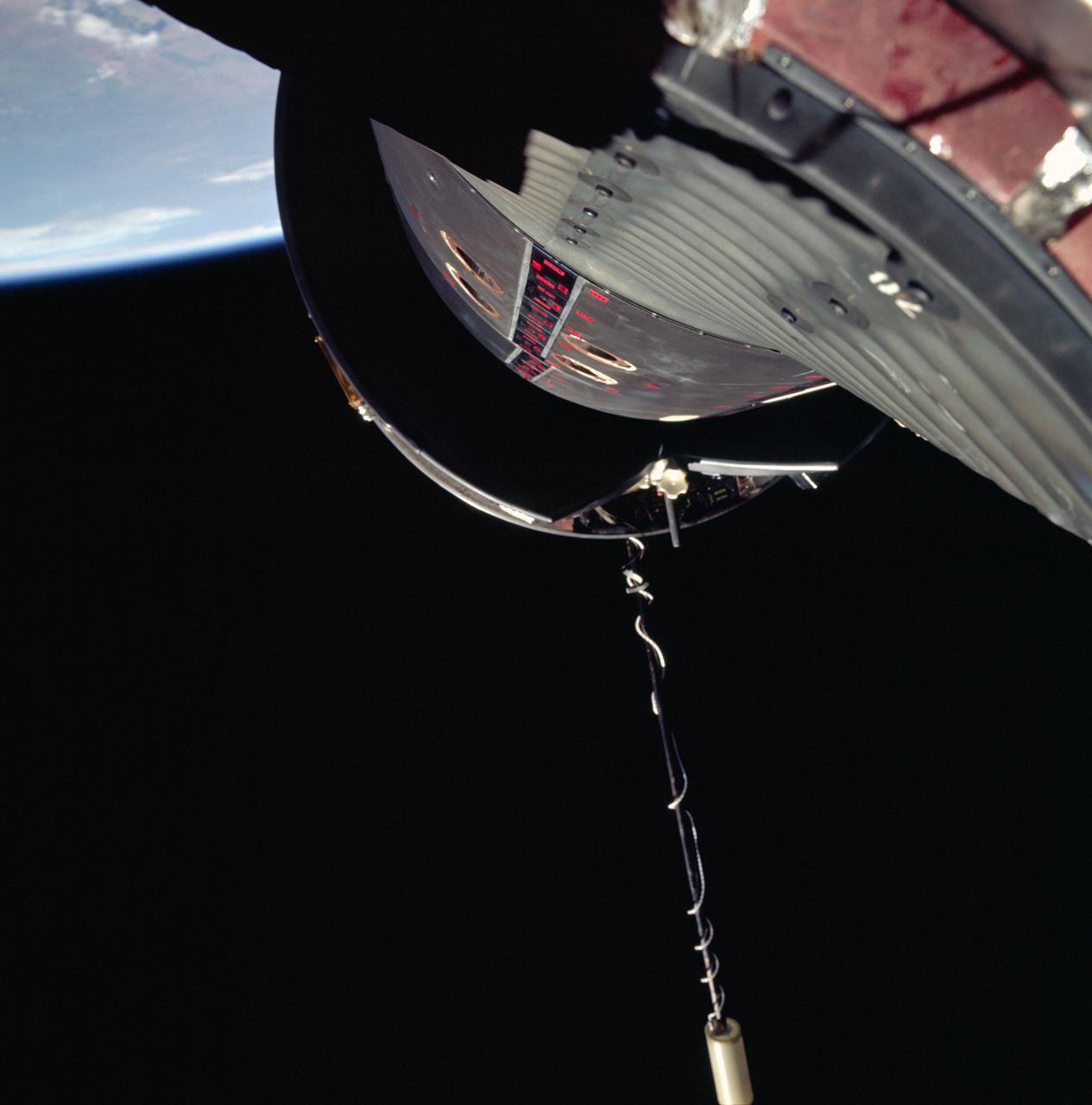
S66-54656 (13 Sept. 1966) --- Nose of Gemini-11 spacecraft and Agena Target Vehicle while docked as photographed by astronaut Richard F. Gordon Jr., pilot, during his stand-up extravehicular activity (EVA). Taken with a modified 70mm Hasselblad camera, using Eastman Kodak, Ektachrome, MS (S.O. 368) color film. Photo credit: NASA
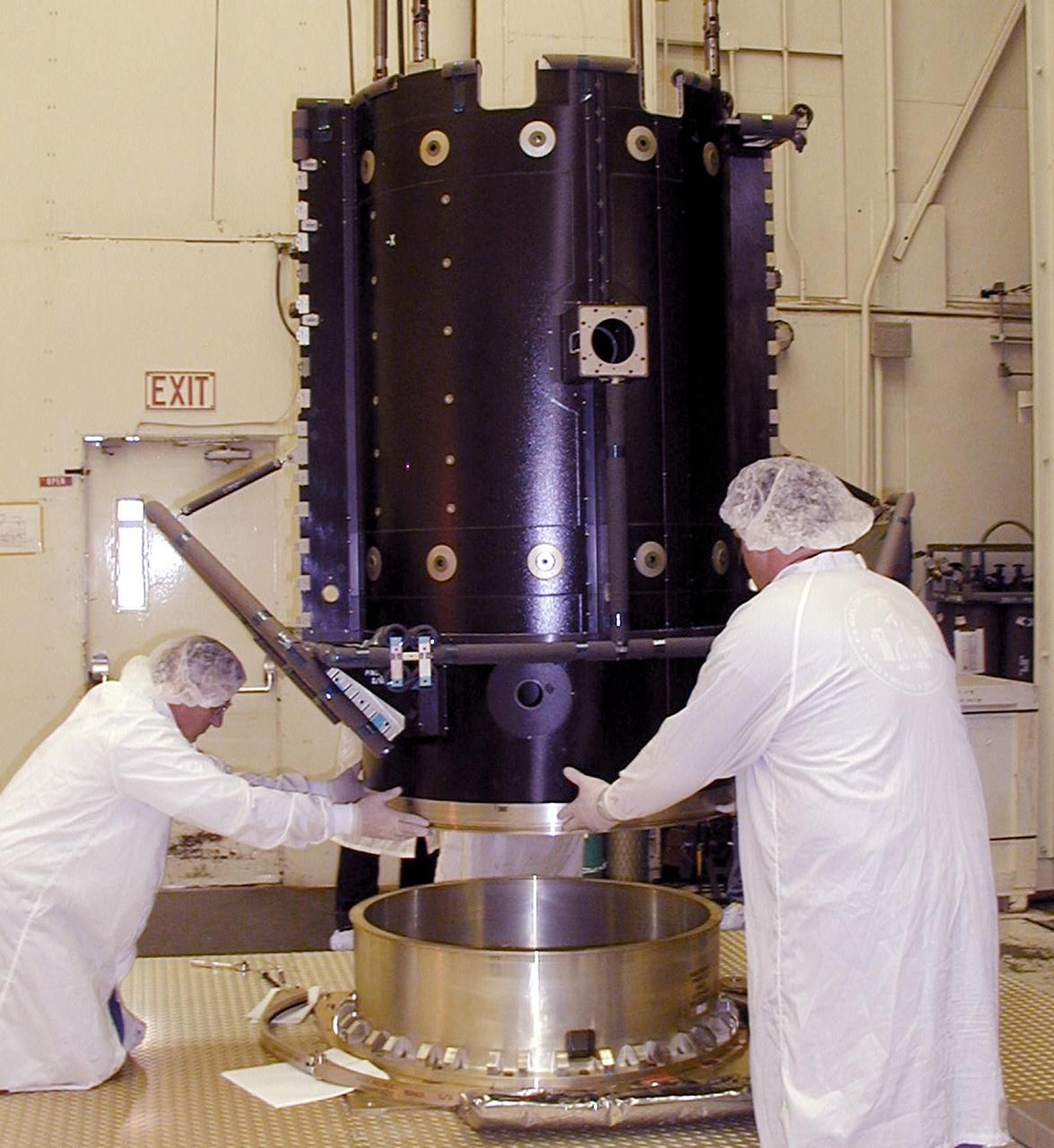
NASA Dawn spacecraft being assembled.
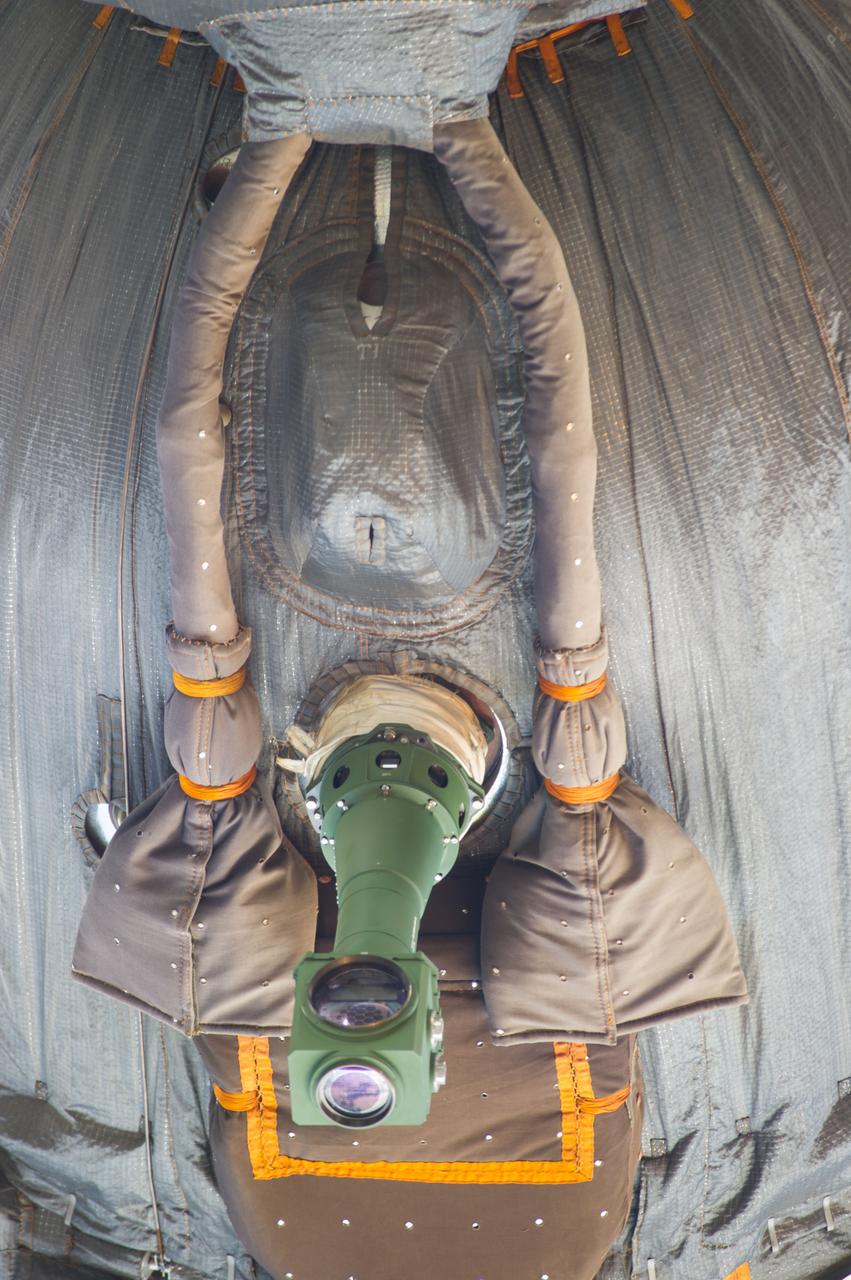
ISS040-E-007424 (4 June 2014) --- A close-up view of the Soyuz 39 (TMA-13M) docked to the Rassvet Mini-Research Module 1 (MRM-1) of the International Space Station is photographed by an Expedition 40 crew member on the station. Visible at bottom is the periscope used to assist in docking.
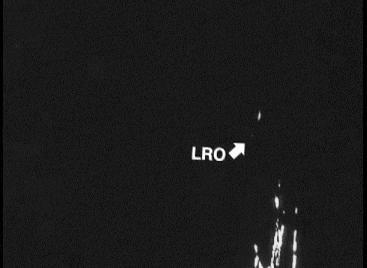
This is the first footage of one orbiting robotic spacecraft taken by another orbiting robotic spacecraft at Earth moon. Flow, one of two satellites making up NASA GRAIL mission, captured this video of NASA LRO as it flew by.
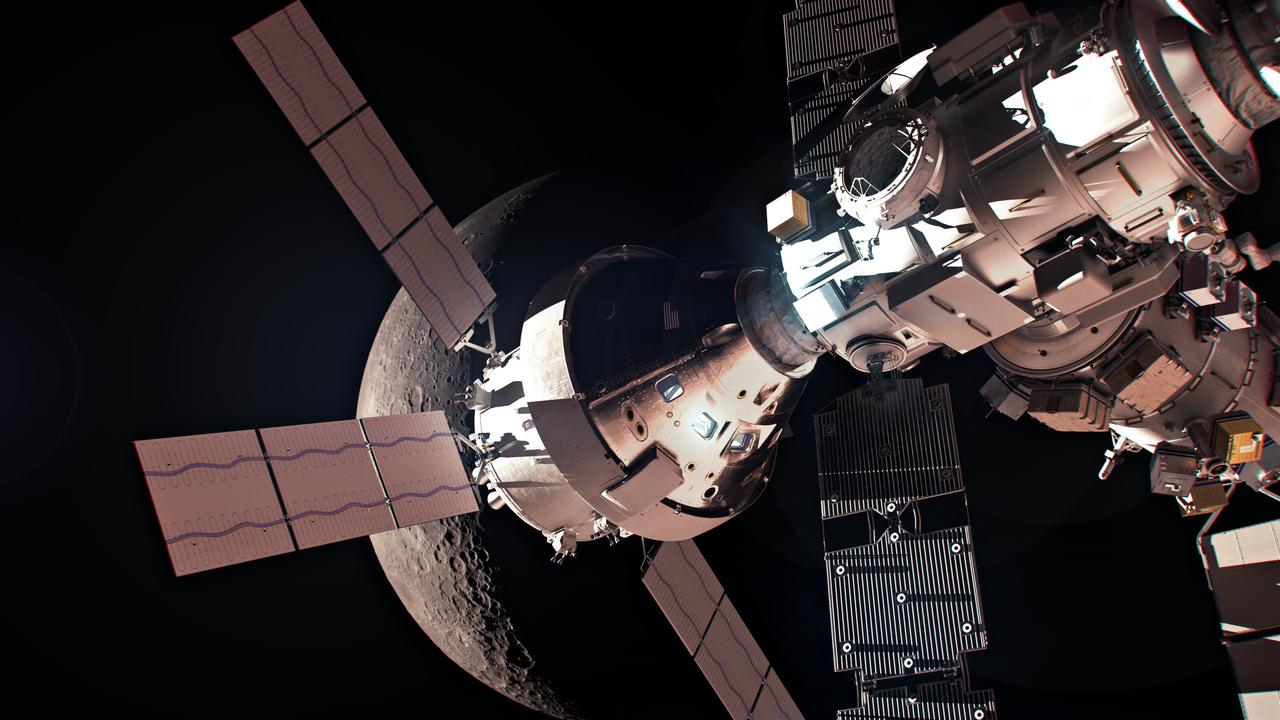
The Orion spacecraft docked to the Gateway space station. Orion will visit Gateway for the first time on the Artemis IV mission when astronauts will use it to deliver the International Habitat (I-Hab) module to Gateway. Orion will return to Gateway to deliver additional elements on Artemis V and VI.

S66-25774 (16 March 1966) --- The Agena Target Docking vehicle seen from the Gemini-8 spacecraft during rendezvous in space. The Agena is approximately 1,000 feet away from the nose of the spacecraft (lower left). Photo credit: NASA
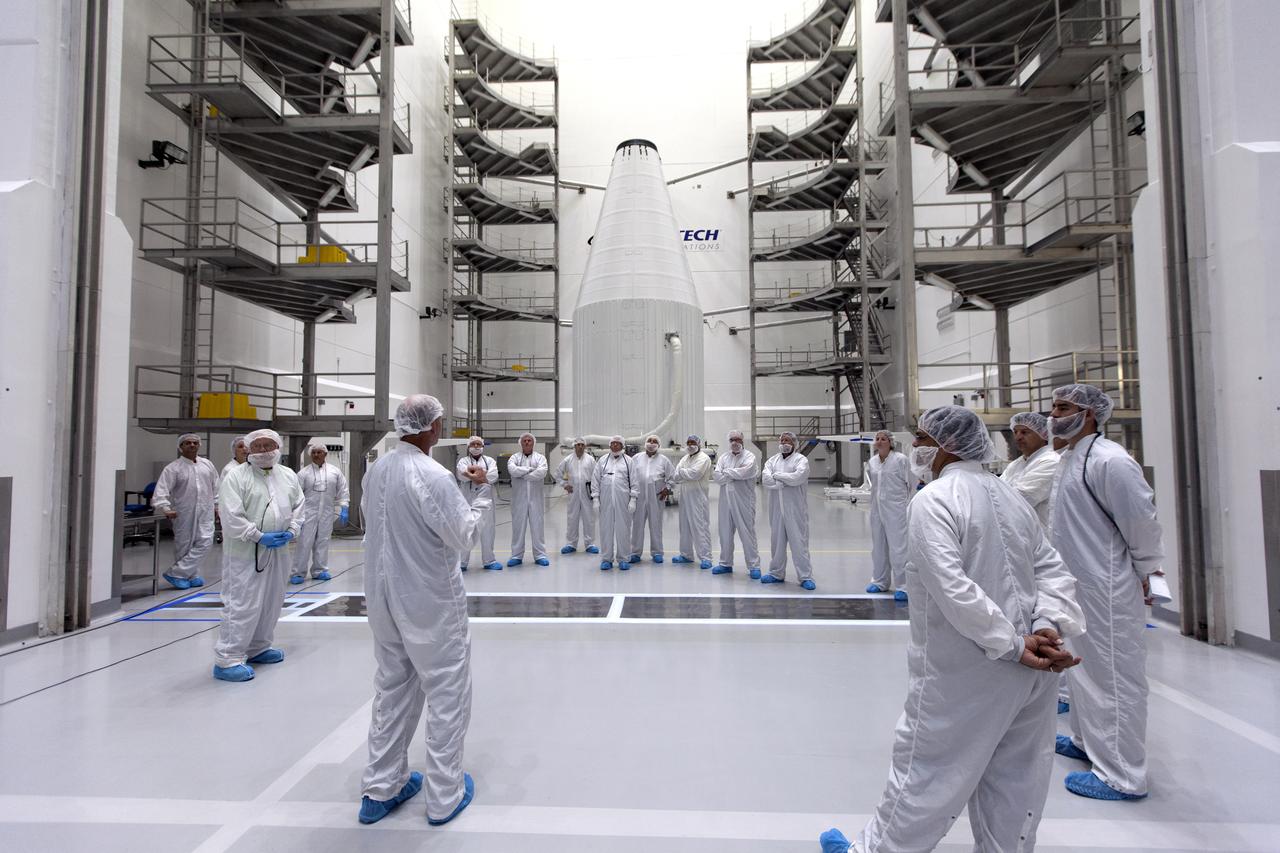
Inside the Astrotech facility near NASA's Kennedy Space Center in Florida, the agency's TDRS-M satellite, enclosed in its payload fairing, is being prepared for lifting to a transport vehicle. Engineers and technicians in clean room attire review procedures before the lifting process begins. The TDRS-M is the latest spacecraft destined for the agency's constellation of communications satellites that allows nearly continuous contact with orbiting spacecraft ranging from the International Space Station and Hubble Space Telescope to the array of scientific observatories. Liftoff atop a United Launch Alliance Atlas V rocket is scheduled to take place from Space Launch Complex 41 at Cape Canaveral Air Force Station on Aug. 18 at 8:03 a.m. EDT.