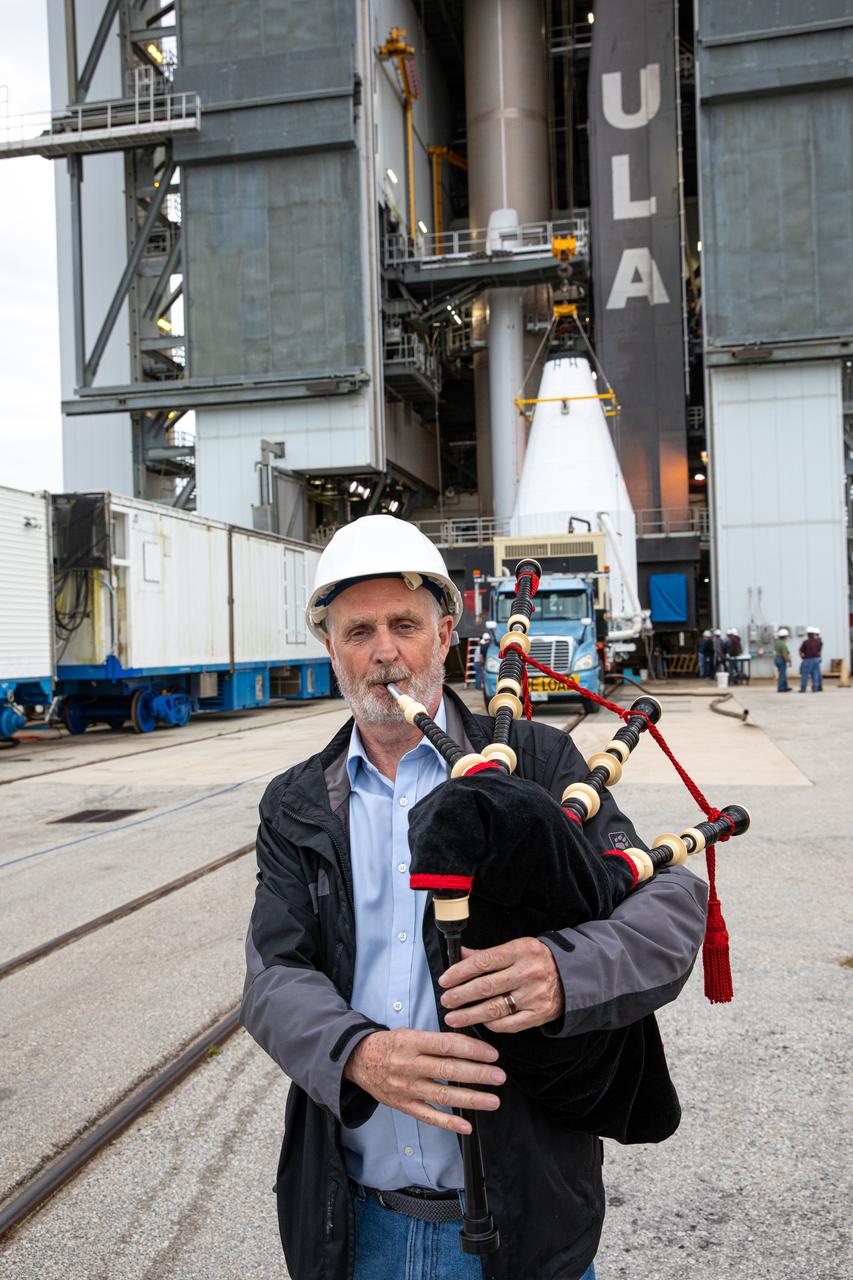
An Airbus Defence and Space worker plays the bagpipes at the Vertical Integration Facility at Space Launch Complex 41 on Cape Canaveral Air Force Station in Florida on Jan. 31, 2020. It is a tradition for the company to play the bagpipes during spacecraft mate to rocket. In the background, a crane lifts the United Launch Alliance payload fairing, containing the Solar Orbiter spacecraft, for mating to the company’s Atlas V rocket. Solar Orbiter is an international cooperative mission between ESA (European Space Agency) and NASA. The mission aims to study the Sun, its outer atmosphere and solar wind. The spacecraft will provide the first images of the Sun’s poles. NASA’s Launch Services Program based at Kennedy is managing the launch. The spacecraft has been developed by Airbus Defence and Space. Solar Orbiter will launch in February 2020 aboard the Atlas V rocket.

An Airbus Defence and Space worker plays the bagpipes at the Vertical Integration Facility at Space Launch Complex 41 on Cape Canaveral Air Force Station in Florida on Jan. 31, 2020. It is a tradition for the company to play the bagpipes during spacecraft mate to rocket. In the background, a crane lifts the United Launch Alliance payload fairing, containing the Solar Orbiter spacecraft, for mating to the company’s Atlas V rocket. Solar Orbiter is an international cooperative mission between ESA (European Space Agency) and NASA. The mission aims to study the Sun, its outer atmosphere and solar wind. The spacecraft will provide the first images of the Sun’s poles. NASA’s Launch Services Program based at Kennedy is managing the launch. The spacecraft has been developed by Airbus Defence and Space. Solar Orbiter will launch in February 2020 aboard the Atlas V rocket.
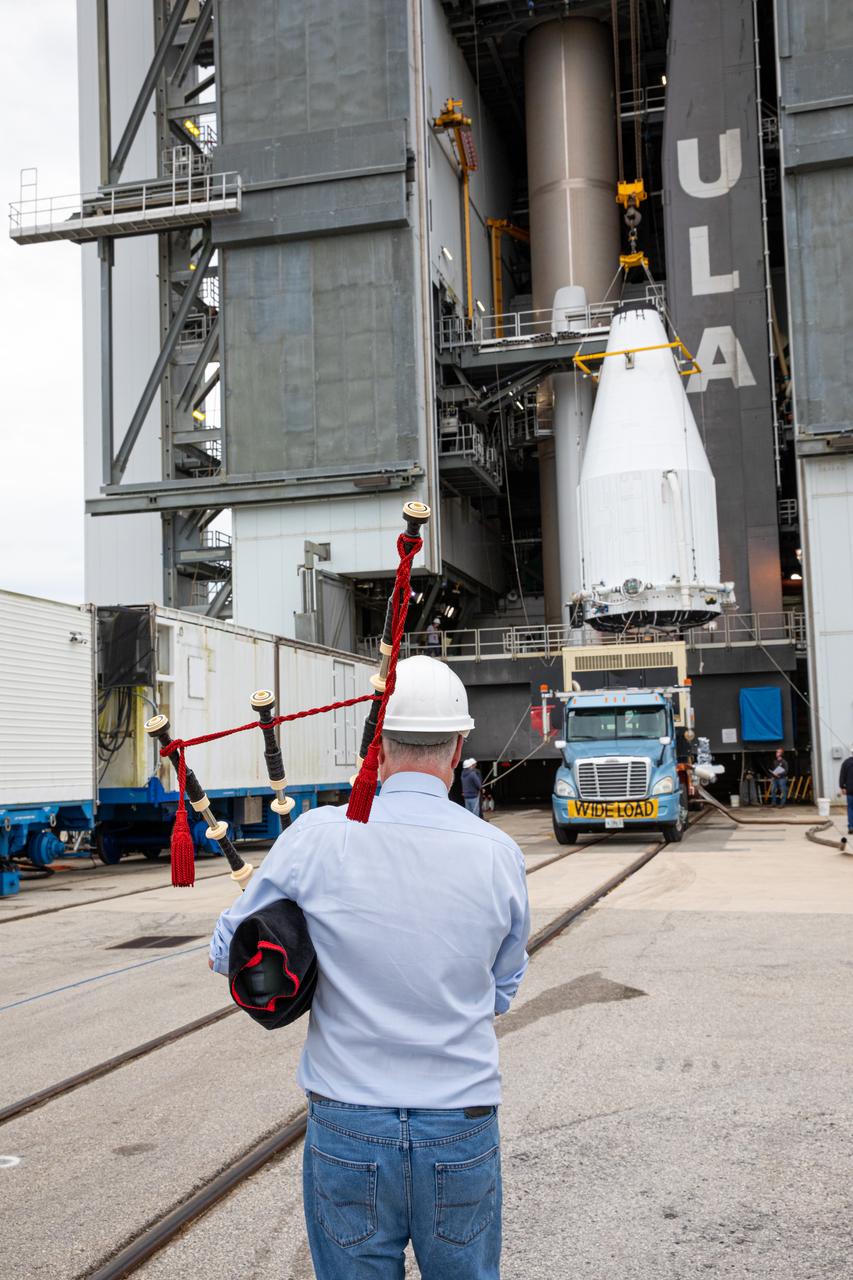
An Airbus Defence and Space worker plays the bagpipes at the Vertical Integration Facility at Space Launch Complex 41 on Cape Canaveral Air Force Station in Florida on Jan. 31, 2020. It is a tradition for the company to play the bagpipes during spacecraft mate to rocket. In the background, a crane lifts the United Launch Alliance payload fairing, containing the Solar Orbiter spacecraft, for mating to the company’s Atlas V rocket. Solar Orbiter is an international cooperative mission between ESA (European Space Agency) and NASA. The mission aims to study the Sun, its outer atmosphere and solar wind. The spacecraft will provide the first images of the Sun’s poles. NASA’s Launch Services Program based at Kennedy is managing the launch. The spacecraft has been developed by Airbus Defence and Space. Solar Orbiter will launch in February 2020 aboard the Atlas V rocket.

Bagpipes are being played by an Airbus Defence and Space worker at the Vertical Integration Facility at Space Launch Complex 41 on Cape Canaveral Air Force Station in Florida on Jan. 31, 2020. It is a tradition for the company to play the bagpipes during spacecraft mate to rocket. In the background, a crane lifts the United Launch Alliance payload fairing, containing the Solar Orbiter spacecraft, for mating to the company’s Atlas V rocket. Solar Orbiter is an international cooperative mission between ESA (European Space Agency) and NASA. The mission aims to study the Sun, its outer atmosphere and solar wind. The spacecraft will provide the first images of the Sun’s poles. NASA’s Launch Services Program based at Kennedy is managing the launch. The spacecraft has been developed by Airbus Defence and Space. Solar Orbiter will launch in February 2020 aboard the Atlas V rocket.
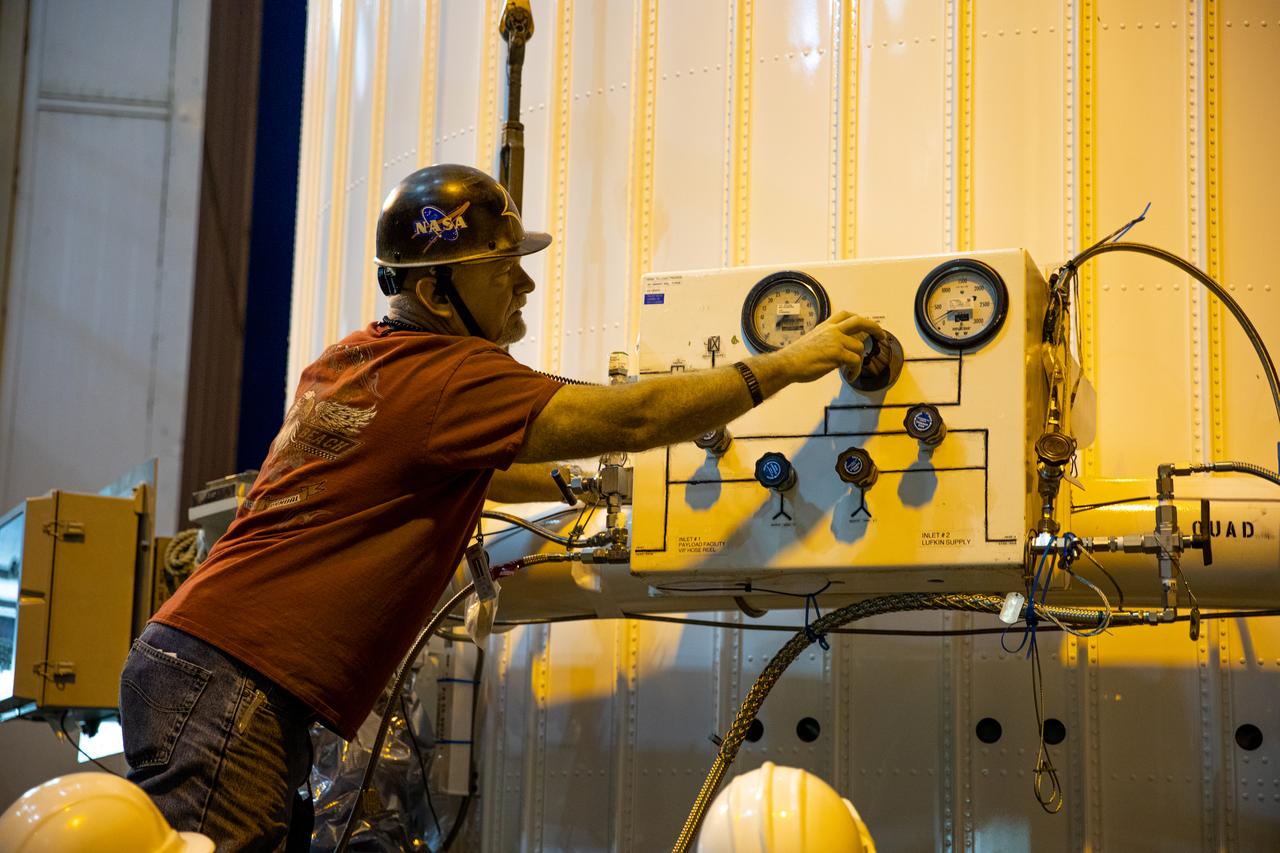
A worker prepares for mate operations of the Solar Orbiter spacecraft, contained inside the payload fairing, to the Atlas V rocket inside the Vertical Integration Facility at Space Launch Complex 41 on Cape Canaveral Air Force Station in Florida on Jan. 31, 2020. The payload fairing will be mated to the Atlas V rocket. Solar Orbiter is an international cooperative mission between ESA (European Space Agency) and NASA. The mission aims to study the Sun, its outer atmosphere and solar wind. The spacecraft will provide the first images of the Sun’s poles. NASA’s Launch Services Program based at Kennedy is managing the launch. The spacecraft has been developed by Airbus Defence and Space. Solar Orbiter will launch in February 2020 aboard the Atlas V rocket.
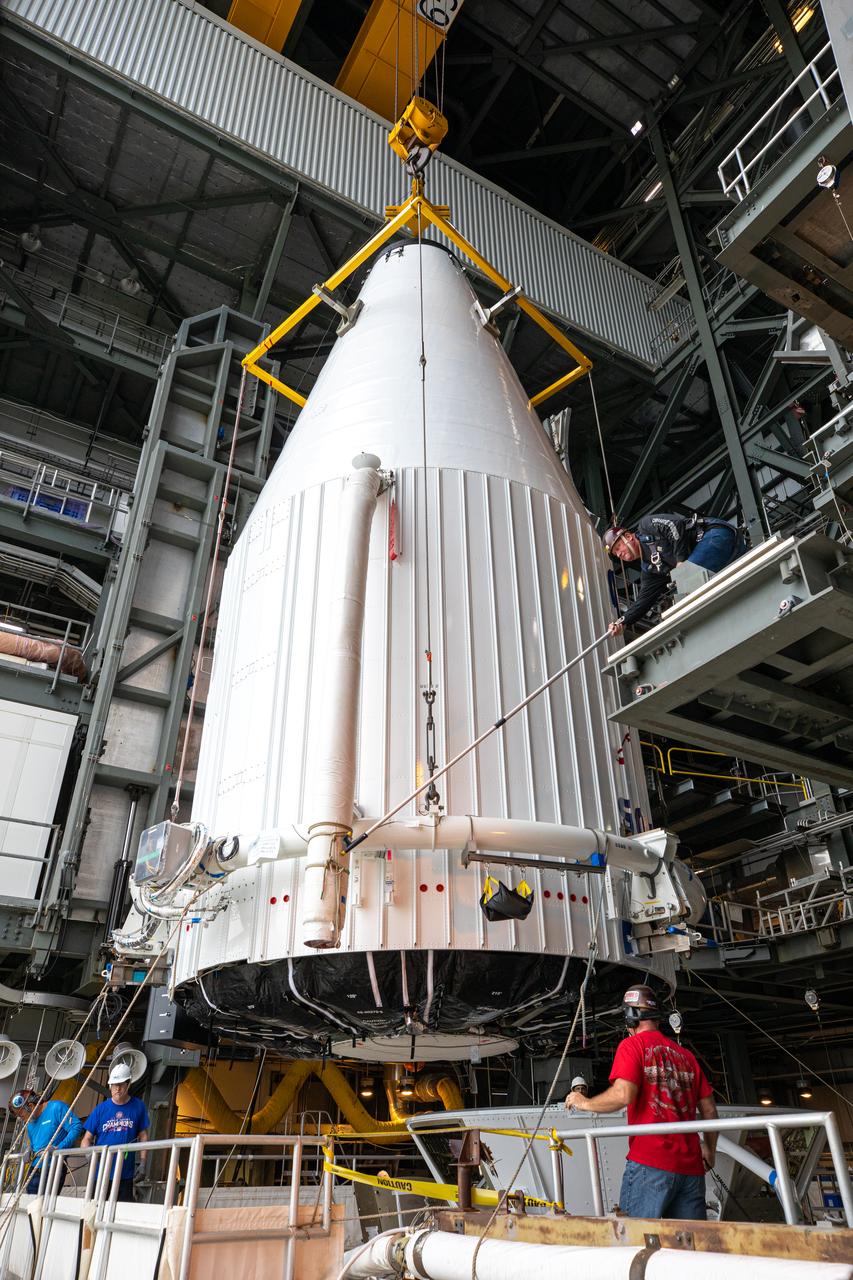
The United Launch Alliance Atlas V payload fairing, containing the Solar Orbiter spacecraft, is moved into the Vertical Integration Facility at Space Launch Complex 41 on Cape Canaveral Air Force Station in Florida on Jan. 31, 2020. The payload fairing will be lowered and mated to the Atlas V rocket. Solar Orbiter is an international cooperative mission between ESA (European Space Agency) and NASA. The mission aims to study the Sun, its outer atmosphere and solar wind. The spacecraft will provide the first images of the Sun’s poles. NASA’s Launch Services Program based at Kennedy is managing the launch. The spacecraft has been developed by Airbus Defence and Space. Solar Orbiter will launch in February 2020 aboard the Atlas V rocket.

In this view from above, the United Launch Alliance Atlas V payload fairing, containing the Solar Orbiter spacecraft, is hoisted up by crane at the Vertical Integration Facility at Space Launch Complex 41 on Cape Canaveral Air Force Station in Florida on Jan. 31, 2020. The payload fairing will be mated to the Atlas V rocket. Solar Orbiter is an international cooperative mission between ESA (European Space Agency) and NASA. The mission aims to study the Sun, its outer atmosphere and solar wind. The spacecraft will provide the first images of the Sun’s poles. NASA’s Launch Services Program based at Kennedy is managing the launch. The spacecraft has been developed by Airbus Defence and Space. Solar Orbiter will launch in February 2020 aboard the Atlas V rocket.
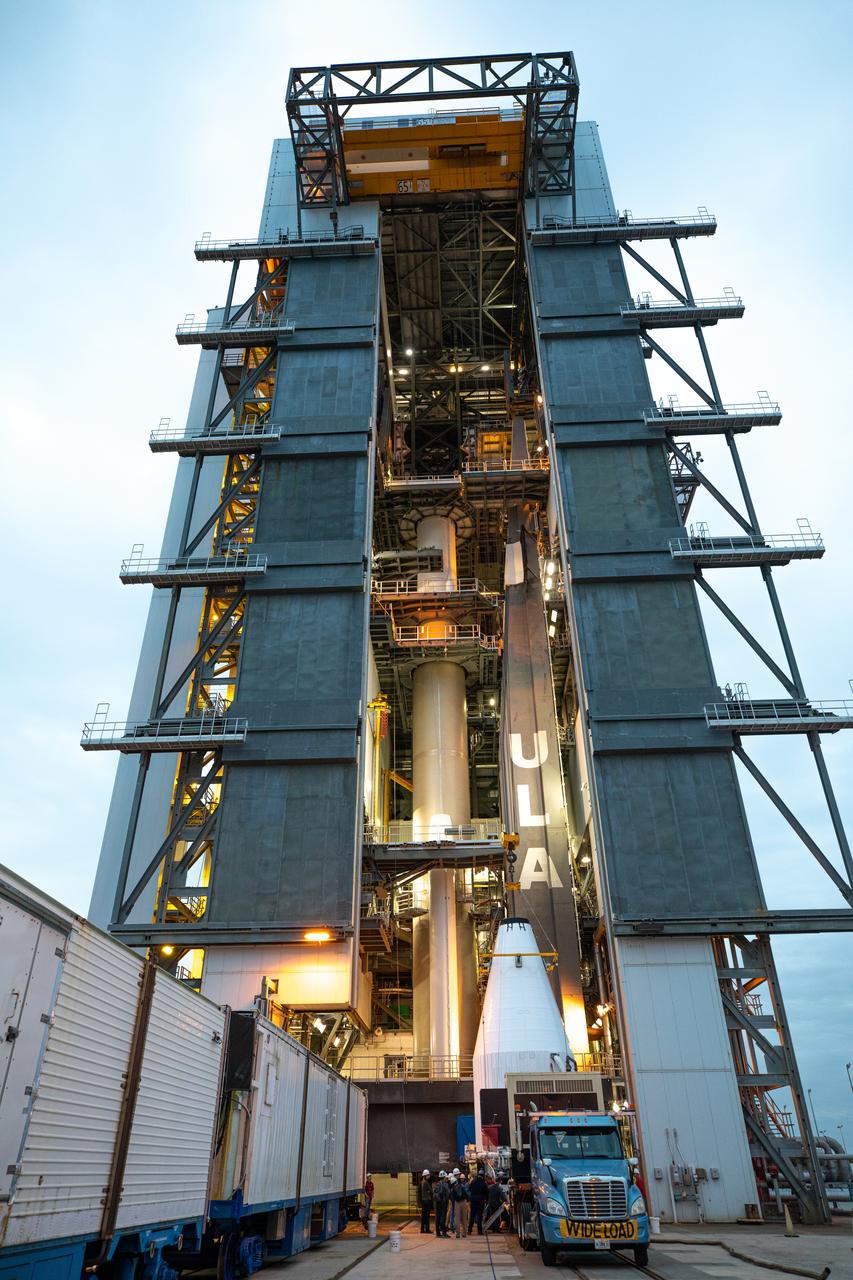
The United Launch Alliance Atlas V payload fairing, containing the Solar Orbiter spacecraft, is hoisted up by crane at the Vertical Integration Facility at Space Launch Complex 41 on Cape Canaveral Air Force Station in Florida on Jan. 31, 2020. The payload fairing will be mated to the Atlas V rocket. Solar Orbiter is an international cooperative mission between ESA (European Space Agency) and NASA. The mission aims to study the Sun, its outer atmosphere and solar wind. The spacecraft will provide the first images of the Sun’s poles. NASA’s Launch Services Program based at Kennedy is managing the launch. The spacecraft has been developed by Airbus Defence and Space. Solar Orbiter will launch in February 2020 aboard the Atlas V rocket.
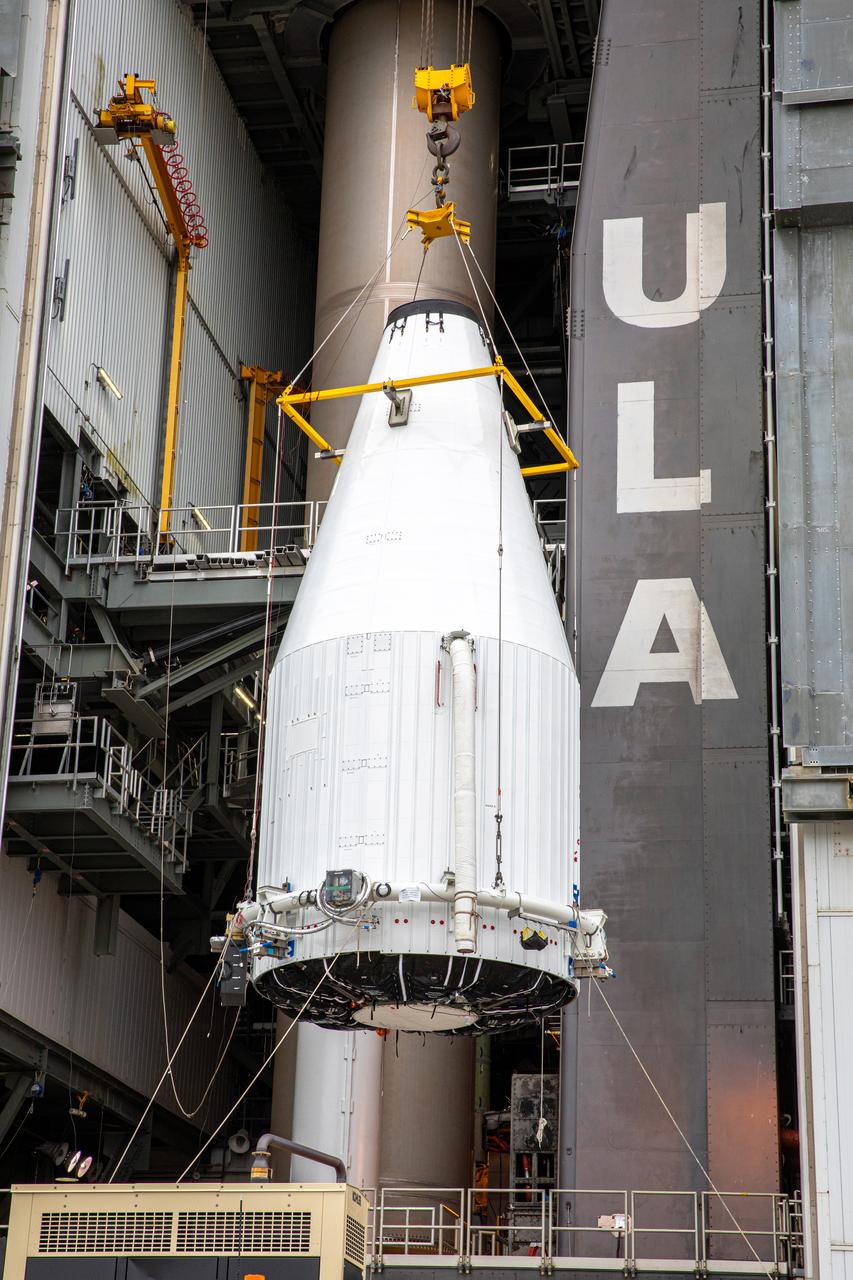
The United Launch Alliance Atlas V payload fairing, containing the Solar Orbiter spacecraft, is hoisted up by crane at the Vertical Integration Facility at Space Launch Complex 41 on Cape Canaveral Air Force Station in Florida on Jan. 31, 2020. The payload fairing will be mated to the Atlas V rocket. Solar Orbiter is an international cooperative mission between ESA (European Space Agency) and NASA. The mission aims to study the Sun, its outer atmosphere and solar wind. The spacecraft will provide the first images of the Sun’s poles. NASA’s Launch Services Program based at Kennedy is managing the launch. The spacecraft has been developed by Airbus Defence and Space. Solar Orbiter will launch in February 2020 aboard the Atlas V rocket.
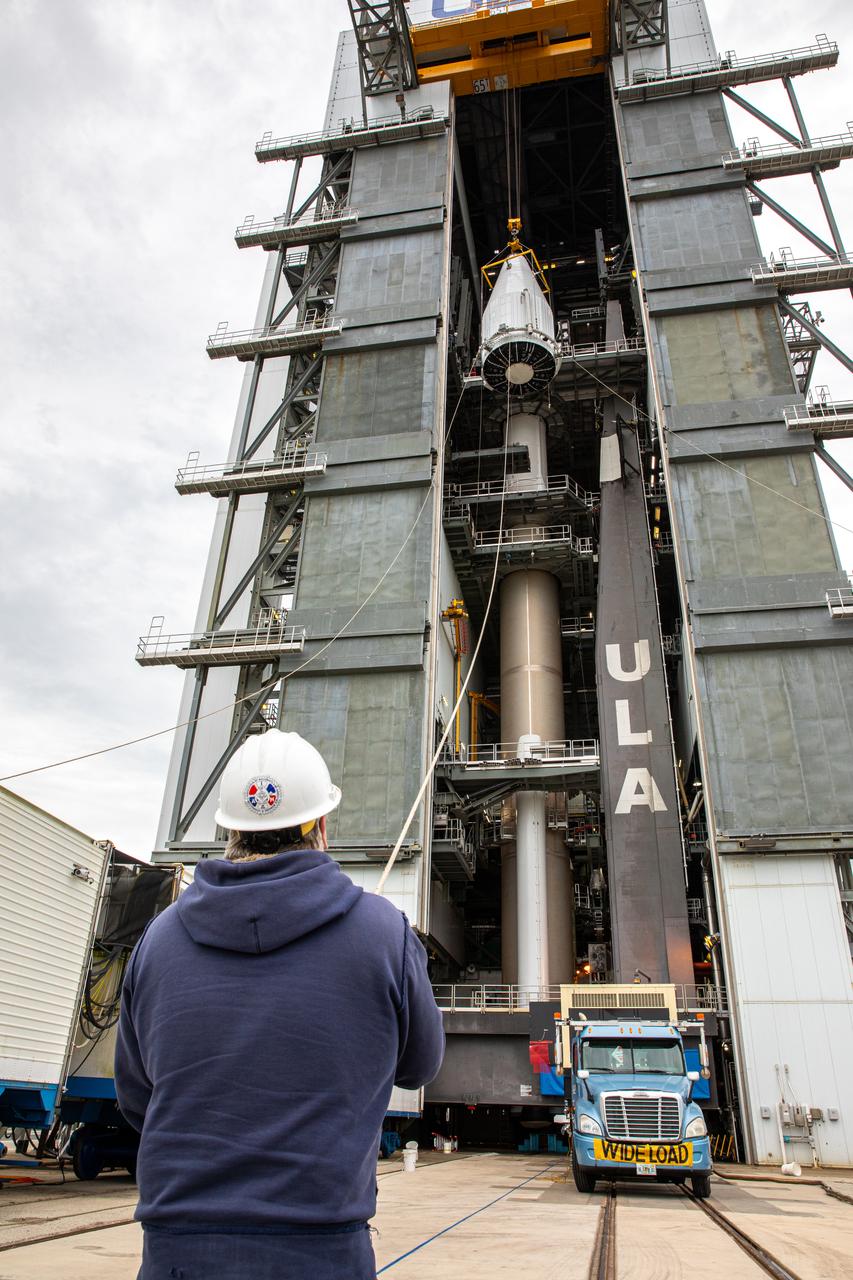
The United Launch Alliance Atlas V payload fairing, containing the Solar Orbiter spacecraft, is hoisted up by crane at the Vertical Integration Facility at Space Launch Complex 41 on Cape Canaveral Air Force Station in Florida on Jan. 31, 2020. The payload fairing will be mated to the Atlas V rocket. Solar Orbiter is an international cooperative mission between ESA (European Space Agency) and NASA. The mission aims to study the Sun, its outer atmosphere and solar wind. The spacecraft will provide the first images of the Sun’s poles. NASA’s Launch Services Program based at Kennedy is managing the launch. The spacecraft has been developed by Airbus Defence and Space. Solar Orbiter will launch in February 2020 aboard the Atlas V rocket.
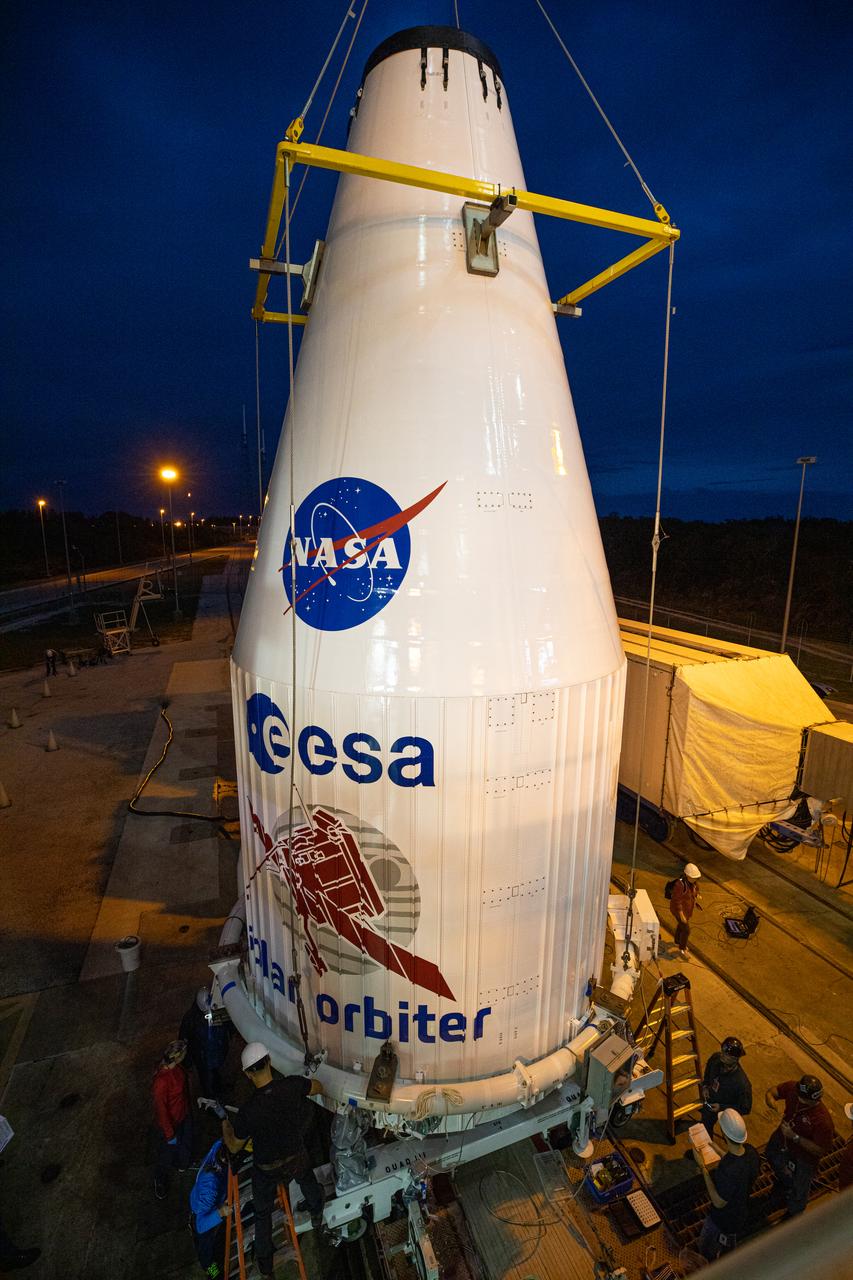
The United Launch Alliance Atlas V payload fairing, containing the Solar Orbiter spacecraft, is hoisted up by crane at the Vertical Integration Facility at Space Launch Complex 41 on Cape Canaveral Air Force Station in Florida on Jan. 31, 2020. The payload fairing will be mated to the Atlas V rocket. Solar Orbiter is an international cooperative mission between ESA (European Space Agency) and NASA. The mission aims to study the Sun, its outer atmosphere and solar wind. The spacecraft will provide the first images of the Sun’s poles. NASA’s Launch Services Program based at Kennedy is managing the launch. The spacecraft has been developed by Airbus Defence and Space. Solar Orbiter will launch in February 2020 aboard the Atlas V rocket.
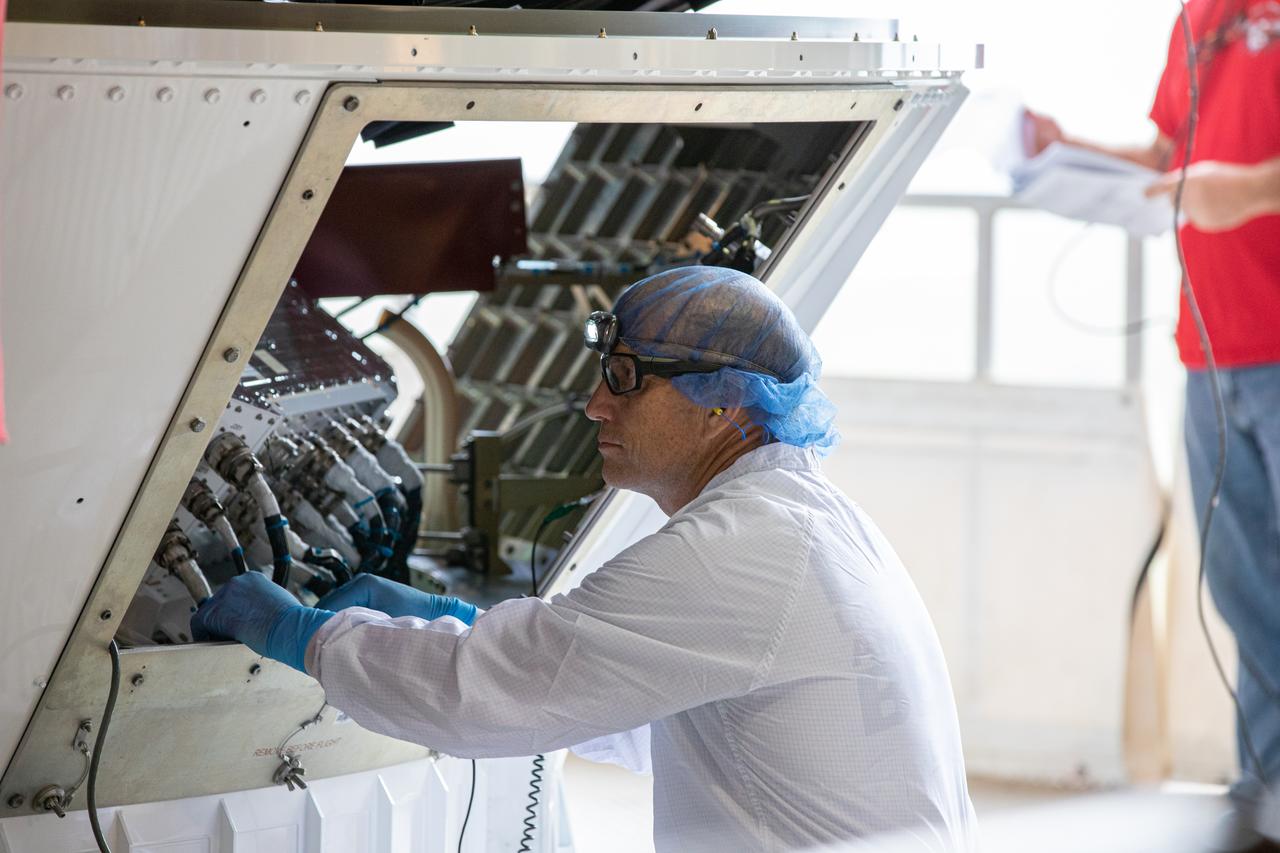
High up in the Vertical Integration Facility at Space Launch Complex 41 on Cape Canaveral Air Force Station in Florida, a worker helps complete mate operations of the United Launch Alliance Atlas V payload fairing, containing the Solar Orbiter spacecraft, to the Atlas V rocket on Jan. 31, 2020. Solar Orbiter is an international cooperative mission between ESA (European Space Agency) and NASA. The mission aims to study the Sun, its outer atmosphere and solar wind. The spacecraft will provide the first images of the Sun’s poles. NASA’s Launch Services Program based at Kennedy is managing the launch. The spacecraft has been developed by Airbus Defence and Space. Solar Orbiter will launch in February 2020 aboard the Atlas V rocket.

The United Launch Alliance Atlas V payload fairing, containing the Solar Orbiter spacecraft, is hoisted up by crane at the Vertical Integration Facility at Space Launch Complex 41 on Cape Canaveral Air Force Station in Florida on Jan. 31, 2020. The payload fairing will be mated to the Atlas V rocket. Solar Orbiter is an international cooperative mission between ESA (European Space Agency) and NASA. The mission aims to study the Sun, its outer atmosphere and solar wind. The spacecraft will provide the first images of the Sun’s poles. NASA’s Launch Services Program based at Kennedy is managing the launch. The spacecraft has been developed by Airbus Defence and Space. Solar Orbiter will launch in February 2020 aboard the Atlas V rocket.
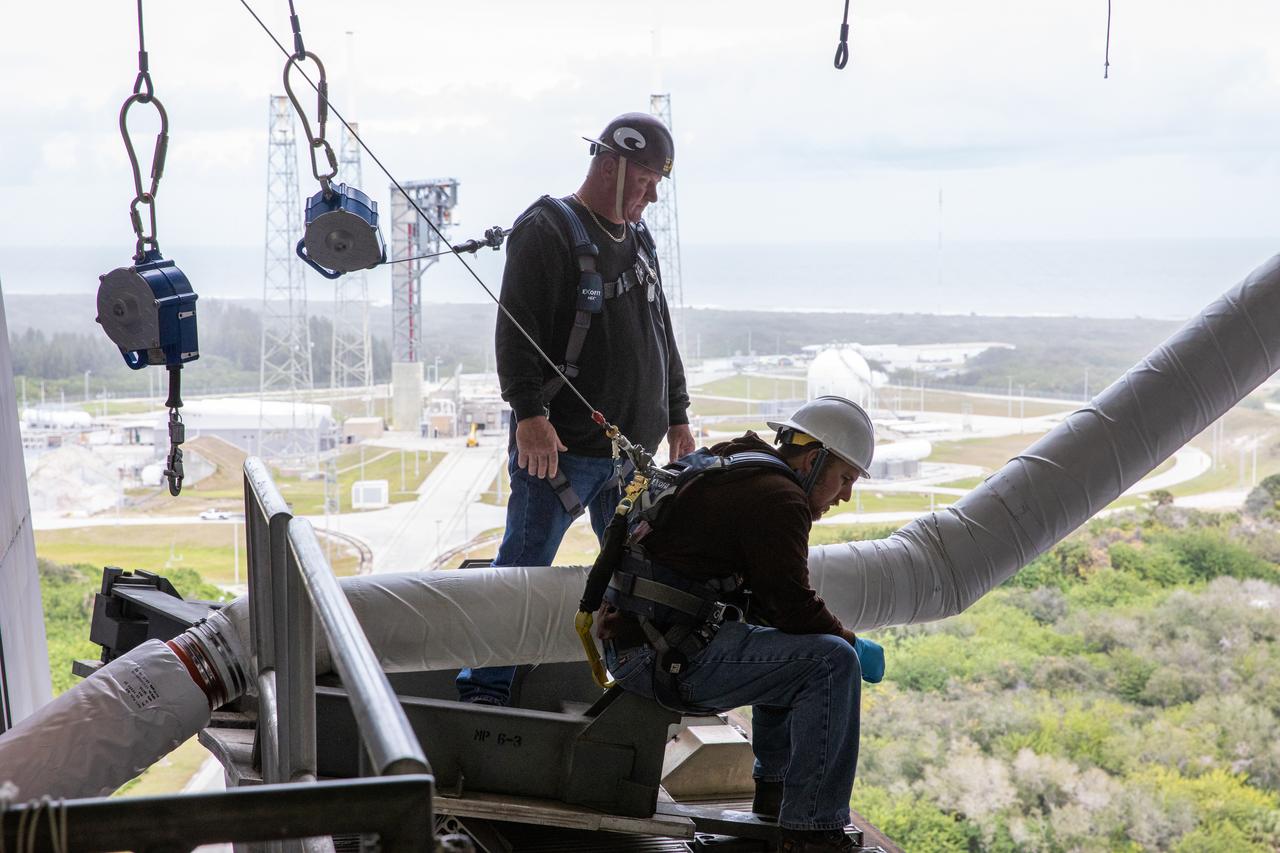
High up in the Vertical Integration Facility at Space Launch Complex 41 on Cape Canaveral Air Force Station in Florida, workers complete mate operation of the United Launch Alliance Atlas V payload fairing, containing the Solar Orbiter spacecraft, to the Atlas V rocket on Jan. 31, 2020. Solar Orbiter is an international cooperative mission between ESA (European Space Agency) and NASA. The mission aims to study the Sun, its outer atmosphere and solar wind. The spacecraft will provide the first images of the Sun’s poles. NASA’s Launch Services Program based at Kennedy is managing the launch. The spacecraft has been developed by Airbus Defence and Space. Solar Orbiter will launch in February 2020 aboard the Atlas V rocket.
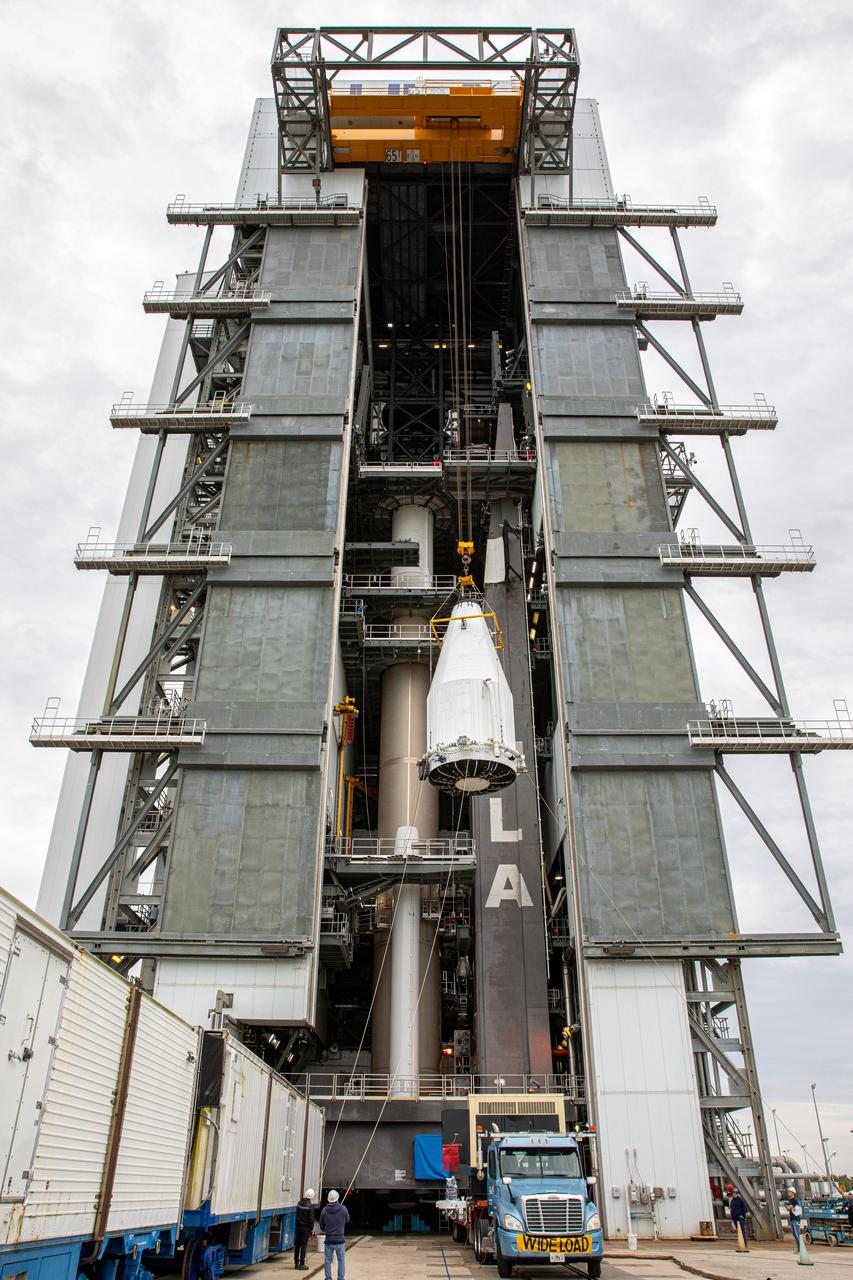
The United Launch Alliance Atlas V payload fairing, containing the Solar Orbiter spacecraft, is hoisted up by crane at the Vertical Integration Facility at Space Launch Complex 41 on Cape Canaveral Air Force Station in Florida on Jan. 31, 2020. The payload fairing will be mated to the Atlas V rocket. Solar Orbiter is an international cooperative mission between ESA (European Space Agency) and NASA. The mission aims to study the Sun, its outer atmosphere and solar wind. The spacecraft will provide the first images of the Sun’s poles. NASA’s Launch Services Program based at Kennedy is managing the launch. The spacecraft has been developed by Airbus Defence and Space. Solar Orbiter will launch in February 2020 aboard the Atlas V rocket.
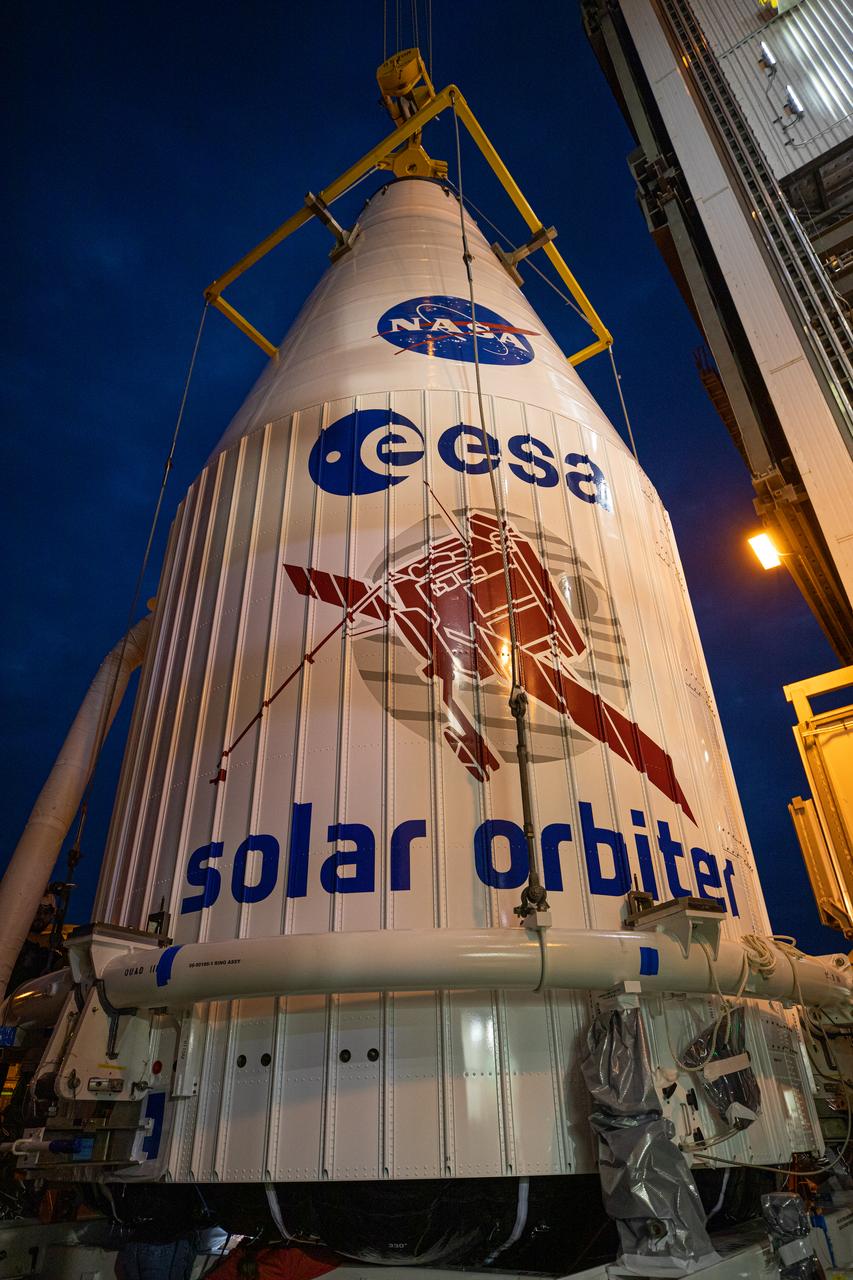
The United Launch Alliance Atlas V payload fairing, containing the Solar Orbiter spacecraft, is hoisted up by crane at the Vertical Integration Facility at Space Launch Complex 41 on Cape Canaveral Air Force Station in Florida on Jan. 31, 2020. The payload fairing will be mated to the Atlas V rocket. Solar Orbiter is an international cooperative mission between ESA (European Space Agency) and NASA. The mission aims to study the Sun, its outer atmosphere and solar wind. The spacecraft will provide the first images of the Sun’s poles. NASA’s Launch Services Program based at Kennedy is managing the launch. The spacecraft has been developed by Airbus Defence and Space. Solar Orbiter will launch in February 2020 aboard the Atlas V rocket.
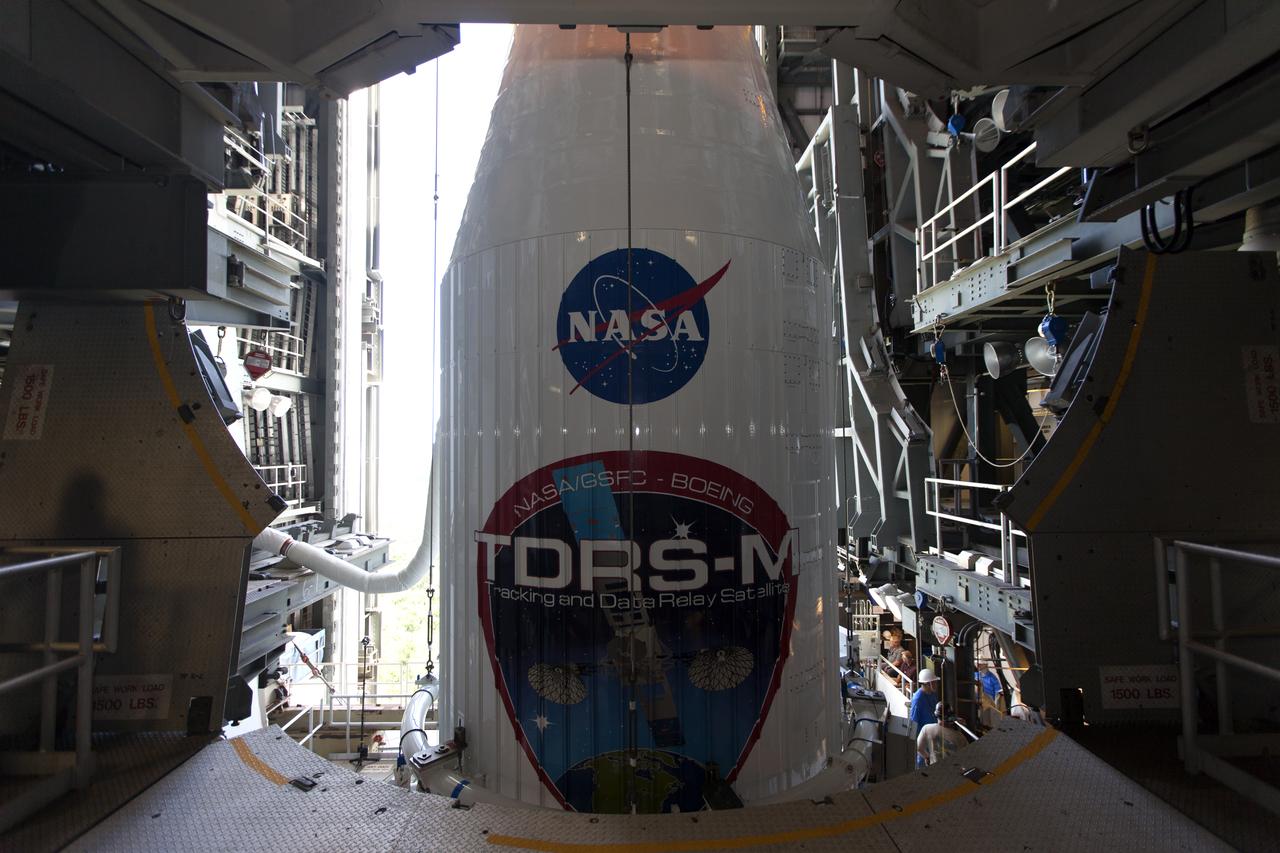
Encapsulated in its payload fairing, Tracking and Data Relay Satellite (TDRS-M) is mated to the United Launch Alliance Atlas V Centaur upper stage in the Vertical Integration Facility at Space Launch Complex 41 at Cape Canaveral Air Force Station in Florida. TDRS-M will be the latest spacecraft destined for the agency's constellation of communications satellites that allows nearly continuous contact with orbiting spacecraft ranging from the International Space Station and Hubble Space Telescope to the array of scientific observatories. Liftoff atop the ULA Atlas V rocket is scheduled for Aug. 18, 2017.
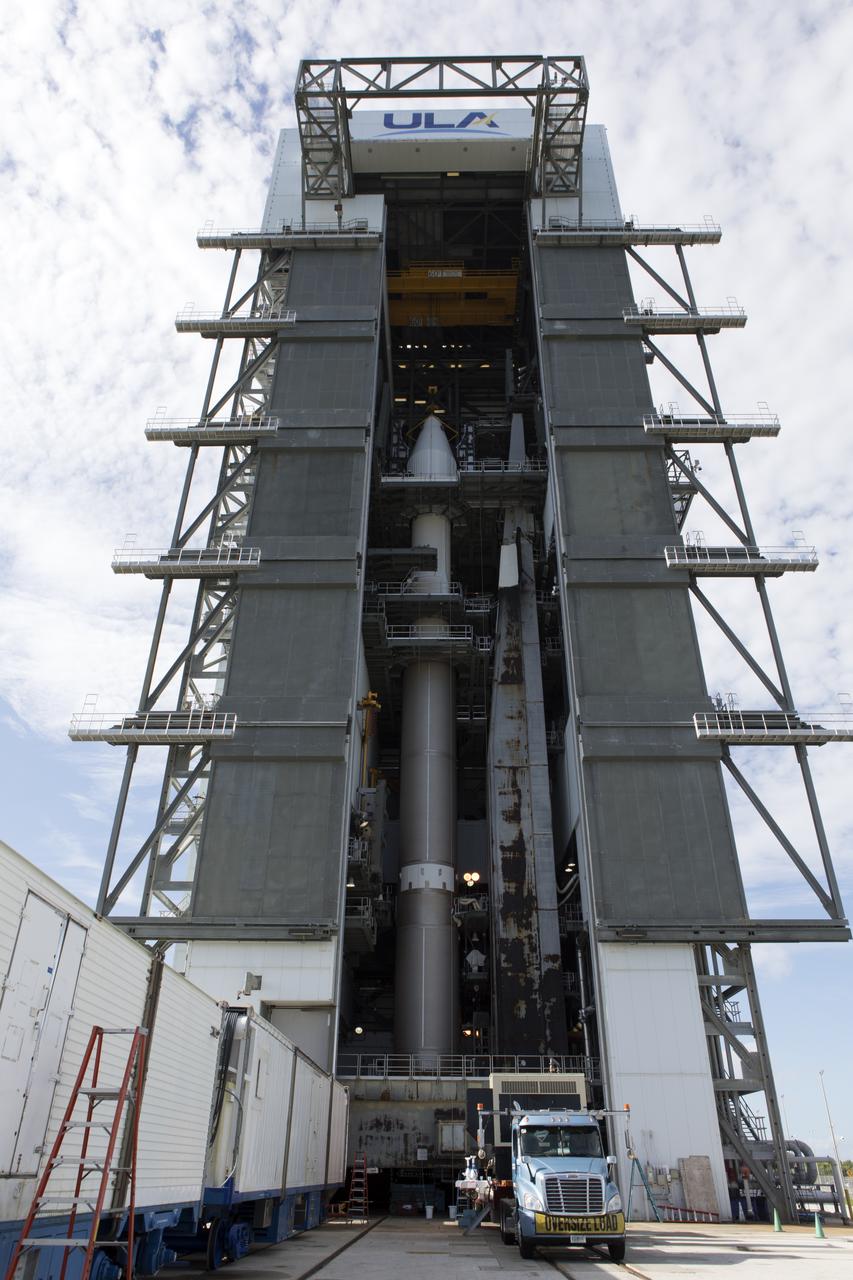
Encapsulated in its payload fairing, Tracking and Data Relay Satellite (TDRS-M) has been mated to the United Launch Alliance Atlas V Centaur upper stage in the Vertical Integration Facility at Space Launch Complex 41 at Cape Canaveral Air Force Station in Florida. TDRS-M will be the latest spacecraft destined for the agency's constellation of communications satellites that allows nearly continuous contact with orbiting spacecraft ranging from the International Space Station and Hubble Space Telescope to the array of scientific observatories. Liftoff atop the ULA Atlas V rocket is scheduled for Aug. 18, 2017.
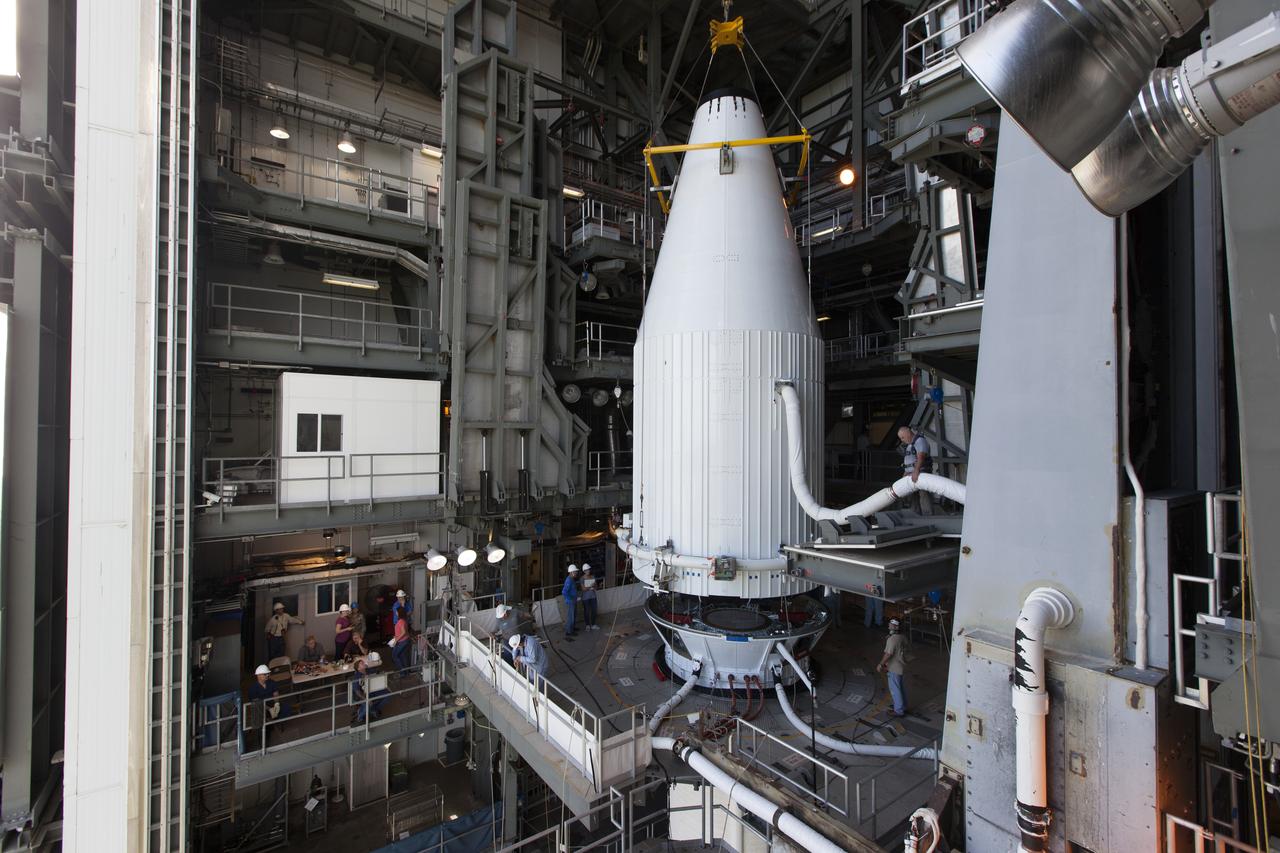
Encapsulated in its payload fairing, Tracking and Data Relay Satellite (TDRS-M) is mated to the United Launch Alliance Atlas V Centaur upper stage in the Vertical Integration Facility at Space Launch Complex 41 at Cape Canaveral Air Force Station in Florida. TDRS-M will be the latest spacecraft destined for the agency's constellation of communications satellites that allows nearly continuous contact with orbiting spacecraft ranging from the International Space Station and Hubble Space Telescope to the array of scientific observatories. Liftoff atop the ULA Atlas V rocket is scheduled for Aug. 18, 2017.
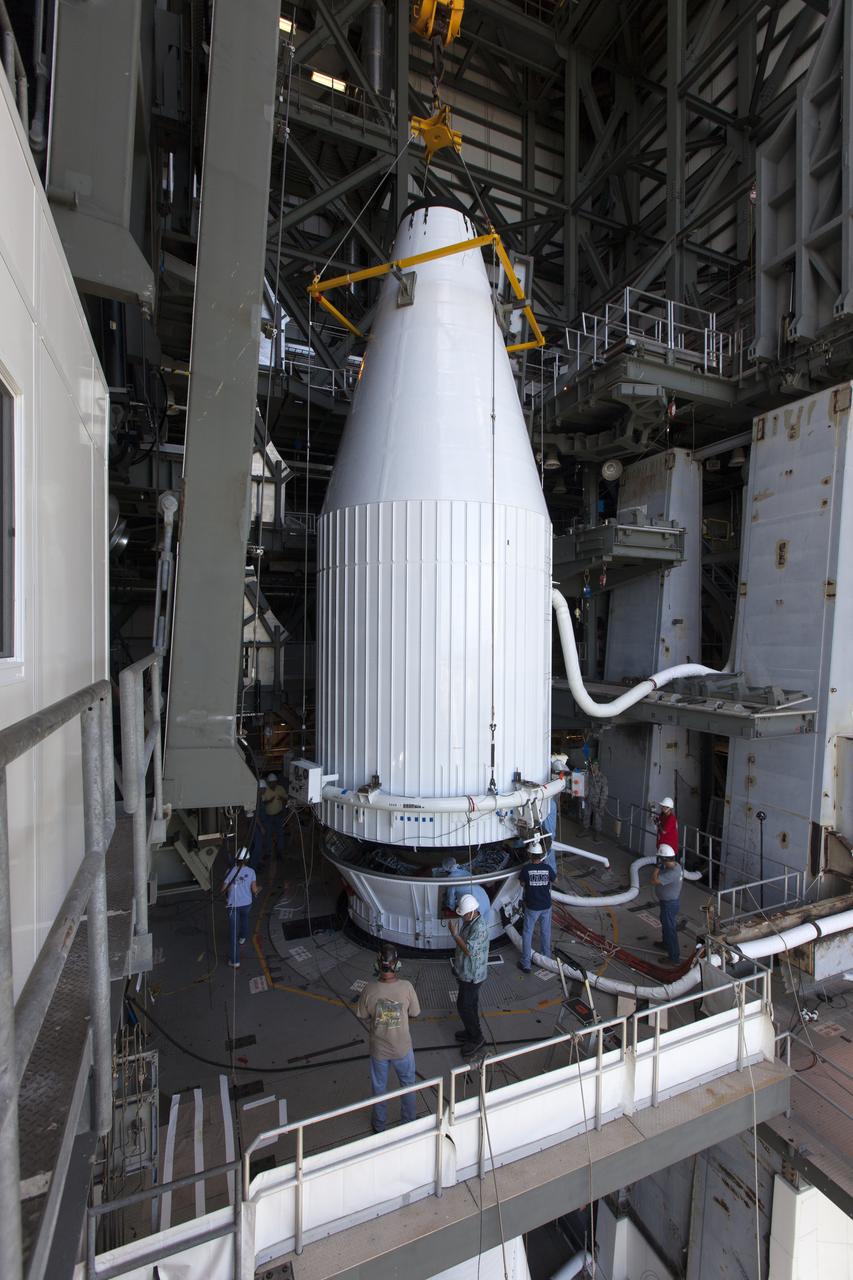
Encapsulated in its payload fairing, Tracking and Data Relay Satellite (TDRS-M) is mated to the United Launch Alliance Atlas V Centaur upper stage in the Vertical Integration Facility at Space Launch Complex 41 at Cape Canaveral Air Force Station in Florida. TDRS-M will be the latest spacecraft destined for the agency's constellation of communications satellites that allows nearly continuous contact with orbiting spacecraft ranging from the International Space Station and Hubble Space Telescope to the array of scientific observatories. Liftoff atop the ULA Atlas V rocket is scheduled for Aug. 18, 2017.
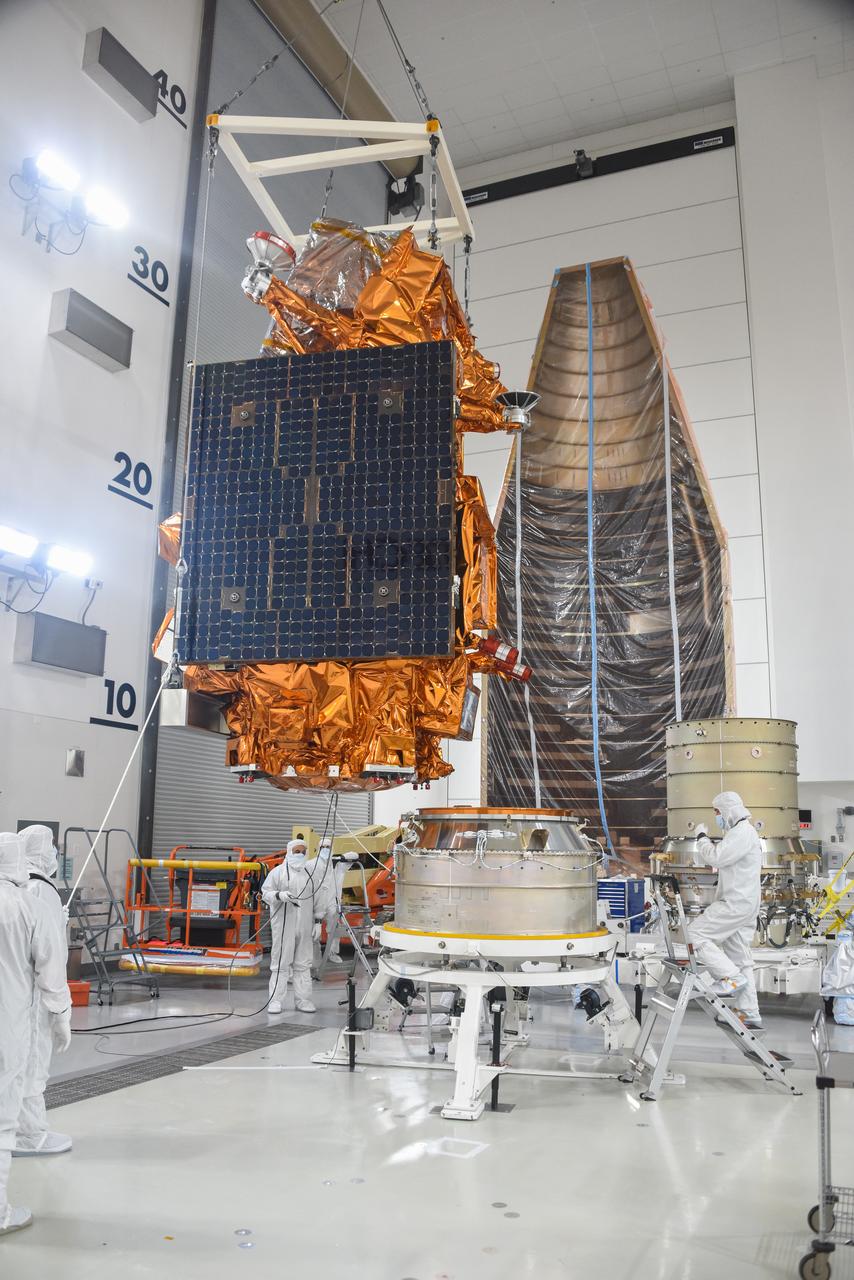
Technicians assist as a crane is used to move the National Oceanic and Atmospheric Administration’s Joint Polar Satellite System (JPSS-2) for mating to the spacecraft adapter inside the Astrotech Space Operations facility at Vandenberg Space Force Base (VSFB) in California on Oct. 4, 2022. JPSS-2 is the third satellite in the Joint Polar Satellite System series. It is scheduled to lift off from VSFB on Nov. 1 from Space Launch Complex-3. JPSS-2, which will be renamed NOAA-21 after reaching orbit, will join a constellation of JPSS satellites that orbit from the North to the South pole, circling Earth 14 times a day and providing a full view of the entire globe twice daily.
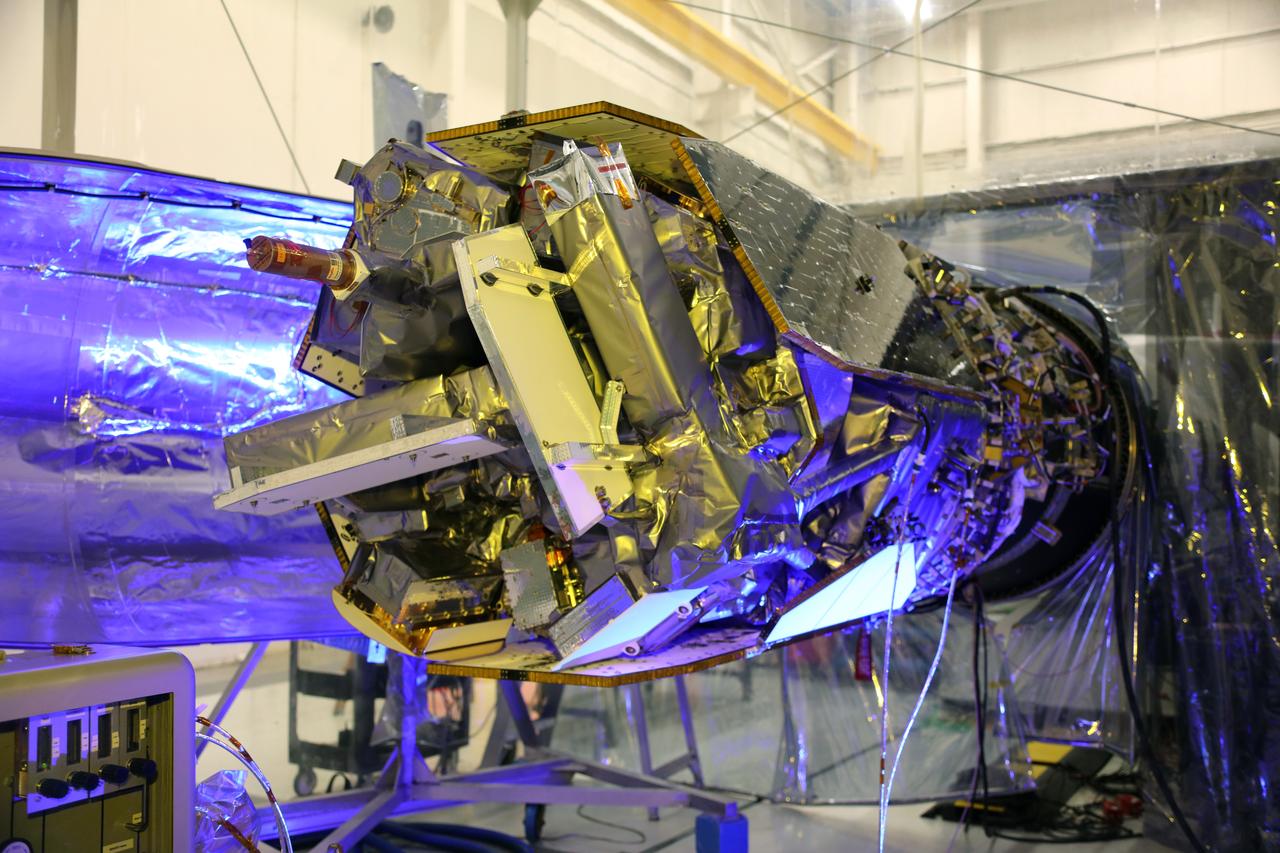
NASA's Ionospheric Connection Explorer (ICON) spacecraft is partially mated to the starboard faring of Orbital ATK's Pegasus XL rocket on May 21, 2018, inside Building 1555 at Vandenberg Air Force Base in California. The explorer will launch on June 15, 2018, from Kwajalein Atoll in the Marshall Islands (June 14 in the continental United States) on the Pegasus XL, which is attached to the company's L-1011 Stargazer aircraft. ICON will study the frontier of space - the dynamic zone high in Earth's atmosphere where terrestrial weather from below meets space weather above. The explorer will help determine the physics of Earth's space environment and pave the way for mitigating its effects on our technology and communications systems.
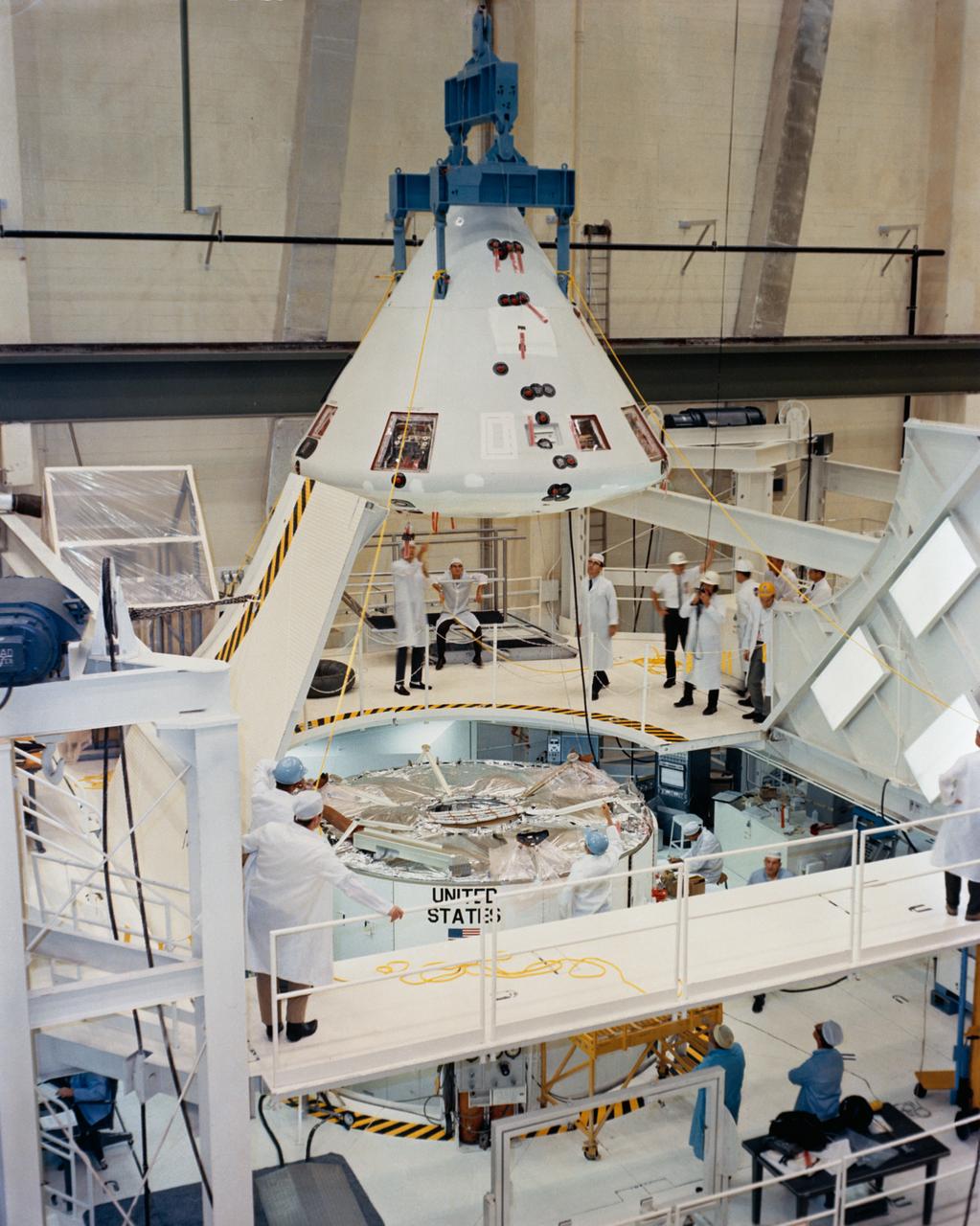
S68-17301 (6 Dec. 1967) --- Apollo Spacecraft 020 Command Module is hoisted into position for mating with Service Module in the Kennedy Space Center's Manned Spacecraft Operations Building. Spacecraft 020 will be flown on the Apollo 6 (Spacecraft 020/Saturn 502) unmanned, Earth-orbital space mission.
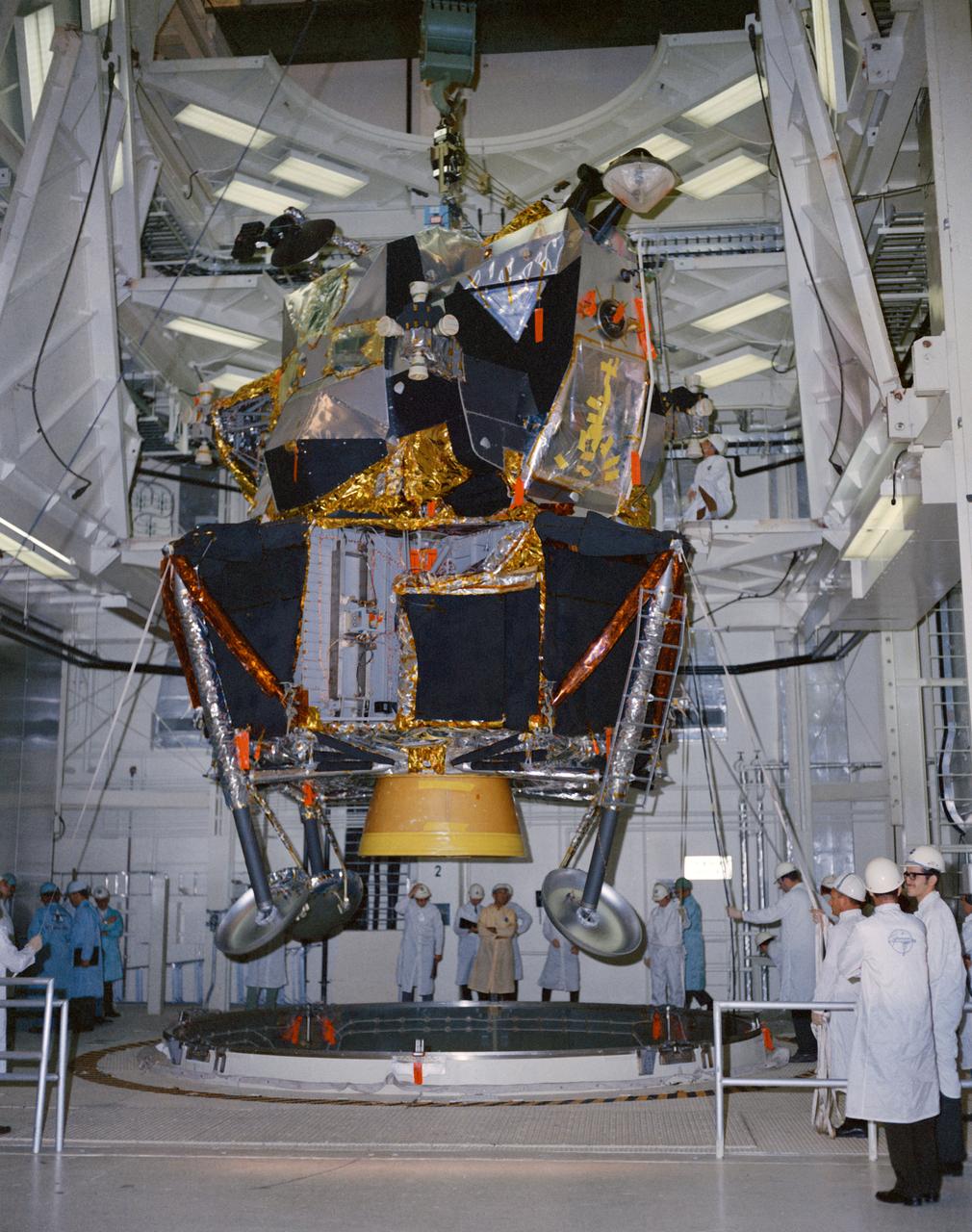
S69-17807 (13 Jan. 1969) --- Lunar Module 4 in the Kennedy Space Center's Manned Spacecraft Operations Building being moved into position for mating with Spacecraft Lunar Module Adapter (SLA) 13. Lunar Module 4 will be flown on the Apollo 10 (Spacecraft 106/Saturn 505) space mission.
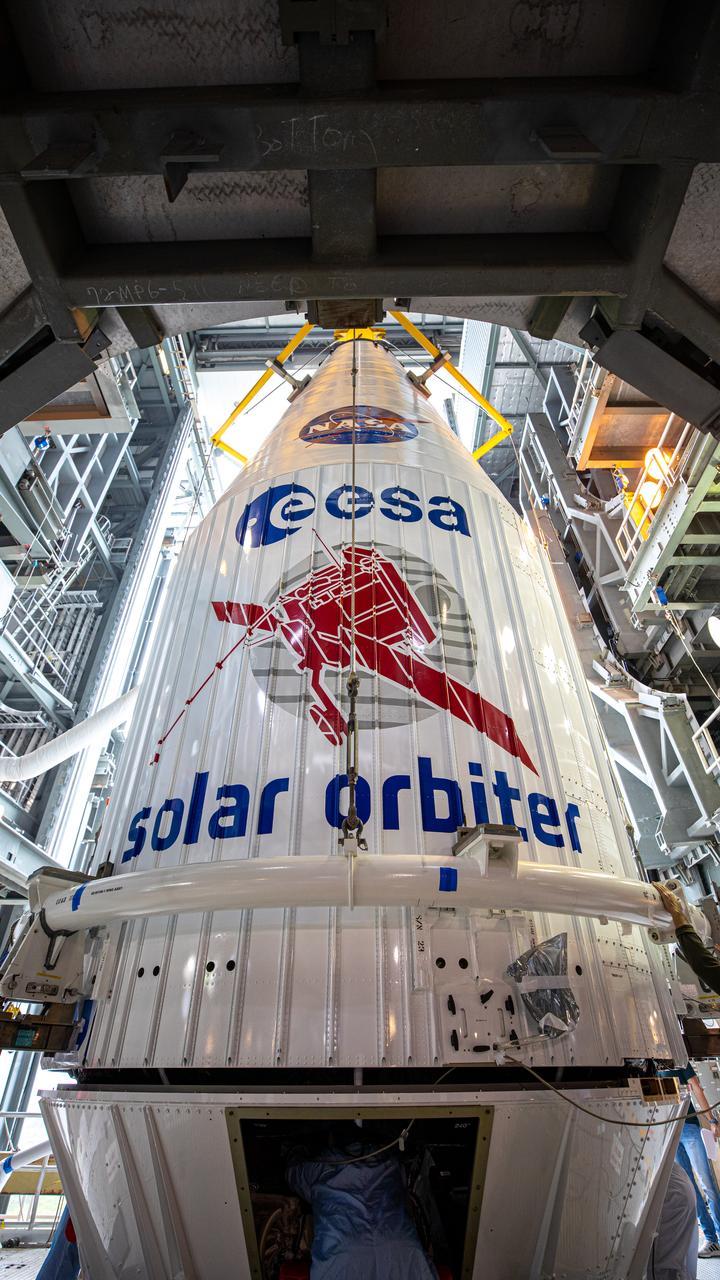
The United Launch Alliance Atlas V payload fairing, containing the Solar Orbiter spacecraft, is being secured on top of the company’s Atlas V rocket inside the Vertical Integration Facility at Space Launch Complex 41 on Cape Canaveral Air Force Station in Florida on Jan. 31, 2020. Solar Orbiter is an international cooperative mission between ESA (European Space Agency) and NASA. The mission aims to study the Sun, its outer atmosphere and solar wind. The spacecraft will provide the first images of the Sun’s poles. NASA’s Launch Services Program based at Kennedy is managing the launch. The spacecraft has been developed by Airbus Defence and Space. Solar Orbiter will launch in February 2020 aboard the Atlas V rocket.
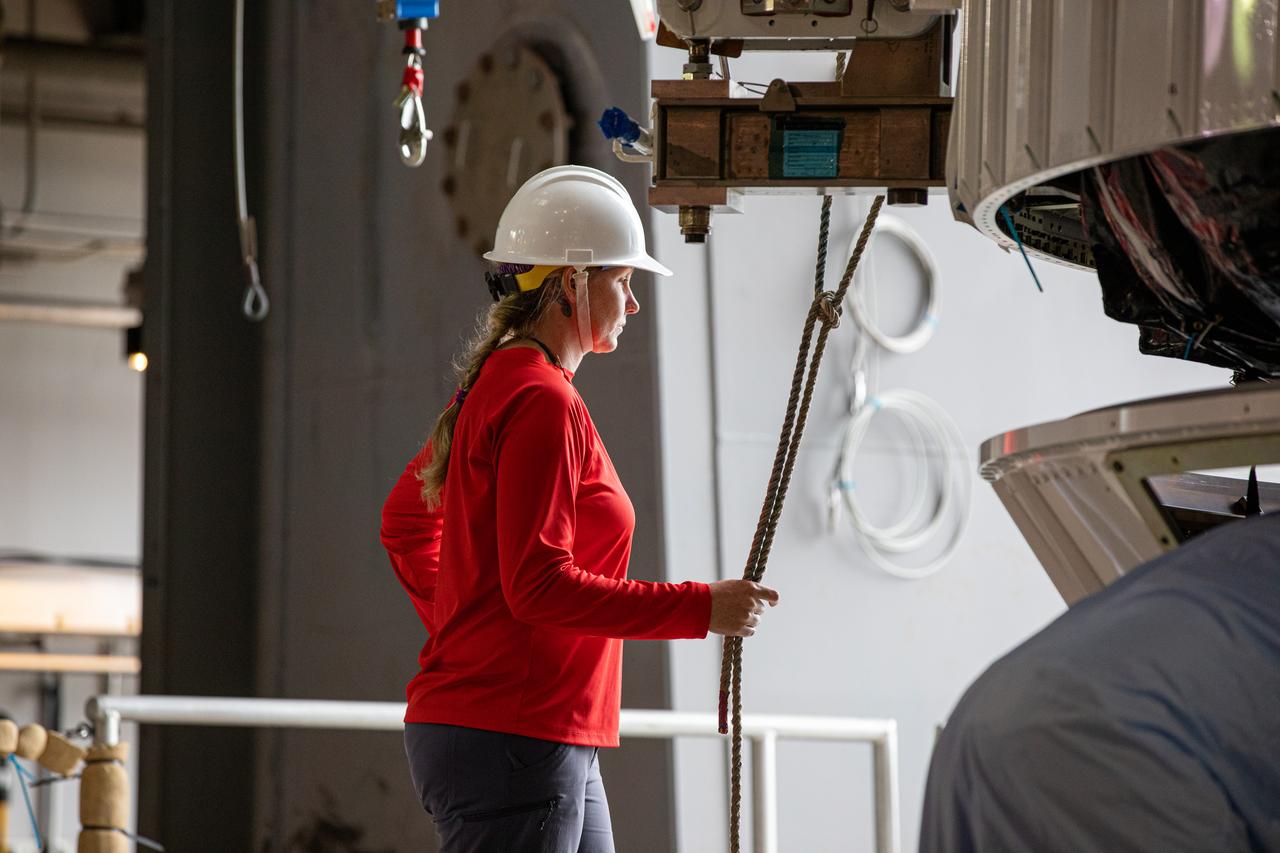
High up in the Vertical Integration Facility at Space Launch Complex 41 on Cape Canaveral Air Force Station in Florida, a worker watches as the United Launch Alliance Atlas V payload fairing, containing the Solar Orbiter spacecraft, is lowered onto the Atlas V rocket on Jan. 31, 2020. Solar Orbiter is an international cooperative mission between ESA (European Space Agency) and NASA. The mission aims to study the Sun, its outer atmosphere and solar wind. The spacecraft will provide the first images of the Sun’s poles. NASA’s Launch Services Program based at Kennedy is managing the launch. The spacecraft has been developed by Airbus Defence and Space. Solar Orbiter will launch in February 2020 aboard the Atlas V rocket.
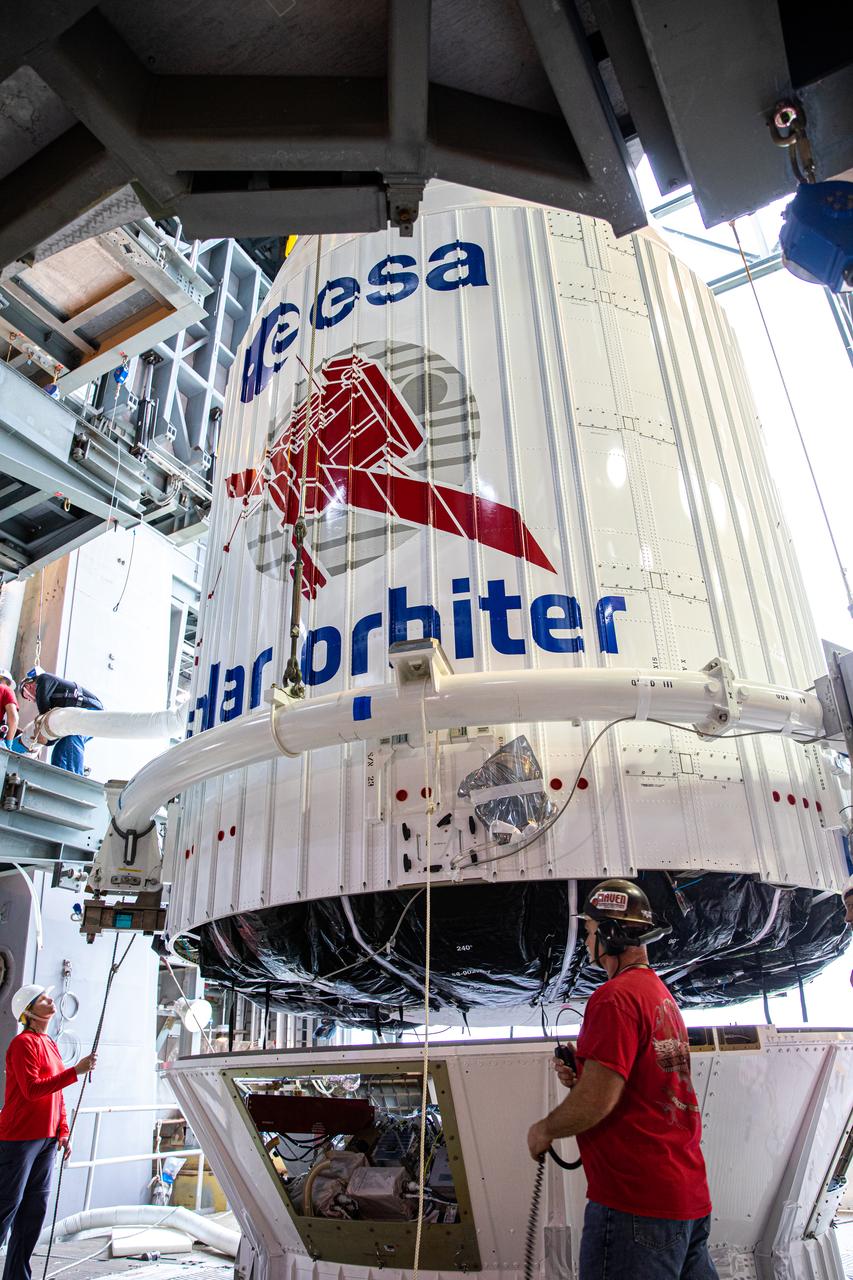
Inside the Vertical Integration Facility at Space Launch Complex 41 on Cape Canaveral Air Force Station in Florida, workers assist as the United Launch Alliance Atlas V payload fairing, containing the Solar Orbiter spacecraft, is lowered onto the company’s Atlas V rocket on Jan. 31, 2020. Solar Orbiter is an international cooperative mission between ESA (European Space Agency) and NASA. The mission aims to study the Sun, its outer atmosphere and solar wind. The spacecraft will provide the first images of the Sun’s poles. NASA’s Launch Services Program based at Kennedy is managing the launch. The spacecraft has been developed by Airbus Defence and Space. Solar Orbiter will launch in February 2020 aboard the Atlas V rocket.
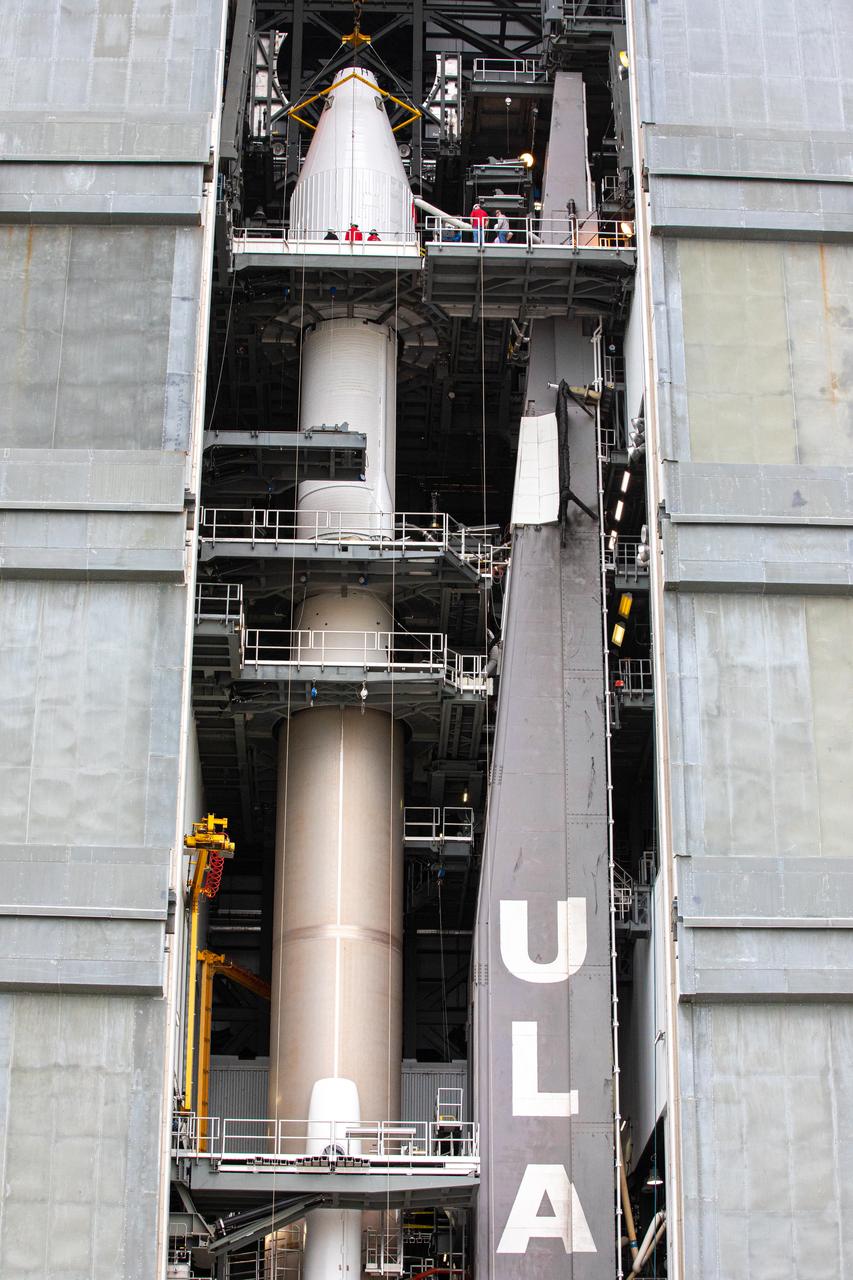
The United Launch Alliance Atlas V payload fairing, containing the Solar Orbiter spacecraft, is secured atop the company’s Atlas V rocket inside the Vertical Integration Facility at Space Launch Complex 41 on Cape Canaveral Air Force Station in Florida on Jan. 31, 2020. Solar Orbiter is an international cooperative mission between ESA (European Space Agency) and NASA. The mission aims to study the Sun, its outer atmosphere and solar wind. The spacecraft will provide the first images of the Sun’s poles. NASA’s Launch Services Program based at Kennedy is managing the launch. The spacecraft has been developed by Airbus Defence and Space. Solar Orbiter will launch in February 2020 aboard the Atlas V rocket.
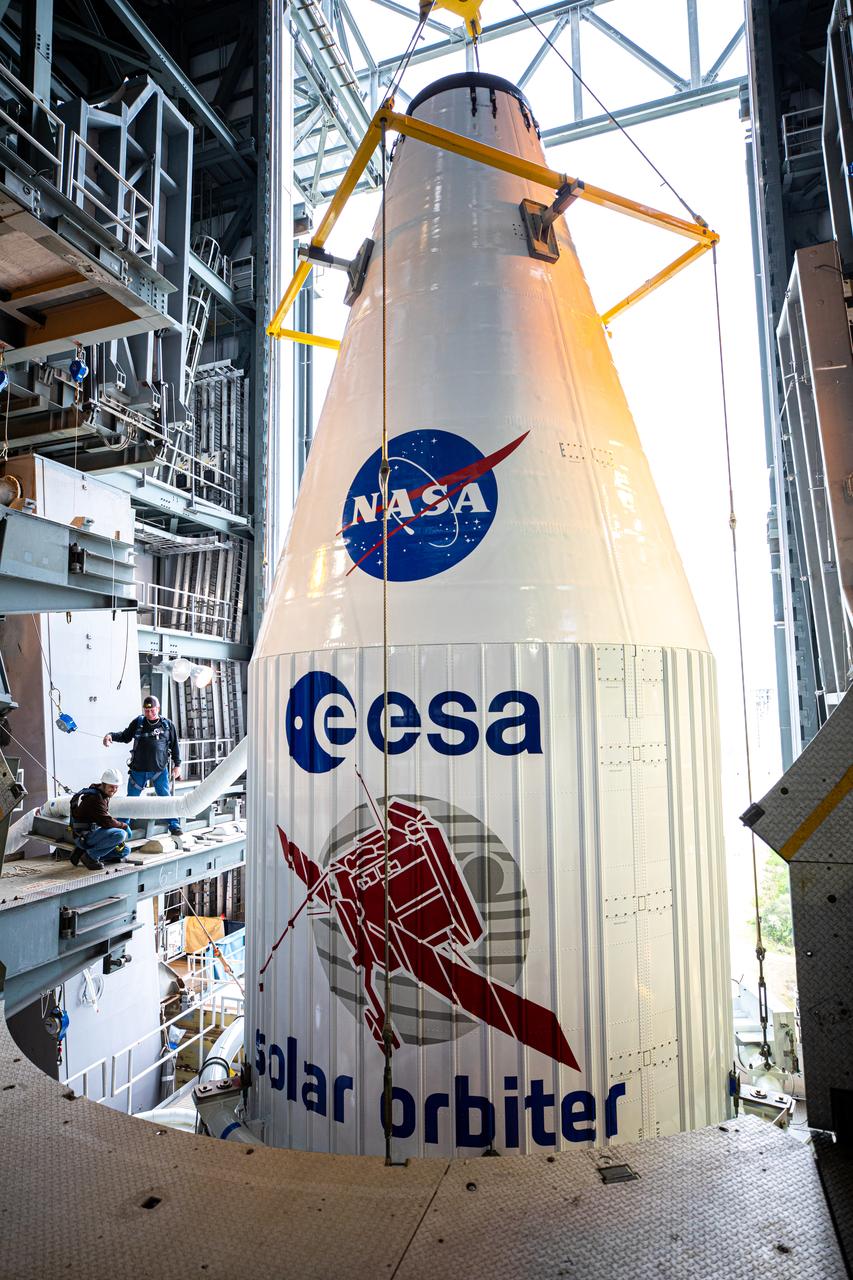
The United Launch Alliance Atlas V payload fairing, containing the Solar Orbiter spacecraft, is lowered onto the company’s Atlas V rocket inside the Vertical Integration Facility at Space Launch Complex 41 on Cape Canaveral Air Force Station in Florida on Jan. 31, 2020. The payload fairing will be secured to the rocket. Solar Orbiter is an international cooperative mission between ESA (European Space Agency) and NASA. The mission aims to study the Sun, its outer atmosphere and solar wind. The spacecraft will provide the first images of the Sun’s poles. NASA’s Launch Services Program based at Kennedy is managing the launch. The spacecraft has been developed by Airbus Defence and Space. Solar Orbiter will launch in February 2020 aboard the Atlas V rocket.
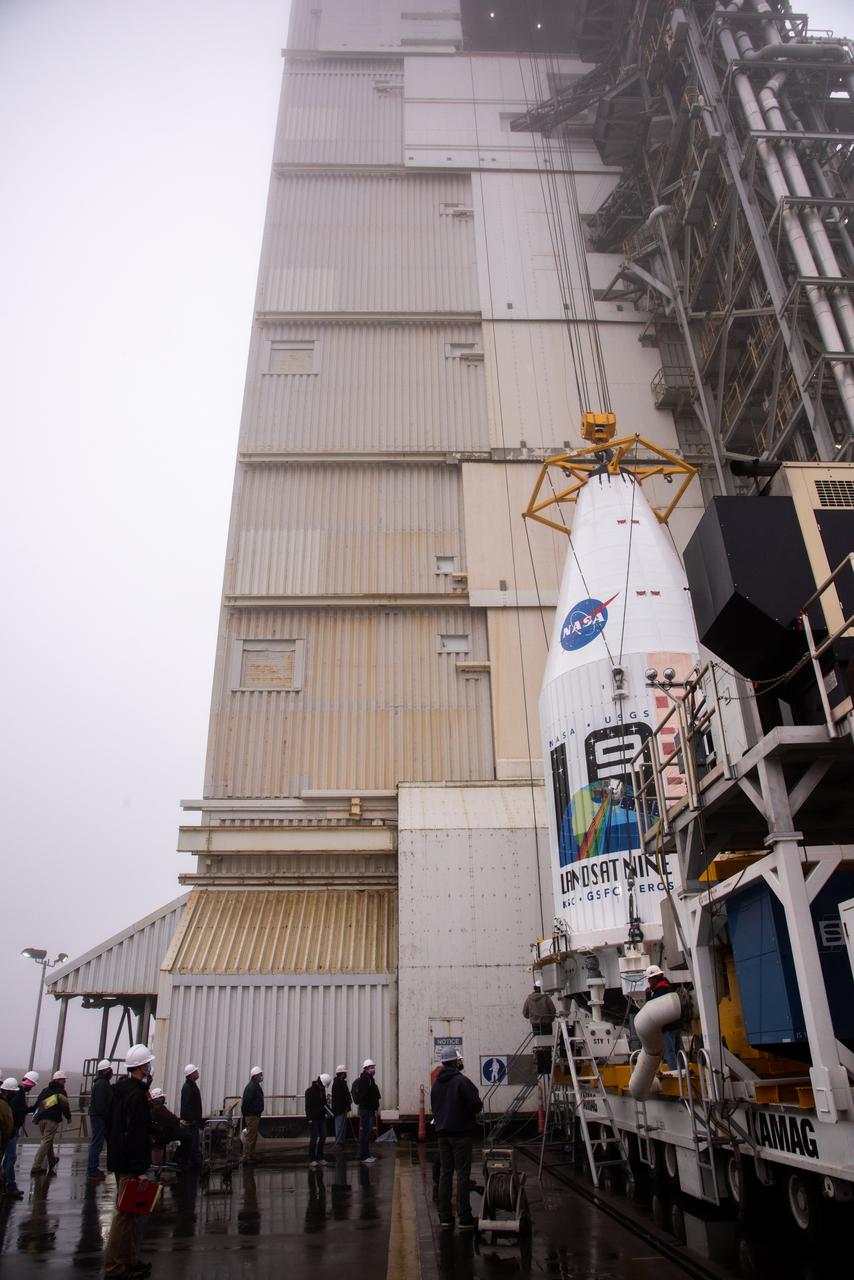
The Landsat 9 spacecraft is lifted and mated to the United Launch Alliance Atlas V rocket at Space Launch Complex 3 at Vandenberg Space Force Base in California on Sept. 15, 2021, in preparation for liftoff no earlier than Sept. 27, 2021. The launch is being managed by NASA’s Launch Services Program based at Kennedy Space Center in Florida. Landsat 9 will monitor key natural and economic resources from orbit. The satellite will carry two instruments: the Operational Land Imager 2, which collects images of Earth’s landscapes in visible, near infrared and shortwave infrared light, and the Thermal Infrared Sensor 2, which measures the temperature of land surfaces. Landsat 9 is a joint mission between NASA and the U.S. Geological Survey.
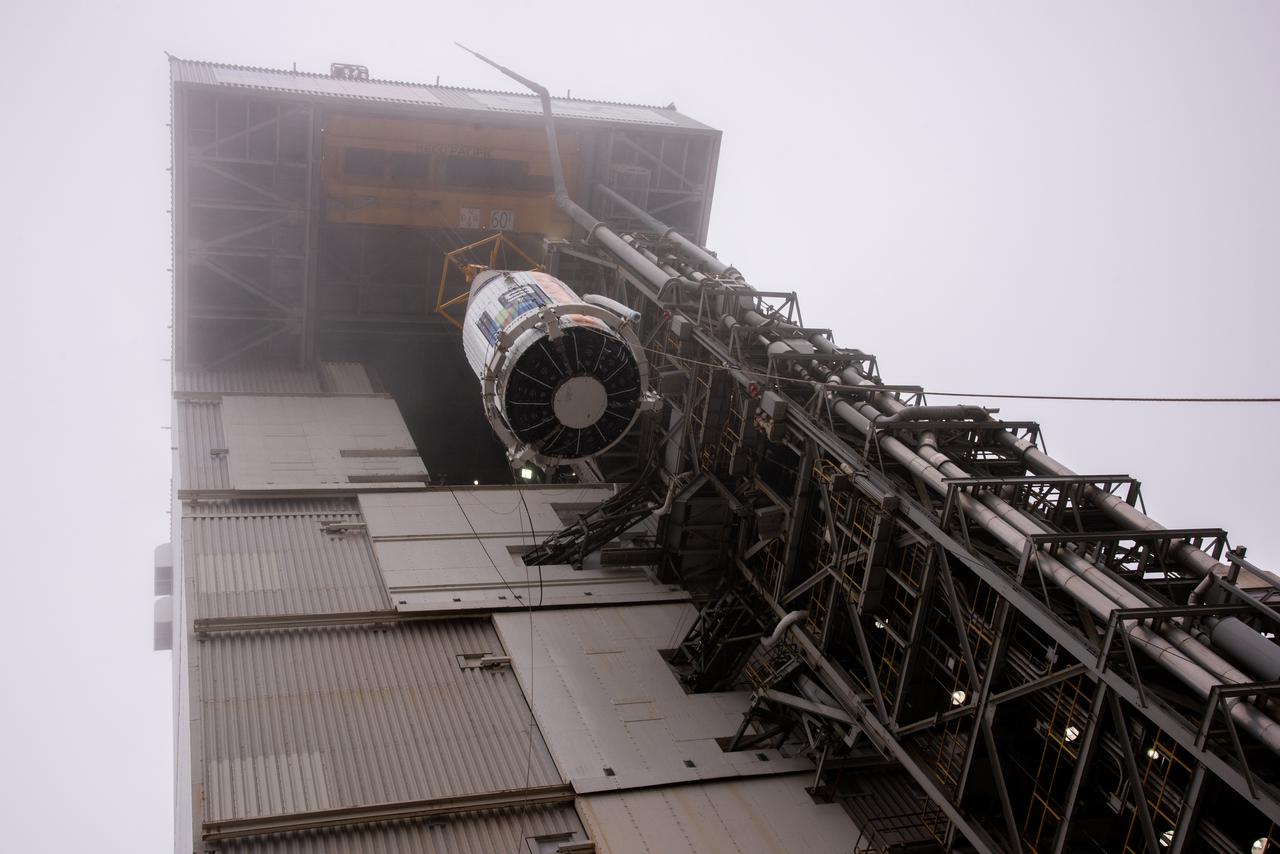
The Landsat 9 spacecraft is lifted and mated to the United Launch Alliance Atlas V rocket at Space Launch Complex 3 at Vandenberg Space Force Base in California on Sept. 15, 2021, in preparation for liftoff no earlier than Sept. 27, 2021. The launch is being managed by NASA’s Launch Services Program based at Kennedy Space Center in Florida. Landsat 9 will monitor key natural and economic resources from orbit. The satellite will carry two instruments: the Operational Land Imager 2, which collects images of Earth’s landscapes in visible, near infrared and shortwave infrared light, and the Thermal Infrared Sensor 2, which measures the temperature of land surfaces. Landsat 9 is a joint mission between NASA and the U.S. Geological Survey.
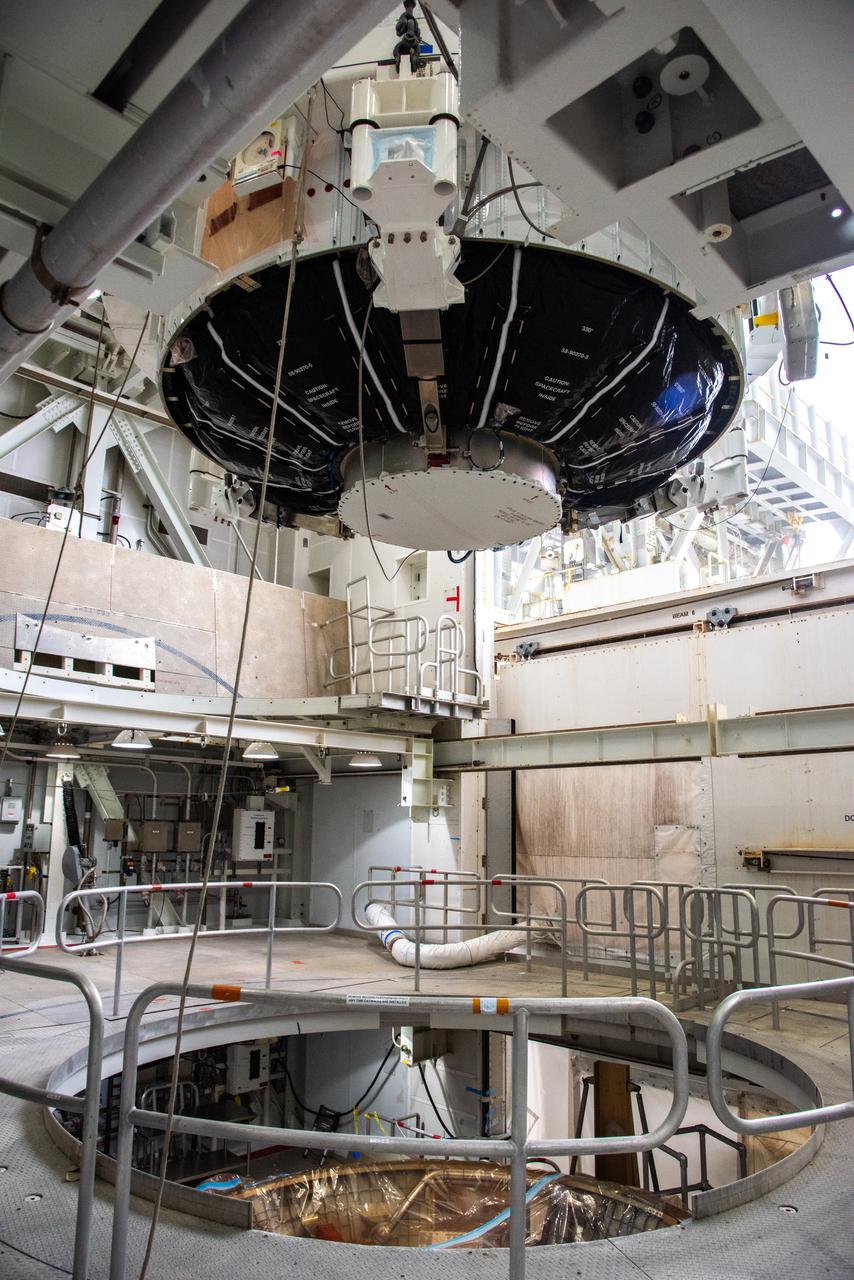
The Landsat 9 spacecraft is lifted and mated to the United Launch Alliance Atlas V rocket at Space Launch Complex 3 at Vandenberg Space Force Base in California on Sept. 15, 2021, in preparation for liftoff no earlier than Sept. 27, 2021. The launch is being managed by NASA’s Launch Services Program based at Kennedy Space Center in Florida. Landsat 9 will monitor key natural and economic resources from orbit. The satellite will carry two instruments: the Operational Land Imager 2, which collects images of Earth’s landscapes in visible, near infrared and shortwave infrared light, and the Thermal Infrared Sensor 2, which measures the temperature of land surfaces. Landsat 9 is a joint mission between NASA and the U.S. Geological Survey.
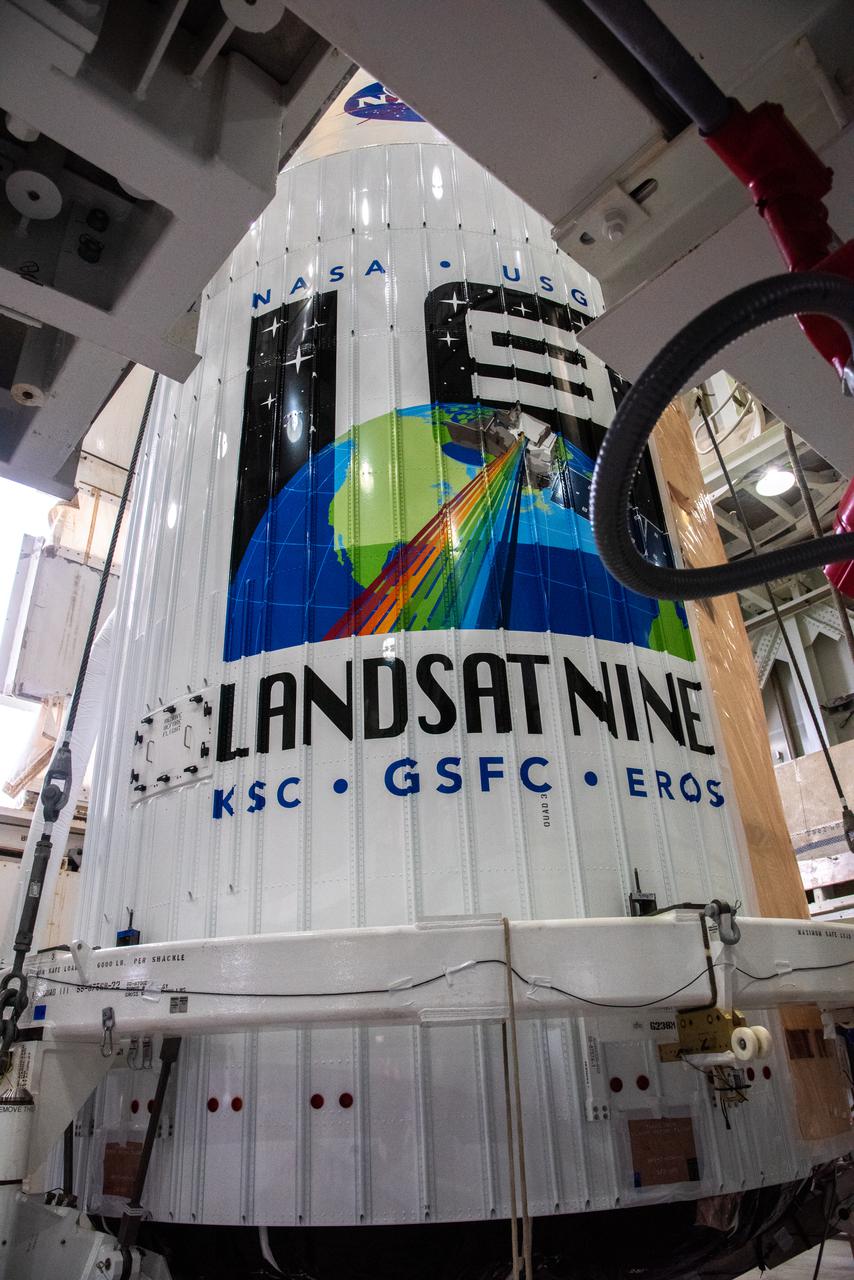
The Landsat 9 spacecraft is lifted and mated to the United Launch Alliance Atlas V rocket at Space Launch Complex 3 at Vandenberg Space Force Base in California on Sept. 15, 2021, in preparation for liftoff no earlier than Sept. 27, 2021. The launch is being managed by NASA’s Launch Services Program based at Kennedy Space Center in Florida. Landsat 9 will monitor key natural and economic resources from orbit. The satellite will carry two instruments: the Operational Land Imager 2, which collects images of Earth’s landscapes in visible, near infrared and shortwave infrared light, and the Thermal Infrared Sensor 2, which measures the temperature of land surfaces. Landsat 9 is a joint mission between NASA and the U.S. Geological Survey.
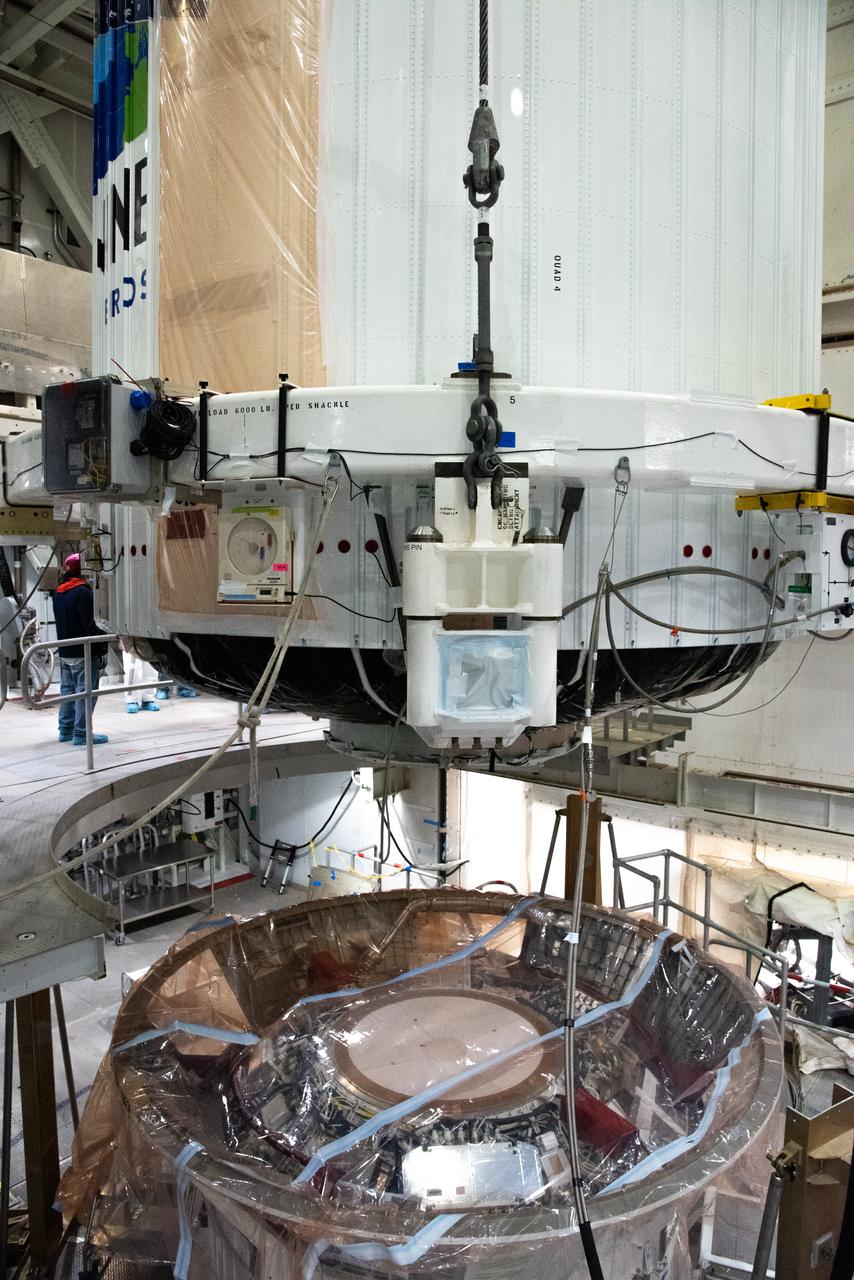
The Landsat 9 spacecraft is lifted and mated to the United Launch Alliance Atlas V rocket at Space Launch Complex 3 at Vandenberg Space Force Base in California on Sept. 15, 2021, in preparation for liftoff no earlier than Sept. 27, 2021. The launch is being managed by NASA’s Launch Services Program based at Kennedy Space Center in Florida. Landsat 9 will monitor key natural and economic resources from orbit. The satellite will carry two instruments: the Operational Land Imager 2, which collects images of Earth’s landscapes in visible, near infrared and shortwave infrared light, and the Thermal Infrared Sensor 2, which measures the temperature of land surfaces. Landsat 9 is a joint mission between NASA and the U.S. Geological Survey.
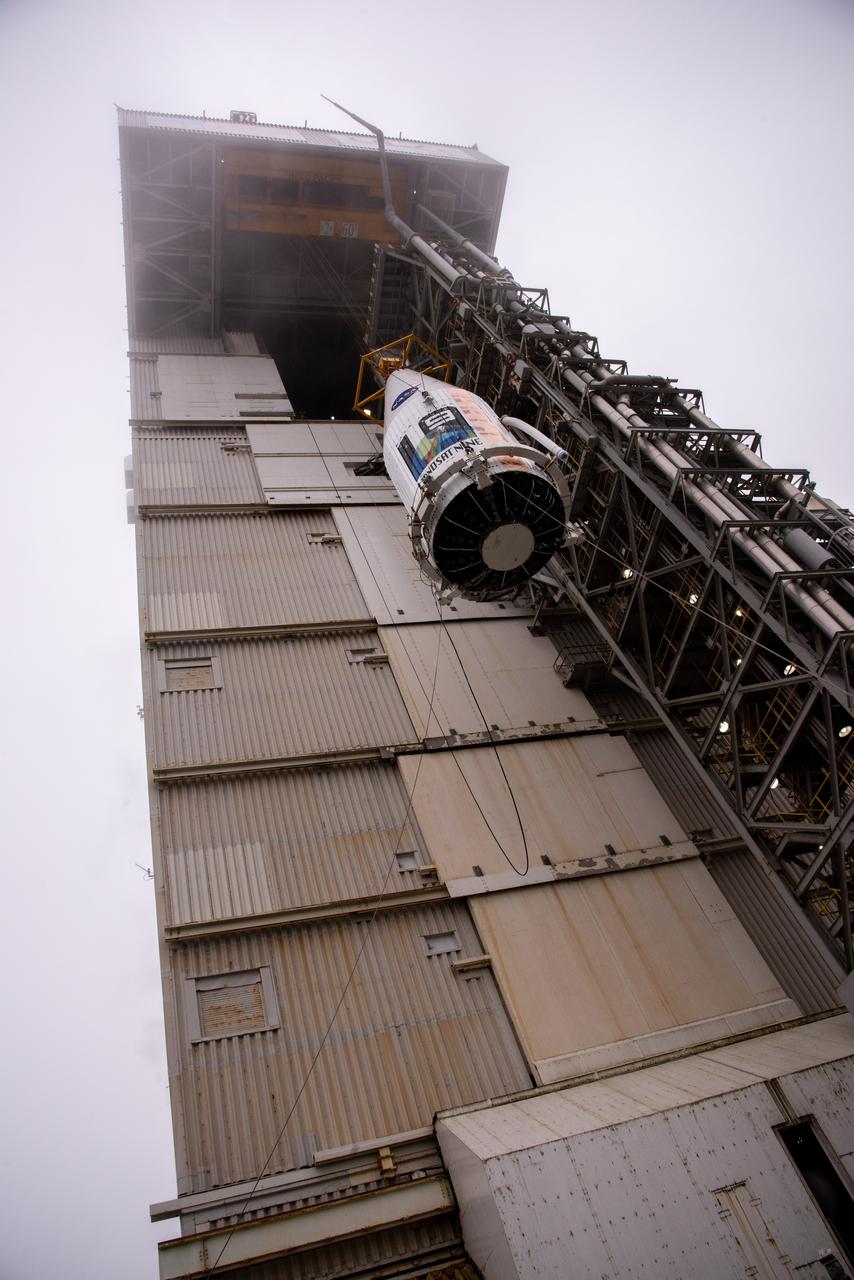
The Landsat 9 spacecraft is lifted and mated to the United Launch Alliance Atlas V rocket at Space Launch Complex 3 at Vandenberg Space Force Base in California on Sept. 15, 2021, in preparation for liftoff no earlier than Sept. 27, 2021. The launch is being managed by NASA’s Launch Services Program based at Kennedy Space Center in Florida. Landsat 9 will monitor key natural and economic resources from orbit. The satellite will carry two instruments: the Operational Land Imager 2, which collects images of Earth’s landscapes in visible, near infrared and shortwave infrared light, and the Thermal Infrared Sensor 2, which measures the temperature of land surfaces. Landsat 9 is a joint mission between NASA and the U.S. Geological Survey.
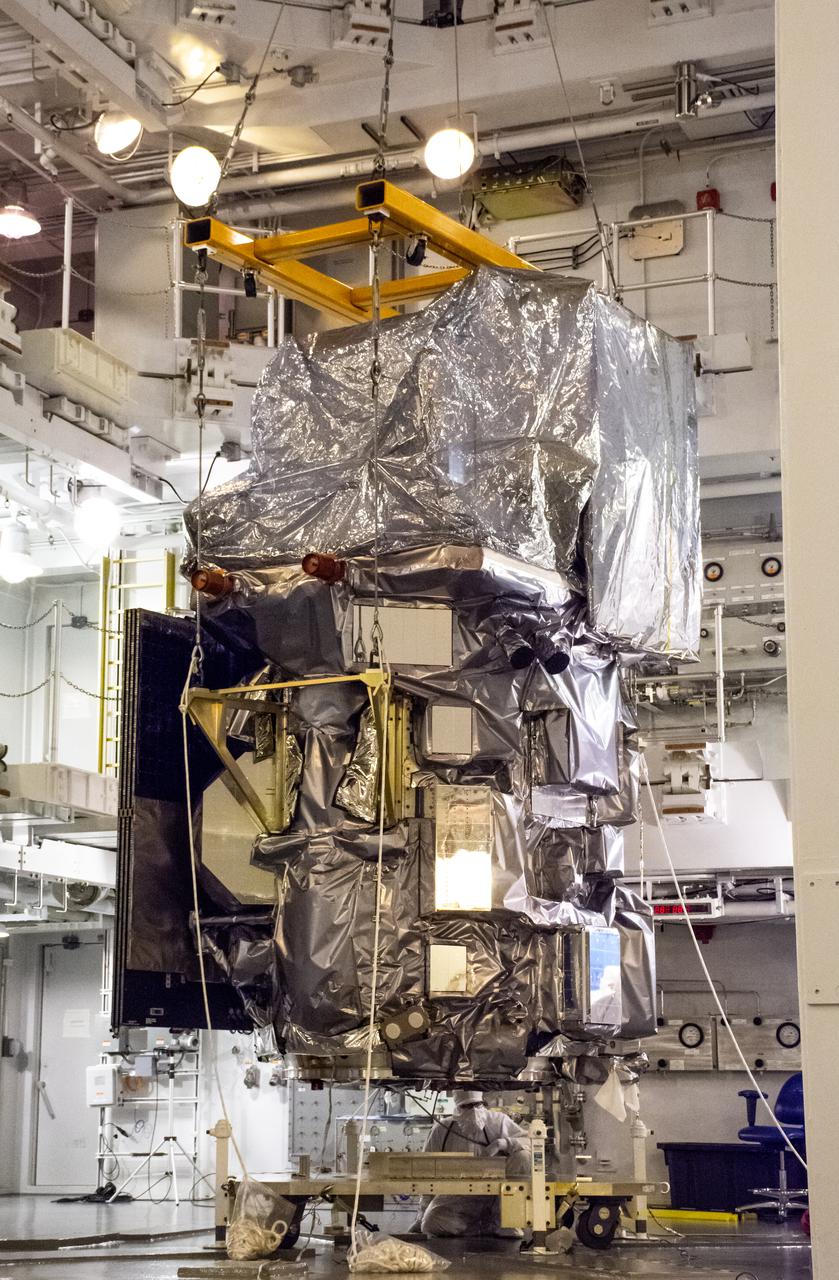
Technicians begin to move the Landsat 9 spacecraft for mating operations inside the Vertical Integration Facility at Vandenberg Space Force Base in California on Aug. 11, 2021. The spacecraft will attach to the evolved expendable vehicle secondary payload adapter (ESPA), which connects Landsat 9 and the payload adapter (PMA). The PMA will then attach to the second stage of a United Launch Alliance Atlas V rocket. Landsat 9 will launch on the Atlas V from Space Launch Complex 3 at Vandenberg in September 2021. The launch is being managed by NASA’s Launch Services Program based at Kennedy Space Center, America’s multi-user spaceport. The Landsat 9 satellite will continue the nearly 50-year legacy of previous Landsat missions. It will monitor key natural and economic resources from orbit. Landsat 9 is managed by the agency’s Goddard Space Flight Center in Greenbelt, Maryland. The satellite will carry two instruments: the Operational Land Imager 2, which collects images of Earth’s landscapes in visible, near infrared and shortwave infrared light, and the Thermal Infrared Sensor 2, which measures the temperature of land surfaces. Like its predecessors, Landsat 9 is a joint mission between NASA and the U.S. Geological Survey.
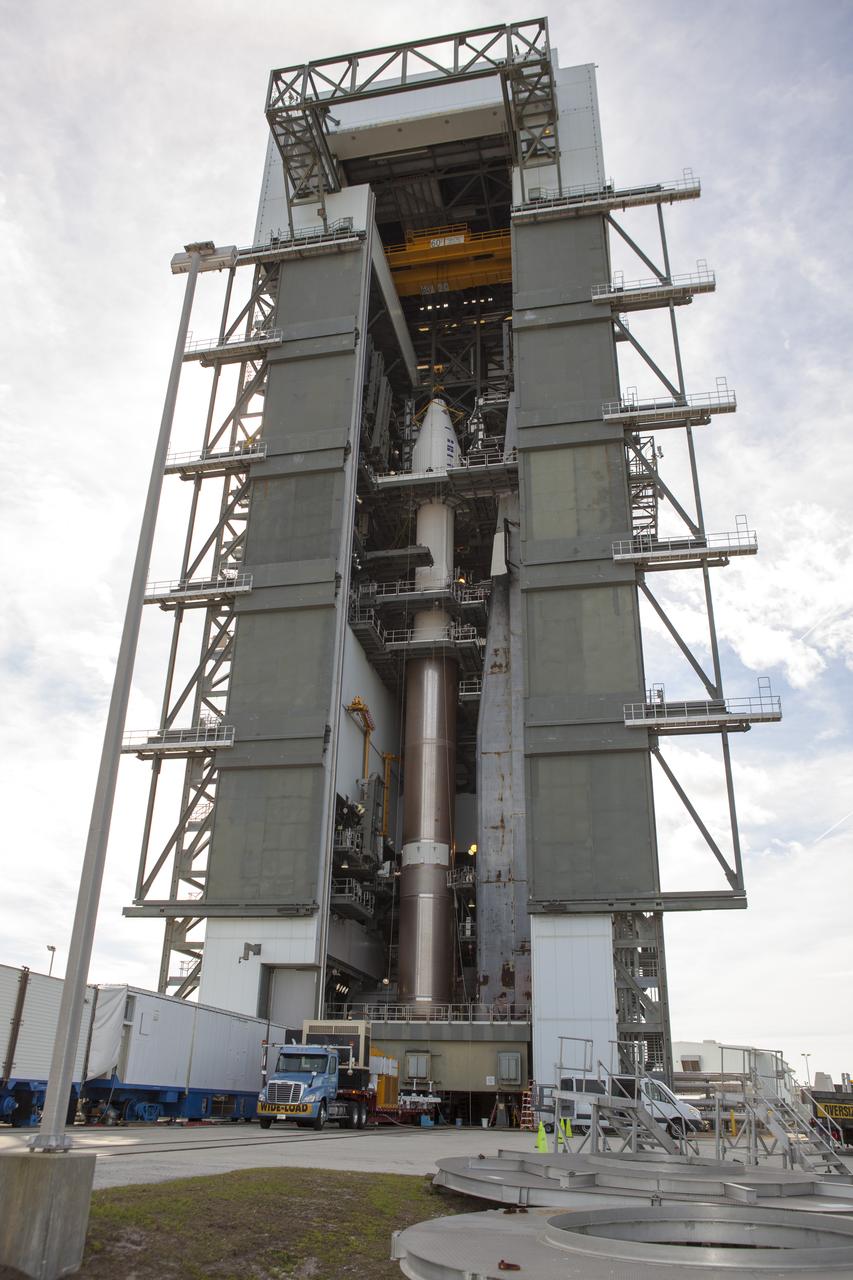
CAPE CANAVERAL, Fla. – At Cape Canaveral Air Force Station's Vertical Integration Facility at Launch Complex 41, NASA's Tracking and Data Relay Satellite, or TDRS-L, spacecraft has been mated atop a United Launch Alliance Atlas V rocket. The TDRS-L satellite will be a part of the second of three next-generation spacecraft designed to ensure vital operational continuity for the NASA Space Network. It is scheduled to launch from Cape Canaveral's Space Launch Complex 41 atop a United Launch Alliance Atlas V rocket on Jan. 23, 2014. The current Tracking and Data Relay Satellite system consists of eight in-orbit satellites distributed to provide near continuous information relay contact with orbiting spacecraft ranging from the International Space Station and Hubble Space Telescope to the array of scientific observatories. For more information, visit: http://www.nasa.gov/mission_pages/tdrs/home/index.html Photo credit: NASA/Dimitri Gerondidakis
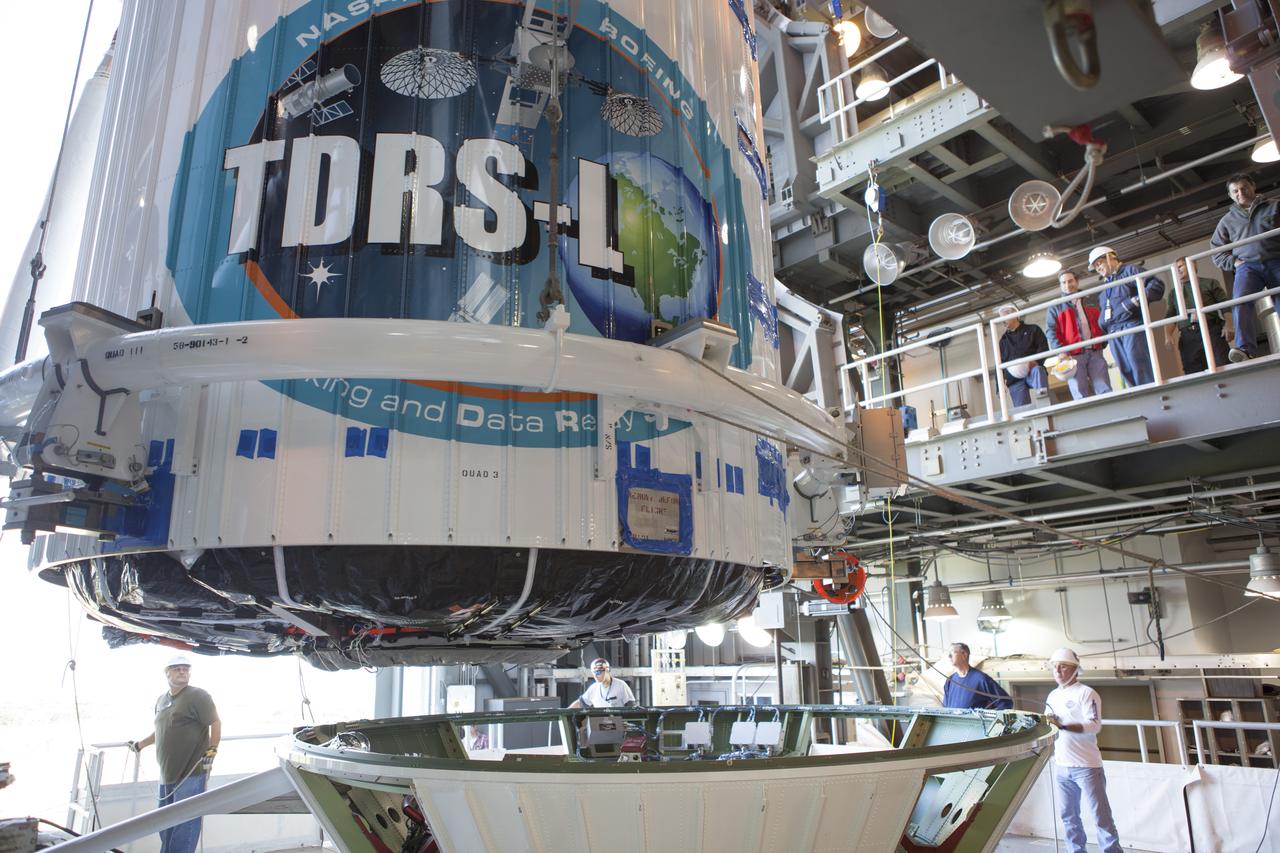
CAPE CANAVERAL, Fla. – At Cape Canaveral Air Force Station's Vertical Integration Facility at Launch Complex 41, NASA's Tracking and Data Relay Satellite, or TDRS-L, spacecraft is moved into position for mating atop a United Launch Alliance Atlas V rocket. The TDRS-L satellite will be a part of the second of three next-generation spacecraft designed to ensure vital operational continuity for the NASA Space Network. It is scheduled to launch from Cape Canaveral's Space Launch Complex 41 atop a United Launch Alliance Atlas V rocket on Jan. 23, 2014. The current Tracking and Data Relay Satellite system consists of eight in-orbit satellites distributed to provide near continuous information relay contact with orbiting spacecraft ranging from the International Space Station and Hubble Space Telescope to the array of scientific observatories. For more information, visit: http://www.nasa.gov/mission_pages/tdrs/home/index.html Photo credit: NASA/Dimitri Gerondidakis
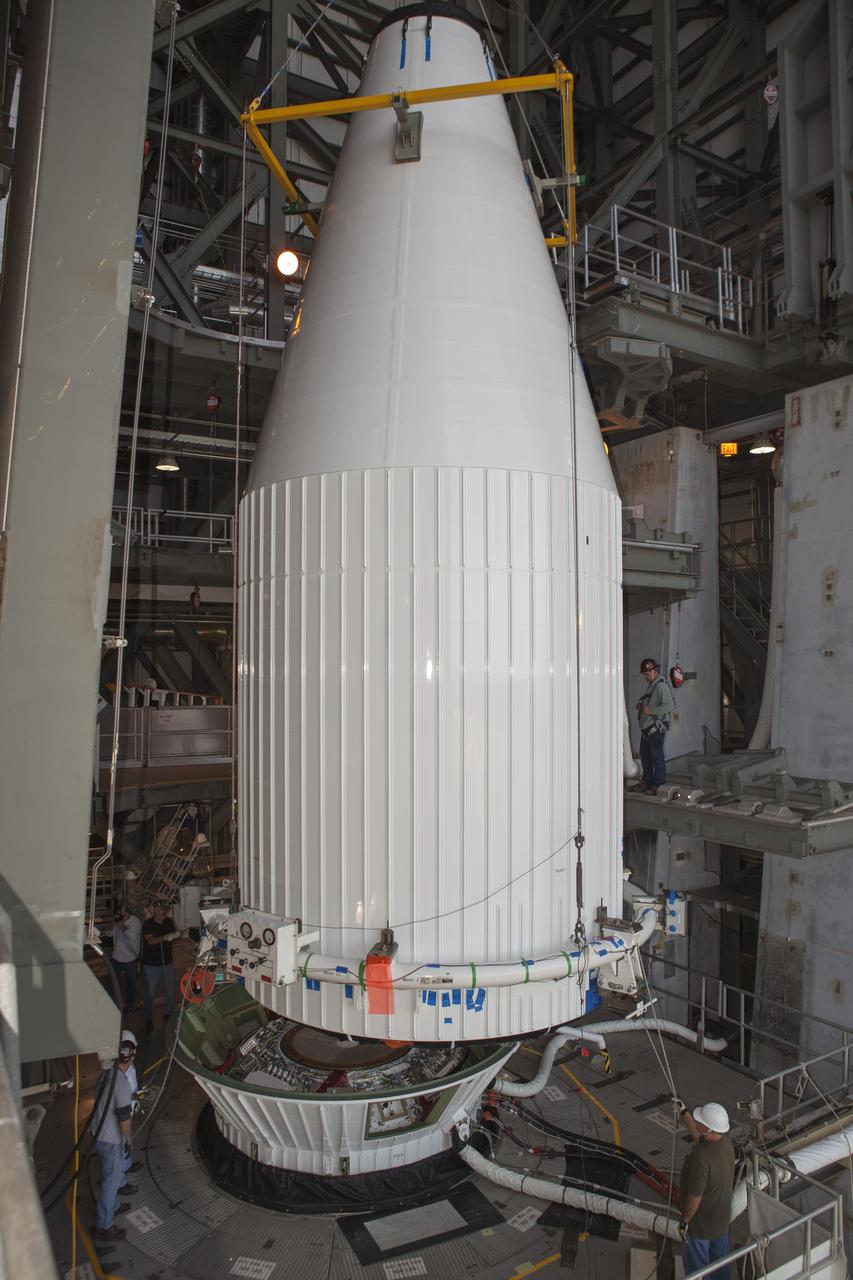
CAPE CANAVERAL, Fla. – At Cape Canaveral Air Force Station's Vertical Integration Facility at Launch Complex 41, NASA's Tracking and Data Relay Satellite, or TDRS-L, spacecraft is moved into position for mating atop a United Launch Alliance Atlas V rocket. The TDRS-L satellite will be a part of the second of three next-generation spacecraft designed to ensure vital operational continuity for the NASA Space Network. It is scheduled to launch from Cape Canaveral's Space Launch Complex 41 atop a United Launch Alliance Atlas V rocket on Jan. 23, 2014. The current Tracking and Data Relay Satellite system consists of eight in-orbit satellites distributed to provide near continuous information relay contact with orbiting spacecraft ranging from the International Space Station and Hubble Space Telescope to the array of scientific observatories. For more information, visit: http://www.nasa.gov/mission_pages/tdrs/home/index.html Photo credit: NASA/Dimitri Gerondidakis
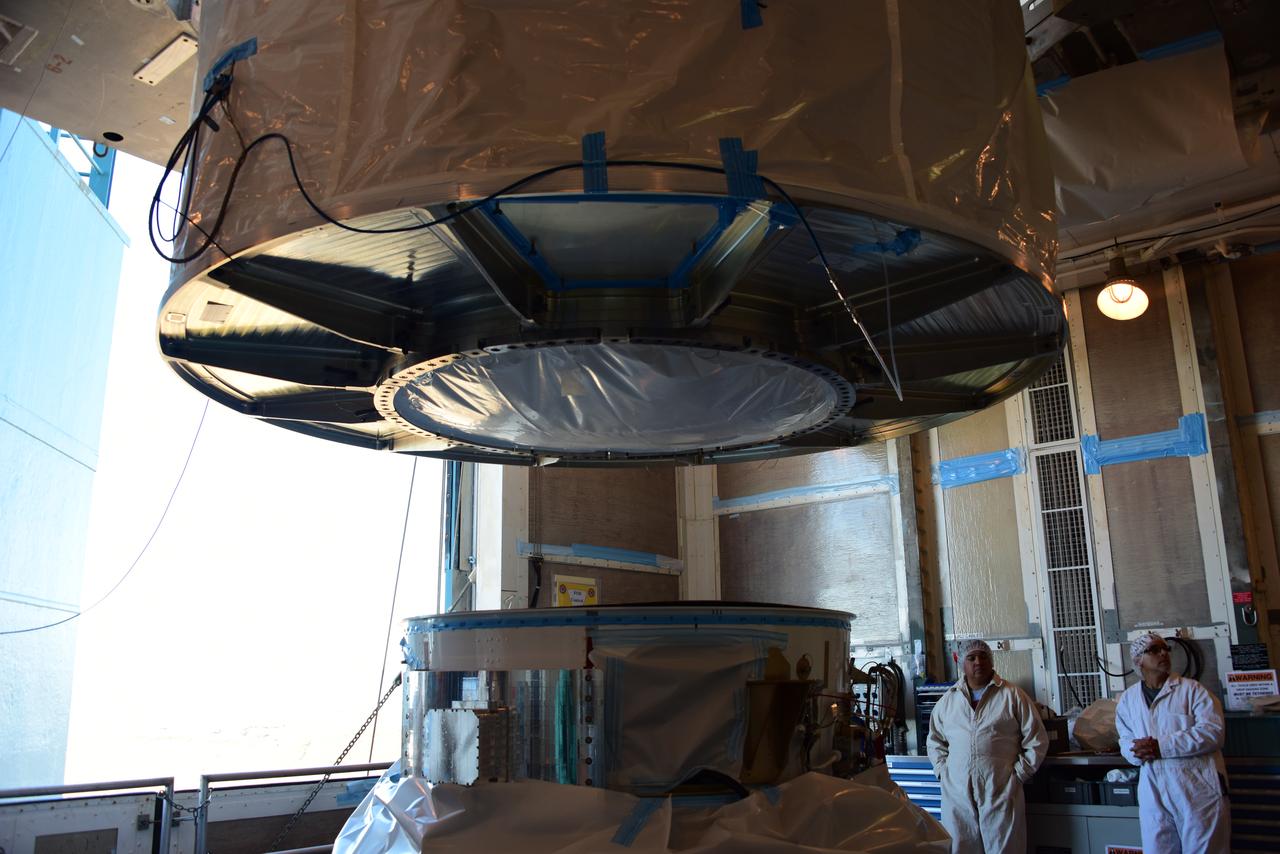
JPSS-1 SpaceAt Vandenberg Air Force Base in California, the Joint Polar Satellite System-1, or JPSS-1, spacecraft is mated atop a United Launch Alliance Delta II rocket at Space Launch Complex 2. Built by Ball Aerospace and Technologies Corp. of Boulder, Colorado, JPSS is the first in a series four next-generation environmental satellites in a collaborative program between the NOAA and NASA. Liftoff is scheduled to take place from Vandenberg's Space Launch Complex 2.craft Transport to SLC-2; Lift and Mate to Delta II.
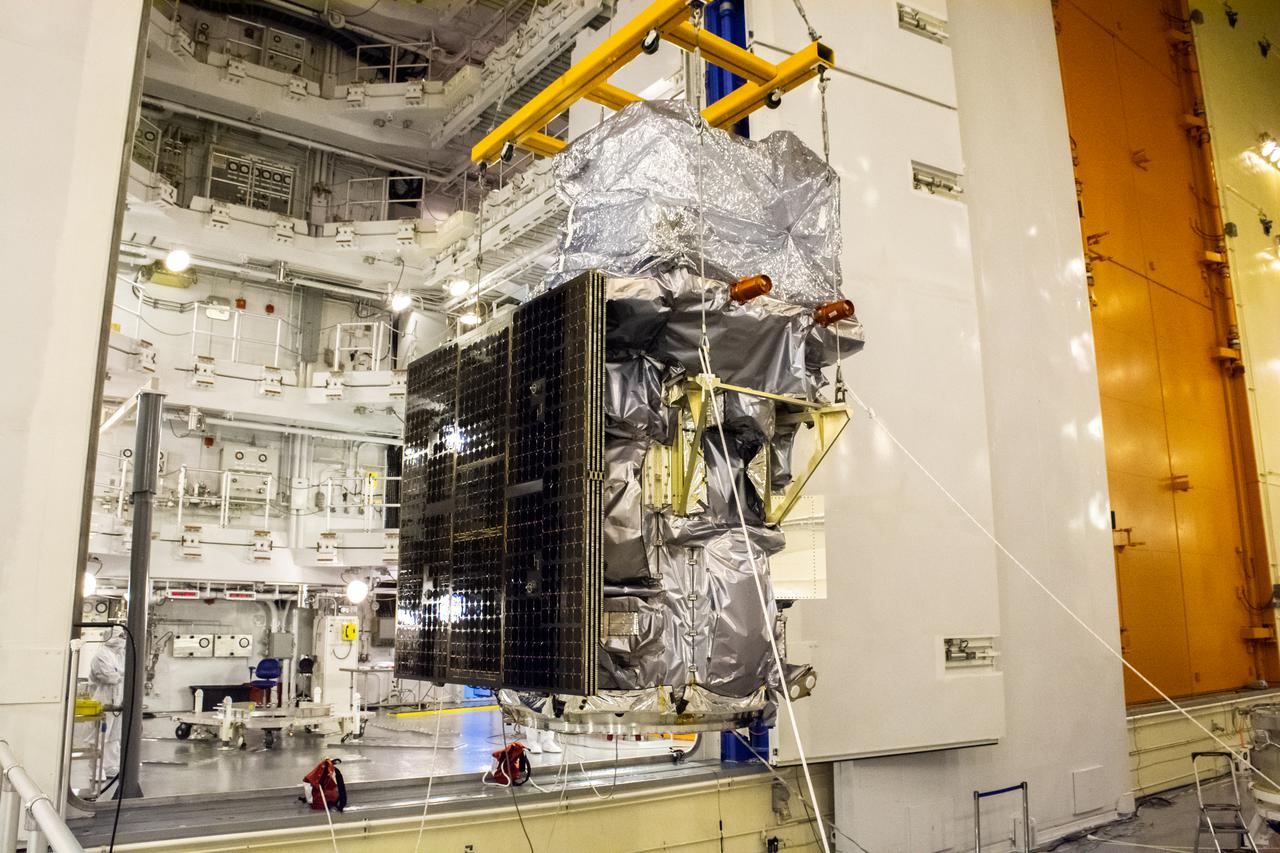
Technicians move the Landsat 9 spacecraft over to the evolved expendable vehicle secondary payload adapter (ESPA) for mating operations inside the Vertical Integration Facility at Vandenberg Space Force Base in California on Aug. 11, 2021. The ESPA connects Landsat 9 and the payload adapter (PMA) – the PMA then will attach to the second stage of a United Launch Alliance Atlas V rocket. Landsat 9 will launch on the Atlas V from Space Launch Complex 3 at Vandenberg in September 2021. The launch is being managed by NASA’s Launch Services Program based at Kennedy Space Center, America’s multi-user spaceport. The Landsat 9 satellite will continue the nearly 50-year legacy of previous Landsat missions. It will monitor key natural and economic resources from orbit. Landsat 9 is managed by the agency’s Goddard Space Flight Center in Greenbelt, Maryland. The satellite will carry two instruments: the Operational Land Imager 2, which collects images of Earth’s landscapes in visible, near infrared and shortwave infrared light, and the Thermal Infrared Sensor 2, which measures the temperature of land surfaces. Like its predecessors, Landsat 9 is a joint mission between NASA and the U.S. Geological Survey.
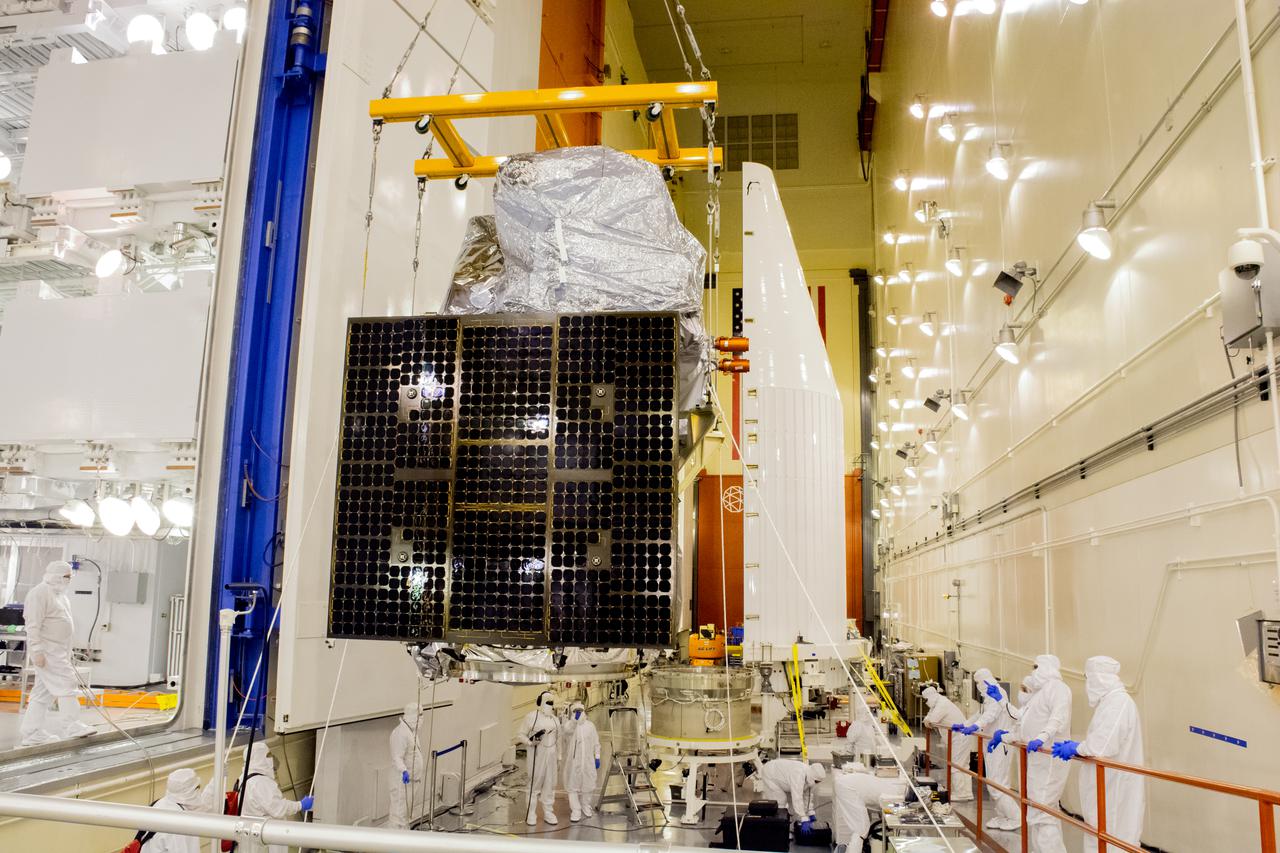
Technicians move the Landsat 9 spacecraft over to the evolved expendable vehicle secondary payload adapter (ESPA) for mating operations inside the Vertical Integration Facility at Vandenberg Space Force Base in California on Aug. 11, 2021. The ESPA connects Landsat 9 and the payload adapter (PMA) – the PMA then will attach to the second stage of a United Launch Alliance Atlas V rocket. Landsat 9 will launch on the Atlas V from Space Launch Complex 3 at Vandenberg in September 2021. The launch is being managed by NASA’s Launch Services Program based at Kennedy Space Center, America’s multi-user spaceport. The Landsat 9 satellite will continue the nearly 50-year legacy of previous Landsat missions. It will monitor key natural and economic resources from orbit. Landsat 9 is managed by the agency’s Goddard Space Flight Center in Greenbelt, Maryland. The satellite will carry two instruments: the Operational Land Imager 2, which collects images of Earth’s landscapes in visible, near infrared and shortwave infrared light, and the Thermal Infrared Sensor 2, which measures the temperature of land surfaces. Like its predecessors, Landsat 9 is a joint mission between NASA and the U.S. Geological Survey.
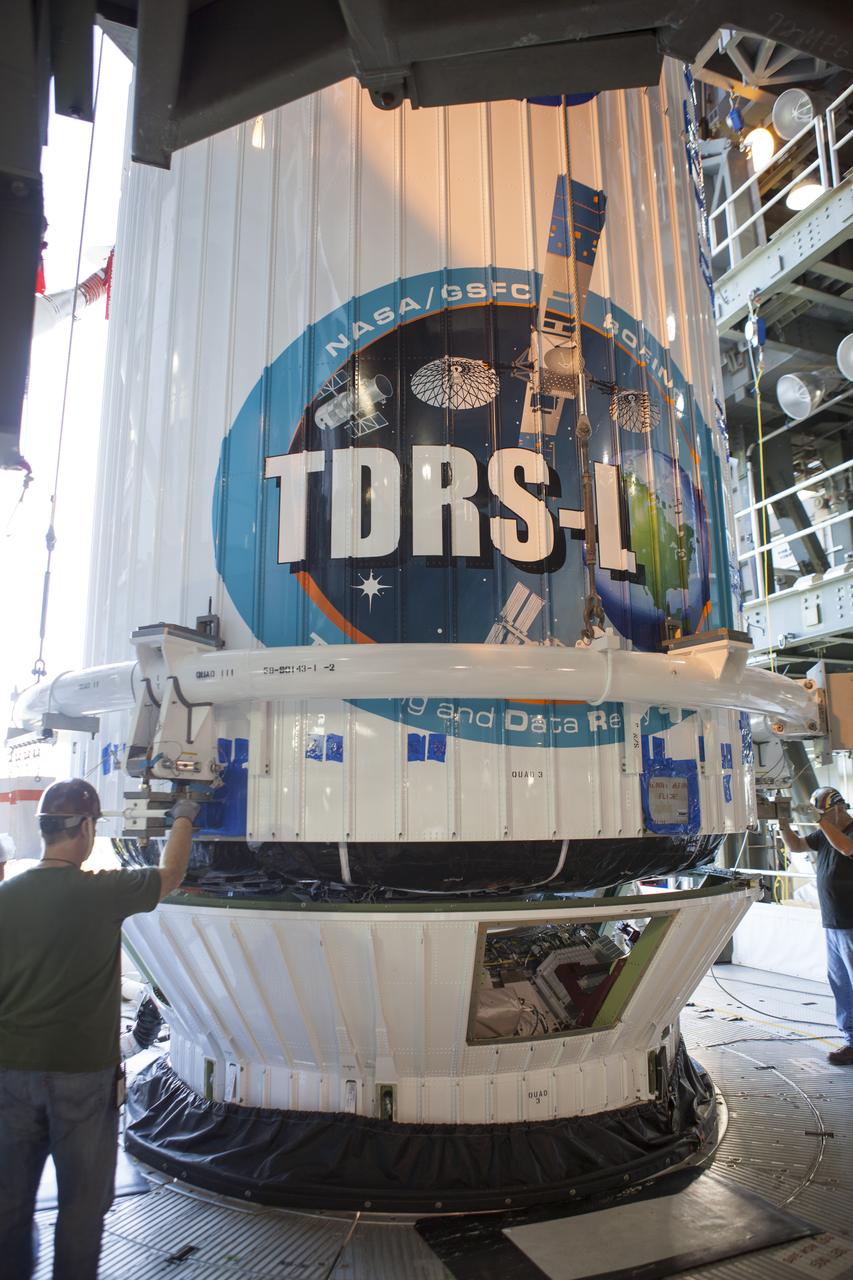
CAPE CANAVERAL, Fla. – At Cape Canaveral Air Force Station's Vertical Integration Facility at Launch Complex 41, engineers and technicians move NASA's Tracking and Data Relay Satellite, or TDRS-L, spacecraft into position for mating atop a United Launch Alliance Atlas V rocket. The TDRS-L satellite will be a part of the second of three next-generation spacecraft designed to ensure vital operational continuity for the NASA Space Network. It is scheduled to launch from Cape Canaveral's Space Launch Complex 41 atop a United Launch Alliance Atlas V rocket on Jan. 23, 2014. The current Tracking and Data Relay Satellite system consists of eight in-orbit satellites distributed to provide near continuous information relay contact with orbiting spacecraft ranging from the International Space Station and Hubble Space Telescope to the array of scientific observatories. For more information, visit: http://www.nasa.gov/mission_pages/tdrs/home/index.html Photo credit: NASA/Dimitri Gerondidakis
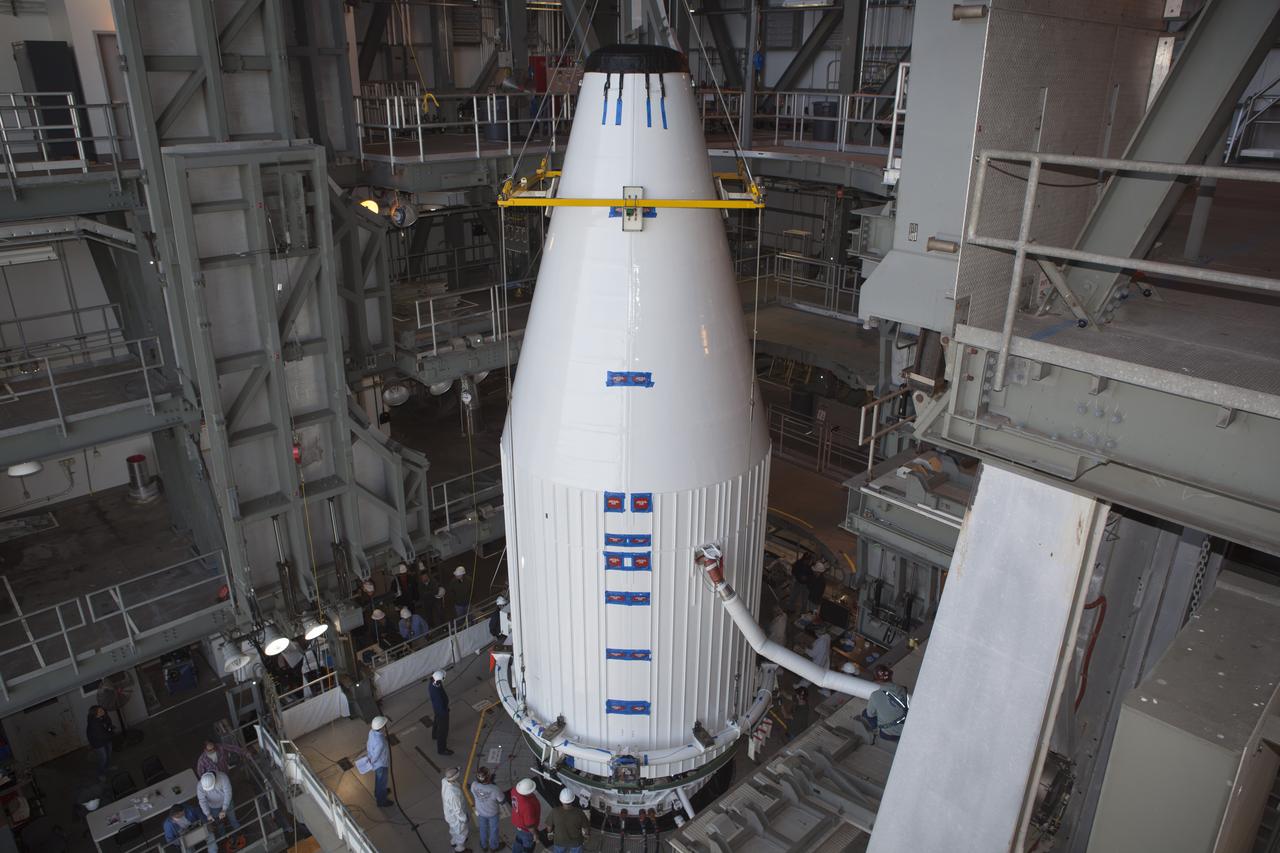
CAPE CANAVERAL, Fla. – At Cape Canaveral Air Force Station's Vertical Integration Facility at Launch Complex 41, engineers and technicians move NASA's Tracking and Data Relay Satellite, or TDRS-L, spacecraft into position for mating atop a United Launch Alliance Atlas V rocket. The TDRS-L satellite will be a part of the second of three next-generation spacecraft designed to ensure vital operational continuity for the NASA Space Network. It is scheduled to launch from Cape Canaveral's Space Launch Complex 41 atop a United Launch Alliance Atlas V rocket on Jan. 23, 2014. The current Tracking and Data Relay Satellite system consists of eight in-orbit satellites distributed to provide near continuous information relay contact with orbiting spacecraft ranging from the International Space Station and Hubble Space Telescope to the array of scientific observatories. For more information, visit: http://www.nasa.gov/mission_pages/tdrs/home/index.html Photo credit: NASA/Dimitri Gerondidakis

Packaged in a protective container, the Joint Polar Satellite System-1, or JPSS-1, spacecraft is about to be lifted and mated atop a United Launch Alliance Delta II rocket at Space Launch Complex 2 at Vandenberg Air Force Base in California. Built by Ball Aerospace and Technologies Corp. of Boulder, Colorado, JPSS is the first in a series four next-generation environmental satellites in a collaborative program between the NOAA and NASA. Liftoff is scheduled to take place from Vandenberg's Space Launch Complex 2.
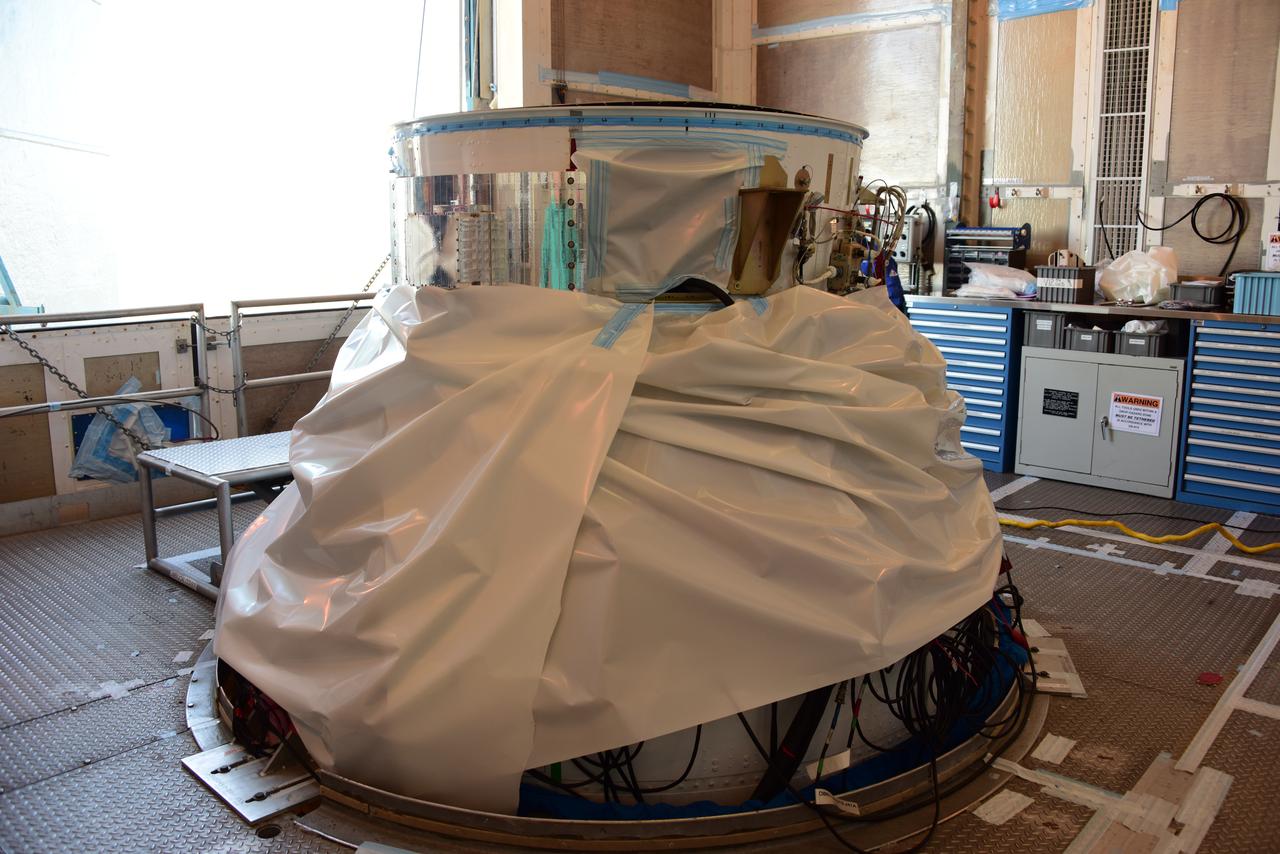
At Vandenberg Air Force Base in California, the Joint Polar Satellite System-1, or JPSS-1, spacecraft is mated atop a United Launch Alliance Delta II rocket at Space Launch Complex 2. Built by Ball Aerospace and Technologies Corp. of Boulder, Colorado, JPSS is the first in a series four next-generation environmental satellites in a collaborative program between the NOAA and NASA. Liftoff is scheduled to take place from Vandenberg's Space Launch Complex 2.
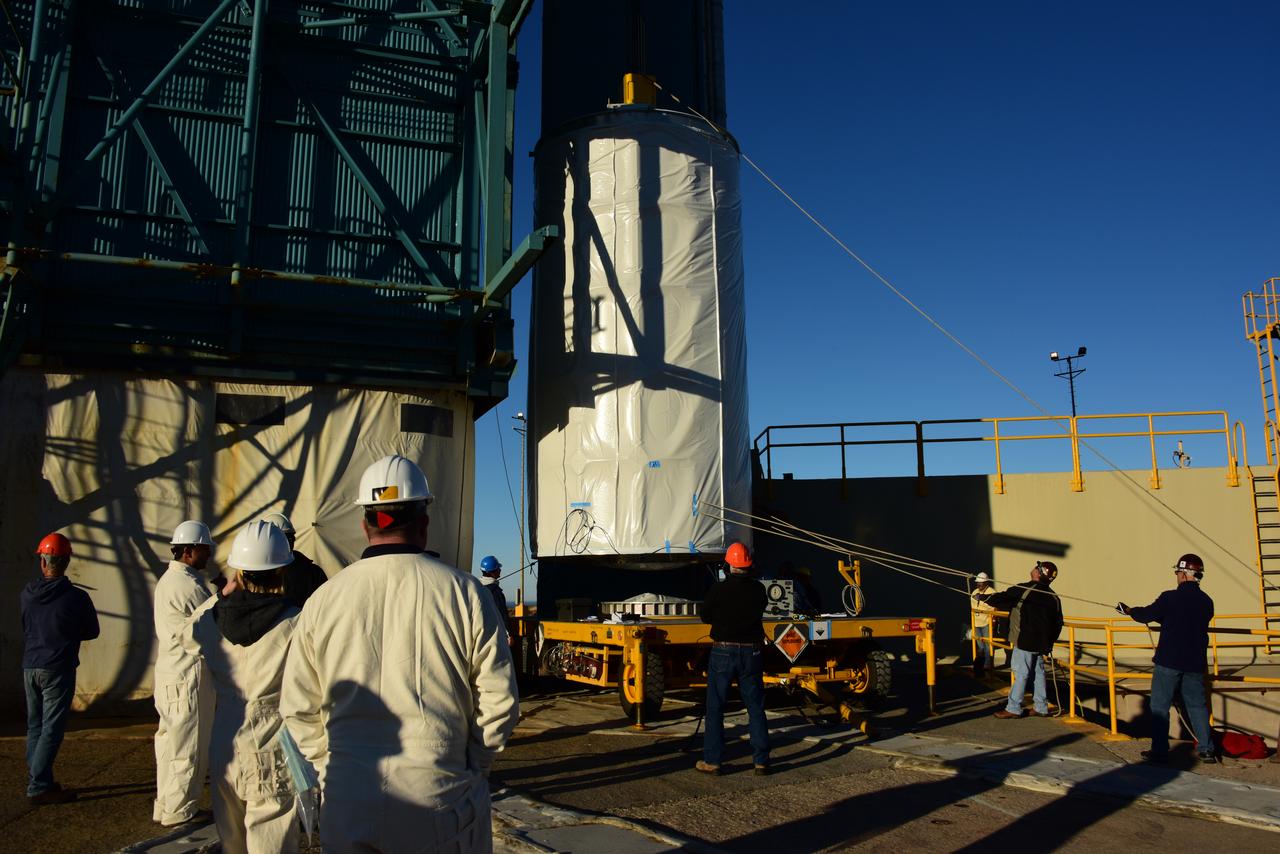
Packaged in a protective container, the Joint Polar Satellite System-1, or JPSS-1, spacecraft is lifted for mating atop a United Launch Alliance Delta II rocket at Space Launch Complex 2 at Vandenberg Air Force Base in California. Built by Ball Aerospace and Technologies Corp. of Boulder, Colorado, JPSS is the first in a series four next-generation environmental satellites in a collaborative program between the NOAA and NASA. Liftoff is scheduled to take place from Vandenberg's Space Launch Complex 2.
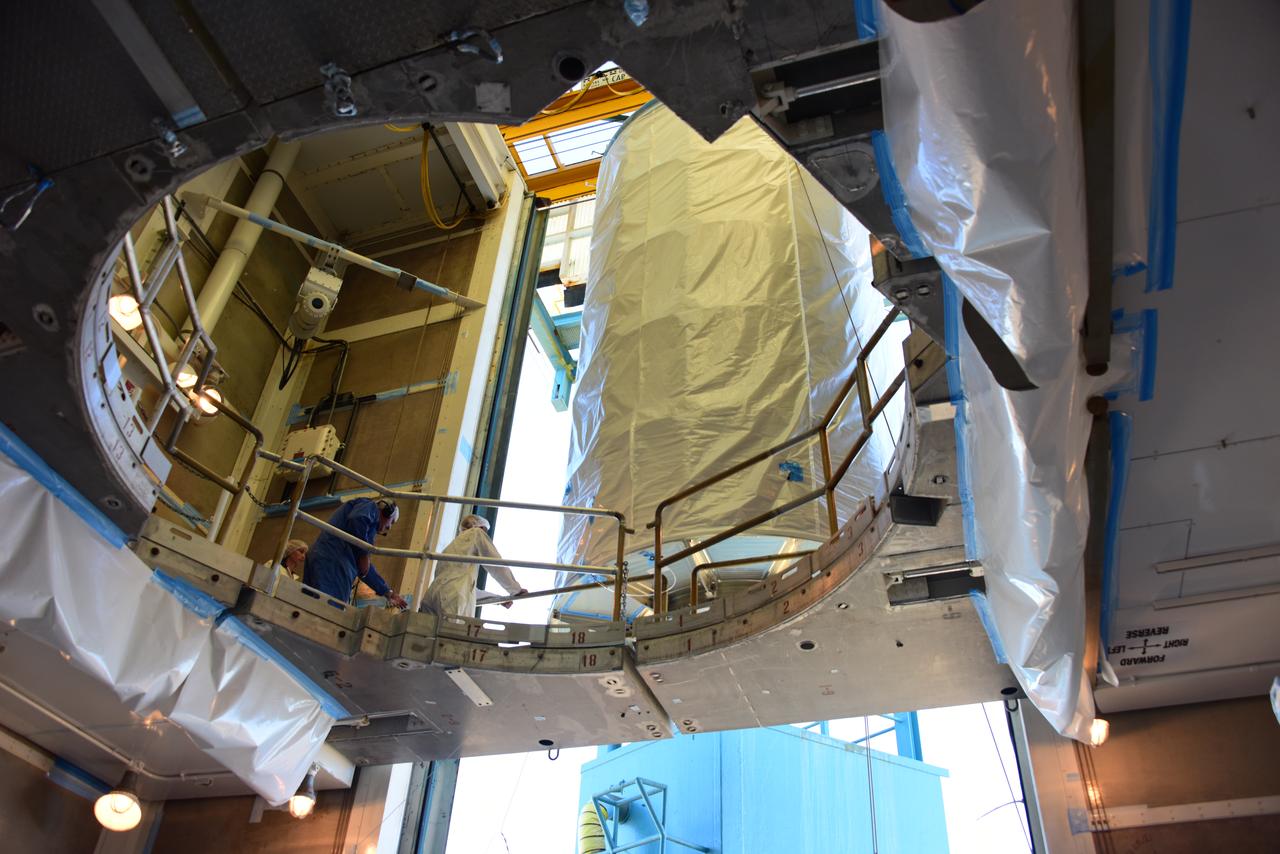
Packaged in a protective container, the Joint Polar Satellite System-1, or JPSS-1, spacecraft is lifted for mating atop a United Launch Alliance Delta II rocket at Space Launch Complex 2 at Vandenberg Air Force Base in California. Built by Ball Aerospace and Technologies Corp. of Boulder, Colorado, JPSS is the first in a series four next-generation environmental satellites in a collaborative program between the NOAA and NASA. Liftoff is scheduled to take place from Vandenberg's Space Launch Complex 2.
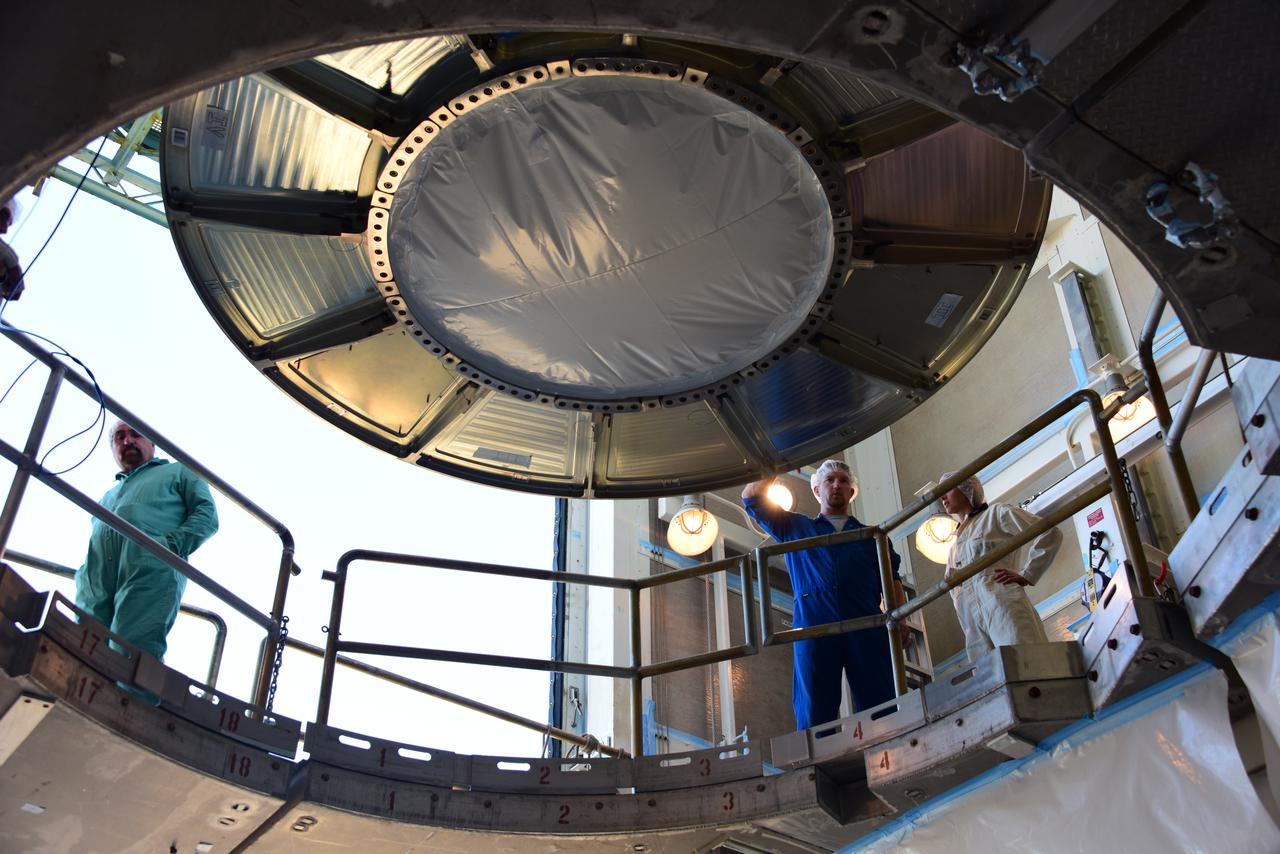
Packaged in a protective container, the Joint Polar Satellite System-1, or JPSS-1, spacecraft is about to be mated atop a United Launch Alliance Delta II rocket at Space Launch Complex 2 at Vandenberg Air Force Base in California. Built by Ball Aerospace and Technologies Corp. of Boulder, Colorado, JPSS is the first in a series four next-generation environmental satellites in a collaborative program between the NOAA and NASA. Liftoff is scheduled to take place from Vandenberg's Space Launch Complex 2.
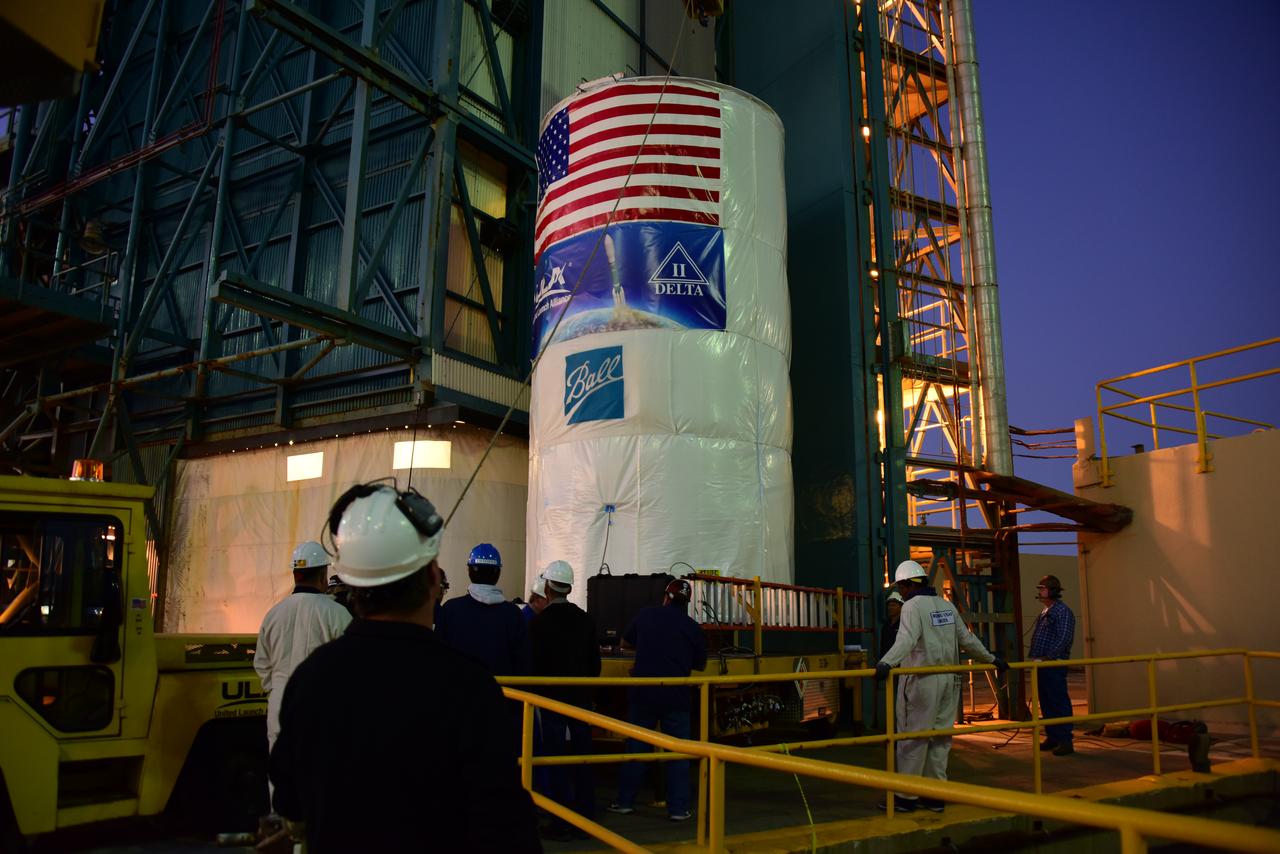
Packaged in a protective container, the Joint Polar Satellite System-1, or JPSS-1, spacecraft is about to be lifted and mated atop a United Launch Alliance Delta II rocket at Space Launch Complex 2 at Vandenberg Air Force Base in California. Built by Ball Aerospace and Technologies Corp. of Boulder, Colorado, JPSS is the first in a series four next-generation environmental satellites in a collaborative program between the NOAA and NASA. Liftoff is scheduled to take place from Vandenberg's Space Launch Complex 2.
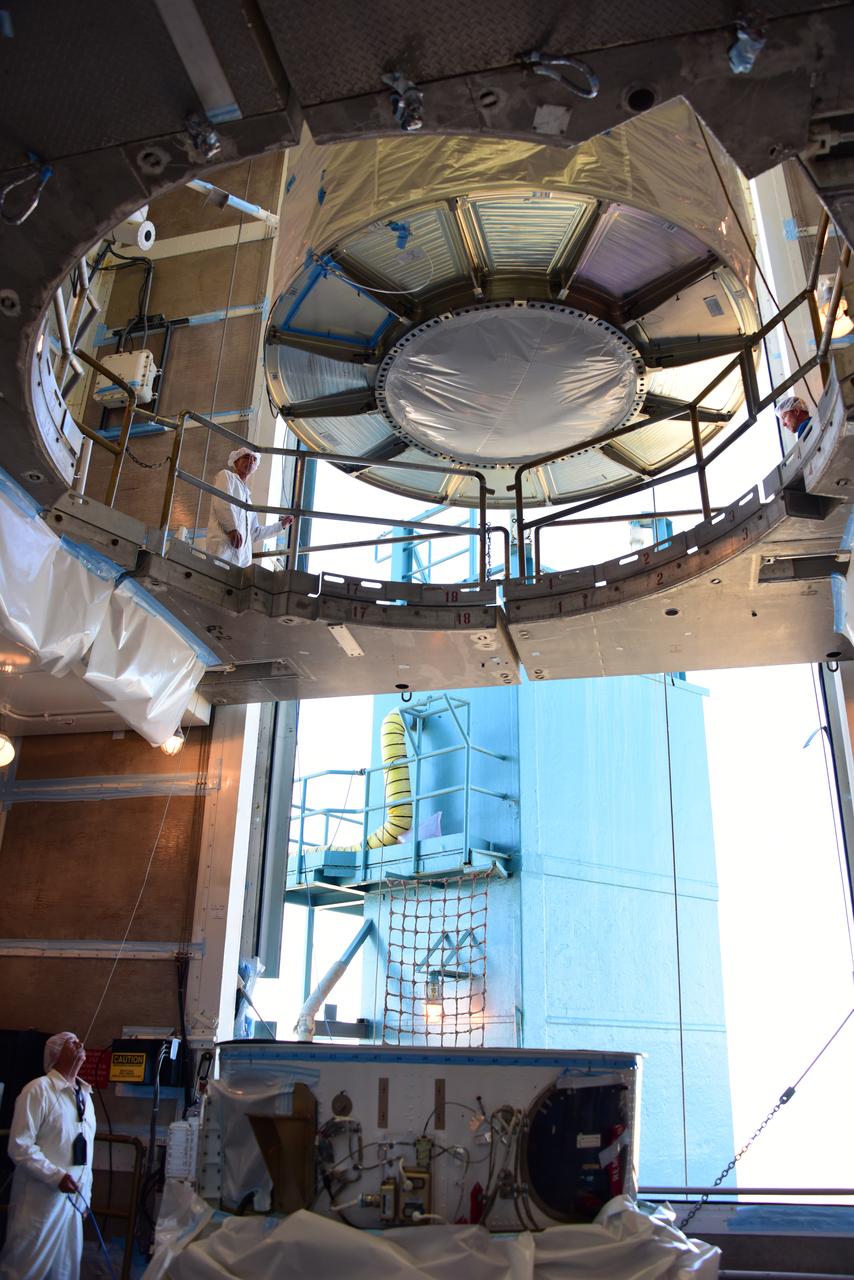
Packaged in a protective container, the Joint Polar Satellite System-1, or JPSS-1, spacecraft is about to be mated atop a United Launch Alliance Delta II rocket at Space Launch Complex 2 at Vandenberg Air Force Base in California. Built by Ball Aerospace and Technologies Corp. of Boulder, Colorado, JPSS is the first in a series four next-generation environmental satellites in a collaborative program between the NOAA and NASA. Liftoff is scheduled to take place from Vandenberg's Space Launch Complex 2.
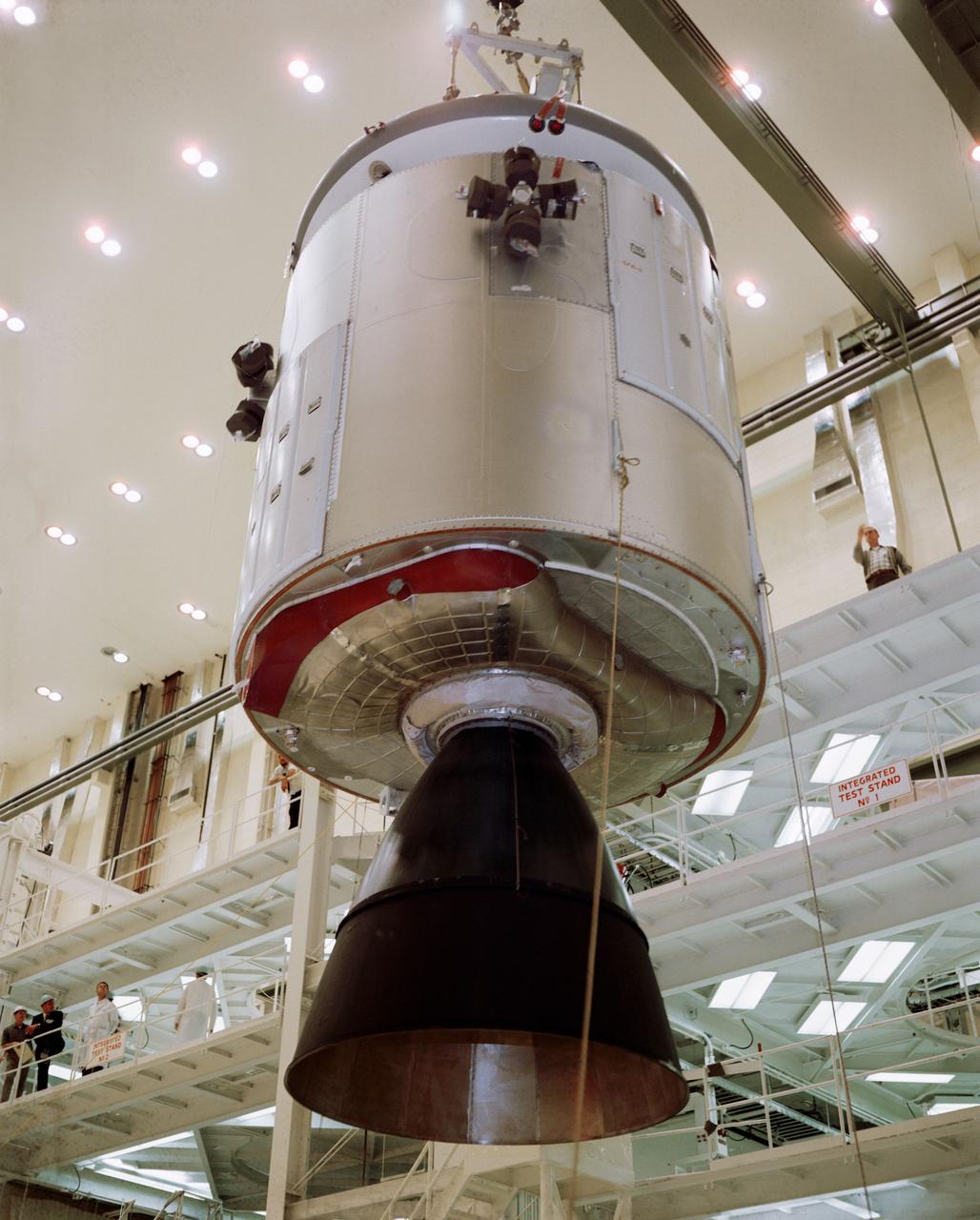
S67-15704 (3 Jan. 1967) --- Transfer of Apollo Spacecraft 012 Command/Service Module (CSM) for mating with the Saturn Lunar Module (LM) Adapter No.05 in the Manned Spacecraft Operations Building. Spacecraft 012 will be flown on the Apollo/Saturn 1 (204) mission. Photo credit: NASA
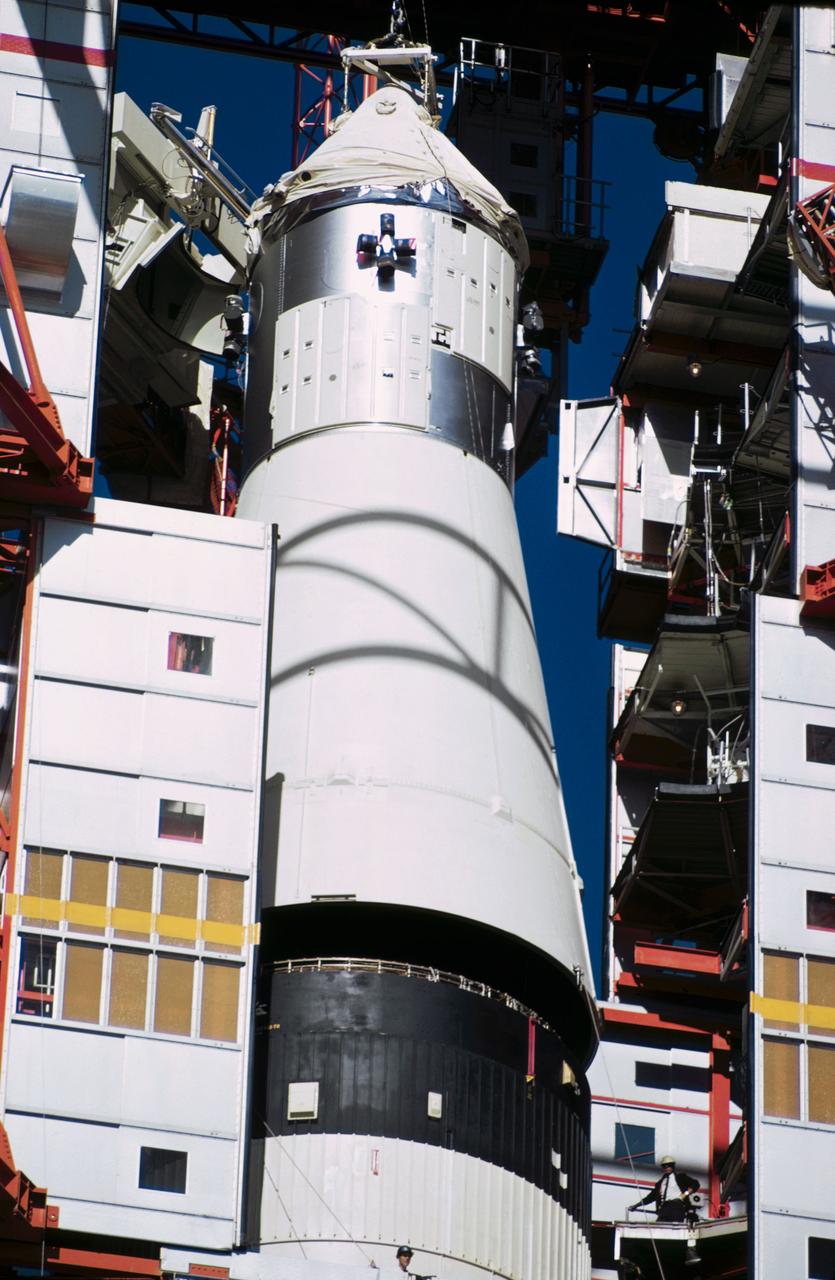
S67-17042 (1967) --- Apollo Spacecraft 012 is hoisted to the top of the gantry at Pad 34 during the Apollo/Saturn Mission 204 erection. S/C 012 will be mated with the uprated Saturn I launch vehicle.
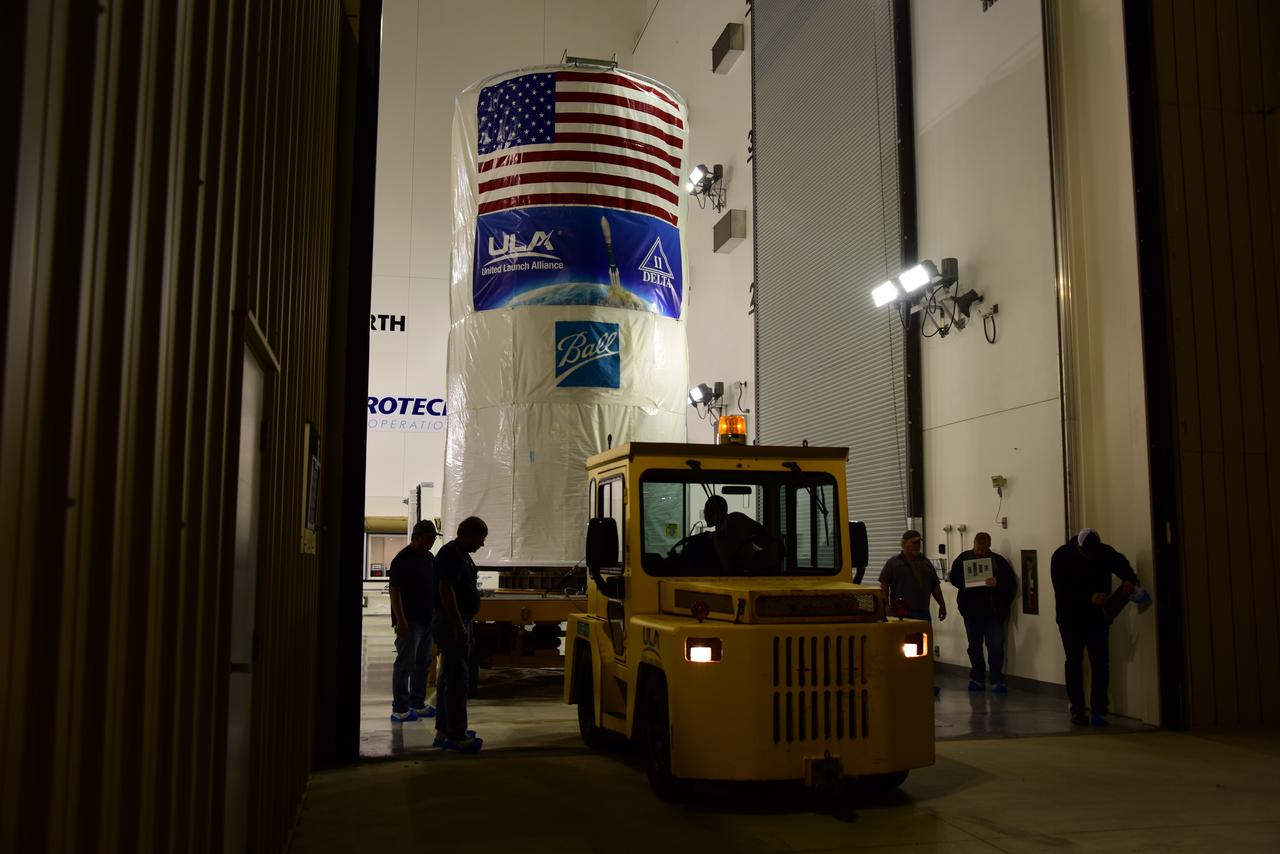
At Vandenberg Air Force Base in California, the Joint Polar Satellite System-1, or JPSS-1, spacecraft departs the Astrotech Processing Facility in a protective container on its way to Space Launch Complex 2. At the pad, JPSS-1 will be lifted for mating atop a United Launch Alliance Delta II rocket. Built by Ball Aerospace and Technologies Corp. of Boulder, Colorado, JPSS is the first in a series four next-generation environmental satellites in a collaborative program between the NOAA and NASA. Liftoff is scheduled to take place from Vandenberg's Space Launch Complex 2.

At Vandenberg Air Force Base in California, the Joint Polar Satellite System-1, or JPSS-1, spacecraft departs the Astrotech Processing Facility in a protective container on its way to Space Launch Complex 2. At the pad, JPSS-1 will be lifted for mating atop a United Launch Alliance Delta II rocket. Built by Ball Aerospace and Technologies Corp. of Boulder, Colorado, JPSS is the first in a series four next-generation environmental satellites in a collaborative program between the NOAA and NASA. Liftoff is scheduled to take place from Vandenberg's Space Launch Complex 2.

The mated Pegasus XL rocket - AIM spacecraft is moved onto a transporter in Building 1655 at Vandenberg Air Force Base in California. The launch vehicle will be transferred to a waiting Orbital Sciences Stargazer L-1011 aircraft for launch. AIM, which stands for Aeronomy of Ice in the Mesosphere, is being prepared for integrated testing and a flight simulation. The AIM spacecraft will fly three instruments designed to study polar mesospheric clouds located at the edge of space, 50 miles above the Earth's surface in the coldest part of the planet's atmosphere. The mission's primary goal is to explain why these clouds form and what has caused them to become brighter and more numerous and appear at lower latitudes in recent years. AIM's results will provide the basis for the study of long-term variability in the mesospheric climate and its relationship to global climate change. Launch is scheduled for April 25.
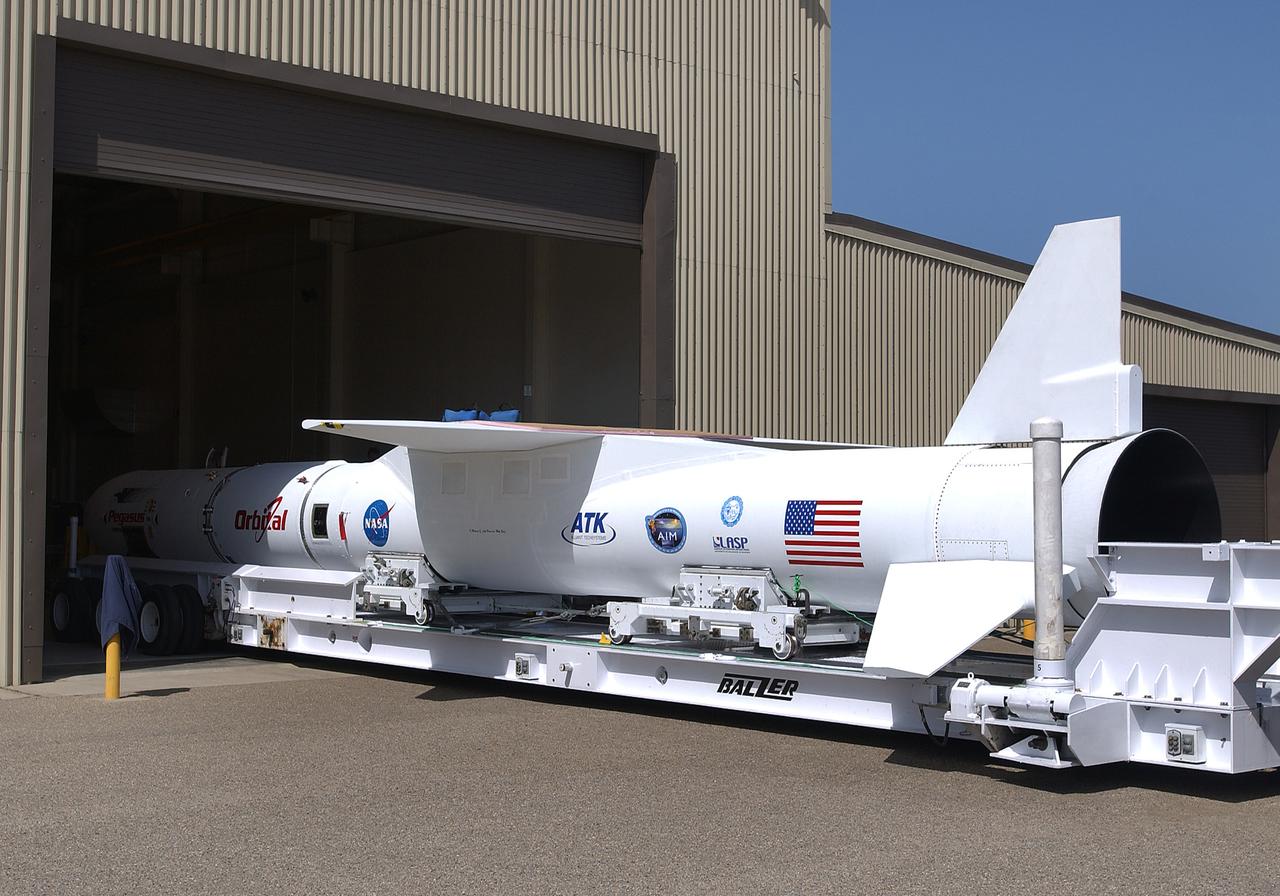
The mated Pegasus XL rocket - AIM spacecraft leaves Building 1655 at Vandenberg Air Force Base in California. The rocket will be transferred to a waiting Orbital Sciences Stargazer L-1011 aircraft for launch. AIM, which stands for Aeronomy of Ice in the Mesosphere, is being prepared for integrated testing and a flight simulation. The AIM spacecraft will fly three instruments designed to study polar mesospheric clouds located at the edge of space, 50 miles above the Earth's surface in the coldest part of the planet's atmosphere. The mission's primary goal is to explain why these clouds form and what has caused them to become brighter and more numerous and appear at lower latitudes in recent years. AIM's results will provide the basis for the study of long-term variability in the mesospheric climate and its relationship to global climate change. Launch is scheduled for April 25.
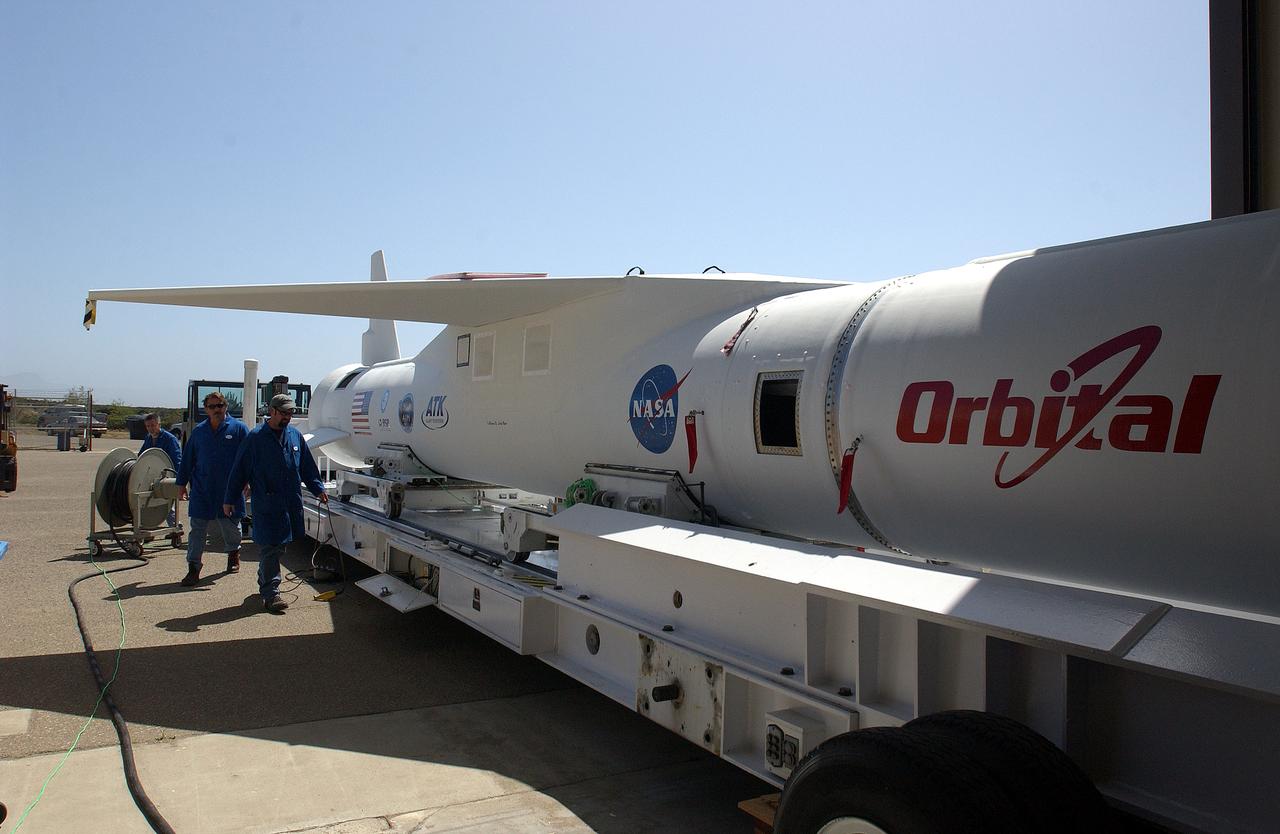
The mated Pegasus XL rocket - AIM spacecraft is secured onto a transporter at Vandenberg Air Force Base in California. The rocket will be transferred to a waiting Orbital Sciences Stargazer L-1011 aircraft for launch. AIM, which stands for Aeronomy of Ice in the Mesosphere, is being prepared for integrated testing and a flight simulation. The AIM spacecraft will fly three instruments designed to study polar mesospheric clouds located at the edge of space, 50 miles above the Earth's surface in the coldest part of the planet's atmosphere. The mission's primary goal is to explain why these clouds form and what has caused them to become brighter and more numerous and appear at lower latitudes in recent years. AIM's results will provide the basis for the study of long-term variability in the mesospheric climate and its relationship to global climate change. Launch is scheduled for April 25.
Technicians attach NASA's Ionospheric Connection Explorer (ICON) to the Northrop Grumman Pegasus XL rocket inside Building 1555 at Vandenberg Air Force Base in California on Sept. 10, 2019. Preparations are underway to perform a black light test on Pegasus before the port and starboard payload fairings are installed around ICON. The Pegasus XL rocket, attached beneath the company's L-1011 Stargazer aircraft, will launch ICON from the Skid Strip at Cape Canaveral Air Force Station in Florida. Launch is scheduled for Oct. 9, 2019. ICON will study the frontier of space - the dynamic zone high in Earth's atmosphere where terrestrial weather from below meets space weather above. The explorer will help determine the physics of Earth's space environment and pave the way for mitigating its effects on our technology and communications systems.
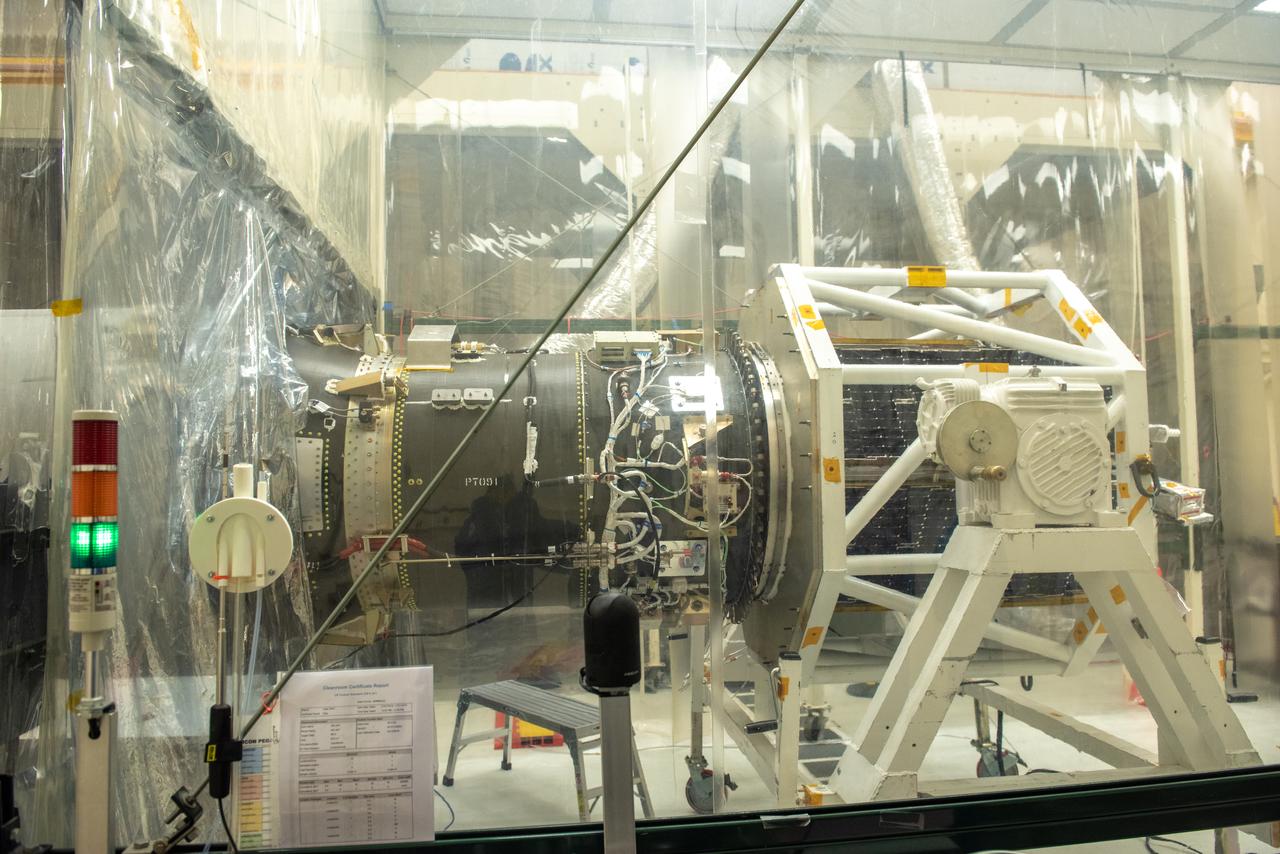
NASA's Ionospheric Connection Explorer (ICON) is attached to the Northrop Grumman Pegasus XL rocket inside Building 1555 at Vandenberg Air Force Base in California on Sept. 10, 2019. The Pegasus XL rocket, attached beneath the company's L-1011 Stargazer aircraft, will launch ICON from the Skid Strip at Cape Canaveral Air Force Station in Florida. Launch is scheduled for Oct. 9, 2019. ICON will study the frontier of space - the dynamic zone high in Earth's atmosphere where terrestrial weather from below meets space weather above. The explorer will help determine the physics of Earth's space environment and pave the way for mitigating its effects on our technology and communications systems.
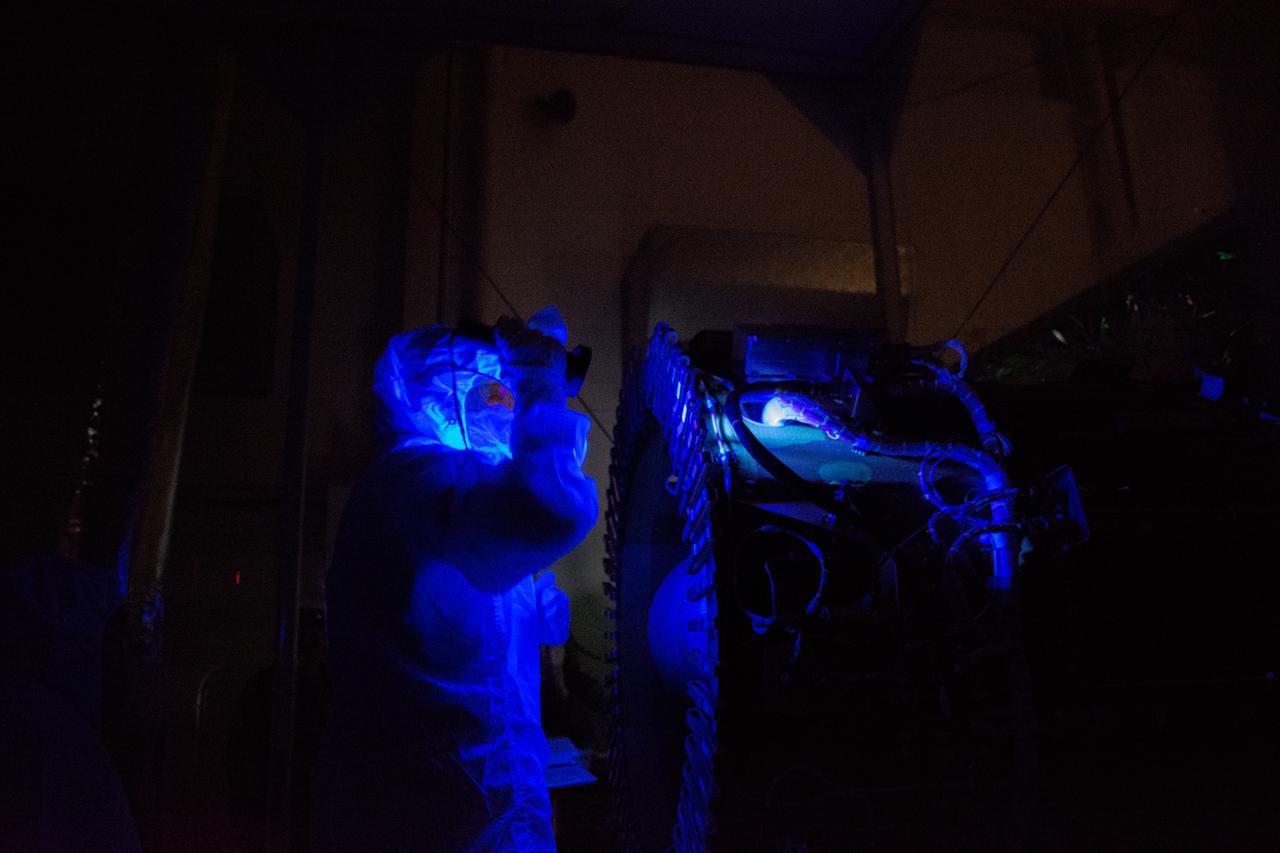
Technicians perform a black light inspection of the Northrop Grumman Pegasus XL rocket inside Building 1555 at Vandenberg Air Force Base in California, on Sept. 10, 2019, after NASA’s Ionospheric Connection Explorer (ICON) was attached to the rocket. The Pegasus port and starboard payload fairings will be installed around ICON. The Pegasus XL rocket, attached beneath the company's L-1011 Stargazer aircraft, will launch ICON from the Skid Strip at Cape Canaveral Air Force Station in Florida. Launch is scheduled for Oct. 9, 2019. ICON will study the frontier of space - the dynamic zone high in Earth's atmosphere where terrestrial weather from below meets space weather above. The explorer will help determine the physics of Earth's space environment and pave the way for mitigating its effects on our technology and communications systems.
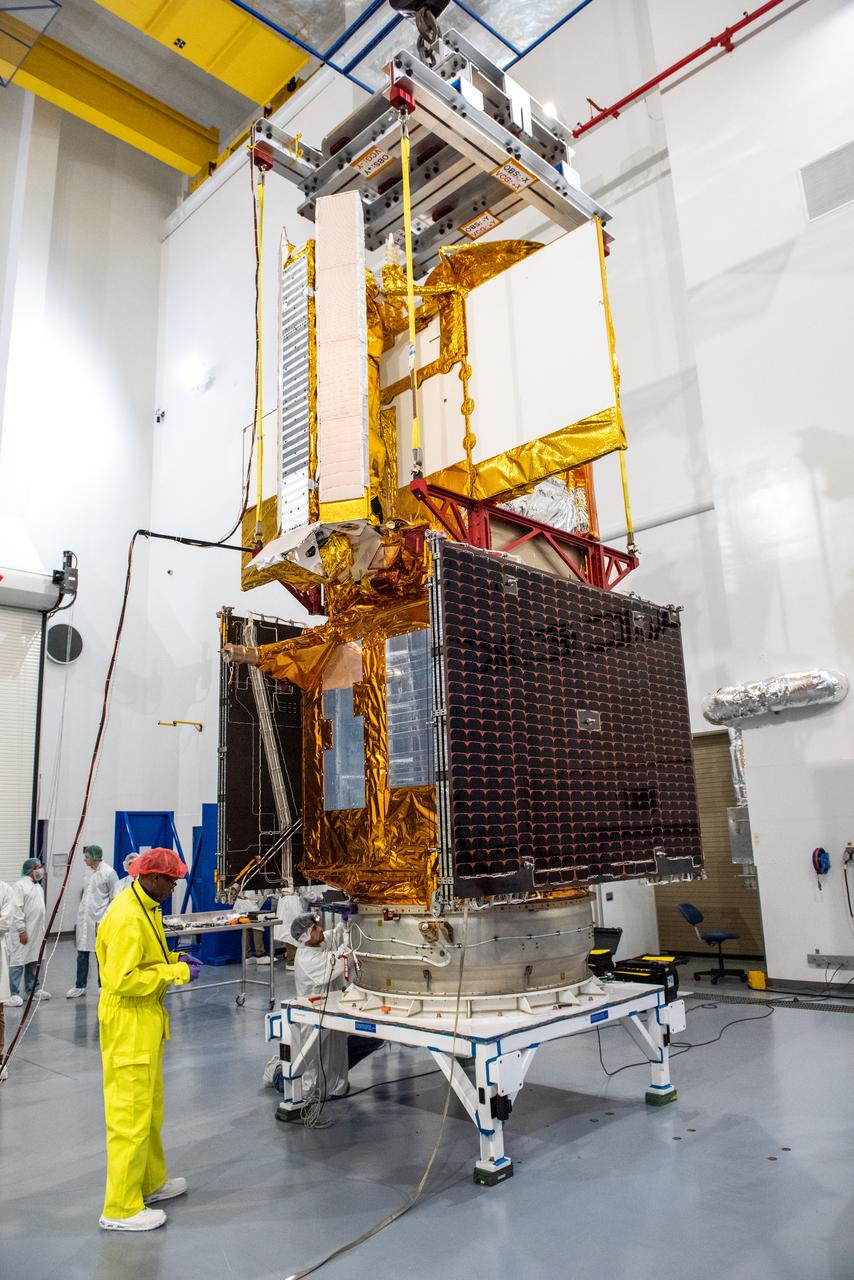
Inside the SpaceX facility at Vandenberg Space Force Base in California, a technician assists as a crane is used to lift the Surface Water and Ocean Topography (SWOT) satellite for mating to the payload adapter on Dec. 5, 2022. A collaboration between NASA and the French space agency Centre National d’Études Spatiales (CNES), with contributions from the Canadian Space Agency and the UK Space Agency, SWOT will be the first satellite to survey nearly all water on Earth’s surface. SWOT is scheduled to lift off aboard the SpaceX Falcon 9 rocket from Vandenberg on Dec. 15, 2022, at 3:46 a.m. PST.
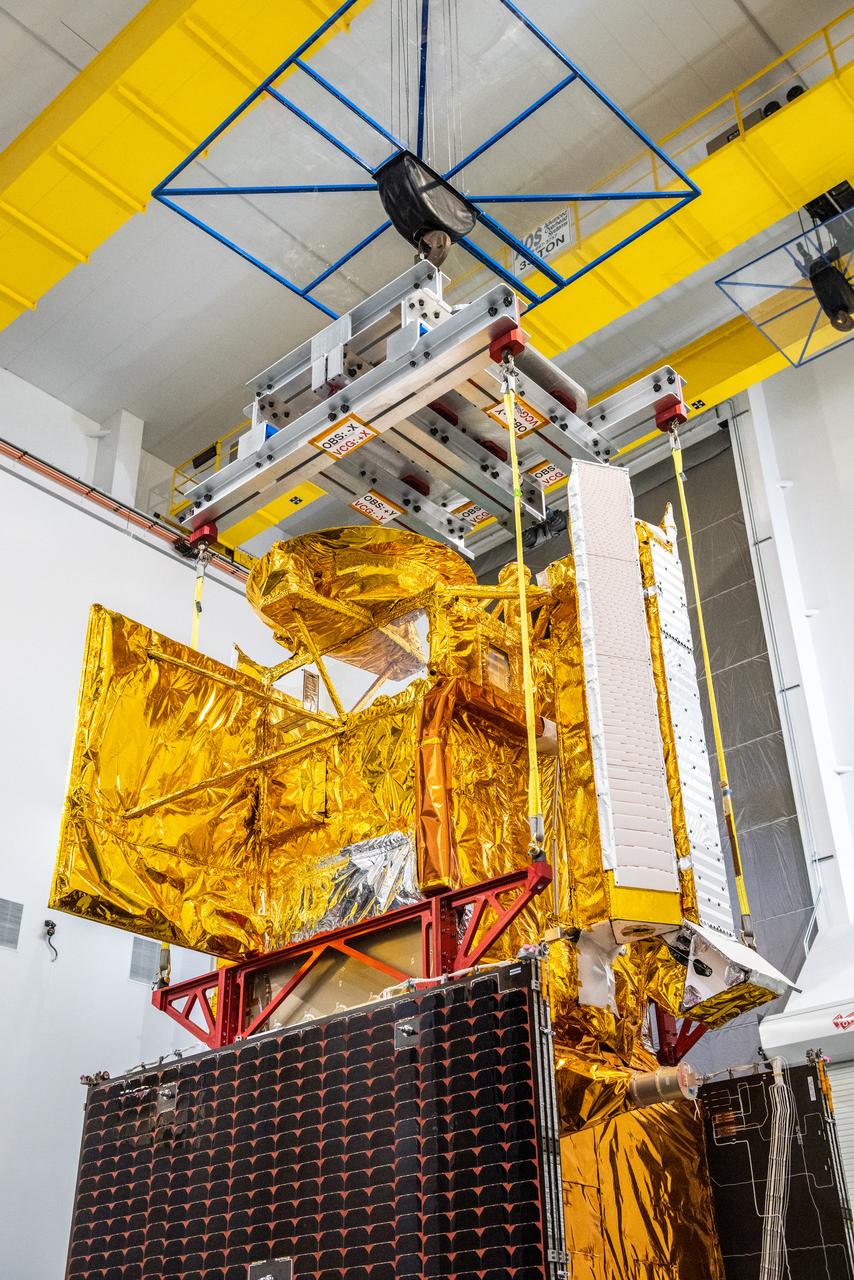
Inside the SpaceX facility at Vandenberg Space Force Base in California, a crane is used to lift the Surface Water and Ocean Topography (SWOT) satellite for mating to the payload adapter on Dec. 5, 2022. A collaboration between NASA and the French space agency Centre National d’Études Spatiales (CNES), with contributions from the Canadian Space Agency and the UK Space Agency, SWOT will be the first satellite to survey nearly all water on Earth’s surface. SWOT is scheduled to lift off aboard the SpaceX Falcon 9 rocket from Vandenberg on Dec. 15, 2022, at 3:46 a.m. PST.
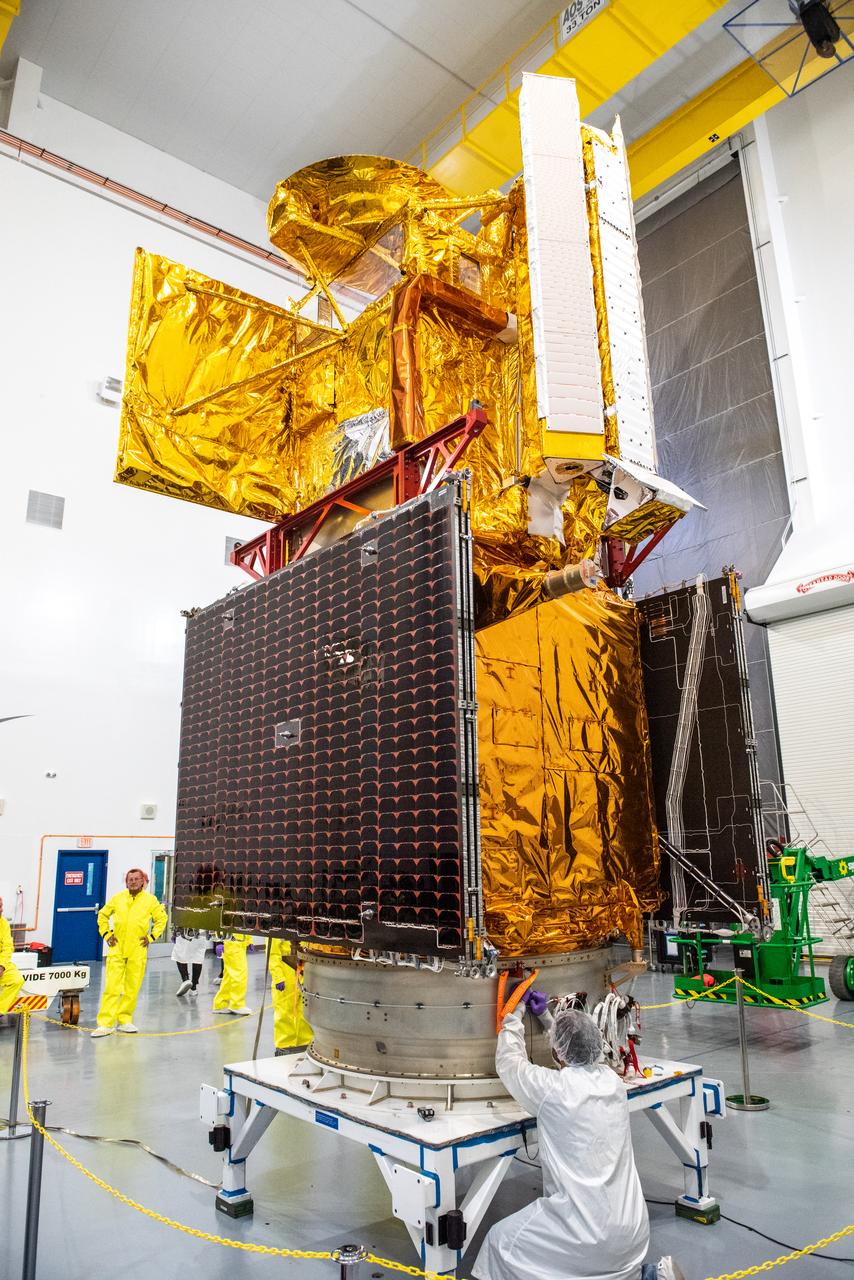
Inside the SpaceX facility at Vandenberg Space Force Base in California, a technician assists as a crane lowers the Surface Water and Ocean Topography (SWOT) satellite onto the payload adapter on Dec. 5, 2022. A collaboration between NASA and the French space agency Centre National d’Études Spatiales (CNES), with contributions from the Canadian Space Agency and the UK Space Agency, SWOT will be the first satellite to survey nearly all water on Earth’s surface. SWOT is scheduled to lift off aboard the SpaceX Falcon 9 rocket from Vandenberg on Dec. 15, 2022, at 3:46 a.m. PST.
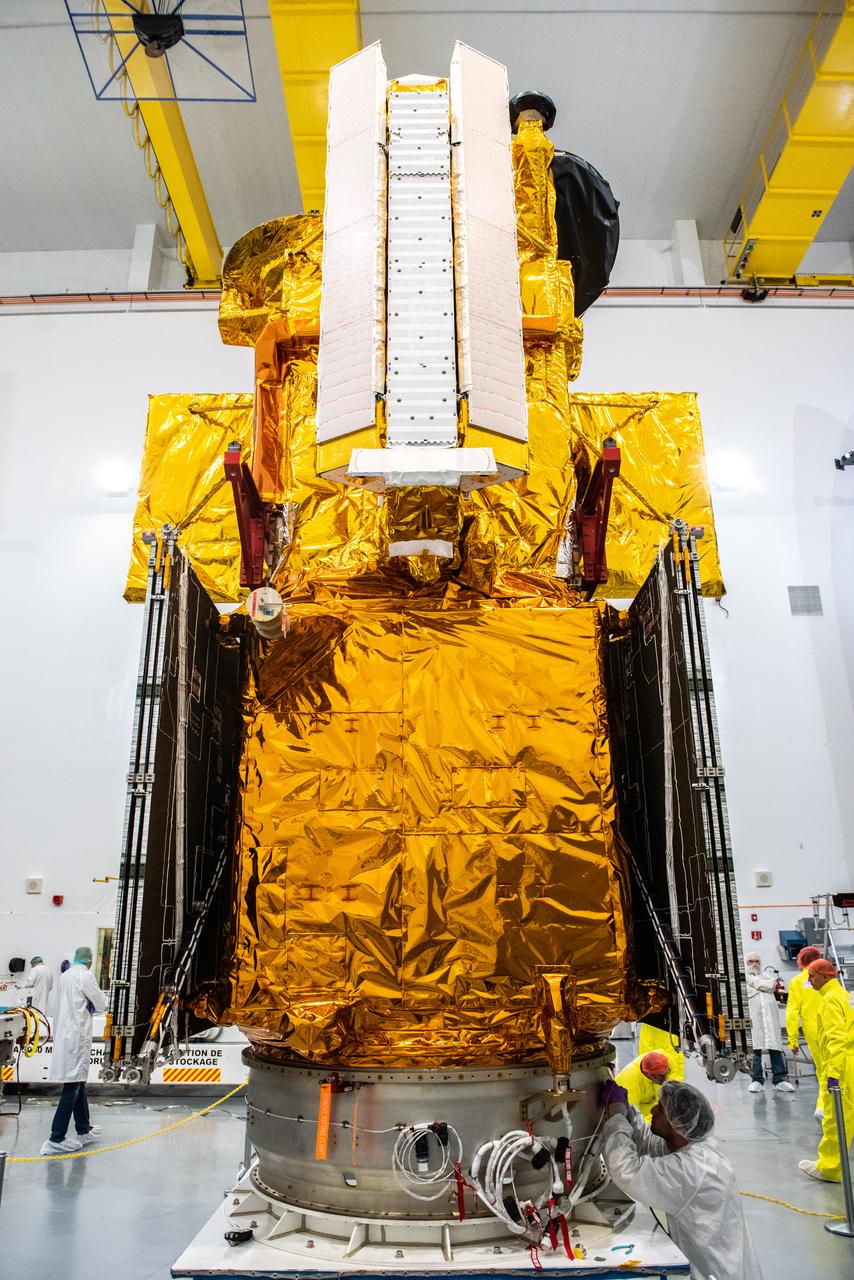
Inside the SpaceX facility at Vandenberg Space Force Base in California, a crane lifts the Surface Water and Ocean Topography (SWOT) satellite onto the payload adapter on Dec. 5, 2022. A collaboration between NASA and the French space agency Centre National d’Études Spatiales (CNES), with contributions from the Canadian Space Agency and the UK Space Agency, SWOT will be the first satellite to survey nearly all water on Earth’s surface. SWOT is scheduled to lift off aboard the SpaceX Falcon 9 rocket from Vandenberg on Dec. 15, 2022, at 3:46 a.m. PST.
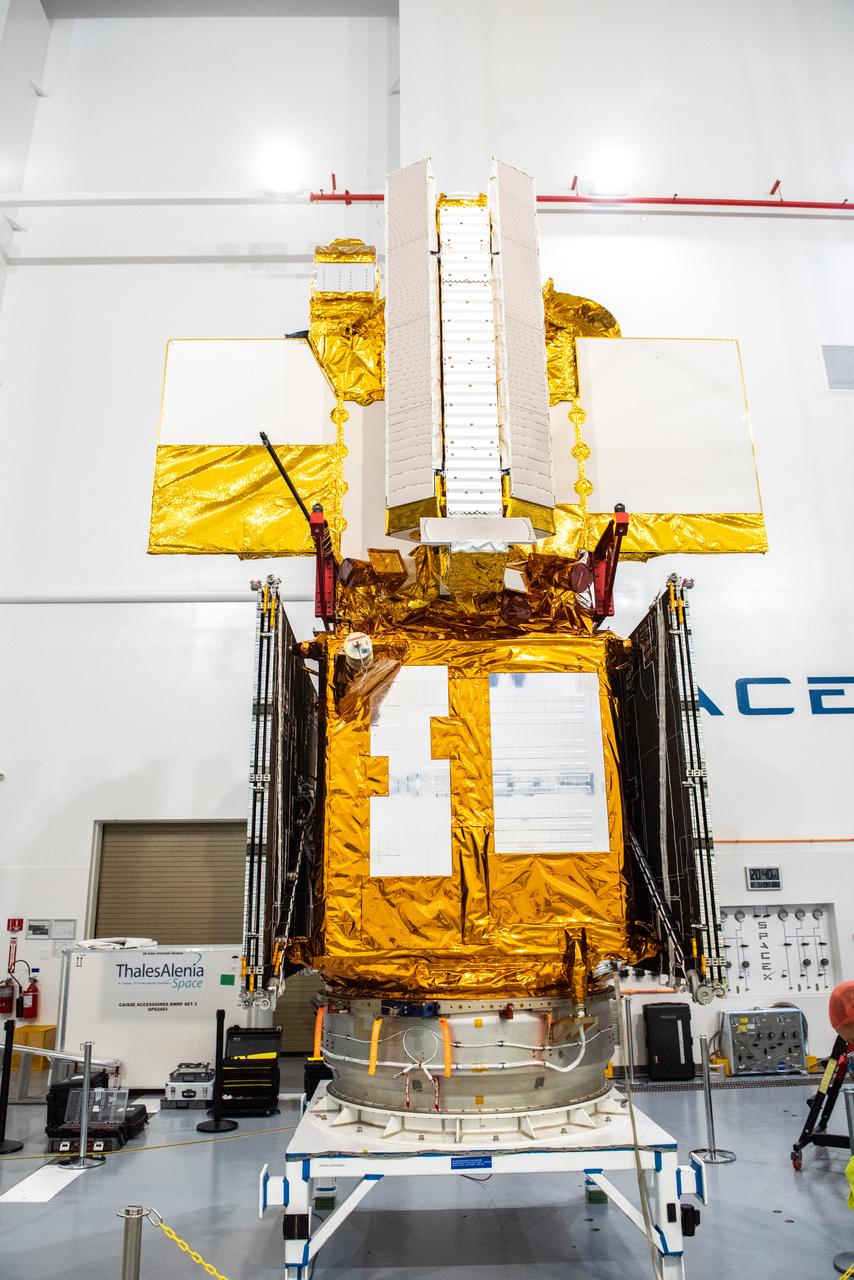
Inside the SpaceX facility at Vandenberg Space Force Base in California, a crane is used to lower the Surface Water and Ocean Topography (SWOT) satellite for mating to the payload adapter on Dec. 5, 2022. A collaboration between NASA and the French space agency Centre National d’Études Spatiales (CNES), with contributions from the Canadian Space Agency and the UK Space Agency, SWOT will be the first satellite to survey nearly all water on Earth’s surface. SWOT is scheduled to lift off aboard the SpaceX Falcon 9 rocket from Vandenberg on Dec. 15, 2022, at 3:46 a.m. PST.
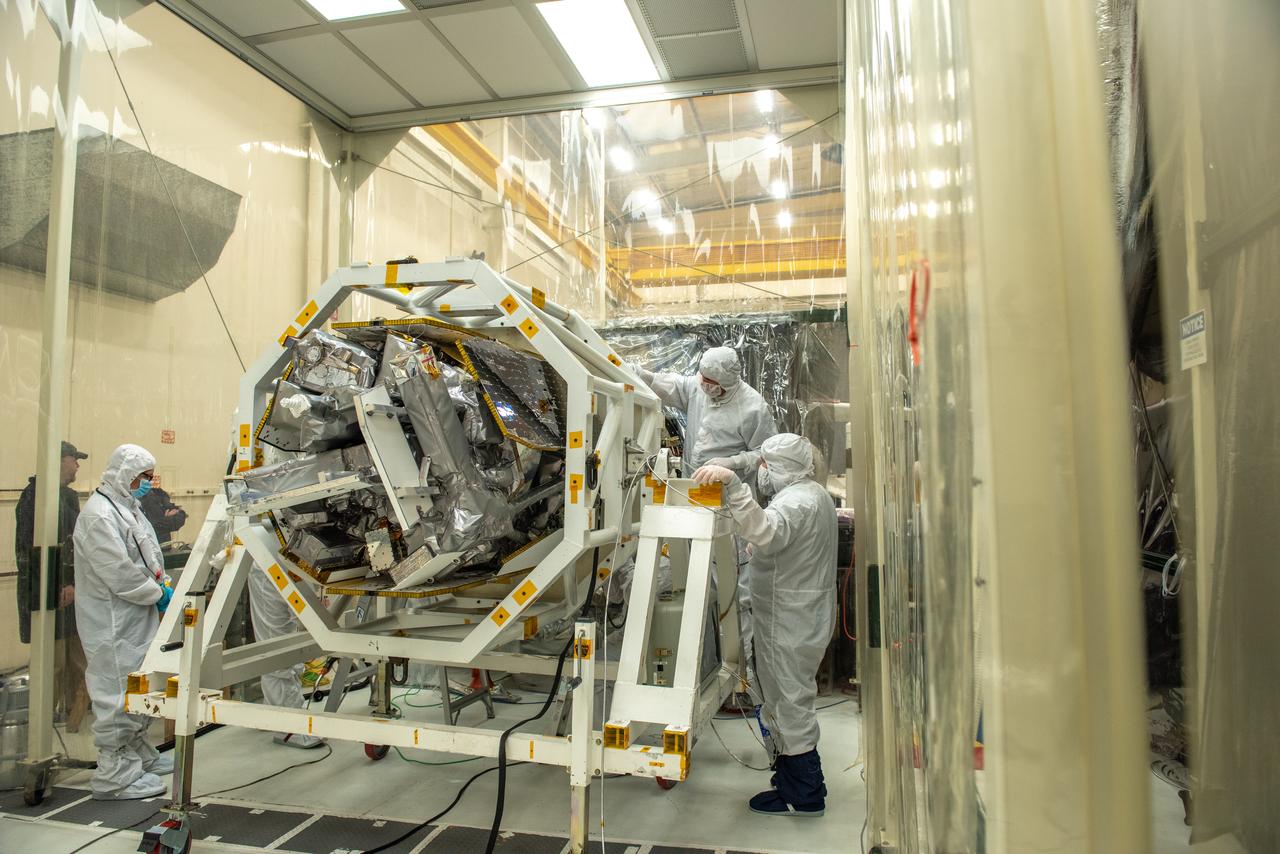
Technicians attach NASA’s Ionospheric Connection Explorer (ICON) to the Northrop Grumman Pegasus XL rocket inside Building 1555 at Vandenberg Air Force Base in California, on Sept. 10, 2019. The Pegasus XL rocket, attached beneath the company's L-1011 Stargazer aircraft, will launch ICON from the Skid Strip at Cape Canaveral Air Force Station in Florida. Launch is scheduled for Oct. 9, 2019. ICON will study the frontier of space - the dynamic zone high in Earth's atmosphere where terrestrial weather from below meets space weather above. The explorer will help determine the physics of Earth's space environment and pave the way for mitigating its effects on our technology and communications systems.
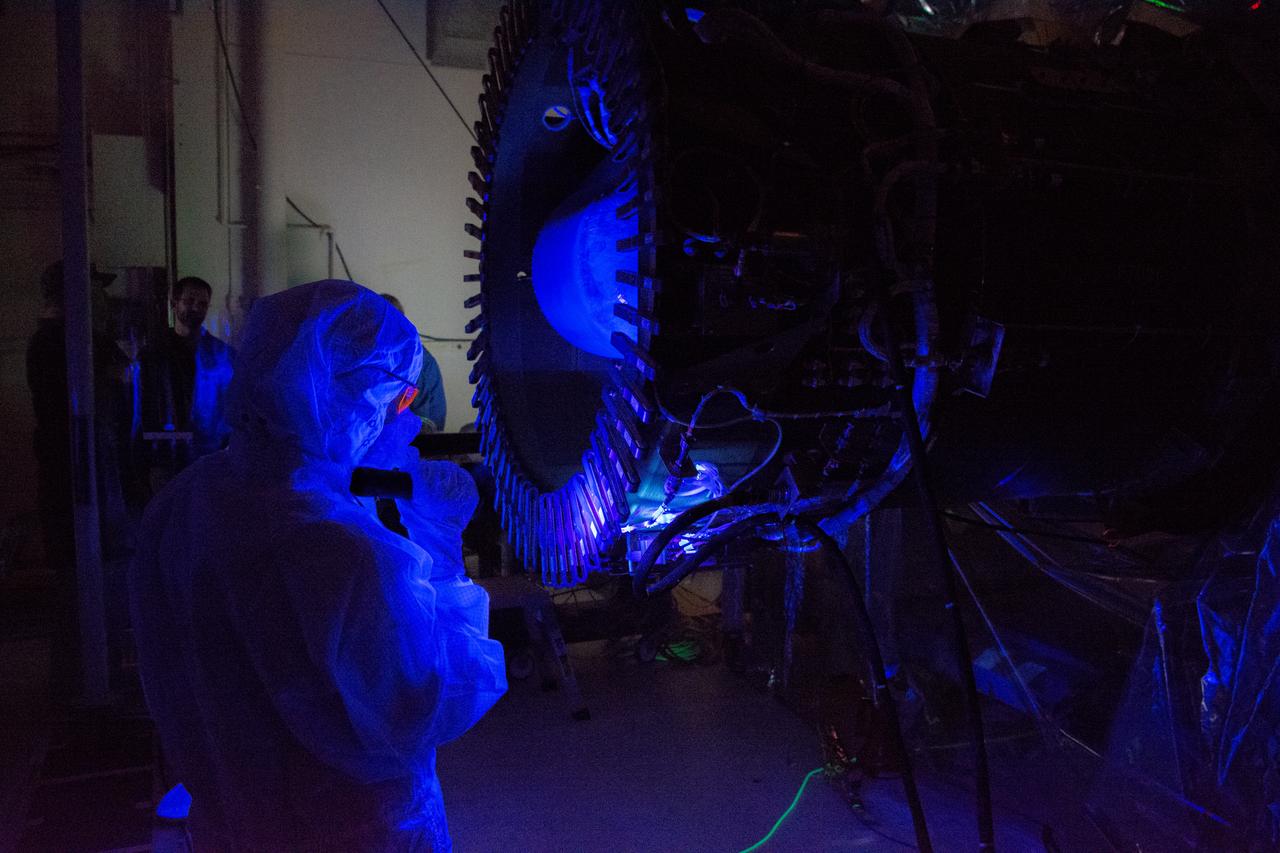
Technicians perform a black light inspection of the Northrop Grumman Pegasus XL rocket inside Building 1555 at Vandenberg Air Force Base in California, on Sept. 10, 2019, after NASA’s Ionospheric Connection Explorer (ICON) was attached to the rocket. The Pegasus port and starboard payload fairings will be installed around ICON. The Pegasus XL rocket, attached beneath the company's L-1011 Stargazer aircraft, will launch ICON from the Skid Strip at Cape Canaveral Air Force Station in Florida. Launch is scheduled for Oct. 9, 2019. ICON will study the frontier of space - the dynamic zone high in Earth's atmosphere where terrestrial weather from below meets space weather above. The explorer will help determine the physics of Earth's space environment and pave the way for mitigating its effects on our technology and communications systems.
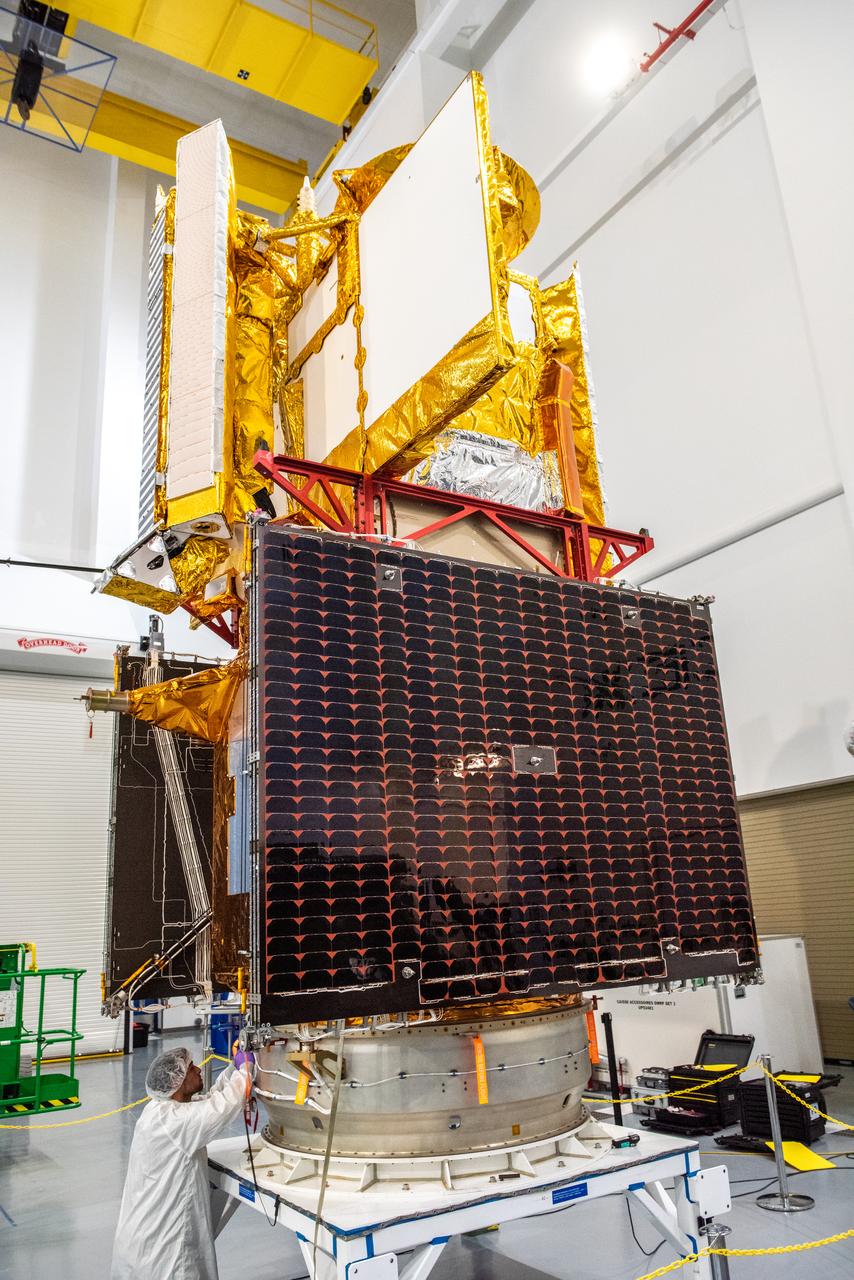
Inside the SpaceX facility at Vandenberg Space Force Base in California, a technician helps secure the Surface Water and Ocean Topography (SWOT) satellite onto the payload adapter on Dec. 5, 2022. A collaboration between NASA and the French space agency Centre National d’Études Spatiales (CNES), with contributions from the Canadian Space Agency and the UK Space Agency, SWOT will be the first satellite to survey nearly all water on Earth’s surface. SWOT is scheduled to lift off aboard the SpaceX Falcon 9 rocket from Vandenberg on Dec. 15, 2022, at 3:46 a.m. PST.
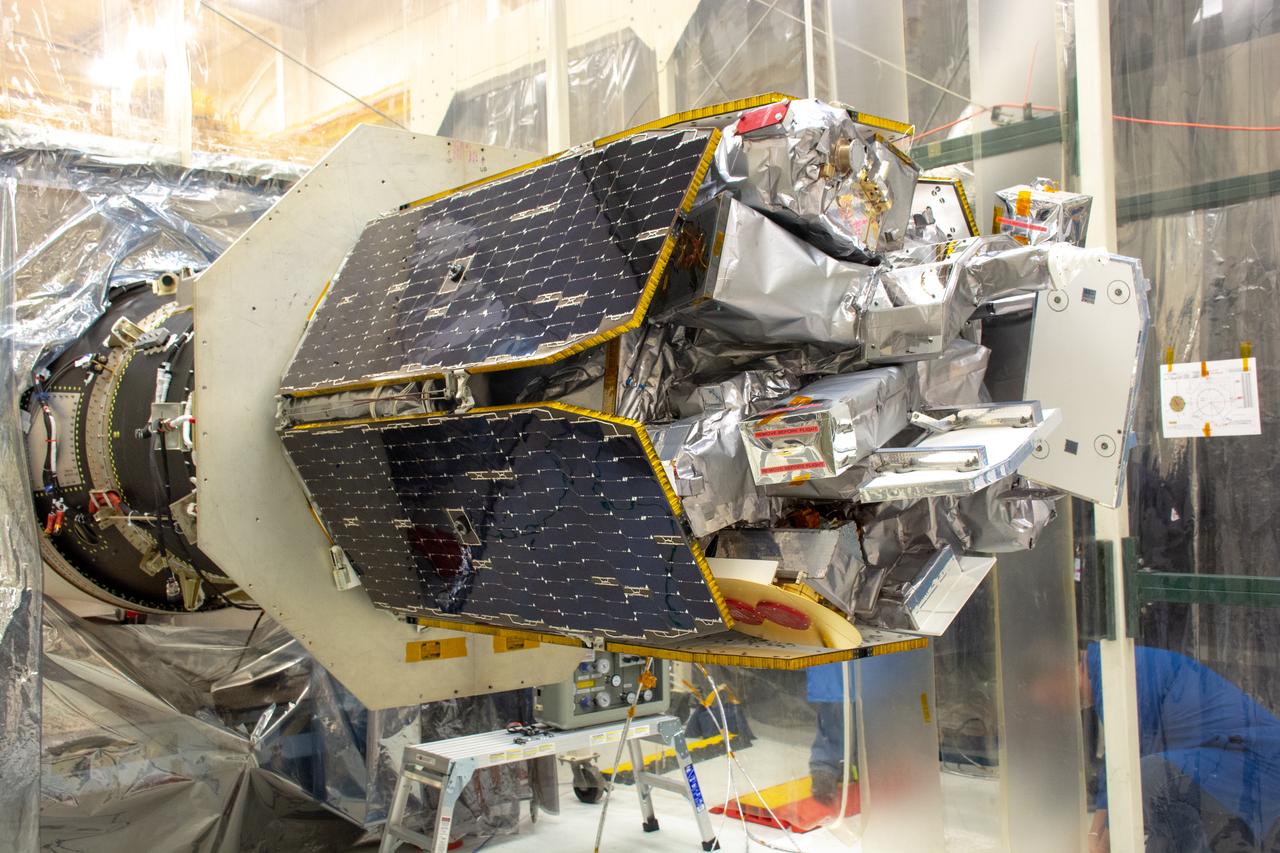
NASA's Ionospheric Connection Explorer (ICON) is attached to the Northrop Grumman Pegasus XL rocket inside Building 1555 at Vandenberg Air Force Base in California on Sept. 10, 2019. Preparations are underway to perform a black light test on Pegasus before the port and starboard payload fairings are installed around ICON. The Pegasus XL rocket, attached beneath the company's L-1011 Stargazer aircraft, will launch ICON from the Skid Strip at Cape Canaveral Air Force Station in Florida. Launch is scheduled for Oct. 9, 2019. ICON will study the frontier of space - the dynamic zone high in Earth's atmosphere where terrestrial weather from below meets space weather above. The explorer will help determine the physics of Earth's space environment and pave the way for mitigating its effects on our technology and communications systems.
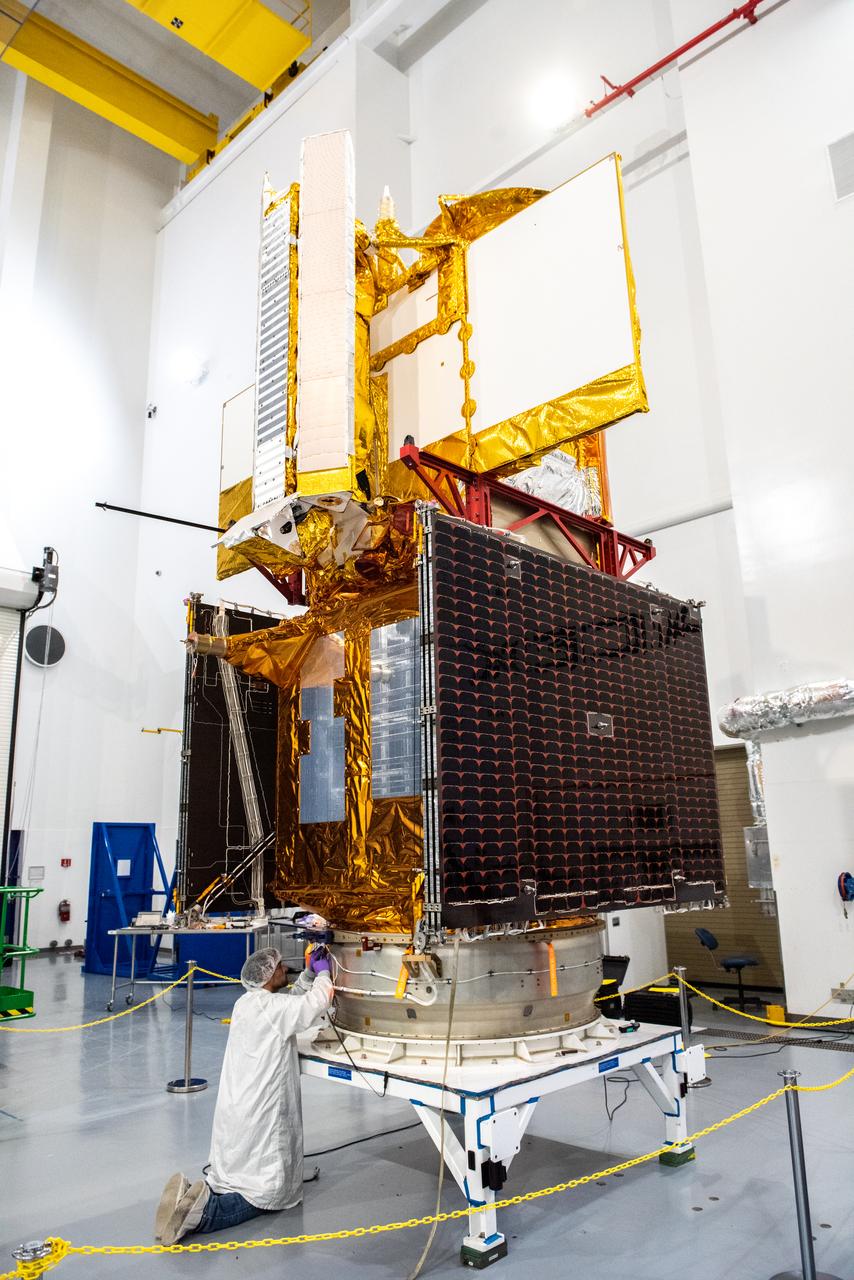
Inside the SpaceX facility at Vandenberg Space Force Base in California, a technician assists as a crane lowers the Surface Water and Ocean Topography (SWOT) satellite onto the payload adapter on Dec. 5, 2022. A collaboration between NASA and the French space agency Centre National d’Études Spatiales (CNES), with contributions from the Canadian Space Agency and the UK Space Agency, SWOT will be the first satellite to survey nearly all water on Earth’s surface. SWOT is scheduled to lift off aboard the SpaceX Falcon 9 rocket from Vandenberg on Dec. 15, 2022, at 3:46 a.m. PST.
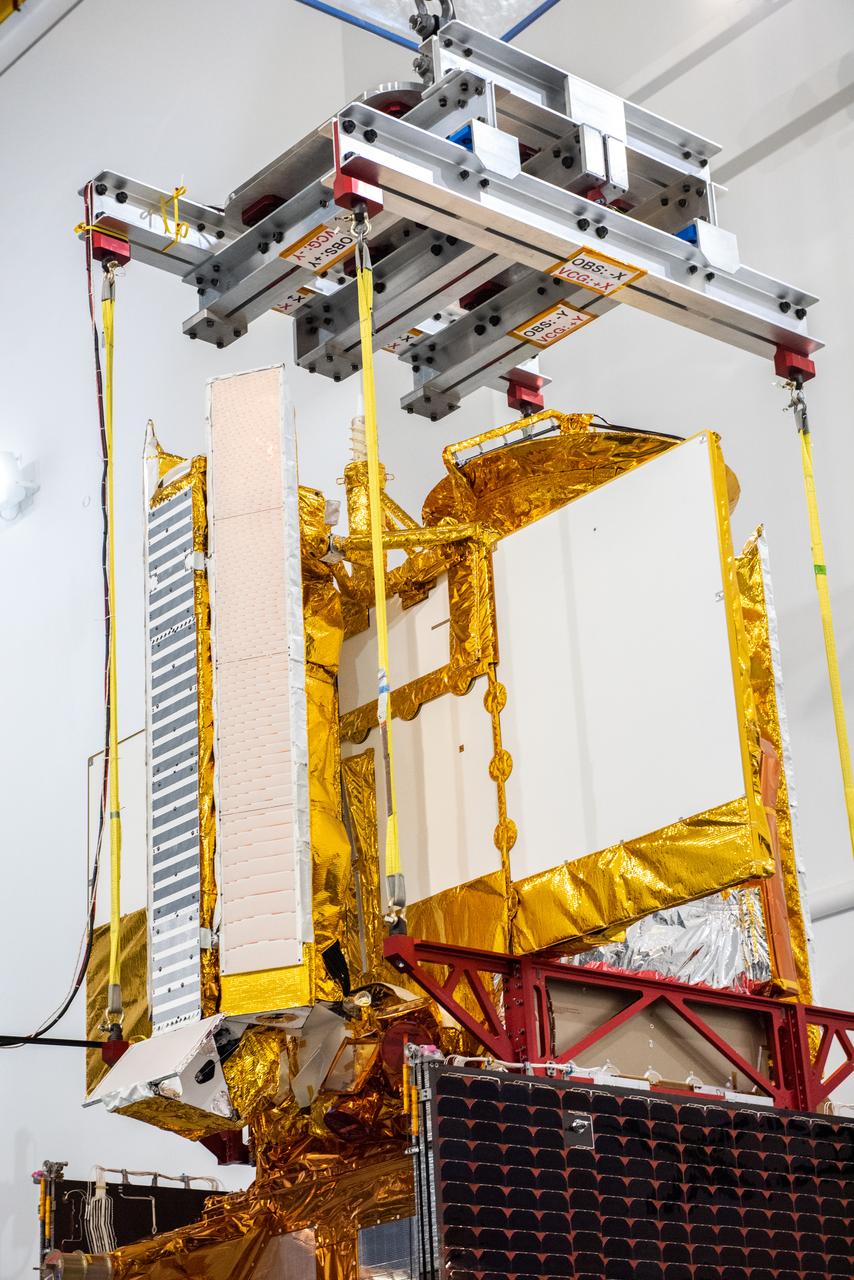
Inside the SpaceX facility at Vandenberg Space Force Base in California, a crane is used to lift the Surface Water and Ocean Topography (SWOT) satellite for mating to the payload adapter on Dec. 5, 2022. A collaboration between NASA and the French space agency Centre National d’Études Spatiales (CNES), with contributions from the Canadian Space Agency and the UK Space Agency, SWOT will be the first satellite to survey nearly all water on Earth’s surface. SWOT is scheduled to lift off aboard the SpaceX Falcon 9 rocket from Vandenberg on Dec. 15, 2022, at 3:46 a.m. PST.
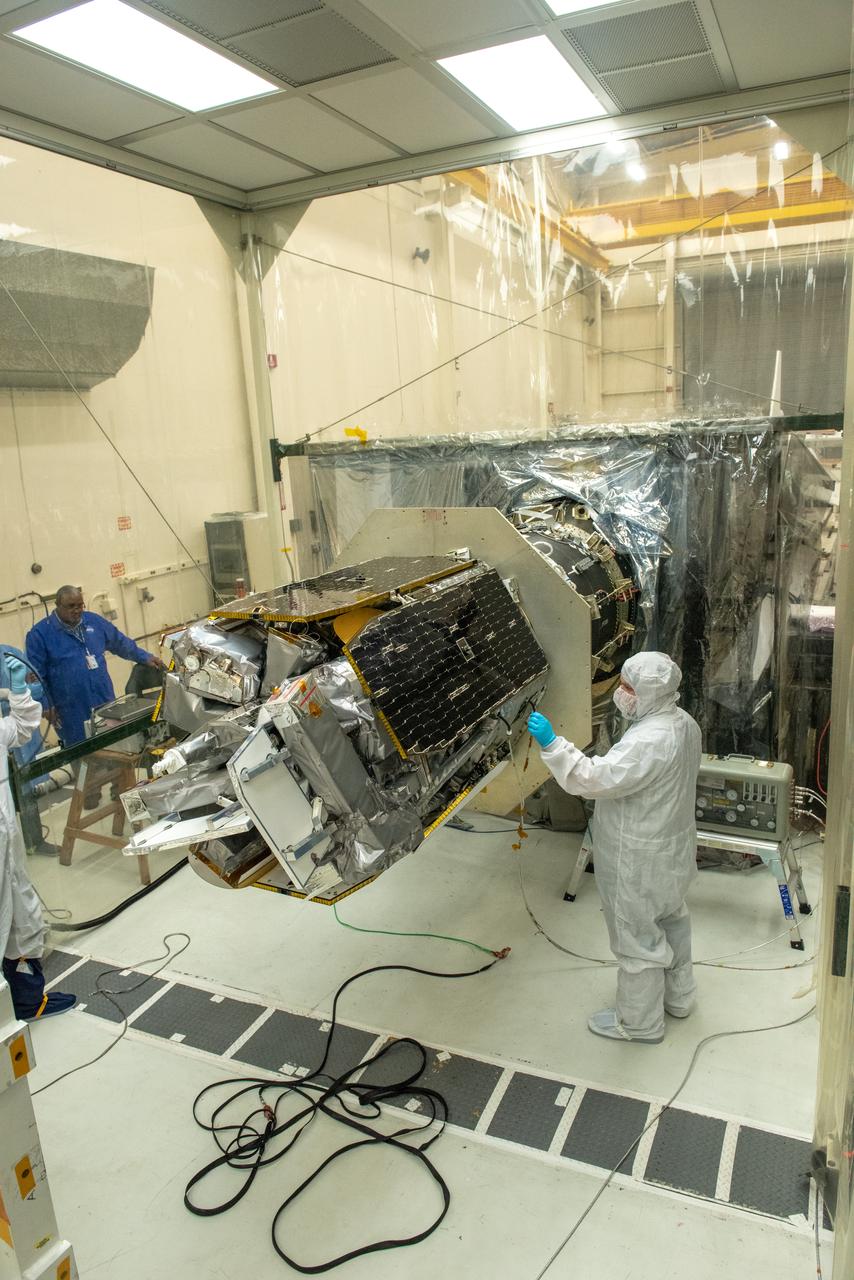
Technicians attach NASA’s Ionospheric Connection Explorer (ICON) to the Northrop Grumman Pegasus XL rocket inside Building 1555 at Vandenberg Air Force Base in California, on Sept. 10, 2019. The Pegasus XL rocket, attached beneath the company's L-1011 Stargazer aircraft, will launch ICON from the Skid Strip at Cape Canaveral Air Force Station in Florida. Launch is scheduled for Oct. 9, 2019. ICON will study the frontier of space - the dynamic zone high in Earth's atmosphere where terrestrial weather from below meets space weather above. The explorer will help determine the physics of Earth's space environment and pave the way for mitigating its effects on our technology and communications systems.

A view of the flexure springs in the soft ride being mated to the payload attach fitting for NASA Wide-field Infrared Survey Explorer, or WISE, spacecraft.
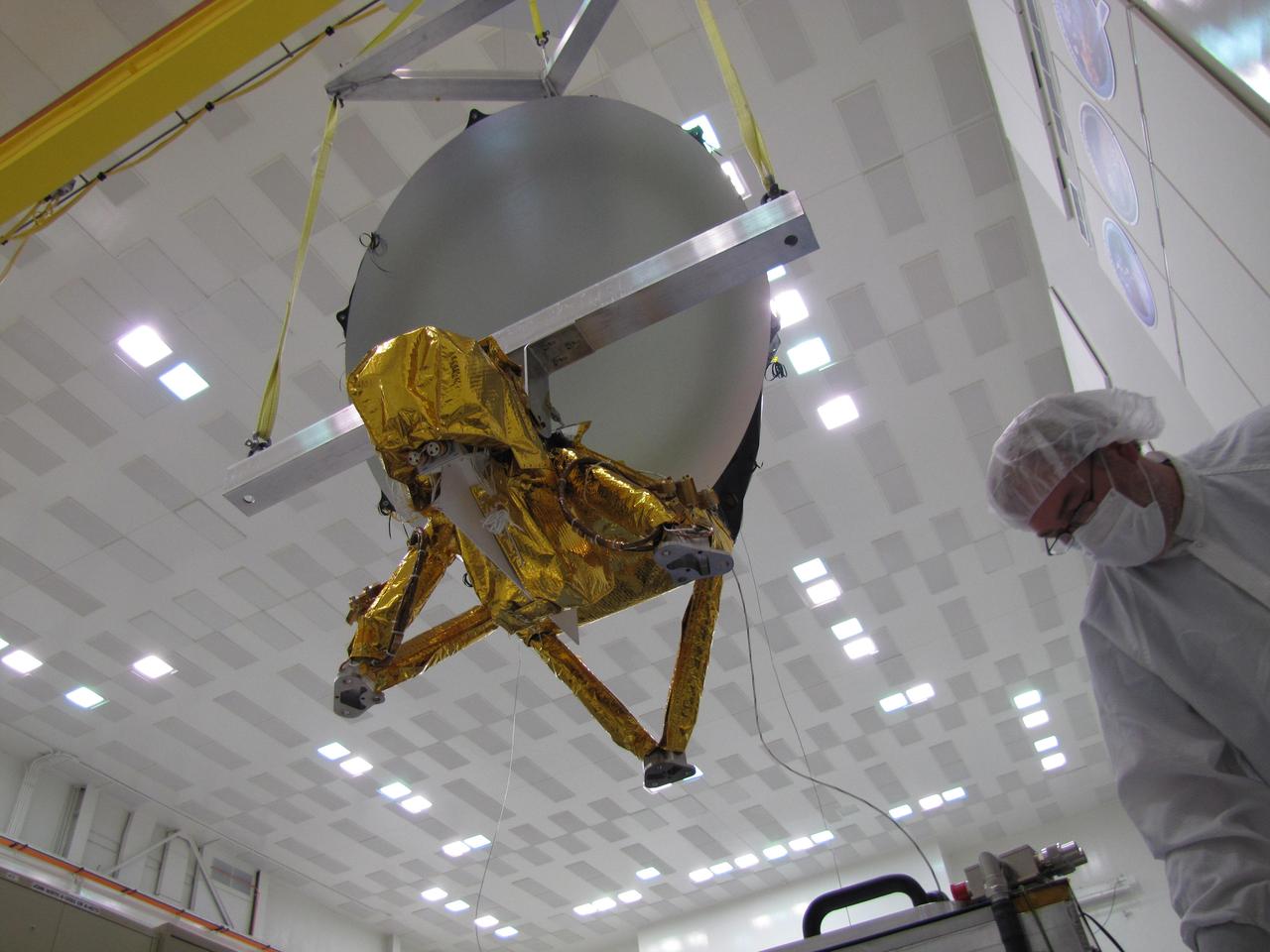
JPL technicians perform a practice run of the mechanical integration sequence that will be used to mate the Jason-3 spacecraft Advanced Microwave Radiometer instrument to the Jason-3 satellite.
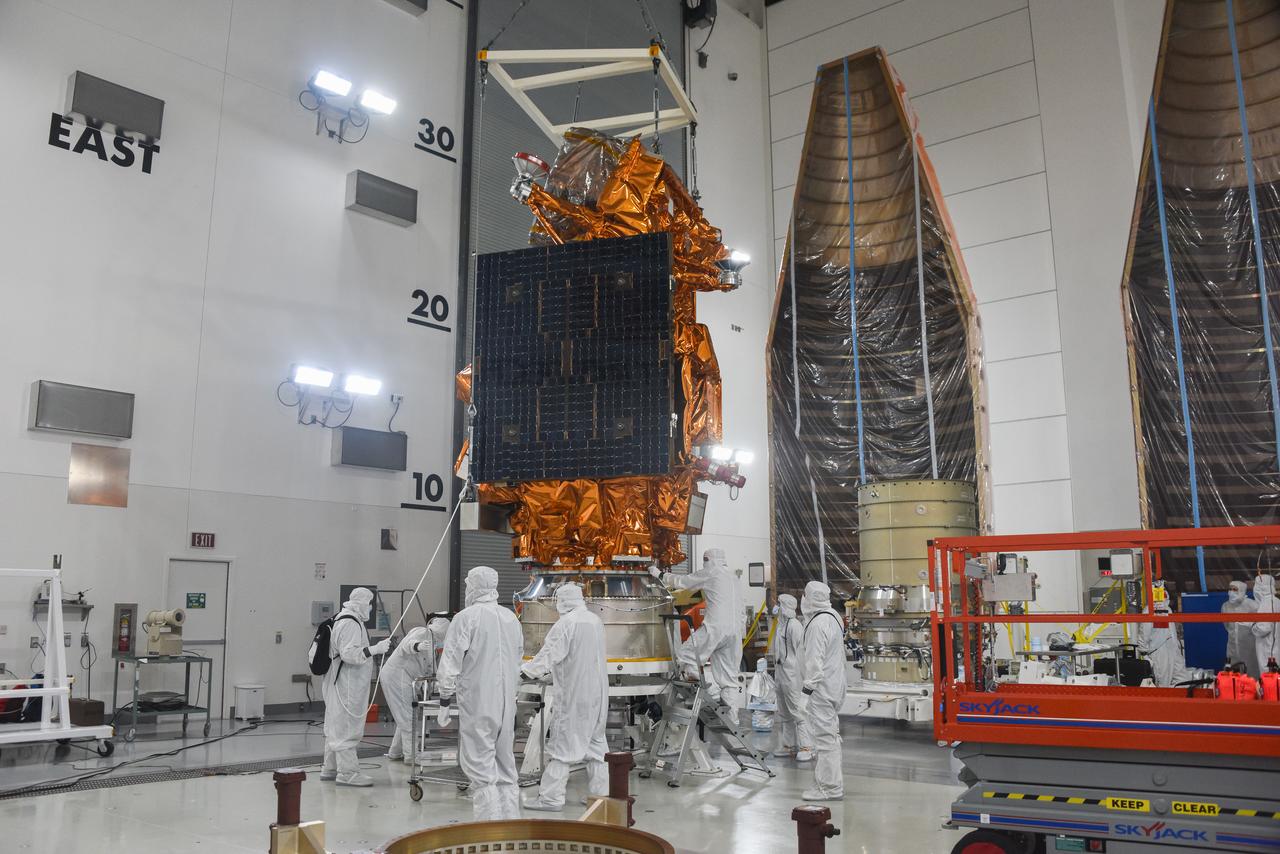
The National Oceanic and Atmospheric Administration’s Joint Polar Satellite System (JPSS-2) is now secured on the spacecraft adapter inside the Astrotech Space Operations facility at Vandenberg Space Force Base (VSFB) in California on Oct. 4, 2022. JPSS-2 is the third satellite in the Joint Polar Satellite System series. It is scheduled to lift off from VSFB on Nov. 1 from Space Launch Complex-3. JPSS-2, which will be renamed NOAA-21 after reaching orbit, will join a constellation of JPSS satellites that orbit from the North to the South pole, circling Earth 14 times a day and providing a full view of the entire globe twice daily.
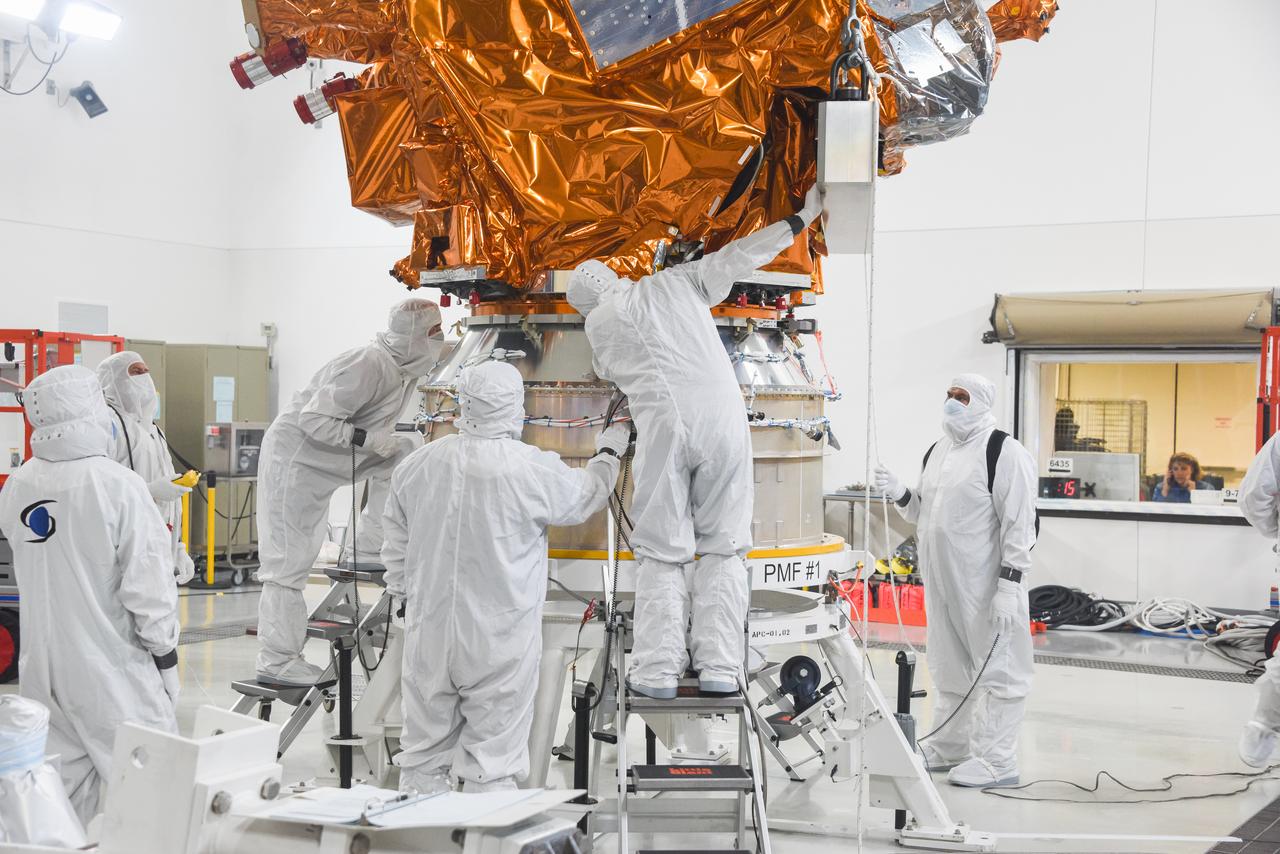
Technicians assist as a crane is used to lower the National Oceanic and Atmospheric Administration’s Joint Polar Satellite System (JPSS-2) onto the spacecraft adapter inside the Astrotech Space Operations facility at Vandenberg Space Force Base (VSFB) in California on Oct. 4, 2022. JPSS-2 is the third satellite in the Joint Polar Satellite System series. It is scheduled to lift off from VSFB on Nov. 1 from Space Launch Complex-3. JPSS-2, which will be renamed NOAA-21 after reaching orbit, will join a constellation of JPSS satellites that orbit from the North to the South pole, circling Earth 14 times a day and providing a full view of the entire globe twice daily.
Technicians prepare the National Oceanic and Atmospheric Administration’s Joint Polar Satellite System (JPSS-2) to be attached to its spacecraft adapter inside the Astrotech Space Operations facility at Vandenberg Space Force Base (VSFB) in California on Oct. 4, 2022. JPSS-2 is the third satellite in the Joint Polar Satellite System series. It is scheduled to lift off from VSFB on Nov. 1 from Space Launch Complex-3. JPSS-2, which will be renamed NOAA-21 after reaching orbit, will join a constellation of JPSS satellites that orbit from the North to the South pole, circling Earth 14 times a day and providing a full view of the entire globe twice daily.

Technicians prepare the spacecraft adapter to be attached to the National Oceanic and Atmospheric Administration’s Joint Polar Satellite System (JPSS-2) inside the Astrotech Space Operations facility at Vandenberg Space Force Base (VSFB) in California on Oct. 4, 2022. JPSS-2 is the third satellite in the Joint Polar Satellite System series. It is scheduled to lift off from VSFB on Nov. 1 from Space Launch Complex-3. JPSS-2, which will be renamed NOAA-21 after reaching orbit, will join a constellation of JPSS satellites that orbit from the North to the South pole, circling Earth 14 times a day and providing a full view of the entire globe twice daily.
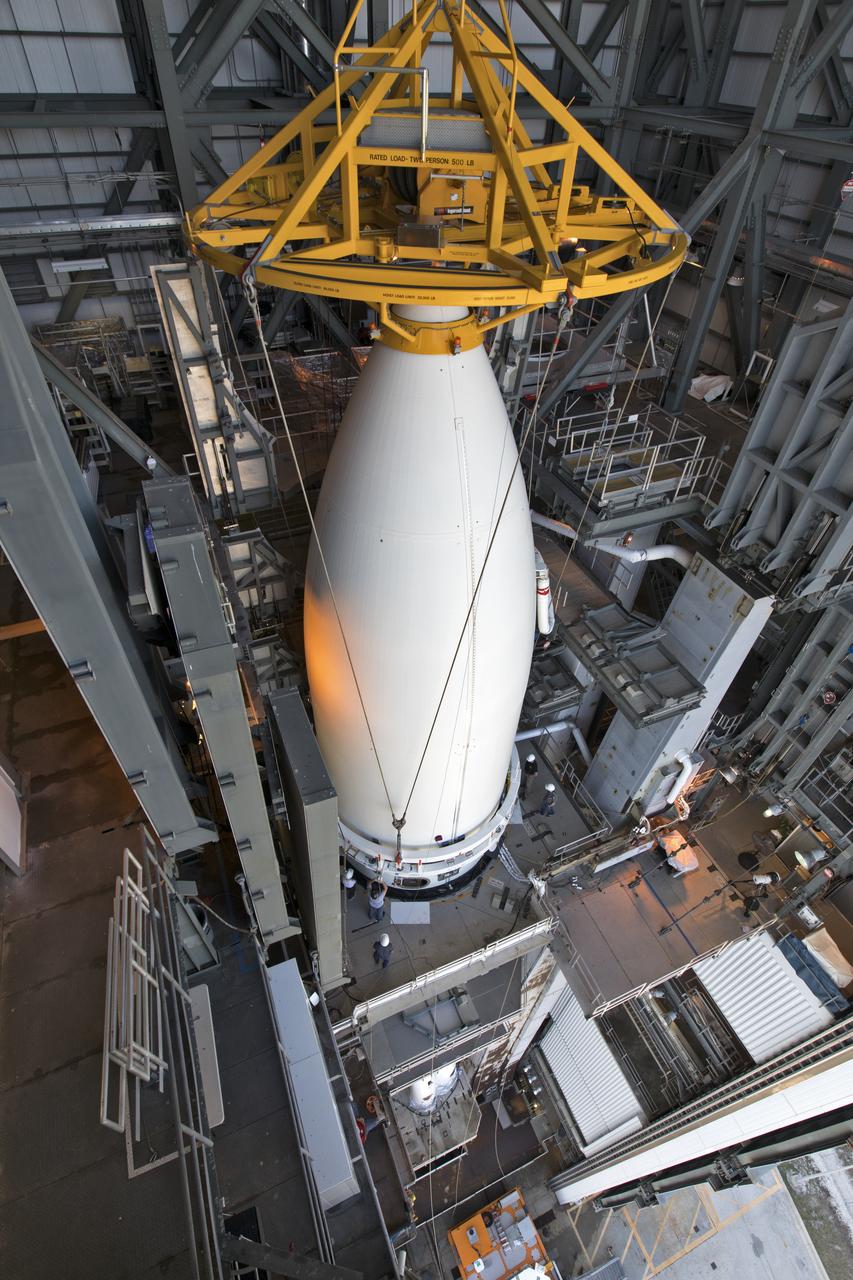
A view from above shows the payload fairing containing NOAA's Geostationary Operational Environmental Satellite-S (GOES-S) lifted and moved into the United Launch Alliance (ULA) Vertical Integration Facility at Space Launch Complex 41 at Cape Canaveral Air Force Station in Florida. The fairing will be lowered and secured on the ULA Atlas V rocket. GOES-S is the second in a series of four advanced geostationary weather satellites. The satellite is slated to launch aboard the ULA Atlas V on March 1.
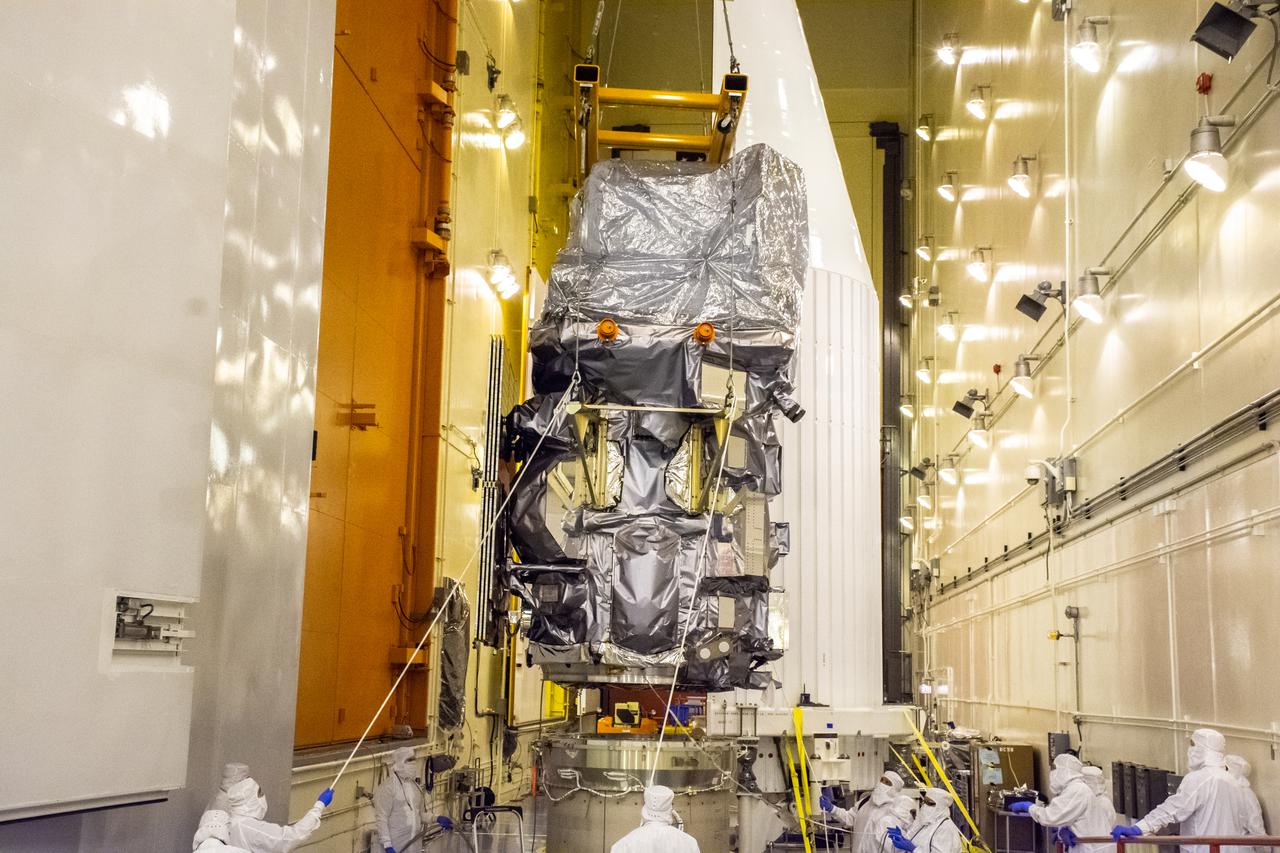
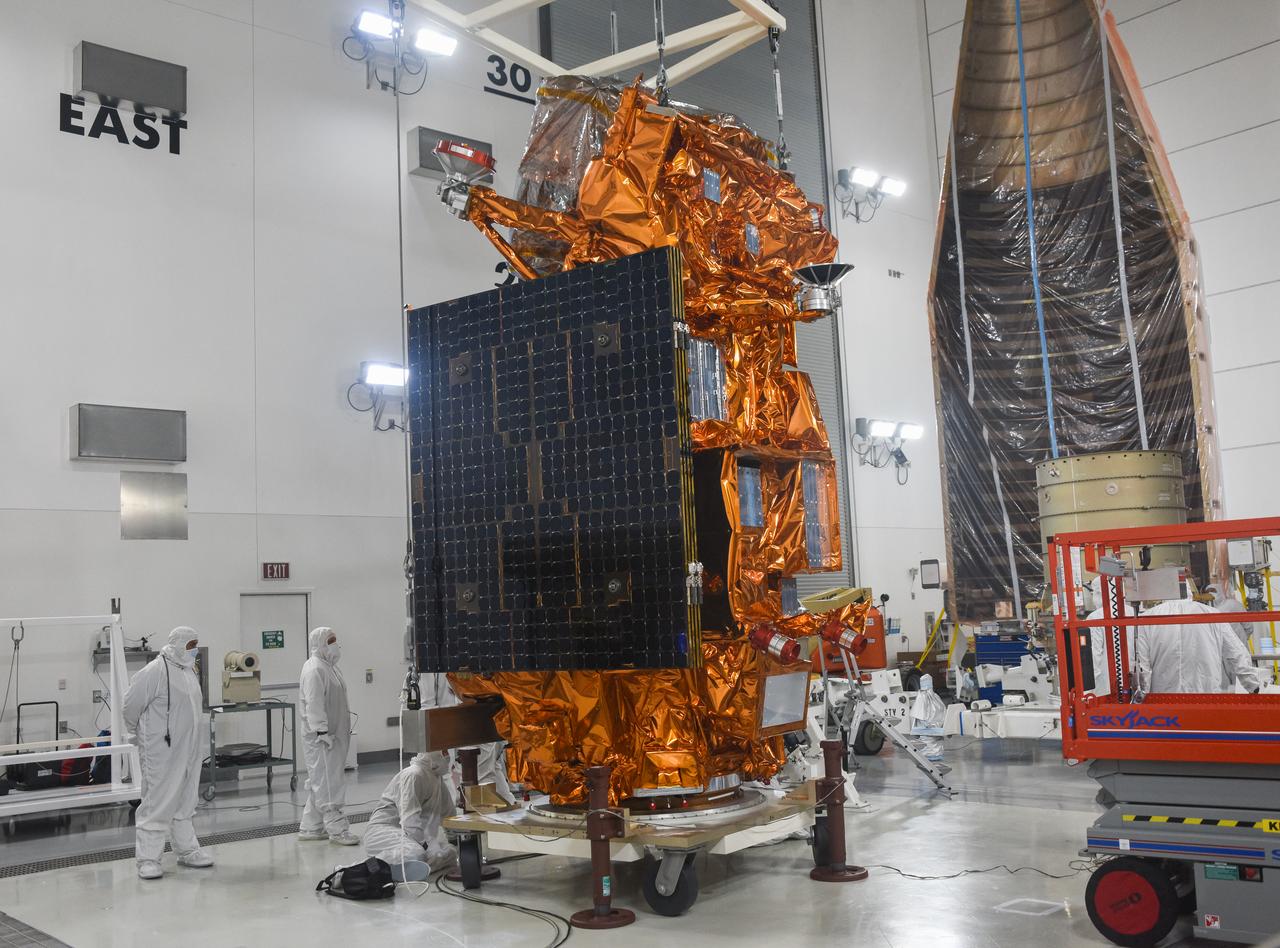
Technicians begin to attach the Landsat 9 spacecraft to the evolved expendable vehicle secondary payload adapter (ESPA) inside the Vertical Integration Facility at Vandenberg Space Force Base in California on Aug. 11, 2021. The ESPA connects Landsat 9 and the payload adapter (PMA) – the PMA then will attach to the second stage of a United Launch Alliance Atlas V rocket. Landsat 9 will launch on the Atlas V from Space Launch Complex 3 at Vandenberg in September 2021. The launch is being managed by NASA’s Launch Services Program based at Kennedy Space Center, America’s multi-user spaceport. The Landsat 9 satellite will continue the nearly 50-year legacy of previous Landsat missions. It will monitor key natural and economic resources from orbit. Landsat 9 is managed by the agency’s Goddard Space Flight Center in Greenbelt, Maryland. The satellite will carry two instruments: the Operational Land Imager 2, which collects images of Earth’s landscapes in visible, near infrared and shortwave infrared light, and the Thermal Infrared Sensor 2, which measures the temperature of land surfaces. Like its predecessors, Landsat 9 is a joint mission between NASA and the U.S. Geological Survey.

Technicians integrate the Sentinel-6B spacecraft to the payload adapter inside the Astrotech Space Operations payload processing facility at Vandenberg Space Force Base in California on Tuesday, Nov. 4, 2025. The payload adapter is part of the system that connects Sentinel-6B to the second stage of the SpaceX Falcon 9 rocket that will carry it to orbit. A collaboration between NASA, ESA (European Space Agency), EUMETSAT (European Organisation for the Exploitation of Meteorological Satellites), and the National Oceanic and Atmospheric Administration (NOAA), Sentinel-6B is designed to measure sea levels down to roughly an inch for about 90% of the world’s oceans. NASA is targeting launch no earlier than Sunday, Nov. 16, on a SpaceX Falcon 9 rocket from Space Launch Complex 4 East at Vandenberg.
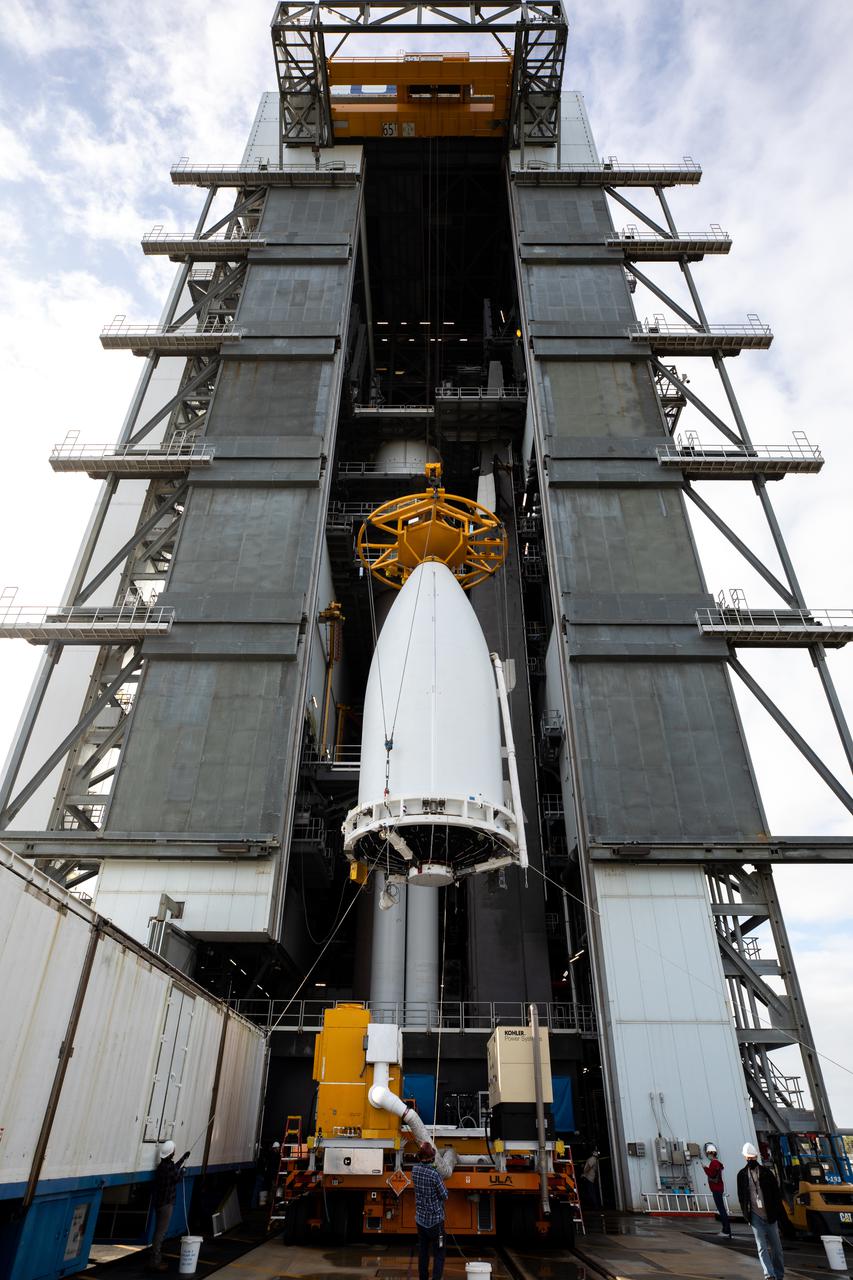
The National Oceanic and Atmospheric Administration’s (NOAA) Geostationary Operational Environmental Satellite-T (GOES-T), enclosed in its payload fairing, is lifted up by crane for its move into the Vertical Integration Facility at Space Launch Complex 41 at Cape Canaveral Space Force Station in Florida on Feb. 17, 2022. The satellite will be secured atop the United Launch Alliance Atlas V 541 rocket. GOES-T is scheduled to launch atop the Atlas V rocket from SLC-41 on March 1, 2022, at 4:38 p.m. GOES-T is the third satellite in the GOES-R series that will continue to help meteorologists observe and predict local weather events that affect public safety. The launch is being managed by NASA’s Launch Services Program based at Kennedy Space Center in Florida, America’s multi-user spaceport.
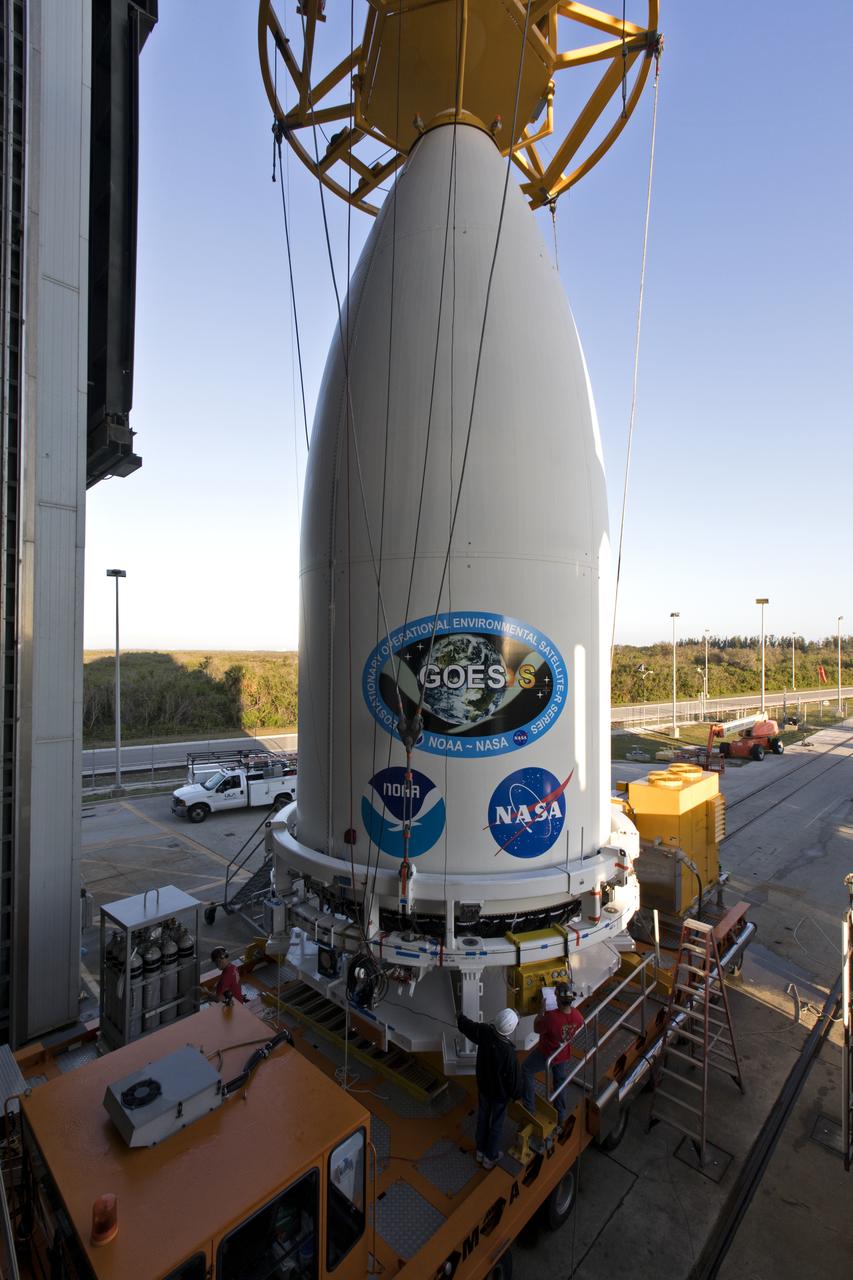
A crane is attached to the payload fairing containing NOAA's Geostationary Operational Environmental Satellite-S (GOES-S) and preparations are underway to lift it up and into the United Launch Alliance (ULA) Horizontal Integration Facility at Space Launch Complex 41 at Cape Canaveral Air Force Station in Florida. The fairing will be mated to the ULA Atlas V rocket. GOES-S is the second in a series of four advanced geostationary weather satellites. The satellite is slated to launch aboard the ULA Atlas V on March 1.
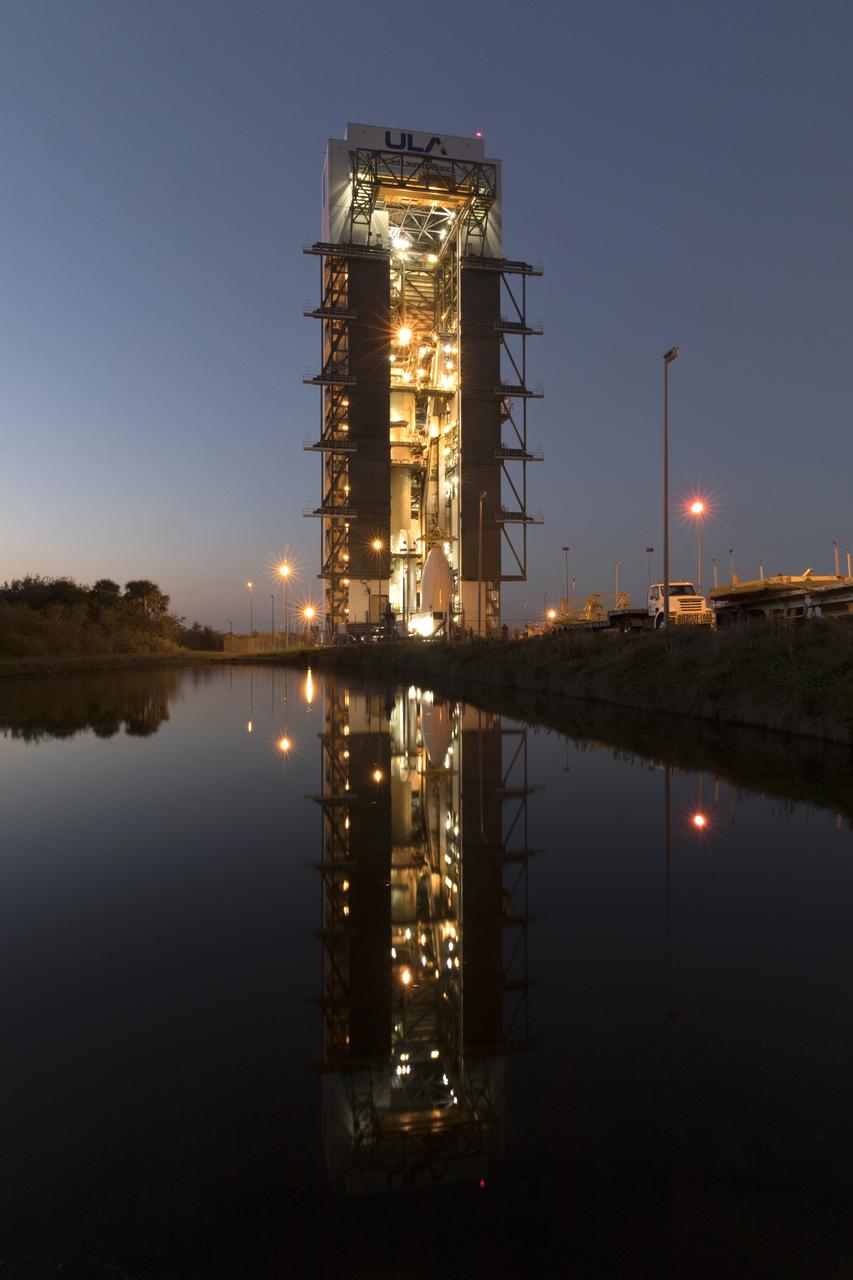
The United Launch Alliance (ULA) Vertical Integration Facility (VIF) is reflected in the water at Space Launch Complex 41 at Cape Canaveral Air Force Station in Florida, as a crane begins to lift the payload fairing containing NOAA's Geostationary Operational Environmental Satellite-S (GOES-S). The fairing will be lifted and mated to the ULA Atlas V rocket. GOES-S is the second in a series of four advanced geostationary weather satellites. The satellite is slated to launch aboard the ULA Atlas V on March 1.
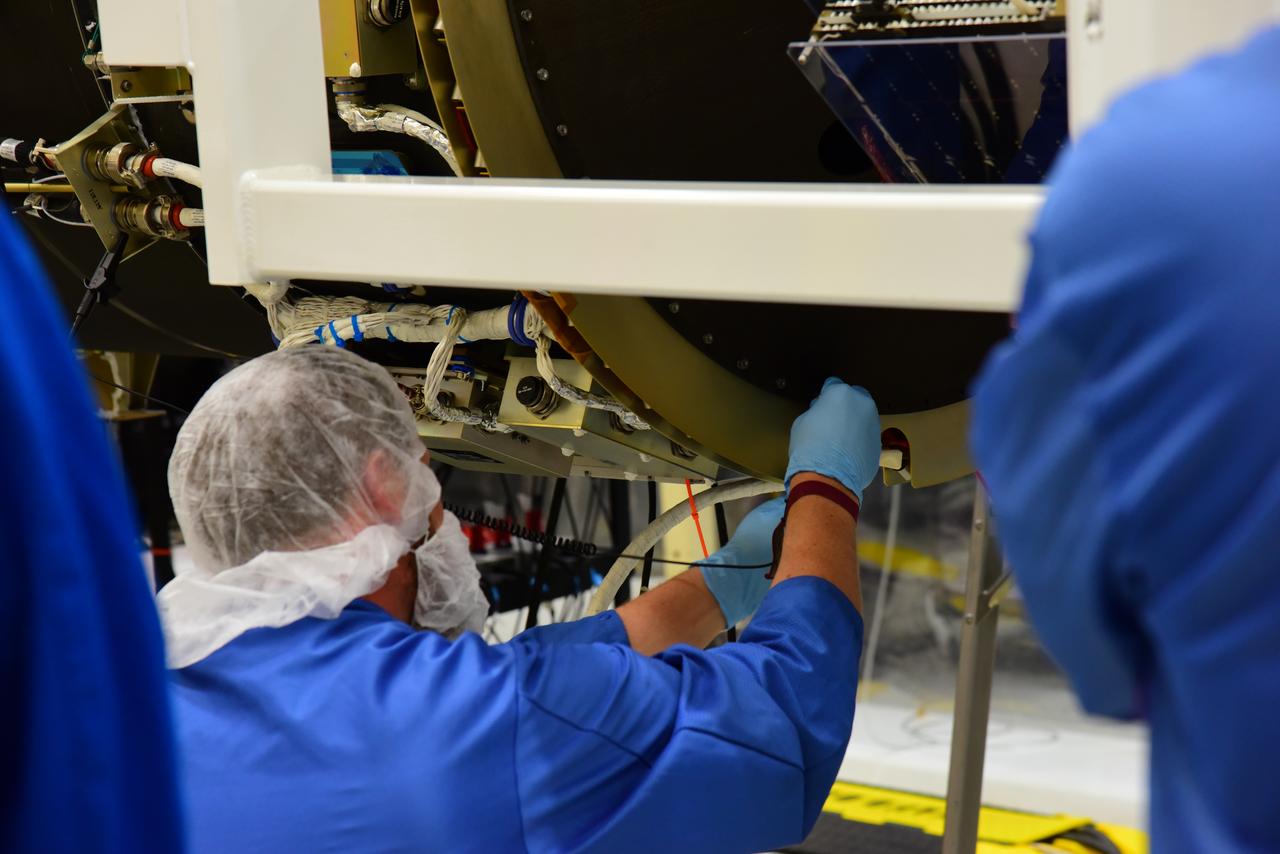
Inside Building 1555 at Vandenberg Air Force Base in California, the eight NASA Cyclone Global Navigation Satellite System (CYGNSS) spacecraft installed on their deployment module undergo inspections prior to NASA’s Kennedy Space Center in Florida. Processing activities will prepare the spacecraft for launch aboard an Orbital ATK Pegasus XL rocket. When preparations are competed at Vandenberg, the rocket will be transported to Kennedy attached to the Orbital ATK L-1011 carrier aircraft with in its payload fairing. CYGNSS will launch on the Pegasus XL rocket from the Skid Strip at Cape Canaveral Air Force Station. CYGNSS will make frequent and accurate measurements of ocean surface winds throughout the life cycle of tropical storms and hurricanes. The data that CYGNSS provides will enable scientists to probe key air-sea interaction processes that take place near the core of storms, which are rapidly changing and play a critical role in the beginning and intensification of hurricanes.
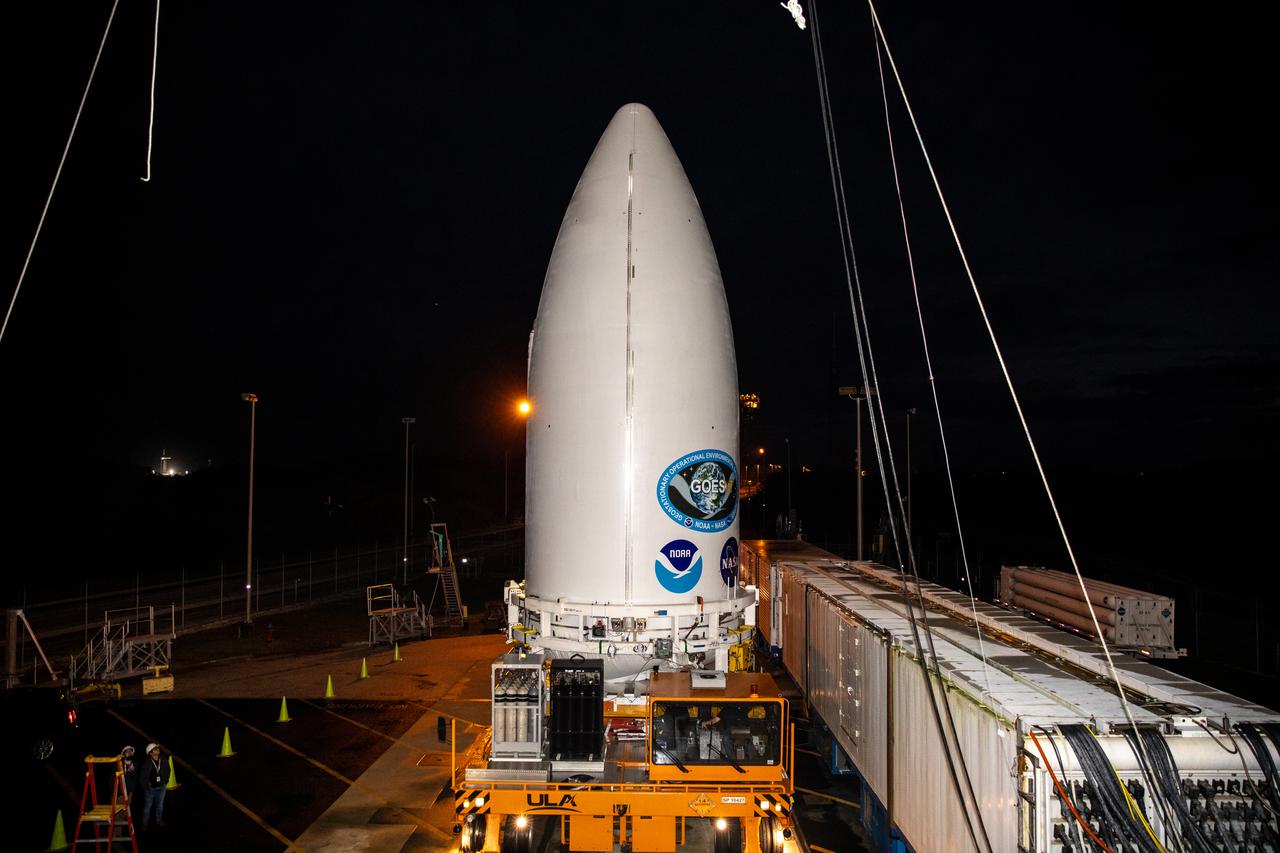
Preparations are underway to lift the National Oceanic and Atmospheric Administration’s (NOAA) Geostationary Operational Environmental Satellite-T (GOES-T), enclosed in its payload fairing, up into the Vertical Integration Facility at Space Launch Complex 41 at Cape Canaveral Space Force Station in Florida on Feb. 17, 2022. The satellite will be secured atop the United Launch Alliance Atlas V 541 rocket. GOES-T is scheduled to launch atop the Atlas V rocket from SLC-41 on March 1, 2022, at 4:38 p.m. GOES-T is the third satellite in the GOES-R series that will continue to help meteorologists observe and predict local weather events that affect public safety. The launch is being managed by NASA’s Launch Services Program based at Kennedy Space Center in Florida, America’s multi-user spaceport.
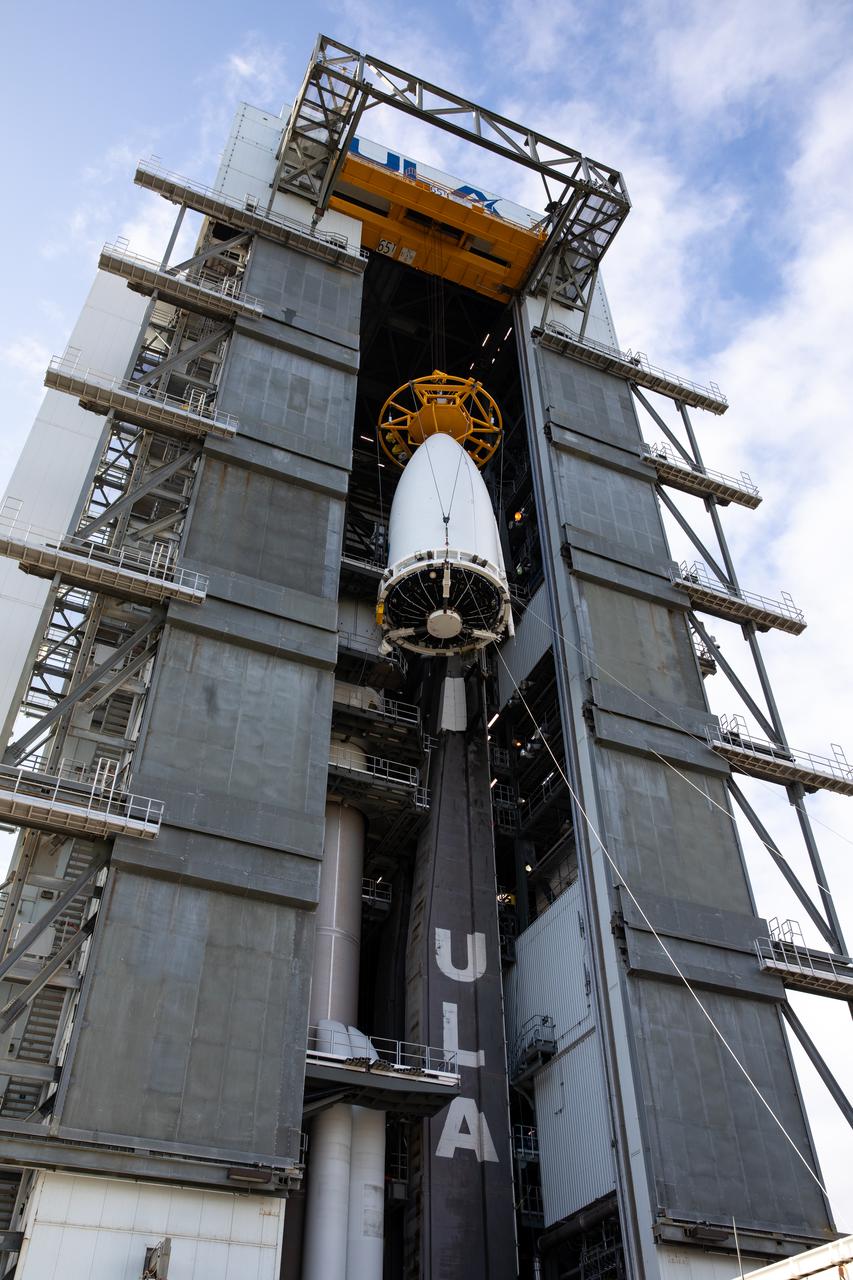
The National Oceanic and Atmospheric Administration’s (NOAA) Geostationary Operational Environmental Satellite-T (GOES-T), enclosed in its payload fairing, is lifted up by crane for its move into the Vertical Integration Facility at Space Launch Complex 41 at Cape Canaveral Space Force Station in Florida on Feb. 17, 2022. The satellite will be secured atop the United Launch Alliance Atlas V 541 rocket. GOES-T is scheduled to launch atop the Atlas V rocket from SLC-41 on March 1, 2022, at 4:38 p.m. GOES-T is the third satellite in the GOES-R series that will continue to help meteorologists observe and predict local weather events that affect public safety. The launch is being managed by NASA’s Launch Services Program based at Kennedy Space Center in Florida, America’s multi-user spaceport.
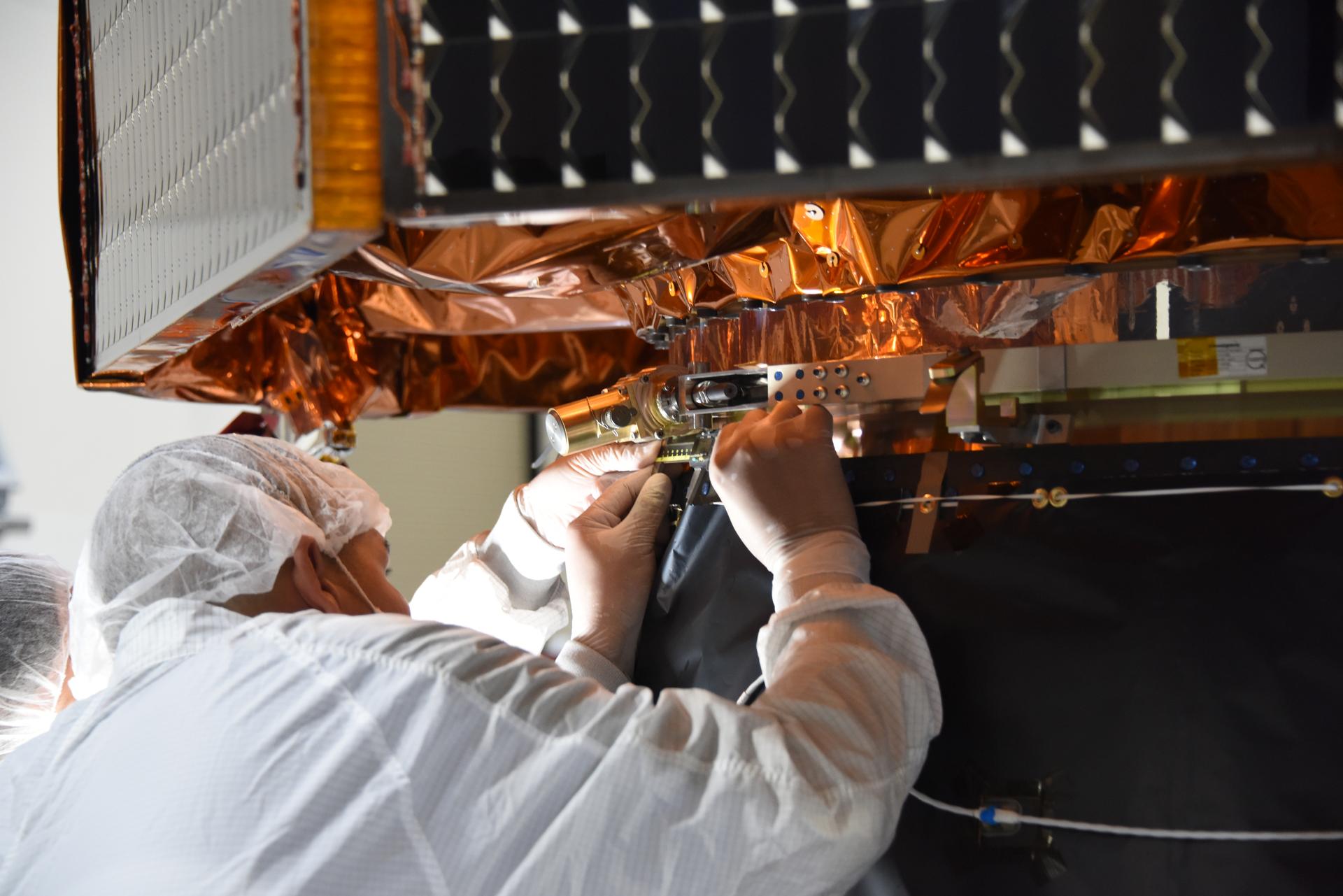
Technicians integrate the Sentinel-6B spacecraft to the payload adapter inside the Astrotech Space Operations payload processing facility at Vandenberg Space Force Base in California on Tuesday, Nov. 4, 2025. The payload adapter is part of the system that connects Sentinel-6B to the second stage of the SpaceX Falcon 9 rocket that will carry it to orbit. A collaboration between NASA, ESA (European Space Agency), EUMETSAT (European Organisation for the Exploitation of Meteorological Satellites), and the National Oceanic and Atmospheric Administration (NOAA), Sentinel-6B is designed to measure sea levels down to roughly an inch for about 90% of the world’s oceans. NASA is targeting launch no earlier than Sunday, Nov. 16, on a SpaceX Falcon 9 rocket from Space Launch Complex 4 East at Vandenberg.
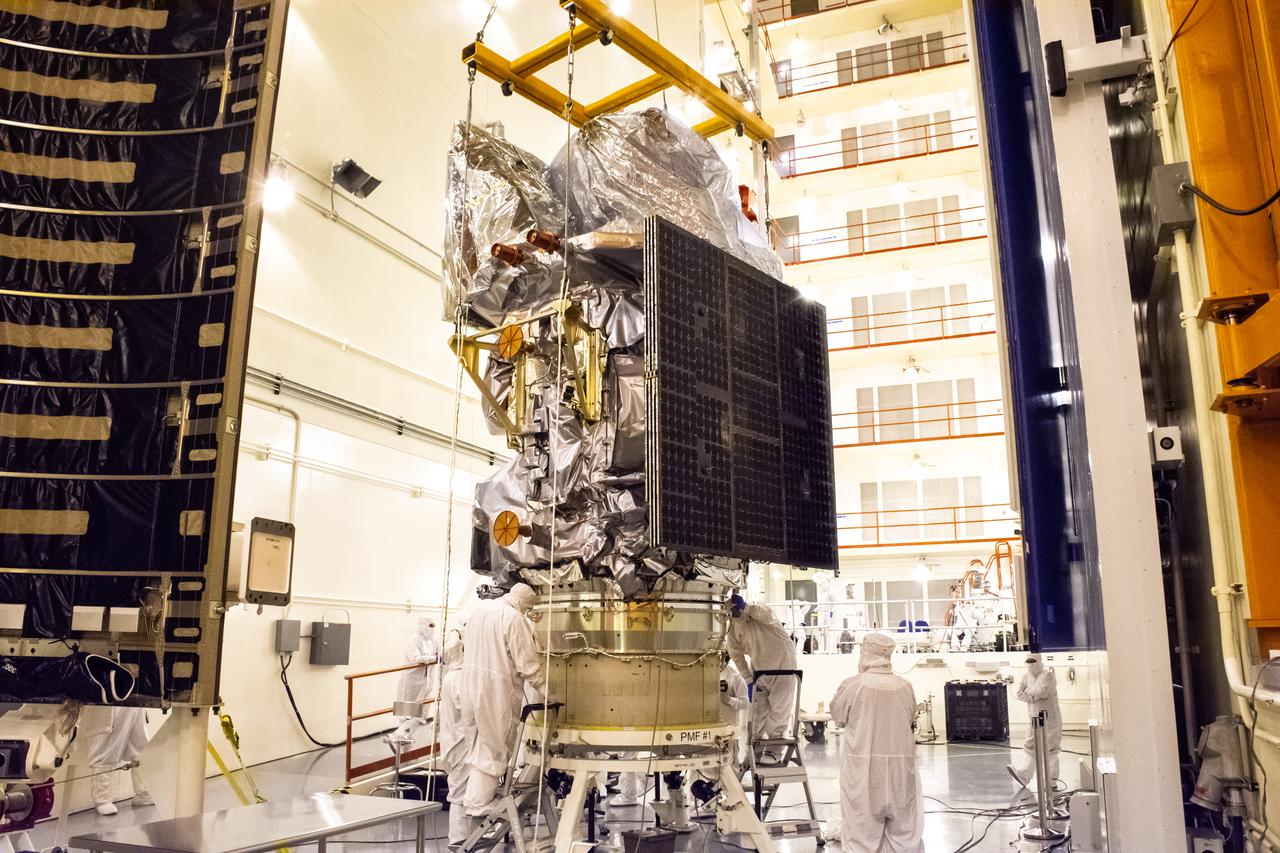
Technicians attach the Landsat 9 spacecraft to the evolved expendable vehicle secondary payload adapter (ESPA) inside the Vertical Integration Facility at Vandenberg Space Force Base in California on Aug. 11, 2021. The ESPA connects Landsat 9 and the payload adapter (PMA) – the PMA then will attach to the second stage of a United Launch Alliance Atlas V rocket. Landsat 9 will launch on the Atlas V from Space Launch Complex 3 at Vandenberg in September 2021. The launch is being managed by NASA’s Launch Services Program based at Kennedy Space Center, America’s multi-user spaceport. The Landsat 9 satellite will continue the nearly 50-year legacy of previous Landsat missions. It will monitor key natural and economic resources from orbit. Landsat 9 is managed by the agency’s Goddard Space Flight Center in Greenbelt, Maryland. The satellite will carry two instruments: the Operational Land Imager 2, which collects images of Earth’s landscapes in visible, near infrared and shortwave infrared light, and the Thermal Infrared Sensor 2, which measures the temperature of land surfaces. Like its predecessors, Landsat 9 is a joint mission between NASA and the U.S. Geological Survey.
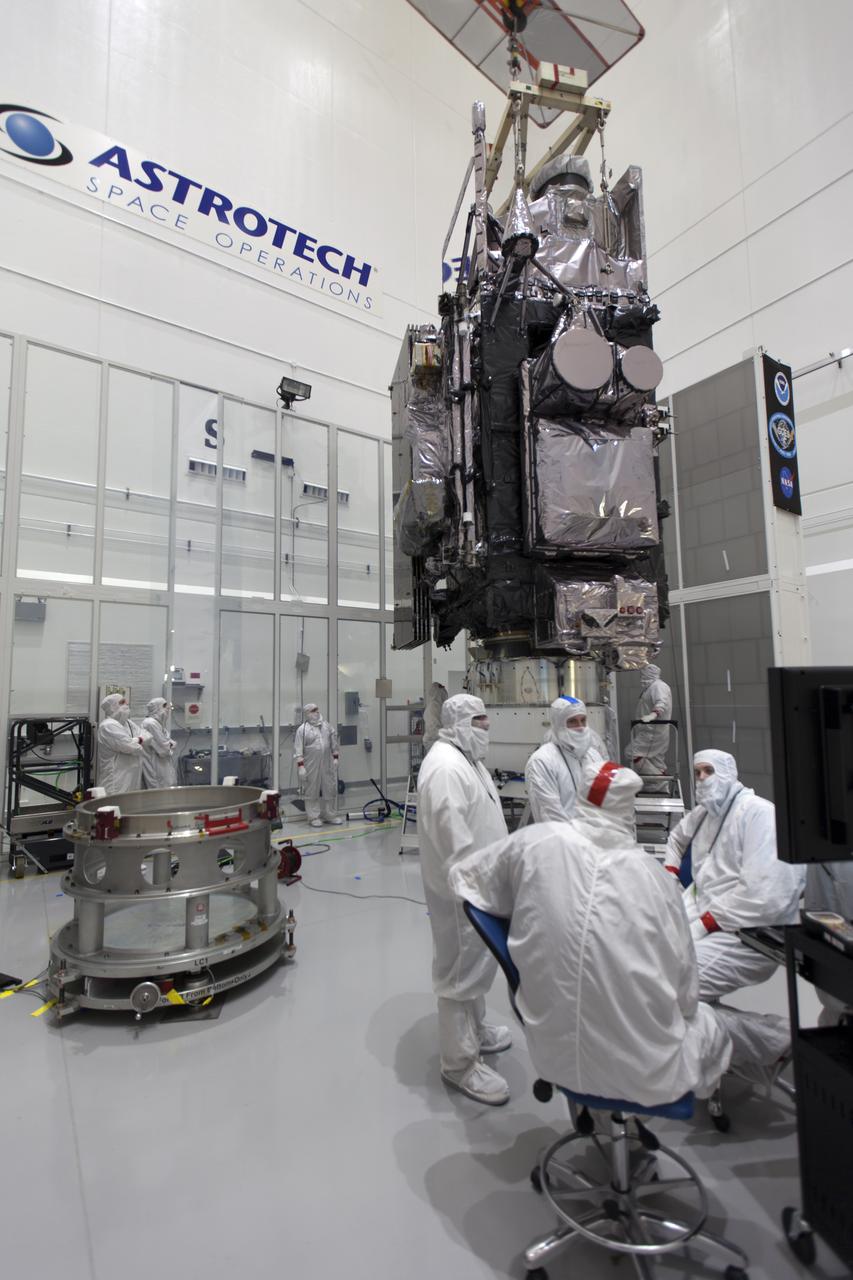
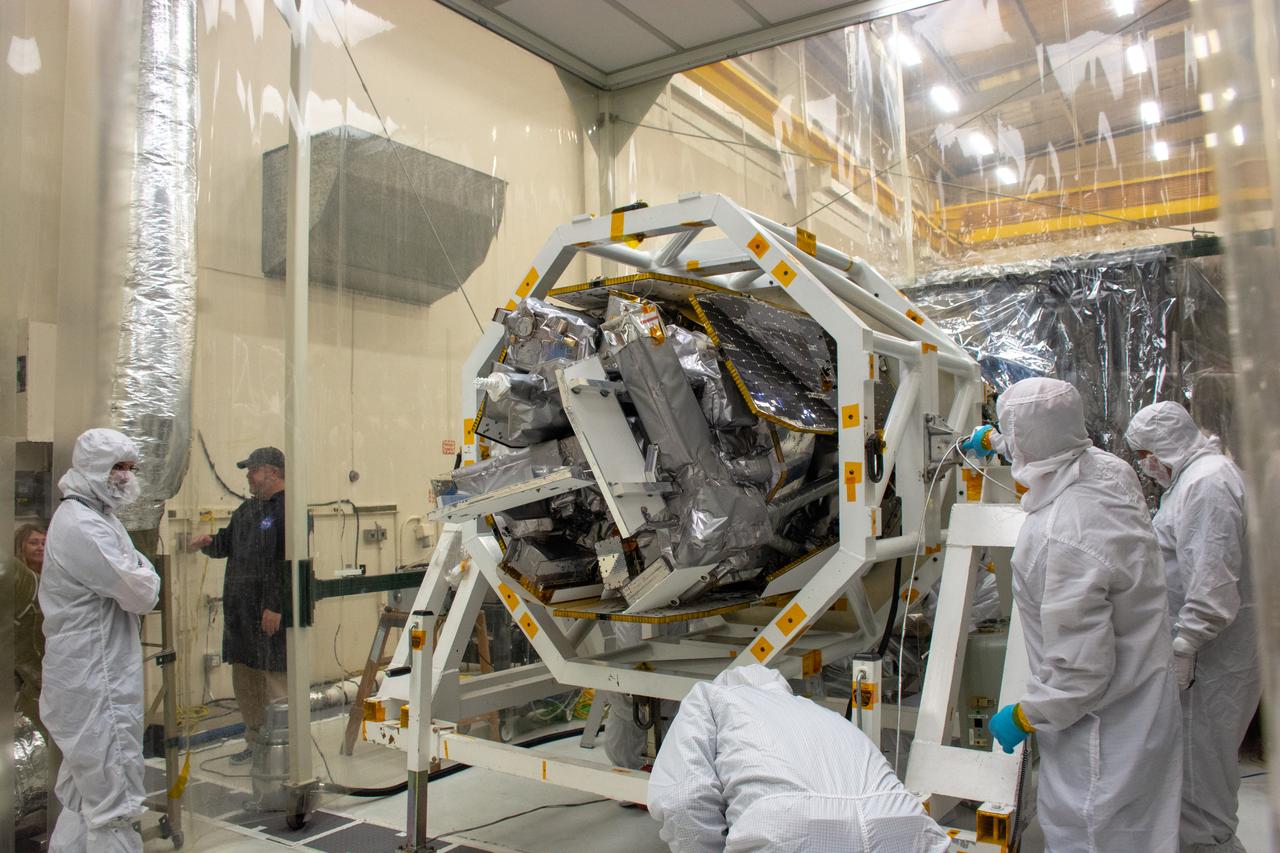
In a clean room at Astrotech Space Operations in Titusville, Florida, technicians and engineers monitor progress as NOAA's Geostationary Operational Environmental Satellite-S, or GOES-S, is mated to its payload attach fitting. It soon will be moved to Space Launch Complex 41 at Cape Canaveral Air Force Station for mounting atop the Atlas V rocket that will boost the satellite to orbit. GOES-S is the second in a series of four advanced geostationary weather satellites that will significantly improve the detection and observation of environmental phenomena that directly affect public safety, protection of property and the nation's economic health and prosperity. GOES-S is slated to launch March 1, 2018 aboard a United Launch Alliance Atlas V rocket.

A crane is used to lift the payload fairing containing NASA's Tracking and Data Relay Satellite (TDRS-M) at the Vertical Integration Facility at Space Launch Complex 41 at Cape Canaveral Air Force Station in Florida. TDRS-M will be stacked atop the United Launch Alliance Atlas V Centaur upper stage. TDRS-M will be the latest spacecraft destined for the agency's constellation of communications satellites that allows nearly continuous contact with orbiting spacecraft ranging from the International Space Station and Hubble Space Telescope to the array of scientific observatories. Liftoff atop the ULA Atlas V rocket is scheduled for Aug. 18, 2017.
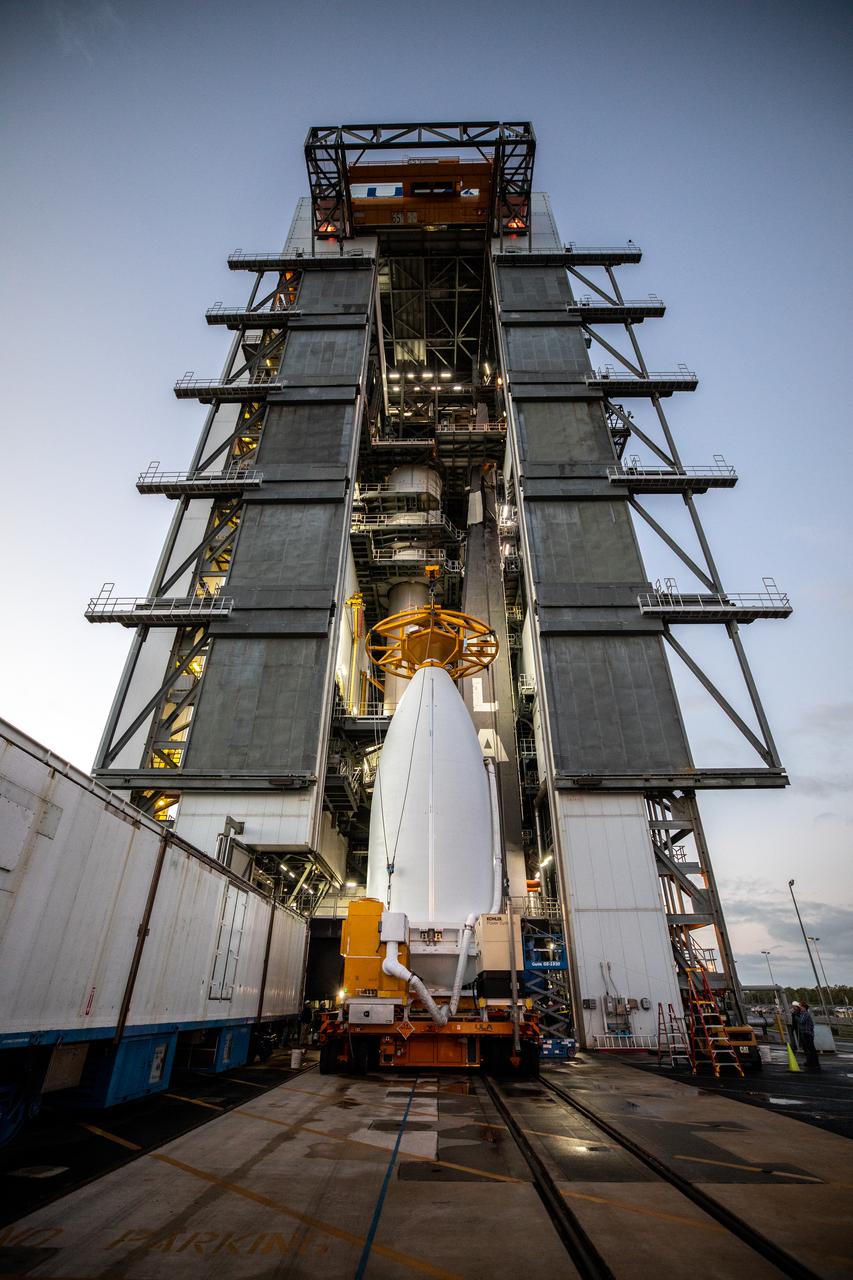
Preparations are underway to lift the National Oceanic and Atmospheric Administration’s (NOAA) Geostationary Operational Environmental Satellite-T (GOES-T), enclosed in its payload fairing, up into the Vertical Integration Facility at Space Launch Complex 41 at Cape Canaveral Space Force Station in Florida on Feb. 17, 2022. The satellite will be secured atop the United Launch Alliance Atlas V 541 rocket. GOES-T is scheduled to launch atop the Atlas V rocket from SLC-41 on March 1, 2022, at 4:38 p.m. GOES-T is the third satellite in the GOES-R series that will continue to help meteorologists observe and predict local weather events that affect public safety. The launch is being managed by NASA’s Launch Services Program based at Kennedy Space Center in Florida, America’s multi-user spaceport.
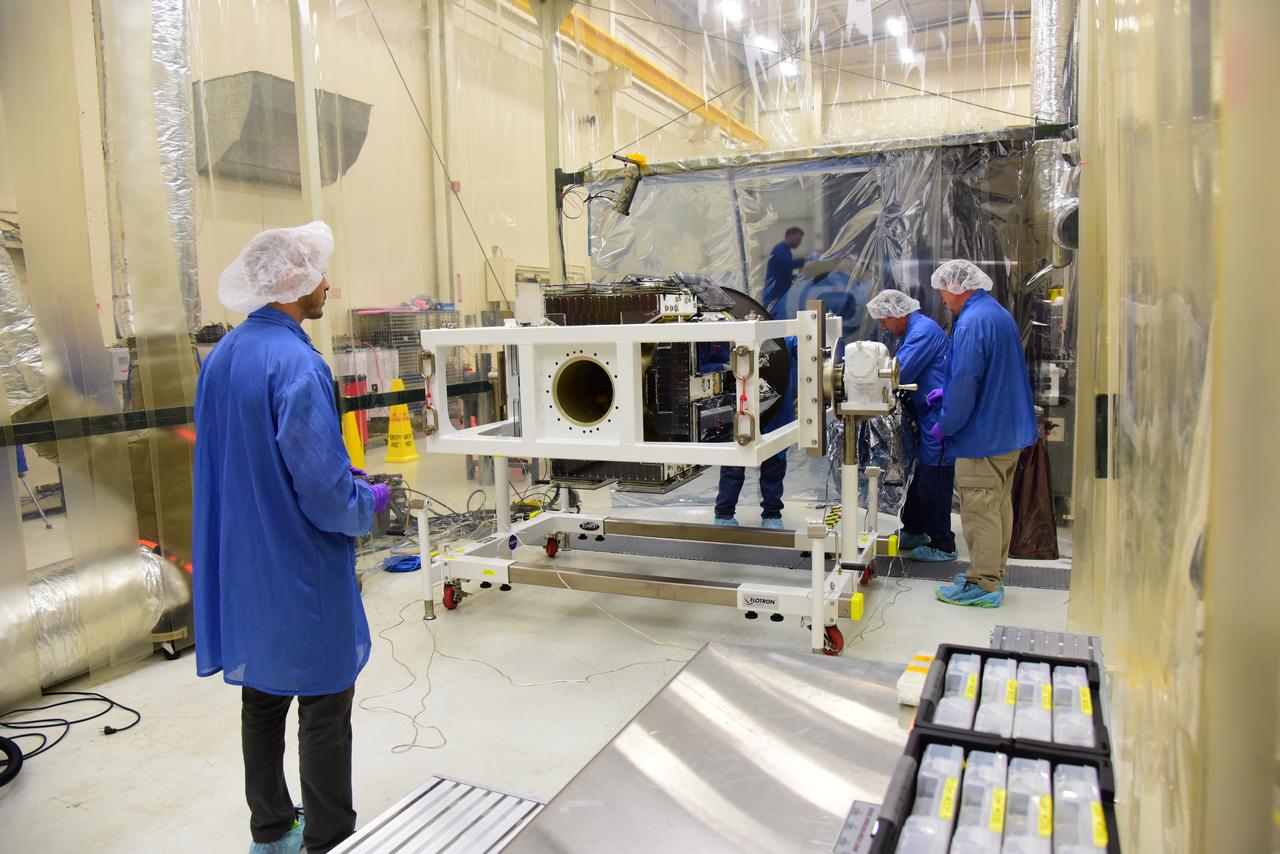
Inside Building 1555 at Vandenberg Air Force Base in California, the eight NASA Cyclone Global Navigation Satellite System (CYGNSS) spacecraft installed on their deployment module undergo inspections prior to NASA’s Kennedy Space Center in Florida. Processing activities will prepare the spacecraft for launch aboard an Orbital ATK Pegasus XL rocket. When preparations are competed at Vandenberg, the rocket will be transported to Kennedy attached to the Orbital ATK L-1011 carrier aircraft with in its payload fairing. CYGNSS will launch on the Pegasus XL rocket from the Skid Strip at Cape Canaveral Air Force Station. CYGNSS will make frequent and accurate measurements of ocean surface winds throughout the life cycle of tropical storms and hurricanes. The data that CYGNSS provides will enable scientists to probe key air-sea interaction processes that take place near the core of storms, which are rapidly changing and play a critical role in the beginning and intensification of hurricanes.
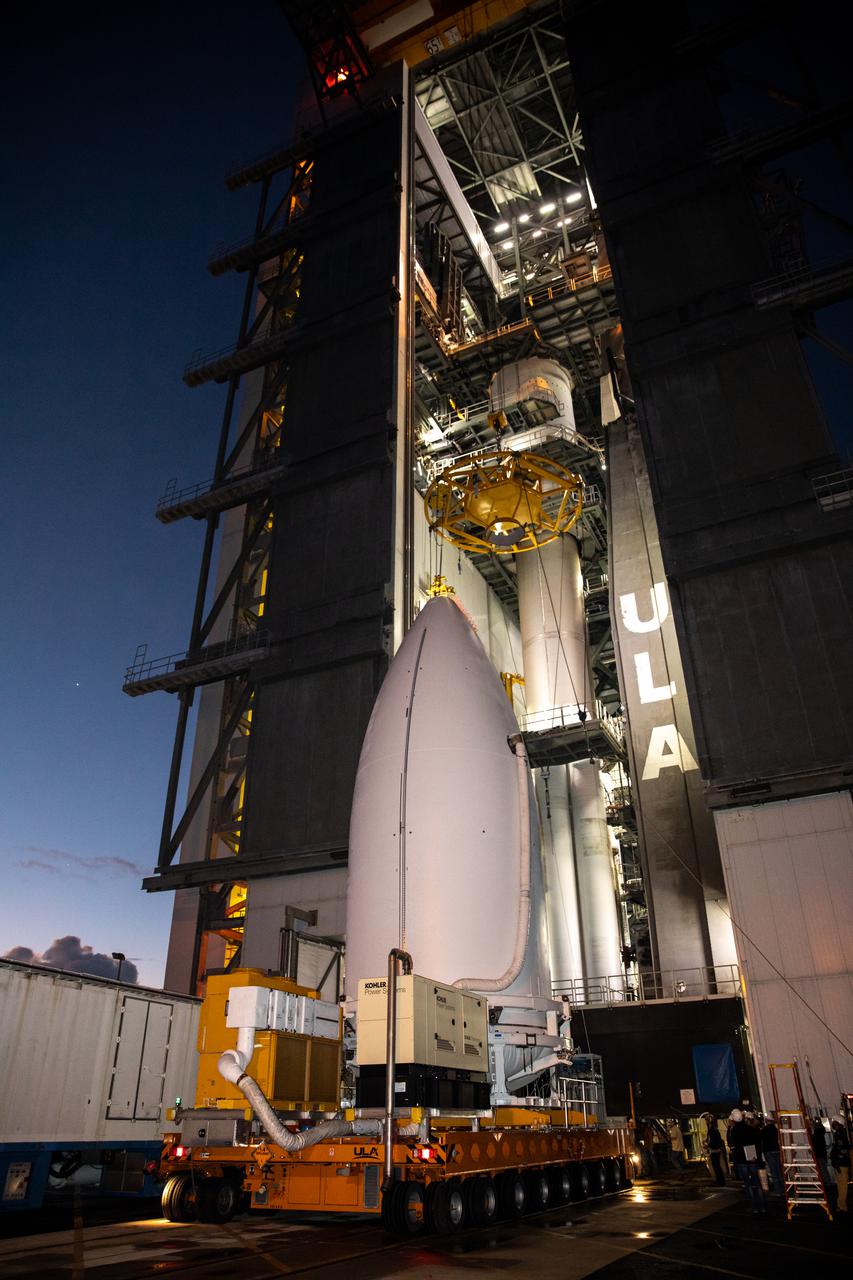
Preparations are underway to lift the National Oceanic and Atmospheric Administration’s (NOAA) Geostationary Operational Environmental Satellite-T (GOES-T), enclosed in its payload fairing, up into the Vertical Integration Facility at Space Launch Complex 41 at Cape Canaveral Space Force Station in Florida on Feb. 17, 2022. The satellite will be secured atop the United Launch Alliance Atlas V 541 rocket. GOES-T is scheduled to launch atop the Atlas V rocket from SLC-41 on March 1, 2022, at 4:38 p.m. GOES-T is the third satellite in the GOES-R series that will continue to help meteorologists observe and predict local weather events that affect public safety. The launch is being managed by NASA’s Launch Services Program based at Kennedy Space Center in Florida, America’s multi-user spaceport.
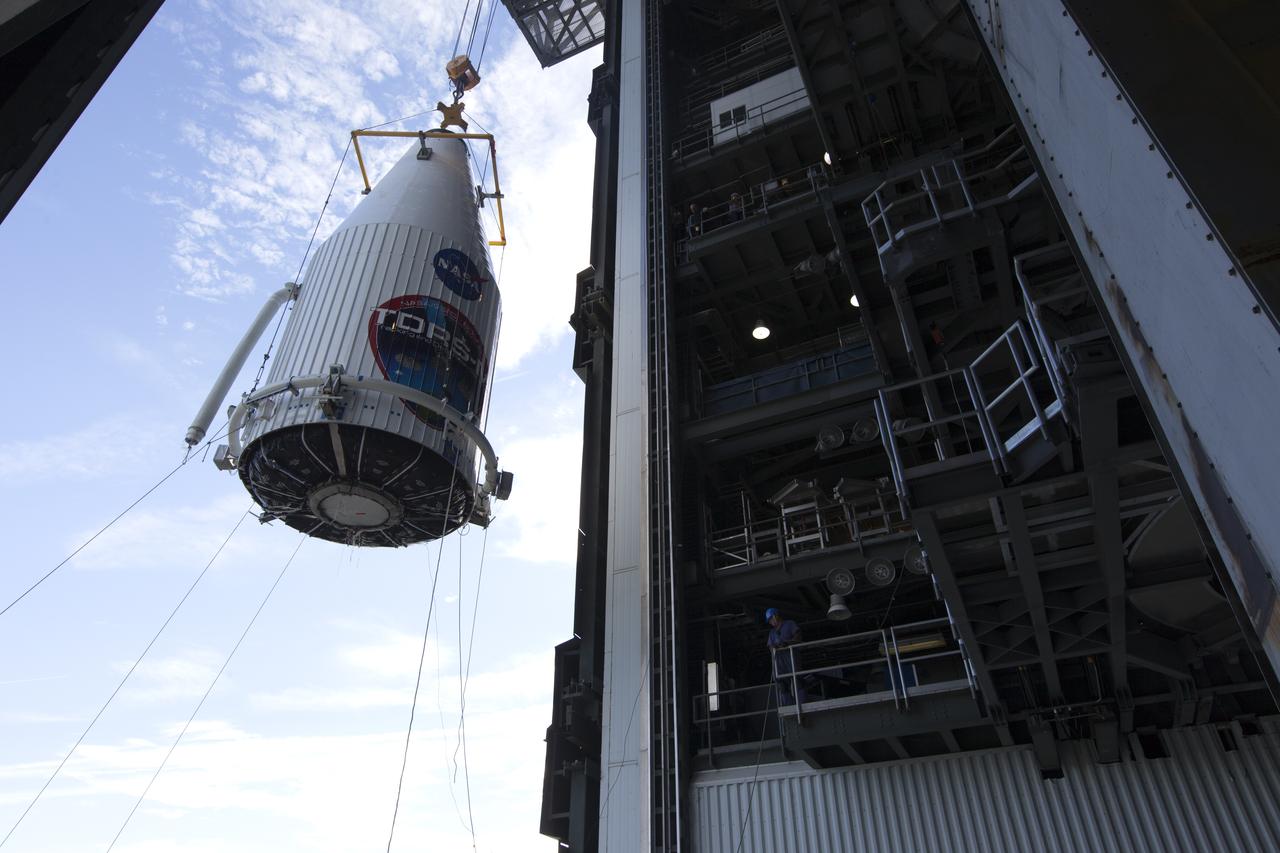
A crane is used to lift the payload fairing containing NASA's Tracking and Data Relay Satellite (TDRS-M) at the Vertical Integration Facility at Space Launch Complex 41 at Cape Canaveral Air Force Station in Florida. TDRS-M will be stacked atop the United Launch Alliance Atlas V Centaur upper stage. TDRS-M will be the latest spacecraft destined for the agency's constellation of communications satellites that allows nearly continuous contact with orbiting spacecraft ranging from the International Space Station and Hubble Space Telescope to the array of scientific observatories. Liftoff atop the ULA Atlas V rocket is scheduled for Aug. 18, 2017.

Inside Building 1555 at Vandenberg Air Force Base in California, the eight NASA Cyclone Global Navigation Satellite System (CYGNSS) spacecraft installed on their deployment module undergo inspections prior to NASA’s Kennedy Space Center in Florida. Processing activities will prepare the spacecraft for launch aboard an Orbital ATK Pegasus XL rocket. When preparations are competed at Vandenberg, the rocket will be transported to Kennedy attached to the Orbital ATK L-1011 carrier aircraft with in its payload fairing. CYGNSS will launch on the Pegasus XL rocket from the Skid Strip at Cape Canaveral Air Force Station. CYGNSS will make frequent and accurate measurements of ocean surface winds throughout the life cycle of tropical storms and hurricanes. The data that CYGNSS provides will enable scientists to probe key air-sea interaction processes that take place near the core of storms, which are rapidly changing and play a critical role in the beginning and intensification of hurricanes.
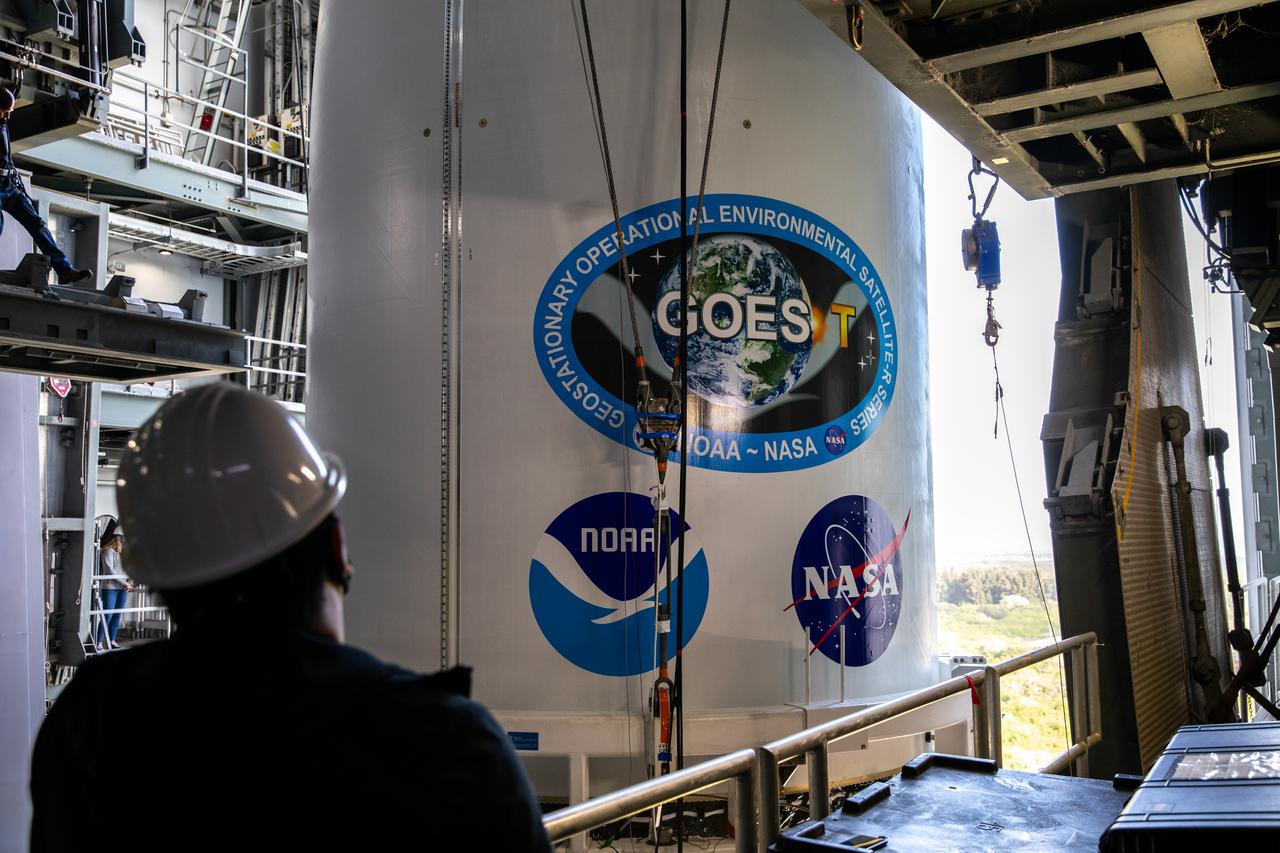
A United Launch Alliance technician monitors the progress as the National Oceanic and Atmospheric Administration’s (NOAA) Geostationary Operational Environmental Satellite-T (GOES-T), enclosed in its payload fairing, is moved into the Vertical Integration Facility at Space Launch Complex 41 at Cape Canaveral Space Force Station in Florida on Feb. 17, 2022. The satellite will be secured atop the United Launch Alliance Atlas V 541 rocket. GOES-T is scheduled to launch atop the Atlas V rocket from SLC-41 on March 1, 2022, at 4:38 p.m. GOES-T is the third satellite in the GOES-R series that will continue to help meteorologists observe and predict local weather events that affect public safety. The launch is being managed by NASA’s Launch Services Program based at Kennedy Space Center in Florida, America’s multi-user spaceport.
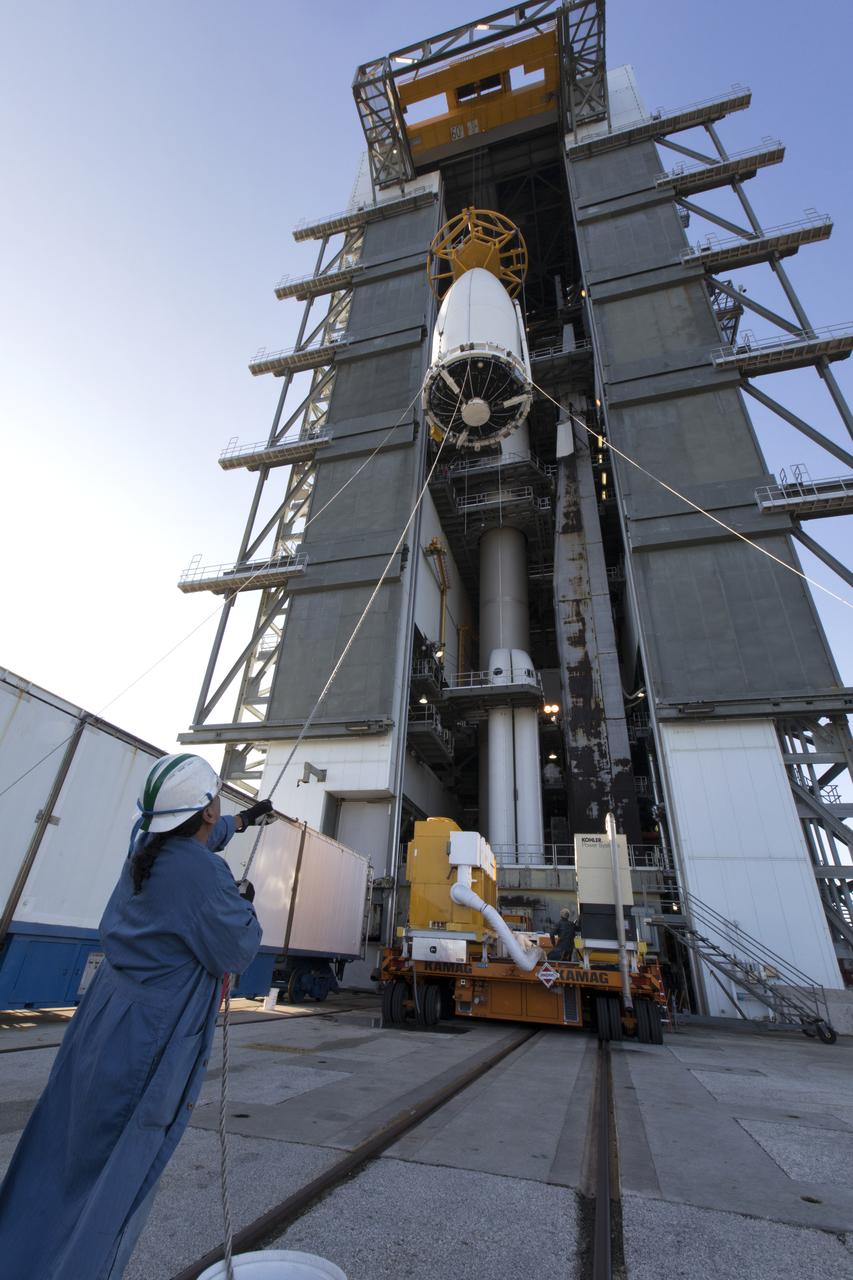
The payload fairing containing NOAA's Geostationary Operational Environmental Satellite-S (GOES-S) is lifted up by crane at the United Launch Alliance (ULA) Vertical Integration Facility at Space Launch Complex 41 at Cape Canaveral Air Force Station in Florida. The fairing will be mated to the ULA Atlas V rocket. GOES-S is the second in a series of four advanced geostationary weather satellites. The satellite is slated to launch aboard the ULA Atlas V on March 1.
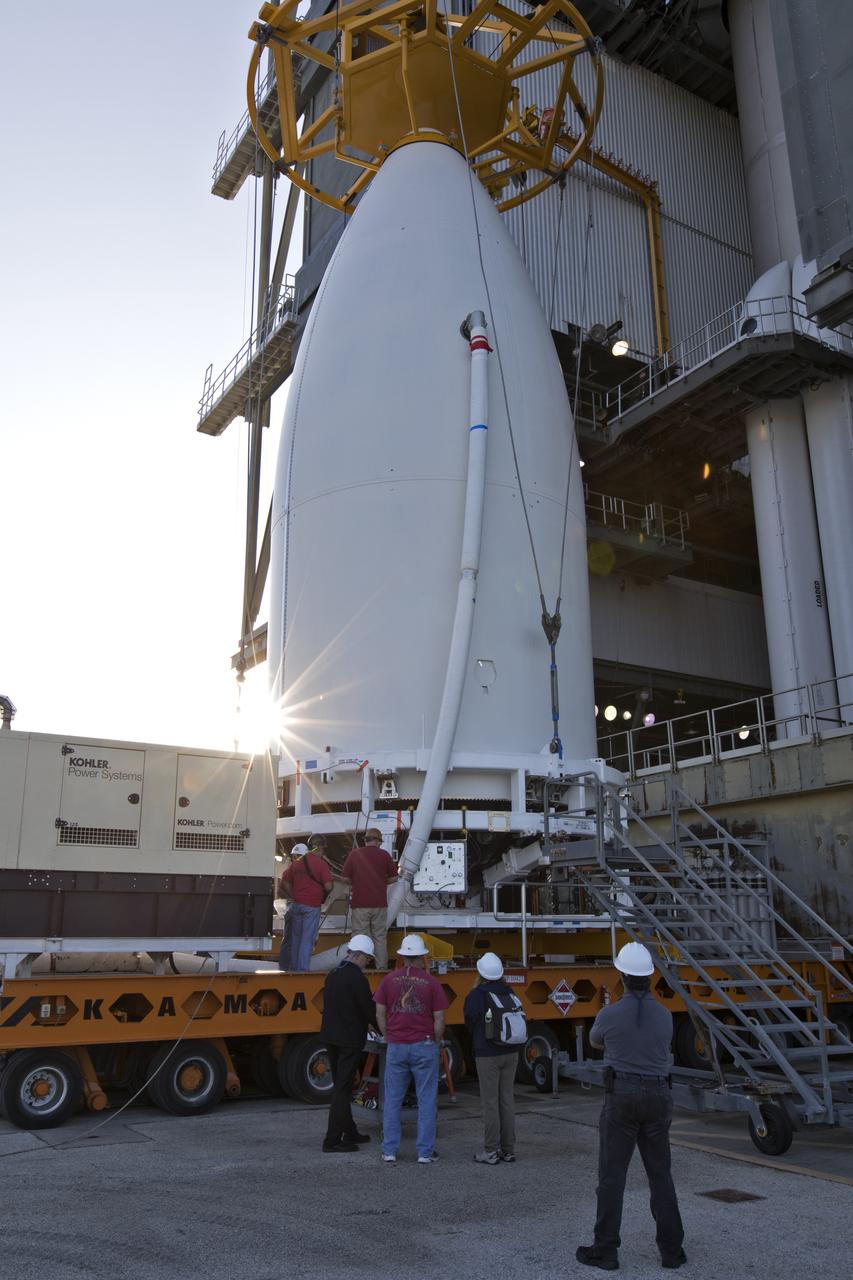
Preparations are underway to lift the payload fairing containing NOAA's Geostationary Operational Environmental Satellite-S (GOES-S) up and into the United Launch Alliance (ULA) Vertical Integration Facility at Space Launch Complex 41 at Cape Canaveral Air Force Station in Florida. The fairing will be mated to the ULA Atlas V rocket. GOES-S is the second in a series of four advanced geostationary weather satellites. The satellite is slated to launch aboard the ULA Atlas V on March 1.