
JANUARY 9, 2014: The vibrant magentas and blues in this Hubble image of the barred spiral galaxy M83 reveal that the galaxy is ablaze with star formation. The galactic panorama unveils a tapestry of the drama of stellar birth and death. The galaxy, also known as the Southern Pinwheel, lies 15 million light-years away in the constellation Hydra. Credit: NASA, ESA, and the Hubble Heritage Team (STScI/AURA) Acknowledgement: W. Blair (STScI/Johns Hopkins University) and R. O'Connell (University of Virginia) <b><a href="http://www.nasa.gov/audience/formedia/features/MP_Photo_Guidelines.html" rel="nofollow">NASA image use policy.</a></b> <b><a href="http://www.nasa.gov/centers/goddard/home/index.html" rel="nofollow">NASA Goddard Space Flight Center</a></b> enables NASA’s mission through four scientific endeavors: Earth Science, Heliophysics, Solar System Exploration, and Astrophysics. Goddard plays a leading role in NASA’s accomplishments by contributing compelling scientific knowledge to advance the Agency’s mission. <b>Follow us on <a href="http://twitter.com/NASA_GoddardPix" rel="nofollow">Twitter</a></b> <b>Like us on <a href="http://www.facebook.com/pages/Greenbelt-MD/NASA-Goddard/395013845897?ref=tsd" rel="nofollow">Facebook</a></b> <b>Find us on <a href="http://instagram.com/nasagoddard?vm=grid" rel="nofollow">Instagram</a></b>

This Chandra X-ray observatory image of M83 shows numerous point-like neutron stars and black hole x-ray sources scattered throughout the disk of this spiral galaxy. The bright nuclear region of the galaxy glows prominently due to a burst of star formation that is estimated to have begun about 20 million years ago in the galaxy's time frame. The nuclear region, enveloped by a 7 million degree Celsius gas cloud of carbon, neon, magnesium, silicon, and sulfur atoms, contains a much higher concentration of neutron stars and black holes than the rest of the galaxy. Hot gas with a slightly lower temperature of 4 million degrees observed along the spiral arms of the galaxy suggests that star formation in this region may be occurring at a more sedate rate.
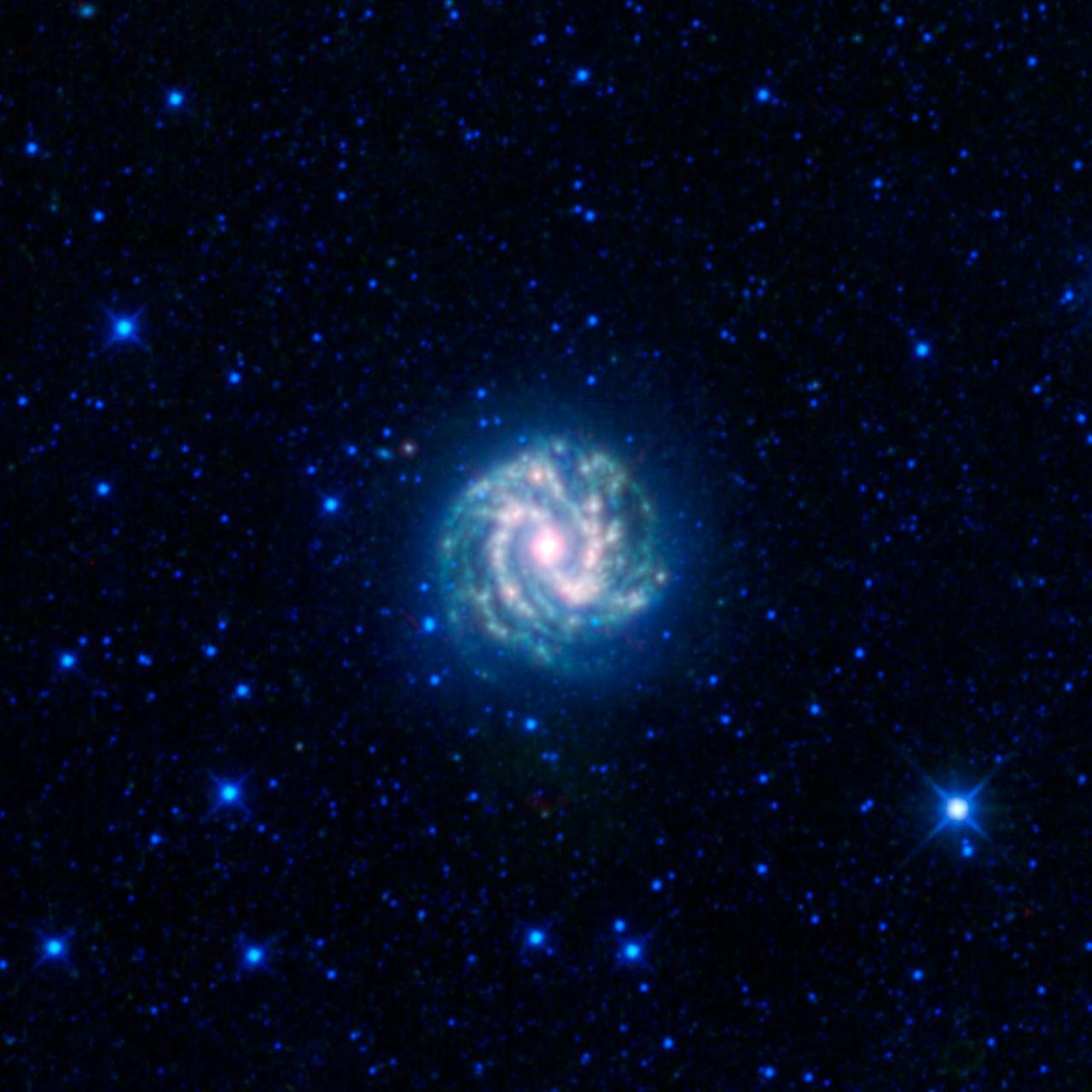
This image from NASA Wide-field Infrared Survey Explorer shows the nearby galaxy M83. This is a spiral galaxy approximately 15 million light-years away in the constellation Hydra, sometimes referred to as the southern Pinwheel galaxy.
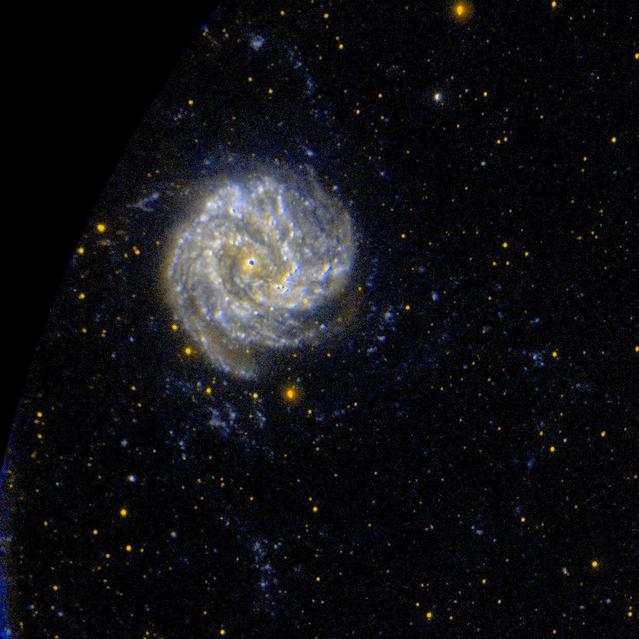
Ultraviolet images such as this one from NASA's Galaxy Evolution Explorer suggest the M83 has unusual pockets of star formation separated by large distances from the spiral arms in the main disk of the galaxy. http://photojournal.jpl.nasa.gov/catalog/PIA07903