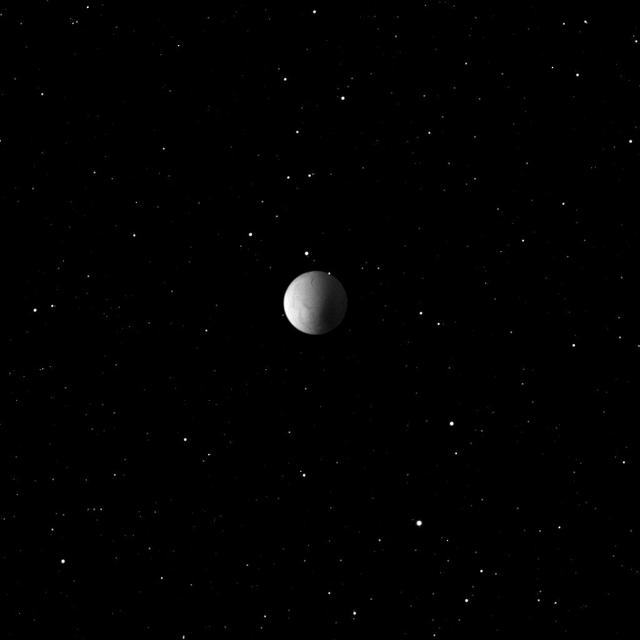
Starry Night
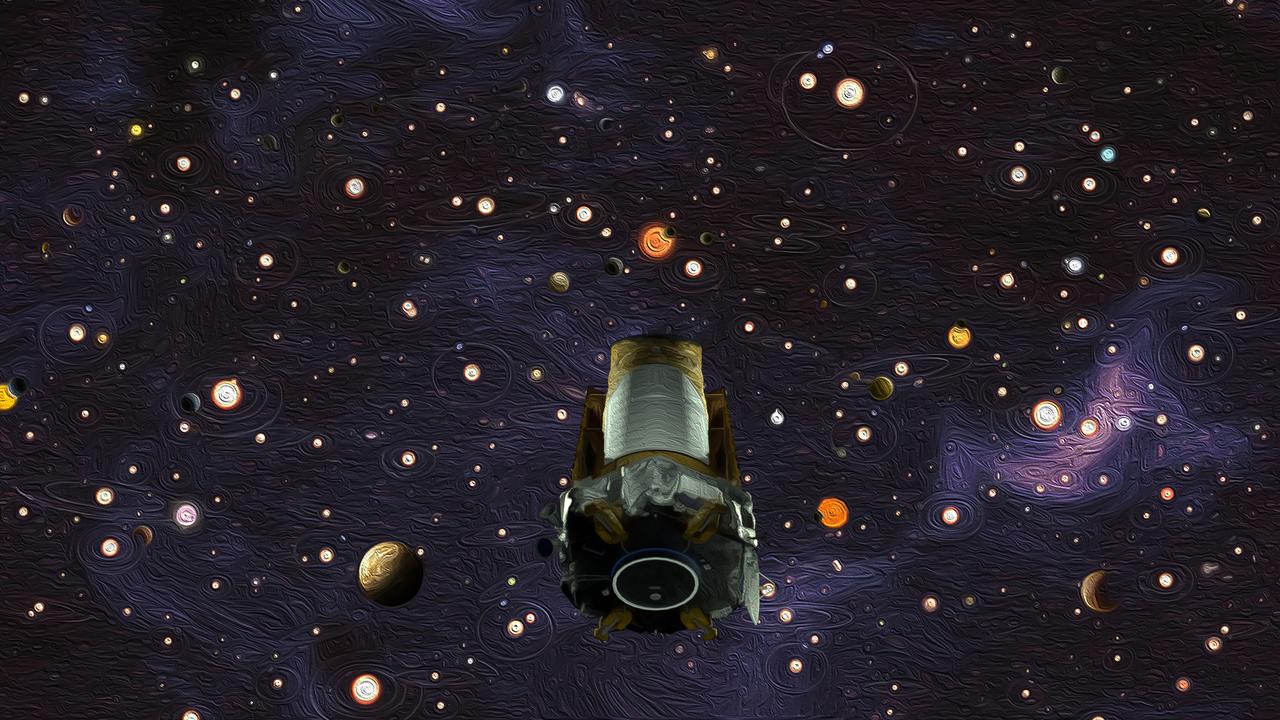
After nine years in deep space collecting data that revealed our night sky to be filled with billions of hidden planets, more planets even than stars, NASA’s Kepler space telescope has run out of fuel needed for further science operations. Illustration depicting the Kepler spacecraft in a sky filled with exoplanets and planetary systems.
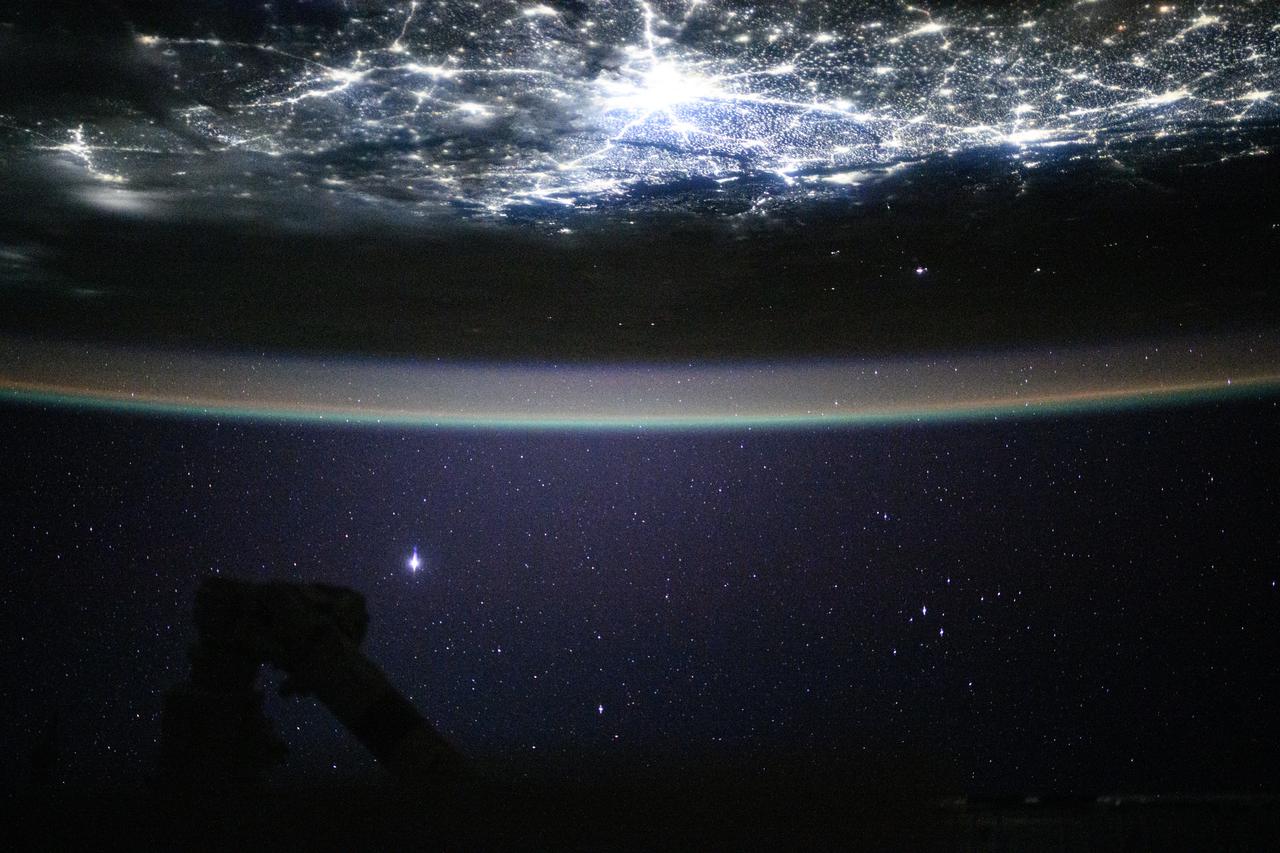
iss073e0685684 (Aug. 21, 2025) --- Underneath a starry night sky, the city lights of New Delhi, India, and its surrounding suburbs glitter below Earth's atmospheric glow and at the edge of the Himalayas. This photograph was taken at approximately 2:55 a.m. local time as the International Space Station orbited 260 miles above.
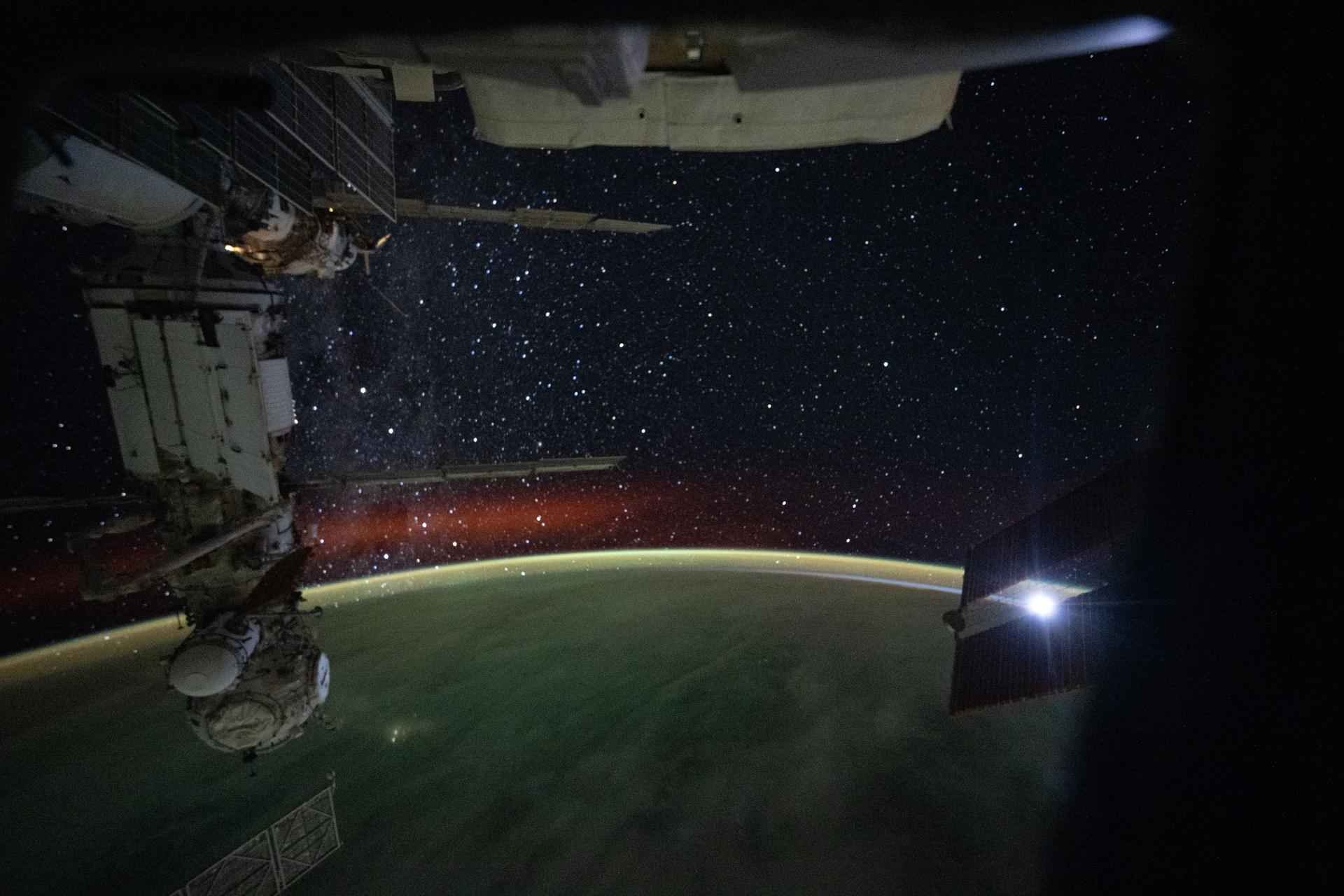
iss074e0759993 (June 21, 2026) --- The International Space Station was soaring 262 miles above southern India at approximately 1:34 a.m. local time when this long‑duration photograph was taken, revealing a bright atmospheric glow and a starry night sky. At left is the Prichal module, attached to the Nauka science module on the orbital outpost’s Roscosmos segment. Credit: NASA/Chris Williams

iss074e05319021 (April 19, 2026) --- This serene view from the International Space Station captures a bright orange airglow outlining Earth’s horizon beneath the starry expanse of the night sky. The orbital outpost was soaring 259 miles above Colombia at approximately 2:09 a.m. local time when this photograph was taken. Credit: ESA/Sophie Adenot

iss065e214537 (Aug. 2, 2021) --- The night lights of South Africa are blanketed by Earth's atmospheric glow and a starry night sky as the International Space Station orbited 266 miles above.

iss065e061117 (May 21, 2021) --- A starry night sky and an atmospheric glow blanket the Earth during an orbital night period as the International Space Station orbited 266 miles above the Indian Ocean.
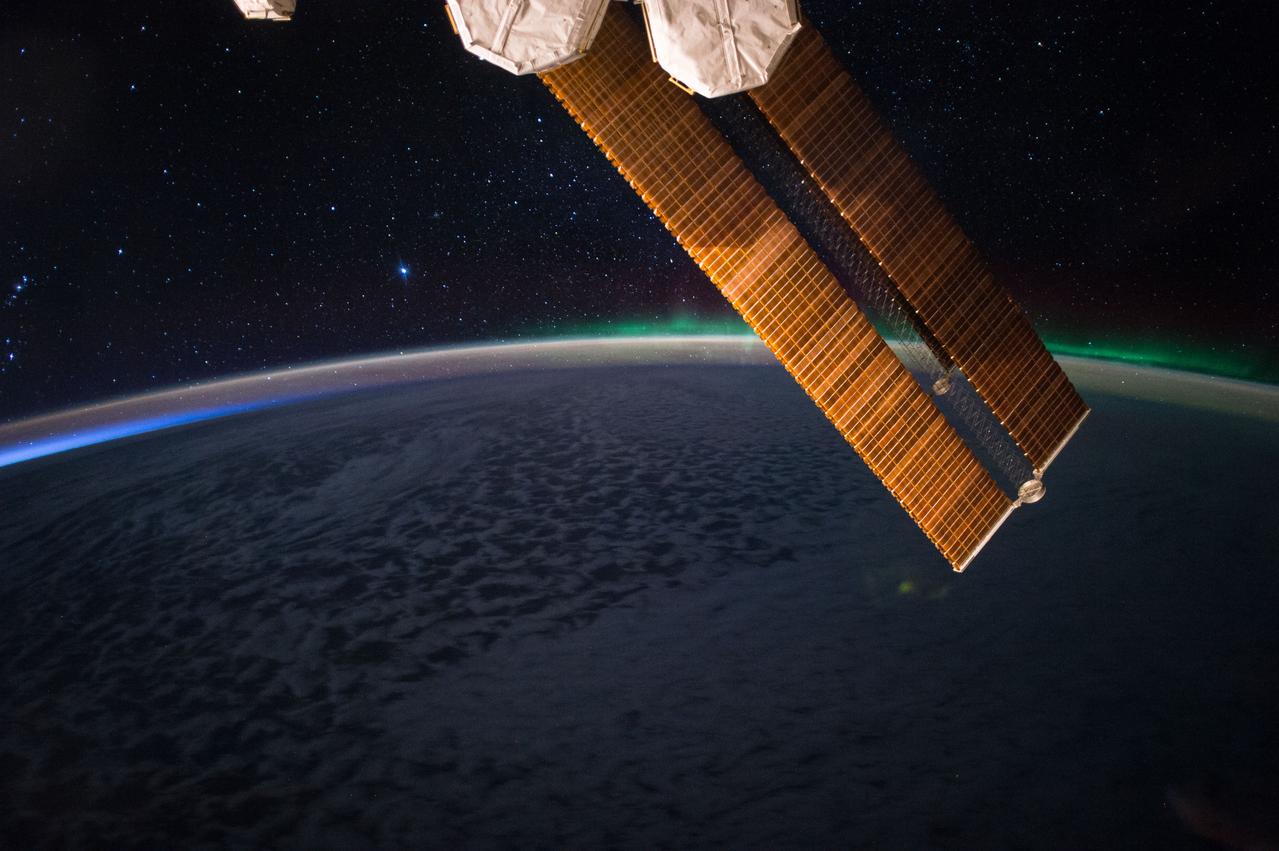
iss052e004998 (June 19, 2017) --- The aurora and the starry night are pictured above Earth’s atmosphere in this photograph taken from the space station’s cupola June 19, 2017.

iss064e022759 (Jan. 12, 2021) --- A starry night sky and an aurora are pictured above Russia as the International Space Station orbited 264 miles over the western Kazakhstan border.

iss067e269019 (Aug. 17, 2022) --- An aurora crowns the Earth beneath a starry sky in this night time photograph from the International Space Station as it orbited 270 miles above the Indian Ocean southeast of the African continent.

iss065e213109 (July 30, 2021) --- A starry night sky and and an atmospheric glow blanket the well-lit southeastern African coast as the International Space Station orbited 263 miles above.

iss062e103874 (March 20, 2020) --- The city lights at the intersection of Europe and Asia sparkle underneath an atmospheric glow and a starry night sky as the International Space Station orbited 262 miles above into an orbital sunset.

iss070e062746 (Jan. 10, 2024) --- The city lights of North America appear under Earth's airglow and a starry night sky in this photograph from the International Space Station as it orbited 262 miles above North Dakota.

iss064e022752 (Jan. 12, 2021) --- A starry night sky and an aurora are pictured above Russia, in between Ukraine and Kazakhstan, as the International Space Station orbited 264 miles overhead.

iss060e002044 (June 29, 2019) --- An atmospheric glow blankets Earth beneath a starry night sky as the International Space Station orbited 271 miles above the Indian Ocean, south of the Australian island state of Tasmania.

ISS028-E-006193 (28 May 2011) --- The docked space shuttle Endeavour (STS-134), backdropped by a night time view of Earth and a starry sky are featured in this image photographed by an Expedition 28 crew member on the station.

iss065e213046 (July 30, 2021) --- Russia's "Nauka" Multipurpose Laboratory Module is pictured as the International Space Station orbited 261 miles above central Africa with a starry night sky and the atmospheric glow blanketing the Earth.

iss064e035805 (Feb. 21, 2021) --- The International Space Station, pictured with Russia's ISS Progress 77 cargo craft attached to the Pirs docking compartment, orbits into a sunset 270 miles above the South Pacific. This long duration photograph also shows Earth's airglow (a faint emission of light in the upper atmosphere) and a starry night sky.

iss047e001114 (March 2, 2016) --- An Expedition 47 crewmember photographed the Earth’s limb during a starry night pass. One of the International Space Station’s solar arrays is seen in the right foreground as the orbital complex flew 258 miles above the Indian Ocean in between Indonesia and Australia.

iss066e029018 (Oct. 30, 2021) --- The International Space Station was orbiting 263 miles above the Indian Ocean about to cross over the city lights of southern India, pictured with the island nation of Sri Lanka at center right, in this night time photograph. The atmospheric airglow is also viewed blanketing the Earth's horizon beneath a starry sky.

iss065e051411 (May 23, 2021) --- A starry sky, an atmospheric glow and the night lights of the island nation of Mauritius (center left) and Réunion Island (bottom right), a French department, stand out as the International Space Station orbited 265 miles above of Madagascar on its northeast Indian Ocean coast.
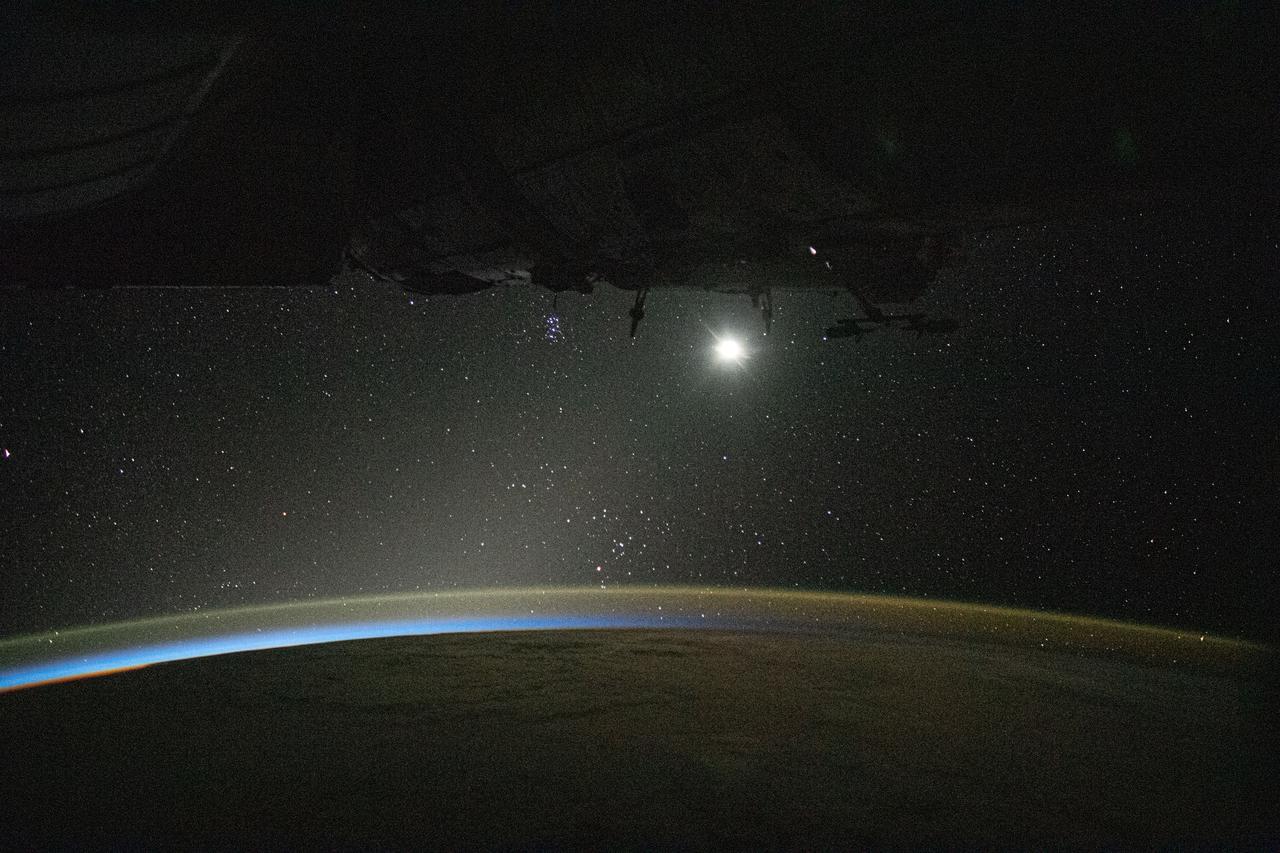
iss060e002090 (June 29, 2019) --- The Earth's limb and the atmospheric glow highlight the thin blue atmosphere back lit by the Sun's rays during a period between night and day. The light of the moon and the starry Milky Way drape the background as the International Space Station orbited 257 miles above the Pacific Ocean between Hawaii and Mexico.

iss064e035806 (Feb. 21, 2021) --- The International Space Station, pictured with Russia's ISS Progress 77 cargo craft attached to the Pirs docking compartment, orbits into a sunset 270 miles above the South Pacific. This long duration photograph also shows Earth's airglow (a faint emission of light in the upper atmosphere) and a starry night sky.

iss071e611938 (Sept. 2, 2024) --- NASA astronaut and Expedition 71 Flight Engineer Matthew Dominick programmed a camera for high sensitivity and pointed it out an International Space Station window as it orbited 266 miles above Kazakhstan. At lower right, a wispy Milky Way is pictured amongst a starry night sky.

iss064e035808 (Feb. 21, 2021) --- The International Space Station, pictured with Russia's ISS Progress 77 cargo craft attached to the Pirs docking compartment, orbits into a sunset 265 miles above the South Pacific. This long duration photograph also shows Earth's airglow (a faint emission of light in the upper atmosphere) and a starry night sky.

iss064e035804 (Feb. 21, 2021) --- The International Space Station, pictured with Russia's ISS Progress 77 cargo craft attached to the Pirs docking compartment, orbits into a sunset 270 miles above the South Pacific. This long duration photograph also shows Earth's airglow (a faint emission of light in the upper atmosphere) and a starry night sky.

iss052e010507 (July 4, 2017) --- This long-exposure photograph of Earth and a starry sky was taken during a night pass by the Expedition 52 crew aboard the International Space Station. The Japanese Kibo module and part of the station’s solar array are visible at the top.

iss064e035812 (Feb. 21, 2021) --- Russia's ISS Progress 77 cargo craft is pictured attached to the Pirs docking compartment as the International Space Station orbited 260 miles above the Gulf of Mexico off the southwest coast of Florida. This long duration photograph also shows the city lights of the Yucatan peninsula, Earth's airglow (a faint emission of light in the upper atmosphere), and a starry night sky.

ISS029-E-005853 (17 Sept. 2011) --- This is one of a series of night time images photographed by one of the Expedition 29 crew members from the International Space Station. The image features airglow on the horizon against a starry sky with Russian spacecraft Soyuz and Progress in the foreground. Nadir coordinates are 27.8 degrees south latitude and 137.6 west longitude. The photo was taken at 11:32:37 GMT, Sept. 17, 2011.
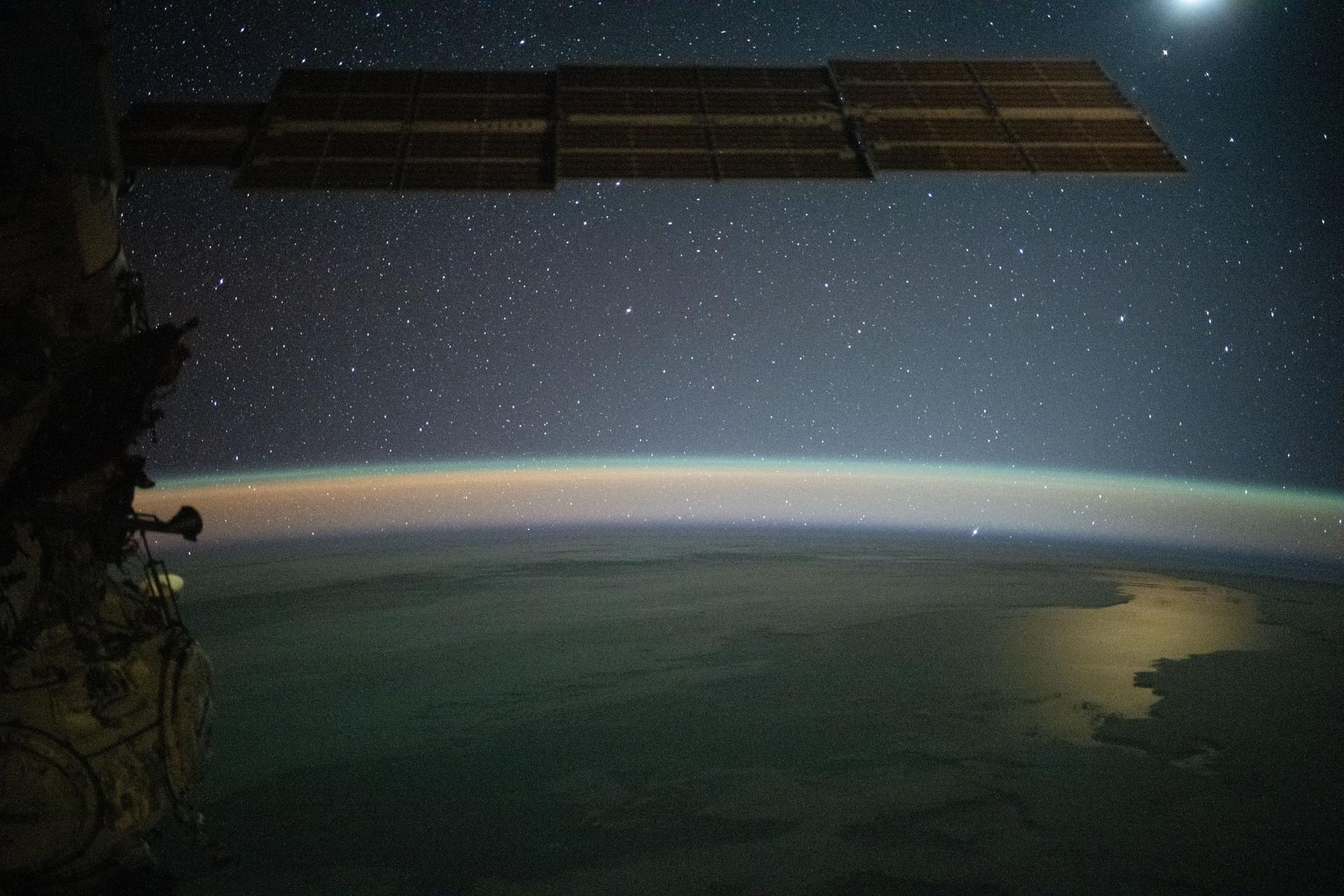
iss073e0982346 (Oct. 25, 2025) --- This serene image of the Moon (upper right) glinting off the Southern Pacific Ocean—beneath a yellow-green airglow and a starry night sky—was taken at approximately 8:59 p.m. local time from the International Space Station as it orbited 263 miles above Earth, southwest of French Polynesia, an overseas collectivity of France comprising more than 100 islands.

iss073e0920829 (Oct. 20, 2025) --- This celestial view from a window aboard the SpaceX Dragon crew spacecraft captures the city lights of Central Asia sparkling underneath a bright yellow airglow as an orbital sunrise begins to illuminate Earth's atmosphere underneath a starry night sky. The International Space Station was orbiting 263 miles above Uzbekistan at approximately 4:40 a.m. local time when this long-exposure photograph was taken.

iss071e611752 (Sept. 2, 2024) --- NASA astronaut and Expedition 71 Flight Engineer Matthew Dominick programmed a camera for high sensitivity and pointed it out an International Space Station window as it orbited 266 miles above Kazakhstan near the Caspian Sea's north coast. At lower right, a wispy Milky Way is pictured amongst a starry night sky.
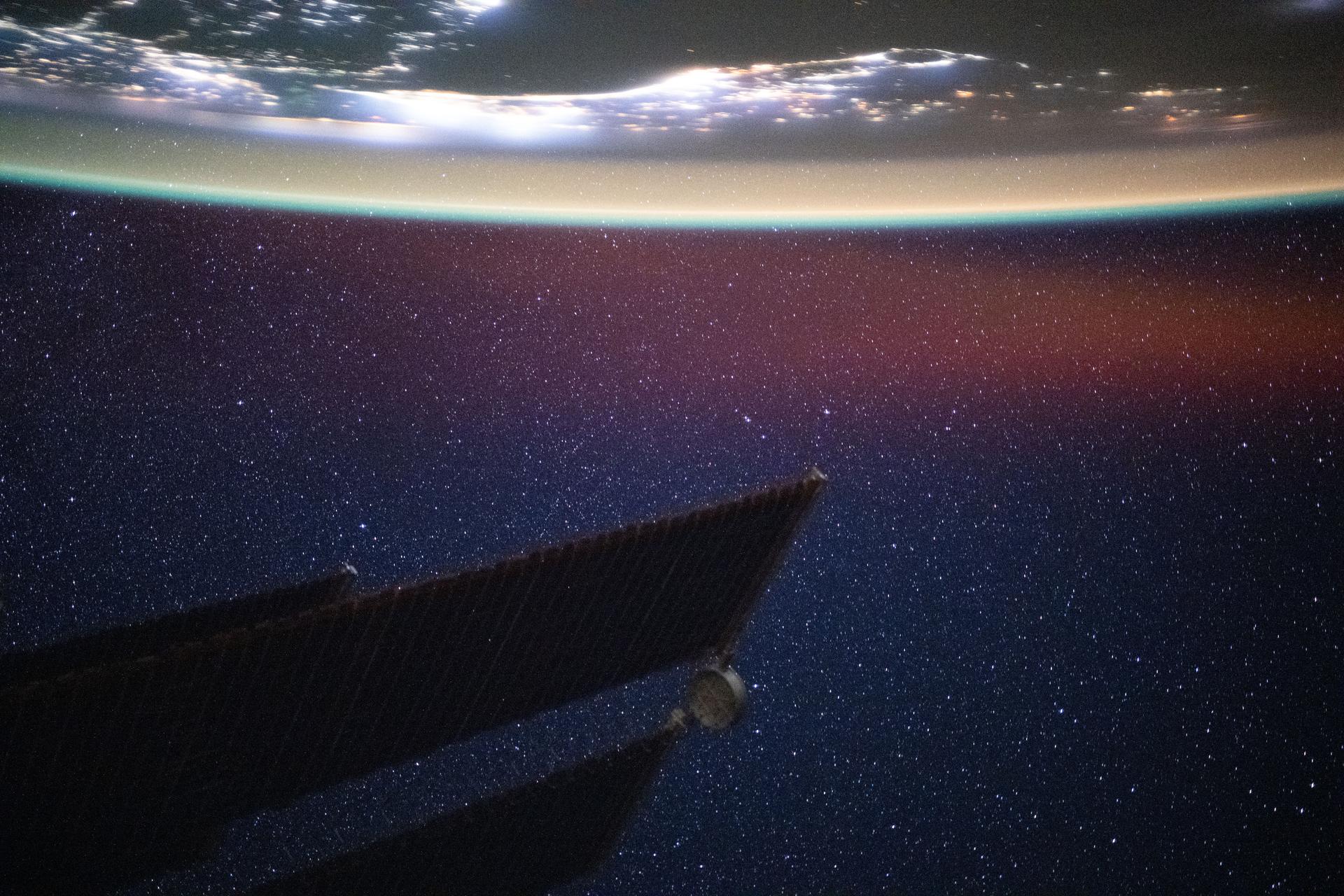
iss073e0982720 (Oct. 25, 2025) --- The Persian Gulf region—from Oman to the United Arab Emirates, with Iran's southwest coast visible across the geographically important waterway—is illuminated beneath a bright yellow-green airglow. This long-exposure photograph, taken at approximately 11:40 p.m. local time from the International Space Station as it orbited 259 miles above northwestern India, also captures the starry expanse of the night sky.
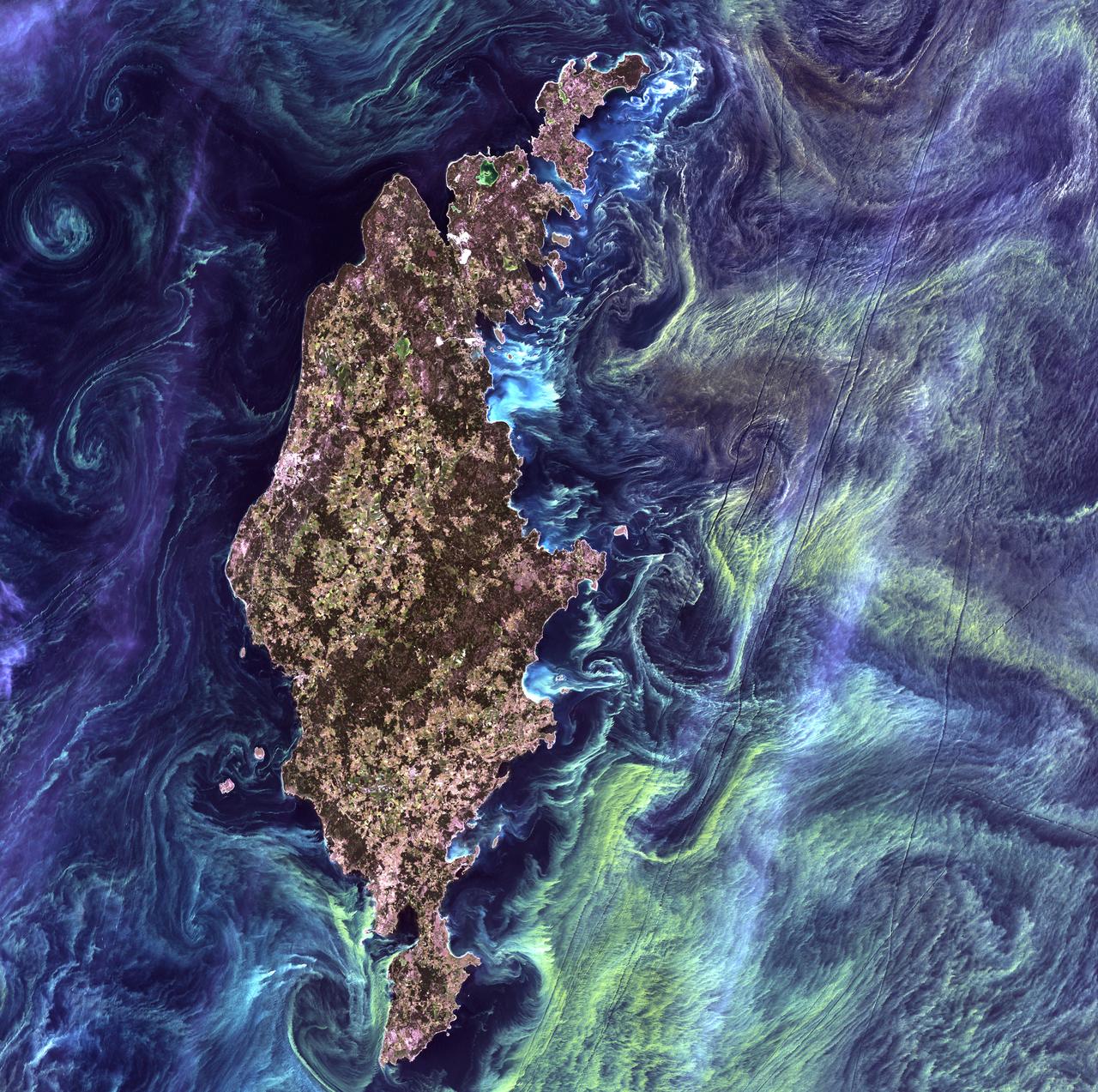
Van Gogh from Space - July 13th, 2005 Description: In the style of Van Gogh's painting "Starry Night," massive congregations of greenish phytoplankton swirl in the dark water around Gotland, a Swedish island in the Baltic Sea. Phytoplankton are microscopic marine plants that form the first link in nearly all ocean food chains. Population explosions, or blooms, of phytoplankton, like the one shown here, occur when deep currents bring nutrients up to sunlit surface waters, fueling the growth and reproduction of these tiny plants. Credit: USGS/NASA/Landsat 7 To learn more about the Landsat satellite go to: <a href="http://landsat.gsfc.nasa.gov/" rel="nofollow">landsat.gsfc.nasa.gov/</a> <b><a href="http://www.nasa.gov/centers/goddard/home/index.html" rel="nofollow">NASA Goddard Space Flight Center</a></b> enables NASA’s mission through four scientific endeavors: Earth Science, Heliophysics, Solar System Exploration, and Astrophysics. Goddard plays a leading role in NASA’s accomplishments by contributing compelling scientific knowledge to advance the Agency’s mission. <b>Follow us on <a href="http://twitter.com/NASA_GoddardPix" rel="nofollow">Twitter</a></b> <b>Join us on <a href="http://www.facebook.com/pages/Greenbelt-MD/NASA-Goddard/395013845897?ref=tsd" rel="nofollow">Facebook</a></b>

Two beams flash across a starry sky toward the Moon at Optical Site. Goddard's Laser Ranging Facility directs a laser toward the Lunar Reconassaince Orbiter on International Observe the Moon Night. (Sept 18, 2010) Background on laser ranging: <a href="http://www.nasa.gov/mission_pages/LRO/news/LRO_lr.html" rel="nofollow">www.nasa.gov/mission_pages/LRO/news/LRO_lr.html</a> Credit: NASA/GSFC/Debbie Mccallum On September 18, 2010 the world joined the NASA Goddard Space Flight Center's Visitor Center in Greenbelt, Md., as well as other NASA Centers to celebrate the first annual International Observe the Moon Night (InOMN). To read more go to: <a href="http://www.nasa.gov/centers/goddard/news/features/2010/moon-night.html" rel="nofollow">www.nasa.gov/centers/goddard/news/features/2010/moon-nigh...</a> <b><a href="http://www.nasa.gov/centers/goddard/home/index.html" rel="nofollow">NASA Goddard Space Flight Center</a></b> contributes to NASA’s mission through four scientific endeavors: Earth Science, Heliophysics, Solar System Exploration, and Astrophysics. Goddard plays a leading role in NASA’s endeavors by providing compelling scientific knowledge to advance the Agency’s mission. <b>Follow us on <a href="http://twitter.com/NASA_GoddardPix" rel="nofollow">Twitter</a></b> <b>Join us on <a href="http://www.facebook.com/pages/Greenbelt-MD/NASA-Goddard/395013845897?ref=tsd" rel="nofollow">Facebook</a></b>

This is an illustration of a supermassive black hole, weighing as much as 21 million suns, located in the middle of the ultradense galaxy M60-UCD1. The dwarf galaxy is so dense that millions of stars fill the sky as seen by an imaginary visitor. Because no light can escape from the black hole, it appears simply in silhouette against the starry background. The black hole's intense gravitational field warps the light of the background stars to form ring-like images just outside the dark edges of the black hole's event horizon. Combined observations by the Hubble Space Telescope and Gemini North telescope determined the presence of the black hole inside such a small and dense galaxy. More info: Astronomers using data from NASA’s Hubble Space Telescope and ground observation have found an unlikely object in an improbable place -- a monster black hole lurking inside one of the tiniest galaxies ever known. The black hole is five times the mass of the one at the center of our Milky Way galaxy. It is inside one of the densest galaxies known to date -- the M60-UCD1 dwarf galaxy that crams 140 million stars within a diameter of about 300 light-years, which is only 1/500th of our galaxy’s diameter. If you lived inside this dwarf galaxy, the night sky would dazzle with at least 1 million stars visible to the naked eye. Our nighttime sky as seen from Earth’s surface shows 4,000 stars. The finding implies there are many other compact galaxies in the universe that contain supermassive black holes. The observation also suggests dwarf galaxies may actually be the stripped remnants of larger galaxies that were torn apart during collisions with other galaxies rather than small islands of stars born in isolation. “We don’t know of any other way you could make a black hole so big in an object this small,” said University of Utah astronomer Anil Seth, lead author of an international study of the dwarf galaxy published in Thursday’s issue of the journal Nature. Seth’s team of astronomers used the Hubble Space Telescope and the Gemini North 8-meter optical and infrared telescope on Hawaii’s Mauna Kea to observe M60-UCD1 and measure the black hole’s mass. The sharp Hubble images provide information about the galaxy’s diameter and stellar density. Gemini measures the stellar motions as affected by the black hole’s pull. These data are used to calculate the mass of the black hole. Black holes are gravitationally collapsed, ultra-compact objects that have a gravitational pull so strong that even light cannot escape. Supermassive black holes -- those with the mass of at least one million stars like our sun -- are thought to be at the centers of many galaxies. The black hole at the center of our Milky Way galaxy has the mass of four million suns. As heavy as that is, it is less than 0.01 percent of the Milky Way’s total mass. By comparison, the supermassive black hole at the center of M60-UCD1, which has the mass of 21 million suns, is a stunning 15 percent of the small galaxy’s total mass. “That is pretty amazing, given that the Milky Way is 500 times larger and more than 1,000 times heavier than the dwarf galaxy M60-UCD1,” Seth said. One explanation is that M60-UCD1 was once a large galaxy containing 10 billion stars, but then it passed very close to the center of an even larger galaxy, M60, and in that process all the stars and dark matter in the outer part of the galaxy were torn away and became part of M60. The team believes that M60-UCD1 may eventually be pulled to fully merge with M60, which has its own monster black hole that weighs a whopping 4.5 billion solar masses, or more than 1,000 times bigger than the black hole in our galaxy. When that happens, the black holes in both galaxies also likely will merge. Both galaxies are 50 million light-years away. The Hubble Space Telescope is a project of international cooperation between NASA and the European Space Agency. NASA's Goddard Space Flight Center in Greenbelt, Maryland, manages the telescope. The Space Telescope Science Institute (STScI) in Baltimore conducts Hubble science operations. STScI is operated for NASA by the Association of Universities for Research in Astronomy, Inc., in Washington. For images and more information about Hubble, visit: <a href="http://www.nasa.gov/hubble" rel="nofollow">www.nasa.gov/hubble</a> <b><a href="http://www.nasa.gov/audience/formedia/features/MP_Photo_Guidelines.html" rel="nofollow">NASA image use policy.</a></b> <b><a href="http://www.nasa.gov/centers/goddard/home/index.html" rel="nofollow">NASA Goddard Space Flight Center</a></b> enables NASA’s mission through four scientific endeavors: Earth Science, Heliophysics, Solar System Exploration, and Astrophysics. Goddard plays a leading role in NASA’s accomplishments by contributing compelling scientific knowledge to advance the Agency’s mission. <b>Follow us on <a href="http://twitter.com/NASAGoddardPix" rel="nofollow">Twitter</a></b> <b>Like us on <a href="http://www.facebook.com/pages/Greenbelt-MD/NASA-Goddard/395013845897?ref=tsd" rel="nofollow">Facebook</a></b> <b>Find us on <a href="http://instagram.com/nasagoddard?vm=grid" rel="nofollow">Instagram</a></b>