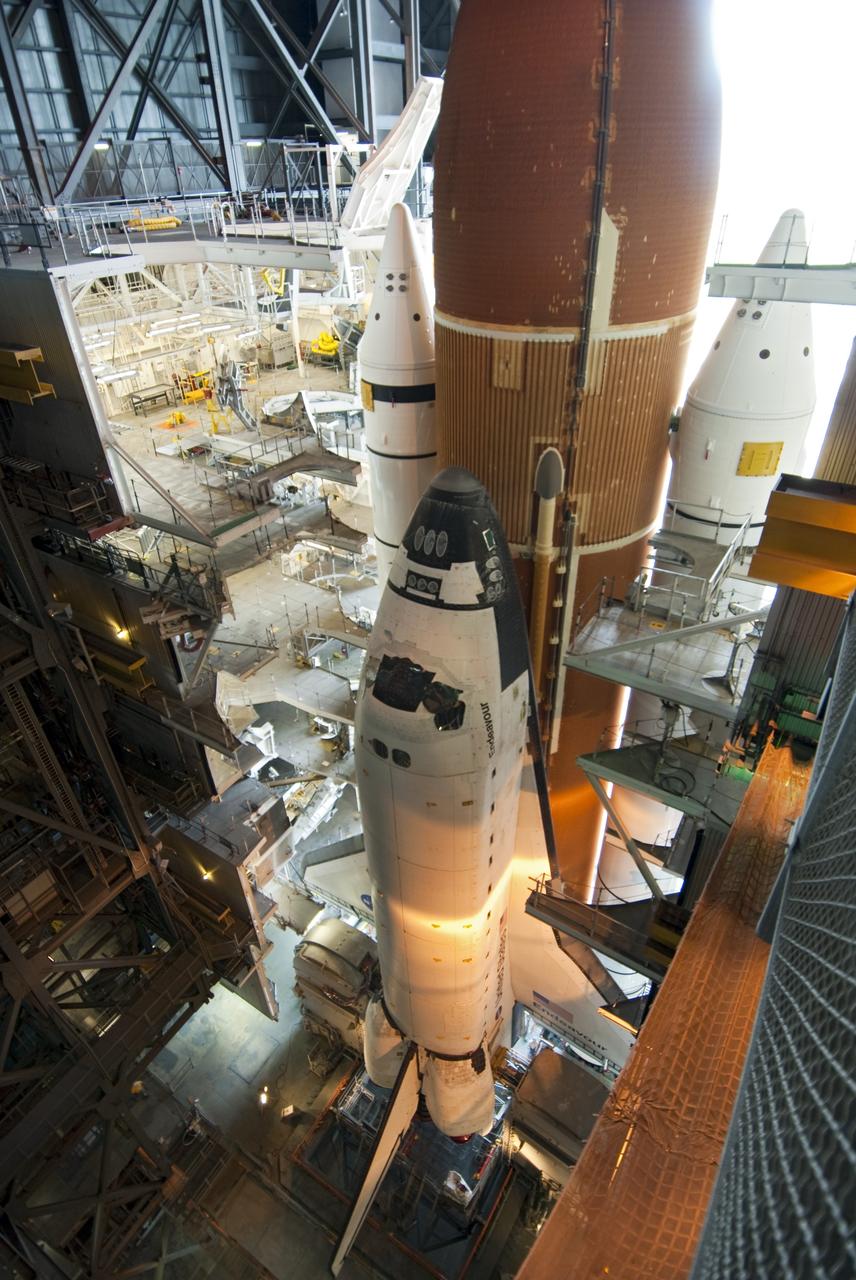
CAPE CANAVERAL, Fla. -- Space shuttle Endeavour is ready for its slow move from High Bay 3 in the Vehicle Assembly Building to Launch Pad 39A at NASA's Kennedy Space Center in Florida. The 3.4-mile trek, known as "rollout," will take about seven hours to complete. This is the final scheduled rollout for Endeavour, which is attached to its external fuel tank and solid rocket boosters atop a crawler-transporter. Endeavour and its six STS-134 crew members will deliver the Express Logistics Carrier-3, Alpha Magnetic Spectrometer-2 (AMS), a high-pressure gas tank, additional spare parts for the Dextre robotic helper and micrometeoroid debris shields to the International Space Station on the shuttle's final spaceflight. Launch is targeted for April 19 at 7:48 p.m. EDT. For more information visit, www.nasa.gov/mission_pages/shuttle/shuttlemissions/sts134/index.html. Photo credit: NASA/Jim Grossmann
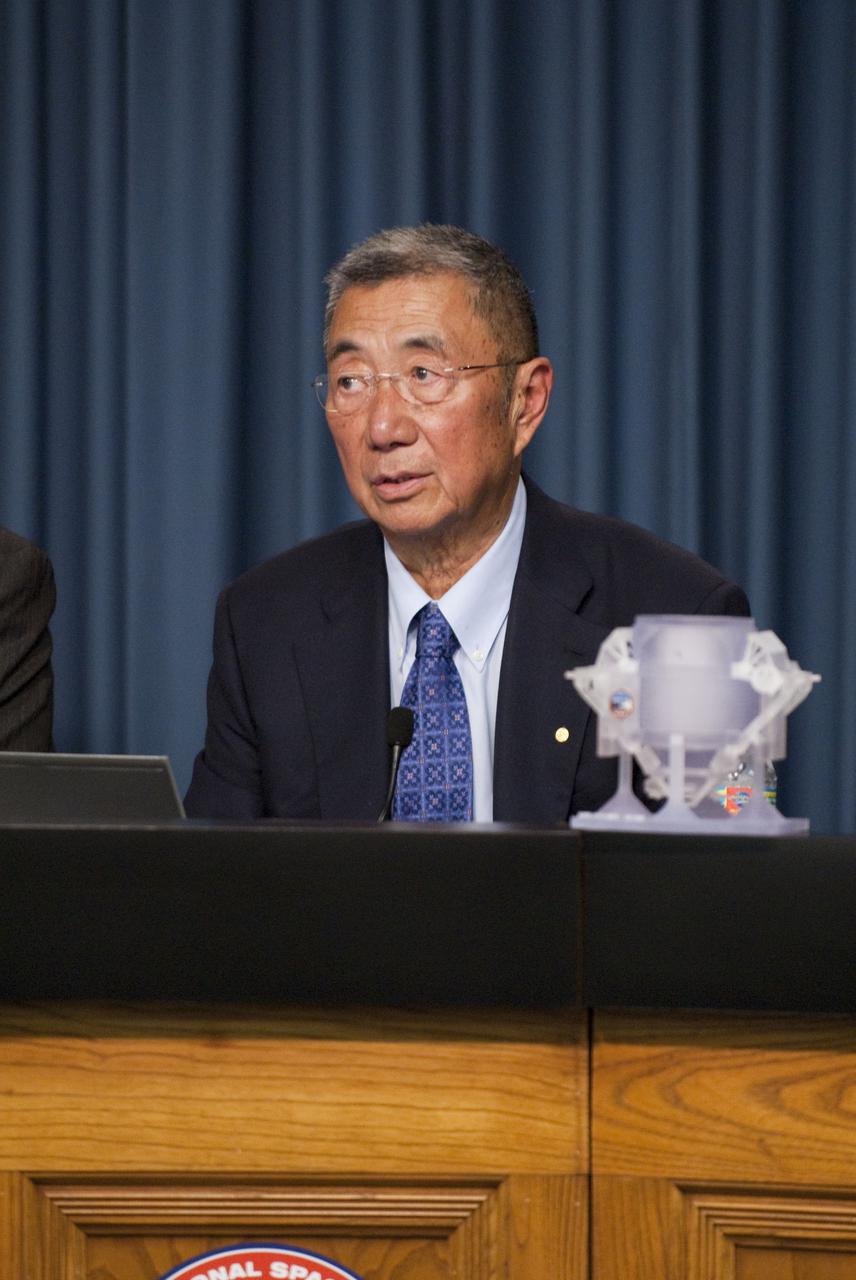
CAPE CANAVERAL, Fla. -- The International Space Station Science and Technology Briefing was held in the Press Site auditorium at NASA's Kennedy Space Center in Florida. Speaking to media about the Alpha Magnetic Spectrometer-2 (AMS) is Professor Sam Ting, AMS-2 principal investigator at the Massachusetts Institute of Technology. Endeavour and its crew will deliver the Express Logistics Carrier-3, Alpha Magnetic Spectrometer-2 (AMS), a high-pressure gas tank and additional spare parts for the Dextre robotic helper to the International Space Station. Launch is scheduled for April 29 at 3:47 p.m. EDT. This will be the final spaceflight for Endeavour. For more information visit, www.nasa.gov_mission_pages_shuttle_shuttlemissions_sts134_index.html. Photo credit: NASA_Kim Shiflett
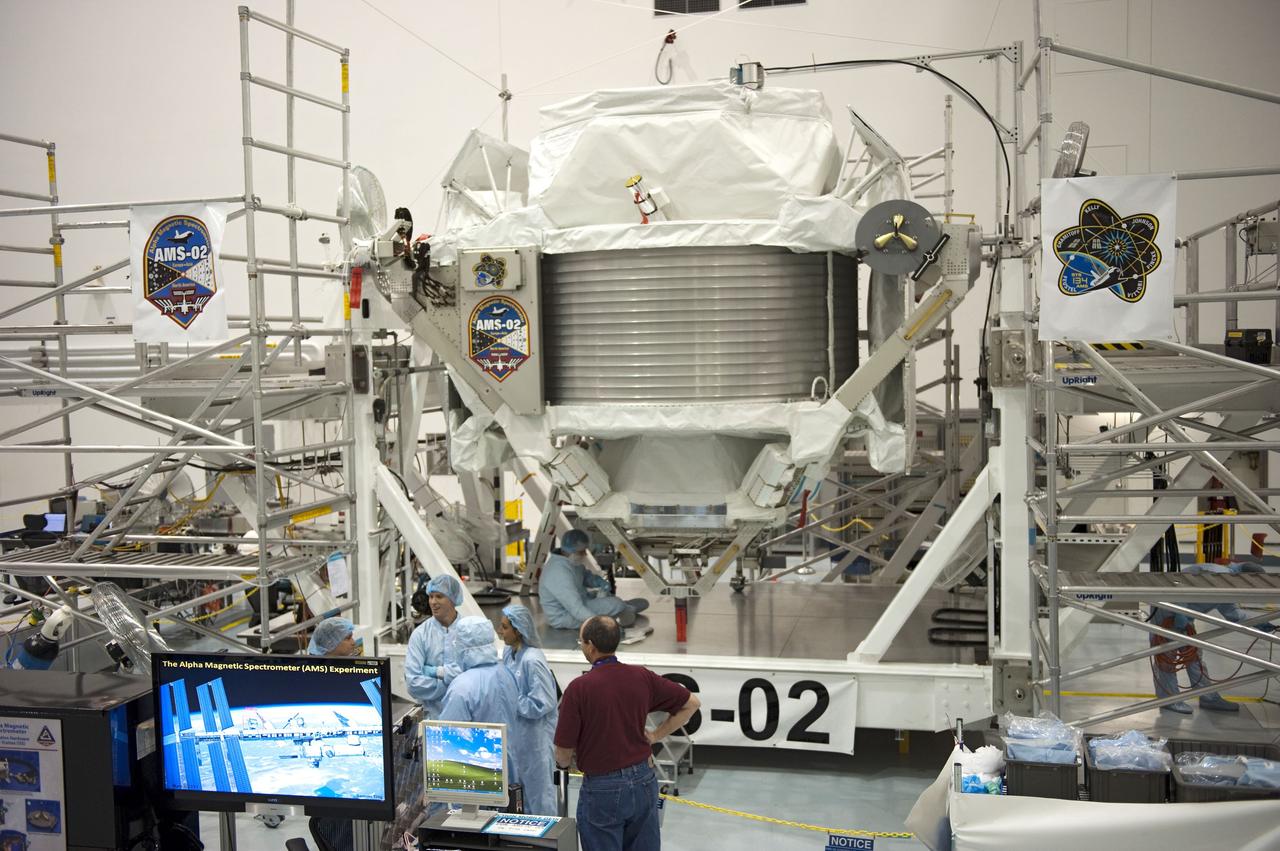
CAPE CANAVERAL, Fla. -- In the Space Station Processing Facility at NASA's Kennedy Space Center in Florida, processing continues for the Alpha Magnetic Spectrometer-2 (AMS). AMS is a particle physics detector, designed to operate as an external experiment on the International Space Station. It will use the unique environment of space to study the universe and its origin by searching for dark matter. AMS-2 will fly to the station aboard space shuttle Endeavour's STS-134 mission targeted to launch April 19 at 7:48 p.m. EDT. For more information visit, www.nasa.gov/mission_pages/shuttle/shuttlemissions/sts134/index.html. Photo credit: NASA/Glenn Benson
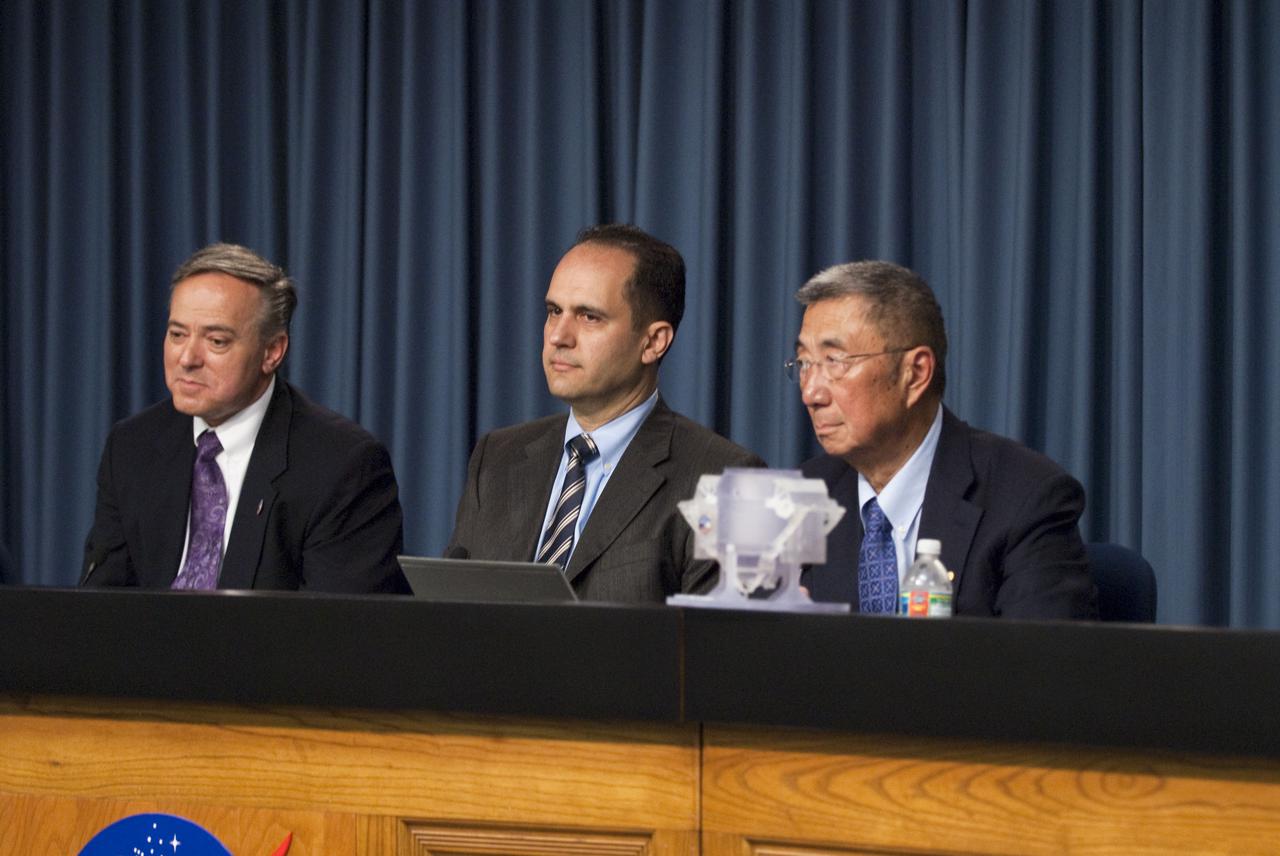
CAPE CANAVERAL, Fla. -- The International Space Station Science and Technology Briefing was held in the Press Site auditorium at NASA's Kennedy Space Center in Florida. Speaking to media about the Alpha Magnetic Spectrometer-2 (AMS) are Mark Sistilli, NASA program manager (left); Saul Gonzales, AMS program manager from the U.S. Department of Energy and Professor Sam Ting, AMS-2 principal investigator at the Massachusetts Institute of Technology.Endeavour and its crew will deliver the Express Logistics Carrier-3, Alpha Magnetic Spectrometer-2 (AMS), a high-pressure gas tank and additional spare parts for the Dextre robotic helper to the International Space Station. Launch is scheduled for April 29 at 3:47 p.m. EDT. This will be the final spaceflight for Endeavour. For more information visit, www.nasa.gov_mission_pages_shuttle_shuttlemissions_sts134_index.html. Photo credit: NASA_Kim Shiflett
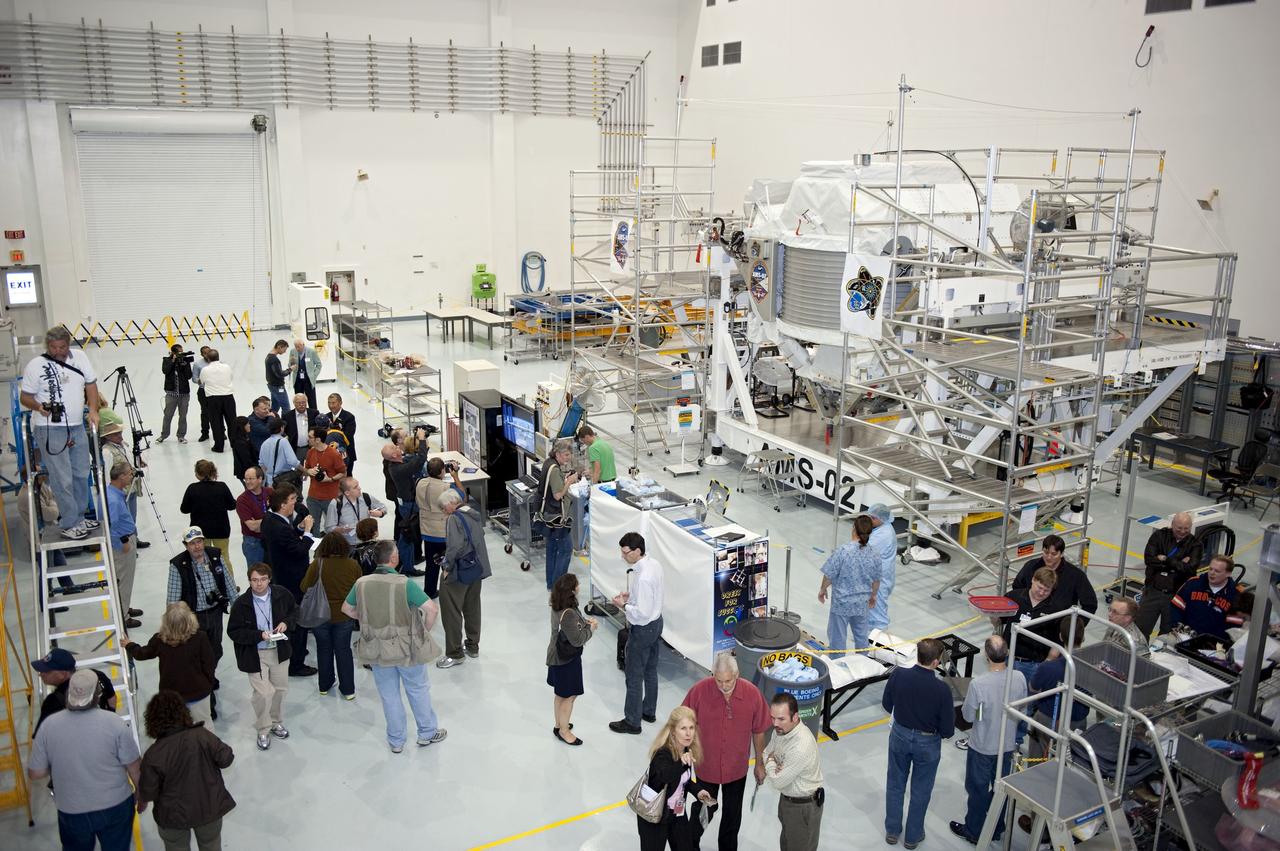
CAPE CANAVERAL, Fla. -- In the Space Station Processing Facility at NASA's Kennedy Space Center in Florida, media check out the Alpha Magnetic Spectrometer-2 (AMS). AMS is a particle physics detector, designed to operate as an external experiment on the International Space Station. It will use the unique environment of space to study the universe and its origin by searching for dark matter. AMS-2 will fly to the station aboard space shuttle Endeavour's STS-134 mission targeted to launch April 19 at 7:48 p.m. EDT. For more information visit, www.nasa.gov/mission_pages/shuttle/shuttlemissions/sts134/index.html. Photo credit: NASA/Glenn Benson
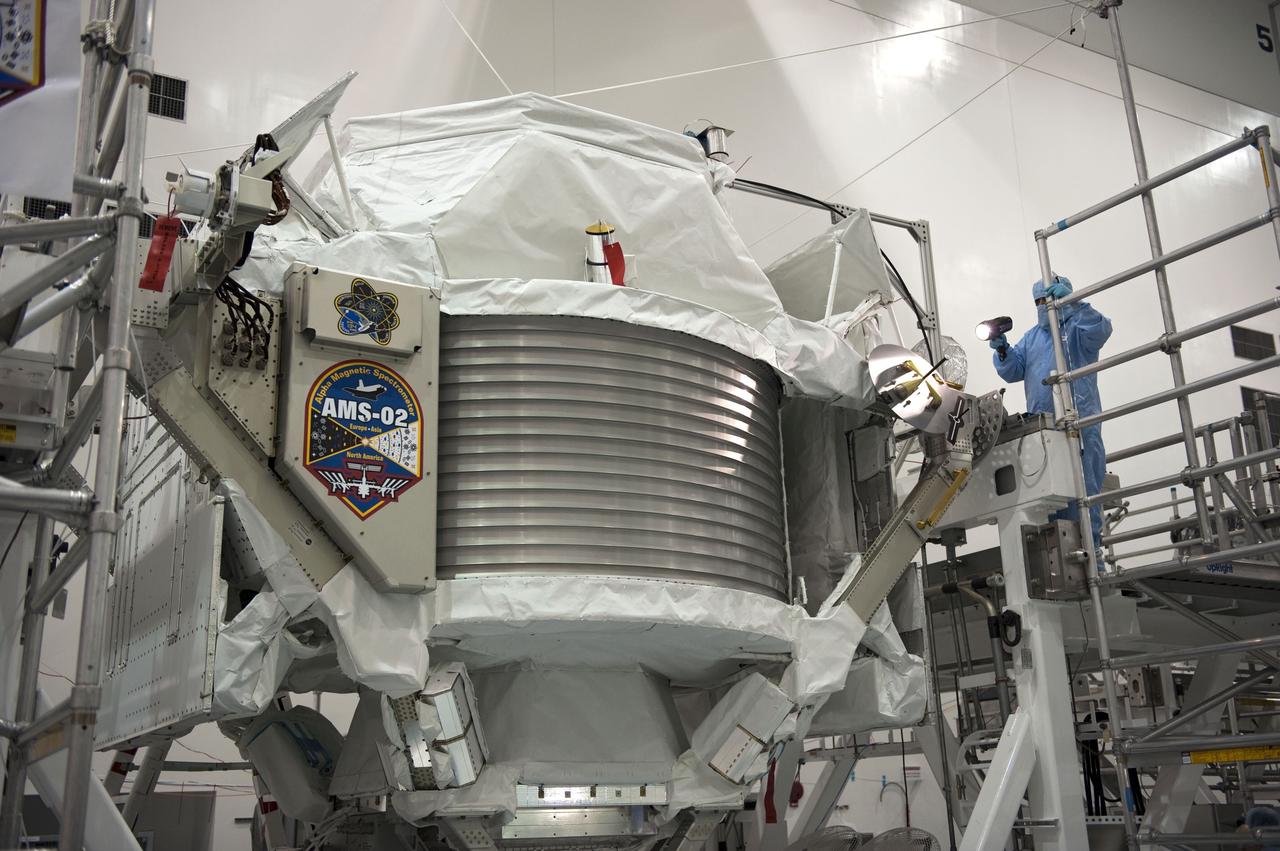
CAPE CANAVERAL, Fla. -- In the Space Station Processing Facility at NASA's Kennedy Space Center in Florida, processing continues for the Alpha Magnetic Spectrometer-2 (AMS). AMS is a particle physics detector, designed to operate as an external experiment on the International Space Station. It will use the unique environment of space to study the universe and its origin by searching for dark matter. AMS-2 will fly to the station aboard space shuttle Endeavour's STS-134 mission targeted to launch April 19 at 7:48 p.m. EDT. For more information visit, www.nasa.gov/mission_pages/shuttle/shuttlemissions/sts134/index.html. Photo credit: NASA/Glenn Benson
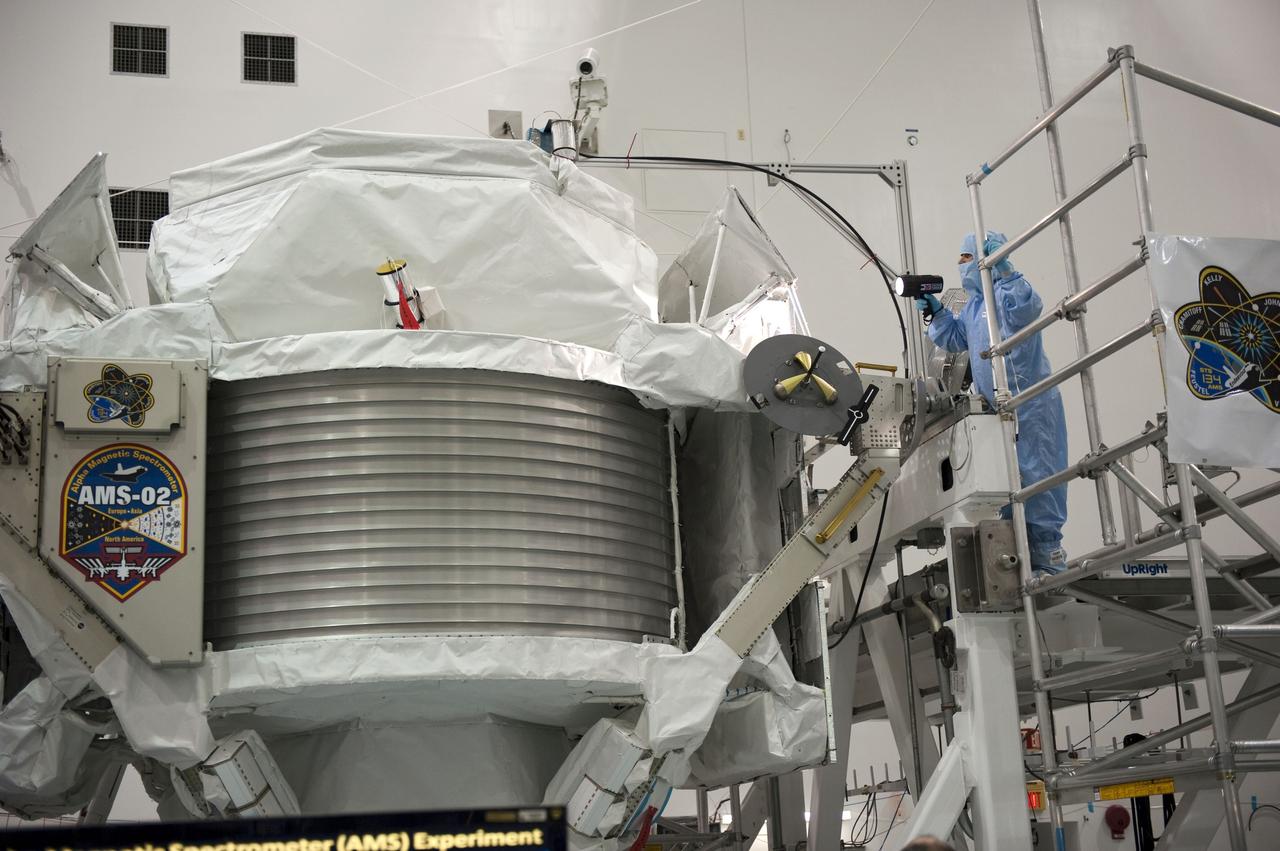
CAPE CANAVERAL, Fla. -- In the Space Station Processing Facility at NASA's Kennedy Space Center in Florida, processing continues for the Alpha Magnetic Spectrometer-2 (AMS). AMS is a particle physics detector, designed to operate as an external experiment on the International Space Station. It will use the unique environment of space to study the universe and its origin by searching for dark matter. AMS-2 will fly to the station aboard space shuttle Endeavour's STS-134 mission targeted to launch April 19 at 7:48 p.m. EDT. For more information visit, www.nasa.gov/mission_pages/shuttle/shuttlemissions/sts134/index.html. Photo credit: NASA/Glenn Benson
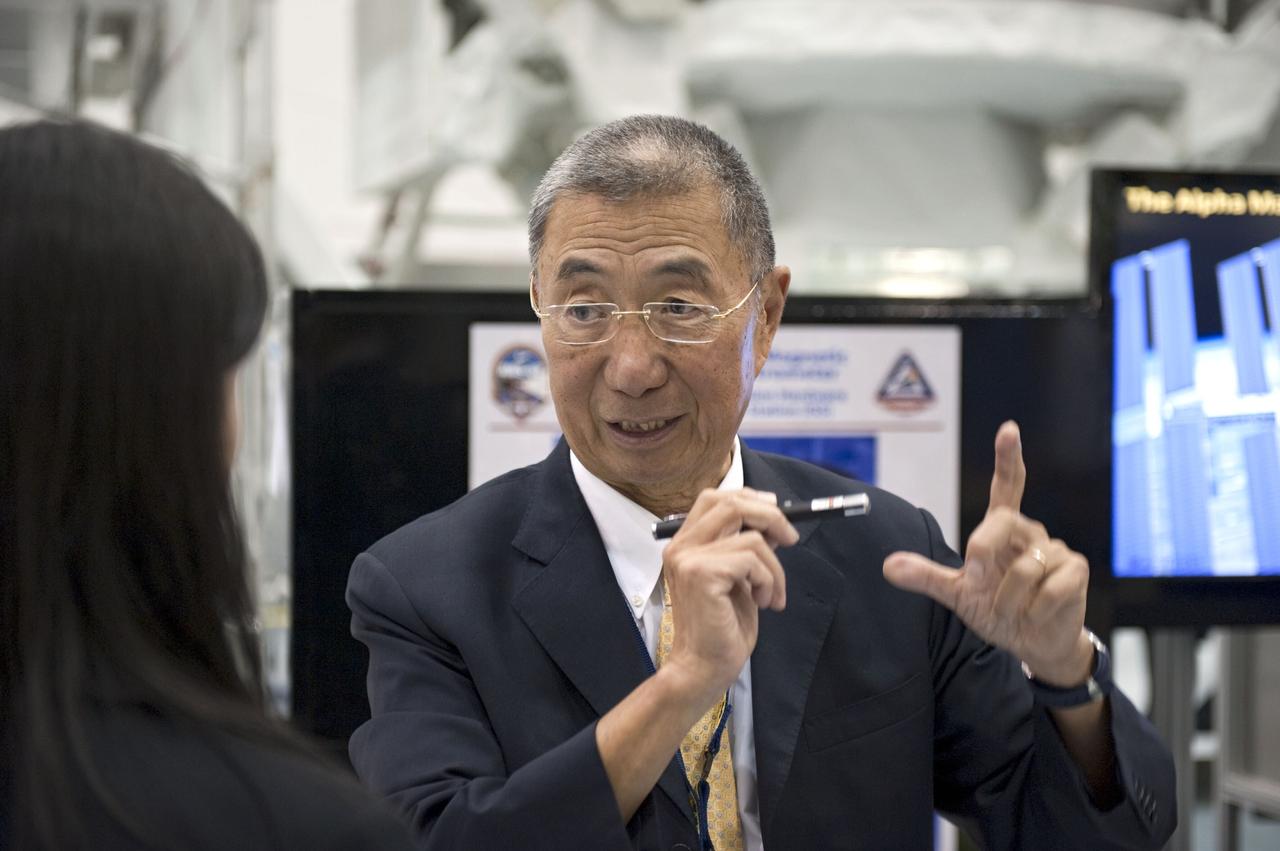
CAPE CANAVERAL, Fla. -- In the Space Station Processing Facility at NASA's Kennedy Space Center in Florida Professor Sam Ting, Alpha Magnetic Spectrometer-2 (AMS) principal investigator at the Massachusetts Institute of Technology, talks to media about the particle physics detector. AMS is designed to operate as an external experiment on the International Space Station. It will use the unique environment of space to study the universe and its origin by searching for dark matter. AMS-2 will fly to the station aboard space shuttle Endeavour's STS-134 mission targeted to launch April 19 at 7:48 p.m. EDT. For more information visit, www.nasa.gov/mission_pages/shuttle/shuttlemissions/sts134/index.html. Photo credit: NASA/Glenn Benson
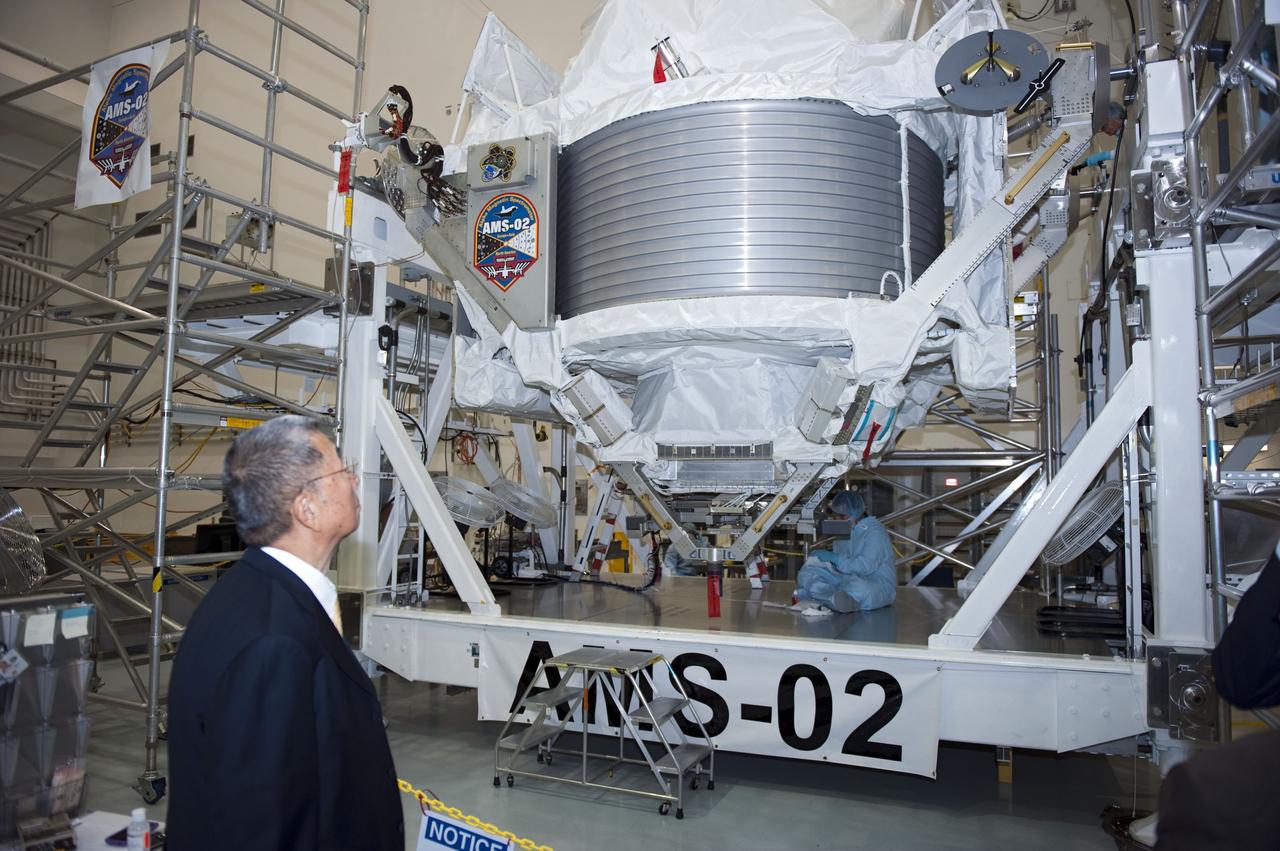
CAPE CANAVERAL, Fla. -- In the Space Station Processing Facility at NASA's Kennedy Space Center in Florida, Professor Sam Ting, Alpha Magnetic Spectrometer-2 (AMS) principal investigator at the Massachusetts Institute of Technology, checks out the particle physics detector. AMS is designed to operate as an external experiment on the International Space Station. It will use the unique environment of space to study the universe and its origin by searching for dark matter. AMS-2 will fly to the station aboard space shuttle Endeavour's STS-134 mission targeted to launch April 19 at 7:48 p.m. EDT. For more information visit, www.nasa.gov/mission_pages/shuttle/shuttlemissions/sts134/index.html. Photo credit: NASA/Glenn Benson
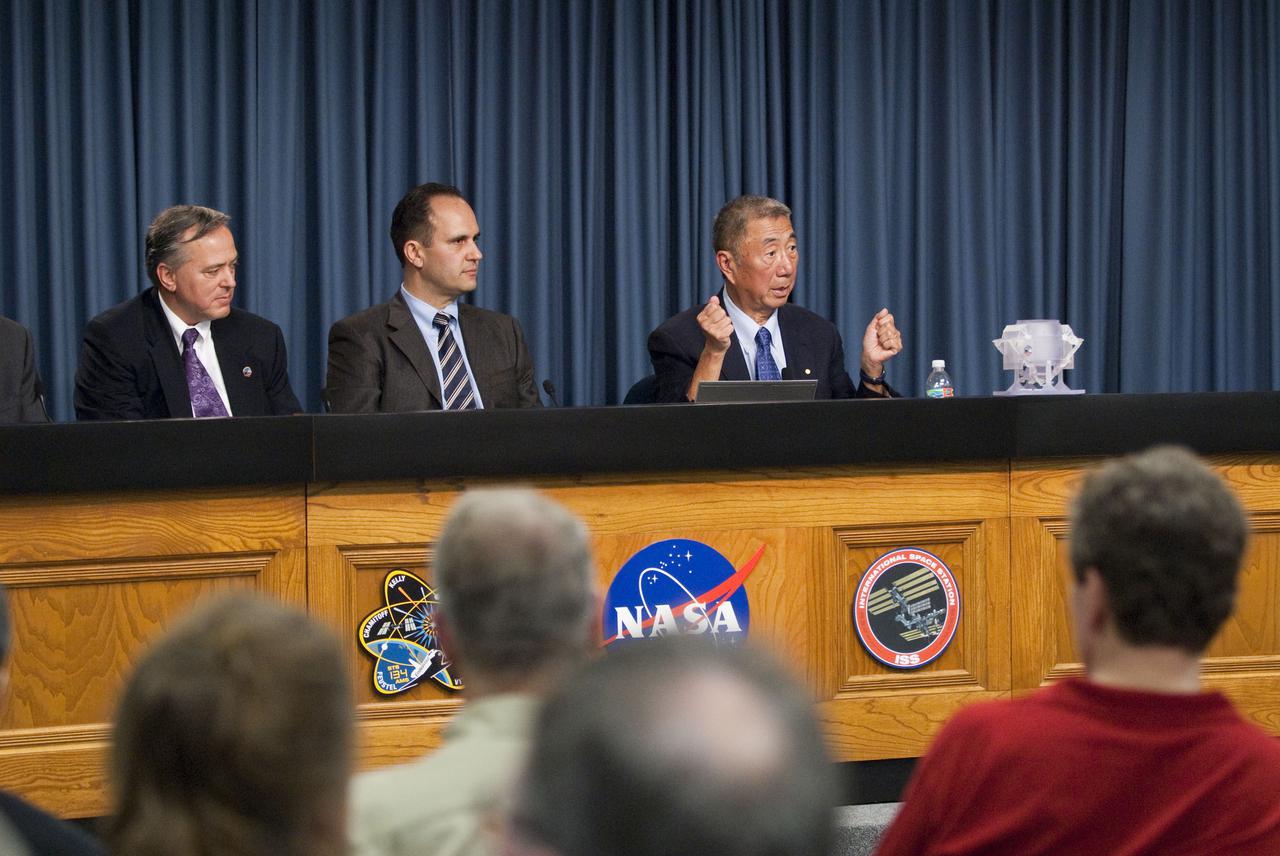
CAPE CANAVERAL, Fla. -- The International Space Station Science and Technology Briefing was held in the Press Site auditorium at NASA's Kennedy Space Center in Florida. Speaking to media about the Alpha Magnetic Spectrometer-2 (AMS) are Mark Sistilli, NASA program manager (left); Saul Gonzales, AMS program manager from the U.S. Department of Energy and Professor Sam Ting, AMS-2 principal investigator at the Massachusetts Institute of Technology. Endeavour and its crew will deliver the Express Logistics Carrier-3, Alpha Magnetic Spectrometer-2 (AMS), a high-pressure gas tank and additional spare parts for the Dextre robotic helper to the International Space Station. Launch is scheduled for April 29 at 3:47 p.m. EDT. This will be the final spaceflight for Endeavour. For more information visit, www.nasa.gov_mission_pages_shuttle_shuttlemissions_sts134_index.html. Photo credit: NASA_Kim Shiflett
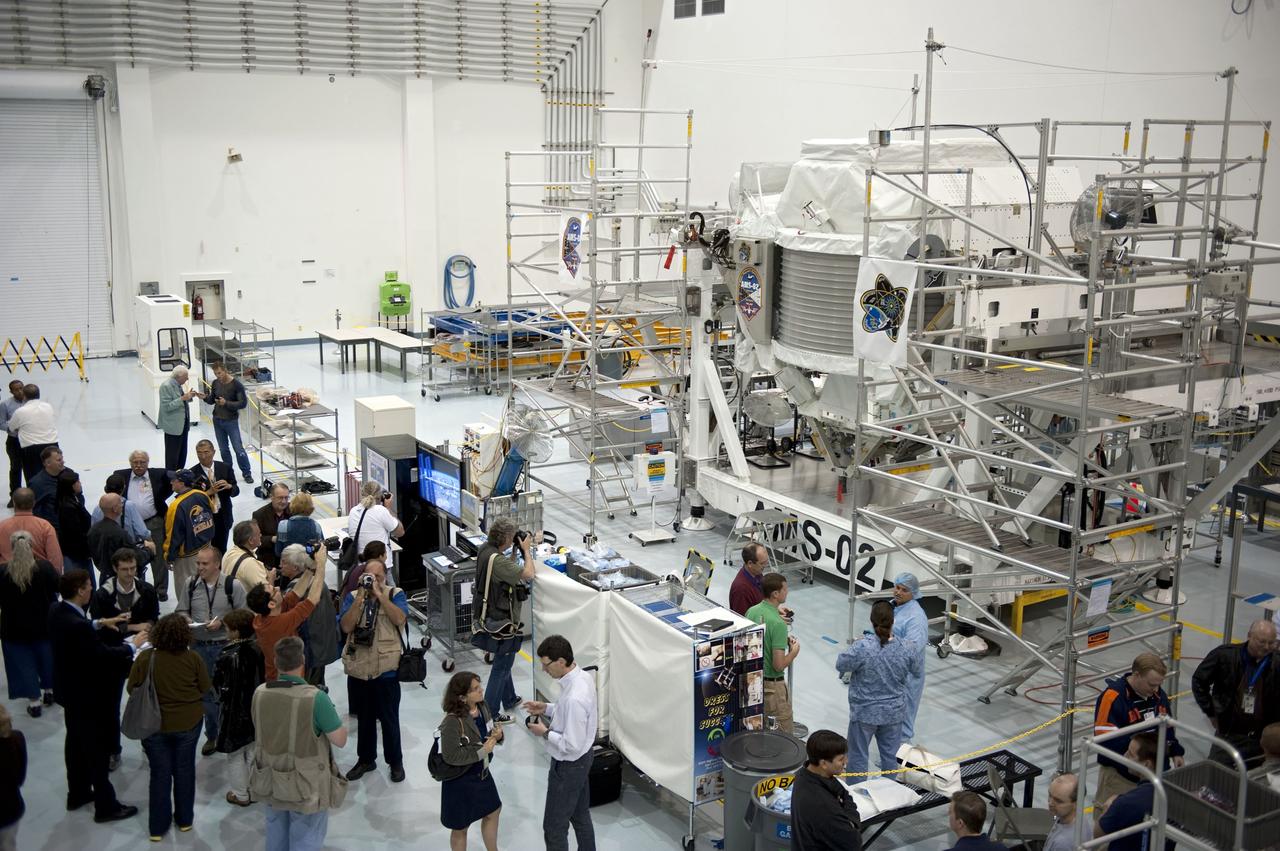
CAPE CANAVERAL, Fla. -- In the Space Station Processing Facility at NASA's Kennedy Space Center in Florida, media check out the Alpha Magnetic Spectrometer-2 (AMS). AMS is a particle physics detector, designed to operate as an external experiment on the International Space Station. It will use the unique environment of space to study the universe and its origin by searching for dark matter. AMS-2 will fly to the station aboard space shuttle Endeavour's STS-134 mission targeted to launch April 19 at 7:48 p.m. EDT. For more information visit, www.nasa.gov/mission_pages/shuttle/shuttlemissions/sts134/index.html. Photo credit: NASA/Glenn Benson
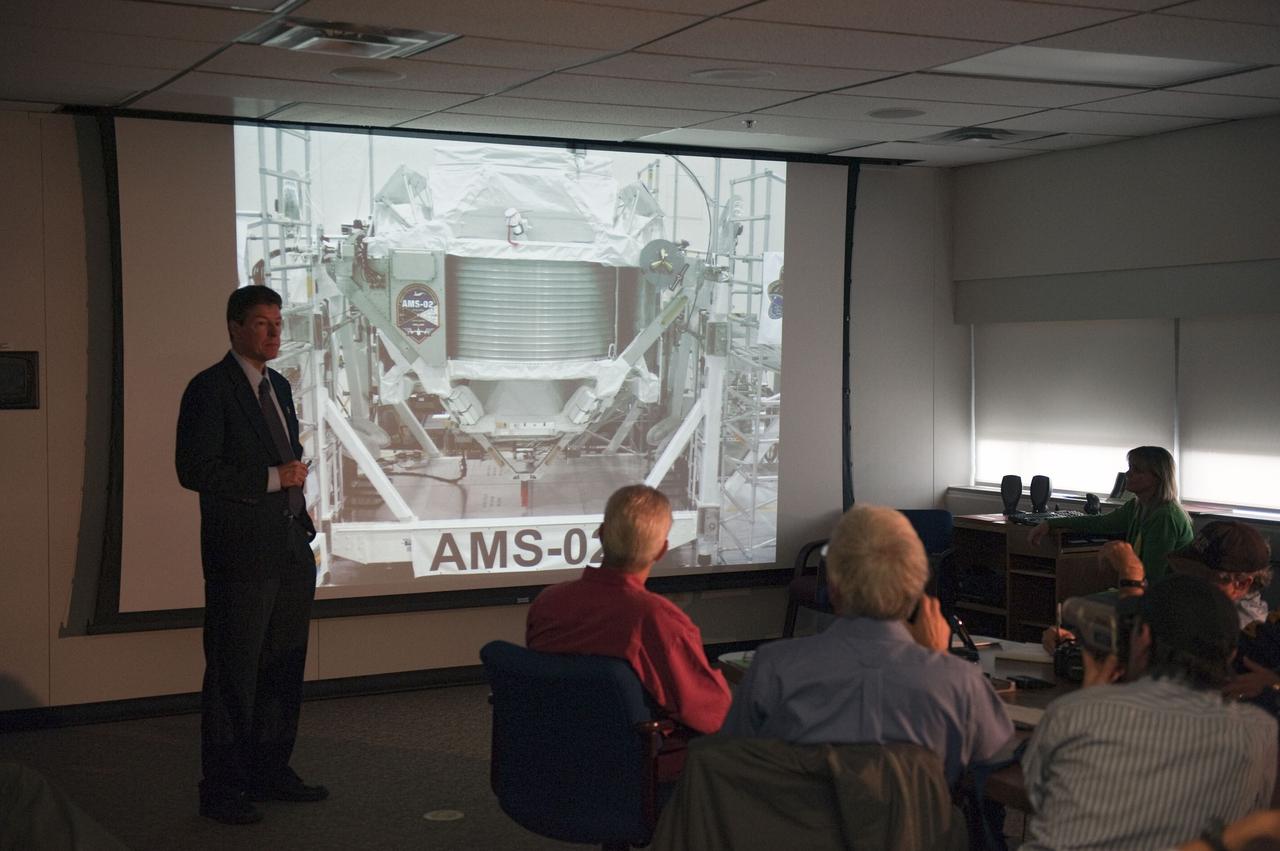
CAPE CANAVERAL, Fla. -- In the Space Station Processing Facility's conference room at NASA's Kennedy Space Center in Florida, Ken Bollweg, Alpha Magnetic Spectrometer-2 (AMS) deputy project manager, talks to media about the particle physics detector. AMS is designed to operate as an external experiment on the International Space Station. It will use the unique environment of space to study the universe and its origin by searching for dark matter. AMS-2 will fly to the station aboard space shuttle Endeavour's STS-134 mission targeted to launch April 19 at 7:48 p.m. EDT. For more information visit, www.nasa.gov/mission_pages/shuttle/shuttlemissions/sts134/index.html. Photo credit: NASA/Glenn Benson
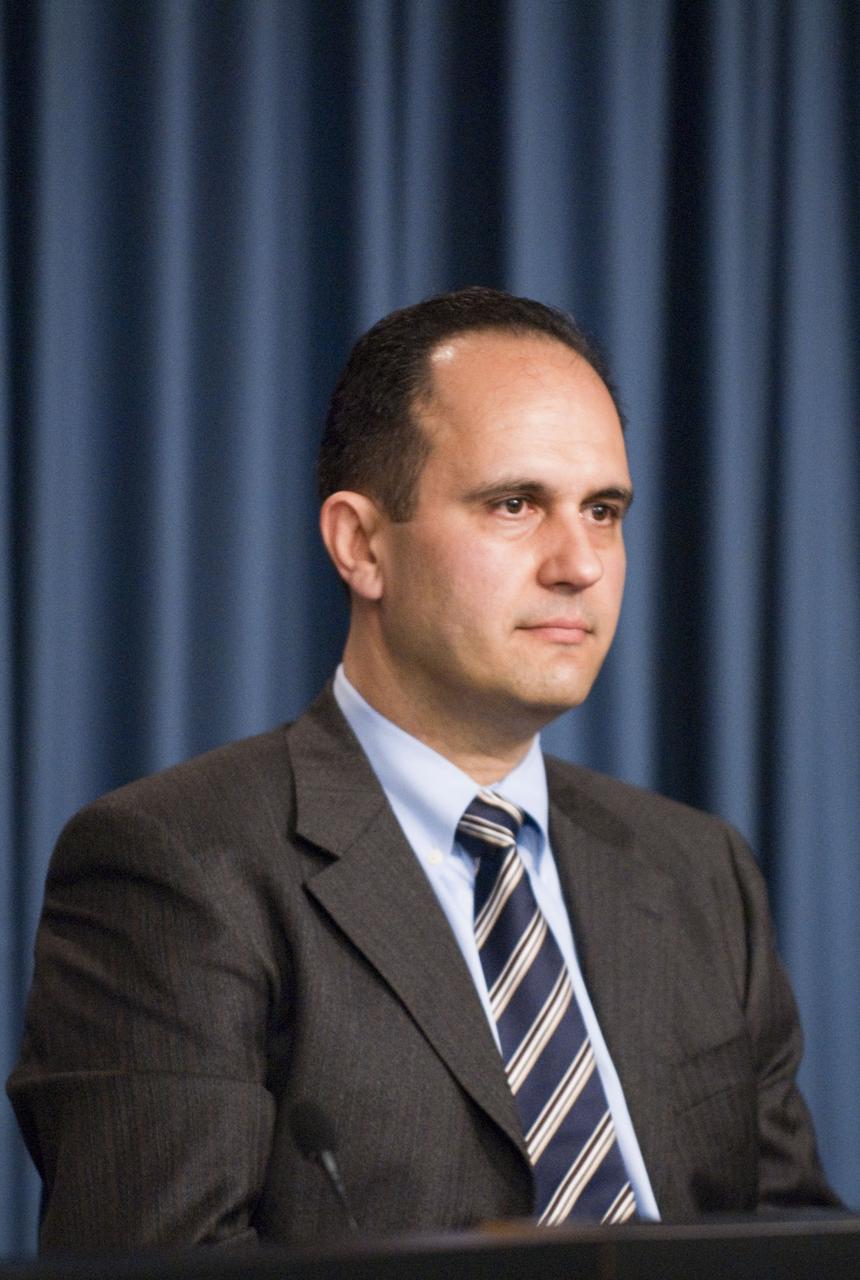
CAPE CANAVERAL, Fla. -- The International Space Station Science and Technology Briefing was held in the Press Site auditorium at NASA's Kennedy Space Center in Florida. Speaking to media about the Alpha Magnetic Spectrometer-2 (AMS) is Saul Gonzales, AMS program manager from the U.S. Department of Energy. Endeavour and its crew will deliver the Express Logistics Carrier-3, Alpha Magnetic Spectrometer-2 (AMS), a high-pressure gas tank and additional spare parts for the Dextre robotic helper to the International Space Station. Launch is scheduled for April 29 at 3:47 p.m. EDT. This will be the final spaceflight for Endeavour. For more information visit, www.nasa.gov_mission_pages_shuttle_shuttlemissions_sts134_index.html. Photo credit: NASA_Kim Shiflett

CAPE CANAVERAL, Fla. -- Space shuttle Endeavour is ready for its slow move from High Bay 3 in the Vehicle Assembly Building to Launch Pad 39A at NASA's Kennedy Space Center in Florida. The 3.4-mile trek, known as "rollout," will take about seven hours to complete. This is the final scheduled rollout for Endeavour, which is attached to its external fuel tank and solid rocket boosters atop a crawler-transporter. Endeavour and its six STS-134 crew members will deliver the Express Logistics Carrier-3, Alpha Magnetic Spectrometer-2 (AMS), a high-pressure gas tank, additional spare parts for the Dextre robotic helper and micrometeoroid debris shields to the International Space Station on the shuttle's final spaceflight. Launch is targeted for April 19 at 7:48 p.m. EDT. For more information visit, www.nasa.gov/mission_pages/shuttle/shuttlemissions/sts134/index.html. Photo credit: NASA/Jim Grossmann
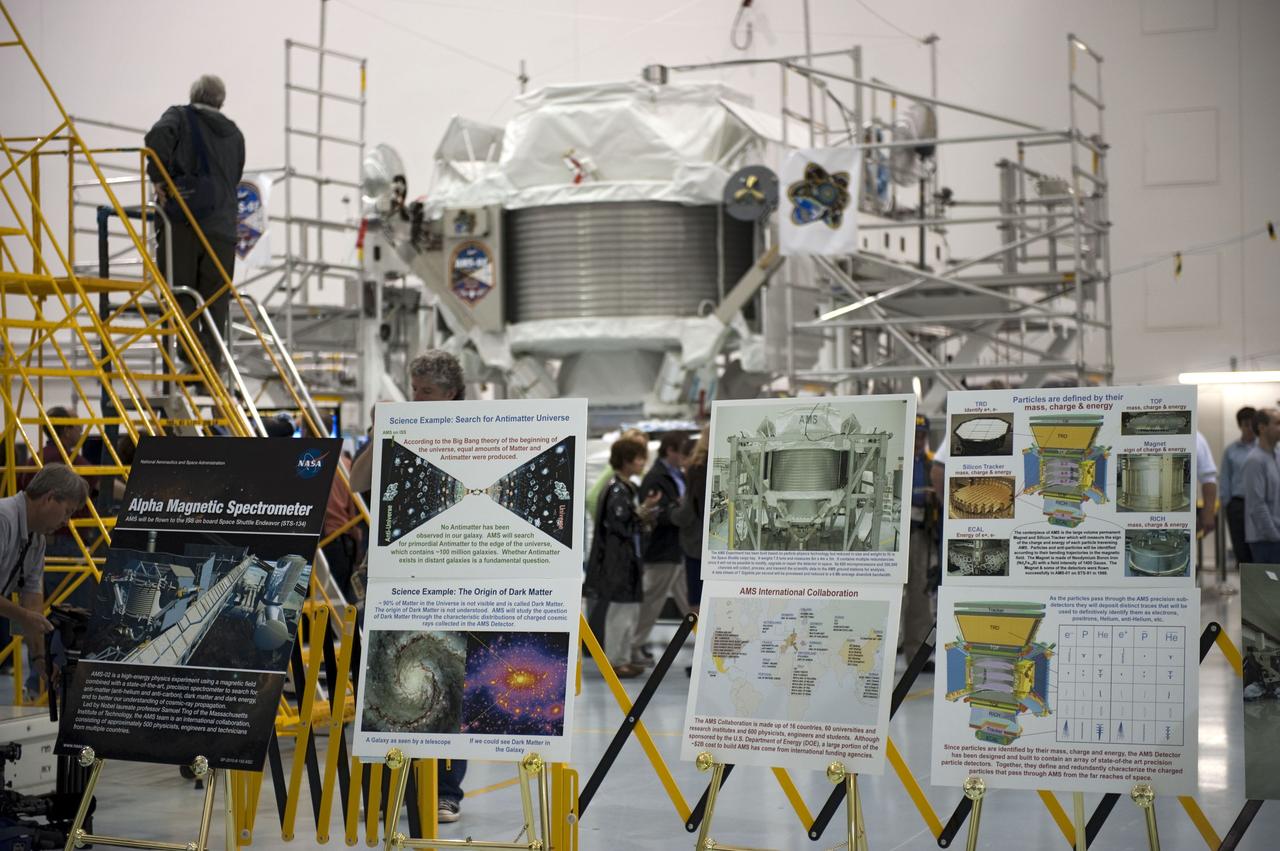
CAPE CANAVERAL, Fla. -- In the Space Station Processing Facility at NASA's Kennedy Space Center in Florida, media check out and learn more about the Alpha Magnetic Spectrometer-2 (AMS). AMS is a particle physics detector, designed to operate as an external experiment on the International Space Station. It will use the unique environment of space to study the universe and its origin by searching for dark matter. AMS-2 will fly to the station aboard space shuttle Endeavour's STS-134 mission targeted to launch April 19 at 7:48 p.m. EDT. For more information visit, www.nasa.gov/mission_pages/shuttle/shuttlemissions/sts134/index.html. Photo credit: NASA/Glenn Benson

CAPE CANAVERAL, Fla. -- Crews move the primary payload for space shuttle Endeavour's STS-134 mission into the Payload Changeout Room on Launch Pad 39A at NASA's Kennedy Space Center in Florida. The Alpha Magnetic Spectrometer-2 (AMS) and Express Logistics Carrier-3 are scheduled to be installed into the shuttle's cargo bay March 25. Endeavour and its six-member STS-134 crew are targeted to lift off April 19 at 7:48 p.m. EDT to deliver the payload to the International Space Station. This is Endeavour's final scheduled mission. For more information visit, www.nasa.gov/mission_pages/shuttle/shuttlemissions/sts134/index.html. Photo credit: NASA
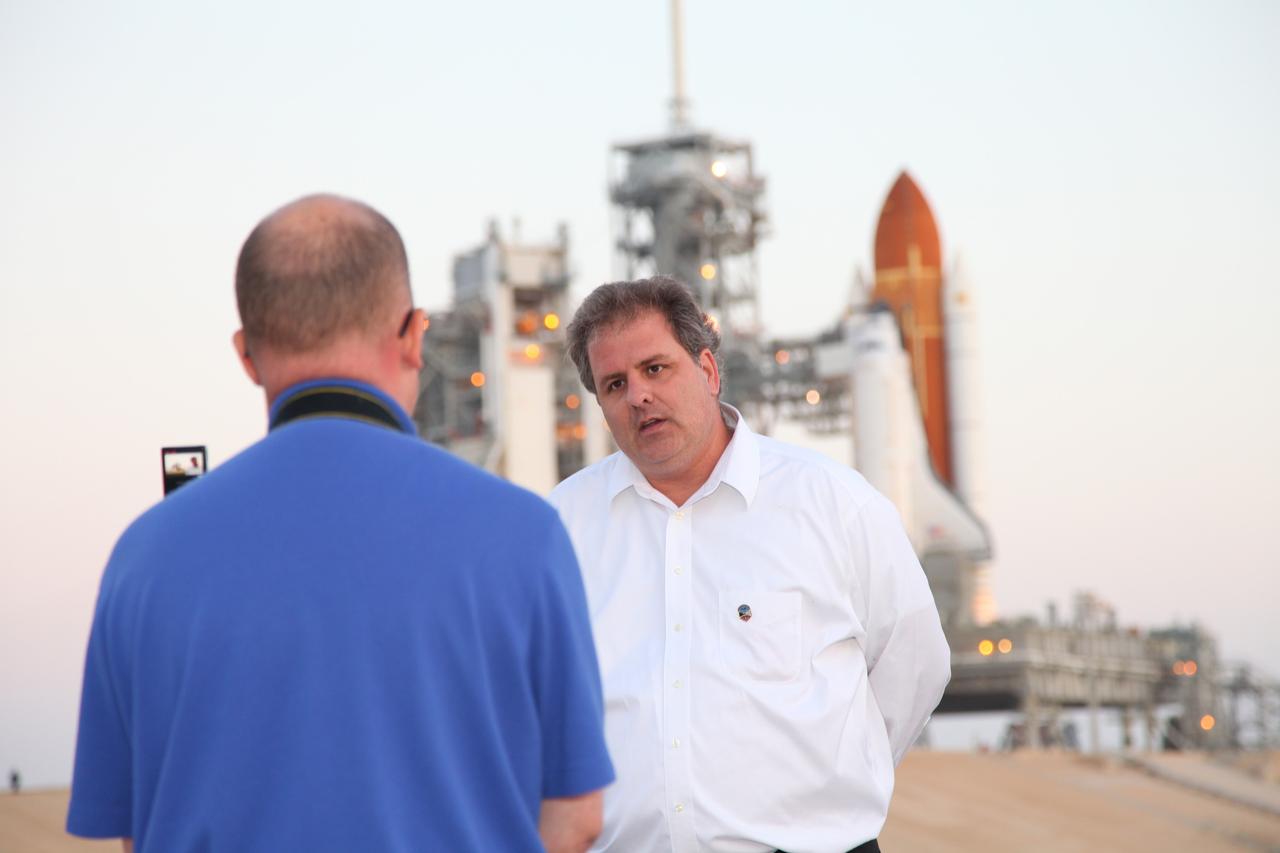
CAPE CANAVERAL, Fla. -- STS-134 Payloads Mission Manager Joe Delai talks to media with space shuttle Endeavour and its primary payload in the background on Launch Pad 39A at NASA's Kennedy Space Center in Florida. The Alpha Magnetic Spectrometer-2 (AMS) and Express Logistics Carrier-3 are scheduled to be installed into the shuttle's cargo bay March 25. Endeavour and its six-member STS-134 crew are targeted to lift off April 19 at 7:48 p.m. EDT to deliver the payload to the International Space Station. This is Endeavour's final scheduled mission. For more information visit, www.nasa.gov/mission_pages/shuttle/shuttlemissions/sts134/index.html. Photo credit: NASA/Frankie Martin
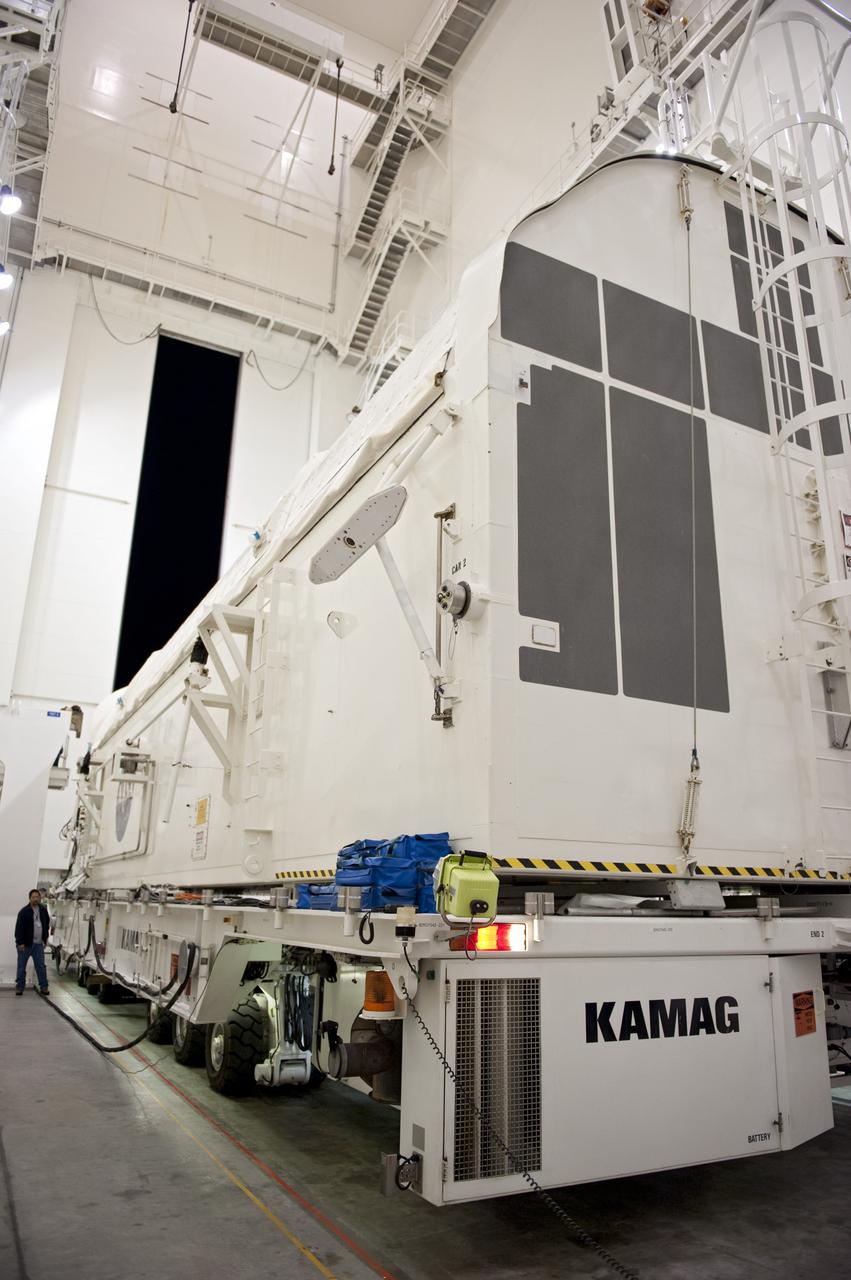
CAPE CANAVERAL, Fla. -- A canister, carrying the Alpha Magnetic Spectrometer-2 AMS and Express Logistics Carrier-3 for space shuttle Endeavour's STS-134 mission, enters the Canister Rotation Facility from the Space Station Processing Facility at NASA's Kennedy Space Center in Florida. There, the canister that protects the space-bound payload will be rotated from a horizontal to vertical position so that it can be installed into Endeavour's payload bay. AMS is a particle physics detector, designed to operate as an external experiment on the International Space Station. It will use the unique environment of space to study the universe and its origin by searching for dark matter. AMS-2 will fly to the station aboard Endeavour's STS-134 mission targeted to launch April 19 at 7:48 p.m. EDT. For more information visit, www.nasa.gov/mission_pages/shuttle/shuttlemissions/sts134/index.html. Photo credit: NASA/Kim Shiflett
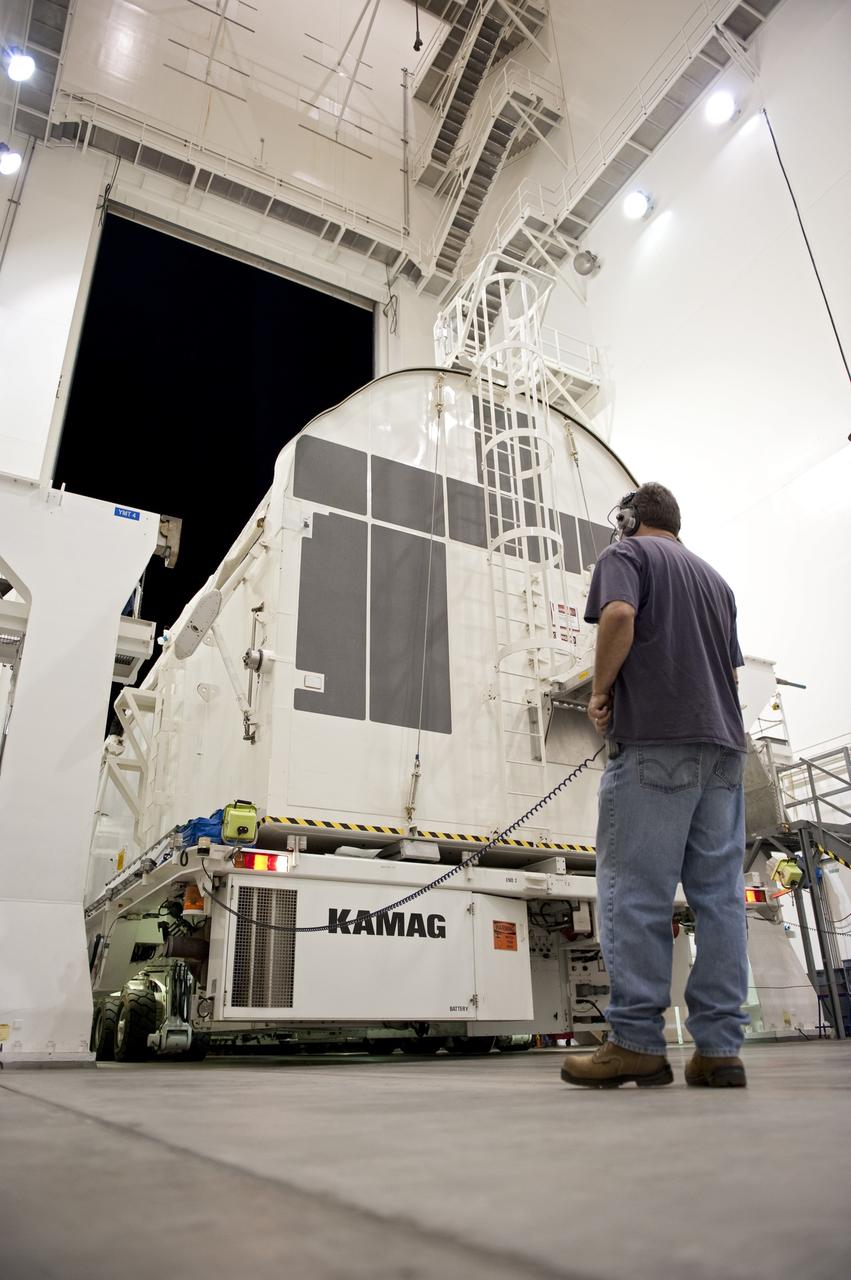
CAPE CANAVERAL, Fla. -- A canister, carrying the Alpha Magnetic Spectrometer-2 AMS and Express Logistics Carrier-3 for space shuttle Endeavour's STS-134 mission, enters the Canister Rotation Facility from the Space Station Processing Facility at NASA's Kennedy Space Center in Florida. There, the canister that protects the space-bound payload will be rotated from a horizontal to vertical position so that it can be installed into Endeavour's payload bay. AMS is a particle physics detector, designed to operate as an external experiment on the International Space Station. It will use the unique environment of space to study the universe and its origin by searching for dark matter. AMS-2 will fly to the station aboard Endeavour's STS-134 mission targeted to launch April 19 at 7:48 p.m. EDT. For more information visit, www.nasa.gov/mission_pages/shuttle/shuttlemissions/sts134/index.html. Photo credit: NASA/Kim Shiflett
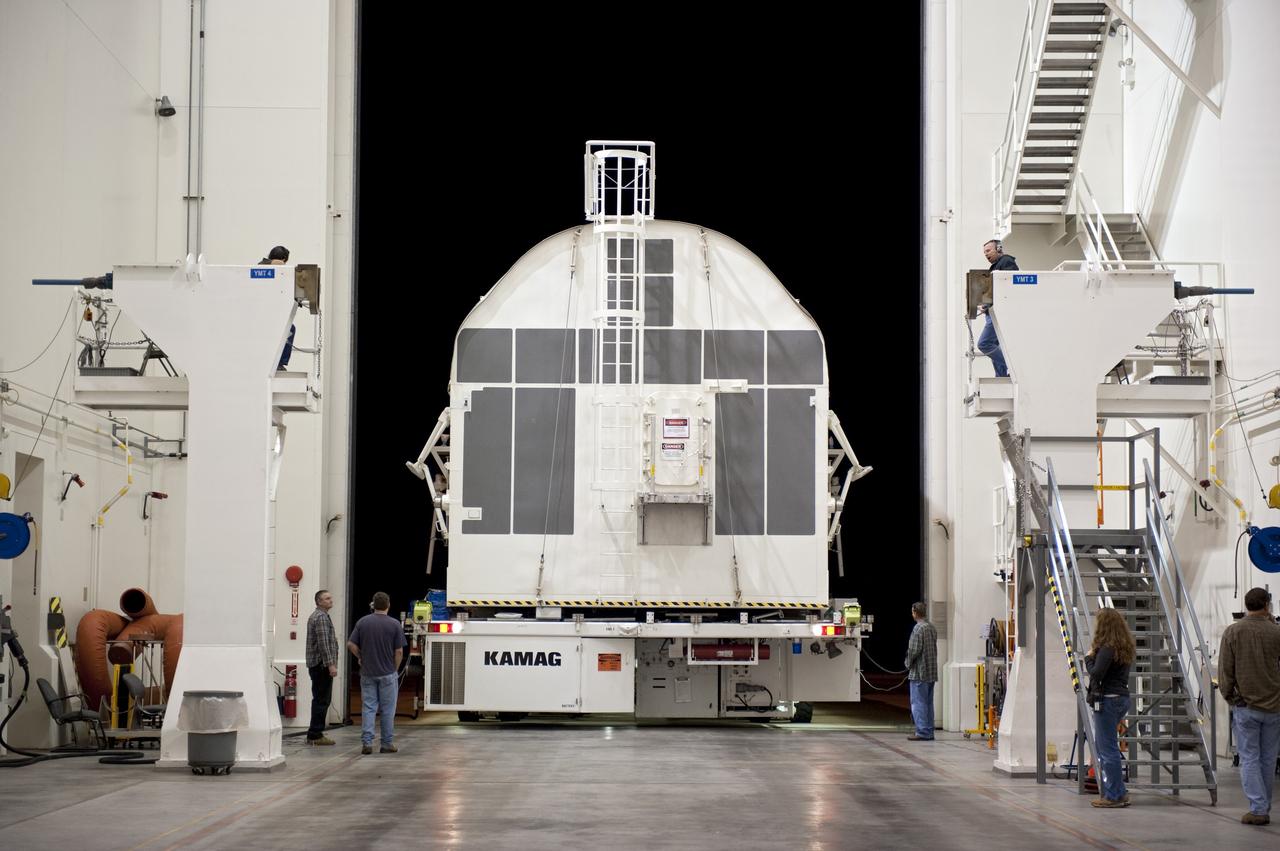
CAPE CANAVERAL, Fla. -- A canister, carrying the Alpha Magnetic Spectrometer-2 AMS and Express Logistics Carrier-3 for space shuttle Endeavour's STS-134 mission, enters the Canister Rotation Facility from the Space Station Processing Facility at NASA's Kennedy Space Center in Florida. There, the canister that protects the space-bound payload will be rotated from a horizontal to vertical position so that it can be installed into Endeavour's payload bay. AMS is a particle physics detector, designed to operate as an external experiment on the International Space Station. It will use the unique environment of space to study the universe and its origin by searching for dark matter. AMS-2 will fly to the station aboard Endeavour's STS-134 mission targeted to launch April 19 at 7:48 p.m. EDT. For more information visit, www.nasa.gov/mission_pages/shuttle/shuttlemissions/sts134/index.html. Photo credit: NASA/Kim Shiflett
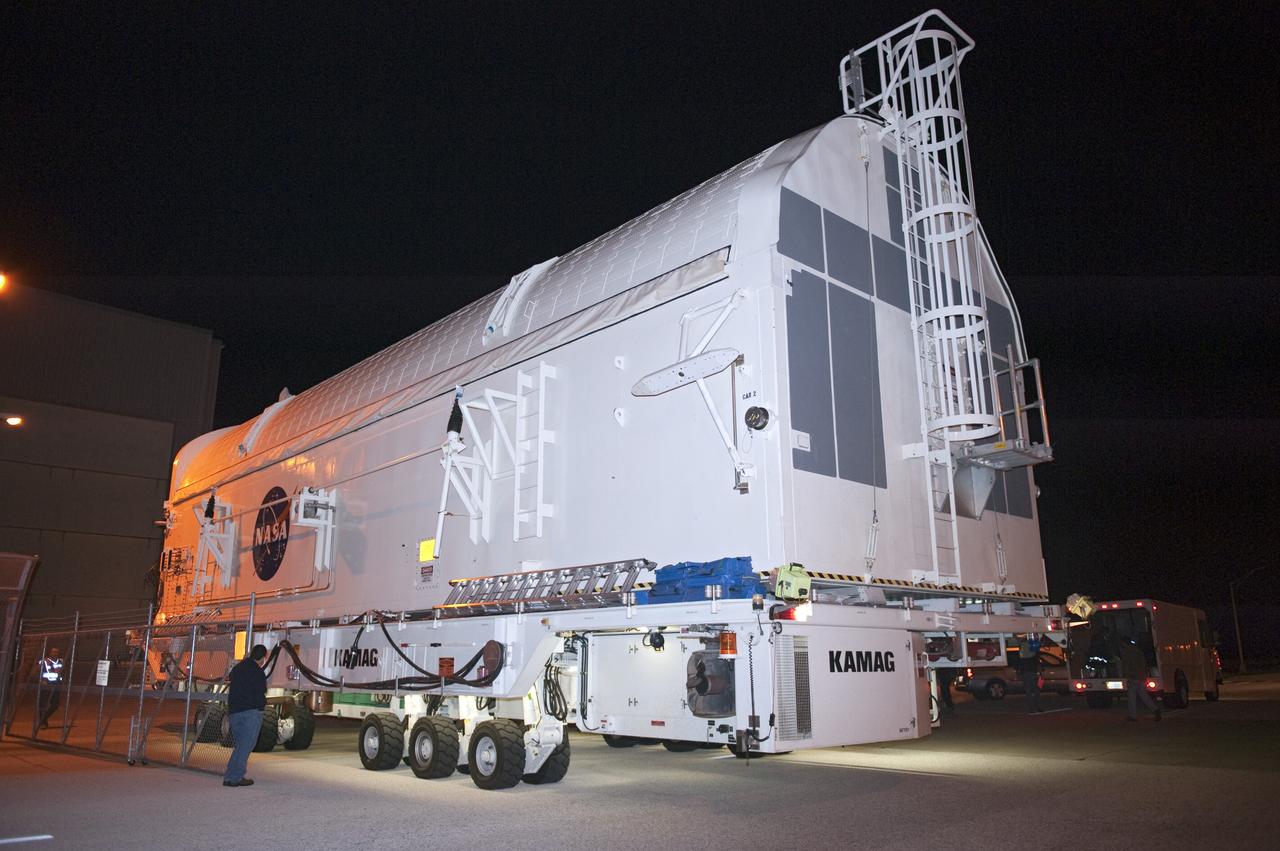
CAPE CANAVERAL, Fla. -- A canister, carrying the Alpha Magnetic Spectrometer-2 AMS and Express Logistics Carrier-3 for space shuttle Endeavour's STS-134 mission, is moved from the Space Station Processing Facility to the Canister Rotation Facility at NASA's Kennedy Space Center in Florida. There, the canister that protects the space-bound payload will be rotated from a horizontal to vertical position so that it can be installed into Endeavour's payload bay. AMS is a particle physics detector, designed to operate as an external experiment on the International Space Station. It will use the unique environment of space to study the universe and its origin by searching for dark matter. AMS-2 will fly to the station aboard Endeavour's STS-134 mission targeted to launch April 19 at 7:48 p.m. EDT. For more information visit, www.nasa.gov/mission_pages/shuttle/shuttlemissions/sts134/index.html. Photo credit: NASA/Kim Shiflett
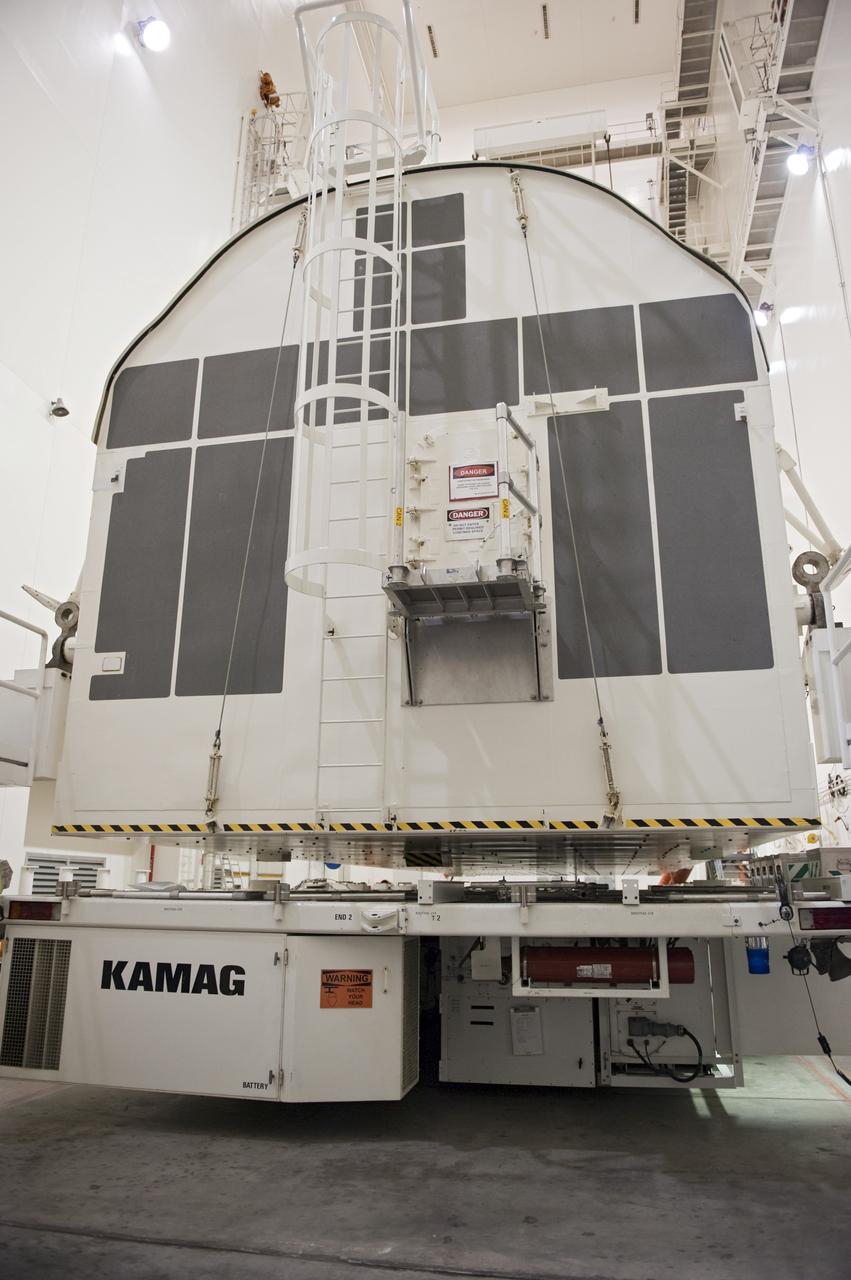
CAPE CANAVERAL, Fla. -- A canister, carrying the Alpha Magnetic Spectrometer-2 AMS and Express Logistics Carrier-3 for space shuttle Endeavour's STS-134 mission, is in the Canister Rotation Facility at NASA's Kennedy Space Center in Florida. There, the canister that protects the space-bound payload will be rotated from a horizontal to vertical position so that it can be installed into Endeavour's payload bay. AMS is a particle physics detector, designed to operate as an external experiment on the International Space Station. It will use the unique environment of space to study the universe and its origin by searching for dark matter. AMS-2 will fly to the station aboard Endeavour's STS-134 mission targeted to launch April 19 at 7:48 p.m. EDT. For more information visit, www.nasa.gov/mission_pages/shuttle/shuttlemissions/sts134/index.html. Photo credit: NASA/Kim Shiflett
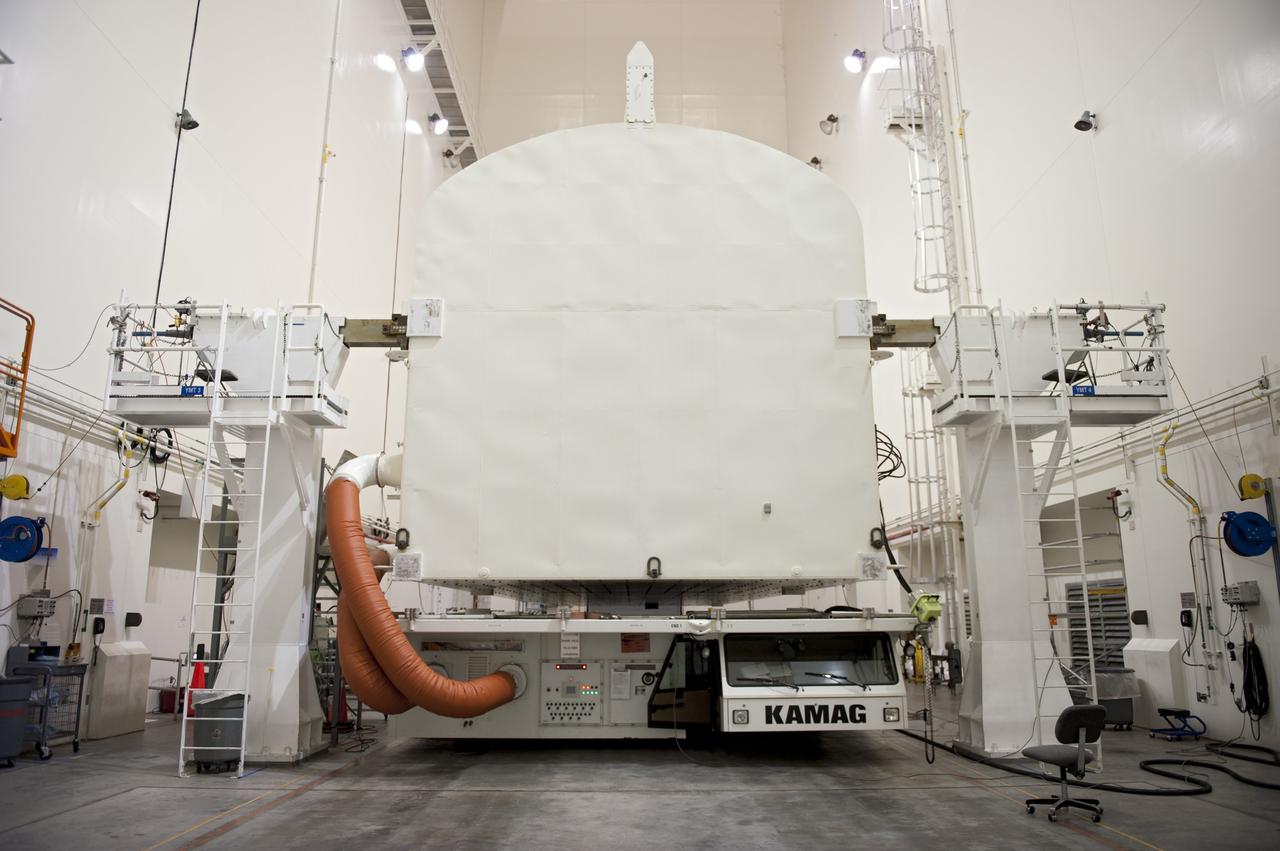
CAPE CANAVERAL, Fla. -- A canister, carrying the Alpha Magnetic Spectrometer-2 AMS and Express Logistics Carrier-3 for space shuttle Endeavour's STS-134 mission, is in the Canister Rotation Facility at NASA's Kennedy Space Center in Florida. There, the canister that protects the space-bound payload will be rotated from a horizontal to vertical position so that it can be installed into Endeavour's payload bay. AMS is a particle physics detector, designed to operate as an external experiment on the International Space Station. It will use the unique environment of space to study the universe and its origin by searching for dark matter. AMS-2 will fly to the station aboard Endeavour's STS-134 mission targeted to launch April 19 at 7:48 p.m. EDT. For more information visit, www.nasa.gov/mission_pages/shuttle/shuttlemissions/sts134/index.html. Photo credit: NASA/Kim Shiflett
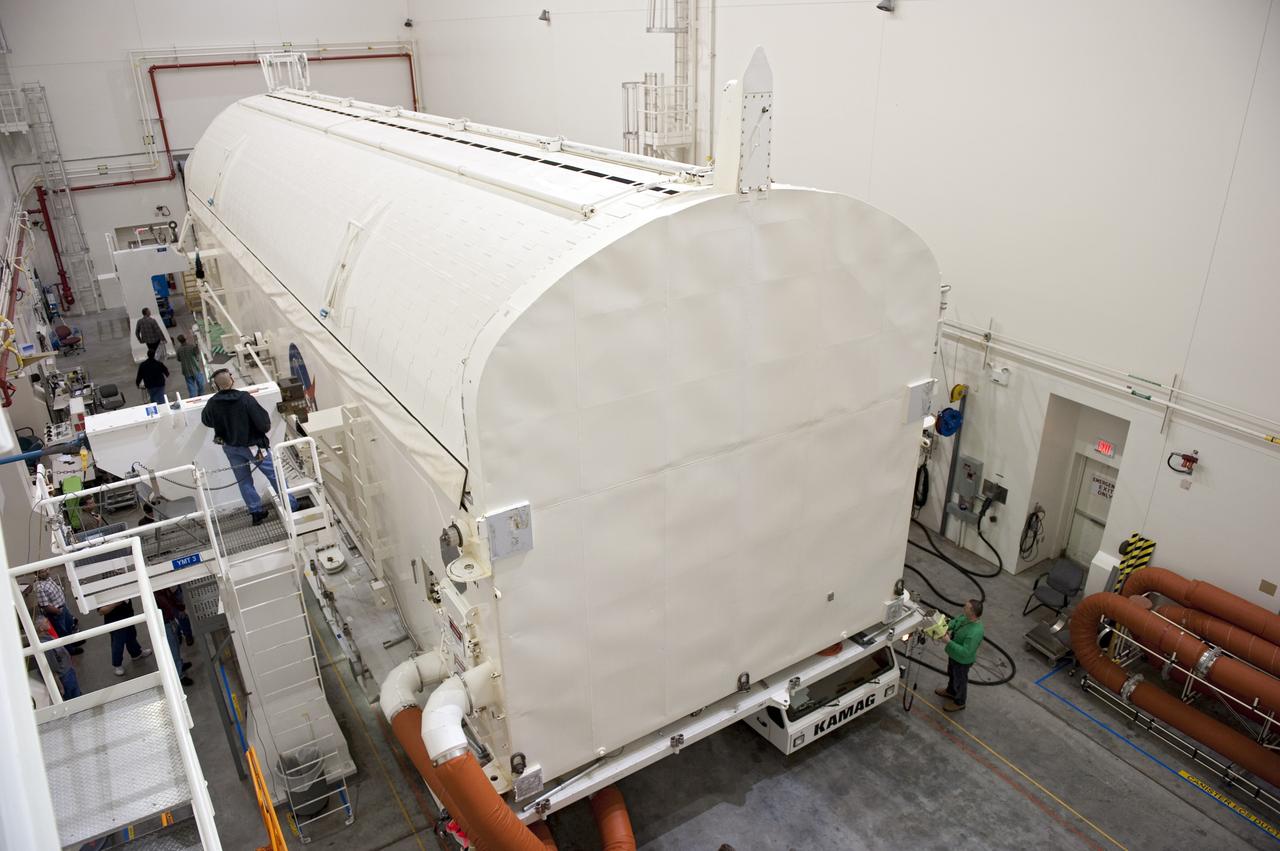
CAPE CANAVERAL, Fla. -- A canister, carrying the Alpha Magnetic Spectrometer-2 AMS and Express Logistics Carrier-3 for space shuttle Endeavour's STS-134 mission, is in the Canister Rotation Facility at NASA's Kennedy Space Center in Florida. There, the canister that protects the space-bound payload will be rotated from a horizontal to vertical position so that it can be installed into Endeavour's payload bay. AMS is a particle physics detector, designed to operate as an external experiment on the International Space Station. It will use the unique environment of space to study the universe and its origin by searching for dark matter. AMS-2 will fly to the station aboard Endeavour's STS-134 mission targeted to launch April 19 at 7:48 p.m. EDT. For more information visit, www.nasa.gov/mission_pages/shuttle/shuttlemissions/sts134/index.html. Photo credit: NASA/Kim Shiflett
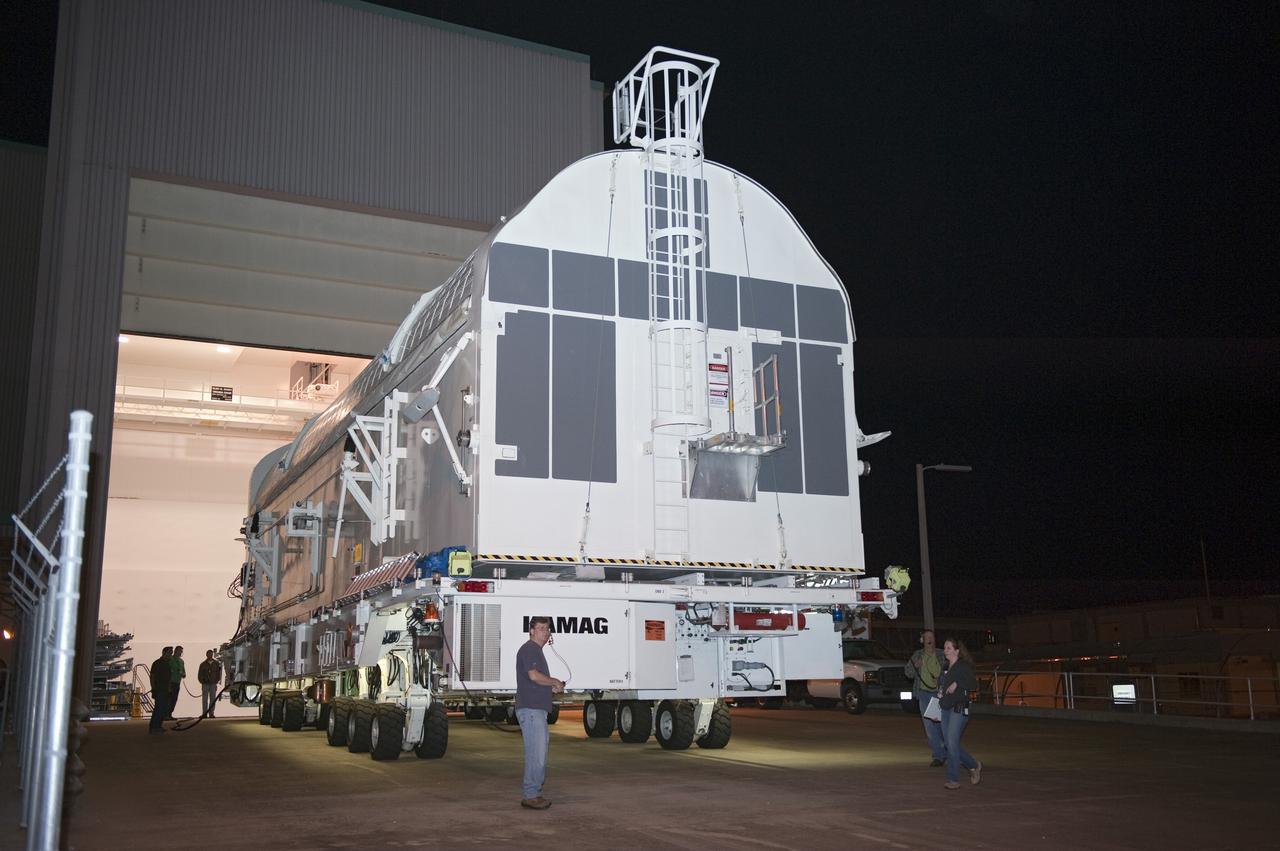
CAPE CANAVERAL, Fla. -- A canister, carrying the Alpha Magnetic Spectrometer-2 AMS and Express Logistics Carrier-3 for space shuttle Endeavour's STS-134 mission, is moved from the Space Station Processing Facility to the Canister Rotation Facility at NASA's Kennedy Space Center in Florida. There, the canister that protects the space-bound payload will be rotated from a horizontal to vertical position so that it can be installed into Endeavour's payload bay. AMS is a particle physics detector, designed to operate as an external experiment on the International Space Station. It will use the unique environment of space to study the universe and its origin by searching for dark matter. AMS-2 will fly to the station aboard Endeavour's STS-134 mission targeted to launch April 19 at 7:48 p.m. EDT. For more information visit, www.nasa.gov/mission_pages/shuttle/shuttlemissions/sts134/index.html. Photo credit: NASA/Kim Shiflett
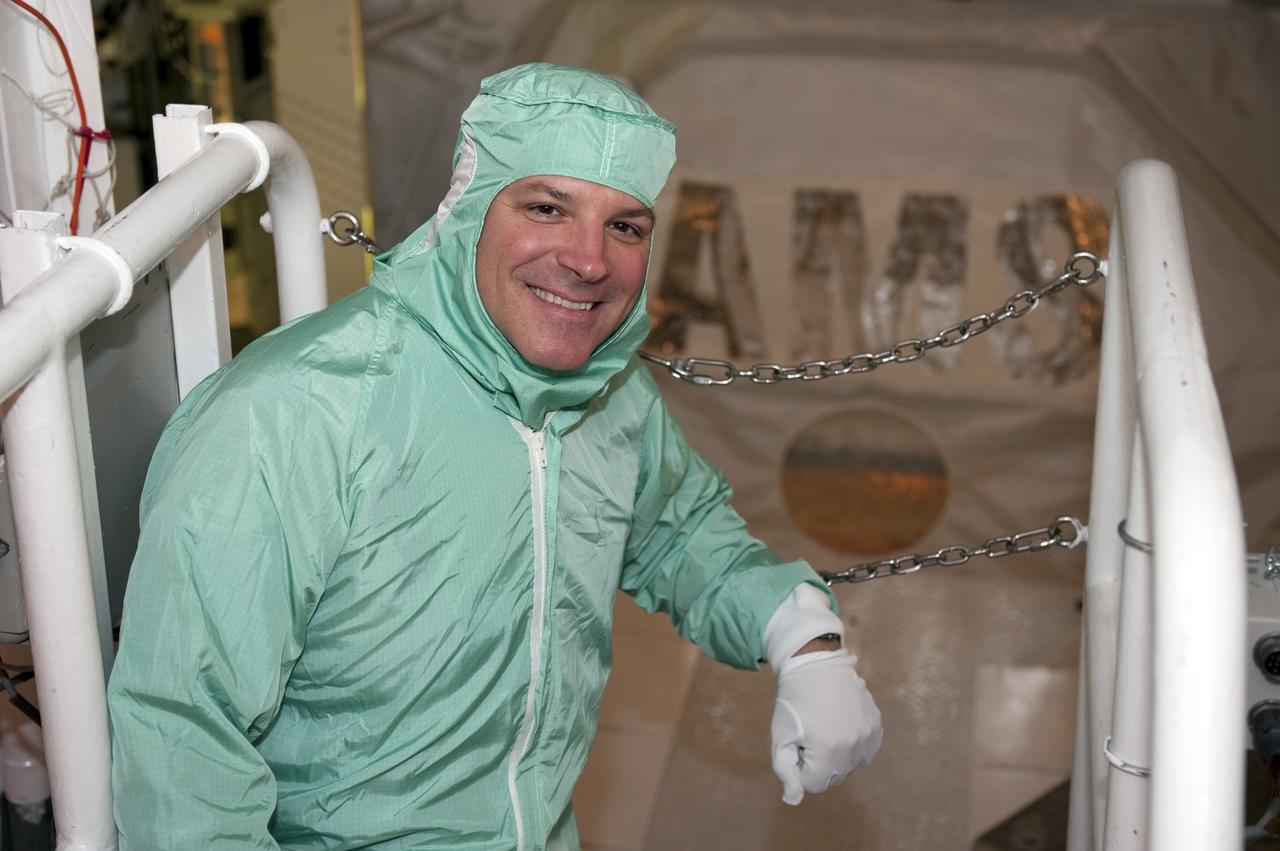
CAPE CANAVERAL, Fla. -- STS-134 Pilot Greg H. Johnson performs a walkdown of space shuttle Endeavour's payload bay. The Express Logistics Carrier-3 packed with spare parts and the Alpha Magnetic Spectrometer-2 (AMS) are inside the bay for the STS-134 mission to the International Space Station. Endeavour's six crew members are at Kennedy for the launch countdown dress rehearsal called the Terminal Countdown Demonstration Test (TCDT) and related training. Endeavour is targeted to launch April 19 at 7:48 p.m. EDT on its final spaceflight mission. For more information visit, www.nasa.gov/mission_pages/shuttle/shuttlemissions/sts134/index.html. Photo credit: NASA/Kim Shiflett
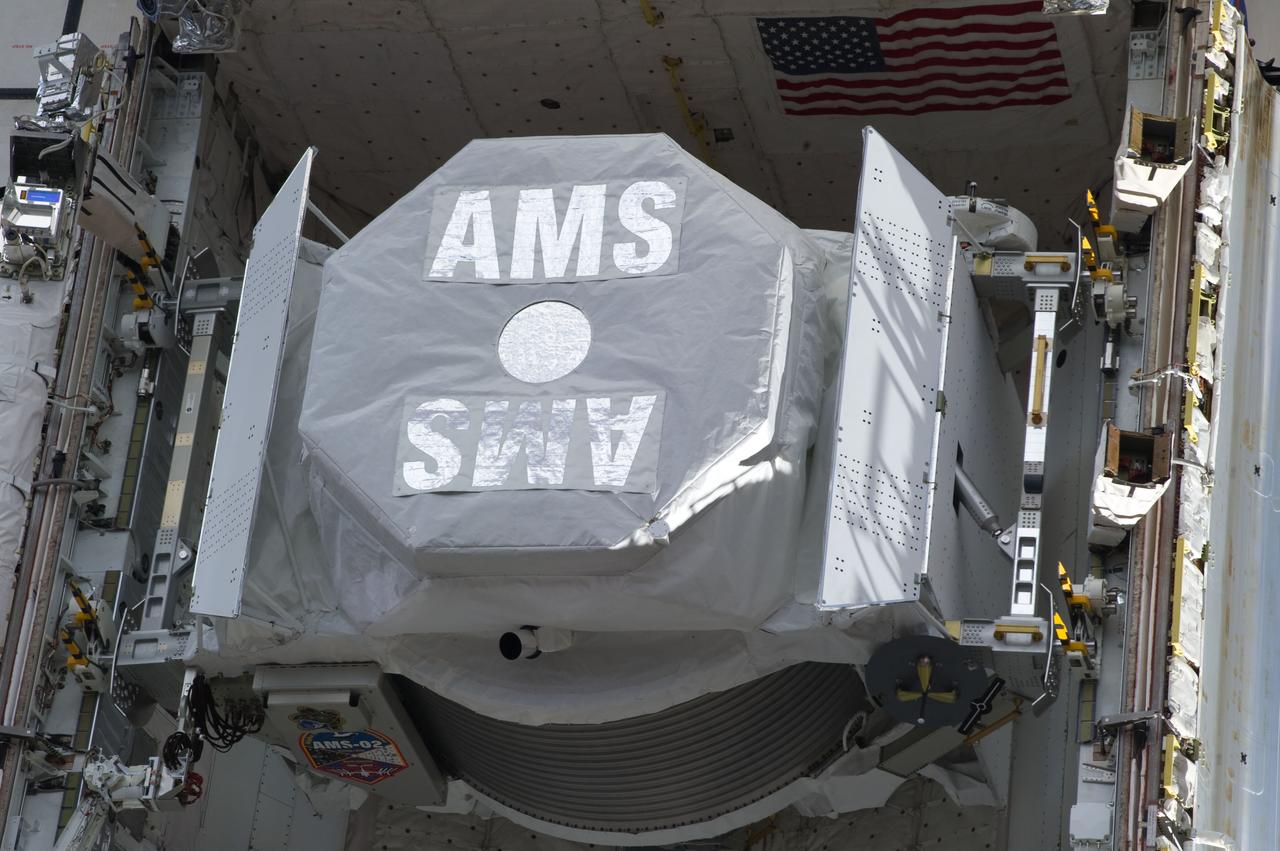
S134-E-007381 (19 May 2011) --- The Alpha Magnetic Spectrometer-2 (AMS) in the space shuttle Endeavour?s payload bay is featured in this image photographed by an STS-134 crew member while docked with the International Space Station. Shortly after this image was taken, the AMS was moved from the payload bay to the station?s starboard truss. Photo credit: NASA
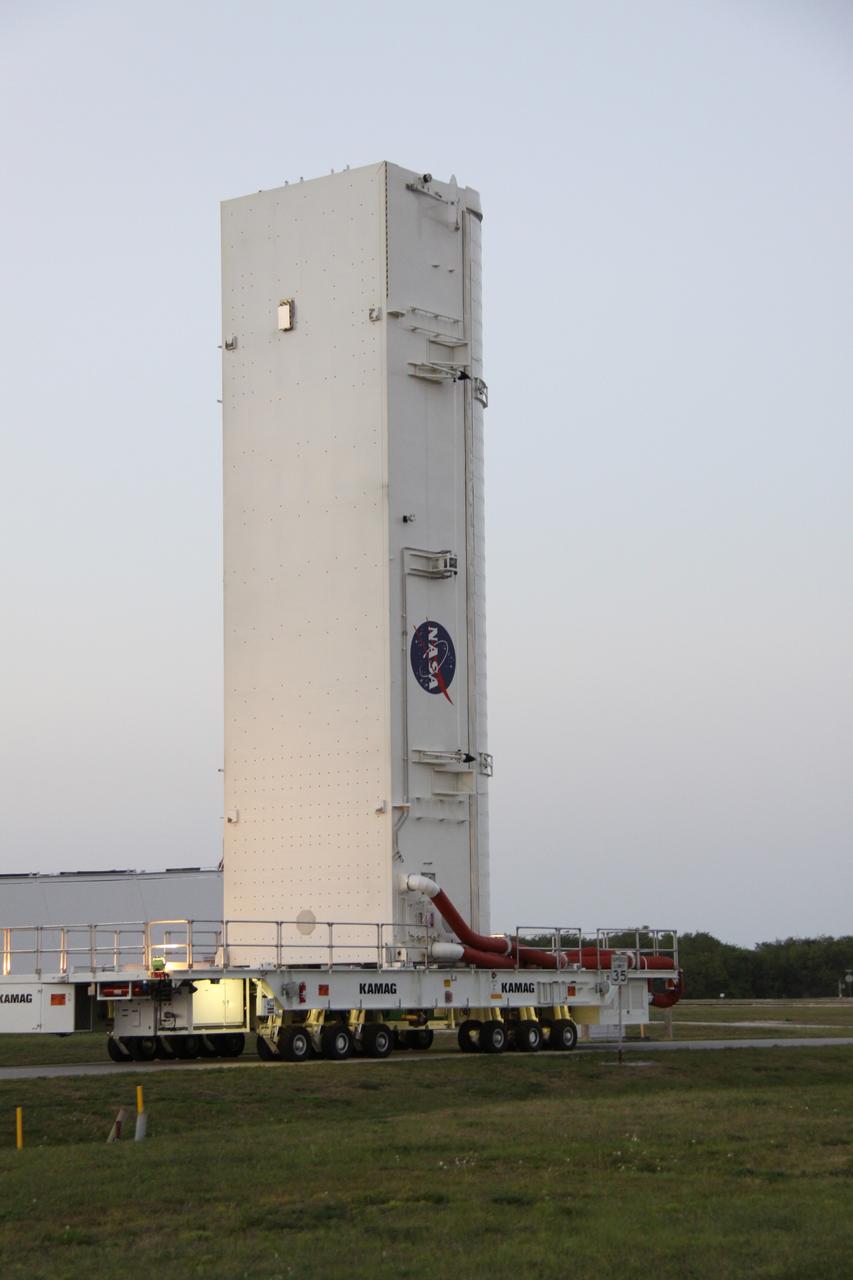
CAPE CANAVERAL, Fla. -- A canister, carrying the Alpha Magnetic Spectrometer-2 (AMS) and Express Logistics Carrier-3 for space shuttle Endeavour's STS-134 mission, is moved from the Canister Rotation Facility to Launch Pad 39A at NASA's Kennedy Space Center in Florida. At the pad, crews will move the payload into the Payload Ground Handling Mechanism (PGHM), and the rotating service structure (RSS) that protects the shuttle from the elements and provides access to its components will be rotated back into place. The payload is scheduled to be installed into the shuttle's cargo bay March 25. Endeavour and its six-member STS-134 crew are targeted to lift off April 19 at 7:48 p.m. EDT to deliver the payload to the International Space Station. This is Endeavour's final scheduled mission. For more information visit, www.nasa.gov/mission_pages/shuttle/shuttlemissions/sts134/index.html. Photo credit: NASA/Jack Pfaller
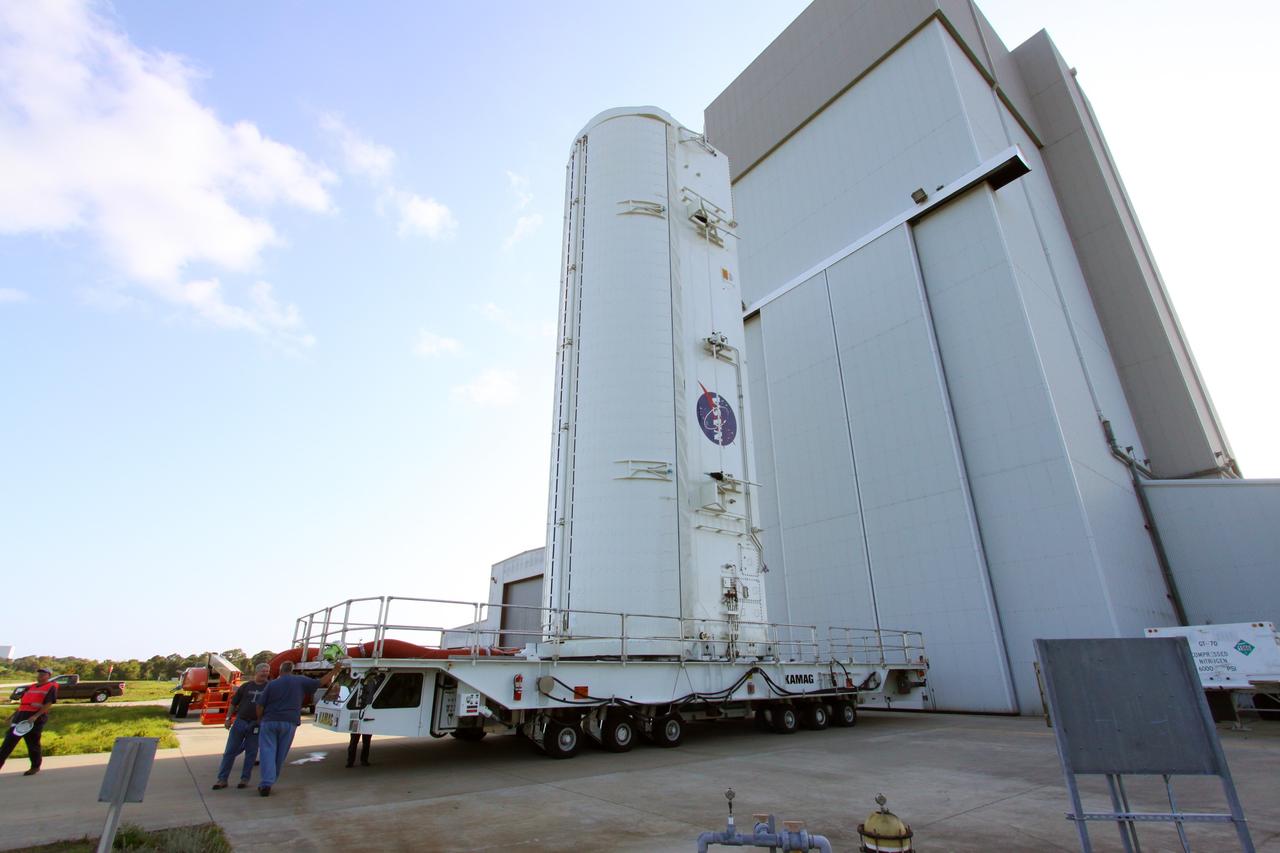
CAPE CANAVERAL, Fla. -- A canister, carrying the Alpha Magnetic Spectrometer-2 (AMS) and Express Logistics Carrier-3 for space shuttle Endeavour's STS-134 mission, is prepared for its move from the Canister Rotation Facility to Launch Pad 39A at NASA's Kennedy Space Center in Florida At the pad, crews will move the payload into the Payload Ground Handling Mechanism (PGHM), and the rotating service structure (RSS) that protects the shuttle from the elements and provides access to its components will be rotated back into place. The payload is scheduled to be installed into the shuttle's cargo bay March 25. Endeavour and its six-member STS-134 crew are targeted to lift off April 19 at 7:48 p.m. EDT to deliver the payload to the International Space Station. This is Endeavour's final scheduled mission. For more information visit, www.nasa.gov/mission_pages/shuttle/shuttlemissions/sts134/index.html. Photo credit: NASA/Jack Pfaller
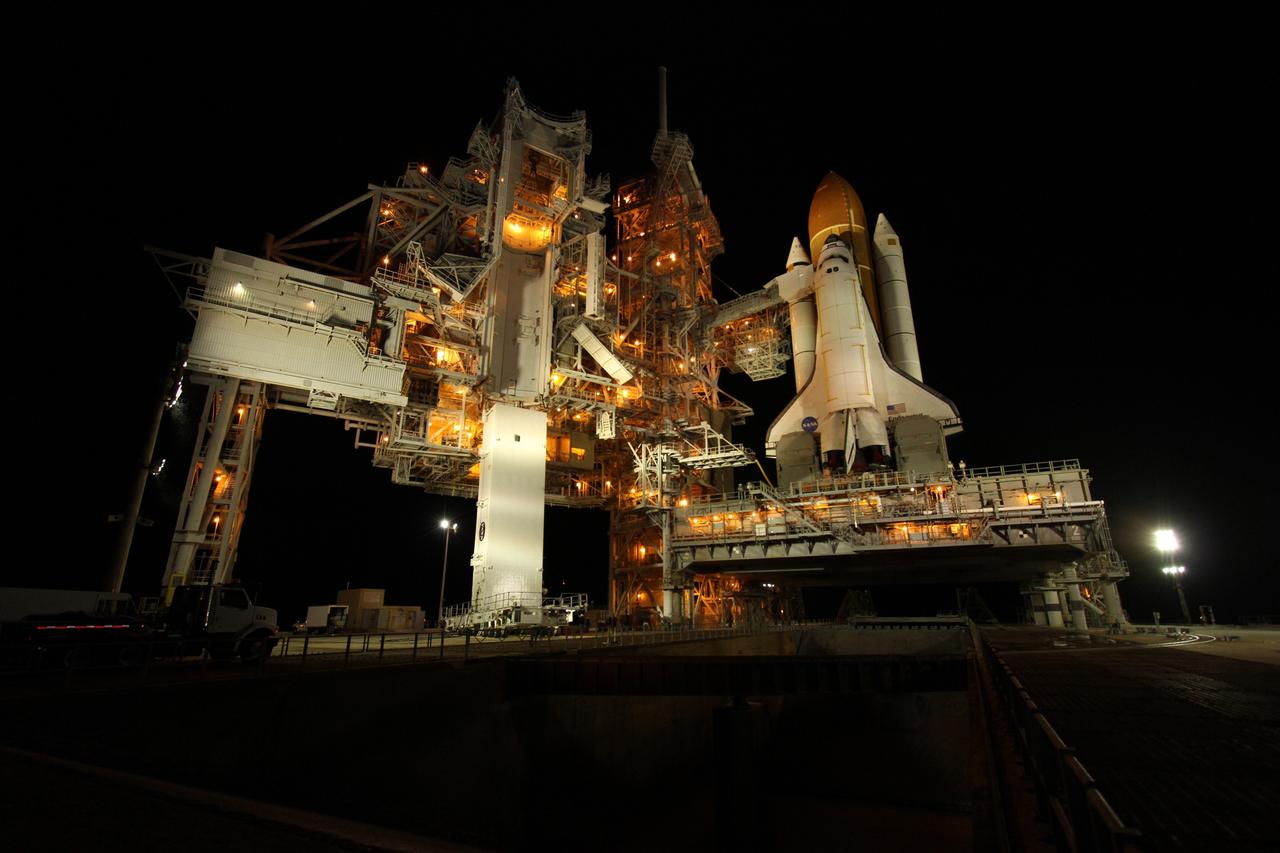
CAPE CANAVERAL, Fla. -- A canister, carrying the Alpha Magnetic Spectrometer-2 (AMS) and Express Logistics Carrier-3 for space shuttle Endeavour's STS-134 mission, arrives at Launch Pad 39A at NASA's Kennedy Space Center in Florida. Next, crews at the pad will move the payload into the Payload Ground Handling Mechanism (PGHM), and the rotating service structure (RSS) that protects the shuttle from the elements and provides access to its components will be rotated back into place. The payload is scheduled to be installed into the shuttle's cargo bay March 25. Endeavour and its six-member STS-134 crew are targeted to lift off April 19 at 7:48 p.m. EDT to deliver the payload to the International Space Station. This is Endeavour's final scheduled mission. For more information visit, www.nasa.gov/mission_pages/shuttle/shuttlemissions/sts134/index.html. Photo credit: NASA/Cory Huston

CAPE CANAVERAL, Fla. -- A canister, carrying the Alpha Magnetic Spectrometer-2 (AMS) and Express Logistics Carrier-3 for space shuttle Endeavour's STS-134 mission, arrives at Launch Pad 39A at NASA's Kennedy Space Center in Florida. Next, crews at the pad will move the payload into the Payload Ground Handling Mechanism (PGHM), and the rotating service structure (RSS) that protects the shuttle from the elements and provides access to its components will be rotated back into place. The payload is scheduled to be installed into the shuttle's cargo bay March 25. Endeavour and its six-member STS-134 crew are targeted to lift off April 19 at 7:48 p.m. EDT to deliver the payload to the International Space Station. This is Endeavour's final scheduled mission. For more information visit, www.nasa.gov/mission_pages/shuttle/shuttlemissions/sts134/index.html. Photo credit: NASA/Cory Huston
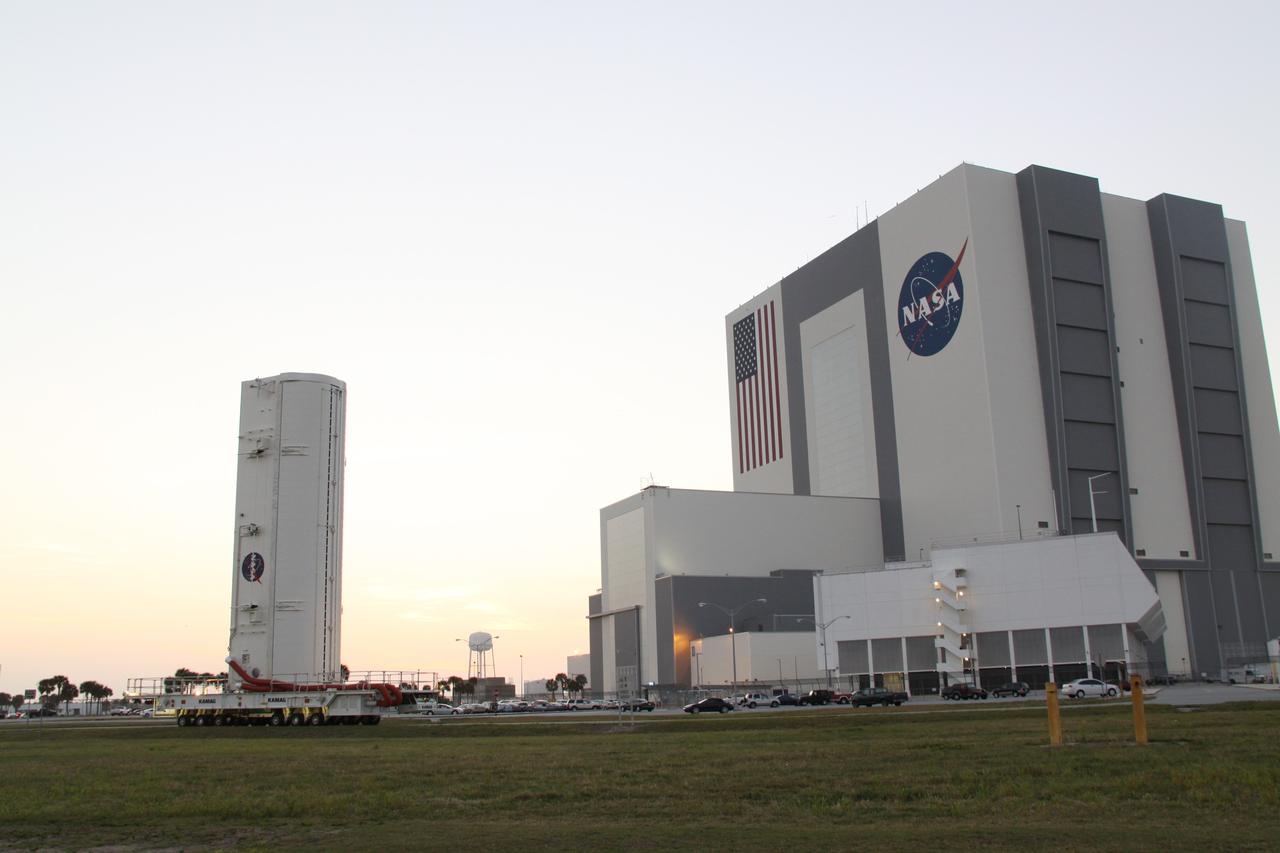
CAPE CANAVERAL, Fla. -- A canister, carrying the Alpha Magnetic Spectrometer-2 (AMS) and Express Logistics Carrier-3 for space shuttle Endeavour's STS-134 mission, moves past the Vehicle Assembly Building on its journey from the Canister Rotation Facility to Launch Pad 39A at NASA's Kennedy Space Center in Florida. At the pad, crews will move the payload into the Payload Ground Handling Mechanism (PGHM), and the rotating service structure (RSS) that protects the shuttle from the elements and provides access to its components will be rotated back into place. The payload is scheduled to be installed into the shuttle's cargo bay March 25. Endeavour and its six-member STS-134 crew are targeted to lift off April 19 at 7:48 p.m. EDT to deliver the payload to the International Space Station. This is Endeavour's final scheduled mission. For more information visit, www.nasa.gov/mission_pages/shuttle/shuttlemissions/sts134/index.html. Photo credit: NASA/Jack Pfaller
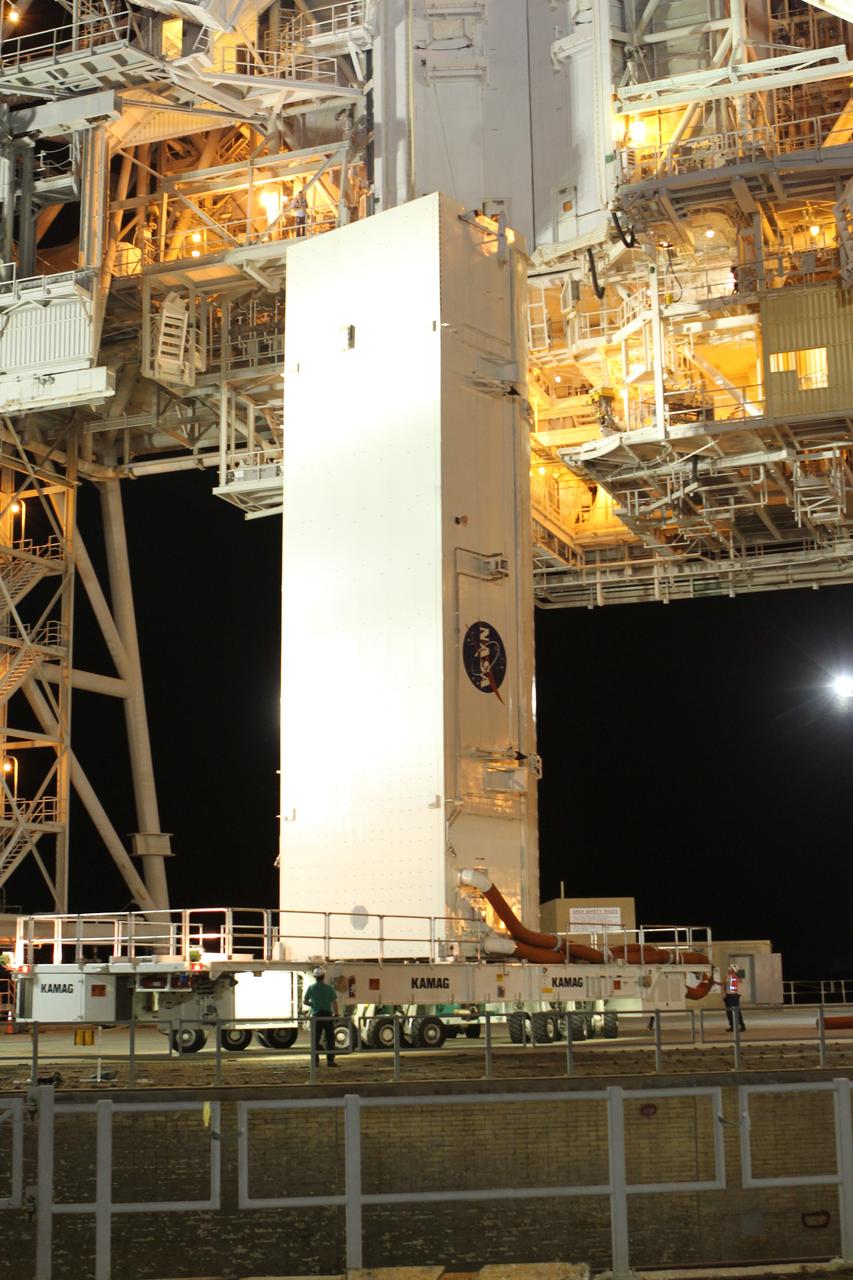
CAPE CANAVERAL, Fla. -- A canister, carrying the Alpha Magnetic Spectrometer-2 (AMS) and Express Logistics Carrier-3 for space shuttle Endeavour's STS-134 mission, arrives at Launch Pad 39A at NASA's Kennedy Space Center in Florida. Next, crews at the pad will move the payload into the Payload Ground Handling Mechanism (PGHM), and the rotating service structure (RSS) that protects the shuttle from the elements and provides access to its components will be rotated back into place. The payload is scheduled to be installed into the shuttle's cargo bay March 25. Endeavour and its six-member STS-134 crew are targeted to lift off April 19 at 7:48 p.m. EDT to deliver the payload to the International Space Station. This is Endeavour's final scheduled mission. For more information visit, www.nasa.gov/mission_pages/shuttle/shuttlemissions/sts134/index.html. Photo credit: NASA/Cory Huston
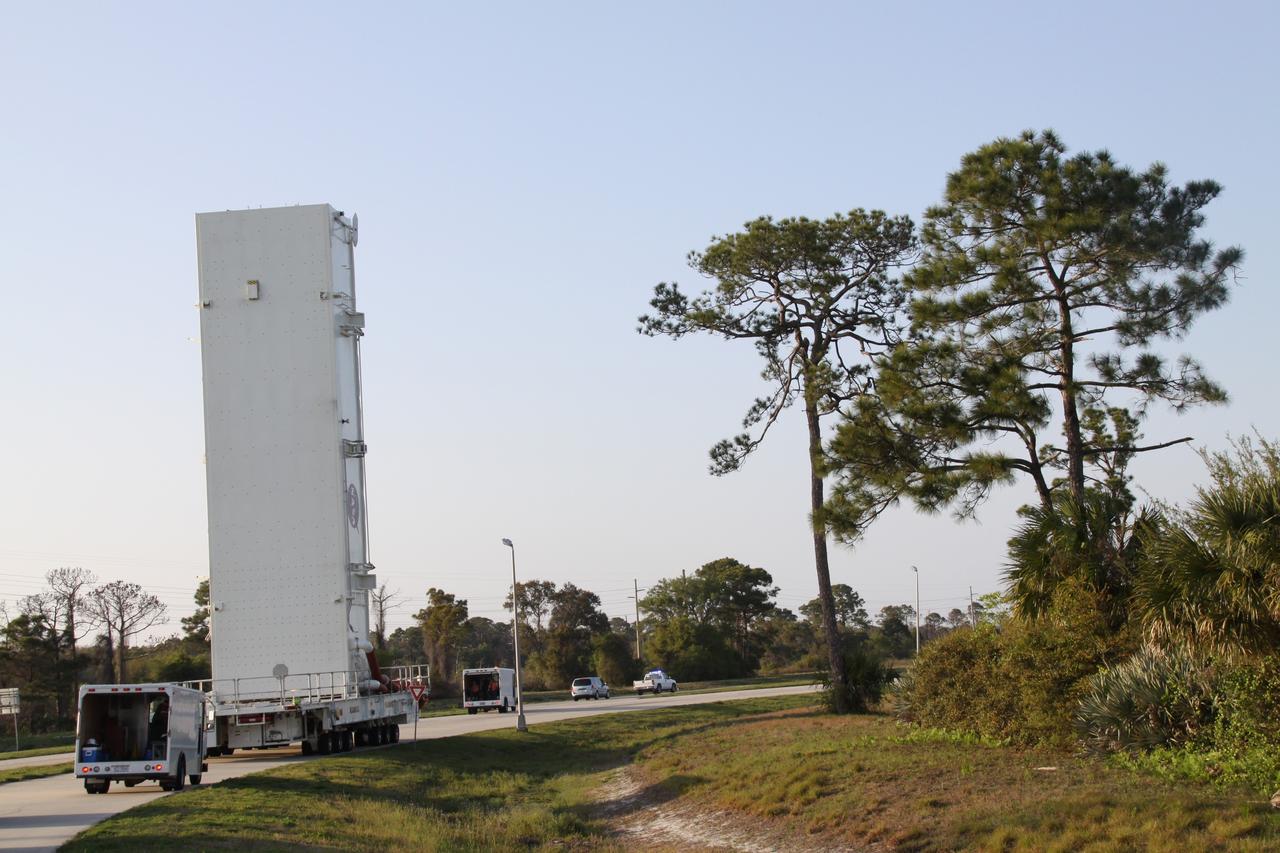
CAPE CANAVERAL, Fla. -- A canister, carrying the Alpha Magnetic Spectrometer-2 (AMS) and Express Logistics Carrier-3 for space shuttle Endeavour's STS-134 mission, is moved from the Canister Rotation Facility to Launch Pad 39A at NASA's Kennedy Space Center in Florida. At the pad, crews will move the payload into the Payload Ground Handling Mechanism (PGHM), and the rotating service structure (RSS) that protects the shuttle from the elements and provides access to its components will be rotated back into place. The payload is scheduled to be installed into the shuttle's cargo bay March 25. Endeavour and its six-member STS-134 crew are targeted to lift off April 19 at 7:48 p.m. EDT to deliver the payload to the International Space Station. This is Endeavour's final scheduled mission. For more information visit, www.nasa.gov/mission_pages/shuttle/shuttlemissions/sts134/index.html. Photo credit: NASA/Jack Pfaller
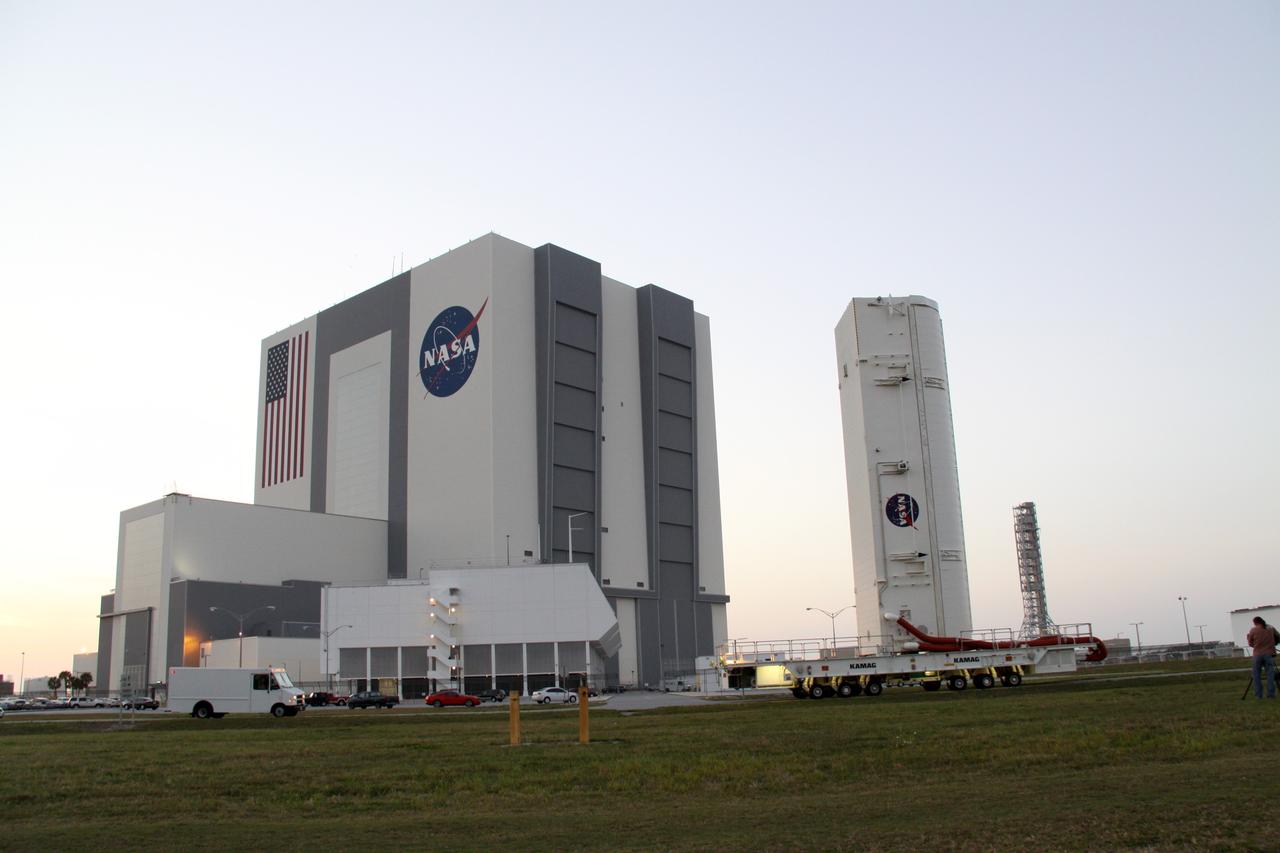
CAPE CANAVERAL, Fla. -- A canister, carrying the Alpha Magnetic Spectrometer-2 (AMS) and Express Logistics Carrier-3 for space shuttle Endeavour's STS-134 mission, moves past the Vehicle Assembly Building on its journey from the Canister Rotation Facility to Launch Pad 39A at NASA's Kennedy Space Center in Florida. At the pad, crews will move the payload into the Payload Ground Handling Mechanism (PGHM), and the rotating service structure (RSS) that protects the shuttle from the elements and provides access to its components will be rotated back into place. The payload is scheduled to be installed into the shuttle's cargo bay March 25. Endeavour and its six-member STS-134 crew are targeted to lift off April 19 at 7:48 p.m. EDT to deliver the payload to the International Space Station. This is Endeavour's final scheduled mission. For more information visit, www.nasa.gov/mission_pages/shuttle/shuttlemissions/sts134/index.html. Photo credit: NASA/Jack Pfaller
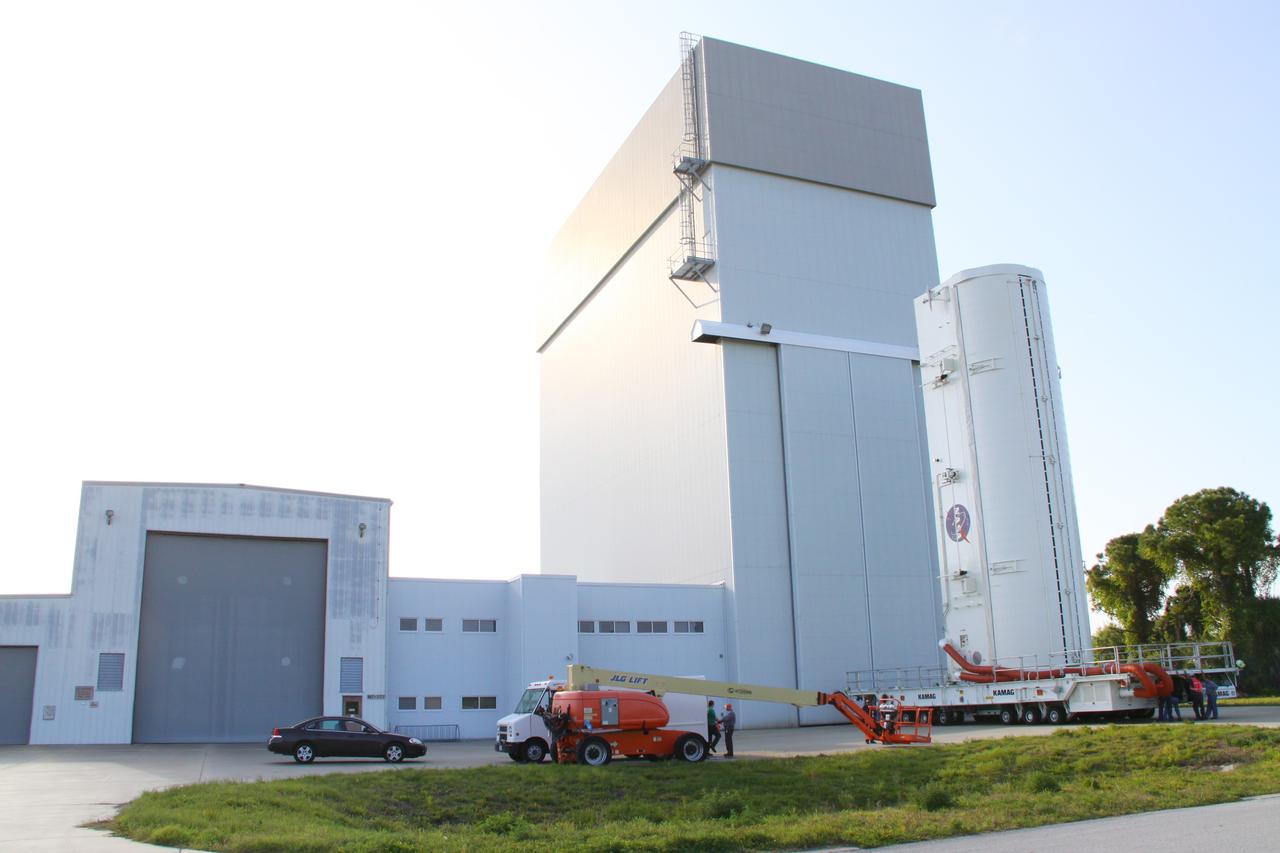
CAPE CANAVERAL, Fla. -- A canister, carrying the Alpha Magnetic Spectrometer-2 (AMS) and Express Logistics Carrier-3 (ELC-3) for space shuttle Endeavour's STS-134 mission, is prepared for its move from the Canister Rotation Facility to Launch Pad 39A at NASA's Kennedy Space Center in Florida. At the pad, crews will move the payload into the Payload Ground Handling Mechanism (PGHM), and the rotating service structure (RSS) that protects the shuttle from the elements and provides access to its components will be rotated back into place. The payload is scheduled to be installed into the shuttle's cargo bay March 25. Endeavour and its six-member STS-134 crew are targeted to lift off April 19 at 7:48 p.m. EDT to deliver the payload to the International Space Station. This is Endeavour's final scheduled mission. For more information visit, www.nasa.gov/mission_pages/shuttle/shuttlemissions/sts134/index.html. Photo credit: NASA/Jack Pfaller
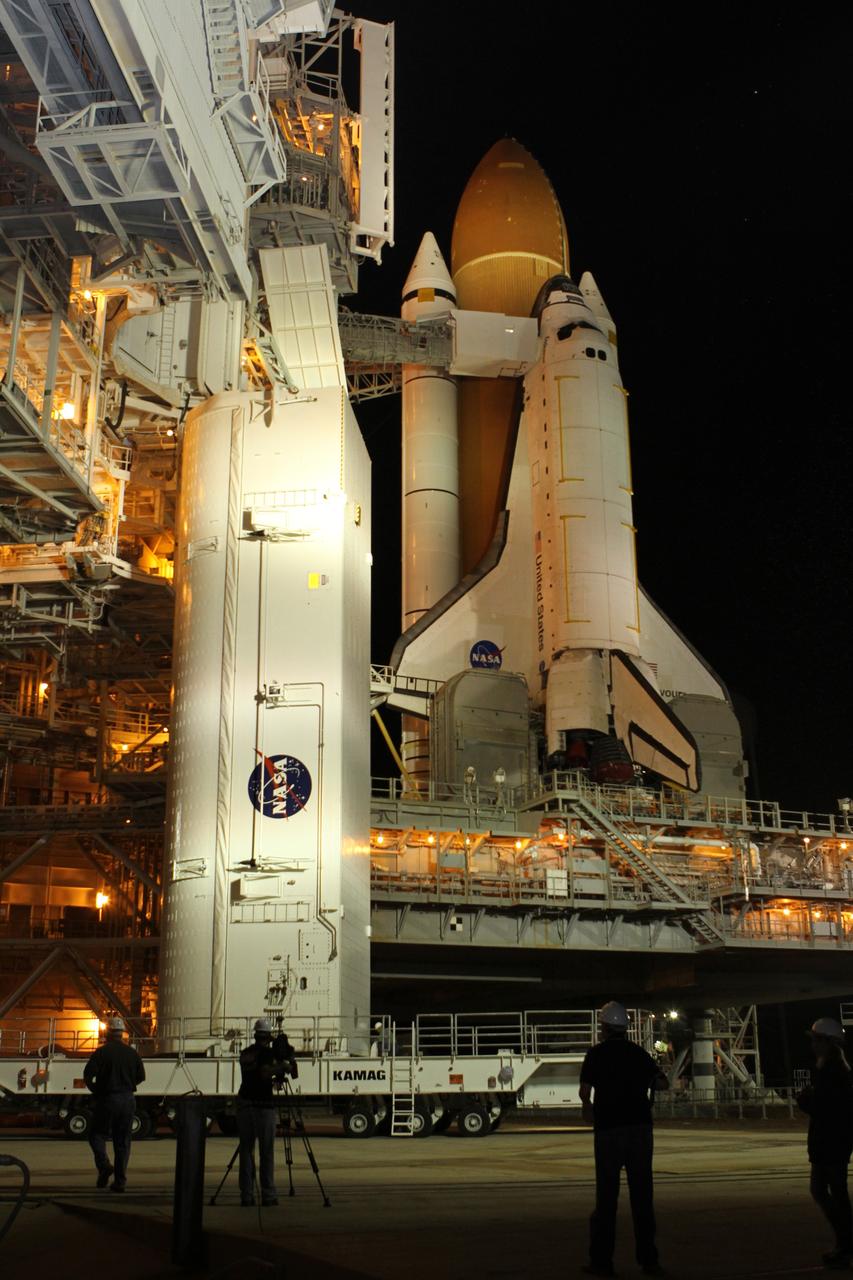
CAPE CANAVERAL, Fla. -- A canister, carrying the Alpha Magnetic Spectrometer-2 (AMS) and Express Logistics Carrier-3 for space shuttle Endeavour's STS-134 mission, arrives at Launch Pad 39A at NASA's Kennedy Space Center in Florida. Next, crews at the pad will move the payload into the Payload Ground Handling Mechanism (PGHM), and the rotating service structure (RSS) that protects the shuttle from the elements and provides access to its components will be rotated back into place. The payload is scheduled to be installed into the shuttle's cargo bay March 25. Endeavour and its six-member STS-134 crew are targeted to lift off April 19 at 7:48 p.m. EDT to deliver the payload to the International Space Station. This is Endeavour's final scheduled mission. For more information visit, www.nasa.gov/mission_pages/shuttle/shuttlemissions/sts134/index.html. Photo credit: NASA/Cory Huston
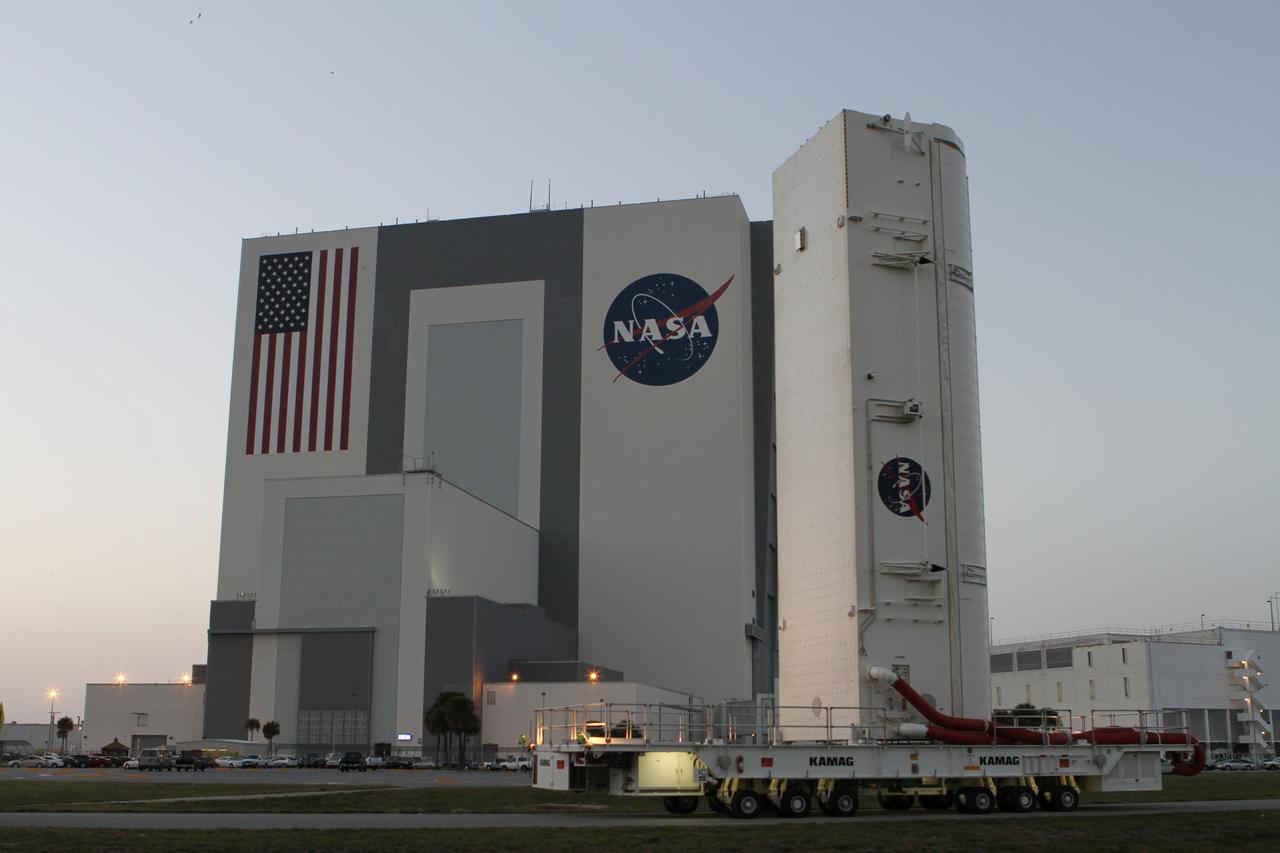
CAPE CANAVERAL, Fla. -- A canister, carrying the Alpha Magnetic Spectrometer-2 (AMS) and Express Logistics Carrier-3 for space shuttle Endeavour's STS-134 mission, moves past the Vehicle Assembly Building on its journey from the Canister Rotation Facility to Launch Pad 39A at NASA's Kennedy Space Center in Florida. Next, crews at the pad will move the payload into the Payload Ground Handling Mechanism (PGHM), and the rotating service structure (RSS) that protects the shuttle from the elements and provides access to its components will be rotated back into place. The payload is scheduled to be installed into the shuttle's cargo bay March 25. Endeavour and its six-member STS-134 crew are targeted to lift off April 19 at 7:48 p.m. EDT to deliver the payload to the International Space Station. This is Endeavour's final scheduled mission. For more information visit, www.nasa.gov/mission_pages/shuttle/shuttlemissions/sts134/index.html. Photo credit: NASA/Cory Huston
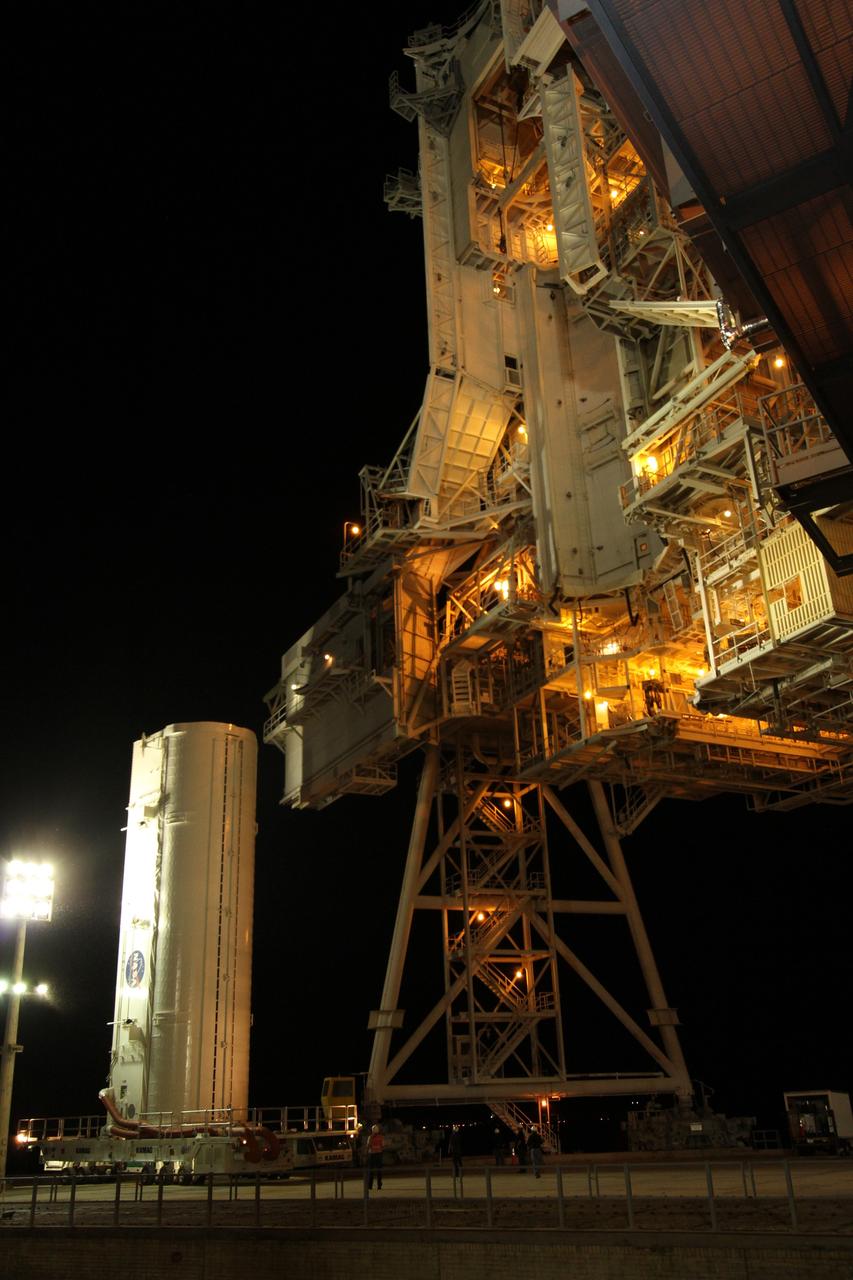
CAPE CANAVERAL, Fla. -- A canister, carrying the Alpha Magnetic Spectrometer-2 (AMS) and Express Logistics Carrier-3 for space shuttle Endeavour's STS-134 mission, arrives at Launch Pad 39A at NASA's Kennedy Space Center in Florida. Next, crews at the pad will move the payload into the Payload Ground Handling Mechanism (PGHM), and the rotating service structure (RSS) that protects the shuttle from the elements and provides access to its components will be rotated back into place. The payload is scheduled to be installed into the shuttle's cargo bay March 25. Endeavour and its six-member STS-134 crew are targeted to lift off April 19 at 7:48 p.m. EDT to deliver the payload to the International Space Station. This is Endeavour's final scheduled mission. For more information visit, www.nasa.gov/mission_pages/shuttle/shuttlemissions/sts134/index.html. Photo credit: NASA/Cory Huston
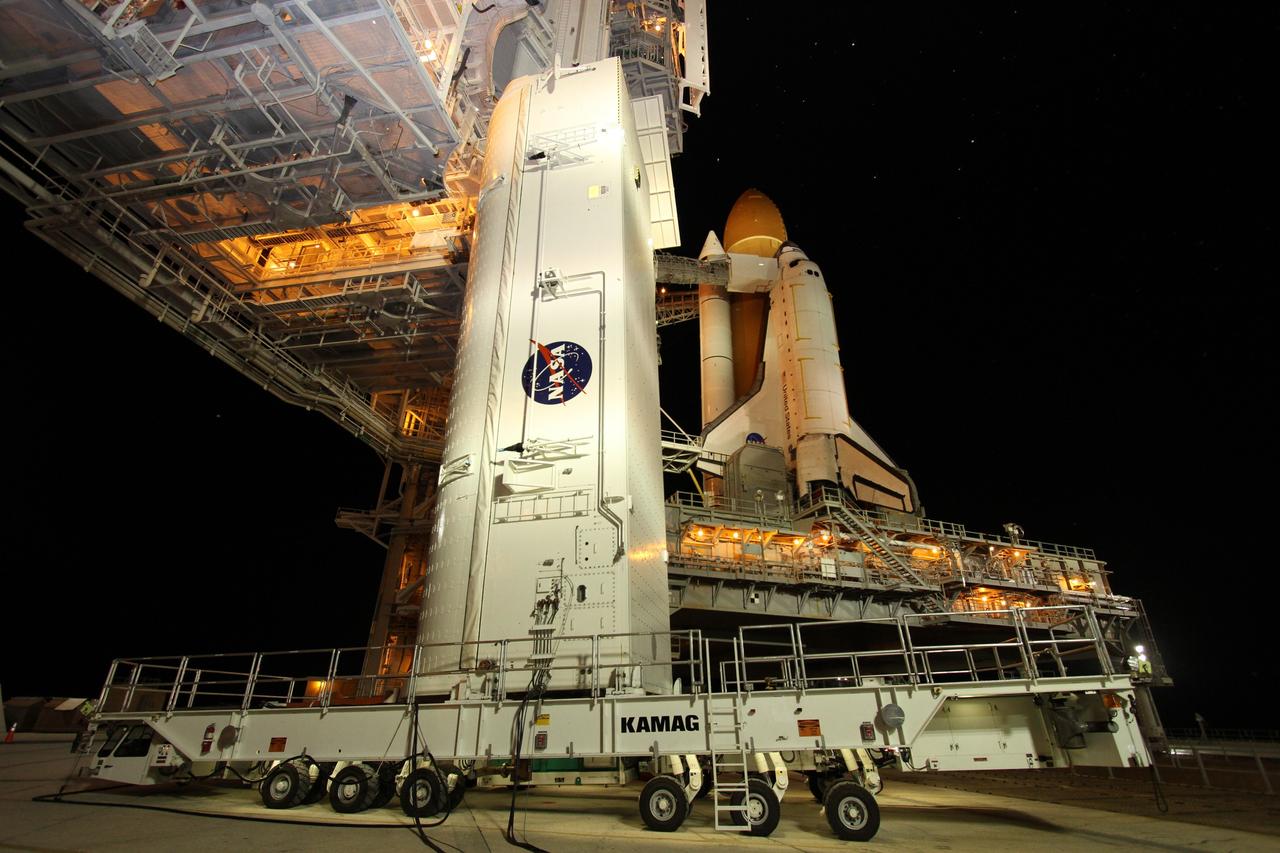
CAPE CANAVERAL, Fla. -- A canister, carrying the Alpha Magnetic Spectrometer-2 (AMS) and Express Logistics Carrier-3 for space shuttle Endeavour's STS-134 mission, arrives at Launch Pad 39A at NASA's Kennedy Space Center in Florida. Next, crews at the pad will move the payload into the Payload Ground Handling Mechanism (PGHM), and the rotating service structure (RSS) that protects the shuttle from the elements and provides access to its components will be rotated back into place. The payload is scheduled to be installed into the shuttle's cargo bay March 25. Endeavour and its six-member STS-134 crew are targeted to lift off April 19 at 7:48 p.m. EDT to deliver the payload to the International Space Station. This is Endeavour's final scheduled mission. For more information visit, www.nasa.gov/mission_pages/shuttle/shuttlemissions/sts134/index.html. Photo credit: NASA/Cory Huston
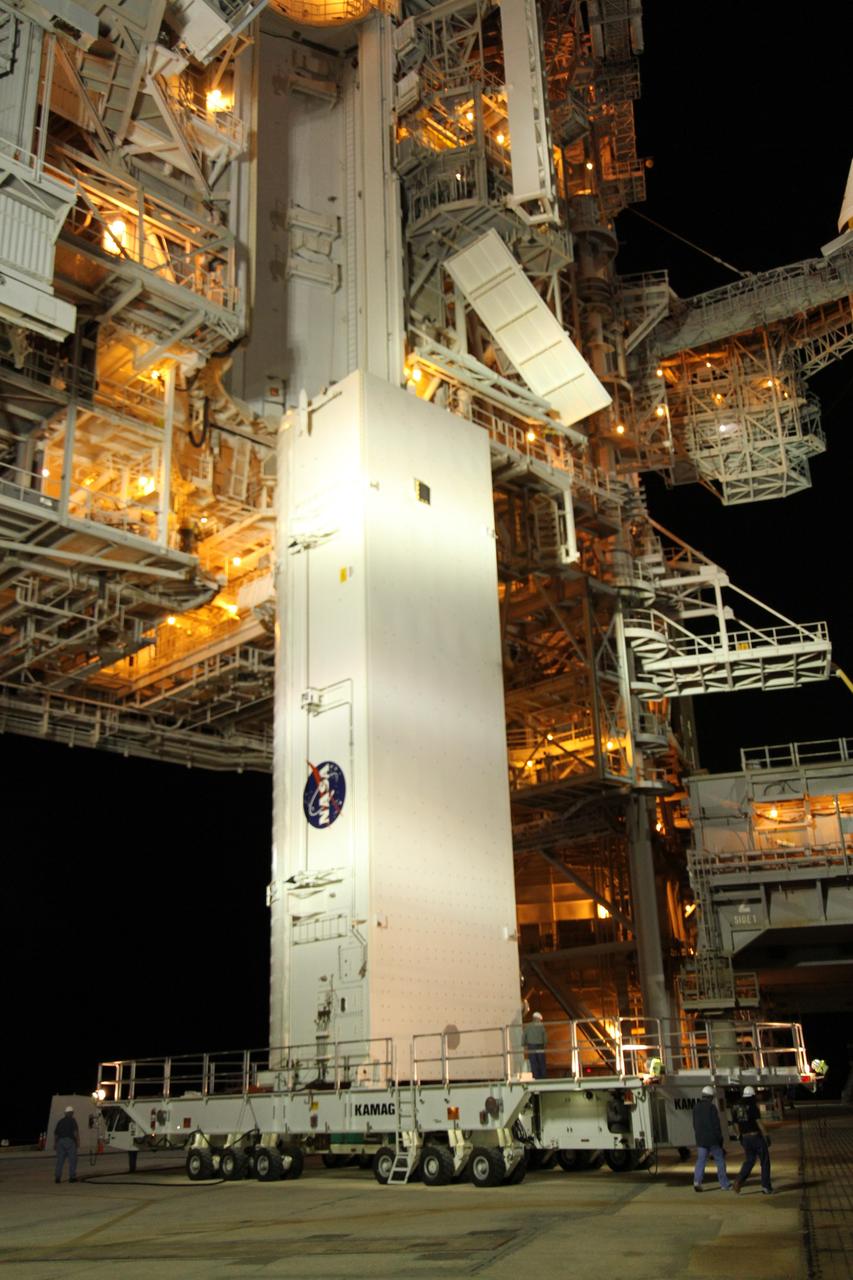
CAPE CANAVERAL, Fla. -- A canister, carrying the Alpha Magnetic Spectrometer-2 (AMS) and Express Logistics Carrier-3 for space shuttle Endeavour's STS-134 mission, arrives at Launch Pad 39A at NASA's Kennedy Space Center in Florida. Next, crews at the pad will move the payload into the Payload Ground Handling Mechanism (PGHM), and the rotating service structure (RSS) that protects the shuttle from the elements and provides access to its components will be rotated back into place. The payload is scheduled to be installed into the shuttle's cargo bay March 25. Endeavour and its six-member STS-134 crew are targeted to lift off April 19 at 7:48 p.m. EDT to deliver the payload to the International Space Station. This is Endeavour's final scheduled mission. For more information visit, www.nasa.gov/mission_pages/shuttle/shuttlemissions/sts134/index.html. Photo credit: NASA/Cory Huston
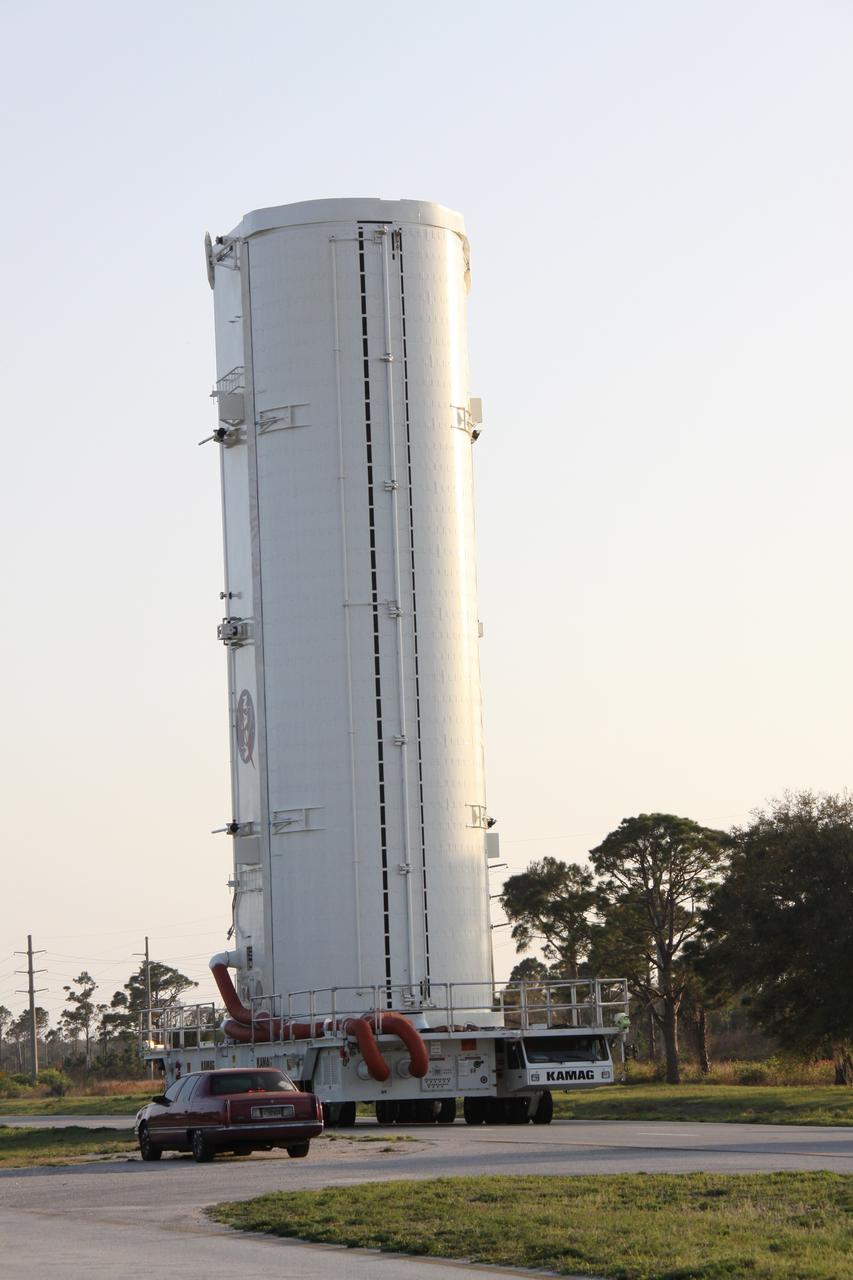
CAPE CANAVERAL, Fla. -- A canister, carrying the Alpha Magnetic Spectrometer-2 (AMS) and Express Logistics Carrier-3 for space shuttle Endeavour's STS-134 mission, is moved from the Canister Rotation Facility to Launch Pad 39A at NASA's Kennedy Space Center in Florida. At the pad, crews will move the payload into the Payload Ground Handling Mechanism (PGHM), and the rotating service structure (RSS) that protects the shuttle from the elements and provides access to its components will be rotated back into place. The payload is scheduled to be installed into the shuttle's cargo bay March 25. Endeavour and its six-member STS-134 crew are targeted to lift off April 19 at 7:48 p.m. EDT to deliver the payload to the International Space Station. This is Endeavour's final scheduled mission. For more information visit, www.nasa.gov/mission_pages/shuttle/shuttlemissions/sts134/index.html. Photo credit: NASA/Jack Pfaller

CAPE CANAVERAL, Fla. -- A canister, carrying the Alpha Magnetic Spectrometer-2 (AMS) and Express Logistics Carrier-3 for space shuttle Endeavour's STS-134 mission, arrives at Launch Pad 39A at NASA's Kennedy Space Center in Florida. Next, crews at the pad will move the payload into the Payload Ground Handling Mechanism (PGHM), and the rotating service structure (RSS) that protects the shuttle from the elements and provides access to its components will be rotated back into place. The payload is scheduled to be installed into the shuttle's cargo bay March 25. Endeavour and its six-member STS-134 crew are targeted to lift off April 19 at 7:48 p.m. EDT to deliver the payload to the International Space Station. This is Endeavour's final scheduled mission. For more information visit, www.nasa.gov/mission_pages/shuttle/shuttlemissions/sts134/index.html. Photo credit: NASA/Cory Huston
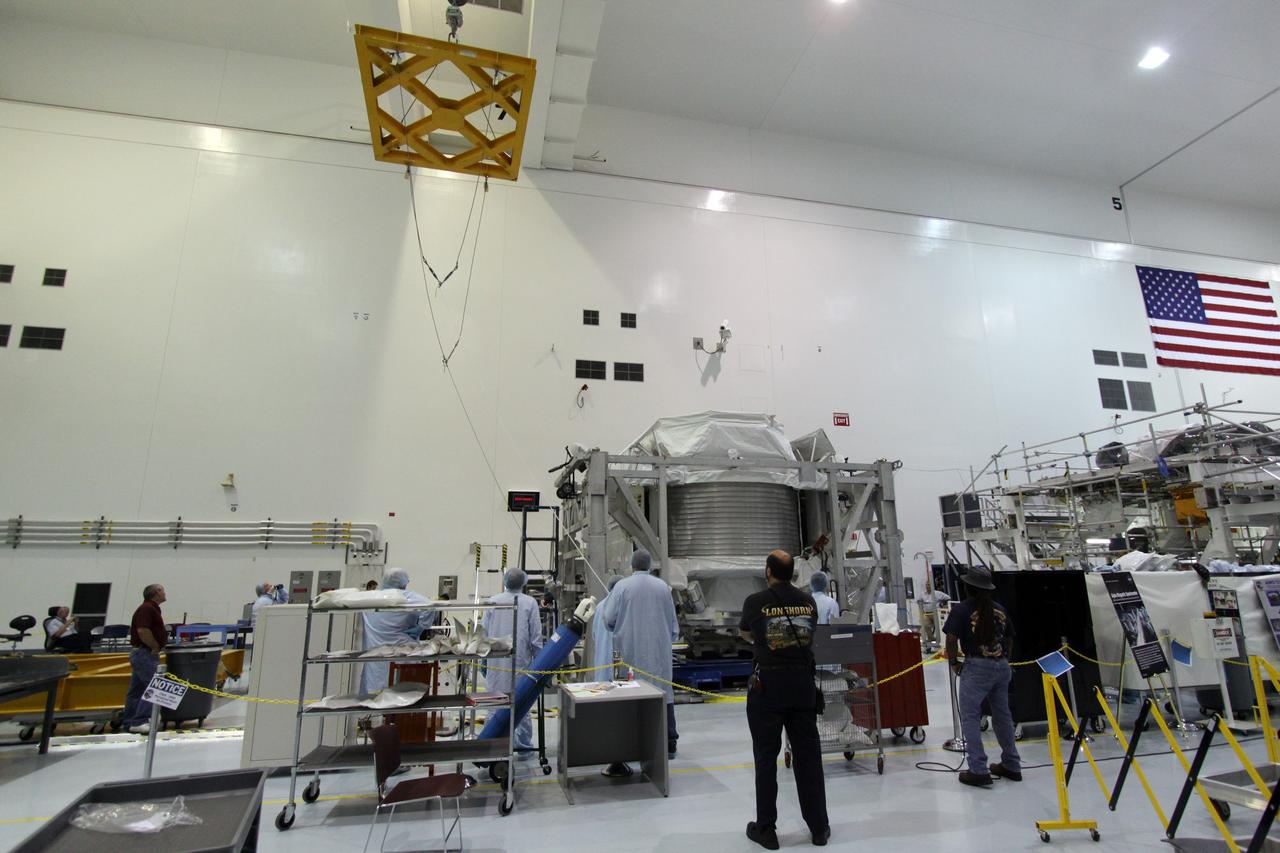
CAPE CANAVERAL, Fla. -- In the Space Station Processing Facility at NASA's Kennedy Space Center in Florida, an overhead crane is poised over the Alpha Magnetic Spectrometer, or AMS, to lift the Payload Attach System, or PAS, up to the AMS. The PAS provides a method of securely connecting the payload to the International Space Station. AMS, a state-of-the-art particle physics detector, is designed to operate as an external module on the International Space Station. It will use the unique environment of space to study the universe and its origin by searching for dark matter. AMS will fly to the station aboard space shuttle Endeavour's STS-134 mission targeted to launch Feb. 26, 2011. Photo credit: NASA/Jack Pfaller
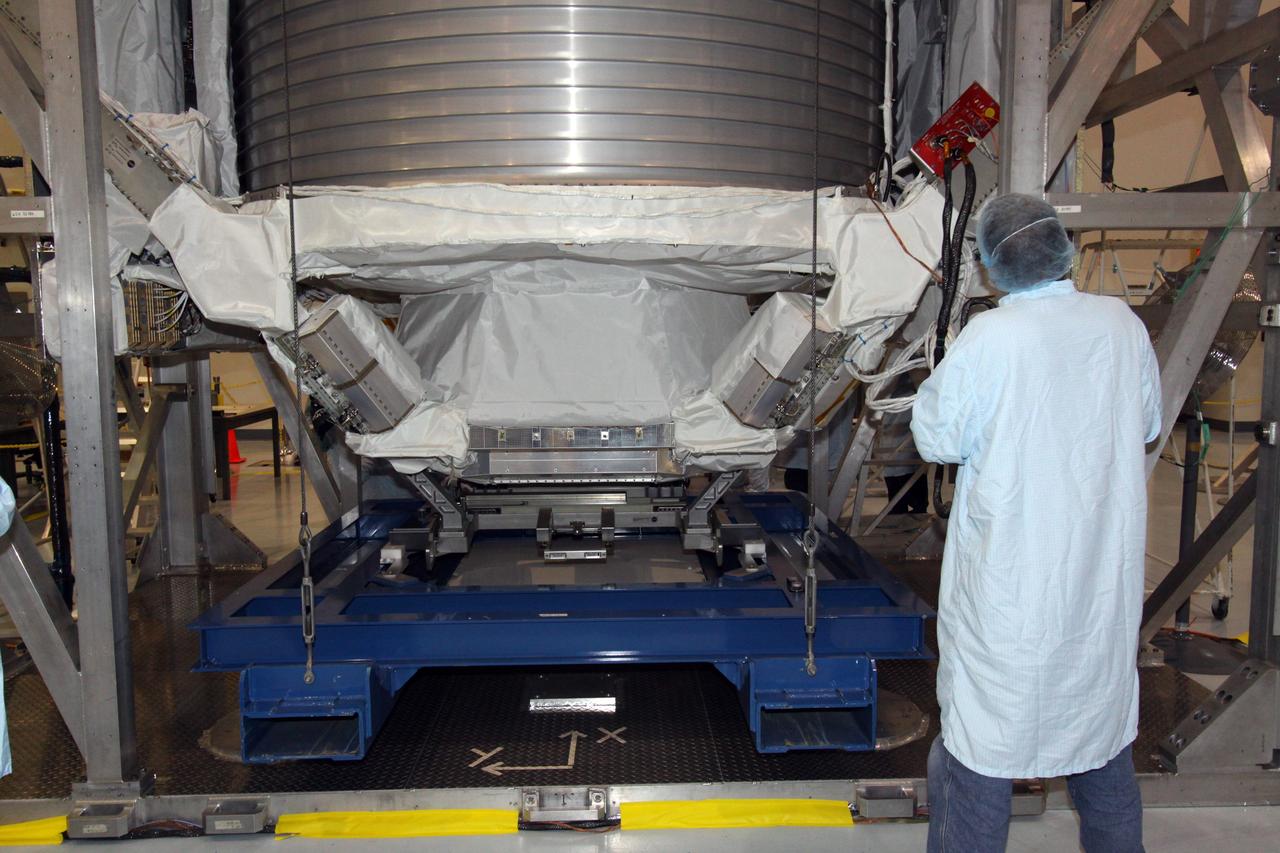
CAPE CANAVERAL, Fla. -- In the Space Station Processing Facility at NASA's Kennedy Space Center in Florida, a technician monitors the progress of the Payload Attach System, or PAS, as it is lifted up to the Alpha Magnetic Spectrometer, or AMS, where it will be attached to the bottom of the AMS. The PAS provides a method of securely connecting the payload to the International Space Station. AMS, a state-of-the-art particle physics detector, is designed to operate as an external module on the International Space Station. It will use the unique environment of space to study the universe and its origin by searching for dark matter. AMS will fly to the station aboard space shuttle Endeavour's STS-134 mission targeted to launch Feb. 26, 2011. Photo credit: NASA/Jack Pfaller
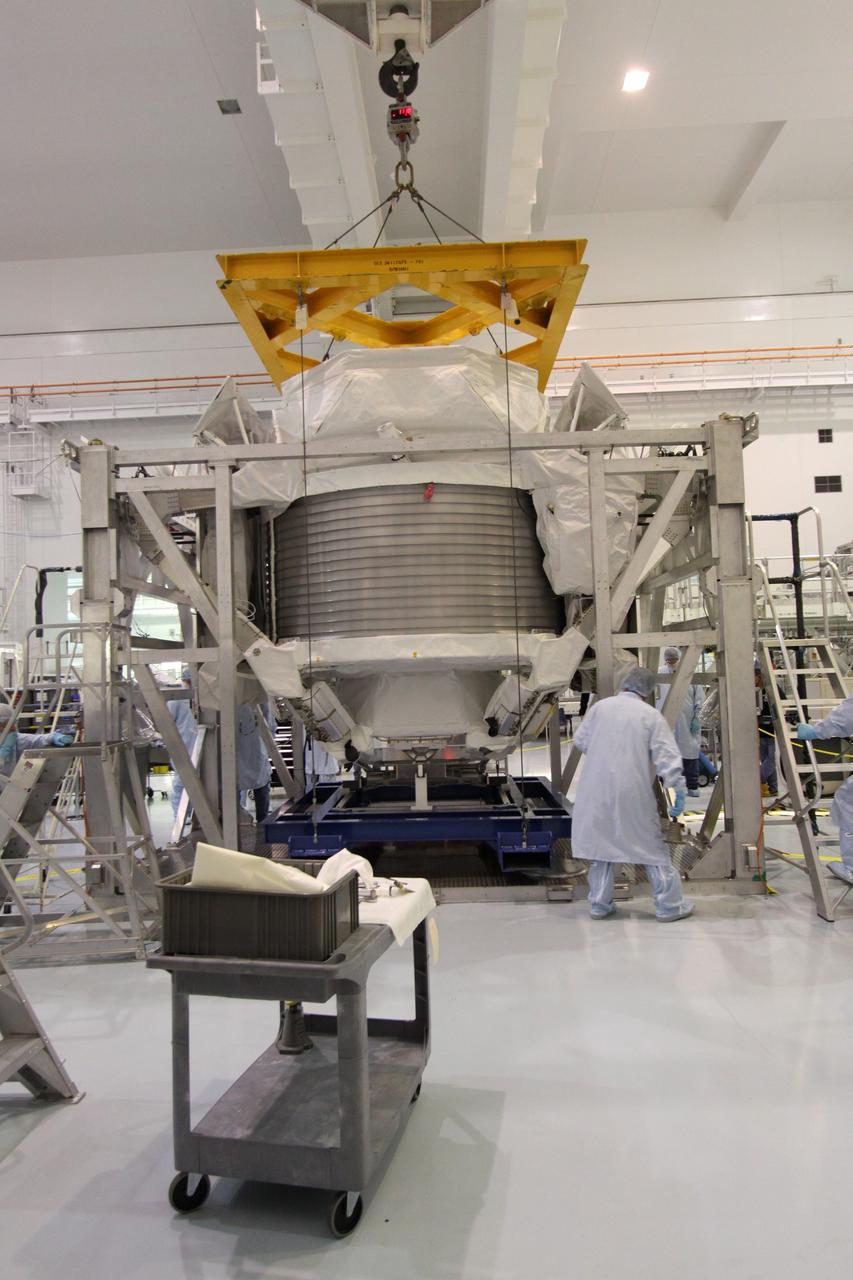
CAPE CANAVERAL, Fla. -- A technicians in the Space Station Processing Facility at NASA's Kennedy Space Center in Florida, check the progress of the Payload Attach System, or PAS, as it is lifted up to the Alpha Magnetic Spectrometer, or AMS, where it will be attached to the bottom of the AMS. The PAS provides a method of securely connecting the payload to the International Space Station. AMS, a state-of-the-art particle physics detector, is designed to operate as an external module on the International Space Station. It will use the unique environment of space to study the universe and its origin by searching for dark matter. AMS will fly to the station aboard space shuttle Endeavour's STS-134 mission targeted to launch Feb. 26, 2011. Photo credit: NASA/Jack Pfaller
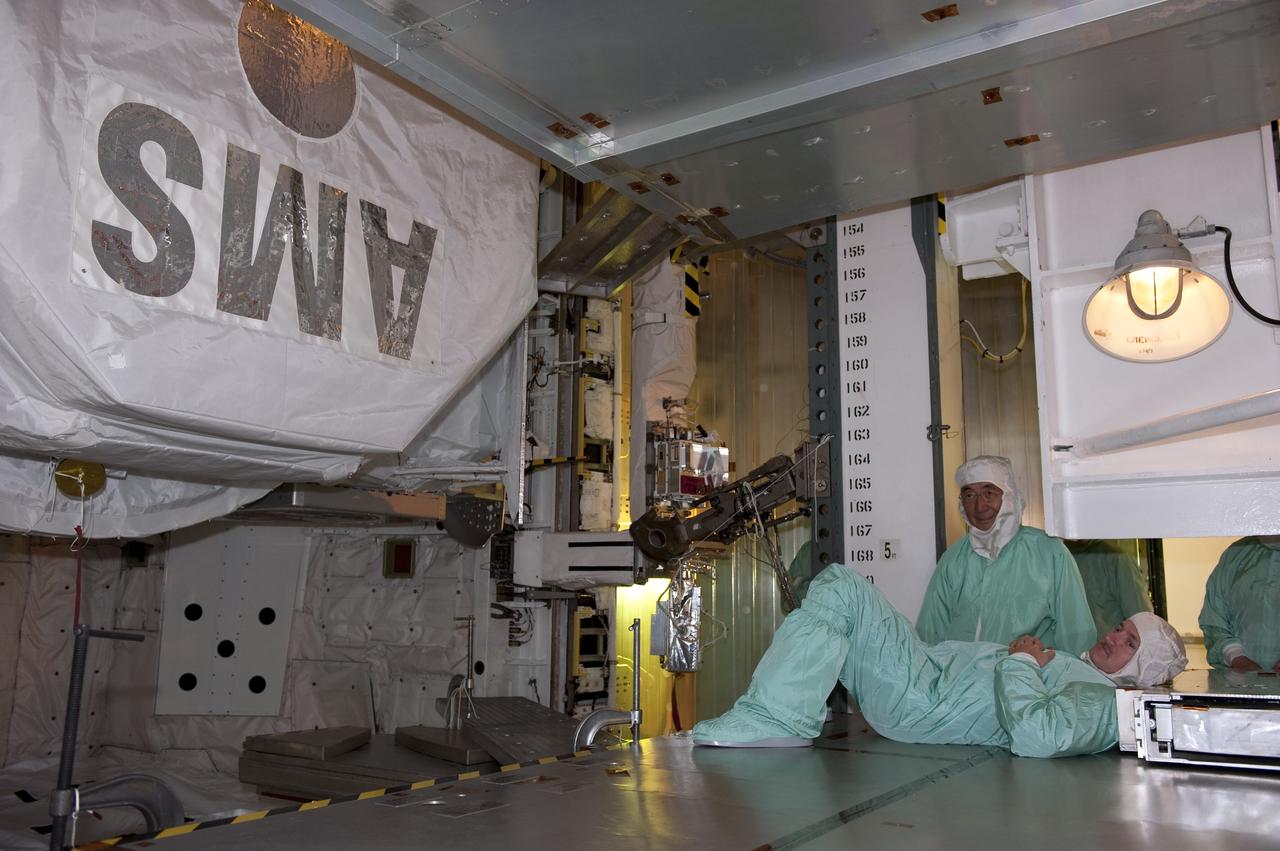
CAPE CANAVERAL, Fla. -- STS-134 Commander Mark Kelly, lying down, and Professor Sam Ting, Alpha Magnetic Spectrometer-2 (AMS) principal investigator at the Massachusetts Institute of Technology, perform a walkdown of space shuttle Endeavour's payload bay. The Express Logistics Carrier-3 packed with spare parts and the (AMS) are inside the bay for the STS-134 mission to the International Space Station. Endeavour's six crew members are at Kennedy for the launch countdown dress rehearsal called the Terminal Countdown Demonstration Test (TCDT) and related training. Endeavour is targeted to launch April 19 at 7:48 p.m. EDT on its final spaceflight mission. For more information visit, www.nasa.gov/mission_pages/shuttle/shuttlemissions/sts134/index.html. Photo credit: NASA/Kim Shiflett
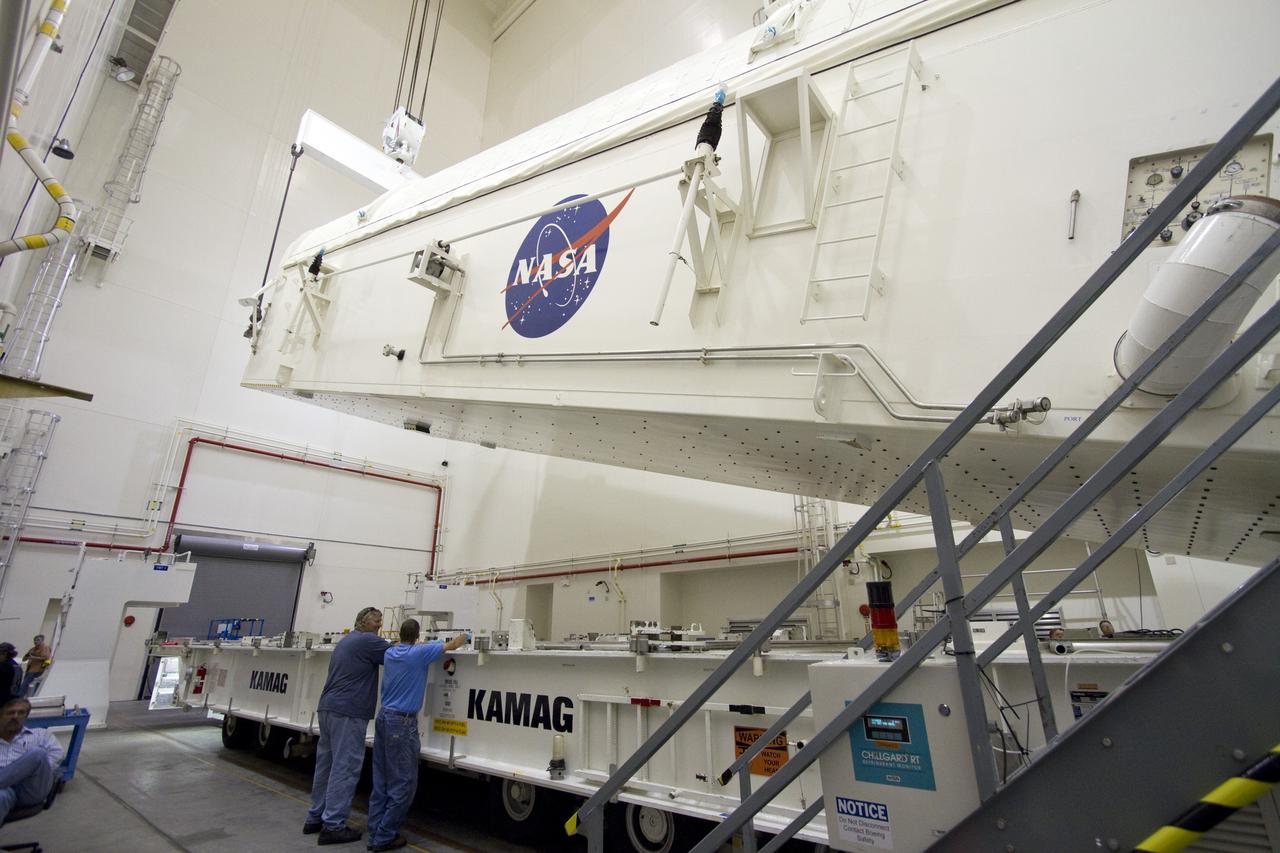
CAPE CANAVERAL, Fla. -- A canister, carrying the Alpha Magnetic Spectrometer-2 AMS and Express Logistics Carrier-3 for space shuttle Endeavour's STS-134 mission, is rotated from a horizontal to vertical position in the Canister Rotation Facility at NASA's Kennedy Space Center in Florida. Endeavour and its six-member STS-134 crew are targeted to lift off April 19 at 7:48 p.m. EDT to deliver the payload to the International Space Station. For more information visit, www.nasa.gov/mission_pages/shuttle/shuttlemissions/sts134/index.html. Photo credit: NASA/Jack Pfaller
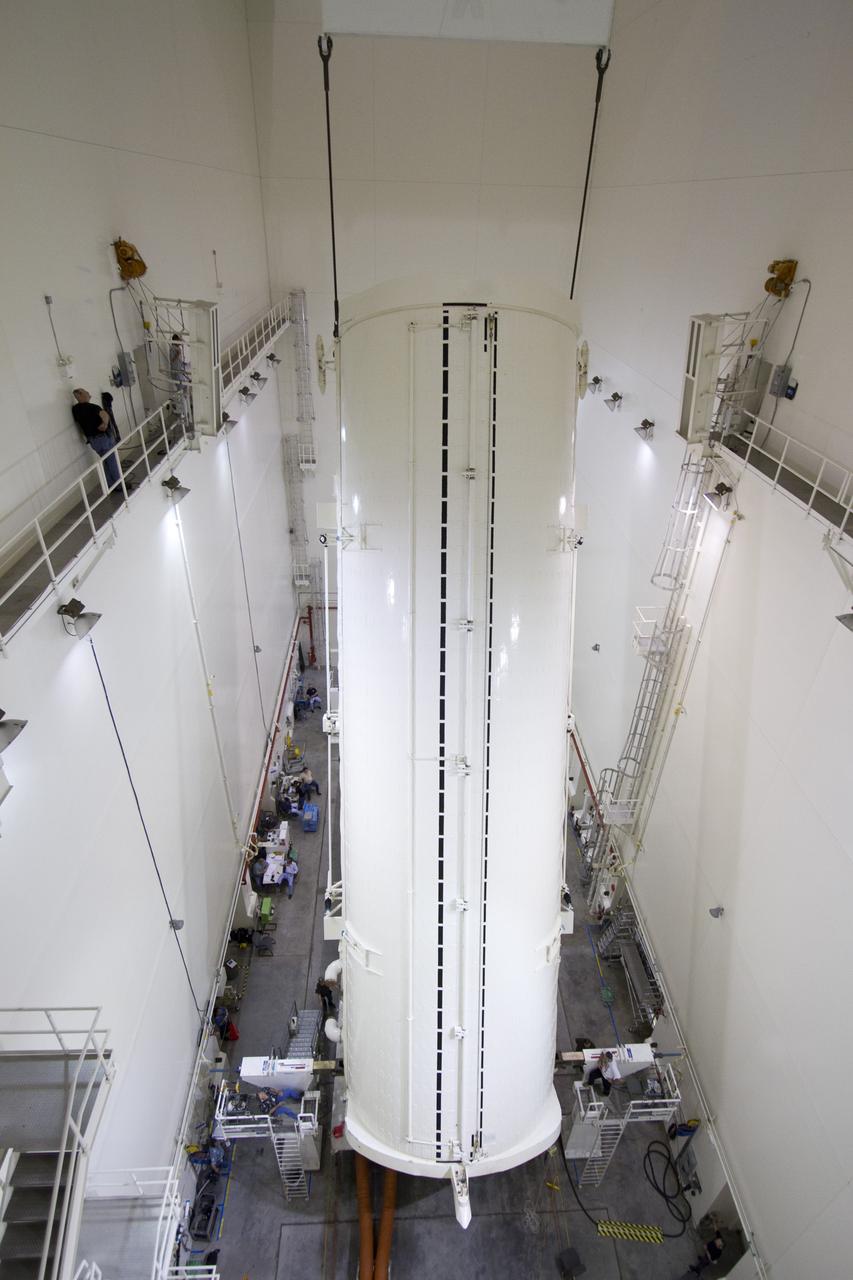
CAPE CANAVERAL, Fla. -- A canister, carrying the Alpha Magnetic Spectrometer-2 AMS and Express Logistics Carrier-3 for space shuttle Endeavour's STS-134 mission, is rotated from a horizontal to vertical position in the Canister Rotation Facility at NASA's Kennedy Space Center in Florida. Endeavour and its six-member STS-134 crew are targeted to lift off April 19 at 7:48 p.m. EDT to deliver the payload to the International Space Station. For more information visit, www.nasa.gov/mission_pages/shuttle/shuttlemissions/sts134/index.html. Photo credit: NASA/Jack Pfaller
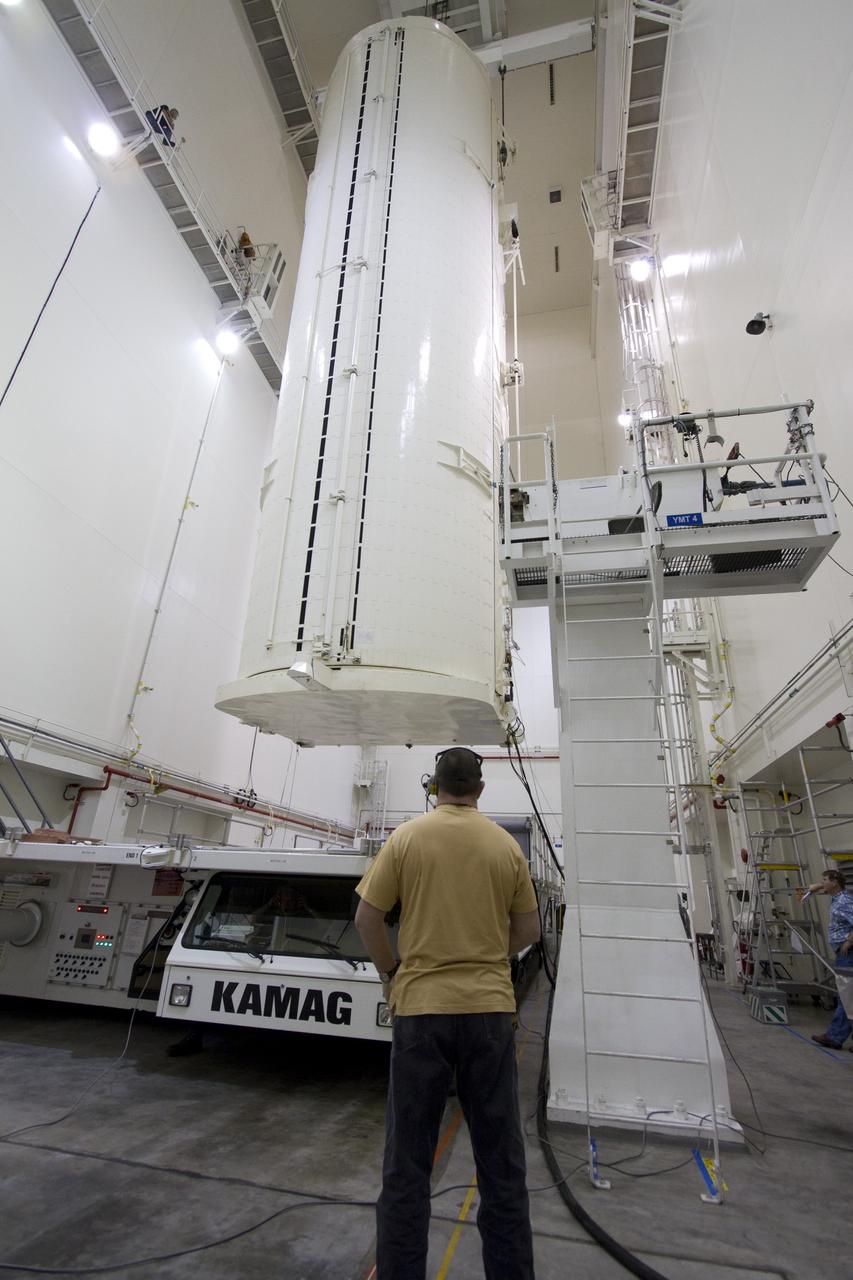
CAPE CANAVERAL, Fla. -- After being rotated from a horizontal to vertical position, the canister that contains the Alpha Magnetic Spectrometer-2 AMS and Express Logistics Carrier-3 for space shuttle Endeavour's STS-134 mission is lowered to its transportation vehicle in the Canister Rotation Facility at NASA's Kennedy Space Center in Florida. Endeavour and its six-member STS-134 crew are targeted to lift off April 19 at 7:48 p.m. EDT to deliver the payload to the International Space Station. For more information visit, www.nasa.gov/mission_pages/shuttle/shuttlemissions/sts134/index.html. Photo credit: NASA/Jack Pfaller
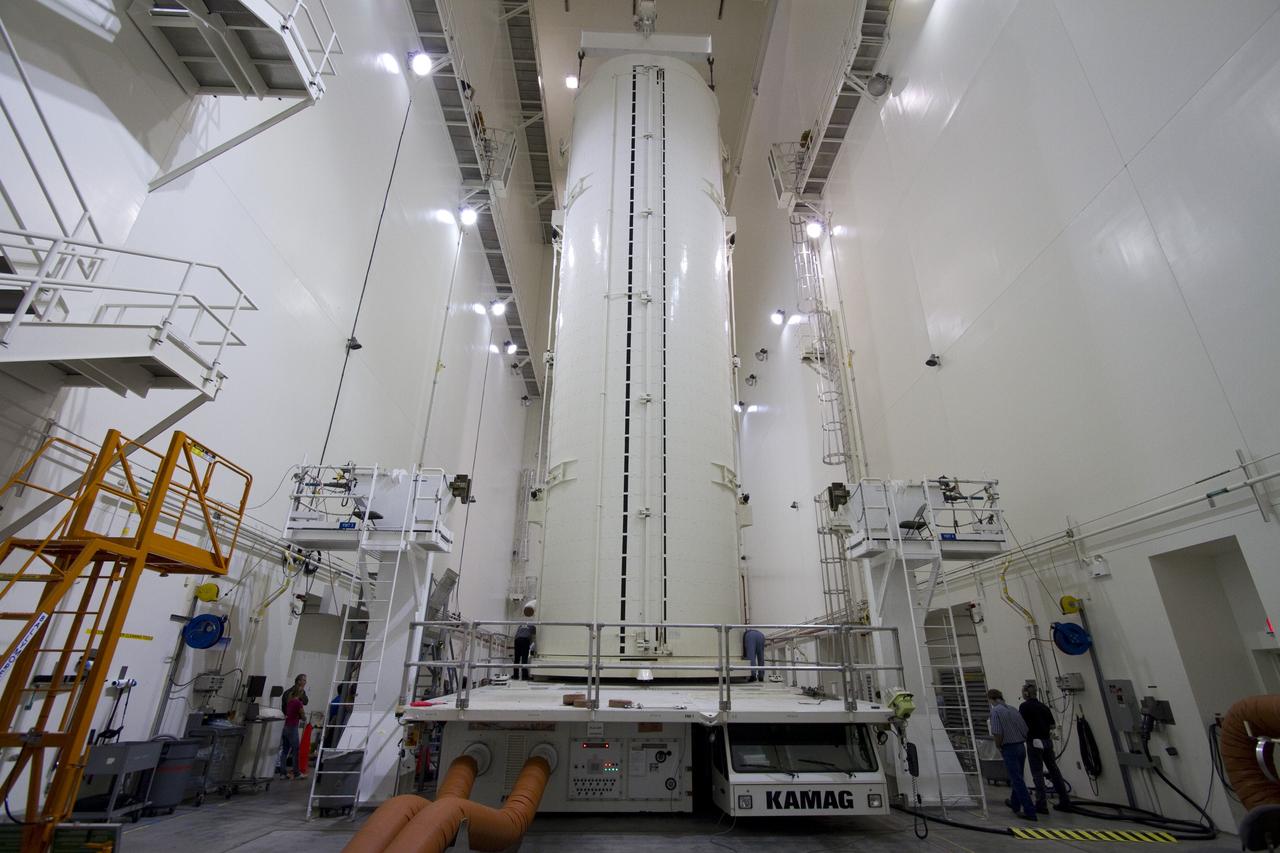
CAPE CANAVERAL, Fla. -- After being rotated from a horizontal to vertical position, the canister that contains the Alpha Magnetic Spectrometer-2 AMS and Express Logistics Carrier-3 for space shuttle Endeavour's STS-134 mission is lowered to its transportation vehicle in the Canister Rotation Facility at NASA's Kennedy Space Center in Florida. Endeavour and its six-member STS-134 crew are targeted to lift off April 19 at 7:48 p.m. EDT to deliver the payload to the International Space Station. For more information visit, www.nasa.gov/mission_pages/shuttle/shuttlemissions/sts134/index.html. Photo credit: NASA/Jack Pfaller
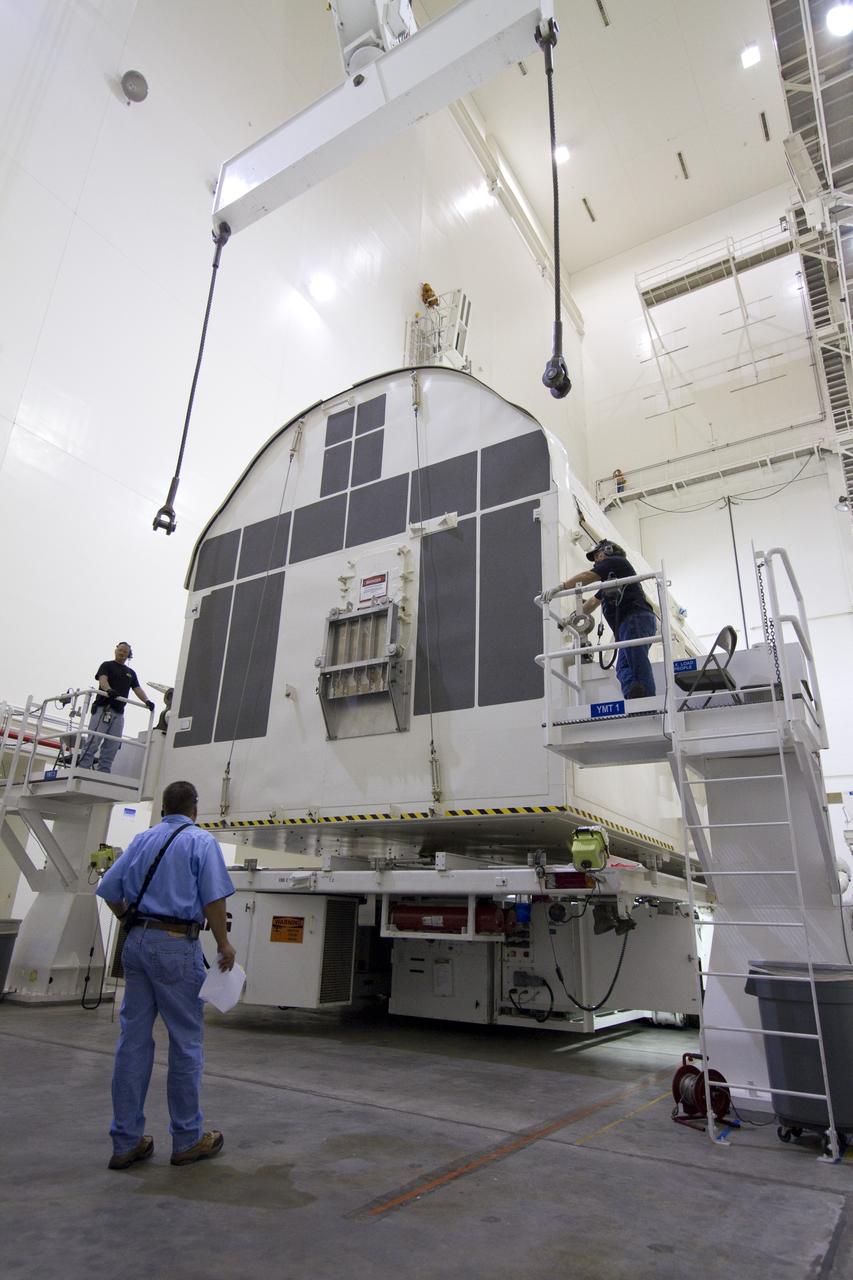
CAPE CANAVERAL, Fla. -- A canister, carrying the Alpha Magnetic Spectrometer-2 AMS and Express Logistics Carrier-3 for space shuttle Endeavour's STS-134 mission, will be rotated from a horizontal to vertical position in the Canister Rotation Facility at NASA's Kennedy Space Center in Florida. Endeavour and its six-member STS-134 crew are targeted to lift off April 19 at 7:48 p.m. EDT to deliver the payload to the International Space Station. For more information visit, www.nasa.gov/mission_pages/shuttle/shuttlemissions/sts134/index.html. Photo credit: NASA/Jack Pfaller
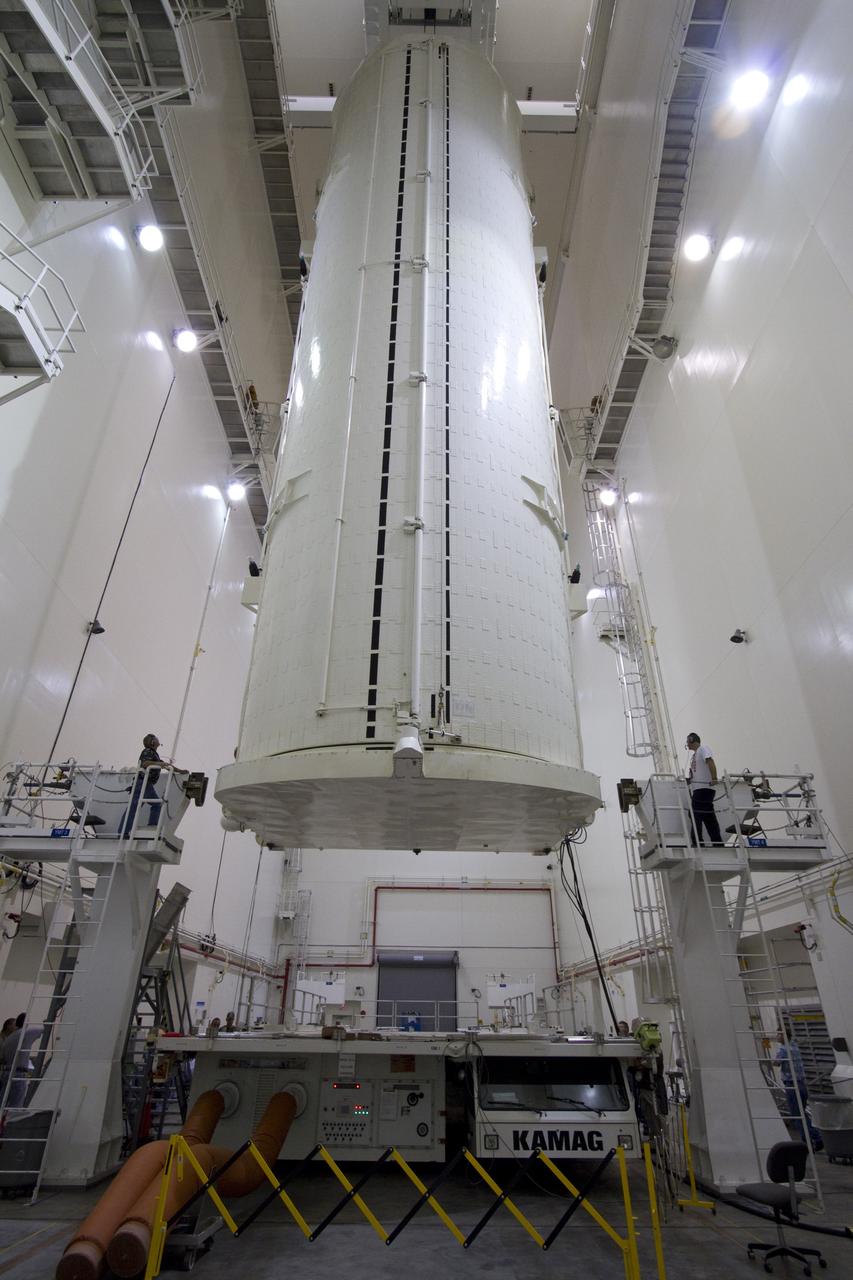
CAPE CANAVERAL, Fla. -- After being rotated from a horizontal to vertical position, the canister that contains the Alpha Magnetic Spectrometer-2 AMS and Express Logistics Carrier-3 for space shuttle Endeavour's STS-134 mission is lowered to its transportation vehicle in the Canister Rotation Facility at NASA's Kennedy Space Center in Florida. Endeavour and its six-member STS-134 crew are targeted to lift off April 19 at 7:48 p.m. EDT to deliver the payload to the International Space Station. For more information visit, www.nasa.gov/mission_pages/shuttle/shuttlemissions/sts134/index.html. Photo credit: NASA/Jack Pfaller
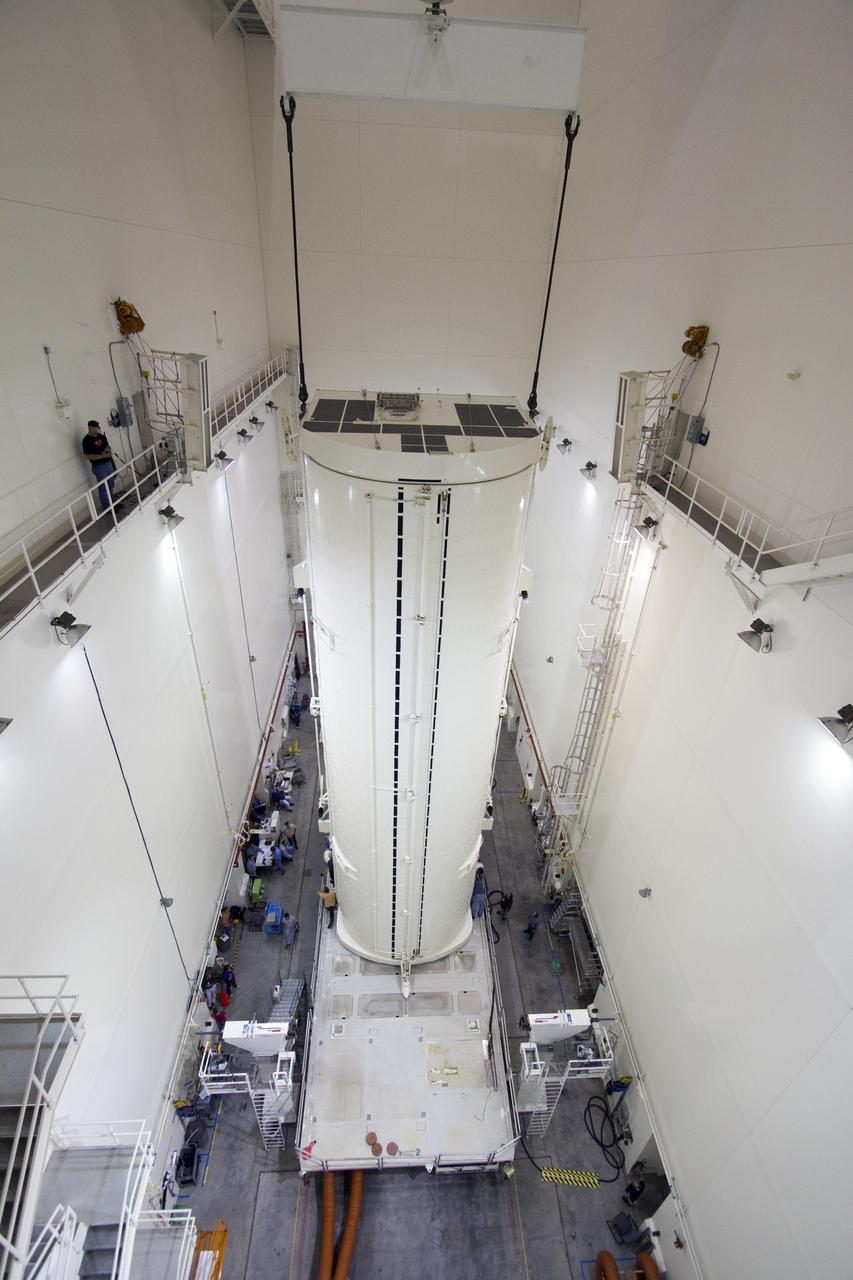
CAPE CANAVERAL, Fla. -- After being rotated from a horizontal to vertical position, the canister that contains the Alpha Magnetic Spectrometer-2 AMS and Express Logistics Carrier-3 for space shuttle Endeavour's STS-134 mission is lowered to its transportation vehicle in the Canister Rotation Facility at NASA's Kennedy Space Center in Florida. Endeavour and its six-member STS-134 crew are targeted to lift off April 19 at 7:48 p.m. EDT to deliver the payload to the International Space Station. For more information visit, www.nasa.gov/mission_pages/shuttle/shuttlemissions/sts134/index.html. Photo credit: NASA/Jack Pfaller
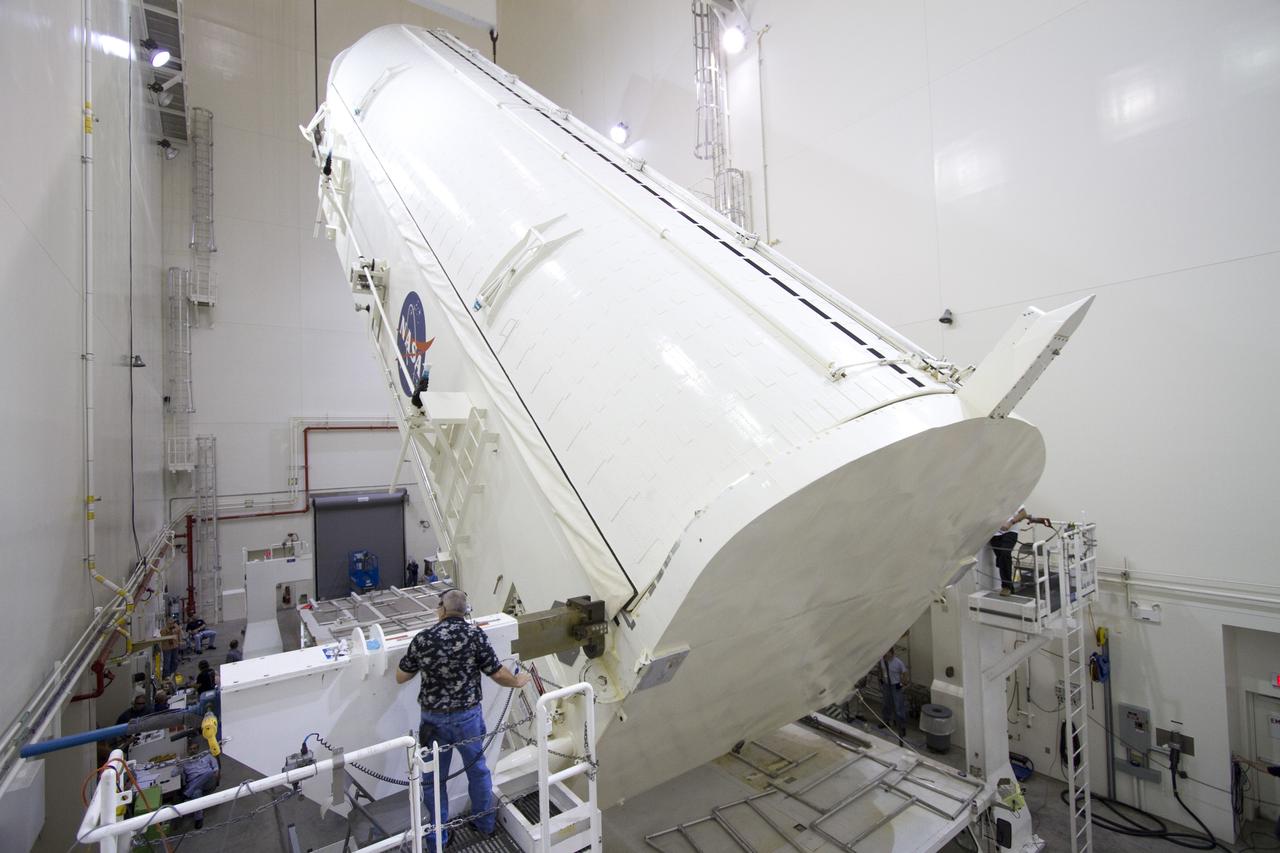
CAPE CANAVERAL, Fla. -- A canister, carrying the Alpha Magnetic Spectrometer-2 AMS and Express Logistics Carrier-3 for space shuttle Endeavour's STS-134 mission, is rotated from a horizontal to vertical position in the Canister Rotation Facility at NASA's Kennedy Space Center in Florida. Endeavour and its six-member STS-134 crew are targeted to lift off April 19 at 7:48 p.m. EDT to deliver the payload to the International Space Station. For more information visit, www.nasa.gov/mission_pages/shuttle/shuttlemissions/sts134/index.html. Photo credit: NASA/Jack Pfaller

CAPE CANAVERAL, Fla. -- A canister, carrying the Alpha Magnetic Spectrometer-2 AMS and Express Logistics Carrier-3 for space shuttle Endeavour's STS-134 mission, will be rotated from a horizontal to vertical position in the Canister Rotation Facility at NASA's Kennedy Space Center in Florida. Endeavour and its six-member STS-134 crew are targeted to lift off April 19 at 7:48 p.m. EDT to deliver the payload to the International Space Station. For more information visit, www.nasa.gov/mission_pages/shuttle/shuttlemissions/sts134/index.html. Photo credit: NASA/Jack Pfaller
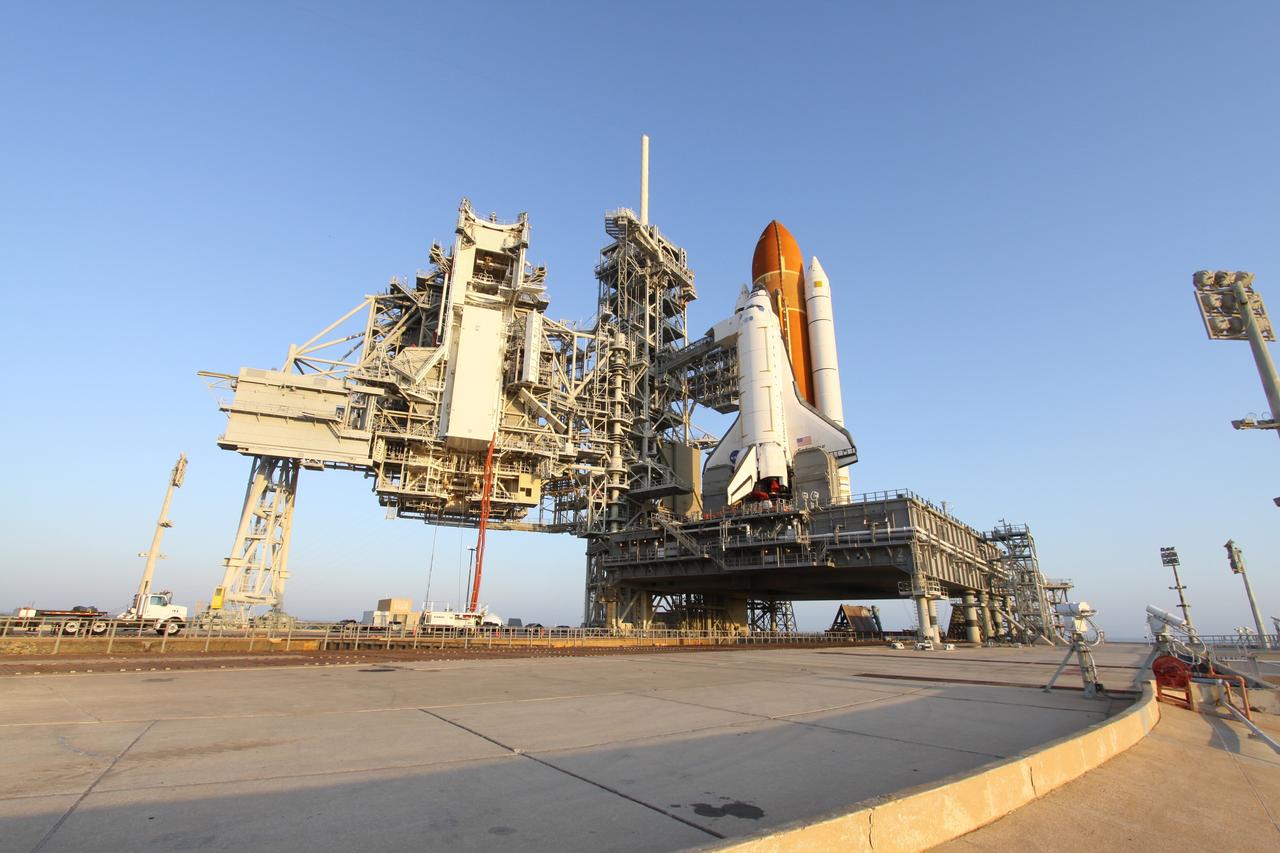
CAPE CANAVERAL, Fla. -- Crews move the primary payload for space shuttle Endeavour's STS-134 mission into the Payload Changeout Room on Launch Pad 39A at NASA's Kennedy Space Center in Florida. The rotating service structure (RSS) that protects the shuttle from the elements and provides access to its components is open to allow crews to make the vertical move. The Alpha Magnetic Spectrometer-2 (AMS) and Express Logistics Carrier-3 are scheduled to be installed into the shuttle's cargo bay March 25. Endeavour and its six-member STS-134 crew are targeted to lift off April 19 at 7:48 p.m. EDT to deliver the payload to the International Space Station. This is Endeavour's final scheduled mission. For more information visit, www.nasa.gov/mission_pages/shuttle/shuttlemissions/sts134/index.html. Photo credit: NASA
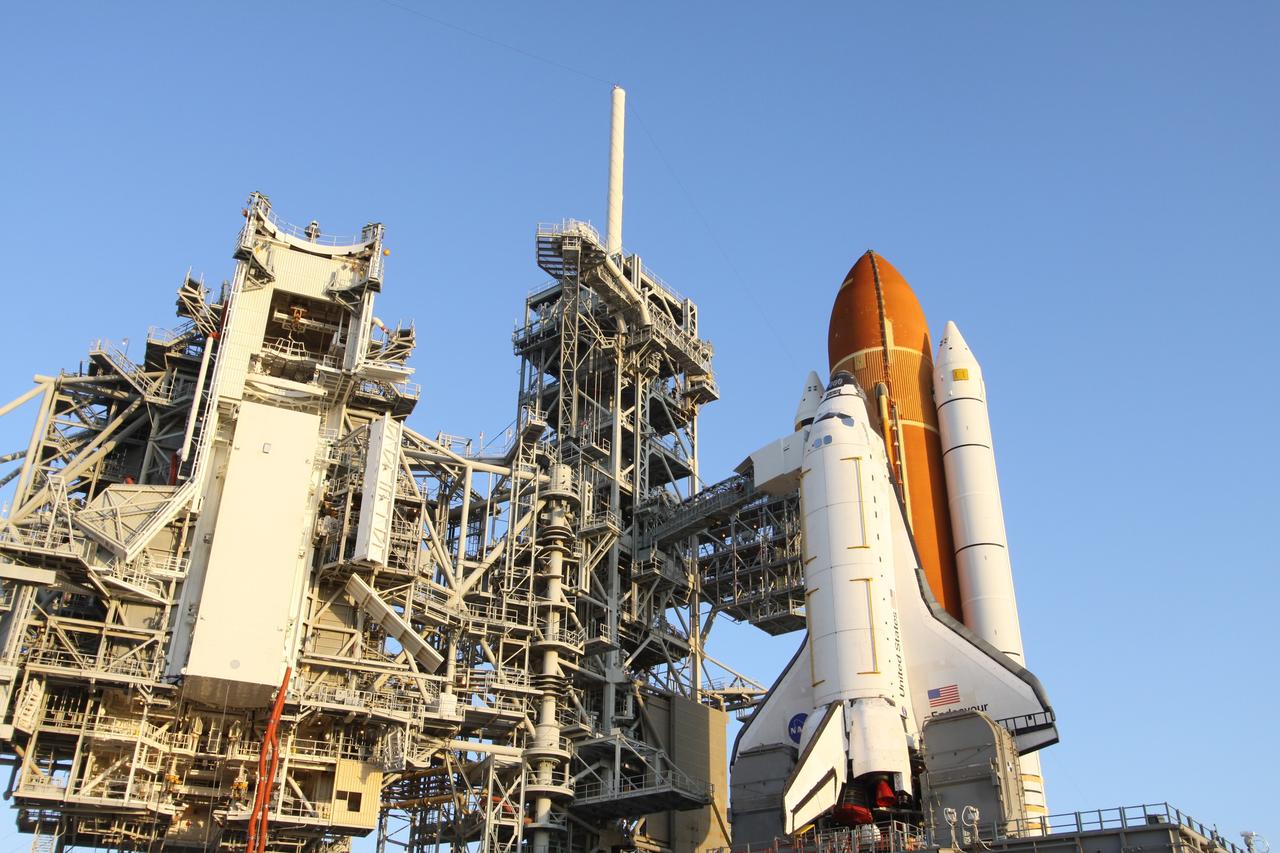
CAPE CANAVERAL, Fla. -- Crews move the primary payload for space shuttle Endeavour's STS-134 mission into the Payload Changeout Room on Launch Pad 39A at NASA's Kennedy Space Center in Florida. The rotating service structure (RSS) that protects the shuttle from the elements and provides access to its components is open to allow crews to make the vertical move. The Alpha Magnetic Spectrometer-2 (AMS) and Express Logistics Carrier-3 are scheduled to be installed into the shuttle's cargo bay March 25. Endeavour and its six-member STS-134 crew are targeted to lift off April 19 at 7:48 p.m. EDT to deliver the payload to the International Space Station. This is Endeavour's final scheduled mission. For more information visit, www.nasa.gov/mission_pages/shuttle/shuttlemissions/sts134/index.html. Photo credit: NASA
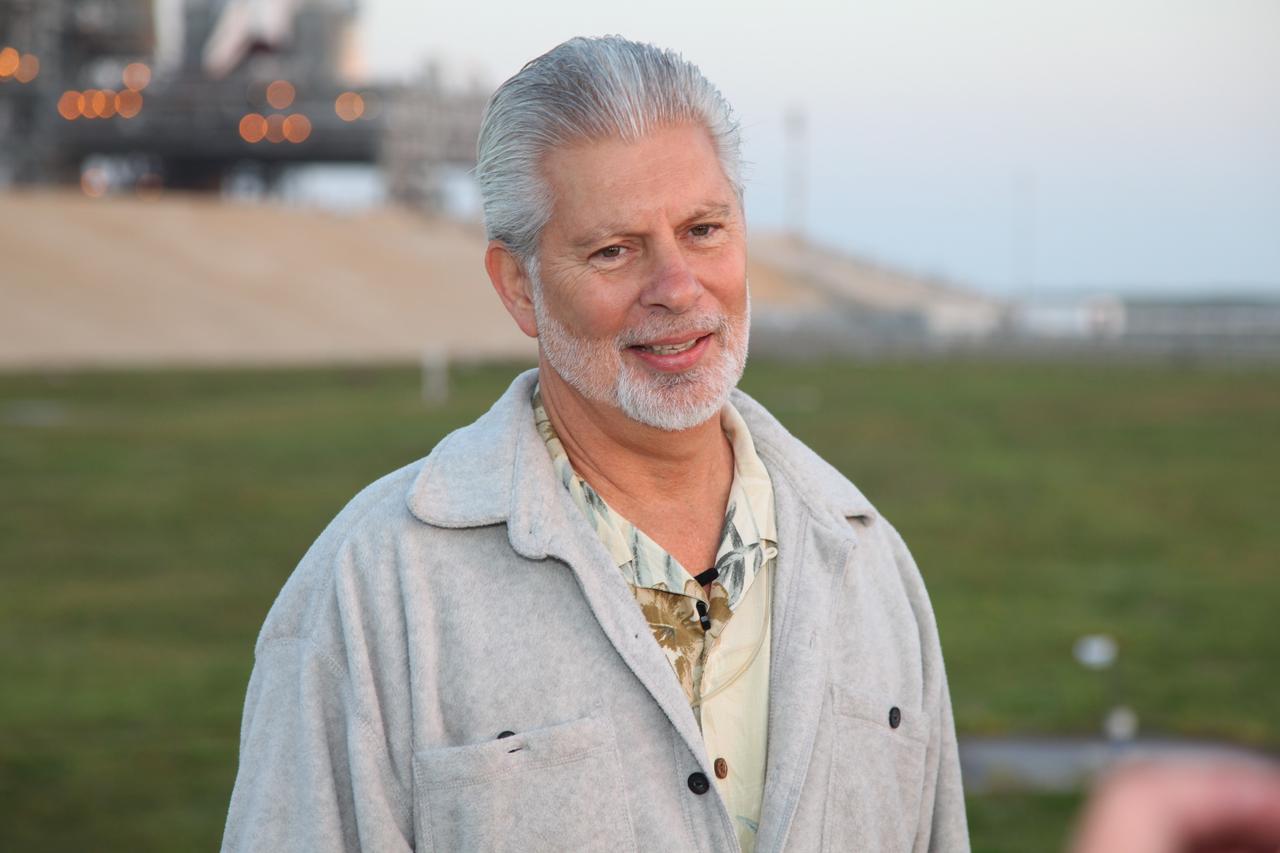
CAPE CANAVERAL, Fla. -- Boeing Space Operation's STS-134 Payload Flow Manager Bob Hart talks to media with space shuttle Endeavour and its primary payload in the background on Launch Pad 39A at NASA's Kennedy Space Center in Florida. The Alpha Magnetic Spectrometer-2 (AMS) and Express Logistics Carrier-3 are scheduled to be installed into the shuttle's cargo bay March 25. Endeavour and its six-member STS-134 crew are targeted to lift off April 19 at 7:48 p.m. EDT to deliver the payload to the International Space Station. This is Endeavour's final scheduled mission. For more information visit, www.nasa.gov/mission_pages/shuttle/shuttlemissions/sts134/index.html. Photo credit: NASA/Frankie Martin
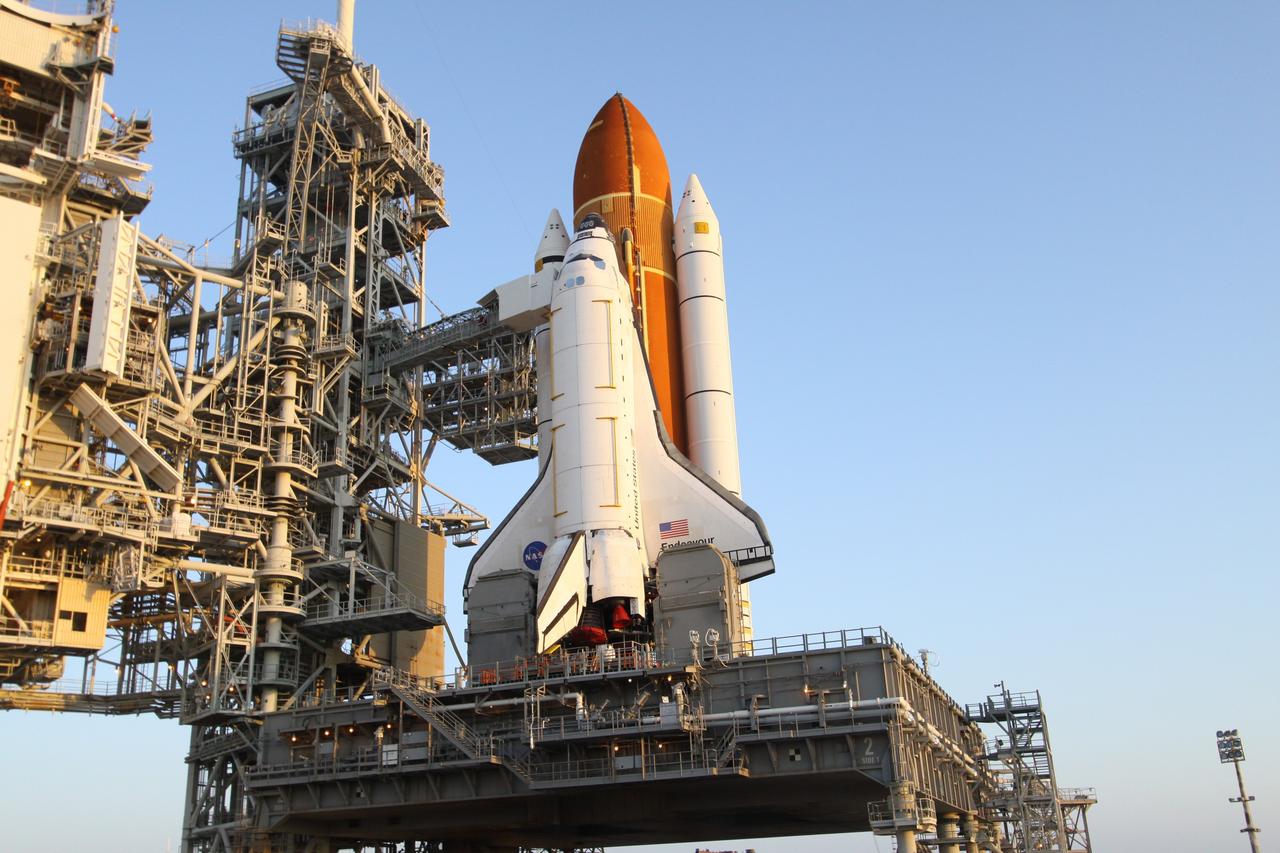
CAPE CANAVERAL, Fla. -- The rotating service structure (RSS) protecting space shuttle Endeavour from the elements and providing access to its components is open to allow crews to move the primary payload for the STS-134 mission into the Payload Changeout Room on Launch Pad 39A at NASA's Kennedy Space Center in Florida. The Alpha Magnetic Spectrometer-2 (AMS) and Express Logistics Carrier-3 are scheduled to be installed into the shuttle's cargo bay March 25. Endeavour and its six-member STS-134 crew are targeted to lift off April 19 at 7:48 p.m. EDT to deliver the payload to the International Space Station. This is Endeavour's final scheduled mission. For more information visit, www.nasa.gov/mission_pages/shuttle/shuttlemissions/sts134/index.html. Photo credit: NASA
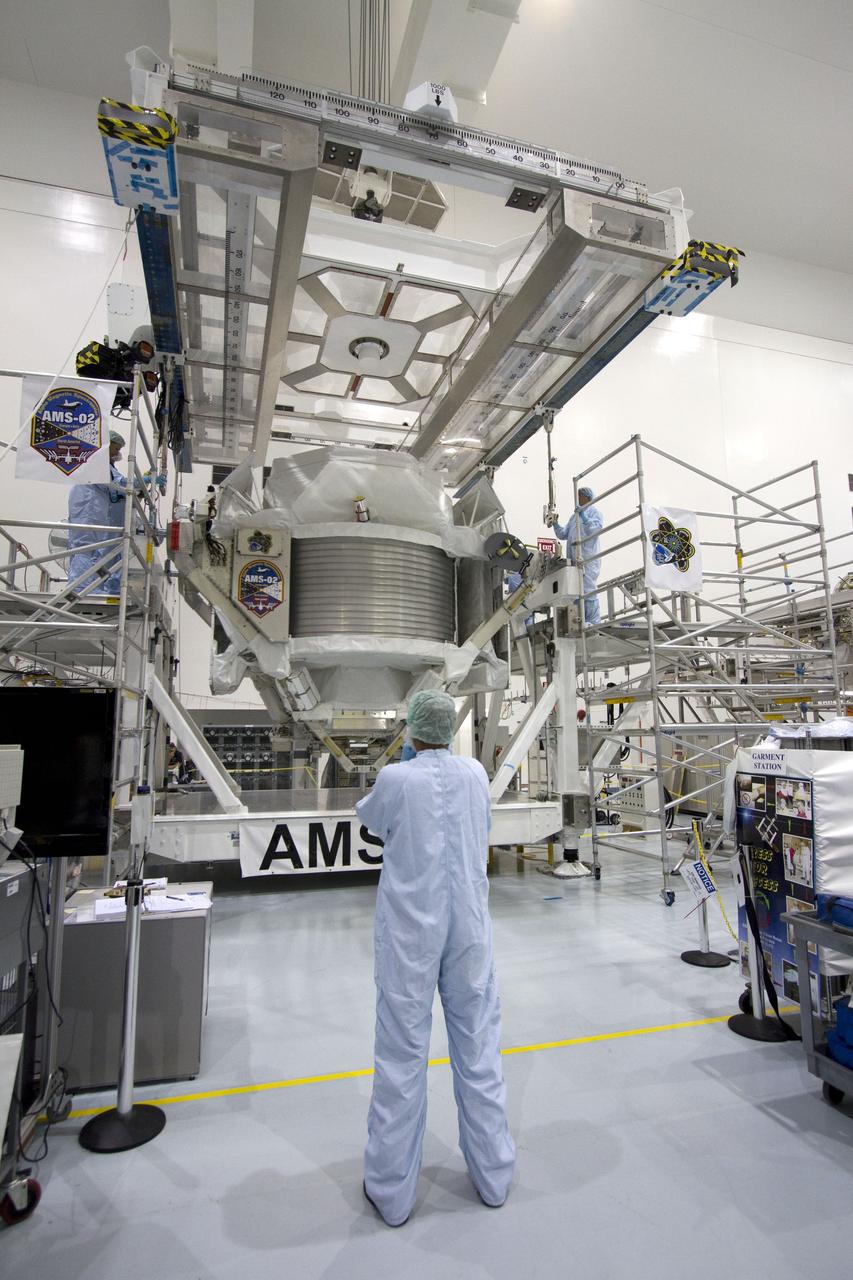
CAPE CANAVERAL, Fla. -- In the Space Station Processing Facility at NASA's Kennedy Space Center in Florida, the Alpha Magnetic Spectrometer-2 (AMS) begins to move from its primary work stand to the weight and center of gravity stand where final measurements will be taken before launch. Next, AMS will be moved into a payload canister. The canister will protect the space-bound payload on its journey to Launch Pad 39A, where it will later be installed into space shuttle Endeavour’s payload bay. AMS is a particle physics detector, designed to operate as an external experiment on the International Space Station. It will use the unique environment of space to study the universe and its origin by searching for dark matter. AMS-2 will fly to the station aboard Endeavour's STS-134 mission targeted to launch April 19 at 7:48 p.m. EDT. For more information visit, www.nasa.gov/mission_pages/shuttle/shuttlemissions/sts134/index.html. Photo credit: NASA/Jack Pfaller
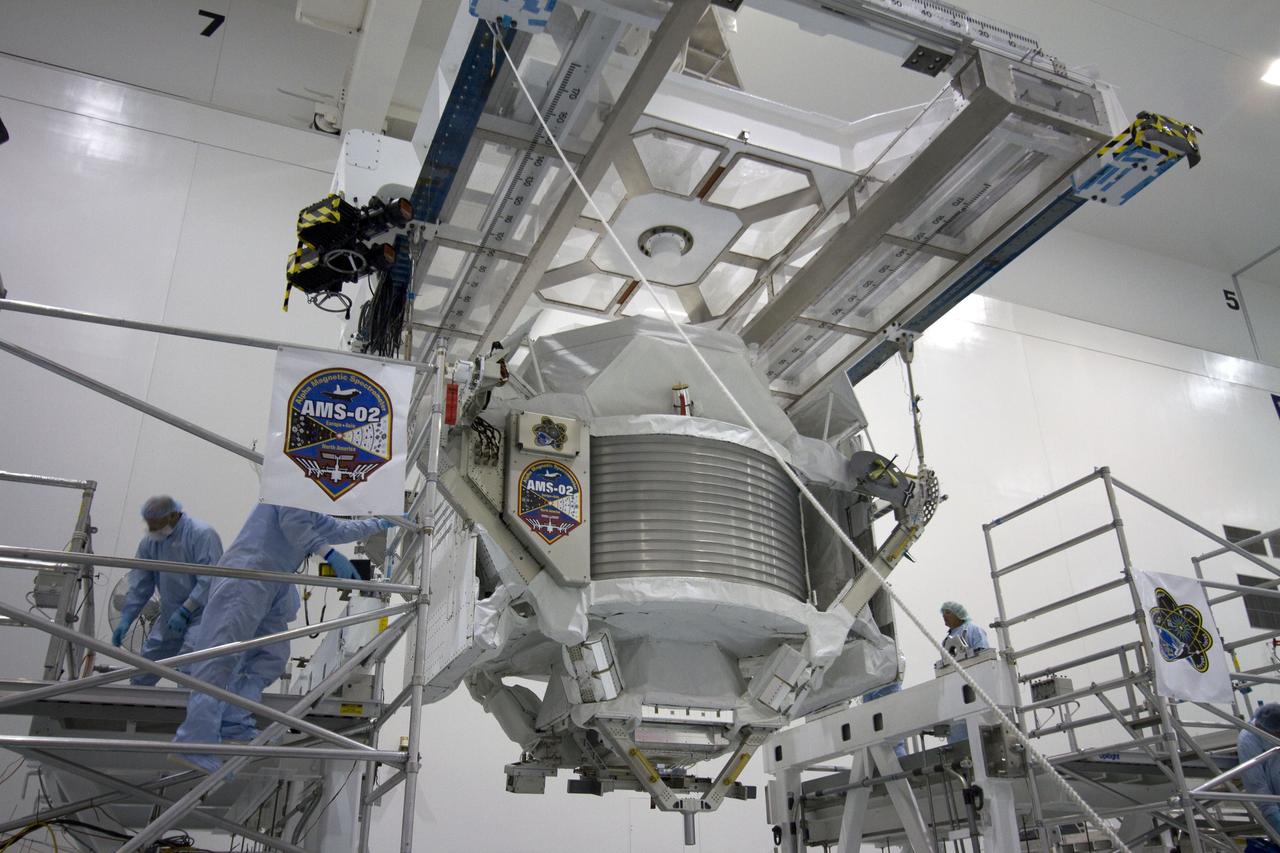
CAPE CANAVERAL, Fla. -- In the Space Station Processing Facility at NASA's Kennedy Space Center in Florida, the Alpha Magnetic Spectrometer-2 (AMS) moves from its primary work stand to the weight and center of gravity stand where final measurements will be taken before launch. Next, AMS will be moved into a payload canister. The canister will protect the space-bound payload on its journey to Launch Pad 39A, where it will later be installed into space shuttle Endeavour’s payload bay. AMS is a particle physics detector, designed to operate as an external experiment on the International Space Station. It will use the unique environment of space to study the universe and its origin by searching for dark matter. AMS-2 will fly to the station aboard Endeavour's STS-134 mission targeted to launch April 19 at 7:48 p.m. EDT. For more information visit, www.nasa.gov/mission_pages/shuttle/shuttlemissions/sts134/index.html. Photo credit: NASA/Jack Pfaller
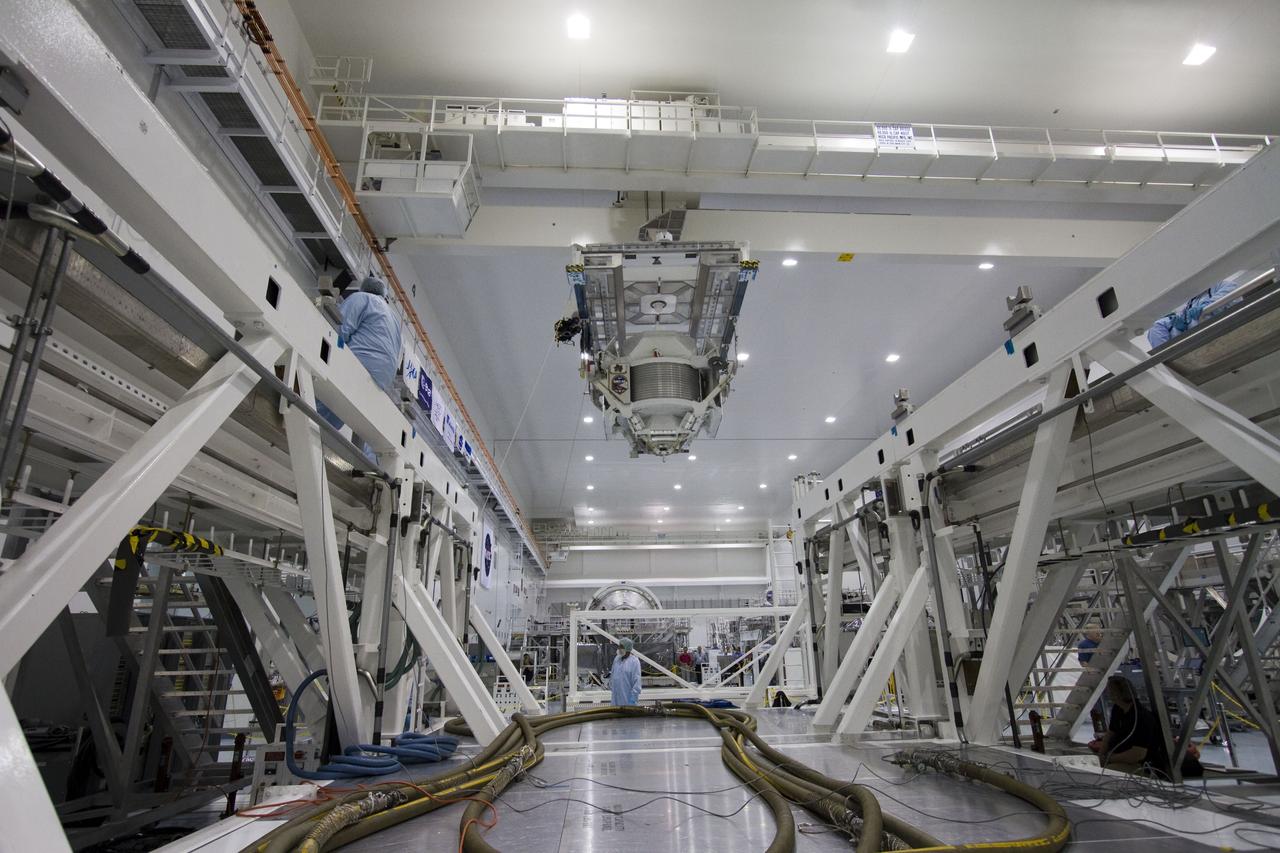
CAPE CANAVERAL, Fla. -- In the Space Station Processing Facility at NASA's Kennedy Space Center in Florida, the Alpha Magnetic Spectrometer-2 (AMS) moves from its primary work stand to the weight and center of gravity stand where final measurements will be taken before launch. Next, AMS will be moved into a payload canister. The canister will protect the space-bound payload on its journey to Launch Pad 39A, where it will later be installed into space shuttle Endeavour’s payload bay. AMS is a particle physics detector, designed to operate as an external experiment on the International Space Station. It will use the unique environment of space to study the universe and its origin by searching for dark matter. AMS-2 will fly to the station aboard Endeavour's STS-134 mission targeted to launch April 19 at 7:48 p.m. EDT. For more information visit, www.nasa.gov/mission_pages/shuttle/shuttlemissions/sts134/index.html. Photo credit: NASA/Jack Pfaller
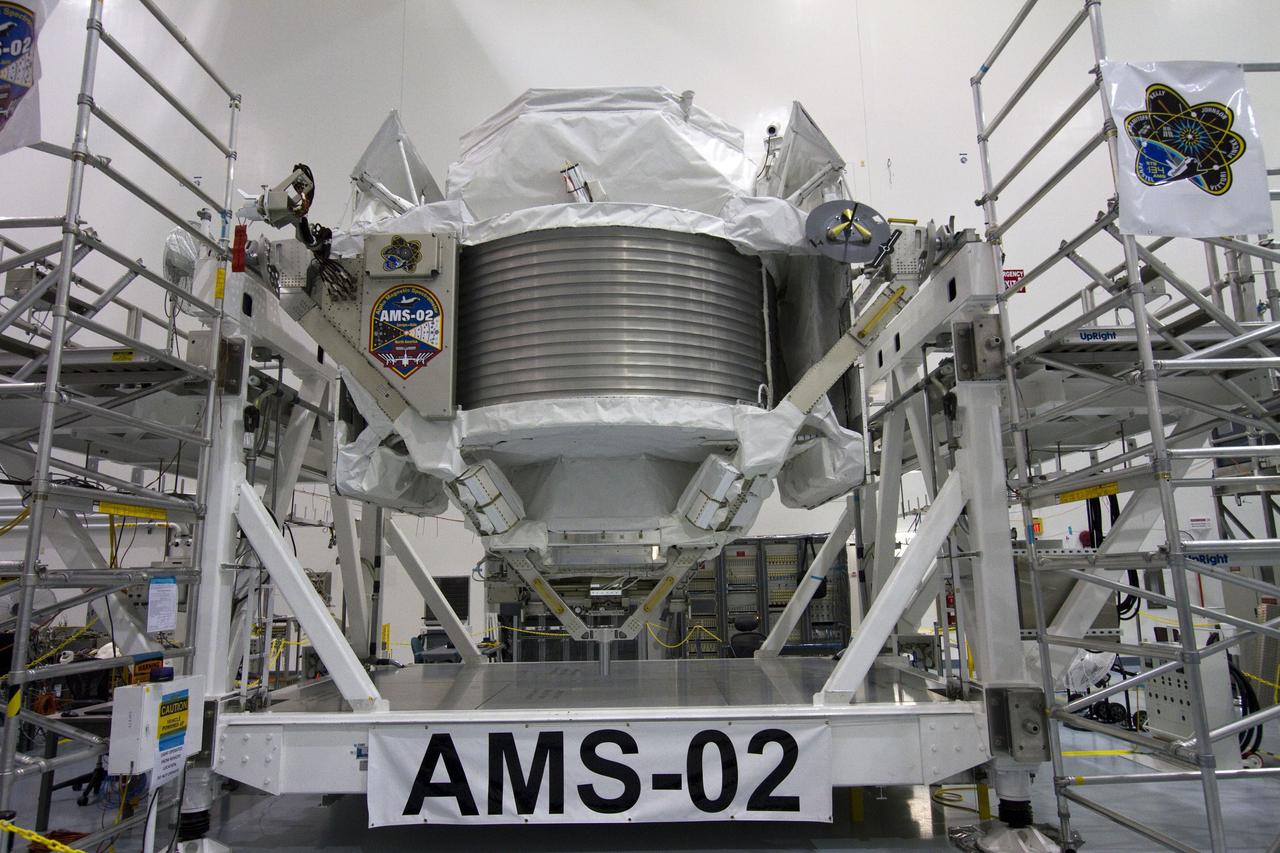
CAPE CANAVERAL, Fla. -- In the Space Station Processing Facility at NASA's Kennedy Space Center in Florida, the Alpha Magnetic Spectrometer-2 (AMS) is prepared for its move into a payload canister. The canister will protect the space-bound payload on its journey to Launch Pad 39A, where it will later be installed into space shuttle Endeavour’s payload bay. Before AMS is put into the canister, technicians will determine its weight and center of gravity. AMS is a particle physics detector, designed to operate as an external experiment on the International Space Station. It will use the unique environment of space to study the universe and its origin by searching for dark matter. AMS-2 will fly to the station aboard Endeavour's STS-134 mission targeted to launch April 19 at 7:48 p.m. EDT. For more information visit, www.nasa.gov/mission_pages/shuttle/shuttlemissions/sts134/index.html. Photo credit: NASA/Jack Pfaller
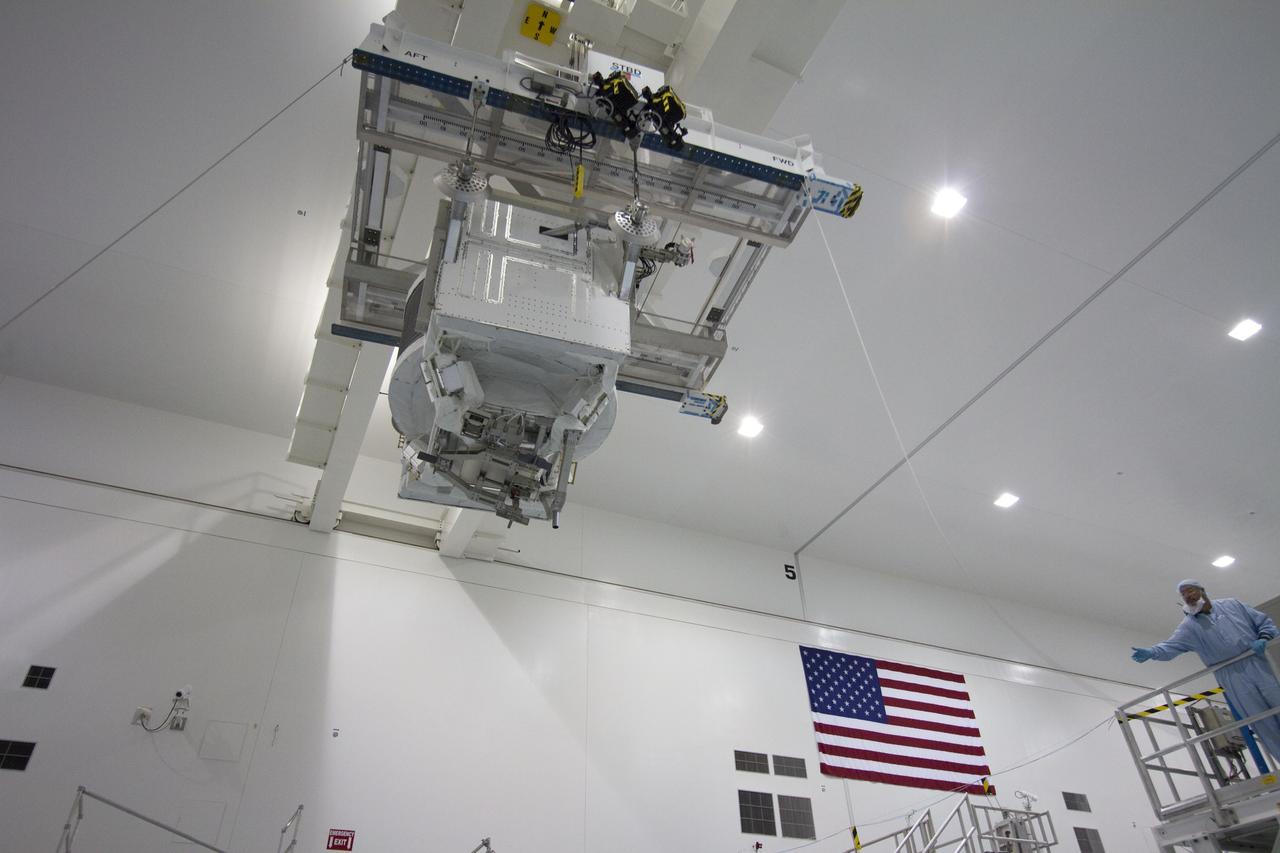
CAPE CANAVERAL, Fla. -- In the Space Station Processing Facility at NASA's Kennedy Space Center in Florida, the Alpha Magnetic Spectrometer-2 (AMS) moves from its primary work stand to the weight and center of gravity stand where final measurements will be taken before launch. Next, AMS will be moved into a payload canister. The canister will protect the space-bound payload on its journey to Launch Pad 39A, where it will later be installed into space shuttle Endeavour’s payload bay. AMS is a particle physics detector, designed to operate as an external experiment on the International Space Station. It will use the unique environment of space to study the universe and its origin by searching for dark matter. AMS-2 will fly to the station aboard Endeavour's STS-134 mission targeted to launch April 19 at 7:48 p.m. EDT. For more information visit, www.nasa.gov/mission_pages/shuttle/shuttlemissions/sts134/index.html. Photo credit: NASA/Jack Pfaller
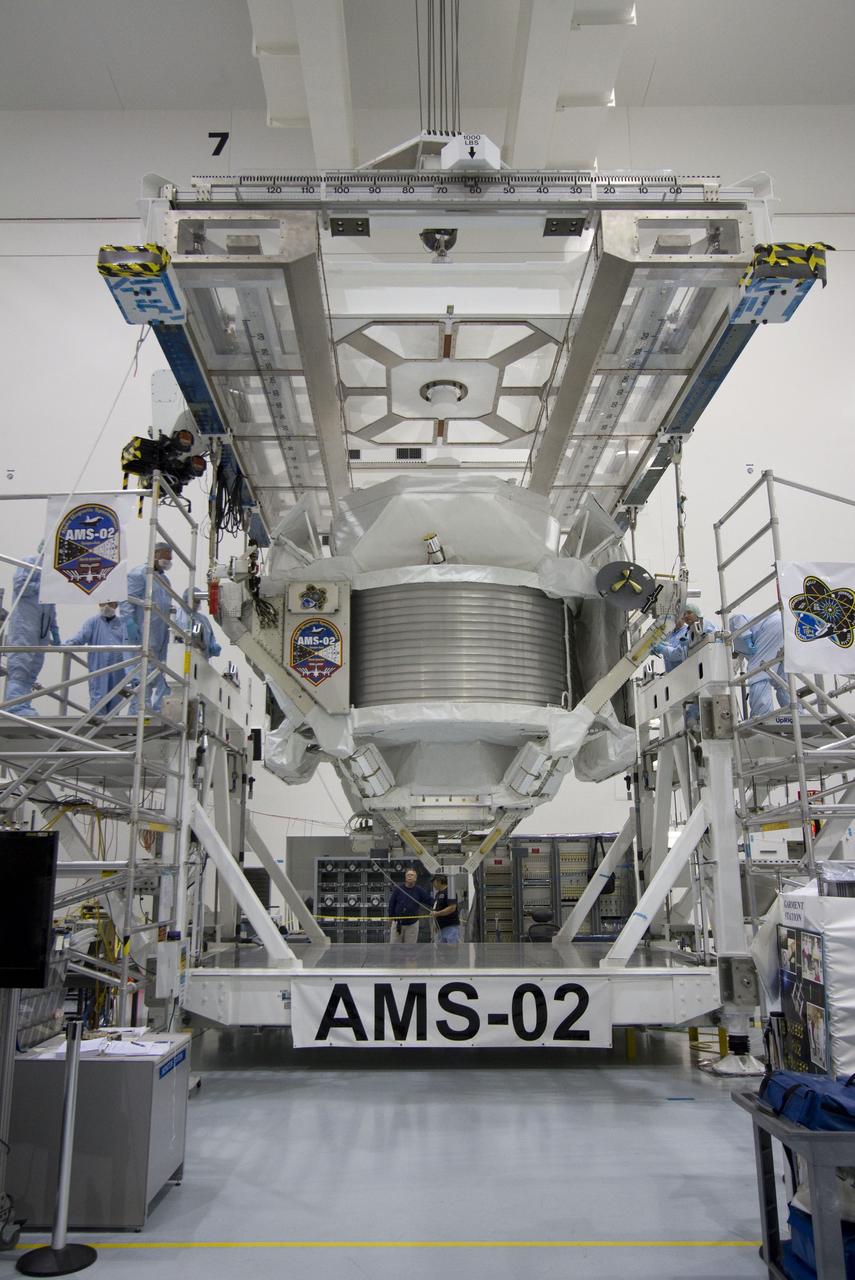
CAPE CANAVERAL, Fla. -- In the Space Station Processing Facility at NASA's Kennedy Space Center in Florida, the Alpha Magnetic Spectrometer-2 (AMS) begins to move from its primary work stand to the weight and center of gravity stand where final measurements will be taken before launch. Next, AMS will be moved into a payload canister. The canister will protect the space-bound payload on its journey to Launch Pad 39A, where it will later be installed into space shuttle Endeavour’s payload bay. AMS is a particle physics detector, designed to operate as an external experiment on the International Space Station. It will use the unique environment of space to study the universe and its origin by searching for dark matter. AMS-2 will fly to the station aboard Endeavour's STS-134 mission targeted to launch April 19 at 7:48 p.m. EDT. For more information visit, www.nasa.gov/mission_pages/shuttle/shuttlemissions/sts134/index.html. Photo credit: NASA/Jack Pfaller
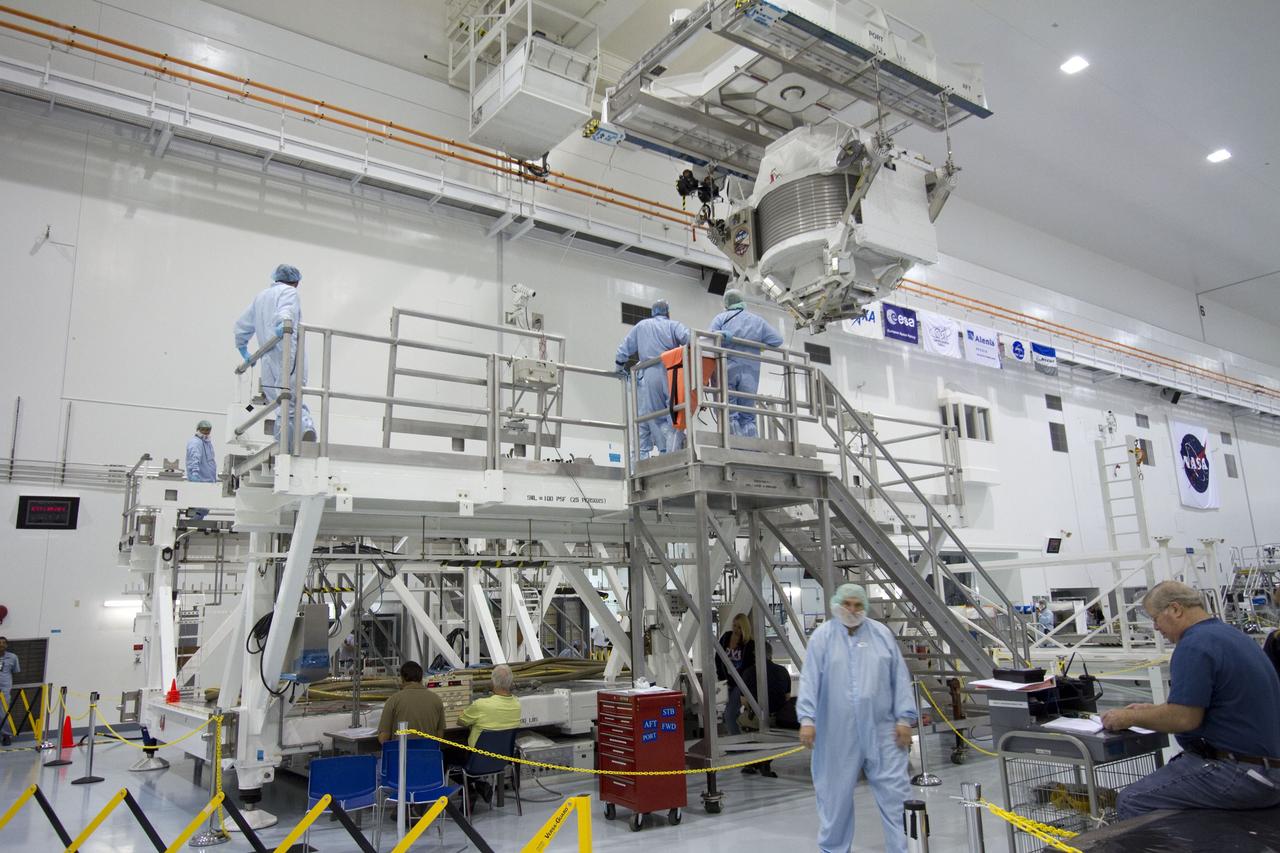
CAPE CANAVERAL, Fla. -- In the Space Station Processing Facility at NASA's Kennedy Space Center in Florida, the Alpha Magnetic Spectrometer-2 (AMS) moves from its primary work stand to the weight and center of gravity stand where final measurements will be taken before launch. Next, AMS will be moved into a payload canister. The canister will protect the space-bound payload on its journey to Launch Pad 39A, where it will later be installed into space shuttle Endeavour’s payload bay. AMS is a particle physics detector, designed to operate as an external experiment on the International Space Station. It will use the unique environment of space to study the universe and its origin by searching for dark matter. AMS-2 will fly to the station aboard Endeavour's STS-134 mission targeted to launch April 19 at 7:48 p.m. EDT. For more information visit, www.nasa.gov/mission_pages/shuttle/shuttlemissions/sts134/index.html. Photo credit: NASA/Jack Pfaller
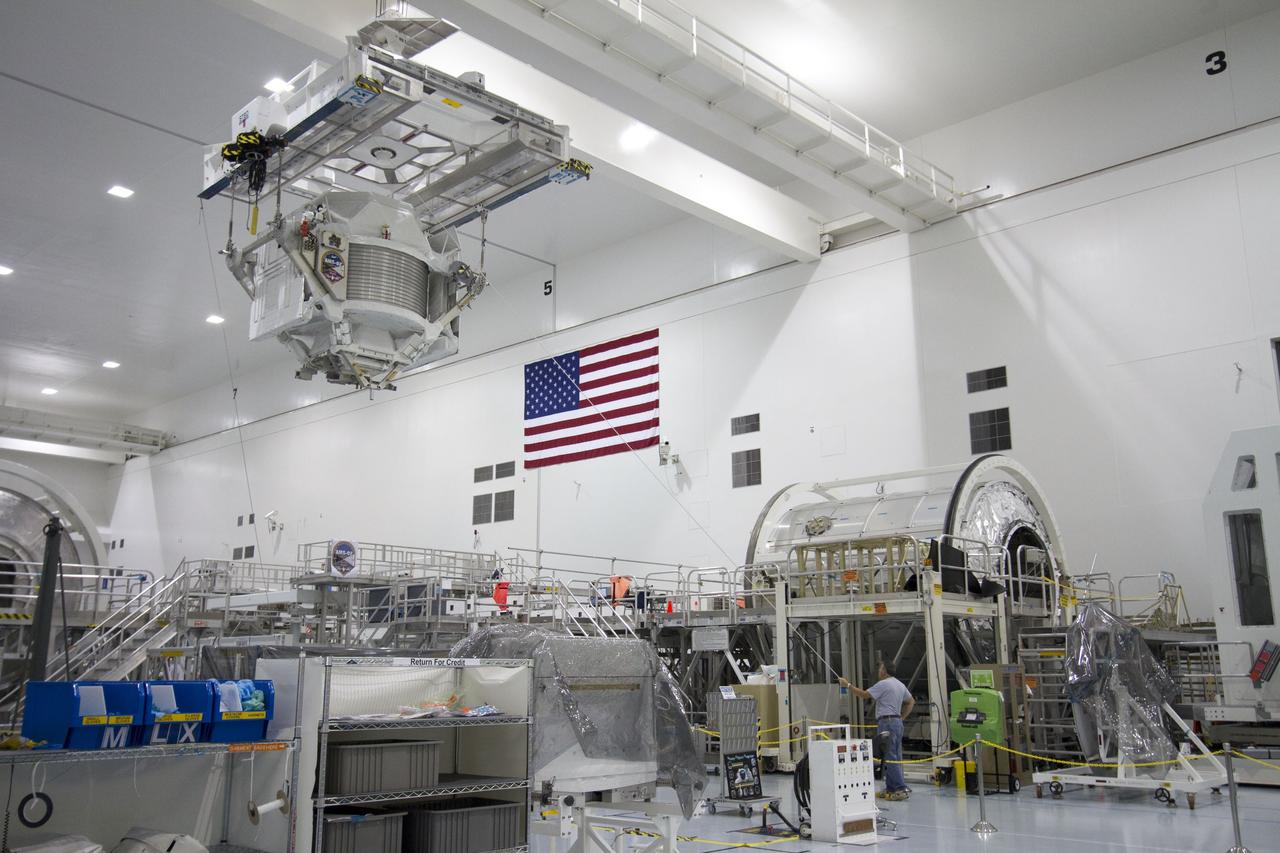
CAPE CANAVERAL, Fla. -- In the Space Station Processing Facility at NASA's Kennedy Space Center in Florida, the Alpha Magnetic Spectrometer-2 (AMS) moves from its primary work stand to the weight and center of gravity stand where final measurements will be taken before launch. Next, AMS will be moved into a payload canister. The canister will protect the space-bound payload on its journey to Launch Pad 39A, where it will later be installed into space shuttle Endeavour’s payload bay. AMS is a particle physics detector, designed to operate as an external experiment on the International Space Station. It will use the unique environment of space to study the universe and its origin by searching for dark matter. AMS-2 will fly to the station aboard Endeavour's STS-134 mission targeted to launch April 19 at 7:48 p.m. EDT. For more information visit, www.nasa.gov/mission_pages/shuttle/shuttlemissions/sts134/index.html. Photo credit: NASA/Jack Pfaller
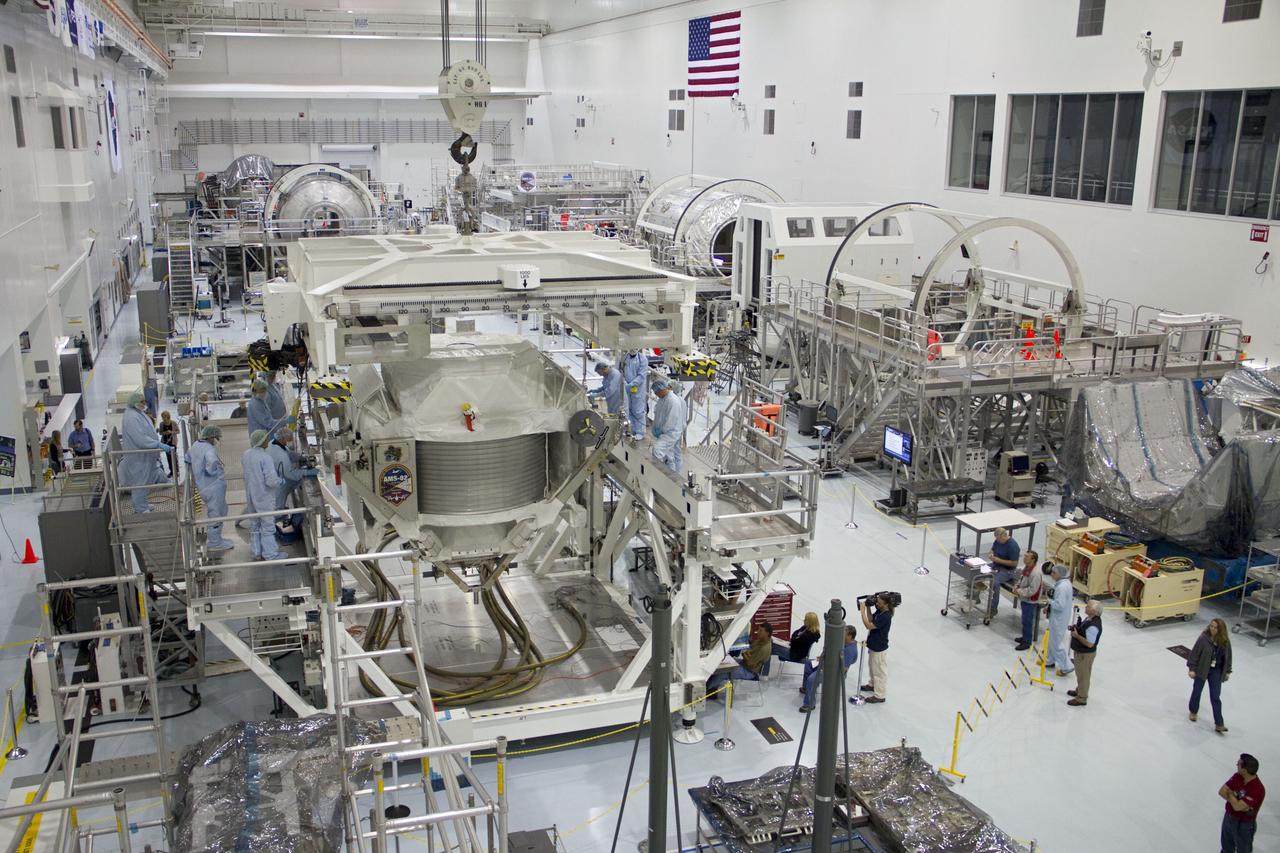
CAPE CANAVERAL, Fla. -- In the Space Station Processing Facility at NASA's Kennedy Space Center in Florida, the Alpha Magnetic Spectrometer-2 (AMS) was moved from its primary work stand to the weight and center of gravity stand where final measurements will be taken before launch. Next, AMS will be moved into a payload canister. The canister will protect the space-bound payload on its journey to Launch Pad 39A, where it will later be installed into space shuttle Endeavour’s payload bay. AMS is a particle physics detector, designed to operate as an external experiment on the International Space Station. It will use the unique environment of space to study the universe and its origin by searching for dark matter. AMS-2 will fly to the station aboard Endeavour's STS-134 mission targeted to launch April 19 at 7:48 p.m. EDT. For more information visit, www.nasa.gov/mission_pages/shuttle/shuttlemissions/sts134/index.html. Photo credit: NASA/Jack Pfaller
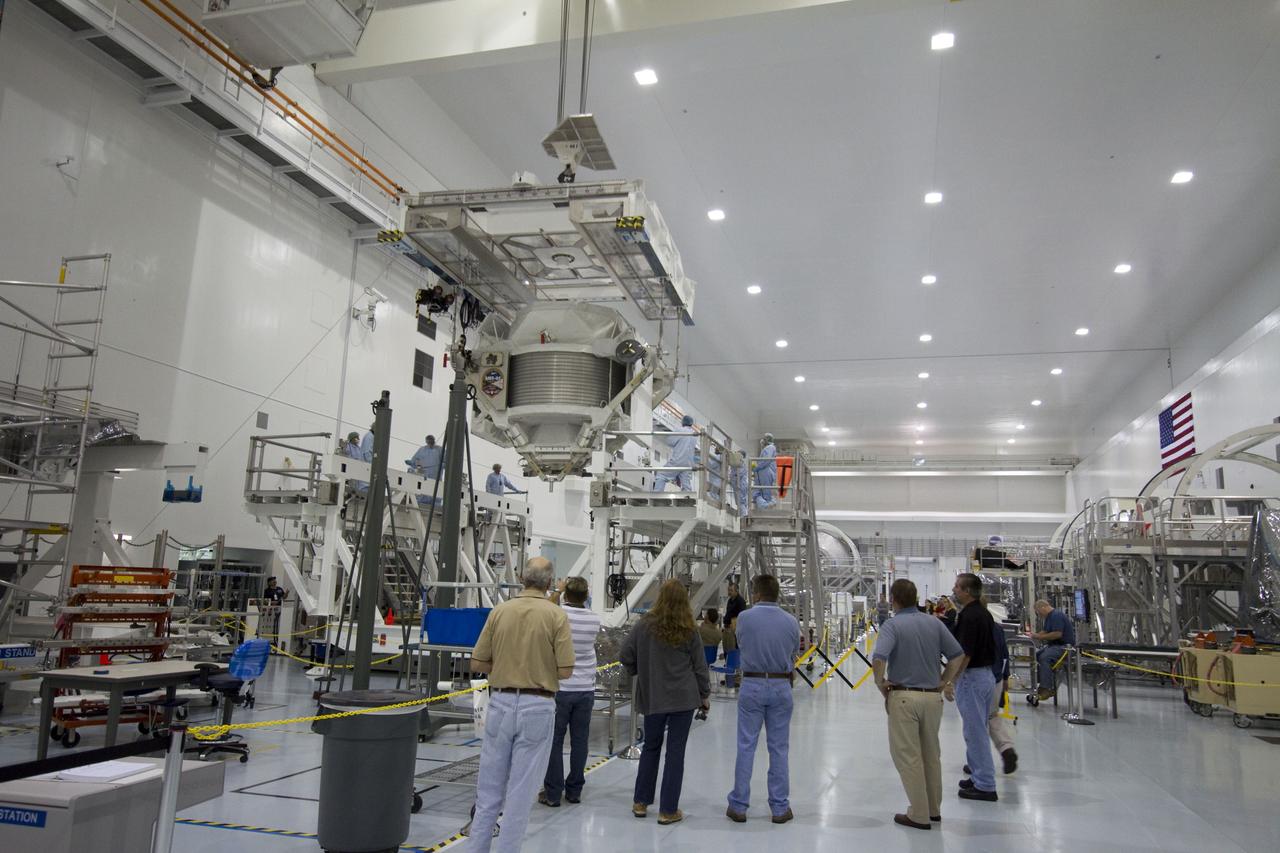
CAPE CANAVERAL, Fla. -- In the Space Station Processing Facility at NASA's Kennedy Space Center in Florida, the Alpha Magnetic Spectrometer-2 (AMS) moves from its primary work stand to the weight and center of gravity stand where final measurements will be taken before launch. Next, AMS will be moved into a payload canister. The canister will protect the space-bound payload on its journey to Launch Pad 39A, where it will later be installed into space shuttle Endeavour’s payload bay. AMS is a particle physics detector, designed to operate as an external experiment on the International Space Station. It will use the unique environment of space to study the universe and its origin by searching for dark matter. AMS-2 will fly to the station aboard Endeavour's STS-134 mission targeted to launch April 19 at 7:48 p.m. EDT. For more information visit, www.nasa.gov/mission_pages/shuttle/shuttlemissions/sts134/index.html. Photo credit: NASA/Jack Pfaller
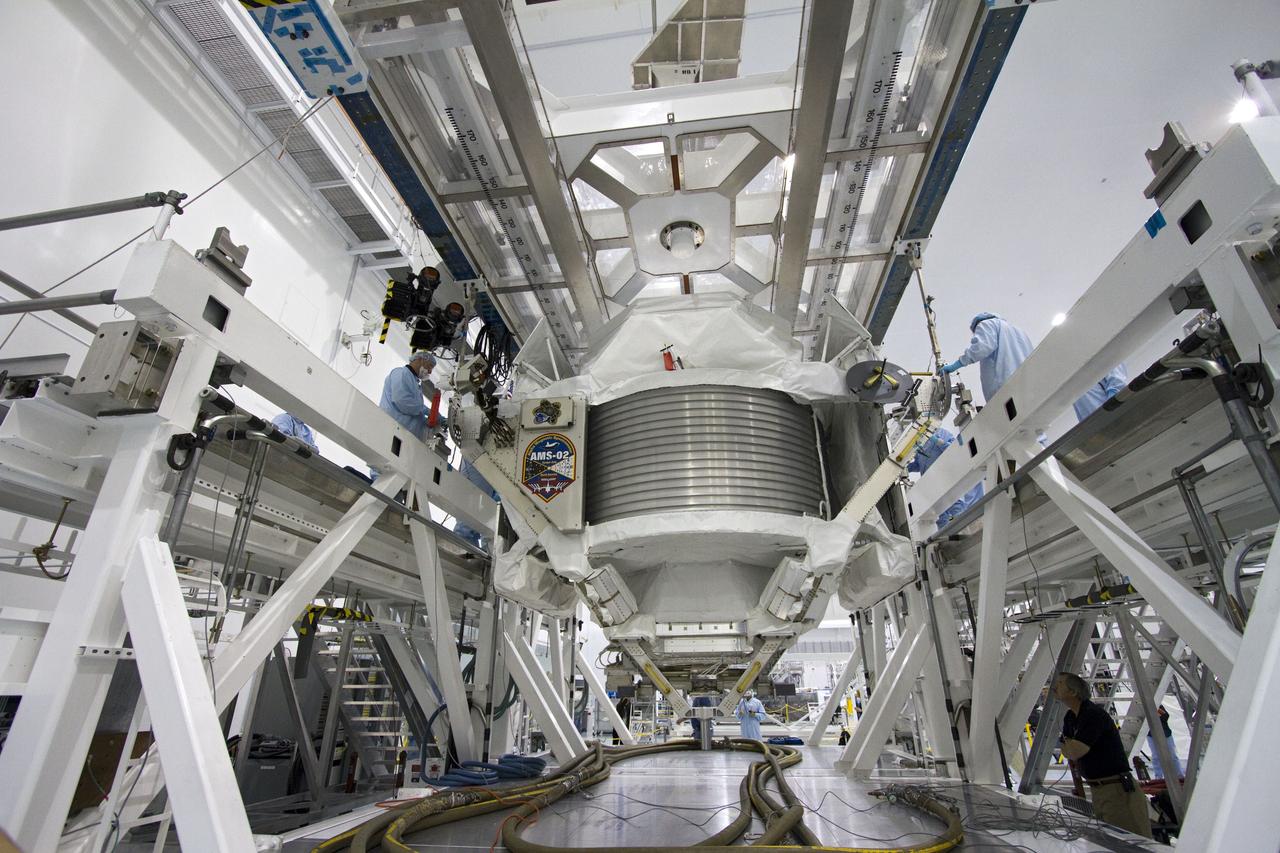
CAPE CANAVERAL, Fla. -- In the Space Station Processing Facility at NASA's Kennedy Space Center in Florida, the Alpha Magnetic Spectrometer-2 (AMS) was moved from its primary work stand to the weight and center of gravity stand where final measurements will be taken before launch. Next, AMS will be moved into a payload canister. The canister will protect the space-bound payload on its journey to Launch Pad 39A, where it will later be installed into space shuttle Endeavour’s payload bay. AMS is a particle physics detector, designed to operate as an external experiment on the International Space Station. It will use the unique environment of space to study the universe and its origin by searching for dark matter. AMS-2 will fly to the station aboard Endeavour's STS-134 mission targeted to launch April 19 at 7:48 p.m. EDT. For more information visit, www.nasa.gov/mission_pages/shuttle/shuttlemissions/sts134/index.html. Photo credit: NASA/Jack Pfaller
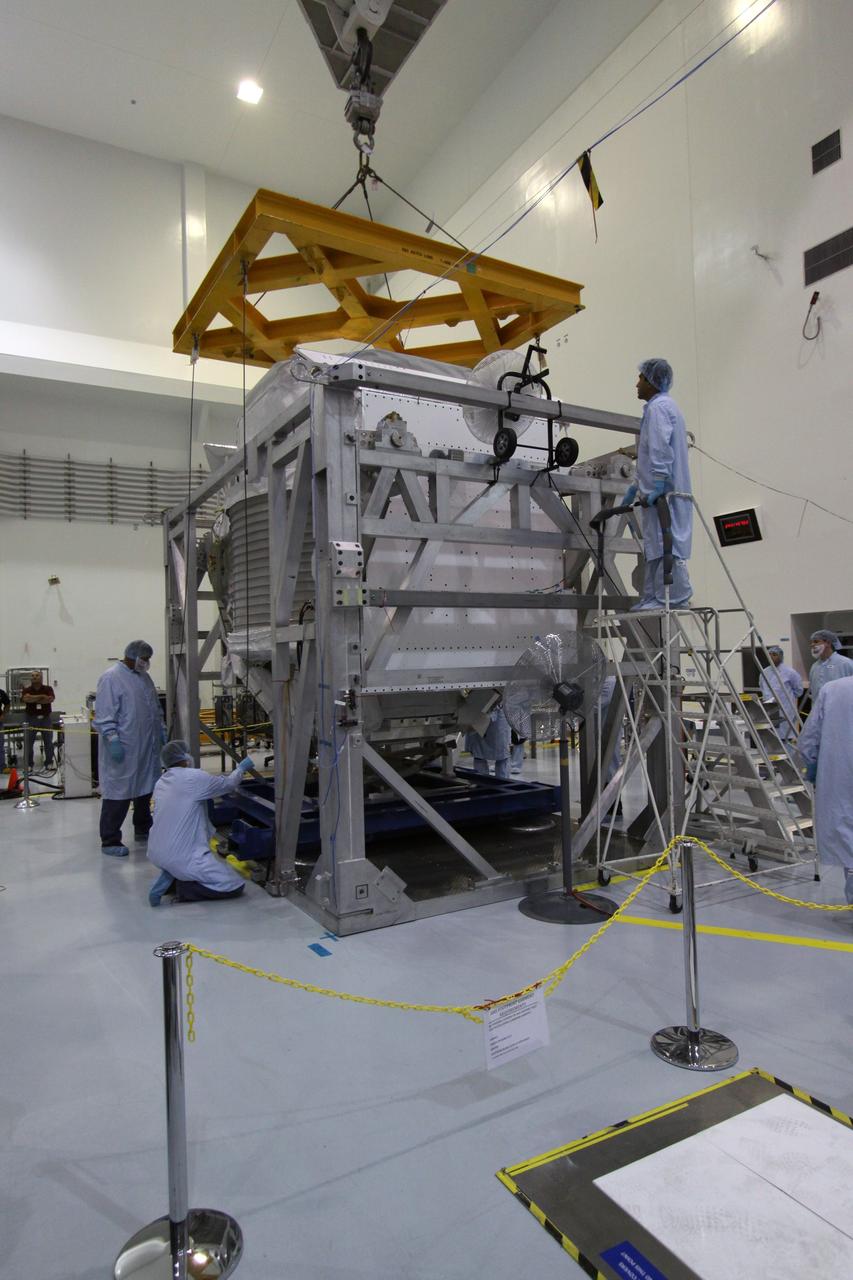
CAPE CANAVERAL, Fla. -- Technicians in the Space Station Processing Facility at NASA's Kennedy Space Center in Florida, monitor the guide wires of the overhead crane as it lifts the Payload Attach System, or PAS, up to the Alpha Magnetic Spectrometer, or AMS, for installation. The PAS provides a method of securely connecting the payload to the International Space Station. AMS, a state-of-the-art particle physics detector, is designed to operate as an external module on the International Space Station. It will use the unique environment of space to study the universe and its origin by searching for dark matter. AMS will fly to the station aboard space shuttle Endeavour's STS-134 mission targeted to launch Feb. 26, 2011. Photo credit: NASA/Jack Pfaller
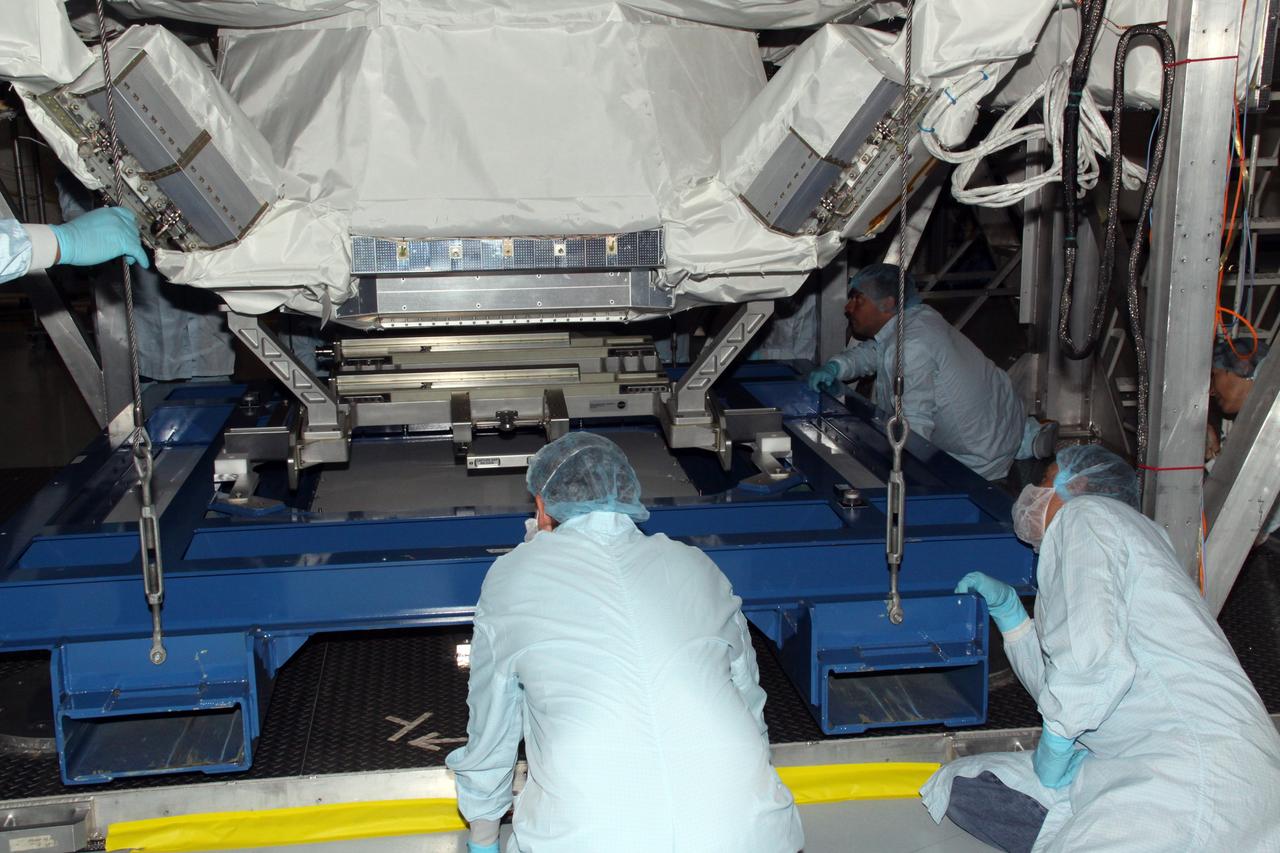
CAPE CANAVERAL, Fla. -- Technicians in the Space Station Processing Facility at NASA's Kennedy Space Center in Florida, check the progress of the Payload Attach System, or PAS, as it is lifted up to the Alpha Magnetic Spectrometer, where it will be attached to the bottom of the AMS. The PAS provides a method of securely connecting the payload to the International Space Station. AMS, a state-of-the-art particle physics detector, is designed to operate as an external module on the International Space Station. It will use the unique environment of space to study the universe and its origin by searching for dark matter. AMS will fly to the station aboard space shuttle Endeavour's STS-134 mission targeted to launch Feb. 26, 2011. Photo credit: NASA/Jack Pfaller
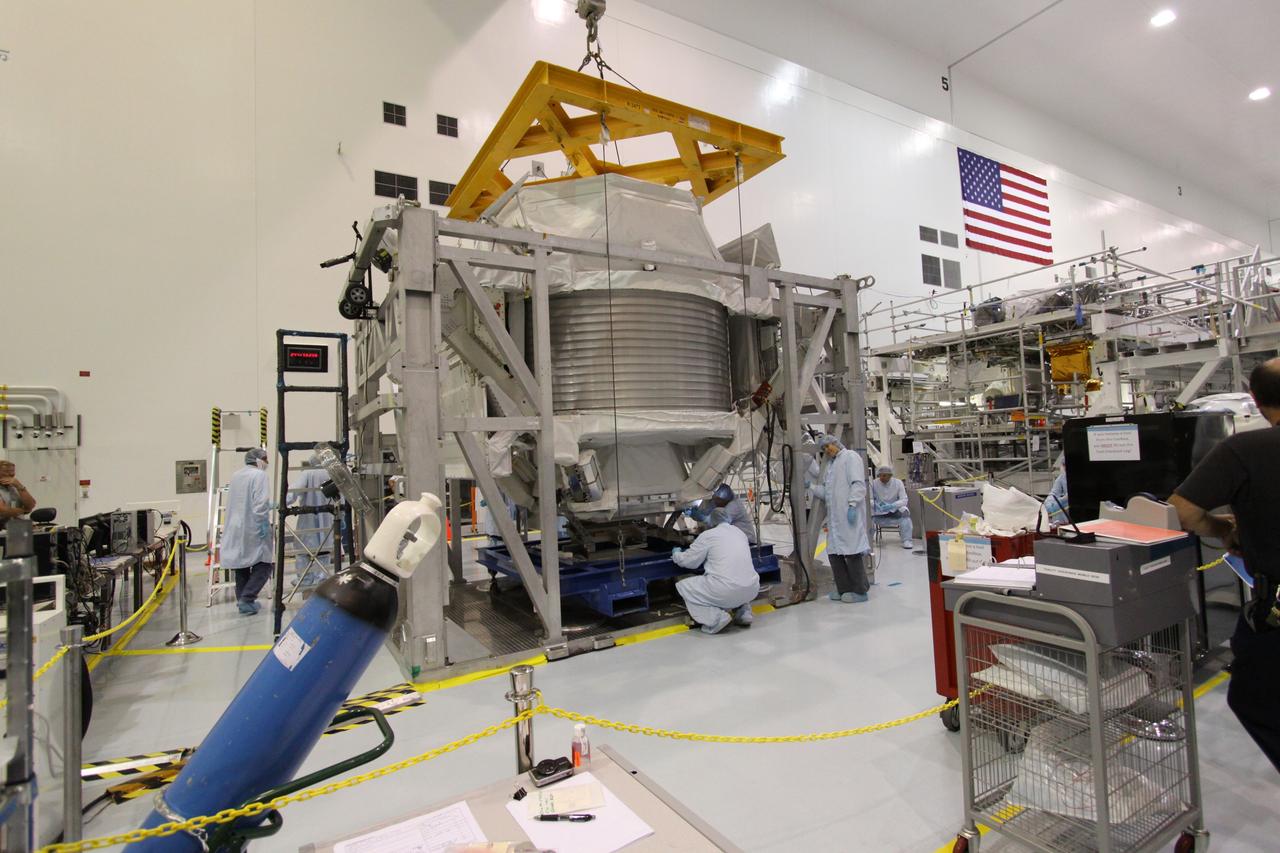
CAPE CANAVERAL, Fla. -- Technicians in the Space Station Processing Facility at NASA's Kennedy Space Center in Florida, check the progress of the Payload Attach System, or PAS, as it is lifted up to the Alpha Magnetic Spectrometer, where it will be attached to the bottom of the AMS. The PAS provides a method of securely connecting the payload to the International Space Station. AMS, a state-of-the-art particle physics detector, is designed to operate as an external module on the International Space Station. It will use the unique environment of space to study the universe and its origin by searching for dark matter. AMS will fly to the station aboard space shuttle Endeavour's STS-134 mission targeted to launch Feb. 26, 2011. Photo credit: NASA/Jack Pfaller
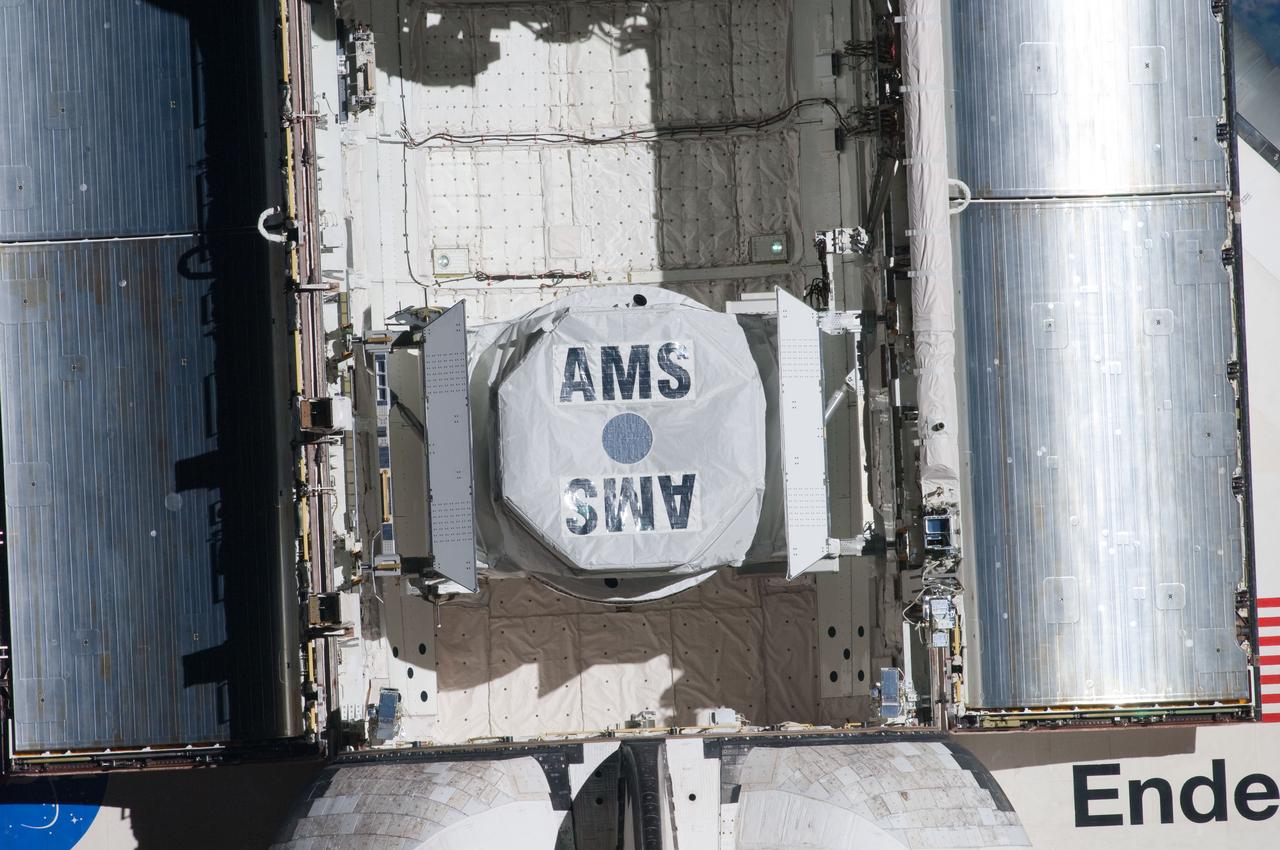
ISS027-E-032216 (18 May 2011) --- This close-up view of the Alpha Magnetic Spectrometer-2 (AMS) in space shuttle Endeavour’s payload bay was provided by an Expedition 27 crew member during a survey of the approaching STS-134 vehicle prior to docking with the International Space Station. As part of the survey and part of every mission's activities, Endeavour performed a back-flip for the rendezvous pitch maneuver (RPM). The image was photographed with a digital still camera, using a 400mm lens at a distance of about 600 feet (180 meters).
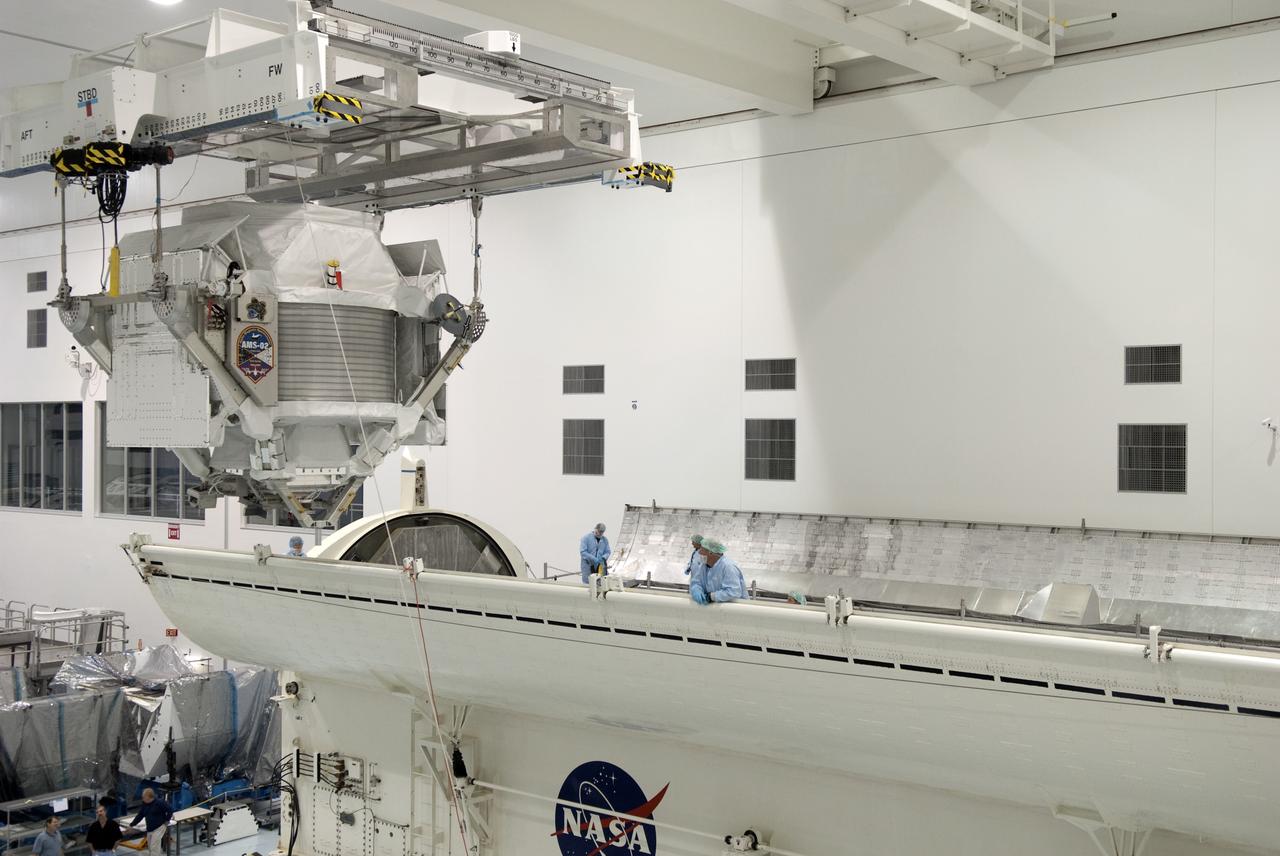
CAPE CANAVERAL, Fla. -- In the Space Station Processing Facility at NASA's Kennedy Space Center in Florida, the Alpha Magnetic Spectrometer-2 (AMS) is moved from the weight and center of gravity stand, where final measurements were taken before launch, to a payload canister. The canister will protect the space-bound payload on its journey to Launch Pad 39A, where it will later be installed into space shuttle Endeavour’s payload bay. AMS is a particle physics detector, designed to operate as an external experiment on the International Space Station. It will use the unique environment of space to study the universe and its origin by searching for dark matter. AMS-2 will fly to the station aboard Endeavour's STS-134 mission targeted to launch April 19 at 7:48 p.m. EDT. For more information visit, www.nasa.gov/mission_pages/shuttle/shuttlemissions/sts134/index.html. Photo credit: NASA/Jim Grossmann
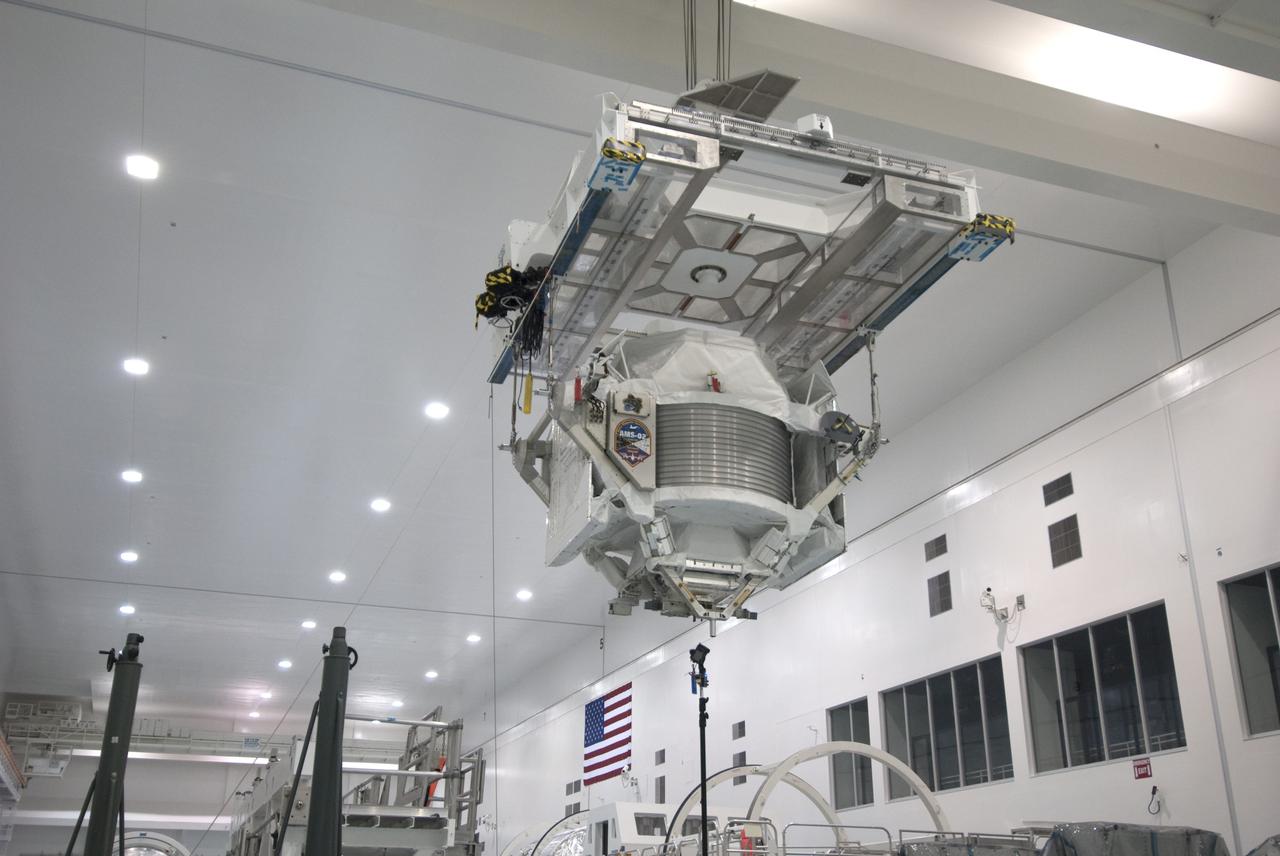
CAPE CANAVERAL, Fla. -- In the Space Station Processing Facility at NASA's Kennedy Space Center in Florida, the Alpha Magnetic Spectrometer-2 (AMS) is moved from the weight and center of gravity stand, where final measurements were taken before launch, to a payload canister. The canister will protect the space-bound payload on its journey to Launch Pad 39A, where it will later be installed into space shuttle Endeavour’s payload bay. AMS is a particle physics detector, designed to operate as an external experiment on the International Space Station. It will use the unique environment of space to study the universe and its origin by searching for dark matter. AMS-2 will fly to the station aboard Endeavour's STS-134 mission targeted to launch April 19 at 7:48 p.m. EDT. For more information visit, www.nasa.gov/mission_pages/shuttle/shuttlemissions/sts134/index.html. Photo credit: NASA/Jim Grossmann
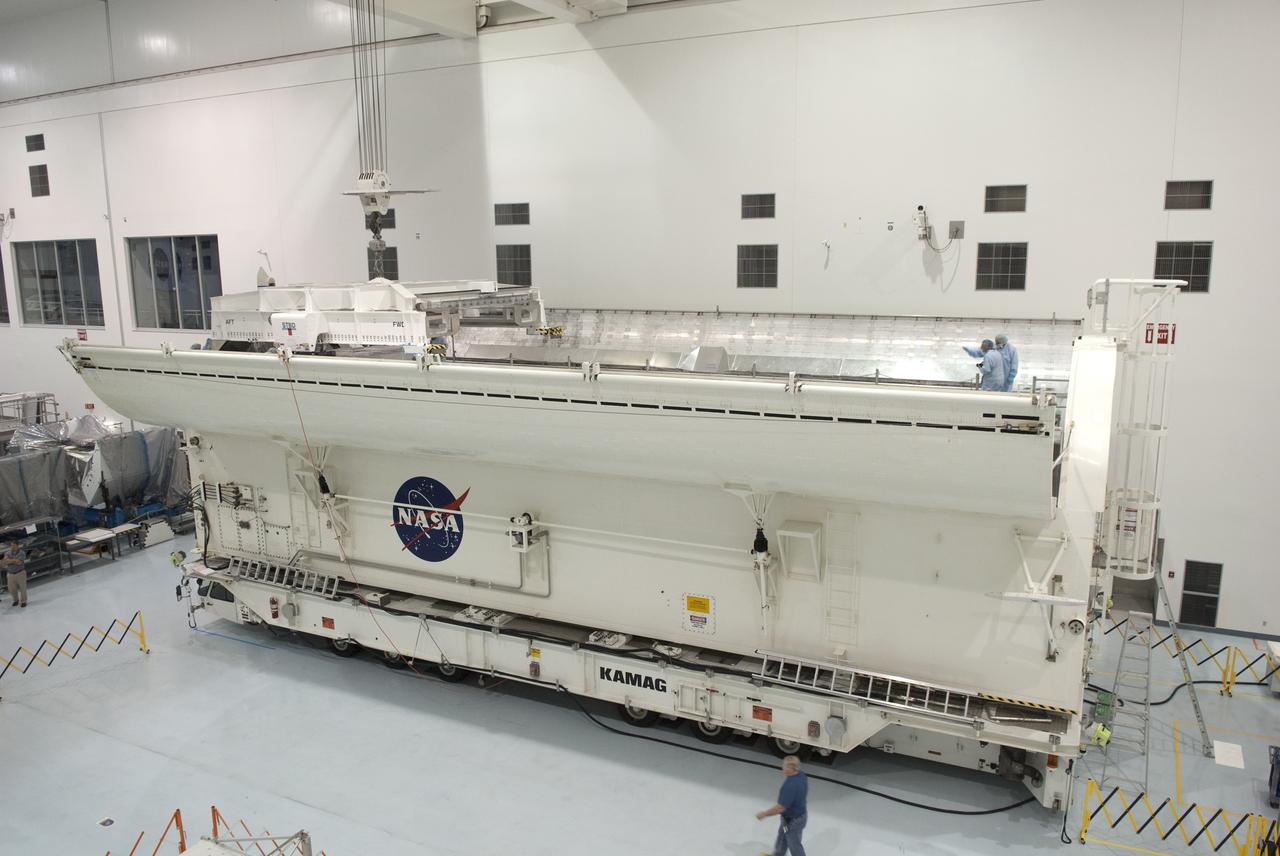
CAPE CANAVERAL, Fla. -- In the Space Station Processing Facility at NASA's Kennedy Space Center in Florida, the Alpha Magnetic Spectrometer-2 AMS is in a payload canister after technicians measured its weight and center of gravity. The canister will protect the space-bound payload on its journey to Launch Pad 39A, where it will later be installed into space shuttle Endeavour’s payload bay. AMS is a particle physics detector, designed to operate as an external experiment on the International Space Station. It will use the unique environment of space to study the universe and its origin by searching for dark matter. AMS-2 will fly to the station aboard Endeavour's STS-134 mission targeted to launch April 19 at 7:48 p.m. EDT. For more information visit, www.nasa.gov/mission_pages/shuttle/shuttlemissions/sts134/index.html. Photo credit: NASA/Jim Grossmann
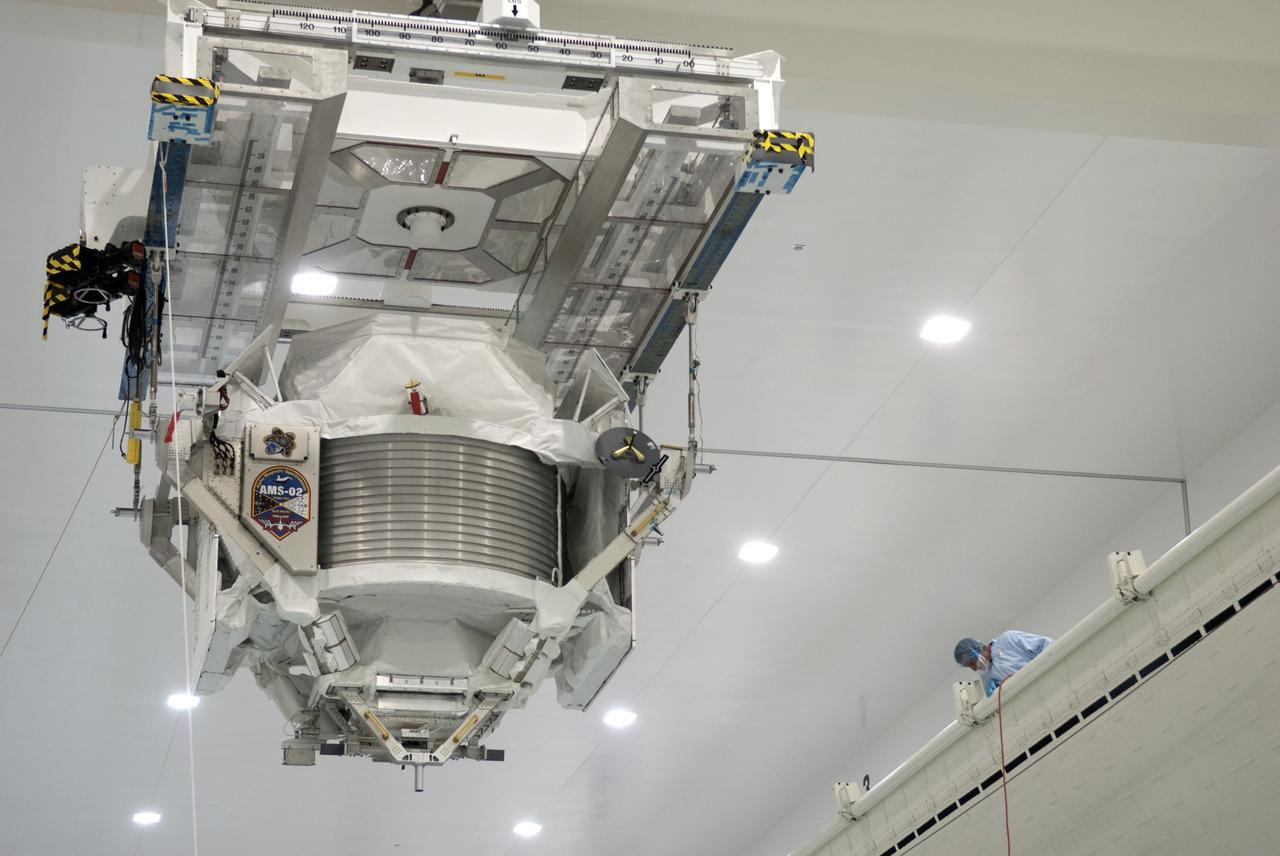
CAPE CANAVERAL, Fla. -- In the Space Station Processing Facility at NASA's Kennedy Space Center in Florida, the Alpha Magnetic Spectrometer-2 (AMS) is moved from the weight and center of gravity stand, where final measurements were taken before launch, to a payload canister. The canister will protect the space-bound payload on its journey to Launch Pad 39A, where it will later be installed into space shuttle Endeavour’s payload bay. AMS is a particle physics detector, designed to operate as an external experiment on the International Space Station. It will use the unique environment of space to study the universe and its origin by searching for dark matter. AMS-2 will fly to the station aboard Endeavour's STS-134 mission targeted to launch April 19 at 7:48 p.m. EDT. For more information visit, www.nasa.gov/mission_pages/shuttle/shuttlemissions/sts134/index.html. Photo credit: NASA/Jim Grossmann
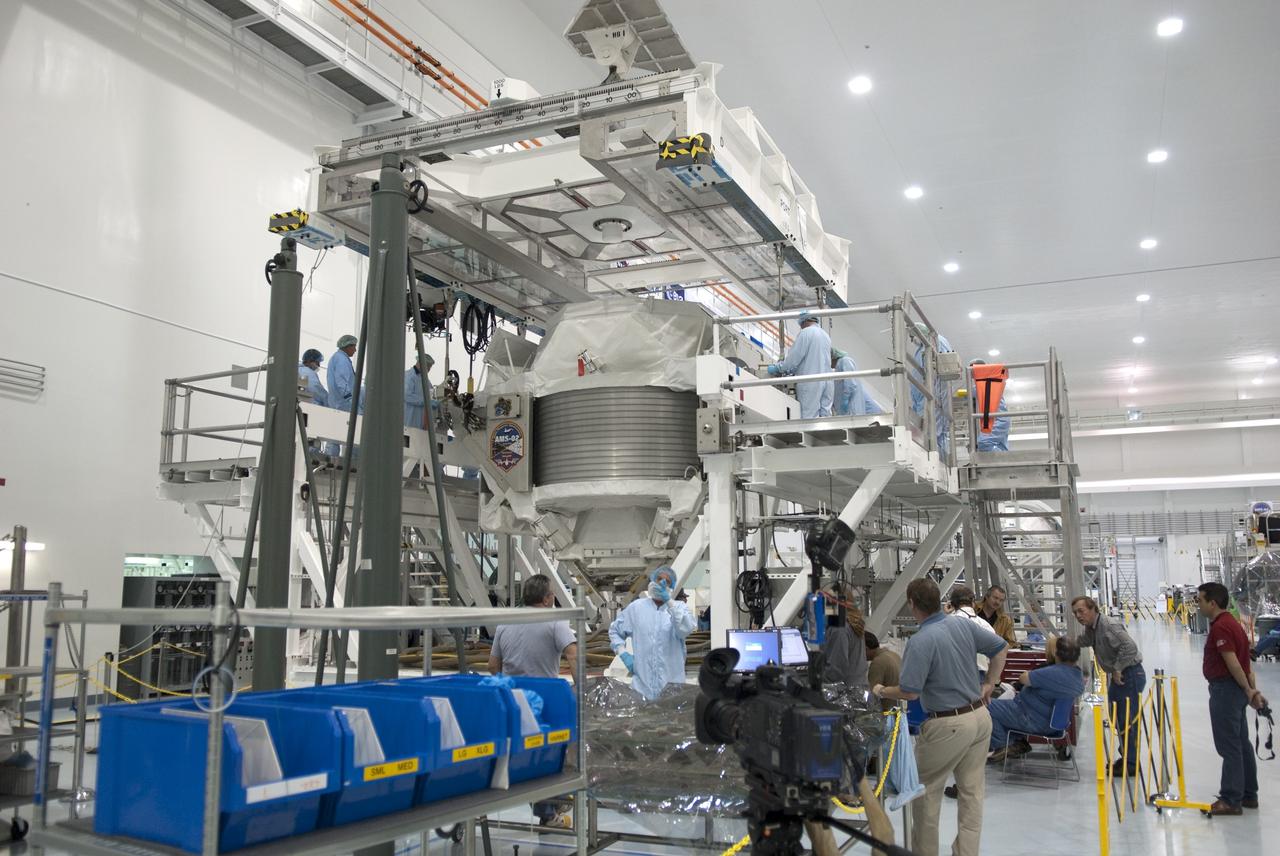
CAPE CANAVERAL, Fla. -- In the Space Station Processing Facility at NASA's Kennedy Space Center in Florida, the Alpha Magnetic Spectrometer-2 (AMS) is prepared for its move from the weight and center of gravity stand, where final measurements were taken before launch, to a payload canister. The canister will protect the space-bound payload on its journey to Launch Pad 39A, where it will later be installed into space shuttle Endeavour’s payload bay. AMS is a particle physics detector, designed to operate as an external experiment on the International Space Station. It will use the unique environment of space to study the universe and its origin by searching for dark matter. AMS-2 will fly to the station aboard Endeavour's STS-134 mission targeted to launch April 19 at 7:48 p.m. EDT. For more information visit, www.nasa.gov/mission_pages/shuttle/shuttlemissions/sts134/index.html. Photo credit: NASA/Jim Grossmann
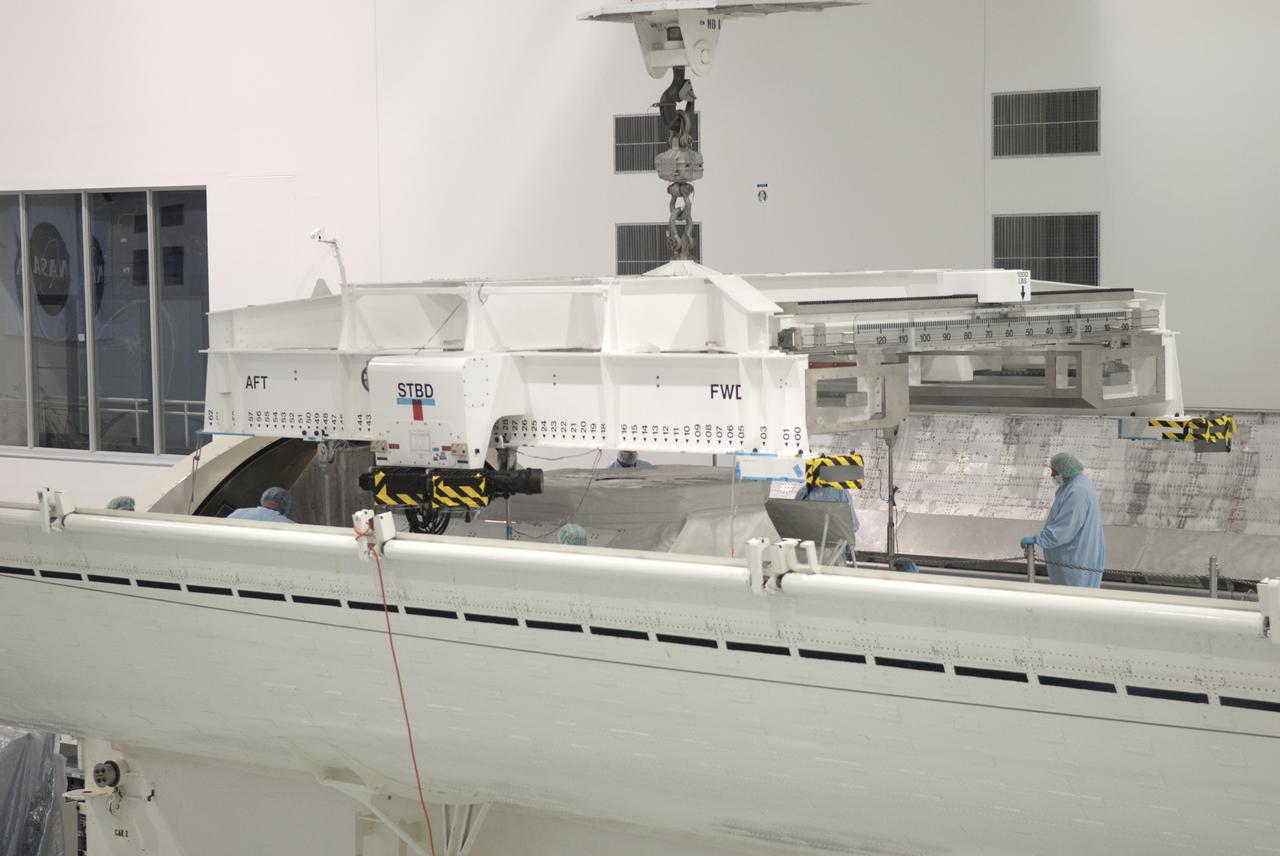
CAPE CANAVERAL, Fla. -- In the Space Station Processing Facility at NASA's Kennedy Space Center in Florida, the Alpha Magnetic Spectrometer-2 AMS is moved into a payload canister after technicians measured its weight and center of gravity. The canister will protect the space-bound payload on its journey to Launch Pad 39A, where it will later be installed into space shuttle Endeavour’s payload bay. AMS is a particle physics detector, designed to operate as an external experiment on the International Space Station. It will use the unique environment of space to study the universe and its origin by searching for dark matter. AMS-2 will fly to the station aboard Endeavour's STS-134 mission targeted to launch April 19 at 7:48 p.m. EDT. For more information visit, www.nasa.gov/mission_pages/shuttle/shuttlemissions/sts134/index.html. Photo credit: NASA/Jim Grossmann
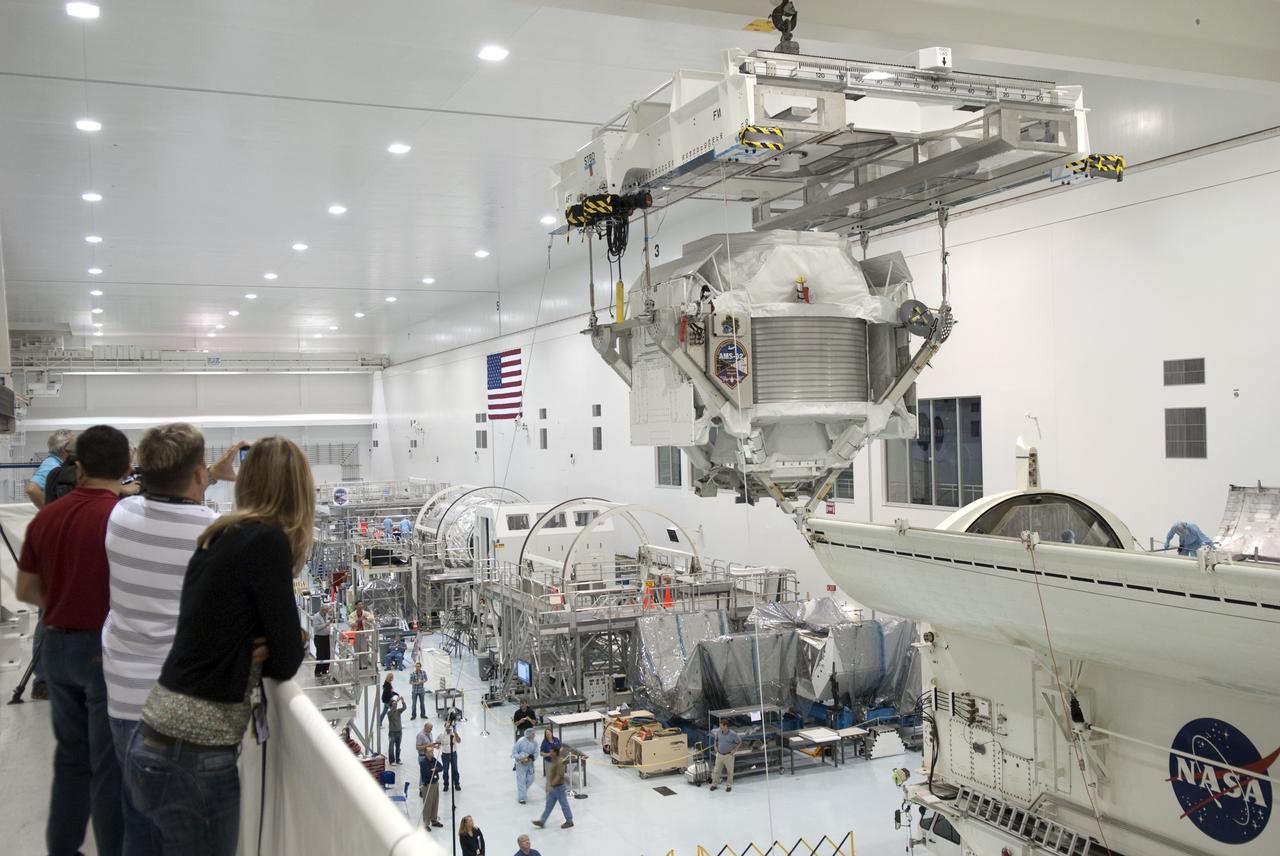
CAPE CANAVERAL, Fla. -- In the Space Station Processing Facility at NASA's Kennedy Space Center in Florida, the Alpha Magnetic Spectrometer-2 (AMS) is moved from the weight and center of gravity stand, where final measurements were taken before launch, to a payload canister. The canister will protect the space-bound payload on its journey to Launch Pad 39A, where it will later be installed into space shuttle Endeavour’s payload bay. AMS is a particle physics detector, designed to operate as an external experiment on the International Space Station. It will use the unique environment of space to study the universe and its origin by searching for dark matter. AMS-2 will fly to the station aboard Endeavour's STS-134 mission targeted to launch April 19 at 7:48 p.m. EDT. For more information visit, www.nasa.gov/mission_pages/shuttle/shuttlemissions/sts134/index.html. Photo credit: NASA/Jim Grossmann
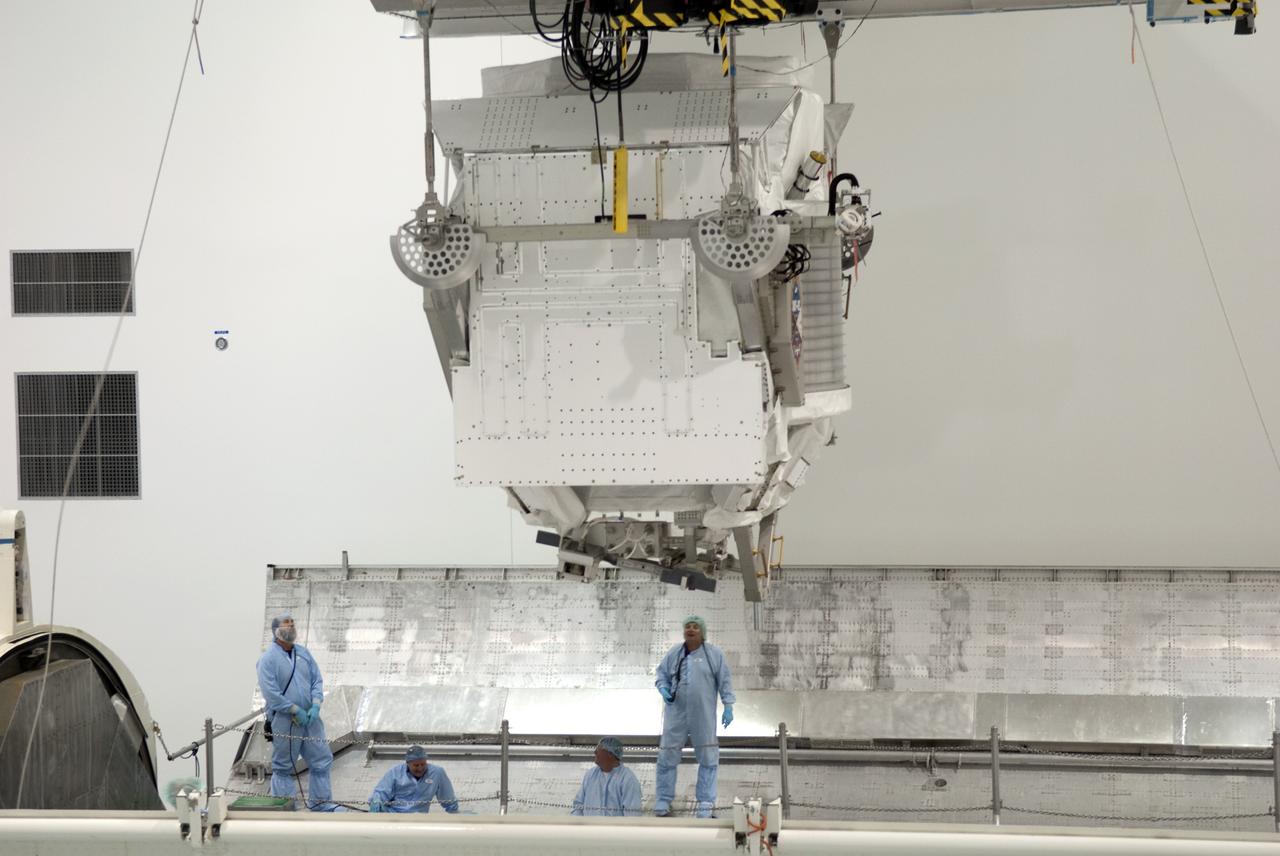
CAPE CANAVERAL, Fla. -- In the Space Station Processing Facility at NASA's Kennedy Space Center in Florida, the Alpha Magnetic Spectrometer-2 AMS is above a payload canister after technicians measured its weight and center of gravity. The canister will protect the space-bound payload on its journey to Launch Pad 39A, where it will later be installed into space shuttle Endeavour’s payload bay. AMS is a particle physics detector, designed to operate as an external experiment on the International Space Station. It will use the unique environment of space to study the universe and its origin by searching for dark matter. AMS-2 will fly to the station aboard Endeavour's STS-134 mission targeted to launch April 19 at 7:48 p.m. EDT. For more information visit, www.nasa.gov/mission_pages/shuttle/shuttlemissions/sts134/index.html. Photo credit: NASA/Jim Grossmann
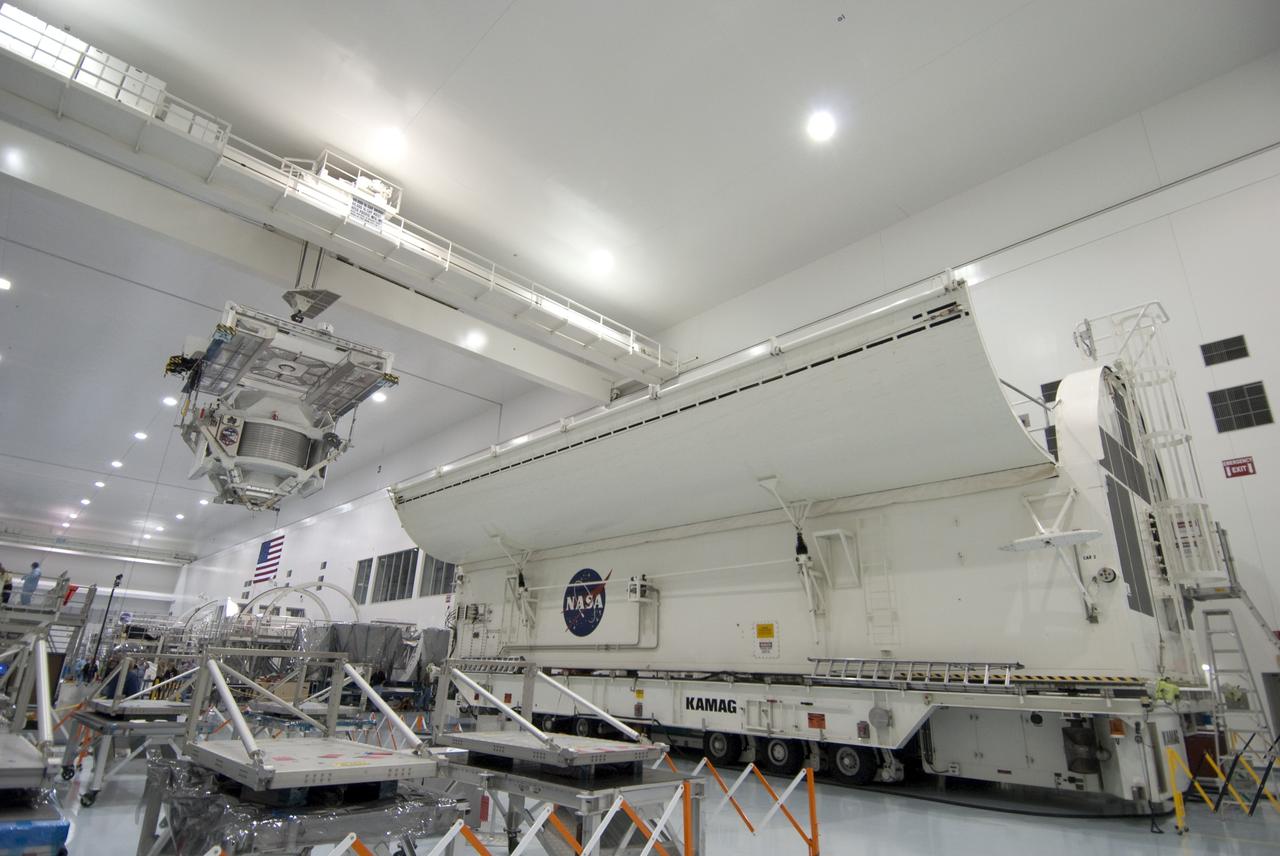
CAPE CANAVERAL, Fla. -- In the Space Station Processing Facility at NASA's Kennedy Space Center in Florida, the Alpha Magnetic Spectrometer-2 (AMS) is moved from the weight and center of gravity stand, where final measurements were taken before launch, to a payload canister. The canister will protect the space-bound payload on its journey to Launch Pad 39A, where it will later be installed into space shuttle Endeavour’s payload bay. AMS is a particle physics detector, designed to operate as an external experiment on the International Space Station. It will use the unique environment of space to study the universe and its origin by searching for dark matter. AMS-2 will fly to the station aboard Endeavour's STS-134 mission targeted to launch April 19 at 7:48 p.m. EDT. For more information visit, www.nasa.gov/mission_pages/shuttle/shuttlemissions/sts134/index.html. Photo credit: NASA/Jim Grossmann

CAPE CANAVERAL, Fla. -- During the L-1 prelaunch news briefing in the Press Site auditorium at NASA's Kennedy Space Center in Florida, STS-134 Payload Mission Manager Joe Delai speaks to media about the processing and readiness of space shuttle Endeavour's payload for flight. Endeavour and its crew will deliver the Express Logistics Carrier-3, Alpha Magnetic Spectrometer-2 (AMS), a high-pressure gas tank and additional spare parts for the Dextre robotic helper to the International Space Station. Launch is scheduled for April 29 at 3:47 p.m. EDT. This will be the final spaceflight for Endeavour. For more information visit, www.nasa.gov_mission_pages_shuttle_shuttlemissions_sts134_index.html. Photo credit: NASA_Jack Pfaller
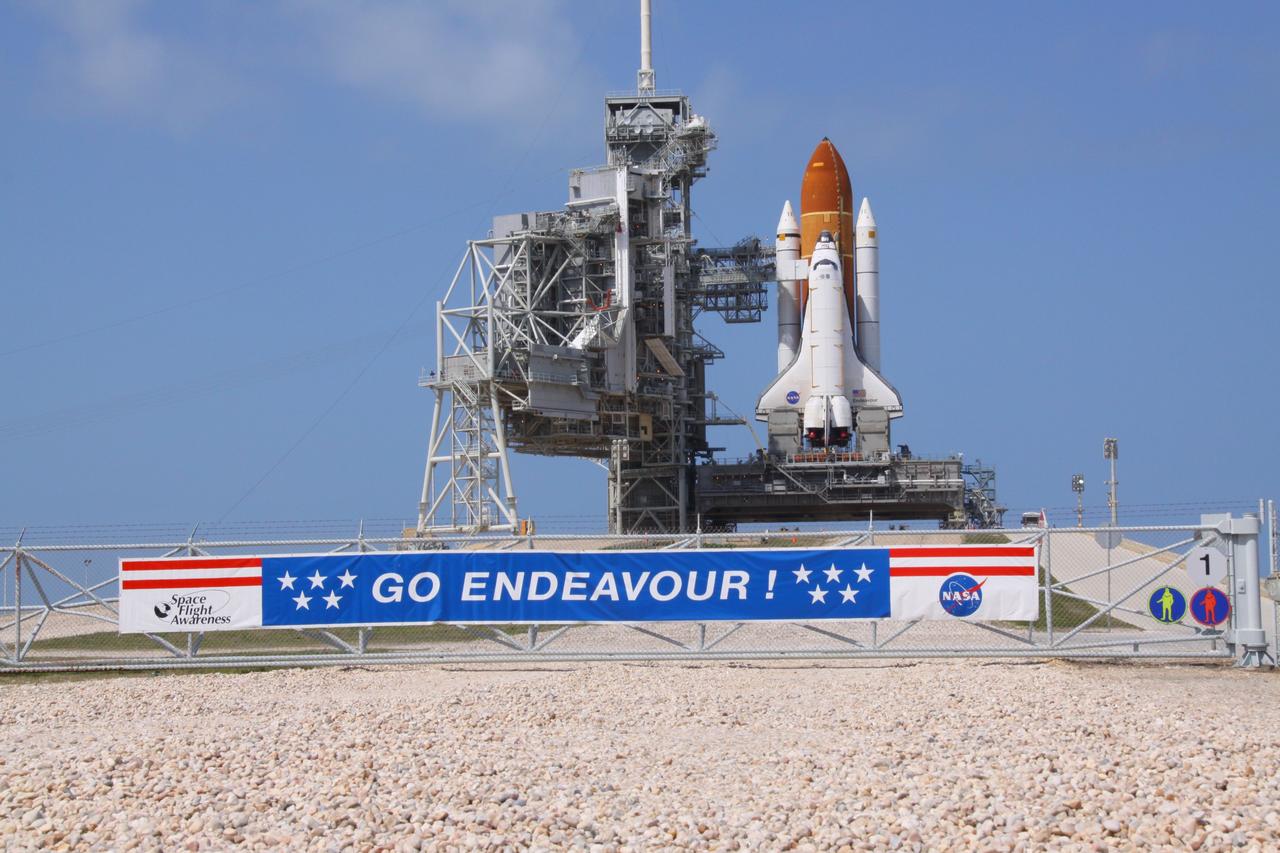
CAPE CANAVERAL, Fla. -- Space shuttle Endeavour glistens in the sun on Launch Pad 39A at NASA's Kennedy Space Center in Florida. The rotating service structure (RSS) that protects the shuttle from the elements and provides access to its components is open to allow crews to move the primary payload for Endeavour's STS-134 mission into the pad's structure before installing it into the spacecraft's cargo bay. Endeavour and its six-member STS-134 crew are targeted to lift off April 19 at 7:48 p.m. EDT to deliver the Alpha Magnetic Spectrometer-2 (AMS) and Express Logistics Carrier-3 to the International Space Station. This is Endeavour's final scheduled mission. For more information visit, www.nasa.gov/mission_pages/shuttle/shuttlemissions/sts134/index.html. Photo credit: NASA/Frank Michaux
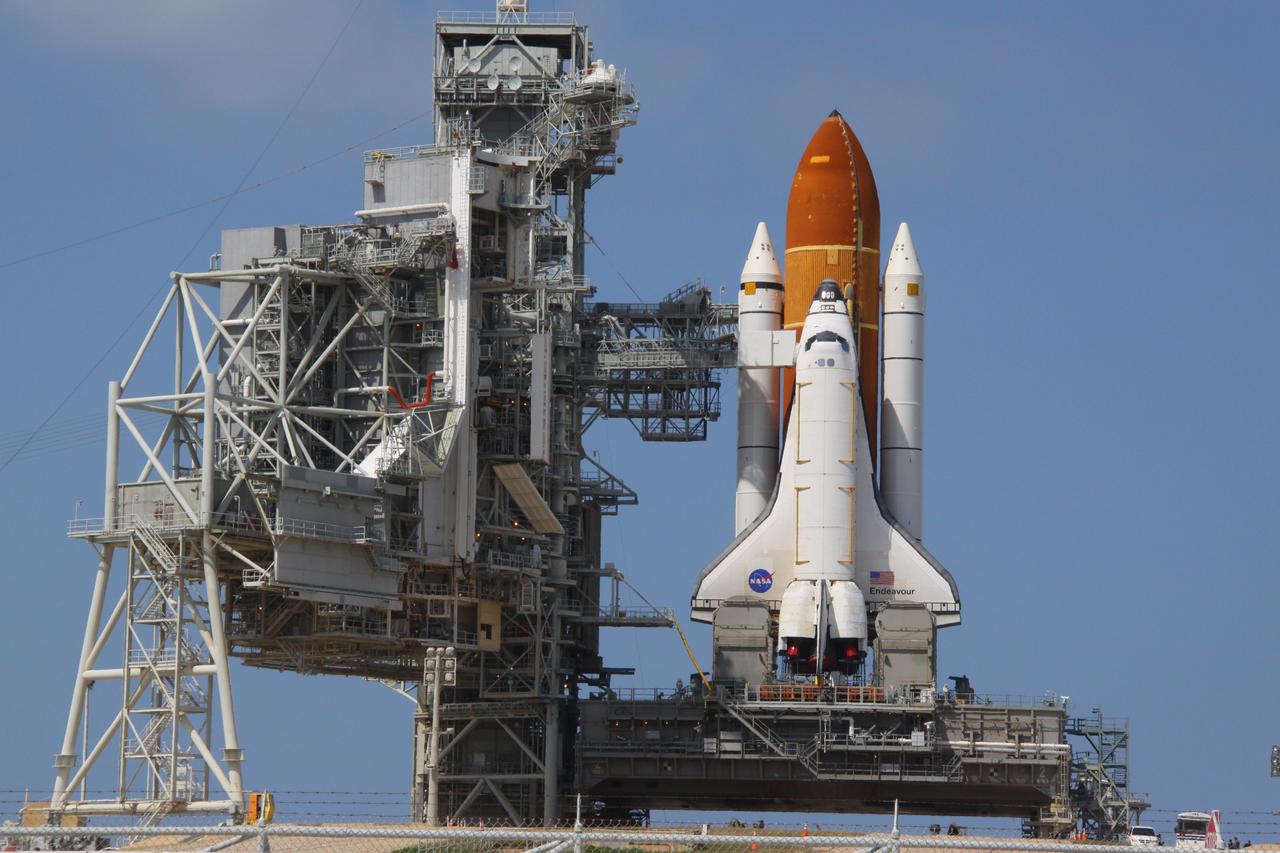
CAPE CANAVERAL, Fla. -- Space shuttle Endeavour glistens in the sun on Launch Pad 39A at NASA's Kennedy Space Center in Florida. The rotating service structure (RSS) that protects the shuttle from the elements and provides access to its components is open to allow crews to move the primary payload for Endeavour's STS-134 mission into the pad's structure before installing it into the spacecraft's cargo bay. Endeavour and its six-member STS-134 crew are targeted to lift off April 19 at 7:48 p.m. EDT to deliver the Alpha Magnetic Spectrometer-2 (AMS) and Express Logistics Carrier-3 to the International Space Station. This is Endeavour's final scheduled mission. For more information visit, www.nasa.gov/mission_pages/shuttle/shuttlemissions/sts134/index.html. Photo credit: NASA/Frank Michaux
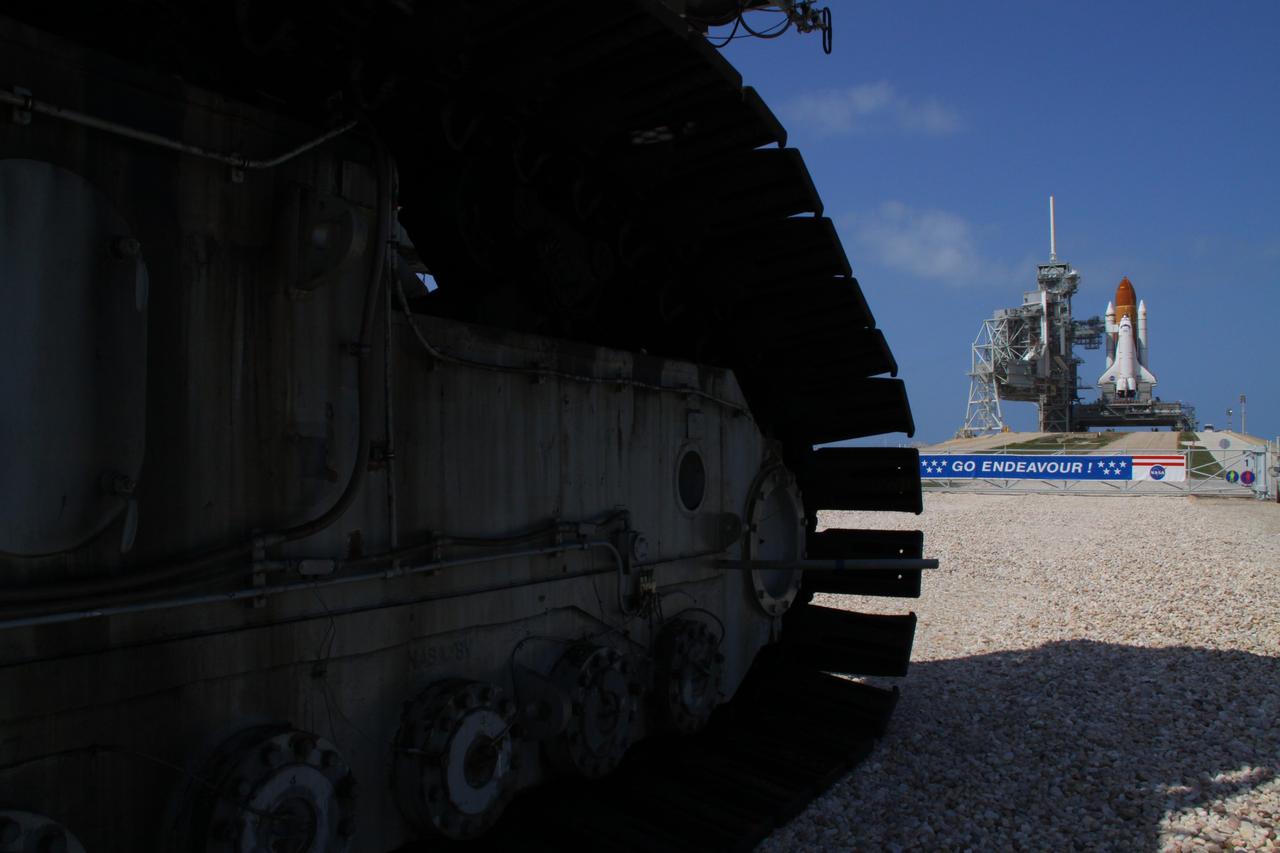
CAPE CANAVERAL, Fla. -- Space shuttle Endeavour glistens in the sun on Launch Pad 39A at NASA's Kennedy Space Center in Florida. The massive crawler-transporter that hauled the shuttle, attached to its external fuel tank and solid rocket boosters, to the pad March 10 remains on the crushed crawlerway rocks. The rotating service structure (RSS) that protects the shuttle from the elements and provides access to its components is open to allow crews to move the primary payload for Endeavour's STS-134 mission into the pad's structure before installing it into the spacecraft's cargo bay. Endeavour and its six-member STS-134 crew are targeted to lift off April 19 at 7:48 p.m. EDT to deliver the Alpha Magnetic Spectrometer-2 (AMS) and Express Logistics Carrier-3 to the International Space Station. This is Endeavour's final scheduled mission. For more information visit, www.nasa.gov/mission_pages/shuttle/shuttlemissions/sts134/index.html. Photo credit: NASA/Frank Michaux
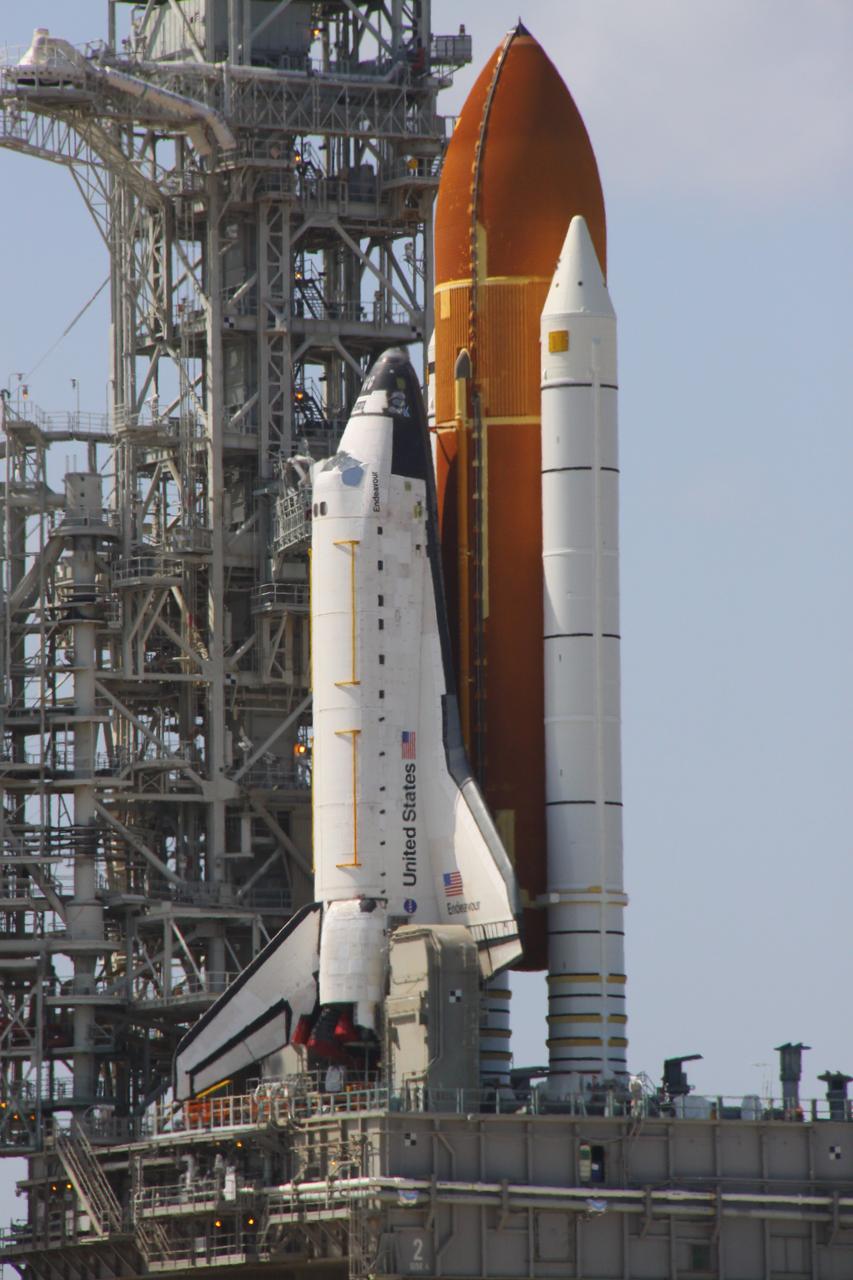
CAPE CANAVERAL, Fla. -- Space shuttle Endeavour glistens in the sun on Launch Pad 39A at NASA's Kennedy Space Center in Florida. The rotating service structure (RSS) that protects the shuttle from the elements and provides access to its components is open to allow crews to move the primary payload for Endeavour's STS-134 mission into the pad's structure before installing it into the spacecraft's cargo bay. Endeavour and its six-member STS-134 crew are targeted to lift off April 19 at 7:48 p.m. EDT to deliver the Alpha Magnetic Spectrometer-2 (AMS) and Express Logistics Carrier-3 to the International Space Station. This is Endeavour's final scheduled mission. For more information visit, www.nasa.gov/mission_pages/shuttle/shuttlemissions/sts134/index.html. Photo credit: NASA/Frank Michaux
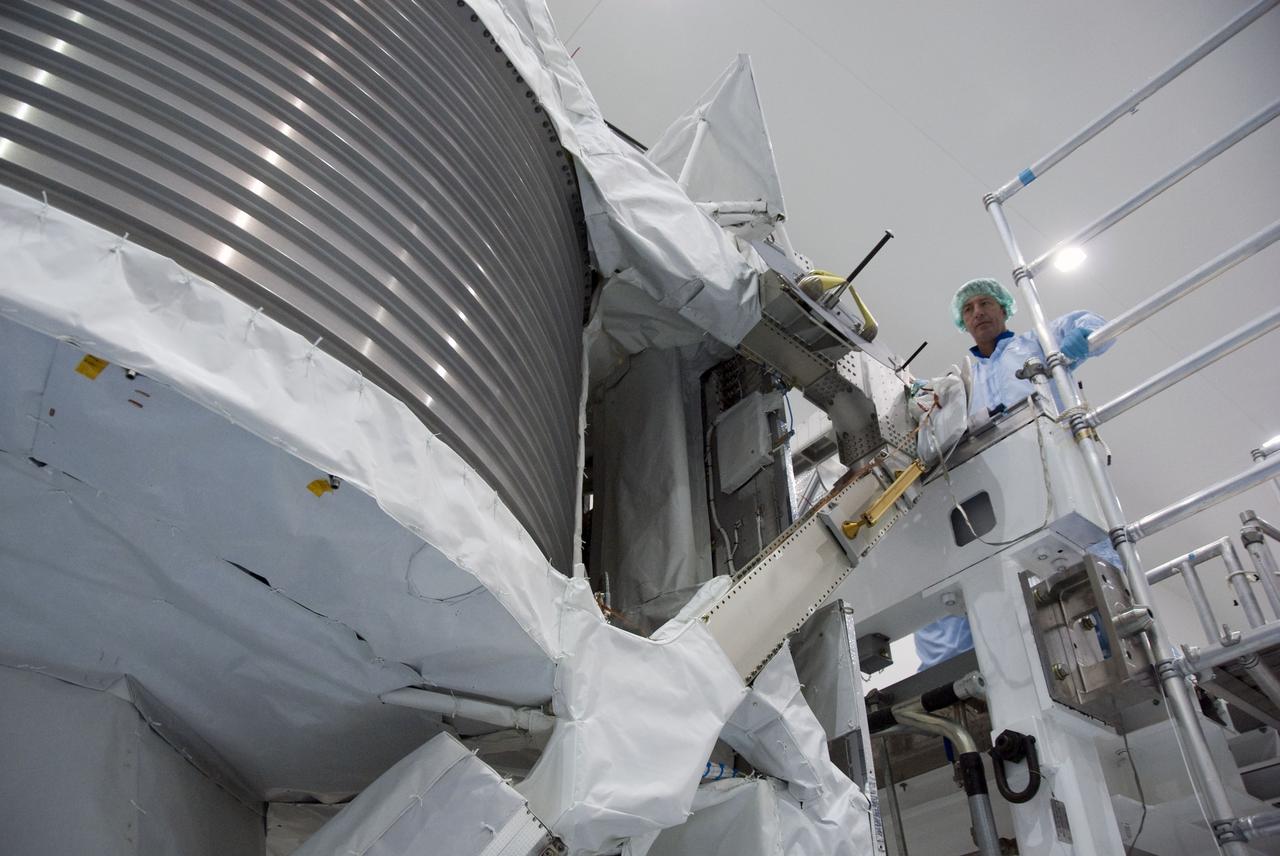
CAPE CANAVERAL, Fla. -- In the Space Station Processing Facility at NASA's Kennedy Space Center in Florida, STS-134 Mission Specialist Roberto Vittori, with the European Space Agency, inspects the Alpha Magnetic Spectrometer-2 (AMS). Vittori and his five crewmates are at Kennedy participating in the Crew Equipment Interface Test (CEIT), which gives them an opportunity for hands-on training with tools they'll be using in space and familiarization of the payload they'll be delivering to the International Space Station. Space shuttle Endeavour is targeted to launch on the STS-134 mission Feb. 27, 2011. For more information, visit www.nasa.gov/mission_pages/shuttle/shuttlemissions/sts134/index.html. Photo credit: NASA/Cory Huston
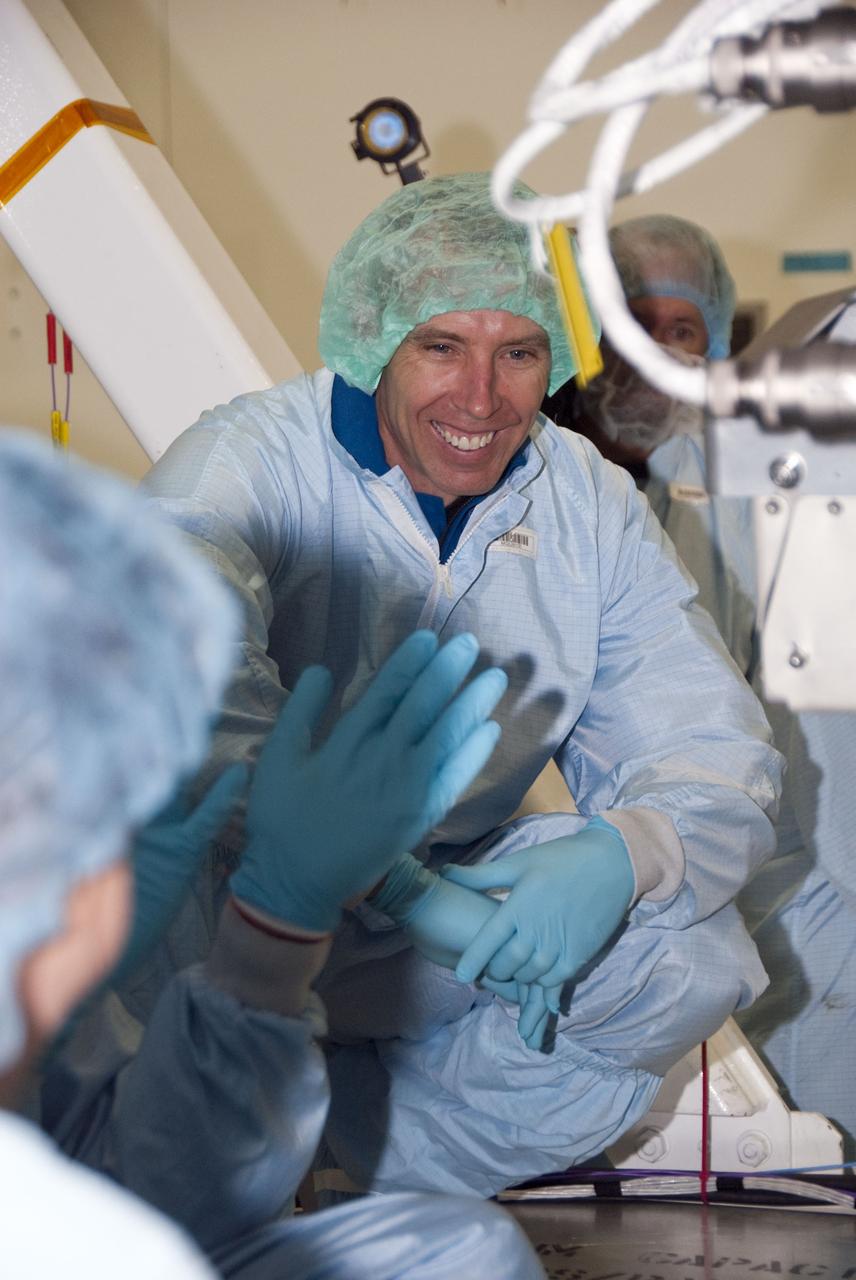
CAPE CANAVERAL, Fla. -- In the Space Station Processing Facility at NASA's Kennedy Space Center in Florida, STS-134 Mission Specialist Andrew Feustel inspects the Alpha Magnetic Spectrometer-2 (AMS) with the experiment's technicians. Feustel and his five crewmates are at Kennedy participating in the Crew Equipment Interface Test (CEIT), which gives them an opportunity for hands-on training with tools they'll be using in space and familiarization of the payload they'll be delivering to the International Space Station. Space shuttle Endeavour is targeted to launch on the STS-134 mission Feb. 27, 2011. For more information, visit www.nasa.gov/mission_pages/shuttle/shuttlemissions/sts134/index.html. Photo credit: NASA/Cory Huston
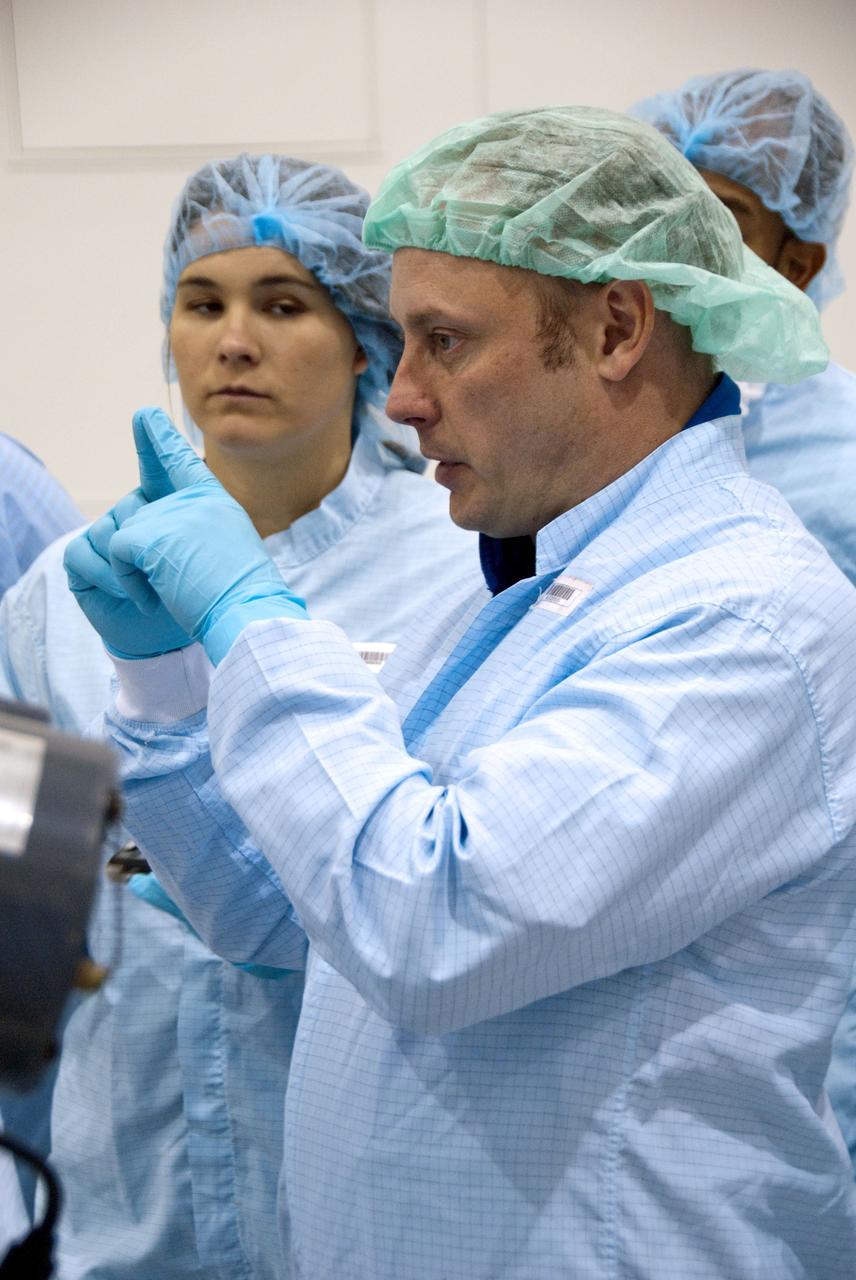
CAPE CANAVERAL, Fla. -- In the Space Station Processing Facility at NASA's Kennedy Space Center in Florida, STS-134 Mission Specialist Michael Finke, front right, checks out the Alpha Magnetic Spectrometer-2 (AMS) with the experiment's technicians. Finke and his five crewmates are at Kennedy participating in the Crew Equipment Interface Test (CEIT), which gives them an opportunity for hands-on training with tools they'll be using in space and familiarization of the payload they'll be delivering to the International Space Station. Space shuttle Endeavour is targeted to launch on the STS-134 mission Feb. 27, 2011. For more information, visit www.nasa.gov/mission_pages/shuttle/shuttlemissions/sts134/index.html. Photo credit: NASA/Cory Huston
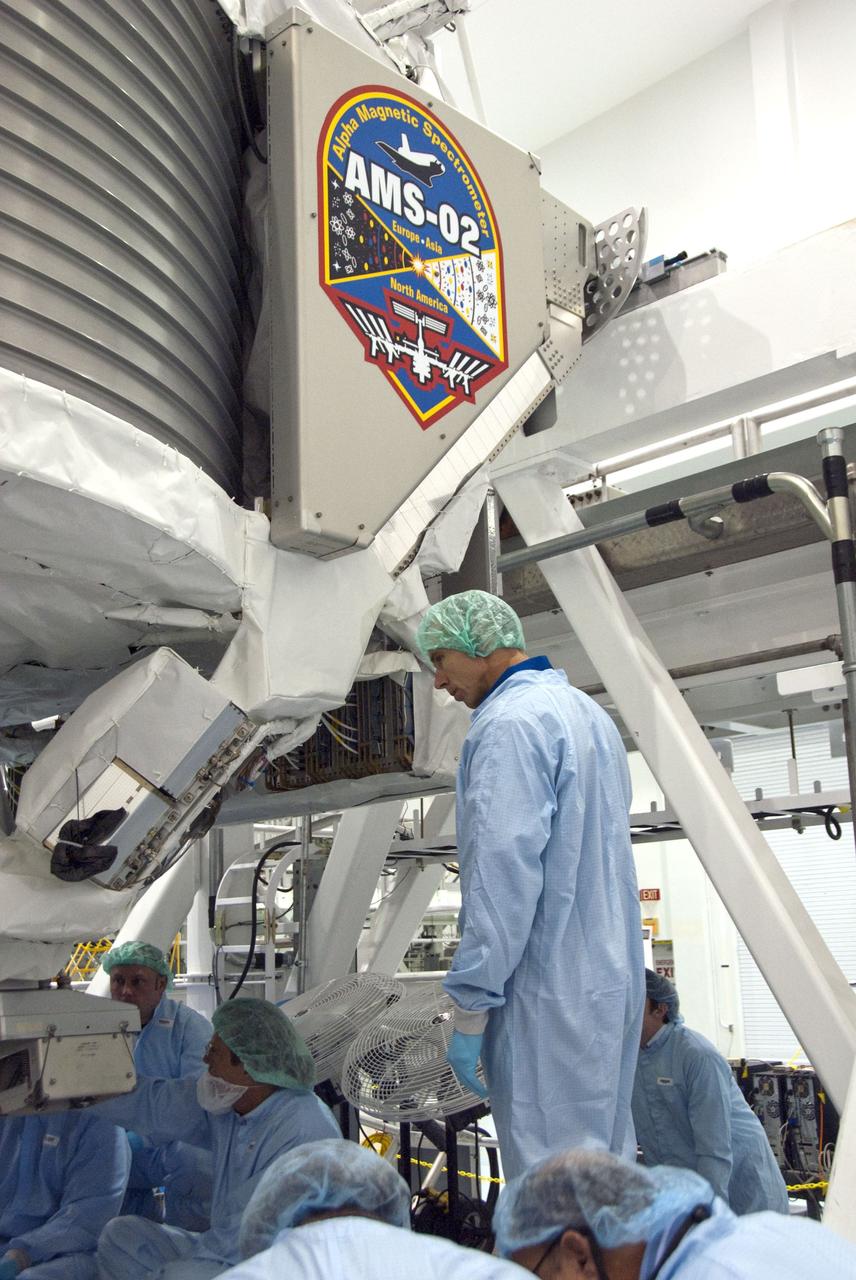
CAPE CANAVERAL, Fla. -- In the Space Station Processing Facility at NASA's Kennedy Space Center in Florida, STS-134 Mission Specialist Roberto Vittori inspects the Alpha Magnetic Spectrometer-2 (AMS) with the experiment's technicians. Vittori, who is with the European Space Agency, and his five crewmates are at Kennedy participating in the Crew Equipment Interface Test (CEIT), which gives them an opportunity for hands-on training with tools they'll be using in space and familiarization of the payload they'll be delivering to the International Space Station. Space shuttle Endeavour is targeted to launch on the STS-134 mission Feb. 27, 2011. For more information, visit www.nasa.gov/mission_pages/shuttle/shuttlemissions/sts134/index.html. Photo credit: NASA/Cory Huston
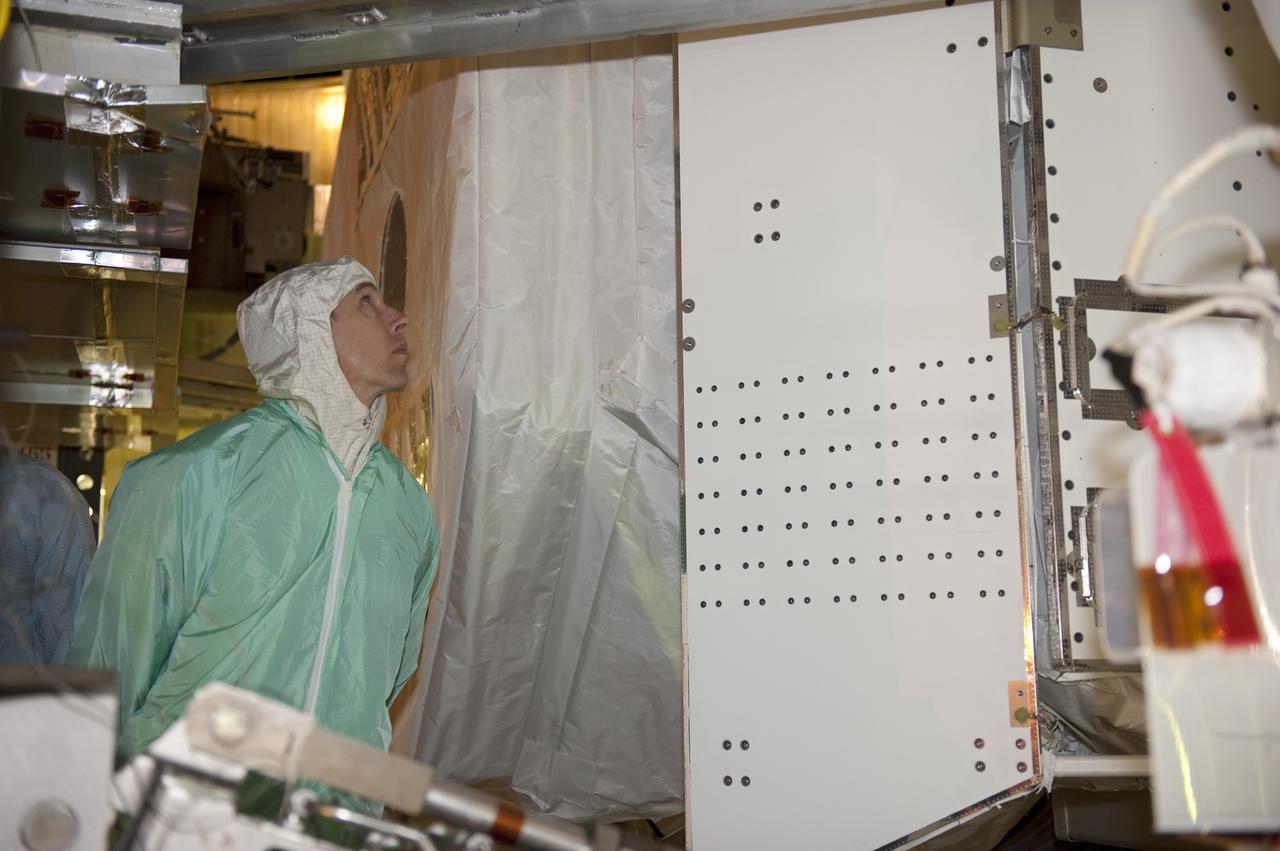
CAPE CANAVERAL, Fla. -- STS-134 Mission Specialist Andrew Feustel performs a walkdown of space shuttle Endeavour's payload bay. The Express Logistics Carrier-3 packed with spare parts and the Alpha Magnetic Spectrometer-2 (AMS) are inside the bay for the STS-134 mission to the International Space Station. Feustel and fellow Mission Specialists Greg Chamitoff and Michael Fincke are the designated spacewalkers for the mission. Endeavour's six crew members are at Kennedy for the launch countdown dress rehearsal called the Terminal Countdown Demonstration Test (TCDT) and related training. Endeavour is targeted to launch April 19 at 7:48 p.m. EDT on its final spaceflight mission. For more information visit, www.nasa.gov/mission_pages/shuttle/shuttlemissions/sts134/index.html. Photo credit: NASA/Kim Shiflett
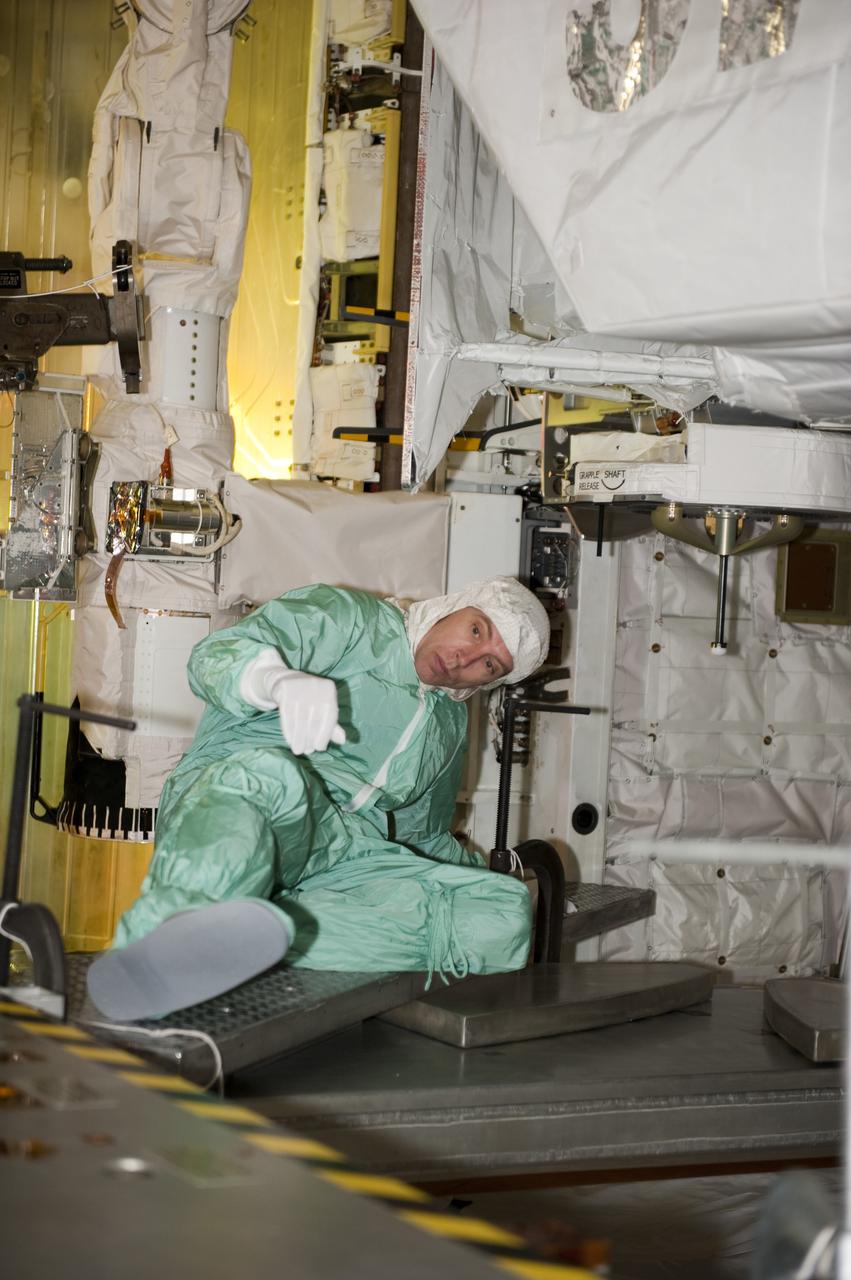
CAPE CANAVERAL, Fla. -- STS-134 Mission Specialist Andrew Feustel performs a walkdown of space shuttle Endeavour's payload bay. The Express Logistics Carrier-3 packed with spare parts and the Alpha Magnetic Spectrometer-2 (AMS) are inside the bay for the STS-134 mission to the International Space Station. Feustel and fellow Mission Specialists Greg Chamitoff and Michael Fincke are the designated spacewalkers for the mission. Endeavour's six crew members are at Kennedy for the launch countdown dress rehearsal called the Terminal Countdown Demonstration Test (TCDT) and related training. Endeavour is targeted to launch April 19 at 7:48 p.m. EDT on its final spaceflight mission. For more information visit, www.nasa.gov/mission_pages/shuttle/shuttlemissions/sts134/index.html. Photo credit: NASA/Kim Shiflett
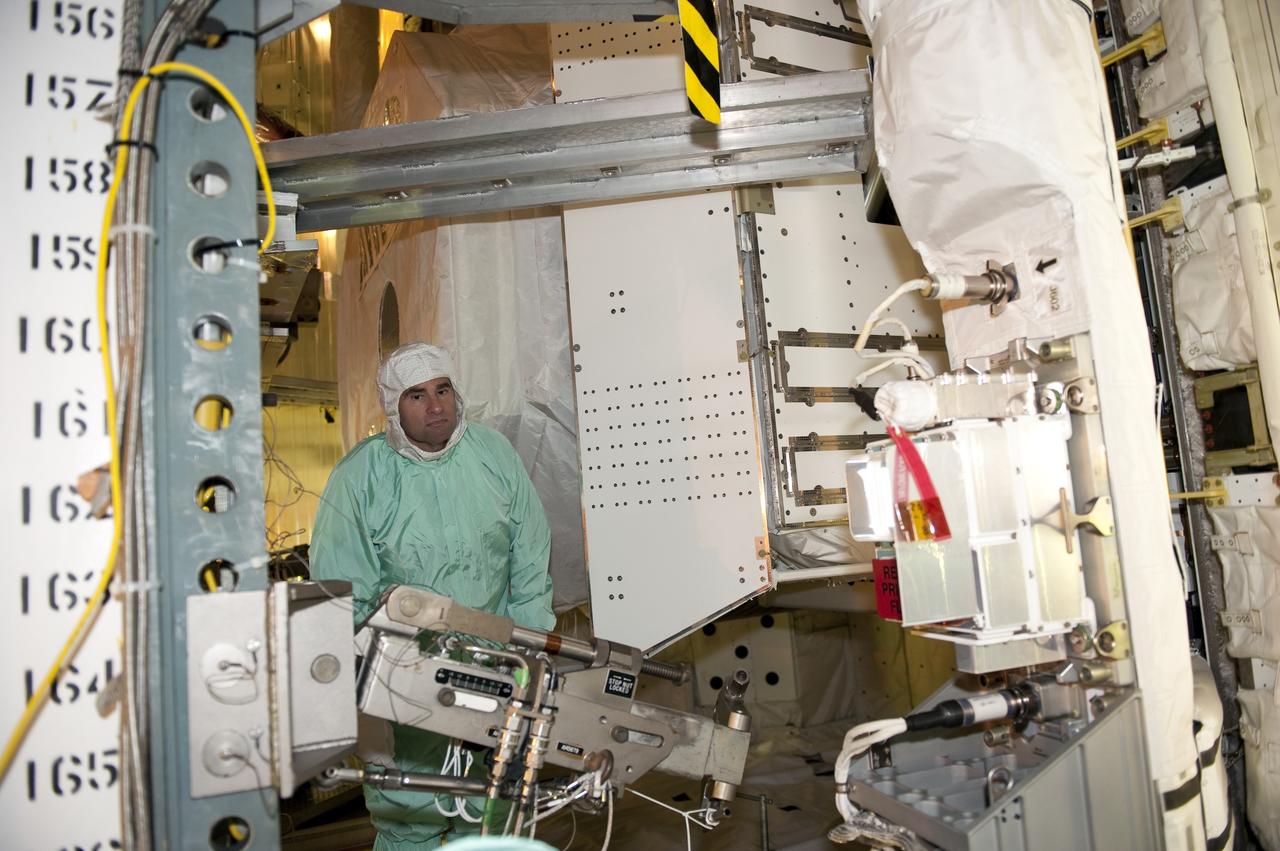
CAPE CANAVERAL, Fla. -- STS-134 Mission Specialist Greg Chamitoff performs a walkdown of space shuttle Endeavour's payload bay. The Express Logistics Carrier-3 packed with spare parts and the Alpha Magnetic Spectrometer-2 (AMS) are inside the bay for the STS-134 mission to the International Space Station. Chamitoff and fellow Mission Specialists Andrew Feustel and Michael Fincke are the designated spacewalkers for the mission. Endeavour's six crew members are at Kennedy for the launch countdown dress rehearsal called the Terminal Countdown Demonstration Test (TCDT) and related training. Endeavour is targeted to launch April 19 at 7:48 p.m. EDT on its final spaceflight mission. For more information visit, www.nasa.gov/mission_pages/shuttle/shuttlemissions/sts134/index.html. Photo credit: NASA/Kim Shiflett
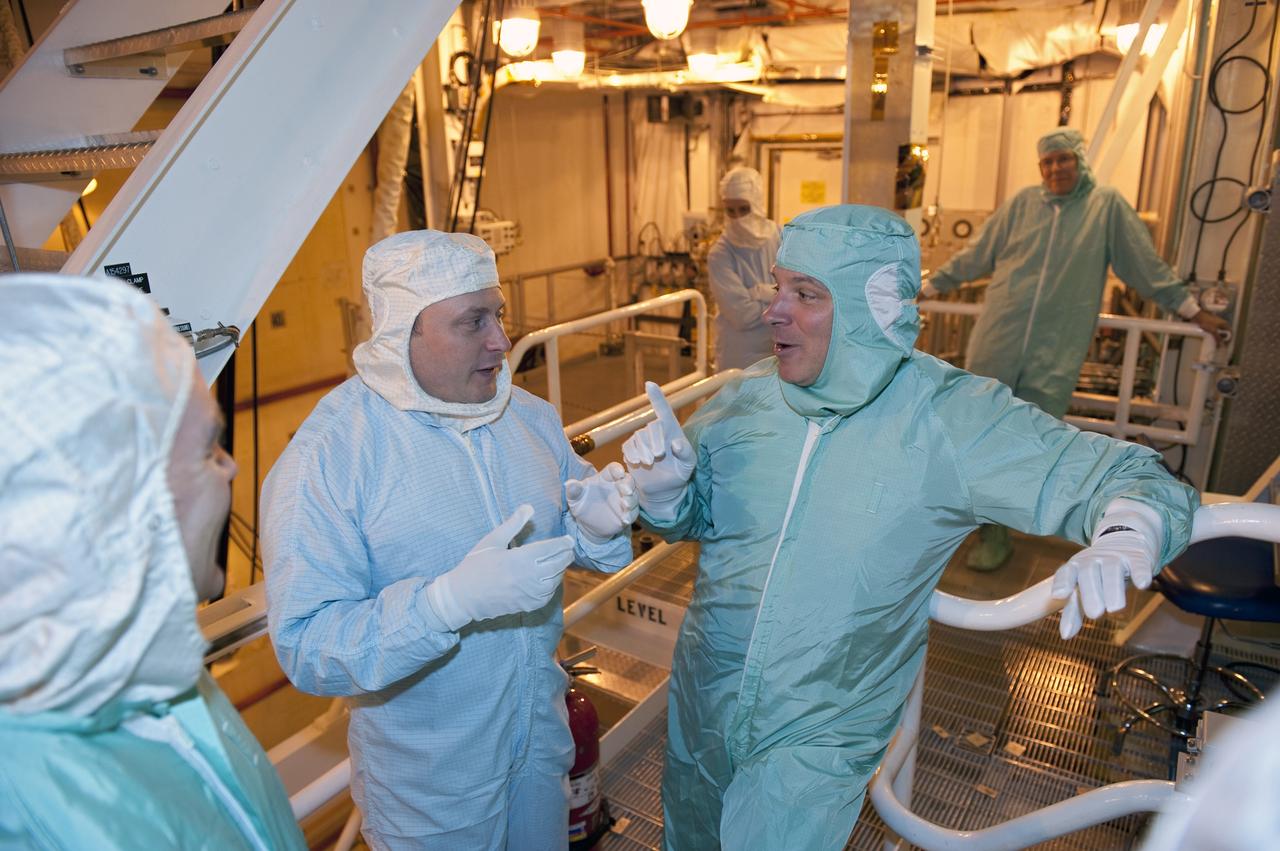
CAPE CANAVERAL, Fla. -- STS-134 Mission Specialist Michael Fincke, right, and Pilot Greg H. Johnson, center, perform a walkdown of space shuttle Endeavour's payload bay with shuttle technicians. The Express Logistics Carrier-3 packed with spare parts and the Alpha Magnetic Spectrometer-2 (AMS) are inside the bay for the STS-134 mission to the International Space Station. Endeavour's six crew members are at Kennedy for the launch countdown dress rehearsal called the Terminal Countdown Demonstration Test (TCDT) and related training. Endeavour is targeted to launch April 19 at 7:48 p.m. EDT on its final spaceflight mission. For more information visit, www.nasa.gov/mission_pages/shuttle/shuttlemissions/sts134/index.html. Photo credit: NASA/Kim Shiflett
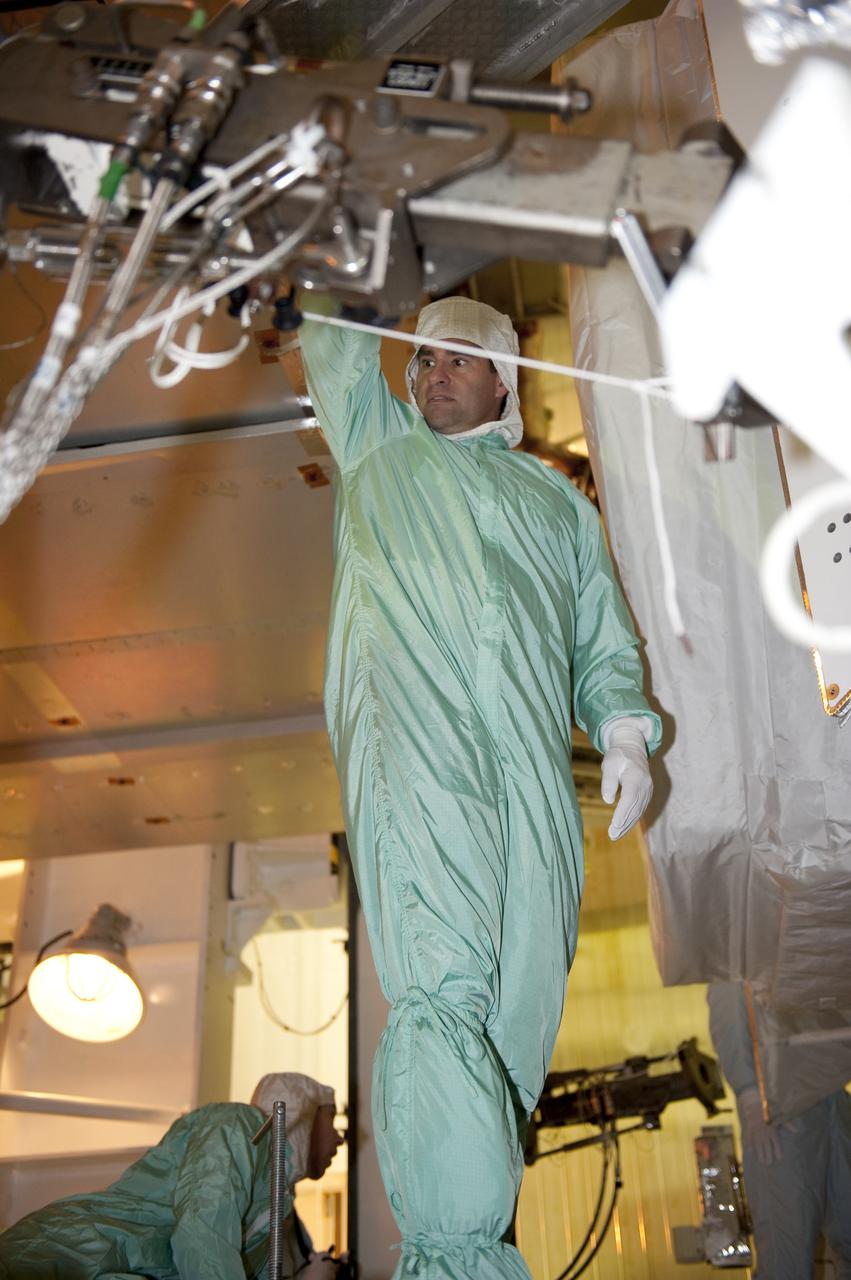
CAPE CANAVERAL, Fla. -- STS-134 Mission Specialists Greg Chamitoff, standing, and Andrew Feustel perform a walkdown of space shuttle Endeavour's payload bay. The Express Logistics Carrier-3 packed with spare parts and the Alpha Magnetic Spectrometer-2 (AMS) are inside the bay for the STS-134 mission to the International Space Station. Chamitoff, Feustel and fellow Mission Specialist Michael Fincke are the designated spacewalkers for the mission. Endeavour's six crew members are at Kennedy for the launch countdown dress rehearsal called the Terminal Countdown Demonstration Test (TCDT) and related training. Endeavour is targeted to launch April 19 at 7:48 p.m. EDT on its final spaceflight mission. For more information visit, www.nasa.gov/mission_pages/shuttle/shuttlemissions/sts134/index.html. Photo credit: NASA/Kim Shiflett
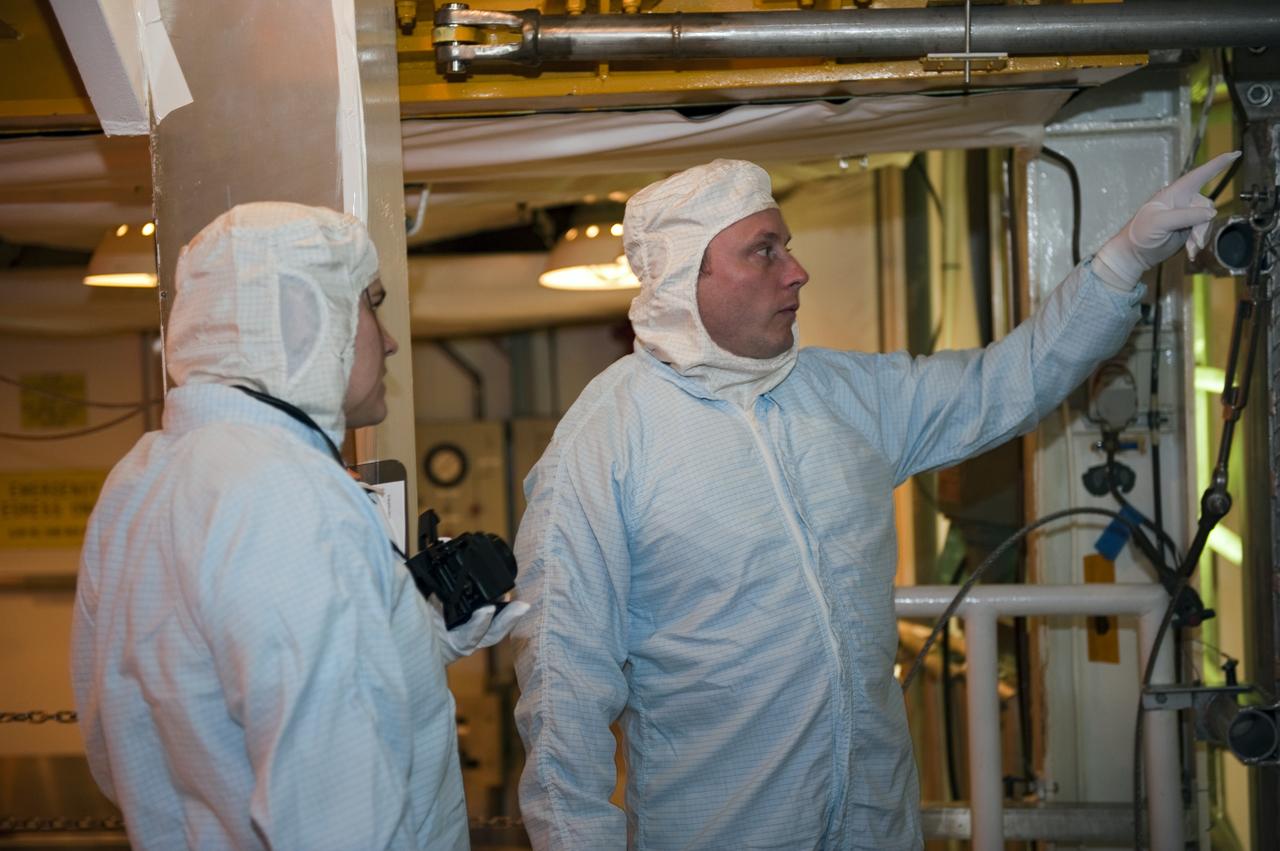
CAPE CANAVERAL, Fla. -- STS-134 Mission Specialist Michael Fincke, right, performs a walkdown of space shuttle Endeavour's payload bay with a shuttle technician. The Express Logistics Carrier-3 packed with spare parts and the Alpha Magnetic Spectrometer-2 (AMS) are inside the bay for the STS-134 mission to the International Space Station. Fincke and fellow Mission Specialists Greg Chamitoff and Andrew Feustel are the designated spacewalkers for the mission. Endeavour's six crew members are at Kennedy for the launch countdown dress rehearsal called the Terminal Countdown Demonstration Test (TCDT) and related training. Endeavour is targeted to launch April 19 at 7:48 p.m. EDT on its final spaceflight mission. For more information visit, www.nasa.gov/mission_pages/shuttle/shuttlemissions/sts134/index.html. Photo credit: NASA/Kim Shiflett
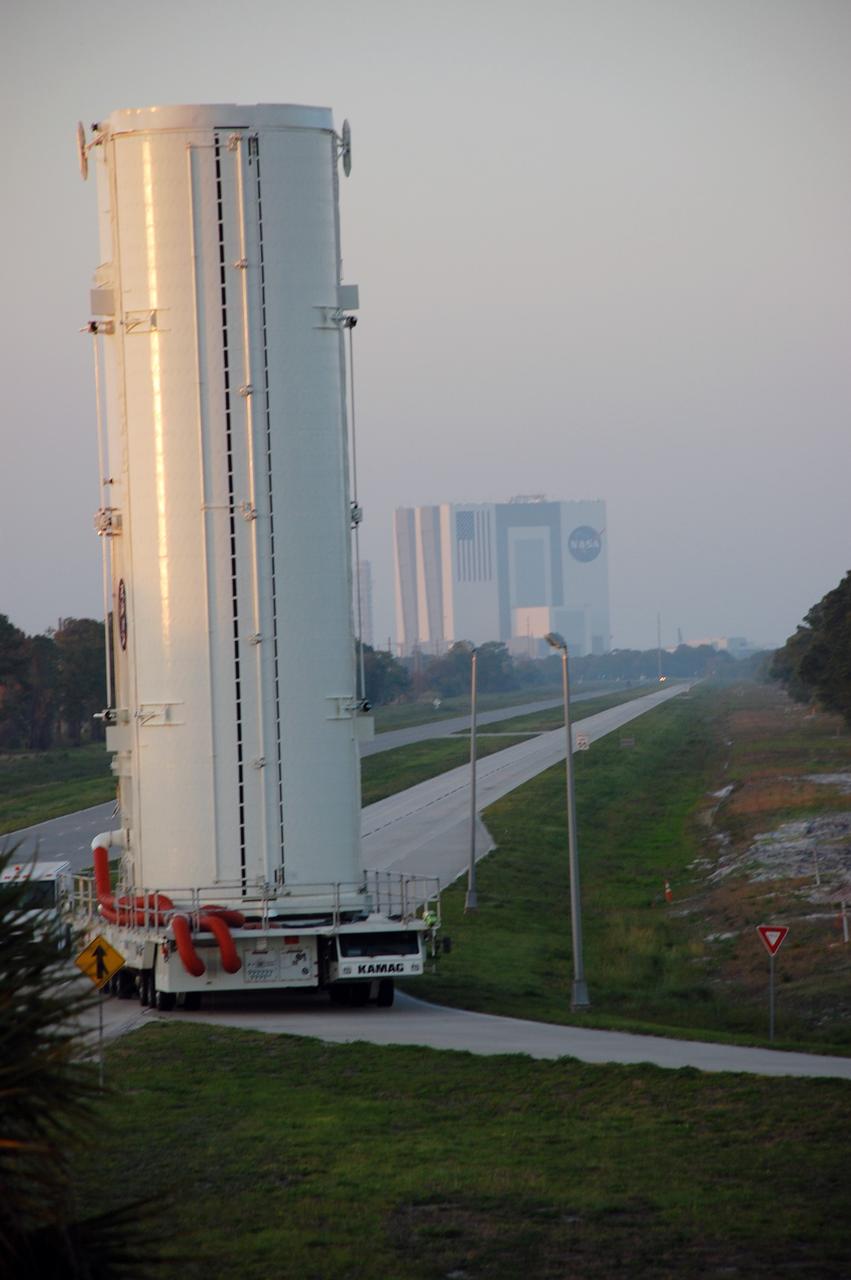
CAPE CANAVERAL, Fla. -- The canister that safely transported space shuttle Endeavour's primary payload to Launch Pad 39A at NASA's Kennedy Space Center in Florida heads back to its processing hangar, called the Canister Rotation Facility. Endeavour and its six-member STS-134 crew will deliver the Alpha Magnetic Spectrometer-2 (AMS) and Express Logistics Carrier-3 to the International Space Station. Endeavour is targeted to lift off on its final scheduled mission April 19 at 7:48 p.m. EDT. For more information visit, www.nasa.gov/mission_pages/shuttle/shuttlemissions/sts134/index.html. Photo credit: NASA/Ben Smegelsky