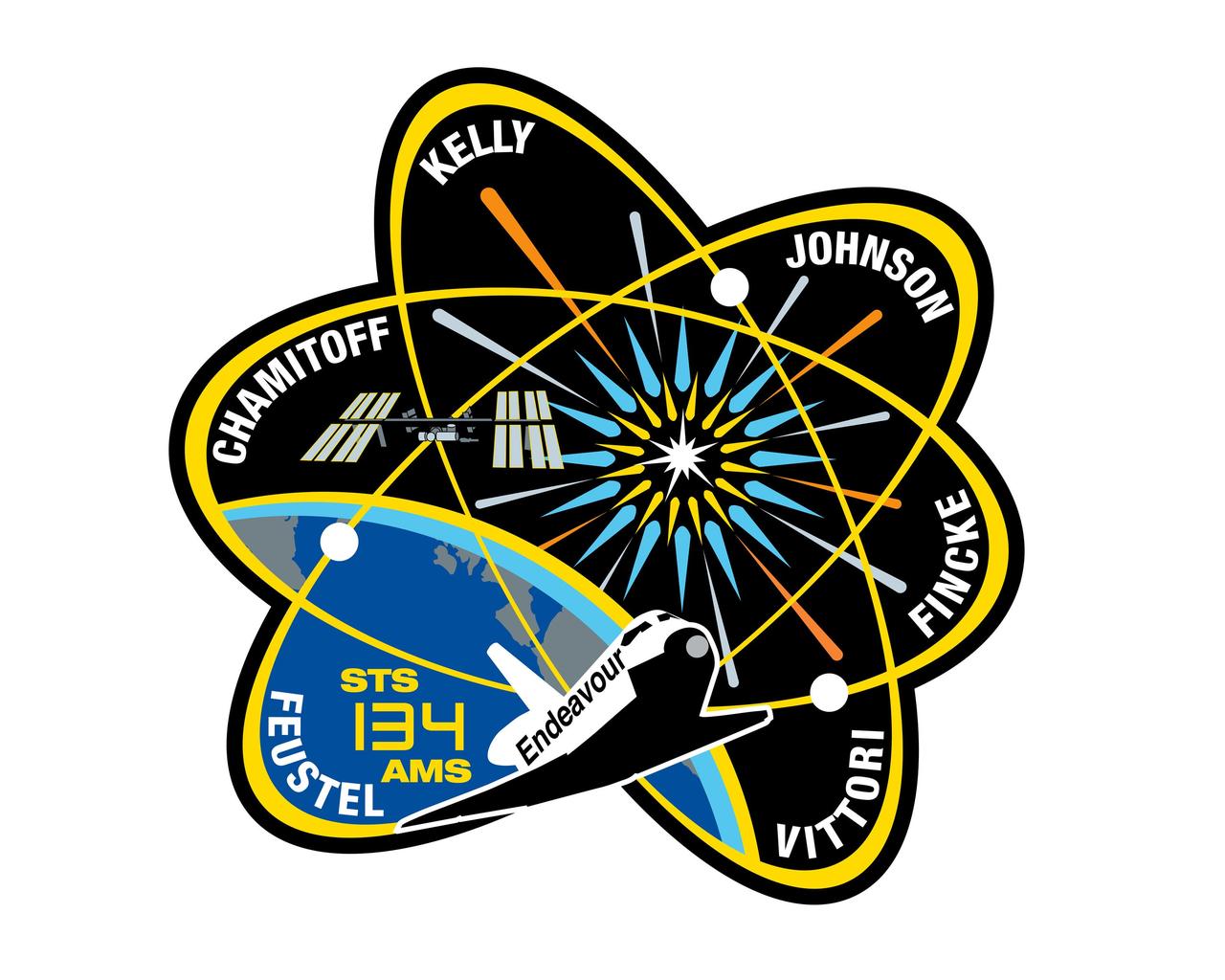
STS134-S-001 (March 2010) --- The design of the STS-134 crew patch highlights research on the International Space Station (ISS) focusing on the fundamental physics of the universe. On this mission, the crew of space shuttle Endeavour will install the Alpha Magnetic Spectrometer-2 (AMS) experiment -- a cosmic particle detector that utilizes the first-ever superconducting magnet to be flown in space. By studying sub-atomic particles in the background cosmic radiation, and searching for anti-matter and dark-matter, it will help scientists better understand the evolution and properties of our universe. The shape of the patch is inspired by the international atomic symbol, and represents the atom with orbiting electrons around the nucleus. The burst near the center refers to the big-bang theory and the origin of the universe. The shuttle Endeavour and ISS fly together into the sunrise over the limb of Earth, representing the dawn of a new age, understanding the nature of the universe. The NASA insignia design for shuttle flights is reserved for use by the astronauts and for other official use as the NASA administrator may authorize. Public availability has been approved only in the form of illustrations by the various news media. When and if there is any change in this policy, which we do not anticipate, it will be publicly announced.
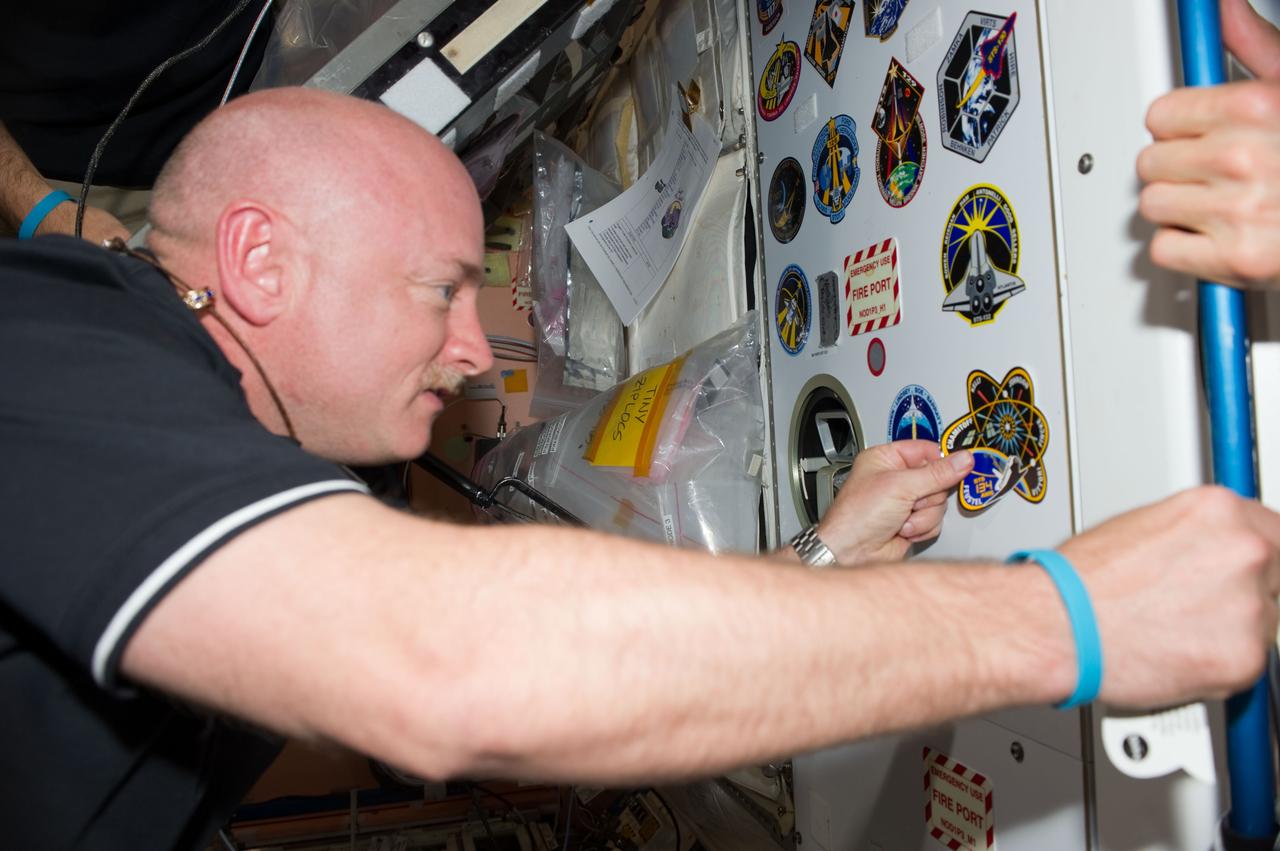
S134-E-008426 (21 May 2011) --- Continuing a tradition for visiting shuttle commanders, NASA astronaut Mark Kelly, STS-134 commander, attaches a decal of his mission patch at the end of a growing collection of mission insignias displayed in the Unity node onboard the International Space Station. Kelly is currently one of twelve astronauts and cosmonauts sharing work onboard the joint complex of space shuttle Endeavour and the space station. Photo credit: NASA
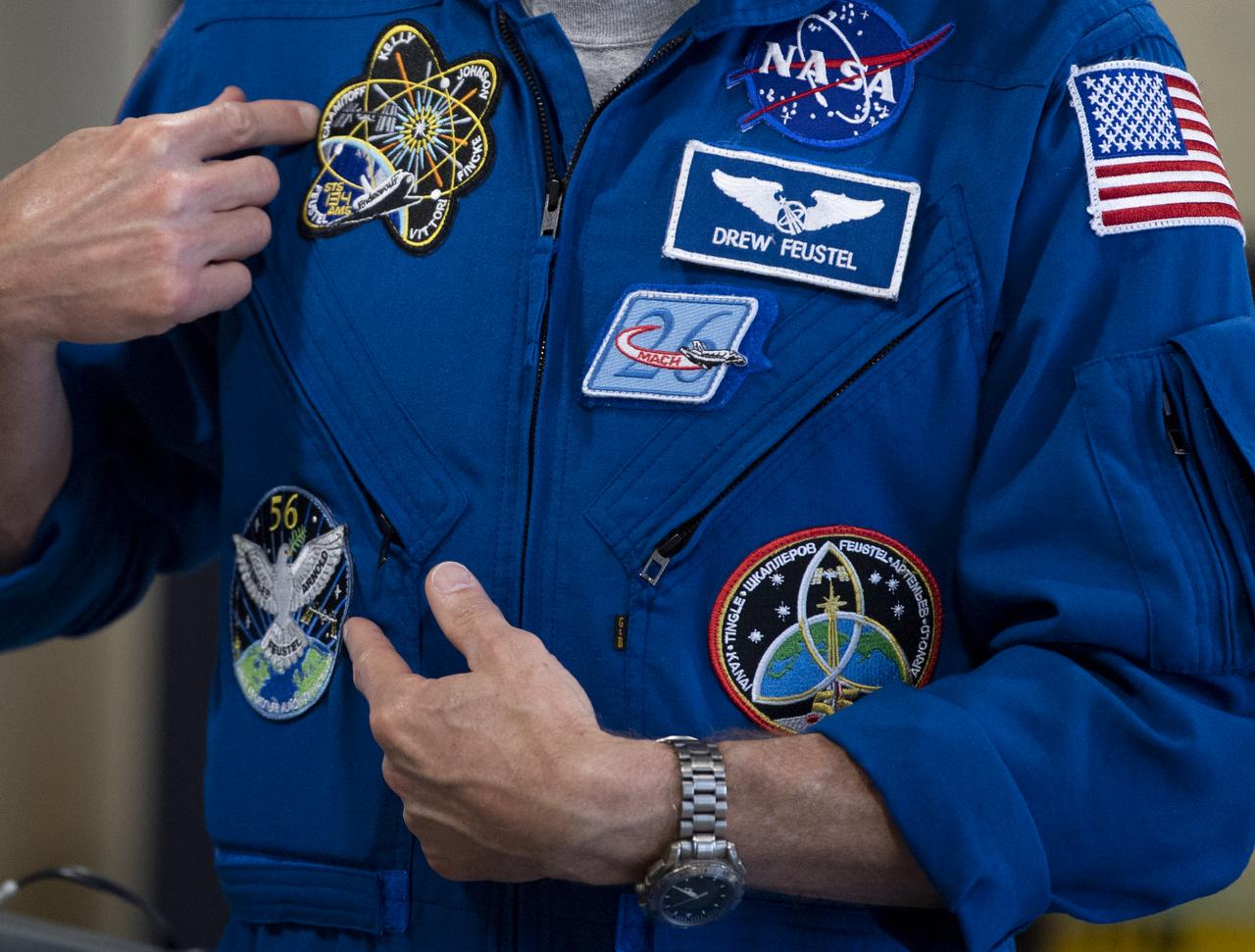
NASA astronaut Drew Feustel points to mission patches on his flight suit as he speaks to students at John Burroughs Elementary School about his experiences on two space shuttle missions, STS-125 and STS-134, and a long duration mission onboard the International Space Station, Tuesday, May 7, 2019 in Washington, DC. Feustel most recently spent 197 days living and working onboard the International Space Station as part of Expedition 55 and as commander of Expedition 56. Feustel ventured outside the space station on three spacewalks, moving him up to second among U.S. spacewalkers with a cumulative time of 61 hours 48 minutes over nine spacewalks. Photo Credit: (NASA/Joel Kowsky)

STS134-S-001 (March 2010) --- The design of the STS-134 crew patch highlights research on the International Space Station (ISS) focusing on the fundamental physics of the universe. On this mission, the crew of the space shuttle Endeavour will install the Alpha Magnetic Spectrometer (AMS) experiment - a cosmic particle detector. By studying subatomic particles in the background cosmic radiation and searching for antimatter, dark-matter, and dark energy, it will help scientists better understand the evolution and properties of our universe. The shape of the patch is inspired by the international atomic symbol, and represents the atom with orbiting electrons around the nucleus. The burst near the center refers to the origin of the universe. The space shuttle Endeavour and ISS fly together into the sunrise over the limb of the Earth, representing the dawn of a new age?understanding the nature of the universe. The NASA insignia design for space shuttle flights is reserved for use by the astronauts and for other official use as the NASA Administrator may authorize. Public availability has been approved only in the forms of illustrations by the various news media. When and if there is any change in this policy, which is not anticipated, the change will be publicly announced. Photo credit: NASA