
Caption: DG CVn, a binary consisting of two red dwarf stars shown here in an artist's rendering, unleashed a series of powerful flares seen by NASA's Swift. At its peak, the initial flare was brighter in X-rays than the combined light from both stars at all wavelengths under typical conditions. Image Credit: NASA's Goddard Space Flight Center/S. Wiessinger ----- On April 23, NASA's Swift satellite detected the strongest, hottest, and longest-lasting sequence of stellar flares ever seen from a nearby red dwarf star. The initial blast from this record-setting series of explosions was as much as 10,000 times more powerful than the largest solar flare ever recorded. Read more: <a href="http://1.usa.gov/1poKiJ5" rel="nofollow">1.usa.gov/1poKiJ5</a> <b><a href="http://www.nasa.gov/audience/formedia/features/MP_Photo_Guidelines.html" rel="nofollow">NASA image use policy.</a></b> <b><a href="http://www.nasa.gov/centers/goddard/home/index.html" rel="nofollow">NASA Goddard Space Flight Center</a></b> enables NASA’s mission through four scientific endeavors: Earth Science, Heliophysics, Solar System Exploration, and Astrophysics. Goddard plays a leading role in NASA’s accomplishments by contributing compelling scientific knowledge to advance the Agency’s mission. <b>Follow us on <a href="http://twitter.com/NASAGoddardPix" rel="nofollow">Twitter</a></b> <b>Like us on <a href="http://www.facebook.com/pages/Greenbelt-MD/NASA-Goddard/395013845897?ref=tsd" rel="nofollow">Facebook</a></b> <b>Find us on <a href="http://instagrid.me/nasagoddard/?vm=grid" rel="nofollow">Instagram</a></b>

KENNEDY SPACE CENTER, FLA. - In Hangar AE at Cape Canaveral Air Force Station, Spectrum Astro workers remove the final pieces of protective cover on the Swift spacecraft. Swift is a first-of-its-kind, multi-wavelength observatory dedicated to the study of gamma-ray burst (GRB) science. Its three instruments will work together to observe GRBs and afterglows in the gamma-ray, X-ray and optical wavebands. Swift is part of NASA’s medium explorer (MIDEX) program being developed by an international collaboration. During its nominal 2-year mission, Swift is expected to observe more than 200 bursts, which will represent the most comprehensive study of GRB afterglow to date. It is scheduled for launch into a low-Earth orbit on a Delta 7320 rocket on Oct. 7.

KENNEDY SPACE CENTER, FLA. - The Swift spacecraft is being unwrapped in Hangar AE at Cape Canaveral Air Force Station. Swift is a first-of-its-kind, multi-wavelength observatory dedicated to the study of gamma-ray burst (GRB) science. Its three instruments will work together to observe GRBs and afterglows in the gamma-ray, X-ray and optical wavebands. Swift is part of NASA’s medium explorer (MIDEX) program being developed by an international collaboration. During its nominal 2-year mission, Swift is expected to observe more than 200 bursts, which will represent the most comprehensive study of GRB afterglow to date. It is scheduled for launch into a low-Earth orbit on a Delta 7320 rocket on Oct. 7.

KENNEDY SPACE CENTER, FLA. - In Hangar AE at Cape Canaveral Air Force Station, Spectrum Astro workers look over the Swift spacecraft while removing its protective cover. Swift is a first-of-its-kind, multi-wavelength observatory dedicated to the study of gamma-ray burst (GRB) science. Its three instruments will work together to observe GRBs and afterglows in the gamma-ray, X-ray and optical wavebands. Swift is part of NASA’s medium explorer (MIDEX) program being developed by an international collaboration. During its nominal 2-year mission, Swift is expected to observe more than 200 bursts, which will represent the most comprehensive study of GRB afterglow to date. It is scheduled for launch into a low-Earth orbit on a Delta 7320 rocket on Oct. 7.

KENNEDY SPACE CENTER, FLA. - The Swift spacecraft is being unwrapped in Hangar AE at Cape Canaveral Air Force Station. Swift is a first-of-its-kind, multi-wavelength observatory dedicated to the study of gamma-ray burst (GRB) science. Its three instruments will work together to observe GRBs and afterglows in the gamma-ray, X-ray and optical wavebands. Swift is part of NASA’s medium explorer (MIDEX) program being developed by an international collaboration. During its nominal 2-year mission, Swift is expected to observe more than 200 bursts, which will represent the most comprehensive study of GRB afterglow to date. It is scheduled for launch into a low-Earth orbit on a Delta 7320 rocket on Oct. 7.

KENNEDY SPACE CENTER, FLA. - - In Hangar AE at Cape Canaveral Air Force Station, the Swift spacecraft waits for final removal of the protective cover (at top). Swift is a first-of-its-kind, multi-wavelength observatory dedicated to the study of gamma-ray burst (GRB) science. Its three instruments will work together to observe GRBs and afterglows in the gamma-ray, X-ray and optical wavebands. Swift is part of NASA’s medium explorer (MIDEX) program being developed by an international collaboration. During its nominal 2-year mission, Swift is expected to observe more than 200 bursts, which will represent the most comprehensive study of GRB afterglow to date. It is scheduled for launch into a low-Earth orbit on a Delta 7320 rocket on Oct. 7.

KENNEDY SPACE CENTER, FLA. - The Swift spacecraft is being unwrapped in Hangar AE at Cape Canaveral Air Force Station. Swift is a first-of-its-kind, multi-wavelength observatory dedicated to the study of gamma-ray burst (GRB) science. Its three instruments will work together to observe GRBs and afterglows in the gamma-ray, X-ray and optical wavebands. Swift is part of NASA’s medium explorer (MIDEX) program being developed by an international collaboration. During its nominal 2-year mission, Swift is expected to observe more than 200 bursts, which will represent the most comprehensive study of GRB afterglow to date. It is scheduled for launch into a low-Earth orbit on a Delta 7320 rocket on Oct. 7.

KENNEDY SPACE CENTER, FLA. - In Hangar AE at Cape Canaveral Air Force Station, the Swift spacecraft is revealed. Swift is a first-of-its-kind, multi-wavelength observatory dedicated to the study of gamma-ray burst (GRB) science. Its three instruments will work together to observe GRBs and afterglows in the gamma-ray, X-ray and optical wavebands. Swift is part of NASA’s medium explorer (MIDEX) program being developed by an international collaboration. During its nominal 2-year mission, Swift is expected to observe more than 200 bursts, which will represent the most comprehensive study of GRB afterglow to date. It is scheduled for launch into a low-Earth orbit on a Delta 7320 rocket on Oct. 7.

KENNEDY SPACE CENTER, FLA. - In Hangar AE at Cape Canaveral Air Force Station, Spectrum Astro workers look at the final pieces of protective cover on the Swift spacecraft that must be removed. Swift is a first-of-its-kind, multi-wavelength observatory dedicated to the study of gamma-ray burst (GRB) science. Its three instruments will work together to observe GRBs and afterglows in the gamma-ray, X-ray and optical wavebands. Swift is part of NASA’s medium explorer (MIDEX) program being developed by an international collaboration. During its nominal 2-year mission, Swift is expected to observe more than 200 bursts, which will represent the most comprehensive study of GRB afterglow to date. It is scheduled for launch into a low-Earth orbit on a Delta 7320 rocket on Oct. 7.
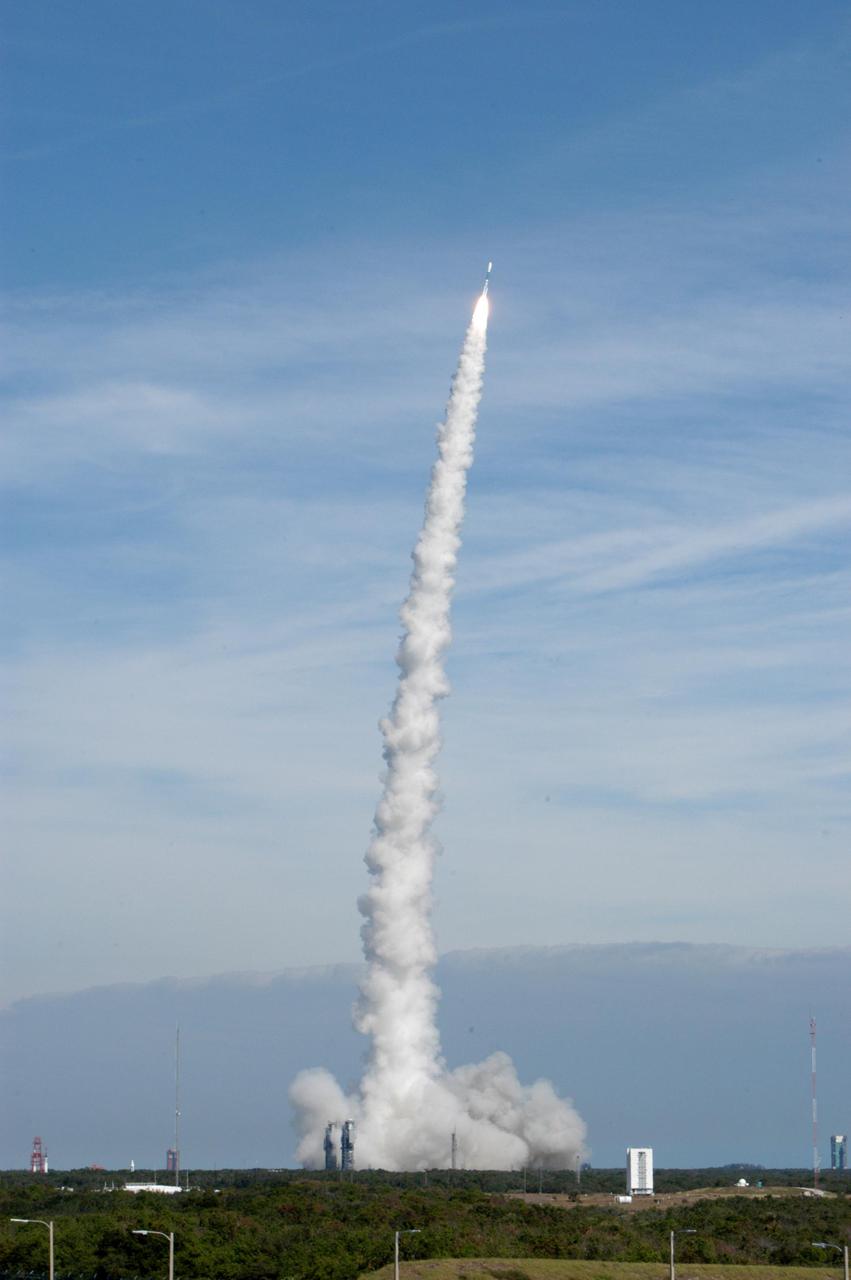
KENNEDY SPACE CENTER, FLA. - Seen from a distance, NASA's Swift spacecraft lifts off from Complex 17A, Cape Canaveral Air Force Station, on Nov. 20 at 12:16:00.611 p.m. EST aboard a Boeing Delta II expendable launch vehicle. Swift is a first-of-its-kind multi-wavelength observatory dedicated to the study of gamma-ray burst science. Its three instruments will work together to observe GRBs and afterglows in the gamma ray, X-ray, ultraviolet and optical wavebands.
KENNEDY SPACE CENTER, FLA. - NASA's Swift spacecraft lifts off from Complex 17A into the beautiful blue sky above Cape Canaveral Air Force Station on Nov. 20 at 12:16:00.611 p.m. EST aboard a Boeing Delta II expendable launch vehicle. Swift is a first-of-its-kind multi-wavelength observatory dedicated to the study of gamma-ray burst science. Its three instruments will work together to observe GRBs and afterglows in the gamma ray, X-ray, ultraviolet and optical wavebands.
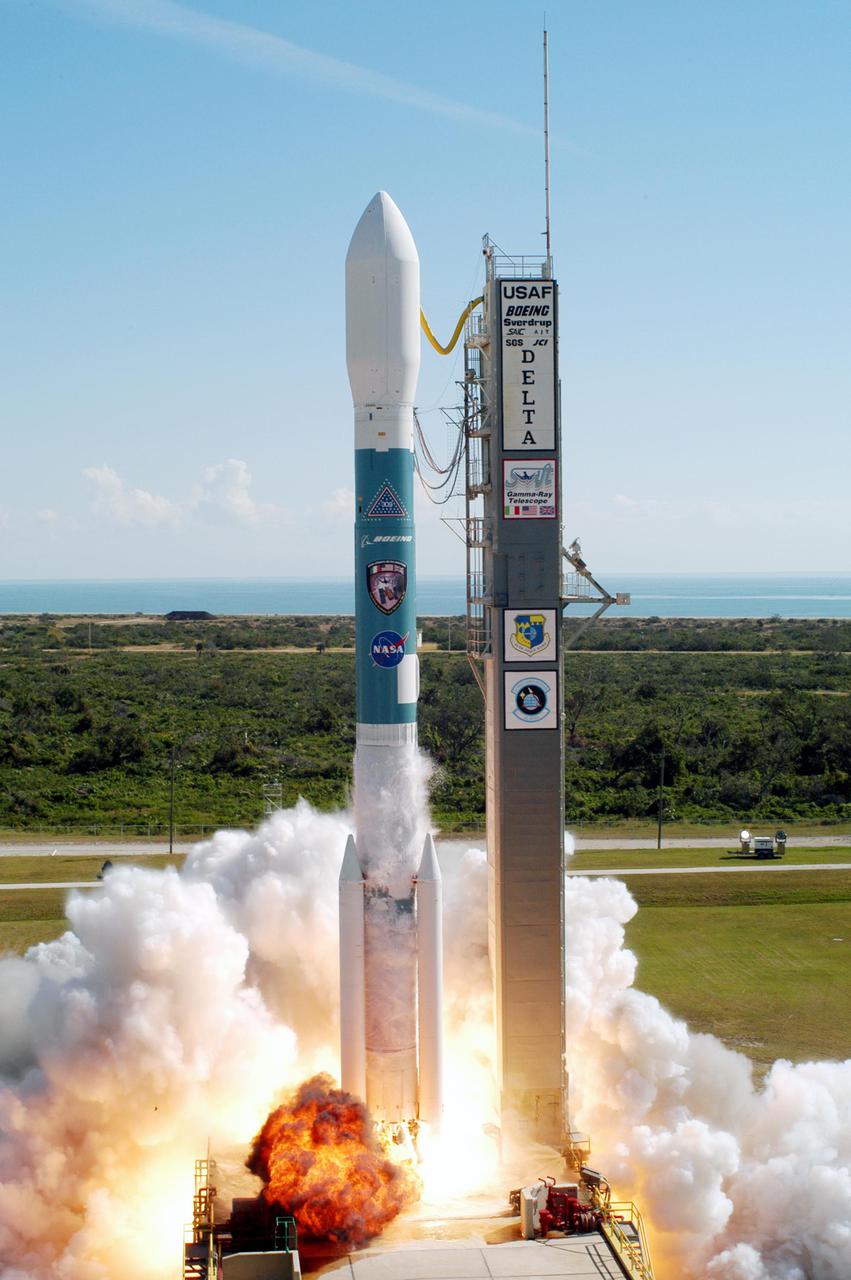
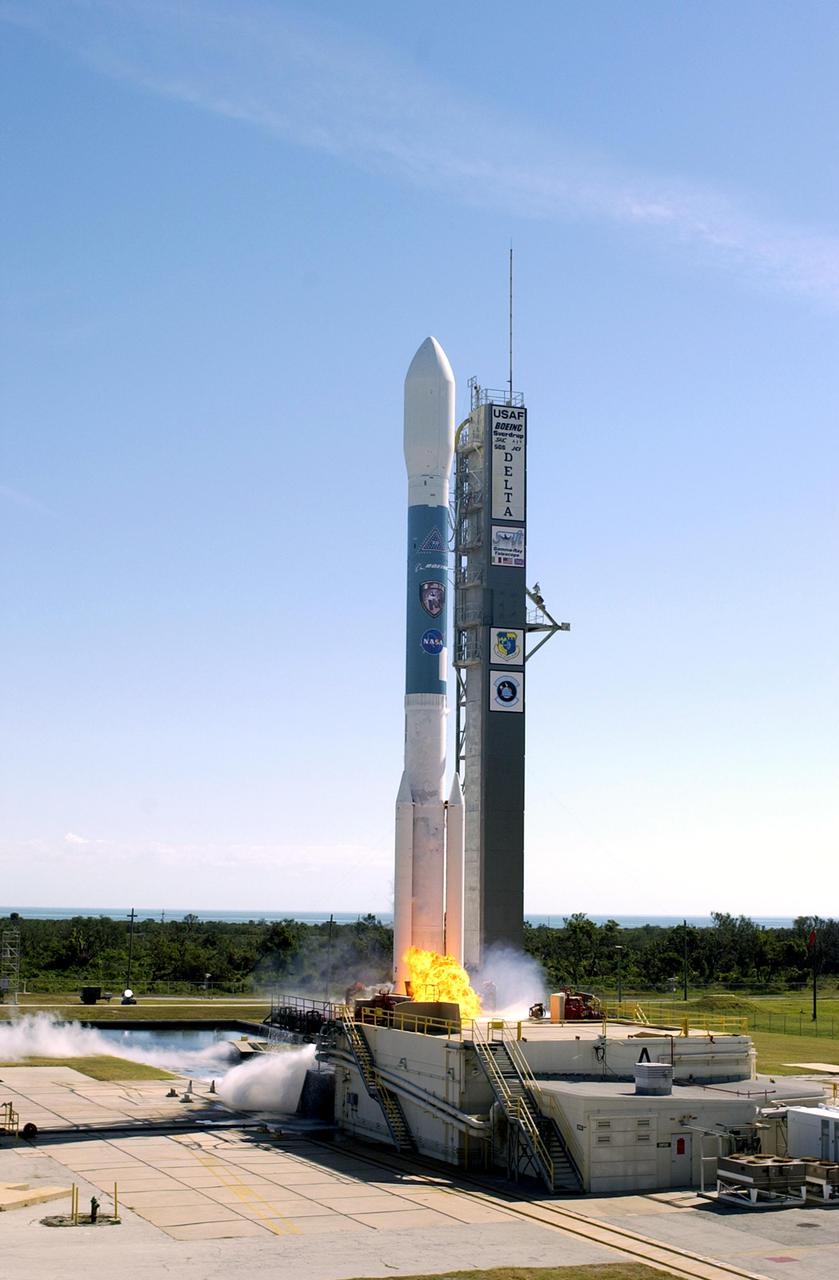
KENNEDY SPACE CENTER, FLA. - The engines of a Boeing Delta II expendable launch vehicle ignite to blast NASA's Swift spacecraft on its way at Complex 17A, Cape Canaveral Air Force Station, on Nov. 20 at 12:16:00.611 p.m. EST. Swift is a first-of-its-kind multi-wavelength observatory dedicated to the study of gamma-ray burst science. Its three instruments will work together to observe GRBs and afterglows in the gamma ray, X-ray, ultraviolet and optical wavebands.
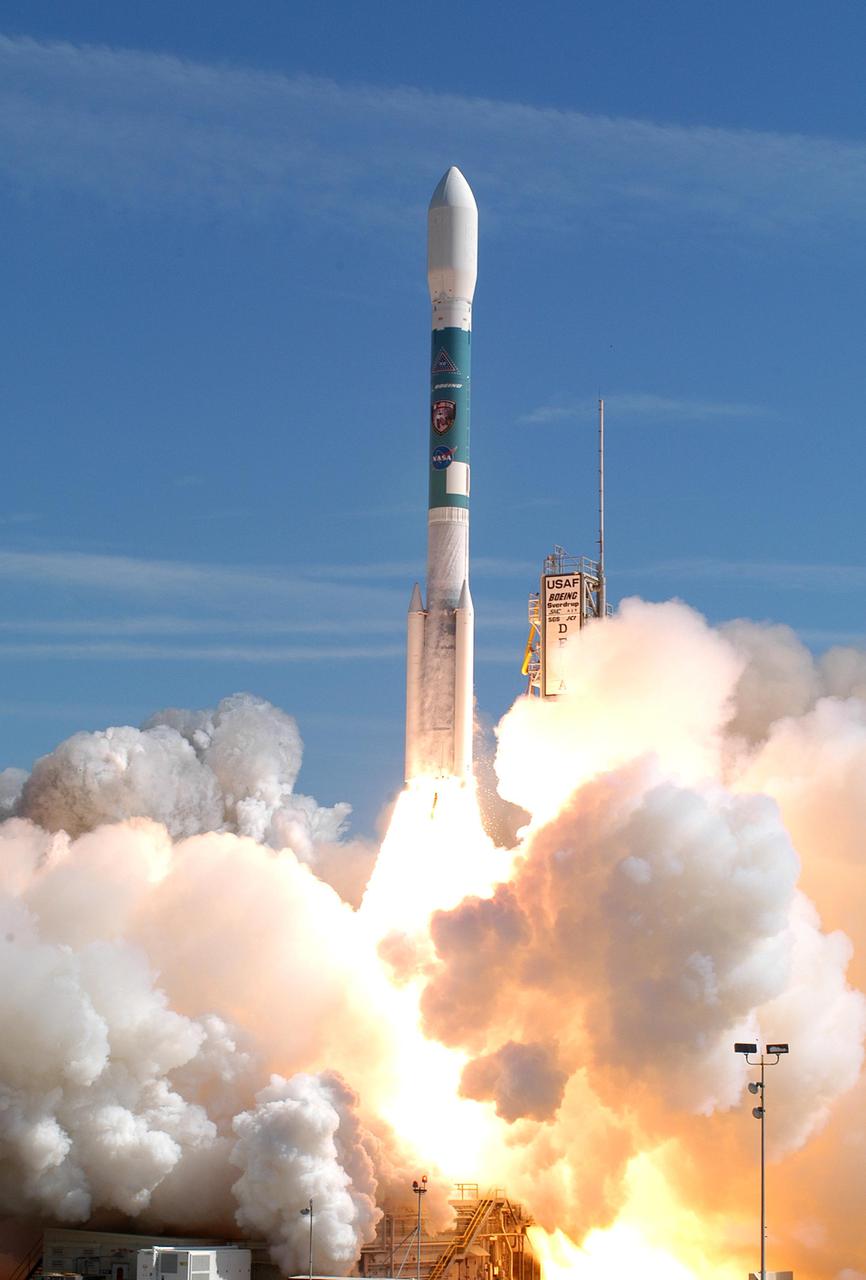
KENNEDY SPACE CENTER, FLA. - Clouds of exhaust form around a Boeing Delta II expendable launch vehicle as it blasts NASA's Swift spacecraft on its mission at Complex 17A, Cape Canaveral Air Force Station, on Nov. 20 at 12:16:00.611 p.m. EST. Swift is a first-of-its-kind multi-wavelength observatory dedicated to the study of gamma-ray burst science. Its three instruments will work together to observe GRBs and afterglows in the gamma ray, X-ray, ultraviolet and optical wavebands.
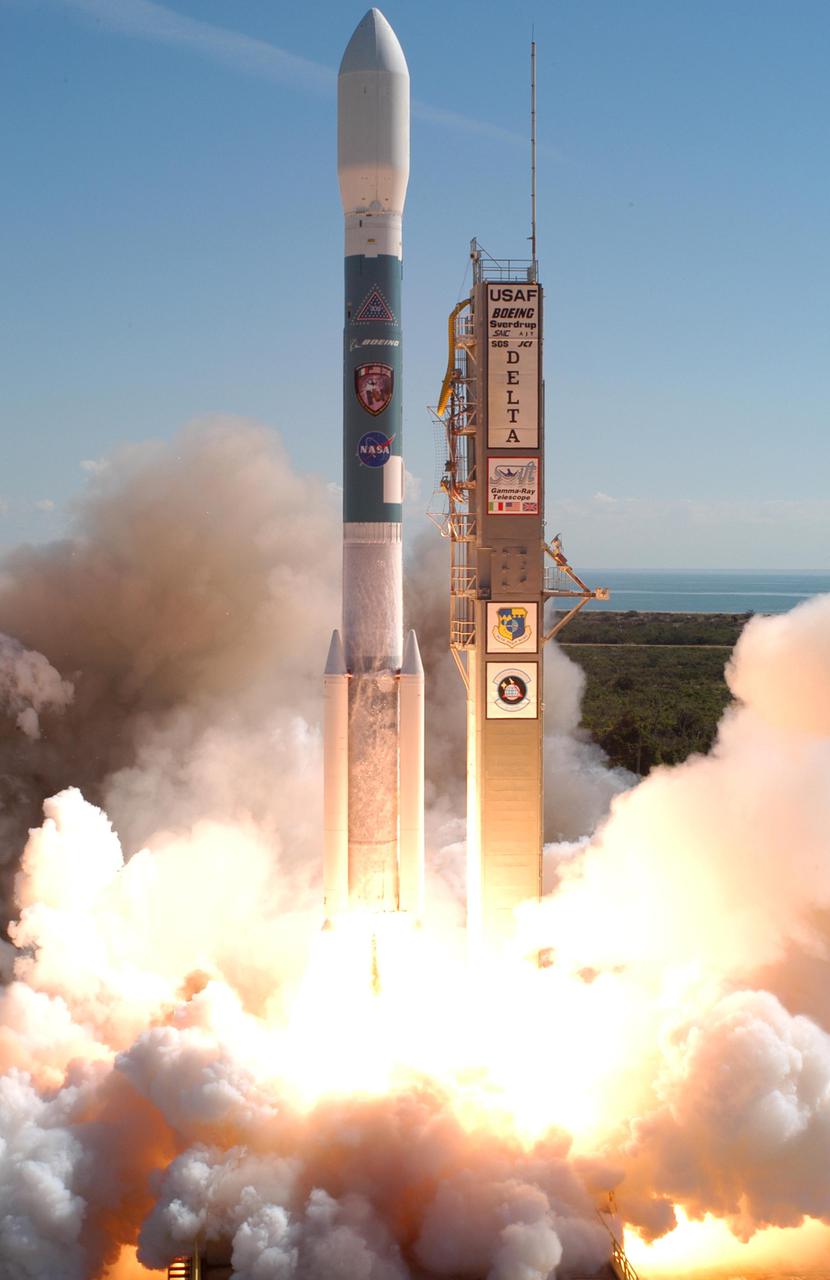
KENNEDY SPACE CENTER, FLA. - The engines of a Boeing Delta II expendable launch vehicle ignite to blast NASA's Swift spacecraft on its way at Complex 17A, Cape Canaveral Air Force Station, on Nov. 20 at 12:16:00.611 p.m. EST. Swift is a first-of-its-kind multi-wavelength observatory dedicated to the study of gamma-ray burst science. Its three instruments will work together to observe GRBs and afterglows in the gamma ray, X-ray, ultraviolet and optical wavebands.
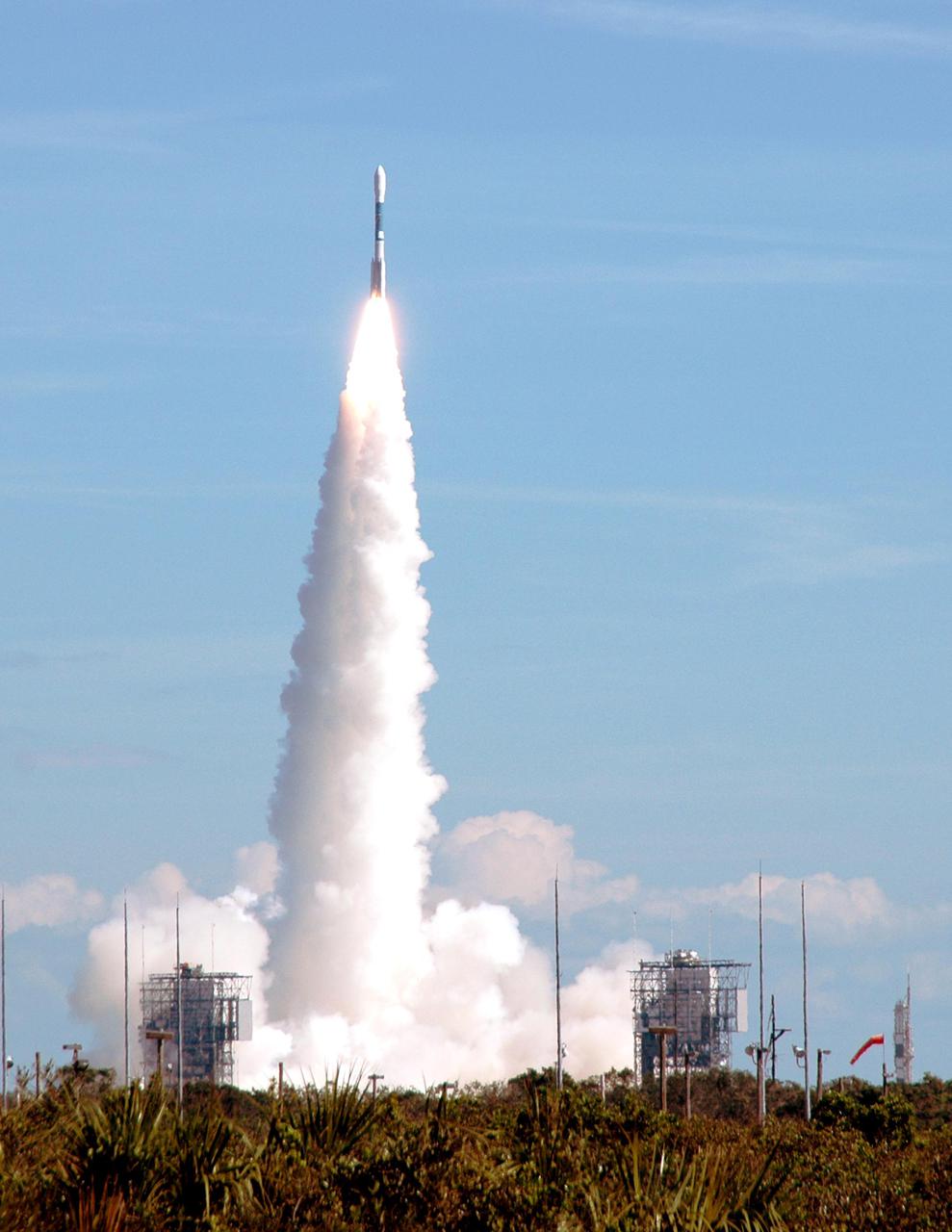
KENNEDY SPACE CENTER, FLA. - NASA's Swift spacecraft blasts off from Complex 17A into the beautiful blue sky above Cape Canaveral Air Force Station on Nov. 20 at 12:16:00.611 p.m. EST aboard a Boeing Delta II expendable launch vehicle. Swift is a first-of-its-kind multi-wavelength observatory dedicated to the study of gamma-ray burst science. Its three instruments will work together to observe GRBs and afterglows in the gamma ray, X-ray, ultraviolet and optical wavebands.
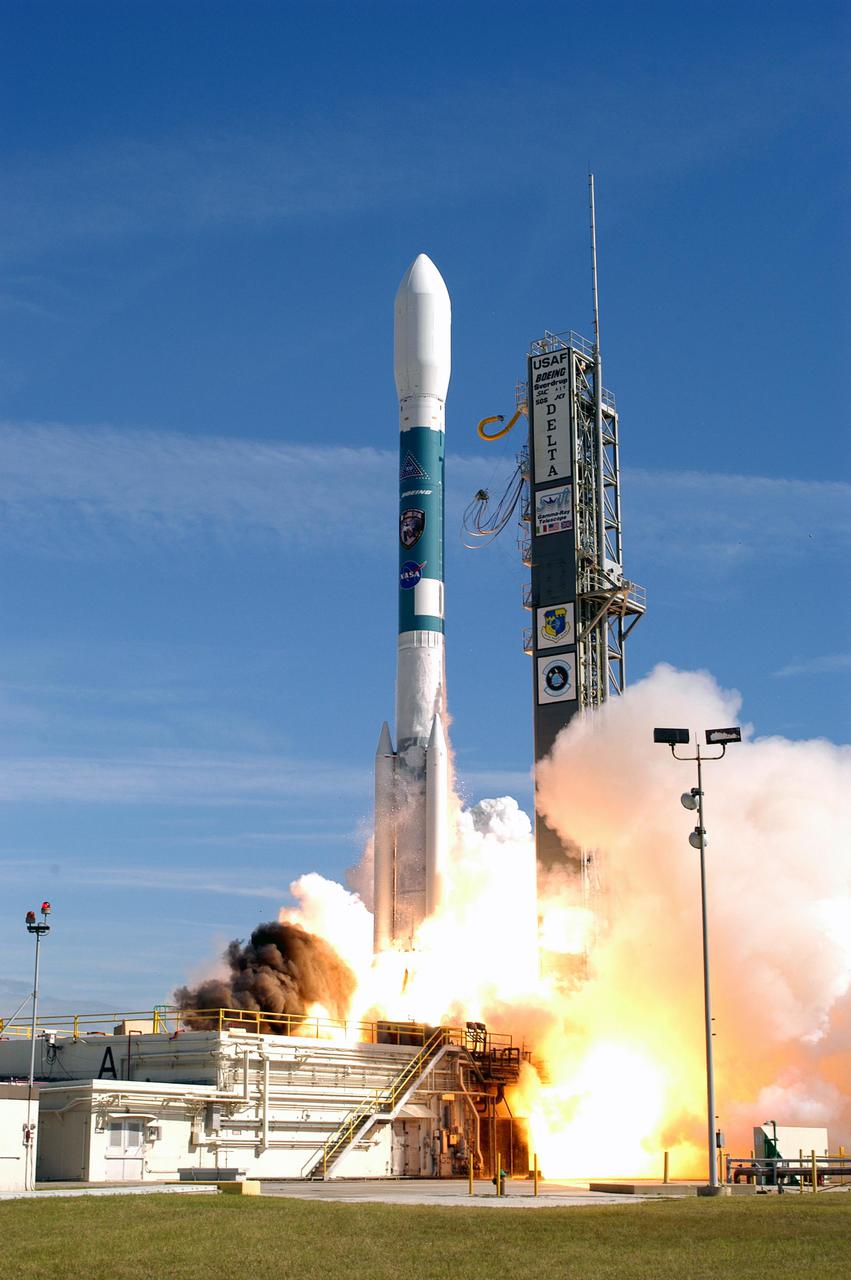
KENNEDY SPACE CENTER, FLA. - NASA's Swift spacecraft lifts off from Complex 17A, Cape Canaveral Air Force Station in sunny Florida, on Nov. 20 at 12:16:00.611 p.m. EST aboard a Boeing Delta II expendable launch vehicle. Swift is a first-of-its-kind multi-wavelength observatory dedicated to the study of gamma-ray burst science. Its three instruments will work together to observe GRBs and afterglows in the gamma ray, X-ray, ultraviolet and optical wavebands.
![KENNEDY SPACE CENTER, FLA. - The engines of a Boeing Delta II expendable launch vehicle ignite to blast NASA’s Swift spacecraft on its way from Complex 17-A, Cape Canaveral Air Force Station, at 12:16:00.611 p.m. EST Nov. 20 . Swift is a first-of-its-kind multi-wavelength observatory dedicated to the study of gamma-ray burst science. Its three instruments will work together to observe GRBs and afterglows in the gamma ray, X-ray, ultraviolet and optical wavebands. [Photo courtesy of Scott Andrews]](https://images-assets.nasa.gov/image/04pd2357/04pd2357~medium.jpg)
KENNEDY SPACE CENTER, FLA. - The engines of a Boeing Delta II expendable launch vehicle ignite to blast NASA’s Swift spacecraft on its way from Complex 17-A, Cape Canaveral Air Force Station, at 12:16:00.611 p.m. EST Nov. 20 . Swift is a first-of-its-kind multi-wavelength observatory dedicated to the study of gamma-ray burst science. Its three instruments will work together to observe GRBs and afterglows in the gamma ray, X-ray, ultraviolet and optical wavebands. [Photo courtesy of Scott Andrews]
![KENNEDY SPACE CENTER, FLA. - Clouds of exhaust form around a Boeing Delta II expendable launch vehicle as it blasts NASA’s Swift spacecraft on its mission from Complex 17-A, Cape Canaveral Air Force Station, at 12:16:00.611 p.m. EST Nov. 20 . Swift is a first-of-its-kind multi-wavelength observatory dedicated to the study of gamma-ray burst science. Its three instruments will work together to observe GRBs and afterglows in the gamma ray, X-ray, ultraviolet and optical wavebands. [Photo courtesy of Scott Andrews]](https://images-assets.nasa.gov/image/04pd2356/04pd2356~medium.jpg)
KENNEDY SPACE CENTER, FLA. - Clouds of exhaust form around a Boeing Delta II expendable launch vehicle as it blasts NASA’s Swift spacecraft on its mission from Complex 17-A, Cape Canaveral Air Force Station, at 12:16:00.611 p.m. EST Nov. 20 . Swift is a first-of-its-kind multi-wavelength observatory dedicated to the study of gamma-ray burst science. Its three instruments will work together to observe GRBs and afterglows in the gamma ray, X-ray, ultraviolet and optical wavebands. [Photo courtesy of Scott Andrews]
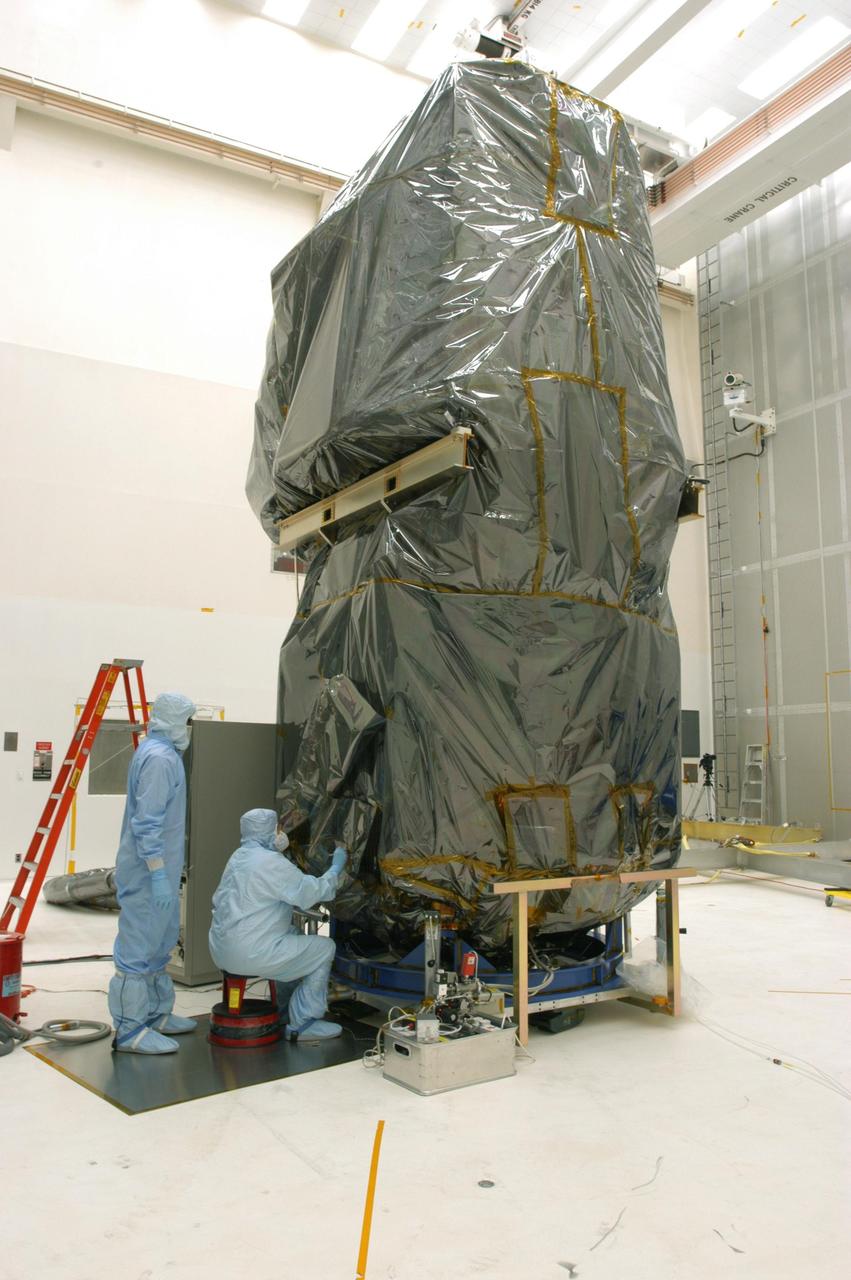
KENNEDY SPACE CENTER, FLA. - In the clean room at NASA’s Hangar AE on Cape Canaveral Air Force Station (CCAFS), Spectrolab technicians begin lifting the protective cover from the Swift spacecraft. Two of Swift’s solar cells on the solar array will be removed and replaced. Swift is a first-of-its-kind, multi-wavelength observatory dedicated to the study of gamma-ray burst (GRB) science. Its three instruments will work together to observe GRBs and afterglows in the gamma-ray, X-ray, ultraviolet and optical wavebands. The main mission objectives for Swift are to determine the origin of gamma-ray bursts, classify gamma-ray bursts and search for new types, determine how the blast wave evolves and interacts with the surroundings, use gamma-ray bursts to study the early universe and perform the first sensitive hard X-ray survey of the sky. Swift is scheduled to launch Oct. 26 from Launch Pad 17-A, CCAFS, on a Boeing Delta 7320 rocket.

Some 290 million years ago, a star much like the sun wandered too close to the central black hole of its galaxy. Intense tides tore the star apart, which produced an eruption of optical, ultraviolet and X-ray light that first reached Earth in 2014. Now, a team of scientists using observations from NASA's Swift satellite have mapped out how and where these different wavelengths were produced in the event, named ASASSN-14li, as the shattered star's debris circled the black hole. "We discovered brightness changes in X-rays that occurred about a month after similar changes were observed in visible and UV light," said Dheeraj Pasham, an astrophysicist at the Massachusetts Institute of Technology (MIT) in Cambridge, Massachusetts, and the lead researcher of the study. "We think this means the optical and UV emission arose far from the black hole, where elliptical streams of orbiting matter crashed into each other." Read more: <a href="https://go.nasa.gov/2nLmSoa" rel="nofollow">go.nasa.gov/2nLmSoa</a> <b><a href="http://www.nasa.gov/audience/formedia/features/MP_Photo_Guidelines.html" rel="nofollow">NASA image use policy.</a></b> <b><a href="http://www.nasa.gov/centers/goddard/home/index.html" rel="nofollow">NASA Goddard Space Flight Center</a></b> enables NASA’s mission through four scientific endeavors: Earth Science, Heliophysics, Solar System Exploration, and Astrophysics. Goddard plays a leading role in NASA’s accomplishments by contributing compelling scientific knowledge to advance the Agency’s mission. <b>Follow us on <a href="http://twitter.com/NASAGoddardPix" rel="nofollow">Twitter</a></b> <b>Like us on <a href="http://www.facebook.com/pages/Greenbelt-MD/NASA-Goddard/395013845897?ref=tsd" rel="nofollow">Facebook</a></b> <b>Find us on <a href="http://instagrid.me/nasagoddard/?vm=grid" rel="nofollow">Instagram</a></b>

For the first time, two space-based telescopes have teamed up with ground-based observatories to observe a microlensing event, a magnification of the light of a distant star due to the gravitational effects of an unseen object in the foreground. In this case, the cause of the microlensing event was a brown dwarf, dubbed OGLE-2015-BLG-1319, orbiting a star. In terms of mass, brown dwarfs fall somewhere between the size of the largest planets and the smallest stars. Curiously, scientists have found that, for stars roughly the mass of our sun, less than 1 percent have a brown dwarf orbiting within 3 AU (1 AU is the distance between Earth and the sun). This newly discovered brown dwarf may fall in that distance range. This microlensing event was observed by ground-based telescopes looking for these uncommon events, and subsequently seen by NASA's Spitzer and Swift space telescopes. As the diagram shows, Spitzer and Swift offer additional vantage points for viewing this chance alignment. While Swift orbits close to Earth, and saw (blue diamonds) essentially the same change in light that the ground-based telescopes measured (grey markers), Spitzer's location much farther away from Earth gave it a very different perspective on the event (red circles). In particular, Spitzer's vantage point resulted in a time lag in the microlensing event it observed, compared to what was seen by Swift and the ground-based telescope. This offset allowed astronomers to determine the distance to OGLE-2015-BLG-1319 as well as its mass: around 30-65 times that of Jupiter. http://photojournal.jpl.nasa.gov/catalog/PIA21077
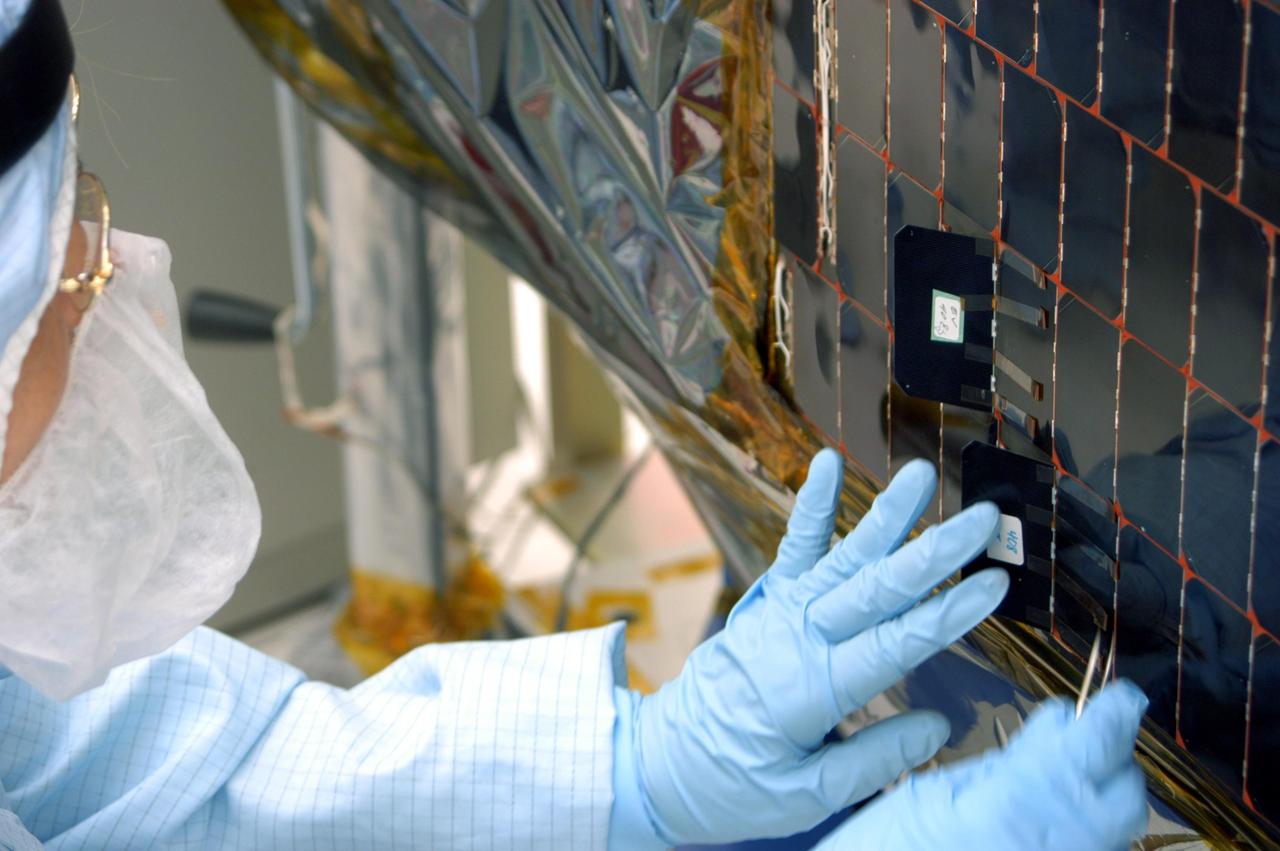
KENNEDY SPACE CENTER, FLA. - In the clean room at NASA’s Hangar AE on Cape Canaveral Air Force Station (CCAFS), a Spectrolab technician, Anna Herrera, places a new solar cell on the Swift spacecraft’s solar array. Swift is a first-of-its-kind, multi-wavelength observatory dedicated to the study of gamma-ray burst (GRB) science. Its three instruments will work together to observe GRBs and afterglows in the gamma-ray, X-ray, ultraviolet and optical wavebands. The main mission objectives for Swift are to determine the origin of gamma-ray bursts, classify gamma-ray bursts and search for new types, determine how the blast wave evolves and interacts with the surroundings, use gamma-ray bursts to study the early universe and perform the first sensitive hard X-ray survey of the sky. Swift is scheduled to launch Oct. 26 from Launch Pad 17-A, CCAFS, on a Boeing Delta 7320 rocket.
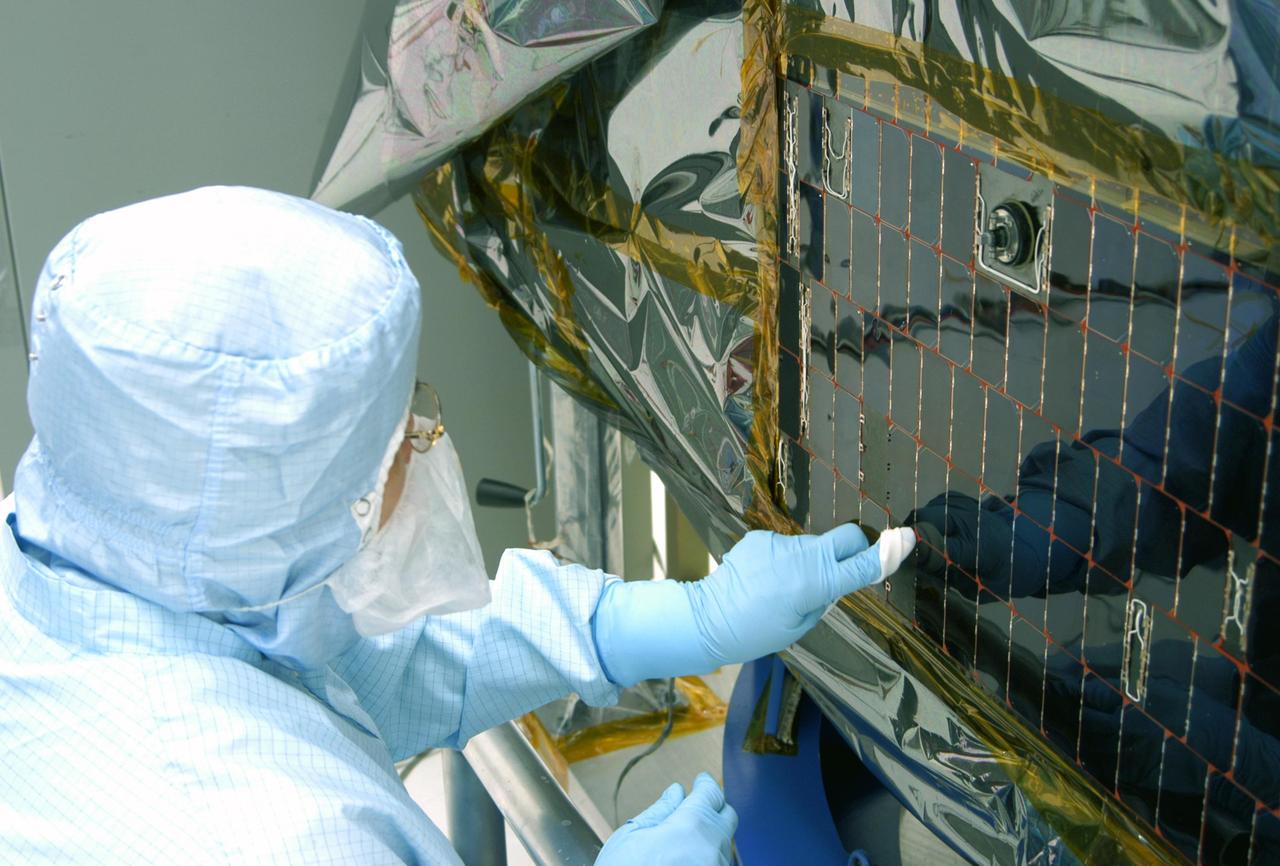
KENNEDY SPACE CENTER, FLA. - In the clean room at NASA’s Hangar AE on Cape Canaveral Air Force Station (CCAFS), a Spectrolab technician, Anna Herrera, points to an area on the Swift spacecraft’s solar array where cells will be removed and replaced. Swift is a first-of-its-kind, multi-wavelength observatory dedicated to the study of gamma-ray burst (GRB) science. Its three instruments will work together to observe GRBs and afterglows in the gamma-ray, X-ray, ultraviolet and optical wavebands. The main mission objectives for Swift are to determine the origin of gamma-ray bursts, classify gamma-ray bursts and search for new types, determine how the blast wave evolves and interacts with the surroundings, use gamma-ray bursts to study the early universe and perform the first sensitive hard X-ray survey of the sky. Swift is scheduled to launch Oct. 26 from Launch Pad 17-A, CCAFS, on a Boeing Delta 7320 rocket.
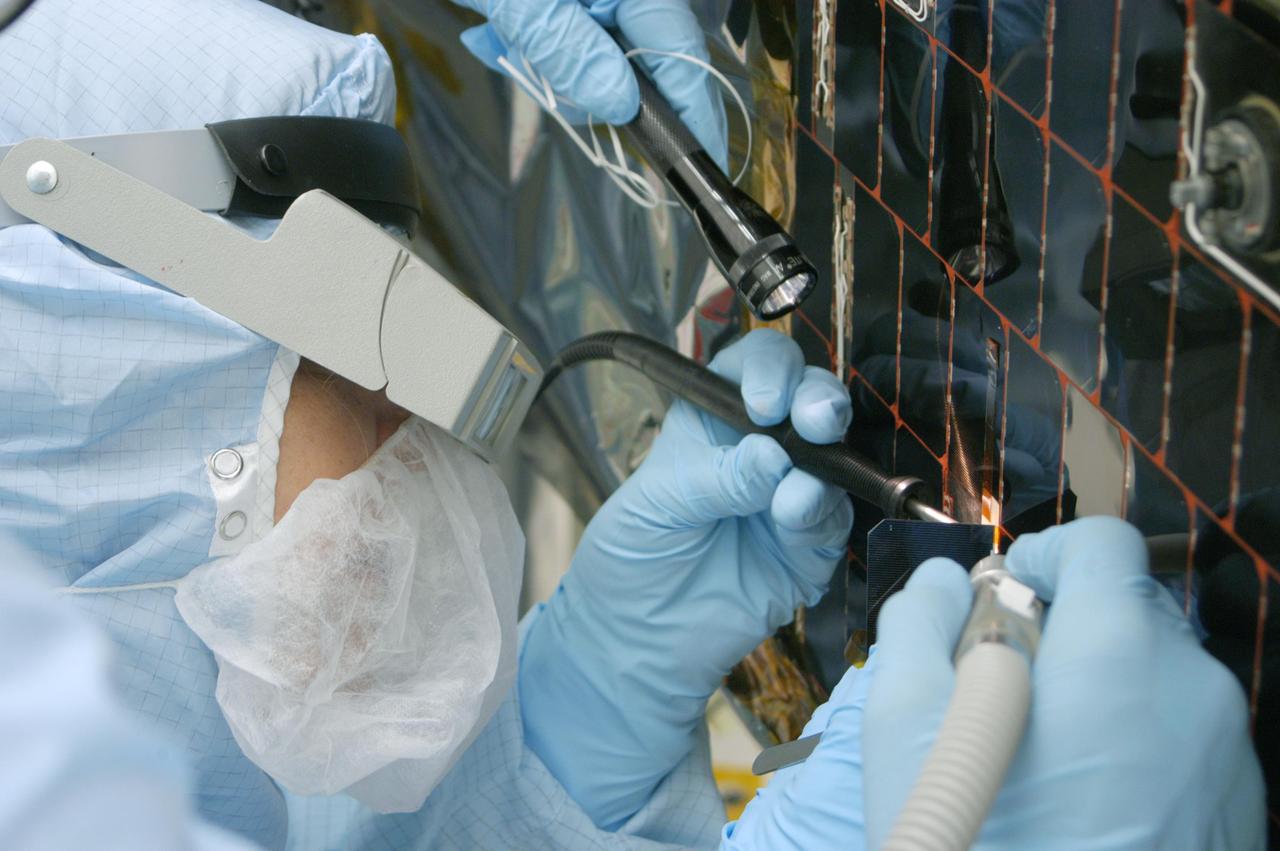
KENNEDY SPACE CENTER, FLA. - In the clean room at NASA’s Hangar AE on Cape Canaveral Air Force Station (CCAFS), a Spectrolab technician, Anna Herrera, removes one of the solar cells that will be replaced on the Swift spacecraft’s solar array. Swift is a first-of-its-kind, multi-wavelength observatory dedicated to the study of gamma-ray burst (GRB) science. Its three instruments will work together to observe GRBs and afterglows in the gamma-ray, X-ray, ultraviolet and optical wavebands. The main mission objectives for Swift are to determine the origin of gamma-ray bursts, classify gamma-ray bursts and search for new types, determine how the blast wave evolves and interacts with the surroundings, use gamma-ray bursts to study the early universe and perform the first sensitive hard X-ray survey of the sky. Swift is scheduled to launch Oct. 26 from Launch Pad 17-A, CCAFS, on a Boeing Delta 7320 rocket.
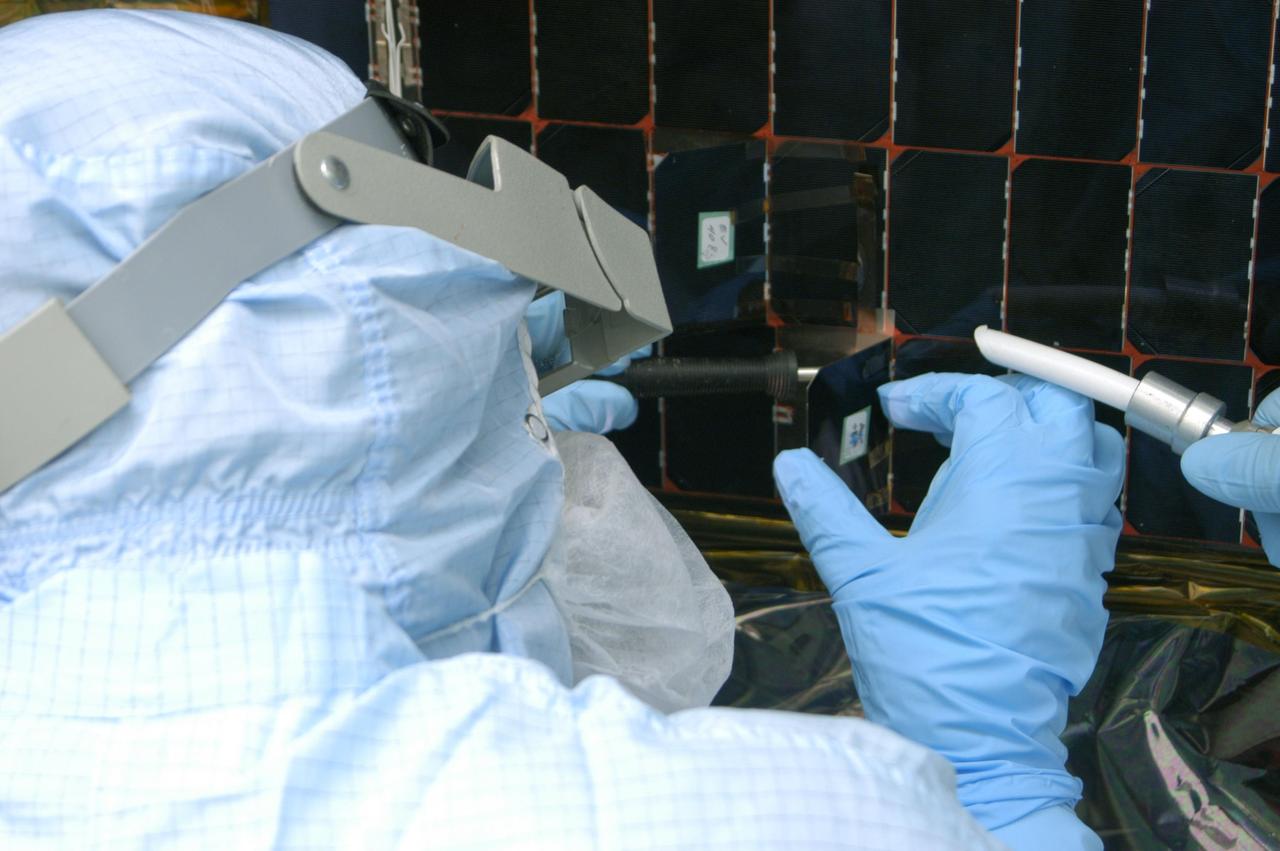
KENNEDY SPACE CENTER, FLA. - In the clean room at NASA’s Hangar AE on Cape Canaveral Air Force Station (CCAFS), a Spectrolab technician, Anna Herrera, places a new solar cell on the Swift spacecraft’s solar array. Swift is a first-of-its-kind, multi-wavelength observatory dedicated to the study of gamma-ray burst (GRB) science. Its three instruments will work together to observe GRBs and afterglows in the gamma-ray, X-ray, ultraviolet and optical wavebands. The main mission objectives for Swift are to determine the origin of gamma-ray bursts, classify gamma-ray bursts and search for new types, determine how the blast wave evolves and interacts with the surroundings, use gamma-ray bursts to study the early universe and perform the first sensitive hard X-ray survey of the sky. Swift is scheduled to launch Oct. 26 from Launch Pad 17-A, CCAFS, on a Boeing Delta 7320 rocket.
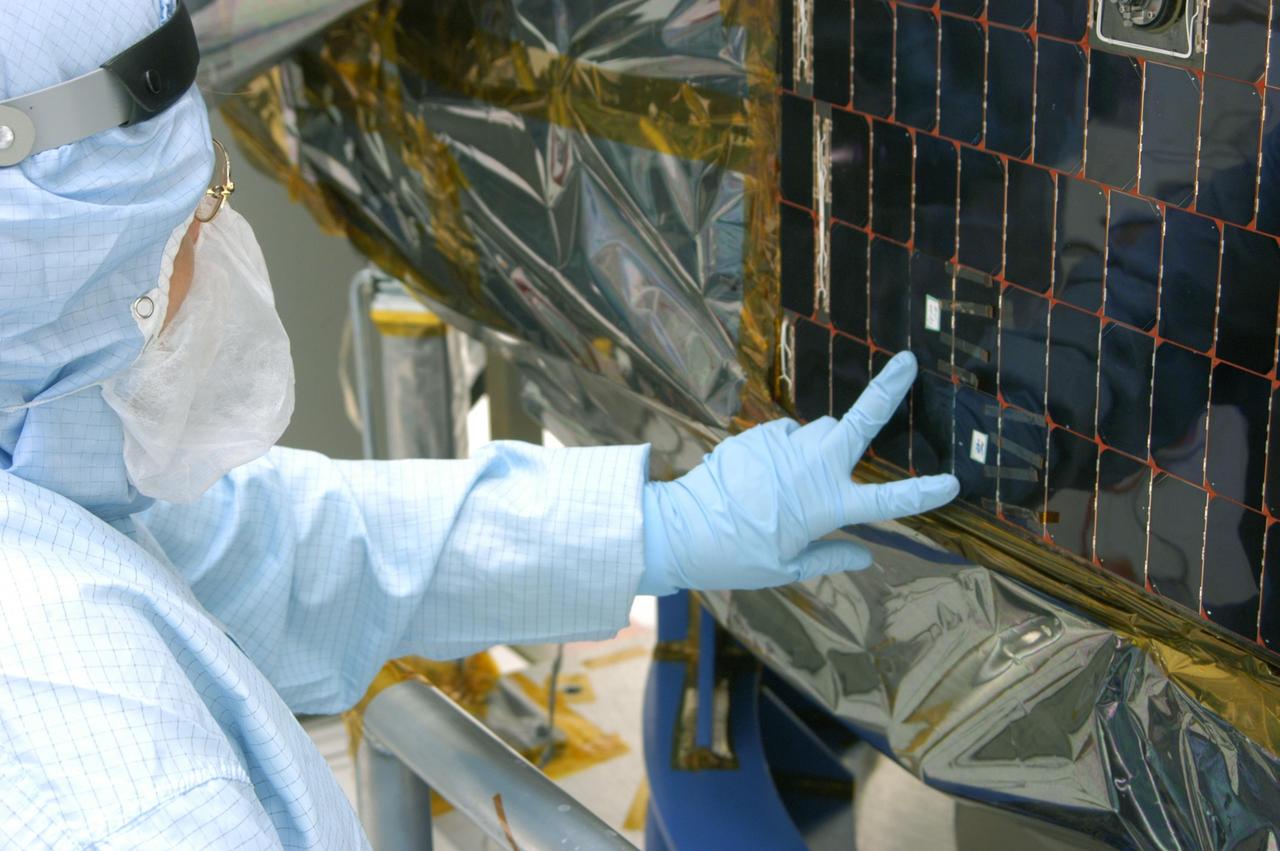
KENNEDY SPACE CENTER, FLA. - In the clean room at NASA’s Hangar AE on Cape Canaveral Air Force Station (CCAFS), a Spectrolab technician, Anna Herrera, points to the two new solar cells removed and replaced on the Swift spacecraft’s solar array. Swift is a first-of-its-kind, multi-wavelength observatory dedicated to the study of gamma-ray burst (GRB) science. Its three instruments will work together to observe GRBs and afterglows in the gamma-ray, X-ray, ultraviolet and optical wavebands. The main mission objectives for Swift are to determine the origin of gamma-ray bursts, classify gamma-ray bursts and search for new types, determine how the blast wave evolves and interacts with the surroundings, use gamma-ray bursts to study the early universe and perform the first sensitive hard X-ray survey of the sky. Swift is scheduled to launch Oct. 26 from Launch Pad 17-A, CCAFS, on a Boeing Delta 7320 rocket.
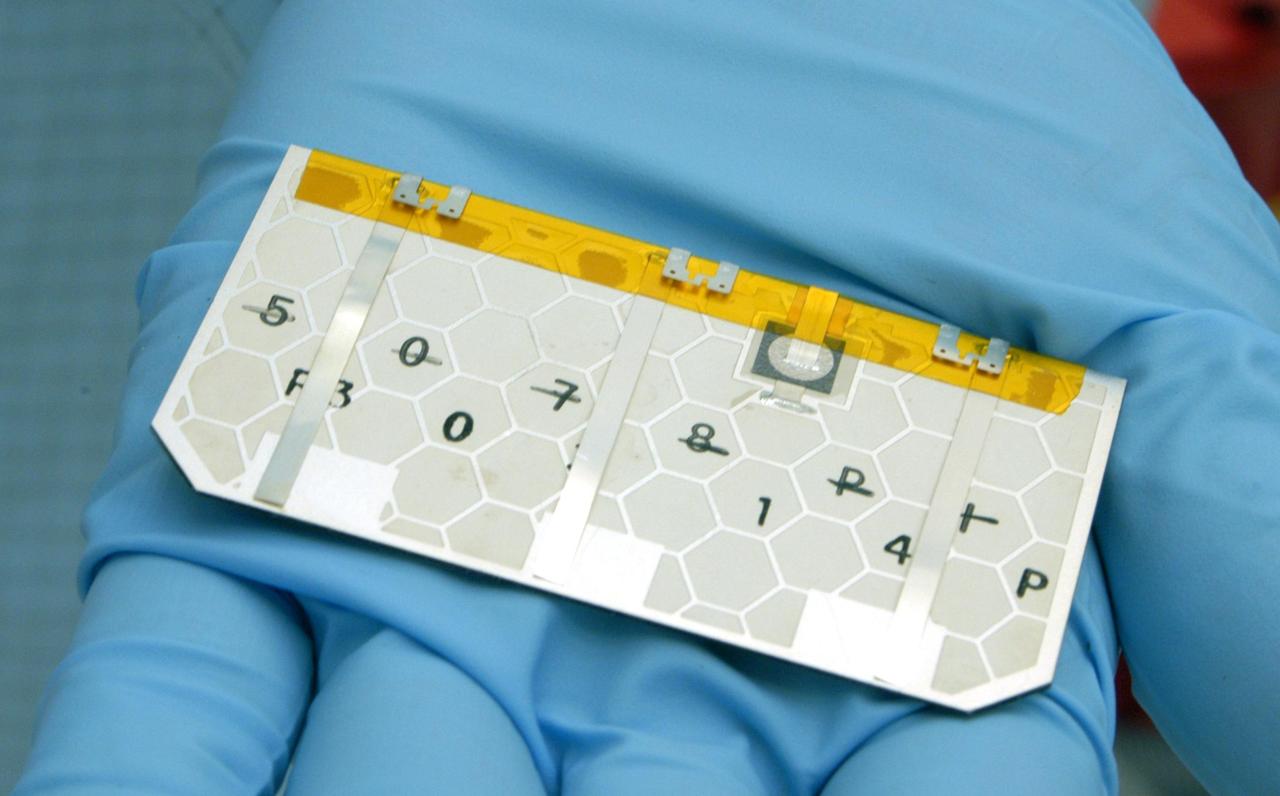
KENNEDY SPACE CENTER, FLA. - A closeup of one of the solar cells that will be removed and replaced on the Swift spacecraft’s solar array. Swift is a first-of-its-kind, multi-wavelength observatory dedicated to the study of gamma-ray burst (GRB) science. Its three instruments will work together to observe GRBs and afterglows in the gamma-ray, X-ray, ultraviolet and optical wavebands. The main mission objectives for Swift are to determine the origin of gamma-ray bursts, classify gamma-ray bursts and search for new types, determine how the blast wave evolves and interacts with the surroundings, use gamma-ray bursts to study the early universe and perform the first sensitive hard X-ray survey of the sky. Swift is scheduled to launch Oct. 26 from Launch Pad 17-A, CCAFS, on a Boeing Delta 7320 rocket.
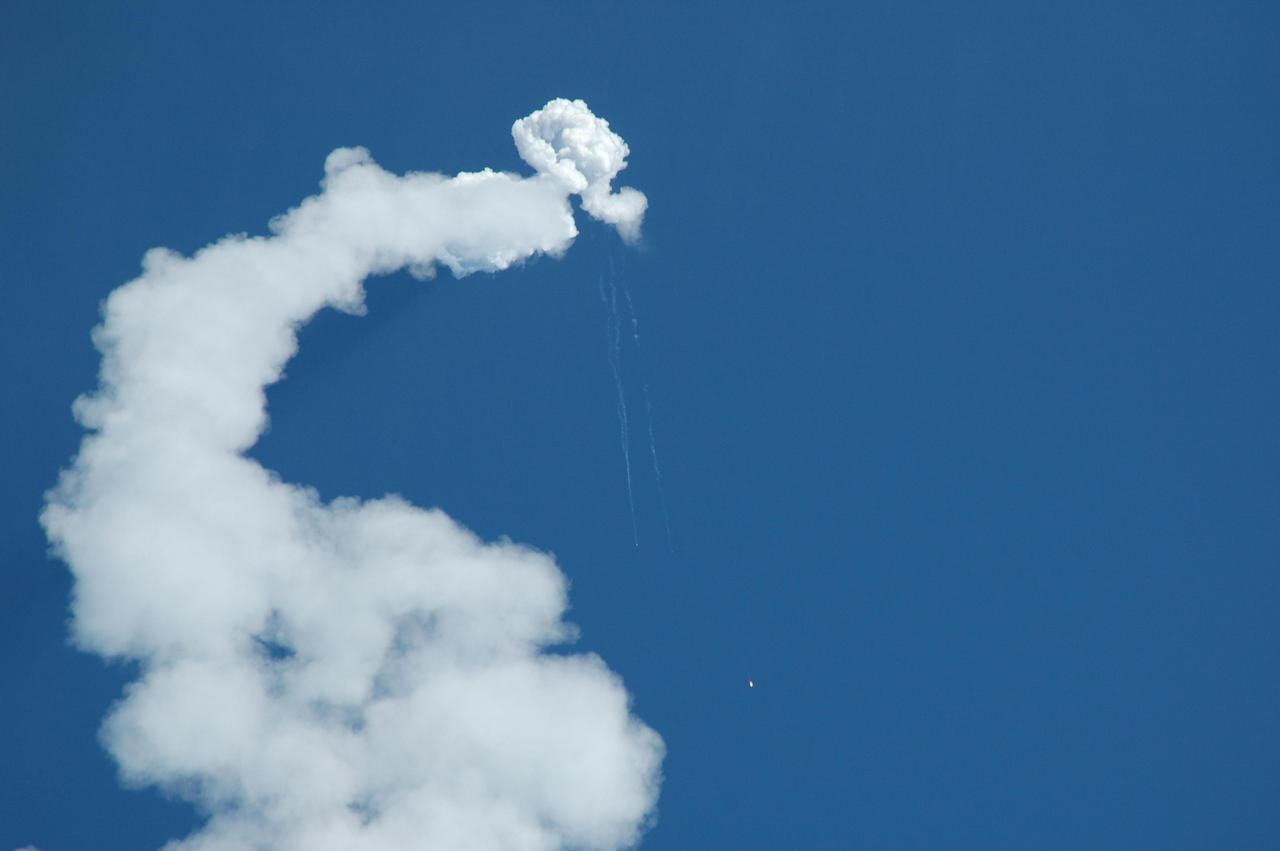
KENNEDY SPACE CENTER, FLA. - The Solid Rocket Boosters of the Boeing Delta II rocket, used to launch NASA’s Swift spacecraft, fall toward the Atlantic Ocean as the rocket continues on its path down range. The successful launch took place at Complex 17A at Cape Canaveral Air Force Station on Nov. 20 at 12:16:00.611 p.m. EST. Swift is a first-of-its-kind multi-wavelength observatory dedicated to the study of gamma-ray burst science. Its three instruments will work together to observe GRBs and afterglows in the gamma ray, X-ray, ultraviolet and optical wavebands.

KENNEDY SPACE CENTER, FLA. - The fairing (on the left) for the Swift-Delta launch is lifted up the outside of the mobile service tower at pad 17-A, Cape Canaveral Air Force Station. The fairing will encapsulate the Swift spacecraft and protect it while on the launch pad and during ascent. The Boeing Delta rocket is the launch vehicle for Swift and its Gamma-Ray Burst Mission. Swift is a medium-class Explorer mission managed by NASA’s Goddard Space Flight Center in Greenbelt, Md.
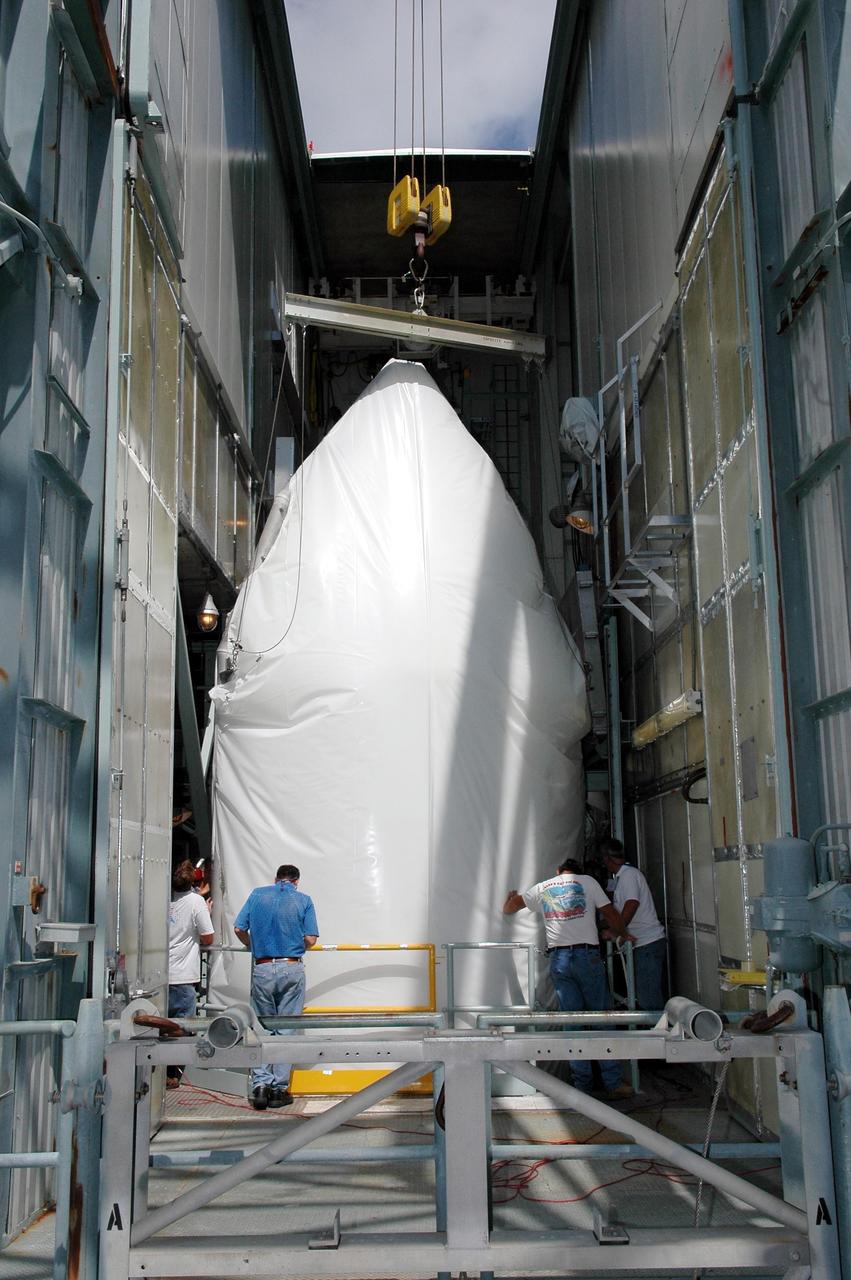
KENNEDY SPACE CENTER, FLA. - The fairing for the Swift-Delta launch reaches the top of the mobile service tower on pad 17-A, Cape Canaveral Air Force Station. The fairing will encapsulate the Swift spacecraft and protect it while on the launch pad and during ascent. The Boeing Delta rocket is the launch vehicle for Swift and its Gamma-Ray Burst Mission. Swift is a medium-class Explorer mission managed by NASA’s Goddard Space Flight Center in Greenbelt, Md.
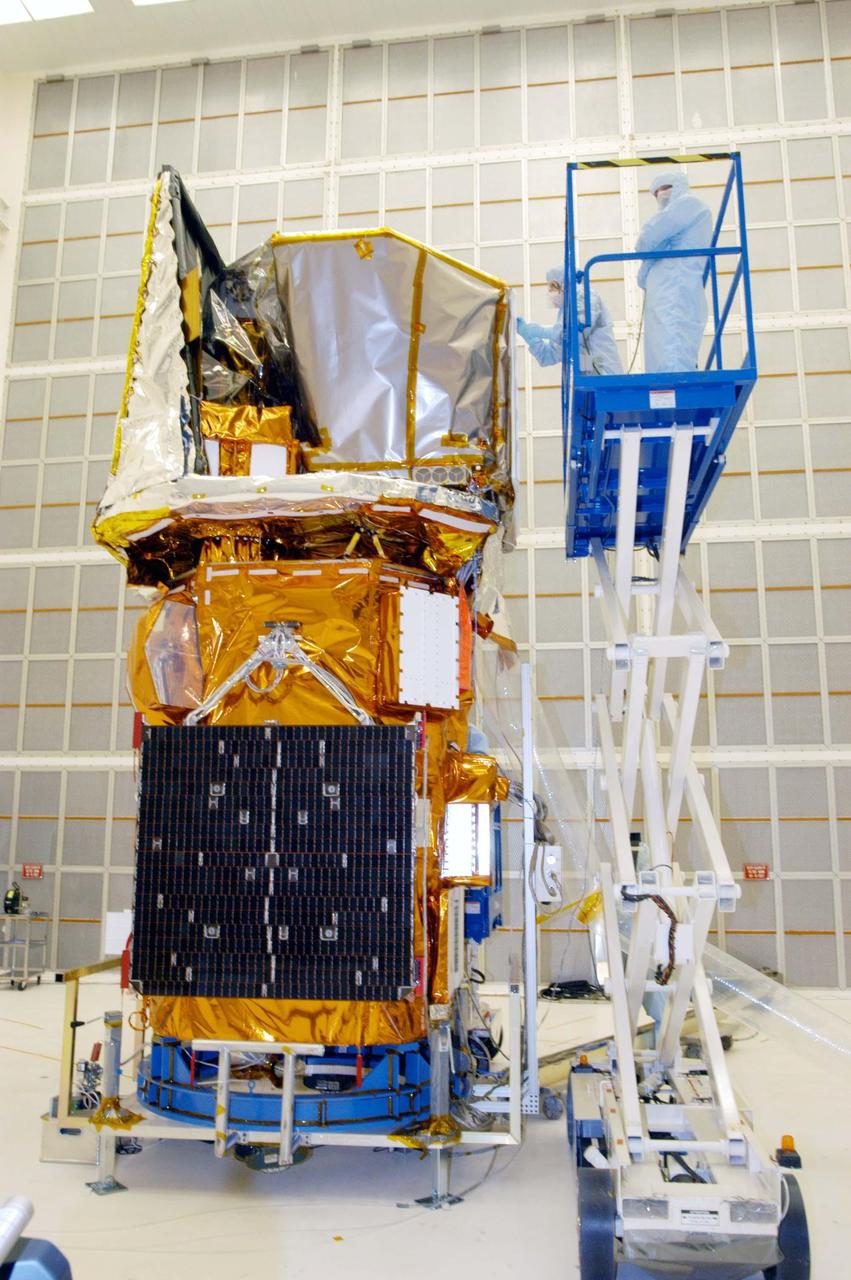
KENNEDY SPACE CENTER, FLA. - Technician Grace Miller-Swales (left) does touch-up work on the Swift spacecraft in Hangar AE at Cape Canaveral Air Force Station. John DiBatilito is at right. Swift is wrapped with blankets to provide thermal stability during the mission. Swift is a first-of-its-kind multi-wavelength observatory dedicated to the study of gamma-ray burst (GRB) science. Its three instruments will work together to observe GRBs and afterglows in the gamma-ray, X-ray, ultraviolet and optical wavebands. The most comprehensive study of GRB afterglows to date, Swift is expected to observe more than 200 gamma-ray bursts during its 2-year mission.
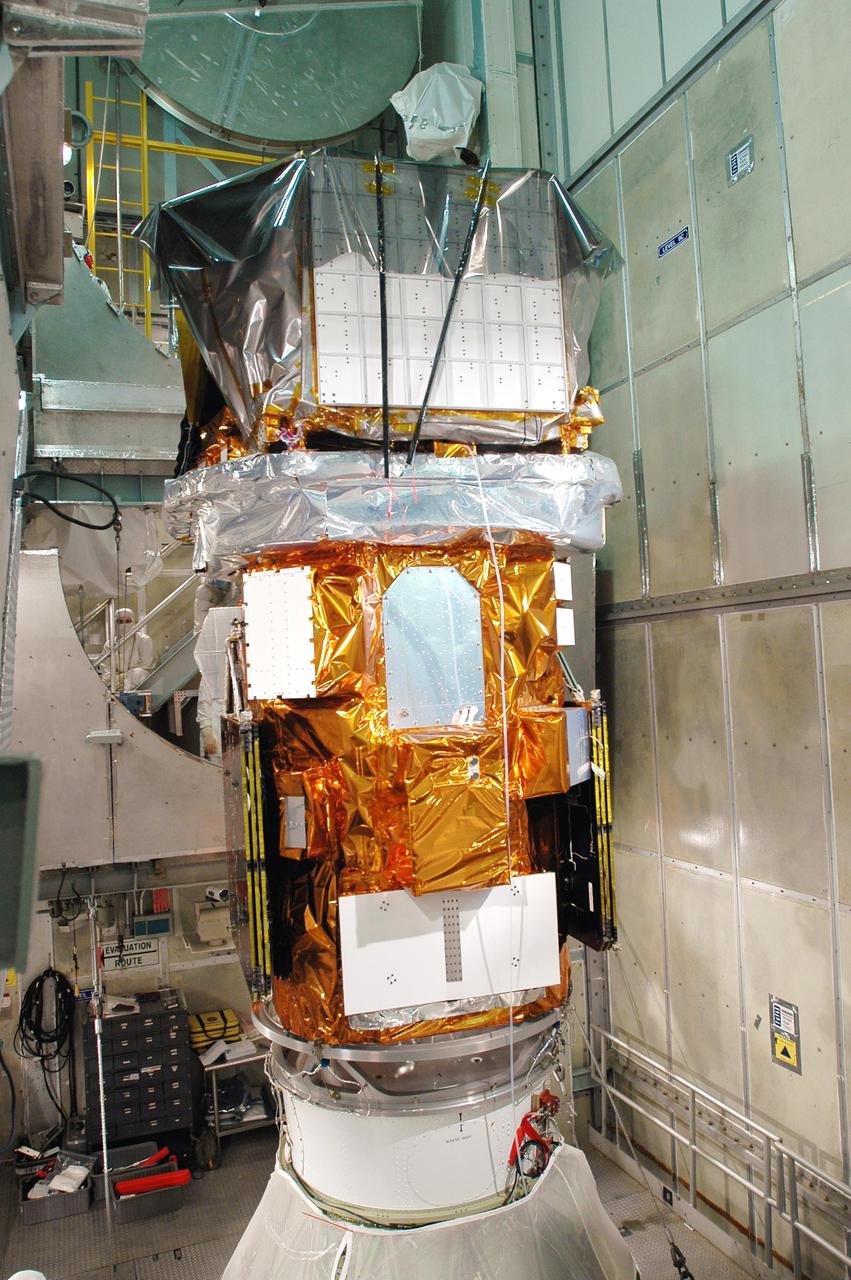
KENNEDY SPACE CENTER, FLA. - Inside the mobile service tower on Launch Pad 17-A, Cape Canaveral Air Force Station, the Swift spacecraft (on top) is ready for fairing encapsulation. The fairing is being installed around the payload for protection during launch and ascent. A Boeing Delta II rocket is the launch vehicle for the Swift spacecraft and its Gamma-Ray Burst Mission. Swift is a first-of-its-kind multi-wavelength observatory dedicated to the study of gamma-ray burst science. Its three instruments will work together to observe GRBs and afterglows in the gamma ray, X-ray, ultraviolet and optical wavebands. Swift is scheduled to launch Nov. 17 at 12:09 p.m. EST.

KENNEDY SPACE CENTER, FLA. - Technician Grace Miller-Swales does touch-up work on the Swift spacecraft in Hangar AE at Cape Canaveral Air Force Station. Swift is wrapped with blankets to provide thermal stability during the mission. Swift is a first-of-its-kind multi-wavelength observatory dedicated to the study of gamma-ray burst (GRB) science. Its three instruments will work together to observe GRBs and afterglows in the gamma-ray, X-ray, ultraviolet and optical wavebands. The most comprehensive study of GRB afterglows to date, Swift is expected to observe more than 200 gamma-ray bursts during its 2-year mission.
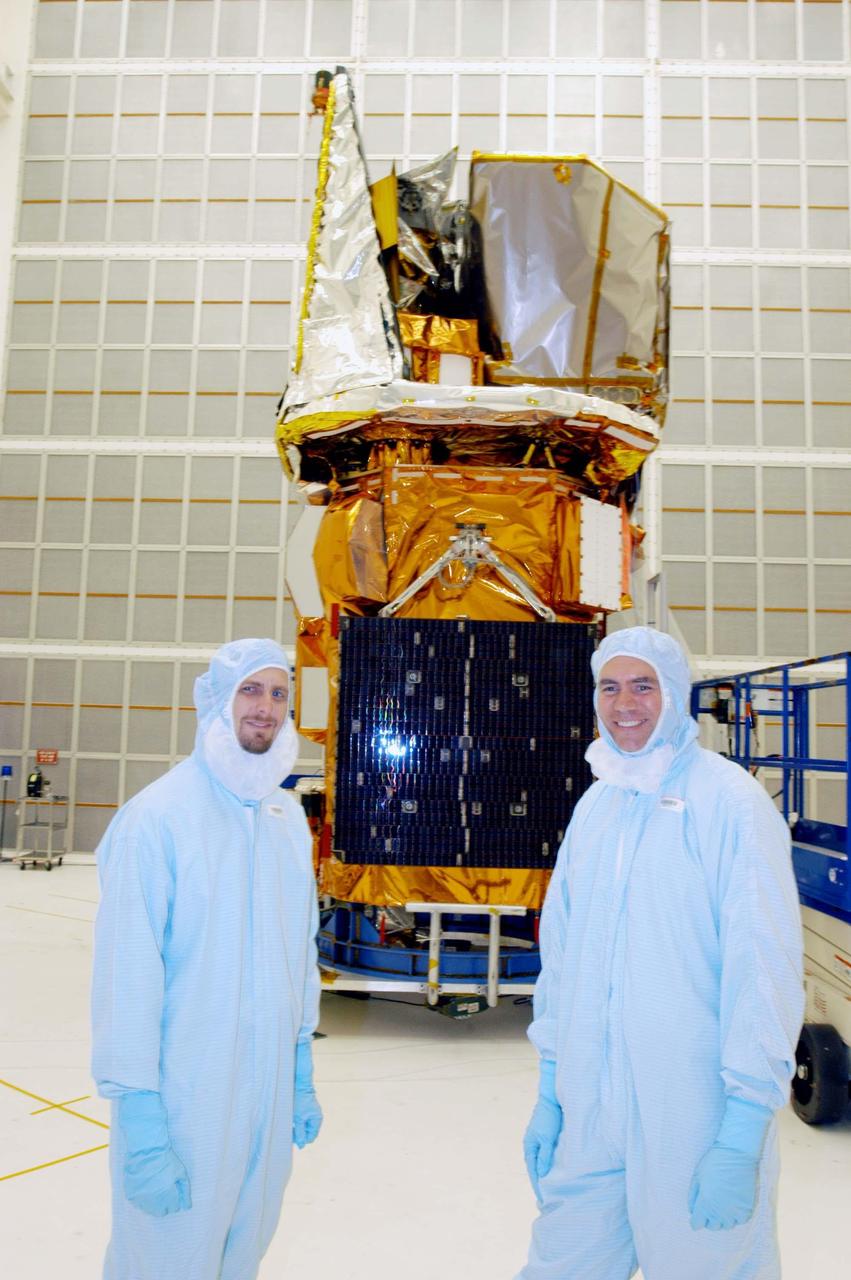
KENNEDY SPACE CENTER, FLA. - Project managers Mike Miller and Rex Eberhardt stand in front of the Swift spacecraft in Hangar AE at Cape Canaveral Air Force Station. Swift has been wrapped with blankets to provide thermal stability during the mission. Swift is a first-of-its-kind multi-wavelength observatory dedicated to the study of gamma-ray burst (GRB) science. Its three instruments will work together to observe GRBs and afterglows in the gamma-ray, X-ray, ultraviolet and optical wavebands. The most comprehensive study of GRB afterglows to date, Swift is expected to observe more than 200 gamma-ray bursts during its 2-year mission.
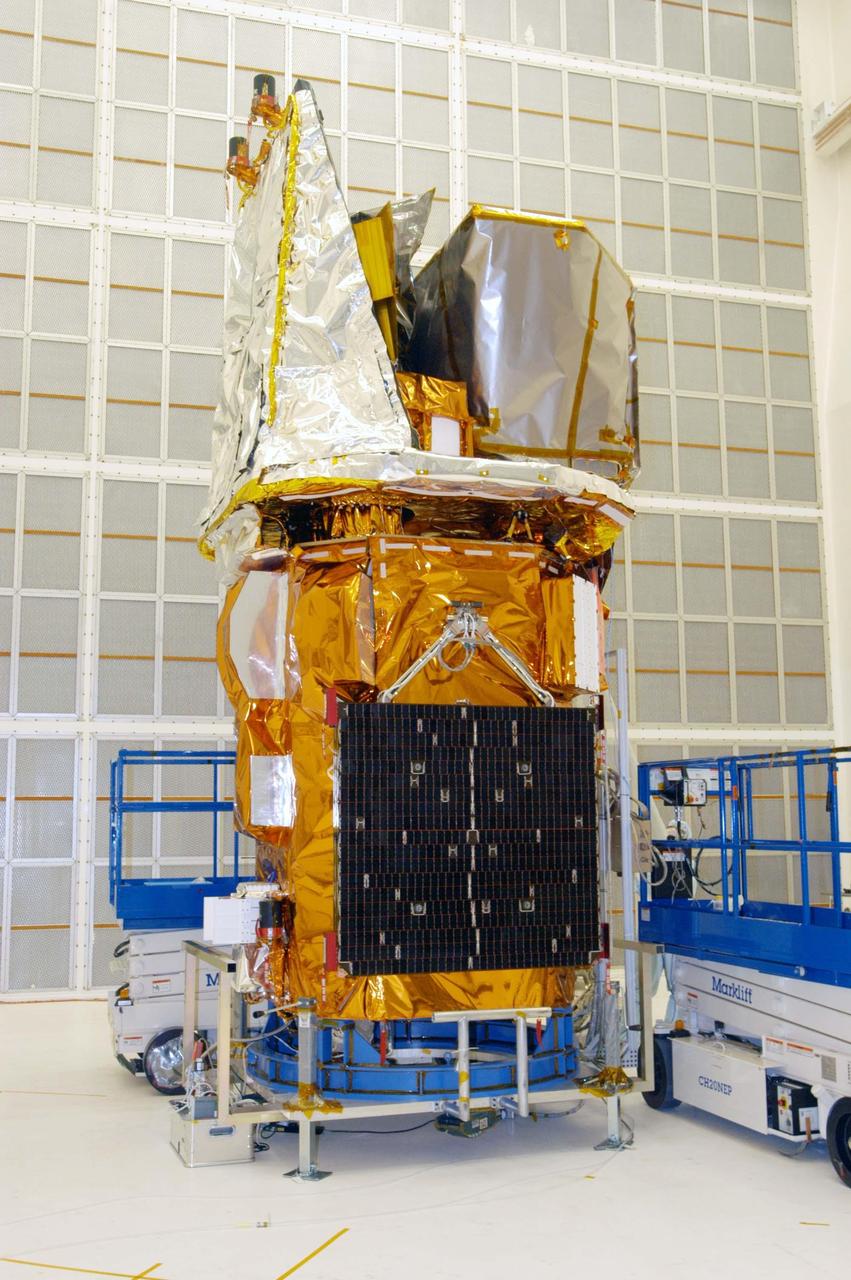
KENNEDY SPACE CENTER, FLA. - The Swift spacecraft is in Hangar AE at Cape Canaveral Air Force Station. Swift has been wrapped with blankets to provide thermal stability during the mission. Swift is a first-of-its-kind multi-wavelength observatory dedicated to the study of gamma-ray burst (GRB) science. Its three instruments will work together to observe GRBs and afterglows in the gamma-ray, X-ray, ultraviolet and optical wavebands. The most comprehensive study of GRB afterglows to date, Swift is expected to observe more than 200 gamma-ray bursts during its 2-year mission.
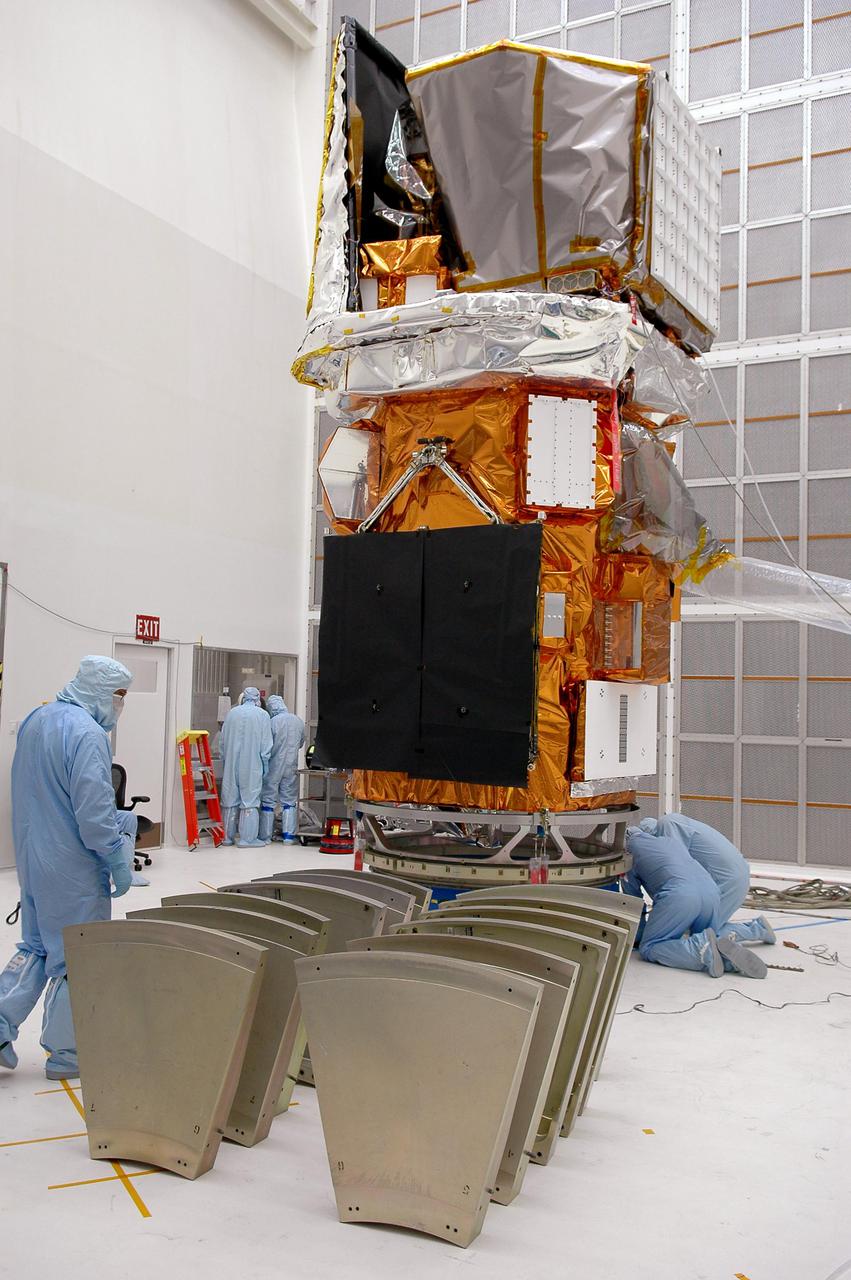
KENNEDY SPACE CENTER, FLA. - At NASA’s Hangar AE on Cape Canaveral Air Force Station (CCAFS), Fla., preparations are underway to enclose the Swift spacecraft in a canister before moving it to the launch pad. The base petals are lined up around the work stand before attaching them to the payload attach fitting on the Swift spacecraft. Swift is a first-of-its-kind multi-wavelength observatory dedicated to the study of gamma-ray burst (GRB) science. Its three instruments will work together to observe GRBs and afterglows in the gamma ray, X-ray, ultraviolet and optical wavebands. Swift is expected to observe more than 200 gamma-ray bursts - the most comprehensive study of GRB afterglows to date - during its 2-year mission. Swift is scheduled to launch in mid-November from Launch Pad 17-A at CCAFS.
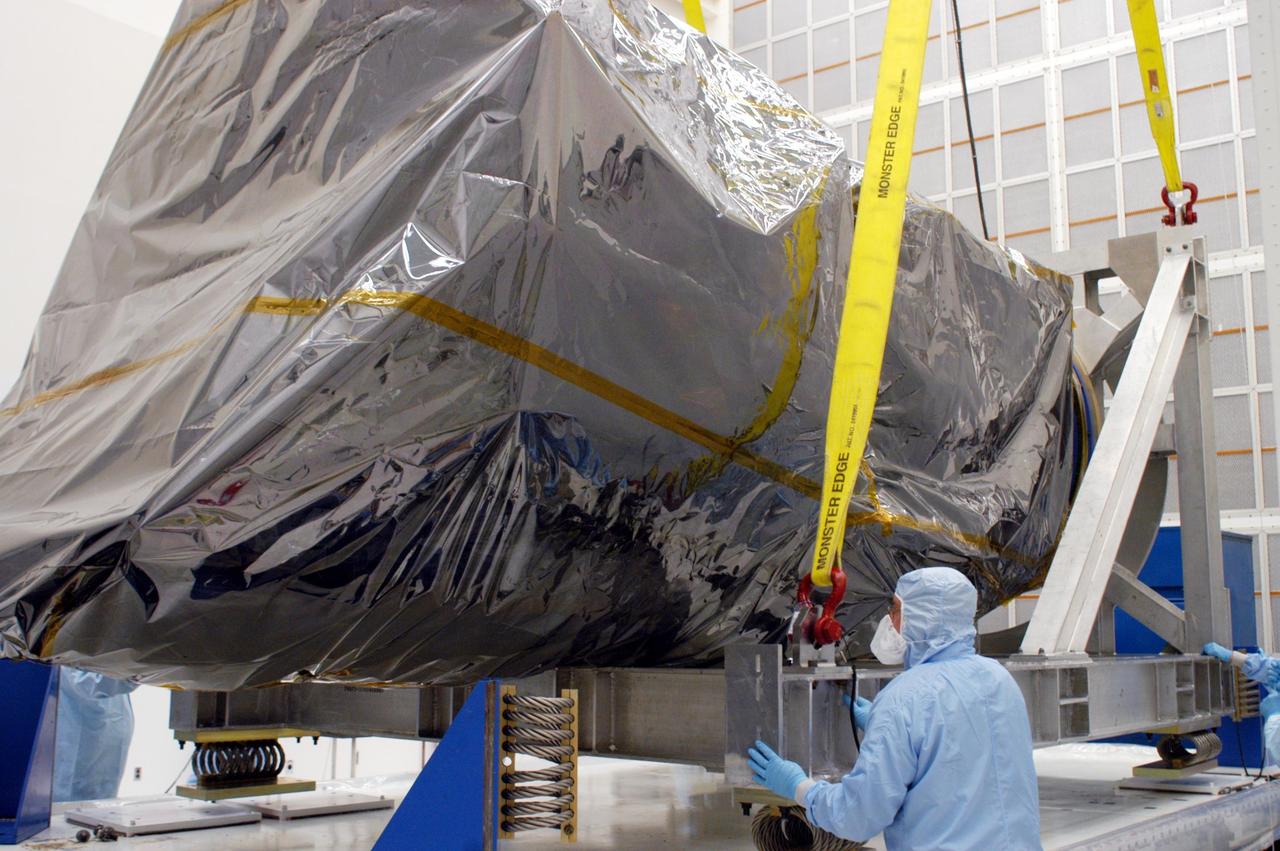
KENNEDY SPACE CENTER, FLA. - Inside Hangar AE at Cape Canaveral Air Force Station (CCAFS), workers attach straps from an overhead crane onto the platform under the Swift spacecraft, which is enclosed in a protective cover. Swift will be raised to vertical and placed on a work stand. Swift is a first-of-its-kind, multi-wavelength observatory dedicated to the study of gamma-ray burst (GRB) science. Its three instruments will work together to observe GRBs and afterglows in the gamma-ray, X-ray and optical wavebands. Swift is part of NASA’s medium explorer (MIDEX) program being developed by an international collaboration. It will be launched no earlier than Oct. 7 into a low-Earth orbit on a Boeing Delta 7320 rocket from pad 17-A at CCAFS. During its nominal 2-year mission, Swift is expected to observe more than 200 bursts, which will represent the most comprehensive study of GRB afterglow to date.
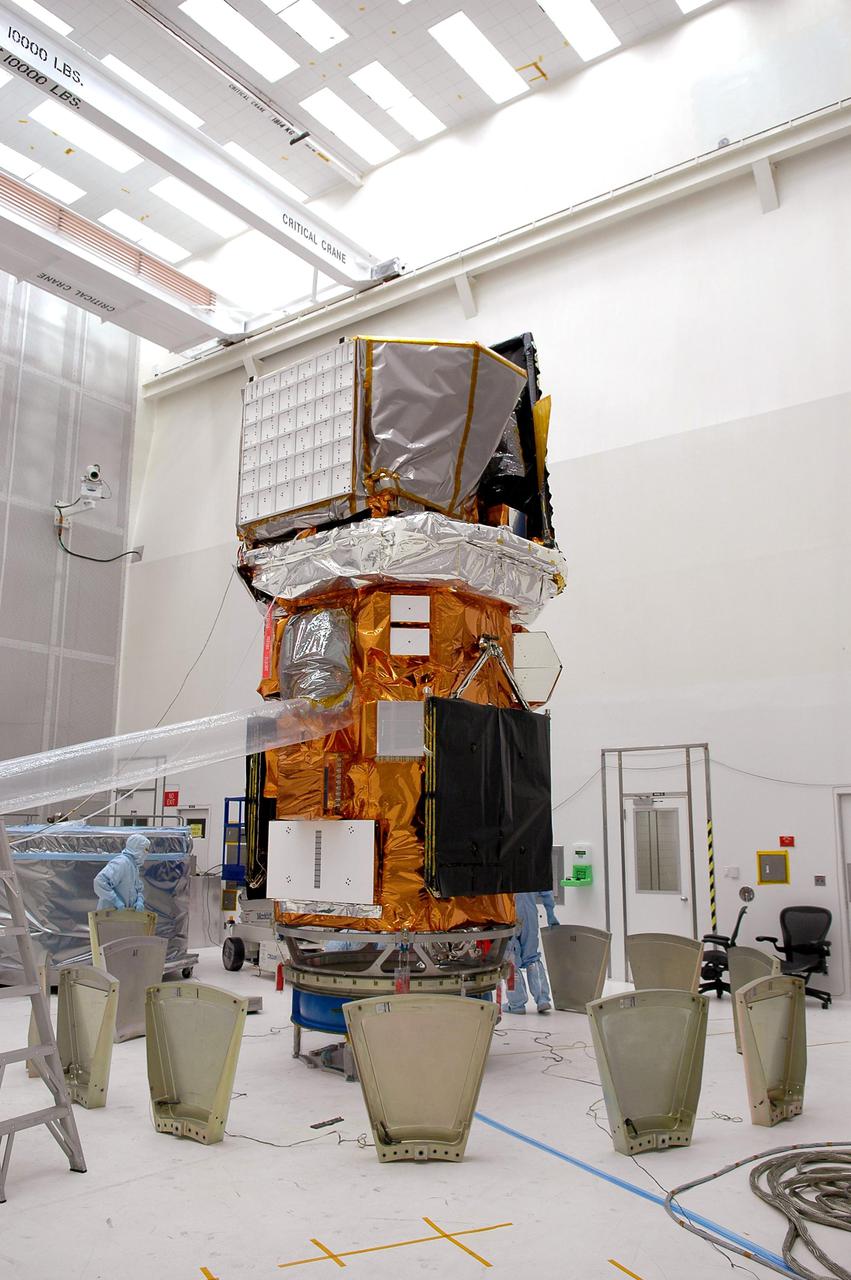
KENNEDY SPACE CENTER, FLA. - At NASA’s Hangar AE on Cape Canaveral Air Force Station (CCAFS), Fla., preparations are underway to enclose the Swift spacecraft in a canister before moving it to the launch pad. The base petals are lined up around the work stand before attaching them to the payload attach fitting on the Swift spacecraft. Swift is a first-of-its-kind multi-wavelength observatory dedicated to the study of gamma-ray burst (GRB) science. Its three instruments will work together to observe GRBs and afterglows in the gamma ray, X-ray, ultraviolet and optical wavebands. Swift is expected to observe more than 200 gamma-ray bursts - the most comprehensive study of GRB afterglows to date - during its 2-year mission. Swift is scheduled to launch in mid-November from Launch Pad 17-A at CCAFS.
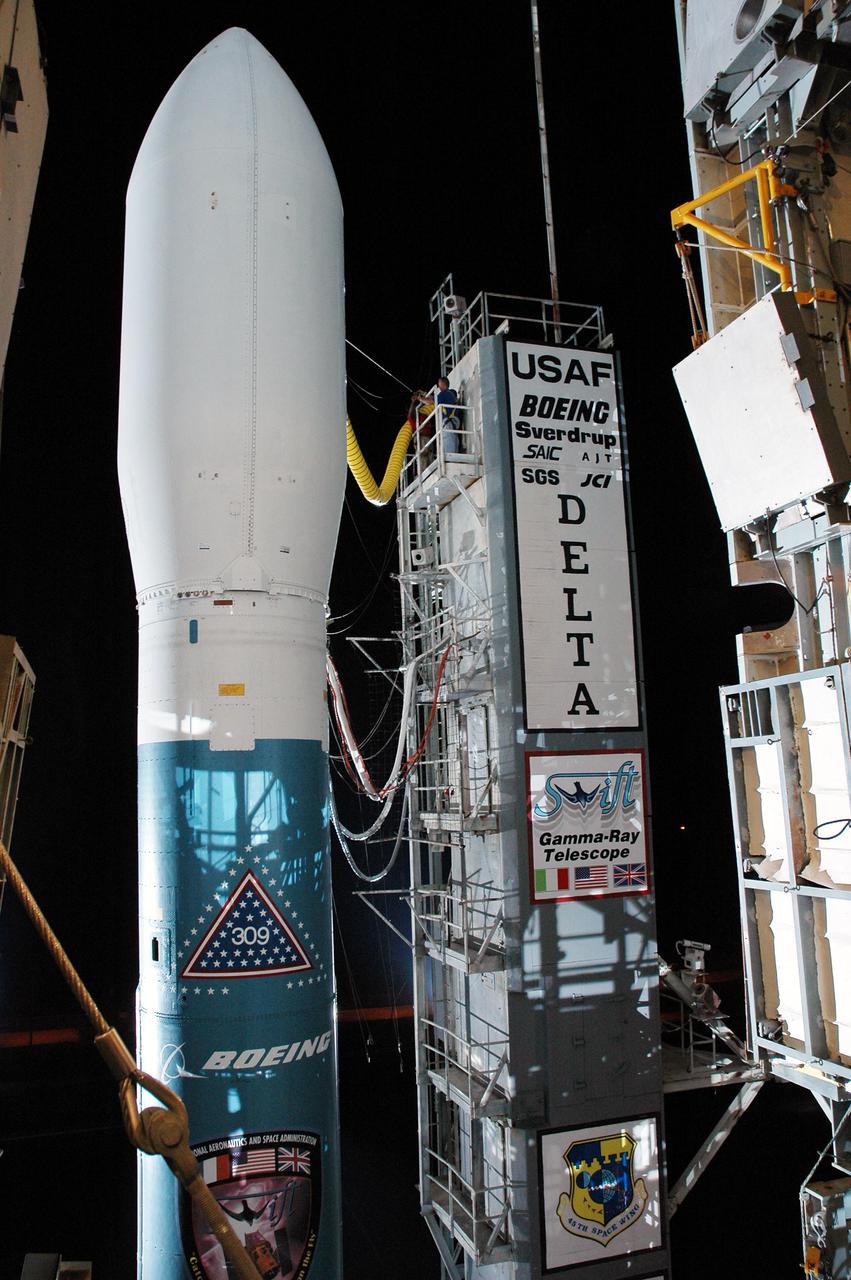
KENNEDY SPACE CENTER, FLA. - A Boeing Delta II expendable launch vehicle stands ready to launch NASA’s Swift spacecraft following tower rollback at Complex 17A, Cape Canaveral Air Force Station. Swift is a first-of-its-kind multi-wavelength observatory dedicated to the study of gamma-ray burst science. Its three instruments will work together to observe GRBs and afterglows in the gamma ray, X-ray, ultraviolet and optical wavebands. Swift is scheduled to launch Nov. 20 at 12:10 p.m. EST.
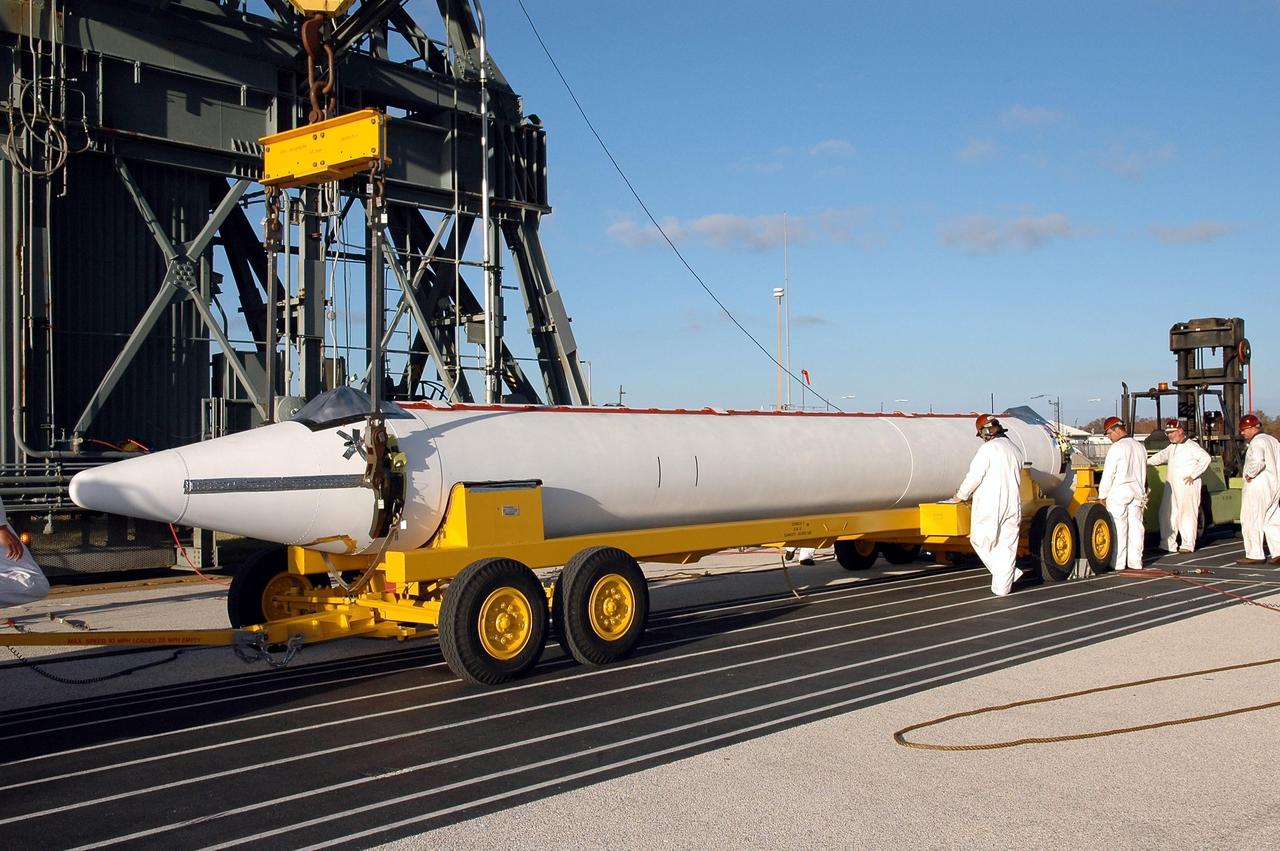
KENNEDY SPACE CENTER, FLA. - A Solid Rocket Booster for the Swift-Delta launch arrives at Pad 17-A at Cape Canaveral Air Force Station. The SRB is one of three to be attached to the Boeing Delta rocket that is the launch vehicle for the Swift spacecraft and its Gamma-Ray Burst Mission. Swift is a medium-class Explorer mission managed by NASA’s Goddard Space Flight Center in Greenbelt, Md.

KENNEDY SPACE CENTER, FLA. - The fairing for the Swift-Delta launch arrives at pad 17-A, Cape Canaveral Air Force Station. The fairing encloses and protects the payload while on the launch pad and during ascent. The Boeing Delta rocket is the launch vehicle for the Swift spacecraft and its Gamma-Ray Burst Mission. Swift is a medium-class Explorer mission managed by NASA’s Goddard Space Flight Center in Greenbelt, Md.
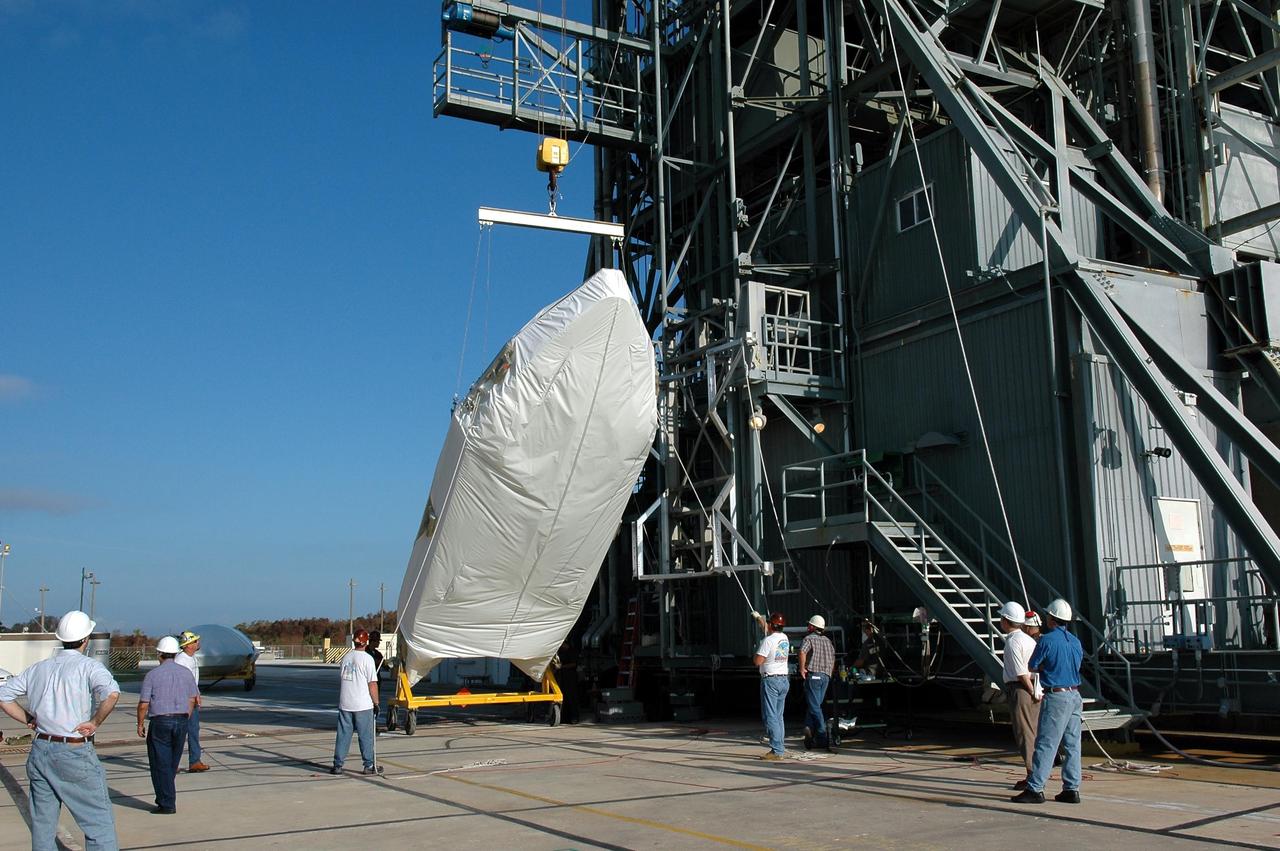
KENNEDY SPACE CENTER, FLA. - The fairing for the Swift-Delta launch is lifted off its transporter at pad 17-A, Cape Canaveral Air Force Station. The fairing is being lifted into mobile service tower to enclose the payload and protect it while on the launch pad and during ascent. The Boeing Delta rocket is the launch vehicle for the Swift spacecraft and its Gamma-Ray Burst Mission. Swift is a medium-class Explorer mission managed by NASA’s Goddard Space Flight Center in Greenbelt, Md.
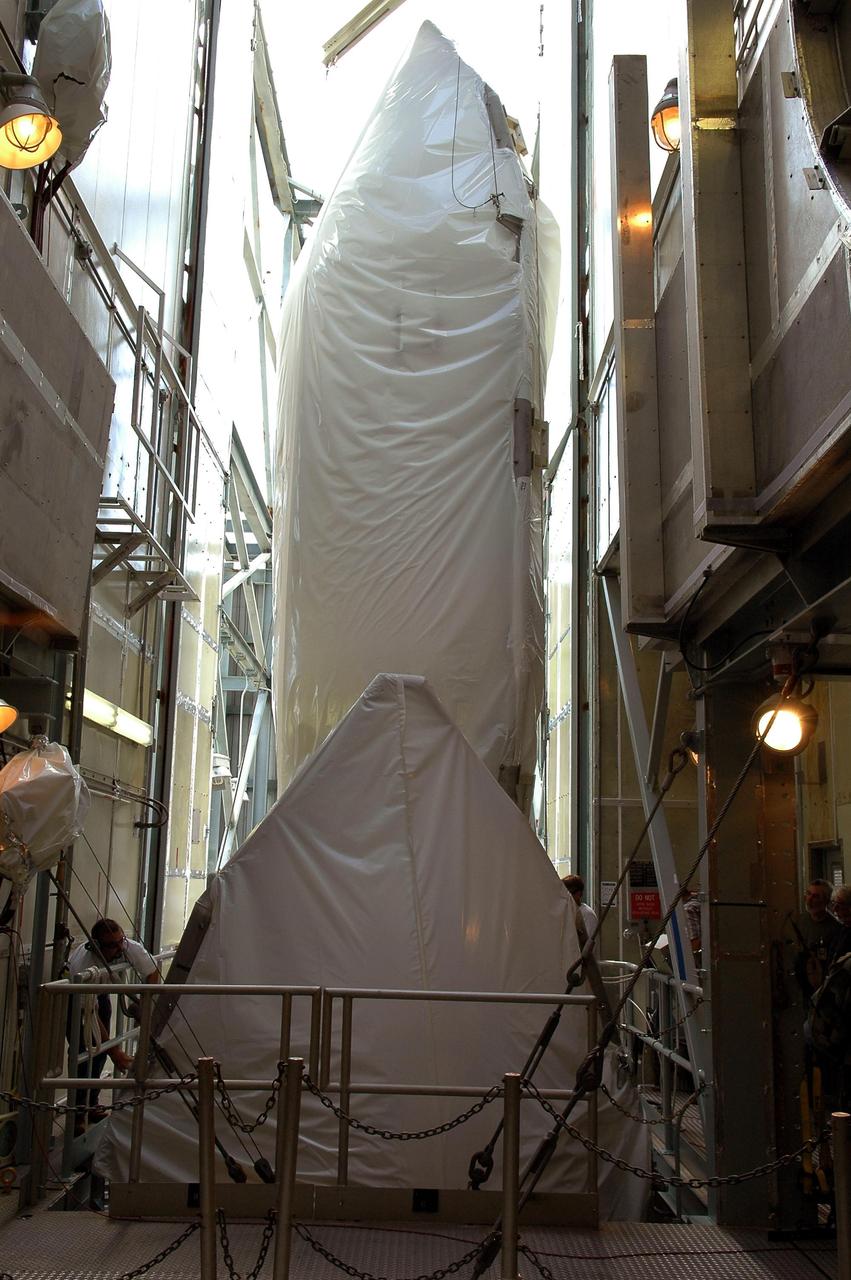
KENNEDY SPACE CENTER, FLA. - Both halves of the fairing have been separated after being lifted to the top of the mobile service tower on pad 17-A, Cape Canaveral Air Force Station. The fairing will encapsulate the Swift spacecraft and protect it while on the launch pad and during ascent. The Boeing Delta rocket is the launch vehicle for Swift and its Gamma-Ray Burst Mission. Swift is a medium-class Explorer mission managed by NASA’s Goddard Space Flight Center in Greenbelt, Md.
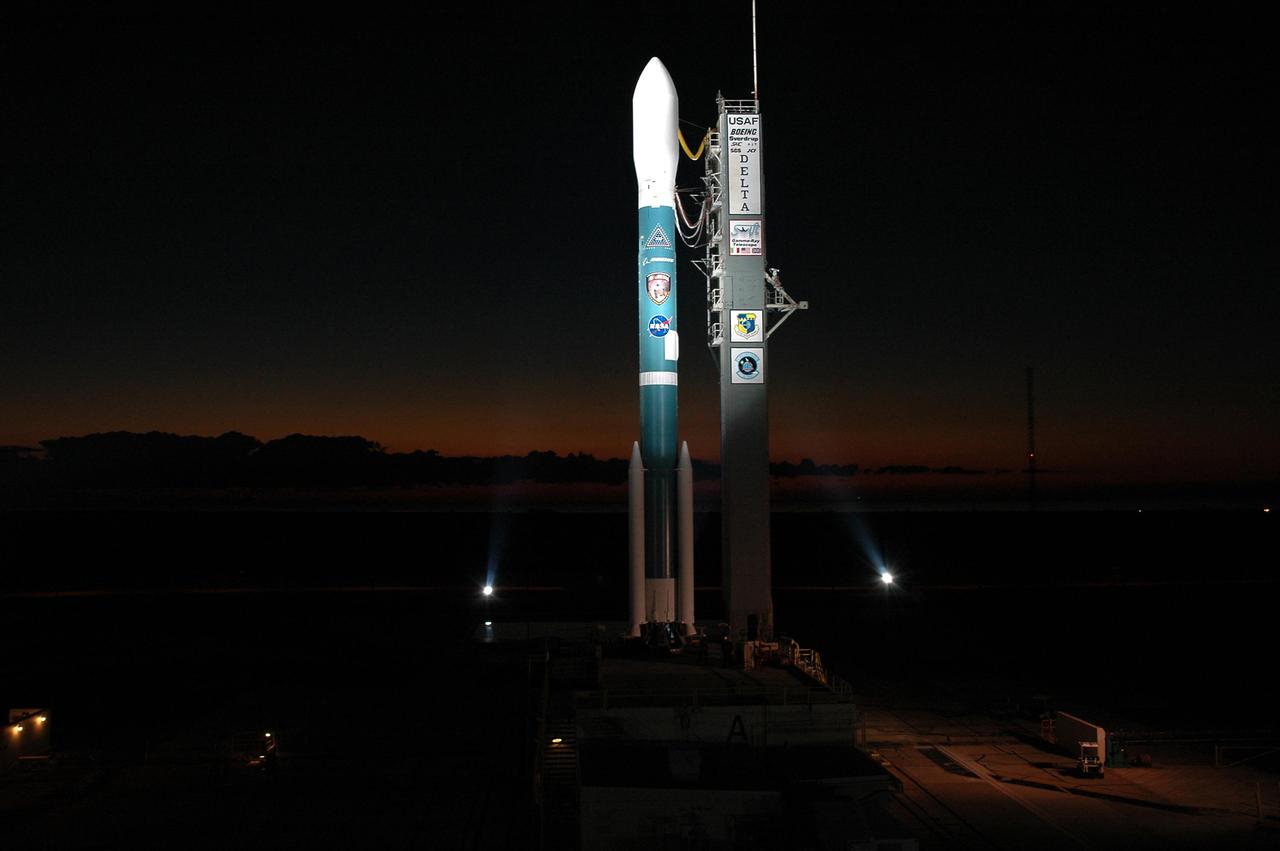
KENNEDY SPACE CENTER, FLA. - A Boeing Delta II expendable launch vehicle stands ready to launch NASA’s Swift spacecraft following tower rollback at Complex 17A, Cape Canaveral Air Force Station. Swift is a first-of-its-kind multi-wavelength observatory dedicated to the study of gamma-ray burst science. Its three instruments will work together to observe GRBs and afterglows in the gamma ray, X-ray, ultraviolet and optical wavebands. Swift is scheduled to launch Nov. 20 at 12:10 p.m. EST.
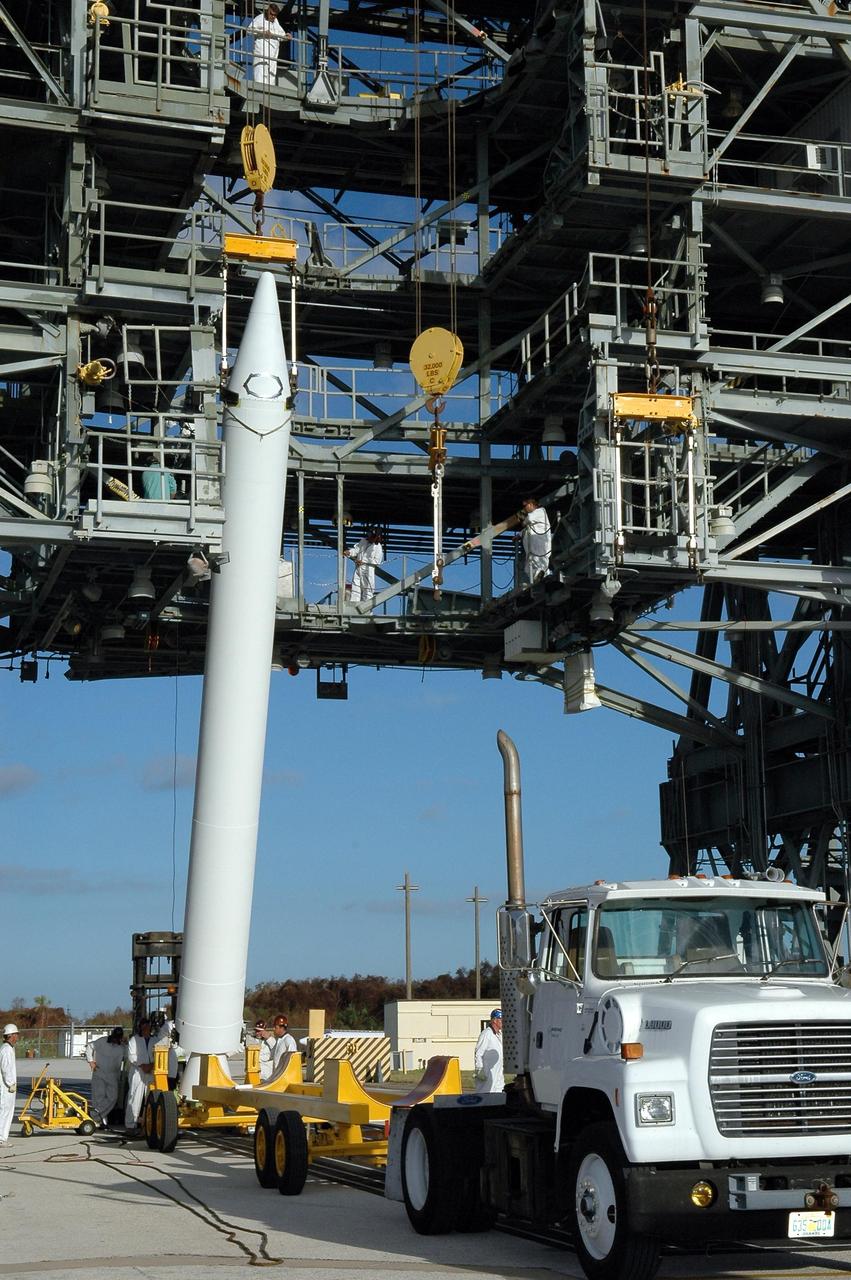
KENNEDY SPACE CENTER, FLA. - A Solid Rocket Booster for the Swift-Delta launch is lifted off its transporter on Pad 17-A at Cape Canaveral Air Force Station. The SRB is one of three to be attached to the Boeing Delta rocket that is the launch vehicle for the Swift spacecraft and its Gamma-Ray Burst Mission. Swift is a medium-class Explorer mission managed by NASA’s Goddard Space Flight Center in Greenbelt, Md.
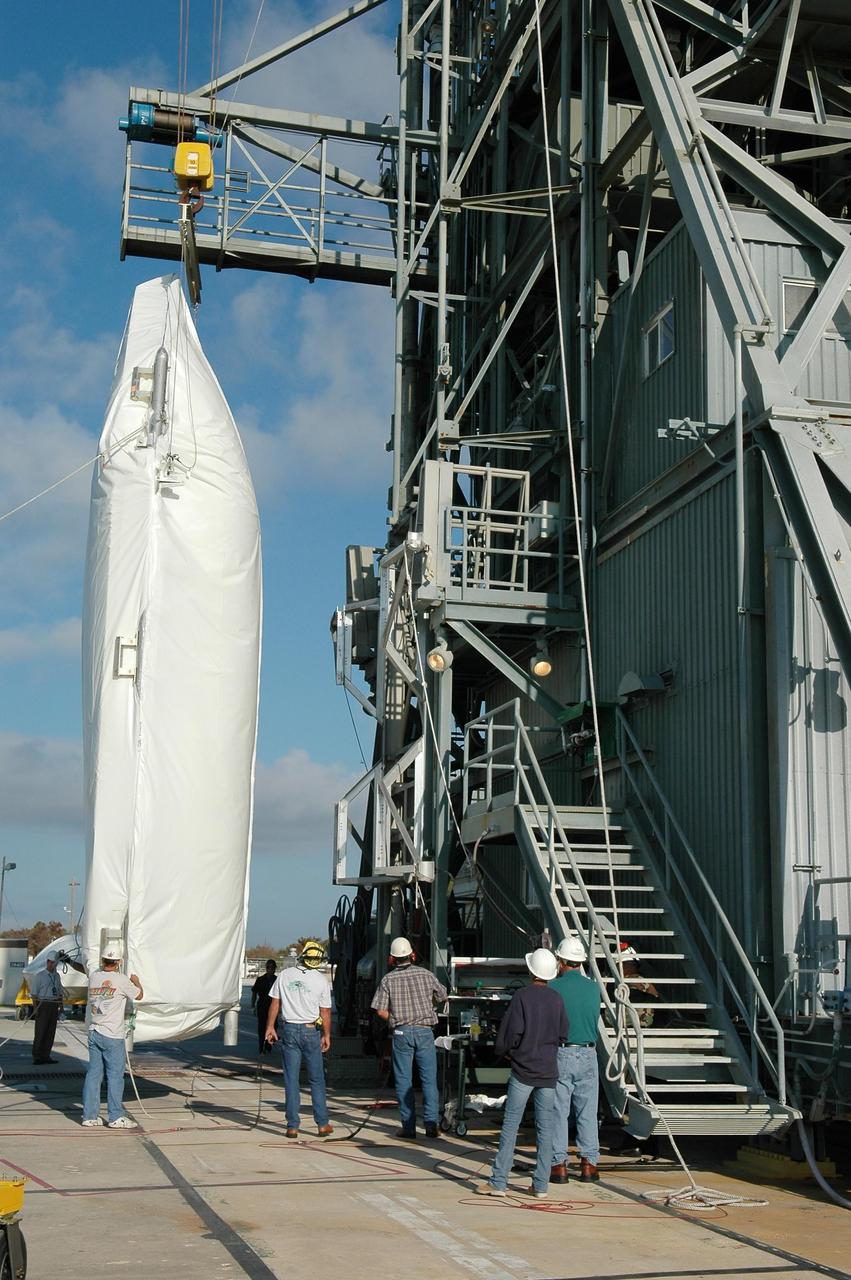
KENNEDY SPACE CENTER, FLA. - The fairing for the Swift-Delta launch is raised to a vertical position at pad 17-A, Cape Canaveral Air Force Station. The fairing is being lifted into mobile service tower to enclose the payload and protect it while on the launch pad and during ascent. The Boeing Delta rocket is the launch vehicle for the Swift spacecraft and its Gamma-Ray Burst Mission. Swift is a medium-class Explorer mission managed by NASA’s Goddard Space Flight Center in Greenbelt, Md.
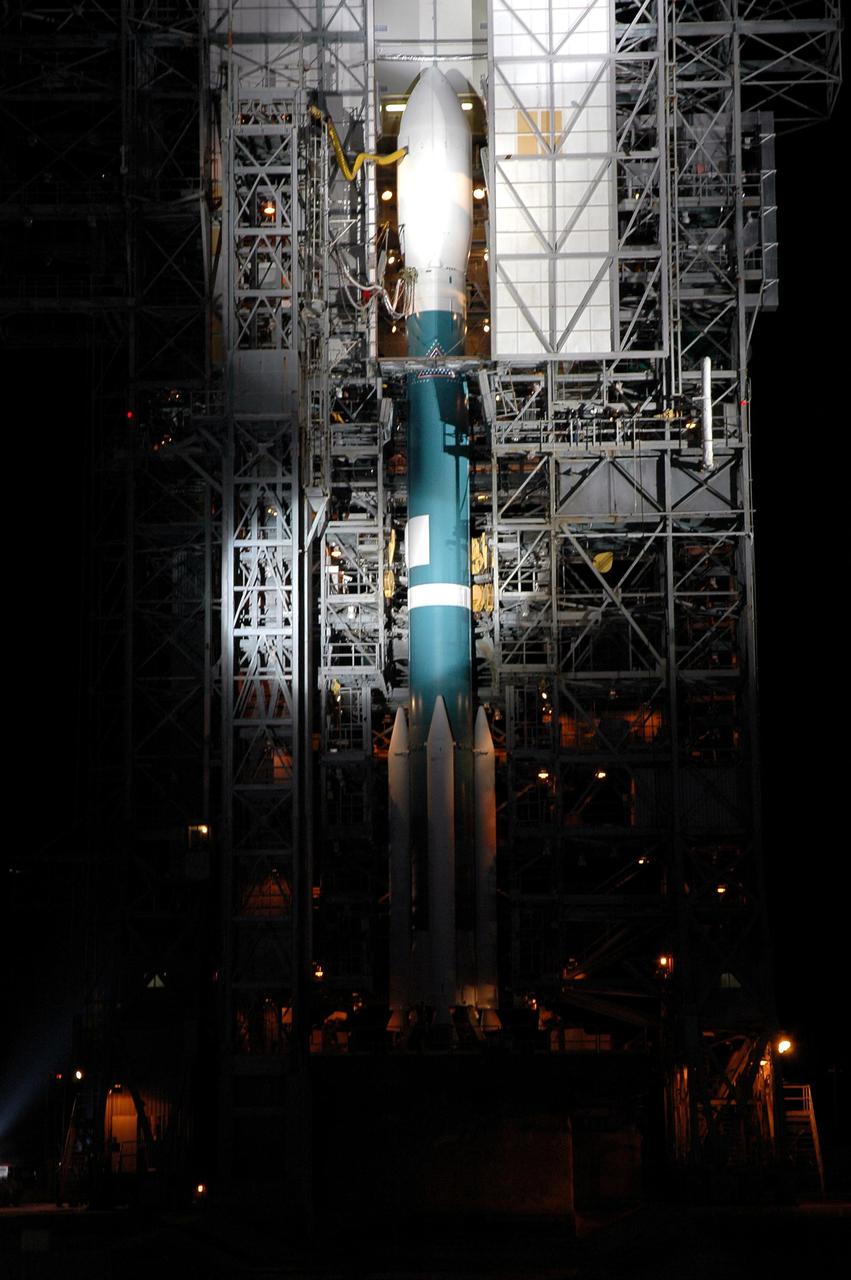
KENNEDY SPACE CENTER, FLA. - A Boeing Delta II expendable launch vehicle stands ready to launch NASA’s Swift spacecraft following tower rollback at Complex 17A, Cape Canaveral Air Force Station. Swift is a first-of-its-kind multi-wavelength observatory dedicated to the study of gamma-ray burst science. Its three instruments will work together to observe GRBs and afterglows in the gamma ray, X-ray, ultraviolet and optical wavebands. Swift is scheduled to launch Nov. 20 at 12:10 p.m. EST.
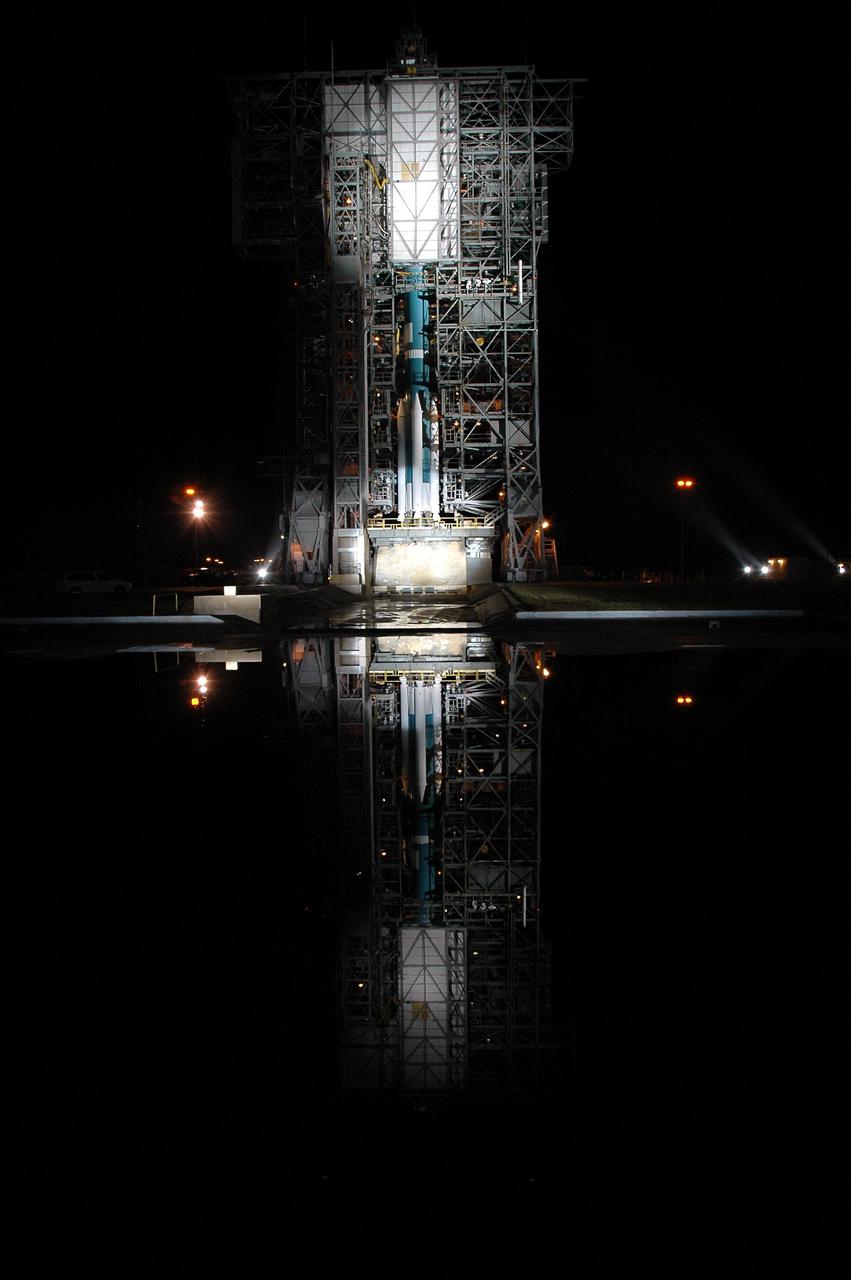
KENNEDY SPACE CENTER, FLA. - A Boeing Delta II expendable launch vehicle stands ready to launch NASA’s Swift spacecraft following tower rollback at Complex 17A, Cape Canaveral Air Force Station. Swift is a first-of-its-kind multi-wavelength observatory dedicated to the study of gamma-ray burst science. Its three instruments will work together to observe GRBs and afterglows in the gamma ray, X-ray, ultraviolet and optical wavebands. Swift is scheduled to launch Nov. 20 at 12:10 p.m. EST.

KENNEDY SPACE CENTER, FLA. - A Boeing Delta II expendable launch vehicle stands ready to launch NASA’s Swift spacecraft following tower rollback at Complex 17A, Cape Canaveral Air Force Station. Swift is a first-of-its-kind multi-wavelength observatory dedicated to the study of gamma-ray burst science. Its three instruments will work together to observe GRBs and afterglows in the gamma ray, X-ray, ultraviolet and optical wavebands. Swift is scheduled to launch Nov. 20 at 12:10 p.m. EST.
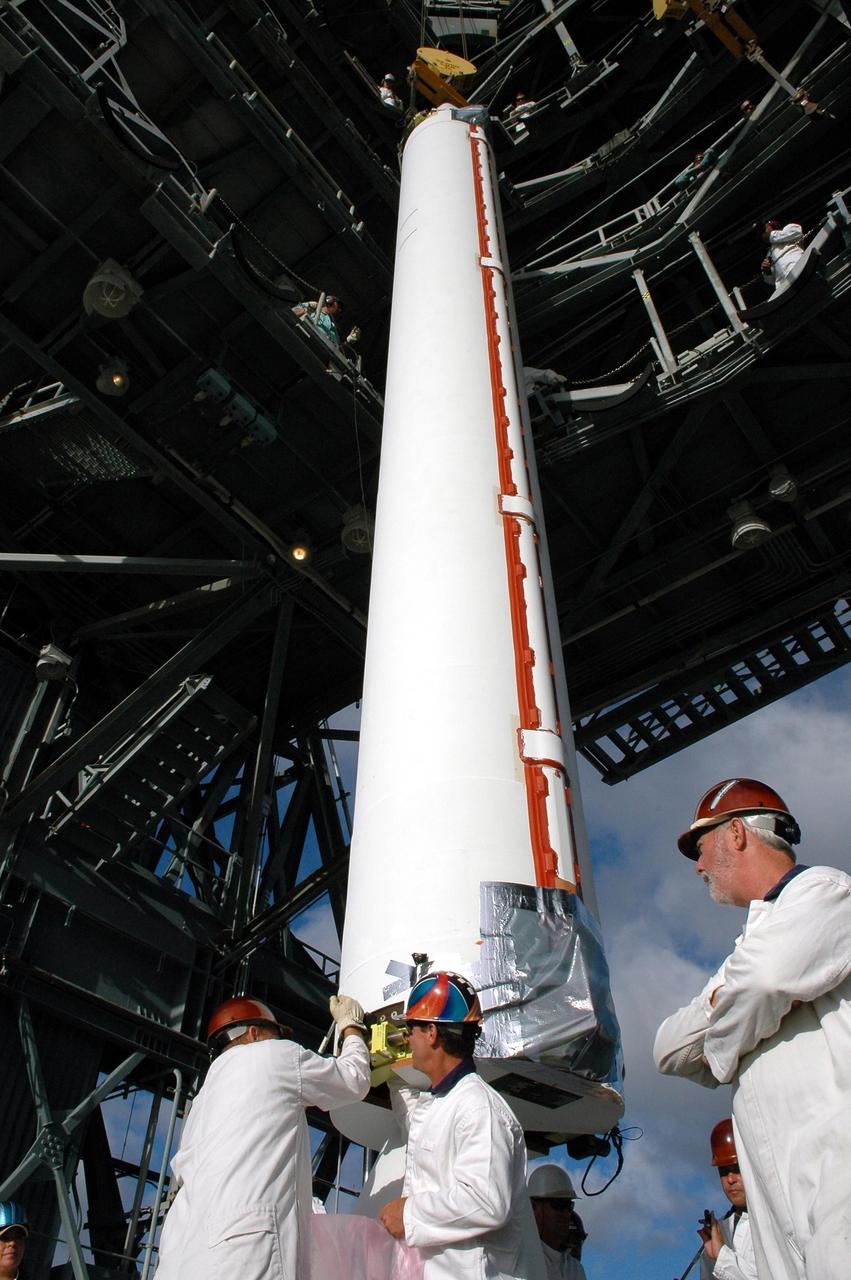
KENNEDY SPACE CENTER, FLA. - Technicians on Pad 17-A, Cape Canaveral Air Force Station, work on the bottom of the Solid Rocket Booster for the Swift-Delta launch before the SRB is raised into the mobile service tower. The SRB is one of three to be attached to the Boeing Delta rocket that is the launch vehicle for the Swift spacecraft and its Gamma-Ray Burst Mission. Swift is a medium-class Explorer mission managed by NASA’s Goddard Space Flight Center in Greenbelt, Md.

KENNEDY SPACE CENTER, FLA. - The fairing arrives at the top of the mobile service tower on pad 17-A, Cape Canaveral Air Force Station. The fairing will encapsulate the Swift spacecraft and protect it while on the launch pad and during ascent. The Boeing Delta rocket is the launch vehicle for Swift and its Gamma-Ray Burst Mission. Swift is a medium-class Explorer mission managed by NASA’s Goddard Space Flight Center in Greenbelt, Md.
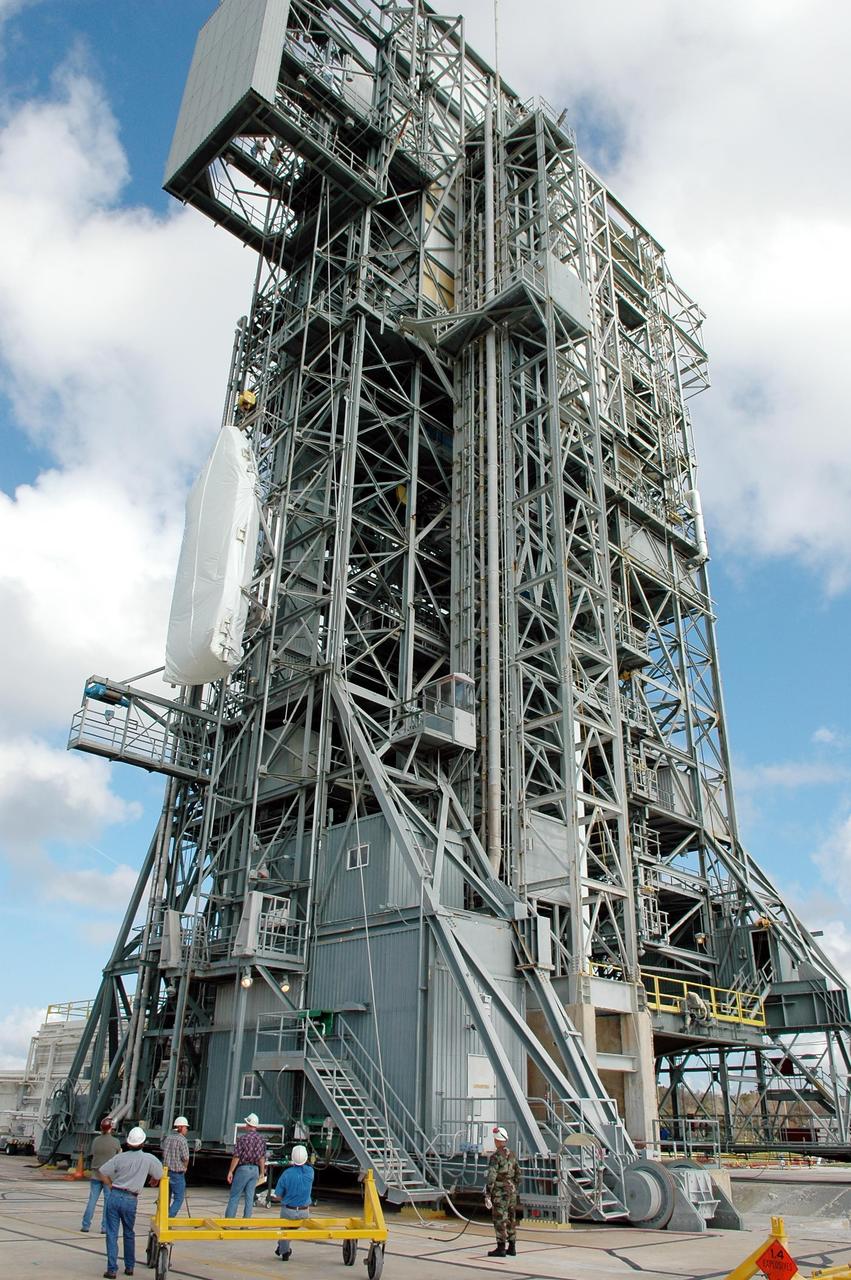
KENNEDY SPACE CENTER, FLA. - The fairing (on the left) for the Swift-Delta launch is lifted up the outside of the mobile service tower at pad 17-A, Cape Canaveral Air Force Station. The fairing will encapsulate the payload and protect it while on the launch pad and during ascent. The Boeing Delta rocket is the launch vehicle for the Swift spacecraft and its Gamma-Ray Burst Mission. Swift is a medium-class Explorer mission managed by NASA’s Goddard Space Flight Center in Greenbelt, Md.
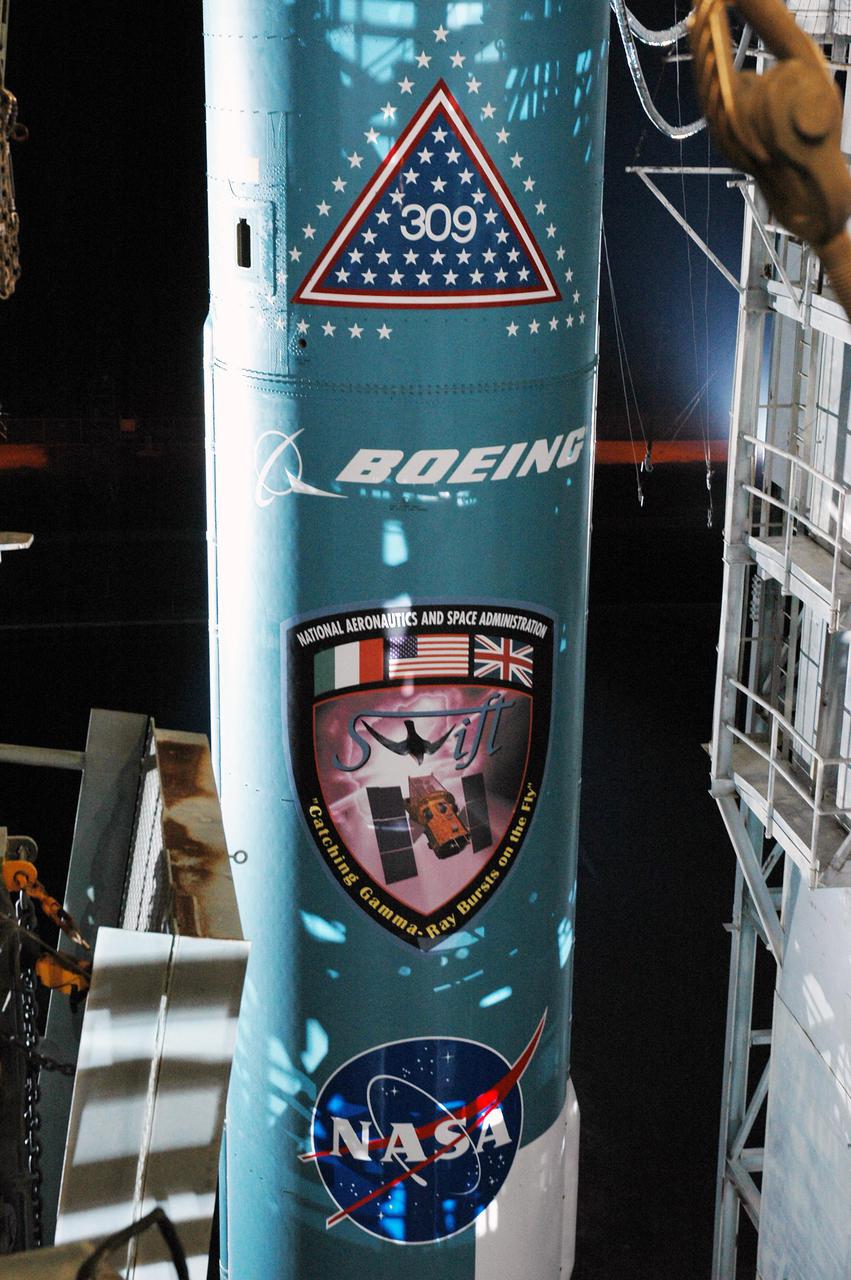
KENNEDY SPACE CENTER, FLA. - A Boeing Delta II expendable launch vehicle stands ready to launch NASA’s Swift spacecraft following tower rollback at Complex 17A, Cape Canaveral Air Force Station. Swift is a first-of-its-kind multi-wavelength observatory dedicated to the study of gamma-ray burst science. Its three instruments will work together to observe GRBs and afterglows in the gamma ray, X-ray, ultraviolet and optical wavebands. Swift is scheduled to launch Nov. 20 at 12:10 p.m. EST.
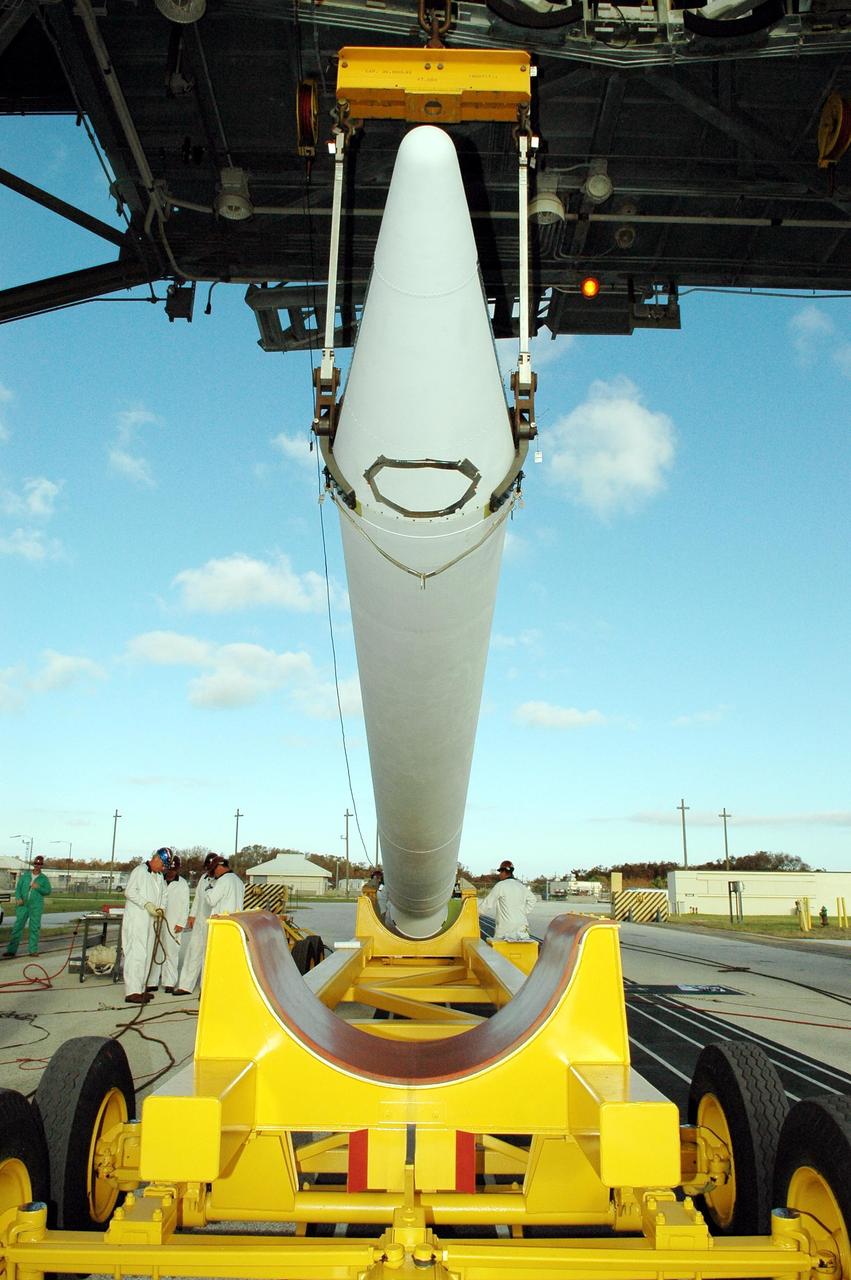
KENNEDY SPACE CENTER, FLA. - A Solid Rocket Booster for the Swift-Delta launch is lifted off its transporter on Pad 17-A at Cape Canaveral Air Force Station. The SRB is one of three to be attached to the Boeing Delta rocket that is the launch vehicle for the Swift spacecraft and its Gamma-Ray Burst Mission. Swift is a medium-class Explorer mission managed by NASA’s Goddard Space Flight Center in Greenbelt, Md.

KENNEDY SPACE CENTER, FLA. - Inside Hangar AE at Cape Canaveral Air Force Station (CCAFS), an overhead crane raises the Swift spacecraft, wrapped in a protective cover, to vertical before being placed on a work stand. Swift is a first-of-its-kind, multi-wavelength observatory dedicated to the study of gamma-ray burst (GRB) science. Its three instruments will work together to observe GRBs and afterglows in the gamma-ray, X-ray and optical wavebands. Swift is part of NASA’s medium explorer (MIDEX) program being developed by an international collaboration. It will be launched no earlier than Oct. 7 into a low-Earth orbit on a Boeing Delta 7320 rocket from pad 17-A at CCAFS. During its nominal 2-year mission, Swift is expected to observe more than 200 bursts, which will represent the most comprehensive study of GRB afterglow to date.
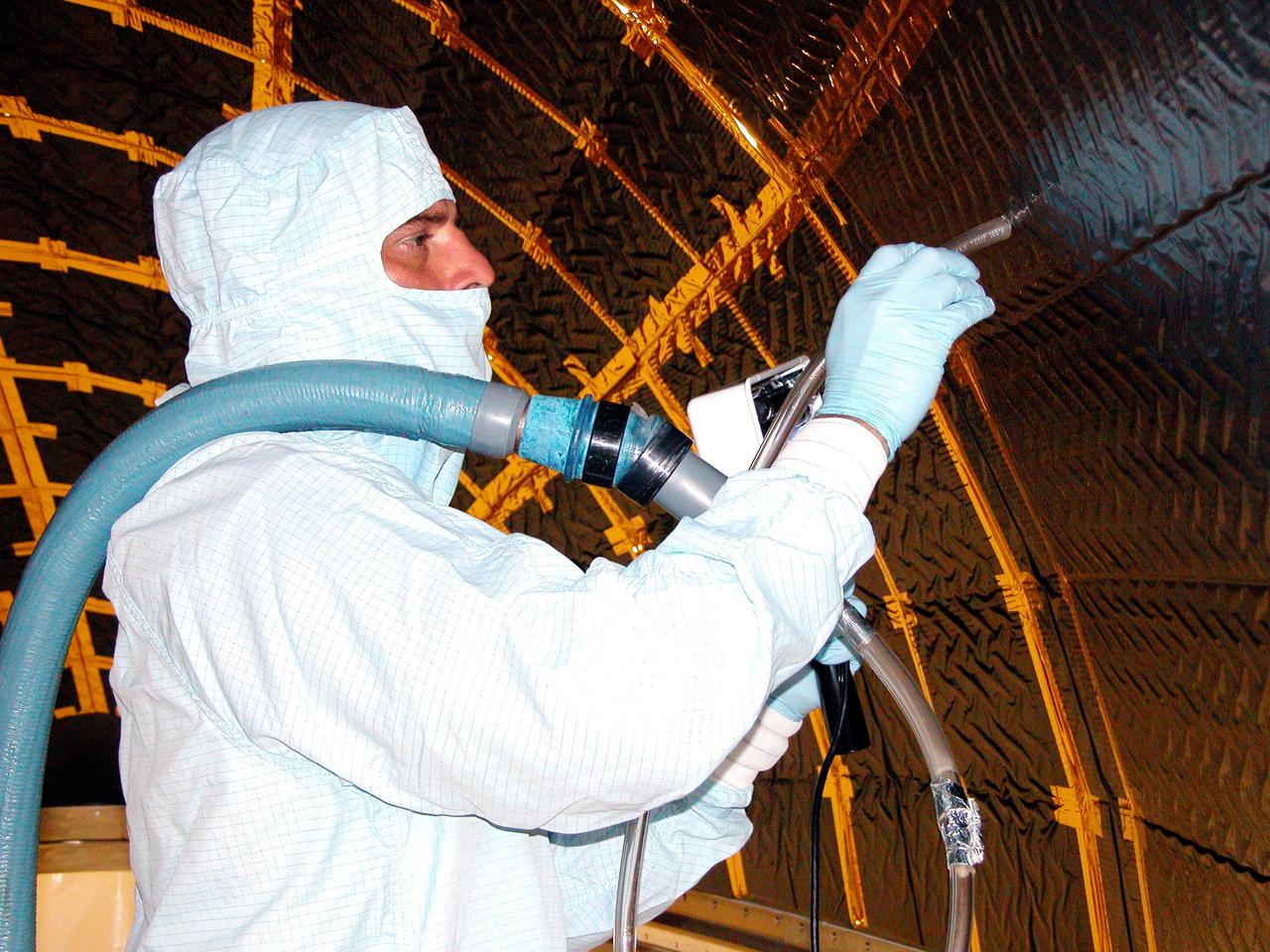
KENNEDY SPACE CENTER, FLA. - Workers in Hangar AE, Cape Canaveral Air Force Station, meticulously clean the inside of a Boeing Delta fairing that will encapsulate the Swift spacecraft. Swift is a first-of-its-kind, multi-wavelength observatory dedicated to the study of gamma-ray burst (GRB) science. Its three instruments will work together to observe GRBs and afterglows in the gamma-ray, X-ray and optical wavebands. Swift is part of NASA’s medium explorer (MIDEX) program being developed by an international collaboration. It will be launched into a low-Earth orbit on a Delta 7320 rocket in October 2004. During its nominal 2-year mission, Swift is expected to observe more than 200 bursts, which will represent the most comprehensive study of GRB afterglow to date.
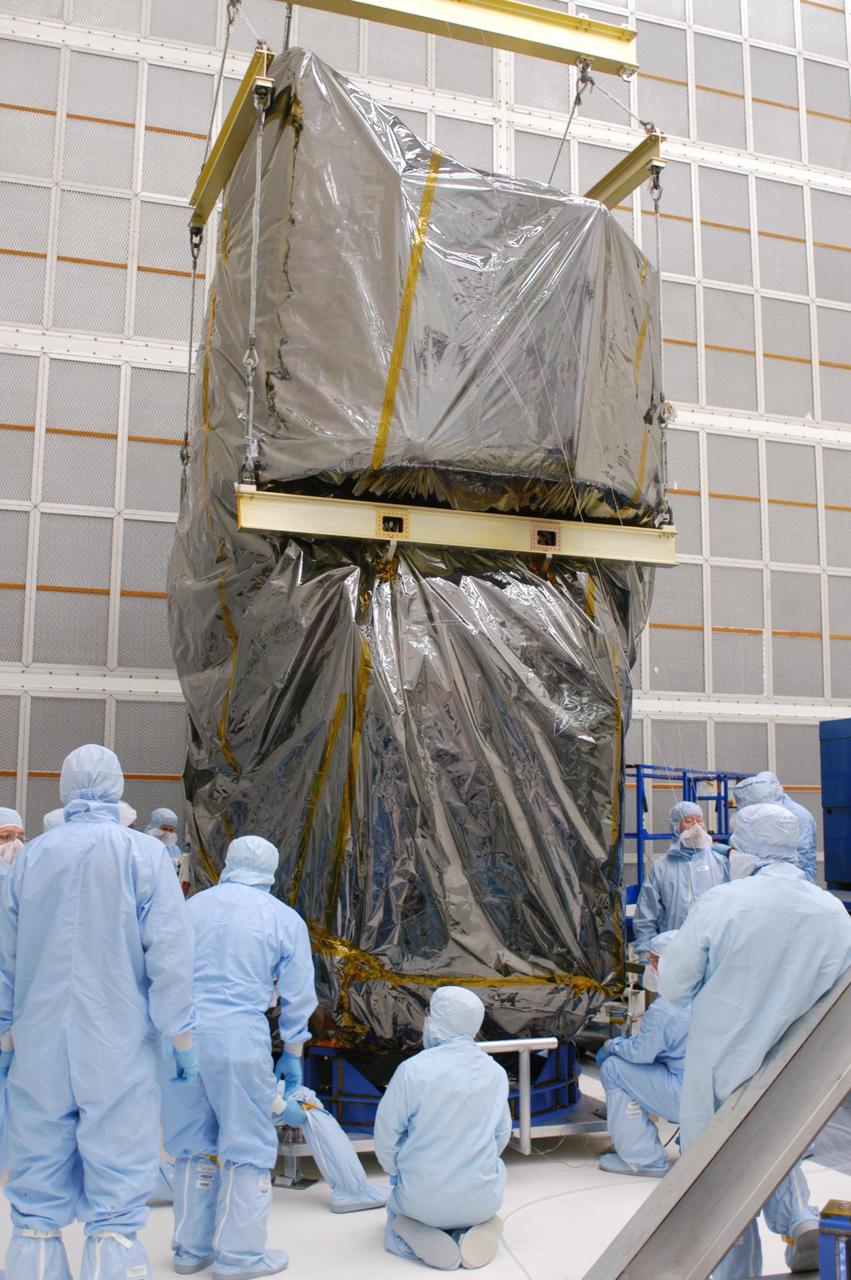
KENNEDY SPACE CENTER, FLA. - Inside Hangar AE at Cape Canaveral Air Force Station (CCAFS), workers secure the Swift spacecraft, wrapped in a protective cover, on a work stand. Swift is a first-of-its-kind, multi-wavelength observatory dedicated to the study of gamma-ray burst (GRB) science. Its three instruments will work together to observe GRBs and afterglows in the gamma-ray, X-ray and optical wavebands. Swift is part of NASA’s medium explorer (MIDEX) program being developed by an international collaboration. It will be launched no earlier than Oct. 7 into a low-Earth orbit on a Boeing Delta 7320 rocket from pad 17-A at CCAFS. During its nominal 2-year mission, Swift is expected to observe more than 200 bursts, which will represent the most comprehensive study of GRB afterglow to date.
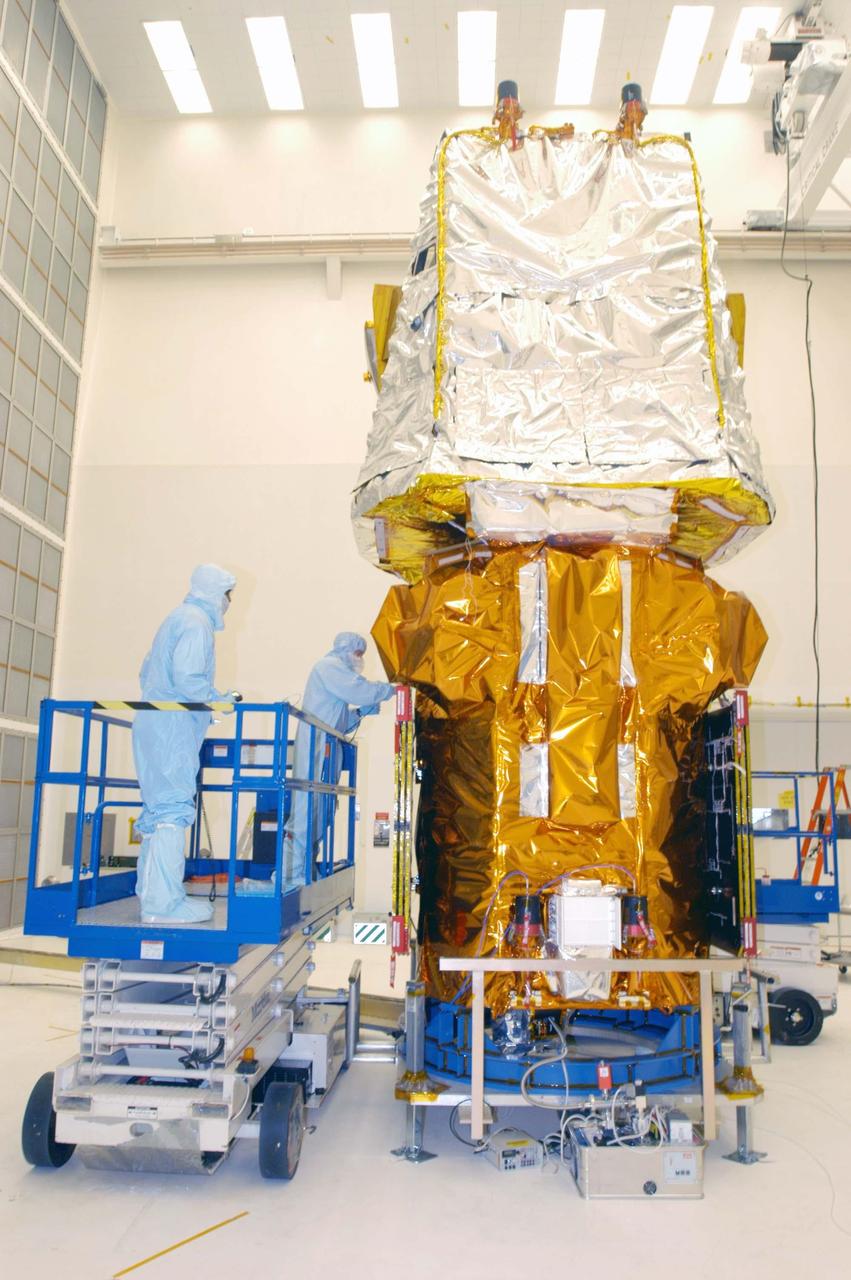
KENNEDY SPACE CENTER, FLA. - Quality Assurance Services technicians Willy Jones and Brian Kittle do some touch-up work on the Swift spacecraft in Hangar AE at Cape Canaveral Air Force Station. Swift has been wrapped with blankets to provide thermal stability during the mission. Swift is a first-of-its-kind multi-wavelength observatory dedicated to the study of gamma-ray burst (GRB) science. Its three instruments will work together to observe GRBs and afterglows in the gamma-ray, X-ray, ultraviolet and optical wavebands. The most comprehensive study of GRB afterglows to date, Swift is expected to observe more than 200 gamma-ray bursts during its 2-year mission.
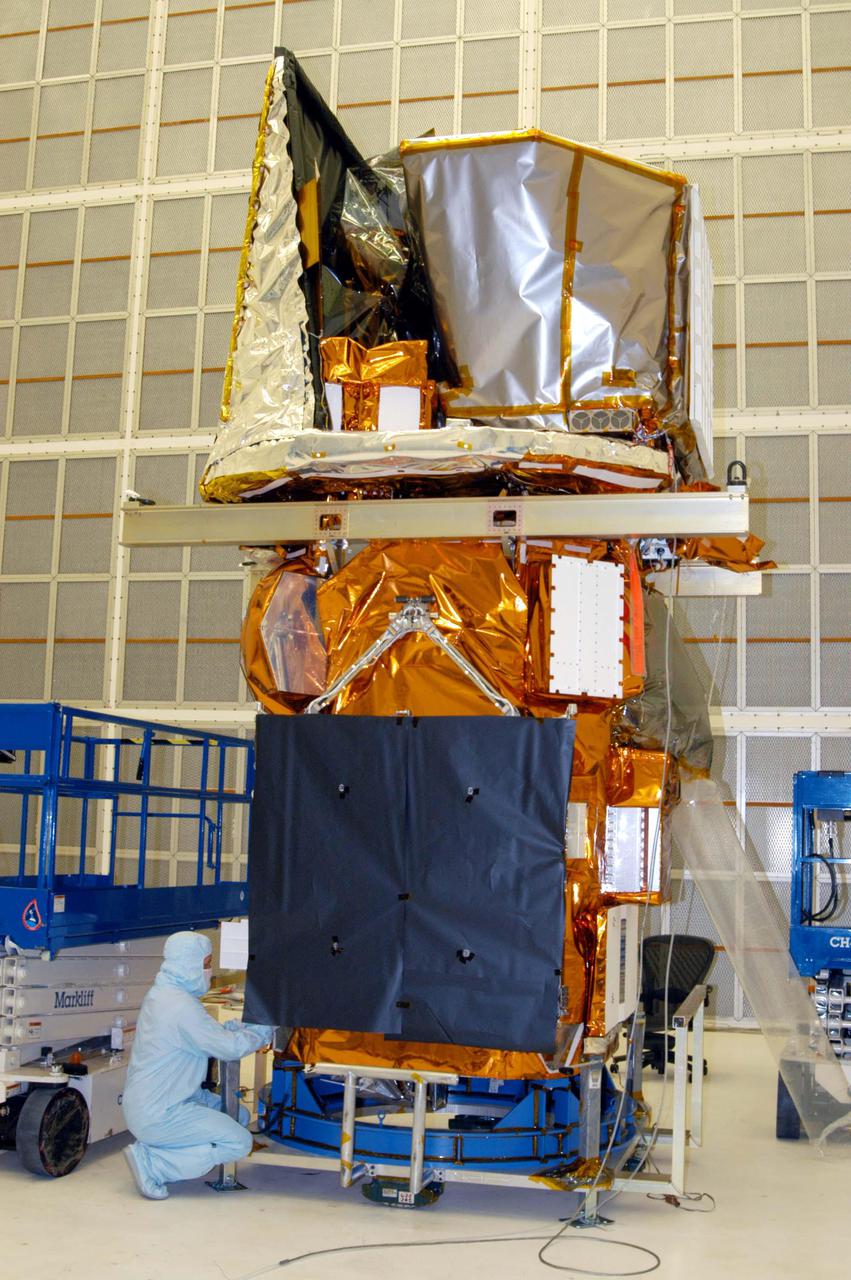
KENNEDY SPACE CENTER, FLA. - A technician at NASA’s Hangar AE, Cape Canaveral Air Force Station (CCAFS), prepares the Swift spacecraft to be lifted off its workstand. The spacecraft will be mated to a payload attach fitting, the interface between the spacecraft and the second stage of the Boeing Delta II rocket. Swift is a first-of-its-kind multi-wavelength observatory dedicated to the study of gamma-ray burst (GRB) science. Its three instruments will work together to observe GRBs and afterglows in the gamma ray, X-ray, ultraviolet and optical wavebands. Swift is expected to observe more than 200 gamma-ray bursts - the most comprehensive study of GRB afterglows to date - during its 2-year mission. Swift is scheduled to launch in November from Launch Pad 17-A at CCAFS.
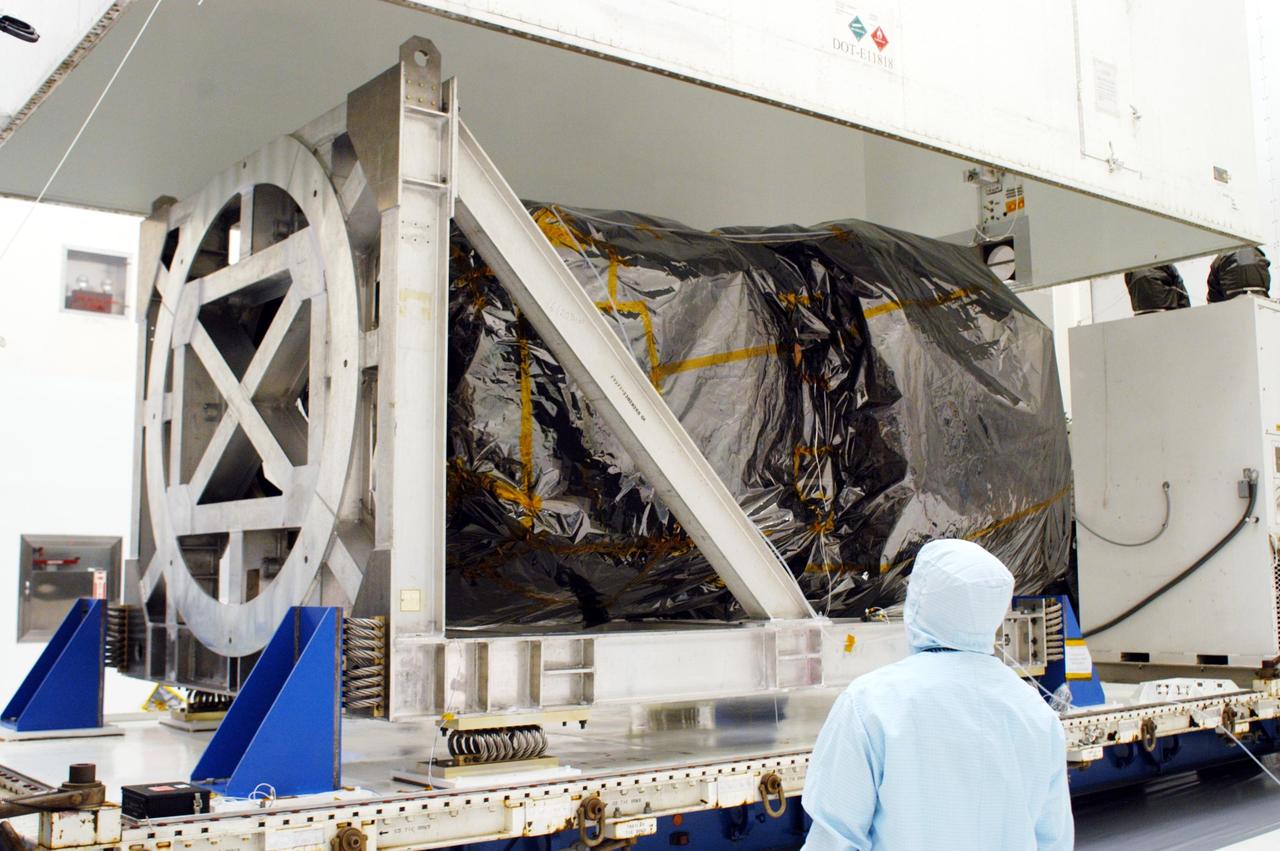
KENNEDY SPACE CENTER, FLA. - Inside Hangar AE at Cape Canaveral Air Force Station (CCAFS), workers observe the canister being lifted from the Swift spacecraft, which is enclosed in a protective cover. Swift is a first-of-its-kind, multi-wavelength observatory dedicated to the study of gamma-ray burst (GRB) science. Its three instruments will work together to observe GRBs and afterglows in the gamma-ray, X-ray and optical wavebands. Swift is part of NASA’s medium explorer (MIDEX) program being developed by an international collaboration. It will be launched no earlier than Oct. 7 into a low-Earth orbit on a Boeing Delta 7320 rocket from pad 17-A at CCAFS. During its nominal 2-year mission, Swift is expected to observe more than 200 bursts, which will represent the most comprehensive study of GRB afterglow to date.
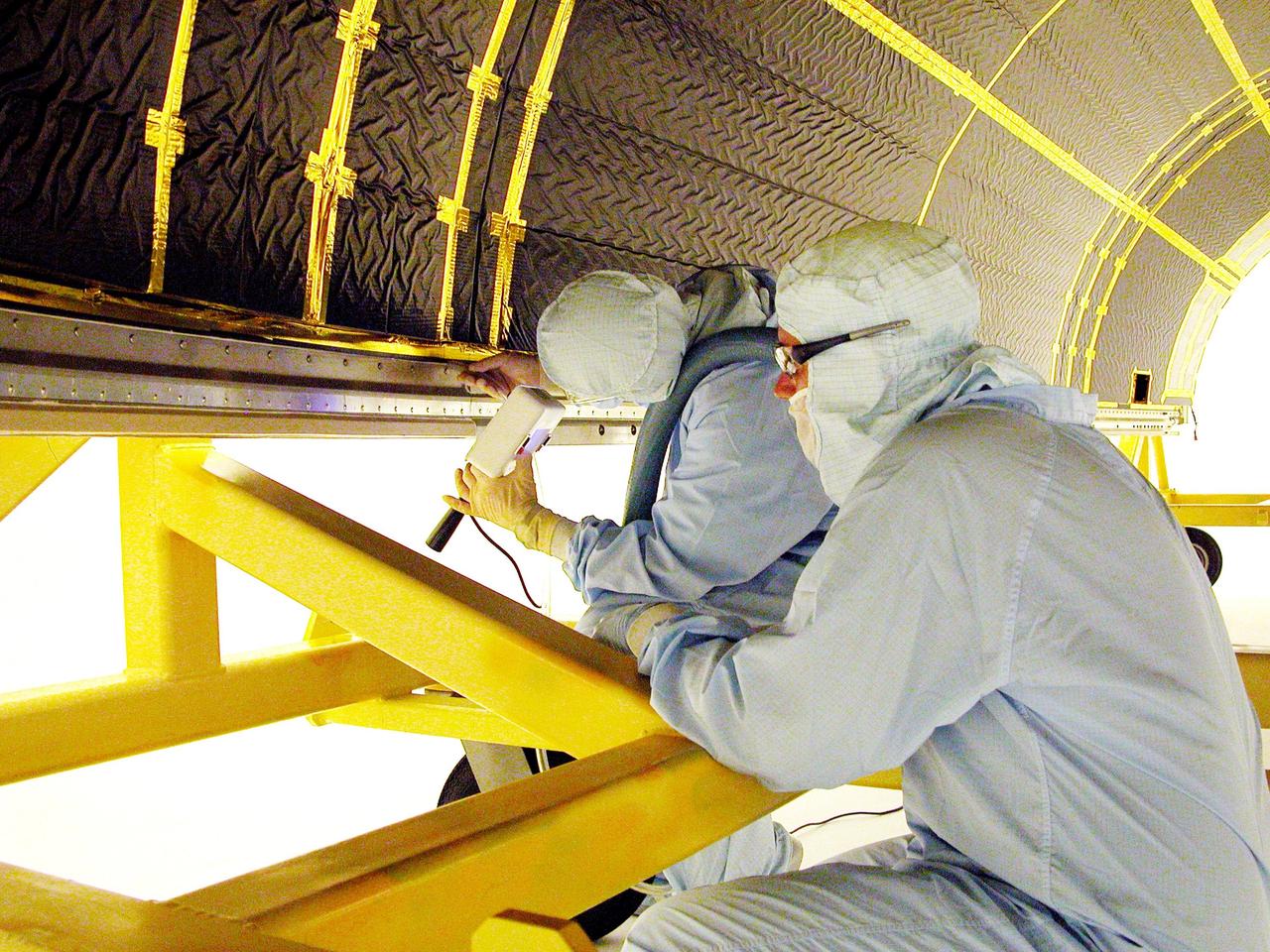
KENNEDY SPACE CENTER, FLA. - Workers in Hangar AE, Cape Canaveral Air Force Station, meticulously clean the inside of a Boeing Delta fairing that will encapsulate the Swift spacecraft. Swift is a first-of-its-kind, multi-wavelength observatory dedicated to the study of gamma-ray burst (GRB) science. Its three instruments will work together to observe GRBs and afterglows in the gamma-ray, X-ray and optical wavebands. Swift is part of NASA’s medium explorer (MIDEX) program being developed by an international collaboration. It will be launched into a low-Earth orbit on a Delta 7320 rocket in October 2004. During its nominal 2-year mission, Swift is expected to observe more than 200 bursts, which will represent the most comprehensive study of GRB afterglow to date.
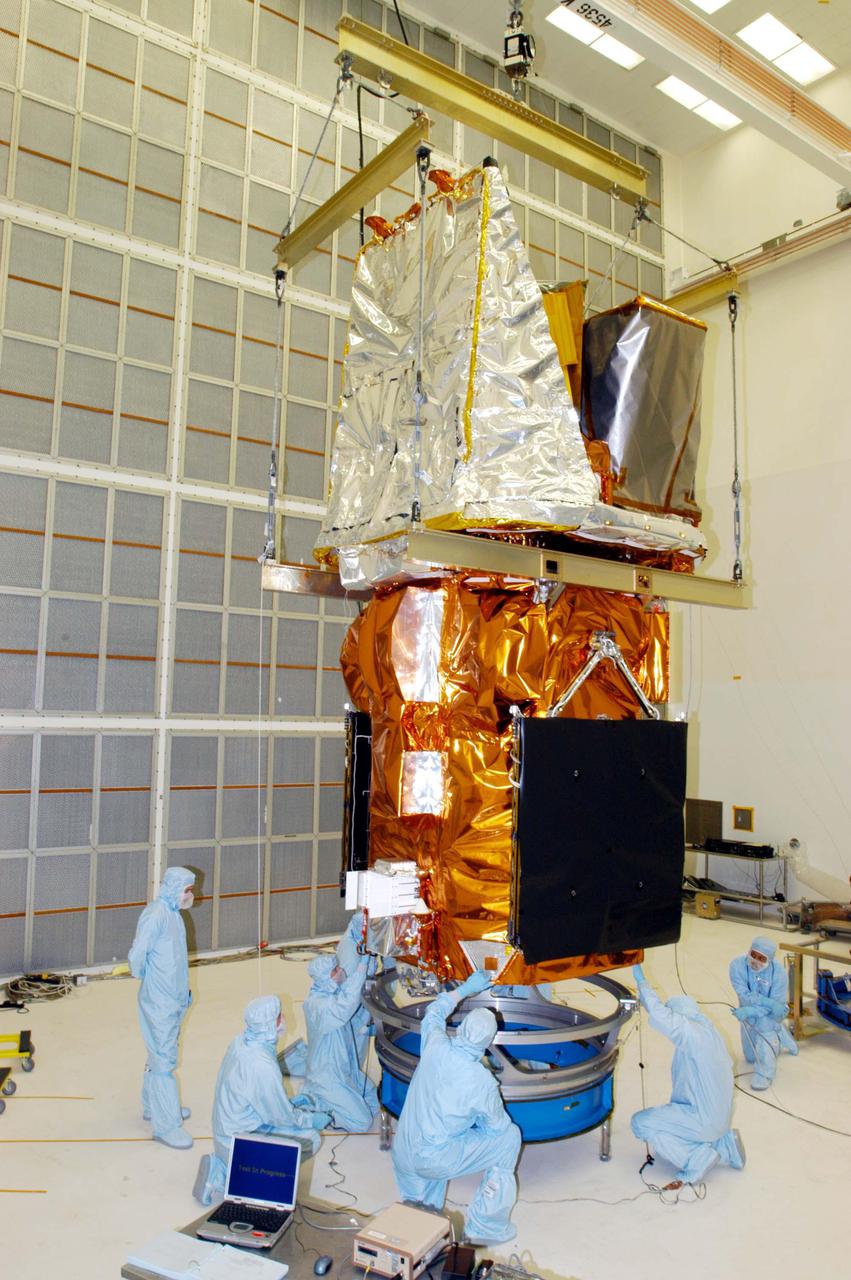
KENNEDY SPACE CENTER, FLA. - Technicians at NASA’s Hangar AE, Cape Canaveral Air Force Station (CCAFS), help guide the Swift spacecraft being lowered onto a payload attach fitting, the interface between the spacecraft and the second stage of the Boeing Delta II rocket. Swift is a first-of-its-kind multi-wavelength observatory dedicated to the study of gamma-ray burst (GRB) science. Its three instruments will work together to observe GRBs and afterglows in the gamma ray, X-ray, ultraviolet and optical wavebands. Swift is expected to observe more than 200 gamma-ray bursts - the most comprehensive study of GRB afterglows to date - during its 2-year mission. Swift is scheduled to launch in November from Launch Pad 17-A at CCAFS.
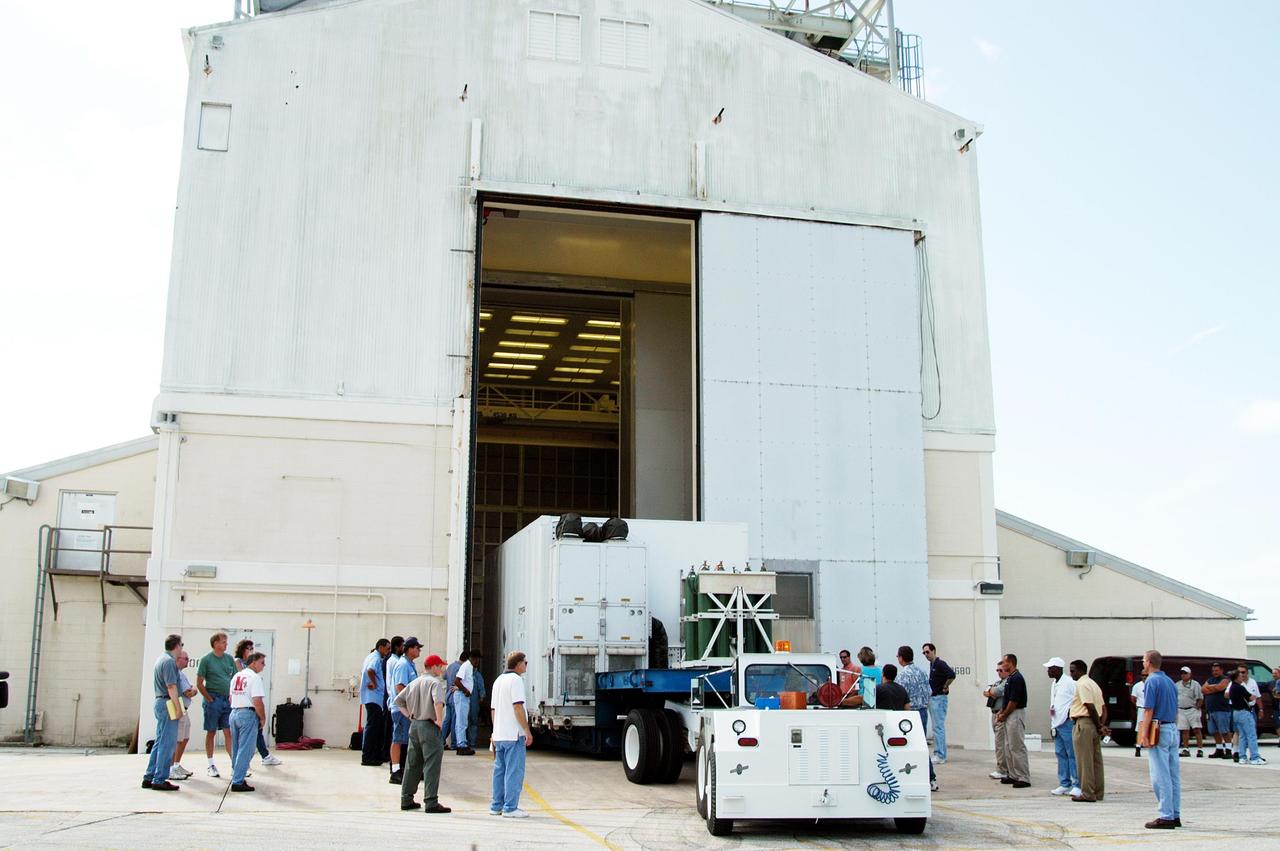
KENNEDY SPACE CENTER, FLA. - - The Swift spacecraft arrives at Hangar AE at Cape Canaveral Air Force Station (CCAFS). Swift is a first-of-its-kind, multi-wavelength observatory dedicated to the study of gamma-ray burst (GRB) science. Its three instruments will work together to observe GRBs and afterglows in the gamma-ray, X-ray and optical wavebands. Swift is part of NASA’s medium explorer (MIDEX) program being developed by an international collaboration. It will be launched no earlier than Oct. 7 into a low-Earth orbit on a Boeing Delta 7320 rocket from pad 17-A at CCAFS. During its nominal 2-year mission, Swift is expected to observe more than 200 bursts, which will represent the most comprehensive study of GRB afterglow to date.
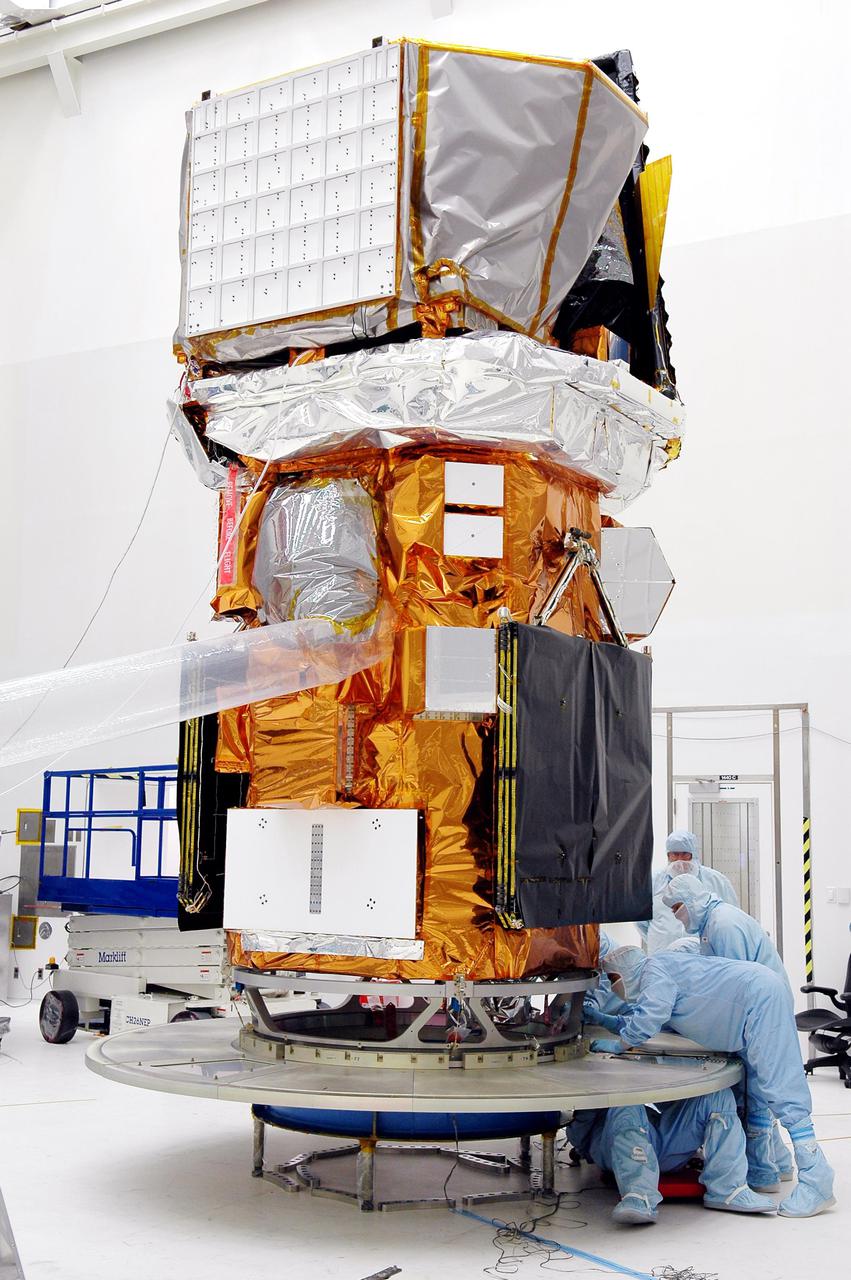
KENNEDY SPACE CENTER, FLA. - At NASA’s Hangar AE on Cape Canaveral Air Force Station (CCAFS), Fla., technicians check the attachment of the base petals of a transportation canister around the bottom of the payload attach fitting on the Swift spacecraft. Swift is a first-of-its-kind multi-wavelength observatory dedicated to the study of gamma-ray burst (GRB) science. Its three instruments will work together to observe GRBs and afterglows in the gamma ray, X-ray, ultraviolet and optical wavebands. Swift is expected to observe more than 200 gamma-ray bursts - the most comprehensive study of GRB afterglows to date - during its 2-year mission. Swift is scheduled to launch in mid-November from Launch Pad 17-A at CCAFS.

KENNEDY SPACE CENTER, FLA. - Technician Grace Miller-Swales (left) does touch-up work on the Swift spacecraft in Hangar AE at Cape Canaveral Air Force Station. John Batilito, with Quality Assurance Services, is at right. Swift is wrapped with blankets to provide thermal stability during the mission. Swift is a first-of-its-kind multi-wavelength observatory dedicated to the study of gamma-ray burst (GRB) science. Its three instruments will work together to observe GRBs and afterglows in the gamma-ray, X-ray, ultraviolet and optical wavebands. The most comprehensive study of GRB afterglows to date, Swift is expected to observe more than 200 gamma-ray bursts during its 2-year mission.
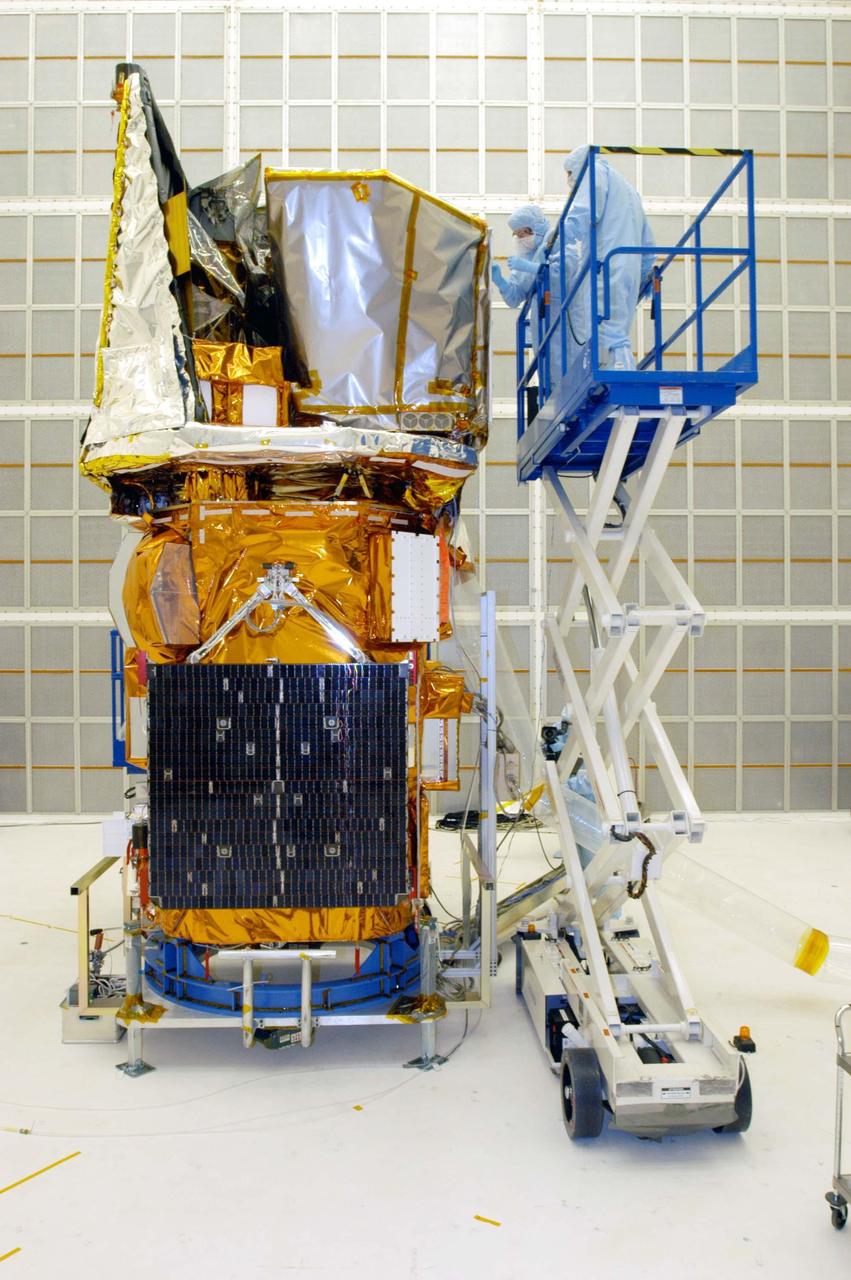
KENNEDY SPACE CENTER, FLA. - Technician Grace Miller-Swales (left) does touch-up work on the Swift spacecraft in Hangar AE at Cape Canaveral Air Force Station. John DiBatilito, with Quality Assurance Services, is at right. Swift is wrapped with blankets to provide thermal stability during the mission. Swift is a first-of-its-kind multi-wavelength observatory dedicated to the study of gamma-ray burst (GRB) science. Its three instruments will work together to observe GRBs and afterglows in the gamma-ray, X-ray, ultraviolet and optical wavebands. The most comprehensive study of GRB afterglows to date, Swift is expected to observe more than 200 gamma-ray bursts during its 2-year mission.
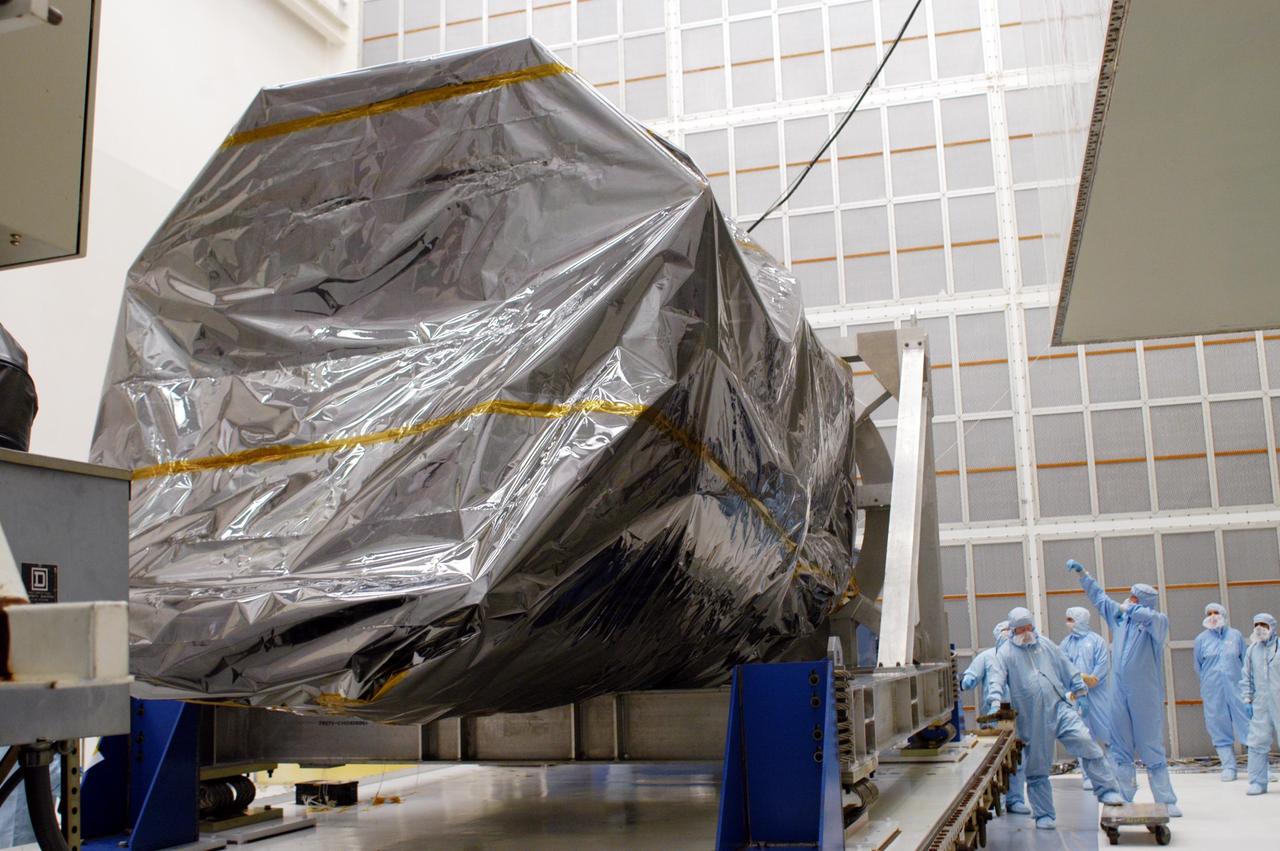
KENNEDY SPACE CENTER, FLA. - Inside Hangar AE at Cape Canaveral Air Force Station (CCAFS), workers observe the canister being lifted from the Swift spacecraft, which is enclosed in a protective cover. Swift is a first-of-its-kind, multi-wavelength observatory dedicated to the study of gamma-ray burst (GRB) science. Its three instruments will work together to observe GRBs and afterglows in the gamma-ray, X-ray and optical wavebands. Swift is part of NASA’s medium explorer (MIDEX) program being developed by an international collaboration. It will be launched no earlier than Oct. 7 into a low-Earth orbit on a Boeing Delta 7320 rocket from pad 17-A at CCAFS. During its nominal 2-year mission, Swift is expected to observe more than 200 bursts, which will represent the most comprehensive study of GRB afterglow to date.
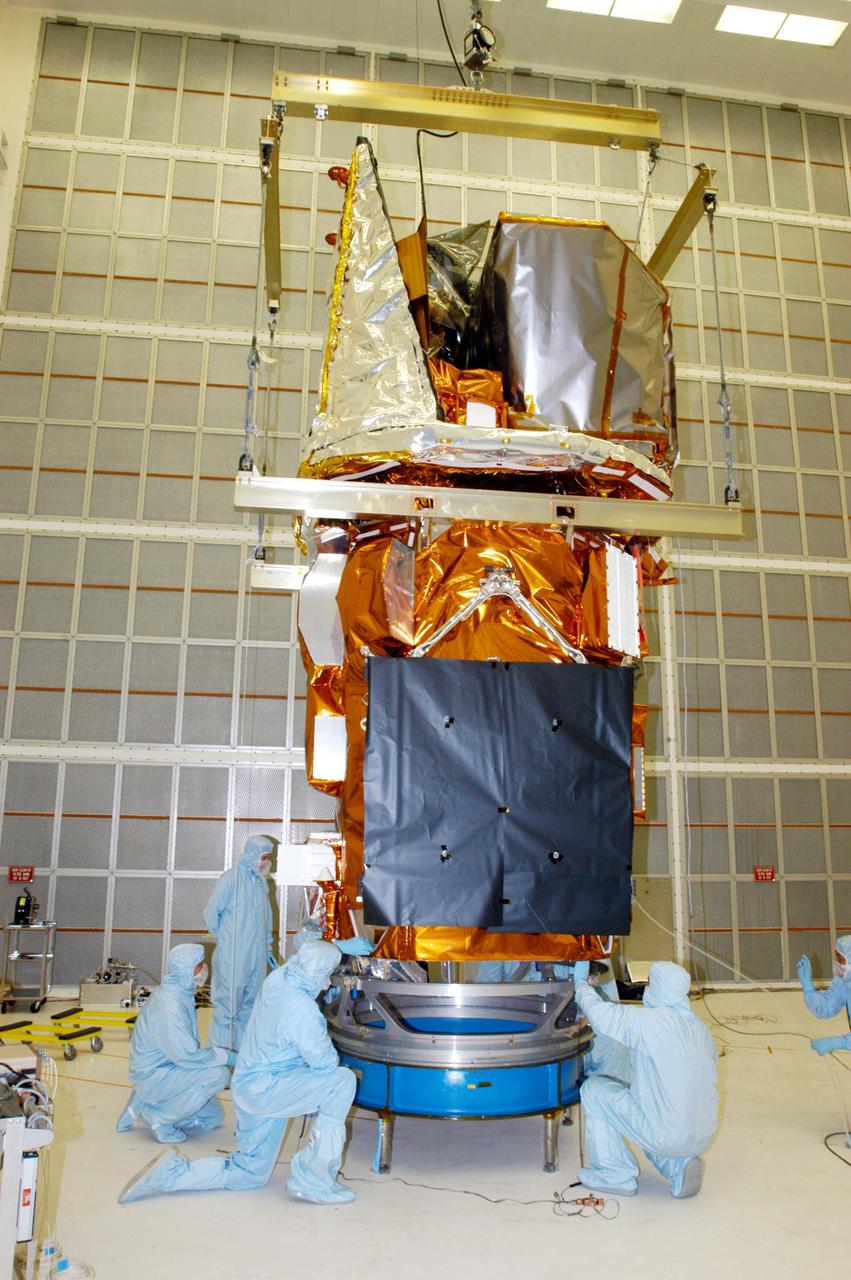
KENNEDY SPACE CENTER, FLA. - Technicians at NASA’s Hangar AE, Cape Canaveral Air Force Station (CCAFS), help guide the Swift spacecraft being lowered onto a payload attach fitting, the interface between the spacecraft and the second stage of the Boeing Delta II rocket. Swift is a first-of-its-kind multi-wavelength observatory dedicated to the study of gamma-ray burst (GRB) science. Its three instruments will work together to observe GRBs and afterglows in the gamma ray, X-ray, ultraviolet and optical wavebands. Swift is expected to observe more than 200 gamma-ray bursts - the most comprehensive study of GRB afterglows to date - during its 2-year mission. Swift is scheduled to launch in November from Launch Pad 17-A at CCAFS.
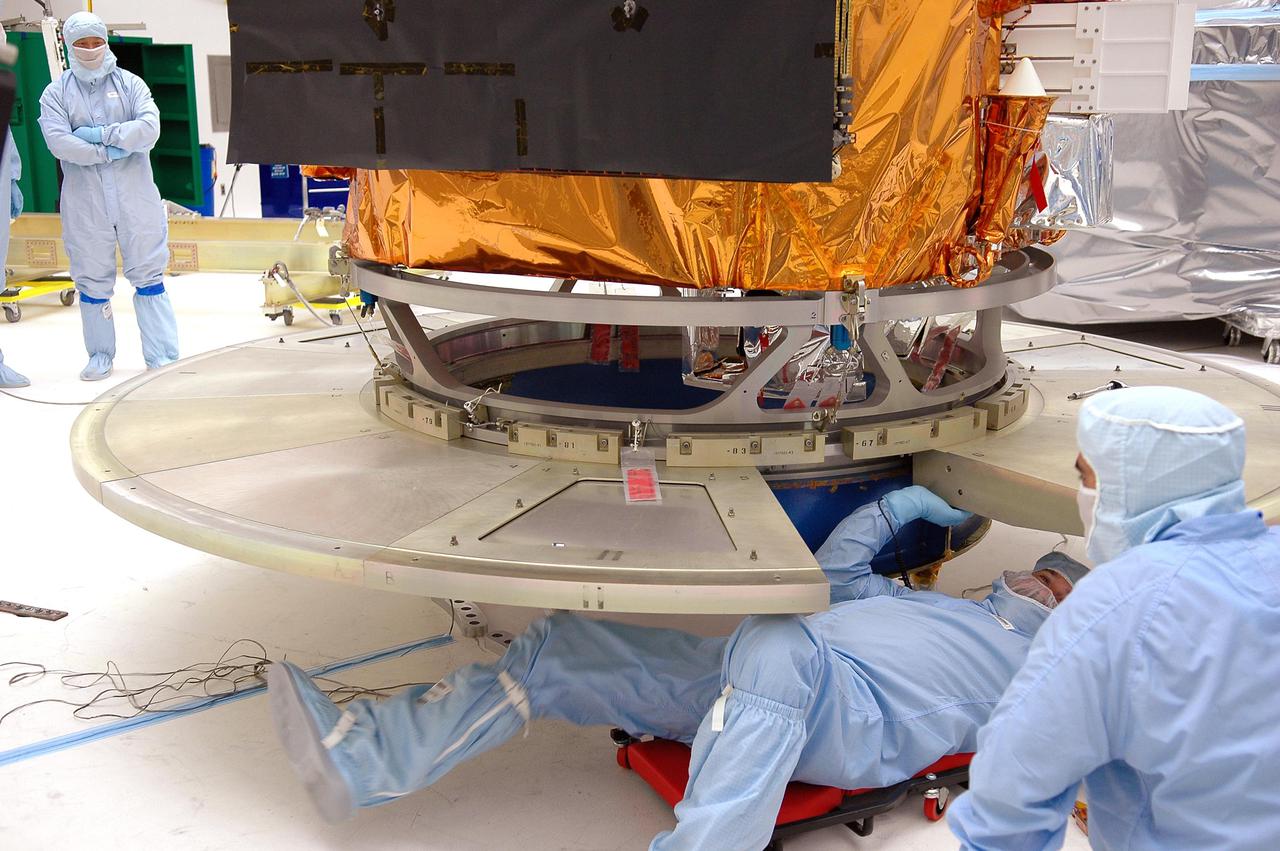
KENNEDY SPACE CENTER, FLA. - At NASA’s Hangar AE on Cape Canaveral Air Force Station (CCAFS), Fla., technicians check the attachment of the base petals of a transportation canister around the bottom of the payload attach fitting on the Swift spacecraft. Swift is a first-of-its-kind multi-wavelength observatory dedicated to the study of gamma-ray burst (GRB) science. Its three instruments will work together to observe GRBs and afterglows in the gamma ray, X-ray, ultraviolet and optical wavebands. Swift is expected to observe more than 200 gamma-ray bursts - the most comprehensive study of GRB afterglows to date - during its 2-year mission. Swift is scheduled to launch in mid-November from Launch Pad 17-A at CCAFS.
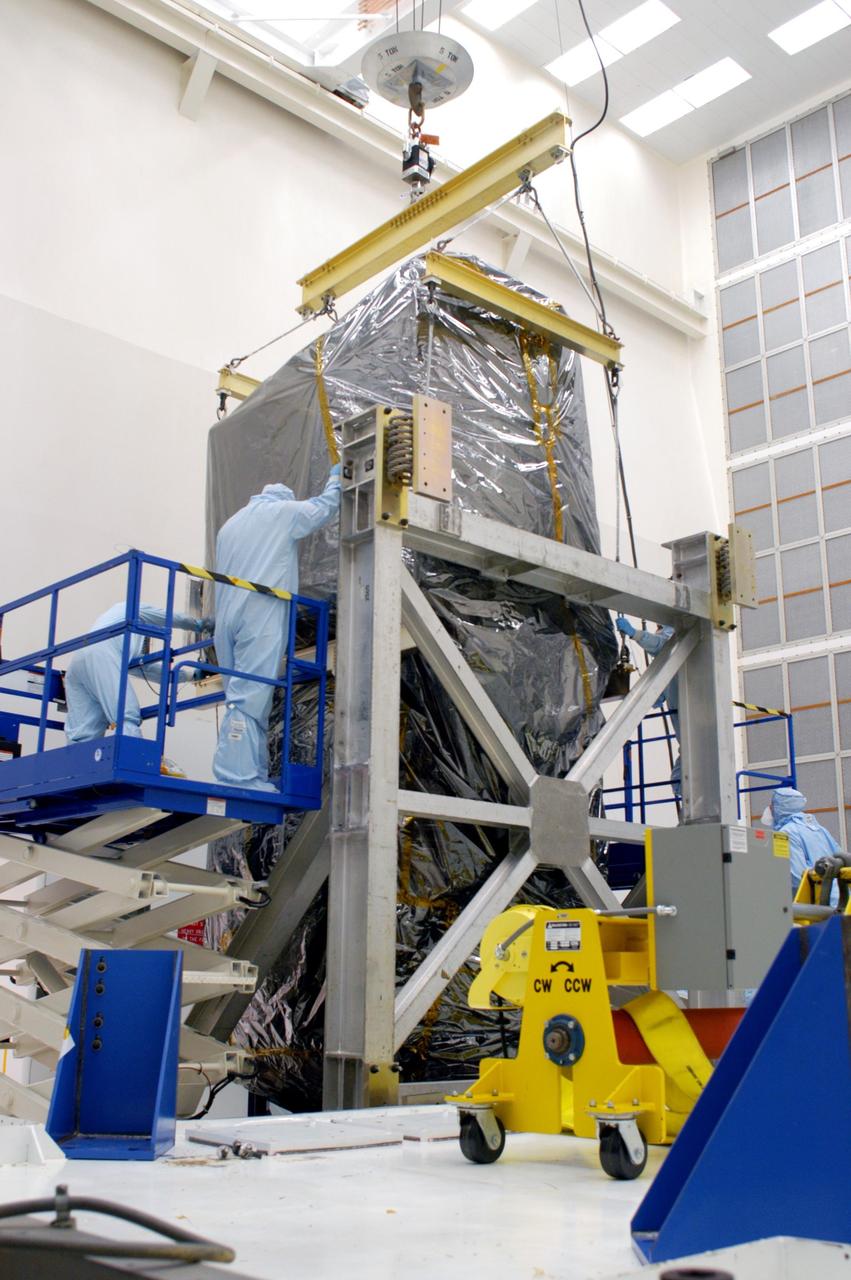
KENNEDY SPACE CENTER, FLA. - Inside Hangar AE at Cape Canaveral Air Force Station (CCAFS), workers secure the Swift spacecraft, wrapped in a protective cover, on a work stand. Swift is a first-of-its-kind, multi-wavelength observatory dedicated to the study of gamma-ray burst (GRB) science. Its three instruments will work together to observe GRBs and afterglows in the gamma-ray, X-ray and optical wavebands. Swift is part of NASA’s medium explorer (MIDEX) program being developed by an international collaboration. It will be launched no earlier than Oct. 7 into a low-Earth orbit on a Boeing Delta 7320 rocket from pad 17-A at CCAFS. During its nominal 2-year mission, Swift is expected to observe more than 200 bursts, which will represent the most comprehensive study of GRB afterglow to date.
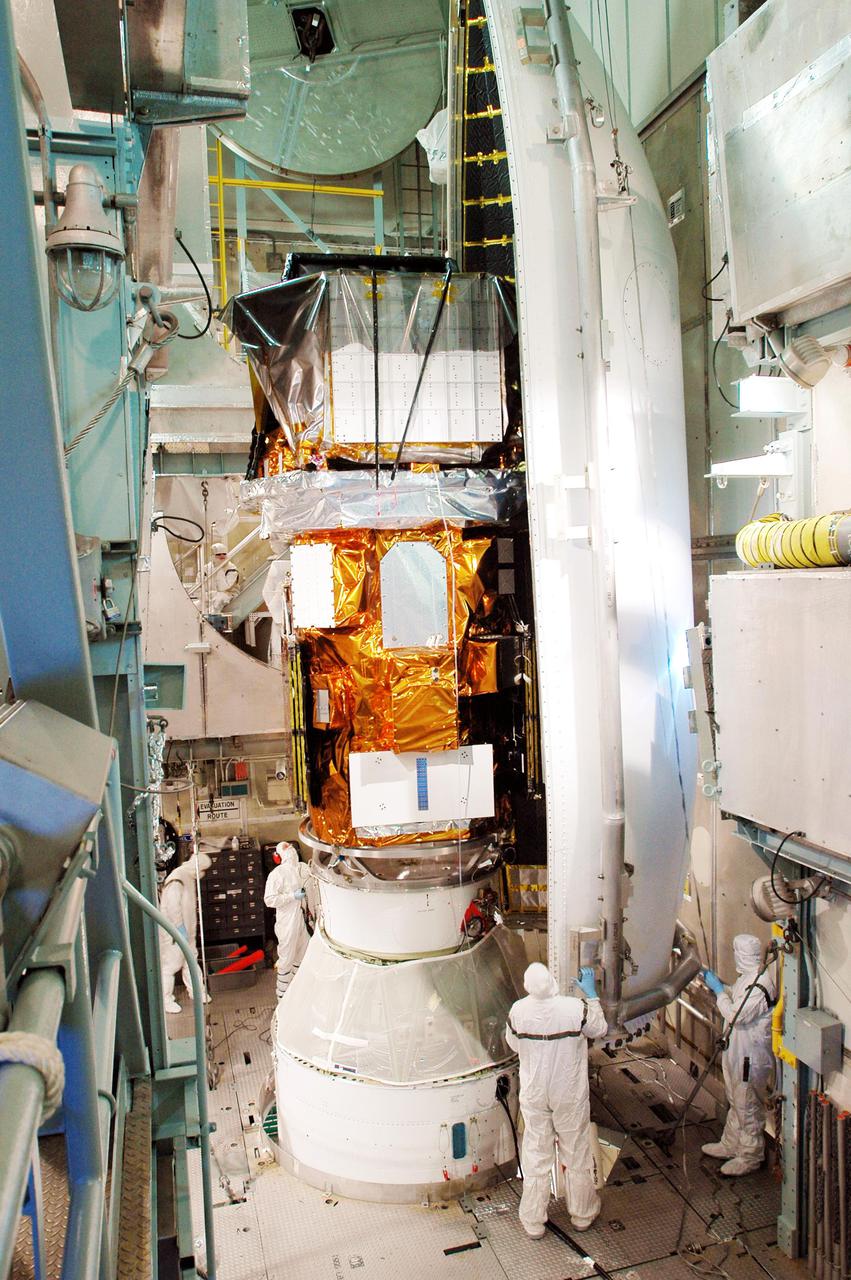
KENNEDY SPACE CENTER, FLA. - Boeing workers move the first part of the fairing into place around the Swift spacecraft inside the mobile service tower on Launch Pad 17-A, Cape Canaveral Air Force Station. The fairing is being installed around the payload for protection during launch and ascent. A Boeing Delta II rocket is the launch vehicle for the Swift spacecraft and its Gamma-Ray Burst Mission. Swift is a first-of-its-kind multi-wavelength observatory dedicated to the study of gamma-ray burst science. Its three instruments will work together to observe GRBs and afterglows in the gamma ray, X-ray, ultraviolet and optical wavebands. Swift is scheduled to launch Nov. 17 at 12:09 p.m. EST.
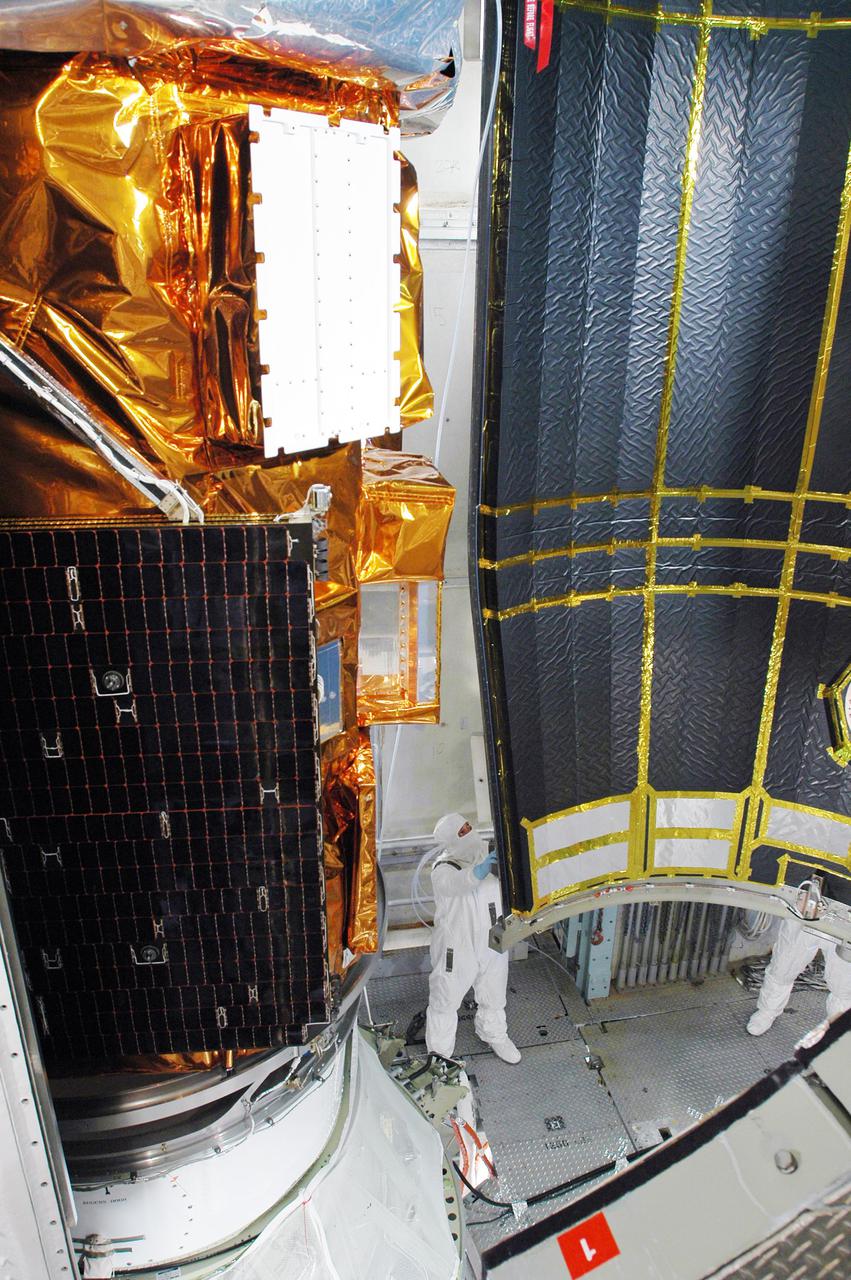
KENNEDY SPACE CENTER, FLA. - Boeing workers help guide a section of the fairing into place around the Swift spacecraft inside the mobile service tower on Launch Pad 17-A, Cape Canaveral Air Force Station. The fairing is being installed around the payload for protection during launch and ascent. A Boeing Delta II rocket is the launch vehicle for the Swift spacecraft and its Gamma-Ray Burst Mission. Swift is a first-of-its-kind multi-wavelength observatory dedicated to the study of gamma-ray burst science. Its three instruments will work together to observe GRBs and afterglows in the gamma ray, X-ray, ultraviolet and optical wavebands. Swift is scheduled to launch Nov. 17 at 12:09 p.m. EST.
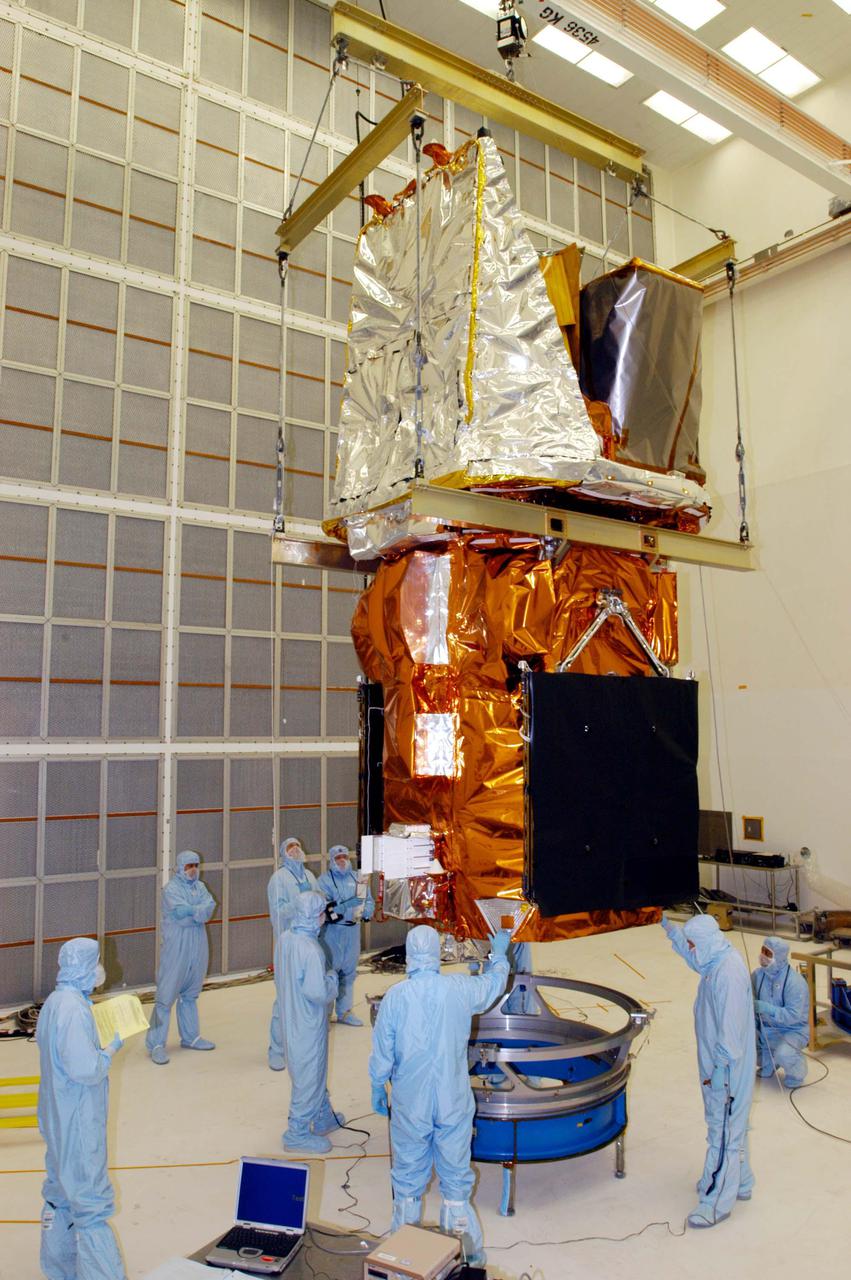
KENNEDY SPACE CENTER, FLA. - Technicians at NASA’s Hangar AE, Cape Canaveral Air Force Station (CCAFS), stand by while the Swift spacecraft is lowered toward a payload attach fitting, the interface between the spacecraft and the second stage of the Boeing Delta II rocket. Swift is a first-of-its-kind multi-wavelength observatory dedicated to the study of gamma-ray burst (GRB) science. Its three instruments will work together to observe GRBs and afterglows in the gamma ray, X-ray, ultraviolet and optical wavebands. Swift is expected to observe more than 200 gamma-ray bursts - the most comprehensive study of GRB afterglows to date - during its 2-year mission. Swift is scheduled to launch in November from Launch Pad 17-A at CCAFS.
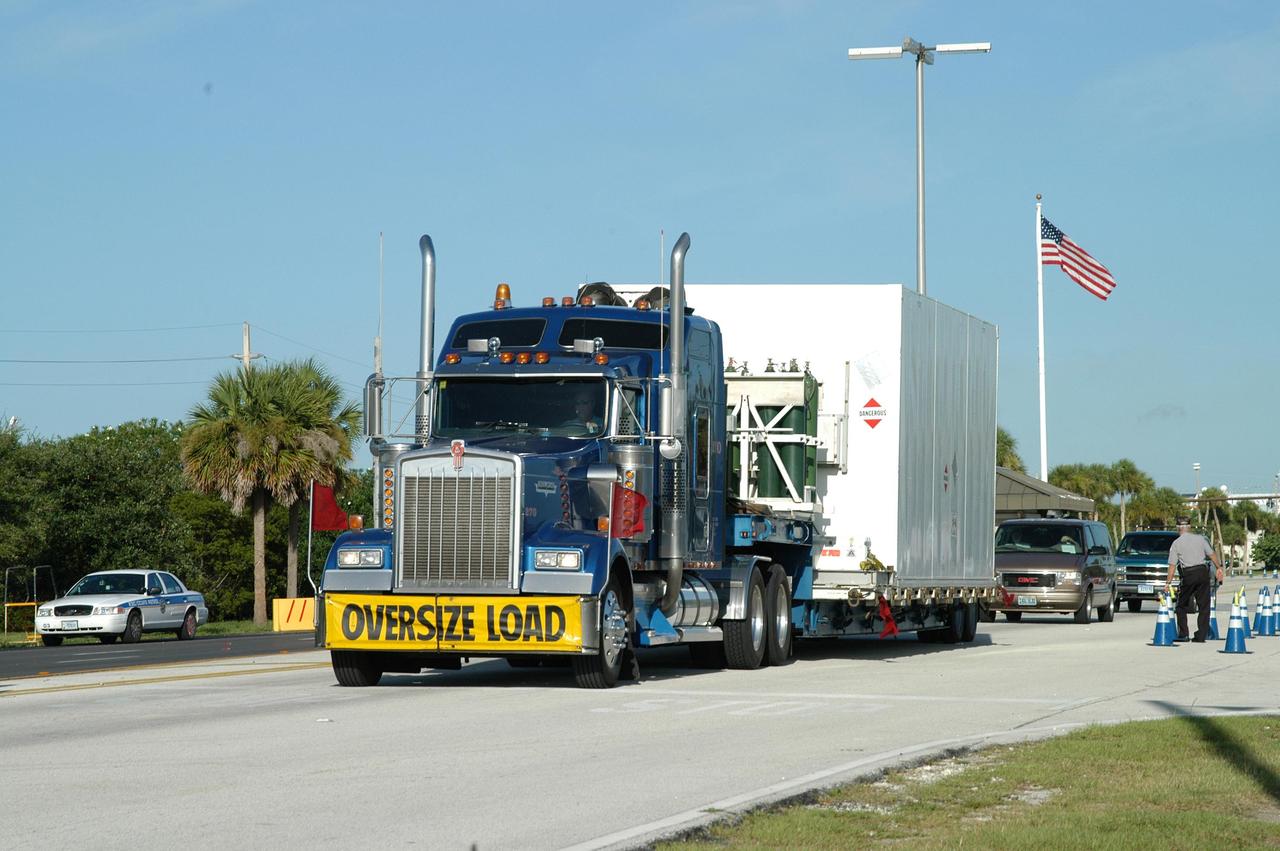
KENNEDY SPACE CENTER, FLA. - The Swift spacecraft is enroute to Hangar AE at Cape Canaveral Air Force Station (CCAFS). Swift is a first-of-its-kind, multi-wavelength observatory dedicated to the study of gamma-ray burst (GRB) science. Its three instruments will work together to observe GRBs and afterglows in the gamma-ray, X-ray and optical wavebands. Swift is part of NASA’s medium explorer (MIDEX) program being developed by an international collaboration. It will be launched no earlier than Oct. 7 into a low-Earth orbit on a Boeing Delta 7320 rocket from pad 17-A at CCAFS. During its nominal 2-year mission, Swift is expected to observe more than 200 bursts, which will represent the most comprehensive study of GRB afterglow to date.
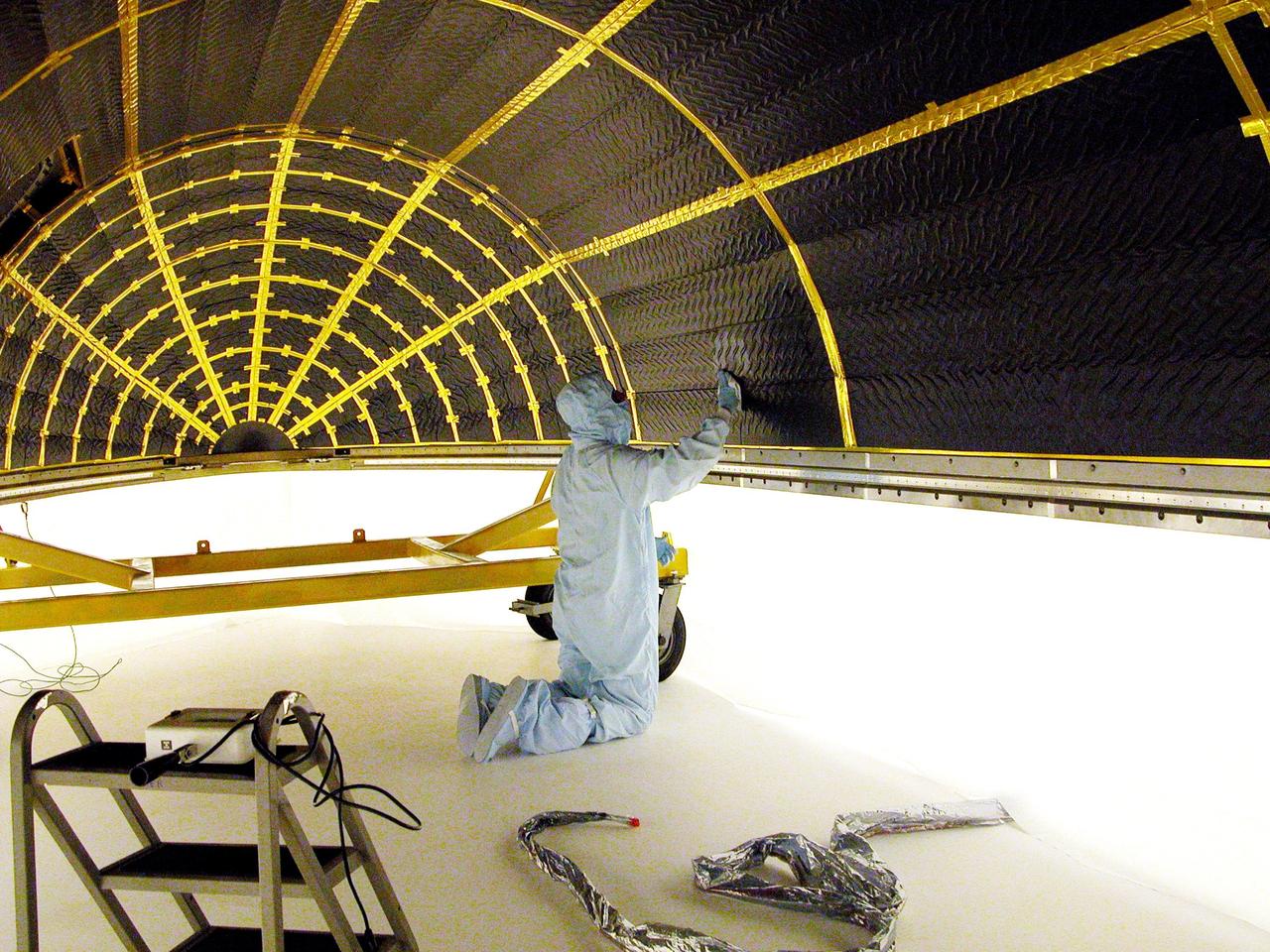
KENNEDY SPACE CENTER, FLA. - Workers in Hangar AE, Cape Canaveral Air Force Station, meticulously clean the inside of a Boeing Delta fairing that will encapsulate the Swift spacecraft. Swift is a first-of-its-kind, multi-wavelength observatory dedicated to the study of gamma-ray burst (GRB) science. Its three instruments will work together to observe GRBs and afterglows in the gamma-ray, X-ray and optical wavebands. Swift is part of NASA’s medium explorer (MIDEX) program being developed by an international collaboration. It will be launched into a low-Earth orbit on a Delta 7320 rocket in October 2004. During its nominal 2-year mission, Swift is expected to observe more than 200 bursts, which will represent the most comprehensive study of GRB afterglow to date.
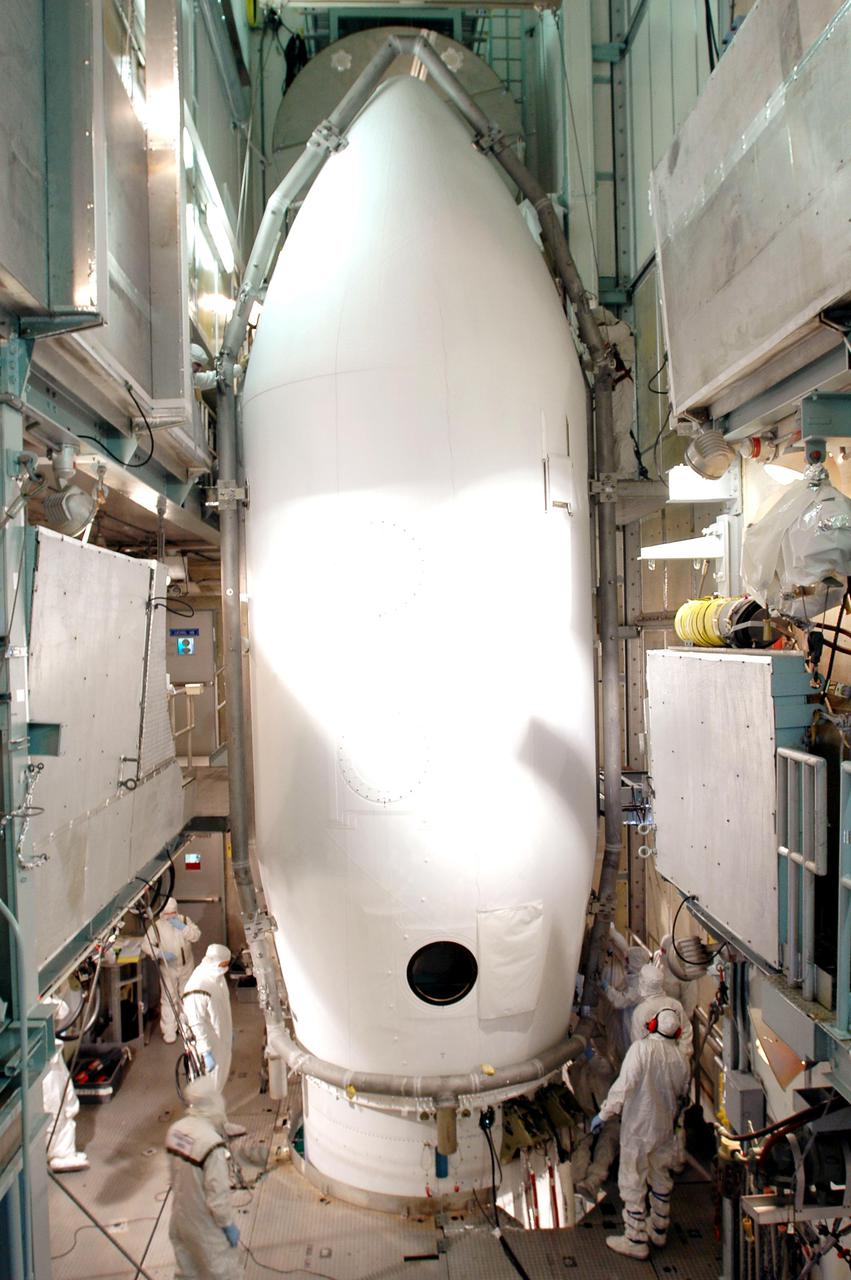
KENNEDY SPACE CENTER, FLA. - Inside the mobile service tower on Launch Pad 17-A, Cape Canaveral Air Force Station, workers begin attaching the two segments of the fairing around the Swift spacecraft. The fairing is being installed around the payload for protection during launch and ascent. A Boeing Delta II rocket is the launch vehicle for the Swift spacecraft and its Gamma-Ray Burst Mission. Swift is a first-of-its-kind multi-wavelength observatory dedicated to the study of gamma-ray burst science. Its three instruments will work together to observe GRBs and afterglows in the gamma ray, X-ray, ultraviolet and optical wavebands. Swift is scheduled to launch Nov. 17 at 12:09 p.m. EST.
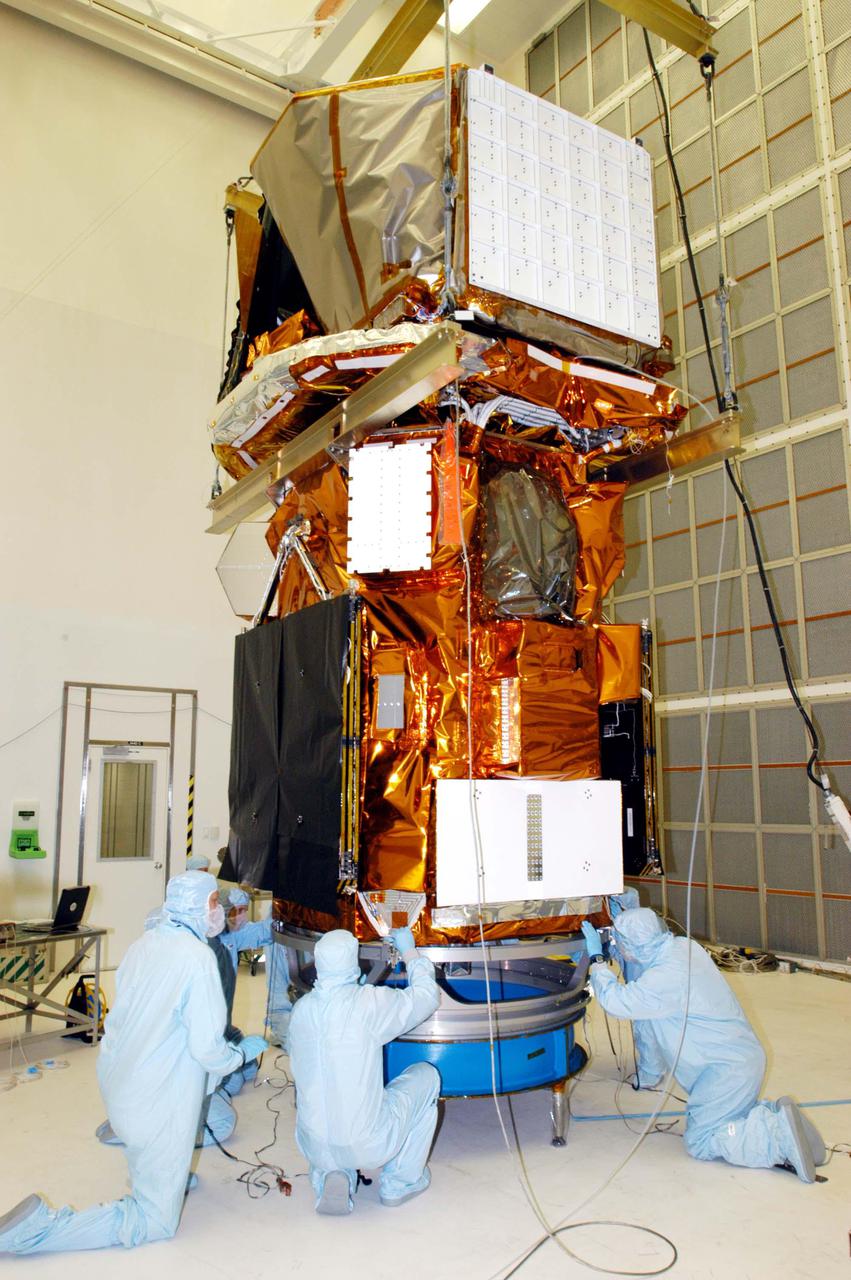
KENNEDY SPACE CENTER, FLA. - Technicians at NASA’s Hangar AE, Cape Canaveral Air Force Station (CCAFS), check the attachment of the Swift spacecraft to the payload attach fitting, the interface between the spacecraft and the second stage of the Boeing Delta II rocket. Swift is a first-of-its-kind multi-wavelength observatory dedicated to the study of gamma-ray burst (GRB) science. Its three instruments will work together to observe GRBs and afterglows in the gamma ray, X-ray, ultraviolet and optical wavebands. Swift is expected to observe more than 200 gamma-ray bursts - the most comprehensive study of GRB afterglows to date - during its 2-year mission. Swift is scheduled to launch in November from Launch Pad 17-A at CCAFS.
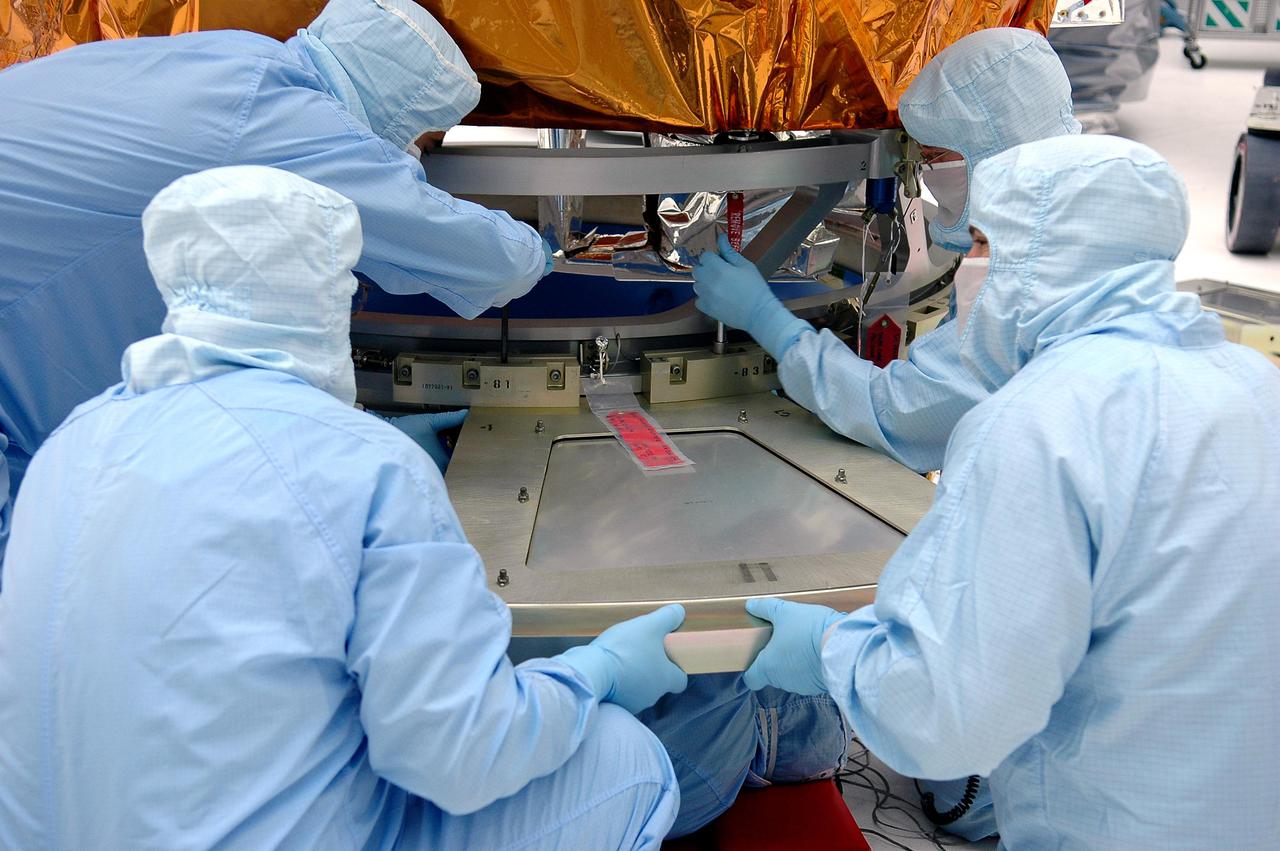
KENNEDY SPACE CENTER, FLA. - At NASA’s Hangar AE on Cape Canaveral Air Force Station (CCAFS), Fla., technicians attach the base petals of a transportation canister around the bottom of the payload attach fitting on the Swift spacecraft. Swift is a first-of-its-kind multi-wavelength observatory dedicated to the study of gamma-ray burst (GRB) science. Its three instruments will work together to observe GRBs and afterglows in the gamma ray, X-ray, ultraviolet and optical wavebands. Swift is expected to observe more than 200 gamma-ray bursts - the most comprehensive study of GRB afterglows to date - during its 2-year mission. Swift is scheduled to launch in mid-November from Launch Pad 17-A at CCAFS.
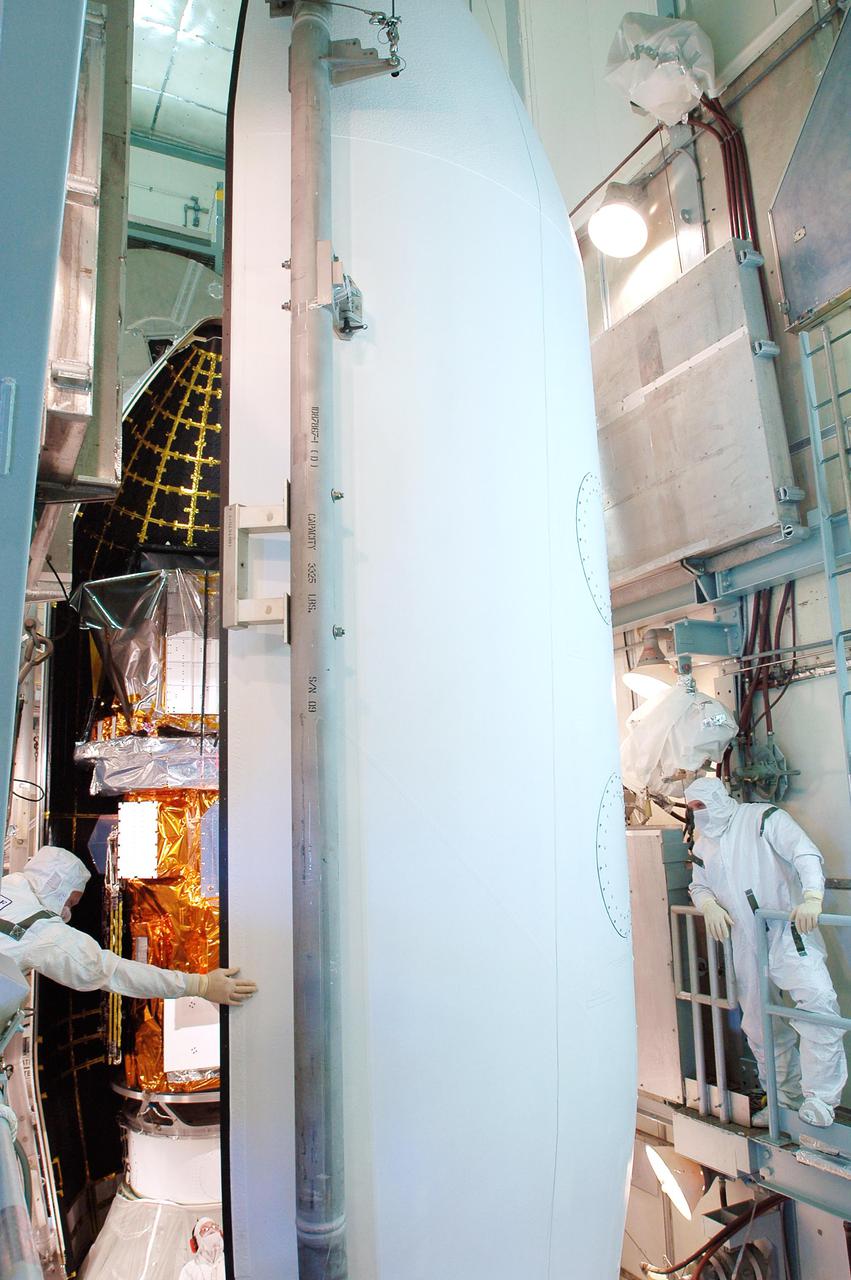
KENNEDY SPACE CENTER, FLA. - Boeing workers move the second section of the fairing around the Swift spacecraft inside the mobile service tower on Launch Pad 17-A, Cape Canaveral Air Force Station. The fairing is being installed around the payload for protection during launch and ascent. A Boeing Delta II rocket is the launch vehicle for the Swift spacecraft and its Gamma-Ray Burst Mission. Swift is a first-of-its-kind multi-wavelength observatory dedicated to the study of gamma-ray burst science. Its three instruments will work together to observe GRBs and afterglows in the gamma ray, X-ray, ultraviolet and optical wavebands. Swift is scheduled to launch Nov. 17 at 12:09 p.m. EST.
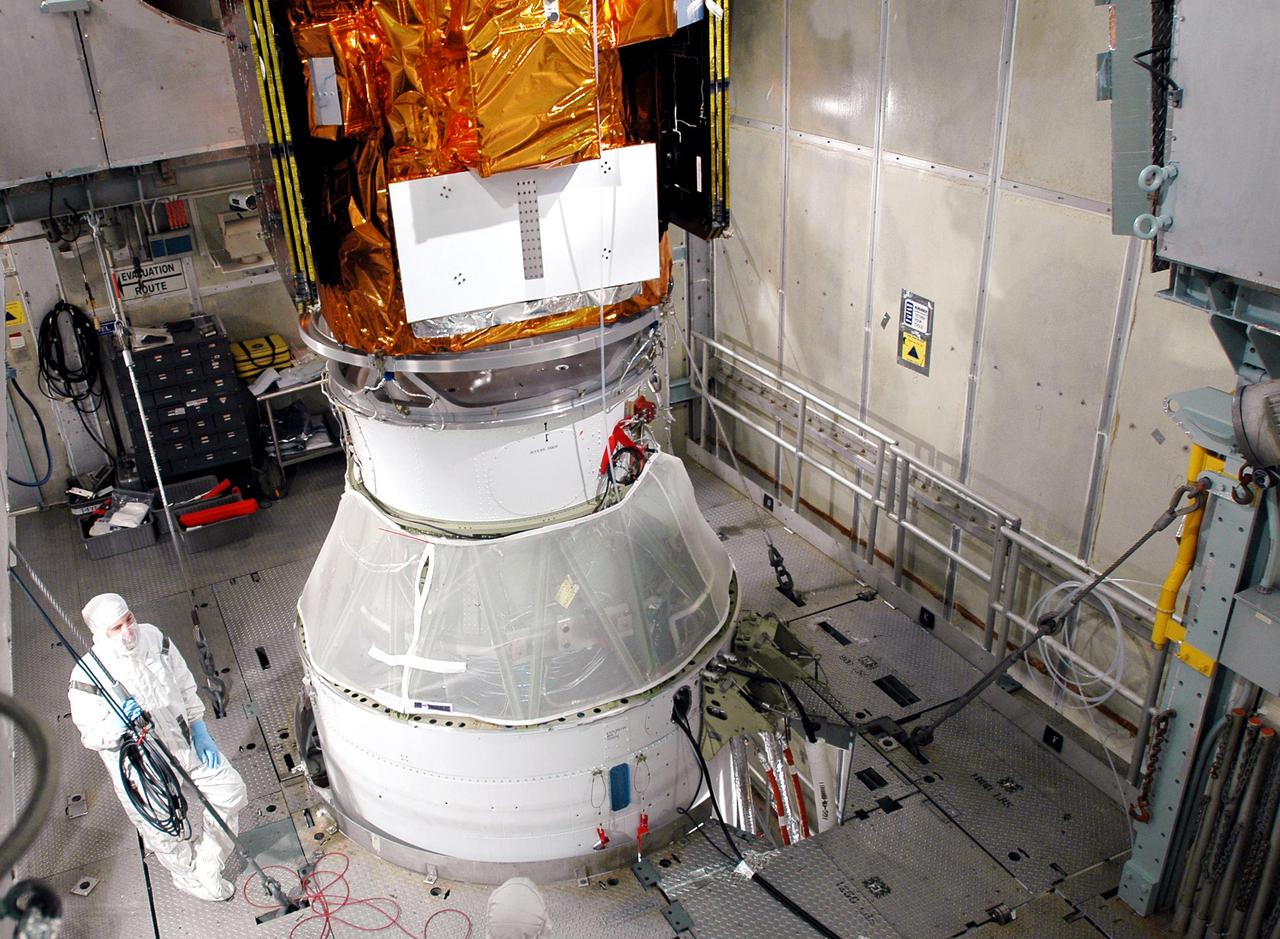
KENNEDY SPACE CENTER, FLA. - Inside the mobile service tower on Launch Pad 17-A, Cape Canaveral Air Force Station, the Swift spacecraft (on top) is ready for fairing encapsulation. On the bottom is the second stage of the Boeing Delta II launch vehicle. The fairing is being installed around the payload for protection during launch and ascent. A Boeing Delta II rocket is the launch vehicle for the Swift spacecraft and its Gamma-Ray Burst Mission. Swift is a first-of-its-kind multi-wavelength observatory dedicated to the study of gamma-ray burst science. Its three instruments will work together to observe GRBs and afterglows in the gamma ray, X-ray, ultraviolet and optical wavebands. Swift is scheduled to launch Nov. 17 at 12:09 p.m. EST.
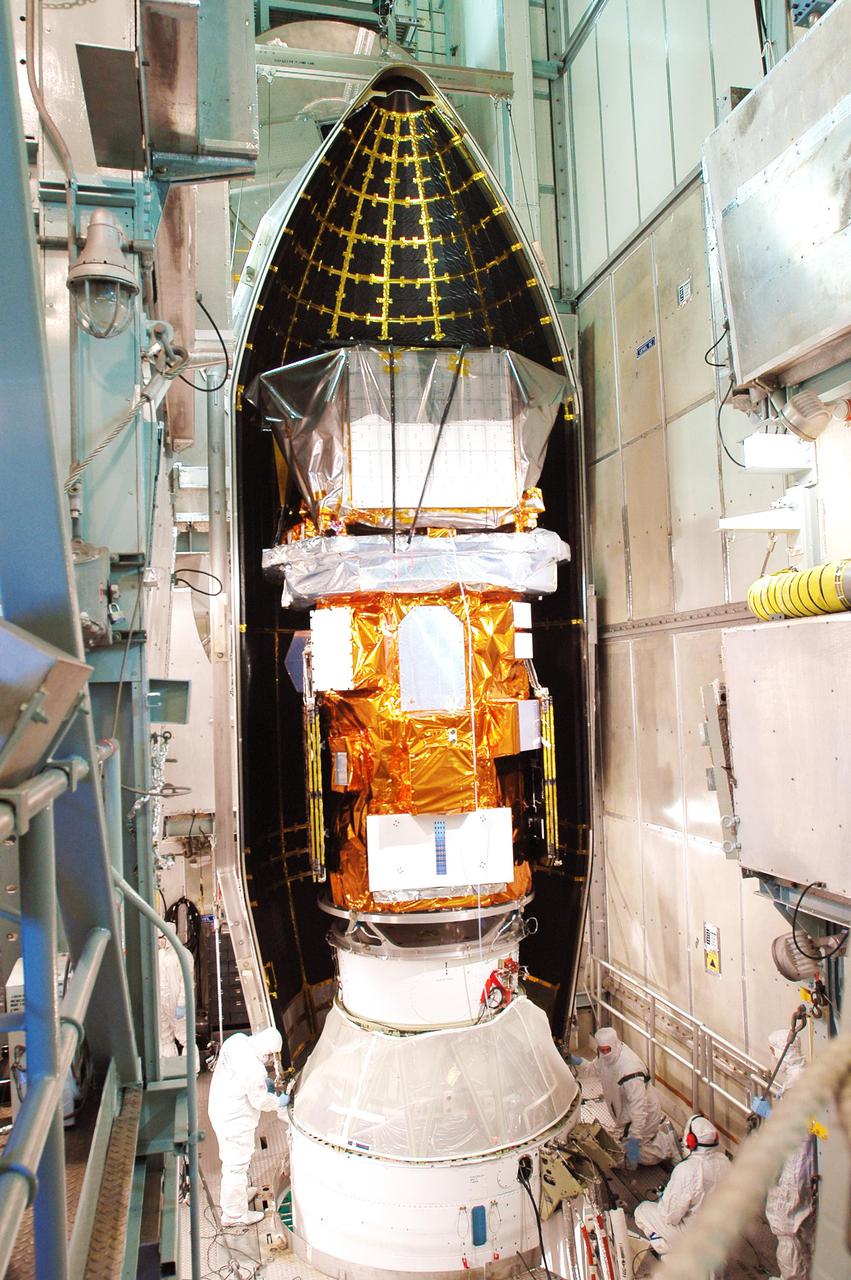
KENNEDY SPACE CENTER, FLA. - Boeing workers move the first part of the fairing into place around the Swift spacecraft inside the mobile service tower on Launch Pad 17-A, Cape Canaveral Air Force Station. The fairing is being installed around the payload for protection during launch and ascent. A Boeing Delta II rocket is the launch vehicle for the Swift spacecraft and its Gamma-Ray Burst Mission. Swift is a first-of-its-kind multi-wavelength observatory dedicated to the study of gamma-ray burst science. Its three instruments will work together to observe GRBs and afterglows in the gamma ray, X-ray, ultraviolet and optical wavebands. Swift is scheduled to launch Nov. 17 at 12:09 p.m. EST.
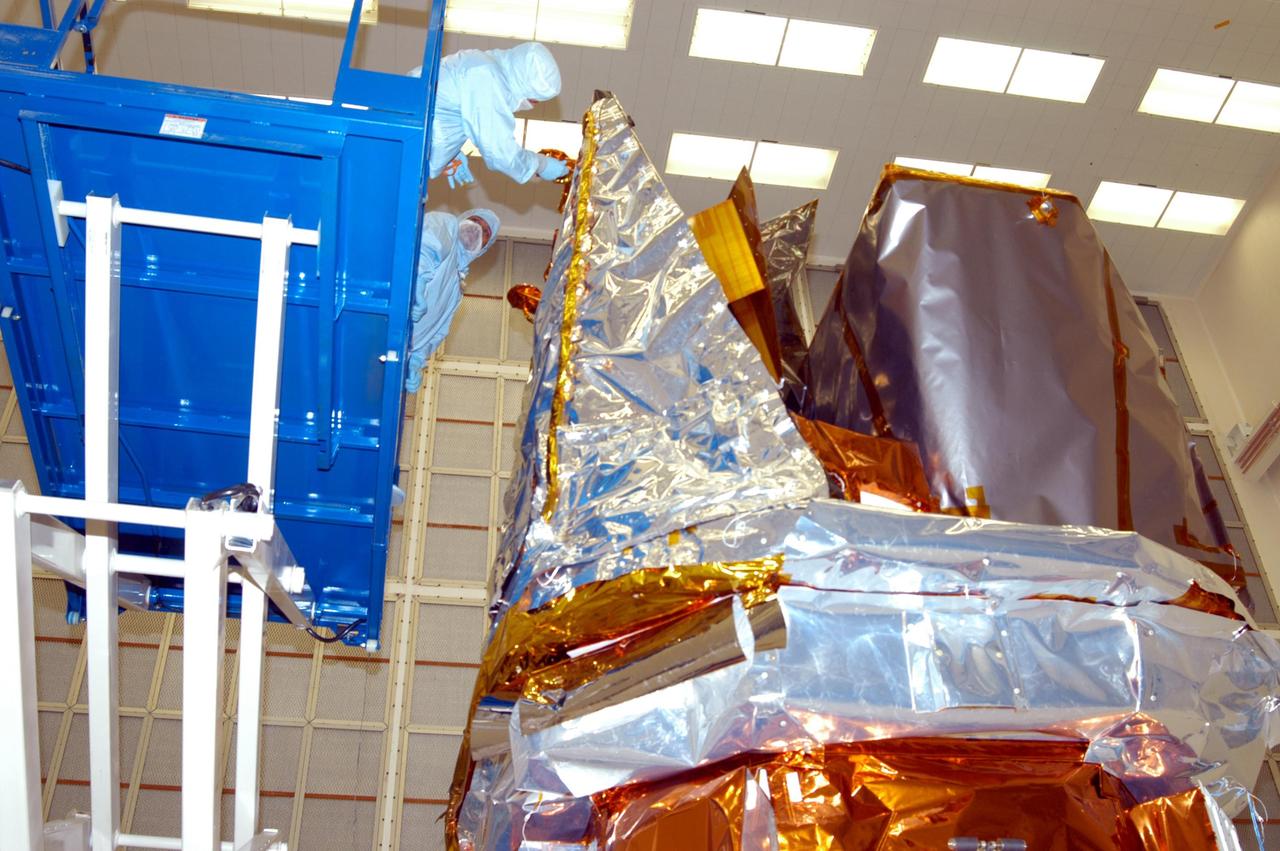
KENNEDY SPACE CENTER, FLA. - In Hangar AE at Cape Canaveral Air Force Station, technicians perform blanket closeouts on the Swift spacecraft. The blankets provide thermal stability during the mission. Swift is a first-of-its-kind multi-wavelength observatory dedicated to the study of gamma-ray burst (GRB) science. Its three instruments will work together to observe GRBs and afterglows in the gamma ray, X-ray, ultraviolet and optical wavebands. The most comprehensive study of GRB afterglows to date, Swift is expected to observe more than 200 gamma-ray bursts during its 2-year mission.
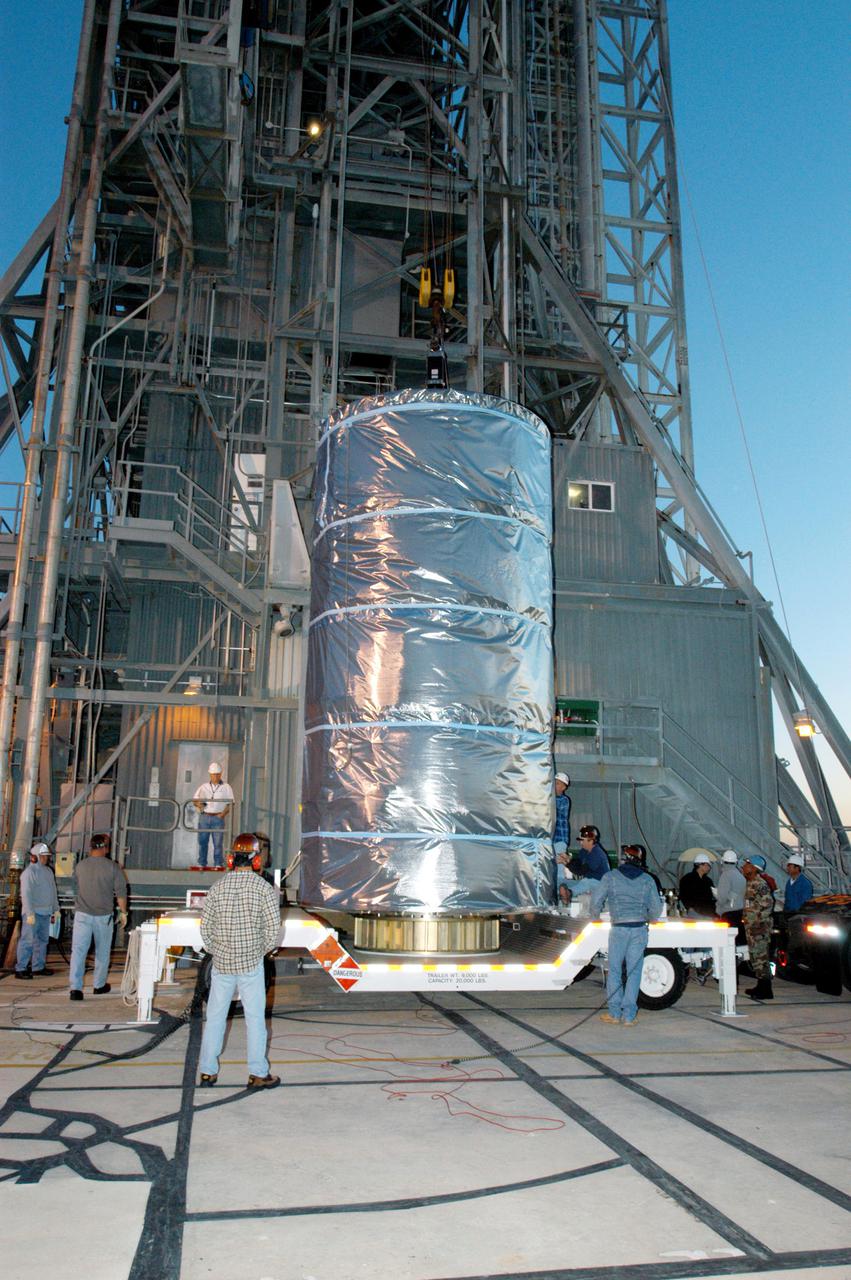
KENNEDY SPACE CENTER, FLA. - Wrapped inside a protective cover, the Swift spacecraft arrives at Launch Pad 17-A on Cape Canaveral Air Force Station in Florida. Swift is scheduled to launch Nov. 17. The liftoff aboard a Boeing Delta II rocket is targeted at the opening of a one-hour launch window beginning at 12:09 p.m. EST. A first-of-its-kind multi-wavelength observatory dedicated to the study of gamma-ray burst (GRB) science, Swift’s three instruments will work together to observe GRBs and afterglows in the gamma ray, X-ray, ultraviolet and optical wavebands. Gamma-ray bursts are distant, yet fleeting explosions that appear to signal the births of black holes.
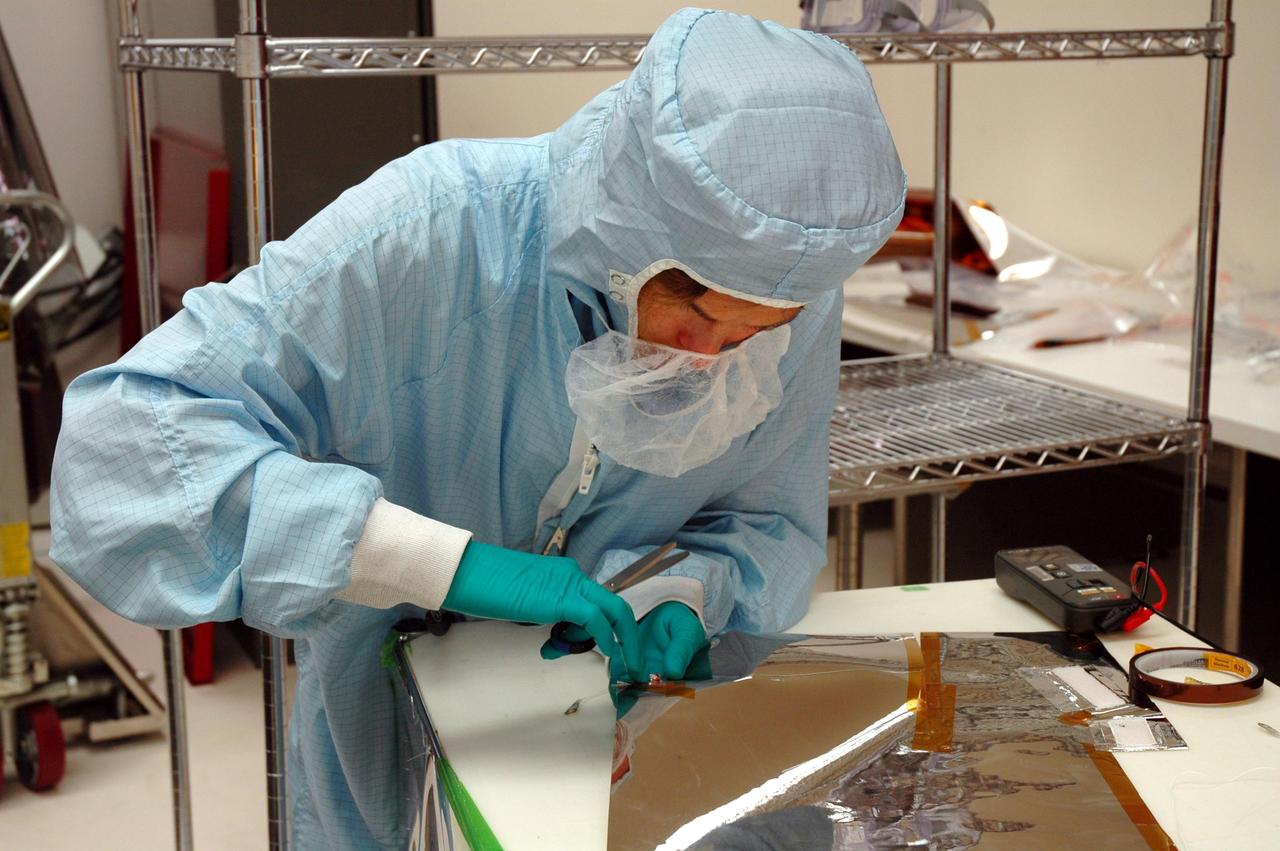
KENNEDY SPACE CENTER, FLA. - Hangar AE, Cape Canaveral Air Force Station, a technician trims blanket material that will be installed around the Swift spacecraft. The blankets provide thermal stability during the mission. Swift is a first-of-its-kind multi-wavelength observatory dedicated to the study of gamma-ray burst (GRB) science. Its three instruments will work together to observe GRBs and afterglows in the gamma ray, X-ray, ultraviolet and optical wavebands. Swift is expected to observe more than 200 gamma-ray bursts - the most comprehensive study of GRB afterglows to date - during its 2-year mission.

KENNEDY SPACE CENTER, FLA. - At Hangar AE, Cape Canaveral Air Force Station, a technician installs the blankets around the Swift spacecraft. The blankets provide thermal stability during the mission. Swift is a first-of-its-kind multi-wavelength observatory dedicated to the study of gamma-ray burst (GRB) science. Its three instruments will work together to observe GRBs and afterglows in the gamma ray, X-ray, ultraviolet and optical wavebands. Swift is expected to observe more than 200 gamma-ray bursts - the most comprehensive study of GRB afterglows to date - during its 2-year mission.
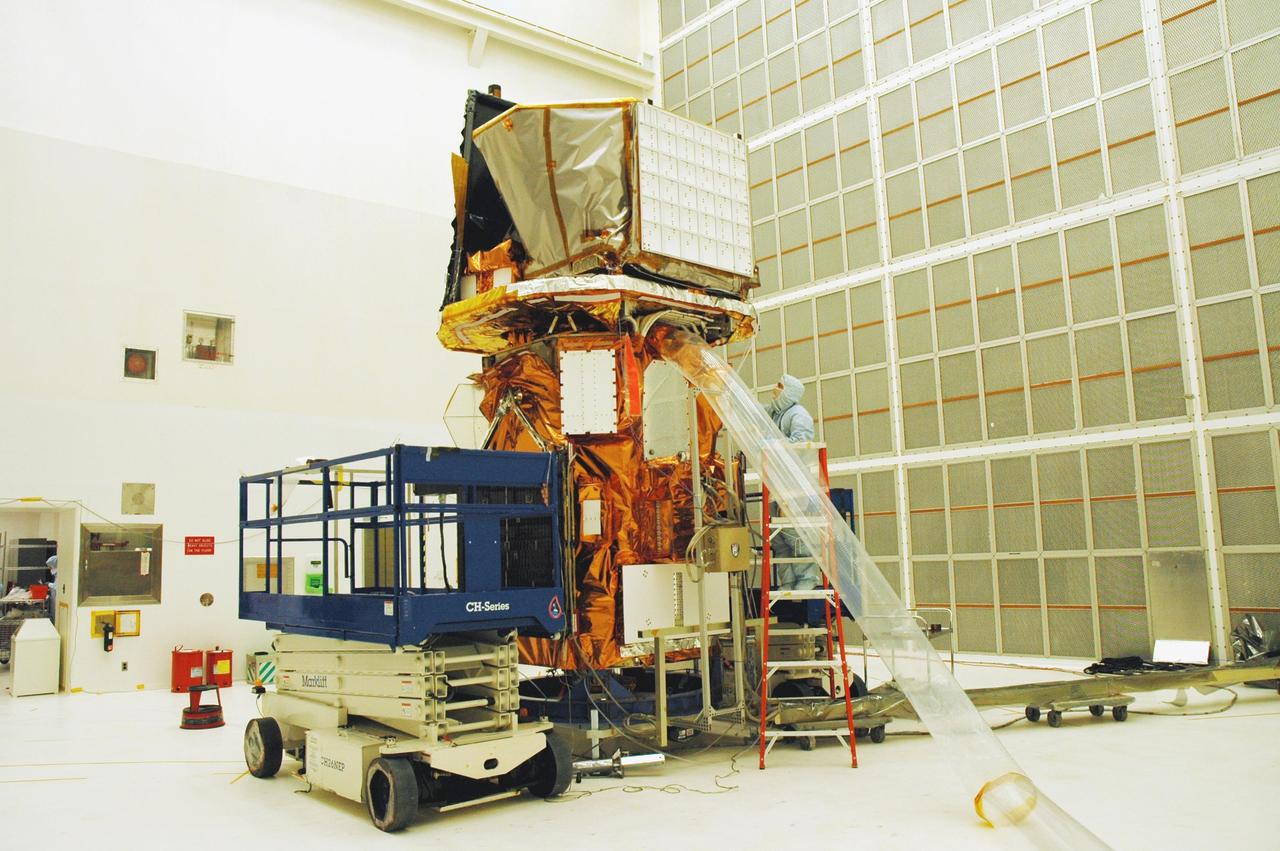
KENNEDY SPACE CENTER, FLA. - At Hangar AE, Cape Canaveral Air Force Station, technicians install the blankets around the Swift spacecraft. The blankets provide thermal stability during the mission. Swift is a first-of-its-kind multi-wavelength observatory dedicated to the study of gamma-ray burst (GRB) science. Its three instruments will work together to observe GRBs and afterglows in the gamma ray, X-ray, ultraviolet and optical wavebands. Swift is expected to observe more than 200 gamma-ray bursts - the most comprehensive study of GRB afterglows to date - during its 2-year mission.
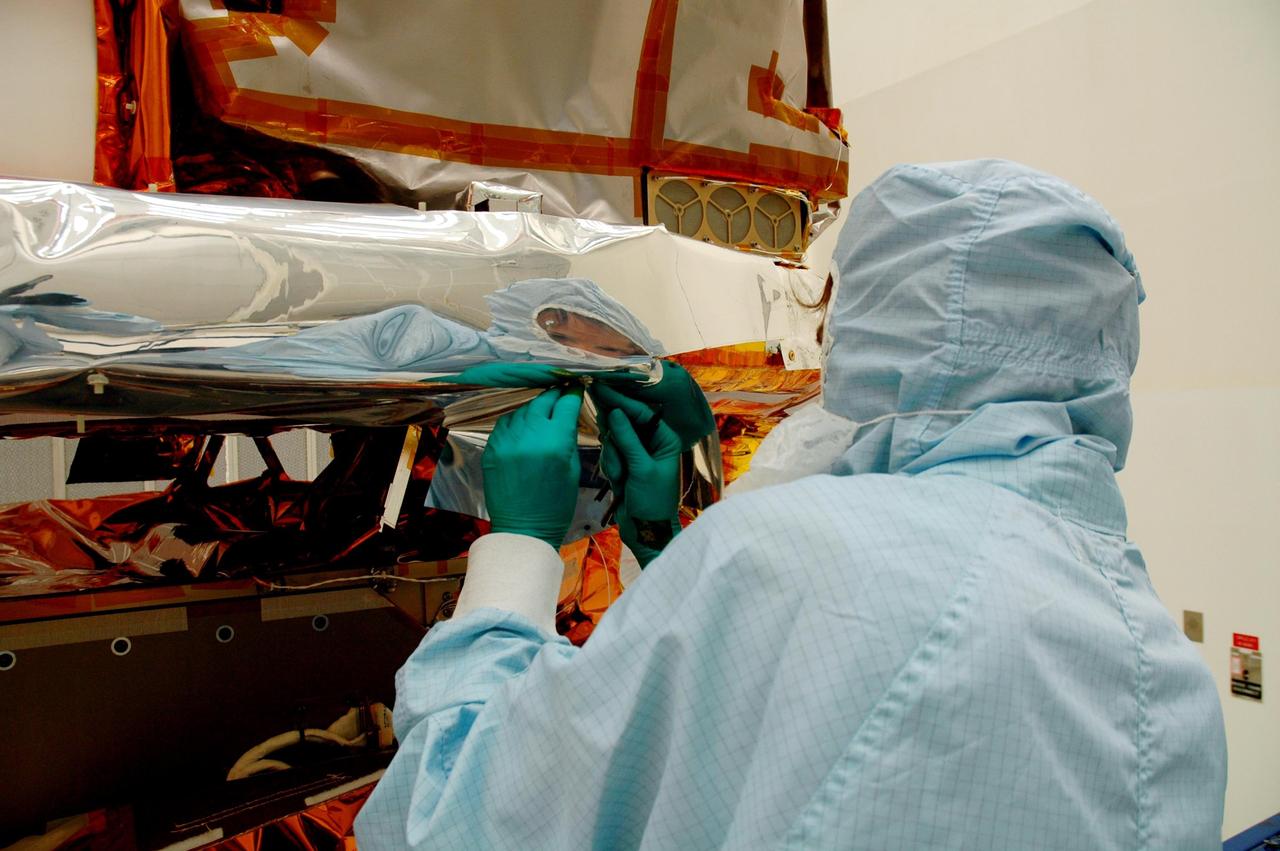
KENNEDY SPACE CENTER, FLA. - At Hangar AE, Cape Canaveral Air Force Station, a technician (right) watches while another completes installation of the blankets around the Swift spacecraft. The blankets provide thermal stability during the mission. Swift is a first-of-its-kind multi-wavelength observatory dedicated to the study of gamma-ray burst (GRB) science. Its three instruments will work together to observe GRBs and afterglows in the gamma ray, X-ray, ultraviolet and optical wavebands. Swift is expected to observe more than 200 gamma-ray bursts - the most comprehensive study of GRB afterglows to date - during its 2-year mission.
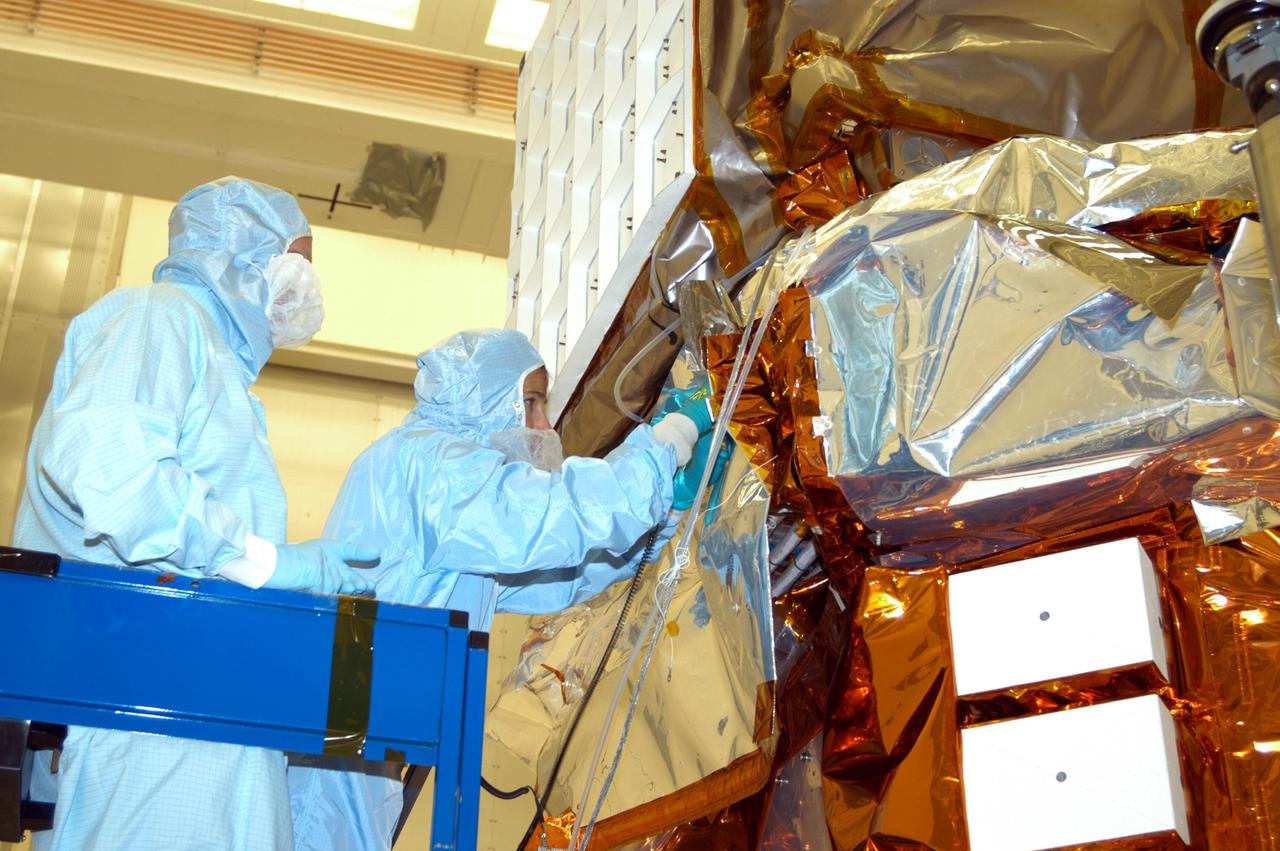
KENNEDY SPACE CENTER, FLA. - In Hangar AE at Cape Canaveral Air Force Station, technicians take a final look at the blankets installed on the Swift spacecraft. The blankets provide thermal stability during the mission. Swift is a first-of-its-kind multi-wavelength observatory dedicated to the study of gamma-ray burst (GRB) science. Its three instruments will work together to observe GRBs and afterglows in the gamma ray, X-ray, ultraviolet and optical wavebands. The most comprehensive study of GRB afterglows to date, Swift is expected to observe more than 200 gamma-ray bursts during its 2-year mission.
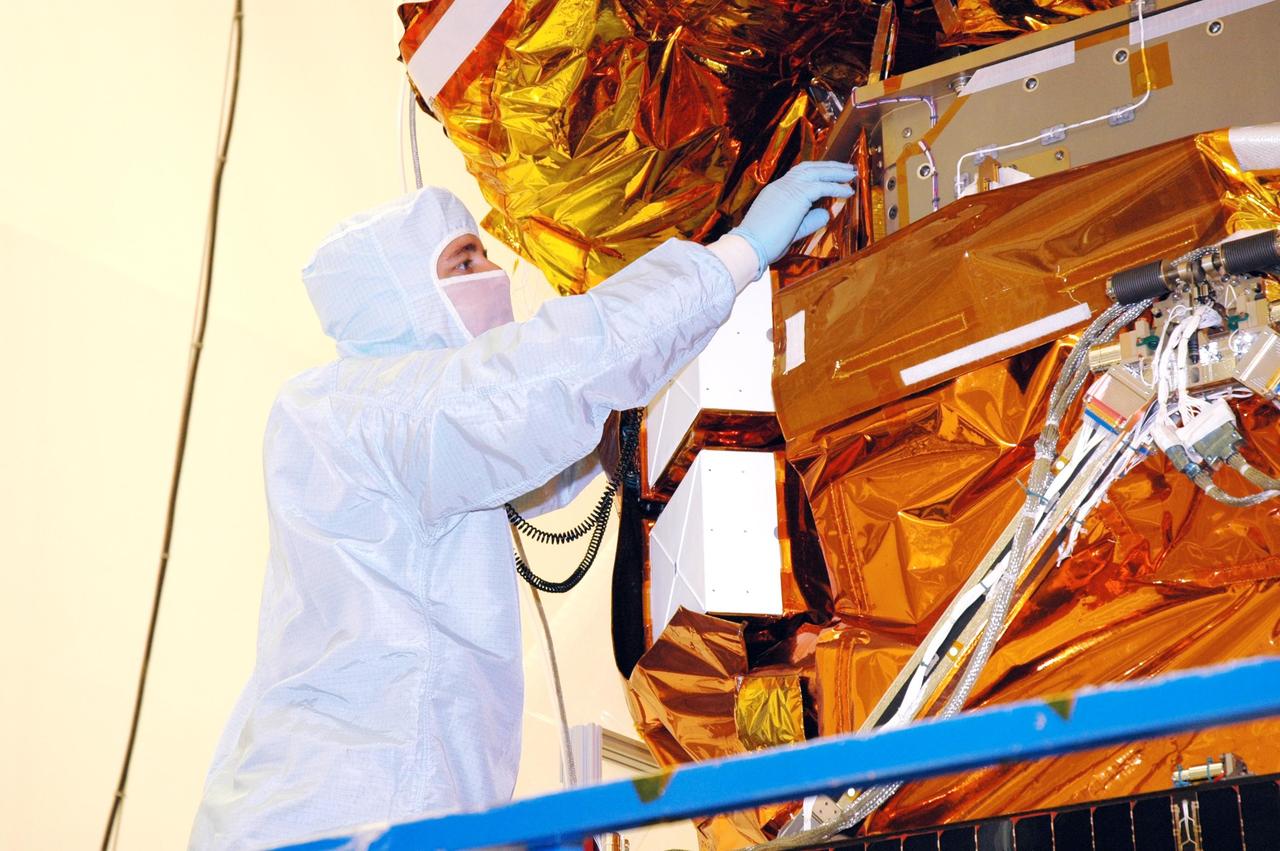
KENNEDY SPACE CENTER, FLA. - At Hangar AE, Cape Canaveral Air Force Station, a technician works on a blanket installed around the Swift spacecraft. The blankets provide thermal stability during the mission. Swift is a first-of-its-kind multi-wavelength observatory dedicated to the study of gamma-ray burst (GRB) science. Its three instruments will work together to observe GRBs and afterglows in the gamma ray, X-ray, ultraviolet and optical wavebands. Swift is expected to observe more than 200 gamma-ray bursts - the most comprehensive study of GRB afterglows to date - during its 2-year mission.
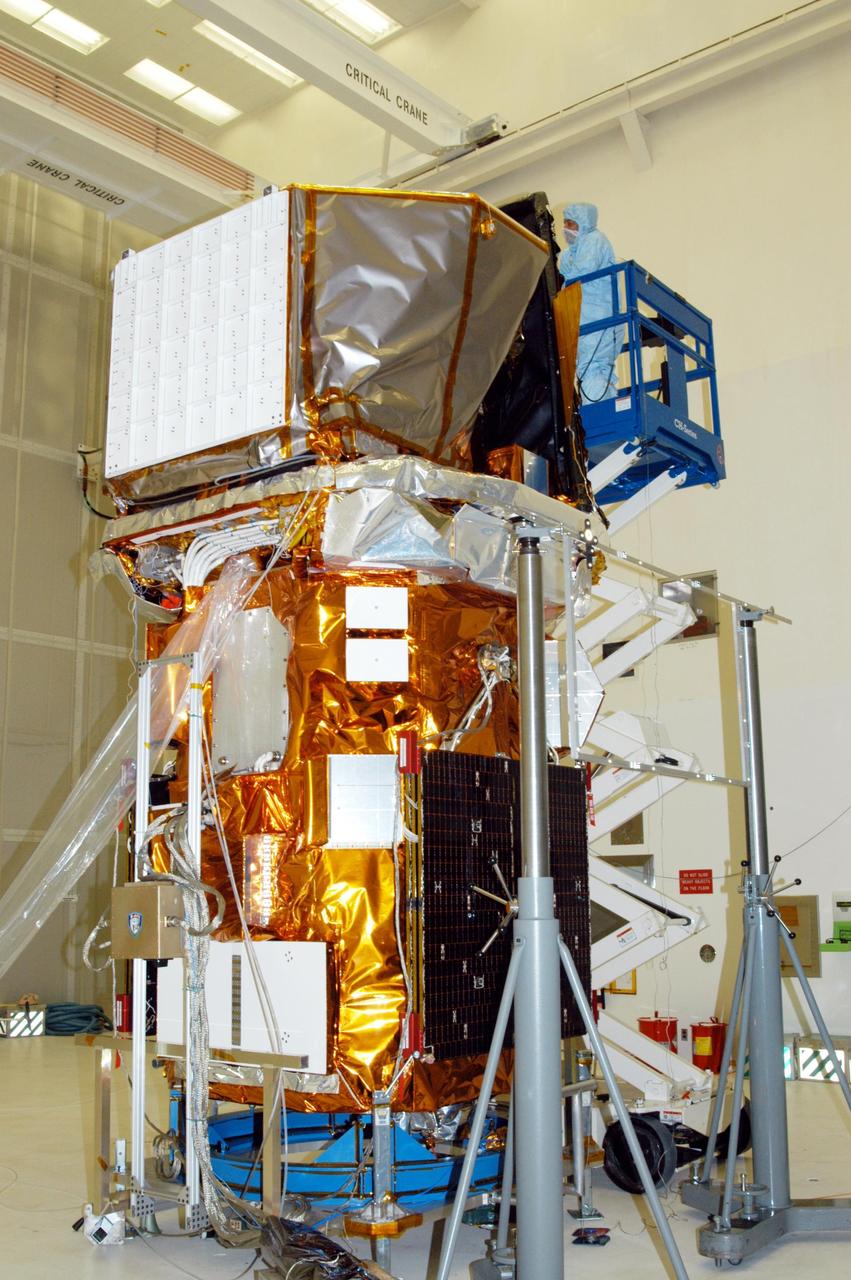
KENNEDY SPACE CENTER, FLA. - In Hangar AE at Cape Canaveral Air Force Station, a technician performs blanket closeouts on the Swift spacecraft. The blankets provide thermal stability during the mission. Swift is a first-of-its-kind multi-wavelength observatory dedicated to the study of gamma-ray burst (GRB) science. Its three instruments will work together to observe GRBs and afterglows in the gamma ray, X-ray, ultraviolet and optical wavebands. The most comprehensive study of GRB afterglows to date, Swift is expected to observe more than 200 gamma-ray bursts during its 2-year mission.

KENNEDY SPACE CENTER, FLA. - At Hangar AE, Cape Canaveral Air Force Station, a technician works on a blanket installed around the Swift spacecraft. The blankets provide thermal stability during the mission. Swift is a first-of-its-kind multi-wavelength observatory dedicated to the study of gamma-ray burst (GRB) science. Its three instruments will work together to observe GRBs and afterglows in the gamma ray, X-ray, ultraviolet and optical wavebands. Swift is expected to observe more than 200 gamma-ray bursts - the most comprehensive study of GRB afterglows to date - during its 2-year mission.
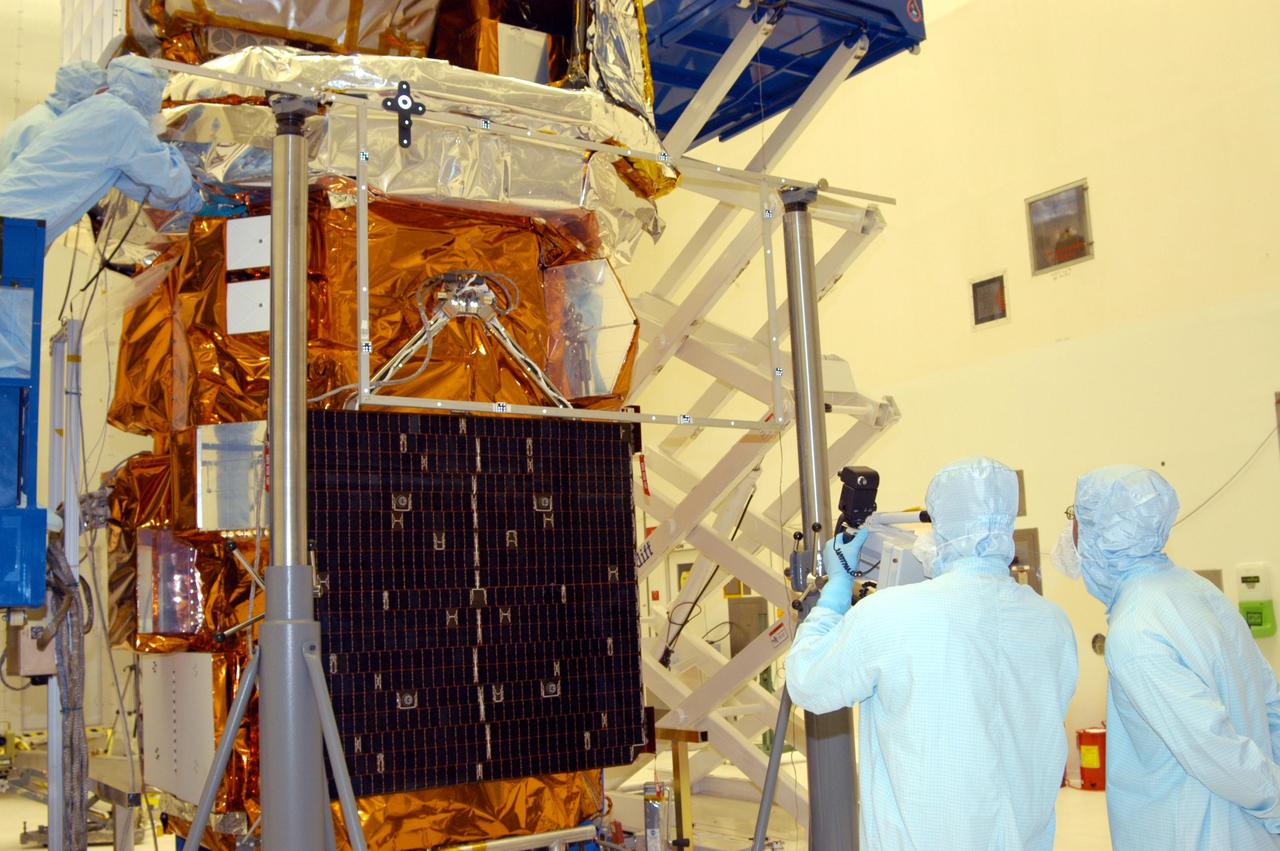
KENNEDY SPACE CENTER, FLA. - In Hangar AE at Cape Canaveral Air Force Station, technicians perform blanket closeouts on the Swift spacecraft. The blankets provide thermal stability during the mission. Swift is a first-of-its-kind multi-wavelength observatory dedicated to the study of gamma-ray burst (GRB) science. Its three instruments will work together to observe GRBs and afterglows in the gamma ray, X-ray, ultraviolet and optical wavebands. The most comprehensive study of GRB afterglows to date, Swift is expected to observe more than 200 gamma-ray bursts during its 2-year mission.
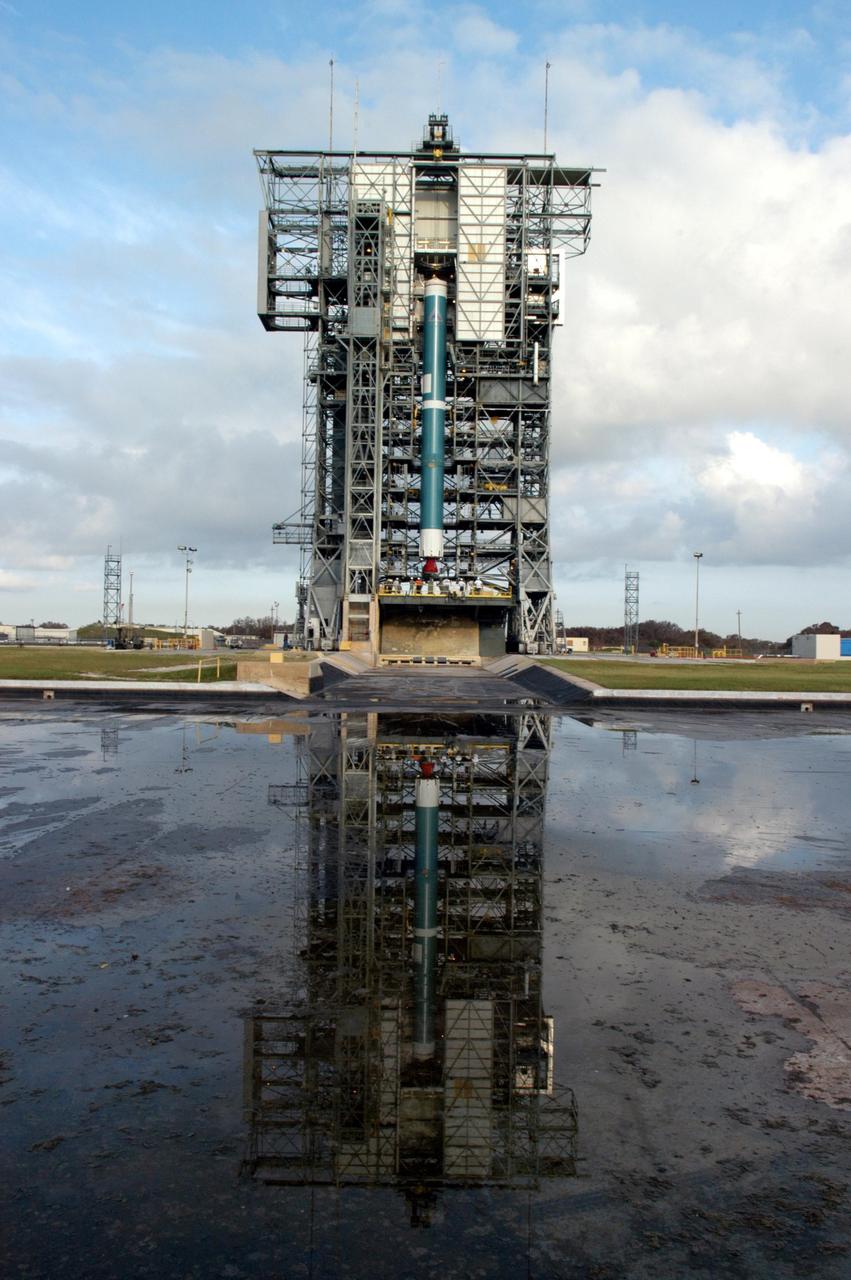
KENNEDY SPACE CENTER, FLA. - On Launch Complex 17-A at Cape Canaveral Air Force Station, Fla., the first stage of a Boeing Delta II rocket inside the mobile service tower is reflected in the overflow pool (foreground). The rocket is the launch vehicle for the Swift spacecraft and its Gamma-Ray Burst Mission, now scheduled for liftoff no earlier than Nov. 2. Swift is a medium-class Explorer mission managed by NASA’s Goddard Space Flight Center in Greenbelt, Md. The observatory was built for NASA by Spectrum Astro, a division of General Dynamics. KSC is responsible for Swift’s integration with the Boeing Delta II rocket and the countdown management on launch day.
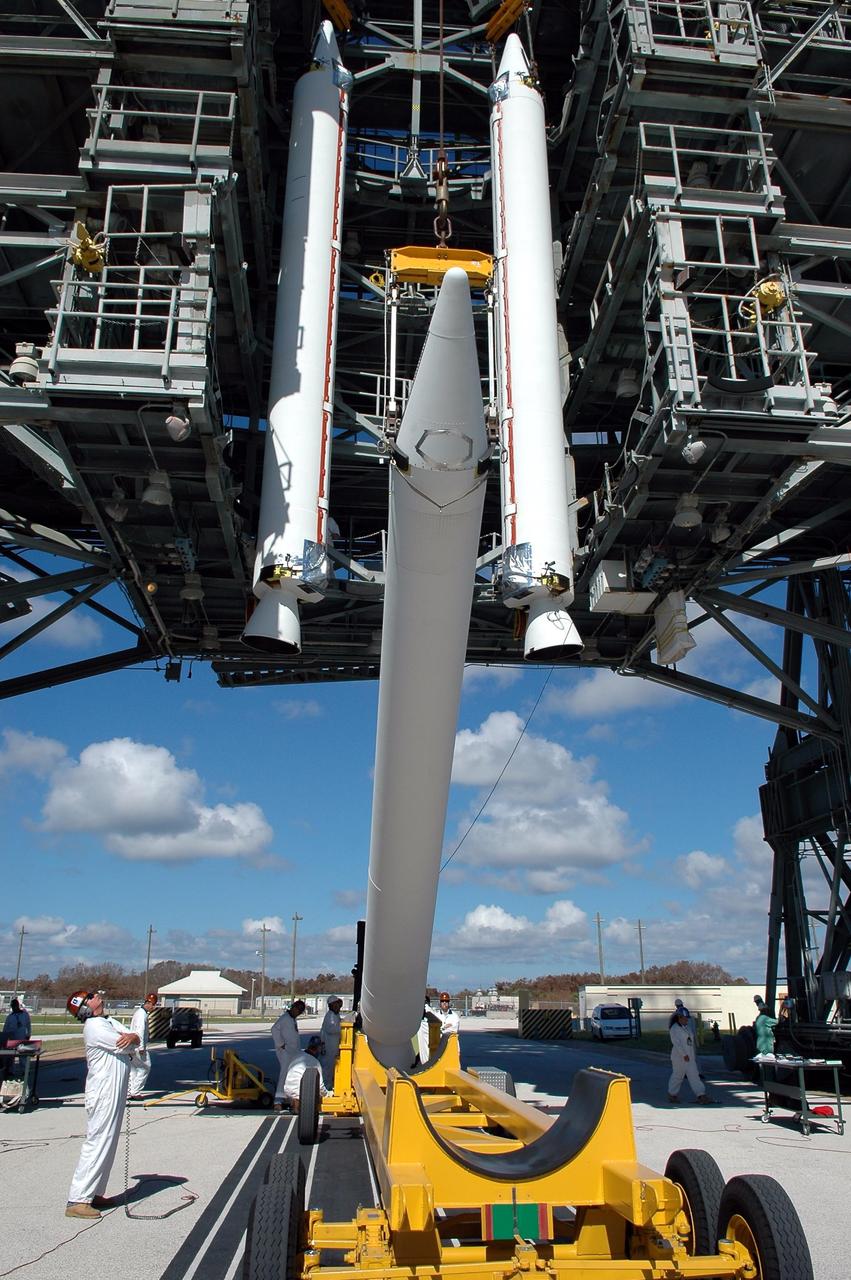
KENNEDY SPACE CENTER, FLA. - On Pad 17-A, Cape Canaveral Air Force Station, two Solid Rocket Boosters are ready in the mobile service tower and a third is lifted from its transporter. In all, three SRBs will be attached to the Boeing Delta launch vehicle for the Swift spacecraft and its Gamma-Ray Burst Mission. Swift is a medium-class Explorer mission managed by NASA’s Goddard Space Flight Center in Greenbelt, Md.
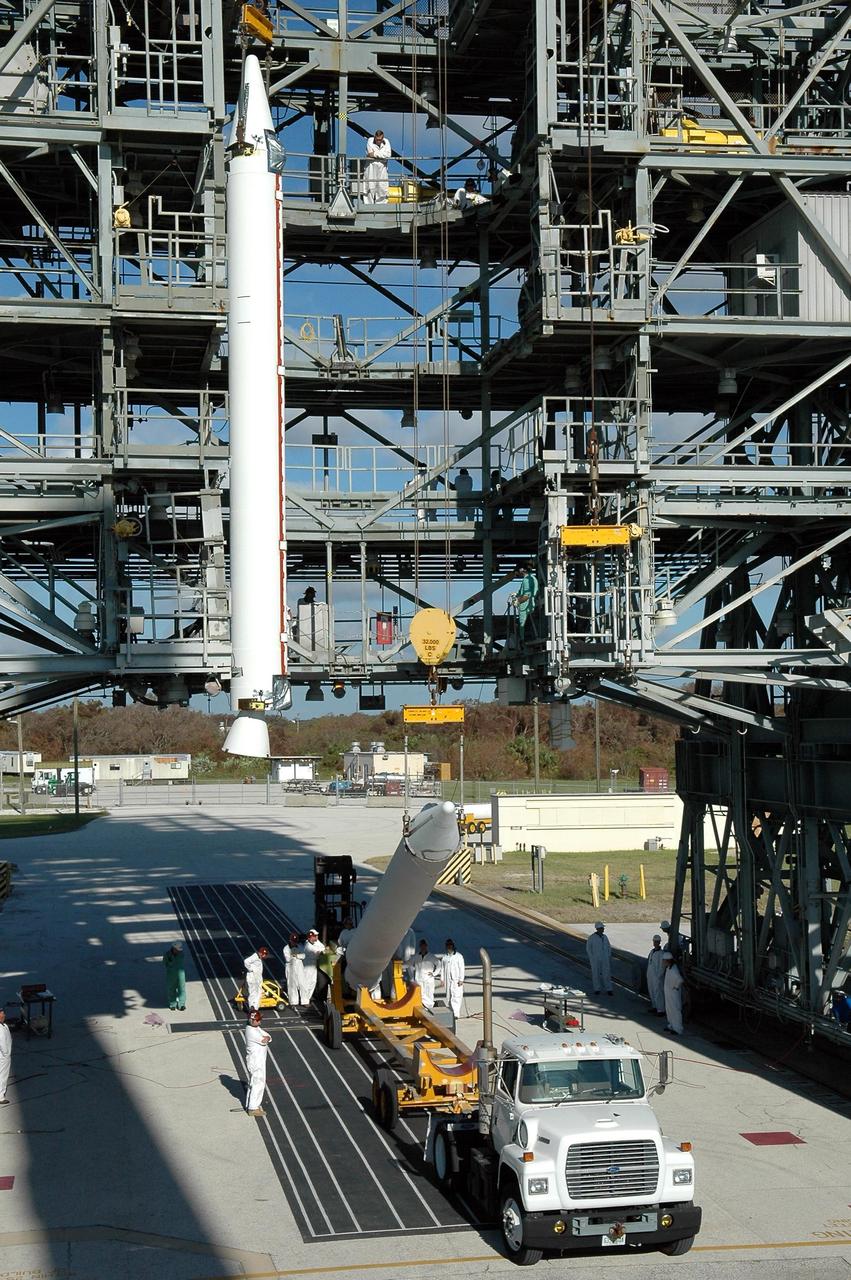
KENNEDY SPACE CENTER, FLA. - On Pad 17-A, Cape Canaveral Air Force Station, one Solid Rocket Booster is ready in the mobile service tower and a second is lifted from its transporter. In all, three SRBs will be attached to the Boeing Delta launch vehicle for the Swift spacecraft and its Gamma-Ray Burst Mission. Swift is a medium-class Explorer mission managed by NASA’s Goddard Space Flight Center in Greenbelt, Md.
![KENNEDY SPACE CENTER, FLA. - The Boeing Delta II launch vehicle for NASA’s Swift spacecraft is poised for launch at the scheduled liftoff time of 12:16:00.611 p.m. EST from Launch Pad 17-A on Cape Canaveral Air Force Station, Fla. Swift is a first-of-its-kind multi-wavelength observatory dedicated to the study of gamma-ray burst science. Its three instruments will work together to observe GRBs and afterglows in the gamma ray, X-ray, ultraviolet and optical wavebands. [Photo courtesy of Scott Andrews]](https://images-assets.nasa.gov/image/04pd2384/04pd2384~medium.jpg)
KENNEDY SPACE CENTER, FLA. - The Boeing Delta II launch vehicle for NASA’s Swift spacecraft is poised for launch at the scheduled liftoff time of 12:16:00.611 p.m. EST from Launch Pad 17-A on Cape Canaveral Air Force Station, Fla. Swift is a first-of-its-kind multi-wavelength observatory dedicated to the study of gamma-ray burst science. Its three instruments will work together to observe GRBs and afterglows in the gamma ray, X-ray, ultraviolet and optical wavebands. [Photo courtesy of Scott Andrews]
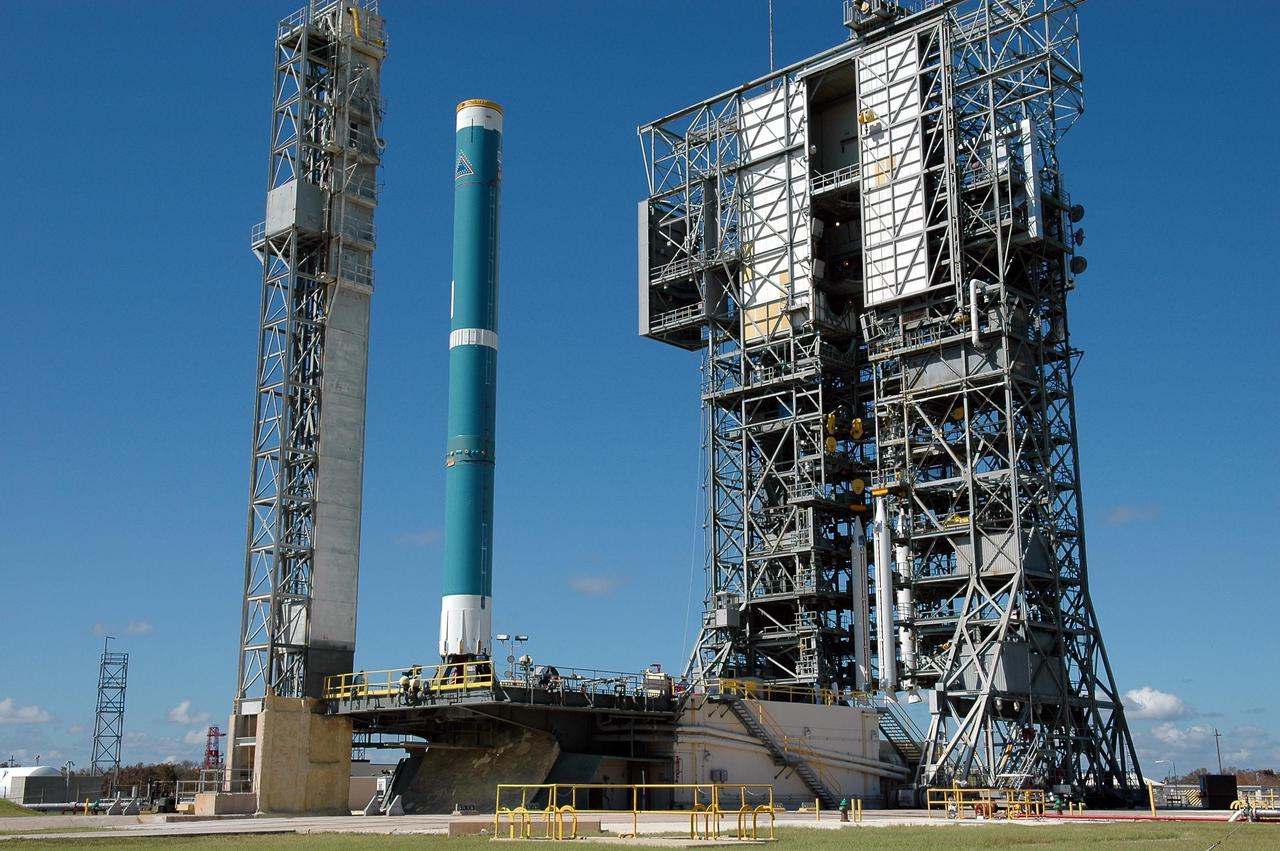
KENNEDY SPACE CENTER, FLA. - On Pad 17-A, Cape Canaveral Air Force Station, the mobile service tower at right moves with three Solid Rocket Boosters toward the Boeing Delta first stage at left. The three SRBs will be attached to the Boeing Delta launch vehicle for the Swift spacecraft and its Gamma-Ray Burst Mission. Swift is a medium-class Explorer mission managed by NASA’s Goddard Space Flight Center in Greenbelt, Md.
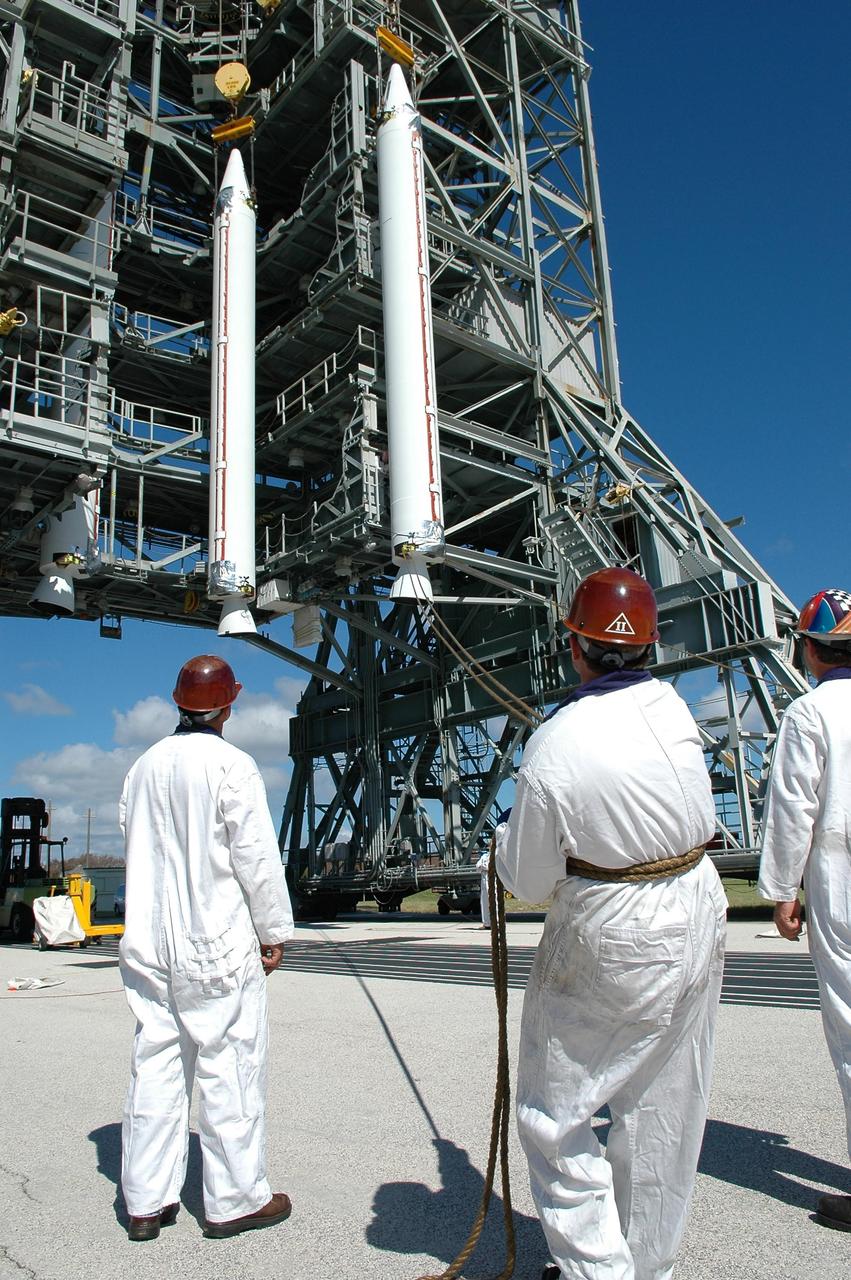
KENNEDY SPACE CENTER, FLA. - On Pad 17-A, Cape Canaveral Air Force Station, technicians on the ground hold guide ropes as a Solid Rocket Booster is lifted in to the mobile service tower. In all, three SRBs will be attached to the Boeing Delta launch vehicle for the Swift spacecraft and its Gamma-Ray Burst Mission. Swift is a medium-class Explorer mission managed by NASA’s Goddard Space Flight Center in Greenbelt, Md.
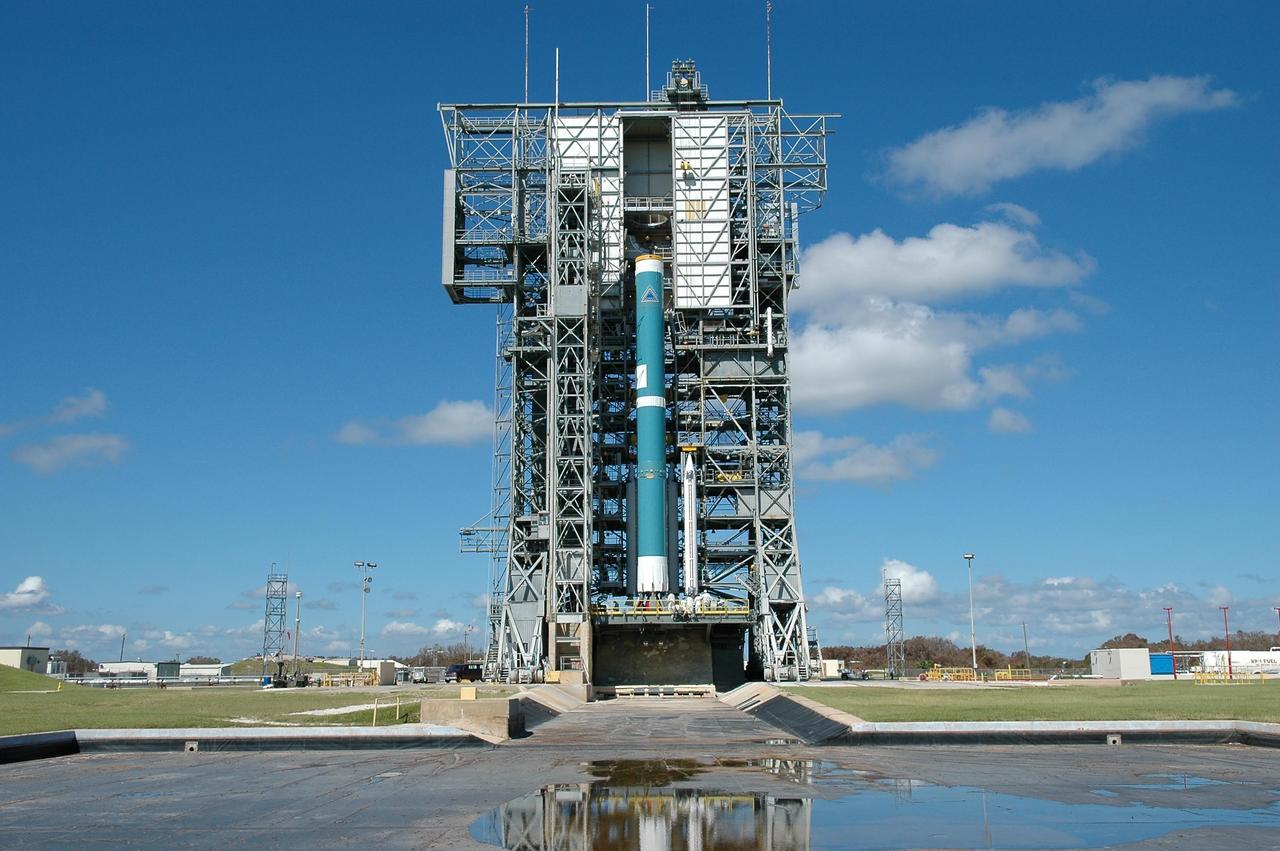
KENNEDY SPACE CENTER, FLA. - On Pad 17-A, Cape Canaveral Air Force Station, three Solid Rocket Boosters are moved into place around the Boeing Delta first stage. The three SRBs will be attached to the Boeing Delta launch vehicle for the Swift spacecraft and its Gamma-Ray Burst Mission. Swift is a medium-class Explorer mission managed by NASA’s Goddard Space Flight Center in Greenbelt, Md.
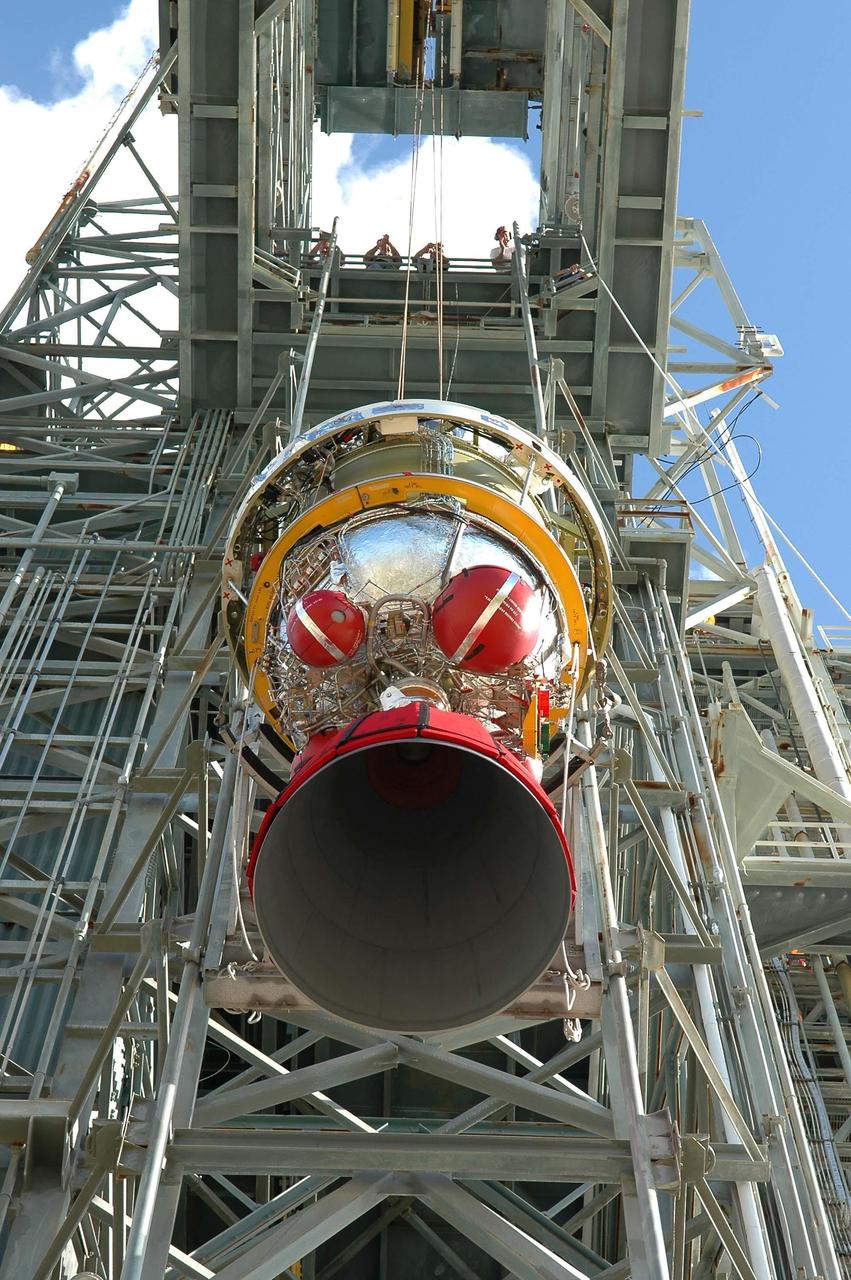
KENNEDY SPACE CENTER, FLA. - At Launch Pad 17-A on Cape Canaveral Air Force Station, the second stage of the Boeing Delta II launch vehicle is being lifted up the mobile service tower for mating with the first stage. The rocket is the launch vehicle for the Swift spacecraft and its Gamma-Ray Burst Mission, now scheduled for liftoff Nov. 8. Swift is a medium-class Explorer mission managed by NASA’s Goddard Space Flight Center in Greenbelt, Md. It is a first-of-its-kind multi-wavelength observatory dedicated to the study of gamma-ray burst (GRB) science. Its three instruments will work together to observe GRBs and afterglows in the gamma ray, X-ray, ultraviolet and optical wavebands. KSC is responsible for Swift’s integration with the Boeing Delta II rocket and the countdown management on launch day.