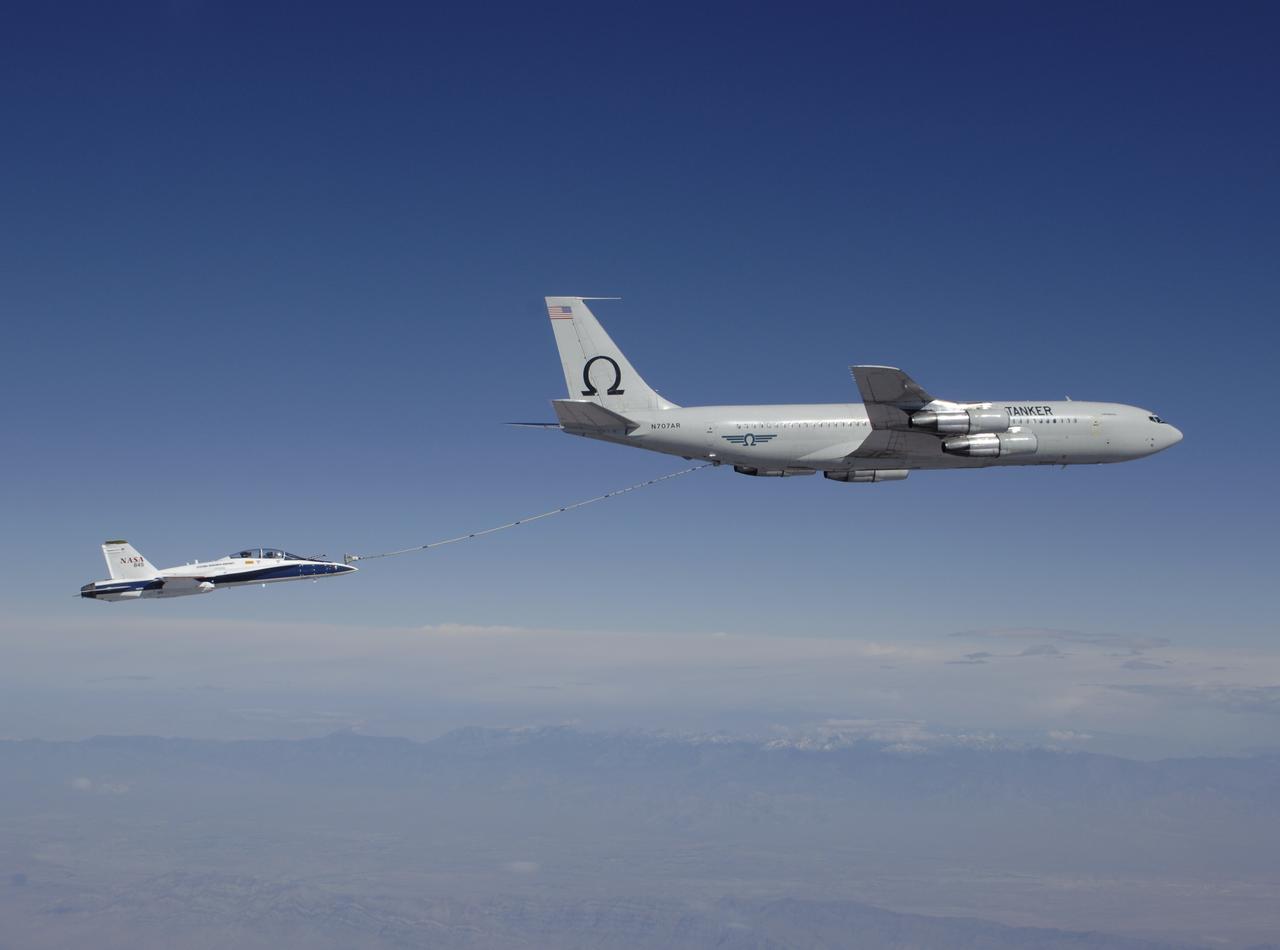
F/A-18 #845 behind an Omega Air Boeing 707 tanker during an Autonomous Airborne Refueling Demonstration (AARD) flight.
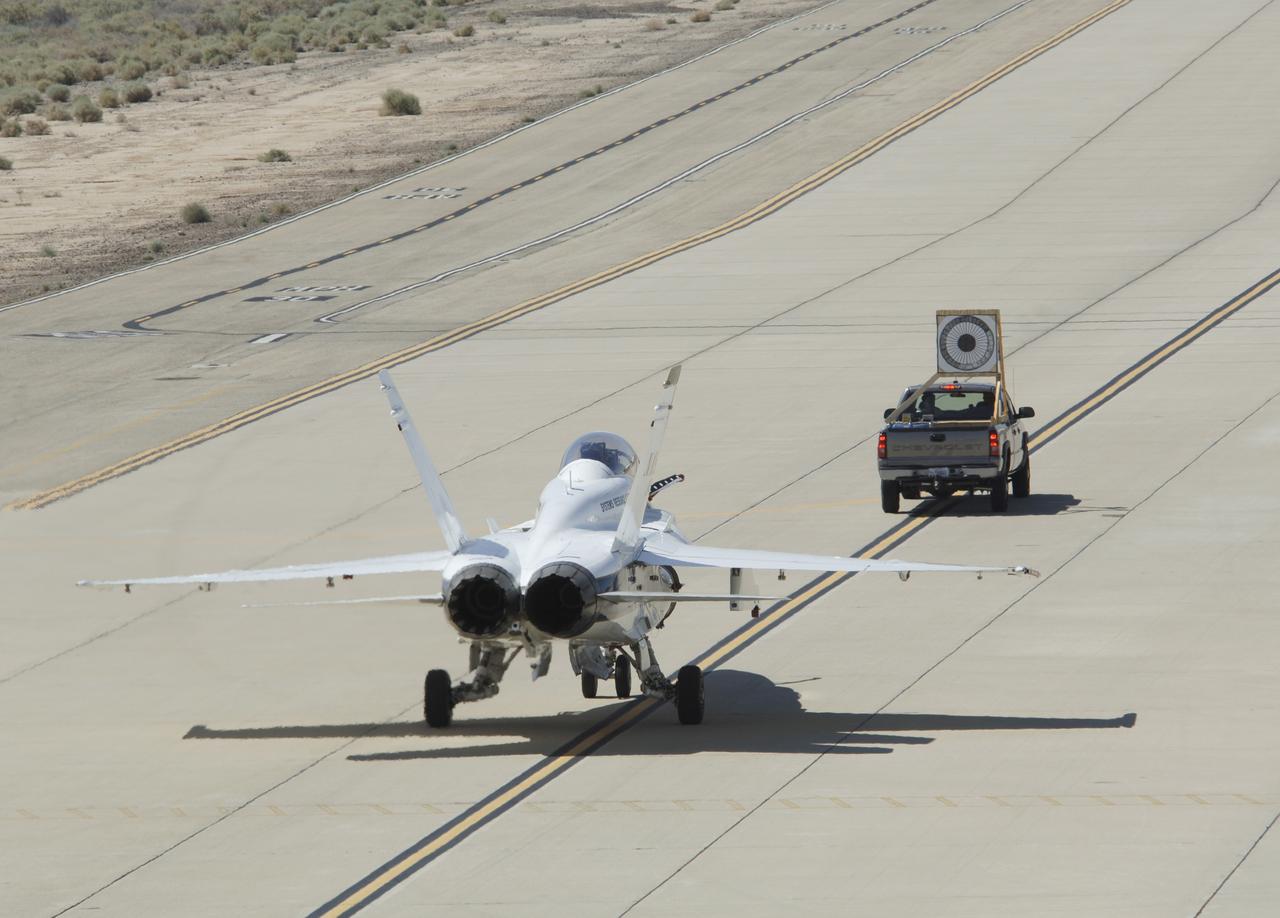
F/A-18 #845 testing autonomous system for AARD project by following a pickup with an airborne tanker drogue illustration.
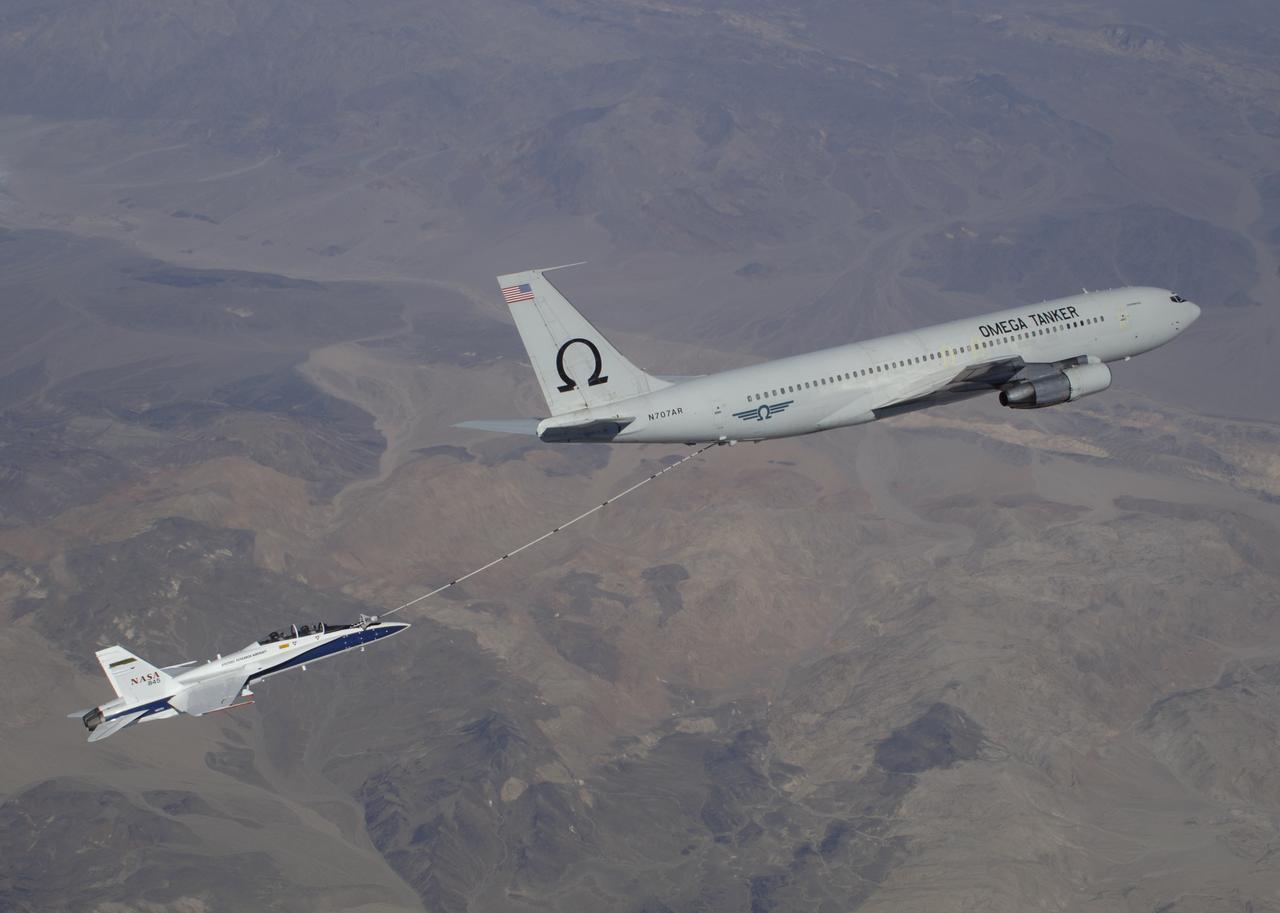
F/A-18 #845 behind an Omega Air Boeing 707 tanker during an Autonomous Airborne Refueling Demonstration (AARD) flight.
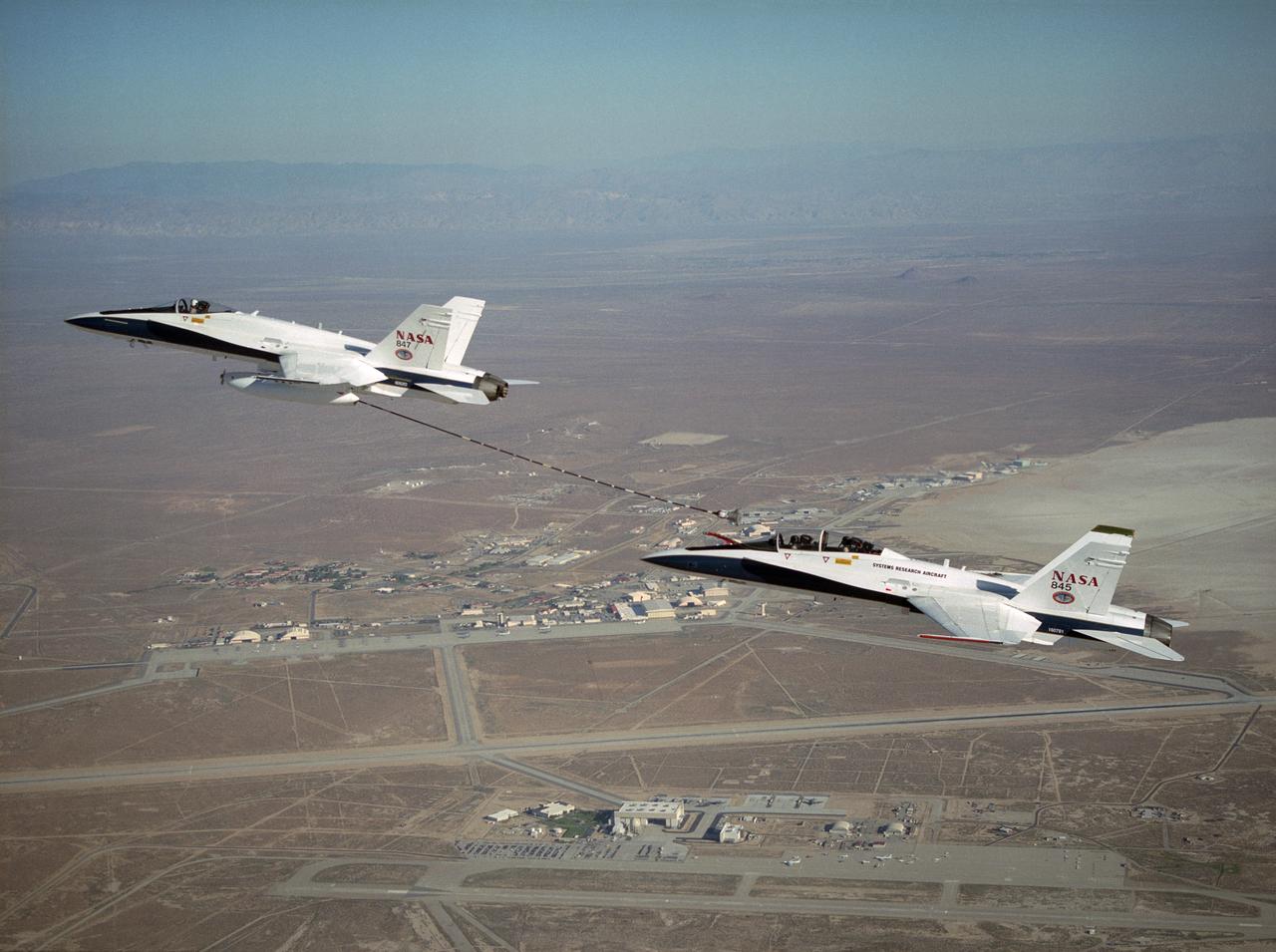
NASA Dryden's Automated Aerial Refueling (AAR) project evaluated the capability of an F/A-18A aircraft as an in-flight refueling tanker with the objective of developing analytical models for an automated aerial refueling system for unmanned air vehicles. The F/A-18 "tanker" aircraft (No. 847) underwent flight test envelope expansion with an aerodynamic pod containing air-refueling equipment carried beneath the fuselage. The second aircraft flew as the receiver aircraft during the study to assess the free-stream hose and drogue dynamics on the F/A-18A.
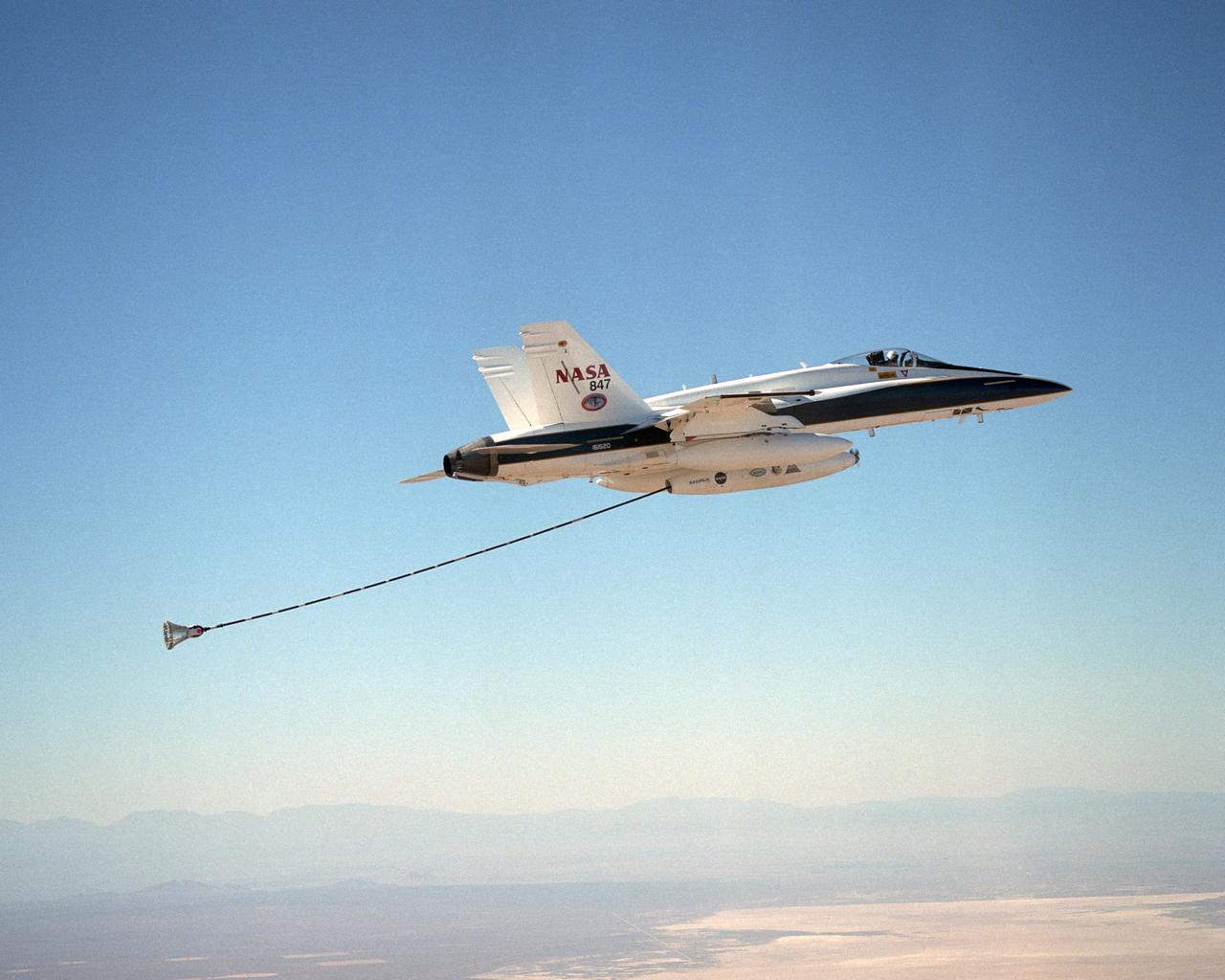
NASA Dryden's Automated Aerial Refueling (AAR) project evaluated the capability of an F/A-18A aircraft as an in-flight refueling tanker with the objective of developing analytical models for an automated aerial refueling system for unmanned air vehicles. The F/A-18 "tanker" aircraft (No. 847) underwent flight test envelope expansion with an aerodynamic pod containing air-refueling equipment carried beneath the fuselage. The second aircraft flew as the receiver aircraft during the study to assess the free-stream hose and drogue dynamics on the F/A-18A.
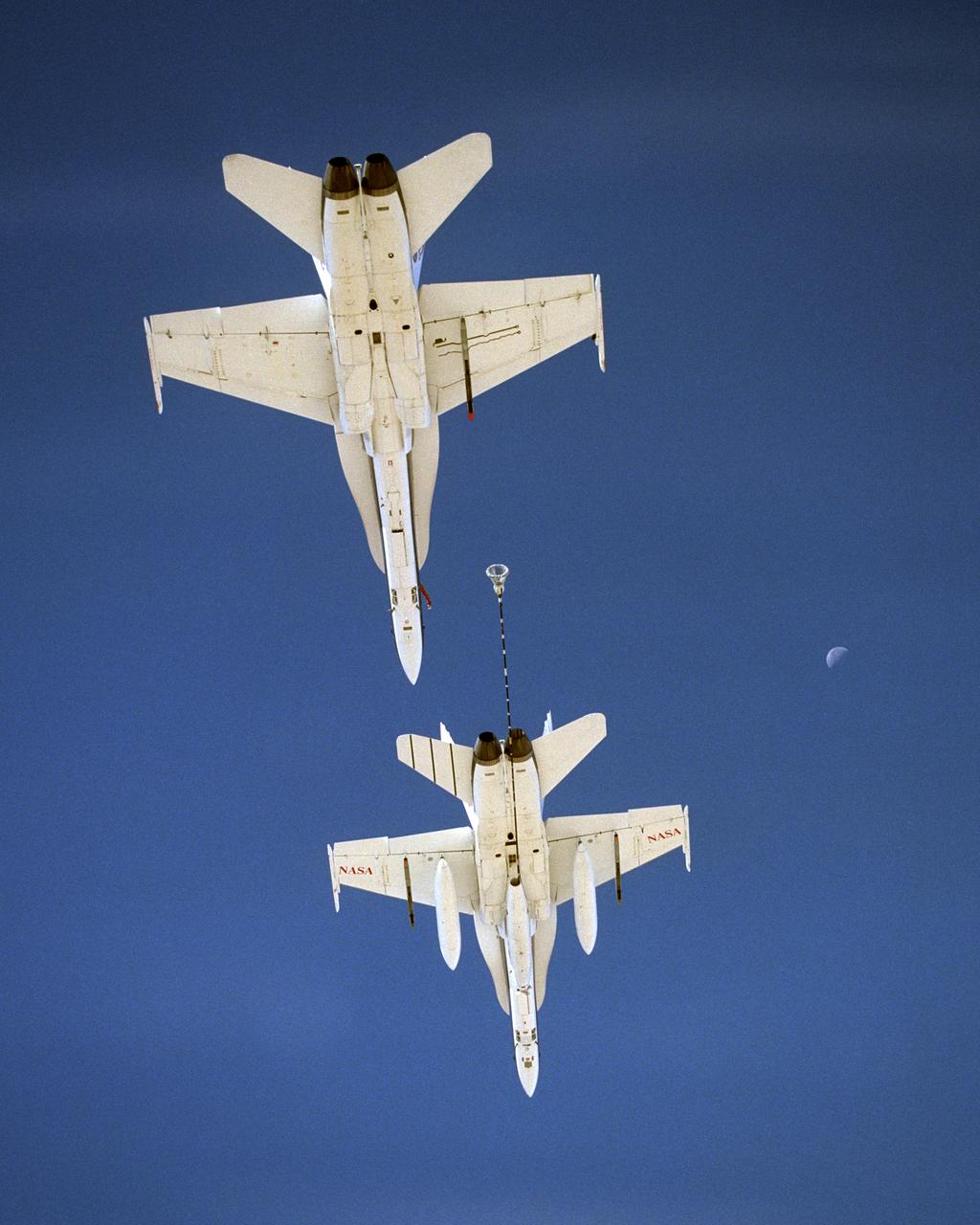
NASA Dryden's Automated Aerial Refueling (AAR) project evaluated the capability of an F/A-18A aircraft as an in-flight refueling tanker with the objective of developing analytical models for an automated aerial refueling system for unmanned air vehicles. The F/A-18 "tanker" aircraft (No. 847) underwent flight test envelope expansion with an aerodynamic pod containing air-refueling equipment carried beneath the fuselage. The second aircraft flew as the receiver aircraft during the study to assess the free-stream hose and drogue dynamics on the F/A-18A.
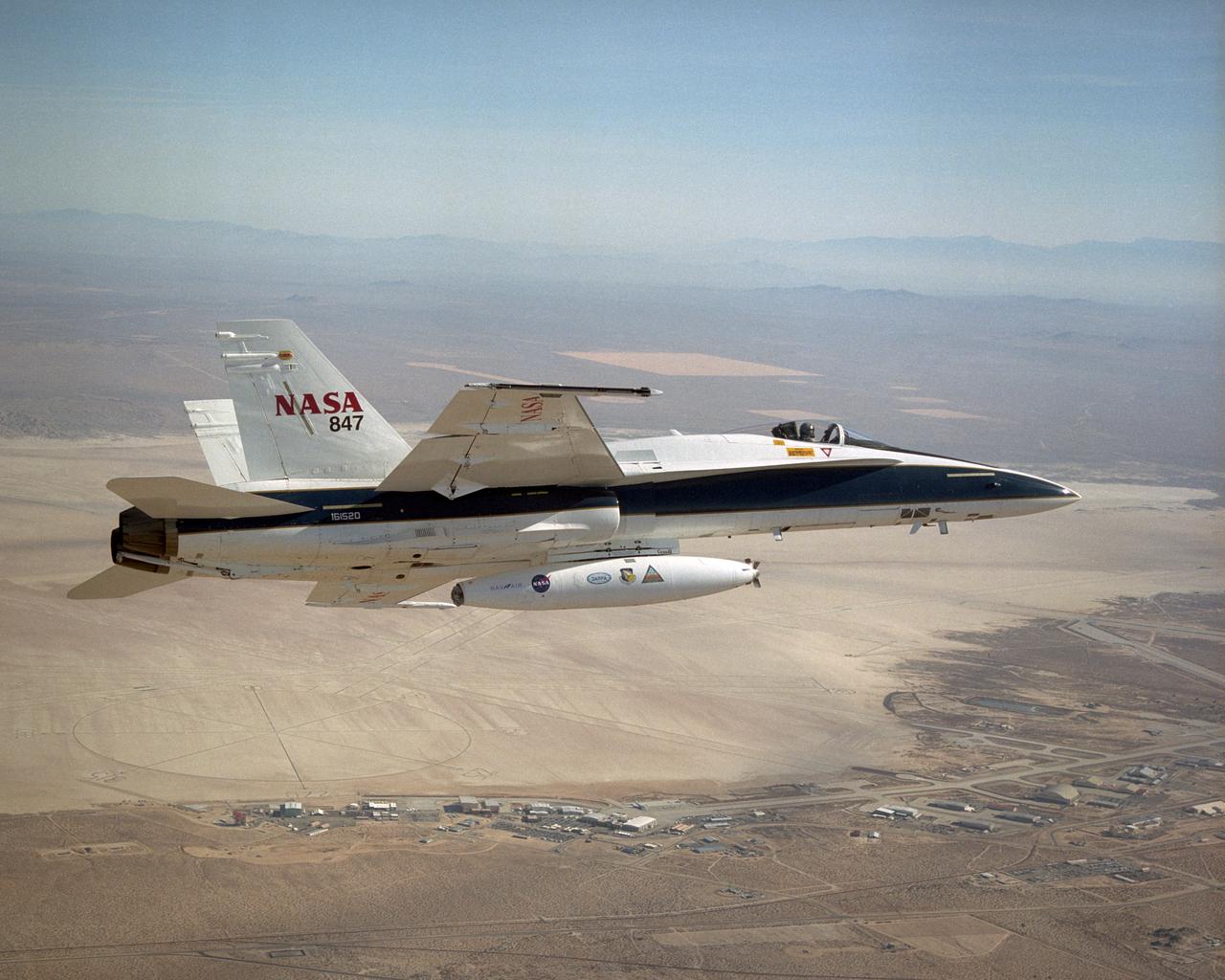
A NASA F/A-18 flies over the Dryden Flight Research Center and Rogers Dry Lake on December 11, 2002. The aircraft participated in the Automated Aerial Refueling (AAR) project. The 300-gallon aerial refueling store seen on the belly of the aircraft carries fuel and a refueling drogue. This aircraft acted as a tanker in the study to develop an aerodynamic model for future automated aerial refueling, especially of unmanned vehicles.

A NASA F/A-18 flies over the Dryden Flight Research Center and Rogers Dry Lake on December 11, 2002. The aircraft participated in the Automated Aerial Refueling (AAR) project. The 300-gallon aerial refueling store seen on the belly of the aircraft carries fuel and a refueling drogue. This aircraft acted as a tanker in the study to develop an aerodynamic model for future automated aerial refueling, especially of unmanned vehicles.
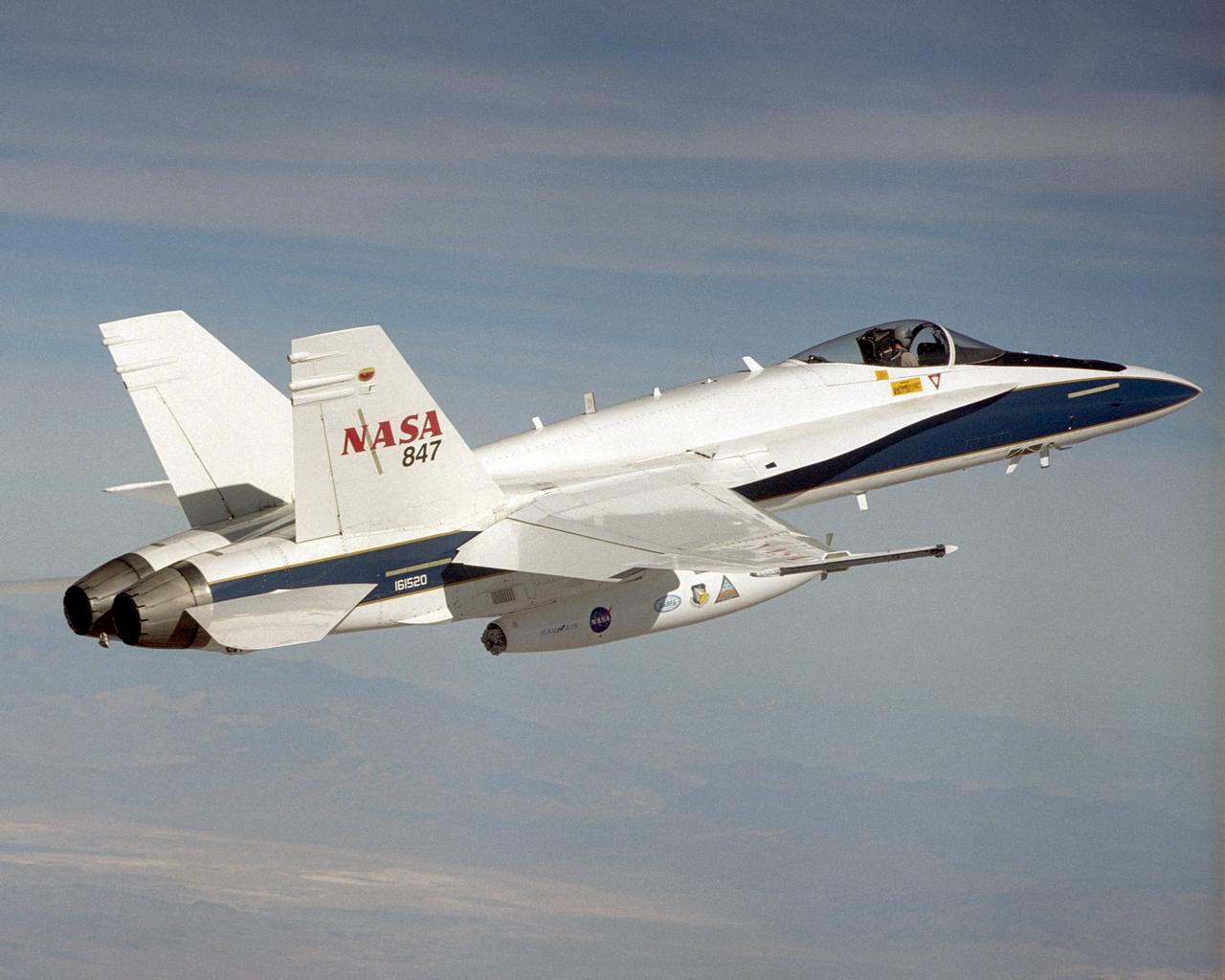
A NASA F/A-18 flies over the Dryden Flight Research Center and Rogers Dry Lake on December 11, 2002. The aircraft participated in the Automated Aerial Refueling (AAR) project. The 300-gallon aerial refueling store seen on the belly of the aircraft carries fuel and a refueling drogue. This aircraft acted as a tanker in the study to develop an aerodynamic model for future automated aerial refueling, especially of unmanned vehicles.
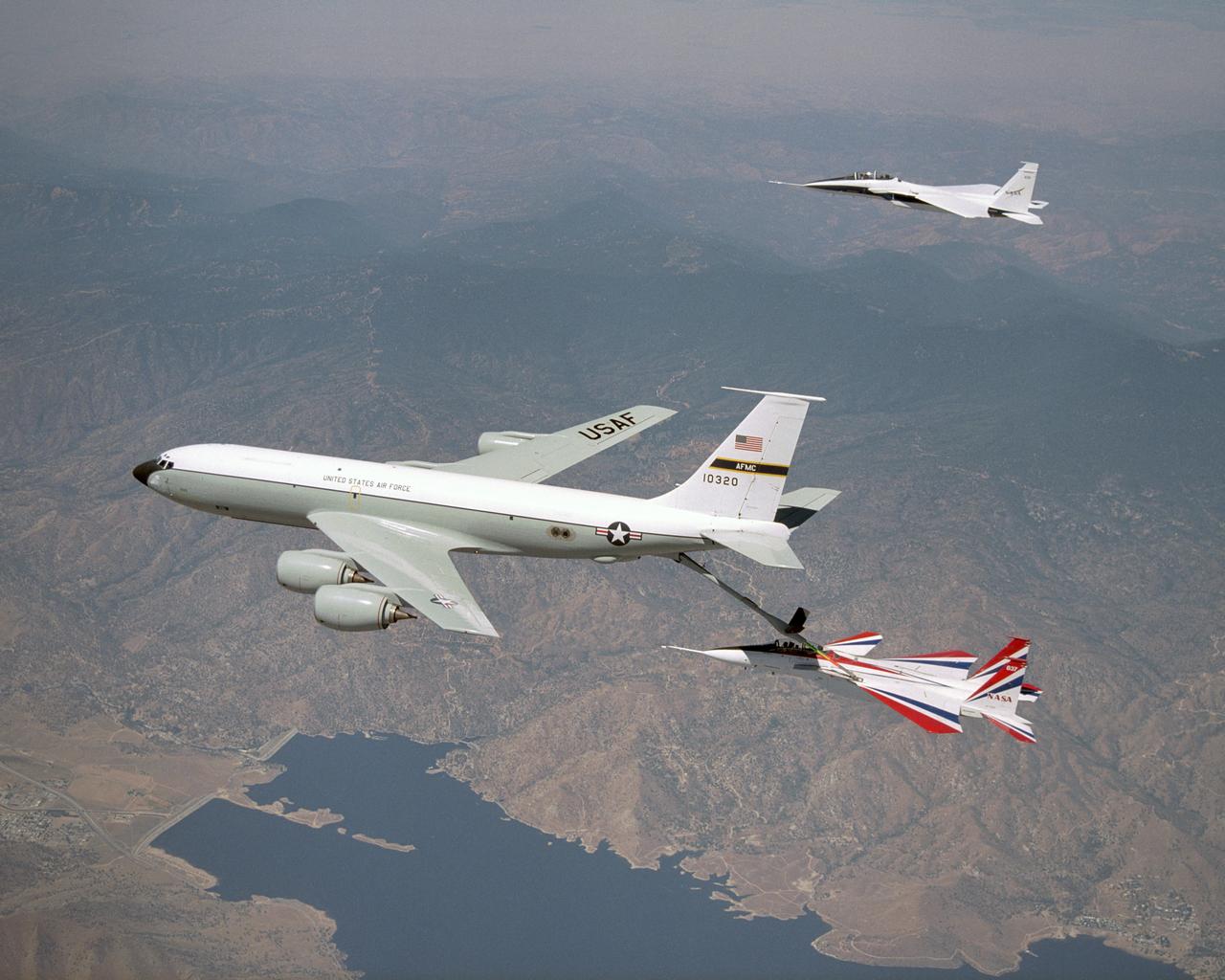
One of NASA's two F-15 research aircraft gets refueled in mid-air over Lake Isabella from a USAF KC-135 tanker while NASA's other F-15 flies chase alongside.
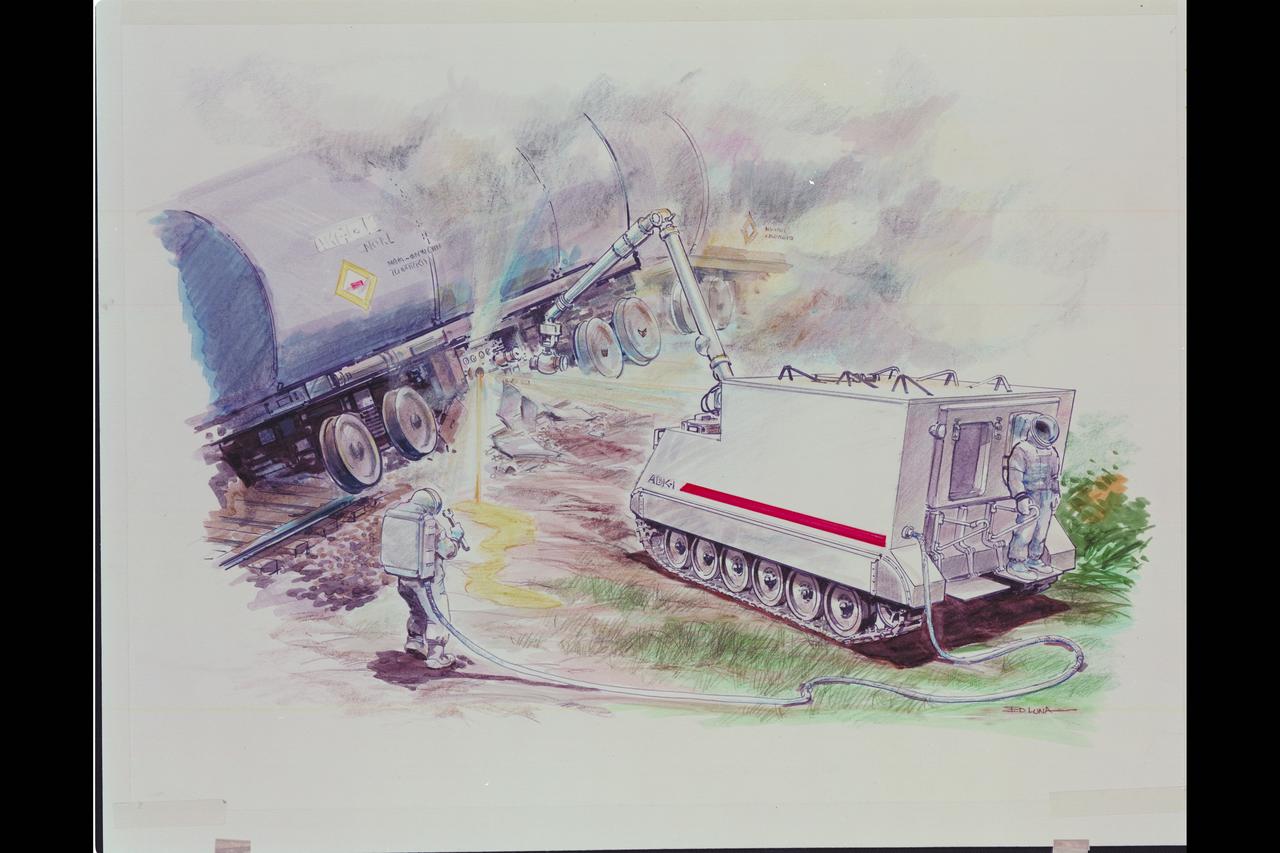
Artist: Ed Luna HAZMAT (Hazardous Materials) art; Phase 1 - Tanker Clean-up

View from F/A-18 #845 behind Omega Air Boeing 707 tanker during an AARD flight showing probe and drogue.
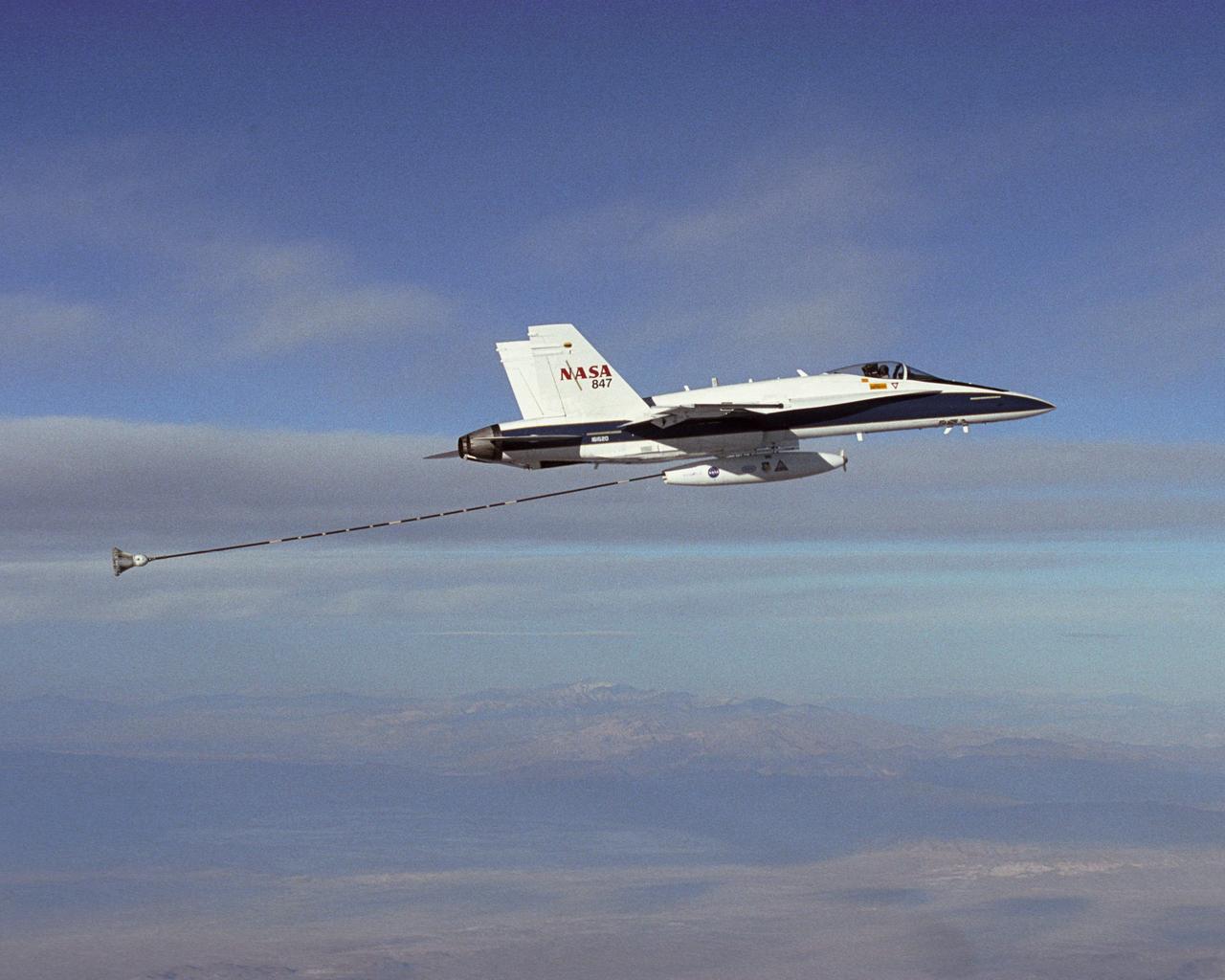
NASA Dryden's Automated Aerial Refueling (AAR) project evaluated the capability of an F/A-18A aircraft as an in-flight refueling tanker with the objective of developing analytical models for an automated aerial refueling system for unmanned air vehicles. The F/A-18 "tanker" aircraft (No. 847) underwent flight test envelope expansion with an aerodynamic pod containing air-refueling equipment carried beneath the fuselage. The second aircraft (No. 843) flew as the receiver aircraft during the study to assess the free-stream hose and drogue dynamics on the F/A-18A.
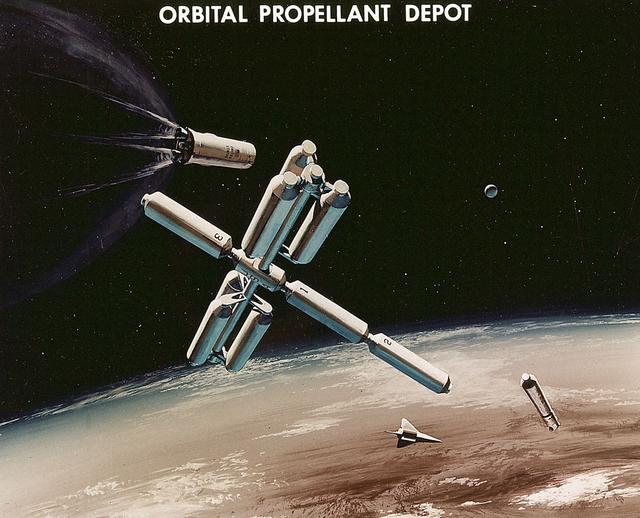
In this artist's concept from 1971, an Earth-to orbit fuel tanker approaches the Orbital Propellant Depot. As envisioned by Marshall Space Flight Center Program Devlopment plarners, an orbital modular propellant storage depot, supplied periodically by the Space Shuttle or Earth-to-orbit fuel tankers would be critical in making available large amounts of fuel to various orbital vehicles and spacecraft.
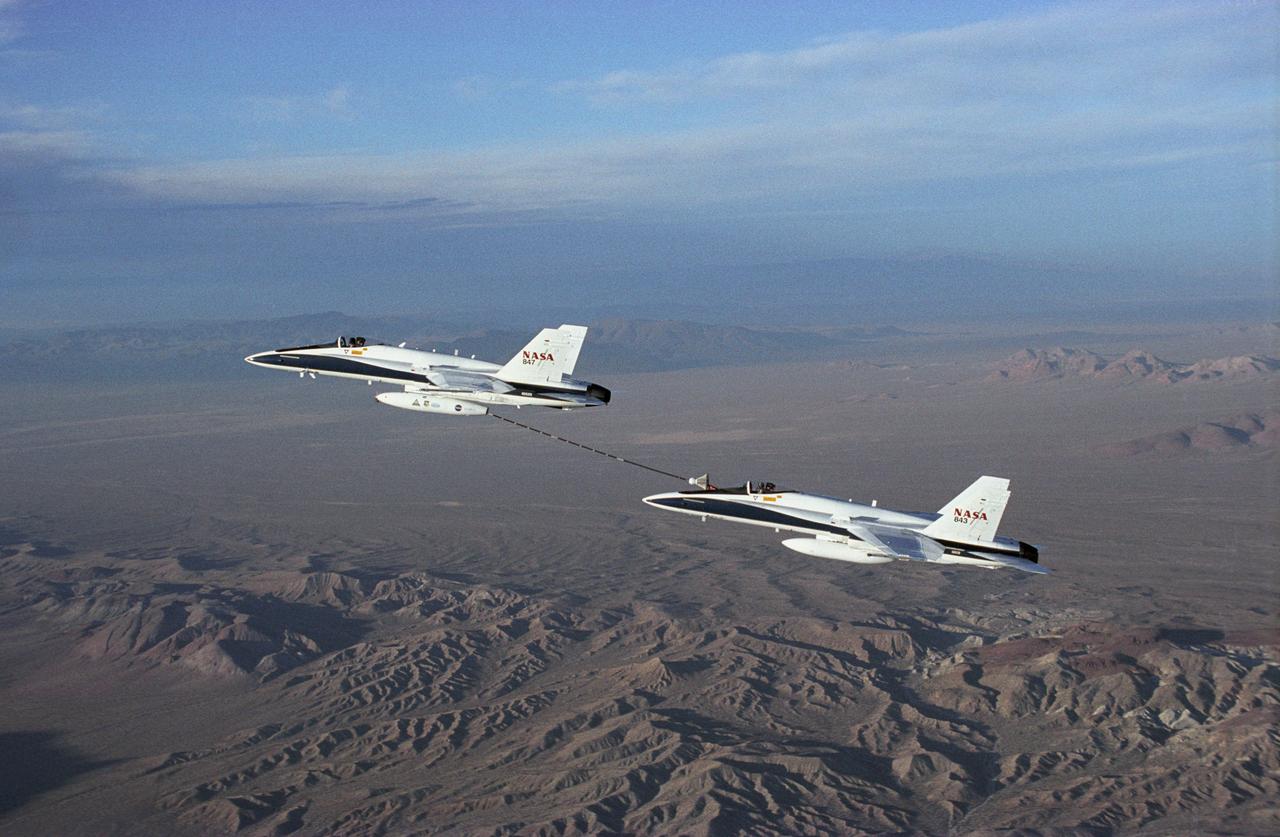
NASA Dryden's Automated Aerial Refueling (AAR) project evaluated the capability of an F/A-18A aircraft as an in-flight refueling tanker with the objective of developing analytical models for an automated aerial refueling system for unmanned air vehicles. The F/A-18 "tanker" aircraft (No. 847) underwent flight test envelope expansion with an aerodynamic pod containing air-refueling equipment carried beneath the fuselage. The second aircraft (No. 843) flew as the receiver aircraft during the study to assess the free-stream hose and drogue dynamics on the F/A-18A.
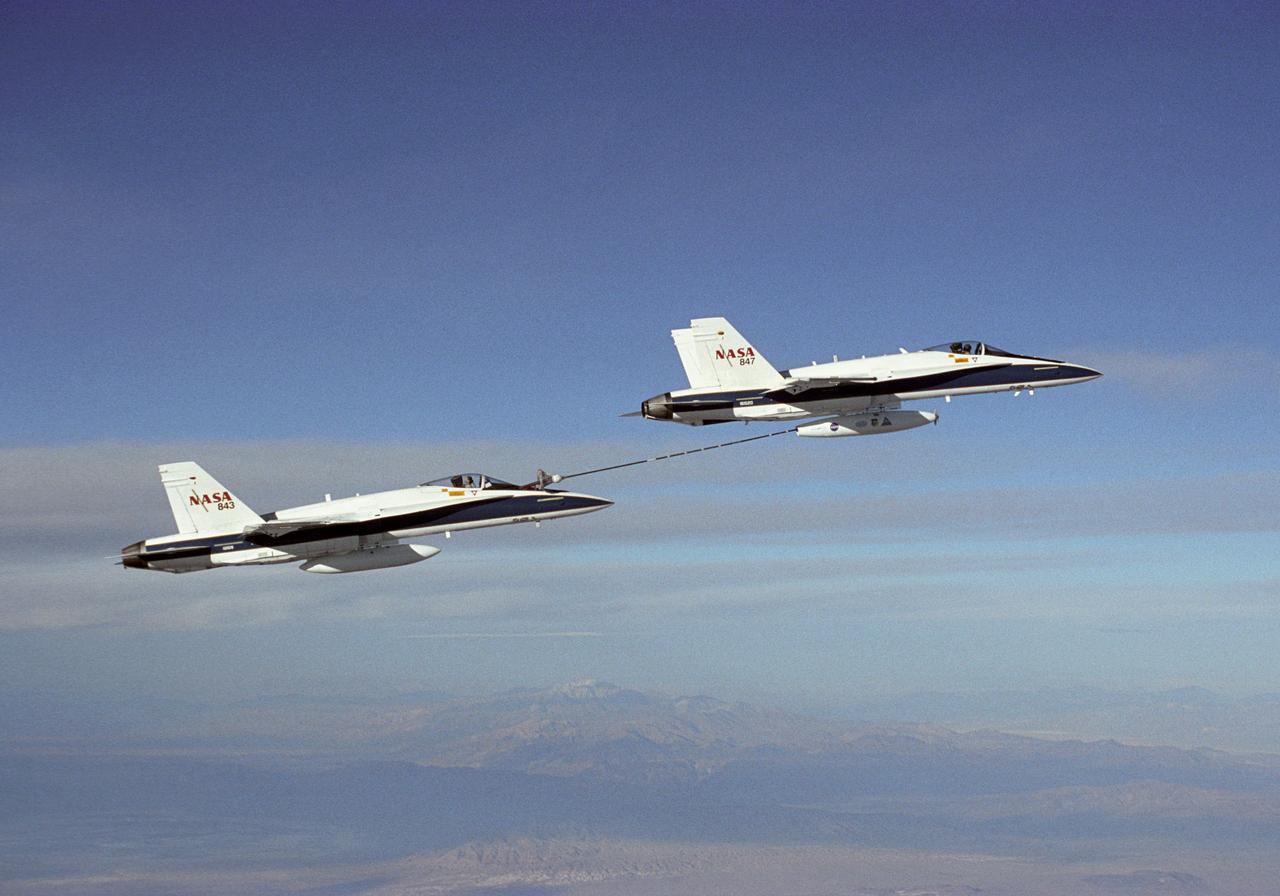
NASA Dryden's Automated Aerial Refueling (AAR) project evaluated the capability of an F/A-18A aircraft as an in-flight refueling tanker with the objective of developing analytical models for an automated aerial refueling system for unmanned air vehicles. The F/A-18 "tanker" aircraft (No. 847) underwent flight test envelope expansion with an aerodynamic pod containing air-refueling equipment carried beneath the fuselage. The second aircraft (No. 843) flew as the receiver aircraft during the study to assess the free-stream hose and drogue dynamics on the F/A-18A.
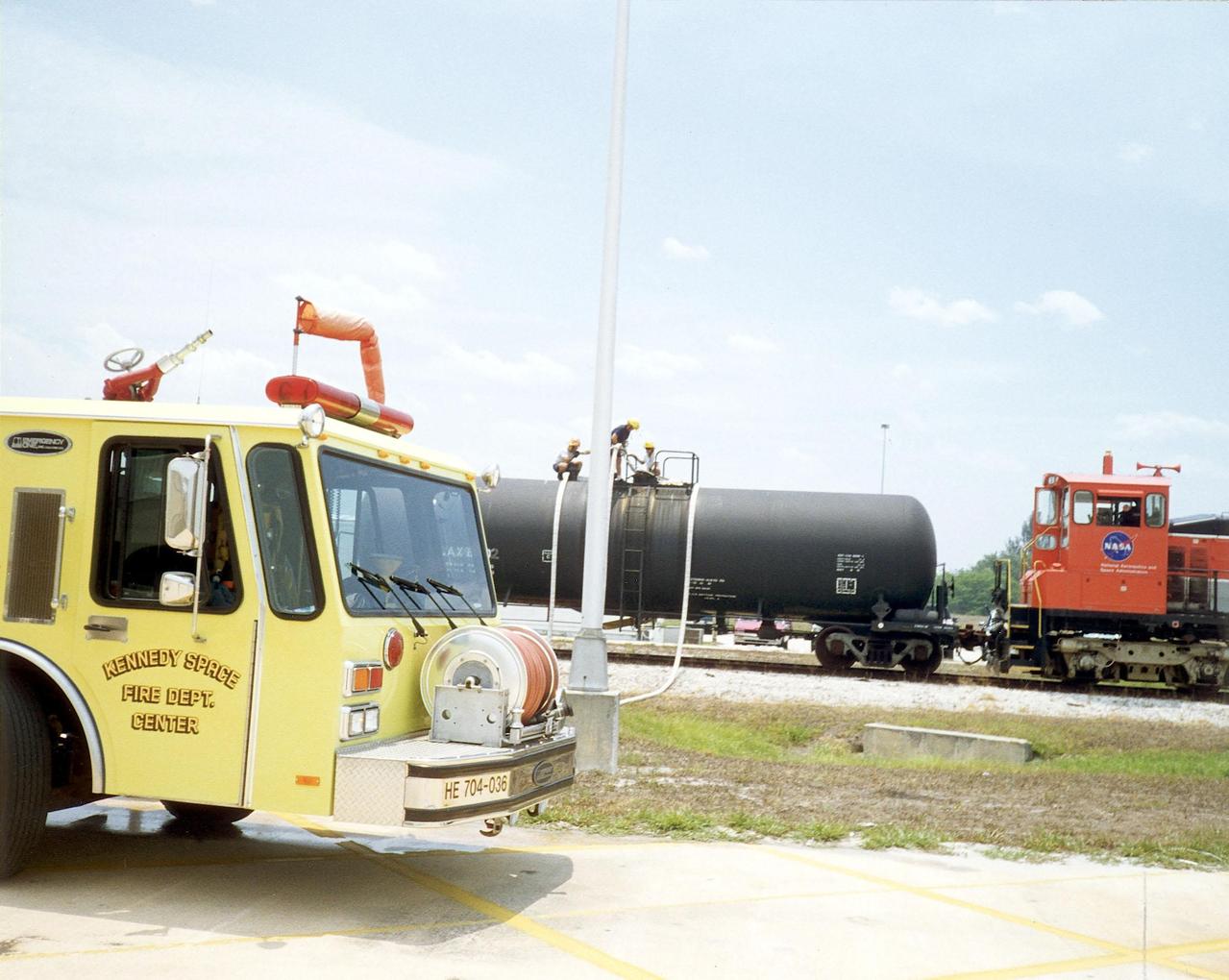
A Kennedy Space Center railroad tanker car loaded with 20,000 gallons of water and retrofitted with a special attachment for directly filling fire trucks was transported to the scene of a fire in north Brevard County to assist with firefighting efforts

Chennai, India's sixth largest city, has seen no rain for over six months. Its four major reservoirs have virtually run dry, and the city's population of four million is mostly relying on government tankers to provide water, or paying private companies to supply water. The two images were acquired by ASTER on October 6, 2015, and Landsat OLI on June 3, 2019. They cover an area of 29.9 by 45.7 kilometers, and are centered at 13.1 degrees north, 80.3 degrees east. https://photojournal.jpl.nasa.gov/catalog/PIA23300
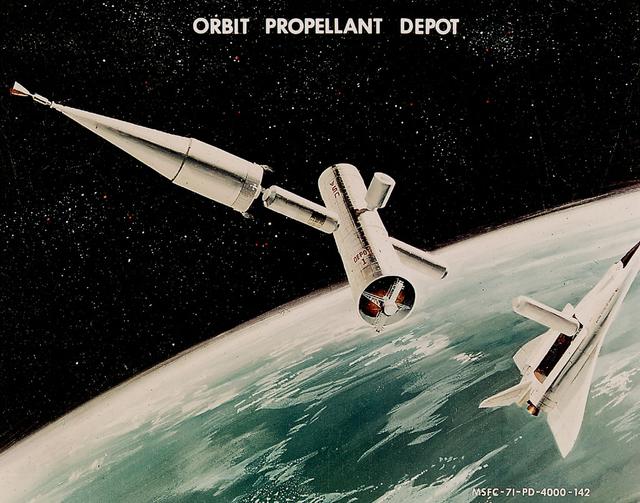
This 1971 artist's concept shows a Nuclear Shuttle and an early Space Shuttle docked with an Orbital Propellant Depot. As envisioned by Marshall Space Flight Center Program Development persornel, an orbital modular propellant storage depot, supplied periodically by the Space Shuttle or Earth-to-orbit fuel tankers, would be critical in making available large amounts of fuel to various orbital vehicles and spacecraft.
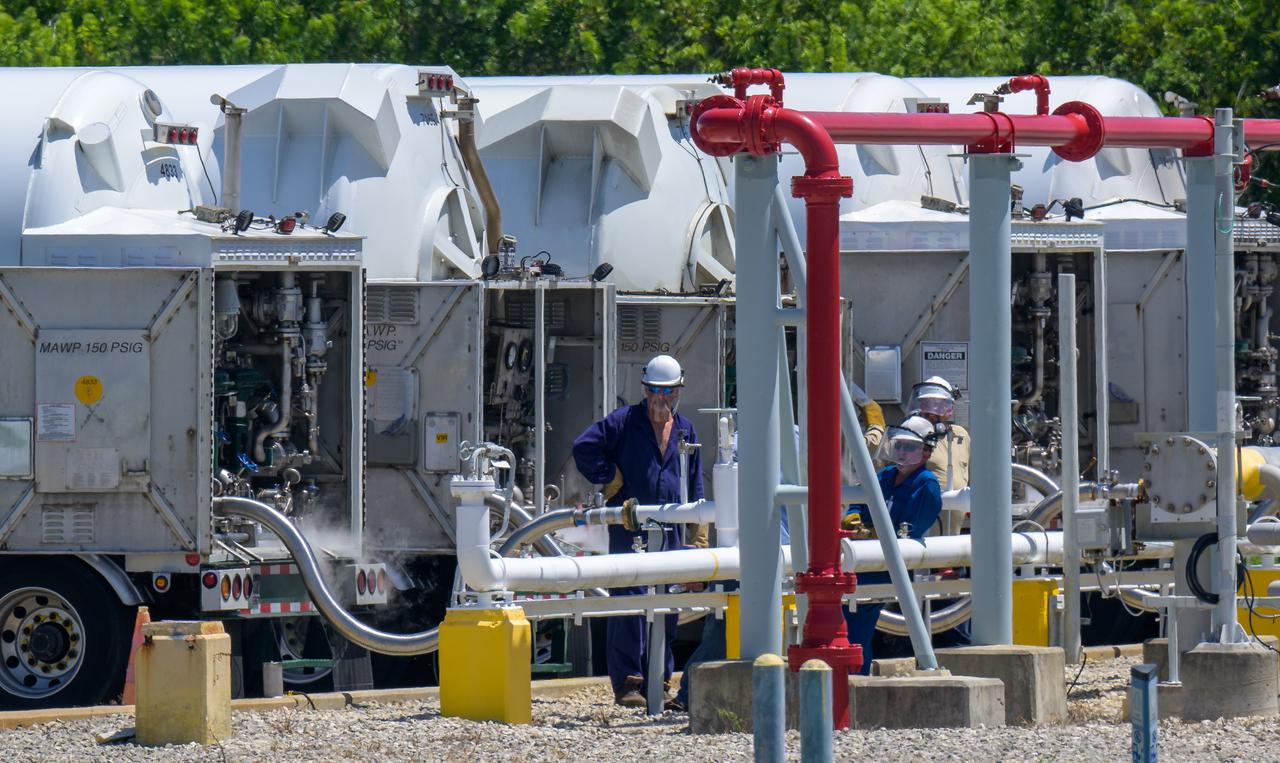
Tanker trucks deliver liquid hydrogen (LH2) to replenish the large sphere used to store the propellant at NASA’s Kennedy Space Center in Florida, Launch Pad 39B, to support the Artemis I mission, Wednesday, Aug. 31, 2022. Teams will conduct the next launch attempt of the Moon rocket and Orion spacecraft on Saturday, Sept. 3, 2022. Photo Credit: (NASA/Bill Ingalls)
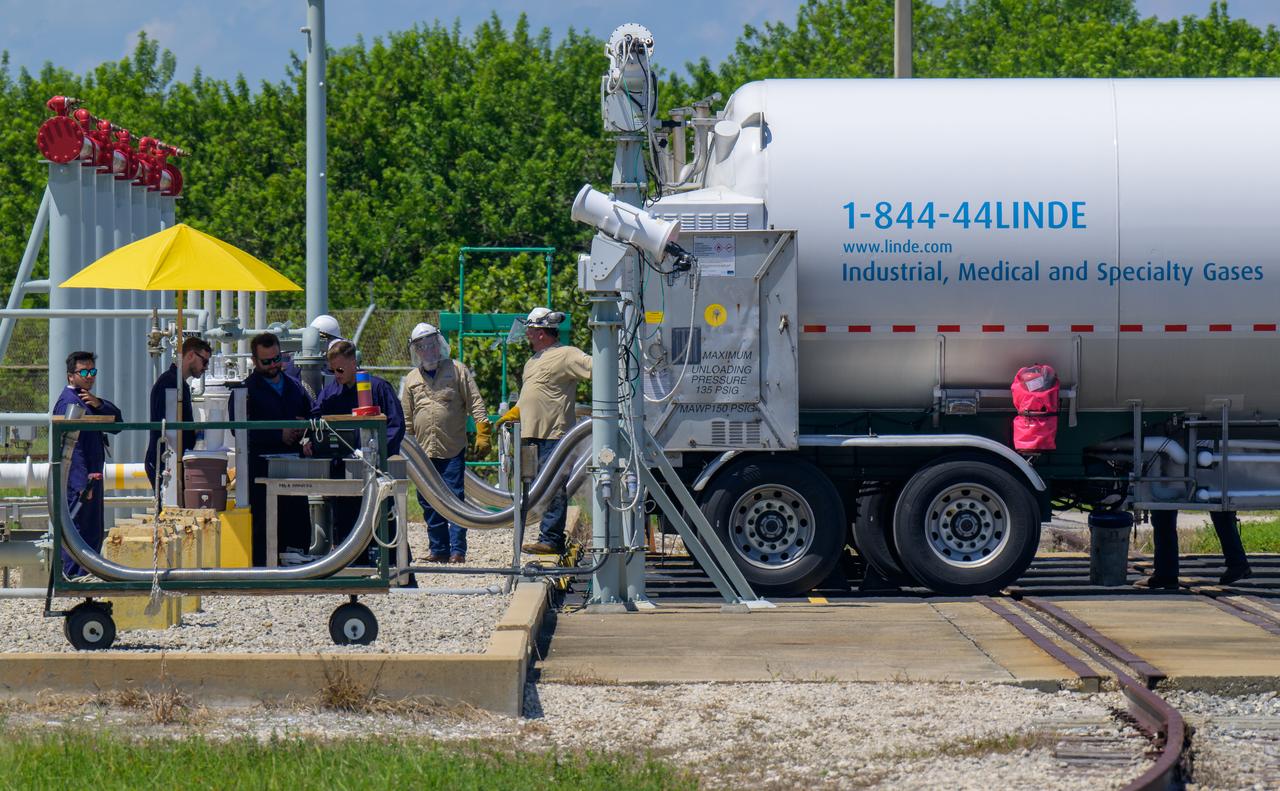
Tanker trucks deliver liquid hydrogen (LH2) to replenish the large sphere used to store the propellant at NASA’s Kennedy Space Center in Florida, Launch Pad 39B, to support the Artemis I mission, Wednesday, Aug. 31, 2022. Teams will conduct the next launch attempt of the Moon rocket and Orion spacecraft on Saturday, Sept. 3, 2022. Photo Credit: (NASA/Bill Ingalls)
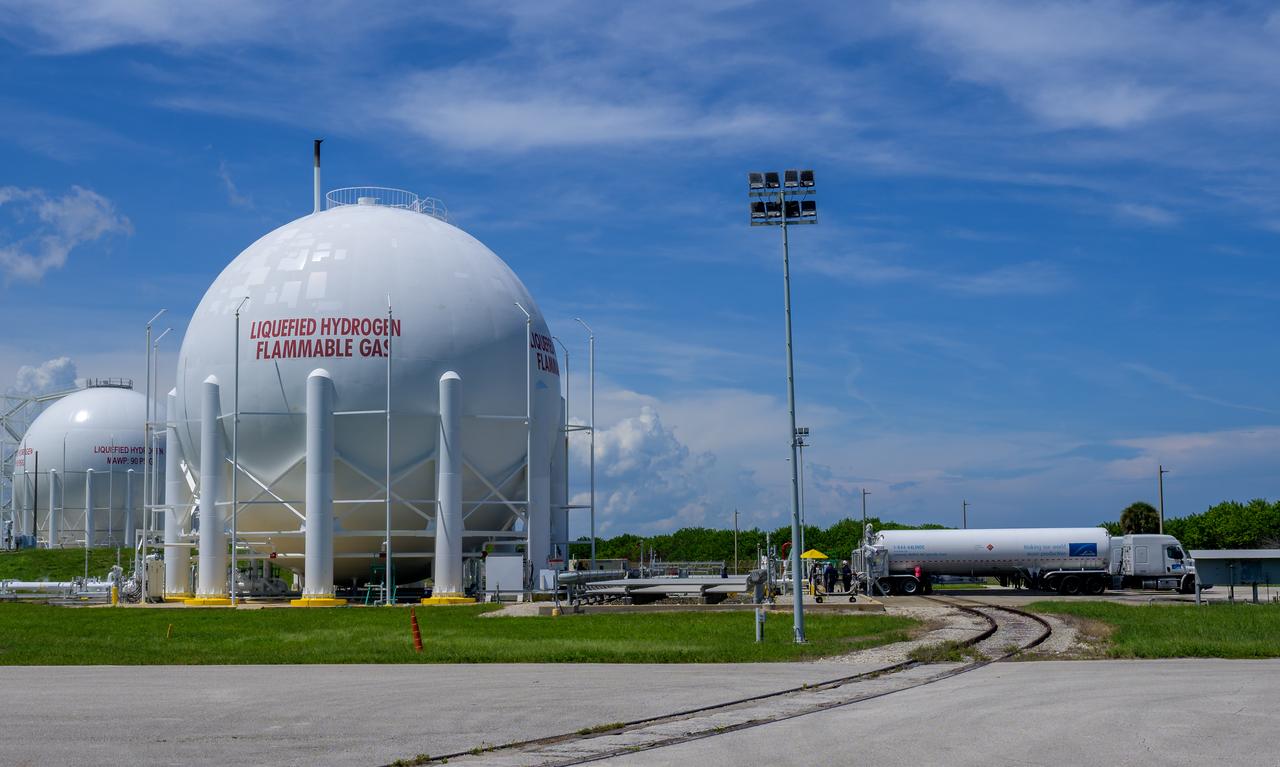
Tanker trucks deliver liquid hydrogen (LH2) to replenish the large sphere used to store the propellant at NASA’s Kennedy Space Center in Florida, Launch Pad 39B, to support the Artemis I mission, Wednesday, Aug. 31, 2022. Teams will conduct the next launch attempt of the Moon rocket and Orion spacecraft on Saturday, Sept. 3, 2022. Photo Credit: (NASA/Bill Ingalls)
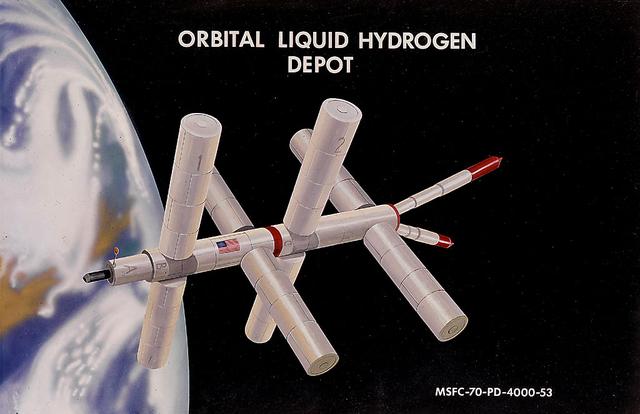
This 1971 artist's concept illustrates a proposed Orbital Liquid Hydrogen Depot. As envisioned by Marshall Space Flight Center Program Development persornel, an orbital modular propellant storage depot, supplied periodically by the Space Shuttle or Earth-to-orbit fuel tankers, would be critical in making available large amounts of fuel to various orbital vehicles and spacecraft.
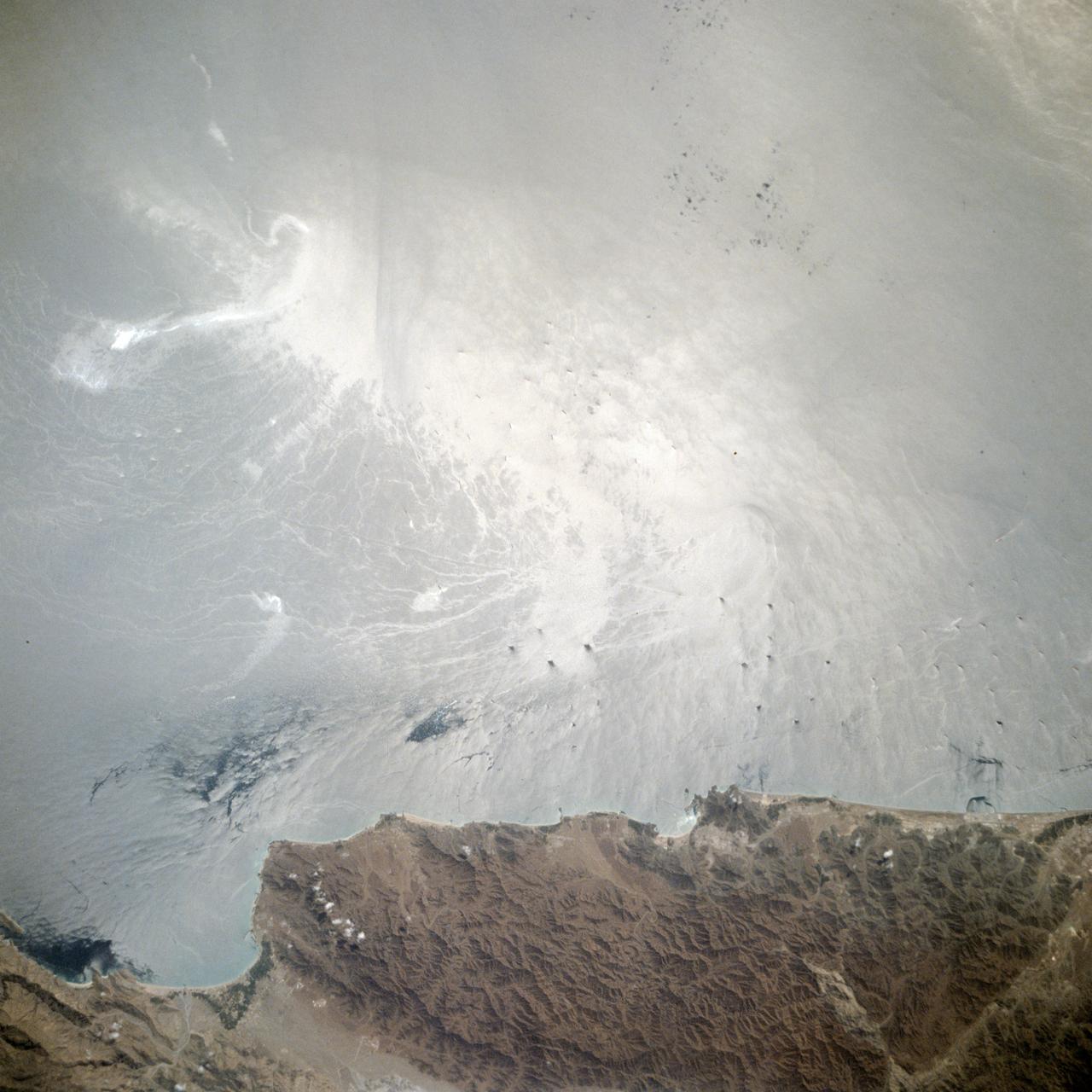
STS006-44-532 (4-9 April 1983) --- This is one of a series of photographs taken through the “ceiling” windows of the Earth-orbiting space shuttle Challenger by members of the STS-6 crew on its five-day mission in space. Many unused oil tankers lie in the roadstead along the coast of U.A.E. between the ports of Khawn Fakkan and Fujayrah. The sunglint on the Gulf of Oman permits the viewer to see the surface features much clearer. Such surface features as gynes, slicks, wakes, and sea state are clearly seen. Photo credit: NASA
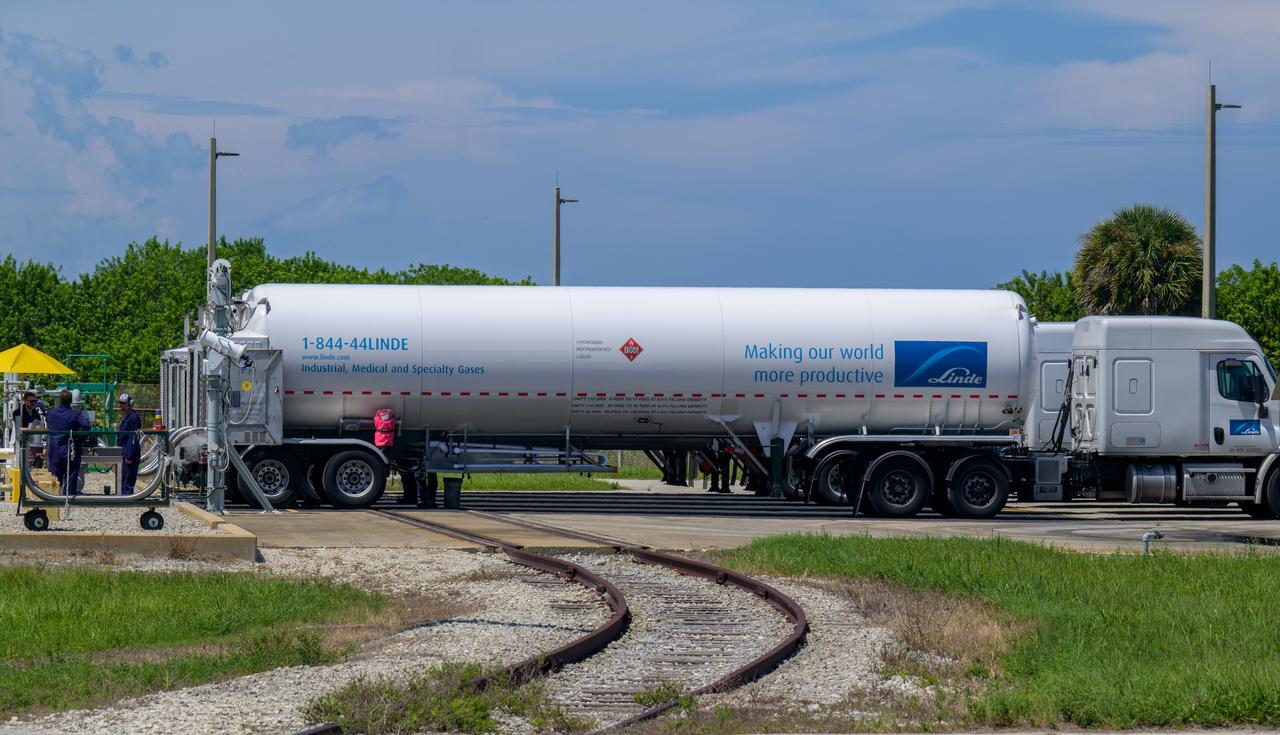
Tanker trucks deliver liquid hydrogen (LH2) to replenish the large sphere used to store the propellant at NASA’s Kennedy Space Center in Florida, Launch Pad 39B, to support the Artemis I mission, Wednesday, Aug. 31, 2022. Teams will conduct the next launch attempt of the Moon rocket and Orion spacecraft on Saturday, Sept. 3, 2022. Photo Credit: (NASA/Bill Ingalls)
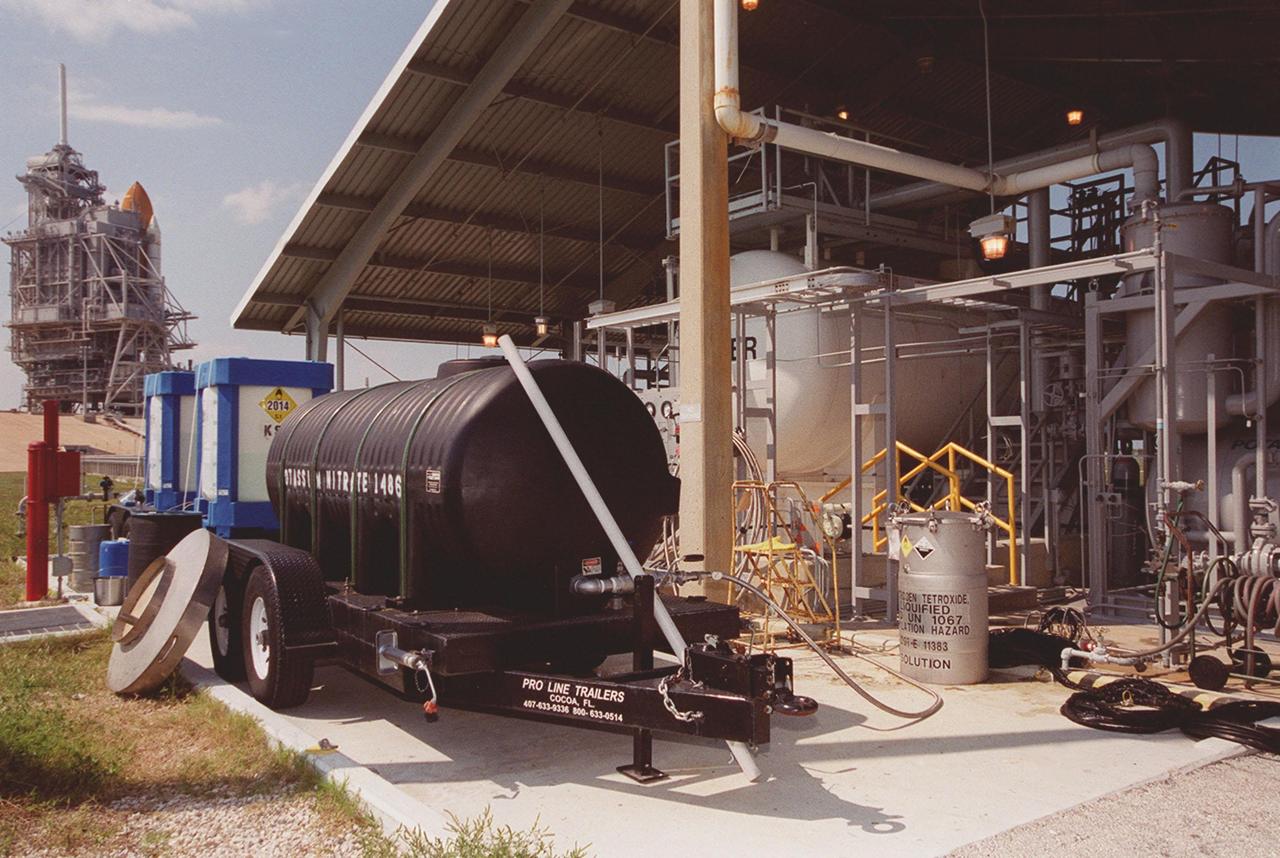
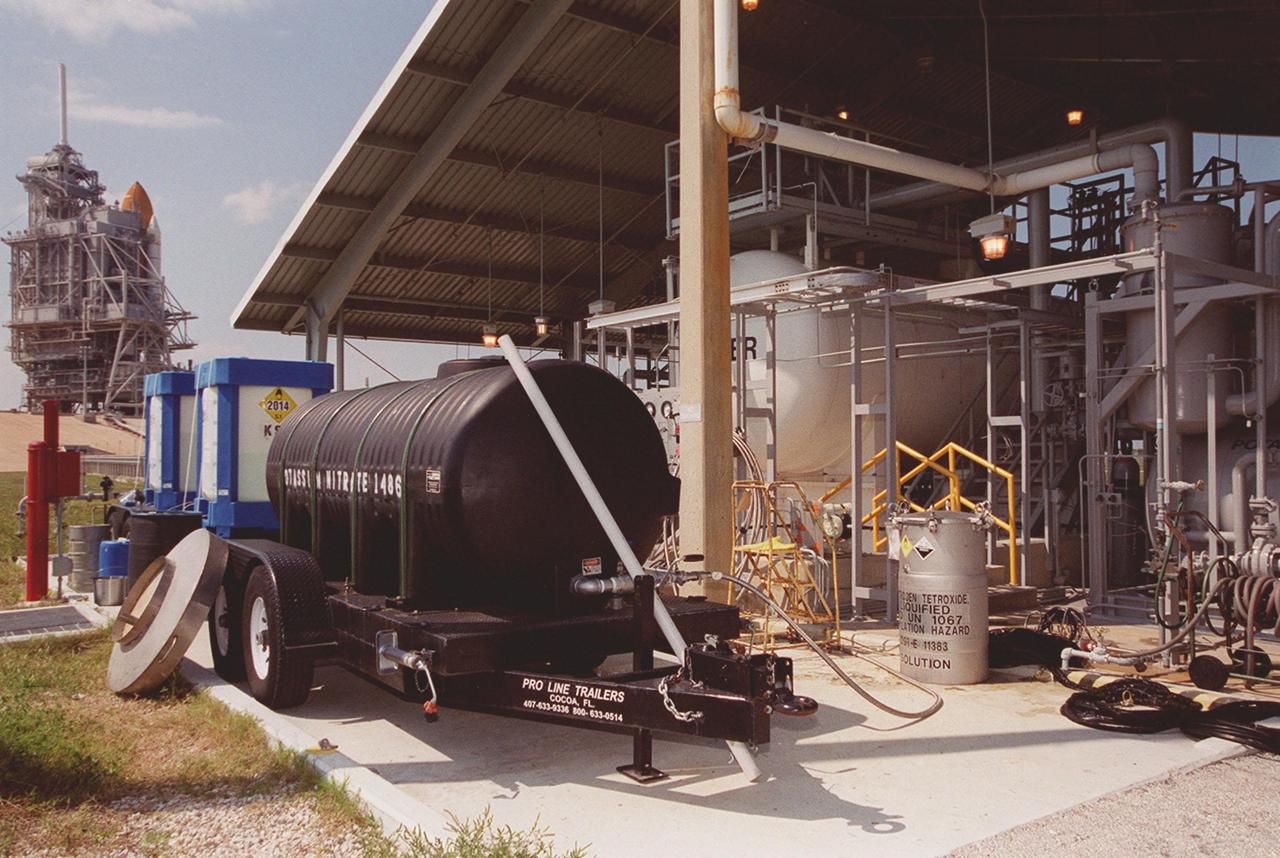
KENNEDY SPACE CENTER, FLA. -- A recently installed fertilizer-producing system sits near Launch Pad 39A (upper left background). Using a "scrubber," the system captures nitrogen tetroxide vapor that develops as a by-product when it is transferred from ground storage tanks into the Shuttle storage tanks. Nitrogen tetroxide is used as the oxidizer for the hypergolic propellant in the Shuttle's on-orbit reaction control system. The scrubber then uses hydrogen peroxide to produce nitric acid, which, after adding potassium hydroxide, converts to potassium nitrate, a commercial fertilizer. The black tanker at left is collecting the potassium nitrate, which will be used on the orange groves that KSC leases to outside companies
KENNEDY SPACE CENTER, FLA. -- A recently installed fertilizer-producing system sits near Launch Pad 39A (upper left background). Using a "scrubber," the system captures nitrogen tetroxide vapor that develops as a by-product when it is transferred from ground storage tanks into the Shuttle storage tanks. Nitrogen tetroxide is used as the oxidizer for the hypergolic propellant in the Shuttle's on-orbit reaction control system. The scrubber then uses hydrogen peroxide to produce nitric acid, which, after adding potassium hydroxide, converts to potassium nitrate, a commercial fertilizer. The black tanker at left is collecting the potassium nitrate, which will be used on the orange groves that KSC leases to outside companies

NASA John C. Stennis Space Center employee Dustan Ladner (left) assists tanker driver David Velasco in transferring RP-1 fuel to a 20,000-gallon underground tank at the E-1 Test Stand during a March 30 delivery. The rocket propellant will be used for testing Aerojet AJ26 rocket engines beginning this summer. Stennis is testing the engines for Orbital Sciences Corporation, which has partnered with NASA to provide eight supply missions to the International Space Station through 2015. The partnership is part of NASA's Commercial Orbital Transportation Services initiative to work closer with companies to provide commercial space transport once the space shuttle is retired later this year.
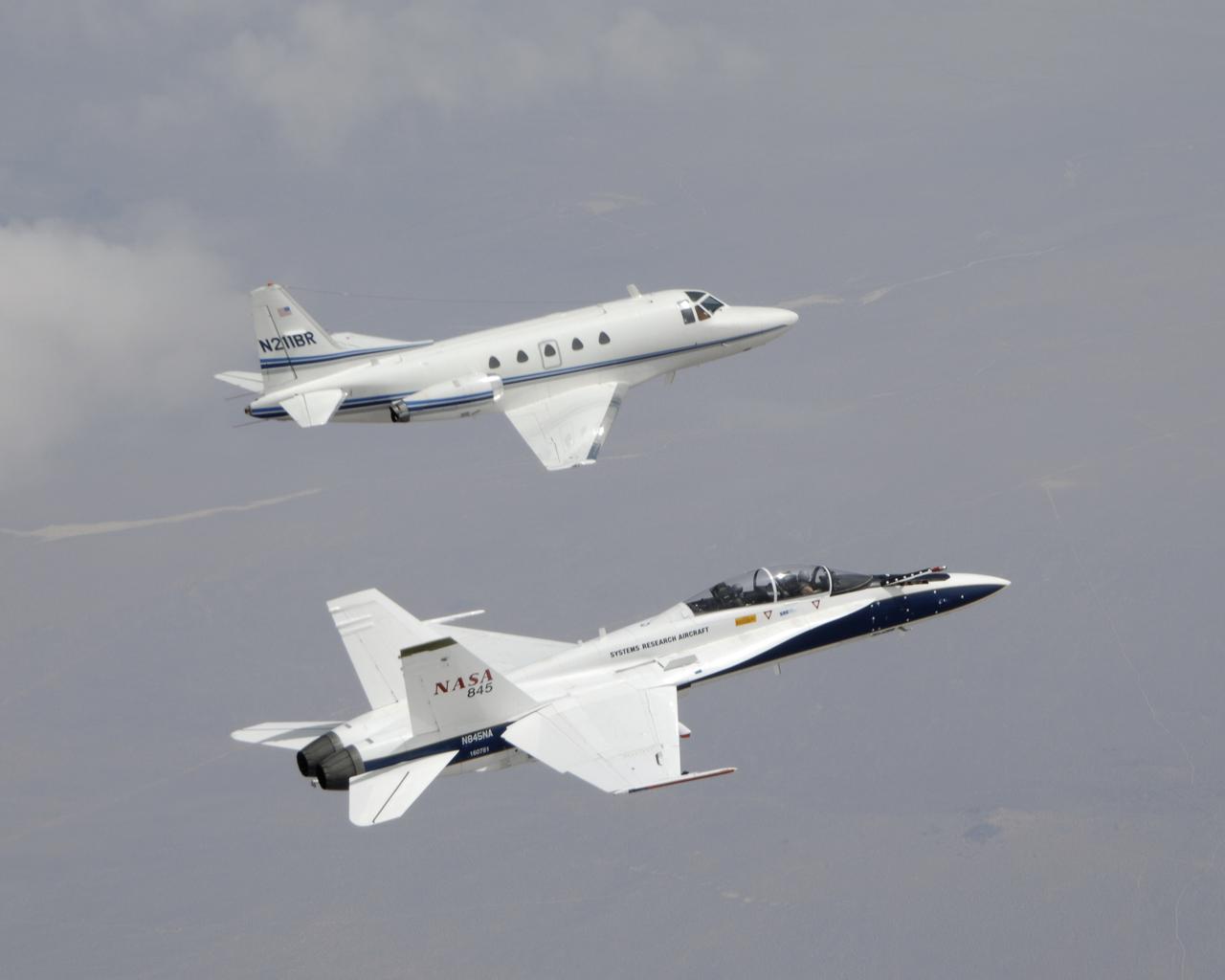
Testing autonomous software for AARD program using a NASA F/A-18 #845 following a chartered Sabreliner.
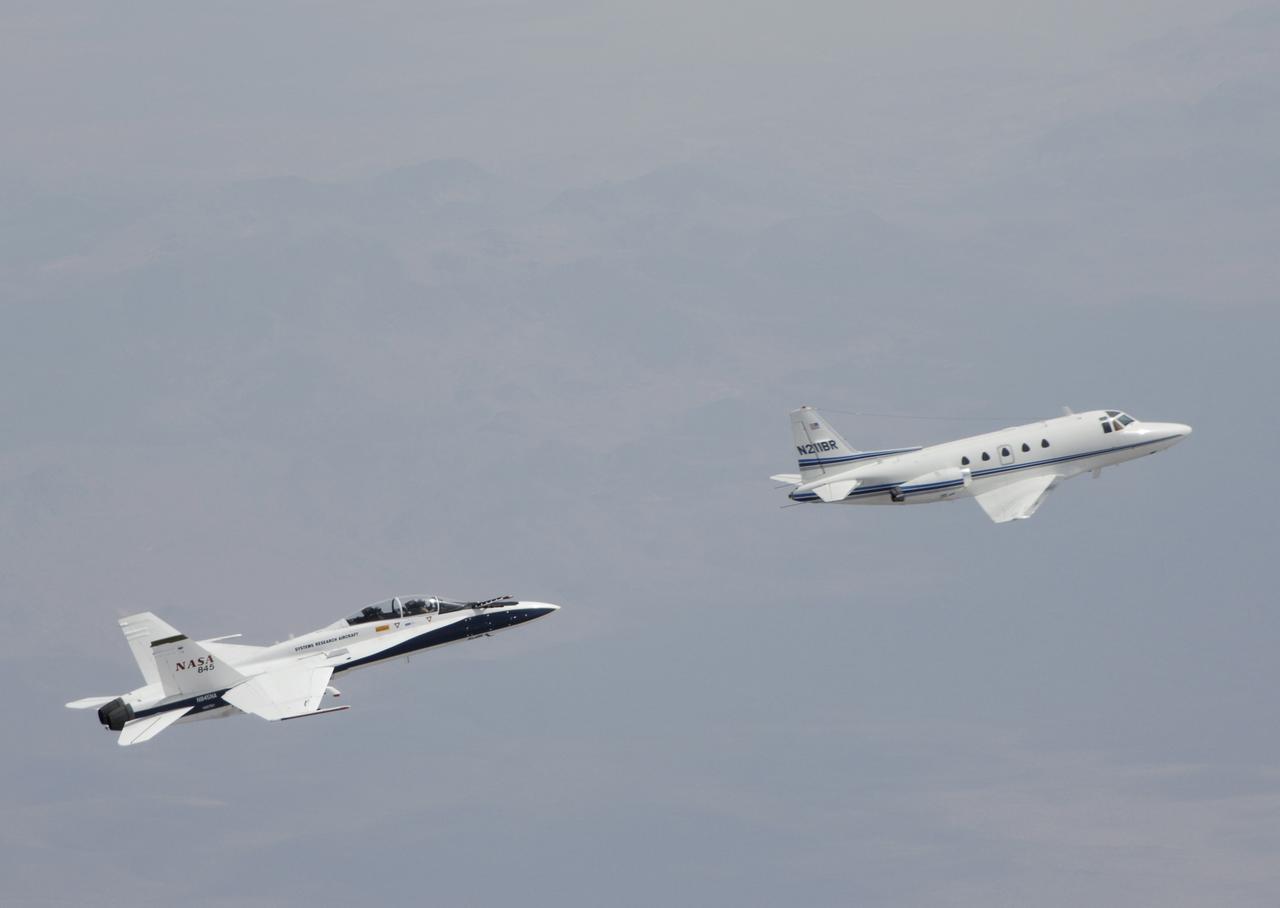
Testing autonomous software for AARD program using a NASA F/A-18 #845 following a chartered Sabreliner.
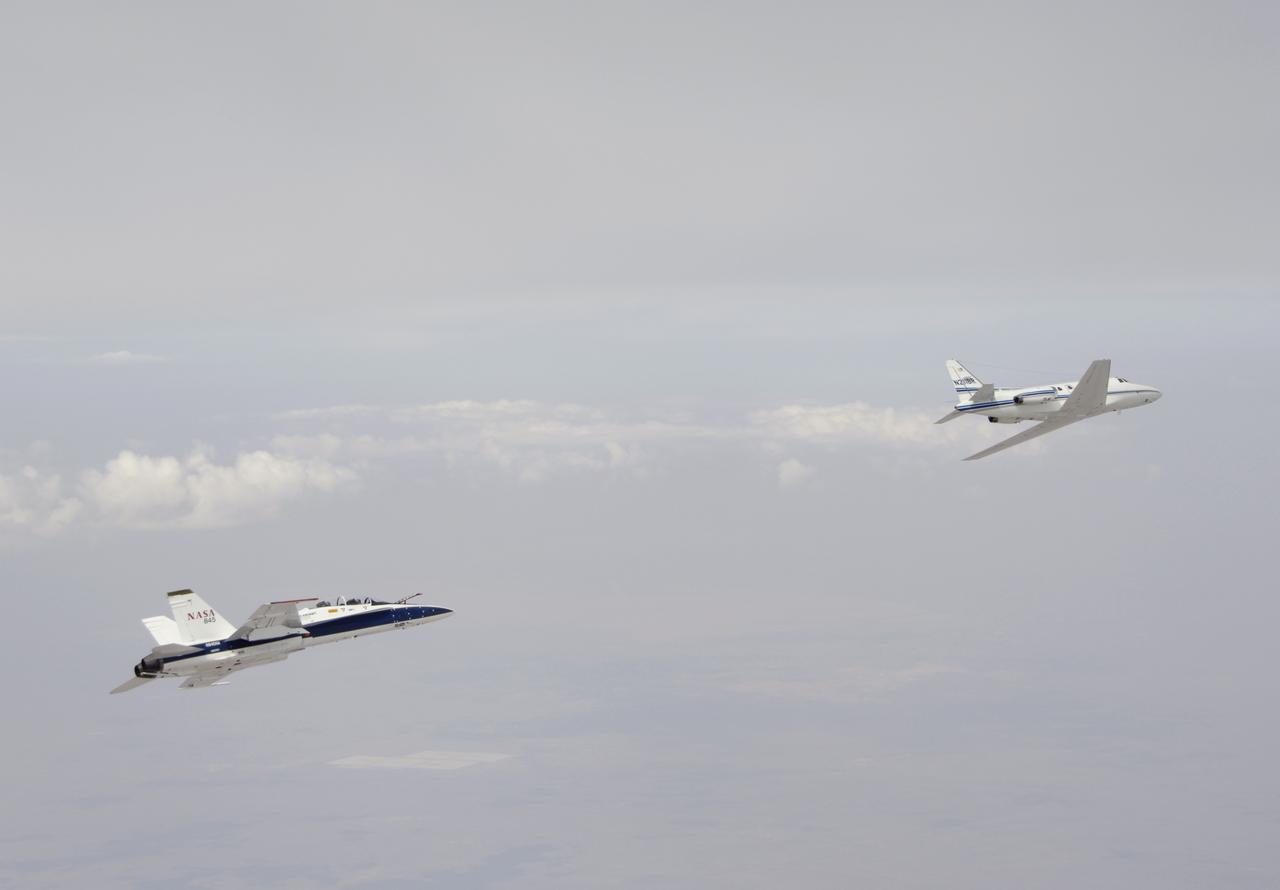
Testing autonomous software for AARD program using a NASA F/A-18 #845 following a chartered Sabreliner.
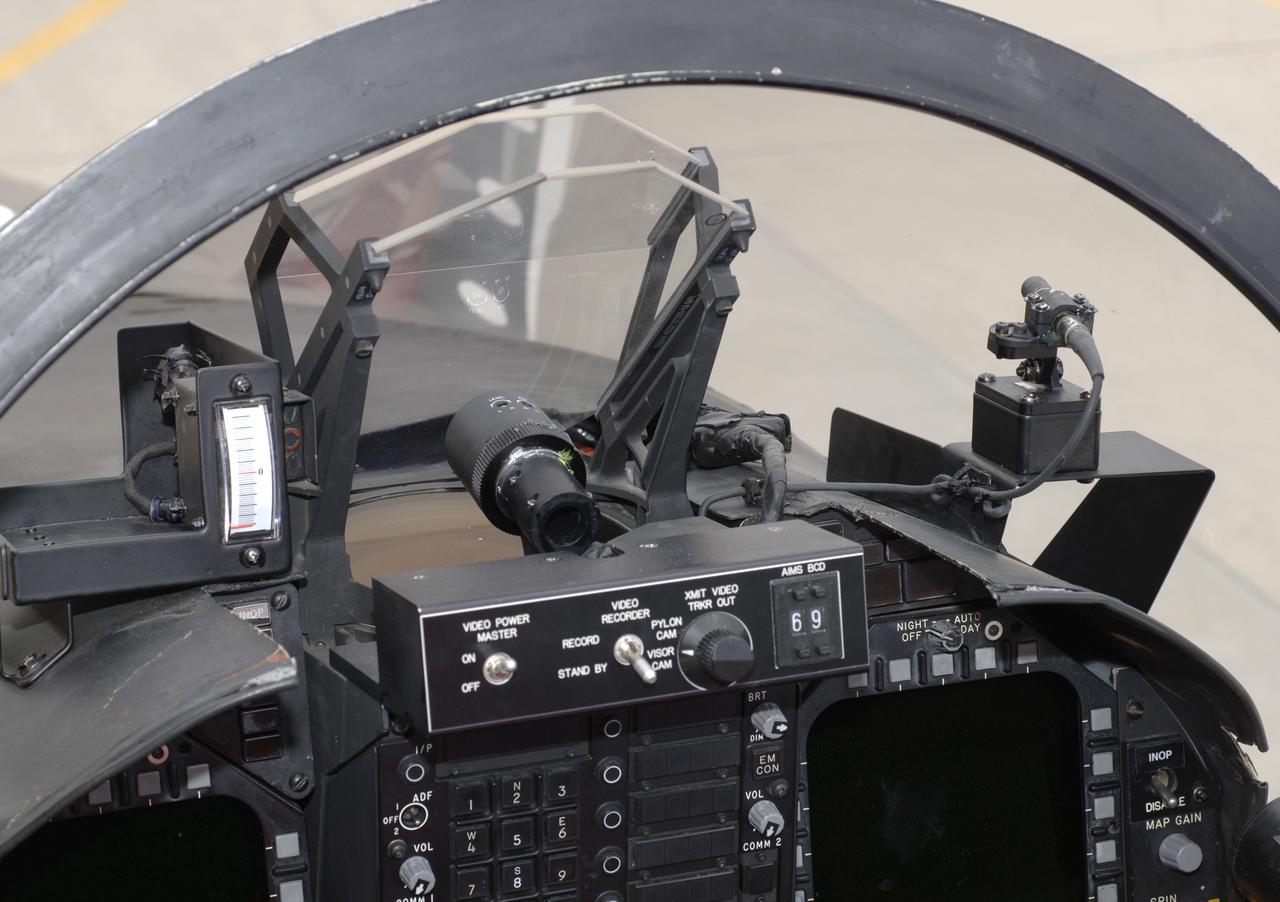
F/A-18 #845 HUD and video camera setup for Autonomous Airborne Refueling Demonstration (AARD) project
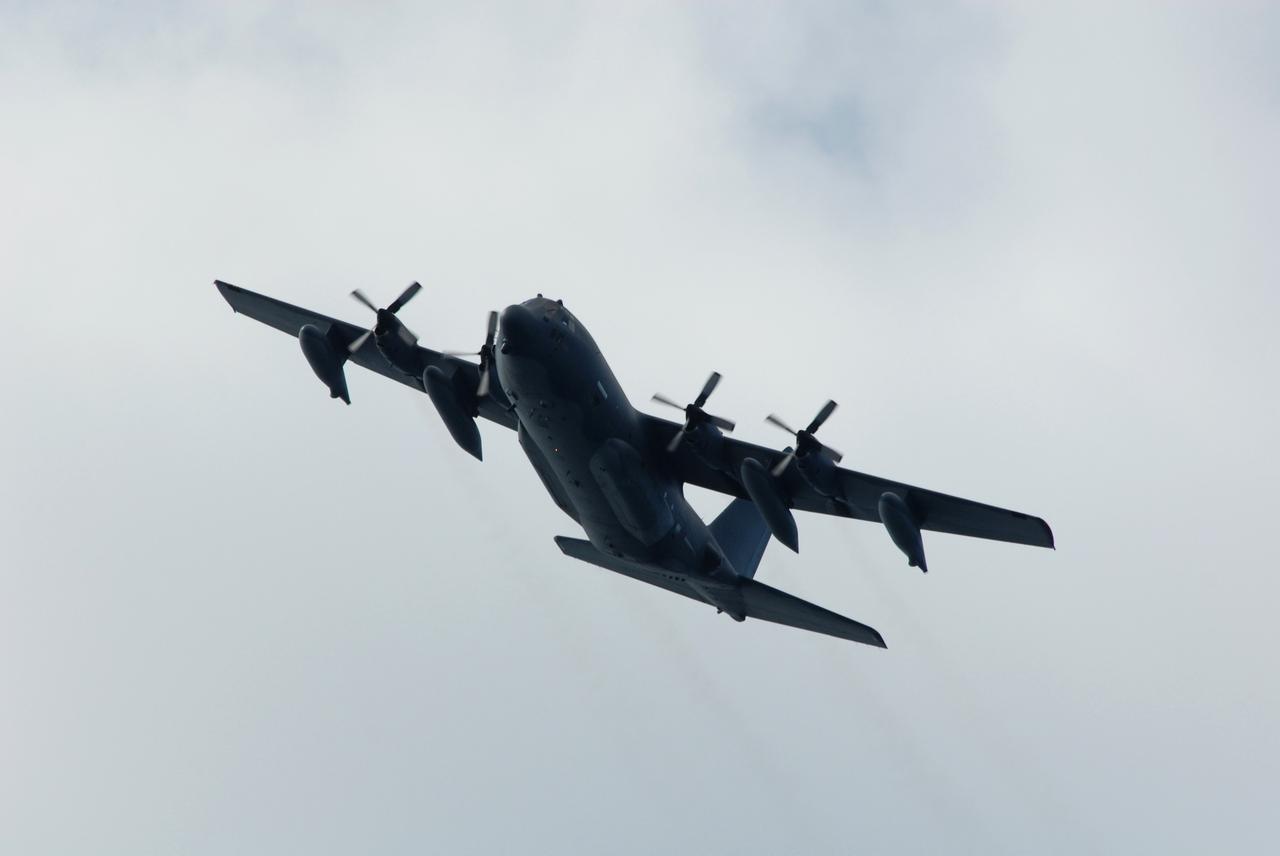
CAPE CANAVERAL, Fla. -- An Air Force HC-130 rescue tanker flies over the target area off Florida's central east coast during a rescue training exercise, known as Mode VIII. In support of, and with logistical support from, NASA, USSTRATCOM is hosting a major exercise involving Department of Defense, Department of Homeland Security, search and rescue (SAR) forces, including the 45th Space Wing at Patrick Air Force Base, which support space shuttle astronaut bailout contingency operations, known as Mode VIII. This exercise tests SAR capabilities to locate, recover and provide medical treatment for astronauts following a space shuttle launch phase open-ocean bailout. Participants include members of the U.S. Navy, U.S. Coast Guard, U.S. Air Force, and NASA's Kennedy Space Center and Johnson Space Center. Photo credit: NASA/Dimitri Gerondidakis
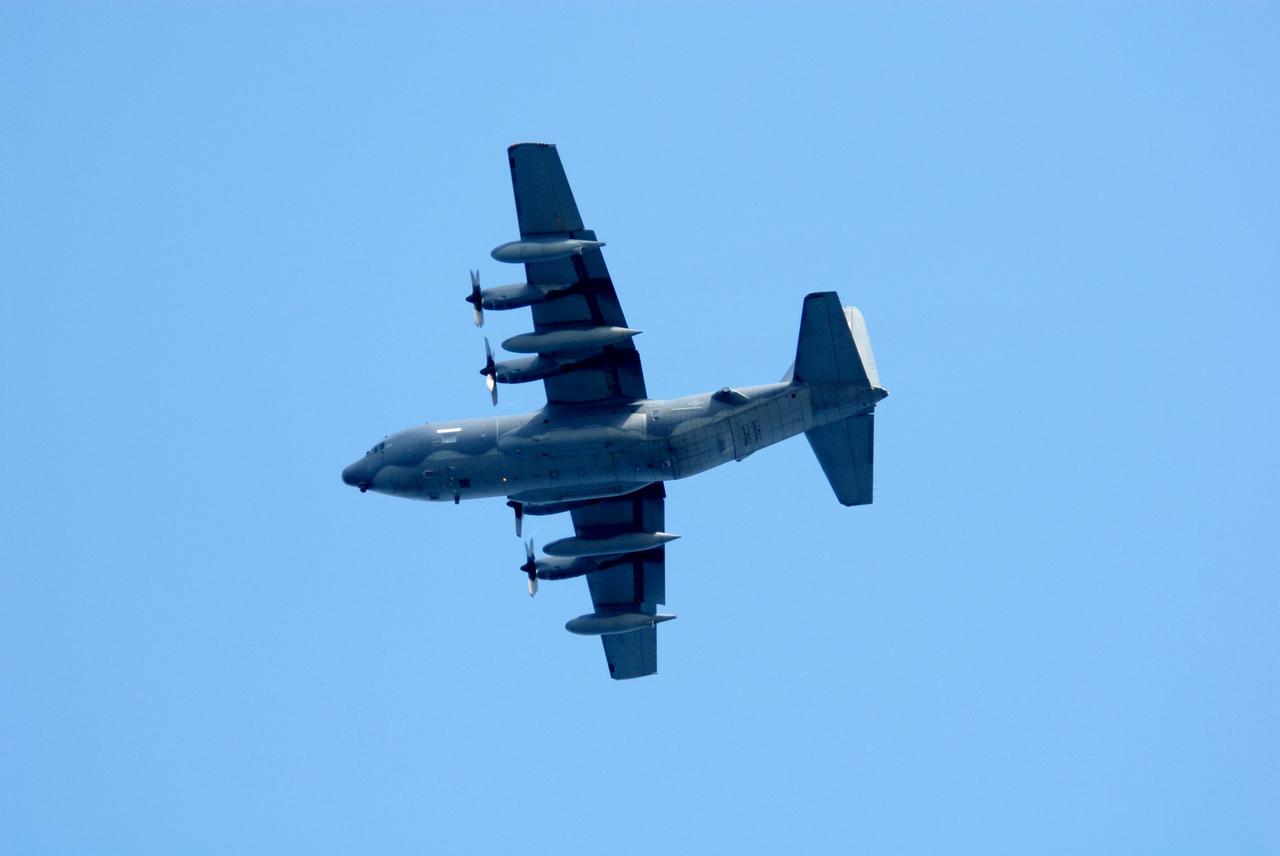
CAPE CANAVERAL, Fla. -- An Air Force HC-130 rescue tanker flies over the target area off Florida's central east coast during a rescue training exercise, known as Mode VIII. In support of, and with logistical support from, NASA, USSTRATCOM is hosting a major exercise involving Department of Defense, Department of Homeland Security, search and rescue (SAR) forces, including the 45th Space Wing at Patrick Air Force Base, which support space shuttle astronaut bailout contingency operations, known as Mode VIII. This exercise tests SAR capabilities to locate, recover and provide medical treatment for astronauts following a space shuttle launch phase open-ocean bailout. Participants include members of the U.S. Navy, U.S. Coast Guard, U.S. Air Force, and NASA's Kennedy Space Center and Johnson Space Center. Photo credit: NASA/Dimitri Gerondidakis
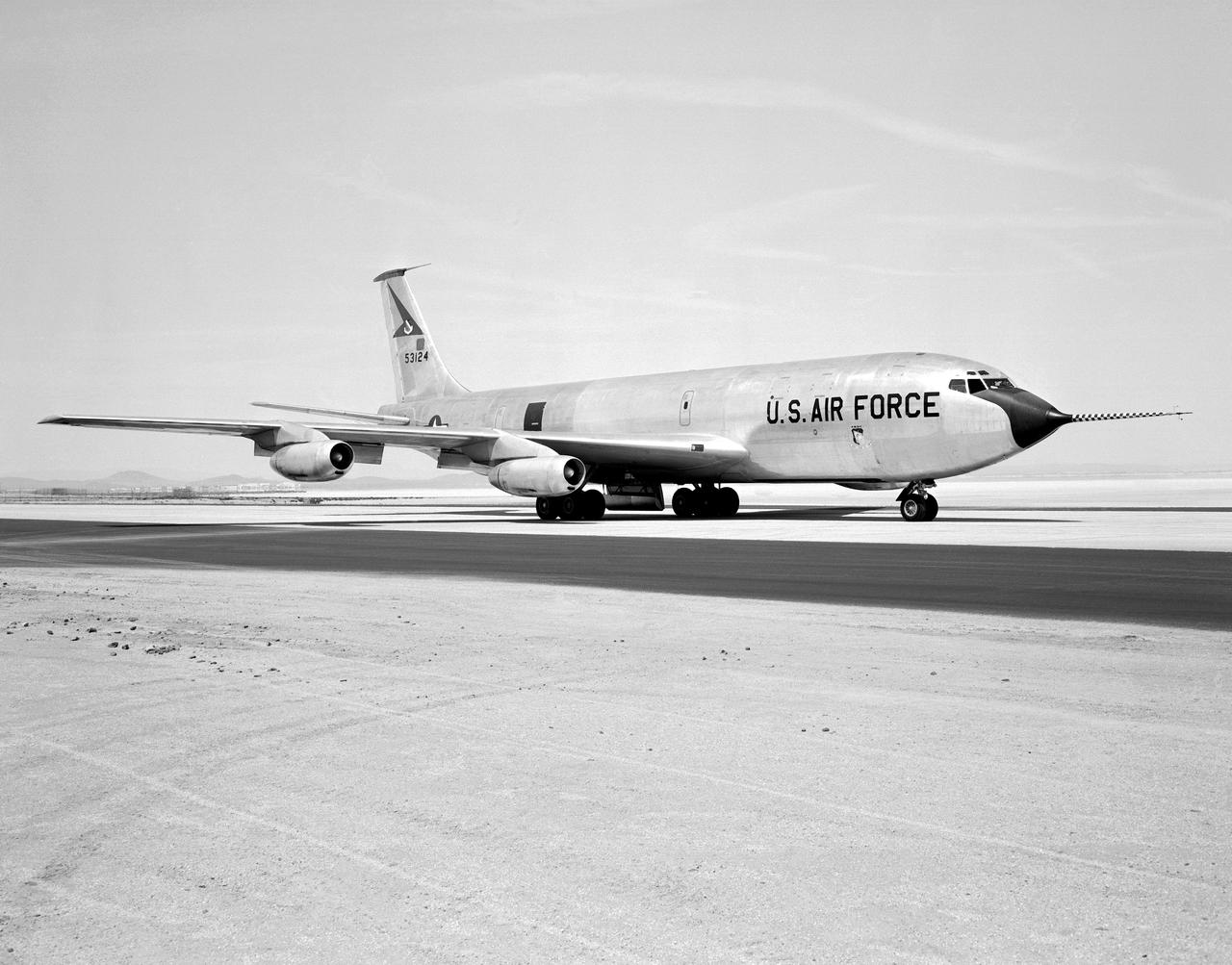
The Boeing KC-135 Stratotanker, besides being used extensively in its primary role as an inflight aircraft refueler, has assisted in several projects at the NASA Dryden Flight Research Center, Edwards, California. In 1957 and 1958, Dryden was asked by what was then the Civil Aeronautics Administration (later absorbed into the Federal Aviation Administration (FAA) in 1958) to help establish new approach procedure guidelines on cloud-ceiling and visibility minimums for Boeing's first jet airliner, the B-707. Dryden used a KC-135 (the military variant of the 707), seen here on the runway at Edwards Air Force Base, to aid the CAA in these tests. In 1979 and 1980, Dryden was again involved with general aviation research with the KC-135. This time, a special wingtip "winglet", developed by Richard Whitcomb of Langley Research Center, was tested on the jet aircraft. Winglets are small, nearly vertical fins installed on an airplane's wing tips to help produce a forward thrust in the vortices that typically swirl off the end of the wing, thereby reducing drag. This winglet idea was tested at the Dryden Flight Research Center on a KC-135A tanker loaned to NASA by the Air Force. The research showed that the winglets could increase an aircraft's range by as much as 7 percent at cruise speeds. The first application of NASA's winglet technology in industry was in general aviation business jets, but winglets are now being incorporated into most new commercial and military transport jets, including the Gulfstream III and IV business jets, the Boeing 747-400 and MD-11 airliners, and the C-17 military transport. In the 1980's, a KC-135 was used in support of the Space Shuttle program. Since the Shuttle was to be launched from Florida, researchers wanted to test the effect of rain on the sensitive thermal tiles. Tiles were mounted on special fixtures on an F-104 aircraft and a P-3 Orion. The F-104 was flown in actual rain conditions, and also behind the KC-135 spray tanker as it rel
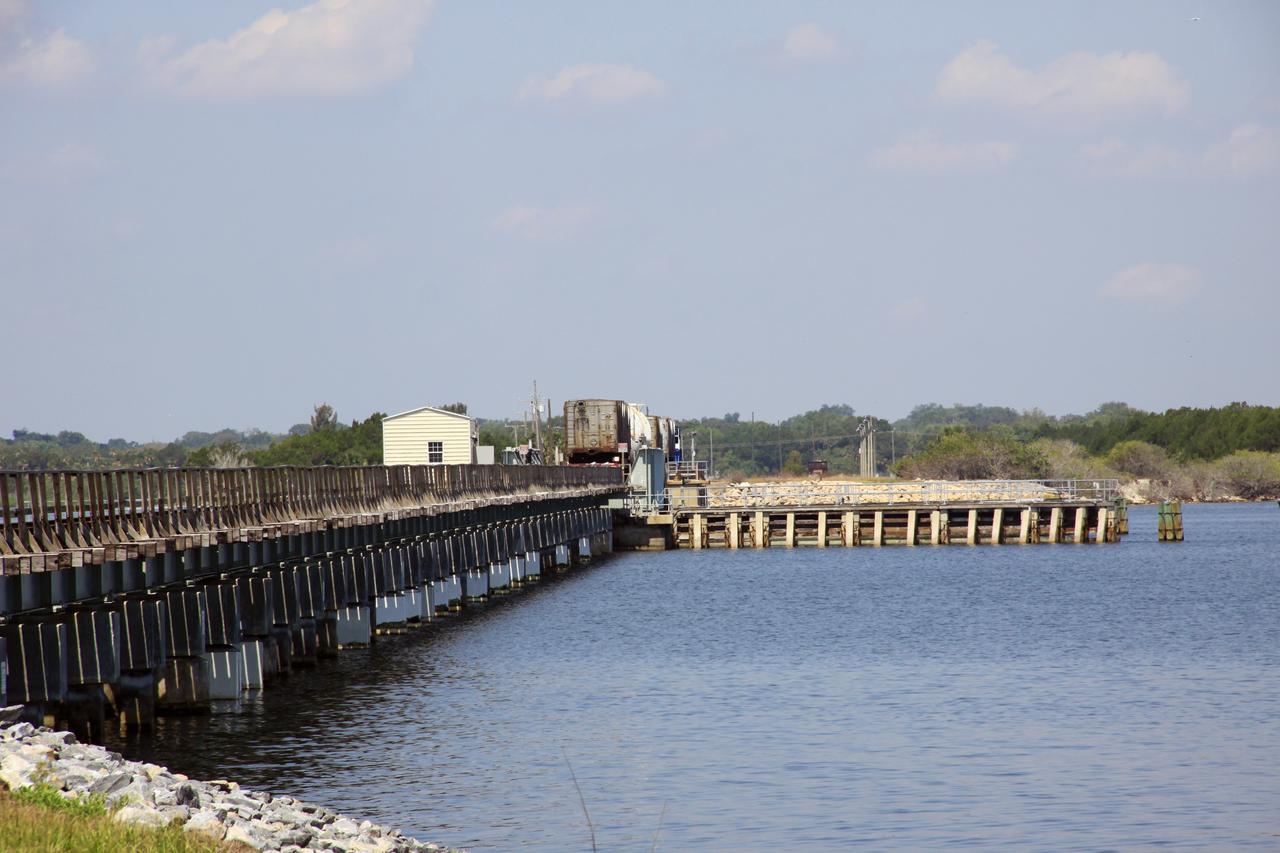
CAPE CANAVERAL, Fla. – A NASA Railroad train has crossed the Indian River on the railroad’s Jay Jay Railroad Bridge north of Launch Complex 39 at NASA’s Kennedy Space Center in Florida. The train is on its way to the Florida East Coast Railway interchange in Titusville, Fla., where the train’s helium tank cars, a liquid oxygen tank car, and a liquid hydrogen dewar or tank car will be transferred for delivery to the SpaceX engine test complex outside McGregor, Texas. The railroad cars were needed in support of the Space Shuttle Program but currently are not in use by NASA following the completion of the program in 2011. Originally, the tankers belonged to the U.S. Bureau of Mines. At the peak of the shuttle program, there were approximately 30 cars in the fleet. About half the cars were returned to the bureau as launch activity diminished. Five tank cars are being loaned to SpaceX and repurposed to support their engine tests in Texas. Eight cars previously were shipped to California on loan to support the SpaceX Falcon 9 rocket launches from Space Launch Complex-4 on Vandenberg Air Force Base. SpaceX already has three helium tank cars previously used for the shuttle program at Space Launch Complex-40 on Cape Canaveral Air Force Station in Florida. For more information, visit http://www.nasa.gov/spacex. Photo credit: NASA/Jim Grossmann
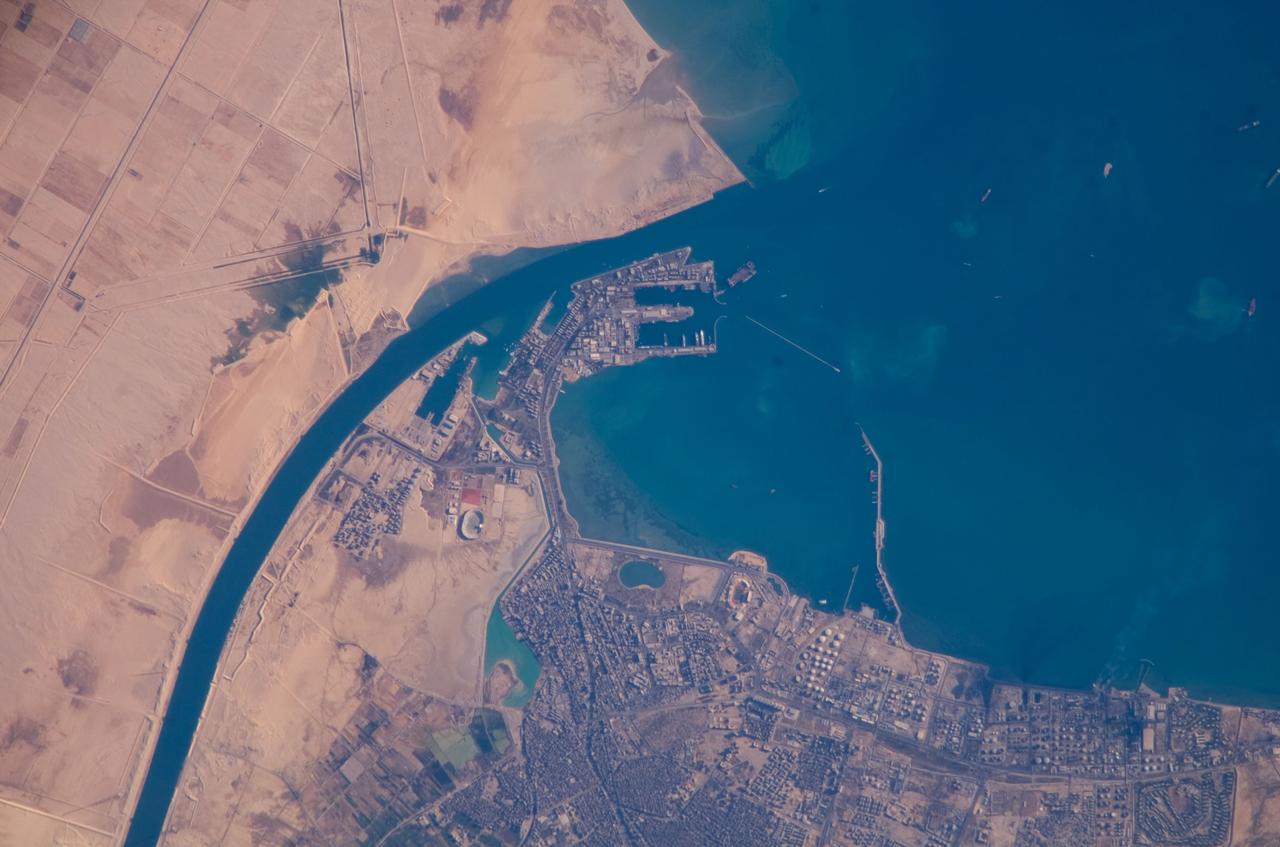
ISS016-E-019375 (30 Dec. 2007) --- Port of Suez, Egypt is featured in this image photographed by an Expedition 16 crewmember on the International Space Station. The Port of Suez is located in Egypt along the northern coastline of the Gulf of Suez. The port and city are the southern terminus of the Suez Canal that transits through Egypt and debouches into the Mediterranean Sea near Port Said. The port serves vessels transporting general cargo, oil tankers, and both commercial and private passenger vessels. The port is also an important waypoint for Muslim pilgrims traveling to and from Mecca in Saudi Arabia. Several large vessels are visible in the Gulf of Suez and berthed at various docks around the port. An extensive petroleum refinery complex forms the southern coastal boundary of the Port of Suez. At the time this image was acquired, gaseous byproducts of petroleum processing were being burned off -- as indicated by a smoke plume extending southwards into the Gulf of Suez (lower right). This view also captures several regions of greenish blue coloration in the Gulf. These are most probably sediments stirred up by passage of ships traveling to and from the Port. Similarly-colored regions along the coastline are bottom sediments visible through the shallow water column.
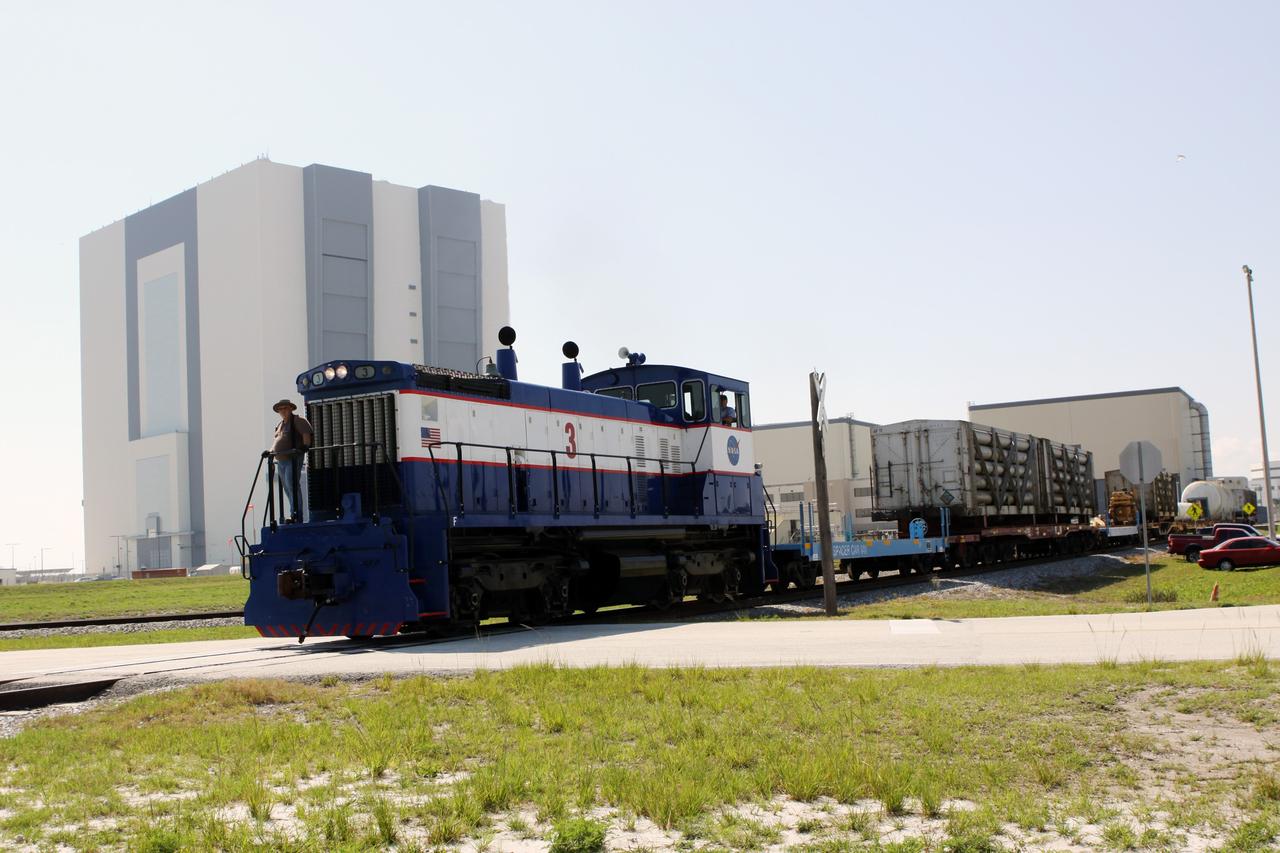
CAPE CANAVERAL, Fla. – A NASA Railroad train passes in front of the 525-foot-tall Vehicle Assembly Building, left, and the twin bays of the Orbiter Processing Facility, right, at NASA’s Kennedy Space Center in Florida. The train is on its way to the Florida East Coast Railway interchange in Titusville, Fla., where the train’s helium tank cars, a liquid oxygen tank car, and a liquid hydrogen dewar or tank car will be transferred for delivery to the SpaceX engine test complex outside McGregor, Texas. The railroad cars were needed in support of the Space Shuttle Program but currently are not in use by NASA following the completion of the program in 2011. Originally, the tankers belonged to the U.S. Bureau of Mines. At the peak of the shuttle program, there were approximately 30 cars in the fleet. About half the cars were returned to the bureau as launch activity diminished. Five tank cars are being loaned to SpaceX and repurposed to support their engine tests in Texas. Eight cars previously were shipped to California on loan to support the SpaceX Falcon 9 rocket launches from Space Launch Complex-4 on Vandenberg Air Force Base. SpaceX already has three helium tank cars previously used for the shuttle program at Space Launch Complex-40 on Cape Canaveral Air Force Station in Florida. For more information, visit http://www.nasa.gov/spacex. Photo credit: NASA/Jim Grossmann
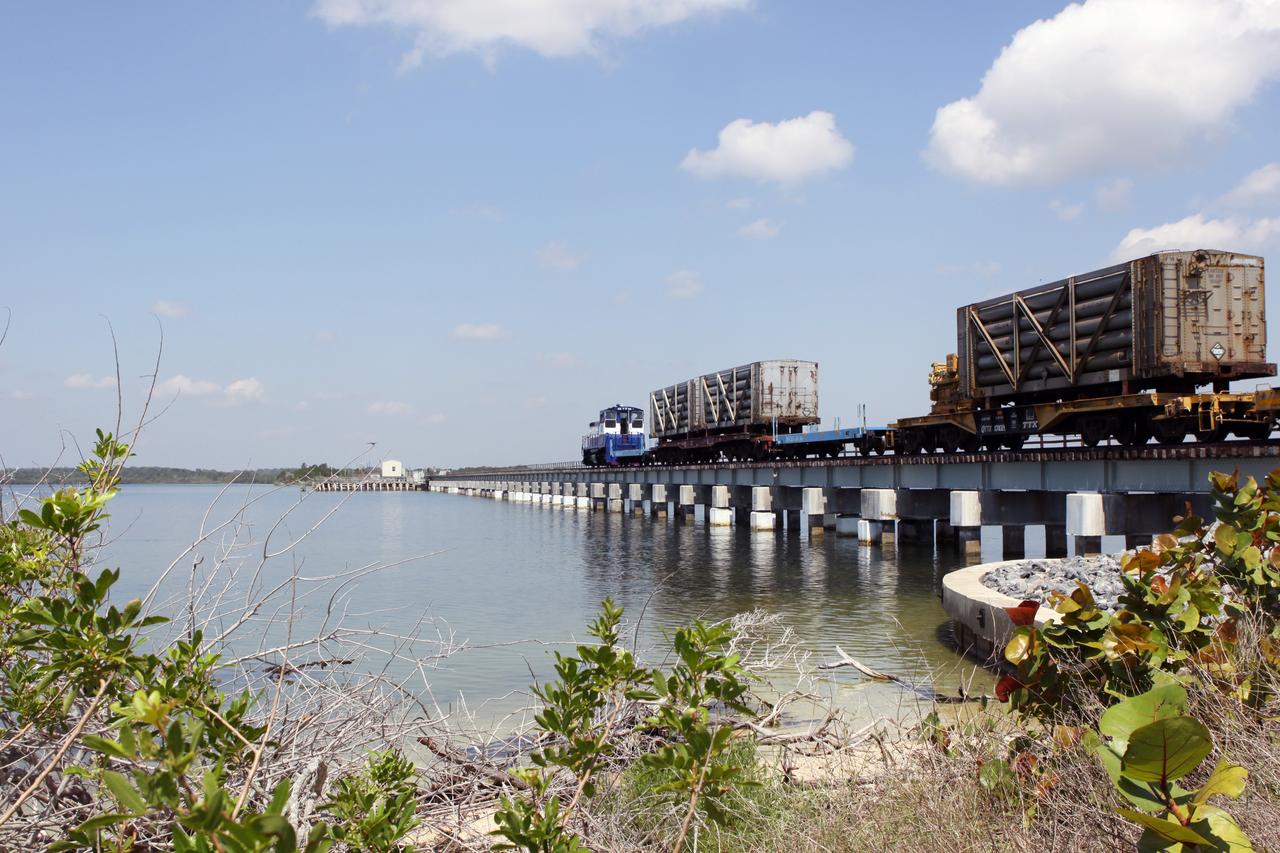
CAPE CANAVERAL, Fla. – A NASA Railroad train crosses the railroad’s Jay Jay Railroad Bridge north of Launch Complex 39 at NASA’s Kennedy Space Center in Florida. The train is on its way to the Florida East Coast Railway interchange in Titusville, Fla., where the train’s helium tank cars, a liquid oxygen tank car, and a liquid hydrogen dewar or tank car will be transferred for delivery to the SpaceX engine test complex outside McGregor, Texas. The railroad cars were needed in support of the Space Shuttle Program but currently are not in use by NASA following the completion of the program in 2011. Originally, the tankers belonged to the U.S. Bureau of Mines. At the peak of the shuttle program, there were approximately 30 cars in the fleet. About half the cars were returned to the bureau as launch activity diminished. Five tank cars are being loaned to SpaceX and repurposed to support their engine tests in Texas. Eight cars previously were shipped to California on loan to support the SpaceX Falcon 9 rocket launches from Space Launch Complex-4 on Vandenberg Air Force Base. SpaceX already has three helium tank cars previously used for the shuttle program at Space Launch Complex-40 on Cape Canaveral Air Force Station in Florida. For more information, visit http://www.nasa.gov/spacex. Photo credit: NASA/Jim Grossmann
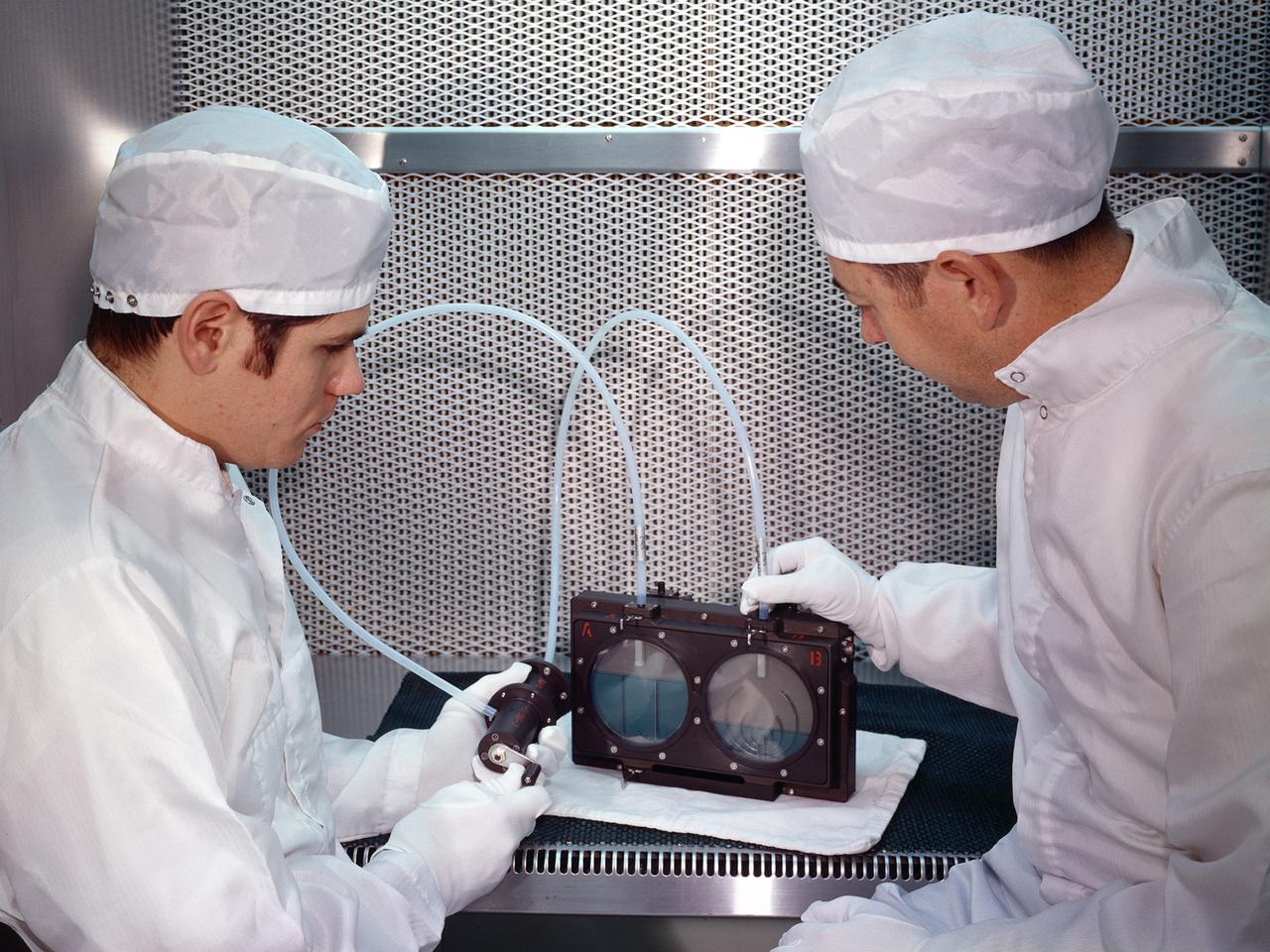
Two researchers at the National Aeronautics and Space Administration (NASA) Lewis Research Center demonstrate the test equipment they devised to study the transfer of liquid in microgravity onboard the Apollo 14 mission. The test was an early step in developing the ability to transfer liquids from a tanker vehicle to spacecraft in space. Researchers needed to know the tank’s outflow characteristics, the fluid’s behavior when entering new tank, and the effects of accelerations. Others had performed some calculations and analytical studies, but no one had examined the complete transfer from one tank to another in microgravity. The early calculations concluded that the transfer process was impossible without devices to control the liquid and gas. This investigation specifically sought to demonstrate the effectiveness of two different surface-tension baffle designs. The experiment was an entirely closed system with two baffled-tanks. The researchers also built a similar device without the baffles. The experiment was carried onboard the Apollo 14 spacecraft and conducted during the coast period on the way to the moon. The two surface tension baffle designs in the separate tanks were shown to be effective both as supply tanks and as receiver tanks. The liquid transferred within two percent of the design value with ingesting gas. The unbaffled tanks ingested gas after only 12-percent of the fluid had transferred.
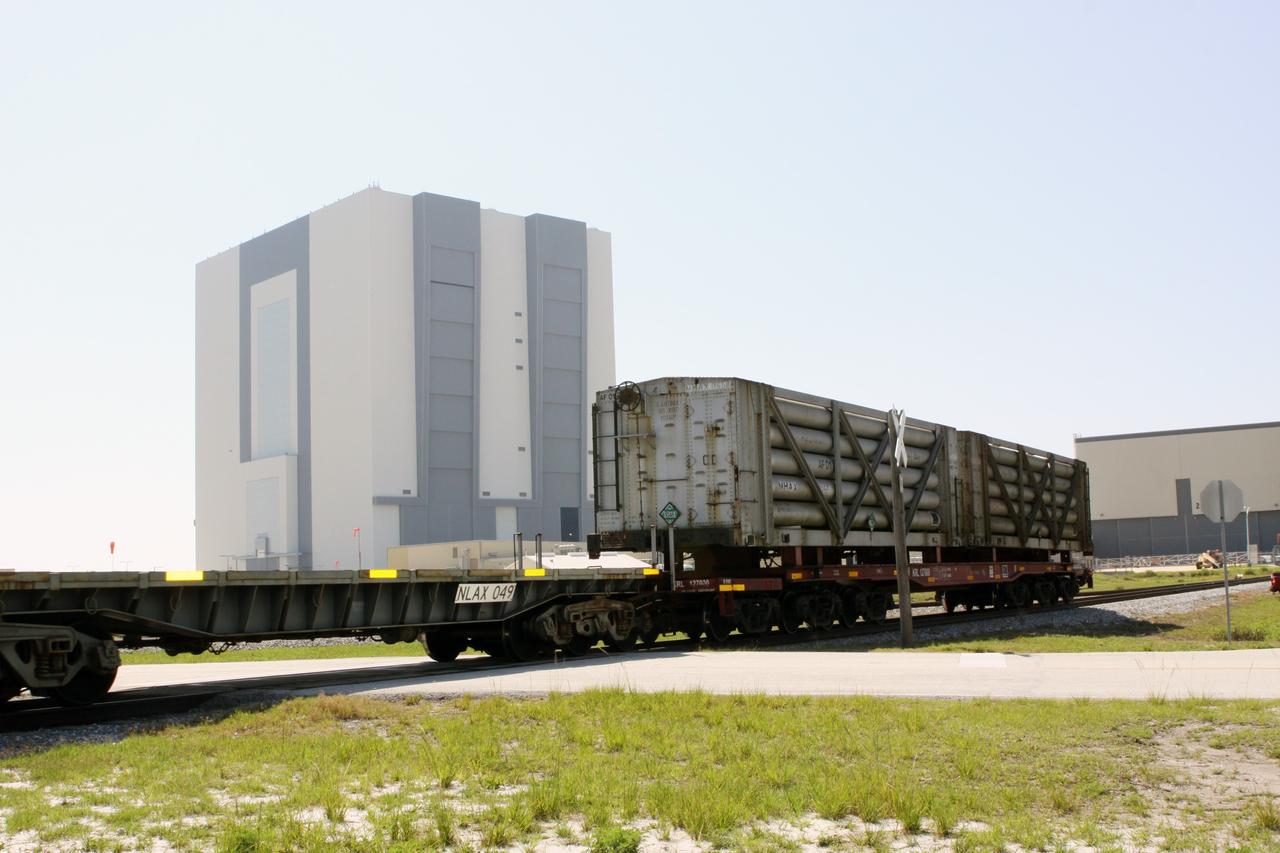
CAPE CANAVERAL, Fla. – A NASA Railroad train passes in front of the 525-foot-tall Vehicle Assembly Building at NASA’s Kennedy Space Center in Florida. At the far right is the Orbiter Processing Facility. The train is on its way to the Florida East Coast Railway interchange in Titusville, Fla., where the train’s helium tank cars, a liquid oxygen tank car, and a liquid hydrogen dewar or tank car will be transferred for delivery to the SpaceX engine test complex outside McGregor, Texas. The railroad cars were needed in support of the Space Shuttle Program but currently are not in use by NASA following the completion of the program in 2011. Originally, the tankers belonged to the U.S. Bureau of Mines. At the peak of the shuttle program, there were approximately 30 cars in the fleet. About half the cars were returned to the bureau as launch activity diminished. Five tank cars are being loaned to SpaceX and repurposed to support their engine tests in Texas. Eight cars previously were shipped to California on loan to support the SpaceX Falcon 9 rocket launches from Space Launch Complex-4 on Vandenberg Air Force Base. SpaceX already has three helium tank cars previously used for the shuttle program at Space Launch Complex-40 on Cape Canaveral Air Force Station in Florida. For more information, visit http://www.nasa.gov/spacex. Photo credit: NASA/Jim Grossmann
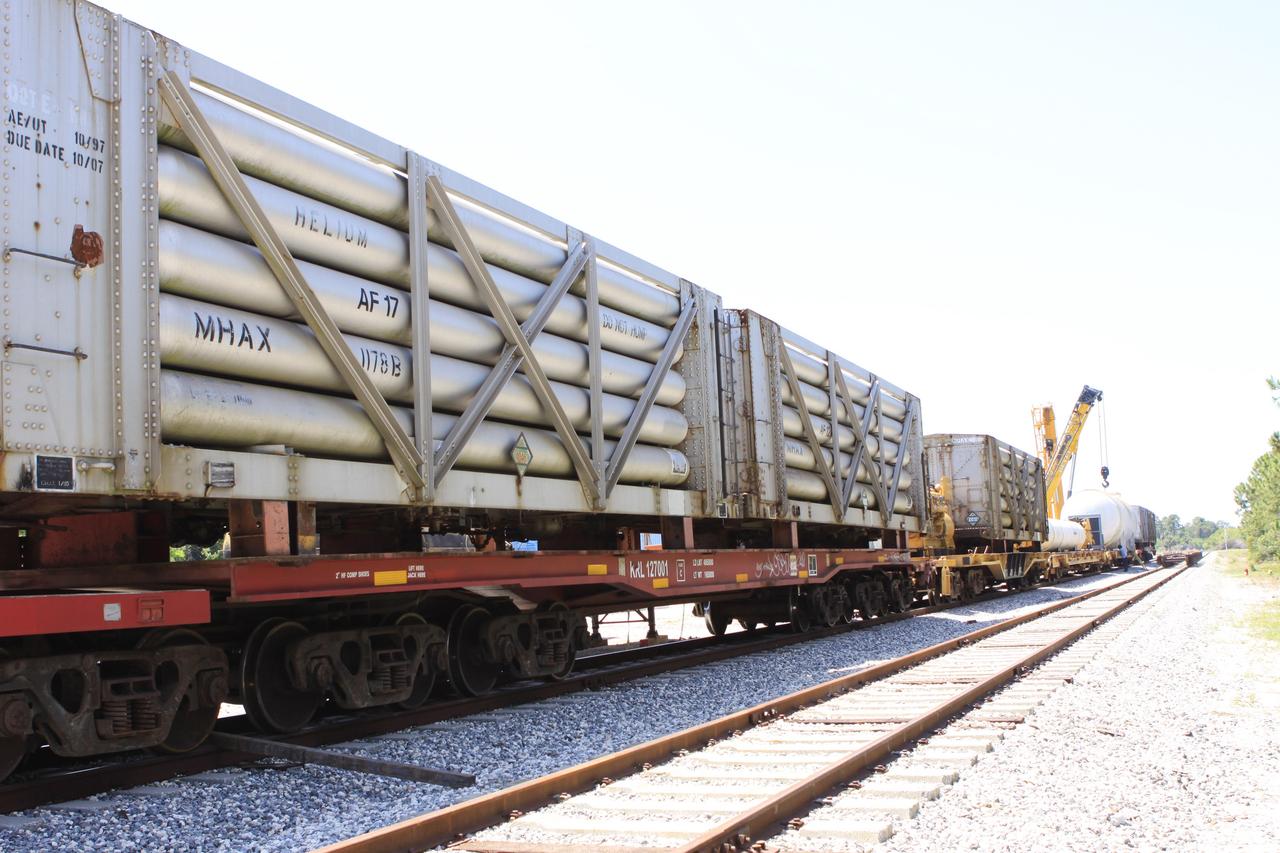
CAPE CANAVERAL, Fla. – At the NASA Railroad yard at Kennedy Space Center in Florida, helium tank cars have been removed from their trucks and loaded onto flat cars in preparation for a journey to the Florida East Coast Railway interchange in Titusville, Fla., where the train’s tank cars will be transferred for delivery to the SpaceX engine test complex outside McGregor, Texas. The railroad cars were needed in support of the Space Shuttle Program but currently are not in use by NASA following the completion of the program in 2011. Originally, the tankers belonged to the U.S. Bureau of Mines. At the peak of the shuttle program, there were approximately 30 cars in the fleet. About half the cars were returned to the bureau as launch activity diminished. Five tank cars are being loaned to SpaceX and repurposed to support their engine tests in Texas. Eight cars previously were shipped to California on loan to support the SpaceX Falcon 9 rocket launches from Space Launch Complex-4 on Vandenberg Air Force Base. SpaceX already has three helium tank cars previously used for the shuttle program at Space Launch Complex-40 on Cape Canaveral Air Force Station in Florida. For more information, visit http://www.nasa.gov/spacex. Photo credit: NASA/Jim Grossmann
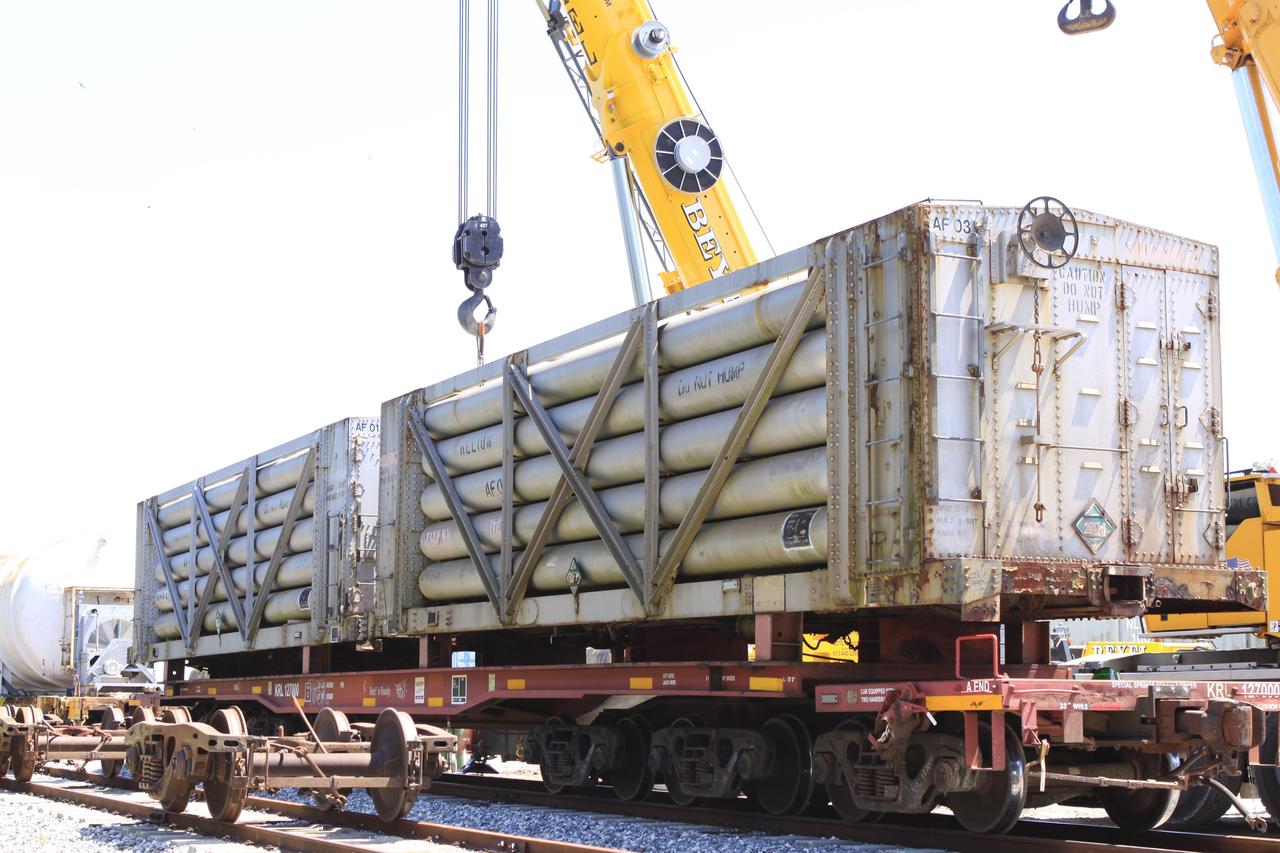
CAPE CANAVERAL, Fla. – At the NASA Railroad yard at Kennedy Space Center in Florida, cranes are enlisted to lift helium tank cars from their trucks onto flat cars in preparation for a journey to the Florida East Coast Railway interchange in Titusville, Fla., where the train’s tank cars will be transferred for delivery to the SpaceX engine test complex outside McGregor, Texas. The yard is located in Kennedy’s Launch Complex 39 near the 525-foot-tall Vehicle Assembly Building, in the background. The railroad cars were needed in support of the Space Shuttle Program but currently are not in use by NASA following the completion of the program in 2011. Originally, the tankers belonged to the U.S. Bureau of Mines. At the peak of the shuttle program, there were approximately 30 cars in the fleet. About half the cars were returned to the bureau as launch activity diminished. Five tank cars are being loaned to SpaceX and repurposed to support their engine tests in Texas. Eight cars previously were shipped to California on loan to support the SpaceX Falcon 9 rocket launches from Space Launch Complex-4 on Vandenberg Air Force Base. SpaceX already has three helium tank cars previously used for the shuttle program at Space Launch Complex-40 on Cape Canaveral Air Force Station in Florida. For more information, visit http://www.nasa.gov/spacex. Photo credit: NASA/Jim Grossmann
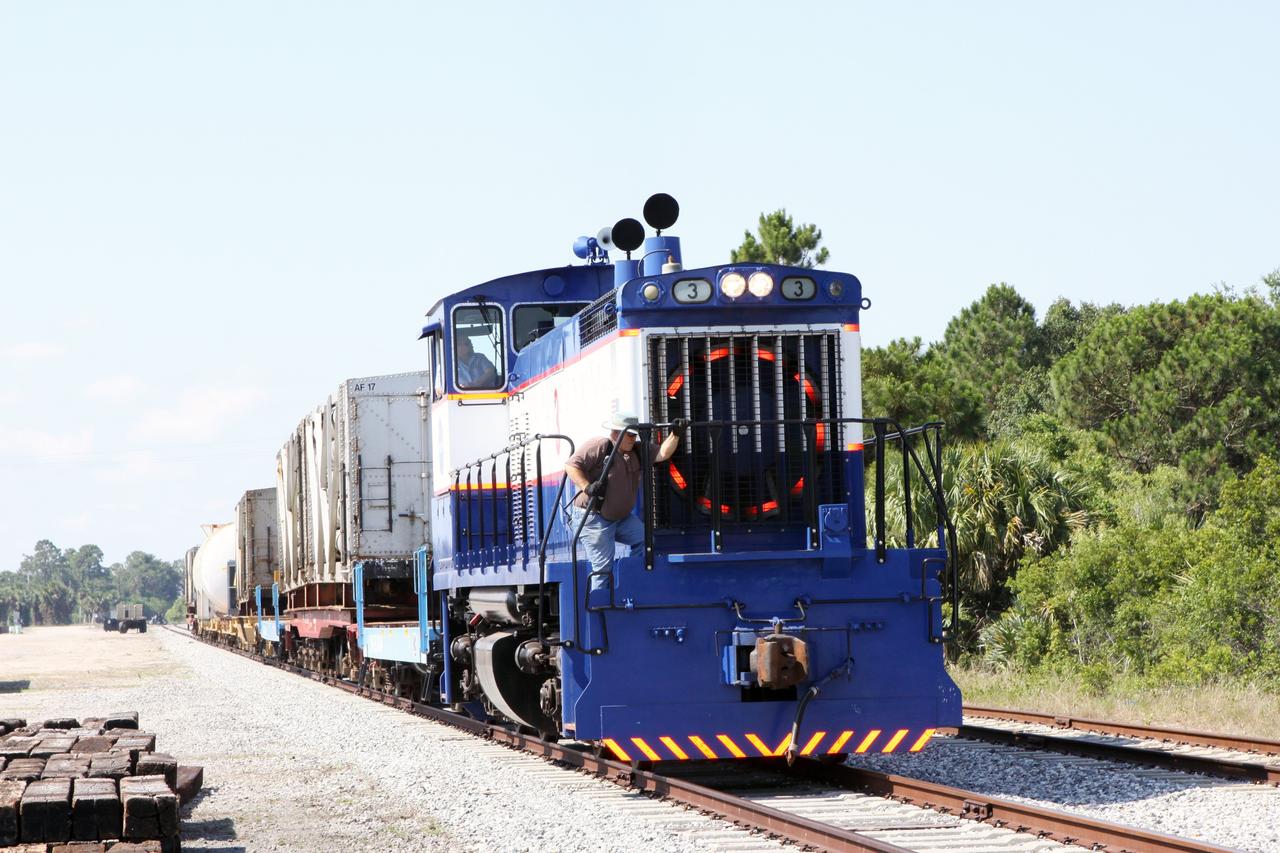
CAPE CANAVERAL, Fla. – Engineers board a NASA Railroad train in preparation for its departure from the NASA Railroad Yard at NASA’s Kennedy Space Center in Florida. The train is headed for the Florida East Coast Railway interchange in Titusville, Fla., where the train’s helium tank cars, a liquid oxygen tank car, and a liquid hydrogen dewar or tank car will be transferred for delivery to the SpaceX engine test complex outside McGregor, Texas. The railroad cars were needed in support of the Space Shuttle Program but currently are not in use by NASA following the completion of the program in 2011. Originally, the tankers belonged to the U.S. Bureau of Mines. At the peak of the shuttle program, there were approximately 30 cars in the fleet. About half the cars were returned to the bureau as launch activity diminished. Five tank cars are being loaned to SpaceX and repurposed to support their engine tests in Texas. Eight cars previously were shipped to California on loan to support the SpaceX Falcon 9 rocket launches from Space Launch Complex-4 on Vandenberg Air Force Base. SpaceX already has three helium tank cars previously used for the shuttle program at Space Launch Complex-40 on Cape Canaveral Air Force Station in Florida. For more information, visit http://www.nasa.gov/spacex. Photo credit: NASA/Jim Grossmann
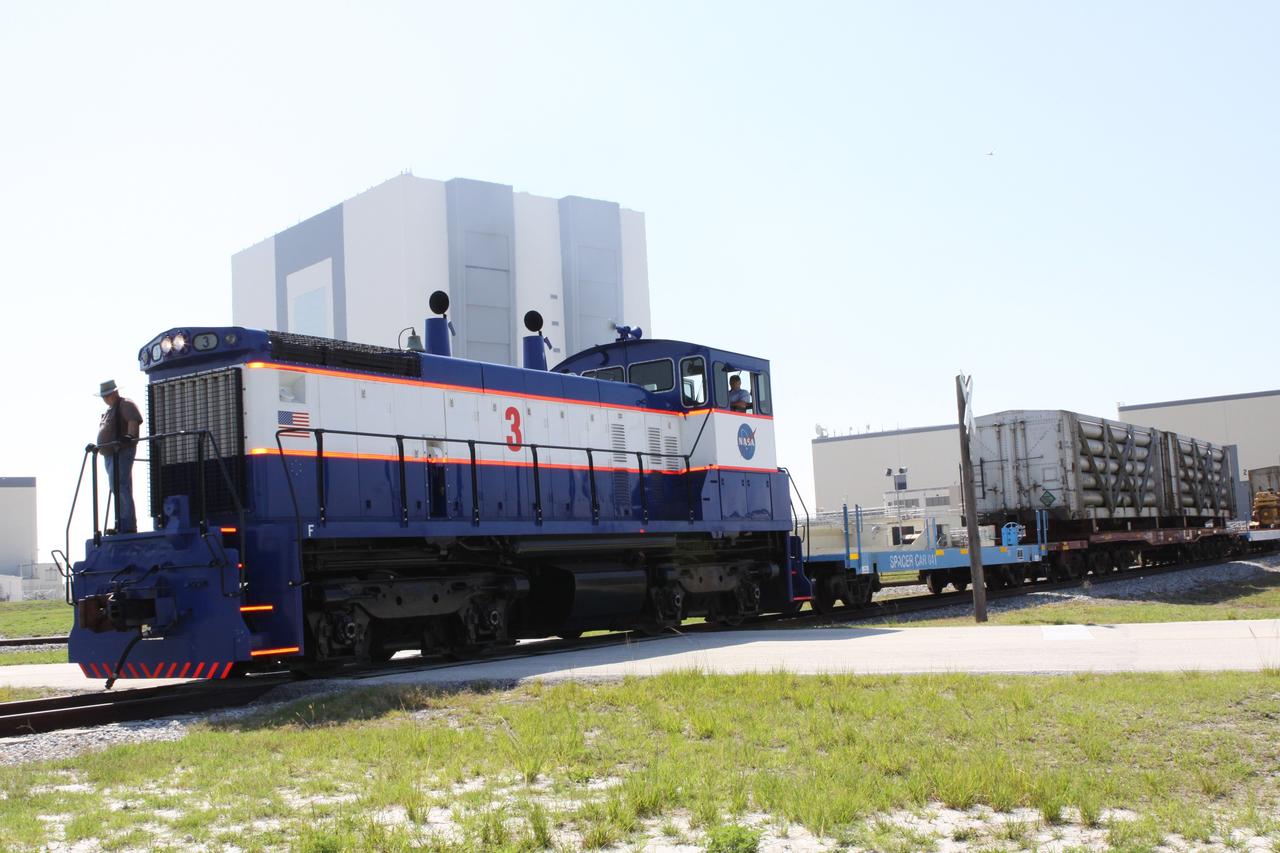
CAPE CANAVERAL, Fla. – A NASA Railroad train passes in front of the 525-foot-tall Vehicle Assembly Building, left, and the twin bays of the Orbiter Processing Facility, right, at NASA’s Kennedy Space Center in Florida. The train is on its way to the Florida East Coast Railway interchange in Titusville, Fla., where the train’s helium tank cars, a liquid oxygen tank car, and a liquid hydrogen dewar or tank car will be transferred for delivery to the SpaceX engine test complex outside McGregor, Texas. The railroad cars were needed in support of the Space Shuttle Program but currently are not in use by NASA following the completion of the program in 2011. Originally, the tankers belonged to the U.S. Bureau of Mines. At the peak of the shuttle program, there were approximately 30 cars in the fleet. About half the cars were returned to the bureau as launch activity diminished. Five tank cars are being loaned to SpaceX and repurposed to support their engine tests in Texas. Eight cars previously were shipped to California on loan to support the SpaceX Falcon 9 rocket launches from Space Launch Complex-4 on Vandenberg Air Force Base. SpaceX already has three helium tank cars previously used for the shuttle program at Space Launch Complex-40 on Cape Canaveral Air Force Station in Florida. For more information, visit http://www.nasa.gov/spacex. Photo credit: NASA/Jim Grossmann
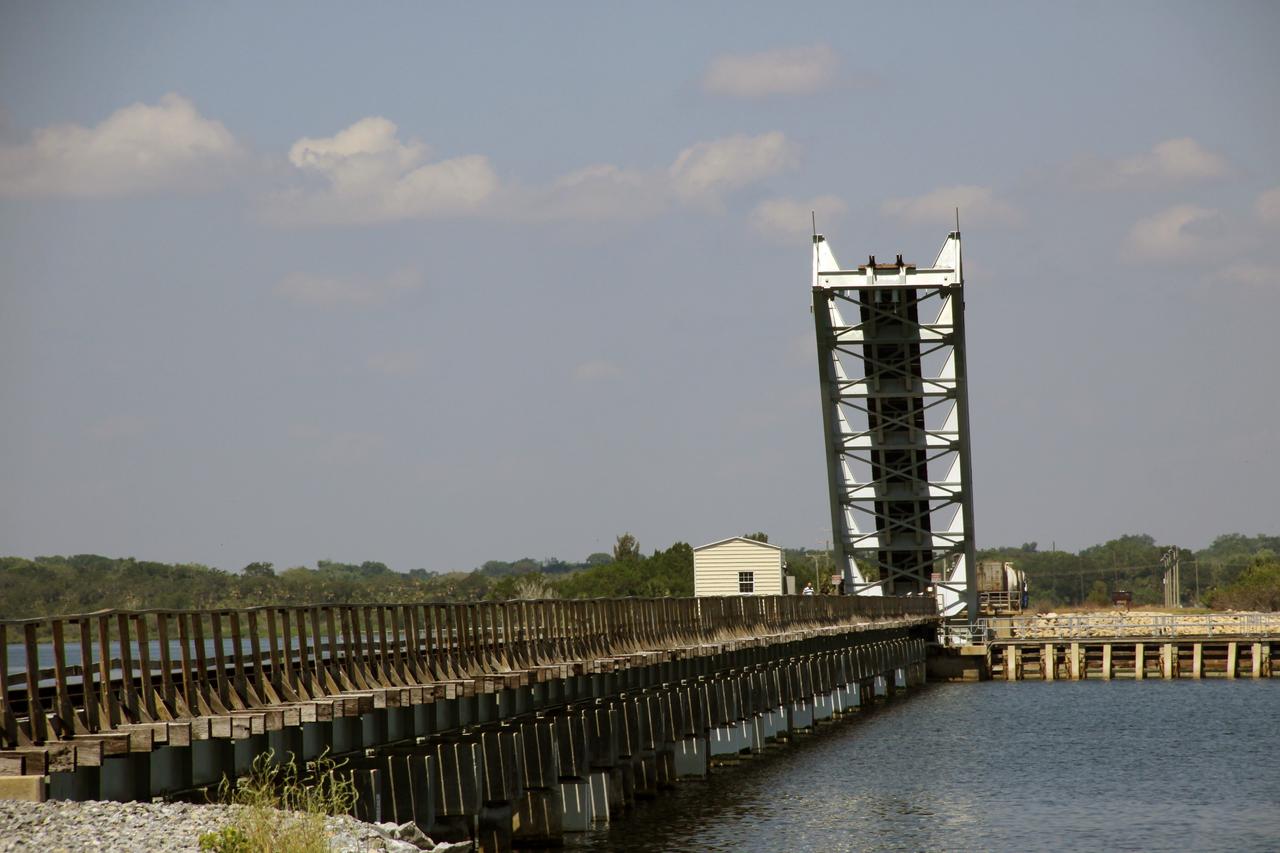
CAPE CANAVERAL, Fla. – The drawbridge span of the NASA Railroad’s Jay Jay Railroad Bridge over the Indian River north of Launch Complex 39 at NASA’s Kennedy Space Center in Florida is reopened following the passage of a NASA Railroad train. The permanent configuration of the bridge is open the span is lowered only for a train to cross. The railroad cars were needed in support of the Space Shuttle Program but currently are not in use by NASA following the completion of the program in 2011. Originally, the tankers belonged to the U.S. Bureau of Mines. At the peak of the shuttle program, there were approximately 30 cars in the fleet. About half the cars were returned to the bureau as launch activity diminished. Five tank cars are being loaned to SpaceX and repurposed to support their engine tests in Texas. Eight cars previously were shipped to California on loan to support the SpaceX Falcon 9 rocket launches from Space Launch Complex-4 on Vandenberg Air Force Base. SpaceX already has three helium tank cars previously used for the shuttle program at Space Launch Complex-40 on Cape Canaveral Air Force Station in Florida. For more information, visit http://www.nasa.gov/spacex. Photo credit: NASA/Jim Grossmann
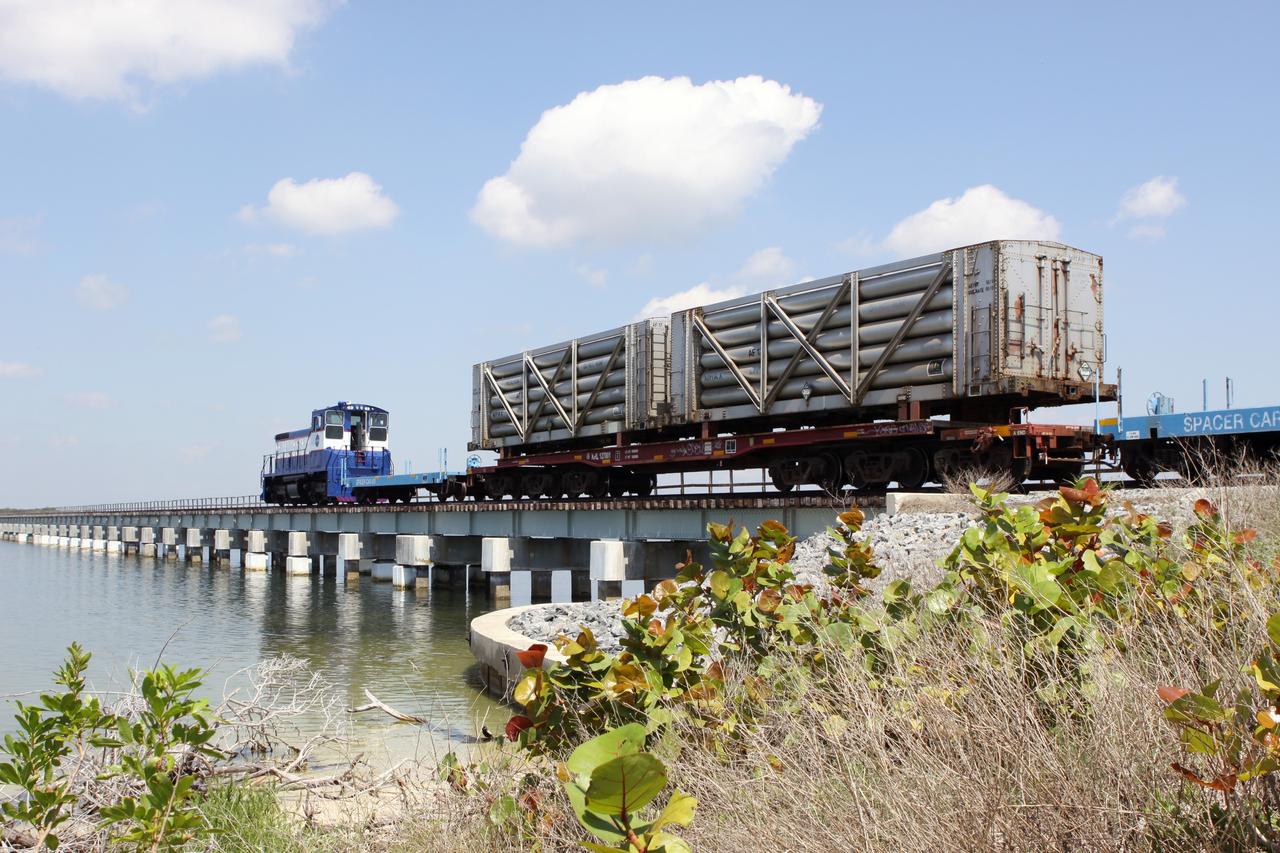
CAPE CANAVERAL, Fla. – A NASA Railroad train crosses the railroad’s Jay Jay Railroad Bridge north of Launch Complex 39 at NASA’s Kennedy Space Center in Florida. The train is on its way to the Florida East Coast Railway interchange in Titusville, Fla., where the train’s helium tank cars, a liquid oxygen tank car, and a liquid hydrogen dewar or tank car will be transferred for delivery to the SpaceX engine test complex outside McGregor, Texas. The railroad cars were needed in support of the Space Shuttle Program but currently are not in use by NASA following the completion of the program in 2011. Originally, the tankers belonged to the U.S. Bureau of Mines. At the peak of the shuttle program, there were approximately 30 cars in the fleet. About half the cars were returned to the bureau as launch activity diminished. Five tank cars are being loaned to SpaceX and repurposed to support their engine tests in Texas. Eight cars previously were shipped to California on loan to support the SpaceX Falcon 9 rocket launches from Space Launch Complex-4 on Vandenberg Air Force Base. SpaceX already has three helium tank cars previously used for the shuttle program at Space Launch Complex-40 on Cape Canaveral Air Force Station in Florida. For more information, visit http://www.nasa.gov/spacex. Photo credit: NASA/Jim Grossmann
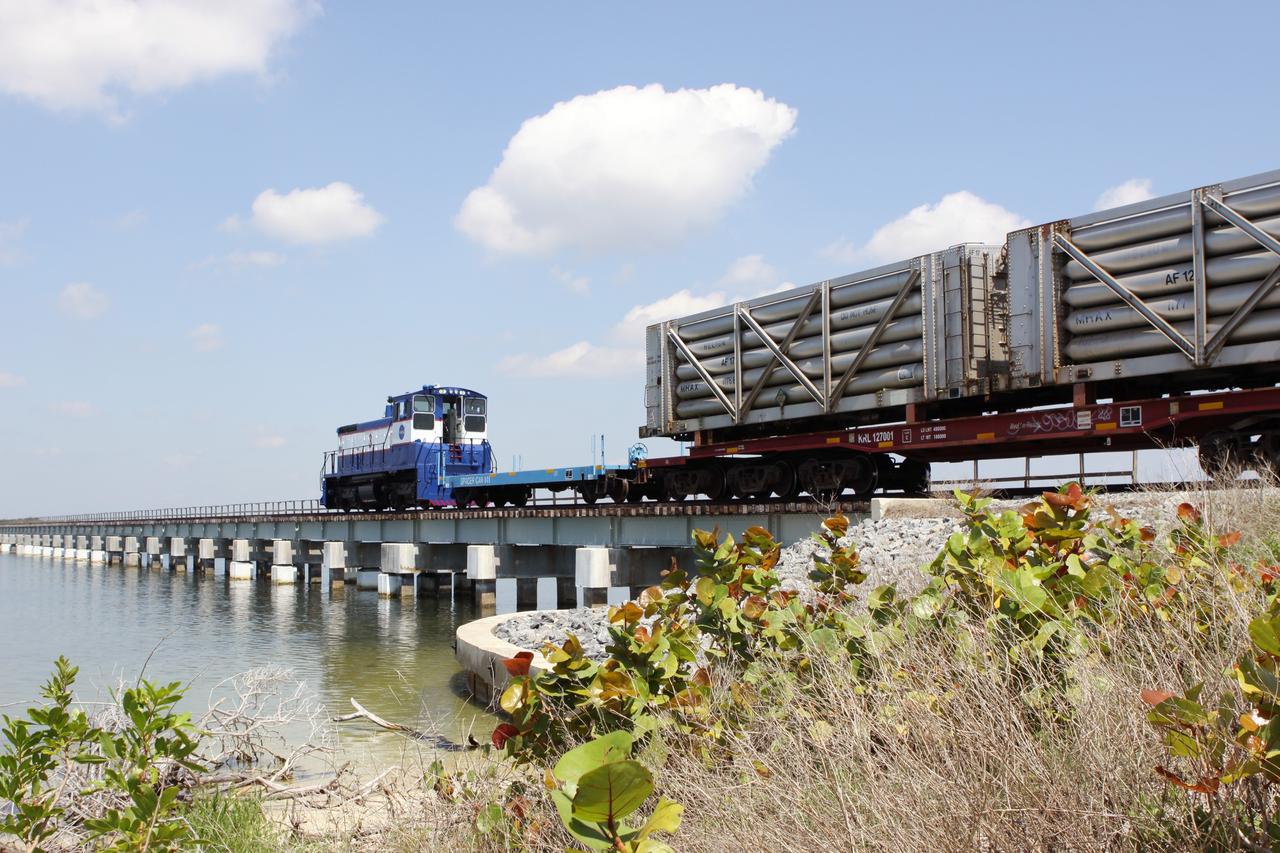
CAPE CANAVERAL, Fla. – A NASA Railroad train crosses the railroad’s Jay Jay Railroad Bridge north of Launch Complex 39 at NASA’s Kennedy Space Center in Florida. The train is on its way to the Florida East Coast Railway interchange in Titusville, Fla., where the train’s helium tank cars, a liquid oxygen tank car, and a liquid hydrogen dewar or tank car will be transferred for delivery to the SpaceX engine test complex outside McGregor, Texas. The railroad cars were needed in support of the Space Shuttle Program but currently are not in use by NASA following the completion of the program in 2011. Originally, the tankers belonged to the U.S. Bureau of Mines. At the peak of the shuttle program, there were approximately 30 cars in the fleet. About half the cars were returned to the bureau as launch activity diminished. Five tank cars are being loaned to SpaceX and repurposed to support their engine tests in Texas. Eight cars previously were shipped to California on loan to support the SpaceX Falcon 9 rocket launches from Space Launch Complex-4 on Vandenberg Air Force Base. SpaceX already has three helium tank cars previously used for the shuttle program at Space Launch Complex-40 on Cape Canaveral Air Force Station in Florida. For more information, visit http://www.nasa.gov/spacex. Photo credit: NASA/Jim Grossmann
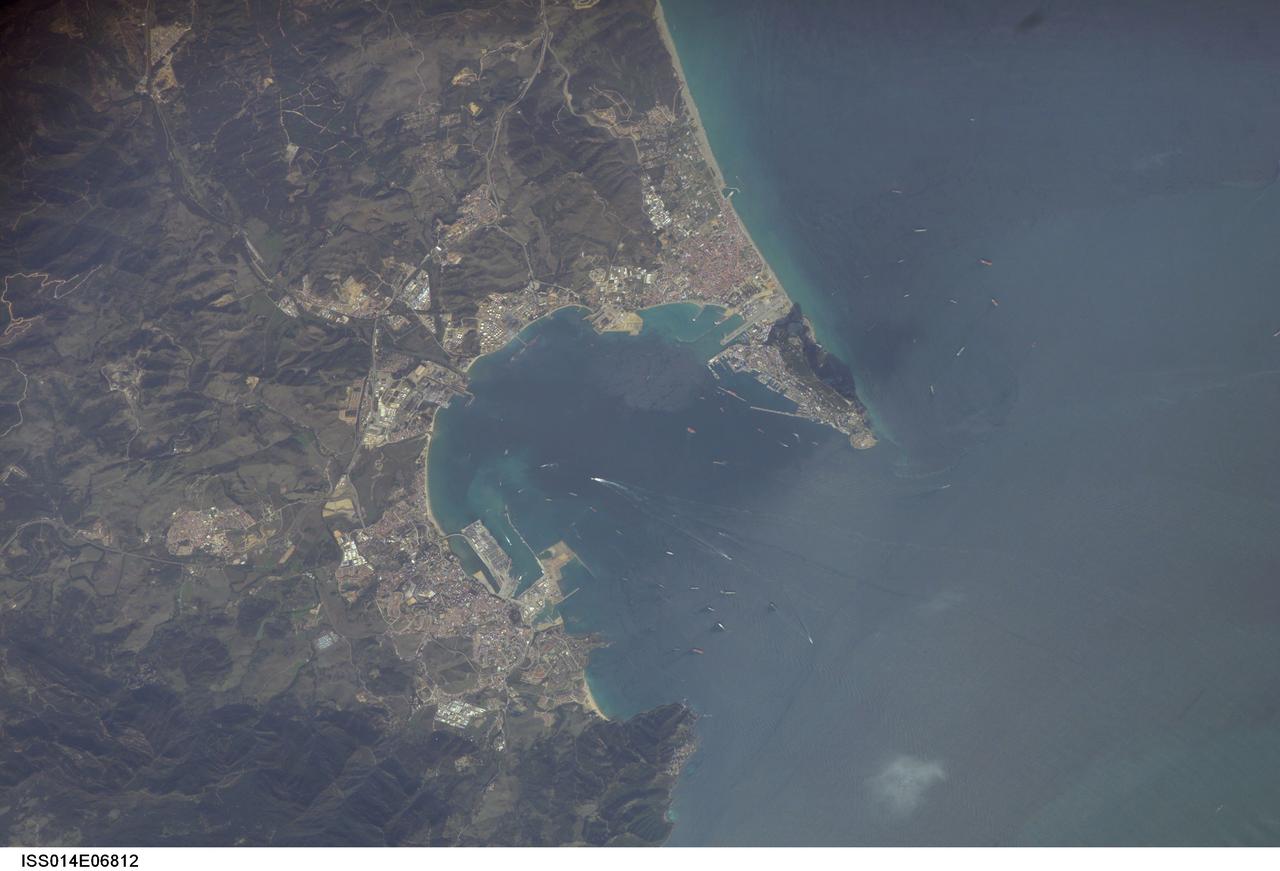
ISS014-E-06812 (30 Oct. 2006) --- Gibraltar Bay, located near the southernmost tip of the Iberian Peninsula in the western Mediterranean Sea, is featured in this image photographed by an Expedition 14 crewmember on the International Space Station. According to scientists, the famous Rock of Gibraltar that forms the northeastern border of the Bay is formed of Jurassic seafloor sediments that were lithified to form limestone (a rock formed predominantly of the mineral calcite) and subsequently uplifted as a result of collision of the African and Eurasian tectonic plates. The cities of La Linea and Algeciras bordering the Bay -- together with petroleum-processing facilities along the northern Bay shoreline -- are part of Spain, whereas the city of Gibraltar itself (to the west of and including the Rock) is under the jurisdiction of the United Kingdom. The protected waters of the Bay and its proximity to Africa and the Strait of Gibraltar as the gateway between the Atlantic and Mediterranean contribute to the region's past and current strategic and economic importance. Numerous ships and several ship wakes are visible within the Bay; the majority of these are freighters and cargo tankers accessing the petroleum facilities. Ships nearer to the Rock are more likely cruise ships, as Gibraltar is a popular destination for tourists. Partial sunglint within the Bay highlights surface water roughened by winds funneled into the Bay by the surrounding highlands -- one such area is visible directly to the west of La Linea.
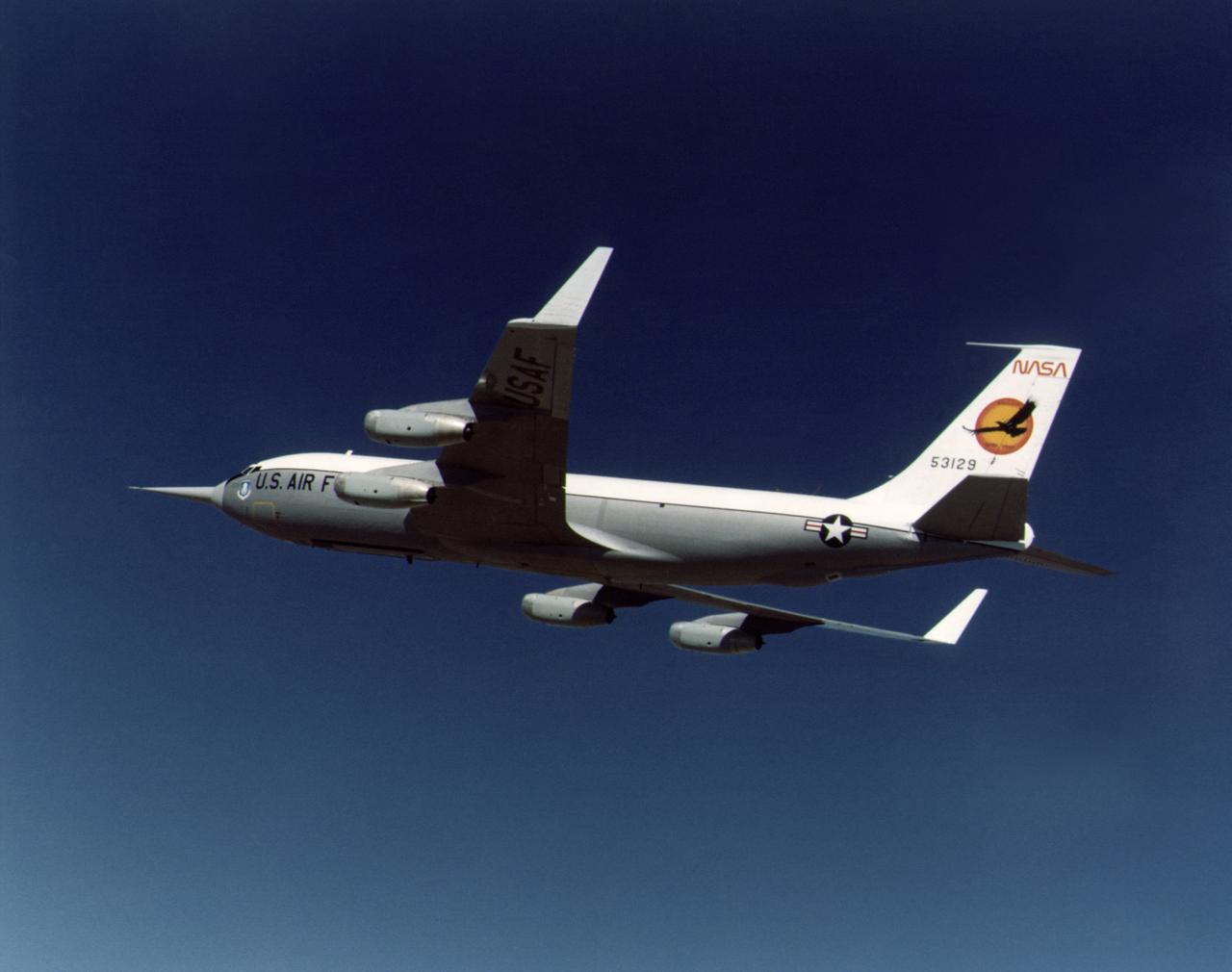
During the 1970s, the focus at Dryden shifted from high-speed and high-altitude flight to incremental improvements in technology and aircraft efficiency. One manifestation of this trend occurred in the winglet flight research carried out on a KC-135 during 1979 and 1980. Richard Whitcomb at the Langley Research Center had originated the idea of adding small vertical fins to an aircraft's wing tips. His wind tunnel tests indicated that winglets produced a forward thrust, which reduced the strength of the vortices generated by an aircraft's wing tips and resulted in a reduction of drag and an increase in aircraft range. Whitcomb, who had previously developed the area rule concept and the supercritical wing, selected the best winglet shape for flight tests on a KC-135 tanker. When the tests were completed, the data showed that the winglets provided a 7 percent improvement in range over the standard KC-135. The obvious economic advantage at a time of high fuel costs caused winglets to be adopted on business jets, airliners, and heavy military transports.
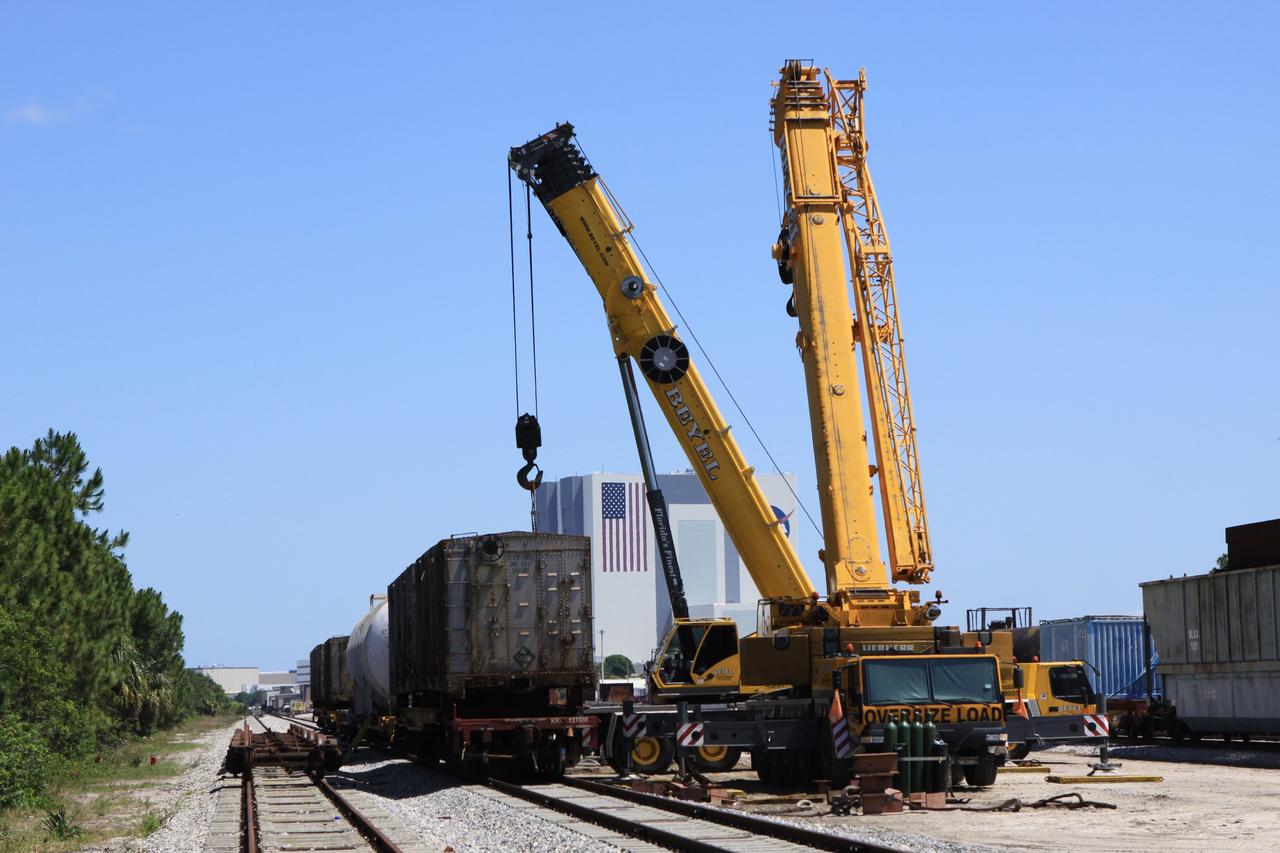
CAPE CANAVERAL, Fla. – At the NASA Railroad yard at Kennedy Space Center in Florida, helium tank cars are lifted from their trucks onto flat cars in preparation for a journey to the Florida East Coast Railway interchange in Titusville, Fla., where the train’s tank cars will be transferred for delivery to the SpaceX engine test complex outside McGregor, Texas. The railroad cars were needed in support of the Space Shuttle Program but currently are not in use by NASA following the completion of the program in 2011. Originally, the tankers belonged to the U.S. Bureau of Mines. At the peak of the shuttle program, there were approximately 30 cars in the fleet. About half the cars were returned to the bureau as launch activity diminished. Five tank cars are being loaned to SpaceX and repurposed to support their engine tests in Texas. Eight cars previously were shipped to California on loan to support the SpaceX Falcon 9 rocket launches from Space Launch Complex-4 on Vandenberg Air Force Base. SpaceX already has three helium tank cars previously used for the shuttle program at Space Launch Complex-40 on Cape Canaveral Air Force Station in Florida. For more information, visit http://www.nasa.gov/spacex. Photo credit: NASA/Jim Grossmann
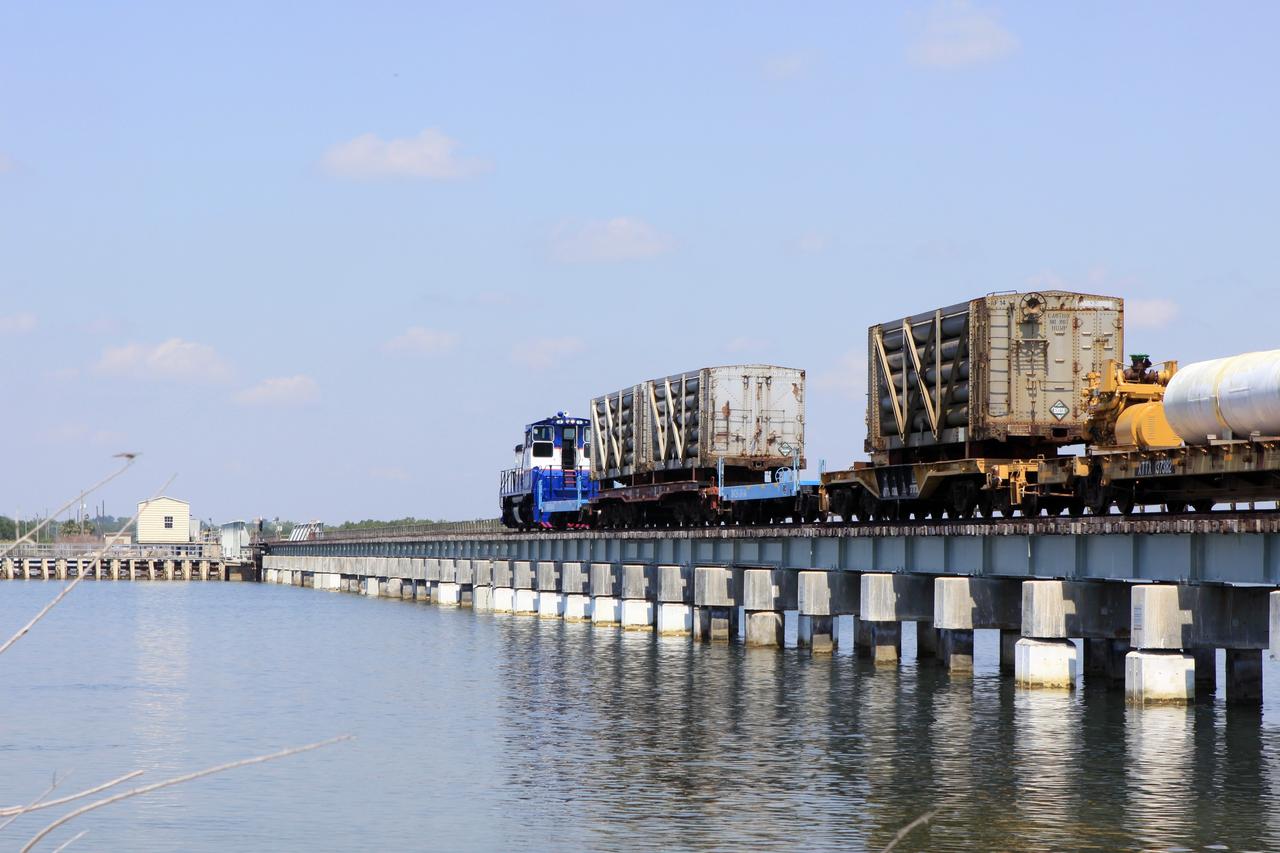
CAPE CANAVERAL, Fla. – A NASA Railroad train crosses the railroad’s Jay Jay Railroad Bridge north of Launch Complex 39 at NASA’s Kennedy Space Center in Florida. The train is on its way to the Florida East Coast Railway interchange in Titusville, Fla., where the train’s helium tank cars, a liquid oxygen tank car, and a liquid hydrogen dewar or tank car will be transferred for delivery to the SpaceX engine test complex outside McGregor, Texas. The railroad cars were needed in support of the Space Shuttle Program but currently are not in use by NASA following the completion of the program in 2011. Originally, the tankers belonged to the U.S. Bureau of Mines. At the peak of the shuttle program, there were approximately 30 cars in the fleet. About half the cars were returned to the bureau as launch activity diminished. Five tank cars are being loaned to SpaceX and repurposed to support their engine tests in Texas. Eight cars previously were shipped to California on loan to support the SpaceX Falcon 9 rocket launches from Space Launch Complex-4 on Vandenberg Air Force Base. SpaceX already has three helium tank cars previously used for the shuttle program at Space Launch Complex-40 on Cape Canaveral Air Force Station in Florida. For more information, visit http://www.nasa.gov/spacex. Photo credit: NASA/Jim Grossmann
CAPE CANAVERAL, Fla. – A NASA Railroad train passes in front of the twin bays of the Orbiter Processing Facility at NASA’s Kennedy Space Center in Florida. The train is on its way to the Florida East Coast Railway interchange in Titusville, Fla., where the train’s helium tank cars, a liquid oxygen tank car, and a liquid hydrogen dewar or tank car will be transferred for delivery to the SpaceX engine test complex outside McGregor, Texas. The railroad cars were needed in support of the Space Shuttle Program but currently are not in use by NASA following the completion of the program in 2011. Originally, the tankers belonged to the U.S. Bureau of Mines. At the peak of the shuttle program, there were approximately 30 cars in the fleet. About half the cars were returned to the bureau as launch activity diminished. Five tank cars are being loaned to SpaceX and repurposed to support their engine tests in Texas. Eight cars previously were shipped to California on loan to support the SpaceX Falcon 9 rocket launches from Space Launch Complex-4 on Vandenberg Air Force Base. SpaceX already has three helium tank cars previously used for the shuttle program at Space Launch Complex-40 on Cape Canaveral Air Force Station in Florida. For more information, visit http://www.nasa.gov/spacex. Photo credit: NASA/Jim Grossmann
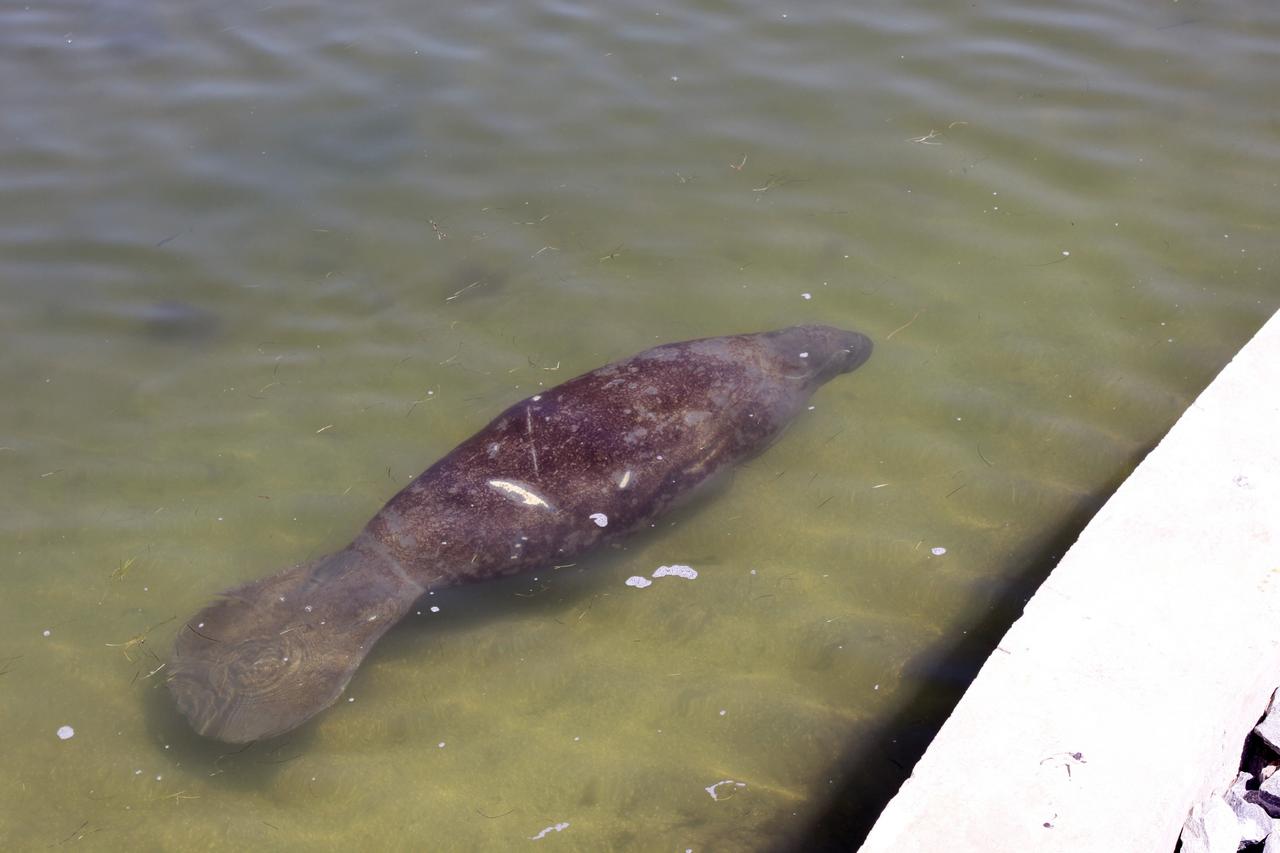
CAPE CANAVERAL, Fla. – A manatee relaxes in the Indian River near the NASA Railroad’s Jay Jay Railroad Bridge north of Launch Complex 39 at NASA’s Kennedy Space Center in Florida. The manatee was spotted by a cameraman on hand to photograph a NASA Railroad train on its way to the Florida East Coast Railway interchange in Titusville, Fla., where the train’s helium tank cars, a liquid oxygen tank car, and a liquid hydrogen dewar or tank car will be transferred for delivery to the SpaceX engine test complex outside McGregor, Texas. The railroad cars were needed in support of the Space Shuttle Program but currently are not in use by NASA following the completion of the program in 2011. Originally, the tankers belonged to the U.S. Bureau of Mines. At the peak of the shuttle program, there were approximately 30 cars in the fleet. About half the cars were returned to the bureau as launch activity diminished. Five tank cars are being loaned to SpaceX and repurposed to support their engine tests in Texas. Eight cars previously were shipped to California on loan to support the SpaceX Falcon 9 rocket launches from Space Launch Complex-4 on Vandenberg Air Force Base. SpaceX already has three helium tank cars previously used for the shuttle program at Space Launch Complex-40 on Cape Canaveral Air Force Station in Florida. For more information, visit http://www.nasa.gov/spacex. Photo credit: NASA/Jim Grossmann
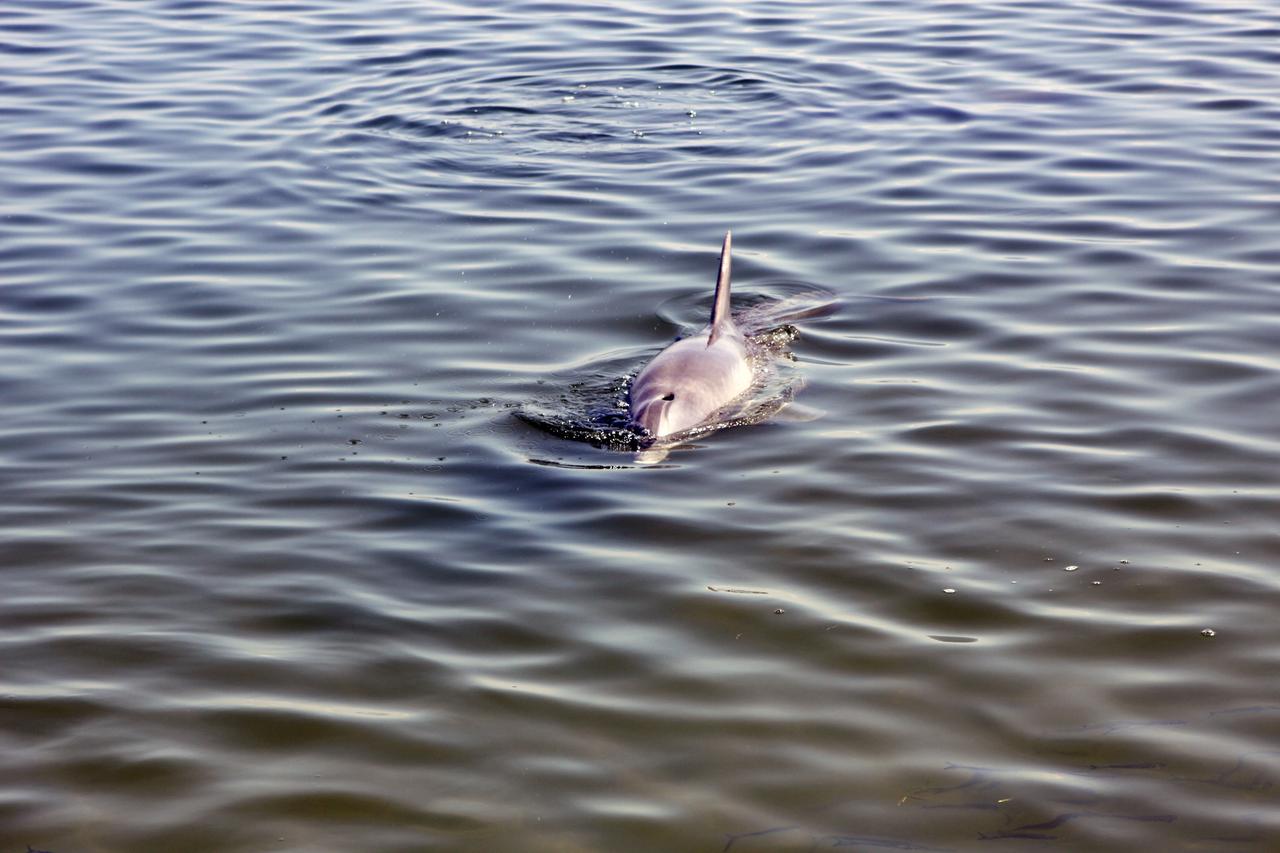
CAPE CANAVERAL, Fla. – Bubbles form around a dolphin splashing in the Indian River near the NASA Railroad’s Jay Jay Railroad Bridge north of Launch Complex 39 at NASA’s Kennedy Space Center in Florida. The dolphin was spotted by a cameraman on hand to photograph a NASA Railroad train on its way to the Florida East Coast Railway interchange in Titusville, Fla., where the train’s helium tank cars, a liquid oxygen tank car, and a liquid hydrogen dewar or tank car will be transferred for delivery to the SpaceX engine test complex outside McGregor, Texas. The railroad cars were needed in support of the Space Shuttle Program but currently are not in use by NASA following the completion of the program in 2011. Originally, the tankers belonged to the U.S. Bureau of Mines. At the peak of the shuttle program, there were approximately 30 cars in the fleet. About half the cars were returned to the bureau as launch activity diminished. Five tank cars are being loaned to SpaceX and repurposed to support their engine tests in Texas. Eight cars previously were shipped to California on loan to support the SpaceX Falcon 9 rocket launches from Space Launch Complex-4 on Vandenberg Air Force Base. SpaceX already has three helium tank cars previously used for the shuttle program at Space Launch Complex-40 on Cape Canaveral Air Force Station in Florida. For more information, visit http://www.nasa.gov/spacex. Photo credit: NASA/Jim Grossmann
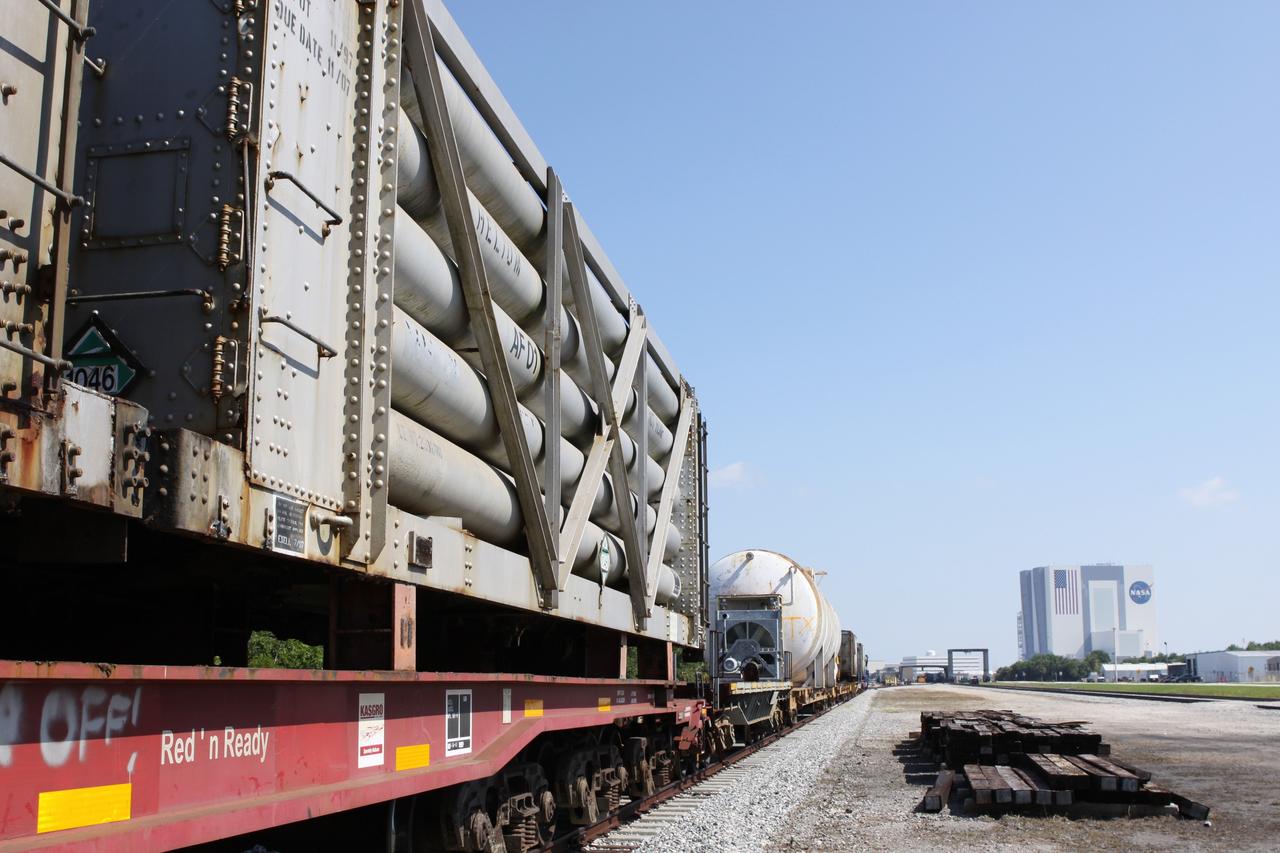
CAPE CANAVERAL, Fla. – At the NASA Railroad Yard at NASA’s Kennedy Space Center in Florida, preparations are under way for the departure of a train made up of tank cars. The railroad’s track runs past Kennedy’s 525-foot-tall Vehicle Assembly Building in the background. The train is headed for the Florida East Coast Railway interchange in Titusville, Fla., where the train’s helium tank cars, a liquid oxygen tank car, and a liquid hydrogen dewar or tank car will be transferred for delivery to the SpaceX engine test complex outside McGregor, Texas. The railroad cars were needed in support of the Space Shuttle Program but currently are not in use by NASA following the completion of the program in 2011. Originally, the tankers belonged to the U.S. Bureau of Mines. At the peak of the shuttle program, there were approximately 30 cars in the fleet. About half the cars were returned to the bureau as launch activity diminished. Five tank cars are being loaned to SpaceX and repurposed to support their engine tests in Texas. Eight cars previously were shipped to California on loan to support the SpaceX Falcon 9 rocket launches from Space Launch Complex-4 on Vandenberg Air Force Base. SpaceX already has three helium tank cars previously used for the shuttle program at Space Launch Complex-40 on Cape Canaveral Air Force Station in Florida. For more information, visit http://www.nasa.gov/spacex. Photo credit: NASA/Jim Grossmann
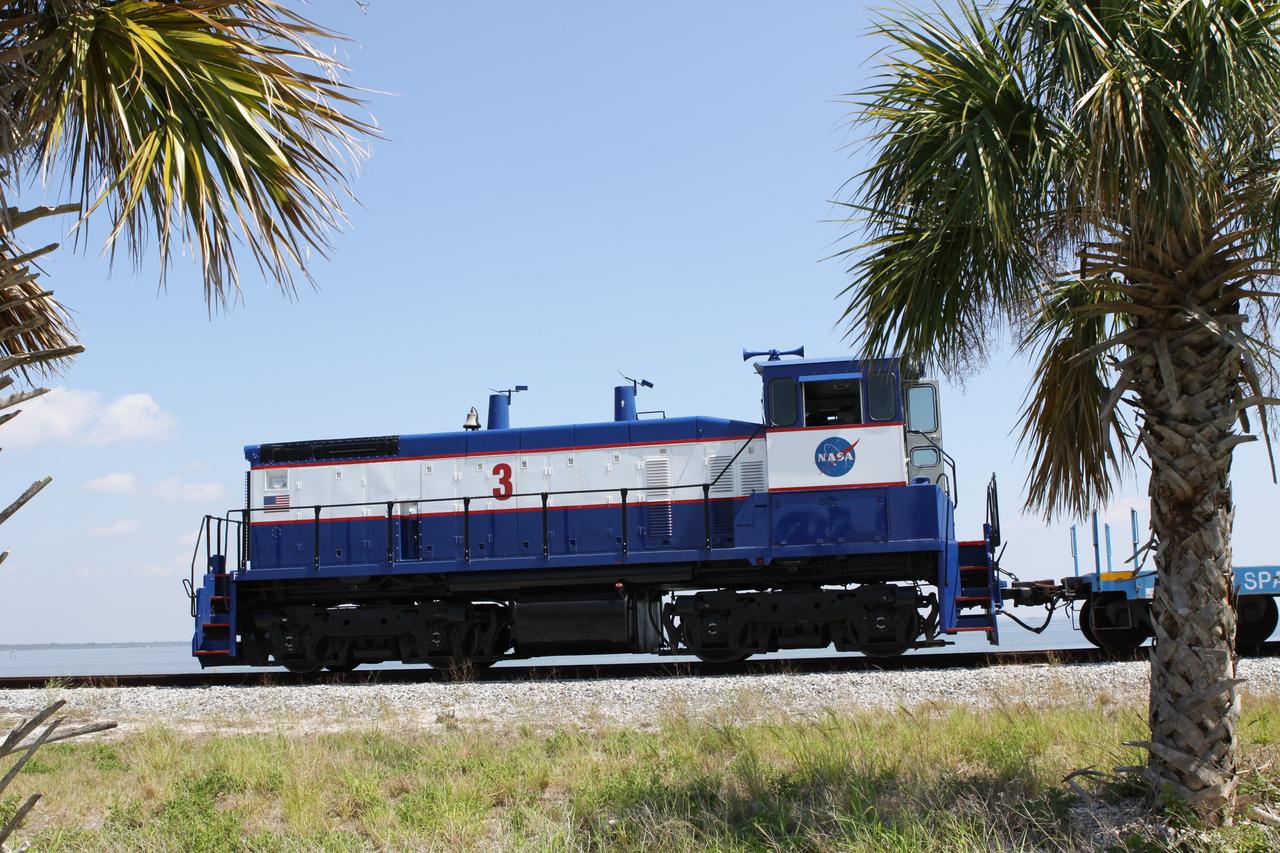
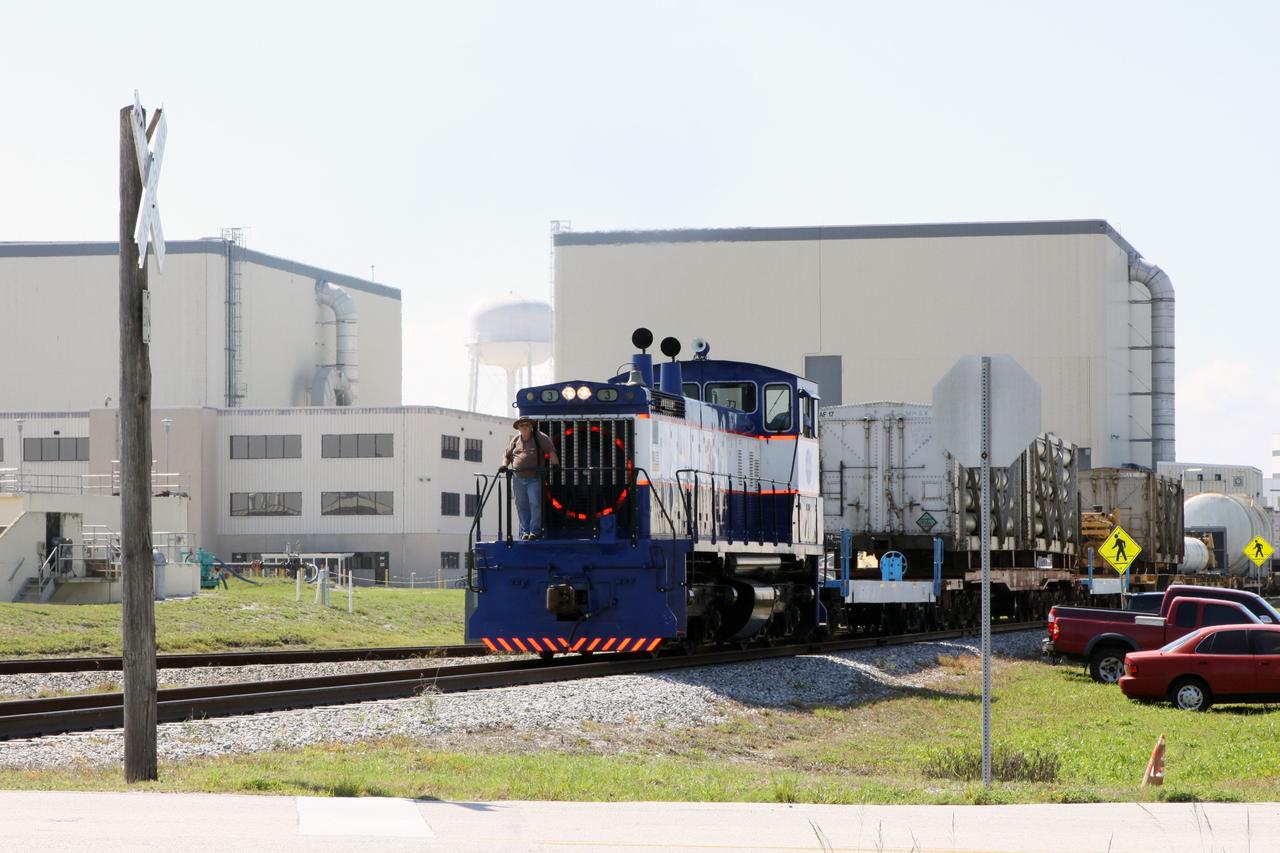
CAPE CANAVERAL, Fla. – NASA Railroad locomotive No. 3 delivers tank cars from NASA’s Kennedy Space Center in Florida to the Florida East Coast Railway interchange in Titusville, Fla. The locomotive is one of three NASA Railroad locomotives built for the Toledo, Peoria and Western, or TP&W, between 1968 and 1970. It is a GM Electromotive Division SW-1500 switcher. The locomotive was acquired by NASA from the TP&W in 1984 and painted in the NASA Railroad paint scheme. The power plant was completely overhauled in 2009. The locomotive will pull the train to the interchange in Titusville, where the train’s helium tank cars, a liquid oxygen tank car, and a liquid hydrogen dewar or tank car will be transferred for delivery to the SpaceX engine test complex outside McGregor, Texas. The railroad cars were needed in support of the Space Shuttle Program but currently are not in use by NASA following the completion of the program in 2011. Originally, the tankers belonged to the U.S. Bureau of Mines. At the peak of the shuttle program, there were approximately 30 cars in the fleet. About half the cars were returned to the bureau as launch activity diminished. Five tank cars are being loaned to SpaceX and repurposed to support their engine tests in Texas. Eight cars previously were shipped to California on loan to support the SpaceX Falcon 9 rocket launches from Space Launch Complex-4 on Vandenberg Air Force Base. SpaceX already has three helium tank cars previously used for the shuttle program at Space Launch Complex-40 on Cape Canaveral Air Force Station in Florida. For more information, visit http://www.nasa.gov/spacex. Photo credit: NASA/Jim Grossmann
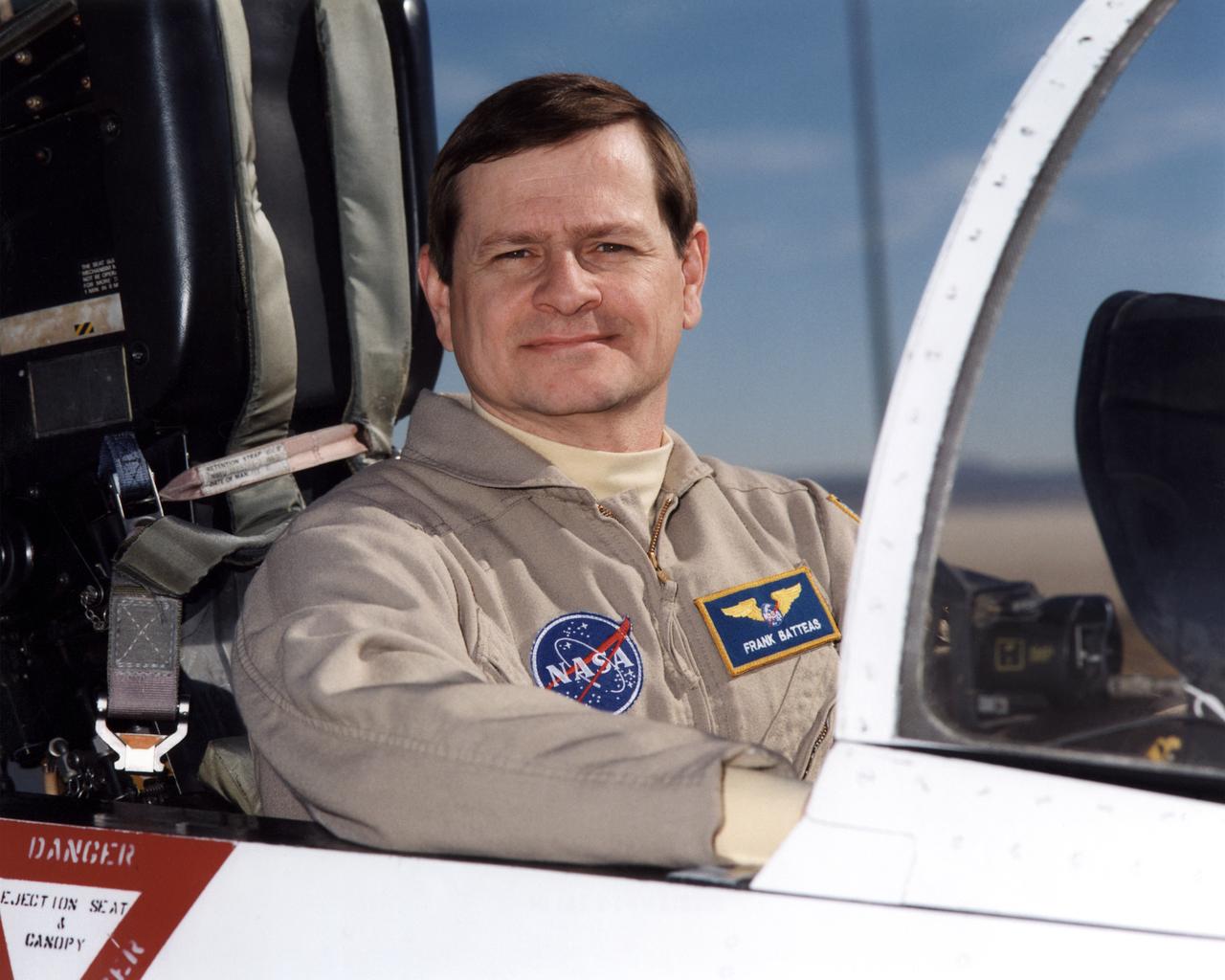
Frank Batteas is a research test pilot in the Flight Crew Branch of NASA's Dryden Flight Research Center, Edwards, California. He is currently a project pilot for the F/A-18 and C-17 flight research projects. In addition, his flying duties include operation of the DC-8 Flying Laboratory in the Airborne Science program, and piloting the B-52B launch aircraft, the King Air, and the T-34C support aircraft. Batteas has accumulated more than 4,700 hours of military and civilian flight experience in more than 40 different aircraft types. Batteas came to NASA Dryden in April 1998, following a career in the U.S. Air Force. His last assignment was at Wright-Patterson Air Force Base, Dayton, Ohio, where Lieutenant Colonel Batteas led the B-2 Systems Test and Evaluation efforts for a two-year period. Batteas graduated from Class 88A of the Air Force Test Pilot School, Edwards Air Force Base, California, in December 1988. He served more than five years as a test pilot for the Air Force's newest airlifter, the C-17, involved in nearly every phase of testing from flutter and high angle-of-attack tests to airdrop and air refueling envelope expansion. In the process, he achieved several C-17 firsts including the first day and night aerial refuelings, the first flight over the North Pole, and a payload-to-altitude world aviation record. As a KC-135 test pilot, he also was involved in aerial refueling certification tests on a number of other Air Force aircraft. Batteas received his commission as a second lieutenant in the U. S. Air Force through the Reserve Officer Training Corps and served initially as an engineer working on the Peacekeeper and Minuteman missile programs at the Ballistic Missile Office, Norton Air Force Base, Calif. After attending pilot training at Williams Air Force Base, Phoenix, Ariz., he flew operational flights in the KC-135 tanker aircraft and then was assigned to research flying at the 4950th Test Wing, Wright-Patterson. He flew extensively modified C-135
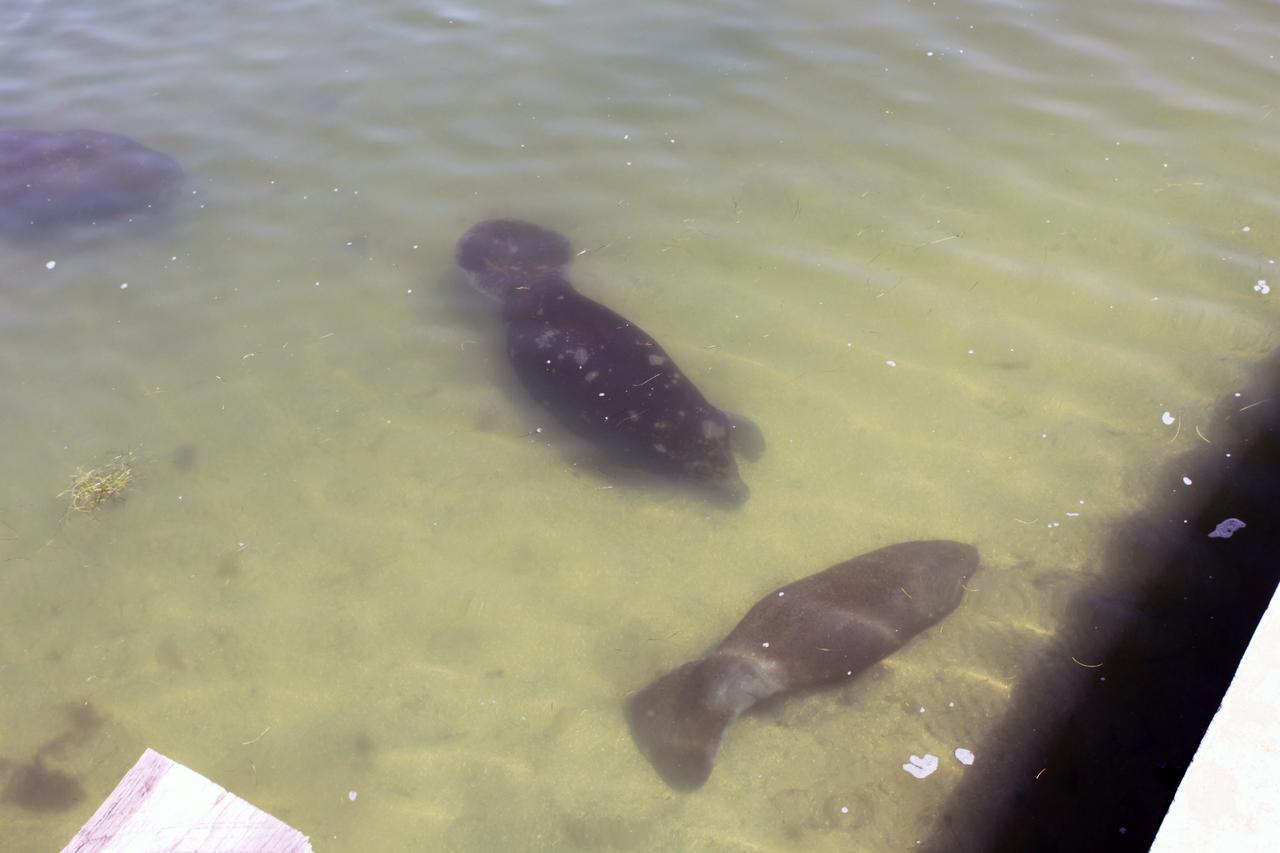
CAPE CANAVERAL, Fla. – Manatees relax in the Indian River near the NASA Railroad’s Jay Jay Railroad Bridge north of Launch Complex 39 at NASA’s Kennedy Space Center in Florida. The manatees were spotted by a cameraman on hand to photograph a NASA Railroad train on its way to the Florida East Coast Railway interchange in Titusville, Fla., where the train’s helium tank cars, a liquid oxygen tank car, and a liquid hydrogen dewar or tank car will be transferred for delivery to the SpaceX engine test complex outside McGregor, Texas. The railroad cars were needed in support of the Space Shuttle Program but currently are not in use by NASA following the completion of the program in 2011. Originally, the tankers belonged to the U.S. Bureau of Mines. At the peak of the shuttle program, there were approximately 30 cars in the fleet. About half the cars were returned to the bureau as launch activity diminished. Five tank cars are being loaned to SpaceX and repurposed to support their engine tests in Texas. Eight cars previously were shipped to California on loan to support the SpaceX Falcon 9 rocket launches from Space Launch Complex-4 on Vandenberg Air Force Base. SpaceX already has three helium tank cars previously used for the shuttle program at Space Launch Complex-40 on Cape Canaveral Air Force Station in Florida. For more information, visit http://www.nasa.gov/spacex. Photo credit: NASA/Jim Grossmann
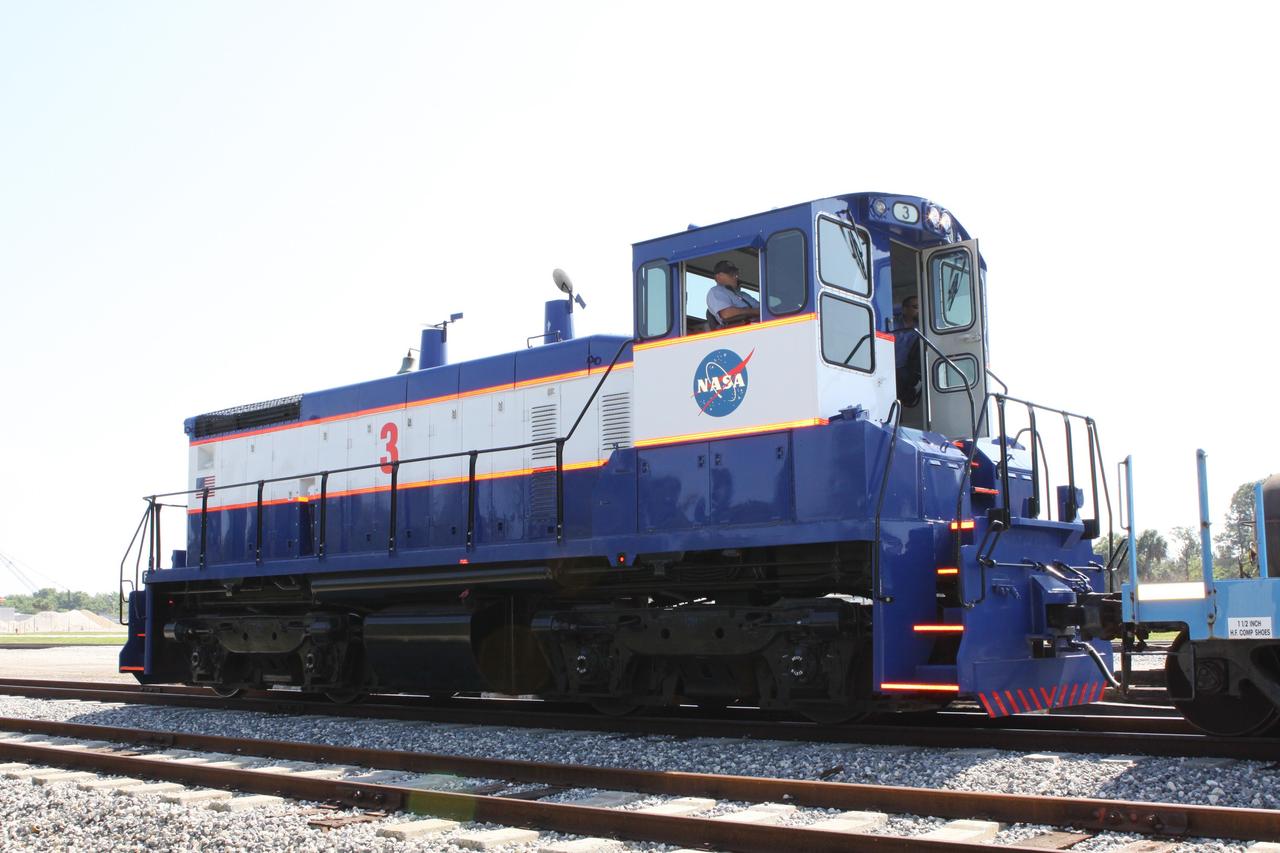
CAPE CANAVERAL, Fla. – NASA Railroad locomotive No. 3 is enlisted to deliver tank cars from NASA’s Kennedy Space Center in Florida to the Florida East Coast Railway interchange in Titusville, Fla. The locomotive is one of three NASA Railroad locomotives built for the Toledo, Peoria and Western, or TP&W, between 1968 and 1970. It is a GM Electromotive Division SW-1500 switcher. The locomotive was acquired by NASA from the TP&W in 1984 and painted in the NASA Railroad paint scheme. The power plant was completely overhauled in 2009. The locomotive will pull the train to the interchange in Titusville, where the train’s helium tank cars, a liquid oxygen tank car, and a liquid hydrogen dewar or tank car will be transferred for delivery to the SpaceX engine test complex outside McGregor, Texas. The railroad cars were needed in support of the Space Shuttle Program but currently are not in use by NASA following the completion of the program in 2011. Originally, the tankers belonged to the U.S. Bureau of Mines. At the peak of the shuttle program, there were approximately 30 cars in the fleet. About half the cars were returned to the bureau as launch activity diminished. Five tank cars are being loaned to SpaceX and repurposed to support their engine tests in Texas. Eight cars previously were shipped to California on loan to support the SpaceX Falcon 9 rocket launches from Space Launch Complex-4 on Vandenberg Air Force Base. SpaceX already has three helium tank cars previously used for the shuttle program at Space Launch Complex-40 on Cape Canaveral Air Force Station in Florida. For more information, visit http://www.nasa.gov/spacex. Photo credit: NASA/Jim Grossmann
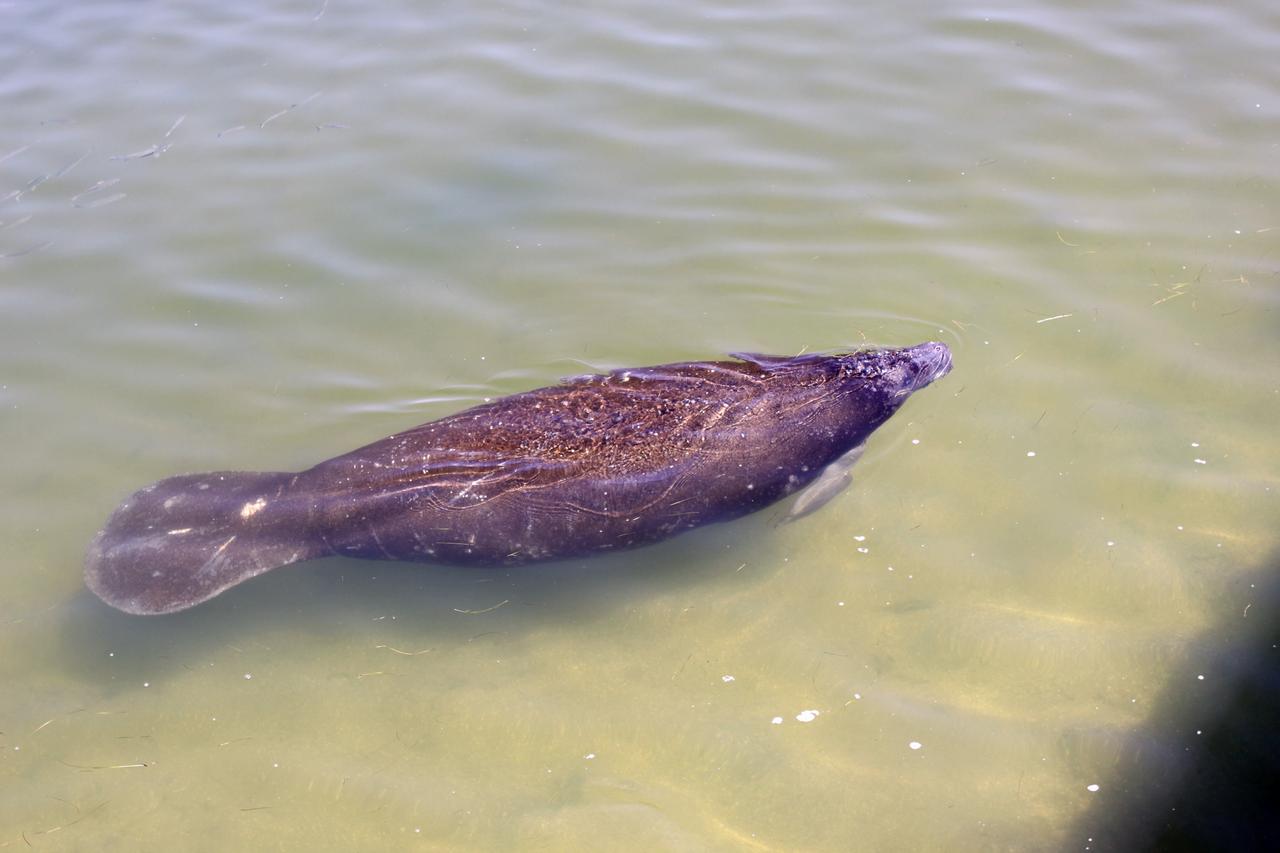
CAPE CANAVERAL, Fla. – A manatee relaxes in the Indian River near the NASA Railroad’s Jay Jay Railroad Bridge north of Launch Complex 39 at NASA’s Kennedy Space Center in Florida. The manatee was spotted by a cameraman on hand to photograph a NASA Railroad train on its way to the Florida East Coast Railway interchange in Titusville, Fla., where the train’s helium tank cars, a liquid oxygen tank car, and a liquid hydrogen dewar or tank car will be transferred for delivery to the SpaceX engine test complex outside McGregor, Texas. The railroad cars were needed in support of the Space Shuttle Program but currently are not in use by NASA following the completion of the program in 2011. Originally, the tankers belonged to the U.S. Bureau of Mines. At the peak of the shuttle program, there were approximately 30 cars in the fleet. About half the cars were returned to the bureau as launch activity diminished. Five tank cars are being loaned to SpaceX and repurposed to support their engine tests in Texas. Eight cars previously were shipped to California on loan to support the SpaceX Falcon 9 rocket launches from Space Launch Complex-4 on Vandenberg Air Force Base. SpaceX already has three helium tank cars previously used for the shuttle program at Space Launch Complex-40 on Cape Canaveral Air Force Station in Florida. For more information, visit http://www.nasa.gov/spacex. Photo credit: NASA/Jim Grossmann
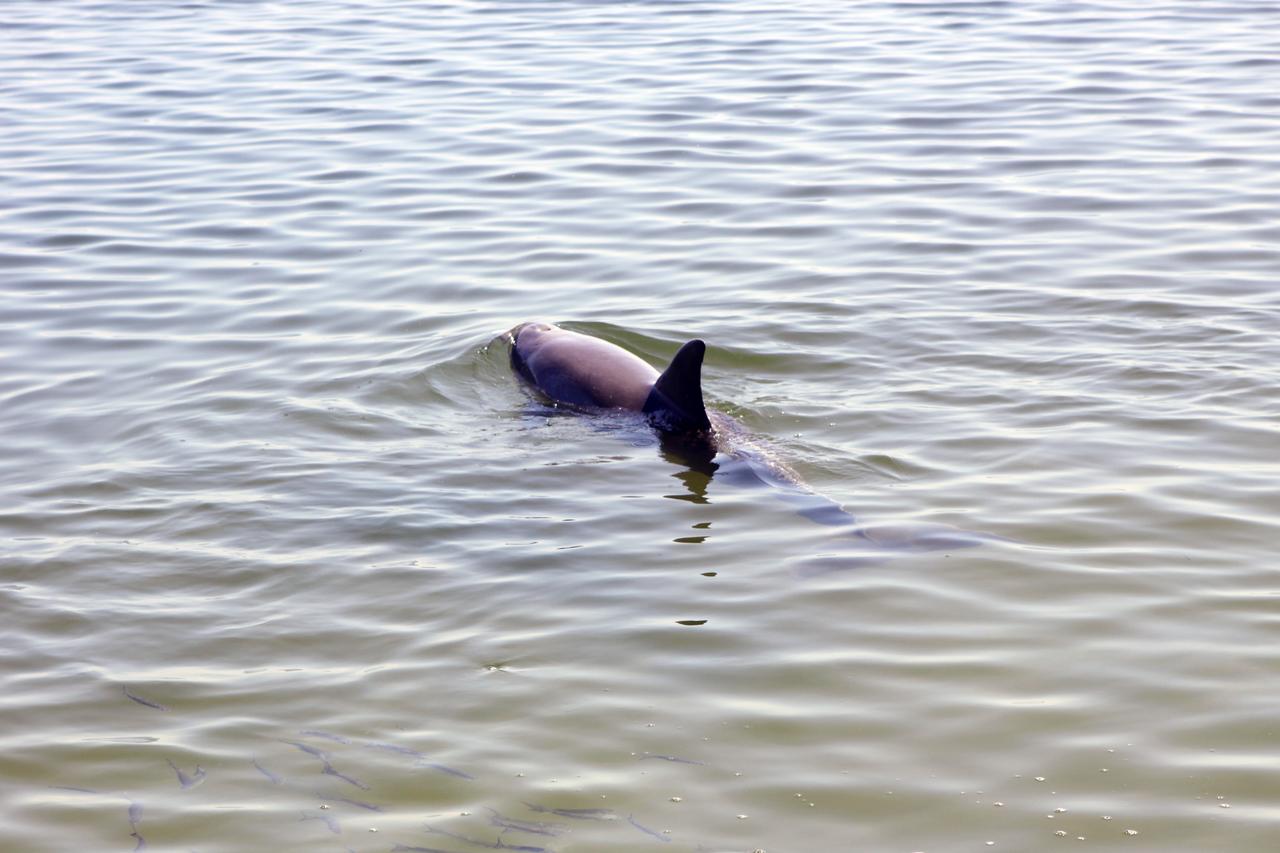
CAPE CANAVERAL, Fla. – A dolphin swims in the Indian River near the NASA Railroad’s Jay Jay Railroad Bridge north of Launch Complex 39 at NASA’s Kennedy Space Center in Florida. The dolphin was spotted by a cameraman on hand to photograph a NASA Railroad train on its way to the Florida East Coast Railway interchange in Titusville, Fla., where the train’s helium tank cars, a liquid oxygen tank car, and a liquid hydrogen dewar or tank car will be transferred for delivery to the SpaceX engine test complex outside McGregor, Texas. The railroad cars were needed in support of the Space Shuttle Program but currently are not in use by NASA following the completion of the program in 2011. Originally, the tankers belonged to the U.S. Bureau of Mines. At the peak of the shuttle program, there were approximately 30 cars in the fleet. About half the cars were returned to the bureau as launch activity diminished. Five tank cars are being loaned to SpaceX and repurposed to support their engine tests in Texas. Eight cars previously were shipped to California on loan to support the SpaceX Falcon 9 rocket launches from Space Launch Complex-4 on Vandenberg Air Force Base. SpaceX already has three helium tank cars previously used for the shuttle program at Space Launch Complex-40 on Cape Canaveral Air Force Station in Florida. For more information, visit http://www.nasa.gov/spacex. Photo credit: NASA/Jim Grossmann
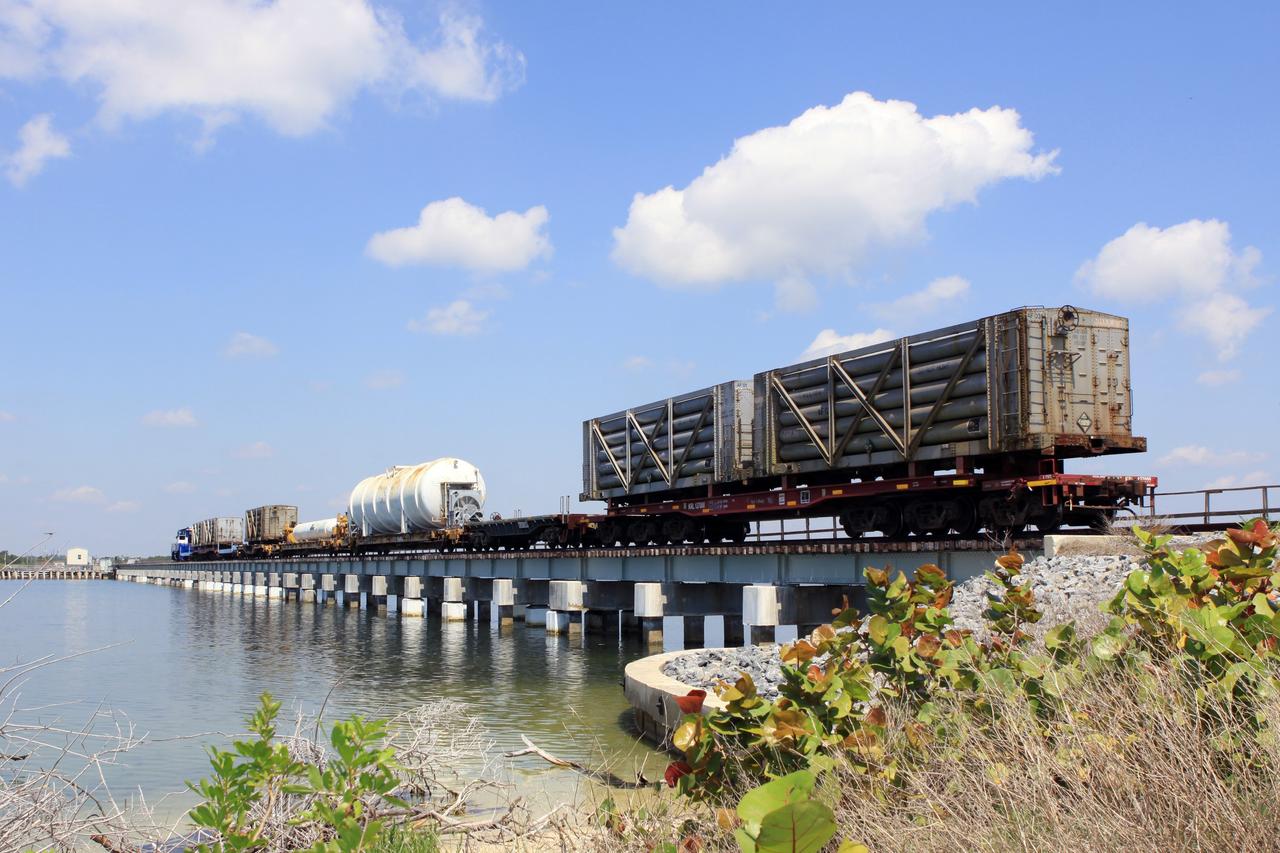
CAPE CANAVERAL, Fla. – A NASA Railroad train crosses the railroad’s Jay Jay Railroad Bridge north of Launch Complex 39 at NASA’s Kennedy Space Center in Florida. The train is on its way to the Florida East Coast Railway interchange in Titusville, Fla., where the train’s helium tank cars, a liquid oxygen tank car, and a liquid hydrogen dewar or tank car will be transferred for delivery to the SpaceX engine test complex outside McGregor, Texas. The helium tank cars are positioned in the front and rear of the train. The long, thin tank car in the middle was used for liquid hydrogen, followed by a much larger tank car used for liquid oxygen. The railroad cars were needed in support of the Space Shuttle Program but currently are not in use by NASA following the completion of the program in 2011. Originally, the tankers belonged to the U.S. Bureau of Mines. At the peak of the shuttle program, there were approximately 30 cars in the fleet. About half the cars were returned to the bureau as launch activity diminished. Five tank cars are being loaned to SpaceX and repurposed to support their engine tests in Texas. Eight cars previously were shipped to California on loan to support the SpaceX Falcon 9 rocket launches from Space Launch Complex-4 on Vandenberg Air Force Base. SpaceX already has three helium tank cars previously used for the shuttle program at Space Launch Complex-40 on Cape Canaveral Air Force Station in Florida. For more information, visit http://www.nasa.gov/spacex. Photo credit: NASA/Jim Grossmann
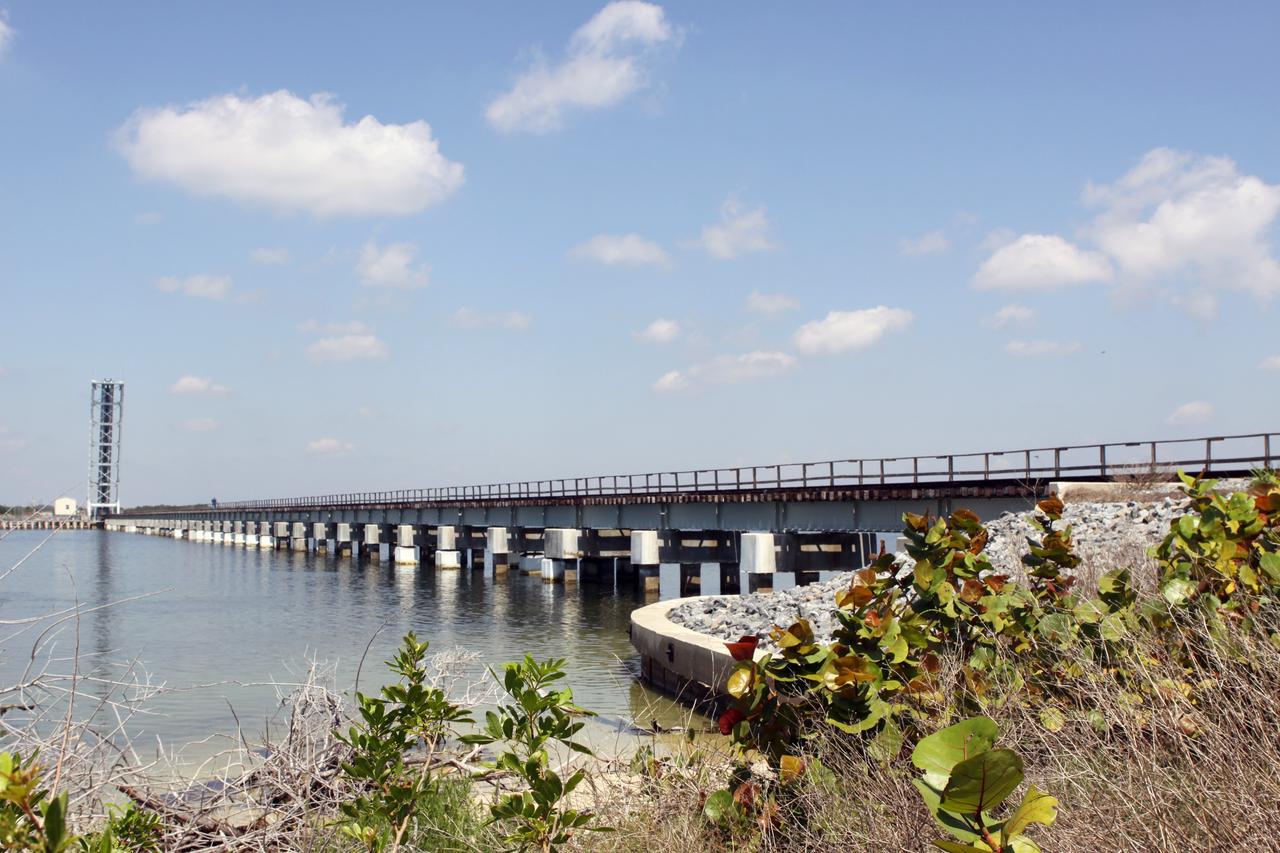
CAPE CANAVERAL, Fla. – Preparations are under way at the NASA Railroad’s Jay Jay Railroad Bridge north of Launch Complex 39 at NASA’s Kennedy Space Center in Florida for the passage of the NASA Railroad train on its way to the Florida East Coast Railway interchange in Titusville, Fla., where the train’s helium tank cars, a liquid oxygen tank car, and a liquid hydrogen dewar or tank car will be transferred for delivery to the SpaceX engine test complex outside McGregor, Texas. The permanent configuration of the drawbridge span is open, but the span will be lowered for a train to cross. The railroad cars were needed in support of the Space Shuttle Program but currently are not in use by NASA following the completion of the program in 2011. Originally, the tankers belonged to the U.S. Bureau of Mines. At the peak of the shuttle program, there were approximately 30 cars in the fleet. About half the cars were returned to the bureau as launch activity diminished. Five tank cars are being loaned to SpaceX and repurposed to support their engine tests in Texas. Eight cars previously were shipped to California on loan to support the SpaceX Falcon 9 rocket launches from Space Launch Complex-4 on Vandenberg Air Force Base. SpaceX already has three helium tank cars previously used for the shuttle program at Space Launch Complex-40 on Cape Canaveral Air Force Station in Florida. For more information, visit http://www.nasa.gov/spacex. Photo credit: NASA/Jim Grossmann
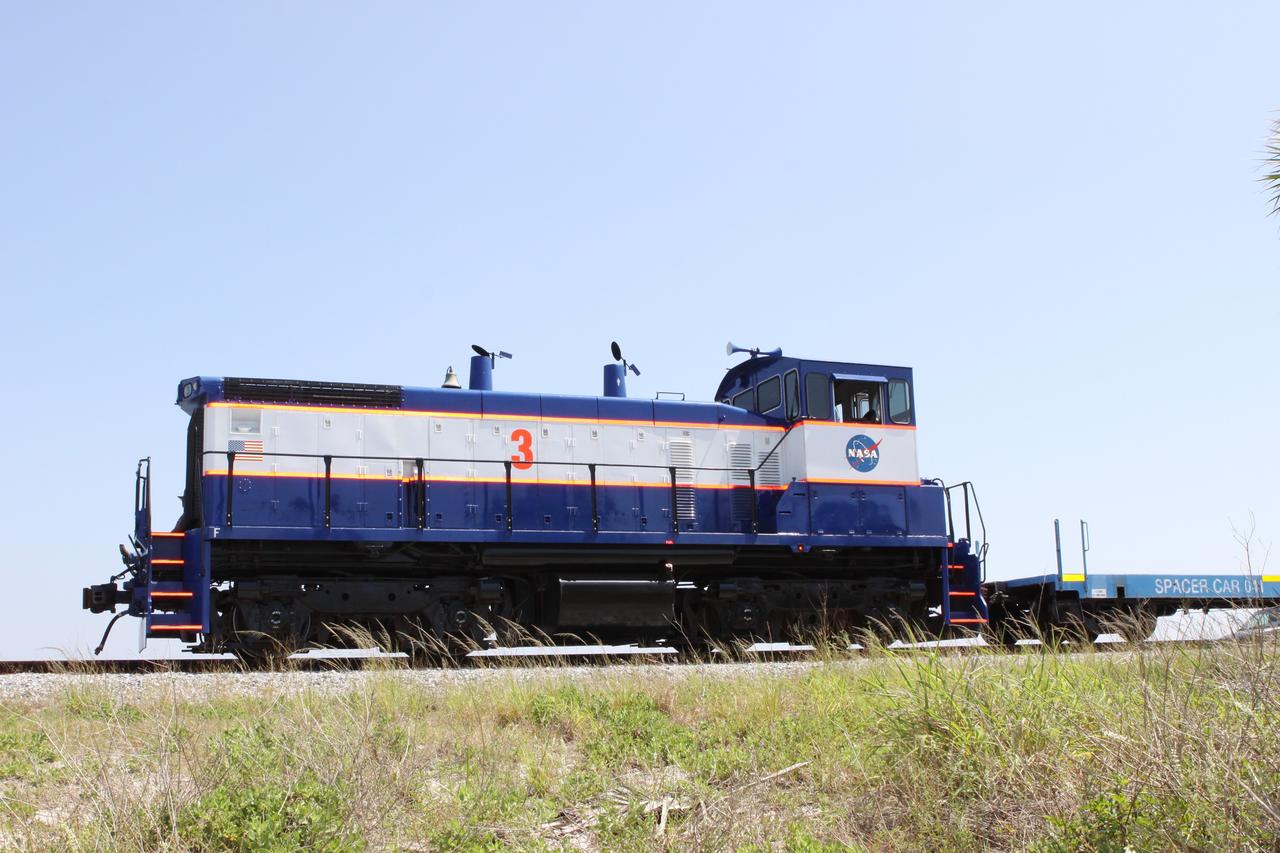
CAPE CANAVERAL, Fla. – NASA Railroad locomotive No. 3 delivers tank cars from NASA’s Kennedy Space Center in Florida to the Florida East Coast Railway interchange in Titusville, Fla. The locomotive is one of three NASA Railroad locomotives built for the Toledo, Peoria and Western, or TP&W, between 1968 and 1970. It is a GM Electromotive Division SW-1500 switcher. The locomotive was acquired by NASA from the TP&W in 1984 and painted in the NASA Railroad paint scheme. The power plant was completely overhauled in 2009. The locomotive will pull the train to the interchange in Titusville, where the train’s helium tank cars, a liquid oxygen tank car, and a liquid hydrogen dewar or tank car will be transferred for delivery to the SpaceX engine test complex outside McGregor, Texas. The railroad cars were needed in support of the Space Shuttle Program but currently are not in use by NASA following the completion of the program in 2011. Originally, the tankers belonged to the U.S. Bureau of Mines. At the peak of the shuttle program, there were approximately 30 cars in the fleet. About half the cars were returned to the bureau as launch activity diminished. Five tank cars are being loaned to SpaceX and repurposed to support their engine tests in Texas. Eight cars previously were shipped to California on loan to support the SpaceX Falcon 9 rocket launches from Space Launch Complex-4 on Vandenberg Air Force Base. SpaceX already has three helium tank cars previously used for the shuttle program at Space Launch Complex-40 on Cape Canaveral Air Force Station in Florida. For more information, visit http://www.nasa.gov/spacex. Photo credit: NASA/Jim Grossmann
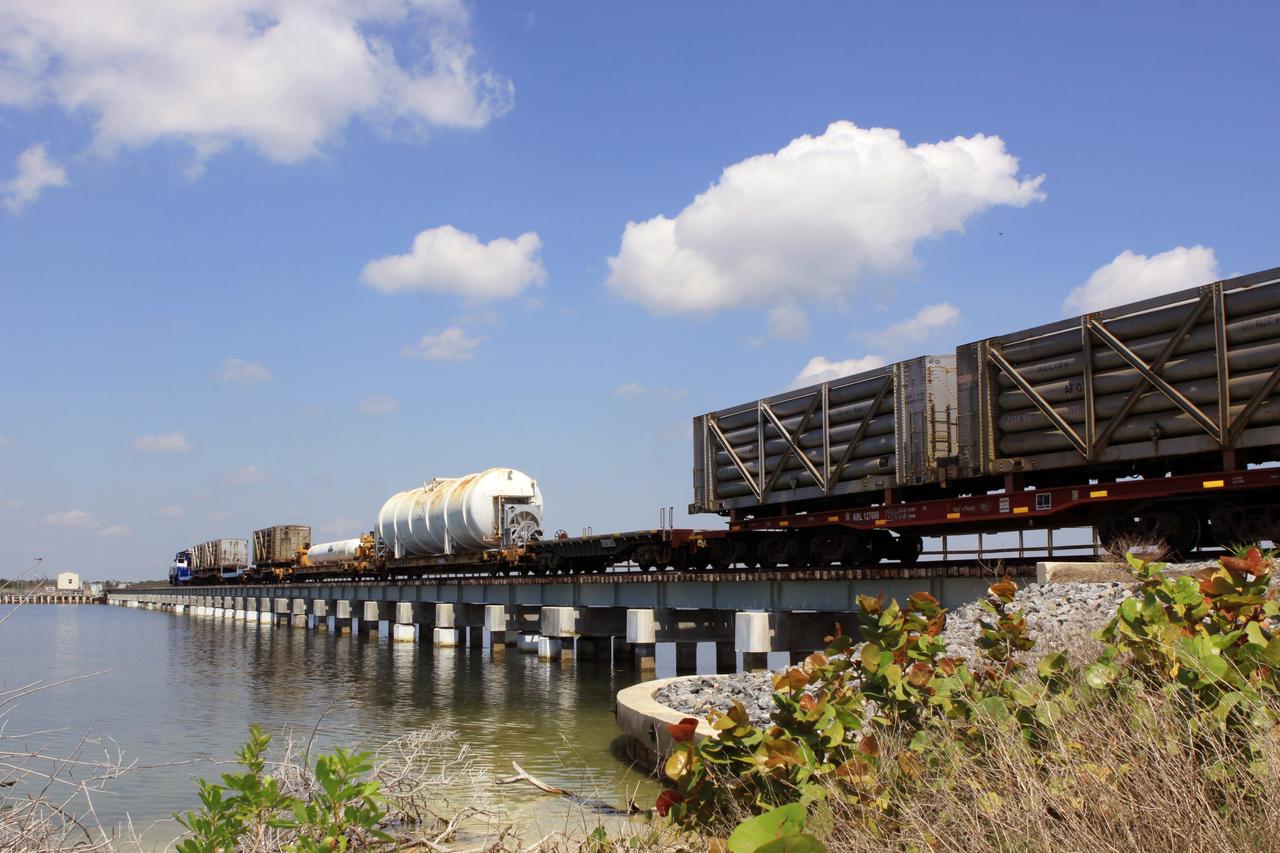
CAPE CANAVERAL, Fla. – A NASA Railroad train crosses the railroad’s Jay Jay Railroad Bridge north of Launch Complex 39 at NASA’s Kennedy Space Center in Florida. The train is on its way to the Florida East Coast Railway interchange in Titusville, Fla., where the train’s helium tank cars, a liquid oxygen tank car, and a liquid hydrogen dewar or tank car will be transferred for delivery to the SpaceX engine test complex outside McGregor, Texas. The helium tank cars are positioned in the front and rear of the train. The long, thin tank car in the middle was used for liquid hydrogen, followed by a much larger tank car used for liquid oxygen. The railroad cars were needed in support of the Space Shuttle Program but currently are not in use by NASA following the completion of the program in 2011. Originally, the tankers belonged to the U.S. Bureau of Mines. At the peak of the shuttle program, there were approximately 30 cars in the fleet. About half the cars were returned to the bureau as launch activity diminished. Five tank cars are being loaned to SpaceX and repurposed to support their engine tests in Texas. Eight cars previously were shipped to California on loan to support the SpaceX Falcon 9 rocket launches from Space Launch Complex-4 on Vandenberg Air Force Base. SpaceX already has three helium tank cars previously used for the shuttle program at Space Launch Complex-40 on Cape Canaveral Air Force Station in Florida. For more information, visit http://www.nasa.gov/spacex. Photo credit: NASA/Jim Grossmann
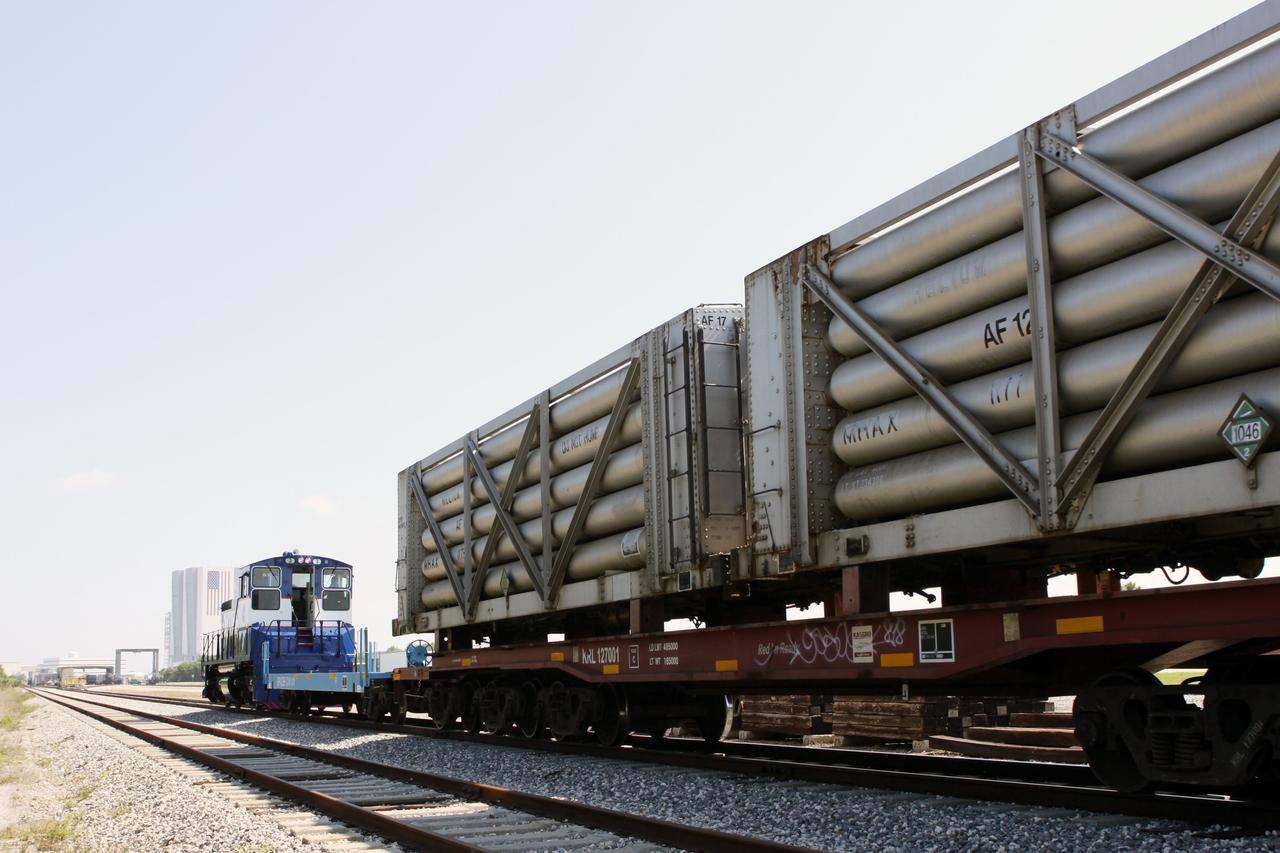
CAPE CANAVERAL, Fla. – At the NASA Railroad Yard at NASA’s Kennedy Space Center in Florida, preparations are under way for the departure of a train made up of tank cars. The train will pass by Kennedy’s 525-foot-tall Vehicle Assembly Building in the background. The train is headed for the Florida East Coast Railway interchange in Titusville, Fla., where the train’s helium tank cars, a liquid oxygen tank car, and a liquid hydrogen dewar or tank car will be transferred for delivery to the SpaceX engine test complex outside McGregor, Texas. The railroad cars were needed in support of the Space Shuttle Program but currently are not in use by NASA following the completion of the program in 2011. Originally, the tankers belonged to the U.S. Bureau of Mines. At the peak of the shuttle program, there were approximately 30 cars in the fleet. About half the cars were returned to the bureau as launch activity diminished. Five tank cars are being loaned to SpaceX and repurposed to support their engine tests in Texas. Eight cars previously were shipped to California on loan to support the SpaceX Falcon 9 rocket launches from Space Launch Complex-4 on Vandenberg Air Force Base. SpaceX already has three helium tank cars previously used for the shuttle program at Space Launch Complex-40 on Cape Canaveral Air Force Station in Florida. For more information, visit http://www.nasa.gov/spacex. Photo credit: NASA/Jim Grossmann
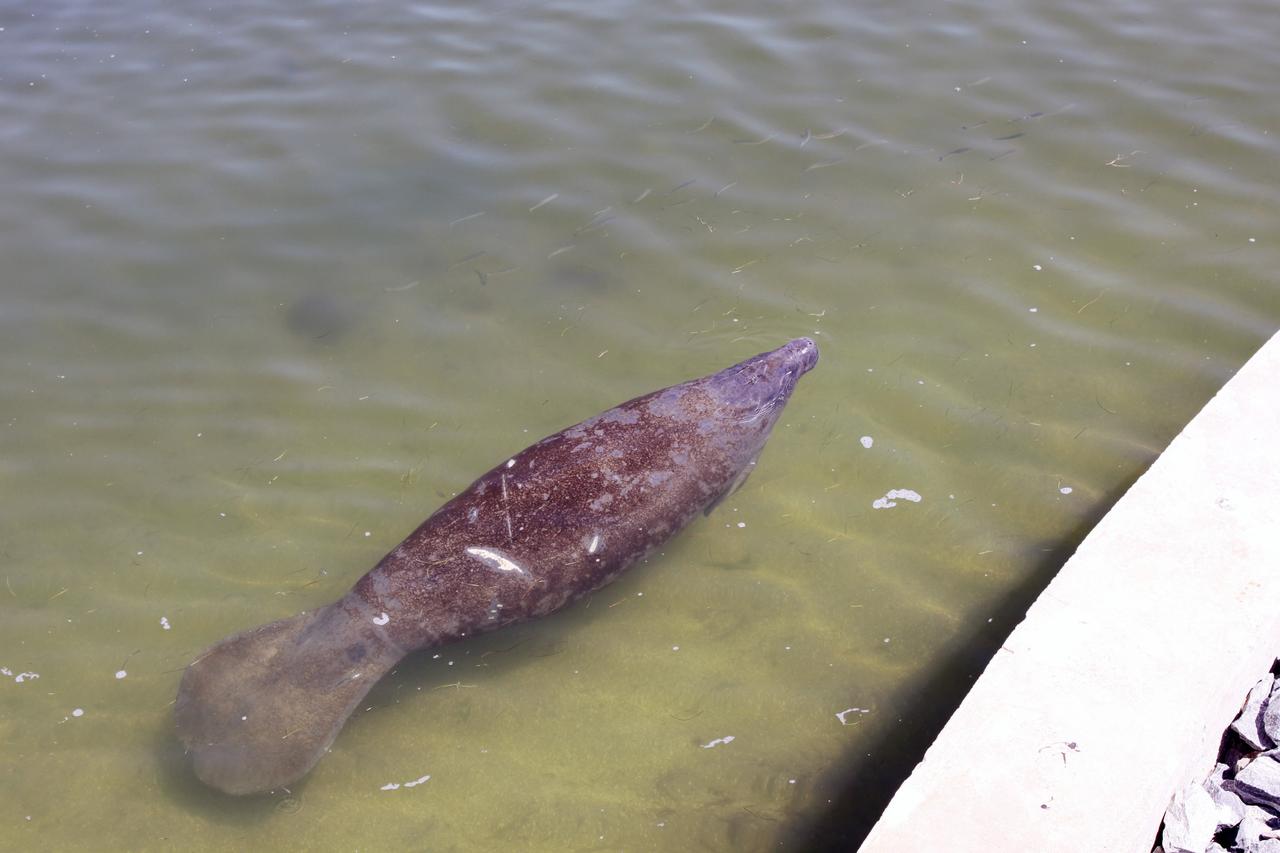
CAPE CANAVERAL, Fla. – A manatee swims in the Indian River near the NASA Railroad’s Jay Jay Railroad Bridge north of Launch Complex 39 at NASA’s Kennedy Space Center in Florida. The manatee was spotted by a cameraman on hand to photograph a NASA Railroad train on its way to the Florida East Coast Railway interchange in Titusville, Fla., where the train’s helium tank cars, a liquid oxygen tank car, and a liquid hydrogen dewar or tank car will be transferred for delivery to the SpaceX engine test complex outside McGregor, Texas. The railroad cars were needed in support of the Space Shuttle Program but currently are not in use by NASA following the completion of the program in 2011. Originally, the tankers belonged to the U.S. Bureau of Mines. At the peak of the shuttle program, there were approximately 30 cars in the fleet. About half the cars were returned to the bureau as launch activity diminished. Five tank cars are being loaned to SpaceX and repurposed to support their engine tests in Texas. Eight cars previously were shipped to California on loan to support the SpaceX Falcon 9 rocket launches from Space Launch Complex-4 on Vandenberg Air Force Base. SpaceX already has three helium tank cars previously used for the shuttle program at Space Launch Complex-40 on Cape Canaveral Air Force Station in Florida. For more information, visit http://www.nasa.gov/spacex. Photo credit: NASA/Jim Grossmann
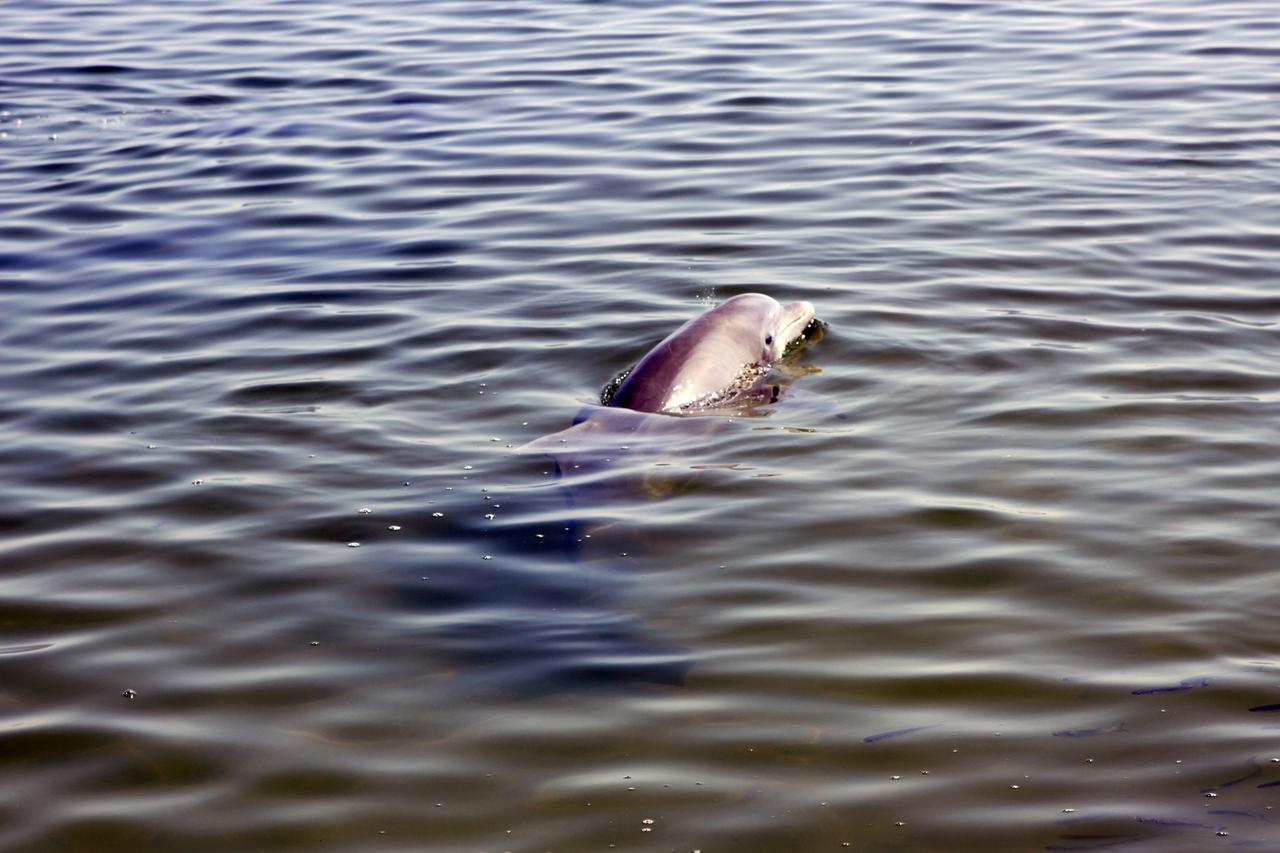
CAPE CANAVERAL, Fla. – A dolphin plays in the Indian River near the NASA Railroad’s Jay Jay Railroad Bridge north of Launch Complex 39 at NASA’s Kennedy Space Center in Florida. The dolphin was spotted by a cameraman on hand to photograph a NASA Railroad train on its way to the Florida East Coast Railway interchange in Titusville, Fla., where the train’s helium tank cars, a liquid oxygen tank car, and a liquid hydrogen dewar or tank car will be transferred for delivery to the SpaceX engine test complex outside McGregor, Texas. The railroad cars were needed in support of the Space Shuttle Program but currently are not in use by NASA following the completion of the program in 2011. Originally, the tankers belonged to the U.S. Bureau of Mines. At the peak of the shuttle program, there were approximately 30 cars in the fleet. About half the cars were returned to the bureau as launch activity diminished. Five tank cars are being loaned to SpaceX and repurposed to support their engine tests in Texas. Eight cars previously were shipped to California on loan to support the SpaceX Falcon 9 rocket launches from Space Launch Complex-4 on Vandenberg Air Force Base. SpaceX already has three helium tank cars previously used for the shuttle program at Space Launch Complex-40 on Cape Canaveral Air Force Station in Florida. For more information, visit http://www.nasa.gov/spacex. Photo credit: NASA/Jim Grossmann
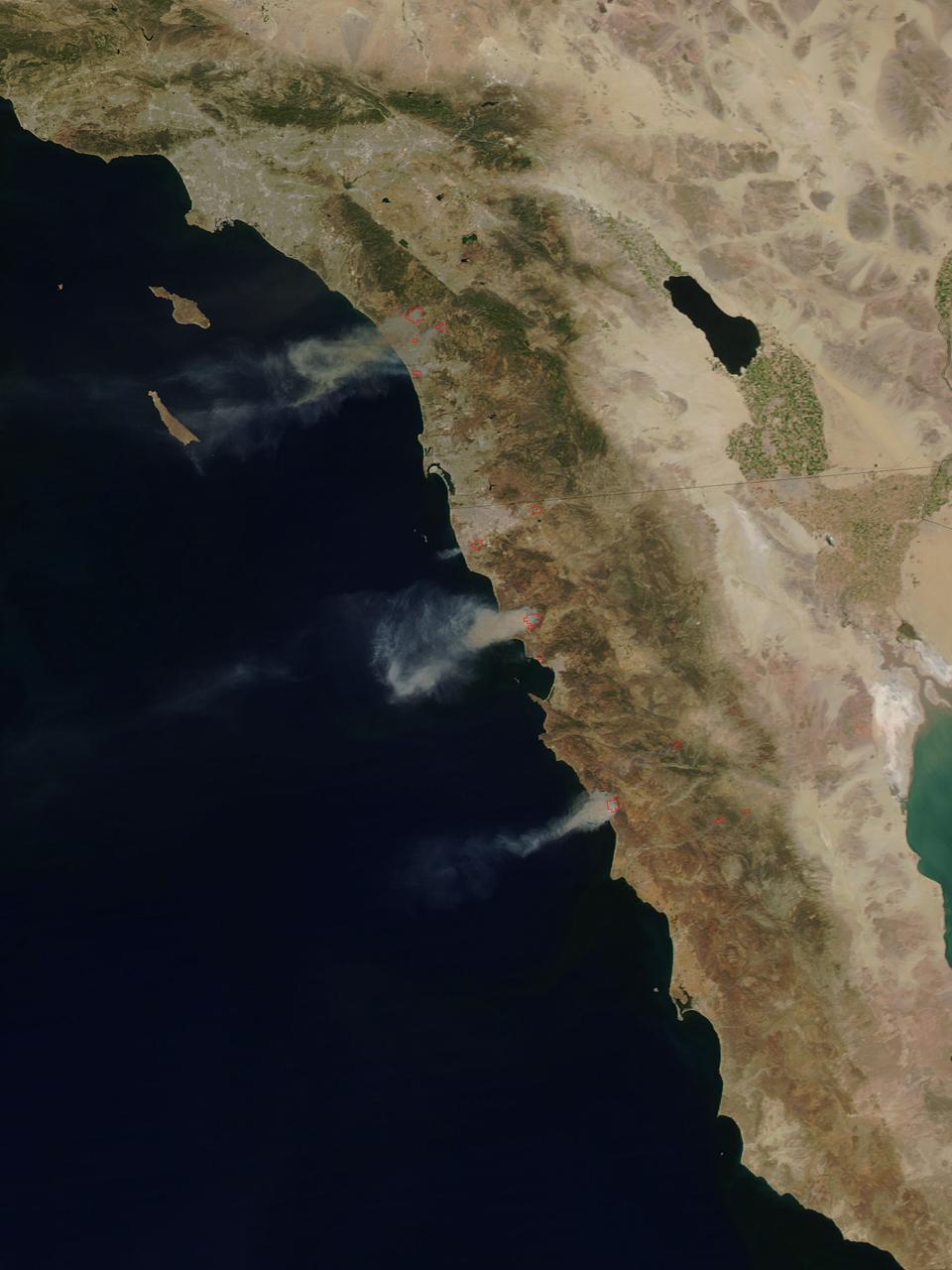
The single fire that ignited and split into nine separate fires still blazes in Southern California today. Firefighters are hoping for a break today (Thursday, May 15, 2014) but it doesn't look like luck may be on their side. Conditions continue to be bone dry with unseasonal heat (98-106 degrees) and the Santa Ana winds are kicking up and allowing these fires to easy jump fire lines. This particular fire started on Wednesday as a single fire and within a day is now nine separate fires which have burned close to 10,000 acres. These fires are threatening more than just landscape in San Diego county, they are also threatening homes, universities, a military base and a nuclear power plant. Day Two of the fires have seen them already destroying dozens of homes and forcing tens of thousands to evacuate. Camp Pendleton has also been partially evacuated due to the blazes as has the popular amusement park, Legoland. The Governor of California has declared a state of emergency. Thousands of firefighters are battling the flames both on the ground and in the air. Seven tankers and 20 military aircraft are also assisting the firefighters with their mission. Temperatures soaring over 100 degrees coupled with 30 mph wind gusts have severely hampered the efforts, however, and fire tornadoes have broken out. Fire tornadoes are caused by crosswinds that create a vortex and produce winds that twist and swirl just like a tornado but with flames that coil upwards in the center of the twister creating a terrifying specter. Although there is no chance of rain in the area for the next several days, the temperatures will start to subside on Friday and into the weekend. Winds are also expected to start to subside, giving firefighters that break that they so desperately need. This natural-color satellite image was collected by the Moderate Resolution Imaging Spectroradiometer (MODIS) aboard the Aqua satellite on May 14, 2014. Actively burning areas, detected by MODIS’s thermal bands, are outlined in red. Credit: NASA/GSFC/Jeff Schmaltz/MODIS Land Rapid Response Team <b><a href="http://www.nasa.gov/audience/formedia/features/MP_Photo_Guidelines.html" rel="nofollow">NASA image use policy.</a></b> <b><a href="http://www.nasa.gov/centers/goddard/home/index.html" rel="nofollow">NASA Goddard Space Flight Center</a></b> enables NASA’s mission through four scientific endeavors: Earth Science, Heliophysics, Solar System Exploration, and Astrophysics. Goddard plays a leading role in NASA’s accomplishments by contributing compelling scientific knowledge to advance the Agency’s mission. <b>Follow us on <a href="http://twitter.com/NASAGoddardPix" rel="nofollow">Twitter</a></b> <b>Like us on <a href="http://www.facebook.com/pages/Greenbelt-MD/NASA-Goddard/395013845897?ref=tsd" rel="nofollow">Facebook</a></b> <b>Find us on <a href="http://instagram.com/nasagoddard?vm=grid" rel="nofollow">Instagram</a></b>
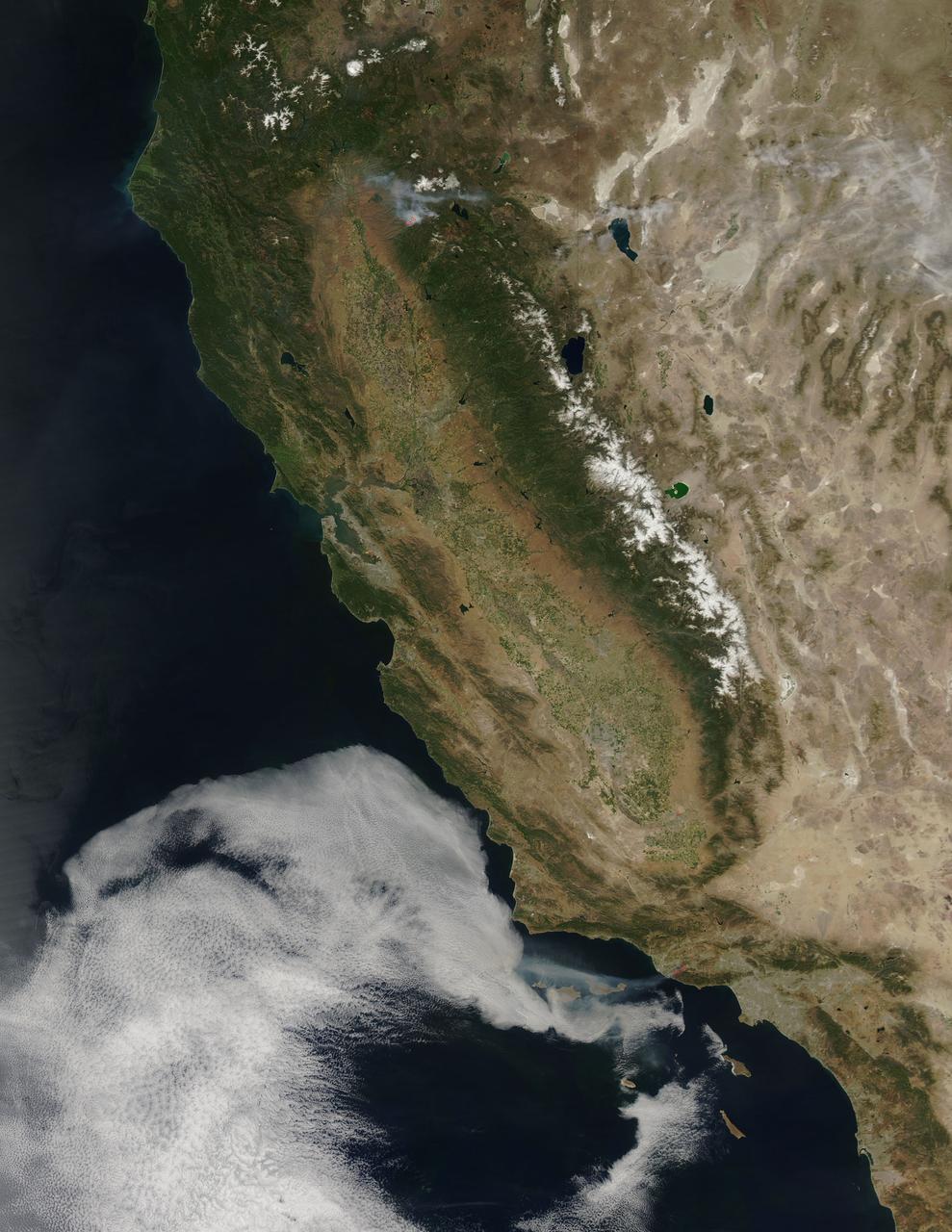
According to the NBCnews.com, Southern California firefighters were battling a growing, brush-fueled wildfire early Friday that had reached the beach in Ventura County and was pushing toward the upscale city of Malibu, officials said. Dubbed the Springs Fire, this "monster" of a wildfire has been made worse by howling Santa Ana winds and unusually dry vegetation. As of 2 am local time in California on Friday the 3rd, it was within "seven or eight miles" of Malibu, Ventura County Fire Department spokesman Bill Nash said. Weather conditions are not cooperating in the containment of this fire. The Weather Channel has predicted dry winds from offshore that will bring gusts of 40 to 50 miles per hour to the Southern California region on Friday the 3rd which could easily spread the fire. A complication to the winds is the extremely dry plant life left from a season in which only about five inches of rain fell in the area. The Springs Fire grew to 10,000 acres and was ten percent contained as of early Friday morning, according to the California Department of Forestry and Fire Prevention. Evacuations took place Thursday, and as of Friday morning 15 homes had been damaged. More than 2,000 homes and 100 commercial properties were under threat from the fire and those numbers could grow with weather conditions today (May 3). Currently the fire is burning in a rural area outside of Malibu, but it doesn't have to go very far to get to some expensive homes and more populated areas. It's current direction has it burning down the mountainside toward Malibu. Firefighters expect to receive help from tankers and helicopters in the air Friday morning, according to a release from the Ventura County Fire Department. The cause of the fire remained under investigation Friday. There had been no lightning or other natural fire-starting phenomenon in the area when the blaze began, Nash said. This natural-color satellite image was collected by the Moderate Resolution Imaging Spectroradiometer (MODIS) aboard the Aqua satellite on May 02, 2013. Actively burning areas, detected by MODIS’s thermal bands, are outlined in red. NASA image courtesy Jeff Schmaltz LANCE/EOSDIS MODIS Rapid Response Team, GSFC. Caption by Lynn Jenner with information from NBCnews.com <b><a href="http://www.nasa.gov/audience/formedia/features/MP_Photo_Guidelines.html" rel="nofollow">NASA image use policy.</a></b> <b><a href="http://www.nasa.gov/centers/goddard/home/index.html" rel="nofollow">NASA Goddard Space Flight Center</a></b> enables NASA’s mission through four scientific endeavors: Earth Science, Heliophysics, Solar System Exploration, and Astrophysics. Goddard plays a leading role in NASA’s accomplishments by contributing compelling scientific knowledge to advance the Agency’s mission. <b>Follow us on <a href="http://twitter.com/NASA_GoddardPix" rel="nofollow">Twitter</a></b> <b>Like us on <a href="http://www.facebook.com/pages/Greenbelt-MD/NASA-Goddard/395013845897?ref=tsd" rel="nofollow">Facebook</a></b> <b>Find us on <a href="http://instagram.com/nasagoddard?vm=grid" rel="nofollow">Instagram</a></b>