
This picture shows both a visible and a thermal infrared image taken by the thermal emission imaging system on NASA Mars Odyssey spacecraft on November 2, 2001.
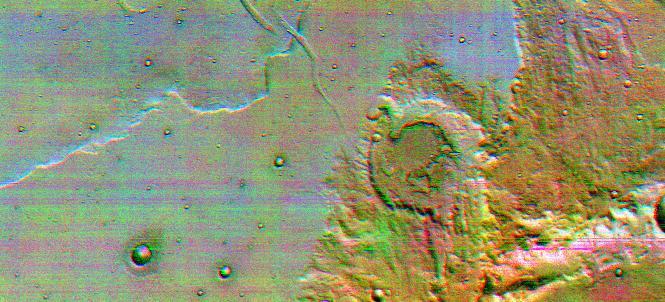
This is the first high-resolution color infrared image taken of Mars. The image was constructed using three of the ten infrared filters on the thermal emission imaging system of NASA Mars Odyssey spacecraft.

NASA 2001 Mars Odyssey Thermal Emission Imaging System THEMIS acquired these images of the Earth using its visible and infrared cameras as it left the Earth.
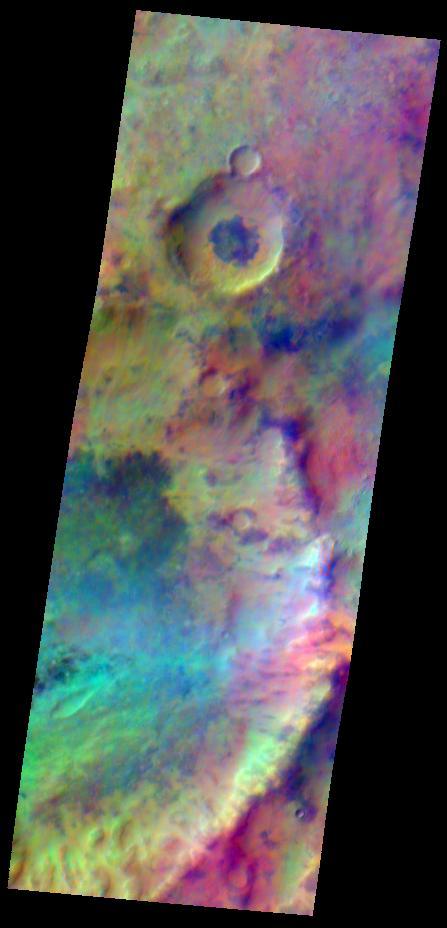
Pastel colors swirl across Mars, revealing differences in the composition and nature of the surface in this false-color infrared image taken on May 22, 2009,by the Thermal Emission Imaging System THEMIS camera on NASA Mars Odyssey orbiter.

The Thermal Emission Imaging System aboard NASA Mars Odyssey captured this daytime infrared image of Rabe Crater shows the large dune field located within the crater. Note that the dunes are not confined to the lowest elevation depressions on the
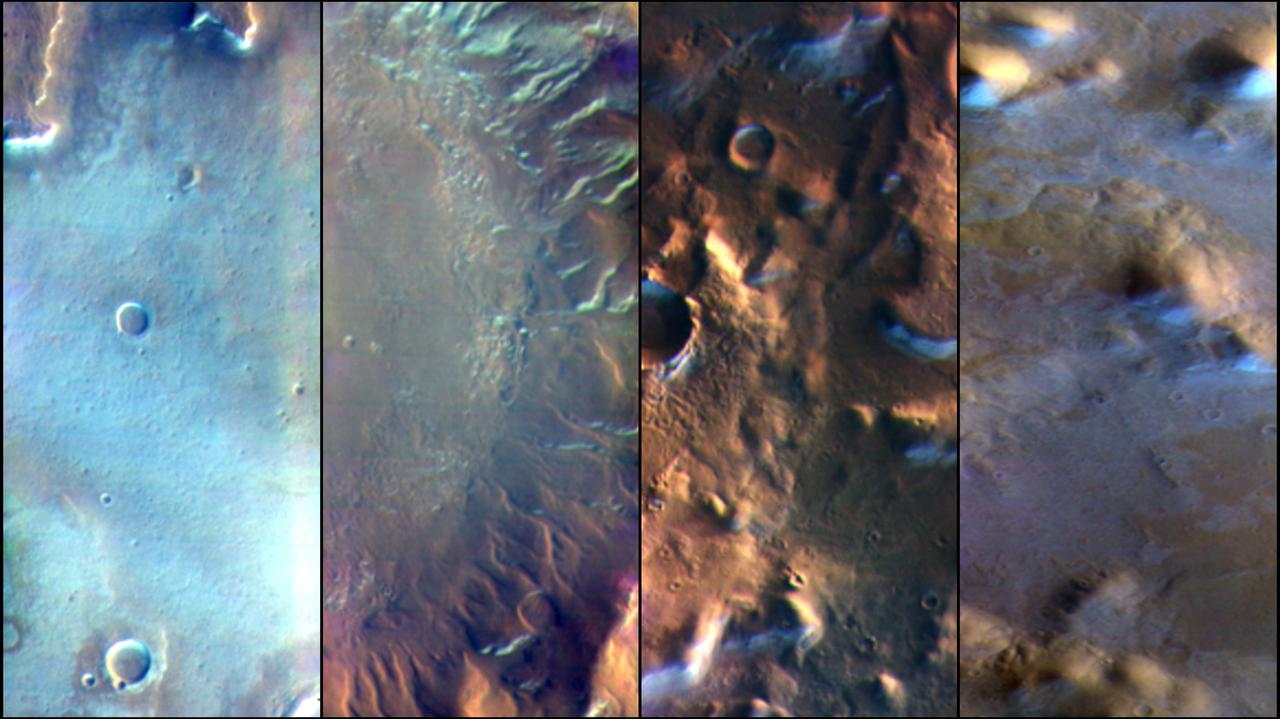
Martian surface frost, made up largely of carbon dioxide, appears blueish-white in these images from the Thermal Emission Imaging System (THEMIS) camera aboard NASA's 2001 Odyssey orbiter. THEMIS takes images in both visible light perceptible to the human eye and heat-sensitive infrared. https://photojournal.jpl.nasa.gov/catalog/PIA25233
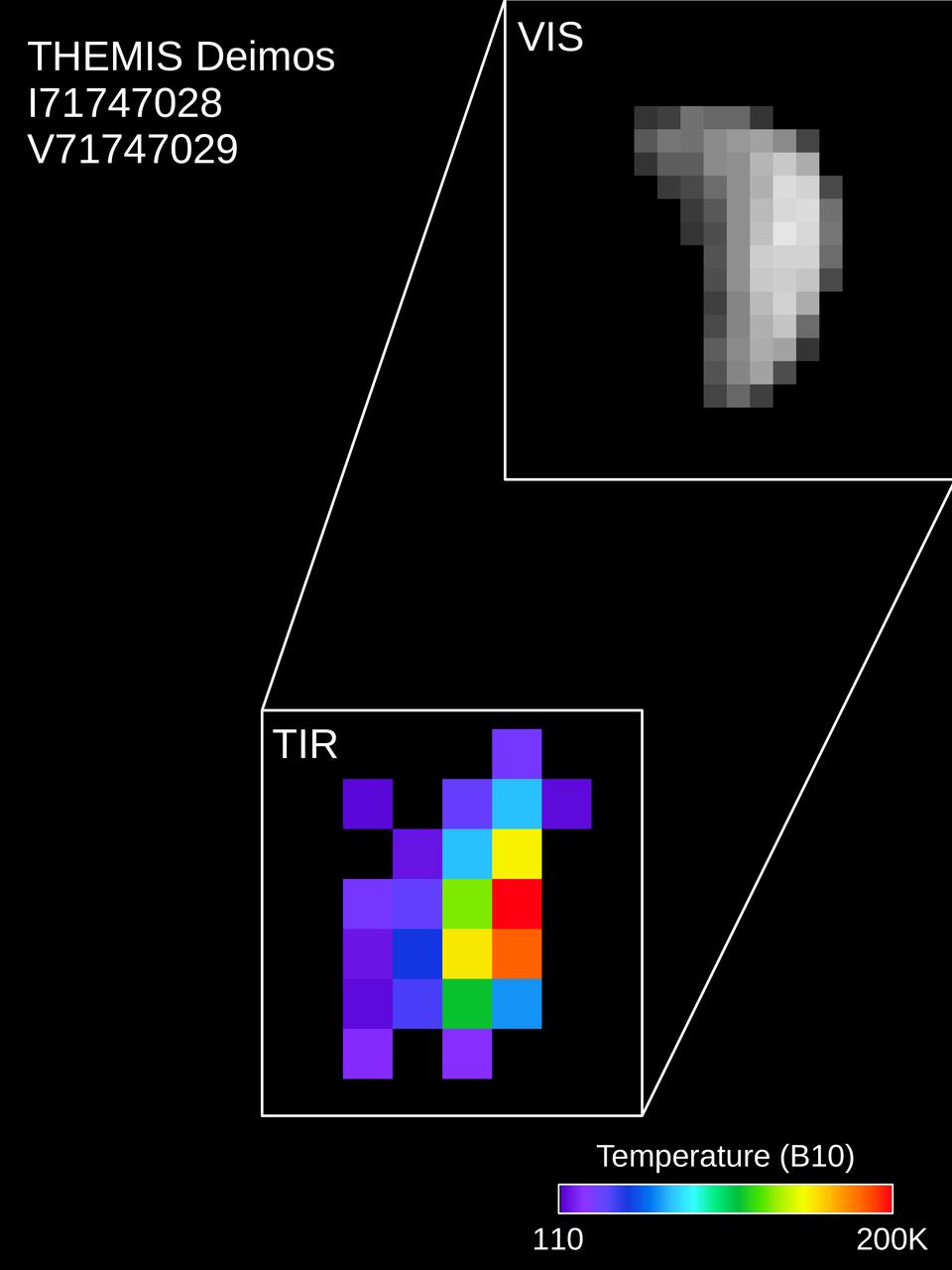
Colors in this image of the Martian moon Deimos indicate a range of surface temperatures detected by observing the moon on February 15, 2018, with the Thermal Emission Imaging System (THEMIS) camera on NASA's Mars Odyssey orbiter. The left edge of the small moon is in darkness, and the right edge in sunlight. Temperature information was derived from thermal-infrared imaging such as the grayscale image shown smaller at lower left with the moon in the same orientation. The color-coding merges information from THEMIS observations made in 10 thermal-infrared wavelength bands. This was the first observation of Deimos by Mars Odyssey; the spacecraft first imaged Mars' other moon, Phobos, on September 29, 2017. Researchers have been using THEMIS to examine Mars since early 2002, but the maneuver turning the orbiter around to point the camera at Phobos was developed only recently. https://photojournal.jpl.nasa.gov/catalog/PIA22250

Colors in this image of the Martian moon Phobos indicate a range of surface temperatures detected by observing the moon on February 15, 2018, with the Thermal Emission Imaging System (THEMIS) camera on NASA's Mars Odyssey orbiter. The left edge of the small moon is in darkness, and the right edge in sunlight. Phobos has an oblong shape with average diameter of about 14 miles (22 kilometers). Temperature information was derived from thermal-infrared imaging such as the grayscale image shown smaller at lower left with the moon in the same orientation. The color-coding merges information from THEMIS observations made in 10 thermal-infrared wavelength bands. This was the second observation of Phobos by Mars Odyssey; the first was on September 29, 2017. Researchers have been using THEMIS to examine Mars since early 2002, but the maneuver turning the orbiter around to point the camera at Phobos was developed only recently. https://photojournal.jpl.nasa.gov/catalog/PIA22249

This movie shows the Martian moon Phobos as viewed in visible light by NASA's 2001 Mars Odyssey orbiter on April 24, 2019. It was put together from 19 images taken 1 second apart by Odyssey's infrared camera, Thermal Emission Imaging System (THEMIS). The apparent motion is due to progression of the camera's pointing during the observation. This was the third observation of Phobos by Mars Odyssey. While displayed here in visible-wavelength light, THEMIS also recorded thermal-infrared imagery in the same scan. The distance to Phobos from Odyssey during the observation was about 5,692 miles (9,160 kilometers). Movie available at https://photojournal.jpl.nasa.gov/catalog/PIA23207
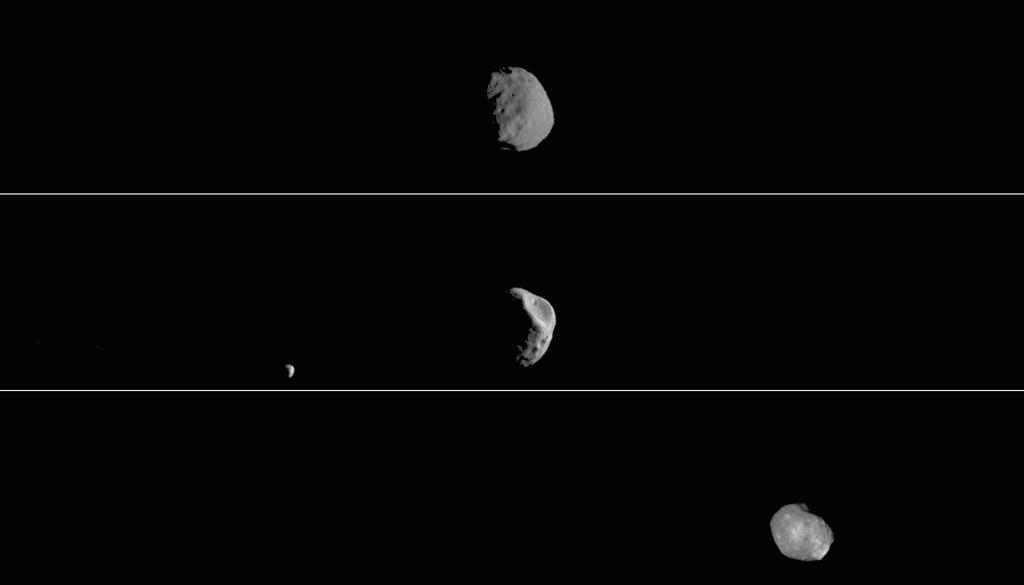
This movie shows three views of the Martian moon Phobos as viewed in visible light by NASA's 2001 Mars Odyssey orbiter. The apparent motion is due to movement by Odyssey's infrared camera, Thermal Emission Imaging System (THEMIS), rather than movement by the moon. Each of the three panels is a series of images taken on different dates (from top to bottom): Sept. 29, 2017; Feb. 15, 2018; and April 24, 2019. Deimos, Mars' other moon, can also be seen in the second panel. While displayed here in visible-wavelength light, THEMIS also recorded thermal-infrared imagery in the same scan. Movie available at https://photojournal.jpl.nasa.gov/catalog/PIA23208
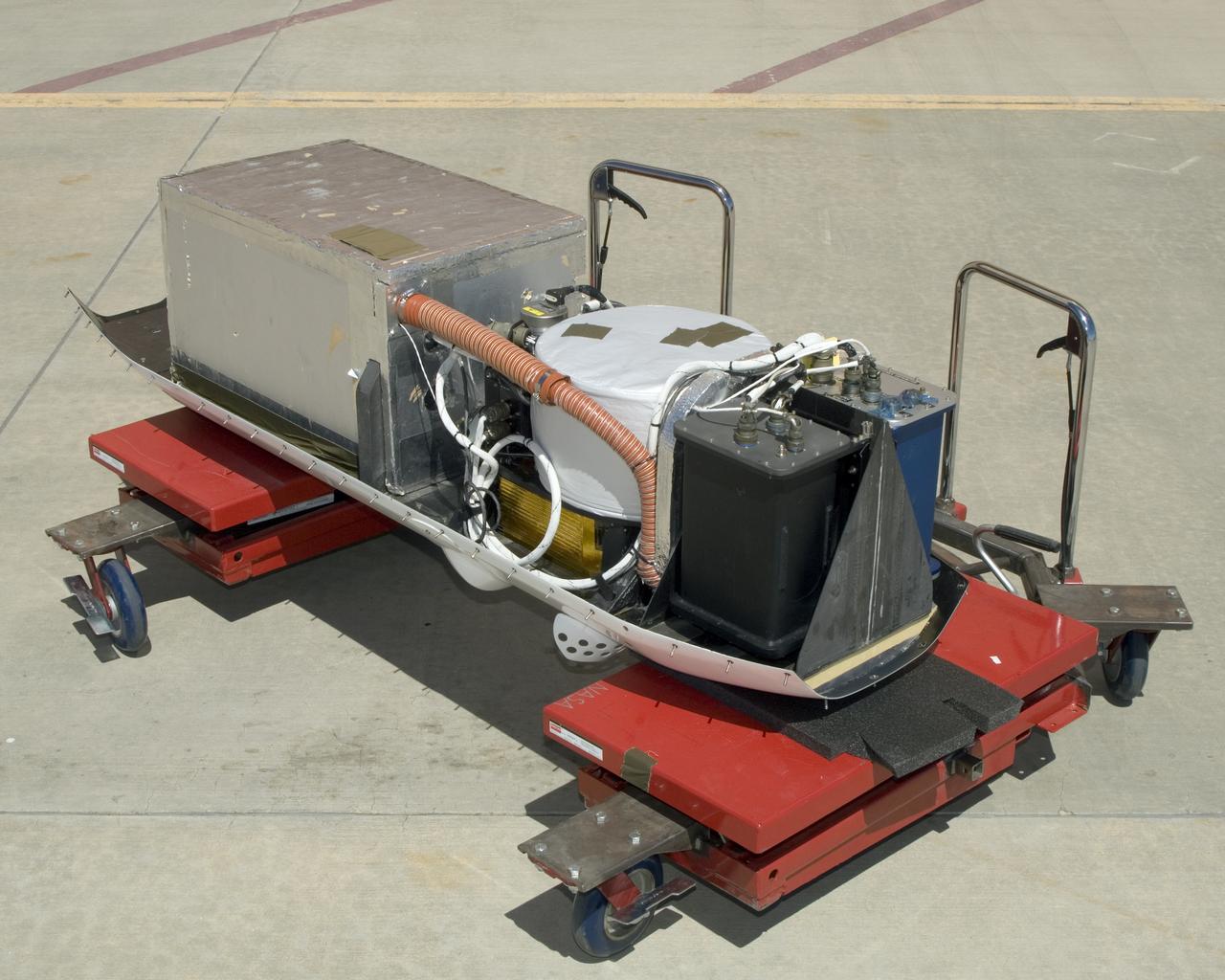
The instruments that make up the Ames Autonomous Module Scanner (AMS) that provided precise thermal-infrared imaging during the Western States Fire Mission in 2007 are detailed in this photo of the AMS as mounted on Ikhana's pod tray. The large foil-covered foam-insulated box at left covers the pressure vessel containing the data system computers and other electronics. The round white-topped assembly is the scan head, including the scan mirror, folded telescope, blackbody references, spectrometer and detectors. Two pressure boxes visible at the forward end of the tray contain the Applanix POS/AV precision navigation subsystem (black) and the power distributor including circuit breakers and ancillary wiring, scan motor controller and the blackbody reference temperature controller (blue).
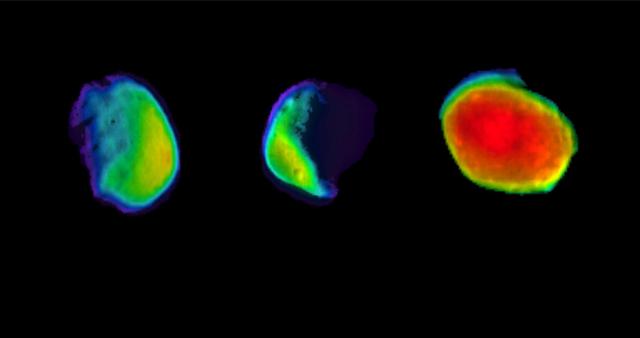
These are three different views of the Martian moon Phobos, as seen by NASA's 2001 Mars Odyssey orbiter using its infrared camera, Thermal Emission Imaging System (THEMIS). Each color represents a different temperature range. https://photojournal.jpl.nasa.gov/catalog/PIA23205
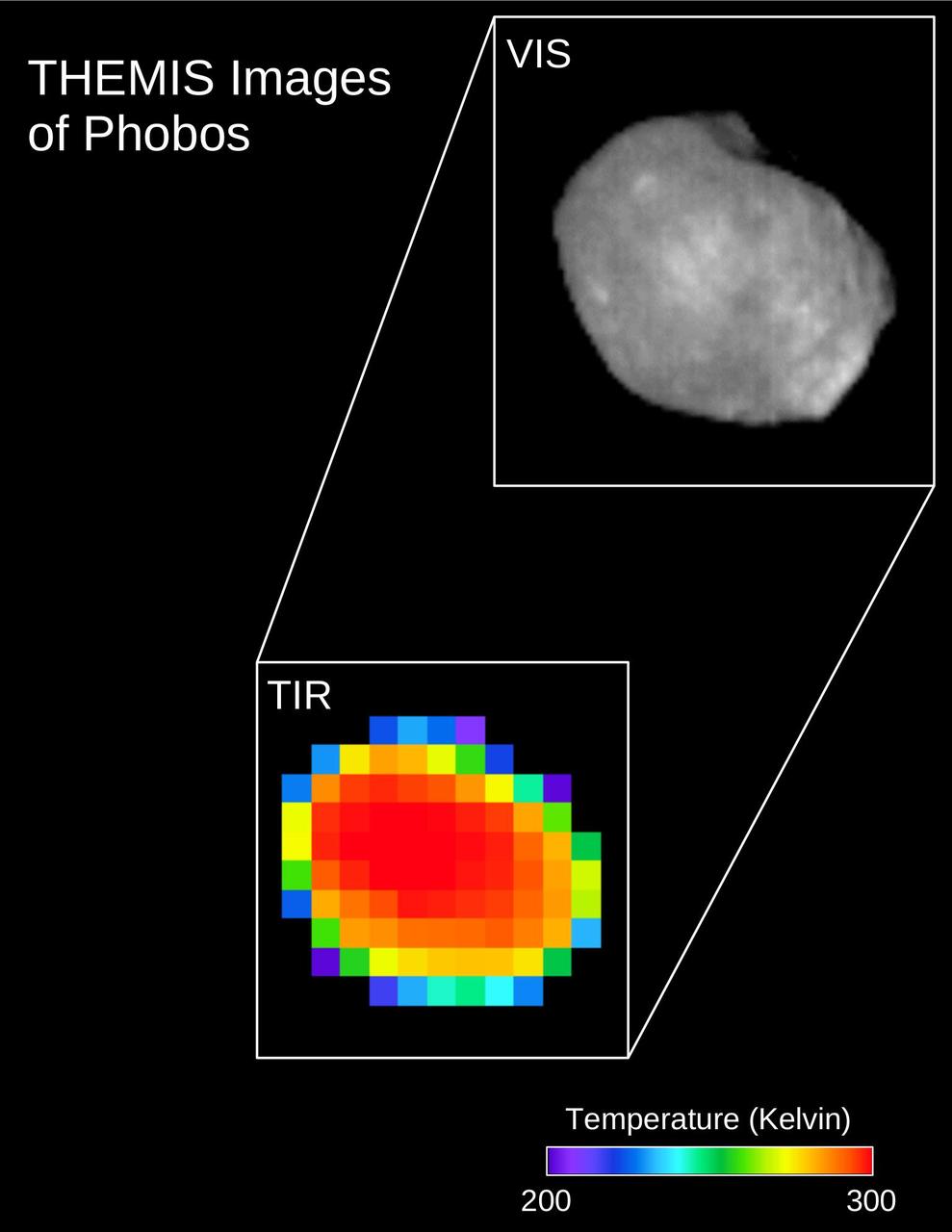
These are two views of the same observation of the Martian moon Phobos taken in both infrared and visible light by NASA's 2001 Mars Odyssey orbiter using its infrared camera, Thermal Emission Imaging System (THEMIS). The image was taken on April 24, 2019. The top view is what Phobos looked like in the visible light spectrum, as viewed by THEMIS. The bottom view is what it looks like in infrared, which reveals temperature differences. The warmest temperatures are in the center, and the coolest are on the outer edge. A scale bar is provided to reflect the temperatures, which range from 200 to 300 degrees Kelvin, or -100 degrees Fahrenheit (-73 Celsius) to 80 degrees Fahrenheit (27 Celsius). https://photojournal.jpl.nasa.gov/catalog/PIA23206
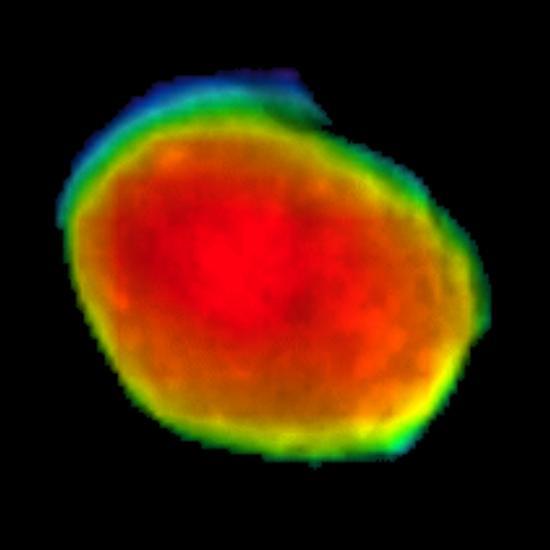
Taken on April 24, 2019, this rainbow-colored image shows the Martian moon Phobos, as viewed by NASA's 2001 Mars Odyssey orbiter using its infrared camera, Thermal Emission Imaging System (THEMIS). Each color represents a different temperature range, with the warmest in the center and coolest on the outer edge. This was the first time THEMIS was used to observe Phobos while in a full moon phase, which offers scientists a much better view for studying the composition of the Martian moon. Previous half-moon views, which can be seen here, were better for studying surface textures. https://photojournal.jpl.nasa.gov/catalog/PIA23204
![An overhead crane moves The Gamma Ray Spectrometer (GRS) into place to be installed on the Mars Odyssey Orbiter in the Spacecraft Assembly and Encapsulation Facility 2 (SAEF 2).; The orbiter will carry three science instruments: the Thermal Emission Imaging System (THEMIS), the Gamma Ray Spectrometer (GRS), and the Mars Radiation Environment Experiment (MARIE). THEMIS will map the mineralogy and morphology of the Martian surface using a high-resolution camera and a thermal infrared imaging spectrometer. The GRS will achieve global mapping of the elemental composition of the surface and determine the abundance of hydrogen in the shallow subsurface. [The GRS is a rebuild of the instrument lost with the Mars Observer mission.] The MARIE will characterize aspects of the near-space radiation environment with regards to the radiation-related risk to human explorers. The Mars Odyssey Orbiter is scheduled for launch on April 7, 2001, aboard a Delta 7925 rocket from Launch Pad 17-A, Cape Canaveral Air Force Station](https://images-assets.nasa.gov/image/KSC01pp0191/KSC01pp0191~medium.jpg)
An overhead crane moves The Gamma Ray Spectrometer (GRS) into place to be installed on the Mars Odyssey Orbiter in the Spacecraft Assembly and Encapsulation Facility 2 (SAEF 2).; The orbiter will carry three science instruments: the Thermal Emission Imaging System (THEMIS), the Gamma Ray Spectrometer (GRS), and the Mars Radiation Environment Experiment (MARIE). THEMIS will map the mineralogy and morphology of the Martian surface using a high-resolution camera and a thermal infrared imaging spectrometer. The GRS will achieve global mapping of the elemental composition of the surface and determine the abundance of hydrogen in the shallow subsurface. [The GRS is a rebuild of the instrument lost with the Mars Observer mission.] The MARIE will characterize aspects of the near-space radiation environment with regards to the radiation-related risk to human explorers. The Mars Odyssey Orbiter is scheduled for launch on April 7, 2001, aboard a Delta 7925 rocket from Launch Pad 17-A, Cape Canaveral Air Force Station
![In the Spacecraft Assembly and Encapsulation Facility -2, workers help guide the <a href=http:__mars.jpl.nasa.gov_2001_>2001 Mars Odyssey Orbiter <_a>as it is lowered to a workstand. The Mars Odyssey Orbiter carries three science instruments: the Thermal Emission Imaging System (THEMIS), the Gamma Ray Spectrometer (GRS), and the Mars Radiation Environment Experiment (MARIE). THEMIS will map the mineralogy and morphology of the Martian surface using a high-resolution camera and a thermal infrared imaging spectrometer. The GRS will achieve global mapping of the elemental composition of the surface and determine the abundance of hydrogen in the shallow subsurface. [The GRS is a rebuild of the instrument lost with the Mars Observer mission.] The MARIE will characterize aspects of the near-space radiation environment as related to the radiation-related risk to human explorers. The Mars Odyssey Orbiter is scheduled for launch on April 7, 2001, aboard a Delta 7925 rocket from Launch Pad 17-A, Cape Canaveral Air Force Station](https://images-assets.nasa.gov/image/01pp0101/01pp0101~medium.jpg)
In the Spacecraft Assembly and Encapsulation Facility -2, workers help guide the <a href=http:__mars.jpl.nasa.gov_2001_>2001 Mars Odyssey Orbiter <_a>as it is lowered to a workstand. The Mars Odyssey Orbiter carries three science instruments: the Thermal Emission Imaging System (THEMIS), the Gamma Ray Spectrometer (GRS), and the Mars Radiation Environment Experiment (MARIE). THEMIS will map the mineralogy and morphology of the Martian surface using a high-resolution camera and a thermal infrared imaging spectrometer. The GRS will achieve global mapping of the elemental composition of the surface and determine the abundance of hydrogen in the shallow subsurface. [The GRS is a rebuild of the instrument lost with the Mars Observer mission.] The MARIE will characterize aspects of the near-space radiation environment as related to the radiation-related risk to human explorers. The Mars Odyssey Orbiter is scheduled for launch on April 7, 2001, aboard a Delta 7925 rocket from Launch Pad 17-A, Cape Canaveral Air Force Station
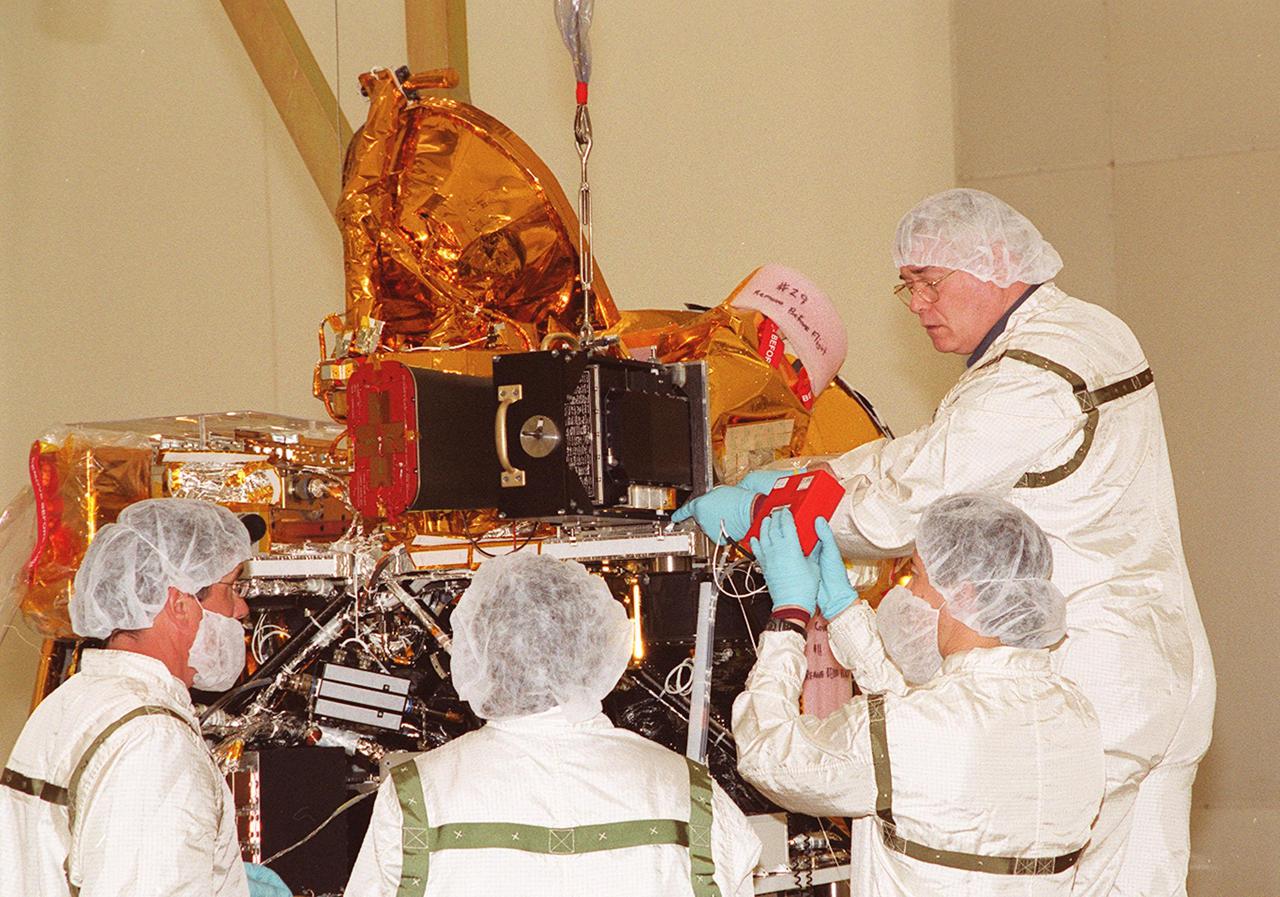
Workers in the Spacecraft Assembly and Encapsulation Facility 2 check the placement of the Thermal Emission Imaging System (THEMIS) on the Mars Odyssey Orbiter. THEMIS will map the mineralogy and morphology of the Martian surface using a high-resolution camera and a thermal infrared imaging spectrometer. The orbiter will carry three science instruments: THEMIS, the Gamma Ray Spectrometer (GRS), and the Mars Radiation Environment Experiment (MARIE). The GRS will achieve global mapping of the elemental composition of the surface and determine the abundance of hydrogen in the shallow subsurface. The MARIE will characterize aspects of the near-space radiation environment with regards to the radiation-related risk to human explorers. The Mars Odyssey Orbiter is scheduled for launch on April 7, 2001, aboard a Delta 7925 rocket from Launch Pad 17-A, Cape Canaveral Air Force Station
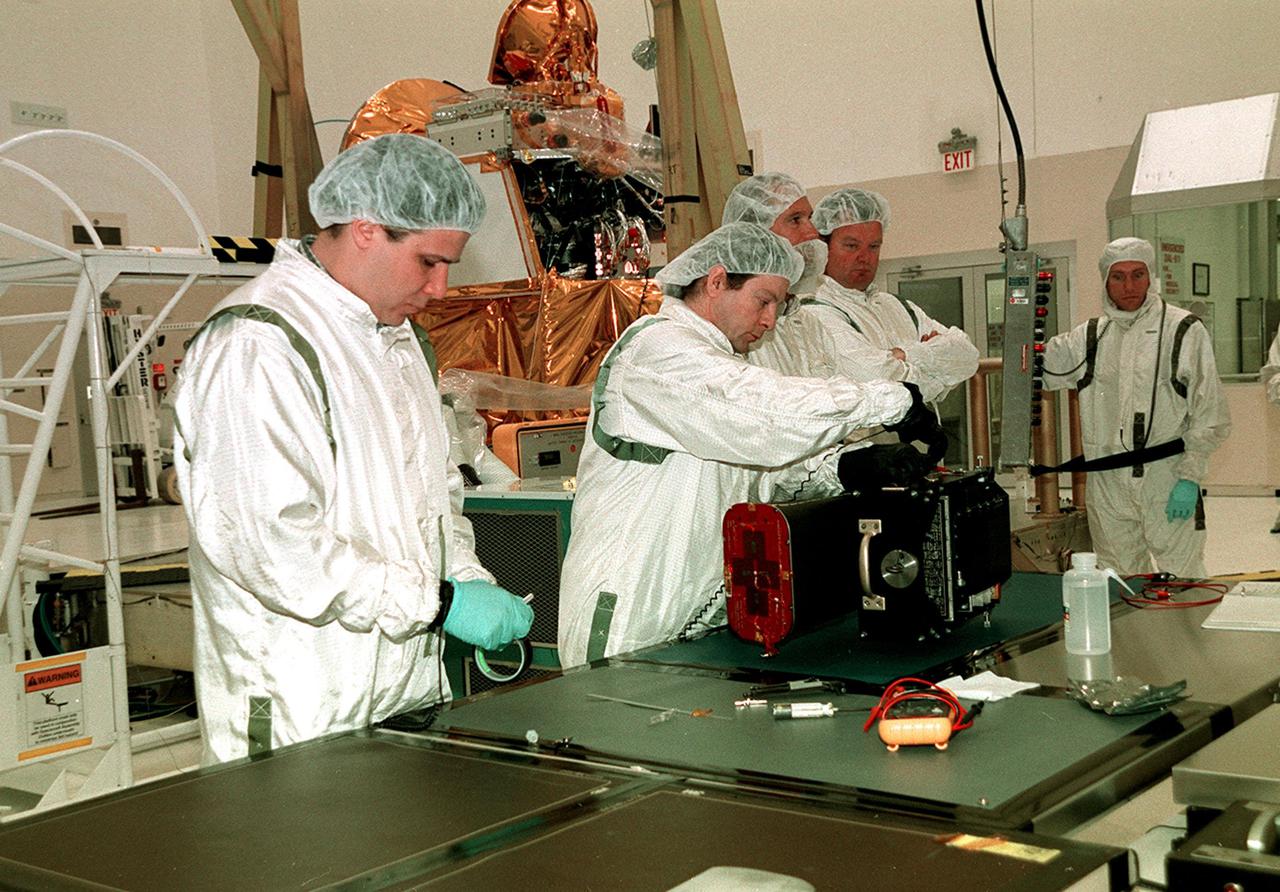
At a work bench in the Spacecraft Assembly and Encapsulation Facility 2, workers test the Thermal Emission Imaging System (THEMIS) before attaching to the 2001 Mars Odyssey Orbiter. THEMIS will map the mineralogy and morphology of the Martian surface using a high-resolution camera and a thermal infrared imaging spectrometer. The orbiter will carry three science instruments: THEMIS, the Gamma Ray Spectrometer (GRS), and the Mars Radiation Environment Experiment (MARIE). The GRS will achieve global mapping of the elemental composition of the surface and determine the abundance of hydrogen in the shallow subsurface. The MARIE will characterize aspects of the near-space radiation environment with regards to the radiation-related risk to human explorers. The Mars Odyssey Orbiter is scheduled for launch on April 7, 2001, aboard a Delta 7925 rocket from Launch Pad 17-A, Cape Canaveral Air Force Station
![In the Spacecraft Assembly and Encapsulation Facility -2, workers help guide the solar array from the 2001 Mars Odyssey Orbiter onto a workstand. This will give workers access to other components of the spacecraft and allow inspection of the array. The Mars Odyssey carries three science instruments: the Thermal Emission Imaging System (THEMIS), the Gamma Ray Spectrometer (GRS), and the Mars Radiation Environment Experiment (MARIE). THEMIS will map the mineralogy and morphology of the Martian surface using a high-resolution camera and a thermal infrared imaging spectrometer. The GRS will achieve global mapping of the elemental composition of the surface and determine the abundance of hydrogen in the shallow subsurface. [The GRS is a rebuild of the instrument lost with the Mars Observer mission.] The MARIE will characterize aspects of the near-space radiation environment as related to the radiation-related risk to human explorers. The Mars Odyssey Orbiter is scheduled for launch on April 7, 2001, aboard a Delta 7925 rocket from Launch Pad 17-A, Cape Canaveral Air Force Station](https://images-assets.nasa.gov/image/01pp0124/01pp0124~medium.jpg)
In the Spacecraft Assembly and Encapsulation Facility -2, workers help guide the solar array from the 2001 Mars Odyssey Orbiter onto a workstand. This will give workers access to other components of the spacecraft and allow inspection of the array. The Mars Odyssey carries three science instruments: the Thermal Emission Imaging System (THEMIS), the Gamma Ray Spectrometer (GRS), and the Mars Radiation Environment Experiment (MARIE). THEMIS will map the mineralogy and morphology of the Martian surface using a high-resolution camera and a thermal infrared imaging spectrometer. The GRS will achieve global mapping of the elemental composition of the surface and determine the abundance of hydrogen in the shallow subsurface. [The GRS is a rebuild of the instrument lost with the Mars Observer mission.] The MARIE will characterize aspects of the near-space radiation environment as related to the radiation-related risk to human explorers. The Mars Odyssey Orbiter is scheduled for launch on April 7, 2001, aboard a Delta 7925 rocket from Launch Pad 17-A, Cape Canaveral Air Force Station
![The Gamma Ray Spectrometer (GRS) is installed by technicians on the Mars Odyssey Orbiter in the Spacecraft Assembly and Encapsulation Facility 2 (SAEF 2).; The orbiter will carry three science instruments: the Thermal Emission Imaging System (THEMIS), the Gamma Ray Spectrometer (GRS), and the Mars Radiation Environment Experiment (MARIE). THEMIS will map the mineralogy and morphology of the Martian surface using a high-resolution camera and a thermal infrared imaging spectrometer. The GRS will achieve global mapping of the elemental composition of the surface and determine the abundance of hydrogen in the shallow subsurface. [The GRS is a rebuild of the instrument lost with the Mars Observer mission.] The MARIE will characterize aspects of the near-space radiation environment with regards to the radiation-related risk to human explorers. The Mars Odyssey Orbiter is scheduled for launch on April 7, 2001, aboard a Delta 7925 rocket from Launch Pad 17-A, Cape Canaveral Air Force Station](https://images-assets.nasa.gov/image/01pp0194/01pp0194~medium.jpg)
The Gamma Ray Spectrometer (GRS) is installed by technicians on the Mars Odyssey Orbiter in the Spacecraft Assembly and Encapsulation Facility 2 (SAEF 2).; The orbiter will carry three science instruments: the Thermal Emission Imaging System (THEMIS), the Gamma Ray Spectrometer (GRS), and the Mars Radiation Environment Experiment (MARIE). THEMIS will map the mineralogy and morphology of the Martian surface using a high-resolution camera and a thermal infrared imaging spectrometer. The GRS will achieve global mapping of the elemental composition of the surface and determine the abundance of hydrogen in the shallow subsurface. [The GRS is a rebuild of the instrument lost with the Mars Observer mission.] The MARIE will characterize aspects of the near-space radiation environment with regards to the radiation-related risk to human explorers. The Mars Odyssey Orbiter is scheduled for launch on April 7, 2001, aboard a Delta 7925 rocket from Launch Pad 17-A, Cape Canaveral Air Force Station
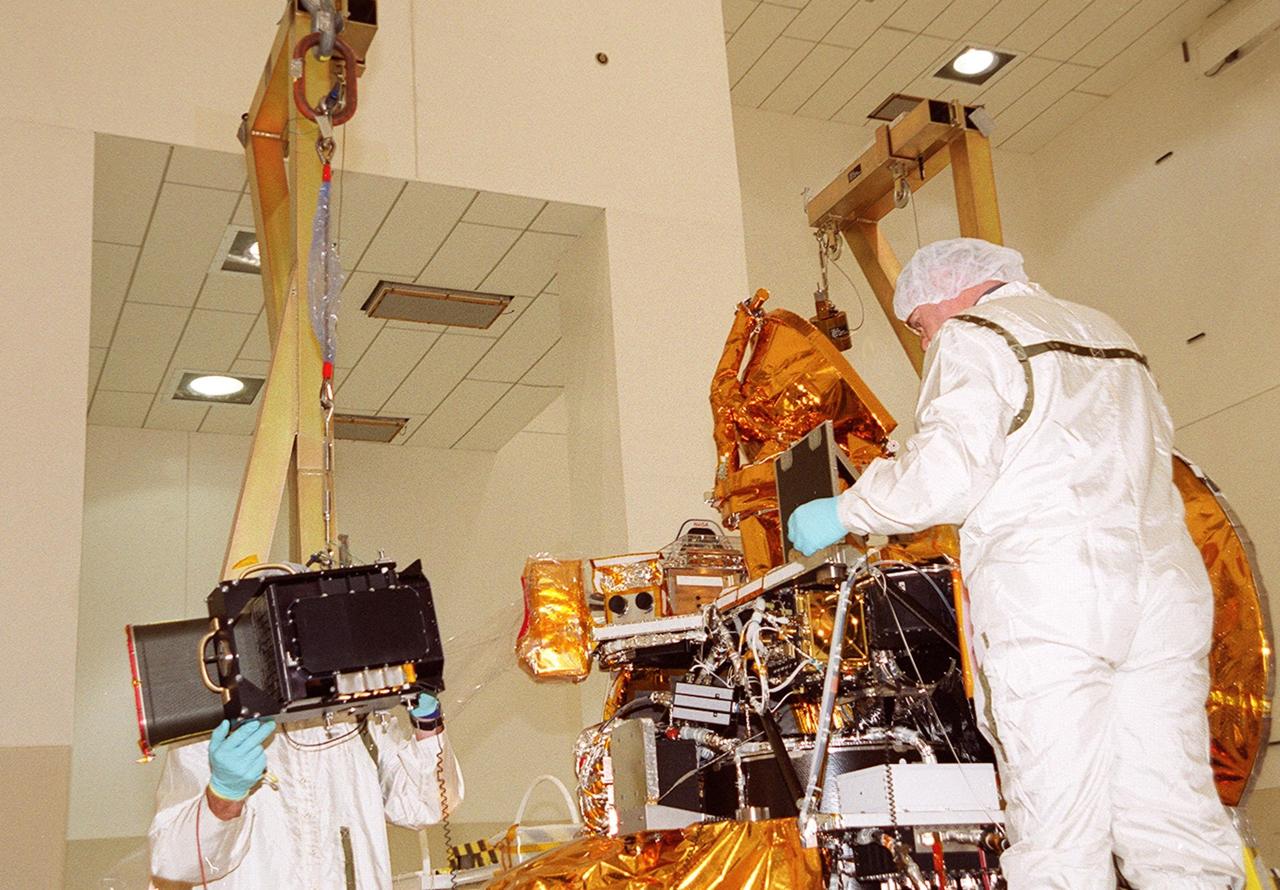
In the Spacecraft Assembly and Encapsulation Facility 2 (SAEF 2), the Thermal Emission Imaging System (THEMIS), left, is moved toward the Mars Odyssey Orbiter, at right. THEMIS will map the mineralogy and morphology of the Martian surface using a high-resolution camera and a thermal infrared imaging spectrometer. The orbiter will carry three science instruments: THEMIS, the Gamma Ray Spectrometer (GRS), and the Mars Radiation Environment Experiment (MARIE). The GRS will achieve global mapping of the elemental composition of the surface and determine the abundance of hydrogen in the shallow subsurface. The MARIE will characterize aspects of the near-space radiation environment with regards to the radiation-related risk to human explorers. The Mars Odyssey Orbiter is scheduled for launch on April 7, 2001, aboard a Delta 7925 rocket from Launch Pad 17-A, Cape Canaveral Air Force Station
![Two technicians involved with the installation of the Gamma Ray Spectrometer (GRS) on the Mars Odyssey Orbiter pose in front of the spacecraft in the Spacecraft Assembly and Encapsulation Facility 2 (SAEF 2).; The orbiter will carry three science instruments: the Thermal Emission Imaging System (THEMIS), the Gamma Ray Spectrometer (GRS), and the Mars Radiation Environment Experiment (MARIE). THEMIS will map the mineralogy and morphology of the Martian surface using a high-resolution camera and a thermal infrared imaging spectrometer. The GRS will achieve global mapping of the elemental composition of the surface and determine the abundance of hydrogen in the shallow subsurface. [The GRS is a rebuild of the instrument lost with the Mars Observer mission.] The MARIE will characterize aspects of the near-space radiation environment with regards to the radiation-related risk to human explorers. The Mars Odyssey Orbiter is scheduled for launch on April 7, 2001, aboard a Delta 7925 rocket from Launch Pad 17-A, Cape Canaveral Air Force Station](https://images-assets.nasa.gov/image/KSC01pp0195/KSC01pp0195~medium.jpg)
Two technicians involved with the installation of the Gamma Ray Spectrometer (GRS) on the Mars Odyssey Orbiter pose in front of the spacecraft in the Spacecraft Assembly and Encapsulation Facility 2 (SAEF 2).; The orbiter will carry three science instruments: the Thermal Emission Imaging System (THEMIS), the Gamma Ray Spectrometer (GRS), and the Mars Radiation Environment Experiment (MARIE). THEMIS will map the mineralogy and morphology of the Martian surface using a high-resolution camera and a thermal infrared imaging spectrometer. The GRS will achieve global mapping of the elemental composition of the surface and determine the abundance of hydrogen in the shallow subsurface. [The GRS is a rebuild of the instrument lost with the Mars Observer mission.] The MARIE will characterize aspects of the near-space radiation environment with regards to the radiation-related risk to human explorers. The Mars Odyssey Orbiter is scheduled for launch on April 7, 2001, aboard a Delta 7925 rocket from Launch Pad 17-A, Cape Canaveral Air Force Station
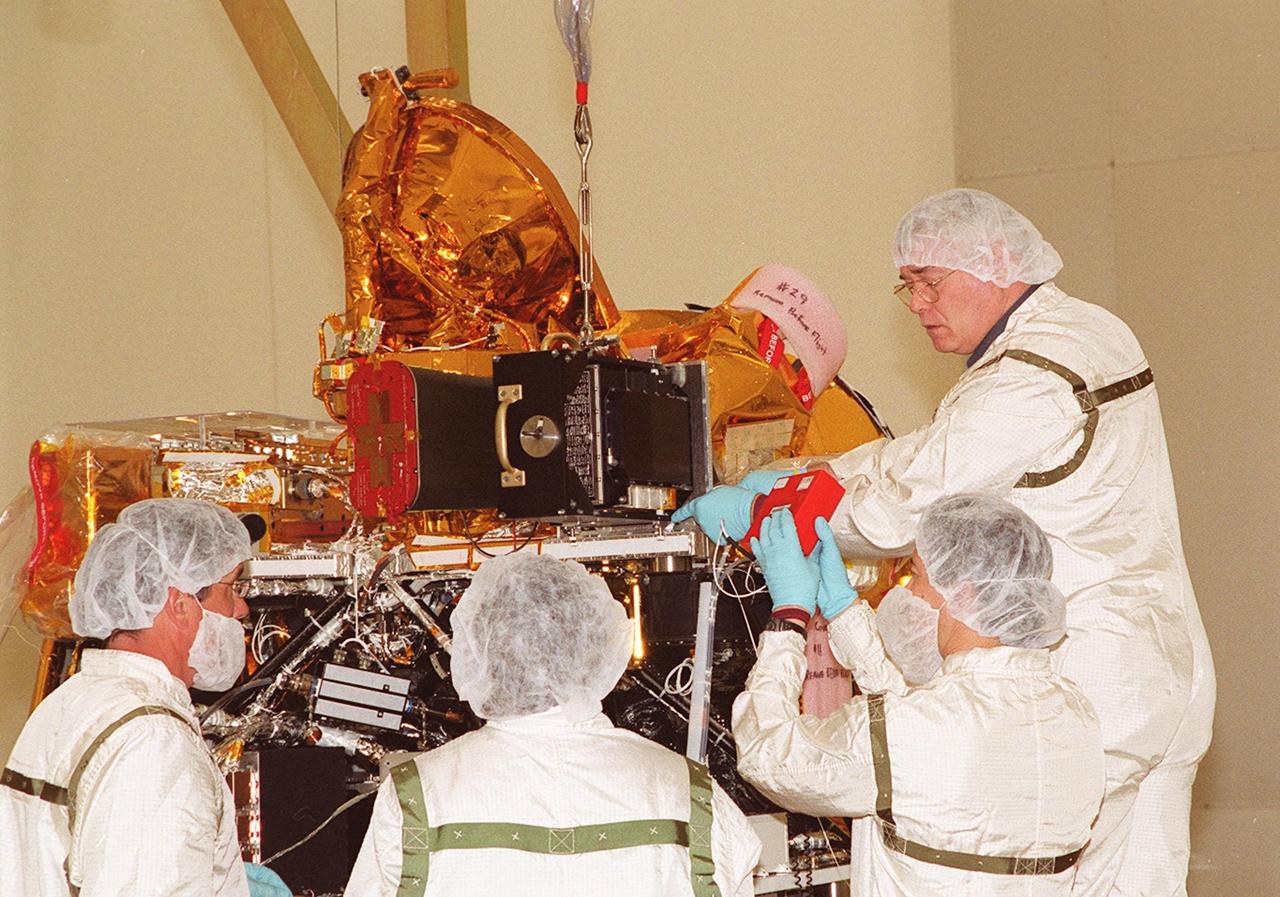
Workers in the Spacecraft Assembly and Encapsulation Facility 2 check the placement of the Thermal Emission Imaging System (THEMIS) on the Mars Odyssey Orbiter. THEMIS will map the mineralogy and morphology of the Martian surface using a high-resolution camera and a thermal infrared imaging spectrometer. The orbiter will carry three science instruments: THEMIS, the Gamma Ray Spectrometer (GRS), and the Mars Radiation Environment Experiment (MARIE). The GRS will achieve global mapping of the elemental composition of the surface and determine the abundance of hydrogen in the shallow subsurface. The MARIE will characterize aspects of the near-space radiation environment with regards to the radiation-related risk to human explorers. The Mars Odyssey Orbiter is scheduled for launch on April 7, 2001, aboard a Delta 7925 rocket from Launch Pad 17-A, Cape Canaveral Air Force Station
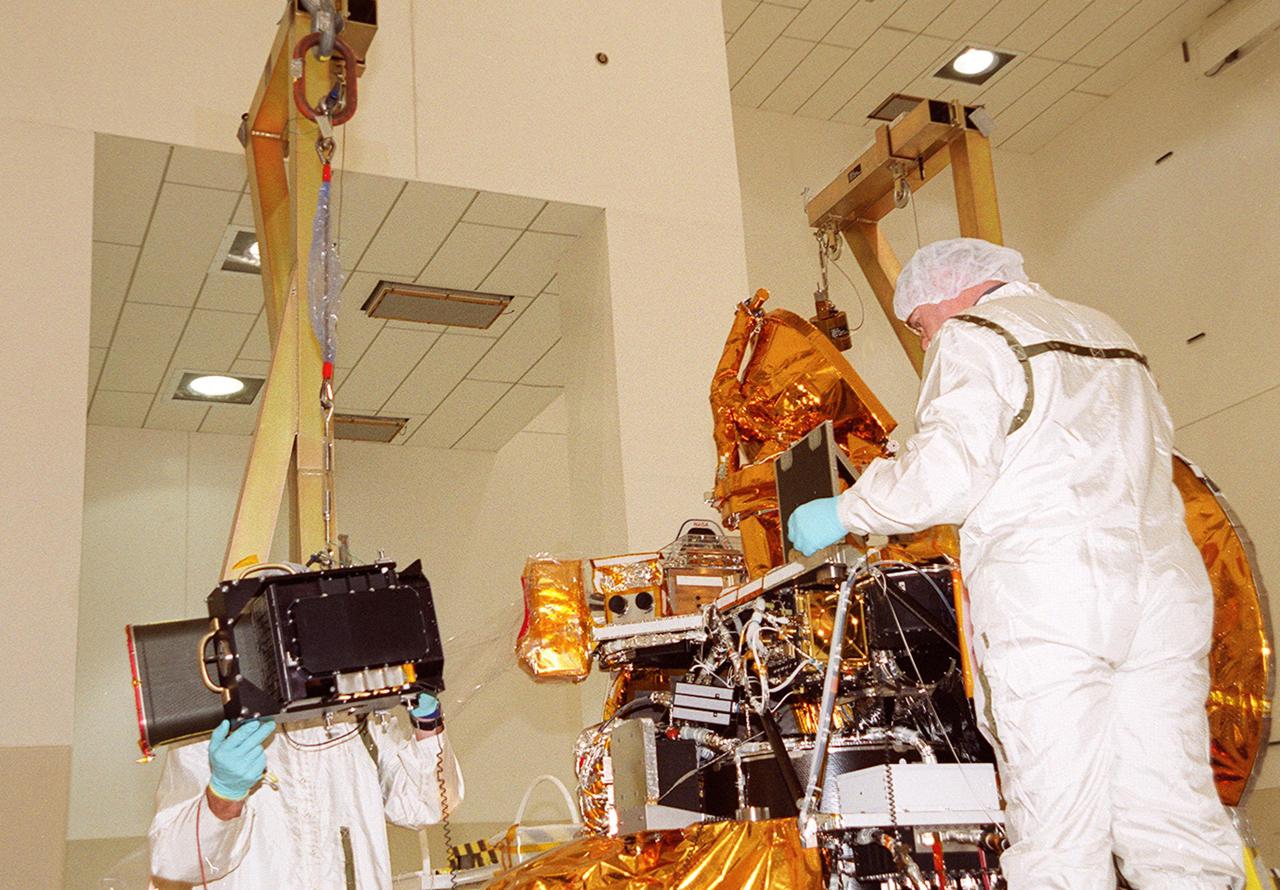
In the Spacecraft Assembly and Encapsulation Facility 2 (SAEF 2), the Thermal Emission Imaging System (THEMIS), left, is moved toward the Mars Odyssey Orbiter, at right. THEMIS will map the mineralogy and morphology of the Martian surface using a high-resolution camera and a thermal infrared imaging spectrometer. The orbiter will carry three science instruments: THEMIS, the Gamma Ray Spectrometer (GRS), and the Mars Radiation Environment Experiment (MARIE). The GRS will achieve global mapping of the elemental composition of the surface and determine the abundance of hydrogen in the shallow subsurface. The MARIE will characterize aspects of the near-space radiation environment with regards to the radiation-related risk to human explorers. The Mars Odyssey Orbiter is scheduled for launch on April 7, 2001, aboard a Delta 7925 rocket from Launch Pad 17-A, Cape Canaveral Air Force Station

In the Spacecraft Assembly and Encapsulation Facility 2, workers test the Thermal Emission Imaging System (THEMIS) before attaching to the 2001 Mars Odyssey Orbiter. THEMIS will map the mineralogy and morphology of the Martian surface using a high-resolution camera and a thermal infrared imaging spectrometer. The orbiter will carry three science instruments: THEMIS, the Gamma Ray Spectrometer (GRS), and the Mars Radiation Environment Experiment (MARIE). The GRS will achieve global mapping of the elemental composition of the surface and determine the abundance of hydrogen in the shallow subsurface. The MARIE will characterize aspects of the near-space radiation environment with regards to the radiation-related risk to human explorers. The Mars Odyssey Orbiter is scheduled for launch on April 7, 2001, aboard a Delta 7925 rocket from Launch Pad 17-A, Cape Canaveral Air Force Station
![In the Spacecraft Assembly and Encapsulation Facility -2, the solar array from the 2001 Mars Odyssey Orbiter is moved toward a workstand. This will give workers access to other components of the spacecraft and allow inspection of the array. The Mars Odyssey carries three science instruments: the Thermal Emission Imaging System (THEMIS), the Gamma Ray Spectrometer (GRS), and the Mars Radiation Environment Experiment (MARIE). THEMIS will map the mineralogy and morphology of the Martian surface using a high-resolution camera and a thermal infrared imaging spectrometer. The GRS will achieve global mapping of the elemental composition of the surface and determine the abundance of hydrogen in the shallow subsurface. [The GRS is a rebuild of the instrument lost with the Mars Observer mission.] The MARIE will characterize aspects of the near-space radiation environment as related to the radiation-related risk to human explorers. The Mars Odyssey Orbiter is scheduled for launch on April 7, 2001, aboard a Delta 7925 rocket from Launch Pad 17-A, Cape Canaveral Air Force Station](https://images-assets.nasa.gov/image/01pp0123/01pp0123~medium.jpg)
In the Spacecraft Assembly and Encapsulation Facility -2, the solar array from the 2001 Mars Odyssey Orbiter is moved toward a workstand. This will give workers access to other components of the spacecraft and allow inspection of the array. The Mars Odyssey carries three science instruments: the Thermal Emission Imaging System (THEMIS), the Gamma Ray Spectrometer (GRS), and the Mars Radiation Environment Experiment (MARIE). THEMIS will map the mineralogy and morphology of the Martian surface using a high-resolution camera and a thermal infrared imaging spectrometer. The GRS will achieve global mapping of the elemental composition of the surface and determine the abundance of hydrogen in the shallow subsurface. [The GRS is a rebuild of the instrument lost with the Mars Observer mission.] The MARIE will characterize aspects of the near-space radiation environment as related to the radiation-related risk to human explorers. The Mars Odyssey Orbiter is scheduled for launch on April 7, 2001, aboard a Delta 7925 rocket from Launch Pad 17-A, Cape Canaveral Air Force Station
![Technicians guide The Gamma Ray Spectrometer (GRS); into place to be installed on the Mars Odyssey Orbiter in the Spacecraft Assembly and Encapsulation Facility 2 (SAEF 2).; The orbiter will carry three science instruments: the Thermal Emission Imaging System (THEMIS), the Gamma Ray Spectrometer (GRS), and the Mars Radiation Environment Experiment (MARIE). THEMIS will map the mineralogy and morphology of the Martian surface using a high-resolution camera and a thermal infrared imaging spectrometer. The GRS will achieve global mapping of the elemental composition of the surface and determine the abundance of hydrogen in the shallow subsurface. [The GRS is a rebuild of the instrument lost with the Mars Observer mission.] The MARIE will characterize aspects of the near-space radiation environment with regards to the radiation-related risk to human explorers. The Mars Odyssey Orbiter is scheduled for launch on April 7, 2001, aboard a Delta 7925 rocket from Launch Pad 17-A, Cape Canaveral Air Force Station](https://images-assets.nasa.gov/image/01pp0193/01pp0193~medium.jpg)
Technicians guide The Gamma Ray Spectrometer (GRS); into place to be installed on the Mars Odyssey Orbiter in the Spacecraft Assembly and Encapsulation Facility 2 (SAEF 2).; The orbiter will carry three science instruments: the Thermal Emission Imaging System (THEMIS), the Gamma Ray Spectrometer (GRS), and the Mars Radiation Environment Experiment (MARIE). THEMIS will map the mineralogy and morphology of the Martian surface using a high-resolution camera and a thermal infrared imaging spectrometer. The GRS will achieve global mapping of the elemental composition of the surface and determine the abundance of hydrogen in the shallow subsurface. [The GRS is a rebuild of the instrument lost with the Mars Observer mission.] The MARIE will characterize aspects of the near-space radiation environment with regards to the radiation-related risk to human explorers. The Mars Odyssey Orbiter is scheduled for launch on April 7, 2001, aboard a Delta 7925 rocket from Launch Pad 17-A, Cape Canaveral Air Force Station
![In the Spacecraft Assembly and Encapsulation Facility -2, workers help guide the <a href='http:__mars.jpl.nasa.gov_2001_'>2001 Mars Odyssey Orbiter <_a> to a workstand (left). The spacecraft carries three science instruments: the Thermal Emission Imaging System (THEMIS), the Gamma Ray Spectrometer (GRS), and the Mars Radiation Environment Experiment (MARIE). THEMIS will map the mineralogy and morphology of the Martian surface using a high-resolution camera and a thermal infrared imaging spectrometer. The GRS will achieve global mapping of the elemental composition of the surface and determine the abundance of hydrogen in the shallow subsurface. [The GRS is a rebuild of the instrument lost with the Mars Observer mission.] The MARIE will characterize aspects of the near-space radiation environment as related to the radiation-related risk to human explorers. The Mars Odyssey Orbiter is scheduled for launch on April 7, 2001, aboard a Delta 7925 rocket from Launch Pad 17-A, Cape Canaveral Air Force Station](https://images-assets.nasa.gov/image/01pp0099/01pp0099~medium.jpg)
In the Spacecraft Assembly and Encapsulation Facility -2, workers help guide the <a href='http:__mars.jpl.nasa.gov_2001_'>2001 Mars Odyssey Orbiter <_a> to a workstand (left). The spacecraft carries three science instruments: the Thermal Emission Imaging System (THEMIS), the Gamma Ray Spectrometer (GRS), and the Mars Radiation Environment Experiment (MARIE). THEMIS will map the mineralogy and morphology of the Martian surface using a high-resolution camera and a thermal infrared imaging spectrometer. The GRS will achieve global mapping of the elemental composition of the surface and determine the abundance of hydrogen in the shallow subsurface. [The GRS is a rebuild of the instrument lost with the Mars Observer mission.] The MARIE will characterize aspects of the near-space radiation environment as related to the radiation-related risk to human explorers. The Mars Odyssey Orbiter is scheduled for launch on April 7, 2001, aboard a Delta 7925 rocket from Launch Pad 17-A, Cape Canaveral Air Force Station
![In the Spacecraft Assembly and Encapsulation Facility 2 (SAEF 2), workers attach a crane to the Gamma Ray Spectrometer (GRS); to move it into place to be installed on the Mars Odyssey Orbiter.; The orbiter will carry three science instruments: the Thermal Emission Imaging System (THEMIS), the Gamma Ray Spectrometer (GRS), and the Mars Radiation Environment Experiment (MARIE). THEMIS will map the mineralogy and morphology of the Martian surface using a high-resolution camera and a thermal infrared imaging spectrometer. The GRS will achieve global mapping of the elemental composition of the surface and determine the abundance of hydrogen in the shallow subsurface. [The GRS is a rebuild of the instrument lost with the Mars Observer mission.] The MARIE will characterize aspects of the near-space radiation environment with regards to the radiation-related risk to human explorers. The Mars Odyssey Orbiter is scheduled for launch on April 7, 2001, aboard a Delta 7925 rocket from Launch Pad 17-A, Cape Canaveral Air Force Station](https://images-assets.nasa.gov/image/01pp0190/01pp0190~medium.jpg)
In the Spacecraft Assembly and Encapsulation Facility 2 (SAEF 2), workers attach a crane to the Gamma Ray Spectrometer (GRS); to move it into place to be installed on the Mars Odyssey Orbiter.; The orbiter will carry three science instruments: the Thermal Emission Imaging System (THEMIS), the Gamma Ray Spectrometer (GRS), and the Mars Radiation Environment Experiment (MARIE). THEMIS will map the mineralogy and morphology of the Martian surface using a high-resolution camera and a thermal infrared imaging spectrometer. The GRS will achieve global mapping of the elemental composition of the surface and determine the abundance of hydrogen in the shallow subsurface. [The GRS is a rebuild of the instrument lost with the Mars Observer mission.] The MARIE will characterize aspects of the near-space radiation environment with regards to the radiation-related risk to human explorers. The Mars Odyssey Orbiter is scheduled for launch on April 7, 2001, aboard a Delta 7925 rocket from Launch Pad 17-A, Cape Canaveral Air Force Station
![The <a href=http://mars.jpl.nasa.gov/2001/>2001 Mars Odyssey Orbiter </a>comes to rest on a workstand in the Spacecraft Assembly & Encapsulation Facility -2. Workers check the spacecraft’s position. The Mars Odyssey Orbiter carries three science instruments: the Thermal Emission Imaging System (THEMIS), the Gamma Ray Spectrometer (GRS), and the Mars Radiation Environment Experiment (MARIE). THEMIS will map the mineralogy and morphology of the Martian surface using a high-resolution camera and a thermal infrared imaging spectrometer. The GRS will achieve global mapping of the elemental composition of the surface and determine the abundance of hydrogen in the shallow subsurface. [The GRS is a rebuild of the instrument lost with the Mars Observer mission.] The MARIE will characterize aspects of the near-space radiation environment as related to the radiation-related risk to human explorers. The Mars Odyssey Orbiter is scheduled for launch on April 7, 2001, aboard a Delta 7925 rocket from Launch Pad 17-A, Cape Canaveral Air Force Station](https://images-assets.nasa.gov/image/KSC01pp0102/KSC01pp0102~medium.jpg)
The <a href=http://mars.jpl.nasa.gov/2001/>2001 Mars Odyssey Orbiter </a>comes to rest on a workstand in the Spacecraft Assembly & Encapsulation Facility -2. Workers check the spacecraft’s position. The Mars Odyssey Orbiter carries three science instruments: the Thermal Emission Imaging System (THEMIS), the Gamma Ray Spectrometer (GRS), and the Mars Radiation Environment Experiment (MARIE). THEMIS will map the mineralogy and morphology of the Martian surface using a high-resolution camera and a thermal infrared imaging spectrometer. The GRS will achieve global mapping of the elemental composition of the surface and determine the abundance of hydrogen in the shallow subsurface. [The GRS is a rebuild of the instrument lost with the Mars Observer mission.] The MARIE will characterize aspects of the near-space radiation environment as related to the radiation-related risk to human explorers. The Mars Odyssey Orbiter is scheduled for launch on April 7, 2001, aboard a Delta 7925 rocket from Launch Pad 17-A, Cape Canaveral Air Force Station
![Workers in the Spacecraft Assembly & Encapsulation Facility -2 take a close look at the back side of the opened solar array panels from the 2001 Mars Odyssey Orbiter. The Mars Odyssey carries three science instruments: the Thermal Emission Imaging System (THEMIS), the Gamma Ray Spectrometer (GRS), and the Mars Radiation Environment Experiment (MARIE). THEMIS will map the mineralogy and morphology of the Martian surface using a high-resolution camera and a thermal infrared imaging spectrometer. The GRS will achieve global mapping of the elemental composition of the surface and determine the abundance of hydrogen in the shallow subsurface. [The GRS is a rebuild of the instrument lost with the Mars Observer mission.] The MARIE will characterize aspects of the near-space radiation environment as related to the radiation-related risk to human explorers. The Mars Odyssey Orbiter is scheduled for launch on April 7, 2001, aboard a Delta 7925 rocket from Launch Pad 17-A, Cape Canaveral Air Force Station](https://images-assets.nasa.gov/image/KSC01pp0160/KSC01pp0160~medium.jpg)
Workers in the Spacecraft Assembly & Encapsulation Facility -2 take a close look at the back side of the opened solar array panels from the 2001 Mars Odyssey Orbiter. The Mars Odyssey carries three science instruments: the Thermal Emission Imaging System (THEMIS), the Gamma Ray Spectrometer (GRS), and the Mars Radiation Environment Experiment (MARIE). THEMIS will map the mineralogy and morphology of the Martian surface using a high-resolution camera and a thermal infrared imaging spectrometer. The GRS will achieve global mapping of the elemental composition of the surface and determine the abundance of hydrogen in the shallow subsurface. [The GRS is a rebuild of the instrument lost with the Mars Observer mission.] The MARIE will characterize aspects of the near-space radiation environment as related to the radiation-related risk to human explorers. The Mars Odyssey Orbiter is scheduled for launch on April 7, 2001, aboard a Delta 7925 rocket from Launch Pad 17-A, Cape Canaveral Air Force Station
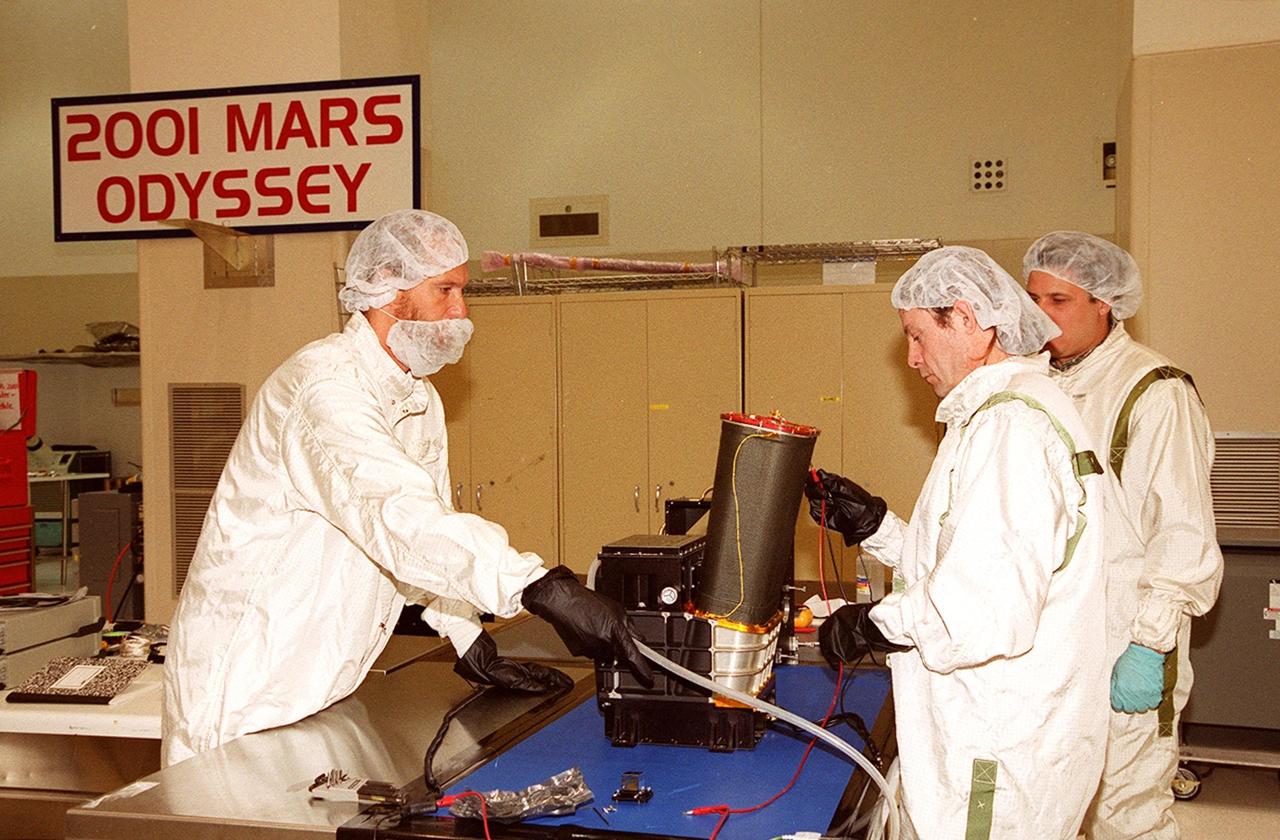
In the Spacecraft Assembly and Encapsulation Facility 2, workers test the Thermal Emission Imaging System (THEMIS) before attaching to the 2001 Mars Odyssey Orbiter. THEMIS will map the mineralogy and morphology of the Martian surface using a high-resolution camera and a thermal infrared imaging spectrometer. The orbiter will carry three science instruments: THEMIS, the Gamma Ray Spectrometer (GRS), and the Mars Radiation Environment Experiment (MARIE). The GRS will achieve global mapping of the elemental composition of the surface and determine the abundance of hydrogen in the shallow subsurface. The MARIE will characterize aspects of the near-space radiation environment with regards to the radiation-related risk to human explorers. The Mars Odyssey Orbiter is scheduled for launch on April 7, 2001, aboard a Delta 7925 rocket from Launch Pad 17-A, Cape Canaveral Air Force Station
![In the Spacecraft Assembly & Encapsulation Facility -2, workers help guide the <a href=http://mars.jpl.nasa.gov/2001/>2001 Mars Odyssey Orbiter </a>as it is lowered to a workstand. The Mars Odyssey Orbiter carries three science instruments: the Thermal Emission Imaging System (THEMIS), the Gamma Ray Spectrometer (GRS), and the Mars Radiation Environment Experiment (MARIE). THEMIS will map the mineralogy and morphology of the Martian surface using a high-resolution camera and a thermal infrared imaging spectrometer. The GRS will achieve global mapping of the elemental composition of the surface and determine the abundance of hydrogen in the shallow subsurface. [The GRS is a rebuild of the instrument lost with the Mars Observer mission.] The MARIE will characterize aspects of the near-space radiation environment as related to the radiation-related risk to human explorers. The Mars Odyssey Orbiter is scheduled for launch on April 7, 2001, aboard a Delta 7925 rocket from Launch Pad 17-A, Cape Canaveral Air Force Station](https://images-assets.nasa.gov/image/KSC01pp0101/KSC01pp0101~medium.jpg)
In the Spacecraft Assembly & Encapsulation Facility -2, workers help guide the <a href=http://mars.jpl.nasa.gov/2001/>2001 Mars Odyssey Orbiter </a>as it is lowered to a workstand. The Mars Odyssey Orbiter carries three science instruments: the Thermal Emission Imaging System (THEMIS), the Gamma Ray Spectrometer (GRS), and the Mars Radiation Environment Experiment (MARIE). THEMIS will map the mineralogy and morphology of the Martian surface using a high-resolution camera and a thermal infrared imaging spectrometer. The GRS will achieve global mapping of the elemental composition of the surface and determine the abundance of hydrogen in the shallow subsurface. [The GRS is a rebuild of the instrument lost with the Mars Observer mission.] The MARIE will characterize aspects of the near-space radiation environment as related to the radiation-related risk to human explorers. The Mars Odyssey Orbiter is scheduled for launch on April 7, 2001, aboard a Delta 7925 rocket from Launch Pad 17-A, Cape Canaveral Air Force Station
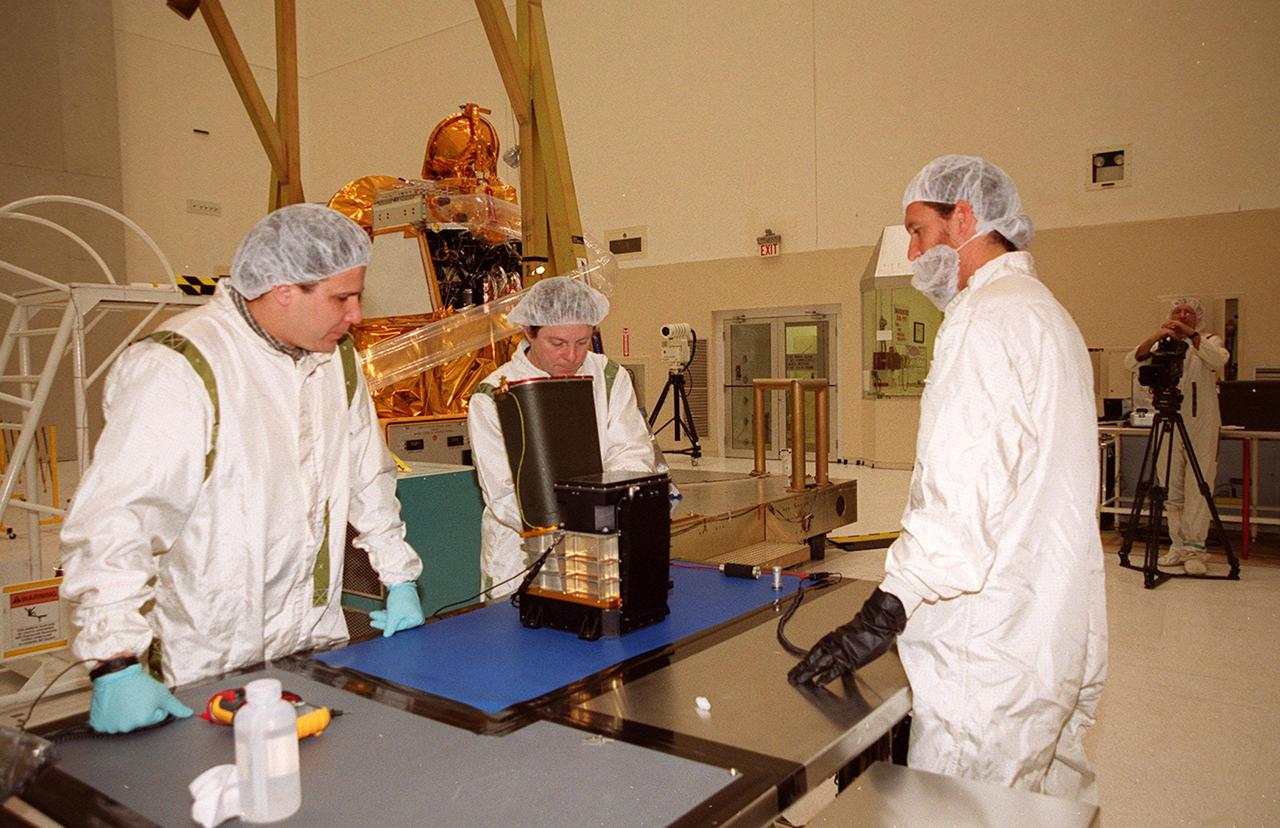
In the Spacecraft Assembly and Encapsulation Facility 2 (SAEF 2), workers check the Thermal Emission Imaging System (THEMIS) before attaching to the 2001 Mars Odyssey Orbiter (background). THEMIS will map the mineralogy and morphology of the Martian surface using a high-resolution camera and a thermal infrared imaging spectrometer. The orbiter will carry three science instruments: THEMIS, the Gamma Ray Spectrometer (GRS), and the Mars Radiation Environment Experiment (MARIE). The GRS will achieve global mapping of the elemental composition of the surface and determine the abundance of hydrogen in the shallow subsurface. The MARIE will characterize aspects of the near-space radiation environment with regards to the radiation-related risk to human explorers. The Mars Odyssey Orbiter is scheduled for launch on April 7, 2001, aboard a Delta 7925 rocket from Launch Pad 17-A, Cape Canaveral Air Force Station
![The <a href=http:__mars.jpl.nasa.gov_2001_>2001 Mars Odyssey Orbiter<_a> is safely placed on a workstand in the Spacecraft Assembly and Encapsulation Facility -2. The Mars Odyssey Orbiter carries three science instruments: the Thermal Emission Imaging System (THEMIS), the Gamma Ray Spectrometer (GRS), and the Mars Radiation Environment Experiment (MARIE). THEMIS will map the mineralogy and morphology of the Martian surface using a high-resolution camera and a thermal infrared imaging spectrometer. The GRS will achieve global mapping of the elemental composition of the surface and determine the abundance of hydrogen in the shallow subsurface. [The GRS is a rebuild of the instrument lost with the Mars Observer mission.] The MARIE will characterize aspects of the near-space radiation environment as related to the radiation-related risk to human explorers. The Mars Odyssey Orbiter is scheduled for launch on April 7, 2001, aboard a Delta 7925 rocket from Launch Pad 17-A, Cape Canaveral Air Force Station](https://images-assets.nasa.gov/image/01pp0103/01pp0103~medium.jpg)
The <a href=http:__mars.jpl.nasa.gov_2001_>2001 Mars Odyssey Orbiter<_a> is safely placed on a workstand in the Spacecraft Assembly and Encapsulation Facility -2. The Mars Odyssey Orbiter carries three science instruments: the Thermal Emission Imaging System (THEMIS), the Gamma Ray Spectrometer (GRS), and the Mars Radiation Environment Experiment (MARIE). THEMIS will map the mineralogy and morphology of the Martian surface using a high-resolution camera and a thermal infrared imaging spectrometer. The GRS will achieve global mapping of the elemental composition of the surface and determine the abundance of hydrogen in the shallow subsurface. [The GRS is a rebuild of the instrument lost with the Mars Observer mission.] The MARIE will characterize aspects of the near-space radiation environment as related to the radiation-related risk to human explorers. The Mars Odyssey Orbiter is scheduled for launch on April 7, 2001, aboard a Delta 7925 rocket from Launch Pad 17-A, Cape Canaveral Air Force Station
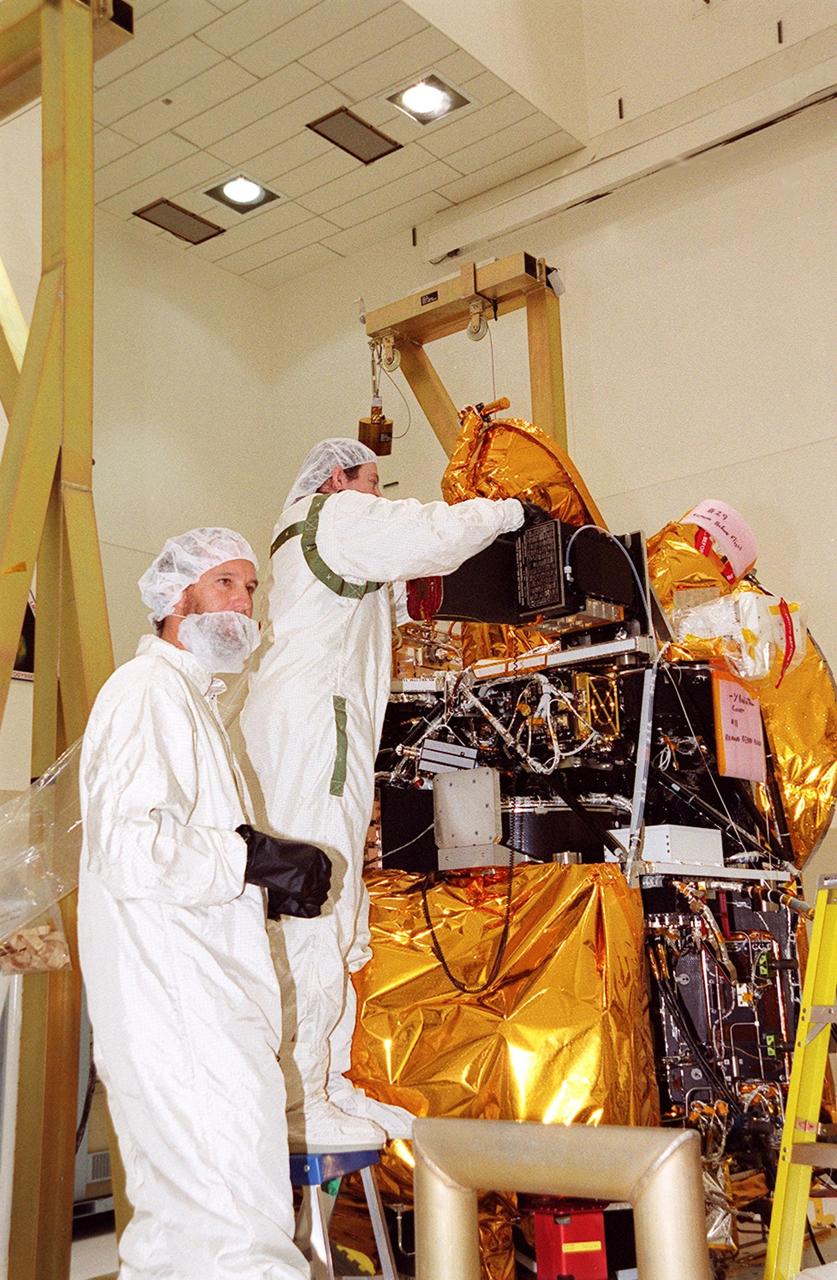
Workers in the Spacecraft Assembly and Encapsulation Facility 2 adjust the placement of the Thermal Emission Imaging System (THEMIS) on the Mars Odyssey Orbiter. THEMIS will map the mineralogy and morphology of the Martian surface using a high-resolution camera and a thermal infrared imaging spectrometer. The orbiter will carry three science instruments: THEMIS, the Gamma Ray Spectrometer (GRS), and the Mars Radiation Environment Experiment (MARIE). The GRS will achieve global mapping of the elemental composition of the surface and determine the abundance of hydrogen in the shallow subsurface. The MARIE will characterize aspects of the near-space radiation environment with regards to the radiation-related risk to human explorers. The Mars Odyssey Orbiter is scheduled for launch on April 7, 2001, aboard a Delta 7925 rocket from Launch Pad 17-A, Cape Canaveral Air Force Station
![The <a href=http:__mars.jpl.nasa.gov_2001_>2001 Mars Odyssey Orbiter <_a>comes to rest on a workstand in the Spacecraft Assembly and Encapsulation Facility -2. Workers check the spacecraft’s position. The Mars Odyssey Orbiter carries three science instruments: the Thermal Emission Imaging System (THEMIS), the Gamma Ray Spectrometer (GRS), and the Mars Radiation Environment Experiment (MARIE). THEMIS will map the mineralogy and morphology of the Martian surface using a high-resolution camera and a thermal infrared imaging spectrometer. The GRS will achieve global mapping of the elemental composition of the surface and determine the abundance of hydrogen in the shallow subsurface. [The GRS is a rebuild of the instrument lost with the Mars Observer mission.] The MARIE will characterize aspects of the near-space radiation environment as related to the radiation-related risk to human explorers. The Mars Odyssey Orbiter is scheduled for launch on April 7, 2001, aboard a Delta 7925 rocket from Launch Pad 17-A, Cape Canaveral Air Force Station](https://images-assets.nasa.gov/image/01pp0102/01pp0102~medium.jpg)
The <a href=http:__mars.jpl.nasa.gov_2001_>2001 Mars Odyssey Orbiter <_a>comes to rest on a workstand in the Spacecraft Assembly and Encapsulation Facility -2. Workers check the spacecraft’s position. The Mars Odyssey Orbiter carries three science instruments: the Thermal Emission Imaging System (THEMIS), the Gamma Ray Spectrometer (GRS), and the Mars Radiation Environment Experiment (MARIE). THEMIS will map the mineralogy and morphology of the Martian surface using a high-resolution camera and a thermal infrared imaging spectrometer. The GRS will achieve global mapping of the elemental composition of the surface and determine the abundance of hydrogen in the shallow subsurface. [The GRS is a rebuild of the instrument lost with the Mars Observer mission.] The MARIE will characterize aspects of the near-space radiation environment as related to the radiation-related risk to human explorers. The Mars Odyssey Orbiter is scheduled for launch on April 7, 2001, aboard a Delta 7925 rocket from Launch Pad 17-A, Cape Canaveral Air Force Station
![In the Spacecraft Assembly and Encapsulation Facility 2 (SAEF 2), workers attach a crane to the Gamma Ray Spectrometer (GRS); to move it into place to be installed on the Mars Odyssey Orbiter.; The orbiter will carry three science instruments: the Thermal Emission Imaging System (THEMIS), the Gamma Ray Spectrometer (GRS), and the Mars Radiation Environment Experiment (MARIE). THEMIS will map the mineralogy and morphology of the Martian surface using a high-resolution camera and a thermal infrared imaging spectrometer. The GRS will achieve global mapping of the elemental composition of the surface and determine the abundance of hydrogen in the shallow subsurface. [The GRS is a rebuild of the instrument lost with the Mars Observer mission.] The MARIE will characterize aspects of the near-space radiation environment with regards to the radiation-related risk to human explorers. The Mars Odyssey Orbiter is scheduled for launch on April 7, 2001, aboard a Delta 7925 rocket from Launch Pad 17-A, Cape Canaveral Air Force Station](https://images-assets.nasa.gov/image/KSC01pp0190/KSC01pp0190~medium.jpg)
In the Spacecraft Assembly and Encapsulation Facility 2 (SAEF 2), workers attach a crane to the Gamma Ray Spectrometer (GRS); to move it into place to be installed on the Mars Odyssey Orbiter.; The orbiter will carry three science instruments: the Thermal Emission Imaging System (THEMIS), the Gamma Ray Spectrometer (GRS), and the Mars Radiation Environment Experiment (MARIE). THEMIS will map the mineralogy and morphology of the Martian surface using a high-resolution camera and a thermal infrared imaging spectrometer. The GRS will achieve global mapping of the elemental composition of the surface and determine the abundance of hydrogen in the shallow subsurface. [The GRS is a rebuild of the instrument lost with the Mars Observer mission.] The MARIE will characterize aspects of the near-space radiation environment with regards to the radiation-related risk to human explorers. The Mars Odyssey Orbiter is scheduled for launch on April 7, 2001, aboard a Delta 7925 rocket from Launch Pad 17-A, Cape Canaveral Air Force Station
![In the Spacecraft Assembly & Encapsulation Facility -2, workers help guide the <a href="http://mars.jpl.nasa.gov/2001/">2001 Mars Odyssey Orbiter </a> to a workstand (left). The spacecraft carries three science instruments: the Thermal Emission Imaging System (THEMIS), the Gamma Ray Spectrometer (GRS), and the Mars Radiation Environment Experiment (MARIE). THEMIS will map the mineralogy and morphology of the Martian surface using a high-resolution camera and a thermal infrared imaging spectrometer. The GRS will achieve global mapping of the elemental composition of the surface and determine the abundance of hydrogen in the shallow subsurface. [The GRS is a rebuild of the instrument lost with the Mars Observer mission.] The MARIE will characterize aspects of the near-space radiation environment as related to the radiation-related risk to human explorers. The Mars Odyssey Orbiter is scheduled for launch on April 7, 2001, aboard a Delta 7925 rocket from Launch Pad 17-A, Cape Canaveral Air Force Station](https://images-assets.nasa.gov/image/KSC01pp0099/KSC01pp0099~medium.jpg)
In the Spacecraft Assembly & Encapsulation Facility -2, workers help guide the <a href="http://mars.jpl.nasa.gov/2001/">2001 Mars Odyssey Orbiter </a> to a workstand (left). The spacecraft carries three science instruments: the Thermal Emission Imaging System (THEMIS), the Gamma Ray Spectrometer (GRS), and the Mars Radiation Environment Experiment (MARIE). THEMIS will map the mineralogy and morphology of the Martian surface using a high-resolution camera and a thermal infrared imaging spectrometer. The GRS will achieve global mapping of the elemental composition of the surface and determine the abundance of hydrogen in the shallow subsurface. [The GRS is a rebuild of the instrument lost with the Mars Observer mission.] The MARIE will characterize aspects of the near-space radiation environment as related to the radiation-related risk to human explorers. The Mars Odyssey Orbiter is scheduled for launch on April 7, 2001, aboard a Delta 7925 rocket from Launch Pad 17-A, Cape Canaveral Air Force Station

In the Spacecraft Assembly and Encapsulation Facility 2 (SAEF 2), workers check the Thermal Emission Imaging System (THEMIS) before attaching to the 2001 Mars Odyssey Orbiter (background). THEMIS will map the mineralogy and morphology of the Martian surface using a high-resolution camera and a thermal infrared imaging spectrometer. The orbiter will carry three science instruments: THEMIS, the Gamma Ray Spectrometer (GRS), and the Mars Radiation Environment Experiment (MARIE). The GRS will achieve global mapping of the elemental composition of the surface and determine the abundance of hydrogen in the shallow subsurface. The MARIE will characterize aspects of the near-space radiation environment with regards to the radiation-related risk to human explorers. The Mars Odyssey Orbiter is scheduled for launch on April 7, 2001, aboard a Delta 7925 rocket from Launch Pad 17-A, Cape Canaveral Air Force Station
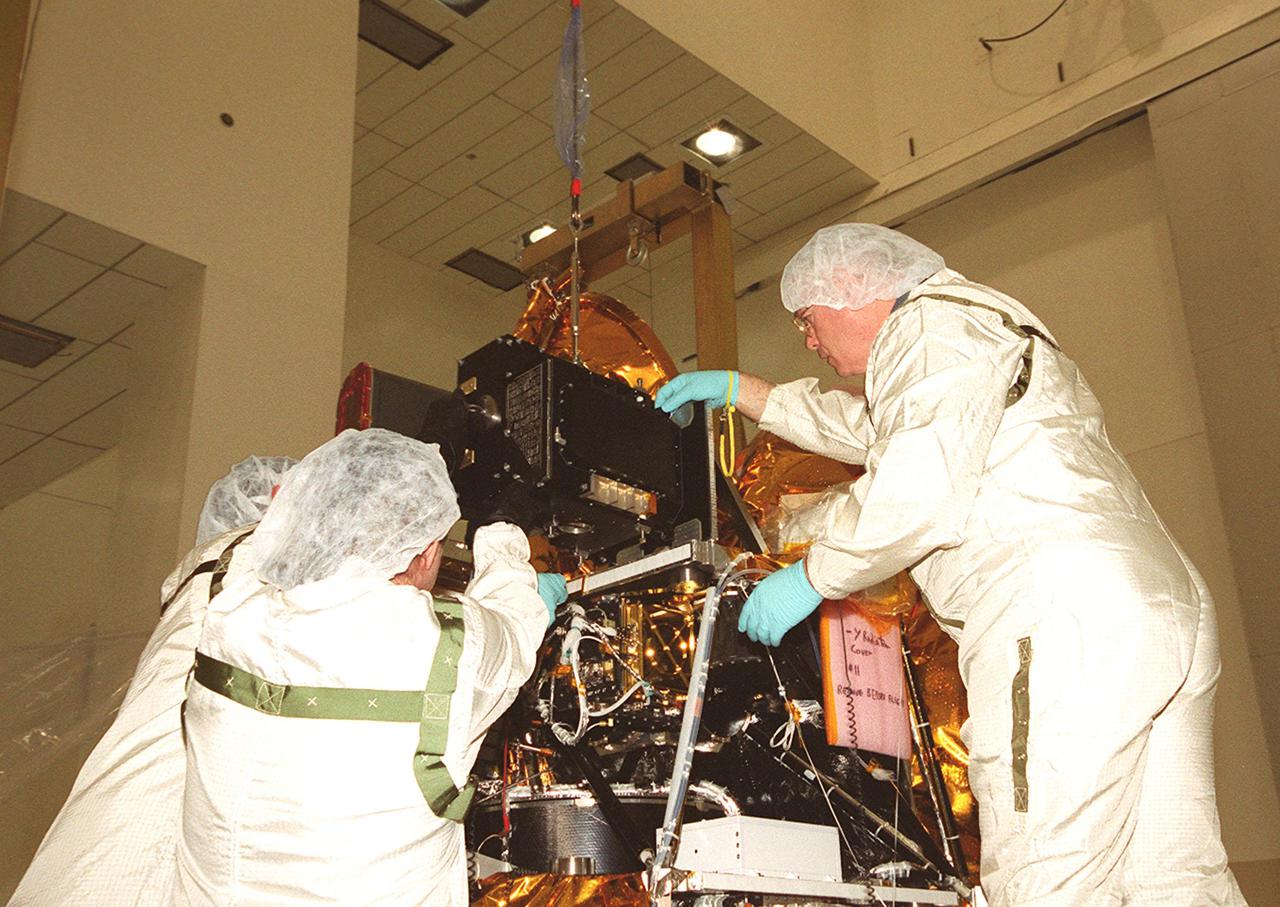
In the Spacecraft Assembly and Encapsulation Facility 2, workers help put the Thermal Emission Imaging System (THEMIS) in its place on the Mars Odyssey Orbiter. THEMIS will map the mineralogy and morphology of the Martian surface using a high-resolution camera and a thermal infrared imaging spectrometer. The orbiter will carry three science instruments: THEMIS, the Gamma Ray Spectrometer (GRS), and the Mars Radiation Environment Experiment (MARIE). The GRS will achieve global mapping of the elemental composition of the surface and determine the abundance of hydrogen in the shallow subsurface. The MARIE will characterize aspects of the near-space radiation environment with regards to the radiation-related risk to human explorers. The Mars Odyssey Orbiter is scheduled for launch on April 7, 2001, aboard a Delta 7925 rocket from Launch Pad 17-A, Cape Canaveral Air Force Station
![In the Spacecraft Assembly and Encapsulation Facility -2, workers oversee removal of the solar array on the 2001 Mars Odyssey Orbiter to a nearby workstand. This will give workers access to other components of the spacecraft and allow inspection of the array. The Mars Odyssey carries three science instruments: the Thermal Emission Imaging System (THEMIS), the Gamma Ray Spectrometer (GRS), and the Mars Radiation Environment Experiment (MARIE). THEMIS will map the mineralogy and morphology of the Martian surface using a high-resolution camera and a thermal infrared imaging spectrometer. The GRS will achieve global mapping of the elemental composition of the surface and determine the abundance of hydrogen in the shallow subsurface. [The GRS is a rebuild of the instrument lost with the Mars Observer mission.] The MARIE will characterize aspects of the near-space radiation environment as related to the radiation-related risk to human explorers. The Mars Odyssey Orbiter is scheduled for launch on April 7, 2001, aboard a Delta 7925 rocket from Launch Pad 17-A, Cape Canaveral Air Force Station](https://images-assets.nasa.gov/image/01pp0121/01pp0121~medium.jpg)
In the Spacecraft Assembly and Encapsulation Facility -2, workers oversee removal of the solar array on the 2001 Mars Odyssey Orbiter to a nearby workstand. This will give workers access to other components of the spacecraft and allow inspection of the array. The Mars Odyssey carries three science instruments: the Thermal Emission Imaging System (THEMIS), the Gamma Ray Spectrometer (GRS), and the Mars Radiation Environment Experiment (MARIE). THEMIS will map the mineralogy and morphology of the Martian surface using a high-resolution camera and a thermal infrared imaging spectrometer. The GRS will achieve global mapping of the elemental composition of the surface and determine the abundance of hydrogen in the shallow subsurface. [The GRS is a rebuild of the instrument lost with the Mars Observer mission.] The MARIE will characterize aspects of the near-space radiation environment as related to the radiation-related risk to human explorers. The Mars Odyssey Orbiter is scheduled for launch on April 7, 2001, aboard a Delta 7925 rocket from Launch Pad 17-A, Cape Canaveral Air Force Station
![In the Spacecraft Assembly & Encapsulation Facility -2, workers help guide the solar array from the 2001 Mars Odyssey Orbiter onto a workstand. This will give workers access to other components of the spacecraft and allow inspection of the array. The Mars Odyssey carries three science instruments: the Thermal Emission Imaging System (THEMIS), the Gamma Ray Spectrometer (GRS), and the Mars Radiation Environment Experiment (MARIE). THEMIS will map the mineralogy and morphology of the Martian surface using a high-resolution camera and a thermal infrared imaging spectrometer. The GRS will achieve global mapping of the elemental composition of the surface and determine the abundance of hydrogen in the shallow subsurface. [The GRS is a rebuild of the instrument lost with the Mars Observer mission.] The MARIE will characterize aspects of the near-space radiation environment as related to the radiation-related risk to human explorers. The Mars Odyssey Orbiter is scheduled for launch on April 7, 2001, aboard a Delta 7925 rocket from Launch Pad 17-A, Cape Canaveral Air Force Station](https://images-assets.nasa.gov/image/KSC01pp0124/KSC01pp0124~medium.jpg)
In the Spacecraft Assembly & Encapsulation Facility -2, workers help guide the solar array from the 2001 Mars Odyssey Orbiter onto a workstand. This will give workers access to other components of the spacecraft and allow inspection of the array. The Mars Odyssey carries three science instruments: the Thermal Emission Imaging System (THEMIS), the Gamma Ray Spectrometer (GRS), and the Mars Radiation Environment Experiment (MARIE). THEMIS will map the mineralogy and morphology of the Martian surface using a high-resolution camera and a thermal infrared imaging spectrometer. The GRS will achieve global mapping of the elemental composition of the surface and determine the abundance of hydrogen in the shallow subsurface. [The GRS is a rebuild of the instrument lost with the Mars Observer mission.] The MARIE will characterize aspects of the near-space radiation environment as related to the radiation-related risk to human explorers. The Mars Odyssey Orbiter is scheduled for launch on April 7, 2001, aboard a Delta 7925 rocket from Launch Pad 17-A, Cape Canaveral Air Force Station
![The Gamma Ray Spectrometer (GRS) is installed by technicians on the Mars Odyssey Orbiter in the Spacecraft Assembly and Encapsulation Facility 2 (SAEF 2).; The orbiter will carry three science instruments: the Thermal Emission Imaging System (THEMIS), the Gamma Ray Spectrometer (GRS), and the Mars Radiation Environment Experiment (MARIE). THEMIS will map the mineralogy and morphology of the Martian surface using a high-resolution camera and a thermal infrared imaging spectrometer. The GRS will achieve global mapping of the elemental composition of the surface and determine the abundance of hydrogen in the shallow subsurface. [The GRS is a rebuild of the instrument lost with the Mars Observer mission.] The MARIE will characterize aspects of the near-space radiation environment with regards to the radiation-related risk to human explorers. The Mars Odyssey Orbiter is scheduled for launch on April 7, 2001, aboard a Delta 7925 rocket from Launch Pad 17-A, Cape Canaveral Air Force Station](https://images-assets.nasa.gov/image/KSC01pp0194/KSC01pp0194~medium.jpg)
The Gamma Ray Spectrometer (GRS) is installed by technicians on the Mars Odyssey Orbiter in the Spacecraft Assembly and Encapsulation Facility 2 (SAEF 2).; The orbiter will carry three science instruments: the Thermal Emission Imaging System (THEMIS), the Gamma Ray Spectrometer (GRS), and the Mars Radiation Environment Experiment (MARIE). THEMIS will map the mineralogy and morphology of the Martian surface using a high-resolution camera and a thermal infrared imaging spectrometer. The GRS will achieve global mapping of the elemental composition of the surface and determine the abundance of hydrogen in the shallow subsurface. [The GRS is a rebuild of the instrument lost with the Mars Observer mission.] The MARIE will characterize aspects of the near-space radiation environment with regards to the radiation-related risk to human explorers. The Mars Odyssey Orbiter is scheduled for launch on April 7, 2001, aboard a Delta 7925 rocket from Launch Pad 17-A, Cape Canaveral Air Force Station
![Technicians examine the Gamma Ray Spectrometer (GRS) before it is moved to be installed on the Mars Odyssey Orbiter in the Spacecraft Assembly and Encapsulation Facility II (SAEF II).; The orbiter will carry three science instruments: the Thermal Emission Imaging System (THEMIS), the Gamma Ray Spectrometer (GRS), and the Mars Radiation Environment Experiment (MARIE). THEMIS will map the mineralogy and morphology of the Martian surface using a high-resolution camera and a thermal infrared imaging spectrometer. The GRS will achieve global mapping of the elemental composition of the surface and determine the abundance of hydrogen in the shallow subsurface. [The GRS is a rebuild of the instrument lost with the Mars Observer mission.] The MARIE will characterize aspects of the near-space radiation environment with regards to the radiation-related risk to human explorers. The Mars Odyssey Orbiter is scheduled for launch on April 7, 2001, aboard a Delta 7925 rocket from Launch Pad 17-A, Cape Canaveral Air Force Station](https://images-assets.nasa.gov/image/01pp0189/01pp0189~medium.jpg)
Technicians examine the Gamma Ray Spectrometer (GRS) before it is moved to be installed on the Mars Odyssey Orbiter in the Spacecraft Assembly and Encapsulation Facility II (SAEF II).; The orbiter will carry three science instruments: the Thermal Emission Imaging System (THEMIS), the Gamma Ray Spectrometer (GRS), and the Mars Radiation Environment Experiment (MARIE). THEMIS will map the mineralogy and morphology of the Martian surface using a high-resolution camera and a thermal infrared imaging spectrometer. The GRS will achieve global mapping of the elemental composition of the surface and determine the abundance of hydrogen in the shallow subsurface. [The GRS is a rebuild of the instrument lost with the Mars Observer mission.] The MARIE will characterize aspects of the near-space radiation environment with regards to the radiation-related risk to human explorers. The Mars Odyssey Orbiter is scheduled for launch on April 7, 2001, aboard a Delta 7925 rocket from Launch Pad 17-A, Cape Canaveral Air Force Station
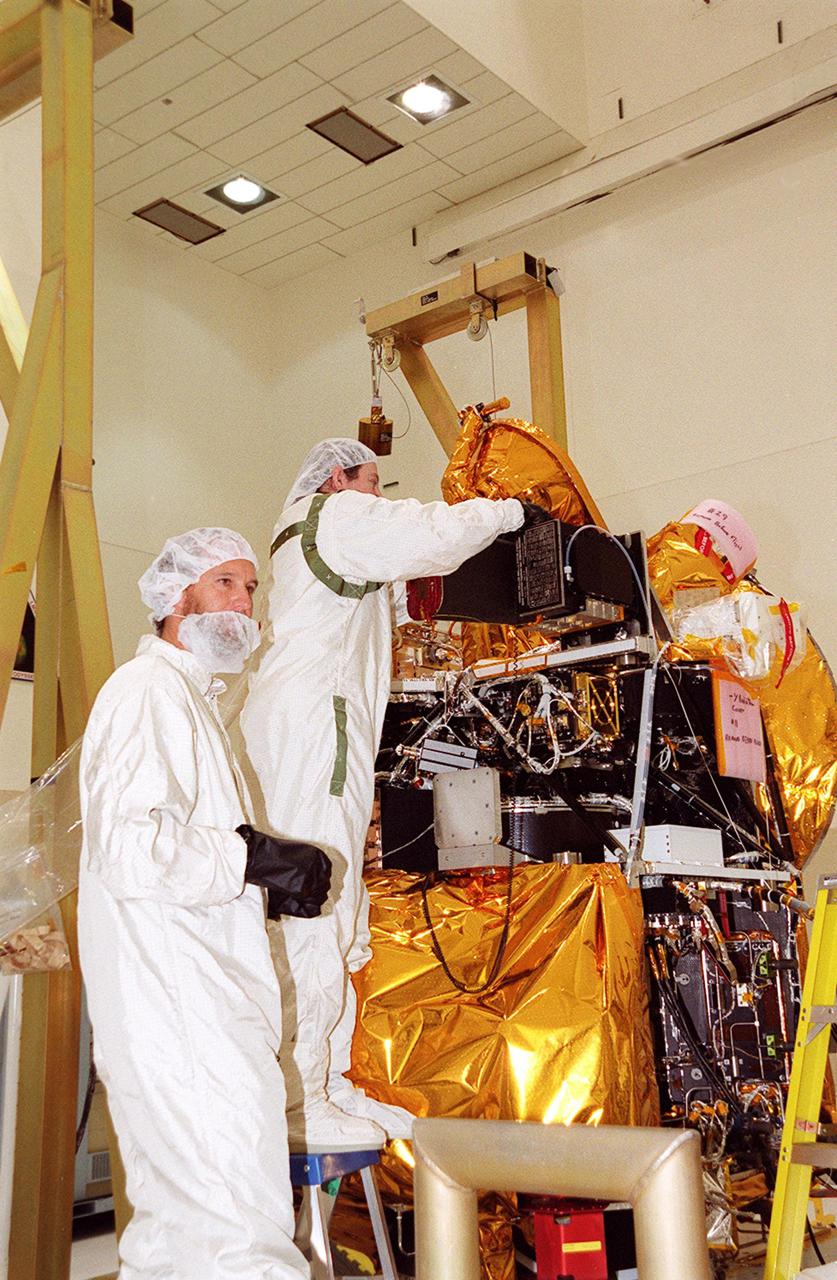
Workers in the Spacecraft Assembly and Encapsulation Facility 2 adjust the placement of the Thermal Emission Imaging System (THEMIS) on the Mars Odyssey Orbiter. THEMIS will map the mineralogy and morphology of the Martian surface using a high-resolution camera and a thermal infrared imaging spectrometer. The orbiter will carry three science instruments: THEMIS, the Gamma Ray Spectrometer (GRS), and the Mars Radiation Environment Experiment (MARIE). The GRS will achieve global mapping of the elemental composition of the surface and determine the abundance of hydrogen in the shallow subsurface. The MARIE will characterize aspects of the near-space radiation environment with regards to the radiation-related risk to human explorers. The Mars Odyssey Orbiter is scheduled for launch on April 7, 2001, aboard a Delta 7925 rocket from Launch Pad 17-A, Cape Canaveral Air Force Station
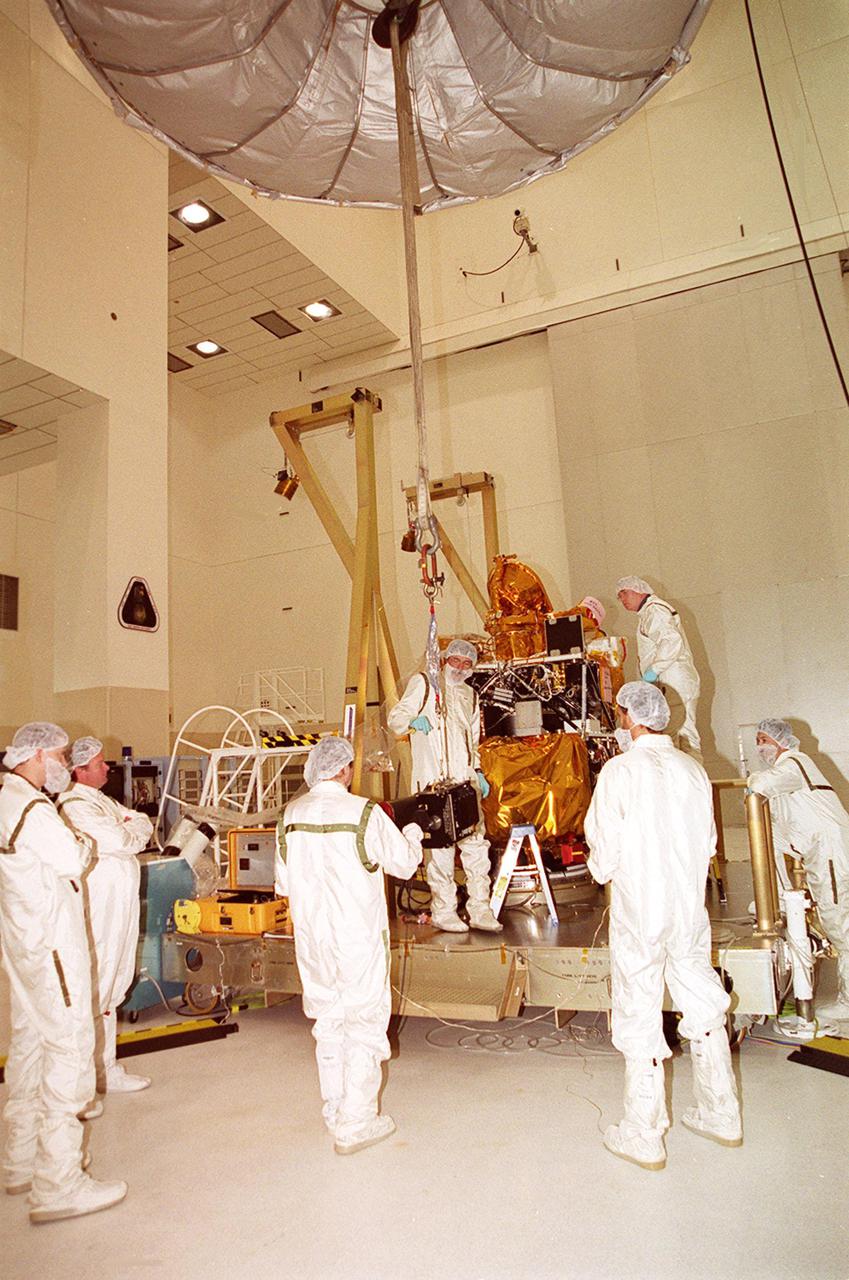
In the Spacecraft Assembly and Encapsulation Facility 2, an overhead crane lifts and moves the Thermal Emission Imaging System (THEMIS) toward the 2001 Mars Odyssey Orbiter. THEMIS will map the mineralogy and morphology of the Martian surface using a high-resolution camera and a thermal infrared imaging spectrometer. The orbiter will carry three science instruments: THEMIS, the Gamma Ray Spectrometer (GRS), and the Mars Radiation Environment Experiment (MARIE). The GRS will achieve global mapping of the elemental composition of the surface and determine the abundance of hydrogen in the shallow subsurface. The MARIE will characterize aspects of the near-space radiation environment with regards to the radiation-related risk to human explorers. The Mars Odyssey Orbiter is scheduled for launch on April 7, 2001, aboard a Delta 7925 rocket from Launch Pad 17-A, Cape Canaveral Air Force Station
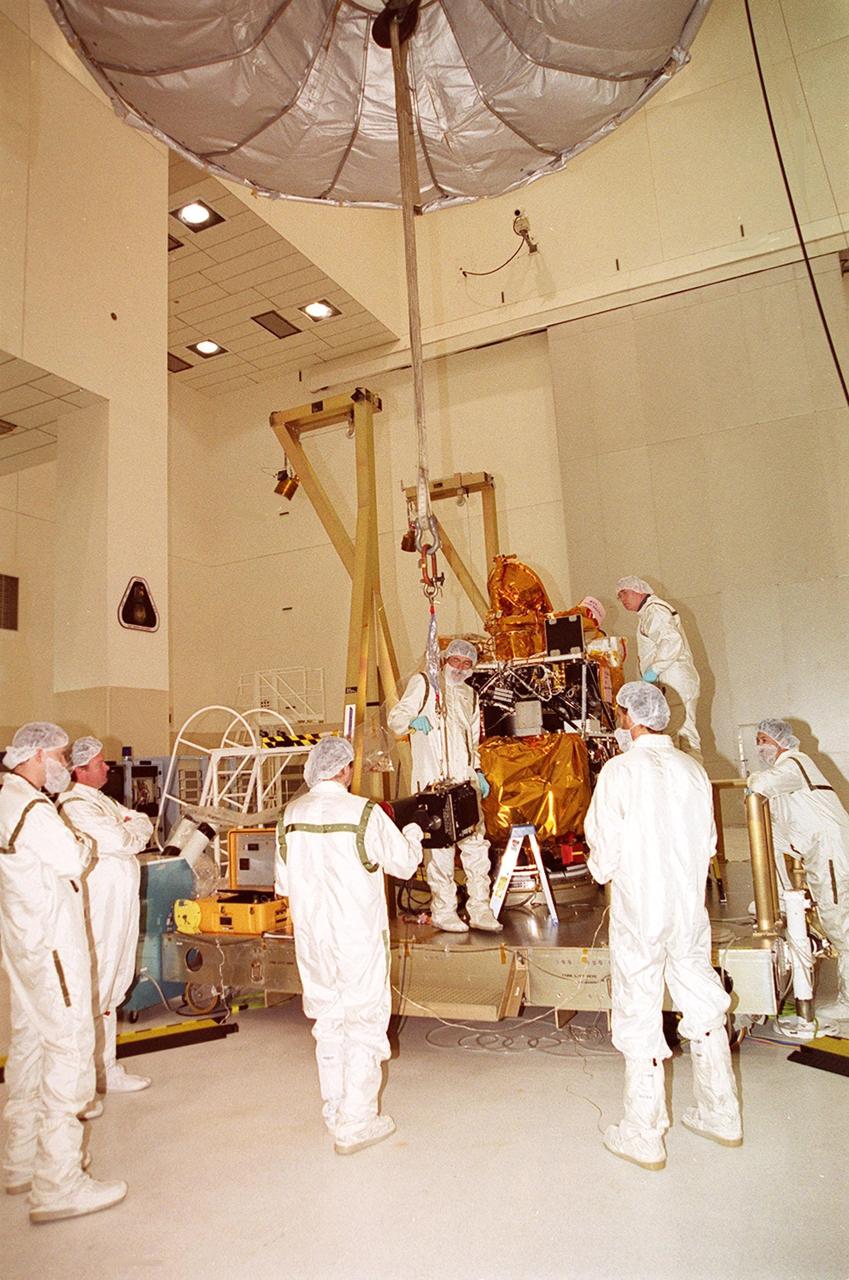
In the Spacecraft Assembly and Encapsulation Facility 2, an overhead crane lifts and moves the Thermal Emission Imaging System (THEMIS) toward the 2001 Mars Odyssey Orbiter. THEMIS will map the mineralogy and morphology of the Martian surface using a high-resolution camera and a thermal infrared imaging spectrometer. The orbiter will carry three science instruments: THEMIS, the Gamma Ray Spectrometer (GRS), and the Mars Radiation Environment Experiment (MARIE). The GRS will achieve global mapping of the elemental composition of the surface and determine the abundance of hydrogen in the shallow subsurface. The MARIE will characterize aspects of the near-space radiation environment with regards to the radiation-related risk to human explorers. The Mars Odyssey Orbiter is scheduled for launch on April 7, 2001, aboard a Delta 7925 rocket from Launch Pad 17-A, Cape Canaveral Air Force Station
![In the Spacecraft Assembly & Encapsulation Facility -2, workers oversee removal of the solar array on the 2001 Mars Odyssey Orbiter to a nearby workstand. This will give workers access to other components of the spacecraft and allow inspection of the array. The Mars Odyssey carries three science instruments: the Thermal Emission Imaging System (THEMIS), the Gamma Ray Spectrometer (GRS), and the Mars Radiation Environment Experiment (MARIE). THEMIS will map the mineralogy and morphology of the Martian surface using a high-resolution camera and a thermal infrared imaging spectrometer. The GRS will achieve global mapping of the elemental composition of the surface and determine the abundance of hydrogen in the shallow subsurface. [The GRS is a rebuild of the instrument lost with the Mars Observer mission.] The MARIE will characterize aspects of the near-space radiation environment as related to the radiation-related risk to human explorers. The Mars Odyssey Orbiter is scheduled for launch on April 7, 2001, aboard a Delta 7925 rocket from Launch Pad 17-A, Cape Canaveral Air Force Station](https://images-assets.nasa.gov/image/KSC01pp0121/KSC01pp0121~medium.jpg)
In the Spacecraft Assembly & Encapsulation Facility -2, workers oversee removal of the solar array on the 2001 Mars Odyssey Orbiter to a nearby workstand. This will give workers access to other components of the spacecraft and allow inspection of the array. The Mars Odyssey carries three science instruments: the Thermal Emission Imaging System (THEMIS), the Gamma Ray Spectrometer (GRS), and the Mars Radiation Environment Experiment (MARIE). THEMIS will map the mineralogy and morphology of the Martian surface using a high-resolution camera and a thermal infrared imaging spectrometer. The GRS will achieve global mapping of the elemental composition of the surface and determine the abundance of hydrogen in the shallow subsurface. [The GRS is a rebuild of the instrument lost with the Mars Observer mission.] The MARIE will characterize aspects of the near-space radiation environment as related to the radiation-related risk to human explorers. The Mars Odyssey Orbiter is scheduled for launch on April 7, 2001, aboard a Delta 7925 rocket from Launch Pad 17-A, Cape Canaveral Air Force Station
![Technicians guide The Gamma Ray Spectrometer (GRS)into place to be installed on the Mars Odyssey Orbiter in the Spacecraft Assembly and Encapsulation Facility 2 (SAEF 2).The orbiter will carry three science instruments: the Thermal Emission Imaging System (THEMIS), the Gamma Ray Spectrometer (GRS), and the Mars Radiation Environment Experiment (MARIE). THEMIS will map the mineralogy and morphology of the Martian surface using a high-resolution camera and a thermal infrared imaging spectrometer. The GRS will achieve global mapping of the elemental composition of the surface and determine the abundance of hydrogen in the shallow subsurface. [The GRS is a rebuild of the instrument lost with the Mars Observer mission.] The MARIE will characterize aspects of the near-space radiation environment with regards to the radiation-related risk to human explorers. The Mars Odyssey Orbiter is scheduled for launch on April 7, 2001, aboard a Delta 7925 rocket from Launch Pad 17-A, Cape Canaveral Air Force Station](https://images-assets.nasa.gov/image/KSC01pp0192/KSC01pp0192~medium.jpg)
Technicians guide The Gamma Ray Spectrometer (GRS)into place to be installed on the Mars Odyssey Orbiter in the Spacecraft Assembly and Encapsulation Facility 2 (SAEF 2).The orbiter will carry three science instruments: the Thermal Emission Imaging System (THEMIS), the Gamma Ray Spectrometer (GRS), and the Mars Radiation Environment Experiment (MARIE). THEMIS will map the mineralogy and morphology of the Martian surface using a high-resolution camera and a thermal infrared imaging spectrometer. The GRS will achieve global mapping of the elemental composition of the surface and determine the abundance of hydrogen in the shallow subsurface. [The GRS is a rebuild of the instrument lost with the Mars Observer mission.] The MARIE will characterize aspects of the near-space radiation environment with regards to the radiation-related risk to human explorers. The Mars Odyssey Orbiter is scheduled for launch on April 7, 2001, aboard a Delta 7925 rocket from Launch Pad 17-A, Cape Canaveral Air Force Station
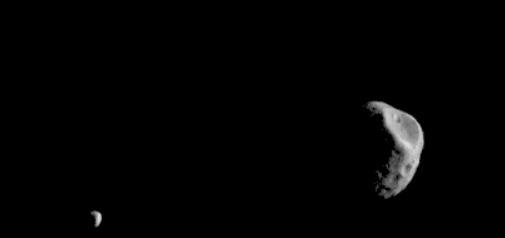
Phobos and Deimos, the moons of Mars, are seen by the Mars Odyssey orbiter's Thermal Emission Imaging System, or THEMIS, camera. The images were taken in visible-wavelength light. THEMIS also recorded thermal-infrared imagery in the same scan. The apparent motion is due to progression of the camera's pointing during the 17-second span of the February 15, 2018, observation, not from motion of the two moons. This was the second observation of Phobos by Mars Odyssey; the first was on September 29, 2017. Researchers have been using THEMIS to examine Mars since early 2002, but the maneuver turning the orbiter around to point the camera at Phobos was developed only recently. The distance to Phobos from Odyssey during the observation was about 3,489 miles (5,615 kilometers). The distance to Deimos from Odyssey during the observation was about 12,222 miles (19,670 kilometers). An animation is available at https://photojournal.jpl.nasa.gov/catalog/PIA22248
![In the Spacecraft Assembly & Encapsulation Facility -2, the solar array from the 2001 Mars Odyssey Orbiter is moved toward a workstand. This will give workers access to other components of the spacecraft and allow inspection of the array. The Mars Odyssey carries three science instruments: the Thermal Emission Imaging System (THEMIS), the Gamma Ray Spectrometer (GRS), and the Mars Radiation Environment Experiment (MARIE). THEMIS will map the mineralogy and morphology of the Martian surface using a high-resolution camera and a thermal infrared imaging spectrometer. The GRS will achieve global mapping of the elemental composition of the surface and determine the abundance of hydrogen in the shallow subsurface. [The GRS is a rebuild of the instrument lost with the Mars Observer mission.] The MARIE will characterize aspects of the near-space radiation environment as related to the radiation-related risk to human explorers. The Mars Odyssey Orbiter is scheduled for launch on April 7, 2001, aboard a Delta 7925 rocket from Launch Pad 17-A, Cape Canaveral Air Force Station](https://images-assets.nasa.gov/image/KSC01pp0123/KSC01pp0123~medium.jpg)
In the Spacecraft Assembly & Encapsulation Facility -2, the solar array from the 2001 Mars Odyssey Orbiter is moved toward a workstand. This will give workers access to other components of the spacecraft and allow inspection of the array. The Mars Odyssey carries three science instruments: the Thermal Emission Imaging System (THEMIS), the Gamma Ray Spectrometer (GRS), and the Mars Radiation Environment Experiment (MARIE). THEMIS will map the mineralogy and morphology of the Martian surface using a high-resolution camera and a thermal infrared imaging spectrometer. The GRS will achieve global mapping of the elemental composition of the surface and determine the abundance of hydrogen in the shallow subsurface. [The GRS is a rebuild of the instrument lost with the Mars Observer mission.] The MARIE will characterize aspects of the near-space radiation environment as related to the radiation-related risk to human explorers. The Mars Odyssey Orbiter is scheduled for launch on April 7, 2001, aboard a Delta 7925 rocket from Launch Pad 17-A, Cape Canaveral Air Force Station
![Technicians examine the Gamma Ray Spectrometer (GRS) before it is moved to be installed on the Mars Odyssey Orbiter in the Spacecraft Assembly and Encapsulation Facility II (SAEF II).; The orbiter will carry three science instruments: the Thermal Emission Imaging System (THEMIS), the Gamma Ray Spectrometer (GRS), and the Mars Radiation Environment Experiment (MARIE). THEMIS will map the mineralogy and morphology of the Martian surface using a high-resolution camera and a thermal infrared imaging spectrometer. The GRS will achieve global mapping of the elemental composition of the surface and determine the abundance of hydrogen in the shallow subsurface. [The GRS is a rebuild of the instrument lost with the Mars Observer mission.] The MARIE will characterize aspects of the near-space radiation environment with regards to the radiation-related risk to human explorers. The Mars Odyssey Orbiter is scheduled for launch on April 7, 2001, aboard a Delta 7925 rocket from Launch Pad 17-A, Cape Canaveral Air Force Station](https://images-assets.nasa.gov/image/KSC01pp0189/KSC01pp0189~orig.jpg)
Technicians examine the Gamma Ray Spectrometer (GRS) before it is moved to be installed on the Mars Odyssey Orbiter in the Spacecraft Assembly and Encapsulation Facility II (SAEF II).; The orbiter will carry three science instruments: the Thermal Emission Imaging System (THEMIS), the Gamma Ray Spectrometer (GRS), and the Mars Radiation Environment Experiment (MARIE). THEMIS will map the mineralogy and morphology of the Martian surface using a high-resolution camera and a thermal infrared imaging spectrometer. The GRS will achieve global mapping of the elemental composition of the surface and determine the abundance of hydrogen in the shallow subsurface. [The GRS is a rebuild of the instrument lost with the Mars Observer mission.] The MARIE will characterize aspects of the near-space radiation environment with regards to the radiation-related risk to human explorers. The Mars Odyssey Orbiter is scheduled for launch on April 7, 2001, aboard a Delta 7925 rocket from Launch Pad 17-A, Cape Canaveral Air Force Station
![Technicians check out the Gamma Ray Spectrometer (GRS) before it is installed on the Mars Odyssey Orbiter in the Spacecraft Assembly and Encapsulation Facility II (SAEF II) .; The orbiter will carry three science instruments: the Thermal Emission Imaging System (THEMIS), the Gamma Ray Spectrometer (GRS), and the Mars Radiation Environment Experiment (MARIE). THEMIS will map the mineralogy and morphology of the Martian surface using a high-resolution camera and a thermal infrared imaging spectrometer. The GRS will achieve global mapping of the elemental composition of the surface and determine the abundance of hydrogen in the shallow subsurface. [The GRS is a rebuild of the instrument lost with the Mars Observer mission.] The MARIE will characterize aspects of the near-space radiation environment with regards to the radiation-related risk to human explorers. The Mars Odyssey Orbiter is scheduled for launch on April 7, 2001, aboard a Delta 7925 rocket from Launch Pad 17-A, Cape Canaveral Air Force Station](https://images-assets.nasa.gov/image/01pp0188/01pp0188~medium.jpg)
Technicians check out the Gamma Ray Spectrometer (GRS) before it is installed on the Mars Odyssey Orbiter in the Spacecraft Assembly and Encapsulation Facility II (SAEF II) .; The orbiter will carry three science instruments: the Thermal Emission Imaging System (THEMIS), the Gamma Ray Spectrometer (GRS), and the Mars Radiation Environment Experiment (MARIE). THEMIS will map the mineralogy and morphology of the Martian surface using a high-resolution camera and a thermal infrared imaging spectrometer. The GRS will achieve global mapping of the elemental composition of the surface and determine the abundance of hydrogen in the shallow subsurface. [The GRS is a rebuild of the instrument lost with the Mars Observer mission.] The MARIE will characterize aspects of the near-space radiation environment with regards to the radiation-related risk to human explorers. The Mars Odyssey Orbiter is scheduled for launch on April 7, 2001, aboard a Delta 7925 rocket from Launch Pad 17-A, Cape Canaveral Air Force Station
![Workers in the Spacecraft Assembly & Encapsulation Facility -2 open the solar array panels from the 2001 Mars Odyssey Orbiter, allowing inspection of the panels and giving them access to other components. The Mars Odyssey carries three science instruments: the Thermal Emission Imaging System (THEMIS), the Gamma Ray Spectrometer (GRS), and the Mars Radiation Environment Experiment (MARIE). THEMIS will map the mineralogy and morphology of the Martian surface using a high-resolution camera and a thermal infrared imaging spectrometer. The GRS will achieve global mapping of the elemental composition of the surface and determine the abundance of hydrogen in the shallow subsurface. [The GRS is a rebuild of the instrument lost with the Mars Observer mission.] The MARIE will characterize aspects of the near-space radiation environment as related to the radiation-related risk to human explorers. The Mars Odyssey Orbiter is scheduled for launch on April 7, 2001, aboard a Delta 7925 rocket from Launch Pad 17-A, Cape Canaveral Air Force Station](https://images-assets.nasa.gov/image/KSC01pp0158/KSC01pp0158~medium.jpg)
Workers in the Spacecraft Assembly & Encapsulation Facility -2 open the solar array panels from the 2001 Mars Odyssey Orbiter, allowing inspection of the panels and giving them access to other components. The Mars Odyssey carries three science instruments: the Thermal Emission Imaging System (THEMIS), the Gamma Ray Spectrometer (GRS), and the Mars Radiation Environment Experiment (MARIE). THEMIS will map the mineralogy and morphology of the Martian surface using a high-resolution camera and a thermal infrared imaging spectrometer. The GRS will achieve global mapping of the elemental composition of the surface and determine the abundance of hydrogen in the shallow subsurface. [The GRS is a rebuild of the instrument lost with the Mars Observer mission.] The MARIE will characterize aspects of the near-space radiation environment as related to the radiation-related risk to human explorers. The Mars Odyssey Orbiter is scheduled for launch on April 7, 2001, aboard a Delta 7925 rocket from Launch Pad 17-A, Cape Canaveral Air Force Station
![Workers in the Spacecraft Assembly and Encapsulation Facility -2 open the solar array panels from the 2001 Mars Odyssey Orbiter, allowing inspection of the panels and giving them access to other components. The Mars Odyssey carries three science instruments: the Thermal Emission Imaging System (THEMIS), the Gamma Ray Spectrometer (GRS), and the Mars Radiation Environment Experiment (MARIE). THEMIS will map the mineralogy and morphology of the Martian surface using a high-resolution camera and a thermal infrared imaging spectrometer. The GRS will achieve global mapping of the elemental composition of the surface and determine the abundance of hydrogen in the shallow subsurface. [The GRS is a rebuild of the instrument lost with the Mars Observer mission.] The MARIE will characterize aspects of the near-space radiation environment as related to the radiation-related risk to human explorers. The Mars Odyssey Orbiter is scheduled for launch on April 7, 2001, aboard a Delta 7925 rocket from Launch Pad 17-A, Cape Canaveral Air Force Station](https://images-assets.nasa.gov/image/01pp0158/01pp0158~medium.jpg)
Workers in the Spacecraft Assembly and Encapsulation Facility -2 open the solar array panels from the 2001 Mars Odyssey Orbiter, allowing inspection of the panels and giving them access to other components. The Mars Odyssey carries three science instruments: the Thermal Emission Imaging System (THEMIS), the Gamma Ray Spectrometer (GRS), and the Mars Radiation Environment Experiment (MARIE). THEMIS will map the mineralogy and morphology of the Martian surface using a high-resolution camera and a thermal infrared imaging spectrometer. The GRS will achieve global mapping of the elemental composition of the surface and determine the abundance of hydrogen in the shallow subsurface. [The GRS is a rebuild of the instrument lost with the Mars Observer mission.] The MARIE will characterize aspects of the near-space radiation environment as related to the radiation-related risk to human explorers. The Mars Odyssey Orbiter is scheduled for launch on April 7, 2001, aboard a Delta 7925 rocket from Launch Pad 17-A, Cape Canaveral Air Force Station
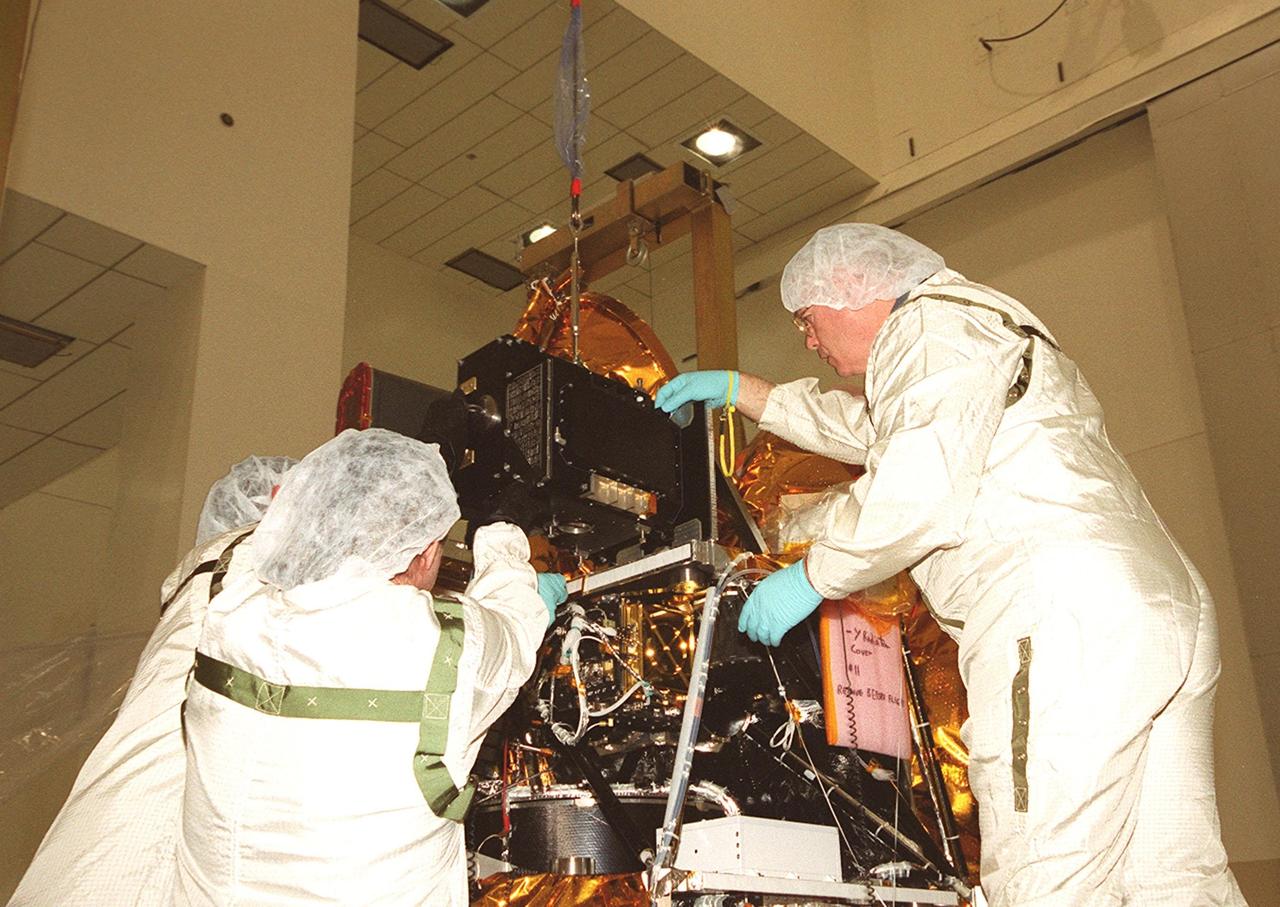
In the Spacecraft Assembly and Encapsulation Facility 2, workers help put the Thermal Emission Imaging System (THEMIS) in its place on the Mars Odyssey Orbiter. THEMIS will map the mineralogy and morphology of the Martian surface using a high-resolution camera and a thermal infrared imaging spectrometer. The orbiter will carry three science instruments: THEMIS, the Gamma Ray Spectrometer (GRS), and the Mars Radiation Environment Experiment (MARIE). The GRS will achieve global mapping of the elemental composition of the surface and determine the abundance of hydrogen in the shallow subsurface. The MARIE will characterize aspects of the near-space radiation environment with regards to the radiation-related risk to human explorers. The Mars Odyssey Orbiter is scheduled for launch on April 7, 2001, aboard a Delta 7925 rocket from Launch Pad 17-A, Cape Canaveral Air Force Station
![Two technicians involved with the installation of the Gamma Ray Spectrometer (GRS) on the Mars Odyssey Orbiter pose in front of the spacecraft in the Spacecraft Assembly and Encapsulation Facility 2 (SAEF 2).; The orbiter will carry three science instruments: the Thermal Emission Imaging System (THEMIS), the Gamma Ray Spectrometer (GRS), and the Mars Radiation Environment Experiment (MARIE). THEMIS will map the mineralogy and morphology of the Martian surface using a high-resolution camera and a thermal infrared imaging spectrometer. The GRS will achieve global mapping of the elemental composition of the surface and determine the abundance of hydrogen in the shallow subsurface. [The GRS is a rebuild of the instrument lost with the Mars Observer mission.] The MARIE will characterize aspects of the near-space radiation environment with regards to the radiation-related risk to human explorers. The Mars Odyssey Orbiter is scheduled for launch on April 7, 2001, aboard a Delta 7925 rocket from Launch Pad 17-A, Cape Canaveral Air Force Station](https://images-assets.nasa.gov/image/01pp0195/01pp0195~medium.jpg)
Two technicians involved with the installation of the Gamma Ray Spectrometer (GRS) on the Mars Odyssey Orbiter pose in front of the spacecraft in the Spacecraft Assembly and Encapsulation Facility 2 (SAEF 2).; The orbiter will carry three science instruments: the Thermal Emission Imaging System (THEMIS), the Gamma Ray Spectrometer (GRS), and the Mars Radiation Environment Experiment (MARIE). THEMIS will map the mineralogy and morphology of the Martian surface using a high-resolution camera and a thermal infrared imaging spectrometer. The GRS will achieve global mapping of the elemental composition of the surface and determine the abundance of hydrogen in the shallow subsurface. [The GRS is a rebuild of the instrument lost with the Mars Observer mission.] The MARIE will characterize aspects of the near-space radiation environment with regards to the radiation-related risk to human explorers. The Mars Odyssey Orbiter is scheduled for launch on April 7, 2001, aboard a Delta 7925 rocket from Launch Pad 17-A, Cape Canaveral Air Force Station
![Technicians check out the Gamma Ray Spectrometer (GRS) before it is installed on the Mars Odyssey Orbiter in the Spacecraft Assembly and Encapsulation Facility II (SAEF II) .; The orbiter will carry three science instruments: the Thermal Emission Imaging System (THEMIS), the Gamma Ray Spectrometer (GRS), and the Mars Radiation Environment Experiment (MARIE). THEMIS will map the mineralogy and morphology of the Martian surface using a high-resolution camera and a thermal infrared imaging spectrometer. The GRS will achieve global mapping of the elemental composition of the surface and determine the abundance of hydrogen in the shallow subsurface. [The GRS is a rebuild of the instrument lost with the Mars Observer mission.] The MARIE will characterize aspects of the near-space radiation environment with regards to the radiation-related risk to human explorers. The Mars Odyssey Orbiter is scheduled for launch on April 7, 2001, aboard a Delta 7925 rocket from Launch Pad 17-A, Cape Canaveral Air Force Station](https://images-assets.nasa.gov/image/KSC01pp0188/KSC01pp0188~medium.jpg)
Technicians check out the Gamma Ray Spectrometer (GRS) before it is installed on the Mars Odyssey Orbiter in the Spacecraft Assembly and Encapsulation Facility II (SAEF II) .; The orbiter will carry three science instruments: the Thermal Emission Imaging System (THEMIS), the Gamma Ray Spectrometer (GRS), and the Mars Radiation Environment Experiment (MARIE). THEMIS will map the mineralogy and morphology of the Martian surface using a high-resolution camera and a thermal infrared imaging spectrometer. The GRS will achieve global mapping of the elemental composition of the surface and determine the abundance of hydrogen in the shallow subsurface. [The GRS is a rebuild of the instrument lost with the Mars Observer mission.] The MARIE will characterize aspects of the near-space radiation environment with regards to the radiation-related risk to human explorers. The Mars Odyssey Orbiter is scheduled for launch on April 7, 2001, aboard a Delta 7925 rocket from Launch Pad 17-A, Cape Canaveral Air Force Station
![The <a href=http://mars.jpl.nasa.gov/2001/>2001 Mars Odyssey Orbiter</a> is safely placed on a workstand in the Spacecraft Assembly & Encapsulation Facility -2. The Mars Odyssey Orbiter carries three science instruments: the Thermal Emission Imaging System (THEMIS), the Gamma Ray Spectrometer (GRS), and the Mars Radiation Environment Experiment (MARIE). THEMIS will map the mineralogy and morphology of the Martian surface using a high-resolution camera and a thermal infrared imaging spectrometer. The GRS will achieve global mapping of the elemental composition of the surface and determine the abundance of hydrogen in the shallow subsurface. [The GRS is a rebuild of the instrument lost with the Mars Observer mission.] The MARIE will characterize aspects of the near-space radiation environment as related to the radiation-related risk to human explorers. The Mars Odyssey Orbiter is scheduled for launch on April 7, 2001, aboard a Delta 7925 rocket from Launch Pad 17-A, Cape Canaveral Air Force Station](https://images-assets.nasa.gov/image/KSC01pp0103/KSC01pp0103~medium.jpg)
The <a href=http://mars.jpl.nasa.gov/2001/>2001 Mars Odyssey Orbiter</a> is safely placed on a workstand in the Spacecraft Assembly & Encapsulation Facility -2. The Mars Odyssey Orbiter carries three science instruments: the Thermal Emission Imaging System (THEMIS), the Gamma Ray Spectrometer (GRS), and the Mars Radiation Environment Experiment (MARIE). THEMIS will map the mineralogy and morphology of the Martian surface using a high-resolution camera and a thermal infrared imaging spectrometer. The GRS will achieve global mapping of the elemental composition of the surface and determine the abundance of hydrogen in the shallow subsurface. [The GRS is a rebuild of the instrument lost with the Mars Observer mission.] The MARIE will characterize aspects of the near-space radiation environment as related to the radiation-related risk to human explorers. The Mars Odyssey Orbiter is scheduled for launch on April 7, 2001, aboard a Delta 7925 rocket from Launch Pad 17-A, Cape Canaveral Air Force Station
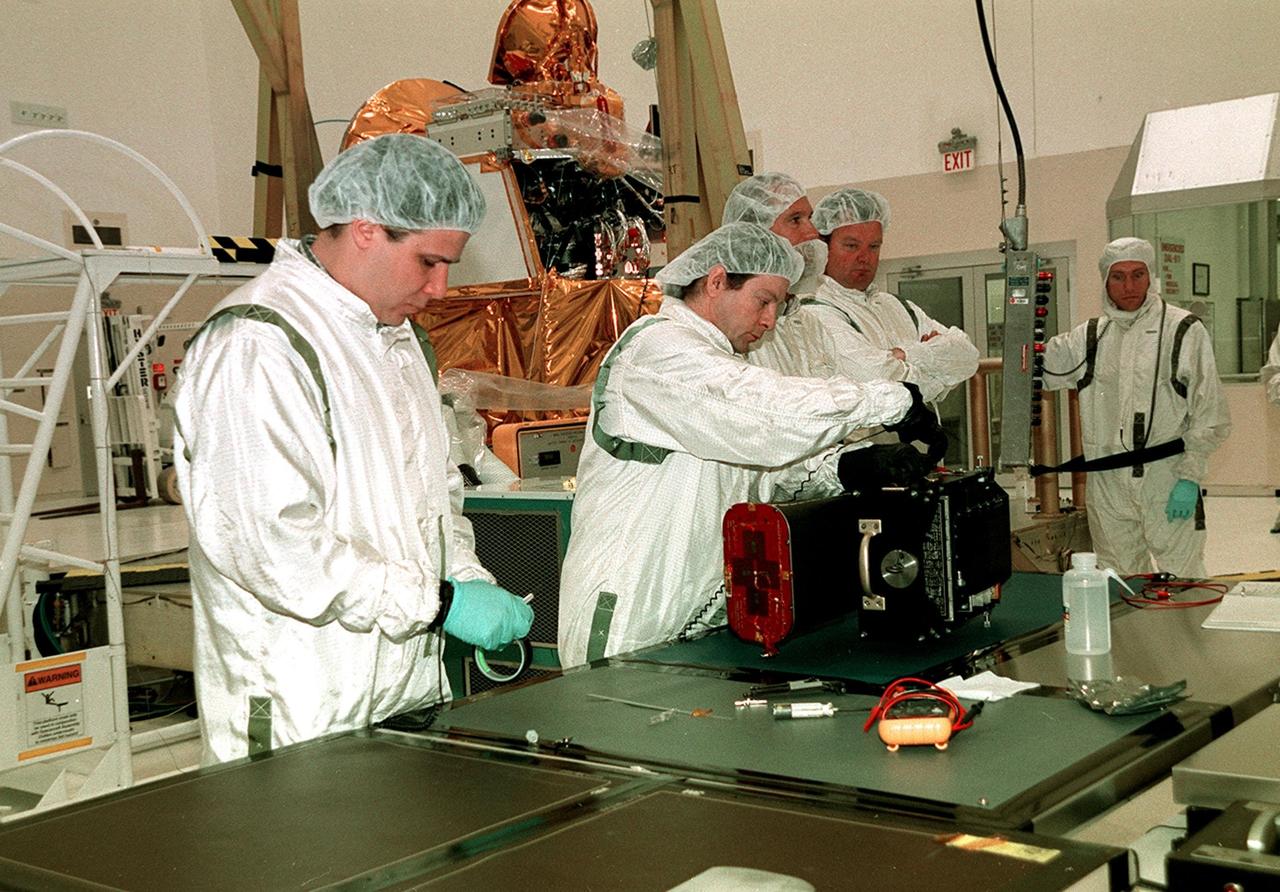
At a work bench in the Spacecraft Assembly and Encapsulation Facility 2, workers test the Thermal Emission Imaging System (THEMIS) before attaching to the 2001 Mars Odyssey Orbiter. THEMIS will map the mineralogy and morphology of the Martian surface using a high-resolution camera and a thermal infrared imaging spectrometer. The orbiter will carry three science instruments: THEMIS, the Gamma Ray Spectrometer (GRS), and the Mars Radiation Environment Experiment (MARIE). The GRS will achieve global mapping of the elemental composition of the surface and determine the abundance of hydrogen in the shallow subsurface. The MARIE will characterize aspects of the near-space radiation environment with regards to the radiation-related risk to human explorers. The Mars Odyssey Orbiter is scheduled for launch on April 7, 2001, aboard a Delta 7925 rocket from Launch Pad 17-A, Cape Canaveral Air Force Station
![Workers in the Spacecraft Assembly & Encapsulation Facility -2 make a visual check of the front side of the opened solar array panels from the 2001 Mars Odyssey Orbiter. The Mars Odyssey carries three science instruments: the Thermal Emission Imaging System (THEMIS), the Gamma Ray Spectrometer (GRS), and the Mars Radiation Environment Experiment (MARIE). THEMIS will map the mineralogy and morphology of the Martian surface using a high-resolution camera and a thermal infrared imaging spectrometer. The GRS will achieve global mapping of the elemental composition of the surface and determine the abundance of hydrogen in the shallow subsurface. [The GRS is a rebuild of the instrument lost with the Mars Observer mission.] The MARIE will characterize aspects of the near-space radiation environment as related to the radiation-related risk to human explorers. The Mars Odyssey Orbiter is scheduled for launch on April 7, 2001, aboard a Delta 7925 rocket from Launch Pad 17-A, Cape Canaveral Air Force Station](https://images-assets.nasa.gov/image/KSC01pp0159/KSC01pp0159~medium.jpg)
Workers in the Spacecraft Assembly & Encapsulation Facility -2 make a visual check of the front side of the opened solar array panels from the 2001 Mars Odyssey Orbiter. The Mars Odyssey carries three science instruments: the Thermal Emission Imaging System (THEMIS), the Gamma Ray Spectrometer (GRS), and the Mars Radiation Environment Experiment (MARIE). THEMIS will map the mineralogy and morphology of the Martian surface using a high-resolution camera and a thermal infrared imaging spectrometer. The GRS will achieve global mapping of the elemental composition of the surface and determine the abundance of hydrogen in the shallow subsurface. [The GRS is a rebuild of the instrument lost with the Mars Observer mission.] The MARIE will characterize aspects of the near-space radiation environment as related to the radiation-related risk to human explorers. The Mars Odyssey Orbiter is scheduled for launch on April 7, 2001, aboard a Delta 7925 rocket from Launch Pad 17-A, Cape Canaveral Air Force Station
![Workers in the Spacecraft Assembly and Encapsulation Facility -2 make a visual check of the front side of the opened solar array panels from the 2001 Mars Odyssey Orbiter. The Mars Odyssey carries three science instruments: the Thermal Emission Imaging System (THEMIS), the Gamma Ray Spectrometer (GRS), and the Mars Radiation Environment Experiment (MARIE). THEMIS will map the mineralogy and morphology of the Martian surface using a high-resolution camera and a thermal infrared imaging spectrometer. The GRS will achieve global mapping of the elemental composition of the surface and determine the abundance of hydrogen in the shallow subsurface. [The GRS is a rebuild of the instrument lost with the Mars Observer mission.] The MARIE will characterize aspects of the near-space radiation environment as related to the radiation-related risk to human explorers. The Mars Odyssey Orbiter is scheduled for launch on April 7, 2001, aboard a Delta 7925 rocket from Launch Pad 17-A, Cape Canaveral Air Force Station](https://images-assets.nasa.gov/image/01pp0159/01pp0159~medium.jpg)
Workers in the Spacecraft Assembly and Encapsulation Facility -2 make a visual check of the front side of the opened solar array panels from the 2001 Mars Odyssey Orbiter. The Mars Odyssey carries three science instruments: the Thermal Emission Imaging System (THEMIS), the Gamma Ray Spectrometer (GRS), and the Mars Radiation Environment Experiment (MARIE). THEMIS will map the mineralogy and morphology of the Martian surface using a high-resolution camera and a thermal infrared imaging spectrometer. The GRS will achieve global mapping of the elemental composition of the surface and determine the abundance of hydrogen in the shallow subsurface. [The GRS is a rebuild of the instrument lost with the Mars Observer mission.] The MARIE will characterize aspects of the near-space radiation environment as related to the radiation-related risk to human explorers. The Mars Odyssey Orbiter is scheduled for launch on April 7, 2001, aboard a Delta 7925 rocket from Launch Pad 17-A, Cape Canaveral Air Force Station
![Technicians guide The Gamma Ray Spectrometer (GRS)into place to be installed on the Mars Odyssey Orbiter in the Spacecraft Assembly and Encapsulation Facility 2 (SAEF 2).The orbiter will carry three science instruments: the Thermal Emission Imaging System (THEMIS), the Gamma Ray Spectrometer (GRS), and the Mars Radiation Environment Experiment (MARIE). THEMIS will map the mineralogy and morphology of the Martian surface using a high-resolution camera and a thermal infrared imaging spectrometer. The GRS will achieve global mapping of the elemental composition of the surface and determine the abundance of hydrogen in the shallow subsurface. [The GRS is a rebuild of the instrument lost with the Mars Observer mission.] The MARIE will characterize aspects of the near-space radiation environment with regards to the radiation-related risk to human explorers. The Mars Odyssey Orbiter is scheduled for launch on April 7, 2001, aboard a Delta 7925 rocket from Launch Pad 17-A, Cape Canaveral Air Force Station](https://images-assets.nasa.gov/image/01pp0192/01pp0192~medium.jpg)
Technicians guide The Gamma Ray Spectrometer (GRS)into place to be installed on the Mars Odyssey Orbiter in the Spacecraft Assembly and Encapsulation Facility 2 (SAEF 2).The orbiter will carry three science instruments: the Thermal Emission Imaging System (THEMIS), the Gamma Ray Spectrometer (GRS), and the Mars Radiation Environment Experiment (MARIE). THEMIS will map the mineralogy and morphology of the Martian surface using a high-resolution camera and a thermal infrared imaging spectrometer. The GRS will achieve global mapping of the elemental composition of the surface and determine the abundance of hydrogen in the shallow subsurface. [The GRS is a rebuild of the instrument lost with the Mars Observer mission.] The MARIE will characterize aspects of the near-space radiation environment with regards to the radiation-related risk to human explorers. The Mars Odyssey Orbiter is scheduled for launch on April 7, 2001, aboard a Delta 7925 rocket from Launch Pad 17-A, Cape Canaveral Air Force Station
![Technicians guide The Gamma Ray Spectrometer (GRS); into place to be installed on the Mars Odyssey Orbiter in the Spacecraft Assembly and Encapsulation Facility 2 (SAEF 2).; The orbiter will carry three science instruments: the Thermal Emission Imaging System (THEMIS), the Gamma Ray Spectrometer (GRS), and the Mars Radiation Environment Experiment (MARIE). THEMIS will map the mineralogy and morphology of the Martian surface using a high-resolution camera and a thermal infrared imaging spectrometer. The GRS will achieve global mapping of the elemental composition of the surface and determine the abundance of hydrogen in the shallow subsurface. [The GRS is a rebuild of the instrument lost with the Mars Observer mission.] The MARIE will characterize aspects of the near-space radiation environment with regards to the radiation-related risk to human explorers. The Mars Odyssey Orbiter is scheduled for launch on April 7, 2001, aboard a Delta 7925 rocket from Launch Pad 17-A, Cape Canaveral Air Force Station](https://images-assets.nasa.gov/image/KSC01pp0193/KSC01pp0193~medium.jpg)
Technicians guide The Gamma Ray Spectrometer (GRS); into place to be installed on the Mars Odyssey Orbiter in the Spacecraft Assembly and Encapsulation Facility 2 (SAEF 2).; The orbiter will carry three science instruments: the Thermal Emission Imaging System (THEMIS), the Gamma Ray Spectrometer (GRS), and the Mars Radiation Environment Experiment (MARIE). THEMIS will map the mineralogy and morphology of the Martian surface using a high-resolution camera and a thermal infrared imaging spectrometer. The GRS will achieve global mapping of the elemental composition of the surface and determine the abundance of hydrogen in the shallow subsurface. [The GRS is a rebuild of the instrument lost with the Mars Observer mission.] The MARIE will characterize aspects of the near-space radiation environment with regards to the radiation-related risk to human explorers. The Mars Odyssey Orbiter is scheduled for launch on April 7, 2001, aboard a Delta 7925 rocket from Launch Pad 17-A, Cape Canaveral Air Force Station
![An overhead crane moves The Gamma Ray Spectrometer (GRS) into place to be installed on the Mars Odyssey Orbiter in the Spacecraft Assembly and Encapsulation Facility 2 (SAEF 2).; The orbiter will carry three science instruments: the Thermal Emission Imaging System (THEMIS), the Gamma Ray Spectrometer (GRS), and the Mars Radiation Environment Experiment (MARIE). THEMIS will map the mineralogy and morphology of the Martian surface using a high-resolution camera and a thermal infrared imaging spectrometer. The GRS will achieve global mapping of the elemental composition of the surface and determine the abundance of hydrogen in the shallow subsurface. [The GRS is a rebuild of the instrument lost with the Mars Observer mission.] The MARIE will characterize aspects of the near-space radiation environment with regards to the radiation-related risk to human explorers. The Mars Odyssey Orbiter is scheduled for launch on April 7, 2001, aboard a Delta 7925 rocket from Launch Pad 17-A, Cape Canaveral Air Force Station](https://images-assets.nasa.gov/image/01pp0191/01pp0191~medium.jpg)
An overhead crane moves The Gamma Ray Spectrometer (GRS) into place to be installed on the Mars Odyssey Orbiter in the Spacecraft Assembly and Encapsulation Facility 2 (SAEF 2).; The orbiter will carry three science instruments: the Thermal Emission Imaging System (THEMIS), the Gamma Ray Spectrometer (GRS), and the Mars Radiation Environment Experiment (MARIE). THEMIS will map the mineralogy and morphology of the Martian surface using a high-resolution camera and a thermal infrared imaging spectrometer. The GRS will achieve global mapping of the elemental composition of the surface and determine the abundance of hydrogen in the shallow subsurface. [The GRS is a rebuild of the instrument lost with the Mars Observer mission.] The MARIE will characterize aspects of the near-space radiation environment with regards to the radiation-related risk to human explorers. The Mars Odyssey Orbiter is scheduled for launch on April 7, 2001, aboard a Delta 7925 rocket from Launch Pad 17-A, Cape Canaveral Air Force Station
![Workers in the Spacecraft Assembly and Encapsulation Facility -2 take a close look at the back side of the opened solar array panels from the 2001 Mars Odyssey Orbiter. The Mars Odyssey carries three science instruments: the Thermal Emission Imaging System (THEMIS), the Gamma Ray Spectrometer (GRS), and the Mars Radiation Environment Experiment (MARIE). THEMIS will map the mineralogy and morphology of the Martian surface using a high-resolution camera and a thermal infrared imaging spectrometer. The GRS will achieve global mapping of the elemental composition of the surface and determine the abundance of hydrogen in the shallow subsurface. [The GRS is a rebuild of the instrument lost with the Mars Observer mission.] The MARIE will characterize aspects of the near-space radiation environment as related to the radiation-related risk to human explorers. The Mars Odyssey Orbiter is scheduled for launch on April 7, 2001, aboard a Delta 7925 rocket from Launch Pad 17-A, Cape Canaveral Air Force Station](https://images-assets.nasa.gov/image/01pp0160/01pp0160~medium.jpg)
Workers in the Spacecraft Assembly and Encapsulation Facility -2 take a close look at the back side of the opened solar array panels from the 2001 Mars Odyssey Orbiter. The Mars Odyssey carries three science instruments: the Thermal Emission Imaging System (THEMIS), the Gamma Ray Spectrometer (GRS), and the Mars Radiation Environment Experiment (MARIE). THEMIS will map the mineralogy and morphology of the Martian surface using a high-resolution camera and a thermal infrared imaging spectrometer. The GRS will achieve global mapping of the elemental composition of the surface and determine the abundance of hydrogen in the shallow subsurface. [The GRS is a rebuild of the instrument lost with the Mars Observer mission.] The MARIE will characterize aspects of the near-space radiation environment as related to the radiation-related risk to human explorers. The Mars Odyssey Orbiter is scheduled for launch on April 7, 2001, aboard a Delta 7925 rocket from Launch Pad 17-A, Cape Canaveral Air Force Station
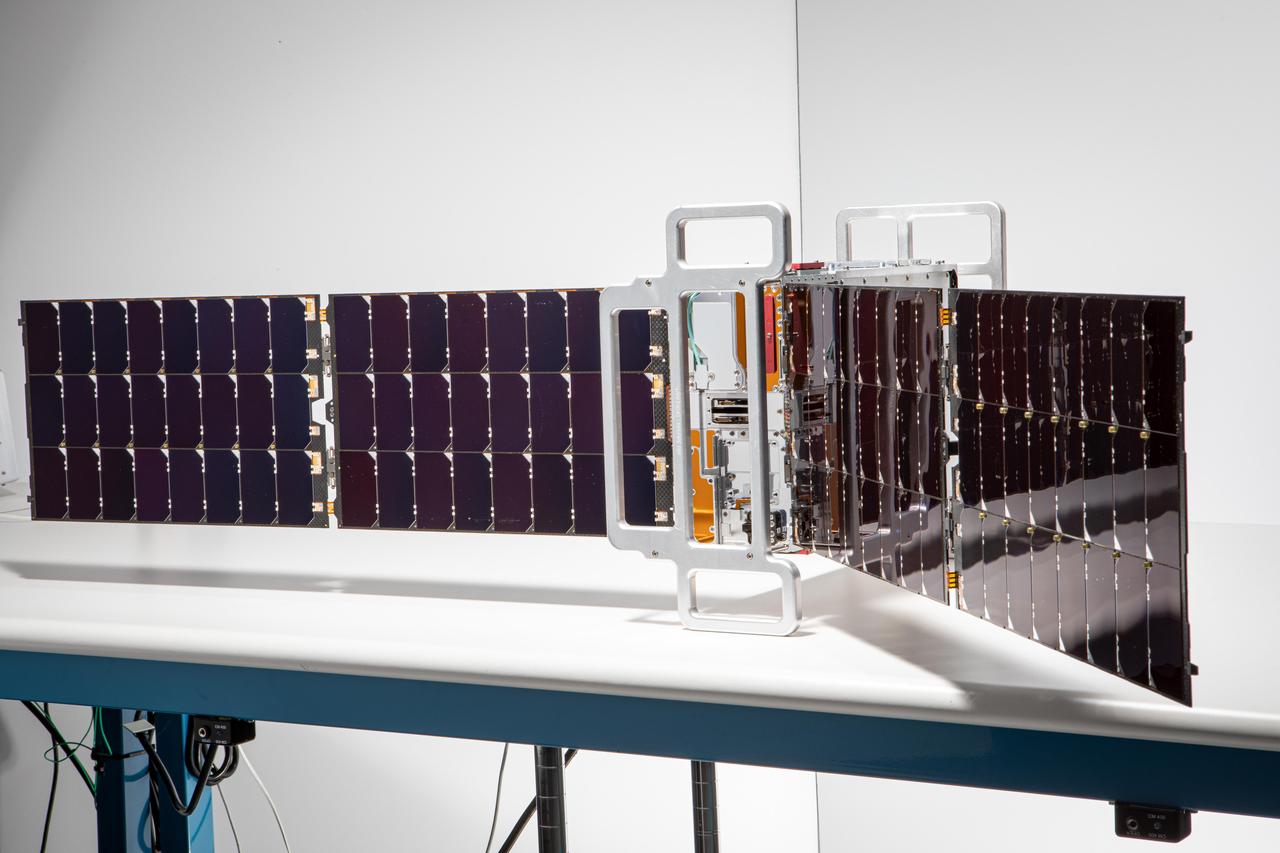
This image shows one of two shoebox-size satellites that make up NASA's Polar Radiant Energy in the Far-InfraRed Experiment (PREFIRE) mission. PREFIRE will measure the amount of heat Earth emits into space from two of the coldest, most remote regions on the planet. Data from the cube satellites, or CubeSats, will improve computer models researchers use to predict how Earth's ice, seas, and weather will change in a warming world. Earth absorbs a lot of the Sun's energy at the tropics, and weather and ocean currents transport that heat to the poles. Ice, snow, clouds, and other parts of the polar environment emit the heat into space, much of it in the form of far-infrared radiation. The difference between this incoming and outgoing heat helps to determines the planet's temperature and drives a dynamic system of climate and weather. But far-infrared emissions at the poles have never been systematically measured. This is where PREFIRE comes in. The crucial instrument on each spacecraft is a thermal infrared spectrometer, which will measure wavelengths of light in the far-infrared range. The mission will help researchers gain a clearer understanding of when and where Earth's poles emit far-infrared radiation, as well as how atmospheric water vapor and clouds influence the amount that escapes to space. https://photojournal.jpl.nasa.gov/catalog/PIA26186

This image combines two products from the first pointing at the Martian moon Phobos by the Thermal Emission Imaging System (THEMIS) camera on NASA's Mars Odyssey orbiter, on Sept. 29, 2017. Surface-temperature information from observation in thermal-infrared wavelengths is overlaid on a more detailed image from a visible-light observation. The left edge of the small moon was in darkness, and the right edge in morning sunlight. Phobos has an oblong shape with average diameter of about 14 miles (22 kilometers). The distance to Phobos from Odyssey during the observation was about 3,424 miles (5,511 kilometers). Researchers will analyze the surface-temperature information from this observation and possible future THEMIS observations to learn how quickly the surface warms after sunup or cools after sundown. That could provide information about surface materials, because larger rocks heat or cool more slowly than smaller particles do. The thermal information in this image is from merging observations made in four thermal-infrared wavelength bands, centered from 11.04 microns to 14.88 microns. Researchers have been using THEMIS to examine Mars since early 2002, but the maneuver turning the orbiter around to point the camera at Phobos was developed only recently. Odyssey orbits Mars at an altitude of about 250 miles (400 kilometers), much closer to the planet than to Phobos, which orbits about 3,700 miles (6,000 kilometers) above the surface of Mars. https://photojournal.jpl.nasa.gov/catalog/PIA22057

Seen shortly after local Martian sunrise, clouds gather in the summit pit, or caldera, of Pavonis Mons, a giant volcano on Mars, in this image from the Thermal Emission Imaging System (THEMIS) on NASA's Mars Odyssey orbiter. The clouds are mostly made of ice crystals. They appear blue in the image because the cloud particles scatter blue light more strongly than other colors. Pavonis Mons stands about nine miles (14 kilometers) high, and the caldera spans about 29 miles (47 kilometers) wide. This image was made by THEMIS through three of its visual-light filters plus a near-infrared filter, and it is approximately true in color. THEMIS and other instruments on Mars Odyssey have been studying Mars from orbit since 2001. http://photojournal.jpl.nasa.gov/catalog/PIA19675

These six views of the Martian moon Phobos were captured by NASA's Odyssey orbiter as of March 2020. The orbiter's infrared camera, the Thermal Emission Imaging System (THEMIS), is used to measure temperature variations that provide insight into the physical properties and composition of the moon. Chronologically, the views represent waxing, waning and full views of the moon. On Feb. 25, 2020, Phobos was observed during a lunar eclipse, where Mars' shadow completely blocked sunlight from reaching the moon's surface. This provided some of the coldest temperatures measured on Phobos to date: The coldest measured was about minus189 degrees Fahrenheit (minus123 degrees Celsius). On March 27, 2020, Phobos was observed exiting an eclipse, when the surface was still warming up. All of the THEMIS infrared images are colorized and overlain on THEMIS visible images taken at the same time, except for the eclipse image, which is overlain on a computer-generated visible image of what Phobos would have looked like if it wasn’t in complete shadow. Phobos is about 15 miles (about 25 kilometers) across. https://photojournal.jpl.nasa.gov/catalog/PIA23893
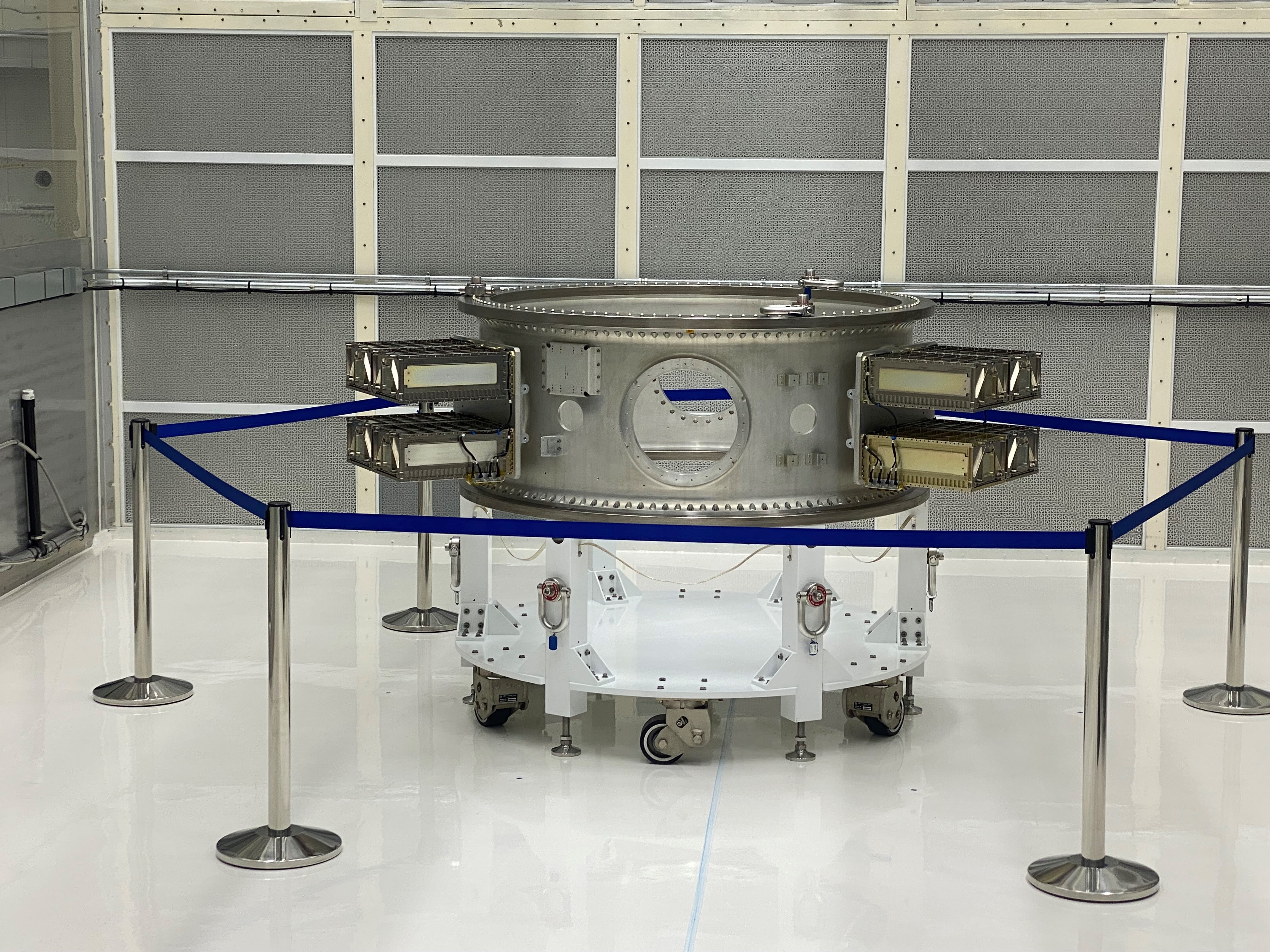
Mechanical and electrical support equipment for NASA’s Landsat 9 observatory are inside the Integrated Processing Facility at Vandenberg Space Force Base in California, on June 16, 2021. The equipment includes a secondary payload adapter and flight system for a group of microsat payloads, called CubeSats, that will launch with Landsat 9 as secondary payloads. Landsat 9 will launch on a United Launch Alliance Atlas V rocket from Space Launch Complex 3 at Vandenberg in September 2021. The launch is being managed by NASA’s Launch Services Program based at Kennedy Space Center, America’s multiuser spaceport. The Landsat 9 satellite will continue the nearly 50-year legacy of previous Landsat missions. It will monitor key natural and economic resources from orbit. Landsat 9 is managed by the agency’s Goddard Space Flight Center in Greenbelt, Maryland. The satellite will carry two instruments: the Operational Land Imager 2, which collects images of Earth’s landscapes in visible, near infrared and shortwave infrared light, and the Thermal Infrared Sensor 2, which measures the temperature of land surfaces. Like its predecessors, Landsat 9 is a joint mission between NASA and the U.S. Geological Survey.

Mechanical and electrical support equipment for NASA’s Landsat 9 observatory arrive at the Integrated Processing Facility at Vandenberg Space Force Base in California, on June 14, 2021. The equipment includes a secondary payload adapter and flight system for a group of microsat payloads, called CubeSats, that will launch with Landsat 9 as secondary payloads. Landsat 9 will launch on a United Launch Alliance Atlas V rocket from Space Launch Complex 3 at Vandenberg in September 2021. The launch is being managed by NASA’s Launch Services Program based at Kennedy Space Center, America’s multiuser spaceport. The Landsat 9 satellite will continue the nearly 50-year legacy of previous Landsat missions. It will monitor key natural and economic resources from orbit. Landsat 9 is managed by the agency’s Goddard Space Flight Center in Greenbelt, Maryland. The satellite will carry two instruments: the Operational Land Imager 2, which collects images of Earth’s landscapes in visible, near infrared and shortwave infrared light, and the Thermal Infrared Sensor 2, which measures the temperature of land surfaces. Like its predecessors, Landsat 9 is a joint mission between NASA and the U.S. Geological Survey.
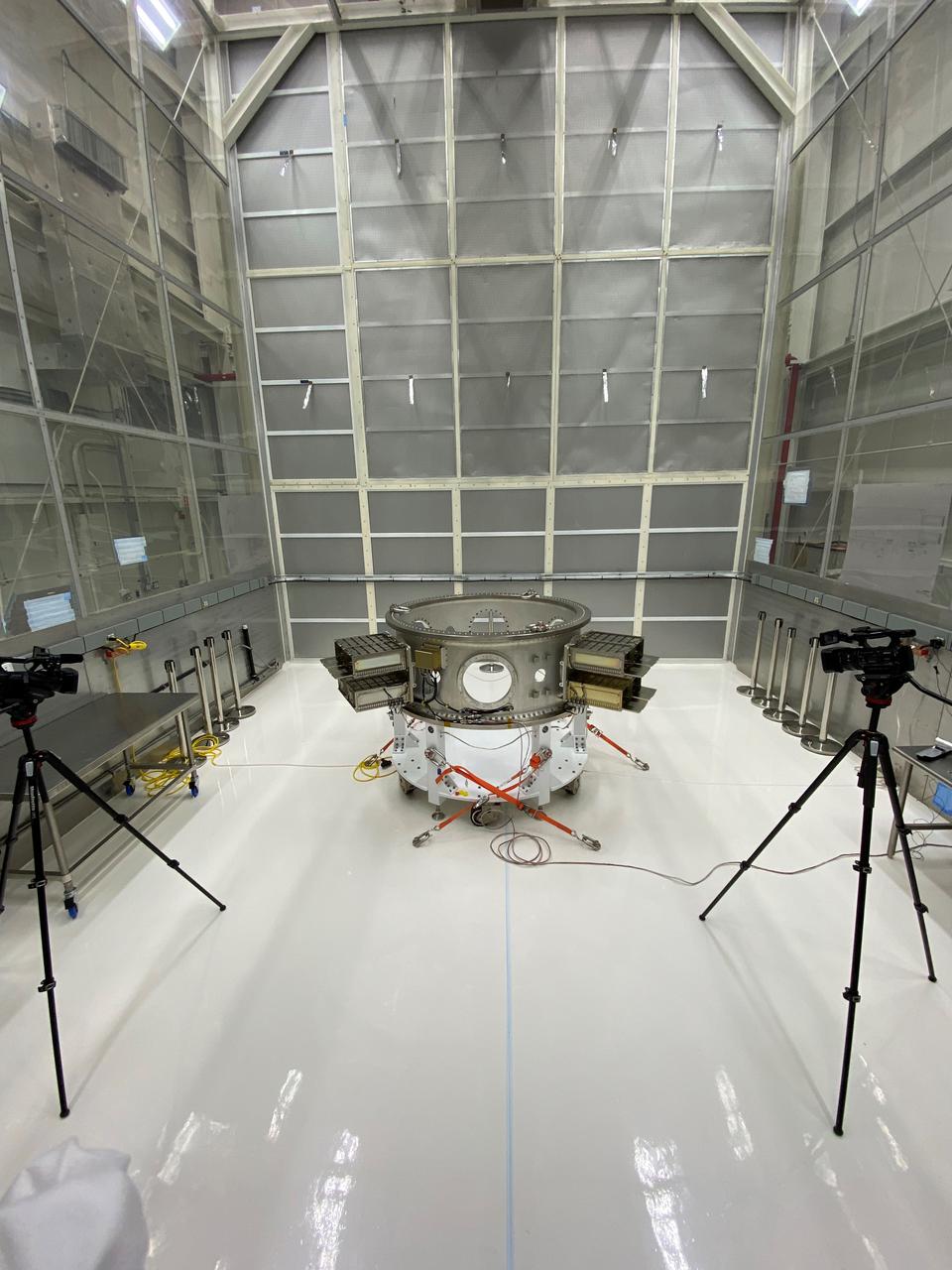
Mechanical and electrical support equipment for NASA’s Landsat 9 observatory are being processed inside the Integrated Processing Facility at Vandenberg Space Force Base in California, on June 24, 2021. The equipment includes a secondary payload adapter and flight system for a group of microsat payloads, called CubeSats, that will launch with Landsat 9 as secondary payloads. Landsat 9 will launch on a United Launch Alliance Atlas V rocket from Space Launch Complex 3 at Vandenberg in September 2021. The launch is being managed by NASA’s Launch Services Program based at Kennedy Space Center, America’s multiuser spaceport. The Landsat 9 satellite will continue the nearly 50-year legacy of previous Landsat missions. It will monitor key natural and economic resources from orbit. Landsat 9 is managed by the agency’s Goddard Space Flight Center in Greenbelt, Maryland. The satellite will carry two instruments: the Operational Land Imager 2, which collects images of Earth’s landscapes in visible, near infrared and shortwave infrared light, and the Thermal Infrared Sensor 2, which measures the temperature of land surfaces. Like its predecessors, Landsat 9 is a joint mission between NASA and the U.S. Geological Survey.
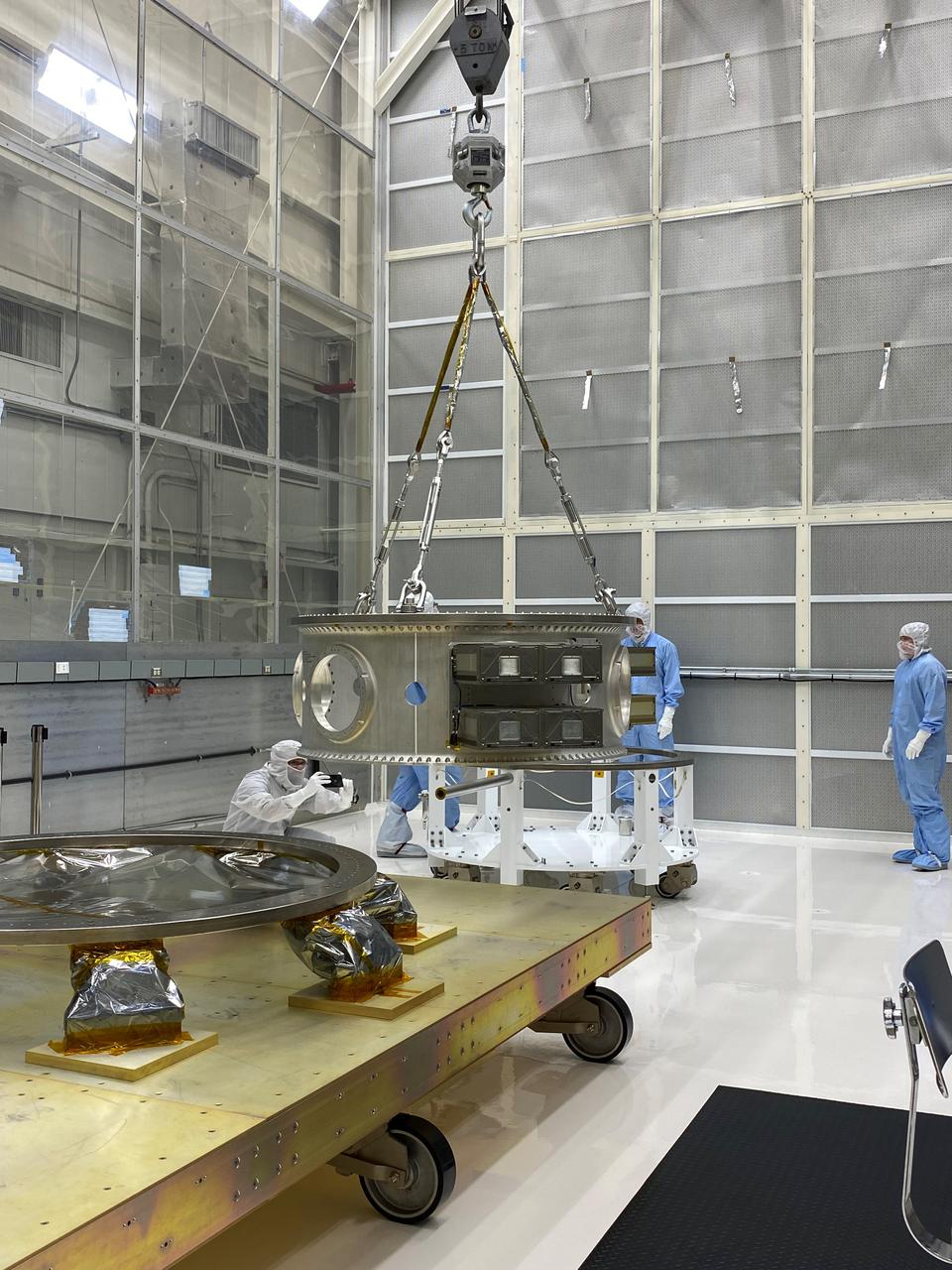
Technicians process mechanical and electrical support equipment for NASA’s Landsat 9 observatory inside the Integrated Processing Facility at Vandenberg Space Force Base in California, on June 16, 2021. The equipment includes a secondary payload adapter and flight system for a group of microsat payloads, called CubeSats, that will launch with Landsat 9 as secondary payloads. Landsat 9 will launch on a United Launch Alliance Atlas V rocket from Space Launch Complex 3 at Vandenberg in September 2021. The launch is being managed by NASA’s Launch Services Program based at Kennedy Space Center, America’s multiuser spaceport. The Landsat 9 satellite will continue the nearly 50-year legacy of previous Landsat missions. It will monitor key natural and economic resources from orbit. Landsat 9 is managed by the agency’s Goddard Space Flight Center in Greenbelt, Maryland. The satellite will carry two instruments: the Operational Land Imager 2, which collects images of Earth’s landscapes in visible, near infrared and shortwave infrared light, and the Thermal Infrared Sensor 2, which measures the temperature of land surfaces. Like its predecessors, Landsat 9 is a joint mission between NASA and the U.S. Geological Survey.
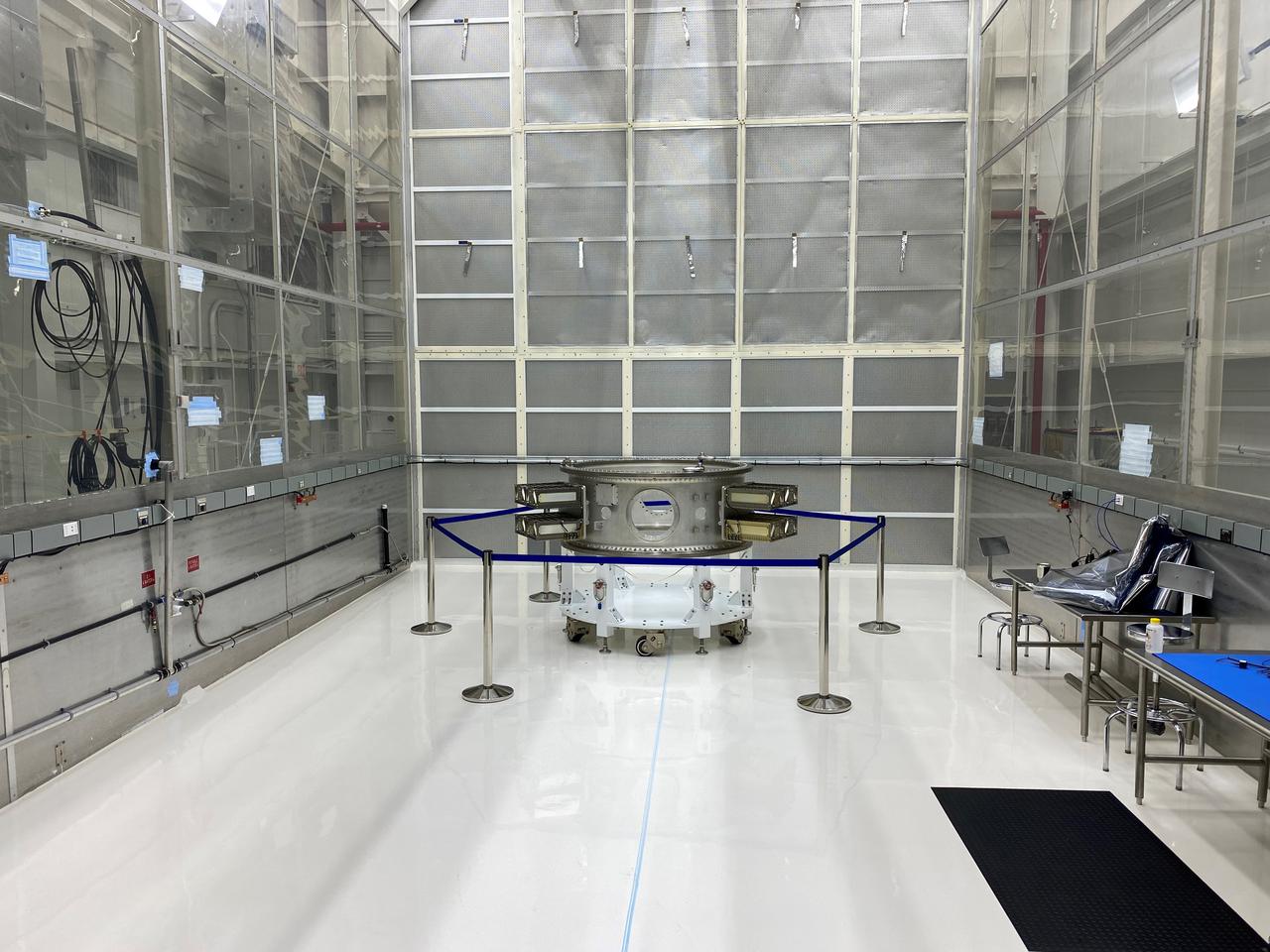
Mechanical and electrical support equipment for NASA’s Landsat 9 observatory are inside the Integrated Processing Facility at Vandenberg Space Force Base in California, on June 16, 2021. The equipment includes a secondary payload adapter and flight system for a group of microsat payloads, called CubeSats, that will launch with Landsat 9 as secondary payloads. Landsat 9 will launch on a United Launch Alliance Atlas V rocket from Space Launch Complex 3 at Vandenberg in September 2021. The launch is being managed by NASA’s Launch Services Program based at Kennedy Space Center, America’s multiuser spaceport. The Landsat 9 satellite will continue the nearly 50-year legacy of previous Landsat missions. It will monitor key natural and economic resources from orbit. Landsat 9 is managed by the agency’s Goddard Space Flight Center in Greenbelt, Maryland. The satellite will carry two instruments: the Operational Land Imager 2, which collects images of Earth’s landscapes in visible, near infrared and shortwave infrared light, and the Thermal Infrared Sensor 2, which measures the temperature of land surfaces. Like its predecessors, Landsat 9 is a joint mission between NASA and the U.S. Geological Survey.
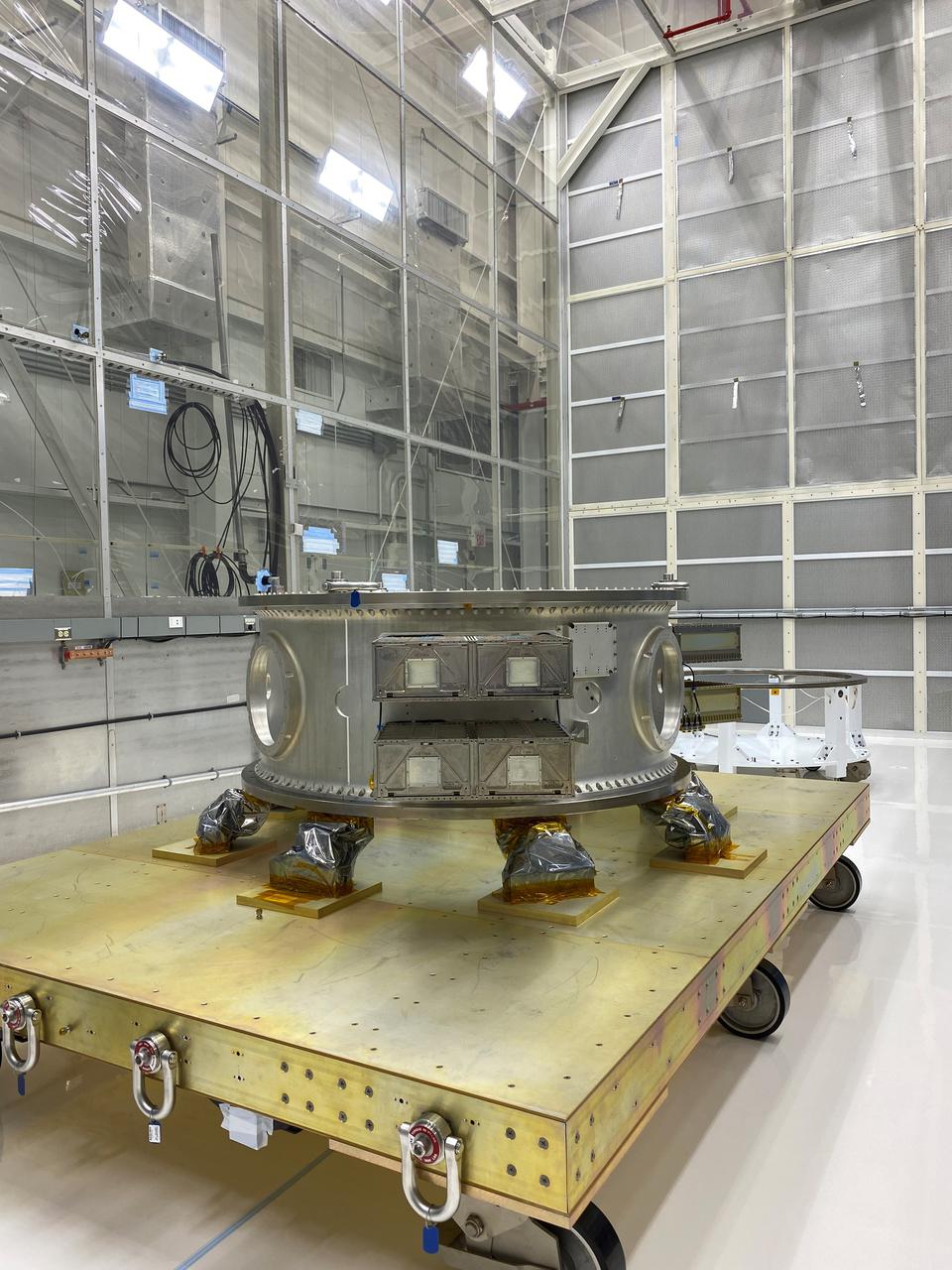
Mechanical and electrical support equipment for NASA’s Landsat 9 observatory arrive inside the Integrated Processing Facility at Vandenberg Space Force Base in California, on June 16, 2021. The equipment includes a secondary payload adapter and flight system for a group of microsat payloads, called CubeSats, that will launch with Landsat 9 as secondary payloads. Landsat 9 will launch on a United Launch Alliance Atlas V rocket from Space Launch Complex 3 at Vandenberg in September 2021. The launch is being managed by NASA’s Launch Services Program based at Kennedy Space Center, America’s multiuser spaceport. The Landsat 9 satellite will continue the nearly 50-year legacy of previous Landsat missions. It will monitor key natural and economic resources from orbit. Landsat 9 is managed by the agency’s Goddard Space Flight Center in Greenbelt, Maryland. The satellite will carry two instruments: the Operational Land Imager 2, which collects images of Earth’s landscapes in visible, near infrared and shortwave infrared light, and the Thermal Infrared Sensor 2, which measures the temperature of land surfaces. Like its predecessors, Landsat 9 is a joint mission between NASA and the U.S. Geological Survey.
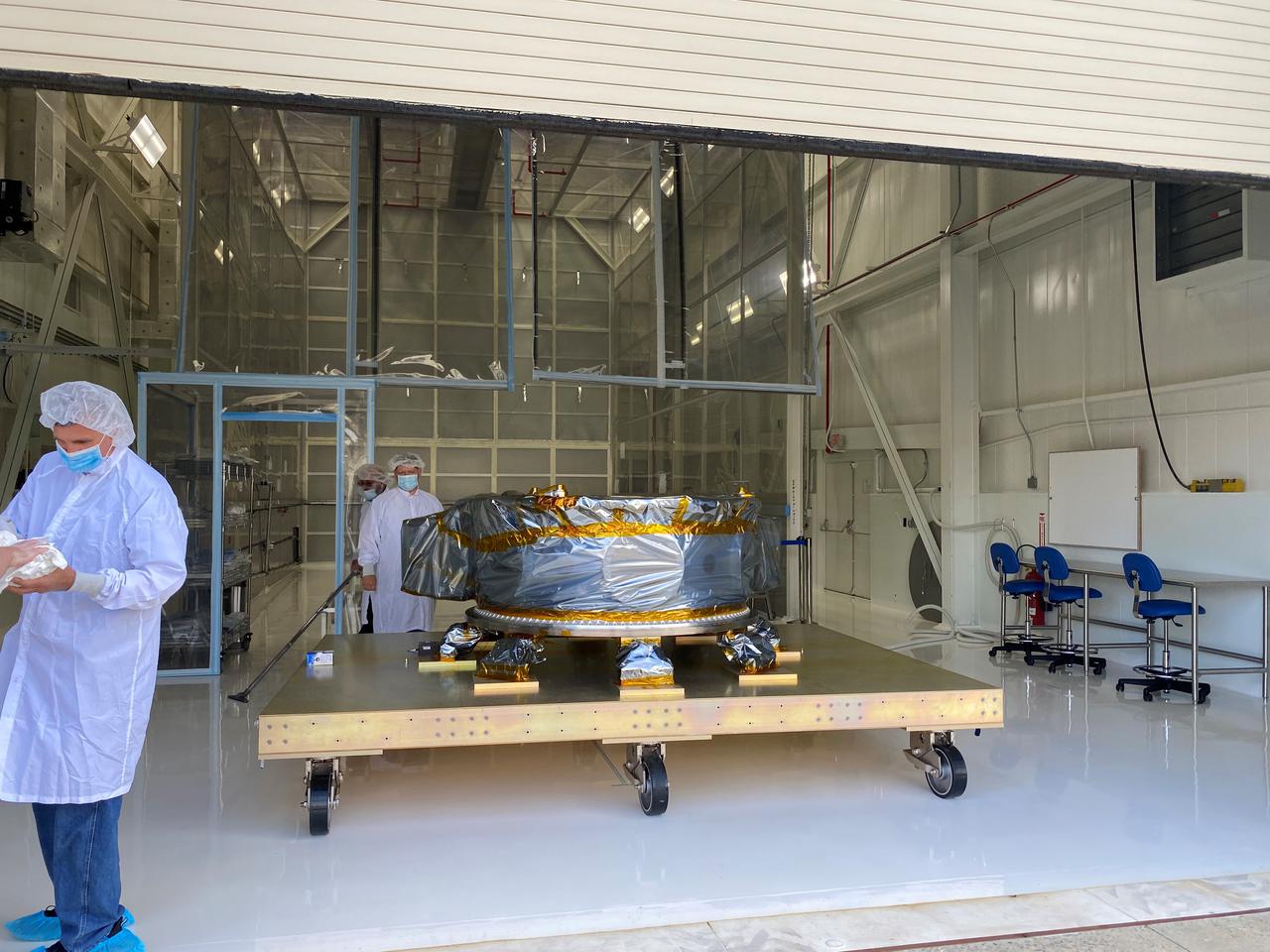
Mechanical and electrical support equipment for NASA’s Landsat 9 observatory arrive inside the Integrated Processing Facility at Vandenberg Space Force Base in California, on June 14, 2021. The equipment includes a secondary payload adapter and flight system for a group of microsat payloads, called CubeSats, that will launch with Landsat 9 as secondary payloads. Landsat 9 will launch on a United Launch Alliance Atlas V rocket from Space Launch Complex 3 at Vandenberg in September 2021. The launch is being managed by NASA’s Launch Services Program based at Kennedy Space Center, America’s multiuser spaceport. The Landsat 9 satellite will continue the nearly 50-year legacy of previous Landsat missions. It will monitor key natural and economic resources from orbit. Landsat 9 is managed by the agency’s Goddard Space Flight Center in Greenbelt, Maryland. The satellite will carry two instruments: the Operational Land Imager 2, which collects images of Earth’s landscapes in visible, near infrared and shortwave infrared light, and the Thermal Infrared Sensor 2, which measures the temperature of land surfaces. Like its predecessors, Landsat 9 is a joint mission between NASA and the U.S. Geological Survey.
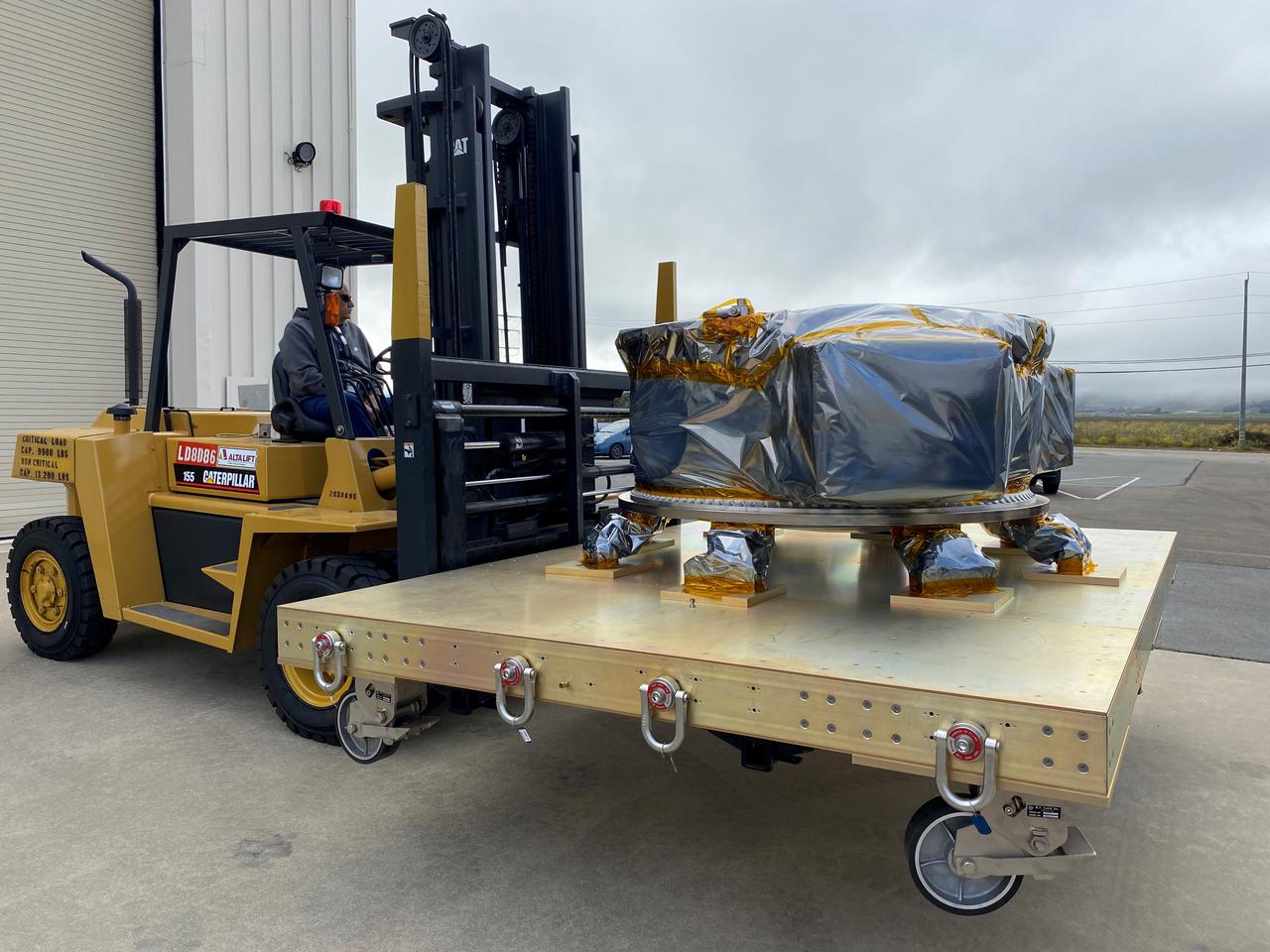
Mechanical and electrical support equipment for NASA’s Landsat 9 observatory arrive at the Integrated Processing Facility at Vandenberg Space Force Base in California, on June 14, 2021. The equipment includes a secondary payload adapter and flight system for a group of microsat payloads, called CubeSats, that will launch with Landsat 9 as secondary payloads. Landsat 9 will launch on a United Launch Alliance Atlas V rocket from Space Launch Complex 3 at Vandenberg in September 2021. The launch is being managed by NASA’s Launch Services Program based at Kennedy Space Center, America’s multiuser spaceport. The Landsat 9 satellite will continue the nearly 50-year legacy of previous Landsat missions. It will monitor key natural and economic resources from orbit. Landsat 9 is managed by the agency’s Goddard Space Flight Center in Greenbelt, Maryland. The satellite will carry two instruments: the Operational Land Imager 2, which collects images of Earth’s landscapes in visible, near infrared and shortwave infrared light, and the Thermal Infrared Sensor 2, which measures the temperature of land surfaces. Like its predecessors, Landsat 9 is a joint mission between NASA and the U.S. Geological Survey.
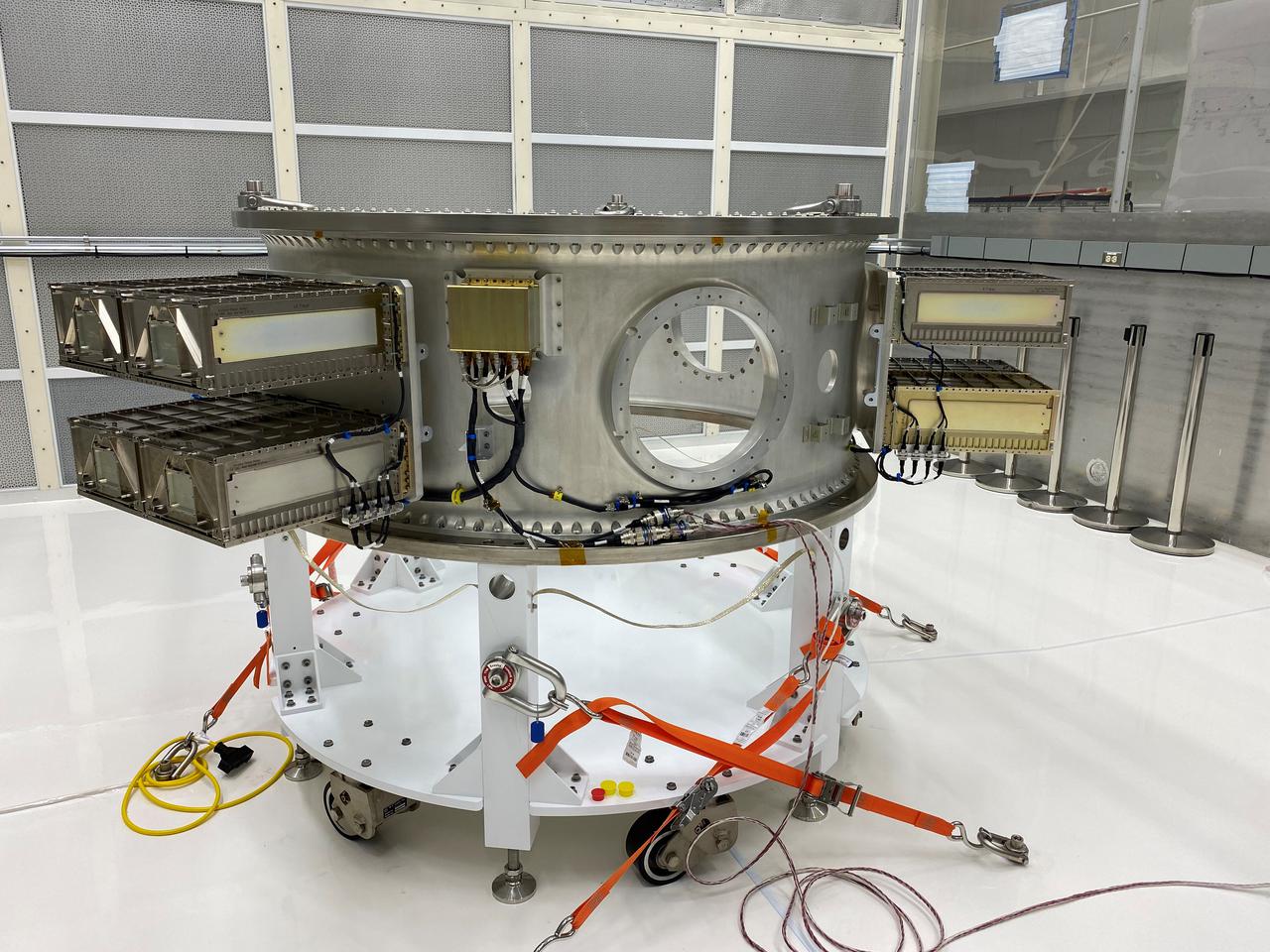
Mechanical and electrical support equipment for NASA’s Landsat 9 observatory are being processed inside the Integrated Processing Facility at Vandenberg Space Force Base in California, on June 24, 2021. The equipment includes a secondary payload adapter and flight system for a group of microsat payloads, called CubeSats, that will launch with Landsat 9 as secondary payloads. Landsat 9 will launch on a United Launch Alliance Atlas V rocket from Space Launch Complex 3 at Vandenberg in September 2021. The launch is being managed by NASA’s Launch Services Program based at Kennedy Space Center, America’s multiuser spaceport. The Landsat 9 satellite will continue the nearly 50-year legacy of previous Landsat missions. It will monitor key natural and economic resources from orbit. Landsat 9 is managed by the agency’s Goddard Space Flight Center in Greenbelt, Maryland. The satellite will carry two instruments: the Operational Land Imager 2, which collects images of Earth’s landscapes in visible, near infrared and shortwave infrared light, and the Thermal Infrared Sensor 2, which measures the temperature of land surfaces. Like its predecessors, Landsat 9 is a joint mission between NASA and the U.S. Geological Survey.
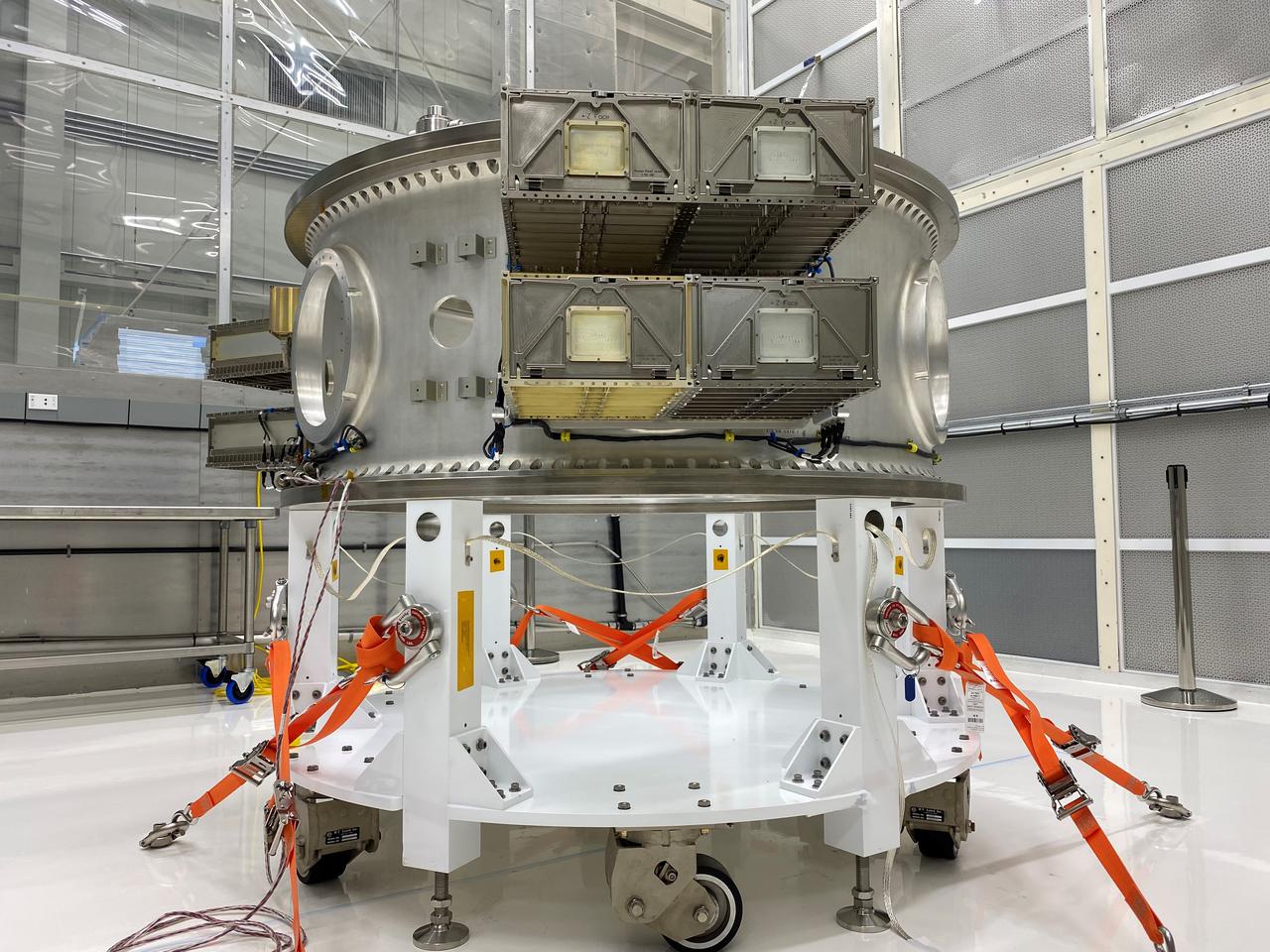
Mechanical and electrical support equipment for NASA’s Landsat 9 observatory are being processed inside the Integrated Processing Facility at Vandenberg Space Force Base in California, on June 24, 2021. The equipment includes a secondary payload adapter and flight system for a group of microsat payloads, called CubeSats, that will launch with Landsat 9 as secondary payloads. Landsat 9 will launch on a United Launch Alliance Atlas V rocket from Space Launch Complex 3 at Vandenberg in September 2021. The launch is being managed by NASA’s Launch Services Program based at Kennedy Space Center, America’s multiuser spaceport. The Landsat 9 satellite will continue the nearly 50-year legacy of previous Landsat missions. It will monitor key natural and economic resources from orbit. Landsat 9 is managed by the agency’s Goddard Space Flight Center in Greenbelt, Maryland. The satellite will carry two instruments: the Operational Land Imager 2, which collects images of Earth’s landscapes in visible, near infrared and shortwave infrared light, and the Thermal Infrared Sensor 2, which measures the temperature of land surfaces. Like its predecessors, Landsat 9 is a joint mission between NASA and the U.S. Geological Survey.
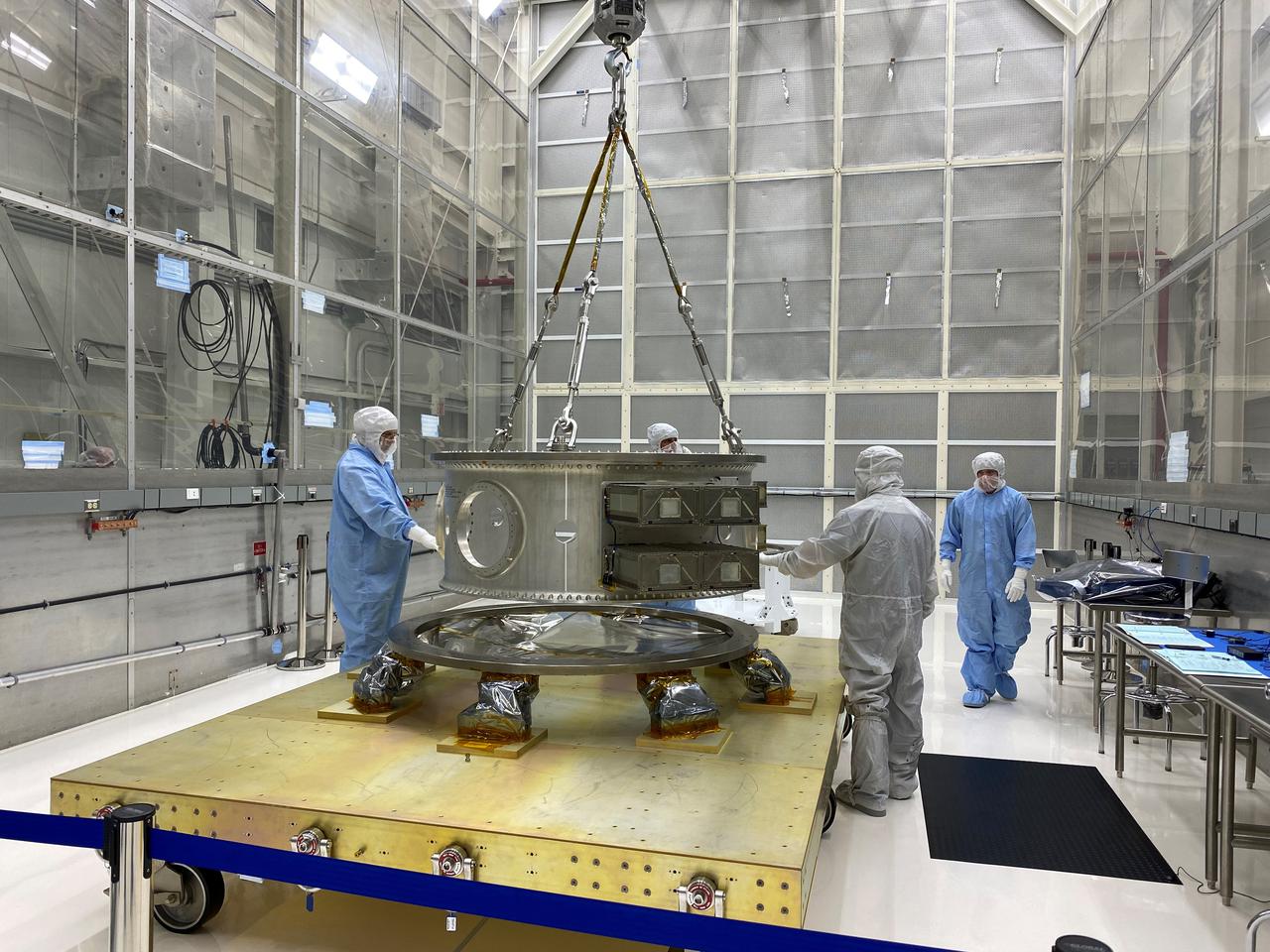
Technicians process mechanical and electrical support equipment for NASA’s Landsat 9 observatory inside the Integrated Processing Facility at Vandenberg Space Force Base in California, on June 16, 2021. The equipment includes a secondary payload adapter and flight system for a group of microsat payloads, called CubeSats, that will launch with Landsat 9 as secondary payloads. Landsat 9 will launch on a United Launch Alliance Atlas V rocket from Space Launch Complex 3 at Vandenberg in September 2021. The launch is being managed by NASA’s Launch Services Program based at Kennedy Space Center, America’s multiuser spaceport. The Landsat 9 satellite will continue the nearly 50-year legacy of previous Landsat missions. It will monitor key natural and economic resources from orbit. Landsat 9 is managed by the agency’s Goddard Space Flight Center in Greenbelt, Maryland. The satellite will carry two instruments: the Operational Land Imager 2, which collects images of Earth’s landscapes in visible, near infrared and shortwave infrared light, and the Thermal Infrared Sensor 2, which measures the temperature of land surfaces. Like its predecessors, Landsat 9 is a joint mission between NASA and the U.S. Geological Survey.
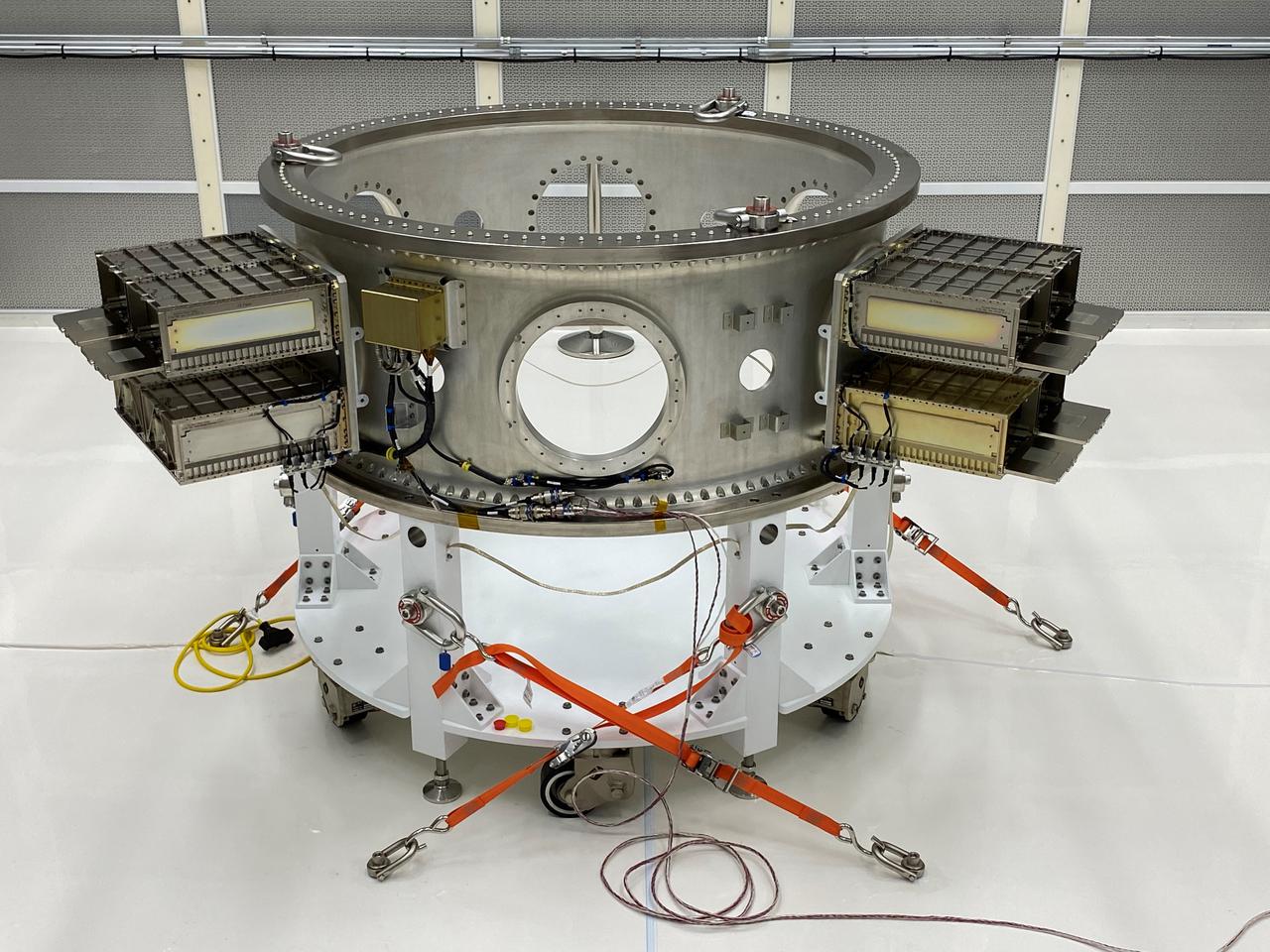
Mechanical and electrical support equipment for NASA’s Landsat 9 observatory are being processed inside the Integrated Processing Facility at Vandenberg Space Force Base in California, on June 24, 2021. The equipment includes a secondary payload adapter and flight system for a group of microsat payloads, called CubeSats, that will launch with Landsat 9 as secondary payloads. Landsat 9 will launch on a United Launch Alliance Atlas V rocket from Space Launch Complex 3 at Vandenberg in September 2021. The launch is being managed by NASA’s Launch Services Program based at Kennedy Space Center, America’s multiuser spaceport. The Landsat 9 satellite will continue the nearly 50-year legacy of previous Landsat missions. It will monitor key natural and economic resources from orbit. Landsat 9 is managed by the agency’s Goddard Space Flight Center in Greenbelt, Maryland. The satellite will carry two instruments: the Operational Land Imager 2, which collects images of Earth’s landscapes in visible, near infrared and shortwave infrared light, and the Thermal Infrared Sensor 2, which measures the temperature of land surfaces. Like its predecessors, Landsat 9 is a joint mission between NASA and the U.S. Geological Survey.
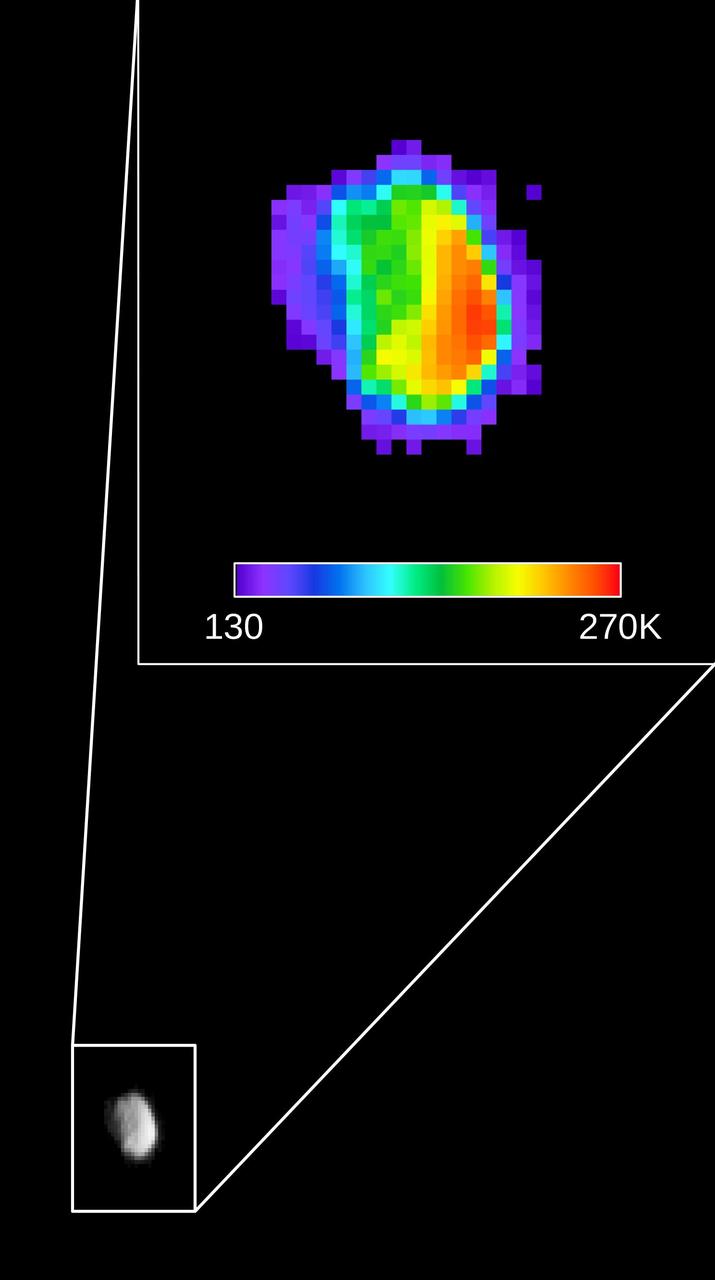
Colors in this image of the Martian moon Phobos indicate a range of surface temperatures detected by observing the moon on Sept. 29, 2017, with the Thermal Emission Imaging System (THEMIS) camera on NASA's Mars Odyssey orbiter. The left edge of the small moon was in darkness, and the right edge in morning sunlight. Phobos has an oblong shape with average diameter of about 14 miles (22 kilometers). Temperature information was derived from thermal-infrared imaging such as the grayscale image shown smaller at lower left with the moon in the same orientation. The color-coding merges information from THEMIS observations made in four thermal-infrared wavelength bands, centered from 11.04 microns to 14.88 microns. The scale bar correlates color-coding to the temperature range on the Kelvin scale, from 130 K (minus 226 degrees Fahrenheit) for dark purple to 270 K (26 degrees F) for red. Researchers will analyze the surface-temperature information from this observation and possible future THEMIS observations to learn how quickly the surface warms after sunup or cools after sundown. That could provide information about surface materials, because larger rocks heat or cool more slowly than smaller particles do. Researchers have been using THEMIS to examine Mars since early 2002, but the maneuver turning the orbiter around to point the camera at Phobos was developed only recently. Odyssey orbits Mars at an altitude of about 250 miles (400 kilometers), much closer to the planet than to Phobos, which orbits about 3,700 miles (6,000 kilometers) above the surface of Mars. The distance to Phobos from Odyssey during the observation was about 3,424 miles (5,511 kilometers). https://photojournal.jpl.nasa.gov/catalog/PIA21858
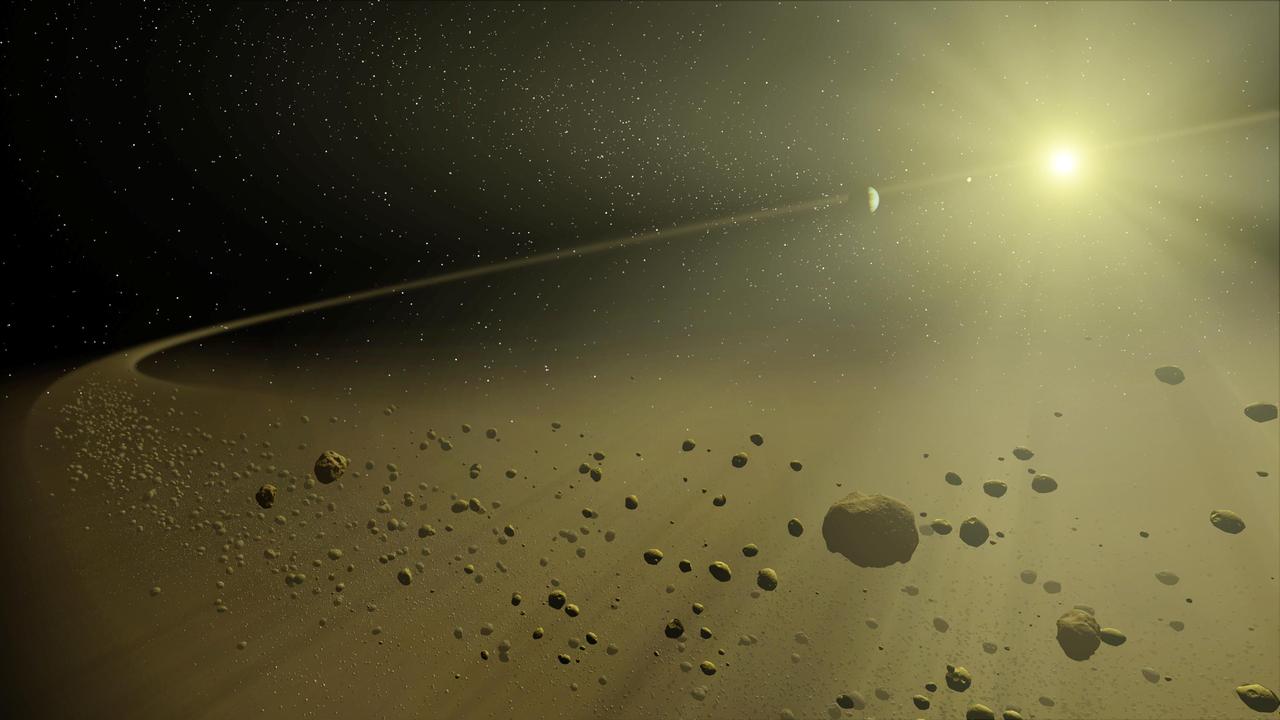
This artist concept depicts a distant hypothetical solar system, similar in age to our own. Looking inward from the system outer fringes, a ring of dusty debris can be seen, and within it, planets circling a star the size of our Sun. This debris is all that remains of the planet-forming disk from which the planets evolved. Planets are formed when dusty material in a large disk surrounding a young star clumps together. Leftover material is eventually blown out by solar wind or pushed out by gravitational interactions with planets. Billions of years later, only an outer disk of debris remains. These outer debris disks are too faint to be imaged by visible-light telescopes. They are washed out by the glare of the Sun. However, NASA's Spitzer Space Telescope can detect their heat, or excess thermal emission, in infrared light. This allows astronomers to study the aftermath of planet building in distant solar systems like our own. http://photojournal.jpl.nasa.gov/catalog/PIA07096
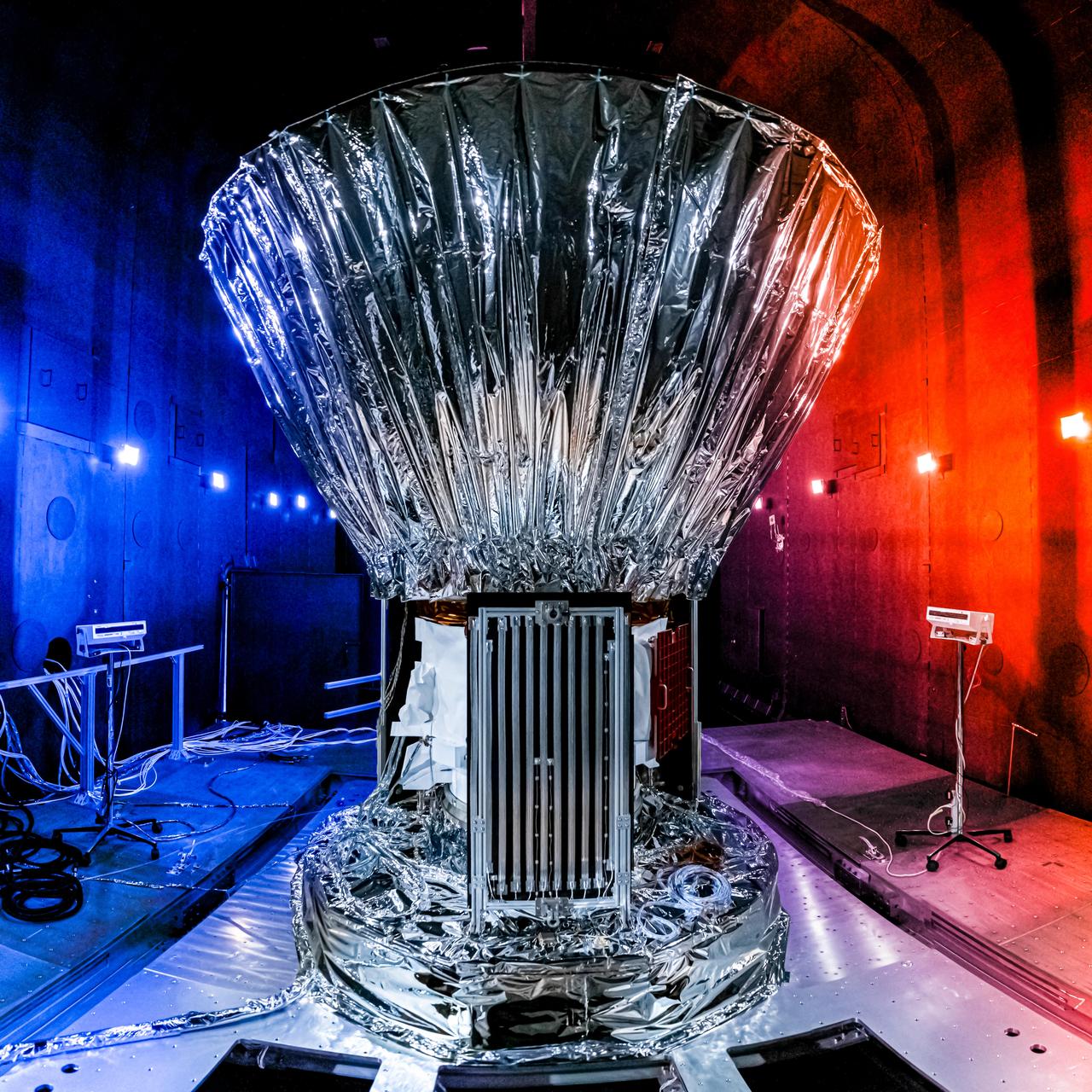
NASA's SPHEREx observatory is installed in the Titan Thermal Vacuum (TVAC) test Chamber at BAE Systems in Boulder, Colorado, in June 2024. As part of the test setup, the spacecraft and photon shield are covered in multilayer insulation and blankets and surrounded by ground support equipment. Short for Spectro-Photometer for the History of the Universe, Epoch of Reionization and Ices Explorer, SPHEREx will create a map of the cosmos like no other. Using a technique called spectroscopy to image the entire sky in 102 wavelengths of infrared light, SPHEREx will gather information about the composition of and distance to millions of galaxies and stars. With this map, scientists will study what happened in the first fraction of a second after the big bang, how galaxies formed and evolved, and the origins of water in planetary systems in our galaxy. https://photojournal.jpl.nasa.gov/catalog/PIA26541
![In the Spacecraft Assembly and Encapsulation Facility -2, workers check the movement of the <a href='http:__mars.jpl.nasa.gov_2001_'>2001 Mars Odyssey Orbiter <_a> as it is carried to the workstand at right. The circular object facing forward on the spacecraft is a high-gain antenna. On the right side is the rectangular solar array assembly. The Mars Odyssey Orbiter carries three science instruments: the Thermal Emission Imaging System (THEMIS), the Gamma Ray Spectrometer (GRS), and the Mars Radiation Environment Experiment (MARIE). THEMIS will map the mineralogy and morphology of the Martian surface using a high-resolution camera and a thermal infrared imaging spectrometer. The GRS will achieve global mapping of the elemental composition of the surface and determine the abundance of hydrogen in the shallow subsurface. [The GRS is a rebuild of the instrument lost with the Mars Observer mission.] The MARIE will characterize aspects of the near-space radiation environment as related to the radiation-related risk to human explorers. The Mars Odyssey Orbiter is scheduled for launch on April 7, 2001, aboard a Delta 7925 rocket from Launch Pad 17-A, Cape Canaveral Air Force Station](https://images-assets.nasa.gov/image/01pp0100/01pp0100~medium.jpg)
In the Spacecraft Assembly and Encapsulation Facility -2, workers check the movement of the <a href='http:__mars.jpl.nasa.gov_2001_'>2001 Mars Odyssey Orbiter <_a> as it is carried to the workstand at right. The circular object facing forward on the spacecraft is a high-gain antenna. On the right side is the rectangular solar array assembly. The Mars Odyssey Orbiter carries three science instruments: the Thermal Emission Imaging System (THEMIS), the Gamma Ray Spectrometer (GRS), and the Mars Radiation Environment Experiment (MARIE). THEMIS will map the mineralogy and morphology of the Martian surface using a high-resolution camera and a thermal infrared imaging spectrometer. The GRS will achieve global mapping of the elemental composition of the surface and determine the abundance of hydrogen in the shallow subsurface. [The GRS is a rebuild of the instrument lost with the Mars Observer mission.] The MARIE will characterize aspects of the near-space radiation environment as related to the radiation-related risk to human explorers. The Mars Odyssey Orbiter is scheduled for launch on April 7, 2001, aboard a Delta 7925 rocket from Launch Pad 17-A, Cape Canaveral Air Force Station
![In the Spacecraft Assembly & Encapsulation Facility -2, workers check the movement of the <a href="http://mars.jpl.nasa.gov/2001/">2001 Mars Odyssey Orbiter </a> as it is carried to the workstand at right. The circular object facing forward on the spacecraft is a high-gain antenna. On the right side is the rectangular solar array assembly. The Mars Odyssey Orbiter carries three science instruments: the Thermal Emission Imaging System (THEMIS), the Gamma Ray Spectrometer (GRS), and the Mars Radiation Environment Experiment (MARIE). THEMIS will map the mineralogy and morphology of the Martian surface using a high-resolution camera and a thermal infrared imaging spectrometer. The GRS will achieve global mapping of the elemental composition of the surface and determine the abundance of hydrogen in the shallow subsurface. [The GRS is a rebuild of the instrument lost with the Mars Observer mission.] The MARIE will characterize aspects of the near-space radiation environment as related to the radiation-related risk to human explorers. The Mars Odyssey Orbiter is scheduled for launch on April 7, 2001, aboard a Delta 7925 rocket from Launch Pad 17-A, Cape Canaveral Air Force Station](https://images-assets.nasa.gov/image/KSC01pp0100/KSC01pp0100~medium.jpg)
In the Spacecraft Assembly & Encapsulation Facility -2, workers check the movement of the <a href="http://mars.jpl.nasa.gov/2001/">2001 Mars Odyssey Orbiter </a> as it is carried to the workstand at right. The circular object facing forward on the spacecraft is a high-gain antenna. On the right side is the rectangular solar array assembly. The Mars Odyssey Orbiter carries three science instruments: the Thermal Emission Imaging System (THEMIS), the Gamma Ray Spectrometer (GRS), and the Mars Radiation Environment Experiment (MARIE). THEMIS will map the mineralogy and morphology of the Martian surface using a high-resolution camera and a thermal infrared imaging spectrometer. The GRS will achieve global mapping of the elemental composition of the surface and determine the abundance of hydrogen in the shallow subsurface. [The GRS is a rebuild of the instrument lost with the Mars Observer mission.] The MARIE will characterize aspects of the near-space radiation environment as related to the radiation-related risk to human explorers. The Mars Odyssey Orbiter is scheduled for launch on April 7, 2001, aboard a Delta 7925 rocket from Launch Pad 17-A, Cape Canaveral Air Force Station
![In the Spacecraft Assembly & Encapsulation Facility -2, workers attach an overhead crane to the solar array on the 2001 Mars Odyssey Orbiter to move the component to a workstand. This will give workers access to other components of the spacecraft and allow inspection of the array. The Mars Odyssey carries three science instruments: the Thermal Emission Imaging System (THEMIS), the Gamma Ray Spectrometer (GRS), and the Mars Radiation Environment Experiment (MARIE). THEMIS will map the mineralogy and morphology of the Martian surface using a high-resolution camera and a thermal infrared imaging spectrometer. The GRS will achieve global mapping of the elemental composition of the surface and determine the abundance of hydrogen in the shallow subsurface. [The GRS is a rebuild of the instrument lost with the Mars Observer mission.] The MARIE will characterize aspects of the near-space radiation environment as related to the radiation-related risk to human explorers. The Mars Odyssey Orbiter is scheduled for launch on April 7, 2001, aboard a Delta 7925 rocket from Launch Pad 17-A, Cape Canaveral Air Force Station](https://images-assets.nasa.gov/image/KSC01pp0120/KSC01pp0120~medium.jpg)
In the Spacecraft Assembly & Encapsulation Facility -2, workers attach an overhead crane to the solar array on the 2001 Mars Odyssey Orbiter to move the component to a workstand. This will give workers access to other components of the spacecraft and allow inspection of the array. The Mars Odyssey carries three science instruments: the Thermal Emission Imaging System (THEMIS), the Gamma Ray Spectrometer (GRS), and the Mars Radiation Environment Experiment (MARIE). THEMIS will map the mineralogy and morphology of the Martian surface using a high-resolution camera and a thermal infrared imaging spectrometer. The GRS will achieve global mapping of the elemental composition of the surface and determine the abundance of hydrogen in the shallow subsurface. [The GRS is a rebuild of the instrument lost with the Mars Observer mission.] The MARIE will characterize aspects of the near-space radiation environment as related to the radiation-related risk to human explorers. The Mars Odyssey Orbiter is scheduled for launch on April 7, 2001, aboard a Delta 7925 rocket from Launch Pad 17-A, Cape Canaveral Air Force Station
![In the Spacecraft Assembly & Encapsulation Facility -2, the 2001 <a href="http://mars.jpl.nasa.gov/2001/">Mars Odyssey Orbiter </a>is lifted from a platform by an overhead crane while workers help guide it. The Odyssey is being moved to a workstand in the SAEF-2. The spacecraft carries three science instruments: the Thermal Emission Imaging System (THEMIS), the Gamma Ray Spectrometer (GRS), and the Mars Radiation Environment Experiment (MARIE). THEMIS will map the mineralogy and morphology of the Martian surface using a high-resolution camera and a thermal infrared imaging spectrometer. The GRS will achieve global mapping of the elemental composition of the surface and determine the abundance of hydrogen in the shallow subsurface. [The GRS is a rebuild of the instrument lost with the Mars Observer mission.] The MARIE will characterize aspects of the near-space radiation environment as related to the radiation-related risk to human explorers. The Mars Odyssey Orbiter is scheduled for launch on April 7, 2001, aboard a Delta 7925 rocket from Launch Pad 17-A, Cape Canaveral Air Force Station](https://images-assets.nasa.gov/image/KSC01pp0098/KSC01pp0098~medium.jpg)
In the Spacecraft Assembly & Encapsulation Facility -2, the 2001 <a href="http://mars.jpl.nasa.gov/2001/">Mars Odyssey Orbiter </a>is lifted from a platform by an overhead crane while workers help guide it. The Odyssey is being moved to a workstand in the SAEF-2. The spacecraft carries three science instruments: the Thermal Emission Imaging System (THEMIS), the Gamma Ray Spectrometer (GRS), and the Mars Radiation Environment Experiment (MARIE). THEMIS will map the mineralogy and morphology of the Martian surface using a high-resolution camera and a thermal infrared imaging spectrometer. The GRS will achieve global mapping of the elemental composition of the surface and determine the abundance of hydrogen in the shallow subsurface. [The GRS is a rebuild of the instrument lost with the Mars Observer mission.] The MARIE will characterize aspects of the near-space radiation environment as related to the radiation-related risk to human explorers. The Mars Odyssey Orbiter is scheduled for launch on April 7, 2001, aboard a Delta 7925 rocket from Launch Pad 17-A, Cape Canaveral Air Force Station
![In the Spacecraft Assembly and Encapsulation Facility -2, the 2001 <a href='http:__mars.jpl.nasa.gov_2001_'>Mars Odyssey Orbiter <_a>is lifted from a platform by an overhead crane while workers help guide it. The Odyssey is being moved to a workstand in the SAEF-2. The spacecraft carries three science instruments: the Thermal Emission Imaging System (THEMIS), the Gamma Ray Spectrometer (GRS), and the Mars Radiation Environment Experiment (MARIE). THEMIS will map the mineralogy and morphology of the Martian surface using a high-resolution camera and a thermal infrared imaging spectrometer. The GRS will achieve global mapping of the elemental composition of the surface and determine the abundance of hydrogen in the shallow subsurface. [The GRS is a rebuild of the instrument lost with the Mars Observer mission.] The MARIE will characterize aspects of the near-space radiation environment as related to the radiation-related risk to human explorers. The Mars Odyssey Orbiter is scheduled for launch on April 7, 2001, aboard a Delta 7925 rocket from Launch Pad 17-A, Cape Canaveral Air Force Station](https://images-assets.nasa.gov/image/01pp0098/01pp0098~medium.jpg)
In the Spacecraft Assembly and Encapsulation Facility -2, the 2001 <a href='http:__mars.jpl.nasa.gov_2001_'>Mars Odyssey Orbiter <_a>is lifted from a platform by an overhead crane while workers help guide it. The Odyssey is being moved to a workstand in the SAEF-2. The spacecraft carries three science instruments: the Thermal Emission Imaging System (THEMIS), the Gamma Ray Spectrometer (GRS), and the Mars Radiation Environment Experiment (MARIE). THEMIS will map the mineralogy and morphology of the Martian surface using a high-resolution camera and a thermal infrared imaging spectrometer. The GRS will achieve global mapping of the elemental composition of the surface and determine the abundance of hydrogen in the shallow subsurface. [The GRS is a rebuild of the instrument lost with the Mars Observer mission.] The MARIE will characterize aspects of the near-space radiation environment as related to the radiation-related risk to human explorers. The Mars Odyssey Orbiter is scheduled for launch on April 7, 2001, aboard a Delta 7925 rocket from Launch Pad 17-A, Cape Canaveral Air Force Station
![In the Spacecraft Assembly and Encapsulation Facility -2, workers attach an overhead crane to the solar array on the 2001 Mars Odyssey Orbiter to move the component to a workstand. This will give workers access to other components of the spacecraft and allow inspection of the array. The Mars Odyssey carries three science instruments: the Thermal Emission Imaging System (THEMIS), the Gamma Ray Spectrometer (GRS), and the Mars Radiation Environment Experiment (MARIE). THEMIS will map the mineralogy and morphology of the Martian surface using a high-resolution camera and a thermal infrared imaging spectrometer. The GRS will achieve global mapping of the elemental composition of the surface and determine the abundance of hydrogen in the shallow subsurface. [The GRS is a rebuild of the instrument lost with the Mars Observer mission.] The MARIE will characterize aspects of the near-space radiation environment as related to the radiation-related risk to human explorers. The Mars Odyssey Orbiter is scheduled for launch on April 7, 2001, aboard a Delta 7925 rocket from Launch Pad 17-A, Cape Canaveral Air Force Station](https://images-assets.nasa.gov/image/01pp0120/01pp0120~medium.jpg)
In the Spacecraft Assembly and Encapsulation Facility -2, workers attach an overhead crane to the solar array on the 2001 Mars Odyssey Orbiter to move the component to a workstand. This will give workers access to other components of the spacecraft and allow inspection of the array. The Mars Odyssey carries three science instruments: the Thermal Emission Imaging System (THEMIS), the Gamma Ray Spectrometer (GRS), and the Mars Radiation Environment Experiment (MARIE). THEMIS will map the mineralogy and morphology of the Martian surface using a high-resolution camera and a thermal infrared imaging spectrometer. The GRS will achieve global mapping of the elemental composition of the surface and determine the abundance of hydrogen in the shallow subsurface. [The GRS is a rebuild of the instrument lost with the Mars Observer mission.] The MARIE will characterize aspects of the near-space radiation environment as related to the radiation-related risk to human explorers. The Mars Odyssey Orbiter is scheduled for launch on April 7, 2001, aboard a Delta 7925 rocket from Launch Pad 17-A, Cape Canaveral Air Force Station
![Workers in the Spacecraft Assembly & Encapsulation Facility -2 help guide the solar array just removed from the 2001 Mars Odyssey Orbiter toward a nearby workstand. This will give workers access to other components of the spacecraft and allow inspection of the array. The Mars Odyssey carries three science instruments: the Thermal Emission Imaging System (THEMIS), the Gamma Ray Spectrometer (GRS), and the Mars Radiation Environment Experiment (MARIE). THEMIS will map the mineralogy and morphology of the Martian surface using a high-resolution camera and a thermal infrared imaging spectrometer. The GRS will achieve global mapping of the elemental composition of the surface and determine the abundance of hydrogen in the shallow subsurface. [The GRS is a rebuild of the instrument lost with the Mars Observer mission.] The MARIE will characterize aspects of the near-space radiation environment as related to the radiation-related risk to human explorers. The Mars Odyssey Orbiter is scheduled for launch on April 7, 2001, aboard a Delta 7925 rocket from Launch Pad 17-A, Cape Canaveral Air Force Station](https://images-assets.nasa.gov/image/KSC01pp0122/KSC01pp0122~medium.jpg)
Workers in the Spacecraft Assembly & Encapsulation Facility -2 help guide the solar array just removed from the 2001 Mars Odyssey Orbiter toward a nearby workstand. This will give workers access to other components of the spacecraft and allow inspection of the array. The Mars Odyssey carries three science instruments: the Thermal Emission Imaging System (THEMIS), the Gamma Ray Spectrometer (GRS), and the Mars Radiation Environment Experiment (MARIE). THEMIS will map the mineralogy and morphology of the Martian surface using a high-resolution camera and a thermal infrared imaging spectrometer. The GRS will achieve global mapping of the elemental composition of the surface and determine the abundance of hydrogen in the shallow subsurface. [The GRS is a rebuild of the instrument lost with the Mars Observer mission.] The MARIE will characterize aspects of the near-space radiation environment as related to the radiation-related risk to human explorers. The Mars Odyssey Orbiter is scheduled for launch on April 7, 2001, aboard a Delta 7925 rocket from Launch Pad 17-A, Cape Canaveral Air Force Station
![Workers in the Spacecraft Assembly and Encapsulation Facility -2 help guide the solar array just removed from the 2001 Mars Odyssey Orbiter toward a nearby workstand. This will give workers access to other components of the spacecraft and allow inspection of the array. The Mars Odyssey carries three science instruments: the Thermal Emission Imaging System (THEMIS), the Gamma Ray Spectrometer (GRS), and the Mars Radiation Environment Experiment (MARIE). THEMIS will map the mineralogy and morphology of the Martian surface using a high-resolution camera and a thermal infrared imaging spectrometer. The GRS will achieve global mapping of the elemental composition of the surface and determine the abundance of hydrogen in the shallow subsurface. [The GRS is a rebuild of the instrument lost with the Mars Observer mission.] The MARIE will characterize aspects of the near-space radiation environment as related to the radiation-related risk to human explorers. The Mars Odyssey Orbiter is scheduled for launch on April 7, 2001, aboard a Delta 7925 rocket from Launch Pad 17-A, Cape Canaveral Air Force Station](https://images-assets.nasa.gov/image/01pp0122/01pp0122~medium.jpg)
Workers in the Spacecraft Assembly and Encapsulation Facility -2 help guide the solar array just removed from the 2001 Mars Odyssey Orbiter toward a nearby workstand. This will give workers access to other components of the spacecraft and allow inspection of the array. The Mars Odyssey carries three science instruments: the Thermal Emission Imaging System (THEMIS), the Gamma Ray Spectrometer (GRS), and the Mars Radiation Environment Experiment (MARIE). THEMIS will map the mineralogy and morphology of the Martian surface using a high-resolution camera and a thermal infrared imaging spectrometer. The GRS will achieve global mapping of the elemental composition of the surface and determine the abundance of hydrogen in the shallow subsurface. [The GRS is a rebuild of the instrument lost with the Mars Observer mission.] The MARIE will characterize aspects of the near-space radiation environment as related to the radiation-related risk to human explorers. The Mars Odyssey Orbiter is scheduled for launch on April 7, 2001, aboard a Delta 7925 rocket from Launch Pad 17-A, Cape Canaveral Air Force Station
Frank DeMauro, vice president, Northrop Grumman Tactical Space Systems, participates in the launch broadcast for the Landsat 9 mission on Sept. 27, 2021, at Vandenberg Space Force Base in California. NASA’s Landsat 9 satellite launched on a United Launch Alliance Atlas V 401 rocket from Vandenberg's Space Launch Complex 3 at 2:12 p.m. EDT (11:12 a.m. PDT). The launch is managed by NASA’s Launch Services Program, based at the agency’s Kennedy Space Center in Florida. Landsat 9 will join its sister satellite, Landsat 8, in orbit in collecting images from across the planet every eight days. This calibrated data will continue the Landsat program’s critical role in monitoring the health of Earth and helping people manage essential resources, including crops, irrigation water, and forests. NASA Goddard manages the Landsat 9 mission. Goddard teams also built and tested one of the two instruments on Landsat 9, the Thermal Infrared Sensor 2 (TIRS-2) instrument. TIRS-2 will use thermal imaging to make measurements that can be used to estimate soil moisture and detect the health of plants.
On Aug. 26, 2020, Advanced Spaceborne Thermal Emission and Reflection Radiometer (ASTER) instrument aboard NASA's Terra satellite passed over the River and Carmel fires in Monterey County, California, got a bird's eye view of the vast fire burn area. This false-color map shows the burn area as dark blue and gray, in the center of the image. Vegetation is in red, including agricultural crops along the Salinas River (bright red rectangles) surrounding the towns of Soledad and Gonzales; bare areas with no vegetation and rock are shown in tan and brown. The city of Salinas is in the upper left of the image, obscured by thick clouds. ASTER obtains high-resolution (15-90 square meters, or 161-969 square feet, per pixel) images of the Earth in 14 wavelengths of the electromagnetic spectrum, ranging from visible to thermal infrared light. Data from ASTER — which is managed by Japan Space Systems and NASA's Jet Propulsion Laboratory in Southern California — are used by scientists to create detailed maps of land surface temperature, how much infrared energy the land emits, how much light the land reflects and its elevation. On this occasion, ASTER was able to support NASA's Disaster Program response to the state's wildfires, providing data products that can be used by resources on the ground to fight the fires and for scientists to better understand their long-term effects. The area covered here is 21.4 by 31 miles (34.4 by 49.9 kilometers). https://photojournal.jpl.nasa.gov/catalog/PIA23800
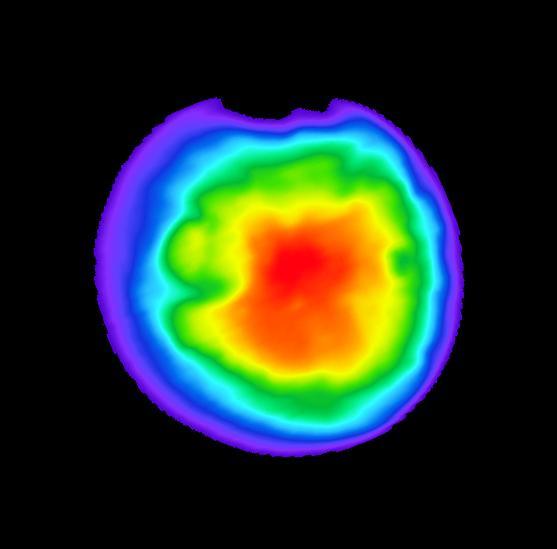
Europa Clipper, en route to the Jupiter system to investigate the icy moon Europa, swung by Mars on March 1, 2025, to use the planet's gravity to help shape the spacecraft's trajectory. The mission took the opportunity to capture infrared images of the Red Planet using the orbiter's Europa Thermal Imaging System (E-THEMIS) to calibrate the instrument. This picture is a colorized composite of several images captured by E-THEMIS from about a million miles (1.6 million kilometers) away. Warm colors represent relatively warm temperatures; red areas are about 32 degrees Fahrenheit (0 degrees Celsius), and purple regions are about minus 190 degrees F (minus 125 degrees C). The temperature variations reflect the time of day on Mars, which was noon, with the center of the globe warmest because the Sun was shining directly onto the planet, near the equator, from behind the Europa Clipper spacecraft. The instrument captured the image data in long-wave infrared wavelengths of about 7 to 14 micrometers. Europa Clipper launched from NASA's Kennedy Space Center in Florida on Oct. 14, 2024, and will arrive at the Jupiter system in 2030 to conduct about 50 flybys of Europa. The mission's main science goal is to determine whether there are places below Europa's surface that could support life. The mission's three main science objectives are to determine the thickness of the moon's icy shell and its surface interactions with the ocean below, to investigate its composition, and to characterize its geology. The mission's detailed exploration of Europa will help scientists better understand the astrobiological potential for habitable worlds beyond our planet. https://photojournal.jpl.nasa.gov/catalog/PIA26566
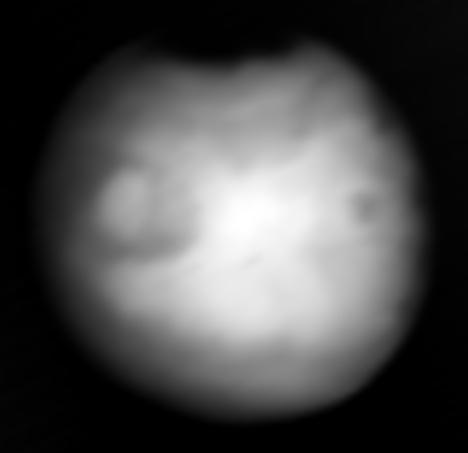
Europa Clipper, en route to the Jupiter system to investigate the icy moon Europa, swung by Mars on March 1, 2025, to use the planet's gravity to help shape the spacecraft's trajectory. The mission took the opportunity to capture to capture infrared images of the Red Planet using the orbiter's Europa Thermal Imaging System (E-THEMIS) to calibrate the instrument. This picture is a composite of several images captured by E-THEMIS, showing Mars' surface temperatures from about a million miles (1.6 million kilometers) away. Bright regions are relatively warm, with temperatures of about 32 degrees Fahrenheit (0 degrees Celsius). Darker areas are colder. The darkest region at the top is the northern polar cap and is about minus 190 F (minus 125 C). The temperature variations reflect the time of day on Mars, which was noon, with the center of the globe warmest because the Sun was shining directly onto the planet, near the equator, from behind Europa Clipper. Other variations reflect different surface features, with the fine-grained dust at the region near the equator being warm and coarser, rockier materials staying cooler. The instrument captured the images data in long-wave infrared wavelengths of about 7 to 14 micrometers. Europa Clipper launched from NASA's Kennedy Space Center in Florida on Oct. 14, 2024, and will arrive at the Jupiter system in 2030 to conduct about 50 flybys of Europa. The mission's main science goal is to determine whether there are places below Europa's surface that could support life. The mission's three main science objectives are to determine the thickness of the moon's icy shell and its surface interactions with the ocean below, to investigate its composition, and to characterize its geology. The mission's detailed exploration of Europa will help scientists better understand the astrobiological potential for habitable worlds beyond our planet. https://photojournal.jpl.nasa.gov/catalog/PIA26565
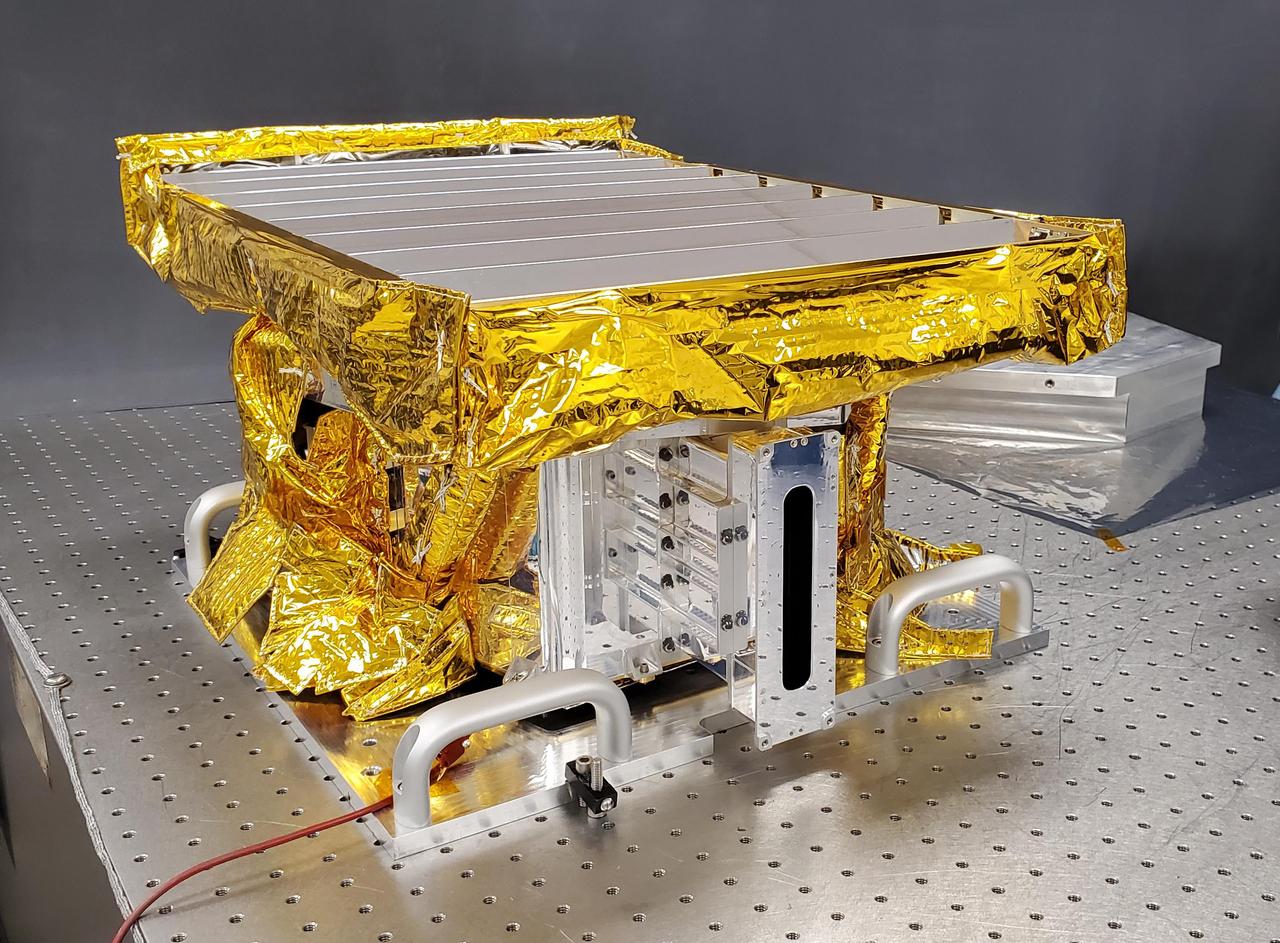
The High-resolution Volatiles and Minerals Moon Mapper (HVM³) sits in a clean room at NASA's Jet Propulsion Laboratory in Southern California in early December 2022. The JPL-built instrument was later shipped to Lockheed Martin Space in Littleton, Colorado, to be integrated with NASA's Lunar Trailblazer spacecraft. HVM³ is an imaging spectrometer that will detect and map water on the Moon's surface to determine its abundance, location, form, and how it changes over time. A second instrument, the Lunar Thermal Mapper infrared multispectral imager, is being developed by the University of Oxford in the U.K. and is scheduled for delivery and integration in early 2023. Lunar Trailblazer was selected under NASA's Small Innovative Missions for Planetary Exploration (SIMPLEx) program in 2019. The Lunar Trailblazer mission is managed by JPL and its science investigation is led by Caltech in Pasadena, California. Managed for NASA by Caltech, JPL also provides system engineering, mission assurance, the HVM³ instrument, as well as navigation. Lockheed Martin Space provides the spacecraft and integrates the flight system, under contract with Caltech. SIMPLEx mission investigations are managed by the Planetary Missions Program Office at NASA's Marshall Space Flight Center in Huntsville, Alabama, as part of the Discovery Program at NASA Headquarters in Washington. The program conducts space science investigations in the Planetary Science Division of NASA's Science Mission Directorate at NASA Headquarters. https://photojournal.jpl.nasa.gov/catalog/PIA25256
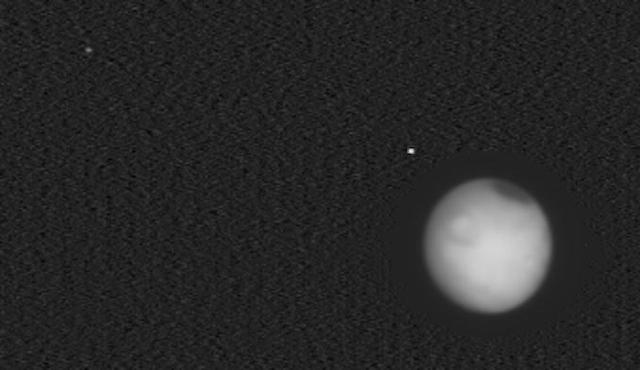
NASA's Europa Clipper captured this infrared image of the heat radiation from Mars and its moons Phobos (closest to Mars) and Deimos (seen in upper left corner) on Feb. 28, 2025, as the spacecraft approached the Red Planet while en route to the Jupiter system to investigate the icy moon Europa. The mission flew by Mars the next day, using the planet's gravity to help shape the spacecraft's trajectory. When the image was taken by the mission's Europa Thermal Emission Imaging System (E-THEMIS), the spacecraft was about 560,000 miles (900,000 kilometers) from the Red Planet. The image is composed of 200 individual frames, part of a continuous scan of 1,100 frames taken roughly a second apart over a period of 20 minutes. Scientists are using the tiny, point-like images of the moons to check the camera's focus. The image was captured using the middle of E-THEMIS's three long-wave infrared wavelength bands, which extend from about 14 to 28 micrometers. (A previously released E-THEMIS image of Mars used the shortest of the instrument's wavelength bands, extending from 7 to 14 micrometers and showing Mars in higher contrast.) The dark oval near the top of Mars is the planet's cold northern polar cap and is about minus 190 degrees Fahrenheit (minus 125 degrees Celsius). The circular feature seen on Mars is the region around Elysium Mons. The faint halo seen around the planet is due to the processing of the image. The two moons are about 250 times fainter than Mars, so scientists brightened the image (except for a region circling the planet) to make the moons more visible. The brightening also makes image noise more visible; the area surrounding Mars within the halo appears comparatively dark because it wasn't brightened. Europa Clipper launched from NASA's Kennedy Space Center in Florida on Oct. 14, 2024, and will arrive at the Jupiter system in 2030 to conduct about 50 flybys of Europa. The mission's main science goal is to determine whether there are places below Europa's surface that could support life. The mission's three main science objectives are to determine the thickness of the moon's icy shell and its surface interactions with the ocean below, to investigate its composition, and to characterize its geology. The mission's detailed exploration of Europa will help scientists better understand the astrobiological potential for habitable worlds beyond our planet. https://photojournal.jpl.nasa.gov/catalog/PIA26567