
An image of the galaxy Arp299B, which is undergoing a merging process with Arp299A (the galaxy to the left), captured by NASA's Hubble space telescope. The inset features an artist's illustration of a tidal disruption event (TDE), which occurs when a star passes fatally close to a supermassive black hole. A TDE was recently observed near the center of Arp299B. https://photojournal.jpl.nasa.gov/catalog/PIA22356

An artist's concept of a tidal disruption event (TDE) that happens when a star passes fatally close to a supermassive black hole, which reacts by launching a relativistic jet. https://photojournal.jpl.nasa.gov/catalog/PIA22355

This illustration shows a glowing stream of material from a star as it is being devoured by a supermassive black hole in a tidal disruption flare. When a star passes within a certain distance of a black hole -- close enough to be gravitationally disrupted -- the stellar material gets stretched and compressed as it falls into the black hole. In the process of being accreted, the gas heats up and creates a lot of optical and ultraviolet light, which destroys nearby dust but merely heats dust further out. The farther dust that is heated emits a large amount of infrared light. In recent years, a few dozen such flares have been discovered, but they are not well understood. Astronomers gained new insights into tidal disruption flares thanks to data from NASA's Wide-field Infrared Survey Explorer (WISE). Studies using WISE data characterized tidal disruption flares by studying how surrounding dust absorbs and re-emits their light, like echoes. This approach allowed scientists to measure the energy of flares from stellar tidal disruption events more precisely than ever before. http://photojournal.jpl.nasa.gov/catalog/PIA20027

A disk of hot gas swirls around a black hole in this illustration. Some of the gas came from a star that was pulled apart by the black hole, forming the long stream of hot gas on the right, feeding into the disk. These events are formally known as tidal disruption events, or TDEs. It can take just a matter or weeks or months from the destruction of the star to the formation of the disk. The gas gets hotter the closer it gets to the black hole, but the hottest material can be found above the black hole. This hottest material is cloud of plasma (gas atoms with their electrons stripped away) known as a corona. Most TDEs that result in the formation of a corona also produce jets of material that spew into space away from the black hole at its poles. A TDE called AT2021ehb is the first confirmed example of a corona forming without jets in a tidal disruption event. The observation of AT2021ehb makes it possible for scientists to study the formation of jets and coronae separately. https://photojournal.jpl.nasa.gov/catalog/PIA25440
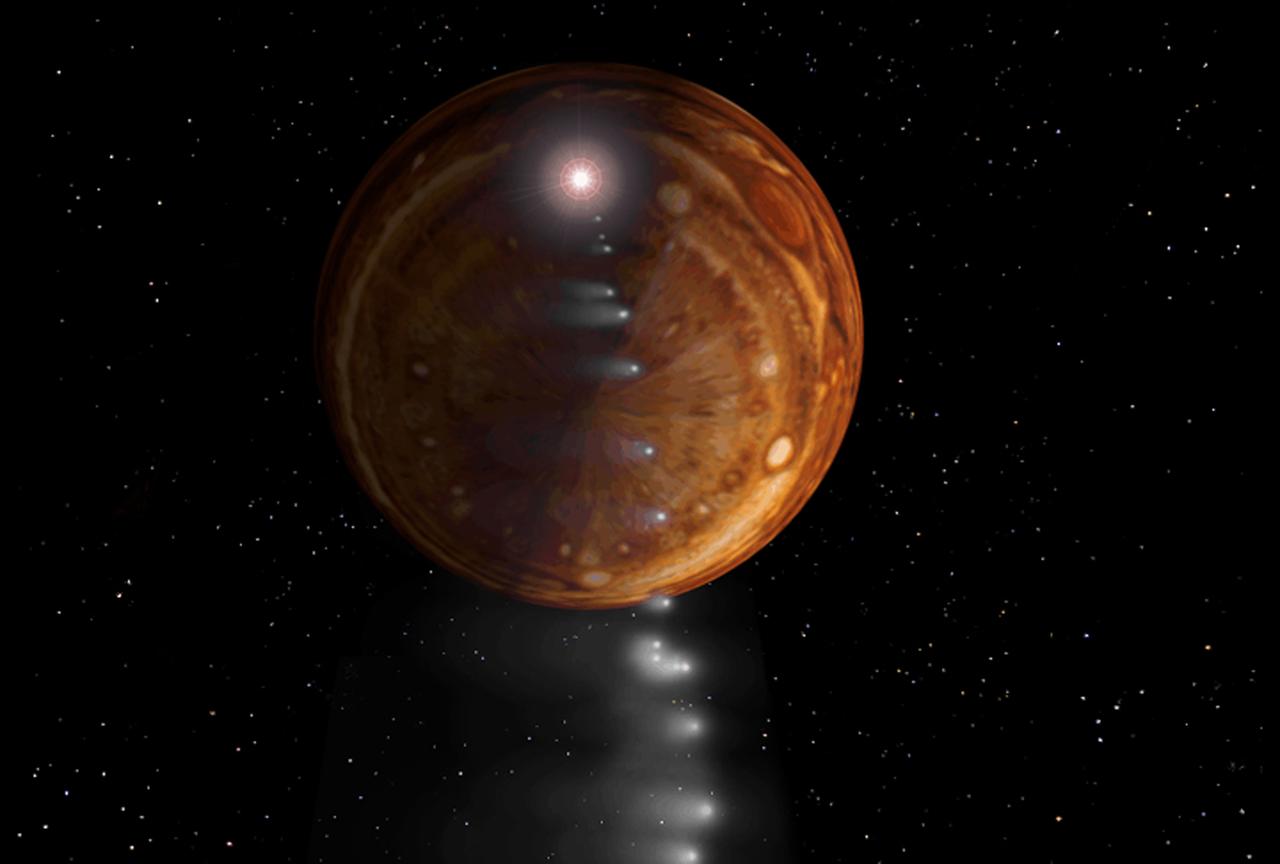
This illustration of the Comet-Shoemaker/Levy collision shows the first piece of the remains of the comet crashing into Jupiter. This event occurred in 1994 after tidal forces from Jupiter caused the comet to break up into 21 separate pieces. Although on a very different scale, the physical mechanism for the breakup of Shoemaker/Levy also caused the tidal disruption of the star in RX J1242-11. (Illustration: SEDS/D. Seal (edited by CXC/M. Weiss)

Tidal disruption event Every galaxy has a black hole at its center. Usually they are quiet, without gas accretions, like the one in our Milky Way. But if a star creeps too close to the black hole, the gravitational tides can rip away the star’s gaseous matter. Like water spinning around a drain, the gas swirls into a disk around the black hole at such speeds that it heats to millions of degrees. As an inner ring of gas spins into the black hole, gas particles shoot outward from the black hole’s polar regions. Like bullets shot from a rifle, they zoom through the jets at velocities close to the speed of light. Astronomers using NASA’s Hubble Space Telescope observed correlations between supermassive black holes and an event similar to tidal disruption, pictured above in the Centaurus A galaxy. Certain galaxies have shining centers, illuminated by heated gas circling around a supermassive black hole. Matter escapes where it can, forming two jets of plasma moving near the speed of light. To learn more about the relationship between galaxies and the black holes at their cores, go to NASA’s Hubble Space Telescope: <a href="http://www.nasa.gov/mission_pages/hubble/main/" rel="nofollow">www.nasa.gov/mission_pages/hubble/main/</a> -------------------------------- Original caption: A team of astronomers using the Hubble Space Telescope found an unambiguous link between the presence of supermassive black holes that power high-speed, radio-signal-emitting jets and the merger history of their host galaxies. Almost all galaxies with the jets were found to be merging with another galaxy, or to have done so recently. Credit: NASA/ESA/STScI <b><a href="http://www.nasa.gov/audience/formedia/features/MP_Photo_Guidelines.html" rel="nofollow">NASA image use policy.</a></b> <b><a href="http://www.nasa.gov/centers/goddard/home/index.html" rel="nofollow">NASA Goddard Space Flight Center</a></b> enables NASA’s mission through four scientific endeavors: Earth Science, Heliophysics, Solar System Exploration, and Astrophysics. Goddard plays a leading role in NASA’s accomplishments by contributing compelling scientific knowledge to advance the Agency’s mission. <b>Follow us on <a href="http://twitter.com/NASAGoddardPix" rel="nofollow">Twitter</a></b> <b>Like us on <a href="http://www.facebook.com/pages/Greenbelt-MD/NASA-Goddard/395013845897?ref=tsd" rel="nofollow">Facebook</a></b> <b>Find us on <a href="http://instagrid.me/nasagoddard/?vm=grid" rel="nofollow">Instagram</a></b>