
Stennis Space Center Director Patrick Scheuermann (right) and Naval Meteorology and Oceanography Command Chief of Staff James Pettigrew drop the first shovelfuls of dirt on a time capsule to be opened on the rocket engine test facility's 100th anniversary in 2061. The time capsule was placed in front of the Roy S. Estess Building on Oct. 25 as Stennis concluded celebrations of its 50th anniversary. NASA publicly announced plans to build the rocket engine test site Oct. 25, 1961.

Stennis Space Center Director Patrick Scheuermann (right) and Naval Meteorology and Oceanography Command Chief of Staff James Pettigrew drop the first shovelfuls of dirt on a time capsule to be opened on the rocket engine test facility's 100th anniversary in 2061. The time capsule was placed in front of the Roy S. Estess Building on Oct. 25 as Stennis concluded celebrations of its 50th anniversary.
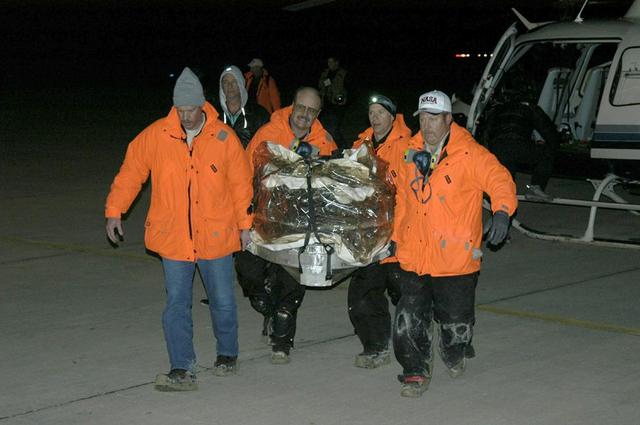
This image shows the return capsule inside a protective covering. The capsule, which landed at 2:10 a.m. Pacific time 3:10 a.m. Mountain time, contains cometary and interstellar samples gathered by NASA Stardust spacecraft.
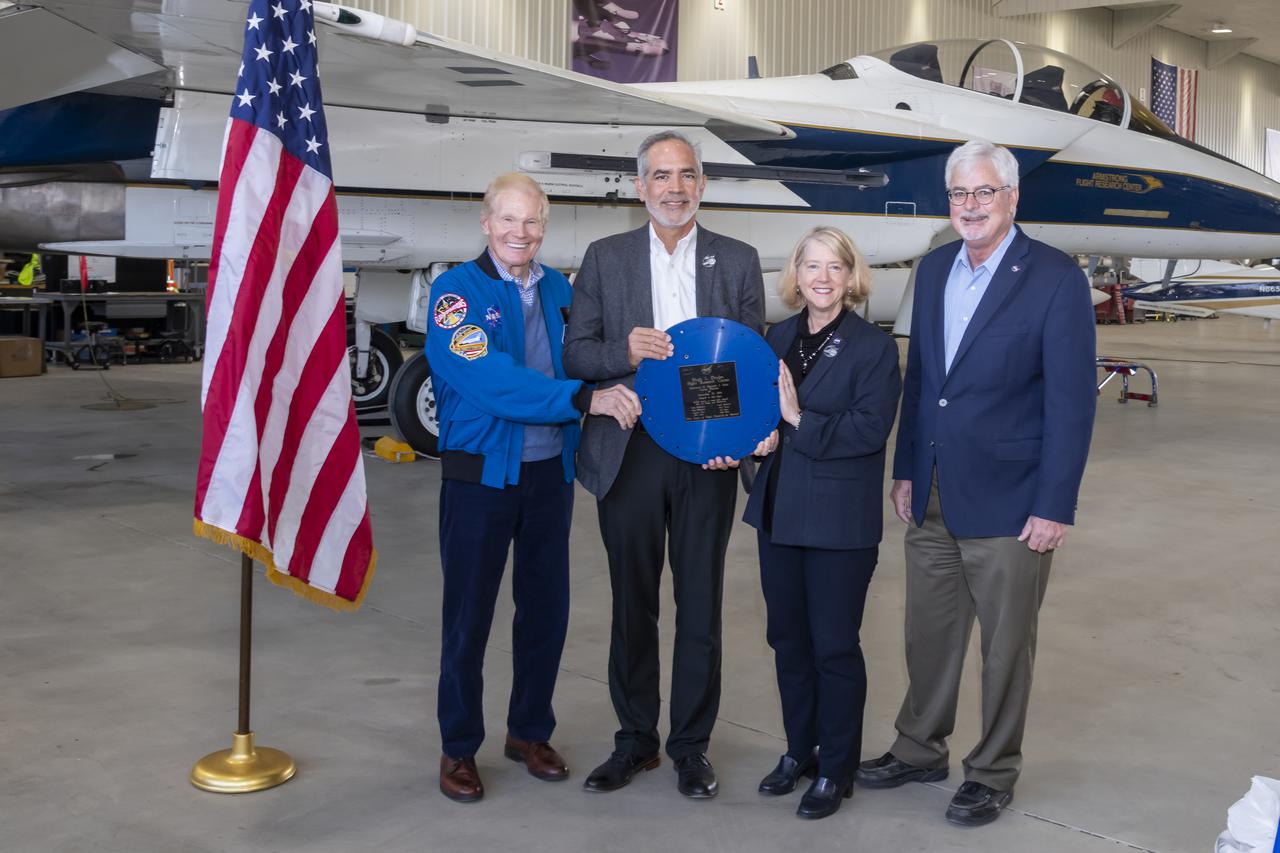
NASA Administrator Bill Nelson, from left, NASA Armstrong Flight Research Center Director David McBride, NASA Deputy Administrator Pam Melroy, and NASA Armstrong Deputy Center Director Patrick Stoliker, display the lid to a time capsule on Oct. 13. The time capsule was sealed on the center's 50th anniversary and opened to commemorate its 75th anniversary. NASA Armstrong is in Edwards, California.
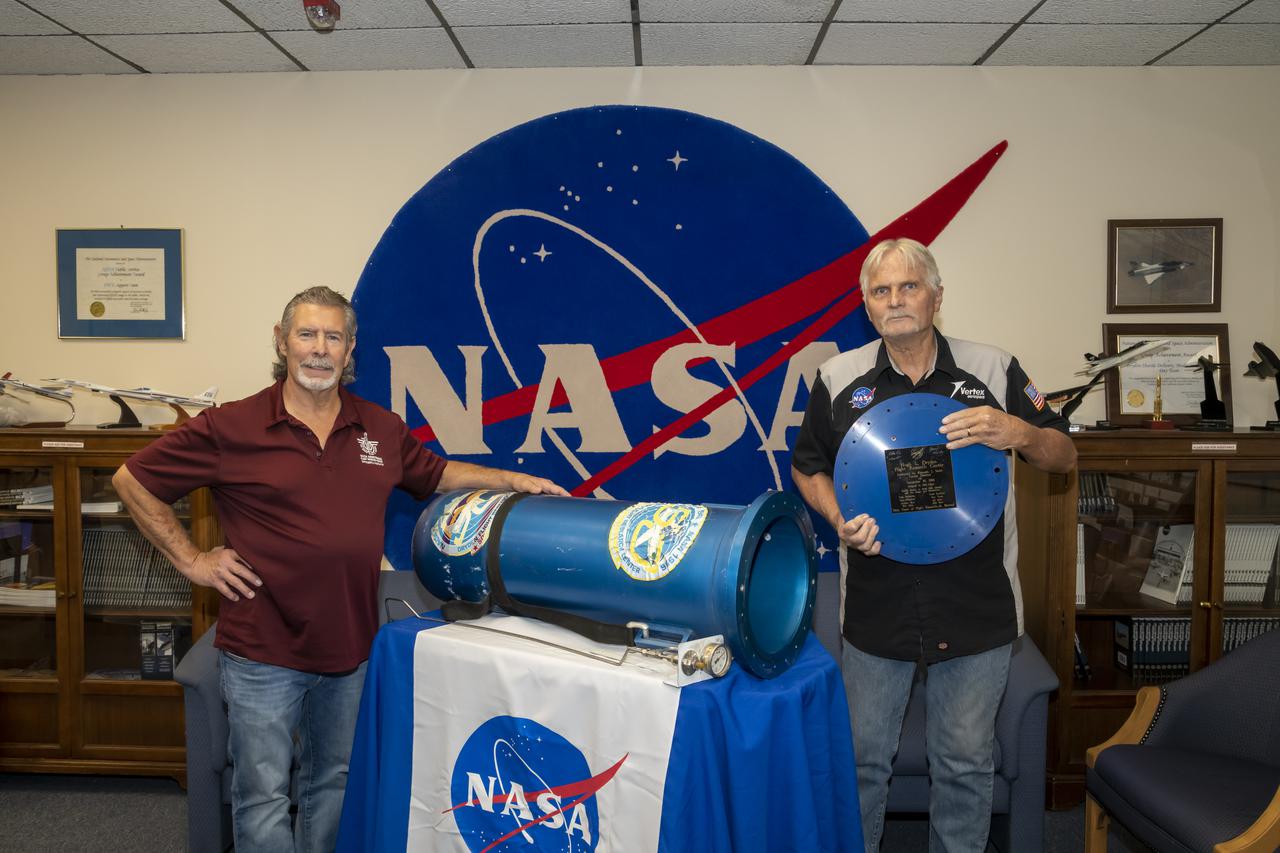
Andy Blua and Don Whitfield stand by the time capsule they helped construct 25 years ago on NASA Armstrong Flight Research Center's 50th anniversary. It was recently opened at the center, located in Edwards, California, on Oct. 13, 2021. The time capsule was opened as part of the activities commemorating the center's 75th anniversary.
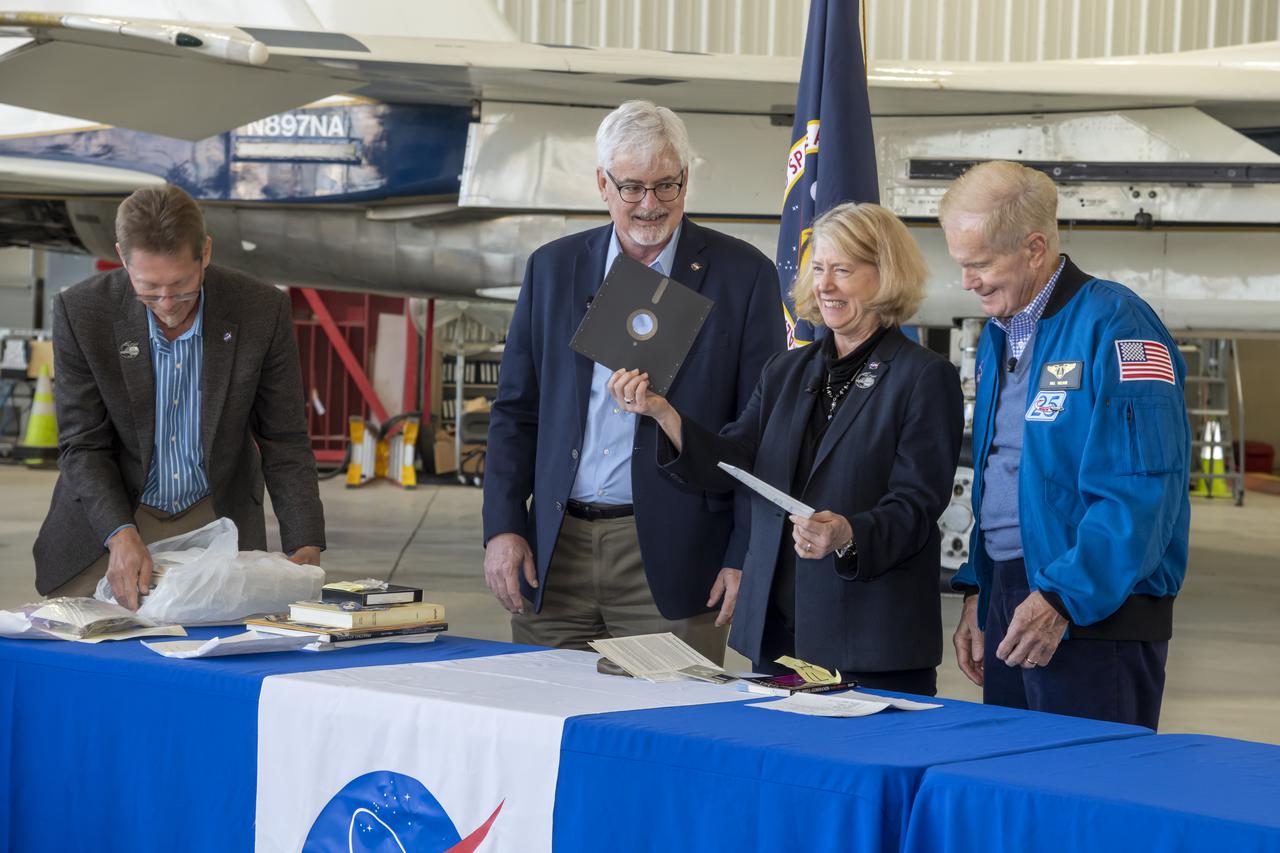
NASA Deputy Administrator Pam Melroy shows NASA Administrator Bill Nelson and NASA Armstrong Flight Research Center Deputy Director Patrick Stolicker a floppy disk, one of the treasures contained in a time capsule opened Oct. 13. The capsule was sealed on the center's 50th anniversary and opened to commemorate its 75th anniversary. NASA Armstrong is in Edwards, California.
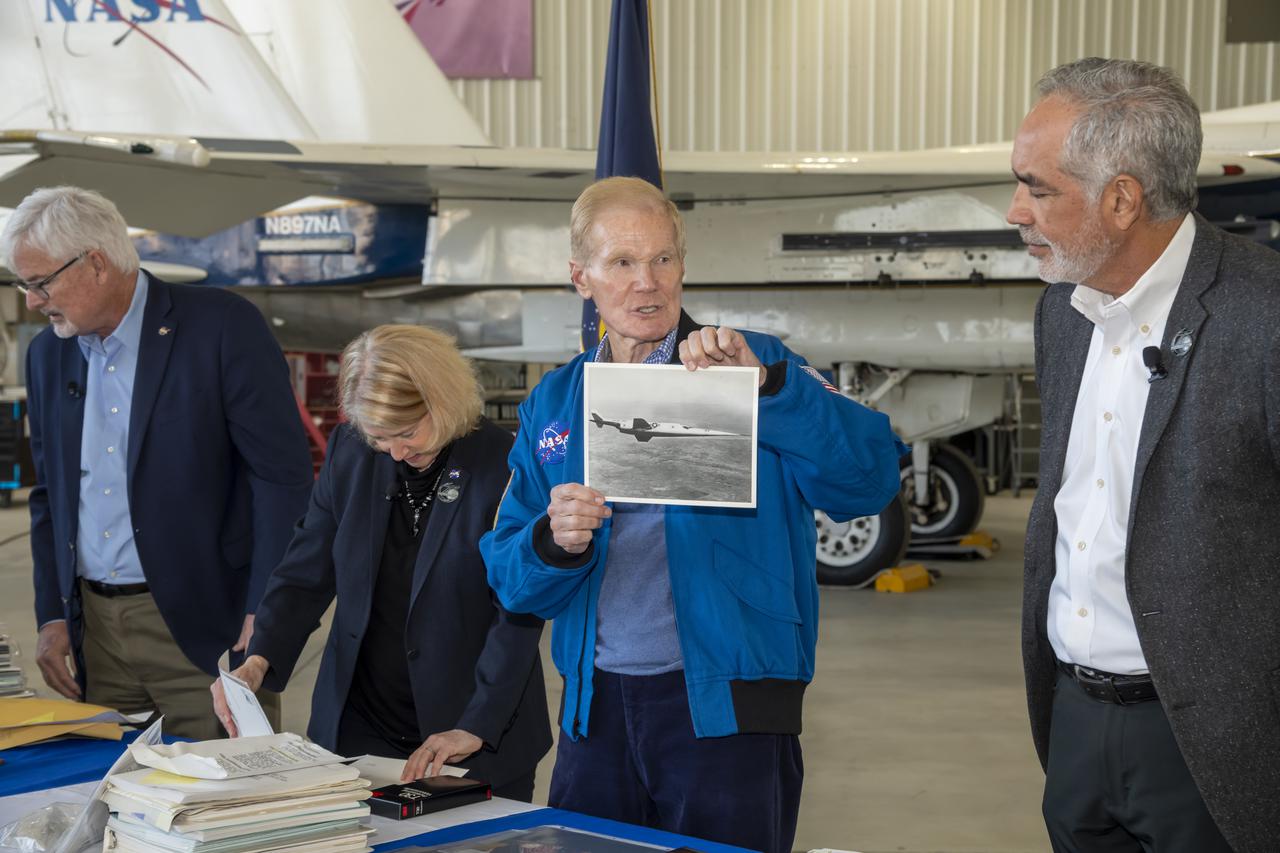
NASA Administrator Bill Nelson shows a picture of the X-3 to NASA Armstrong Flight Research Center Director David McBride on Oct. 13. NASA Armstrong Deputy Center Director Patrick Stoliker and NASA Deputy Administrator Pam Melroy also are with Nelson and McBride. The photo was contained in a time capsule that was sealed on the center's 50th anniversary and opened to commemorate its 75th anniversary. NASA Armstrong is in Edwards, California.
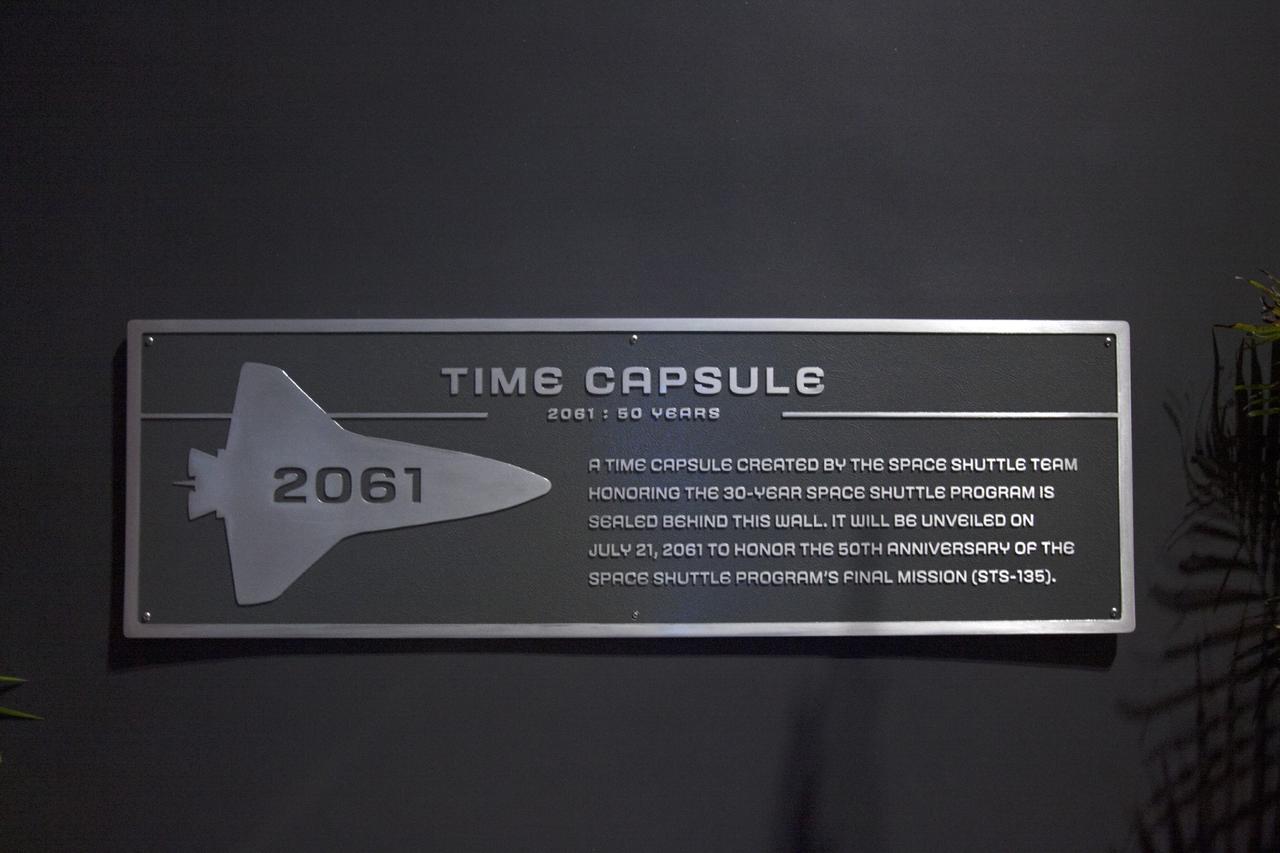
CAPE CANAVERAL, Fla. -- At the Kennedy Space Center Visitor Complex in Florida, a Space Shuttle Program time capsule has been enshrined capsule in a secured vault within the walls of the 90,000-square-foot Space Shuttle Atlantis home. The time capsule, containing artifacts and other memorabilia associated with the history of the program is designated to be opened on the 50th anniversary of the shuttle's final landing, STS-135. The new $100 million "Space Shuttle Atlantis" facility includes interactive exhibits that tell the story of the 30-year Space Shuttle Program and highlight the future of space exploration. Photo credit: NASA/Jim Grossmann
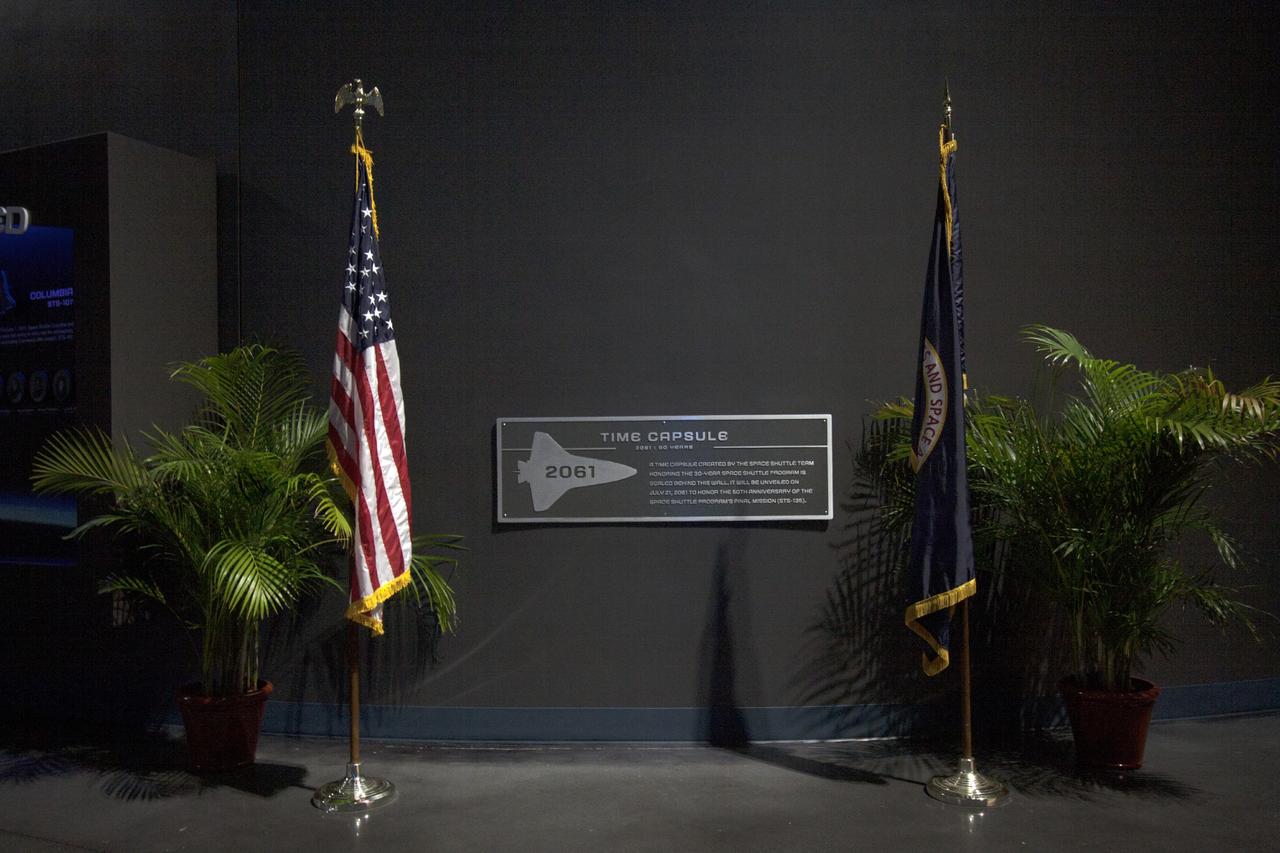
CAPE CANAVERAL, Fla. -- At the Kennedy Space Center Visitor Complex in Florida, a Space Shuttle Program time capsule has been enshrined capsule in a secured vault within the walls of the 90,000-square-foot Space Shuttle Atlantis home. The time capsule, containing artifacts and other memorabilia associated with the history of the program is designated to be opened on the 50th anniversary of the shuttle's final landing, STS-135. The new $100 million "Space Shuttle Atlantis" facility includes interactive exhibits that tell the story of the 30-year Space Shuttle Program and highlight the future of space exploration. Photo credit: NASA/Jim Grossmann

Ames and Moffett Field (MFA) historical sites and memorials Navy Memorial anchor display on Shennandoah plaza - dedication plaque in memory of the Fourteen Officers and men USS Shennandoah lost September 3, 1925. A 50th Anniversary Time Capsule A Sundial presented by R. Adml. Faronholt November 21, 1933 and a 100 year Time Capsule dedicated on July 1, 1994
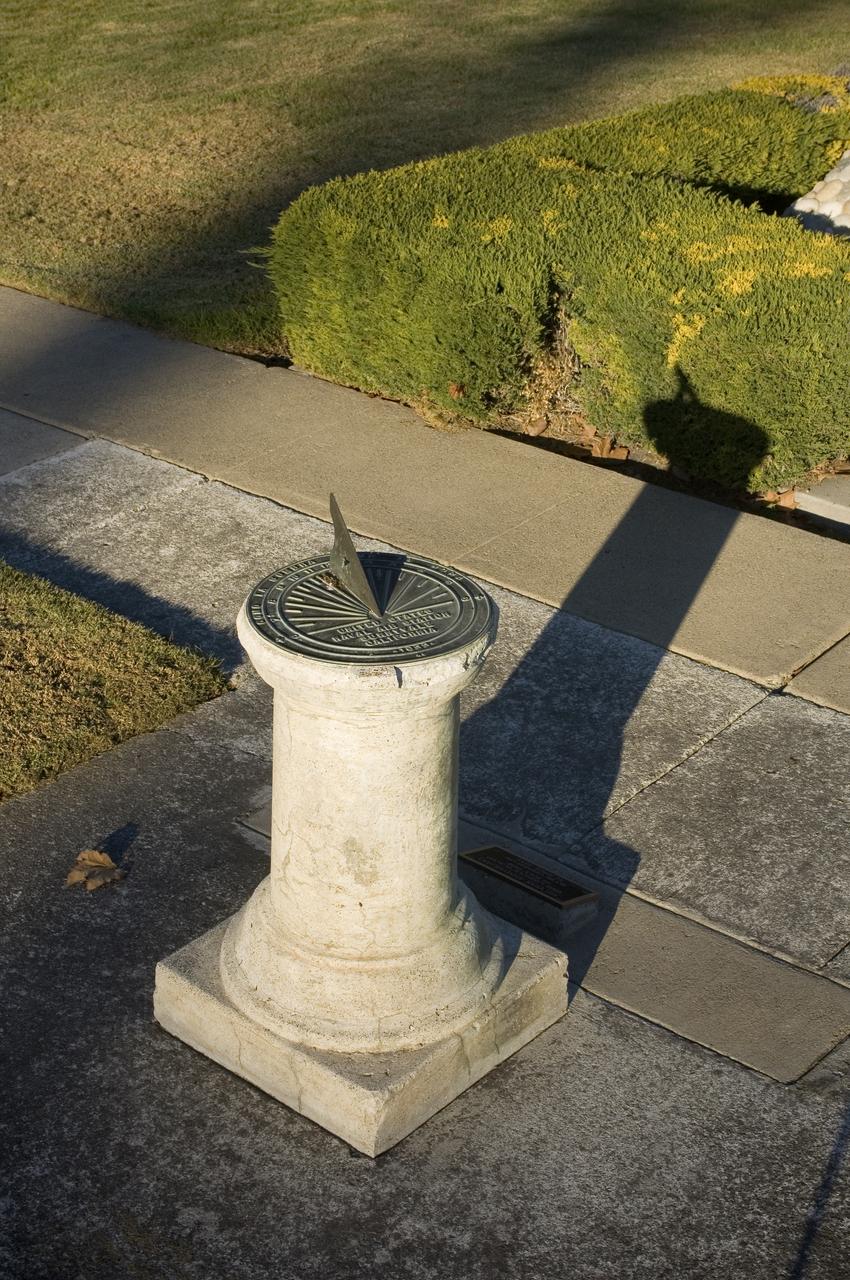
Ames and Moffett Field (MFA) historical sites and memorials Navy Memorial anchor display on Shennandoah plaza - dedication plaque in memory of the Fourteen Officers and men USS Shennandoah lost September 3, 1925. A 50th Anniversary Time Capsule A Sundial presented by R. Adml. Faronholt November 21, 1933 and a 100 year Time Capsule dedicated on July 1, 1994
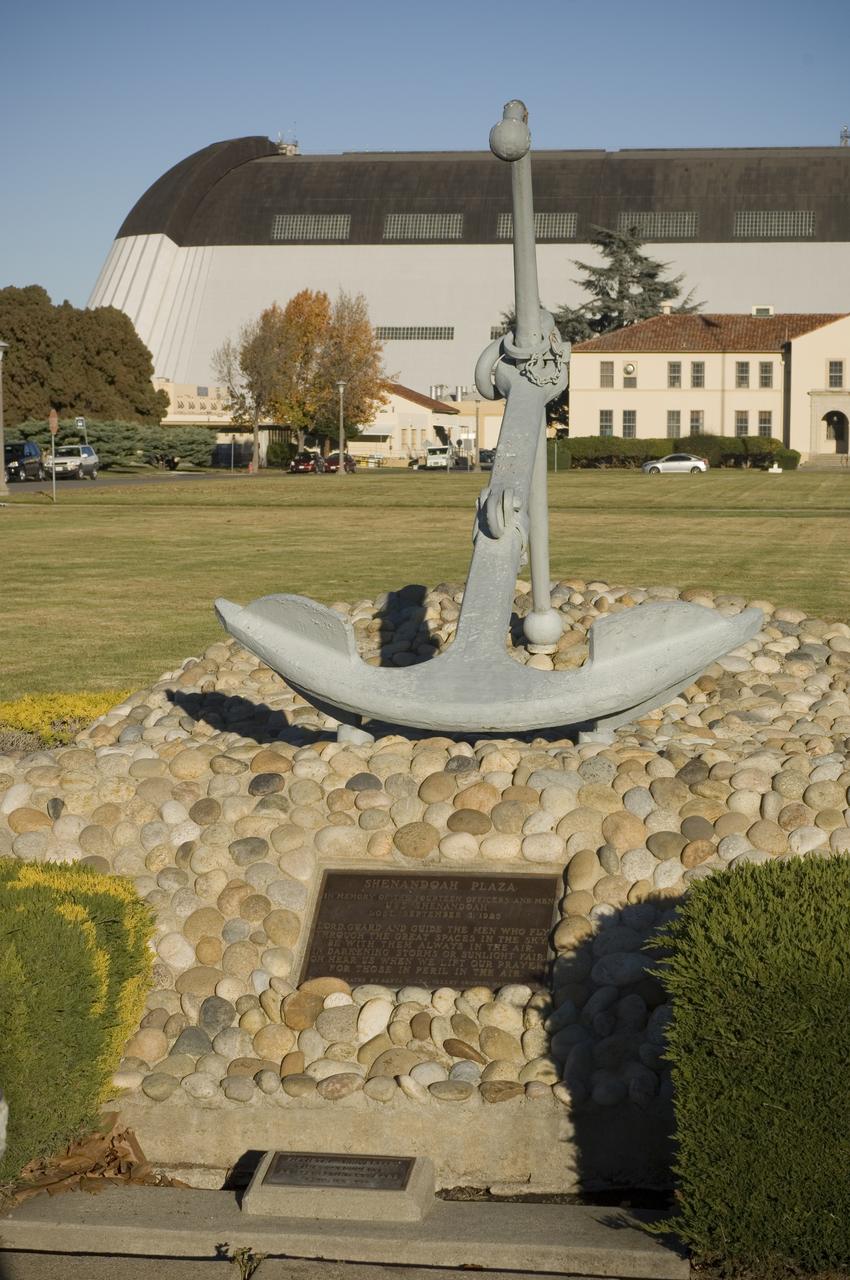
Ames and Moffett Field (MFA) historical sites and memorials Navy Memorial anchor display on Shennandoah plaza - dedication plaque in memory of the Fourteen Officers and men USS Shennandoah lost September 3, 1925. A 50th Anniversary Time Capsule A Sundial presented by R. Adml. Faronholt November 21, 1933 and a 100 year Time Capsule dedicated on July 1, 1994
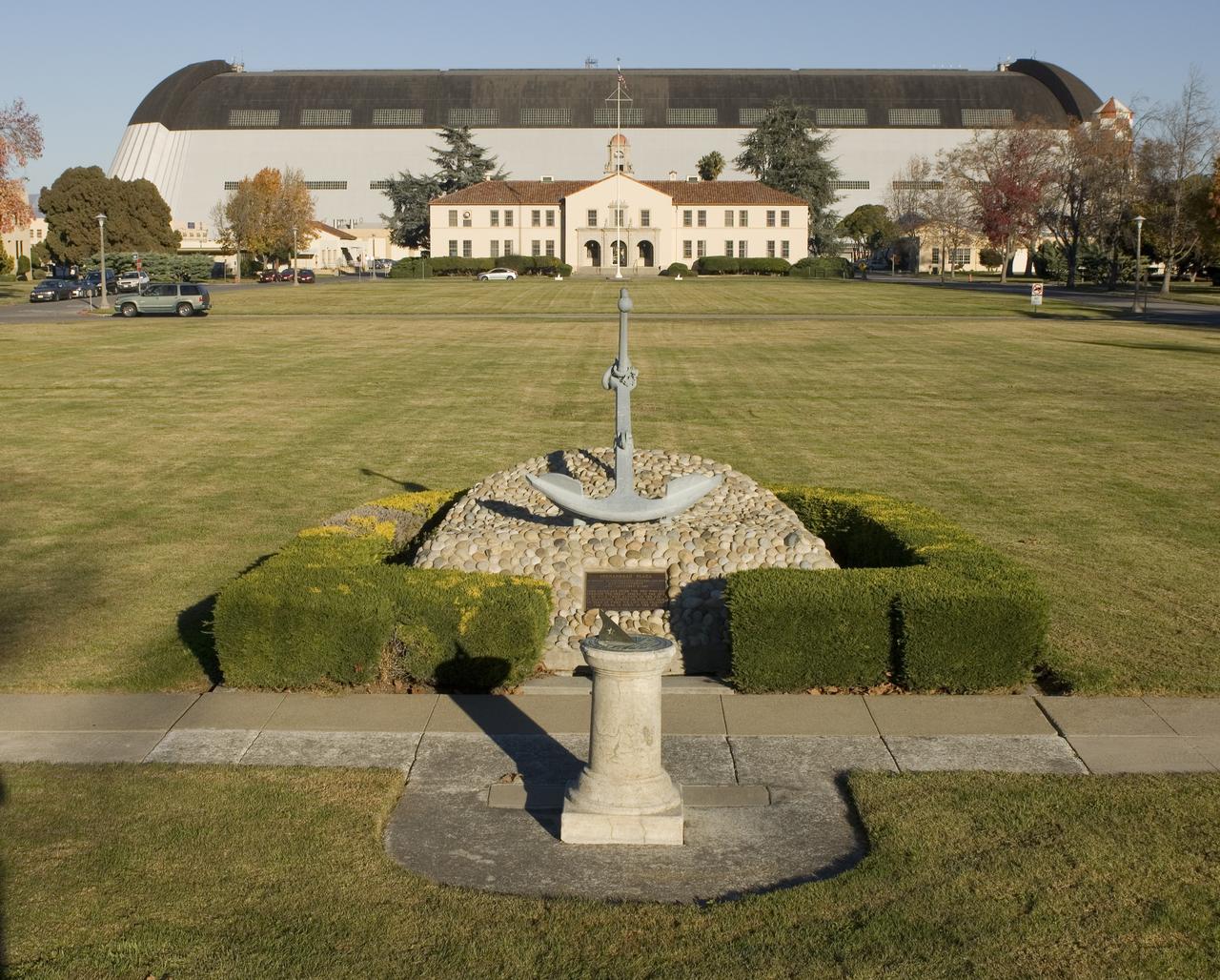
Ames and Moffett Field (MFA) historical sites and memorials Navy Memorial anchor display on Shennandoah plaza - dedication plaque in memory of the Fourteen Officers and men USS Shennandoah lost September 3, 1925. A 50th Anniversary Time Capsule A Sundial presented by R. Adml. Faronholt November 21, 1933 and a 100 year Time Capsule dedicated on July 1, 1994
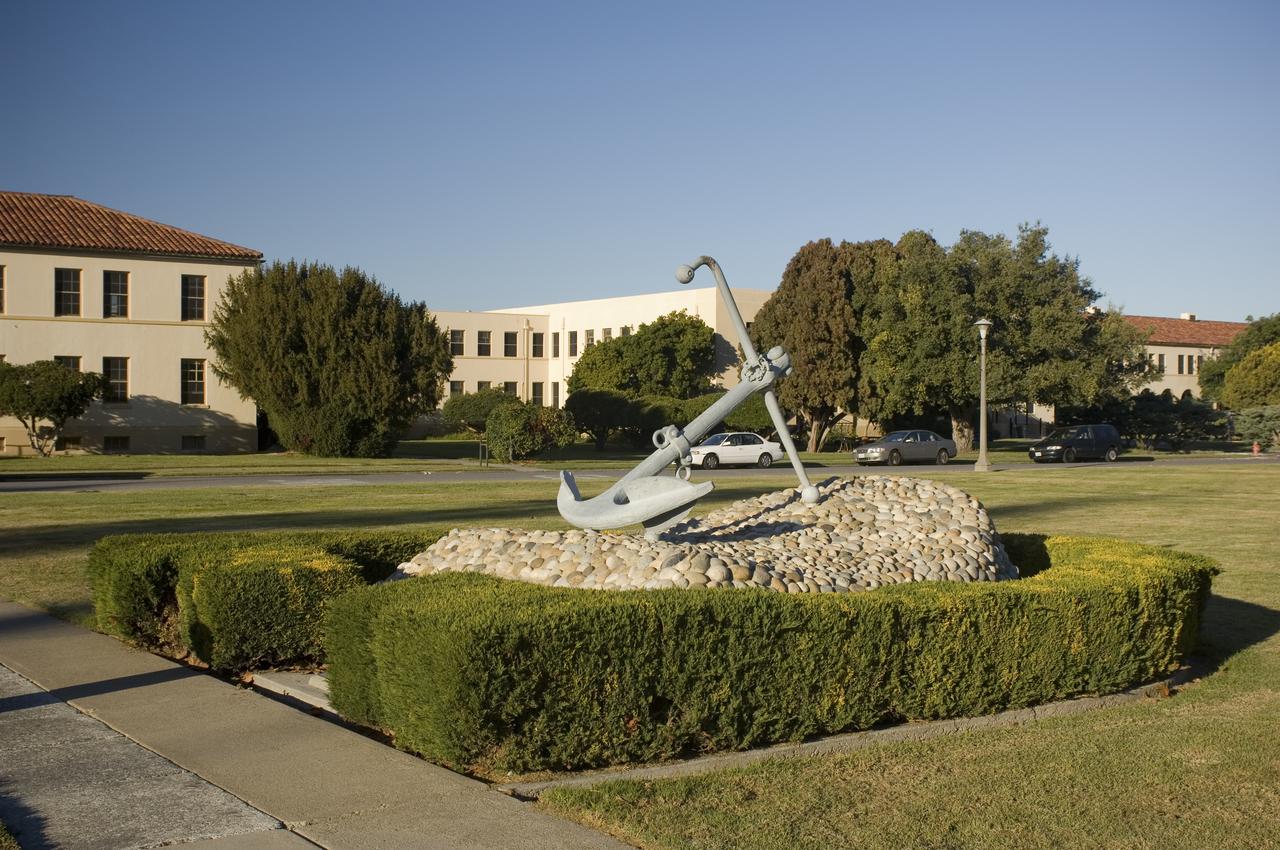
Ames and Moffett Field (MFA) historical sites and memorials Navy Memorial anchor display on Shennandoah plaza - dedication plaque in memory of the Fourteen Officers and men USS Shennandoah lost September 3, 1925. A 50th Anniversary Time Capsule A Sundial presented by R. Adml. Faronholt November 21, 1933 and a 100 year Time Capsule dedicated on July 1, 1994
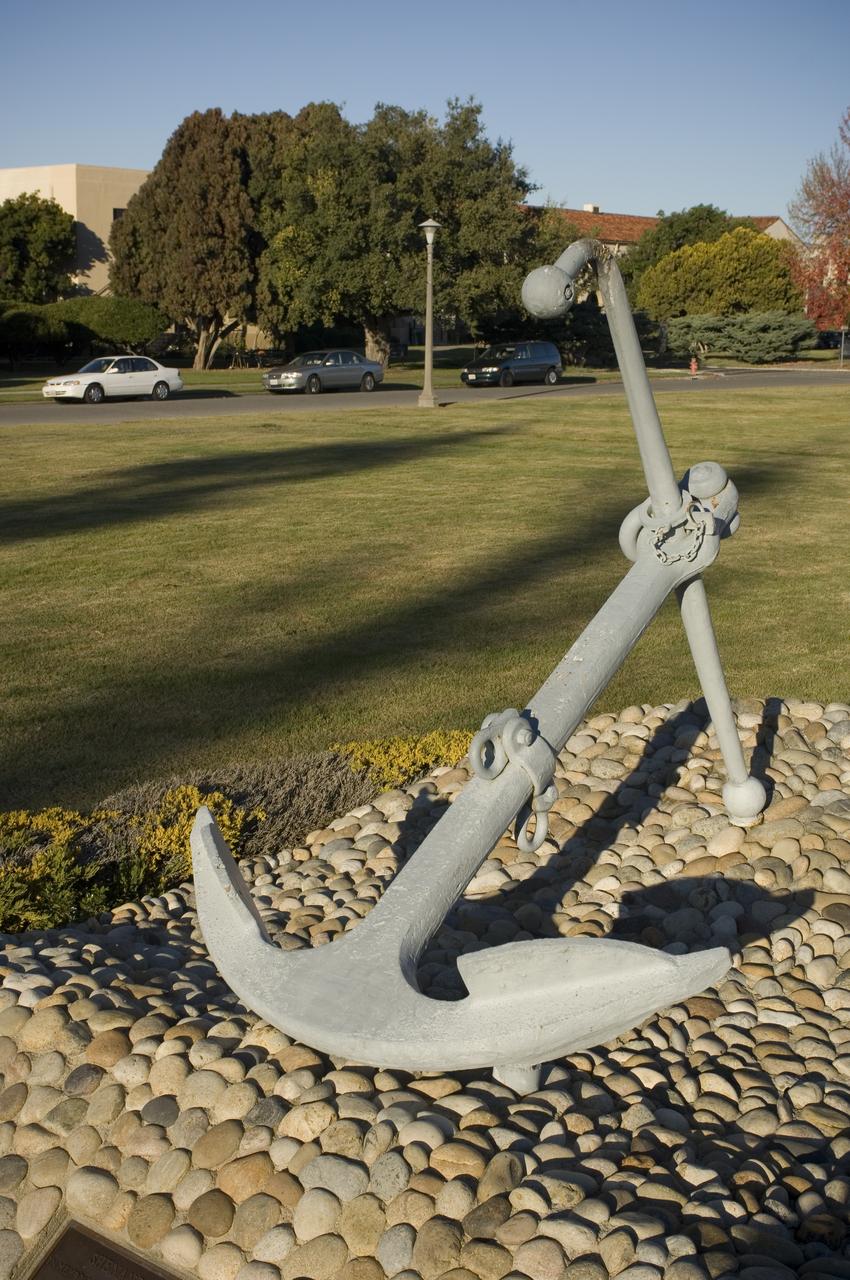
Ames and Moffett Field (MFA) historical sites and memorials Navy Memorial anchor display on Shennandoah plaza - dedication plaque in memory of the Fourteen Officers and men USS Shennandoah lost September 3, 1925. A 50th Anniversary Time Capsule A Sundial presented by R. Adml. Faronholt November 21, 1933 and a 100 year Time Capsule dedicated on July 1, 1994
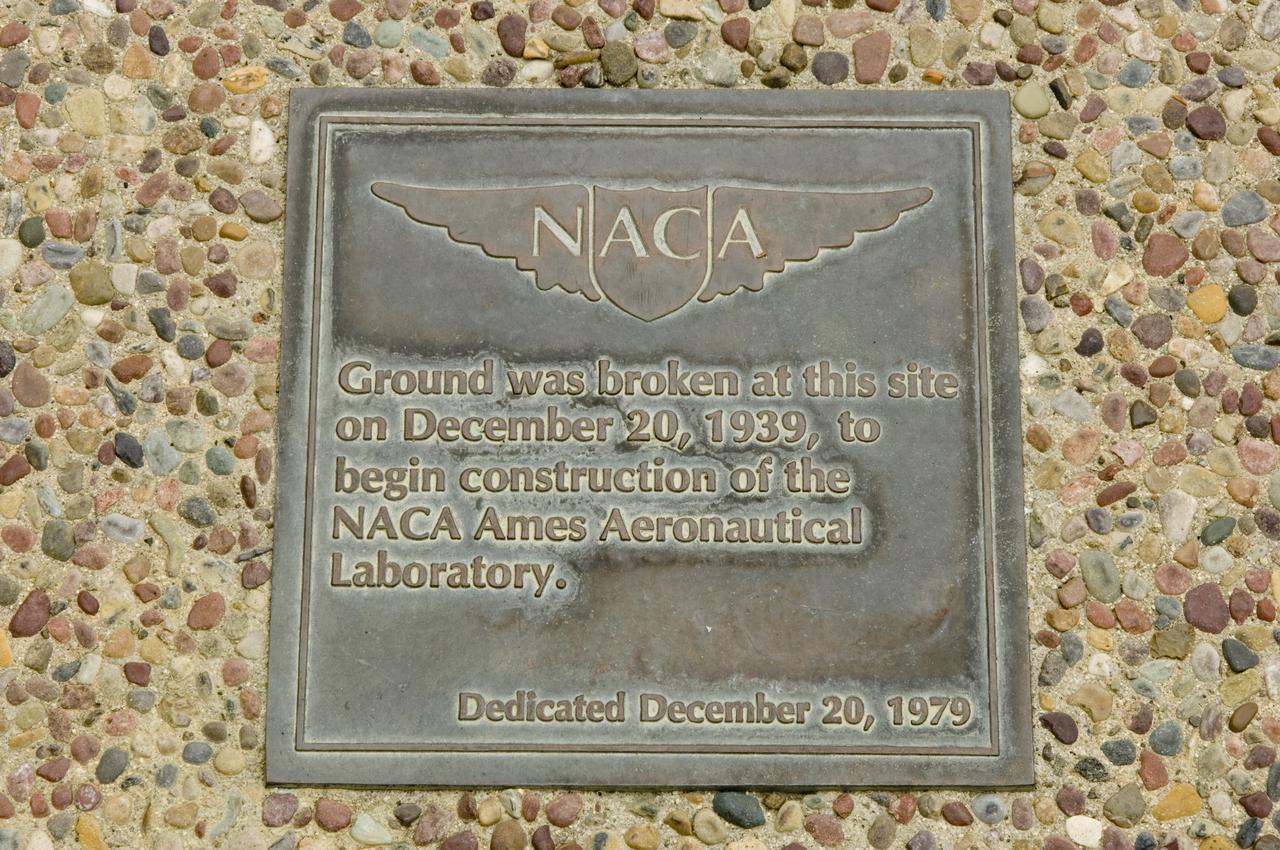
Ames and Moffett Field (MFA) historical sites and memorials Time capsule and cube display ot courner of DeFrance and King Road (50th year anniversary placement), with detail on brass plaque in walkway (40th year anniversary placement)
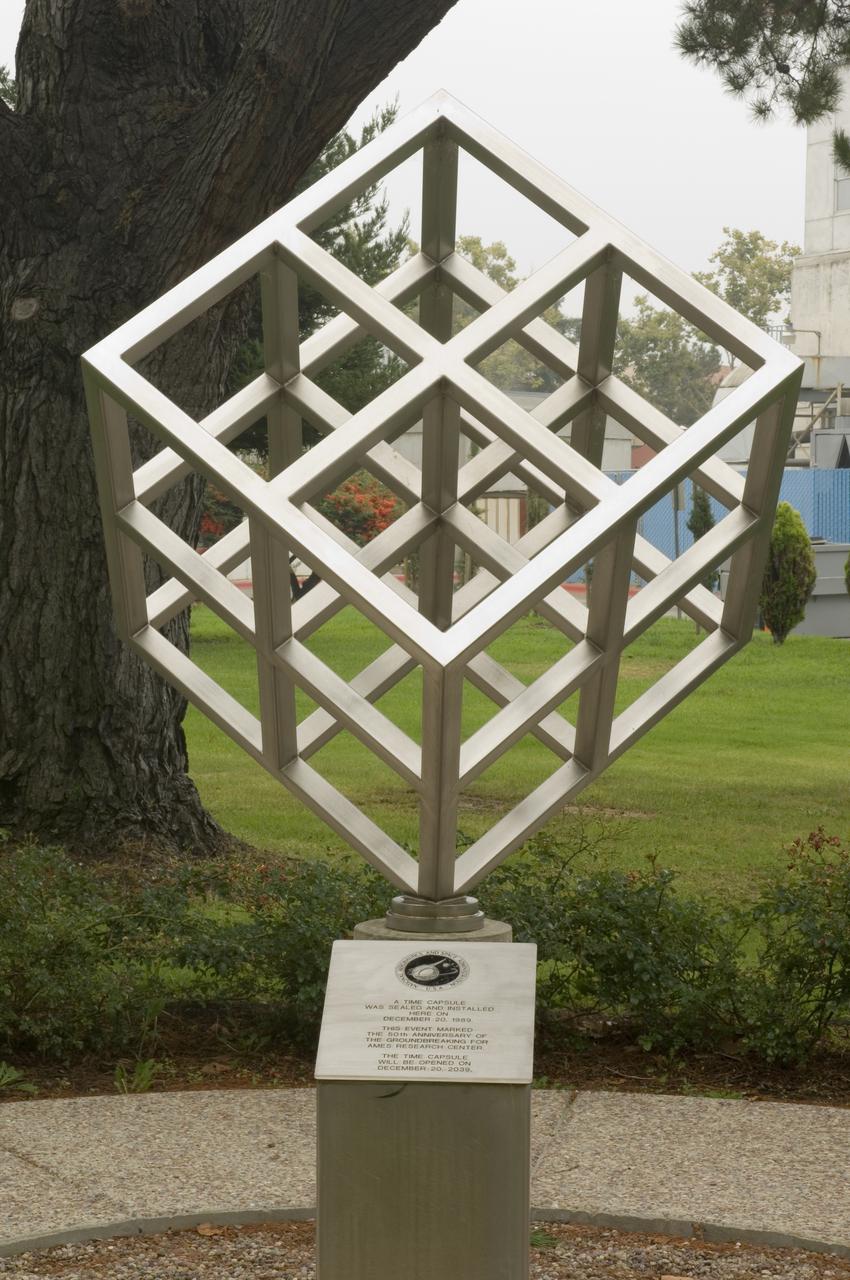
Ames and Moffett Field (MFA) historical sites and memorials Time capsule and cube display ot courner of DeFrance and King Road (50th year anniversary placement), with detail on brass plaque in walkway (40th year anniversary placement)
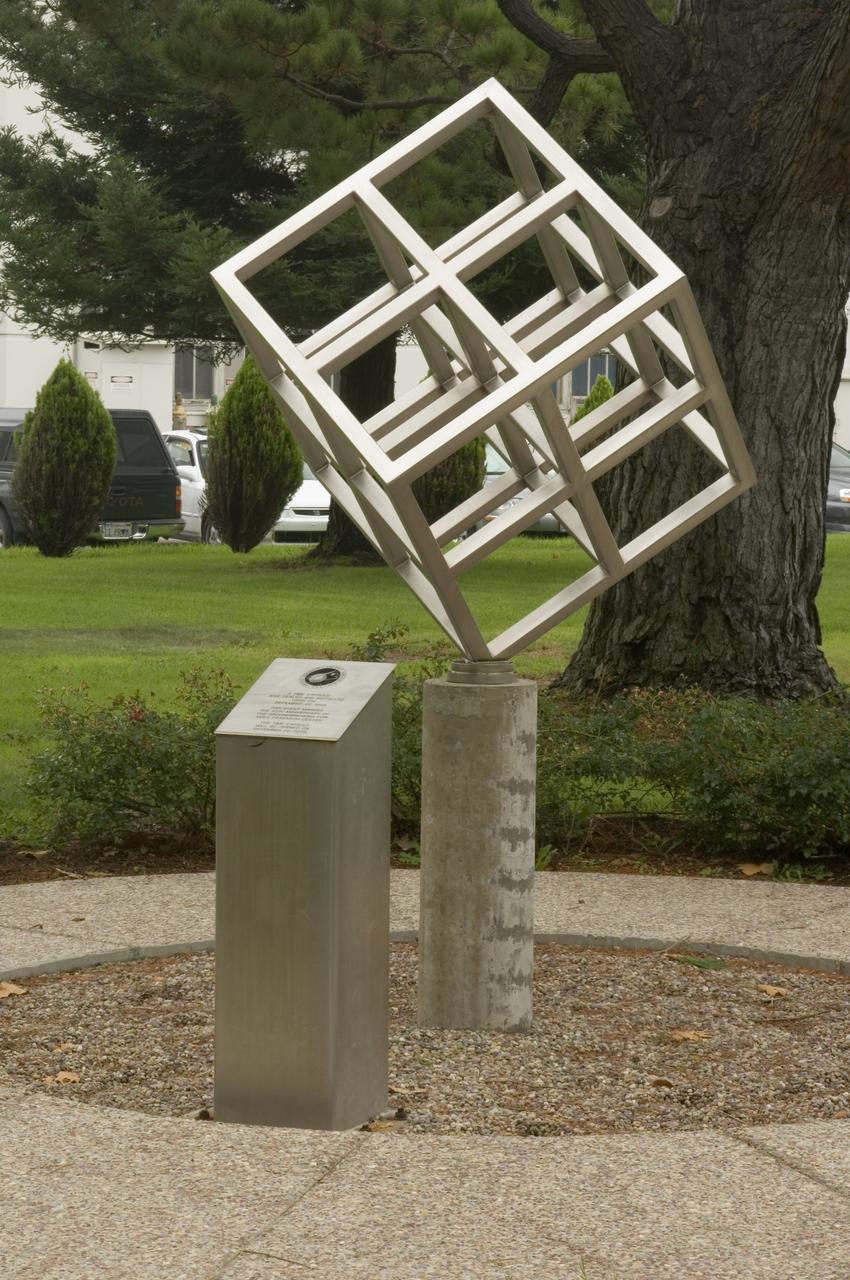
Ames and Moffett Field (MFA) historical sites and memorials Time capsule and cube display ot courner of DeFrance and King Road (50th year anniversary placement), with detail on brass plaque in walkway
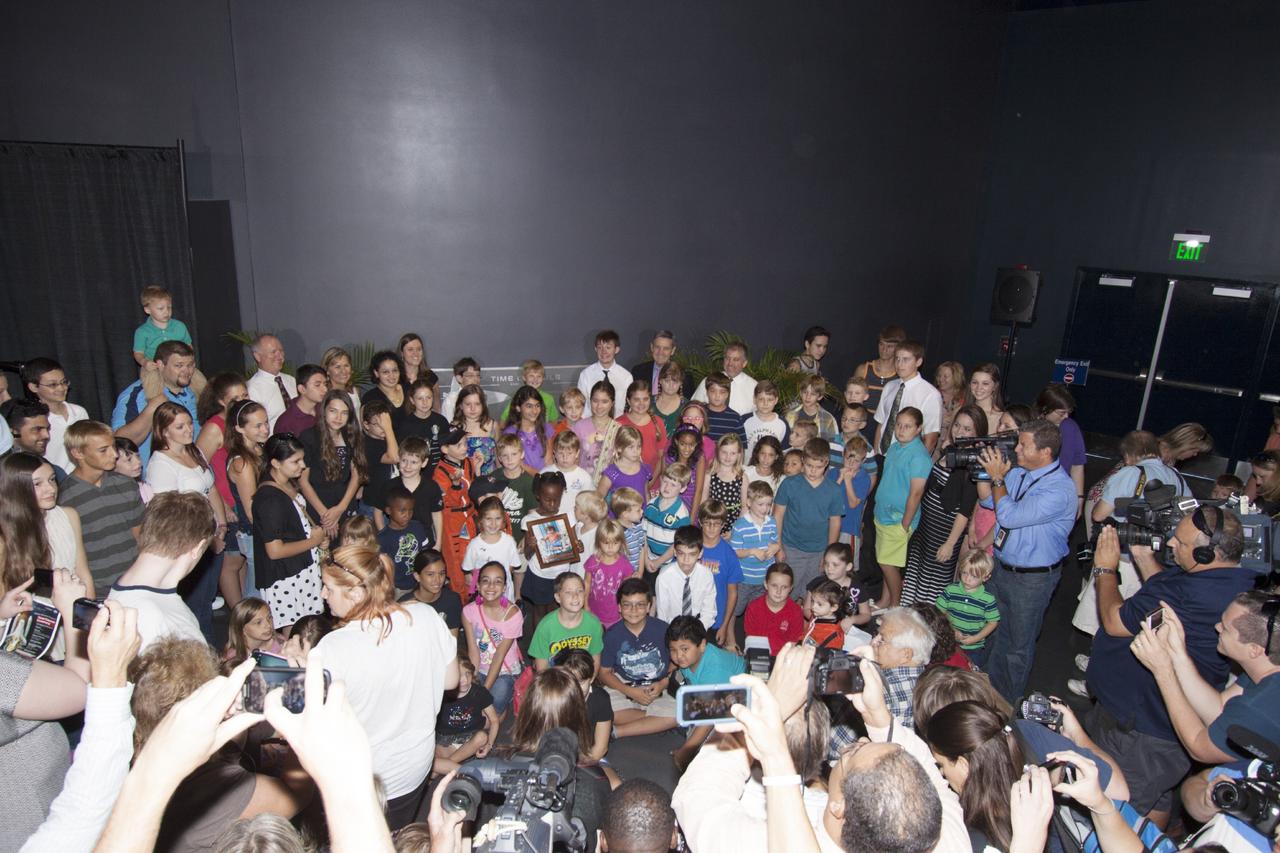
CAPE CANAVERAL, Fla. -- At the Kennedy Space Center Visitor Complex in Florida, future space explorers gather during ceremonies to enshrine a Space Shuttle Program time capsule in a secured vault within the walls of the Space Shuttle Atlantis home at the Kennedy Space Center Visitor Complex. The time capsule, containing artifacts and other memorabilia associated with the history of the program is designated to be opened on the 50th anniversary of the shuttle's final landing, STS-135. The new $100 million "Space Shuttle Atlantis" facility includes interactive exhibits that tell the story of the 30-year Space Shuttle Program and highlight the future of space exploration. Photo credit: NASA/Jim Grossmann
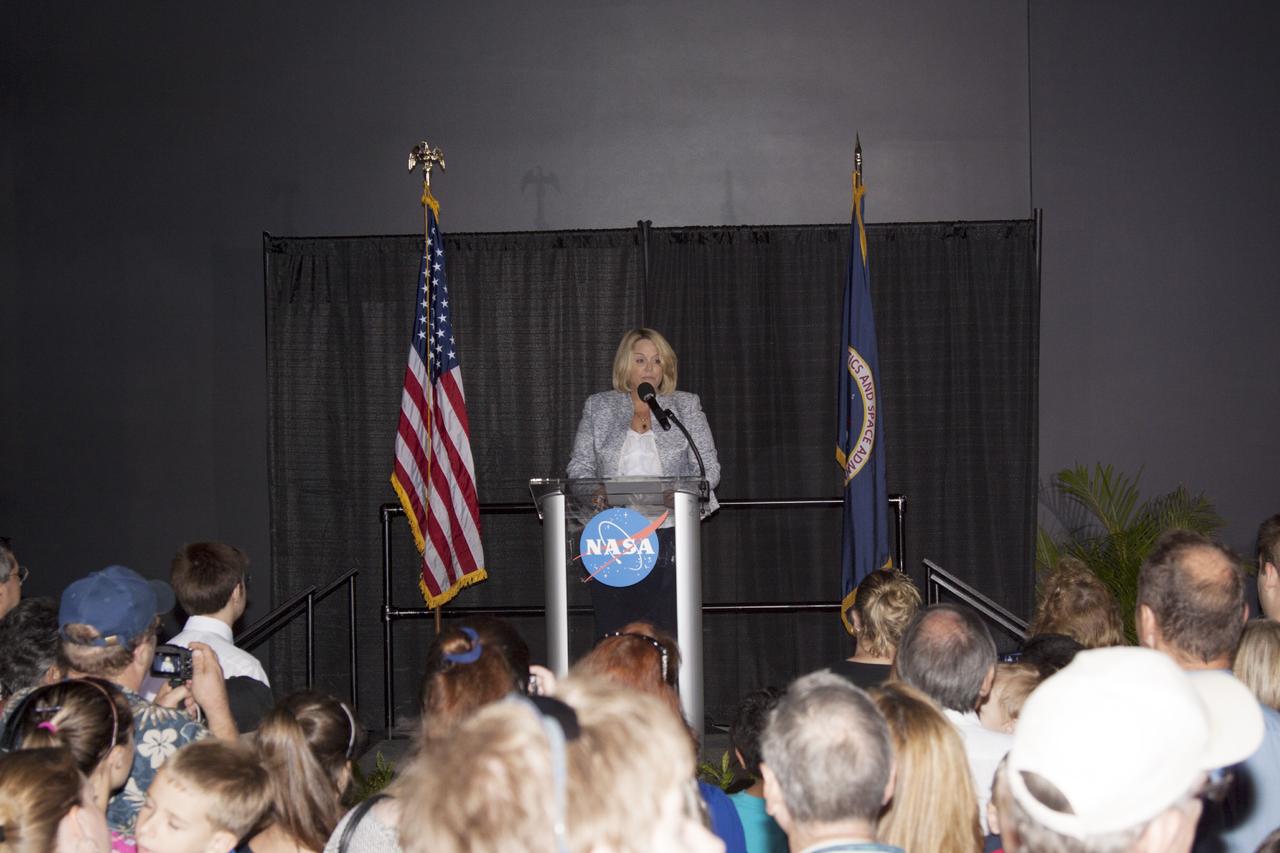
CAPE CANAVERAL, Fla. -- Cheryl Hurst, director of NASA Education and External Relations speaks during a ceremony to enshrine a Space Shuttle Program time capsule in a secured vault within the walls of the Space Shuttle Atlantis home at the Kennedy Space Center Visitor Complex. The time capsule, containing artifacts and other memorabilia associated with the history of the program is designated to be opened on the 50th anniversary of the shuttle's final landing, STS-135. The new $100 million "Space Shuttle Atlantis" facility includes interactive exhibits that tell the story of the 30-year Space Shuttle Program and highlight the future of space exploration. Photo credit: NASA/Jim Grossmann

CAPE CANAVERAL, Fla. -- Kennedy Space Center Director Bob Cabana, a former space shuttle commander, speaks to guests at the spaceport's visitor complex. The ceremony took place to enshrine a Space Shuttle Program time capsule in a secured vault within the walls of the Space Shuttle Atlantis' home at the visitor complex. The time capsule, containing artifacts and other memorabilia associated with the history of the program is designated to be opened on the 50th anniversary of the shuttle's final landing, STS-135. The new $100 million "Space Shuttle Atlantis" facility includes interactive exhibits that tell the story of the 30-year Space Shuttle Program and highlight the future of space exploration. Photo credit: NASA/Jim Grossmann
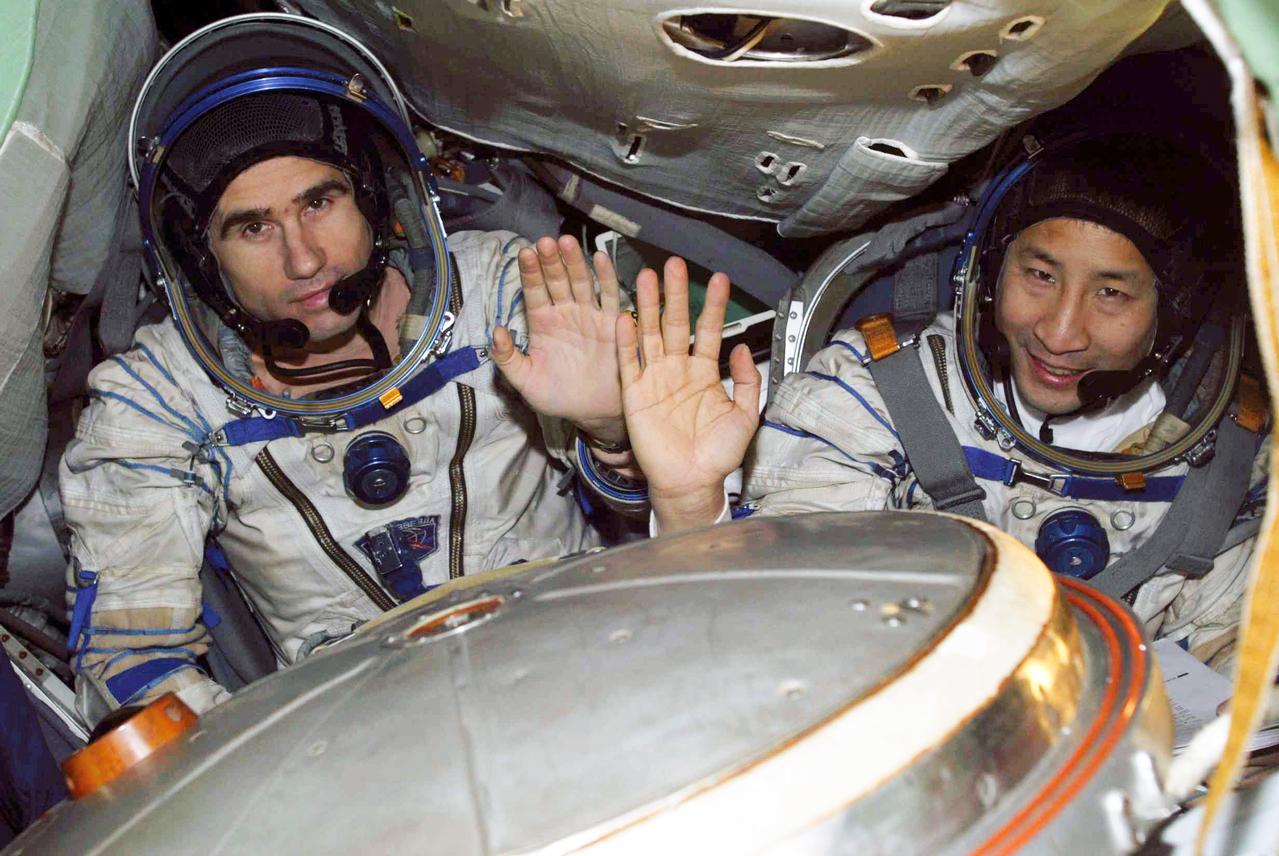
JSC2003-E-28142 (March 2003) --- Cosmonaut Yuri I. Malenchenko (left), Expedition Seven commander; and astronaut Edward T. Lu, NASA ISS science officer and flight engineer, take time out from practicing launch procedures in a Soyuz capsule simulator as part of their training at the Gagarin Cosmonaut Training Center in Star City, Russia. Malenchenko and Lu are scheduled to be launched in the spring of this year from the Baikonur Cosmodrome in Kazakhstan in a Soyuz TMA-2 capsule to begin a six-month stay on the International Space Station.
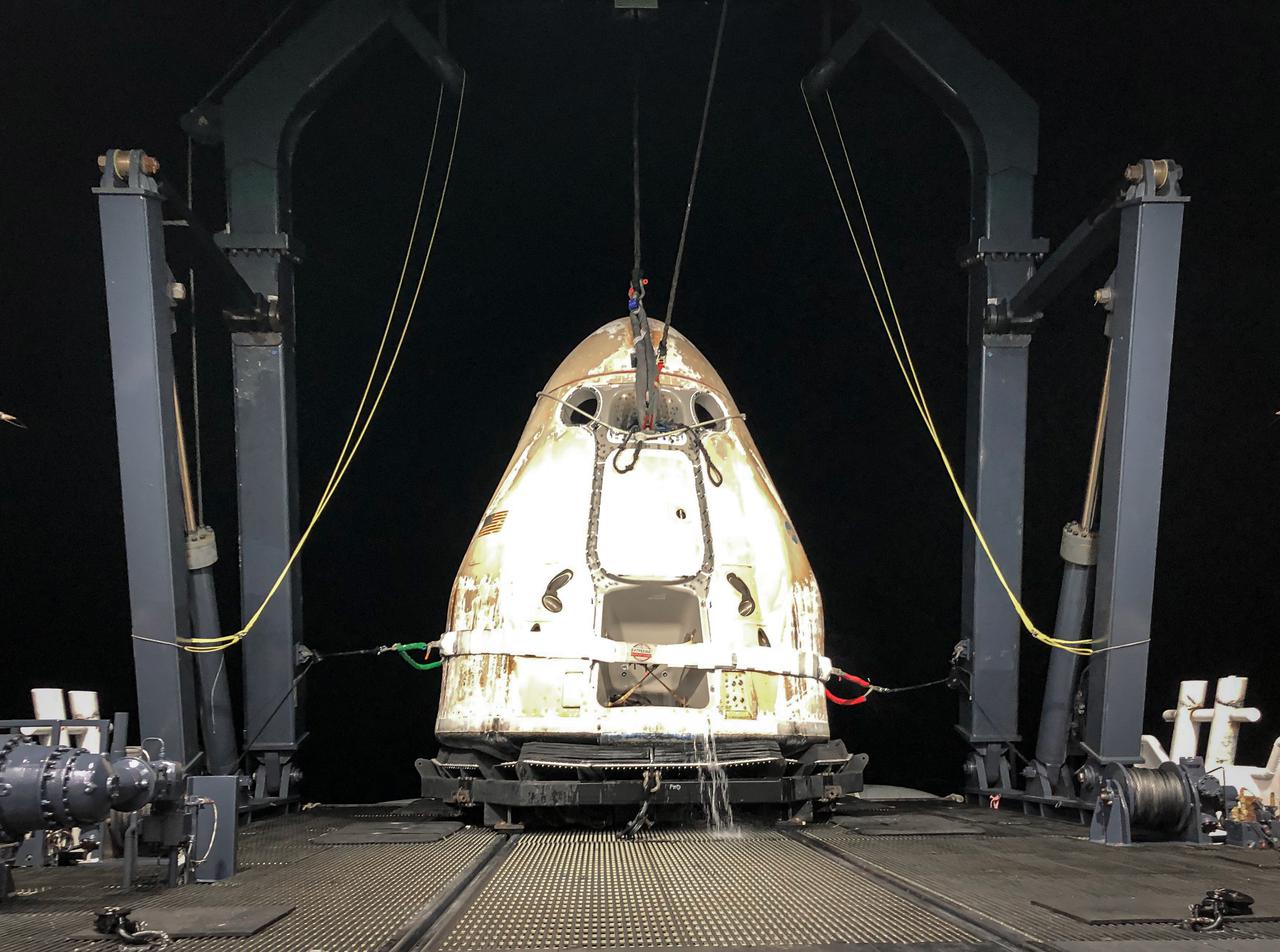
SpaceX’s Cargo Dragon spacecraft is lifted aboard a recovery vessel after splashing down in the Atlantic Ocean off the coast of Florida on Thursday, Sept. 30, 2021. The capsule, carrying cargo that flew aboard NASA’s SpaceX 23rd commercial resupply services mission, undocked from the International Space Station Thursday at approximately 9 a.m. The event marked the first time a Cargo Dragon splashed down in the Atlantic Ocean. Cargo from the capsule was delivered to the Launch and Landing Facility at Kennedy Space Center.
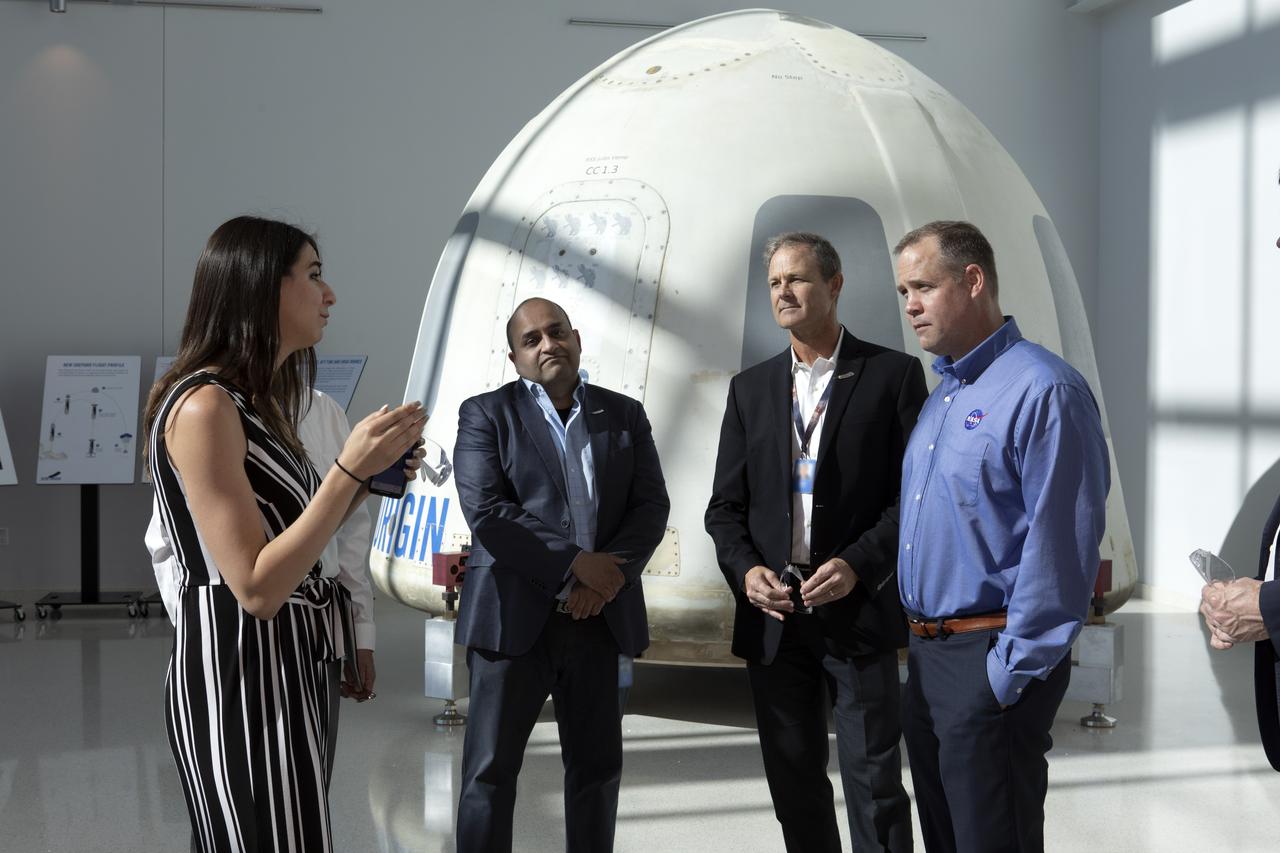
NASA Administrator Jim Bridenstine, far right, tours the Blue Origin facilities near the agency’s Kennedy Space Center in Florida on May 23, 2019. Bridenstine viewed the New Shepard booster and crew capsule that flew to space and back five times.
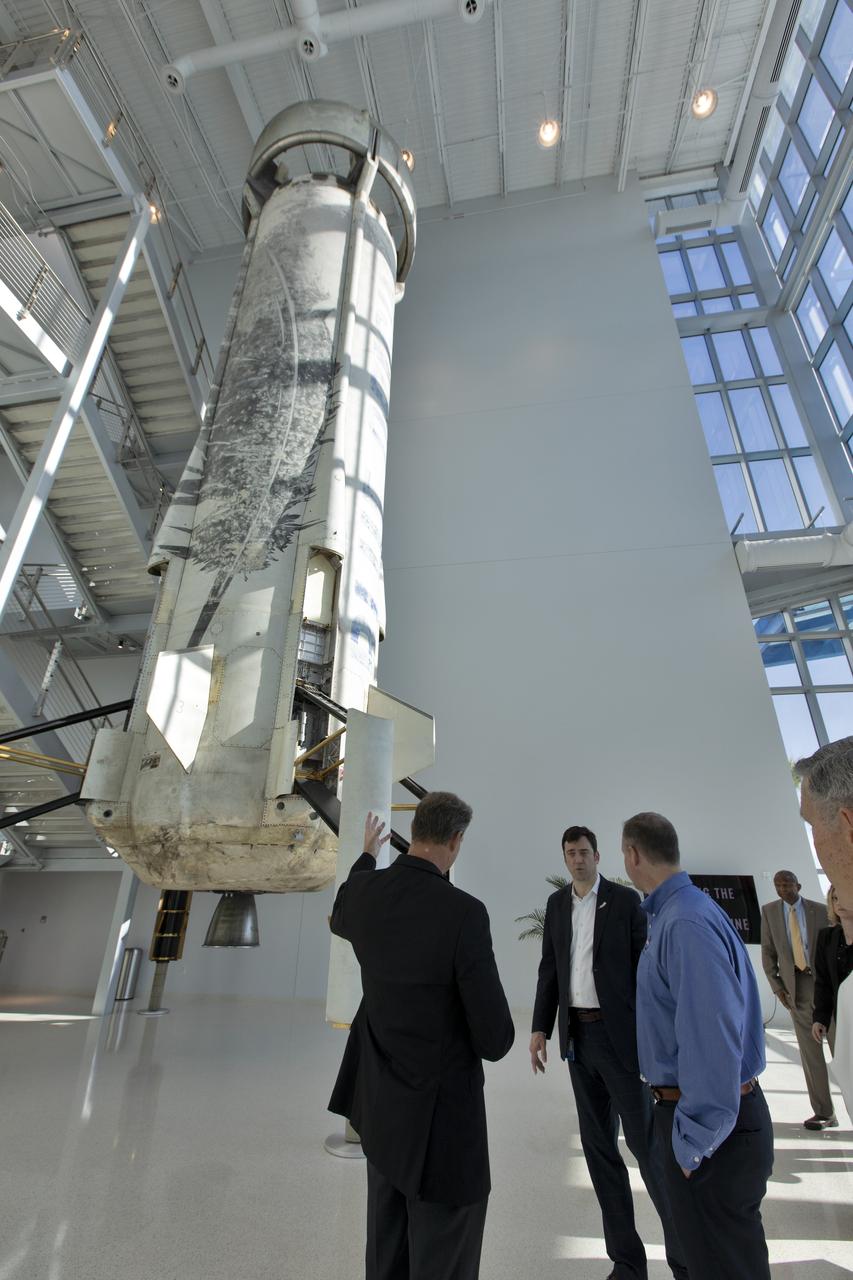
NASA Administrator Jim Bridenstine, second from right in the blue shirt, tours the Blue Origin facilities near the agency’s Kennedy Space Center in Florida on May 23, 2019. He viewed the New Shepard booster and crew capsule that flew to space and back five times.
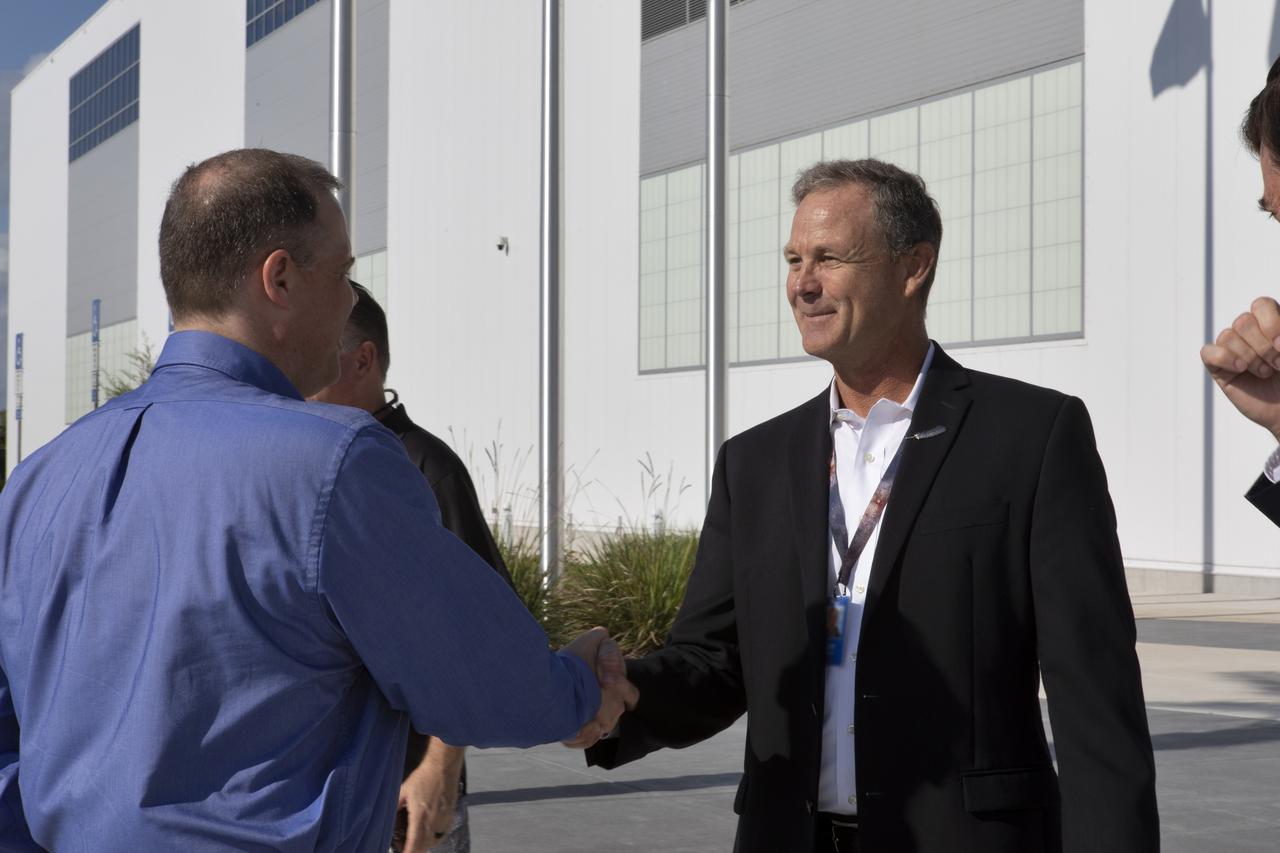
NASA Administrator Jim Bridenstine shakes hands with Scott Henderson, Blue Origin Orbital Launch director, at the Blue Origin facilities near the agency’s Kennedy Space Center in Florida on May 23, 2019. Bridenstine toured the facilities and viewed the New Shepard booster and crew capsule that flew to space and back five times.
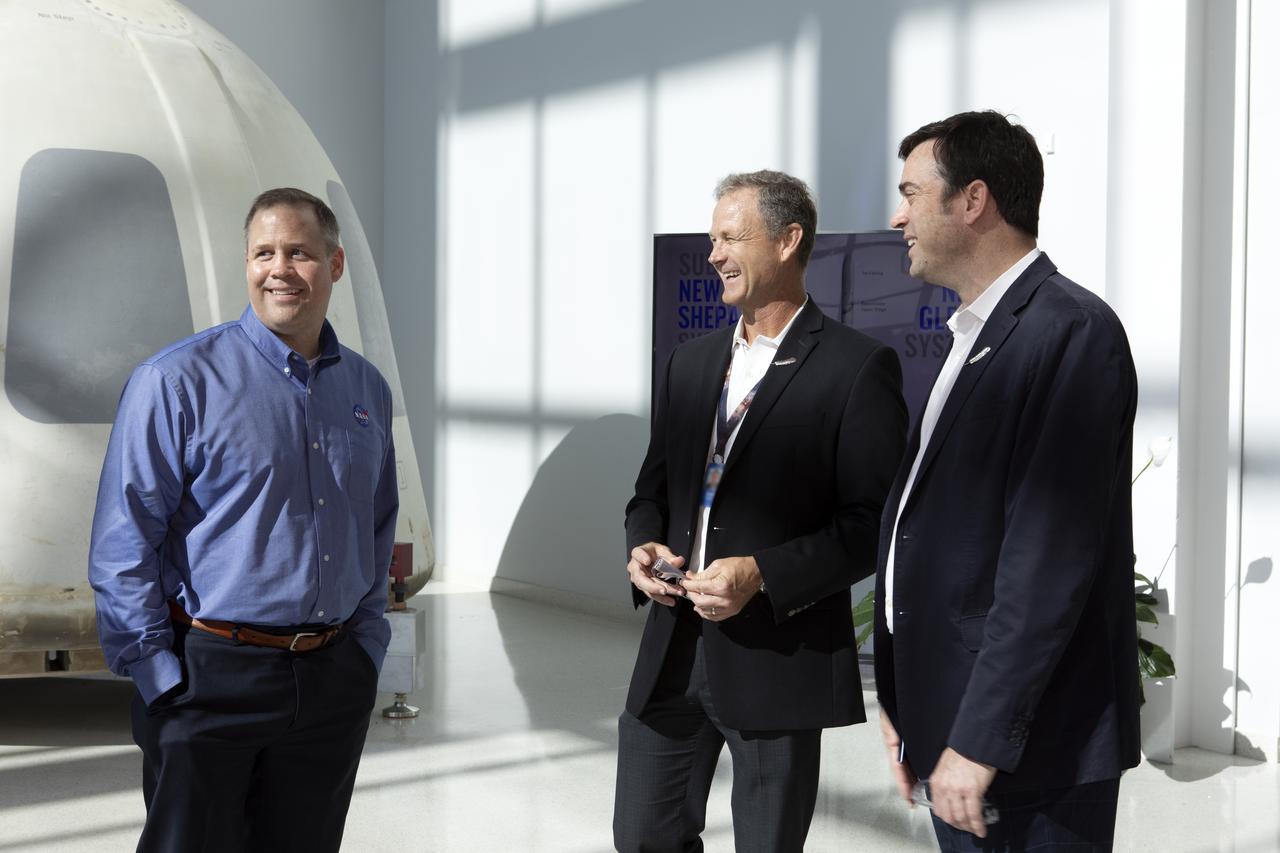
NASA Administrator Jim Bridenstine, at left, tours the Blue Origin facilities near the agency’s Kennedy Space Center in Florida on May 23, 2019. Bridenstine viewed the New Shepard booster and crew capsule that flew to space and back five times.
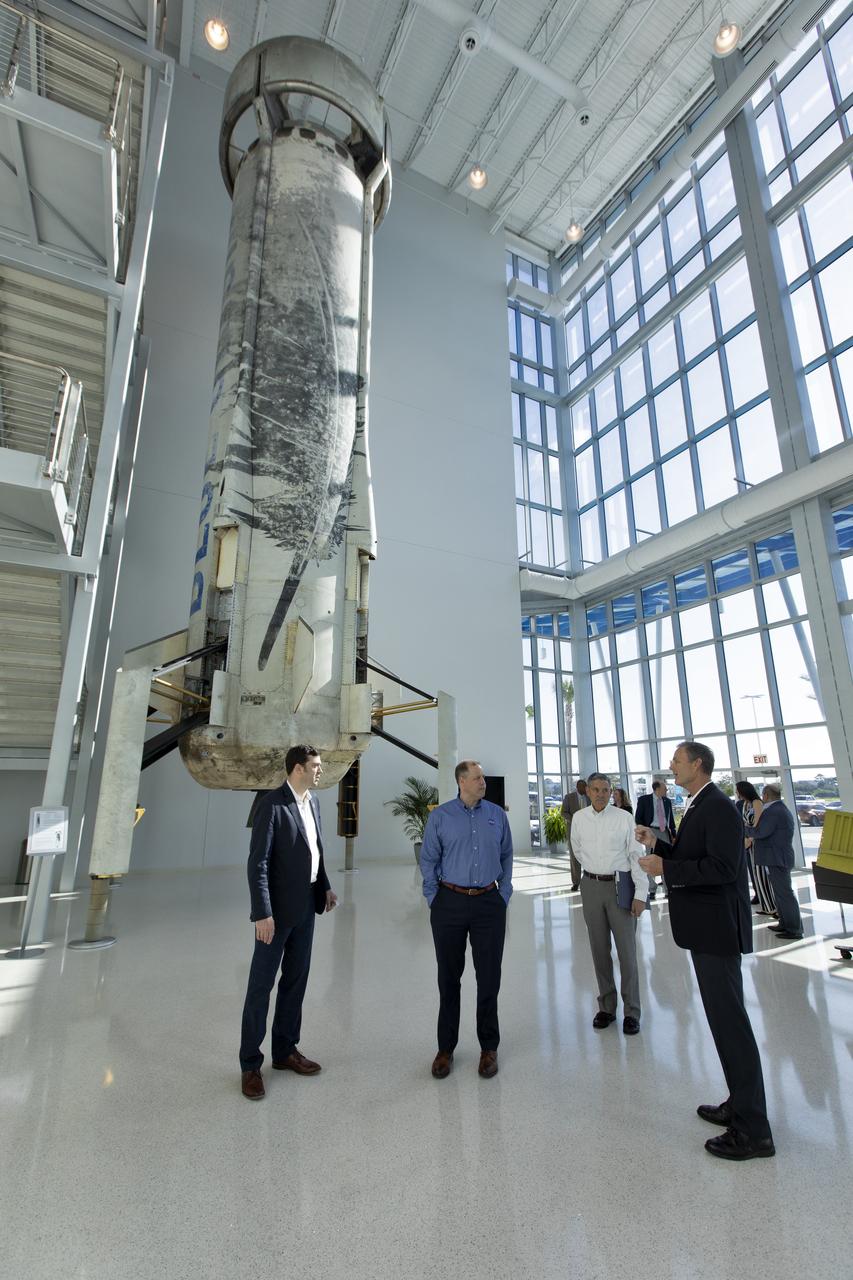
NASA Administrator Jim Bridenstine, second from left, tours the Blue Origin facilities near the agency’s Kennedy Space Center in Florida on May 23, 2019. Third from left is Kennedy Space Center Director Bob Cabana. They viewed the New Shepard booster and crew capsule that few to space and back five times.
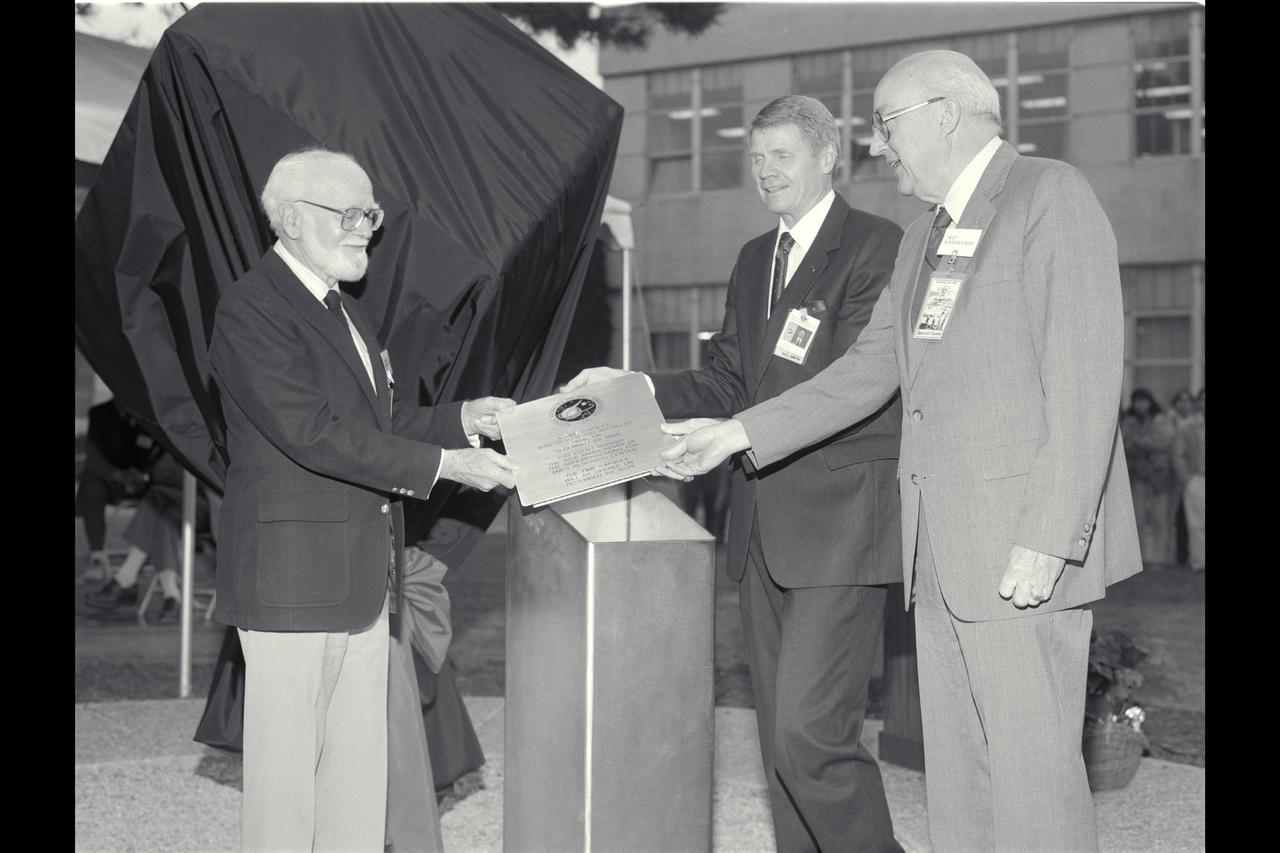
On 20 December 1989, Ames buried a time capsule and unveiled a sculpture at the spot where, fifty years earlier, Russel Robinson had turned the first spade of dirt for the Ames construction shack: Robinson (left) Ames Director Dale Compton (center) and retired Ames Director Sy Syvertson (right)
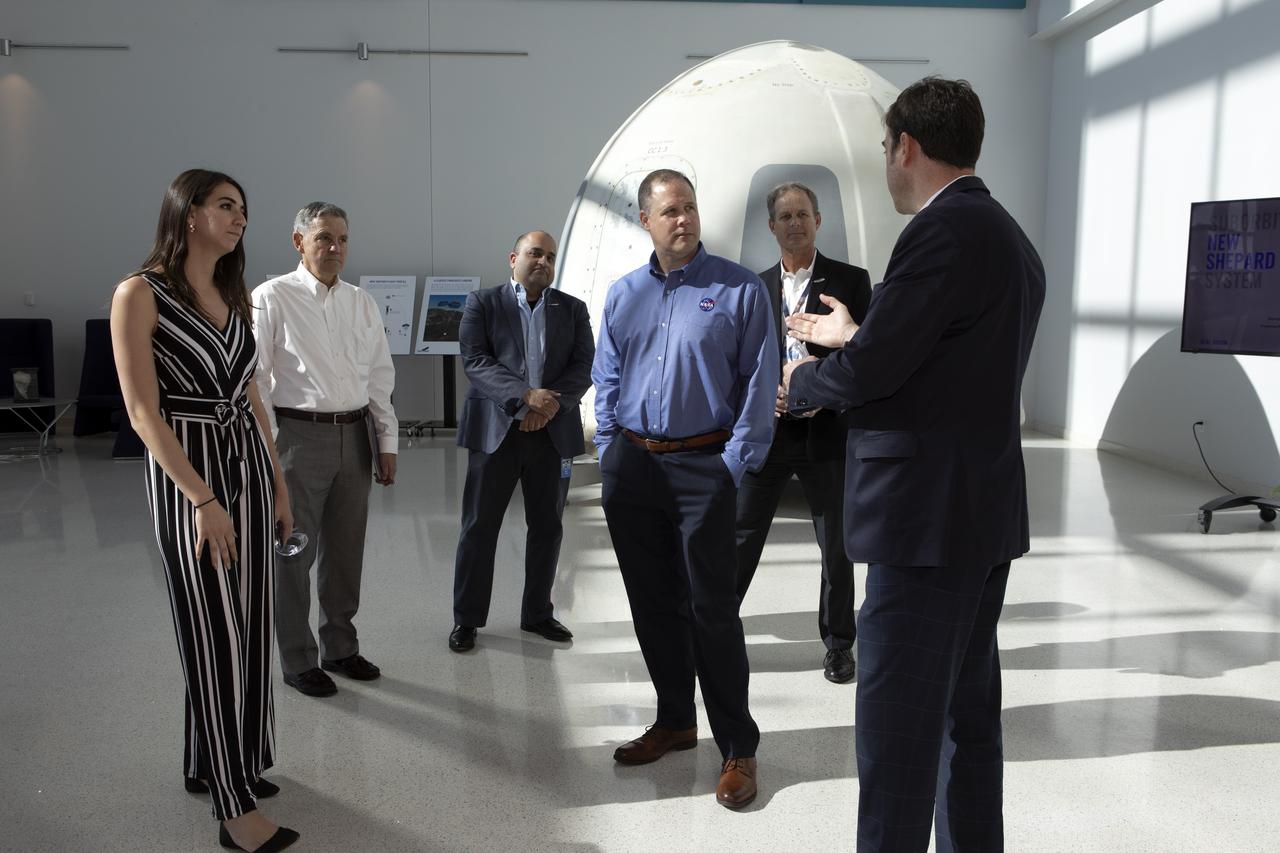
NASA Administrator Jim Bridenstine, second from right, in the blue shirt, tours the Blue Origin facilities near the agency’s Kennedy Space Center in Florida on May 23, 2019. Bridenstine viewed the New Shepard booster and crew capsule that flew to space and back five times.
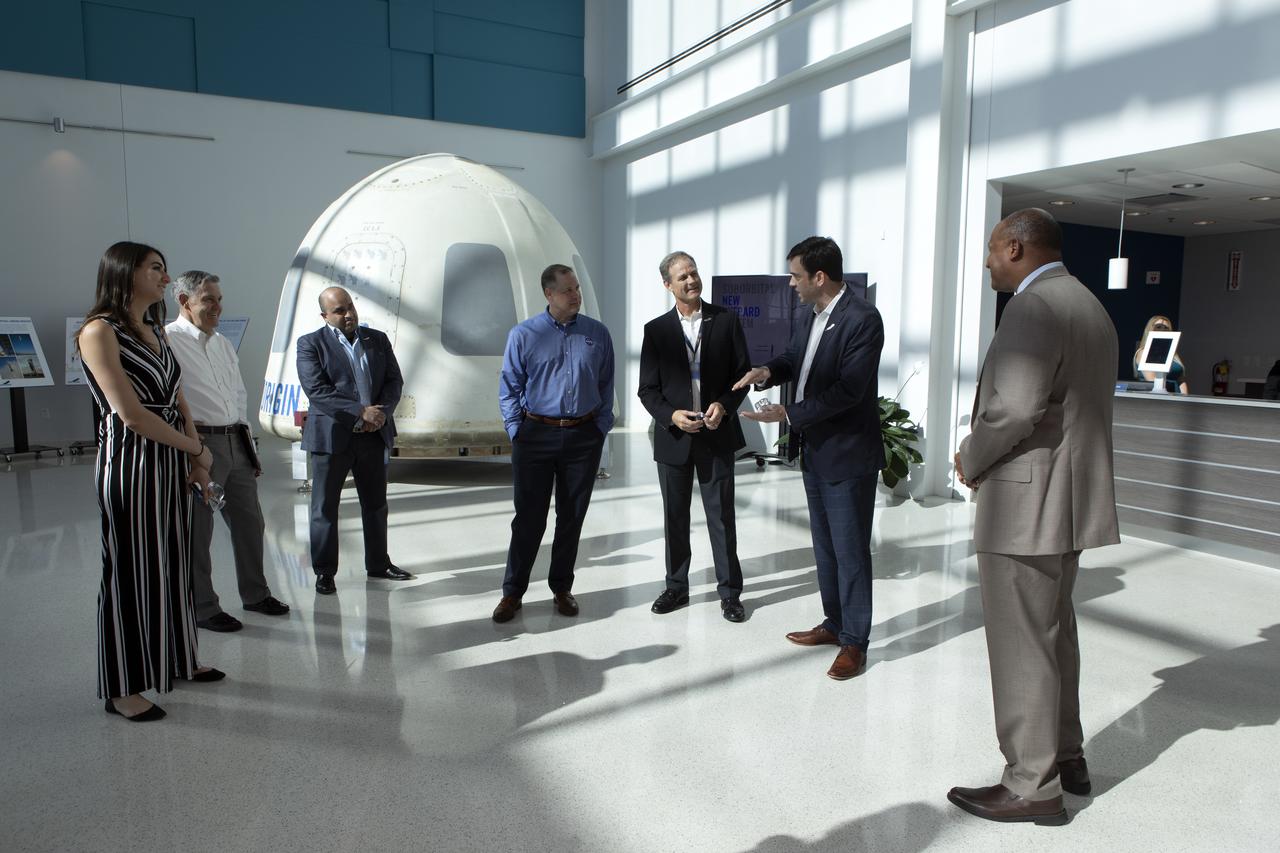
NASA Administrator Jim Bridenstine, fourth from left, tours the Blue Origin facilities near the agency’s Kennedy Space Center in Florida on May 23, 2019. Second from left is Kennedy Space Center Director Bob Cabana. They viewed the New Shepard booster and crew capsule that flew to space and back five times.
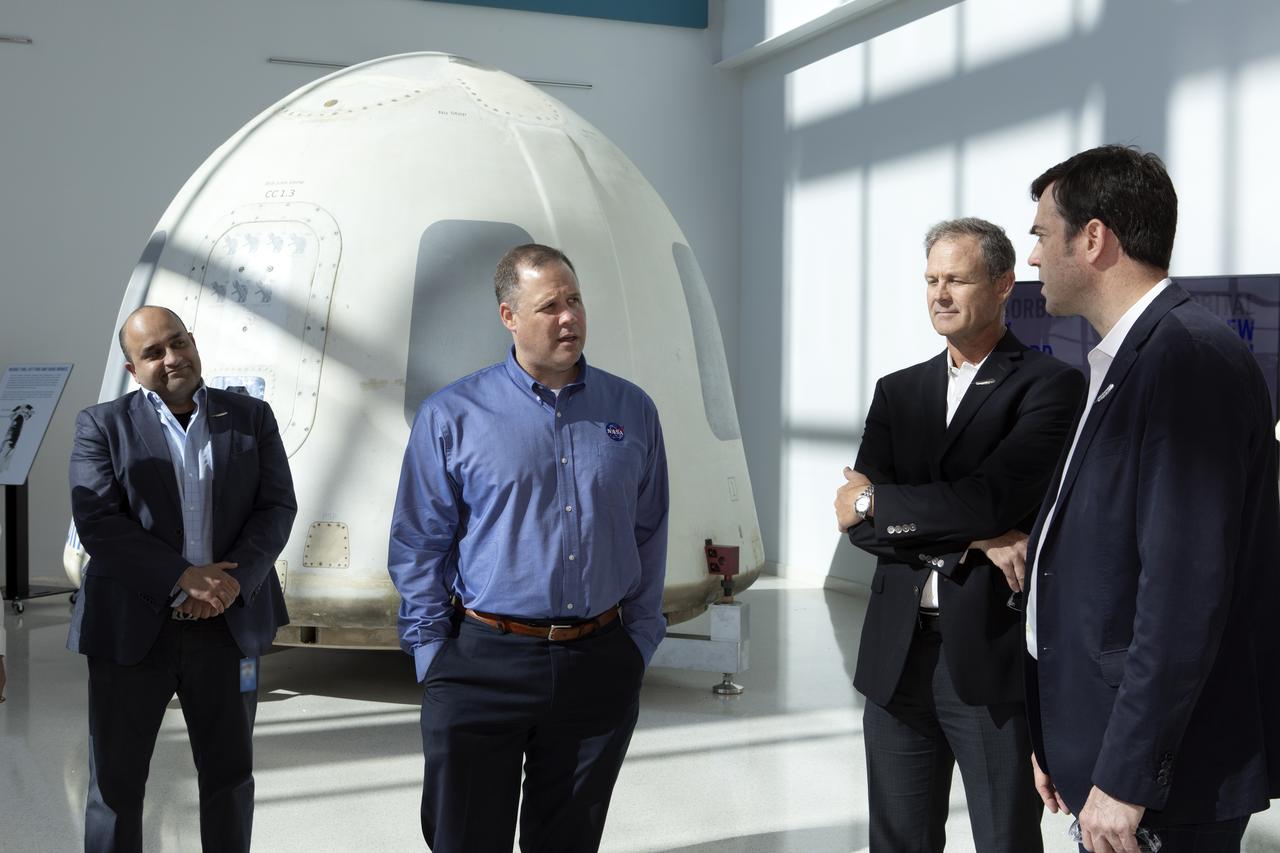
NASA Administrator Jim Bridenstine, second from left, tours the Blue Origin facilities near the agency’s Kennedy Space Center in Florida on May 23, 2019. Bridenstine viewed the New Shepard booster and crew capsule that flew to space and back five times.
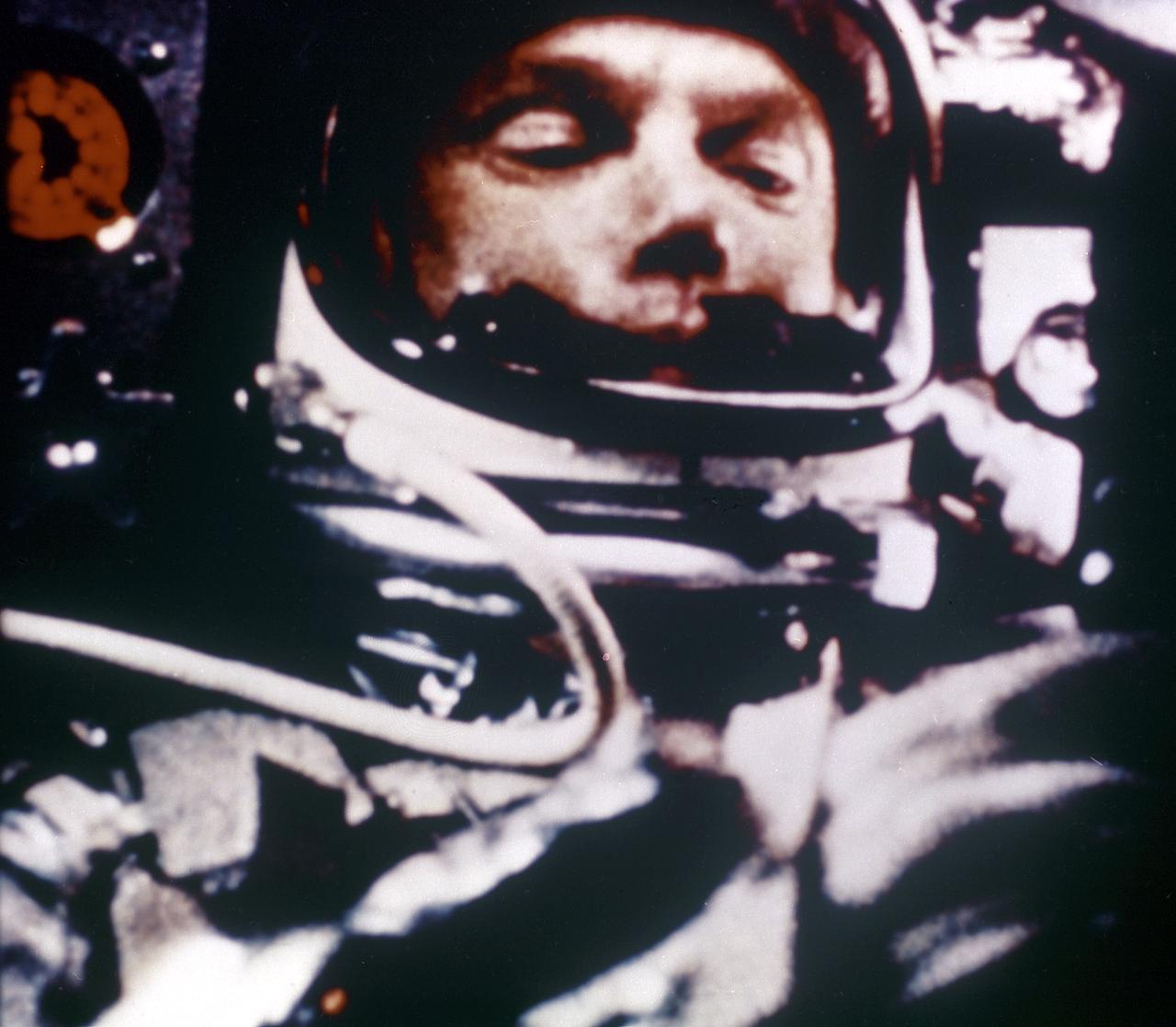
Astronaut John Glenn in the Friendship 7 capsule during the first manned orbital flight, the MA-6 mission. Boosted by the Mercury-Atlas vehicle, a modified Atlas (intercontinental ballistic missile), the MA-6 mission lasted for 5 hours and orbited the Earth three times.
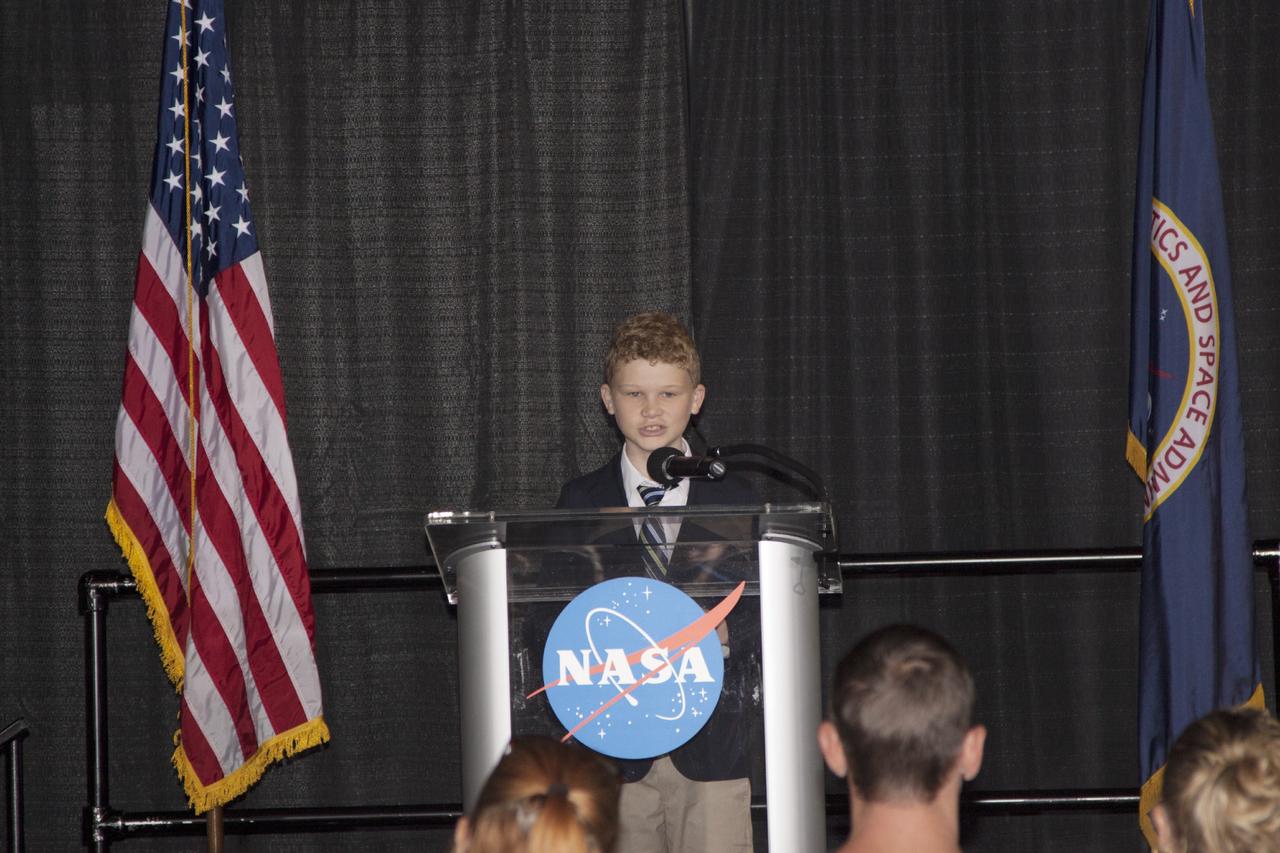
CAPE CANAVERAL, Fla. -- At the Kennedy Space Center Visitor Complex in Florida, Patrick Sullivan spoke on behalf of the Space Exploration Ambassadors during a ceremony to enshrine a Space Shuttle Program time capsule in a secured vault within the walls of the Space Shuttle Atlantis home at the Kennedy Space Center Visitor Complex. Sullivan's remarks focused on the missions of shuttle Atlantis, the final launch day -- which he attended -- and the future of the space program. The time capsule, containing artifacts and other memorabilia associated with the history of the program is designated to be opened on the 50th anniversary of the shuttle's final landing, STS-135. The new $100 million "Space Shuttle Atlantis" facility includes interactive exhibits that tell the story of the 30-year Space Shuttle Program and highlight the future of space exploration. Photo credit: NASA/Jim Grossmann
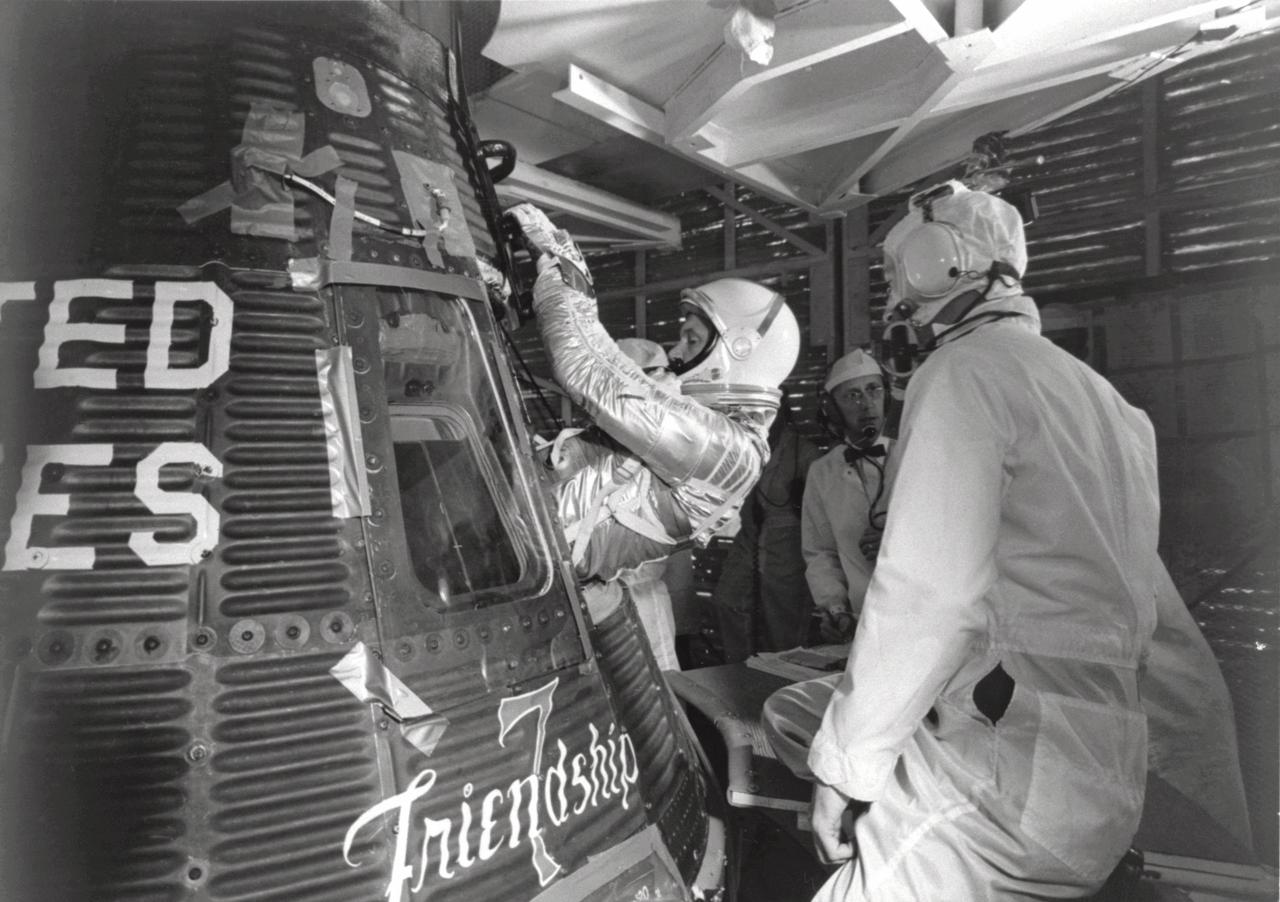
CAPE CANAVERAL, Fla. -- Astronaut John H. Glenn Jr. enters his Mercury capsule, "Friendship 7," as he prepares for launch of the Mercury-Atlas rocket. On February 20, 1962, Glenn lifted off into space aboard his Mercury Atlas 6 MA-6 rocket and became the first American to orbit the Earth. After orbiting the Earth 3 times, Friendship 7 landed in the Atlantic Ocean 4 hours, 55 minutes and 23 seconds later, just East of Grand Turk Island in the Bahamas. Glenn and his capsule were recovered by the Navy Destroyer Noa, 21 minutes after splashdown. Photo credit: NASA
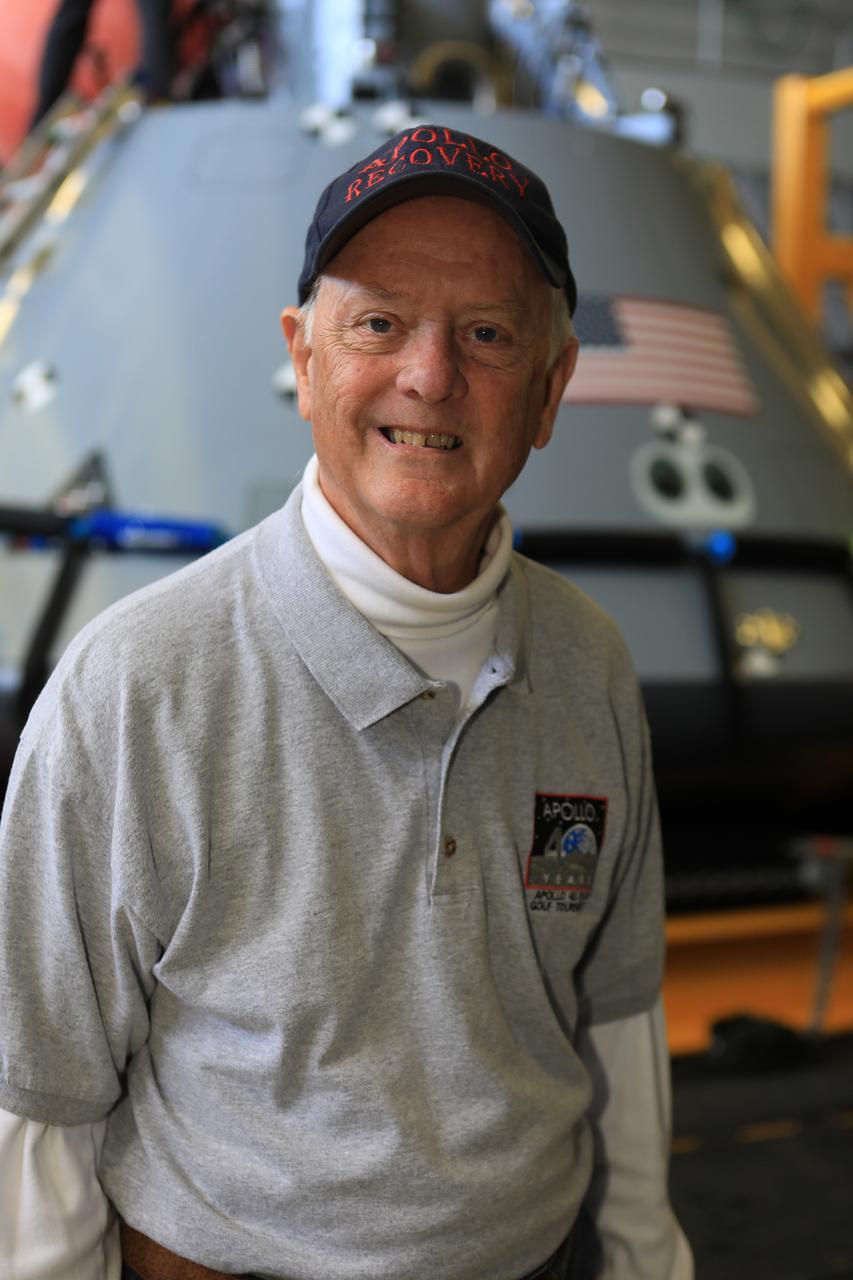
Apollo-era recovery engineer Milt Heflin takes time out from Underway Recovery Test-7 (URT-7) to pose in front of a test version of the Orion capsule in the well deck of the USS John P. Murtha on Nov. 3, 2018. The capsule is being used during testing. URT-7 is one in a series conducted by the Exploration Ground Systems Recovery Team to verify and validate procedures and hardware that will be used to recover the Orion spacecraft after it splashes down in the Pacific Ocean following deep space exploration missions. Orion will have emergency abort capability, sustain the crew during space travel and provide safe re-entry from deep space return velocities.
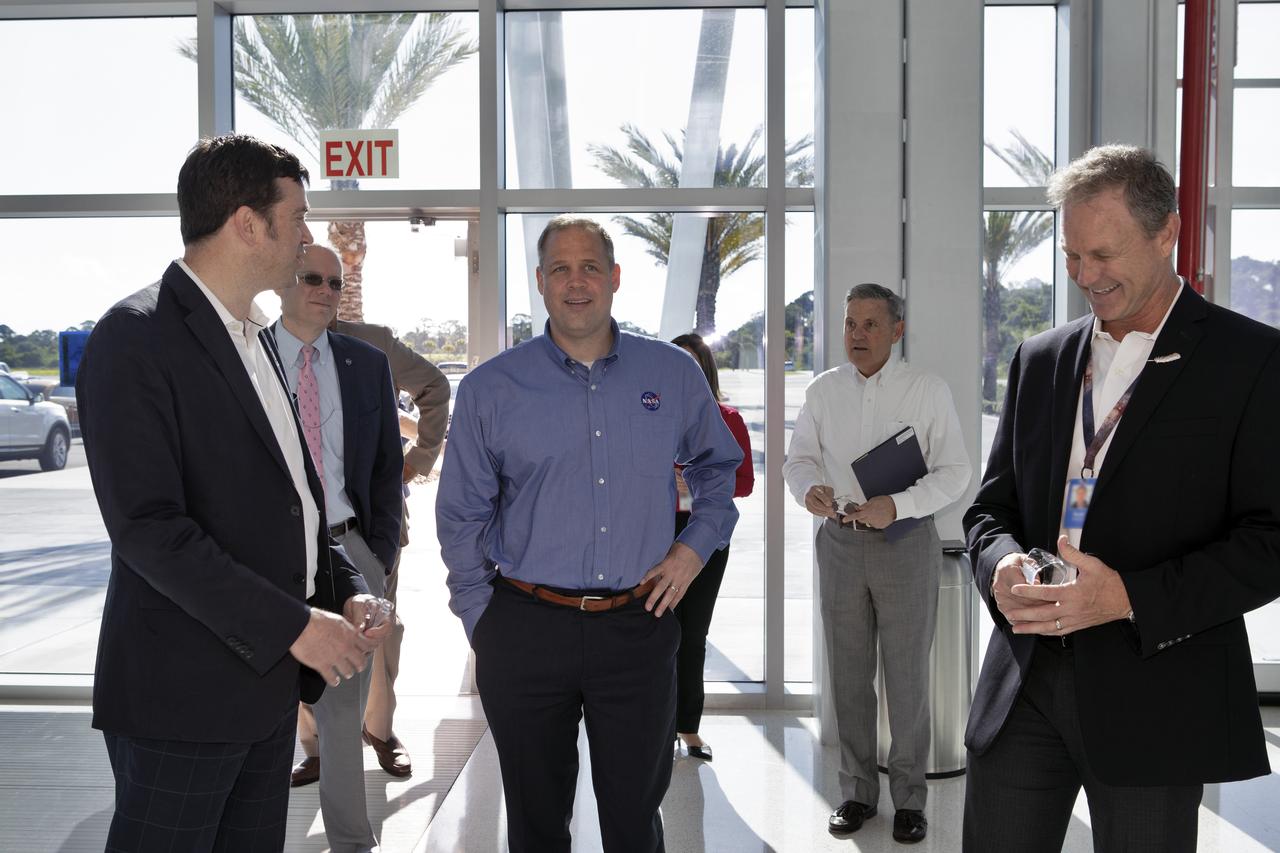
NASA Administrator Jim Bridenstine, third from left, arrives at the Blue Origin facilities near the agency’s Kennedy Space Center in Florida on May 23, 2019. Second from right is Kennedy Space Center Director Bob Cabana. The toured the facilities and viewed the New Shepard booster and crew capsule that flew to space and back five times.
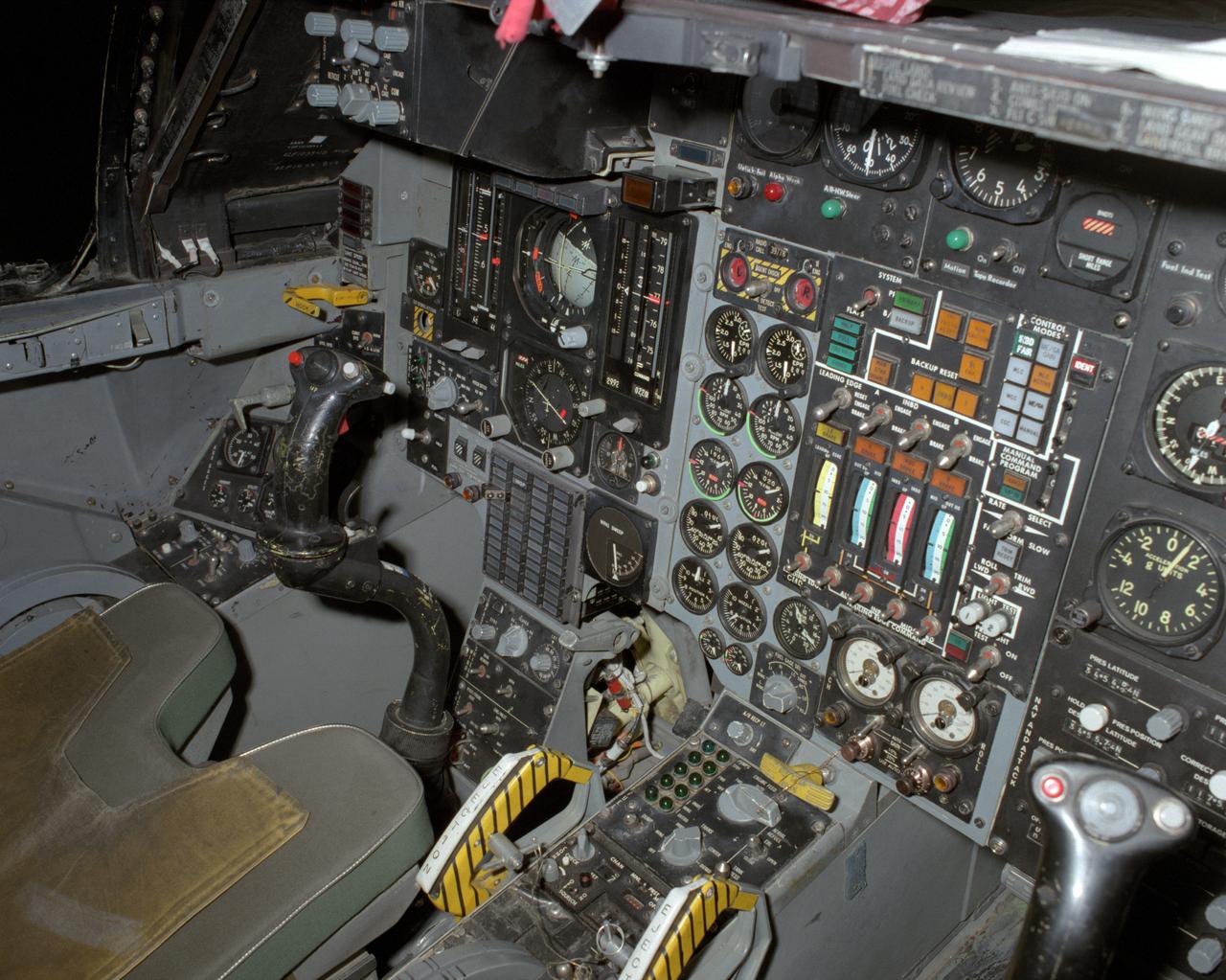
View of the left cockpit and pilot's seat of the F-111 MAW aircraft. Unlike most fighter aircraft of the time, the F-111 had side-by-side seating. The pilot sat on the left side, and the weapons systems officer on the right. Both had control sticks to fly the aircraft. The two yellow and black striped handles would be used in an emergency to eject the entire F-111 cockpit. The F-111 also did not have ejection seats, but used a capsule.
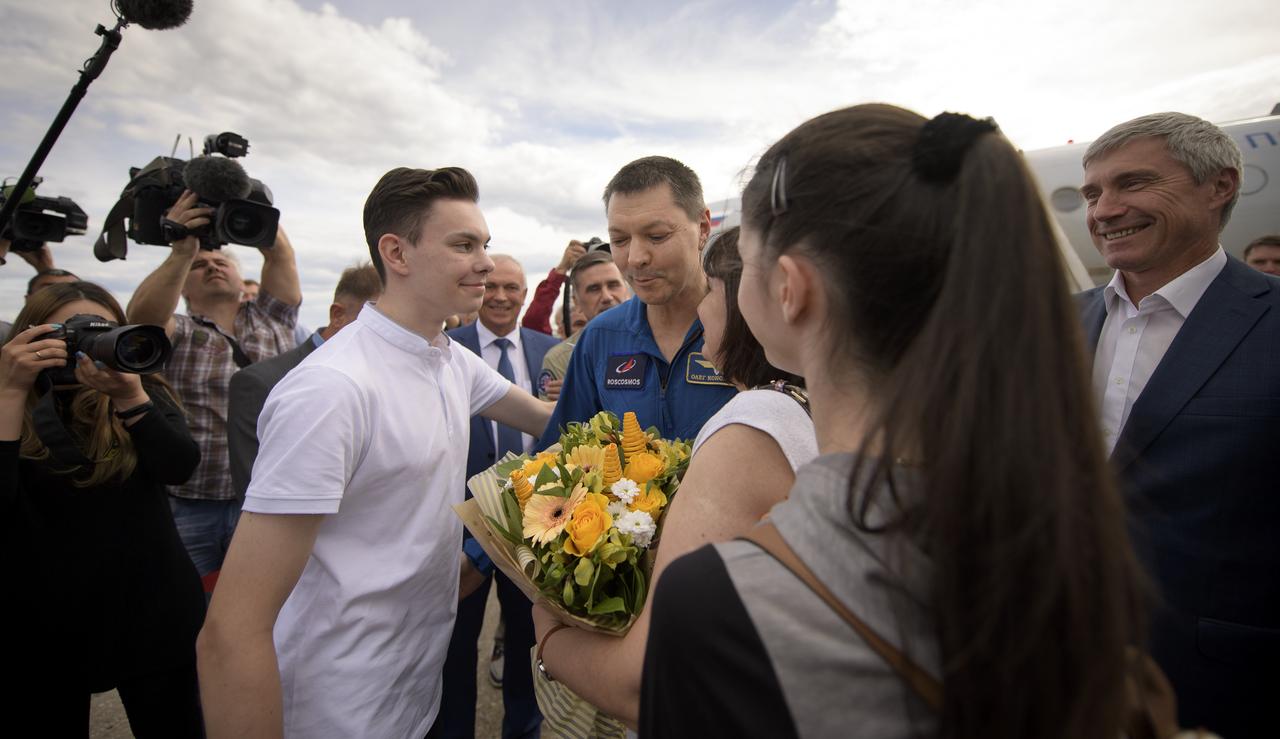
Officials, family and friends welcome home Expedition 59 cosmonaut Oleg Kononenko of Roscosmos Tuesday, June 25, 2019 at the Chkalovsky Airport in Star City, Russia. Kononenko, NASA astronaut Anne McClain, and Canadian Space Agency astronaut David Saint-Jacques landed their Soyuz MS-11 capsule near the town of Zhezkazgan, Kazakhstan earlier on June 25 (June 24 Eastern Time). Photo Credit: (NASA/Bill Ingalls)
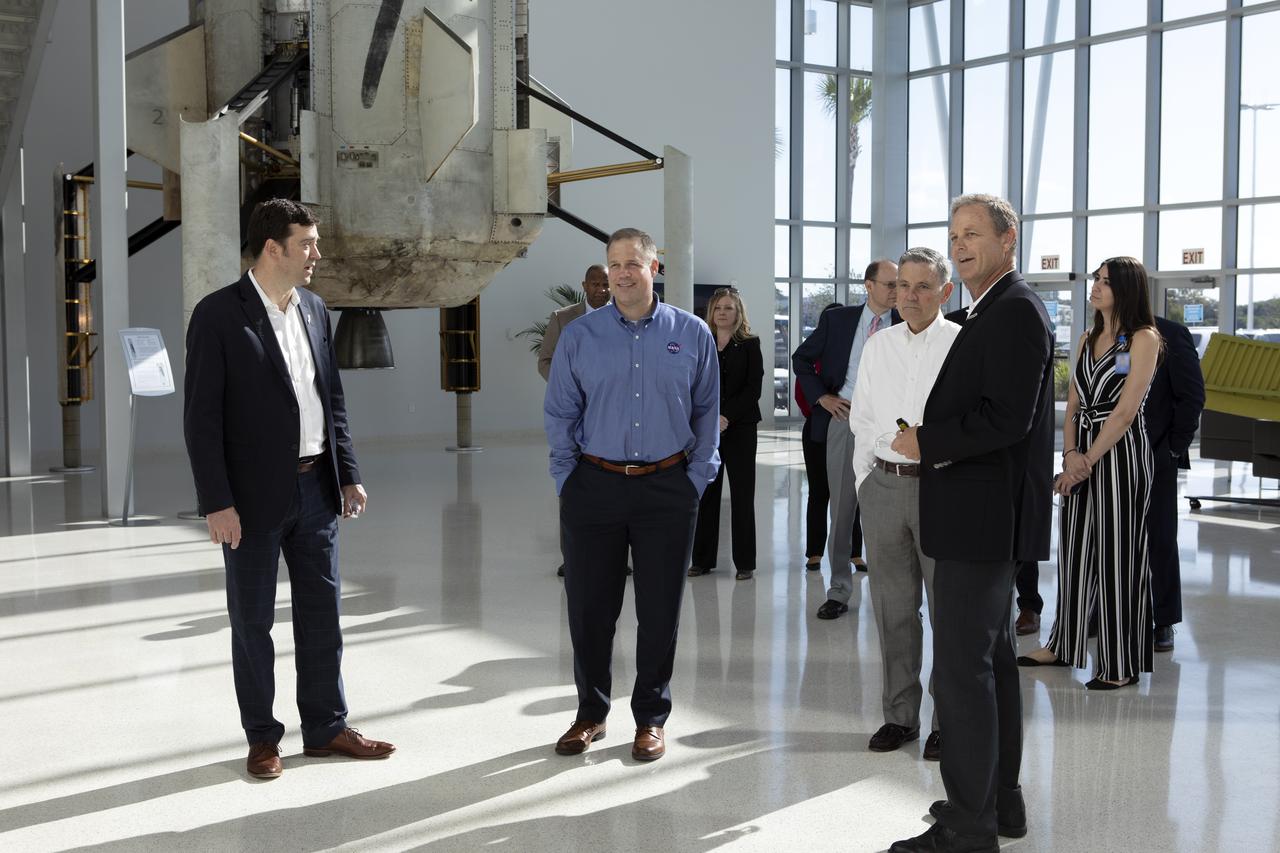
NASA Administrator Jim Bridenstine, second from left, arrives at the Blue Origin facilities near the agency’s Kennedy Space Center in Florida on May 23, 2019. Second from right is Kennedy Space Center Director Bob Cabana. They toured the facilities and viewed the New Shepard booster and crew capsule that flew to space and back five times.
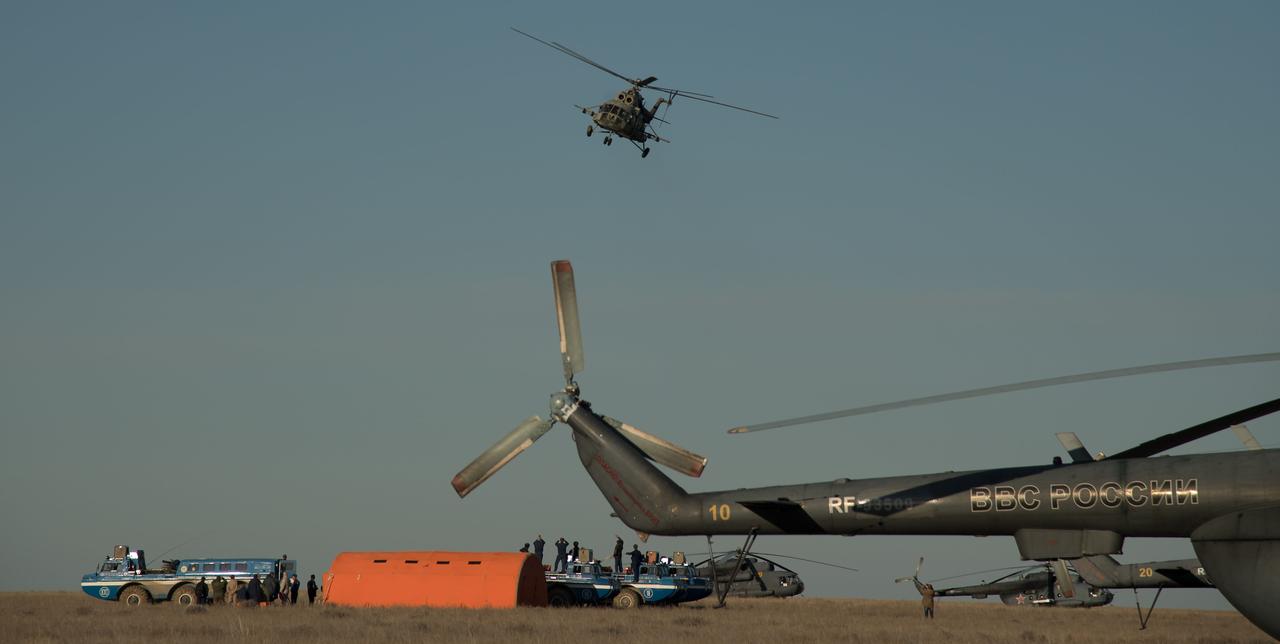
nhq201704100040 (April 10, 2017) --- A Russian support helicopter leaves the Soyuz MS-02 landing site shortly after the capsule landed with Expedition 50 Commander Shane Kimbrough of NASA and Flight Engineers Sergey Ryzhikov and Andrey Borisenko of Roscosmos near the town of Zhezkazgan, Kazakhstan on Monday, April 10, 2017 (Kazakh time). Kimbrough, Ryzhikov, and Borisenko are returning after 173 days in space where they served as members of the Expedition 49 and 50 crews onboard the International Space Station. Photo Credit: (NASA/Bill Ingalls)
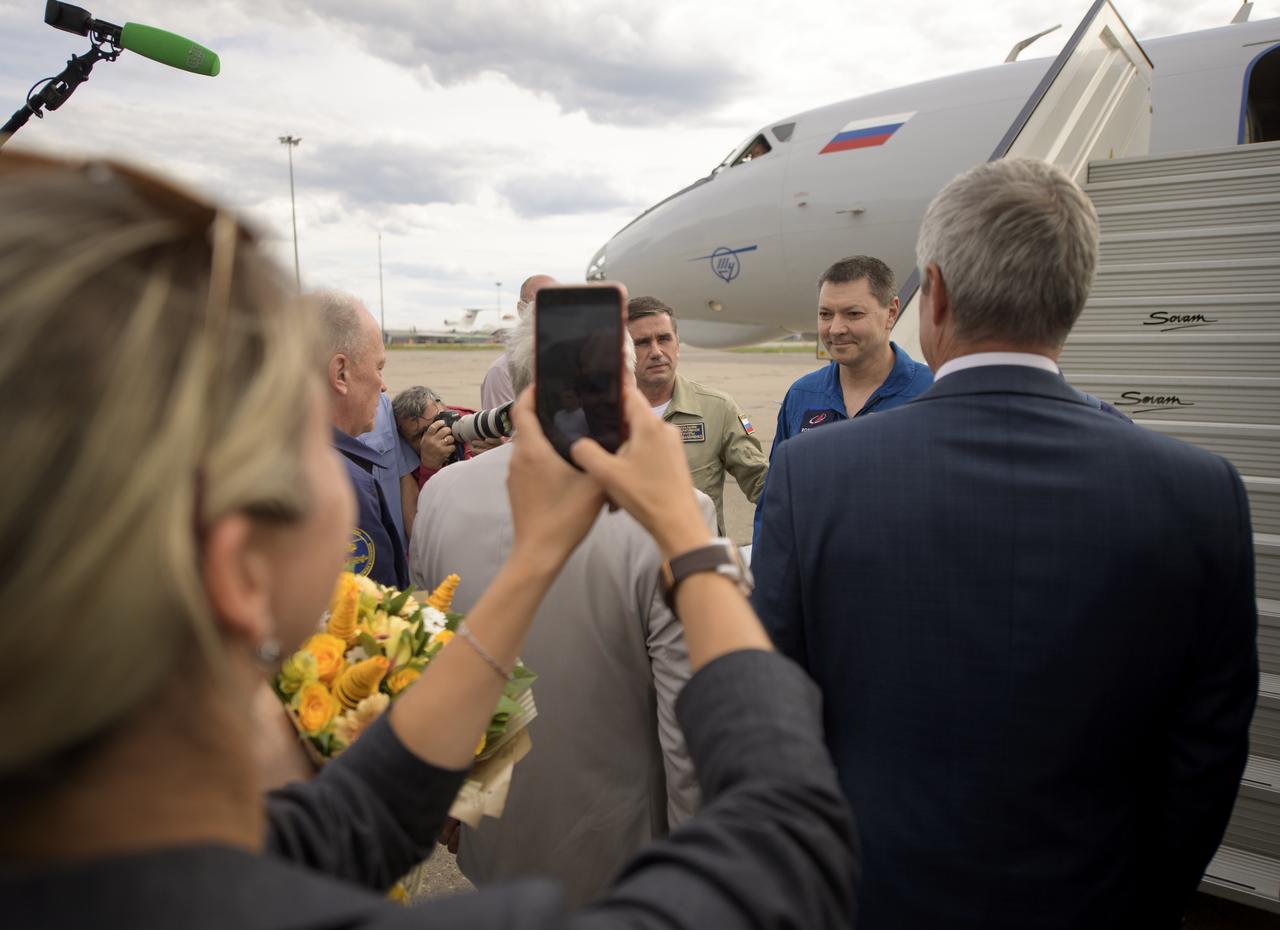
Officials, family and friends welcome home Expedition 59 cosmonaut Oleg Kononenko of Roscosmos Tuesday, June 25, 2019 at the Chkalovsky Airport in Star City, Russia. Kononenko, NASA astronaut Anne McClain, and Canadian Space Agency astronaut David Saint-Jacques landed their Soyuz MS-11 capsule near the town of Zhezkazgan, Kazakhstan earlier on June 25 (June 24 Eastern Time). Photo Credit: (NASA/Bill Ingalls)
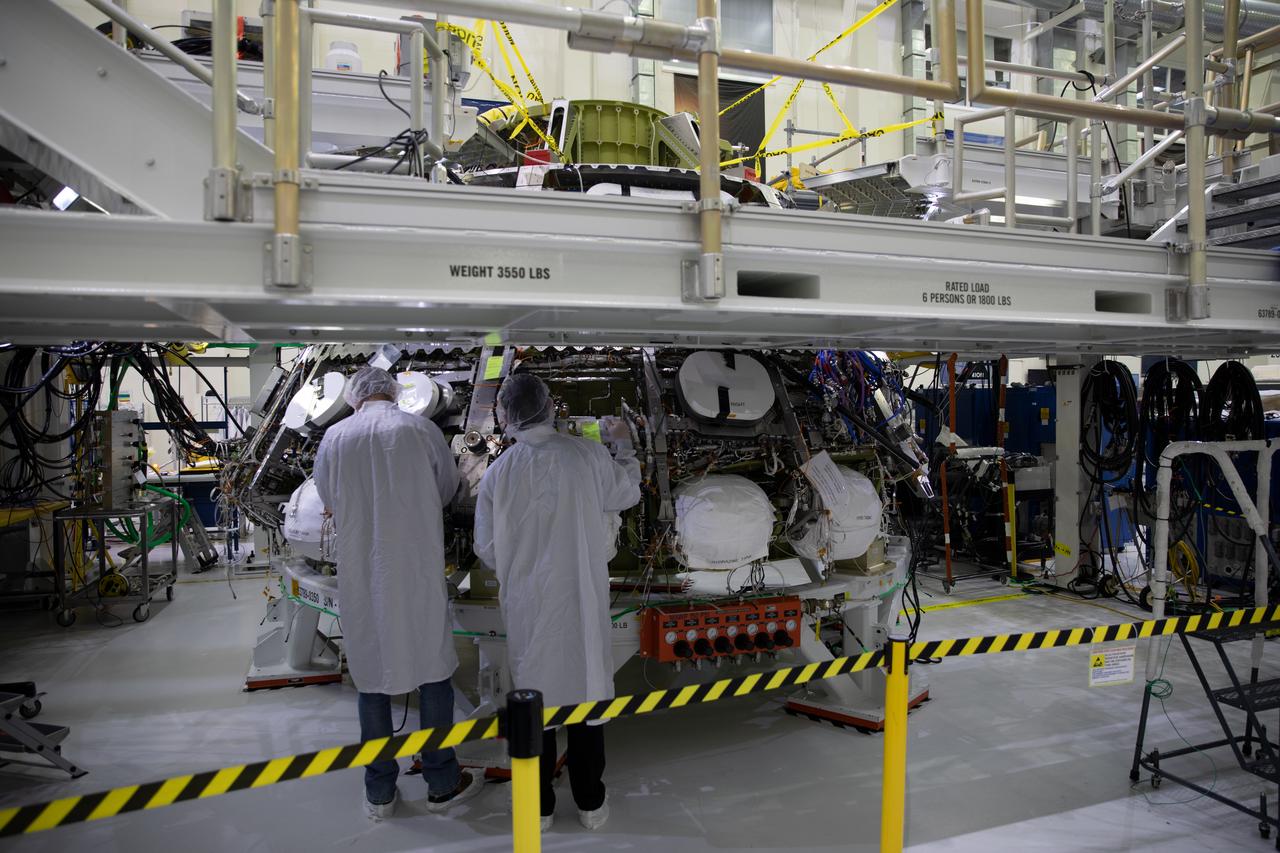
Technicians inside the Neil Armstrong Operations and Checkout Building power on the Orion crew module for the Artemis II mission for the first time at NASA’s Kennedy Space Center in Florida on May 27, 2022. The capsule will carry astronauts on a trip around the Moon during the first crewed Artemis flight, helping set the stage for future lunar landings. Through Artemis, NASA will land the first woman and the first person of color on the Moon and establish long-term lunar exploration in preparation for missions to Mars.
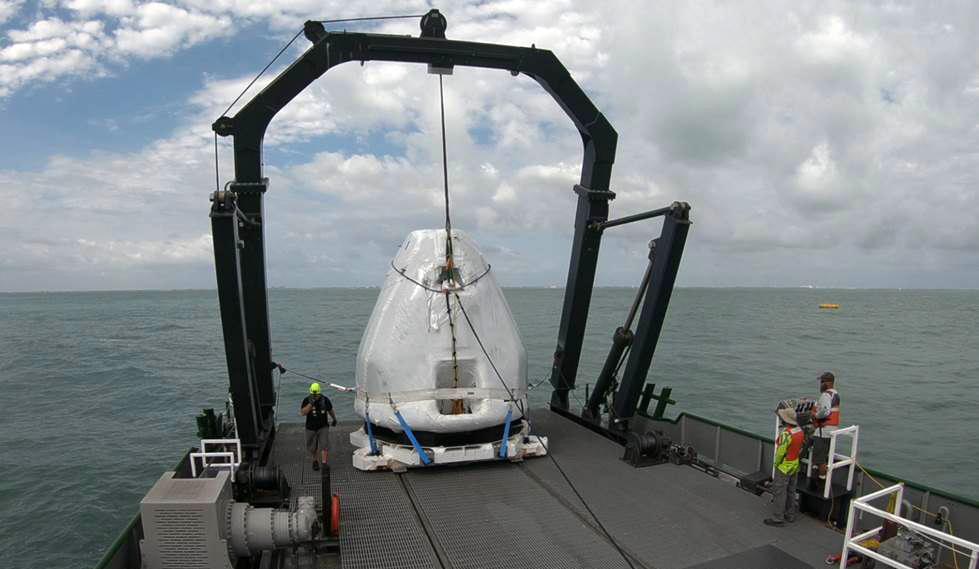
On February 28, SpaceX completed a demonstration of their ability to recover the crew and capsule after a nominal water splashdown. This marks an important recovery milestone and joint test. The timeline requirement from splashdown to crew egress onboard the ship is one hour, and the recovery team demonstrated that they can accomplish this operation under worst-case conditions in under 45 minutes. Further improvements are planned to shorten the recovery time even more as the team works to build a process that is safe, repeatable, and efficient.
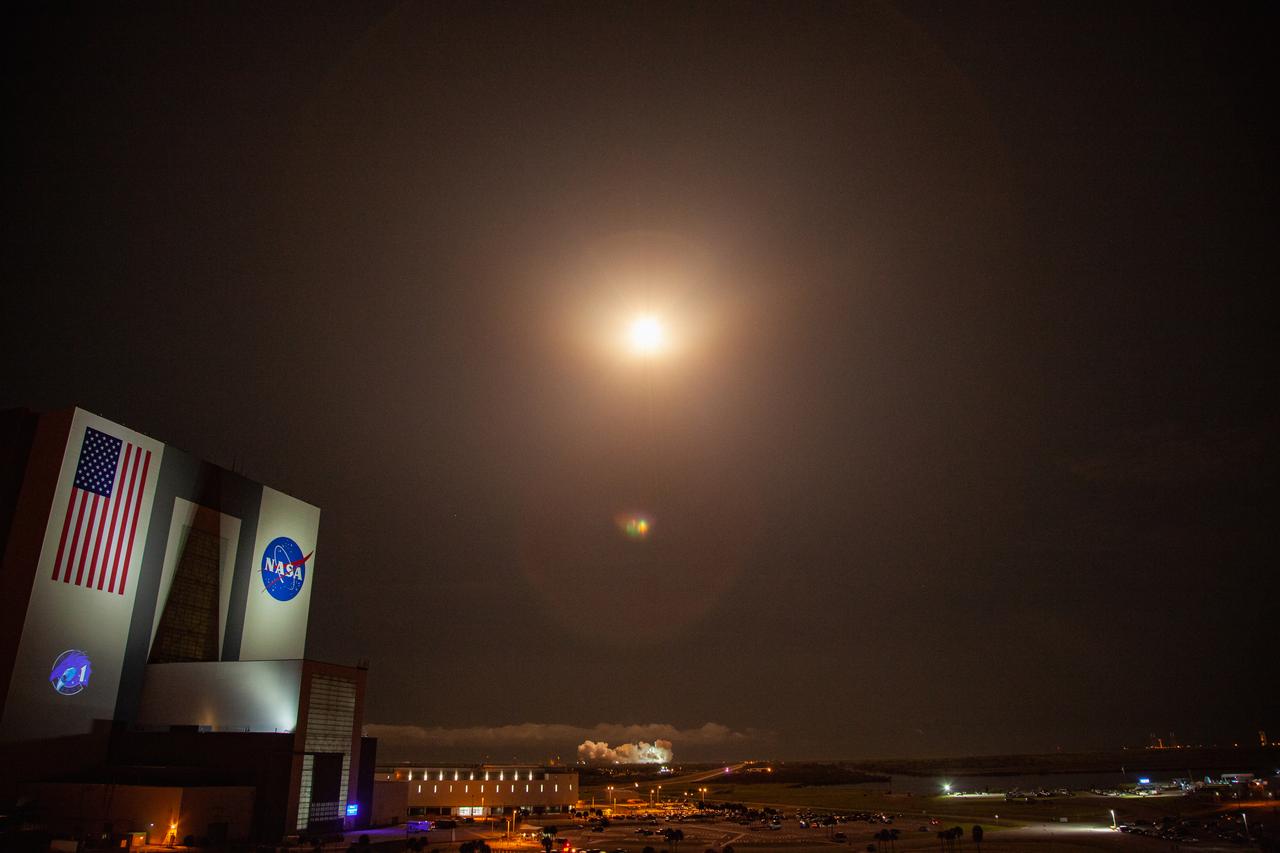
With a view of the iconic Vehicle Assembly Building at left, a SpaceX Falcon 9 rocket soars upward from Launch Complex 39A at NASA’s Kennedy Space Center in Florida on Nov. 15, 2020, carrying the company’s Crew Dragon Resilience capsule. Launch time was at 7:27 p.m. EST. Onboard the capsule are NASA’s SpaceX Crew-1 astronauts, Michael Hopkins, spacecraft commander; Victor Glover, pilot; Shannon Walker, mission specialist; and Japan Aerospace Exploration Agency astronaut Soichi Noguchi, mission specialist. Crew-1 is the first regular crew mission of a U.S. commercial spacecraft with astronauts to the International Space Station as part of NASA’s Commercial Crew Program. The Crew Dragon will dock with the space station and the crew will remain on the orbiting laboratory for a six-month science mission.

This artist's concept shows Mars Sample Return Earth Entry System. The vehicle would bring curated Martian samples collected by NASA's Perseverance Rover on the final leg of their journey from Mars to Earth. The illustration shows the Earth Entry System, a capsule about 4 feet (1.25 meters) in diameter, on its final approach to Earth, after being ejected from the Earth Return Orbiter. Once in Earth's atmosphere, it would take the vehicle about six minutes to land at the U.S. Air Force's Utah Test and Training Range in west-central Utah. Velocity at time of touchdown for the parachute-less capsule is expected to be about 90 mph (40 meters per second). The Earth Entry System is part of the multi-mission Mars Sample Return program being planned by NASA and ESA (European Space Agency). https://photojournal.jpl.nasa.gov/catalog/PIA25986
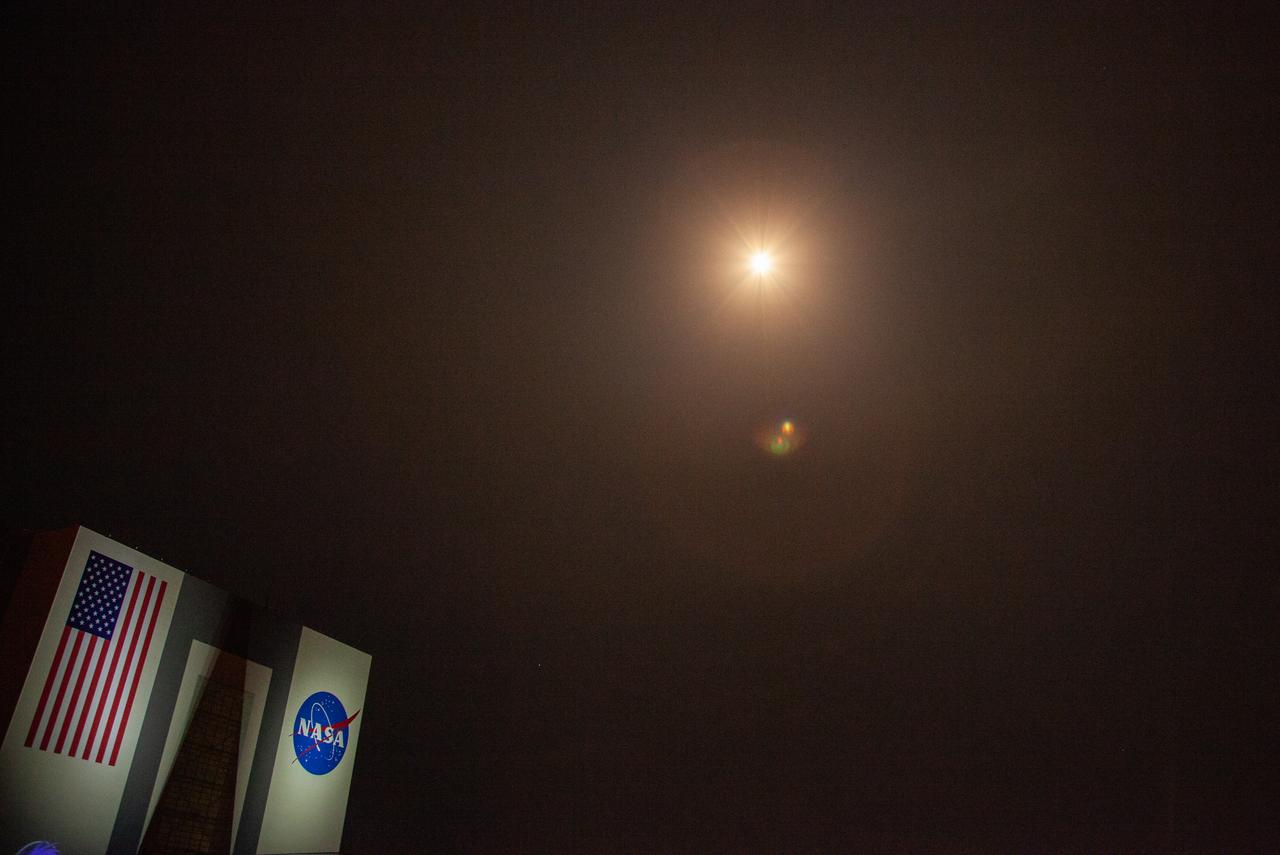
With a view of the iconic Vehicle Assembly Building at left, a SpaceX Falcon 9 rocket soars upward from Launch Complex 39A at NASA’s Kennedy Space Center in Florida on Nov. 15, 2020, carrying the company’s Crew Dragon Resilience capsule. Launch time was at 7:27 p.m. EST. Onboard the capsule are NASA’s SpaceX Crew-1 astronauts, Michael Hopkins, spacecraft commander; Victor Glover, pilot; Shannon Walker, mission specialist; and Japan Aerospace Exploration Agency astronaut Soichi Noguchi, mission specialist. Crew-1 is the first regular crew mission of a U.S. commercial spacecraft with astronauts to the International Space Station as part of NASA’s Commercial Crew Program. The Crew Dragon will dock with the space station and the crew will remain on the orbiting laboratory for a six-month science mission.
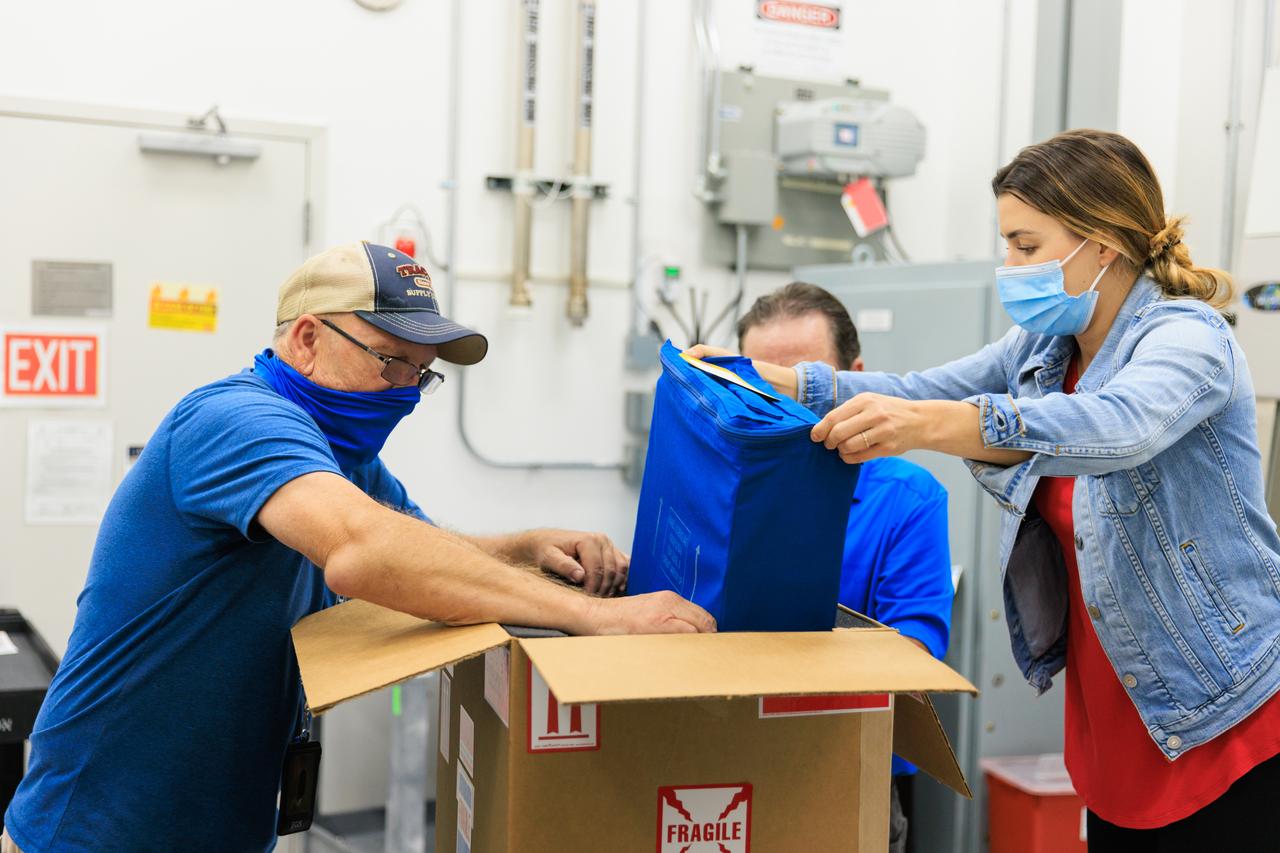
NASA’s Biology Experiment-1 (BioExpt-1) is officially packaged and ready for handover to the Orion team for Artemis I inside the Space Station Processing Facility at the agency’s Kennedy Space Center in Florida on Aug. 18, 2022. BioExpt-1 is a space biology pathfinder, which will carry Arabidopsis, algae, yeast, and fungi science payloads for biology research beyond low-Earth orbit aboard the Orion capsule on the Artemis I mission. The payload container assemblies will be installed onto panels in the Orion capsule and will return to Earth to provide critical and unique data about life beyond low-Earth orbit for the first time in more than 40 years. Artemis I is the first in a series of increasingly complex missions that will enable human exploration to the Moon and eventually on to Mars.
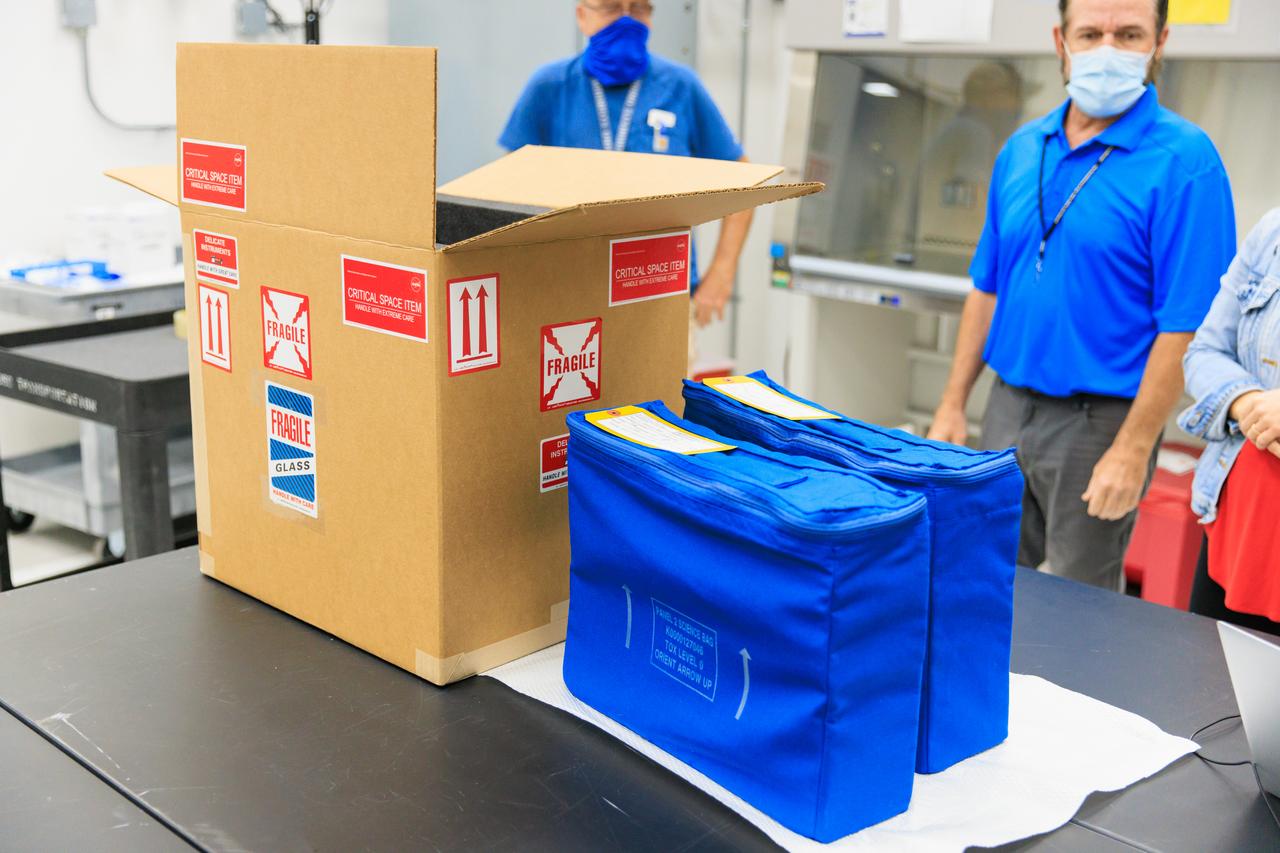
NASA’s Biology Experiment-1 (BioExpt-1) is officially packaged and ready for handover to the Orion team for Artemis I inside the Space Station Processing Facility at the agency’s Kennedy Space Center in Florida on Aug. 18, 2022. BioExpt-1 is a space biology pathfinder, which will carry Arabidopsis, algae, yeast, and fungi science payloads for biology research beyond low-Earth orbit aboard the Orion capsule on the Artemis I mission. The payload container assemblies will be installed onto panels in the Orion capsule and will return to Earth to provide critical and unique data about life beyond low-Earth orbit for the first time in more than 40 years. Artemis I is the first in a series of increasingly complex missions that will enable human exploration to the Moon and eventually on to Mars.
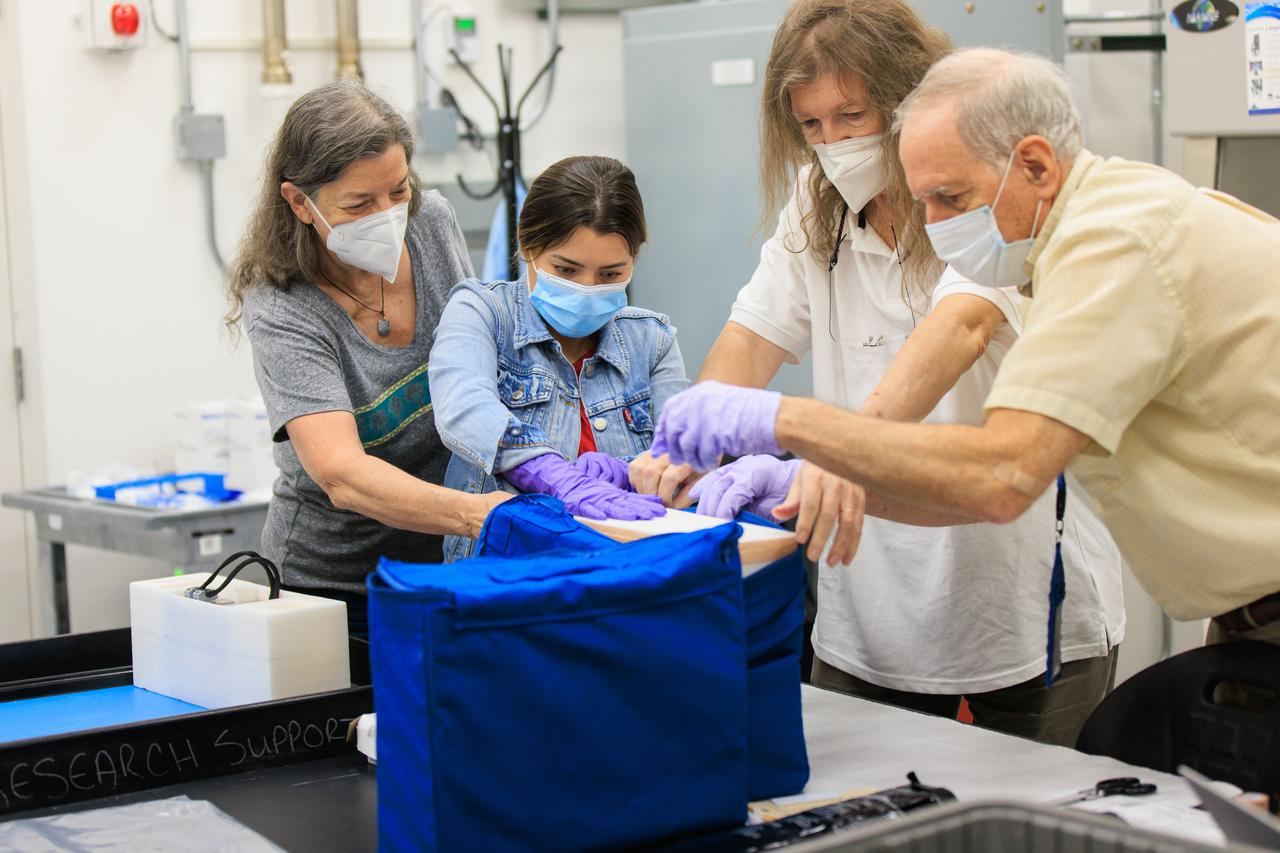
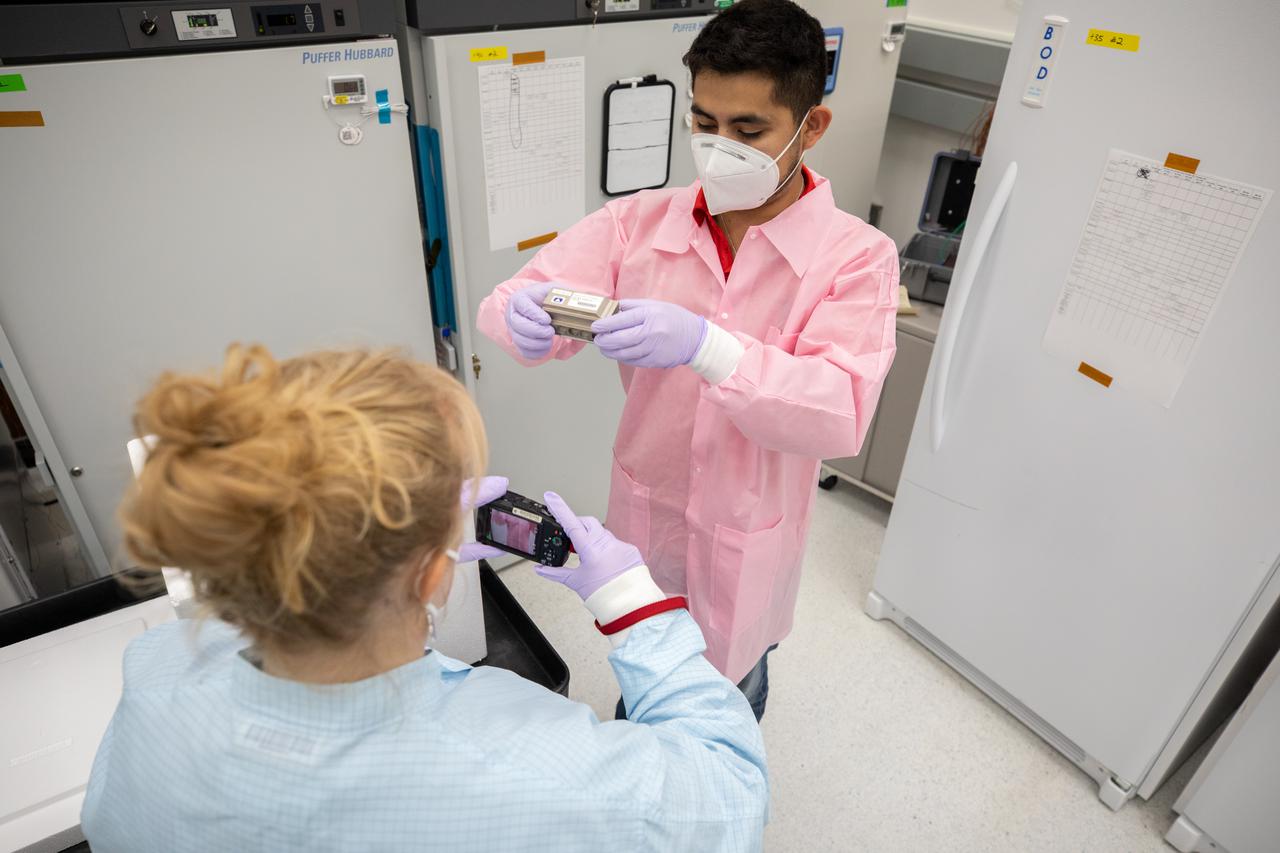
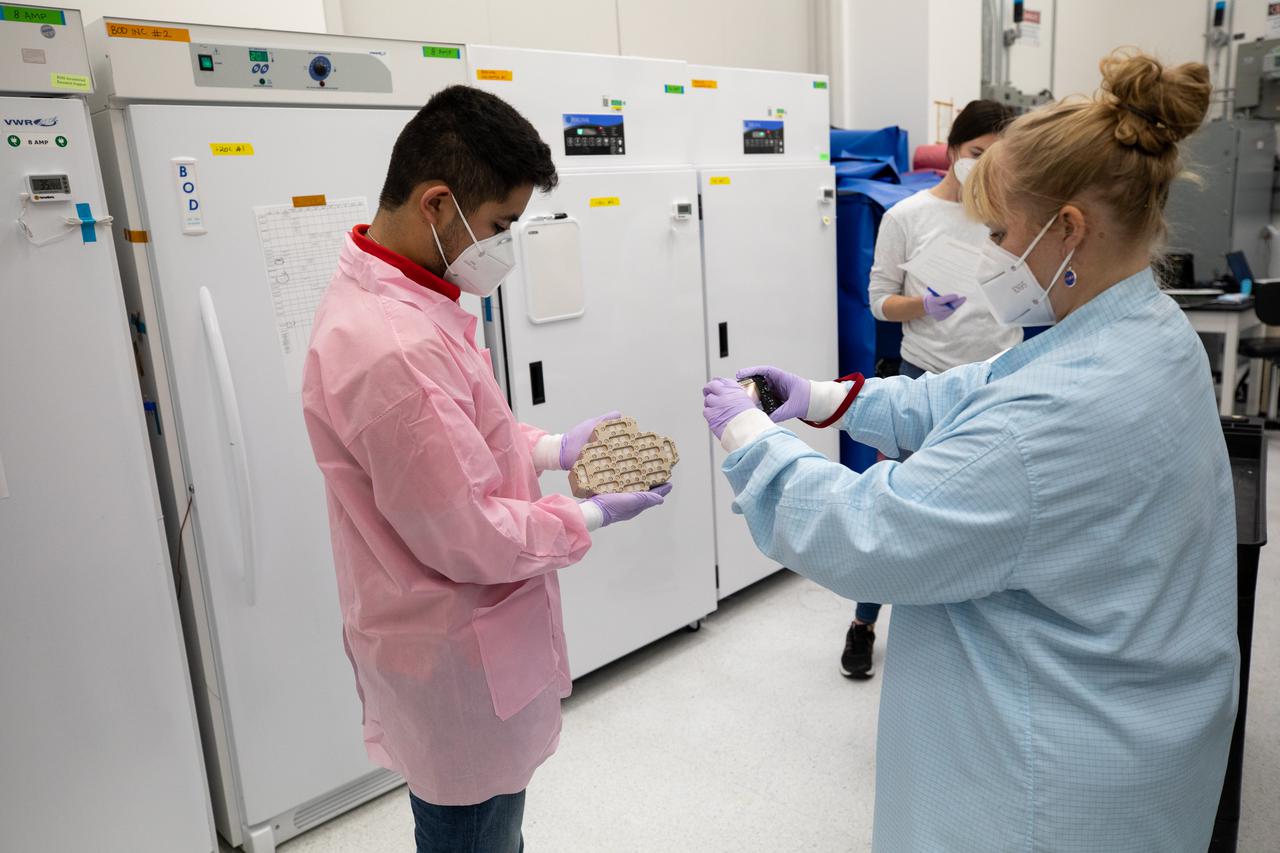
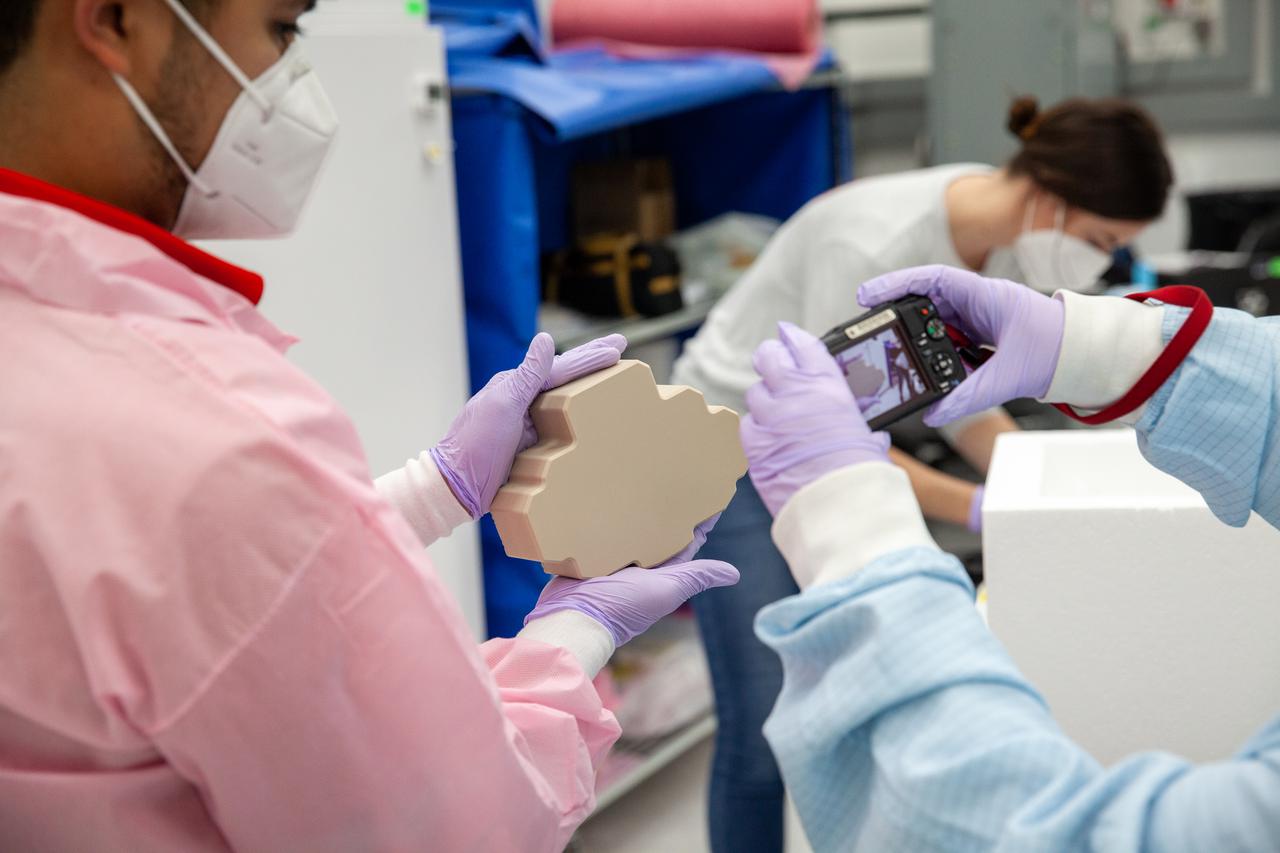
Scientists package up part of NASA’s Biology Experiment-1 (BioExpt-1) for official handover to the Orion team for Artemis I inside the Space Station Processing Facility at the agency’s Kennedy Space Center in Florida on Aug. 18, 2022. BioExpt-1 is a space biology pathfinder, which will carry Arabidopsis, algae, yeast, and fungi science payloads for biology research beyond low-Earth orbit aboard the Orion capsule on the Artemis I mission. The payload container assemblies will be installed onto panels in the Orion capsule and will return to Earth to provide critical and unique data about life beyond low-Earth orbit for the first time in more than 40 years. Artemis I is the first in a series of increasingly complex missions that will enable human exploration to the Moon and eventually on to Mars.
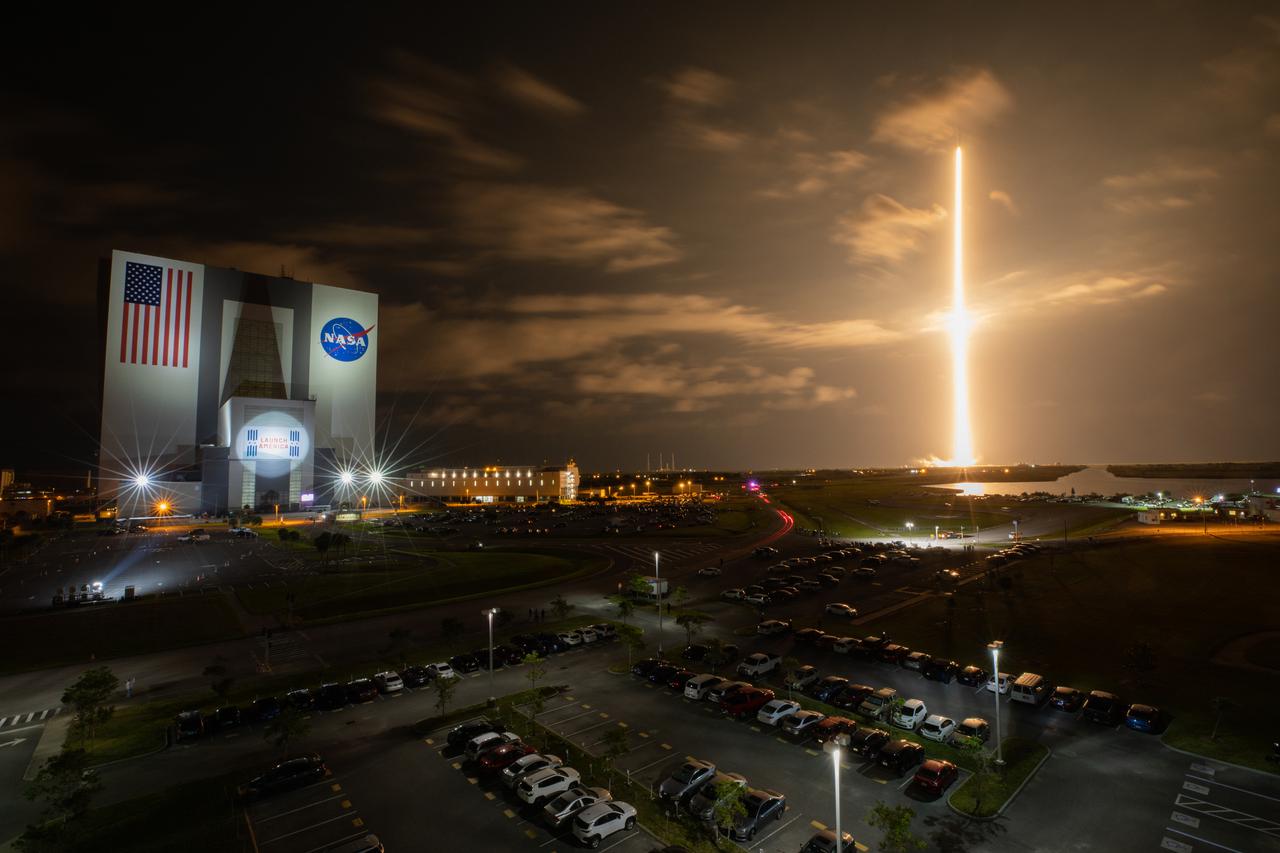
With a view of the iconic Vehicle Assembly Building at left, a SpaceX Falcon 9 rocket soars upward from Launch Complex 39A at NASA’s Kennedy Space Center in Florida on April 23, 2021, carrying the company’s Crew Dragon Endeavour capsule. Launch time was at 5:49 a.m. EDT. Onboard the capsule are NASA astronaut Shane Kimbrough, spacecraft commander; NASA astronaut Megan McArthur, pilot; ESA astronaut Thomas Pesquet, mission specialist; and JAXA astronaut Akihiko Hoshide, mission specialist. Crew-2 is the second regular crew mission of a U.S. commercial spacecraft with astronauts to the International Space Station as part of NASA’s Commercial Crew Program. The Crew Dragon will dock with the space station Saturday, April 24, at 5:10 a.m., and the crew will remain on the orbiting laboratory for a six-month science mission.
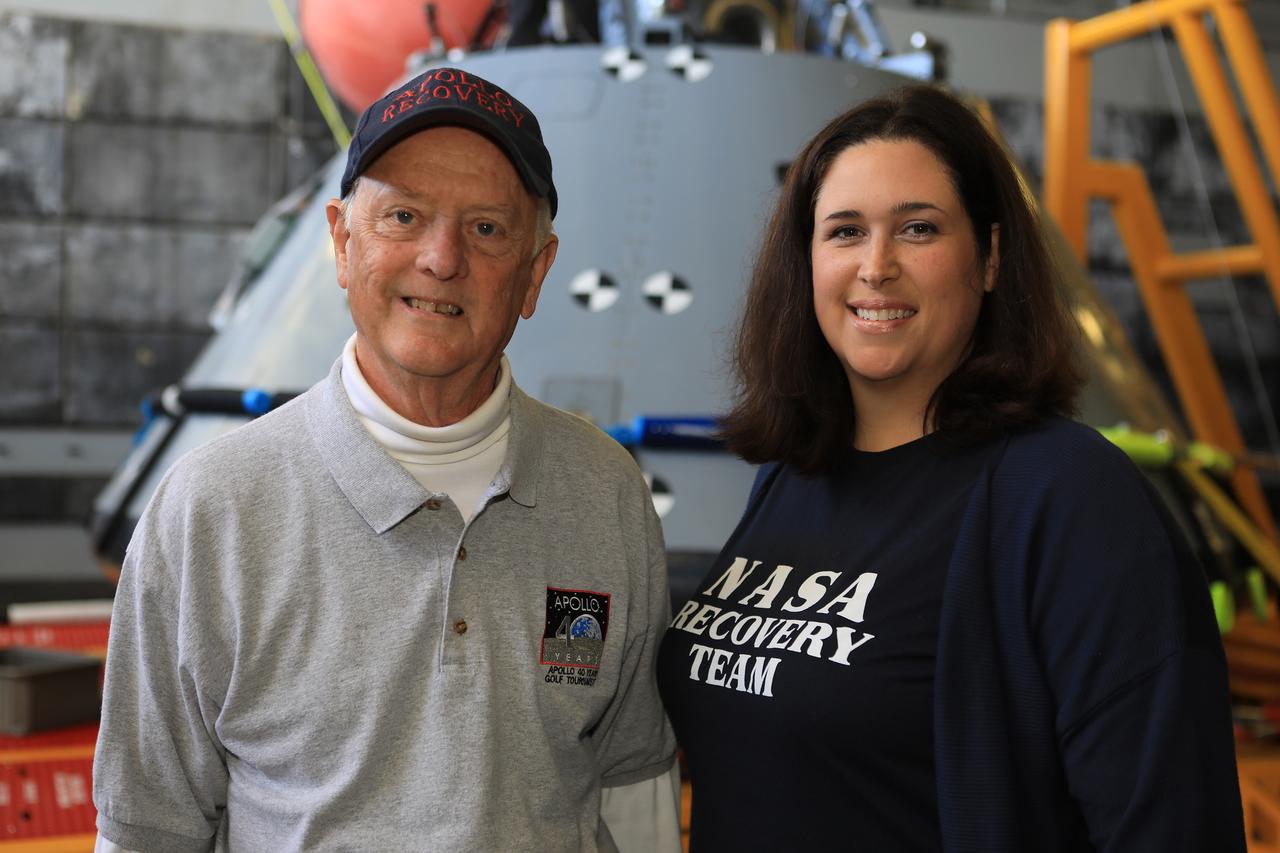
Apollo-era recovery engineer Milt Heflin, left, and NASA's Landing and Recovery Director Melissa Jones take time out from Underway Recovery Test-7 (URT-7) to pose in front of a test version of the Orion capsule in the well deck of the USS John P. Murtha on Nov. 3, 2018. The capsule is being used during testing. URT-7 is one in a series conducted by the Exploration Ground Systems Recovery Team to verify and validate procedures and hardware that will be used to recover the Orion spacecraft after it splashes down in the Pacific Ocean following deep space exploration missions. Orion will have emergency abort capability, sustain the crew during space travel and provide safe re-entry from deep space return velocities.
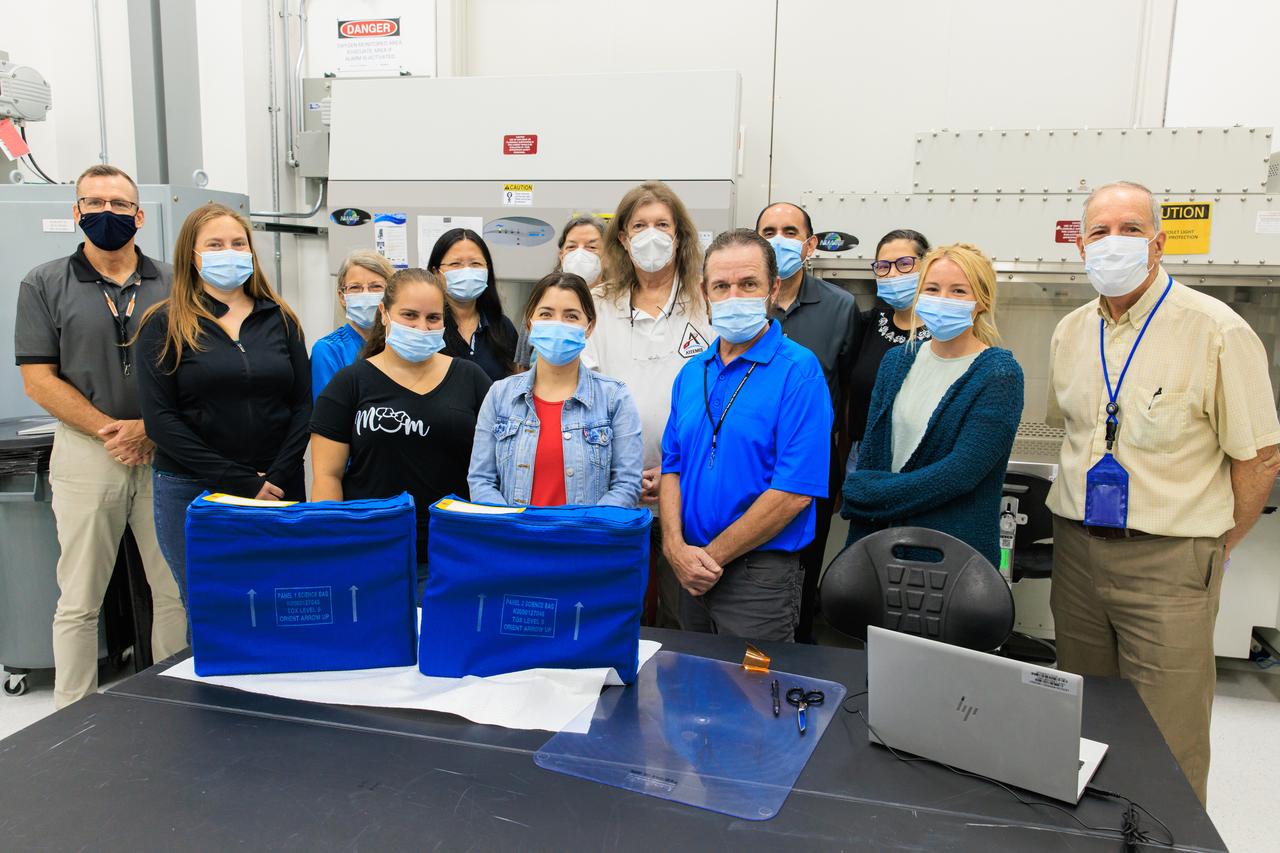
NASA’s Biology Experiment-1 (BioExpt-1) is officially packaged and ready for handover to the Orion team for Artemis I inside the Space Station Processing Facility at the agency’s Kennedy Space Center in Florida on Aug. 18, 2022. BioExpt-1 is a space biology pathfinder, which will carry Arabidopsis, algae, yeast, and fungi science payloads for biology research beyond low-Earth orbit aboard the Orion capsule on the Artemis I mission. The payload container assemblies will be installed onto panels in the Orion capsule and will return to Earth to provide critical and unique data about life beyond low-Earth orbit for the first time in more than 40 years. Artemis I is the first in a series of increasingly complex missions that will enable human exploration to the Moon and eventually on to Mars.
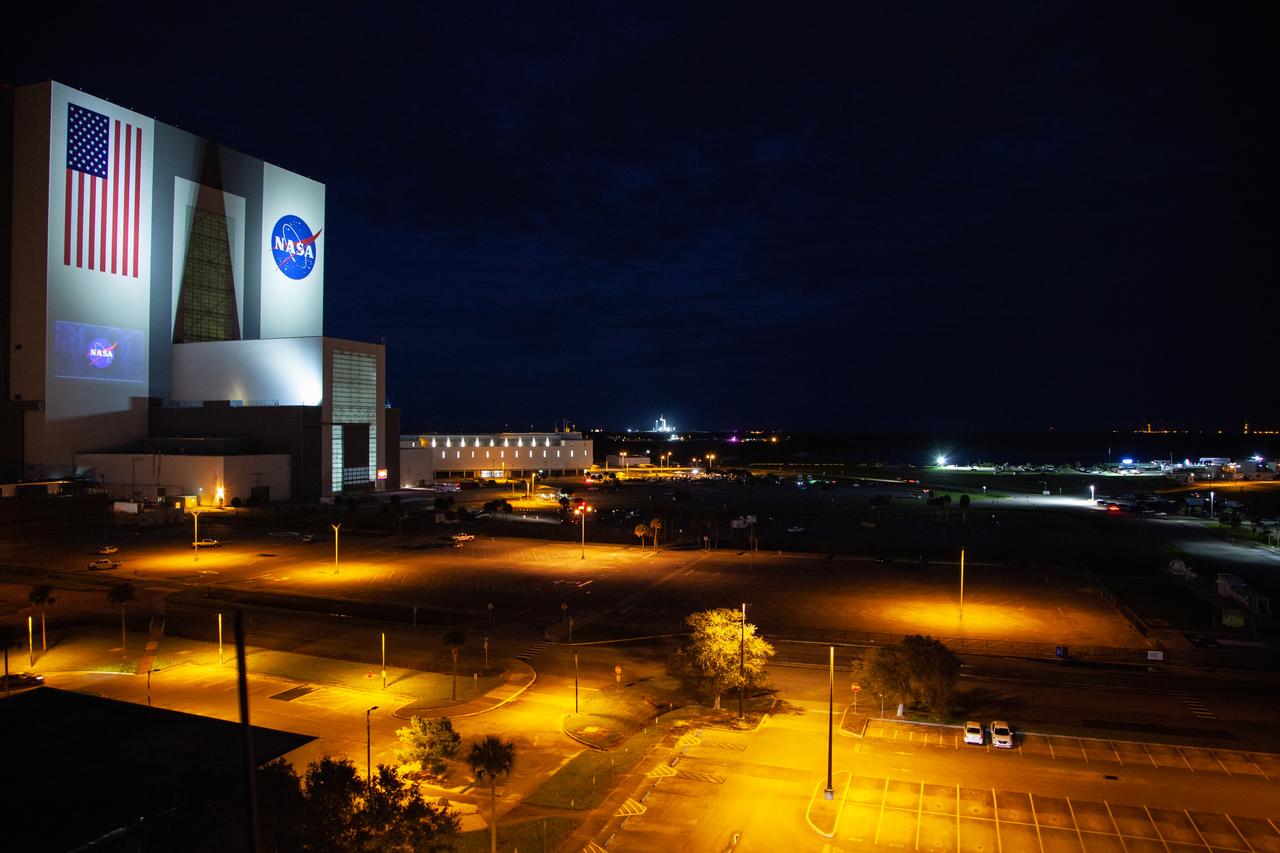
With a view of the iconic Vehicle Assembly Building at left, a SpaceX Falcon 9 rocket soars upward from Launch Complex 39A at NASA’s Kennedy Space Center in Florida on Nov. 15, 2020, carrying the company’s Crew Dragon Resilience capsule. Launch time was at 7:27 p.m. EST. Onboard the capsule are NASA’s SpaceX Crew-1 astronauts, Michael Hopkins, spacecraft commander; Victor Glover, pilot; Shannon Walker, mission specialist; and Japan Aerospace Exploration Agency astronaut Soichi Noguchi, mission specialist. Crew-1 is the first regular crew mission of a U.S. commercial spacecraft with astronauts to the International Space Station as part of NASA’s Commercial Crew Program. The Crew Dragon will dock with the space station and the crew will remain on the orbiting laboratory for a six-month science mission.
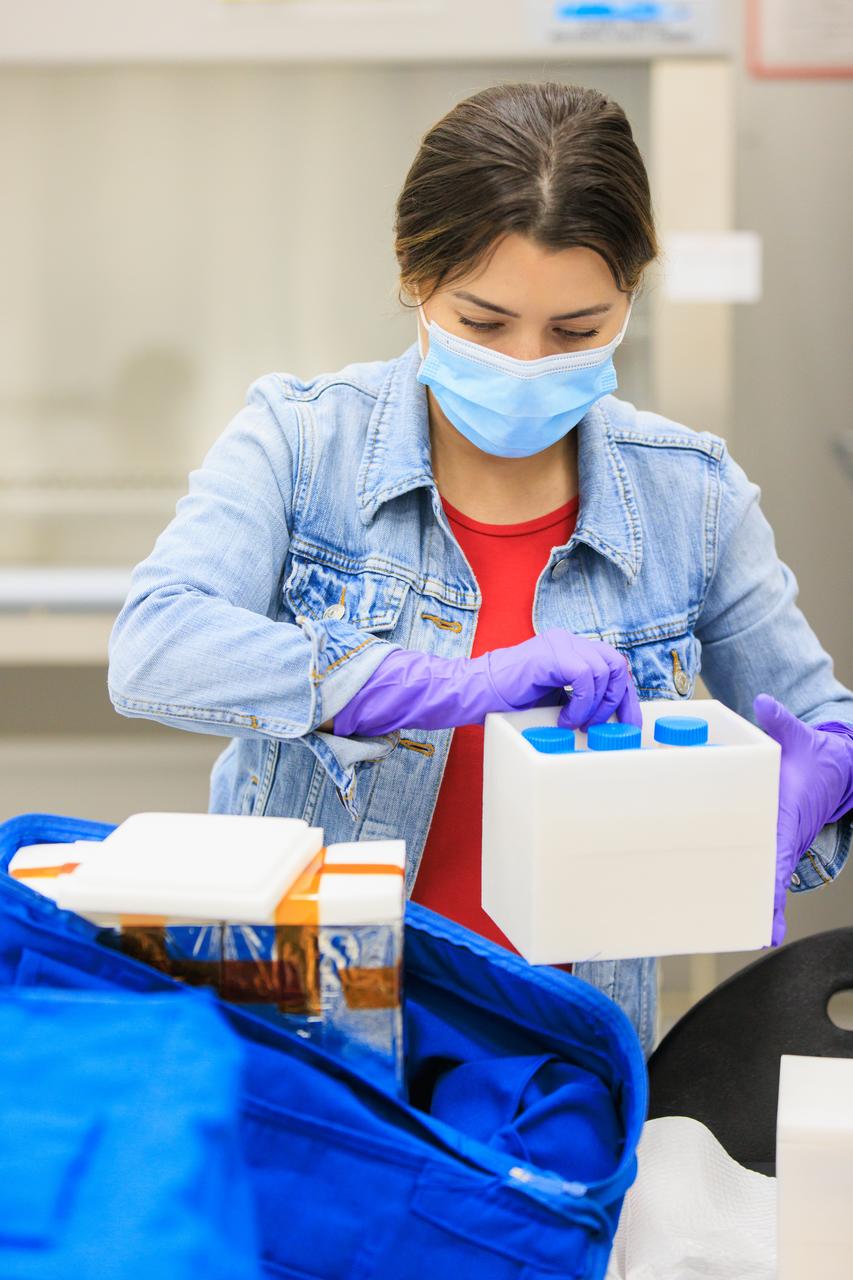
Scientists package up part of NASA’s Biology Experiment-1 (BioExpt-1) for official handover to the Orion team for Artemis I inside the Space Station Processing Facility at the agency’s Kennedy Space Center in Florida on Aug. 18, 2022. BioExpt-1 is a space biology pathfinder, which will carry Arabidopsis, algae, yeast, and fungi science payloads for biology research beyond low-Earth orbit aboard the Orion capsule on the Artemis I mission. The payload container assemblies will be installed onto panels in the Orion capsule and will return to Earth to provide critical and unique data about life beyond low-Earth orbit for the first time in more than 40 years. Artemis I is the first in a series of increasingly complex missions that will enable human exploration to the Moon and eventually on to Mars.
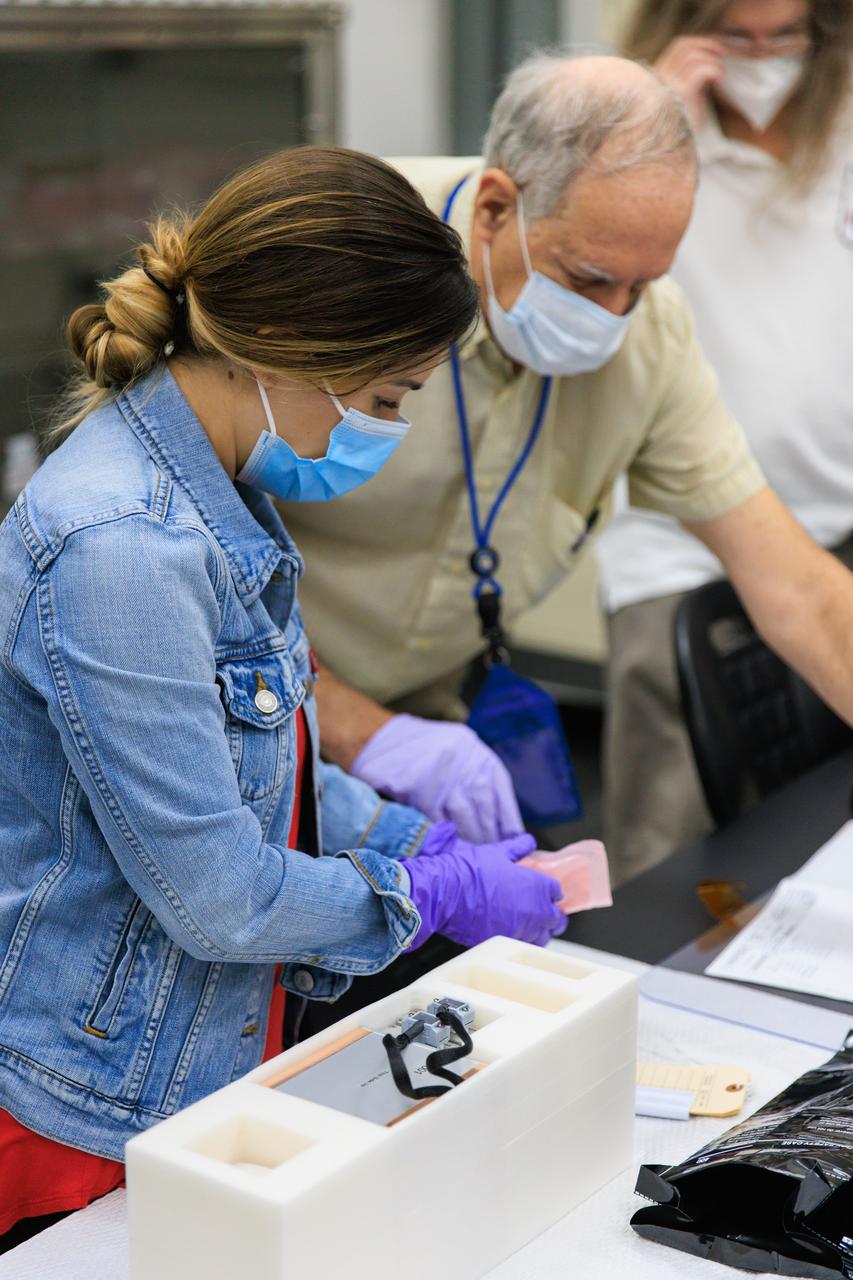
Scientists package up part of NASA’s Biology Experiment-1 (BioExpt-1) for official handover to the Orion team for Artemis I inside the Space Station Processing Facility at the agency’s Kennedy Space Center in Florida on Aug. 18, 2022. BioExpt-1 is a space biology pathfinder, which will carry Arabidopsis, algae, yeast, and fungi science payloads for biology research beyond low-Earth orbit aboard the Orion capsule on the Artemis I mission. The payload container assemblies will be installed onto panels in the Orion capsule and will return to Earth to provide critical and unique data about life beyond low-Earth orbit for the first time in more than 40 years. Artemis I is the first in a series of increasingly complex missions that will enable human exploration to the Moon and eventually on to Mars.
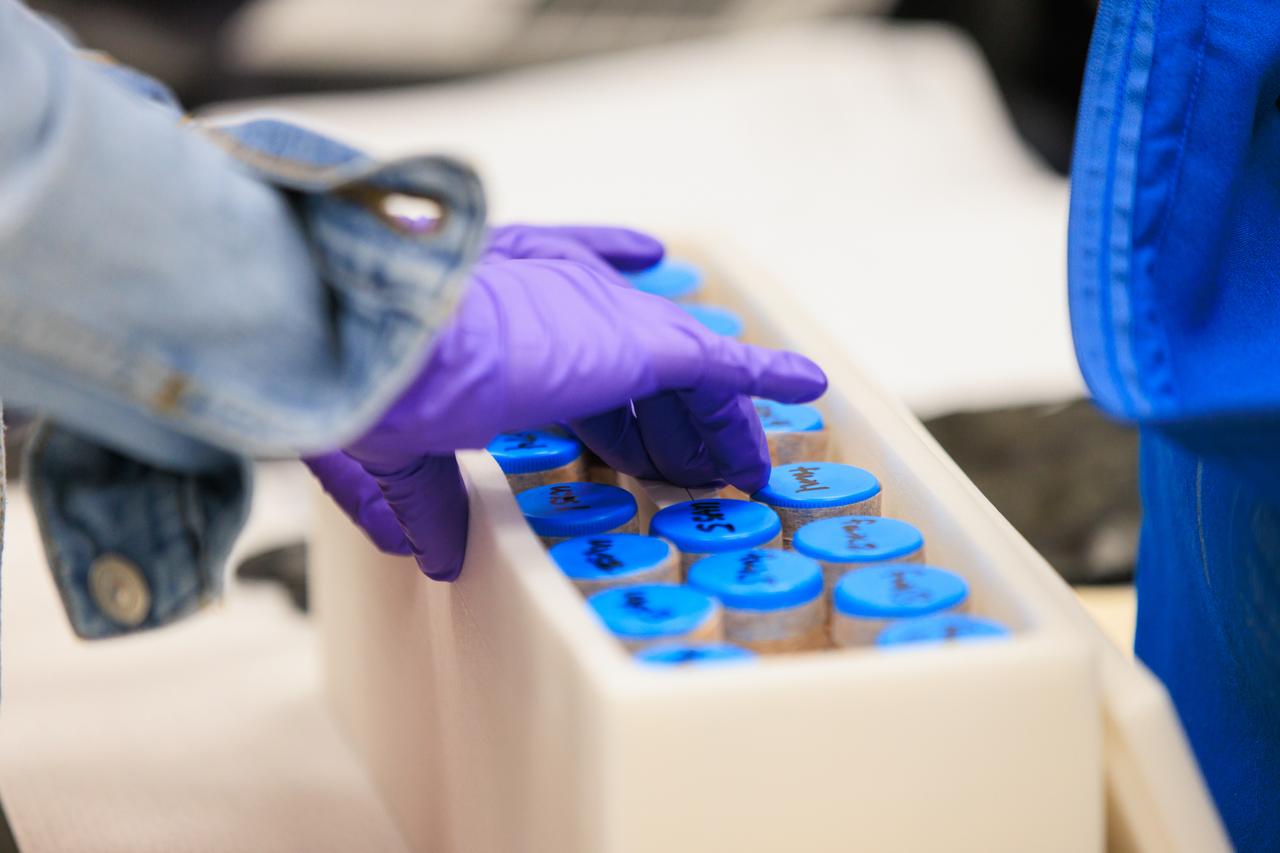
Scientists package up part of NASA’s Biology Experiment-1 (BioExpt-1) for official handover to the Orion team for Artemis I inside the Space Station Processing Facility at the agency’s Kennedy Space Center in Florida on Aug. 18, 2022. BioExpt-1 is a space biology pathfinder, which will carry Arabidopsis, algae, yeast, and fungi science payloads for biology research beyond low-Earth orbit aboard the Orion capsule on the Artemis I mission. The payload container assemblies will be installed onto panels in the Orion capsule and will return to Earth to provide critical and unique data about life beyond low-Earth orbit for the first time in more than 40 years. Artemis I is the first in a series of increasingly complex missions that will enable human exploration to the Moon and eventually on to Mars.
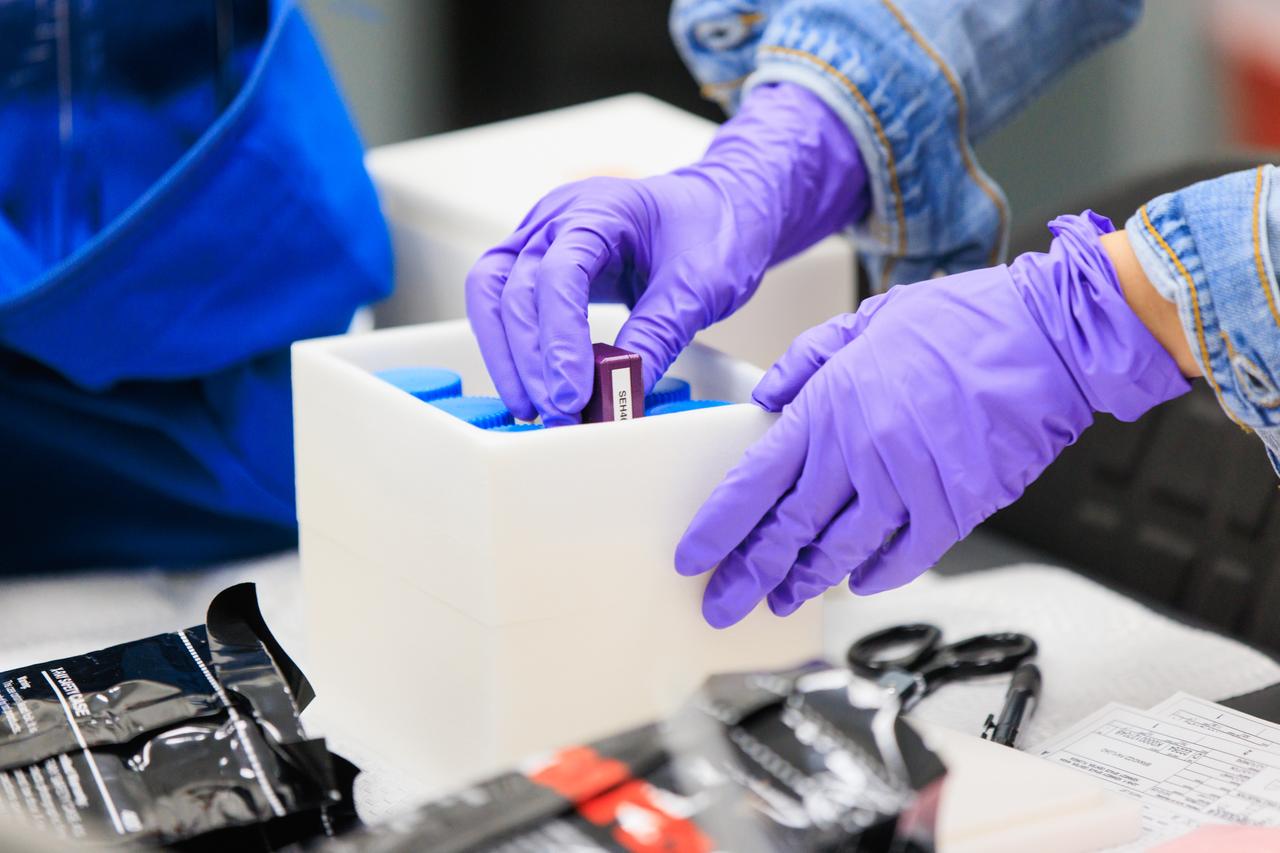
Scientists package up part of NASA’s Biology Experiment-1 (BioExpt-1) for official handover to the Orion team for Artemis I inside the Space Station Processing Facility at the agency’s Kennedy Space Center in Florida on Aug. 18, 2022. BioExpt-1 is a space biology pathfinder, which will carry Arabidopsis, algae, yeast, and fungi science payloads for biology research beyond low-Earth orbit aboard the Orion capsule on the Artemis I mission. The payload container assemblies will be installed onto panels in the Orion capsule and will return to Earth to provide critical and unique data about life beyond low-Earth orbit for the first time in more than 40 years. Artemis I is the first in a series of increasingly complex missions that will enable human exploration to the Moon and eventually on to Mars.
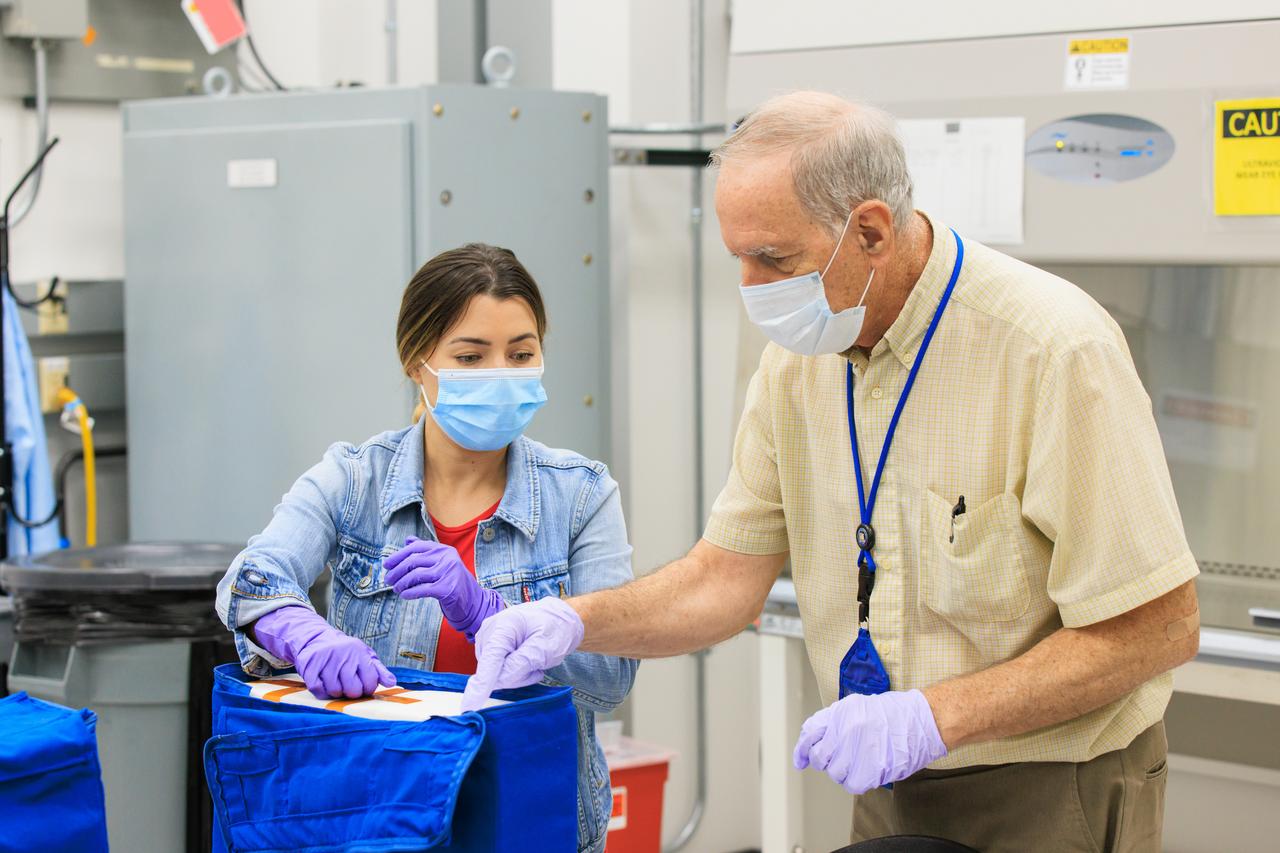
Scientists package up part of NASA’s Biology Experiment-1 (BioExpt-1) for official handover to the Orion team for Artemis I inside the Space Station Processing Facility at the agency’s Kennedy Space Center in Florida on Aug. 18, 2022. BioExpt-1 is a space biology pathfinder, which will carry Arabidopsis, algae, yeast, and fungi science payloads for biology research beyond low-Earth orbit aboard the Orion capsule on the Artemis I mission. The payload container assemblies will be installed onto panels in the Orion capsule and will return to Earth to provide critical and unique data about life beyond low-Earth orbit for the first time in more than 40 years. Artemis I is the first in a series of increasingly complex missions that will enable human exploration to the Moon and eventually on to Mars.
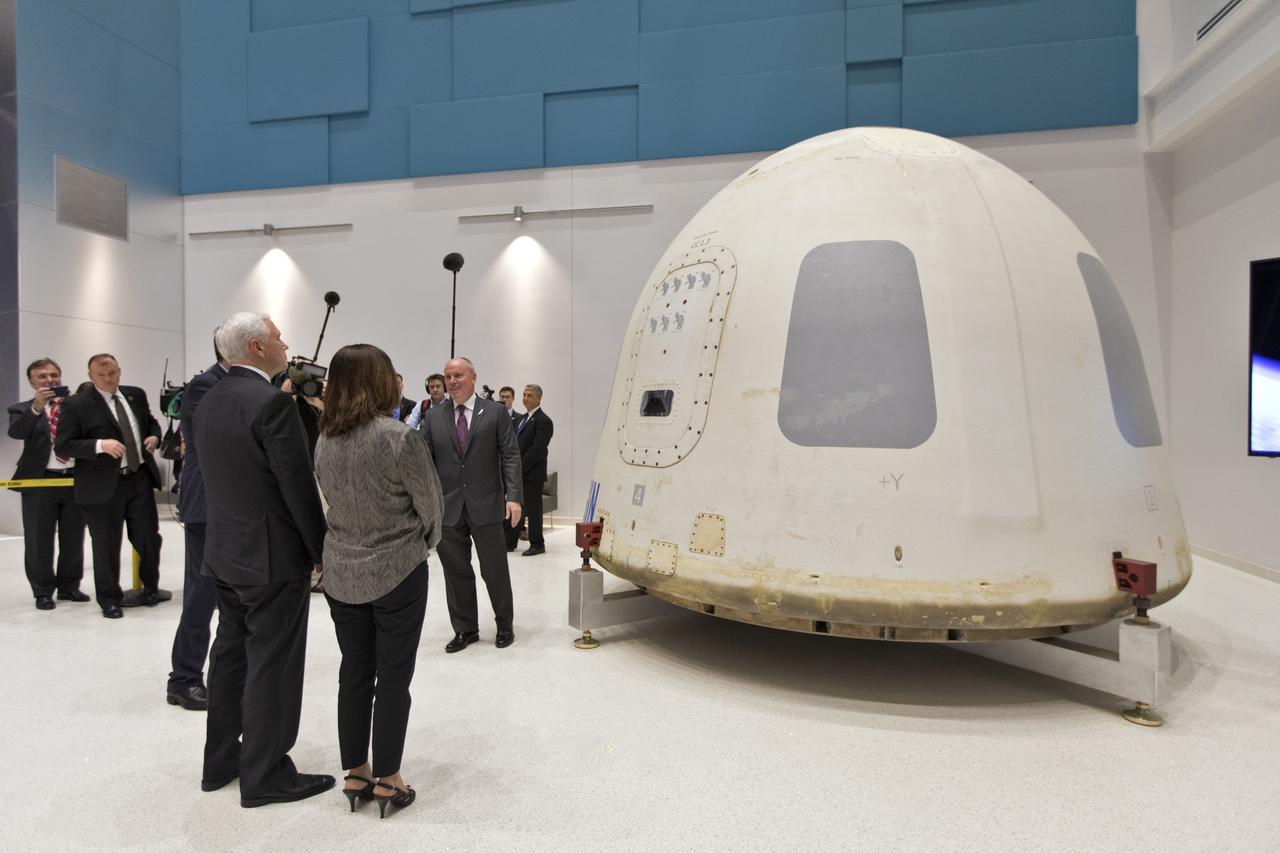
Vice President Mike Pence, second from right, and his wife, Karen Pence, tour the Blue Origin Manufacturing Facility near NASA's Kennedy Space Center in Florida, on Feb. 20, 2018. Vice President Pence viewed the flown New Shepard Booster and Crew Capsule. The Crew Capsule, in view, flew seven times, including a pad abort test and an escape test at maximum dynamic pressure. During his visit, Pence will chair a meeting of the National Space Council on Feb. 21, 2018 in the high bay of NASA Kennedy Space Center's Space Station Processing Facility. The council's role is to advise the president regarding national space policy and strategy, and review the nation's long-range goals for space activities.
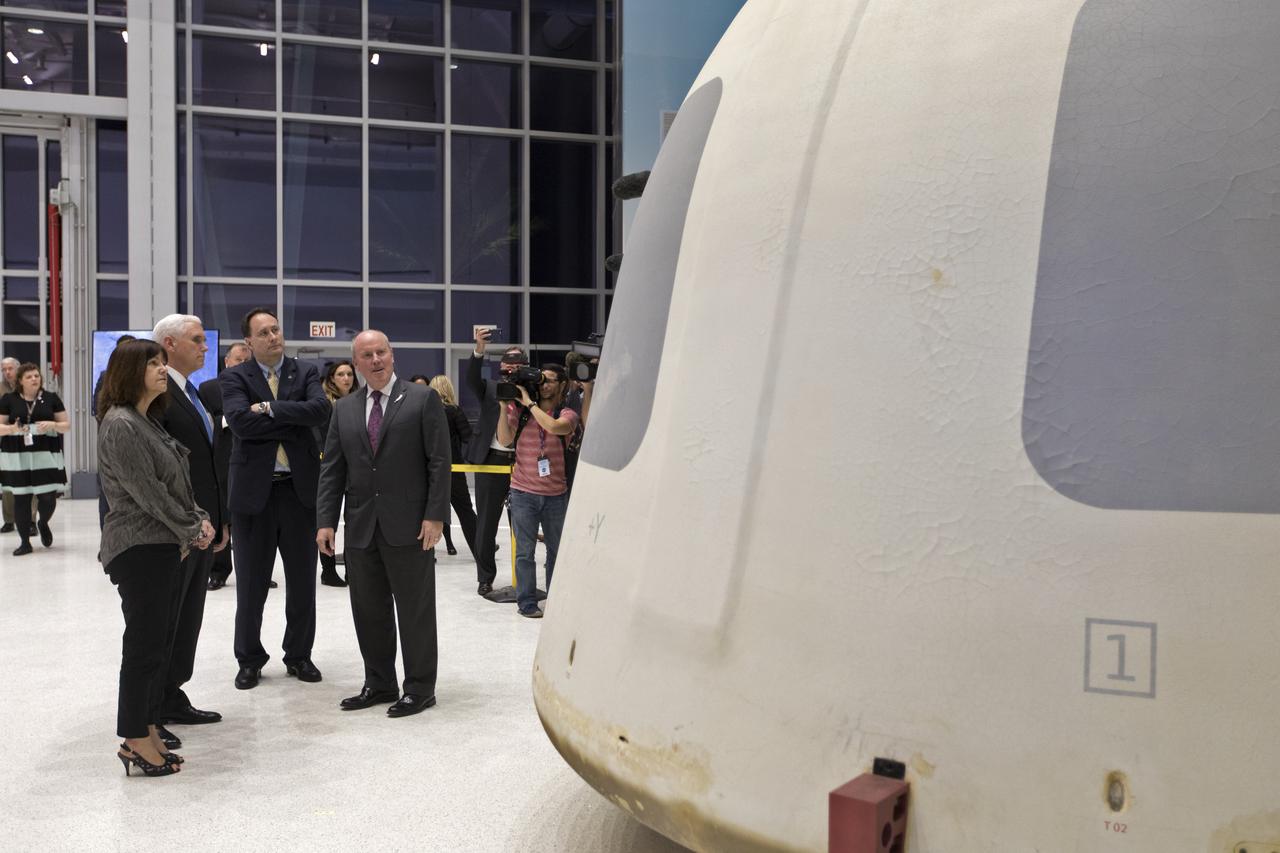
Vice President Mike Pence, second from left, tours the Blue Origin Manufacturing Facility near NASA's Kennedy Space Center in Florida, on Feb. 20, 2018. At far left is the vice president's wife, Karen Pence. To the right of Vice President Pence are acting NASA Administrator Robert Lightfoot and Blue Origin CEO Robert Smith. Pence viewed the flown New Shepard Booster and Crew Capsule. The Crew Capsule, in view, flew seven times, including a pad abort test and an escape test at maximum dynamic pressure. During his visit, Pence will chair a meeting of the National Space Council on Feb. 21, 2018 in the high bay of NASA Kennedy Space Center's Space Station Processing Facility. The council's role is to advise the president regarding national space policy and strategy, and review the nation's long-range goals for space activities.
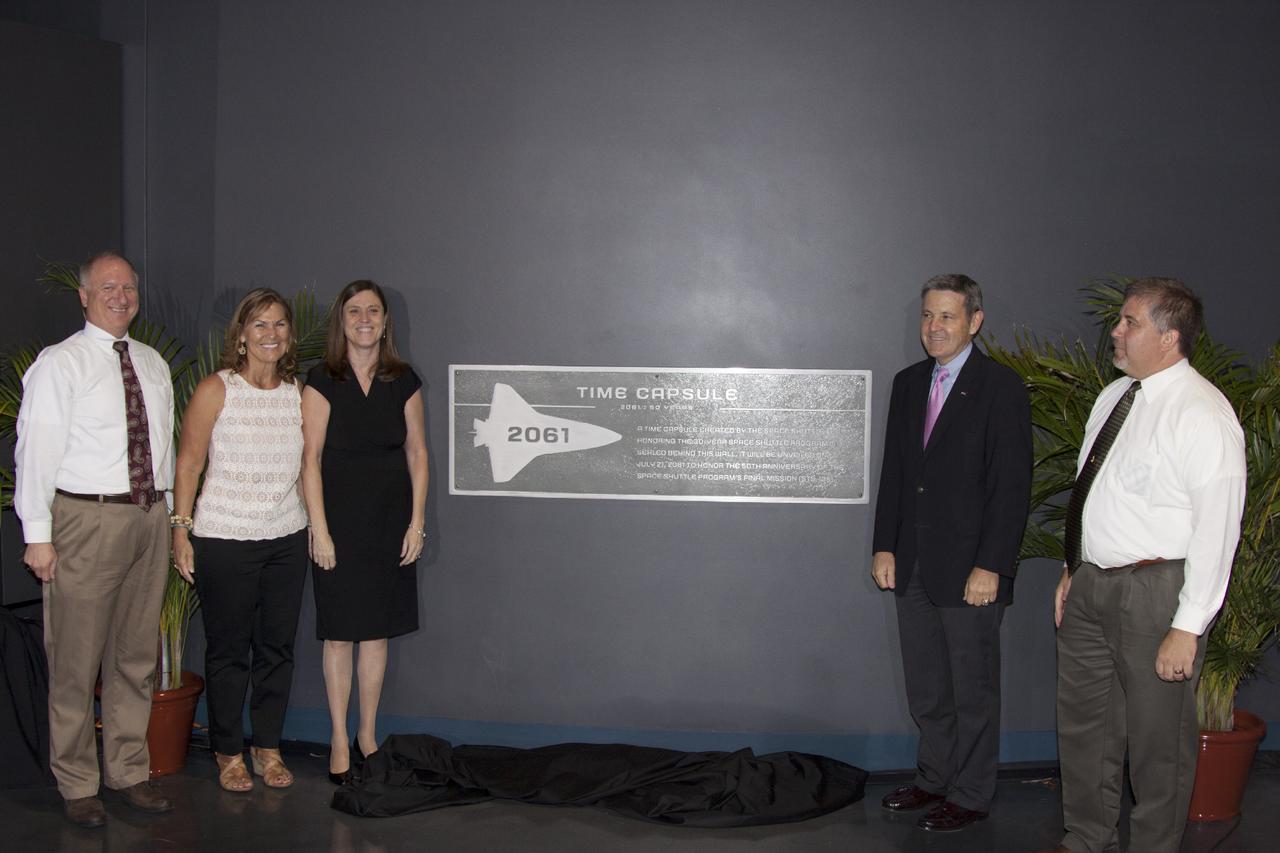
CAPE CANAVERAL, Fla. -- At the Kennedy Space Center Visitor Complex in Florida, officials pose at the site where a Shuttle Program time capsule has been secured vault within the walls of the Space Shuttle Atlantis home at the Kennedy Space Center Visitor Complex. From the left are: Pete Nickolenko, deputy director of NASA Ground Processing at Kennedy, Patty Stratton of Abacus Technology, currently program manager for the Information Management Communications Support Contract. During the Shuttle Program she was deputy director of Ground Operations for NASA's Space Program Operations Contractor, United Space Alliance, Rita Wilcoxon, NASA's now retired director of Shuttle Processing, Bob Cabana, director of the Kennedy Space Center and George Jacobs, deputy director of Center Operations, who was manager of the agency's Shuttle Transition and Retirement Project Office. The time capsule, containing artifacts and other memorabilia associated with the history of the program is designated to be opened on the 50th anniversary of the shuttle's final landing, STS-135. The new $100 million "Space Shuttle Atlantis" facility includes interactive exhibits that tell the story of the 30-year Space Shuttle Program and highlight the future of space exploration. Photo credit: NASA/Jim Grossmann
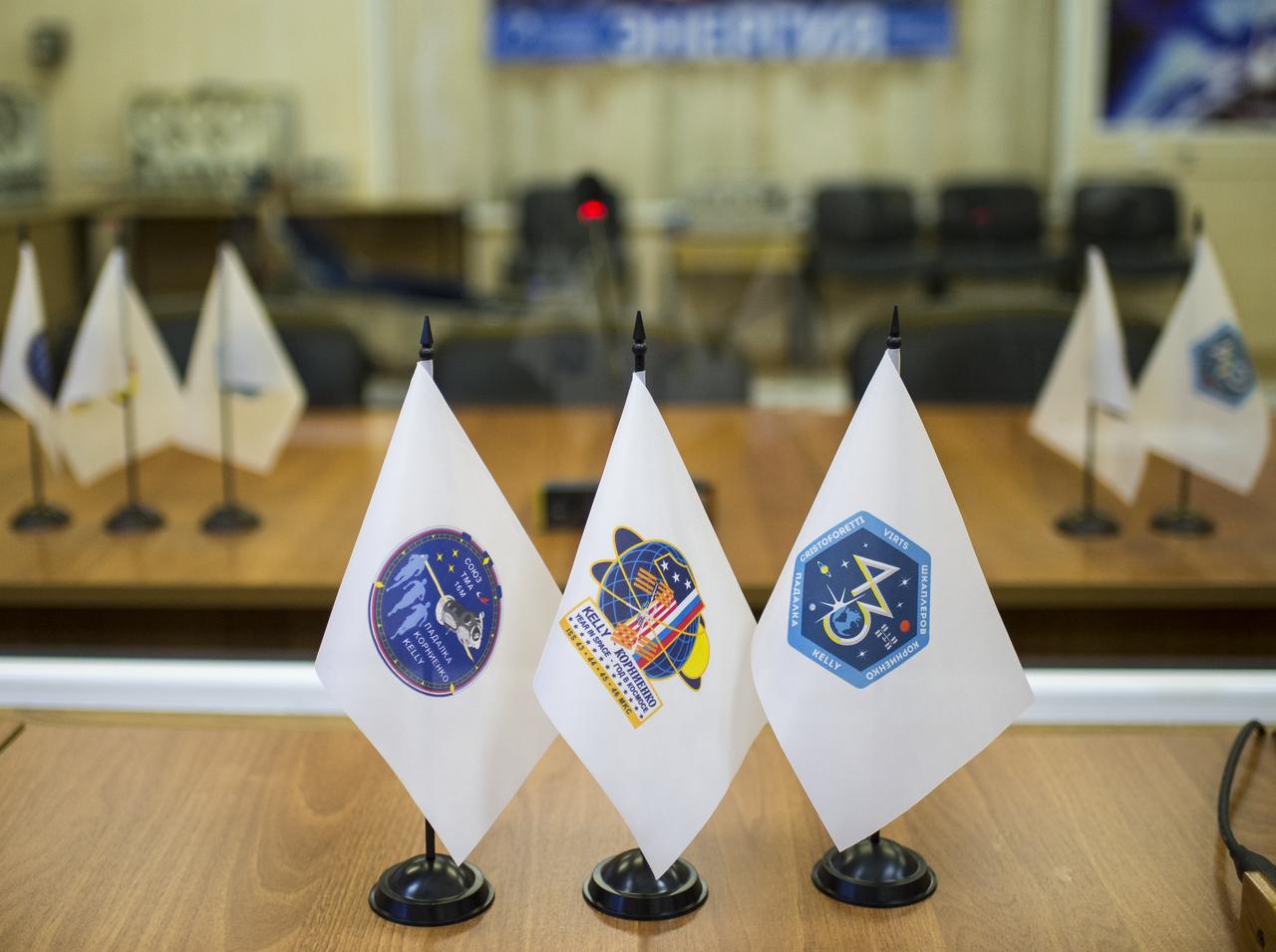
Flags depicting the Soyuz TMA-16M spacecraft, the One-Year Mission, and the Expedition 43 Mission are seen on desks in two different rooms separated by glass where Expedition 43 prime and backup crews will meet with space officials on their final check of the Soyuz capsule, Monday, March 23, 2015 at the Baikonur Cosmodrome in Kazakhstan. NASA Astronaut Scott Kelly, and Russian Cosmonauts Mikhail Kornienko, and Gennady Padalka of the Russian Federal Space Agency (Roscosmos) are scheduled to launch to the International Space Station in the Soyuz TMA-16M spacecraft from the Baikonur Cosmodrome in Kazakhstan March 28, Kazakh time (March 27 Eastern time.) As the one-year crew, Kelly and Kornienko will return to Earth on Soyuz TMA-18M in March 2016. Photo Credit: (NASA/Bill Ingalls)
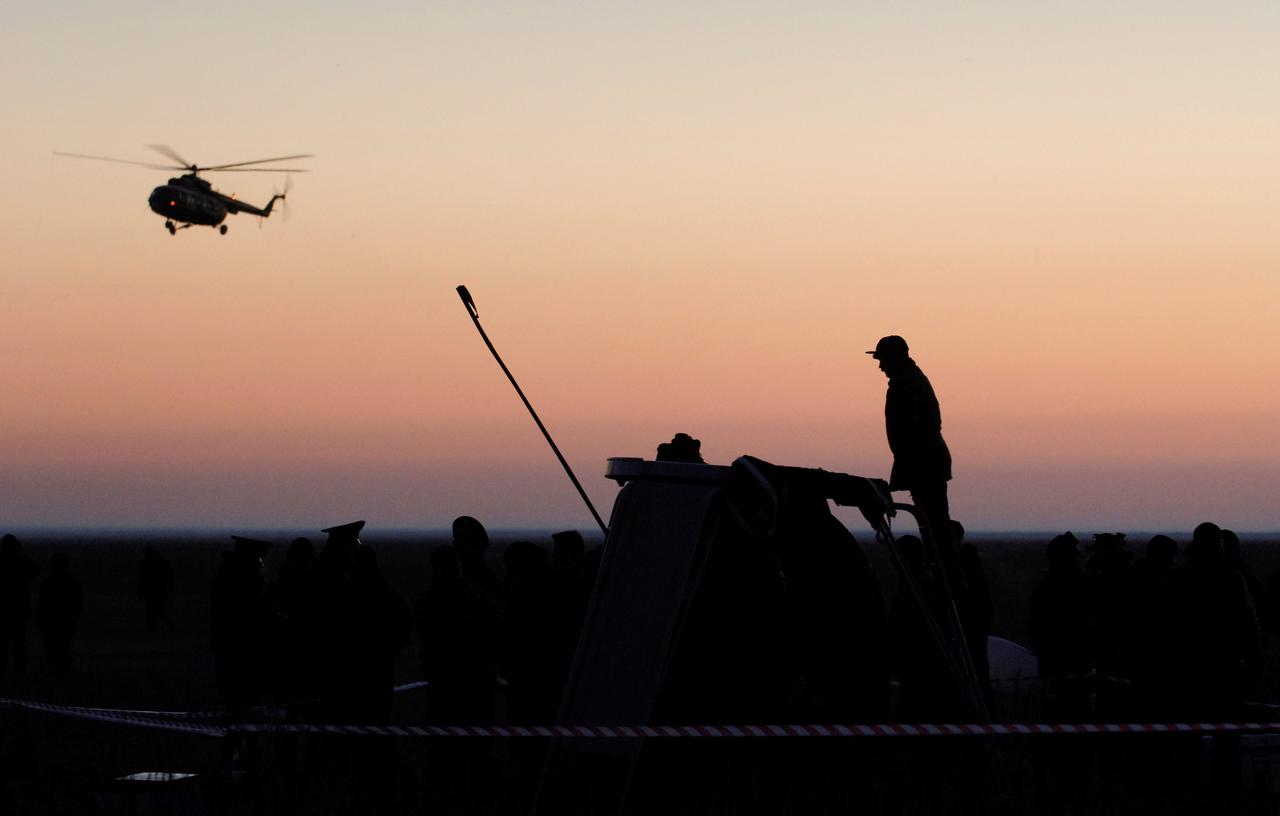
JSC2006-E-16029 (9 April 2006) --- A Russian search and rescue helicopter flies over Arkalyk airport, Kazakhstan. Astronaut William S. (Bill) McArthur, Jr., Expedition 12 commander and NASA space station science officer; cosmonaut Valery I. Tokarev, flight engineer and Soyuz commander representing Russia's Federal Space Agency; and Brazilian astronaut Marco C. Pontes brought their Soyuz TMA-7 capsule to a pre-dawn landing on April 9, 2006 (Kazakhstan time). McArthur and Tokarev completed six months in space on the station, while Pontes spent 10 days in orbit. Photo Credit: NASA/Victor Zelentsov
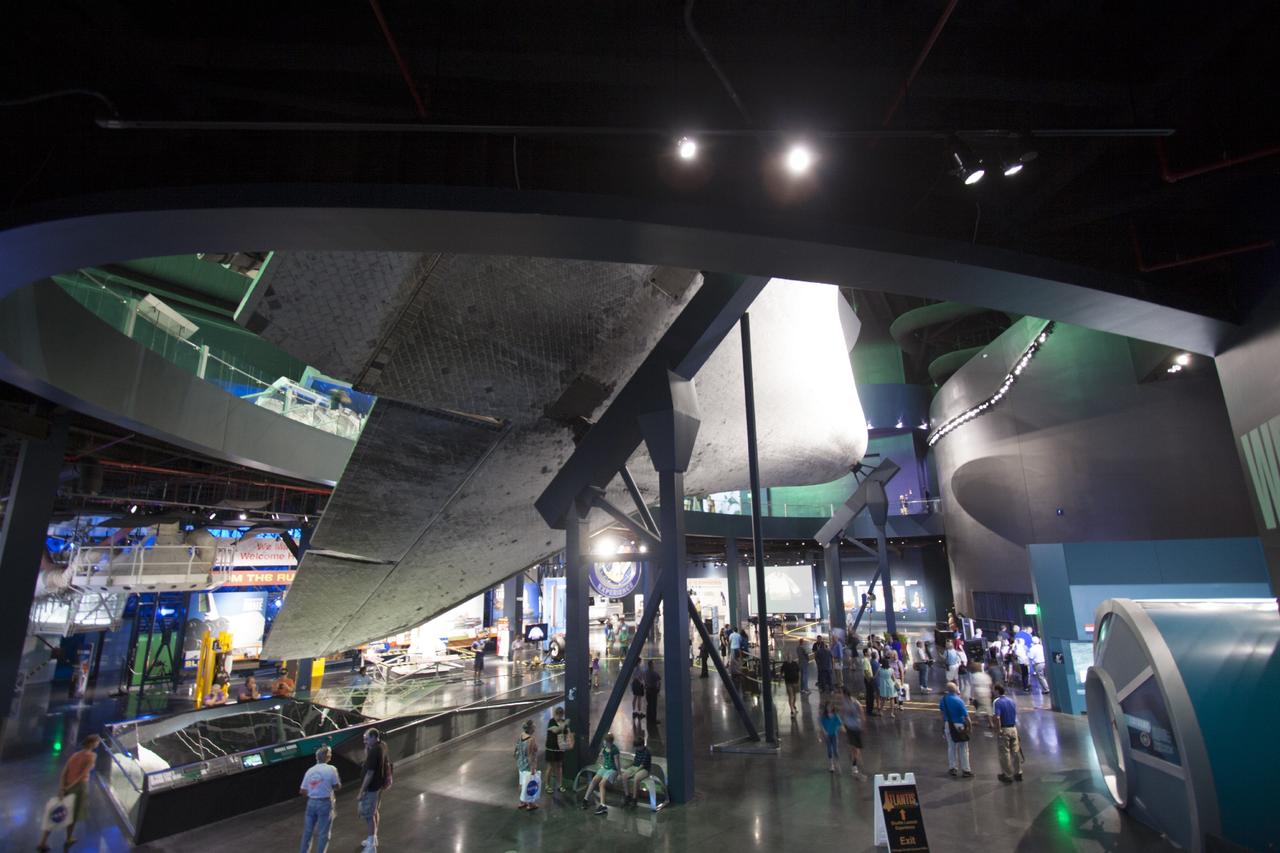
CAPE CANAVERAL, Fla. -- At the Kennedy Space Center Visitor Complex in Florida, the Space Shuttle Atlantis and other exhibits are now on display inside the 90,000-square-foot facility. The time capsule, containing artifacts and other memorabilia associated with the history of the program is designated to be opened on the 50th anniversary of the shuttle's final landing, STS-135. The new $100 million "Space Shuttle Atlantis" facility includes interactive exhibits that tell the story of the 30-year Space Shuttle Program and highlight the future of space exploration. Photo credit: NASA/Jim Grossmann
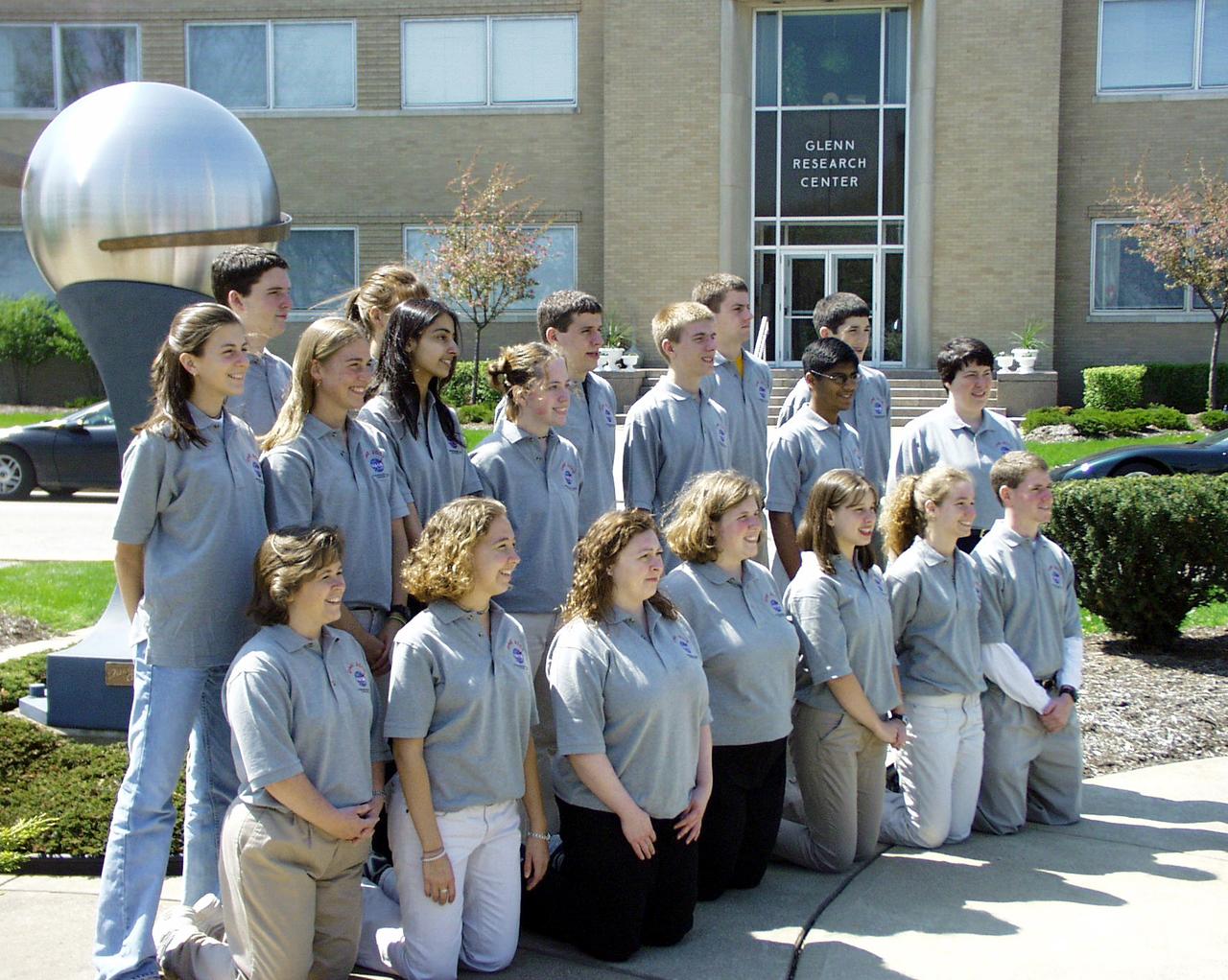
Students from the four teams pose in front of he NASA Glenn Administration Building alongside the NASA Glenn Time Capsule. The students participated in the second Dropping in a Microgravity Environment (DIME) competition held April 23-25, 2002, at NASA's Glenn Research Center. Competitors included two teams from Sycamore High School, Cincinnati, OH, and one each from Bay High School, Bay Village, OH, and COSI Academy, Columbus, OH. DIME is part of NASA's education and outreach activities. Details are on line at http://microgravity.grc.nasa.gov/DIME_2002.html.
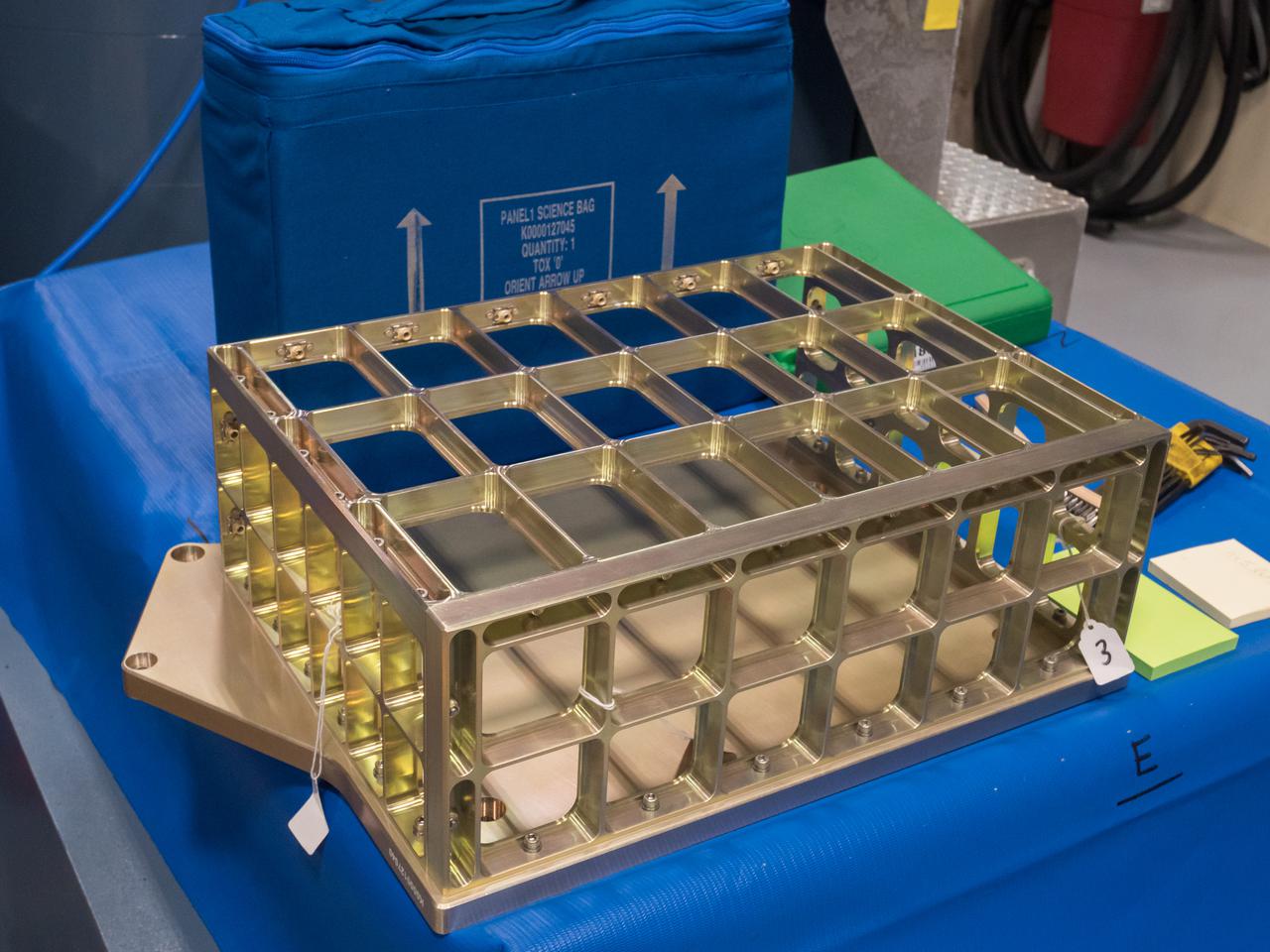
NASA’s BioExperiment-1 is being prepared for testing in the Vibration Laboratory at Kennedy Space Center in Florida on May 13, 2021. BioExpt-1 is a space biology pathfinder, which will carry plant, algae, yeast, and fungi for biology research beyond low-Earth orbit (LEO). NASA will install the BioExpt-1 payload container assembles onto panels inside the Orion capsule. BioExpt-1 will return these science payloads to Earth to provide critical and unique data about life beyond LEO for the first time in more than 40 years. Artemis I is the first in a series of increasingly complex missions that will enable human exploration of the Moon and eventually on to Mars.
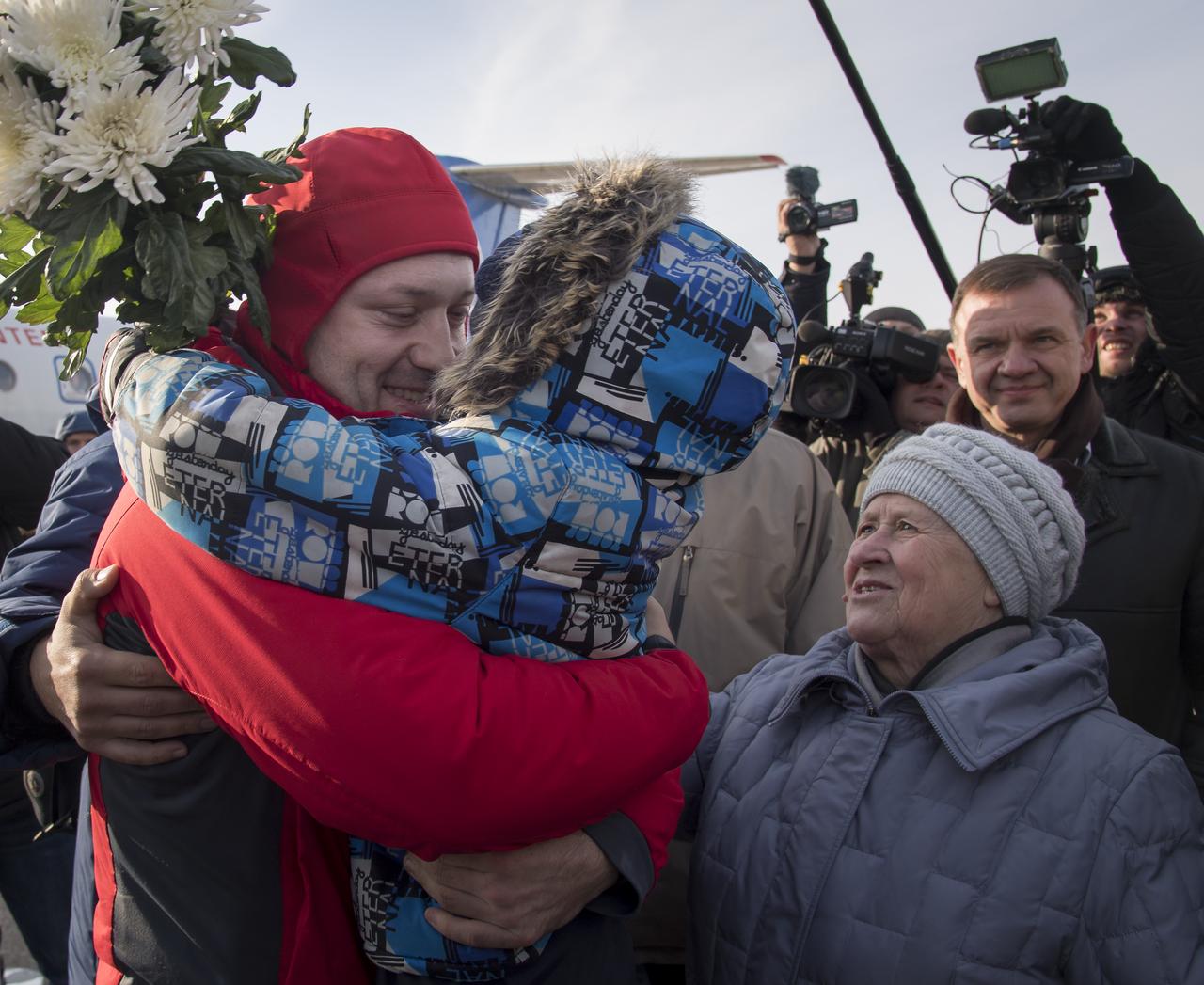
Expedition 54 cosmonaut Alexander Misurkin of the Russian space agency Roscosmos is welcomed at the Chkalovsky Airport in Star City, Russia by family and colleagues a few hours after he and NASA astronauts Joe Acaba and Mark Vande Hei landed their Soyuz MS-06 capsule near the town of Zhezkazgan, Kazakhstan on Wednesday, Feb. 28, 2018 (February 27 Eastern time.) Acaba, Vande Hei, and Misurkin are returning after 168 days in space where they served as members of the Expedition 53 and 54 crews onboard the International Space Station. Photo Credit: (NASA/Bill Ingalls)
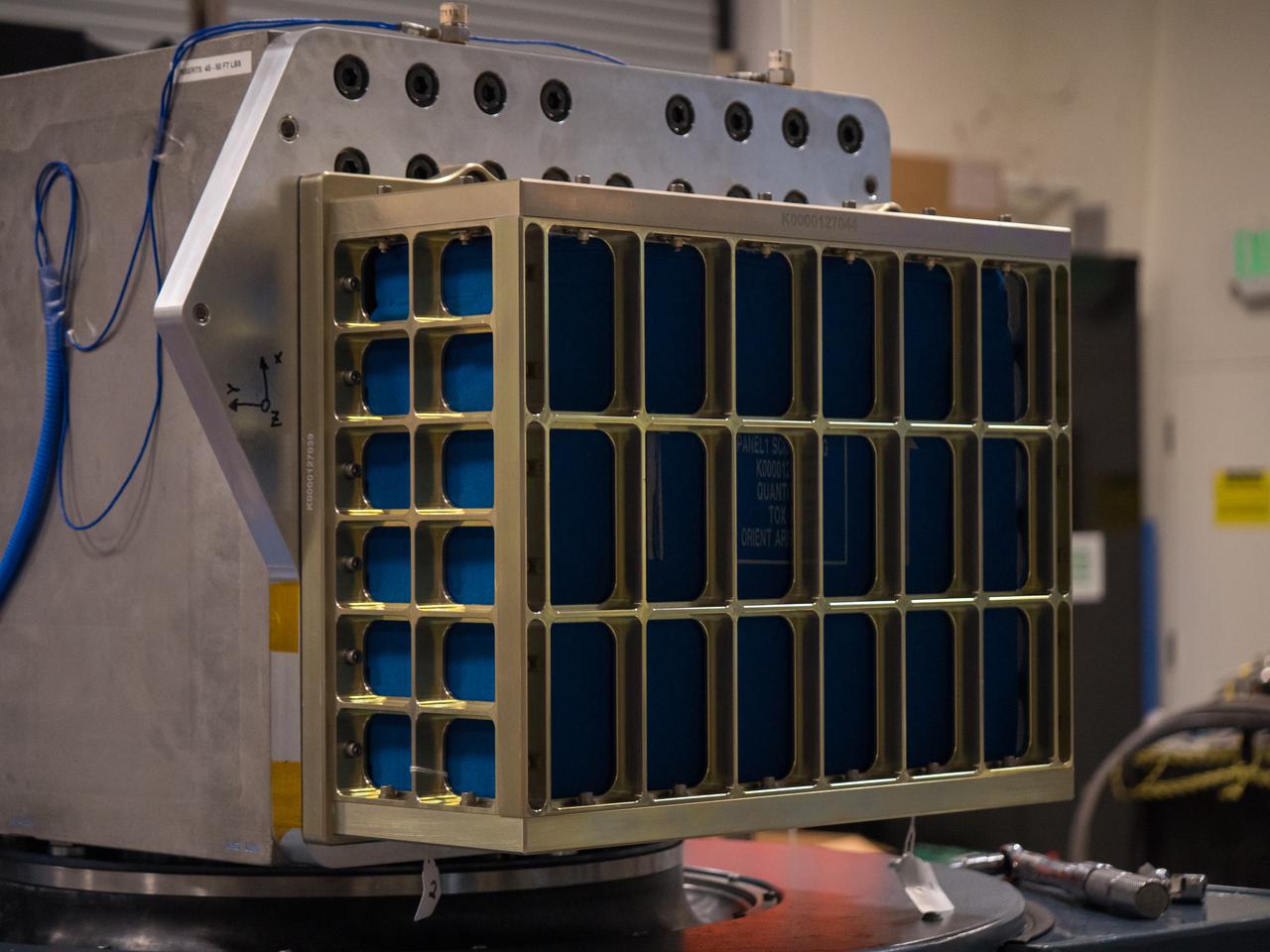
NASA’s Biology Experiment-1 (BioExpt-1) undergoes testing in the Vibration Laboratory at Kennedy Space Center in Florida on May 13, 2021. BioExpt-1 is a space biology pathfinder, which will carry plants, algae, yeast, and fungi for biology research beyond low-Earth orbit (LEO). NASA will install the BioExpt-1 payload container assembles onto panels inside the Orion capsule. BioExpt-1 will return these science payloads to Earth to provide critical and unique data about life beyond LEO for the first time in more than 40 years. Artemis I is the first in a series of increasingly complex missions that will enable human exploration of the Moon and eventually on to Mars.
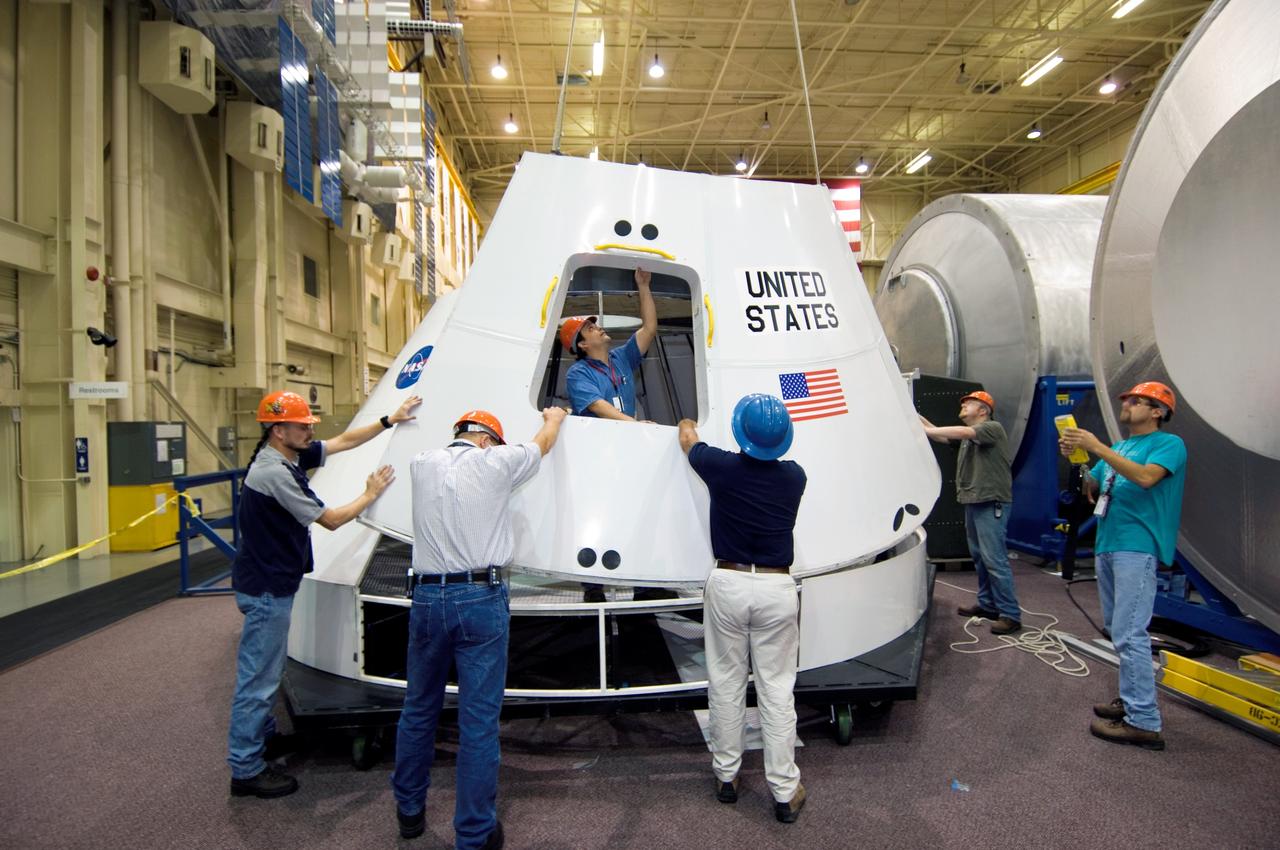
JSC2005-E-42348 (18 October 2005) --- NASA recently started assembling this full-sized mockup of the new Crew Exploration Vehicle's (CEV) cockpit in its Space Vehicle Mockup Facility at the Johnson Space Center. The CEV is the key to making NASA's Vision for Space Exploration a reality. Though the shape is reminiscent of the Apollo command modules of four decades ago, the new capsule will be three times larger and is designed to carry four astronauts to and from the Moon, support up to six crew members on future missions to Mars and deliver crew and supplies to the international space station.
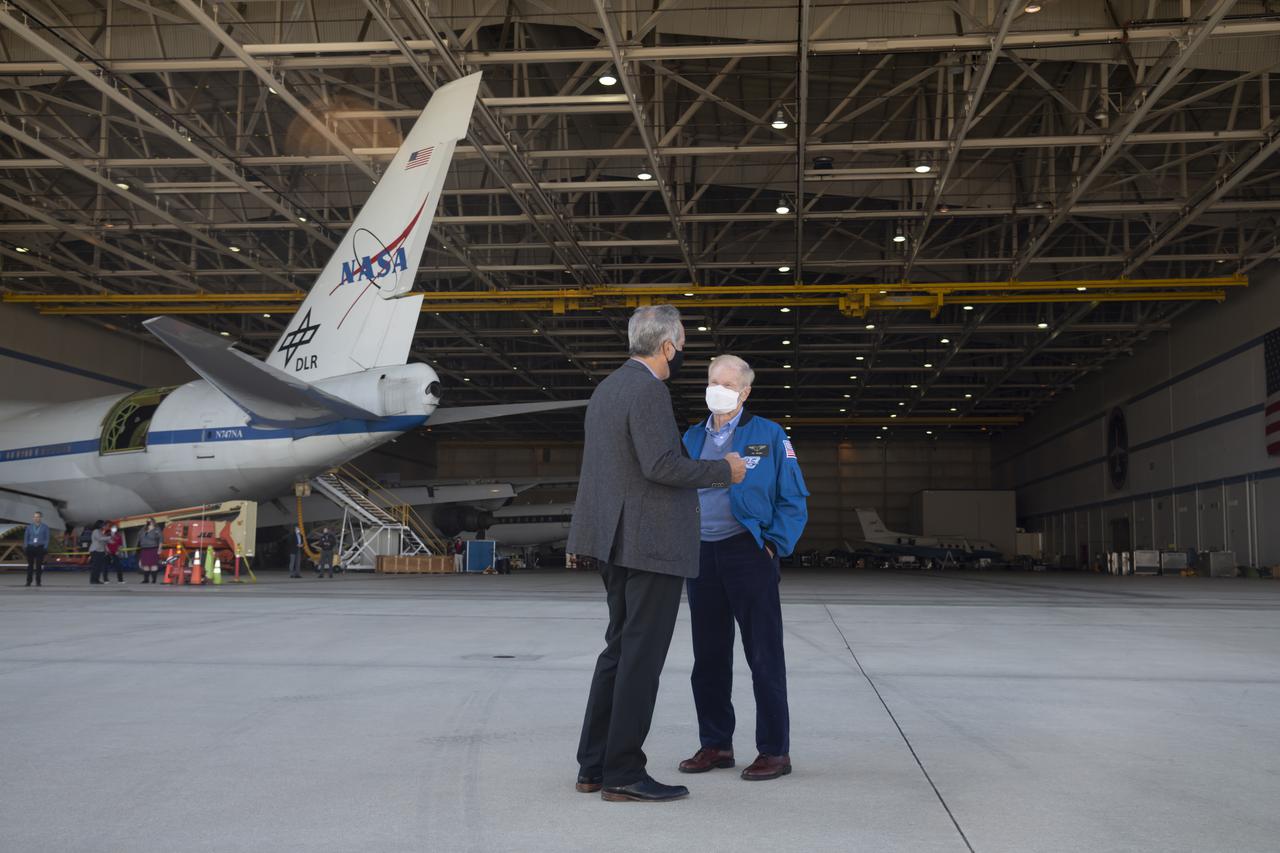
NASA Administrator Bill Nelson, right, and David McBride, center director at NASA’s Armstrong Flight Research Center in Edwards, California, talk by the Stratospheric Observatory for Infrared Science during the administrator’s visit to NASA Armstrong’s Building 703 in Palmdale, California, on Oct. 12.
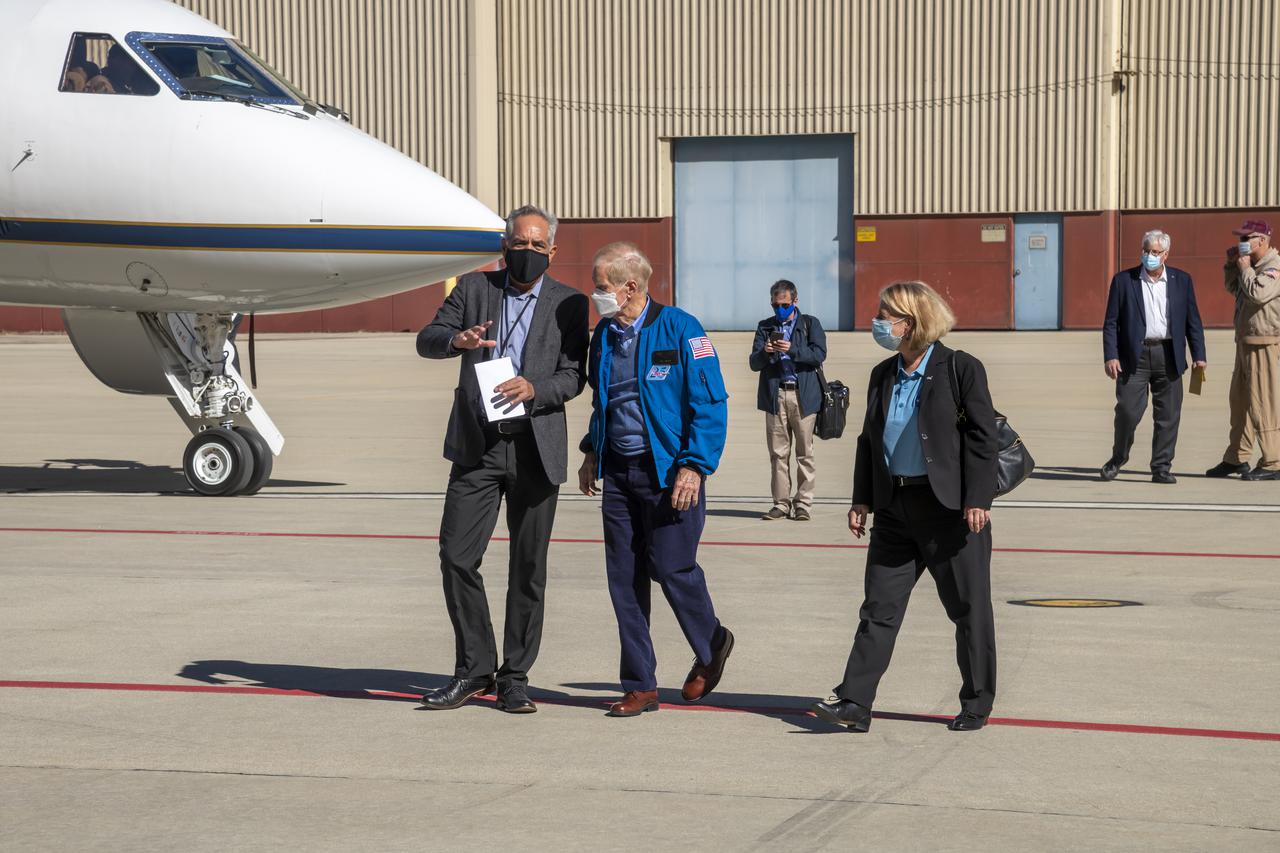
NASA Administrator Bill Nelson and NASA Deputy Administrator Pam Melroy land at the U.S. Air Force Base Plant 42 in Palmdale, California, near Building 703 on Oct. 12. That building is part of NASA’s Armstrong Flight Research Center in Edwards, California. NASA Armstrong Center Director David McBride, at left, talks to Nelson and Melroy as they begin a tour.

NASA Administrator Bill Nelson and NASA Deputy Administrator Pam Melroy listen to NASA Armstrong Flight Research Center Director David McBride, at left, tell them about Building 703 in Palmdale, California. The building houses many of NASA's science aircraft. NASA Armstrong's main campus is in nearby Edwards, California.
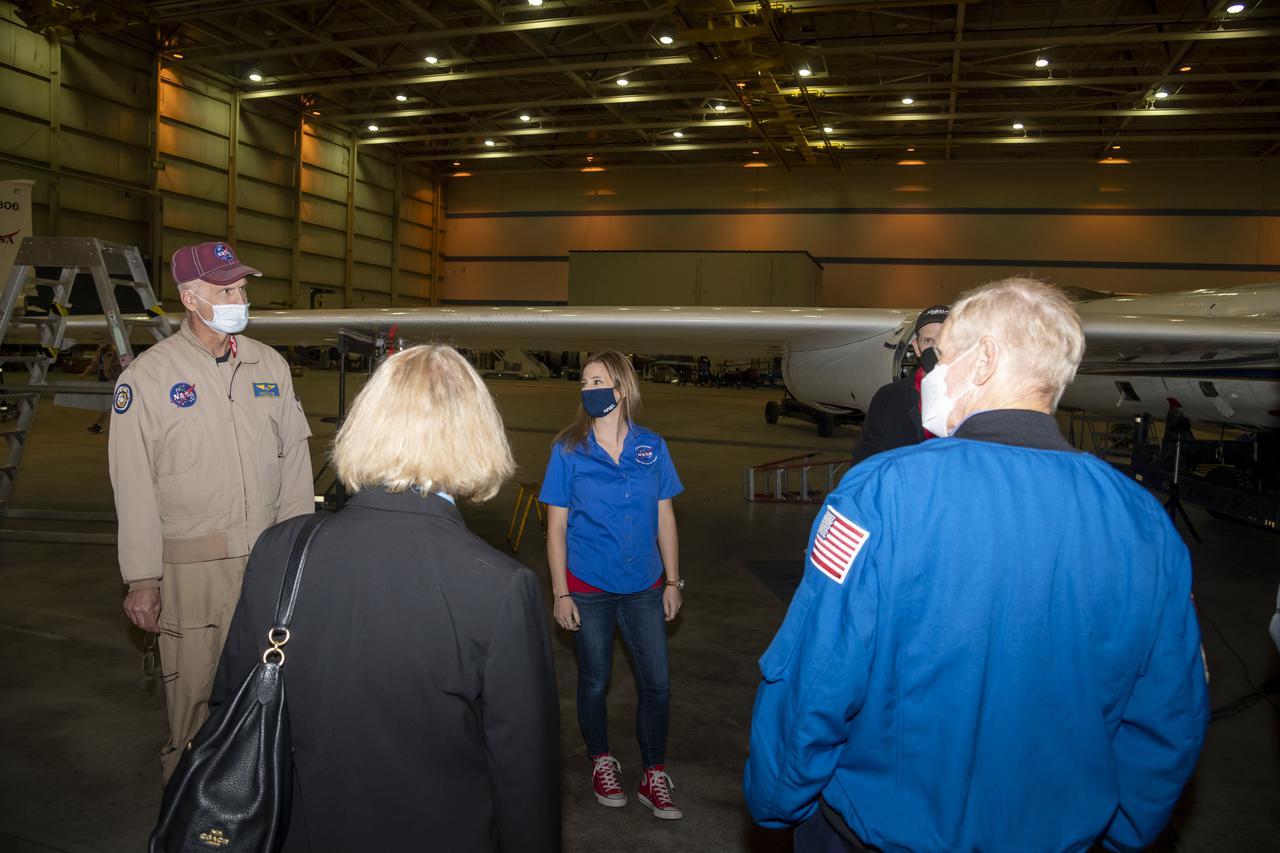
NASA Administrator Bill Nelson and NASA Deputy Administrator Pam Melroy receive a briefing on the high-altitude ER-2 aircraft and its missions from ER-2 pilot Greg "Coach" Nelson and ER-2 deputy project manager Fran Becker, and ER-2 pilot Tim Williams at Building 703 in Palmdale, California. The building is part of NASA's Armstrong Flight Research Center, which has its main campus in Edwards, California.
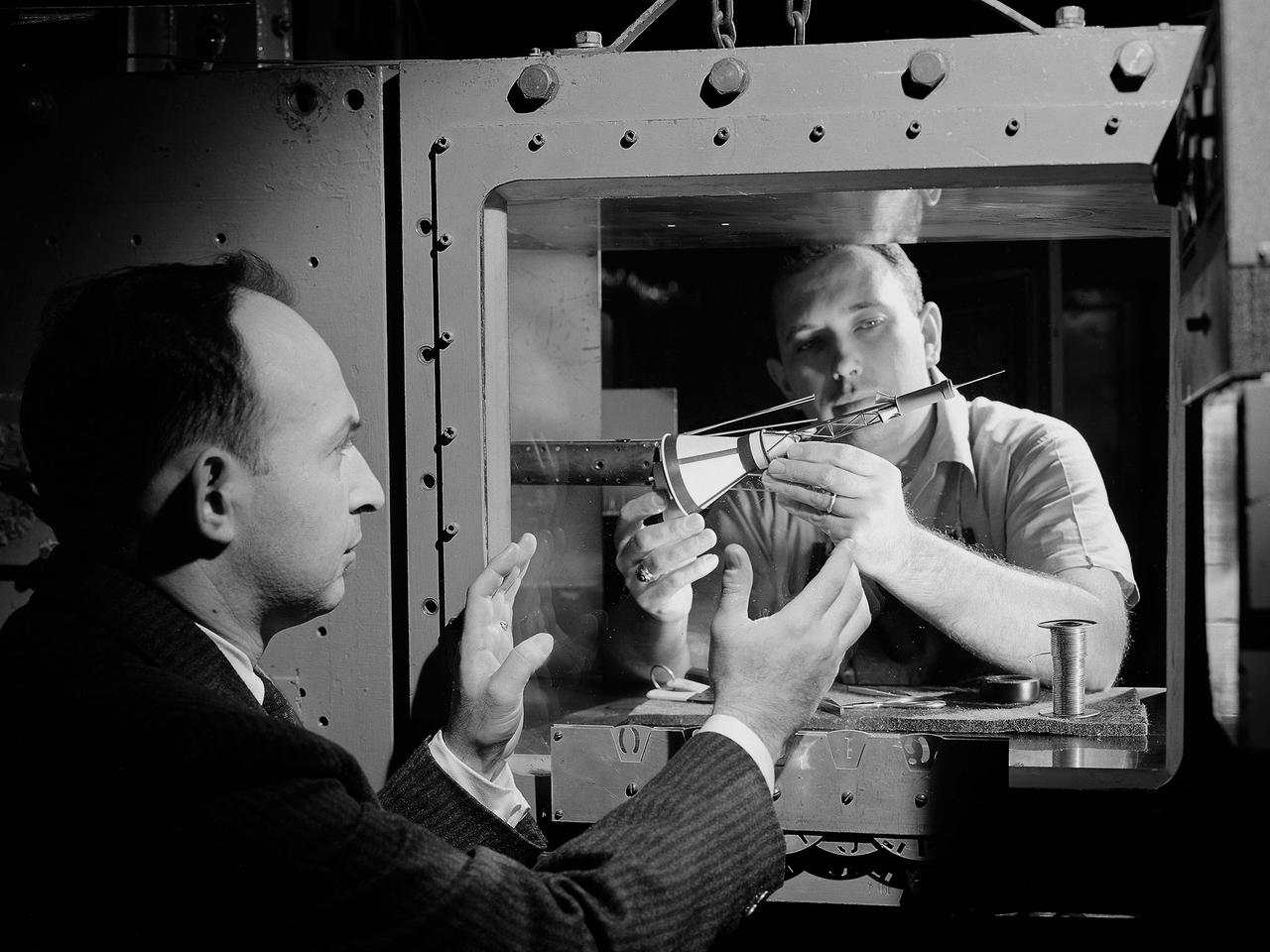
National Aeronautics and Space Administration (NASA) researchers install a small-scale model of the capsule for Project Mercury in the 1- by 1-Foot Supersonic Wind Tunnel at the Lewis Research Center. NASA Lewis conducted a variety of tests for Project Mercury, including retrorocket calibration, escape tower engine performance, and separation of the capsule from simulated Atlas and Redstone boosters. The test of this capsule and escape tower model in the 1- by 1-foot tunnel were run in January and February 1960. The 1-by 1-Foot Supersonic Wind Tunnel had a 15-inch long test section, seen here, that was one foot wide and one foot high. The sides were made of glass to allow cameras to capture the supersonic air flow over the models. The tunnel could generate air flows from Mach 1.3 to 3.0. At the time, it was one of nine small supersonic wind tunnels at Lewis. These tunnels used the exhauster and compressor equipment of the larger facilities. The 1- by 1 tunnel, which began operating in the early 1950s, was built inside a test cell in the expansive Engine Research Building. During the 1950s the 1- by 1 was used to study a variety of inlets, nozzles, and cones for missiles and scramjets. The Mercury capsule tests were among the last at the facility for many years. The tunnel was mothballed in 1960. The 1- by 1 was briefly restored in 1972, then brought back online for good in 1979. The facility has maintained a brisk operating schedule ever since.
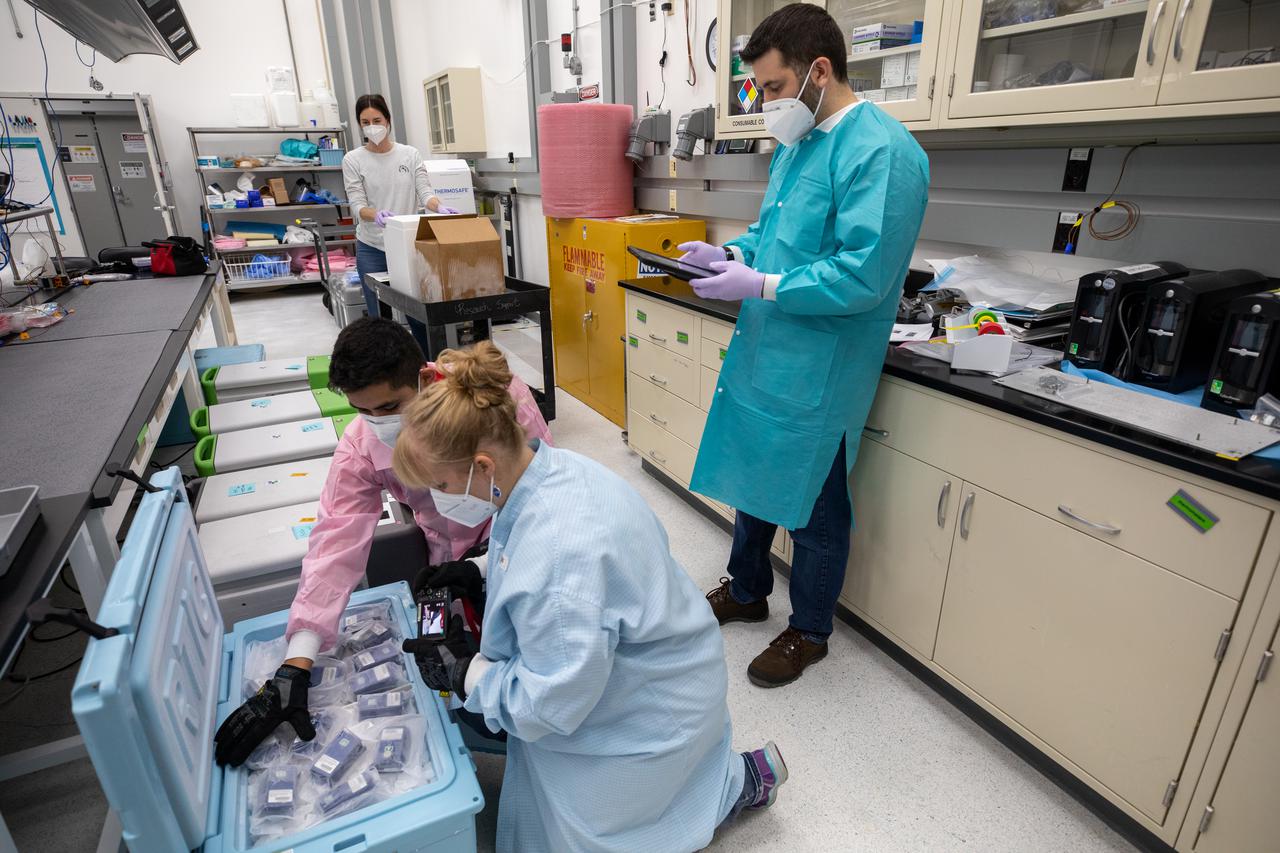
Members of the cold stowage team unpack science experiments inside the Space Station Processing Facility at NASA’s Kennedy Space Center in Florida on Jan. 14, 2021. The experiments returned to Earth on SpaceX’s 21st commercial resupply services mission (CRS-21). Making its successful parachute-assisted splashdown west of Tampa off the Florida coast, at 8:26 p.m. EST on Jan. 13, the SpaceX cargo Dragon returned more than 4,400 pounds of scientific experiments and other cargo from the International Space Station. After splashdown, SpaceX loaded Dragon aboard their Go Navigator recovery ship and packed an Airbus H225 helicopter with the time-sensitive research cargo for delivery to Kennedy. The upgraded cargo Dragon capsule also boasts double the powered locker capacity to preserve science samples, allowing for a significant increase in the research that can be carried back to Earth.
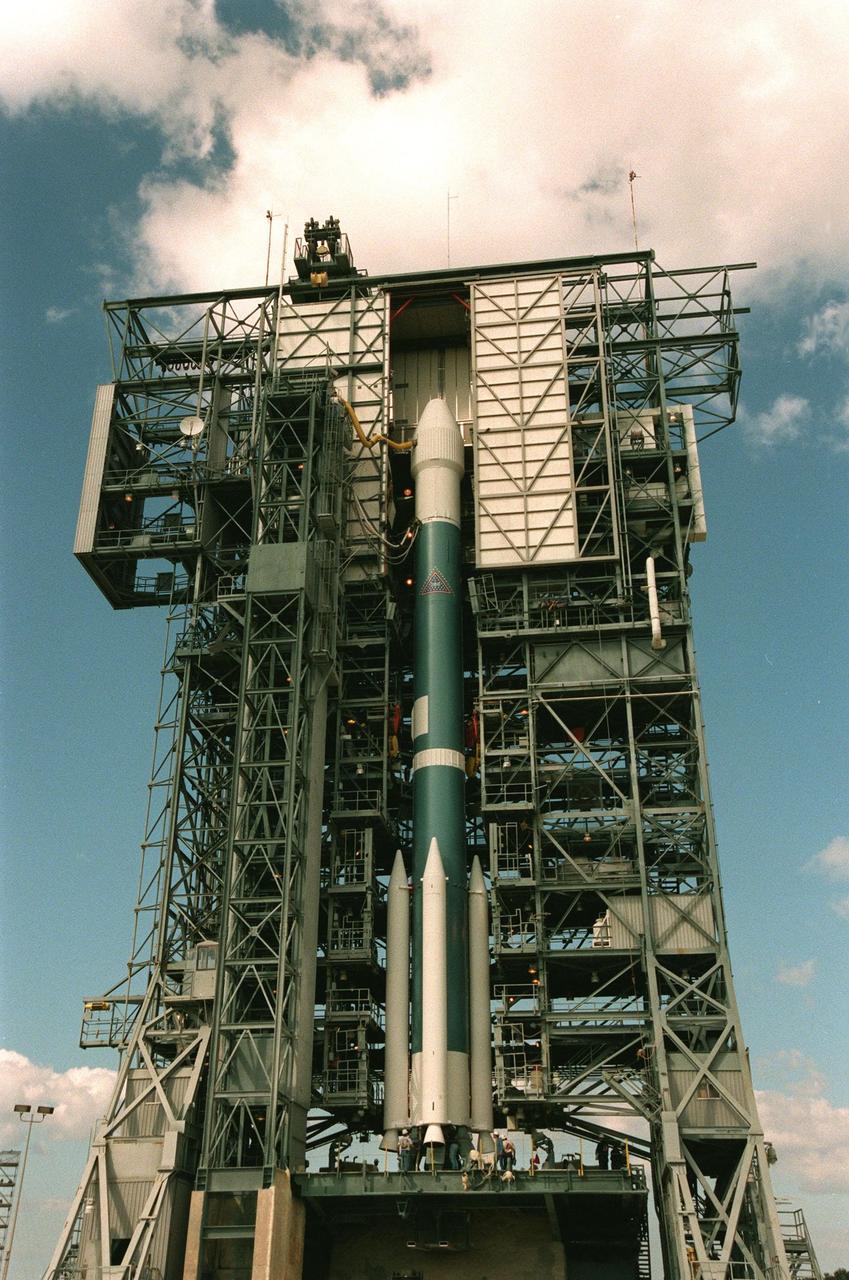
At Launch Pad 17-A, Cape Canaveral Air Station, as tower rollback begins, a Boeing Delta II rocket undergoes final preparations for launch. The targeted launch time is 4:06 p.m. EST. The Delta II rocket is carrying the Stardust spacecraft, destined for a close encounter with the comet Wild 2 in January 2004. Using a silicon-based substance called aerogel, Stardust will capture comet particles flying off the nucleus of the comet. The spacecraft also will bring back samples of interstellar dust. These materials consist of ancient pre-solar interstellar grains and other remnants left over from the formation of the solar system. Scientists expect their analysis to provide important insights into the evolution of the sun and planets and possibly into the origin of life itself. The collected samples will return to Earth in a sample return capsule to be jettisoned as Stardust swings by Earth in January 2006
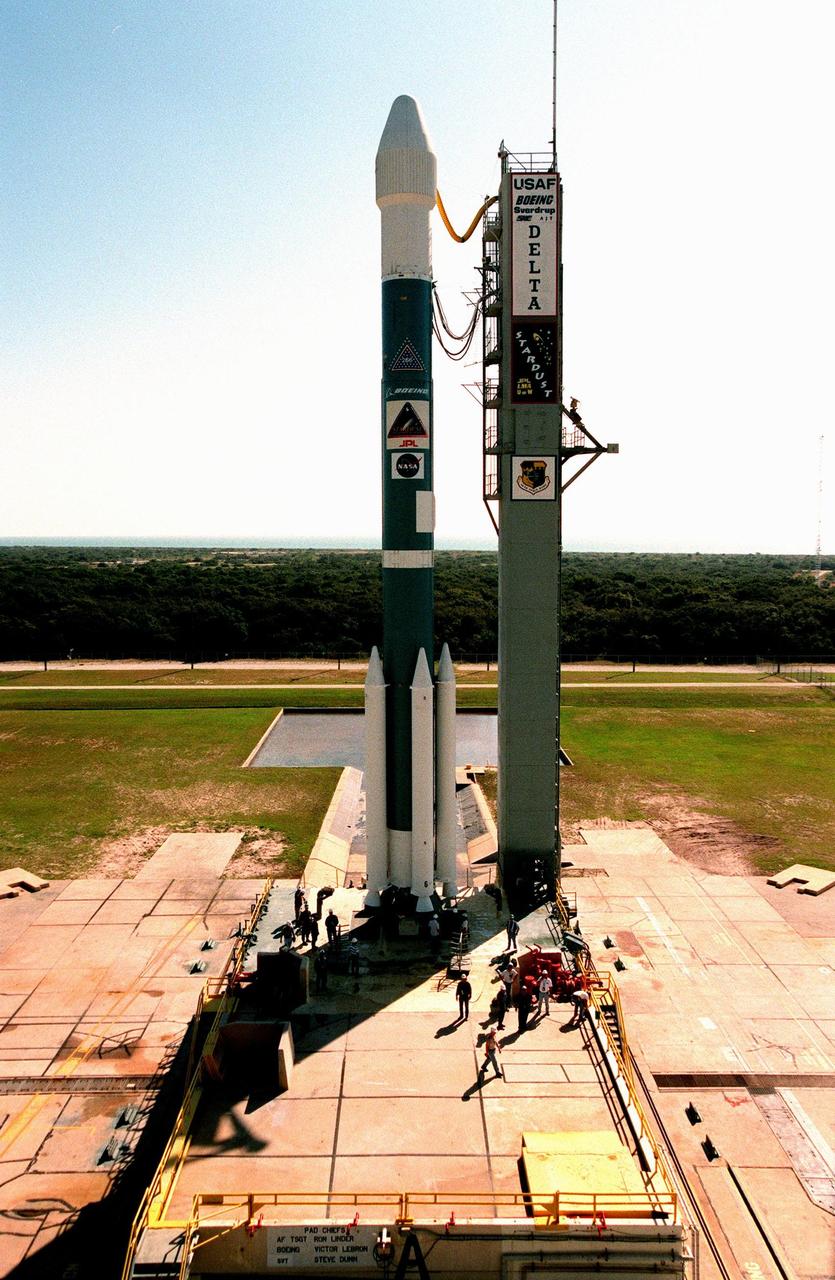
In the late morning light at Launch Pad 17-A, Cape Cananveral Air Station, the fixed utility tower (right) casts a long shadow across the base of the Boeing Delta II rocket (left) waiting to launch the Stardust spacecraft. After a 24-hour scrub, the new targeted launch time is 4:04 p.m. EST. Stardust is destined for a close encounter with the comet Wild 2 in January 2004. Using a silicon-based substance called aerogel, Stardust will capture comet particles flying off the nucleus of the comet. The spacecraft also will bring back samples of interstellar dust. These materials consist of ancient pre-solar interstellar grains and other remnants left over from the formation of the solar system. Scientists expect their analysis to provide important insights into the evolution of the sun and planets and possibly into the origin of life itself. The collected samples will return to Earth in a sample return capsule to be jettisoned as Stardust swings by Earth in January 2006
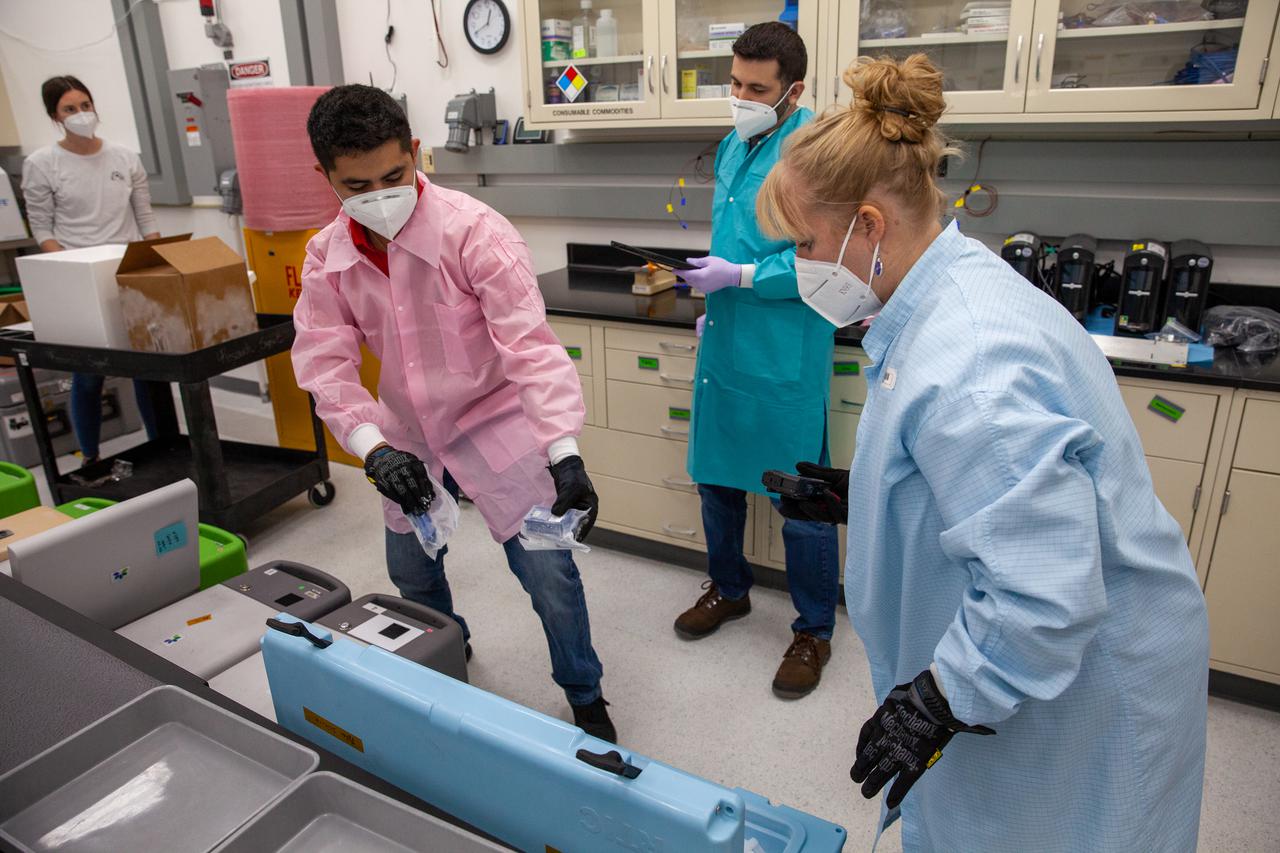
Members of the cold stowage team unpack science experiments inside the Space Station Processing Facility at NASA’s Kennedy Space Center in Florida on Jan. 14, 2021. The experiments returned to Earth on SpaceX’s 21st commercial resupply services mission (CRS-21). Making its successful parachute-assisted splashdown west of Tampa off the Florida coast, at 8:26 p.m. EST on Jan. 13, the SpaceX cargo Dragon returned more than 4,400 pounds of scientific experiments and other cargo from the International Space Station. After splashdown, SpaceX loaded Dragon aboard their Go Navigator recovery ship and packed an Airbus H225 helicopter with the time-sensitive research cargo for delivery to Kennedy. The upgraded cargo Dragon capsule also boasts double the powered locker capacity to preserve science samples, allowing for a significant increase in the research that can be carried back to Earth.
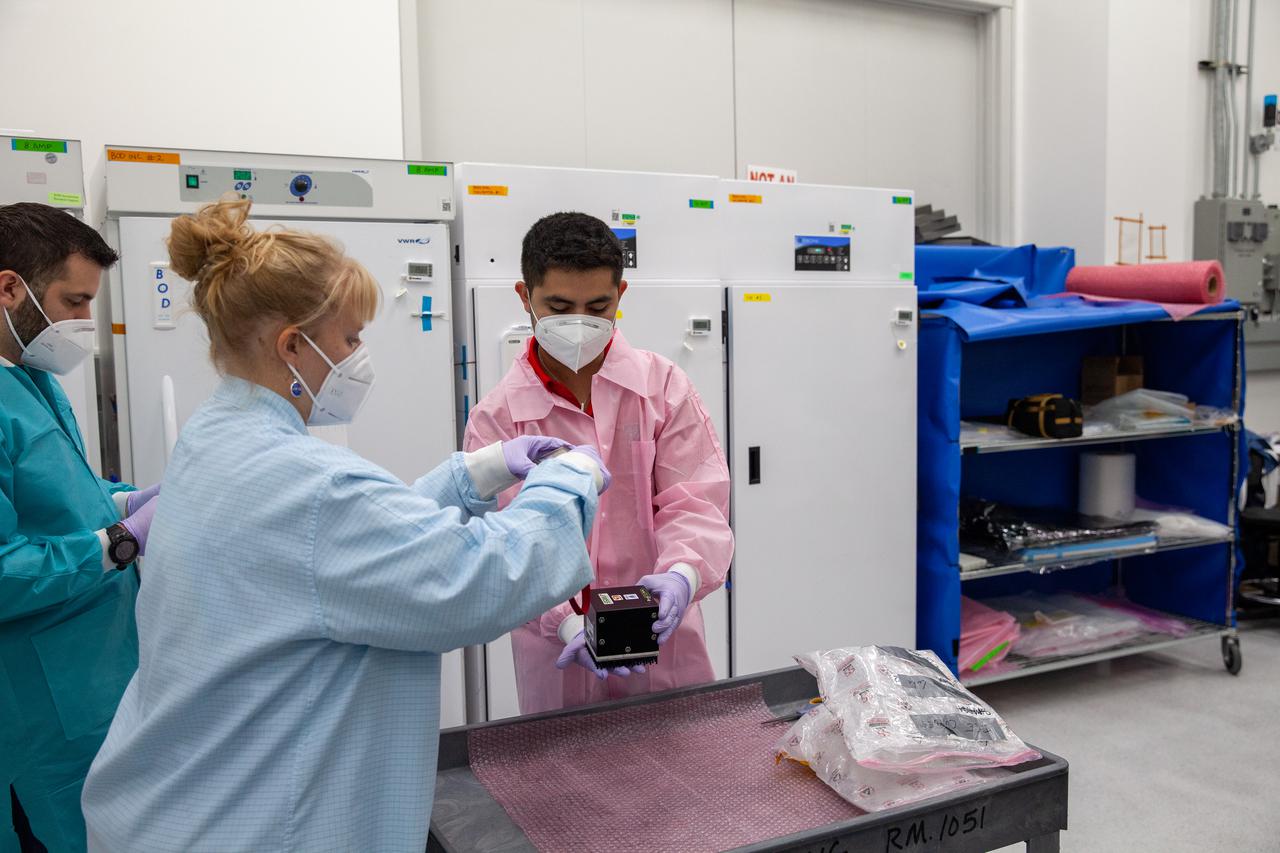
Members of the cold stowage team unpack science experiments inside the Space Station Processing Facility at NASA’s Kennedy Space Center in Florida on Jan. 14, 2021. The experiments returned to Earth on SpaceX’s 21st commercial resupply services mission (CRS-21). Making its successful parachute-assisted splashdown west of Tampa off the Florida coast, at 8:26 p.m. EST on Jan. 13, the SpaceX cargo Dragon returned more than 4,400 pounds of scientific experiments and other cargo from the International Space Station. After splashdown, SpaceX loaded Dragon aboard their Go Navigator recovery ship and packed an Airbus H225 helicopter with the time-sensitive research cargo for delivery to Kennedy. The upgraded cargo Dragon capsule also boasts double the powered locker capacity to preserve science samples, allowing for a significant increase in the research that can be carried back to Earth.
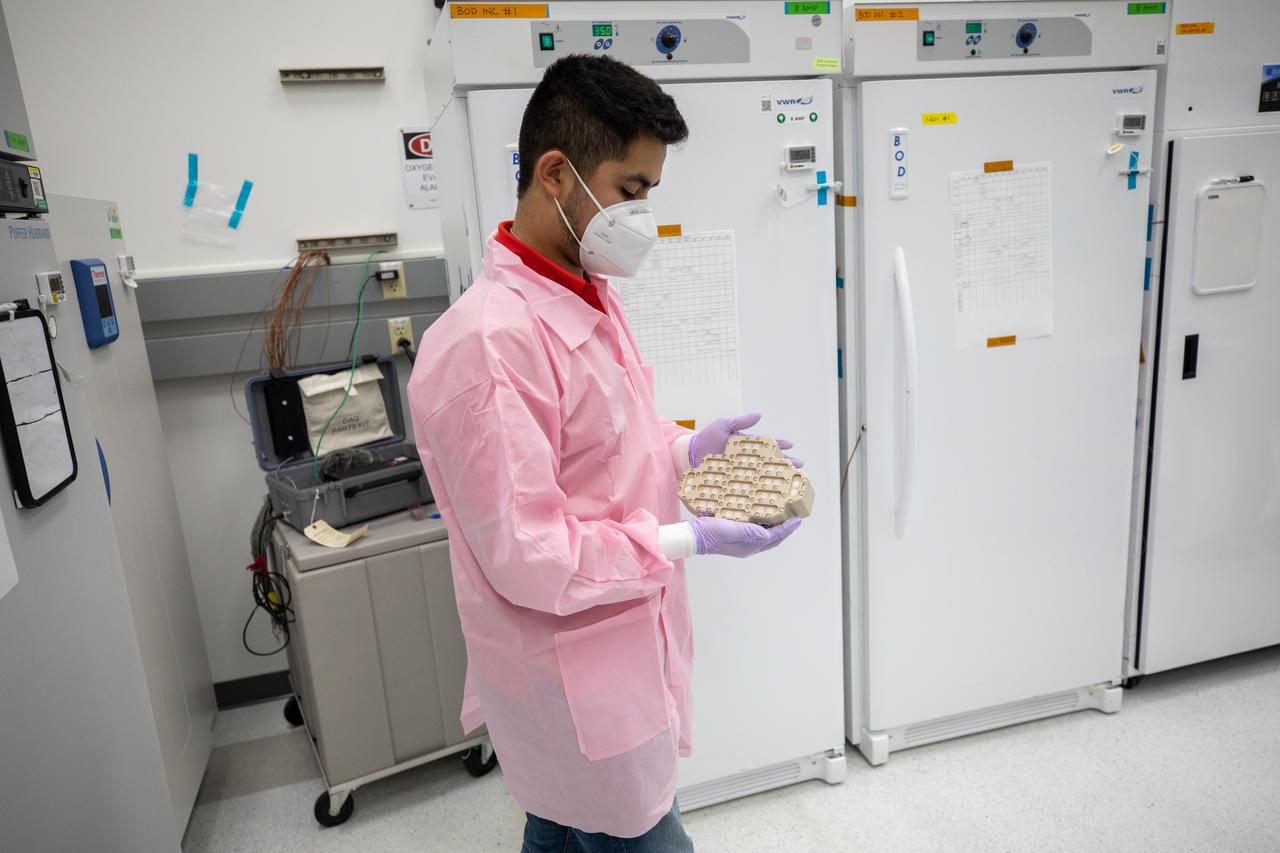
A member of the cold stowage team unpacks science experiments inside the Space Station Processing Facility at NASA’s Kennedy Space Center in Florida on Jan. 14, 2021. The experiments returned to Earth on SpaceX’s 21st commercial resupply services mission (CRS-21). Making its successful parachute-assisted splashdown west of Tampa off the Florida coast, at 8:26 p.m. EST on Jan. 13, the SpaceX cargo Dragon returned more than 4,400 pounds of scientific experiments and other cargo from the International Space Station. After splashdown, SpaceX loaded Dragon aboard their Go Navigator recovery ship and packed an Airbus H225 helicopter with the time-sensitive research cargo for delivery to Kennedy. The upgraded cargo Dragon capsule also boasts double the powered locker capacity to preserve science samples, allowing for a significant increase in the research that can be carried back to Earth.
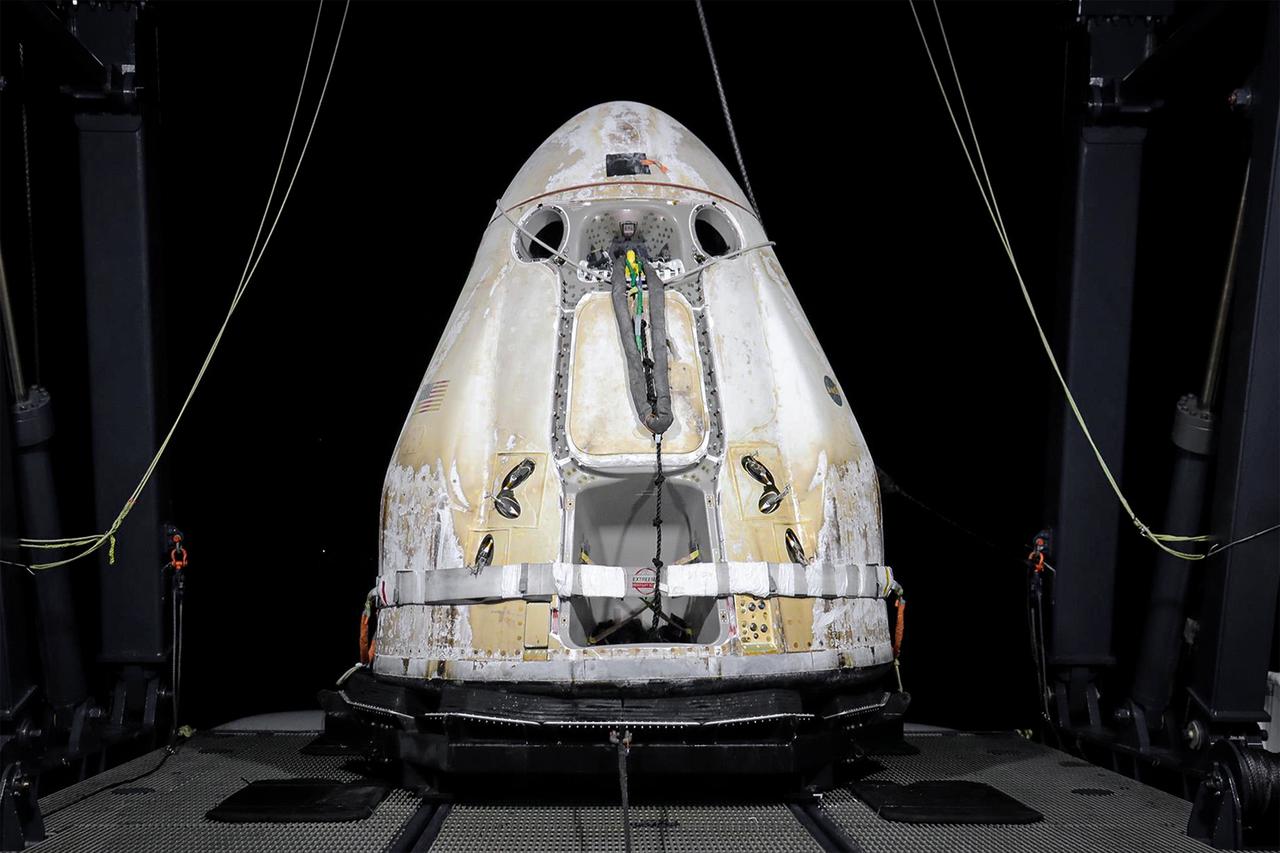
Shown here is the SpaceX Cargo Dragon spacecraft on board the company's Go Navigator recovery ship after making its successful parachute-assisted splashdown west of Tampa off the Florida coast on Jan. 13, 2020, at 8:26 p.m. EST. Just after loading Dragon onto Go Navigator, SpaceX packed an Airbus H225 helicopter with the time-sensitive research cargo for delivery to NASA’s Kennedy Space Center. Dragon returned more than 4,400 pounds of scientific experiments and other cargo from the International Space Station. The upgraded cargo Dragon capsule boasts double the powered locker capacity to preserve science samples, allowing for a significant increase in the research that can be carried back to Earth. Photo credit: SpaceX
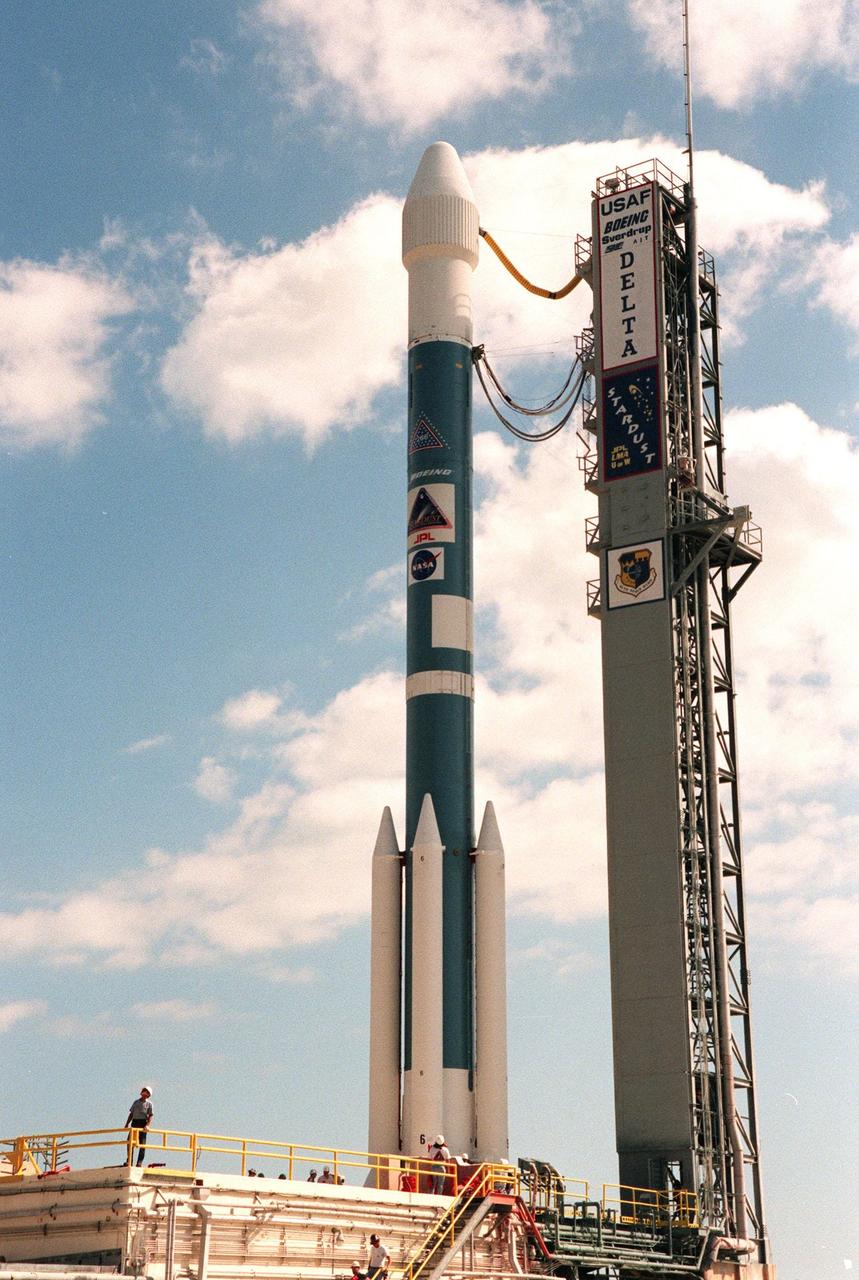
The Boeing Delta II rocket carrying the Stardust spacecraft waits for launch at Launch Pad 17-A, Cape Canaveral Air Station. The targeted launch time is 4:06 p.m. EST. Stardust is destined for a close encounter with the comet Wild 2 in January 2004. Using a silicon-based substance called aerogel, Stardust will capture comet particles flying off the nucleus of the comet. The spacecraft also will bring back samples of interstellar dust. These materials consist of ancient pre-solar interstellar grains and other remnants left over from the formation of the solar system. Scientists expect their analysis to provide important insights into the evolution of the sun and planets and possibly into the origin of life itself. The collected samples will return to Earth in a sample return capsule to be jettisoned as Stardust swings by Earth in January 2006
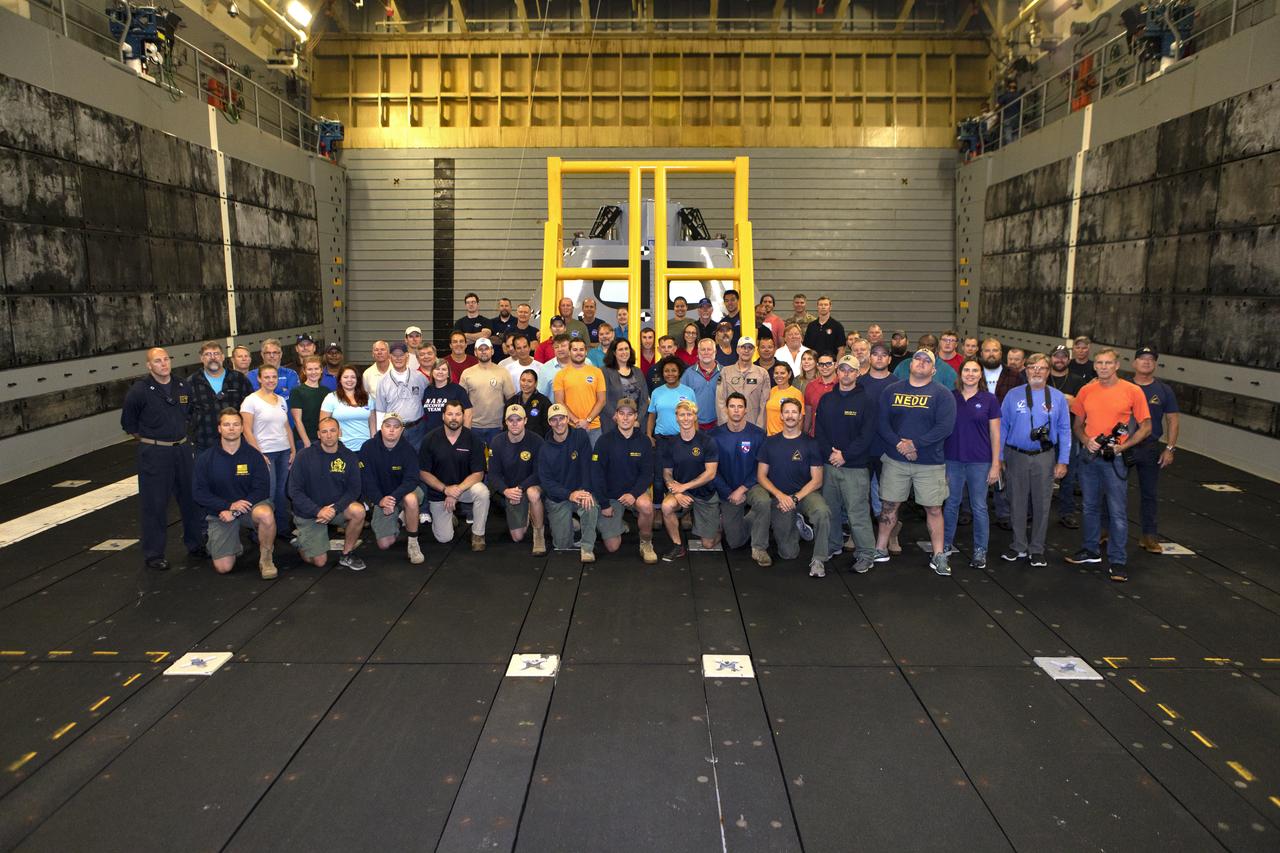
NASA's Recovery Team takes time for a group photo in the well deck of the USS John P. Murtha, during Underway Recovery Test-7 (URT-7) on Nov. 5, 2018. Behind them is the test version of the Orion capsule. The Recovery Team, along with the U.S. Navy, practice recovering the Orion test version as part of URT-7 in the Pacific Ocean. URT-7 is one in a series of tests to verify and validate procedures and hardware that will be used to recover the Orion spacecraft after it splashes down in the Pacific Ocean following deep space exploration missions. Orion will have emergency abort capability, sustain the crew during space travel and provide safe re-entry from deep space return velocities.

Shown here is the SpaceX Cargo Dragon spacecraft on board the company's Go Navigator recovery ship after making its successful parachute-assisted splashdown west of Tampa off the Florida coast on Jan. 13, 2020, at 8:26 p.m. EST. Just after loading Dragon onto Go Navigator, SpaceX packed an Airbus H225 helicopter with the time-sensitive research cargo for delivery to NASA’s Kennedy Space Center. Dragon returned more than 4,400 pounds of scientific experiments and other cargo from the International Space Station. The upgraded cargo Dragon capsule boasts double the powered locker capacity to preserve science samples, allowing for a significant increase in the research that can be carried back to Earth. Photo credit: SpaceX
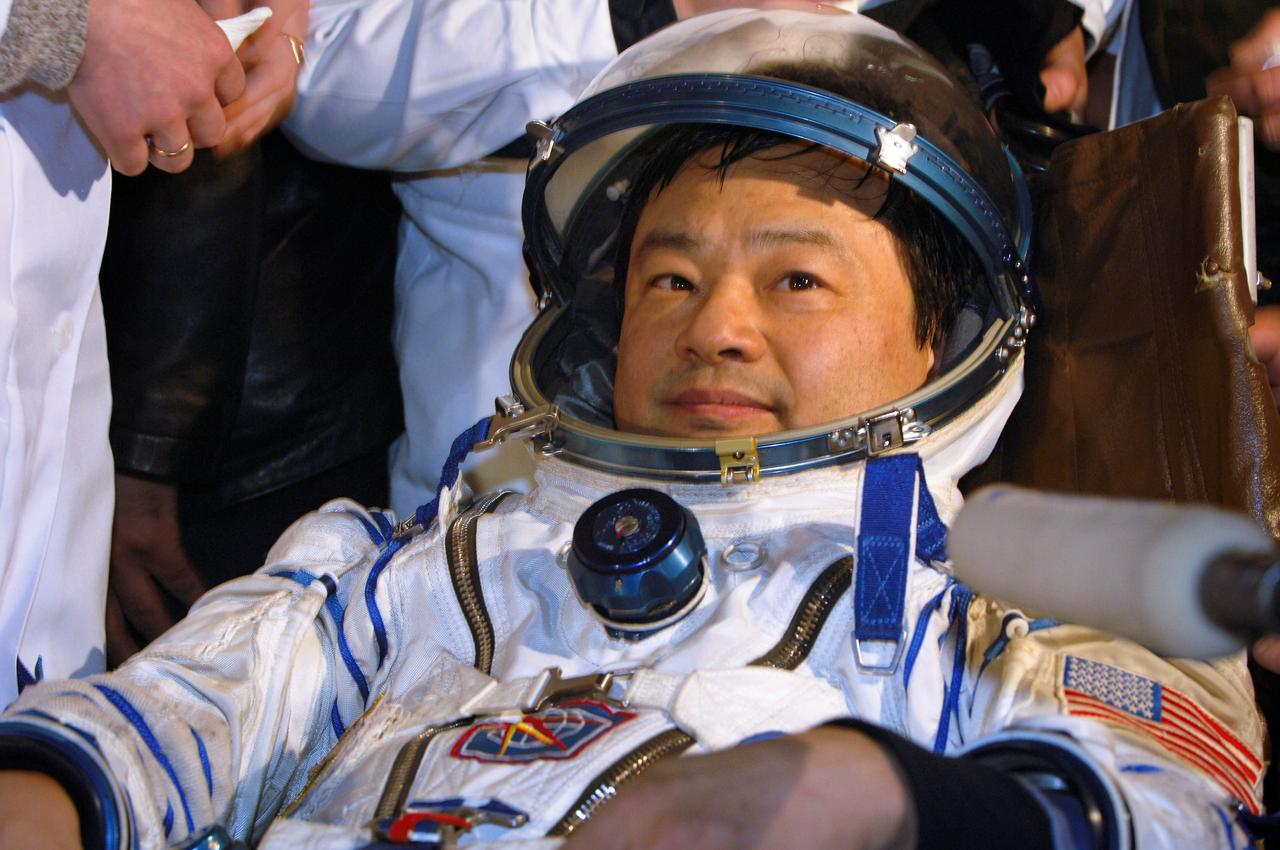
JSC2005-E-17946 (25 April 2005) --- Astronaut Leroy Chiao, Expedition 10 commander and NASA ISS science officer; cosmonaut Salizhan S. Sharipov (out of frame), flight engineer representing Russia's Federal Space Agency; and European Space Agency (ESA) astronaut Roberto Vittori (out of frame) of Italy speak with members of the media following their pre-dawn landing in a Soyuz TMA-5 capsule. The landing occurred on April 25, 2005 (Kazakhstan time) northeast of the Kazakhstan town of Arkalyk to wrap up a six month mission aboard the International Space Station (ISS) for Chiao and Sharipov and a ten-day mission for Vittori. The twice-flown Italian astronaut participated under a commercial contract between ESA and the Russian Federal Space Agency. Photo Credit: NASA/Bill Ingalls

Dave Flowers, the project manager for NASA’s Biology Experiment-1 (BioExpt-1) in Exploration Research and Technology Programs, prepares it for testing in the Vibration Laboratory at Kennedy Space Center in Florida on May 13, 2021. BioExpt-1 is a space biology pathfinder, which will carry plants, algae, yeast, and fungi for biology research beyond low-Earth orbit (LEO). NASA will install the BioExpt-1 payload container assembles onto panels inside the Orion capsule. BioExpt-1 will return these science payloads to Earth to provide critical and unique data about life beyond LEO for the first time in more than 40 years. Artemis I is the first in a series of increasingly complex missions that will enable human exploration of the Moon and eventually on to Mars.
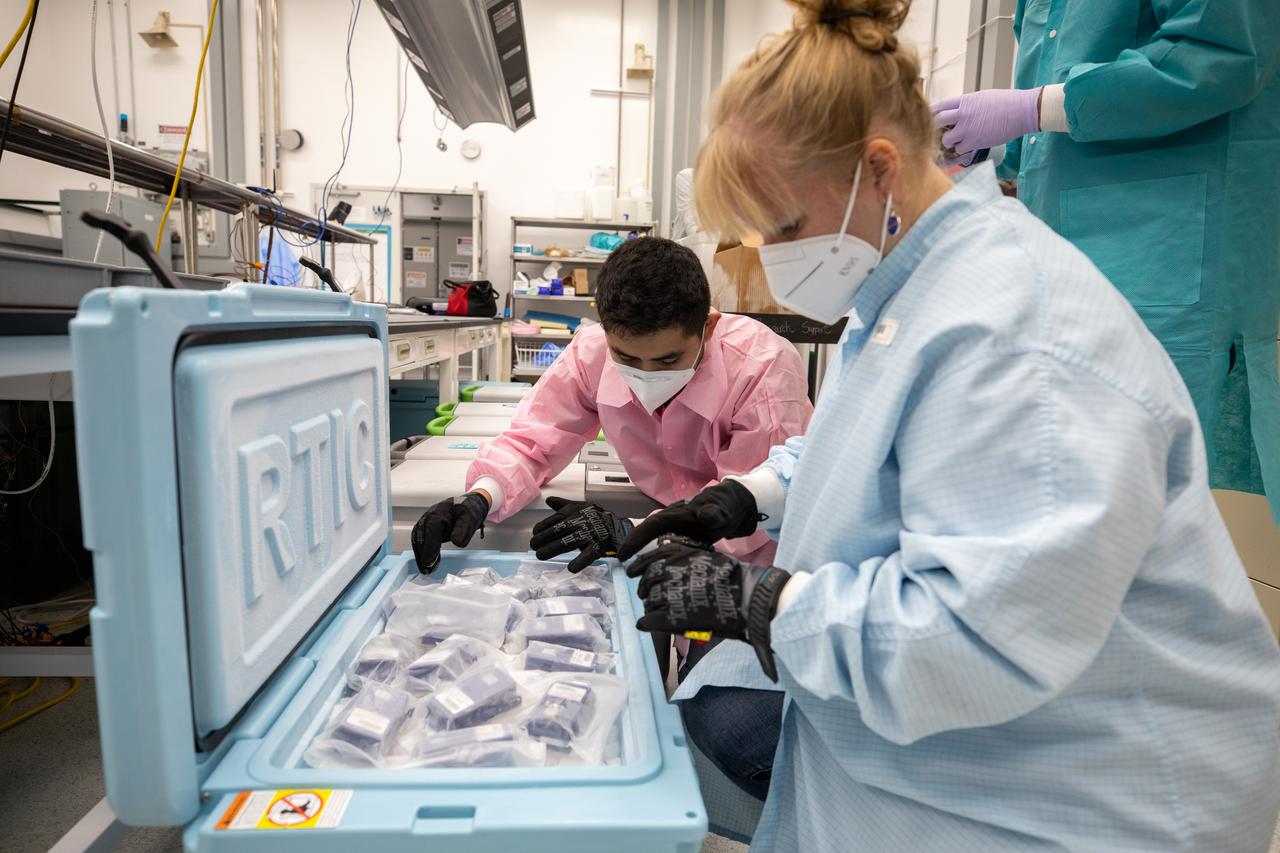
Members of the cold stowage team unpack science experiments inside the Space Station Processing Facility at NASA’s Kennedy Space Center in Florida on Jan. 14, 2021. The experiments returned to Earth on SpaceX’s 21st commercial resupply services mission (CRS-21). Making its successful parachute-assisted splashdown west of Tampa off the Florida coast, at 8:26 p.m. EST on Jan. 13, the SpaceX cargo Dragon returned more than 4,400 pounds of scientific experiments and other cargo from the International Space Station. After splashdown, SpaceX loaded Dragon aboard their Go Navigator recovery ship and packed an Airbus H225 helicopter with the time-sensitive research cargo for delivery to Kennedy. The upgraded cargo Dragon capsule also boasts double the powered locker capacity to preserve science samples, allowing for a significant increase in the research that can be carried back to Earth.
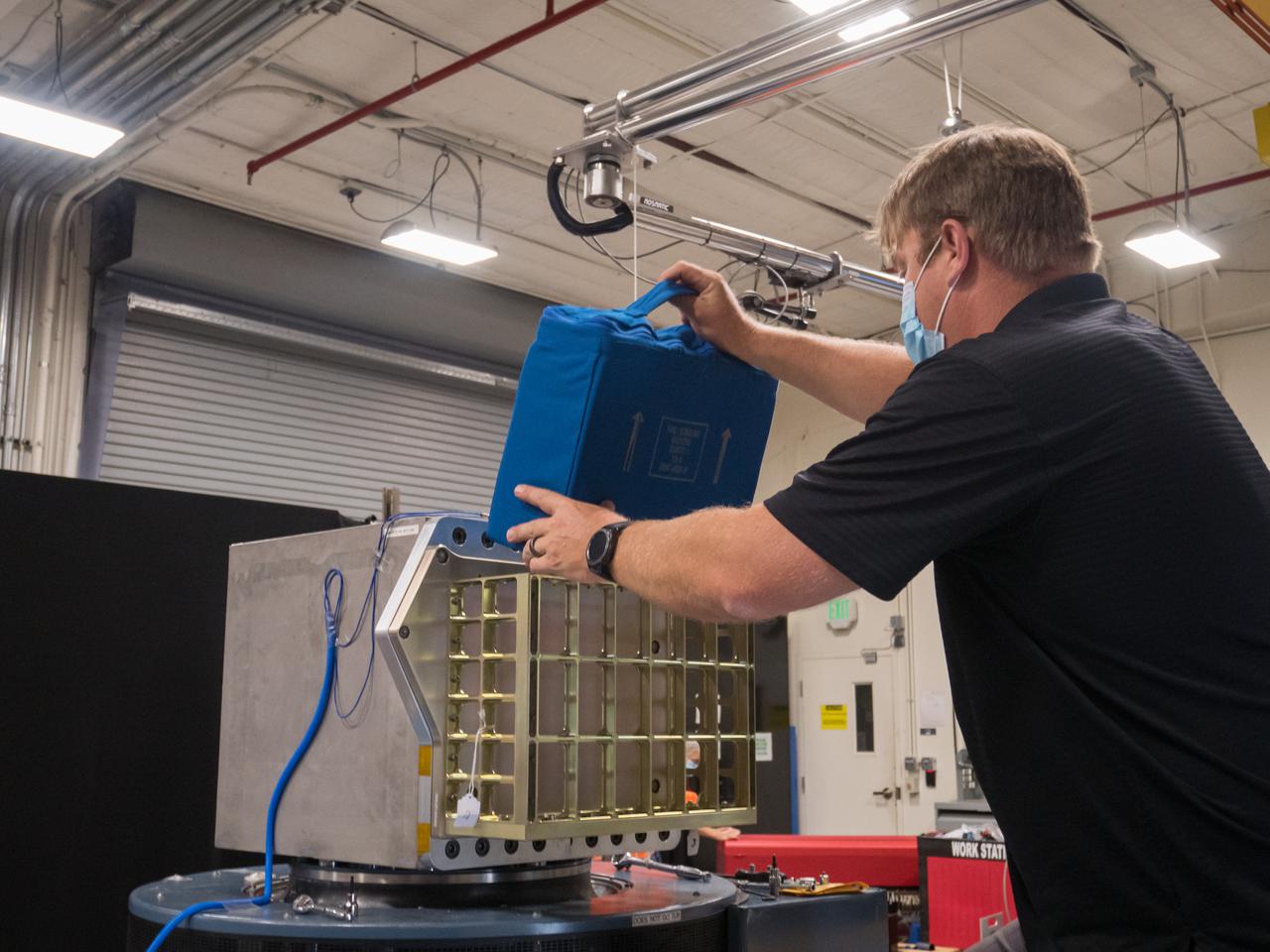
Adam Chaney, a mechanical engineer with the Laboratory Support Services and Operations (LASSO) contract at NASA’s Kennedy Space Center in Florida, prepares NASA’s Biology Experiment-1 (BioExpt-1) for testing in the Vibration Laboratory at Kennedy Space Center in Florida on May 13, 2021. BioExpt-1 is a space biology pathfinder, which will carry plants, algae, yeast, and fungi for biology research beyond low-Earth orbit (LEO). NASA will install the BioExpt-1 payload container assembles onto panels inside the Orion capsule. BioExpt-1 will return these science payloads to Earth to provide critical and unique data about life beyond LEO for the first time in more than 40 years. Artemis I is the first in a series of increasingly complex missions that will enable human exploration of the Moon and eventually on to Mars.
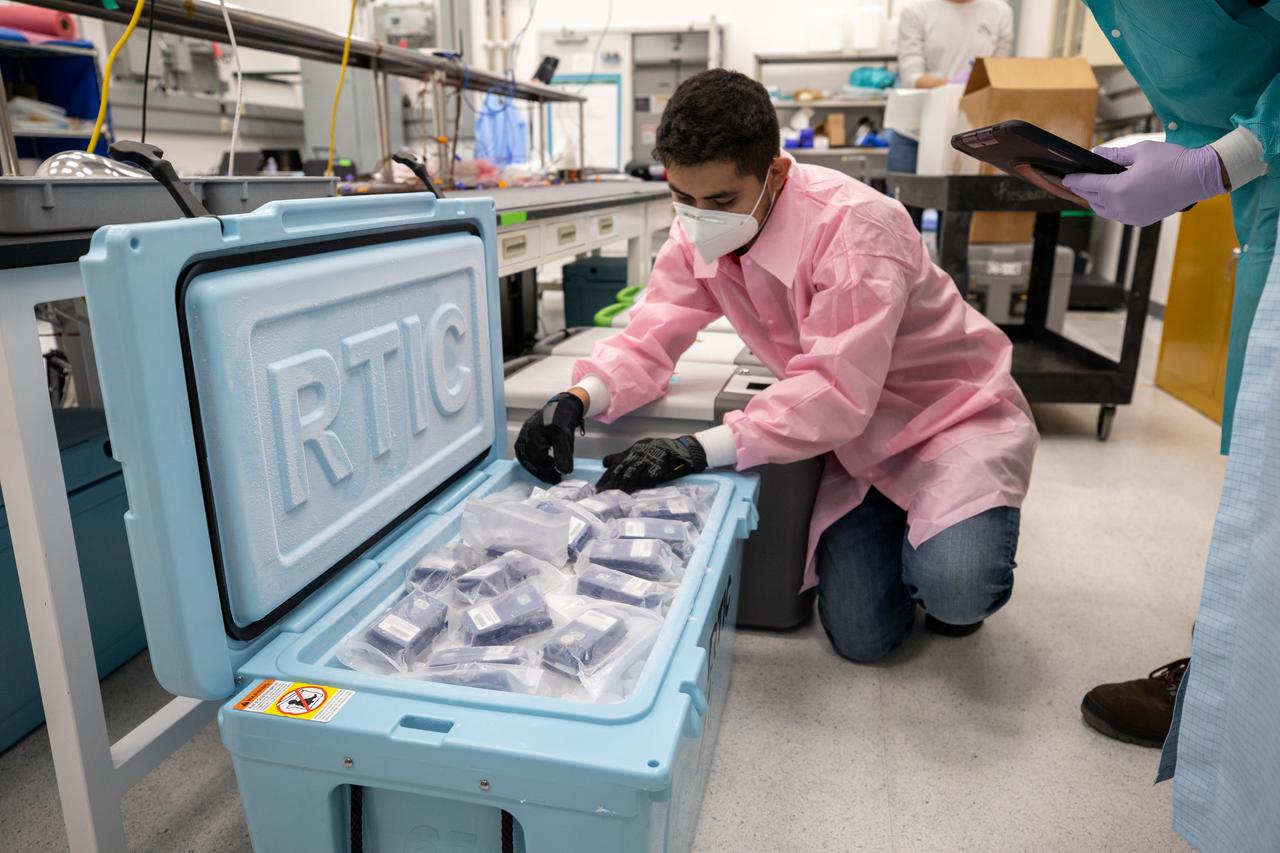
Members of the cold stowage team unpack science experiments inside the Space Station Processing Facility at NASA’s Kennedy Space Center in Florida on Jan. 14, 2021. The experiments returned to Earth on SpaceX’s 21st commercial resupply services mission (CRS-21). Making its successful parachute-assisted splashdown west of Tampa off the Florida coast, at 8:26 p.m. EST on Jan. 13, the SpaceX cargo Dragon returned more than 4,400 pounds of scientific experiments and other cargo from the International Space Station. After splashdown, SpaceX loaded Dragon aboard their Go Navigator recovery ship and packed an Airbus H225 helicopter with the time-sensitive research cargo for delivery to Kennedy. The upgraded cargo Dragon capsule also boasts double the powered locker capacity to preserve science samples, allowing for a significant increase in the research that can be carried back to Earth.
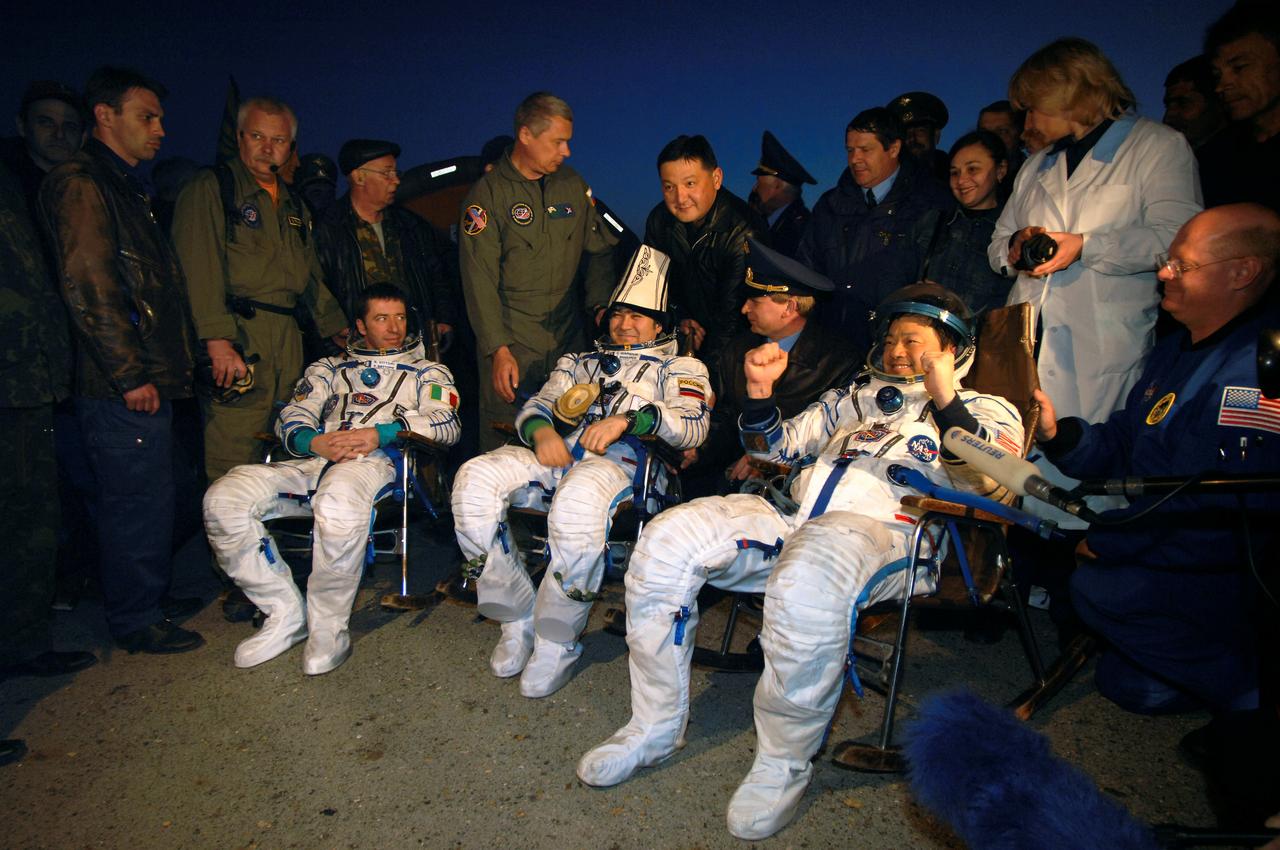
JSC2005-E-17948 (25 April 2005) --- Astronaut Leroy Chiao (right), Expedition 10 commander and NASA ISS science officer; cosmonaut Salizhan S. Sharipov, flight engineer representing Russia's Federal Space Agency; and European Space Agency (ESA) astronaut Roberto Vittori of Italy are seated in their chairs after extraction from the Soyuz TMA-5 capsule. The pre-dawn landing occurred on April 25, 2005 (Kazakhstan time) northeast of the Kazakhstan town of Arkalyk to wrap up a six month mission aboard the International Space Station (ISS) for Chiao and Sharipov and a ten-day mission for Vittori. The twice-flown Italian astronaut participated under a commercial contract between ESA and the Russian Federal Space Agency. Photo Credit: NASA/Bill Ingalls
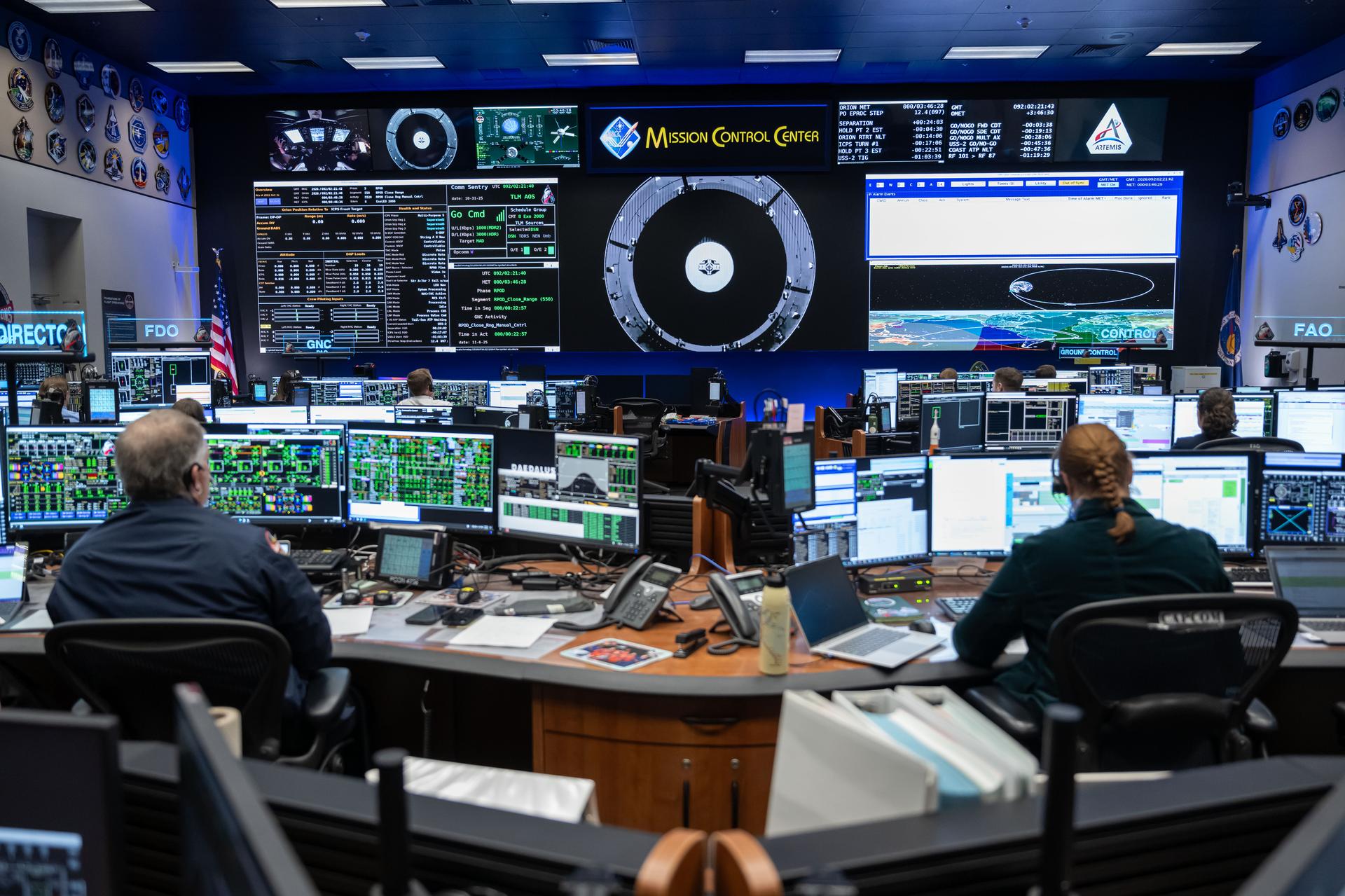
jsc2026e019255 (April 1, 2026) – Lead Artemis II Flight Director Jeff Radigan (left) and capsule communicator (capcom) Amy Dill (right) in the White Flight Control Room at the Mission Control Center at NASA’s Johnson Space Center in Houston. At the time of this photograph, a little over three hours into the mission, the Artemis II crew conducting a manual piloting test called the proximity operations demonstration. During the demonstration, mission controllers monitored Orion as the astronauts transitioned the spacecraft to manual mode and piloted its flight path and orientation. This demonstration will provide performance data and operational experience that cannot be readily gained on the ground in preparation for critical rendezvous, proximity operations, docking, and undocking for future Artemis missions. Credit: NASA
Members of the cold stowage team unpack science experiments inside the Space Station Processing Facility at NASA’s Kennedy Space Center in Florida on Jan. 14, 2021. The experiments returned to Earth on SpaceX’s 21st commercial resupply services mission (CRS-21). Making its successful parachute-assisted splashdown west of Tampa off the Florida coast, at 8:26 p.m. EST on Jan. 13, the SpaceX cargo Dragon returned more than 4,400 pounds of scientific experiments and other cargo from the International Space Station. After splashdown, SpaceX loaded Dragon aboard their Go Navigator recovery ship and packed an Airbus H225 helicopter with the time-sensitive research cargo for delivery to Kennedy. The upgraded cargo Dragon capsule also boasts double the powered locker capacity to preserve science samples, allowing for a significant increase in the research that can be carried back to Earth.
Members of the cold stowage team unpack science experiments inside the Space Station Processing Facility at NASA’s Kennedy Space Center in Florida on Jan. 14, 2021. The experiments returned to Earth on SpaceX’s 21st commercial resupply services mission (CRS-21). Making its successful parachute-assisted splashdown west of Tampa off the Florida coast, at 8:26 p.m. EST on Jan. 13, the SpaceX cargo Dragon returned more than 4,400 pounds of scientific experiments and other cargo from the International Space Station. After splashdown, SpaceX loaded Dragon aboard their Go Navigator recovery ship and packed an Airbus H225 helicopter with the time-sensitive research cargo for delivery to Kennedy. The upgraded cargo Dragon capsule also boasts double the powered locker capacity to preserve science samples, allowing for a significant increase in the research that can be carried back to Earth.
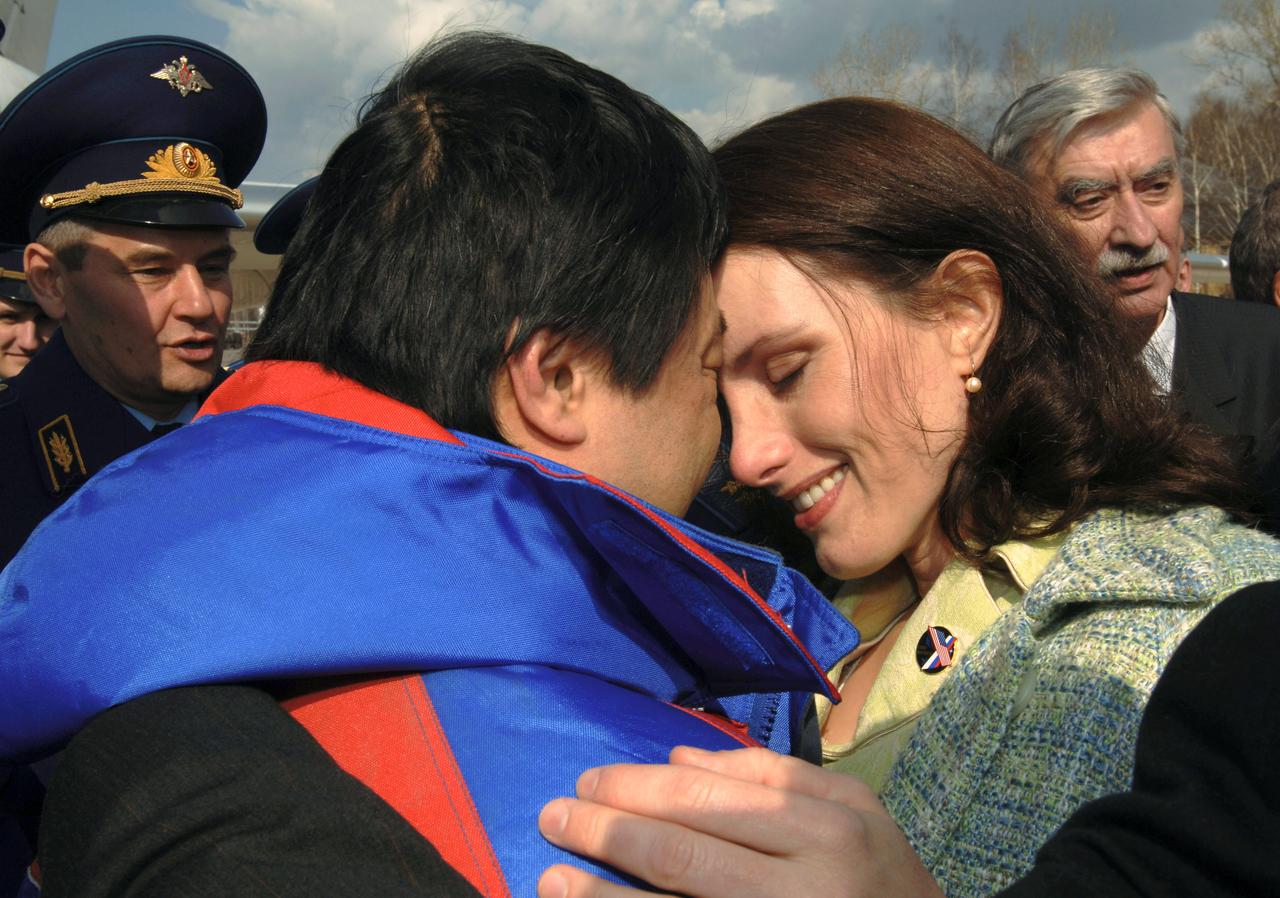
JSC2005-E-17967 (25 April 2005) --- Astronaut Leroy Chiao, Expedition 10 commander and NASA ISS science officer, is greeted by his wife after arriving back to Star City, Russia. Chiao; cosmonaut Salizhan S. Sharipov (not pictured), flight engineer representing Russia's Federal Space Agency; and European Space Agency (ESA) astronaut Roberto Vittori (not pictured) of Italy brought their Soyuz TMA-5 capsule to a pre-dawn landing on April 25, 2005 (Kazakhstan time) northeast of the Kazakhstan town of Arkalyk to wrap up a six month mission aboard the International Space Station (ISS) for Chiao and Sharipov and a ten-day mission for Vittori. The twice-flown Italian astronaut participated under a commercial contract between ESA and the Russian Federal Space Agency. Photo Credit: NASA/Bill Ingalls
Members of the cold stowage team unpack science experiments inside the Space Station Processing Facility at NASA’s Kennedy Space Center in Florida on Jan. 14, 2021. The experiments returned to Earth on SpaceX’s 21st commercial resupply services mission (CRS-21). Making its successful parachute-assisted splashdown west of Tampa off the Florida coast, at 8:26 p.m. EST on Jan. 13, the SpaceX cargo Dragon returned more than 4,400 pounds of scientific experiments and other cargo from the International Space Station. After splashdown, SpaceX loaded Dragon aboard their Go Navigator recovery ship and packed an Airbus H225 helicopter with the time-sensitive research cargo for delivery to Kennedy. The upgraded cargo Dragon capsule also boasts double the powered locker capacity to preserve science samples, allowing for a significant increase in the research that can be carried back to Earth.
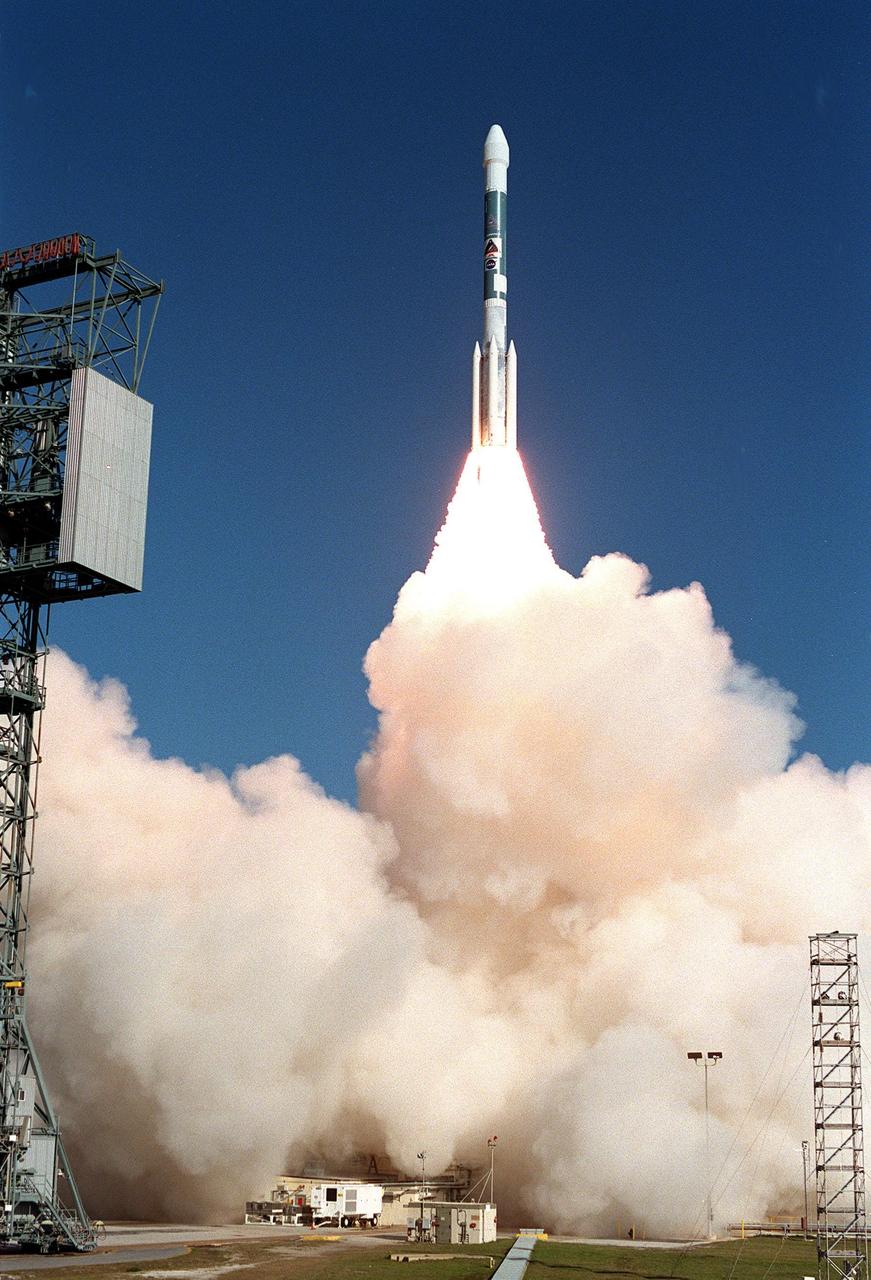
Billows of exhaust roll across Launch Pad 17-A, Cape Canaveral Air Station, as the Boeing Delta II rocket carrying the Stardust spacecraft launches on time. At left is the mobile launch tower. After a 24-hour postponement, the rocket lifted off at 4:04:15 p.m. EST. Stardust is destined for a close encounter with the comet Wild 2 in January 2004. Using a silicon-based substance called aerogel, Stardust will capture comet particles flying off the nucleus of the comet. The spacecraft also will bring back samples of interstellar dust. These materials consist of ancient pre-solar interstellar grains and other remnants left over from the formation of the solar system. Scientists expect their analysis to provide important insights into the evolution of the sun and planets and possibly into the origin of life itself. The collected samples will return to Earth in a sample return capsule to be jettisoned as Stardust swings by Earth in January 2006
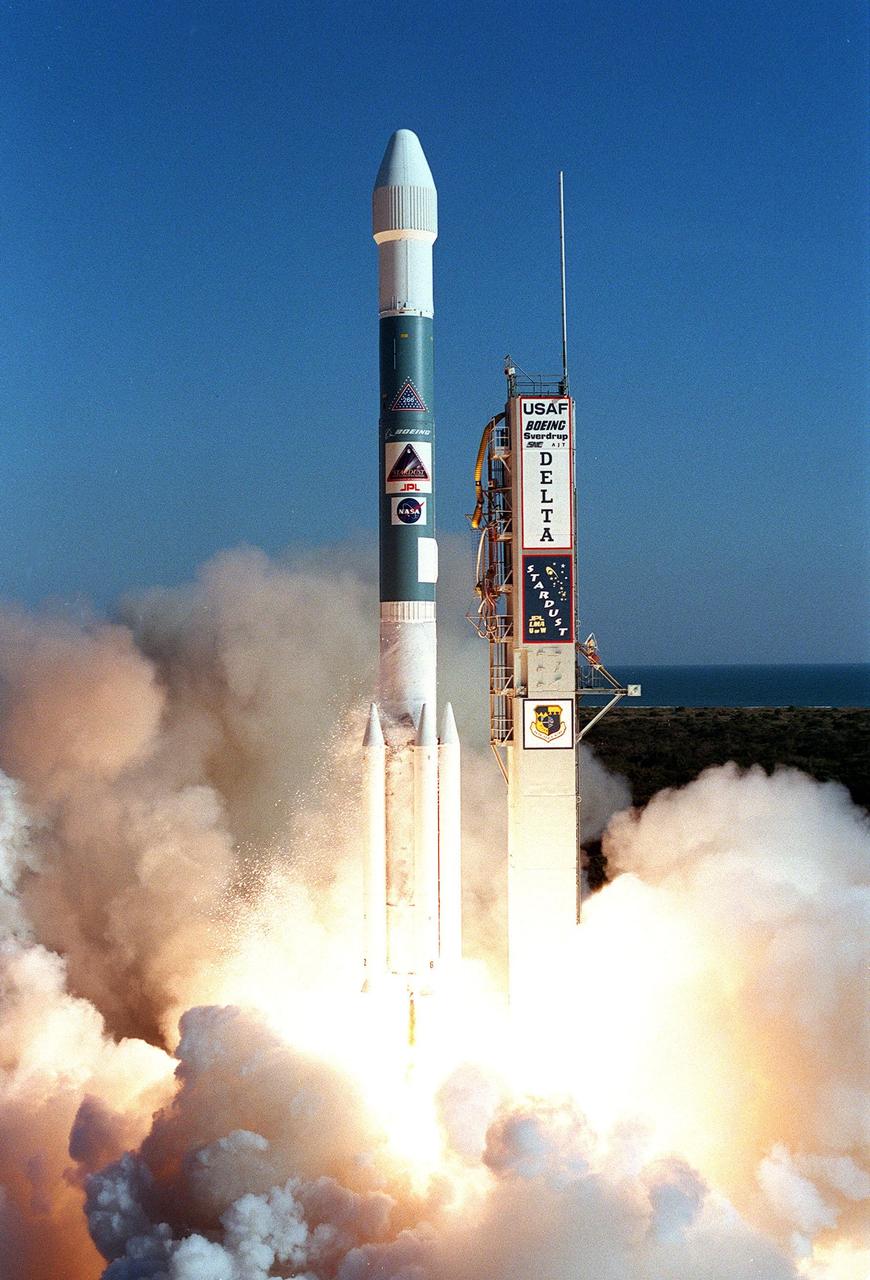
Billows of exhaust fill Launch Pad 17-A, Cape Canaveral Air Station, as the Boeing Delta II rocket carrying the Stardust spacecraft launches on time. After a 24-hour postponement, the rocket lifted off at 4:04:15 p.m. EST. Stardust is destined for a close encounter with the comet Wild 2 in January 2004. Using a silicon-based substance called aerogel, Stardust will capture comet particles flying off the nucleus of the comet. The spacecraft also will bring back samples of interstellar dust. These materials consist of ancient pre-solar interstellar grains and other remnants left over from the formation of the solar system. Scientists expect their analysis to provide important insights into the evolution of the sun and planets and possibly into the origin of life itself. The collected samples will return to Earth in a sample return capsule to be jettisoned as Stardust swings by Earth in January 2006
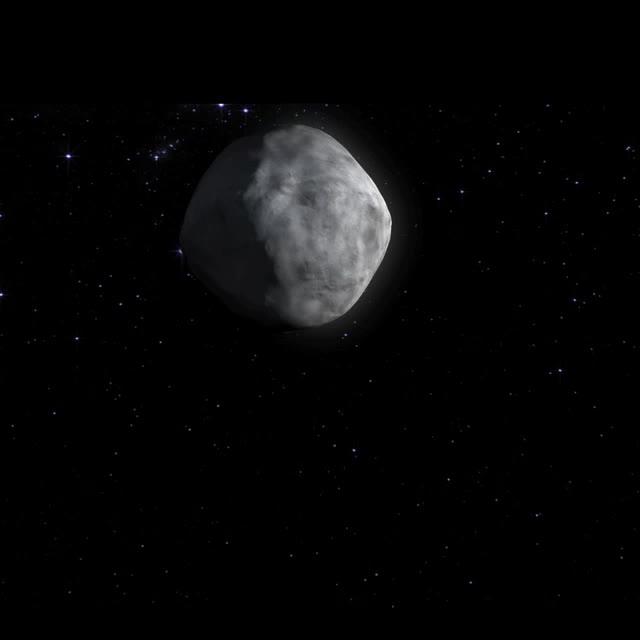
Asteroid Bennu is a time capsule, containing the raw ingredients of the solar system. Bennu has settled in a near-Earth orbit. Today, a NASA spacecraft OSIRIS-REx is going to retrieve a sample to learn more about our Solar System’s history. OSIRIRS-REx is a NASA sample return mission to visit Asteroid Bennu. We plan to grab a piece of Bennu, because it’s a time capsule that can tell us about the origins of our planet and our entire solar system. Watch the full video: <a href="http://youtu.be/gtUgarROs08" rel="nofollow">youtu.be/gtUgarROs08</a> Learn more about NASA’s OSIRIS-REx mission and the making of Bennu’s Journey: <a href="http://www.nasa.gov/content/goddard/bennus-journey/" rel="nofollow">www.nasa.gov/content/goddard/bennus-journey/</a> More information on the OSIRIS-REx mission is available at: <a href="http://www.nasa.gov/mission_pages/osiris-rex/index.html" rel="nofollow">www.nasa.gov/mission_pages/osiris-rex/index.html</a> <a href="http://www.asteroidmission.org" rel="nofollow">www.asteroidmission.org</a> <b><a href="http://www.nasa.gov/audience/formedia/features/MP_Photo_Guidelines.html" rel="nofollow">NASA image use policy.</a></b> <b><a href="http://www.nasa.gov/centers/goddard/home/index.html" rel="nofollow">NASA Goddard Space Flight Center</a></b> enables NASA’s mission through four scientific endeavors: Earth Science, Heliophysics, Solar System Exploration, and Astrophysics. Goddard plays a leading role in NASA’s accomplishments by contributing compelling scientific knowledge to advance the Agency’s mission. <b>Follow us on <a href="http://twitter.com/NASAGoddardPix" rel="nofollow">Twitter</a></b> <b>Like us on <a href="http://www.facebook.com/pages/Greenbelt-MD/NASA-Goddard/395013845897?ref=tsd" rel="nofollow">Facebook</a></b> <b>Find us on <a href="http://instagram.com/nasagoddard?vm=grid" rel="nofollow">Instagram</a></b>
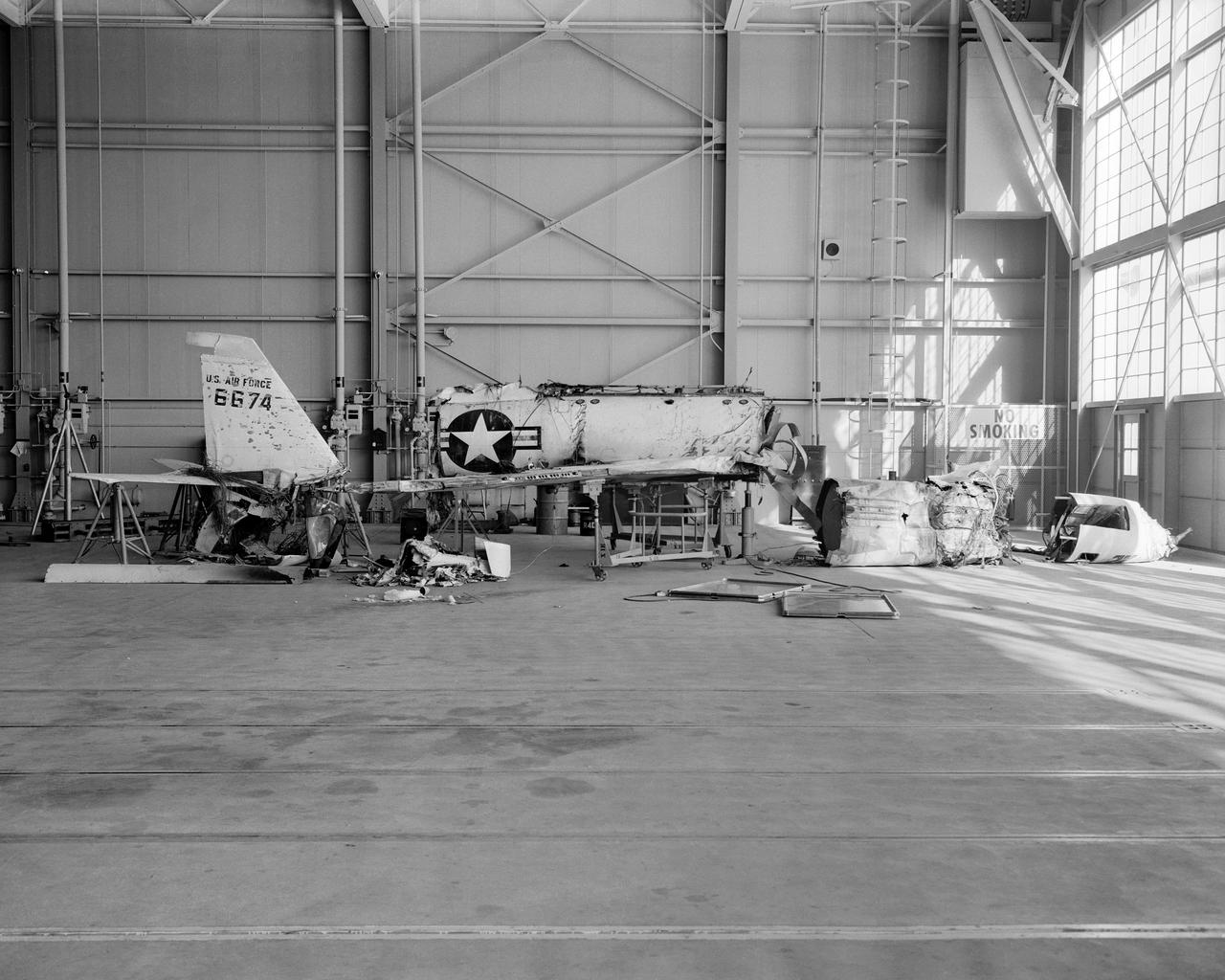
The X-2, initially an Air Force program, was scheduled to be transferred to the civilian National Advisory Committee for Aeronautics (NACA) for scientific research. The Air Force delayed turning the aircraft over to the NACA in the hope of attaining Mach 3 in the airplane. The service requested and received a two-month extension to qualify another Air Force test pilot, Capt. Miburn "Mel" Apt, in the X-2 and attempt to exceed Mach 3. After several ground briefings in the simulator, Apt (with no previous rocket plane experience) made his flight on 27 September 1956. Apt raced away from the B-50 under full power, quickly outdistancing the F-100 chase planes. At high altitude, he nosed over, accelerating rapidly. The X-2 reached Mach 3.2 (2,094 mph) at 65,000 feet. Apt became the first man to fly more than three times the speed of sound. Still above Mach 3, he began an abrupt turn back to Edwards. This maneuver proved fatal as the X-2 began a series of diverging rolls and tumbled out of control. Apt tried to regain control of the aircraft. Unable to do so, Apt separated the escape capsule. Too late, he attempted to bail out and was killed when the capsule impacted on the Edwards bombing range. The rest of the X-2 crashed five miles away. The wreckage of the X-2 rocket plane was later taken to NACA's High Speed Flight Station for analysis following the crash.