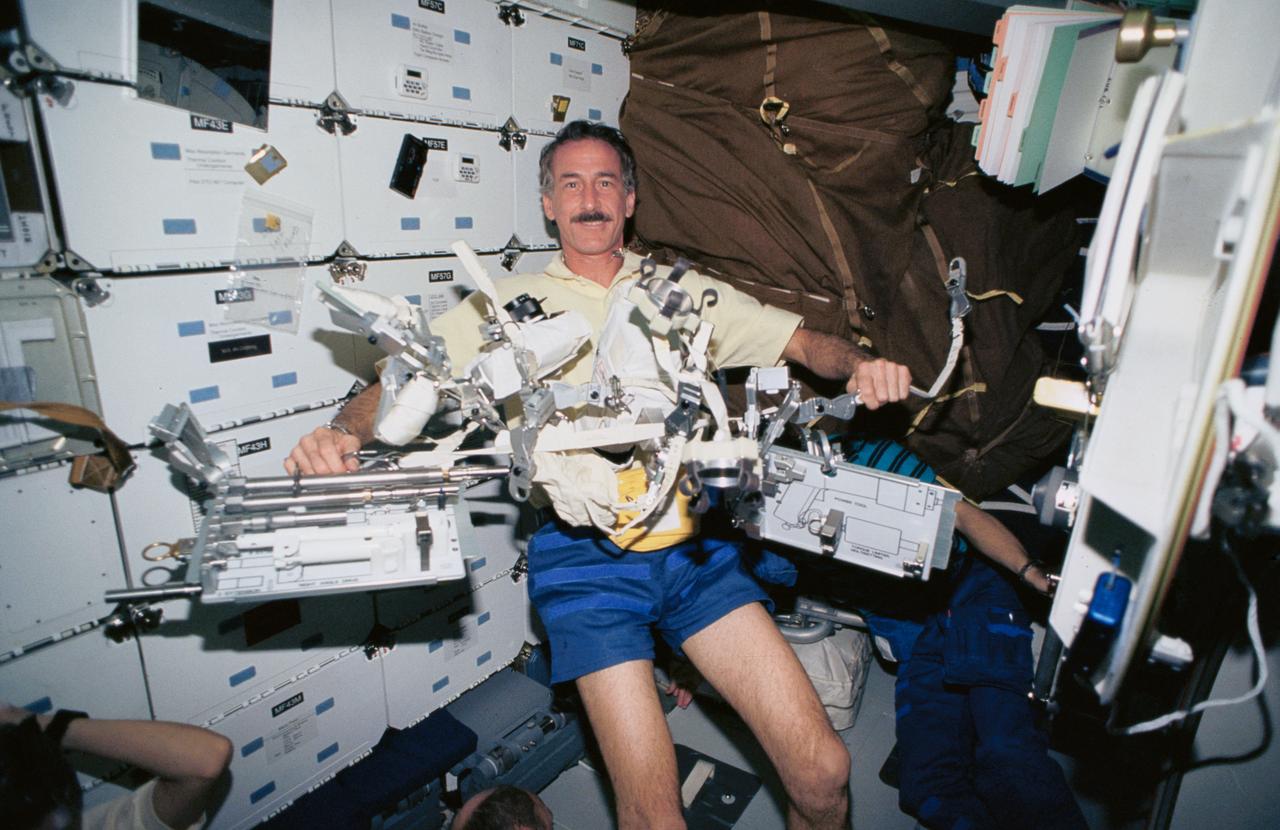
STS061-03-029 (2013 Dec 1993) --- Astronaut Jeffrey A. Hoffman displays tools used in the five space walks on the STS-61 Hubble Space Telescope (HST) repair mission. Hoffman was one of four space walkers making use of the variegated gear.
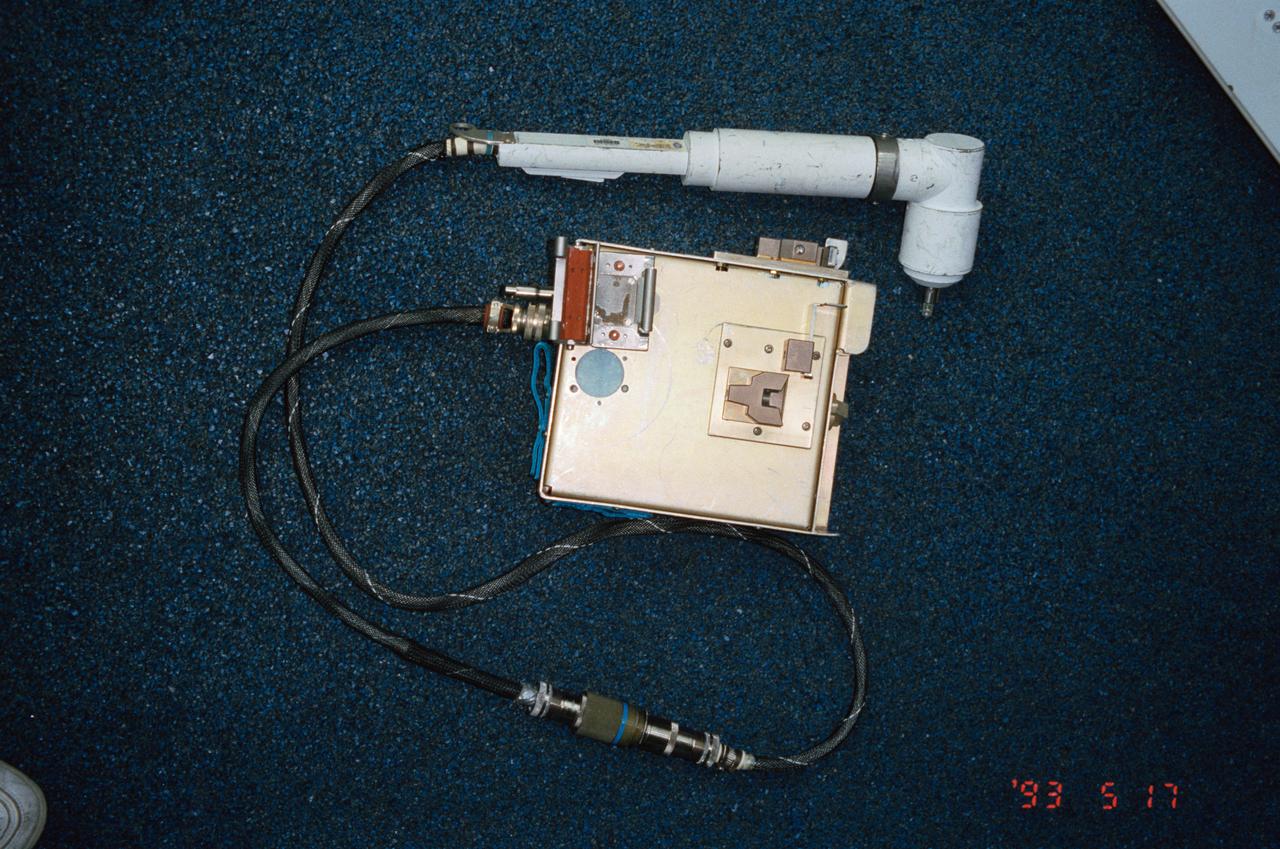
S93-35367 (Nov 1993) --- A close-up view of the special ratchet tool to be used by the STS-61 astronauts assigned to perform servicing of the Hubble Space Telescope (HST) in December of this year. Four astronauts will perform a total of five sessions of extravehicular activity (EVA) during the flight.
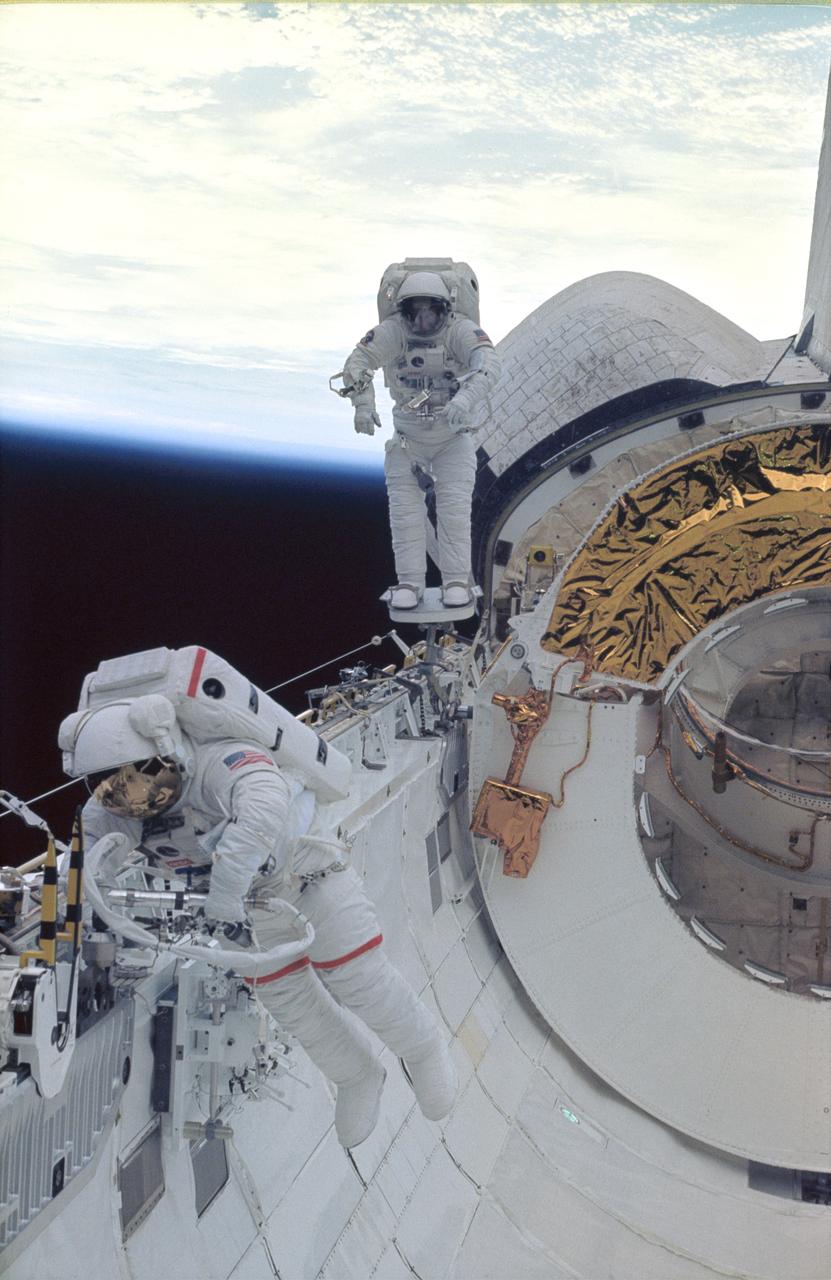
STS051-06-037 (16 Sept 1993) --- Astronauts Carl E. Walz (foreground) and James H. Newman evaluate some important gear. Walz reaches for the Power Ratchet Tool (PRT) while Newman checks out mobility on the Portable Foot Restraint (PFR) near the Space Shuttle Discovery's starboard Orbital Maneuvering System (OMS) pod. The tools and equipment will be instrumental on some of the five periods of extravehicular activity (EVA) scheduled for the Hubble Space Telescope (HST) STS-61 servicing mission later this year.
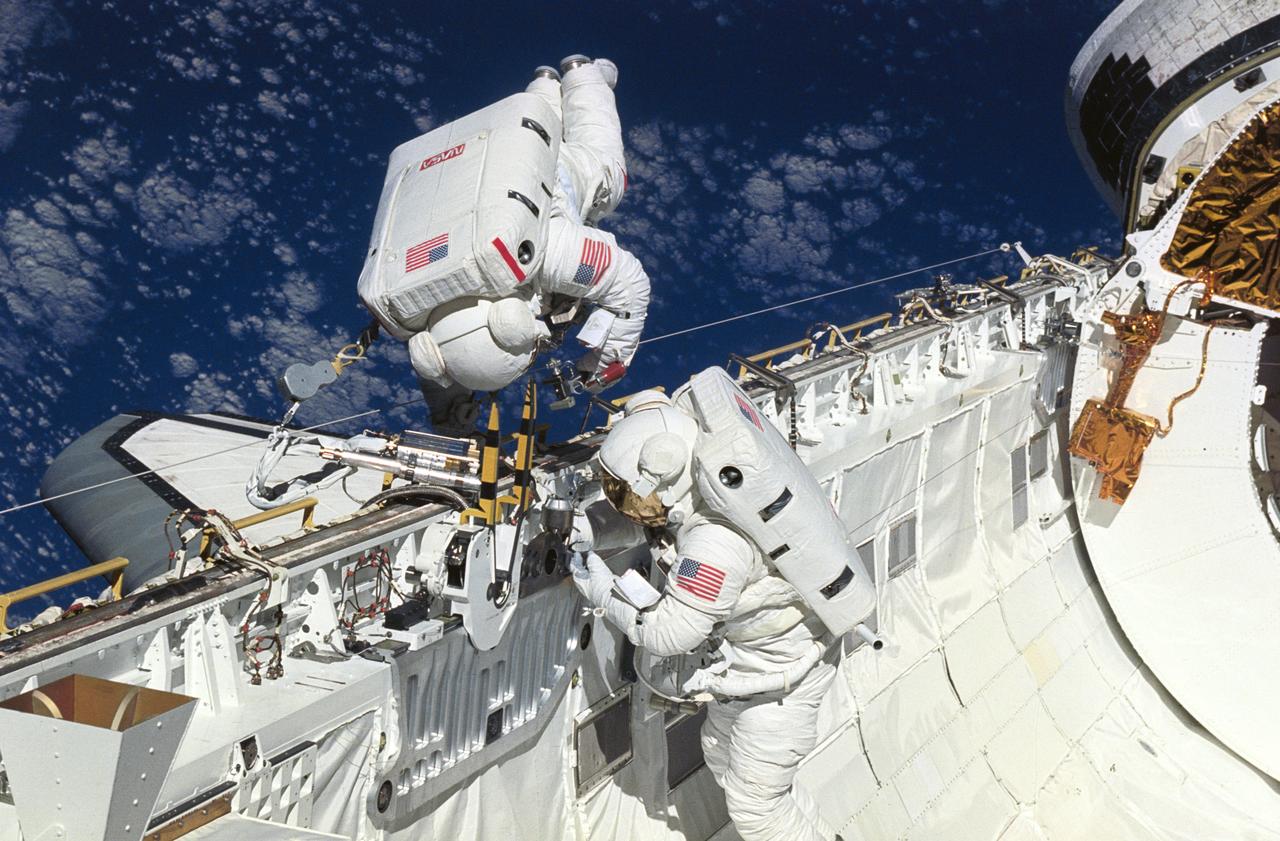
STS051-06-023 (16 Sept 1993) --- Astronauts James H. Newman (in bay) and Carl E. Walz, mission specialists, practice space walking techniques and evaluate tools to be used on the first Hubble Space Telescope (HST) servicing mission scheduled for later this year. Walz rehearses using the Power Ratchet Tool (PRT), one of several special pieces of gear to be put to duty during the scheduled five periods of extravehicular activity (EVA) on the STS-61 mission.
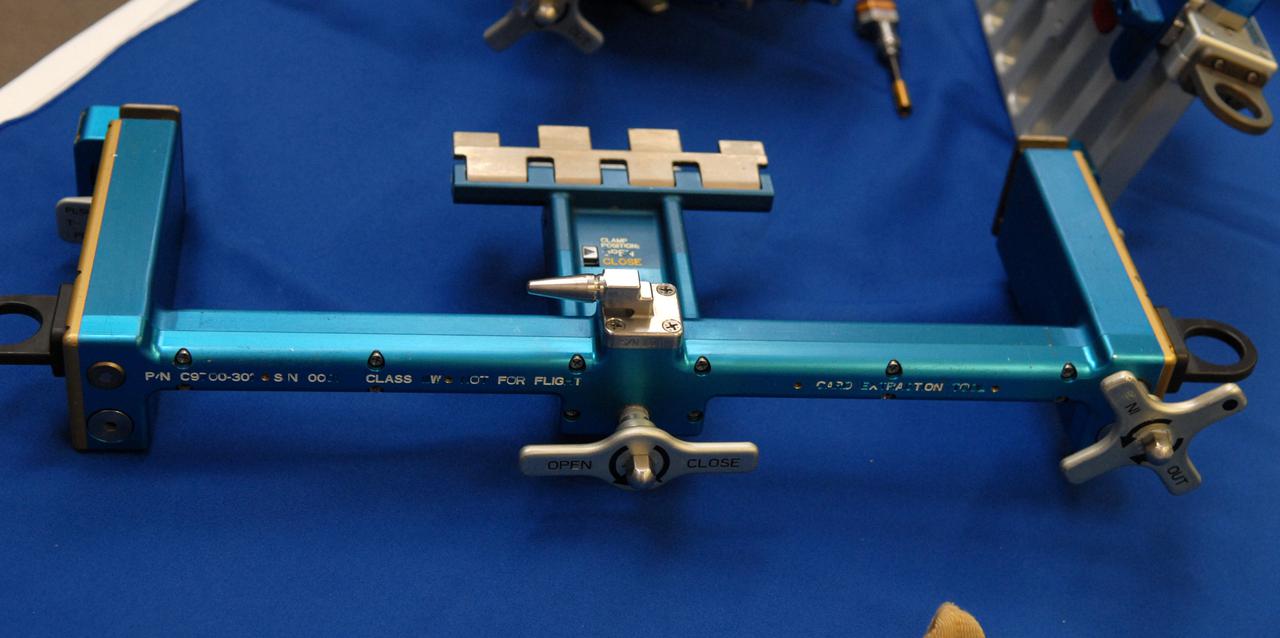
CAPE CANAVERAL, Fla. – The tools that will be used to service NASA's Hubble Space Telescope on the STS-125 mission are displayed in the NASA News Center at NASA's Kennedy Space Center in Florida. This is a closeup of a card extraction and insertion tool to enable removal of electronic cards. On space shuttle Atlantis’ STS-125 mission, Hubble will be serviced for the fifth and final time. The flight will include five spacewalks during which astronauts will refurbish and upgrade the telescope with these state-of-the-art science instruments. As a result, Hubble's capabilities will be expanded and its operational lifespan extended through at least 2014. The payload includes a Wide Field Camera 3, fine guidance sensor and the Cosmic Origins Spectrograph. Launch is scheduled for 2:01 p.m. EDT May 11. Photo credit: NASA_Jack Pfaller
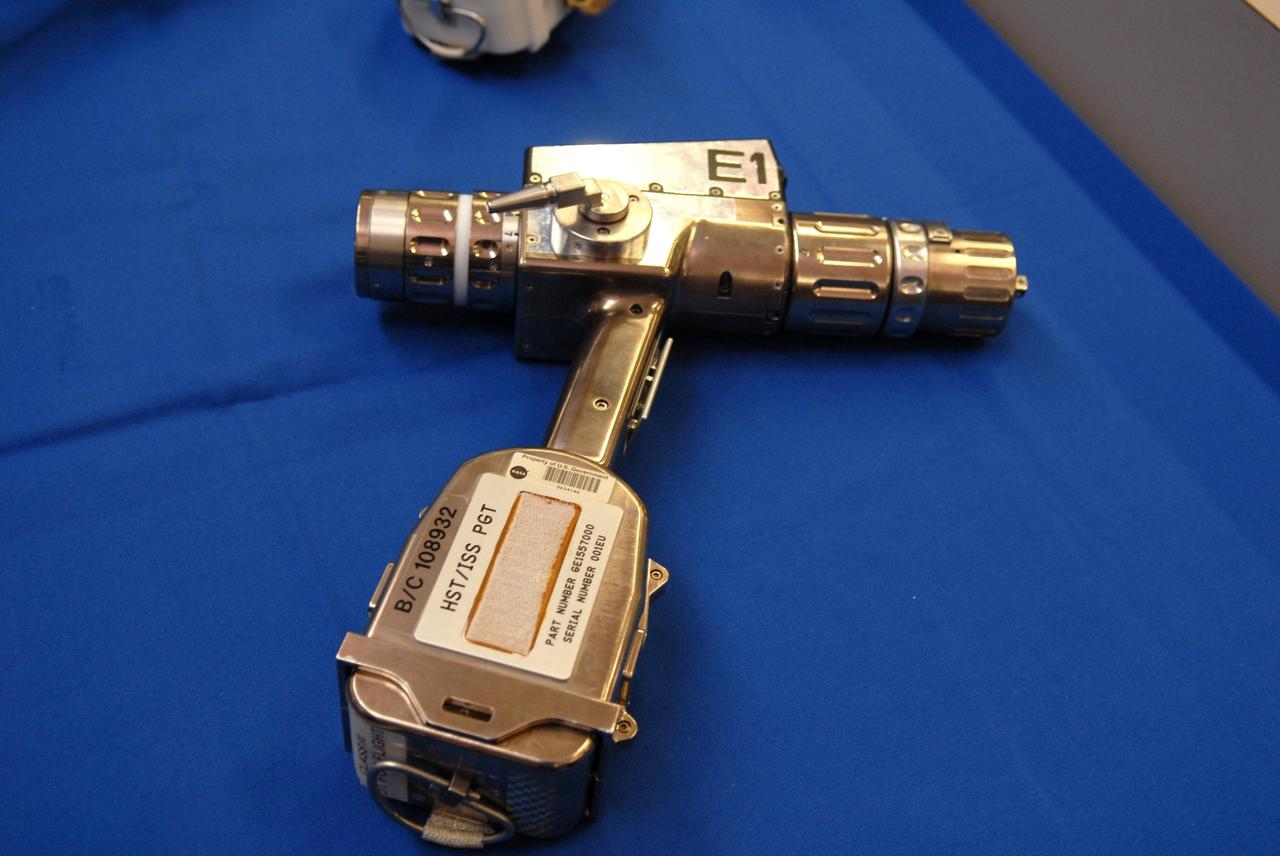
CAPE CANAVERAL, Fla. – The tools that will be used to service NASA's Hubble Space Telescope on the STS-125 mission are displayed in the NASA News Center at NASA's Kennedy Space Center in Florida. This is a closeup of the pistol grip tool that can install and remove instruments, drive latches and open doors. A self-contained, high-torque drive, the tool features an on-board computer that permits users to tailor its performance to the mission demands. On space shuttle Atlantis’ STS-125 mission, Hubble will be serviced for the fifth and final time. The flight will include five spacewalks during which astronauts will refurbish and upgrade the telescope with these state-of-the-art science instruments. As a result, Hubble's capabilities will be expanded and its operational lifespan extended through at least 2014. The payload includes a Wide Field Camera 3, fine guidance sensor and the Cosmic Origins Spectrograph. Launch is scheduled for 2:01 p.m. EDT May 11. Photo credit: NASA/Jack Pfaller
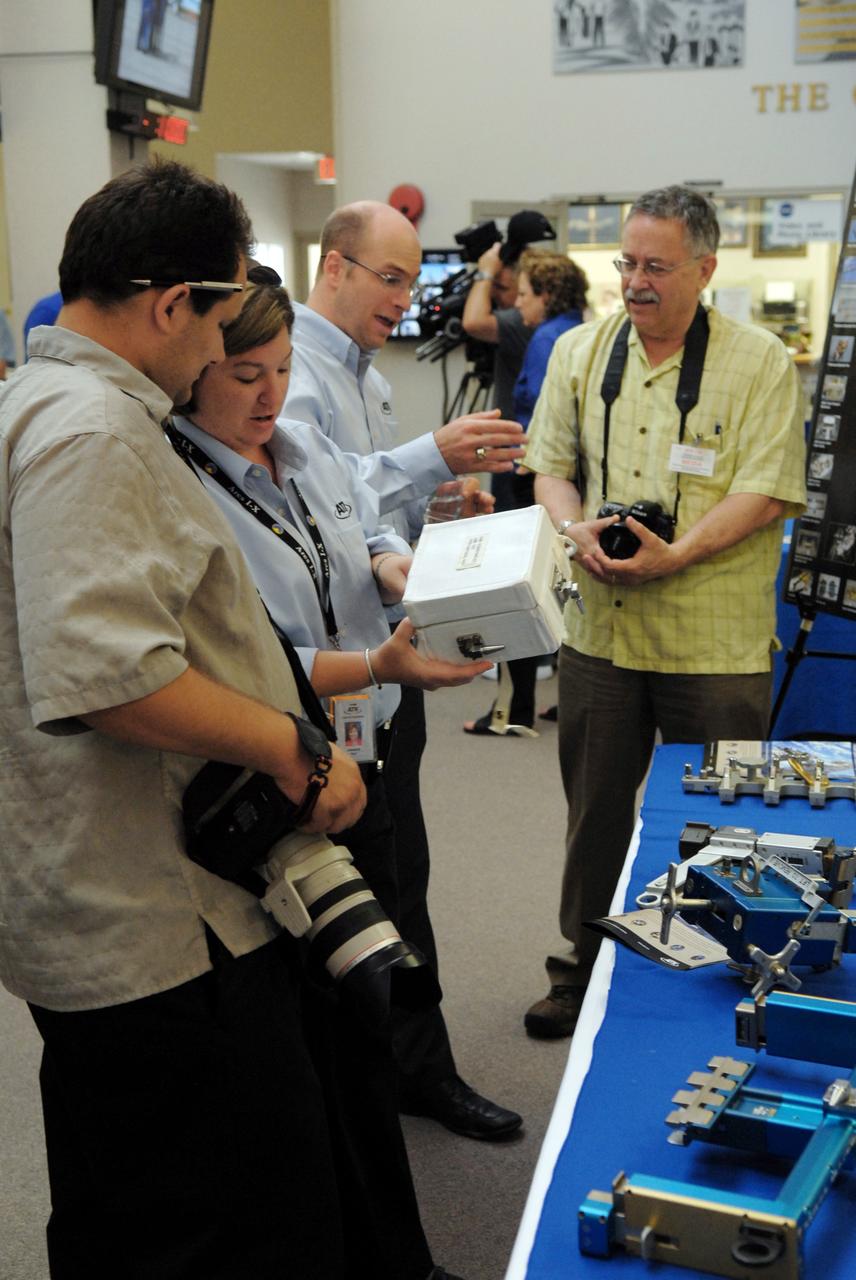
CAPE CANAVERAL, Fla. – The tools that will be used to service NASA's Hubble Space Telescope on the STS-125 mission are displayed in the NASA News Center at NASA's Kennedy Space Center in Florida. On space shuttle Atlantis’ STS-125 mission, Hubble will be serviced for the fifth and final time. The flight will include five spacewalks during which astronauts will refurbish and upgrade the telescope with these state-of-the-art science instruments. As a result, Hubble's capabilities will be expanded and its operational lifespan extended through at least 2014. The payload includes a Wide Field Camera 3, fine guidance sensor and the Cosmic Origins Spectrograph. Launch is scheduled for 2:01 p.m. EDT May 11. Photo credit: NASA/Jack Pfaller
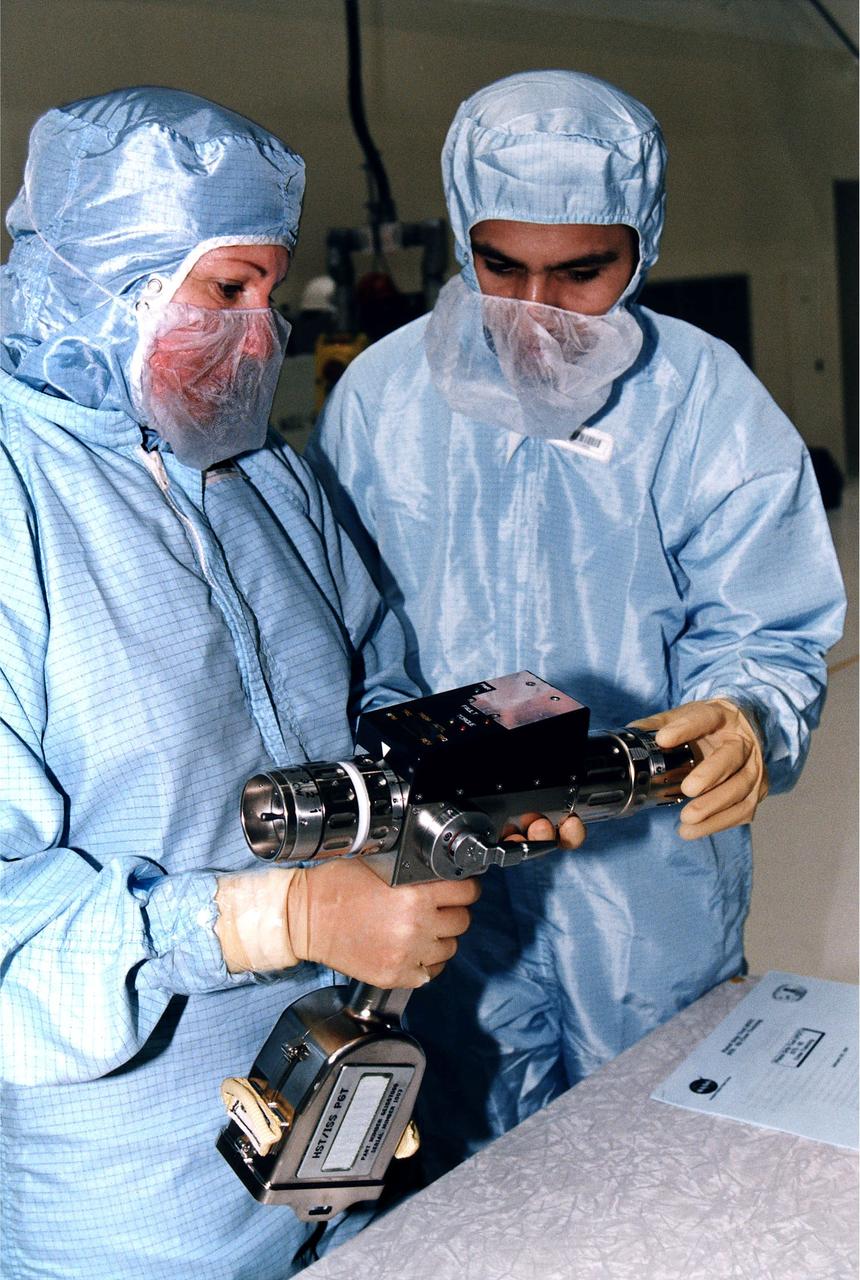
KENNEDY SPACE CENTER, FLA. - In KSC's Vertical Processing Facility, Louise Kleba of the Vehicle Integration Test Team (VITT) and engineer Devin Tailor of Goddard Space Flight Center examine the Pistol Grip Tool (PGT), which was designed for use by astronauts during spacewalks. The PGT is a self-contained, micro-processor controlled, battery-powered tool. It also can be used as a nonpowered ratchet wrench. The experiences of the astronauts on the first Hubble Space Telescope (HST) servicing mission led to recommendations for this smaller, more efficient tool for precision work during spacewalks. The PGT will be used on the second HST servicing mission, STS-82. Liftoff aboard Discovery is scheduled Feb. 11.
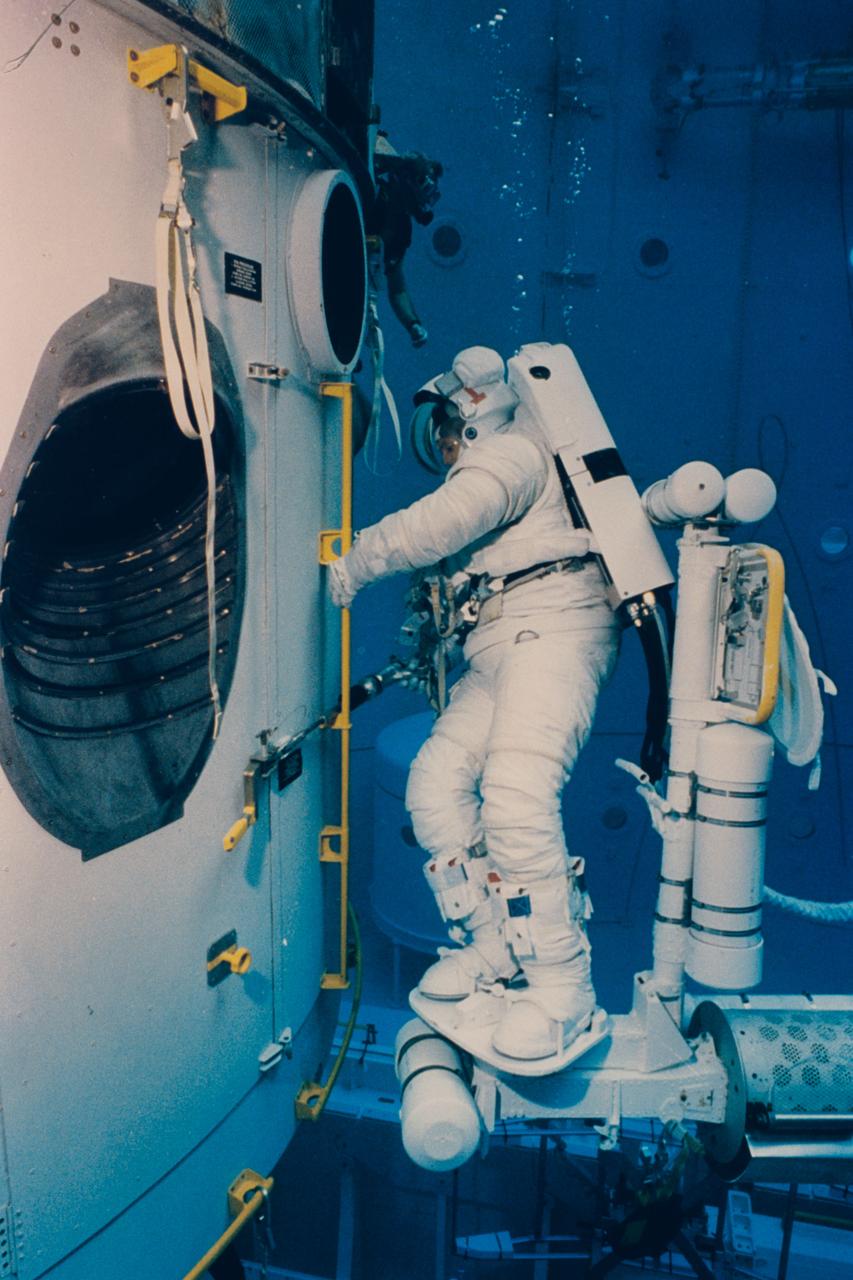
Astronaut Thomas D. Akers uses a power wrench to deploy one of the tools on the Hubble Space Telescope (HST) during a training session in the Neutral Buoyancy Simulator at Marshall Space Flight Center.
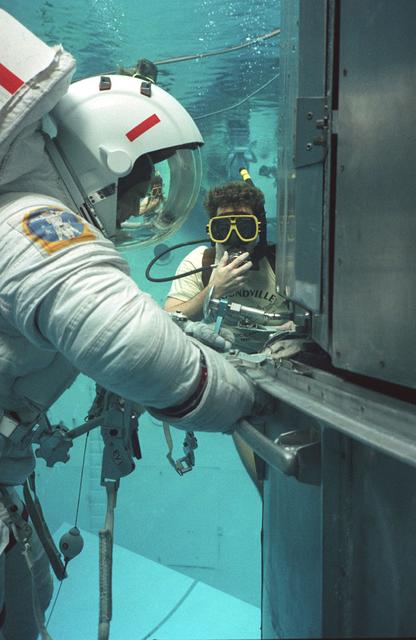
Prior to its launch in April 1990, the Hubble Space Telescope (HST) went through years of development and testing. The HST was the first of its kind and the scientific community could only imagine the fruits of their collective labors. However, prior to its launch, more practical procedures, such as astronaut training, had to be developed. As the HST was to remain in orbit for years, it became apparent that on-orbit maintenance routines would have to be developed. The best facility to develop these maintenance practices was at the Neutral Buoyancy Simulator (NBS) at the Marshall Space Flight Center (MSFC). The NBS provided mock-ups of the HST (in sections), a Remote Manipulator System (RMS), and a shuttle's cargo bay pallet. This real life scenario provided scientists, engineers, and astronauts a practical environment to work out any problems with a plarned on-orbit maintenance mission. Pictured is an astronaut in training with a mock-up section of the HST, practicing using tools especially designed for the task being performed.
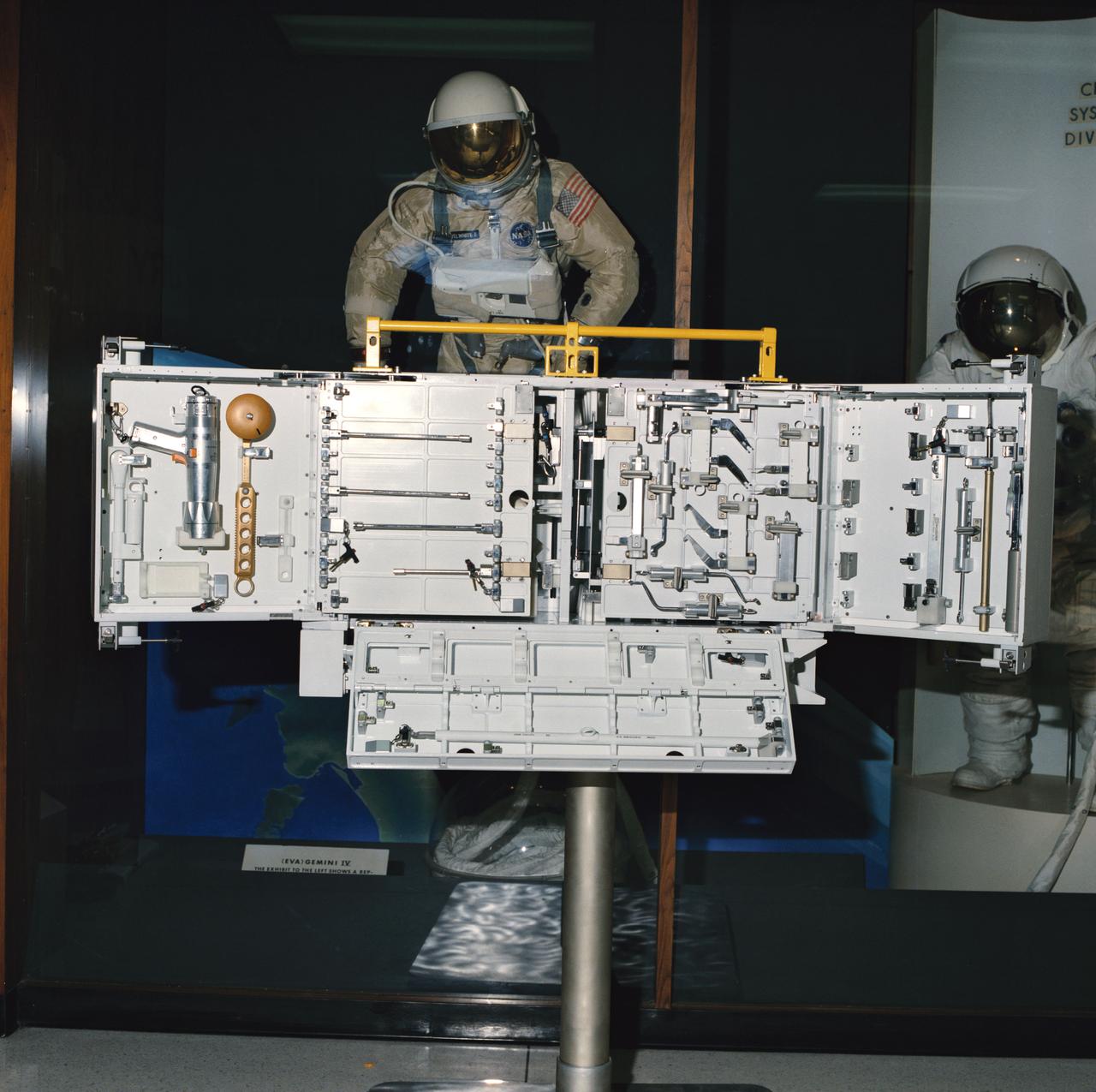
S87-49426 (1987) --- The Hubble Space Telescope (HST) tool box provides stowage of individual tools, tool boards and tool caddies required for maintenance of the telescope. The basic box design was revised from the LEASAT (U.S. Navy) equipment stowage container. It can be mounted to a base plate or back plate depending on the mission location requirements. A four-point latching system secured with pip pins is used to latch the tool box doors for launch. Various other latches are designed into the door panels and tool mounting locations for tool retention. The box consists of aluminum sides and base, a dividing wall and deep doors. Along three sides there are handrails by which STS-61 extravehicular activity (EVA) crew members can translate themselves or brace themselves when stowing and unstowing equipment.
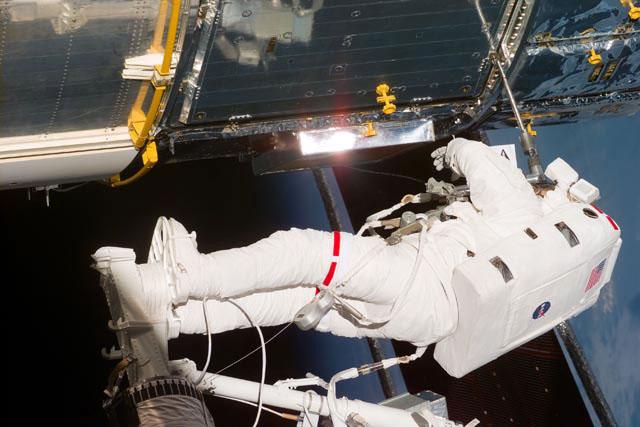
S103-E-5294 (23 Dec. 1999) --- Astronaut C. Michael Foale, standing on the end of Discovery's remote manipulator system (RMS), which had hoisted him to a task station on the Hubble Space Telescope (HST), uses a tool during the second spacewalk for the STS-103 mission. Astronauts Foale and Claude Nicollier are the second pair of STS-103 mission specialists to abandon the shirt-sleeve environment of Discovery's cabin for several hours' tasks on this the third NASA servicing mission to HST. The photo was taken with an electronic still camera (ESC). Photo credit: NASA
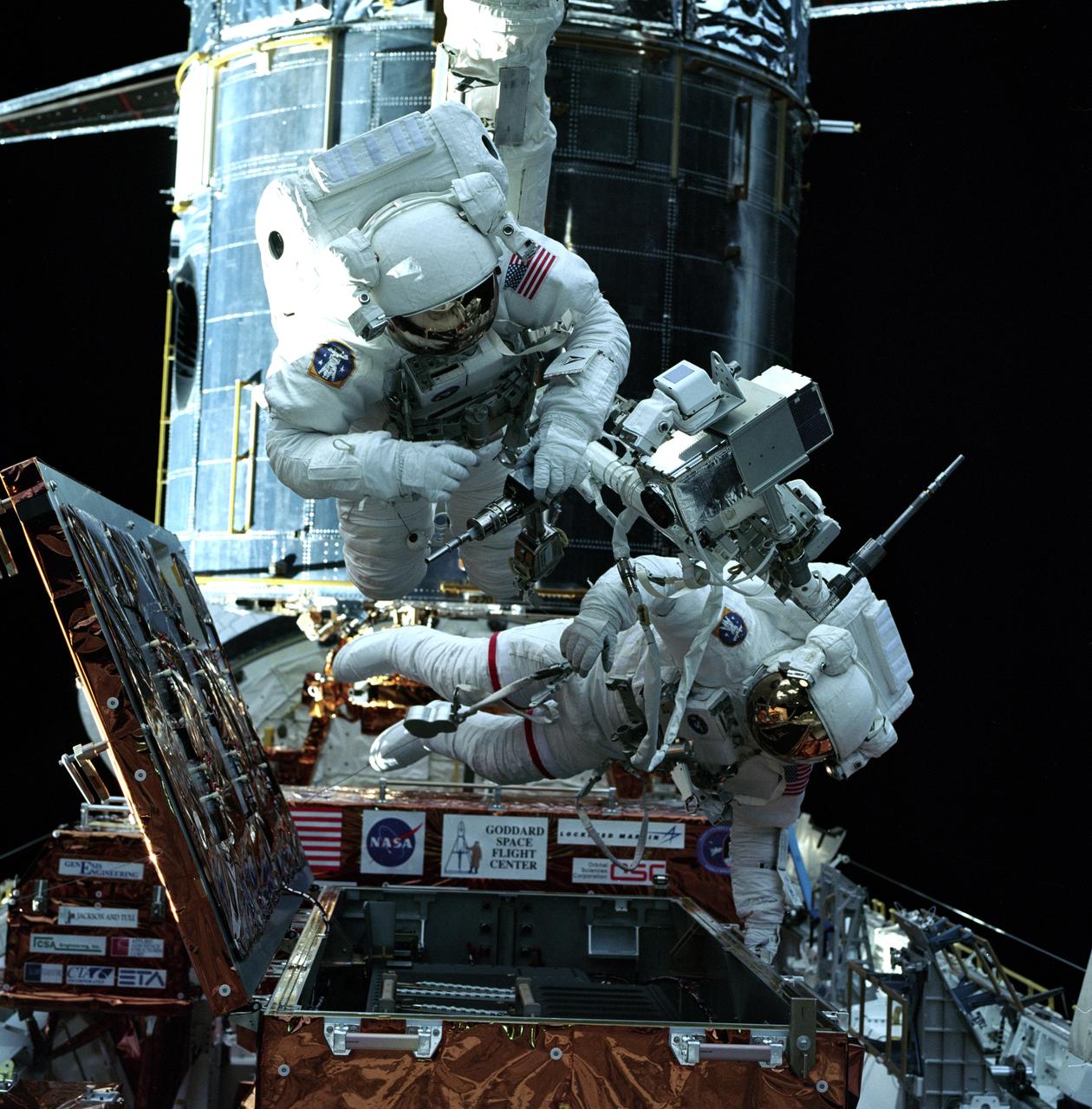
STS082-717-026 (13 Feb. 1997) --- Gearing up with tools for the first Extravehicular Activity (EVA-1) to service the Hubble Space Telescope (HST, background) are astronauts Steven L. Smith (left) and Mark C. Lee. They were among four STS-82 crewmembers who are to share several alternating two-member space walking work sessions during the flight. The photograph was made from inside Discovery's cabin with a 70mm camera.
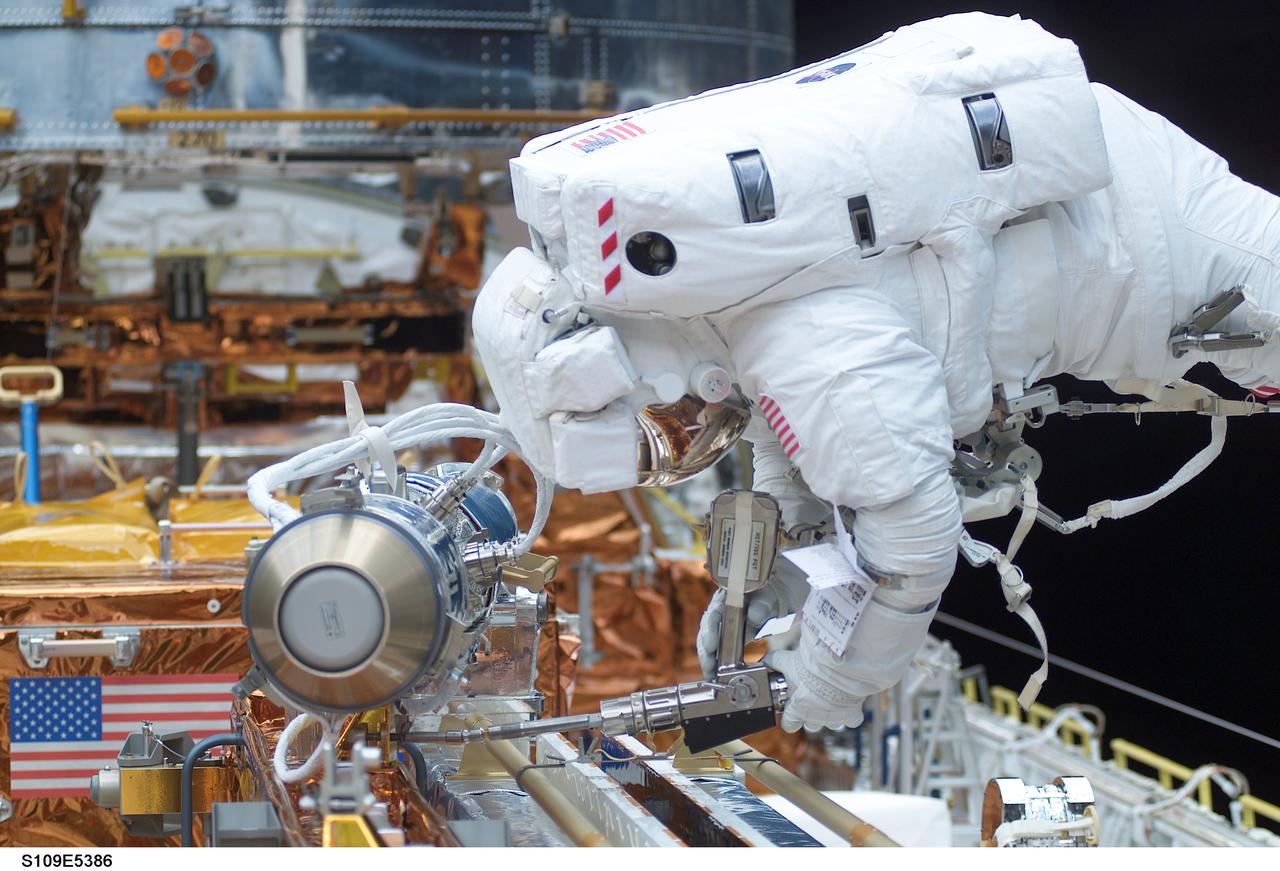
STS109-E-5386 (5 March 2002) --- Astronaut Michael J. Massimino, mission specialist, checks a tool in the cargo bay of the Space Shuttle Columbia during the STS-109 mission's second day of extravehicular activity (EVA). Astronauts Massimino and James H. Newman worked to replace the second set of solar arrays on the Hubble Space Telescope (HST). The image was recorded with a digital still camera.
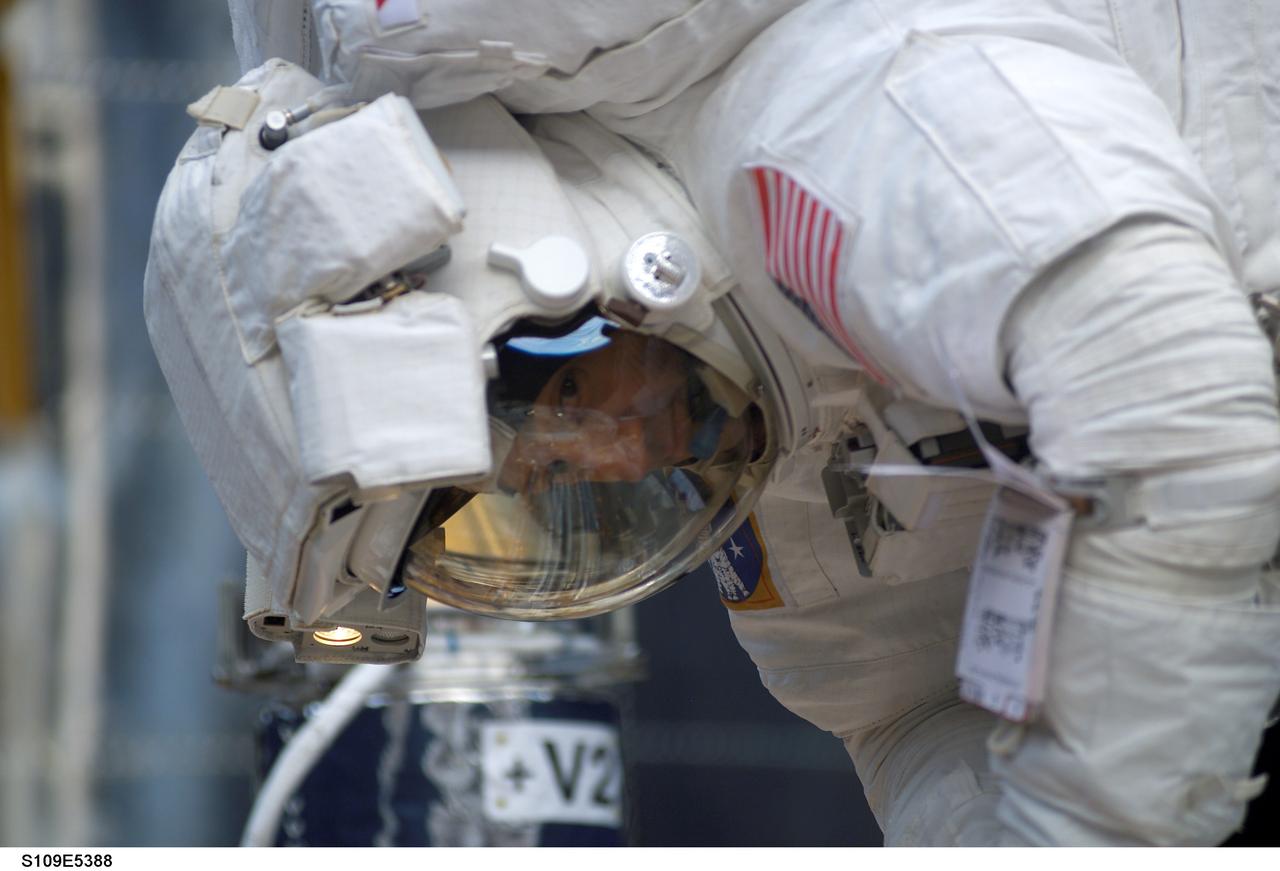
STS109-E-5388 (5 March 2002) --- Astronaut Michael J. Massimino, mission specialist, checks a tool in the cargo bay of the Space Shuttle Columbia during the STS-109 mission's second day of extravehicular activity (EVA). Astronauts Massimino and James H. Newman worked to replace the second set of solar arrays on the Hubble Space Telescope (HST). The image was recorded with a digital still camera.
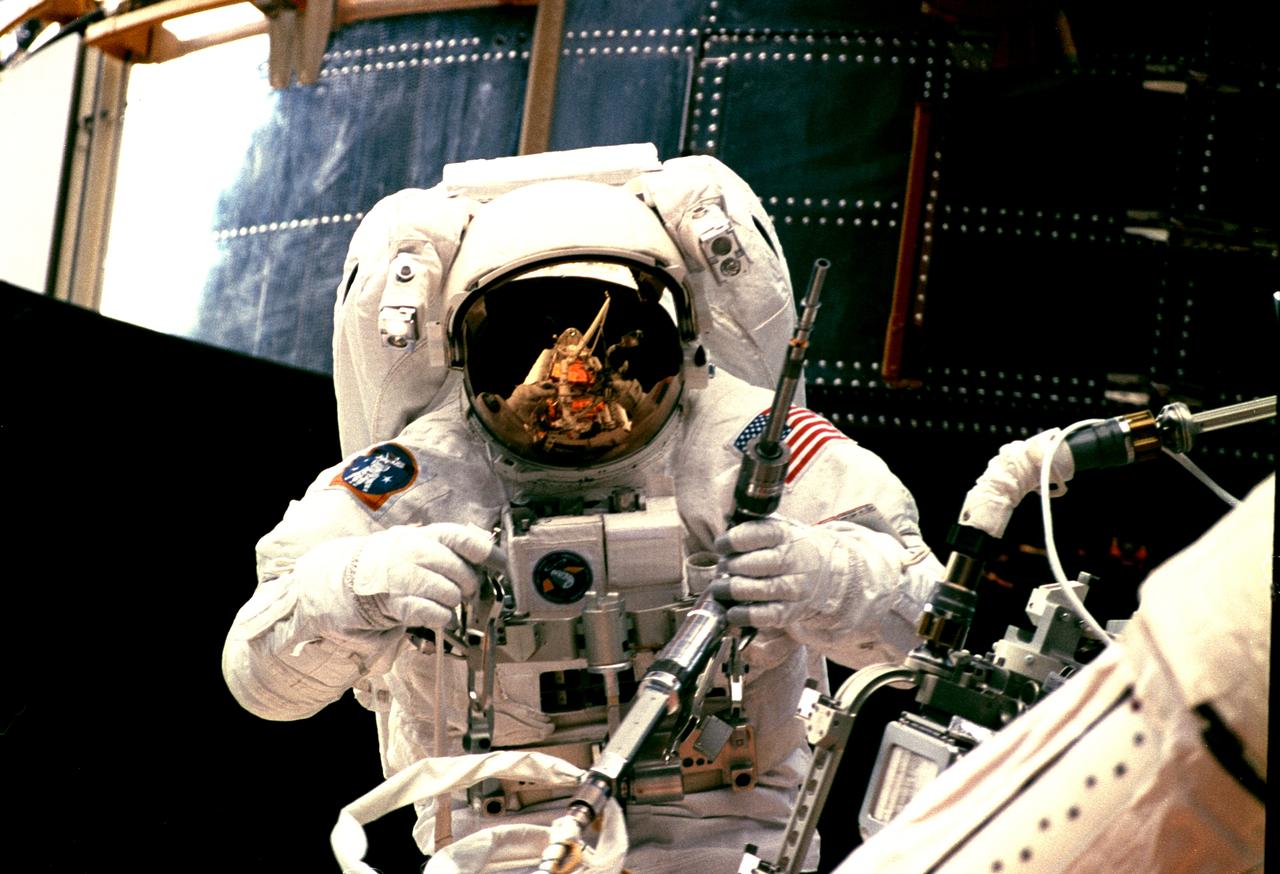
STS082-314-017 (13 Feb. 1997) --- Astronaut Steven L. Smith picks up a power ratchet tool as he prepares to join astronaut Mark C. Lee (out of frame) on the first space walk of the STS-82 mission to service the Hubble Space Telescope (HST), temporarily latched down in Discovery?s cargo bay (background).
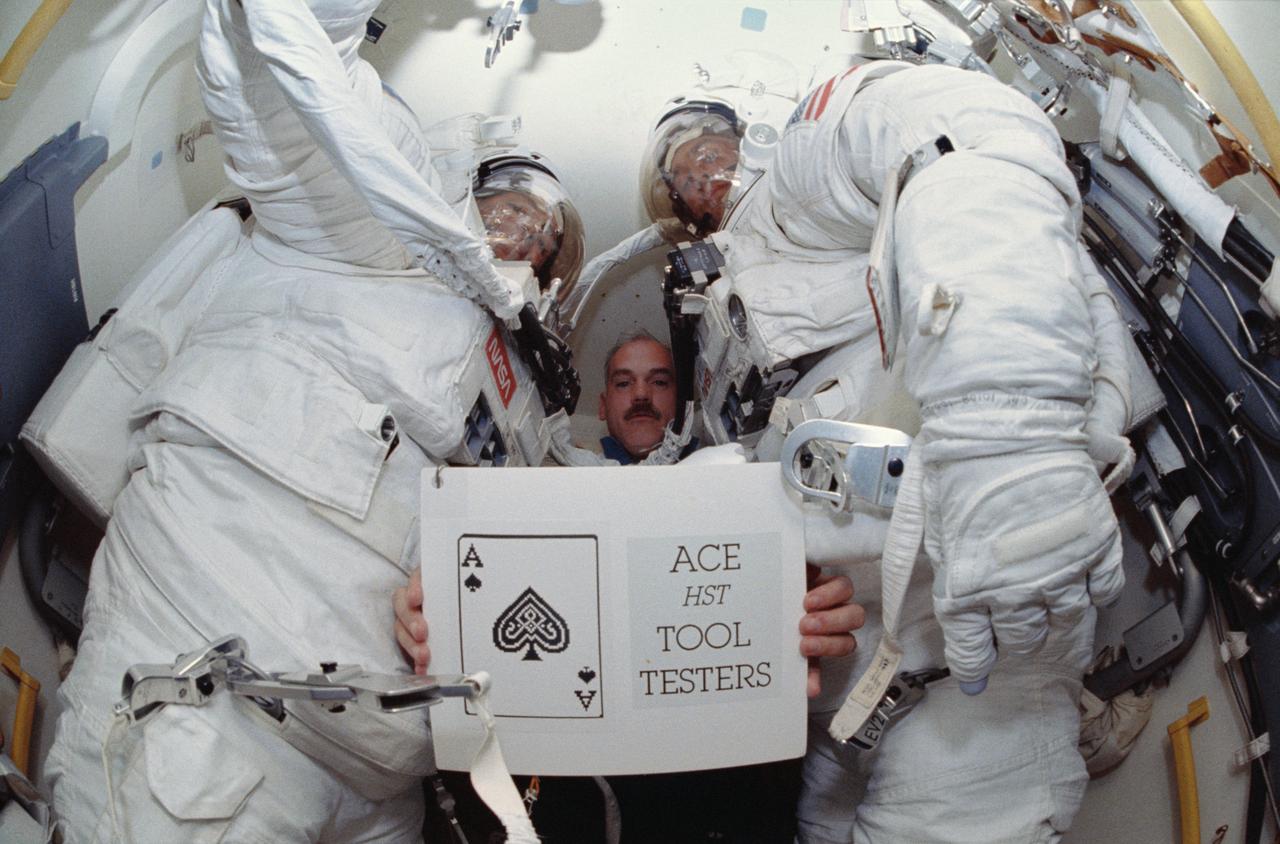
STS051-66-009 (16 Sept 1993) --- In Discovery's airlock, astronaut William F. Readdy, pilot, holds up a STS-51 slogan -- "Ace HST Tool Testers" -- for still and video cameras to record. Readdy is flanked by astronauts Carl E. Walz (left) and James H. Newman, who had just shared a lengthy period of extravehicular activity (EVA) in and around Discovery's cargo bay. Not pictured are astronauts Frank L. Culbertson Jr., mission commander, and Daniel W. Bursch, mission specialist.
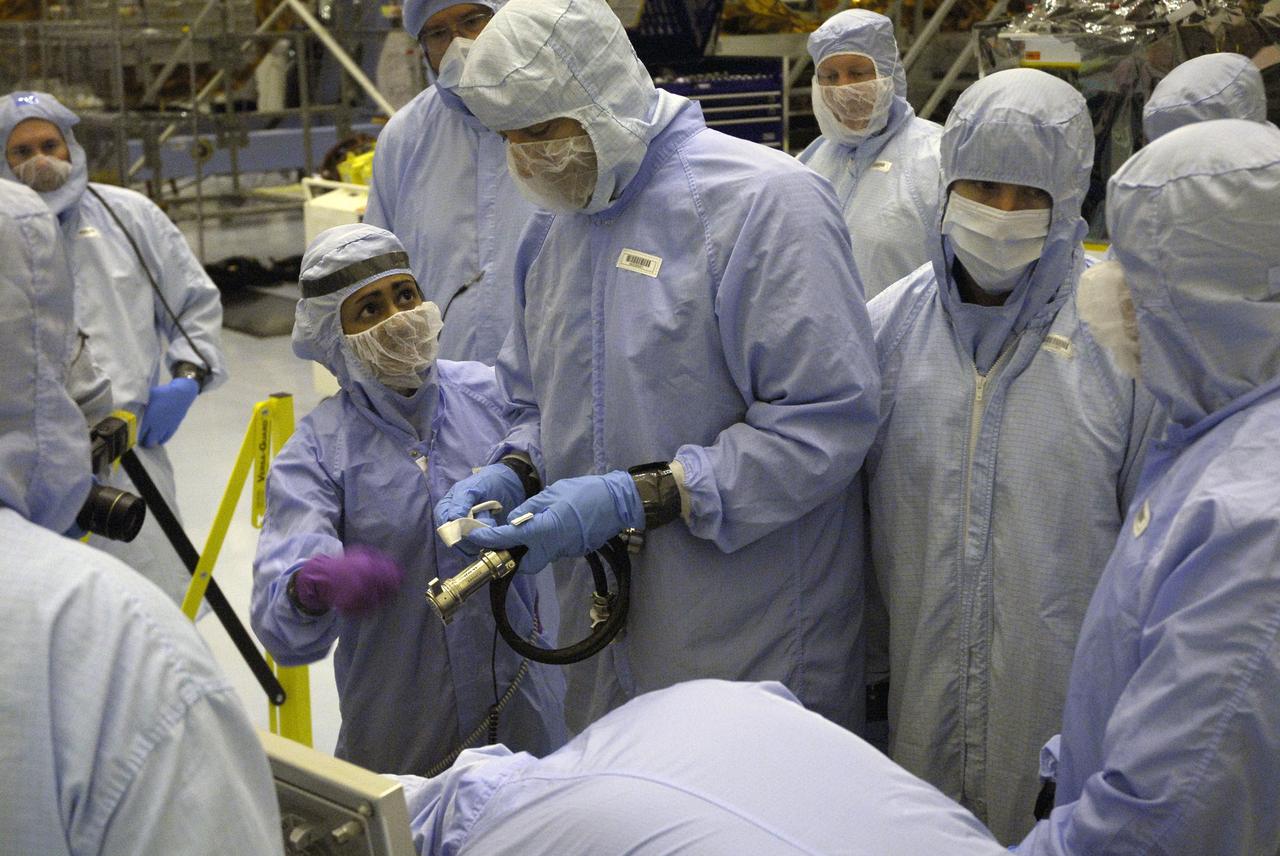
CAPE CANAVERAL, Fla. – In the Payload Hazardous Servicing Facility at NASA’s Kennedy Space Center, crew members with the STS-125 mission get a close look at some of the equipment associated with their mission to service NASA’s Hubble Space Telescope. At center, HST inspector Minal Kaskhari talks to Mission Specialist Mike Massimino, holding a tool from the Small ORU Protective Enclosure, or SOPE. On the right are Mission Specialists Andrew Feustel and Michael Good. The STS-125 crew is taking part in a crew equipment interface test, which provides experience handling tools, equipment and hardware they will use on their mission. Space shuttle Atlantis is targeted to launch on the STS-125 mission Oct. 10. Photo credit: NASA/Kim Shiflett
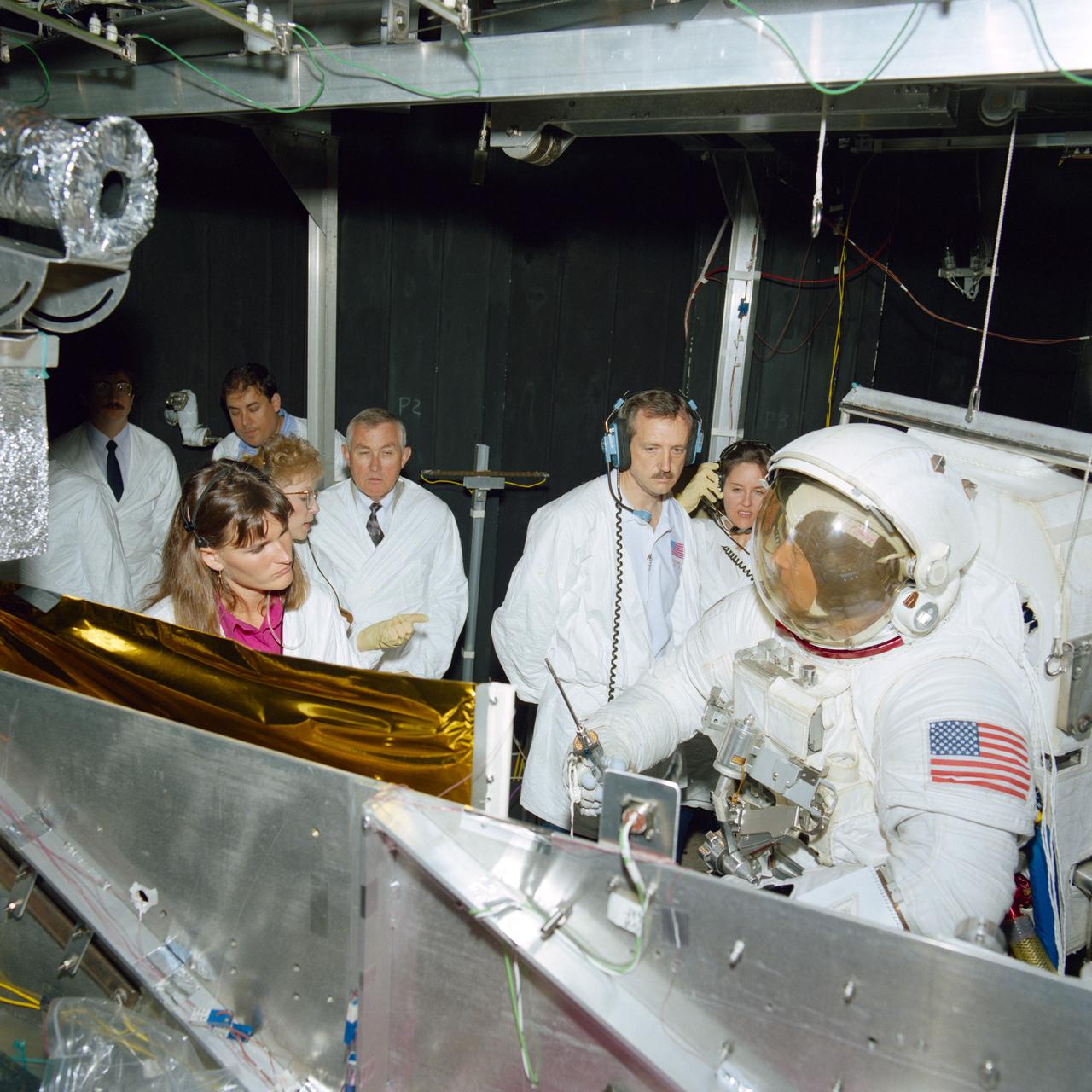
S93-34001 (26 May 1993) --- Astronaut F. Story Musgrave, wearing a training version of the Extravehicular Mobility Unit (EMU), participates in a dry run for tests in a thermal vacuum chamber. The payload commander will be among four suited crew members participating in task rehearsals and testing the tools that will be used on the Hubble Space Telescope (HST) repair mission. The test, conducted in Chamber B of the Space Environment and Simulation Laboratory (SESL) at the Johnson Space Center (JSC), verified that the tools being designed for the mission will work in the cold vacuum of space. Others pictured, from the left, are Andrea Tullar and Donna Fender, test directors; Leonard S. Nicholson, acting director of engineering; and astronauts Thomas D. Akers and Kathryn C. Thornton, mission specialists, along with Musgrave.
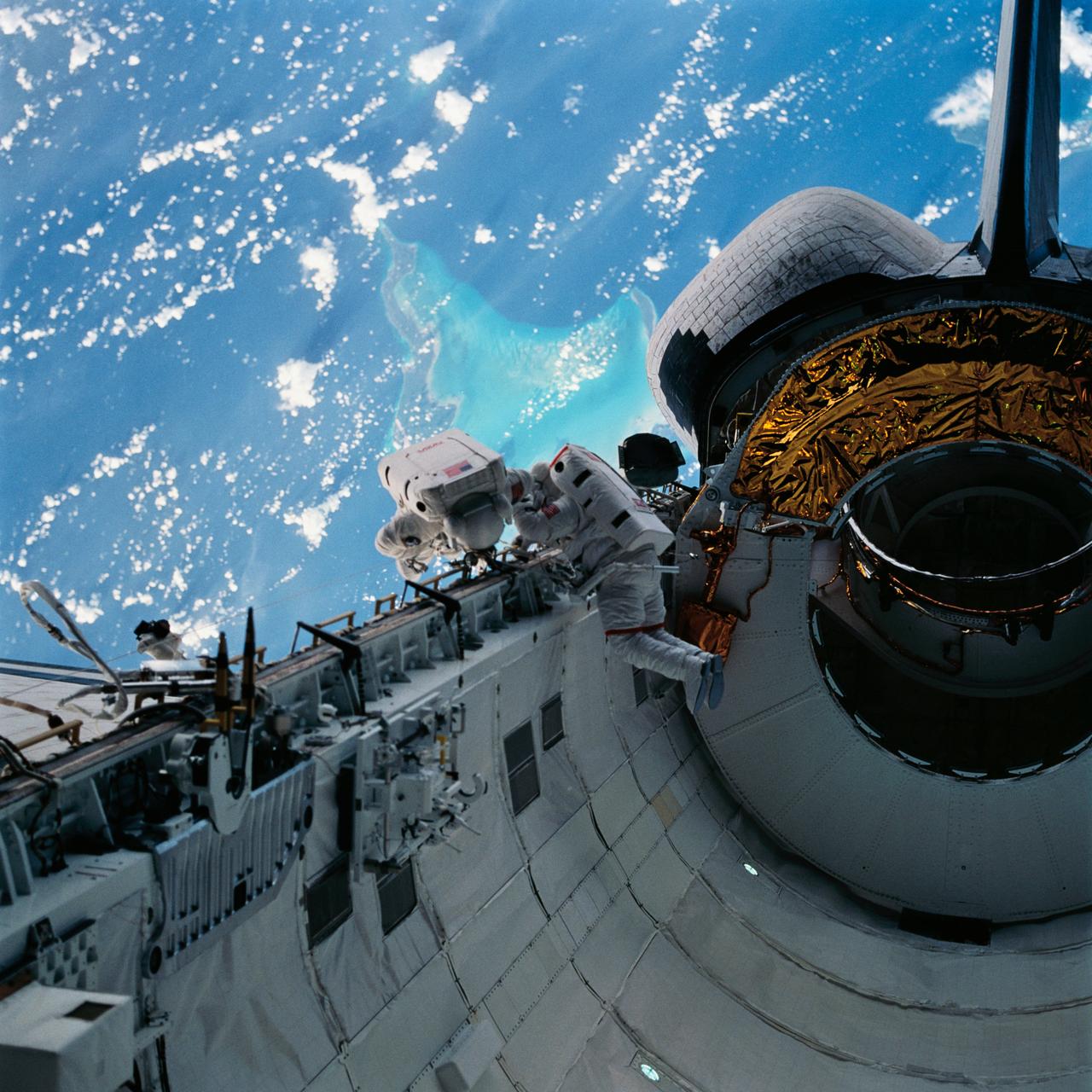
With the Caribbean Sea and part of the Bahama Islands chain as a backdrop, two STS-51 crewmembers evaluate procedures and gear to be used on the upcoming Hubble Space Telescope (HST)-servicing mission. Sharing the lengthy extravehicular activity in and around Discovery's cargo bay were astronauts James H. Newman (left), and Carl E. Walz, mission specialists.
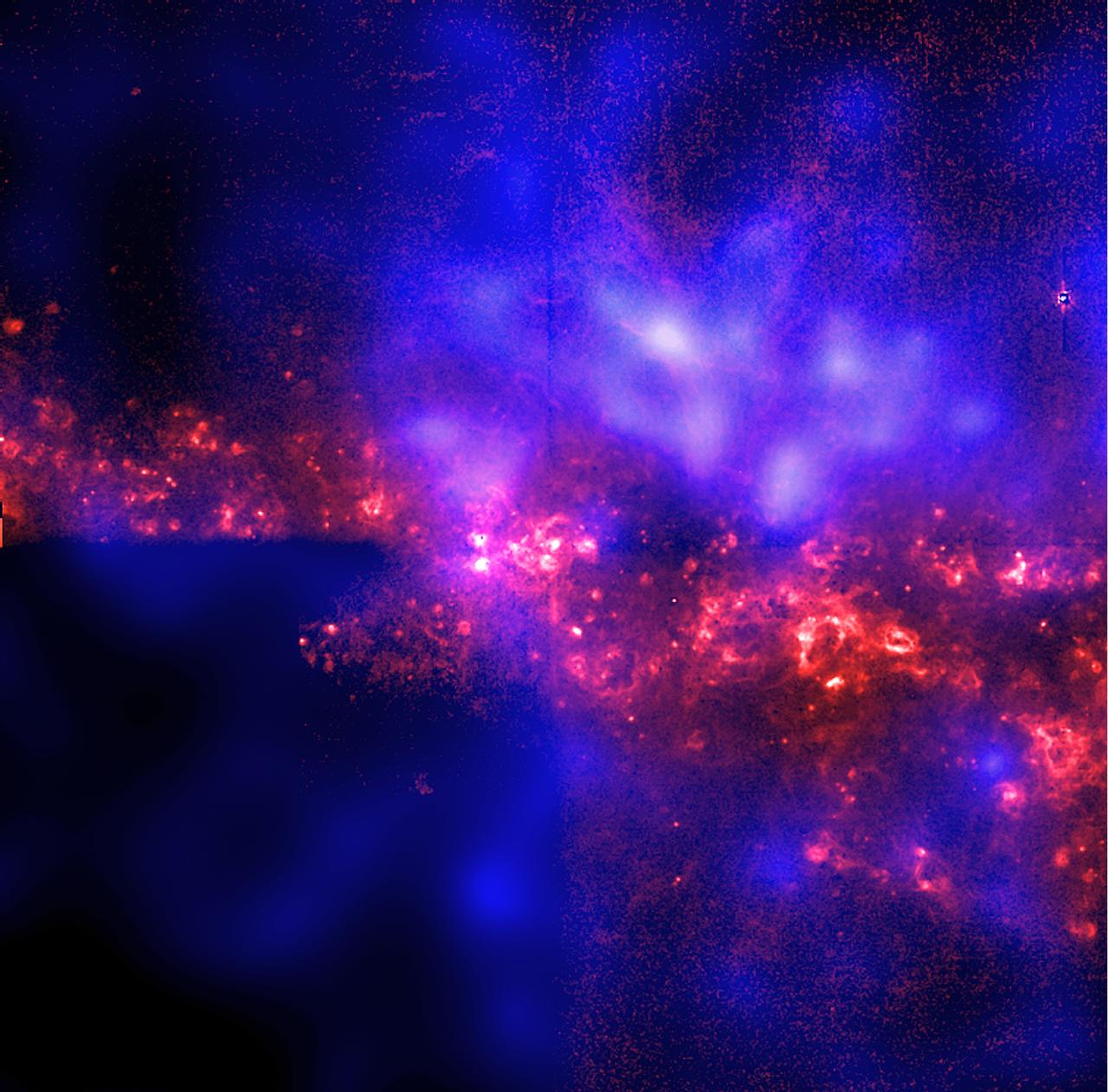
This image shows the central region of the spiral galaxy NGC 4631 as seen edge-on from the Chandra X-Ray Observatory (CXO) and the Hubble Space Telescope (HST). The Chandra data, shown in blue and purple, provide the first unambiguous evidence for a halo of hot gas surrounding a galaxy that is very similar to our Milky Way. The structure across the middle of the image and the extended faint filaments, shown in orange, represent the observation from the HST that reveals giant bursting bubbles created by clusters of massive stars. Scientists have debated for more than 40 years whether the Milky Way has an extended corona, or halo, of hot gas. Observations of NGC 4631 and similar galaxies provide astronomers with an important tool in the understanding our own galactic environment. A team of astronomers, led by Daniel Wang of the University of Massachusetts at Amherst, observed NGC 4631 with CXO's Advanced Charge-Coupled Device (CCD) Imaging Spectrometer (ACIS). The observation took place on April 15, 2000, and its duration was approximately 60,000 seconds.
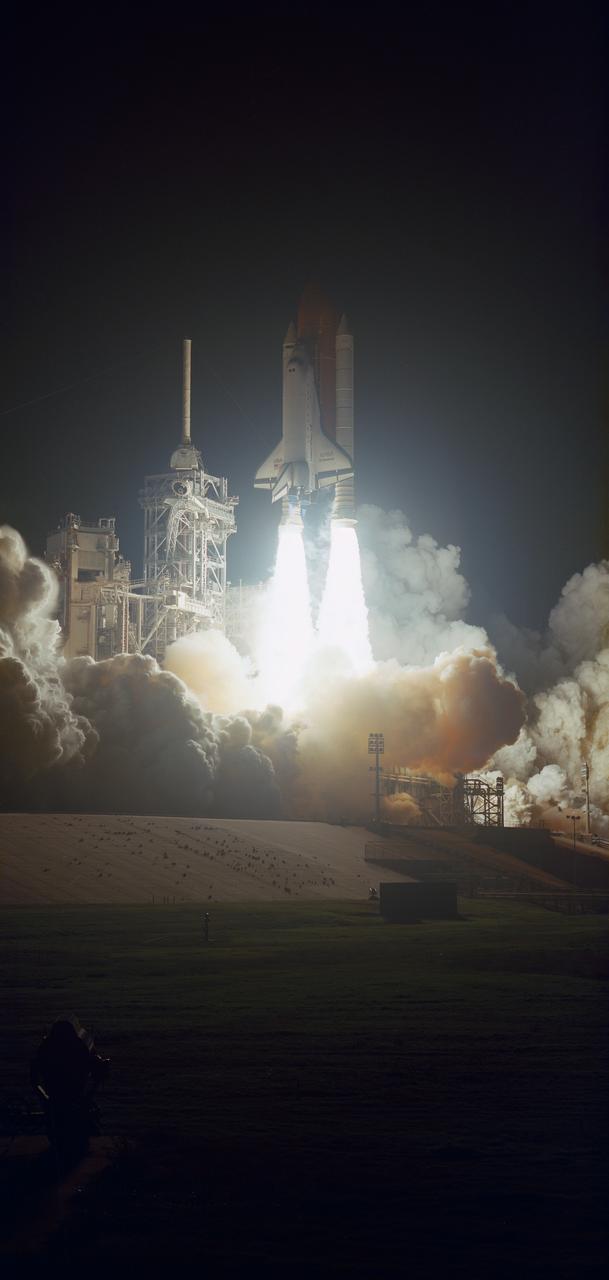
STS061-S-088 (2 Dec 1993) --- The Space Shuttle Endeavour lifts off from Launch Pad 39B with a crew of six NASA astronauts, a Swiss mission specialist and a variety of special tools aboard. Launch occurred at 4:27:00 a.m. (EST), December 2, 1993. The seven member crew will team to perform a variety of service tasks on the Hubble Space Telescope (HST). Four of the group will break into pairs on alternating sessions to carry out a total of five days Extravehicular Activity (EVA). Onboard are astronauts Richard O. Covey, Kenneth D. Bowersox, F. Story Musgrave, Kathy C. Thornton, Jeffrey A. Hoffman and Thomas D. Akers, along with Swiss scientist Claude Nicollier.
CAPE CANAVERAL, Fla. – In the Payload Hazardous Servicing Facility at NASA’s Kennedy Space Center, crew members with the STS-125 mission get a close look at some of the equipment associated with their mission to service NASA’s Hubble Space Telescope. Getting ready to open the Axial Science Instrument Protective Enclosure, or ASIPE, from the back of the stand are a an HST inspector, a technician, Johnson Space Center EVA Trainers Kristie Hansen and Thomas Gonzales Torres, and Mission Specialist Michael Good. Mission Specialist Mike Massimino is in the foreground at left. The ASIPE contains the Advanced Camera for Surveys. The STS-125 crew is taking part in a crew equipment interface test, which provides experience handling tools, equipment and hardware they will use on their mission. Space shuttle Atlantis is targeted to launch on the STS-125 mission Oct. 10. Photo credit: NASA/Kim Shiflett
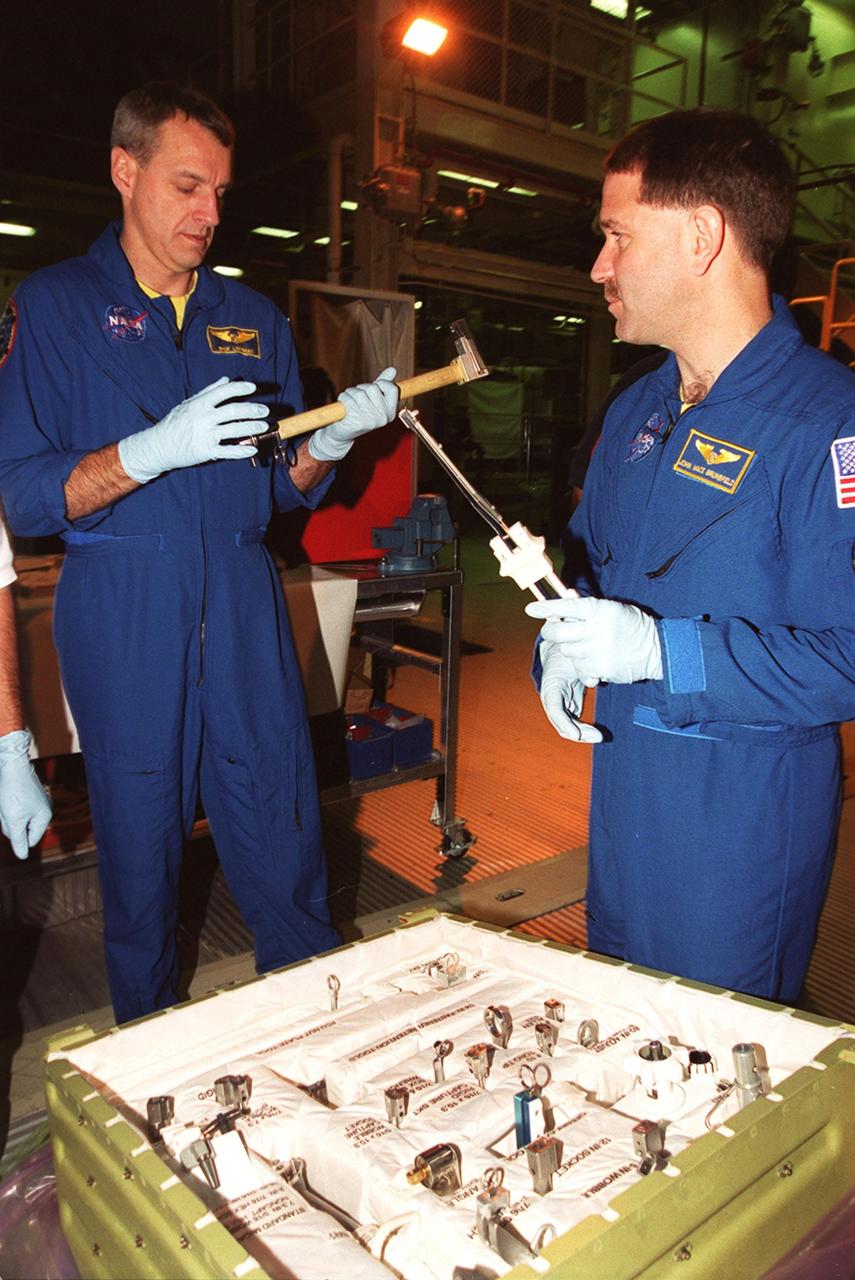
KENNEDY SPACE CENTER, Fla. - STS-109 Mission Specialist Richard Lennehan (left) and Payload Commander John Grunsfeld get a feel for tools and equipment that will be used on the mission. The crew is at KSC to take part in Crew Equipment Interface Test activities that include familiarization with the orbiter and equipment. The goal of the mission is to service the HST, replacing Solar Array 2 with Solar Array 3, replacing the Power Control Unit, removing the Faint Object Camera and installing the Advanced Camera for Surveys, installing the Near Infrared Camera and Multi-Object Spectrometer (NICMOS) Cooling System, and installing New Outer Blanket Layer insulation on bays 5 through 8. Mission STS-109 is scheduled for launch Feb. 14, 2002
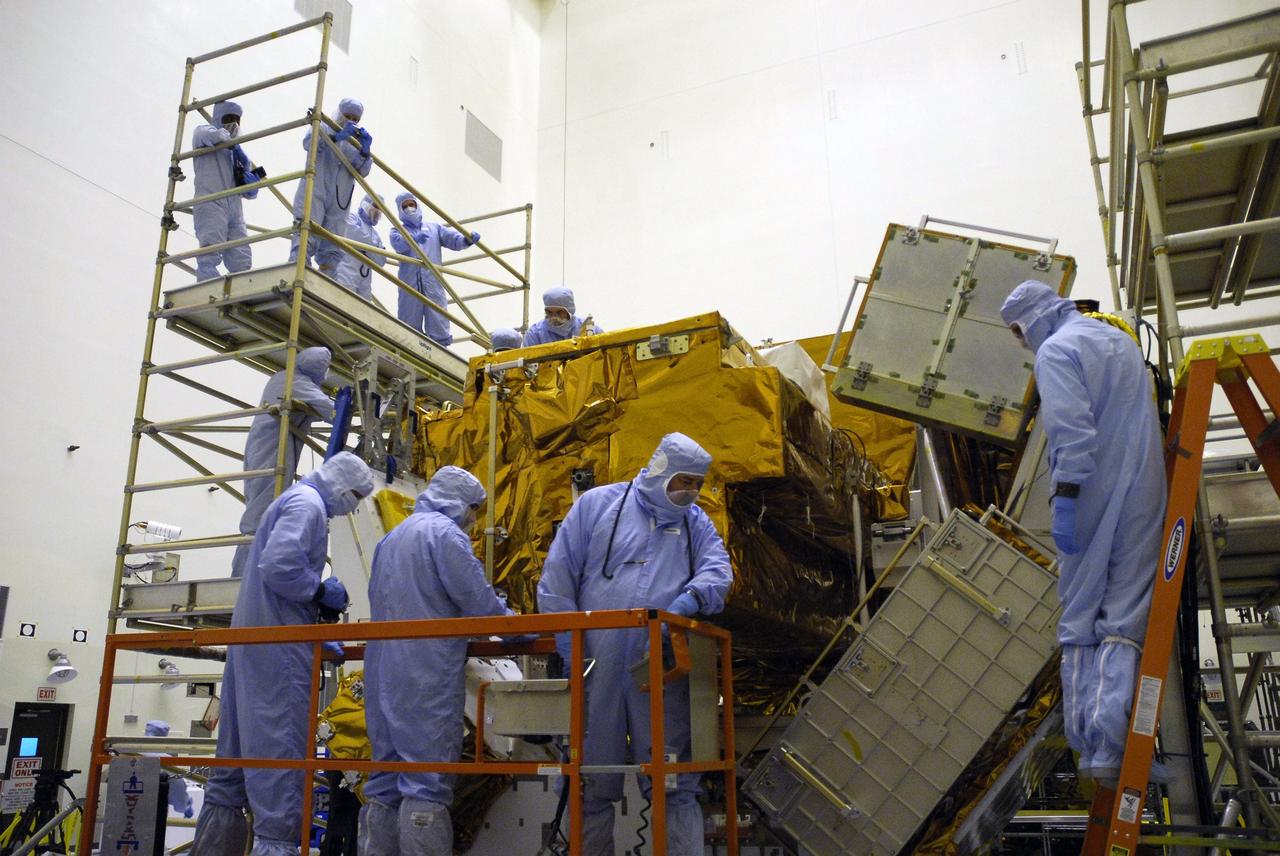
CAPE CANAVERAL, Fla. – In the Payload Hazardous Servicing Facility at NASA’s Kennedy Space Center, crew members with the STS-125 mission get a close look at some of the equipment associated with their mission to service NASA’s Hubble Space Telescope. In front, Mission Specialists Mike Massimino and John Grunsfeld are on a lift that will allow them to look at Axial Science Instrument Protective Enclosure, or ASIPE, interfaces. On the stand at the top left are an HST inspector, Johnson Space Center EVA Trainers Kristie Hansen and Thomas Gonzales Torres, and Mission Specialist Michael Good. The STS-125 crew is taking part in a crew equipment interface test, which provides experience handling tools, equipment and hardware they will use on their mission. Space shuttle Atlantis is targeted to launch on the STS-125 mission Oct. 10. Photo credit: NASA/Kim Shiflett
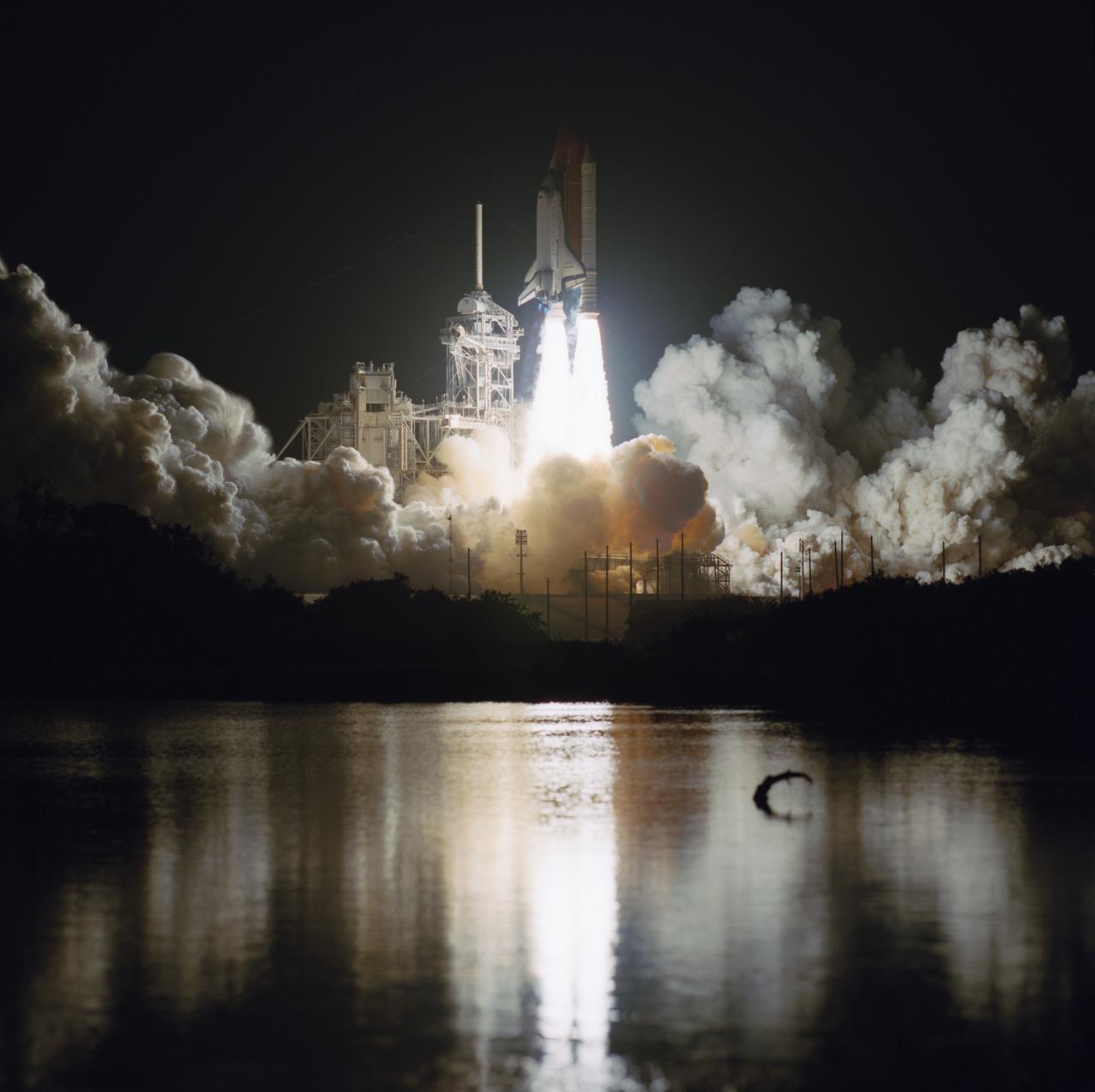
STS061-S-089 (2 Dec 1993) --- The Space Shuttle Endeavour lifts off from Launch Pad 39B with a crew of six NASA astronauts, a Swiss mission specialist and a variety of special tools aboard. Launch occurred at 4:27:00 a.m. (EST), December 2, 1993. The seven member crew will team to perform a variety of service tasks on the Hubble Space Telescope (HST). Four of the group will break into pairs on alternating sessions to carry out a total of five days Extravehicular Activity (EVA). Onboard are astronauts Richard O. Covey, Kenneth D. Bowersox, F. Story Musgrave, Kathy C. Thornton, Jeffrey A. Hoffman and Thomas D. Akers, along with Swiss scientist Claude Nicollier.
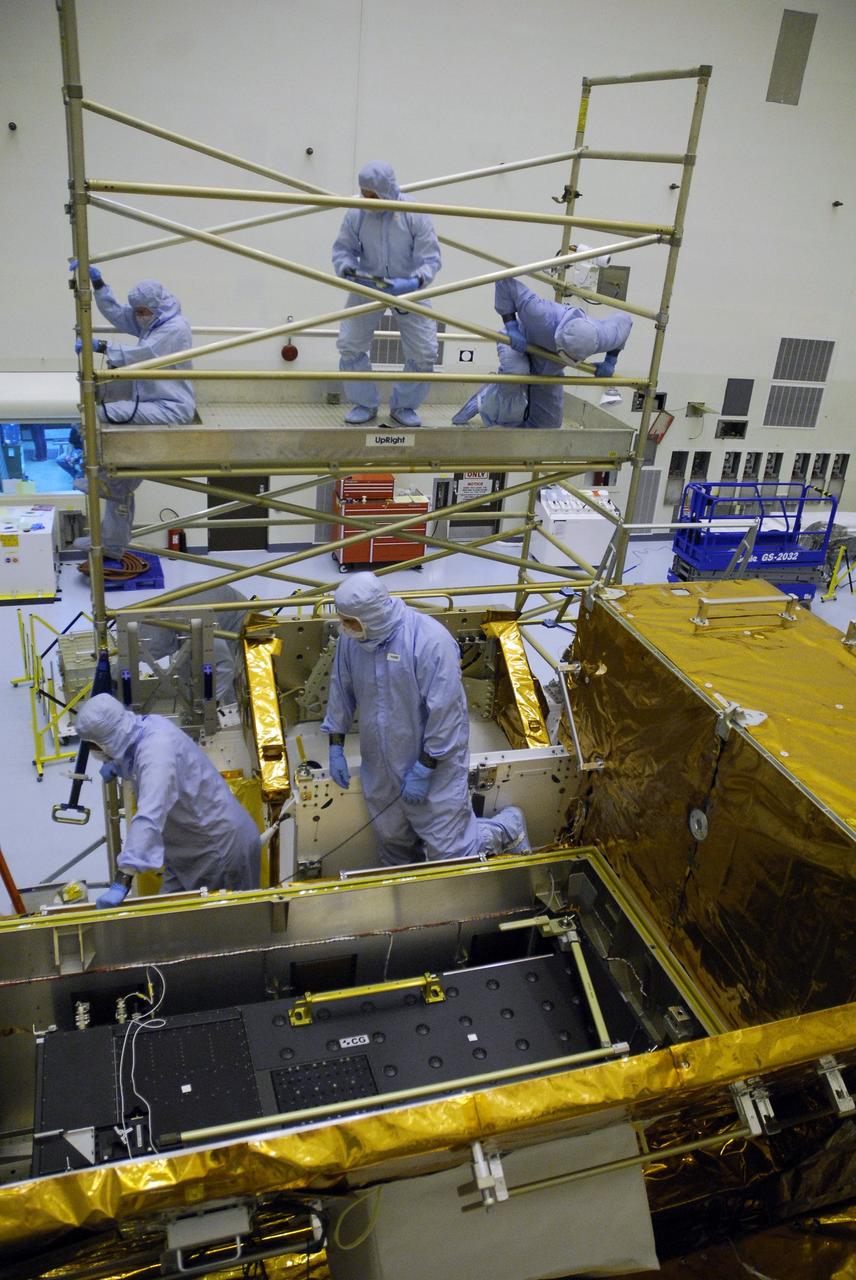
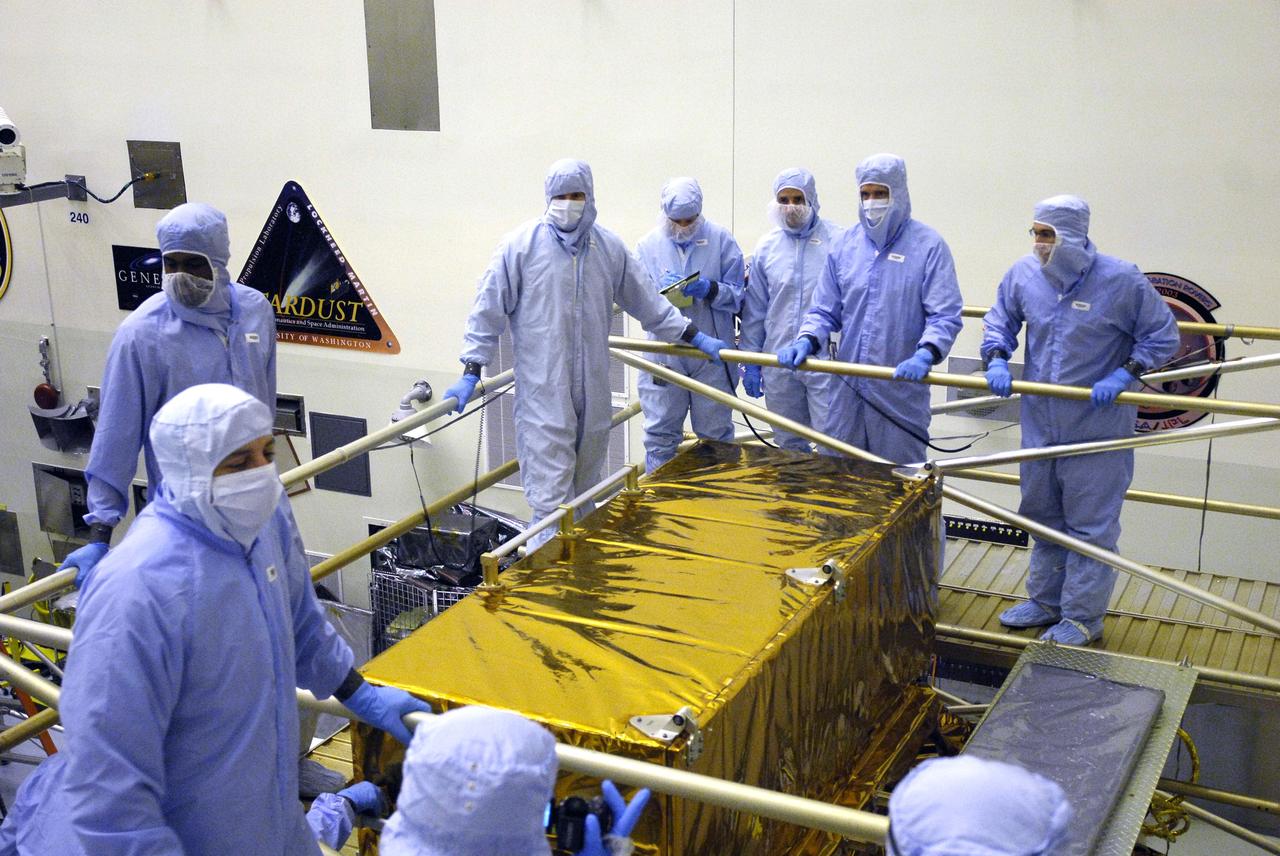
CAPE CANAVERAL, Fla. – In the Payload Hazardous Servicing Facility at NASA’s Kennedy Space Center, crew members with the STS-125 mission get a close look at some of the equipment associated with their mission to service NASA’s Hubble Space Telescope. Looking at the box containing the Cosmic Origins Spectrograph, or COS, on the orbital replacement unit carrier are Mission Specialist Michael Good (upper right, on stand) and HST inspectors. COS will be the most sensitive ultraviolet spectrograph ever flown on Hubble and will probe the "cosmic web" - the large-scale structure of the universe whose form is determined by the gravity of dark matter and is traced by galaxies and intergalactic gas. The STS-125 crew is taking part in a crew equipment interface test, which provides experience handling tools, equipment and hardware they will use on their mission. Space shuttle Atlantis is targeted to launch on the STS-125 mission Oct. 10. Photo credit: NASA/Kim Shiflett
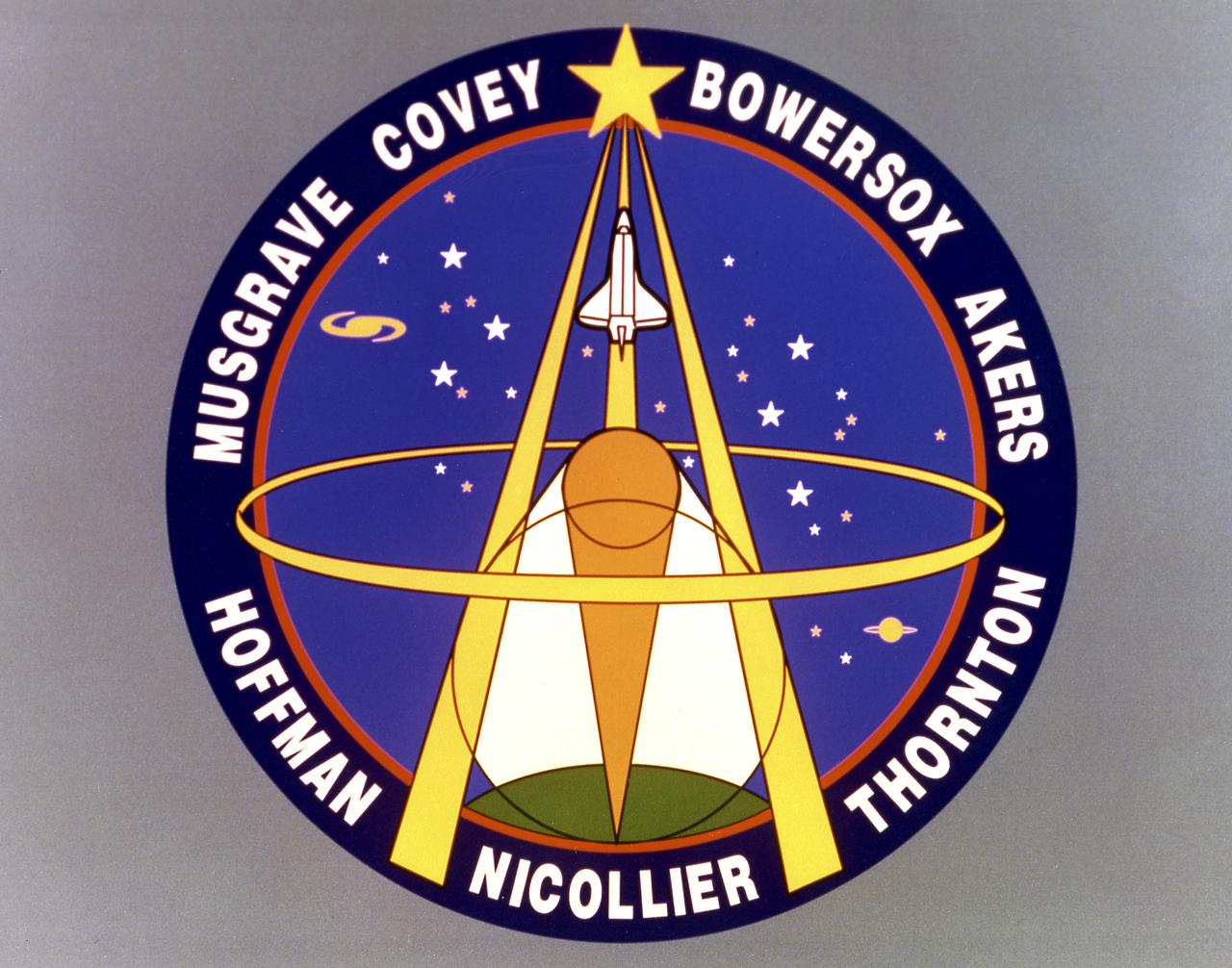
Designed by the mission crew members, the STS-61 crew insignia depicts the astronaut symbol superimposed against the sky with the Earth underneath. Also seen are two circles representing the optical configuration of the Hubble Space Telescope (HST). Light is focused by reflections from a large primary mirror and a smaller secondary mirror. The light is analyzed by various instruments and, according to the crew members, brings to us on Earth knowledge about planets, stars, galaxies and other celestial objects, allowing us to better understand the complex physical processes at work in the universe. The Space Shuttle Endeavour is also represented as the fundamental tool that allows the crew to perform the first servicing of the Hubble Space Telescope so its scientific deep space mission may be extended for several years to come. The overall design of the emblem, with lines converging to a high point, is also a symbolic representation of the large-scale Earth-based effort which involves space agencies, industry, and the universities to reach goals of knowledge and perfection.
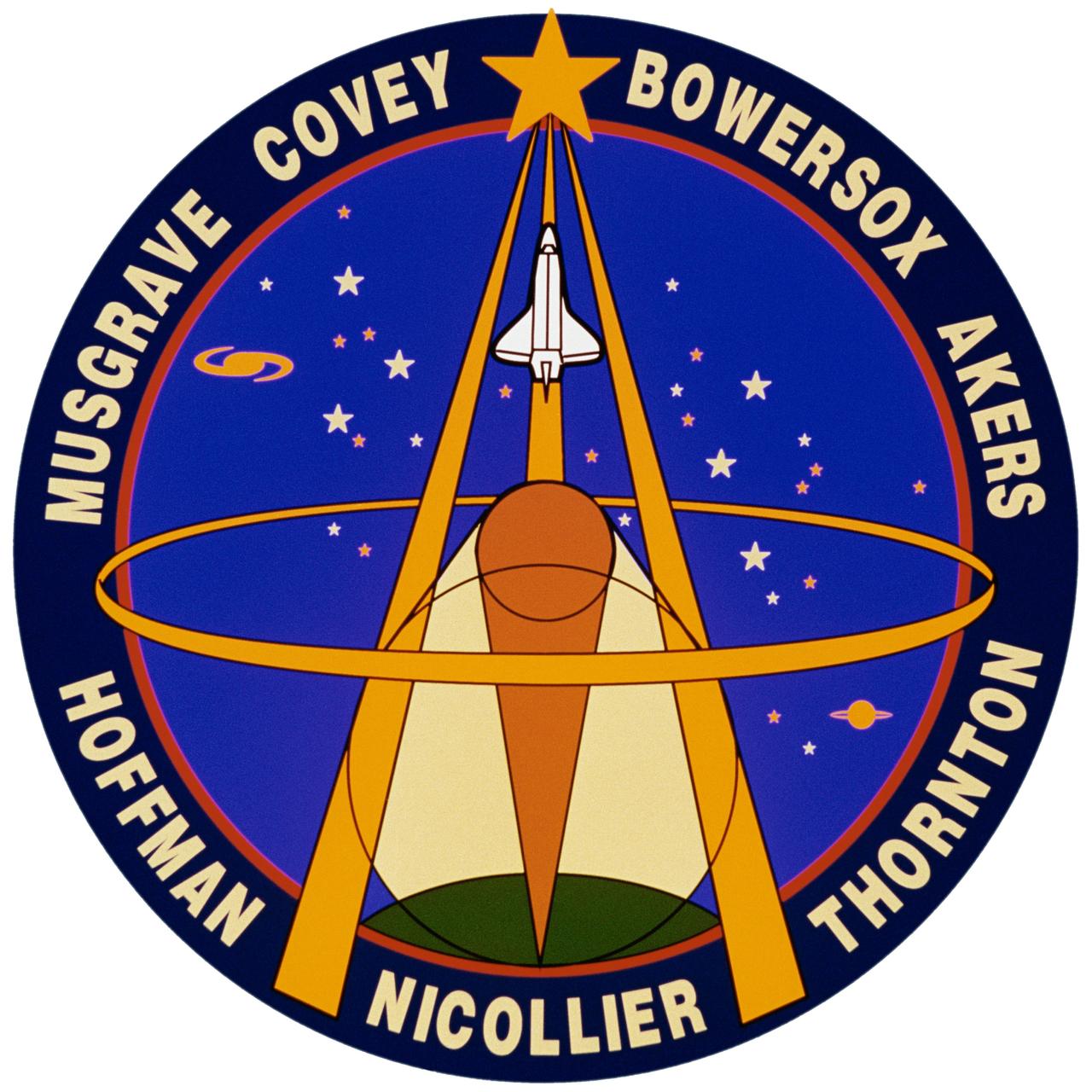
STS061-S-001 (1 Oct. 1993) --- Designed by the crew members, the STS-61 crew insignia depicts the astronaut symbol superimposed against the sky with the Earth underneath. Also seen are two circles representing the optical configuration of the Hubble Space Telescope (HST). Light is focused by reflections from a large primary mirror and a smaller secondary mirror. The light is analyzed by various instruments and, according to the crew members, "brings to us on Earth knowledge about planets, stars, galaxies and other celestial objects, allowing us to better understand the complex physical processes at work in the universe." The space shuttle Endeavour is also represented as the fundamental tool that allows the crew to perform the first servicing of the Hubble Space Telescope so its scientific deep space mission may be extended for several years to come. The overall design of the emblem, with lines converging to a high point, is also a symbolic representation of the large-scale Earth-based effort -- which involves space agencies, industry and the universities -- to reach goals of knowledge and perfection. The NASA insignia design for space shuttle flights is reserved for use by the astronauts and for other official use as the NASA Administrator may authorize. Public availability has been approved only in the forms of illustrations by the various news media. When and if there is any change in this policy, which is not anticipated, the change will be publicly announced. Photo credit: NASA
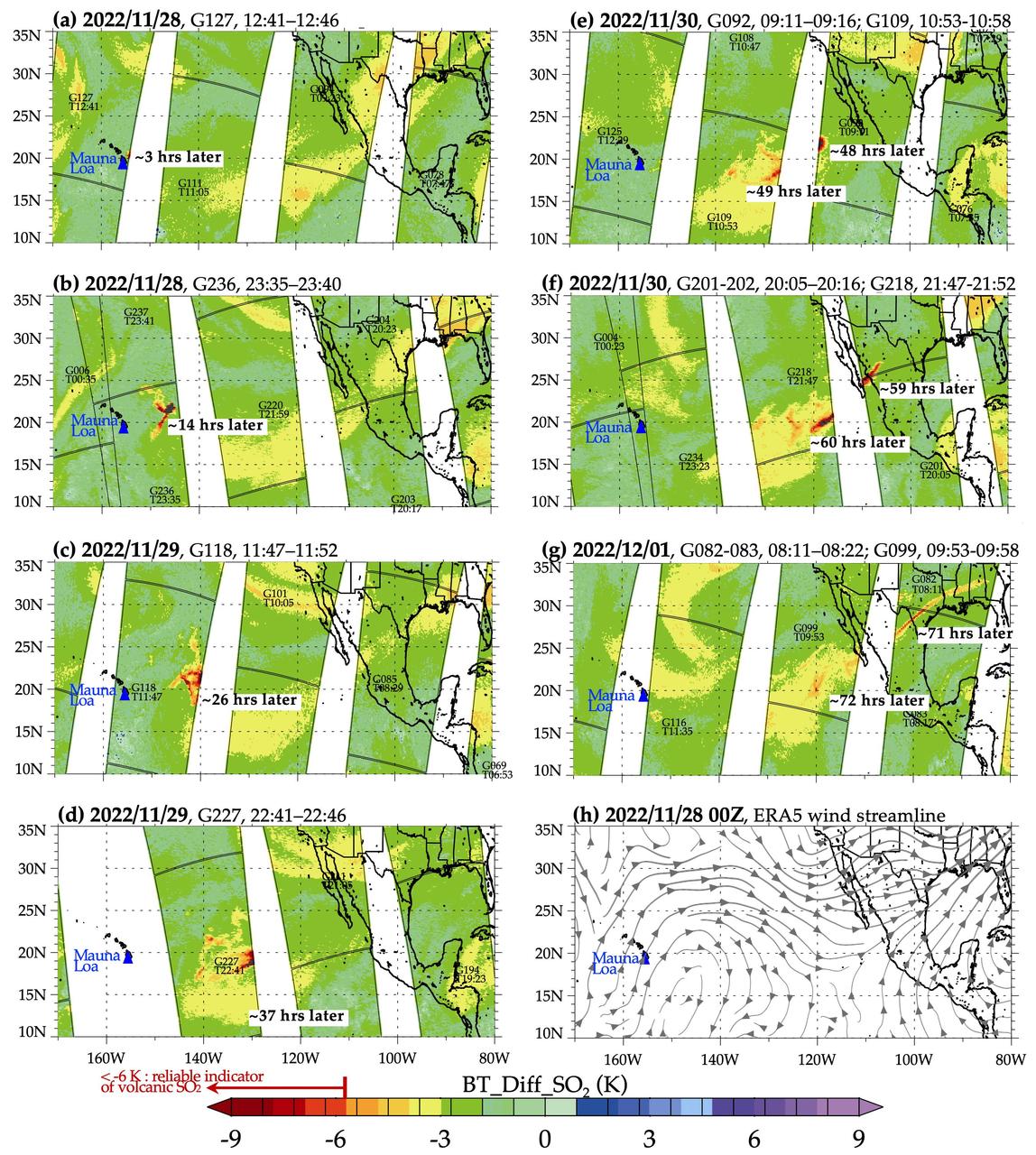
The Atmospheric Infrared Sounder (AIRS) instrument aboard NASA's Aqua satellite detected volcanic sulfur dioxide (SO₂) plumes emanating from Hawaii's Mauna Loa volcano, which started erupting late Sunday, Nov. 27, 2022, at 11:30 p.m. Hawaiian Standard Time (9:30 a.m. UTC, Nov. 28). The AIRS images shown here were taken from seven overpasses, capturing the SO₂ volcanic plumes and its pathways since the eruption. Starting from the upper left frame — captured at 2:41 a.m. HST (12:41 UTC) on Nov. 28, around three hours after the eruption began — a red patch that represents an SO₂ plume can be seen east of the volcano, which is shown as a blue triangle, then moving east and diffusing through subsequent frames. By 71 hours after the eruption, the eastern part of the plume is over the southeastern United States. SO₂ can be harmful to the human respiratory system when inhaled. In the atmosphere, it can also lead to the formation of other gaseous sulfur oxides (SOₓ). These substances can react with other chemicals to form particulate-matter pollution, which can cause breathing problems, contribute to acid rain, and reduce sky visibility. AIRS measures the amount of radiation reaching the instrument from the top of the atmosphere at more than 2,000 different wavelengths. Brightness temperature (BT) is a measure of the amount of radiation, and the images show the difference between BT observed at two different wavelengths. One of the wavelengths is sensitive to atmospheric SO₂, and the other is not, so the difference between the two measurements can give a reliable signal of volcanic SO₂ plumes. A fully automated volcanic plume detection rapid response system that uses AIRS data has been developed at the Jet Propulsion Laboratory in Southern California. This tool is available at the AIRS Rapid Response website, where detections of the most recent volcanic SO₂, dust, and clouds, in visible and infrared images, are updated in near real-time when a volcanic event anywhere on Earth triggers the system. AIRS historical detections of volcanic SO₂ and dust are archived on the site at https://airs.jpl.nasa.gov/volcanic_plumes/. AIRS, in conjunction with the Advanced Microwave Sounding Unit (AMSU), senses emitted infrared and microwave radiation from Earth to provide a three-dimensional look at the planet's weather and climate. Working in tandem, the two instruments make simultaneous observations down to Earth's surface. With more than 2,000 channels sensing different regions of the atmosphere, the system creates a global map of atmospheric temperature and humidity, cloud amounts and heights, greenhouse gas concentrations, and many other atmospheric phenomena. Launched into Earth orbit in 2002 aboard NASA's Aqua spacecraft, the AIRS and AMSU instruments are managed by JPL, under contract to NASA. JPL is a division of Caltech. https://photojournal.jpl.nasa.gov/catalog/PIA25562